Amy Sherald’s Second Chance

This site is Free & Ad-Free! If you find this piece worthwhile, please donate via PayPal to support it & independent Art writing!
You can also support it by buying Art & books. Details at the end. Thank you!
 

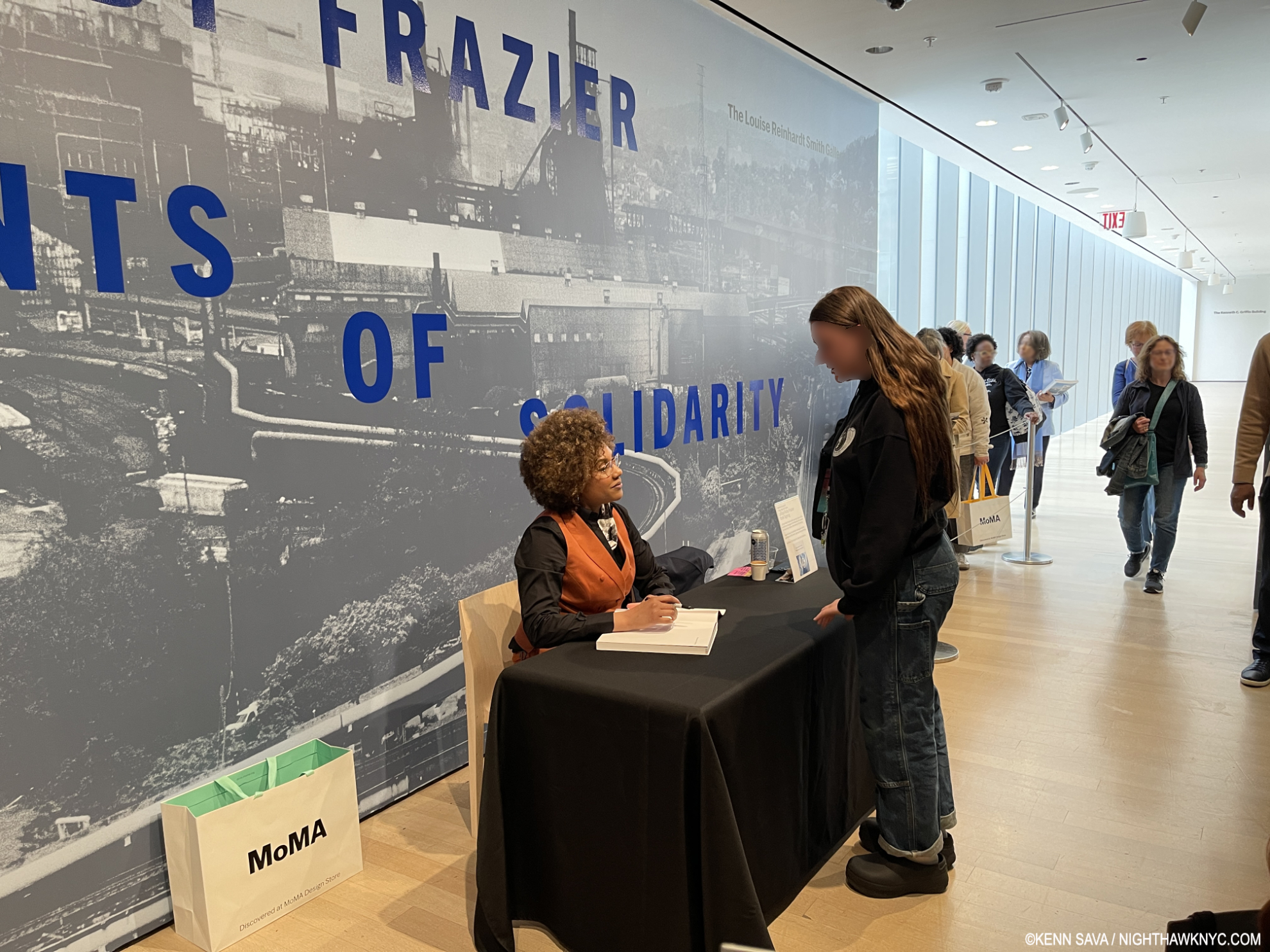
Written & Photographed by Kenn Sava.

Preface-
In honor of those who saved my life 19 years ago on February 7th, 2007, as one way of giving Thanks, this piece honors another survivor (of a different ailment): the Painter Amy Sherald. Amy’s remarkable story is told here better than I could tell it. My look at her Art follows.

Shows seen:
Amy Sherald: the heart of the matter…, Hauser & Wirth, October, 2019, and
Amy Sherald: American Sublime, Whitney Museum, Summer, 2025

The Whitney & MoMA went toe-to-toe with dueling summer blockbusters in 2025, with each institution mounting two. I began this series with a look at Hilma af Klint: What Stands Behind the Flowers at MoMA, where Jack Whitten: The Messenger was installed on 6. All the while, 40 blocks south, Amy Sherald: American Sublime was up at the same time as Christine Sun Kim’s landmark All Day All Night, comprising the Whitney share of the four must-see Summer shows.

Hauser & Wirth, October 15, 2019.

I first saw Amy Sherald’s work at her NYC debut show, “the heart of the matter…,”  at Hauser & Wirth in October, 2019, a show that contained 8 Paintings.

The select content allowed for more space around each that worked extremely well in my view. Handsome, 2019, Oil on canvas, 54 x 43 inches, was also shown in American Sublime. Seen at Hauser & Wirth, October 15, 2019.

Fast forward to April 9, 2025, American Sublime contains 44 Paintings, the earliest dating from 2007- just 18 years prior! In those last two sentences hides the remarkable fact that Ms. Sherald (B. 1973) went from NYC debut show to an NYC early mid-career major museum Retrospective in a little more than five years! There aren’t a lot of Artists I can say that about.

Whitney Museum, July 25, 2025

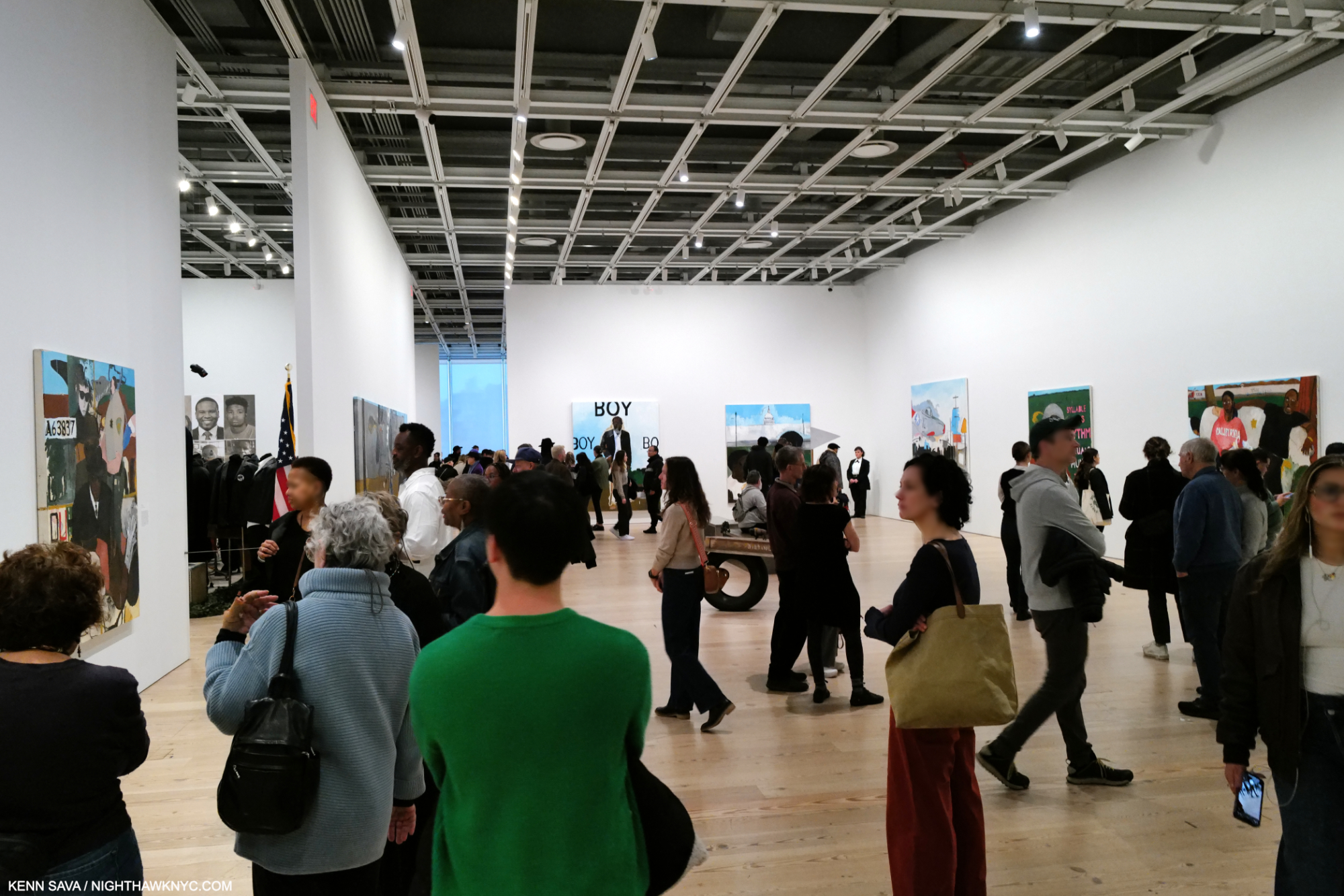
Installation view. July 25, 2025.

What’s more remarkable is that just seven years before her Hauser show, on December 18, 2012, Amy Sherald underwent a heart transplant at age 39! That concluded a harrowing 10 years she spent after being diagnosed with congestive heart failure at age 30, and a two-month wait in the hospital for a donated heart (as is recounted in the piece I linked up top). Today, Amy Sherald is yet another fine Painter who burst on the scene this past decade and has wasted no time solidifying a place in museums around the world.

Miss Everything (Unsuppressed Deliverance), 2014. Oil on canvas. The Painting that brought Amy Sherald to national attention was inspired by Alice in Wonderland.

And, “burst on the scene…” she did as her 2019  NYC debut show came just three years after Amy won the 2016 National Portrait Gallery’s Outwin Boochever Portrait Competition with Miss Everything (Unsuppressed Deliverance), becoming both the first woman and the first African-American woman to win it.

Michelle LaVaughn Robinson Obama aka First Lady Michelle Obama, 2018, Oil on linen. (The first title was on the wall card.) After being personally selected by Mrs. Obama to Paint her official Portrait, a prescient choice at the time. Amy Sherald’s stature has only continued to grow. The former First Lady selected the Michelle Smith Milly label dress she is wearing that channels Piet Mondrian through Gee’s Bends Quilt Making, blending the modern with the historic. Gee’s Bend is a remote Black Alabama community of the descendants of former slaves.

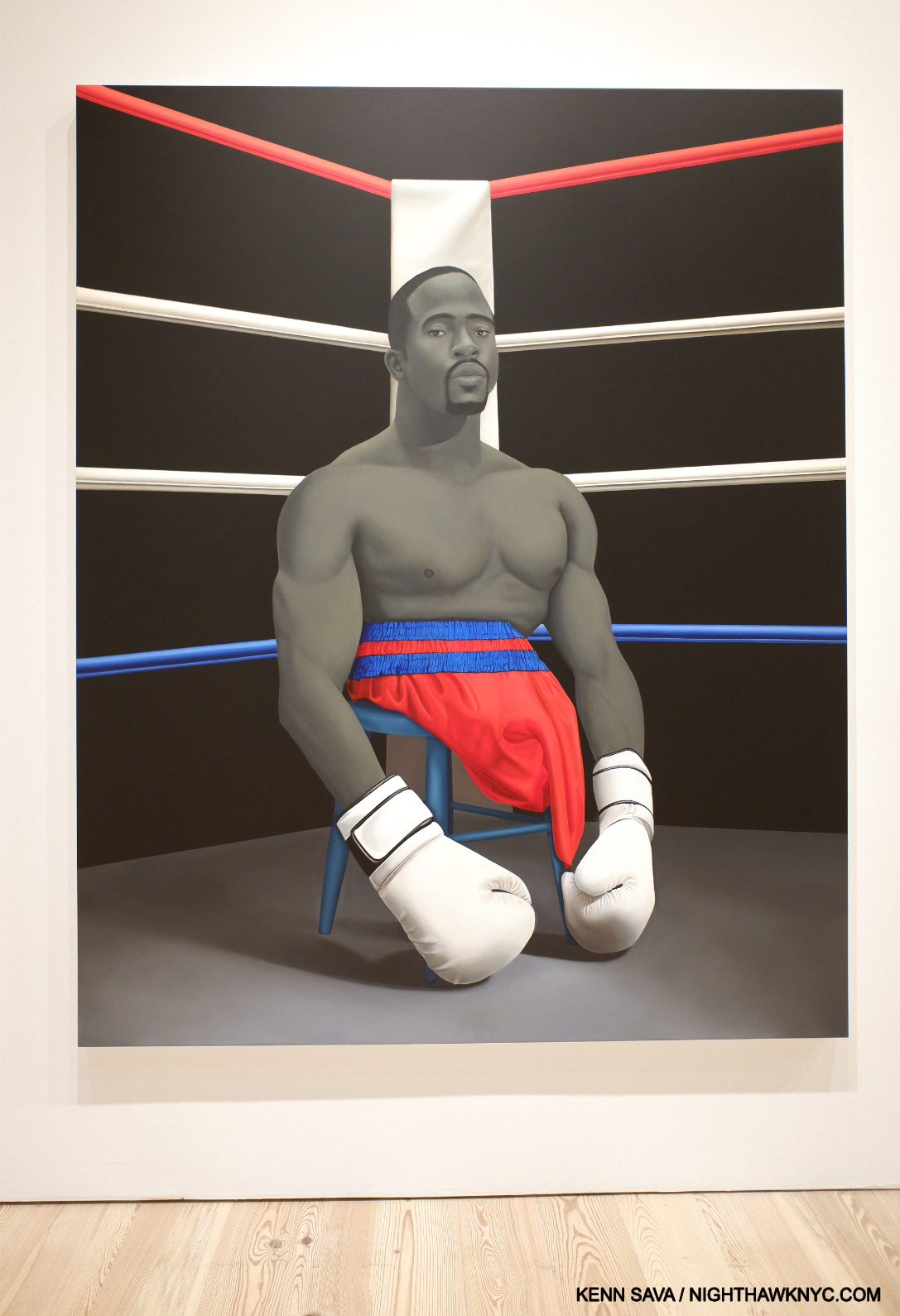
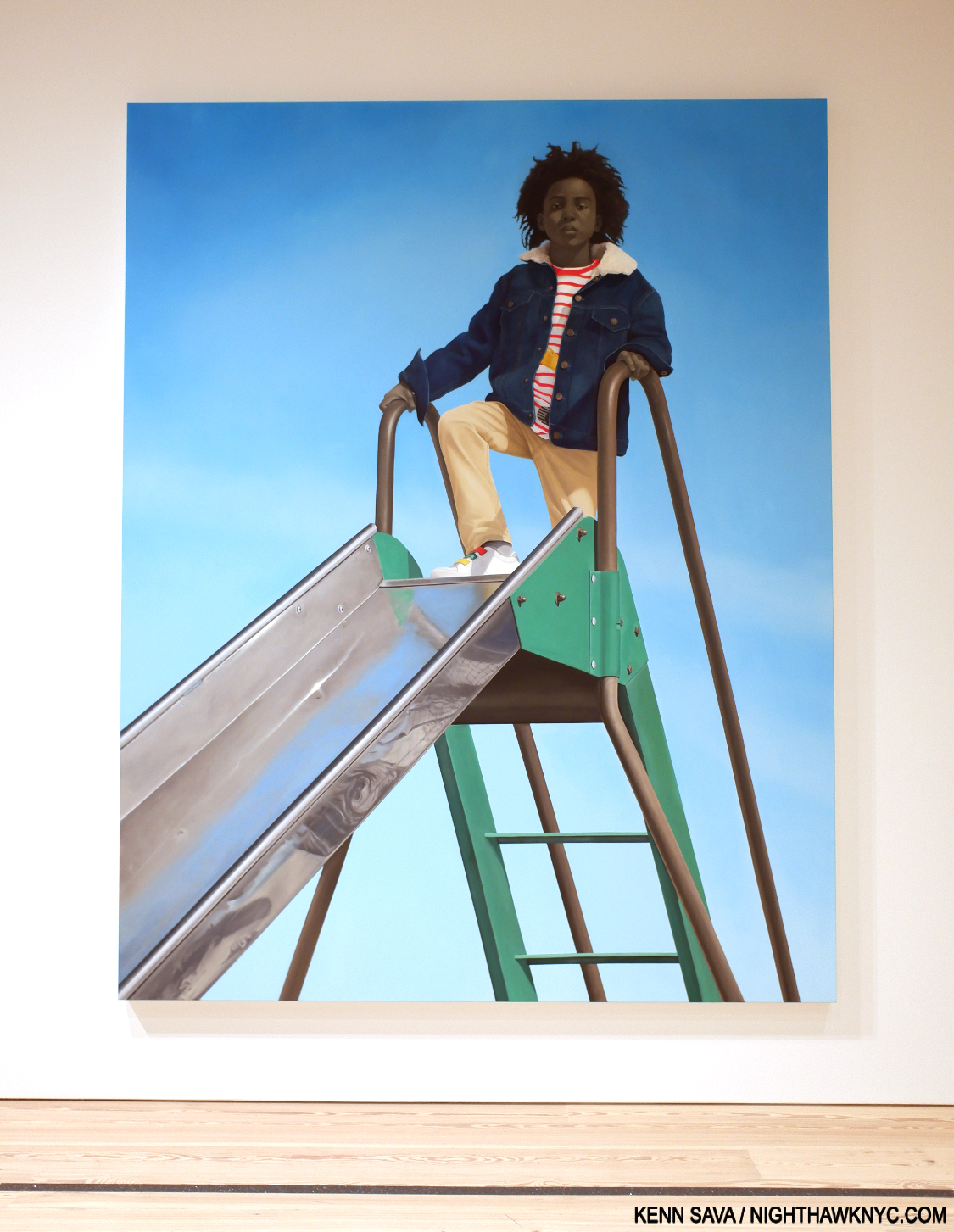
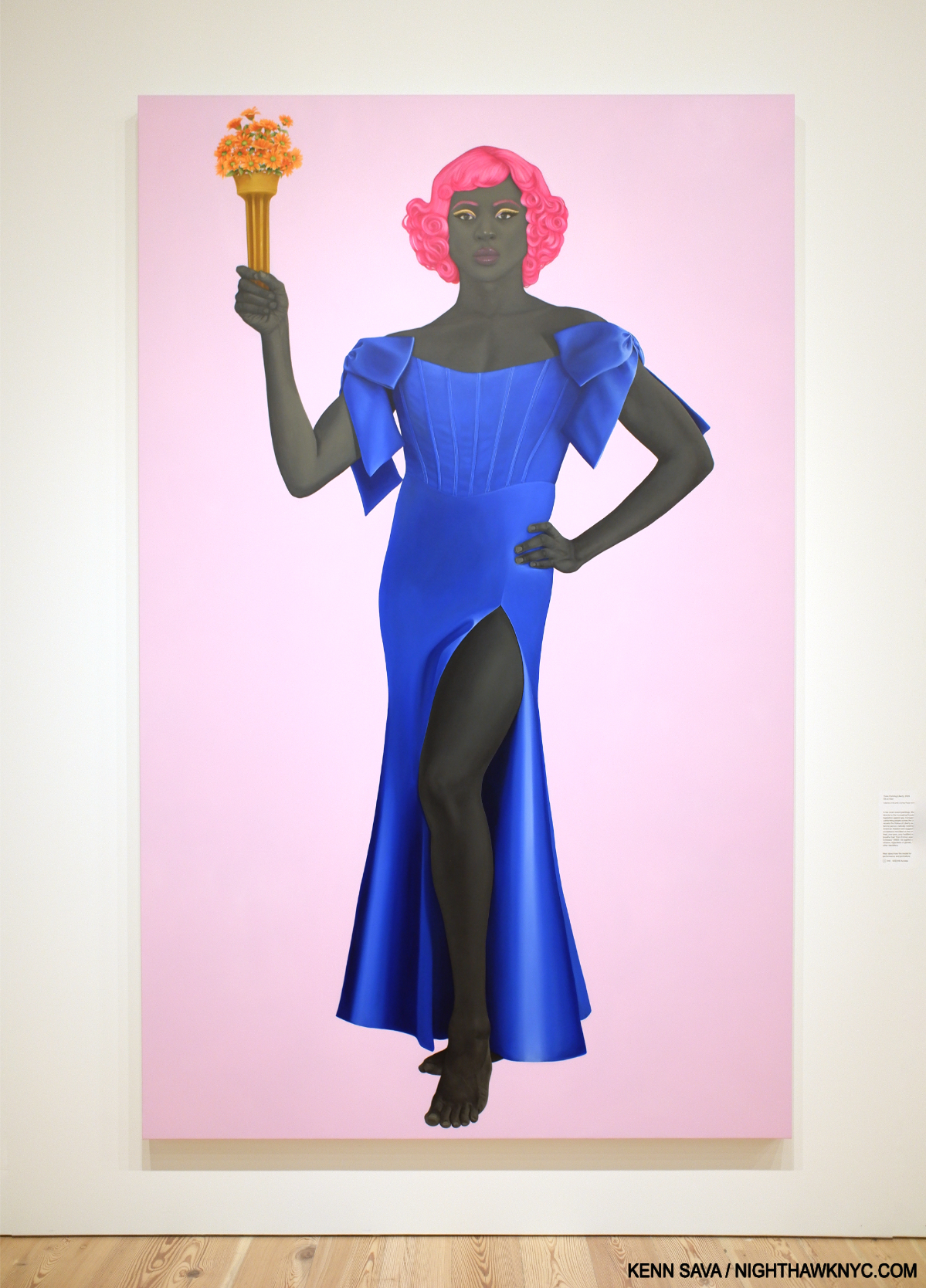
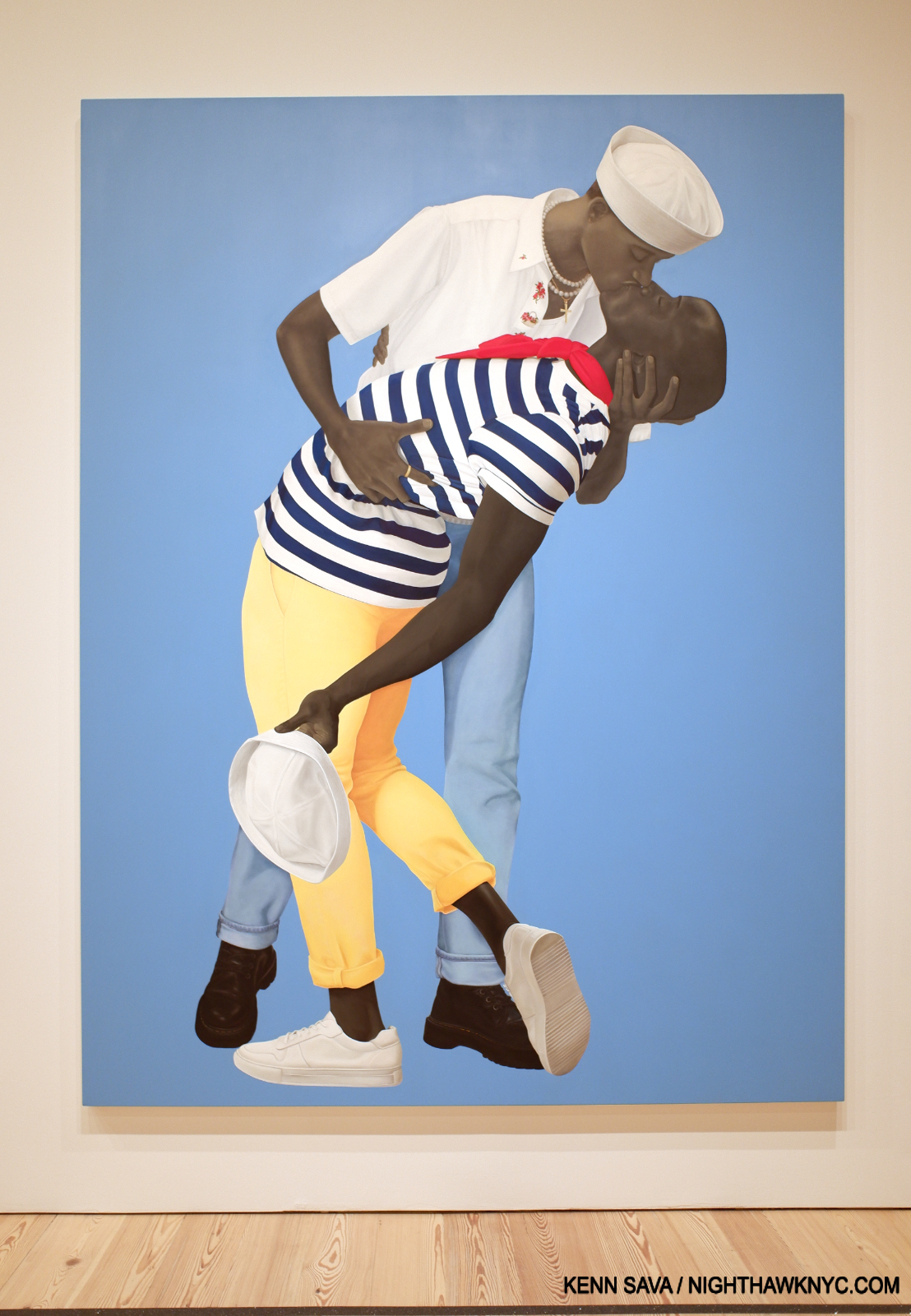
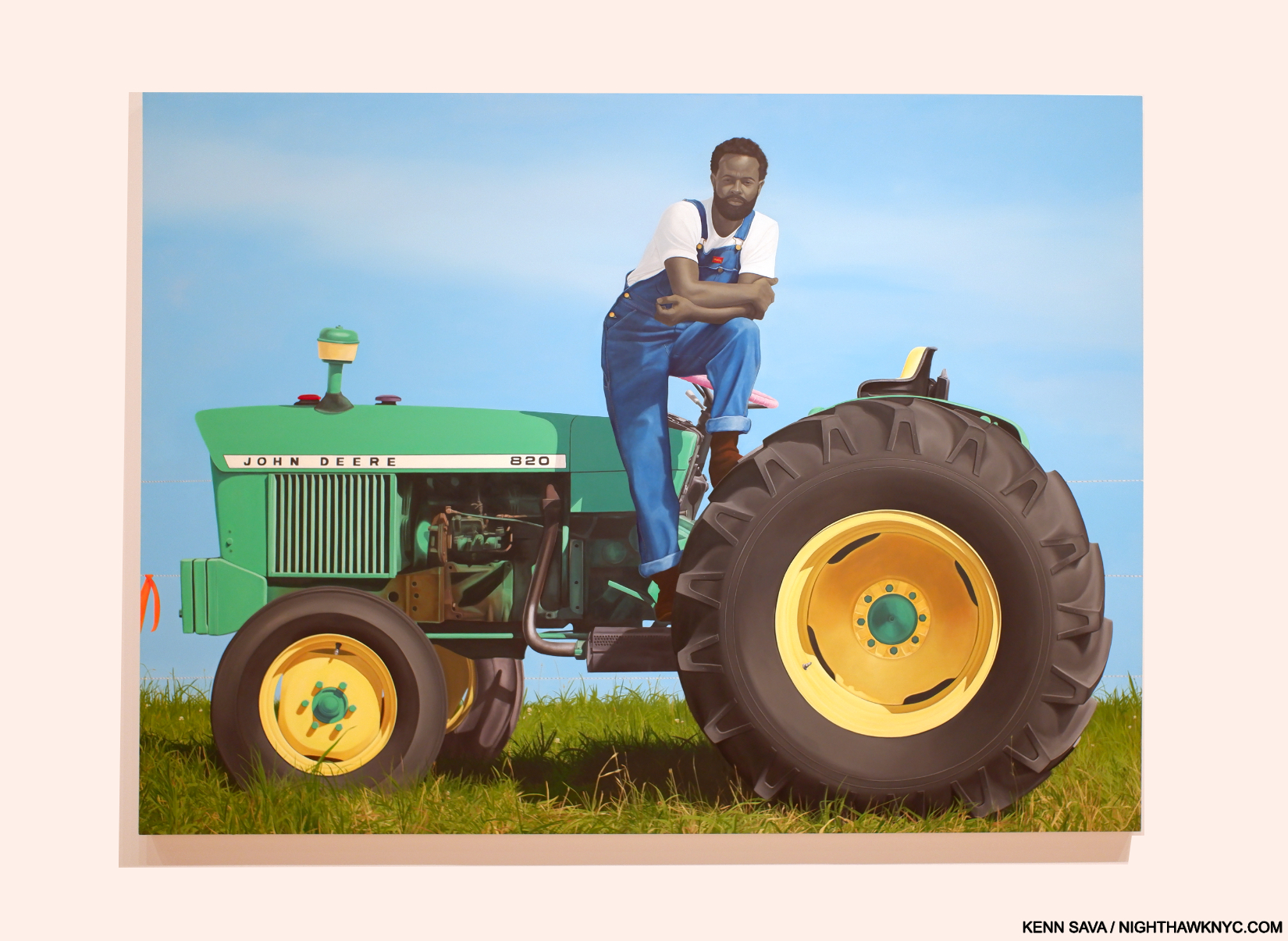
Most well-known today, perhaps, for her Portraits of Michelle Obama and Breonna Taylor, Amy Sherald: American Sublime revealed the depth of her accomplishment (already) in works that are almost always forthright, with subjects usually facing the viewer head-on, while steeped in a subtlety that rewards extended and repeated looking. Adding a unique twist is that the faces, hands, arms, legs of each of her subjects are gorgeously rendered in grisaille(!), something I’ve never seen done in a color Painting before, and something that has become her trademark. She uses grisaille as a way of “challenging the concept of color as race1.”

Untitled (Opal), 2019, Oil on linen. Standing in front of Opal, I found myself wondering why I’d never seen a Painting like this before. It seems so incredibly straight-forward, yet only Amy Sherald could have Painted it and made it as unique as it is. From the grisaille, to the position of her hands & fingers, to her expression and the choice of colors, which Wes Anderson might admire, it’s a remarkable blend of a Portrait of Opal through the eyes of an Artist with a vision.

In the late 1990s and early 2000s I spent much time wondering what new developments would come to Portraiture after the work of great 20th Century Artists, like Francis Bacon, Lucian Freud, Frank Auerbach, Alice Neel, Marlene Dumas, Picasso, and others. 25+ years in, the genre is continually being reinvented, yet again, by a number of Artists who have come to prominence this decade- including Amy Sherald, Nathaniel Mary Quinn, and Frank Auerbach (who passed away in 2024).

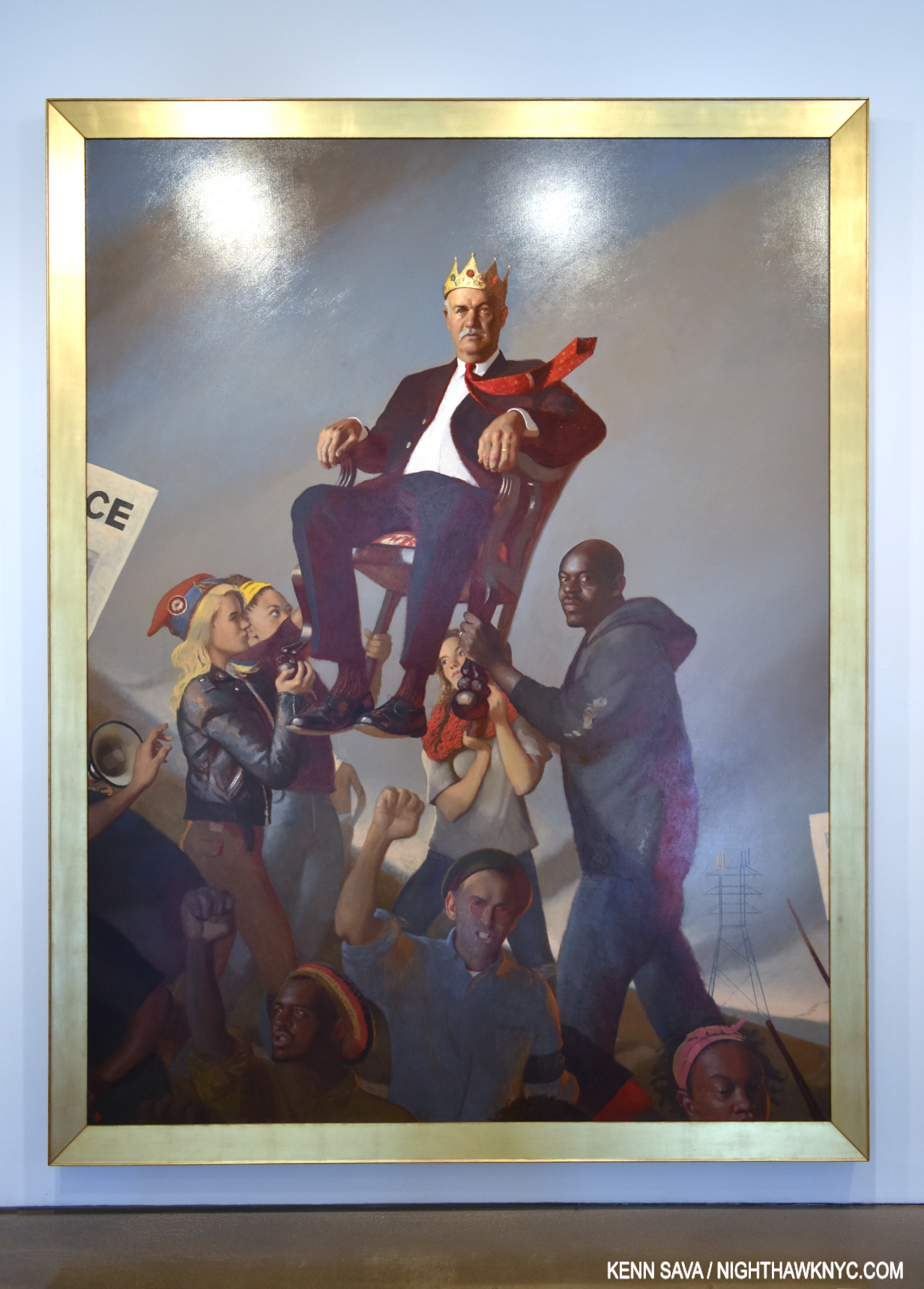
Bo Bartlett, Oligarchy, 2016, Oil on linen. See at Ameringer McEnery Yohe, August 12, 2016.

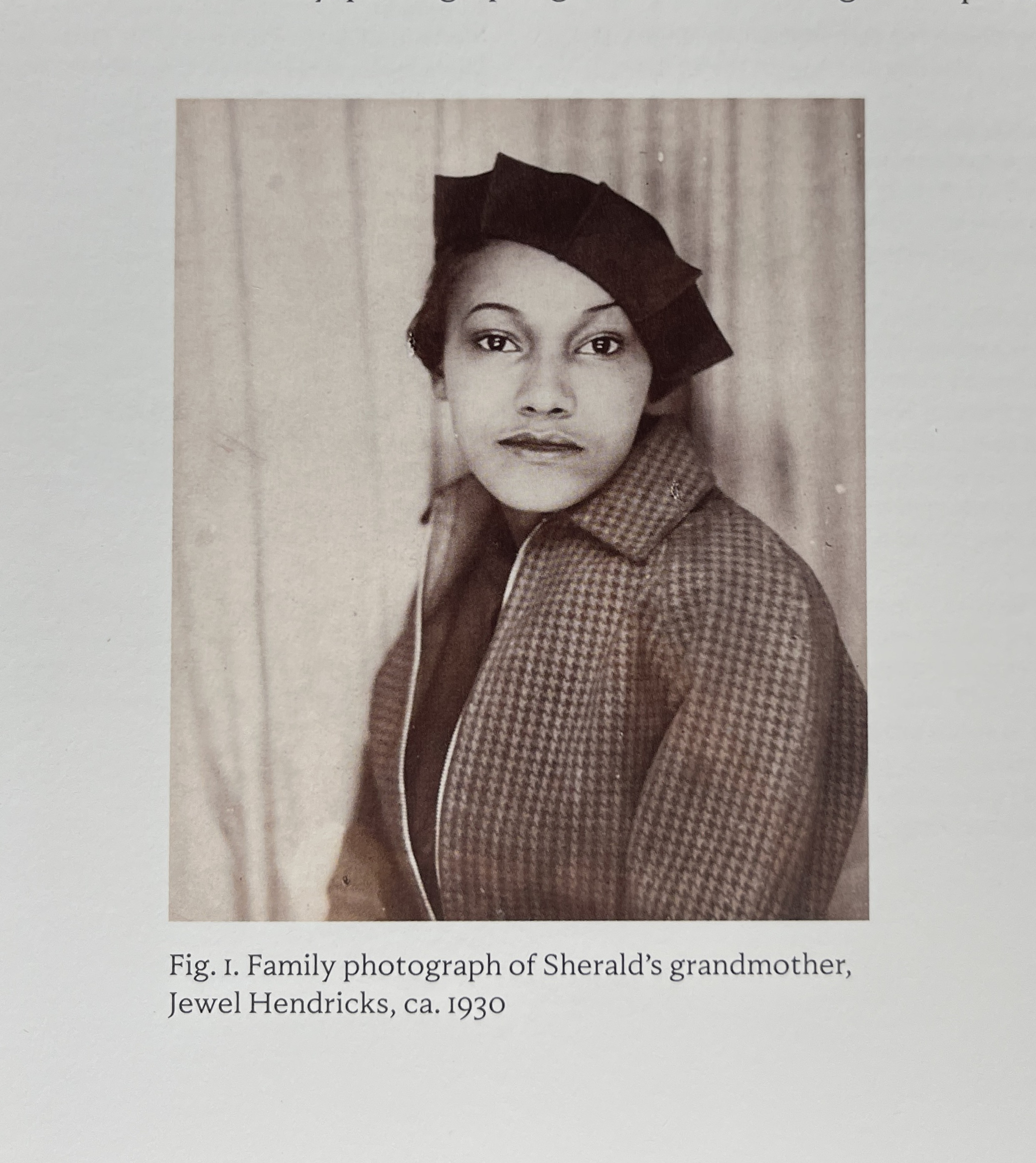
Interestingly, Amy credits the Painter Bo Bartlett with showing her the possibilities. Others have posited that Ms. Sherald’s use of grisaille goes back to old black & white Photos of Black subjects, and not Painting or Painted Portraiture. However, on 19th Century Photographs Ms. Sherald said-

“It wasn’t what inspired my work, but it’s what affirmed my journey with it, and it’s where I was finally able to find these representations of black Americans that spoke to me in the same way that I wanted my work to speak to the world. They were family photographs, similar to the image of my grandmother that I oftentimes mention, where she had her picture taken.”

The Artist’s grandmother, Jewel Hendricks, as seen on page 28 of the excellent American Sublime catalog.

“Looking at how they represented themselves— they’re quiet, regal, graceful. It was an outward action that had inward meaning. They don’t smile, but there’s something there-this is what I look for in people— the feeling that you get when you look at those old photographs. When you look into their eyes, you are being told a story. It’s almost as if they’re standing in front of you, and they have a living and breathing kind of energy. There is something so captivating about that. And it’s not frivolous. It’s a very serious, deliberate kind of thing, having your picture taken, especially then2.”

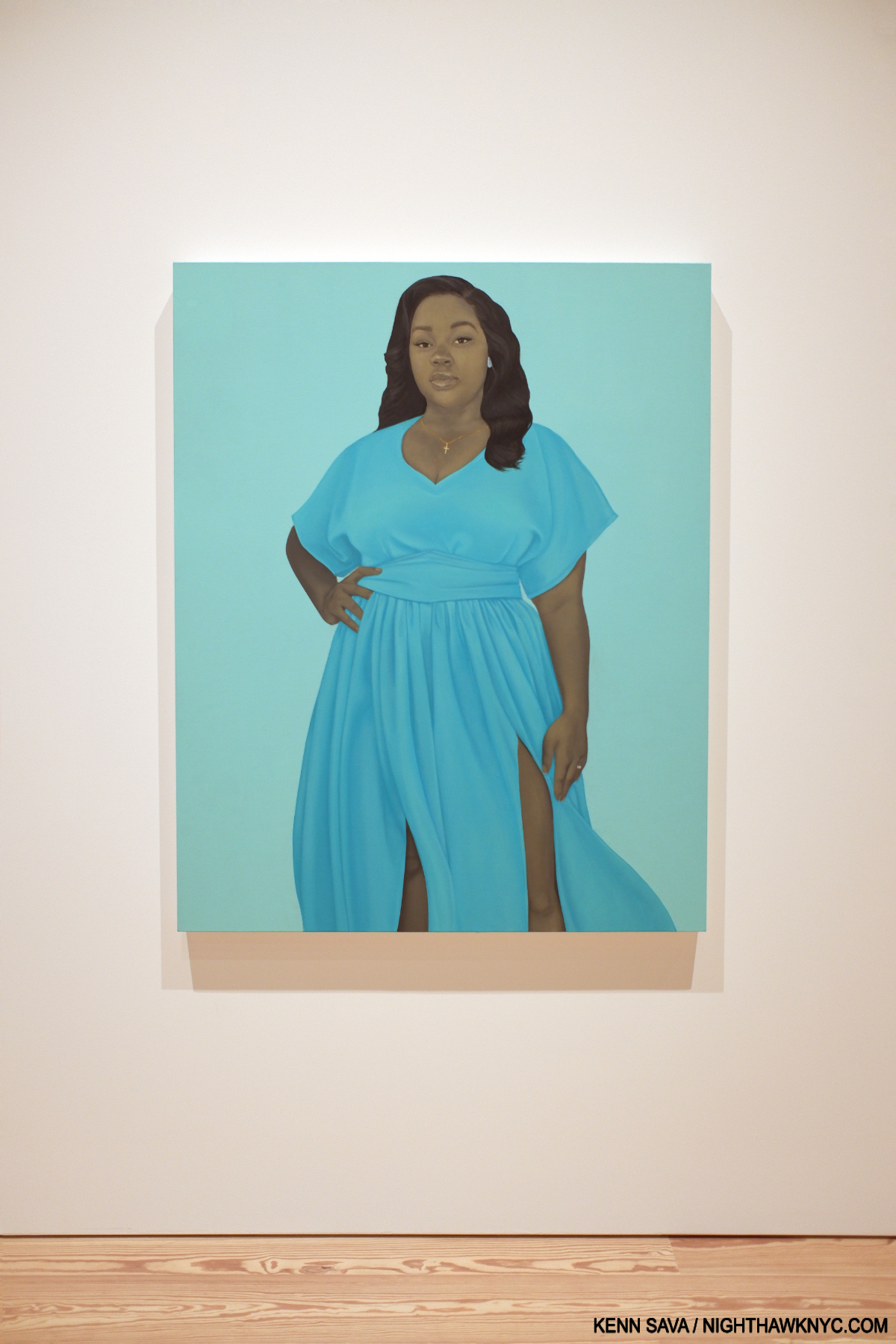
Breonna Taylor, 2020 Oil on linen.

In work after work, American Sublime reveals that Amy Sherald is a master of Portrait story telling. Her Portrait of Michelle Obama, Michelle LaVaughn Robinson Obama, is a classic case in point that manages to subtly weave multiple threads. Crossing cultural boundaries by dialoguing Mondrian-like elements and Gee’s Bends Quilt Making is artistically ground-breaking, topped off with a natural and wonderfully relaxed pose, enhanced by the background pale blue, that is just stunning.  This is just what Amy Sherald does. Commissioned to Paint the late Breonna Taylor, her first posthumous Portrait, Ms. Sherald visited her family and spent time with her mother, Tamika Palmer, who spoke of Breonna’s interest in fashion. Amy commissioned a dress for the Portrait, and also added an engagement ring on her finger “to represent the love between Taylor and her partner, Kenneth Walker… Sherald incorporated the ring to give him solace and to suggest a brighter future3.” Of the finished Painting she said, “I don’t think I thought much about the viewer so much as I thought about her family when I was making this portrait….but when you’re speaking about violence against women and police brutality, she’s become the face for that movement,” she said4.

The intro for the Audio Guide for her 2019 Painting, The Girl Next Door says, “The artist discusses how she transforms the historical function of portraiture.” That’s a lot to have accomplished in 18 years already. Along the way, she renders a wide range of subjects that encompass an equally wide range of Black Americans, including more than a few who are new to museum walls showing the scope of her vision.

American Grit, 2024 Oil on linen.

As soon as she was able to, she sought out the family of the woman, Kristen, whose heart she now has. Amy was 39 when she received Kristin’s heart. Kristin died at 38. Amy calls it “a perfect match.”

Kingdom, 2022 Oil on linen

“What kind of person was she? What kind of things did she like. Who did she love? I romantically believe in muscle memory, heart memory. It means a lot for me to be able to just kind of get to know her family a little bit. When I met her father he made me feel her heart beat. … I still call it Kristen’s heart.”

Trans Forming Liberty, 2024 Oil on canvas

“I live without fear. I work without fear. I wake up and produce these ideas without thinking so much about painting something stupid or people not liking it. I’m living this moment: I wake up every day, and I have to make sure that my work continues to speak to generations. I need to make things that are going to resonate in that way.” 

For Love, and for Country, 2022 Oil on linen.

She continues, “But I also truly believe in who I am as a human. I believe in my power. I believe in timing. I believe that this is my “now,” and that nothing can go wrong now. I understand that as a fact. I’ve been through the worst of the worst, and it was still okay. I wake up, and I keep it moving every day for Kristin and my brother Michael. You don’t waste second chances5.”

A God Blessed Land (Empire of Dirt), 2022 Oil on linen.

*- Soundtrack for this piece is “I Can See Clearly Now,” written & performed by Johnny Nash from the 1972 album of the same name, which he performs the following year-

For those who kept me here, and for Lisa, who gave this total stranger her extra ticket to the sold-out Basquiat show at the Brant Foundation in Spring, 2019, enabling me to see it and share it with the world. As she was leaving she told me she was looking forward to seeing Amy Sherald: the heart of the matter….

NighthawkNYC.com has been entirely self-funded & ad-free for 10 1/2 years, during which over 340 full-length pieces have been published! If you’ve found it worthwhile, PLEASE donate securely by PayPal below to allow me to continue. Thank you, Kenn.

You can also support it by buying Art, Art & Photography books, and Music from my collection! Art & Books may be found here. Music here and here.

Written & photographed by Kenn Sava for nighthawknyc.com unless otherwise credited. To send comments, thoughts, feedback or propositions click here. Click the white box on the upper right for the archives or to search them. Subscribe to be notified of new Posts below. Your information will be used for no other purpose.

  1. https://nmwa.org/art/artists/amy-sherald/
  2. “Amy Sherald in Conversation with Ta-Nehisi Coates” in Amy Sherald: The World We Make, P.184
  3. https://nmaahc.si.edu/object/nmaahc_2021.117
  4. ibid.
  5. ibid. P.186

Hilma af Klint in the 21st Century: The Spirit vs. The Machine

THIS SITE IS FREE & AD-FREE!
If you find this piece worthwhile, please donate securely via PayPal so I & NighthawkNYC can continue. More ways you can support it at the end. Thank you.

Written & Photographed by Kenn Sava (*- Additional Photographs by Lana Hattan, and others as credited)

Shows seen: Hilma af Klint: Paintings for the Future, Guggenheim Museum, 2018-19.
Georgia O’Keeffe: To See Takes Time, MoMA, 2023, and
Hilma af Klint: What Stands Behind the Flowers, MoMA, 2025
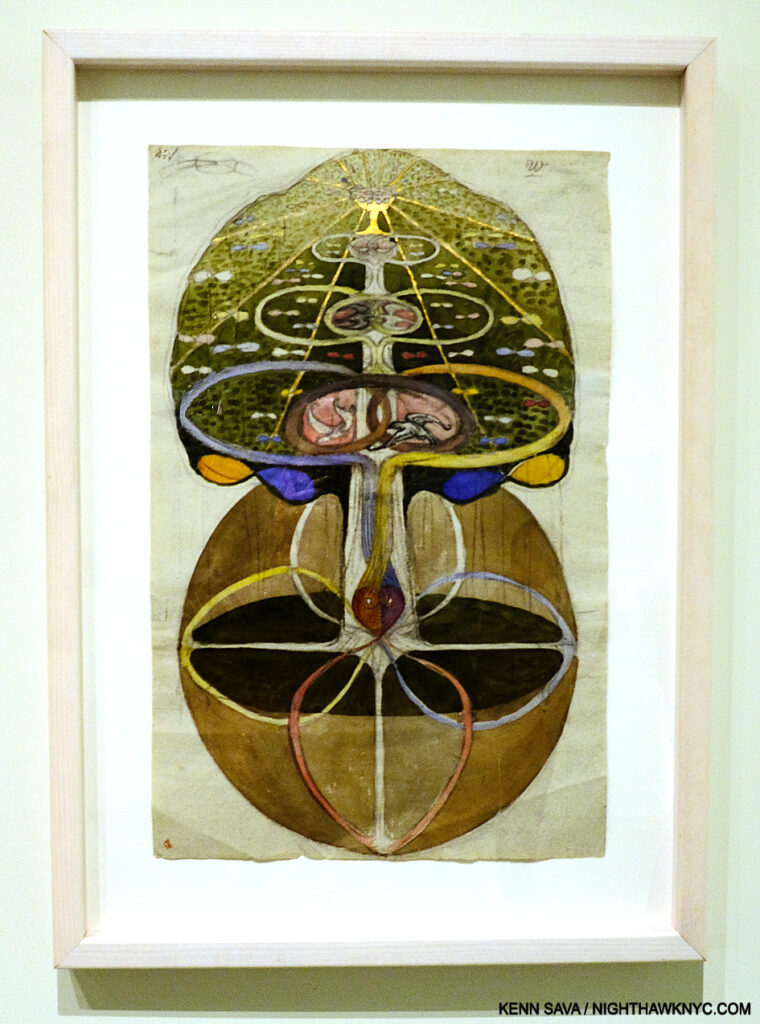
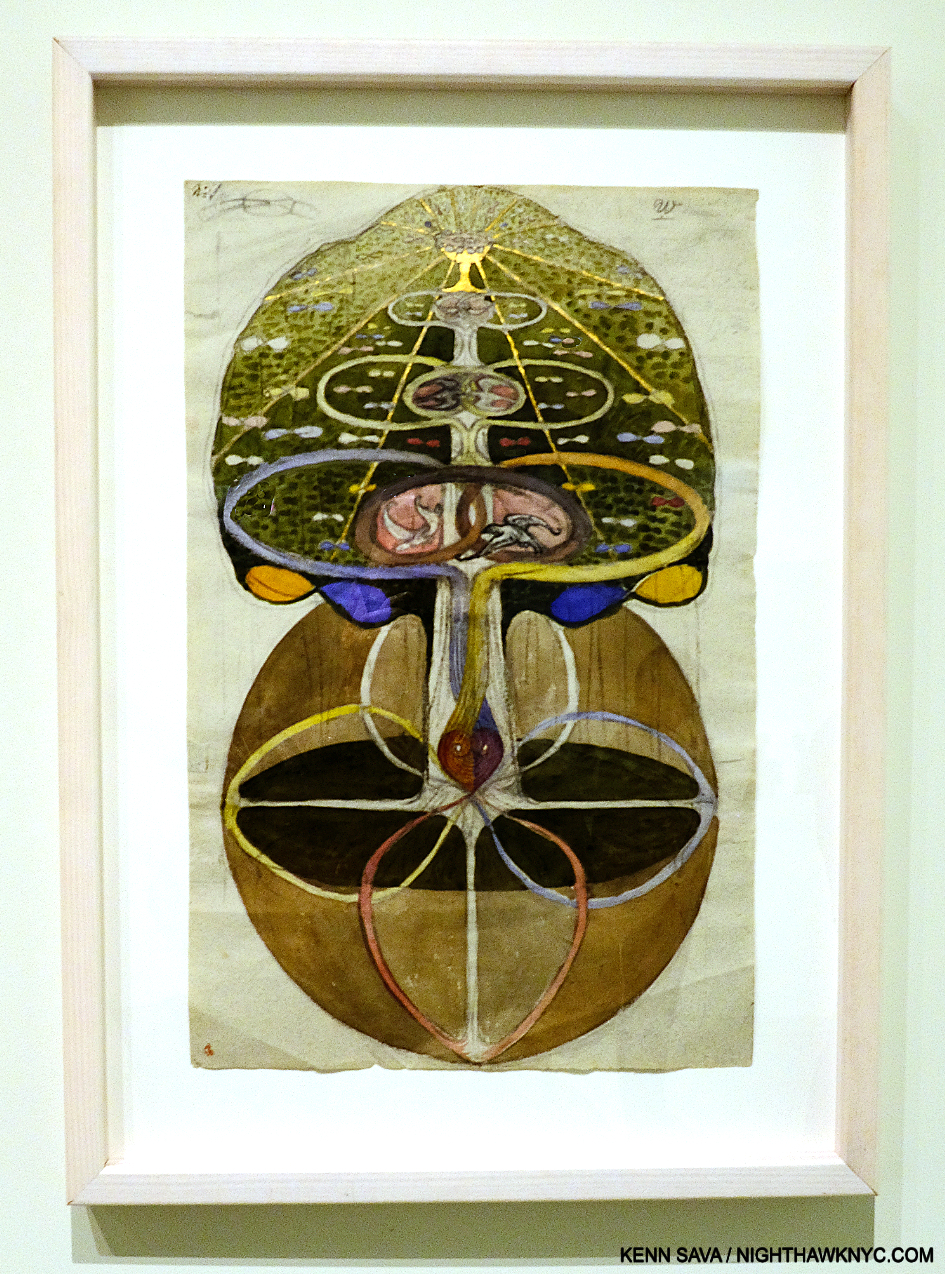
Hilma af Klint, Tree of Knowledge, No. 1,  from The W Series, 1913, Watercolor, gouache, graphite, metallic paint, and ink on paper, Guggenheim Museum, December 31, 2018..

Succinctly put, Hilma af Klint is one of the most remarkable and unique Artists I’ve encountered.
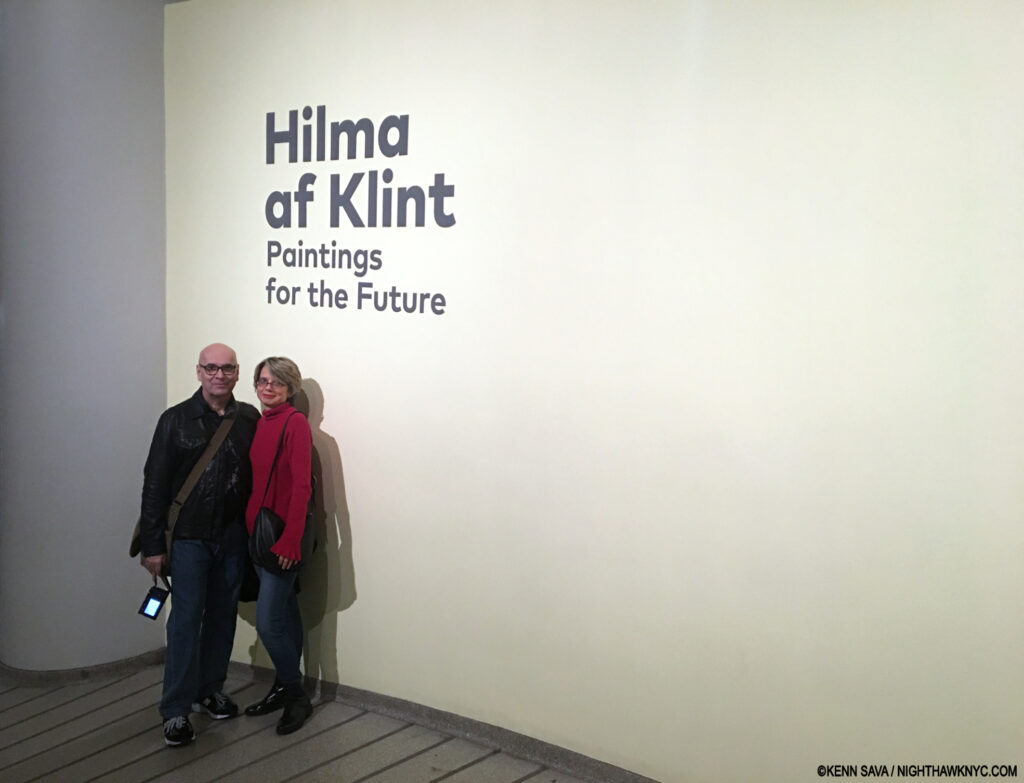
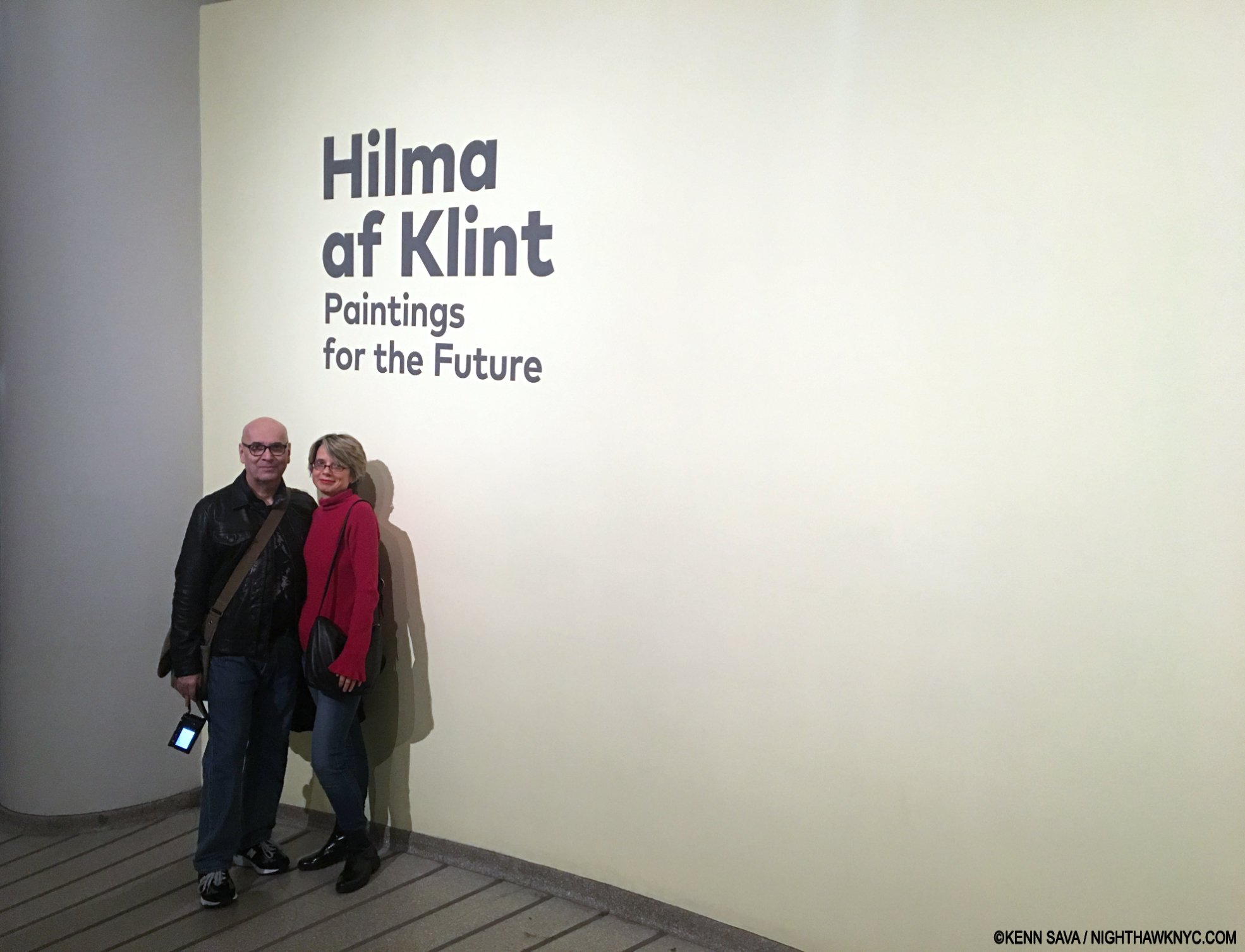
Of the thousands of Art shows I’ve seen in my life, I consider about 10 to be truly monumental. Hilma af Klint: Paintings for the Future is one of them. I’m so grateful I got to experience it with Lana Hattan1, and her Photos are included in this piece. Guggenheim Museum, New Year’s Eve, December 31, 2018. Enduring Thanks to the woman who took this.

Having seen two shows of her work, and most of the books published on it, Hilma’s work continually surprises me. Much of her oeuvre features that rarest of all qualities in Art: it’s unprecedented. I saw Paintings for the Future exactly seven years ago as I write this yet I haven’t written about it to this point for two reasons- 1) I’m still thinking about it and researching Hilma (as my featured entry on Hilma books in my “NoteWorthy Art Books of the 21st Century” piece earlier this year attests). 2) I’ve come to see that boxing Hilma as an “abstract Artist,” as the Art machine has labelled her, does her an immense disservice. I find it at odds with the very nature of her work.
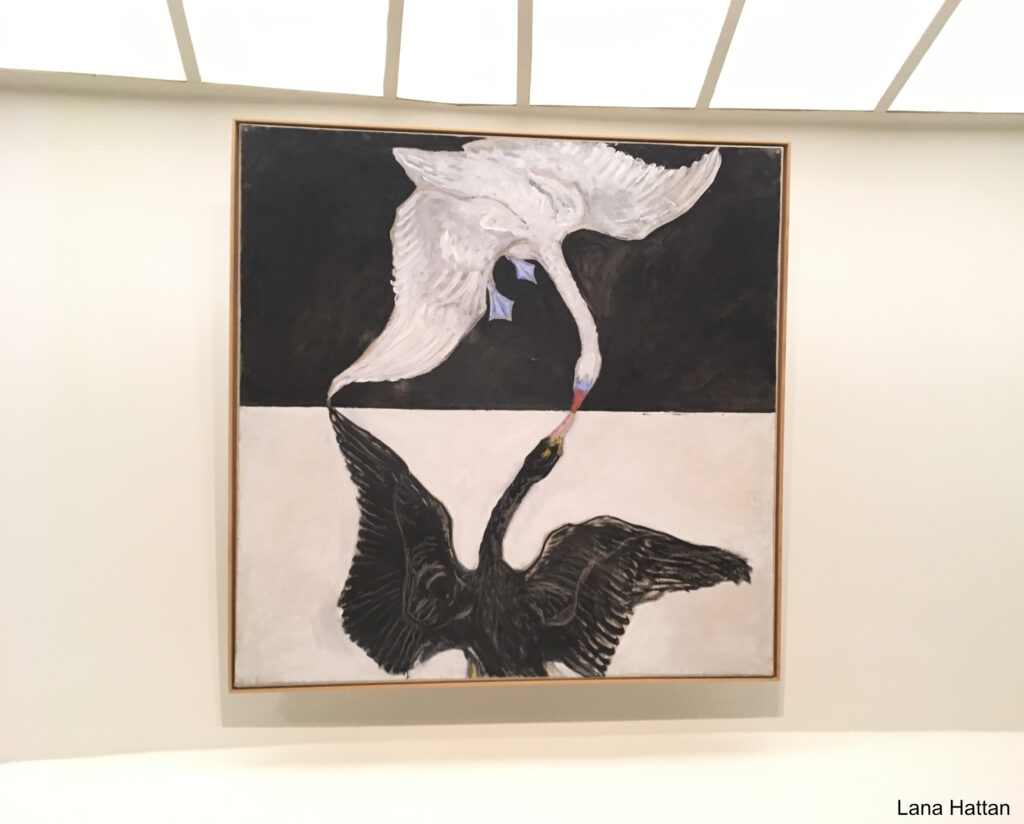
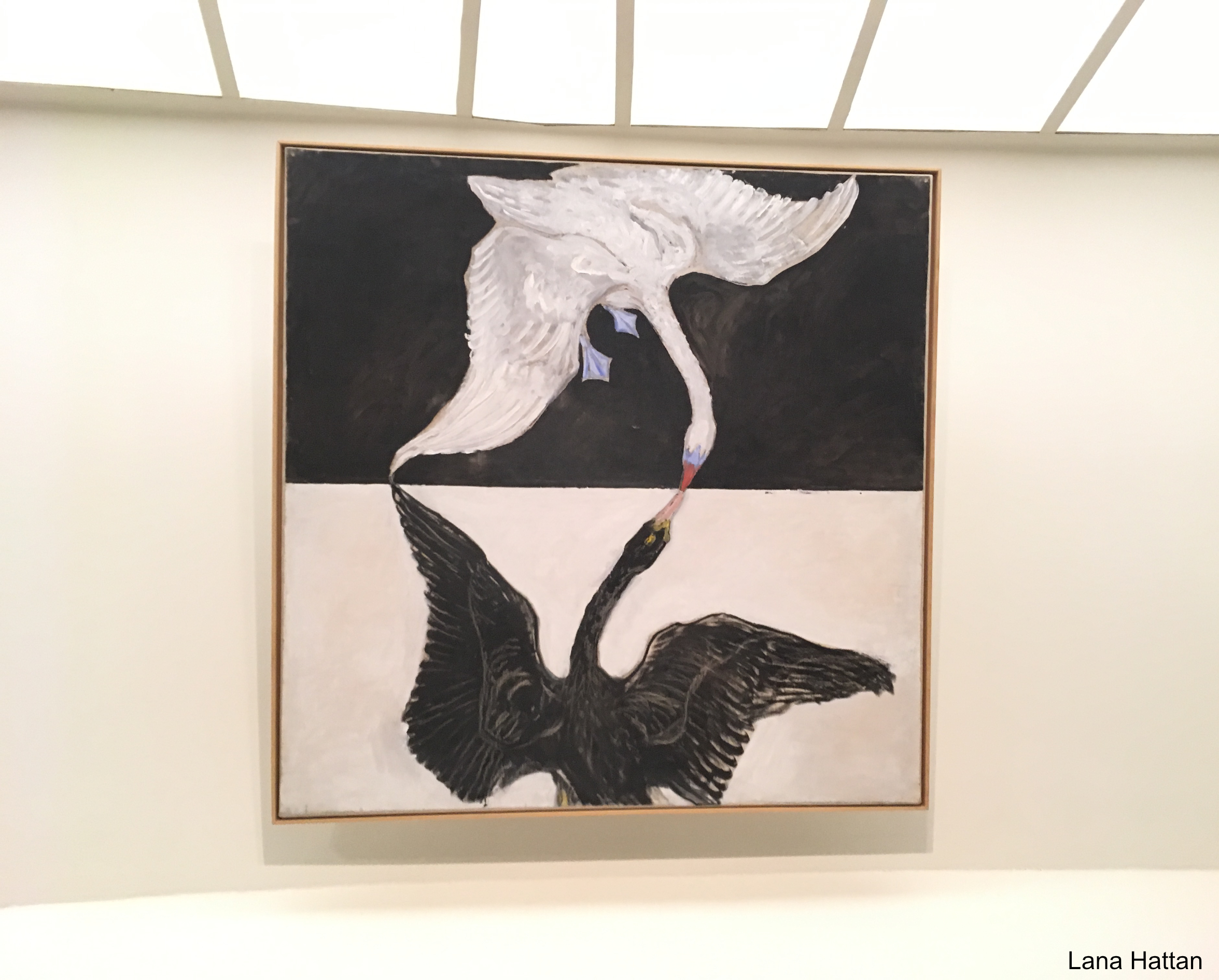
Group IX/SUW, The Swan, No. 1 from The SUW/UW Series, 1915, Oil on canvas. Reaching for the light. Of all the Painting shows I’ve seen at the Guggenheim Museum, the installation of Hilma af Klint: Paintings for the Future was transcendent. More on this later. *- Photo by Lana Hattan, Guggenheim Museum, December 31, 2018. I’m pleased to be able to present this show through her eyes, too.

Beyond all of that, recent developments may make her work “Basquiat hard” (my term for an Artist’s work that is mostly out of pubic view) to see going forward.
That’s a lot to cover. I’ll try to in what follows.

It begins with the flower…

“If your heart is in them flowers, bring ’em on,” Tanya Tucker-*
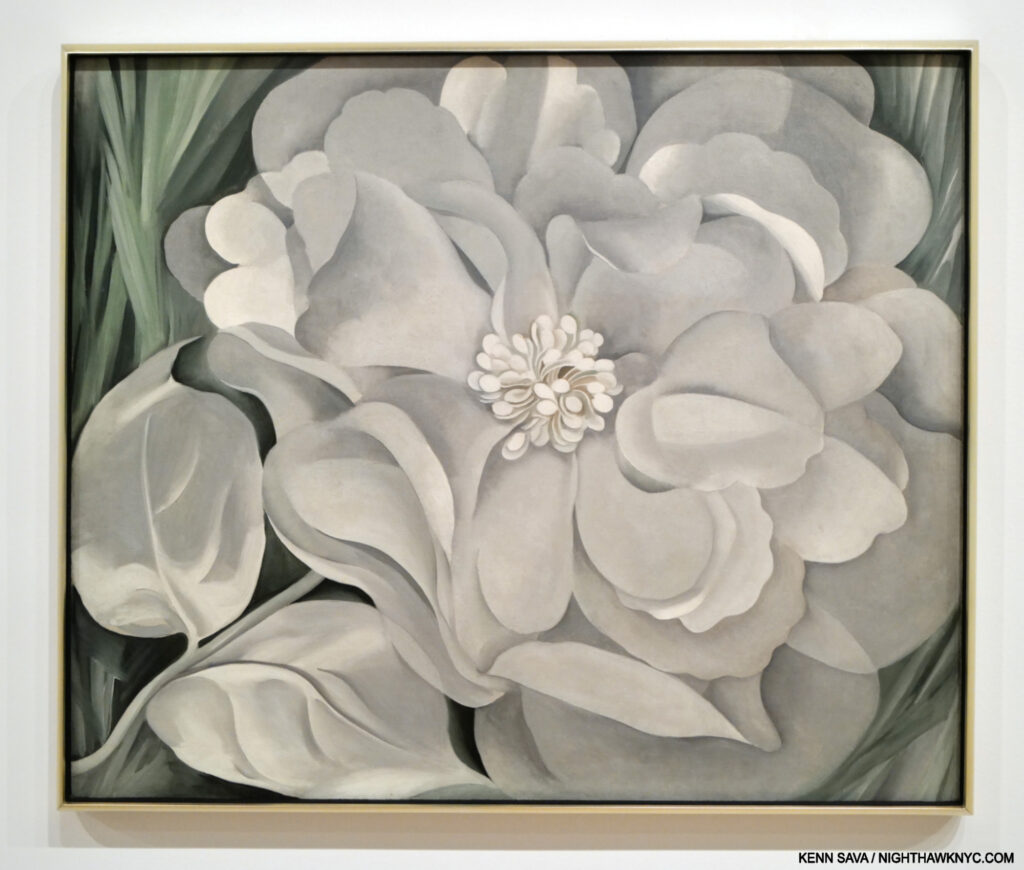
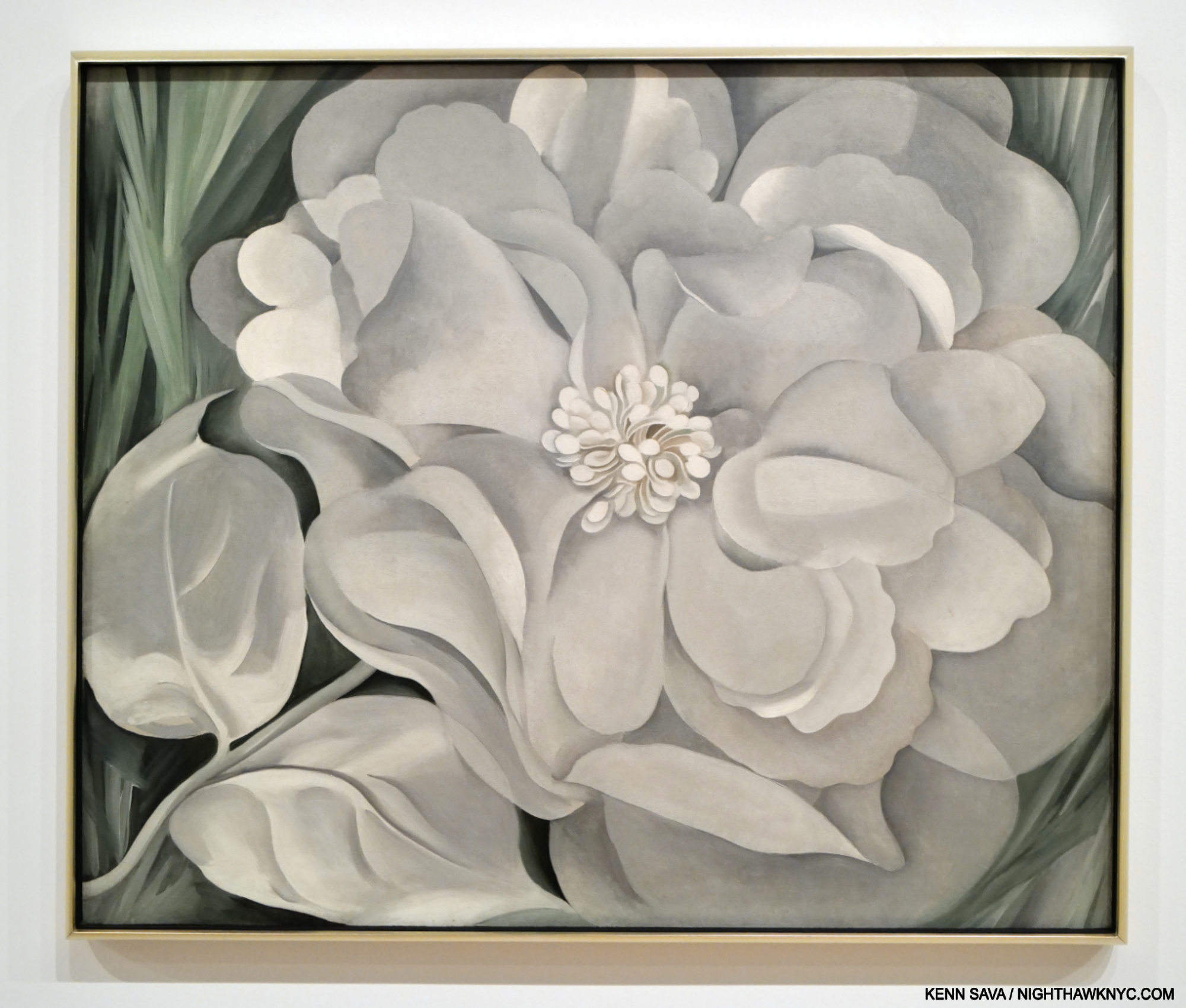
Georgia O’Keeffe, The White Calico Flower, 1931, Oil on canvas, as seen at the Whitney Museum, June 30, 2023

Flower Art was a niche thing, largely reserved for Illustration, until Artists like Georgia O’Keeffe (1887-1986) made viewers sit up and take notice of them. Of course, Vincent van Gogh, and the 17-century Dutch Masters a century before him, among countless others, had Painted wonderful Still-Life bouquets for many years prior, but individual flowers had not received much attention. Earlier last century, that began to change.
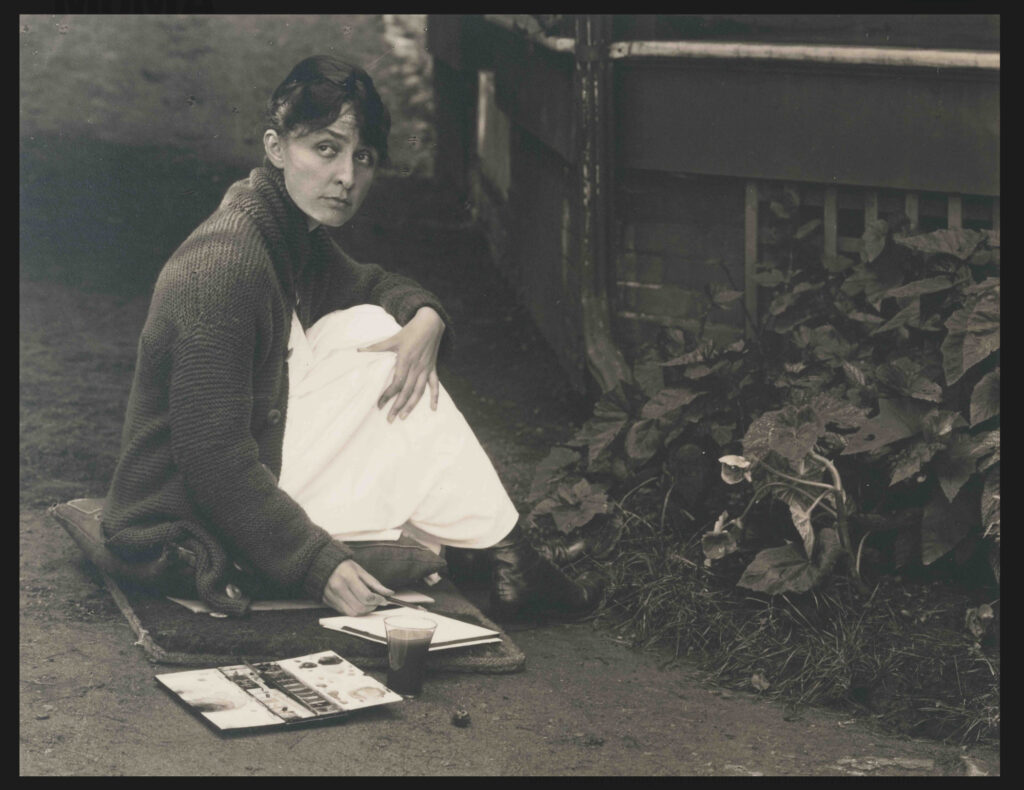
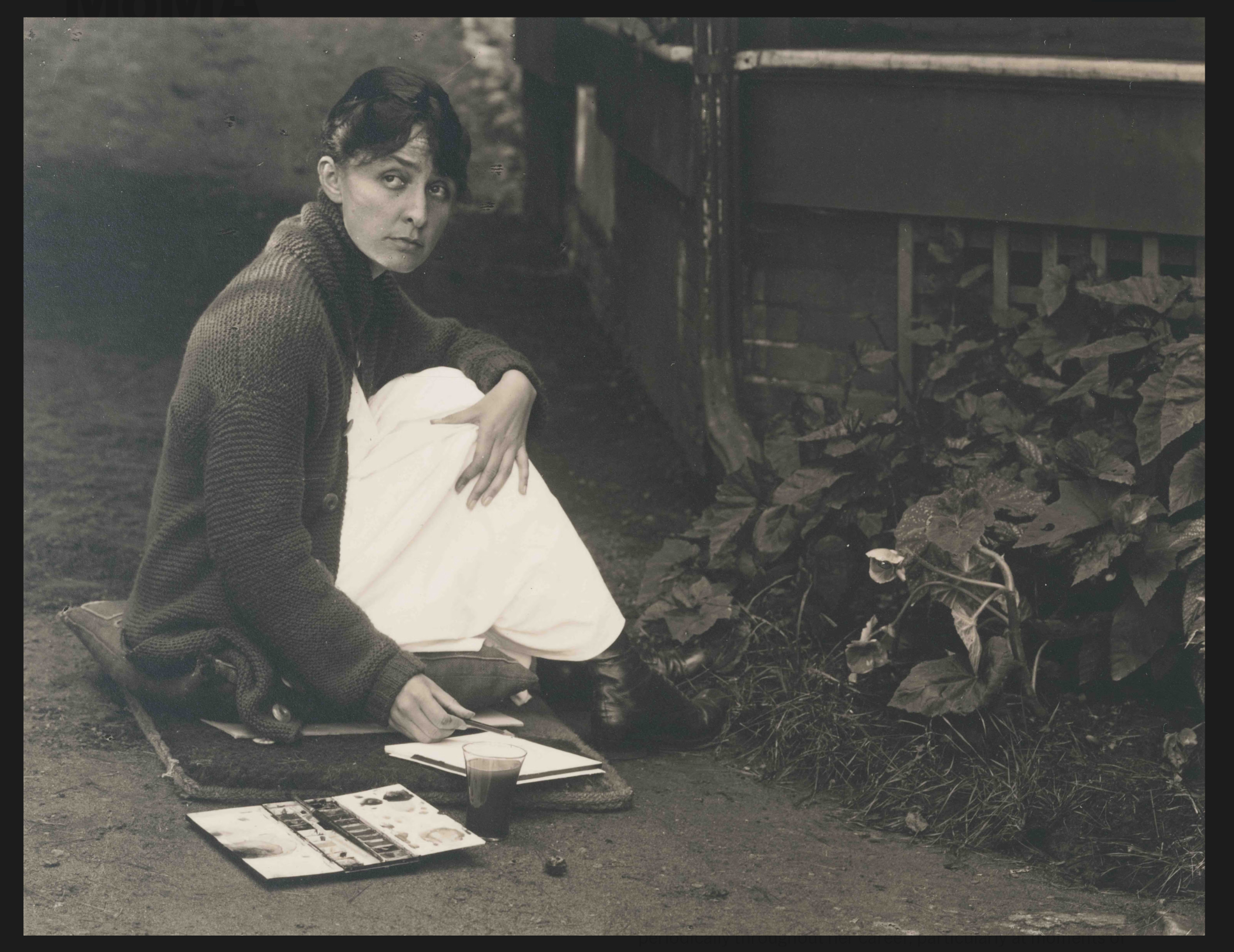
Alfred Stieglitz, Georgia O’Keeffe, 1918. Gelatin silver print. It’s hard to believe Georgia could Draw & Paint flowers like this, and it looks like Mr. Stieglitz found it remarkable, too. Note the year this was taken. *- Georgia O’Keeffe Museum Photo.

“Nobody sees a flower really; it is so small. We haven’t time, and to see takes time- like to have a friend takes time,” Georgia O’Keeffe, paraphrased by MoMA for the title of their 2023 show, Georgia O’Keeffe: To See Takes Time.
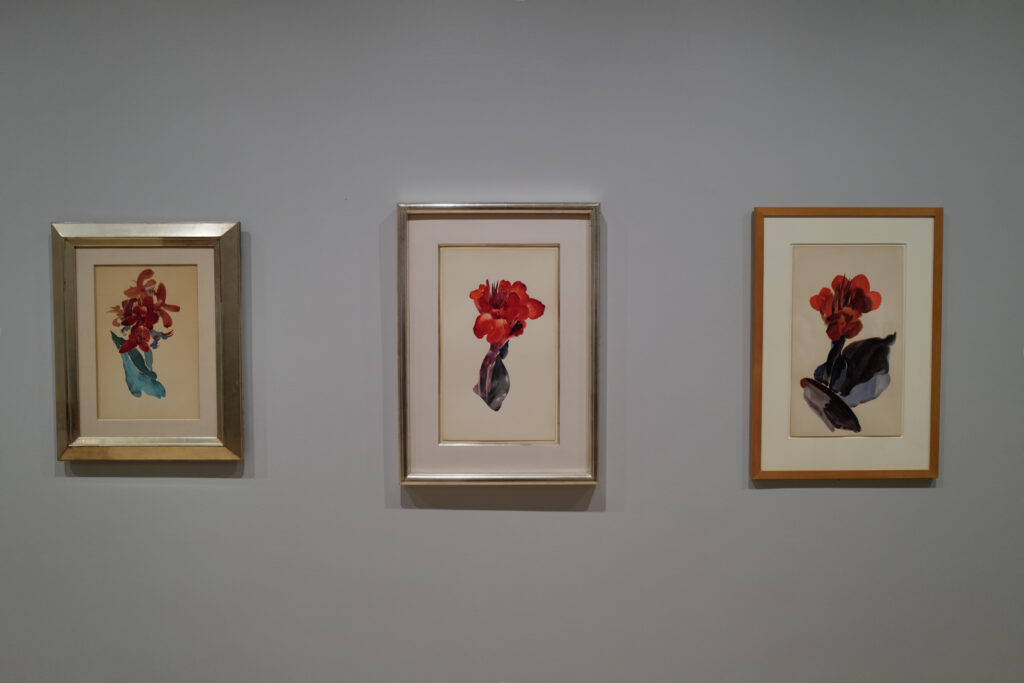
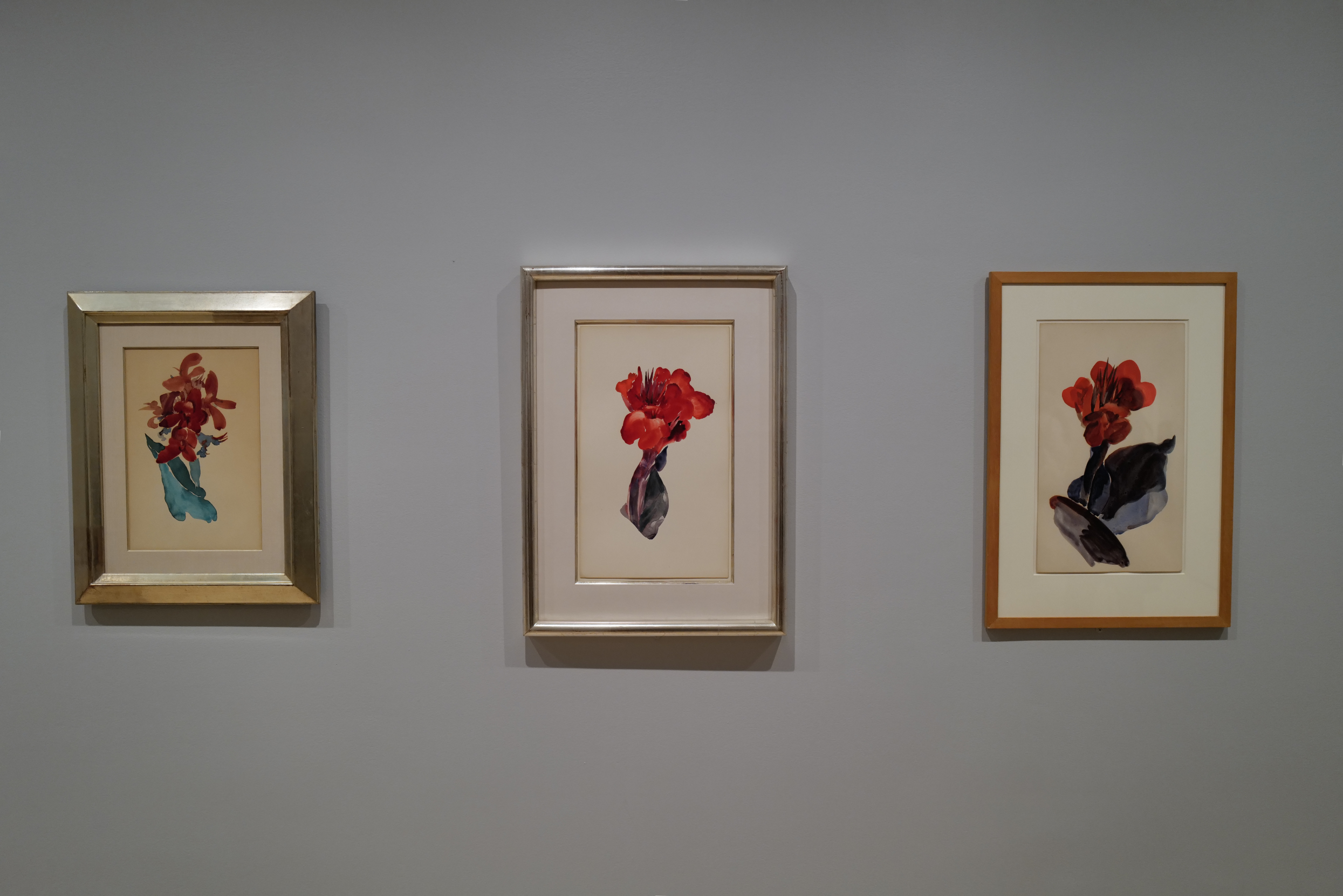
Georgia O’Keeffe, Canna Lily, 1918-20 Watercolor on paper, seen at Georgia O’Keeffe: To See Takes Time., MoMA, July 4 2023. Exactly 2 years later these same gallery walls would display Flower Watercolors by Hilma af Klint Painted at about the same time. (Lights lowered to protect the Art.) MoMA, June 9, 2023.

She continued: “So I said to myself- I’ll paint what I see- what the flower is to me but I’ll paint it big and they will be surprised into taking the time to look at it- I will make even busy New Yorkers take time to see what I see of flowers.” She would eventually give us 200 Paintings of them, a number of which are now iconic. So, it was fitting that MoMA’s Georgia O’Keeffe: To See Takes Time  contained some of her Flowers, including three early Calla Lilies watercolors from 1918-20, right as she was transitioning from Painting in watercolors to oils2.

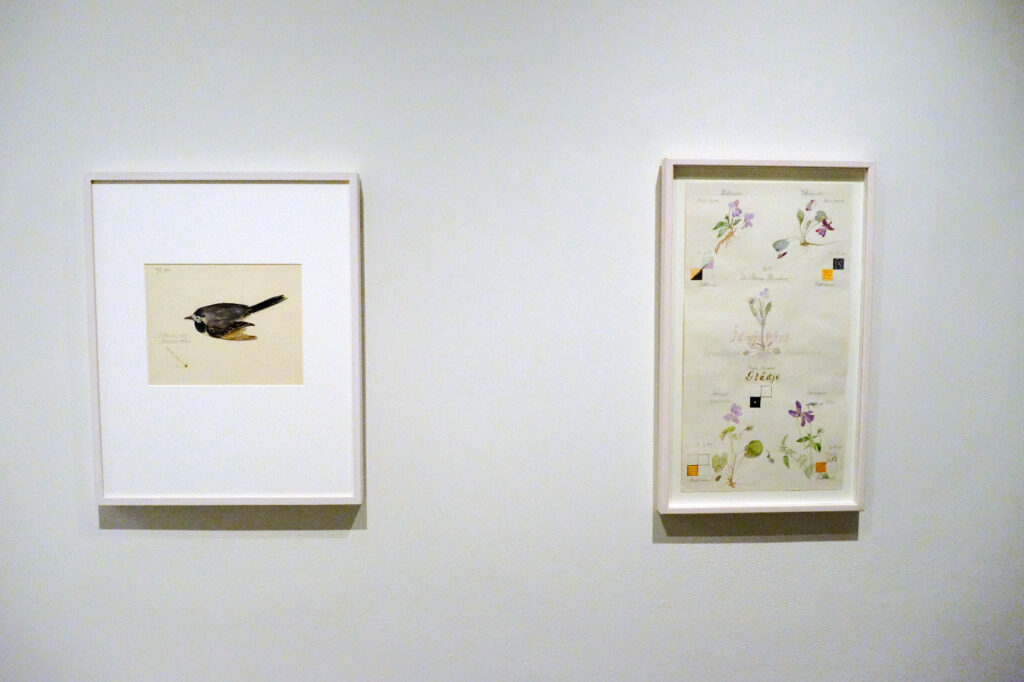
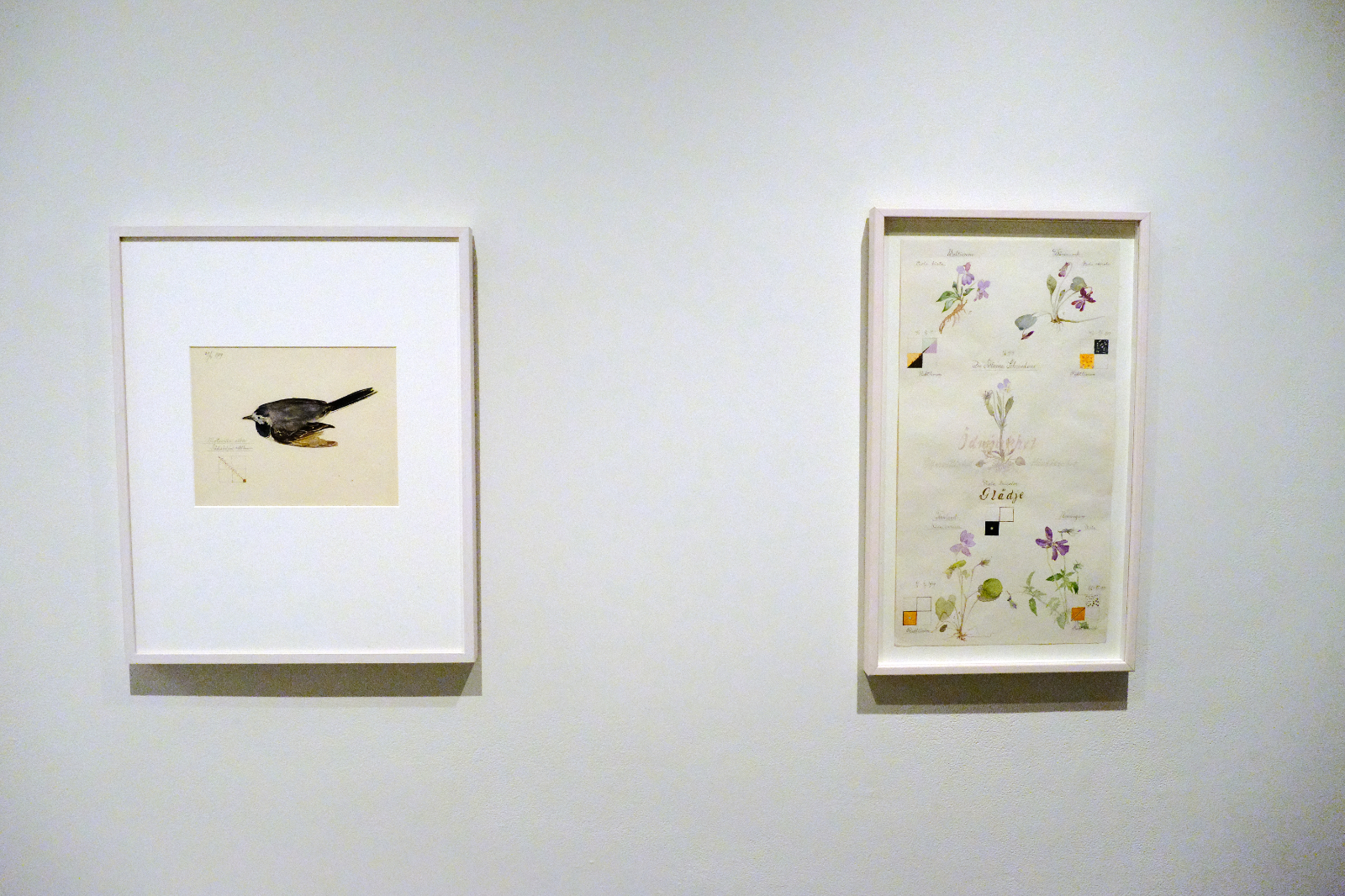
Hilma af Klint, Motacilla Alba: Wagtail with Guidelines, left, Violet Blossoms with Guidelines, both from Series I, 1919, Watercolor, graphite, and metallic paint on paper, right. Tucked away in Paintings for the Future this Flower Watercolor, right, looks like a page from Hilma af Klint’s Nature Studies Portfolio that would become the focus of the next major NYC Museum show of her work seven years later. An interesting realistic(!) harbinger, it’s not part of that Portfolio. Seen at the Guggenheim Museum, December 31, 2018, this sheet was also included in MoMA’s What Stands Behind the Flowers in 2025. MoMA’s wallcard for it speculates that Hilma may have removed it from Nature Studies.

Meanwhile at the same time Georgia was creating her Calla Lilies, across the ocean in Sweden, an almost completely unknown Artist named Hilma af Klint (i.e. HaK, born 25 years before Georgia in 1862) began rendering over 100 Flowers in Watercolors in a Portfolio she titled Nature Studies, 1919. As far as I know, they didn’t know each other (though I wonder if Art astute Hilma came to know of Georgia as the American rose to fame). As far as I can tell, the set remained hidden from public display until May 11, 2025, when MoMA opened Hilma af Klint: What Stands Behind the Flowers, coincidentally in the same galleries that had held Georgia O’Keeffe: To See Takes Time two year before

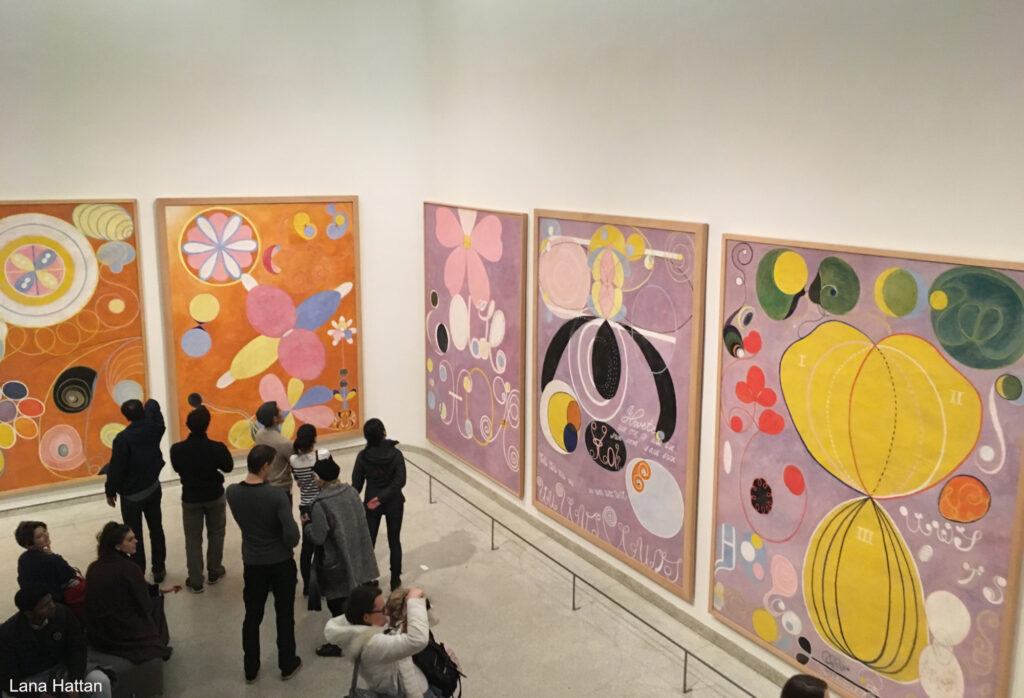
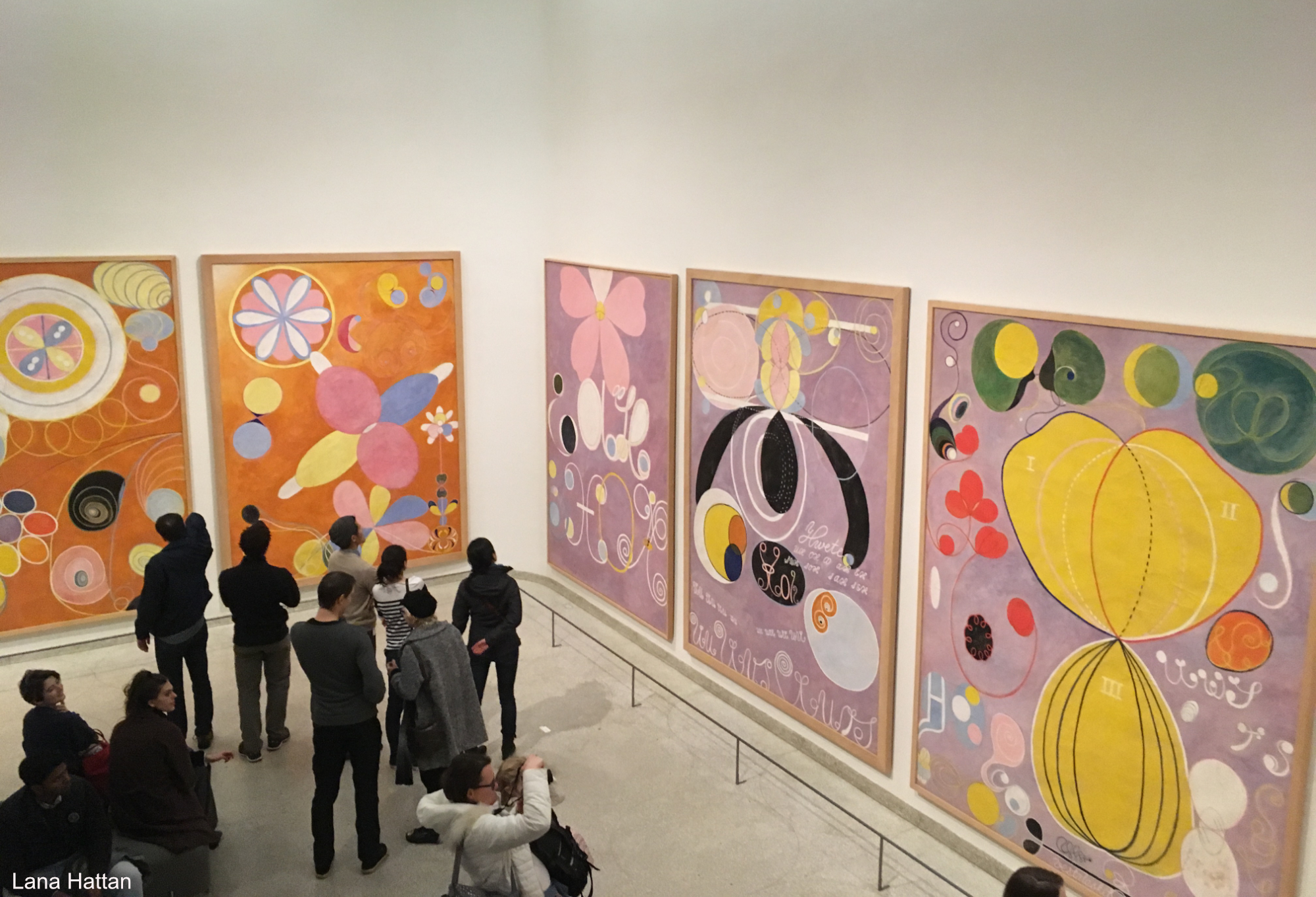
Five of Hilma af Klint’s The Ten Largest, a series devoted to the human lifespan, part of her now-famous Paintings for the Temple series. Note the shapes that seem organic or “flower-like.” Guggenheim Museum, December 31, 2018. *- Photo by Lana Hattan, Guggenheim Museum, December 31, 2018.

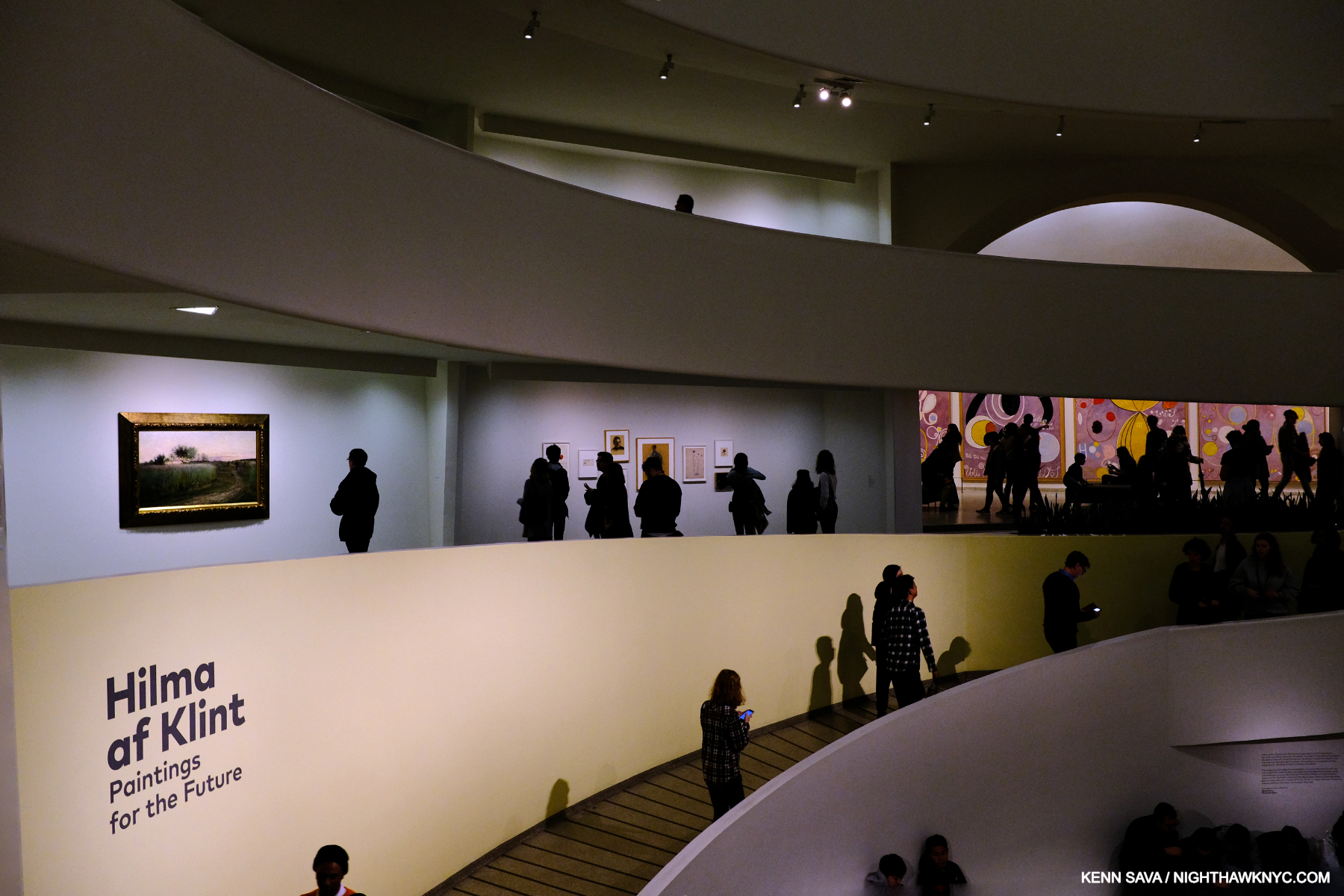
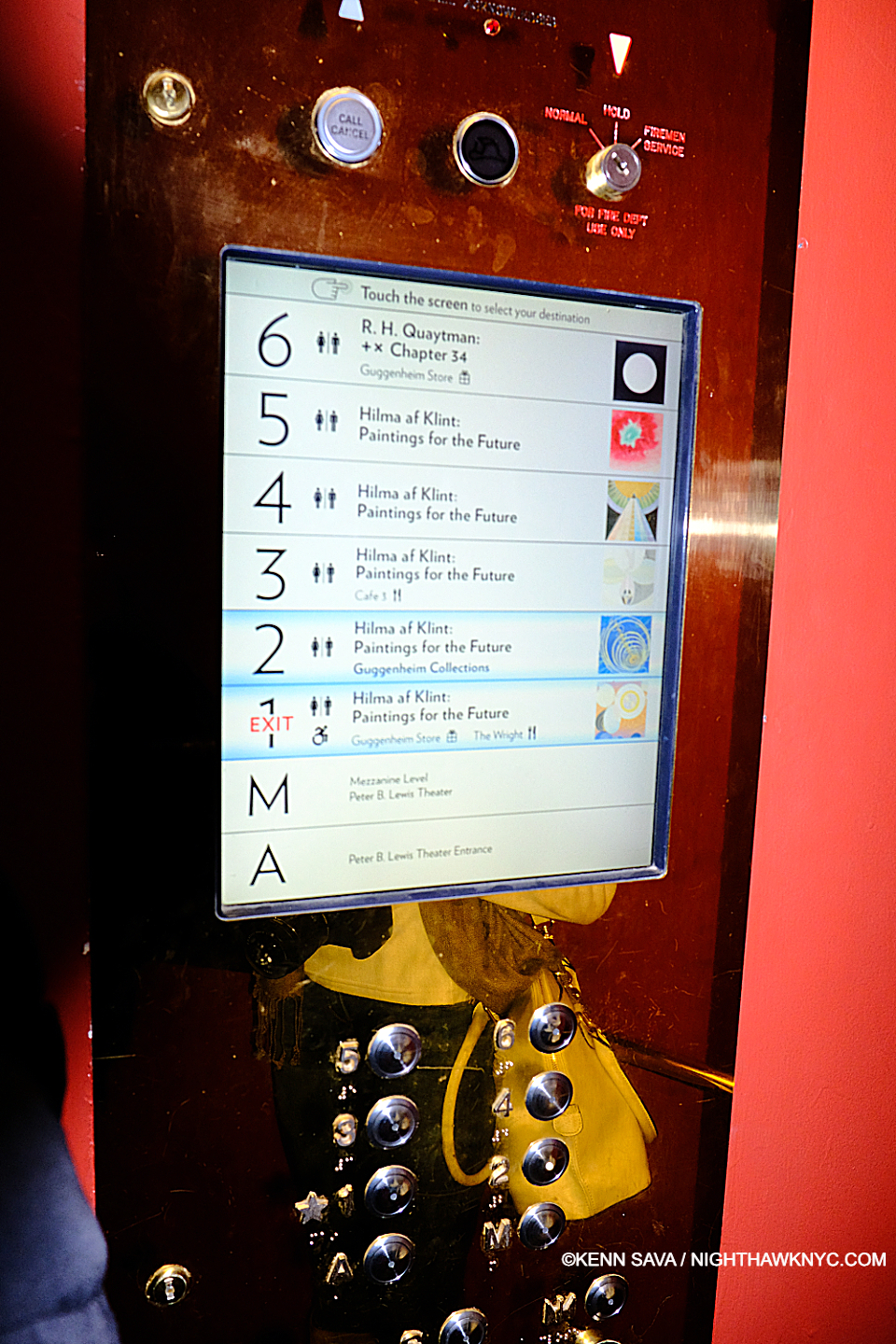
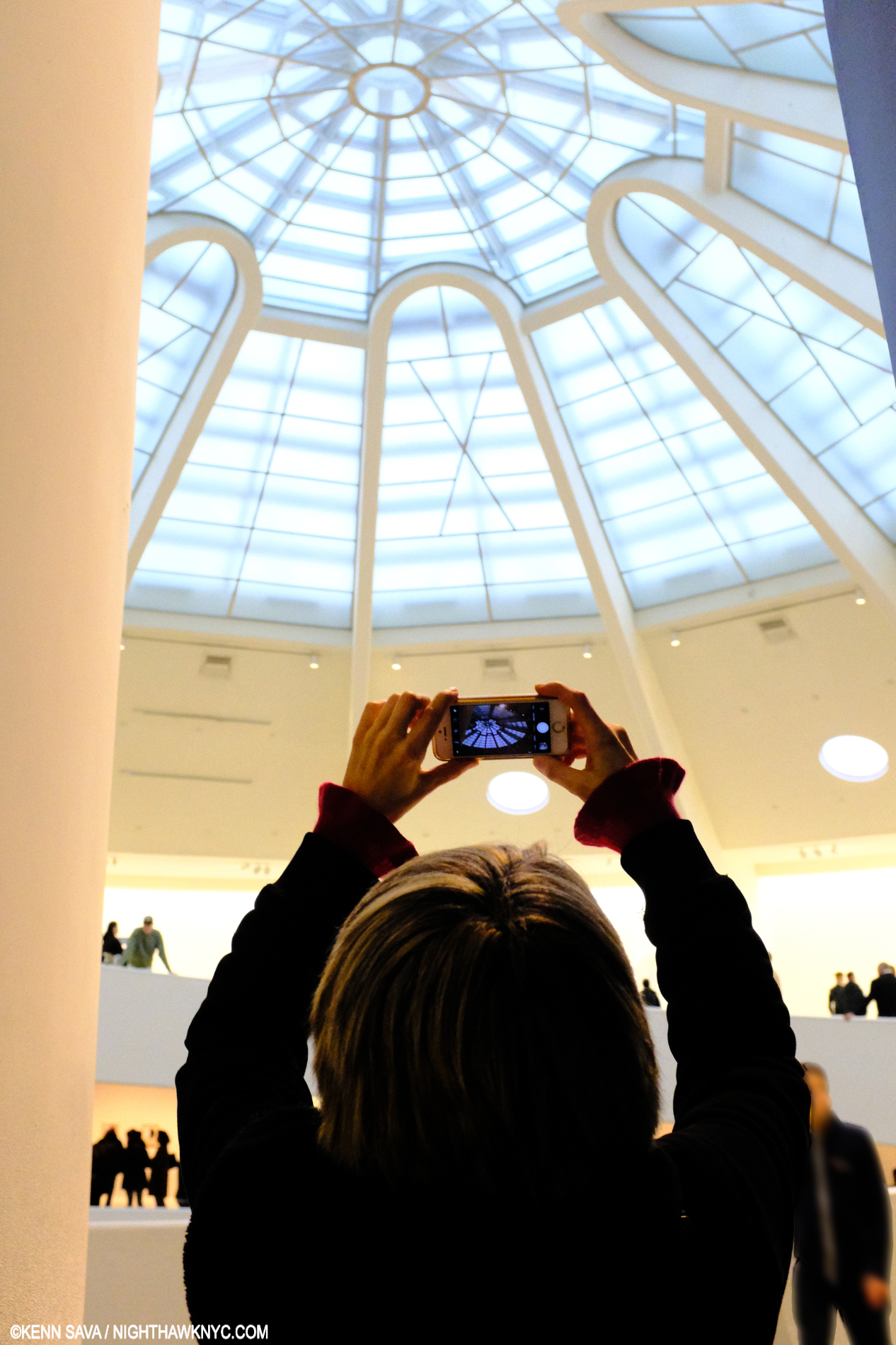
When her Art was last seen in an NYC museum in 2018-19, Hilma af Klint: Paintings for the Future drew a Guggenheim Museum all-time record 600,000 other viewers to Frank Lloyd Wright’s Museum Rotunda. I always walk down the ramp after taking the unique semi-circular elevator to the top of the Guggenheim as Frank Lloyd Wright wanted visitors to do which means I saw Paintings for the Future in reverse chronological order. Preceding it, R.H. Quaytman: +x, Chapter 34, occupied the 6th, or top Ramp. While this might seem incongruous to some, a deep dive into Hilma af Klint’s sparse NYC history reveals that R.H. Quaytman has a long history of championing Hilma af Klint that includes curating the first HaK show in an NYC museum, The Secret Pictures by Hilma af Klint at MoMA PS1 in early 19893. +x, Chapter 34 worked seamlessly with Paintings for the Future in my view.
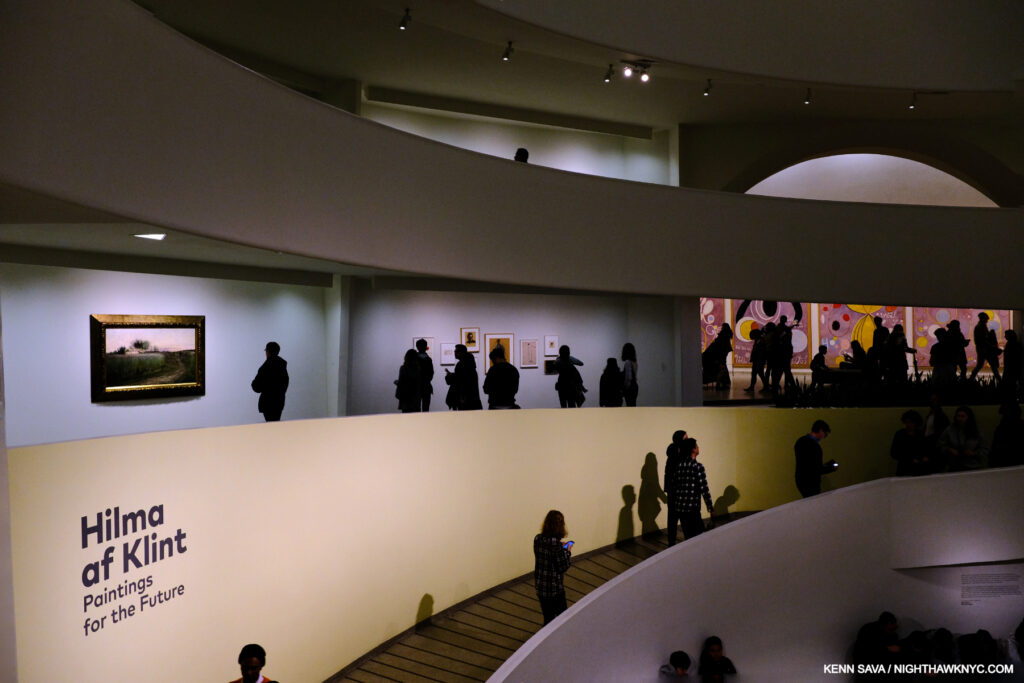
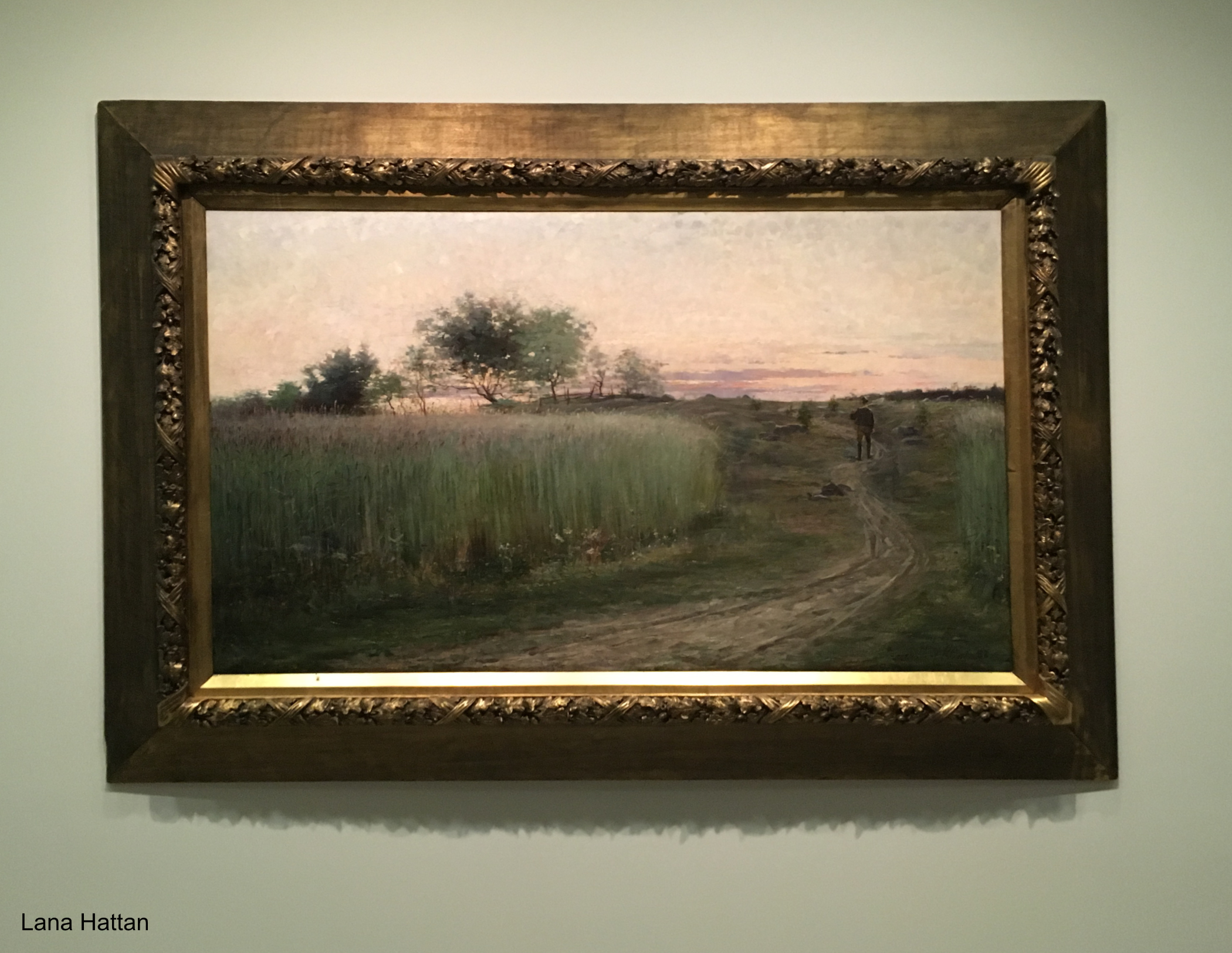
Herein lies a problem (among others) with branding HaK an “abstract Artist.”  To the left, above the sign, on Ramp 1 is Summer Landscape, 1888, Oil on canvas, juxtaposed by parts of three of The Ten Largest, all 10 from 1907, far right, from her landmark Paintings for the Temple series, partially shown in the prior picture, in a completely different style. December 31, 2018.

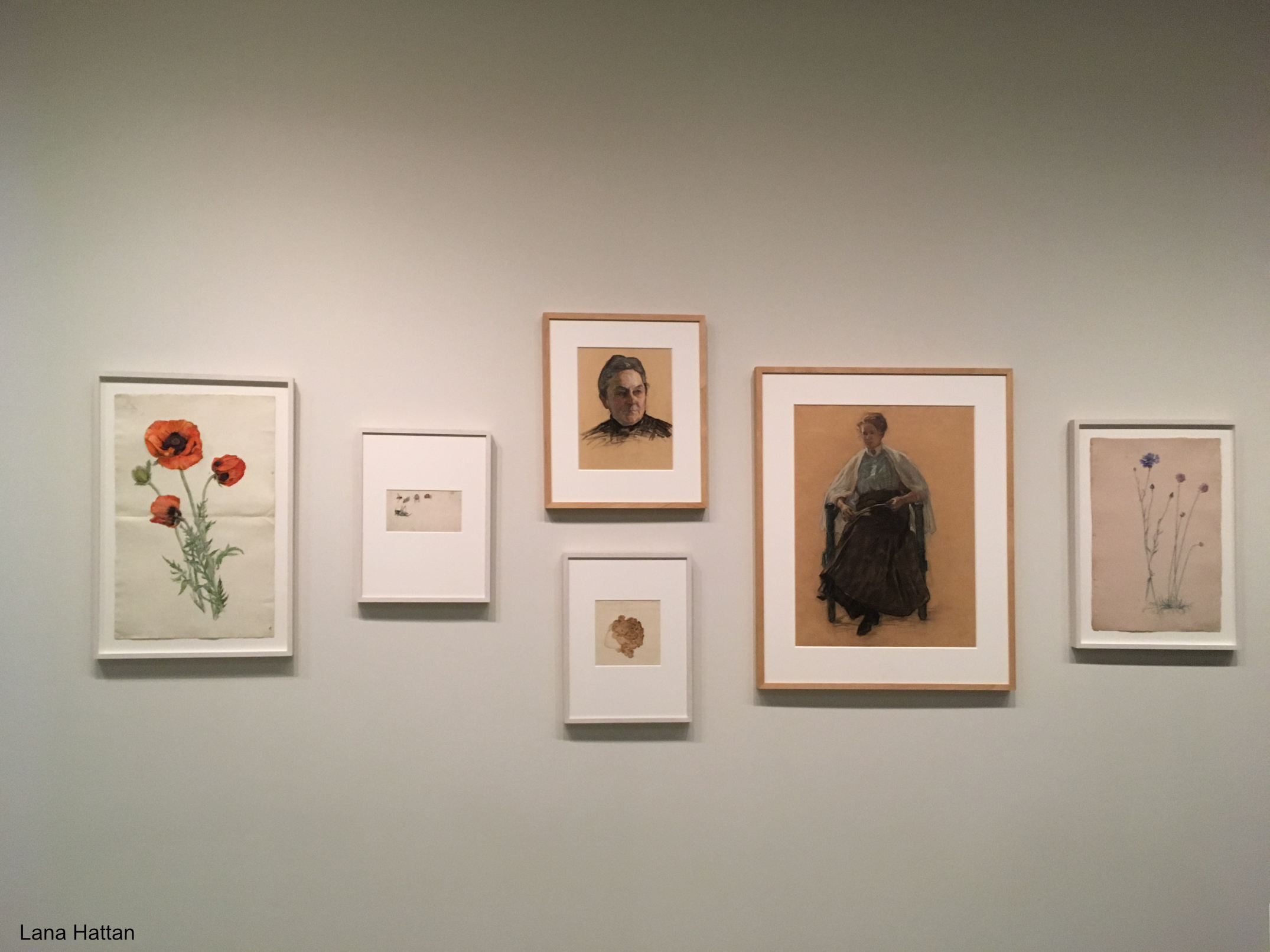
As we got to Ramp 1 (the lowest ramp), there were two bays containing work that looked pretty representational to me that featured Summer Landscape, 1888, above, left, and 2 Flower Watercolors from the 1890s, center, between the  visitors above, all shown closer below-
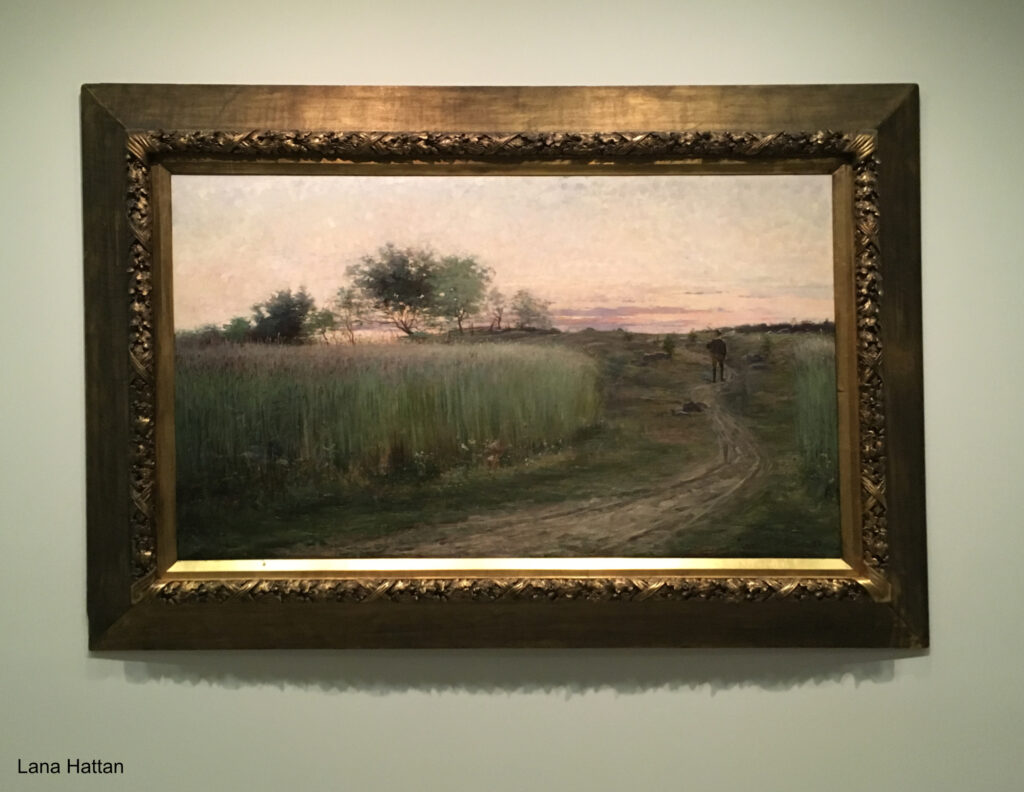
Summer Landscape, 1888, Oil on canvas. Hilma was about 26 when she Painted this in the year she graduated from the Royal Academy of Fine Arts.*- Photo by Lana Hattan, Guggenheim Museum, December 31, 2018.
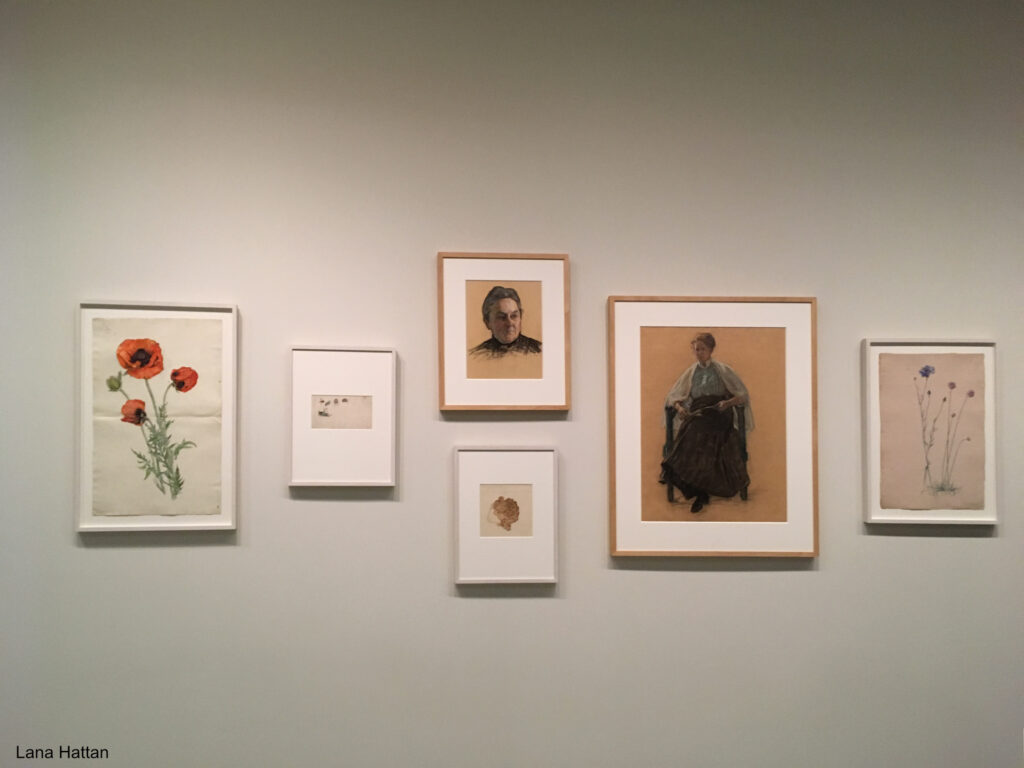
Poppy, 1890s, Watercolor, ink, and graphite on paper, left, Portrait study of the head of a woman, center, and Portrait study of a sitting woman to its right,  both Charcoal, crayon and graphite on paper, both c.1918. Distortion of the frames due to the curved wall. *-Photo by Lana Hattan, Guggenheim Museum, December 31, 2018.

Though early in her career, before the more well-known Paintings they call “abstract,” these revealed an accomplished technique in both oils and watercolors, honed over 6 years at the Royal Academy of Fine Arts in Stockholm (1882-88), where Hilma was one of its first female students. At that moment, I realized there was much more to Hilma af Klint than the Art machine’s limiting marketing hype would have us believe.
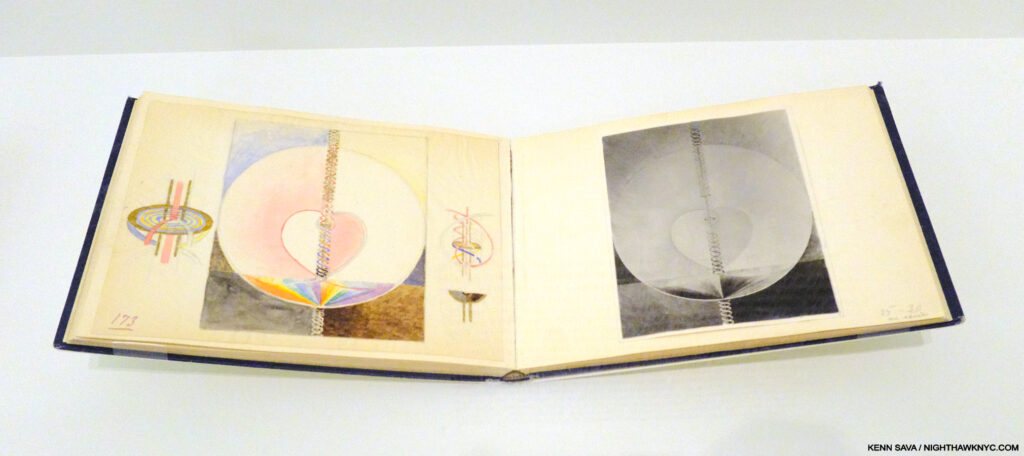
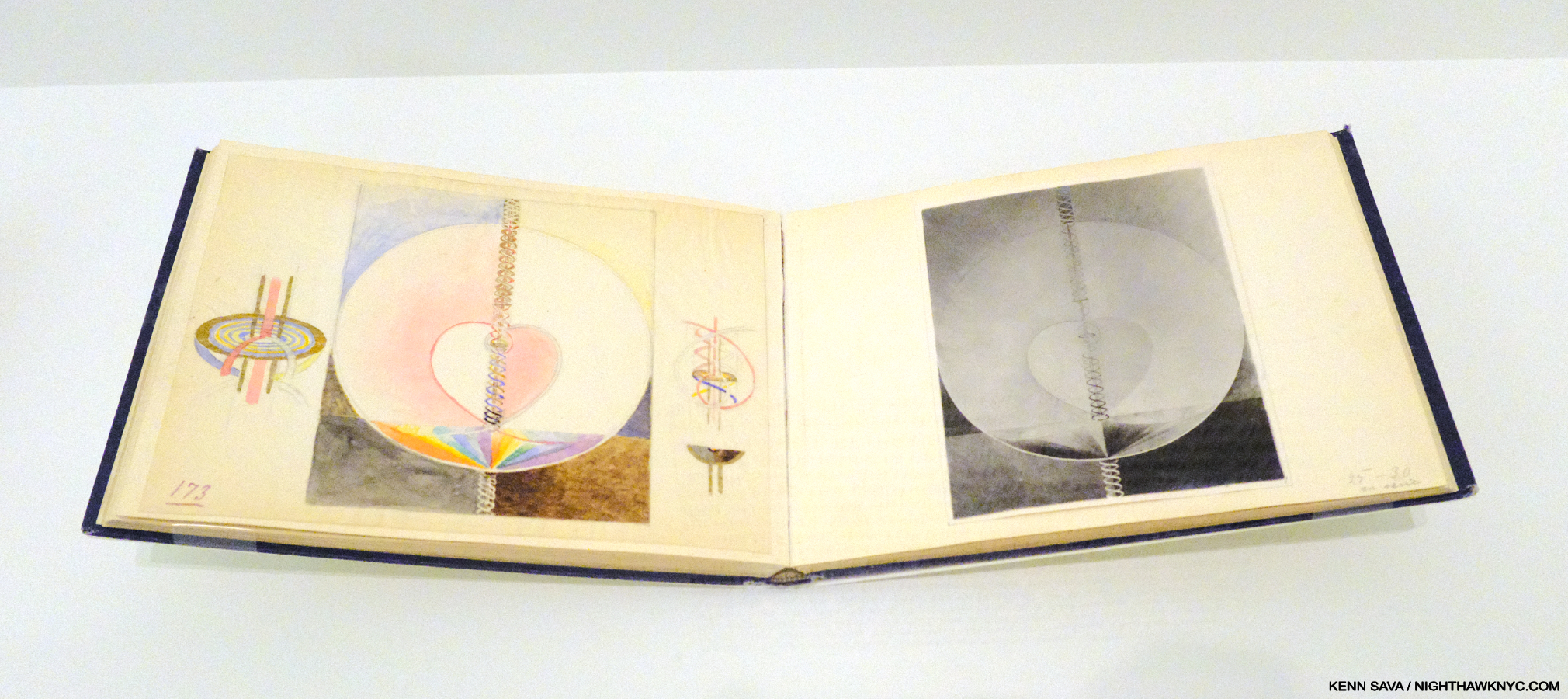
“Blue Book” Vol. 10. Hilma painstakingly recreated every one of her Paintings for the Temple (Painted, again, by hand) in a series of blue books on the left-hand page accompanied by a black & white Photo of the piece on the right-hand page, probably because color photography wasn’t yet practical. Guggenheim Museum, December 31, 2018.

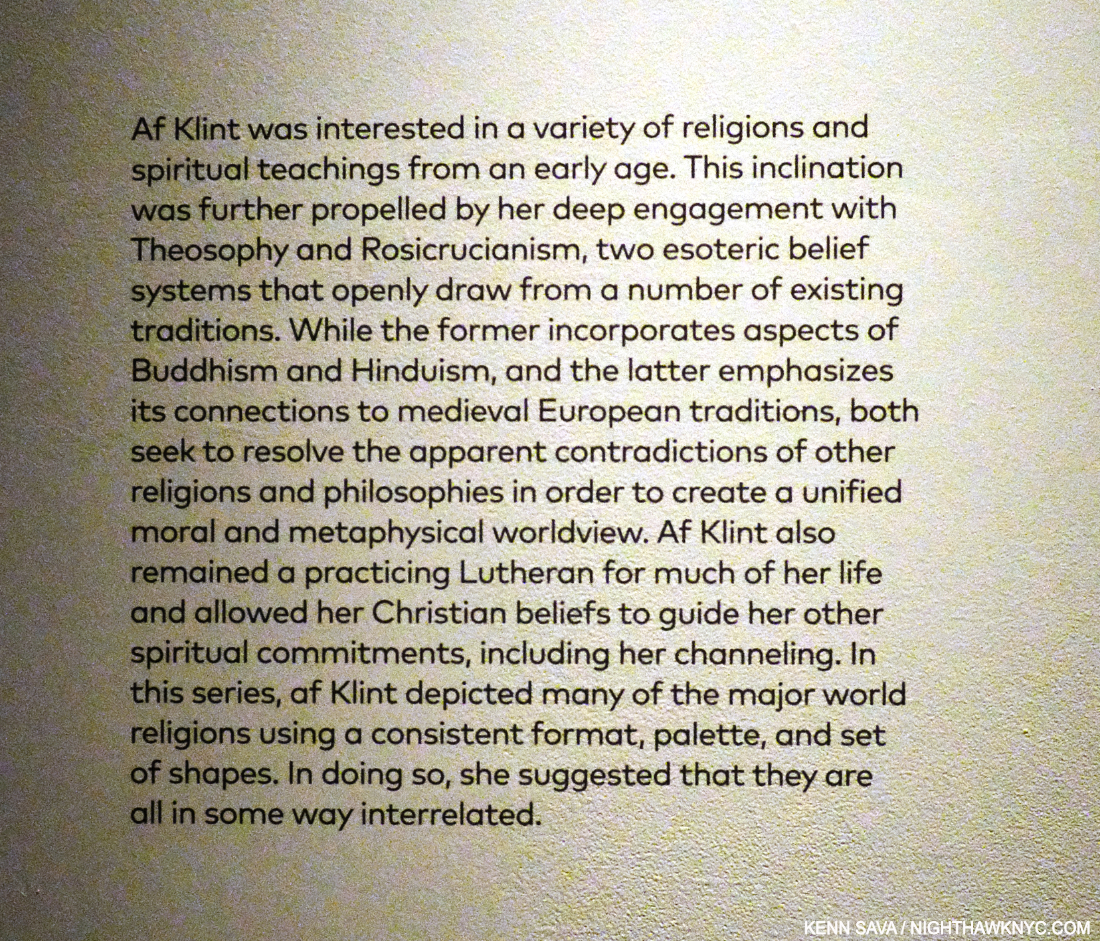
Hilma, a devoted, life-long spiritualist,t who attended seances (and believed her “most important work” was the 192-canvas series The Paintings for the Temple, 1906-15, partially shown earlier, which were guided by other beings), came to feel that her time wasn’t THE time for her Art to be seen. Since the entire Temple series is so numerous, and includes 10 very large Paintings, Hilma fastidiously recreated the entire series in 10 remarkable smaller “Blue books,” as they are known, a “portable museum,” which she carried with her to show Rudolf Steiner (in 1920), and others, in hopes of having the originals shown in a spiritual context. That’s how important it was to her.

This makes me wonder- How many “abstract” Artists would be able to exactly recreate 192 of their Paintings? An impressive technical achievement, that she could do it tells me that her compositions were no accident, something I think is important to bear in mind.
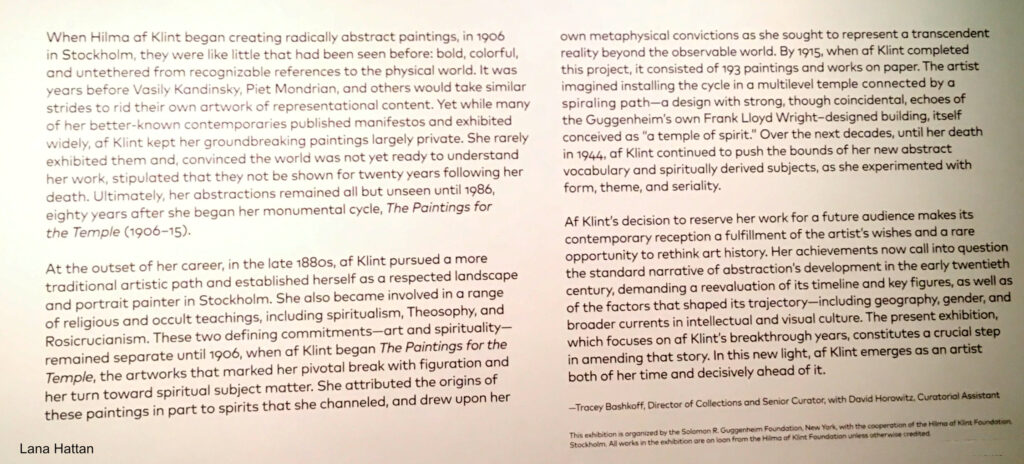
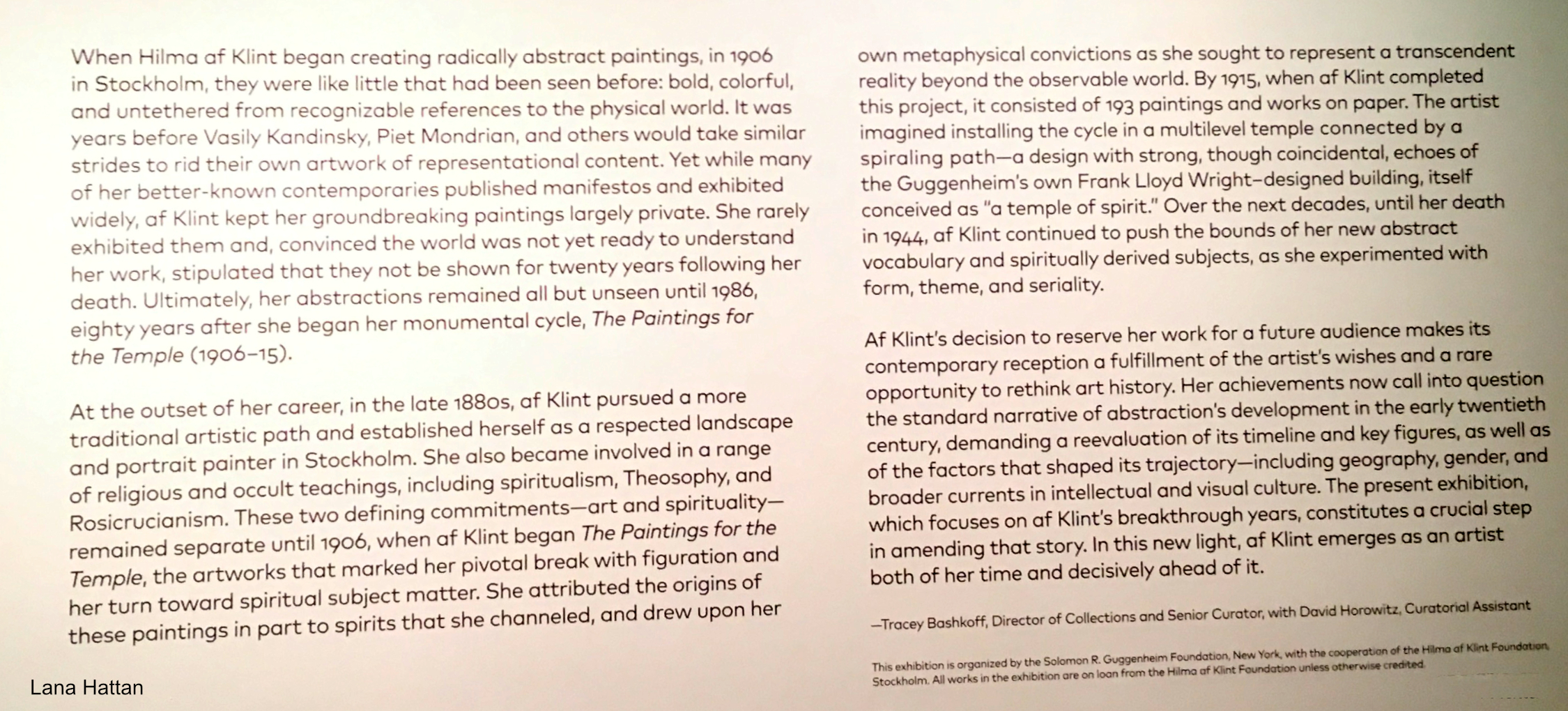
Is THIS the time Hilma envisioned for her work? The introductory wall card for Paintings for the Future on the Guggenheim’s curved wall outlines how the curators saw Hilma’s Art in 2018. I disagree with parts of this. For example, they mention HaK being “a respected landscape and portrait painter,” acknowledging she Painted in other styles, yet they ignore the fact that she returned to Painting representationally in 1919 with Nature Studies, as I show further on. They state her work was “untethered from recognizable references to the physical world.” What about the flowers and other natural elements that appear frequently, as shown in The Ten Largest picture earlier, and in Group VII (further on) and other pieces later on? *- Photo by Lana Hattan, Guggenheim Museum, December 31, 2018. Click for full size.

Failing to achieve this, in 1932, she decreed that none of her Paintings or Drawings should be shown until twenty years after her death in hopes of finding a more accepting time. Her work wound up being out of sight for 45 years. After she was tragically struck by a street car in 1944 and died from her injuries, her will left her entire creative estate to her nephew, Erik. Her work was stored in an attic for two decades before Erik had the Paintings unrolled and Photographed. Those 1,300 Paintings and 26,000 pages of text forms the basis of what is now the Hilma af Klint Foundation, which was created in 19724. The Foundation made a major effort to organize the work and prepare it for public display. Eleven of her Paintings were finally shown in The Spiritual in Art: Abstract Painting 1890-1985 in Los Angeles in 1986, but it wasn’t until 2013 that she finally received a full retrospective (in Europe), in a show titled Hilma af Klint: Pioneer of Abstraction (the catalog for which is also on my list).
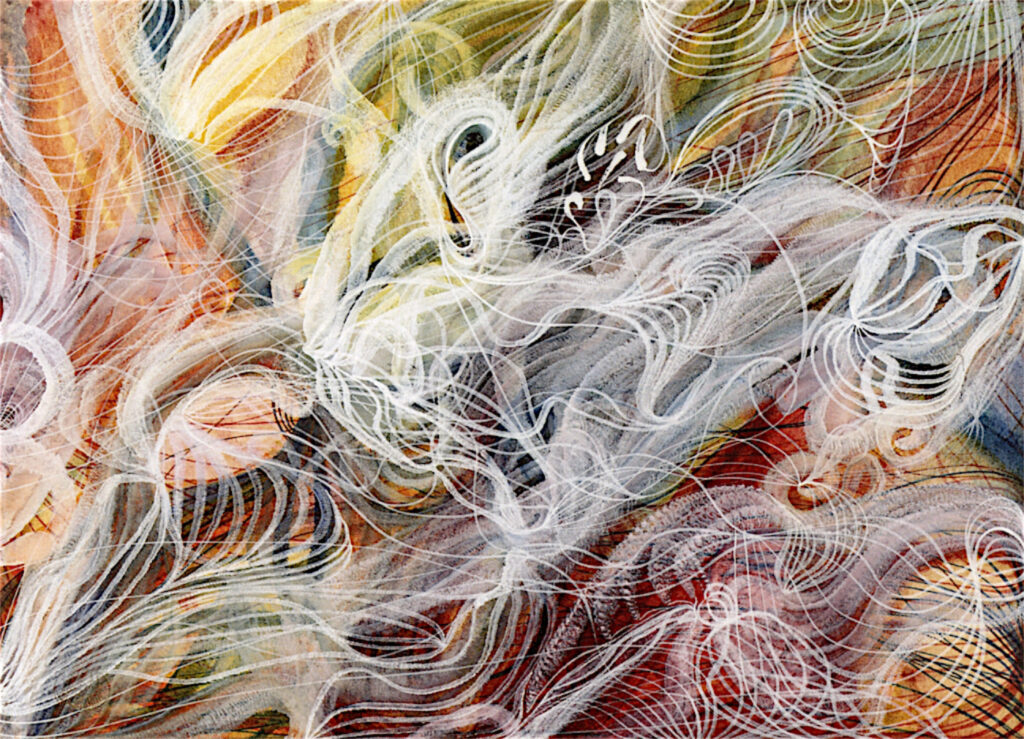
Georgiana Houghon, The Love of God, August 3, 1864, Watercolor and gouache on paper, 23.7 x 32.6 cm, An Automatic Painting, Hilma af Klint was about 2 when Georgiana Painted it. *-Victorian Spiritualists’ Union, Melbourne Photo.

That show rode on the hype about Hillma being “the first abstract Artist,” (says the Tate, no less) before Kandinsky, Mondrian, et al., and a woman. The truth is Hilma was not even the first woman in her spiritualist circle to create what they call abstract work- Georgiana Houghton (1814-1884), 48 years Hilma’s senior, who proceeded her in creating Automatic Paintings & Drawings, may be a better candidate for that title. But, boxing HaK as such helped the powers that be draw huge crowds to the 2013 show of a complete unknown. Paintings for the Future (one of the two most important NYC Painting shows I saw in the prior decade, along with this one) took things to an entirely different level. Six years later comes MoMA’s Hilma af Klint: What Stands Behind the Flowers, her first NYC museum show since the Guggenheim blockbuster. Hilma’s work doesn’t need any hype to “sell” it now. The world knows who she is. All the “abstraction” talk has kept people from looking at her work, in my view. It’s time to look at the Art for what it is.
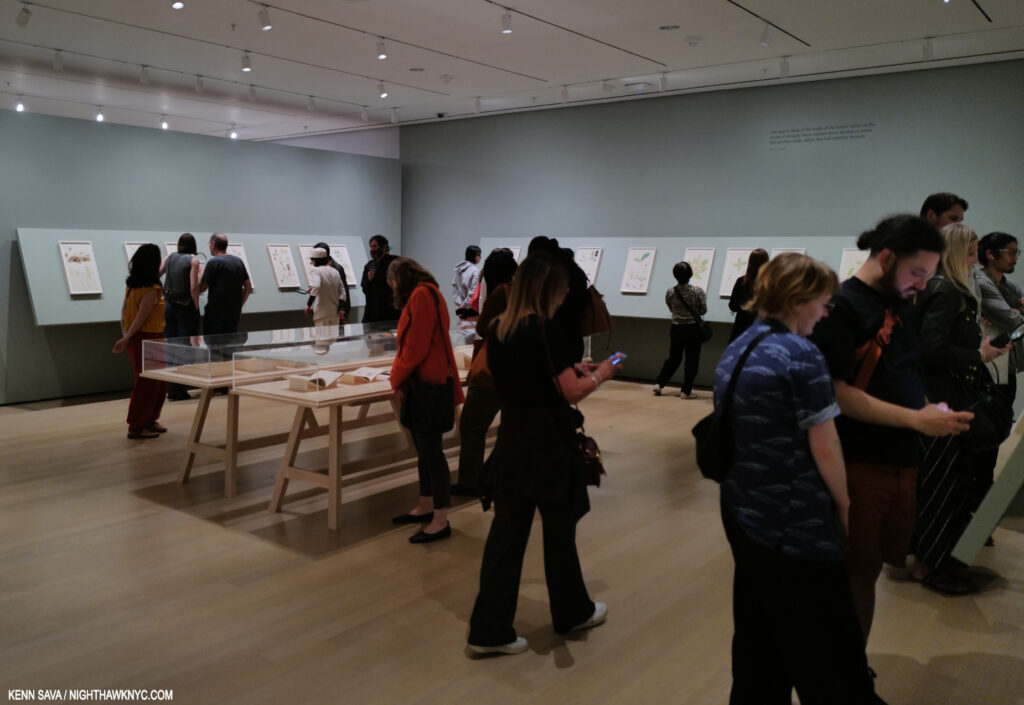
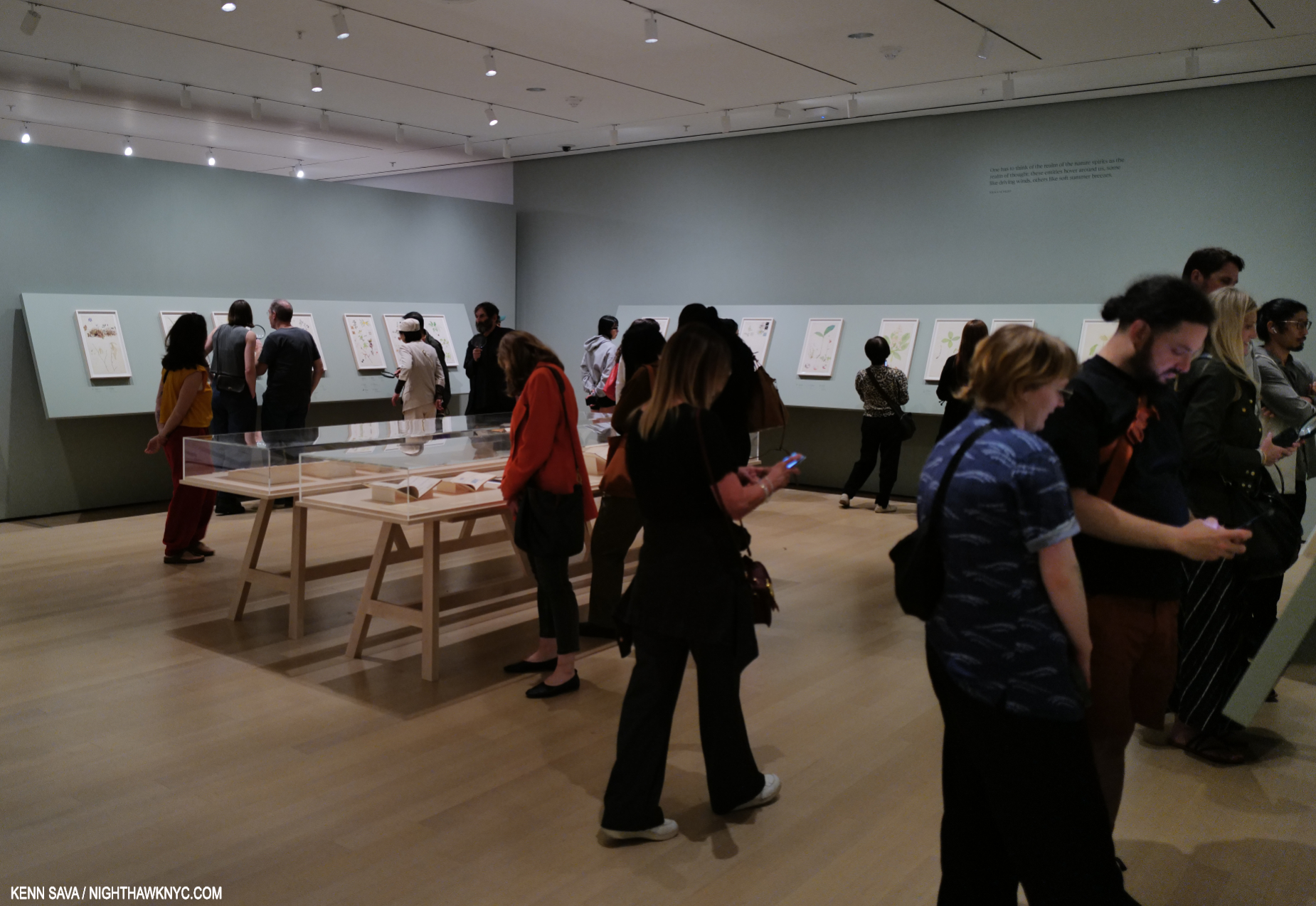
Installation view of the 2nd gallery of Hilma af Klint: What Stands Behind the Flowers at MoMA, which contained the first part of Nature Studies on the walls and a selection of her writings, and books by others on flower studies, in the center vitrine. Opening week, May 18, 2025.

What Stands Behind reveals that AFTER she completed the Paintings for the Temple in 1915, Hilma went back to working “representationally!” I guess no one bothered to tell her she was supposed to be an “abstract” Artist in the future. The more likely case is that HaK was a very talented and creative woman, an Artist more than capable of creating in whatever style she needed to work in for what she was trying to accomplish. It seems to me that THAT is a MORE impressive thing than sticking her in any one limiting box!

“One has to think of the realm of the nature spirits as the realm of thought; these entities hover around us, some like driving winds, others like soft summer breezes,” Hilma af Klint, MoMA wall card.
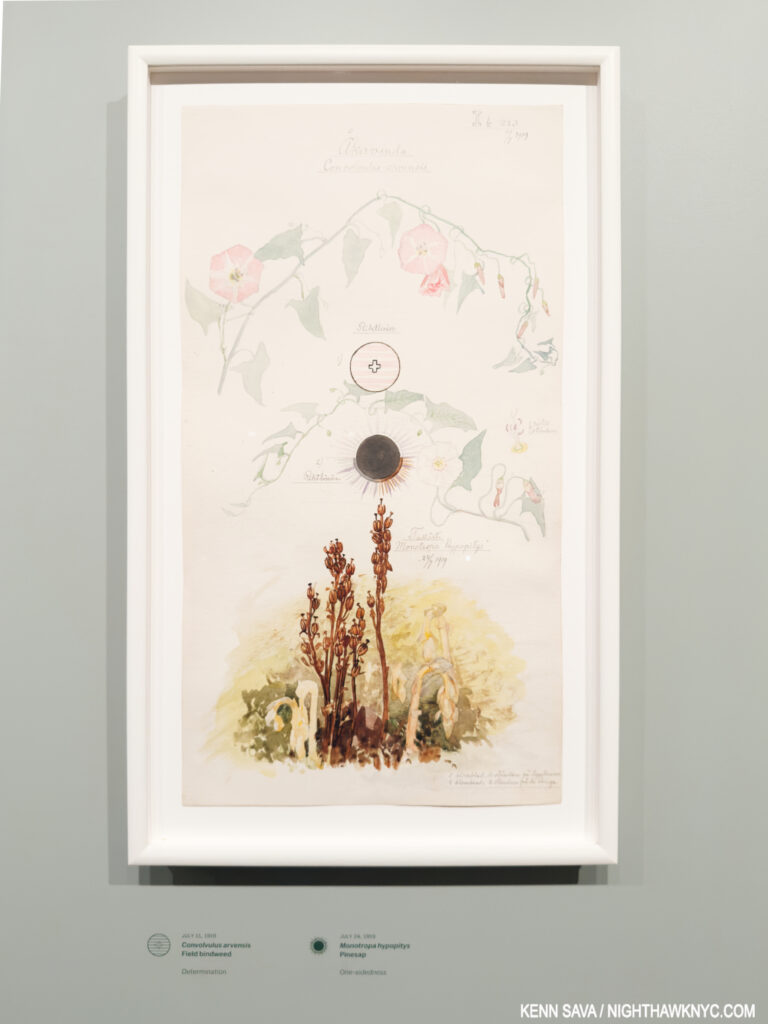
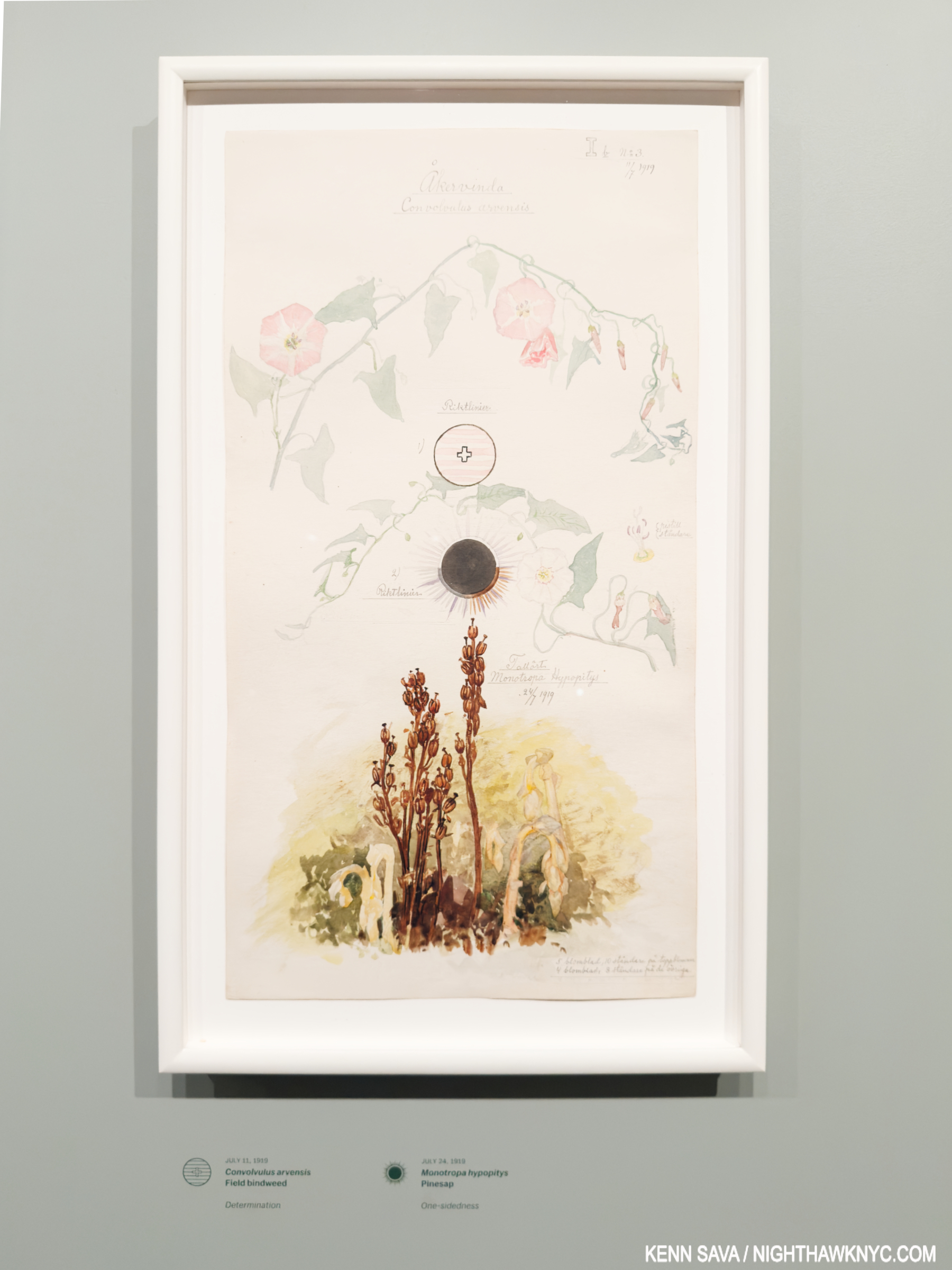
Convolvulus arvensis (Field Bindweed), Monotropa hypopitys (Pinesap). Sheet 20 from the portfolio Nature Studies July 11–24, 1919, Watercolor, pencil, ink, and metallic paint on paper. One of the 46 sheets in watercolor, pencil, ink, gouache and metallic paint on paper included in Nature Studies. Being 19 11/16 by 10 5/8 inches, these sheets would seem too large for Hilma to work on in situ. But that’s purely my conjecture. Unlike Georgia O’Keeffe, HaK didn’t confine herself to one specimen per sheet. Over 100 are included on the Nature Studies! Underneath, the curators translate HaK’s notations of the species name and its character as perceived by the Artist: “Determination” for the Field Blindweed, top, and “One-sidedness” for the Pinesap, bottom. MoMA, September 26, 2025.

She also continued to work on creating a “language” (see Group 2, further below) that included letters, words and diagrams. These are seen in almost all of the series she created in her life (including Nature Studies).
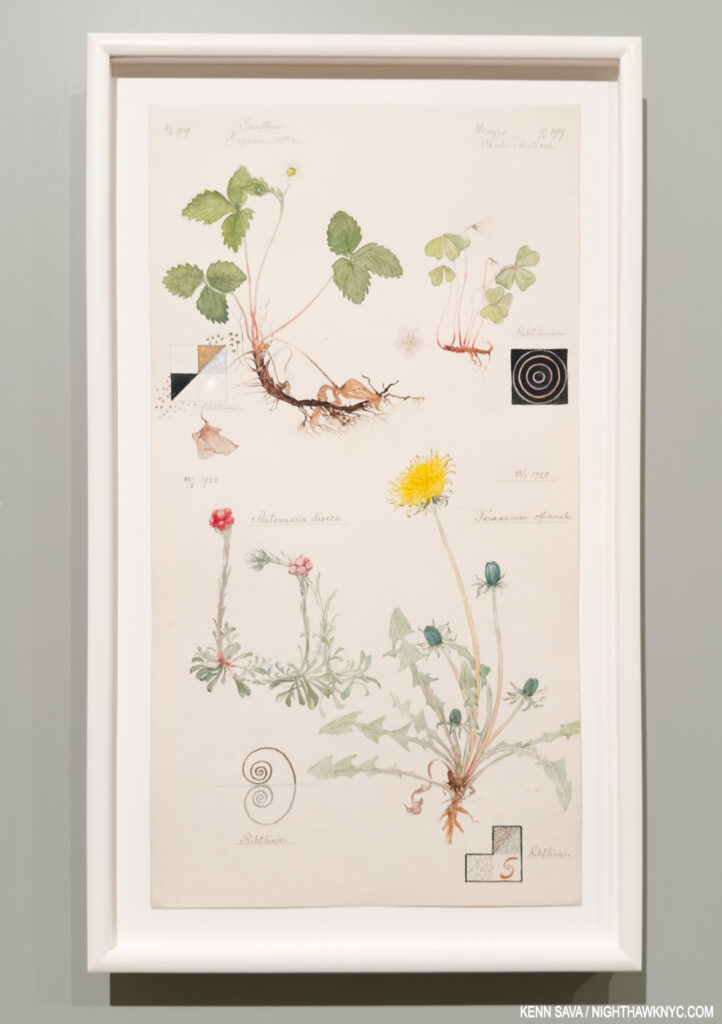
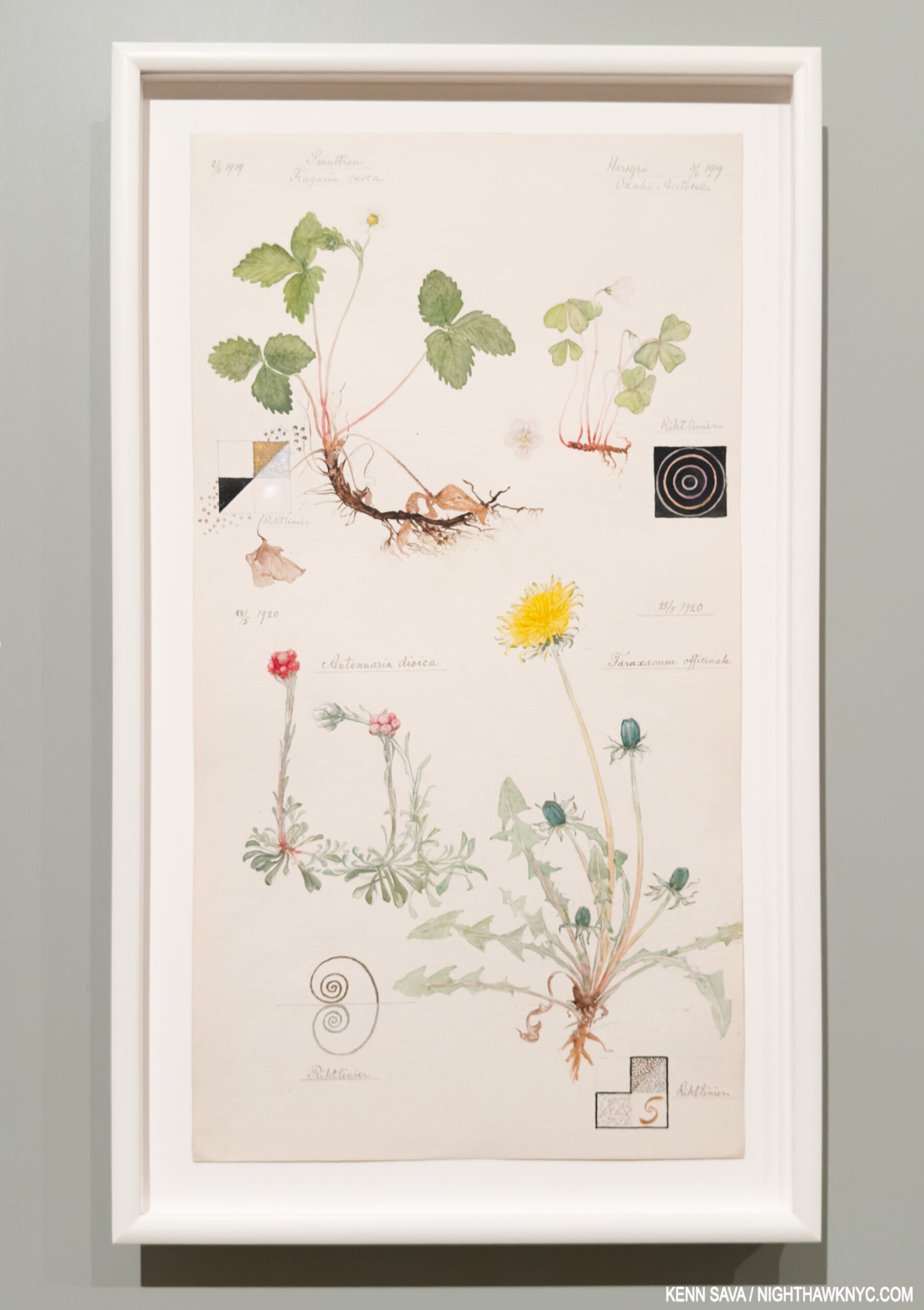
Woodland Strawberry, Hilma’s notation- “Liberator. Longing to produce balance within the blood syntem by expelling either white or red biood cells.” European wood sorrel- “Fragility-submissiveness shyness-humility fear -respect self-loathing-obedience.” Catsfoot– “Peace and harmony.” and Dandelion- “Beginning.”
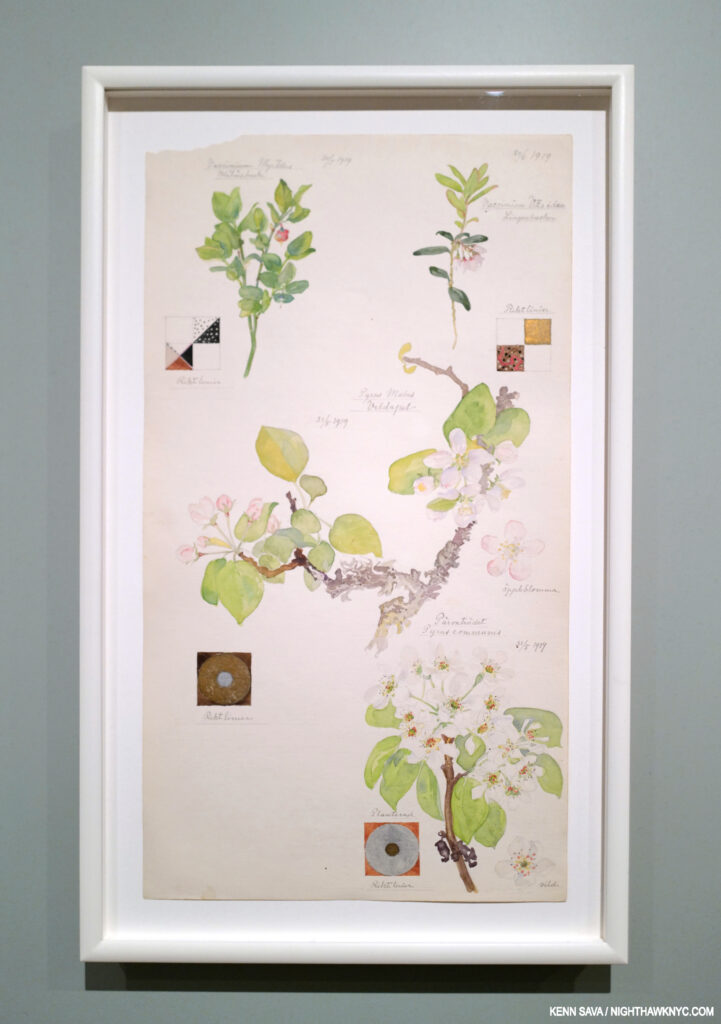
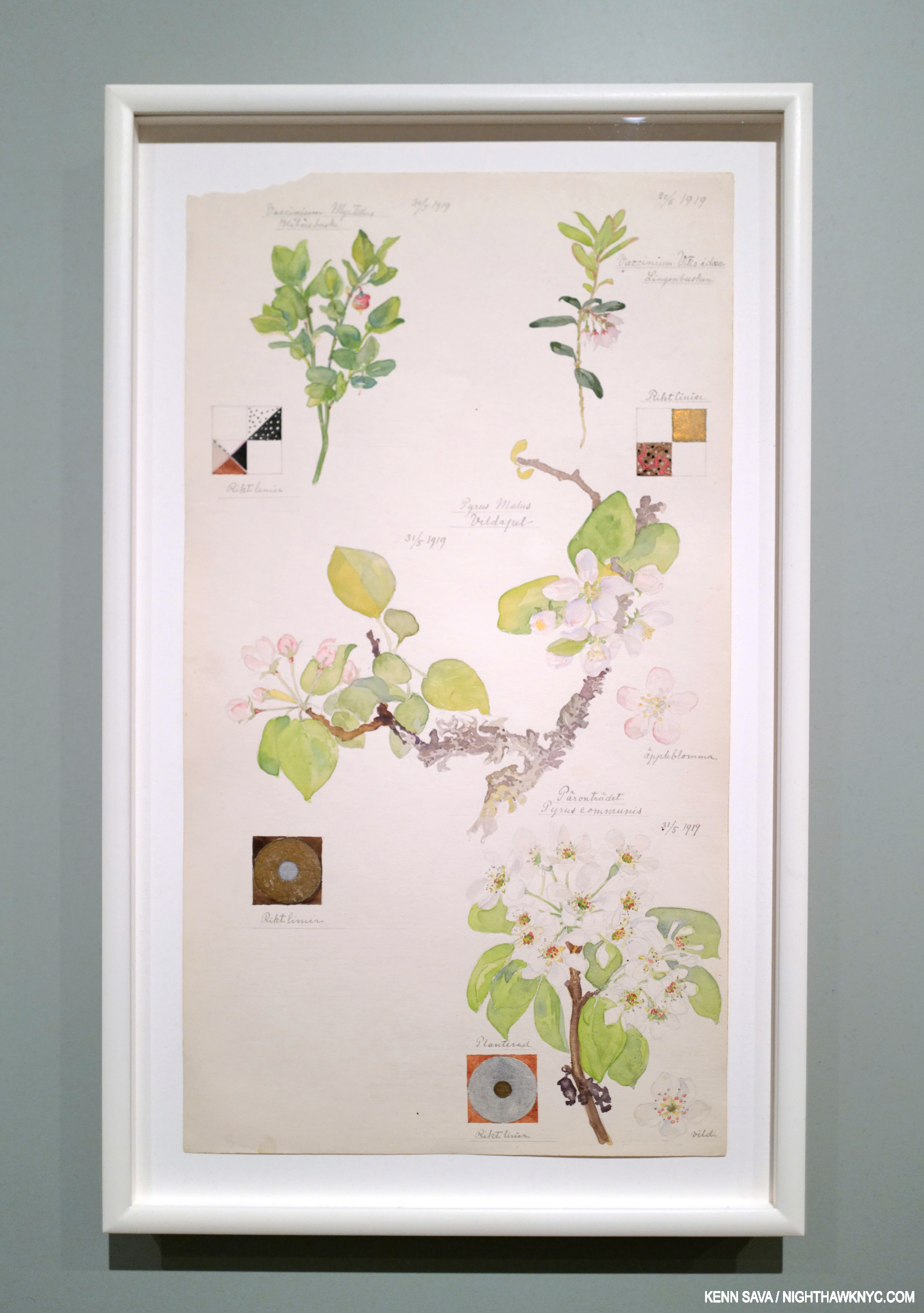
Bilberry, Apple, Common Pear, Lingonberry

Looking at Hilma’s Art is different than looking at the Art of any other Artist I know of. Quite a few of her Paintings for the Temple (as seen in the picture earlier) and other “abstract” works included at MoMA (below) have elements that look organic, including flower shapes. In some of her Temple series, lines of dots connect figures, reminiscent of the af Klint family’s heritage as noted cartographers & mapmakers. Then, any number of her pieces, including almost all her Nature Studies, include diagrams that contain basic geometric shapes- circles, squares, cones, etc. The viewer needs to decide what to make of them, or look to the Hilma’s Notebooks for insights. Finally, there’s the “language” the Artist developed, abetted by her use of letter “codes,” as Julia Voss outlines in her Biography. As a result, it seems to me there is still a long way to go in coming to fully understand Hilma af Klint’s work. Lumping it all into ANY one-word catchphrase box only takes us further away from that point of truly understanding it-if that’s possible.
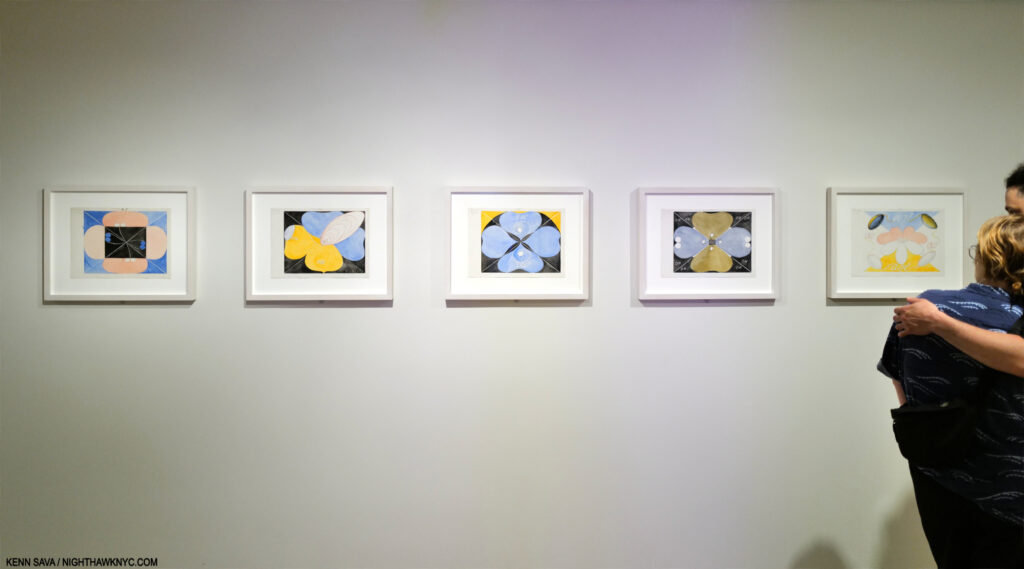
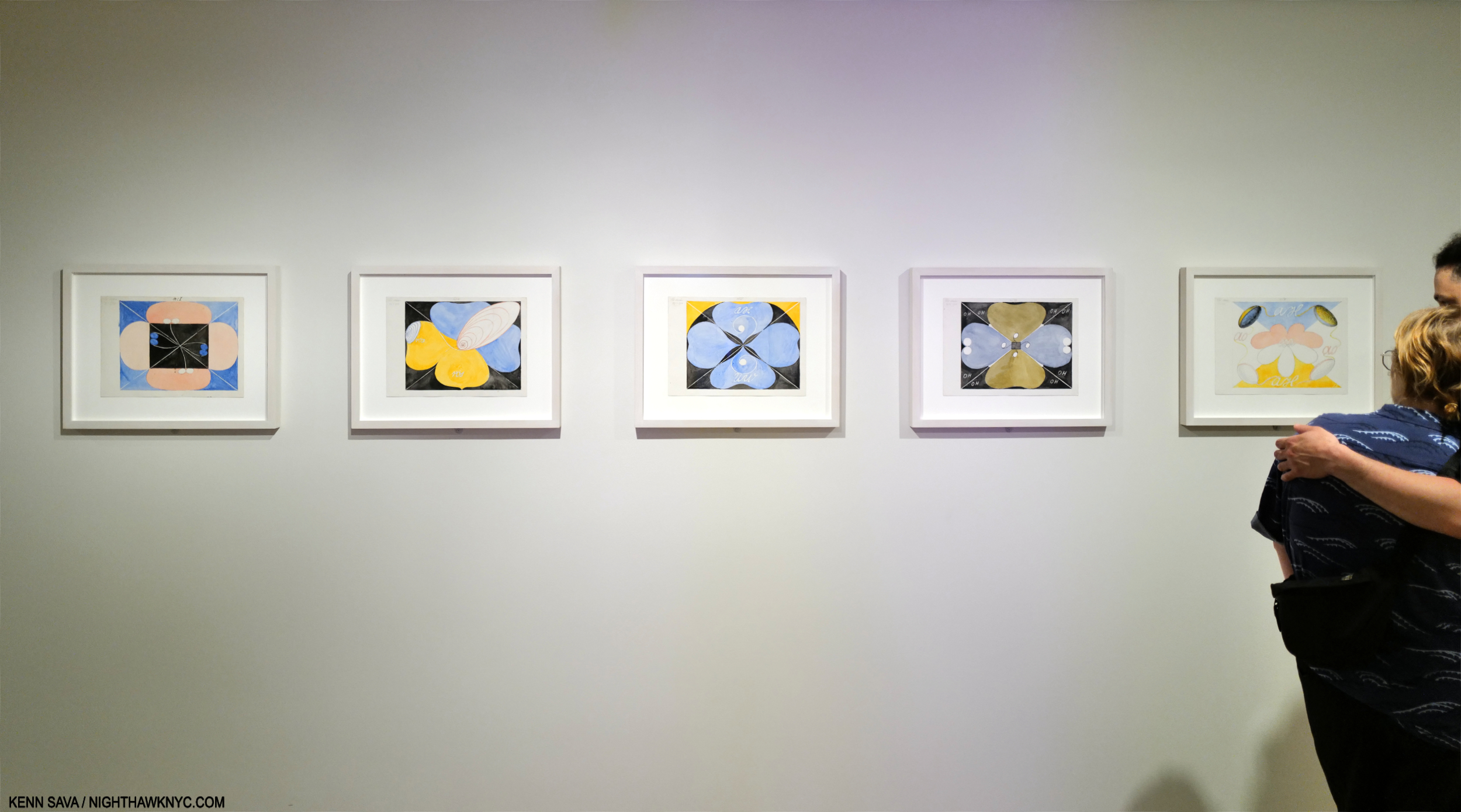
Group VII, No 1-5, from the US Series, 1908, Watercolor and pencil on paper. 11 years. before the Nature Studies portfolio, what seems to be flower-like shapes abound. Seen at the beginning of  MoMA’s show.
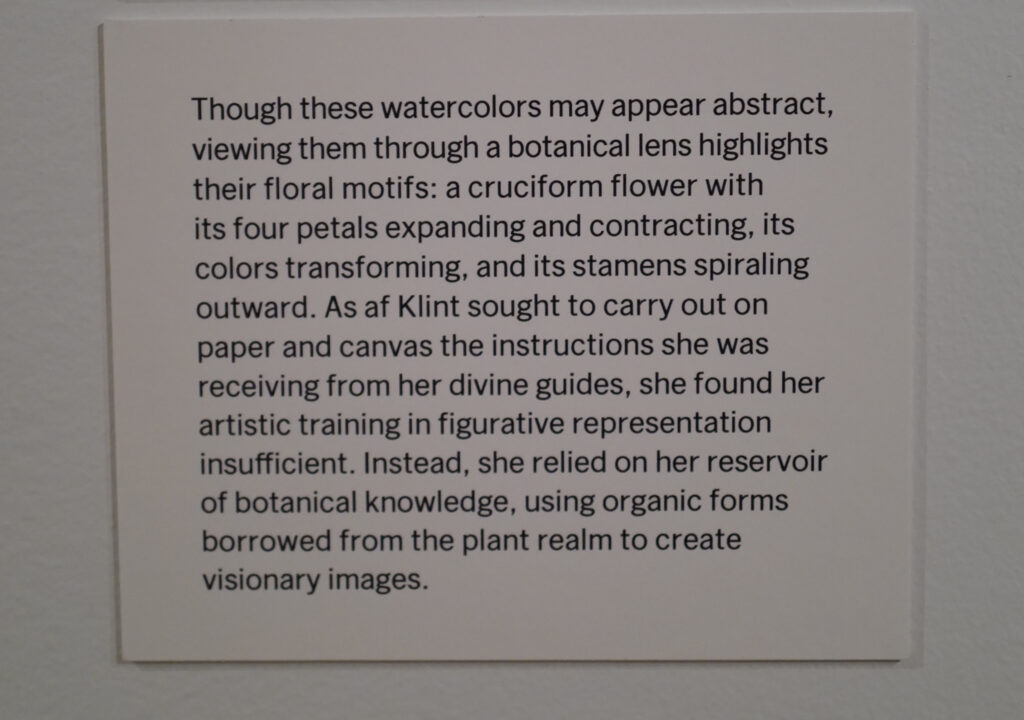
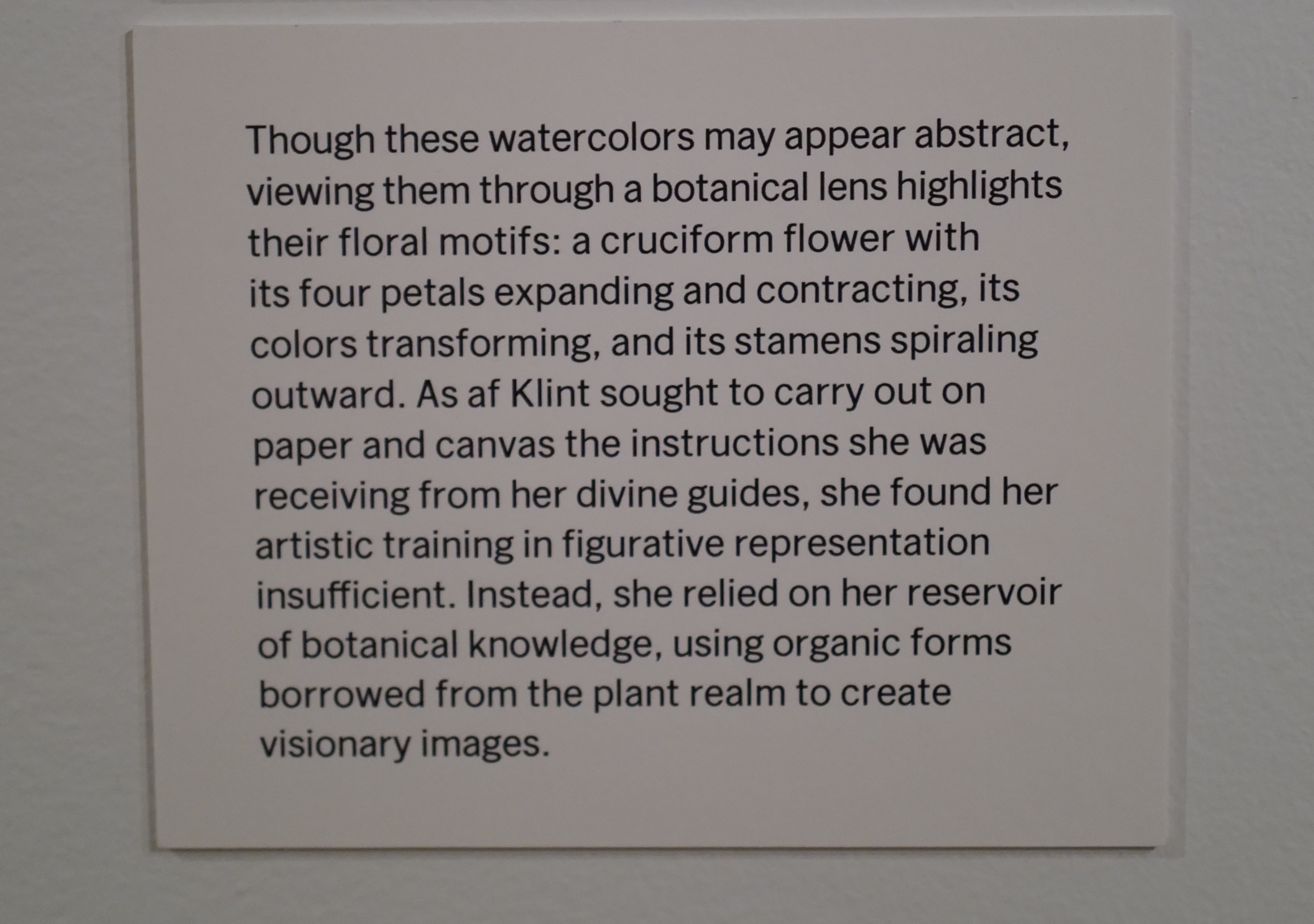
The wall card for Group VII. Installed at the show’s entrance, is a relatively rare instance of the Art world looking beyond Hilma the “abstract Artist” thus far, or hedging their bets on their use of that box. Here, the organic shapes are accompanied by letters that are parts of the “code” Hilma used. See next.
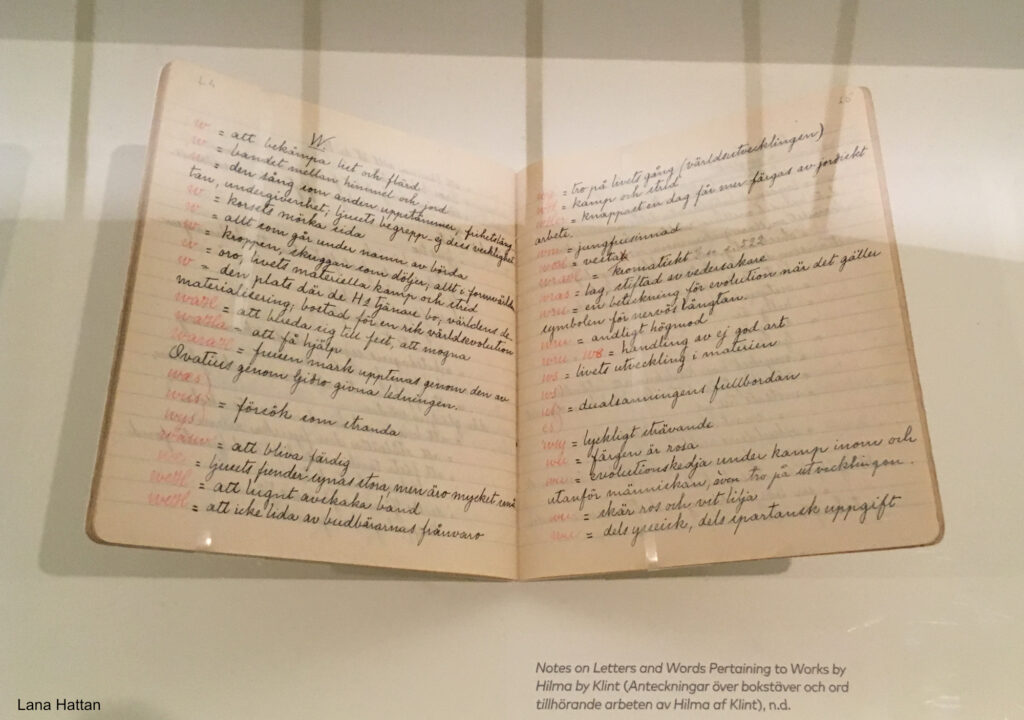
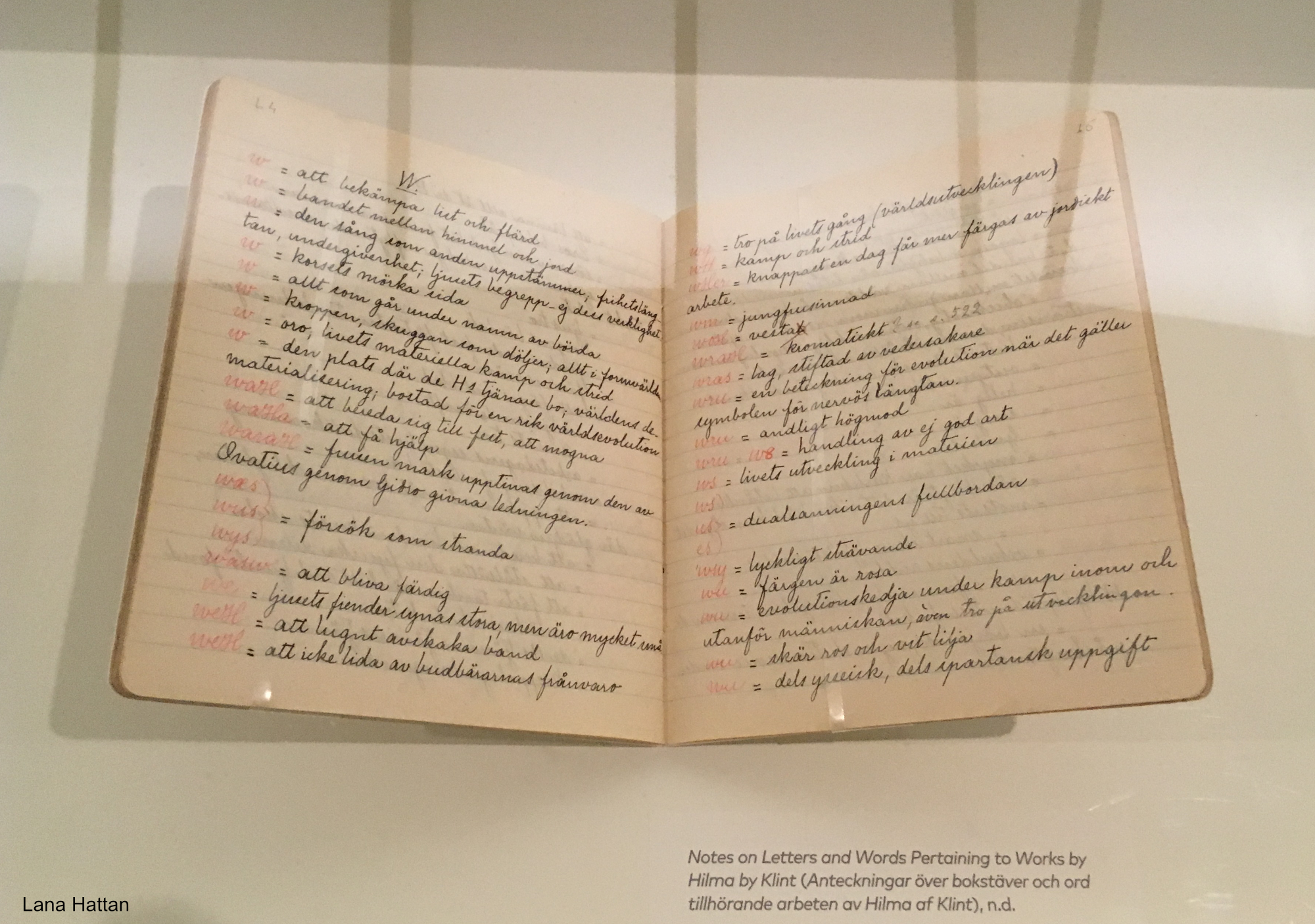
Another piece of the puzzle. Hilma’s original Notebook containing her Key to the mysterious words and omnipresent letter “codes” she used throughout her oeuvre. It’s an essential part of “decyphering” her work. Hilma’s code is detailed in English in the book Hilma af Klint: Notes and Methods. *- Photo by Lana Hattan, Guggenheim Museum, December 31, 2018.

ALL this talk about Hilma’s style misses the point! Hilma was not out to win any “style wars.” All of her work was about something entirely different, and that difference was substance over style.
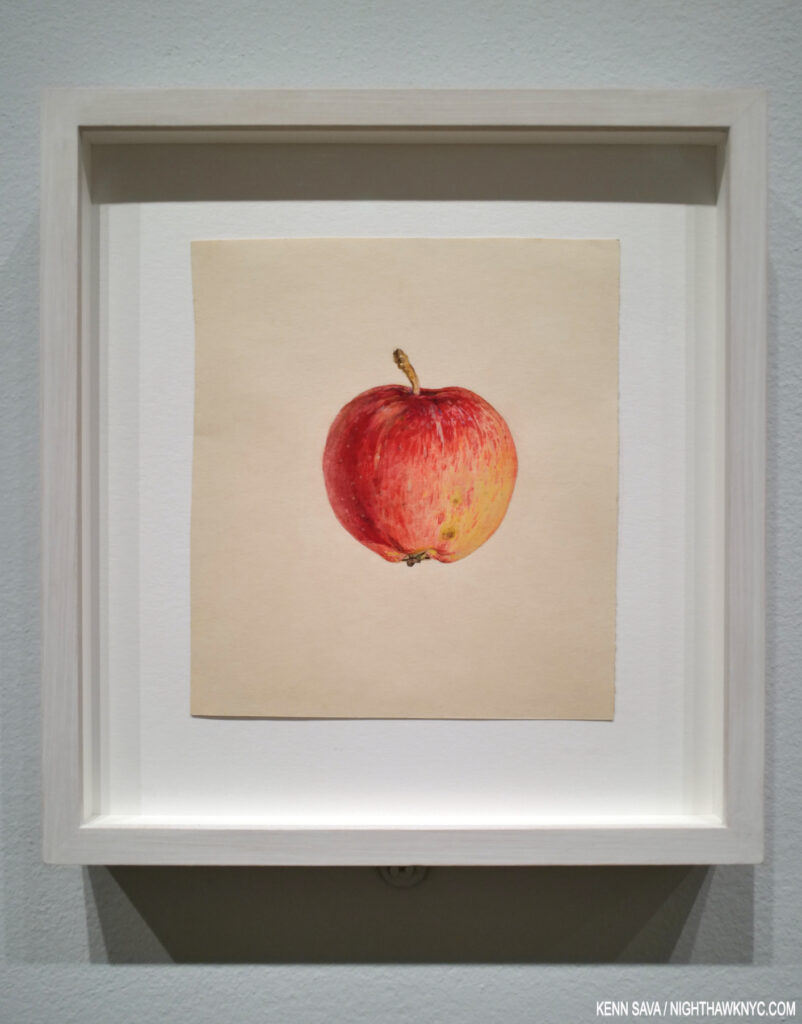
Apple, no date, Watercolor on paper. Virtually every Art or Drawing class begins with rendering, coloring & shading basic shapes, like the sphere (often an apple, orange or lemon). Here HaK takes it to an entirely different level, and we get to marvel at her powers of observation, especially in the incredibly subtle variance of the local color. It’s also fascinating to me how minimal the shadows are, something you never see taught in how-to books which glory in the different kinds of shadows. In most of her Nature Studies, except the previous one, Hilma leaves out the ground, as she does here, too. In this case, doing so gives her the chance to show more of the bottom detail, again something I can’t say I’ve seen done often.

On the opposite end of that spectrum from the 21st century hype around it, there is something else at the beating heart of her work, something her “abstract” Paintings for the Temple and her representational Nature Studies have in common, and something that is at the core of the recent debate regarding continuing to publicly display her work. Hilma af Klint’s work is centered on the spirit. She created her work for fellow spiritual seekers. The Paintings for the Temple are devoted to the human spirit (with the aid of spirits who have moved on to another level). After completing them in 1915, never one to think small, the Artist turned her attention to an even bigger subject- the spirit of the natural world, commencing with the atom, in works that filled three quarters of the first gallery at MoMA, before moving on to the spirit in nature, beginning with flowers (in Nature Studies), which filled most of the succeeding two large galleries. These were supplemented by her late Flower Watercolors, which reminded me of some of Georgia OKeeffe’s Watercolors that were shown in these galleries at MoMA in 2023. The bottom line is that Spiritual Art is still outré to the Art machine, whatever type it is. They can’t sell it, and Art without monetization does not keep the Art machine going.
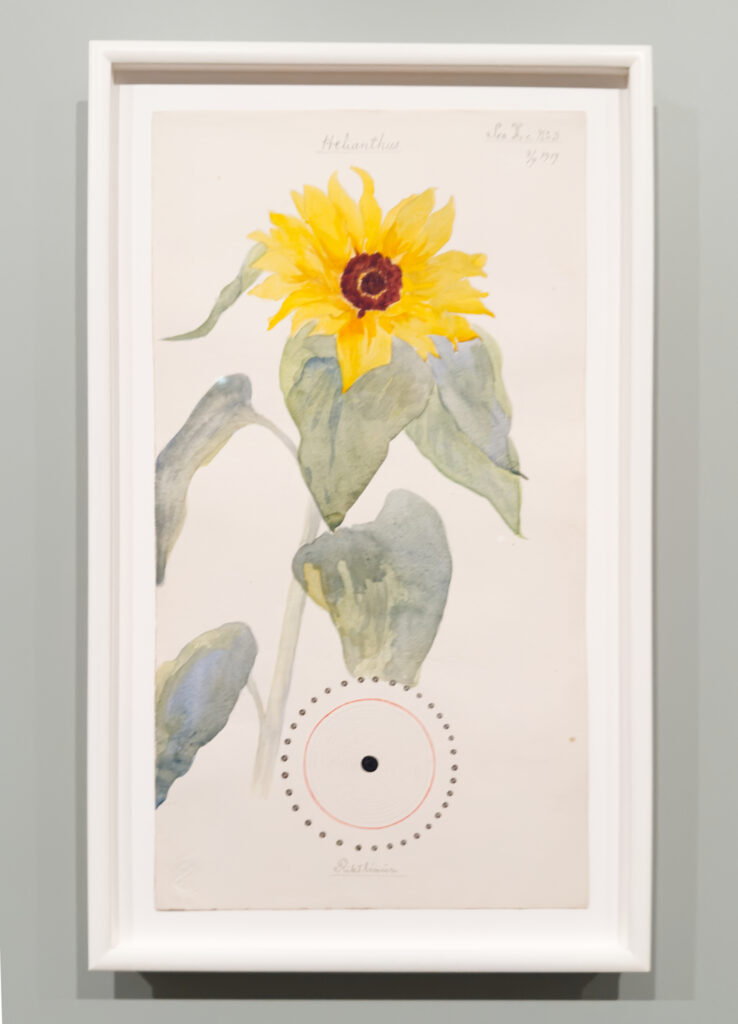
Common Sunflower. To Hilma- “Love is the greatest of all.”

Meanwhile, throughout What Lies Behind, part of the sheer joy in looking at her work, her marvelous technique shines in piece after piece. It’s surprising to me that Hilma has gotten so little credit for it. She came upon it the hard way, through continual hard work and 6 years at the Royal Academy of Fine Arts. This was followed by work as an Illustrator, including illustrating a book on horse surgery by the director of the Veterinary Institute, Stockholm, who kept Hilma’s Drawings for the rest of his life.
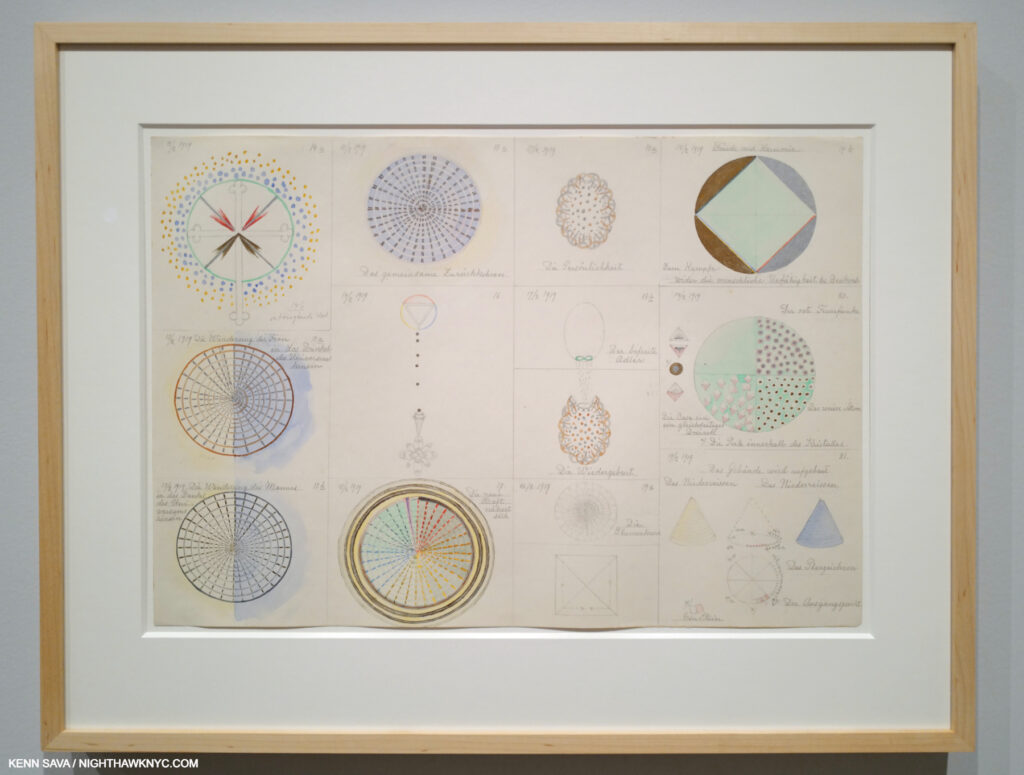
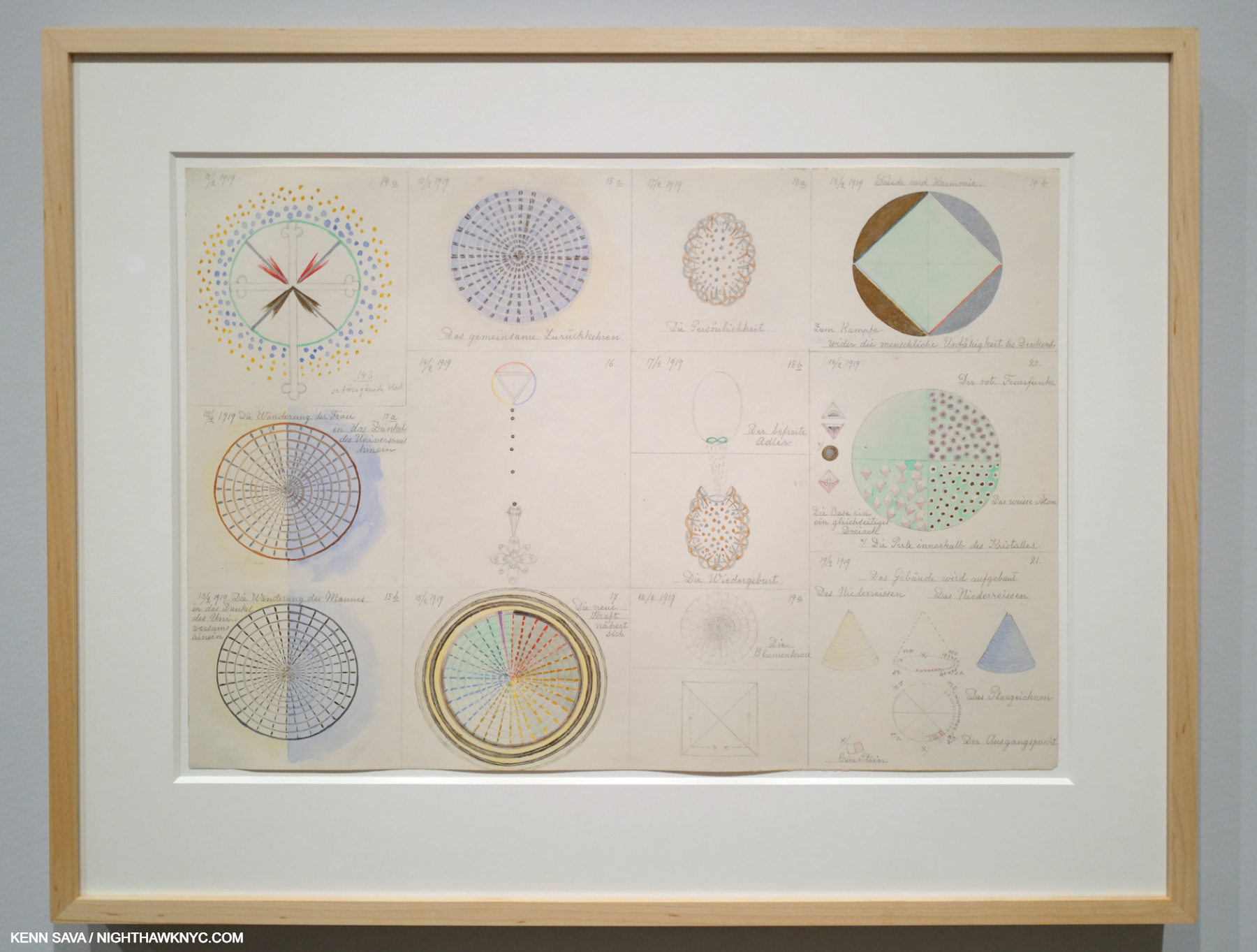
From Group 2 February 12-19, 1919 Watercolor, pencil, and metallic paint on paper. This was one of numerous examples of her technique I could site. Here, we see the Artist working on ideas for herself in a series of sheets titled Group 1, Group 2, Group 3. No matter for public display or her own purposes, Hilma was always meticulous in her execution. Of the Groups, MoMA says- “Together, the drawings form narratives that allude to pollination, reproduction, and evolution. By April 19, 1919, after more than three months of progress, af Klint had established a vast and diverse diagrammatic language. The very next day, she began her Nature Studies portfolio.”
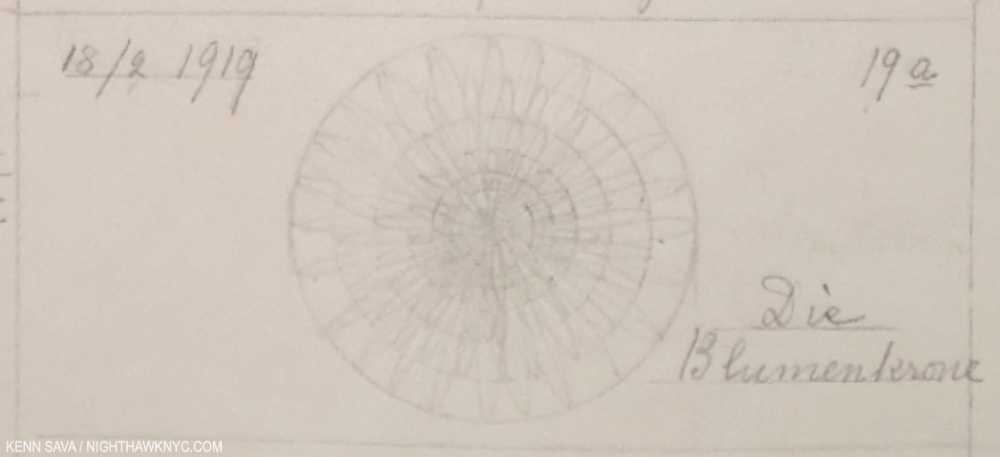
This enlarged detail of the lower center of the previous image perhaps measures 3 or 4 inches wide by an inch and change high (the bounding rectangle). Easy to miss because it’s in pencil and the actual Drawing part seems to have faded,  it’s noteworthy for two reasons. First, its meticulousness, and second for the title- Die Blumenkrone means “The Flower Crown.” Even in the dead of wnter (i.e February 18th as the date reads), Hilma had flowers on her mind.

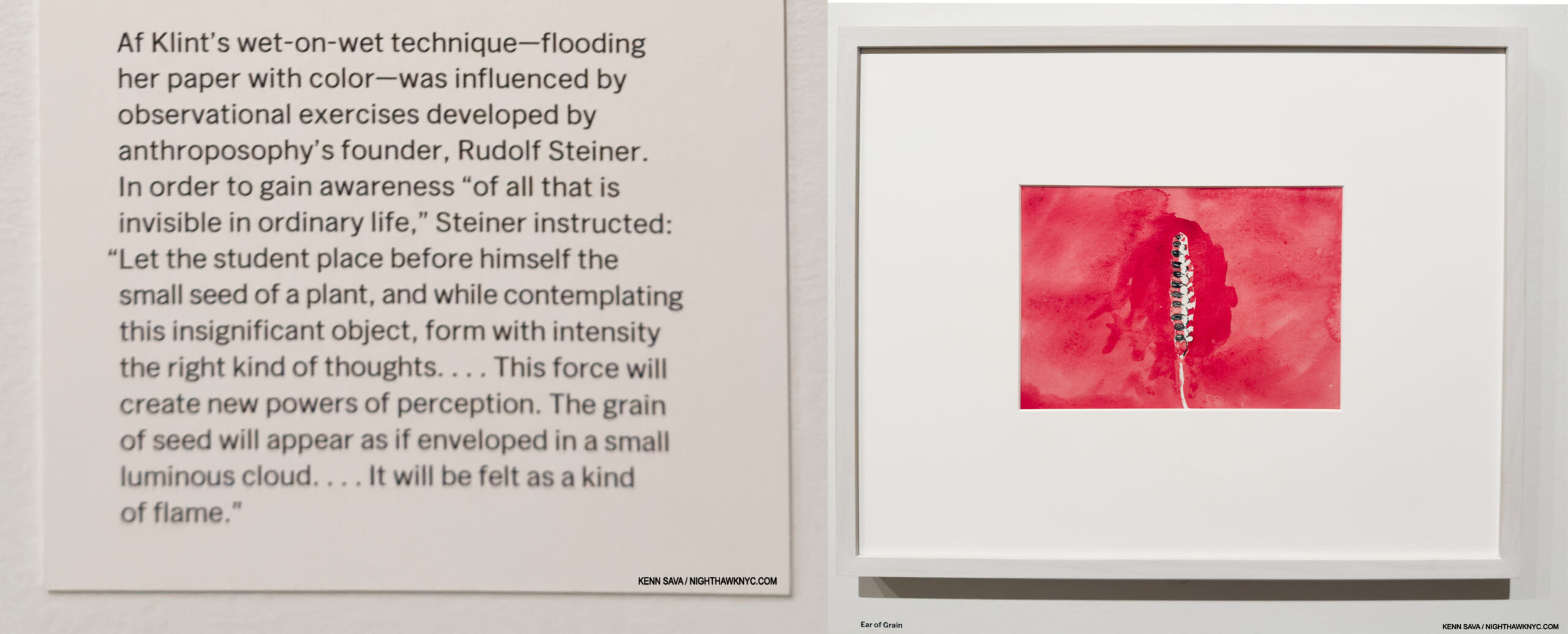
What Stands Behind also makes the case in spades or her accomplishment as a Watercolorist- both in her Flowers and in the later Flower work (not part of the Nature Studies series) shown in the final gallery, in a different style again, as seen below.
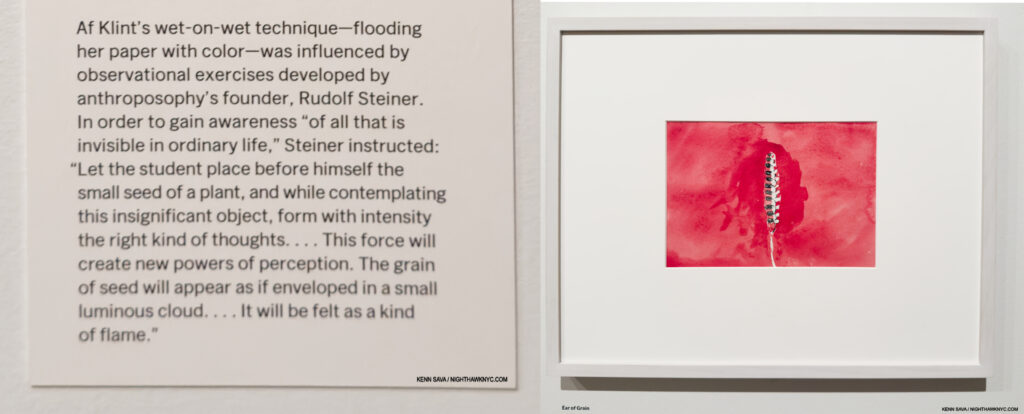
Ear of Grain, 1922, Watercolor on paper, from the series, On the Viewing of Flowers, with a apparetnly relevant section of the wall card, left. MoMA, September 26, 2025.
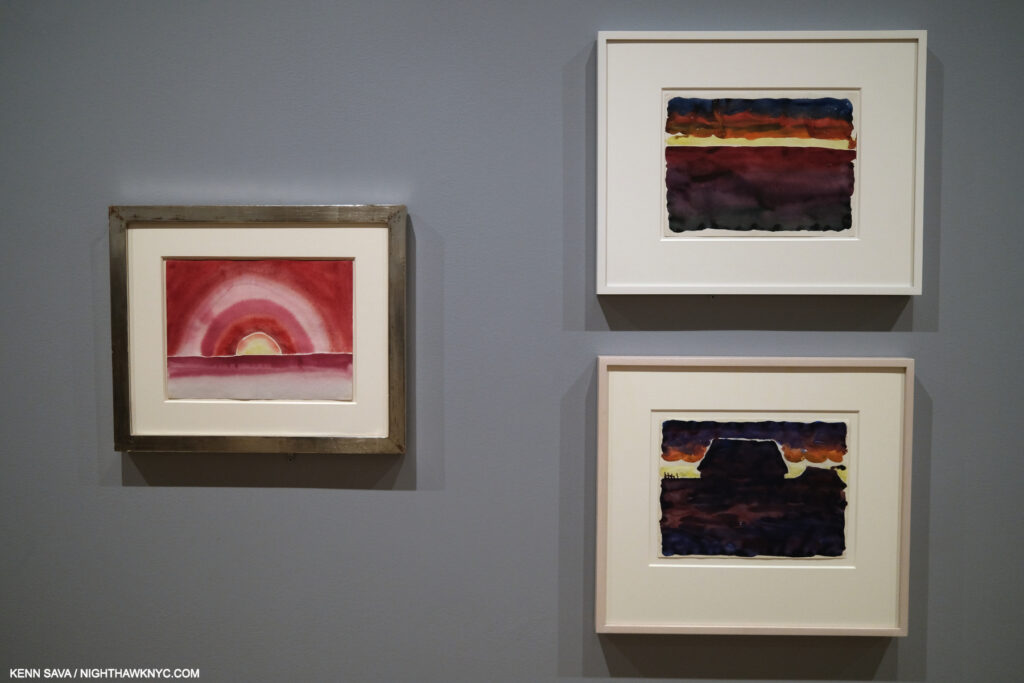
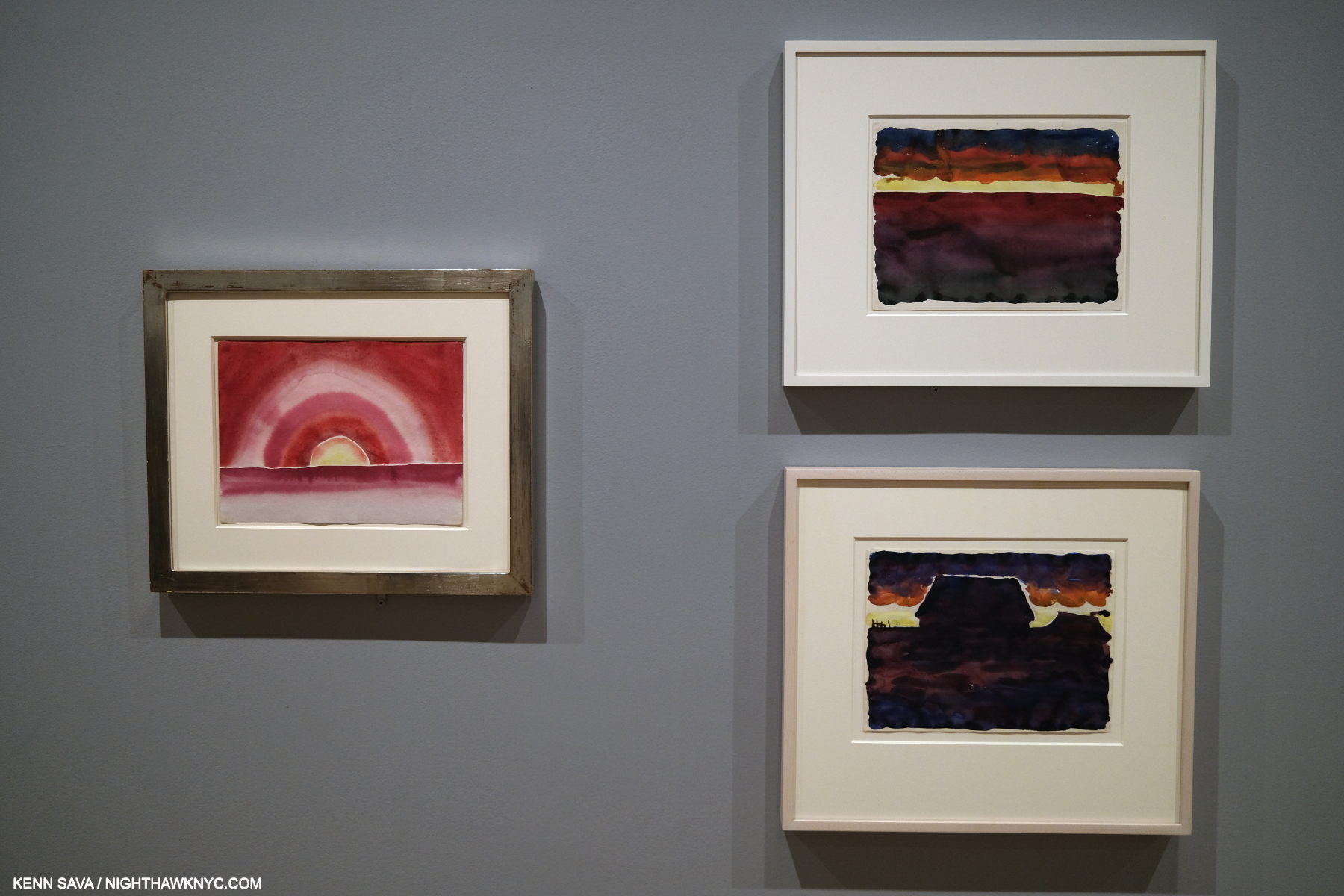
Georgia O’Keeffe, Morning Sky, left, and Morning Sky, and Morning Sky with Houses, right, 1916, Watercolors on paper. MoMA, September 9, 2023.

I might be the only one to draw parallels between Georgia O’Keeffe & Hilma af Klint, but when I saw the wall of 1922 Watercolors by Hilma in the last gallery, including Ear of Grain, above, I couldn’t help but recall Georgia’s Watercolors that had been hung in these galleries two years previously. It’s fascinating to think about their commonalities, as extraordinary, ground-breaking Artists, and as extraordinary women, at much the same time, on almost opposite sides of the globe. What Stands Behind The Flowers begins some of the heavy lifting on the road to assessing Hilma af Klint’s full accomplishment. In spite of that, I’m not sure THIS is the ideal time Hilma envisioned for her Art to be shown.
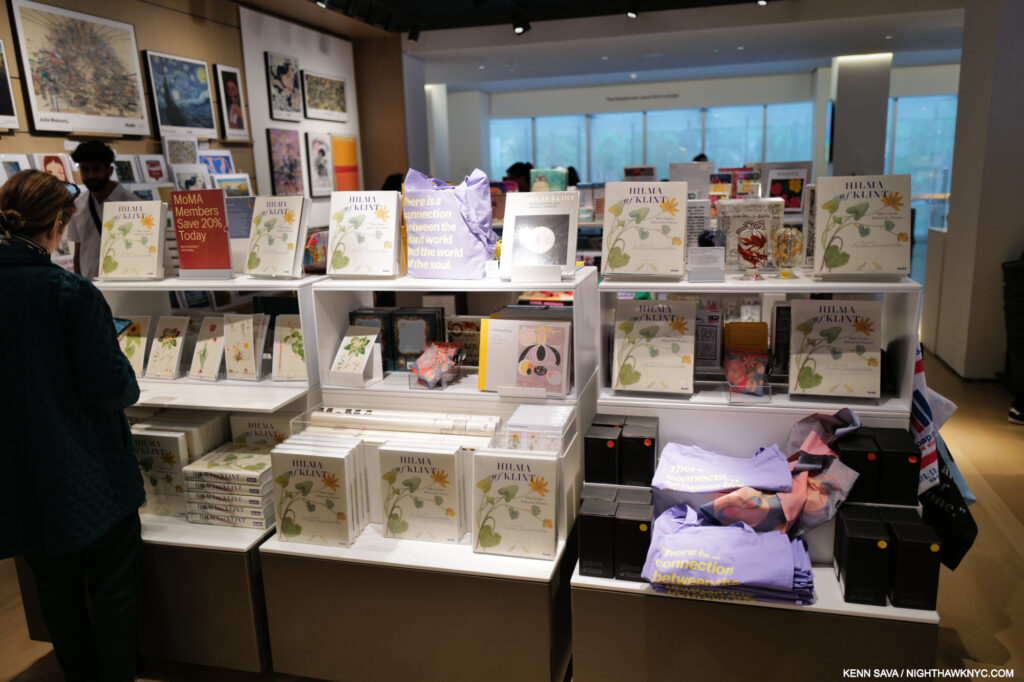
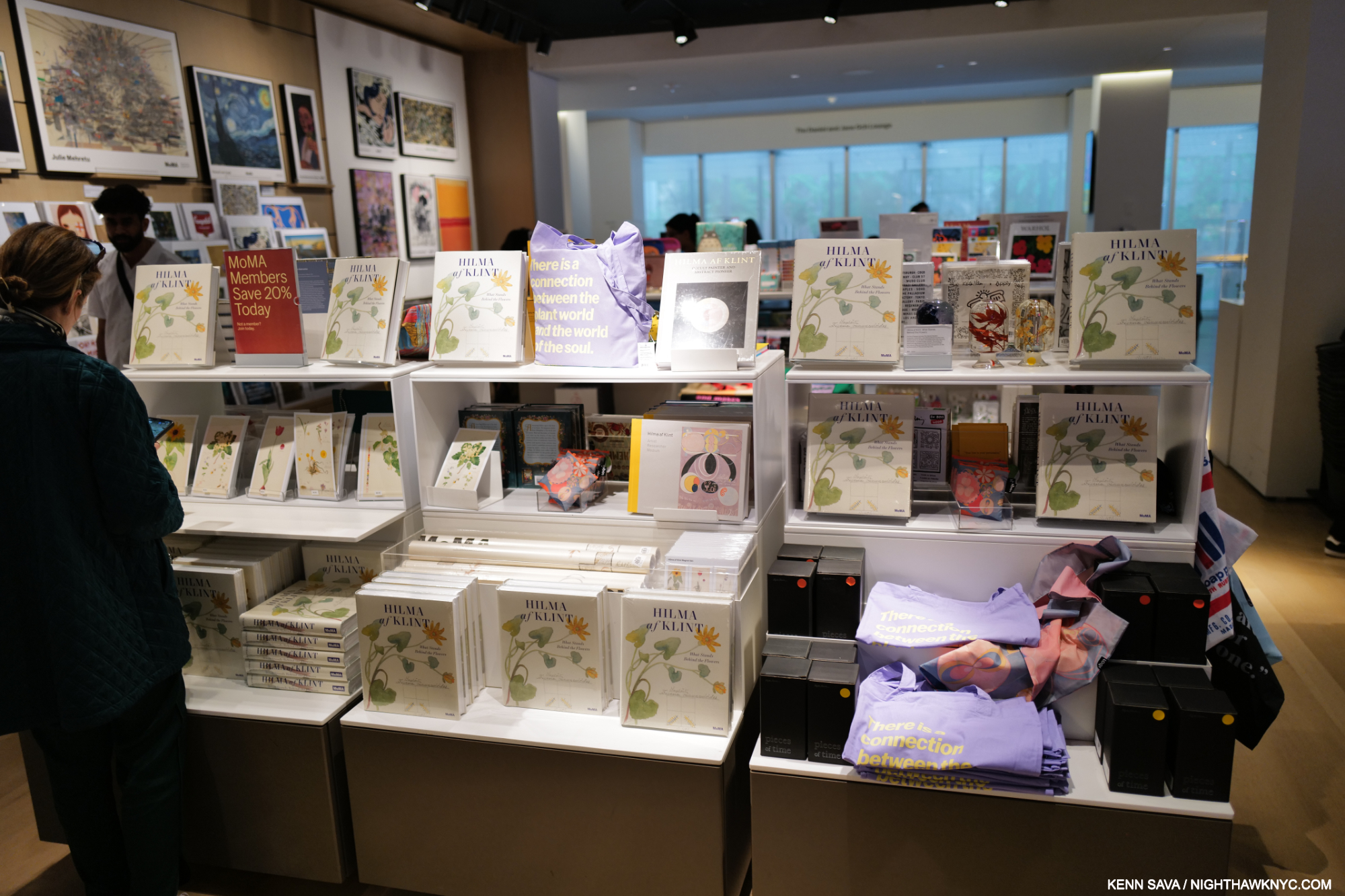
MoMA Gift Shop display for the show. More items behind me and to the left. While I’ll reserve comment on the other items, MoMA’s Exhibition Catalogue for the show is highly recommended. May 18, 2025.

In too many (most?) cases today a work of Art is mentioned followed by its price as if that’s the most important thing about it! Then, the rush is on to plaster it on everything from umbrellas to baby onesies. Hilma’s spiritualist Art stands directly at odds with that. She opposed materialism in Art. To this point, it’s largely escaped it (though MoMA, who has come to own Nature Studies, produced a $500.00 Limited Edition of it, as far as I can tell, the first Hilma af Klint Limited Edition, in addition to putting the series on refrigerator magnets, postcards and a poster)5.

Rebel. With a cause.

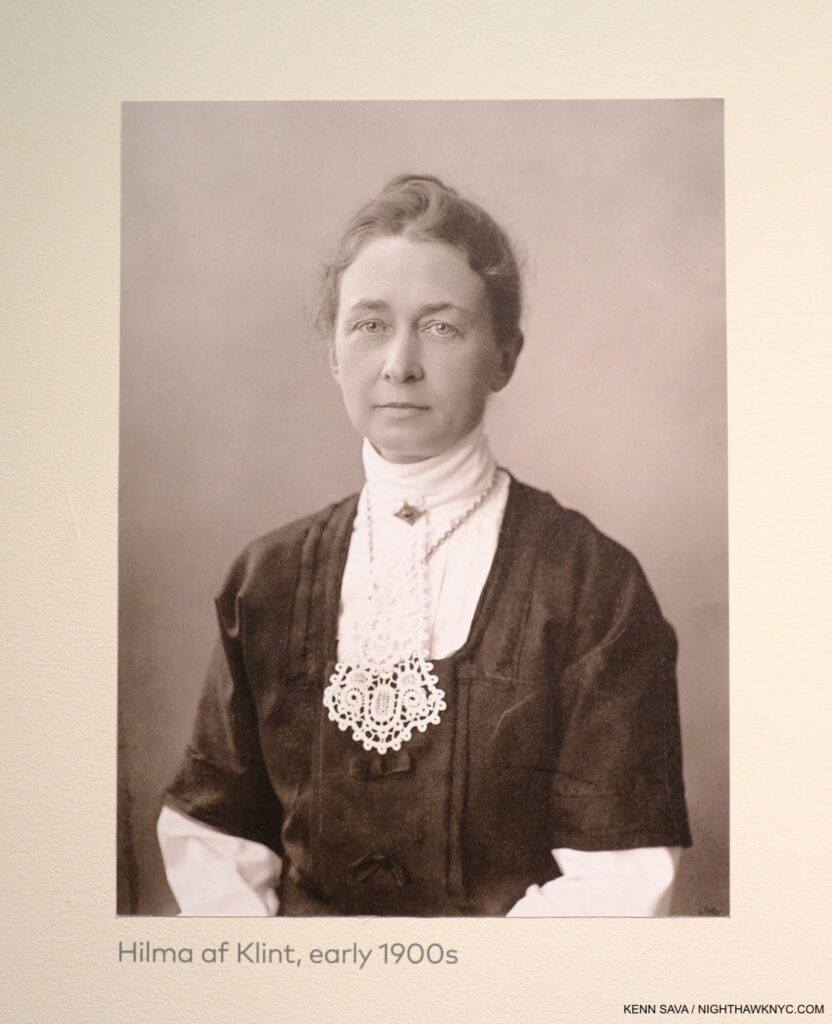
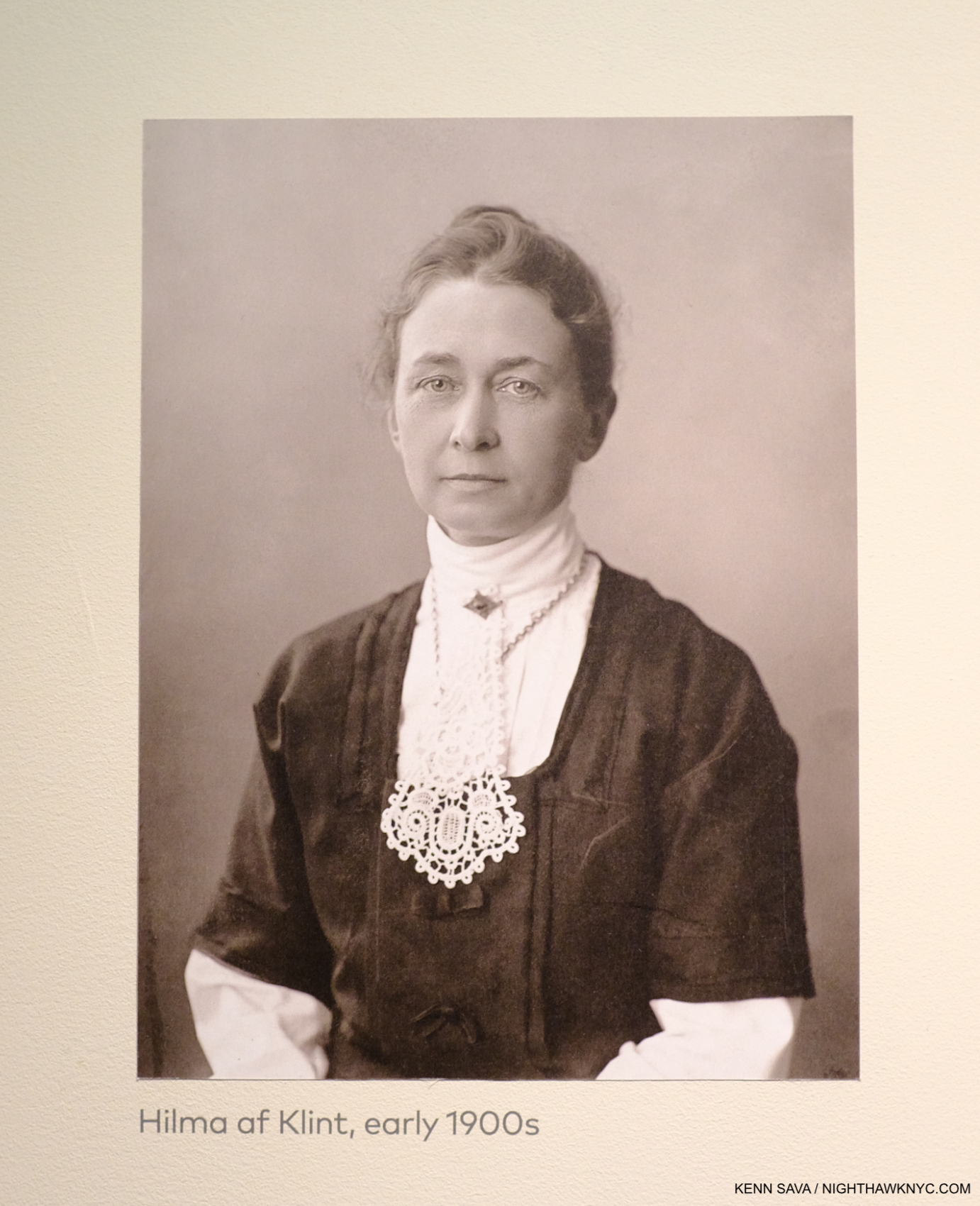
Trapped in the future. But, is this THE future she envisioned for her Art? One of the few Photographs of Hilma af Klint. This one was affixed to a wall at the Guggenheims’s landmark Paintings for the Future in 2018.

Perhaps this experience sounded a warning bell. Earlier this year a struggle broke out inside the Hilma af Klint Foundation about whether or not her work should continue to be exhibited. The Foundation’s chairman of the board, af Klint’s great-grandnephew, who, like his great-grandfather, is also named Erik af Klint, is against it feeling that Hilma wanted her work to be seen in a spiritual context by fellow seekers, i.e. to “keep the work available to those who seek spiritual knowledge or who can contribute to fulfilling the mission that Hilma af Klint’s spiritual principles intended.”
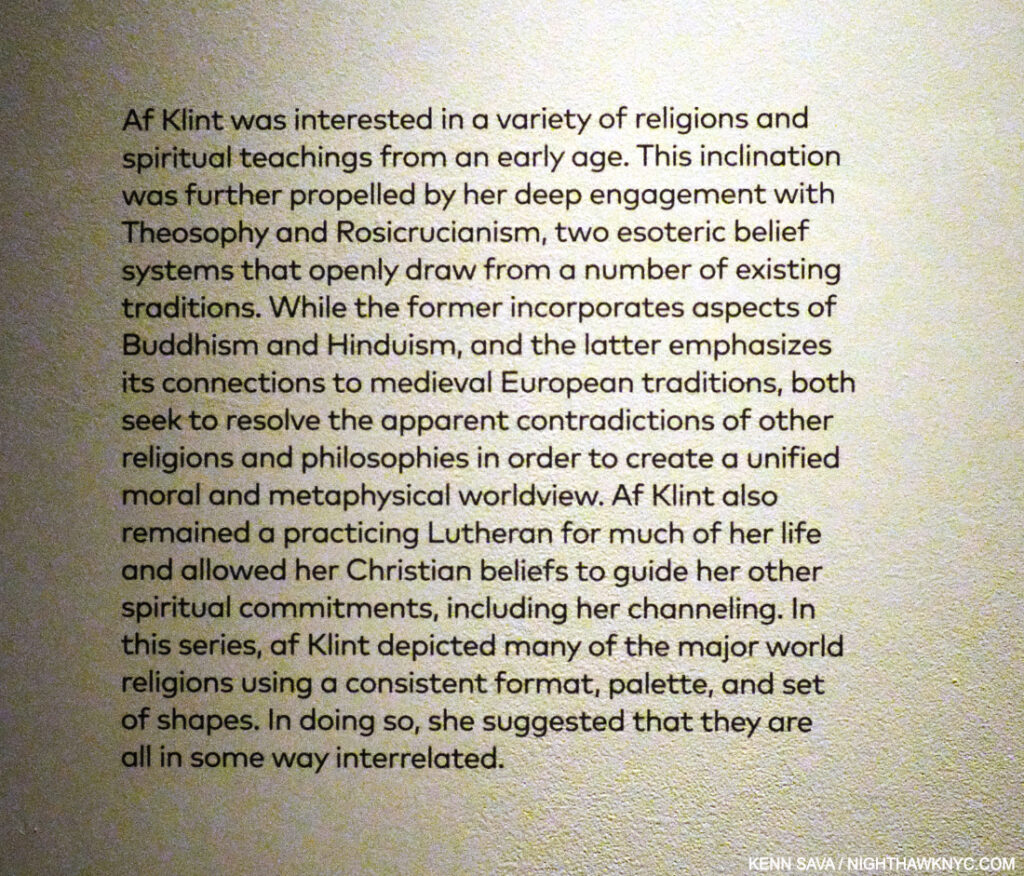
On Hilma’s spiritualism. Guggenheim Museum, December 31, 2018..

Therefore, I think there is a strong case to be made for ending public displays of her work at this point. Perhaps a future time will be more ready to accept, and see her work as she intended it to be seen, and provide the Artist’s full accomplishment with the respect it deserves..
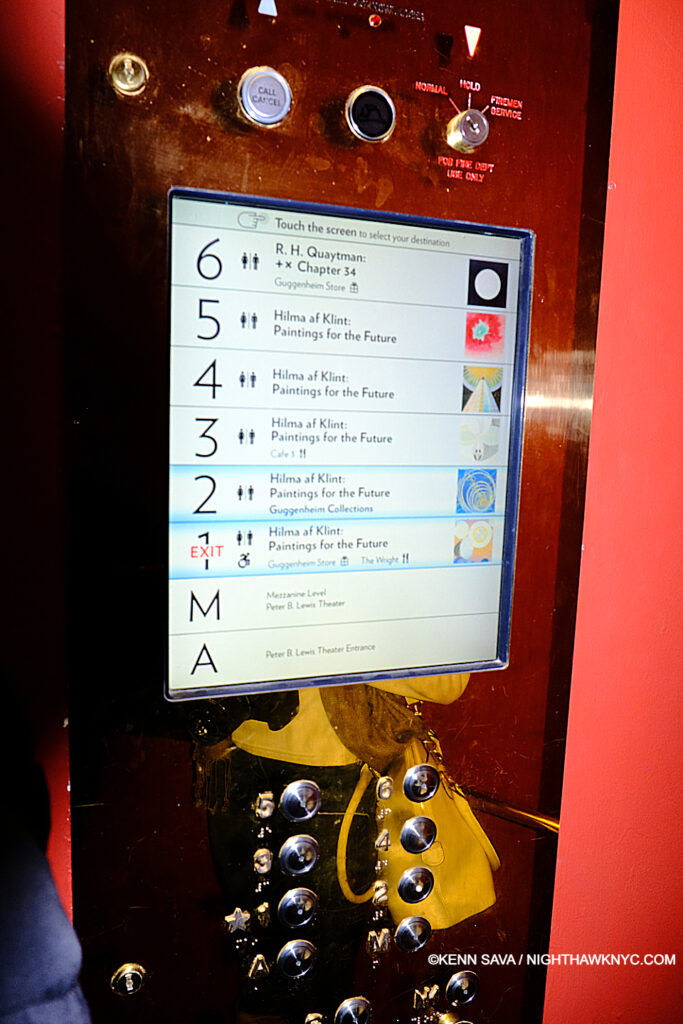
“Beam me up, Frank!” The control panel on Frank Lloyd Wright’s semi-circular Elevator at the Guggenheim. December 31, 2018.

Experiencing Paintings for the Future at Frank Lloyd Wright’s Guggenheim brought home another problematic aspect of experiencing Hilma af Klint’s work today.
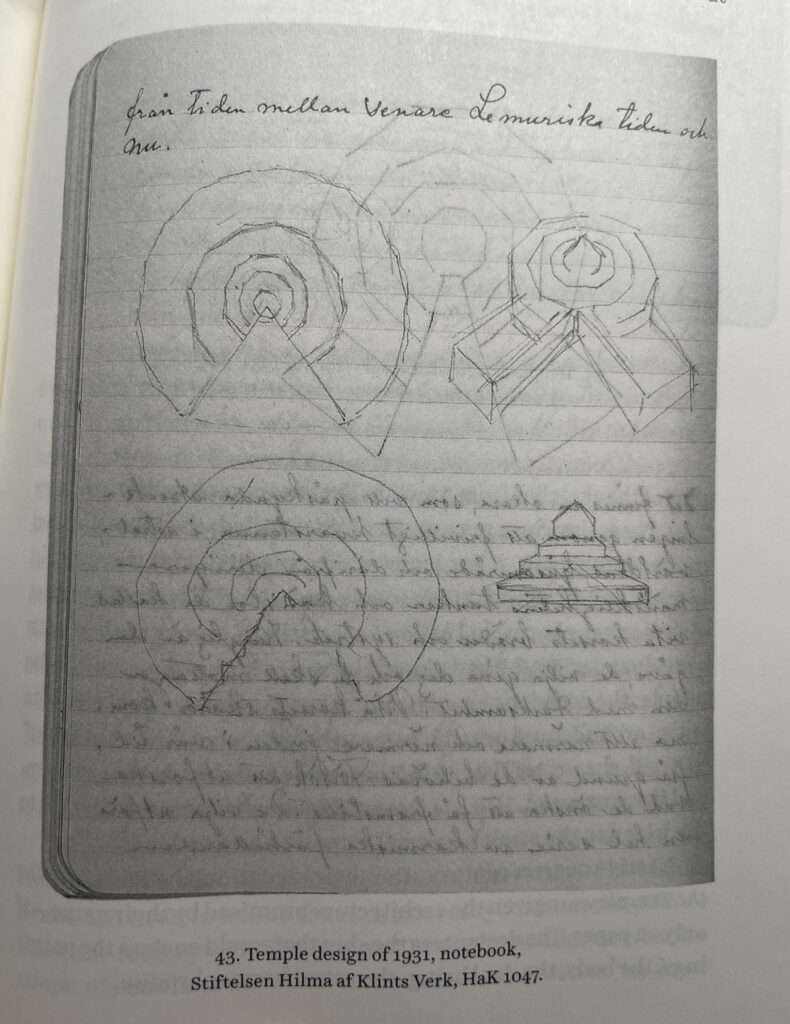
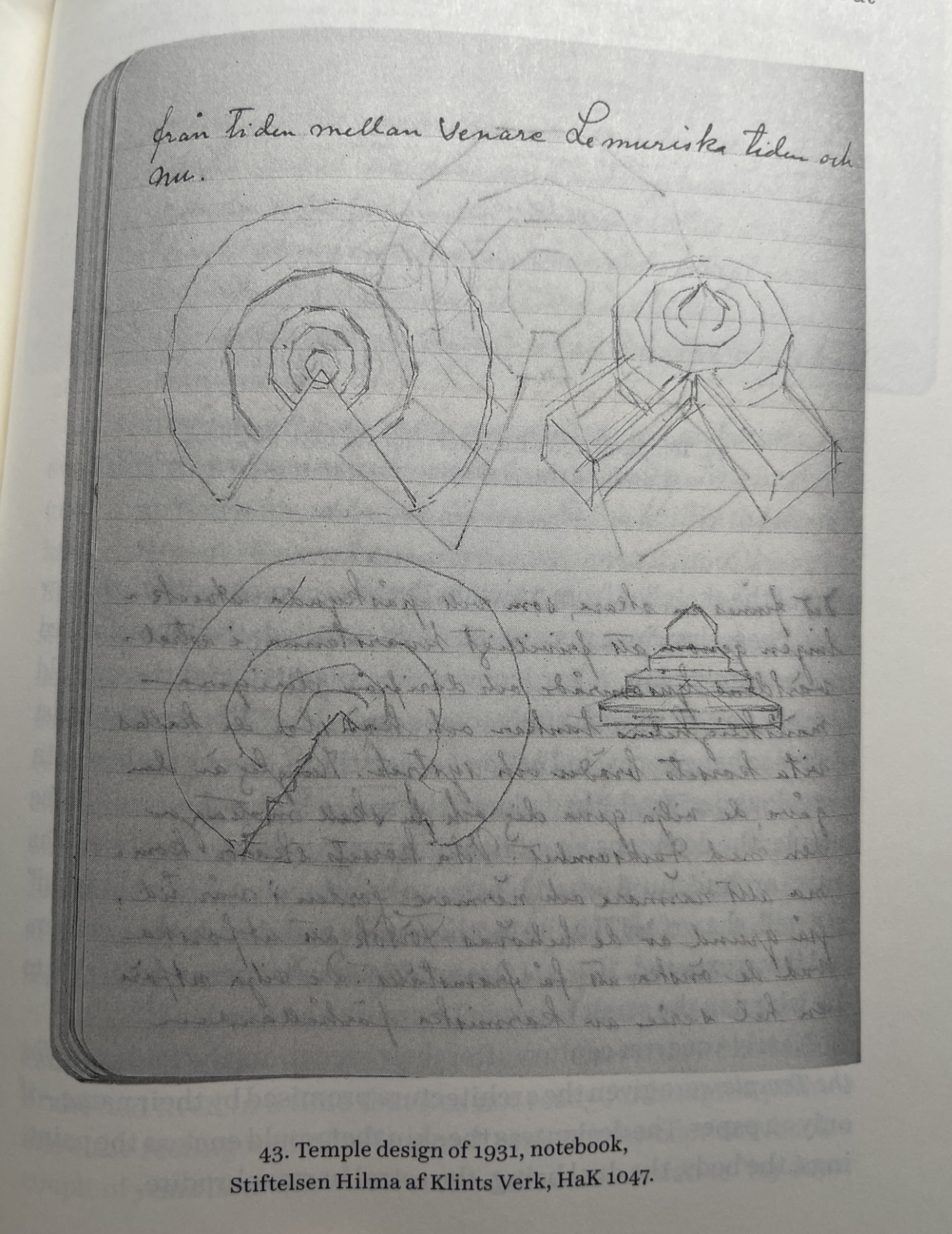
Temple Design, 1931, Notebook in the Hilma af Klint Foundation Collection (*) as seen in Julia Voss, Hilma af Klint.

It turns out that Hilma had not only envisioned that “ideal space” for the display of her work, i.e. a “Temple” as she called it (as in her Paintings for the Temple series), she put some of her ideas for it down on paper.
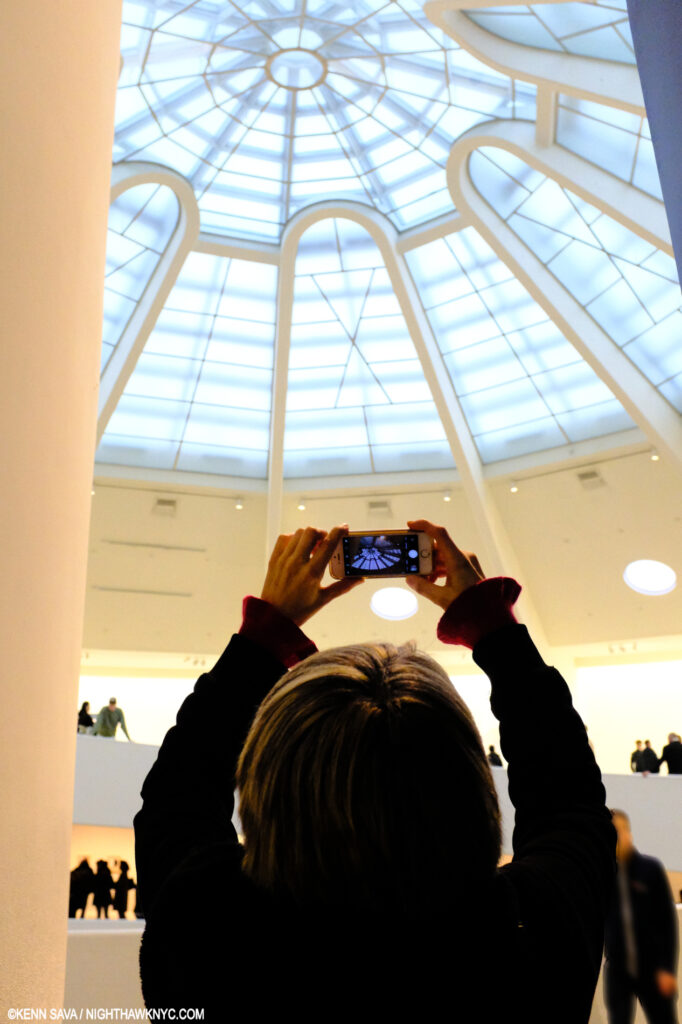
Lana Hattan immediately upon exiting the elevator on the 6th Floor, in both of our favorite buildings, in one of my favorite pictures of her. I thank her for her generosity in allowing me to publish some of the Photos she took that day. December 31, 2018.

Her sketches for it have quite a bit in common with Wright’s masterpiece on 5th Avenue. Both feature circular floors or ramps that rise to a top that opens up to the sky. Also coincidentally, Hilla Rebay, director of the Museum Non-Objective Painting which  preceded the Guggenheim Museum, said she envisioned “people communing with the work in Solomon R. Guggenheim’s collection in a a ‘temple of spirit.6,'” in commissioning Wright to design it.
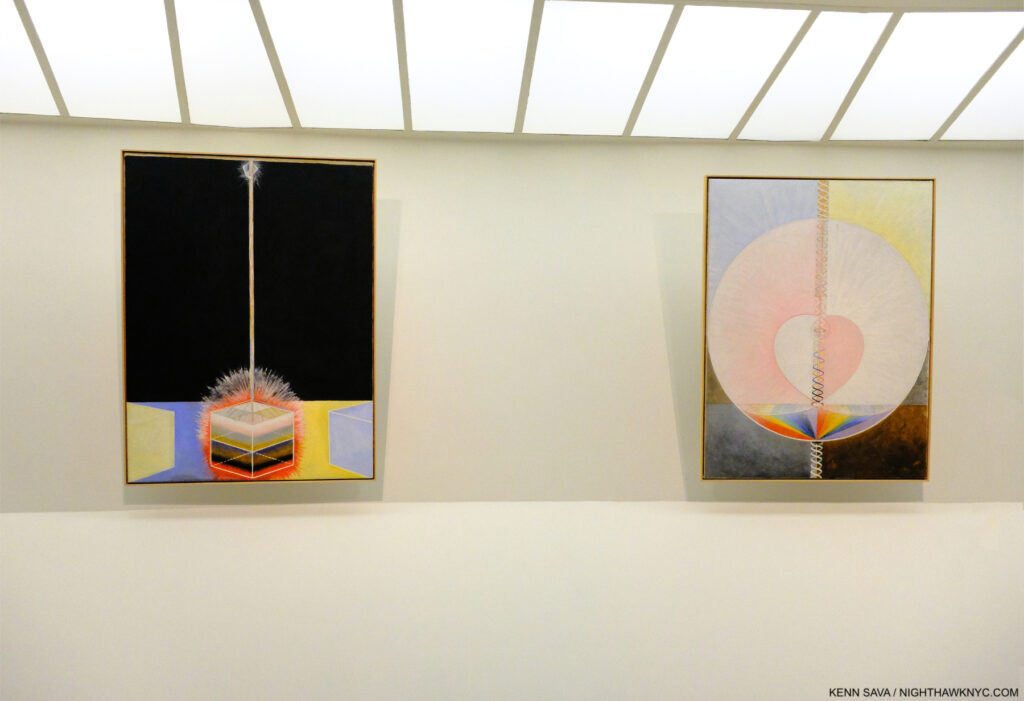
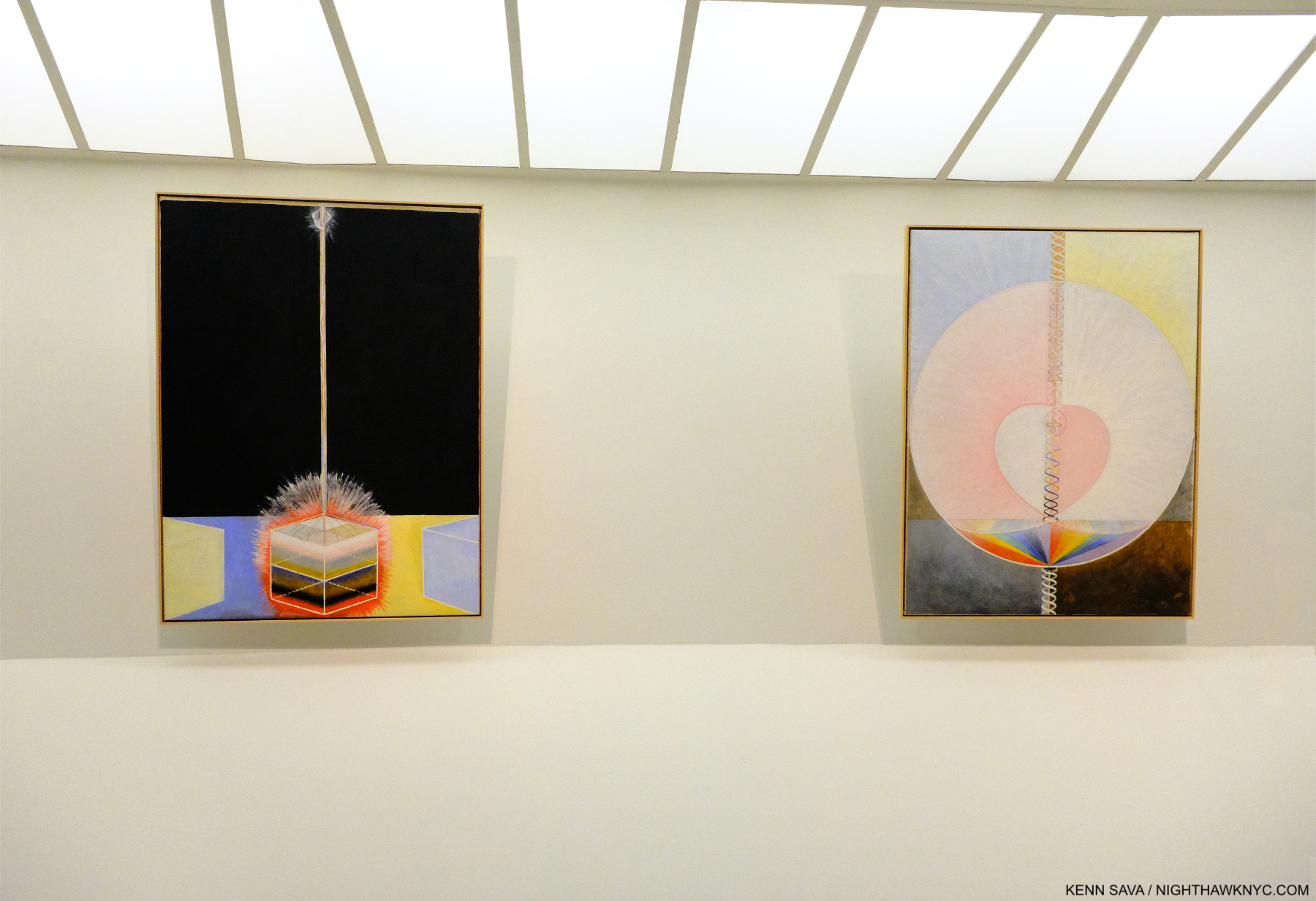
Group IX/UW, The Dove, No. 3, left, Group IX/UW, The Dove, No. 1, right, both from The SUW/UW Series, 1915, Oil on canvas.The work on the right is the original of the work she reproduced by hand in the Blue Book picture shown earlier. Guggenheim Museum, December 31, 2018..

I didn’t know about her Temple, or her Drawings for it, when I saw the Guggenheim show, yet I came away feeling the Architecture added exponentially to the experience of it. At this point, it leaves me feeling her dream should be realized, though that’s not part of the current discussion (as far as I know). Failing to realize the Temple she had envisioned to hold at least part of her work, it remains in a sort of limbo without it.

Of course, today’s Art machine is adamantly opposed to Hilma shows ending, seeing a potentially huge marketing opportunity vanish. Her art being for spiritual seekers, is diametrically different than how the Art world sees it now. Spiritual seeking vs dollar signs- I’ll be interested in seeing which way this one turns out, but I’ll be hoping Mr. af Klint succeeds. (Digression for full disclosure- In case anything I write here makes you wonder, I’m not a religious person. I’ll leave it at that and end the digression.) I’ve always believed the Artist’s intentions for her (or his) work should be respected above all else. As for all those who will bemoan not being able to see her work, consider that for most of the past 30 years Jean-Michel Basquiat has been THE most popular Contemporary Artist in the world, and almost none of his work is in the hands of museums or public collections resulting in a paucity of shows, as I discussed here7. Somehow his popularity has continued to increase without direct access to his work.
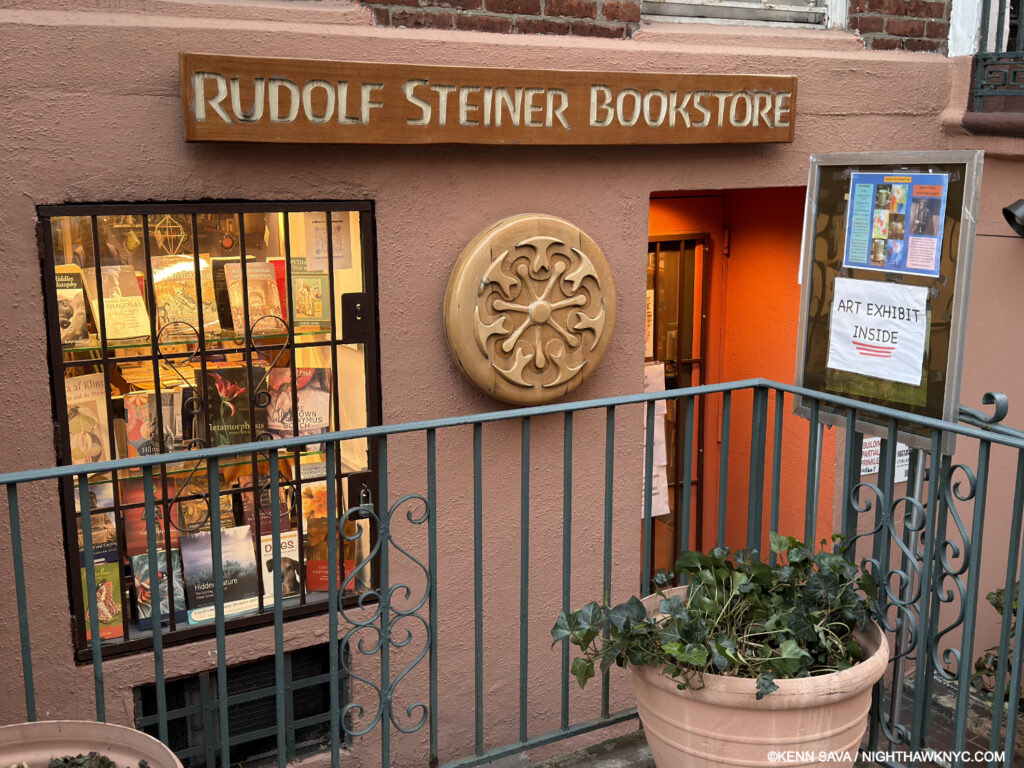
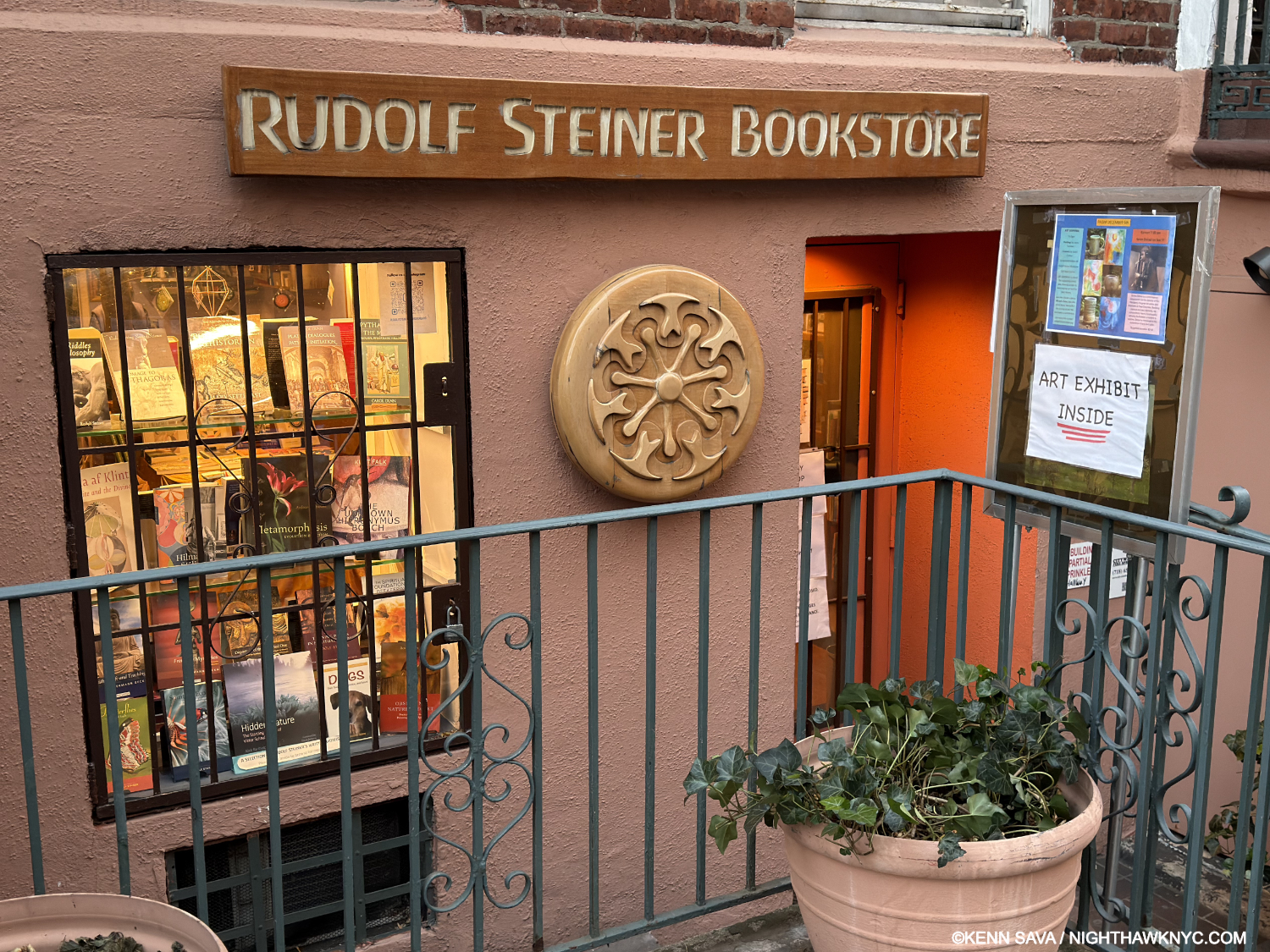
Hilma af Klint books for sale in the window at the Rudolf Steiner Bookstore in Manhattan. A long-time admirer of Mr. Steiner, I think she’d be ok with this. December 11, 2025.

Hilma’s work can be seen by everyone in the excellent seven-volume Catalogue Raisonne her Foundation has published (which I collectively named a NoteWorthy Art Book of the 21st Century), and a number of other books. For those who want to know more about Hilma, Julia Voss’s excellent Hilma af Klint Biography is the current go-to source and a must-read. It reveals an extremely private woman who was solely focused on her spiritual development and her Art to the extent that she wrote virtually NOTHING about herself and her private life in those 26,000 pages she left! But, she did make crystal clear what she was about and what she wanted for her Art.

If Hilma were alive today would she be enamored with the Art world and its machine, an Art world that seems to have no clue how to handle “spiritual Art?” I have my doubts. That future she envisioned in the 1930s still feels like a dream. So, it just might be a good thing if Hilma af Klint shows stop. Some further point in the future may be a better time for her work to be seen & fully appreciated- one without  an Art world in such a hurry to judge it, box it, and associate it solely by the dollar signs it hangs on it.

Wake me up when we get there.

*- Soundtrack for this piece is “Bring My Flowers Now,” by Tanya Tucker, the de facto title track from her 2019 album, While I’m Livin’, which she performs here-

“I know we’re gonna ride again someday…”

NighthawkNYC.com has been entirely self-funded & ad-free for over 10 years, during which over 350 full-length pieces have been published! If you’ve found it worthwhile, PLEASE donate securely by PayPal below to allow me to continue. Thank you, Kenn.

You can also support it by buying Art, Art & Photography books, and Music from my collection! Art & Books may be found here. Music here and here.

Written & photographed by Kenn Sava for nighthawknyc.com unless otherwise credited. To send comments, thoughts, feedback or propositions click here. Click the white box on the upper right for the archives or to search them. Subscribe to be notified of new Posts below. Your information will be used for no other purpose.
  1. The last show we’ve been able to see together.
  2. She would begin Painting flowers in earnest in the mid-1920s.
  3. Ms. Quaytman’s book Spine and her new book, Book, 2025, are on my list of NoteWorthy Art Books of this century.
  4. Julia Voss, Hilma af Klint: A Biography, PP..1,2 & 4. After mentioning I was in the middle of reading it at the time I published my NoteWorthy Art Books of the Century piece, I’ve added A Biography to the list. A marvelous accomplishment with a terrific translation from the original German, it’s essential reading for anyone interested in HaK.
  5. I’m still a bit puzzled by Nature Studies’ Provenance. MoMA’s site says they bought it, but from whom and how that owner came to own it is unspecified. How it didn’t wind up in, or being acquired by, her Foundation puzzles me. I tried to find out, but received no answers.
  6. Here.
  7. By the way, I have managed to cover almost every single NYC Basquiat show these past 10 years, so you can see a good deal of his work here.

Celebrating Ten Years of NighthawkNYC.com!

Written & Photographed by Kenn Sava.

I started NighthawkNYC.com on July 15, 2015. During almost all of these past 10 years, the thought of reaching the Milestone of Ten Years was something that seemed as far away as Mars. Long-term isolation, sudden fainting spells that hospitalized me, heart problems, hearing damage, foot problems, the specter of going broke, and oh yeah, that little thing called the pandemic, the 2020s have been hard for me, as they have been for many of you, I’m sure.

So, as I sit here at 6:30 am on July 15, 2025, I’m partially here to see & celebrate this day I didn’t think I’d actually get this site to arrive. As the improbable started to become a real possibility it dawned on me that I HAD to write something to honor getting to this point, and ALL the work that has gone into getting it here, even though I’m supposed to be taking a break (which didn’t stop me from writing the two biggest pieces I’ve ever written!). My one-time neighbor, Joni Mitchell, from decades before my time here, says it best about being here this morning in her circa-1969 song “Chelsea Morning.” (We’ll keep it between us that I haven’t been to bed yet!)

“Woke up, it was a Chelsea morning
And the first thing that I heard
Was a song outside my window
And the traffic wrote the words”-*

Since Joni hasn’t shared how to get the traffic to write my words, I decided to use this occasion to reflect on where I’ve been, where I am, and to try and look a bit ahead.

Part 1-
A)- Where I’ve Been
Some Highlights, in my opinion anyway, from the past 10 Years…

“Oh, won’t you stay
We’ll put on the day
And we’ll wear it ’till the night comes.”-*

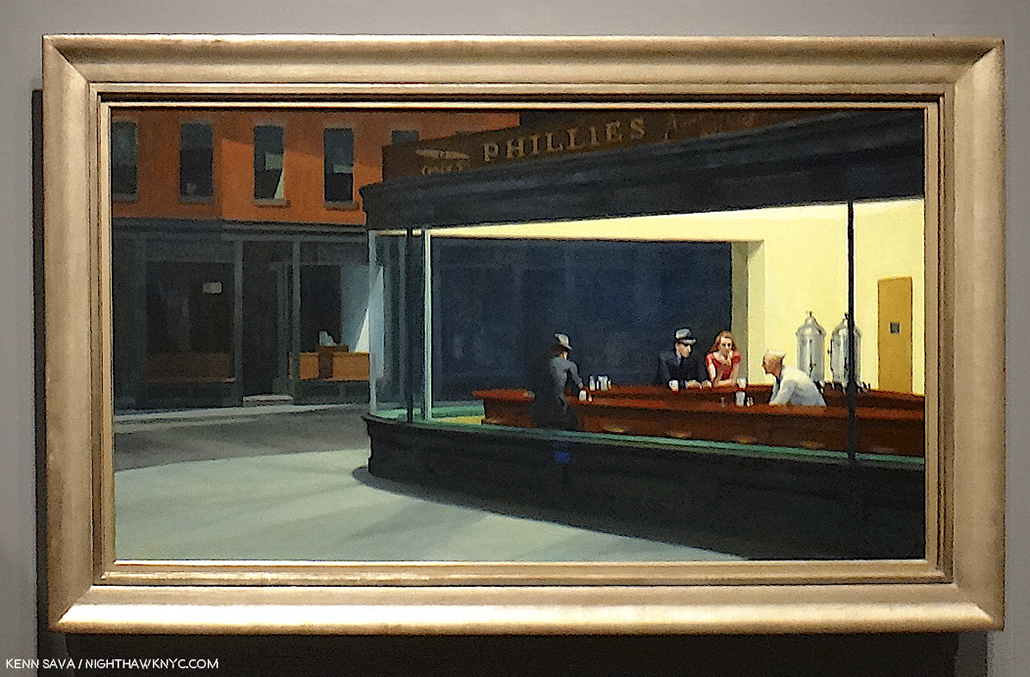
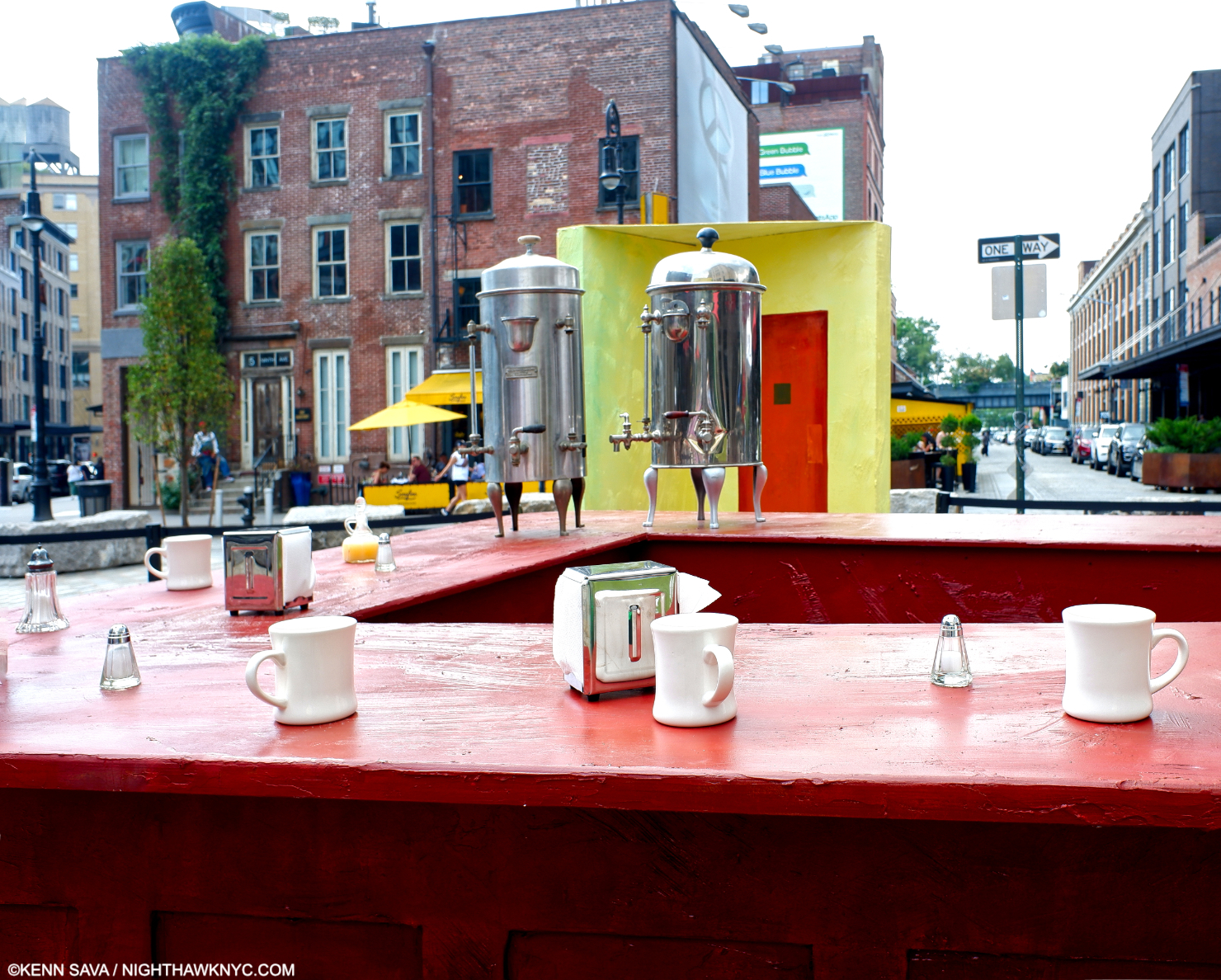
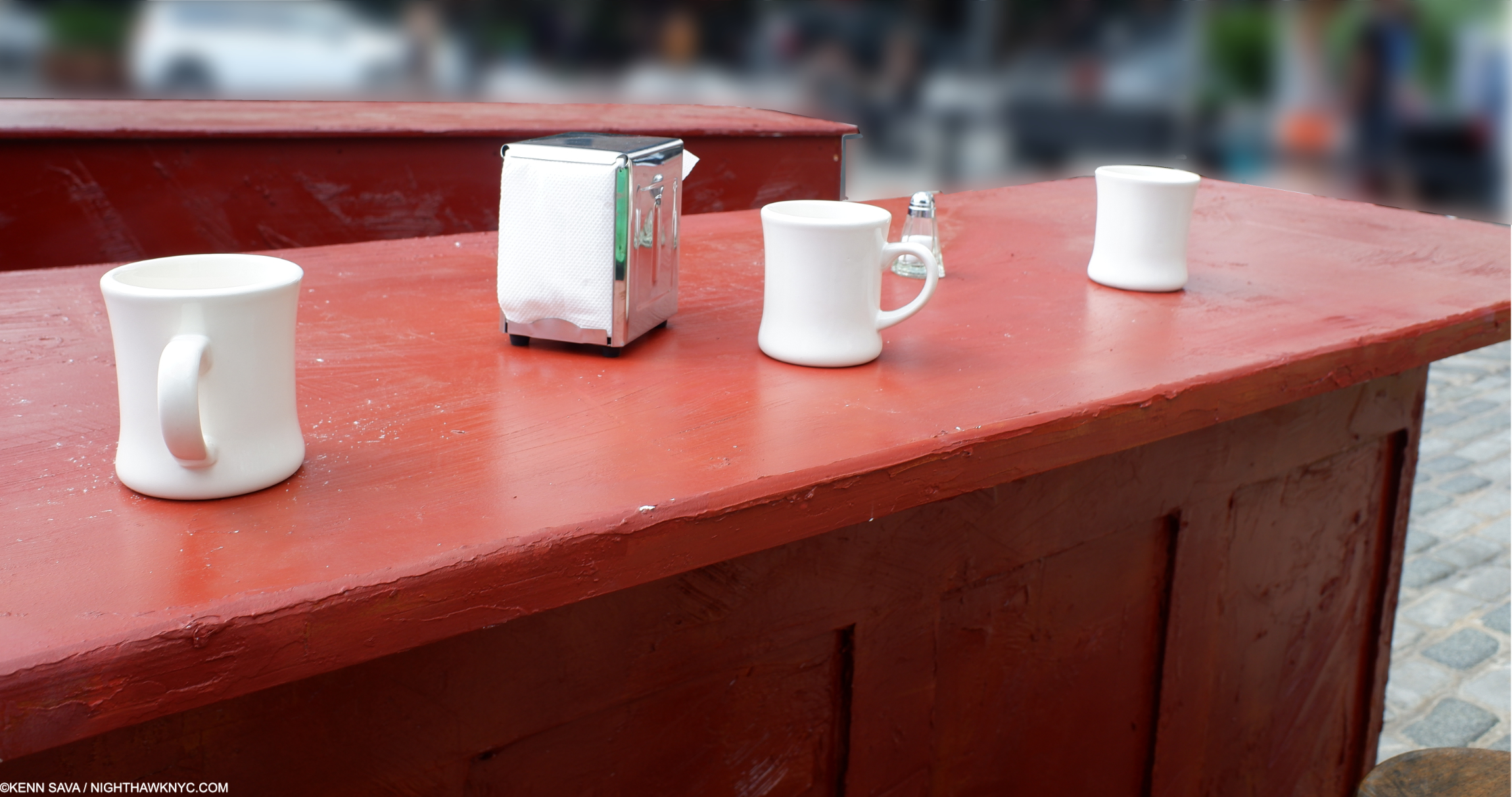
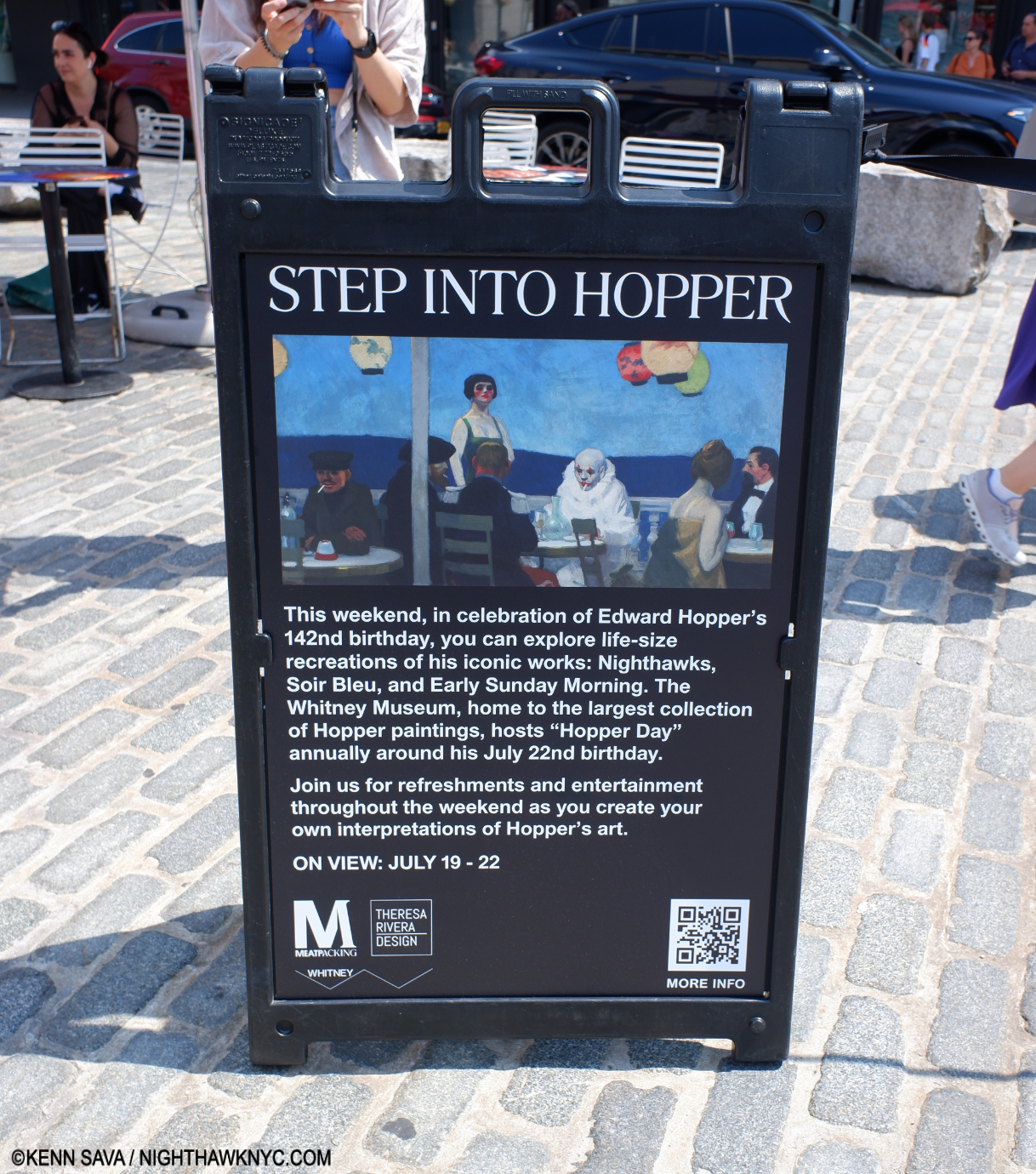
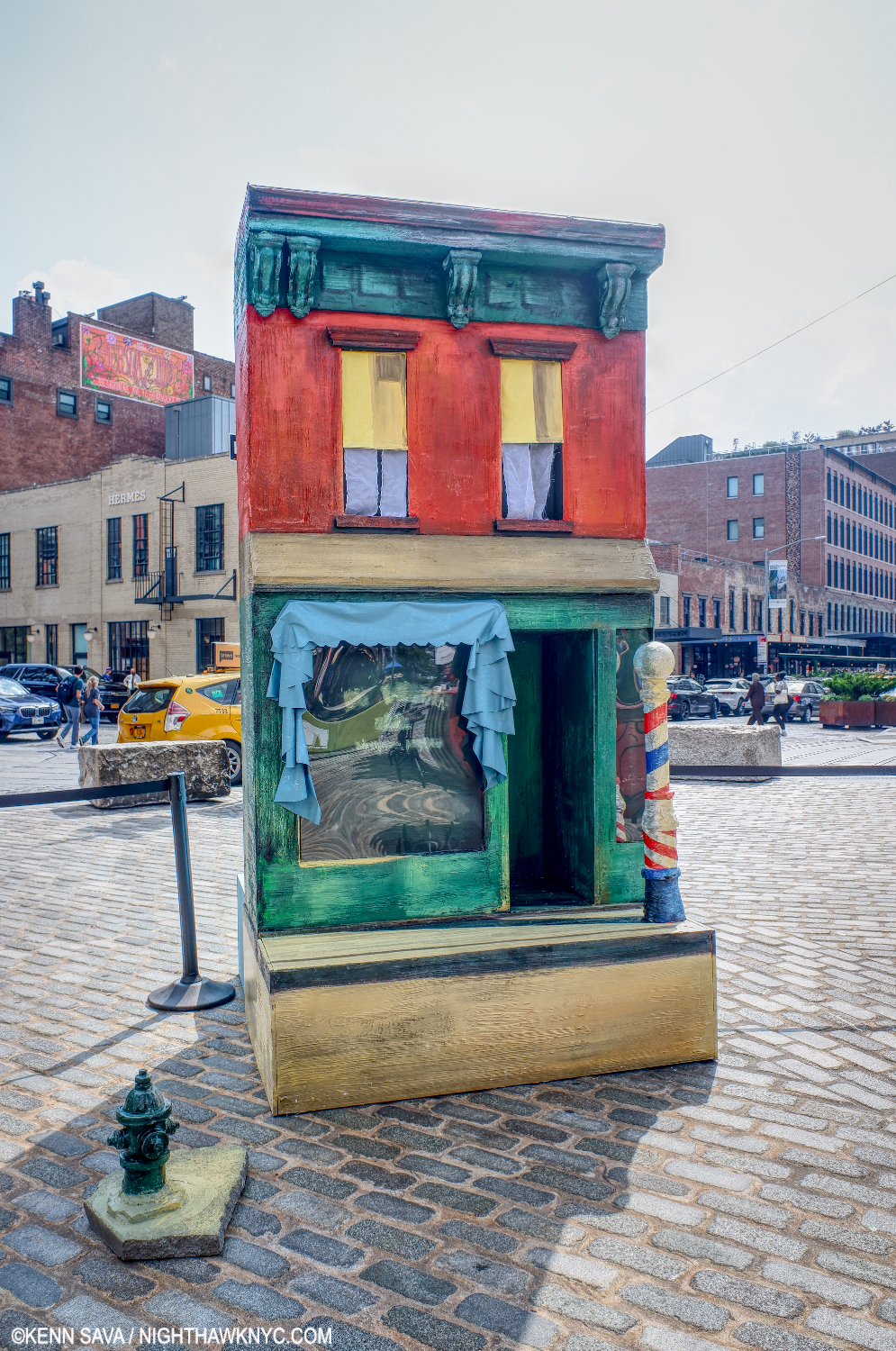
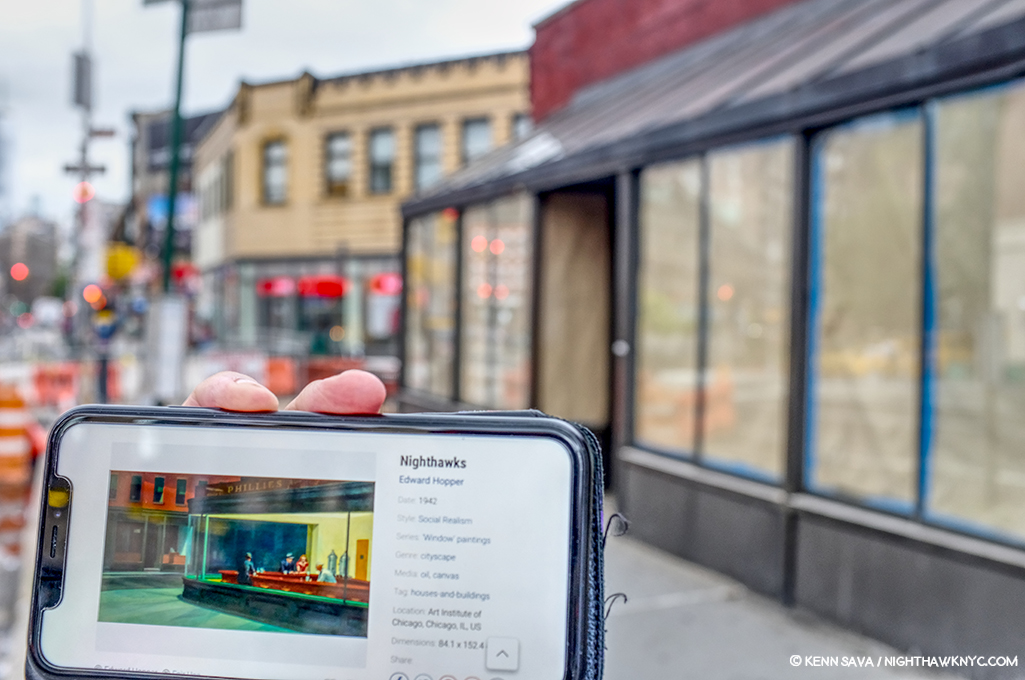
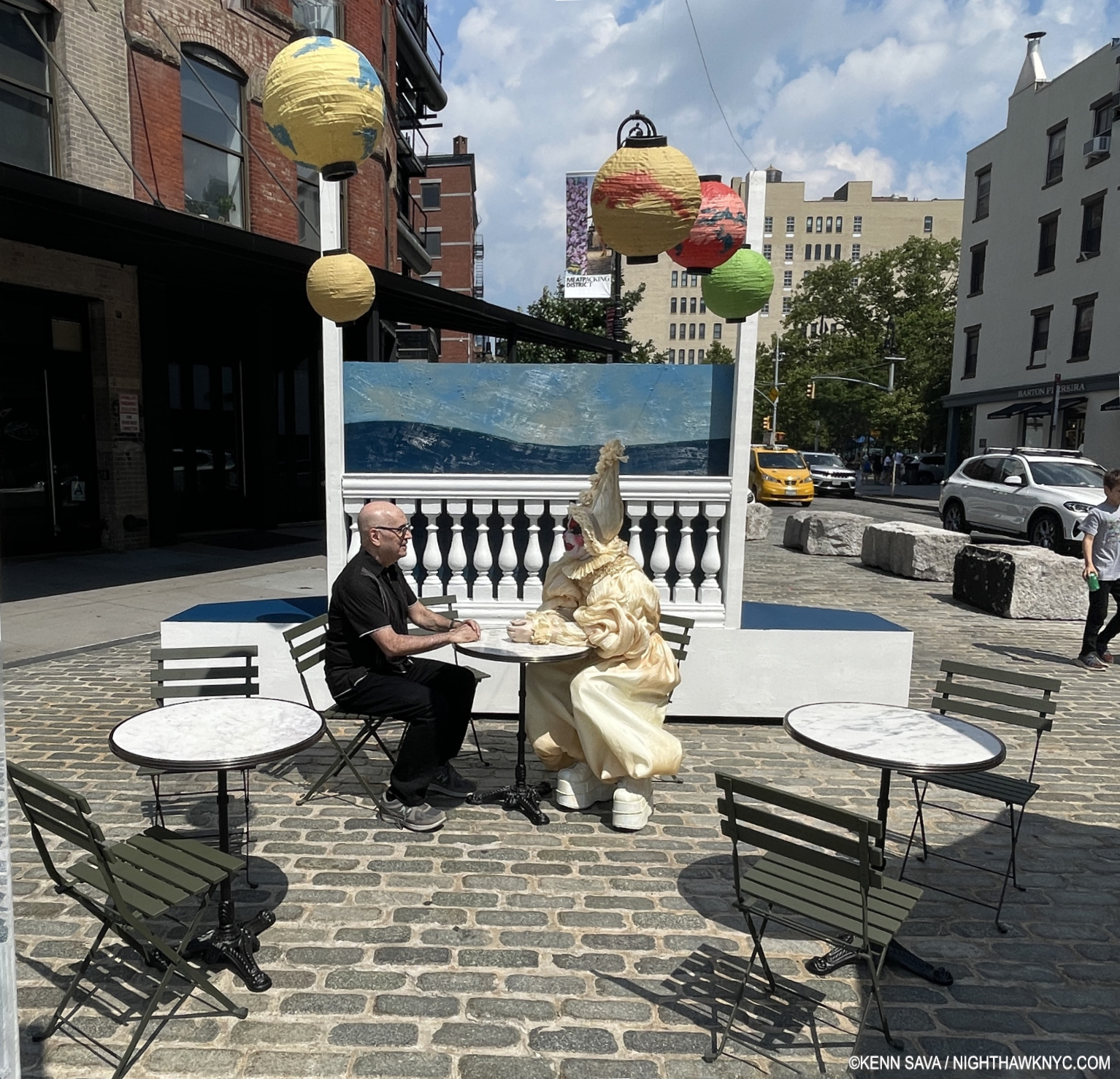
1)- “My Search For Edward Hopper’s Nighthawks Diner,” published July 29, 2019.  Decades in the making, it’s hands-down my most read, most discussed piece.

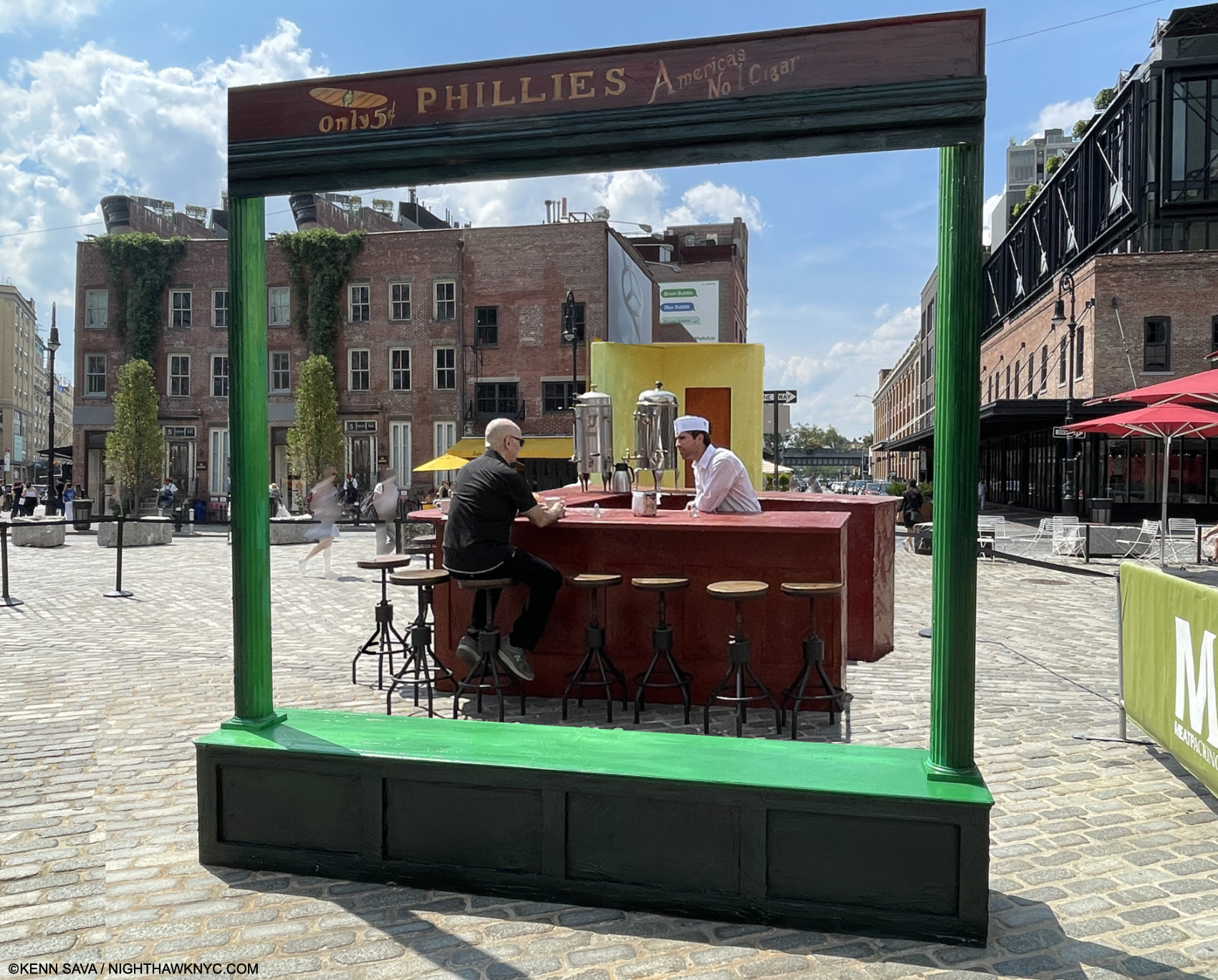
Update- On July 21, 2024, I finally found it! Meatpacking District, NYC. Kenn Sava, left, reenacting his Painted alter-ego, Logan, right. Photo by Nilo for NighthawkNYC.com. Continual Thanks to all involved & Kevin Callahan. Click any image for full size.

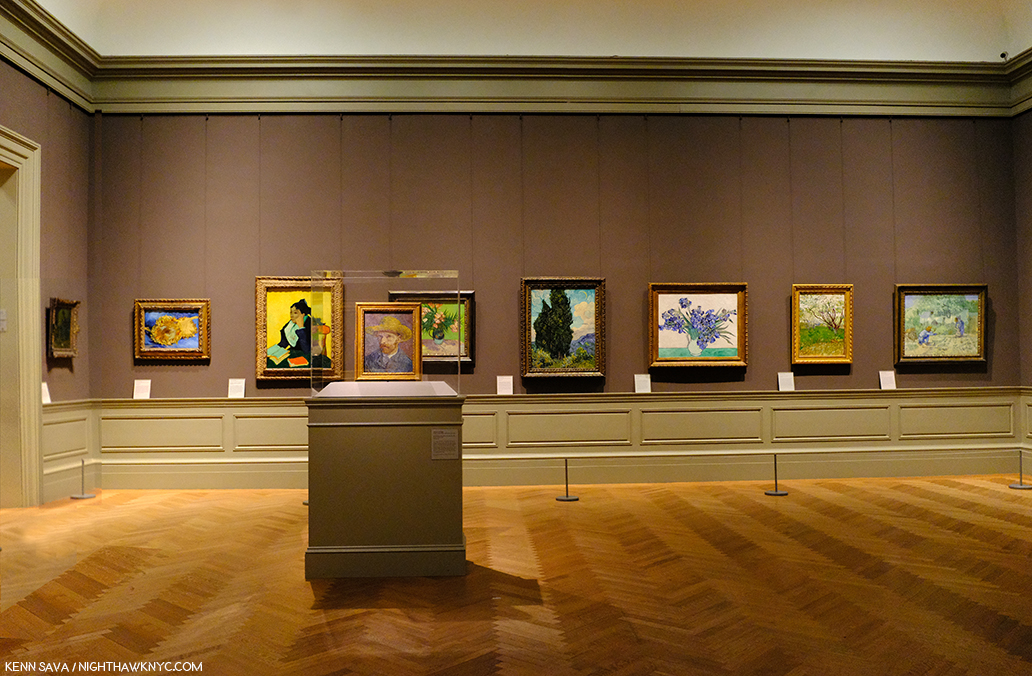
2)- “Vincent van Gogh: Home at Last,” published October 8, 2018. Preparing this piece on the reinstalled Van Gogh Masterpieces in the Permanent Collection of The Met suddenly took on an unexpected life of its own.

HOW great is it to be able to walk into a room and see THIS? For me, it’s one of the great joys of life in NYC. One part of the newly reinstalled Gallery 825 showing 9 of the 10 Van Goghs in this room. #10 is on the other side of the Self-Portrait with Straw Hat in the vitrine. This shot was available for literally one second over 3 visits and 3 hours I spent here. In the piece, you’ll see why.

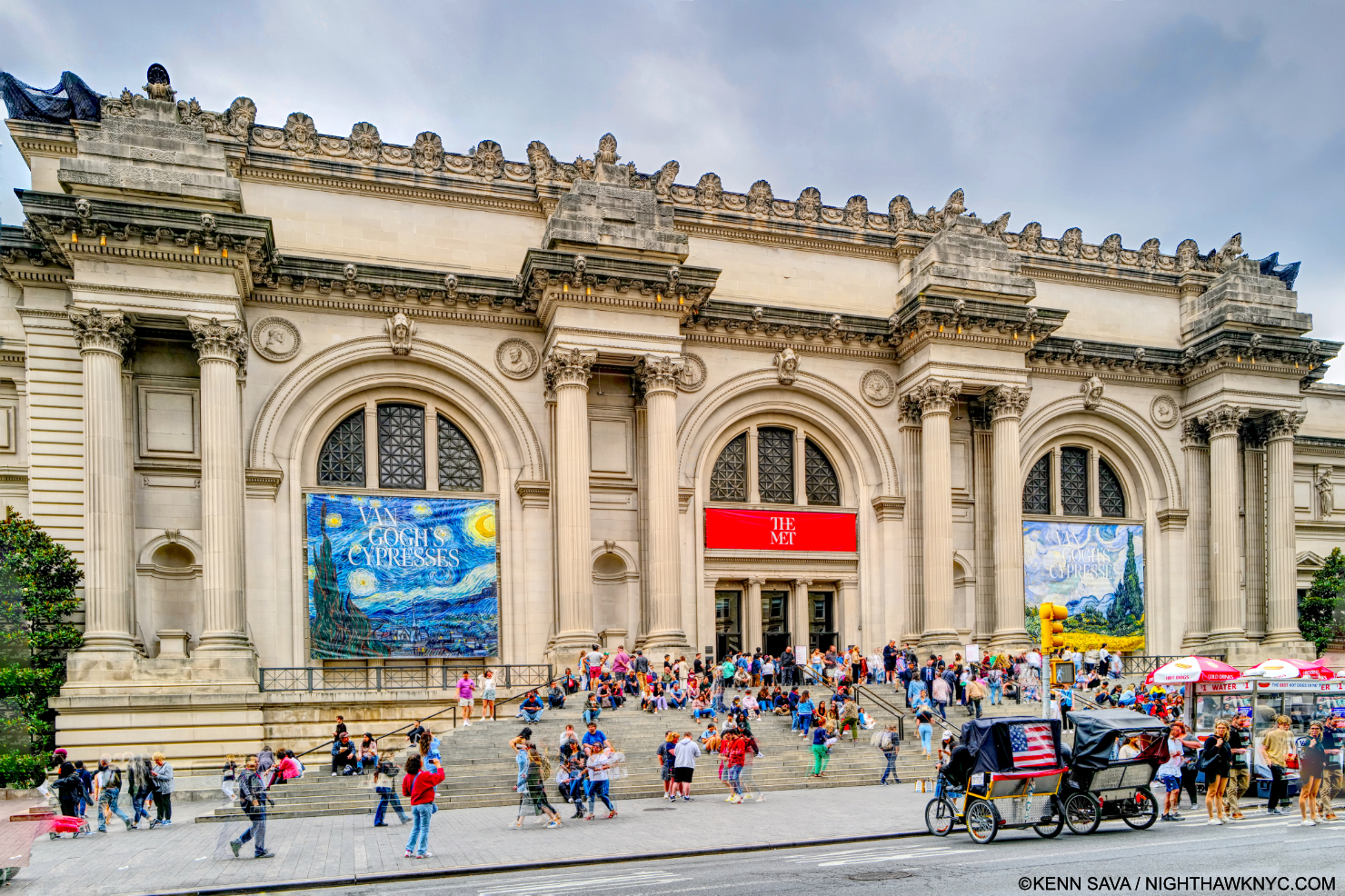
3)- “Van Gogh’s Cypresses: Art From Hell,” published November 10, 2023. With all due respect to The Met’s great curators, I saw their blockbuster Van Gogh’s Cypresses completely differently than they did, apparently.

Welcome to The Met! In all my years of going to The Museum, as I call it currently 1,900+ visits since 2002, I’ve never seen TWO banners (left & right) up devoted to the same show. And, as I was soon to find out, it’s not like there weren’t other terrific shows going on! Seen on June 2, 2023.

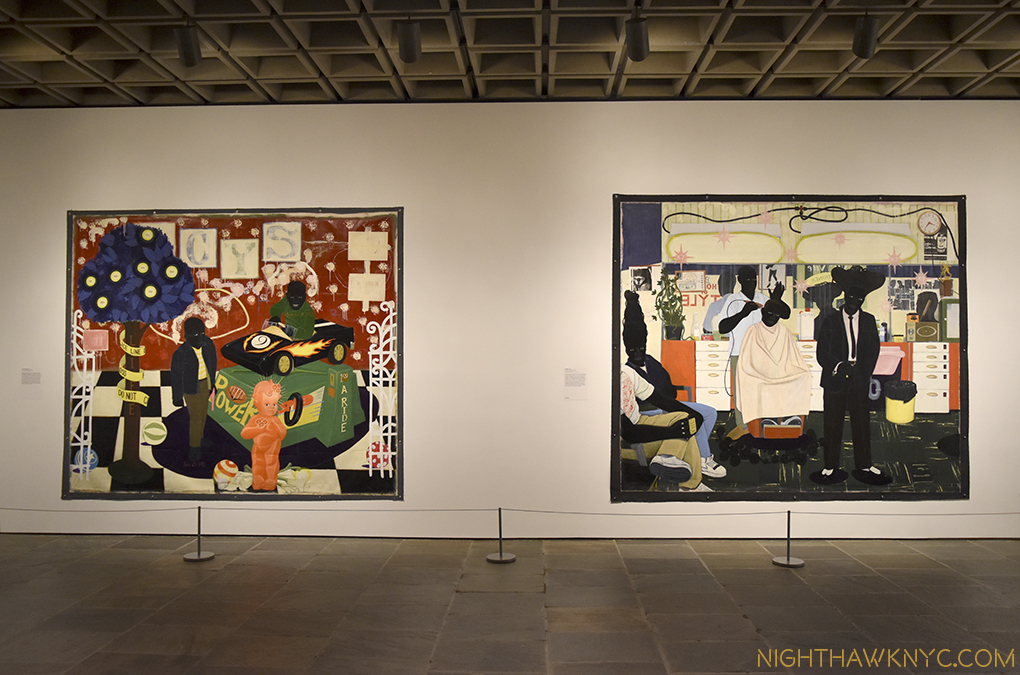
4)- “Kerry James Marshall: The Revolution Was NOT Televised,” published March 1, 2017. THE most everything Painting show I saw in NYC in the 2010s. Along with Hima af Klint: Paintings for the Future, the two most important Painting shows mounted here in the prior decade.

The finest moment, among many fine moments, in the all-too-short life of The Met Breuer. Installation view of Kerry James Marshall: Mastry. “De Style,” 1993, KJM’s barbershop, right, drips of life, fun, culture, individuality and style. On the left, his “The Lost Boys,” from the same year, a title borrowed from Peter Pan, is an homage to two children lost to gun violence, and all the boys who were “lost” to a variety of causes.

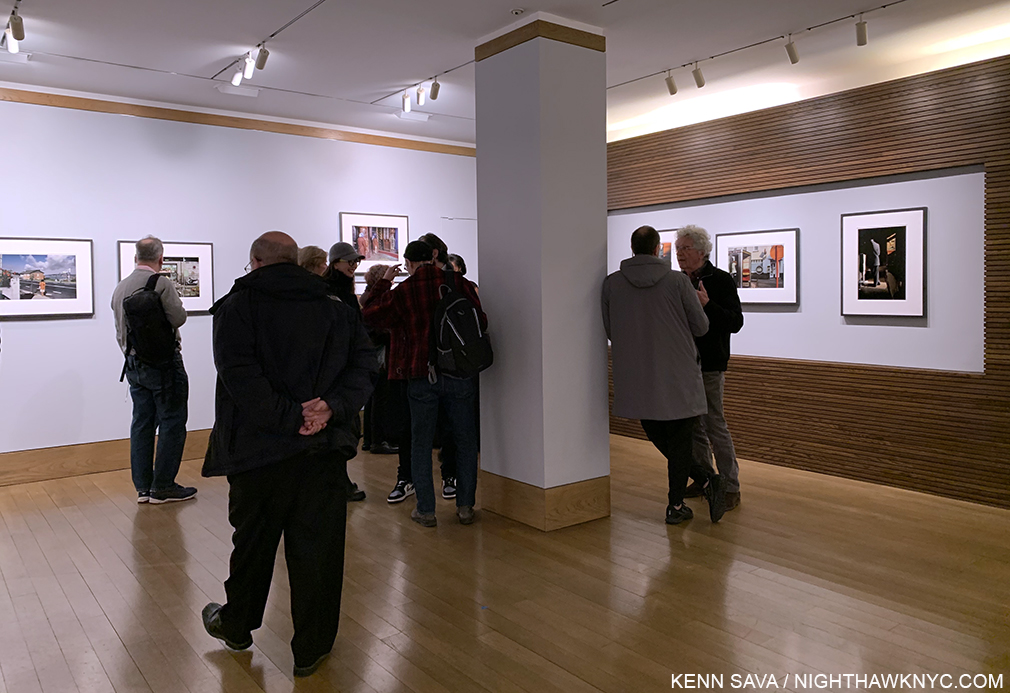
5)- “A Conversation with Photographer Harry Gruyaert,” Published September 22, 2018. Consistently among my most popular pieces, the renowned Belgian Photographer, and long-time Magnum Photos Member, discovered me through my “Saul Leiter: In My Room” piece and let his gallerist know he would be interested in speaking with me. A fan of his work, we spoke extensively via transatlantic phone. I discovered later how few interviews he has given.

Subsequently, I met Harry Gruyaert, far right, in 2020 at the opening of his first American show since 1990!

6)- “Rod Penner’s America: Small Town Nation,” published August 22, 2023. This piece, based on his most recent NYC show which continued to solidify Mr. Penner as one of the foremost Painters of small-town America working today, continued my coverage of the Texas-based Artist’s NYC shows, with my prior pieces linked at the bottom of it. At one point, I had written more about Rod Penner than anyone else had. Maybe I still have. Rod was also kind enough to do a Q&A with me in 2017.

HOW does he do it? Rod Penner discussing one the very, very fine points of his Yellow Light/Brenham, TX, 2004-5, 15 x 25 inches, at his opening, March 18, 2023.

7)- “Henry Taylor: The Art of Empathy,” published March 8, 2024. Born of my unforgettable encounter with Mr. Taylor at the opening of his 2019 solo show.

Installation view, an hour and a half before Henry Taylor: B Side closed for the last time, Whitney Museum, January 28, 2024.

7)- “Gregory Halpern’s America,” published November 8, 2019. Perhaps my biggest discovery during my 8 3/4-year “deep dive” into Modern & Contemporary Photography, my look at all of Mr. Halpern’s books through Omaha Sketchbook (2019), includes a look at its NYC book release in 2019, later the same night of my encounter with Henry Taylor!

The very first work I saw by Gregory Halpern, “Untitled,” from his Buffalo series, seen at Aperture’s Booth at AIPAD: The Photography Show, April, 2017, I liked so much it’s been hanging on my wall since.

8)- “Raymond Pettibon: Artist Americanus,” published July 20, 2017. I was very fortunate to meet Mr. Pettibon and have him give me a tour of his Zwirner show, which I was thrilled about but also felt bad about because he was suffering from a quite damaged foot that caused him to sit the entire rest of the time he was at his opening. The show was also memorable as during its run I met Artist Caslon Bevington, whose work I’ve subsequently written about twice.

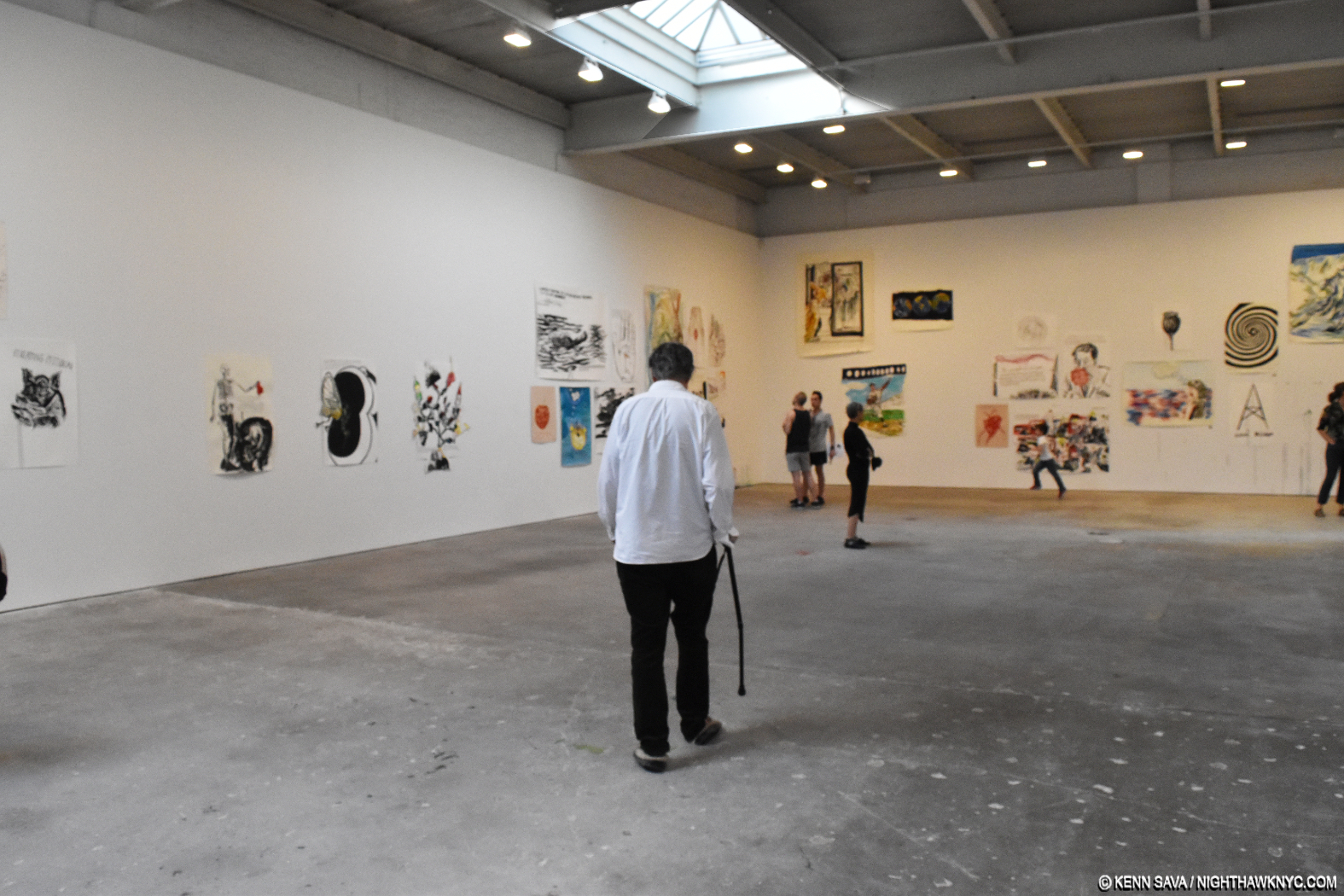
Playin’ hurt. The great Raymond Pettibon enters his show at the opening, April 29, 2017, with a cane. That small figure running in the distance is his son, Bo. Zwrner lent Raymond this space which he used to created the work you see on display. Quite a few paint splotches were to be found on the floor, leading me to think it must have been something to watch him creating these pieces.

9)- “Table for One: Patti Smith’s 18 Stations,” published April 17, 2016. I made about a dozen trips to Patti’s extraordinary Photography show and was shocked to walk in on the show’s last day to find the legend, herself, seated at the famous table she sits at on the cover of M Train signing books alone. She looked up, and realizing I was about to take her picture, cooperated. I then spoke with her, and wound up meeting her daughter as well. As the show closed, I found myself in the gallery with her as she walked through it one last time, trying to imagne what was going through her mind at each stop. I eternally regret not buying one of her Photographs. One of the Top 5 most-read and most-discussed pieces I’ve written.

What becomes a Legend most? The one and only Patti Smith sits at her famous table.

B)- “Community Service”
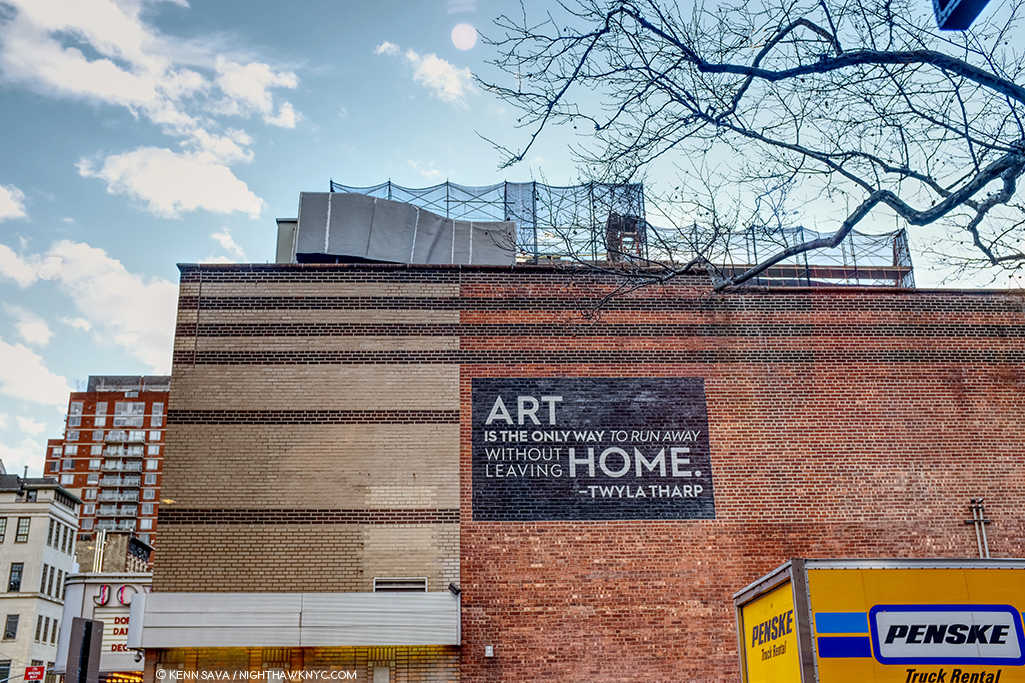
1)- “Art” With a Capital “A,” published February 26, 2020. I should have written it sooner.

Thanks, Twyla! I couldn’t have said it better. And so, this scene has appeared in my Banner, sans moving truck, a number of times over the years. A look at ALL 41 of my banners this past decade is here. The Joyce Theater, December, 2019, as seen continually staring me in the face from my favorite seat in my beloved Starbucks on West 19th Street, the best SB in NYC. Another loss during the pandemic.

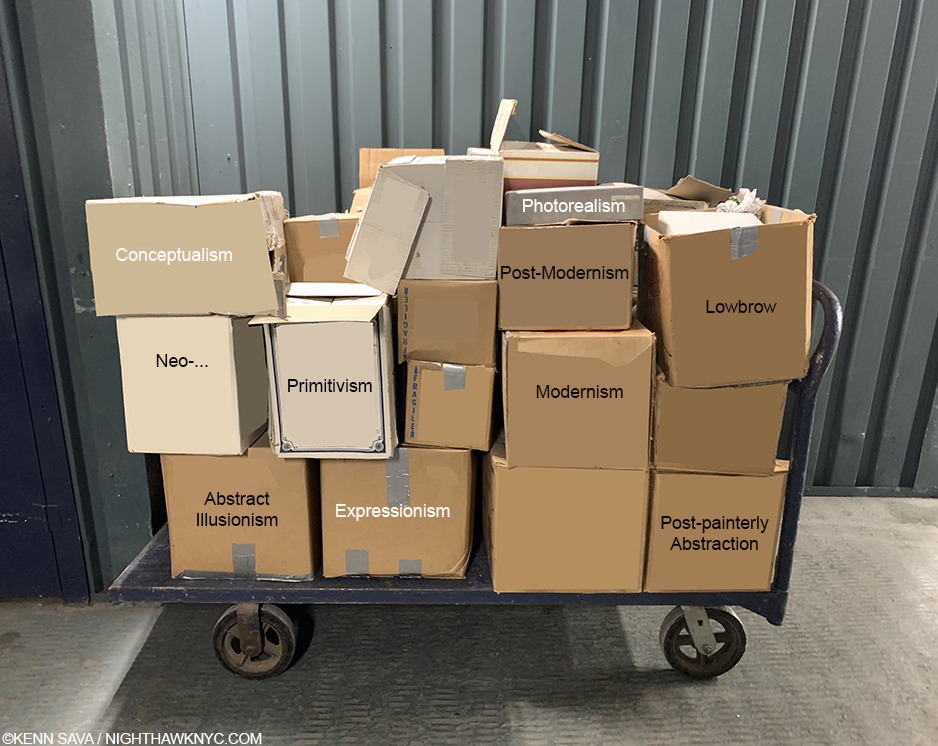
2)- “Death to Boxes!,” published on April 7, 2020. Another I should have written sooner. The problem has only gotten worse.

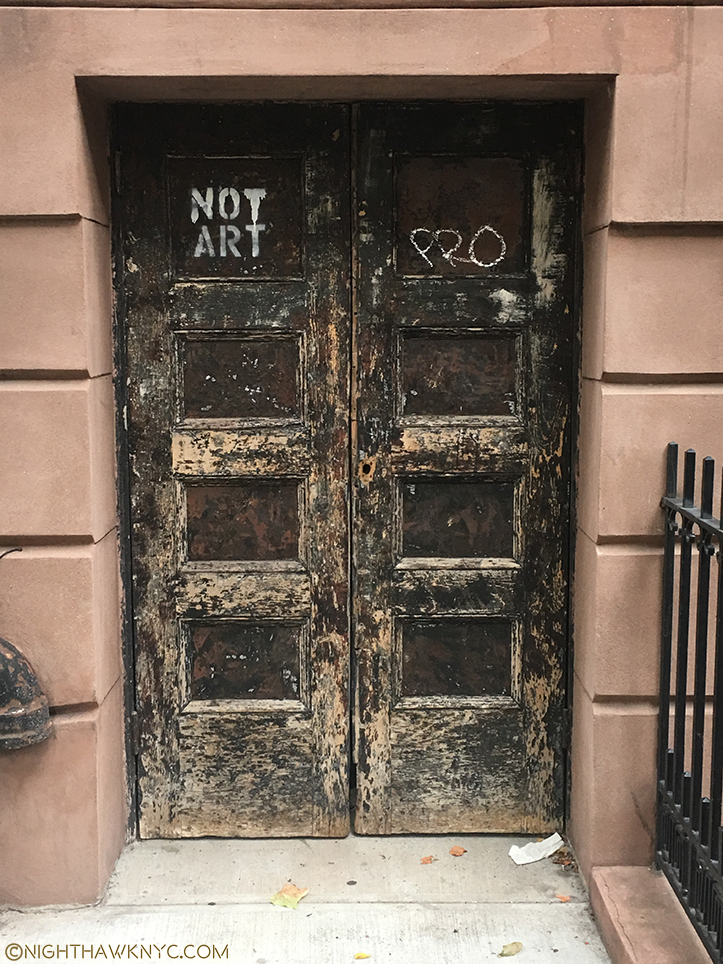
3)- “On Buying Art,” published on July 11, 2017. One I did write early on.

Knowing what not to buy is rarely THIS obvious.

C)- Milestones

“Oh, won’t you stay
We’ll put on the day
There’s a sun show every second”-*

1)- “Welcome to the Night,” published July 15, 2015. My very first piece!

The last time I stood in front of Nighthawks, with my Painted alter-ego, dead center. August 28, 2013, at Hopper Drawing at the old Whitney Museum. Fun fact– I “borrowed” its frame for the frame you see in my banner! Shhhh…Don’t tell anyone.

2)- “Cancer Saved My Life,” published February 7, 2017, on the 10th Anniversary of my cancer treatment. My passion to share what I’ve seen & learned in the Art world comes from surviving with a 20% chance of making it through Year 1 post-treatment without needing more treatment. I’m happy to say 8 Anniversaries have followed- 18 in all! Miraculous.

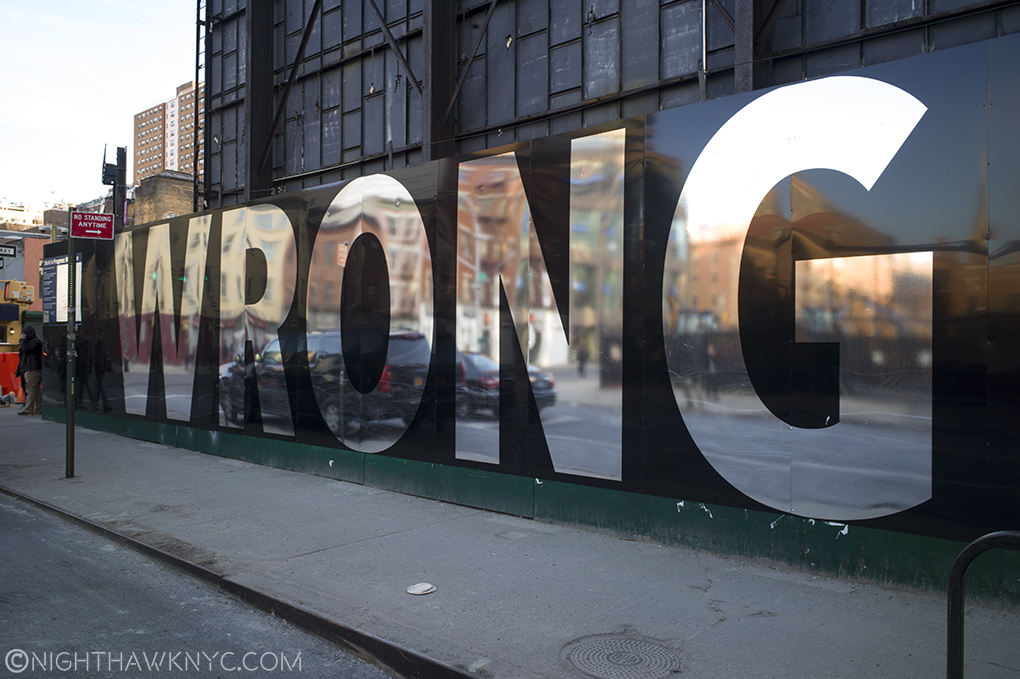
Every cancer patient’s worst nightmare. During my search for cancer treatment, after much research and agonizing, I settled on a treatment. My life was saved by a Doctor who patiently explained why it was the wrong choice for me moments before I was to begin it. Unfortunately, there wasn’t a sign this big to guide me.

3)- “Kenn Sava Named a Finalist…,” published November 25, 2023. I was, and am, honored to be named a Finalist for the 2023 Andy Warhol Foundation Arts Writers Award out of the 500 writers they said they considered.

D)- Journeys
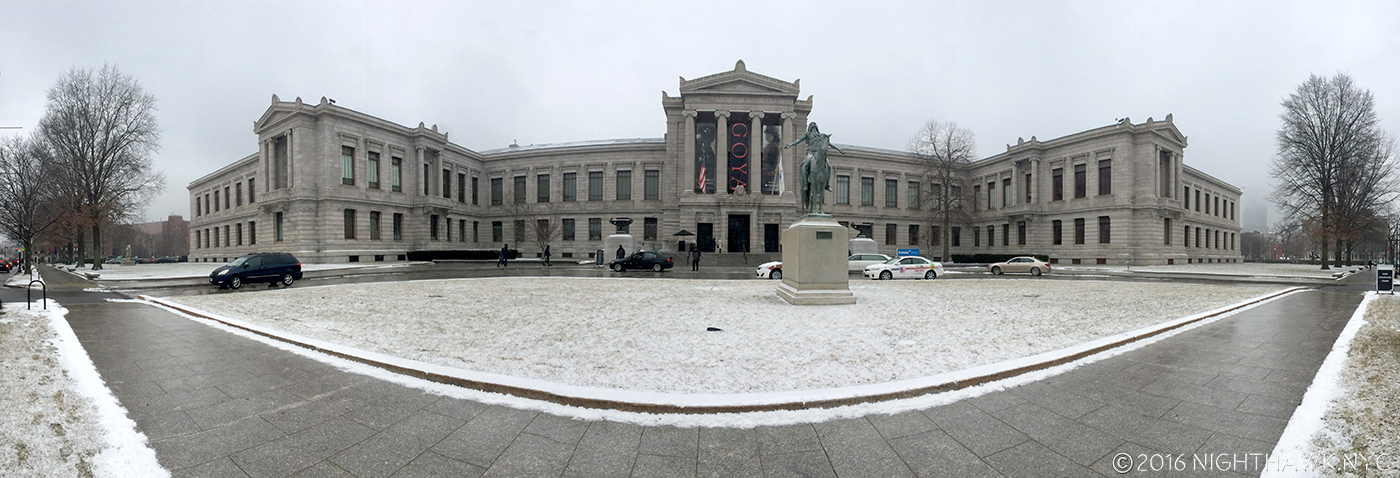
1)- Goya: In Boston & NYC, published January 20, 2016. In January, 2015, I made a day trip to the Museum of Fine Arts, Boston to see their exceptional Goya: Order and Disorder show. A few months later, I saw a show of his complete Los Caprichos at the National Arts Club, here.

The Museum of Fine Arts, Boston in January, 2015, the last time I went out of town to see an Art show. Of course, I was back in my own bed that night.

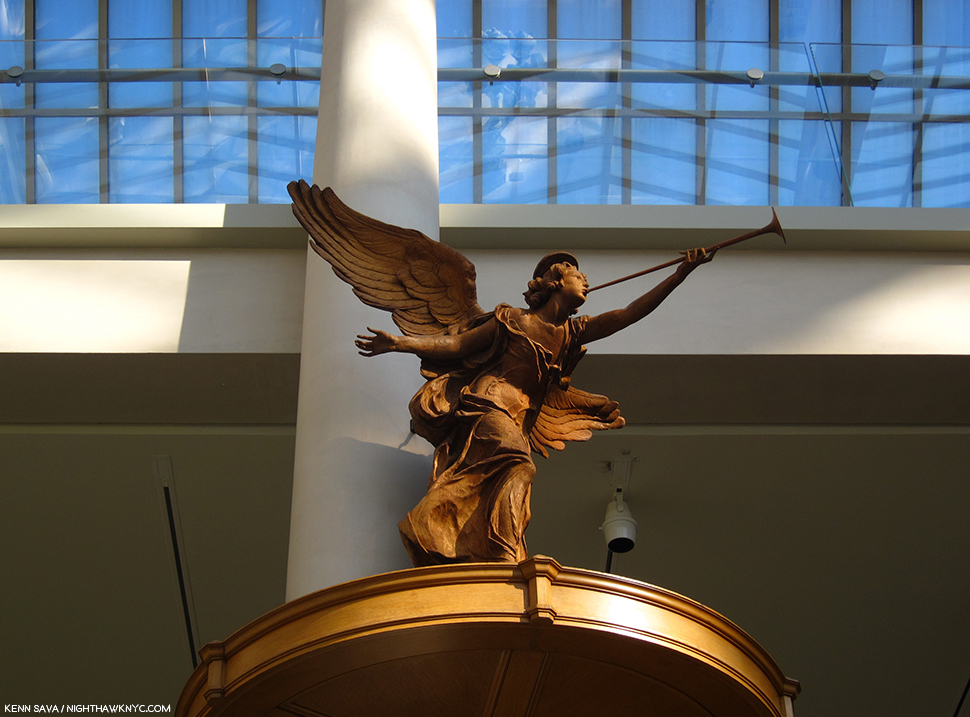
2)- “13 Year At The Metropolitan Museum,” a 2-part series, the first part published on July 26, 2015. Though I’m in Manhattan, The Met is not exactly nearby. Nonetheless, I’ve managed to get there over 1,900 times since August 1, 2002. Some thoughts on it from 2015.

Hark! A Met Angel Beckons me to the Light. To not hear her call is my loss.

3)- “The Met Breuer: Hail, and Farewell,” published on August 1, 2020. I was there on March 8, 2016,  the first Member’s Preview Day, and I was there the moment it closed for the final time on March 12, 2020. In between, I saw more great shows there than anywhere else, largely due to The Met’s terrific Contemporary Chairperson, Sheena Wagstaff, who I’ve also written about at length more than once.

March 12, 2020. I’m about to enter The Met Breuer for what I didn’t know would turn out to be the last time, on what would turn out to be its last day ever.

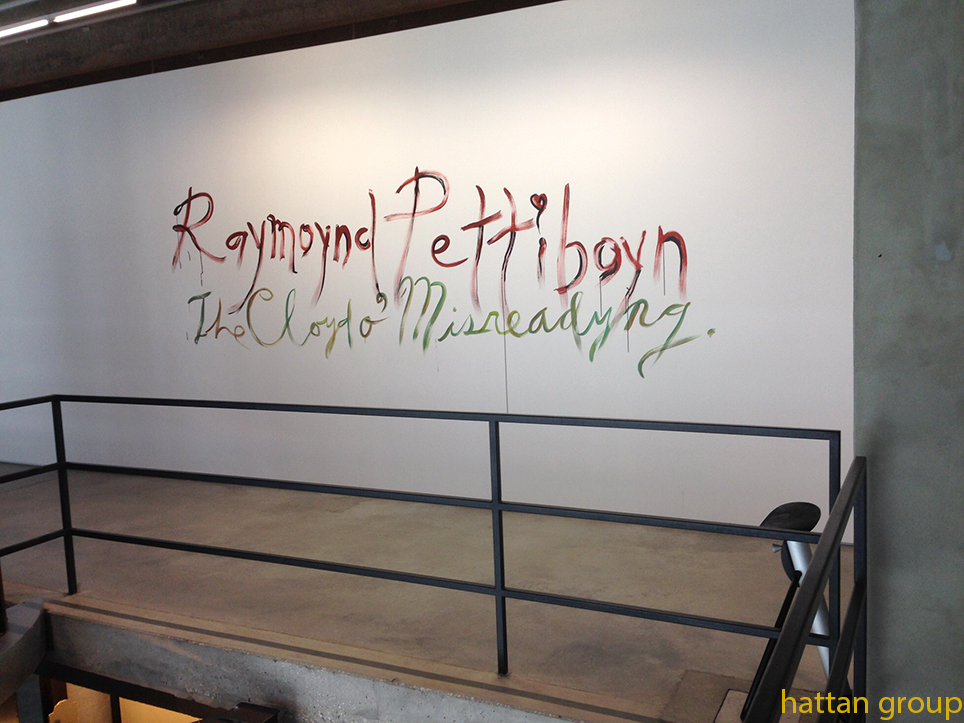
4)- “Exclusive! A Visit to Raymond Pettibon’s Moscow Show!,” published November 20, 2017. Lana Hattan was able to get an associate to go The Garage and shoot Raymond Pettibon’s 400-piece Moscow Retrospective, Raymond Pettiboyn: The Cloyd o’ Misreadyng,” for me! Though this was before the cessation of relations between the U.S. and Russia, I was unable to make it. Raymond Pettibon made it, though, and created another of his classic Hand-Painted Murals for the show. Given there have been very few large Raymond Pettibon shows since, I’m very thankful to the Hattan Group, who did a terrific job as you can see, for  doing this for me, and enabling me to write about the show for NighthawkNYC readers! It’s the only show I’ve written about without actually seeing in person! It’s something you can’t see anywhere else.

Live, from Moscow’s Garage! The show’s entrance features one of Raymond Pettibon’s famous hand-painted murals, around the corner from this sign. I hope the Russians are up on their “Pettibon English!” Photo by The Hattan Group for NighthawkNYC.com.

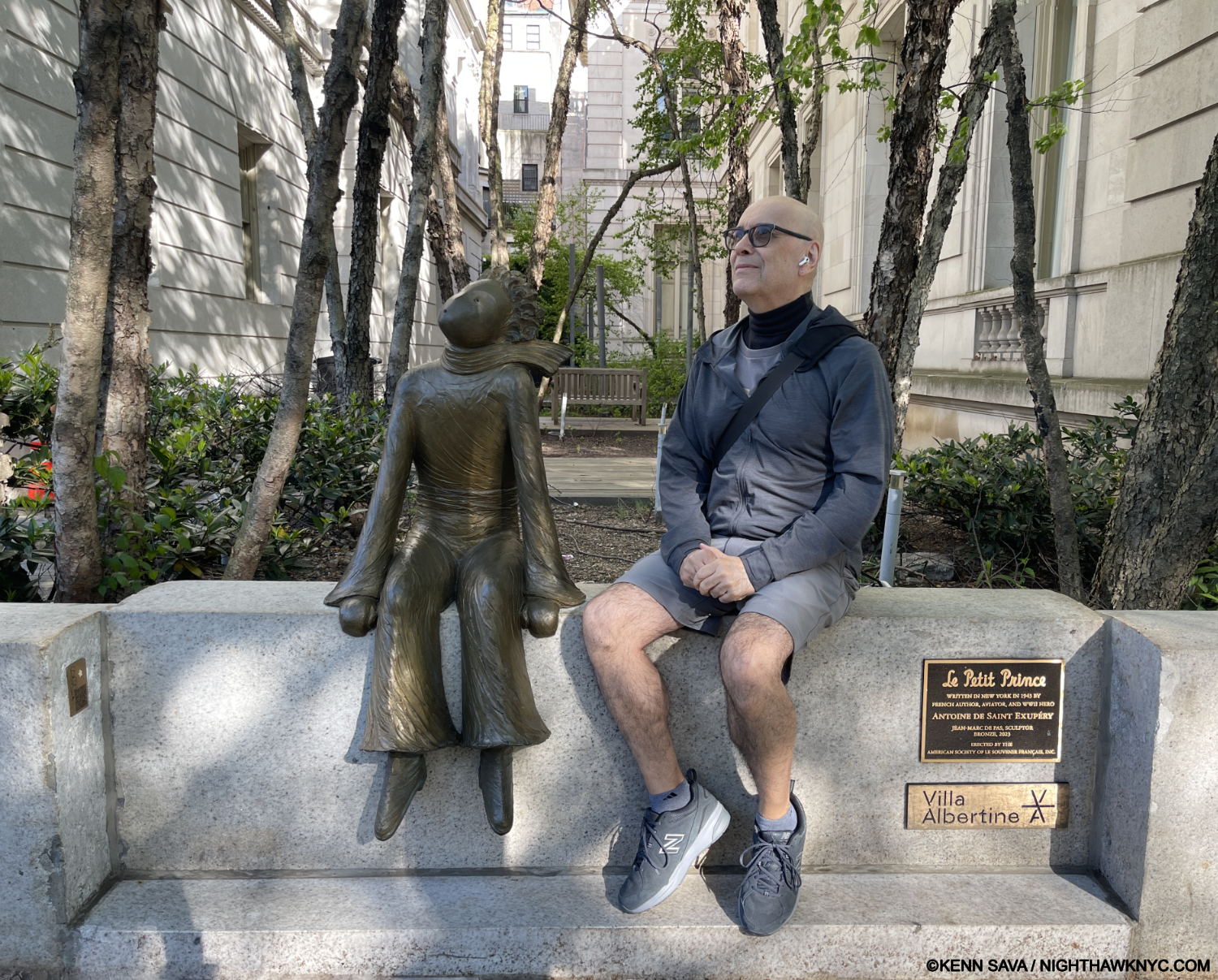
4)- “Antoine de Saint-Exupéry: Artist,” published on March 21, 2023. I’m self-taught at everything besides reading/writing and basic math thanks to a terrible school system and not being permitted to go college. As a result, I had never read The Little Prince, as hard as that is to believe, until Lana, whose favorite book it is, insisted I do. Of course, I immediately got hooked, like hundreds of millions of others have. We were lucky enough to attend the wonderful show of his work at the Morgan Library, and I returned there in 2023 for their show on the Art of Saint-Exupéry. The piece took on a life of its own after the French Ambassador to the U.S saw it and invited me to Washington, D.C. for a dinner he was hosting in honor of the 80th Anniversary of the publication of the book.

I join Saint-Ex’s most beloved creation in waiting for the return of his Asteroid. Hurry up, already! May 10, 2025. My thanks to the kind lady who took this.

E)- Epics
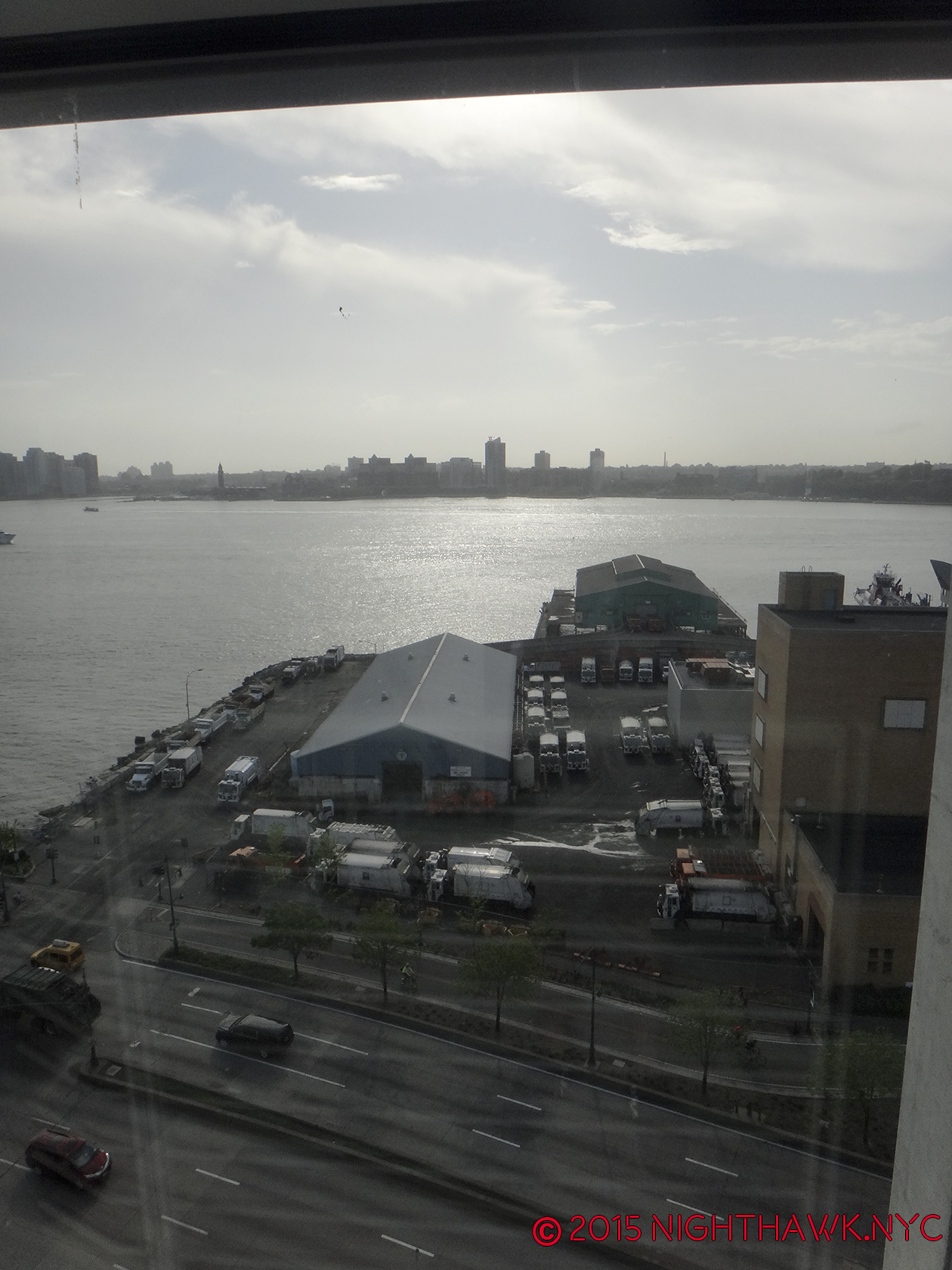
1)- “The New Whitney Museum: The Roofdeck of American Art,”  published August 1, 2016. I worked on my look at the “new” Whitney Museum for over a year after having been a voice against the expansion of the old building. Now that it’s 10 years old, nothing has changed anything I said about it.

Nothing has changed except the Department of Sanitation complex in front of the museum, seen here in 2015, has been replaced with a park.

2)- “This Summer In ‘The Era of Rauschenberg,'” published September 19, 2017. I spent my summer going to MoMA’s Robert Rauschenberg: Among Friends (24 times) and the 4 Rauschenberg satellite shows going on around town. The Rauschenberg Foundation was impressed to the point that they invited me down for a private tour of their entire facility, his former studio, which was beyond an amazing experience for this long-time fan.

One nice note- The Rauschenberg Foundation informed Sue Weill, Aritst (and collaborator with him on Untitled (Double Rauschenberg), c.1950, Monoprint; Exposed blueprint paper, center)  & former Rauschenberg girlfriend, about my inclusion of her in this piece and others, and told me she was pleased to hear it. Partial installation view of the first gallery of Robert Rauschenberg: Among Friends. 

3)- “Richard Estes: Painter. With No Prefixes,” published May 22, 2022. I was surprised to see nothing else printed on the occasion of Richard Estes’s 90th Birthday, which I take as another reminder that the Art associated with  “photorealism” is still not of interest to almost all of the world’s museums. I agree with them on most of it. Yet, (see my piece on boxes, above), some Artists have been stuck in this box, or other boxes, without their consent. I don’t quite see Richard Estes work the way many others seem to. My 3-part series, built on decades of looking at his work, addresses just this.

Kenn Sava, Homage to Richard Estes, NYC, May 27, 2020. Richard Estes was one of the first Artists to influence how I see the world. i.e. he helped open my eyes to the world around me everywhere!

4)- “Jean-Michel Basquiat at the Brant Foundation,” published October 6, 2019. Basquiat has been THE most popular Contemporary Artist for the entire existence of NighthawkNYC, yet, I didn’t know much about his work going in. When my friend, Kitty, told me about the Brant Foundation show, I decided to go, try and get up to speed on his work, and see what it said to me. As I sit here now, I’ve written more about Basquiat than any other Artist! And, I’ve seen more Basquiat shows since 2012 than I have by any other Artist. Both of those facts shock me. They just happened, primarily out of my desire to give his work as in-depth a look as I could. Along the way, I saw virtually every book ever published on his Art, and met and spoke with both of his sisters. The Brant piece is the first piece I wrote on his work. All the others may be seen doing an Archive search for Jean-Michel Basquiat.

Lisa at the Brant Foundation Basquiat show studying Self-Portrait with Suzanne, 1982. There I was, standing outside in the rain for a solid hour, without my umbrella which had gotten left in the cab, without a ticket on the show’s last day, having failed to get a press pass. A staff member who had tried to help me circled back around and told me a visitor, Lisa, had an extra ticket, which she was kind enough to give to this total stranger. Thank you, Lisa. You set in motion what would become an epic journey of Artistic discovery. And oh, by the way, I subsequently paid $45 to get into Basquiat: King Pleasure, the show mounted by his sisters, even though I was going to write about it for free. Did The New York Times pay to get in, too?

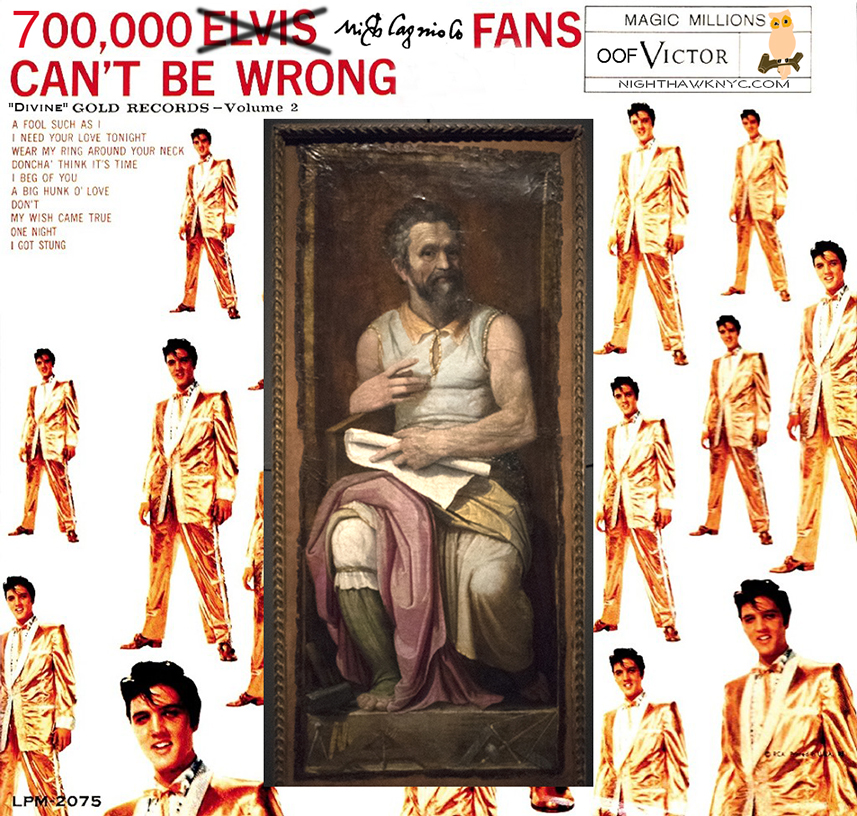
5)- “700.000 Michelangelo Fans Can’t Be Wrong“, published March 4, 2018. A labor of love born out of a dozen visits to The Met’s once-in-a-lifetime blockbuster that 700,000 saw. More an effort of trying to remember as much as possible of what I saw because I knew I’d never see it again.

Take that, Elvis, who’s 1959 album title, and cover, I just borrowed. Michelangelo was the “King” of a different kind of rock. Old school rock.

6)- “A Year Without Art,” published May 7, 2021. Never in my wildest dreams did I ever think I’d go an entire year without being able to see Art! Well? In 2020-1, it happened.

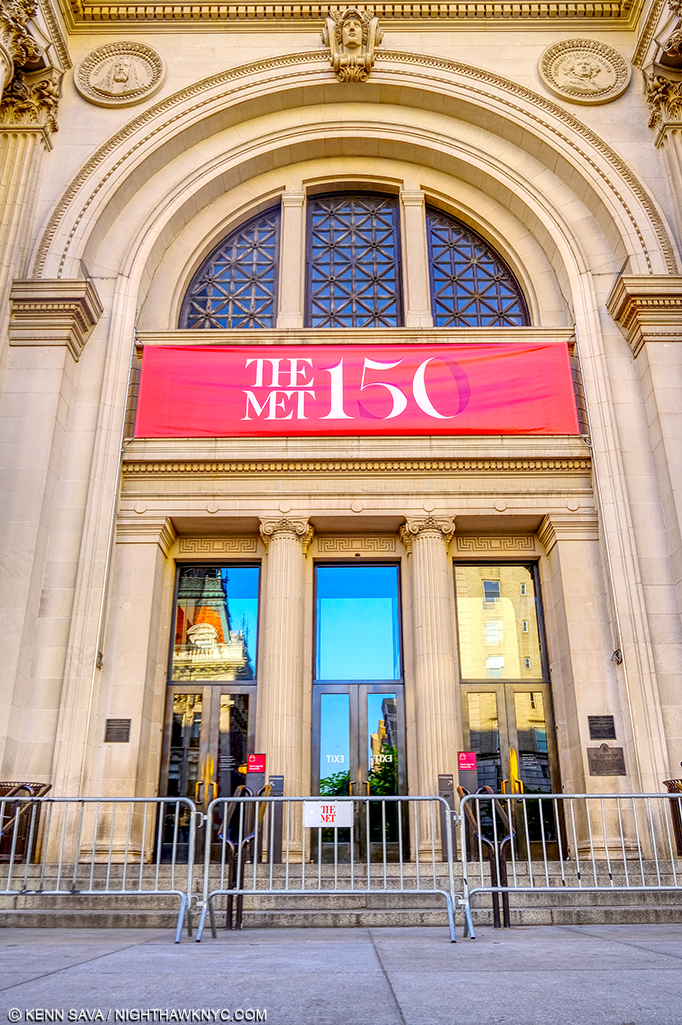
The Met’s famous main entrance, gated, during the 5 months it was closed, on May 21, 2020, unprecedented in my lifetime. Probably not the way they drew up celebrating their 150th Anniversary.

7)- The Photography Show, 2018, published April 23, 2018. I look back in disbelief at how much work I did around AIPAD, The Photography Show in 2018 and 2019. 4 part series on each…countless meetings with Photographers…endless looking all followed by months of work on the pieces. I didn’t make a dime doing it. I hope they appreciated it!

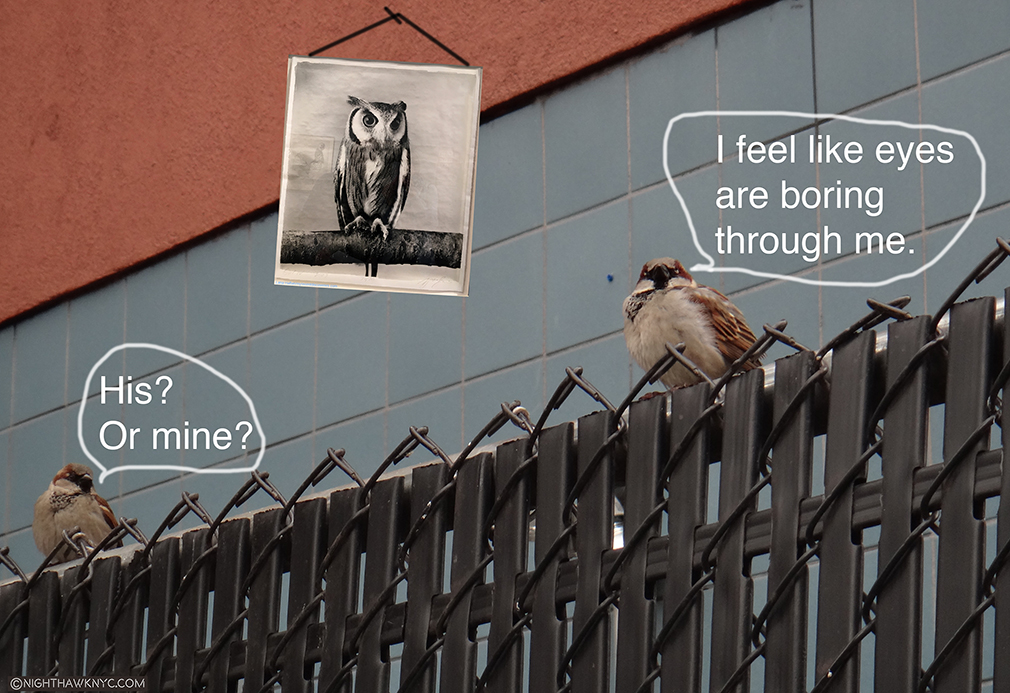
“On The Fence, # “The Wall Has Eyes” Edition. The Birdies, my fine feathered friends from their West 24th Street perch, that ran in my popular occasional featurette, “On The Fence,” for over a year. This one was included in my 2018 Photography Show series. I never replied to the reader who suggested I give up Art writing for “photo funnies”  as he called them- until now. I’m still thinking about it…All installments of “On The Fence” are here.

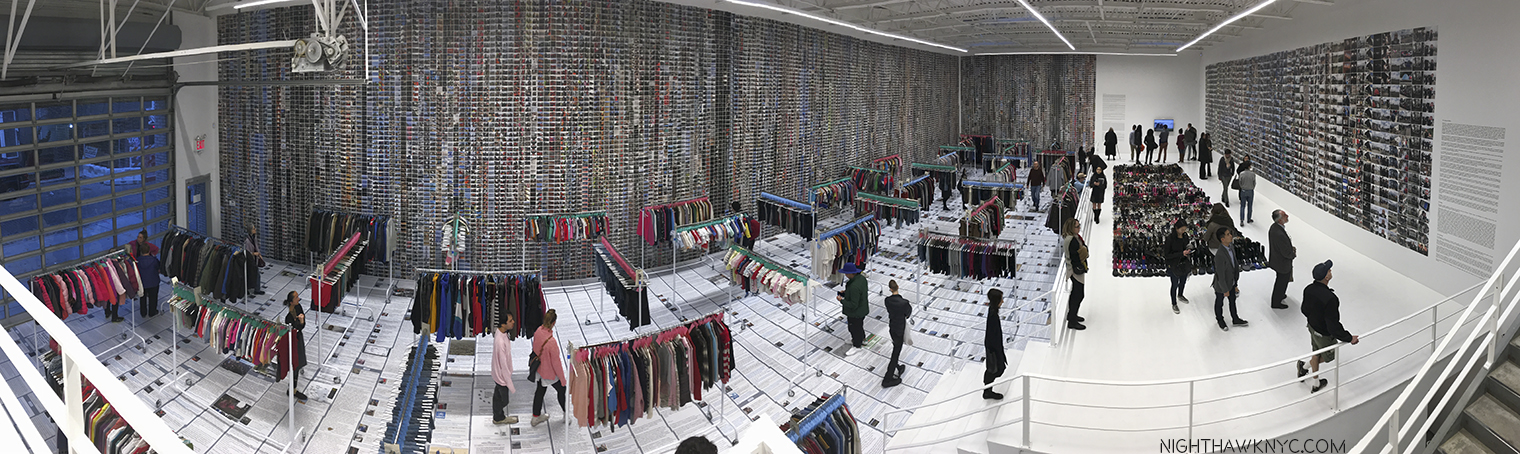
8)- “Ai Weiwei & The Value of One Refugee“, published January 7, 2017. The centerpiece of a group of 4 2016 Ai Weiwei shows, Ai Weiwei: Laundromat was a show unlike any other I saw this past decade, Ai & his team collected clothes, shoes and other artifacts left behind by refugees in the various camps he visited during the European Refugee Crisis and arranged them to compelling effect achieved in concert with countless Photos on the walls he took documenting what he saw and reproductions from media and social media accounts under foot. I wrote about all 4 of the shows, but Laundromat has lingered long in my memory. It was hard to visit the show and not think of Ai’s own experiences, which made him an almost ideal witness.

Birdseye view of almost the whole show.

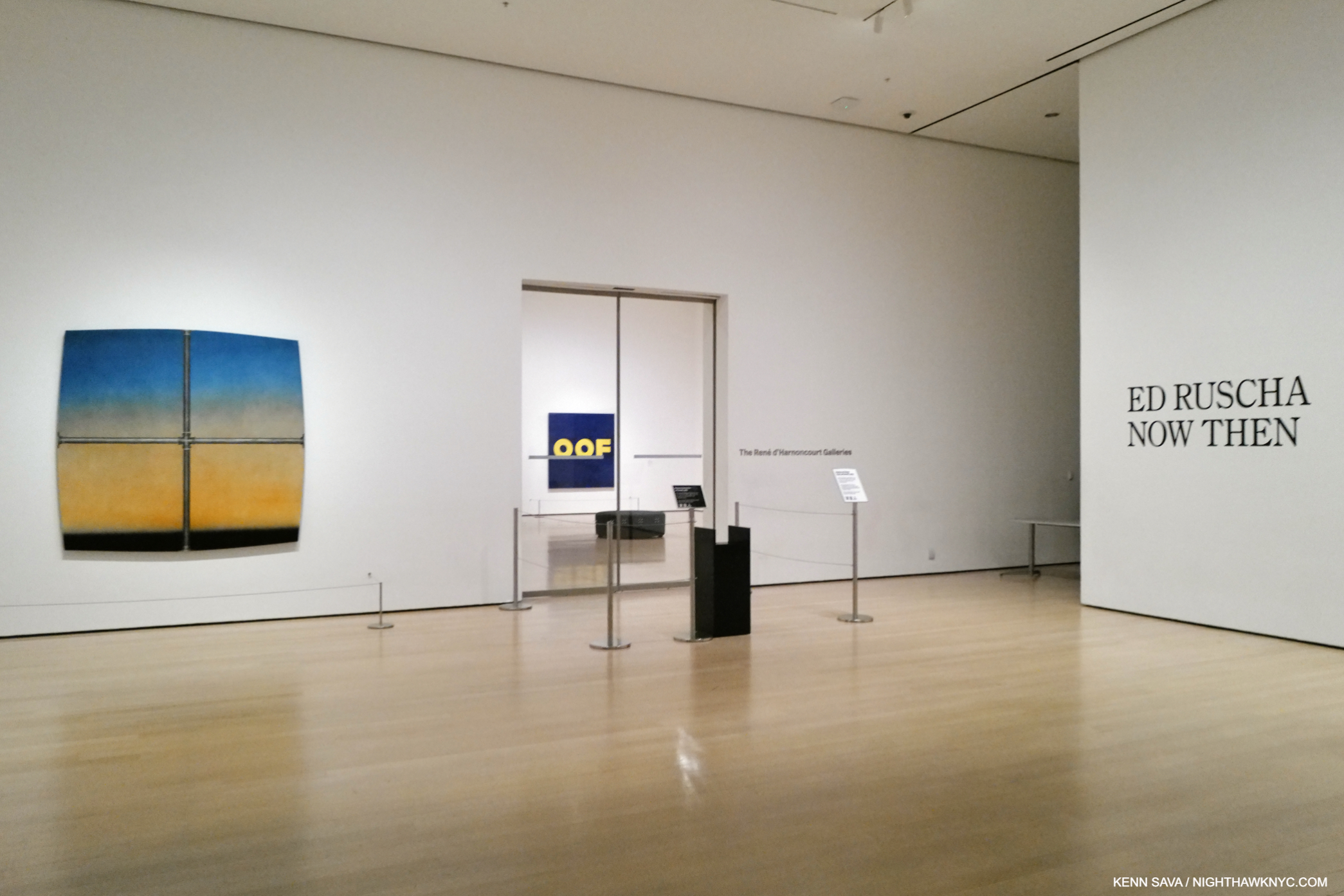
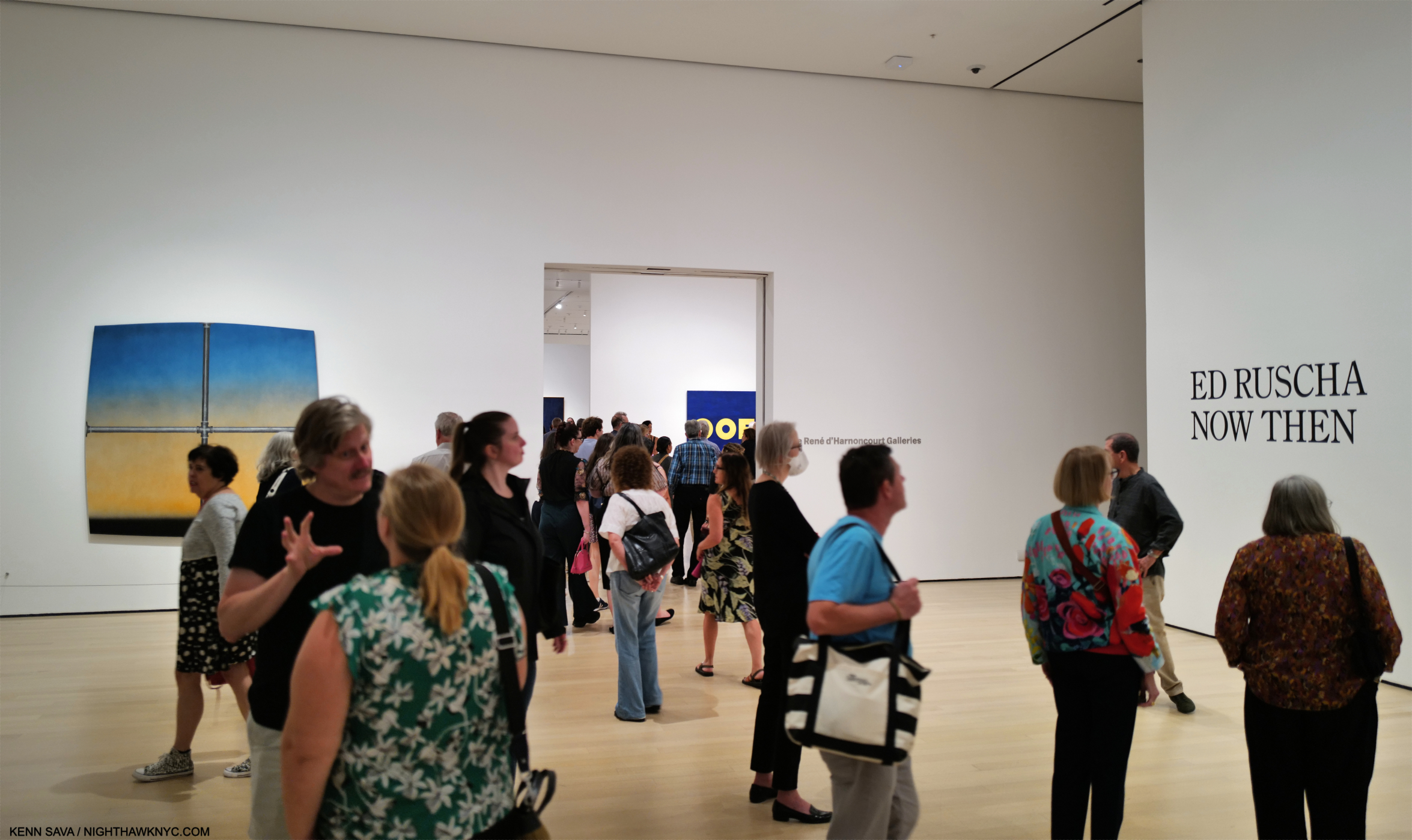
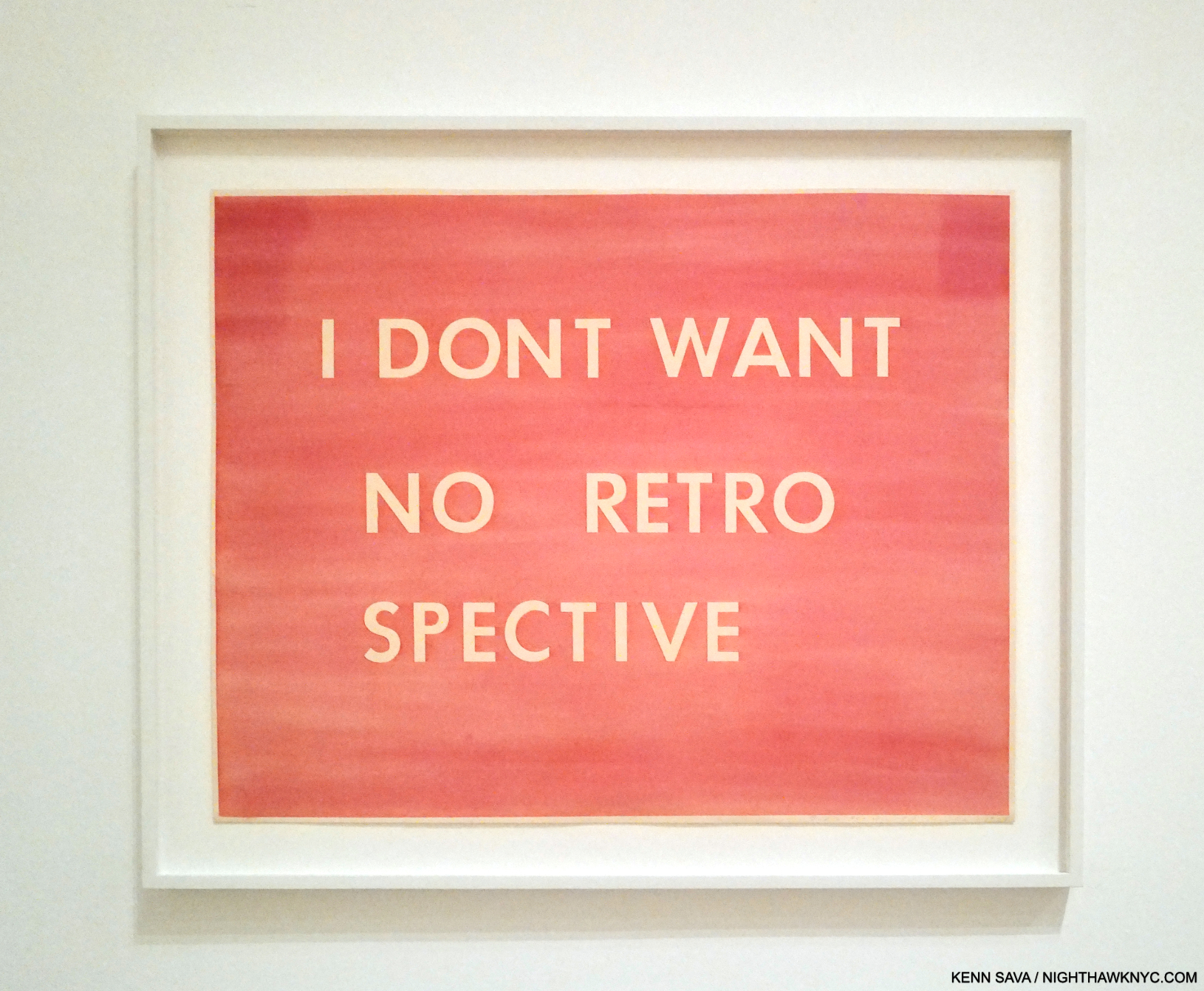
9)- “Edward Hopper’s Impressions of New York,” the first of 3 pieces on the show published May 5, 2023. Wait. Who else has written multiple pieces that look at different aspects of one show? Maybe someone else has. I haven’t seen it. That’s exactly what I did for the blockbuster Edward Hopper’s New York at the Whitney, AND for MoMA’s Ed Ruscha/Now Then.

Edward Hopper’s New York, October 27, 2022.

10)- “NoteWorthy Art Books of the 21st Century,” published June 10, 2025. This, and NW PhotoBooks, the two biggest pieces I’ve ever written, represent my sharing what I’ve seen and learned over the past 50 years I’ve spent looking at Art books, and almost a decade of intensively looking at PhotoBooks. Having begun them last September, right before I announced I was taking a break, they kept gnawing at me in a “You HAVE to finish these!” way. The Epics of Epics on this site, an immense amount of looking and consideration went into both pieces. Usually, I worked on up to 4 pieces at a time. I can’t imagine working on anything else in the 10 months it took to write these.
That makes me wonder- Has anyone else (any other single person) written a list of recommended 21st Century Art Books AND a list of 21st Century PhotoBooks?
The Introduction to both pieces is here.

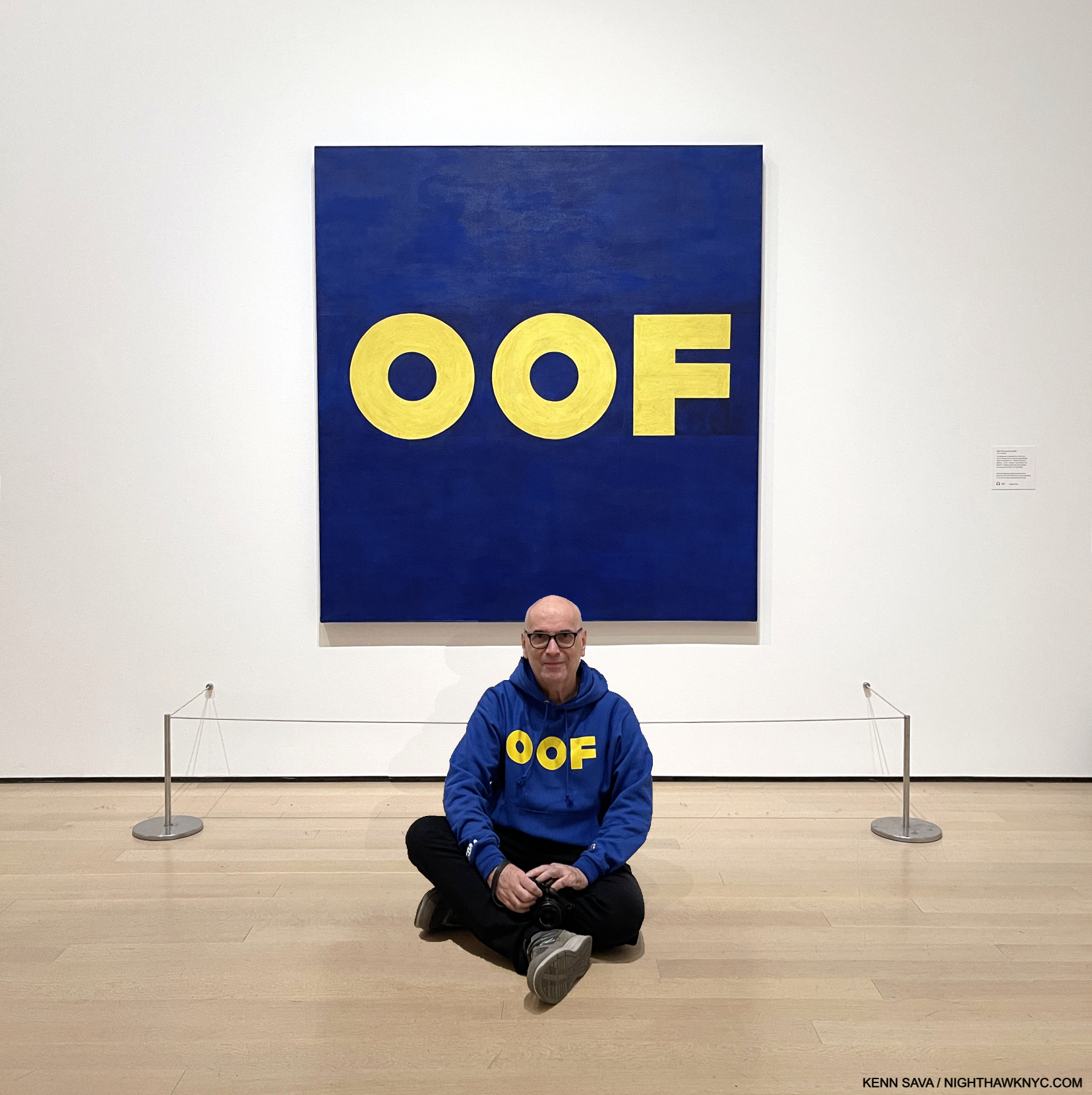
The “Golden Oof,” named for my Avatar.

11)- “NoteWorthy PhotoBooks of the 21st Century,” published June 25, 2025. Marks the end of my “deep dive” into Modern & Contemporary Photography that I began in December, 2016- There I just said it.
[A moment of silence.]
What did I learn from all of that? I stand by what I said here in 2019.
This “Painting guy” is going back to focusing on Painting. You heard it first.

NoteWorthy Sunset Photo by Lana Hattan.

Part 2- Where I’m Going

“Oh, won’t you stay
We’ll put on the day
And we’ll talk in present tenses”-*

1)- NighthawkNYC/Kenn Sava’s Art writing
I’m sorry to say that nothing has changed since I announced I was taking a break in September, 2024. There remains no means of support for independent Art writing. Surviving remains my #1 to #10 priority. I continue to work on the site remaining up. If something changes? I’ll let you know. 

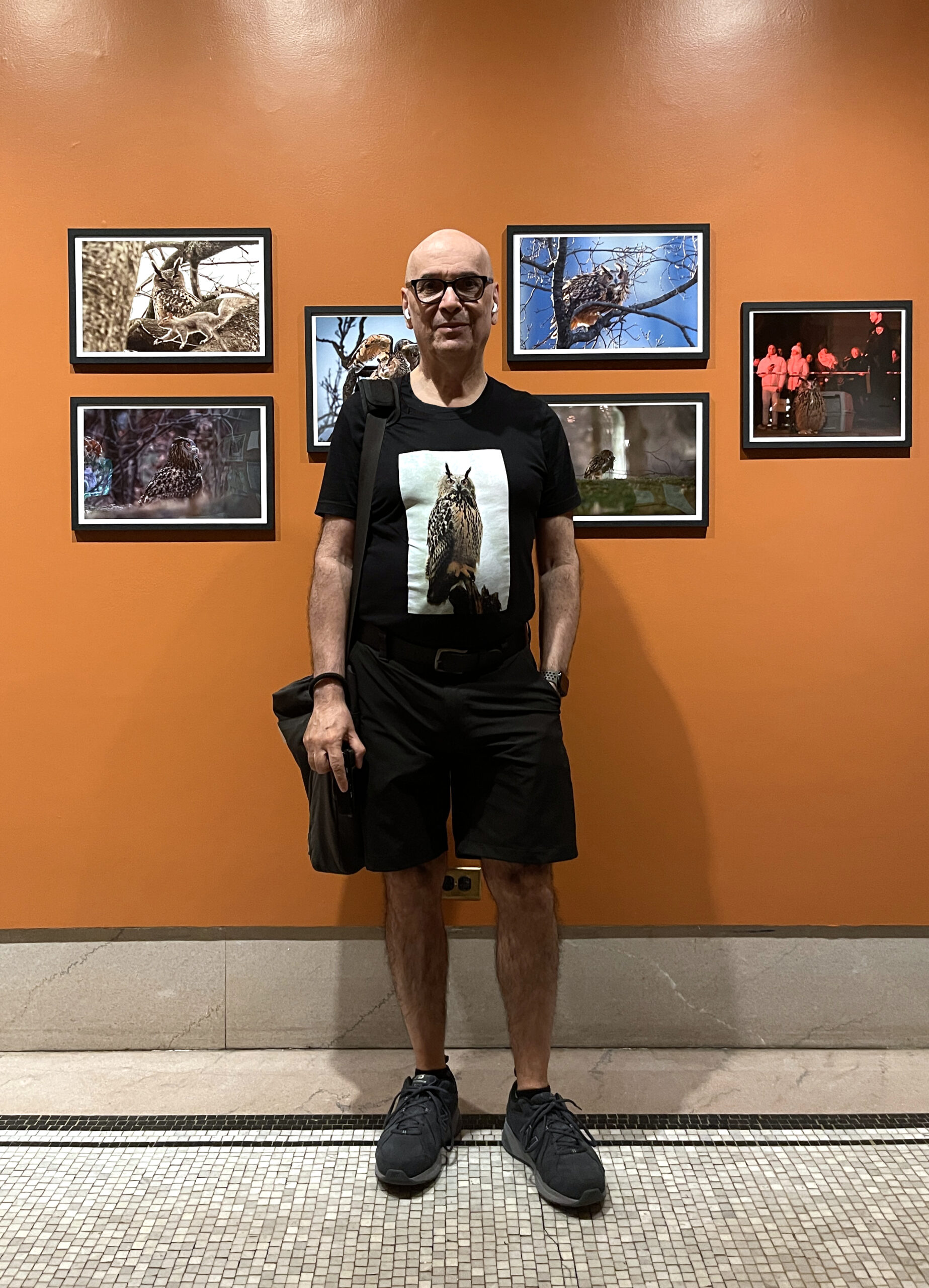
Flaco Lives! Kenn Sava at The Year of Flaco exhibition (in a Flaco T I had made last year), in front of a section of Photos of him early on in his freedom. The picture far right was taken right after he escaped from the Central Park Zoo. After never having been outside in his entire life, he suddenly found himself on Fifth Avenue & 60th Street! Maybe that’s why I’ve never seen a picture of him with his eyes so wide open. New York Historical, July 3, 2025. My piece on Flaco, written about a month and a half before his tragic demise, is here. My Thanks to Marybeth Ihle of the New York Historical.

2)- Kenn Sava, Producer
I’m hoping to re-release The Fuschia by Thomas Chapin, Peggy Stern, Drew Gress and Bobby Previte this year, and also finally release my solo album Strawberry Fields Forever.
Though I produced both projects, releasing and re-releasing them is not about me. Both were recorded in the mid-1990s, and, sadly, since then a number of the great Musicians who participated in them have passed away. I feel a sacred duty to them to get their work out there/back out there. Stay tuned. 

Coda- Before I “Go” Anywhere…
I started this site for one reason- To share what I’ve been lucky enough to see & experience in NYC and in Art & books with my fellow Art lovers around the world. I had a lot of passion, but no business plan.

While doing NighthawkNYC has been quite the financial hardship, I’m proud of the fact that readership has gone up each and every single year. Thank You to everyone who’s read one, or all, of my 350+ pieces here this past decade.

I especially want to Thank those of you who have made donations or bought pieces of my collections to help keep me going! For the rest of you, if you find, or have found, what I’ve done here since 2015 worthwhile, YOUR support is needed to keep this site up, and possibly, enable me to write more.

When the curtain closes
And the rainbow runs away
I will bring you incense
OWLS BY NIGHT (Caps mine ; ) )
By candlelight
By jewel-light
If only you will stay
Pretty baby, won’t you
Wake up, it’s a Chelsea morning”-*

With Lana Hattan at Hilma af Klint: Paintings for the Future, the most recent show we’ve been able to see together at both of our favorite NYC building- The Guggenheim Museum. New Year’s Eve, December 31, 2018. My Undying Thanks to the woman who approached us and insisted she take our picture.

Finally, Thank You to Lana Hattan for pushing me to start writing about Art, and for your continual support through some thick and a lot of thin, every step of the way.
As I’ve said before, if you’ve found ANYTHING I’ve done here worthwhile, she’s the one who deserves your thanks.

As for me? I MADE IT TO 10 YEARS!
Kenn Sava.
July 15, 2025

P.S.- Feel free to drop me a line and let me know if I left out a piece you found particularly NoteWorthy.

For more- Check out my look back at “A Decade of NighthawkNYC.com Banners,” which have uncannily come full circle, here!

*- Soundtrack for this piece is “Chelsea Morning,” by Joni Mitchell, referencing her apartment 5 blocks from where I am writing this, and where I’ve written all of the 350+ pieces on NighthawkNYC. Joni moved here in 1967, before my time here, and proceeded to write a number of her early songs here. Just another of the Legends who’ve lived in my neighborhood, like Patti Smith. She performs it here in 1969-


Es Devlin Rides the Wild Horses

This site is Free & Ad-Free! If you find this piece worthwhile, please donate via PayPal to support it & independent Art writing. You can also support it by buying Art & books! Details at the end. Thank you.

Written & Photographed by Kenn Sava (*- unless otherwise credited).

Show Seen: An Atlas of Es Devlin @ the Cooper Hewitt, Smithsonian Museum of Design

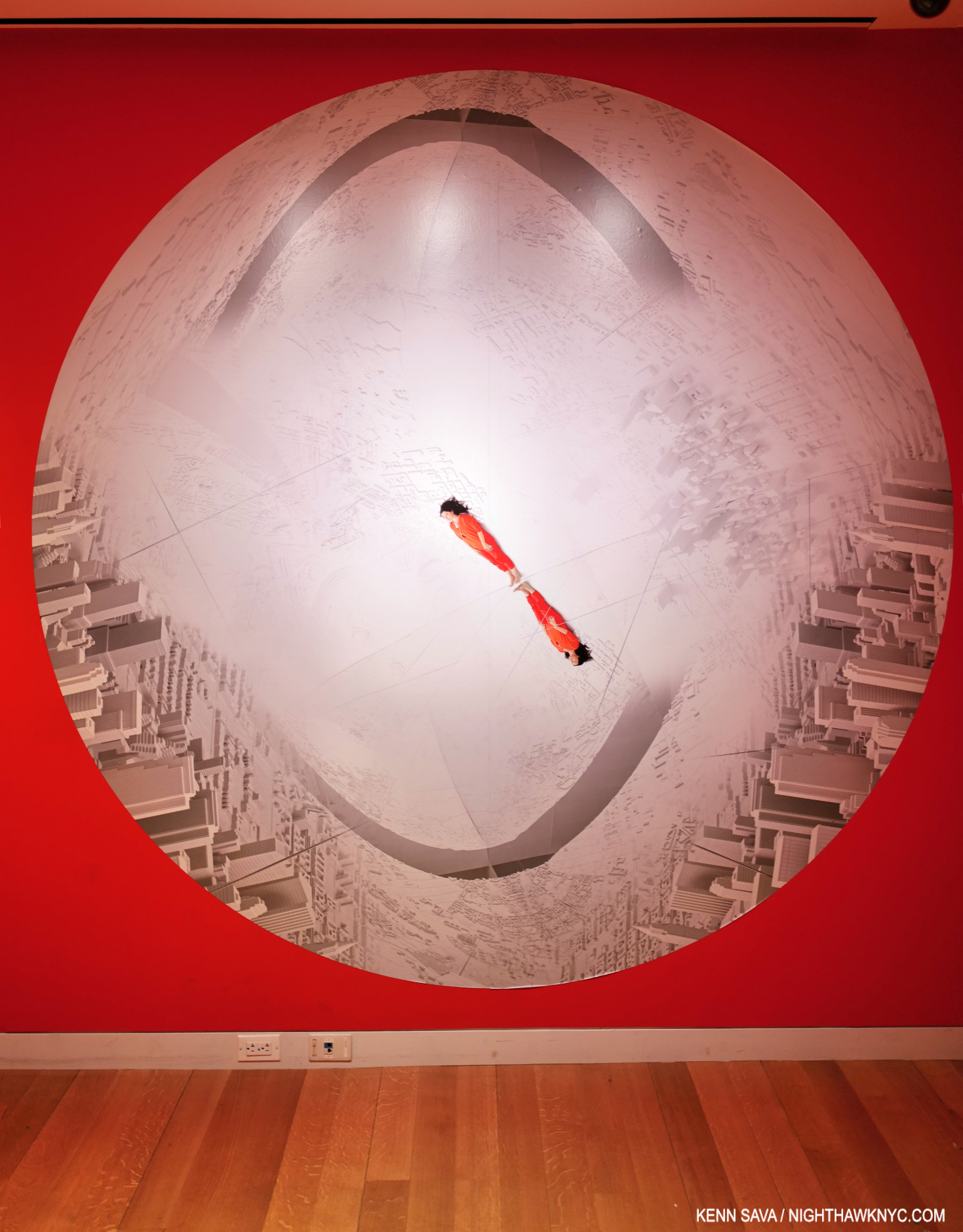
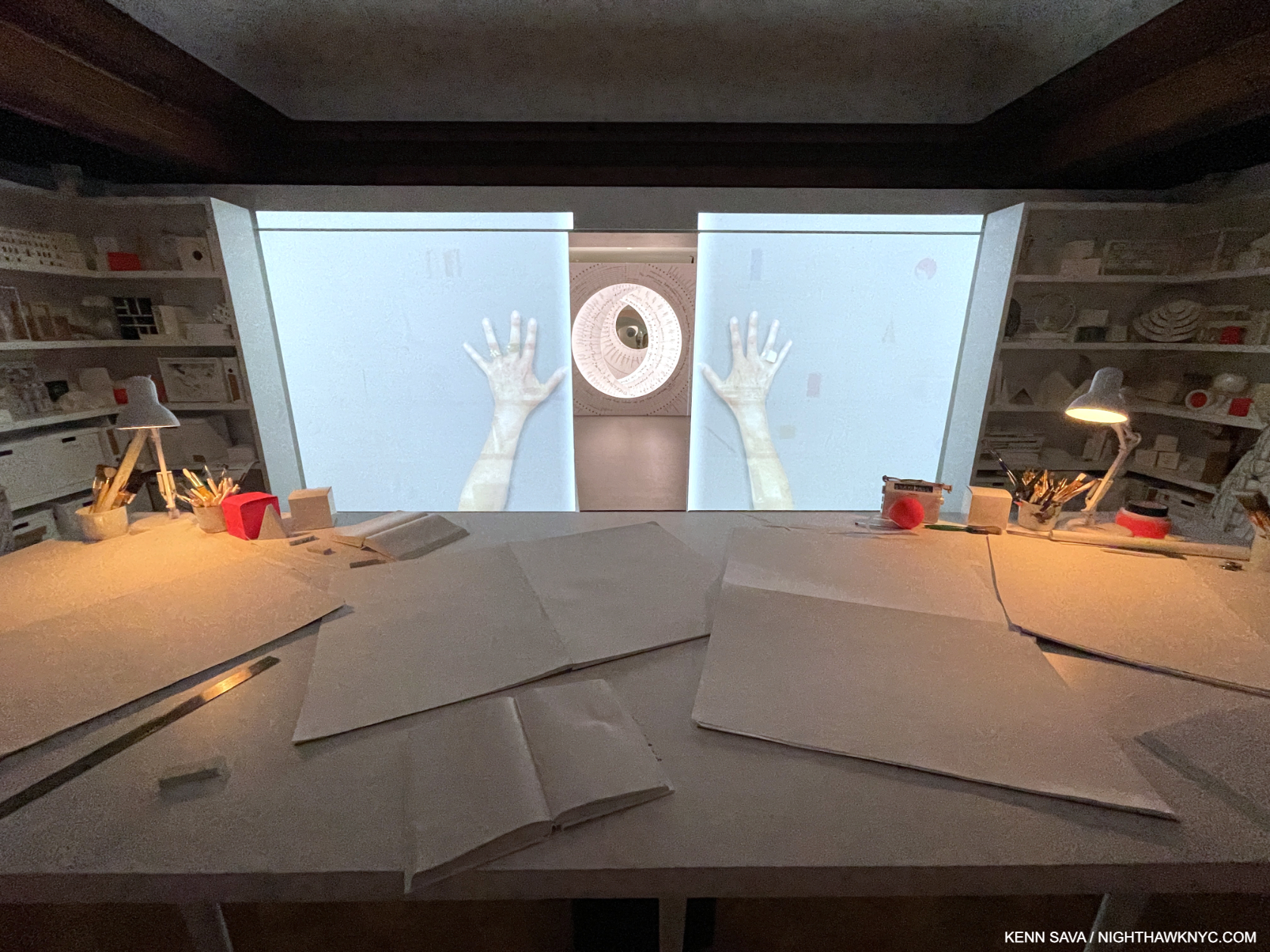
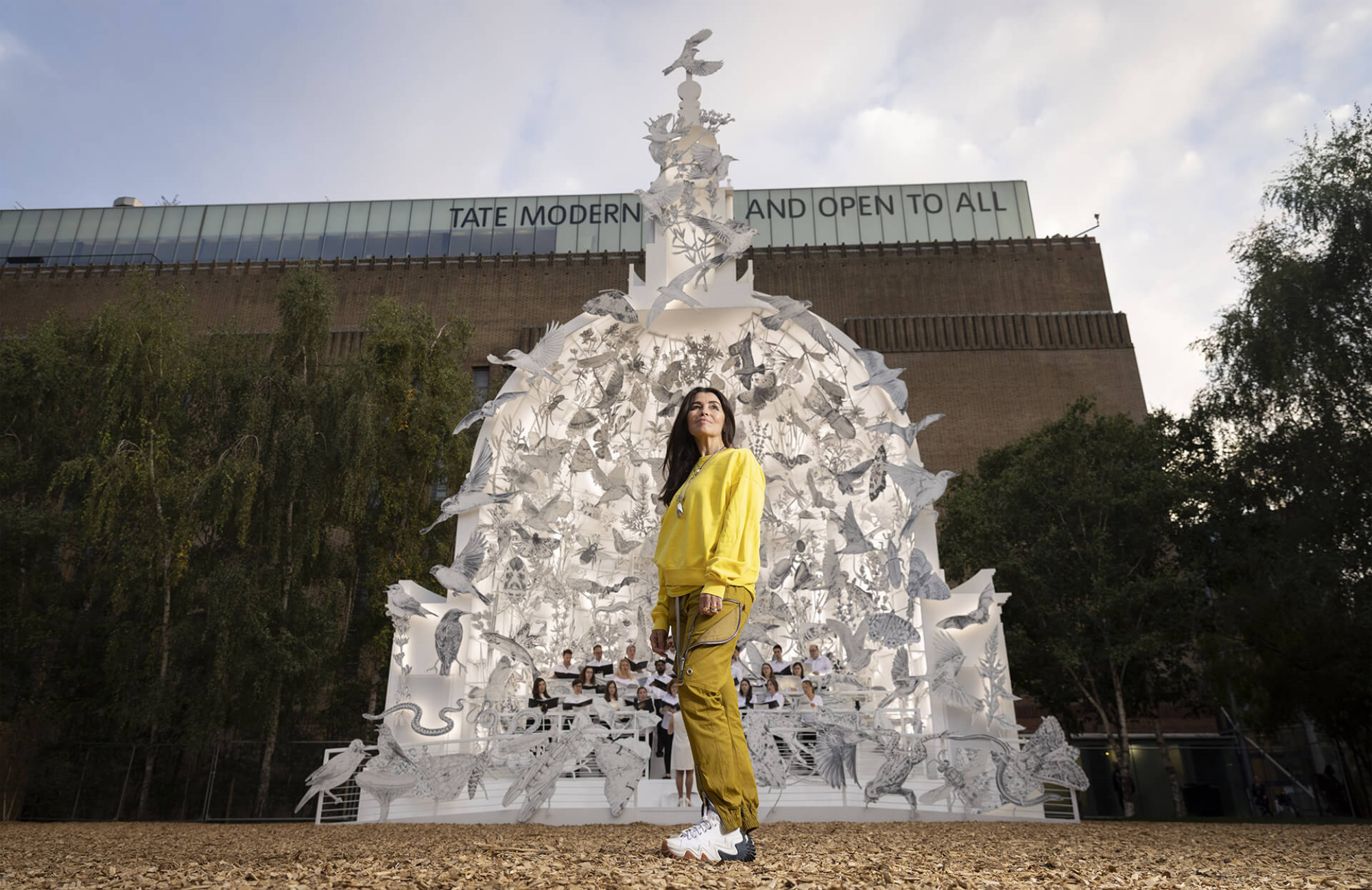
The one and only Es Devlin in the one and only time she appears in her show, in her piece Memory Place. (her hands appear a few times elsewhere). Displayed in the show’s entrance lobby where visitors wait for the next showing of her 4-minute intro video which takes place in a fascinating recreation of her studio. The pictures in this piece are thumbnails. Click any for full size.

Having first experienced Es Devlin’s brilliance in 2010, the release of her debut Art , An Atlas of Es Devlin, the NighthawkNYC.com NoteWorthy Art Book of the Year for 2024, fired my curiosity as to what the show of the same name would be like. How would Es Devlin and the curators at the Cooper Hewitt distill the innumerable projects Ms. Devlin has been involved in these past 29 years already, and the book’s 900 pages, into a comprehensive and concise show, a “mid-career” retrospective, no less?

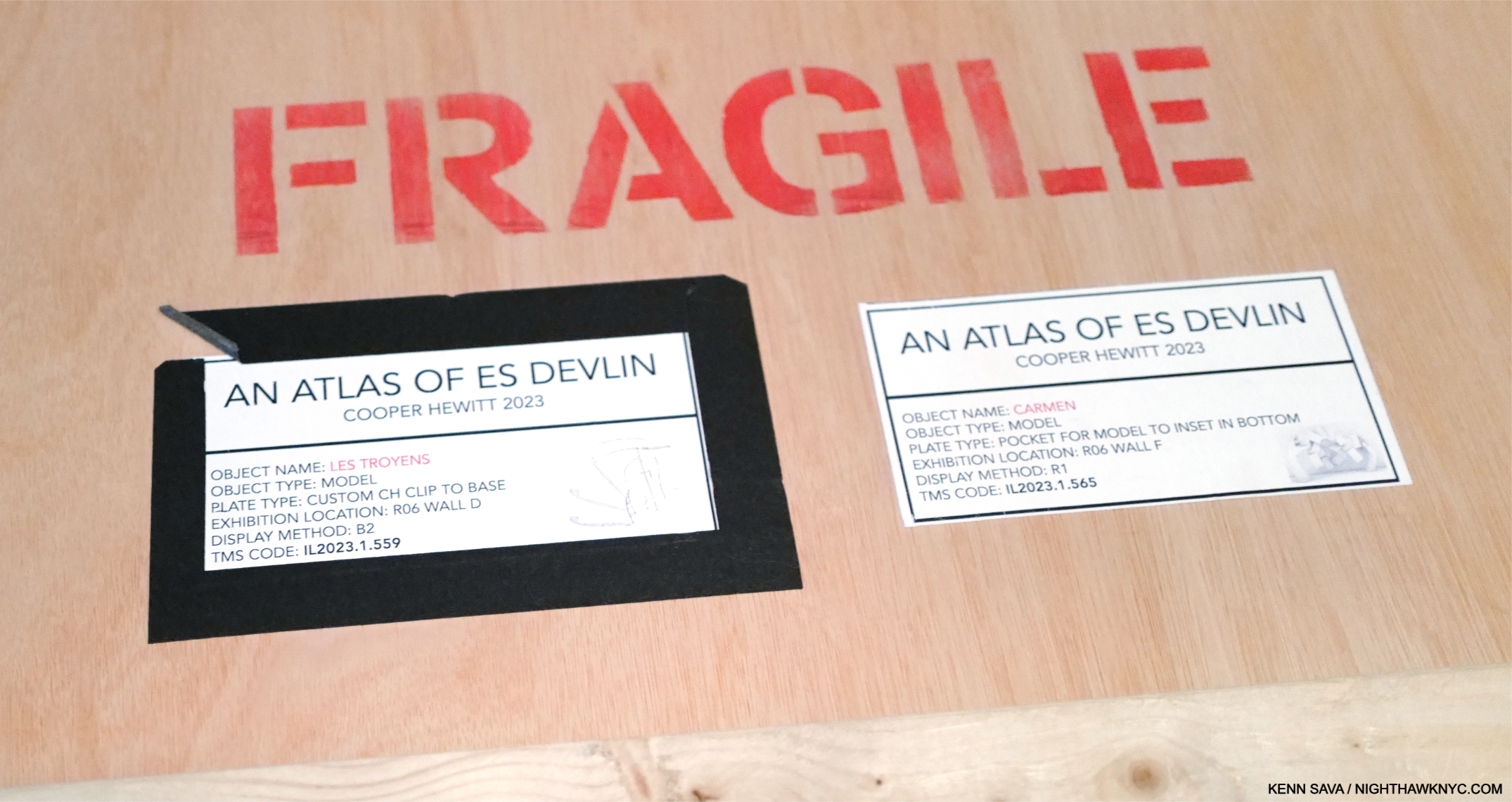
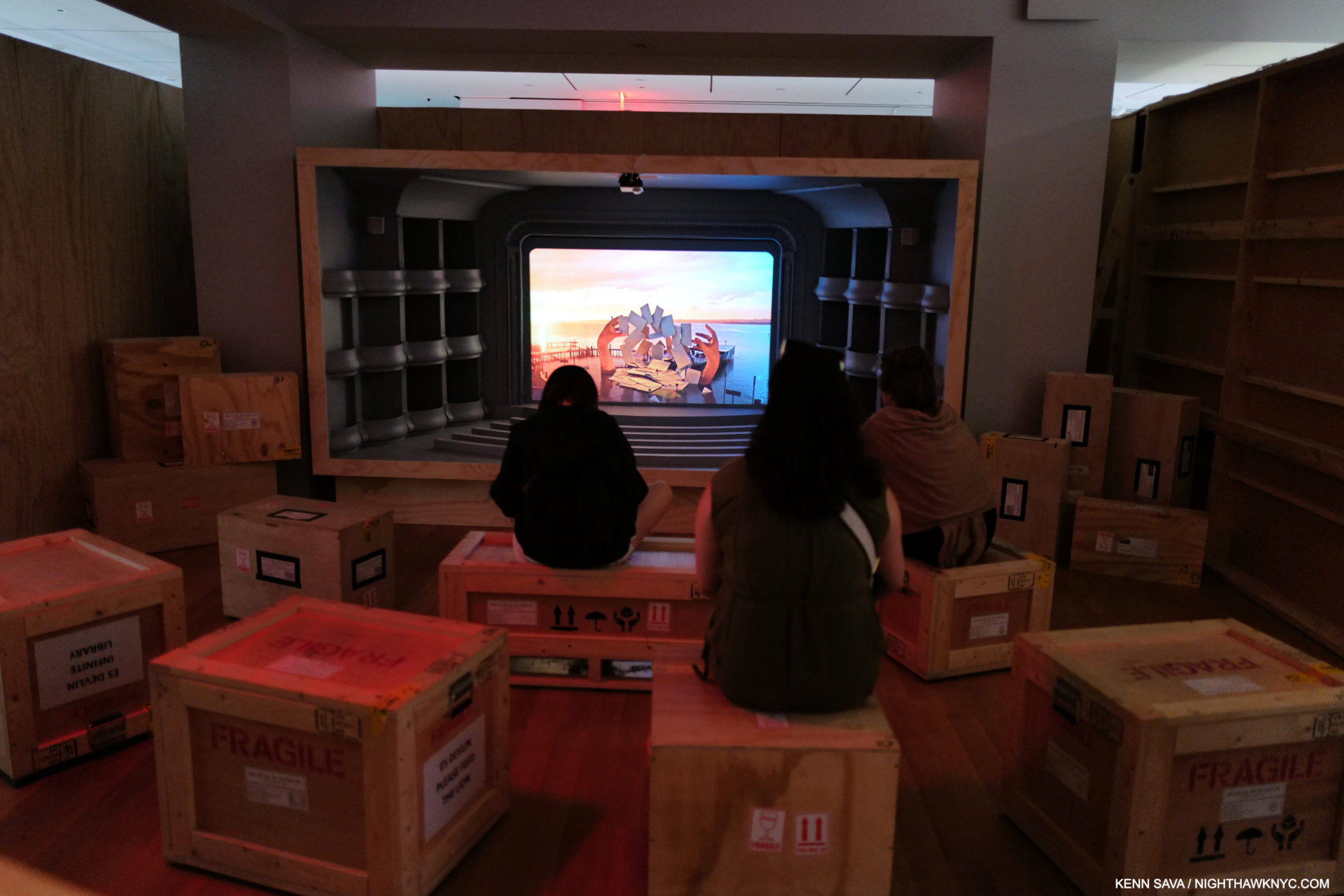
The show is so innovative, the attention to detail so exceptional, that even the shipping crates that transported the Art have their place in it! One of many things in An Atlas I’ve never seen before. I explain further on. Seen here are the labels on a crate that contained 2 models.

Opening in November, 2023, I pondered this all through 2024 as various ailments kept me from getting to 2 East 91st Street, and finding out. Stage Design is one of the most ephemeral Art forms there is. The book is divided between Sketches and notes, followed by a large section of color Photos of the performances. Building my expectations around that, finally getting to see the show twice during it’s final week, I got the unexpected: a show that largely consisted of beautiful scale Models of the stage sets, most created for exhibition! (Two were contained in the shipping crate shown here.) Well, if anything has proven to be the trademark of Es Devlin’s work, it’s the unexpected, which continues to remind me of Robert Rauschenberg.

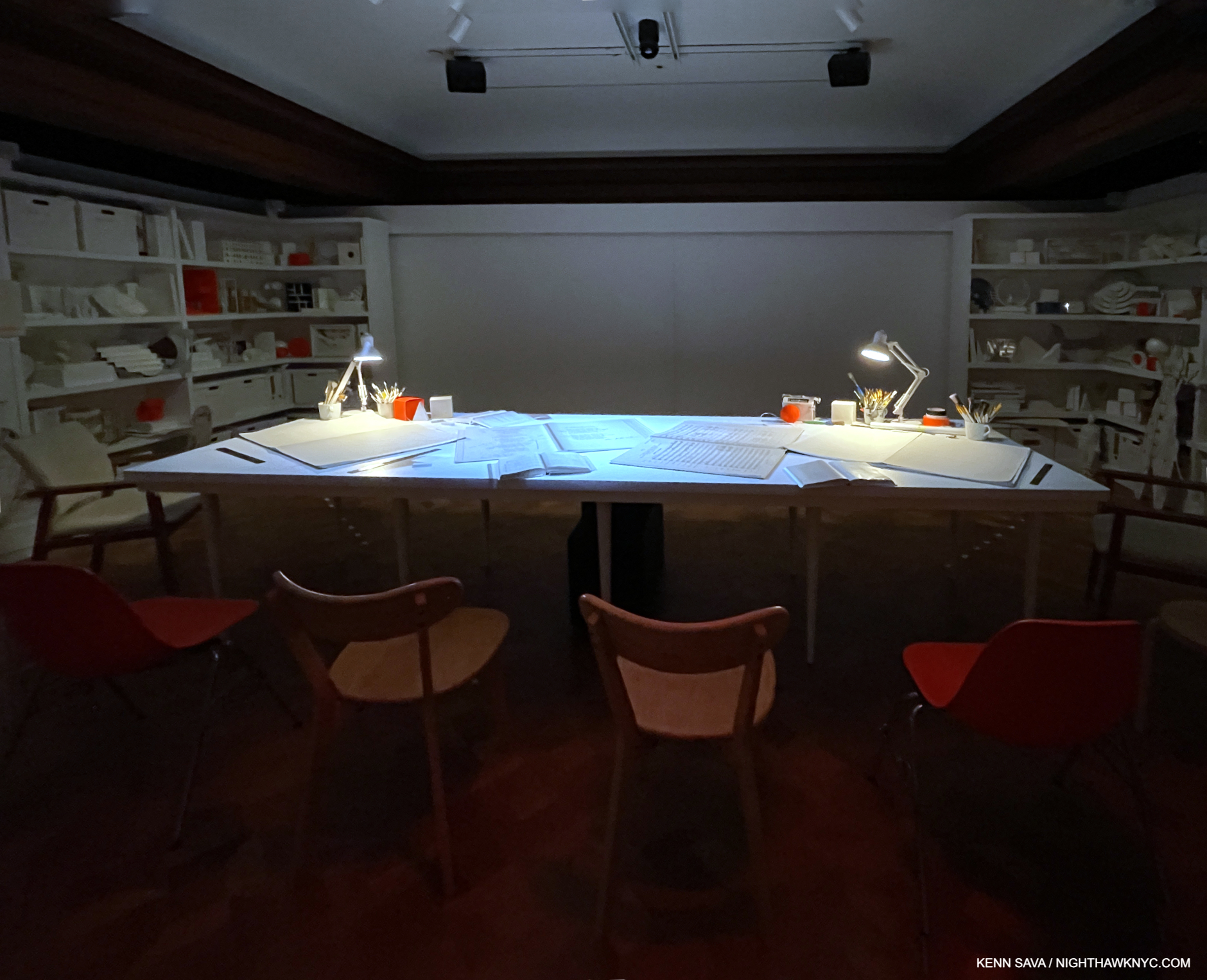
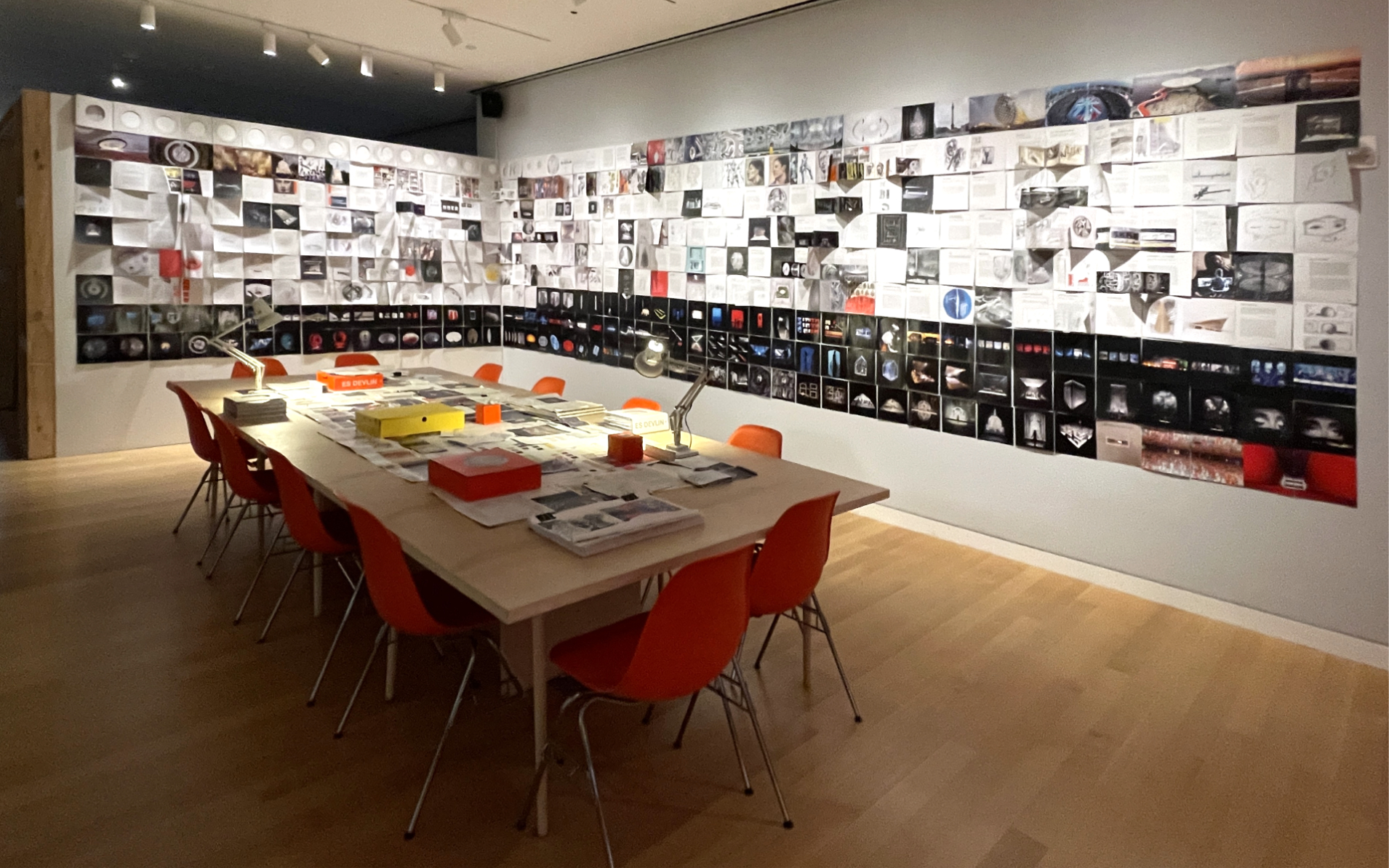
Hang on to your hats! Installation view of the introductory gallery in the recreation of her studio before the Film begins. I rushed in to get this shot before it was filled up by those in line behind me. Beware, those seemingly innocent items on the table are not what they seem. Neither is that back wall.

Filling  the entirety of the 3rd floor, arriving visitors are asked to wait for the next showing of a 4-minute Introductory Film, which takes place in a gallery designed as a recreation of her studio, with a large work table in the middle, filled with the tools of her craft.

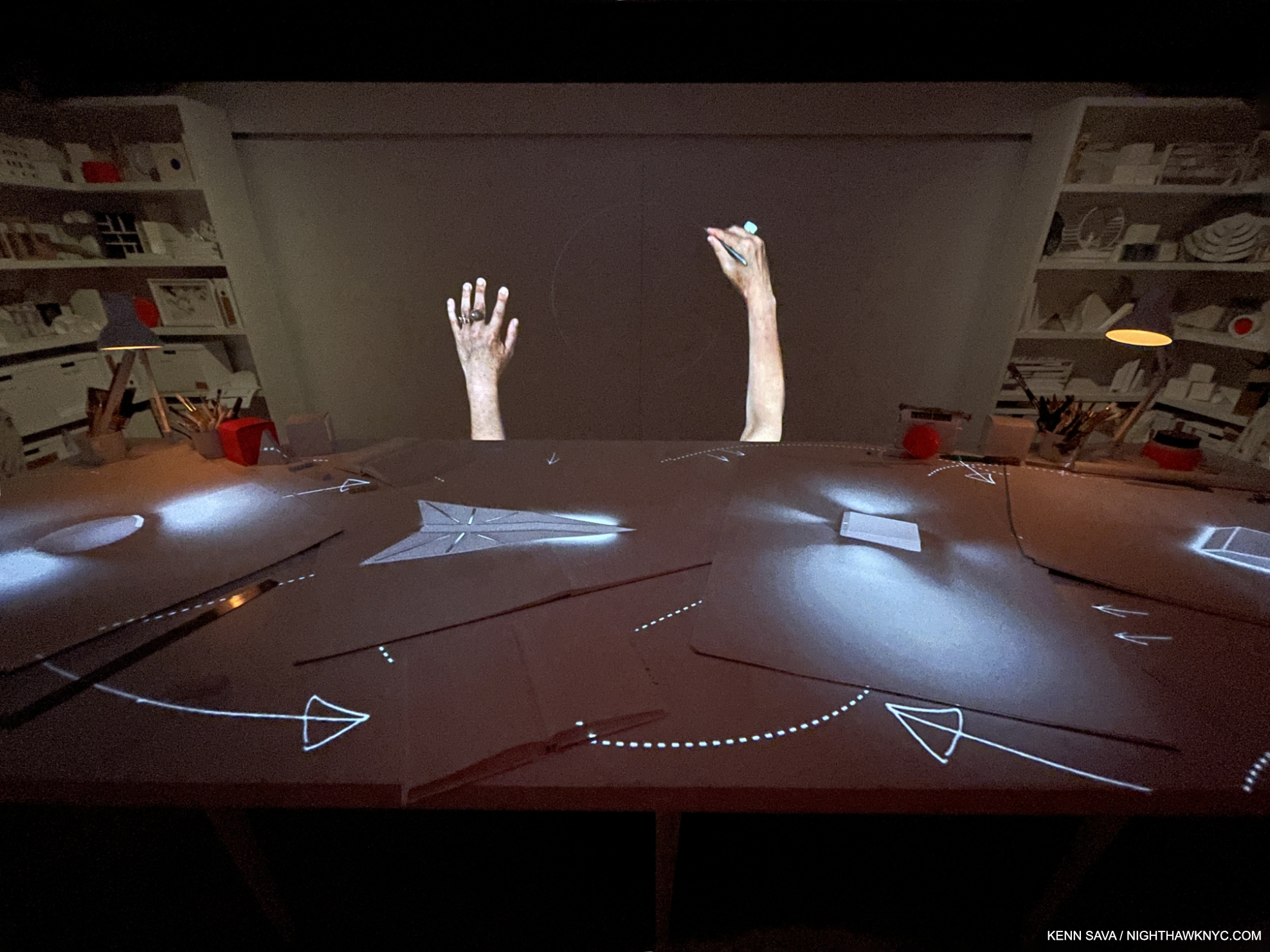
As the Artist speaks and Draws in the Video projected on the rear wall, the objects on the table undergo all sorts of permutations.

As visitors surround it and begin to take it all in, the Film begins. Compellingly narrated by the Artist in powerfully evocative words in Ms. Devlin’s hypnotic voice, accompanied by stunning visuals that somehow bring items lying on the table to life, the Artist takes us on a tour of her ideas and her work.

One section of the recreation of Es Devlin’s studio with the lights low during the Introductory Film. Full of ideas, some realized, some partially realized, some not realized yet, I imagined this room to be something akin to walking around in her brain.

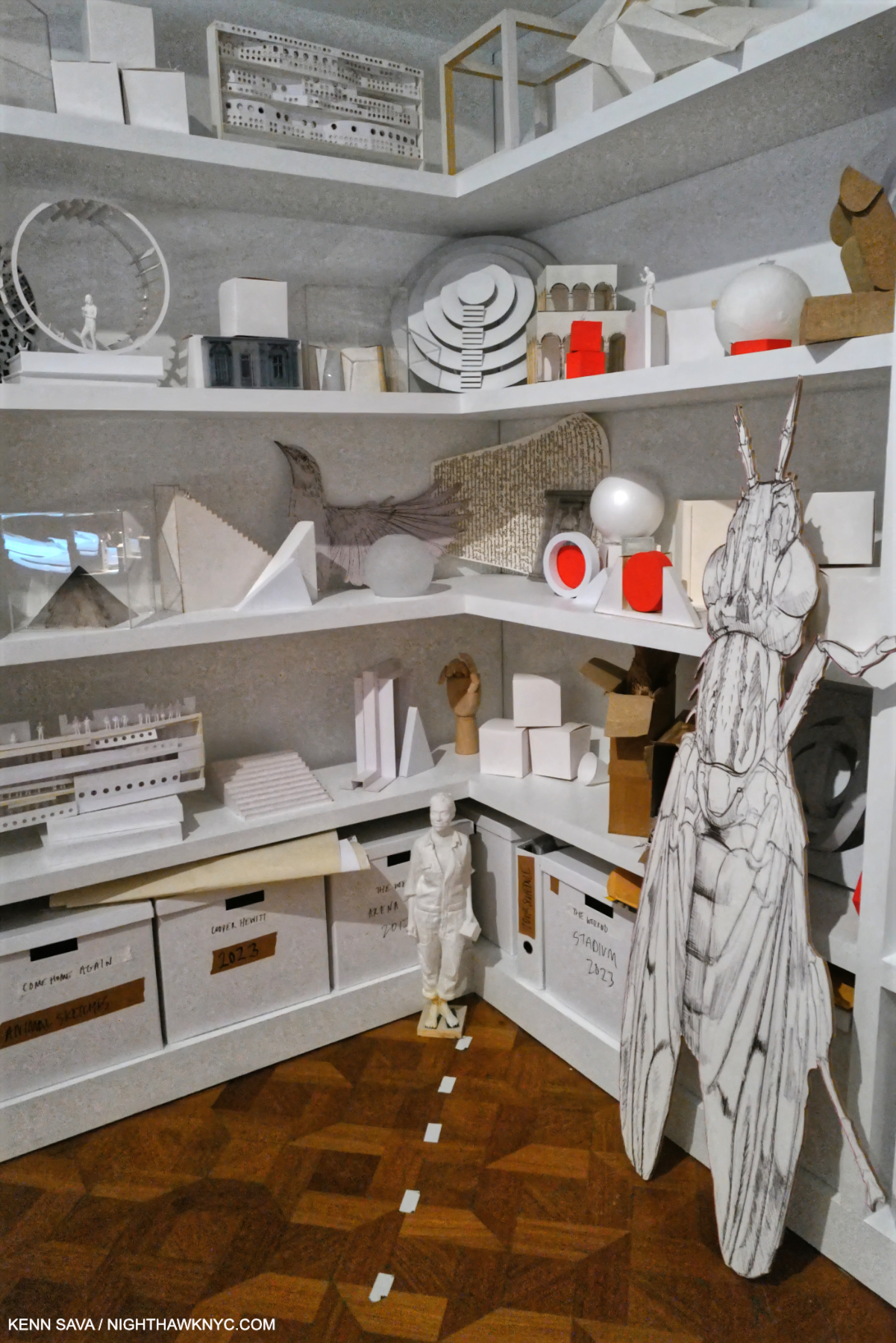
On three of the walls surrounding the table were a cornucopia of fascinating objects I could have spent a few hours studying on their own. A bit like Sarah Sze’s incredibly involved installations, a lot of work went into their installation.

The Film ends with a bang.

At the culmination of the presentation, the Artist’s hands split the screen in half, opening the back wall, revealing her piece, Iris, beckoning visitors to enter the beginning of the main body of the show. Talk about a dramatic opening. Stage craft meets Art show in a way I can’t say I’ve experienced before. But, I bet I will again. I have no doubt An Atlas was must-see viewing for innumerable curators and gallerists.

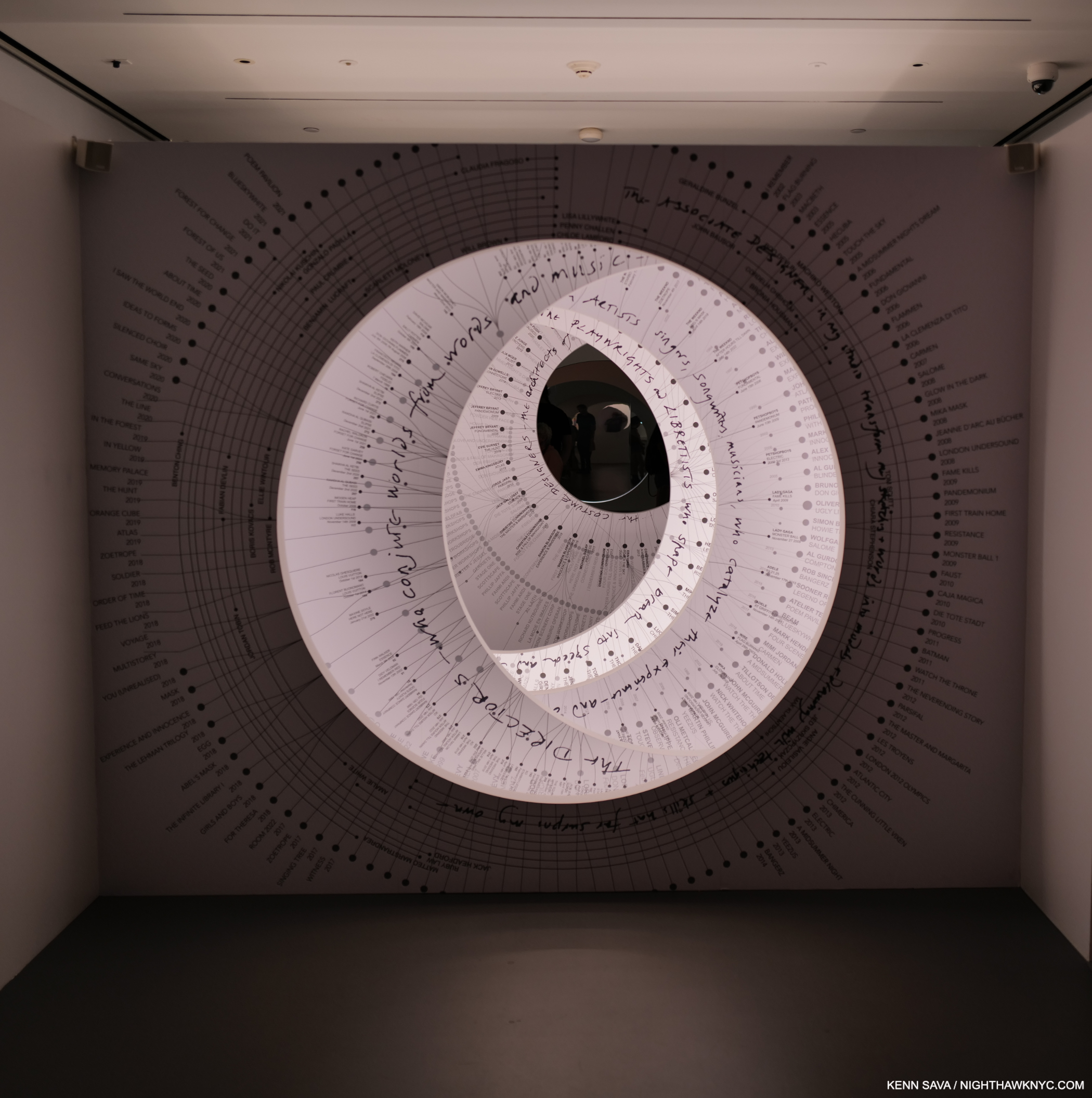
The second “introductory gallery” features Es’s Iris.

Working with “names’ virtually her entire career, the first stop is her Iris with a voice over of Es reciting the names of her collaborators. A nice “Thank You” for the opportunities and sharing the credit for the results of this most collaborative of mediums. Iris, with multiple aperture blades, contains the names of the Artist collaborators on the outer blades, and all those involved with creating and mounting her projects fill the inner blades, a list that fills the first 9 pages in her book! It introduces what is a running theme in the show: collaboration, as you might expect for an Artist whose craft is Stage Design, like a bass player, something that doesn’t exist on its own (unless you’re a genius, like my late acquaintance, Jaco Pastorius). Still, it’s definitely her show. Her voice and vision runs through each and every work. Still, as any creative person who’s been hired by someone knows, working with someone else “who has a say” is often extremely challenging; perhaps the hardest part of the job. More than likely the Artist got the job for being who he or she is. For someone else to come in and suddenly want to change/modify that vision can be both counterproductive and counterintuitive. Not every Artist can do it.  The “dynamics” of creative collaboration is why most bands have the shelf life of milk. Yet, though it must have been there, in An Atlas there is no sign of creative struggle or difficulty. Making this all the more impressive, the list of her projects takes 4 pages in the book (as I showed here)! Either her brilliance is just a matter of fact for all her bosses, or she has an extremely winning way, as belied by her hypnotic voice. My money’s on both.

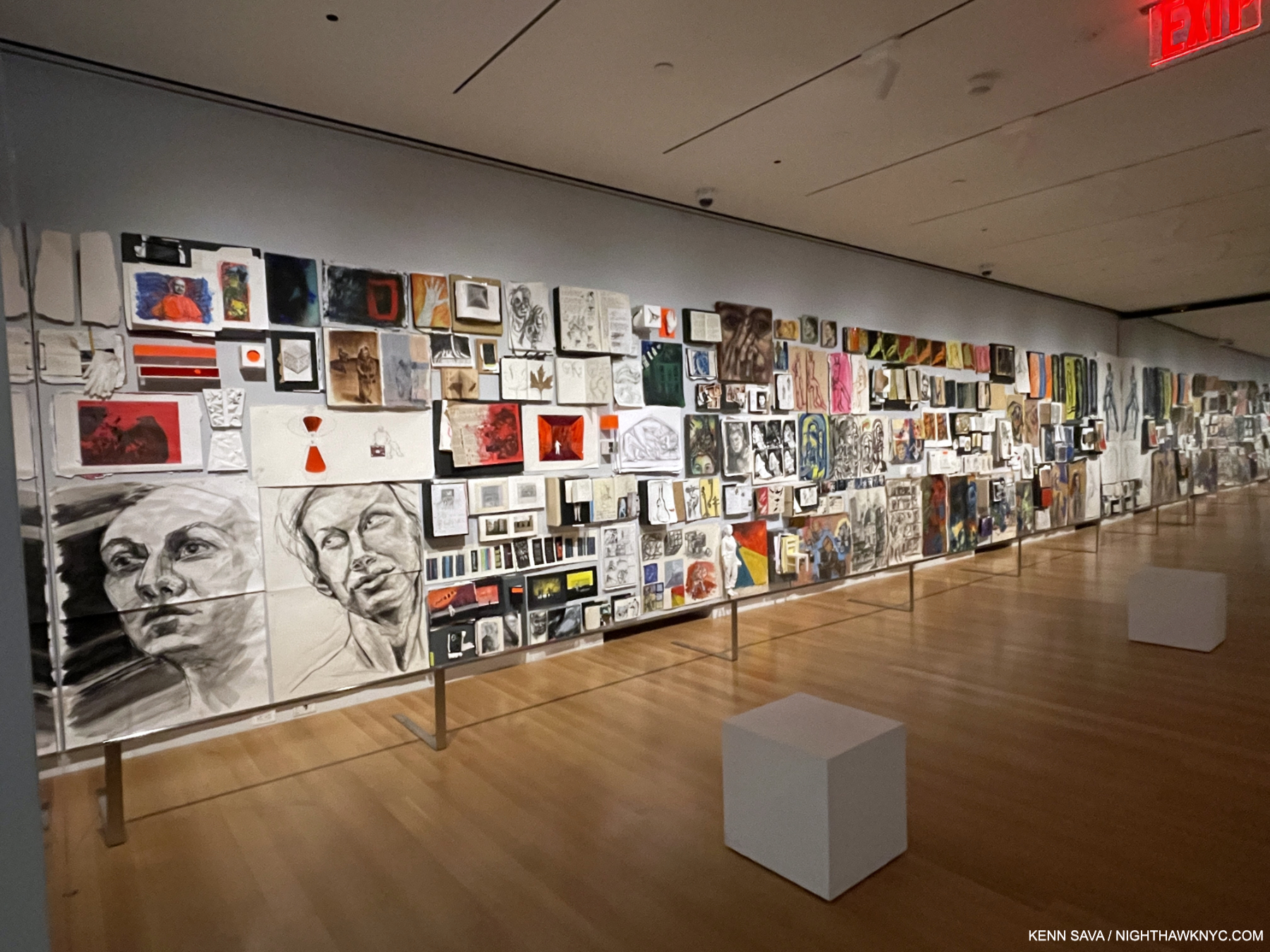
Installation view of the first gallery of work, with the earliest pieces at the far end. If you look closely you’ll notice mirrors at each end of the wall. In what might have been an effort to make the show feel larger, all the galleries had wall-sized mirrors on each end.

After leaving Iris, next up is the gallery of her fascinating early works, largely Drawings and Mixed Media works on paper, i.e. pen, markers, paint on paper Portrait and figure studies, like countless other Art students. I had to look closer to find the roots of her Stage Design work. In between the large studies, I saw sketchbooks, notebooks and loose sheets that contained outlines and ideas for stage productions, none of which are listed in her book.

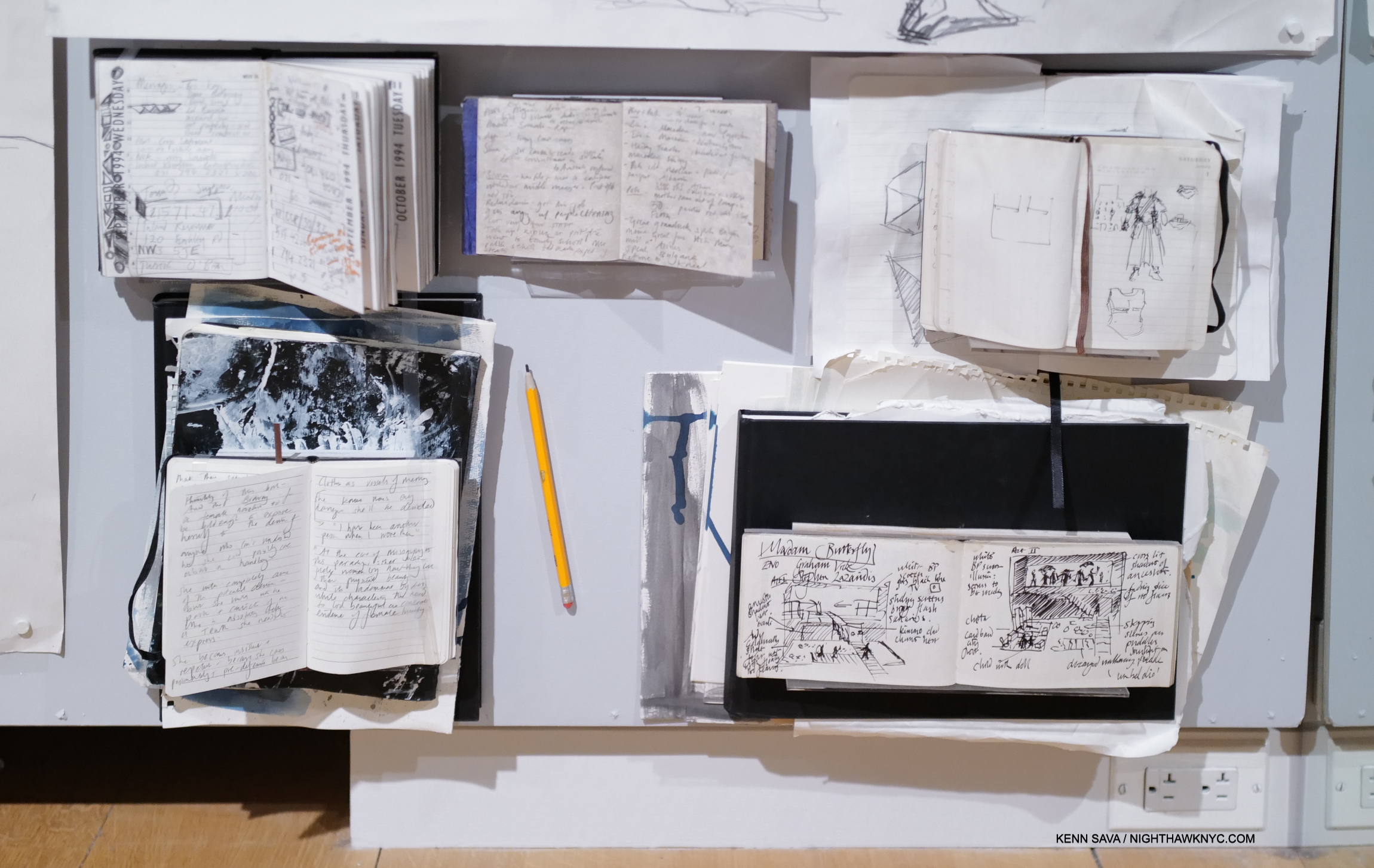
On the very bottom of the far end of the wall, just above the power outlets, and so difficult to see, I spotted these notebook pages, the one at the lower right reads “Madam Butterfly,” perhaps one of the earliest Stage Designs in the show (the book in the upper left is dated October, 1994). Note that Es has Drawn the entire thing, boldly and confidently, in ink with no white-out or corrections. That speaks to the clarity of her vision, even early on. Immediately above it is a costume design. Note the inclusion of the pencil. I just love that her work was so centered on Drawing and hand-written notes, and continues to be. I don’t see Madam Butterfly listed in her book.

From this gallery, what are we to make of her beginnings? Where did all of what has followed come from? Between visits, I researched her background. Her CV on esdevlin.com, lists her Education, chronologically, as-

-Cranbrook School, 1984-1989 (a “co-ed grammar school1)
-BA Hans English Literature 2.1, Bristol University, 1990-1993
-Fine Art Foundation, Central Saint Martins, UAL, 1994-1995
-Motley Stage Design Course, 1995-1996

That’s it! After taking Art-centric courses for scarcely two years, then she just takes off. In only the second gallery of work, at the beginning of her professional career, the ideas are fresh, innovative & previously unseen- qualities that characterize her work to this day. Still in school(!), she’s already on her way. In the first vitrine, I was struck by her work with Wire, a 4-piece rock band, in 2003. Zillions of 4-piece bands, including a few with yours truly involved, have appeared on stage since The Beatles set a standard for what such a lineup “should” look like. “I didn’t know much, but I was bored of seeing the typical silhouette of a band,” she said on the wall card (where all Es Devlin quotes herein derive).

And so, Wire appeared like this-

Studies: Flag: Burning, for the band Wire’s Farewell Performance, 2003, Barbican Hall, London. Es Devlin’s first stage design for a concert. She made “illustrated cue sheets from which they ran the lights and the videos.” She spoke about not having enough money to afford velcro to enclose the band, so she had to use staples.

11 years later, another 4-piece band looked like this-

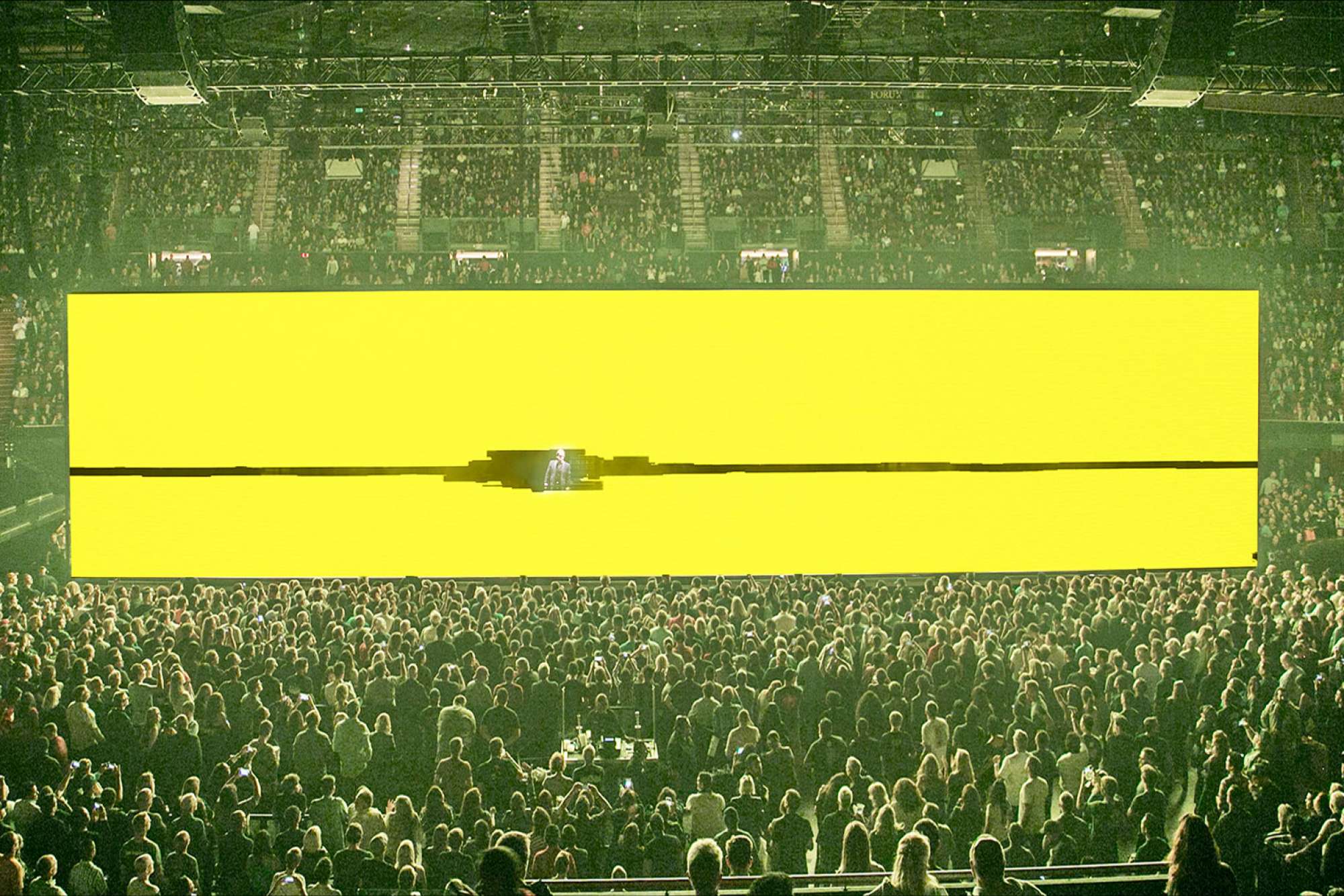
No staples here! U2, “Innocence & Experience” World Tour, 2014. *= Photo from esdevlin.com.

Wire would lead to such extraordinarily innovative shows as “Innocence & Experience,” 2014, and the subsequent “Experience & Innocence,” 2018, both by U2, who also includes 4 members. I believe this performance of “Who’s Gonna Ride Your Wild Horses” is from the “Experience & Innocence” tour. I saw U2 on what I believe was their first U.S. tour at the Ritz in 1980. Bono still sounds as strong as ever. To my mind, Wire, 2003, to U2 a decade later provides a classic case study in Es Devlin’s evolution.

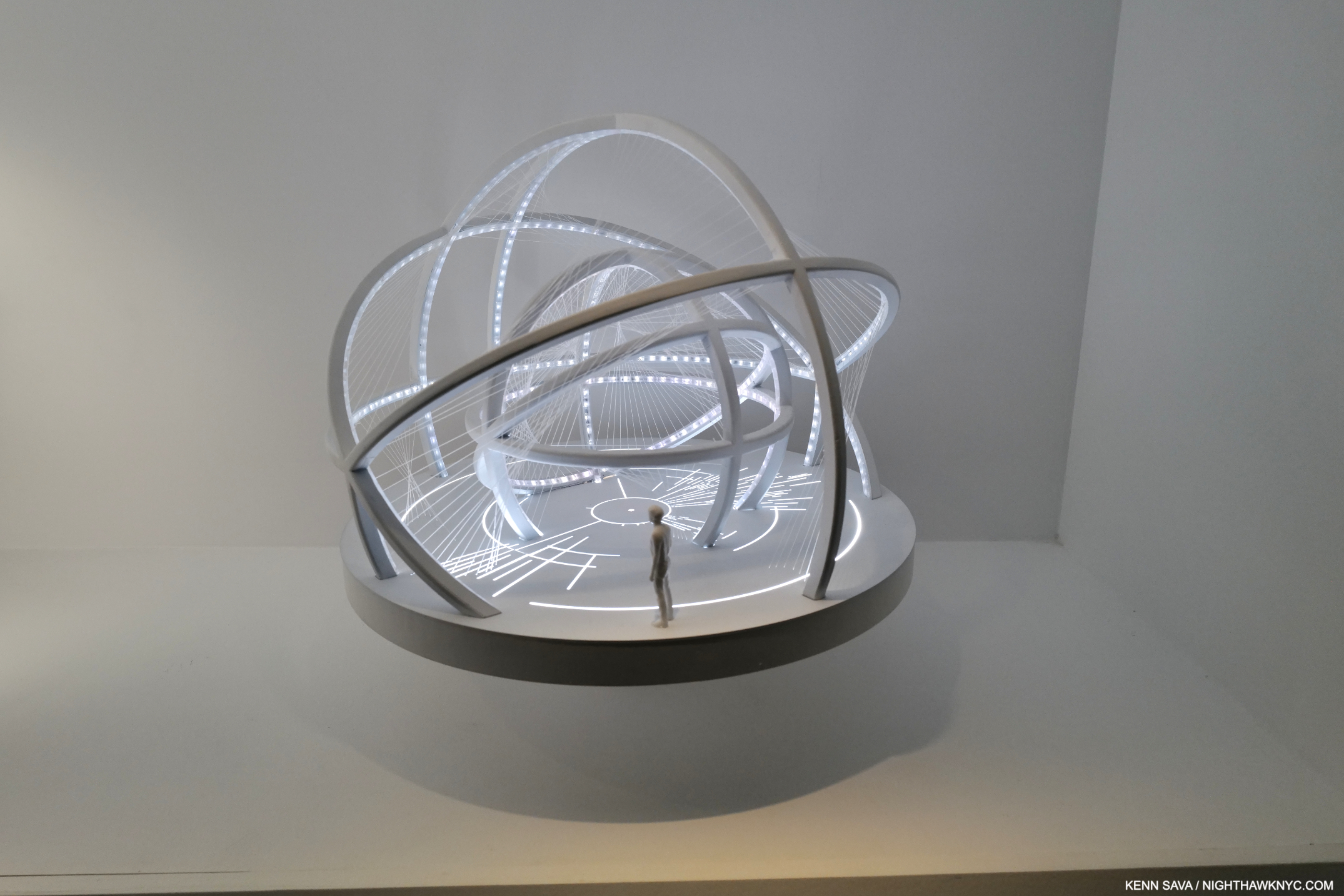
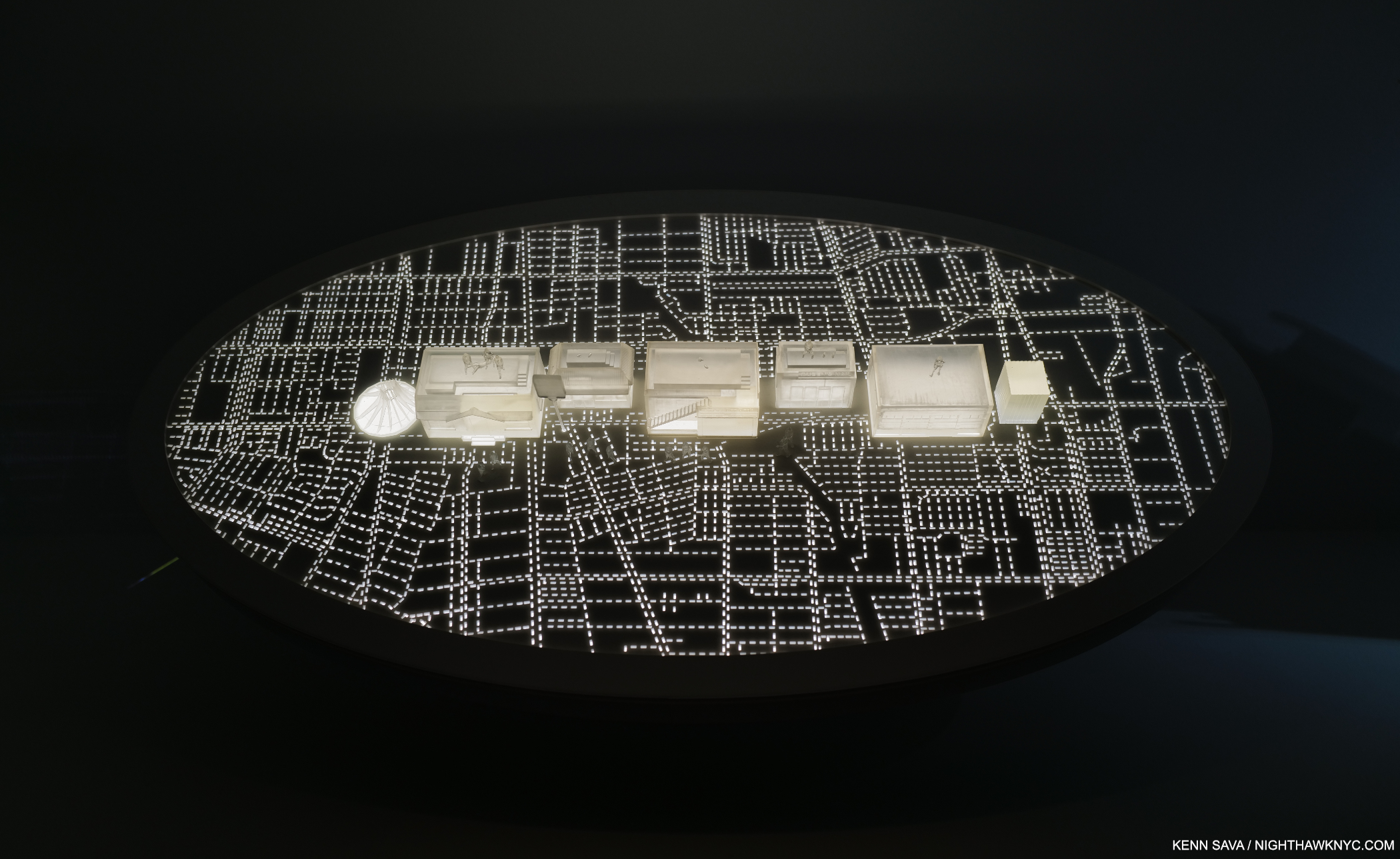
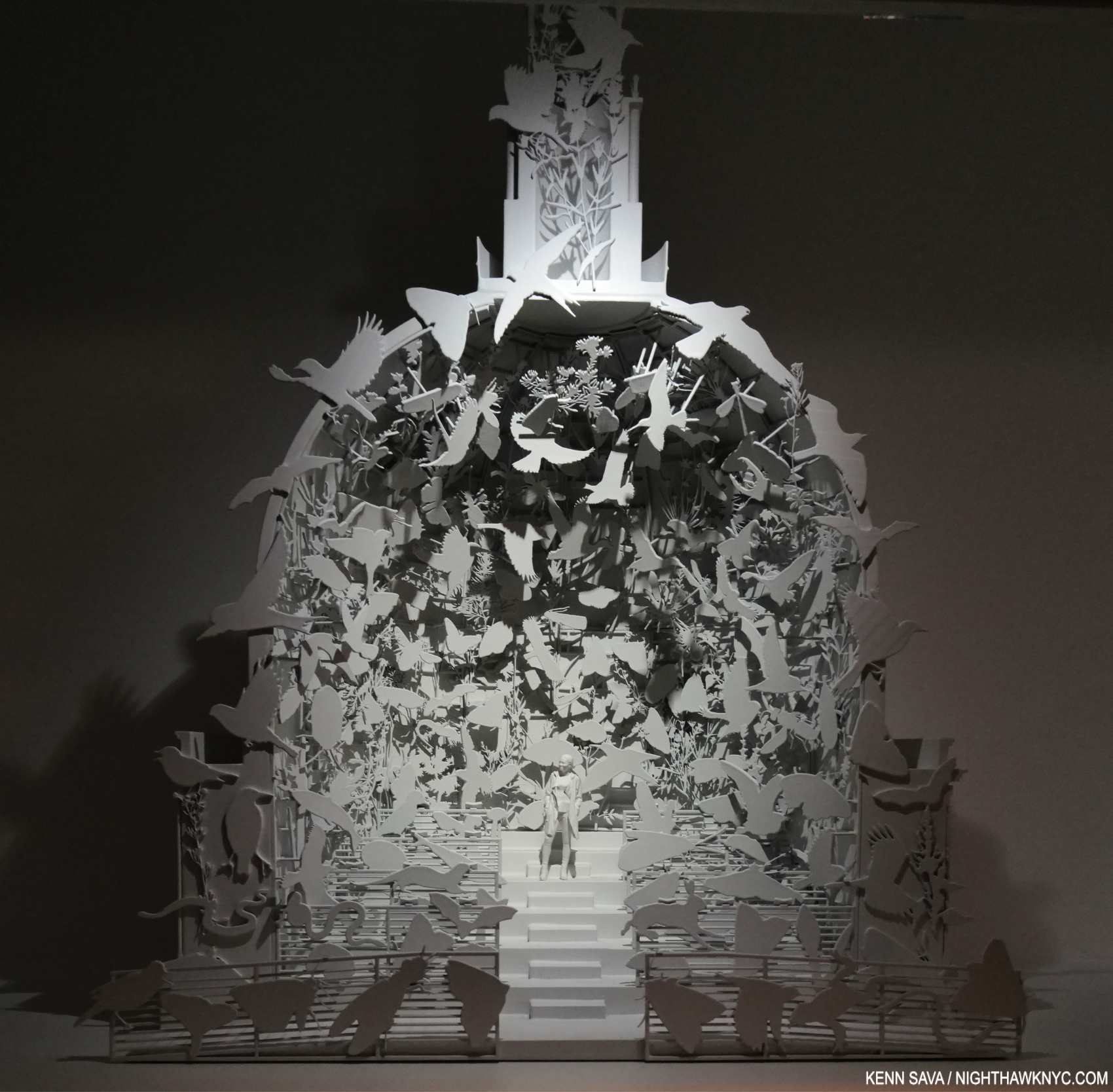
Model, Bangerz, 3-D printed resin, recreated for exhibition. Staged, 2014, Miley Cyrus’s Bangerz World Arena Tour. Models of Ms. Devlin’s designs were the highlight of the show for me. Here, her face is a video projection from above that continually changed. To the side, a huge model of her beloved dog was also on stage. “We decided the Miley Cyrus should perform the entire show on her tongue. The first iteration was impractical, so we reduced the length of the tongue to a slide, down which Miley made her entrance- a sculptural portrait of a young woman rewriting her own script.”

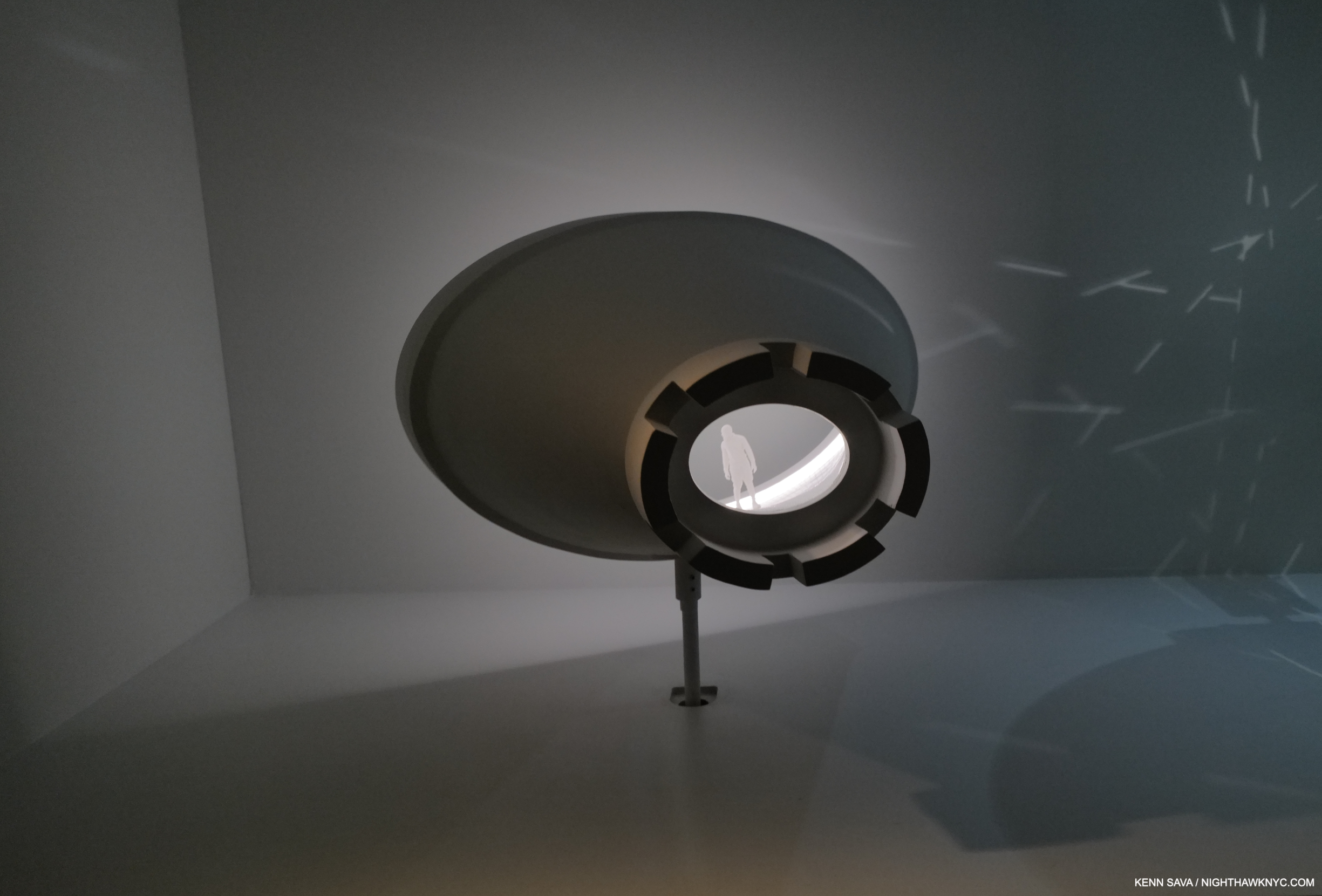
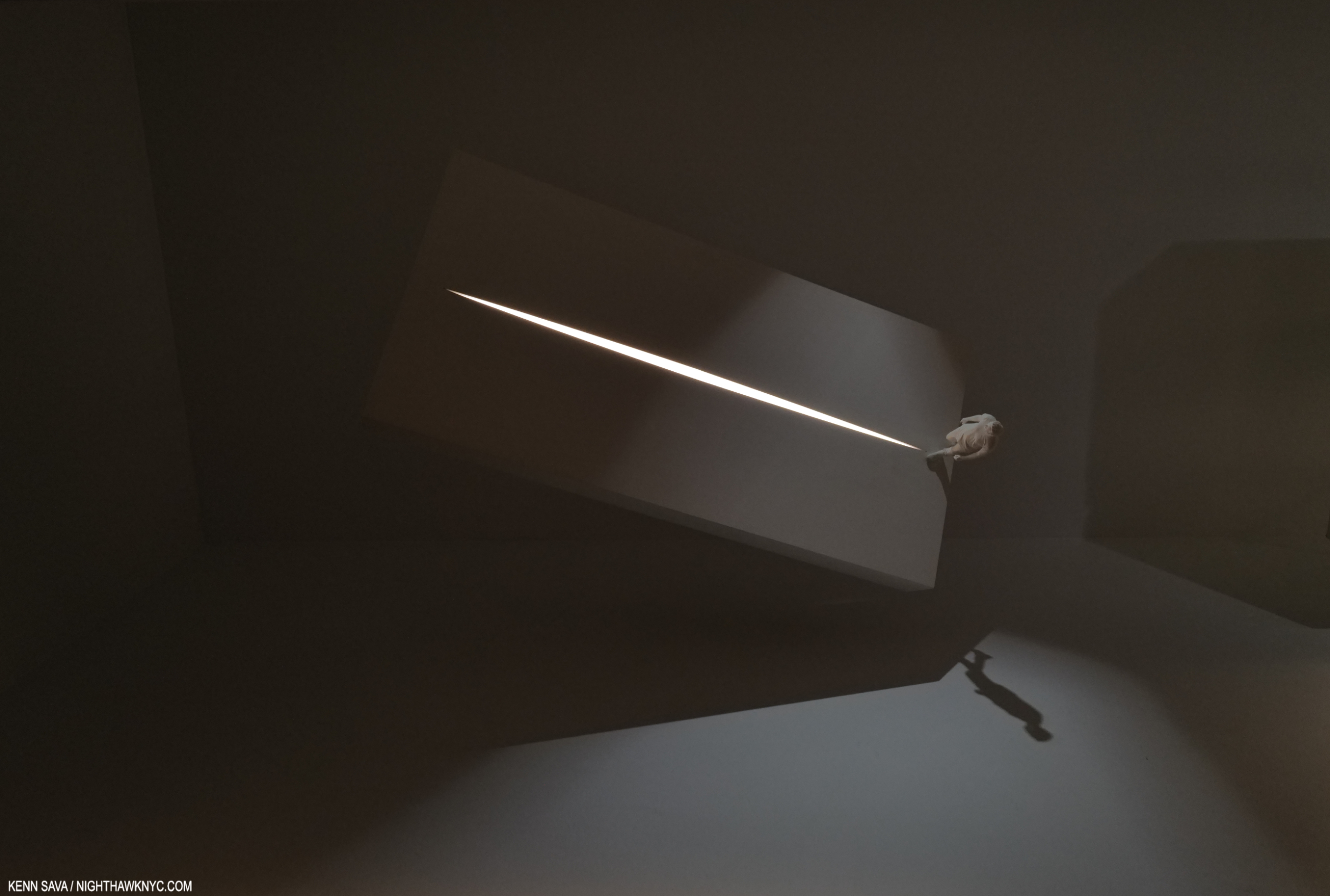
Moving through the show, it became apparent to me that though elements recur, as. you see, Es Devlin has no one “style.” Since her words appear on virtually every wall card. Who else to speak better about her work? I’ll largely let her take it from here.

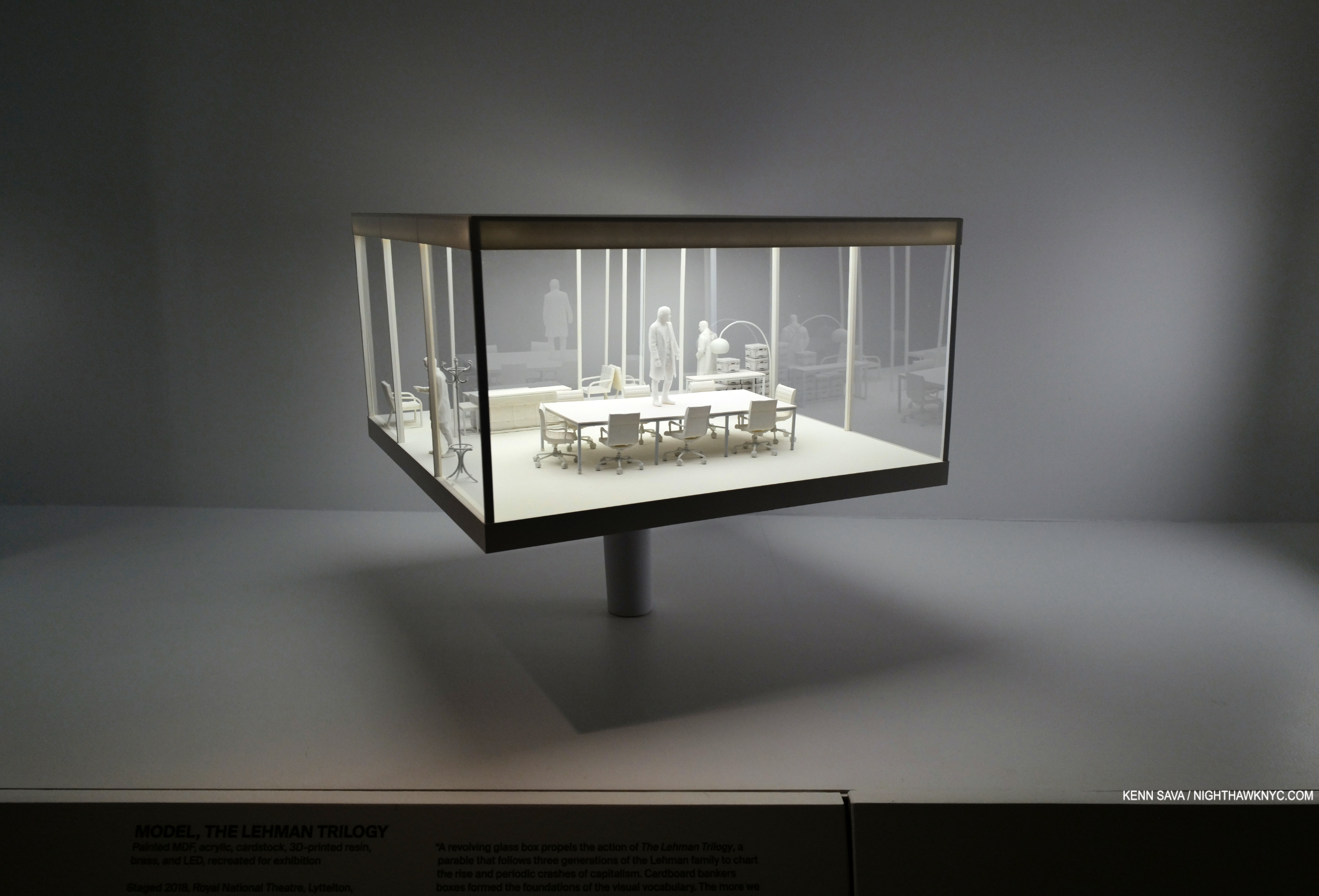
Model, The Lehman Trilogy, Painted MDF, acrylic, yardstick, 3-D printed resin, brass, and LED, recreated for exhibition, Staged in 2018 at the Royal National Theater, London, and the Park Avenue Armory, NYC. Es Devlin’s Tony Award-winning, rotating, design for Stefano Massini’s play The Lehman Trilogy, based on the family of businessmen. All the Models shown here with a center pole rotated. “A revolving glass box propels the action of The Lehman Trilogy, a parable that follows three generations of the Lehman family to chart the rise and periodic crashes of capitalism. Cardboard bankers boxes formed the foundations of the visual vocabulary. The more we invested the boxes with meaning, the more poignant the revelation became that those containers of cotton and coffee would become containers of financial records and numbers, ultimately revealing themselves to contain nothing at all.”

Model, Parsifal, Laser-cut form, resin and paint, recreated for exhibition. Staged in 2012 at the Royal Danish Opera, Copenhagen. “Richard Wagner conceived his final work as a ritual mass for the consecration of a stage. Over four hours of largely static drama, the audience transcends time and space through a rite of compassion. The director Keith Warner and I conceived an enormous revolving rook chess piece whose conical interior formed a new theater within Copenhagen’s opera house. We presented Parsifal’s odyssey from naivety to wisdom as a resistance to the rules of an antiquated game.”

As her career has progressed, a good number of her works have an “otherworldly” feel to them. Figures are frequently enclosed, in a maze, or presented in surroundings that are hard to fathom, often with no apparent way out.

Model, Howie The Rookie, Graphite and paint on laser-cut MDF and LED, recreated for exhibition, Staged 1999, Bush Theater, London, UK. “My first stab designs were experiments in framing light. The Bush Theatre was a room above a West London pub with an audience of 75 people. Mark O’Rowe’s play Howie the Rookie is a pair of potent, visceral monologues set in the housing estates of Tallaght on the outskirts of Dublin, Ireland. I perforated a concrete plane with a line of light. This line conveyed both a burning horizon and a road making on a highway.”

Model, Macbeth, Graphite and paint on laser-cut MDF, acrylic mirror and LED, recreated for exhibition, Staged 2003, Theater an her Wien, Vienna. “The design for Ernest Block’s opera of Shakespeare’s play Macbeth was based on a revolving mirrored illusion box. It’s rotations evoked Macbeth’s churning conscience. We conjured scenes through smoke and mirrors. A half-bed wedged against a mirror appeared as a single whole, while Macbeth and his wife were duplicated. The illusion of a whole banquet full of guests overlaid their machinations as the box turned.”

Installation view of one of the corridors. It’s not as long as it looks. Note the overhead video projectors.

Model, Atlas, 3D-printed resin and LED, recreated for exhibition. Staged 2019, Los Angeles Philharmonic, Walt Disney Concert Hall, Los Angeles, CA. Meredith Monk’s transcendent wordless opera, Atlas, charts the spiritual growth of the 19th-century explorer Alexandra David-Néel. The young girl encounters travel companions and spirit guides within a 12-meter-diameter sphere, scored with webs of international trade and travel routes. The form encompasses Monk’s radiant vision of a possible alternative to the current world order.”

Model, La Caja Mágica/The Seed, Graphite and paint on laser-cut MDF, nd LED, recreated for exhibition. Staged 2010 MTV Europe Music Awards, La Caja Mágica Arena, Madrid, and 2020, Jubail Mangrove Park, Abu Dhabi. “For the MTV Europe Music Awards, I imagined a 10-meter high revolving box that could reveal a shapeshifting series of performances. (Among others) Rhianna sang within a sea of red carnations pouring out of an iris (see next pic).”

Model, Fundamental, MDF, acrylic, acetate, and LED, recreated for exhibition. Staged for the Pet Sop Boys World Tour, 2006-7. Es says, “Neil Tennant and Chris Lowe’s album Fundamental critiqued Tony Blair, George W. Bush, the Iraq War, and immigration policy. For the tour, an X-ray image of a divided brain expressed the cognitive dissonance we felt as our country remained entangled in a ware we didn’t want. The show was performed outside the Tower of London, complete with projected pink tanks for the anti-war extravaganza ‘The Sodom and Gomorrah Show’ and giant sequined cowboy hats for the Bush/Blair pantomime “I’m with Stupid.” 

Model, Your Voices, Acrylic, filament, nylon thread, and LED, recreated for exhibition. Installed in the fountain at Lincoln Center, NYC, in 2022, Es says of it, “New York is the most linguistically diverse city on the planet, with 637 languages spoken by its inhabitants. Your Voices celebrated this diversity. Like a giant harp, the sculpture’s glowing arcs enveloped visitors and local choirs with an illuminated web. The piece rotated through a soundscape of languages from all over the city: from Arabic to Ashanti to Zapotec and Zulu. The strands spliced and framed the viewer’s perspectives, just as our perspectives are shifted when we learn to speak through the voices of others.”

Installation view.

Model, Compton Super Bowl, Laser-cut MDF, acrylic, 3D-printed resin, and LED, recreated for exhibition. Staged for the 2022 NFL Super Bowl Halftime Show featuring Dr. Dre, Kenrick Lamar, Eminem, Mary J. Blige, Snoop Dogg, and 50 Cent, Los Angeles, CA. “Dr. Dre and I proposed etching a map of the city of Compton onto the global Super Bowl stage. We case the buildings as charcters that led from Snoop Dogg’s house to 50 Cent in the club to Eminem breaking out of jail.”

Model: Come Home Again, 2022, Acrylic and printed resin. “For Come Home Again, I constructed a one-third-scale replica of the dome of London’s St. Paul’s Cathedral on the lawn outside Tate Modern, facing the cathedral across the river. I filled dome with observational drawings of 243 of the 15,000 non-human species that call London home; the Londoners most at risk of extinction. ”All of the 243 animals depicted were based on Es Devlin Drawings.

Es Devlin in front of  the real Come Home Again, Tate Modern, London, 2022 *- Photo by Matt Alexander

The shipping crates for the Art, teased earlier, filled a gallery where a video screen was mounted in a stage set, providing seats for the visitors, with more all around me as I took this, and, cutting down on the need for space to store them! Something I’ve never seen before, it’s a  touch that shows the depth of the imagination and attention to detail that went into An Atlas at the Cooper Hewitt.

As if all the thought, planning and work that went into mounting An Atlas wasn’t enough, there is the incredibly innovative 900-page(!) book that accompanies it! So far, it’s the only Art book I’ve named a NoteWorthy Art Book for 2024, and that was before I saw the show. Here, in the show’s final gallery, another recreation of her studio, visitors get a look at the making of it, including the original book dummy (off-camera, in a vitrine to my left). This time, visitors were free to handle the items on the table, which were reproductions of the original work materials…right?

An Atlas, the show, reveals, that as her fame and notoriety grows,  so too are the opportunities for the Artist to step out and present her own work, without an overriding “boss,” as she has in major works like Come Home Again, and Your Voices, both 2022, and, of course, in An Atlas of Es Devlin, the book & show. Her own work shows the Artist bringing “big questions” to the forefront- including species near extinction (in Come Home Again, and in her piece Nevada Ark for U2’s The Sphere shows in 2023),

That Es Devlin’s work, and practice, is deeply rooted in traditional Art-making techniques, like Drawing and Sculpture, is a continual touchstone in both the show and the book. She uses them to produce work that lives on, and continually pushes, the cutting-edge of Stage Design and Production. I find this both fascinating and inspiring. On one hand, her example shows what is still possible by just putting pen or pencil to paper; that a master’s or doctorate degree are not prerequisites for achieving a very successful career, or greatness, in one’s chosen field in the Arts. On the other, it also reaffirms over and over again the power of one person’s creative vision. In her chosen field, her work strikes me as being downright unprecedented. In the larger world of Art, Es Devlin’s vision is at once as personal and as expansive as almost anyone else’s working today.

*- Soundtrack for this piece is “Who’s Gonna Ride Your Wild Horses,” by U2 from Achtung Baby, 1991.

My look at the 900-page An Atlas of Es Devlin, the NighthawkNYC.com NoteWorthy Art Book of 2024, published to accompany the show, is here

NighthawkNYC.com has been entirely self-funded & ad-free for 9 years, during which 330 full-length pieces have been published! If you’ve found it worthwhile, PLEASE donate by PayPal below to allow me to continue. Thank you, Kenn.

You can also support it by buying Art, Art & Photography books, and Music from my collection! Art & Books may be found here. Music here and here.

Written & photographed by Kenn Sava for nighthawknyc.com unless otherwise credited. To send comments, thoughts, feedback or propositions click here. Click the white box on the upper right for the archives or to search them. Subscribe to be notified of new Posts below. Your information will be used for no other purpose.
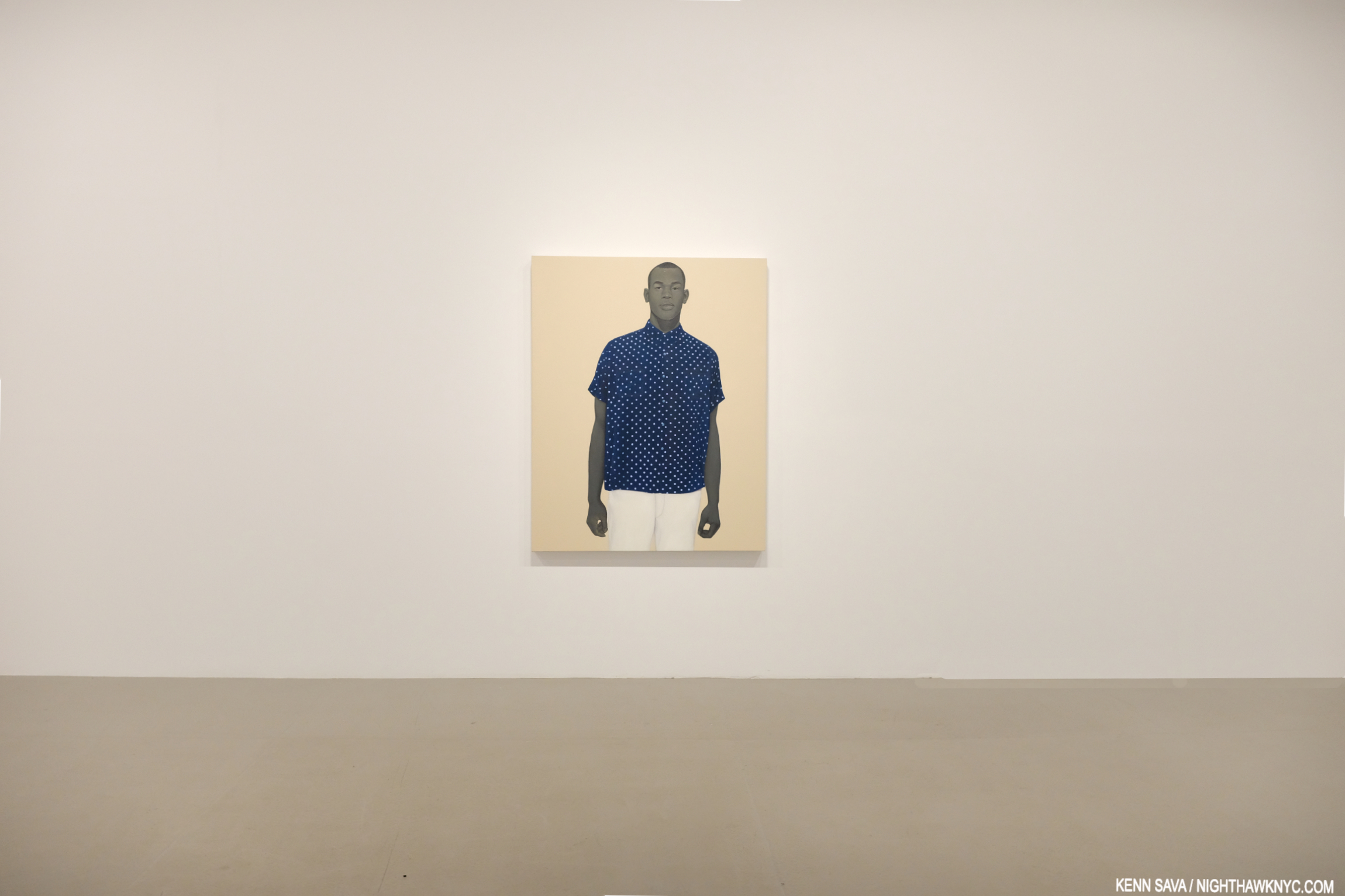
For “short takes,” my ongoing “Visual Diary” series, and outtakes from my pieces, be sure to follow @nighthawk_nyc on Instagram!

Thank you, SV.

  1. Their site describes the school as “a co-educational grammar school in the heart of the glorious Wealden countryside.”

Stepping Into “Edward Hopper’s Nighthawks”

This site is Free & Ad-Free! If you find this piece worthwhile, please donate via PayPal to support it & independent Art writing. You can also support it by buying Art & books! Details at the end. Thank you.

Written & Photographed by Kenn Sava.

The numeric convergence begins. August 28, 2013, eleven years ago next month- – The last time I stood in front of the real thing- Edward Hopper, Nighthawks, 1942, at Hopper Drawings at the old Whitney Museum. A moment later, a friend snapped a picture of me standing next to it. Would I ever get closer to it? Pictures in this piece are thumbnails. Click any for full size.

The Edward Hopper/NighthawkNYC Convergence, 1-

July 15, 2015, nine years ago this month, in my very first piece, “Welcome to the Night,” I mentioned I’ve always related to that figure sitting by himself with his back to the viewer in Edward Hopper’s Nighthawks, 1942. The one that no one ever talks about. Why is he even in the Painting?  Well, he’s really only half in it; his left side completely blends into the black background. So, what’s his deal? Did his date go bad? Is he worried about the recent outbreak of World War II? Is he waiting for the lady in red to lose her guy? (The couple are likely Edward & Jo Hopper stand-ins.1).  Well, he’s there and I’m glad he is. He’s also a witness to everything going on inside, close enough to the other subjects to hear their conversations. In Nighthawks, he has THE ideal seat to see and hear everything that’s really going on, that the rest of us can only imagine.

I’ve been that guy too many times to count, out on my own late at night in Hopper’s Greenwich Village neighborhood. I relate to that “witness” aspect of him, too. After all, isn’t that what I’m doing here; being a witness to the Art, Photography, Music  books I’ve experienced?. So, I named this site NighthawkNYC after him. Hopper’s Painting is titled “Nighthawks.”

But, what would it be like to be him?

Triple self-portrait, August 28, 2013. “That shape is my shade, there where I used to stand,” as I quoted Steely Dan’s “Deacon Blues” in my very first piece, “Welcome to the Night,” on July 15, 2015.

Convergence 2-

On July 29, 2019, five years ago this week, I published “My Search For Edward Hopper’s Nighthawks Diner,” chronicling my decades-long quest to find the iconic eatery/drinkery. It’s turned out to be my most popular piece thus far.

This past Sunday, July 21st, I finally found it!

It happened to be on a triangular corner- Check.
It happened to be in the West Village, not all that far from 3 Washington Square, where Edward & Jo Hopper lived for half a century- both key criteria the real deal has to fit- Check.
But, it was not where I’d looked for it as I wrote in the piece. It was out in the open! Without a roof!?

I let that slide. After all, in the Painting we really can’t see the ceiling, just the light coming down, and it’s a one-story building shown at night. Maybe there was no roof? Imagine that. “Maybe. Maybe not,” I hear you saying.

The famous “Only 5c Phillies America’s No. 1 Cigar” sign was up top- Check.
The outside was painted in that familiar green- Check.

Everything looked like it was supposed to. Am I dreaming? Then, a nice gent named Nilo beckoned me inside!

As I approached the counter, about to take “my”place- the only seat I was interested in taking,  all the details long engrained in my memory were right in front of me.

It was empty. Wow. Perfect! I could look around and drink it all in without feeling self-conscious. Wait!…AM I conscious? A coffee will wake me up. I’m in the right place.

Living a dream…Kenn Sava, left, Lucas, right. July 21, 2024, Meatpacking District, NYC. Photo by Nilo for NighthawkNYC.com.

I could take the seat of my alter ego in peace, without that pesky couple, she in the flame-red dress, with her male companion, who for the past 82 years have gotten all the attention, in the room. I was free to finally chat with the counterman. His name was Lucas and I told him how long I’ve been looking for the place- and even wrote about just that, the nice weather, what else was going on this weekend. You know, small talk; the kind of stuff strangers talk about when they’re suddenly thrust together. But, we weren’t total strangers in the classic sense. We both knew why we were here. As he went back and forth to his duties, I just kept looking around, drinking it all in. Wow. I’m sitting inside of Nighthawks!

There’s the famous two large coffee urns.
There’s the yellow wall with that mysterious door.
The bar was the familiar brown.
The classic white ceramic coffee cups, glass salt & peppers, and napkin dispensers were all around giving me a feeling of familiarity and “home.” I guess that’s what happens when you’ve been looking at them for so long in Painted form.

So real, you could reach out and touch them. Of course, I did…

And, I got to experience it from THE seat, to see what “he” saw and ponder him anew. Maybe “he” was me in a prior life. If so, how many people have gotten to relive a moment from a prior life?

This MUST be the place! FINALLY! I can’t wait to rush home and tell readers I found it! What a scoop!

A close call with a bike running a Walk sign on the walk home snapped me out of it and back to reality. As I reviewed my pictures to make sure my phone was OK, it turns out I had come upon something called “Step Into Hopper. 

Convergence 3-

After nine years of “riffing” on Nighthawks in my Banner, it finally came to life! The Whitney Museum & the Meatpacking District got together to mount “Step Into Hopper,” along with fabrication by Theresa Rivera Design and an exceptional, welcoming, staff, to “recreate” Nighthawks, 1942, Early Sunday Morning, 1930, and his eternally mysterious Soir Bleu, 1914within one mile or so of the original sites of two of them2.

“Early Sunday Morning,” a take-off on Hopper’s 1930 timeless masterpiece of a street in my neighborhood, a few blocks away, on Seventh Avenue between West 15th & 16th Streets. Notice the shadow from the barber pole goes the “wrong way,” as it does in the Painting. People who live there know the sun never shines in that direction on 7th & 15/16th!

Convergence 4-

It truly was a moment frozen in time. Something out of a dream… I ended “My Search For Edward Hopper’s Nighthawks Diner”  with a quote from the song I chose as the Soundtrack for the piece, “I Saw You In A Dream” by Japanese House….

“I saw you in a dream
You had stayed the same
You were beckoning me
Said that I had changed”

How prescient.

Before I “changed.” Take away the side addition, and the former Rivera Cafe on 7th Avenue was my “Oh my gosh!” moment, as I wrote in “My Search…” Seen on July 23, 2018- convegently, six years ago this week.

In reading the mail that continues to come in on the piece, it seems that many people share my dream of unexpectedly coming across the Nighthawks Diner and having an “Oh my gosh!” moment of discovery.

Kenn Sava “inside” “Soir Bleu” (the Painting seen on the sandwich sign above) with the wonderful Tillie the Clown proving every bit as mysterious and stunning as the figure in the 1914 Painting done in Paris. Photo by Gregory for NighthawkNYC.com

A lot of folks seem to want to step inside, sit down at the counter for a bit, and just live in the Painting; experience it from the inside  even for a few moments. As if that might help solve its mystery…On Sunday, I came as close as I’m likely going to to having my “Nighthawks” moment.

A few moments after the Photo of me and Lucas inside “Nighthawks” was taken, I looked around for him and couldn’t find him. Lucas disappeared.

Of course he did.

Convergence 142-

Today, as I write this on July 22nd is Edward Hopper’s 142nd Birthday. Happy Birthday, big guy (Hopper was 6’5″). Thanks for saving me a seat in Art heaven. A short visit is probably the best I can hope for.

*- As it was for “Welcome to the Night” 9 years ago, the Soundtrack for this piece is  “Deacon Blues,” by Steely Dan (my “Forgotten Songs I Will Love Forever #2″, which remains the Anthem of NighthawkNYC.com, from their immortal album Aja, 1977. (I have no idea why the guy who made tihis video shows their album Gaucho. Ignore that- it’s Track 3 on Aja.)

“Sharing the things we know and love
With those of my kind
Libations, sensations
That stagger the mind.”

If the Nighthawks Diner had a jukebox, I like to think “Deacon Blues” would be on it.

Undying thanks to Kevin Callahan for the tip, the iconic Lucas for the coffee & the convo, Tillie the Clown for the Tillie Experience, Milo, Wendy, Alisa and Gregory for the Photos, their consideration and kindness in creating an experience I’ll never forget. A tip of the Fedora to the Meatpacking District, the Whitney Museum & Theresa Rivera Design for mounting Step Into Hopper. Push by Lana Hattan (9 years of NighthawkNYC.com– it’s ALL her fault!)

Be sure to see my 3-part series on the 2022-23 blockbuster Edward Hopper’s New York which begins here.

NighthawkNYC.com has been entirely self-funded & ad-free for 9 years, during which 330 full-length pieces have been published! If you’ve found it worthwhile, PLEASE donate by PayPal below to allow me to continue. Thank you, Kenn.

You can also support it by buying Art, Art & Photography books, and Music from my collection! Art & Books may be found here. Music here and here.

Written & photographed by Kenn Sava for nighthawknyc.com unless otherwise credited. To send comments, thoughts, feedback or propositions click here. Click the white box on the upper right for the archives or to search them. Subscribe to be notified of new Posts below. Your information will be used for no other purpose.
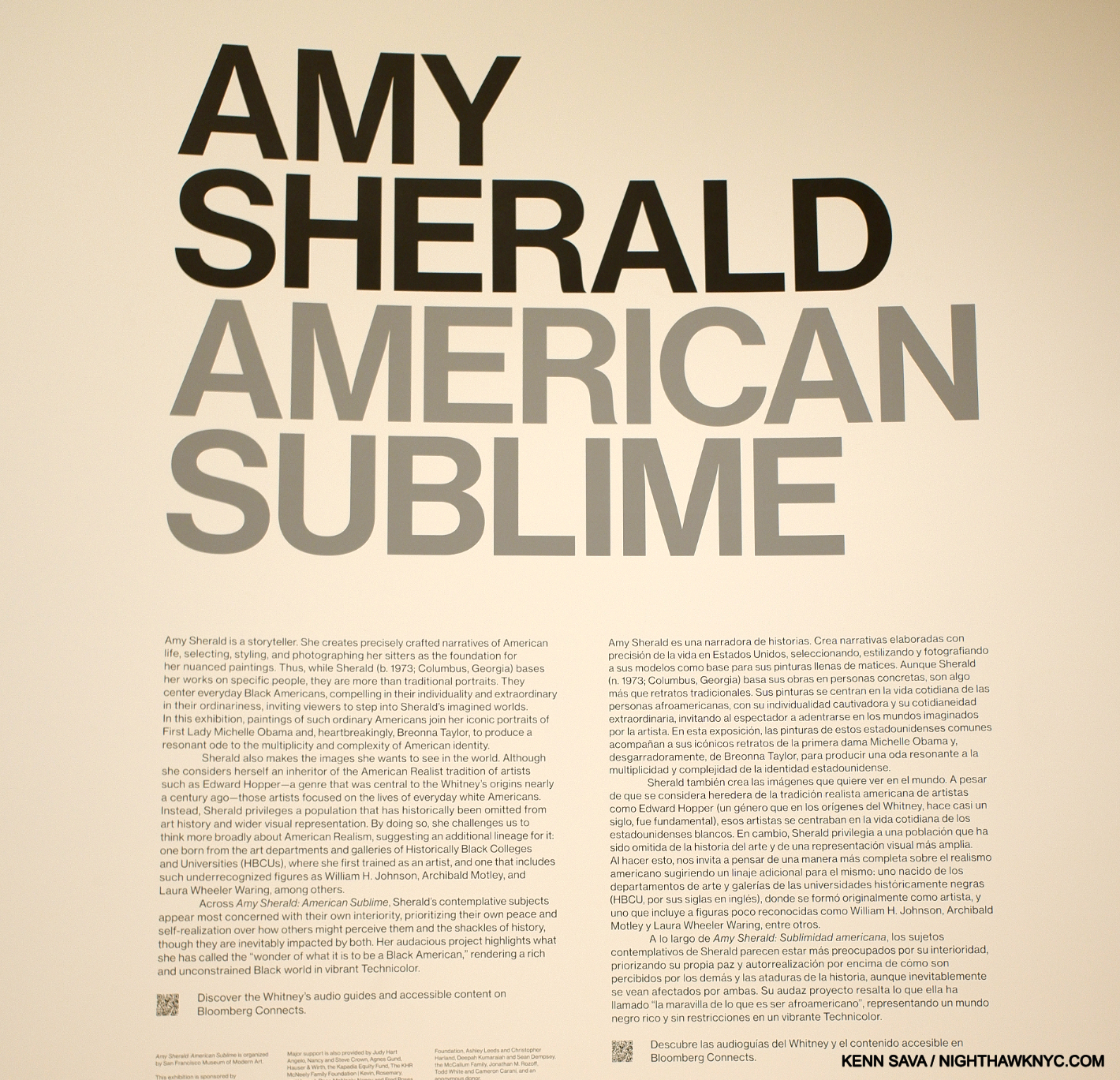
For “short takes,” my ongoing “Visual Diary” series, and outtakes from my pieces, be sure to follow @nighthawk_nyc on Instagram!

  1. Cone to think of it, why are both guys wearing their Fedoras inside? Preparing for quick exits?
  2. The original site of Nighthawks remains up for discussion, as I wrote about, but most likely was inspired by locations in the nearby West Village.

Ed Ruscha & The Two-Sided Coin of Influence

This site is Free & Ad-Free! If you find this piece worthwhile, please donate via PayPal to support it & independent Art writing. You can also support it by buying Art & books! Details at the end. Thank you.

Written & Photographed by Kenn Sava (*- Unless otherwise credited.).

This is the third and final part of my look at Ed Ruscha/Now Then. Part 1  is here. Part 2 is here.

1- Heads

One door closed, another opened. Los Angeles County Museum on Fire, 1965-8, Oil on canvas, seen at MoMA. Ed Ruscha/Now Then is now open there. Pictures in this piece are thumbnails. Click any for full size.

Ed Ruscha/Now Then is a memory for those of us who saw it at MoMA from September 10, 2023 to January 15th of this year. It’s a memory in the making for those who are seeing it now at LACMA, seen above in Ed Ruscha’s 1965-8 nebulous “portrait” of it (which I discussed in Part 1), or will be seeing it until it closes there on October 6th. They’ll be pleased to know it’s a show with staying power, a show I continue to relive and think about on a daily basis, six months after it closed here. After following the trail of his devlopment in Part 1, “Ed Ruscha’s Head Scratchers,” seeing some echoes of the work of Artists past, I began to wonder… Every Artist I’ve come across has had influences. Who influenced Ed Ruscha? As the show was up, and now after it ended here, that question lingered.

Marcel Duchamp, L.H.O.O.Q., 1919, or later. One Artist Ed Ruscha has repeatedly expressed his admiration for is Duchamp, who he met in the early 1960s. There are numerous version of L.H.O.O.Q. since the 1919 original. I chose this one because t contains all the elements of the original, which I cannot find (if you have  let me know)- the mustache, the goatee, and the famous letters all of which Duchamp added to a Mona Lisa postcard. Duchamp once said that L.H.O.O.Q. means “there is fire down below,” though I’ve seen other definitions.  *- Photographer unknown.

“Duchamp had quite a sizable influence on me from a pictorial standpoint and from an emotional standpoint,” Ed Ruscha (Ed Ruscha, Leave Any Information After the Signal, P.324).

Ed Ruscha has not written an autobiography, so his book, Leave Any Information After the Signal, a collection of “Writings, Interviews, Bits, Pages” from 1960 to 2000 is the closest thing we have to a primary written source. In addition to just looking, I turned to it, along with the numerous other interviews he’s given over his six-decade plus career, for insights.

As seen in Part 1– Encountering Johns’s  Target with Four Faces in a black & white reproduction in a 1957 magazine was, he said, an ‘atomic bomb’ in his training, ‘a stranger fruit’ that he ‘saw as something that didn’t seem to follow the history of art. My teachers said it was not art. ‘I didn’t need to see the colors or the size…’ ‘I was especially taken with the fact that it was symmetrical, which was just absolutely taboo in art school- you didn’t make anything symmetrical…Art school was modernism, it was asymmetry, it was giant brush strokes…it was all these other things that were gestural rather than cerebral. So I began moving to things that had more of a premeditation1.’” Jasper Johns, Target with Four Faces, 1955, Encaustic on newspaper and cloth over canvas surrounded by four tinted-plaster faces in wood box with hinged front. Seen in Jasper Johns: Mind/Mirror at the Whitney in 2021.

Besides naming Duchamp, Jasper Johns and his counterpart Robert Rauschenberg, Ed Ruscha hasn’t addressed the subject of influences all that often.

René Magritte, The Treachery of Images (This is Not a Pipe), 1929, Oil on canvas. (Not in the show.) *-LACMA Photo

Pondering the visual evidence, the first name that came to mind was Rene Magritte, 1898-1967, a well-known Belgian Artist who also had a long career and touched on a number of subjects Ed Ruscha has, while sharing his fondness for taking the familiar out of context (which Mr. Ruscha does with words, objects and places). He also incorporated words. Though often labelled a “Surrealist,” his work touches on any number of other realms and styles of Painting, which made him ahead of his time. As a result, his influence is extraordinary and ongoing. Time and again, I’d look at an Ed Ruscha, or a section of one, and think “Magritte,” beginning with Actual Size, 1962, which I showed in Part 1, which echoes Magritte’s The Treachery of Images, 1929 better known by the famous words it includes, “This is Not a Pipe2.” The Magritte seems to echo his contemporary, Duchamp’s L.H.O.O.Q., from 1919.

Salvador Dalí, Open Field with Ball in Centre and Mountains in  Rear, Study for the Walt Disney film Destino, 1948, Oil on masonite, left. Ed Ruscha, Painkillers, Tranquilizers, Olive, 1969, right. (*- Dali from the Dalí & Film MoMA catalog. Ed Ruscha as I saw it in the show.)3.

Of him, Mr. Ruscha said, “Yes, Magritte did influence me, but it came the other way around—what I call 360-degree influence. That’s influence from a person’s thoughts and force and not from his pictures, which the person being influenced has not seen, until later on. The same with Dalí. I’ve been influenced by Dalí, but it’s been through other sources. Because I’ll go back, and I’ll be working on something and I’ll see a picture of Dalí’s I’ve never seen before, and there is my work. (P.56).” I wrote about seeing Dalí in Rauscha in Part 1– before I found that quote.

Surrealism Soaped and Scrubbed, Ed Ruscha’s cover design for Artforum 5, No. 1, Special Issue: Surrealism, September, 1966. 

What about “Surrealism’s” influence, that of the group of European Artists so labelled?

Ed Ruscha was Art Director for Artforum Magazine from 1966-19724. His cover for the September, 1966 “Surrealism” Special Edition I find fascinating, particularly in regards to Ed Ruscha’s Art, overall. While this image has almost nothing to do with “historical Surrealism,” I find it ripe with the “kind” of surrealism (small “s,” which he also uses here) I see in Ed Ruscha’s work, while also being another of his trademarked play on words. There is nothing in “historical Surrealism” that influenced this (as far as I know), and so it’s another work that makes me wonder what, if anything, inspired it. On page 349 of Leave Any Information After the Signal, Mr. Ruscha denies the influence of the Surrealists handling of light on his work. That’s all he has to say about it.

The Back of Hollywood, 1977, Oil on canvas. Was Ed Ruscha the first to Paint words backwards? Probably not.

What about influences on his Word Painting? In After the Signal, he said,  “Well, there’ve been so many artists who have used words throughout the centuries really, but the ones I enjoy are mostly from the twentieth century. Say, Kurt Schwitters. [. . .] 5” On page 115, Paul Karlstrom directly asks Mr. Ruscha,  “Who were your heroes then, your role models?” He replied, “Well, I guess de Kooning was, and Franz Kline. Franz Kline had a lot to say at that particular time, and so they were more or less the passwords. You just emulated them, almost automatically. Then if you couldn’t emulate them you weren’t really on the right track. I still think that. But the work of Johns and Rauschenberg marked a departure in the sense that their work was premeditated.” It sounds like he was referring to his early days as a student under the Abstract Expressionist influenced Chouinard faculty in the late 1950s, as once again, it’s hard for me to see the influence of de Kooning or Kline in Ed Ruscha’s work.

Joan Miró, Photo: This is the Color of My Dreams 1925, Oil on canvas. *- Met Museum Photo

The Surrealists began as a literary “movement,” that experimented with “automatic writing.” Later, their influence spread to Painting. In Miró’s Photo: This is the Color of My Dreams, it comes full circle. Part of the Artist’s “peinture-poésie” (painting-poetry) series, this strikes me as a forerunner or precursor to the Word Paintings of Ed Ruscha. Yet, I have no idea if he saw it, or other works in Mirós series,  or when.

America’s Future, 1977, Oil on canvas. The title is shown in the next picture.

The feeling I’m left with is that these Artists “effected” him in ways outside of a direct visual influence. They are, what I call, “echoes.” What Ed Ruscha called “360 degree” influences. As for the stated influences, in Part 2, I mentioned that Thomas Cole was the influence on Mr. Ruscha’s Course of Empire series, from who he borrowed the name of the series. It seems to me the rest of his influences, if any, remain up for conjecture. Still, taking him at his work on possible influences would leave Ed Ruscha remarkably original.

Detail. Though Painted 18 years before he began his Course of Empire series I showed in Part 2, seeing this made me wonder if this work should be appended to the end of the series, i.e. the final outcome of it.

2- Tails

Turning the influence coin over, however, 67 years, and counting, into one of the most remarkable careers in American Art history, at this moment in time it’s hard to think of another Modern & Contemporary Artist, let alone an American Artist, who is more influential than Ed Ruscha is. In fact, it’s impossible for me to list here all the realms in which his influence can be seen. Those that come to mind the quickest include-

-His role in furthering the breaking of the strangle hold of Abstract Expressionism in Painting in the early 1960s.

-His unique way of incorporating words and typography into his Art.

-His Paintings of L.A. and the American West6.

No place on the planet has more Artist’s books than NYC’s Printed Matter, home of 15 ,000 books they’ve created. How many are/were inspired in part or wholly by Ed Ruscha? I don’t know the total but I keep finding more every time I go in. May 6, 2024.

-His ground-breaking Artist’s books/PhotoBooks. (Is it a stretch to say he’s played a defining role in the Contemporary Artist’s Book & PhotoBook phenomenon? I don’t think so.)

-His style of nonjudgmental roadside and aerial Photography.

-Entire genres of Painting, Photography and books have sprung up around his work.

Jeff Brouws, Various Small Books Referencing Various Small Books by Ed Ruscha, 2013. 288 pages of books, and just books, by other Artists influenced by Ed Ruscha, and it’s now 11 years old!

To this point, at least two substantial books, including the book above, have been published focused solely on his influence! All of this is even more impressive (or mind-boggling) when you consider Ed Ruscha is still with us and going strong at 86. Usually, the influence of Artists is something referred to in the past tense.

-His unique way of incorporating words and typography into his Art.

Ed Ruscha’s presence is so pronounced at Printed Matter, they even have a well-worn box just for books he’s influenced. ‘Nuff said. No, that’s not a copy of Mr. Ruscha’s very rare Twentysix Gasoline Stations. It’s Michalis Pincher’s 2009 homage to it, which “borrows” Ruscha’s cover verbatim.

All of this, also, makes it harder to fathom that Ed Ruscha/Now Then was the first large Ed Ruscha show here in 41 years7, and his first show at MoMA! That makes the extent of his influence that much more impressive. Suffice it to say it’s a lot easier to see Ed Ruscha’s influence than it might be to see the influence of others on his work.is so pronounced.

The saddest moment of the entire 4 month run of Ed Ruscha/ Now Then: the show’s entrance, moments after it closed for the last time on January 15, 2024. I saw it on its first preview day, and I was there when it closed for good. Shows are fugacious events. The ending of a great show is always sad; like saying “goodbye” to a friend. One you’ll never see again.

-Takeaways

In addition to providing an opportunity to ponder the scope of his influence, Now Then provides the chance to assess his achievement and his place among the important Artists of both the 20th and 21st centuries. Ed Ruscha strikes me as an Artist who is continually moving forward to the point that he is a seemingly endless innovator. Ed Ruscha/Now Then provided a rare chance to see the craft behind the mystery his work evokes; to watch the Artist move on an almost step-by-step basis from his beginnings though each of his phases, with a focus on his recurring themes and his innovations.

Yet, he’s also an Artist who’s extremely aware of his, and our, pasts, and his Art stays in touch with it often in surprising ways. Ed Ruscha has never stood still long enough to have any box his work gets put in fit for very long. The Ed Ruscha box is the only one that fits an Artist as extraordinarily diverse as Mr. Ruscha has been and continues to be. Ed Ruscha/Now Then is a show that will live long in memory, and no doubt, influence.

Part 1 of my look at Ed Ruscha/Now Then is here. Part 2 is here.

*- Soundtrack for this piece is  “Goodnight My Love,” as performed by Paul Anna. In 2017, MOCA commissioned a short documentary on two themes in Ed Ruscha’s work (the text of which is here). In the resulting piece, Ed Ruscha says, “I’m gonna play this tune called ‘Goodnight My Love’ and this represents everrything I felt about California when I first came out here…” Because he doesn’t specify which recording he’s going to play, I chose the Paul Anka version from 1969.

NighthawkNYC.com has been entirely self-funded & ad-free for 9 years, during which 330 full-length pieces have been published! If you’ve found it worthwhile, PLEASE donate by PayPal below to allow me to continue. Thank you, Kenn.

You can also support it by buying Art, Art & Photography books, and Music from my collection! Art & Books may be found here. Music here and here.

Written & photographed by Kenn Sava for nighthawknyc.com unless otherwise credited. To send comments, thoughts, feedback or propositions click here. Click the white box on the upper right for the archives or to search them. Subscribe to be notified of new Posts below. Your information will be used for no other purpose.
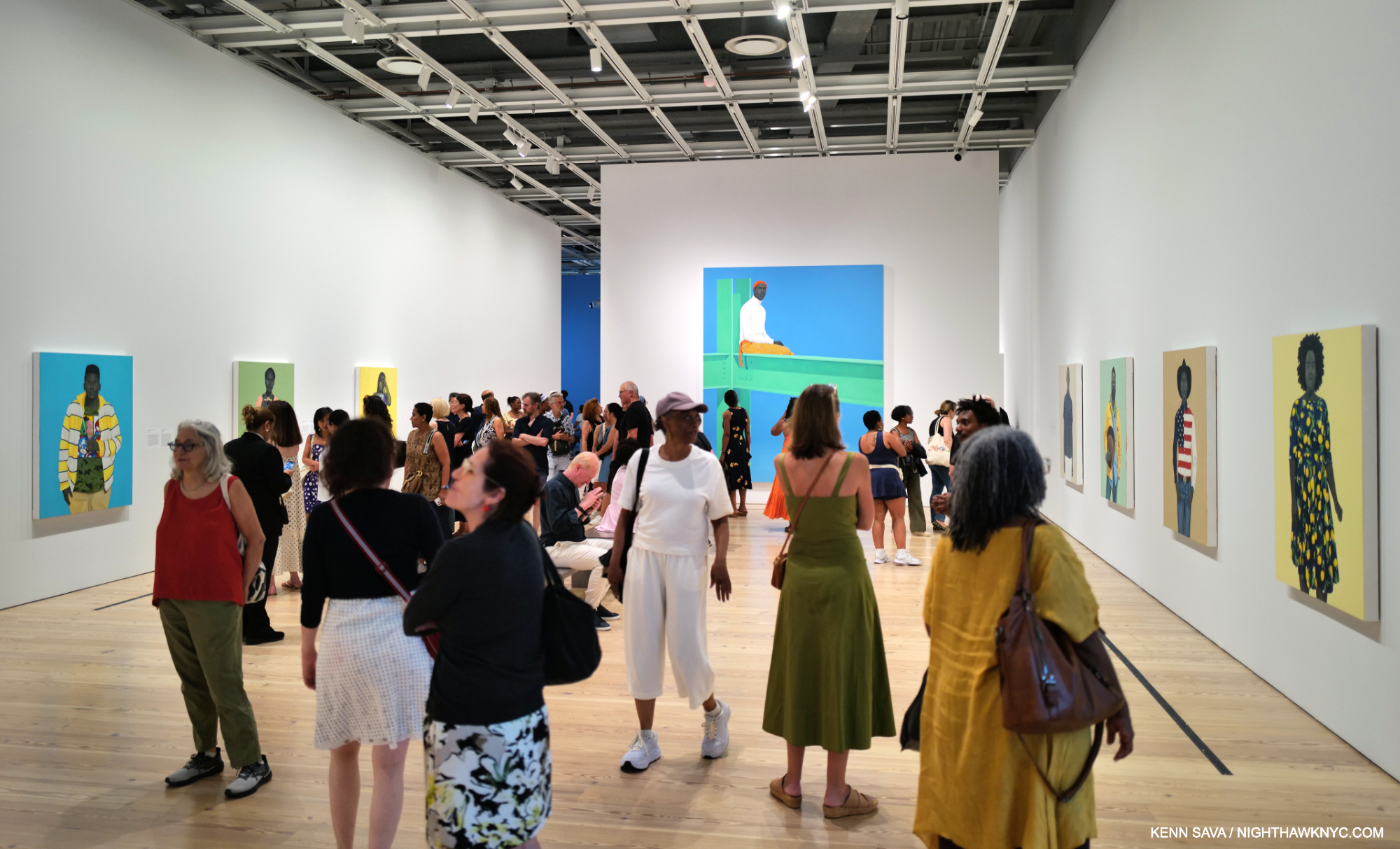
For “short takes,” my ongoing “Visual Diary” series, and outtakes from my pieces, be sure to follow @nighthawk_nyc on Instagram!

  1. Alexandra Schwartz, Ed Ruscha’s Los Angeles, P.15
  2. I cannot think of Rene Magritte without thinking of the singular Photographer, Duane Michals. When I met him, I quickly shifted the chat from Photography to Painting. He rightly gloated over the fact that he had met and Photographed his three favorite Painters- Balthus, Giorgio de Chirico, and Rene Magritte, with who he did a terrific PhotoBook, that he graciously signed for me. All three are under-appreciated in my book, and remain among my favorites, too.
  3. In spite of being among the best known, in my view, Dalí may be the most under-appreciated Artist of the 20th century, as anyone who saw the incredible Salvador Dalí Centennial Exhibition at the Philadelphia Museum in 2005 knows. It’s partially his own fault, as the endless fantastic stunts he put on overshadows the appreciation of his Art in my opinion. History will eventually fix that, I believe.
  4. Alexandra Schwartz, P.35
  5. Ed Ruscha, Leave Any Information After the Signal, P. 324
  6. Along with those of, and quite different from,Georgia O’Keeffe.
  7. As I mentioned in Part 1, the last big Ed Ruscha show here was the traveling retrospective, The Works of Ed Ruscha, which came to the Whitney Museum in 1982!

NoteWorthy PhotoBook of 2024: LaToya Ruby Frazier: Monuments of Solidarity

This site is Free & Ad-Free! If you find this piece worthwhile, please donate via PayPal to support it & independent Art writing. You can also support it by buying Art & books! Details at the end. Thank you.

Written & Photographed by Kenn Sava.

The NighthawkNYC.com NoteWorthy PhotoBook of 2024: LaToya Ruby Frazier: Monuments of Solidarity, Published by the Museum of Modern Art

When I met her at the Museum of Modern Art on May 10th, at the Preview of her stunning early mid-career retrospective, I told Ms. Frazier her book, LaToya Ruby Frazier: Monuments of Solidarity, was my NoteWorthy PhotoBook of the Year. Yes, the year. Even though we’re barely half way through 2024 as I write this and there are still six full months to go). With all due respect to all the books not yet released as well as those I have not yet seen, Ms. Frazier  gets my 2024 Trophy as most recommended PhotoBook for her powerful & urgently important book, published to accompany and expand on the show of the same name. Frankly, she deserves a medal for the work she has done.

LaToya Ruby Frazier proudly showing me her new book, Monuments of Soilidarity at MoMA, May 10, 2024

Having begun taking Photographs at 16, she seemed to find her voice almost immediately. “I had decided when I was a teenager that I had to make work that was socially and politically conscious1,” she said.

Auspicious beginnings. The Notion of Family, 2016.

Her early work focused on 3 generations of her family and life in her hometown of Braddock, PA in her debut PhotoBook, The Notion of Family, in 2016, which announced her arrival to the world in memorable fashion. She subsequently turned her attention to the coalminers in the Borinage, Belgium, in And From the Coaltips a Tree Will Rise, in 2017. Returning the U.S., she documented the closing of the G.M. plant in Lordstown, Ohio in The Last Cruze, 2019, and the man-made water crisis in Flint, Michigan in Flint Is Family In Three Acts, 2022 in book form. All four books are NoteWorthy in their own right.

MoMA, May 12, 2024

Monuments of Solidarity is an overview of LaToya Ruby Frazier’s work to date in what is a Show of the Year candidate along with Käthe Kollwitz, which happens to be installed right next to Monuments of Solidarity at MoMA. Monuments takes the viewer right up to the work shown in her most recent NYC gallery show, More Than Conquerors: A Monument for Community Health Workers of Baltimore, Maryland, 2021-22, which I wrote about here. The piece, which consists of 18 Inkjet panels on IV stands, was recently fittingly acquired by the forward-looking Baltimore Museum.

Partial installation view, More Than Conquerors: A Monument for Community Health Workers of Baltimore, Maryland, 2021-22, as installed at MoMA May 12, 2024. Each piece is in 2 parts. On the right-hand panel is a text written by the subject of her Photo on the left panel. You can see it installed at Gladstone Gallery in my look at it here.

There are a lot of great Artists in this country. You have your list. I have mine. There are also a lot of important Artists working here today. One thing that sets LaToya Ruby Frazier apart, in my view, is that, in addition to her poignant Photography, she brings her subjects right into her work. Though hers is the overall vision, the results feel collaborative. This serves to make the results unlike most of what’s come before.

Installation view. Flint Is Family section. May 12, 2024 including more compelling texts from her subjects accompanying her Photos.

After posing for the picture with her book, she asked me what I thought of her show. I told her I was very moved by the Photos she took with and about her Grandmother, now well-known images from her instant classic The Notion of Family. In them we see the Artist’s vision and talent were stunningly present from an early age, as if she was born with a camera in her hand, while we also get insights into her and her family’s life in her hometown. Braddock, PA, which in turn fueled her passion to inspire change and to right wrongs.

UPMC Braddock Hospital and Holland Avenue Parking Lot, 2011. The community hospital in ruins, where her grandmother passed.

After we see the passing of her Grandmother, the show took an immediate turn and from then on was focused on depicting crises effecting “everyday” citizens, working class people, and issues of race. 

MoMA, May 10, 2024

Monuments of Solidarity is not only a “PhotoBook.” It delves deeply into its subjects in a way I find every bit as powerful as her Photographs are. This is evidence of LaToya’s extraordinary way with people. Watching her at MoMA, she took the time to have an actual moment with everyone she encountered. Even me (we’d never met).

LaToya Ruby Frazier Takes on Levis, 2011, Stills from the Video which premiered on Art21. LaToya took issue with Levi’s after they featured her hometown, Braddock, PA, in an “Everybody’s Work Is Equally Important” ad campaign. As part of the campaign, Levi’s  opened a public Photo Workshop in SoHo. In response, LaToya put on a pair of Levi’s and in a performance in front of the Levi’s Photo Workshop, preceded to destroy them while wearing them. The intense Video is looped in the show. From the book, Monuments of Solidarity.

LaToya Ruby Frazier, the person, makes every bit as good, and memorable, an impression as her work does, though the intensity we see in pieces like her incredible Levi’s Performance Video remained under the surface.

MoMA, May 10, 2024

I think her people skills, which isn’t the right term for someone who is as genuine as Mr. Frazier is…make that her humanity, is a central reason why her Art is so powerful and so direct, project after project. LaToya gets to the heart of the issue and speaks to why it is important- for those directly involved, and for all of us, like very few Artists working today can.

Partial installation view. The Last Cruze, 2019 (recently acquired by MoMA), looks at the last Chevy Cruze to be made in Lordstown, Ohio after G.M. halted production and closed the plant, throwing all the workers out of their jobs.

Ms. Frazier’s work is compared by some to that of the F.S.A. (Farm Services Administration) Photographers of the 1930s, including Dorothea Lange. As I ‘ve showed, one thing of many that sets her work apart is that she foregrounds the experiences of her subjects right alongside her Photographs in texts they authored; something the FSA Artists didn’t do. In fact, I can’t think of any Artist who has done it as consistently as LaTory Ruby Frazier has.

On this spread from The Last Cruze PhotoBook the subjects of Photos accompany them in pieces they wrote.

She gives many, maybe event most, of the actual people she depicts in her projects, their own voice. Quite often their words take up more space in her books and in this exhibition than her Photos do! I can’t say I’ve ever seen that before, either. In the literal sense, her work truly is a collection of  “moments of solidarity” between Artist and subject.

Entrance to at MoMA as seen on May 10, 2024. The show is up through July 20th.

Two asides- Two coincidences struck me while preparing this piece. First, LaToya Ruby Frazier – Monuments of Soilidarity is installed right across the hall from the equally terrific Käthe Kollwitz at MoMA. Walking through one, and then the other, it was impossible for me to ignore how much in common they share. I wish I had asked LaToya what she made of Ms. Kollwitz’s show. Both Artists have made the “Art of social purpose” the center of their work.

“I have no right to withdraw from the responsibility of being an advocate. It is my duty to voice the sufferings of men, the never-ending sufferings heaped mountain-high.” Käthe Kollwitz, 1867-1945, 2.

Her first major retrospective at an NYC museum (How is that possible?) makes an open and shut case for Käthe Kollwitz as one of the major Artists of her time, something that has been well-known in Germany and elsewhere, making it past time for the rest of the world to catch up.

Preparing this piece also reminded me of another young woman Artist who I selected as my NoteWorthy Art Book of 2024: Es Devlin. Though they’re from different parts of the world, and work in different mediums, they’re both making extraordinary inroads into the world with their work. As I wrote in my look at Es’s book, An Atlas of Es Devlin, she’s garnered unheard of media acclaim. LaToya was just named one of Time’s “100 Most Influential People of 2024.” That’s pretty amazing, of course, but I bet it doesn’t come with a cool Owl statuette!  ; )

Woman of Steel Button Pin, 2017

“Woman of Steel” reads the button on the cover. Though she’s not a steelworker, she could easily wear one and it would completely suit her in the literal sense.

*-Soundtrack for this piece is “Poverty” by Yemi Alade, from her album, Woman of Steel, fittingly, performed here live-

NighthawkNYC.com has been entirely self-funded & ad-free for over 8 1/2 years, during which 320 full-length pieces have been published! If you’ve found it worthwhile, PLEASE donate by PayPal to allow me to continue below. Thank you, Kenn.

You can also support it by buying Art, Art & Photography books, and Music from my collection! Art & Books may be found here. Music here and here.

Written & photographed by Kenn Sava for nighthawknyc.com unless otherwise credited. To send comments, thoughts, feedback or propositions click here. Click the white box on the upper right for the archives or to search them. Subscribe to be notified of new Posts below. Your information will be used for no other purpose.
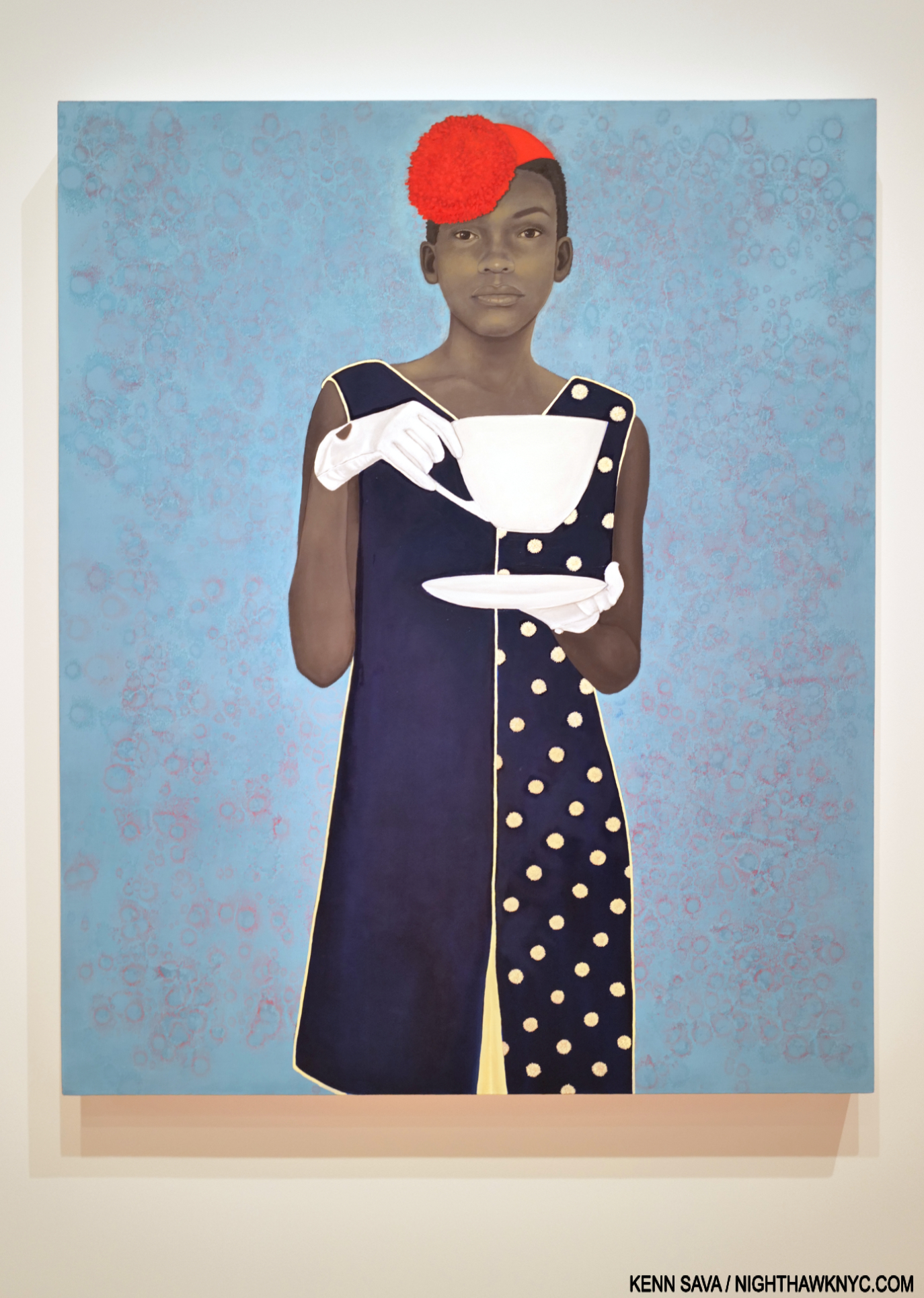
  1. “Latoya Ruby Frazier Takes on Levi’s,” Art21
  2. As quoted, here.

Ed Ruscha’s Wall Rockets

This site is Free & Ad-Free! If you find this piece worthwhile, please donate via PayPal to support it & independent Art writing. You can also support it by buying Art & books! Details at the end. Thank you.

Written & Photographed by Kenn Sava.

This is Part 2 of my look at Ed Ruscha/Now Then at MoMA. Part 1 is here, Part 3 is here.

From the late 1950s, through the early 1960s Ed Ruscha made regular trips back and forth between Oklahoma City, where he grew up, and L.A., his adopted home since the late 1950s. In 19621, he Photographed the gas stations that caught his eye on these journeys with his trusty Yashika Twin-reflex camera, taking 60 or 70 Photographs2. In an interview in 1973 he said, “What used to belong to the Navaho and Apache Indians now belongs to the white man and he’s got gas stations out there. So, I started seeing it as cultural curiosities.”

“I’d always wanted to make a book of some kind.”

He continues. “When I was in Oklahoma I got a brainstorm in the middle of the night to do this little book called Twentysix Gasoline Stations. I knew the title. I knew it would be photographs of twenty-six gasoline stations3.” “The first book came out of a play with words. The title came before I even thought about the pictures. I like the word ‘gasoline’ and I like the specific quality of ‘twenty-six4.'”  “Months went into the planning of that. I could have saved myself a lot of trouble by loosening up. You know, not gotten so concerned with how I wanted the thing to look. I changed the form about fifty times at the printer’s5.” He self-published Twentysix Gasoline Stations in 1963 (although the title page states 1962).

You’re looking at a revolution. Twentysix Gasoline Stations, 1963, revolutionized the Artist book, the PhotoBook, and street-side Phtography, with unique design, turning gas station Photography into a genre in the process. This copy was hanging for visitors to peruse, which was somewhat surprising as it’s now a rare book- even this second edition copy is worth hundreds of dollars. Knowing all of it from reproductions, this was the first time I was able to page through an actual copy of it. Pictures in this piece are thumbnails. Click on any for full size.

It’s an Artist’s book/PhotoBook whose influence is now incalculable.

Published in an edition of 400 copies, a case can be made that it ‘s the most influential PhotoBook of the contemporary period after Robert Frank’s The Americans (which the Artist acknowledges as an influence). Twentysix Gasoline Stations, with its “industrial” look and feel stood at odds with the frequently hand-made Artist’s book norm to the time. Virtually every aspect of the Artist’s book was reimagined, from the typography and text layout on the cover to the sparseness of the interior contents, with a lack of text save for image titles.

Believe it or not, this is one of the most influential Photographs in Modern & Contemporary Photography. STANDARD, ARMADILLO, TX, perhaps the key image in Twentysix Gasoline Stations, went on to have multiple lives of its own, inspiring numerous Ed Ruscha Paintings, Drawings & Prints, as well as the work of other Artists.

Speaking of the end result, he said-

“I realized that for the first time this book had an inexplicable thing I was looking for, and that was a kind of a “Huh?” That‘s what I’ve always worked around. All it is is a device to disarm somebody with my particular message6.”

Having immersed myself in PhotoBooks for the past 7 years, and Art books most of my life, it’s impossible for me to overstate the influence Twentysix Gasoline Stations has had, and continues to have, on the Art world. It turned Art & PhotoBook creation and publishing on its head, rewriting what a book could be and who could make one. He’s said he meant the pictures to be “like a collection of readymades7,” a term and genre Marcel Duchamp put on the Art map. Still, it received a mixed reaction when it was released, including famously being rejected by the Library of Congress.

Standard Station, Amarillo, TX, 1963, Oil on canvas, 64 15/16 x 121 13/16 inches. The “locomotive” compositional device, seen in Large Trademark with Eight Spotlights, 1962, in Part 1, returns, splitting the composition in two, just the beginning of what’s fascinating about this.

“I would say I came to painting through photography,” Ed Ruscha8

The STANDARD, ARMADILLO, TX, Photograph begat the Standard Station, Amarillo, TX Painting in 1963. Obviously, the Photo just shown has been reworked, reimagined, or he based this on another Photo. Whatever the case may be, the resulting composition seen here would subsequently take many forms and become iconic. Standard Station, Ten Cent Western Being Torn in Half, below, followed a year later.The Paintings begat Standard Station, Amarillo, TX Prints, with Standard Station, Amarillo, TX Drawings being created along the way. So ubiquitous did they become that gas station Paintings and gas station Photography are now, basically, his genres. Sooner or later, everyone who shoots or Paints a gas station is going to be compared to Ed Ruscha. Many, like Vik Muniz, openly acknowledge the influence.

What strikes me are the abstract elements, like the selective detailing- you can read the prices on the gas pumps, but detail disappears on everything behind them, creating a surreal experience (the “realistic” gas pumps offset against the featureless building behind them), under that big red sign whose white lettering, offset against the engulfing darkness, feels bold.

Standard Station, Ten Cent Western Being Torn in Half, 1964, Oil on canvas, 65 x 121 1/2 inches. Mr. Ruscha has likened  the comic flying off the canvas to the upper right to a “coda” in Music. For me, it looks like debris, garbage, pollution. In this piece, the featureless building has light and shadows added to it. Once again, the numbers and text on the gas pumps are very legible.

At the time, Ed Ruscha shot them, gas stations were bastions of the new found freedom of the open road and the catalyst of the massive post-war westward exodus that the Artist, himself, became a part of. Over time, gas stations would be seen differently as the toll of pollution and environmental decay mounted.

Ed Ruscha’s second most famous Artist book/PhotoBook. A copy of the legendary Every Building on the Sunset Strip, 1966, published in one long accordion fold. Ed Ruscha put a tripod on the back of a truck and went up and down Sunset Strip taking one Photo after another until he had shot every building on both sides of the street. Here, we get one direction on the top of the page, with what’s across the street synchronized and mirrored along the bottom.

Further books followed- 14 more to 1972, the most famous of which is Every Building on the Sunset Strip, 1966, another ground-breaking work. Ed Ruscha has stated that part of the reason he went west after high school, instead of east, was because of the glamour of L.A. Here, he shows the “glamour” of the famous Sunset Strip in all its “glory.” Then, in 1973, he shot all 12 miles of Hollywood Blvd. In 2004, he reshot Hollywood Blvd in color, and paired with the 1972 images, they became the book THEN & NOW in 2005. It’s one example of Ed Ruscha combining his love of the effects of time with revisiting his past subjects.

In all the acclaim he receives I almost never hear credit given the Artist for his exceptional Painting technique- the equal of anyone else’s of his time. Right from the start, Painting after Painting reveals sublime subtlety and under-appreciated skill.  Then Now provided a glorious chance to study his, often large, Paintings up close and marvel at his skill and taste. It also provides the extremely rare chance to see works of the same subject side by side, particularly two of his famous Standard Gasoline Station Paintings.

Shows present once-in-a-lifetime opportunities to see great works united from distant parts of the globe for a brief time. That’s why I waited over an hour for the crowds to part to get this shot. More than likely, I’ll never see these two great Standard Stations together again. Both of these also feature the “speeding locomotive” compositional device seen in the Large Trademark Painting, which adds to the somewhat surreal overall effect, wonder and mystery.

Further to the Large Trademark Painting, Ed Ruscha also began Painting the sights of L.A., which again seems to be his domain to the point that I can’t think of anyone who Painted the city before he did. (I’m sure there were. Right?)

“Being in Los Angeles has had little or no effect on my work. I could have done it anywhere.” Ed Ruscha, Leave Any Information at the Signal, Statement in “West Coast Style”

Los Angeles County Museum on Fire, 1965-8, 53 1/2 x 133. 1/2 inches. Fun fact- Guess where Ed Ruscha/Now Then reopened on April 7, 2024 after closing at MoMA? You’re looking at it.

Los Angeles County Museum on Fire, 1965-8, like most of Ed Ruscha’s work, has been the subject of endless conjecture. Over the years, the Artist has made a few statements about it, including this one, “… There’s no great message here. It’s just a picture to look at9.” That might be hard to believe. After graduating college, he took that trip to Europe I mentioned in Part 1, and came away disappointed at the lack of Contemporary Art on view in the museums. Back home, things weren’t much better. Contemporary Art was slow to gain admission to the hallowed halls of institutions here. Is it a stretch to think this was somewhere on his mind when he Painted this? I tend to think it was in there somewhere. The Watts riots had recently taken place. The Now Then Catalogue has this to say about it-

“Ruscha’s characteristic denial of content ignores the fact that not far from his studio in mid-August 1965, just a few months after the inauguration of the Los Angeles County Museum of Art, the city of Los Angeles was burning10.”

Ed Ruscha said, “The plain truth behind the Watts riots is that the riots themselves were good and beneficial and healthy regardless of loss of life. The Watts riots nationalized sympathy for a gigantic racial injustice11.”

He soon set a number of other sites on fire in his Paintings, including the an Amarillo Standard Station (which wasn’t in the show), and Norm’s, which was.

Norm’s, La Cienega, on Fire, 1964, Oil and pencil on canvas. The work features a complete lack of detail, save for the letters “ORMS” on the sign.  It’s interesting how the flames follow the “locomotive” line. Without those letters (which themselves are meaningless without the title), this Painting would be a completely abstract composition of shapes and lines.

For someone who’s so closely associated with L.A., and has been for over 60 years, it’s strange that some of his most well-known work shows L.A. landmarks being destroyed or in ruins. For example, he has continued to “destroy” the Hollywood sign, in different ways, over and over again throughout his career. Still, his fame continued to rise as did his association with the city. In spite of all this (and possibly because of it), in 1978, a six-story(!) tall mural (also referred to as the “Ed Ruscha Monument”) of the Artist was created by the Artist Kent Twitchell, for who Ed Ruscha was “the unorthodox hero of the art world.” Would anyone else be able to “destroy” a city’s landmarks and then become seen as the figurehead of that city’s Art community with a monument created for them? It didn’t happen for Nero. Unlike the emperor, Ed Ruscha didn’t actually destroy anything, except maybe in his mind and on some large canvases.

Rancho, 1968, Oil on canvas, which looks like it was made with a liquid, surrounded by Fire, Sin, Rustic Pines, each 1967, Gunpowder on paper, from left to right.

This calls to mind another thing Ed Ruscha doesn’t get enough credit for: innovation. In the 3rd, 4th and 5th galleries we see pieces made out of strange and unprecedented materials. Unhappy with the possibilities of paint or pencil, the Artist began exploring the possibilities of Drawing with gunpowder! The results, as seen above, are incredible. He found he had more control with it. In 1969, the Artist began going further, using unconventional materials in his Stains Portfolio of seventy-five substances ranging from L.A. tap water to egg yolk.

Installation view of Chocolate Room, 1971/2023, Chocolate on paper sheets.

His Chocolate Room for the United States Pavilion at the 1970 Venice Biennale, and recreated in a room of its own in Now Then, followed. After that, he began using a number of these “other” materials in his Word and Phrase Paintings.

Cotton Puffs, 1974. Egg yolk on moiré fabric, 36 × 40″

Along with this constant experimentation came the inevitable failure, like the egg yokes in Cotton Puffs, 1974, fading quickly. Ed has been remarkably cool with these. Accepting them for what they are12. (And probably learning in the process.) Each has its place in his oeuvre, with all the examples on view seeming to hold up remarkably well over the years given they are experiments. By the mid-70s, he had gone back to pastel on paper13. Though the materials experiments were short-lived, it led me to peruse the 7 volumes of the Ed Ruscha: Catalogue Raisonne of the Paintings, published by Steidl (which is a bit ironic- or fitting- because Steidl has published the work of any number of Photographers who include gas stations in their work, including the entirety of the 3-volume set, Gas Stop, by David Freund), which revealed that this insatiable exploration of materials was only the tip of his creativity iceberg. Paging through it (which only goes up to 2011 at this point), I was amazed to discover that though he has created a number of works with ostensibly the same subject, no two are identical. The differences are obvious or subtle. Still, this speaks to Ed Ruscha’s seemingly endless powers of invention and refusal to repeat himself verbatim. I was stunned when I discovered this, which was completely unexpected (though I should have been tipped off by what his STANDARD STATION, ALBUQUERQUE Photograph became). Seeing this range and variety gave me a glimpse of insight into just what may be keeping him going and creating since the late 1950s.

Wall Rockets, 2000, Acrylic on canvas

Perhaps THE highlight of Ed Ruscha/Now Then at MoMA for me was the chance to see 6 of the 10 Paintings from the Artist’s Course of Empire series. As I’ve looked at his work over the past 24 years of this century, these have fascinated me as much as any other work by Mr. Ruscha. Created for, and then debuted, at the 2005 Venice Biennalle, they subsequently travelled to NYC where they were on display at the Whitney in a show of the same name, the last important (though small) Ed Ruscha show in NYC until Now Then. Somehow, I missed them there, so seeing 6 might be as close as I get to seeing them all.

3 works from Ed Ruscha’s Blue Collar series, 1993, on the 3 facing walls.

Occupying the large, penultimate gallery of the show, the Course of Empire Paintings strike me as serving as a touchstone for a number of Ed Ruscha themes. They also eerily presage what has been going on in much of NYC (and perhaps elsewhere) this decade, with a number of stores and businesses closing due to Covid, then more closing due to the realities of our post-Covid (if we are post-Covid) economy, many have changed hands in a short time. Others remain for rent. The shape, perspectives and lack of detailing on the one-story  buildings I find reminiscent of Standard Station, Ten Cent Western Being Torn in Half, seen earlier. In each, our point of view is the same, and the same as in that Standard Station Painting- they are seen from below.

At the opposite end of the gallery, the same scenes reappear in his Course of Empire series, 2005, now in color, though right and left are flipped. (The scene on the right wall is that depicted on the left wall in Blue Collar Photo, above this one. The scene on the left wall is the scene shown on the right wall of the Blue Collar series above this one.)

The series evolved over a period of 13 years, with Ed Ruscha Painting the 5 black & white pieces, titled Blue Collar, in 1992-

Blue Collar Trade School, 1992, Acrylic on canvas. The only multi-story structure in the series.

Returning to the subject and the same sites  in 2005, this time in color and showing the effects of time passing.

The Old Trade School Building, 2005, Acrylic on canvas

Perhaps, his most subtly powerful series, their under-stated compositions lead to open-ended interpretations.

Installation view of the complete Course of Empire, by Thomas Cole, 1834-36, as seen at The Met’s Thomas Cole’s Journey in 2018. The rise and fall of civilization as seen from the same place, with the same distinctive mountain peak appearing in each Painting.

Based on, and in homage to, Thomas Cole’s legendary Course of Empire series, 1834-6, (which I wrote about here), they are another instance of Ruscha revisiting earlier work, his Blue Collar series from 1992. These also highlight that alongside the humor in any number of his pieces, running parallel, is a real depth of concern. Concern for the country, the world, the environment.

Psycho Spaghetti Western #7, 2010-11, Acrylic on canvas

“It’s all just rape of the land for profit these days. It’s fairly sick. Southern California is all just one big city now. But what do you say about progress? … So something’s got to give, and the landscape’s the first thing that gives….There is a certain flavor of decadence that inspires me. And when I drive into some sort of industrial wasteland in America, with the themeparks and warehouses, there’s something saying something to me. It’s a mixture of those things that gives me some sense of reality and moves me along as an artist,” Ed Ruscha 14.

Taking full advantage of having such a long career, the Artist has revisited past themes, and places, fairly often to the point that it’s a running theme in his work. Change over time…for the better, or worse, is left to the viewer to decide. Ostensibly set in L.A., the structures in Blue Collar/Course of Empire could be literally anywhere. As such they have a universality to them (as do a number of other 21st century Ruscha’s) that sets them apart from his purely L.A. work, like his Hollywood sign pieces.

Our Flag, 2017, Acrylic on canvas. The last work in the show.

Thomas Cole influencing Ed Ruscha’s Blue Collar & Course of Empire series started me thinking about other possible influences on his work. I touched on some in Part 1. In Part 3, I’ll take a closer look at them, and then flip that coin over.

Part 3 is here

*- Soundtrack for this piece is “L.A. Woman” by The Doors, one of the ultimate L.A. bands, from the 1971 album of the same name. (Narrowly beating out “California Girls” by the Beach Boys from Summer Days (And Summer Nights), 1965.) Ed Ruscha was into “car culture” before moving to L.A., and after, among other things he has in common with the #1 L.A. band of its time. Notice the gas station Jim Morrison, “another lost angel,” to quote his lyric, stops in to about half way through-

NighthawkNYC.com has been entirely self-funded & ad-free for over 8 3/4  years, during which 320 full-length pieces have been published! If you’ve found it worthwhile, PLEASE donate by PayPal below to allow me to continue. Thank you, Kenn.

You can also support it by buying Art, Art & Photography books, and Music from my collection! Art & Books may be found here. Music here and here.

Written & photographed by Kenn Sava for nighthawknyc.com unless otherwise credited. To send comments, thoughts, feedback or propositions click here. Click the white box on the upper right for the archives or to search them. Subscribe to be notified of new Posts below. Your information will be used for no other purpose.
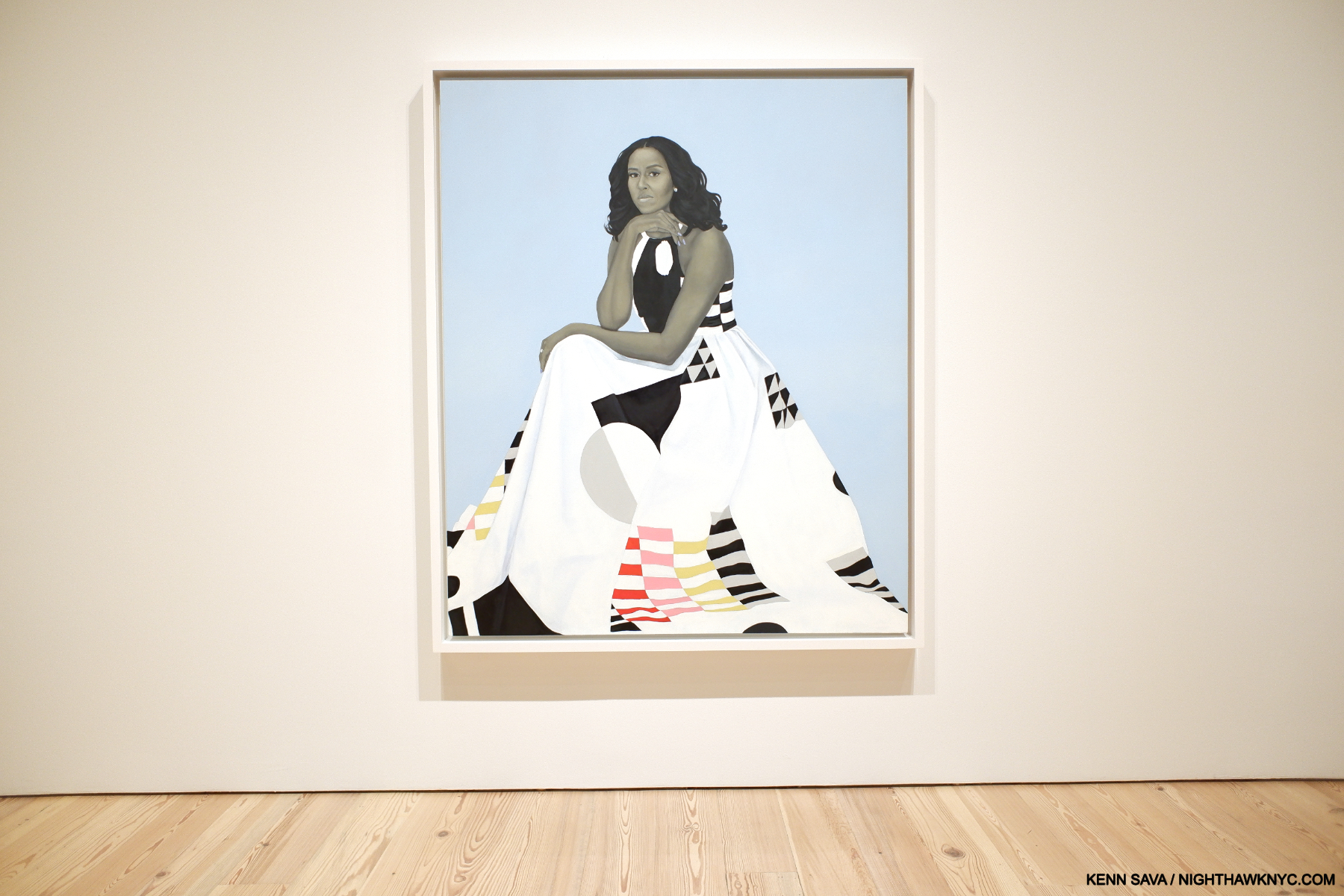
  1. Ed Ruscha: Catalogue Raisonne of the Paintings, Vol 7, P.476
  2. E.R., Tate, P.30
  3. Willoughby Sharp, ‘“… a kind of a Huh?”, An Interview with Edward Ruscha’, Avalanche, no.7, Winter/ Spring 1973, p.30.
  4. ER, Tate, P. 31
  5. https://www.tate.org.uk/art/artists/edward-ruscha-1882/ed-ruscha-and-art-everyday
  6. Here.
  7. Reading Ed Ruscha, P.50
  8. Ed Ruscha, Photographer, P.7
  9. Ed Ruscha quoted in Ed Ruscha/Now Then Exhibition Catalog, P.21
  10. Ed Ruscha/Now Then Exhibition Catalog, P.21
  11. Ed Ruscha, Leave Any Information at the Signal, P.5
  12. E.R., Tate, P.65
  13. Ed Ruscha/Now Then, P.170
  14. Leave Any Information at the Signal, P.18

Ed Ruscha’s Head Scratchers

This site is Free & Ad-Free! If you find this piece worthwhile, please donate via PayPal to support it & independent Art writing. You can also support it by buying Art & books! Details at the end. Thank you.

Written & Photographed by Kenn Sava (*- unless otherwise credited)

Show seen: Ed Ruscha/Now Then @MoMA

Who doesn’t like the Art of Ed Ruscha?

Installation view of the entrance, September 14, 2023. Images in this piece are thumbnails. Click any picture for full size.

Walking through the crowds at MoMA’s winter blockbuster, Ed Ruscha/Now Then over my six long visits bookending a terrible, six-week illness, I saw smiles as visitors moved from piece to piece, yet I couldn’t help but wonder how many of them felt they “understood” his Art. While humor undoubtedly plays a part in the craft of an Artist who knows you catch more flies with honey than vinegar, however they appear at first glance, his work usually leaves me scratching my head.

Returning to look at it again and again, that his work says something different to me every time I look at it has kept Ed Ruscha among my favorite Contemporary Artists. Judging from the turnout at MoMA, I’m far from alone in that. Having the chance to explore, and be mystified by, 200 pieces of his Art in Now Then from the, approximately, SIXTY-SEVEN YEARS(!) he’s been making it proved an all-too-rare chance to take a good hard look and try to get to the bottom of the mystery.

I Don’t Want No Retro Spective, 1979, Pastel on paper. The catalog for the last Ed Rusha retrospective in 1982(!) is also known by the Ruscha on the cover of its catalog, I Don’t Want No Retro Spective, though the show’s title was THE WORKS OF ED RUSCHA

“All too rare,” as in Now Then is the first Ed Ruscha retrospective here since 1982, (and so mine, too): over FORTY YEARS ago!1 The gap between them is another head scratcher given how popular Ed Ruscha’s Art is. The title Ed Ruscha/Now Then can be taken as a reference to the Artist’s penchant for revisiting his subjects over time, as well as the fact the show includes old and recent work, or a chance to see his older work now. It’s also a rare retrospective of a West Coast Artist who came to prominence in the 1960s mounted on the East Coast. Bruce Conner didn’t live to see his at MoMA like Ed Ruscha has. Ed Kienholz, and Mr. Conner’s friend, Jay DeFeo, among others, are still waiting for their East Coast retrospective.

Installation view from just inside the entrance of the first gallery looking into the second. Boss, 1961, the famous Large Trademark with Eight Spotlights, 1962, and the infamous OOF, 1962-3, left to right, all Oil on canvas.

Walking through it, I became particularly fascinated by how his style(s) developed, and how Edward Joseph Ruscha IV became Ed Ruscha, one of the most influential Artists in the world among Modern & Contemporary Artists, if not THE most influential, at this point in time.

Oklahoma-E, 1962, Pencil, colored pencil and charcoal on paper

Born in Omaha in 1937, his family moved to Oklahoma City when Ed was 5. Early on, he had a passion for comics and a love of typography, particularly as it appeared in commercial publications. All of these are combined in Oklahoma-E from 1962, a seminal year in his early career. His initial desire was to become a Commercial Artist, and it was towards that end that he left OKC after graduating high school to head to L.A. with a friend in a lowered 1950 Ford, to study it. He chose to go west rather than east because of its energy, glamour, and its “hot rods and custom cars2.” Unable to get into his chosen school, he was accepted at Chouinard Art Institute (later Cal Arts, where Henry Taylor would study in the 1990s). His teachers, disciples of Abstract Expressionism, “wanted to collapse the whole art process into one act3.’’ “It (Abstract Expressionism) was, in his opinion, ‘a solid way of thinking…If you think about the paintings that were done in the 1950s, I find them overwhelming, nothing but quality…It was a very powerful time in art.’ However, ‘…within AbEx there was no room for my ideas4.'” While this frustrated him, they did succeed in getting him to change his focus from Commercial Art to Fine Art, which we can all be grateful for. After Now Then, I wonder if they accomplished more.

While in school in 1957 he had an epiphany.

One of the most extraordinary works of the 1950s. Jasper Johns, Target with Four Faces, 1955, Encaustic on newspaper and cloth over canvas surrounded by four tinted-plaster faces in wood box with hinged front. Seen in Jasper Johns: Mind/Mirror at the Whitney in 2021.

“The breakthrough he sought came in 1957, when he spotted a small black-and-white repro of Jasper Johns’s 1955 Target with Four Faces in the Feb/Mar 1957 issue of Print Magazine. Encountering Johns’s painting was, he said, an ‘atomic bomb’ in his training, ‘a stranger fruit’ that he ‘saw as something that didn’t seem to follow the history of art. My teachers said it was not art. ‘I didn’t need to see the colors or the size…’ ‘I was especially taken with the fact that it was symmetrical, which was just absolutely taboo in art school- you didn’t make anything symmetrical…Art school was modernism, it was asymmetry, it was giant brush strokes…it was all these other things that were gestural rather than cerebral. So I began moving to things that had more of a premeditation5.’”

Dvision, 1962, Mimeograph on paper, One of five Prints by five Artists in the Portfolio issued in conjunction with the New Painting of Common Objects show.

That has continued to this day. Along the way, he and others (including Andy Warhol, Roy Lichtenstein and James Rosenquist), built on what Johns, Rauschenberg and Marcel Duchamp had started: the “next thing” after Abstract Expressionism, an Art based in the recognizable, the familiar, the every day. Some called it “pop.” Personally, I see nothing but danger in trying to box Ed Ruscha (who has consistently eschewed boxes).

In fact, one word comes to my mind over and over again as I look at his Art over time: abstract. If I were going to use two words to describe it they would be “premeditated abstraction.” Look at Division, above. It contains what would become Ed Ruscha trademarks- text, typography, and images, combined in a way that are next to impossible for most viewers to “read.” If that’s not “abstract?” What is? Maybe his teachers would be proud after all. It was only through delving into his history, I found that 3327 Division Street was the address of his first L.A. studio6. The car might have been his. Does that mean there’s more of a backstory to it? I haven’t found it. In the end, for me this says there may, or may not, be personal meaning to some/many/even all of his Art, but, 60+ years on, they haven’t come to light. So, with Division, as with all his Art, the viewer is left to make of them what they will.

The two earliest piece in the show, SU, 1958, Oil, ink and fabric on canvas, (sixty-six years old!), left, with Dublin,, 1960, Oil and ink on canvas, right. Yes, a comma is part of the title.

Before graduating, he took hitchhiking trips that he immortalized in some of the earliest works in the show. the mysterious SU, 1958, the earliest, strikes me as a forerunner of what would come later. Even in these early works, text and imagery appear, though separately, as different elements that seem to stand apart from each other until the viewer brings them together, or creates a narrative around them, in his or her mind. These elements have continued in his work to this day, though he would soon start layering them. SU is, also, one of the relatively few of his works that refers to an actual person, the title referring to Su Hall, his girlfriend at the time.

Actual Size, 1962, Oil on canvas, 67 1/16 x 72 1/16 inches. His breakthrough work when it was included in the landmark New Paintings of Common Objects show. A Painted, flaming, “actual size” can of Spam in its lower section is accompanied by some brush marks that might be associated with Abstract Expressionism. In fact, a number of his early pieces, like Three Standard Envelopes, 1960, also include them. Given his prodigious technique, on display in this, I don’t see how these marks can be considered accidental. Jennifer Quick7 surmises these connote AbEx’s commercialization. I see them as Ruscha making this technique his own, using it in a way none of the AbEx Artists did. I also see it as an early example of the many forms that abstraction would take in his work.

A number of his early works are quite edgy, daring and ripe with a surprisingly loose use of the brush. Were these done for class to please his teachers, or…? In fact, even some later pieces, like his Stains portfolio, contains marks that seem right out of AbEx. These stands at the other end of the technical spectrum for an Artist who possesses a superb Painting technique, something he doesn’t get nearly enough credit for in my view. They also make me wonder if his AbEx disciple teachers had a bigger effect on their student than it might seem.

The rest of the gallery includes highlights of his early 1960s Word Paintings. We watch as he continued to strip away excess and refine his concept. Eventually, single words appeared alone on solid backgrounds This is interesting because he has said of his recent phrase Paintings that the backgrounds are simply that. Early on, as in Actual Size, they appear to be more.

Vienna, Austria, 1961. This striking Photo was in a vitrine in the show, which prevented my getting a decent picture. This image of it comes from the book Ed Ruscha and Photography, P.48

After  he graduated college, Ed spent 10 months on an extensive tour of Europe. While he reports not being impressed with the museums (among other things, he was disappointed by the lack of Contemporary Art), he took note of quite a bit of what he saw while out and about, particularly the street signs, with their foreign words, different design & typographies. He Drew and Painted a number of these, but he also put the new Yashica twin-lens reflex camera he was required to get in one of his classes to good use, taking a number of interesting Photos, beginning a revolutionary career in the medium in the process. Back home in fall, 1961, he set to work. Less than a year later his work was included in the landmark show, New Paintings of Common Objects at the Pasadena Art Museum, along with that of Andy Warhol, Roy Lichtenstein, Wayne Thiebaud and others, and so-called “pop” Art was born. Ed Ruscha has consistently rejected being boxed, though he rode on the coattails of the “movement,” and the word is still used in describing his work, ignoring the visual evidence.

The first gallery concludes with an infamous work. Does this look familiar?

Ummm…It might not be what you might think it is. It’s a detail of the center of the target in Jasper Johns’s, Target with Four Faces, 1955, shown earlier. Now, look at this-

Yes! One of the two “Os” in Ed Ruscha’s OOF, 1962 (reworked 1963). Just five years after he saw Target with Four Faces, Ed Ruscha Painted the above. Coincidence? Homage? Fallout from that “atomic bomb going off in my training?” My feeling is the visual evidence is pretty strong for making a case for any or all three.

Hello! I’ve never appeared on NighthawkNYC over its 8 1/2 years, except in my self-portrait in the Banner (and a picture in my last piece, here, from the distant past). Until now. I’m introducing myself to NHNYC readers in front of a Painting I have a personal connection to: OOF, 1962-3, Oil on canvas, 71 1/2 x 67 inches on Ed Ruscha/Now Then’s final day, January 15, 2024. As for my “personal connection” to OOF? Very, very few know. My thanks to the lady who graciously agreed to take this.

Personally, it’s hard for me not to think there’s an influence; in the colors, the shape of the circle/”Os.” Even if it’s subconscious. Looking at both of these works now, they’re both revolutionary in their way. The Johns has been discussed at length over the past 60 years. Does anyone else think OOF is a revolutionary work, let alone a masterpiece? I believe it’s both. Revolutionary? It’s possibly the first time (as far as I know) that a Painting features a “word” that Merriam-Webster categorizes as an “interjection,” and not an actual “word” per se. I also believe it’s an “alt masterpiece.” Seriously. The composition, colors, font, placement of the text are all perfect, belying Ed Ruscha’s mastery of typography and graphic design, with the sublime taste that would be a hallmark of his work. OOF stands as the pinnacle of his early word Paintings in my view. Oof is a word, if it is one, that defies concrete understanding, making it a perfect (unofficial) conclusion of sorts to the series. Merriam-Webster says Oof is an interjection “used to express discomfort, surprise, or dismay8.” They point out “the first known use of the word was in 1777,” which I find hilarious. How do they know? Did they consult an Oofologist? They further define an interjection as “an ejaculatory utterance usually lacking grammatical connection9.”

Oof!

OOF everywhere around town. A first step to a better world! I yelled “OOF,” but he didn’t stop.

As such it seems to me that OOF stands as an outlier among the single words Ed Ruscha chose as the subjects of his early 1960s Word Paintings (BOSS, HONK, ACE, SMASH, FLASH and NOISE, shown below, et al) because it is quite abstract, and therefore, a jumping off point for what was to come. I wish I had asked viewers what the Painting said to them. Having owned it for 61 years, MoMA is well aware of its mysterious appeal. No doubt that is why the museum chose to emblazon OOF all around town as the focus of their show marketing.

Noise, Pencil, Broken Pencil, Cheap Western, 1963, Oil and wax on canvas, 71 1/4 x 67 inches. There are two Painted pencils in the piece, and lo and behold someone left another one on the floor, behind the left stanchion. I resisted the urge to move it for effect for this picture. Maybe, I should have…

Along with abstraction, it seems to me there are surreal elements in his work. Perhaps no single word Painting has these abstract/surreal qualities than Noise, Pencil, Broken Pencil, Cheap Western, 1963, which also represents an evolution. Ed Ruscha has long considered it one of his best Paintings[3, Per the wall card.]. In it, the mystery of the word is added to with three very realistic images, close to its own edge. Unusual for a Painting, or Art, it leaves the center, the focus of most Art, empty except for the background color. Most of the previous Word Paintings centered the featured word. As such, it’s both unique and a precursor of other works that combine words and images. It’s also both abstract, thought it depicts realistic objects, and surreal. If I read it from the left, the whole pencil lies quietly seemingly in mid-air. The word “NOISE,” another monosyllabic word, grows until it reaches the right side (again, like a speeding train) where it hovers above the broken pencil. The cheap western seems to be hovering in the air, too, like the left-hand pencil, where it wouldn’t make noise until it lands, which it might be close to doing. The Artist has created “action” from three still objects and a word.

In the catalog for that last major Ruscha retrospective there’s this-

“The broken pencil calls to mind the incident Ruscha has referred to a number of times in interviews when as a child in parochial school he was regularly rapped on the knuckles with a pencil by a nun who caught him misbehaving in class. Is the pencil, then, simultaneously a symbol of expression and repression10?”

If this is the case, though Mr. Ruscha has not said that this incident is what’s depicted here, my reading of it wonders if the “Cheap Western,” i.e. the comic book which appears to be reaching the bottom of the piece, was struck from his hand when he was caught reading it in class, being a big fan of comics at this age, the broken pencil having been cracked over his hand. It’s also, simultaneously, an abstract and a surreal composition. As many have pointed out, it also leaves the center bare. It carries forward his use of the single word, while also taking it on a new tangent.

Bouncing Marbles, Bouncing Apple, Bouncing Olive, 1969, (not in the show) has much in common with Noise, Pencil, Broken Pencil, Cheap Western from six years earlier. One of countless Ed Ruschas that feel surreal to me. Here, he “sugar coats” the surrealism by using harmless objects like marbles and an apple on a welcoming green background. Leaving the olive, the looming black, and the fact that the marbles & apple are bouncing to stir up our imaginations, making the work decidedly not a “still life.” *- Photographer unknown.

Noise, Pencil, Broken Pencil, Cheap Western is another one-Painting revolution, like OOF was. Though both were only followed-up indirectly, as in Bouncing Marbles, Bouncing Apple, Bouncing Olive, 1969. Now, look at this-

Salvador Dali, the legendary Surrealist, Open Field with Ball in Centre and Mountains in Rear, Study for the Disney film Destino, 1946, Oil on masonite. Influence? Seen in MoMA’s catalog for their show Dali & Film.

Works like Noise, Pencil, Broken Pencil, Cheap Western and Bouncing Marbles, Bouncing Apple, Bouncing Olive (and other works that include marbles and olives) are so different from anything that’s come before in his work. Yet, as time went on, they are joined by many works that while they depict recognizable objects are very abstract, even surreal, including his recent Tom Sawyer Paintings. Most of them have no words, and taken as a group they now form a sizable part of his oeuvre. For my part, I trace them all back to Noise, Pencil, Broken Pencil, Cheap Western from 1963.

Large Trademark with Eight Spotlights, 1962, Oil on canvas 66 9/10 x 133 1/10 inches. An early L.A.-inspired work, like most of Ed Ruscha’s work its “meaning” is nebulous. At the time he Painted this, the famous Film studio was in decline and going through layoffs. One reading might be a comment on fleeting fame about to fade out, or like his PhotoBook, Every Building on the Sunset Strip, 1966, possibly a hard realization for the Artist who relocated from Oklahoma City, that glamour is not all it appears to be from afar. It’s also a work that is reminiscent of a speeding, approaching train, a compositional device he would use again. Though it’s described as “Oil on canvas,” those are graphite lines leading to or from the vanishing point.

In 1962, L.A./Hollywood, its sites and culture began appearing in Ed Ruscha’s Art, as in Large Trademark with Eight Spotlights, which is also a precursor to his multi-word and phrase Paintings. Over the succeeding 60+ years, few if any, Artists would become more associated with Los Angeles than Ed Ruscha is and has been. From then to now, he would continue to Paint the city, and words and image would coexist in his Art, while single words largely became multiple words and, beginning in 1973, short phrases that he has continued to create to this day.

By the beginning of the second gallery of Now Then, some of the core themes of his work have been created and have already metamorphosized. This revealed the development of a working process based in an endlessly restless creative drive that would not let Ed Ruscha stay in one place for very long Artistically. What lay ahead over the next six plus decades(!) has been nothing if not the continually unexpected.

Part 2, “Ed Ruscha’s Wall Rockets,” is here. The concluding Part 3, “Ed Ruscha & The Two-Sided Coin of Influence,” is here

*-Soundtrack for this piece is “Down the Highway,” by a Musician who has been creating and performing for about as long as Ed Ruscha has: Bob Dylan, born May 24, 1941, 3 1/2 years after Ed Ruscha. Bob released “Down the Highway” the same year Mr. Ruscha created a number of the Paintings in this piece, on 1963’s The Freewheelin’ Bob Dylan.

NighthawkNYC.com has been entirely self-funded & ad-free for over 8 years, during which 320 full-length pieces have been published! If you’ve found it worthwhile, PLEASE donate by PayPal to allow me to continue below. Thank you, Kenn.

You can also support it by buying Art, Art & Photography books, and Music from my collection! Art & Books may be found here. Music here and here.

Written & photographed by Kenn Sava for nighthawknyc.com unless otherwise credited. To send comments, thoughts, feedback or propositions click here. Click the white box on the upper right for the archives or to search them. Subscribe to be notified of new Posts below. Your information will be used for no other purpose.
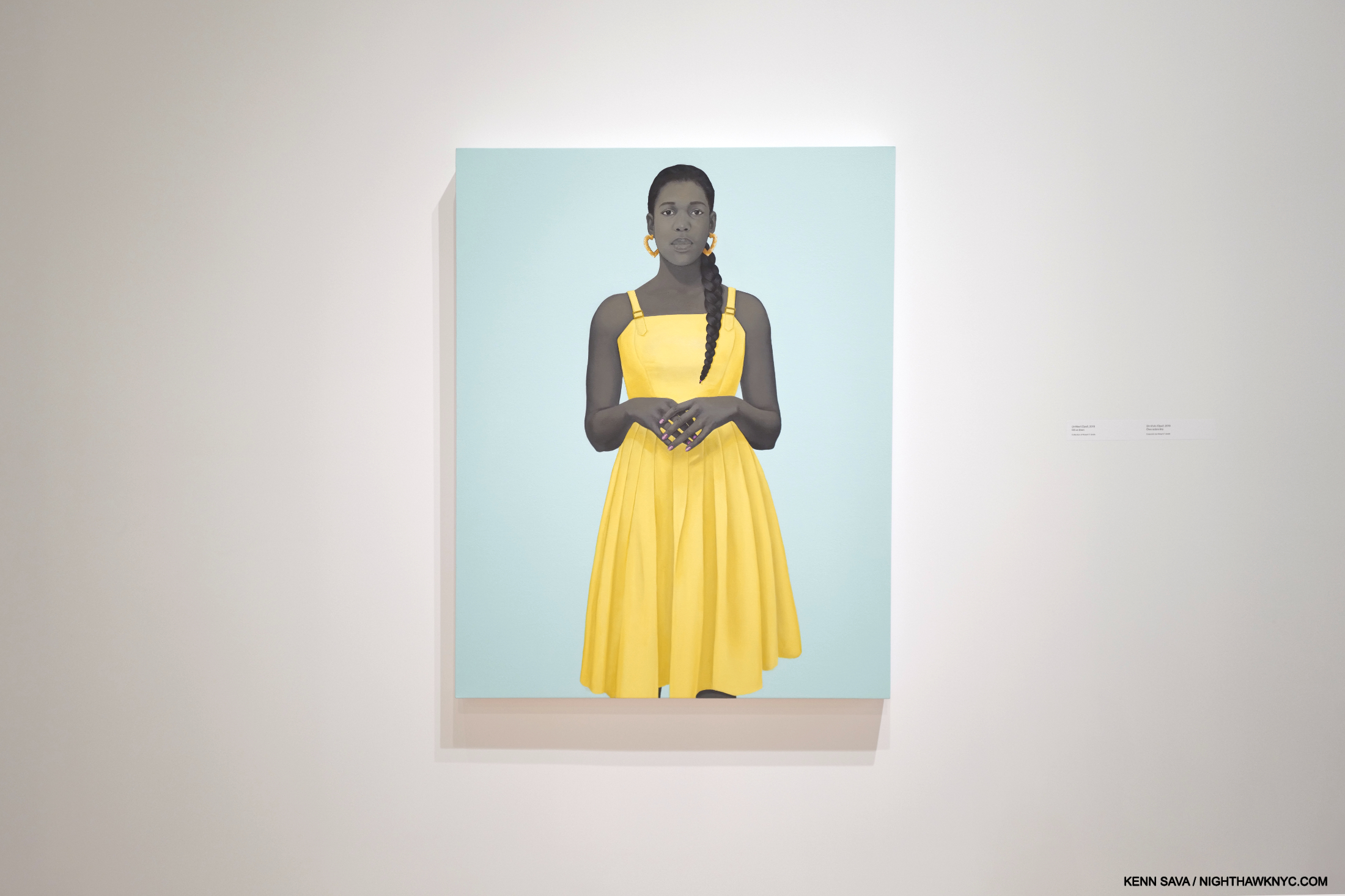
  1. The traveling retrospective, THE WORKS OF ED RUSCHA, came to the Whitney Museum in 1982, one of five museum stops it made, when the Artist was about 45.
  2. ER, Tate, P. 9
  3. Alexandra Schwartz, Ed Ruscha’s Los Angeles, P.17
  4. Alexandra Schwartz, Ed Ruscha’s Los Angeles, P.15
  5. Alexandra Schwartz, Ed Ruscha’s Los Angeles, P.15
  6. E.R. Tate, P.100
  7. in her book, Ed Ruscha: Art & Design in the 1960s
  8. Here
  9. Here
  10. I Don’t Want No Retrospective- The Works of Ed Ruscha, P.15

Sarah Sze: Timelapse- Freeze Frame

This site is Free & Ad-Free! If you find this piece worthwhile, please donate via PayPal to support it & independent Art writing. You can also support it by buying Art & books! Details at the end. Thank you.

Written & Photographed by Kenn Sava

This is Part 2 of my look at Sarah Sze: Timelapse at the Guggenheim Museum. Part 1 is here.
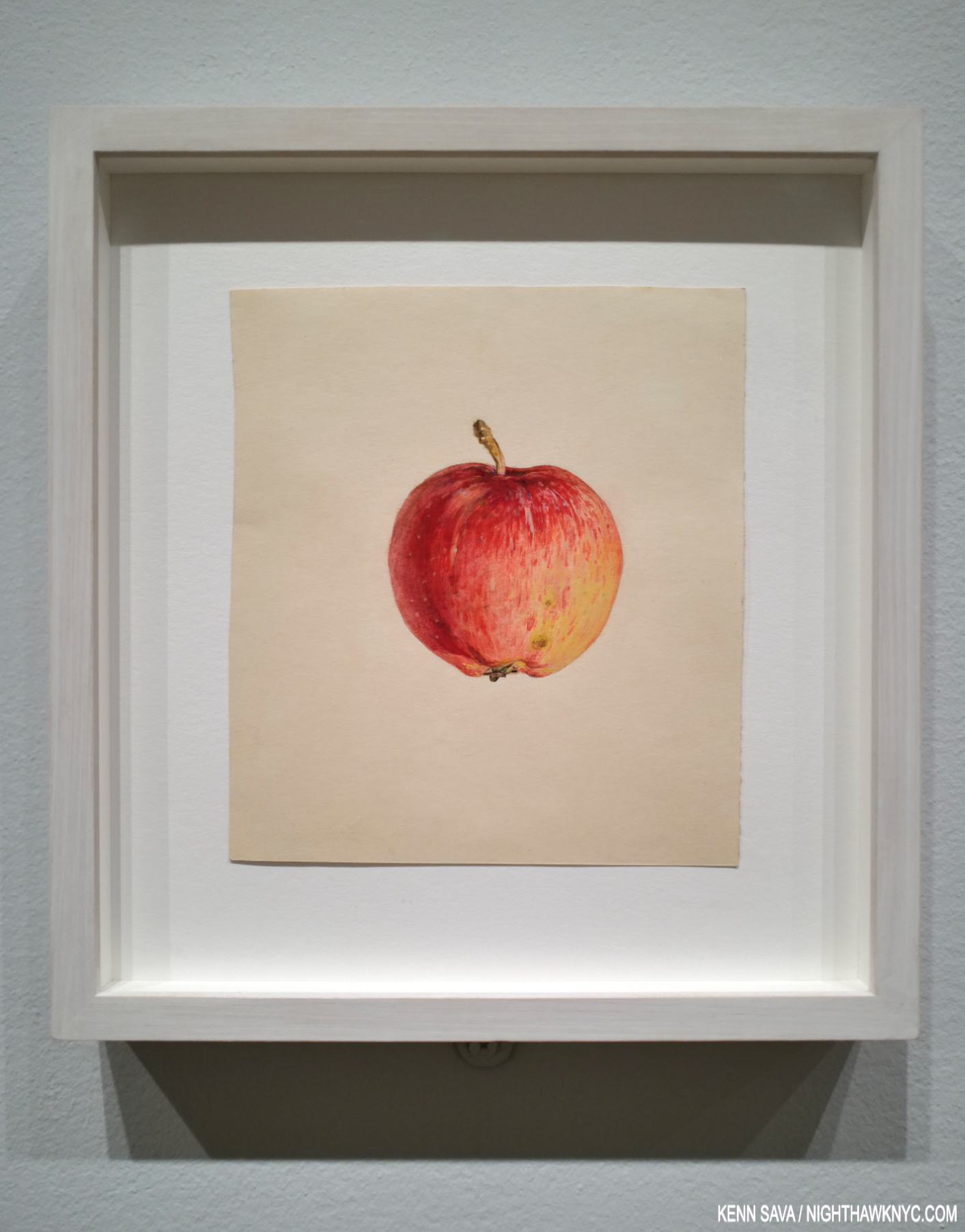
Slice detail with Wright’s Oculus.
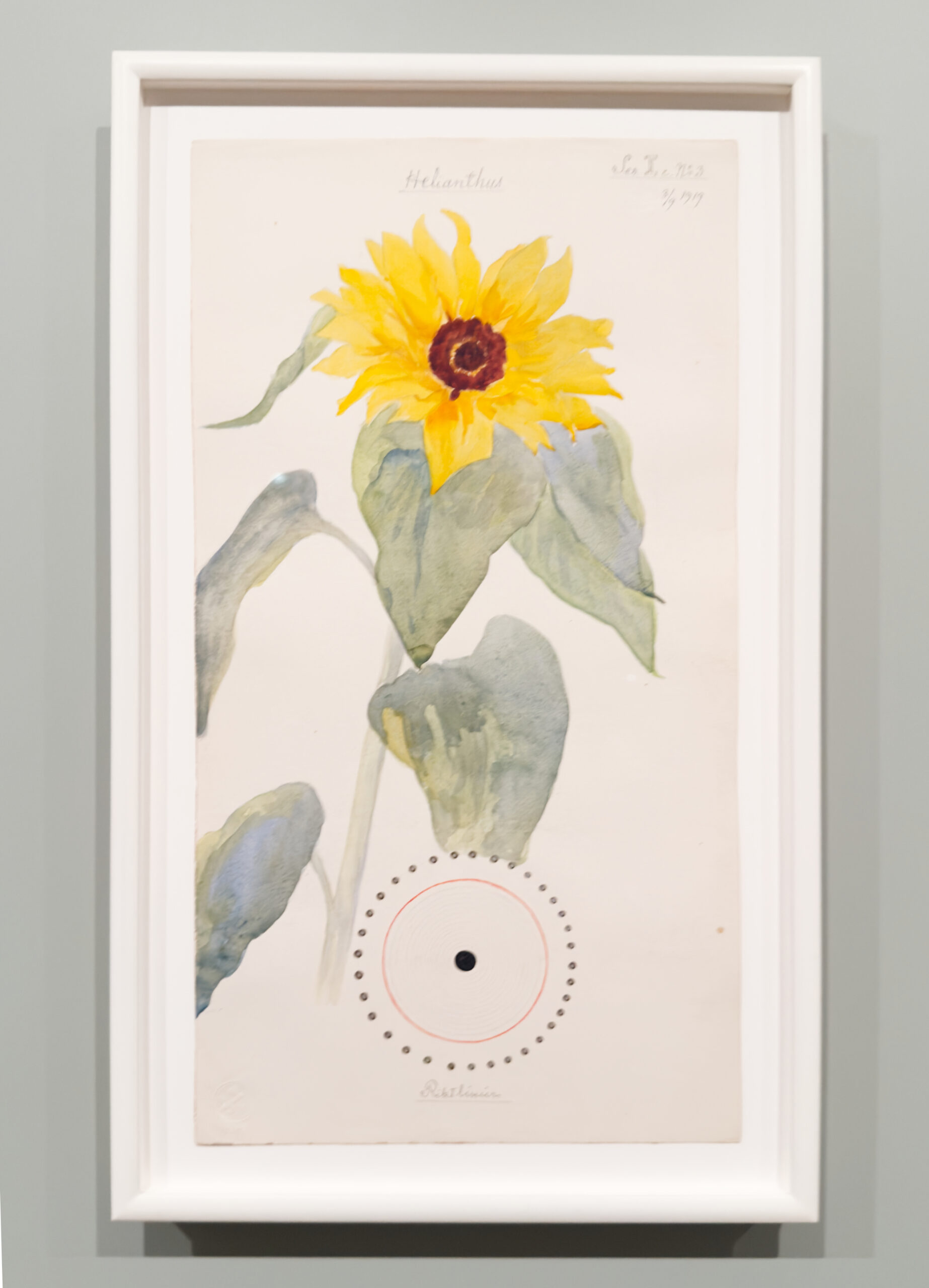
As I said in Part 1, there were so many amazing details in Timelapse I decided to devote a separate piece to them. I’m showing 40 as thumbnails. Click on any image for full size. There’s also a short video clip.
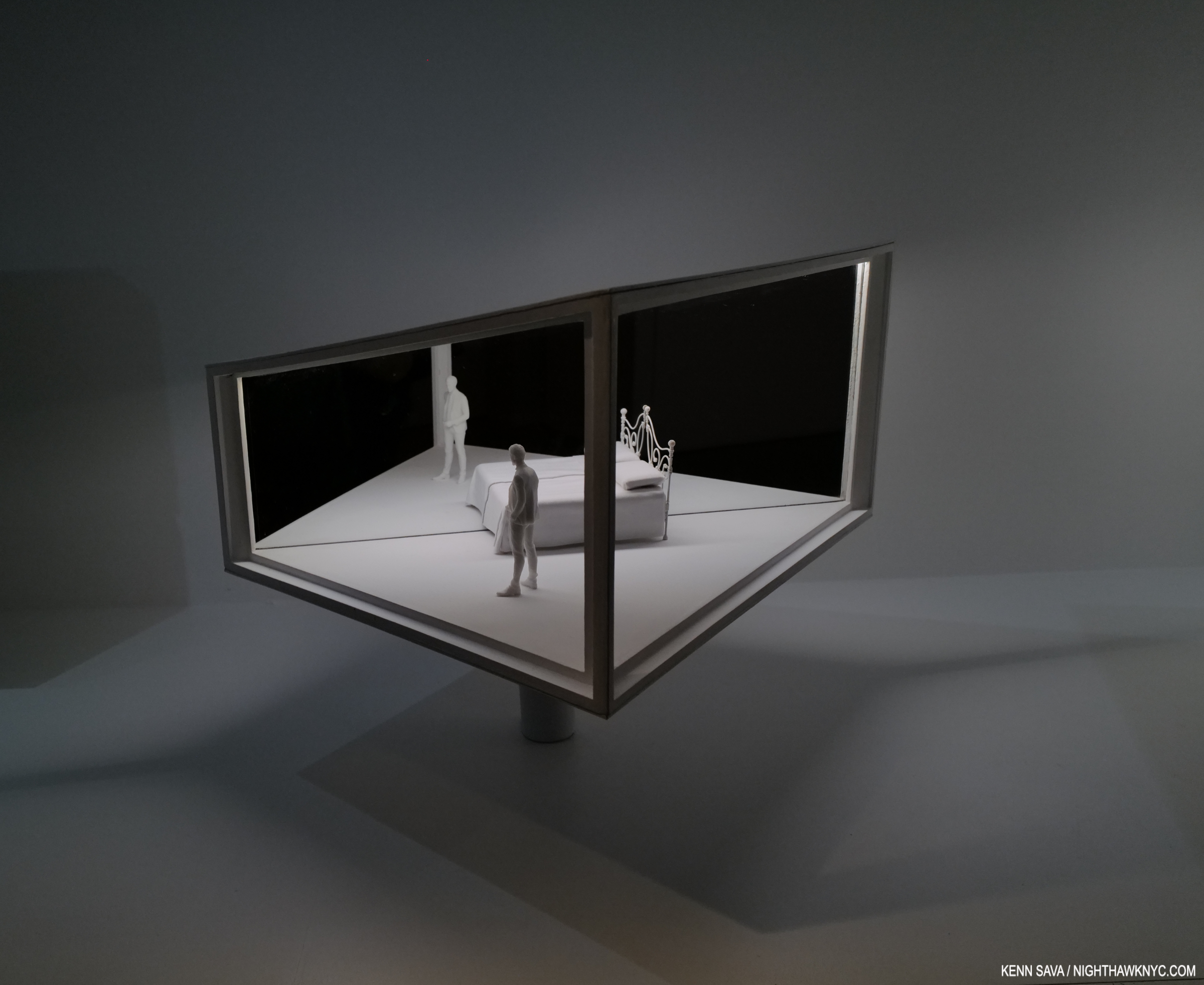
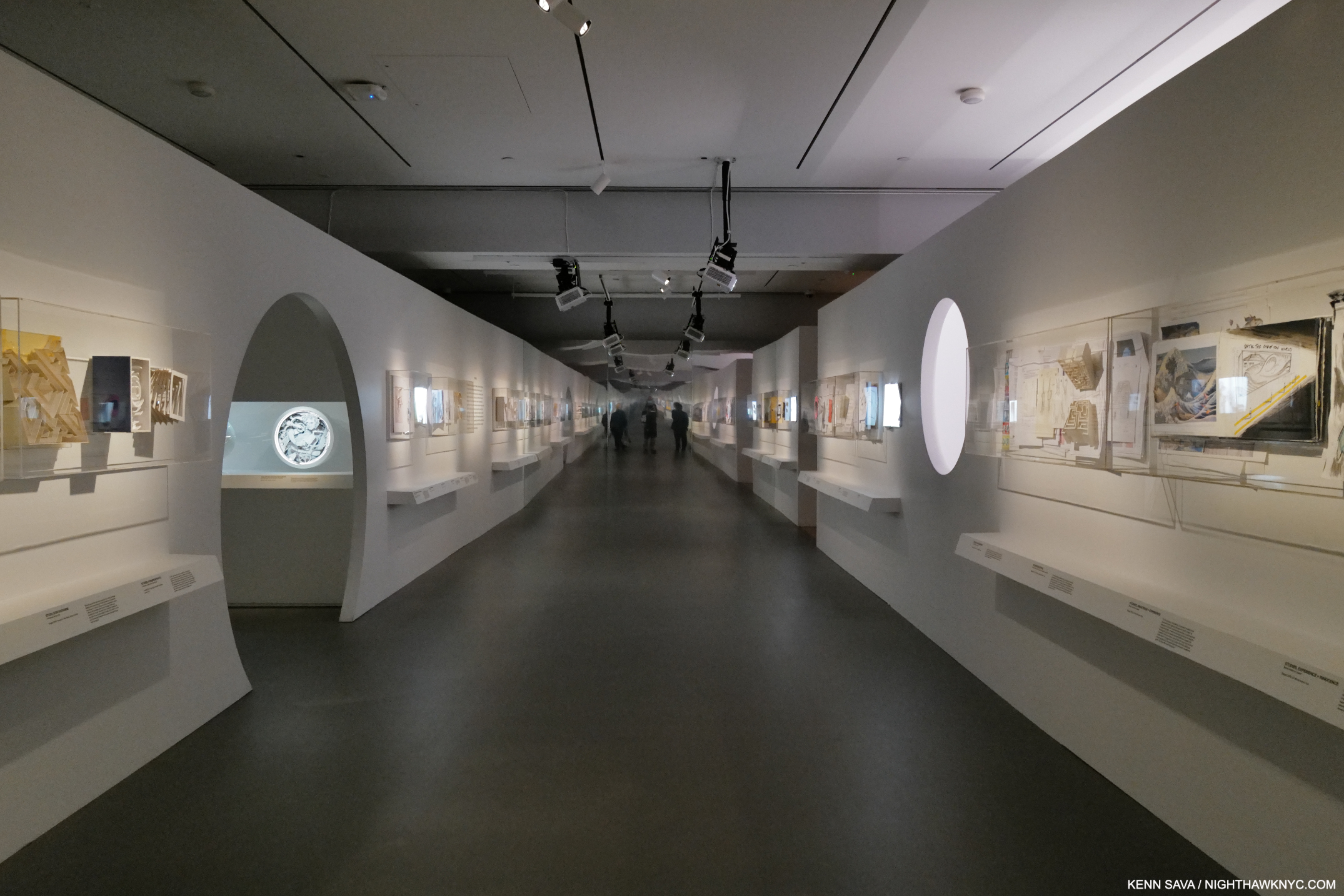
…and wonder about Timelapse I continue to…Show posters behind appropriate scaffolding, Seen on 10th Avenue, June 5, 2023.

The hub for the black string.

Following are Photos of details in the 8 Bays on the 6th floor. Please refer to the overall shots of each installation in Part 1 for orientation and where they are installed in each piece.

The following are details from Bay 1, The Night Sky is Dark Despite the Vast Number of Stars in the Universe

Detail of the Hammock in Bay 1. The Hammock over the ground floor pool and the Hammock Sarah Sze created in 2015 had a similar overlay. I believe the material on the floor is part of the installation, and hasn’t fallen through.

Detail of the far left corner of Bay 1, with a shadow from the Hammock and an image from River of Images.

The following are details from Bay 2, Travelers Among Streams and Cascades

Three details from the Painting, Travelers Among Streams and Cascades. This one from the left section…

Detail of the center section…

Detail of the right section.

The following are details from Bay 3, Slice.

Slice. Detail of the front.

Slice. Close up of the front. Shown here are a number of the recurring image “themes”: hands, birds, the Sun, fire, the sky and other aspects of nature.

Detail behind Slice with River of Images.

One of many levels and rulers.

Looking over a rung of a ladder to see the model of Slice in its Bay installed under it displayed next to the final piece.

Throughout Timelapse lamps were used apparently to draw the viewer’s attention to specific images or objects.

The following are details from Bay 4, Diver, Second of two parts and Images That Images Beget

The following are details from Bay 5, Times Zero

Times Zero, 2023.

The following are details from Bay 6, A Certain Slant,

Detail of the center surrounded by images of hands and objects.

Detail of the far right corner looking to the right from the image above. I imagine the salt from those blue containers is what is in the center of the circle.

Detail of part of the installation on the floor further to the right in the previous picture.

The following are details from Bay 7, Last Impression

An alternate, slightly closer view of Bay 5 from what I showed in Part 1. As you can see in the full size image, the empty frames to the right are attached to the strings that run across the gallery.

Some details of the ladder at the right side, front, of the Bay.

The following detail is from Bay 8, Things Caused to Happen (Oculus)

Short clip of Things Caused to Happen (Oculus).

The Artist points out that in the end, the digital images beamed on to Things Caused to Happen (Oculus) break up on the far wall.

*- Soundtrack for this piece is “I’ve Seen It All” by Bjork. This time in the version with Thom Yorke.

NighthawkNYC.com has been entirely self-funded & ad-free for over 8 years, during which 300 full-length pieces have been published! If you’ve found it worthwhile, PLEASE donate to allow me to continue below. Thank you, Kenn.

You can also support it by buying Art, Art & Photography books, and Music from my collection! Art & Books may be found here. Music here and here.

Written & photographed by Kenn Sava for nighthawknyc.com unless otherwise credited. To send comments, thoughts, feedback or propositions click here. Click the white box on the upper right for the archives or to search them. Subscribe to be notified of new Posts below. Your information will be used for no other purpose.