Amy Sherald’s Second Chance

This site is Free & Ad-Free! If you find this piece worthwhile, please donate via PayPal to support it & independent Art writing!
You can also support it by buying Art & books. Details at the end. Thank you!
 

Written & Photographed by Kenn Sava.

Preface-
In honor of those who saved my life 19 years ago on February 7th, 2007, as one way of giving Thanks, this piece honors another survivor (of a different ailment): the Painter Amy Sherald. Amy’s remarkable story is told here better than I could tell it. My look at her Art follows.

Shows seen:
Amy Sherald: the heart of the matter…, Hauser & Wirth, October, 2019, and
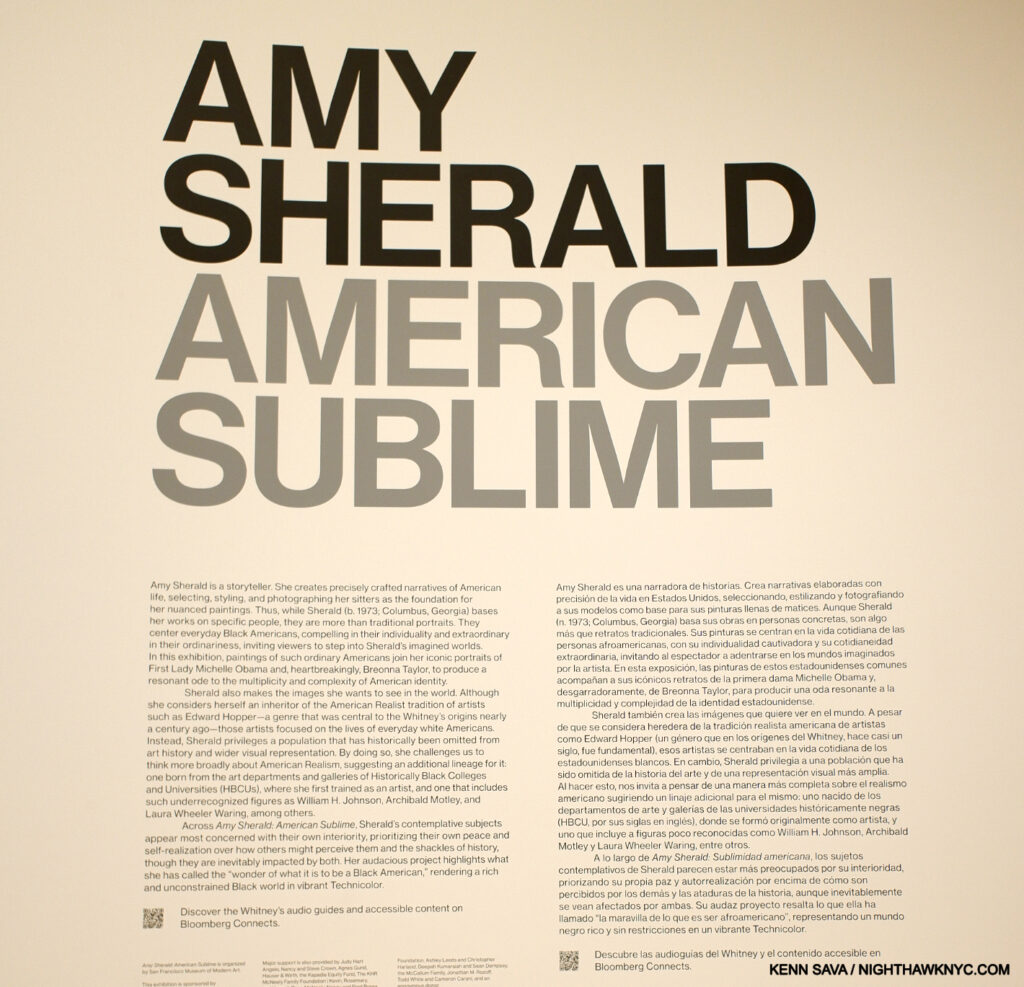
Amy Sherald: American Sublime, Whitney Museum, Summer, 2025

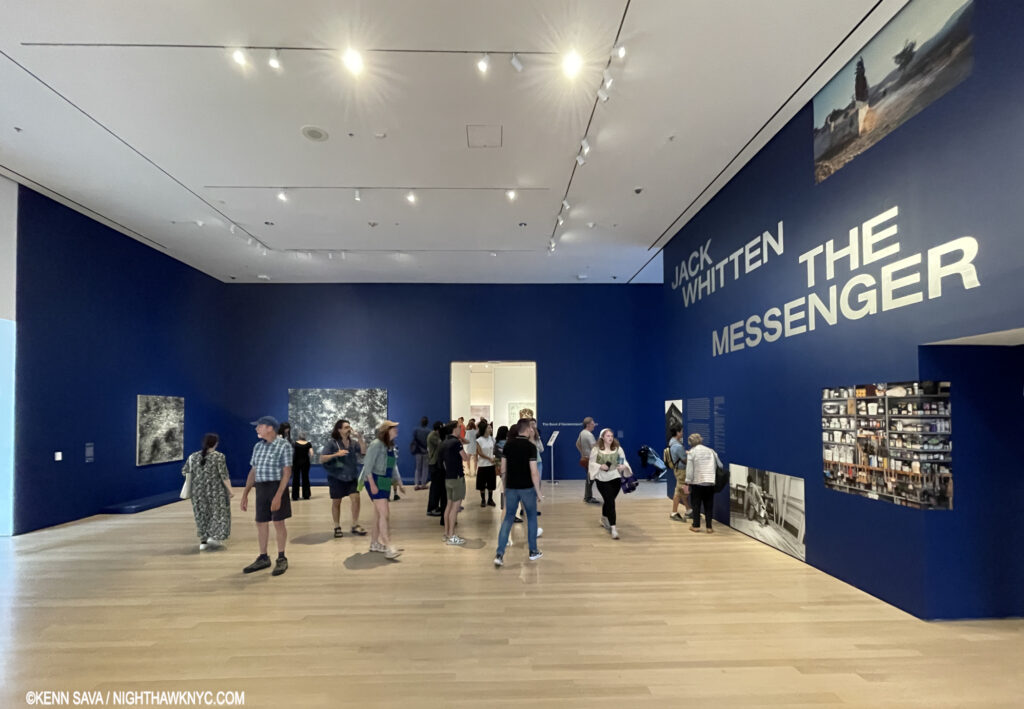
The Whitney & MoMA went toe-to-toe with dueling summer blockbusters in 2025, with each institution mounting two. I began this series with a look at Hilma af Klint: What Stands Behind the Flowers at MoMA, where Jack Whitten: The Messenger was installed on 6. All the while, 40 blocks south, Amy Sherald: American Sublime was up at the same time as Christine Sun Kim’s landmark All Day All Night, comprising the Whitney share of the four must-see Summer shows.

Hauser & Wirth, October 15, 2019.

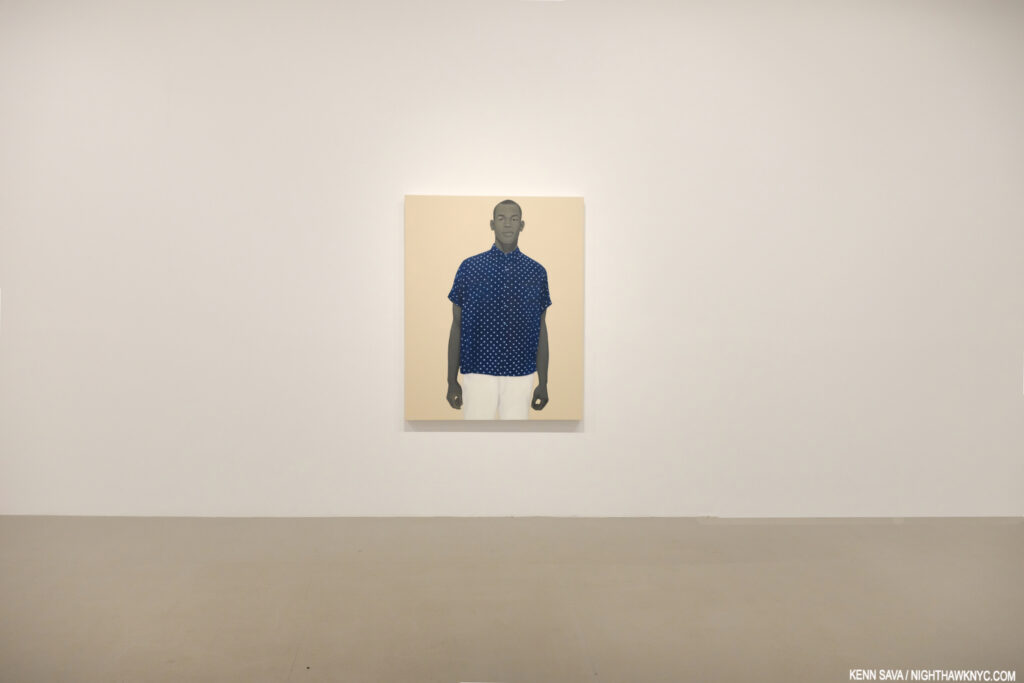
I first saw Amy Sherald’s work at her NYC debut show, “the heart of the matter…,”  at Hauser & Wirth in October, 2019, a show that contained 8 Paintings.

The select content allowed for more space around each that worked extremely well in my view. Handsome, 2019, Oil on canvas, 54 x 43 inches, was also shown in American Sublime. Seen at Hauser & Wirth, October 15, 2019.

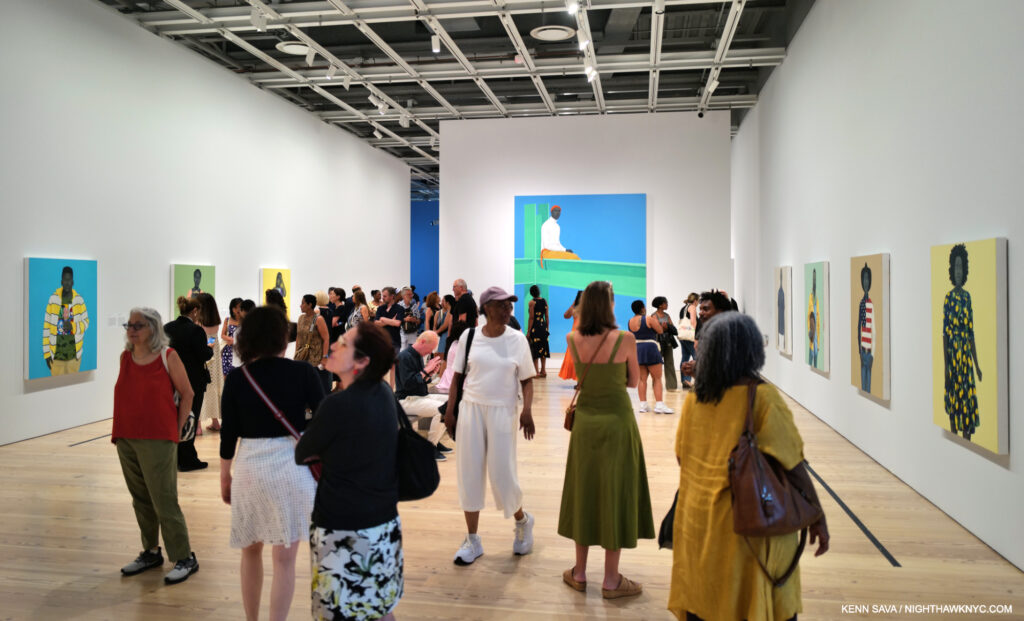
Fast forward to April 9, 2025, American Sublime contains 44 Paintings, the earliest dating from 2007- just 18 years prior! In those last two sentences hides the remarkable fact that Ms. Sherald (B. 1973) went from NYC debut show to an NYC early mid-career major museum Retrospective in a little more than five years! There aren’t a lot of Artists I can say that about.

Whitney Museum, July 25, 2025

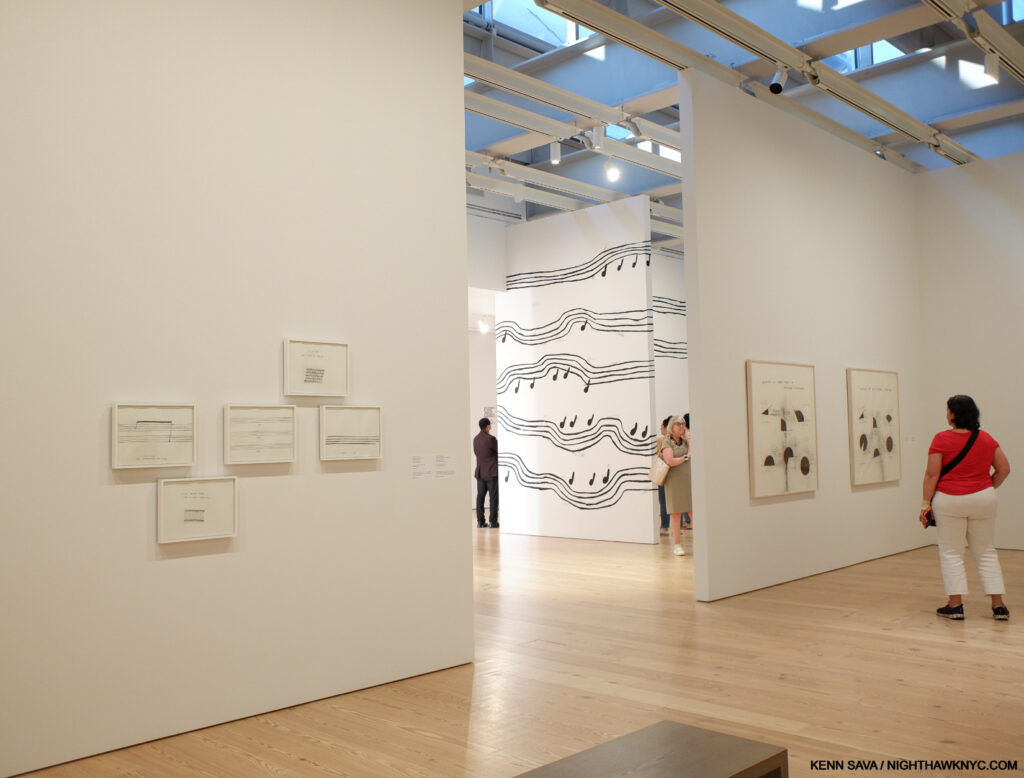
Installation view. July 25, 2025.

What’s more remarkable is that just seven years before her Hauser show, on December 18, 2012, Amy Sherald underwent a heart transplant at age 39! That concluded a harrowing 10 years she spent after being diagnosed with congestive heart failure at age 30, and a two-month wait in the hospital for a donated heart (as is recounted in the piece I linked up top). Today, Amy Sherald is yet another fine Painter who burst on the scene this past decade and has wasted no time solidifying a place in museums around the world.

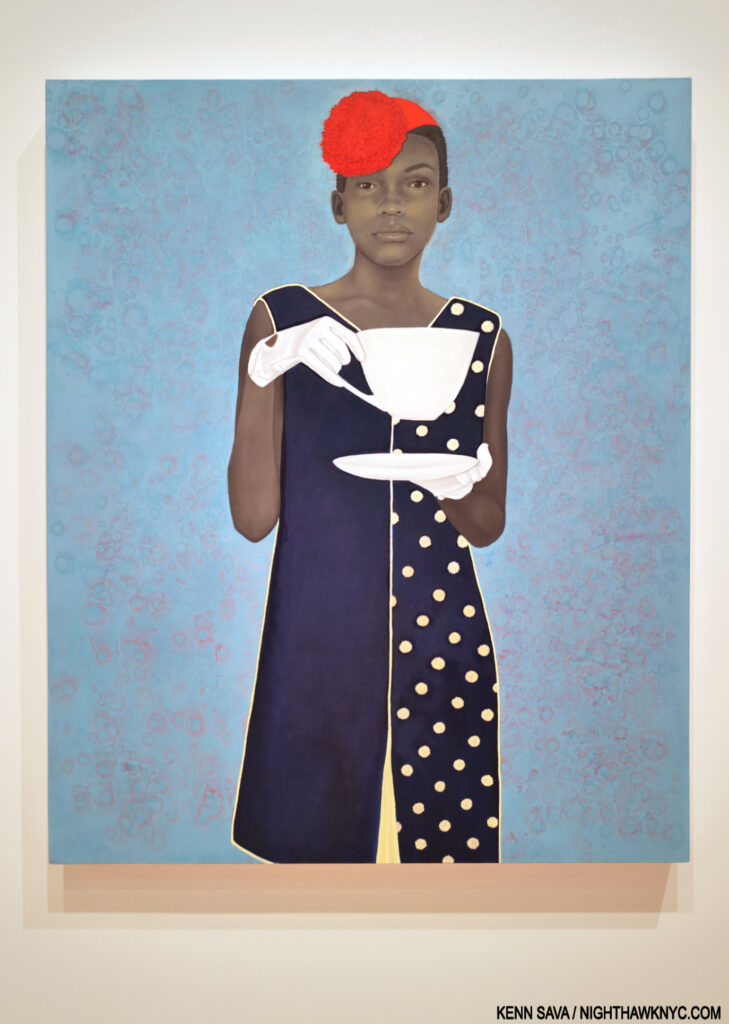
Miss Everything (Unsuppressed Deliverance), 2014. Oil on canvas. The Painting that brought Amy Sherald to national attention was inspired by Alice in Wonderland.

And, “burst on the scene…” she did as her 2019  NYC debut show came just three years after Amy won the 2016 National Portrait Gallery’s Outwin Boochever Portrait Competition with Miss Everything (Unsuppressed Deliverance), becoming both the first woman and the first African-American woman to win it.

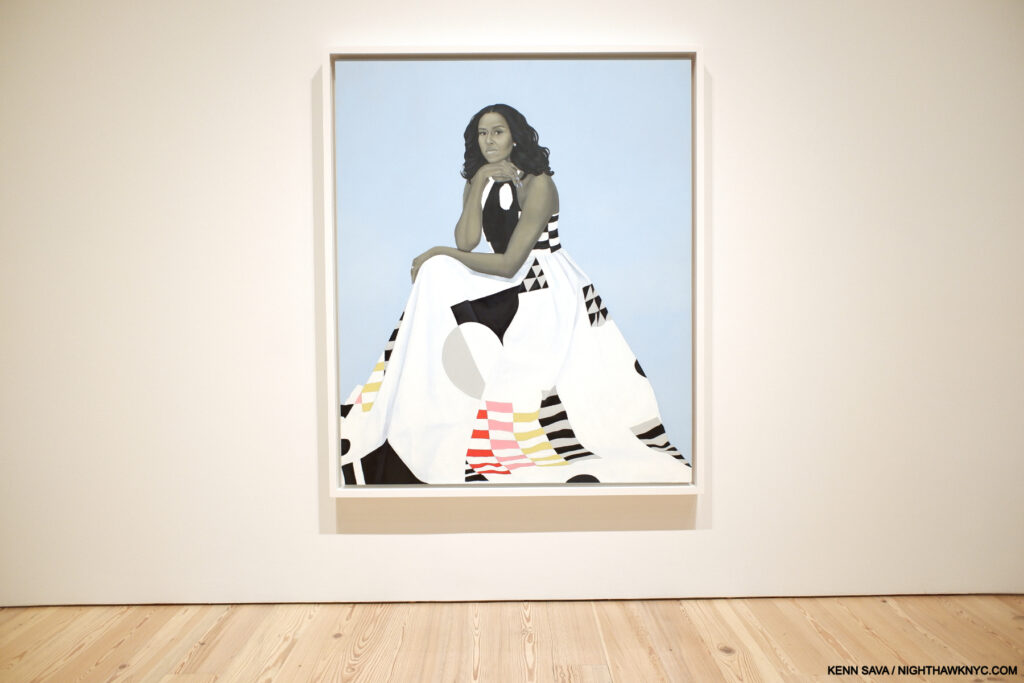
Michelle LaVaughn Robinson Obama aka First Lady Michelle Obama, 2018, Oil on linen. (The first title was on the wall card.) After being personally selected by Mrs. Obama to Paint her official Portrait, a prescient choice at the time. Amy Sherald’s stature has only continued to grow. The former First Lady selected the Michelle Smith Milly label dress she is wearing that channels Piet Mondrian through Gee’s Bends Quilt Making, blending the modern with the historic. Gee’s Bend is a remote Black Alabama community of the descendants of former slaves.

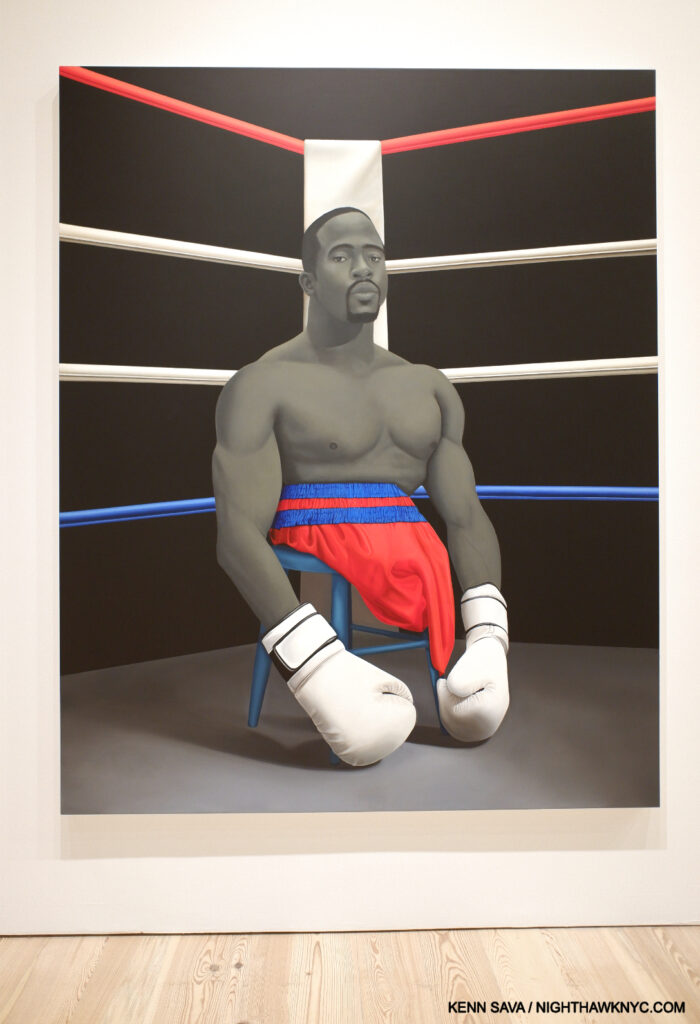
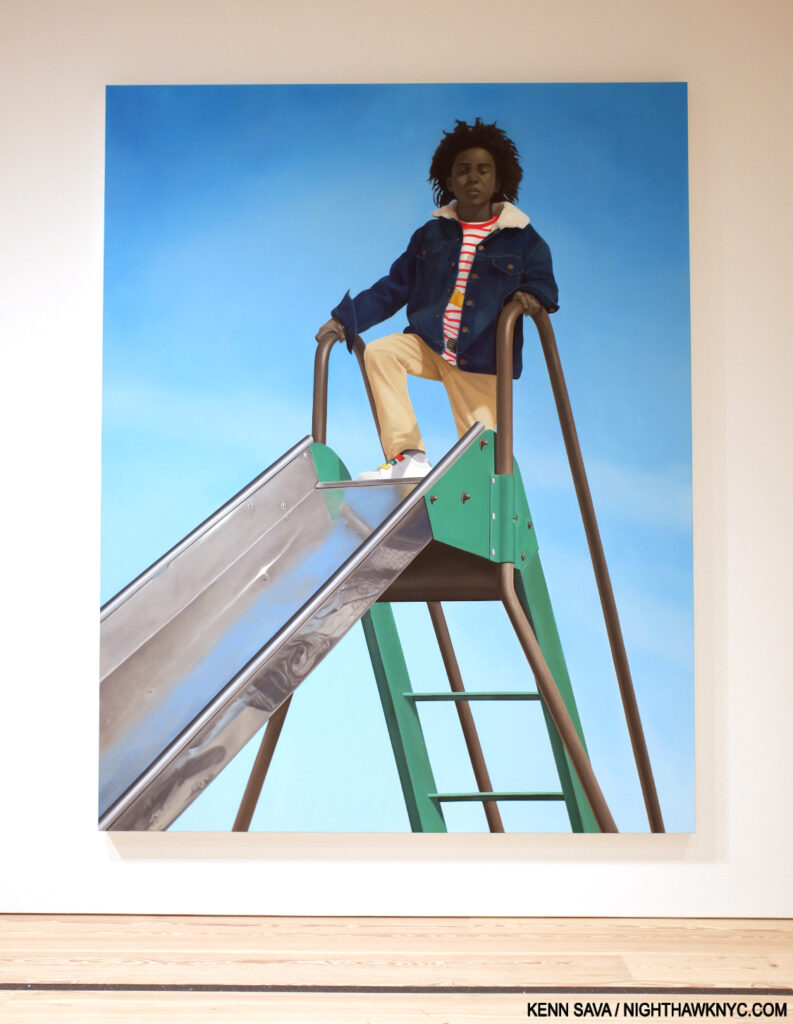
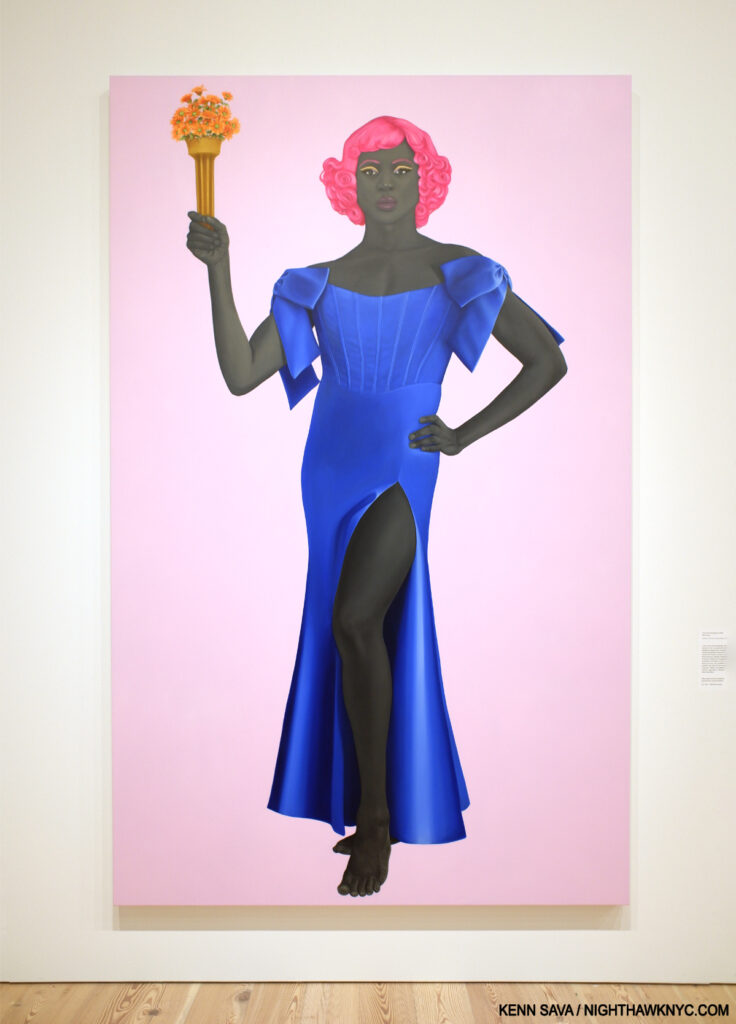
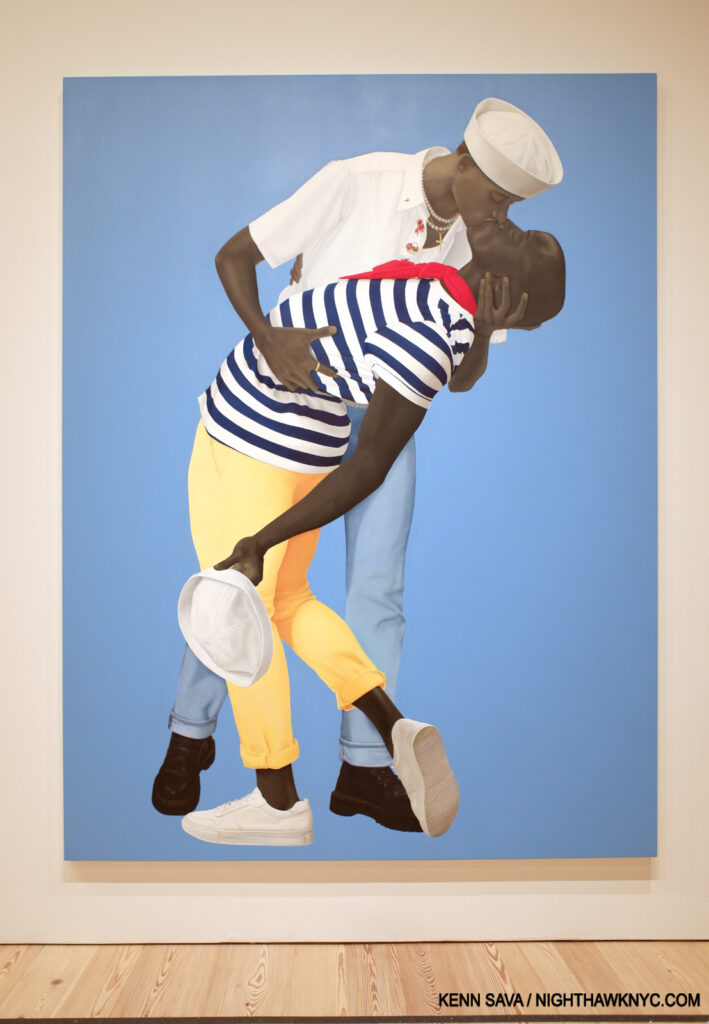
Most well-known today, perhaps, for her Portraits of Michelle Obama and Breonna Taylor, Amy Sherald: American Sublime revealed the depth of her accomplishment (already) in works that are almost always forthright, with subjects usually facing the viewer head-on, while steeped in a subtlety that rewards extended and repeated looking. Adding a unique twist is that the faces, hands, arms, legs of each of her subjects are gorgeously rendered in grisaille(!), something I’ve never seen done in a color Painting before, and something that has become her trademark. She uses grisaille as a way of “challenging the concept of color as race1.”

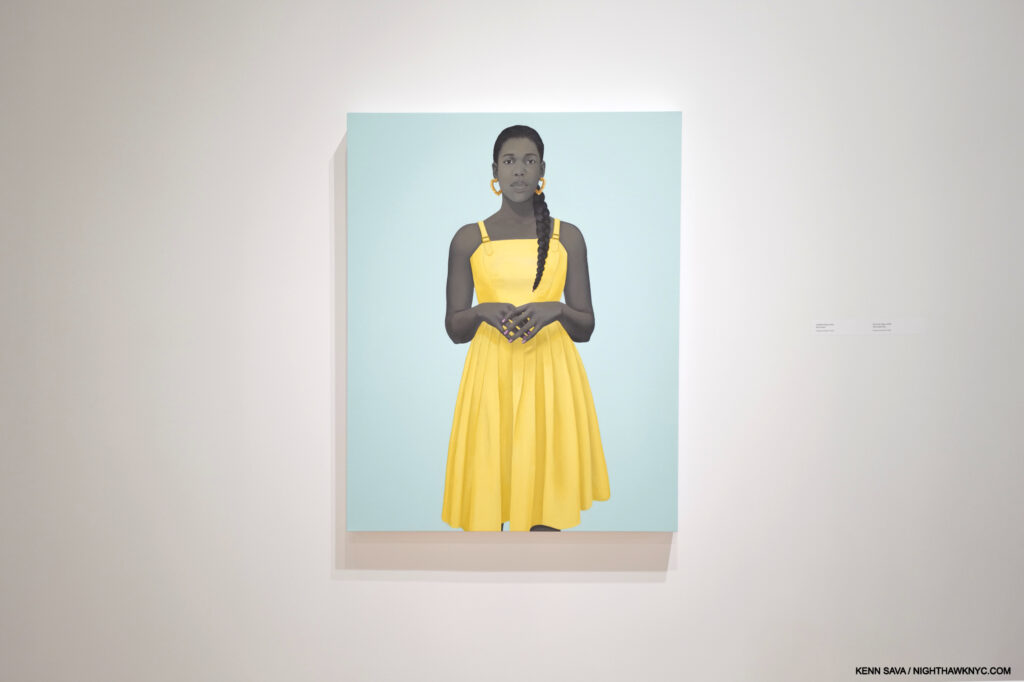
Untitled (Opal), 2019, Oil on linen. Standing in front of Opal, I found myself wondering why I’d never seen a Painting like this before. It seems so incredibly straight-forward, yet only Amy Sherald could have Painted it and made it as unique as it is. From the grisaille, to the position of her hands & fingers, to her expression and the choice of colors, which Wes Anderson might admire, it’s a remarkable blend of a Portrait of Opal through the eyes of an Artist with a vision.

In the late 1990s and early 2000s I spent much time wondering what new developments would come to Portraiture after the work of great 20th Century Artists, like Francis Bacon, Lucian Freud, Frank Auerbach, Alice Neel, Marlene Dumas, Picasso, and others. 25+ years in, the genre is continually being reinvented, yet again, by a number of Artists who have come to prominence this decade- including Amy Sherald, Nathaniel Mary Quinn, and Frank Auerbach (who passed away in 2024).

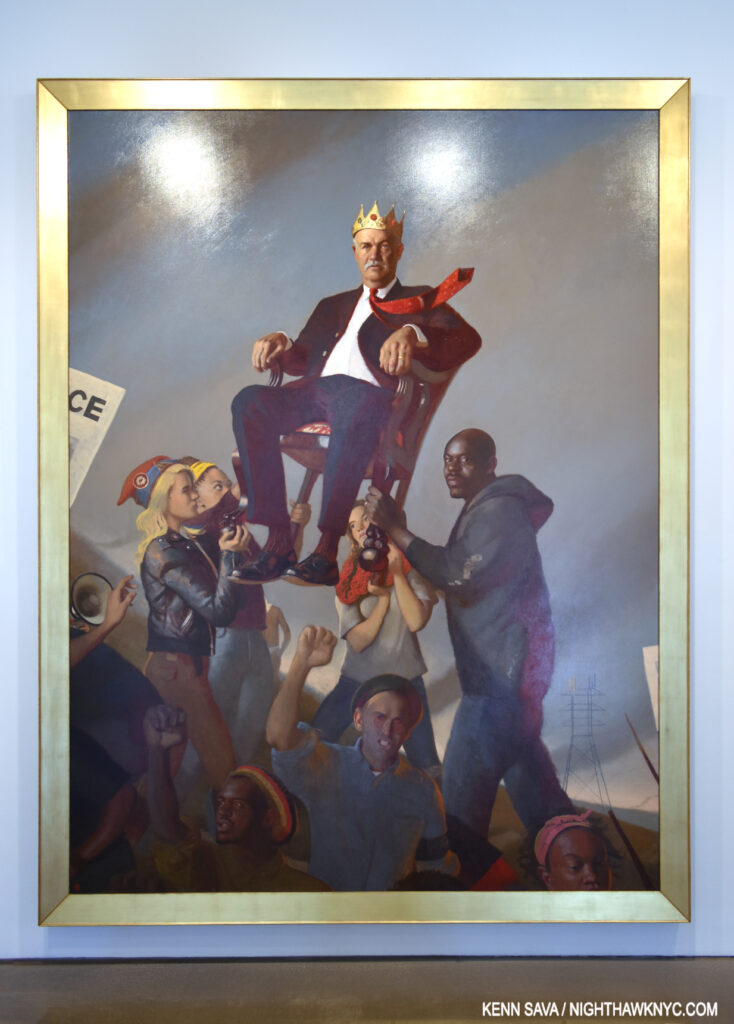
Bo Bartlett, Oligarchy, 2016, Oil on linen. See at Ameringer McEnery Yohe, August 12, 2016.

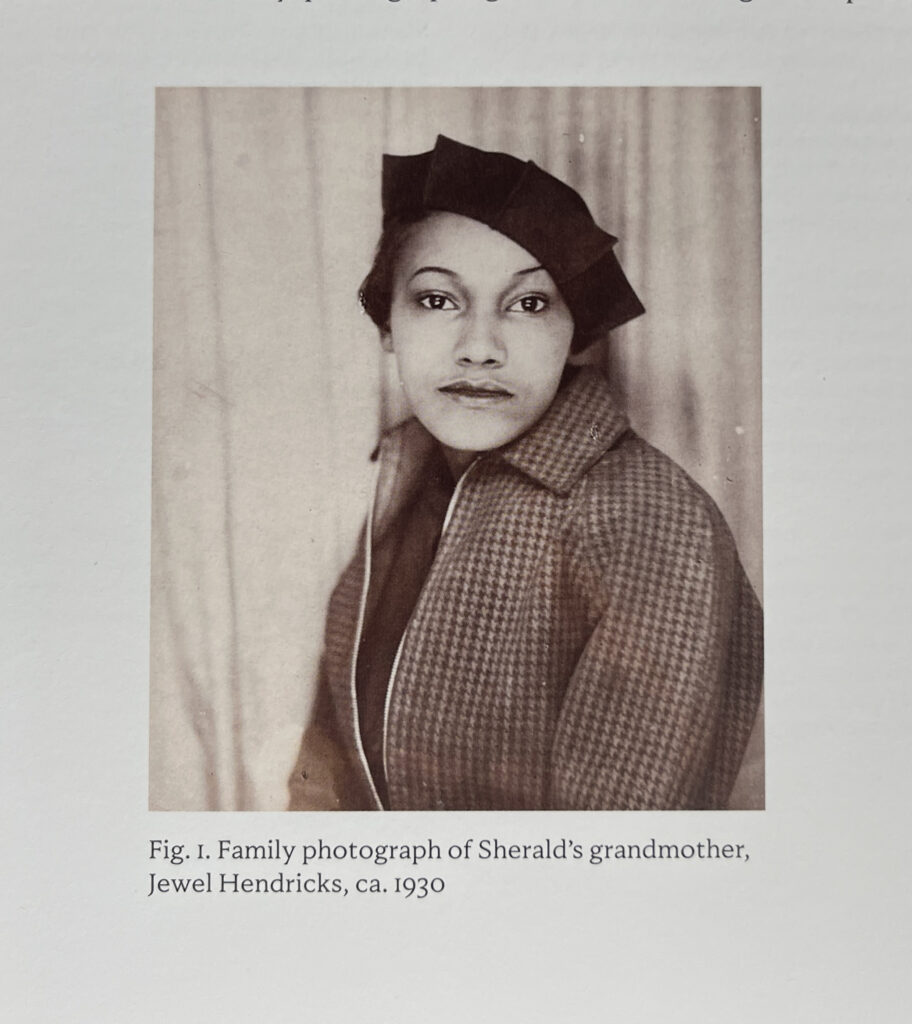
Interestingly, Amy credits the Painter Bo Bartlett with showing her the possibilities. Others have posited that Ms. Sherald’s use of grisaille goes back to old black & white Photos of Black subjects, and not Painting or Painted Portraiture. However, on 19th Century Photographs Ms. Sherald said-

“It wasn’t what inspired my work, but it’s what affirmed my journey with it, and it’s where I was finally able to find these representations of black Americans that spoke to me in the same way that I wanted my work to speak to the world. They were family photographs, similar to the image of my grandmother that I oftentimes mention, where she had her picture taken.”

The Artist’s grandmother, Jewel Hendricks, as seen on page 28 of the excellent American Sublime catalog.

“Looking at how they represented themselves— they’re quiet, regal, graceful. It was an outward action that had inward meaning. They don’t smile, but there’s something there-this is what I look for in people— the feeling that you get when you look at those old photographs. When you look into their eyes, you are being told a story. It’s almost as if they’re standing in front of you, and they have a living and breathing kind of energy. There is something so captivating about that. And it’s not frivolous. It’s a very serious, deliberate kind of thing, having your picture taken, especially then2.”

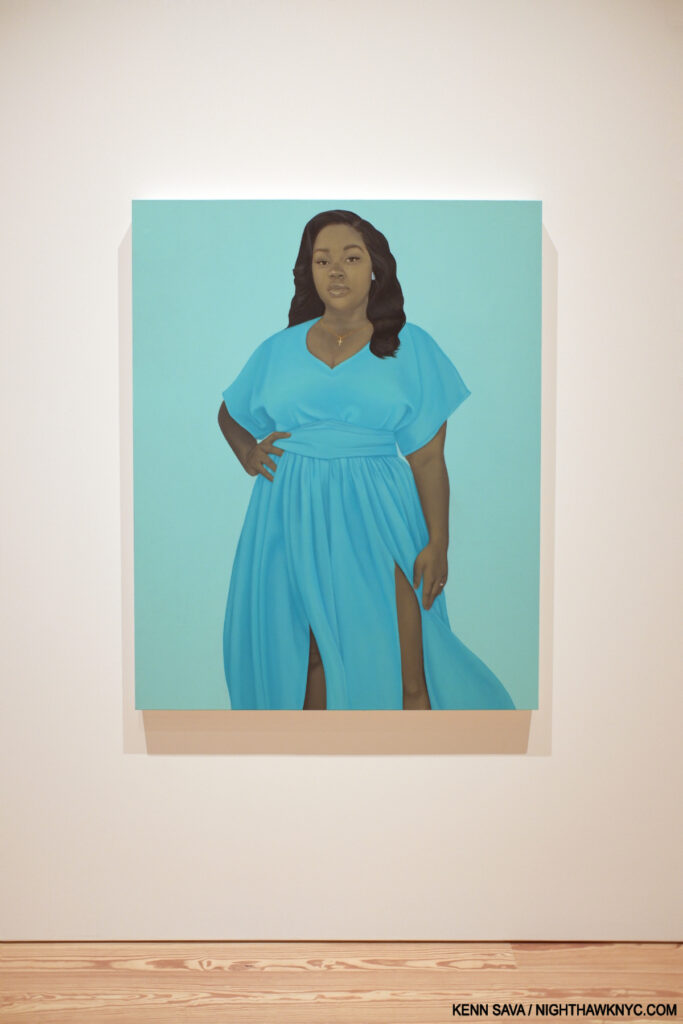
Breonna Taylor, 2020 Oil on linen.

In work after work, American Sublime reveals that Amy Sherald is a master of Portrait story telling. Her Portrait of Michelle Obama, Michelle LaVaughn Robinson Obama, is a classic case in point that manages to subtly weave multiple threads. Crossing cultural boundaries by dialoguing Mondrian-like elements and Gee’s Bends Quilt Making is artistically ground-breaking, topped off with a natural and wonderfully relaxed pose, enhanced by the background pale blue, that is just stunning.  This is just what Amy Sherald does. Commissioned to Paint the late Breonna Taylor, her first posthumous Portrait, Ms. Sherald visited her family and spent time with her mother, Tamika Palmer, who spoke of Breonna’s interest in fashion. Amy commissioned a dress for the Portrait, and also added an engagement ring on her finger “to represent the love between Taylor and her partner, Kenneth Walker… Sherald incorporated the ring to give him solace and to suggest a brighter future3.” Of the finished Painting she said, “I don’t think I thought much about the viewer so much as I thought about her family when I was making this portrait….but when you’re speaking about violence against women and police brutality, she’s become the face for that movement,” she said4.

The intro for the Audio Guide for her 2019 Painting, The Girl Next Door says, “The artist discusses how she transforms the historical function of portraiture.” That’s a lot to have accomplished in 18 years already. Along the way, she renders a wide range of subjects that encompass an equally wide range of Black Americans, including more than a few who are new to museum walls showing the scope of her vision.

American Grit, 2024 Oil on linen.

As soon as she was able to, she sought out the family of the woman, Kristen, whose heart she now has. Amy was 39 when she received Kristin’s heart. Kristin died at 38. Amy calls it “a perfect match.”

Kingdom, 2022 Oil on linen

“What kind of person was she? What kind of things did she like. Who did she love? I romantically believe in muscle memory, heart memory. It means a lot for me to be able to just kind of get to know her family a little bit. When I met her father he made me feel her heart beat. … I still call it Kristen’s heart.”

Trans Forming Liberty, 2024 Oil on canvas

“I live without fear. I work without fear. I wake up and produce these ideas without thinking so much about painting something stupid or people not liking it. I’m living this moment: I wake up every day, and I have to make sure that my work continues to speak to generations. I need to make things that are going to resonate in that way.” 

For Love, and for Country, 2022 Oil on linen.

She continues, “But I also truly believe in who I am as a human. I believe in my power. I believe in timing. I believe that this is my “now,” and that nothing can go wrong now. I understand that as a fact. I’ve been through the worst of the worst, and it was still okay. I wake up, and I keep it moving every day for Kristin and my brother Michael. You don’t waste second chances5.”

A God Blessed Land (Empire of Dirt), 2022 Oil on linen.

*- Soundtrack for this piece is “I Can See Clearly Now,” written & performed by Johnny Nash from the 1972 album of the same name, which he performs the following year-

For those who kept me here, and for Lisa, who gave this total stranger her extra ticket to the sold-out Basquiat show at the Brant Foundation in Spring, 2019, enabling me to see it and share it with the world. As she was leaving she told me she was looking forward to seeing Amy Sherald: the heart of the matter….

NighthawkNYC.com has been entirely self-funded & ad-free for 10 1/2 years, during which over 340 full-length pieces have been published! If you’ve found it worthwhile, PLEASE donate securely by PayPal below to allow me to continue. Thank you, Kenn.

You can also support it by buying Art, Art & Photography books, and Music from my collection! Art & Books may be found here. Music here and here.

Written & photographed by Kenn Sava for nighthawknyc.com unless otherwise credited. To send comments, thoughts, feedback or propositions click here. Click the white box on the upper right for the archives or to search them. Subscribe to be notified of new Posts below. Your information will be used for no other purpose.

  1. https://nmwa.org/art/artists/amy-sherald/
  2. “Amy Sherald in Conversation with Ta-Nehisi Coates” in Amy Sherald: The World We Make, P.184
  3. https://nmaahc.si.edu/object/nmaahc_2021.117
  4. ibid.
  5. ibid. P.186

CJ Hendry: Colored Pencil Mastery to Art SuperStar

THIS SITE IS FREE & AD-FREE!
If you find this piece worthwhile, please donate securely via PayPal so I & NighthawkNYC can continue. More ways you can support it at the end. Thank you.

Written & Photographed by Kenn Sava (*- unless otherwise credited)

Show seen- CJ Hendry, Flower Market 2.0, Rockefeller Center, September 19-21, 2025

Having just written about Hilma af Klint’s Flower Paintings (with guest star Georgia O’Keeffe), there is another Artist who garnered quite a bit of attention with Flower Art in NYC in 2025: the Artist known as CJ Hendry. Learning about her and experiencing her work in 2025 turned out to be an adventure, the likes of which I’ve never experienced in the NYC Art world.

What do I mean, “quite a bit of attention…”, and “The likes of which I’ve never experienced…”? Check out the 5 city-block long line of people (on the far side of the barricade) waiting to get into her show, sped-up 400%-

I sped it up 400%(!) so you wouldn’t have to spend the 10 minutes I spent walking to the end of what was the longest line I’ve ever stood in in NYC, let alone for an Art event. What’s it all about? Why are so many people interested in CJ Hendry?

Ms. Hendry first came to my attention this past Spring while I was researching the current State-of-the-Art in Colored Pencil Drawing, and discovered this-

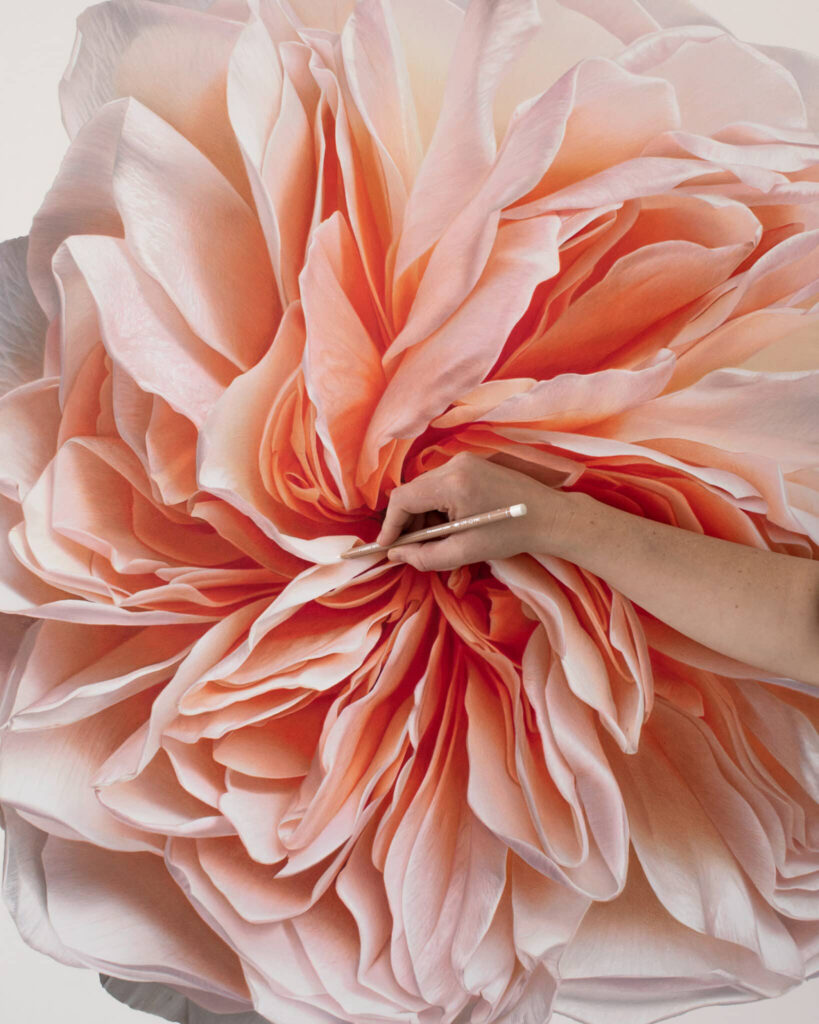
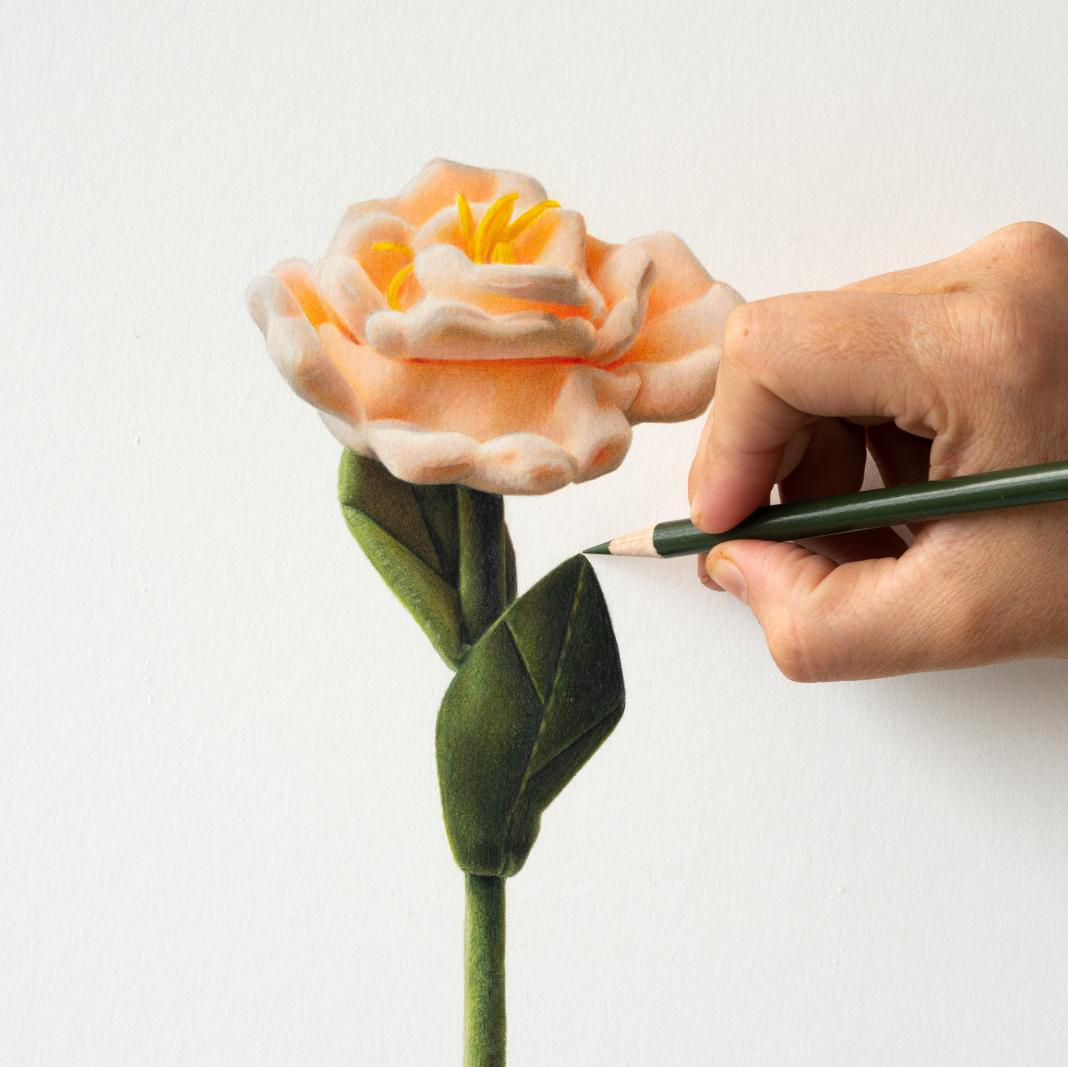
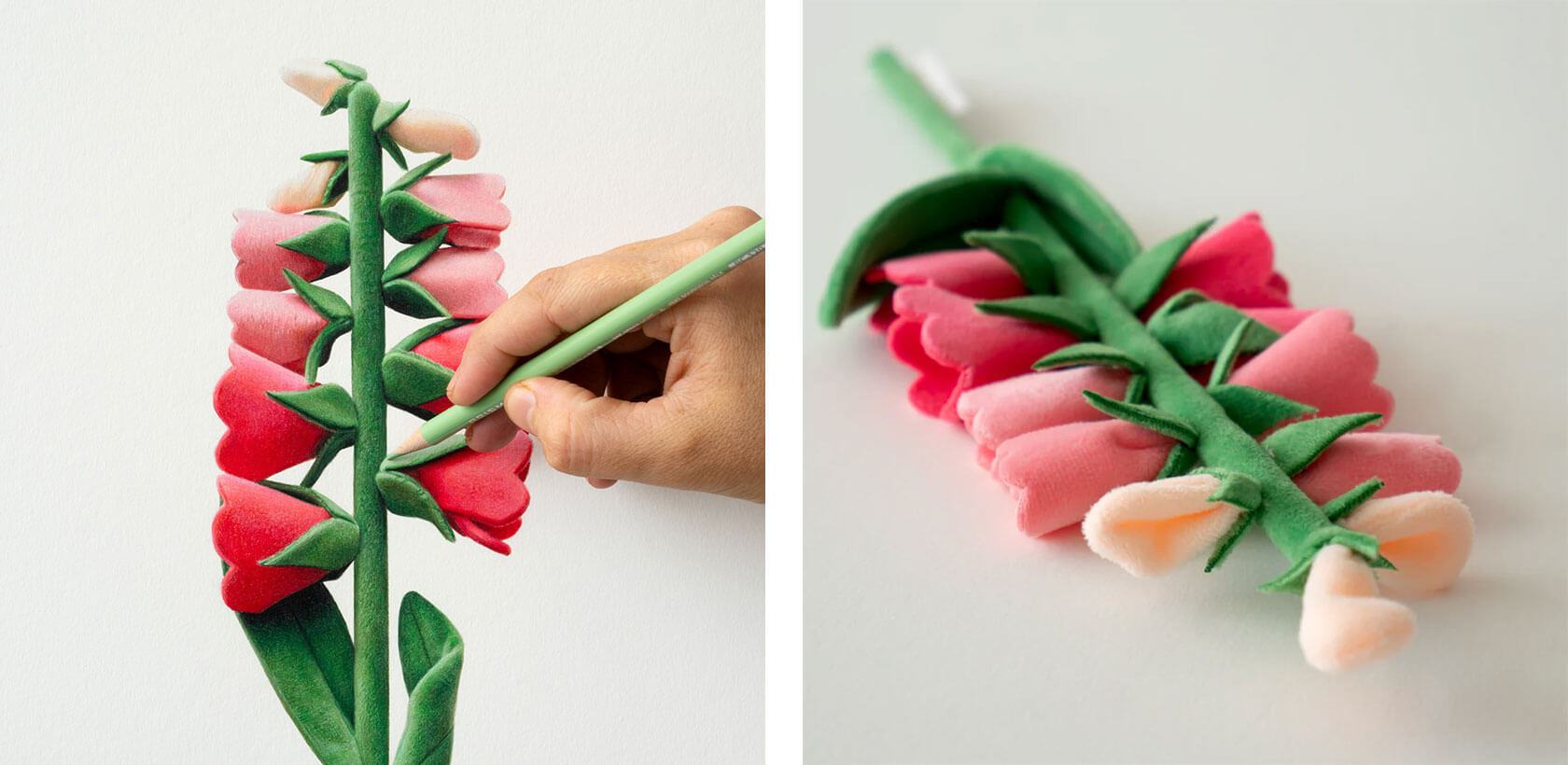
Detail of Light Peach Rose, the whole 41 x 41 inches shown next, Colored Pencil, on paper or board (not specified), Date unknown. The Artist works on a detail with a Caran D’ache Luminance Color Pencil. *- CJ Hendry Studio Photo.

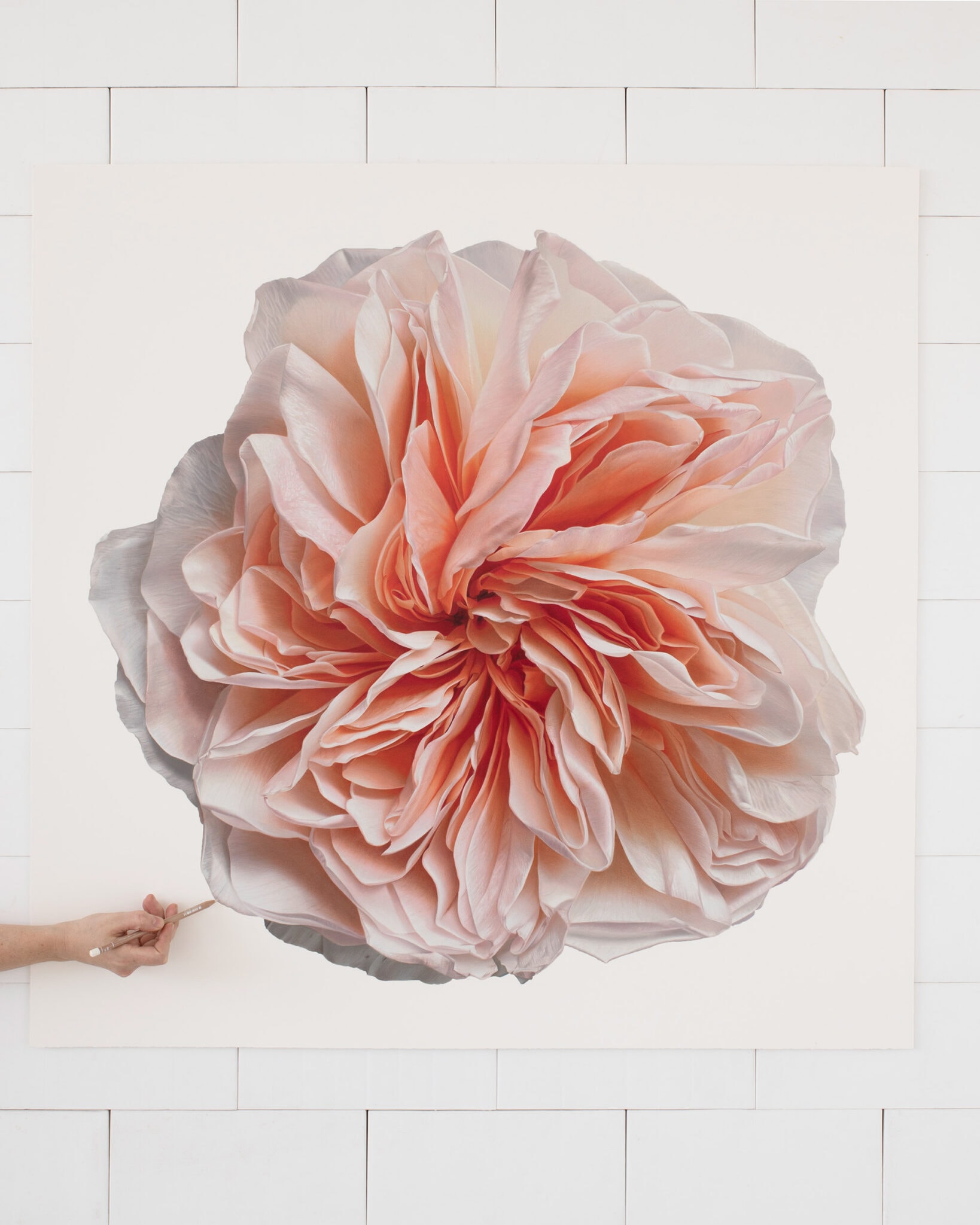
The full work, Light Peach Rose, 41 x 41 inches, mounted on a wall, as the Artist adds a detail, or holds the pencil there ostensibly so we know it’s not a Photograph. *- CJ Hendry Studio Photo.

Astounded by her work, as numerous others have been, I searched deeper, looking for answers about how she gets such spectacular results.

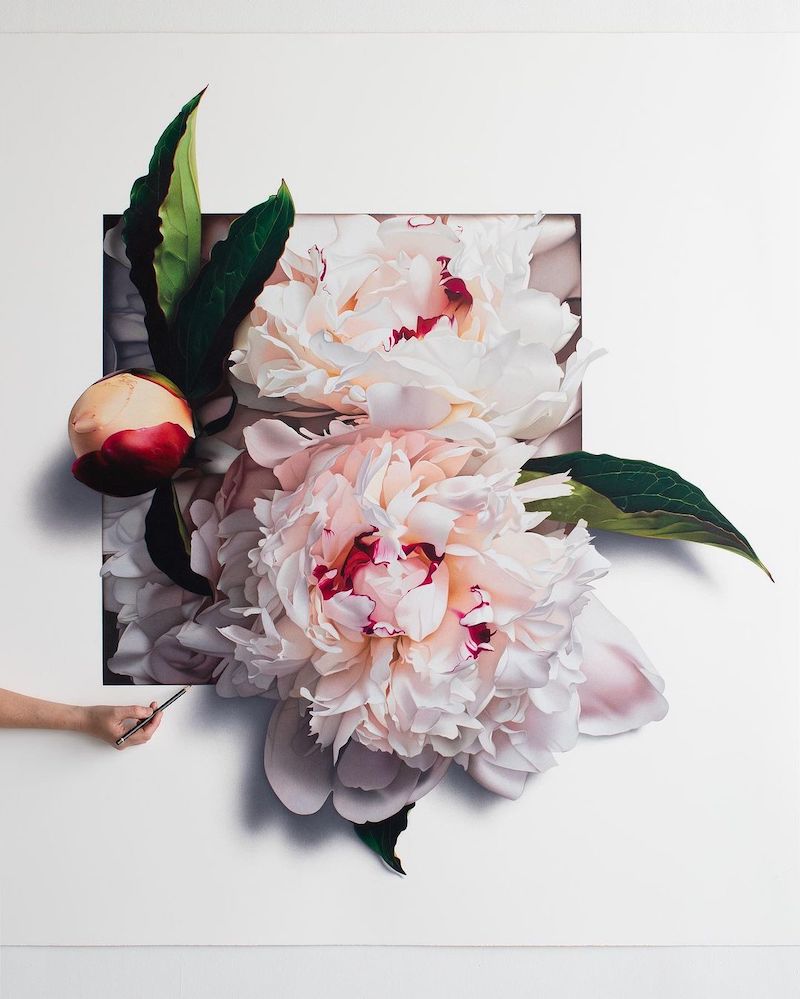
One of her most remarkable Flower Drawings. Title, size, date, materials besides Colored Pencils, unknown. Ms. Hendry loves to play with the picture plane and the picture “frame,” here, with a large part of the composition seeming to extend out of the frame and appear to be 3-D. In some of her pieces she even Draws an intricate gilded frame. *- CJ Hendry Studio Photo.

Details are few and far between. It’s not that she’s overly secretive, I think she’s just busy. The closest I’ve come are a few yt videos she’s posted where you can actually watch her Draw. One lasts SIX HOURS! Yes, I’ve watched all of it, and parts of it more than once. It’s not a lesson per se, it’s the Artist at work, and there’s no sound (Ms Hendry usually listens to audiobooks or shows during her marathon Drawing sessions), but it’s revealing nonetheless.

My most recent piece on Hilma af Klint focused on her Nature Series Portfolio consisting of 42 Watercolor Paintings containing renderings of 100 varieties of flowers that was on view at MoMA this Spring and Summer. The piece focused on Art depicting individual flowers, which is exactly what CJ Hendry is doing here. As the year went on, I found myself pondering the similarities, and differences, between CJ Hendry, Hilma af Klint and Georgia O’Keeffe on a regular basis. I’ll get to that.

Flower, Colored Pencil on Paper or board, Date unknown. One of her source Drawings for her Plush Flowers, seen further below. *- CJ Hendry Studio Photo.

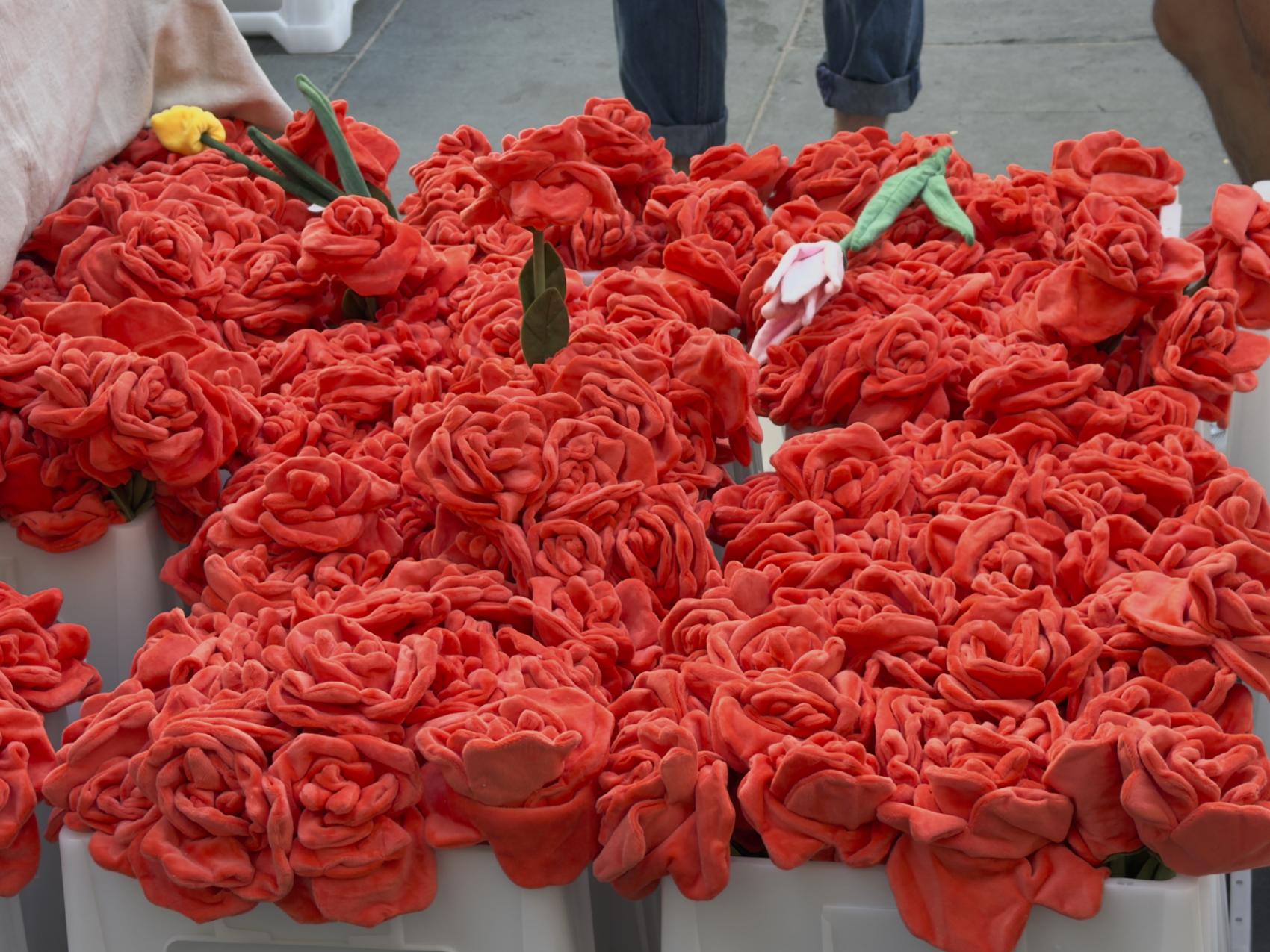
Having spent 2025 looking at Flower Art almost exclusively, I was immediately struck by another series of Flowers she’s drawn, that includes this one. I’ve seen twelve of these Drawings, though there are likely more given she & her team proceeded to make them into a series of about 27 different Plush Flowers that were given away and sold in the two Flower Markets she’s set up on Roosevelt Island in 2024, and in Rockefeller Center in September, 2025- the show all those folks in the video were waiting to get in to see51. Looking at these reminded me of Georgia O’Keeffe’s famous quote about “realism”-

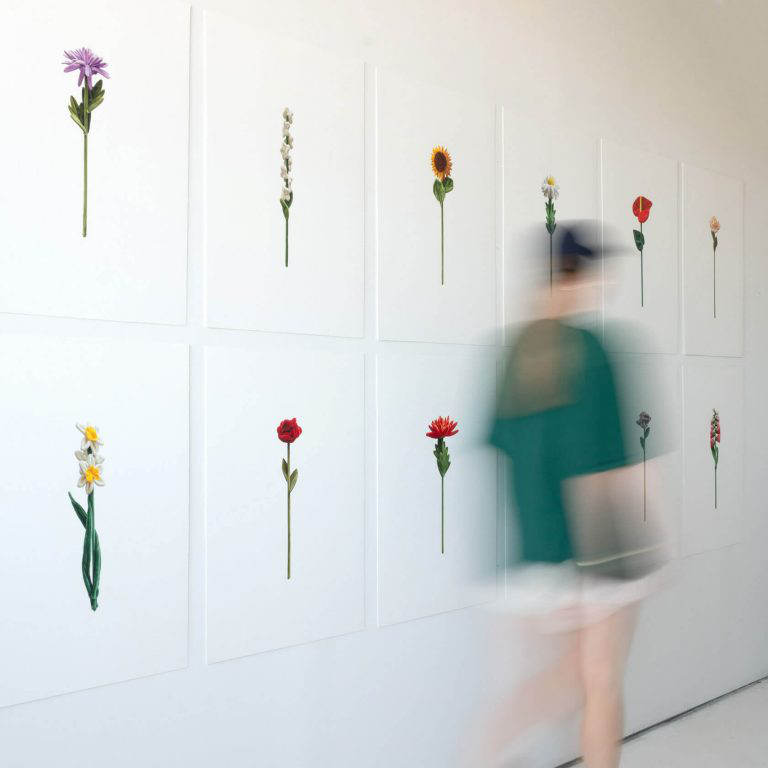
Busy lady. The Artist moves past a wall of 12 of her Flower Drawings. *- CJ Hendry Studio Photo.

“Nothing is less real than realism. Details are confusing. It is only by selection, by elimination, by emphasis, that we get at the real meaning of things,” Georgia O’Keeffe.

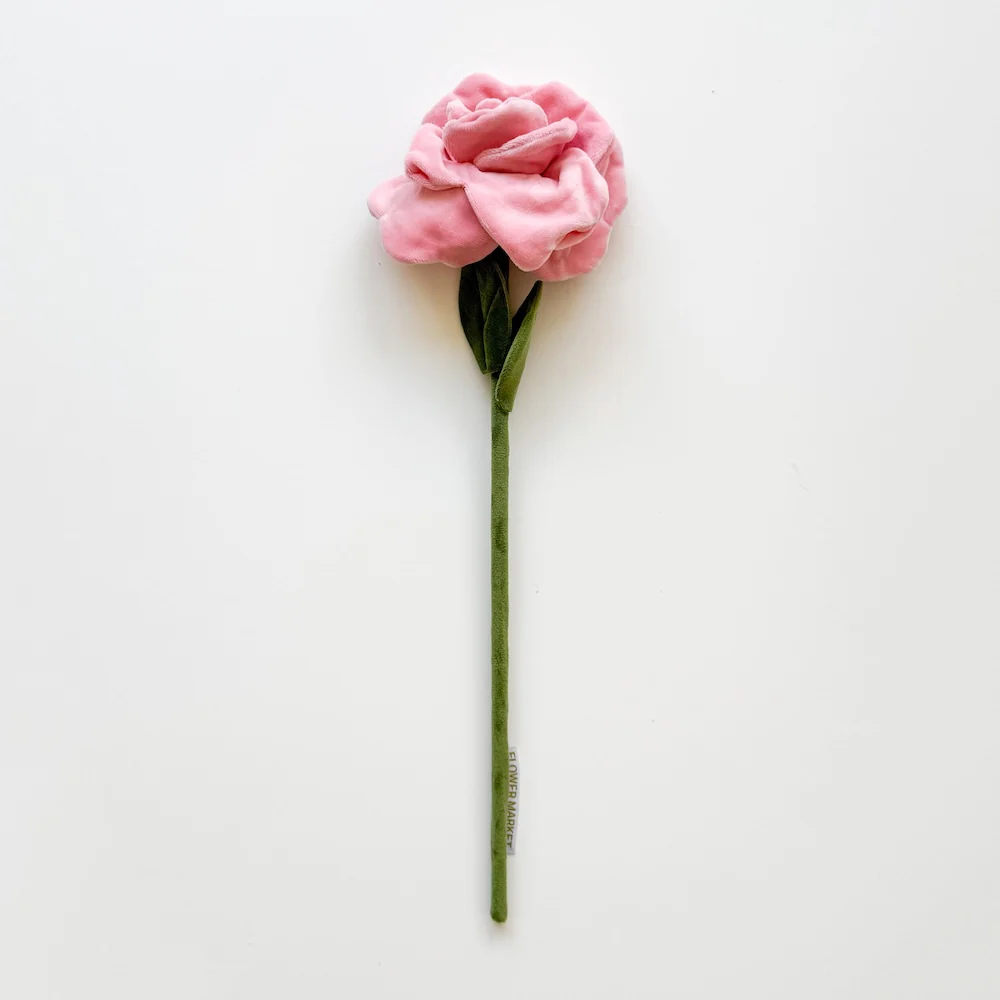
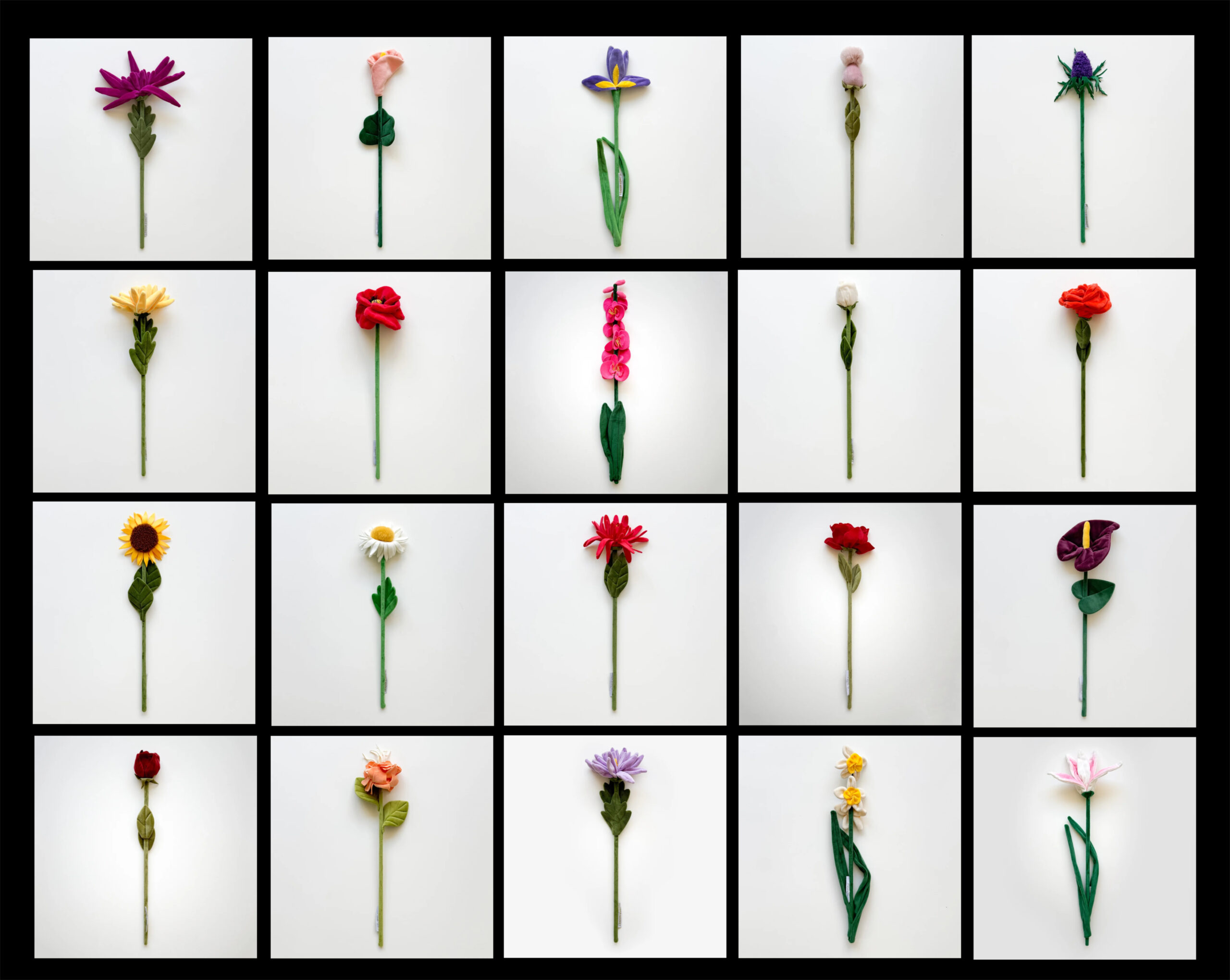
Plush Flower, 2024-5. Each 20 inches tall. Each meticulously crafted, with a double-sided tag. *- CJ Hendry Studio Photo.

I don’t know if Ms. Hendry knows that quote, or has been influenced by it, yet looking at her Plush Flowers and the Drawings they’re based on, I’m struck by how sensitively she’s “edited” nature’s creations while still retaining species recognition. Frankly, it’s darn remarkable.

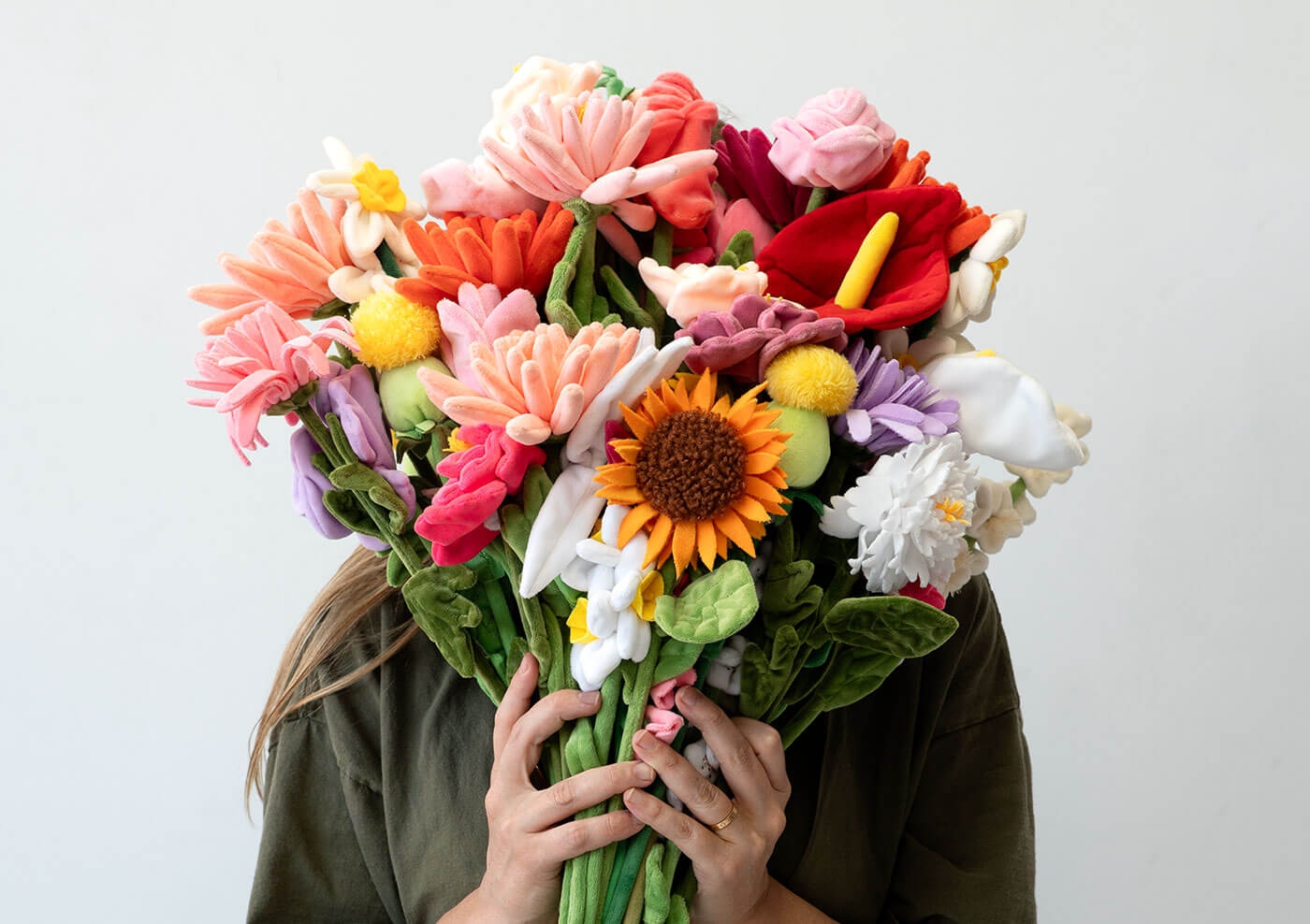
The Artist with a full Bouquet of her Plush Flowers. *- CJ Hendry Studio Photo.

As we’ve seen up top, she’s as capable as any human being currently alive/known to me this side of Robert Longo and Andrew Holmes at being able to Draw hyper-realistic (her term for her work) flowers. That she hasn’t here I find very interesting. She opted to create her own take on these Flowers that look like Roses, Sunflowers, et al, riffing on their essence. Were these Drawn/designed to make mass-manufacturing of them more affordable? I tend to doubt it because the attention to detail on each Plush Flower, as the end result result is known as,  is there. When I say “mass-manufacturing,” CJ Hendry deals in hundreds of thousands of them! In her own way, it seems to me that has done something not all that different from what Hilma af Kint did in her Nature Studies Portfolio on view at MoMA as I said in my piece on it: her Plush Flowers and the Drawings they’re base on speak to the essence of each species, as she sees it.

Original Drawing, left, resulting Plush Flower as sold at her Flower Market, right. *-  CJ Hendry Studio Photo.

A grid I put together of 25 of the 27 CJ Hendry 2025 Plush Flowers based on her Drawings available at her 2025 NYC Flower Market. *-Photos by CJ Hendry Studio.

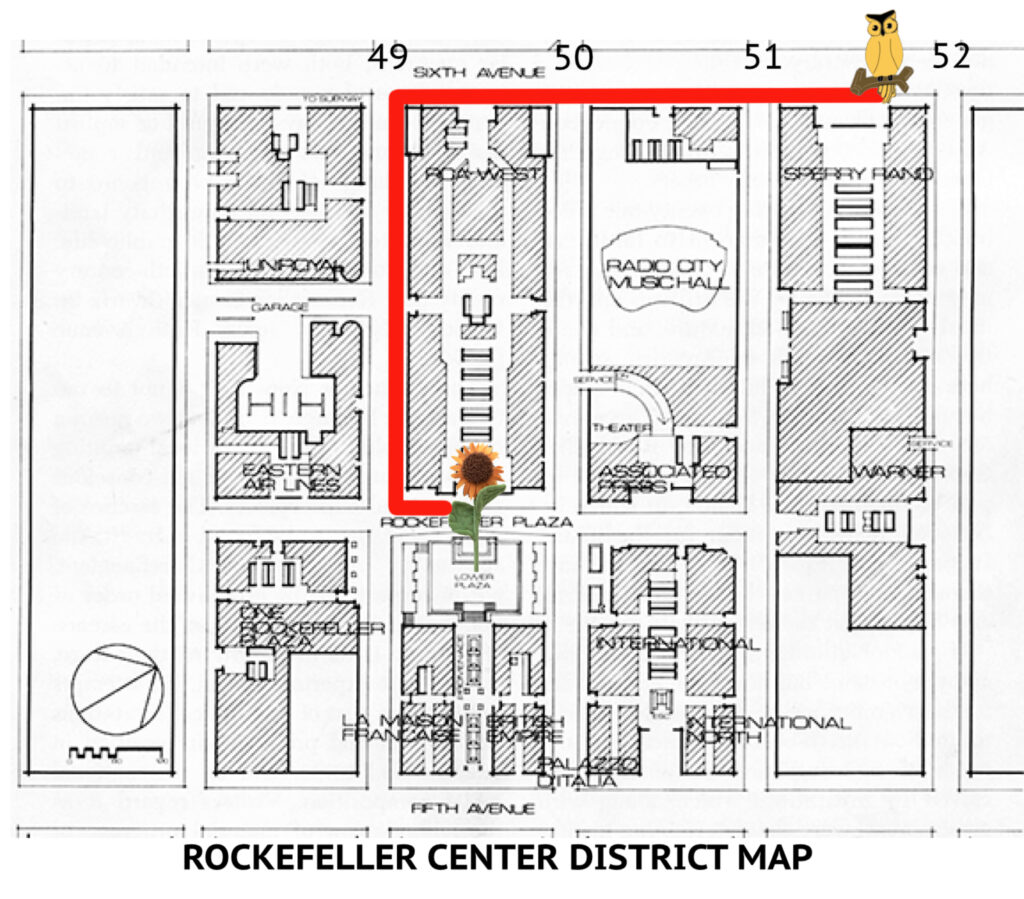
Beyond her Flowers speaking to the essence of the flowers they replicate, they also speak to A LOT of people, as you saw in the video I posted up top, taken on Saturday, September 2o, 2025. That 5 city-block long line for a flower show (CJ Hendry’s Flower Market 2.0 at Rockefeller Plaza), or an Art show, must be a record. Here’s a map of the route I took in the video-

The map of the line, September 20, 2025.
Map Key-
Sunflower (one of CJ Hendry’s Plush Flowers)- Location of CJ Hendry’s Flower Market.
Red Line- My path to the end of the line of those waiting to get in.
Oof- Kenn Sava’s position at the end of the line.
Note- The distance from Rockefeller Plaza to 6th Avenue is about 2 City blocks.

In it we’re walking west on West 49th Street, before turning right onto Sixth Avenue, past Radio City Music Hall, and up to just short of the corner of West 52nd Street! The gent in the blue suit at the end of the line is selling tickets for Top of the Rock (i.e. the roof deck of 30 Rockefeller Plaza), directly behind the location of Flower Market, which offered an exclusive 28th Plush Flower to those who went.

At the other end of the line, the wait for these visitors near the entrance of Flower Market (the white tent)  is just about over.

The wait to get in was TWO HOURS! When I finally reached the end of the line to begin my wait I found myself standing so far from the show’s entrance I was within feet of the corner of West 52nd Street on 6th Avenue. It dawned on me that I was now a block away from MoMA where at that very moment Hilma af Klint: What Stands Behind the Flowers was beginning its final week! Flowers, flowers everywhere…When Flower Market opened on September 19th, I heard that over 100,000 Pluh Flowers were available. After the show ended, those remaining were sold on her site in bouquets of the all 27 Flowers. They sold out within days.

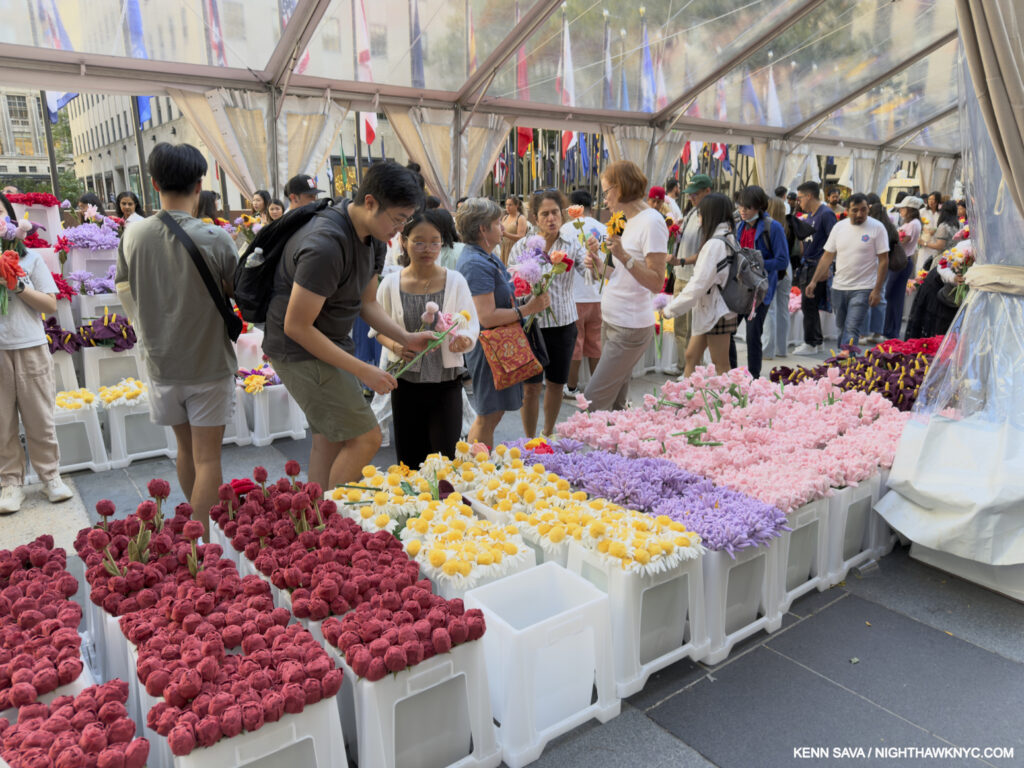
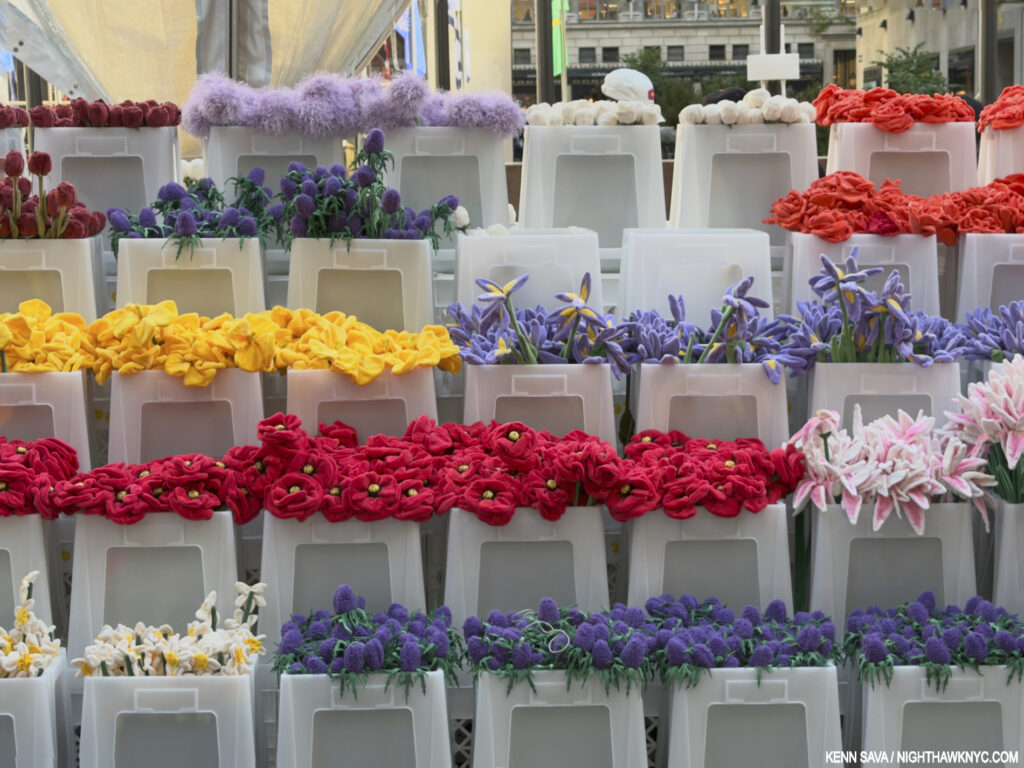
Bouquet up! Inside Flower Market 2.0, Visitors can have one of any one of the 27 designs for free. Each additional Flower is $5.00. I happened to notice that Crate & Barrel sells their decorative flowers for $19.95 to about $50 EACH, and they’re not designed by a known Artist (as far as I know). September 20, 2025.

After possibly being the first to put Georgia O’Keeffe and Hilma af Klint together last time, I now might well be the first to put Hilma af Klint & CJ Hendry together, but for that weekend, anyway, they weren’t all that far apart. CJ Hendry’s Flower Market was up (from September 19-22, 2025) 3 blocks directly south and parallel of MoMA smack dab in the heart of Rockefeller Plaza, as the map earlier shows, behind the famous skating rink, steps away from Fifth Avenue, St. Patrick’s Cathedral, Radio City Music, Hall, etc., etc., and smack dab in front of the iconic Art Deco RCA Building at 30 Rock. Yes, the big time. Real Estate in NYC doesn’t come any more expensive than this.

Just HOW popular is CJ Hendry? In an interview last year Ms. Hendry stated that she grossed $20 million in a prior year. Putting that in perspective, that’s $20 million…

-WITHOUT a dealer or gallery representation- ever. (Her Colored Pencil Drawings currently go for $85,000 to $500,000. depending on size. But before you reach for your wallet, there’s another line to get on, this one “for years,” for the chance to buy one, only through her website.)
-WITHOUT a traditional white-wall “show.”
-WITHOUT a book out. In fact, there are surprisingly few articles written on her work.

So, HOW did this. happen?  CJ Hendry (she’s gone by her initials for as far back in her youth as I could go) is a mid-30-something transplanted Aussie Artist born in Durban, South Africa before growing up in Brisbane. She now lives & works in Brooklyn. She spent seven years in college studying Architecture and finance but left without a degree(!). In fact, she quit “days before I was kicked out for failing grades2.” While she was in school she worked as an $18./hour waitress, spending all her money on high-end luxury fashion & accessories. After quitting college, she decided to sell her wardrobe on eBay and with the proceeds take 365 days and devote herself to something she knew she had always been good at: Drawing, to see if she could make any headway with it.  Now, I don’t think I need to tell anyone that making a living Drawing is something that has really only been accomplished (after YEARS of struggle) by comic book Artists & graphic novelists, like R. Crumb and Chris Ware. In Art, Drawing is seen as a means to an end (in another medium), and almost never the end itself. She put in 16-hour days Drawing born of the discipline she learned becoming a professional swimmer who failed twice to make Australia’s Olympic Team. She decided not to put in another four years to try a third time. Still, “I owe everything to that (discipline)3,” she says now. It enabled her to create a portfolio she took around to Brisbane galleries. There was no interest.

“I didn’t take the traditional route because no one wanted to sign me. Fuck, I guess I’m on my own….I just did it on my own.”

She decided to post her work on Instagram. It took a while until she received a DM expressing interest in buying her work. The sender came out to her parent’s house, where she was still living, saw the work in her bedroom and paid CJ the amount she asked (“in the thousands,” she says) for the piece. With the proceeds she bought herself a Chanel Surf Board, which I believe still hangs in her studio, and she took things from there.

“Everything I draw would sell, and I’m so grateful for that. I went to a university for finance. I get business. I love business. I think I’m better at business than I am art. I’m a hopeless artist. I’m an ok artist, but I’m really good at strategy & business. and I love that. I think art is the byproduct of strategy and business. I think there are a lot of artists who are very good artists but don’t maybe have that business side4.”

As a result of her Flower Market and her Plush Flowers,  I realized that Colored Pencil Drawing is far from all she does. She’s mounted events/shows that have garnered notoriety for their unique concepts and installations to the point that they draw crowds, then live on in legend after (clicking on each entry in that link will show you what I mean). As part of these events, she created pieces (original Drawing-inspired objects in a you-name-it wide range of materials) that seem to me, and no doubt others, to bring her very close to the realm of something akin to 21st Century “Pop.” (For the sake of keeping this piece from getting VERY long, and since she has released so many other items, I’ll keep the focus here to her Flowers.) She now Draws with a few assistants, part of the “small team” she’s enlisted to facilitate and realize her many projects, shows, multi-media pieces, etc. So, CJ Hendry has become her own factory, now headquartered in a 22,000 square foot studio in Greenpoint, BKLYN. As I pealed her onion, discovering more and more about her, the name Andy Warhol repeatedly came to my mind.

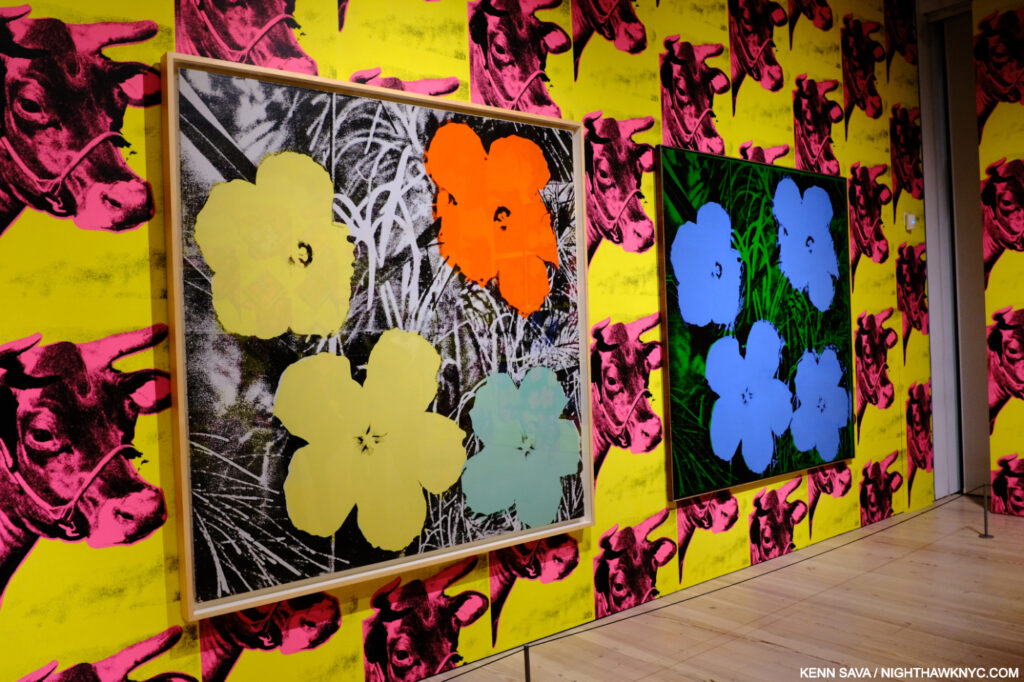
Andy Warhol, Flowers, Screenprints, 1964-65 seen at Andy Warhol: From A to B And Back Again, Whitney Museum, December 21, 2018

I began to wonder- Is she Andy Warhol 2.0,? Seriously.

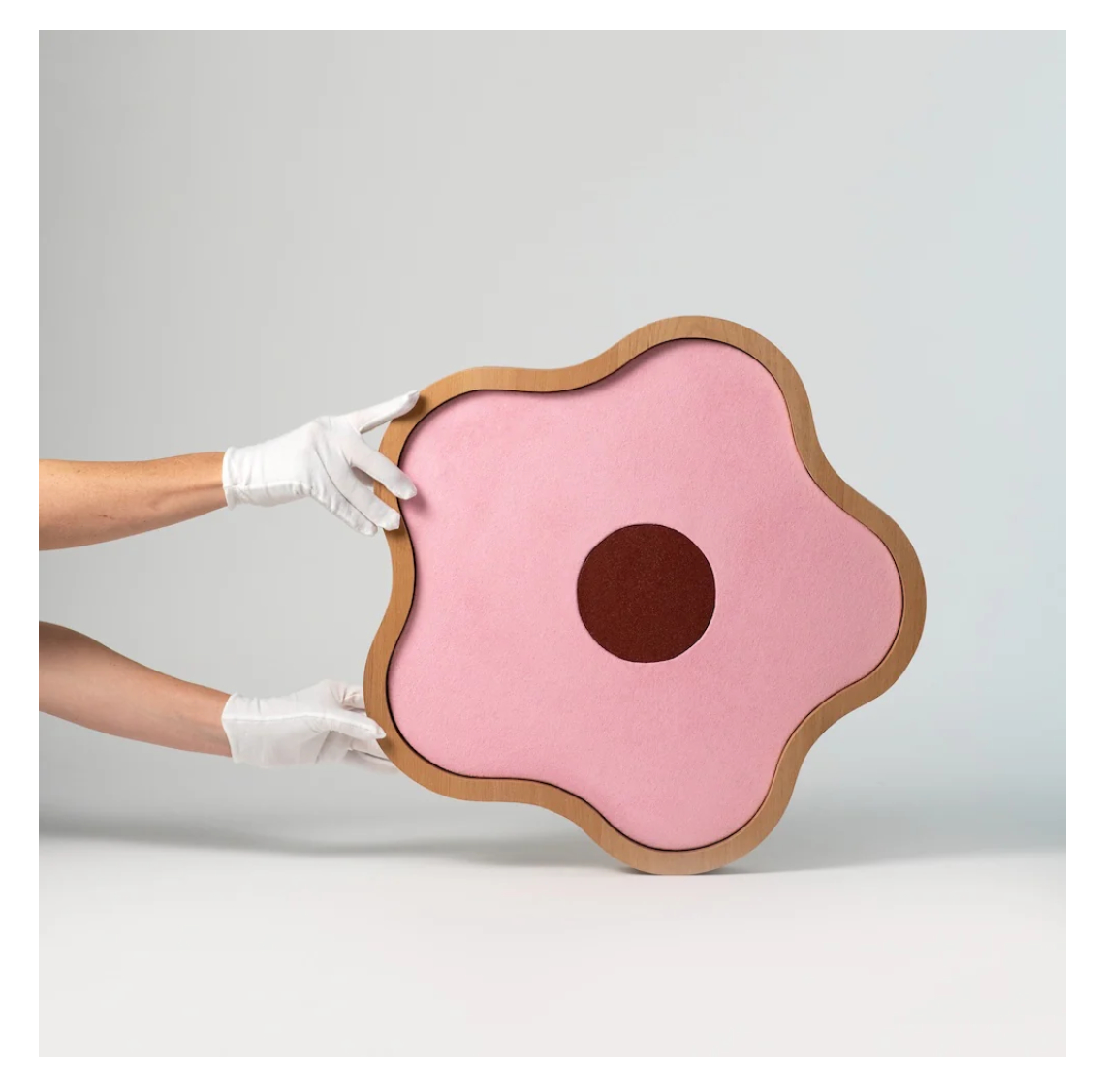
CJ Hendry, Blomma, 2025, Painted canvas Flower and Beech wood frame. This design has become her de facto symbol. *- CJ Hendry Studio Photo.

From an Art & business perspective, I think thee is a very strong case to be made that she is at least one of those that could be said about, while remaining resolutely CJ Hendry. Unlike the vivacious, omni-present Mr. Warhol, however, CJ appears to have no “social life.” She was quoted on August 9th on Instagram saying her life is “work and kids…not much else, ” which is a change from the 24/7 she said she worked since she started making Art. She is never seen at parties, or out on the town, or with media stars. The only “CJ Hendry Superstars” are her products, which have always sold out to this point. Yet, in an interview she recommended “not investing” in her5, but rather buy the work of up-and-coming Artists who need the support. Her Art is also noteworthy for the lack of human subjects in it to date. I’ve only seen one CJ Hendry Portrait- a commission from 4 years ago. Like Andy, CJ began her Drawing career rendering luxury products, including shoes, boots, and fashion accessories. From them she’s moved on to “things that are always around us,” like well-worn sneakers, cigarette butts and flowers. On Drawing the latter she said-

Who says a Drawing isn’ t Art? Unknown title, date, Caran d’Ache Luminance colored pencil (in her hand) on paper or board. *-  CJ Hendry Studio Photo

“Ever since I started mucking around with being an artist, flower imagery kind of frustrated me…It always seemed like the obvious and basic direction to go. I held off for many years because I just couldn’t figure them out. So somehow petals make sense, the flower being broken down, not full of life. Each petal looks so different like its own mini sculpture…”

I can’t say I’ve seen an Artist take this approach to them. Who else has Drawn or Painted a flower petal as their finished piece? In Art classes, students are taught to study anatomy in order to render the figure. Ms. Hendry is taking the same approach to flowers. It can only help her when she comes to depicting the whole.

Right now, it looks like flowers may be a anomaly in her work. Looking back, Ms. Hendry turned her focus to a subject, produced a series of Drawings of it, perhaps released some related items, and moved on. Though she recently Drew a character named “Juju,” and released a batch of (now sold-out) related items, her Flowers will continue to be a part of her work. She has announced Flower Markets will be mounted in Abu Dhabi and Hong Kong early this year.

The Artist works on one of her Complementary Colors series of Drawings circa 2018. Notice the pencil point. It looks to me like a right out-of-the-box Prismacolor Premier! In fact, in the videos I’ve seen, she uses very basic accessories. Electric sharpener (an Xacto seen in one), spray fixative, painter’s tape to hold down copy paper shielding white areas while she works flat on a very large wood table. I haven’t seen her erase (in what I’ve seen), use a mahlstick, a pencil extender or an easel. (She puts a sheet of something unknown, possibly, glassine, under her drawing hand as she works over finished areas.) Oh, and there’s an entire shelving unit of boxes holding thousands of colored pencils arranged by color. Drawings in progress, or finished, are kept in suitably sized clear archival sleeves. *- CJ Hendry Studio gif

Among the numerous striking pieces in her career to date is a stunning 2018 series called Complementary Colors. Like all of her work, it speaks for itself

Possibly the paint blob she was just seen working on. Colored pencil(!) on ? Title, size, date unknown from her Complimentary Colors series. c.2018. *-  CJ Hendry Studio Photo.

“I’ve peaked! It is downhill from here for me.” CJ Hendry, TedTalk, 2018.

She couldn’t have been more wrong when she said those words in 2018 at about the time she created the paint blob above. Her career has gone straight up, like an arrow into the weightlessness of space since, hitting that $20M she mentioned a year or two ago! Still, the market and the public are fickle. The CJ Hendry buzz may subside one of these days, but with Drawing talent like she has I doubt she’s entirely going away.

While the future is unwritten, we can take stock of the recent past. In addition to the facts that she’s brought more attention to Drawing as a medium & an Art form, which sorely needs it, and colored pencil Drawing (DITTO!), the thing I admire most about Ms. Hendry is that she’s succeeded entirely by her own devices. She’s proven it can be done, but, IT’S NOT THAT EASY!

“If you try to follow in someone’s footsteps exactly it won’t work for you. You’ve got to find your own thing. I haven’t had anyone to follow. There’s no one who’s done it this way. I’m a huge anomaly in the art world2.”

When repeatedly asked about how she did it, she stresses the HARD work she put in to get here- those 16-hour drawing sessions, 24/7. All the sacrifices she made (i.e. a social life, college, etc.) AND the fact that she has a background in finance. Hilma af Klint and Georgia O’Keeffe had to work to succeed in a male-dominated world. Georgia had a champion in Alfred Stieglitz who helped her navigate it early on. Hilma wasn’t so lucky. She never found her champion and decided her work was for the future. Whether that future is now, or not…the jury is out in my view.

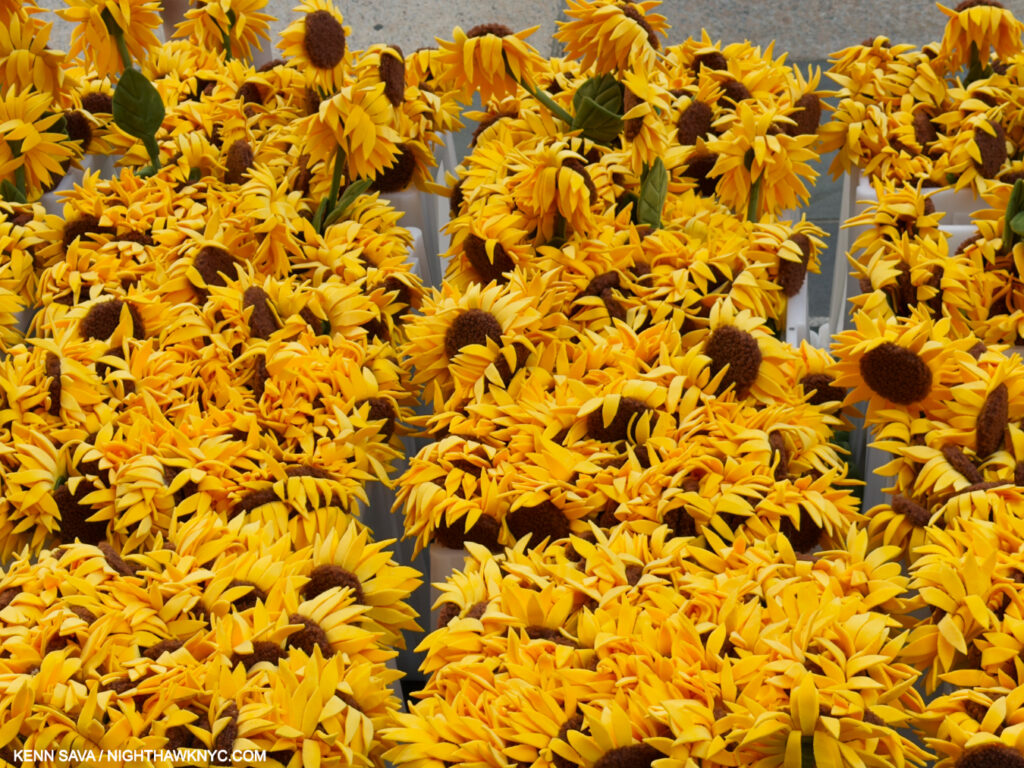
I wonder how many visitors chose a Sunflower and thought about Van Gogh. I did.

That brings me to the similarities and differences between Hilma and CJ Hendry. As I wrote in my recent piece on her, Hilma didn’t live to realize the Temple she envisioned to house her Art, partly because she was seeking to have her work installed by existing spiritual organizations. As I said, I believe her work has been left in a quandary as a result.

Flower Market 2.0, Rockefeller Center, NYC, September 20, 2025.

CJ Hendry built her own “temple.” Actually, she’s already built a whole series of them. She uses temporary spaces for her shows/events, including some that have involved complete renovations of buildings, to realize her visions. Ironically, at the moment I took this picture, Flower Market 2.0, was pointed directly & poignently at MoMA & Hilma af Klint: What Stands Behind the Flowers three blocks north (to the left). What stands behind these Flowers is a woman who’s a force of nature. “Carpe diem” could well be CJ Hendry’s motto. While Hima af Klint’s work’s place is, it seems, still undecided, and appears stuck between today’s Art machine & the Artist’s intentions, as I said last time, CJ Hendry stands at the opposite end of that spectrum, as someone who relishes and uses the Art machine’s focus on “materialism” while skating rings around the usual dictates of today’s Art establishment, remarkably achieving success without its help or involvement, on her own terms.

She’s right, no one can follow in someone else’s footsteps and expect the same results. Still, there is much to be learned from her example. Perhaps, most importantly, that it CAN be done.

I don’t think CJ Hendry will be the last Artist to “make it” on their own terms.

*- Soundtrack for this piece is “God Bless the Child,” by Billie Holiday and Arthur Herzog, Jr, 1939, seen here in this incredibly rare live recording by the immortal Lady Day with the equally immortal Count Basie, who I had the honor of meeting-

NighthawkNYC.com has been entirely self-funded & ad-free for over 10 years, during which over 350 full-length pieces have been published! If you’ve found it worthwhile, PLEASE donate securely by PayPal below to allow me to continue. Thank you, Kenn.

You can also support it by buying Art, Art & Photography books, and Music from my collection! Art & Books may be found here. Music here and here.

Written & photographed by Kenn Sava for nighthawknyc.com unless otherwise credited. To send comments, thoughts, feedback or propositions click here. Click the white box on the upper right for the archives or to search them. Subscribe to be notified of new Posts below. Your information will be used for no other purpose.

  1. With Flower Markets being announced for 2026 in Hong Kong and Abu Dhabi.
  2. Short Story Long podcast #162, CJ Hendry.
  3. ibid.
  4. Both quotes ibid.
  5. ibid
  6. Short Story Long podcast #162, CJ Hendry.

Hilma af Klint in the 21st Century: The Spirit vs. The Machine

THIS SITE IS FREE & AD-FREE!
If you find this piece worthwhile, please donate securely via PayPal so I & NighthawkNYC can continue. More ways you can support it at the end. Thank you.

Written & Photographed by Kenn Sava (*- Additional Photographs by Lana Hattan, and others as credited)

Shows seen: Hilma af Klint: Paintings for the Future, Guggenheim Museum, 2018-19.
Georgia O’Keeffe: To See Takes Time, MoMA, 2023, and
Hilma af Klint: What Stands Behind the Flowers, MoMA, 2025

Hilma af Klint, Tree of Knowledge, No. 1,  from The W Series, 1913, Watercolor, gouache, graphite, metallic paint, and ink on paper, Guggenheim Museum, December 31, 2018..

Succinctly put, Hilma af Klint is one of the most remarkable and unique Artists I’ve encountered.

Of the thousands of Art shows I’ve seen in my life, I consider about 10 to be truly monumental. Hilma af Klint: Paintings for the Future is one of them. I’m so grateful I got to experience it with Lana Hattan1, and her Photos are included in this piece. Guggenheim Museum, New Year’s Eve, December 31, 2018. Enduring Thanks to the woman who took this.

Having seen two shows of her work, and most of the books published on it, Hilma’s work continually surprises me. Much of her oeuvre features that rarest of all qualities in Art: it’s unprecedented. I saw Paintings for the Future exactly seven years ago as I write this yet I haven’t written about it to this point for two reasons- 1) I’m still thinking about it and researching Hilma (as my featured entry on Hilma books in my “NoteWorthy Art Books of the 21st Century” piece earlier this year attests). 2) I’ve come to see that boxing Hilma as an “abstract Artist,” as the Art machine has labelled her, does her an immense disservice. I find it at odds with the very nature of her work.

Group IX/SUW, The Swan, No. 1 from The SUW/UW Series, 1915, Oil on canvas. Reaching for the light. Of all the Painting shows I’ve seen at the Guggenheim Museum, the installation of Hilma af Klint: Paintings for the Future was transcendent. More on this later. *- Photo by Lana Hattan, Guggenheim Museum, December 31, 2018. I’m pleased to be able to present this show through her eyes, too.

Beyond all of that, recent developments may make her work “Basquiat hard” (my term for an Artist’s work that is mostly out of pubic view) to see going forward.
That’s a lot to cover. I’ll try to in what follows.

It begins with the flower…

“If your heart is in them flowers, bring ’em on,” Tanya Tucker-*

Georgia O’Keeffe, The White Calico Flower, 1931, Oil on canvas, as seen at the Whitney Museum, June 30, 2023

Flower Art was a niche thing, largely reserved for Illustration, until Artists like Georgia O’Keeffe (1887-1986) made viewers sit up and take notice of them. Of course, Vincent van Gogh, and the 17-century Dutch Masters a century before him, among countless others, had Painted wonderful Still-Life bouquets for many years prior, but individual flowers had not received much attention. Earlier last century, that began to change.

Alfred Stieglitz, Georgia O’Keeffe, 1918. Gelatin silver print. It’s hard to believe Georgia could Draw & Paint flowers like this, and it looks like Mr. Stieglitz found it remarkable, too. Note the year this was taken. *- Georgia O’Keeffe Museum Photo.

“Nobody sees a flower really; it is so small. We haven’t time, and to see takes time- like to have a friend takes time,” Georgia O’Keeffe, paraphrased by MoMA for the title of their 2023 show, Georgia O’Keeffe: To See Takes Time.

Georgia O’Keeffe, Canna Lily, 1918-20 Watercolor on paper, seen at Georgia O’Keeffe: To See Takes Time., MoMA, July 4 2023. Exactly 2 years later these same gallery walls would display Flower Watercolors by Hilma af Klint Painted at about the same time. (Lights lowered to protect the Art.) MoMA, June 9, 2023.

She continued: “So I said to myself- I’ll paint what I see- what the flower is to me but I’ll paint it big and they will be surprised into taking the time to look at it- I will make even busy New Yorkers take time to see what I see of flowers.” She would eventually give us 200 Paintings of them, a number of which are now iconic. So, it was fitting that MoMA’s Georgia O’Keeffe: To See Takes Time  contained some of her Flowers, including three early Calla Lilies watercolors from 1918-20, right as she was transitioning from Painting in watercolors to oils2.

Hilma af Klint, Motacilla Alba: Wagtail with Guidelines, left, Violet Blossoms with Guidelines, both from Series I, 1919, Watercolor, graphite, and metallic paint on paper, right. Tucked away in Paintings for the Future this Flower Watercolor, right, looks like a page from Hilma af Klint’s Nature Studies Portfolio that would become the focus of the next major NYC Museum show of her work seven years later. An interesting realistic(!) harbinger, it’s not part of that Portfolio. Seen at the Guggenheim Museum, December 31, 2018, this sheet was also included in MoMA’s What Stands Behind the Flowers in 2025. MoMA’s wallcard for it speculates that Hilma may have removed it from Nature Studies.

Meanwhile at the same time Georgia was creating her Calla Lilies, across the ocean in Sweden, an almost completely unknown Artist named Hilma af Klint (i.e. HaK, born 25 years before Georgia in 1862) began rendering over 100 Flowers in Watercolors in a Portfolio she titled Nature Studies, 1919. As far as I know, they didn’t know each other (though I wonder if Art astute Hilma came to know of Georgia as the American rose to fame). As far as I can tell, the set remained hidden from public display until May 11, 2025, when MoMA opened Hilma af Klint: What Stands Behind the Flowers, coincidentally in the same galleries that had held Georgia O’Keeffe: To See Takes Time two year before

Five of Hilma af Klint’s The Ten Largest, a series devoted to the human lifespan, part of her now-famous Paintings for the Temple series. Note the shapes that seem organic or “flower-like.” Guggenheim Museum, December 31, 2018. *- Photo by Lana Hattan, Guggenheim Museum, December 31, 2018.

When her Art was last seen in an NYC museum in 2018-19, Hilma af Klint: Paintings for the Future drew a Guggenheim Museum all-time record 600,000 other viewers to Frank Lloyd Wright’s Museum Rotunda. I always walk down the ramp after taking the unique semi-circular elevator to the top of the Guggenheim as Frank Lloyd Wright wanted visitors to do which means I saw Paintings for the Future in reverse chronological order. Preceding it, R.H. Quaytman: +x, Chapter 34, occupied the 6th, or top Ramp. While this might seem incongruous to some, a deep dive into Hilma af Klint’s sparse NYC history reveals that R.H. Quaytman has a long history of championing Hilma af Klint that includes curating the first HaK show in an NYC museum, The Secret Pictures by Hilma af Klint at MoMA PS1 in early 19893. +x, Chapter 34 worked seamlessly with Paintings for the Future in my view.

Herein lies a problem (among others) with branding HaK an “abstract Artist.”  To the left, above the sign, on Ramp 1 is Summer Landscape, 1888, Oil on canvas, juxtaposed by parts of three of The Ten Largest, all 10 from 1907, far right, from her landmark Paintings for the Temple series, partially shown in the prior picture, in a completely different style. December 31, 2018.

As we got to Ramp 1 (the lowest ramp), there were two bays containing work that looked pretty representational to me that featured Summer Landscape, 1888, above, left, and 2 Flower Watercolors from the 1890s, center, between the  visitors above, all shown closer below-

Summer Landscape, 1888, Oil on canvas. Hilma was about 26 when she Painted this in the year she graduated from the Royal Academy of Fine Arts.*- Photo by Lana Hattan, Guggenheim Museum, December 31, 2018.

Poppy, 1890s, Watercolor, ink, and graphite on paper, left, Portrait study of the head of a woman, center, and Portrait study of a sitting woman to its right,  both Charcoal, crayon and graphite on paper, both c.1918. Distortion of the frames due to the curved wall. *-Photo by Lana Hattan, Guggenheim Museum, December 31, 2018.

Though early in her career, before the more well-known Paintings they call “abstract,” these revealed an accomplished technique in both oils and watercolors, honed over 6 years at the Royal Academy of Fine Arts in Stockholm (1882-88), where Hilma was one of its first female students. At that moment, I realized there was much more to Hilma af Klint than the Art machine’s limiting marketing hype would have us believe.

“Blue Book” Vol. 10. Hilma painstakingly recreated every one of her Paintings for the Temple (Painted, again, by hand) in a series of blue books on the left-hand page accompanied by a black & white Photo of the piece on the right-hand page, probably because color photography wasn’t yet practical. Guggenheim Museum, December 31, 2018.

Hilma, a devoted, life-long spiritualist,t who attended seances (and believed her “most important work” was the 192-canvas series The Paintings for the Temple, 1906-15, partially shown earlier, which were guided by other beings), came to feel that her time wasn’t THE time for her Art to be seen. Since the entire Temple series is so numerous, and includes 10 very large Paintings, Hilma fastidiously recreated the entire series in 10 remarkable smaller “Blue books,” as they are known, a “portable museum,” which she carried with her to show Rudolf Steiner (in 1920), and others, in hopes of having the originals shown in a spiritual context. That’s how important it was to her.

This makes me wonder- How many “abstract” Artists would be able to exactly recreate 192 of their Paintings? An impressive technical achievement, that she could do it tells me that her compositions were no accident, something I think is important to bear in mind.

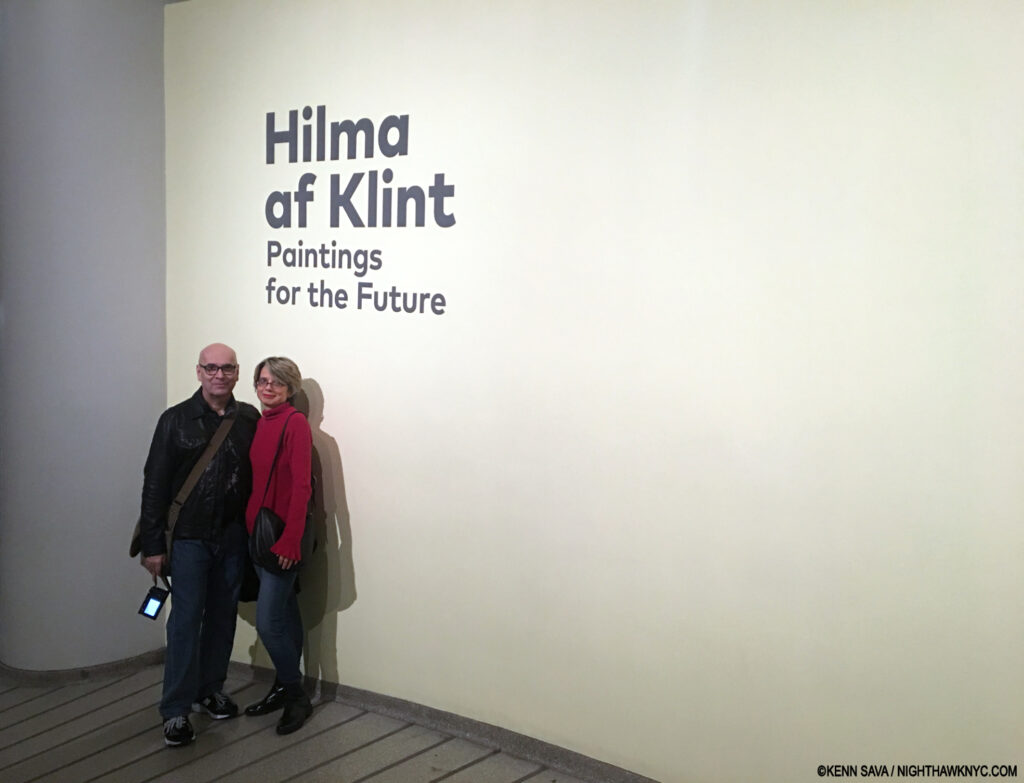
Is THIS the time Hilma envisioned for her work? The introductory wall card for Paintings for the Future on the Guggenheim’s curved wall outlines how the curators saw Hilma’s Art in 2018. I disagree with parts of this. For example, they mention HaK being “a respected landscape and portrait painter,” acknowledging she Painted in other styles, yet they ignore the fact that she returned to Painting representationally in 1919 with Nature Studies, as I show further on. They state her work was “untethered from recognizable references to the physical world.” What about the flowers and other natural elements that appear frequently, as shown in The Ten Largest picture earlier, and in Group VII (further on) and other pieces later on? *- Photo by Lana Hattan, Guggenheim Museum, December 31, 2018. Click for full size.

Failing to achieve this, in 1932, she decreed that none of her Paintings or Drawings should be shown until twenty years after her death in hopes of finding a more accepting time. Her work wound up being out of sight for 45 years. After she was tragically struck by a street car in 1944 and died from her injuries, her will left her entire creative estate to her nephew, Erik. Her work was stored in an attic for two decades before Erik had the Paintings unrolled and Photographed. Those 1,300 Paintings and 26,000 pages of text forms the basis of what is now the Hilma af Klint Foundation, which was created in 19724. The Foundation made a major effort to organize the work and prepare it for public display. Eleven of her Paintings were finally shown in The Spiritual in Art: Abstract Painting 1890-1985 in Los Angeles in 1986, but it wasn’t until 2013 that she finally received a full retrospective (in Europe), in a show titled Hilma af Klint: Pioneer of Abstraction (the catalog for which is also on my list).

Georgiana Houghon, The Love of God, August 3, 1864, Watercolor and gouache on paper, 23.7 x 32.6 cm, An Automatic Painting, Hilma af Klint was about 2 when Georgiana Painted it. *-Victorian Spiritualists’ Union, Melbourne Photo.

That show rode on the hype about Hillma being “the first abstract Artist,” (says the Tate, no less) before Kandinsky, Mondrian, et al., and a woman. The truth is Hilma was not even the first woman in her spiritualist circle to create what they call abstract work- Georgiana Houghton (1814-1884), 48 years Hilma’s senior, who proceeded her in creating Automatic Paintings & Drawings, may be a better candidate for that title. But, boxing HaK as such helped the powers that be draw huge crowds to the 2013 show of a complete unknown. Paintings for the Future (one of the two most important NYC Painting shows I saw in the prior decade, along with this one) took things to an entirely different level. Six years later comes MoMA’s Hilma af Klint: What Stands Behind the Flowers, her first NYC museum show since the Guggenheim blockbuster. Hilma’s work doesn’t need any hype to “sell” it now. The world knows who she is. All the “abstraction” talk has kept people from looking at her work, in my view. It’s time to look at the Art for what it is.

Installation view of the 2nd gallery of Hilma af Klint: What Stands Behind the Flowers at MoMA, which contained the first part of Nature Studies on the walls and a selection of her writings, and books by others on flower studies, in the center vitrine. Opening week, May 18, 2025.

What Stands Behind reveals that AFTER she completed the Paintings for the Temple in 1915, Hilma went back to working “representationally!” I guess no one bothered to tell her she was supposed to be an “abstract” Artist in the future. The more likely case is that HaK was a very talented and creative woman, an Artist more than capable of creating in whatever style she needed to work in for what she was trying to accomplish. It seems to me that THAT is a MORE impressive thing than sticking her in any one limiting box!

“One has to think of the realm of the nature spirits as the realm of thought; these entities hover around us, some like driving winds, others like soft summer breezes,” Hilma af Klint, MoMA wall card.

Convolvulus arvensis (Field Bindweed), Monotropa hypopitys (Pinesap). Sheet 20 from the portfolio Nature Studies July 11–24, 1919, Watercolor, pencil, ink, and metallic paint on paper. One of the 46 sheets in watercolor, pencil, ink, gouache and metallic paint on paper included in Nature Studies. Being 19 11/16 by 10 5/8 inches, these sheets would seem too large for Hilma to work on in situ. But that’s purely my conjecture. Unlike Georgia O’Keeffe, HaK didn’t confine herself to one specimen per sheet. Over 100 are included on the Nature Studies! Underneath, the curators translate HaK’s notations of the species name and its character as perceived by the Artist: “Determination” for the Field Blindweed, top, and “One-sidedness” for the Pinesap, bottom. MoMA, September 26, 2025.

She also continued to work on creating a “language” (see Group 2, further below) that included letters, words and diagrams. These are seen in almost all of the series she created in her life (including Nature Studies).

Woodland Strawberry, Hilma’s notation- “Liberator. Longing to produce balance within the blood syntem by expelling either white or red biood cells.” European wood sorrel- “Fragility-submissiveness shyness-humility fear -respect self-loathing-obedience.” Catsfoot– “Peace and harmony.” and Dandelion- “Beginning.”

Bilberry, Apple, Common Pear, Lingonberry

Looking at Hilma’s Art is different than looking at the Art of any other Artist I know of. Quite a few of her Paintings for the Temple (as seen in the picture earlier) and other “abstract” works included at MoMA (below) have elements that look organic, including flower shapes. In some of her Temple series, lines of dots connect figures, reminiscent of the af Klint family’s heritage as noted cartographers & mapmakers. Then, any number of her pieces, including almost all her Nature Studies, include diagrams that contain basic geometric shapes- circles, squares, cones, etc. The viewer needs to decide what to make of them, or look to the Hilma’s Notebooks for insights. Finally, there’s the “language” the Artist developed, abetted by her use of letter “codes,” as Julia Voss outlines in her Biography. As a result, it seems to me there is still a long way to go in coming to fully understand Hilma af Klint’s work. Lumping it all into ANY one-word catchphrase box only takes us further away from that point of truly understanding it-if that’s possible.

Group VII, No 1-5, from the US Series, 1908, Watercolor and pencil on paper. 11 years. before the Nature Studies portfolio, what seems to be flower-like shapes abound. Seen at the beginning of  MoMA’s show.

The wall card for Group VII. Installed at the show’s entrance, is a relatively rare instance of the Art world looking beyond Hilma the “abstract Artist” thus far, or hedging their bets on their use of that box. Here, the organic shapes are accompanied by letters that are parts of the “code” Hilma used. See next.

Another piece of the puzzle. Hilma’s original Notebook containing her Key to the mysterious words and omnipresent letter “codes” she used throughout her oeuvre. It’s an essential part of “decyphering” her work. Hilma’s code is detailed in English in the book Hilma af Klint: Notes and Methods. *- Photo by Lana Hattan, Guggenheim Museum, December 31, 2018.

ALL this talk about Hilma’s style misses the point! Hilma was not out to win any “style wars.” All of her work was about something entirely different, and that difference was substance over style.

Apple, no date, Watercolor on paper. Virtually every Art or Drawing class begins with rendering, coloring & shading basic shapes, like the sphere (often an apple, orange or lemon). Here HaK takes it to an entirely different level, and we get to marvel at her powers of observation, especially in the incredibly subtle variance of the local color. It’s also fascinating to me how minimal the shadows are, something you never see taught in how-to books which glory in the different kinds of shadows. In most of her Nature Studies, except the previous one, Hilma leaves out the ground, as she does here, too. In this case, doing so gives her the chance to show more of the bottom detail, again something I can’t say I’ve seen done often.

On the opposite end of that spectrum from the 21st century hype around it, there is something else at the beating heart of her work, something her “abstract” Paintings for the Temple and her representational Nature Studies have in common, and something that is at the core of the recent debate regarding continuing to publicly display her work. Hilma af Klint’s work is centered on the spirit. She created her work for fellow spiritual seekers. The Paintings for the Temple are devoted to the human spirit (with the aid of spirits who have moved on to another level). After completing them in 1915, never one to think small, the Artist turned her attention to an even bigger subject- the spirit of the natural world, commencing with the atom, in works that filled three quarters of the first gallery at MoMA, before moving on to the spirit in nature, beginning with flowers (in Nature Studies), which filled most of the succeeding two large galleries. These were supplemented by her late Flower Watercolors, which reminded me of some of Georgia OKeeffe’s Watercolors that were shown in these galleries at MoMA in 2023. The bottom line is that Spiritual Art is still outré to the Art machine, whatever type it is. They can’t sell it, and Art without monetization does not keep the Art machine going.

Common Sunflower. To Hilma- “Love is the greatest of all.”

Meanwhile, throughout What Lies Behind, part of the sheer joy in looking at her work, her marvelous technique shines in piece after piece. It’s surprising to me that Hilma has gotten so little credit for it. She came upon it the hard way, through continual hard work and 6 years at the Royal Academy of Fine Arts. This was followed by work as an Illustrator, including illustrating a book on horse surgery by the director of the Veterinary Institute, Stockholm, who kept Hilma’s Drawings for the rest of his life.

From Group 2 February 12-19, 1919 Watercolor, pencil, and metallic paint on paper. This was one of numerous examples of her technique I could site. Here, we see the Artist working on ideas for herself in a series of sheets titled Group 1, Group 2, Group 3. No matter for public display or her own purposes, Hilma was always meticulous in her execution. Of the Groups, MoMA says- “Together, the drawings form narratives that allude to pollination, reproduction, and evolution. By April 19, 1919, after more than three months of progress, af Klint had established a vast and diverse diagrammatic language. The very next day, she began her Nature Studies portfolio.”

This enlarged detail of the lower center of the previous image perhaps measures 3 or 4 inches wide by an inch and change high (the bounding rectangle). Easy to miss because it’s in pencil and the actual Drawing part seems to have faded,  it’s noteworthy for two reasons. First, its meticulousness, and second for the title- Die Blumenkrone means “The Flower Crown.” Even in the dead of wnter (i.e February 18th as the date reads), Hilma had flowers on her mind.

What Stands Behind also makes the case in spades or her accomplishment as a Watercolorist- both in her Flowers and in the later Flower work (not part of the Nature Studies series) shown in the final gallery, in a different style again, as seen below.

Ear of Grain, 1922, Watercolor on paper, from the series, On the Viewing of Flowers, with a apparetnly relevant section of the wall card, left. MoMA, September 26, 2025.

Georgia O’Keeffe, Morning Sky, left, and Morning Sky, and Morning Sky with Houses, right, 1916, Watercolors on paper. MoMA, September 9, 2023.

I might be the only one to draw parallels between Georgia O’Keeffe & Hilma af Klint, but when I saw the wall of 1922 Watercolors by Hilma in the last gallery, including Ear of Grain, above, I couldn’t help but recall Georgia’s Watercolors that had been hung in these galleries two years previously. It’s fascinating to think about their commonalities, as extraordinary, ground-breaking Artists, and as extraordinary women, at much the same time, on almost opposite sides of the globe. What Stands Behind The Flowers begins some of the heavy lifting on the road to assessing Hilma af Klint’s full accomplishment. In spite of that, I’m not sure THIS is the ideal time Hilma envisioned for her Art to be shown.

MoMA Gift Shop display for the show. More items behind me and to the left. While I’ll reserve comment on the other items, MoMA’s Exhibition Catalogue for the show is highly recommended. May 18, 2025.

In too many (most?) cases today a work of Art is mentioned followed by its price as if that’s the most important thing about it! Then, the rush is on to plaster it on everything from umbrellas to baby onesies. Hilma’s spiritualist Art stands directly at odds with that. She opposed materialism in Art. To this point, it’s largely escaped it (though MoMA, who has come to own Nature Studies, produced a $500.00 Limited Edition of it, as far as I can tell, the first Hilma af Klint Limited Edition, in addition to putting the series on refrigerator magnets, postcards and a poster)5.

Rebel. With a cause.

Trapped in the future. But, is this THE future she envisioned for her Art? One of the few Photographs of Hilma af Klint. This one was affixed to a wall at the Guggenheims’s landmark Paintings for the Future in 2018.

Perhaps this experience sounded a warning bell. Earlier this year a struggle broke out inside the Hilma af Klint Foundation about whether or not her work should continue to be exhibited. The Foundation’s chairman of the board, af Klint’s great-grandnephew, who, like his great-grandfather, is also named Erik af Klint, is against it feeling that Hilma wanted her work to be seen in a spiritual context by fellow seekers, i.e. to “keep the work available to those who seek spiritual knowledge or who can contribute to fulfilling the mission that Hilma af Klint’s spiritual principles intended.”

On Hilma’s spiritualism. Guggenheim Museum, December 31, 2018..

Therefore, I think there is a strong case to be made for ending public displays of her work at this point. Perhaps a future time will be more ready to accept, and see her work as she intended it to be seen, and provide the Artist’s full accomplishment with the respect it deserves..

“Beam me up, Frank!” The control panel on Frank Lloyd Wright’s semi-circular Elevator at the Guggenheim. December 31, 2018.

Experiencing Paintings for the Future at Frank Lloyd Wright’s Guggenheim brought home another problematic aspect of experiencing Hilma af Klint’s work today.

Temple Design, 1931, Notebook in the Hilma af Klint Foundation Collection (*) as seen in Julia Voss, Hilma af Klint.

It turns out that Hilma had not only envisioned that “ideal space” for the display of her work, i.e. a “Temple” as she called it (as in her Paintings for the Temple series), she put some of her ideas for it down on paper.

Lana Hattan immediately upon exiting the elevator on the 6th Floor, in both of our favorite buildings, in one of my favorite pictures of her. I thank her for her generosity in allowing me to publish some of the Photos she took that day. December 31, 2018.

Her sketches for it have quite a bit in common with Wright’s masterpiece on 5th Avenue. Both feature circular floors or ramps that rise to a top that opens up to the sky. Also coincidentally, Hilla Rebay, director of the Museum Non-Objective Painting which  preceded the Guggenheim Museum, said she envisioned “people communing with the work in Solomon R. Guggenheim’s collection in a a ‘temple of spirit.6,'” in commissioning Wright to design it.

Group IX/UW, The Dove, No. 3, left, Group IX/UW, The Dove, No. 1, right, both from The SUW/UW Series, 1915, Oil on canvas.The work on the right is the original of the work she reproduced by hand in the Blue Book picture shown earlier. Guggenheim Museum, December 31, 2018..

I didn’t know about her Temple, or her Drawings for it, when I saw the Guggenheim show, yet I came away feeling the Architecture added exponentially to the experience of it. At this point, it leaves me feeling her dream should be realized, though that’s not part of the current discussion (as far as I know). Failing to realize the Temple she had envisioned to hold at least part of her work, it remains in a sort of limbo without it.

Of course, today’s Art machine is adamantly opposed to Hilma shows ending, seeing a potentially huge marketing opportunity vanish. Her art being for spiritual seekers, is diametrically different than how the Art world sees it now. Spiritual seeking vs dollar signs- I’ll be interested in seeing which way this one turns out, but I’ll be hoping Mr. af Klint succeeds. (Digression for full disclosure- In case anything I write here makes you wonder, I’m not a religious person. I’ll leave it at that and end the digression.) I’ve always believed the Artist’s intentions for her (or his) work should be respected above all else. As for all those who will bemoan not being able to see her work, consider that for most of the past 30 years Jean-Michel Basquiat has been THE most popular Contemporary Artist in the world, and almost none of his work is in the hands of museums or public collections resulting in a paucity of shows, as I discussed here7. Somehow his popularity has continued to increase without direct access to his work.

Hilma af Klint books for sale in the window at the Rudolf Steiner Bookstore in Manhattan. A long-time admirer of Mr. Steiner, I think she’d be ok with this. December 11, 2025.

Hilma’s work can be seen by everyone in the excellent seven-volume Catalogue Raisonne her Foundation has published (which I collectively named a NoteWorthy Art Book of the 21st Century), and a number of other books. For those who want to know more about Hilma, Julia Voss’s excellent Hilma af Klint Biography is the current go-to source and a must-read. It reveals an extremely private woman who was solely focused on her spiritual development and her Art to the extent that she wrote virtually NOTHING about herself and her private life in those 26,000 pages she left! But, she did make crystal clear what she was about and what she wanted for her Art.

If Hilma were alive today would she be enamored with the Art world and its machine, an Art world that seems to have no clue how to handle “spiritual Art?” I have my doubts. That future she envisioned in the 1930s still feels like a dream. So, it just might be a good thing if Hilma af Klint shows stop. Some further point in the future may be a better time for her work to be seen & fully appreciated- one without  an Art world in such a hurry to judge it, box it, and associate it solely by the dollar signs it hangs on it.

Wake me up when we get there.

*- Soundtrack for this piece is “Bring My Flowers Now,” by Tanya Tucker, the de facto title track from her 2019 album, While I’m Livin’, which she performs here-

“I know we’re gonna ride again someday…”

NighthawkNYC.com has been entirely self-funded & ad-free for over 10 years, during which over 350 full-length pieces have been published! If you’ve found it worthwhile, PLEASE donate securely by PayPal below to allow me to continue. Thank you, Kenn.

You can also support it by buying Art, Art & Photography books, and Music from my collection! Art & Books may be found here. Music here and here.

Written & photographed by Kenn Sava for nighthawknyc.com unless otherwise credited. To send comments, thoughts, feedback or propositions click here. Click the white box on the upper right for the archives or to search them. Subscribe to be notified of new Posts below. Your information will be used for no other purpose.

  1. The last show we’ve been able to see together.
  2. She would begin Painting flowers in earnest in the mid-1920s.
  3. Ms. Quaytman’s book Spine and her new book, Book, 2025, are on my list of NoteWorthy Art Books of this century.
  4. Julia Voss, Hilma af Klint: A Biography, PP..1,2 & 4. After mentioning I was in the middle of reading it at the time I published my NoteWorthy Art Books of the Century piece, I’ve added A Biography to the list. A marvelous accomplishment with a terrific translation from the original German, it’s essential reading for anyone interested in HaK.
  5. I’m still a bit puzzled by Nature Studies’ Provenance. MoMA’s site says they bought it, but from whom and how that owner came to own it is unspecified. How it didn’t wind up in, or being acquired by, her Foundation puzzles me. I tried to find out, but received no answers.
  6. Here.
  7. By the way, I have managed to cover almost every single NYC Basquiat show these past 10 years, so you can see a good deal of his work here.

Celebrating Ten Years of NighthawkNYC.com!

Written & Photographed by Kenn Sava.

I started NighthawkNYC.com on July 15, 2015. During almost all of these past 10 years, the thought of reaching the Milestone of Ten Years was something that seemed as far away as Mars. Long-term isolation, sudden fainting spells that hospitalized me, heart problems, hearing damage, foot problems, the specter of going broke, and oh yeah, that little thing called the pandemic, the 2020s have been hard for me, as they have been for many of you, I’m sure.

So, as I sit here at 6:30 am on July 15, 2025, I’m partially here to see & celebrate this day I didn’t think I’d actually get this site to arrive. As the improbable started to become a real possibility it dawned on me that I HAD to write something to honor getting to this point, and ALL the work that has gone into getting it here, even though I’m supposed to be taking a break (which didn’t stop me from writing the two biggest pieces I’ve ever written!). My one-time neighbor, Joni Mitchell, from decades before my time here, says it best about being here this morning in her circa-1969 song “Chelsea Morning.” (We’ll keep it between us that I haven’t been to bed yet!)

“Woke up, it was a Chelsea morning
And the first thing that I heard
Was a song outside my window
And the traffic wrote the words”-*

Since Joni hasn’t shared how to get the traffic to write my words, I decided to use this occasion to reflect on where I’ve been, where I am, and to try and look a bit ahead.

Part 1-
A)- Where I’ve Been
Some Highlights, in my opinion anyway, from the past 10 Years…

“Oh, won’t you stay
We’ll put on the day
And we’ll wear it ’till the night comes.”-*

1)- “My Search For Edward Hopper’s Nighthawks Diner,” published July 29, 2019.  Decades in the making, it’s hands-down my most read, most discussed piece.

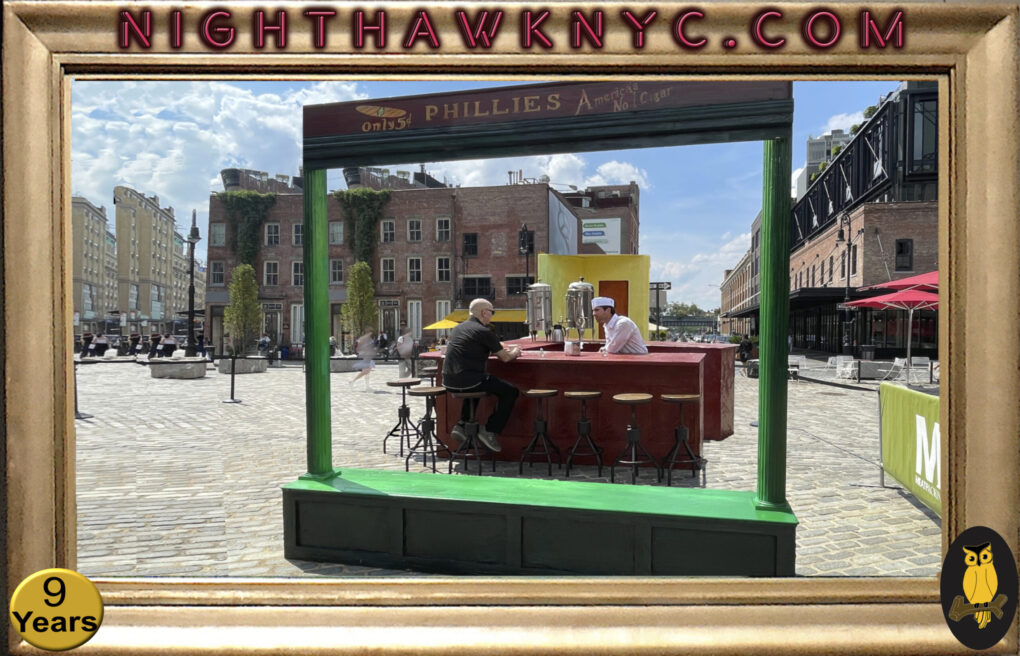
Update- On July 21, 2024, I finally found it! Meatpacking District, NYC. Kenn Sava, left, reenacting his Painted alter-ego, Logan, right. Photo by Nilo for NighthawkNYC.com. Continual Thanks to all involved & Kevin Callahan. Click any image for full size.

2)- “Vincent van Gogh: Home at Last,” published October 8, 2018. Preparing this piece on the reinstalled Van Gogh Masterpieces in the Permanent Collection of The Met suddenly took on an unexpected life of its own.

HOW great is it to be able to walk into a room and see THIS? For me, it’s one of the great joys of life in NYC. One part of the newly reinstalled Gallery 825 showing 9 of the 10 Van Goghs in this room. #10 is on the other side of the Self-Portrait with Straw Hat in the vitrine. This shot was available for literally one second over 3 visits and 3 hours I spent here. In the piece, you’ll see why.

3)- “Van Gogh’s Cypresses: Art From Hell,” published November 10, 2023. With all due respect to The Met’s great curators, I saw their blockbuster Van Gogh’s Cypresses completely differently than they did, apparently.

Welcome to The Met! In all my years of going to The Museum, as I call it currently 1,900+ visits since 2002, I’ve never seen TWO banners (left & right) up devoted to the same show. And, as I was soon to find out, it’s not like there weren’t other terrific shows going on! Seen on June 2, 2023.

4)- “Kerry James Marshall: The Revolution Was NOT Televised,” published March 1, 2017. THE most everything Painting show I saw in NYC in the 2010s. Along with Hima af Klint: Paintings for the Future, the two most important Painting shows mounted here in the prior decade.

The finest moment, among many fine moments, in the all-too-short life of The Met Breuer. Installation view of Kerry James Marshall: Mastry. “De Style,” 1993, KJM’s barbershop, right, drips of life, fun, culture, individuality and style. On the left, his “The Lost Boys,” from the same year, a title borrowed from Peter Pan, is an homage to two children lost to gun violence, and all the boys who were “lost” to a variety of causes.

5)- “A Conversation with Photographer Harry Gruyaert,” Published September 22, 2018. Consistently among my most popular pieces, the renowned Belgian Photographer, and long-time Magnum Photos Member, discovered me through my “Saul Leiter: In My Room” piece and let his gallerist know he would be interested in speaking with me. A fan of his work, we spoke extensively via transatlantic phone. I discovered later how few interviews he has given.

Subsequently, I met Harry Gruyaert, far right, in 2020 at the opening of his first American show since 1990!

6)- “Rod Penner’s America: Small Town Nation,” published August 22, 2023. This piece, based on his most recent NYC show which continued to solidify Mr. Penner as one of the foremost Painters of small-town America working today, continued my coverage of the Texas-based Artist’s NYC shows, with my prior pieces linked at the bottom of it. At one point, I had written more about Rod Penner than anyone else had. Maybe I still have. Rod was also kind enough to do a Q&A with me in 2017.

HOW does he do it? Rod Penner discussing one the very, very fine points of his Yellow Light/Brenham, TX, 2004-5, 15 x 25 inches, at his opening, March 18, 2023.

7)- “Henry Taylor: The Art of Empathy,” published March 8, 2024. Born of my unforgettable encounter with Mr. Taylor at the opening of his 2019 solo show.

Installation view, an hour and a half before Henry Taylor: B Side closed for the last time, Whitney Museum, January 28, 2024.

7)- “Gregory Halpern’s America,” published November 8, 2019. Perhaps my biggest discovery during my 8 3/4-year “deep dive” into Modern & Contemporary Photography, my look at all of Mr. Halpern’s books through Omaha Sketchbook (2019), includes a look at its NYC book release in 2019, later the same night of my encounter with Henry Taylor!

The very first work I saw by Gregory Halpern, “Untitled,” from his Buffalo series, seen at Aperture’s Booth at AIPAD: The Photography Show, April, 2017, I liked so much it’s been hanging on my wall since.

8)- “Raymond Pettibon: Artist Americanus,” published July 20, 2017. I was very fortunate to meet Mr. Pettibon and have him give me a tour of his Zwirner show, which I was thrilled about but also felt bad about because he was suffering from a quite damaged foot that caused him to sit the entire rest of the time he was at his opening. The show was also memorable as during its run I met Artist Caslon Bevington, whose work I’ve subsequently written about twice.

Playin’ hurt. The great Raymond Pettibon enters his show at the opening, April 29, 2017, with a cane. That small figure running in the distance is his son, Bo. Zwrner lent Raymond this space which he used to created the work you see on display. Quite a few paint splotches were to be found on the floor, leading me to think it must have been something to watch him creating these pieces.

9)- “Table for One: Patti Smith’s 18 Stations,” published April 17, 2016. I made about a dozen trips to Patti’s extraordinary Photography show and was shocked to walk in on the show’s last day to find the legend, herself, seated at the famous table she sits at on the cover of M Train signing books alone. She looked up, and realizing I was about to take her picture, cooperated. I then spoke with her, and wound up meeting her daughter as well. As the show closed, I found myself in the gallery with her as she walked through it one last time, trying to imagne what was going through her mind at each stop. I eternally regret not buying one of her Photographs. One of the Top 5 most-read and most-discussed pieces I’ve written.

What becomes a Legend most? The one and only Patti Smith sits at her famous table.

B)- “Community Service”
1)- “Art” With a Capital “A,” published February 26, 2020. I should have written it sooner.

Thanks, Twyla! I couldn’t have said it better. And so, this scene has appeared in my Banner, sans moving truck, a number of times over the years. A look at ALL 41 of my banners this past decade is here. The Joyce Theater, December, 2019, as seen continually staring me in the face from my favorite seat in my beloved Starbucks on West 19th Street, the best SB in NYC. Another loss during the pandemic.

2)- “Death to Boxes!,” published on April 7, 2020. Another I should have written sooner. The problem has only gotten worse.

3)- “On Buying Art,” published on July 11, 2017. One I did write early on.

Knowing what not to buy is rarely THIS obvious.

C)- Milestones

“Oh, won’t you stay
We’ll put on the day
There’s a sun show every second”-*

1)- “Welcome to the Night,” published July 15, 2015. My very first piece!

The last time I stood in front of Nighthawks, with my Painted alter-ego, dead center. August 28, 2013, at Hopper Drawing at the old Whitney Museum. Fun fact– I “borrowed” its frame for the frame you see in my banner! Shhhh…Don’t tell anyone.

2)- “Cancer Saved My Life,” published February 7, 2017, on the 10th Anniversary of my cancer treatment. My passion to share what I’ve seen & learned in the Art world comes from surviving with a 20% chance of making it through Year 1 post-treatment without needing more treatment. I’m happy to say 8 Anniversaries have followed- 18 in all! Miraculous.

Every cancer patient’s worst nightmare. During my search for cancer treatment, after much research and agonizing, I settled on a treatment. My life was saved by a Doctor who patiently explained why it was the wrong choice for me moments before I was to begin it. Unfortunately, there wasn’t a sign this big to guide me.

3)- “Kenn Sava Named a Finalist…,” published November 25, 2023. I was, and am, honored to be named a Finalist for the 2023 Andy Warhol Foundation Arts Writers Award out of the 500 writers they said they considered.

D)- Journeys
1)- Goya: In Boston & NYC, published January 20, 2016. In January, 2015, I made a day trip to the Museum of Fine Arts, Boston to see their exceptional Goya: Order and Disorder show. A few months later, I saw a show of his complete Los Caprichos at the National Arts Club, here.

The Museum of Fine Arts, Boston in January, 2015, the last time I went out of town to see an Art show. Of course, I was back in my own bed that night.

2)- “13 Year At The Metropolitan Museum,” a 2-part series, the first part published on July 26, 2015. Though I’m in Manhattan, The Met is not exactly nearby. Nonetheless, I’ve managed to get there over 1,900 times since August 1, 2002. Some thoughts on it from 2015.

Hark! A Met Angel Beckons me to the Light. To not hear her call is my loss.

3)- “The Met Breuer: Hail, and Farewell,” published on August 1, 2020. I was there on March 8, 2016,  the first Member’s Preview Day, and I was there the moment it closed for the final time on March 12, 2020. In between, I saw more great shows there than anywhere else, largely due to The Met’s terrific Contemporary Chairperson, Sheena Wagstaff, who I’ve also written about at length more than once.

March 12, 2020. I’m about to enter The Met Breuer for what I didn’t know would turn out to be the last time, on what would turn out to be its last day ever.

4)- “Exclusive! A Visit to Raymond Pettibon’s Moscow Show!,” published November 20, 2017. Lana Hattan was able to get an associate to go The Garage and shoot Raymond Pettibon’s 400-piece Moscow Retrospective, Raymond Pettiboyn: The Cloyd o’ Misreadyng,” for me! Though this was before the cessation of relations between the U.S. and Russia, I was unable to make it. Raymond Pettibon made it, though, and created another of his classic Hand-Painted Murals for the show. Given there have been very few large Raymond Pettibon shows since, I’m very thankful to the Hattan Group, who did a terrific job as you can see, for  doing this for me, and enabling me to write about the show for NighthawkNYC readers! It’s the only show I’ve written about without actually seeing in person! It’s something you can’t see anywhere else.

Live, from Moscow’s Garage! The show’s entrance features one of Raymond Pettibon’s famous hand-painted murals, around the corner from this sign. I hope the Russians are up on their “Pettibon English!” Photo by The Hattan Group for NighthawkNYC.com.

4)- “Antoine de Saint-Exupéry: Artist,” published on March 21, 2023. I’m self-taught at everything besides reading/writing and basic math thanks to a terrible school system and not being permitted to go college. As a result, I had never read The Little Prince, as hard as that is to believe, until Lana, whose favorite book it is, insisted I do. Of course, I immediately got hooked, like hundreds of millions of others have. We were lucky enough to attend the wonderful show of his work at the Morgan Library, and I returned there in 2023 for their show on the Art of Saint-Exupéry. The piece took on a life of its own after the French Ambassador to the U.S saw it and invited me to Washington, D.C. for a dinner he was hosting in honor of the 80th Anniversary of the publication of the book.

I join Saint-Ex’s most beloved creation in waiting for the return of his Asteroid. Hurry up, already! May 10, 2025. My thanks to the kind lady who took this.

E)- Epics
1)- “The New Whitney Museum: The Roofdeck of American Art,”  published August 1, 2016. I worked on my look at the “new” Whitney Museum for over a year after having been a voice against the expansion of the old building. Now that it’s 10 years old, nothing has changed anything I said about it.

Nothing has changed except the Department of Sanitation complex in front of the museum, seen here in 2015, has been replaced with a park.

2)- “This Summer In ‘The Era of Rauschenberg,'” published September 19, 2017. I spent my summer going to MoMA’s Robert Rauschenberg: Among Friends (24 times) and the 4 Rauschenberg satellite shows going on around town. The Rauschenberg Foundation was impressed to the point that they invited me down for a private tour of their entire facility, his former studio, which was beyond an amazing experience for this long-time fan.

One nice note- The Rauschenberg Foundation informed Sue Weill, Aritst (and collaborator with him on Untitled (Double Rauschenberg), c.1950, Monoprint; Exposed blueprint paper, center)  & former Rauschenberg girlfriend, about my inclusion of her in this piece and others, and told me she was pleased to hear it. Partial installation view of the first gallery of Robert Rauschenberg: Among Friends. 

3)- “Richard Estes: Painter. With No Prefixes,” published May 22, 2022. I was surprised to see nothing else printed on the occasion of Richard Estes’s 90th Birthday, which I take as another reminder that the Art associated with  “photorealism” is still not of interest to almost all of the world’s museums. I agree with them on most of it. Yet, (see my piece on boxes, above), some Artists have been stuck in this box, or other boxes, without their consent. I don’t quite see Richard Estes work the way many others seem to. My 3-part series, built on decades of looking at his work, addresses just this.

Kenn Sava, Homage to Richard Estes, NYC, May 27, 2020. Richard Estes was one of the first Artists to influence how I see the world. i.e. he helped open my eyes to the world around me everywhere!

4)- “Jean-Michel Basquiat at the Brant Foundation,” published October 6, 2019. Basquiat has been THE most popular Contemporary Artist for the entire existence of NighthawkNYC, yet, I didn’t know much about his work going in. When my friend, Kitty, told me about the Brant Foundation show, I decided to go, try and get up to speed on his work, and see what it said to me. As I sit here now, I’ve written more about Basquiat than any other Artist! And, I’ve seen more Basquiat shows since 2012 than I have by any other Artist. Both of those facts shock me. They just happened, primarily out of my desire to give his work as in-depth a look as I could. Along the way, I saw virtually every book ever published on his Art, and met and spoke with both of his sisters. The Brant piece is the first piece I wrote on his work. All the others may be seen doing an Archive search for Jean-Michel Basquiat.

Lisa at the Brant Foundation Basquiat show studying Self-Portrait with Suzanne, 1982. There I was, standing outside in the rain for a solid hour, without my umbrella which had gotten left in the cab, without a ticket on the show’s last day, having failed to get a press pass. A staff member who had tried to help me circled back around and told me a visitor, Lisa, had an extra ticket, which she was kind enough to give to this total stranger. Thank you, Lisa. You set in motion what would become an epic journey of Artistic discovery. And oh, by the way, I subsequently paid $45 to get into Basquiat: King Pleasure, the show mounted by his sisters, even though I was going to write about it for free. Did The New York Times pay to get in, too?

5)- “700.000 Michelangelo Fans Can’t Be Wrong“, published March 4, 2018. A labor of love born out of a dozen visits to The Met’s once-in-a-lifetime blockbuster that 700,000 saw. More an effort of trying to remember as much as possible of what I saw because I knew I’d never see it again.

Take that, Elvis, who’s 1959 album title, and cover, I just borrowed. Michelangelo was the “King” of a different kind of rock. Old school rock.

6)- “A Year Without Art,” published May 7, 2021. Never in my wildest dreams did I ever think I’d go an entire year without being able to see Art! Well? In 2020-1, it happened.

The Met’s famous main entrance, gated, during the 5 months it was closed, on May 21, 2020, unprecedented in my lifetime. Probably not the way they drew up celebrating their 150th Anniversary.

7)- The Photography Show, 2018, published April 23, 2018. I look back in disbelief at how much work I did around AIPAD, The Photography Show in 2018 and 2019. 4 part series on each…countless meetings with Photographers…endless looking all followed by months of work on the pieces. I didn’t make a dime doing it. I hope they appreciated it!

“On The Fence, # “The Wall Has Eyes” Edition. The Birdies, my fine feathered friends from their West 24th Street perch, that ran in my popular occasional featurette, “On The Fence,” for over a year. This one was included in my 2018 Photography Show series. I never replied to the reader who suggested I give up Art writing for “photo funnies”  as he called them- until now. I’m still thinking about it…All installments of “On The Fence” are here.

8)- “Ai Weiwei & The Value of One Refugee“, published January 7, 2017. The centerpiece of a group of 4 2016 Ai Weiwei shows, Ai Weiwei: Laundromat was a show unlike any other I saw this past decade, Ai & his team collected clothes, shoes and other artifacts left behind by refugees in the various camps he visited during the European Refugee Crisis and arranged them to compelling effect achieved in concert with countless Photos on the walls he took documenting what he saw and reproductions from media and social media accounts under foot. I wrote about all 4 of the shows, but Laundromat has lingered long in my memory. It was hard to visit the show and not think of Ai’s own experiences, which made him an almost ideal witness.

Birdseye view of almost the whole show.

9)- “Edward Hopper’s Impressions of New York,” the first of 3 pieces on the show published May 5, 2023. Wait. Who else has written multiple pieces that look at different aspects of one show? Maybe someone else has. I haven’t seen it. That’s exactly what I did for the blockbuster Edward Hopper’s New York at the Whitney, AND for MoMA’s Ed Ruscha/Now Then.

Edward Hopper’s New York, October 27, 2022.

10)- “NoteWorthy Art Books of the 21st Century,” published June 10, 2025. This, and NW PhotoBooks, the two biggest pieces I’ve ever written, represent my sharing what I’ve seen and learned over the past 50 years I’ve spent looking at Art books, and almost a decade of intensively looking at PhotoBooks. Having begun them last September, right before I announced I was taking a break, they kept gnawing at me in a “You HAVE to finish these!” way. The Epics of Epics on this site, an immense amount of looking and consideration went into both pieces. Usually, I worked on up to 4 pieces at a time. I can’t imagine working on anything else in the 10 months it took to write these.
That makes me wonder- Has anyone else (any other single person) written a list of recommended 21st Century Art Books AND a list of 21st Century PhotoBooks?
The Introduction to both pieces is here.

The “Golden Oof,” named for my Avatar.

11)- “NoteWorthy PhotoBooks of the 21st Century,” published June 25, 2025. Marks the end of my “deep dive” into Modern & Contemporary Photography that I began in December, 2016- There I just said it.
[A moment of silence.]
What did I learn from all of that? I stand by what I said here in 2019.
This “Painting guy” is going back to focusing on Painting. You heard it first.

NoteWorthy Sunset Photo by Lana Hattan.

Part 2- Where I’m Going

“Oh, won’t you stay
We’ll put on the day
And we’ll talk in present tenses”-*

1)- NighthawkNYC/Kenn Sava’s Art writing
I’m sorry to say that nothing has changed since I announced I was taking a break in September, 2024. There remains no means of support for independent Art writing. Surviving remains my #1 to #10 priority. I continue to work on the site remaining up. If something changes? I’ll let you know. 

Flaco Lives! Kenn Sava at The Year of Flaco exhibition (in a Flaco T I had made last year), in front of a section of Photos of him early on in his freedom. The picture far right was taken right after he escaped from the Central Park Zoo. After never having been outside in his entire life, he suddenly found himself on Fifth Avenue & 60th Street! Maybe that’s why I’ve never seen a picture of him with his eyes so wide open. New York Historical, July 3, 2025. My piece on Flaco, written about a month and a half before his tragic demise, is here. My Thanks to Marybeth Ihle of the New York Historical.

2)- Kenn Sava, Producer
I’m hoping to re-release The Fuschia by Thomas Chapin, Peggy Stern, Drew Gress and Bobby Previte this year, and also finally release my solo album Strawberry Fields Forever.
Though I produced both projects, releasing and re-releasing them is not about me. Both were recorded in the mid-1990s, and, sadly, since then a number of the great Musicians who participated in them have passed away. I feel a sacred duty to them to get their work out there/back out there. Stay tuned. 

Coda- Before I “Go” Anywhere…
I started this site for one reason- To share what I’ve been lucky enough to see & experience in NYC and in Art & books with my fellow Art lovers around the world. I had a lot of passion, but no business plan.

While doing NighthawkNYC has been quite the financial hardship, I’m proud of the fact that readership has gone up each and every single year. Thank You to everyone who’s read one, or all, of my 350+ pieces here this past decade.

I especially want to Thank those of you who have made donations or bought pieces of my collections to help keep me going! For the rest of you, if you find, or have found, what I’ve done here since 2015 worthwhile, YOUR support is needed to keep this site up, and possibly, enable me to write more.

When the curtain closes
And the rainbow runs away
I will bring you incense
OWLS BY NIGHT (Caps mine ; ) )
By candlelight
By jewel-light
If only you will stay
Pretty baby, won’t you
Wake up, it’s a Chelsea morning”-*

With Lana Hattan at Hilma af Klint: Paintings for the Future, the most recent show we’ve been able to see together at both of our favorite NYC building- The Guggenheim Museum. New Year’s Eve, December 31, 2018. My Undying Thanks to the woman who approached us and insisted she take our picture.

Finally, Thank You to Lana Hattan for pushing me to start writing about Art, and for your continual support through some thick and a lot of thin, every step of the way.
As I’ve said before, if you’ve found ANYTHING I’ve done here worthwhile, she’s the one who deserves your thanks.

As for me? I MADE IT TO 10 YEARS!
Kenn Sava.
July 15, 2025

P.S.- Feel free to drop me a line and let me know if I left out a piece you found particularly NoteWorthy.

For more- Check out my look back at “A Decade of NighthawkNYC.com Banners,” which have uncannily come full circle, here!

*- Soundtrack for this piece is “Chelsea Morning,” by Joni Mitchell, referencing her apartment 5 blocks from where I am writing this, and where I’ve written all of the 350+ pieces on NighthawkNYC. Joni moved here in 1967, before my time here, and proceeded to write a number of her early songs here. Just another of the Legends who’ve lived in my neighborhood, like Patti Smith. She performs it here in 1969-


A Decade of NighthawkNYC.com Banners

By Kenn Sava, with a tip of my Fedora to Edward Hopper.

Having Celebrated Ten Years of NighthawkNYC.com, here, I decided to take a selected look back at what you saw when you looked above what I’ve written here since July 15, 2015: the Banners I’ve run from Day 1.

Speaking of Day 1, July 15, 2015…Remember this?

Banner #1. July 15, 2015. Location- Somewhere Downtown, late. My adaptation of Edward Hopper’s Nighthawks, 1942, into a “Self-Portrait,” as I said, here. My piece on decades of looking for the site of the REAL Nighthawks, which remains my most popular piece ever, is here.

Banner #2 – NighthawkNYC Version 2.0 in honor of the First Anniversary, July 15, 2016, I decided to create my own version.

Banner #40b – My working file since July, 2016. The blue lines are the ghosts of all the layers that have been added to this image the past eight years! As seen below…

Banner #3. Night flowers. In summer, 2023, this Deli became a cannabis shop…

Banner #4 – Outside Ai Weiwei’s powerful show Laundromat on the Refugee Crisis

Banner #5 – Chelsea, February, 2017. Seeing this reminded me of my boxed-in upbringing, as I wrote in my 10th Anniversary of Cancer treatment piece. This space is now the location of the Hauser & Wirth mega-gallery.

Banner #6 – The High Line, March, 2017. January, February and early March are the only times I’ll hit the High Line, which is too crowded the rest of the year. I’ve still never been to Hudson Yards (15 blocks behind me here). By choice.

Banner #7 – The Strand Bookstore, minutes after closing, December, 2017, back when it closed at 10:30pm every night. Not at 8pm as it does now!

Banner #8 – Madison Square, January, 2018

Banner #8 – Unpublished experiment featuring my dear friends, the Birdies from my “On The Fence” series, seen on their infamous perch on West 24th Street.

Banner #11 – The Entrance to Michelangelo at The Met, February, 2018. Behind the screen is the faux scaffolding for the Sistine Ceiling section.

Banner #18 – Hell’s Kitchen, March, 2018

Banner #21 – 7th Avenue, April, 2018. A sort of “nighthawks” at the all-night coffee house…

Banner #23 – 18th Street, May, 2018

Banner #11 – The steam pipe explosion on 5th Avenue. Looking uptown from 5th Avenue and 18th Street to the Empire State Building as repairs to the surrounding buildings damaged by  the explosion continues, July 26, 2018.

Banner #22 – Meatpacking District, September, 2018,

Banner #25 – Live on the D Train, November, 2018

Banner #32 – March, 2019, West 19th Street. My banner as it was before everything hit the fan. I ran this one longer than any other so far.

Banner #32a – March 22, 2020. The covid shutdown is a week old. I’m home, like everyone else.

Banner #32b – July 20, 2020. NighthawkNYC.com is 5 years old! Restaurants & cafes are allowed to open for take out and delivery orders, only.

Banner #34 – Unpublished experiment in response to everything being boarded up here. It showed a lack of trust in the community, their customers, which angered me when I was living with all of it, so I made it as a joke but didn’t run it.

May 3, 2021 – The vaccine has kicked in and I’ve returned after a year away from the banner. At least to Eddie’s Cafe. I had yet to go inside any other restaurant.

Banner 32c – NighthawkNYC.com is 6! July, 2021. Twyla’s quote still fits.

Banner #26 – With Richard Estes Double Self-Portrait, May, 2022.

Banner #27 – Parking Eddie’s Cafe in the middle of 6th Avenue in the Flatiron facing south, June, 2022, One World Trade Center next to my left ear. Working on that logo!

If you had told me at a number of points this past year, I’d be hanging a “7 Years” Banner, I’d have seriously doubted it!

August, 2022. On East 42nd Street.

October, 2022. From Chelsea Piers looking south.

February, 2023. Sunset from Hudson River Park.

June 9, 2023. Edward Hopper’s New York Corner, 1913, one of my favorites in Edward Hopper’s New York, my obsession at the time, at the Whitney Museum.

July 15, 2023. NighthawkNYC.com turns 8 years old!

August 28, 2023- Pondering Rod Penner’s 212/House with Snow, 1998. The 31st Banner I’ve run.

September 22nd, 2023. The view from the MoMA/PS1 Courtyard, LIC, NY, in 20022.

December 17, 2023. Looking north on 5th Avenue. Views of the Empire State Building from the south are disappearing due to new construction. Here, the building is partially hidden by a new tower going up just to the right of it in this view. Oh, and I was named a Finalist for the 2023 Warhol Foundation Arts Writers Award.

January 27, 2024. Slowly getting back on my feet after a bad illness, this harkens back to my late summer trips to the Guggenheim to see Sarah Sze: Timelapse.

March 8, 2024. Banner 51- Trees in Clement Moore Park, February, 2024. Finally back on my feet after a rough six-week illness, this picture captured how I was feeling.

April 9, 2024. Kobra’s Mural on 10th Avenue, his idea of a “Mount Rushmore” for the Chelsea Art District which it directly faces. I’m not sure who would be on my Art Mt. Rushmore. Who’s on yours?

July 15, 2024. Banner 60- NighthawkNYC.com is 9!

September 4, 2024, the day I was diagnosed with ovid for the first time, a look at better times. Here I am living a dream, taking the place of my alter-ego in this fabulous recreation of Edward Hopper’s Nighthawks Diner, which I wrote about here. I named this site after that guy in the Painting that no one ever talks about (a “nighthawk.” The Painting is titled Nighthawks). My thanks to the iconic Lucas for the coffee and convo and Nilo for the priceless pic. By the way! The frame is the ACTUAL frame that housed Nighthawks when I saw it last at Hopper Drawing at the old Whitney in 2013!

September 27, 2024- Unable to find a way to survive financially from writing, I announced on Instagram that I was taking a break from Art writing. I left 3 pieces unfinished including my NoteWorthy Art & PhotoBooks of the 21st Century (thus far) pieces.

April 16, 2025- The “Golden Oof,” named for my Avatar, the statuette I’ve had made for my NoteWorthy Art & PhotoBook Lists perched on my picture of the Brooklyn Bridge shot from the Brooklyn side before the pandemic. This Oof is for my NoteWorthy Art & PhotoBooks of the 21st Century (thus far) pieces. After six months of hard work, this banner honors my Art Book piece FINALLY being published today.

June 15, 2025- Banner 64a marks the completion of two pieces that took 9 months of hard work built on 25 years of equally hard looking. The twin “Golden Oofs” fly over a fiery sunset Photo by my Muse, Lana Hattan, 2025.

July 15, 2025. Banner 65 marks 10 Years of NighthawkNYC.com! By the way, the frame is the actual frame of Edward Hopper’s Nighthawks!

That makes it 41 banners I’ve run- about 4 a year. It turns out to have been a bit of a circuitous journey, with my getting to live out my dream seen in Banner #1 ten years ago.

Thanks to all those who’ve seen one of them, most of them, even all of them along the way!

*-Soundtrack for this Post is “I Contain Multitudes,” by Bob Dylan from Rough and Rowdy Ways, 2020.

NighthawkNYC.com has been entirely self-funded & ad-free for over 9 years, during which 300 full length pieces have been published! If you’ve found it worthwhile, PLEASE donate to allow me to continue below. Thank you, Kenn.

You can also support it by buying Art, Art & Photography books, and Music from my collection! Art & Books may be found here. Music here and here

Written & photographed by Kenn Sava for nighthawknyc.com unless otherwise credited. To send comments, thoughts, feedback or propositions click here. Click the white box on the upper right for the archives or to search them. Subscribe to be notified of new Posts below. Your information will be used for no other purpose.

Introduction to NoteWorthy Art & PhotoBooks of the 21st Century

Written & Photographed by Kenn Sava.

Across space & time, everything I write in the following 2 pieces began here…Bob Haak’s Rembrandt: His Life, His Work, His Time, published by Abrams in 1969, 348 pages with 612 illustrations including 109 HAND-TIPPED color plates. Click any Photo for full size.

Art books have been a passion of mine since I was a little kid. Early on, my mother belonged to a book club and when there wasn’t anything she wanted, she let me pick a book. I always chose an Art book, some of which I still have and still refer to. A few years later, during a visit to the first real bookstore I was ever in, I saw a large 14 x 11 inch book titled Rembrandt: His Life, His Work, His Time by Bob Haak, above. I was floored. Here was Rembrandt’s entire life and, what seemed to be, with over 600 illustrations including 109 hand-tipped plates (i.e. each plate was attached to the page by hand!), his entire oeuvre. It wasn’t, but it was a great overview. Most of all, it fired my imagination as to what a truly great Art book could achieve. That, and the singular possibility of experiencing most of an Artist’s entire body of work in one book excite me every bit as much right now as they did when I was a kid.

Art books were the first way I could see and discover Art before I could drive, they remain every bit as essential to me now that museums and galleries are within walking distance. In compiling the lists of Art books and PhotoBooks that follow countless hours these past 25 years have gone in to looking at books in innumerable bookstores (including a good number that are, sadly, no longer in business), museums, galleries, libraries and virtually any place else that has them, equalled by how much thought, consideration, and living with these books has gone into this selection. All of that is built on an equal number of years before January 1, 2000 that I spent looking at Art books. All told, a  long time.

As a result, no pieces I’ve written over the past 9 3/4 years on NighthawkNYC have come close to being the amount of work that has cumulatively resulted in the two pieces that follow. They represent a lifetime of looking at Art Books, and 8 years of looking intensely at PhotoBooks, condensed into 6 months of work selecting them and writing the pieces. My hope is that you will find it useful.

The Museum of Modern Art’s endless wall of Art books, as I call it, is at least 30 feet high and twice as wide. I asked to see the Yoko Ono book under the sleeping cat sculpture. They laughed.

Narrowing the focus to books published for the first time in the 21st century didn’t make the job much easier; a number of books I instinctively put on the list wound up having publication dates just before 2000, disqualifying them. Other books I have a strong personal preference for, I didn’t feel were books I’d make a general recommendation for, which is what I try to do with my NoteWorthy Book lists. Many other books are terrific in terms of the Art or Photography they contain, but lacking in other areas as books in my view.

That these lists are surprisingly long is a testament to what I’ve seen in almost half a century of looking at Art books: they’ve gotten better, especially since 2000. While there were, of course, great and important Art writers before 2000, virtually every other aspect of bookmaking has evolved, largely for the better. Acid-free paper highlight an incredibly wider range of today’s papers, better Art Photography with the increased use of color, better materials, better production processes, better distribution, and the wide-spread availability of all of these things has led to a world-wide proliferation of books on Art, and especially Photography, as countless smaller PhotoBook publishers vie with the big companies for exposure & attention.

So, WHAT’S a “NoteWorthy Art or PhotoBook of the 21st Century?”

I’ve said all along that I don’t believe “best” exists in the Arts. I use the term “NoteWorthy” in speaking about books, in this case, that I most highly recommend. I’ve endeavored to narrow these down to books that have it all- great work in a great book. At the same time, I’ve tried to keep in mind that most people don’t want large Art or PhotoBook libraries. They want to know what the most important books are. That is what I have tried to give you: The NoteWorthy Art and PhotoBooks (i.e. those I recommend most highly) released thus far in the 21st century, in my opinion.

Unfortunately, both are partially incomplete; some lack images, there are no ISBN numbers…Given my new realities, I just don’t have the time I did before. I’ve felt it was more important to spend time living with these selections to see if I really feel these should be included. Still, I have no doubt that sooner or later (probably sooner) I’ll realize I left out a book that REALLY should have been on this list. Also, for both lists, I’ve sadly decided to leave out Artist’s books that are/were published in editions so small that few can see them.

Let’s look at some books! There’s nothing like going to a great Bookstore. Where else are you actually going to get to see Artbooks and PhotoBooks-in person?

I dedicate both my Noteworthy Art & PhotoBook of the 21st Century (thus far) pieces to my fellow Art book & PhotoBook lovers everywhere, and especially to all of those who have written to me about books I’ve written about, books I should know about, or written to tell me about books I’ve written about that have impacted their lives. You’ve inspired me to get these done.

Kenn Sava.    

Without further ado-

NoteWorthy Art Books of the 21st Century by Kenn Sava may be seen here.

NoteWorthy PhotoBooks of the 21st Century by Kenn Sava is here..

NoteWorthy Art & Photobooks of the 21st Century are BookMarks Specials.

*- Soundtrack for this piece is “Noteworthy” by Homeboy Sandman from his album Dusty, 2019.

NoteWorthy Art Books of the 21st Century by Kenn Sava

There are NO ADS or Affiliate Links in this piece!
If you find it worthwhile, PLEASE donate securely via PayPal so I can continue writing. You can also support me by buying Art & books from my collection. Details at the end.
Thank you.

BookMarks Special. The “Introduction to NoteWorthy Art Books & Photobooks of the 21st Century” is here.

Written & Photographed by Kenn Sava
(*- unless otherwise credited)

What’s a NoteWorthy Art or PhotoBook? As I’ve explained here, I don’t believe such a thing as “best” exists in the Arts, in comparing Artists, works of Art, or books. Whatever criteria you use is subjective. So, I’m using “NoteWorthy” to denote books I feel are important; books that more people should know about and consider adding to their libraries. Therefore, the following are my most highly recommended Art books among all those I know about published thus far this century.

Welcome to my world. While I see shows as often as I can, I’m in bookstores much more often. Seen in January, 2025, The Strand Bookstore has an excellent selection of new & used Art books. Here, Art monographs are shelved along the wall to the left by Artist’s last name- “A,” left, to “O,” next to the third ladder (about 1/3 of an entire City block down). Your mission, should you decide to accept it- go through these and choose 50, or so, published this century as NoteWorthy- about two books a year. When you get to that third ladder, you’re half done! (In case you’re wondering, PhotoBooks are elsewhere.)

Though the research has been ongoing, unfortunately I no longer have the time to write the kind of pieces I have here for 9 1/2 years, so this piece took longer than it would have. Still, some books lack pictures, and there are no ISBN numbers- sorry. You should be able to locate the listed books by title, publisher and date of publication (i.e. of the first edition) included. The books are listed in no particular order. Note- If anyone else has done such a list, I haven’t seen it.

Further down the wall are Art monographs shelved by Artist’s last name- “P,” left by ladder, to “Z” immediate right. Take a break ’cause you’re not done. PhotoBooks await! My list of NoteWorthy PhotoBooks of the 21st Century follows this piece.

What am I looking for? Great Art, alone, isn’t enough to qualify. Why not? Over time (in my lifetime in particular), Art books have gotten better and better on all counts from the quality of the reproductions, to the paper (the proliferation of acid-free paper and the incredible range of paper now available), the materials used in bookmaking, to the entire process of printing. So, great work in a great book, sums up the books I’ve listed here. A “great book?” Insightful & informative- with, or without, essays. Design that doesn’t get in the way, and hopefully adds to the presentation. Excellent production (design & layout, paper, binding, covers, finish), and of course, high-quality reproductions in a useful size, or larger. Let’s face it, in the end, virtually all Art books are PhotoBooks since they contain Photographs of the Art. Price is a consideration for most (me, too!), but it’s not a consideration for a book making this list. Finally, in spite 25 years of looking this century at and living with Art books, and 6 months of work that has gone into this piece, I have no doubt I missed at least one.

Hard at work. I started this piece in September, early fall. I finished it six months later in early spring. My thanks to a new friend I had a book discussion with only to get home and find this in my inbox. Strand Bookstore, April 15, 2025.  *-Photographer’s name withheld by request.

If you find this piece worthwhile, I NEED YOUR HELP! There are no ads or affiliate links in this piece! Imagine THAT in 2025! So please donate securely via the Paypal link above if you discover a book here, or you find this piece useful. Oh! And NO ONE has given me any of the books on this list!

NoteWorthy Art Books of the 21st Century-

The “Golden Oof,” named for my Avatar perched in front of Brooklyn Bridge. Note- If you are listed below and would like a Golden Oof Statuette, please contact me via the link at the end for info.

Format= Artist, Title, Publisher, Date published- Kenn’s comment. (NoteWorthy books are also in bold type in the body of the piece to distinguish them from other books I mention.)

Hilma af Klint, Hilma af Klint Catalogue Raisonne, Volume II: Paintings for the Temple, Okförlaget Stolpe, 2023 and
Hilma af Klint: A Biography by Julia Voss, University of Chicago Press, 2022
A 100+ years in the making overnight sensation, after 500,000 people joined me in 2018 in seeing the unforgettable Hilma af Klint: Paintings for the Future in Frank Lloyd Wright’s Guggenheim Museum Rotunda, the most people ever to attend a show there(!) in what was a brilliant paring of two visionaries. This led to an explosion of Hilma books. Of these, the 7-volume Hilma af Klint Catalogue Raisonne, published by Okförlaget Stolpe in 2023, will remain definitive henceforth, but it’s overkill for most. So, from the set, since they’re all available individually, Volume II: Paintings for the Temple is my choice as a Noteworthy Art Book of the 21st Century (thus far). It contains all 190+ of her Paintings for the Temple series, which she felt were her “most important work.” There are no essays and only a 2-page overview; it’s beautifully produced with large illustrations, and can be had quite reasonably as I write.

Installation view of the unforgettable blockbuster/landmark show, Hilma af Klint: Paintings for the Future,  2018, as seen in the Guggenheim’s catalog of the same name. When I stood on this spot at the show I felt that Wright’s Guggenheim was, perhaps, the perfect extant place to install her work.

While I’m on the subject of Hilma, among books on her work (though not included on this list), the best one-volume overview, in my view, is a toss-up between the Guggenheim’s Paintings for the Future catalog for that 2018 show, which reproduces everything that was in it, save 3 works by my count, and the more expansive Hilma af Klint- Artist, Researcher, Medium catalog published by Hatje Cantz in 2020 with 227 images (versus the Guggenheim’s 165, by my counts). I find the Guggenheim’s Paintings for the Future more concise and it gives those that missed the show, their bast chance to get a sense of it. The Hatje book is more comprehensive, with mostly smaller images, though I prefer its essays. Either one will provide a good introduction and leave a good deal to ponder well into her future.

My copy of Julia Voss’s Hilma after Klint.

Julia Voss’s Hilma af Klint biography (the only one so far) is engrossing for someone new to Hilma, and riveting for anyone with a real interest in her,  Make that “a real interest in her work,” because though the Artist left 22,000 pages of writing, NONE of them are about her personal life! Her love life? We don’t know. What her daily life was like? Forget about it.. Yet Julia Voss has done a terrific job of following her trail and digging into her archives (with the cooperation of her foundation) to create a meticulously researched picture of Ms. af Klint’s life and time. Being the first biography on a great Artist brings with it a lot of pressure. Yet, Julia Voss’s book has already been accepted by every museum staff member who’s writing on Hilma af Klint has passed in front of me in the barely 3 years its been available, as their footnotes reveal. For the rest of us, she’s created an extremely accessible, down-to-earth book (aided by its wonderful English translation by Anne Posten), no mean feat considering the rarified air to be found in that realm where the spirit world meets ours (if it does) that many of Hima’s projects, and the Artist herself, inhabited. Essential.

Also Sprach Zarathustra, as heard in 2001, is playing somewhere…*- Estate of Francis Bacon Photo because I don’t own a set, though if someone would like to gift me one…

Francis Bacon, Francis Bacon Catalogue Raisonne, The Estate of Francis Bacon, 2016
Upon publishing this astounding set in 2016, the Bacon Estate said 8 words that sent a chill down my spine. “Once sold out, it will never be reprinted.” In 100 years, or whenever it’s sold out (which will, no doubt, come first) this set will be living in light, climate & humidity controlled cases among the most important Art books ever published. Still available as I write, at 35 pounds, find a VERY strong shelf for it, and TAKE CARE OF IT. (Support the spines and handle it with gloves on. Seriously.) Word. 

Forging a new path for Portraiture in the 21st century.

Frank Auerbach, Frank Auerbach: Revised and Expanded, Rizzoli, 2022
Francis Bacon’s contemporary and fellow Londoner, I shake my head in disbelief over HOW I didn’t see the Art of the late Frank Auerbach, who passed away at 93 in November, sooner than when I first saw this book. What was I doing? Obviously, I just didn’t get out enough as I missed two stunning and important recent Frank Auerbach shows at Lurhing Augustine here. As a result, Frank Auerbach: Revised and Expanded hit me like 432 thunderbolts, one for each of its pages. I just kept muttering “I can’t believe it….” as I went through it the first time until the customers around me at Pret A Manger were ready to call 911. I assured them I was just having one of those “moments of future regret” the infomericals incessantly warned me about. “CLAP ON!” Now, I know that Frank Auerbach was not only one of the major Artists of the 20th century, he’s one of the first major Artists of the 21st! Here you can see more of his work (in a whopping 1,200 images- 300 more than the 2009 original edition!) than you’re ever likely to see anywhere else. A desert island book.

The incredibly rare Jennifer Packer- The Eye Is Not Satisfied With Seeing seen in the Whitney’s Bookstore on the show’s opening day. It’s highly unlikely you’ll ever see this many copies of this book in one place again. With my NoteWorthy Art Book, 2021 designation.

Jennifer Packer, Jennifer Packer- The Eye Is Not Satisfied With Seeing, Serpentine Gallery, 2021
Perhaps THE overnight sensation of the decade thus far (along with her friend, Jordan Casteel), rocked me as much as it did just about everyone else who saw her traveling show of the same name. My piece on the show documented the ever-increasing crowds as the show’s run here went on. I “got it” on a member’s preview and immediately bought the book. It disappeared as quickly as any Art book has this century and currently goes for $500 in Very Good (VG) condition. Beautifully done on all counts, it’s an instant classic. Nothing has been seen of Jennifer since. Will its promise lead to Ms. Packer securing a place as one of the world’s more important living Painters? The world waits, and watches…

Peter Doig, Peter Doig, Rizzoli, 2017
The most comprehensive of the books published on the Scottish Painter who has made his mark working in other places, including Canada, to stunning effect. The first of three books on this list that are either authored by, or include an essay by (as this book does), curator & historian Catherine Lampert, the only non-Artist (as far as I know) who makes three appearances here. The second of six Rizzoli books on this list, this one features a “rule-breaking” design (unsurprisingly, in collaboration with the Artist). Most of the Art is pictured in landscape format to keep them from going over the gutter. This requires the reader to turn the book sideways! The customer reviews I’ve seen have been, surprisingly, uniformly approving of this.

As for the work itself, born of, and steeped in memory (a bit like Mohammed Sami’s work), I agree with Richard Shiff, who writes on page 357, “Doig’s art leaves memory caught between versions of itself: memory in formation, memory fading in and out. We will think that we remember whatever reality his pictures shows, but the picture itself- ‘through the materiality of pant and the activity of painting’- induces the sense of reality remembered, an abstraction of a memory already abstract.”

Eight years old, already, I’d guarantee an updated edition at some point, if I was a guaranteeing man. Still, with 432 pages in this one, there’s more than enough here to keep anyone busy for a while.

Nox, after opening the box it comes in. We should all be so lucky to have an epitaph like this.

Ann Carson, Nox, New Directions, 2010
The most unique book on this list didn’t start out as a book, or “Art book,” per se. Of it, the world-renowned Poet, Ms. Carson, says on the back cover- “When my brother died, I made an epitaph for him in the form of a book. This is a replica of it, as close as we could get.” Ms. Carson’s tribute is an accordion-fold-in-a-box multi-dimensional multimedia tribute that moves quickly beyond Poetry into the realm of Art, in my view. A personal tribute not conceived for the mass market, it’s the most personal and the closest book to a true “Artist’s book” on this list. While, for me, it helps shine a fond light on many aspects of loss, even for the rest of us who never met Nox, his book serves as a repository of memories, and through them, a powerful portrait of the man emerges, leaving him someone who will never die as long as copies of his book survive.

Rembrandt: The Complete Pantings XXL, left and The Complete Drawings and Etchings XXL, right. Fifteen pounts- each! With their NighthawkNYC NoteWorthy Art Books of 2020 designation.

Rembrandt, Rembrandt: The Complete Pantings XXL, 2019, and
Rembrandt: The Complete Drawings and Etchings XXL, 2019, and
Rembrandt: The Self-Portraits XL, 2017, or “Mini Brick,” 2023, all Taschen, and
The Rembrandt Book, Gary Schwartz, Abrams, 2006
In the early 1970s, Bob Haak’s classic Rembrandt: His Life, His Work, His Time, with its tipped-in color plates, was the first Art book to show me the possibilities of a truly comprehensive Art book. All these years later, and leaving aside the fact these books “celebrate” the 350th Anniversary of the master’s horribly sad death, I was one of those waiting with bated breath for the release of Taschen’s Rembrandt: The Complete Pantings. And wow, what a book! While each work is beautifully pictured, exactly WHAT deserves to be included in The Complete Pantings (i.e. exactly which Paintings are from Rembrandt’s hand) will be the subject of heated debate until the next edition. Twas ever thus. Published on the heels of the Rembrandt Research Project’s findings into just that (published in their 6-volume Corpus of Rembrandt’s Paintings series in 2015), Taschen’s Art XXLs remain the best way for the passionate Art lover, or the serious researcher, to see the most work by the subject Artist in the largest size. They are as close as we have to the experience of seeing the Art close-up for yourself in person, until more Art becomes available like this. Don’t think so? Well, good luck seeing all of these Rembrandt Paintings this close-up in person! Forget about seeing most of his Drawings & Etchings- they’re too light sensitive to be on display often. In these books, the Photography is uniformly excellent, the binding, paper and attention to detail, first rate. The works are uniformly reproduced at a good size, in some cases, the Drawings & Etchings are larger than actual size. Though The Complete Paintings got the headlines, sleeping on The Complete Drawings and Etchings would be a huge mistake. Or was. It’s already out of print. It’s 755 pages of unspeakably incredible Art- literally cover to cover. Any number of Artists felt and feel Rembrandt was the greatest etcher ever. His Drawings are every bit as engrossing. What he was able to express with 3 or 4 lines, in some cases, is awe inspiring. Though I am parting with my beloved Art book library to fund my writing (details at the end), these two books will be among the very last I part with. ‘Nuff said.

The European edition of The Rembrandt Book by Gary Schwartz, left, and the American edition, right. Choose one. Choose them both. Mine is the American.

With all due respect to the authors of the text in The Complete Paintings, it would be perfect, in my view, if it had a contribution from Gary Schwartz, for my money “THE” Rembrandt historian. Still, the authors can’t be too mad at me. Being named a Book of the Century (thus far) isn’t too shabby, right? To supplement TCP & TCD & E, I highly recommend Mr. Schwartz’s essential overview, The Rembrandt Book, which has been just that, with a capital “THE” for me since it came out (His earlier Rembrandt: His Life, His Paintings, from 1986, too early for this list, is every bit as good, and completely different! The Rembrandt Book was reissued in 2016 as  Rembrandt’s Universe in England.)

“If one wishes to discuss Rembrandt’s life and art as a whole, the first thing to do is close the rift between the documents and the works,” Gary Schwartz1.

For some reason, before Gary Schwartz published his prior monograph, Rembrandt: His Life, His Paintings, in 1986, no one had done it. Much of the material had been ignored and the resulting avalanche of books on Rembrandt are, primarily, work focused. Gary Schwartz brings Rembrandt to life with an Art historian’s eye in the person of an expert Art writer able to express himself succinctly to both Rembrandt newbies and scholars. Coincidentally, his life-based-in -the-documents is the approach the two other biographies on this list further on (on Shakespeare and Van Gogh), share!

Kent Monkman, mistikôsiwak (Wooden Boat People): Welcoming the Newcomers, Both 2020, Acrylic on canvas, 11 x 22 feet. One part of a diptych seen in the Great Hall of The Met, January 17, 2020.

Kent Monkman, Revision and Resistance: mistikôsiwak (Wooden Boat People) at The Metropolitan Museum of Art, Art Canada Institute, 2020, and
The Memoirs of Miss Chief Eagle Testickle: A True and Exact Accounting of the History of Turtle Island, Volumes 1 & 2, with Giselle Gordon, both McClelland & Stewart, 2023 (Reissued as boxed set of paperbacks, 2025),
and Kent Monkman: History is Painted by the Victors, DelMonico, 2025

“Subversive, bold, unapologetic, and unforgiving, the work of Kent Monkman (b.1965) has left an unmistakable mark on contemporary Canadian art. Since the early 2000s, Monkman, accompanied by his time-travelling, shape-shifting, gender-fluid alter ego, Miss Chief Eagle Testickle, has redefined the Canadian cultural landscape. Riffing on techniques of the Old Masters, Monkman first found fame by recreating notable landscape paintings and populating them with Indigenous visions of resistance,” Shirley Madill, Kent Monkman: Life and Work.

I came very close to creating a stand-alone category titled NoteWorthy Extraordinary Accomplishment in Art Books in the 21st Century for an Artist I consider to be, perhaps, the most ground-breaking Artist of the century thus far- Interdisciplinary Cree visual Artist, Kent Monkman, a  member of Fisher River Cree Nation in Treaty 5 Territory (Manitoba, Canada). Singlehandedly reinventing the History Painting and using them, along with his work in other mediums, to begin to attempt to counter the historical narrative surrounding Indigenous Peoples in Art history, along with other Artists working to rewrite it. Shirley Madill, director of the Kitchener-Waterloo Art Gallery, says (with her caps), “KENT MONKMAN IS A VISUAL STORYTELLER. For more than two decades he has subverted art history’s established canon through the appropriation of works that tell stories of European domination and the obliteration of North American Indigenous cultures. Monkman challenges the accuracy of such representations by repopulating and correcting settler landscapes in a transgressive manner. He reimagines well-known paintings in order to provide a contemporary, critical point of view-and often his agent of disruption and change is one Miss Chief Eagle Testickle (a play on “mischief” and “egotistical”), or Miss Chief for short.” According to the just-released book (the most recent book on this list), Kent Monkman: History is Painted by the Victors, DelMonico, 2025, “Taking inspiration from Western artists such as George Catlin, as well as from the Old Masters, Monkman’s monumental history paintings feature white colonizers in violent conflict with Indigenous people. The depictions range from early colonial encounters to modern and contemporary clashes between Indigenous communities and uniformed police or clergy. In borrowing the visual language of his oppressors, Monkman reclaims the narrative written by Western art history about the brutalization and cultural genocide carried out against Indigenous North American communities,”

The other part of the mistikôsiwak (Wooden Boat People) diptych: Resurgence of the People seen in the Great Hall of The Met, January 17, 2020.

I discovered Mr. Monkman’s work on one of my 1,900 visits to The Metropolitan Museum in January, 2020, my last visit to The Museum before it was closed for months due to covid, when two monumental (11 x 22 feet, each) Paintings of his diptych, mistikôsiwak (Wooden Boat People) were mounted in the Great Hall, making them impossible to miss, and absolutely stunning in effect. They stopped me in my tracks and completely hijacked my visit. One of the few Contemporary works installed there to that time, they proved an ideal introduction to so much that characterizes Kent Monkman’s work, before and since. Aiding him in his mission (as outlined in the previous para) is Kent’s alter ego, Miss Chief Eagle Testickle (aka “mischief,” and “egotistical”), “who appears prominently in both paintings (in red), personifying Cree values and embodying the Indigenous Two Spirit tradition, which embraced a third gender and nonbinary sexuality,” per Art Canada Institute, who published the catalog for the show. Though The Met’s Max Hollein, Sheena Wagstaff and Randall Griffey were responsible for the commission, I’m left to wonder WHY The Met didn’t publish it. In any event, that gorgeous catalog, Revision and Resistance: mistikôsiwak (Wooden Boat People) at The Metropolitan Museum of Art is a lasting testament to the work, now in The Met’s Permanent Collection, in one of the most unforgettable installations I’ve seen this decade, which was, frankly, a two-Painting revolution.

The Memoirs of Miss Chief Eagle Testickle: A True and Exact Accounting of the History of Turtle Island, Volumes 1 & 2 in addition to being best-sellersare books that are hard to describe, but of course, the publisher tries to: “For decades, the singular and provocative paintings by Cree artist Kent Monkman have featured a recurring character—an alter ego of sorts, a shape-shifting, time-travelling elemental being named Miss Chief Eagle Testickle. Though we have glimpsed her across the years in films and on countless canvases, it is finally time to hear her story, in her own words. And, in doing so, to hear the whole history of Turtle Island (the traditional name for North America) anew. The Memoirs of Miss Chief Eagle Testickle: A True and Exact Accounting of the History of Turtle Island is a genre-demolishing work of genius, the imagined history of a legendary figure through which profound truths emerge—a deeply Cree and gloriously queer understanding of our shared world, its past, its present, and its possibilities.”  “Genius,” they said. I realize I’m gushing, but I’m not quite ready to go there- yet. The aforementioned Kent Monkman: History is Painted by the Victors, just published to accompany his first major U.S. solo exhibition (up at the Denver Art Museum as I write. The Met having shown only two works), seems to me they realized going in how high the Kent Monkman book bar has been set. Another beautiful, endlessly fascinating book. I have a strong feeling there are yet more Kent Monkman books I’d add here, but most of his other books were published in Canada, with virtually no U.S. distortion, making them harder to see.

In addition to his stunning Art, each of his books is marked by terrific design. Though I find it hard to believe the Artist did not play a hand in them,  the level of his involvement in these books is nowhere stated. Whatever it is, kudos are due Underline Studios of Toronto, who designed Revision and Resistance, and the excellent and beautiful Kent Monkman: Being Legendary, both published by Art Canada Institute.

Kent Monkman is already marketed as an “Art superstar,” even before his work has received wide exposure in the U.S. An exceptionally prolific Painter, who’s work is already in the Whitney and the Morgan Library, in addition to The Met, here in town, MoCA in Chicago, the Walker, the Denver Museum, and the National Museum of the American Indian, Smithsonian Institution. As History is Painted by the Victors is about to open, I fully expect that his work is going to continue to make inroads into the collections of the very institutions who’s narratives the Artist is helping to rewrite. Stay tuned.
While I’m at it, R.I.P to Juane Quick-to-See Smith, who passed away in January. My look at her terrific Whitney Museum Retrospective is here.

Antoine de Saint-Exupéry, Antoine de Saint-Exupéry:Dessins: Aquarelles, plumes, pastels et crayons, Gallimard, 2012
Hey, wait! Antoine de Saint-Exupéry on an Art book list? Yes! For me, his accomplishments as an Artist have been continuously overlooked. Yes, The Little Prince cries out for visual interpretation, and it has received countless treatments over the past 80 years (including the one, below). Still, for me? I always turn back to his originals. In my view, they are ABSOLUTELY ESSENTIAL to the book! With the COUNTLESS books written about The Little Prince these past 80 years since it was published, this is the ONLY ONE devoted to Antoine de Saint-Exupéry’s Art! It was wroth the wait.
As you remember, right on the very first page of The Little Prince, the Author speaks of his childhood passion for Drawing and how adults promptly discouraged it. Whether or not he received encouragement in real-life, it’s a passion that never left him as numerous friends and acquiantences recall. Here, we finally get to see all of his work in Watercolor, Pastels and Pencil & Ink, including many previously unpublished Drawings from sketches to finished Art work. Dessins seals his accomplishment as a Visual Artis. Do I need to say this book is a treasure for his millions of fans? Why has it taken so long for Saint-Exupéry to receive the credit he deserves as a Visual Artist? I think it might be because of the amazing economy of is designs. He says everything he needs to say in the barest minimum of lines and marks. It’s unassuming quality may disarm some viewers into forgetting their looking at Art. For me, his fresh style shows an awareness of Picasso. Also, as the Author and creator of his characters, only he knows their fine details, which he shows in his Art, and which are often not spelled out in the book. Even though it’s only available in French, if you’re a fan, you know that won’t stop you from digging in and enjoying this rarely seen aspect of his genius over 328 pages. In his hands Art truly is a Universal Language.

With Saint-Ex’s most famous creation, that he Wrote about, Drew, and Painted, waiting for the return of his Asteroid. This Sculpture is by Jean-Marc de Pas, May 10, 2025. My thanks to the kind lady who took this.

June 29, 2025 marks Antoine de Saint-Exupéry’s 125th Birthday. It’s about time this side of his talent receives more attention. My look at just this, “Antoine de Saint-Exupéry: Artist,” from 2023 is here. My thanks to Lana Hattan for introducing me to The Little Prince, and Saint-Exupéry, and reminding of his Birthday!

My copy of Diego Rivera: The Complete Murals shows the happy couple up front and left of center. Such is my respect for this book that I took it and had a custom Archival book jacket made for it. Alas, I wound up selling it over the holidays to fund my writing.

Diego Rivera, The Complete Murals XXL (Out of Print), 2007, or XL, 2018, Taschen, and Frida Kahlo: The Complete Paintings XXL, 2021, or Brick, 2023, both Taschen
The greatest love story in Modern Art (for better or worse), so, HOW could I name one, and not the other? Hell, HOW could I ever choose one of these books over the other? Diego’s book is one of the finest Art books Taschen has ever published in my opinion- and that’s saying something. First, somehow, they got access to all of his extant Murals and came away with superb images of each of them. Second, the incredible amount of detail in his work is wonderfully rendered in the generous XXL or XL size. The XXL is already out of print, so you may want to act quickly to find it. Taschen says the XL size is still in print. Getting ALL of that detail in to a Brick-sized edition one day might be possible, but you’ll need great eyesight to see it all!

You’re looking at an heirloom. Frida Kahlo, The Complete Paintings XXL sealed in its shipping box. Quick quiz- Who was the first person to buy one of Frida’s Paintings? Answer below.

Excuse the repetition, but the point is that important- you’ll NEVER get the chance to see ALL of Frida’s immortal work as close up as you can see it in the Taschen XXL Complete Paintings– a good many of them are in private hands. Still, the Brick, which I have, is a VERY good option for those without the space for the full-strength XXL edition, or the (currently) $200.00 (versus $30 list for the Brick) asking price. Either or. IF I had the space and the funds, I’d immediately upgrade to the XXL before it goes out of print. Hear here.- To this point, XXL editions HAVE NOT been reprinted!  Quiz answer- the actor Edward G. Robinson bought 4 of her Paintings directly from her, which she credited with “showing her how to be free.”
My look at the Whitney’s Vida Americana, which included work by both Frida & Diego is here.

Winston S. Churchill, Winston S. Churchill: His Life & His Paintings, Running Press, 2005
I don’t believe in qualitatively comparing Artists or Artwork, so I’m not getting into a discussion about where Mr. Churchill “deserves” to be on this list, I’ll just say I think he does. I’m not alone- (from the publisher) “‘Had he signed his pictures ‘Jones,’ the critic would still find himself pausing in front of them,’ noted one Sunday Times of London art critic in 1949. Another opined that ‘At least a dozen of these pictures will stand against any of the best impressionists.'” Winston was a devoted Painter after he came to it at age 40(!) in 1915 while deeply depressed at being forced to resign from the WWI British government. He continued to Paint for the rest of his life. Considering that also included the 2nd World War, during which he was solely tasked with saving Western Civilization for a good deal of it, his Paintings will have permanent historic importance. I find they reward close study as Art, too. Whether you do, or not, they are unlikely to ever receive display in such a fine a book as this one, that includes most of his 500 Paintings, published with the full cooperation of Winston Churchill’s family. It’s a lasting testament to the personal power of Art, which is something unique in a world where every single piece of Art is valued only by its price tag.
Copies are currently trading very cheaply. I paid $1 for mine in VG condition.

Sarah Sze Paintings sitting on top of its shipping box, as seen when I named it a NoteWorthy Art Book of 2023.

Sarah Sze- Paintings, Phaidon, 2023
A book that almost seemed to come from nowhere, Sarah Sze was already world-renowned as a Sculptor and Multi-media Installation Artist, who had begun to include Painting in her shows (as I showed in my piece on her stunning 2020 Bonakdar Gallery show, here). I don’t know which shocked me more- that her book of Paintings totaled 400-pages, or that their style was unprecedented. To my mind, they are every bit as memorable as anything else she’s done, and that is no small feat. As a sign of how important this book is to her, she’s signed every copy.
For more, see my piece naming it a NoteWorthy Art Book of 2023, here. My 2 pieces on Ms. Sze’s Guggenheim Museum show are here.

Max Beckmann, Max Beckmann: Departure, Hatje Cantz, 2023 
There are a number of books on Max Beckmann, including some relating to shows in the U.S. (ex- MoMA, 2003, The Met, 2016, Neue Gallery, 2023), yet it seems to me he’s still a bit overlooked here. Max Beckmann: Departure published for a 2022-3 show at Pinkothek de Moderne, Munich would seem to be the book to help change that. Wonderfully blending Art with a copious amount of material from the Beckmann Archive, Max Beckmann: Departure is the most personal look at this most expressive Artist’s work and life. With 350 pages, 200 exhibits that include over 90 Artworks, many shown in a large size, among its 393 pictures, it’s certainly a feast for the eye, aided by very nice design. It might not be as comprehensive in terms of the number of Art works included as I might wish, but the Archival material makes up for it, and adds much more depth than one generally gets in Art monographs. This starts with the cover, which shows the Artist strolling a shoreline lost in thought.
One thing I admire most about Mr. Beckmann’s Art is that he defied being boxed at a time when boxes were rampant. That, and that many of his major work, including his Triptychs, were created while he was in exile from the Nazis in Amsterdam  between 1937-47 (before coming to NYC).
The one caveat for me is the “Lay-Flat” binding does not hold up well to regular use, which is a shame because the spreads actually mininize the downside of going over the gutter while it holds up.
Max Beckmann: Departure seems to be a bit hard to find here for some reason. It’s not out of print, but few stores seem to have it. Perhaps being 2 years old has something to do with that, or, as I mentioned he’s not as popular here as he is in Europe. In any case, it’s a book to keep an eye on before it does go out of print.

If any book on this list needs a black background, it’s this one. Almost none of his works take place in broad daylight.

Léon  Spilliaert, Léon Spilliaert: From the Depths of the Soul, Ludion, 2019
I know, I’m drawn to Artists who are or were loners. Michelangelo, Shakespeare, Rembrandt, Van Gogh, Hopper and on and on. Loners, even thought Hopper & Shakespeare were married, Hopper for 50 years. Léon Spilliaert was married, too. I discovered him in 2021, during that universal isolation known as the pandemic, when I was captivated by the cover of the 2020 Royal Academy, London, exhibition catalog for the first U.K. solo show of his work (a virtual tour of it is still on youtube). I would have been sorely tempted to go to London to see it save for the lockdown. However, the aptly titled From the Depths of the Soul is the one-stop book for anyone looking to explore, or further explore, the one-of-a-kind Belgian Artist’s work that I’m putting on this list. There are so many unique, and ground-breaking, aspects to his work (like very few pieces are oil on canvas- most of its on paper, much of it incorporates colored pencils, before light-fastness) and a good deal of his oeuvre seems to presage the work of much more well-known Artists, like Giorgio de Chirico and Magritte. Comparisons abound between Spilliaert, Munch, his countryman James Ensor, and others, but for me, with all due respect to all of them, he stands apart- like so many of his figures do, in a world of his own making. As always, with a book like this that has over 400 illustrations, some will quibble over this or that image size. I hear you. I’m sure any number of them would be larger if they weren’t accompanied by a seemingly all-knowing text by Anne Adriaens-Panner of the Royal Museum of Fine Arts, Brussels, who was requested by Spilliaert’s family to compile the Spilliaert Catalogue Raisonne. She maintains a virtual running commentary woven into a fascinating whole covering his entire life and career that makes me forgive the occasional image I wish was larger (for them I turn to that 2020 RA catalog). It’s a price I’m more than willing to pay, and speaking of price, From the Depths can still be found quite reasonably for what it is. 

Lucy Jones, Awkward Beauty, Elephant/Flowers Gallery, 2019

“If people with disabilities were a formally recognized minority group, at 19% of the population, they would be the largest minority group in the United States,” (emphasis mine) the University of New Hampshire’s Institute on Disability 2011 report2. UPDATE- In 2024, 70 million, or 1 in 4 people in the U.S., reported having a disability according to the C.D.C. 

Since 1989, Art has become more and more inclusive. Yet, outside of a few big names who are and were disabled (like Frida Kahlo- listed above, Chuck Close, Yayoi Kusama- listed below), the disabled remain virtually invisible in the Art world! Why? If there were more books on disabled Artists, there would be more books to consider. But, there aren’t.
Lucy Jones is a British Painter who was born with cerebral palsy, yet she has gone on to create work that is in the collection of The Met (4 works) and the National Portrait Gallery, London. Her Portraits have the disarming directness and freshness reminiscent of Alice Neel though wholly hers, while her landscapes seem to take David Hockney’s as a jumping off point before exploding with color in ways I’ve never seen (as in the detail of one on the cover, above). Perhaps not surprising for an Artist who lists Rothko, Pollock and Matisse among her influences. Here, in Awkward Beauty, the first monograph devoted to her work, we get to experience the full range of her accomplishment over 25 years, along with excellent essays that reveal the Artist’s remarkable journey in getting to this point.

Joe Coleman, A Doorway to Joe, Fantagraphics, 2023
Joe Coleman has spent his life creating a unique body of Art that just can’t resist being “more.” “More” than Portraits, the Artist almost always adds text that reveals the backstory. In each one, the Artist’s passion for the subject comes through. There’s A LOT to look at in each of Mr. Coleman’s extremely intricate Paintings each executed with a stunning attention to detail in colors that stab the eye like a bolt of neon in the dead of night. A 450-page book of 150 Paintings (and an Introduction by Tom Waits, who not much has been heard from these past number of years) created over the past five decades is a powerful experience, on multiple levels by an Artist dubbed, “a walking ghost of old America.”

Mamma Andersson, Mamma Andersson, Steidl, 2005
A GORGEOUS book that’s on the shortlist for the most beautiful Art book of the century thus far. It seemed that Steiidl, and their designers, pulled out all the stops on this one. Innovative in ways that fit Mamma Andersson’s unique Art to a “t” in my view, it uses the Artist’s trademark mystery as a jumping-off point that only enhances it, and the overall effect of her work. I lost count of how many gatefolds are incorporated as a way of minimizing the dreaded “work over the gutter,” one of the biggest complaints I hear about Art books from my fellow Art book lovers. Out of print due to its popularity and now rare, VG copies begin around $175.

Mark Bradford, Mark Bradford, Yale University Press 2010
One of  THE breakthrough Artist of the century thus far, Mark Bradford exploded on the scene and has never looked. back. The exceptional curator, Christopher Bedford, currently Director of SFMoMA, was one of the key figures who brought Mark Bradford to national attention, and he authored the first major monograph on his work. Though a number of books have follwed, I still find it the best book on him, and the best introduction to his work. Currently out of print, reasonably priced copies are still to be had.

I think they found the right cover image.

Kehinde Wiley, Kehinde Wiley, Rizzoli, 2012
Believe the hype. Kehinde Wiley is here to stay, in my view. His monumental work is matched by this oversized beauty. Heck, his Art is beautiful, deftly combining elements of his influences with the here and now, so ALL his books are beautiful! This is the most comprehensive collection to date, but it could use an update. Given Rizzoli has updated & revised their overviews on Frank Auerbach, above, and Helen Frankenthaler (which didn’t qualify for this list), among others, with superb results, I bet a Revised & Expanded edition of Kehinde will be coming one of these days.

Plant the seed.

Yoko Ono, Acorn, Algonquin Books, 2013
My admiration, love and respect for Yoko Ono knows no bounds. Being one of the great PEACE activists of our time, the term ‘avant-garde” is frequently applied to her ground-breaking Art. Good luck with that! Acorn, it seems to me, throws a monkey wrench into those attempts to box this ethereal spirit. 100 incredible “Dot Drawings,” as she calls them, accompanied by texts that continue the “instructions” she gave us in her earlier classic book, Grapefruit (which Acorn is meant to follow, she says in it), and some are “meditations,” often taken from her life. At 5 1/4 by 6 1/4 inches (with 216 pages), Acorn is, also, one of the most effective smaller Art books I’ve ever seen. Hey, publishers- We don’t all live in 1,000+ square feet of space. Remember SMALL(ER) books?
A good number of the instructions in Grapefruit begin with “Imagine…,” which inspired the immortal song by John Lennon3, one of my personal anthems (me, and millions of others…). As a result, Yoko was belatedly given co-writer status. “Imagine” starts a few of these as well.
Acorn remains the book I’ve most given to others. A head’s up! It’s becoming harder to find. If you see it new for its $18.95 list price, grab it. PEACE!

Julie Mehretu, Julie Mehretu, Prestel, 2019
If you blinked, you missed this ground-breaking book. Though far from the first book on her work (though the first full-length monograph), it’s like very few had seen the earlier books on her work given the lightning bolt effect the release of Julie Mehretu  had. Her style is unique and revolutionary. Part Architectural Drawing, part seemingly based in Abstract Expressionism, and part Photo re-envisioning, it’s unprecedented. Ms. Merehtu is now an Art “superstar,” with shows all over the world, but this book remains a great place to get up to speed (through 2018). While her work is already vastly influential, I’m not sure how many will be able to copy her incredibly intricate style. VG copies trade for $250-300, now.

Yayoi Kusama, Yayoi Kusama, Phaidon Contemporary, 2017
Phaidon has released a steady stream of books on Contemporary Artists under their Phaidon Contemporary imprint, a most welcome thing. As time has gone on, however, I’ve been disappointed by some of these books, which pains me because in many cases their books are the most comprehensive on their subject Artist. Luckily, Yayoi Kusama is one of the best in the series, in my view, it’s, also, the best overview on her work published to date, no small thing considering the many books that have been published on one of the world’s most popular Artists. It includes a rare interview with Yayoi and a number of essays that look at her life and all she’s had to overcome along on remarkable journey that’s just at the beginning of its  96th year on March 22nd. Highly recommended for those new to her work, or for those looking to delve further into one of the most remarkable, and remarkably long, careers in 20th & now 21st century Art.

*- Capivara Editions Photo

Vik Muniz, Vik Muniz – Everything So Far, Catalogue Raisonne: 1987-2015, Capivara Editions, 2016
Quoting myself, in my piece on his 2022 show, it surprises me that Vik Muniz is not one of the world’s Art “superstars.” It seems to me that his Art has everything required to make him hugely popular with Art lovers worldwide (not that he’s not already quite successful & accomplished, here, and around the world). In the 2-volume set, Everything So Far, you get to see just that, well everything the Artist created over the first 28 years of his incredibly prolific career. TEN YEARS old already, I imagine Mr. Muniz has AT LEAST another volume of work to add to these two already.
Another reason this set is on this list- along with the high quality of the work and the beauty of the set’s production, is that as you look through it, and move from chapter to chapter, you become ever more impressed (if not amazed) that ALL of this creativity, in a seemingly endless range of styles and mediums, a good number of which he invented, comes from one Artist. Topping it off, though it seems to me that though Vik Muniz’s work has that element of mass accessibility, it doesn’t come at the expense of content.
My look at Vik’s 2022 NYC show is here.

Henry Taylor, Untitled, 2020, Acrylic on canvas. The Obamas with a copy of Henry Taylor conspicuously displayed on their table. Artistic license? Or does the Artist know they have a copy. As seen in Henry Taylor: B Side at the Whitney Museum, January 26, 2024.

Henry Taylor, Henry Taylor, Rizzoli, 2018
Henry Taylor? Who? This book was a shock to those, like me, who were unfamiliar with the work of this California-based Artist when it was released, leading to it quickly selling out. Such are the joys of being a 30-years-in-the-making overnight success. Henry Taylor shows he was BUSY during all that time, and the fault is ours for sleeping on him. It’s is  a book that still looks fresh revealing that though his work has a charm to it that belies its depth it also, already, has staying power. His work is full of surprises, but his love of Painting shines through everything he applies his brush to, which is impossible for me to resist. Reprinted, it’s currently available.
My look at Henry Taylor in the 2019 Whitney Biennial, and elsewhere around town, is here. My look at Henry’s 2019 Blum & Poe Gallery show, during which he borrowed my Sharpie and amended works in the show as I watched, mouth agape, is here, and my look at Henry’s stunning mid-career Retrospective, Henry Taylor: B Side at the Whitney is here.

Philip Guston, Philip Guston: A Life Spent Painting, by Robert Storr, Laurence King, 2020
One of my NoteWorthy Art Books of 2020, A Life Spent Painting is a MASSIVE tome of 348, 12.6 by 14 inch, pages with more than 850 images, and weighing almost 8 pounds! I don’t know which is longer- How long Philip Guston’s work has been deserving of a book like this, or how long Robert Storr spent working on it (30+ years)!
Phitip Guston has proved to be every bit, if not more, influential since his passing in 1980 as he was in his life. Not surprising with a career that broke so much ground, there is much to appreciate. In spite of the controversy around some of his late work, which as I’ve said I believe is misunderstood, it’s good to see that long overlooked period of his Art get the attention it deserves. Also overlooked, in my view, is his 1940s work.
My look at a few NYC Philip Guston shows is here.

Kara Walker, A Black Hole Is Everything a Star Longs to Be, JRP Editions, 2021
This 600-page marvel firmly established Ms. Walker’s Drawings and works on paper as important as her already classic Silhouettes. 4 years old, I wouldn’t wait long to get a copy of A Black Hole, one of the Art books of the decade.
My piece naming this a NoteWorthy Art Book of 2021 is here. My look at her 2017 show is here.

A First Edition copy of Chris Ware’s landmark Jimmy Corrigan: The Smartest Kid on Earth. Right from its amazingly intricate double-sided fold-out poster/cover, you know you’re in for something you’ve never seen before. “A bold experiment in reader tolerance…,” the lower right reads. That echoes what the incredibly self-effacing Artist told me when I bought Art from him in 2001- “It’s easily disposable.” Note- If ANYONE is throwing out Chris Ware Art, please contact me first!

Chris Ware, Jimmy Corrigan: The Smartest Kid on Earth, Pantheon Books, 2000
The ground-breaking classic that ushered in the current era of the Graphic Novel, and made a good many people sit up and take them seriously, including The Guardian, who gave it their 2001 First Book Award, the first time a Graphic Novel won it. Jimmy is a book born of Chris Ware’s own experience with his estranged father, shrouded in what has become to be known as his signature melancholy style turned into Fine Art in the hands of one of the most innovative and ground-breaking Artist/designers of our time.
My look at the debut show for the work from his now-classic 2nd book, Building Stories, is here.

With its NoteWorthy Art Book of 2023 designation.

Martin Wong, Martin Wong: Malicious Mischief, 2022, Walther Konig
Little by little Martin Wong’s star has continued to rise this century, though the publication of Malicious Mischief coincided with what looks to have been a superb exhibition that made a number of stops in Europe, I’m calling this a monograph because it goes far beyond an exhibition catalog to be the most comprehensive book on this extremely talented Artist who died in 1999 at just 53. The Met, MoMA and the Whitney, among others in the U.S., own his work. So, WHERE is his American Retrospective? Until it happens, the beautifully designed (though I wish it was a hardcover) Malicious Mischief is THE place to see the most Martin Wong Art, in a nice size, to boot. Out of print, VG copies start around $195.00.
My piece naming it a NoteWorthy Art Book of 2023 is here.


Es Devlin, An Atlas of Es Devlin, Thames & Hudson, 2022
Even if her Art wasn’t NoteWorthy (IT IS!) this book would still be on the shelves of countless designers for reinvisioning and expanding the possibilities of the Art book, and of Artists for Ms. Devlin’s seeming endless imagination. For me, it’s wonderful that such a cutting-edge creator still relies on “old-fashioned” pencil on paper, and Drawing! Remember Drawing?
My piece naming it a 2024 Noteworthy Art Book of the Year is here. My look at her Museum of Design show of the same name, which accompanied the publication of this book, is here.

Euan Uglow: The Complete Paintings. Perhaps the sleeper book on this entire list, remarkably still in print, 18 years later. That says a lot about it lasting import.

Euan Uglow, Euan Uglow: The Complete Paintings, Yale University, 2007

“Nobody has ever looked at you as intensively as I have.” Euan Uglow to one of his models in 19984.

And it shows.
Euan Uglow: The Complete Paintings is a Painting book that melds Catalogue Raisonne (a book that shows all known work) with a monograph (something more common of late), and does it so well it’s a model for how the two can work together in one book. Traditionally, Catalogue Raisonnes were aimed at museums, dealers or collectors looking to buy or sell a work by an Artist (where they served as the definitive reference), and so they can be very dry affairs with small images (sometimes in black & white), which disappoint Art lovers looking to see more work by the subject Artist. Euan Uglow: The Complete Paintings is a book that will edify specialists, yet one that I think many Art lovers interested in knowing more about Mr. Uglow’s work will be quite happy with.
I was completely unaware of the late Mr. Uglow (1932-2000) until I began researching Art historian Catherine Lampert’s other books besides Frank Auerbach: Speaking and Painting (which is on this list further on), and discovered she authored this one. A somewhat legendary book, particualarly among figurative Painters, I was immediately mesmerized. Some have quibbled about the image size of some reproductions. Well, with 532 works pictured on 244, 10 by 12 inch pages, some compromises had to be made (Note- The publisher lists this book as 244 pages. Well, the Cat Rai totals 244 pages. There are an additional 79 pages of essays by Richard Kendall and Ms. Lamper twith roman numerals! 323 pages total). Catherine Lampert also contributes the Catalogue of all known Uglow works. The wonderful thing about this is that she annotates most of the entries with her special insights born of knowing the Artist for so long (she’s pictured with him in 1978, and she modeled for him, as she did for Frank Auerbach), as well as innumerable obscure quotes from the Artist, which forms a running narrative, something I’ve never seen before in a  Catalogue Raisonne, And so, she goes well beyond the standard info a C.R. usually provides (i.e. title/date/medium/dimensions/ownership history with maybe a published citation included alongside an image that might be a thumbnail or medium-sized). In my opinion, Euan Uglow: The Complete Paintings reinvents the Cat Rai.

Here’s one example. Page 35. Click for full size.

Being able to see an Artist’s work from the beginning to the end has enthralled me since I was a kid, when I discovered Bob Haak’s Rembrandt, as I said earlier. It’s like a “different kind” of “autobiography” in a way. In Euan Uglow: The Complete Paintings you get to watch the Artist become just that by building on his early education with William Coldstream, and the influence of Cézanne, to developing something uniquely his. As his work becomes more and more popular and respected (both of which I expect to continue), this book will remain the essential volume on it. Though it lists for $120. new, the price has not stopped people from buying it, witnessed by the fact that, 18 years after its publication, it’s in its 8th printing! I agree with what one Artist reviewer said after saving up for it, “It’s worth every penny.”

The cover of Volume 1. And here, an epic journey begins. One that would last for 28 years.

George Herriman, Krazy & Ignatz, 1916-44, Fantagraphics, 2002-2012, 13 Volumes
An astounding achievement, George Herriman’s Krazy Kat comics revolutionized comics, and showed countless Artists just what was possible in the medium. Among those influenced by Mr. Herriman is Chris Ware, cited elsewhere in this piece, who designed each and every volume of the series wonderfully melding his unique style, which has roots in that of his illustrious predecessor, with that of Mr. Herriman. Here we get it all, from his the beginning, right through his fascinating and beautiful color pieces (1935-44). Though the series has since been reissued in a large set of handsome hardcovers, this is the set I will keep returning to because of the justice Chris Ware, who has become a major contributor to the history of comics and the graphic novel himself, does to it. What’s it all about?-

“At the center of the strip is an inter-species love triangle: Krazy, the black cat, loves Ignatz, the white mouse. Ignatz (though they would swap colors from time to time!), however, hates Krazy and takes delight in boping him/her with a brick. Krazy, with a charming naiveté, interprets these bricks as symbols of love. Offisa Bull Pupp, the white police dog who is secretly in love with Krazy, has a clearer view of the matter and tries to jail Ignatz. Krazy of course is perfectly indifferent to Pupp but enjoys the way “like lil innisint childrens they[Ignatz and Puppl play togeda.5

Yes, Krazy Kat takes place in an “absurdist universe6,” yet it seems to me it can also be seen as a veiled saga of different species getting along and actually loving each other (a cat loves a mouse; a dog loves at cat) written at a time when racism in the U.S. was at its peak. But that’s just scratching the surface. I think it’s the fact that Mr. Herriman is an Artist on multiple levels that has kept Krazy Kat preeminent among comics for so long. You can focus on any aspect of it- from the black and white, bisexual characters, to the (hopeful) ironies mentioned earlier, to the ground-breaking graphic design and the Art present in every panel, to the tale of unrequited love that twists and turns seemingly endlessly, indefinitely. Over 100 years have now passed since he began Krazy, and he has gotten more and more well-deserved attention for creating a masterpiece that pulled no punches- visually or in its writing, characters or stories. It’s hard to say just how many boundaries Mr. Herriman broke with Krazy, and he did it with carte blanche from publisher William Randolph Hearst, himself, who was just one of his fans, along with the likes of Gertrude Stein, e.e. summings, F. Scott Fitzgerald, Pablo Picasso, James Joyce, US President Woodrow Wilson, Jackson Pollock, Charlie Chaplin, Frank Capra, P.G. Wodehouse, Willem de Kooning, to name but a few.

My worn copy of Taschen’s Neo Rauch is never far from where I can reach it.

Neo Rauch, Neo Rauch, Taschen, 2013
There are now many books on Neo Rauch, including some very good ones, and though I have, or have seen, almost all of them. I keep going back to this one, as I continue to wrestle with his eternally mysterious work, even though it’s now 12 years outdated. Its generous XL size suits his often huge works wonderfully, and so gives me the best fighting chance of getting there, aided by very insightful commentary. Among my very favorite Contemporary Art books, and long out of print, VG copies can be had for $200. I live in continual hope Taschen will update it and reissue it one day soon. When I asked Mr. Rauch about just that last year, he wistfully shook his head. Well, I can dream, can’t I?

All seven of them. So far. Though handsome, I wonder why they chose these colors for the covers. It’s not like they’re so different as to make telling one from the other easy at a glance. And they each come in the same grey cardboard slipcase with no labelling on it

Ed Ruscha, Ed Ruscha: Catalogue Raisonne of the Paintings, Seven Volumes (so far), Steidl, Volume One published in 2004
Ed Ruscha’s Paintings are finally getting the Cat Rai treatment they’ve been crying for for most of the past SEVENTY YEARS(!) he’s been making them. By the time it’s completed it will be an unprecedented set for any Contemporary Artist. Beginning in 1958, when the Artist was still in school, Ed Ruscha has continued to fascinate, mystify, and bring a smile to the face of countless viewers ever since. If there’s one major revelation these seven large, handsome, books provide it’s that Mr. Ruscha NEVER sits still! Every subject he’s revisited over his long career he’s done so with a difference, and it takes such a voluminous set that delineates each and every “thing” (often literally- like blood, gunpowder, chocolate, and on and on and on…) he’s used in creating each work to appreciate all of them, and all the innovations that have gone into them. Good thing, too. Otherwise HOW would we know such  and such Standard Gas Station piece was made using a different one of his seemingly endless technical innovations than that other one was?! These discoveries add exponentially to the appreciate of Mr. Ruscha’s accomplishment. Volume One has been out of print for a few years, so expect some of the others to follow. My one caveat is the amount of repeated material in the back of each book. Shouldn’t this have been saved for the end of the final volume when it will be the most current info? Volume Seven, published in 2017, “only” goes up to 2011, so expect a few more as the Artist continues to work full speed ahead as he approaches his 88th birthday. Many more, Ed!
My 3-part series on Ed Ruscha/Now Then at MoMA is here.

A copy of the larger first edition of Keith Haring showing it’s (quite rightly) been handled a fair amount. I imagine that had he lived to design it, Keith may well have created Art for the edges, and who knows what else.

Keith Haring, Keith Haring, Rizzoli, 2008
Jean-Michel Basquiat said he wasn’t a graffiti Artist, though it seems few have paid any attention to that, sadly. Out of everyone else who’s written on walls, buildings, and everything else, it seems to me that, so far, only Keith Haring among “graffiti Artists” has achieved a lasting place in the museums. There may be a lesson in that, but I’m not getting into that now. Meanwhile, this book is a knock-out, a glorious 528-page testament to Mr. Haring’s incessant ability to make a line dance that always surprises the eye, and his tireless dedication to causes that continue to be important. Page through this book, and when you’re done marveling at how much work Keith Haring did, shake your head at the fact that he tragically died of AIDS-related complications at just 31 in 1990. The original 2008 edition, pictured, was a beautiful 12-inch square providing lots of landscape for the Art. It’s been reprinted at smaller sizes since, still very nice, which can still be had quite reasonably.

Spine, left, now quite rare, and the newly released Book, right two unique Catalogue Raisonnes covering

R.H. Quaytman, Spine, Sternberg Press, 2011 and
Book, Glenstone, 2025
Spine is nother Artist’s book on this list is, also, a Catalogue Raisonne of the Artist’s Paintings from 2001 to 2011 according to the Artist’s unique “system.” Ms. Quaytman is, perhaps, not as well known as a longtime admirer and supporter of Hilma after Klint (more on Hilma & R.H. Quaytman, here). She curated the very first NYC Hilma af Klint show at MoMA PS1 in 1989!- the only solo Hilma af Klint show in the U.S. until the Guggemheim’s blockbuster and a show of her work occupied the upper floor of Frank Lloyd Wright’s Guggenheim Rotunda during the run of Hilma af Klint: Painting for the Future (see above)! A very fitting pairing- in many ways. Her work has a toe in many realms and mediums, making her impossible to box (Yay!). Spine is a Catalogue Raisonne of R.H. Quaytman’s work since 2001, so a decade of her work is included. Since 2001, she has organized her Paintings into “Chapters,” beginning with “The Sun, Chapter 1,” to “Spine, Chapter 20,” which would seem to be a natural fit for a book. Conceived and written by the Artist, the results are still unique. As is the design. The Artist has continued to work in “Chapters,” and has stated she will until she dies.
Spine struck a chord with many readers when it came out and has gone on to achieve legendary status. Long out of print, VG copies currently begin at $160. 

Book, the newest book on this list, suddenly appeared in Fall, 2025, and carries right along from where Spine leaves off, and is its match in all regards, covering her work from 2010 through 2020 in her now familiar “Chapter” format.  Two essential books, in my view, for anyone interested in Contemporary Painting.  Grab Book before it becomes as scarce as Spine!

Frank Gehry, Gehry Draws, MIT Press, 2004
If 100 people who had never heard of Frank Gehry and were shown the Mr. Gehry’s Drawings in this book, I wonder how many of them would guess these were designs for buildings. On their own, they’re Art in my book, and the chance to see how a visionary Architect’s mind works, and how his structures begin is just extraordinary. With all the books published on the finished buildings, this is one of the few that speaks to their genesis, and containing the work of one of the great masters of Architecture of the 20th and now 21st centuries makes it even more important.
Out of print, copies remain reasonably priced. At least for now.

The first printing of the Basquiat XXL came in this pictorial shipping box. Subsequent printings came in a brown box with black type, and new copies I’ve seen in 2025 have NO shipping box at all. My copy shown, which I sold in my ongoing struggle to keep writing.

Jean-Michel Basquiat, Basquiat, Taschen XXL, 2018, or Brick, 2020
It surprised me when I realized that I’ve written about Jean-Michel more than any other Artist over the 9 1/2 years of NighthawkNYC. Well, he’s certainly been the world’s most popular Contemporary Artist over that time. As a result, in researching all the pieces I’ve done on him, I acquired a very large Basquiat library. To all those who’ve asked me which one book I’d recommend on him, I say this one. It’s got the most Art, and in the XXL size, in the largest reproductions anywhere. Most of his Art is in private hands. Meaning, your ONLY shot at seeing the most Basquiat for the foreseeable future is in Taschen’s Basquiat! If you want to see it in the largest size anywhere, choose the XXL. If you want to see his work and not spend the $200. list for the XXL, choose the Brick, which lists for $30. It’s almost identical in content, but smaller.
Though not on this list, my choice for the “sleeper” book on Basquiat is a toss-up between Richard Marshall’s excellent work in the catalog for the Whitney Retrospective mounted shortly after the Artist’s death, The Art of Jean-Michel Basquiat by Fred Hoffman, and Basquiat’s Notebooks, published to accompany the excellent show of the same name at the Brooklyn Museum.
My extensive coverage of all the Basquait shows in NYC since 2019 begins with the legendary Brant Foundation show here, includes gallery shows, and the popular King Pleasure show, mounted by his family, during the run of which, I met and spoke with both of his sisters.

NoteWorthy Exhibition Catalogs  of the 21st Century-

Charles White, A Retrospective, 2018

Charles White: A Retrospective, Museum of Modern Art, 2018
These 25 years have been characterized by Great Black Art finally beginning to get the attention and appreciation it deserves. Unfortunately, it happened too late for Charles White, who’s work was and is so good it should have inspired just that on its own (or, along with his equally worthy contemporaries Horace Pippin, Jacob Lawrence and Romare Bearden, among others.) But, he had to wait until 2018 for the Museum of Modern Art to mount the Retrospective he deserved. Others are still waiting…

My look at the show is here.

A very rare sealed copy.,

Nasreen Mohamedi, Nasreen Mohamedi: Waiting is a Part of Intense Living, Museo Nacional Centro de Arte Reina Sofía, 2015
I had never heard of Nasreen Mohamedi, when I walked into The Met Breuer for its opening day in 2015, where this show (titled Nasreem Mohamedi) and Unfinished: Thoughts Left Visible shared the building. I quickly fell under the spell of the Indian Artist who passed away in 1990 at about 52, and I wound up writing extensively about the show I saw about a dozen times, here. Waiting is a Part of Intense Living is by far the most comprehensive book on this fascinating Artist who remains under known in the U.S. and was published to accompany the show’s first stop in Spain.
Copies were available, here, during the run of The Met Breuer show, but have steadily dwindled since. It’s now extremely hard  to find, with used copies beginning at $200. in iffy condition, unfortunately. I hope someone will undertake an even more comprehensive look at Nasreen’s career. Her Art is not going away.

Charles Burchfield, Heat Waves in a Swamp: The Paintings of Charles Burchfield, Prestel, 2009
Edward Hopper’s favorite Painter needs more fans! I’ve heard Gregory Halpern is one, and before curating what looks to have been a revelatory traveling show that came to the Whitney in 2010, Artist Robert Gober became another in the process of doing a deep dive into “all things Burchfield,” as he says, before curating this show. What might seem to be an unusual choice for the curator of Heat Waves turns out to have been s stroke of brilliance by whoever chose him. The mystery that has made Mr. Gober a world-wide phenomenon is featured in Mr. Burchfield’s work allowing viewers to get real insights into the work of the Artist’s dual-nature. At once, his work’s feet are firmly planted in the ground (usually near his Buffalo, NY home), before suddenly being transported by marvelous visions seem to carry him to worlds unknown. At times his work (especially his Drawings) seems akin to the mysticism of Hilma af Klint. Added to all of this, Charles Burchfield chose to make Watercolors his medium of choice, and he remains one of the unsung masters of it in American Art. Here’s your chance to experience his brilliance in all its glory.

Salman Toor, Salman Toor: No Ordinary Love, Gregory R. Miller/Baltimore Museum of Art, 2022
A strong case can be made that No Ordinary Love is THE ground-breaking Art book of the 21st century thus far. It qualifies in so many ways, beginning with marking the first time a Contemporary Pakistani/American Painter has achieved U.S. museum recognition, with work in The Met, the Whitney and the Morgan Library collections, as well as the museums in Dallas, Baltimore (which mounted the show), the Walker and MoCA, Chicago in this country. I saw his first museum show at the Whitney in 2021, so it’s utterly remarkable how quickly Salman’s work has gained such wide acceptance. Remarkable. Not surprising. Why not? As the curator says in the introduction, Mr. Toor’s work mines “the complexities of being an immigrant, queer and human.”
It didn’t take long for No Ordinary Love to sell out. VG copies begin at $400.00.
My piece naming it a NoteWorthy Art Book of 2022 is here.

Denzil Forrester, Denzil Forrester: Duppy Conqueror/We Culture, Kemper Art Museum/Institute of Contemporary Art, Miami, 2024
One of the newest books on this list (chronologically), it took almost 40 years for Mr. Forrester to get the book his work deserves. His work is a riot of color (in the best possible way), emblematic of the passion and joy Music has brought out of him to an extent greater than that of any other Artist I’ve seen this side of the great Romare Bearden. Like Mr. Bearden, however, there’s much more to be seen and experienced in Denzil Forrester’s work. Life. No less than Peter Doig (listed earlier) and Sheena Wagstaff (who curated a recent NYC show of his) have championed Mr. Forrester’s work, and it seems that after years of toiling with a lack of attention the wheel has finally turned. Duppy Conqueror presents 45 years of his work.

Much more than an exhibition catalog, Duppy Conqueror (a 1973 song by Bob Marley), is a retrospective of 45 years of Denzil Forrester’s work, accompanied by fascinating essays that relate the history of post-war racism in Britain and how Mr. Forrester, along with Musicians and Poets worked to bring the injustices to wide attention in powerful fashion. At the height of the racism, Music and dance halls were one of the few escapes left. References to them continue in his work like a musical refrain. Duppy Conqueror strikes me as being everything a book on this list should be. It packs an incredible amount into a 408-page volume, and like the Jennifer Packer book, earlier, uses multiple papers to wonderful effect, beginning with its opening “blackout” pages (which perhaps mimic the Drawings the Artist did in those near-dark dance halls early on) which set the stage, to the wonderful design by Scott Vander Zee, to the essays, and Poems by the legendary dub Poet, Reggae Musician and activist, Linton Kwesi Johnson (one of those Musicians & Poets I mentioned who joined Mr. Forrester in the struggle), to the work, which a bit like Kent Monkman’s, serves to call attention to decades of pain, suffering and survival. Born in Grenada in 1956, Denzel moved to London at 10 or 11, and proceeded to receive a BA and MA in Fine Art. He was awarded an MBE in 2020. It took the Institute of Contemporary Art, Miami, and the Kemper Art Museum in Kansas City, in collaboration with the Mr. Forrester, to give this very important Artist his first U.S. Retrospective in 2024, and this, the most comprehensive book yet published on his Art.

The catalog for The Met’s once-in-a-lifetime Michelangelo: Divine Draftsman and Designer, features a detail of his Drawing known as “The Archers.”

Michelangelo: Divine Draftsman and Designer, Carmen Bambach, Metropolitan Museum, 2017, and
Leonardo da Vinci Rediscovered, published by Yale University, 2019
Meanwhile, 30 blocks north, and not to be outdone…As if mounting and curating one of the greatest Art shows I’ve seen in 45 years of museum going wasn’t enough, Met Museum treasure Carmen Bambach has authored one of the finest books on Michelangelo I’ve seen to accompany it. Saying it’s a book every bit as worthy as her once-in-a-lifetime show I went to 10 times is the best compliment I can give it. It also singlehandedly led to my purging my Michelangelo book collection, as it rendered so many other books unnecessary or outdated.
Ms. Bambach is also responsible for the extraordinary Leonardo da Vinci: Master Draftsman, and Unfinished: Thoughts Left Visible Met Museum and Met Breuer shows respectively this century and their catalogs. As if ALL of that isn’t enough- Carmen Bambach has authored what looks to be an extraordinary book I haven’t seen-Leonardo da Vinci Rediscovered,published by Yale University, 2019. With 2,200 pages with 1,500 images over 3-volumes weighing 28 pounds, it’s rumored to include “numerous discoveries.” Such is my admiration and respect for the lady that is one of those who makes The Met one of the world’s greatest museums, I’m including it on this list, sight unseen!
My extensive look at Ms. Bambach’s unforgettable Michelangelo show, that 700,000 saw, is here. My look at her Unfinished: Thoughts Left Visible at the lost and lamented Met Breuer is here

Jack Whitten, Five Decades of Painting, MOCA, SD, 2015 and
 Jack Whitten: Odyssey: Sculpture 1963-2017, Gregory R. Miller, 2018
With the opening of his Retrospective at MoMA late last month, featuring six decades of his work, it’s very fair to wonder- What took so long? Since he passed in 2018, at 78, t’s terrible Mr. Witten didn’t live to see it. What a body of work he gave to the world! In my view, his status as a great Painter is still underappreciated. Though there have been a recent spate of publications on Mr. Whitten’s work, Five Decades of Paintings, published to accompany the 2015 show of the same name at the Museum of Contemporary Art, San Diego, remains the best overview I’ve seen. Out of print, and getting harder to find all the time.

Very few people knew the great Painter Jack Whitten was also a great Sculptor during his lifetime, until the posthumous show, Jack Whitten: Odyssey opened at the Baltimore Museum before moving to NYC. I got a hint of it when I saw one Sculpture included in the last show of his work (in 2017)  before he passed, which I showed here. It failed to prepare me for the utter shock I experienced when I walked into Jack Whitten: Odyssey at The Met Breur in 2018 that this gorgeous book accompanied. A lifelong expert woodworker, it’s still a bit of a mystery to me why Mr. Whitten didn’t show this amazing and amazingly accomplished work earlier. Even Picasso didn’t envious a good deal of what is to be found in its pages, and that’s saying a lot. For me, it’s just one reason I fully expect Jack Whitten’s star to keep rising in the estimation of Art historians indefinitely. Odyssey is currently available reasonably.

Kerry James Marshall, Kerry James Marshall: Mastry, Skira Rizzoli, 2016
Another 35-years in the making overnight sensation, Charles White’s student, Kerry James Marshall’s blockbuster, Mastry, at The Met Breuer was the most important Painting show I saw in the 2010s, and wrote about here (under what one reader told me what the best title I’ve come up with in almost 10 years). This book sold out immediately and has been reprinted a number of times since. A book worthy of Mr. Marshall’s great Art. Mastry remains THE place to start exploring his work, or to continue to. Approaching 10 years old, I’d grab it while it’s still in print. Copies in VG condition traded for $150. when it went out of print the first time. 

Nick Cave, Nick Cave: Forothermore, Del Monico Books, 2022
A number of Artists have done extremely elaborate, Artful outfits, yet it seems to me that Nick Cave’s Soundsuits are unprecedented. “Protection” from the outside world that didn’t accept the young Black Artist he was, they’ve now received acceptance virtually everywhere in the Art world, and even in the NYC Subway, as I showed here. Incredibly detailed, the amount of work that goes into one of these pieces boggles the mind, as does the variety of the designs. All of Nick Cave’s books are beautiful and beautifully done. Therefore, choosing one is very hard. I picked Forothermore for being the most recent, and published to accompany his stunning traveling mid-career Retrospective, the most comprehensive.
My look at Forothermore at the Guggenheim Museum is here.

There are a number of exceedingly well-done books on Sarah Sze’s work and a number of fine exhibition catalogs. Infinite Line stands apart.

Sarah Sze, Sarah Sze: Infinite Line, Asia Society, 2011
A stunning overview of the Installation/Sculpture/Multi-media work of the Artist through 2010 remains my choice to see this aspect of her oeuvre even over more recent books. Published to accompany her show of the same name at the Aisa Society, NYC, it’s hard to find, but worth looking for. Sarah Sze joins Rembrandt and Kent Monkman as the three Artists, and Bob Dylan, among Musicians, with multiple books on this list.

Before moving on to the next section, I should mention that  I agonized about whether to include Matthew Barney’s incredible The Cremaster Cycle Exhibition Catalogue published by the Guggenheim Museum in 2003 on this list. Art books are nothing if not feats for the eyes, and very few surpass The Cremaster Cycle in that regard, or for its stellar design. I decided not to include it here because even though the show (which I saw, and which spellbound me) & the book included Drawings & Sculpture, The Cremaster Cycle  is a series of Films, which is beyond the scope of this piece.

NoteWorthy Art Autobiography & Biography of the 21st Century-

Autobiography-


Ai Wei Wei, 1000 Years of Joys and Sorrows: A Memoir, Crown, 2021
Ai is a wonderful Writer with a talent for bringing the reader right into his stories that Agatha Christie might envy. Even better, signed copies can be had for a song. 
My look at Ai Wewei’s 2015 show at the Brooklyn Museum, one of my very first pieces, is here. My look at Ai Weiwei: Laundromat is here. My look at Ai Weiwei at Paula Cooper and Lisson Gallery is here.

Autobiography & Biography-

A copy with her beautiful signature.

Patti Smith, Just Kids, Ecco, 2010
Just read it.
My look at Patti’s most recent NYC Photography show, during the run of which I met her, Photographed her, and spoke with her, is here.

Biography

It rarely leaves my hand. My $4 (including shipping) used paperback copy with my bookmarks. The red one you can barely see is a Virgin Atlantic London to NYC Boarding Pass the previous owner left inside. I use scrap paper bookmarks because I leave them in at key points, and, unlike those of stiff materials, the book still flexes. But, that’s just me.

Shakespeare, Will in the World, by Stephen Greenblatt, Norton, 2004
You have Shakespeare questions? I finally have, too. Harvard Professor Stephen Greenblatt has the answers. And a hell of a lot more. 400+ years of distilled Shakespeare scholarship and a lifetime of research & learning have combined to give us the Shakespeare book many have been waiting for given how long it was on the NY Times Bestseller List. A former Pulitzer Prize and National Book Award Winner for Non-Fiction, he was also a finalist for both for this book. It puts so many questions surrounding the immortal Bard to bed, as far as I’m concerned (“Good night, sweet Prince,” indeed), and allows readers to be just that- readers of Shakespeare, most likely knowing quite a bit more then they did before. One of the most important for me is “Why does it matter who wrote Shakespeare?” Professor Greenblatt’s book is all about how much his life may be in his work. The “Will” in the title is a giveaway to the author’s approach to humanizing the Playwright & Poet credited with “inventing humanity” (per Harold Bloom). He puts us inside what he may have been thinking and feeling while he lived his daily life, and outlines just how “Will” may have brought an incredible amount of that scarcely documented existence into his immortal work, “proving” it to be his “other” source, along with all the works of his predecessors he “poached.” (He addresses the legendary “pouching” story, too.)
Will is a book I literally have to force myself to put down. I have a beat up, $4 used paperback, the eBook AND the audiobook versions! I can’t say that for any other book I’ve ever owned. With my notes from the book totaling over 170 pages, having multiple editions is essential for me to transcribe and annotate it (there are no page numbers in audiobooks when I re-listen on the go, and those in eBooks are not reliable, and THIS SITE USES FOOTNOTES! (As you can see in my recent piece on my road to Shakespeare, which features this book, here.) 
Full of “Oh my gosh” and “Wow” moments, and drama worthy of, well, Shakespeare, Will in the World is, possibly, the most well-done, impeccably edited, biography I’ve ever read (along with the book that follows on this list). Can you tell yet that I LOVE THIS BOOK. Will is a book I’ll take with me to that desert island- IF I can figure out which version to take!

The hardcover (the two copies, right) is beautifully produced and feels wonderful in your hand, enhanced by a paper that’s just lovely to touch. To help make it that way, they offloaded the footnotes! The first edition has a very nice, somewhat haunting, translucent dust jacket, too. I have no experience with the paperback (the two copies, left), for two reasons- 1) this book is a keeper, and the hardcover is more durable, and 2) I’m always leery of very large books in paperback. This one has 976 pages! That’s a lot of stress to put on most paperback bindings, especially with repeated handling over time. Add to that, the covers on paperbacks don’t hold up well, in too many cases. This being said, of course paperbacks have their place.

Vincent van Gogh, Van Gogh: The Life, Steven Naifeh and Gregory White Smith, Random House, 2011
Having grown up with the Van Gogh fiction of Irving Stone’s Lust for Life, Van Gogh: the Life came to me like one of Vincent’s brilliant suns through a sky of clouds. Essential reading, in my opinion, for anyone who wants to know more about Vincent. Don’t we all? Though Messers Naifeh & Smith won the Pulitzer for their DeKooning biography, which I have not read, it’s hard to imagine a biography of an Artist who lived before 1900 being better than this one, and this one was sorely needed when it was published. Read it along with his immortal Letters, which it provides context for (the Taschen Van Gogh: The Complete Paintings remains my choice for the best book on his Art). As well researched (if not better) than any Vincent bio to date, the authors have a way of putting you inside his life, and particularly inside his decisions. A good many of them are hard (i.e. painful) to watch unfolding, but no matter what he gets himself into, the reader comes away with something Vincent has not always received- a better understanding. The authors also append their fascinating theory that Vincent DID NOT commit suicide- he may have been murdered! To top it off, the book is accompanied by its own website for the voluminous footnotes. All I can say is that I hope someone tops The Life in my lifetime, because we’ll always want to know more, but good luck trying to!
Those taken with The Life should take a look at Mr. Naifeh’s very nice follow-up book Van Gogh and the Artists He Loved in 2021.
My look at Vincent van Gogh in The Met’s Permanent collection is here. My piece on The Met’s Van Gogh’s Cypresses show, “Van Gogh’s Cypresses: Art From Hell,” is here.

Frank Auerbach, Frank Auerbach: Speaking and Painting, Catherine Lampert, Thames & Hudson, 2015
I can’t say I’ve ever seen an Art book written by a long-term model of the Artist, who also happens to be a very accomplished Art historian and curator. Wow! What a unique book it yields! Catherine Lampert first sat for Mr. Auerbach in 1978! She curated the major Frank Auerbach Retrospective at Tate Britain in 2001 and has written extensively and authoritatively on the Artist (and other Artists) since (like her Euan Uglow: The Complete Paintings, listed earlier). If that’s not enough to intrigue you, it’s also superbly written, and so well done that Mr. Auerbach joined Ms. Lampert for dual booksignings, making it as close as we have to an “Artist approved” biography of Mr. Auerbach, unless and until Frank’s son, Jake, the Auerbach Documentarian, writes one.
Catherine Lampert is, then, one of two authors with more than one book on this list, joining The Met’s Carmen Bambach- both curators.

NoteWorthy Art History Book of the 21st Century-

A first edition copy. The book was later revised & expanded in a paperback edition.

David Hockney, Secret Knowledge, Viking Books, 2001
Love his work, or not, you have to grant that David Hockney is one of the most remarkable figures in Modern & Contemporary Art. Ceaselessly prolific for 65+ years, it seems to me he doesn’t get enough credit for his innovations, like his “Joiners” (his amazing Photo montages), or being the first major Artist to explore the creative possibilities of the iPhone and then the iPad. In addition to everything else he’s done, his 2001 book, Secret Knowledge, rattled a lot of windows and cages of Art historians when it came out, asking the question- Did the “old masters” use optics in creating their Paintings? It spawned a BBC TV 2-part documentary AND a BBC TV series. Aided by the double-gatefold filling “Great Wall” of postcards of great Paintings chronologically arranged from Jan van Eyck’s 1400 to the early 20th century, Mr. Hockney proceeds to make a most compelling case that they may well have. Over time, his theories have gained more acceptance (or is it less resistance), making this book something of a landmark in the ever-evolving road of Art history’s evolution. It also changed the way a lot of people look at Paintings. Which of those two is more important? You decide.

My look at his Met Museum Retrospective is here. Also: A personal favorite I am going to make a general recommendation for (though not including on this list)- David Hockney: The Arrival of Spring, Normandy, 2020 (Royal Academy of Arts, 2021), is a book that helped me get through the pandemic. Completely devoid of people, Mr. Hockney depicts (mostly with iPad Paintings, as he calls them), an almost day-by-day chronicle of spring arriving in his new Normandy home. Living in a place where signs of spring can be hard to find, it’s a book I look through often. Beautifully done. Available cheaply as I write.

NoteWorthy Overview Art Book of the 21st Century-

Jeffrey Gibson (ed), An Indigenous Present, DelMonico, 2023
Thank goodness this book exists, and who better to have edited it than the brilliantly talented Jeffrey Gibson, he of what looks to have been a spectacular installation at the Venice Biennale in 2024. Full of wonderful Artists I wasn’t familiar with, I have a feeling a lot of galleries bought copies and are scouring them relentlessly looking for talent to sign, and this is a great place for that, and the best book for getting up to speed on the wondrous world of Contemporary Indigenous Artists for the rest of us.
My look at the most recent Jeffrey Gibson NYC solo show is here.

NoteWorthy Art Education Book of the 21st Century-

With his trademark large flat brush. Happy trees and happy clouds abound.

Bob Ross, Bob Ross: The Joy of Painting, Universe, 2017
Wait. What? Bob Ross on a NoteWorthy Art Book of the Century list? Say what you want about Bob Ross, love or hate his work, you HAVE to give him this- NO ONE in the history of the world has taught Painting to more people than Bob Ross has. And, he did it with joy! I’m sorry, as someone who considers himself first and foremost “a Painting guy,” it’s impossible for me to argue with that- or forget it. Ok, he taught oil Painting with a wet-on-wet technique, but much of what he taught can be adapted to acrylics. The point is to paint for enjoyment and/or the love of Painting. This book has an overview of his work, in Part 1, and then a number of step by step how-to’s in Part 2, which is great at a time when his show appears to be off the air (at least here). (Personally, I love watching him Paint clouds.) If that’s true everywhere right now, then this book is more important for keeping his message alive, out there, and inspiring even more people to paint. That message? Get some paint, some brushes, some canvas or paper and ENJOY yourself! Maybe you’ll create work that will be on this list when whoever does it in 2050. Maybe not. The Joy of Painting is the point. Bob Ross paid it forward.

NoteWorthy Music Books of the 21st Century-

Paul McCartney, Paul McCartney: The Lyrics, Norton, 2021
A book for the ages, this one has been published in huge numbers and so is unlikely to be as rare as the Francis Bacon set will be. Perhaps the best compliment I can give it is that it’s full of so much great, new information, that it practially FORCES you re-listen to the songs! The slip-cased hardcovers are beautiful, and the absolutely preferred edition. The paperback, not so much. AT ALL COSTS, AVOID THE eBOOK VERSION!
My piece naming it the NoteWorthy Music Book of 2021 is here.

Bob Dylan, Chronicles, Volume 1, 2004, and
The Philosophy of Modern Song, 2022, both Simon & Schuster.
After countless biographies written by innumerable others, Chronicles, Volume 1, is, FINALLY, the first volume in what (I, and many others, hope) will be as many as it takes for Bob to tell his story as only he can. And, what a book it is! Beginning right at the beginning of Bob’s recording career, Bob’s prose style here is a marvel of total recall. Like Patti Smith’s immortal Just Kids, we’re instantly transported back in time, this time to the turn of the 1950s into the 1960s NYC, able to feel the biting cold of an NYC winter before global warming, down to the smallest details of rooms Mr. Dylan was in at the time. WHAT A BREATH OF FRESH AIR Chronicles V1 was when it came out after ALL the 2nd hand, unauthorized Dylan bios! It’s miraculous, in my view (a word that applies to Mr. Dylan’s other book on this list, The Philosophy of Modern Song). So much of what went on in the first part of Bob Dylan’s career is still impacting the world, the way The Beatles did. We FINALLY get to see and hear it from the inside, from behind those iconic dark glasses. Chronicles, Volume 1 left me with one overriding question- 21 years later, WHERE IS VOLUME 2????

It seems to me that Philosophy of  Modern Song is written in a completely different style! Whereas Chronicles, V 1 gives us Bob, the consummate storyteller, every sentence of Philosophy of bursts with passion, nuance and depth, belying how long Bob has lived with and thought about each and every one of the 60 songs he includes- each with its own essay. Passion, especially, flows from his pen like blood from a bullet wound. His first new book since said Chronicles, WHO better to write a book titled The Philosophy of Modern Song than Bobby D.? Hard at work crafting the greatest body of songs…maybe ever, since 1959, or so, songs with a depth that few (anyone?) can match. Filled with unexpected choices among the 60 songs he discusses, the choices are as unexpected as each accompanying essay is unpredictable. 12 years in the making, there’s a “freewheeling” (sorry!) spontaneity to his prose that packs so much information and linguistic gymnastics into each line as to leave the reader feeling like she or he has to cut back on the caffeine. Some of these songs I never gave a second listen to, or switched off when they came on. But here, in Mr. D’s hands, they get the due of their dreams.

Among all the surprises- in the choices and Bob’s essays, I was shocked to see “Pump it Up,” by Elvis Costello & The Attractions here(!), and even more shocked to read that what Mr. D. has to say about it sums up exactly how I felt about it at the time, but few who weren’t fans would listen. But, he takes it to another level only he can. This is how his look at it begins (CAPS his, for a change)-

“THIS SONG SPEAKS NEW SPEAK. It’s the song you sing when you’ve reached the boiling point. Tense and uneasy, comes with a discount—with a lot of give-a-way stuff. And you’re going to extend that stuff till it ruptures and splits into a million pieces. You never look back you look forward, you’ve had a classical education, and some on the job training. You’ve learned to look into every loathsome nauseating face and expect nothing.”

Philosophy of is a thrilling, one-of-a-kind ride into the world of songwriting, a world that seems to be getting lost today, and the fear of just that is what I sense may really be at the beating heart and soul of this book from one of the Art’s ultimate maters. (If you want to get an even fuller idea of Bob Dylan’s seemingly encyclopedic knowledge of modern song, look for his radio series, “Theme Time Radio Hour with Bob Dylan,” which ran for about 100 episodes over two seasons.)

And? Get this- Bob is on the road RIGHT NOW as I write this barely 2 months shy of his 84th Birthday! Just LOOK at that itinerary- FIFTY-SEVEN SHOWS between March 11 and September 19th!!! And, he also Paints and makes Prints and Sculpture. PHEW! I’d like to write about his Art, but….. The man is a world treasure. So is Sir Paul. Generations yet unborn will be lucky to have these books.

NoteWorthy Art Book Publisher of the 21st Century-

A tower of “Bricks.” Not leaning, yet, but that Fashion book on the bottom looks ready to bust out.

Taschen, Cologne, Germany
With SEVEN books on this list, more than any other publisher, HOW could I not give them the nod. Though some of their books leave me wanting (which I won’t go into now), their production values are consistently the highest and provide real value you can see and feel in the vast majority of their many publications. Originally, the Bricks, as I call their small books which are about the size of a brick, listed for $20.00(!), which earned them my NoteWorthy Art Book award in 2021. Then, someone got the idea of releasing them in a slightly larger size under a “40th Anniversary” moniker, for the equally larger price of $30. list (meanwhile, the smaller Bricks that remained in print were bumped to $25.). Taschen continues to find new ways to monetize almost exactly the same content. Nonetheless, I’ll say it  yet again- TASCHEN’S BRICKS ARE (still) THE BEST VALUE IN ART BOOKS TODAY! The “Bricks” remain essential books for me on virtually every Artist included in the series. With usually upwards of 500 pages with countless color illustrations, you still can’t go wrong with them. Taschen has been very busy, of course, publishing Art (& PhotoBooks) in other sizes, too. Most of their books that get reissued in other sizes are on Artists from before 1900. Their Contemporary Art books (except those on David Hockney and Jean-Michel Basquiat) seem to come out in their XL size, but once they go out of print, like their Christopher Wool and Neo Rauch books (Neo listed earlier), they are not reissued in another size. So, get them while you can (Note- One Brick I would pass on is their Hiroshige: One Hundred Famous Views of Edo. Look for Andreas Mark’s “definitive” edition, which has much better, and slightly larger, plates, at about the same price). 
My piece naming Taschen the Art book publisher of 2021, when their Bricks were TWENTY DOLLARS a copy, is here. Read it and don’t say I didn’t tell you.

Honorable Mention- The Museum of Modern Art, New York

Some love for a Photographer in an Art book piece! And, not just any Photographer. The great LaToya Ruby Frazier graciously holds her NighthawkNYC NoteWorthy PhotoBook of the Year, 2024, for me at its release at her stunning show of the same name. MoMA, May 10, 2024.

The Museum of Modern Art  gets the NoteWorthy Art Book Publisher of the Century Honorable Mention for the steady stream of excellent exhibition catalogs they have published this century. There are actually too many to list; Charles White: A Retrospective is on this list, two others (Dorothea Lange: Words and Pictures, and Luigi Ghiri: Cardboard Landscapes)  have been on my NoteWorthy Art Book Lists, a few others (Adrian Piper: A Synthesis of Intuitions, 1965-2016, Ed Ruscha / Now Then, Robert Rauschenberg: Among Friends, Robert Gober: The Heart Is Not A Metaphor, Käthe Kollwitz: A Retrospective,) easily could have been. If that’s not enough, MoMA’s LaToya Ruby Frazier: Monuments of Solidarity was my NoteWorthy PhotoBook of 2024, AND Taryn Simon’s Expanded edition of The Innocents is on my NoteWorthy PhotoBooks of the 21st Century list! PHEW! These books join a long list of excellent MoMA publications from the 20th century (going back to their now classic catalog for the very first show I ever saw- Picasso: A Retrospective in 1980) that continues to make MoMA a first stop when researching any Modern & Contemporary Artist.

All told, 68 books are listed (counting the Ed Ruscha & George Herriman sets as one title).

This piece is dedicated to all my fellow Art book lovers, everywhere, and especially to those who’ve written to me about Art books since 2015.

*- Soundtrack for this piece is “This is Radio Clash,” by The Clash, since I’m, apparently, about as underground as it gets. “Please save us, not the whales,” (their words, not mine), are words I can relate to. Hey, save us both!

NighthawkNYC.com has been entirely self-funded & ad-free for 9 1/2 years, during which over 340 full-length pieces have been published! If you’ve found it worthwhile, PLEASE donate securely by PayPal below to allow me to continue. Thank you, Kenn.

You can also support it by buying Art, Art & Photography books, and Music from my collection! Art & Books may be found here. Music here and here.

Written & photographed by Kenn Sava for nighthawknyc.com unless otherwise credited. To send comments, thoughts, feedback or propositions click here. Click the white box on the upper right for the archives or to search them. Subscribe to be notified of new Posts below. Your information will be used for no other purpose.


  1. Gary Schwartz, Rembrandt: His Life, His Paintings, Preface
  2. Health Disparities Chart Book on Disability and Racial and Ethnic Status in the United States.
  3. John is heard and seen relating this story in the Documentary John & Yoko: Above us only sky.”
  4. Richard Kendall, Uglow at work: the formative years in Euan Uglow: The Complete Paintings, P.ix
  5. Vol 9, P.11/
  6. ibid

NoteWorthy PhotoBooks of the 21st Century by Kenn Sava

This site is Free & Ad-Free!
If you find this piece worthwhile, please donate securely via PayPal so I can continue writing. You can also support me by buying Art & books! Details at the end. Thank you.

“Introduction to NoteWorthy Art & PhotoBooks of the 21st Century” is here.

Written & Photographed by Kenn Sava
(except for 5 Photos marked *)

PhotoBooks are THE Art publishing phenomenon of the 21st century. The explosion in their popularity has revolutionized the Art book business. Aided by the snowballing advances in technology that had given birth to digital Photography, the expansion of computer image processing capabilities, and innovations in printing followed (Of course, there are still Photographers who work with film.). Today, the ability to publish a book of photos is within the reach of even the most casual photographers, who can now take a batch of phone photos and have them made into a book for about $25.00. In the realm of Art Photography, another byproduct of all of this has been the explosion in the number of small, independent, PhotoBook publishers, including a number of Artist-owned houses. The end result is there’s been a veritable flood of new PhotoBooks from all over the world to the point that it’s virtually impossible for any one person to see all those published each year. Their number has seemed to grow with each passing year this century. Part of the reason for that is that PhotoBooks also provide a way for Photographers to show their work to the world, since very, very few have gallery representation

After I devoted 15,000 words(!) to NoteWorthy Art Books of the 21st Century, it’s time to put the focus on PhotoBooks released this century! I’m “only” employing the following 10,000 words on them. ; )

Though Art books remain one of my earliest passions that’s every bit as strong today as ever, a December, 2016 visit to William Eggleston: The Democratic Forest at Zwirner left me realizing I needed to get up to speed on what I call Modern & Contemporary Photography (i.e. the period since the publication of Robert Frank’s The Americans in 1958-9). I immediately dove in, beginning what I’ve been calling my “deep dive” into M&C Photography on these epages. I’ve spent the succeeding 8 1/2 years doing little else. I’ve seen every PhotoBook I could get my hands or eyes on (countless thousands) in bookstores, galleries, museums, libraries, numerous book shows, attended hundreds of Photography shows in galleries & museums, and numerous Photo conventions, and on and on, to even the few Photo eBooks that exist. I’ve shared much of what I’ve seen here on NHNYC. As I write in May, 2025, Photography (108 pieces) & PhotoBooks (48) make up a sizable percentage of the 350 pieces I’ve published on NHNYC.

This piece may, therefore, be seen as a summation of all I’ve seen and learned in that time, published here to share it with the world.

Another day, another bookstore. The author looking for the next PhotoBook on this list. March 5, 2025.

As I said in the Introduction, though my history with Art books is far longer than that of mine with PhotoBooks, my NoteWorthy PhotoBook lists actually predate my NoteWorthy Art Book lists by 2 years! An immense amount of research has gone into this list. Yet, there are NO ADS or affiliate links in this piece! Imagine THAT in 2025. If you find this piece worthwhile PLEASE DONATE securely via PayPal via the link up top so I can continue to write and to help keep this site up.

NoteWorthy PhotoBooks of the 21st Century

“Nature is the best Painter,” Lana Hattan. The “Golden Oof,” named for my Avatar, flies over an amazing fiery sunset by my Muse, Lana Hattan. Note- If you are listed below and would like a Golden Oof Statuette, contact me via the link at the end for info.

The books are listed in no in particular order. Books published before 2000 that were reissued in the 21st century are excluded from consideration as are books published in fewer than 200 copies because too few can see them.

Format= Artist, Title, Publisher, Year, Kenn’s comment

There’s no such thing as a “perfect book.” Early Color is as close as I’ve seen a PhotoBook come.

Saul Leiter, Early Color, Steidl, 2006
THE book that launched the “PhotoBook phenomenon,” it seems to me, is as close to “perfect” as I’ve seen a PhotoBook come-in all regards, from the minimal, yet wonderfully tasteful, design by Martin Harrison, to the state of the art Steidl printing, the superb Artist-overseen editing and sequencing, and oh yeah, it’s sublimely unique Photos in the most godsmack naturally beautiful colors imaginable. A book for the ages that I fully expect will be on it when whoever does this list for the entire century in the year 2100. Impossible (spelled VERY EXPENSIVE) to find now, my advice is to wait for another reprint, and assuming they haven’t changed it, buy it IMMEDIATELY because it won’t stay available for long!
My look at the Saul Leiter: In My Room show is here.

All six volumes of Robert Frank’s Visual Diary series. Steidl has announced they will be reissued as a set this year.

Robert Frank, Visual Diaries, Steidl, 6 volumes published between 2010-17, reissued as a set in 2025
The most overlooked PhotoBook series of the century to date gets a reissue in mid-2025 (too late for me to see it before publishing this list). One way or the other, this is an essential series. People think of The Americans when they think of Robert Frank. I get it. Many don’t realized he lived and worked for another 50 years, and continued to create great, ground-breaking, work that looks inside rather than out. Beyond that, he continued to explore new techniques that put him ahead of his time. Still.
Often called the most important Photographer of the past 50 years, and/or the most influential, he may well be both. The thing is, most of his post-Americans work remains relatively under-known compared to The Americans, and that leaves a lot of room for his influence to be all that much greater once it becomes better known. The Visual Diaries from the last part of the Artist’s life and career may not be the best place to start exploring his work after The Americans, but they show Mr. Frank was at the top of his game right up to the end.
My look at Robert Frank’s “other” PhotoBooks (besides The Americans), including these, is here. Interestingly, MoMA’s show on the “other” Robert Frank: Life Dances On just closed on January 11th. Previously, their bookstore featured both of my NoteWorthy PhotoBooks of 2023.  Hmmmm…Are MoMA and its store, NHNYC readers?

The 1st edition of The Beautiful Smile bore “The Hasselblad Award, 2007“as the title/subtitle on the cover. The 2nd did not. Both are now rare.

Nan Goldin, The Beautiful Smile, Steidl, 2008
Long out of print, even in the 2017 reprint, The Beautiful Smil is Nan’s favorite among her own books. I’m not going to argue with that. There’s no such thing as a “weak” Nan Goldin book (among those I’ve seen, which I believe is just about all of them, including catalogs), though, of course, The Ballad of Sexual Dependency is the place most choose to start. This is another great Nan book that not as many people seem to know about, possibly because it promptly sold out the 2 times it was issued. Hopefully, Steidl will reissue it again soon. My guess is that since they have been publishing Nan’s new books, and some of her other out of print Steidl titles have come back, The Beautiful Smile will one of these days, too.
My piece naming Nan’s most recent This Will Not End Well one of my NoteWorthy PhotoBooks of 2022 is here.

Mike (now Michael) Brodie, Tones of Dirt and Bones, Twin Palms, 2014
A sensation when it came out, it had the rawness of life lived- the hard way. Hopping trains sounds like something straight out of Kerouac and Neal Cassidy, but they weren’t packing cameras (as far as I know). Luckily, Mike Brodie was, and his resulting work has a rough poetry that makes it hard to compare it with anything of the time (maybe Jim Goldberg’s Raised by Wolves, 1995?).  Mr. Brodie promptly dropped out of the Photography world though he was becoming a “big name” at the time. He got married and went into engineering. Suddenly, nine years later, he released Polaroid Kid, 2023, and in February, 2025, Failing marks his return to Photography in a big way. Photography, and the PhotoBook, has missed him. 11 years later, Tones has lost none of its freshness or power.

In spite of more recent editions, the tesNeues Mapplethorpe Complete Flowers remains my preferred edition. One of the most beautiful books on this list.

Robert Mapplethorpe, Robert Mapplethorpe: The Complete Flowers, texNeues, 2006
There are some who are not fans of some of Robert Mapplethorpe’s work, but everyone seems to agree on the beauty of his Flowers. Containing “all known examples” in color or black & white as the Artist shot them over 256 pages, this is a book sure to bring beauty any where it’s viewed.
NOTE– This is NOT the more recent Rober Mapplethorpe- Flora published by Phaidon in 2024! This is the large 15 1/2 by 11 3/4 inches, rectangular (landscape format), book published by tesNeues in 2006, still my preferred edition. Why? The format works better for the work, in my opinion.
I took pictures of images in my 2006 tesNeues Complete Flowers and then compared them side-by-side with a physical copy of the 2024 Flora. Unfortunately, the printing just doesn’t measure up to the older edition. In some cases, the larger sizes seem be the problem (perhaps they were working with smaller originals in some cases?), in other images that retain the same size across both books, details are fuzzy in the Phaidon. And this was comparing my iPhone pictures on an A17 iPad mini to the physical Flora! I expect the difference to be more pronounced with both books present. Also, though both books are large, I find the rectangular shape of the tesNeues more manageable. The powers that be running the Mapplethorpe Estate seem to be unsure about what format works best for these 278 or 279 Photographs- having published them in first, landscape, and then portrait. Their 2006 first attempt, though not ideal, works best for me.

Ernst Haas, Color Correction, Steidl, 2011
An enormous shock, Color Correction, stood to “correct” the incomplete picture of Ernst Haas’ ground-breaking color work. Ground-breaking? It was Ernst Haas, and NOT William Eggleston who received the first one-woman or one-man solo show of color Photography at MoMA! Since that show, Mr. Haas’ more commercial work solidified an image of his work being technically excellent, but dry. Color Correction wears its edge on its sleeve, to marvellous effect. A case could be made that is the most essential PhotoBook on this list since Early Color, but for most mainstream Photography lovers or Photographers it may not be their cup of tea. It certainly is mine, and the esteem I hold it in is unmatched when I think of the few other PhotoBooks that I can compare it to, like Aaron Suskind: 100 (though black & white).
Out of print and now VERY expensive, the “Early Color rule” applies here as well- wait for another Steidl reprint. I heard rumors of just that, but then, out of nowhere, Ernst Haas: Abstract appeared last year from Prestel containing a recreation of a slideshow of personal work Mr. Haas created. I’m still betting Color Correction will eventually see another printing.
My piece naming Ernst Haas: New York in Color, 1952-62 (the period Saul Leiter owned), a NoteWorthy PhotoBook of 2020 is here.

Wendy Red Star, Delegation, Aperture, 2022
“PhotoBook” is too small a category for Delegation because Wendy Red Star is much more than a Photographer (like some others on this list are). I think it’s a great thing that Aperture, the world-leading Photography crusader, decided to include the full scope of her work in what is a ground-breaking book. The first “PhotoBook” from a major Photography publisher on an Indigenous Artist/Photographer is something that is long overdue. Delegation is destined to be more than a landmark in that sense, it’s an eye-opening, no-holds-barred look at history from the side of those who haven’t been given a voice to write it thus far (like Kent Monkman, who I featured in NoteWorthy Art Books of the 21st Century).

The classic cover Photo, with the sign that apparently gave the book its title,  sums up perfectly the dual threads of the images inside.

Peter van Agtmael, Disco Night Sept 11, Red Hood Editions, 2014
The first of Peter van Agtmael’s fine PhotoBooks, Disco Night Sept 11’s generous 276 pages revealed something we’ve come to know well about Mr. van Agtmaels’s work- a penchant for being in the right place for poignant and powerful Photos that cast a piercing eye on humanity in revealing, and sometimes, even decisive, momenta. An important witness to so much history this past decade, Disco Night juxtaposes scenes from the wars the U.S. fought in Iraq and Afghanistan from 2006 to 2013 with scenes from life at home. Each page brings unexpected, often chilling, moments that either just happened, or literally unfold before our eyes across numerous gatefolds. Accompanied by text that fills in some of the gaps, a decade on, Disco Night has lost none of its power. Today it stands as the most compelling record of this fractured era in U.S. history. Something Mr. van Agtmael has continued to document in a series of powerful PhotoBooks released this past decade.

Petra Collins, Coming of Age, Rizzoli, 2017
I’ll long remember two incredibly long lines I’ve stood in: first, for the signing at the NYC book release of Petra Collins’ Coming of Age, and the second for her signing of Fairy Tales, her book with Alexa Demie. WOW! Both felt like we were camped there. (For Fairy Tales, though the store closed at 8pm. I was told they stayed open until 11pm to accommodate all those waiting! Unheard of.) When I finally got inside the actual store, I realized why. Petra was having a moment with each and every person in line! I was shocked. Who does that? In all my years of going to signings, I’d never seen an Artist do that. And not one single person was heard complaining about the wait.
Coming of Age seemed to launch a whole stream of PhotoBooks by new women Photographers that began to bring some balance to a male dominated field. While I admire her eye and skill as well as her originality, I was also taken by how comfortable she made, and continues to make, her subjects feel- that’s why I mentioned my standing in line experiences. I believe that leads to a good bit of the freshness of her work. I’m not one bit surprised Petra Collins has become as successful as she has. Frankly, I had a feeling it was going to happen the first time I opened Coming of Age.
My piece naming Coming of Age a Noteworthy PhotoBook of 2018 is here. My piece naming her second book, Miert Vage Te, Ha Lehetsz en is? or Why be u, when u can be me?, a NoteWorthy PhotoBook of 2019 is here. My look at the Music Video she directed for Olivia Rodrigo’s “Brutal” is here.


Christian Patterson, Redheaded Peckerwood, Mack Books, 2011
A sensation when it was released, Christian Patterson’s debut book still feels fresh, innovative and chilling. Its subjects, the teen murderers Charles Starkweather and Carol Ann Fugate, and their 1958 3-day murder spree has spawned a number of Films, including Badlands, 1973. For me it’s Peckerwood’s images that linger in the mind longest, like the wire photo of the duo on the cover. The viewer is often left to wonder what the connection is between the images and the “story,” or if there is one. This is compounded by the extraordinary depth of the Artist’s involvement in his project that he actually uncovered related materials that he presents here for the first time.
Calling Redheaded Peckerwood a “unique book” doesn’t sum it up. It’s a book that breaks any number of boxes, categories and boundaries, not the least of which is what the possibilities are for a PhotoBook. Mysterious and horrifyingly vivid, like Stanley Kubrick’s The Shining, or the work of David Lynch, much of the horror is in the mind. Designed by the Artist, Redheaded Peckerwood raised the bar quite high for PhotoBooks, and the Aritst’s subsequent work.
Copies of this very rare book currently change hands for $300., and up.

Taryn Simon, Taryn Simon: The Innocents – Revised & Expanded Edition, Museum of Modern Art, 2022
Taryn Simon has released a steady stream of important and challenging PhotoBooks, and this is one that strikes a bit of a dual nerve. Depicting people who served time for violent crimes they did not commit, it serves to bring attention to these victims (how many books have done that?), while also serving to put the viewer on her or his guard. “There, but by grace, go I.” Both editions are stunning and endlessly engrossing, that the 2022 edition is TRIPLE in size (at 440 pages, versus 148 page in the 1st edition) hints at just how big the problem is. The Innocents is a book that was crying out for someone to do (individual stories have been done). We can thank our lucky stars that someone was Taryn Simon, whose gifts with unifying diverse materials has been manifested time and again, never more powerfully, to my eyes, than in The Innocents.

A copy of the 2004 Steidl first edition/first printing.

Alec Soth, Sleeping by the Mississippi, Steidl, 2004
The many comparisons to Robert Frank’s The Americans Sleeping by the Mississippi has gotten seem to me to sell Alec Soth’s book, and his accomplishment, short. Yes, they both are the product of road trips, and I have no doubt that Mr. Soth, a well-known PhotoBook aficionado, well knew The Americans at that point, but the freshness of both his approach and the resulting work speak for themselves, in my view. Mr. Soth’s essential book was out of print for a number of years after 3 Steidl printings until Mack Books printed a new edition, which is still available.
My look at Alec Soth’s show accompanying his 2022 book A Pound of Pictures is here.

Deana Lawson, Deana Lawson: An Aperture Monograph, Aperture, 2018
It’s hard to imagine that Deana Lawson’s Aperture Monograph is just 6 years and 3 months old. It feels like she’s been an established fixture as a major Photographer for much longer. Her unique Portraits quickly became all the rage when this beautifully produced book came out, leading to almost immediate museum acceptance, building on her “starring” appearance in the 2017 Whitney Biennial in a large gallery where her work was shown alongside that of her friend, Henry Taylor, to unforgettable effect. Only one book of her work has been published since, that accompanying her 2021 show at the ICA/Boston. I wonder if publishers feel An Aperture Monograph is hard to top.
After the first printing sold out, Aperture has kept it in print since, so, right now, there is no reason to pay big prices for a copy.
My look at “Deana Lawson’s Rising Star,” as I called it in 2018, is here.

Published by at least 3 houses that I know of, this is the Aperture edition, the most readily available one in the U.S. Or, it was. The Aperture is in English, the language varies between the others, but so does the printing quality of the images.

Sergio Larrain, Sergio Larrain, Aperture, or Hatje Cantz or Aetelier EXB, 2014
The most comprehensive book to date (200 images) on the work of this most haunting Chilean Photographer. It seems to me that Mr. Larrain’s work is striking for his gift with perspective. His camera’s location provides a good deal of the interest in his images, as he continually finds just the right, often unexpected, angle. The remarkable thing abut this is that it somehow also manages to provide a good deal of poignancy to his images. Struck by this, I find myself ofter looking back at them and wondering how he was able to accomplish this in work that appears so charmingly straightforward, seemingly without guile or tricks. A testament to the “old days” of Photography before the kind of manipulation that has overrun Photography today. More than anything, though, it’s a testament to the skill of this overlooked Artist. An invaluable lesson for students, or anyone trying to get better (i.e. the rest of us).
Also excellent are his Londres 1959 and Valparaiso, both reissued in fine Aperture editions, but  Sergio Larrain is my choice as a NoteWorthy PhotoBook of the 21st Century thus far.

A masterpiece. Very hard to find now, it’s worth looking for.

Jack Davison, Jack Davison: Photographs, Loose Joints, 2019
It’s dangerous to use superlatives, but it’s hard to not use them when speaking of Jack Davison: Photographs (one of my NoteWorhty PhotoBooks of 2019). The one book that keeps going to mind when I think of it is (gasp) Saul Leiter: Early Color, a book I have endless respect for.  Both books are concise, extremely well selected and arranged and marked by design that knows enough to just stay out of the way. Mr Davison is, perhaps, most familiar from his numerous Portraits in the New York Times Magazine, so I, and countless others, owe a debt of gratitude to the Magazine’s stellar Photo Editor, Kathy Ryan, for introducing us to him (and many others). His book shows his range, and the depth of it. Every subject he turns his eye and his lends to appears to be something you’ve never seen before- even if it’s the most common of everyday objects. His skill is the stuff that computers, AI and LIDAR might be jealous of, but it always reminds me of just what a camera can do in the hands of an Artist.
Long out of print, it’s a seller’s market for VG to NF copies.

Trent Parke, Monument, Stanley Barker, 2023
There are no words for me to express to you how amazing this book is, and that’s fitting because Trent Parke chose to include no words in the book! Hang on to that unattached metal name plate that comes with it, or you might not remember what book it is. So, leave it to the publisher to chime in, “Trent Parke’s landmark publication Monument is a portal through which we bear witness to the disintegration of the universe over 294 expertly printed pages.” “Expertly printed pages,” indeed. The printing and paper are GORGEOUS. Black & white may look as good elsewhere (as in Dave Heath’s or Roy DeCarava’s work), but it’s never looked better. Everyone involved seems to know they were in on something very special, and that’s what the end result is. Aptly titled, it’s a monument to Mr. Parke’s creative vision, long-exposure wizardry, and life in this century. 3 printings have sold out, so beg, borrow or, umm… ask nicely, to see it.

Rosalind Fox Solomon, seated, with Paul Graham at a Mack Books event, May 13, 2023.

Rosalind Fox Solomon, Liberty Theater, Mack Books, 2018
I stand by what I wrote about Liberty Theater when I named it a NoteWorthy PhotoBook of 2018, here– “Something of a marvel, Liberty Theater is a book that consists of a body of work decades in the making, this one is special. Culled from 400 Photographs taken in the 1970s, 80s and 90s, across the south, these 77 show a wide range of glimpses into the complex issues of race and racism, class and gender divisions that could be pivotal moments from 77 films that each stand on their own while provoking a world of feelings and reactions. Except comfort. The title speaks to a performance, and her website says the images are “poised between act and reenactment…” Now 88 (about 95 in 2025), Rosalind Fox Solomon, who like Diane Arbus, studied with Lisette Model in the 1970s, shares something of Ms. Arbus’ mystery and power in images that demand repeat viewing, here, in a tightly edited volume that quietly stuns as often as it shocks, aided by yet another powerful essay by Stanley Wolukau-Wanambwa, who’s first PhotoBook also appears on this list.”
Rosalind Fox Solomon remains an Artist who is somewhat overlooked in spite of a steady stream of fine books published by Mack. This one remains my favorite.
Out of print, VG copies begin at $150.

Privileged Mediocrity with its NoteWorthy PhotoBook of 2023 designation.

Kris Graves, Privileged Mediocrity, Kris Graves Projects & Hatje Cantz, 2023
Driving around endlessly visiting innumerable poignant sites and Photographing during the worst world-wide pandemic in 100 years, in the middle of more unrest than we’ve seen since the 1960s? Neither stopped Kris Graves from producing a book that is a masterpiece, in my view. Wonderfully designed by Caleb Cain Marcus, it’s a book that covers so much ground- literally and figuratively, it’s hard to sum up. Emotionally it ranges from powerful to raw to contemplative, while including some of the most defining images of the time. In fact, National Geographic chose one as it Photos of the Year cover image. Robert Frank’s The Americans started the Modern & Contemporary Photography era, to my mind. I can’t help wonder if Privileged Mediocrity is a cap on it.
My piece naming this a NoteWorthy PhotoBook of 2023 is here. My other pieces on Kris Graves are here. 

Stranger Fruit with its NoteWorthy PhotoBook of 2023 designation.

Jon Henry, Stranger Fruit, Kris Graves Projects, 2023
A book whose power is just overwhelming. During my first viewing of Stranger Fruit, I felt the echo of Michelangelo’s Pieta and a number of pieces by Caravaggio. I can’t say either have come to my mind previously when I’ve perused a PhotoBook.  After some years without one, Stranger Fruit was the second PhotoBook released in 2023 I consider a masterpiece. Both were published by Kris Graves Projects. ‘Nuff said.
My piece naming Stranger Fruit a NoteWorthy PhotoBook of 2024 is here. Note- Both Privileged Mediocrity and Stranger Fruit feature NoteWorthy design by Caleb Cain Marcus of Luminosity Lab.

Justine Kurland, Girl Pictures, Aperture, 2020
Countless others have lauded this book, and I added my 1 cent to that chorus naming it a NoteWorthy PhotoBook of 2020. Since the dark days of the peak of the pandemic, it’s a book that’s stayed in the mind, and something of a benchmark for any number of books that have come since, seemingingly under its influence to a lesser or greater extent.

Sally Mann, Sally Mann: The Spirit and The Flesh, Aperture/Virginia Museum of the Arts, 2010 and
Hold Still, Little, Brown, 2015
An absolutely gorgeous book, the first Retrospective of the work of Sally Mann covers all the many bases of her career. Even if you have some of her other books, you’ll see work here you probably haven’t seen before. The effect of her work borders on “Painterly” for me as the Artist deftly blends a unique “classic” look that her Cibrachromes and collodion wet-plate process provide with contemporary, and cutting-edge, sensibility. An essential contemporary PhotoBook.
Though out of print, very good copies are still to be found reasonably.

Sally’s Autobiography, Hold Still, is one of the most compelling autobiographies written by an Artist this century. A finalist for the National Book Award, it’s full of life-lessons that are particularly relevant for up and coming Artists, particularly women. “Standing on the shoulders of giants,” is a phrase I hear appiied to great Artists of the past. Here, you get to stand on those of a living legend.
By the way, I have a Signed first edition copies of each of these books currently available. Contact me for info.

Michael Christopher Brown, Libyan Sugar, Twin Palms, 2016
I still shake my head over the fact that Mr. Brown shot this entire book on his cellphone at a time when cellphone cameras were not all that advanced. Though the only “negative” side effect of this is that the Photos are reproduced at a smaller size because of their small file size, the results don’t look like cellphone Photos at all. Instead, we get a crystal-clear picture of just what was going on in the 2011 Libyan Revolution as we witness Mr. Brown “go to war” for the first time. The Photos are accompanied by a running series of texts, emails, social media posts that turn Libyan Sugar into a diary of sorts. This framework, along with excellent image selection & sequencing, makes Libyan Sugar a powerful whole. Still available at reasonable prices, get it while you can.

Sara Cwynar, Glass Life, Aperture, 2021
Two PhotoBooks and an exhibition catalog into it, Sara Cwynar is on her way to creating one of the most unique bodies of PhotoBooks I’ve seen. While only a few saw Sara’s Kitch Encyclopedia: A Survey of Unusual Knowledge, Glass Life has received wide distribution thanks to it being published by Aperture. Its riotous color may seduce the eye on first glance, it’s the depth of its content occupies the mind as it lingers, where color masks the seductive power at work in consumer culture. One of the most well-designed books on this list, like Kitch Encyclopedia, it’s an extremely well thought-out and realized book. Still in print, it’s not to be missed.
My piece naming Glass Life a NoteWorthy PhotoBook of 2021 is here.

John Gossage, Berlin in the Time of the Wall, Stephen Daiter Contemporary, 2004 and its companion book, Putting Back the Wall, Loosefire Editions, 2007
It seems to me that not that many people know about these books, particularly Berlin in the Time of the Wall, and some who do have expressed disappointment in it. Perhaps, they wanted to see crowds of people tearing down the Wall? I don’t know. Well, there are no crowds here (besides, others have done that). What we have here is a masterful meditation on just what the title says- Berlin at the time. When I first saw Berlin, I was immediately taken by the Art of it, and that drew me back to look again and again at everything else these Photographs reveal, and hide. First seeing it in 2020, I couldn’t help but think about how much of the feeling Mr. Gossage’s book gave me was echoed right then around me in the deserted Manhattan during lockdown (which I documented here), of course with major differences.  Mr. Gossage has released a string of very fine books published by Steidl over the past decade. Berlin in the Time of the Wall (and its companion, Putting Back the Wall), remain my favorites, and the two I most highly recommend.

Mari Katayama, Gift, United Vagabonds, 2019
I’m embarrassed to say that, as far as I know, Mari Katayam is the only disabled Artist on this list. Maybe I haven’t looked hard enough? Maybe there’s not enough disabled Artists & Photographers who get the chance to made a book? Maybe the answer lies in the middle.
Her site says- “Suffering from congenital tibial hemimelia, Katayama had both legs amputated at age of 9. Since then, she has created numerous self-portrait photography together with embroidered objects and decorated prosthesis, using her own body as a living sculpture. Her belief is that tracing herself connects with other people and her everyday life can be also connected with the society and the world, just like the patchwork made with threads and a needle by stitching borders.” Including Gift as one of my NoteWorthy PhotoBooks of 2019, I wrote– “While we live in a time that’s supposedly about inclusion, particularly in the Arts, why do so few disabled Artists reach the larger public?” SIX YEARS later, not much has changed!

A rare first edition copy.

Todd Hido, House Hunting, Nazraeli Press, 2001
Perhaps in the tradition of Robert Adams’ Summer Nights, Walking, House Hunting struck a nerve with both viewers and Photographers. Its popularity has continued unabated for virtually the entire century thus far, seeing the book go out of print, then reprinted to popular acclaim. As a night owl, it was a de-facto purchase for yours truly and a book I continue to relate to, even though there are no “houses” anywhere near me here in Manhattan.

Gordon Parks, Collected Works, Steidl
The key publication among the excellent series of books on Gordon Parks’ work published by his Foundation and Stedil this century. You can make a very good case for a number of the other individual books being on this list.

Robert Rauschenberg, Robert Rauschenberg: Photographs, 1949-62, Thames & Hudson, 2011
A long-time admirer of the work of the creative dynamo, I’ve long felt his Photography (like that of any number of other Painters who were, or are, also Photographers) has remained the most overlooked aspected of his work. FINALLY,  a book devoted to just that begins to show just how important his Photography was. The only downside about this book for me is that it “only” goes up to 1962! Robert Rauschenberg would continue to work, and take Photographs, for another 46 years1! I live in hope that additional volumes will set that right, but in the meantime, this is a great place to start.
My look at the”Summer of Rauschenberg,”as I called the NTC summer of 2017 is here.

Jeff Wall, Jeff Wall: Catalogue Raisonne, 1978-2004, published in 2005,  and
Jeff Wall: Catalogue Raisonne, 2005-21, published in 2022, both Steidl
I admit I was slow to warm to Jeff Wall’s work, until I saw the first volume of his Catalogue Raisonne, which revealed a mystery more often seen in Painting. I’ve been interested since. When I met him in 2019, Mr. Wall told me Volume 2 would be coming. It has, and it’s equally full of mystery, and equally stunning in, largely, the same design, which elegantly and unobtrusively presents the work in excellent fashion. A first-rate Photography Cat Rai, as one would expect from Steidl, comparable to their Ed Ruscha Cat Rai series of 7 volumes, included on my NoteWorthy Art Book list. When I met him, again, in 2024, I saw no signs of his slowing down, and while I didn’t ask him if there would be a Volume 3, I’d bet on it, and I look forward to it.

Seen in its bag, which sets the stage for the design inside which includes opaque materials between pages, creating different opacities, while adding to the multiple ways the viewer can “read” the book.

Shahrzad Darafsheh, Half-Light, Gnomic Book, 2018
Not to take one thing away from Shahrzhad Darafsheh’s work, Half-Light strikes me as a veritible miracle of collaboration, the kind of book only an Artist-run PhotoBook publisher could achieve. Remarkably, Gnomic founder and chief, Jason Koxvold (who released his own fine Kinvces in 2017), discovered Shahrzhad’s work online. Being based in Iran made person-to-person collaboarion nearly impossible. Dealing with a devastating cancer diagnosis in her early 30s, the basis for this body of work, made things exponentially more difficult all around.
Mr. Koxvold brought in Photographer/Filmmaker/Educator Shane Rocheleau (who’s equally fine Gnomic book, known as YAMOTFABAATA, was a NoteWorthy PhotoBook of 2018), as a collaborator, completing the team. Along with its Photos that move between poignant and poetic, Half-Light is a model of a brilliantly edited and sequenced PhotoBook, a book that lives in that space where each moment hangs in the air, pregnant with the fear, and hope, for what the next moment might bring. Yet, through it all, there’s a serenity in her work that, in the end, remains the most compelling part for me.
MUCH better than getting a book on my list is that 7 years later, I’m very happy to say, Shahrzad has left cancer behind her! She continues to work and grow as an Artist, and enjoy life with her family. 
My Q&A with Shahrzad Darafsheh is here. My piece naming Half-Light a NoteWorthy First PhotoBook of 2018 is here. My Q&A with Shane Rocheleau is here.

A book that held me so spellbound that I bought a copy of both printings of it so I could compare how the tonal adjustments they made for the 2nd printing differed from the 1st.Richard Mosse, The Castle, Mack 2019
Perhaps, the most remarkable among Richard Mosse’s remarkable PhotoBooks, The Castle is a unique visual experience. According to the publisher, “Using a thermal video camera intended for long-range border enforcement, Mosse films the camps (i.e. European Refugee Camps in Greece, Italy and Germany) from high elevations to draw attention to the ways in which each interrelates with, or is divorced from, adjacent citizen infrastructure. His source footage is then broken down into hundreds of individual frames, which are digitally overlapped in a grid formation to create composite heat maps.” Released in two printings (the second having its black point adjusted), it’s a book that retains the searing power of seeing these huge Photographs in real-life, which I did when they were shown in 2017. Equally compelling either way, it’s hard to imagine the book being more well-realized, through the work of Mr. Mosse, Mack and their designer, Morgan Crowcroft-Brown.

Skaramaghas Camp, Athens, Greece, 2016. At 288 x 50x 2 inches(!), it’s one of the largest Landscape Photographs I’ve ever seen. The Refugee Camp is in the lower right quadrant, surrounded by water on one side and an industrial area on the other three. Seen at Richard Mosse: Heat Maps, at Sikkema Jenkins, March, 2017. To replicate these very large images, The Castle contains 28 double gatefolds!

My piece naming The Castle a NoteWorthy PhotoBook of 2019 is here.

Martha Rosler, Martha Rosler: Irrespective, Yale University Press/Jewish Museum, 2018
Irrespective  is, according to the publisher, “…the only survey of the artist’s vital and enduring work, examining it across media,” making it all the more important for an Artist who is not as well-known as Barbara Kruger or Jenny Holzer, but who has been working hard on important issues in her own way for just as long.

From House Beautiful, Bringing the War Home, New Series, 2003,2004,2008, Photomontages. Seen at Irrespective at the Jewish Museum, Christmas Day, 2018, the show the book accompanied. Yes, I spent Christmas, 2018, at a show.

Though she works in multiple media, Irrespective features her Photo-based works to stunning effect. An Artist who deserves much wider attention.

Thomas Demand: The Complete Papers, Mack Books, 2020
Thomas Demand creates, and recreates, scenes that were either well-known, or not as well-known, stunningly realistically in paper! Then, he Photographs them, and the Photographs are his work. What I said in naming this a NoteWorthy PhotoBook of 2019 still holds- “Thomas Demand, The Complete Papers, MACK Books A remarkable book documenting a remarkable body of work that’s equal parts Sculpture and Photography. No. It’s more Sculpture, given how much work goes into creating each of his works- in paper! Beautifully rendered and realized in a majestic book that is only going to be more and more sought after as this unique Artist becomes better known in the USA.” He’s still not as well known here as I think he should be.

Sebastião Salgado, Kuwait: A World on Fire, Taschen, 2016
Just one of the monumental books Sebastião Salgado released this century (and before) dealing with social issues, the natural environment and those struggling to survive in our world. I could have chosen Genesis, 2013, “My love letter to the planet,” Mr. Salgado called it,  or Gold, 2019, or Africa, 2007,  Taschen sets the stage for Kuwait– “In January and February 1991, as the United States-led coalition drove Iraqi forces out of Kuwait, Saddam Hussein’s troops retaliated with an inferno. At some 700 oil wells and an unspecified number of oil-filled low-lying areas they ignited vast, raging fires, creating one of the worst environmental disasters in living memory.” Another manmade disaster continues an ongoing, long-time, theme in the Photographer’s work. Another Photographer was killed while Mr. Salgado was shooting this work, and one of his own lenses melted. Needless to say, the results are intense, which makes Kuwait a bit different from his other books, its monumental fires incredibly vivd- even in black & white! Epic in scope with some of the most incredibly powerful moments of man against nature, and inhumanity published this past decade.

Sebastião Salgado at the opening of his Kuwait series, March, 2017. The world will sorely miss him.

I was saddened by the news that Mr. Salgado had passed away in late May of complications from Malaria he contracted while working over a decade before. I was lucky enough to be in his presence once, at the opening for Kuwait in 2017. The world is lucky his work has been so widely, and so beautifully, published, largely, by Taschen, my NoteWorthy Art Book Publisher of the 21st Century. 

A paperback copy. It was also issued in hardcover.

LaToya Ruby Frazier, LaToya Ruby Frazier: The Notion of Family, Aperture, 2016, and
The Last Cruze, Renaissance Society, 2019,
“Family” has played a central role in LaToya Ruby Frazier’s work since its beginning in published form, 2016’s The Notion of Family, focused on her own immediate family and their life in Braddock, PA, where LaToya grew up. That has continued, in my view, ever since in the sense that her subsequent projects often focus on small groups that she looks at big issues with (literally) and through their experiences. The Notion of Family, then, is the touchstone of all that’s come after for one of the world’s most dedicated advocates. Throughout, though, it’s an extremely personal book. The Artist speaks of her love for and devotion to her grandmother, Ruby, as well as that for her mother, both of who endured extreme hardships. We watch as the former passes away amid the crisis of the town’s hospital being closed and then demolished. One of the most extraordinary first PhotoBooks so far this century, it contains both, some of her earliest work, and also introduces the theme of family facing extreme hardship in the world, which has continued in her subsequent books.

Both are powerfully on display in her monumental, 340-page,  The Last Cruze, her look at the closing of the General Motors plant in Lordstown, Ohio, throwing all its workers out of work. As is what appears to be her standard working method, she brings her subjects into the book beyond their Portraits in the text, making The Last Cruze, at once, that much more personal, and multi-dimensional, and bringing another kind of “family” to the book.
As if these aren’t enough, my piece naming her 2024 early mid-career Retrospective, Monuments of Solidarity, my NoteWorthy PhotoBook of 2024 is here. My look at her spring, 2023 Gladstone Gallery show, featuring her work on the Baltimore Health Community, is here.

Moises Saman, Discordia, Grafiche Antiga, 2016
A stunning document of the Revolution in Iraq and the Arab Spring, Discordia is now a classic. A book that puts the letter to “first-person account,” to the point of downplaying Mr. Saman’s injury when a helicopter he was in crashed. The most chilling image for me is the 2-page spread of a bomb maker AT WORK! Now, if someone said to you, “Hey, want to come with me and watch while I build a bomb?,” are you down? Mr. Saman was.

Moises Saman,  A bombmaker working for the rebels mixes chemicals in a makeshift bomb factory in a rebel-held district, Aleppo, Syria, 2013.

He not only survived, thankfully, he got a heart-stopping Photo from it. When I met, Moises, after communicating with him by email while buying a copy of Discordia, I was impressed by how down-to-earth, and considered, he is. He’s not some hellion itching to risk life and limb to get a daring shot. Instead, his Photo reflects this consideration, from its composition and lighting to what’s included. It’s taken from a low level- the same as the bomb-maker’s, who’s squatting over his chemicals- the camera is not looking down on him, which might be judgemental or give a sense of being ready to flee. I come away feeling that Mr. Saman was in for an ounce, and in for a pound.
It’s no surprise that he has earned a lot of respect from his peers, as I’ve found in numerous conversations when his name came up without prompting. Discordia is now out of print, and, unfortunately, it’s a seller’s market for any copy that becomes available.
My look at Discordia is here.

Big Fence/Pitcairn Island cover Drawing by Ricardo Martinez Ortega. Does this look like the kind of place you’d want to be trapped on for 96 days with a number of convicted sex offenders and no way out? Rhiannon Adam was. *-Rhiannon Adam Photo

Rhiannon Adam, Big Fence/Pitcairn Island, BLOW UP PRESS, 2022
I don’t know what’s more remarkable about this book- the extreme risk the Photographer took realizing this project or the resulting Photographs she made. Pitcairn Island is one of the most isolated places on Earth that is not snow-bound. A British Colony located in the South Pacific founded by Fletcher Christian and the other mutineers of the legendary “Mutiny of the Bounty,” it measures a scant 2 miles by 1 mile! It’s home to about 50. While the setting might seem idyllic to some, bringing fantasies of white beach and swaying palm trees, Rhiannon’s Photos reveal an island made of volcanic rock that suddenly juts out of the sea. “In 2004, this façade slipped, when a series of child sexual abuse allegations emerged. The British investigation, Operation Unique, uncovered decades of abuse. Abuse that had been festering in plain sight. The Pitcairn trials led to the convictions of eight Pitcairn men, including several former island officials and the then-mayor Steve Christian, whose home, ‘Big Fence’, forms the title of this project. In 2015, Rhiannon Adam, inspired by a childhood gift of The Mutiny on The Bounty and a desire to capture the island’s fragility on expiring analogue film, made the long journey to Pitcairn Island. Due to the quarterly shipping schedule, she remained trapped on the island for 96 nights. Naturally suspicious of ‘journalists’, Pitcairners were, on the whole, reluctant to be involved in Adam’s project. Throughout the book, subjects mostly appear alone, photographed in solitude and away from prying eyes,” per the publisher. Ms. Adam used their reluctance to focus on other evocative sites, which opened up new possibilities for the end product, and the book’s design was born. Including all sorts of related materials from her archive that conspire to create a book that is close to being as impenetrable as its subject yet stunningly beautiful.
Rhiannon has been a renowned Polaroid authority since the publication of her book, Polaroid: The Missing Manual, The Complete Creative Guide, 2022. Here, she shows  the viewer just what the instant format can do in the hands of a visionary Artist complemented by a very innovative design by Aneta Kowalczyk and the Artist. In case you’re worried, Rhiannon made it out safely. When I met and spoke with her last spring, she had moved on to another very compelling project, after a trip to the moon she had been selected for(!) fell through, in yet another faraway land. Stay tuned!

A huge 15 by 11 inches.

Joel Meyerowitz, Aftermath, Phaidon, 2006
HOW I could have lived here during 9/11, watched it going on with my own eyes from the street, and experienced all that came later (as I wrote about here) and not include this book? The only Photographer permitted complete access to Ground Zero, Mr. Meyerowitz has given us the essential Photographic record of just what the title says- the aftermath of the indescribably  horrific attacks. Looking at the destruction, which only those working on the site could see close-up, is still hard, like looking through Robert Pillodori’s After the Flood, on the aftermath of Hurricane Katrina. In those Photos, the houses are largely still standing. Here, there is total destruction, which is STILL hard for me to wrap my brain around, having spent time in the buildings experiencing HOW massive each of them was. I think it’s impossible for anyone who was never inside the World Trade Center to get how MASSIVE each was. Each floor was an acre! An acre! Times 110. Times two. As time goes on, and the events drift further and further into the past (it’s hard to believe it’s 23 1/2 years ago already), Aftermath will remain the definitive record of this part of the tragedy.

A rare shrink wrapped copy of the book in its slipcase.

Gregory Crewdson, Gregory Crewdson, Rizzoli, 2013
A model mid-career Retrospective, the attention to detail in Rizzoli’s Gregory Crewdson is matched only by that Mr. Crewdson and his teams put into making the work.

This is NOT the set listed! This is the set it was created from. With only seven sets produced (and 3 Artist’s proofs), I’m including this instead of the set I’ve listed because you’ll likely never see it again. Each of the boxes contain 15 Dye=transfer prints. This set, in pristine condition, is a promised gift to The Metropolitan Museum, who showed the 75 Dye-transfer prints it contains, complete, for the first time ever,  in 2018.

William Eggleston, Los Alamos Revisited, Steidl, 2012
When I interviewed him in 2018, the renowned Photographer Harry Gruyaert said he felt the number of books Steidl has printed on William Egglieston was excessive (my paraphrase). Love them, or not, this 3-volume set is the best of the sizable bunch, in my opinion, a fact the show of the same name at The Metropolitan Museum in 2018, which I wrote about here, reinforced. Out of print now, I fully expect Steidl will reprint it one day as they did Chromes after a long absence. The absence of Chromes seems to have made many hearts grow fonder, but Los Alamos Revisited is the more important set, in my view, and a terrific place to experience the beauty of Eggleston’s legendary dye-transfer prints.
My look at William Eggleston: The Democratic Forest, show at Zwirner in 2016, the show that launched my “deep dive” into M&C Photography 8 1/2 years ago is here.

A by Gregory Halpern, 2011, may not be as familiar as his two other books on this list.

Gregory Halpern, A, J&L Books, 2011, and
ZZYZX, 2016, and
Omaha Sketchbook 2019 (reissued and expanded in 2025), the latter two both Mack Books
A’s edition size of 1,000 left many of the fans Gregory Halpern gained after ZZYZX struck a nerve and became a sensation five years later unable to see it. That’s a shame because it’s equally remarkable and full of strong images that linger in the mind after the cover’s been closed. There are Photographers who are “book Artists,” and those who are “wall Artists.” I don’t know which camp Mr. Halpern feels he’s in (my bet would be a book Artist), but I’d hate to have to live on the difference; his work succeeds remarkably well in both camps. Taken as a book, A has a “freshness” to it, a feeling of something new (which it was being his first full-length PhotoBook), and the “edge” ZZYZX has.
Mr. Halpern’s strength as a book Artist can be seen in one small way- each of his books beginning with ZZYZX has been on my NoteWorthy PhotoBook lists. The only other Photographer who shares such a long-running string on my lists is Rosalind Fox Solomon.

ZZYZX

Of all the books I’ve seen since, more of them have been seemingly influenced by ZZYZX than any other book besides The Americans. That’s just one reason ZZYZX is THE PhotoBook of the 2010s, in my view, and an instant classic. Omaha Sketchbook had been originally published in 2009 in an edition of 35 copies. Mr. Halpern graciously showed me his copy of it at the NYC book release for the 2019 Mack edition and it was absolutely riveting to see both of them.

The first iteration of Omaha Sketchbook, published in 2009 by J&L Books in an edition of 35 copies. Photo from @Gregoryhalpern

A succinct look at a large place turned more expansive, yet more nuanced. It, too, struck a nerve with a lot of folks since it sold out quickly. I received quite a bit of mail regarding Omaha Sketchbook after I named it a NoteWorthy PhotoBook of 2019. Some reader/Photographers wanted to see larger images, some complained about the book being a paperback. Personally, I love the unique “sketchbook” concept, with images reproduced from medium format contact sheets, however, I will say that in my experience the paperback didn’t wear well. I saw copies in stores that looked like used phone books. Buckle up! The 2025 edition, with 35 additional images, will be a paperback. Don’t let that stop you from experiencing a PhotoBook that is truly ground-breaking in many ways, especially being a look at a place unlike any I’ve seen. Along the way, it reveals Mr. Halpern’s excellence as a Portraitist, something he still doesn’t get enough credit for, it seems to me.

Omaha Sketchbook, first Mack edition. When I went to the NYC book release in 2019, rushing from Henry Taylor’s opening, I passed a couple on the stairs. One turned to the other and said, “Hey, I want to check out the Omaha Steakbook event.” I just kept going before he took my seat!

My overview of the PhotoBooks of Gregory Halpern, “Gregory Halpern’s America,” is here. My piece naming Omaha Sketchbook a NoteWorthy PhotoBook of 2019 is here. My Halpern’s other recent PhotoBooks (Confederate Moon and Let The Sun Beheaded Be have each been a NoteWorthy PhotoBook of the Year- in 2018 and in 2020, respectively. I didn’t do a list before 2018.

NoteWorthy Photography Exhibition Catalogs  of the 21st Century-

Lewis Baltz, Lewis Baltz, Steidl, 2017
Lewis Baltz seems to have fallen into eclipse since his passing, which is beyond a shame. A good many of his terrific Steidl books and the collected set, titled Works, are out of print. So is this excellent Retrospective, published in 2017 by Steidl and MAPFRE, Madrid, to accompany the first large Retrospective of his work following his passing. I don’t know why it didn’t come to U.S., but that’s another shame. WHERE is his U.S. Retrospective? Thank goodness for this excellent catalog. 330 pages and over 600 images reveal that Lewis Baltz has much to teach us and say to us in 2025. Of course I’d recommend Works, which Mr. Baltz personally oversaw, as the definitive resource on his singular, hugely influential work. If you have the funds? That’s the way to go, but being composed of reissues, it’s ineligible for this list. Short of them, this one-volume overview is the best resource and most essential, in my view. Reasonably priced copies are still around-at least at the moment.

*- Fundación MAPFRE Photo

Peter Hujar, Peter Hujar: Speed of Life, Aperture/Fundación MAPFRE/Morgan Library, 2017
It’s fascinating to me how ahead of his time, yet of our time, Peter Hujar’s work looks to me, and apparently a good many others. The crowds that saw this excellent show in its Morgan Library incarnation certainly felt it, and I imagine those did in the show’s three other stops over 2017 and 2018. Why his work fell into eclipse so long and so deeply is a shame, but since Speed of Life, a few excellent Peter Hujar books have appeared. In my opinion, this is a great place to start. 50 pages of essays are followed by a 160 plate section of work from all through his career. Mr. Hujar worked in a wide range of realms, though he may be most highly regarded for his Portraits. All of his work features his trademark high contrast mastery of 256 shades of grey, and his gifts for composition. Looking at his Portraits, I’m reminded of the quote I included in my listing of Euan Uglow: The Complete Paintings in NoteWorthy Art Books of the 21st Century– “Nobody has ever looked at you as intensively as I have,” Mr. Uglow told one of his models in 1988, while Mr. Hujar was hard at work 3,500 miles away. I don’t know if he felt that way, but his results reveal an uncanny insight. Among Photographers, his Portraits have a similar effect on me as the great Dave Heath’s do.
While Robert Mapplethorpe went on to Art superstardom, it’s hard to look through Speed of Life and wonder why Peter Hujar hasn’t. Slowly, but surely, his work is rising in attention and stature, though it still has a ways to go, in my view, to reach the level of acceptance it deserves.
Currently out of print, I have it on authority that it is being reprinted, so wait for the next printing before buying.

Takuma Nakahire, Yutaka Takanashi, Takahiko Okada, Daido Moriyama, and Kôji Taki, collectively known as PROVOKE, PROVOKE: Between Protest and Performance: Photography Japan 1960-75, Steidl, 2016
The late William Klein was a huge influence on much of the earlier Modern & Contemporary Japanese Photography I saw, until PROVOKE. Published from November, 1968 to August, 1969, as a magazine that totaled 3 issues by critic & publisher Kôji Taki, it’s very likely been the most influential Japanese PhotoBook ever, and the beginning of the incredible wave of talent and creativity that has emerged from Japan since. Now 85, Mr. Moriyama is still going strong. Inspired by a wave of protests in Japan in the 1960s, Takuma Nakahire, Yutaka Takanashi, Takahiko Okada, and Daido Moriyama (who joined them in volumes 2 & 3) brought an edgy, avant style that captured the energy and the feeling of the time, in aesthetics that were mocked when they were released, a bit like Ed Ruscha’s first PhotoBooks in the U.S. were. In 2017, the Art Institute of Chicago was the U.S. stop for a traveling, in-depth, show on PROVOKE that was accompanied by this amazing 680-page book, itself perhaps, the most important show on Japanese Photography & PhotoBooks in the U.S. to date.

The rare exhibition catalog that has seen multiple printings. Seen here is a first edition copy. Later editions have a different color cover.

Francesca Woodman, Francesca Woodman: On Being an Angel, Moderna Museet, 2016
My favorite title for ANY Art or PhotoBook- ever. The tears I mentioned I had every time I looked at the work of Francesca Woodman in 2018 have (mostly) subsided, but OMG, what a gorgeous, smaller, book this remains. Published to accompany the show of the same name at the Moderna Museet in 2016-17, it remains a great place to begin exploring the work of this Artist who even now, 44 years after her tragic death at just 21, remains ahead of her time AND extremely influential. An Artist who made innovation meaningful. WHAT a talent! What a vision.
My piece naming this one of my NoteWorthy PhotoBooks of 2019, through the tears, is here.

A sealed copy of the Random House first edition.

Diane Arbus, Diane Arbus: Revelations, Random House, 2003
A book that pre-dates my “deep-dive” into Modern & Contemporary Photography (which began in December, 2016), that didn’t stop me from seeing Revelations at The Met in 2005- one of the great Photography shows I’ve seen. Its catalog remains to my mind the most important book on her work, including the Aperture Monograph (which Ms. Arbus did not live to work on). The title of this book fits, it’s full of revelations, and contains more of the brilliant late Artist’s work than any other book published on her to date. 180 pieces were in the show, making it a serious contender for the Photography show of the Century thus far. The first edition is long sold out (though I’ve seen copies around at less than list price.) Aperture reissued it in a very similar edition in 2022. The Chronology published herein was subsequently excerpted and issued as a stand-alone book.

With its NoteWorthy PhotoBook of 2021 designation.

Michael Schmidt, Michael Schmidt: Photographs, 1965-2014, Walther Konig, 2020
My words when I named it a NoteWorthy PhotoBook of 2021 still hold, and the ending was prophetic- “The late German (1945-2014) is another of the many excellent Photographers who are not nearly as well known in the USA as they are in Europe. Michael Schmidt had a show, Michael Schmidt: U-NI-TY (EIN-HEIT), in 1996 at MoMA. It featured one of his most important bodies of work, created in response to the fall of the Berlin Wall and the reunification of the two Germanys. It’s not the only excellent book Michael Schmidt produced. Waffenruhe (Ceasefire) is widely recognized as a 20th century classic. The fine softcover reprint is gradually disappearing, so be forewarned to get it soon. Michael Schmidt: Photographs 1965-2014 provides a very well done look at all of his books and his entire career, much of which will be new to PhotoBook aficionados in the USA. Check it out and don’t wait long if you want it. It will be very expensive after it goes out of print.” In 2025, it IS out of print with VG copies going for under $200..

Ming Smith, Ming Smith: An Aperture Monograph, Aperture, 2020.
I was no stranger to the work of Ming Smith when Aperture published the first monograph of her work in 2020, having first encountered her on the cover of Jazz Musician David Murray’s now classic album Ming in 1980, where a lovely Portrait of her (by Trevor Brown) graced the front, while her Portraits of the Musicians graced the back.

David Murray Octet, Ming, Black Saint, 1980. My introduction to Ming Smith was when the vinyl LP of Ming was released in 1980, with a Portrait of her on the front and her Portraits of the Musicians on the back cover. Seen here on the CD version.

She became a fixture as the Photographer on the succeeding dozen of his albums, and in his life as his wife at the time. Other Musicians then enlisted her for their albums. Though she was one of the overlooked Artists who documented the NYC creative scene,  Music is just one aspect of her range, and her beautiful Aperture Monograph wonderfully covers all of them. No matter how innovative her work gets, humanity is almost always her focus. One of the most creative Photographers working today, her work is full of surprises as she refuses to be confined to one style.

With its NoteWorthy PhotoBook of 2020 designation.

Paolo Pellegrin, Un’Antologia, Silvana Editoriale, 2019 (Also called simply Paolo Pellegrin)
A book that feels like a full life’s Retrospective until you realize Mr. Pellegrin is only in mid-career! Stunningly designed by Yolanda Cuomo, who masterfully weaves its 1,000 images(!) into a very informative design, it’s a model Retrospective in my opinion. Mr. Pellegrin has a way of bringing poetry to the most heart-rending scenes, and everything else he points his camera at. Published to accompany the show of the same name in Italy, another show that unfortunately didn’t make it here. Still, this beautiful catalog serves to supply a comprehensive look at Mr. Pellegrin’s accomplishment.
Out of print at this point, VG copies are trading for around $180.00.
My piece naming this book a NoteWorthy PhotoBook of 2020 is here.

Dave Heath, Solitude, Multitude- The Photographs of Dave Heath, Nelson Atkins Museum, 2015
Masters of Photography don’t come much more overlooked than Dave Heath, and this is the best place to see the most of his work. The best of a whole series of terrific books Keith F. Davis did on overlooked Photographers (including Ralston Crawford, overlooked, in my view as a Painter, first, and a Photographer), its beautiful, high-quality production will hold up, which is vitally important given how few books there are on Dave Heath. Mr. Heath may not be well-known to the general public, but among is fellow Photographers the respect he was held in can be seen by the fact that when Robert Frank was asked to mount a show at the Art Institute of Chicago after the success of The Americans, he got Dave Heath to make the prints. ‘Nuff said.
My piece that includes Dave Heath is here.

*Nelson-Atkins Photo

Eugene Richards, Eugene Richards: The Run-on of Time, Nelson Atkins Museum, 2017
Keith Davis’s second book on this list (he also has one mentioned on my NoteWorthy Art Books of the 21st Century list), and with good reason. His books are universally excellent (also check out his excellent book on the very overlooked Ray K. Metzker, which I wrote about here). The Nelson Atkins publications feature beautifully uncluttered design, in handsome covers and solid bindings that should last for years. Mine have. Very few Photographers more richly deserve the lasting book treatment than Mr. Richards does. His work mines areas seen in the work of Bruce Davidson, Gordon Parks,  Jim Goldberg, Dorothea Lange and Jerome Sessini, but it feels even more immersive (if that’s possible) here. A life’s time of witnessing with a poet’s eye, this collection is a powerful distillation, though it doesn’t take the place of Mr. Richard’s own fine books.

C0-NoteWorthy PhotoBook Publishers of the 21st Century-

Aperture Foundation, New York
No American publisher has continuously released as many important PhotoBooks, by legendary or new Photographers than Aperture has. Having done so going back to their Diane Arbus Aperture Monograph in 1972, they ramped up their efforts this century under the editorship of Leslie A. Martin to a fairly remarkable extent. One of my pet peeves about the PhotoBook world is that new books come out so often I wonder if the buying public has a chance to see and digest them before the books are pushed aside by the next wave. Nonetheless, in spite of the worldwide pandemic, nothing has slowed Aperture from continuing to release high quality PhotoBooks, including a number that have been on my NoteWorthy PhotoBook lists, including Gregory Halpern’s, Let the Sun Beheaded Be, Sara Cwynar’s Glass Life, Ming Smith, and An Aperture Monograph, among them.

The offices of Steidl, the legendary PhotoBook publisher, whose books appear TEN times on this list (and once on NW Art Books)- more than that of any other PhotoBook publisher. Dustere Strasse 4, Gottingen, Germany. *- Photo from Steidl.de.

Steidl
Twas ever thus. The more things change, the more they stay the same. Though there are now thousands of PhotoBook publishers no one matches Steidl’s quality, still, in virtually every aspect of publishing a book. I can quibble with some of the books they release, some of their designs, but when they nail it (Early Color, Los Alamos, the 7-volume Ed Ruscha: Catalogue Raisonne of the Paintings- each a NoteWorthy Art or Photo Book of his century), the results are timeless. If you won’t take my word for it, look closely at the colophon on some PhotoBooks you like. You may see one publishing company’s name as the publisher, but the fine print might well say, “Printed by Steidl in Gottingen.” Steidl has FIFTEEN books on this list (and one on my NoteWorthy Art Book list, counting the Robert Franks & Jeff Wall books individually since they have separate publishing dates). Three times as many as any other publisher.

NoteWorthy Artist-Owned PhotoBook Publisher of the 21st Century-

Kris Graves hard at work while talking (and selecting tasty vinyl from his impressive collection, right), finishing up the 20-volume(!) LOST II set he published before sending it off to be printed in Spain on February 13, 2019. Once he finished it, my piece on the set called it “monumental.”

Kris Graves Projects
The rise in popularity of PhotoBooks this century has led to a number of Photographers starting their own imprints, as I said earlier. Jason Koxvold’s Gnomic Book, Paul Schiek’s TBW Books, Nelson Chan & Tim Carpenter’s TIS Books, Cristina de Middel’s This Book Is True, are among Artist-led houses creating excellent books for themselves and others, each of who has had a book on my NoteWorthy PhotoBook lists. Over the 9 years I’ve been doing the lists, no one has had more Artist-published books on my lists than Kris Graves Projects (leaving aside the collective Magnum Photos). It’s hard enough to survive creating, let alone running a publishing house, and raising a family to boot. Oh! And if that’s not enough, look above. In addition to being just that- a creator, a head of a publishing company (with two divisions- KGP and Monolith), a husband and father, Mr. Graves has a book OF HIS WORK on this list. How remarkable is that? (Hmmm…WHAT did I do today?)
In addition to his book and Jon Henry’s Stranger Fruit listed above, KGP’s other NoteWorthy publications this century include the remarkable 20-volume Lost II, and Electronic Landscapes, by Isaac Diggs and Edward Hillel. While KGP and his new imprint, Monolith, boast an impressive roster of Artists, including many discoveries, the best part may be that they publish books at very reasonable prices, proving that Yes! PhotoBooks can be affordable! It also means most of those books they’ve published since 2011 are long sold out. The man has a lot of fans from collectors, to other Artists, to the museums & libraries of note who collect his books. Add my name to that list: Kris Graves Projects books have been on my NoteWorthy PhotoBook lists in 2018, 2019, 2020 (when Kris Graves Projects was the NoteWorthy PhotoBook Publisher of the Year), 2021 and 2023, and again here! In recognition of these achievements up to 2024, I presented him with the very first NoteWorthy PhotoBook Golden Oof Statuette last year.

NoteWorthy Sleeper PhotoBook of the 21st Century (& NoteWorthy Kenn Sava PhotoBook Buying Experience of this century)

Josh Kern, Fuck me, 2018, about 4 by 6 inches.

Josh Kern, Fuck me, Dienacht, 2018
I believe I was the first person in the U.S. to discover Josh Kern and his first PhotoBook, Fuck me, in early 2019. At the time, Josh was a German college student(!), studying with the renowned Photographer, PhotoJournalist, and author of War Porn, Christoph Bangert. When I reached him there by email, Josh kindly agreed to do a Q&A with me, which remains one of my more popular pieces. I also took the unprecedented gamble of buying 25 copies of Fuck me(!), the first, and only time, I’ve bought a quantity of a book. Such was my level of belief in this first book by a complete unknown, which was unavailable in the U.S..
Not being a book retailer, I offered the book to the two biggest PhotoBook specialist resellers in the U.S.. Both (WHO ONLY SELL PHOTOBOOKS) rejected it outright. Two staff members at the first seller told me it was an almost laughable product. The other seller just kept turning it over and over in their hand between talking to other people on the phone. They finally opened it, looked through it, and said, “No, thanks.” The following month, word came that all 1,200 copies of Fuck me had sold out in Europe- an unbelievable number for a first PhotoBook by a college student! I wasn’t surprised. The book struck the same nerve with viewers it had struck with me. I was suddenly left with the only copies in the world, and no retailer in the U.S. wanted them! Thankfully, Josh’s many fans who couldn’t get them in Europe emailed me after seeing my article desperately trying to find it. Suffice it to say it worked out much better than if those two resellers had bought them from me!

Josh’s 2nd book, Love Me, 2020, with its rubber band.

And oh yeah- BOTH of those U.S. booksellers carried Josh’s 2nd book, Love Me!!! I guess they came to terms with Josh’s innovative book design! HA! “He who laughs last…” Even unintenionally!

The Moral

The “moral” is that this experience mirrors a bit of what I imagine every Photographer who publishes a book of their Photos goes through (and what I went through as an independent Jazz record producer in the late 1990s): After creating a body of work that they passionately believe in, they then invest the time, money and resources into getting a book made- a sizable and laudable feat in itself. Then they have to deal with the world’s acceptance of their work. Or not. The lucky ones wind up with a hit on their hands. The rest wind up with a stock of books. And, as we’ve seen, that “hit” can come from anyone, at any time. Josh Kern’s Fuck me is one of my NoteWorthy PhotoBooks of the 21st Century (thus far).
My Q&A with Josh Kern, “Shy No More! Josh Kern Breaks Through” is here

63 books are on my list. Slightly more than 2 per year over these 25 years.

“NoteWorthy Art Books of the 21st Century” is here. Both are BookMarks Specials.

*- Soundtrack for this piece is “Otherside” by The Red Hot Chili Peppers from their classic Californication, 1999. “I heard your voice through a photograph, I thought it up and brought up the past. Once you know, you can never go back. I gotta take it on the otherside.”


  1. Though at the end, he was forced to give the camera to others to take the Photos for him due to failing health.

Shakespeare, After All…

THIS STIE IS FREE AND AD-FREE!
If you find this piece worthwhile, please Donate securely via PayPal so I can continue doing them. Thanks!

Written & photographed by Kenn Sava (*- unless otherwise credited).

Having announced that I’m taking a break from Art writing in September to recover from a year’s worth of illnesses and ailments, compounded by the absence of any means of support for Independent Art writing, I’ve finally had time for something else!

In what little free time I have not spent working on surviving I’ve turned to Literature. Not one of the “Visual Arts,” per se, but an Art, of course, nonetheless.

It’s like he’s been there waiting for me for my whole life…Shakespeare, by John Quincy Adams Ward. I’m not a fan of any of the Statues in Central Park besides Bethesda Fountain and this one. Seen on October 27, 2024. Click any picture for full size.

Having been assigned to read James Joyce’s Dubliners as a senior in high school, the highest grade I was allowed to attain by my parents, so taken by it was I that I went on to his A Portrait of the Artist as a Young Man and then Ulysses on my own after. And so ended my life’s experience with Literature (and formal education for that matter. Everything I “know” now I learned on my own, except how to read & write and basic math). My life then became an endless procession of Art book after Art book. Until September. With no Art pieces hanging over my head to finish, in late September I decided to try and begin to try fill that gnawing Lit gap that’s been there for a very long time indeed. Immediately, there was NO DOUBT in my mind who I would turn to first in this quest.

William Shakespeare (circa April 23, 1564- April 23. 1616)

Edward Hopper, Shakespeare at Dusk, 1935, Oil on cavas. Literary Walk, Central Park, 90 years ago. The same Sculpture I shot above, 89 years after Hopper Painted it.  The inscription on the base says it was installed here in Central Park in honor of  The Bard’s 300th Birthday, which was in April, 1864. Yet, the Artist inscribed “1870” under his signature. Something is wrong in the State of New York.*- Photographer unknown.

Believe it or not, I’ve reached this stage in my life and never once cracked open one of his Plays or collection of Poems. HOW is that possible?  I blame my teachers. I remember being assigned such things as Ivanhoe in school which my book report on received a failing grade for primarily because I just couldn’t even bring myself to even open it. At the same time, my parents confiscated my copies of Orwell’s Animal Farm and 1984 because the “legion of decency” (small caps, mine-they were neither) blacklisted them. Suffice it to say that if I read Lit for the next 50 years, Ivanhoe is STILL going to remain unopened!

I quickly realized, however, that it may be impossible to reach adulthood without your life having been touched by William Shakespeare- even if, like me, you’ve never read him! How? Lines from his Plays and Poems have become cliches in many of our daily lives, often/usually without realizing their origins. FIFTY of them, including “For goodness sake,” “Too much of a good thing,” “Vanish into thin air,” or “All’s well that ends well,” can be found here! 

Edward Hopper, Study for Shakespeare at Dusk, 1935, Graphite pencil on paper. Comparing his Studies to the final Painting, shown earlier, t’s interesting how Hopper moved the trees around and changed the buildings. Seen at Edward Hopper’s New York, October, 17, 2022

In addition to that, the man contributed somewhere between 1,700 and 3,00 words to the English language (depending on whose numbers you choose to believe)! And these are not obscure words. They include-

Alligator

Bedroom

Critic (gulp)

Downstairs

Eyeball

Fashionable

Gossip

Huffy

Kissing

Lonely

Manager

Obscene

Puppy dog

Questioning

Rant

Skim milk

Traditional

Undress

Worthless

Zany

PHEW! (That’s not one- as far as I know!)

Between the quotes that have become catchphrases and the words he contributed to the language, I can’t think of any Visual Artist (i.e. Painter, Photographer, et al) who has had such a reach into our everyday lives as Shakespeare has. And that’s not even considering his Plays and Poems as Plays and Poems!

If these walls could talk! King Edward VI Grammar School – Church Street, Stratford-upon-Avon. It is “almost certain” that Shakespeare attended school here. *- Photo by Elliott Brown, Wikimedia Commons

As if that’s not astounding enough, remember Shakespeare only went to school until he was 14! He wasn’t permitted to go to college. What he didn’t learn in school, he taught himself!

PARTIAL view of the Shakespeare books at The Strand Bookstore, September 28, 2024. This bookcase has 10 shelves of books on The Bard. On the bookcases directly behind it, I counted 7 more shelves of Shakespeare books!

So, there I was in late September in a book store, but, for the first time in the 40+ years I’ve been going to this store, I found myself in a section I’d never been in before. Their Shakespeare section. I was shocked by what I saw. The books filled the entire bookcase! And, it filled most of the bookcase behind it! Though I’ve focused on these pages on Modern & Contemporary Art, I have written about Artists going back to the 15th century- Jan van Eyck, and the Renaissance- Michelangelo. In the 600 years that represents (1400-2025) NO Artist known to me has had anything close to the amount written about them as William Shakespeare has! Not Michelangelo, or Leonardo- even combined. Not Picasso. Not Vincent van Gogh (who I’ve written about twice). No one.

This is a bit ironic. Professor and Shakespeare biographer, Stephen Greenblatt, has this to say about Shakespeare and books-

“Even though as a poet Shakespeare dreamed of eternal fame, he does not seem to have associated that fame with the phenomenon of the printed book. And even when he was well established as a playwright, with his plays for sale in the bookstalls in St. Paul’s Churchyard, he showed little or no personal interest in seeing his plays on the printed page, let alone assuring the accuracy of the editions. He never, it seems, anticipated what turned out to be the case: that he would live as much on the page as on the stage… but the real excitement for him would have been access to books. Books were expensive, far too expensive for a young actor and untried playwright to buy out of his own pocket, and yet the ambitious Shakespeare needed them if he was to rise to the challenge posed by (Christoper) Marlowe’s stupendous work (i.e. specifically Tamburlaine).1

That explains a question a number of writers have wondered about- according to his last will, Shakespeare left no books. As I stood in front of more books on a subject I’m interested in than I’ve ever faced, one question loomed large- Where do I start?

The Rizzoli 400th Anniversary Edition of The First Folio of Shakespeare. It’s nice, but if I were in the market for a copy of The First Folio (TFF hence), I’d get the Norton Facsimile Edition. Why? The Rizzoli is a repro of the copy of TFF in the British Library. The Norton selects the page in each of 82 of the existing copies that’s in the best condition.

Eschewing all the biographies and commentaries, I started looking at the books containing his work- what he Wrote. I quickly discovered that there are COUNTLESS editions of EVERYTHING Shakespeare Wrote going back to what is called The First Folio (TFF hence), the very first published collection of his Plays published in 1623, seven years after his death, by two of his fellow actors & friends. The world owes an incalculable debt to those friends, John Hemminge (aka John Heminges) and Henry Condell. Shakespeare remembered them in his will. Now considered the most important book of fiction ever published. In it, about half of Shakespeare’s plays make their first appearance. They most likely would have been lost to history if not for its publication, the story of which has been the subject of a good many books on its own. I’ve come across 3 reproductions of TFF– The luxurious 400th Anniversary Edition published in 2023 by Rizzoli, the equally luxurious compilation edition published by Norton (which I prefer, IF I were in the market for one, as I explain above), and a used paperback copy of a knockoff edition of it that Norton sued over and was subsequently withdrawn. 

The cover of Volume II of the Bantam paperback edition of The Complete Works of William Shakespeare. David Bevington edited the plays and contributes superb introductions to each Play.

But, Early Modern English, which is what Shakespeare wrote and spoke is a tough nut for me to crack. So are the fonts they used in 1623. So, I put TFF back on the shelf and kept looking. My eyes then alighted on a set of the Complete Works published by Bantam. Five words on the covers caught my attentions- “WITH FOREWORDS BY JOSEPH PAPP.” Even I know that Joseph Papp (1921-1991) was, and remains, “Mr. New York Shakespeare.”

Shakespeare Garden, Central Park, mere steps from The Delacourt Theater, home of Shakespeare in the Park.

Legendary for founding both The Public Theater and the annual, beloved, Shakespeare in The Park performances (i.e. in Central Park, under his New York Shakespeare Festival), who better to turn to for guidance? And so, the very first Shakespeare book I opened was Volume 1 of the Bantam Complete Works of William Shakespeare. I immediately turned to Mr. Papp’s “Foreword” for the whole set (reproduced below. (He also contributed “Forewords” to each Play!), I read these words—

“It’s hard to imagine, but Shakespeare wrote all his plays with a quill pen, a goose feather whose hard end had to be sharpened frequently. How many times did he scrape the dull end to a point with his knife, dip it into the inkwell, and bring up, dripping wet, those wonderful words and ideas that are known all over the world?,” as you can see below-

Bingo. I was immediately hooked, and 4 months later, remain so. Shakespeare has taken over my life. I found out the set in the store was incomplete, so I went home and bought a complete used 6-volume set online for $25. However, before I left the store that night, so I could get started right away, I opted for Helen Vendler’s The Art of Shakespeare’s Sonnets, which includes all of them, in a reproduction of the original publication accompanied by a version in a modern font, her commentary on each, and a CD of her reading most of them. I was especially taken with how she depicts their form visually. Faced with upwards of 20 shelves of books, I must have been guided by providence in choosing both of these as my starting points. 

“For though the camomile, The more it is trodden on, the faster it grows, Yet youth, the more it is wasted, The sooner it wears.” A scene in Shakespeare Garden with a quote from 1 Henry IV (II, 4).

After reading the first half of  the Sonnets, the Bantams arrived and I chose to begin the Plays with King Lear for no particular reason. It proved to be a most interesting choice- especially after the opening body of Sonnets. As you know, the first section of Sonnets harp over and over on the duty of a young and beautiful man to father children, a subject particularly hard for my older, childless, self to read, over and over, in the words of the man I already consider the greatest writer the language has ever produced.

Pregnant pause.

Then, King Lear is the story of an older man who is turned out by two of his three adult children! Damned if you do, and damned if you don’t, eh Shakespeare? Needless to say, my head was spinning after my first two Shakespeare experiences. What’s “the answer?” What is Shakespeare “telling us?”

“Heigh-ho! Sing, heigh-ho! Unto the green holly, Most friendship is feigning, most loving mere folly. Then heigh-ho the holly! This life is most jolly.” A quote from As You Like It (II, 7)  in Shakespeare Garden.

One thing that’s already apparent to me from that bookcase, above, is that any number of the greatest minds of the past 400 years have written about and commented on Shakespeare. Tolstoy, Freud, George Bernard Shaw, Mark Van Doren, Isaac Asimov, Harold Bloom, Bertolt Brecht, and the aforementioned James Joyce among them, the list is endless and formidable. I’m not daring to throw my hat in that ring speaking on what Shakespeare is saying- especially only 4 months into exploring The Bard! As a result, after finishing each Play (Romeo & Juliet and Hamlet have followed), I’m taking 2 to 3 weeks to read commentary by some of these illustrious figures on the play just finished (I go into each Play cold. So far I’m choosing which one to read randomly. That may change to roughly chronologically as I get more info on dates when they may have been Written- there doesn’t seem to be a consensus.). I’m also waiting to watch any of the Films made of these Plays (most of which are incomplete, edited versions of the Play) until my own ideas on them have solidified.

DISCLAIMER- The subjects I touch on below remain contested. Therefore, I want to make it clear that I’m stating my opinions. 

A NighthawkNYC Art Book of the (1st Quarter of the) 21st Century. (The full list to come.) Though I answered a good many Shakespeare questions through my research, Stephen Greenblatt’s classic Will in the World, 2004, answered the rest, and those I hadn’t thought of. A spectacular achievement, if you read one book ON Shakespeare, this would be my recommendation. A New York Times Bestseller for 9 weeks, Professor Greenblatt is the general editor of The Norton Shakespeare, a Pulitzer Prize Winner, a National Book Award Winner for Nonfiction, and a Harvard Professor who has written 4 other books on Shakespeare.

In September, I decided to begin this quest by answering two questions (for myself)- First, WHO wrote Shakespeare? Second, when you consider his collected works total 835,996 words! Of these, 12,493 words occur only once, HOW did a man who was not permitted to go to college manage to write such knowing and diverse work, including so many words? I’ll make this short and just say, my research proved (to my satisfaction) that Shakespeare indeed wrote Shakespeare, and if you want specifics, I subsequently found them all wonderfully delineated in Pulitzer Prize & National Book Award Winner Stephen Greenblatt’s Will in the World. Even the title is startling; calling him “Will,” humanizes him and makes me feel like he’s someone I “know” already. Why do I care who wrote Shakespeare? Because I care who Painted The Starry Night, The Sistine Chapel, and on and on. There is autobiography to a lesser or greater extent in a good deal of, perhaps most of, the Art I’ve seen, and that becomes integral to looking at the work. IF we didn’t know who Painted the Mona Lisa don’t you think the #1 question people would have is not about her smile, but about who Painted it? Professor Greenblatt gets this.

“But the whole impulse to explore Shakespeare’s life arises from the powerful conviction that his plays and poems spring not only from other plays and poems but from things he knew firsthand, in his body and soul2.”

Through 419 absolutely riveting pages he goes on to make it perfectly plain that NO ONE else could have written Shakespeare (in my reading). Suffice it to say that though I became convinced of the answers to my first two questions elsewhere, Professor Greenblatt does a much more complete job of answering both.

HOW did the son of the failing glover make it into the theater? In the absence of any documentary traces, the principal evidence, pored over for clues by generations of ardent admirers, is the huge body of work that Shakespeare left behind, the plays and poems that spark the interest in the life in the first place and provide tantalizing hints of possible occupations he might have followed3.”

Along the way, I began to see that very intensive, focused, research may have been key for Shakespeare. I can relate to that in my own, tiny, way4. Having written 350 pieces here on about 300 Artists, many of which I was working on 3 or 4 at a time, I had to do my research, distill it, and move on to the next topic. Most of his Plays are based on the work of predecessors, and those sources are known, I wonder if Shakespeare did something somewhat similar. As an actor, he was already, no doubt, a quick study. 

“Shakespeare was a master of double consciousness. He was a man who spent his money on a coat of arms but who mocked the pretentiousness of such a claim; a man who invested in real estate but who ridiculed in Hamlet precisely such an entrepreneur as he himself was; a man who spent his life and his deepest energies on the theater but who laughed at the theater and regretted making himself a show.” 

Is this why there seem to be conflicting “messages” about having children between the Sonnets and King Lear? He continues…

“Though Shakespeare seems to have recycled every word he ever encountered, every person he ever met, every experience he ever had—it is difficult otherwise to explain the enormous richness of his work—he contrived at the same time to hide himself from view, to ward off vulnerability, to forswear intimacy5.”

Since The First Folio was compiled and edited by two Actors and friends of Shakespeare, John Heminges and Henry Condell, Martin Droeshout’s Portrait of William Shakespeare as it appears in it seven years after his death, is the most accepted representation of what Shakespeare looked like. On the facing page, Writer & Shakespeare associate, Ben Jonson writes that “the graver had a strife with nature to out do the life.” I’ve reproduced his full text, with his original spelling-

Ben Jonson
To the Reader

This Figure, that thou here seest put,
It was for gentle Shakespeare cut:
Wherein the Grauer had a strife
with Nature, to out-doo the life:
O, could he but haue drawne his wit
As well in brasse, as he hath hit
His face; the Print would then surpasse
All, that was euer writ in brasse.
But, since he cannot, Reader, looke
Not on his picture, but his Booke.

B.J.

Irony of ironies, something else then entered into my exploration of Shakespeare. Painting. “Just when I thought I was out…” Wait. That’s not from Shakespeare. (Is it?)

Having “settled” the above questions for myself, I was able to begin reading his work. Then, I got “stuck” on something I’d seen in the first few pages of TFF: Shakespeare’s Portrait, in an engraving done by one of  two Martin Droeshouts (There may have been two Martin Droeshouts in the same extended family, one, or both, of who may have been engravers). The consensus seems to be Martin Droeshout the Younger, 1601-c.1650, who was too young to have seen/known Shakespeare during his life.  Martin’s Portrait is, frankly, bizarre! The head too big for the body, and apparently disassociated from it, something’s wrong with his left eye (which might be his right eye since everything is usually reversed in an engraving), and on and on. Yet, on the facing page is the great Writer and Shakespeare associate, Ben Jonson’s, statement that “the graver had a strife with nature to out do the life,” meaning, I take it, that the Portrait looks better than Shakespeare did in real life, in his view. And that, along with the implied approval of two of his “fellows,” as Shakespeare refers to them in his will, John Hemminge (aka John Heminges) and Henry Condell who complied (“gather his works,” in their words), edited TFF and thereby approved the Portrait, are the most direct testimony there is on what Shakespeare looked like that we still have!

Attributed to John Taylor, William Shakespeare, aka the Chandos Portrait, Datę unknown. Seen in the National Portrait Gallery, London. *-Photo by City Guide London on Tumblr.

The second most accepted “Portrait” of Shakespeare is that on his funeral monument, since that, too, was overseen by those who knew him (though it has been altered over time). That attributed to John Taylor, above, is the 3rd and most accepted Painting. The very first work acquired by London’s National Portrait Gallery, they seem to have hedged their bet on it, saying their claim that it represents Shakespeare has “increased, but it’s not absolutely watertight. We may never find the clincher piece of evidence- though it may turn up6,” Dr. Tarnya Cooper of the NPG said.

The theory is that the Droeshout Portrait was based on a Painting. But, if it survives, which one? Over the centuries a number of candidates have been put forth. You know me. Unable to resist, I began looking at supposed Portraits of The Bard. I actually saw the Chandos Portrait on my last trip out of NYC overnight, when I went to London’s National Portrait Gallery in 2012. It hasn’t been cleaned since the NPG acquired in 1856, which makes it really hard to see, and some alteration has occured. The “white” of the collar has been worn down to just the undercoating for the whole Painting. It also features a possibly damaged, left eye. It has a beard, what appears to be curlier hair, and an earring- things that don’t appear in the Droeshout. It does, however, have the best provenance of the bunch of Paintings claiming to be “him.” But, as Dr. Cooper says, not enough to make it conclusively Shakespeare- or by John Taylor, for that matter. 

William Shakespeare lived from circa April 23, 1564 to April 23, 1616 and spent much of his adult life in London, a time when there were more than a few great Painters around. Having your portrait done was coming into fashion at this time, too. Being a man of enough success that he was both part owner of The Globe Theater and able to retire in his early 50s, it stands to reason that he would have had one done at some point, maybe more than one. Still, most of those we have are posthumous portrayals. Finding one rendered from life is the holy grail, and the reason why the search is so intense. It’s been postulated that these posthumous portrayals may have been done from Shakespeare’s death mask (which also apparently survives), or his skull (which was removed from his tomb, violating his curse, which itself may be the final thing he wrote, against “moving his bones,” and may also still be around).

The Wadlow Portrait, c.1590s, Oil on canvasas *-Photographer unknown.

A number of these Portraits, the Chandos, the Droeshout, share an interesting trait-  if we take their primary features, the eyes and mouth and superimpose them, which I did using photo editing software, they line up. That, itself is quite strange, but hard to ignore. I was taken by one of the newest entries to the “Shakespeare” Portrait field, a Painting that’s come to be known as “The Wadlow Portrait,” after its owner, Stephen Wadlow, a self-employed window washer who inherited the Painting from his father, Peter. It hung over the family TV until an OMG moment watching a Shakespeare doc made the family wonder IF it might be HIM. Stephen has spent the past decade researching it and the results have been increasingly encouraging. Though I can’t imagine the drain of time and resources involved in such a quest, it seems that he’s been getting positive feedback from the tests the piece has undergone and his research. Looking over the documentation on his website, it doesn’t seem the time to stop looking for an answer is now.

So as to not make a very long piece longer, I will let Simon Andrew Stirling neatly sum up the stories on ALL of the major purported Shakespeare Portraits in this fascinating piece he wrote for Goldsmiths University, which completes the path I have been going down in what is compelling fashion, in my view- thus far.

Answering the “What did Shakespeare look like?” question is not going to be as “easy” as answering the “Who wrote Shakespeare?” question. At least for me! Ben Jonson neatly summed up the real point of all this 400 years ago in his “To the Reader” piece, above-

“Reader, looke not on his picture, but his Booke.”

And so, onward to Macbeth.

*- Soundtrack for this piece is “I Contain Multitudes,” (a Walt Whitman quote) by Bob Dylan from Rough and Rowdy Ways, 2020.

NighthawkNYC.com has been entirely self-funded & ad-free for 9 1/2 years, during which over 340 full-length pieces have been published! If you’ve found it worthwhile, PLEASE donate securely by PayPal below to allow me to continue. Thank you, Kenn.

You can also support it by buying Art, Art & Photography books, and Music from my collection! Art & Books may be found here. Music here and here.

Written & photographed by Kenn Sava for nighthawknyc.com unless otherwise credited. To send comments, thoughts, feedback or propositions click here. Click the white box on the upper right for the archives or to search them. Subscribe to be notified of new Posts below. Your information will be used for no other purpose.

  1. Stephen Greenblatt, Will in the World, P.193
  2. Stephen Greenblatt, Will in the World, P. 119
  3. Stephen Greenblatt, ibid, P.71
  4. PLEASE don’t read that as my comparing myself to Shakespeare. (I laughed typing that.)
  5. Stephen Greenblatt, ibid, P.185
  6. Here.

HELP KEEP THIS SITE ALIVE!

Written & Photographed by Kenn Sava.

“I never seen you lookin’ so bad, my funky one
You tell me that your super fine mind has come undone”*

I’m sorry to announce that I’ve reached the point where I can no longer continue to create pieces for NighthawkNYC.com. Frankly, I just can’t afford to continue. The costs of this site these past 9 1/2 years has been over $200,000.00 while income has totaled less than $1 thousand dollars. In 2021, I came close to bankruptcy, and began selling off my personal belongings to keep going. Now, I’m forced to focus on survival full-time. I announced this on Instagram in late September. I delayed announcing it formally here, taking a minute to let the dust settle after a very hard year of one ailment after another (though I managed to keep writing), thinking I might feel differently. Three months later, I don’t.

Jenny Holzer, In A Dream…, Print on wood.  My thanks to Jenny Holzer.

For some reason, readership doubled after the Instagram announcement. I have no idea why. I must apologize to all those who’ve written for not replying. I simply haven’t had time, and frankly, I don’t know what else to say. I’ll respond to the #1 question I’ve been asked now- It is my intention and my hope that NighthawkNYC.com survives me. After all, it represents almost a decade of continual hard work. I have no idea how that will be possible right now. I believe, I hope, and, judging by the mail, it seems that there are at least some others who feel it has lasting value. When I have time, I will be retiring some of the pieces here in an effort to keep bandwidth down. Still, SUPPORT IS NEEDED to keep the site up.

Word. My thanks to @7soulsdeep.

I’m proud that since July 15, 2015, through thick and thin, I have kept this site free AND ad- free! PLEASE DONATE IF THIS SITE HAS BEEN OF VALUE TO YOU-

Securely Donate by PayPal here-

Philanthropist / Foundation / Institutional support is welcome. I will consider a non-corporate sponsor. Contact me to discuss it. Link at the end.

Other Ways To Help-

-If you’re an Artist I’ve written about, please consider helping by sharing links to my pieces (that is, IF you approve of what I’ve done- If you don’t, let me know).
-Ditto galleries, and museums.
-If you’re a fan of Artists I’ve written about (totalling over 300 Artists) and think others should know about them (with the same qualifier), please do the same.
-And, I’m still selling off my collections to keep going. The links are at the bottom of each piece. My Thanks in advance.

“O, had I but followed the arts!” Shakespeare, Twelfth Night, 1.3.93.

The bottom line is this- In spite of the fact that the Art world has never been bigger, with more and more Artists clamoring for attention, and more Art begging to be seen than ever before, there remains NO support for independent Art writing to help spread the word about it. That’s a bit self-defeating, no?

So, after 9 12 years, and 350 pieces, the time has come for me to move my efforts from supporting others to supporting myself.

“Have you ever seen a squonk’s tears? Well, look at mine
The people on the street have all seen better times”*

As always, whether you’ve read one, or all of them, Thank You for reading my pieces.

Have a great night.
Peace,
Kenn. [Exit, pursued by a bear.]
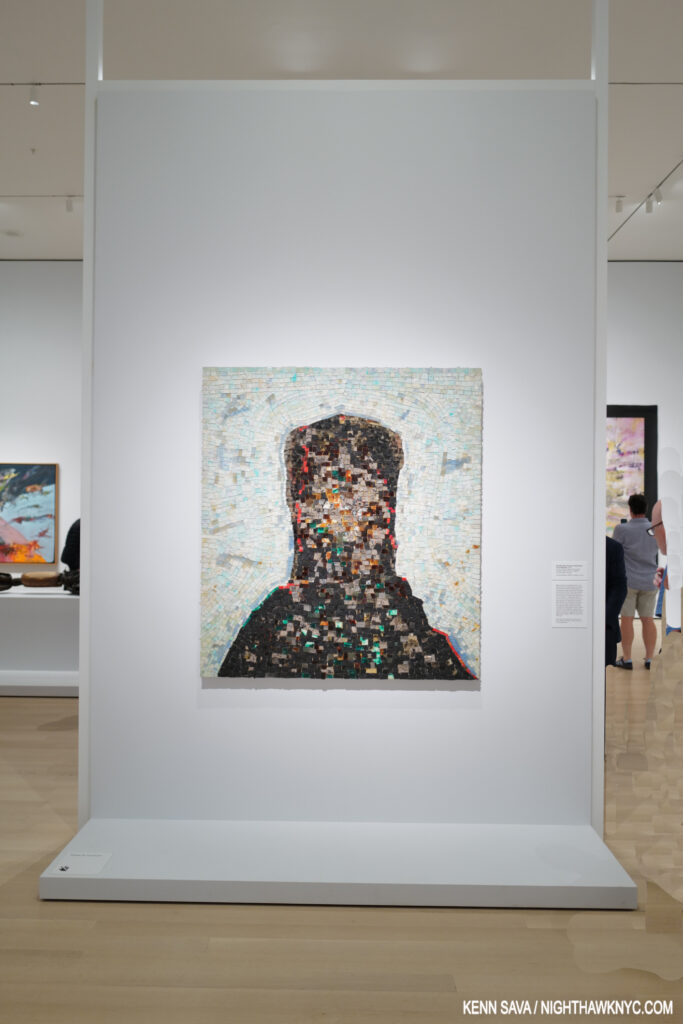
“Any major dude with half a heart surely will tell you, my friend
Any minor world that breaks apart falls together again
When the demon is at your door
In the morning it won’t be there no more
Any major dude will tell you
Any major dude will tell you”*

*-Soundtrack for this piece is “Any Major Dude,” by Donald Fagen & Walter Becker of Steely Dan from their classic album Pretzel Logic, 1974.

NighthawkNYC.com has been entirely self-funded & ad-free for 9 1/2 years, during which 350 full-length pieces have been published! If you’ve found it worthwhile, PLEASE donate by PayPal below to allow me to continue. Thank you, Kenn.

You can also support it by buying Art, Art & Photography books, and Music from my collection! Art & Books may be found here. Music here and here.

Written & photographed by Kenn Sava for nighthawknyc.com unless otherwise credited. To send comments, thoughts, feedback or propositions click here. Click the white box on the upper right for the archives or to search them. Subscribe to be notified of new Posts below. Your information will be used for no other purpose.