Jack Whitten: The Black Monolith

This site is Free & Ad-Free! If you find this piece worthwhile, please donate via PayPal to support it & independent Art writing!
You can also support it by buying Art & books. Details at the end. Thank you!
 

Written & Photographed by Kenn Sava. (*- Unless otherwise credited)

Show seen: Jack Whitten: The Messenger, MoMA, 2025.

After a quiet Summer, 2024, Summer Blockbusters brought the heat back to Manhattan in 2025. Four shows stood out to me: a pair at the Whitney1 and two at MoMA. Having already written about MoMA’s Hilma af Klint: What Stands Behind the Flowers, here, simultaneously upstairs on 6,  Jack Whitten: The Messenger, was the kind of show that made MoMA what it is for many around the world: one of, if not THE, leader in presenting excellent Modern (even Contemporary) Art shows. I’ve written about many of them in these e-pages these past 10 1/2 years.

Few Artists were more Contemporary than Jack Whitten. In fact, he invented some of its language, and a good deal of its emphasis/focus/center.
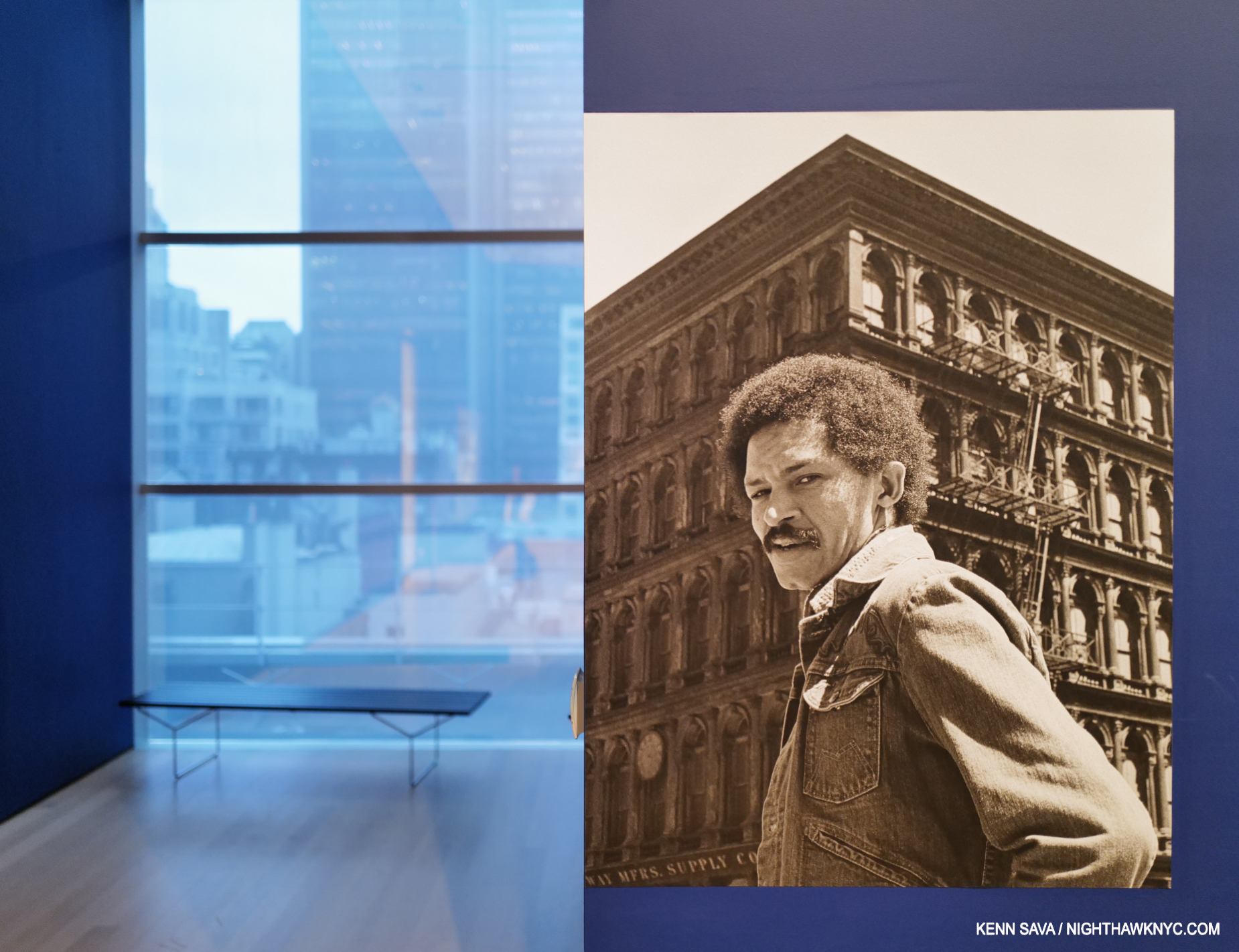
Man about town. Jack Whitten, a transplant from Alabama, was an NYC resident for 58 years, spending most of that time Downtown, before moving to Queens- except when he was “gone fishing,” as he wrote in his Notebooks on his departure for Crete each summer. The Artist is seen here on the corner of Broadway & Broome Street in the early 1970s on the Introductory wall card. When I see this Photo, I’m reminded that later he owned a building on Lispenard Street, a few blocks north of The World Trade Center. I tell the story of Jack Whitten on 9/11 further on.

Still, it left me with a deep sadness that after decades of struggle, Jack Whitten (1939-2018) didn’t live to see it.
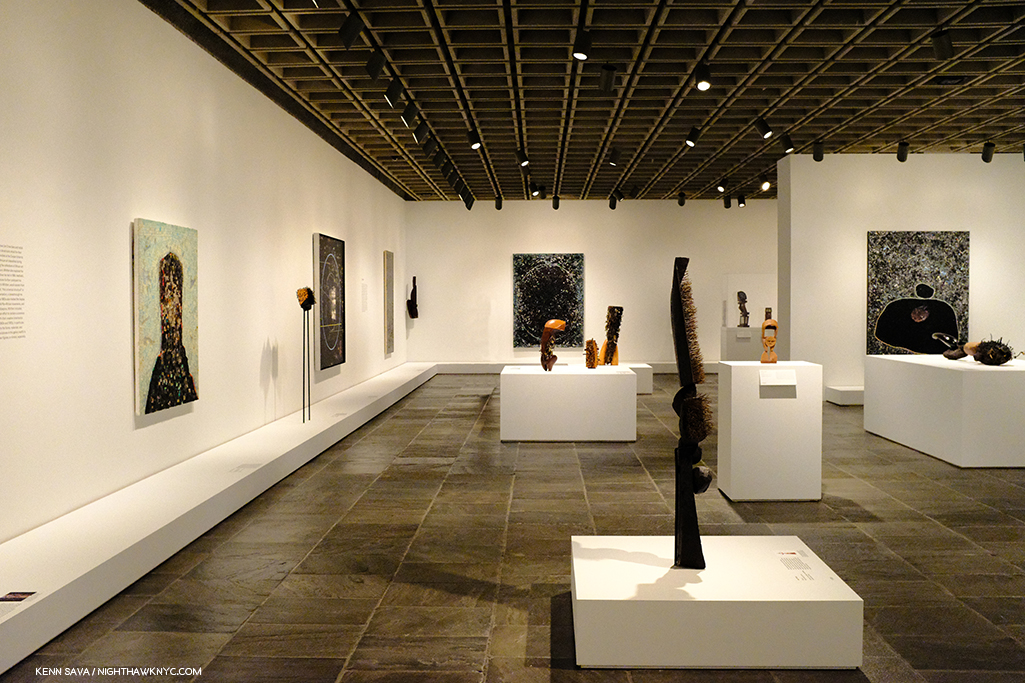
Installation view of the first gallery of Odyssey: Jack Whitten Sculpture 1963-2017. The Met Breuer, November 24, 2018

He didn’t live to see the other great show of his work either- Odyssey: Jack Whitten Sculpture 1963-2017, the Retrospective of his Sculpture which he mostly kept from public display, which came to NYC at The Met Breuer in 2018, and which I wrote about here. Together, they make a very compelling case for Mr. Whitten’s extraordinary creative & imaginative range, the extremely wide range of his talent & skill, his accomplishment, and his place as a 20th & 21st century Master.
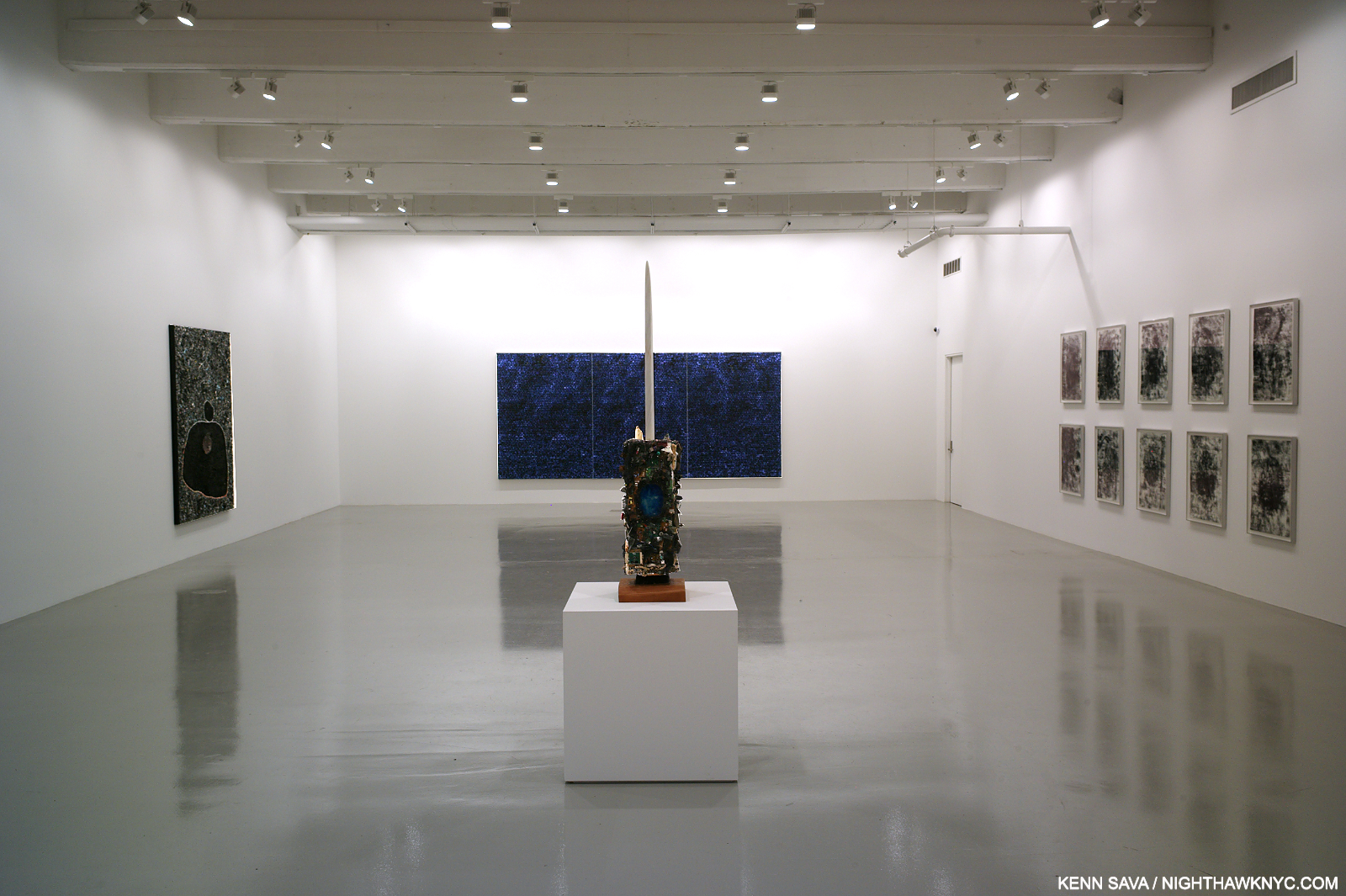
Installation view of the first gallery of the final Jack Whitten solo show during his lifetime at Hauser & Wirth, February 7, 2017. It was the first time I had seen one of his Sculptures. Quantum Wall (A Gift for Prince), is on the back wall. It can be seen in full in my piece on Jack Whitten: Odyssey, here, an installation view of which is shown above.

Both shows point out a sorry reality for too many great Artists. Jack Whitten is just one of many who waited in vain for their U.S. Retrospective. Meanwhile, numerous deceased Artist receive show after show (I’ve seen ten shows of the work of Jean-Michel Basquiat in NYC since 2012, for example, and written about almost all of them), while too many deserving living Artists go ignored, until years- even decades, after their passing.
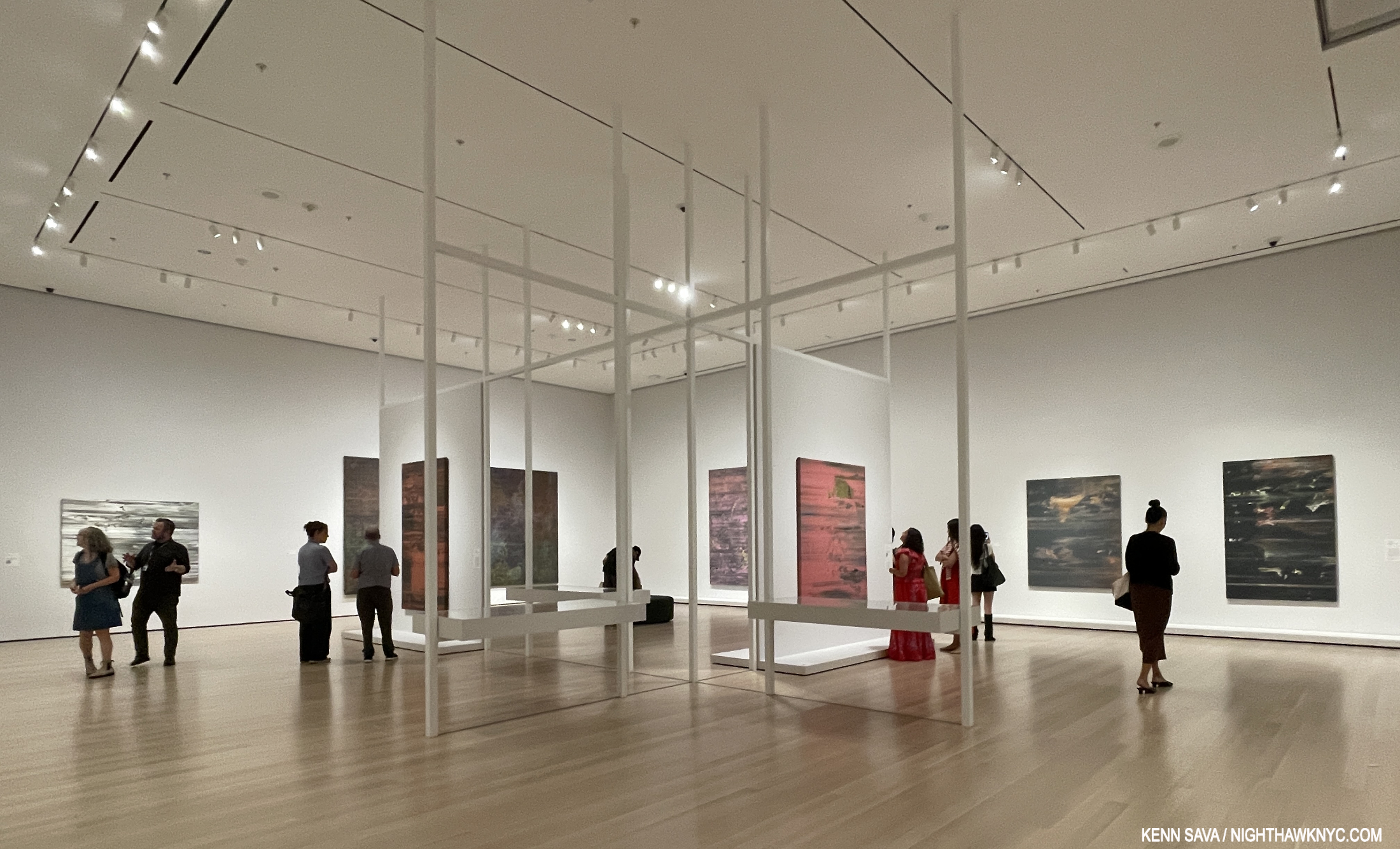
Jack Whitten: The Messenger, Installation view, MoMA, July 31, 2025.

Nonetheless, all the while, his Art continued to ascend the ranks of appreciation and acceptance. It wasn’t always thus. Getting to this point has. been a rough and rocky road. An excerpt from MoMA’s Exhibition Catalogue (which is recommended as the most comprehensive book on Jack Whitten ever, in spite of its cardboard binding) looks back to his beginnings-

“Whitten made some of his earliest images as a teenager, painting hand-lettered signs for local businesses in his hometown of Bessemer, Alabama, in the 1950s. One of his first paid jobs was for a Civil Rights protest on the steps of the county courthouse. These images were meant to travel: to say something, to have reach. Whitten learned the technique using tools left behind by his mother’s first husband, James Monroe Cross, a commercial sign-painter who died before Whitten was born. It was unusual for Cross, a Black man, to have a skilled occupation and own his own business in the deeply segregated Jim Crow South. The artist suggested that Cross was always under threat of suspicion, even violence, for his profession. Making images was a rebellion and a risk… ‘Transmission is the key,’ he said2,'”
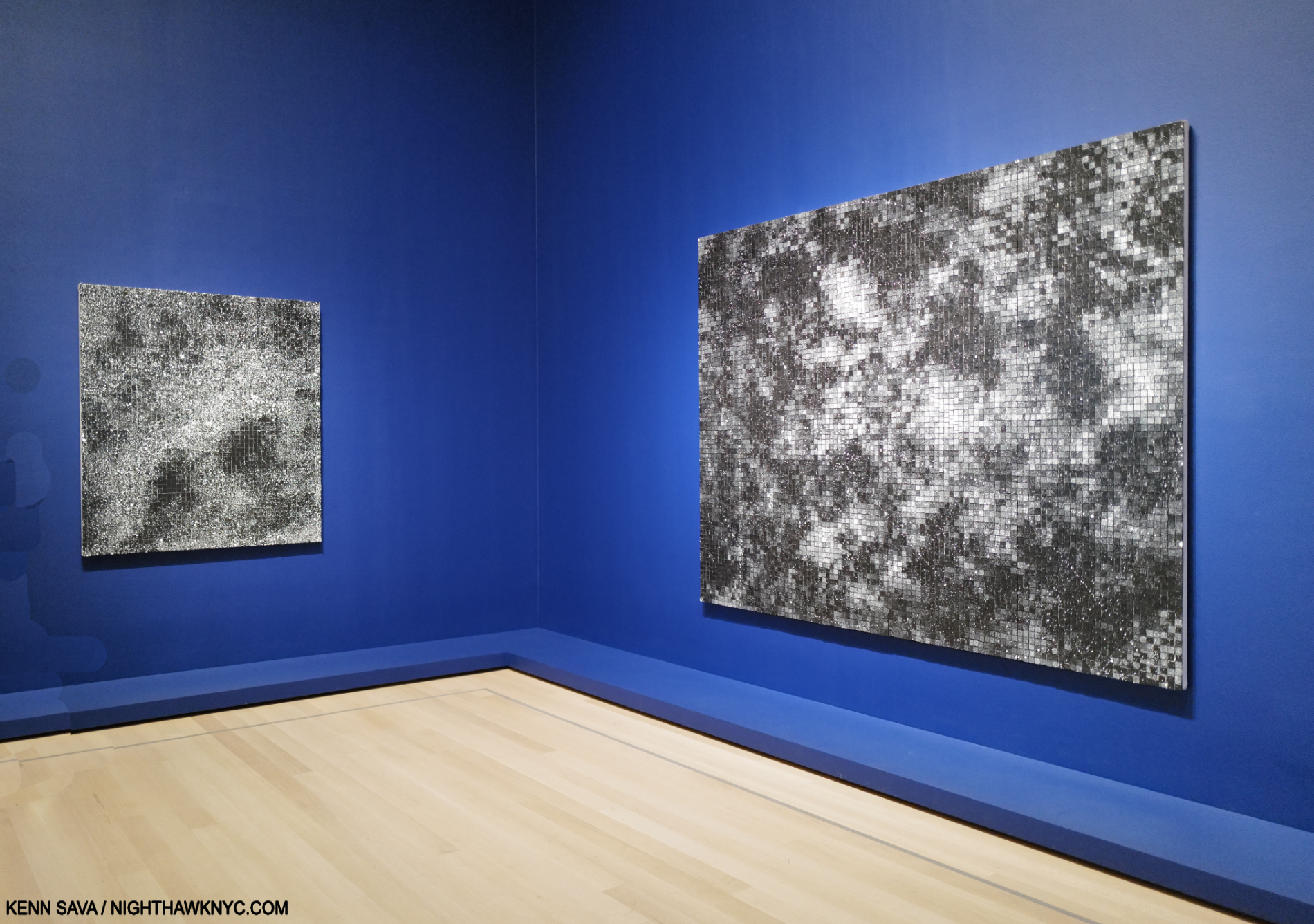
The earliest work in the show reveals Jack Whitten’s life long passion for Jazz. The Messenger (For Art Blakey), 1990, left, and Homecoming: For Miles (Davis), 1992 (the year after Miles passed), right. Both Acrylic on canvas.

Reading that, my thoughts turned back to another MoMA blockbuster that was full of “signs,” literal and figurative: Ed Ruscha/Now Then, which occupied these same galleries not long ago, the subject of a 3-part series I wrote. There are surprising similarities, and differecnes, between them. Largely contemporaries, Mr. Ruscha (b. 1937, Mr. Whitten born two years later in 1939), is perhaps best-known for his word Paintings. Though he started with a paying job making protest signs bearing words, Jack Whitten’s Art is almost exclusively wordless, except for its titles. His Art transcended words while honoring his mantra, “Transmission is the key.” Both Artists were born and raised in the South. Jack Whitten in Alabama- “in apartheid,” he said, Ed Ruscha in Tusla, Oklahoma, considered part of the South by some. Both left and attended Art schools, Mr. Whitten at Cooper Union, NYC,3, and Ed Ruscha at CalArts in L.A.. Both stayed put in their new locales for the rest of their lives and their extraordinarily long careers. Both used their Art to regularly comment on the world around them, though Jack Whitten seemed more the Activist. It’s also interesting that both Artist oeuvres are almost entirely devoid of images of people.
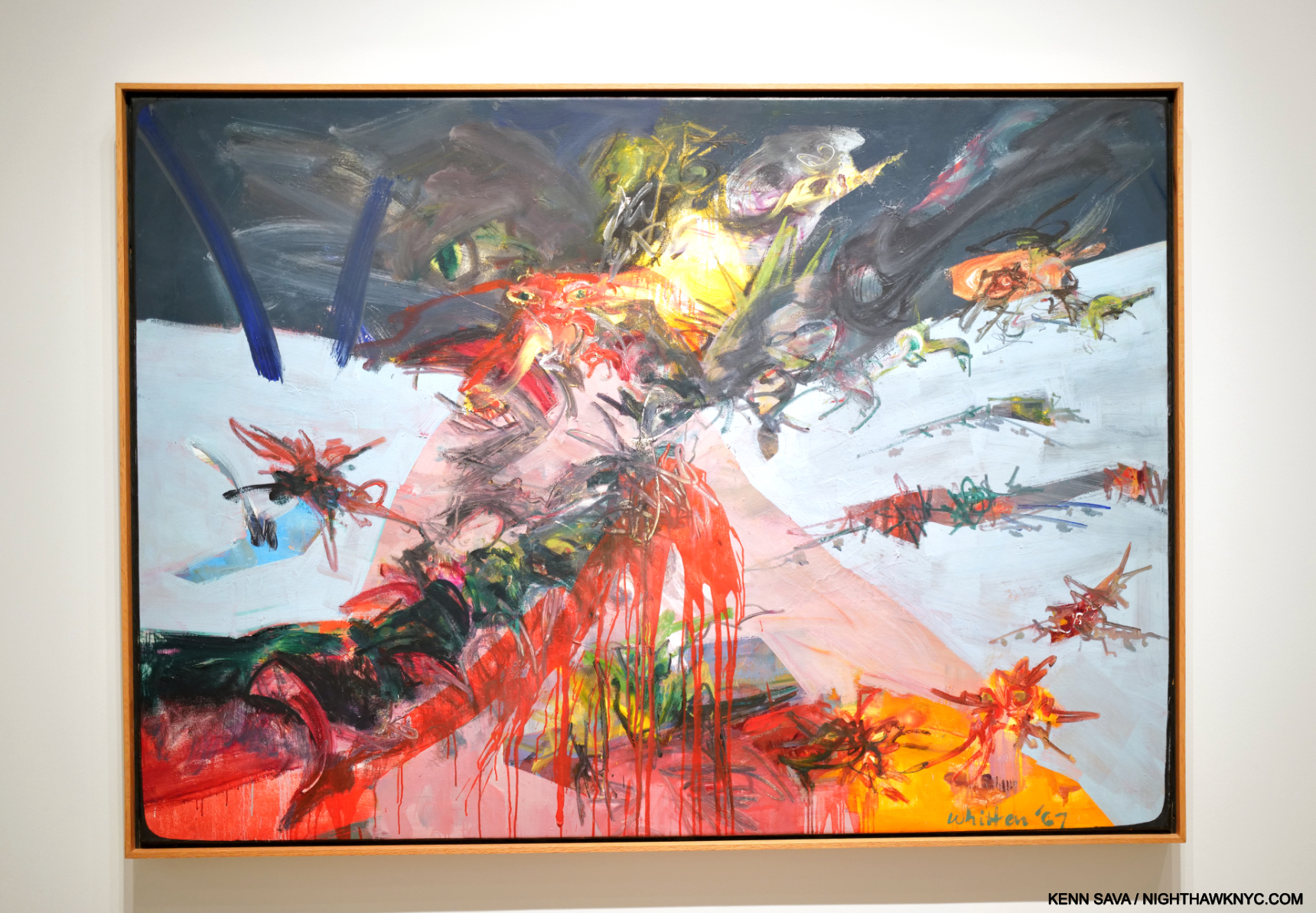
NY Battle Ground, 1967, Oil on canvas

As for their significant differences, Jack Whitten had to survive the 1960s, including the violence that surrounded the Civil Rights Protests. Deeply effected hearing Dr. Martin Luther King speak at the Montgomery Bus Boycott in 1955-56 after Rosa Parks’s arrest, the event that brought Dr. King to prominence (and the event at which Jack Whitten met Dr. King), he soon became fed up with the violence surrounding the Civil Rights Movement, so he moved to NYC in 1960, then graduated from Cooper Union with a bachelor’s degree in 1964, before finding his voice through the influence of the Jazz Musicians he met and the 1st generation Abstract Expressionists who he encountered here. His work would remain abstract his entire career. In spite of all of this history, Jack Whitten skips it and begins his riveting, 568-page collection of his studio notes from 1962 to 2017, Notes from the Woodshed, (the closest thing we have to an autobiography), with the 1960s & with his move to NYC.
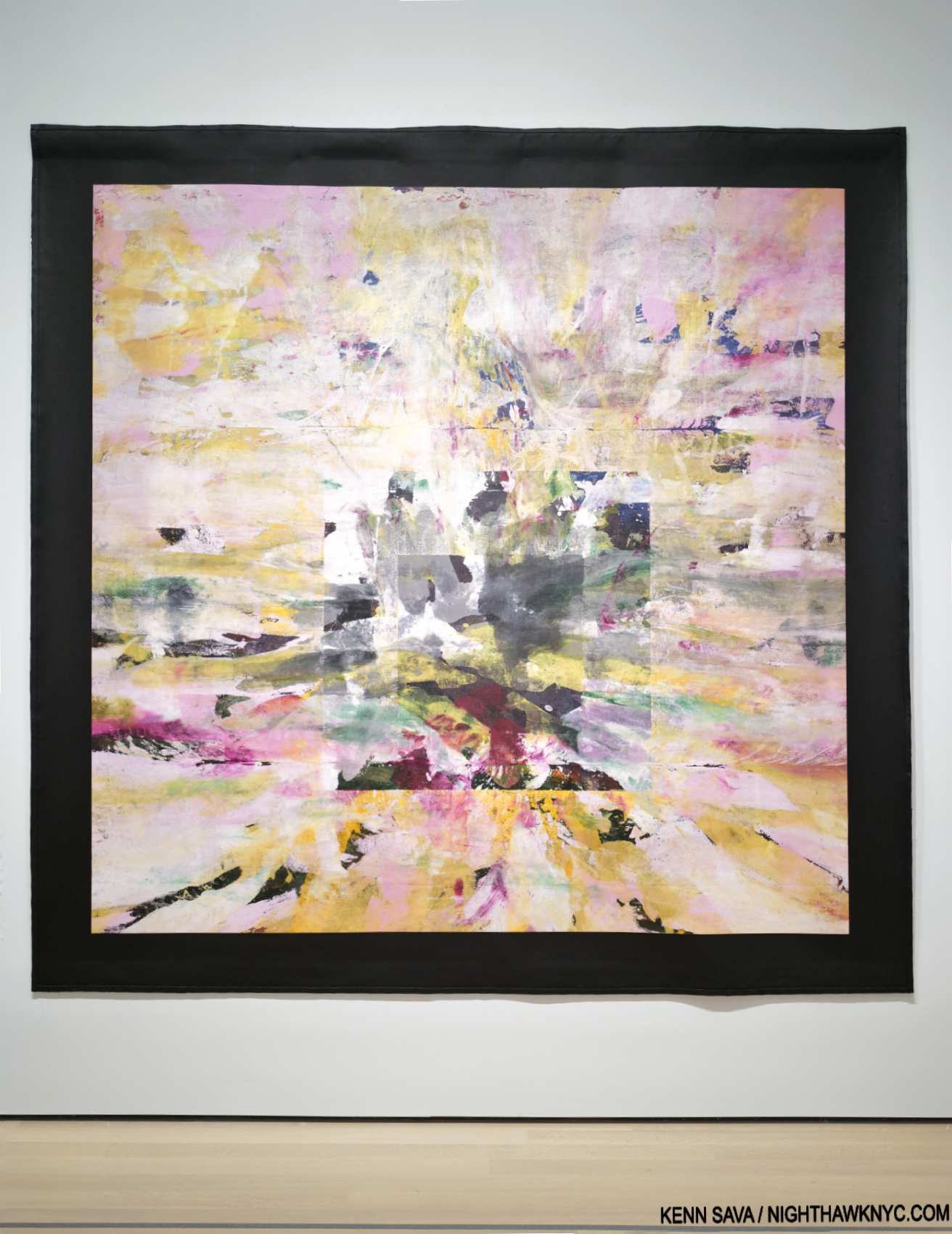
Light Sheet I, 1969, Acrylic on canvas

“Never in my wildest dreams did I think that I would reach thirty years of age without self-destructing. . . . The 1960s were coming to an end; I was still alive and in one piece.”

He would go on to live and work for another forty-eight years.

“1970 was the turning point,” he recalled4. At the start of a new decade, the Artist moved to a studio on Broome Street and had a breakthrough. He stopped making figurative art and got rid of his paintbrushes(!), which may be unprecedented among Painters in Western Art history to his time. The studio became a laboratory designed to experiment with acrylic paint5. The medium, a recent innovation made from plastic, offered a vastly expanded range of color, texture, and handling. Seizing the opportunity, Whitten invented tools and techniques that were entirely new to the history of Western art.
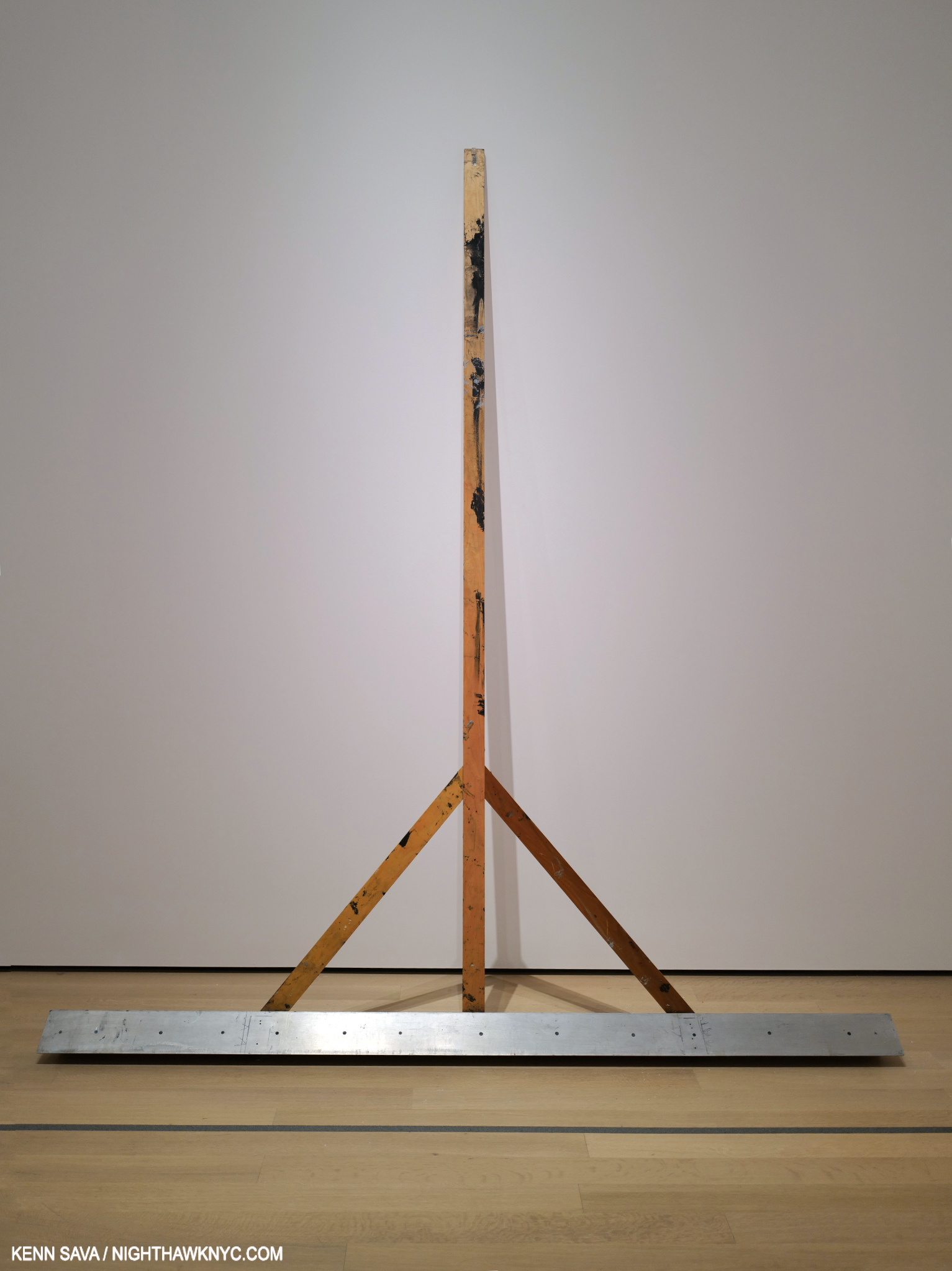
Welcome to Jack Whitten’s post-1970 practice in which he “made” Paintings (he said) without using paint brushes. With this, they were “developed,” akin to how Photographs were. Introducing The Developer. At 12 feet long, creating Art with it is the other part of the equation. Especially since none of the Art I’ve seen that Jack Whitten may have made with The Developer have a dimension of 12 feet. He’s using this on pieces that are smaller than the tool.

From an Afro-comb to a twelve-foot-long wooden rake, which he called The Developer (a reference to photography), novel implements were maneuvered by the artist to pull layers of acrylic paint across canvases laid on his studio floor in one sweeping movement6.” Inventing a technique is impressive. Making Art using it takes mastering it first. Easier said than done with a 12-foot long rake in your hands! In this extraordinary video from 2017, Jack Whitten talks about growing up in “American Apartheid,” as he calls it, meeting Dr. King, and demonstratesThe Developer-

What stands out to me is that Jack Whitten, when faced with violence, met it with non-violence. He turned his anger into Art. Art without words. Abstract Art, at that. Revolutionary for a Black Artist. An Art that continued to represent those he admired and “transmitted” what he experienced in ways never before seen. It seems to me that that says all you need to know about the man.

Back at MoMA, the result of all the techniques he invented and perfected and his seemingly endless creativity made Jack Whitten’s work is so unique, and different from itself, that MoMA’s curators chose to install the show with numerous one-work walls. I previously experienced this in diane arbus: in the beginning at The Met Breuer.
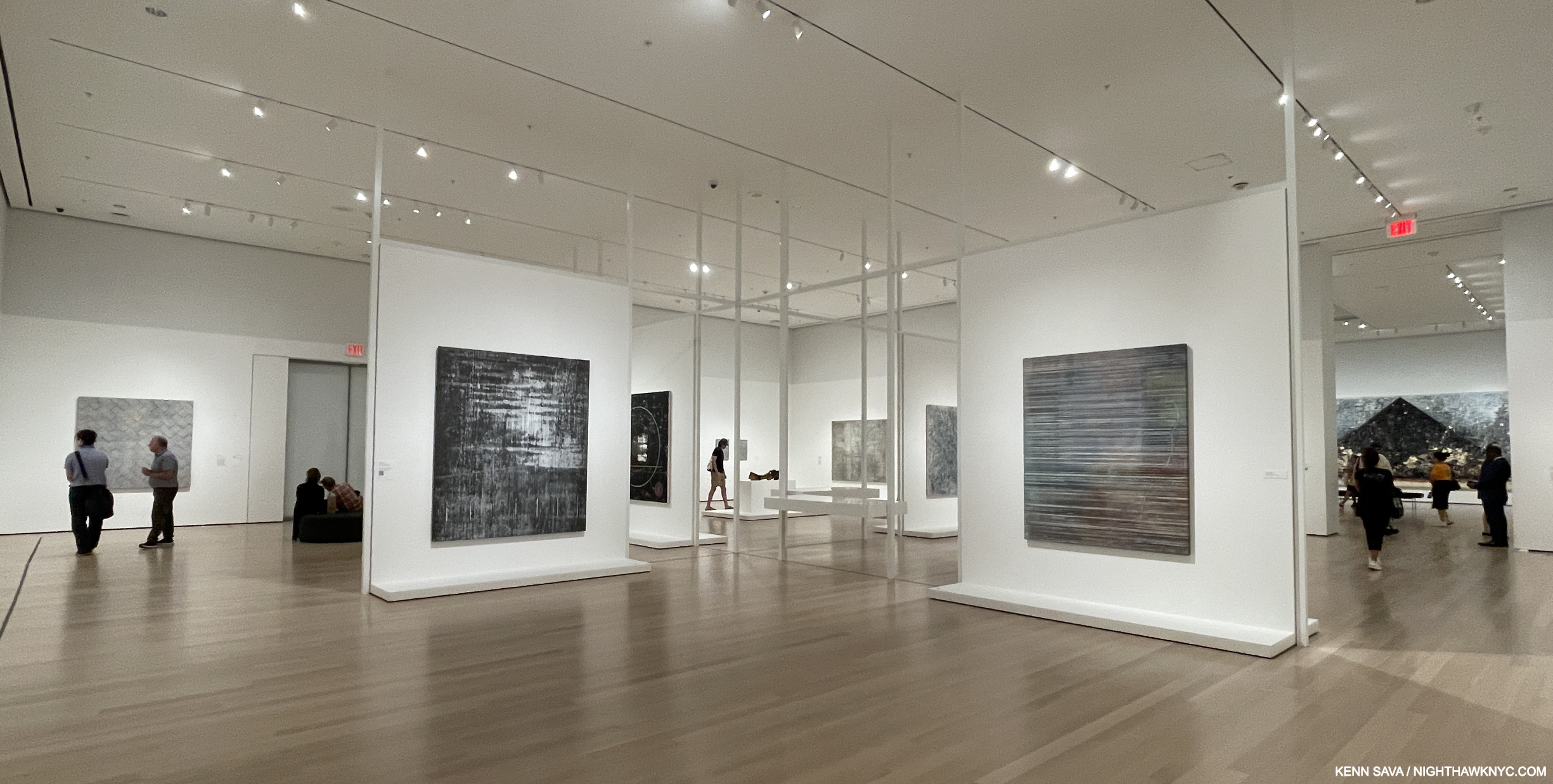
Installation view. Installing one work on a wall is something that works extremely well for Jack Whitten’s work, in my view, since so much of it is so different from everything else. It allowed each piece to be considered singly, and then as the viewer moved around, as part of his whole. It made it very easy to “get lost” in the work & the show, something I went back to it to experience again.

Here, I thought this worked brilliantly and the resulting installation of these walls is one of the features I’ll long think of when I think of Jack Whitten: The Messenger.
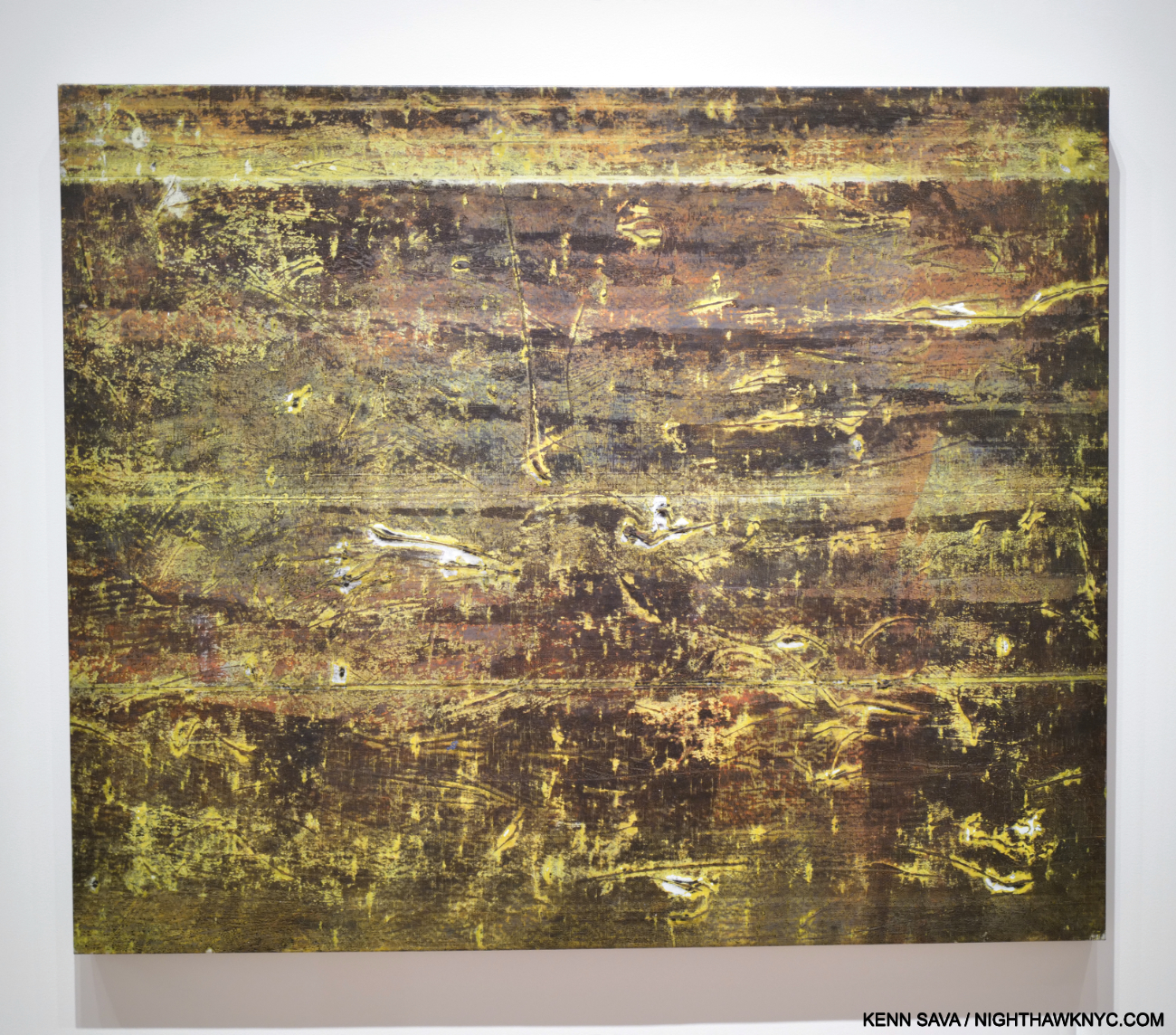
The First Loading Zone, 1973, Acrylic on canvas

Today, Gerhard Richter gets a lot of notoriety as a “squeegee master,” yet he didn’t begin using the technique until 19857! Still, techniques do not make a work “Art,” with a capital “A,” as I write it. Yet, at least to my eyes, having seen Gerhard Richter: Painting After All on its last day (my look at it here), and the last day of the lost & lamented Met Breuer, what I saw over both shows left me feeling that Jack Whitten’s “Developer” works will continue to rise in esteem & appreciation. Since I believe that comparing Artists or Art works is subjective, I’ll leave it at that.
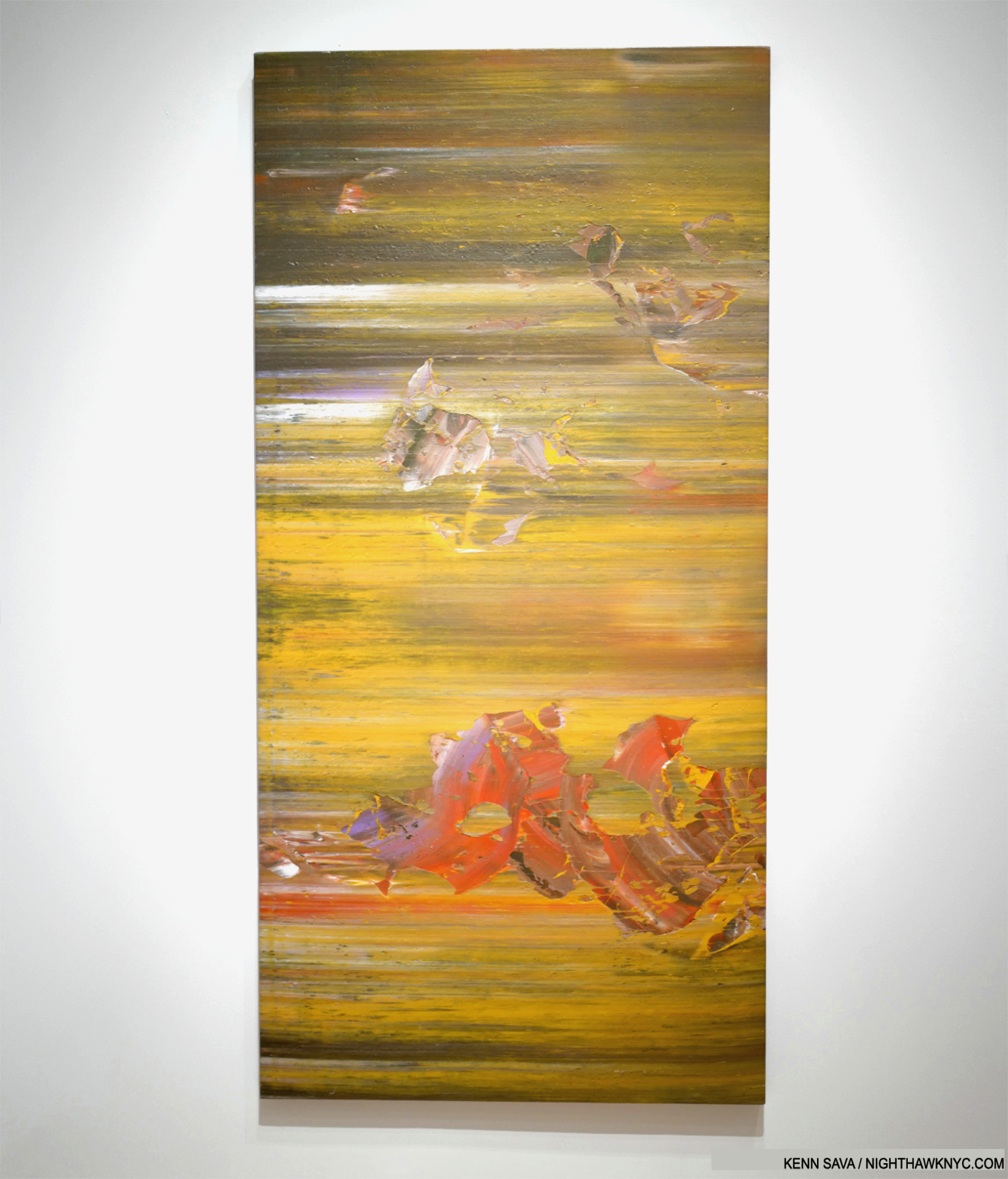
Chinese Doorway, 1974, All work are Acrylic on canvas unless stated. At 89 1/2 × 43 1/4 inches, it’s hard to say if this was created with The Developer, but if not, it appears he used another of his scraping tools.

But his “Developer” works are just one part of the work Jack Whitten created over his 58 year career, a part that fit in seamlessly with everything else he created as was to be seen in the incredibly rare opportunity to experience a large body of his work. This is in itself, remarkable. I’ve seen countless group exhibitions where different styles didn’t mesh well with each other. Yet, in The Messenger they meshed brilliantly and coalesced into telling one story: his.
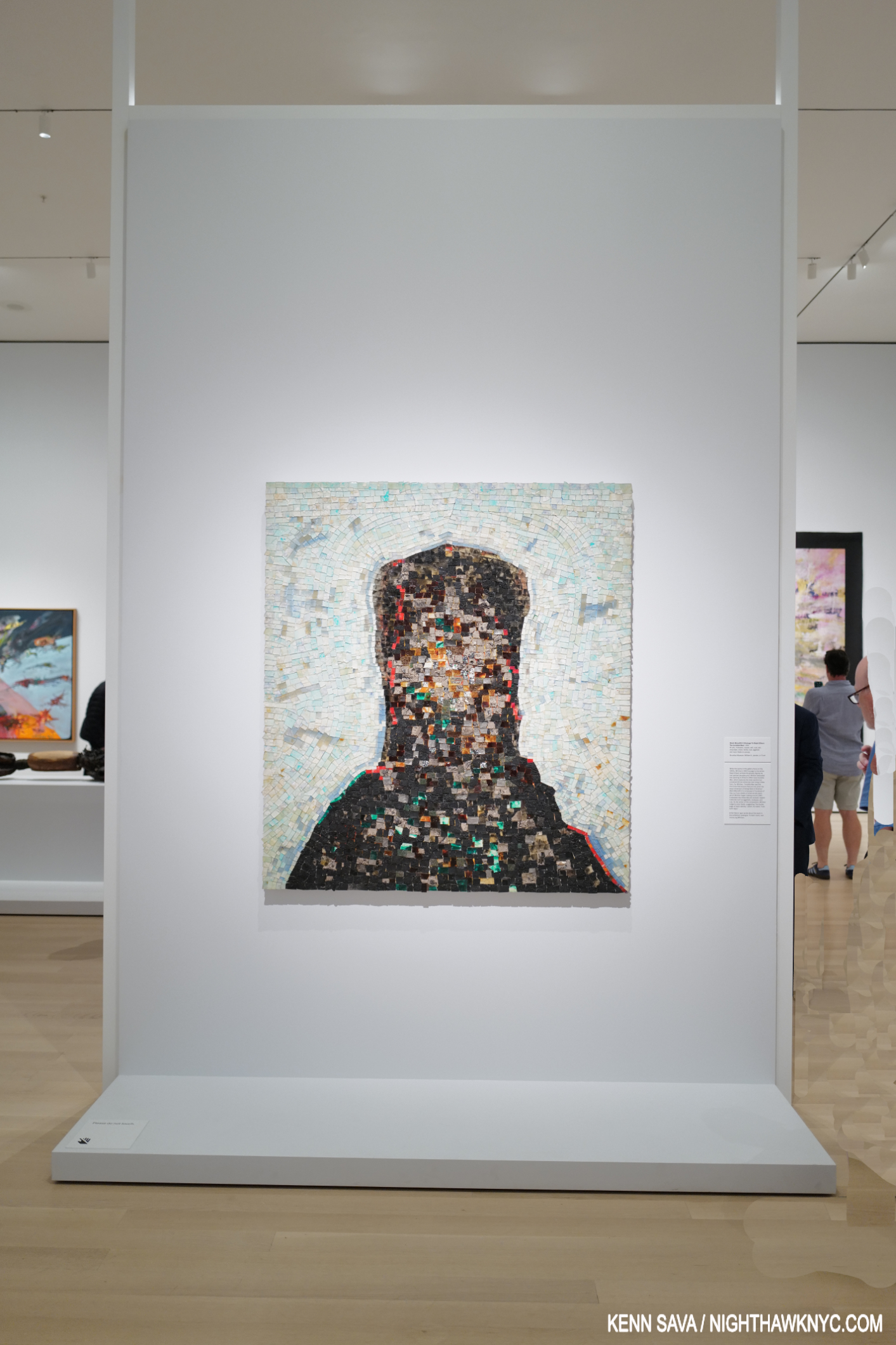
Black Monolith II (Homage To Ralph Ellison The Invisible Man), 1994, Acrylic, molasses, copper, salt, coal, ash, chocolate, onion, herbs, rust, eggshell, with razor blade on canvas. As close as Jack Whitten comes to “traditional Portraiture.”

Walking through it left me realizing that it’s hard to think of another Black Artist who captured the times he lived in and so many of its leading figures in her or his Art, besides Charles White. For me, at least, when these works (including his Black Monolith series) are taken as a whole, the result is something of a Self-Portrait of the Artist: a man of his time, in his time, who rose above his time and all the travails he encountered to create something completely new and completely Jack Whitten, leaving echoes & impressions of his experiences.
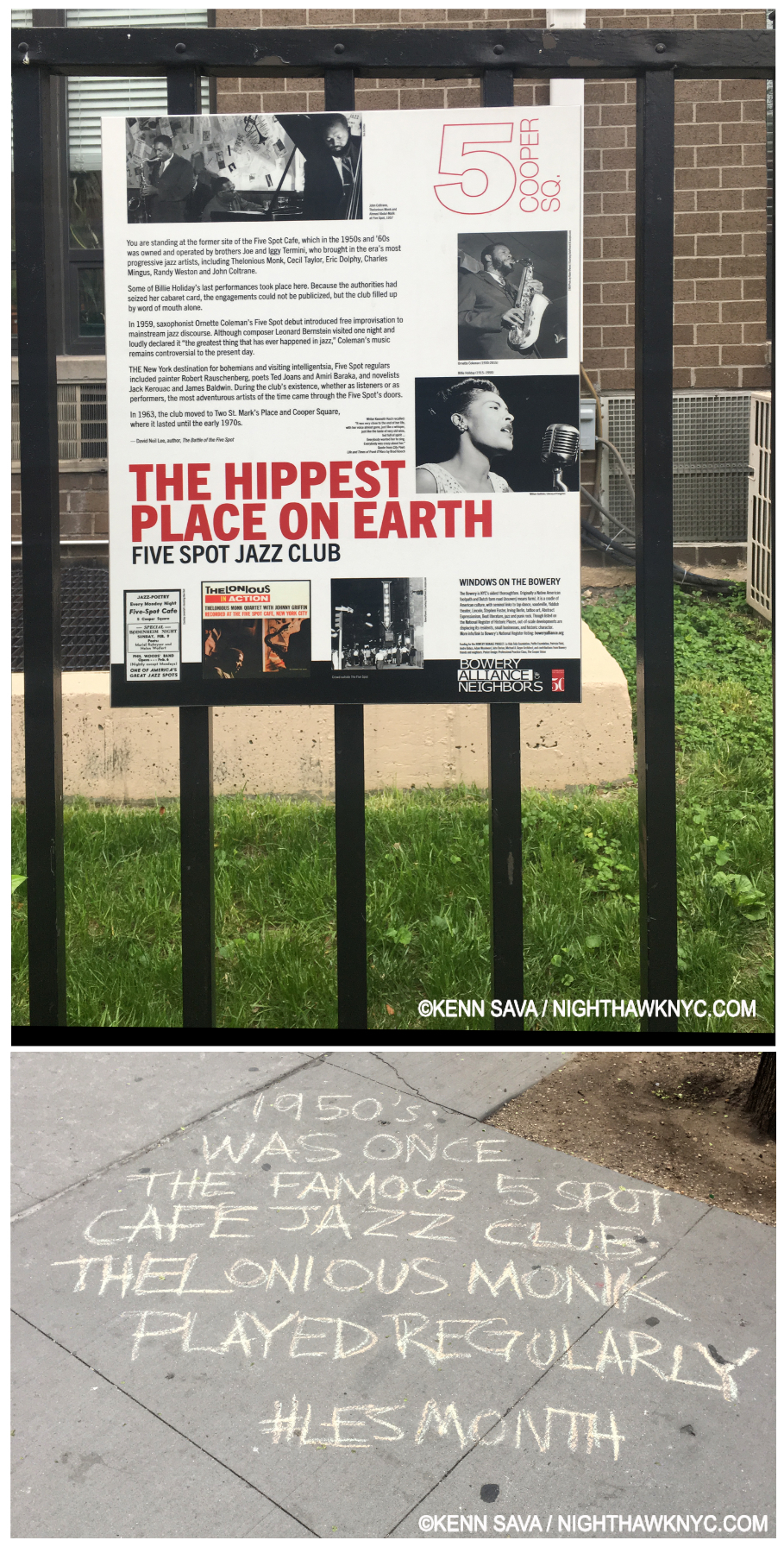
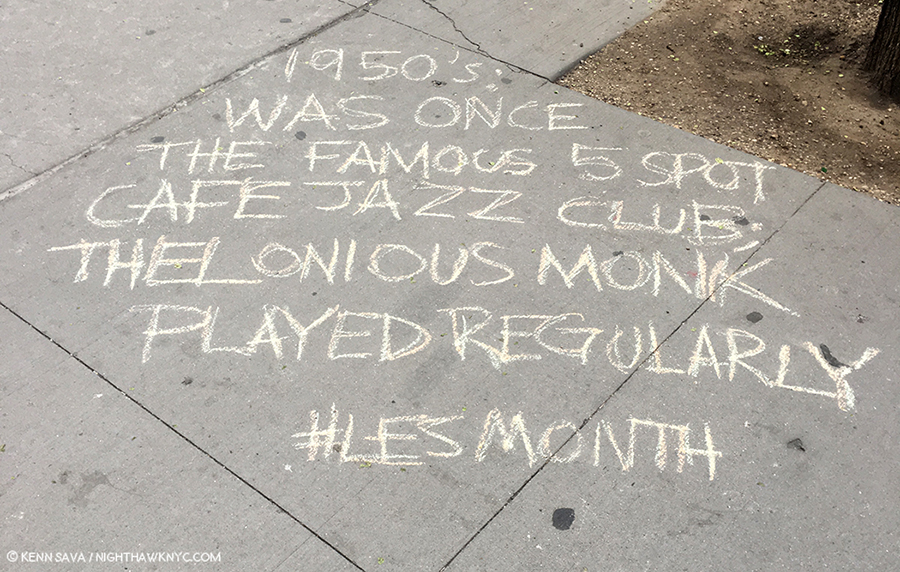
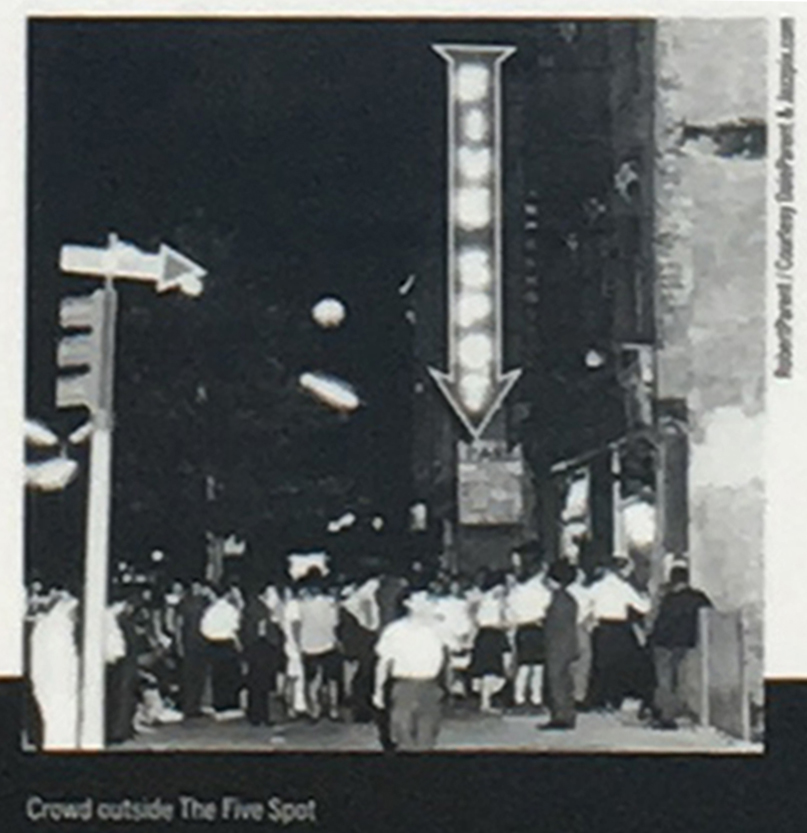
Chalk editor’s note- Insert “This” in front of “was once.” (No, I did not write it.) NYC is “only” 402 years old, still you can be sure that with every step you take here you’re walking on history. So it is here in front of this nondescript residential building. But back in the late 1950s and early 1960s this was the location of “the hippest place on earth”- the now legendary Five Spot nightclub. The list of Jazz immortals who performed here is only matched by the legends of Art, Music, & Literature who hung out here to hear them.

Among the leading, now legendary, figures of his day that Jack Whitten encountered and even spoke with are Jazz Masters Thelonious Monk and John Coltrane, the latter, who was embarking on his own spiritual quest after a period of drug use, had an especially deep and lasting impact on Whitten’s Art.
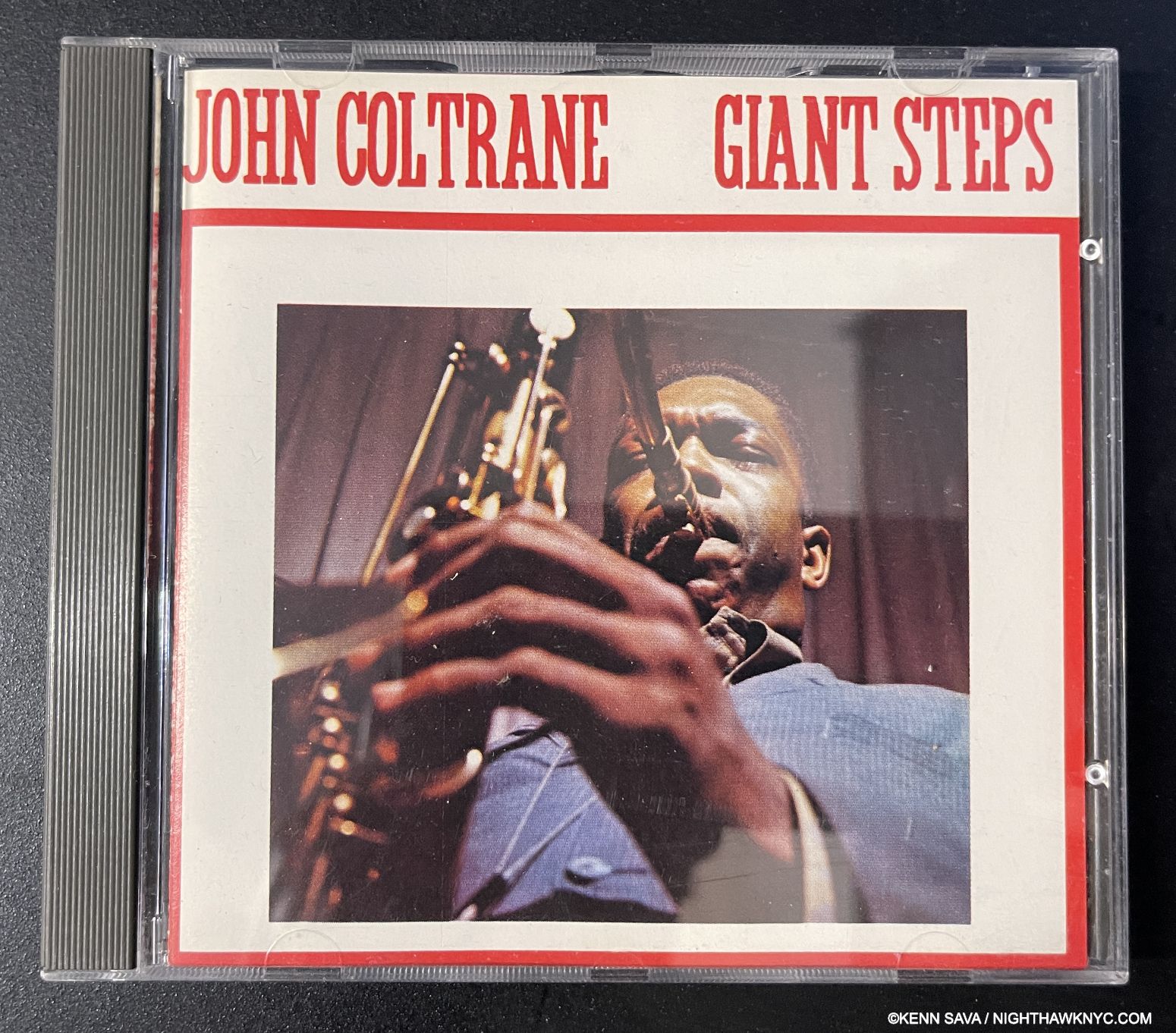
John Coltrane: Giant Steps, 1960. One classic that’s in both of our collections (Jack’s on LP as shown in the catalog. My LP was replaced with this CD after wearing out), John Coltrane is shown here, Photographed on the cover by Lee Friedlander, around the time he was frequenting The Five Spot.

Jack Whitten frequented the legendary Five Spot nightclub on East 5th Street, and came to amass a terrific Jazz record collection.
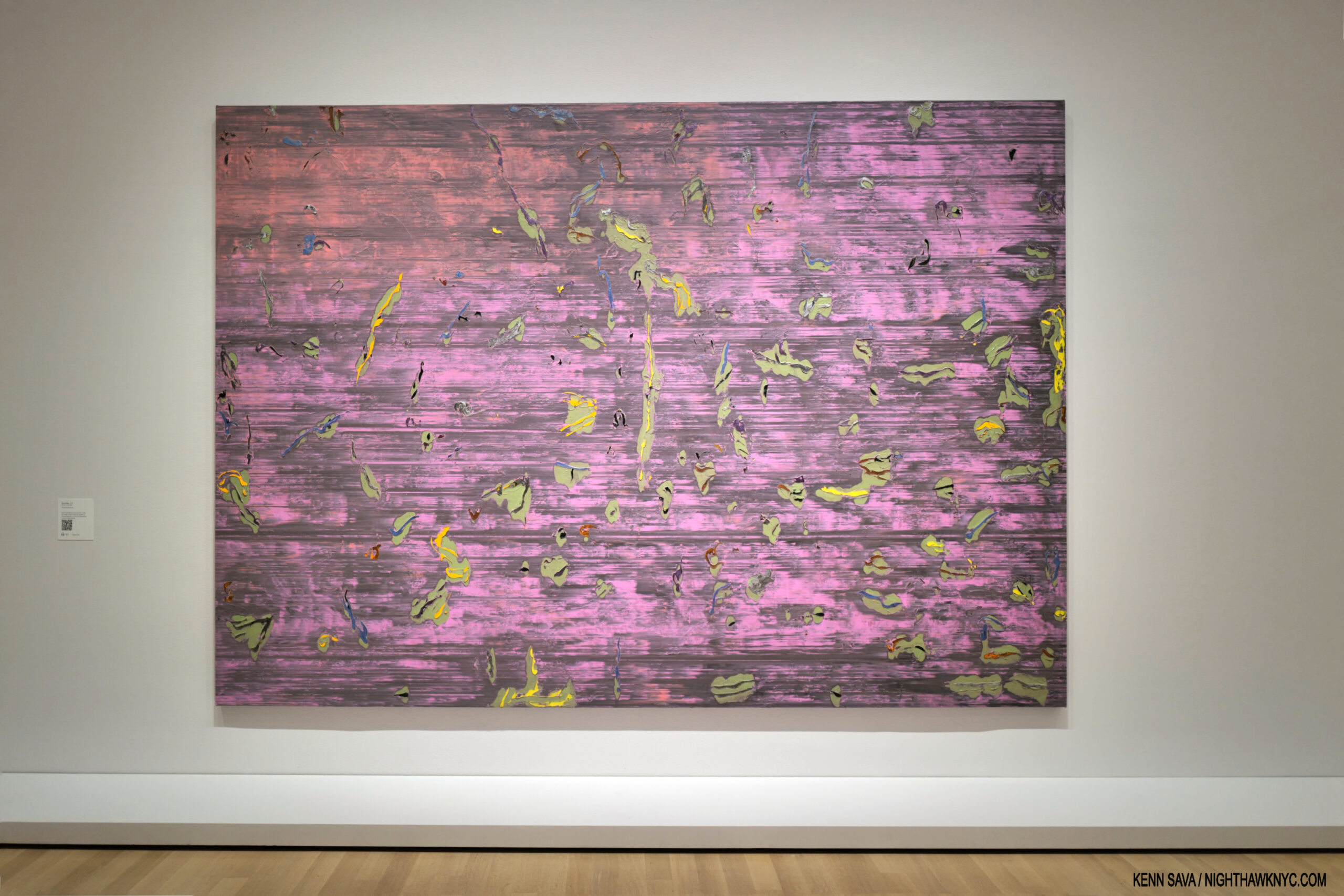
Asa’s Palace, 1973, Acrylic on canvas

Another thing that stands out for me is that Jack Whitten was one of the earliest Black Artists to adopt abstraction, something that has continued in the work of Mark Bradford among quite a few others.

“There are two kinds of abstraction, the abstraction of Pollock and the abstraction of [Piet] Mondrian,” Jack Whitten wrote in 1969. “It is possible to create a third abstraction based on the theory of transcending these two8*

His titles often “ground” the work, but then the viewer is left largely on her or his own, often with a staggering amount of detail to consider. This last puts the lie to theory that abstract Art is “dashed off,” perhaps born of a misunderstanding of Jackson Pollock’s “dripping” technique, or the appearance of Franz Kline’s brushwork. Walking through The Messenger, I was hard pressed to find a single work that looked “dashed off.” On the contrary there were works where Mr. Whitten first had to invent, then perfect, the technique he used before the work could begin!
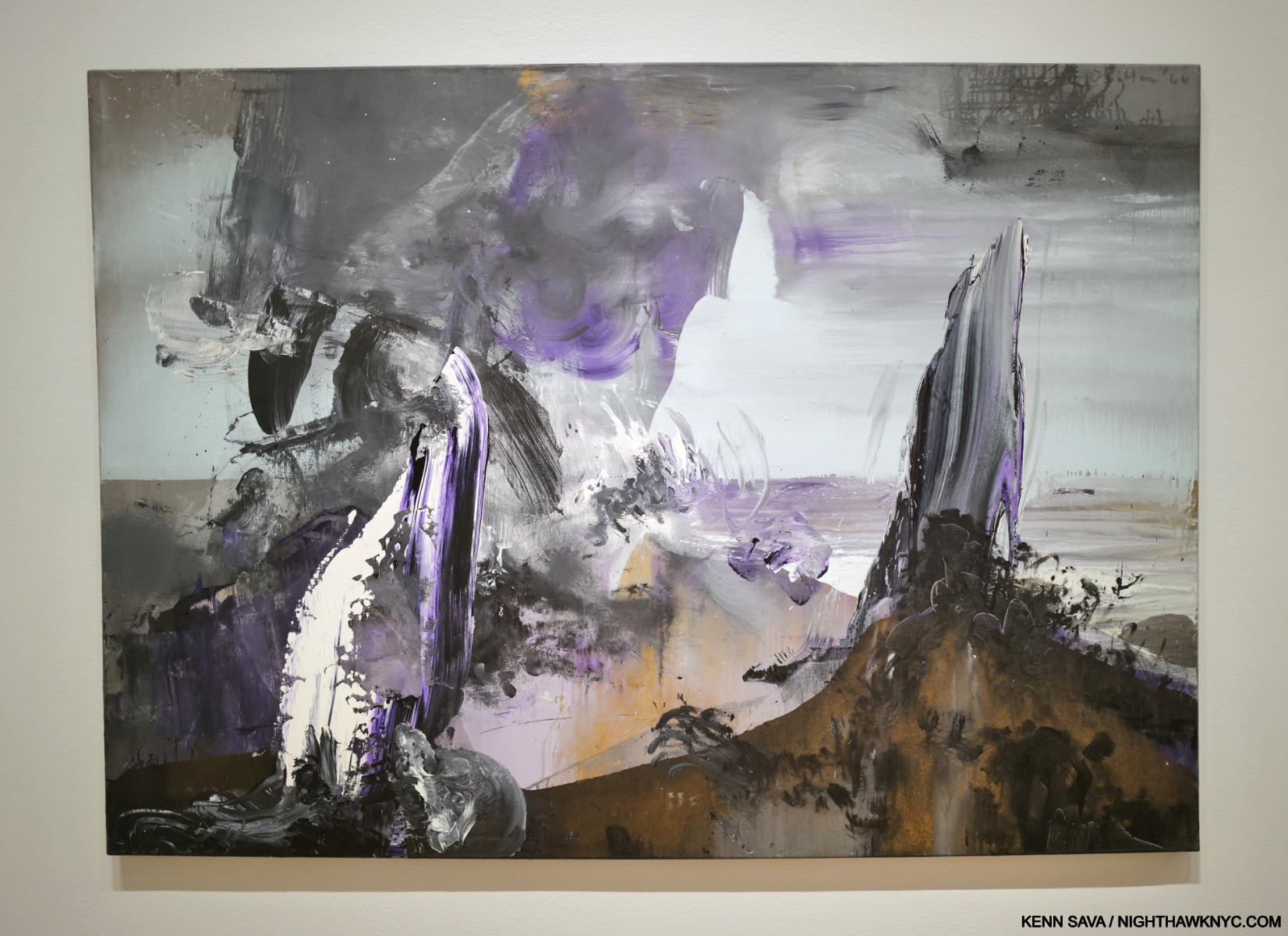
Atlantis Rising, 1966, Acrylic on canvas

Jack Whitten was  an eyewitness to the first plane flying into World Trade Center 1 on 9/11 from 14 blocks away! Incredibly, his voice is heard on the only video there is of that plane impacting the North Tower, by the Naudet brothers who were making a documentary on the New York Fire Department. Following them around, that morning they answered a call about a gas leak at the building Jack Whitten owned on Lispenard Street. The Naudets happened to be filming the firemen who were trying to find it when the plane flew right over their heads! Jack Whitten’s voice is the one heard making the expletive as it crashes into the North Tower9. The NYFD immediately jumped in their trucks, accompanied by the French crew under the direction of the Naudet brothers and James Hanlon (making the renowned documentary 9/11) and headed off to Ground Zero. Mr. Whitten-

“I was in the street that morning. This plane came right overhead, and when that sound came overhead, you could feel your flesh crawling, I mean, seriously, rippling. We looked up, this plane was right on top of us. At first you didn’t see any flame, any smoke. You just saw this big gap and hole, and the sky was filled with a chandelier of glass. It was later you saw the smoke and the flames. My gut feeling told me that that was not an accident.  This is what I call the particularities of violence—close to 3,000 people were murdered in my neighborhood. People were screaming, crying.”

He stopped making Art, except for this piece, which took him five years to complete-
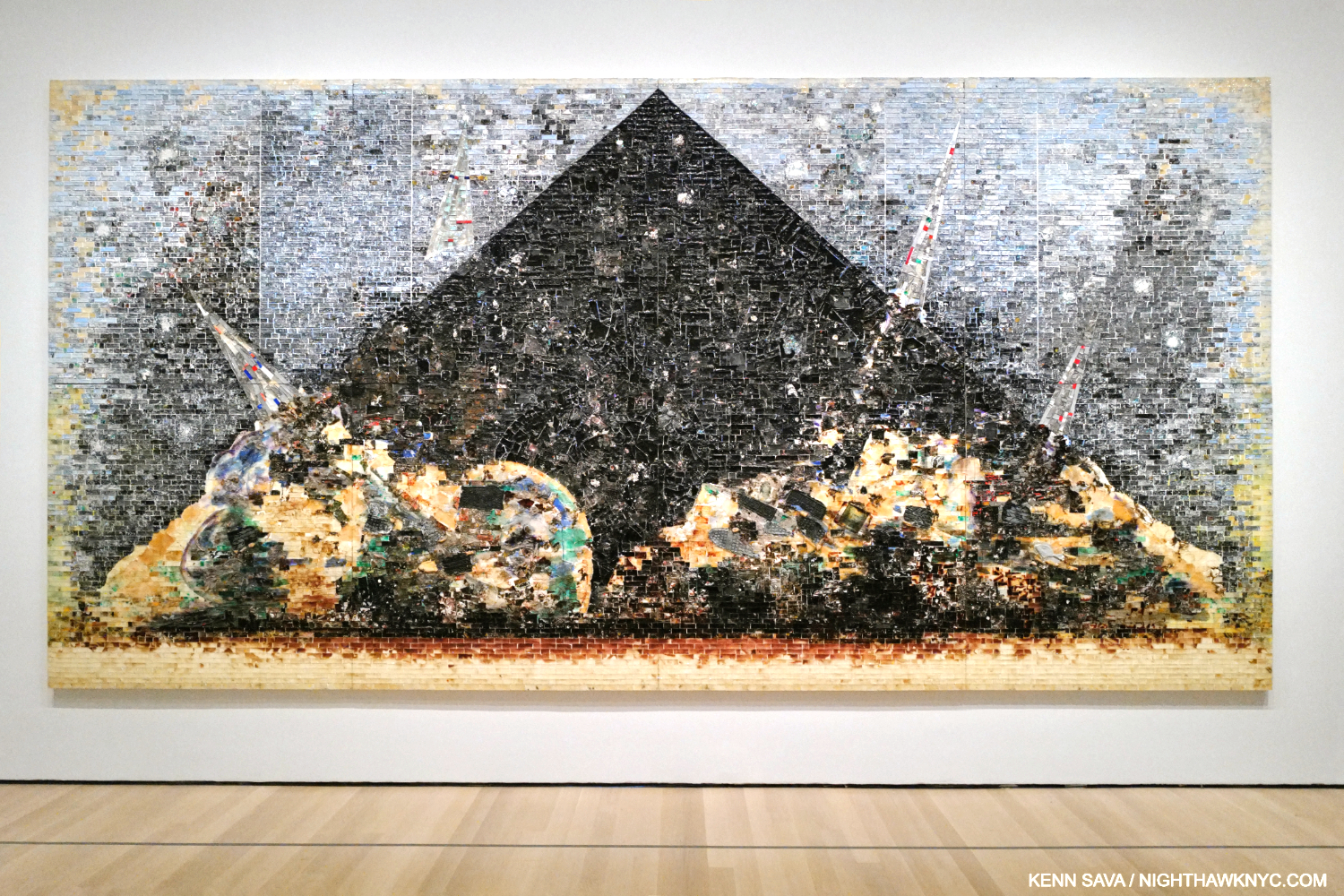
9.11.01, 2006. Acrylic, ash, animal blood, hair, and mixed media on canvas, 120 × 240″ (304.8 × 609.6 cm). In what I think was a brilliant move, the Baltimore Museum sold some of its older masterpieces, inciting an uproar, and used some of those funds to buy it, saddening me that an NYC museum hadn’t stepped up.  After five years of agonizing over it, Jack Whitten created one of the most stunning pieces of Art to come out of the tragedy.

“I wanted that painting to be more raw and visceral. A lot of emotional stuff in there. I’ve had people that stand before that painting and cry,” he said10.
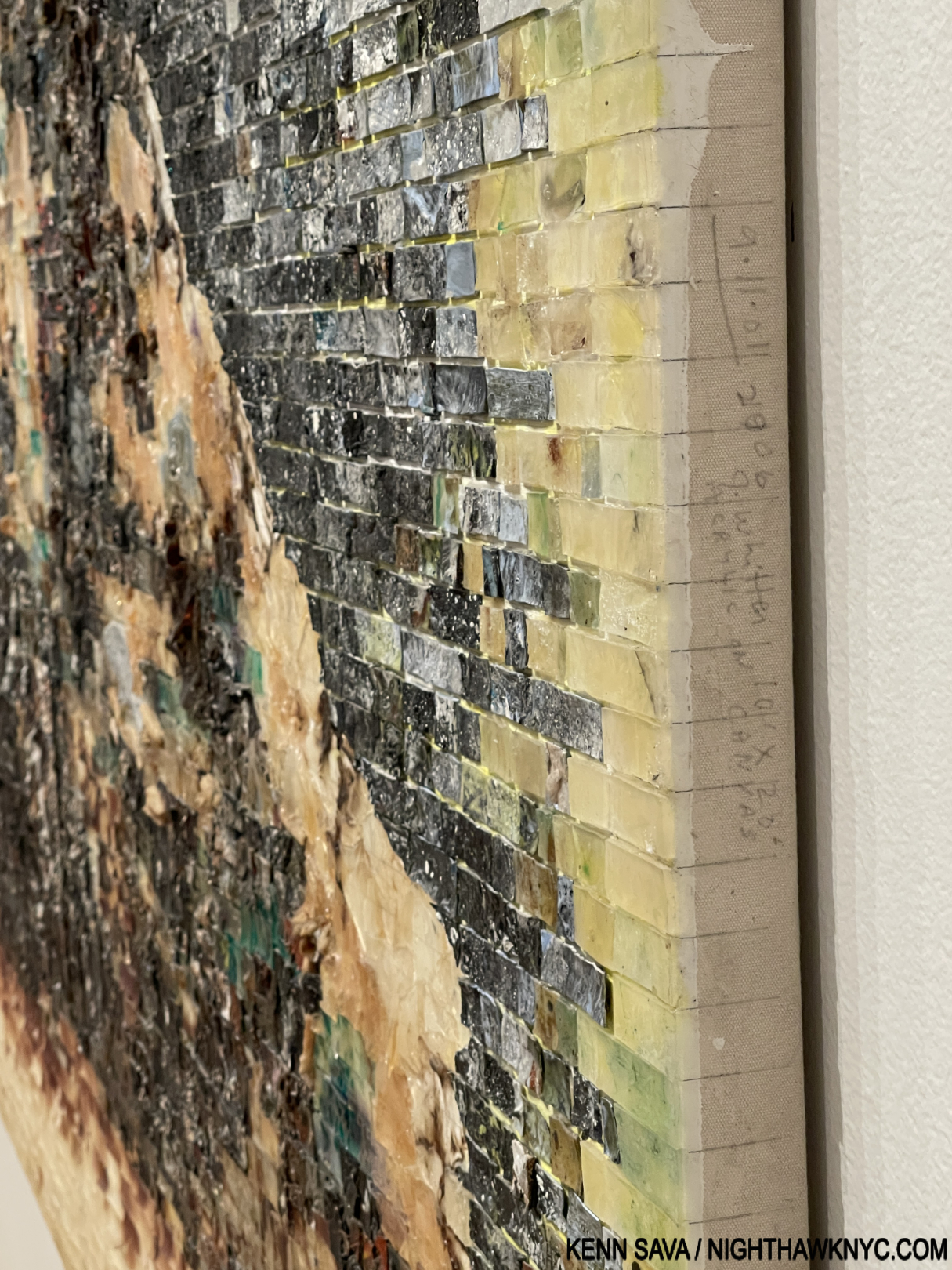
Jack Whitten’s signature and inscription on the right edge of 9.11.01. This also shows a detail of the mosaic tiling the work consists of, each tile hand-crafted.

The work is also created with another technique he invented. Beginning in the 1990s, the Artist cut hardened sheets of acrylic paint into thousands of mosaic tiles that he used to assemble 9.11.01 and other works. In my piece on Jack Whitten: Odyssey, “Jack Whitten: Secretes from the Woodshed,” I show an Art21 video that shows Mr. Whitten actually creating one of his “mosaic” works.
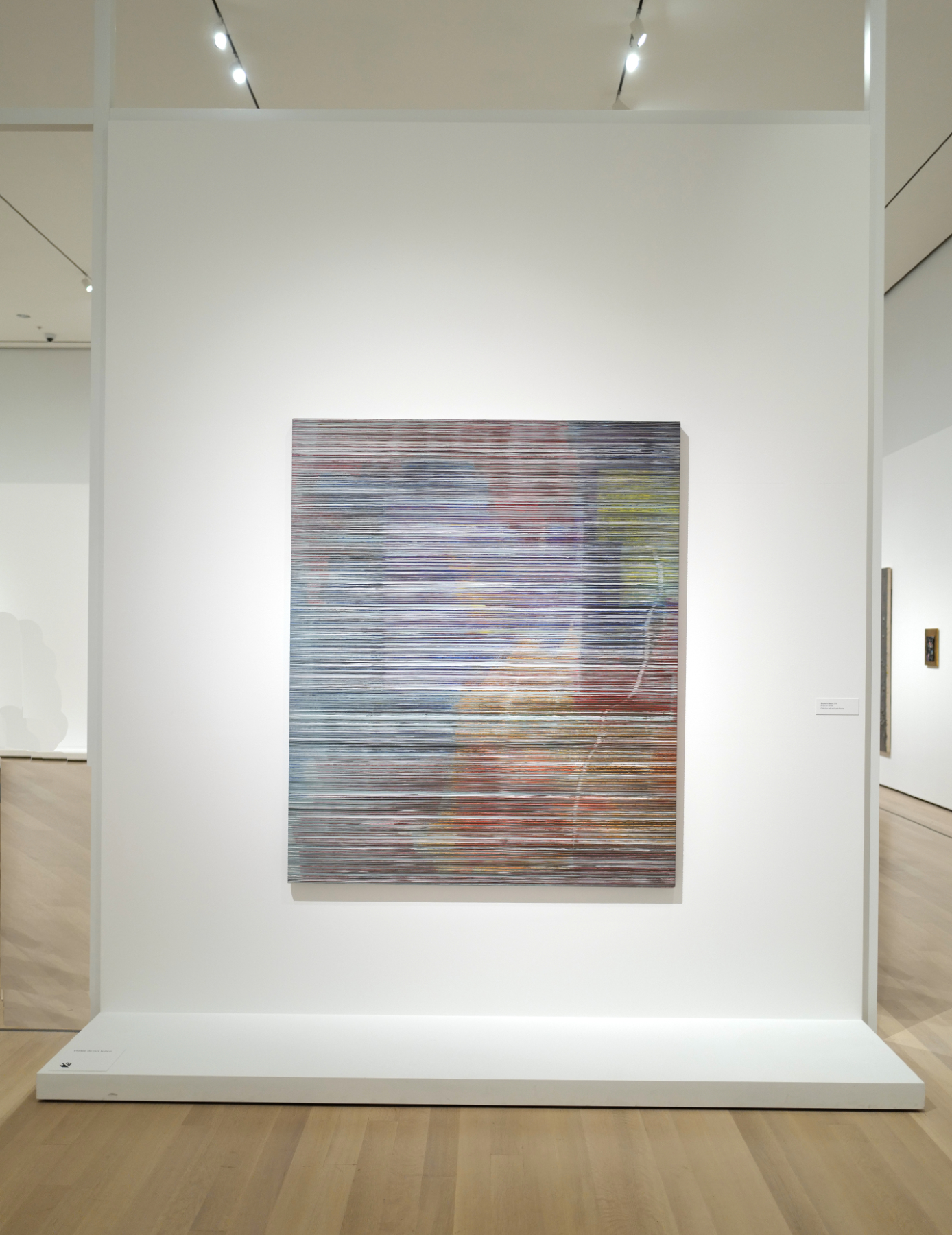
Southern Manor, 1974, Acrylic on canvas

“Perhaps the ideal approach to the work of literature would be the one allowing for insight into the deepest psychological motives of the writer at the same time that it examined all external sociological factors operating within a given milieu. For while objectively a social reality, the work of art is, in its genesis, a projection of a deeply personal process, and any approach that ignores the personal at the expense of the social is necessarily incomplete,” Ralph Ellison speaking of a way of engageing Literature, c.194611.

Though he was here (NYC) during the heyday of Abstract Expressionism, arriving in 1960 on the tail end of the first generations’s success, he doesn’t seem to have been overly influenced by them directly when looking at his work. Their influence seems to me to have been more in freeing the young Artist to explore other ways of communicating in paint. Maybe this can be seen when he said his Paintings weren’t Painted, they were “made.” In fact, it seems to me his attendance at the numerous Jazz clubs that were in a golden age at the time may have had a deeper last effect. In the Music, he found other Artists who were familiar with what he had experienced, whereas the first gen AbEx Artists had not. Their influent may have helped Jack Whitten focus on what was most important for him to express. They were doing it without words. He would do it without representational images using techniques he invented.
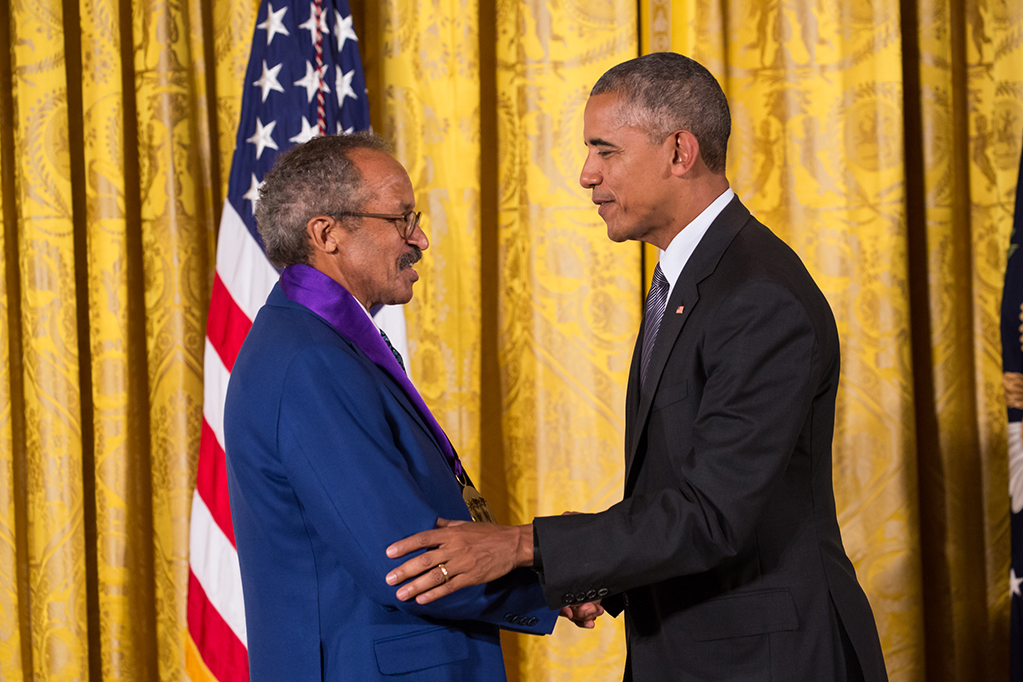
One recognition Jack Whitten did live to receive was the National Medal of Arts by President Obama. “WASHINGTON, DC – On Thursday, September 22, in the East Room of the White House, President Barack Obama awarded the 2015 National Medal of Arts and the National Humanities Medal to distinguished recipients. First Lady Michelle Obama attended the ceremony.” *- Photo by Cheriss May, www.cherissmay.com. White House caption in quotes.

It’s become apparent that Jack Whitten is the spiritual and influential “godfather” of much of what we see today, less than a decade after his passing. He turned his back on so-called representational Art and found a new way of “transmitting” all of what he had witnessed, all he had heard, and all he had inside, in abstraction, forging a new path forward that others have turned into a highway.

For Michael Merriweather.  

*- Soundtrack for this piece is “Nutty” by Thelonious Monk, heard here with John Coltrane, recorded live at The Five Spot in 1957-58, with some rare Photos of them performing in the club-

NighthawkNYC.com has been entirely self-funded & ad-free for 10 1/2 years, during which over 340 full-length pieces have been published! If you’ve found it worthwhile, PLEASE donate securely by PayPal below to allow me to continue. Thank you, Kenn.

You can also support it by buying Art, Art & Photography books, and Music from my collection! Art & Books may be found here. Music here and here.

Written & photographed by Kenn Sava for nighthawknyc.com unless otherwise credited. To send comments, thoughts, feedback or propositions click here. Click the white box on the upper right for the archives or to search them. Subscribe to be notified of new Posts below. Your information will be used for no other purpose.

  1. Amy Sherald: American Sublime, which I wrote about here, and Christine Sun Kim: All Day All Night, which I wrote about here.
  2. Jack Whitten: The Messenger, Michelle Kuo, P.37.
  3. After attending Tuskegee Institute as a pre-med student.
  4. ibid, P.47
  5. ibid
  6. MoMA wall card
  7. https://www.christies.com/en/artists/gerhard-richter?lotavailability=All&sortby=relevance
  8. ibid, P.45, 47
  9. Jack Whitten: Five Decades of Painting, P.43-4.
  10. https://www.moma.org/audio/playlist/345/4715
  11. Ralph Ellison, “Twentieth-Century Fiction and the Black Mask of Humanity,” in Shadow and Act, 27 n. 1.

Burt Glinn: Meet The Beats

Written & Photographed by Kenn Sava (*unless otherwise credited)

It’s impossible to walk around NYC and not be walking on history. More often than not? You’re walking on a spot where something historic happened. Usually, time and “progress” have left no reminder. You have to be an historian to know, or a long time resident to remember. Unless someone pulls your coat. Just this happened to me this past May 5th as I was walking down Cooper Square between East 4th and 5th Streets in the Lower East Side. When someone did…

Once upon a time…directly facing THIS spot stood The Five Spot Cafe, Cooper Square at East 5th Street, Lower East Side, (LES), NYC, May 5, 2018. Well? It’s gone now. But, is it? Chalk Editor’s Note- Add “This” in front of “was once…” Click any Photo for full size.

This story begins with chalk on the pavement, and a box.

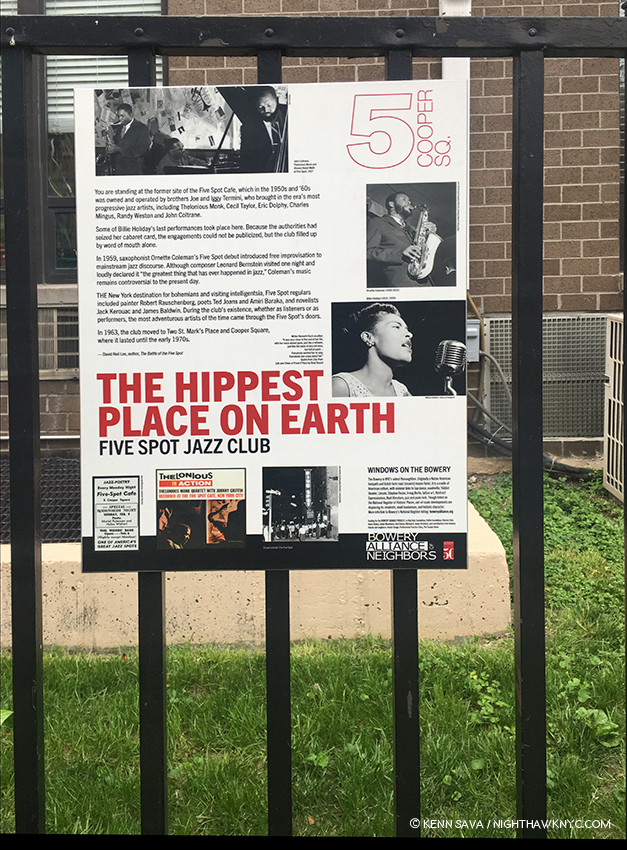
From everything I’ve heard about it, as a lifelong Jazz fan, and in preparing this piece, considering the Musicians who performed there, the Artists, Writers and Poets who frequented it? In the late 1950’s, the Five Spot was THE hippest place on earth. A temporary sign seen on the fence where it stood, above the sidewalk shot, May, 2018, shows Billie Holiday (who made some of her final performances here), Ornette Coleman, who changed the course of Jazz History, and a very rare Photo of Thelonious Monk with John Coltrane performing here, top.

Shortly after the very moment I felt that tug on my coat, a discovery long hidden in the estate of a Magnum Photographer who passed away in 2008 would bring history back to life in the form of a PhotoBook and 2 shows. Before I get too far ahead of myself…

Magnum Photos has been around as the world’s leading Photo Agency, documenting what is history now for 71 years, since being founded by legends Robert Capa and Henri Cartier-Bresson along with David “Chim” Seymour, George Rodger, William & Rita Vendivert and Maria Eisner in 1947. Along the way many of the greatest Photographers of our time have been members at one point or another. Today, it’s going as strong as ever, with as well-rounded a roster as its possibly ever had, including Harry Gruyaert, who I recently interviewed, and other living legends, including Bruce Davidson, Elliott Erwitt and Susan Meiselas, as well as a veritable “all-star team” of younger Artists counting Alec Soth, Alessandra Sanguinetti, Cristina de Middel and, in 2018, Gregory Halpern among them.

Those who come now are standing on the shoulders of giants of Photography.

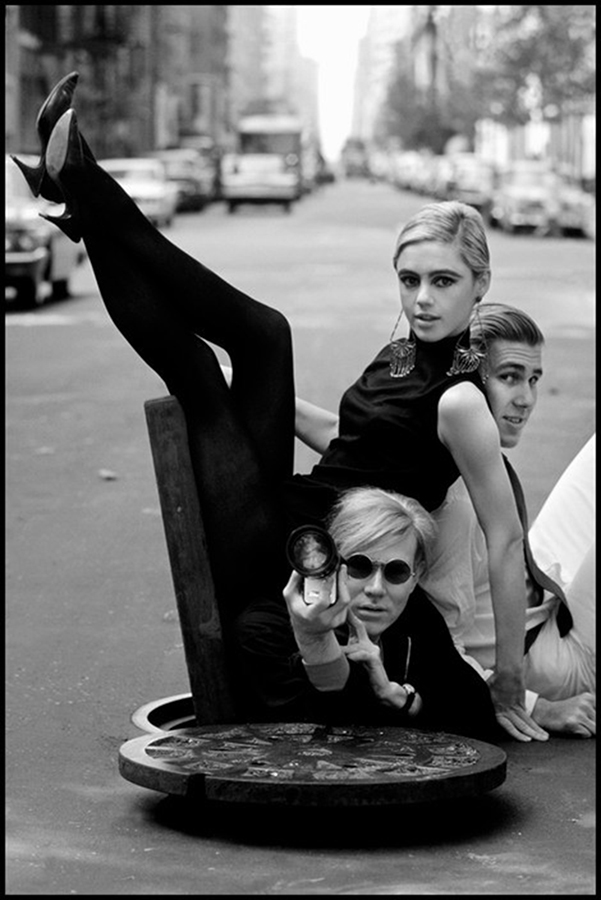
With so many luminaries in its already storied history, it’s easy for one to slip into a bit of a lack of attention from time to time. Take Burt Glinn for example. Born in Pittsburgh in 1925, he joined Magnum in 1951, one of the first group of Americans in the member owned organization. He became president of it in the 1970s and again in the 1980s. He achieved fame for his international work, including beautiful Portraits of Russia and Japan in color, as well as for his coverage of the Cuban Revolution, which saw him somehow gain access to Fidel Castro and his inner circle. Back at home, he profiled Marilyn Monroe, Elizabeth Taylor, and Katherine Hepburn, while also shooting Queen Elizabeth II’s visit to NYC. Burt Glinn is one of those Photographers who might illicit a “who?” from some today, but as soon as you start looking at his work, that’s quickly replaced by, “Oh, that’s his. So is that. So is that…” Like this one, perhaps the most famous image of Andy Warhol with Edie Sedgewick-

Andy Warhol with Edie Sedgwick and Chuck Wein, 1965, New York City. Photo by Burt Glinn/Magnum Photos.

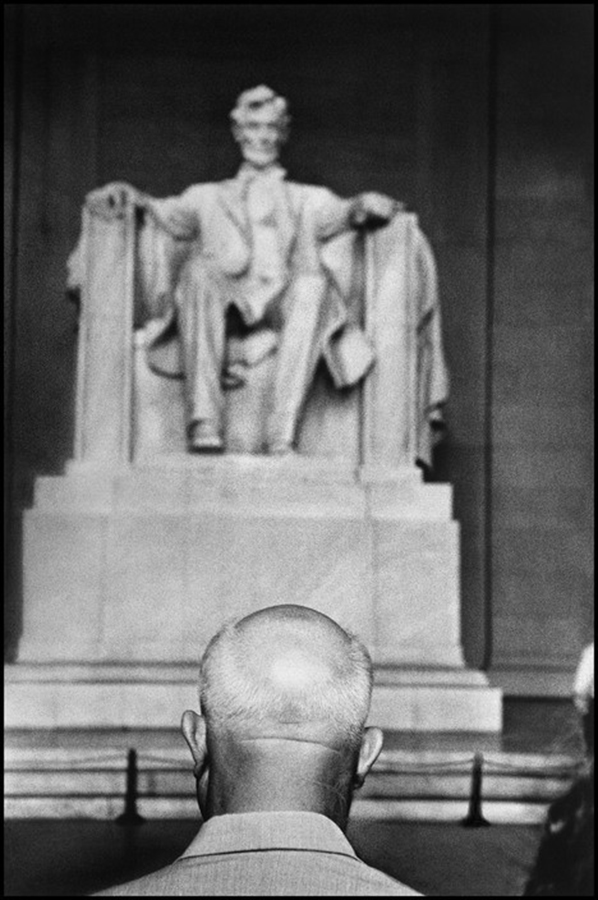
Or, this unbelievable moment-

Nikita Khrushchev in front of the Lincoln Memorial, 1959, Washington, D.C. “Without a doubt,” the image of his that he most closely identifies with1. Photo by Burt Glinn/Magnum Photos.

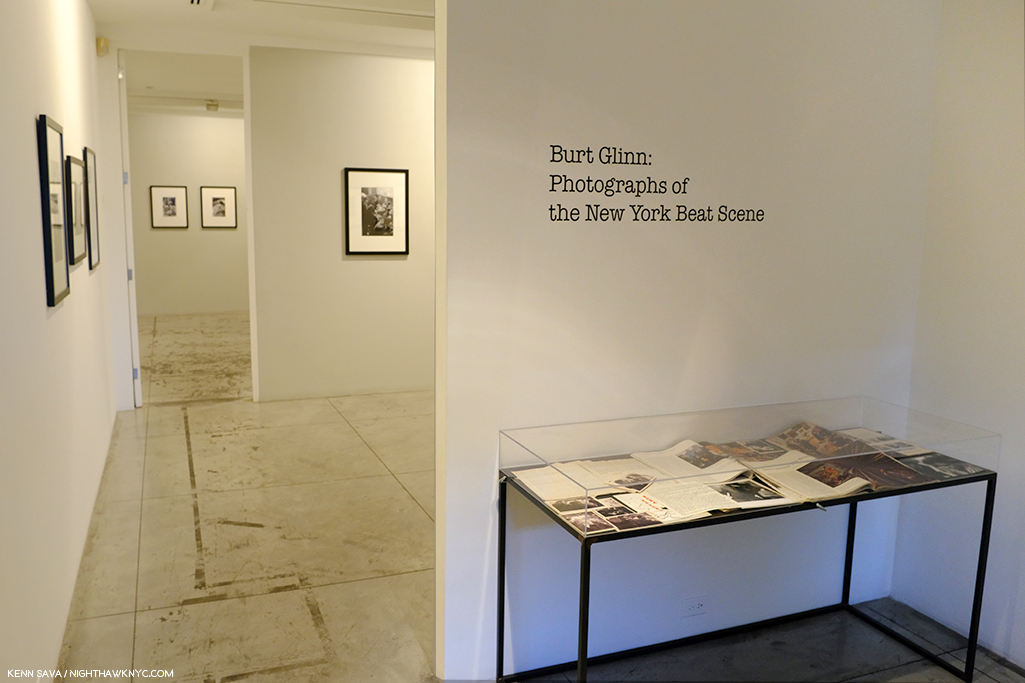
But, there are many sides to the work of Burt Glinn. In fact, so many sides, some are still coming to light 10 years after his passing in 2008. While working on an upcoming Burt Glinn Retrospective, Michael Shulman of Magnum Photos, Elena Glinn, the Artist’s widow, and Tony Nourmand of Reel Art Press discovered a box labelled “nonconformists.” Inside were never before seen Photos of those legendary “nonconformists,” the Beats, along with his notes and an original Jack Kerouac manuscript! The Retrospective was immediately put on hold while Reel Art Press published the beautiful PhotoBook, Burt Glinn: the beat scene, in July, that includes the first color Photographs of the Beats ever published. Some of these images were then shown at the Beat Museum, San Francisco, in July, and now others, including many not published in the book, were exhibited at Burt Glinn: Photographs of the New York Beat Scene at New York’s renowned Jason McCoy Gallery, a 40 year fixture in the famous NYC Art Mecca, the Fuller Building, on West 57th Street, from September 12th through October 12th.

Installation view of the entrance to, Burt Glinn: Photographs of the New York Beat Scene, at Jason McCoy Gallery.

The NYC Art world is a mysterious place to most people on the outside, so having the rare chance to walk through a show in a famous gallery with its curator, particularly this show’s curator, Samantha McCoy, who works regularly with the Photographs of this Artist and his estate, at Magnum Photos, was a special privilege. It turned out that Samantha was also curating a show by Artist Carla Gimbatti at ChaShaMa– at the same time! “He’s a chameleon,” she warned me before we began. As we turned the corner into the first gallery, I saw what she meant.

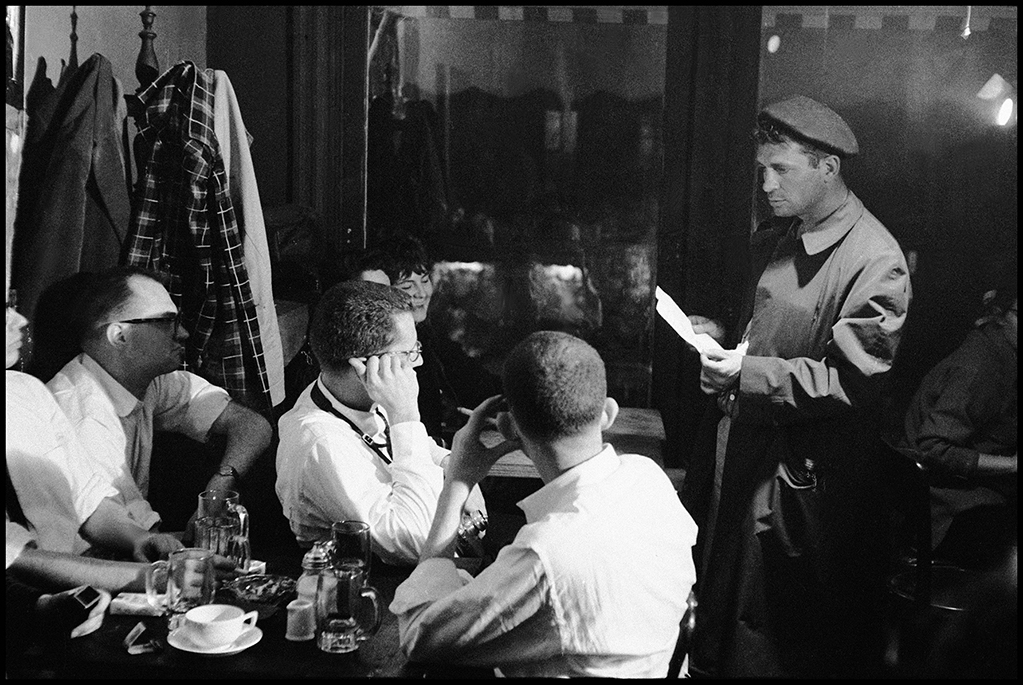
Jack Kerouac holds forth to an enraptured audience, Seven Arts Coffee Gallery, 1959. This is how it started- with a poet or writer reading his work aloud in coffee shops, bars, or wherever they could.  I’d love to know if that woman laughing in the back was laughing at something Jack said, or not. Everyone else looks very serious. The beret became a Beat trademark. Photo by Burt Glinn/Magnum Photos courtesy Jason McCoy Gallery.

As we looked, it immediately became apparent that these aren’t just any Photos of the Beats (Jack Kerouac, Allen Ginsberg, LeRoi Jones, who was later change his name to Amiri Baraka, and Gregory Corso). They’re a fascinating window into their daily lives, an invitation to hang out with them in moments public and private, and, in a revelation, they also offer an unprecedented chance to see the Beats in the company of a number of Painters and Sculptors, including Helen Frankenthaler, Willem de Kooning, David Smith, Franz Kline, Joan Mitchell, Larry Rivers, and Musicians, including David Amram and Lee Bostic. These images fire the imagination as they draw you in to ponder just what was being discussed. In addition to being beautiful Photographs that add another dimension to Burt Glinn’s achievement, like so many of his other works, these are vitally important historical and cultural documents. To top it all off, the book and the shows mark the first time color Photographs of the Beats in their early days have been seen!

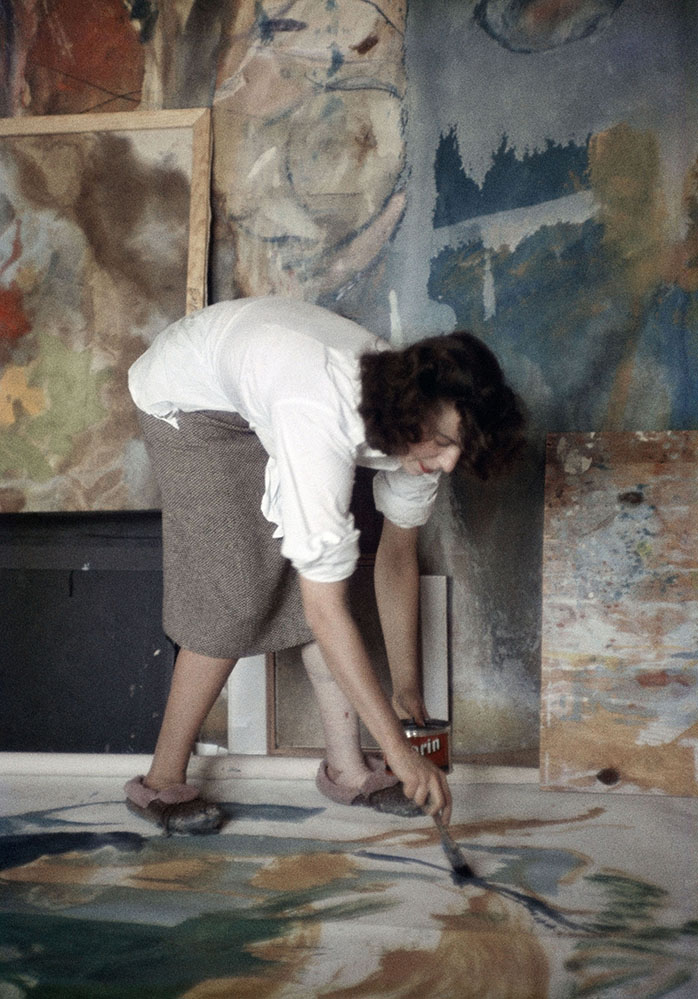
Young Helen Frankenthal her in her studio working on an abstract expressionist painting. I always look at her work and wonder how she Painted it. Now, I have an idea. Helen Frankenthaler at about age 28, rarely seen at work in this period, shown in the act of creation in her NYC studio in 1957, in color! Photo by Burt Glinn/Magnum Photos courtesy Jason McCoy Gallery.

Given her experience working with Burt Glinn’s Photographs at Magnum, I asked Samantha what surprised her about this newly discovered body of work. “Before learning about the release of the beat scene by Reel Art Press, I was actually not at all familiar with this particular body of work,” she said. “It was a surprising and exciting discovery. I found it particularly impressive to learn that Burt had followed the Beats on his own accord2. As Elena Glinn informed me, ‘It was Burt’s roommate, Clay Felker, who had said to Burt, ‘We have to do something with these nonconformists who are all over the place. Go after those guys. Go to openings.’ Burt just did it, and he went to everything. He went to the poetry readings, to the gallery openings, to artist’s studios.'”

3 years younger than Jack Kerouac, a year older than Allen Ginsberg and 3 years older than Helen Frankenthaler, Burt fit right in with the Beats and the Artists.

” I love how Burt is able to transport you to this pivotal time in New York; he had this uncanny ability to really capture the atmosphere in such a way that you feel you are there,” Ms. McCoy added. “He was a true chameleon in that sense. And then, of course, to put this series into the context of everything else he was shooting at that time is all the more riveting. He was an immensely gifted storyteller.”

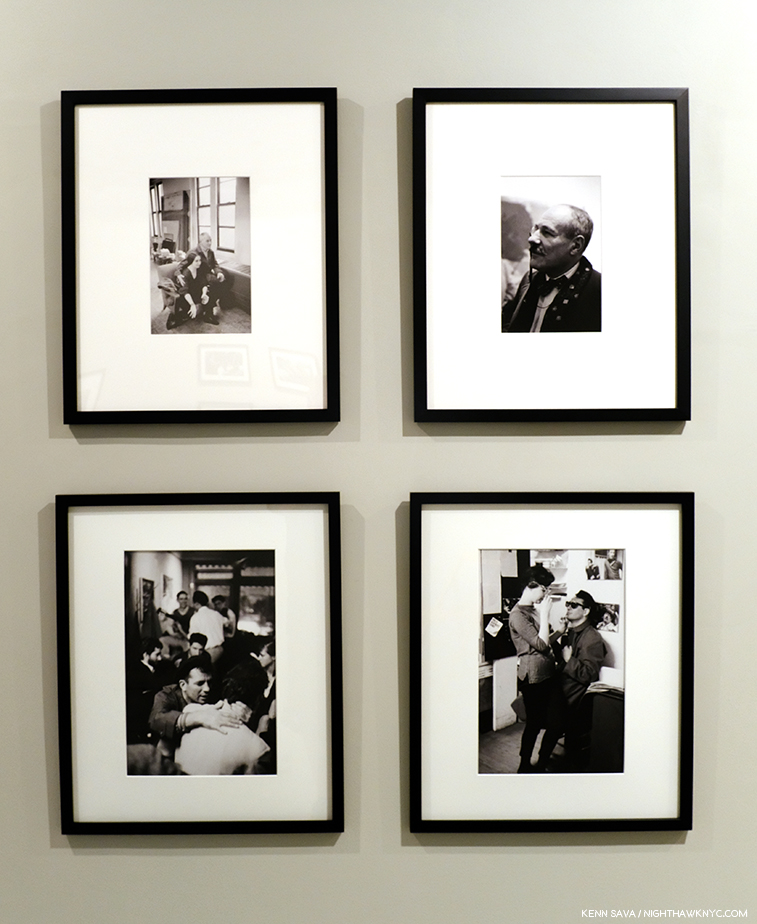
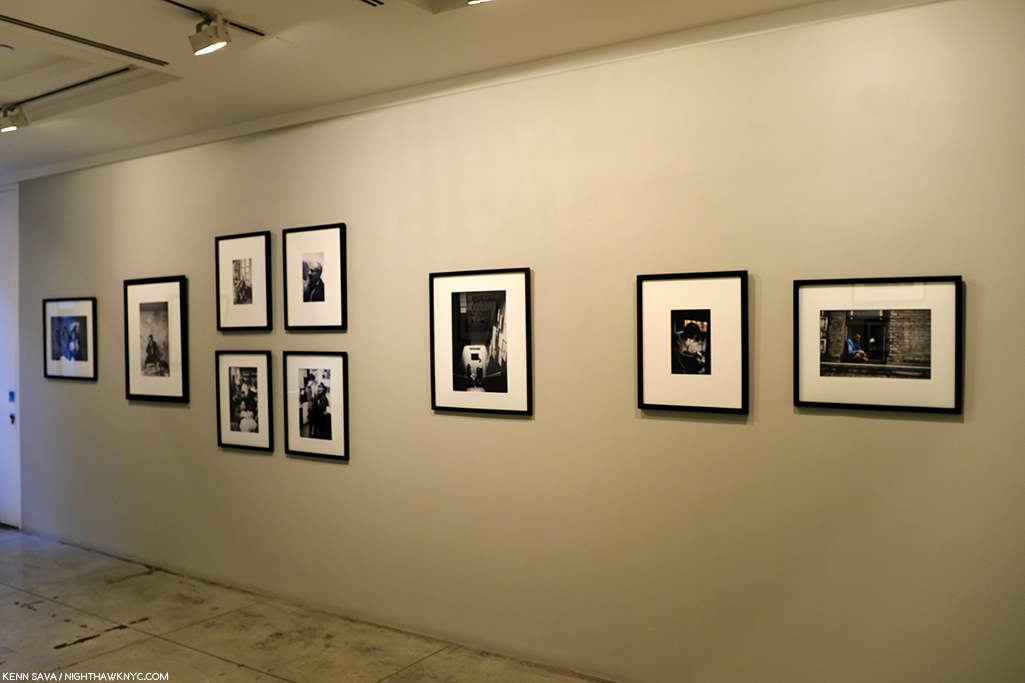
Speaking of telling stories, Samantha McCoy was, also, doing just that in the way she installed the show. As we see in this particularly interesting grouping she chose. Upper left, Dancer Anita Huffington and Willem de Kooning, 1957 NYC, Painter Barnett Newman at a gallery opening, 1957, NYC, right. Lower left and lower right- 2 Photos from the series Jack Kerouac holds forth to an enraptured audience, Seven Arts Coffee Gallery, 1959. As she says, Burt Glinn seemed to be everywhere.

I asked Samantha about the her groupings that seem to tell “short stories” within the larger body, and about her approach to installing this show. She said, “This is a very keen observation, and was definitely on my mind while curating, though I must say Burt’s work lends itself to this type of curation.”

Four from the series, Things get rough. John Rapinic restraints Corso who hurls insults at reporter: “But you don’t understand Kangaroonian weep! For sake thy trade! Flee to Enchenedian Islands”
And foreground, wizened Kerouac plays it cooler, 1959, NYC. That is Burt Glinn’s title for this series!

She continued, “There were so many anecdotes that spoke to me when I was making the edit, so I suppose I was hoping to give each of them life. The Beat life in New York was full of small stories, in different landscapes and pockets of New York. I wanted the viewer to have a feeling of all of them, as well as the scope of this movement.”

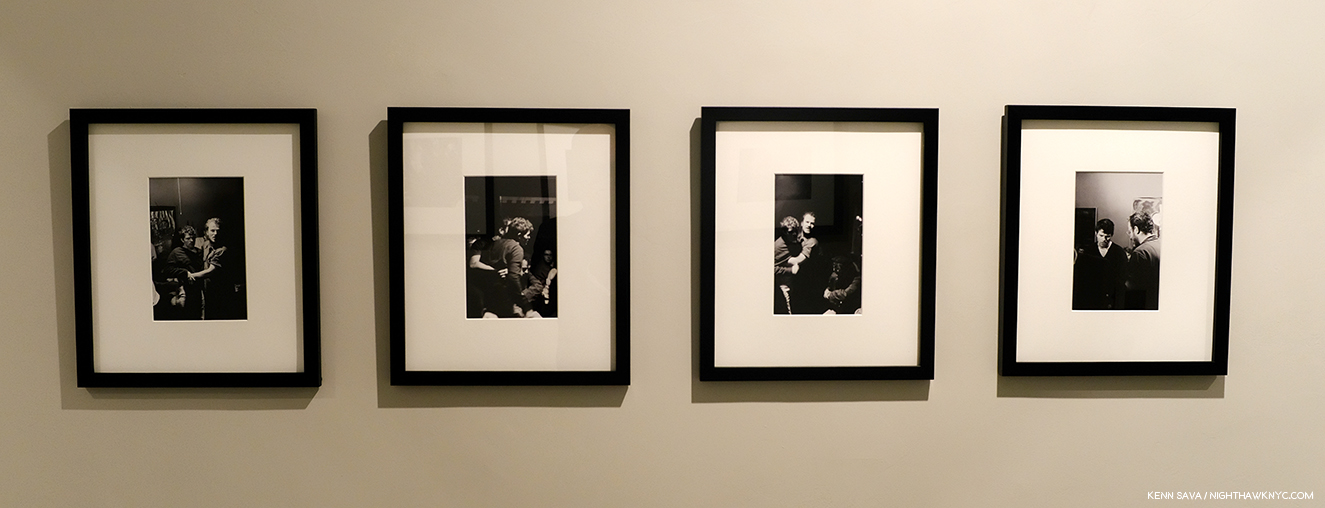
This wall, in particular, is full of unexpected intimacies. It starts with LeRoi Jones at home, Newark, New Jersey, USA, 1959, seen, apparently unawares, sitting in the window of his Jersey City home, right, and includes Photos of Helen Frankenthaler hugging David Smith, far left and below, as well as the group of four seen just earlier.

Particularly interesting to me is that these Photos were taken at the exact moment when the first generation Abstract Expressionists were seeing their hold on the cult of culture in NYC begin to gravitate to the Beats3, which would continue well into the Rock ‘n Roll era of the 1960s and beyond. NYC, and indeed, the world, would never be the same.

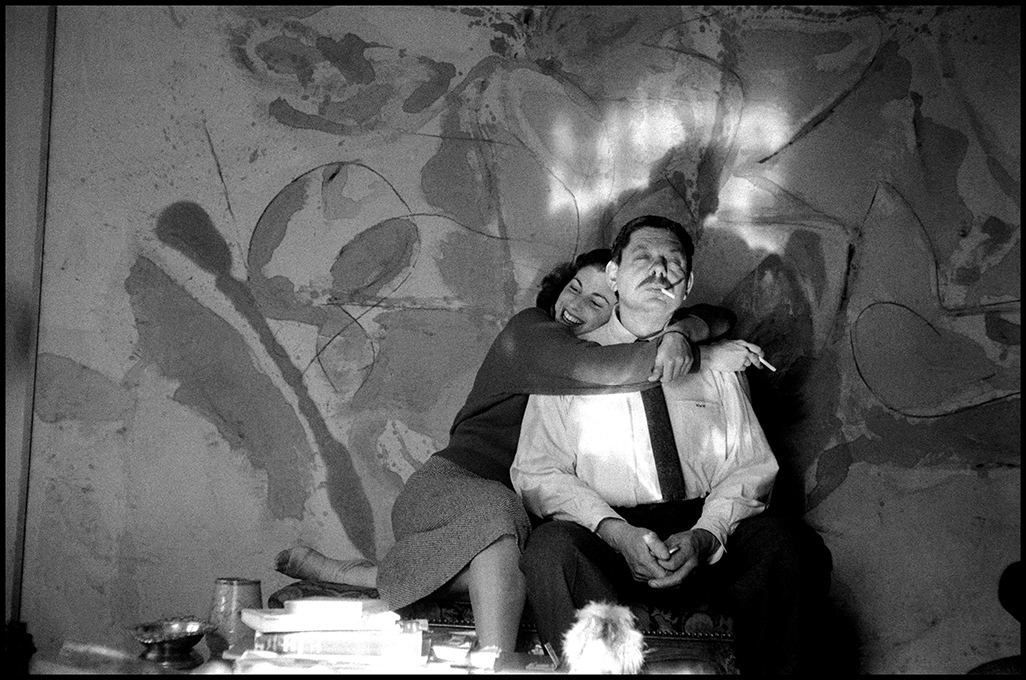
HOW was Burt Glinn able to get this shot? Painter Helen Frankenthaler and Sculptor David Smith in Frankenthaler’s studio, New York City, 1957. My favorite image in the show. David Smith is a very under-appreciated Artist, today, in my view, but not, apparently, by Ms. Frankenthaler.

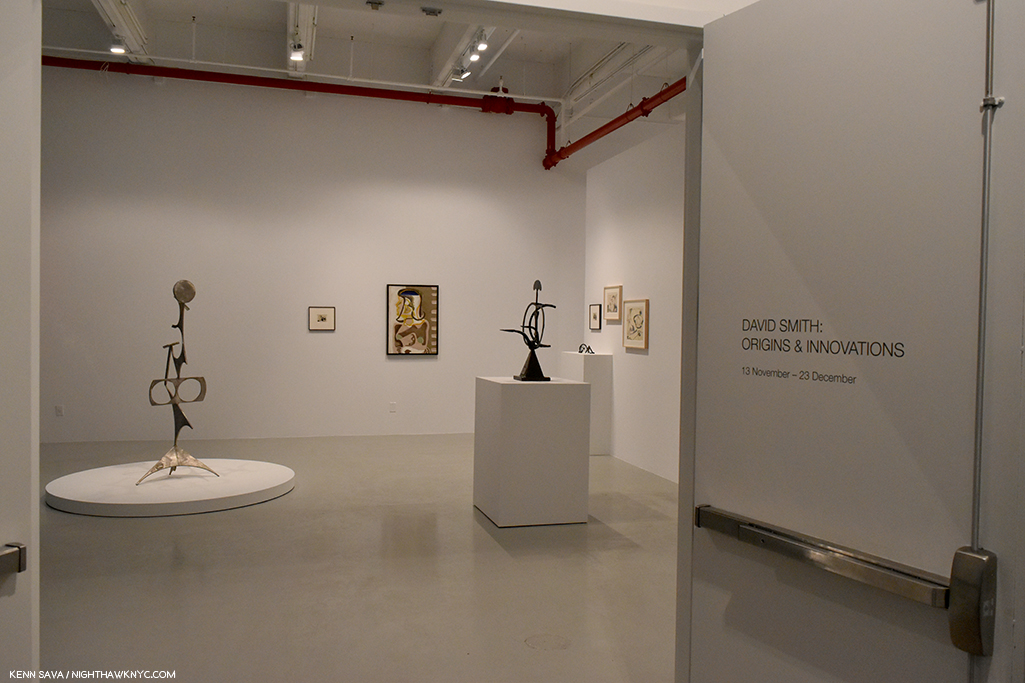
Installation view of the excellent David Smith: Origins & Inventions, Hauser & Wirth, NYC, December 21, 2017.

No less than half of the Photos included in the show (22) were taken in 1957, the year On The Road was published, the very moment the Beats rose to cultural and literary prominence. That same summer, on stage at the Five Spot, the great Thelonious Monk was joined by the equally great John Coltrane, recordings of which were discovered and released in 1993. A further 14 of these Photos were taken in 1959, the year that Jack Kerouac, Allen Ginsberg, Gregory Corso, Larry Rivers, and David Amram, featured here, also appeared in Robert Frank’s legendary film, Pull My Daisy. And, 1959 was also the year that Burt Glinn received the Matthew Brady Award for Magazine Photographer of the Year from the University of Missouri. Heady times, indeed.

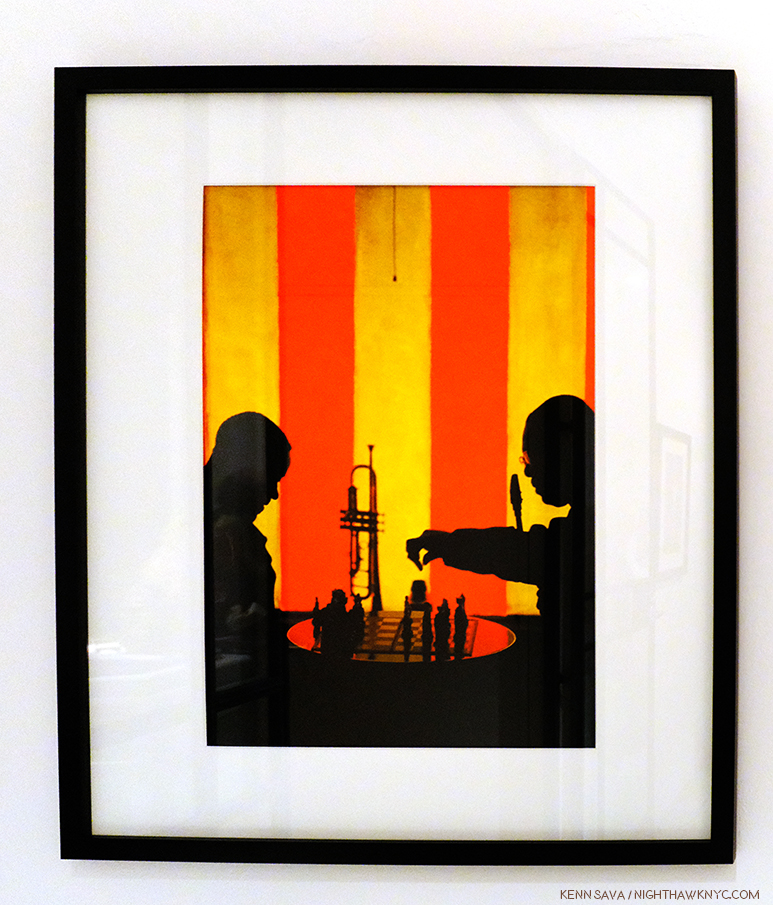
Burt Glinn’s startling color Photos of the Beats are the first ever published. Here- A Chess interlude during a break in the revelry at the Blackhawk, a night spot on the corner of Turk and Hyde Street where eminent jazz performers are often to be found in action. The player making the move here is Earl Bostic virtuoso of the loud  tone alto, 1960, San Francisco.

Although he later went to San Francisco to Photograph the Beat scene there, only one of those shots is on view here. “I really wanted to stay focused on the New York work,” Samantha said.

The crowd outside the Five Spot. I love that the sign scream THIS is the place! Unknown date. Unknown Photographer.

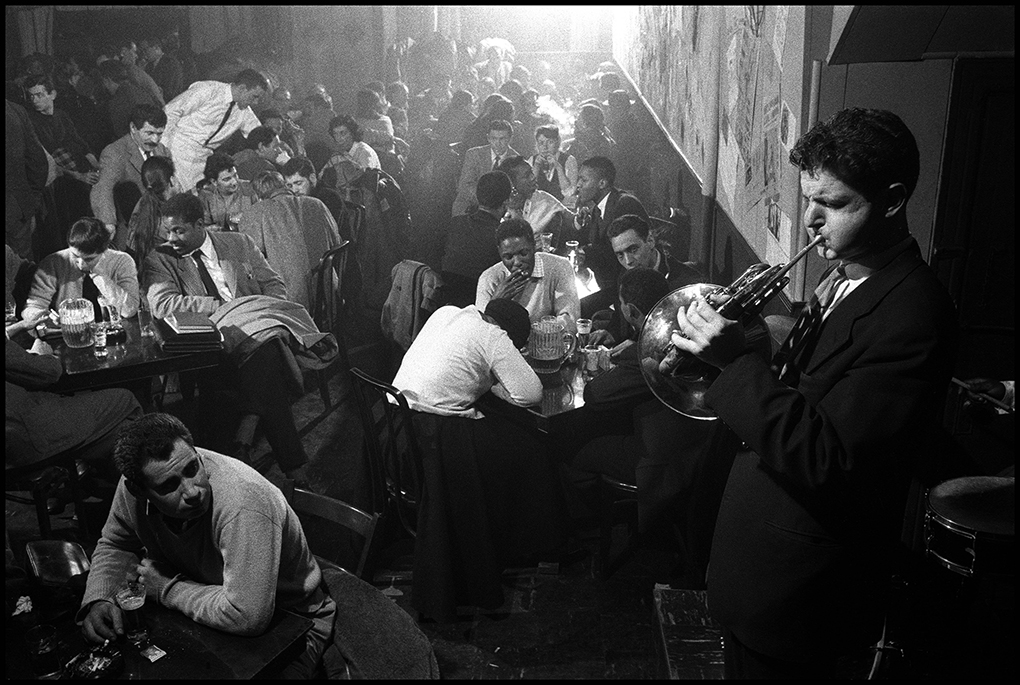
In New York, along with the famous Cedar Tavern, perhaps no where was more the place to be in the day than the Five Spot. There aren’t many Photos of the club, or what was going on inside of it, so Burt Glinn’s are an invaluable addition to those we have, taking us right into the midst of it.

Live from the Five Spot. This looks like Burt Glinn was actually right onstage! David Amran entertains at the Five Spot Cafe, 1957. Then, as now, a French Horn is still unusual to see in a Jazz club. Photo by Burt Glinn/Magnum Photos courtesy Jason McCoy Gallery.

Then, there are the recollections of those who were there4. I asked gallery owner Jason McCoy what he thought of the show, he said, “The photographs and the New York light brought back a nostalgia and sense of smell I associate with tenement hallways in Chinatown and in the Bowery, all places frequented by artists in those days!”

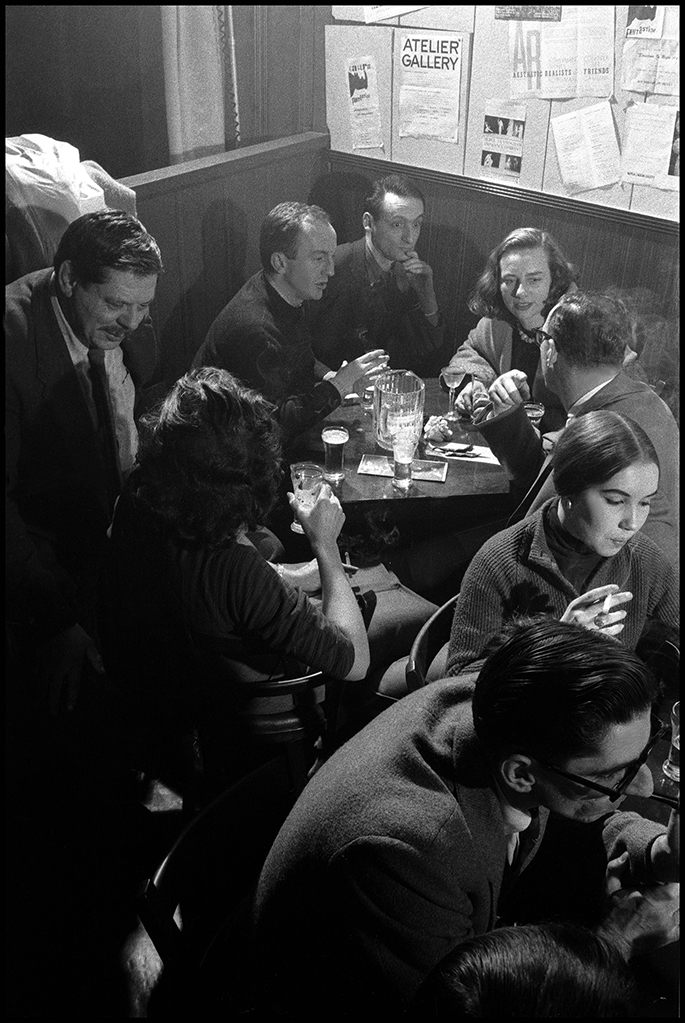
A back table at the Five Spot. left to right are sculptor David Smith, Art guru frank O’Hara, 
a poet; Larry rivers and grace Harriman, both artists; an economist, Sydney Rolfe, dancer Anita Huffington, and Bill Hunter a neurosurgeon. The lady with her back to the camera is painter Helen Frankenthaler. Peak crowd is about midnight. In quieter moments a poet will sometimes read his verse to the music. Bar jumps till 4 AM, NYC, 1957.
A wonderful composition. My guess is that this is the corner seen in the top, right of center in the preceding Photo. Photo by Burt Glinn/Magnum Photos courtesy Jason McCoy Gallery.

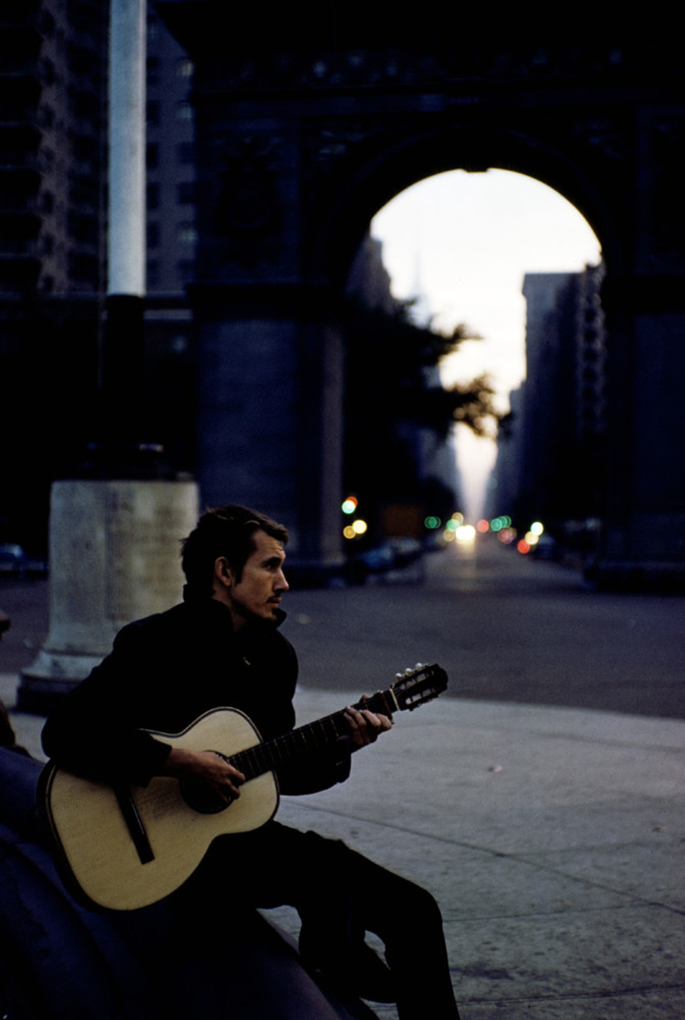
During this time, Burt Glinn was not only busy documenting the activities of the famous and the rising stars, he was also, everywhere else. He showed up at parties where none of the “big names” were. He haunted side streets as well as the bars, all of this enabled him to capture the full flavor of the scene, catching its atmosphere as he strove to find its essence. He’s even in Washington Square as the sun rises on a new day catching a lone minstrel with an acoustic guitar putting the night to bed with a song.

It’s a new day rising. A streak of loneliness runs through these Gordy evenings on the town. Today, a lone guitarist plays the last music of the night, NYC, 1959. Photo by Burt Glinn/Magnum Photos courtesy Jason McCoy Gallery.

No matter where he is, in his photos you’re right there- sitting at a crowded table, having drinks, and discussing literature, poetry, Art, life. You’re hunched in a corner of the Five Spot listening to the band, though you can’t even see all the musicians. Or, you’re listening to the Beat poets recite or test drive their latest creation at 2 a.m. You’re in the studio with Helen Frankenthaler, Willem de Kooning, and others. You’re going over to visit LeRoi Jones…

For the Beats, it was the best of times. Soon, millions of young people (including four lads from Liverpool, England, who would borrow the name) would aspire to be part of what was happening right in front of Burt Glinn’s lens. Back when very few knew.

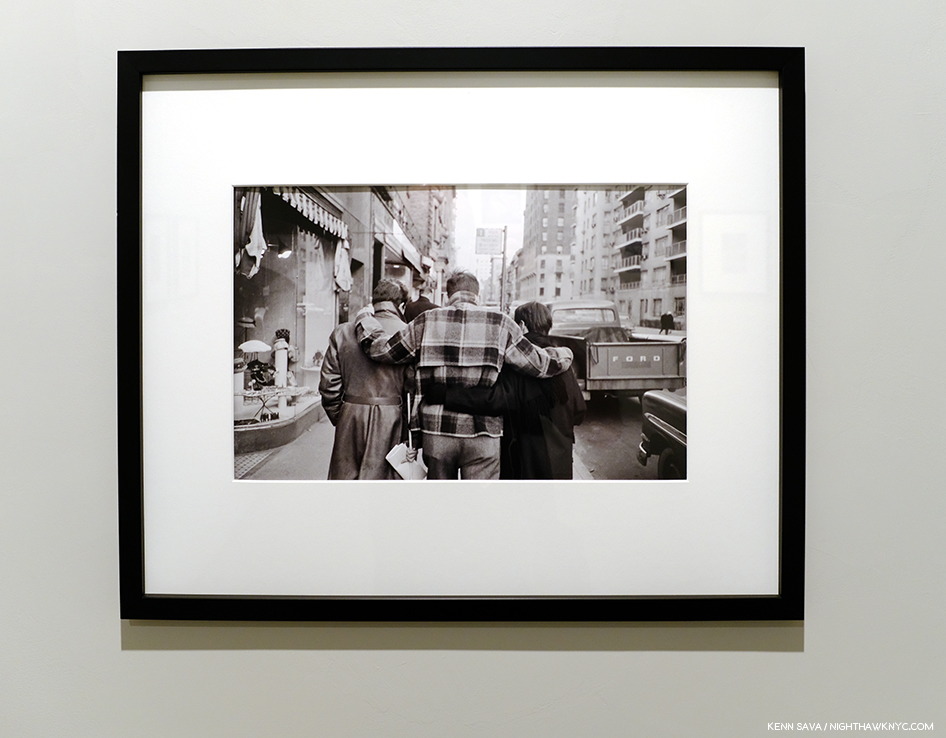
Walking into history. Samantha McCoy told me chose this work to close the show as a “fitting farewell.” From left to right: Gregory Corso, Allen Ginsberg, and an unidentified woman. New York City, USA, 1957.

Jack Kerouac knew. He wrote a piece to accompany Burt’s Photographs called “and this is the beat nightlife of new york,” which reminded me why I went through a “Kerouac period.” Fittingly, the original was found with them. Where it belongs. Like in a time capsule. A parchment testament of the times.

But not the New York Times, these are the On The Road times. The Dharma Bums times. The Howl times. The Subterraneans times. The ‘Round Midnight times. The Pull My Daisy times.

The times they were a-changin.

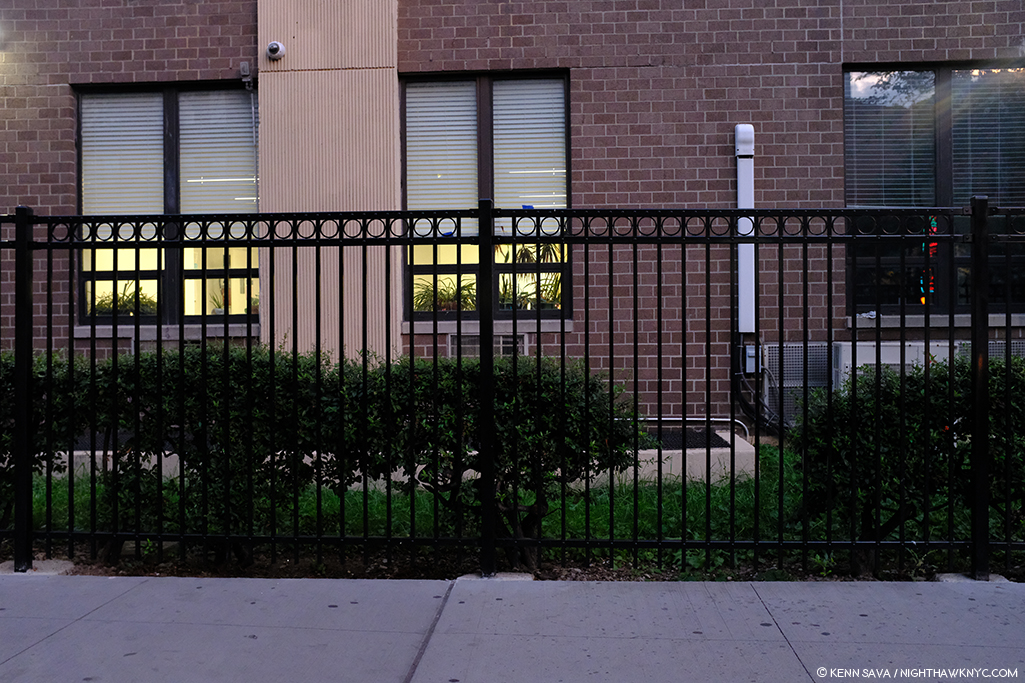
5 Cooper Square, NYC, October, 2018.


BookMarks

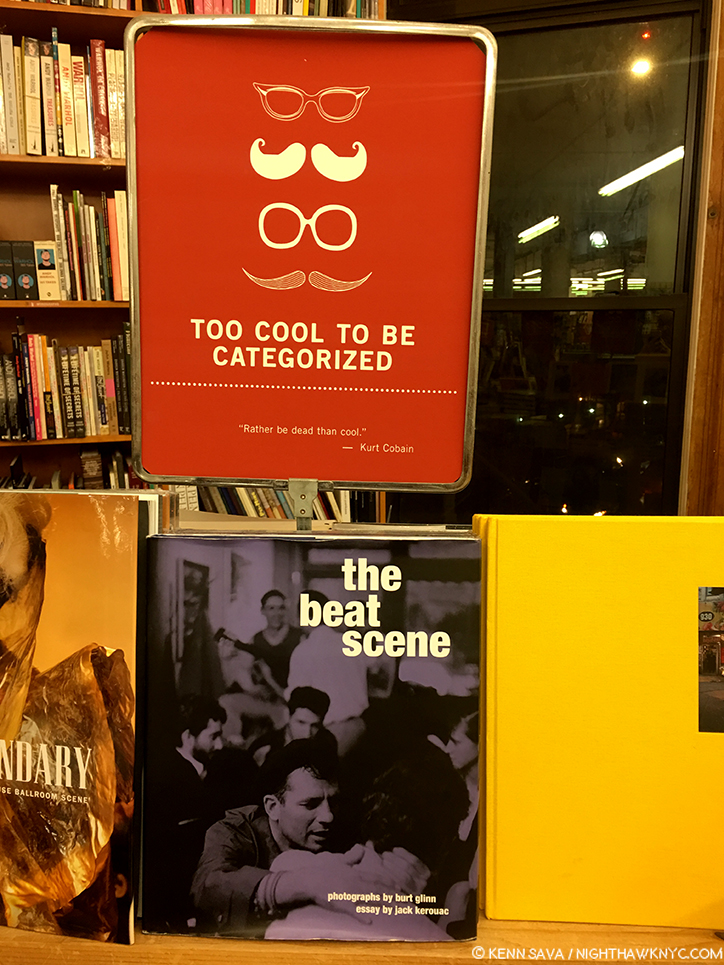
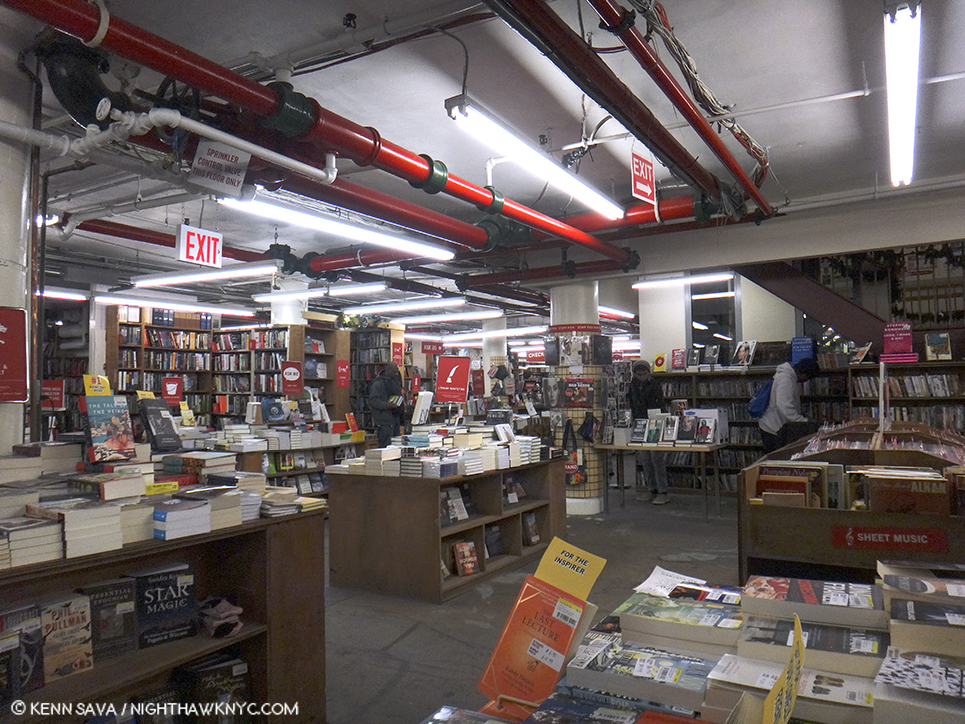
As seen at The Strand Bookstore.

the beat scene: Photographs by Burt Glinn– Includes that terrific essay by Jack Kerouac, “and this is the beat nightlife of new york,” 170 Photographs, including the first 70 color Photos of the Beats in their early days ever published, and many Photos that show more of the public, and private, life of the Beats, the Artists, Musicians and others. It’s a unique PhotoBook because it shows seminal figures in 20th century Art, Music and Literature in close proximity as they live their lives at what was a key moment in each of their lives, and the culture of the world, along with other folks the world either never knew or has already forgotten, who, as Samantha McCoy said, “were more friends and drinking buddies.” Recommended.

Allen Ginsberg Photographs, 1990- is the other classic book of Photographs of the Beats. Ginsberg is a Poet whose work seems every bit as relevant today as it was when he wrote it, and his Photographs came to public attention, and acclaim, late in his life. They deserve the acclaim, in my opinion. Andrew Roth agreed and he included Allen Ginsberg: Photographs in his The Book of 101 Books: Seminal PhotoBooks of the Twentieth Century, one of the standard references on the subject for many. To date, I have only seen 1991 second edition copies and I found the reproductions lacking, though they are printed in a nice size. Perhaps the paper hasn’t aged well, I’m not sure. Perhaps they’re better in the out of print first edition, or perhaps this important part of Mr. Ginsberg’s oeuvre needs a new edition. In that case, unlike Allen Ginsberg: Photographs, he will no longer be able to oversee it, unfortunately. Recommended, if you can find a copy who’s reproductions do justice to the work.
*-Soundtrack for this Post is The Thelonious Monk Quartet: Live at the Five Spot: Discovery!, a very rare meeting of two Musical giants of the 20th century, Monk & John Coltrane, (let alone whoever may  have been in the audience that night), part of which you can hear, here-

My thanks to Samantha McCoy of Magnum Photos, and to Jason McCoy and Amanda Konishi of Jason McCoy Gallery.

NighthawkNYC.com has been entirely self-funded and ad-free for over 10 1/2 years, during which over 350 full length pieces have been published. If you’ve found it worthwhile, you can donate to keep it going & ad-free below. Thank you!

Written & photographed by Kenn Sava for nighthawknyc.com unless otherwise credited.
To send comments, thoughts, feedback or propositions click here.
Click the white box on the upper right for the archives or to search them.
For “short takes” and additional pictures, follow @nighthawk_nyc on Instagram.

Subscribe to be notified of new Posts below. Your information will be used for no other purpose.


  1.  https://web.archive.org/web/20091229204516/http://www.nppa.org:80/news_and_events/news/2008/04/glinn.html
  2. Later, he was given an assignment to Photograph the San Francisco Beats for Holiday Magazine. Some of these images were last, and only, seen there, and in a few other magazines of the time. The rest have not been seen previously.
  3. Partially due to the tragic death of Jackson Pollock, Jason McCoy’s uncle, on August 11, 1956 at 44
  4. You can read the recollections of some of the Musicians who played there, here.

Directions In Listening By Miles Davis

This site is Free & Ad-Free! If you find this piece worthwhile, please donate via PayPal to support it & independent Art writing. You can also support it by buying Art & books! Details at the end. Thank you.

Written & Photographed by Kenn Sava.

A ShortList Of Recommended Miles Davis Albums

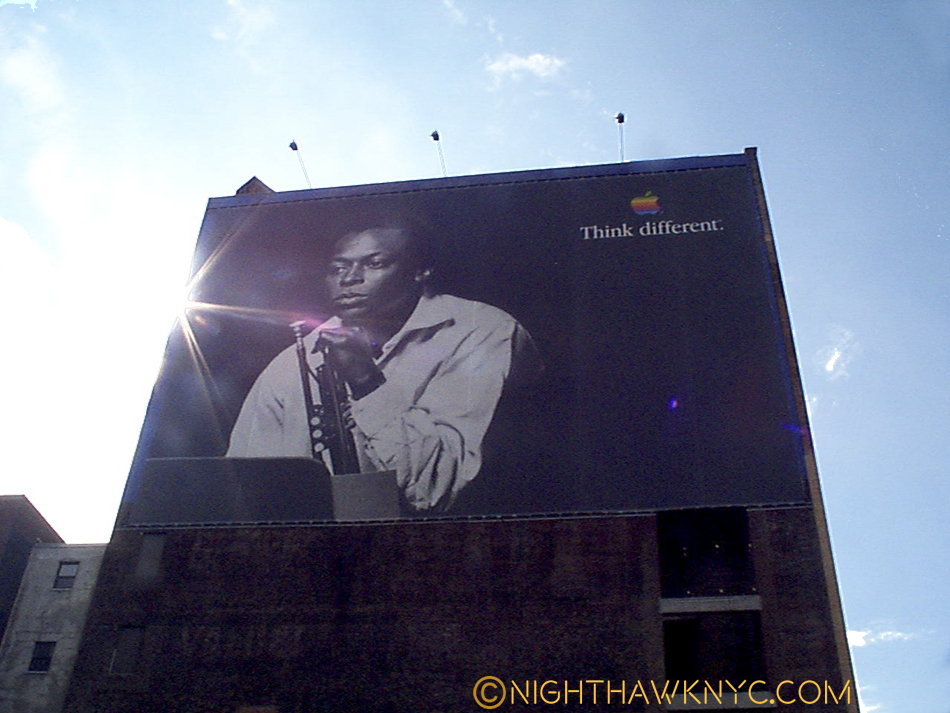
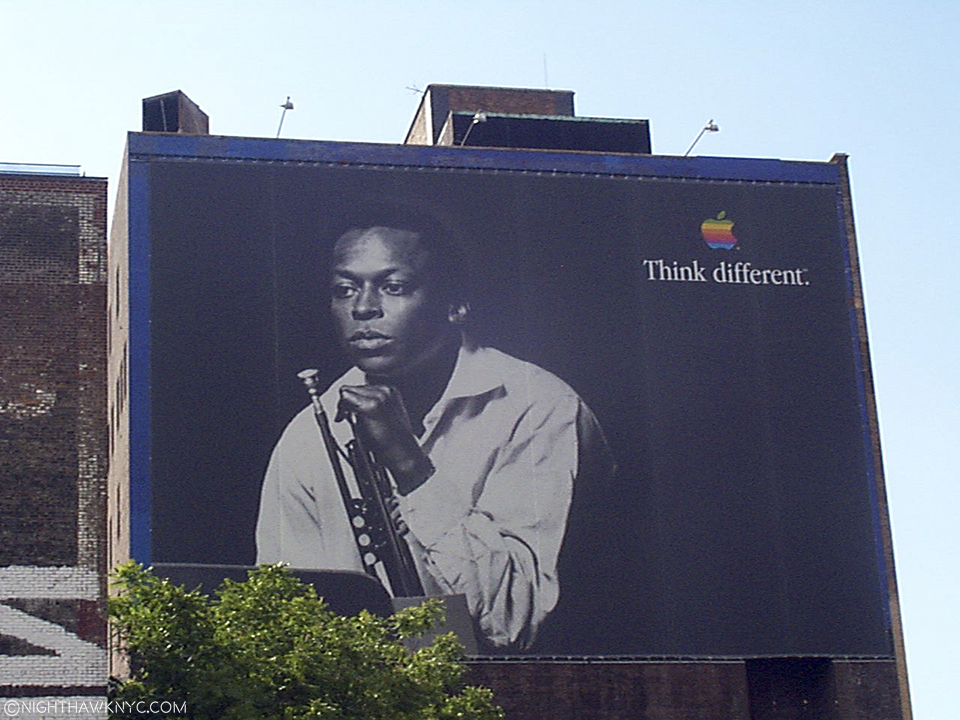
Timeless. Miles on an Apple “Think Different” Billboard, I shot in June, 1998 on West 23rd Street.

This is an Addendum to my “Riffing On Miles Davis” Post in response to a note I’ve gotten asking what specific recordings I’d recommend listeners check out to hear Miles, and/or get a fuller appreciation of his accomplishment over the 40 years he recorded albums under his own name1. Personally? Miles Davis was my biggest musical influence, as he was for many of the musicians I worked with or admired. He was a living legend to us, akin to what Picasso was to visual Artists during his lifetime, and yes, there are quite a few interesting similarities between Miles & Picasso, but that’s a different piece. Ok. So, here’s my “ShortList” of essential Miles albums- suggestions for both a listener new to Miles Davis to start with, and for where to go from there. To clarify- Miles’s earliest records are almost 65 years old now. Older albums get re-released, if they continue to be worth hearing!, all the time, often with different names. Almost all of Miles’s are still available. I’m using their original album titles here. Disclaimer- This is a “ShortList”- a place to start. If I’ve left your favorite out? I hear you. I’m leaving out some of mine, too. I think we can all agree that there is A LOT of great music in his Discography. Dip your toe in and see where the River Miles leads you. I hope we can all agree on that.

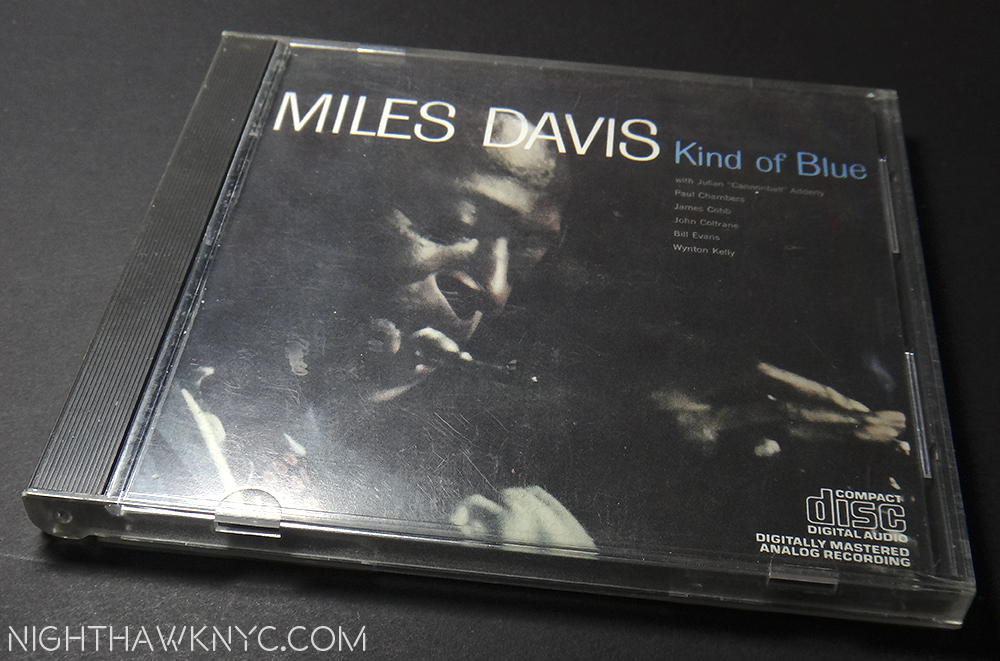
First, Kind of Blue– Yeah. What else would be first? It seems to be every critic’s #1 choice as the first Jazz album you should have. Ok, I get that. For me, it’s much more. It’s a record I’ve lived with for most of the 56 years since its been released. I’ve gone through phases with it. First, there was the “tunes” phase- listening to, and loving the songs as songs, while marveling that they were basically composed at the recording sessions, or as legend has it, by Miles in a taxi on the way to them.

The Official Soundtrack of The Night. I go to The Met to see Art. I listen to this to hear it. I wore out the Lp, then bought this, the first CD release. There's now a 50th Anniversary 2 Disc edition with outtakes- Get that.

The Official Soundtrack of The Night. I go to The Met to see Art. I listen to this to hear it. I wore out the Lp, then bought this, the first CD release. There’s now a 50th Anniversary 2 Disc edition with outtakes- Get that.

Then, there was the Miles-“So-What”-Solo-Phase, which most musicians probably go through. I’m talking about Miles’ solo on “So What,” the first solo on the record. First, you marvel at its utter perfection. Finally, you write it out, study it, and learn to play it on whatever instrument you play. Then? You realize that was easy enough, but it doesn’t come within miles (sorry) of what he did. You start to wonder why not, and you then start to become a “Musician.” Further, jazz can be taught, but Jazz can’t be taught, I believe. The intellect, the sensibility, the taste, the creativity, the feeling, and the unique essence that makes a Master Musician are either there, or they’re not. Even if they are all there? You’re still not Miles. Only Miles was Miles. If you want to know why he was so great, or hear music that is Art, in my opinion, listen to this.

In the 1990’s I was fortunate enough to know, and once work with, the multi-intrumentalist & vocalist Mark Ledford. He passed way far too soon and is probably best known for having been in Pat Metheny’s Band, and having a solo CD out on Verve called Miles 2 Go. He also played with the late, great Joe Zawinul, the co-founder of the legendary band, Weather Report. Joe composed “In A Silent Way,” now a Miles Davis classic, and performed on some of Miles’ classic albums. Mark introduced me to Mr. Zawinul, one evening at the Blue Note, NYC. I was a very long time lover of Joe Zawinul’s music going back before his days with Weather Report, to those days he spent with Miles. Yet, when I finally got to meet him, all I could ask him was, “Have you heard Led play trumpet?” I wondered if he felt about Mark’s playing the way I did. Mark Ledford uncannily sounded like Miles on trumpet. Believe me, I don’t say that lightly. The highway of Jazz is littered with “Miles-wannabees,” who never were. Like me, Mark Ledford had grown up with Miles, and unlike me, he played trumpet. I guess I shouldn’t have been surprised, but when I first heard him play, I was like “WOW. This is uncanny.” I was lucky enough to have him play trumpet on one of my records.

Anyway, the point is that even Mark Ledford, a brilliant multi-talented musician, who could sound more like Miles than any of the millions of Miles imitators, wasn’t Miles. He would tell you that. Listening to Miles and trying to think where he was going…what would come next…was a game I still play. Then? There was that sound. As I wrote earlier, for me, his sound defines living in NYC as much as any sound I can think of. People in London, Cairo, Tokyo and Moscow probably feel the same way. Well? Sorry, but Kind of Blue was recorded here, within walking distance from where I’m writing this, so we’ll take dibs on it. Yet, Kind of Blue is as much about Miles’ sound when he plays, as it is about the sound when he didn’t play. It’s a masterpiece of silence, as much as it is of music, of “negative space,” as Artists call it, as I mentioned in my first Miles Post. When you go back and listen to earlier Miles albums you can hear it there, too. But, it’s a featured player here, and something that became integral to listening to Miles henceforth. For me, this silence is what puts Miles’ legendary coolness over the top. No other musician, in any kind of music has ever been as revered for what he played as for what he chose not to play.

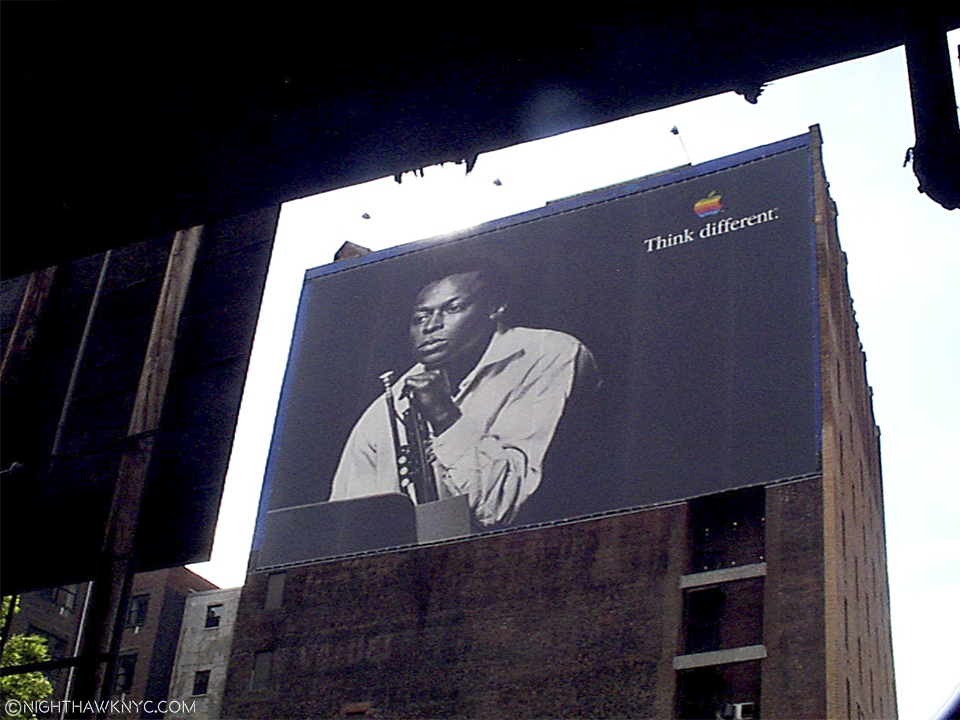
Another view of the “Think Different” Billboard, June, 1998. This one shot from under what is now the High Line

Time would go by, and I’d come back to Kind of Blue, again. This time for Trane. John Coltrane is a world unto himself. He was as revolutionary a figure as Miles was, in his own way. One of the first “mainstream” jazz musicians to experiment and adopt elements of the avant garde in his work, he was a man who was on a mission. A mission that ended far too soon, when he suddenly passed in 1967, age 40! Look at his discography and you’d think he lived to be 100, almost no one was as prolific a recording Artist as John Coltrane (Thank goodness!) Like Miles, all periods of Trane’s work are important, and his period with Miles, which would end shortly, was certainly up there with any of them. While Miles was creating perfect statements with the utmost economy, John Coltrane was wailing. He often sounds like a man who knows he doesn’t have a lot of time to get it all in. Possessing one of the most formidable techniques in the long & storied history of the Tenor Sax in Jazz, he used every ounce of it, seemingly, all the time. Miles once said, no doubt referring to him, “I had seven tenor players, once.” Yet, in spite of what some critics say, I don’t ever hear him overplaying. Later, his explorations carried him much further afield than we hear him here, and that’s a different story, but on Kind of Blue, he is the perfect counterfoil for Miles (as he is one virtually all of his recordings with him.)

So, you can listen to “Kind of Blue” for the music. You can listen to it for Miles. You can listen to it for Trane.

And, you can also listen to it for the great Cannonball Adderley. Or the great Bill Evans, or for the band as a whole (Paul Chambers bass and Jimmy Cobb’s drums complete the band, with Wynton Kelly on piano on one track), a unique combination of master musicians, all at their peak, all together in one room. Thank Buddha there was recording equipment, engineers present, and someone remembered to hit the “Record” button! (I’ve been to sessions where someone actually forgot to.)

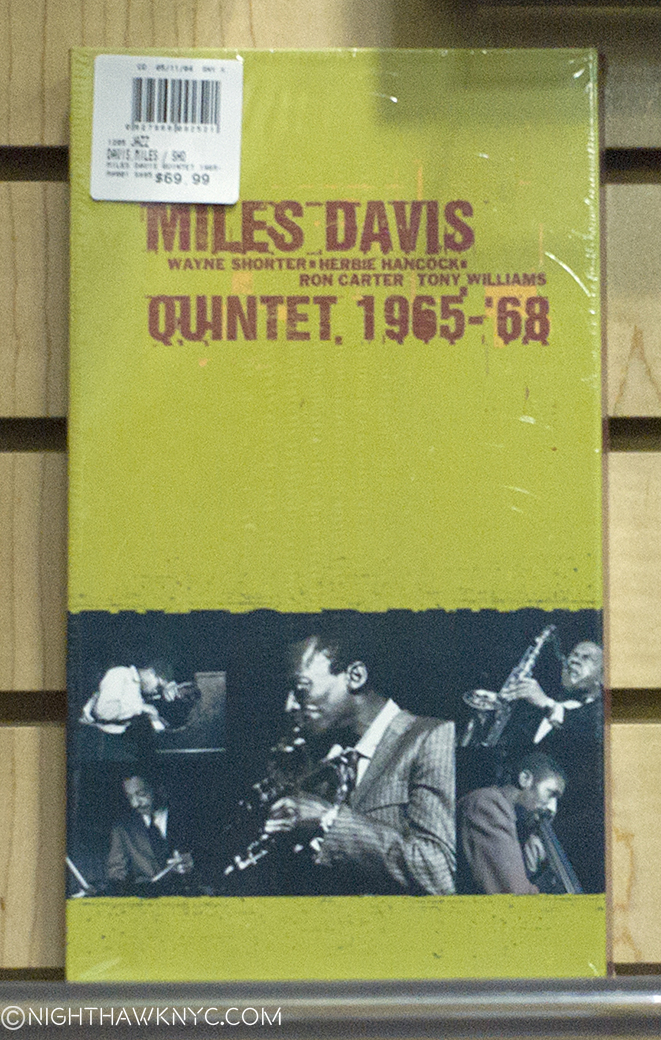
After Kind of Blue, there are many different ways you can go in exploring Miles’ recorded legacy. For me, I’d go with the music of the group that took acoustic music further than anyone has- before or since- Miles’ Quintet of 1965-67, the so-called “Second Great Quintet.”.

You’re looking at nothing less than what remains the State of The Art in small group Jazz. Available as individual records, or in this Complete Box Set, seen at Barnes & Noble, Union Square, one of the few CD Stores left in NYC this week. I never leave home without it…on my Phone.

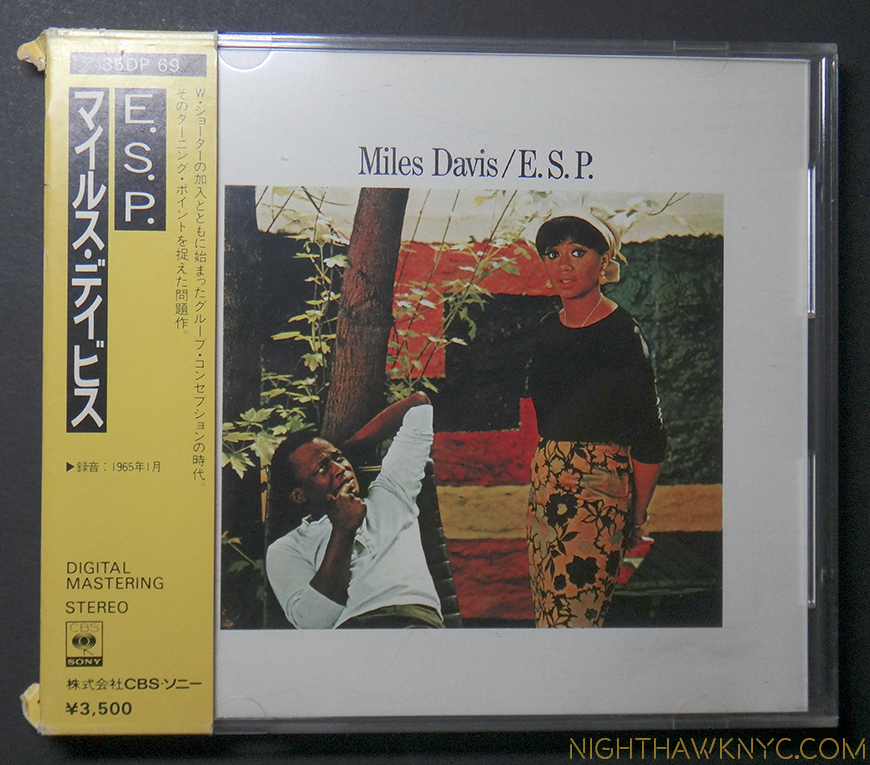
To clarify- Miles’ “First Great Quintet” was the working group (i.e. they performed live) he had from 1955-58 that included Tenor Saxophonist John Coltrane. The group that recorded Kind of Blue is referred to as his “Sextet.” For me, everything the Second Great Quintet recorded is essential. Miles was joined by Wayne Shorter (Tenor, and later, Soprano Sax), Herbie Hancock (Piano), Ron Carter (Bass) and Tony Williams (Drums)- a group of young, and already accomplished, talents who grew to become masters on their instruments during this experience. One of their albums was titled “E.S.P.,” which perfectly summed up the previously unheard level of group intercommunication they attained as well as anything could. Therefore, the “album” I’m recommending is The Complete Columbia Studio Recordings Of The Miles Davis Quintet January 1965 To June 1968, a 6 CD set, pictured above. It’s a compilation of their albums of the period. It would be very very hard for me to pick one album. If you held a gun to my head? E.S.P., then Nefertiti, The Sorceror, Miles Smiles, but we are splitting hairs now.

E.S.P. as a single Lp/CD. While the music inside is telepathic, the cover, with then wife Cicely Tyson, makes me wonder, too. See note below about Japanese pressings.

E.S.P. as a single Lp/CD. While the music inside is telepathic, the cover, with then wife Cicely Tyson, makes me wonder, too. See note below about Japanese pressings.

This is music that features Miles at the peak of his powers, in the company of 4 young musicians (Tony Williams was 17 when he joined Miles!) who are becoming Masters, themselves, right in front of our ears. A key point in this evolution occurred when when the band was performing live early on. Miles wondered why the group played differently, more adventurously, behind Wayne’s solos than it did behind his. So he called them out on it and told them to play the same way behind his. In short order the group was matching its leader at every turn, and, by the time of their later recordings, even push him. It’s exciting, fresh, exploratory and endlessly vital music, that, in my opinion, redefined what acoustic jazz could be. Those terms are carried on in the superb Wayne Shorter Quartet of 2001 to date, one of the few bands that carries on in the spirit of the GQ2, perhaps at the behest of Miles, himself, who reputedly passed the torch to Wayne the last time they spoke. I digress.

If, like me, you get to the point where you must hear every note the GQ2 played, than by all means check out The Complete Live At The Plugged Nickel, Miles In Berlin, and the Live In Europe 1967: The Bootleg Series Vol. 1, (a 2011 release that only scratches the surface of rare live recordings by this band that are avidly traded among collectors. These are not on the “Shortlist,” however. Many of these are in surprisingly good recording quality, having originated from Radio or TV Broadcasts- or both.)

Many Miles fans will part ways with me here, when I make my next selections, and that’s fine. It’s my personal opinion. I think we’d all agree that it’s best to hear as much of Miles’ music as one can and decide for yourself, what speaks to you. There are about 50 studio albums to choose from that Miles recorded, 36 or so live albums, but, as I said, these are augmented by hundreds of live tapes that collectors trade. This list is merely a suggested starting point to help you figure out where you’d like to go, or suggest new roads if you’ve dipped your toe in Miles’ Ocean.

DSC04981PNH

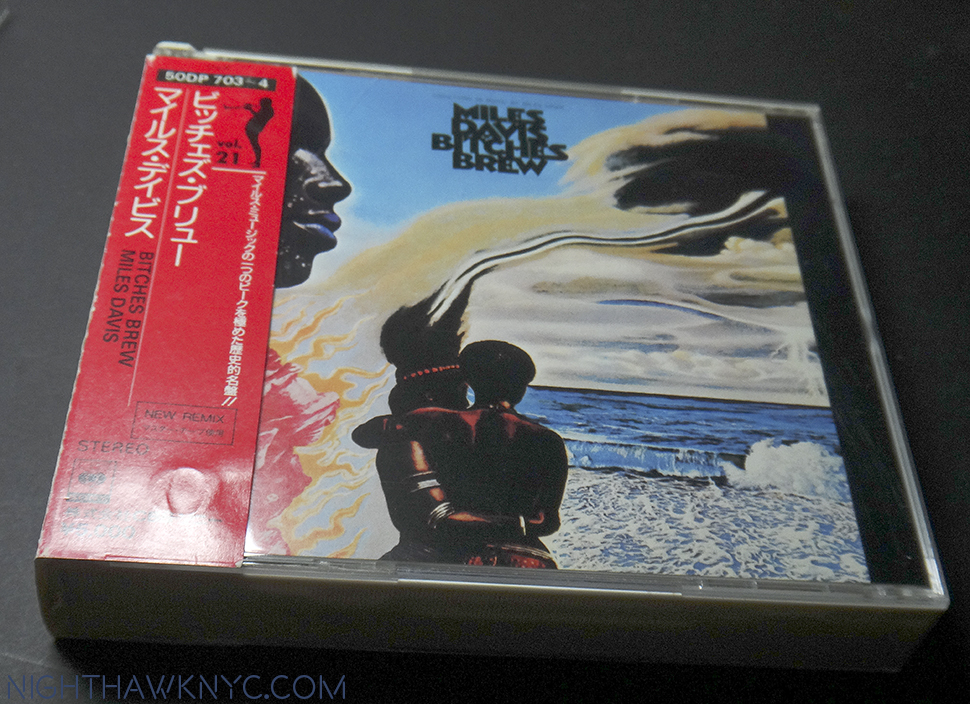
This one changed my life. Oh, and music has never been the same since, too. Perfectly titled. Perfect cover art. Perfectly Revolutionary.

I’d suggest Bitches Brew next. As I touched on previously, Miles Running The Voodoo Down. it was a revolution in a career of many innovations. It still sounds ahead of its time to me. It has that air of improvisation that Kind of Blue has, but in an entirely different way. Wayne, Keyboardists Joe Zawinul, Chick Corea, Larry Young, Guitarist John McLaughlin, Bass Clairnetist(!) Bennie Maupin, Bassist Dave Holland, and Drummers Lenny White, Jack DeJohnette, Billy Cobham and Percussionists Airto and Don Alias, joined Miles in brewing up a concoction that melted the borders not only between rock and jazz but between so many other kinds of music at the same time, it was like the flat earth had suddenly become round. I don’t think it’s an overstatement to say it had the equivalent effect of The Beatles going psychedelic 2 years earlier with the release of “Strawberry Fields Forever.” The influence of this album is everywhere I turn today- every time I see a jazz group that includes an electric instrument, there it is, or a group of some other kind of music that has jazz elements (including Prince) and an electric instrument or two.

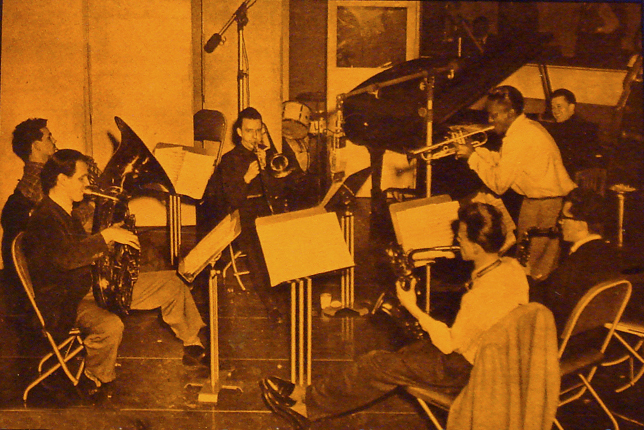
Miles’ work with Gil Evans is also revolutionary, and much less controversial. Many consider it his most beautiful music. It extends as far back as 1949-50 and is collected on the legendary, and highly recommended, album The Complete Birth of The Cool, which is exactly what it was. Miles has been “cool” ever since. For me? He defines it. The shot below is from a radio session done the year before the record. Miles was playing Gil Evans Arrangements that featured unusual instruments for small group jazz, like the tuba and french horn. So, the band became known as “Miles’ Tuba Band.”  About 10 years later, they reconvened to created the masterpieces “Sketches of Spain” and “Porgy and Bess,” (yes, the Gershwin Opera). Add them to your list.

Pre-Birth of the Cool. Miles, NYC in 1948 with Lee Konitz on Alto, and Gerry Mulligan on Baritone Saxes, Left, John Barber on Tuba. From my collection.

Ok, it’s been hard to leave off other albums featuring John Coltrane, so I will wait no longer.

DSC04988PNH

No. He’s not posing here, or in the silhouette. Only Sinatra and Ella can “sing” standards with Miles. (Louis and Billie ain’t bad, either.)

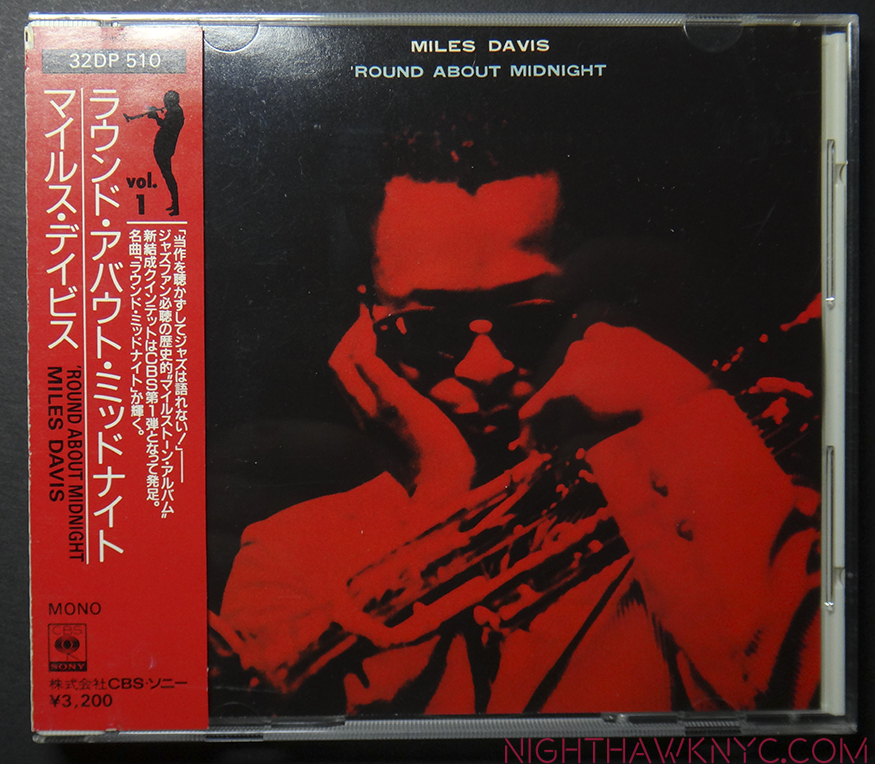
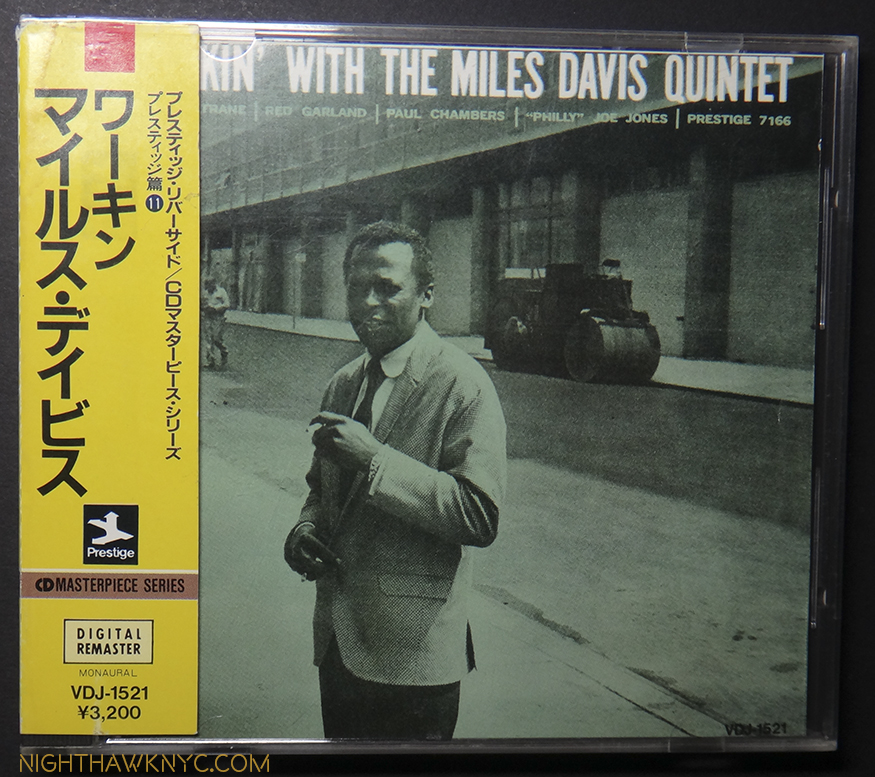
Milestones is a classic. Along with Trane, it contains another (like on Kind of Blue) rare appearance by Cannonball Adderley, along with Red Garland (Piano), Paul Chambers (Bass), and Philly Joe Jones (Drums). This band, without Cannonball, comprised Miles “First Great Quintet.” “‘Round About Midnight,” and “Miles Ahead” would be your next stops for the studio work of this group. Two points should be made here- 1) Miles created these records for Columbia Records, who he signed with in 1955. Before that, this group recorded for Prestige. Among the Prestige titles, I love Workin’ and Steamin’, though Cookin’ and Relaxin are right up there as well.

DSC04987PNH

Workin’” but not Steamin’ “It Never Entered My Mind” is on this. One of his greatest performances for my money.

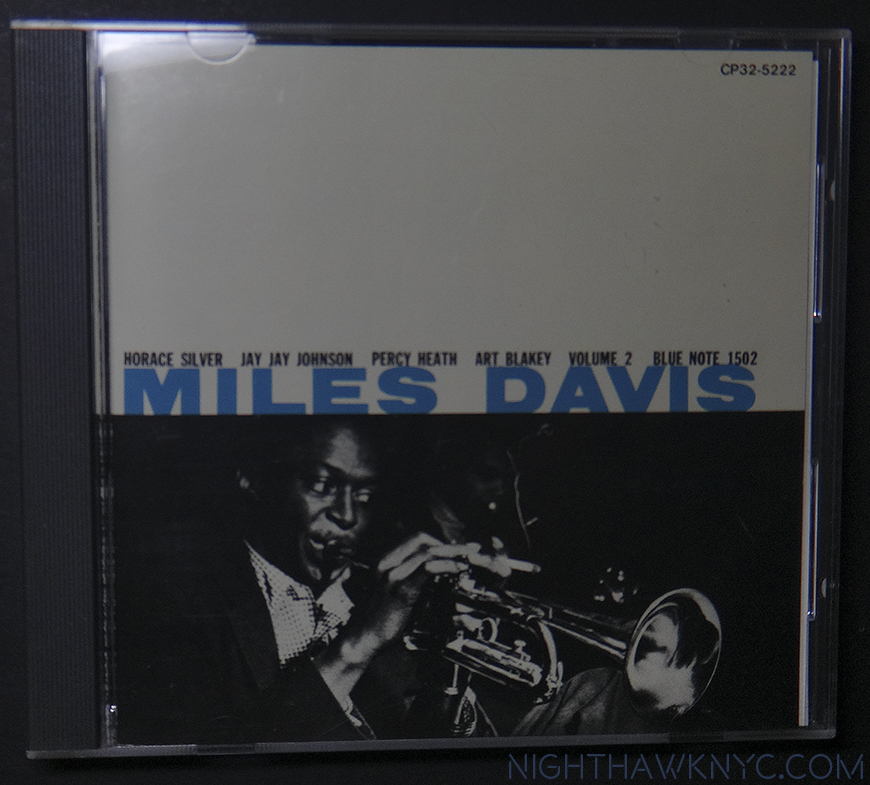
After these, head to the even earlier Blue Note recordings Miles made, that were released as Young Man With A Horn, and then Miles Davis Volume 2 and Volume 3, from 1952-54. They have been collected in a Blue Note “Complete” CD set.

DSC04984PNH

Miles Davis Volume 2 on Blue Note. One of their most iconic cover designs.

DSC04986PNH

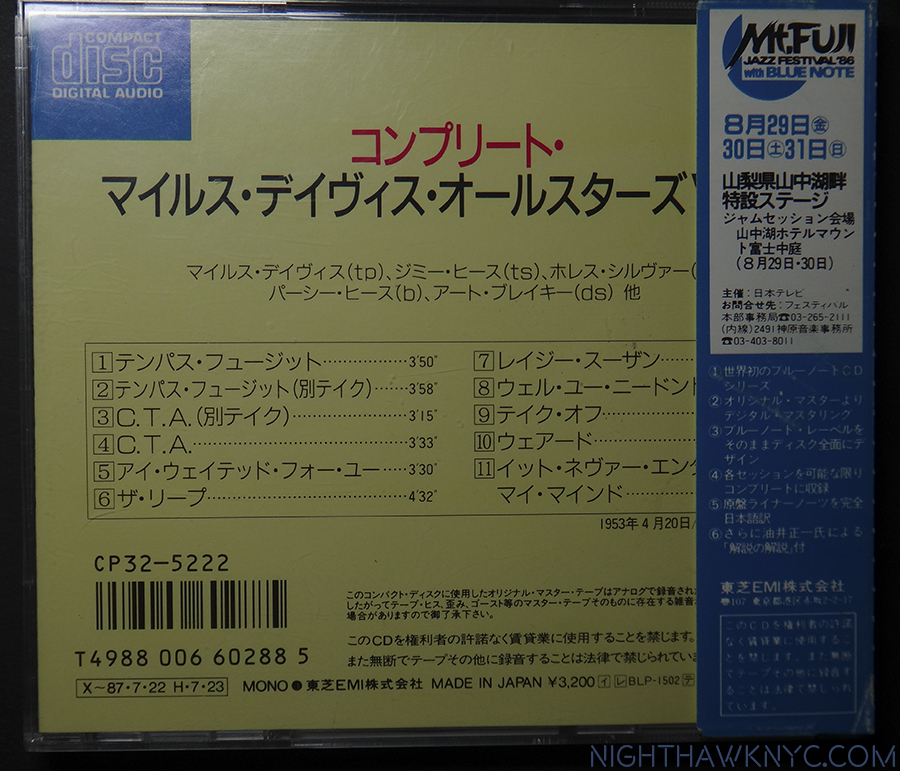
The back cover of the above proves that Music is the universal language.

Oh. The other point, 2) is that the Miles in that as great as their studio records are, and they are among the greatest ever made by anyone, Miles and Coltrane MUST be heard together live, in my opinion, to get any kind of full appreciation of their chemistry together. As I’ve said, they were the perfect foils- Miles the genius of understatement, the inventor (to my way of thinking) of musical silence, contrasted by John Coltrane, who was at that time working on development of the final stages of what would be called his “sheets of sound” style. What might sound on paper like a musical train wreck (no pun intended), was in reality magic. Art. From there, there are, once again, bootleg recordings around, many of which belie the late 1950’s dates, with more than acceptable sound. The greatest “official” live album is Jazz At The Plaza, a somewhat unintended album (the musicians didn’t know they were being recorded), but a miraculous live document of the Miles Davis Kind Of Blue Sextet.

Ok. Still with me? Want to hear more? Good! We still many Miles to go! (Sorry.)

Before, and after, Bitches Brew was a very fertile period for Miles. In A Silent Way, and Jack Johnson are bookends in a sense- the former beautiful, subtle, crystalline, thanks in no small part to the presence of Joe Zawinul, who wrote the title track, in a band that includes 4/5 of the Second Great Quintet, along with John McLaughlin (Guitar), Dave Holland (Bass) and Chick Corea joining Hancock and Zawinul on Keyboards). Recorded in 1969, it’s the album right before Brew. “Jack Johnson” was recorded immediately after Brew in February and April, 1970. Miles Backed by “the greatest rock and roll band you have ever heard” (QUOTE) (McLaughlin, Sonny Sharrock- Guitars, Hancock & Corea- Keyboards, Benny Maupin on Bass Clarinet and Jack DeJohnette and Billy Cobham on Drums, he wasn’t lying.

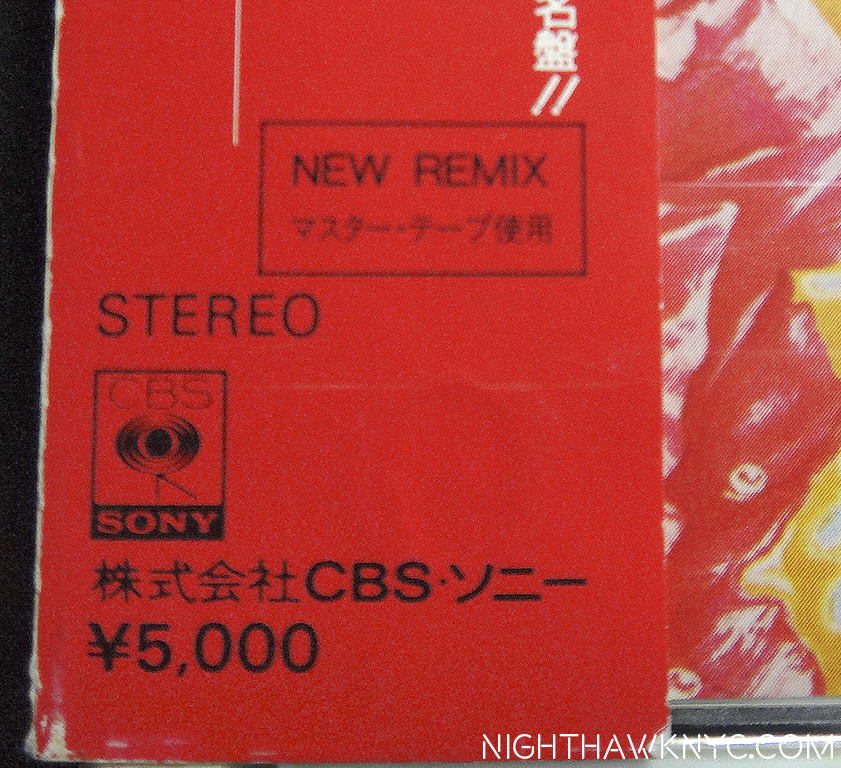
You’ll notice that many of the albums pictured are the Japanese CD’s. Why? The choice of Lp or CD is up to you. I actually have both of many of these, but my CD’s were nearer to hand.) In records and CD’s there are some who think the Japanese pressings sound better than the American versions. For Miles’ albums, this was true years ago, both in the later days of vinyl Lp’s and the early days of CD’s when many were rushed into production here in the US while paying little attention to sonic quality, sometimes, not even bothering to find the correct master tapes. So, early on, I went for the Japanese CBS/Sony pressings, which are what I still have and are shown here. CBS/Sony (Japanese Columbia Records) was legendarily fastidious in their attention to sound quality.

A bigger potential issue is that Columbia, which owns most of Miles recordings up to the 1980’s undertook a reissue program that saw them scour their vaults for unreleased takes to include as part of a series of “Complete” Box Sets. You should also be aware that they remixed (and remastered) the original tapes. This is something I find potentially troublesome in some cases. There is a lot to be said for having the original mixes, when an album was orignally mixed (i.e. was recorded on multi-track equipment.) Off the top of my head, I’m not sure what the current state is of mixes one would get if buying these albums on CD’s today. They might be the original mixes, which would have been done by Miles’ legendary Columbia producer, Teo Macero, more likely, they may have been remixed. It should say somewhere on the packaging. I don’t have them, so I can’t check. The Japanese CBS/Sony pressings I show are both. Bitches Brew states that it is a “New Remix,” but there is no additional information anywhere in the package.

Really? By Who? They're not sayin

Really? By Who? They’re not saying.

I’d have to compare them side by side with the original Lp versions out now to know if they’re different. Does it make a difference? Possibly not. Miles music was acoustic up to 1969-1970 and performed in small groups. There’s really not a lot to mess up there, though anything is possible. (Note- Sony, who bought Columbia, issued a 9 CD Box set called Miles Davis: The Original Mono Recordings in 2013, of his Columbia albums through 1961, with a few extras. I haven’t heard this because I prefer Stereo, when it issued that way, along with mono.) With the later albums, there’s much more potential for difference. I’m saying all of this to make the buyer aware of it, though it’s a subject I have not as yet seen anyone mention. It applies to other artists, especially rock artists, much more than it might to jazz artists for the reasons I mention.  Still, with any classic recordings, it is something to keep an eye, and ear on. IF you really want to get to the heart of the matter? Go for the original Lp’s. Yes, you can spent a fortune on original pressings, but if you are only looking to get the original mixes, any of the issues from the Lp era will contain them (I can’t vouch for the currently available Lp reissues.) The front cover images of these Japanese CBS/Sony CD’s are the same as the original Lp’s.

Ok. back to the matter at hand. While Miles’ recording career lasted about 40 years, he took about 6 years off from about 1974 to 1980. In 1981 he suddenly returned, with a new album, and a live tour. He continued to do both until he passed in September, 1991. We miss him, still.

The return from retirement.

In 1980 Miles came back after over a decade off. He recorded a string of quite popular albums, but only two of them are going to make my “Shortlist.”

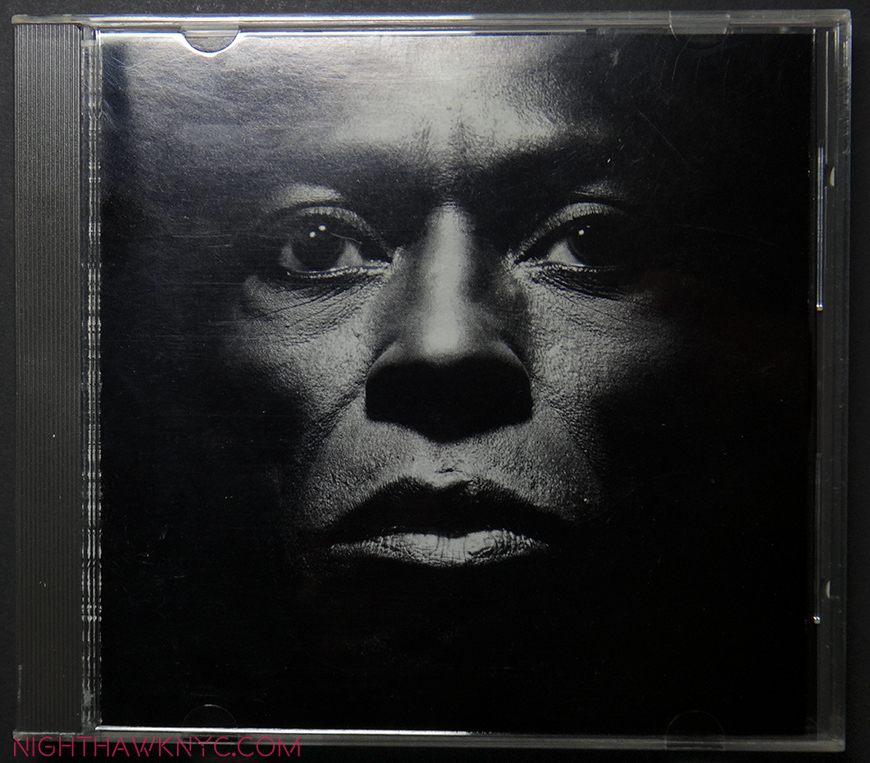
Tutu is a different type of masterpiece. Produced by the very underrated Marcus Miller, for me, it harkens back to Gil Evans while using every bit of a contemporary sound, with utmost taste. Brilliant and unexpected, it’s matched every bit by the incredible photography on the cover and in the booklet.

The Prince of Darkness looms out of the Darkness.

The “Prince of Darkness” looms out of the Darkness on the cover of. Tutu, by Irving Penn, part of what I think is the greatest photoshoot of Miles ever. The 4 foot poster of this was pictured in my prior Post.

And finally, Miles & Quincy: Live At Montreux. Recorded two and a half months before Miles’ passing, it was one of only two times Miles looked back musically, and WHAT a time! With an orchestra led by Quincy Jones, Miles actually plays the music he made famous with Gil Evans on “Porgy & Bess” and “Sketches of Spain,” 30 years earlier. Most of his fans thought he would NEVER play them again. It was the last musically revolutionary thing he did. Then, two days later in Paris, France, he, again, walked down memory lane, but this time in the company of many of the now Masters who were once his sidemen, including- Wayne Shorter, Joe Zawinul, Herbie Hancock, Chick Corea, Jackie McLean, John Scofield and Dave Holland, among others. Thankfully, Audio and Video recordings of both concerts exist.

The sun never sets on great music. June, 1998 on West 23rd Street.

A perfect conclusion to one of the most important careers in the history of recorded music.

Oh! Lest I forget to at least mention that Miles also recorded extensively with no less than Charlie “Bird” Parker, who he was obsessed to find after moving to NYC to study at Julliard, at age 18. He not only found him, Bird moved in with him, and the two played together off and on regularly during Davis’ key formative years. Many of these recordings are still available, and while they are quite good, and endlessly fascinating, I’d recommend them to fans who have become obsessed with Miles as “something else” to hear and enjoy. It turns out that Miles Davis, perhaps, knew Bird, another of the greatest and most important musicians of the 20th Century, who died at age 34, as well as anyone did. Amazing!

Ok!

So? There you have it.

Once you make your way through these, you’ll have a good idea which direction you want to go in next. Well? You’re in the right place. Miles’ late 1960’s albums are perceptively labelled-

DSC02889PNH2

‘Nuff said. Now…where are my headphones?

*-Soundtrack for this Post is “Someday My Prince Will Come,” from the 1937 Disney film, Snow White & The 7 Dwarfs, as recorded by Miles Davis on the album of the same name, which I did not list, but chose because it’s a classic performance of a song that was never intended to be a jazz standard and now is one, and…because it fits. All photos are items from my collection.

NighthawkNYC.com has been entirely self-funded and ad-free for over 6 years, during which over 250 full length pieces have been published. If you’ve found it worthwhile, you can donate to keep it going & ad-free below. Thank you!

NighthawkNYC.com has been entirely self-funded & ad-free for over 8 years, during which 300 full length pieces have been published! If you’ve found it worthwhile, PLEASE donate to allow me to continue below. Thank you, Kenn.

You can also support it by buying Art, Art & Photography books, and Music from my collection! Art & Books may be found here. Music here and here

Written & photographed by Kenn Sava for nighthawknyc.com unless otherwise credited. To send comments, thoughts, feedback or propositions click here. Click the white box on the upper right for the archives or to search them. Subscribe to be notified of new Posts below. Your information will be used for no other purpose.

  1. He took about 6 years off from about 1974 to 1980

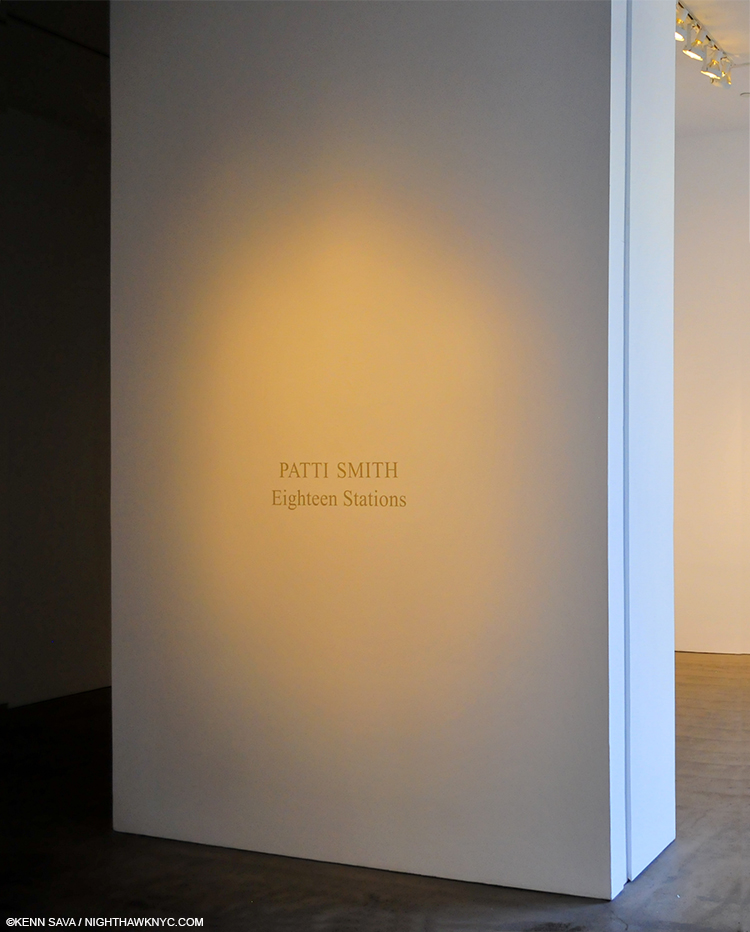
Table For One – Patti Smith’s “18 Stations”

Written & Photographed by Kenn Sava

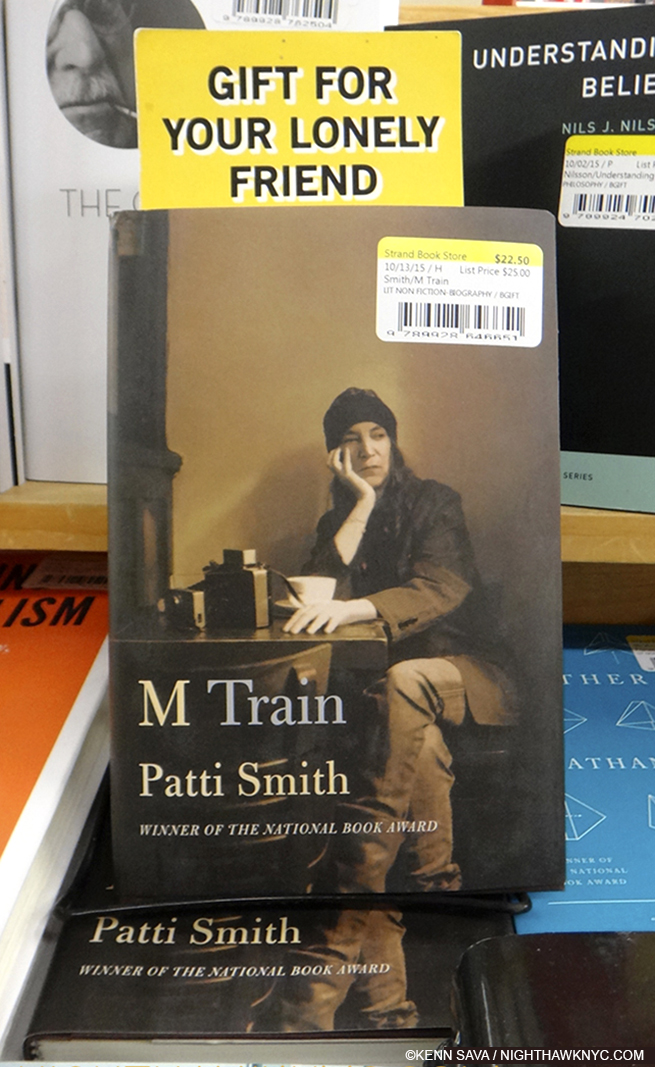
One of the small pleasures of going to The Strand Bookstore are the quirky, usually ironically humorous yellow signs one of the staff places in random books. This one was sticking out of a just released book one day last October- Patti Smith’s “M Train,” featuring its author looking incognito sitting at a corner table by herself lost in thought…

October 30, 2015. I bought one.

Patti Smith, who many years ago briefly worked one floor down in The Strand’s basement, is a living legend now, but, she’s not stopping there.

From here to… The Strand’s basement. Not one of the 18 Stations. The “Patti Smith section” is now down here.

Beyond her groundbreaking music career, she’s had a second career as an award winning writer of prose, which seems to grow in stature all the time. “M Train,” which she calls “a roadmap to my life,” is both similar, and different, to her previous book, the instant classic “Just Kids.” While also a memoir, like “Just Kids” was centered on her relationship with Robert Mapplethorpe, this time, it’s about her life before, during and after her late husband, Fred “Sonic” Smith, guitarist of the MC5. It differs, too, as her Polaroid photography is a central part of this book. While, she’s been doing photography for years, and books of them have been published, she seems liberated here by not having a brilliant photographer as the co-subject, one she felt a responsibility to, and who’s pictures of her are now classics. Her photos enhance the story and go hand in hand with her imaginative telling of it, which almost feels improvised (she mentions listening to John Coltrane’s 1964 album “Live at Birdland” at one point and that is how her writing here feels to me). The book serves to pique interest in this aspect of her creativity. Now, many of those photos, and others, are on view in her show, “18 Stations,” at Robert Miller Gallery on West 26th Street, through April 16.


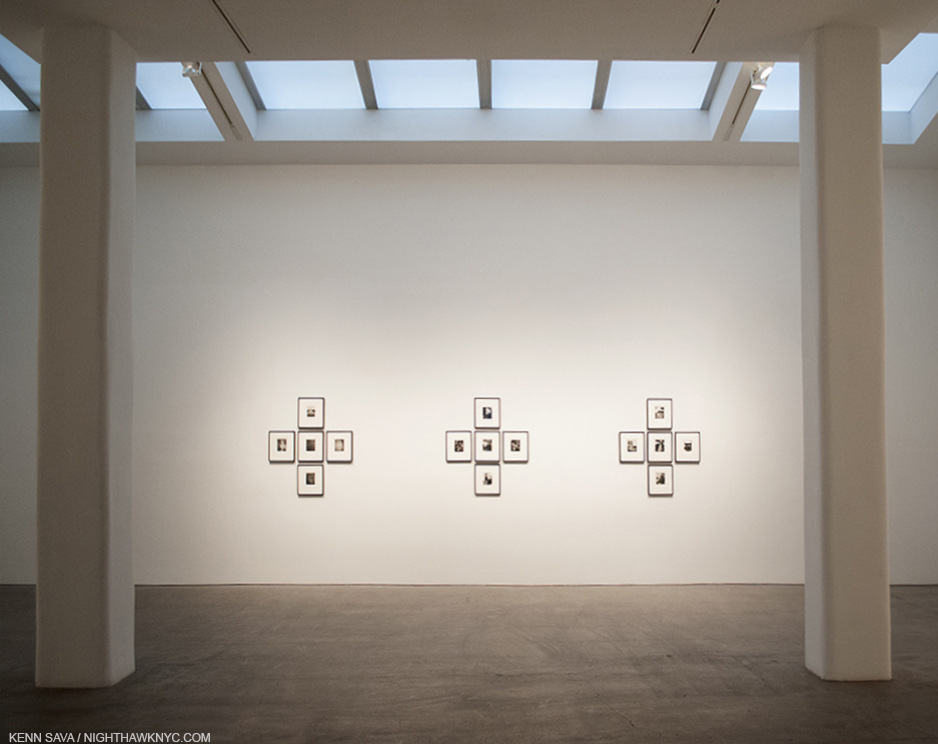
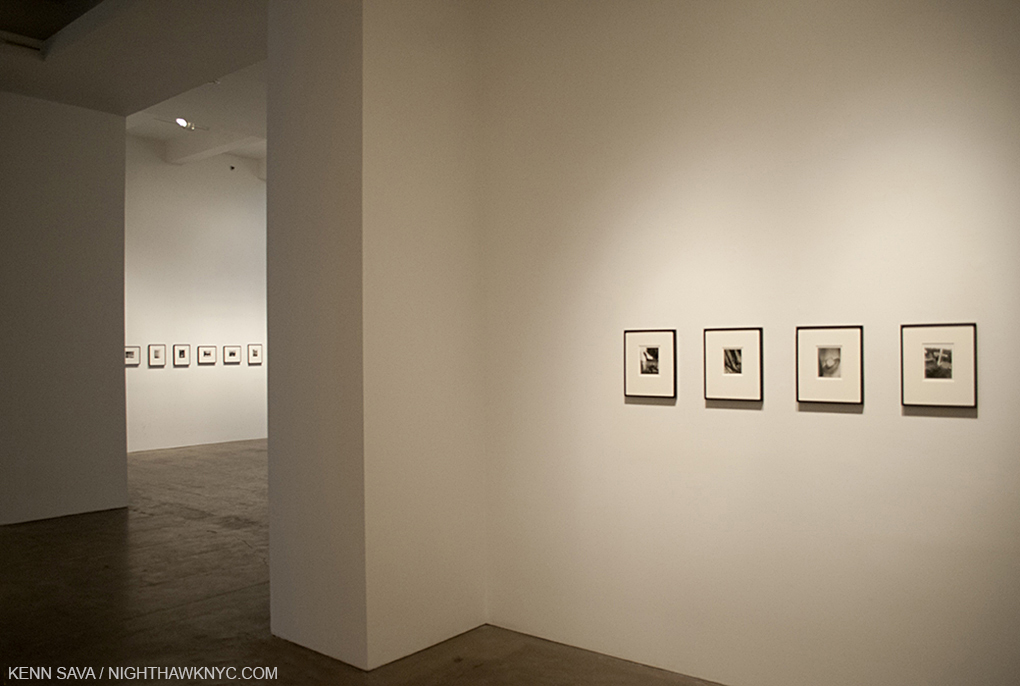
3 of the “18 Stations.”

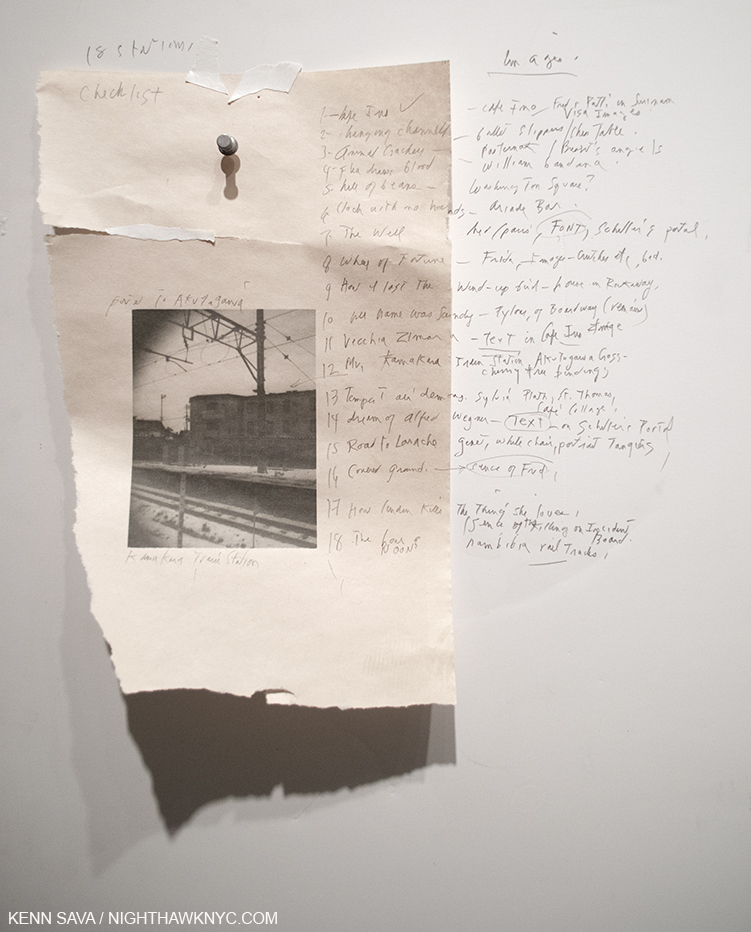
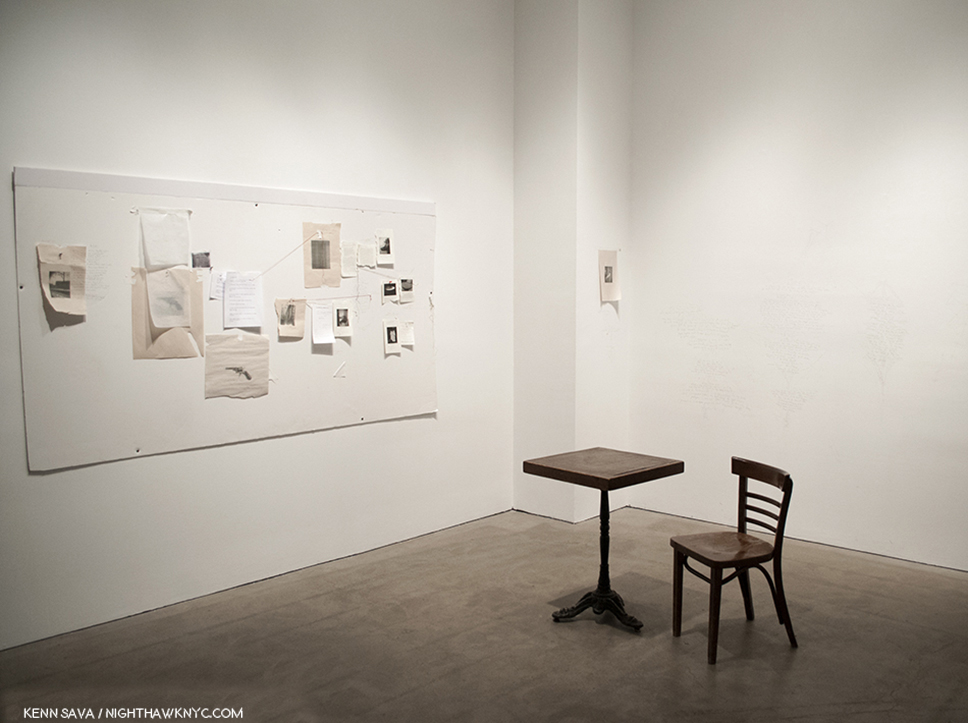
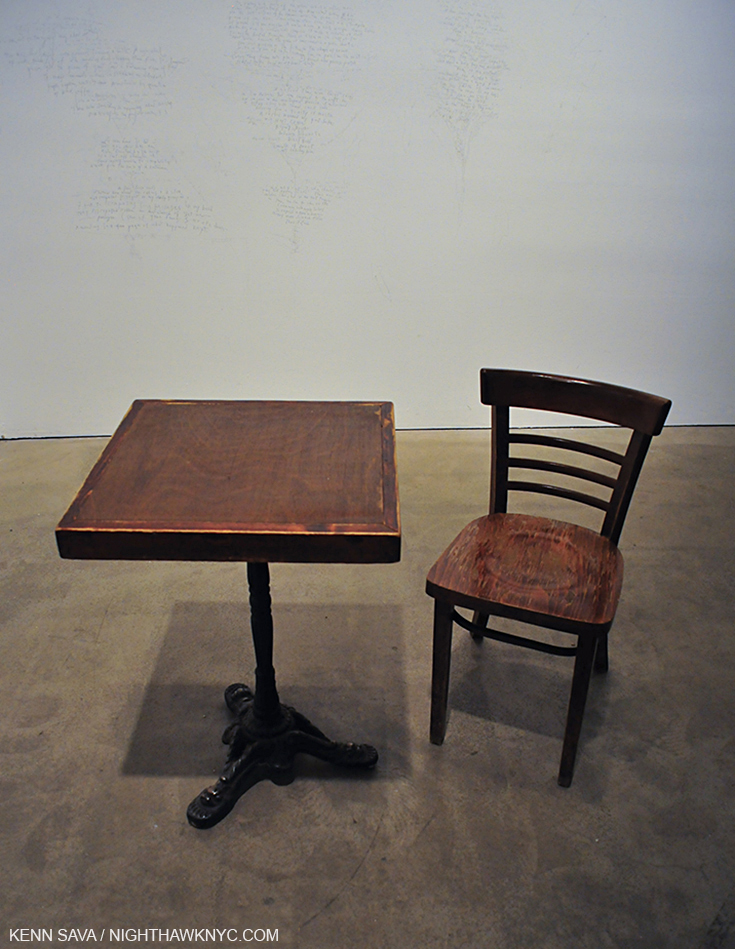
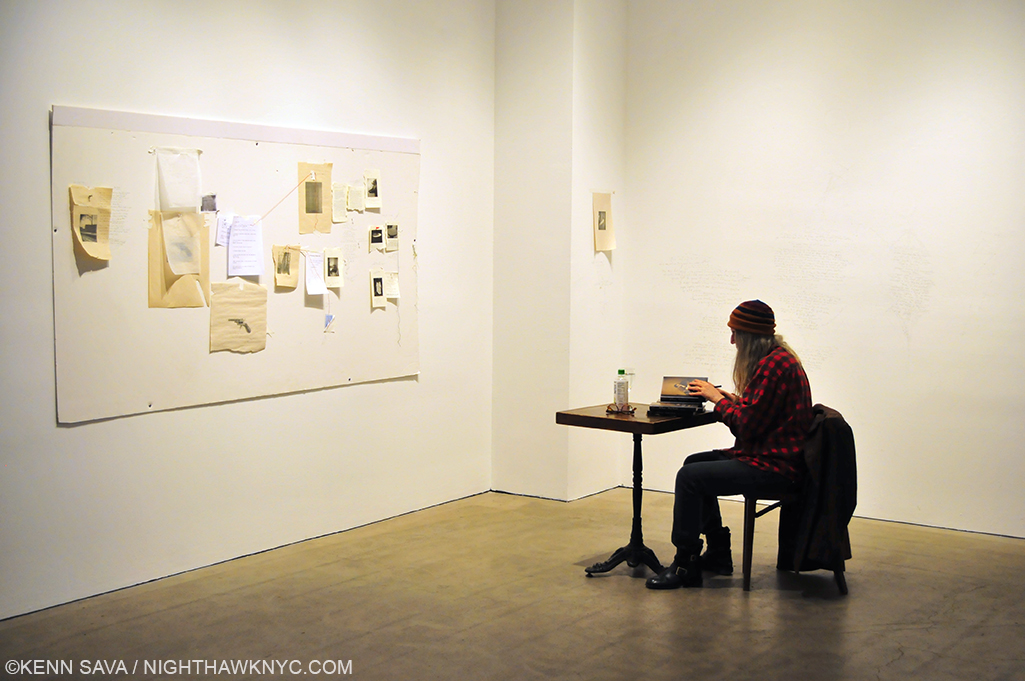
While rock stardom is rare, something few can relate to, along the way, she’s also become something many more can relate to- single, and on her own. The show arranges images from her seemingly never-ending travels from, and returns to her NYC homes, and her beloved Cafe ‘Ino, at 21 Bedford Street in the Village, (spoiler alert), which closes for good near the end of the book. At the figurative and literal “heart” of the show, half way back in the Gallery, in the first “Station,” is an installation of her real table and chair from Cafe ‘Ino (“My portal to where.”) flanked by a bulletin board containing what appears to be the genesis of this show on one wall, and pencilled notes hand written right on the adjacent wall, making me wonder if the show originated during her time there.

Table For One. The wall on the right is covered with her writing in pencil.

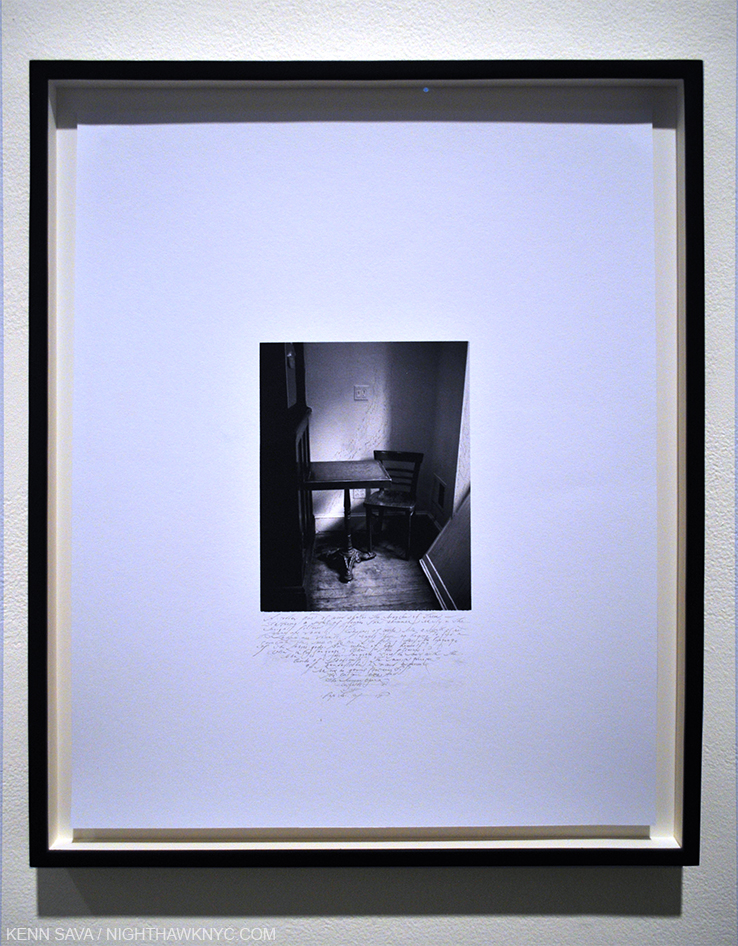
“It occurred to me I could preserve the history of ‘Ino…like an engraver etching the 23rd Psalm on the head of a pin.” The iconic first picture in M Train in a unique version with Patti’s pencil inscription in her caligraphic script.

“We seek to stay present, even as the ghosts attempt to draw us away.”

It’s as if the thoughts she was having while sitting there are now real before us, though she is absent.  The other 17 “Stations” tell the story of her journeys, partially with her late husband, “M Train” dedicatee, Fred “Sonic” Smith, but mostly alone.

2 more Stations.

Reading the book, one discovers quite a bit about the “real” Patti Smith- her unquenchable thirst for (good) coffee, her obsession with detective TV shows….which, of course, reminds me of a song. You know…”She’s filing her nails while they’re dragging the lake…”

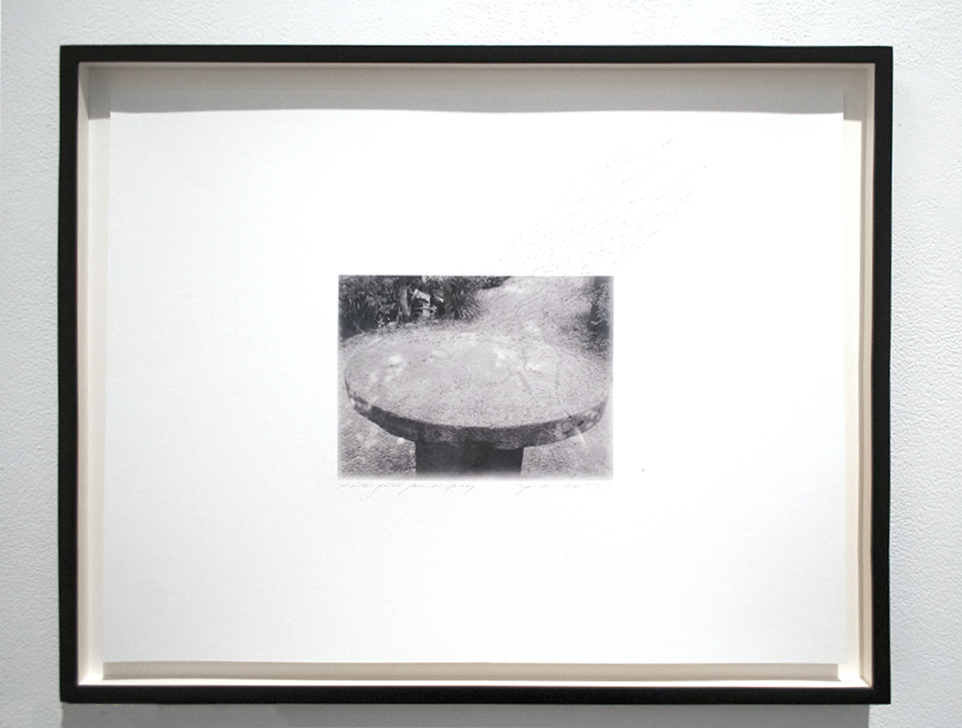
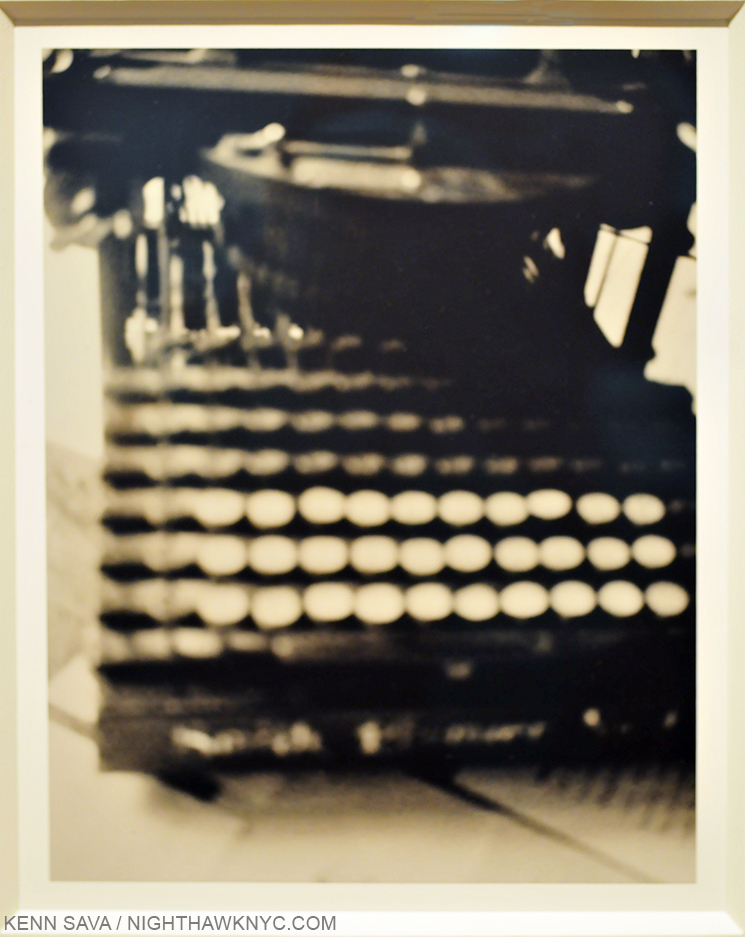
…her amazing connectedness to her influences to the point of traveling to their homes, gravesites or other memorable places in their lives- like visiting the chess table Bobby Fischer played Boris Spassky for the World Championship in 1972 in Iceland (she then had a late night meeting with Mr. Fishcher, and subsequently visited his grave after he passed the following year). She remembers so many of her dreams! I don’t. She also has a love of birthdates and anniversaries. Along the way, we meet Tolstoy’s Bear, Herman Hesse’s typewriter, Frida Kahlo’s medicine bottles and Schiller’s portal. I mean oval table.

Schiller’s Table. This inscribed version is labelled Schiller’s Portal

If you’re curious about how she works, or how she goes about her daily life, this is the book for you. For the rest of us, its a book about honing in on what really matters to you, about persevering and continuing to do you work and hone your craft. We’re lucky to have it. I found myself wishing we had something similar by Da Vinci, to go along with his Notebooks, or Michelangelo, who left us about 500 letters and possibly ghost wrote a biography of himself, that is frustrating for many reasons, where Patti’s paints a vivid picture. The amount of detail she recalls is staggering (and perhaps a bit too much). Well? I can’t have it both ways, so I’ll opt for too much rather than not enough. It’s interesting to contrast this intense detailing in the prose with her photographs. Some are a bit blurry, some off center or kilter (see below) providing (purposely) less detail than you may want.

“Speak to me, speak to me heart
I feel a needing to bridge the clouds, softly go
A way I wish to know, to know
A way I wish to know, to know”*

While most of these Polaroids are silver gelatin limited edition prints of 10, a few of these remarkable and beautiful images are graced with her equally beautiful handwritten inscriptions creating one of a kind works, they all, consciously, have an old feel to them, belying the fact that some were taken barely 3 years ago, which gives them a dream-like, seen in a vision quality, which Ms. Smith says she likes about early photography. The effect strikes me as not unlike that achieved by the great graphic artists, like Rembrandt, Goya and Whistler.

Herman Hesse’s Typewriter. I would have guessed it was William Burrough’s.

It’s also interesting to ponder what isn’t- here, or in M Train. There is no Robert Mapplethorpe. There are no shots of the Hotel Chelsea, West 23rd Street or Chelsea. No CBGB’s (How many of you remember that Patti Smith was also the last Artist to perform there?). There are only a few (as far as I can tell) of Manhattan. The two shots of Cafe Imo, of course, a shot of the West 4th St Subway Station, a shot of her house, among them. In that sense, for someone who, (for me and perhaps quite a few others) is associated so strongly with New York City, this is a show (like the book) that is largely about the world “outside” of it. ‘Ino being the “portal” to it. Memories of people and places outside of Manhattan (even in the case of Ginsberg and Burroughs who spent so much time here).

“Speak to me, speak to me shadow
I spin from the wheel, nothing at all
Save the need, the need to weave
A silk of souls, that whisper, whisper
A silk of souls, that whispers to me”*

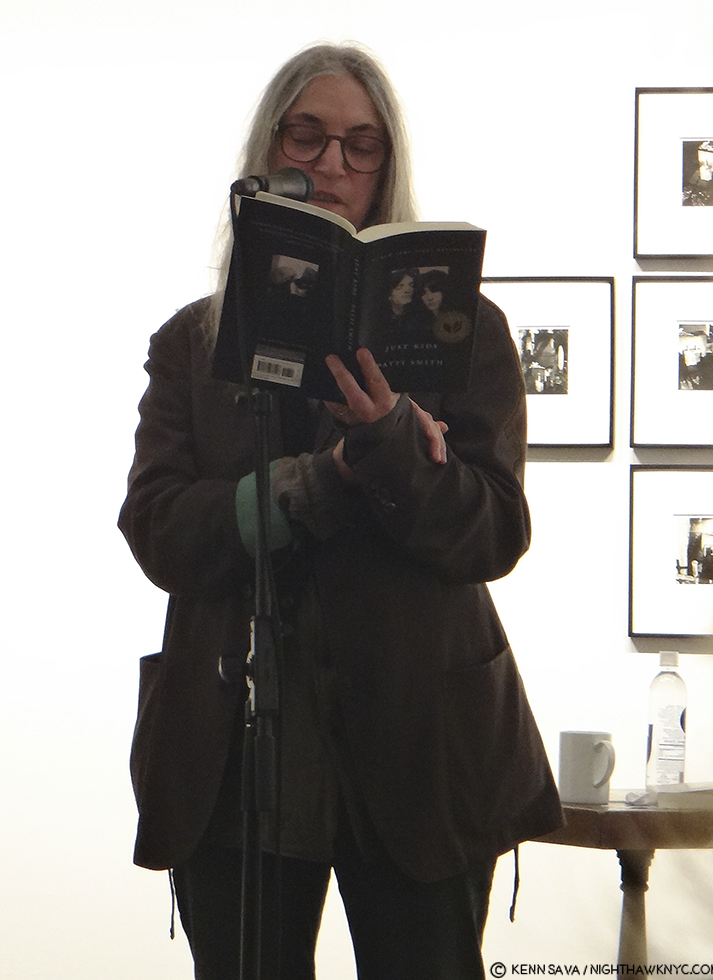
Among my dozen visits was one on April Fool’s when a few hundred of us were blessed to have our paths cross with hers at a reading here that served to highlight for me, at least, the conversational nature of both her recent books, then hearing her tell stories about them, and her life, in ways no “audio guide” ever could. I’ve heard a lot of Artists, and Musicians for that matter, speak about their work. Rarely have I felt like they were speaking of their children the way these stories felt. The memories behind each shot is so personally present, it lies as close to her skin as the image lies on the surface of the paper. Quite a few of the stories are told in the books, and hearing her read them changed the way I will re-read them. (I have not heard the audio books she’s done of them.).

I missed hearing Joyce read Ulysees, Kerouac read On The Road, Ginsberg read Howl, but…

I didn’t expect to hear her read from Just Kids, expecting this to be about M Train, but she did. I don’t know Patti, and didn’t know Robert Mapplethorpe, but I know well know the area much of the book inhabits, as well as some of the venues it takes place in, so the book lives in me, as few I’ve read do. Hearing her read it brought it alive, pulling it from the realm of “living history,” to something that, yes…really did happen. I pass by some of those places a few times a week.

Every single time I do I think about what happened there.

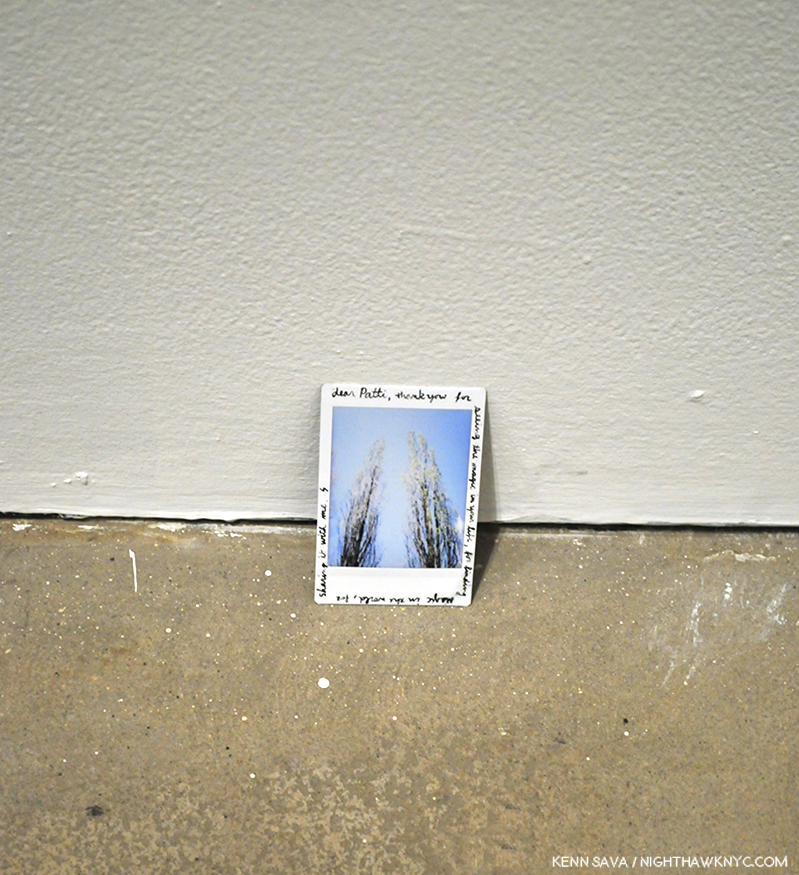
A fan’s tribute left leaning against the wall. April 15.

This is one of the most personal shows I’ve seen, certainly recently. I found myself returning to it over and over, like she did to Cafe ‘Imo. It’s like being able to walk around in someone’s memories, rather to get on a train and stop at each Station along her journey. Along the way, we encounter influences, living, passed and once living among you and now passed, objects that speak to a large meaning or significance, memories, hardship, distant places went to, seen and conquered. We see life being lived and places where it famously was lived. We see that life goes on, all the time, around us- everywhere, while weather happens, dirt gathers on graves, dandelions grow and stuffed bears eternally await calling cards.

M Train sweeps the dirt that accumulates on the many graves it visits, without need for tenders in traditional wear and using a literary broom to do so- the kind those buried within would possibly prefer. It’s a Testament to Life- surviving on your own, through deaths, Holidays without others, long trips, your birthday, sudden illness, blackouts, meeting legends, unexpected connections that prove life changing, and most of all, change. In the end, you can’t even go home any more.

___

Postscript, April 16-

Each of the dozen times I went to this show, I especially looked forward to seeing her table and chair from Cafe ‘Ino, which I show in the 6th photo above, and below.

Walking over there today for the last time, I asked myself – Why? Why do they “mean” so much to me?

I was never even in Cafe ‘Ino. I had to look it up on Apple Maps to even see where it was. I’d never met Patti Smith. I didn’t follow her music career very closely. I wasn’t aware of the extent of her work in photography.

?

I don’t get it.

I read Just Kids and loved it for many reasons, including those I mention above. One of those was the sense of the Manhattan that is now gone- both people and places lost, it so beautifully captures. Patti stands for that lost Manhattan for me for that reason and also because her music was a vital part of it. When I started reading M Train, all I knew about it was that it was about writing alone in a cafe. I could relate. I spent 10 years drawing alone in bars. Inside the book, the very first picture is of her table & chair in situ at Cafe ‘Ino. We’ve all lost a lot in our lives- it’s an inevitable part of living. Patti is no different. Neither am I. Neither are you.

When I reached the Gallery today, I walked down the hall and rounded the corner to visit their installation. When I looked in, I was stopped in my tracks completely in shock. The table and chair were taken.

Patti Smith was sitting there, alone, signing books.

At that moment, it hit me. What they say to me is that they speak for what’s been lost in her life. They, in ways even her pictures aren’t, are physical representatives of what’s been lost. They are still here. They are continuing with their “lives.” Like we all must- like Patti is.

For me? I feel so very lucky…so blessed. Getting to see her sitting in her chair at her table…NOTHING could have been a more fitting culmination to her show. Though, this was close…

Patti walks down memory lane one last time before her show ends. April 16.

“Speak to me heart
All things renew
Hearts will mend
‘Round the bend

Paths that cross
Cross again
Paths that cross
Will cross again”*

It is the ultimate “P.S.” to it.

As if the universe was saying to me- “P.S.- Life goes on.”

Hopefully.

*Soundtrack for this Post is “Paths That Cross” by Patti Smith, from her ablum, Land (1975-2002), written by Patricia Smith and Fred “Sonic” Smith, published by Druse Music. All other quotes in the text are from M Train by Patti Smith and published by Alfred A. Knopf.

January, 2019- This Post is dedicated to all the Patti Smith fans from around the world who’ve written to me about it. 

NighthawkNYC.com has been entirely self-funded & ad-free for over 8 years, during which over 300 full length pieces have been published!
If you’ve found it worthwhile, PLEASE donate to allow me to continue below.
Thank you, Kenn.

Written & photographed by Kenn Sava for nighthawknyc.com unless otherwise credited.
To send comments, thoughts, feedback or propositions click here.
Click the white box on the upper right for the archives or to search them.
Subscribe to be notified of new Posts below. Your information will be used for no other purpose.