Marc Chagall’s Granddaughter: An Artist In Her Own Right  

This site is Free & Ad-Free! If you find this piece worthwhile, please donate via PayPal to support it & independent Art writing!
You can also support it by buying Art & books. Details at the end. Thank you!
 

Introduction by Kenn Sava-
Lana Hattan is the person responsible for my starting NighthawkNYC.com in 2015, so it’s only fitting that she is now the first person besides myself to write a piece published here. A lifelong admirer of Marc Chagall’s Art, she has also been a Chagall researcher for over a decade on two continents. She has lectured and created & presented slideshows on various aspects of Chagall’s life, including his & his wife, Bella’s, lives in NYC.
On May 15th, 2015, Lana interviewed Marc Chagall’s granddaughter, the renowned flower designer Bella Meyer, at her popular fleursBella studio in Greenwich Village. I am proud to present it here accompanied by Photos she & I took that day. 

Written & Photographed by Lana Hattan
Exclusive to NighthawkNYC.com
(*-Additional Photos by Kenn Sava.)

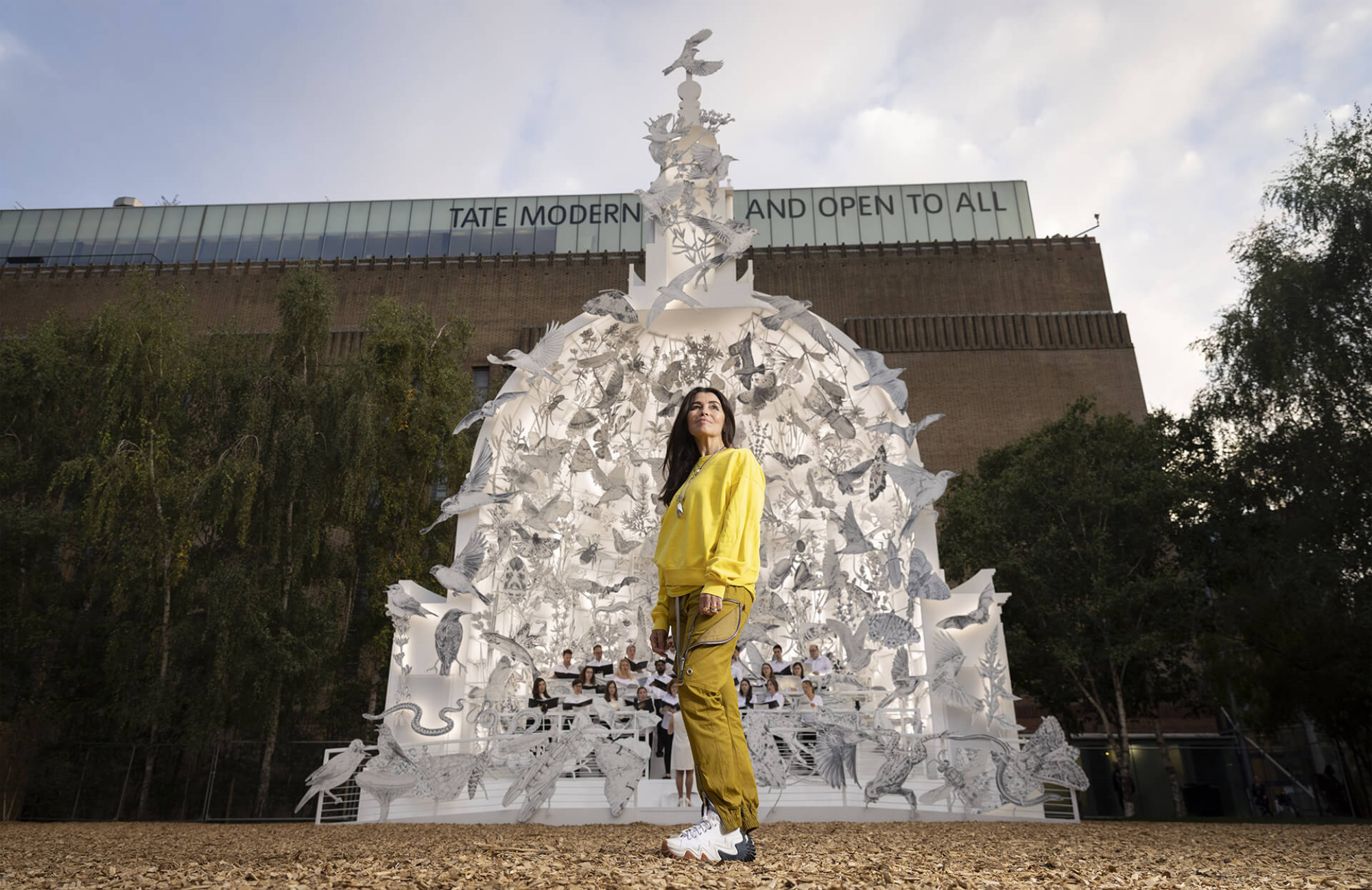
Lana Hattan at Bella Meyer’s fleursBella, May 15, 2015.

Visitors to Manhattan’s fleursBella are usually taken aback by the floral studio’s unique beauty and spectacular designs. Once the visitors learn that the owner and creative director of the award-winning studio, Bella Meyer, also happens to be Marc Chagall’s granddaughter, they may come away with the feeling that Chagall’s mastery of color lives in her work.

Bella Meyer was born in Paris, and she grew up in Switzerland. She studied Art History Sorbonne University in Paris and earned a Ph.D. in Medieval Art History. In the early eighties, she moved to New York. Today, she is the owner of the studio & shop fleursBella in Manhattan where this interview took place.

Meeting Bella. May 15, 2015.

Could you share your earliest memories of your grandfather, Marc Chagall?

“Although we didn’t live with grandfather, he was a very important person in my family. My mother, his daughter, was always very close to her father. We talked about him all the time. I was always surrounded by his paintings, which like family.

When we visited Chagall in Southern France, where he lived, we liked to go for walks and talk. He would tell us about his childhood and our grandmother, his wife, who unexpectedly died in the year 1944. He called her only ’my Bella’. My grandfather said that she could always understand him.

I liked watching as grandfather painted in his studio. Once I witnessed how long it took him to choose a gray tone, which wasn’t his favorite.

Grandfather was always kind to us grandchildren. I remember how he would hug me, touch my cheek, take my hand into his palms. I have this memory of being touched as if it were a miracle. Sometimes, it is very hard to describe the feeling. My feelings are deep inside, and it’s hard to find the words.”

Bella Mayer at fluersbella.

If you were to decide to describe your childhood memories about your grandfather, not in words, but color, what color would you choose?

“I would use very, very soft colors. I wouldn’t use very contrasting colors.”

I know that you have liked drawing since early childhood. Who taught you to draw?

“My mother taught me how to draw. She drew and painted very well but then stopped doing it. Grandfather liked her paintings.”

You went to study Art History at the University. Was it your decision?

“Yes, I didn’t want to study anything else. When I entered the University I said that I wanted to study art. They asked, “you want to learn how to paint”.  I repeated that I want to study Art. It was funny. ( Bella said with a smile).”

Did you talk about Art with your grandfather while you were studying?

“While I was a student, he came to Paris, and we visited galleries, walked and talked about Art. He was an amazing narrator.”

Books on Chagall, top, and on flowers, below, at fleursBella.

Why did you decide to move to New York?

“I was attracted to New York’s popular culture, contemporary art, and certainly to jazz.”

Did your grandfather like this idea?

“My grandfather didn’t like my decision. He had sad memories associated with New York. His wife and muse, my grandmother, died when they lived in New York. It was an awful time for him.”

When you came to New York you designed costumes, masks, and puppets for theater, but in 2003 you founded a floral design company and in 2009  you opened a floral in Manhattan. Why did you decide to create with flowers?

“I have always loved flowers, I bought it for my mother and grandfather. He loved to paint bouquets. I also liked to work with color and texture. Once a day, I visited the big flower market in New York, where there are a lot of flowers. I realized that only flowers can have such as a rich variety of colors and textures that I was always looking for, and it is the amazing source of my creativity.”

I saw a small chair near your studio’s door with a sign “Please, Take a flower”….

pastedGraphic_1.png

“When I founded the fleursBella company, I wanted to give people a little moment of joy and we would leave small bouquets into street or subway stations. My husband called it “Graffiti Flowers!” Now, we don’t have time and, so, we put flowers or small bouquets outside on a little chair, for anyone to take along with them. Perhaps, it is not a very good idea for a business.”

What are your favorite flowers? 

“My tastes are constantly changing. Flowers are so beautiful. Now, peonies are my favorite. They have an amazing color, texture, and smell.”

(She looked at a bouquet of peonies with admiration).

What projects are you currently working on?

“We are making an installation for The Brooklyn Academy of Music. (Bella thought for a moment ) I want to make something just as touching as the music!”

Do your children connect with Art?

“Yes, they do.”

In one of your interviews, you said: “Grandfather always urged us to look for, as he said, for an ideal”. What do you think is your ideal? 

“The ideal is a constant search. This is not something static. I try to do things from my heart and to follow that.”

NighthawkNYC.com has been entirely self-funded & ad-free for 10 1/2 years, during which over 340 full-length pieces have been published! If you’ve found it worthwhile, PLEASE donate securely by PayPal below to allow me to continue. Thank you, Kenn.

You can also support it by buying Art, Art & Photography books, and Music from my collection! Art & Books may be found here. Music here and here.

Written & photographed by Kenn Sava for nighthawknyc.com unless otherwise credited. To send comments, thoughts, feedback or propositions click here. Click the white box on the upper right for the archives or to search them. Subscribe to be notified of new Posts below. Your information will be used for no other purpose.

Jack Whitten: The Black Monolith

This site is Free & Ad-Free! If you find this piece worthwhile, please donate via PayPal to support it & independent Art writing!
You can also support it by buying Art & books. Details at the end. Thank you!
 

Written & Photographed by Kenn Sava. (*- Unless otherwise credited)

Show seen: Jack Whitten: The Messenger, MoMA, 2025.

After a quiet Summer, 2024, Summer Blockbusters brought the heat back to Manhattan in 2025. Four shows stood out to me: a pair at the Whitney1 and two at MoMA. Having already written about MoMA’s Hilma af Klint: What Stands Behind the Flowers, here, simultaneously upstairs on 6,  Jack Whitten: The Messenger, was the kind of show that made MoMA what it is for many around the world: one of, if not THE, leader in presenting excellent Modern (even Contemporary) Art shows. I’ve written about many of them in these e-pages these past 10 1/2 years.

Few Artists were more Contemporary than Jack Whitten. In fact, he invented some of its language, and a good deal of its emphasis/focus/center.

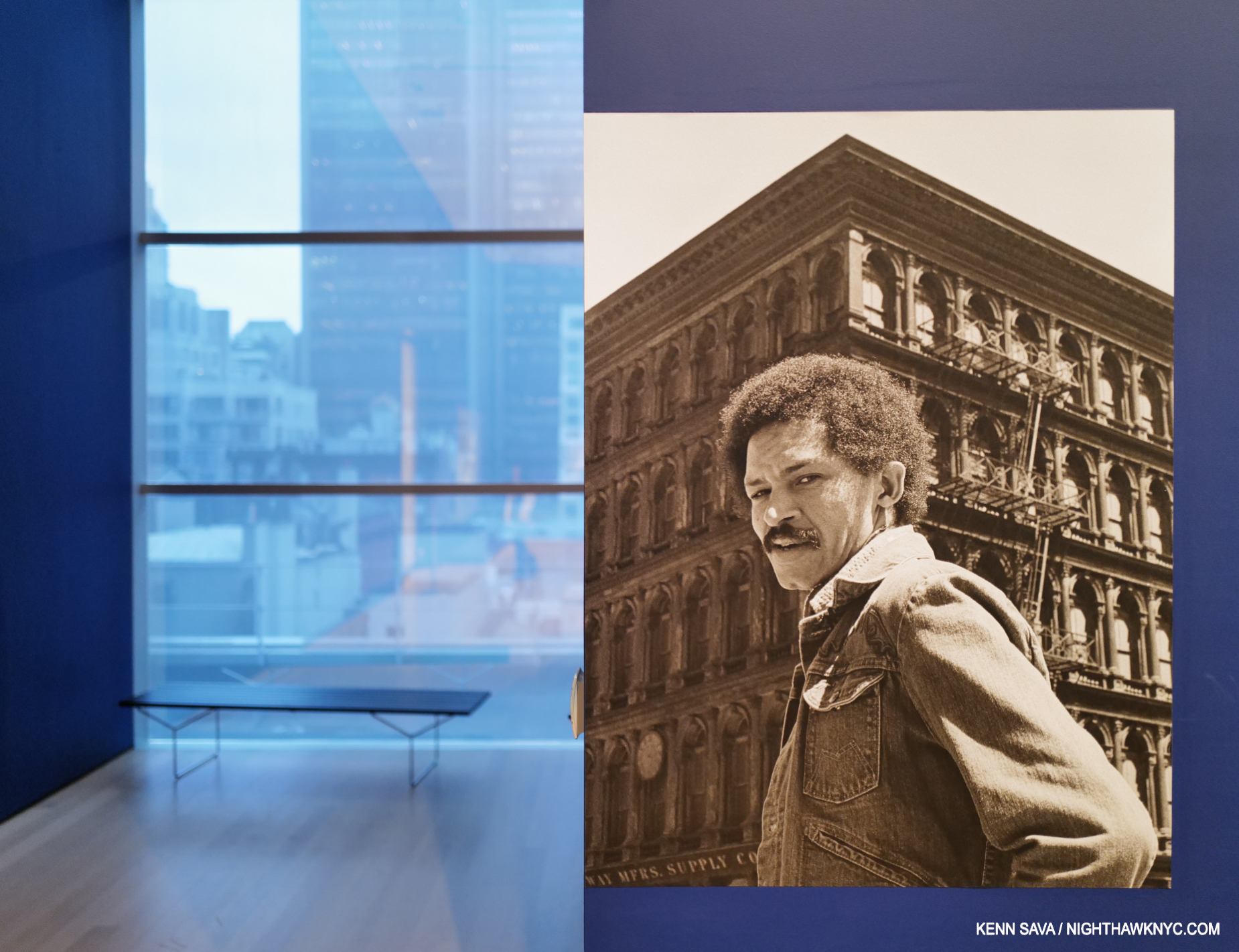
Man about town. Jack Whitten, a transplant from Alabama, was an NYC resident for 58 years, spending most of that time Downtown, before moving to Queens- except when he was “gone fishing,” as he wrote in his Notebooks on his departure for Crete each summer. The Artist is seen here on the corner of Broadway & Broome Street in the early 1970s on the Introductory wall card. When I see this Photo, I’m reminded that later he owned a building on Lispenard Street, a few blocks north of The World Trade Center. I tell the story of Jack Whitten on 9/11 further on.

Still, it left me with a deep sadness that after decades of struggle, Jack Whitten (1939-2018) didn’t live to see it.

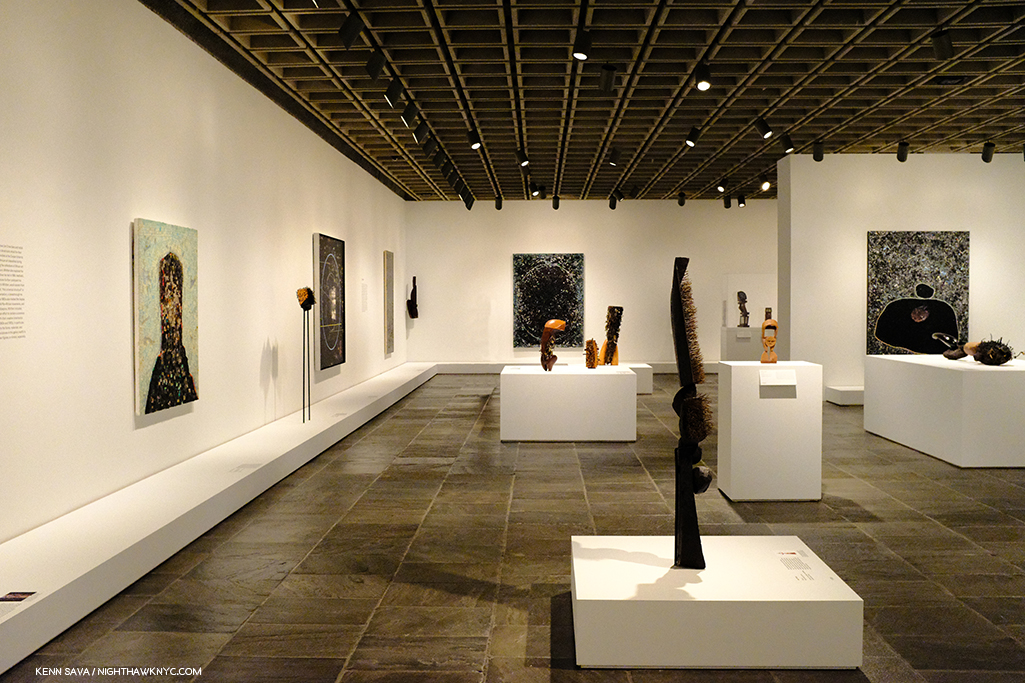
Installation view of the first gallery of Odyssey: Jack Whitten Sculpture 1963-2017. The Met Breuer, November 24, 2018

He didn’t live to see the other great show of his work either- Odyssey: Jack Whitten Sculpture 1963-2017, the Retrospective of his Sculpture which he mostly kept from public display, which came to NYC at The Met Breuer in 2018, and which I wrote about here. Together, they make a very compelling case for Mr. Whitten’s extraordinary creative & imaginative range, the extremely wide range of his talent & skill, his accomplishment, and his place as a 20th & 21st century Master.

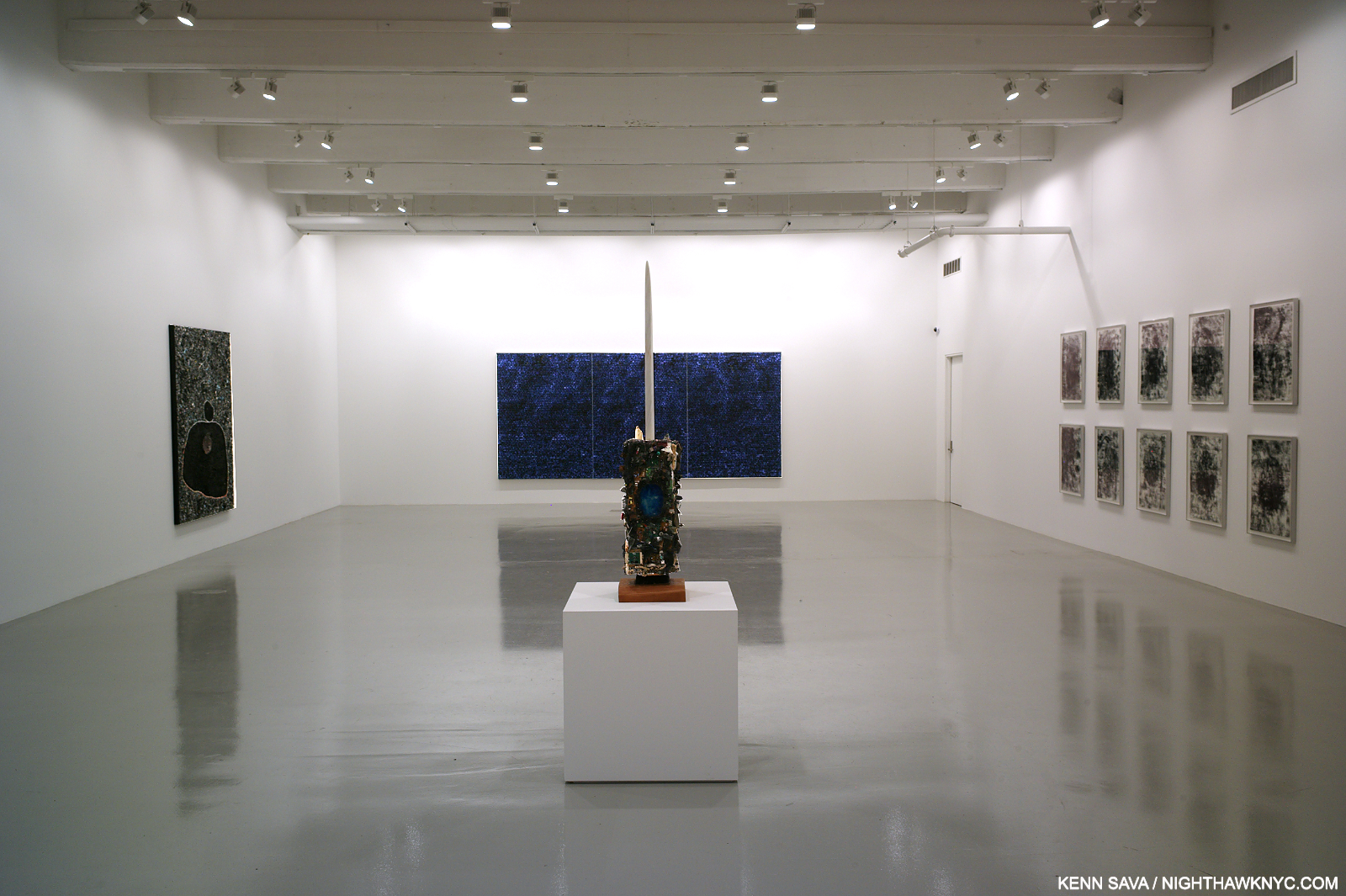
Installation view of the first gallery of the final Jack Whitten solo show during his lifetime at Hauser & Wirth, February 7, 2017. It was the first time I had seen one of his Sculptures. Quantum Wall (A Gift for Prince), is on the back wall. It can be seen in full in my piece on Jack Whitten: Odyssey, here, an installation view of which is shown above.

Both shows point out a sorry reality for too many great Artists. Jack Whitten is just one of many who waited in vain for their U.S. Retrospective. Meanwhile, numerous deceased Artist receive show after show (I’ve seen ten shows of the work of Jean-Michel Basquiat in NYC since 2012, for example, and written about almost all of them), while too many deserving living Artists go ignored, until years- even decades, after their passing.

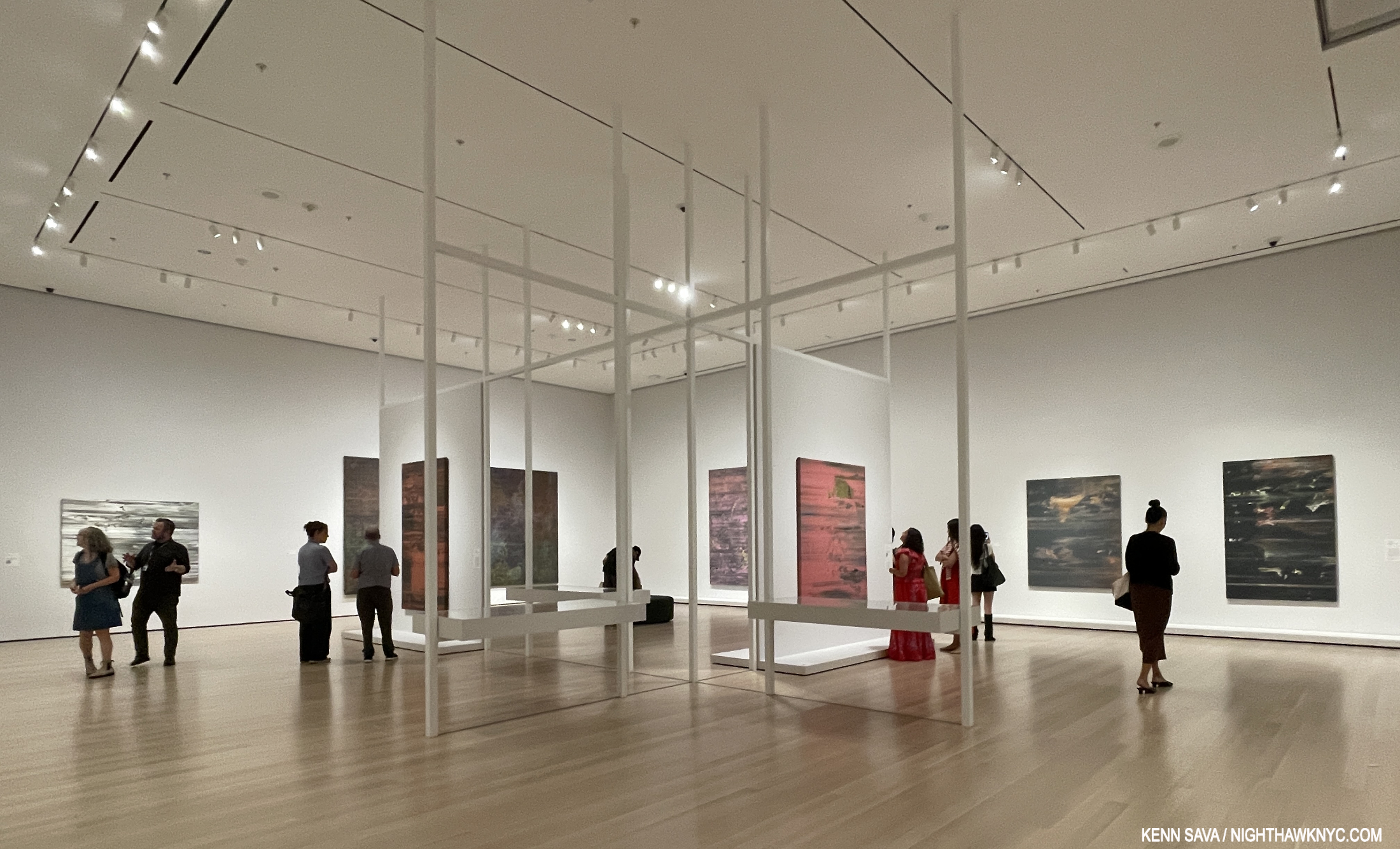
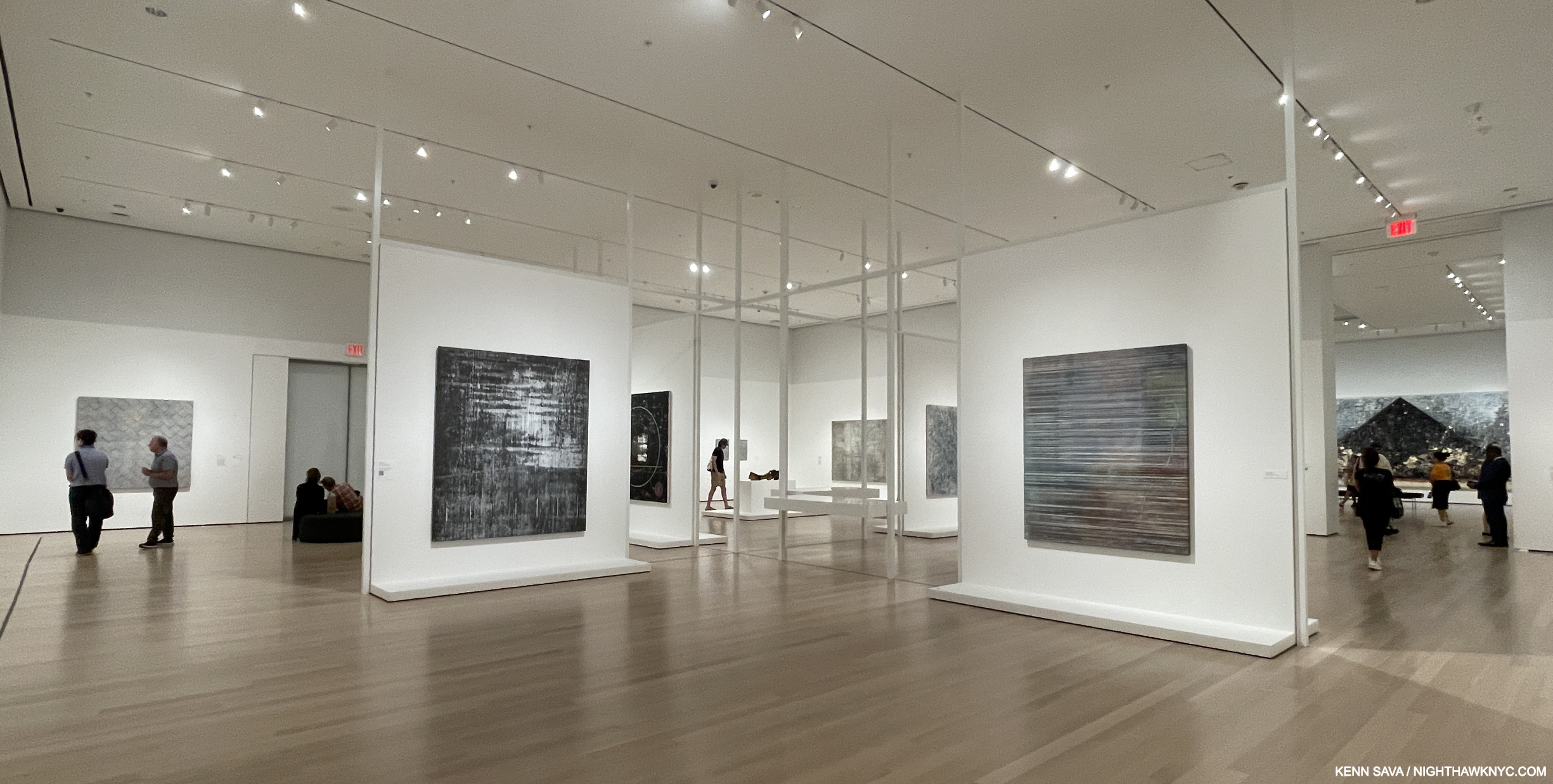
Jack Whitten: The Messenger, Installation view, MoMA, July 31, 2025.

Nonetheless, all the while, his Art continued to ascend the ranks of appreciation and acceptance. It wasn’t always thus. Getting to this point has. been a rough and rocky road. An excerpt from MoMA’s Exhibition Catalogue (which is recommended as the most comprehensive book on Jack Whitten ever, in spite of its cardboard binding) looks back to his beginnings-

“Whitten made some of his earliest images as a teenager, painting hand-lettered signs for local businesses in his hometown of Bessemer, Alabama, in the 1950s. One of his first paid jobs was for a Civil Rights protest on the steps of the county courthouse. These images were meant to travel: to say something, to have reach. Whitten learned the technique using tools left behind by his mother’s first husband, James Monroe Cross, a commercial sign-painter who died before Whitten was born. It was unusual for Cross, a Black man, to have a skilled occupation and own his own business in the deeply segregated Jim Crow South. The artist suggested that Cross was always under threat of suspicion, even violence, for his profession. Making images was a rebellion and a risk… ‘Transmission is the key,’ he said2,'”

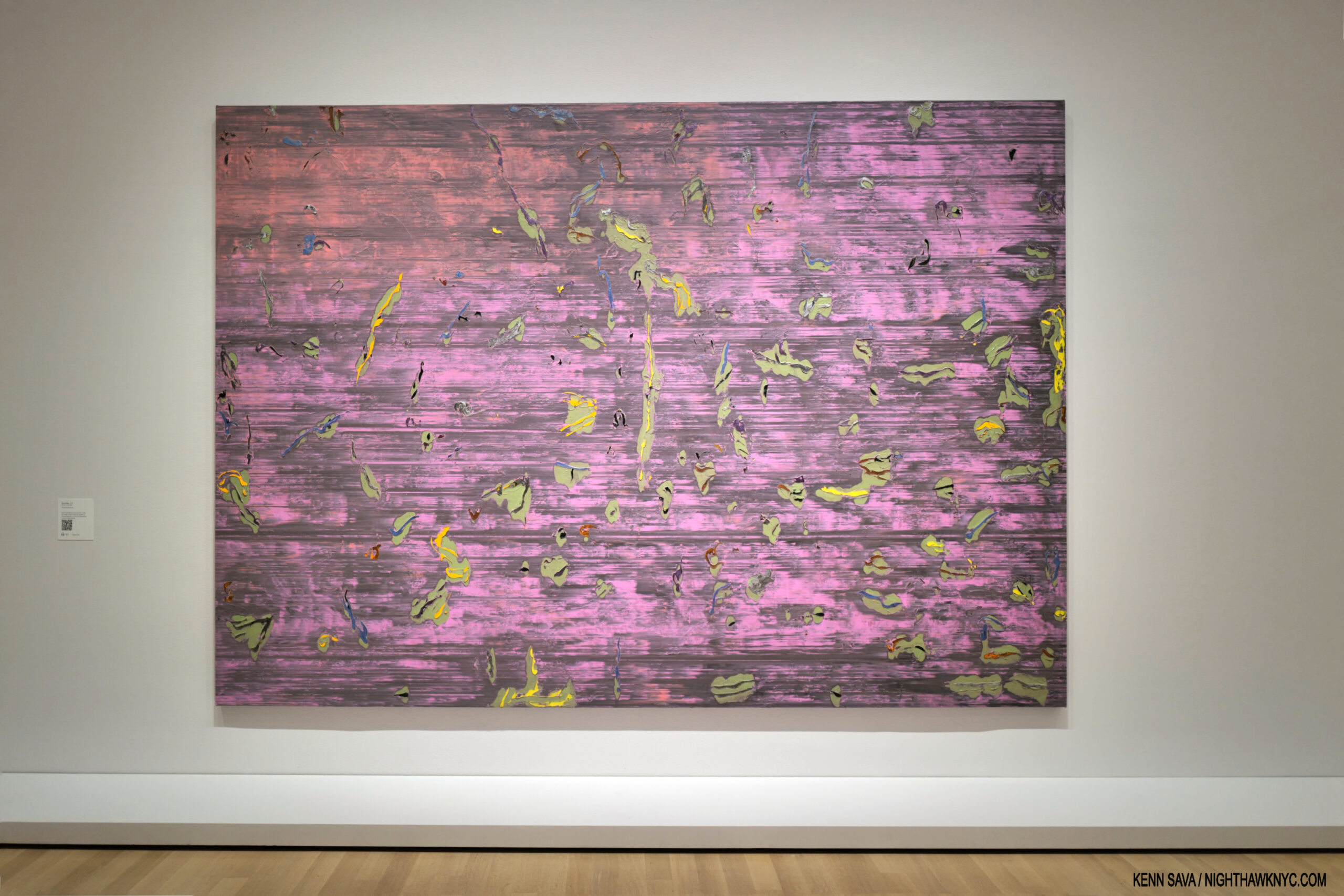
The earliest work in the show reveals Jack Whitten’s life long passion for Jazz. The Messenger (For Art Blakey), 1990, left, and Homecoming: For Miles (Davis), 1992 (the year after Miles passed), right. Both Acrylic on canvas.

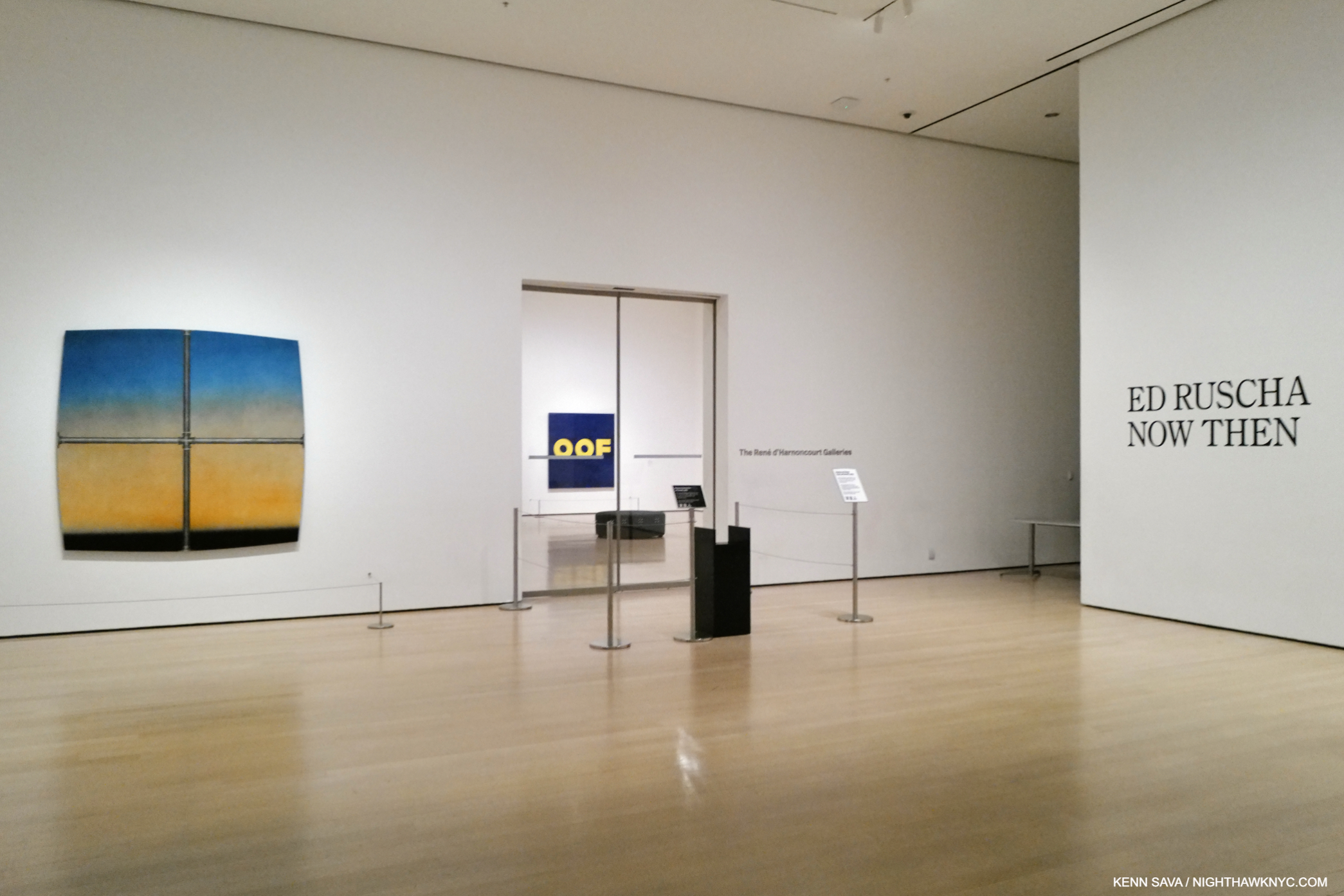
Reading that, my thoughts turned back to another MoMA blockbuster that was full of “signs,” literal and figurative: Ed Ruscha/Now Then, which occupied these same galleries not long ago, the subject of a 3-part series I wrote. There are surprising similarities, and differecnes, between them. Largely contemporaries, Mr. Ruscha (b. 1937, Mr. Whitten born two years later in 1939), is perhaps best-known for his word Paintings. Though he started with a paying job making protest signs bearing words, Jack Whitten’s Art is almost exclusively wordless, except for its titles. His Art transcended words while honoring his mantra, “Transmission is the key.” Both Artists were born and raised in the South. Jack Whitten in Alabama- “in apartheid,” he said, Ed Ruscha in Tusla, Oklahoma, considered part of the South by some. Both left and attended Art schools, Mr. Whitten at Cooper Union, NYC,3, and Ed Ruscha at CalArts in L.A.. Both stayed put in their new locales for the rest of their lives and their extraordinarily long careers. Both used their Art to regularly comment on the world around them, though Jack Whitten seemed more the Activist. It’s also interesting that both Artist oeuvres are almost entirely devoid of images of people.

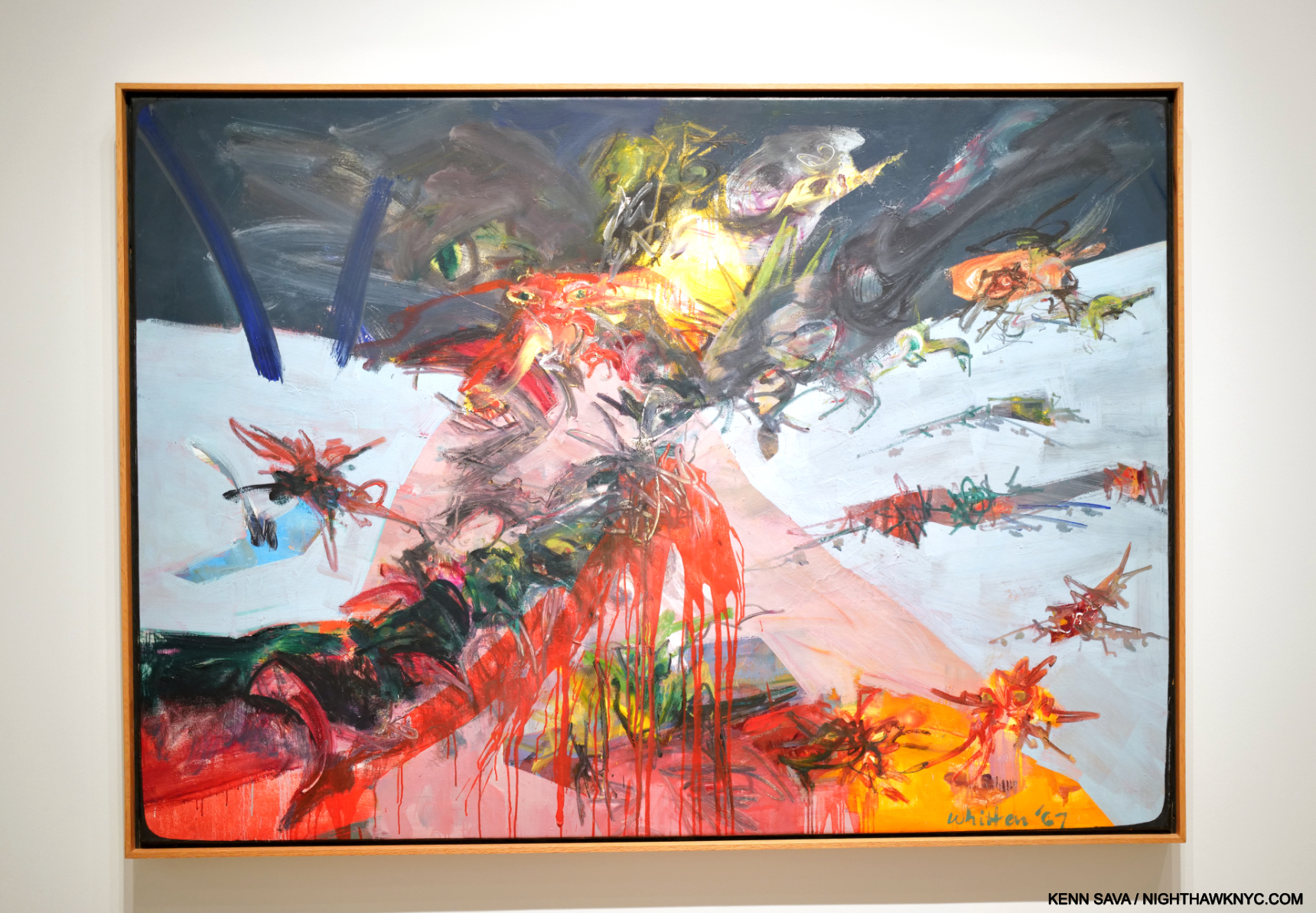
NY Battle Ground, 1967, Oil on canvas

As for their significant differences, Jack Whitten had to survive the 1960s, including the violence that surrounded the Civil Rights Protests. Deeply effected hearing Dr. Martin Luther King speak at the Montgomery Bus Boycott in 1955-56 after Rosa Parks’s arrest, the event that brought Dr. King to prominence (and the event at which Jack Whitten met Dr. King), he soon became fed up with the violence surrounding the Civil Rights Movement, so he moved to NYC in 1960, then graduated from Cooper Union with a bachelor’s degree in 1964, before finding his voice through the influence of the Jazz Musicians he met and the 1st generation Abstract Expressionists who he encountered here. His work would remain abstract his entire career. In spite of all of this history, Jack Whitten skips it and begins his riveting, 568-page collection of his studio notes from 1962 to 2017, Notes from the Woodshed, (the closest thing we have to an autobiography), with the 1960s & with his move to NYC.

Light Sheet I, 1969, Acrylic on canvas

“Never in my wildest dreams did I think that I would reach thirty years of age without self-destructing. . . . The 1960s were coming to an end; I was still alive and in one piece.”

He would go on to live and work for another forty-eight years.

“1970 was the turning point,” he recalled4. At the start of a new decade, the Artist moved to a studio on Broome Street and had a breakthrough. He stopped making figurative art and got rid of his paintbrushes(!), which may be unprecedented among Painters in Western Art history to his time. The studio became a laboratory designed to experiment with acrylic paint5. The medium, a recent innovation made from plastic, offered a vastly expanded range of color, texture, and handling. Seizing the opportunity, Whitten invented tools and techniques that were entirely new to the history of Western art.

Welcome to Jack Whitten’s post-1970 practice in which he “made” Paintings (he said) without using paint brushes. With this, they were “developed,” akin to how Photographs were. Introducing The Developer. At 12 feet long, creating Art with it is the other part of the equation. Especially since none of the Art I’ve seen that Jack Whitten may have made with The Developer have a dimension of 12 feet. He’s using this on pieces that are smaller than the tool.

From an Afro-comb to a twelve-foot-long wooden rake, which he called The Developer (a reference to photography), novel implements were maneuvered by the artist to pull layers of acrylic paint across canvases laid on his studio floor in one sweeping movement6.” Inventing a technique is impressive. Making Art using it takes mastering it first. Easier said than done with a 12-foot long rake in your hands! In this extraordinary video from 2017, Jack Whitten talks about growing up in “American Apartheid,” as he calls it, meeting Dr. King, and demonstratesThe Developer-

What stands out to me is that Jack Whitten, when faced with violence, met it with non-violence. He turned his anger into Art. Art without words. Abstract Art, at that. Revolutionary for a Black Artist. An Art that continued to represent those he admired and “transmitted” what he experienced in ways never before seen. It seems to me that that says all you need to know about the man.

Back at MoMA, the result of all the techniques he invented and perfected and his seemingly endless creativity made Jack Whitten’s work is so unique, and different from itself, that MoMA’s curators chose to install the show with numerous one-work walls. I previously experienced this in diane arbus: in the beginning at The Met Breuer.

Installation view. Installing one work on a wall is something that works extremely well for Jack Whitten’s work, in my view, since so much of it is so different from everything else. It allowed each piece to be considered singly, and then as the viewer moved around, as part of his whole. It made it very easy to “get lost” in the work & the show, something I went back to it to experience again.

Here, I thought this worked brilliantly and the resulting installation of these walls is one of the features I’ll long think of when I think of Jack Whitten: The Messenger.

The First Loading Zone, 1973, Acrylic on canvas

Today, Gerhard Richter gets a lot of notoriety as a “squeegee master,” yet he didn’t begin using the technique until 19857! Still, techniques do not make a work “Art,” with a capital “A,” as I write it. Yet, at least to my eyes, having seen Gerhard Richter: Painting After All on its last day (my look at it here), and the last day of the lost & lamented Met Breuer, what I saw over both shows left me feeling that Jack Whitten’s “Developer” works will continue to rise in esteem & appreciation. Since I believe that comparing Artists or Art works is subjective, I’ll leave it at that.

Chinese Doorway, 1974, All work are Acrylic on canvas unless stated. At 89 1/2 × 43 1/4 inches, it’s hard to say if this was created with The Developer, but if not, it appears he used another of his scraping tools.

But his “Developer” works are just one part of the work Jack Whitten created over his 58 year career, a part that fit in seamlessly with everything else he created as was to be seen in the incredibly rare opportunity to experience a large body of his work. This is in itself, remarkable. I’ve seen countless group exhibitions where different styles didn’t mesh well with each other. Yet, in The Messenger they meshed brilliantly and coalesced into telling one story: his.

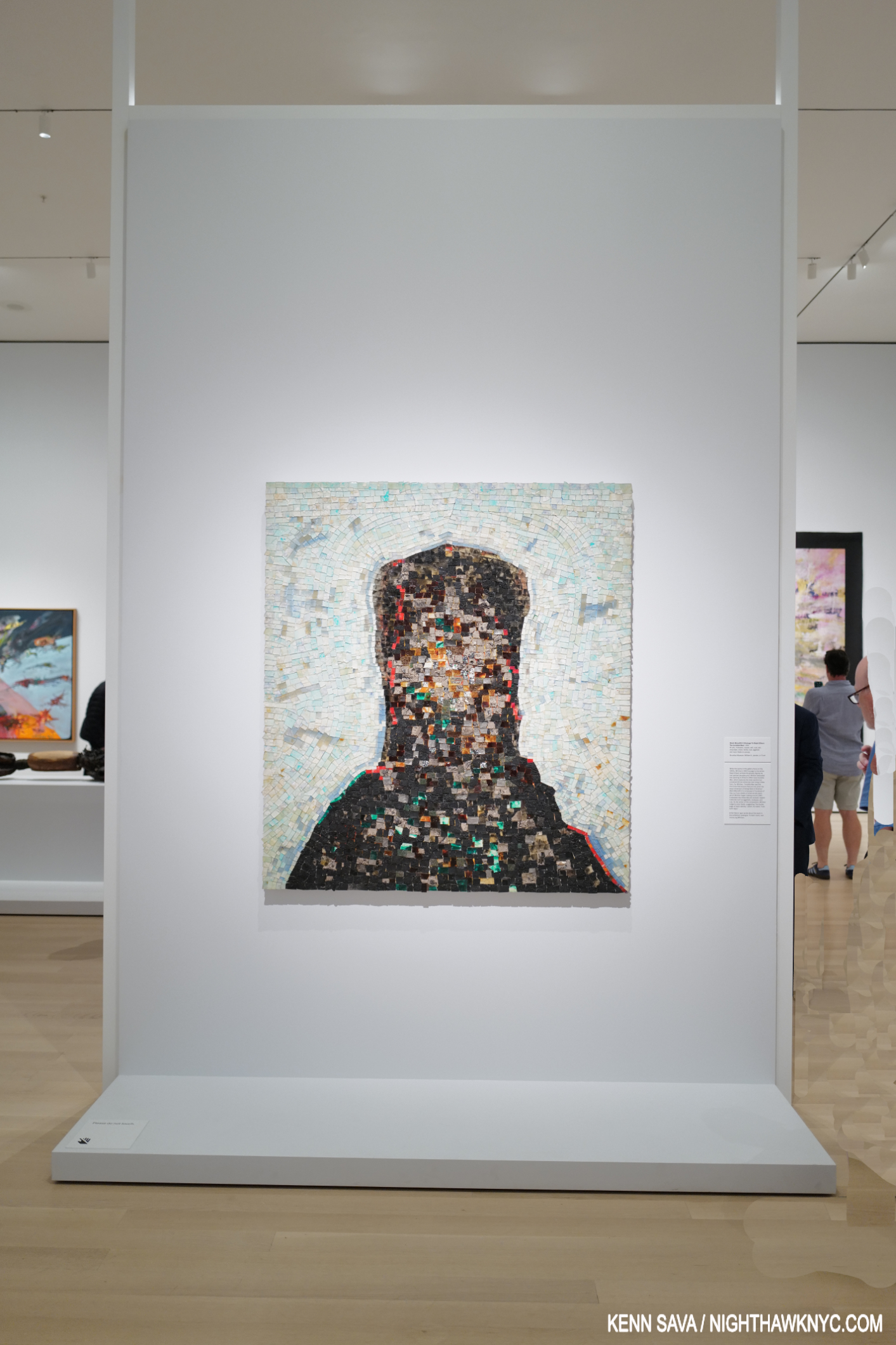
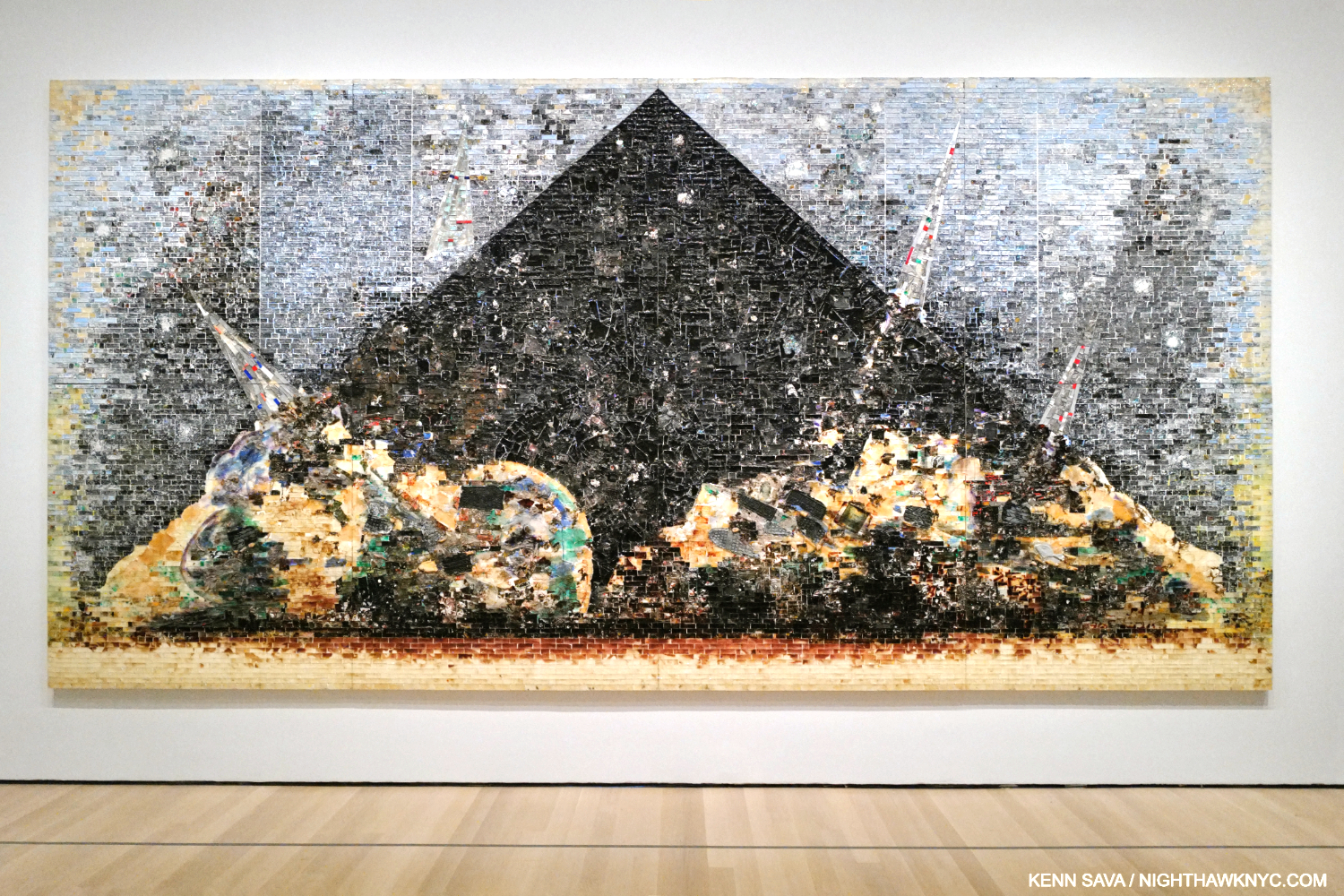
Black Monolith II (Homage To Ralph Ellison The Invisible Man), 1994, Acrylic, molasses, copper, salt, coal, ash, chocolate, onion, herbs, rust, eggshell, with razor blade on canvas. As close as Jack Whitten comes to “traditional Portraiture.”

Walking through it left me realizing that it’s hard to think of another Black Artist who captured the times he lived in and so many of its leading figures in her or his Art, besides Charles White. For me, at least, when these works (including his Black Monolith series) are taken as a whole, the result is something of a Self-Portrait of the Artist: a man of his time, in his time, who rose above his time and all the travails he encountered to create something completely new and completely Jack Whitten, leaving echoes & impressions of his experiences.

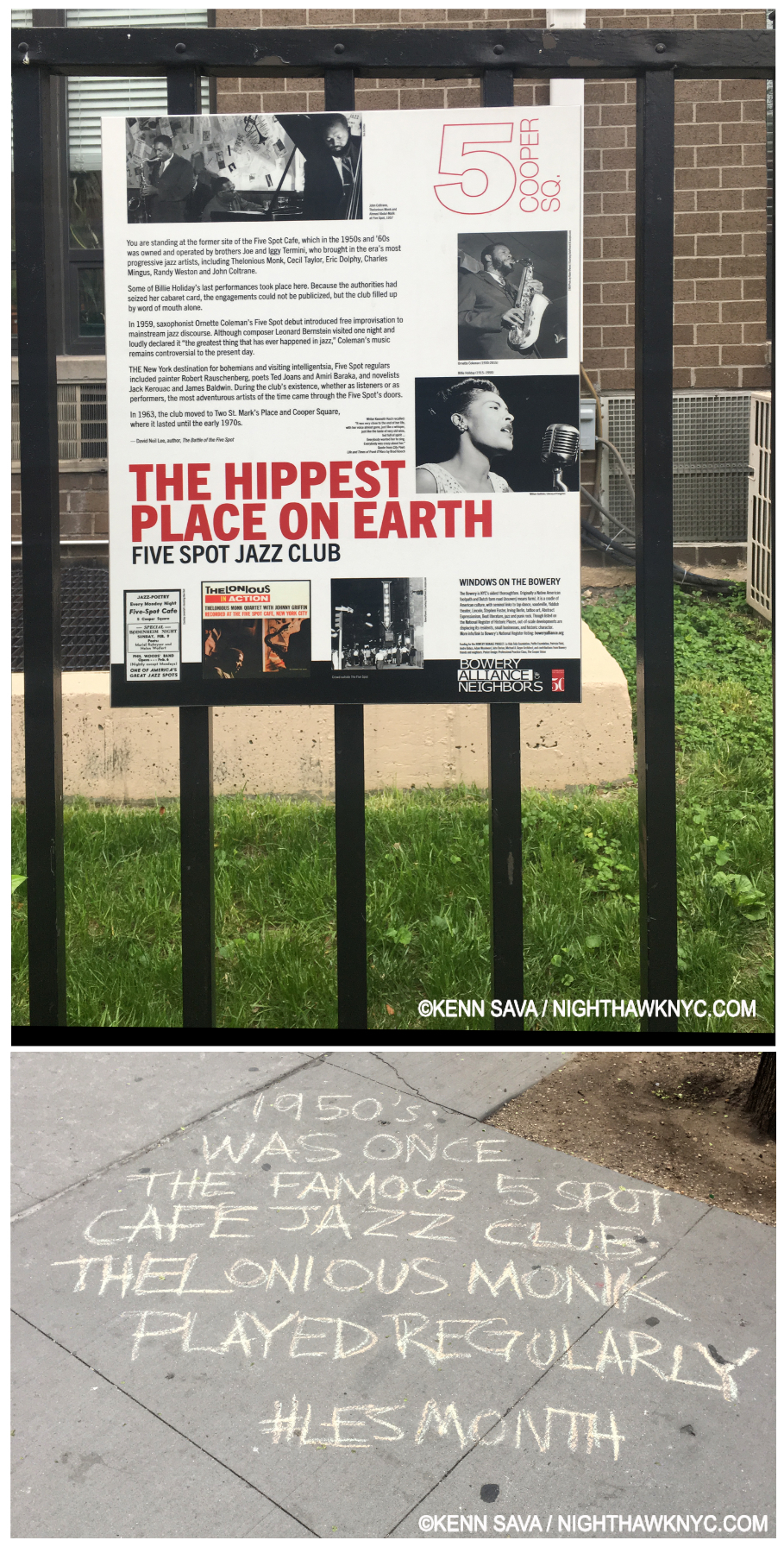
Chalk editor’s note- Insert “This” in front of “was once.” (No, I did not write it.) NYC is “only” 402 years old, still you can be sure that with every step you take here you’re walking on history. So it is here in front of this nondescript residential building. But back in the late 1950s and early 1960s this was the location of “the hippest place on earth”- the now legendary Five Spot nightclub. The list of Jazz immortals who performed here is only matched by the legends of Art, Music, & Literature who hung out here to hear them.

Among the leading, now legendary, figures of his day that Jack Whitten encountered and even spoke with are Jazz Masters Thelonious Monk and John Coltrane, the latter, who was embarking on his own spiritual quest after a period of drug use, had an especially deep and lasting impact on Whitten’s Art.

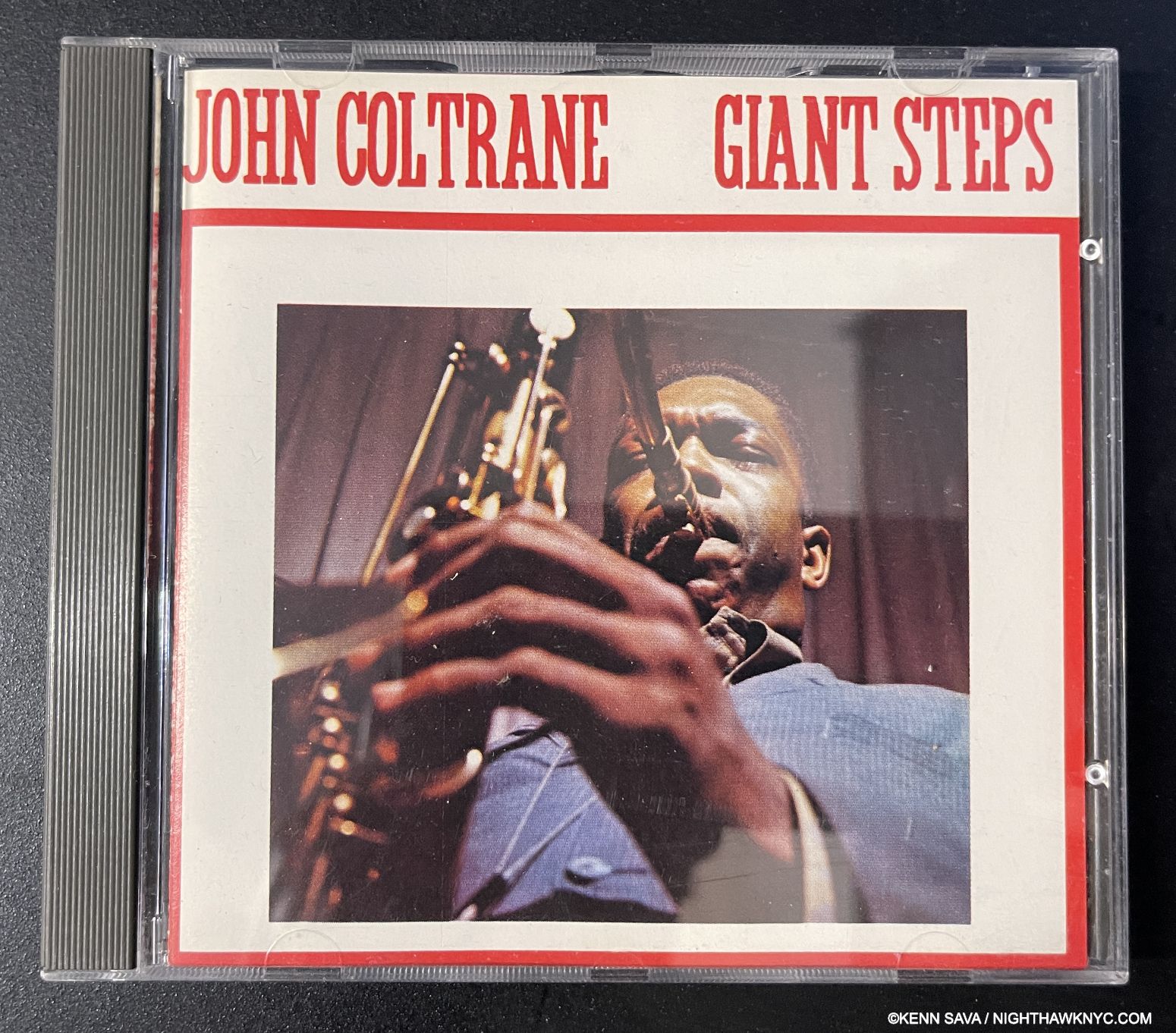
John Coltrane: Giant Steps, 1960. One classic that’s in both of our collections (Jack’s on LP as shown in the catalog. My LP was replaced with this CD after wearing out), John Coltrane is shown here, Photographed on the cover by Lee Friedlander, around the time he was frequenting The Five Spot.

Jack Whitten frequented the legendary Five Spot nightclub on East 5th Street, and came to amass a terrific Jazz record collection.

Asa’s Palace, 1973, Acrylic on canvas

Another thing that stands out for me is that Jack Whitten was one of the earliest Black Artists to adopt abstraction, something that has continued in the work of Mark Bradford among quite a few others.

“There are two kinds of abstraction, the abstraction of Pollock and the abstraction of [Piet] Mondrian,” Jack Whitten wrote in 1969. “It is possible to create a third abstraction based on the theory of transcending these two8*

His titles often “ground” the work, but then the viewer is left largely on her or his own, often with a staggering amount of detail to consider. This last puts the lie to theory that abstract Art is “dashed off,” perhaps born of a misunderstanding of Jackson Pollock’s “dripping” technique, or the appearance of Franz Kline’s brushwork. Walking through The Messenger, I was hard pressed to find a single work that looked “dashed off.” On the contrary there were works where Mr. Whitten first had to invent, then perfect, the technique he used before the work could begin!

Atlantis Rising, 1966, Acrylic on canvas

Jack Whitten was  an eyewitness to the first plane flying into World Trade Center 1 on 9/11 from 14 blocks away! Incredibly, his voice is heard on the only video there is of that plane impacting the North Tower, by the Naudet brothers who were making a documentary on the New York Fire Department. Following them around, that morning they answered a call about a gas leak at the building Jack Whitten owned on Lispenard Street. The Naudets happened to be filming the firemen who were trying to find it when the plane flew right over their heads! Jack Whitten’s voice is the one heard making the expletive as it crashes into the North Tower9. The NYFD immediately jumped in their trucks, accompanied by the French crew under the direction of the Naudet brothers and James Hanlon (making the renowned documentary 9/11) and headed off to Ground Zero. Mr. Whitten-

“I was in the street that morning. This plane came right overhead, and when that sound came overhead, you could feel your flesh crawling, I mean, seriously, rippling. We looked up, this plane was right on top of us. At first you didn’t see any flame, any smoke. You just saw this big gap and hole, and the sky was filled with a chandelier of glass. It was later you saw the smoke and the flames. My gut feeling told me that that was not an accident.  This is what I call the particularities of violence—close to 3,000 people were murdered in my neighborhood. People were screaming, crying.”

He stopped making Art, except for this piece, which took him five years to complete-

9.11.01, 2006. Acrylic, ash, animal blood, hair, and mixed media on canvas, 120 × 240″ (304.8 × 609.6 cm). In what I think was a brilliant move, the Baltimore Museum sold some of its older masterpieces, inciting an uproar, and used some of those funds to buy it, saddening me that an NYC museum hadn’t stepped up.  After five years of agonizing over it, Jack Whitten created one of the most stunning pieces of Art to come out of the tragedy.

“I wanted that painting to be more raw and visceral. A lot of emotional stuff in there. I’ve had people that stand before that painting and cry,” he said10.

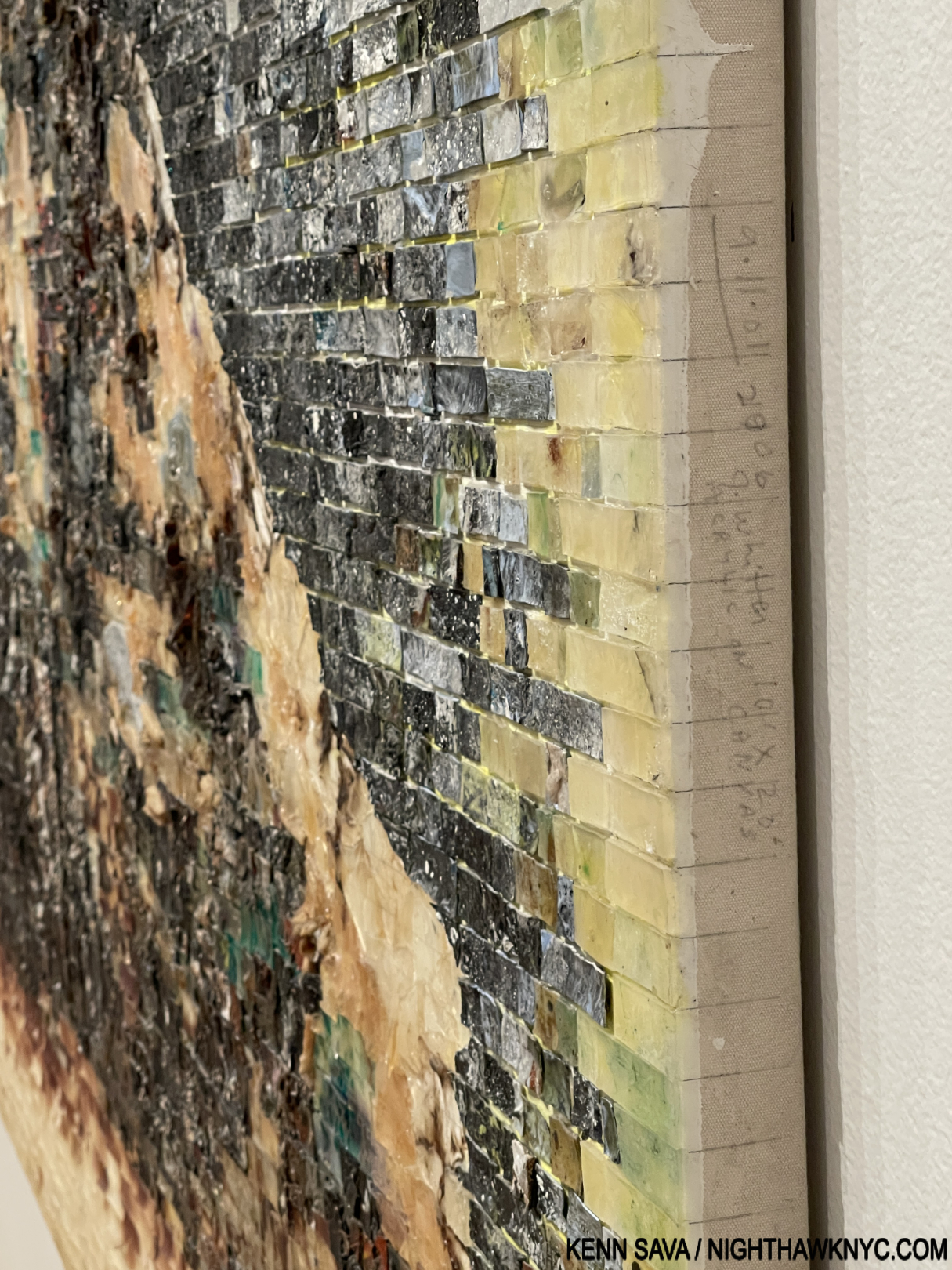
Jack Whitten’s signature and inscription on the right edge of 9.11.01. This also shows a detail of the mosaic tiling the work consists of, each tile hand-crafted.

The work is also created with another technique he invented. Beginning in the 1990s, the Artist cut hardened sheets of acrylic paint into thousands of mosaic tiles that he used to assemble 9.11.01 and other works. In my piece on Jack Whitten: Odyssey, “Jack Whitten: Secretes from the Woodshed,” I show an Art21 video that shows Mr. Whitten actually creating one of his “mosaic” works.

Southern Manor, 1974, Acrylic on canvas

“Perhaps the ideal approach to the work of literature would be the one allowing for insight into the deepest psychological motives of the writer at the same time that it examined all external sociological factors operating within a given milieu. For while objectively a social reality, the work of art is, in its genesis, a projection of a deeply personal process, and any approach that ignores the personal at the expense of the social is necessarily incomplete,” Ralph Ellison speaking of a way of engageing Literature, c.194611.

Though he was here (NYC) during the heyday of Abstract Expressionism, arriving in 1960 on the tail end of the first generations’s success, he doesn’t seem to have been overly influenced by them directly when looking at his work. Their influence seems to me to have been more in freeing the young Artist to explore other ways of communicating in paint. Maybe this can be seen when he said his Paintings weren’t Painted, they were “made.” In fact, it seems to me his attendance at the numerous Jazz clubs that were in a golden age at the time may have had a deeper last effect. In the Music, he found other Artists who were familiar with what he had experienced, whereas the first gen AbEx Artists had not. Their influent may have helped Jack Whitten focus on what was most important for him to express. They were doing it without words. He would do it without representational images using techniques he invented.

One recognition Jack Whitten did live to receive was the National Medal of Arts by President Obama. “WASHINGTON, DC – On Thursday, September 22, in the East Room of the White House, President Barack Obama awarded the 2015 National Medal of Arts and the National Humanities Medal to distinguished recipients. First Lady Michelle Obama attended the ceremony.” *- Photo by Cheriss May, www.cherissmay.com. White House caption in quotes.

It’s become apparent that Jack Whitten is the spiritual and influential “godfather” of much of what we see today, less than a decade after his passing. He turned his back on so-called representational Art and found a new way of “transmitting” all of what he had witnessed, all he had heard, and all he had inside, in abstraction, forging a new path forward that others have turned into a highway.

For Michael Merriweather.  

*- Soundtrack for this piece is “Nutty” by Thelonious Monk, heard here with John Coltrane, recorded live at The Five Spot in 1957-58, with some rare Photos of them performing in the club-

NighthawkNYC.com has been entirely self-funded & ad-free for 10 1/2 years, during which over 340 full-length pieces have been published! If you’ve found it worthwhile, PLEASE donate securely by PayPal below to allow me to continue. Thank you, Kenn.

You can also support it by buying Art, Art & Photography books, and Music from my collection! Art & Books may be found here. Music here and here.

Written & photographed by Kenn Sava for nighthawknyc.com unless otherwise credited. To send comments, thoughts, feedback or propositions click here. Click the white box on the upper right for the archives or to search them. Subscribe to be notified of new Posts below. Your information will be used for no other purpose.

  1. Amy Sherald: American Sublime, which I wrote about here, and Christine Sun Kim: All Day All Night, which I wrote about here.
  2. Jack Whitten: The Messenger, Michelle Kuo, P.37.
  3. After attending Tuskegee Institute as a pre-med student.
  4. ibid, P.47
  5. ibid
  6. MoMA wall card
  7. https://www.christies.com/en/artists/gerhard-richter?lotavailability=All&sortby=relevance
  8. ibid, P.45, 47
  9. Jack Whitten: Five Decades of Painting, P.43-4.
  10. https://www.moma.org/audio/playlist/345/4715
  11. Ralph Ellison, “Twentieth-Century Fiction and the Black Mask of Humanity,” in Shadow and Act, 27 n. 1.

Christine Sun Kim: All Day Every Day

This site is Free & Ad-Free! If you find this piece worthwhile, please donate via PayPal to support it & independent Art writing!
You can also support it by buying Art & books. Details at the end. Thank you!
 

Written & Photographed by Kenn Sava (^- Unless otherwise credited).

Show Seen: Christine Sun Kim: All Day All Night, Whitney Museum, February 8 to September 28, 2025.

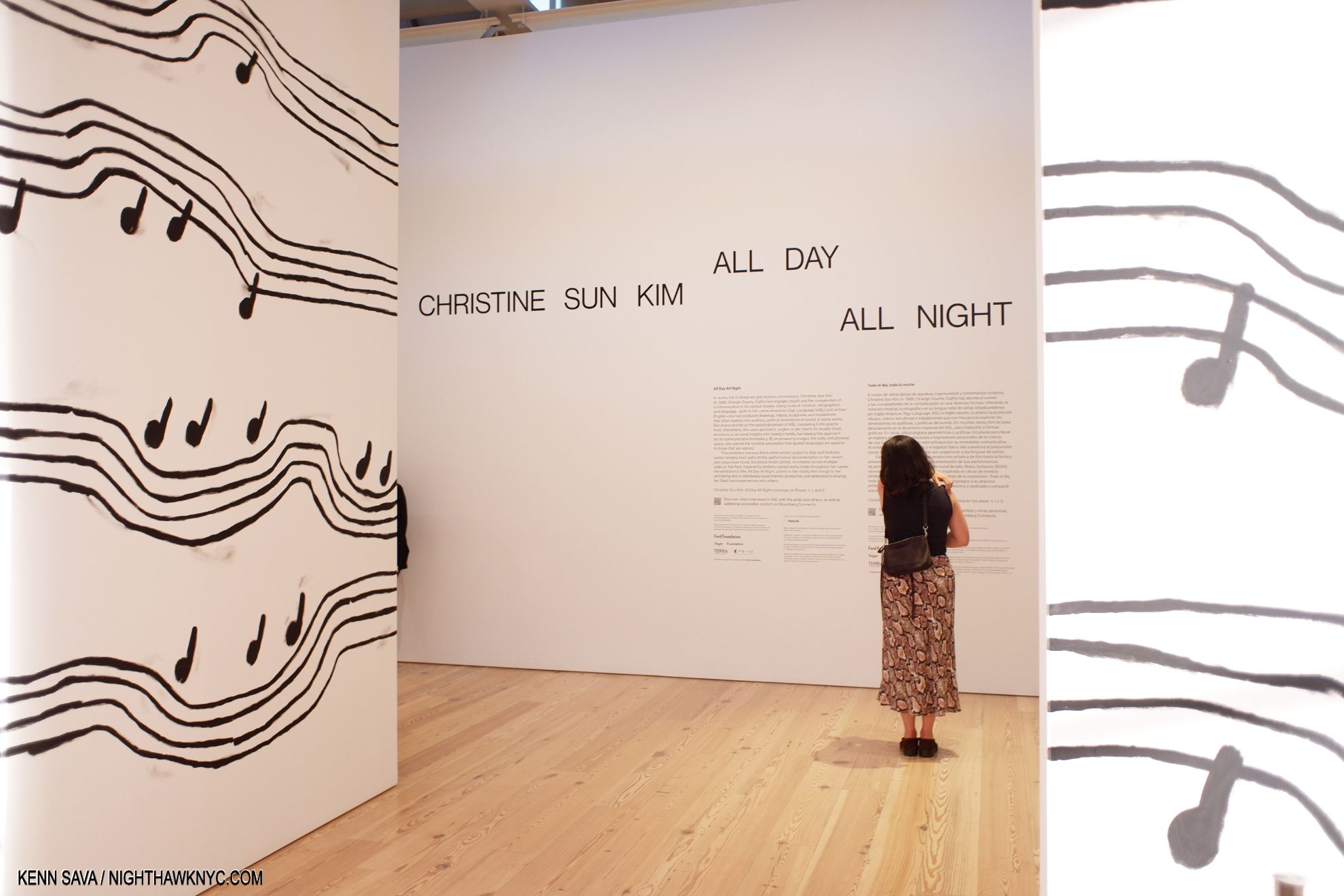
My look at the 4 summer blockbusters mounted here in 2025 continues with the second of two must-see shows at The Whitney: Christine Sun Kim’s landmark All Day All Night was up concurrently with Amy Sherald; American Sublime. I began this series with a look at Hilma af Klint: What Stands Behind the Flowers at MoMA, where Jack Whitten: The Messenger was installed on 6 (with links to my piece on each).

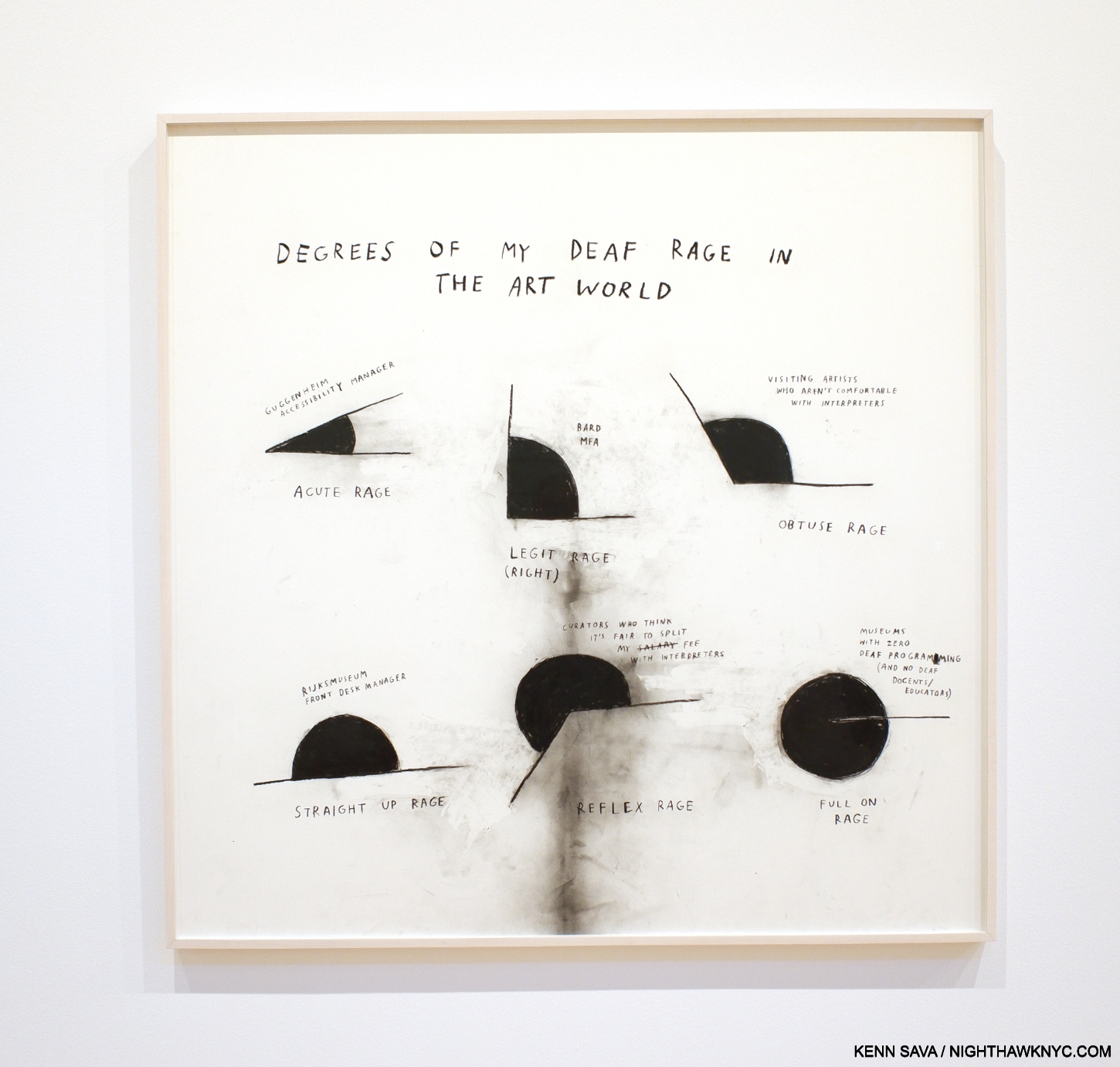
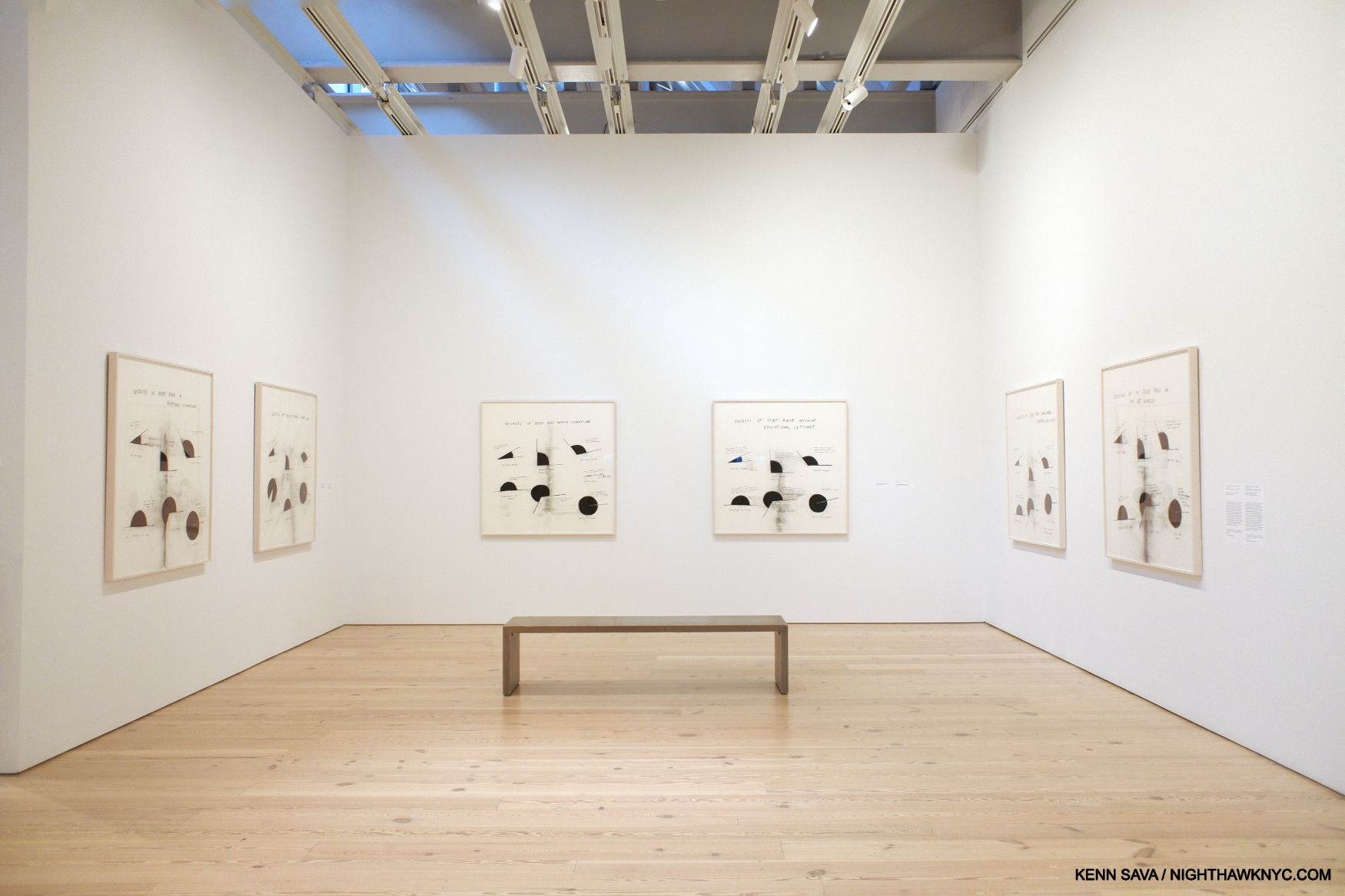
Degrees of My Deaf Rage in the Art World, 2018 Charcoal and oil pastel on paper

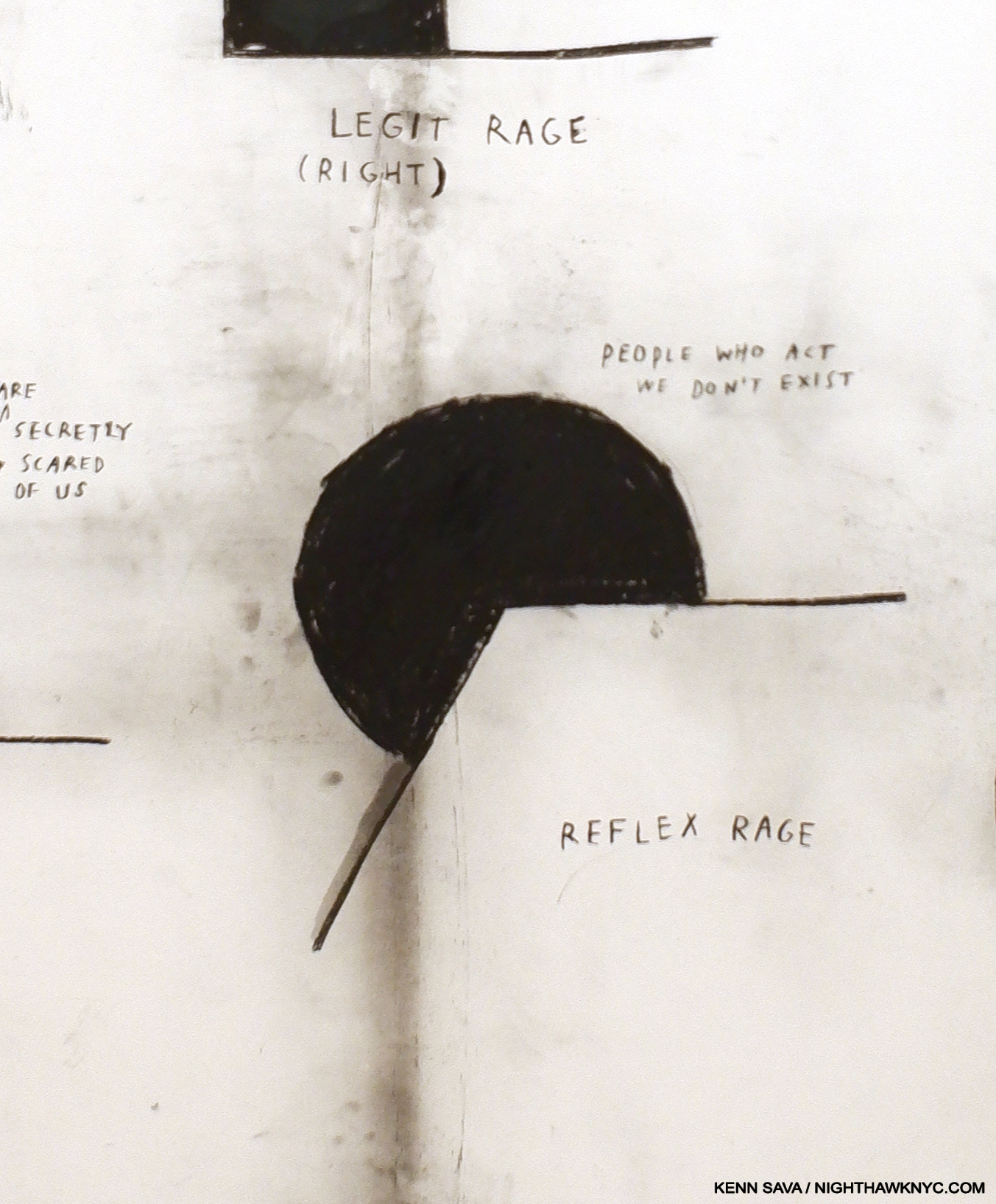
Detail.

“Landmark?” All Day All Night is the first major museum Retrospective devoted to the work of a younger Disabled Artist in NYC in my memory. Christine Sun Kim is deaf.

As I’ve said more than once, Disabled Artists continue to be THE most overlooked Artists in the world. Why? I can’t figure it out. “Inclusion” has been the headline in the Art world since 1989, yet, the Disabled continue to be left behind. The Whitney has a long-standing relationship with Christine Sun Kim (B.1980) going back to 2007, when she worked there fresh out of grad school as an educator. During her tenure, she began giving tours in ASL (American Sign Language) for the deaf. In 2025, the Whitney & the Walker Arts Center (who also have a long-standing relationship with Ms. Kim) mounted the early mid-career Retrospective Christine Sun Kim: All Day All Night, featuring works “full of sharp wit and incisive commentary,” per the press release. Indeed.

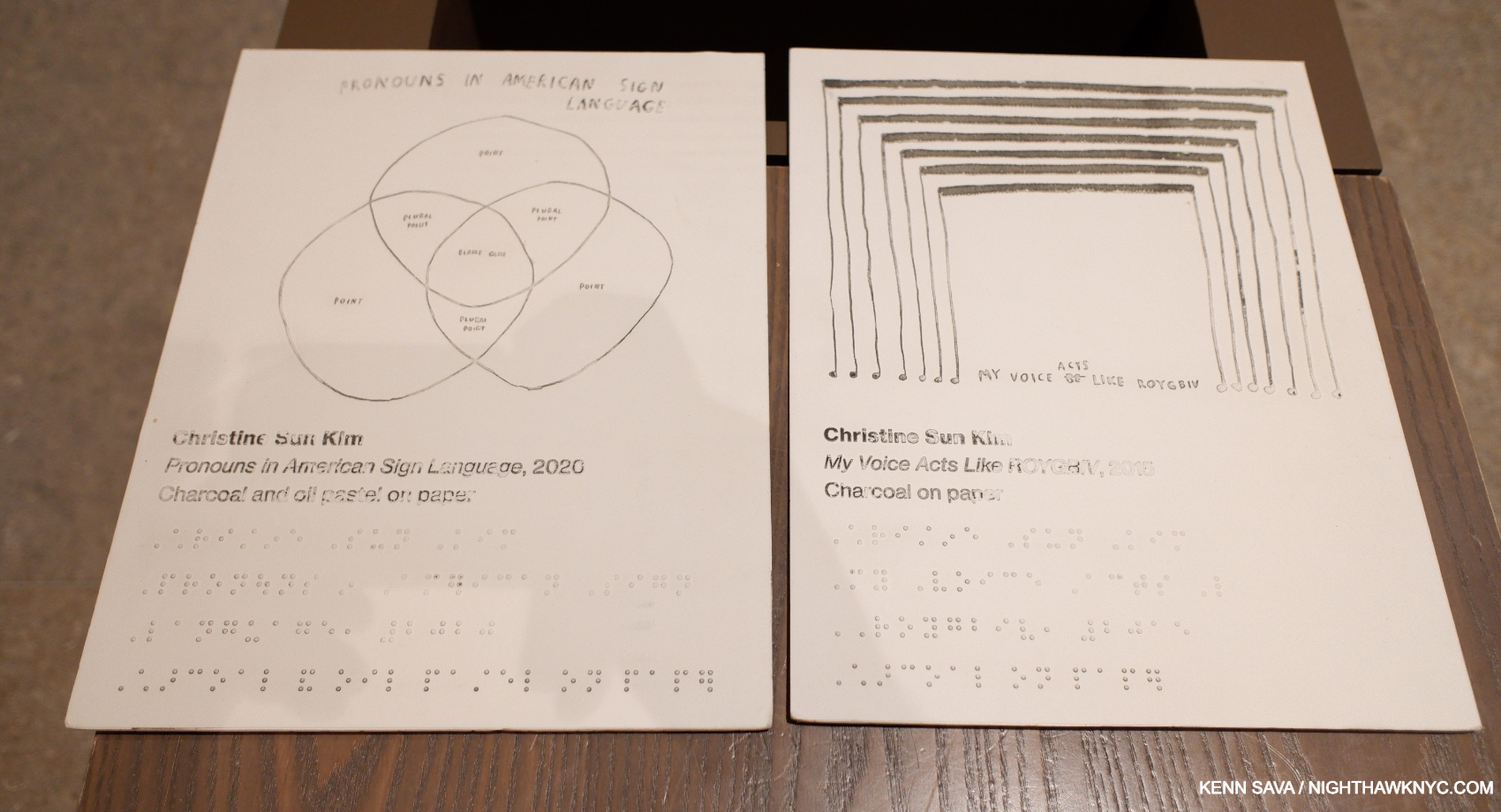
Gallery Cards include Braille. I can count on one hand how often I’ve seen this in every other show I’ve ever visited.

Come to think of it, I can’t even recall an NYC museum Retrospective of one of the more established Disabled Contemporary Artists like Chuck Close, Frida Kahlo, or Yayoi Kusama this century1. I’ve been scouring my records and racking my brain to come up with one. If you know of one, please let me know. Among other younger Artists, I think the Japanese Artist Mari Katayama may well be the next Disabled Artist to receive NYC museum attention.

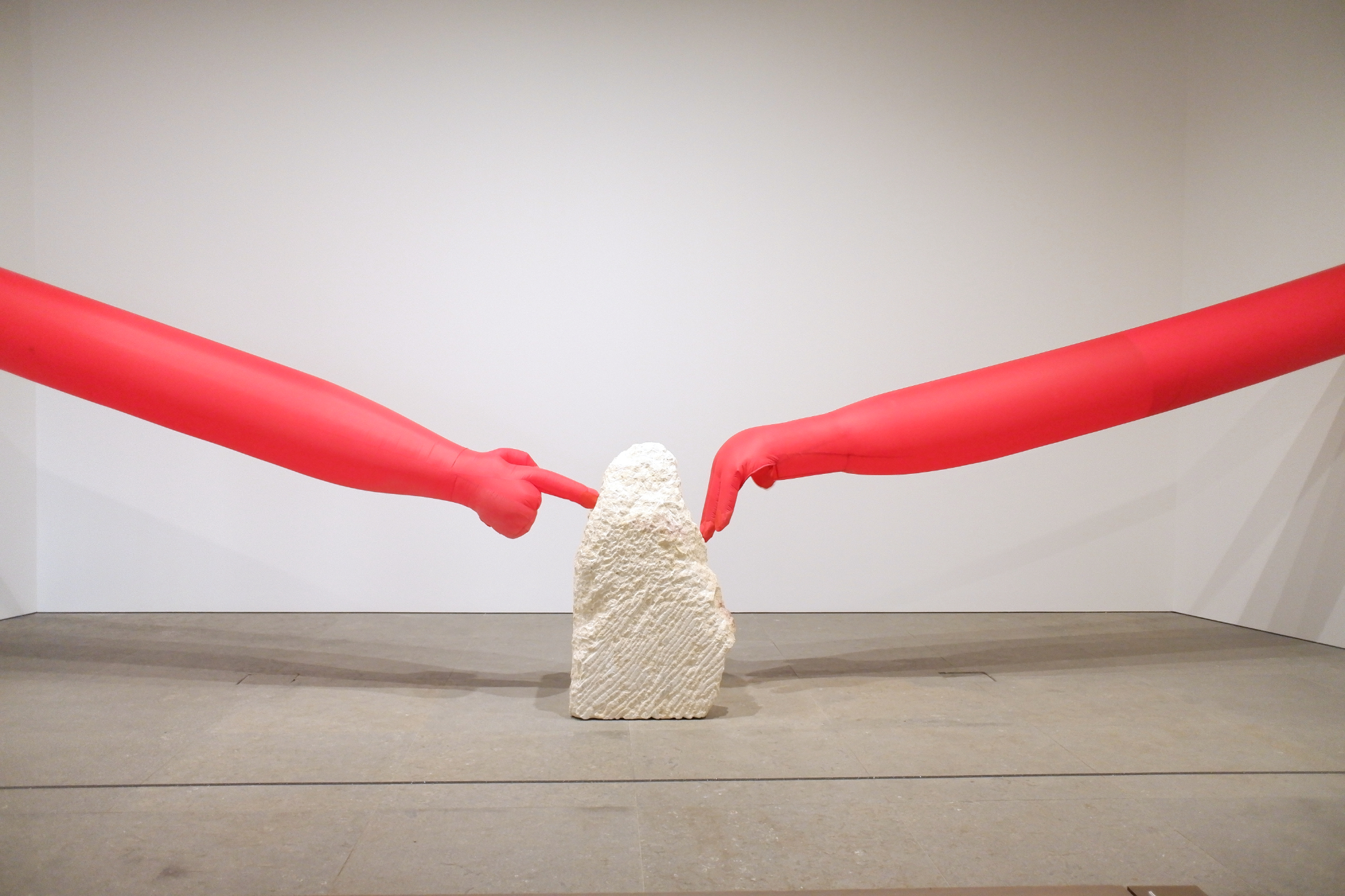
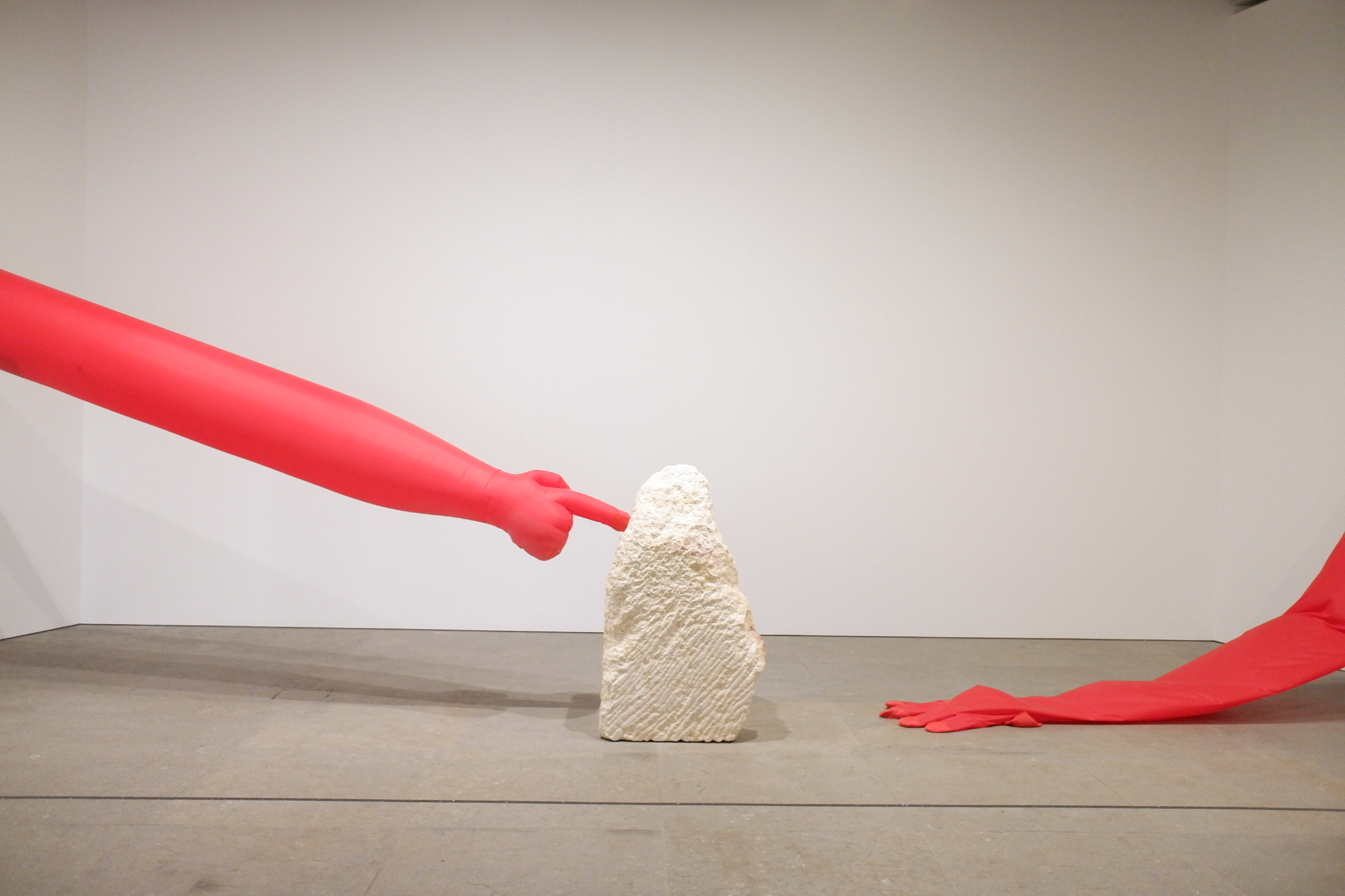
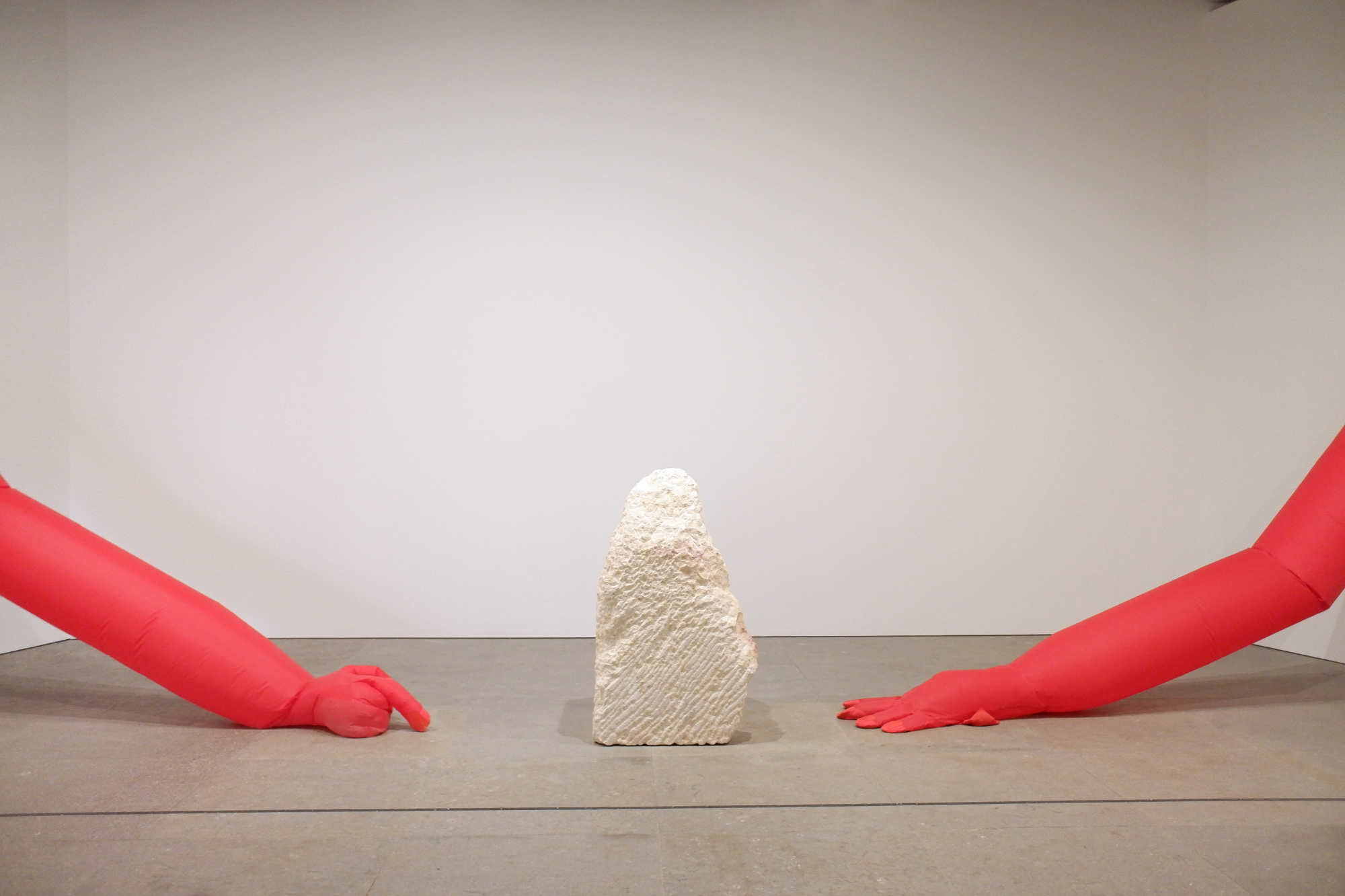
Christine Sun Kim and Thomas Mader, ATTENTION, 2022, Kinetic Sculpture, Nylon, locally sourced rock, two blowers, and control board. From the Audio Guide- “This large, moving sculpture includes two inflatable bright-red nylon arms extending from opposite gallery walls toward a jagged rock on the floor between them. One nylon arm has been sewn such that it is reaching its pointer finger out toward the rock, its four other fingers pulled into its palm. The other reaches with an entirely outstretched hand, its palm toward the floor. Both are larger-than-life and are propelled into an intermittent flapping movement by air-blowers mounted high on the walls of the gallery space. When the blowers are off, the arms drift down onto the floor. When the blowers are on, the hands repeatedly dance and brush the rough surface of the locally-sourced rock on the floor of the gallery.” Continued.

ATTENTION Audio Guide continues- “In ASL, one common method of getting someone’s attention involves waving with your palm downward in another person’s field of vision.”

ATTENTION. Audio Guide continues, “Alternatively deaf people often tap each other on the shoulder to get their attention. In this kinetic sculpture, by Christine Sun Kim and Thomas Mader, the stone is shaped so as to suggest being eroded by the fingers’ touch, alluding to the process of “trying to get one’s attention or bring attention to something forever.”

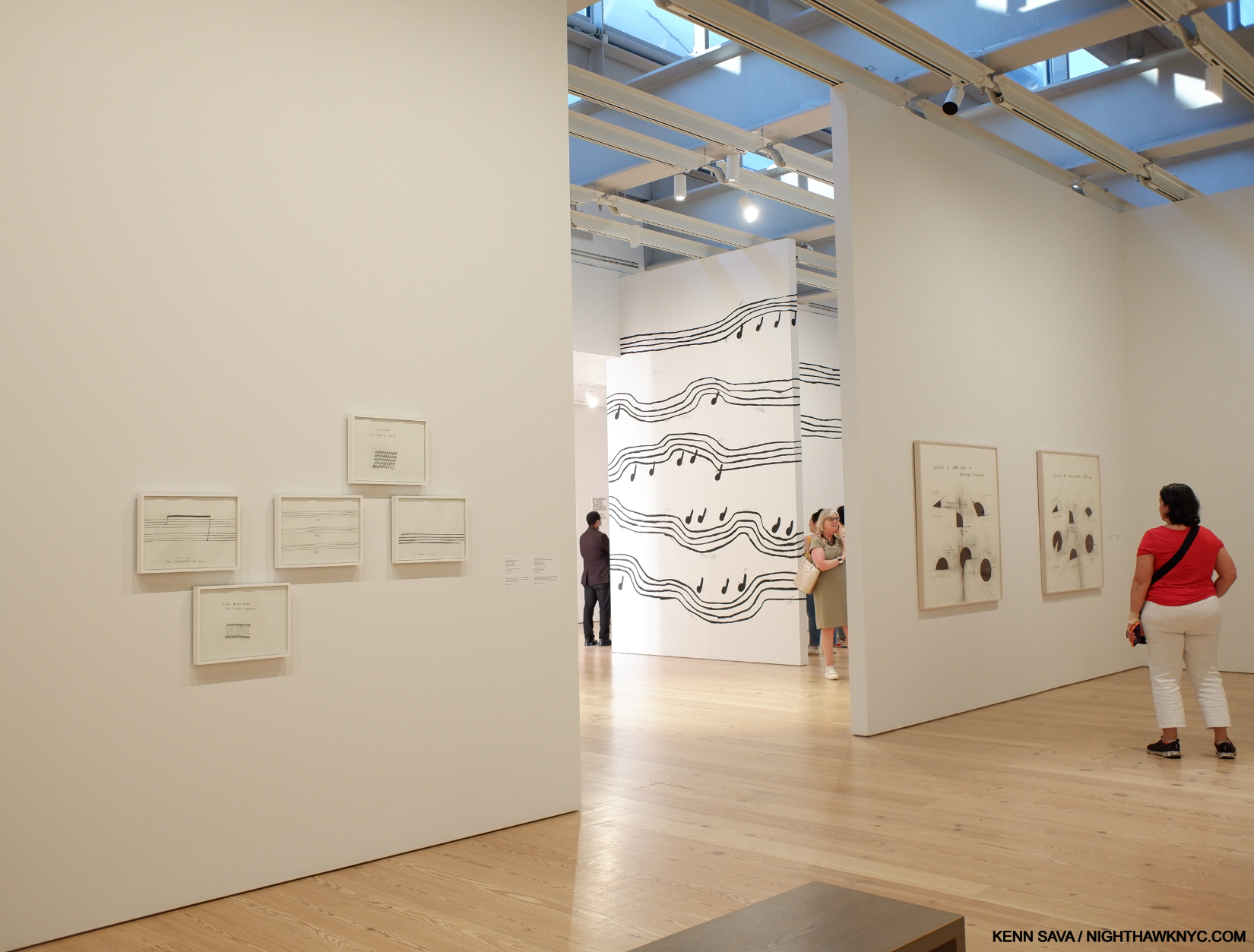
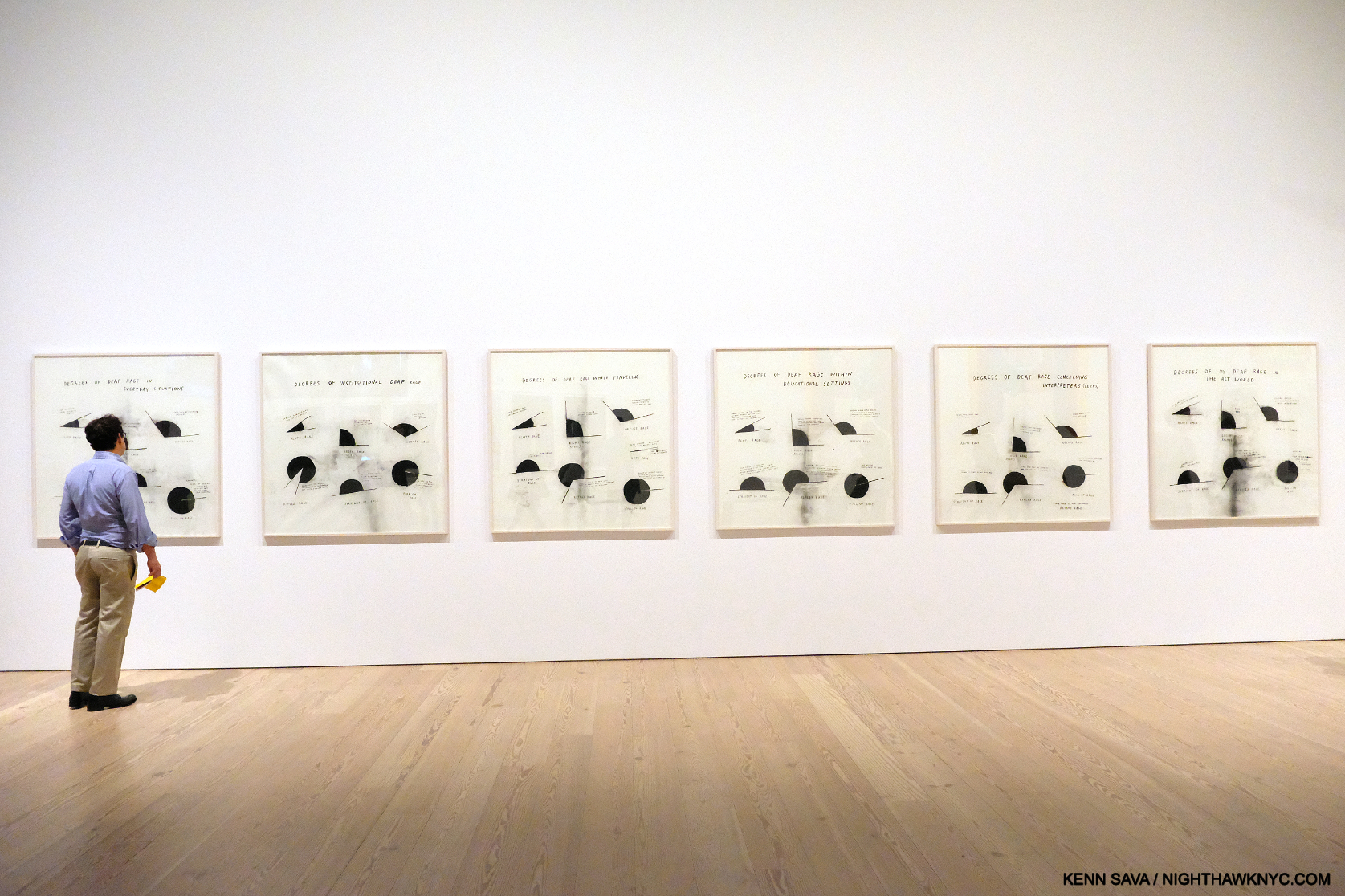
The 6 works in the Rage series. Seen at the 2019 Whitney Biennial returned to the Whitney in All Day All Night as seen below.

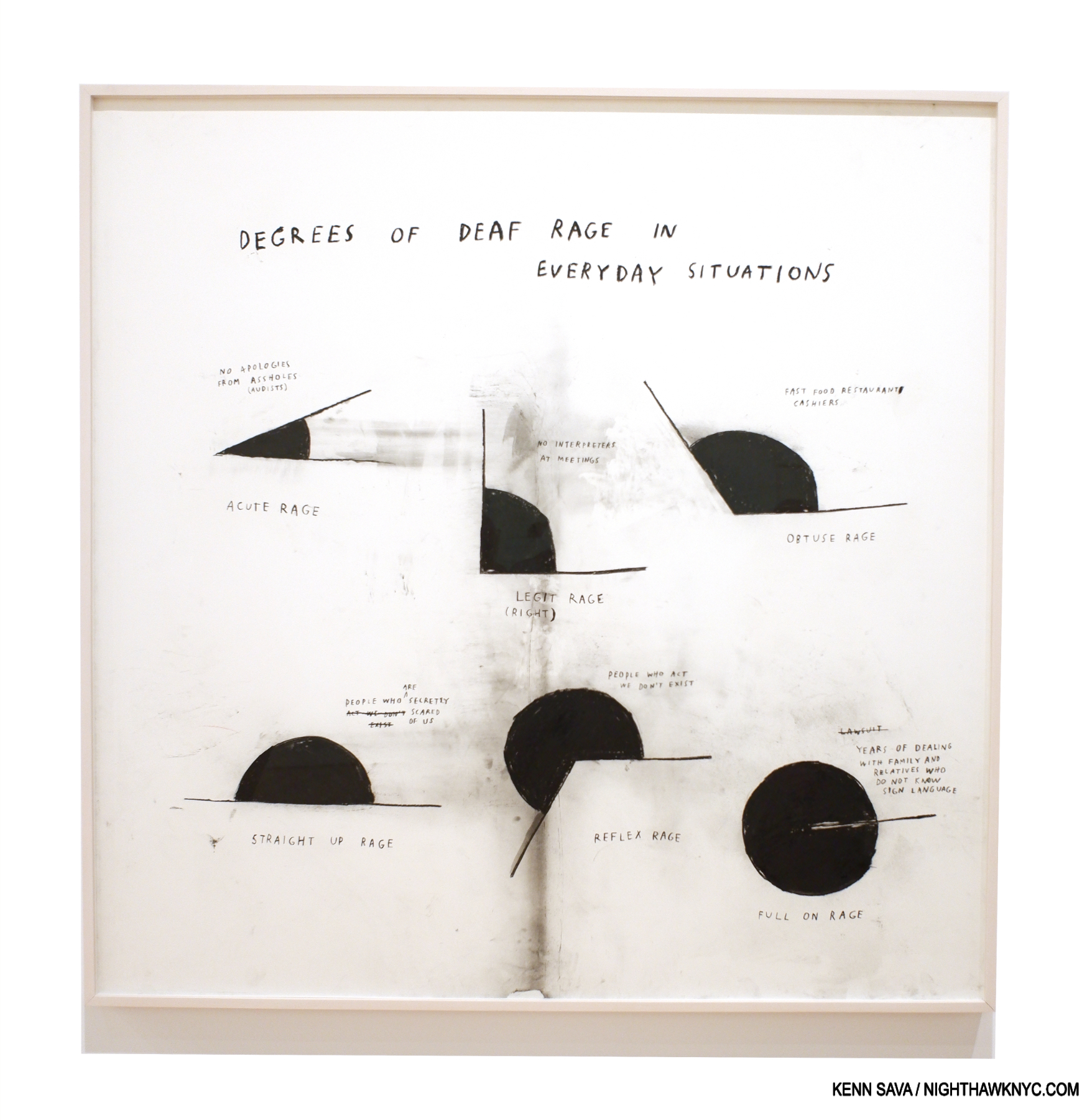
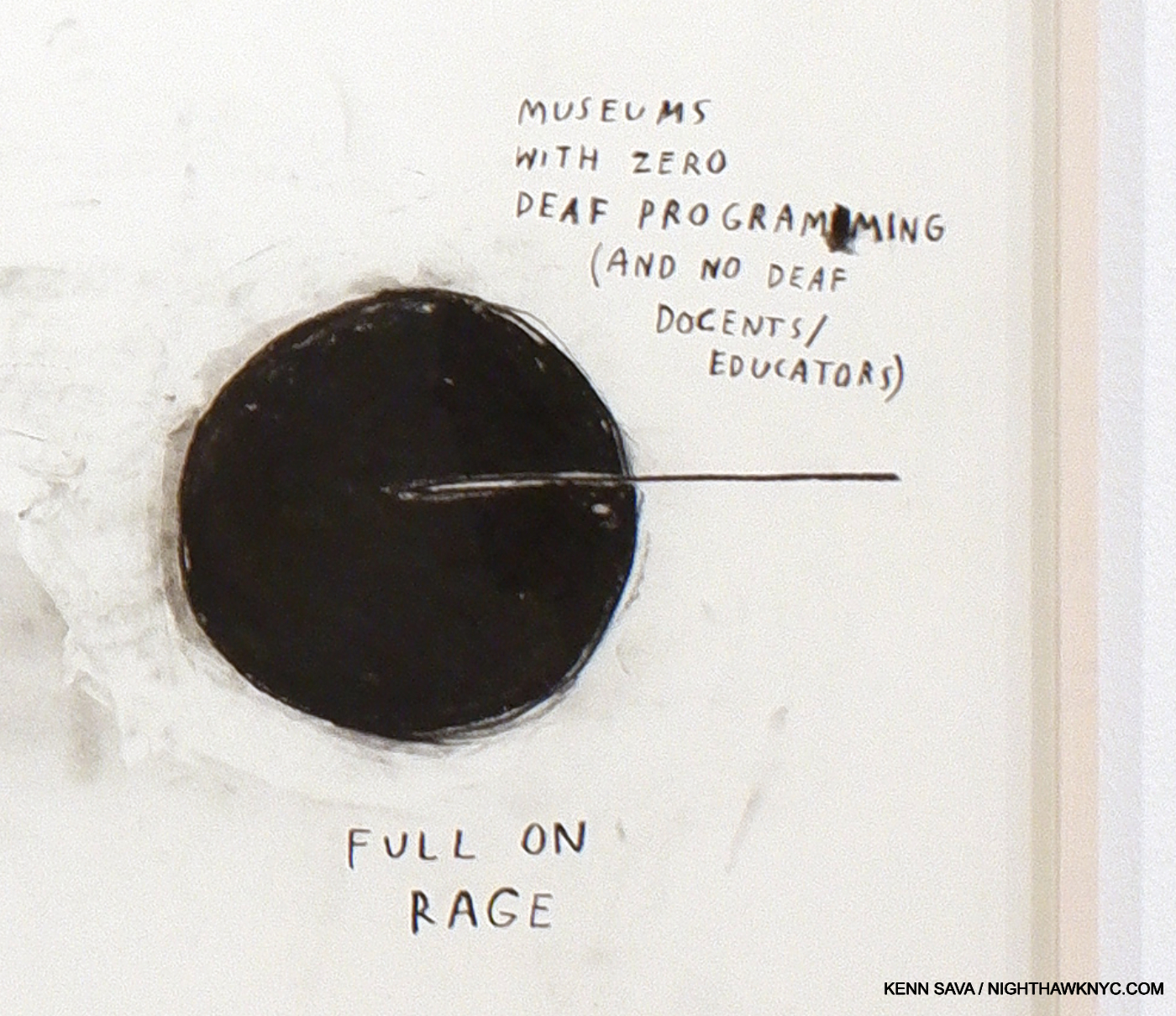
Another example of the Whitney’s long-standing relationship with Christine Sun Kim, I discovered Ms. Kim at the 2019 Whitney Biennial where I found her work a showstopper. Raymond Pettibon came to mind, as another Artist who works with words and images on paper, but her Rage series is much more personal (as she explains in the video below). It stood out as completely from somewhere else in the show and it stayed with me to this day.

The same series seen in All Day All Night in 2025.

The Rage series hadn’t lost any of its power when it was included in All Day All Night six years later.

Christine Sun Kim, circled in the sliver dress, lower left & below, Signing at the 2020 Super Bowl.

Ms. Kim is, perhaps, most well-known to the general public for her appearance at the 2020 Super Bowl where she Signed the “America the Beautiful” and the National Anthem, though her performance was cut on TV leaving her frustrated. She spoke out about it in a subsequent Op-Ed in The New York Times.

Degrees of Deaf Rage in Everyday Situations, 2018 Charcoal and oil pastel on paper

Detail.

Let’s hope that All Day All Night will be the beginning of increased attention for Disabled Artists, and not an isolated event.

My look is only a sample of the show. Here’s Christine Sun Kim to give you a personally guided tour of All Day All Night  full of additional insights I didn’t get the benefit of during my visits-

*- Soundtrack for this piece is “No Words” by Denny Laine (who was born mostly deaf and relied on hearing aids when he performed) & Sir Paul McCartney, and included on the Wings alum Band on the Run-

NighthawkNYC.com has been entirely self-funded & ad-free for 10 1/2 years, during which over 350 full-length pieces have been published! If you’ve found it worthwhile, PLEASE donate securely by PayPal below to allow me to continue. Thank you, Kenn.

You can also support it by buying Art, Art & Photography books, and Music from my collection! Art & Books may be found here. Music here and here.

To send comments, thoughts, feedback or propositions click here. Click the white box on the upper right for the archives or to search them. Subscribe to be notified of new Posts below. Your information will be used for no other purpose.

  1. The Met did host Chuck Close Prints: Process and Collaboration, a Retrospective of his graphics back in 2004.

Amy Sherald’s Second Chance

This site is Free & Ad-Free! If you find this piece worthwhile, please donate via PayPal to support it & independent Art writing!
You can also support it by buying Art & books. Details at the end. Thank you!
 

Written & Photographed by Kenn Sava.

Preface-
In honor of those who saved my life 19 years ago on February 7th, 2007, as one way of giving Thanks, this piece honors another survivor (of a different ailment): the Painter Amy Sherald. Amy’s remarkable story is told here better than I could tell it. My look at her Art follows.

Shows seen:
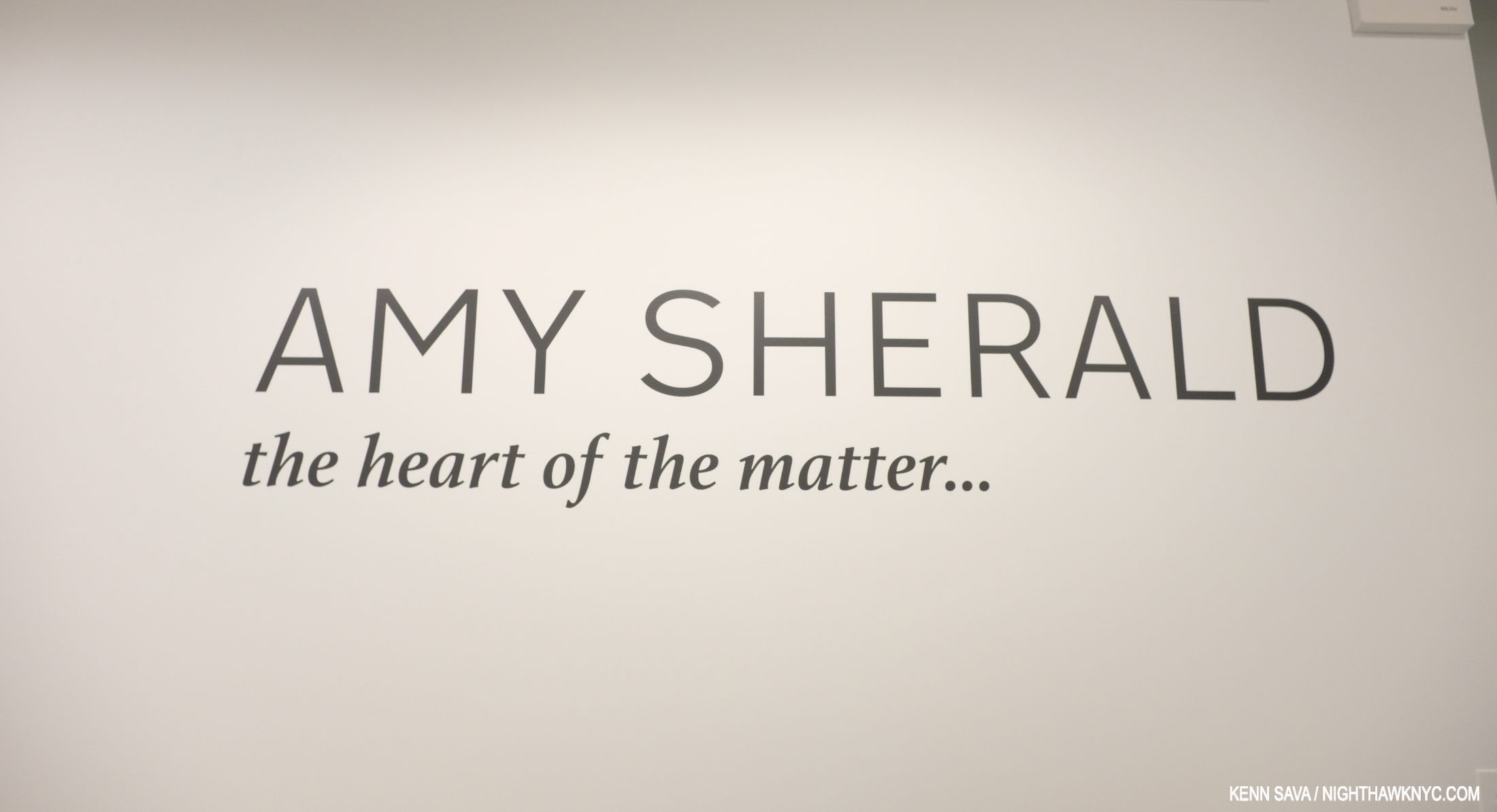
Amy Sherald: the heart of the matter…, Hauser & Wirth, October, 2019, and
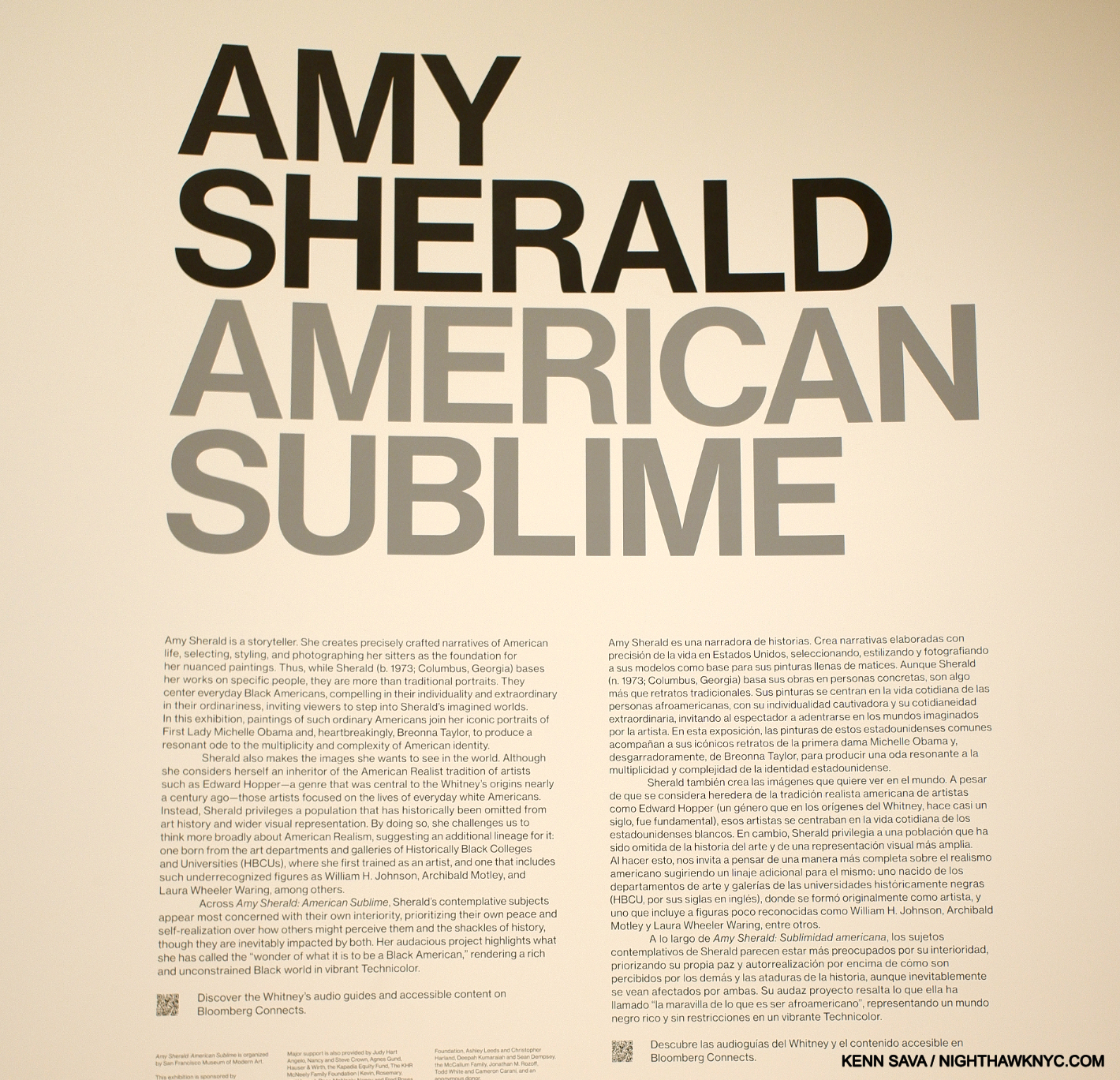
Amy Sherald: American Sublime, Whitney Museum, Summer, 2025

The Whitney & MoMA went toe-to-toe with dueling summer blockbusters in 2025, with each institution mounting two. I began this series with a look at Hilma af Klint: What Stands Behind the Flowers at MoMA, where Jack Whitten: The Messenger was installed on 6. All the while, 40 blocks south, Amy Sherald: American Sublime was up at the same time as Christine Sun Kim’s landmark All Day All Night, comprising the Whitney share of the four must-see Summer shows.

Hauser & Wirth, October 15, 2019.

I first saw Amy Sherald’s work at her NYC debut show, “the heart of the matter…,”  at Hauser & Wirth in October, 2019, a show that contained 8 Paintings.

The select content allowed for more space around each that worked extremely well in my view. Handsome, 2019, Oil on canvas, 54 x 43 inches, was also shown in American Sublime. Seen at Hauser & Wirth, October 15, 2019.

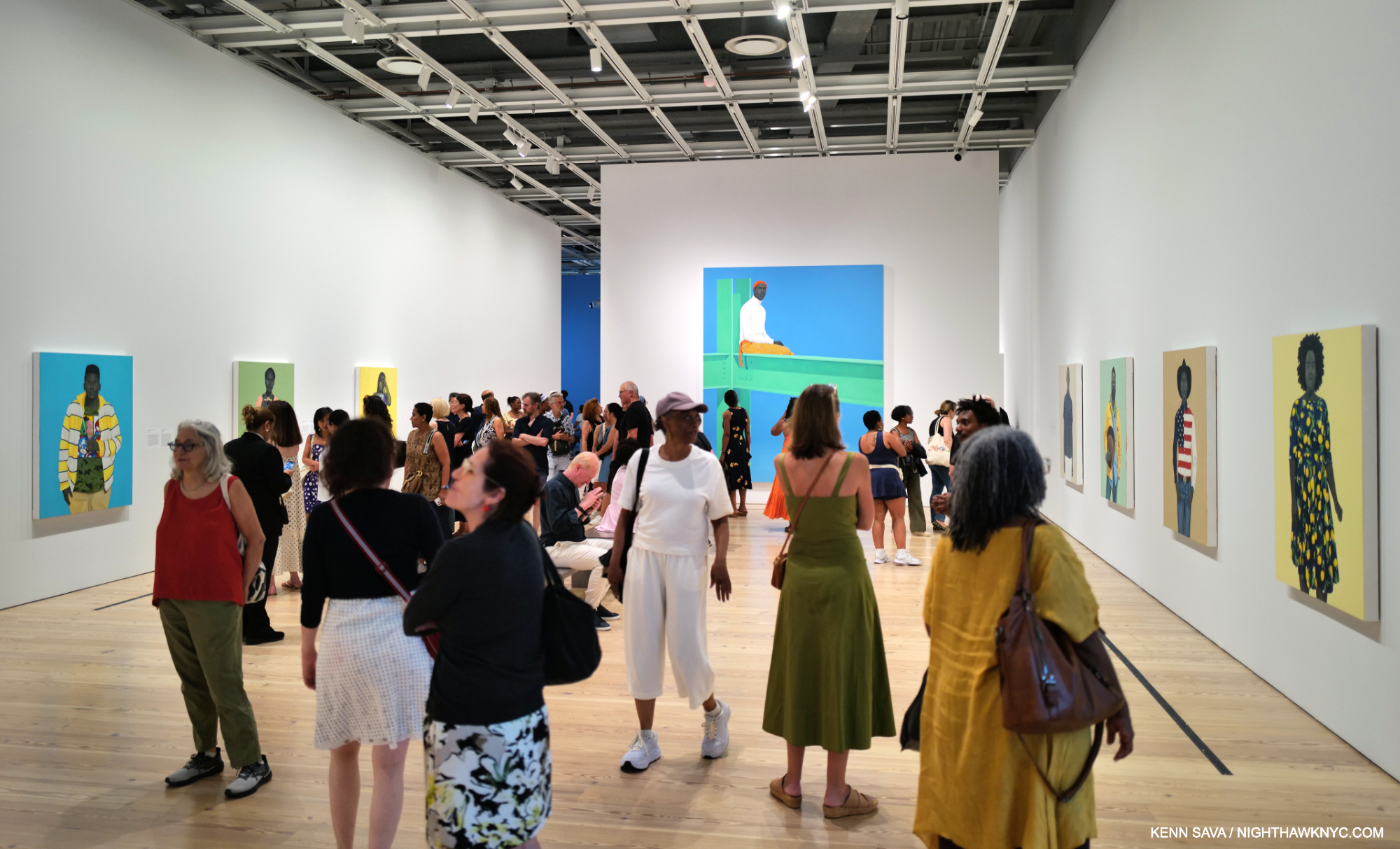
Fast forward to April 9, 2025, American Sublime contains 44 Paintings, the earliest dating from 2007- just 18 years prior! In those last two sentences hides the remarkable fact that Ms. Sherald (B. 1973) went from NYC debut show to an NYC early mid-career major museum Retrospective in a little more than five years! There aren’t a lot of Artists I can say that about.

Whitney Museum, July 25, 2025

Installation view. July 25, 2025.

What’s more remarkable is that just seven years before her Hauser show, on December 18, 2012, Amy Sherald underwent a heart transplant at age 39! That concluded a harrowing 10 years she spent after being diagnosed with congestive heart failure at age 30, and a two-month wait in the hospital for a donated heart (as is recounted in the piece I linked up top). Today, Amy Sherald is yet another fine Painter who burst on the scene this past decade and has wasted no time solidifying a place in museums around the world.

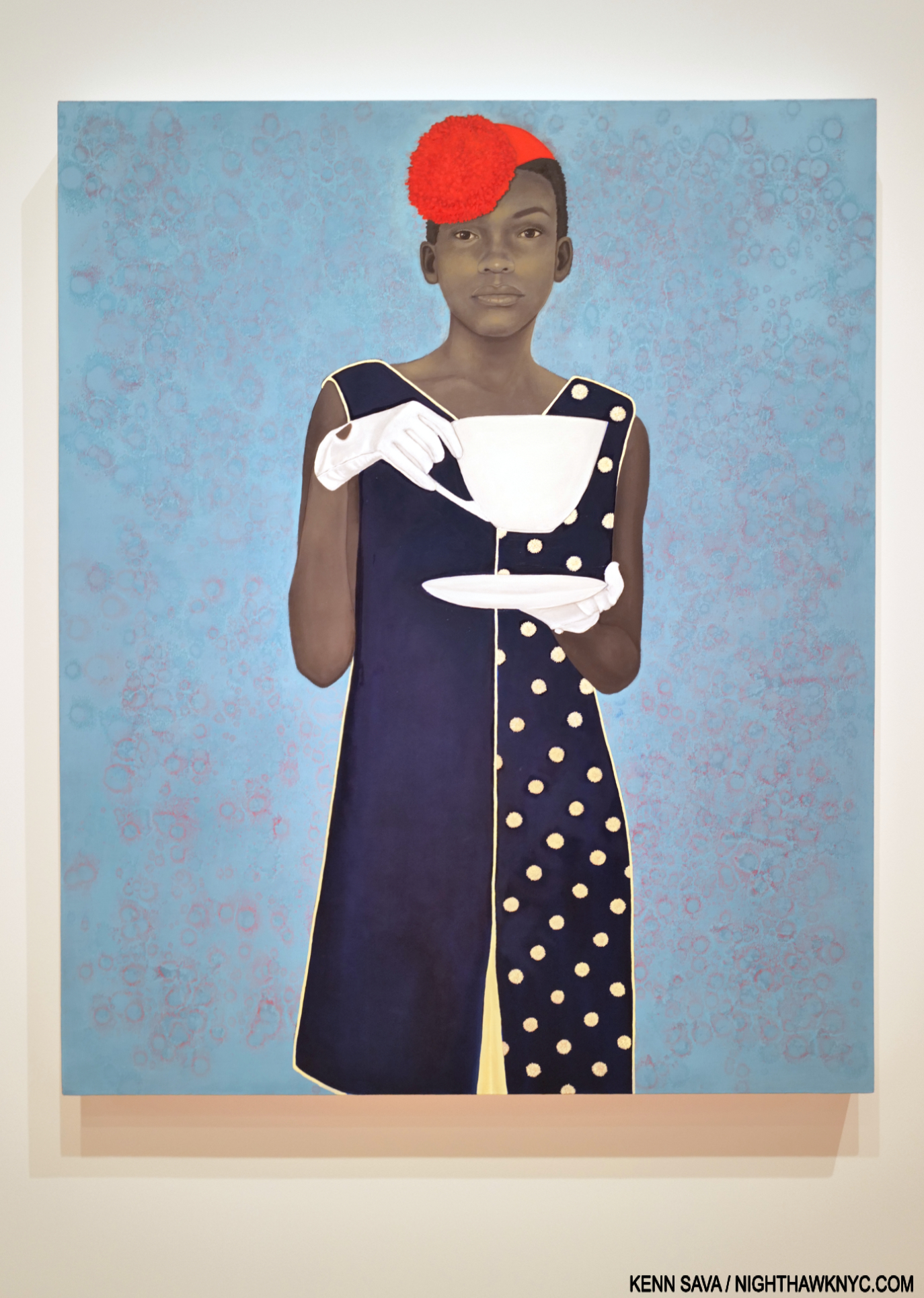
Miss Everything (Unsuppressed Deliverance), 2014. Oil on canvas. The Painting that brought Amy Sherald to national attention was inspired by Alice in Wonderland.

And, “burst on the scene…” she did as her 2019  NYC debut show came just three years after Amy won the 2016 National Portrait Gallery’s Outwin Boochever Portrait Competition with Miss Everything (Unsuppressed Deliverance), becoming both the first woman and the first African-American woman to win it.

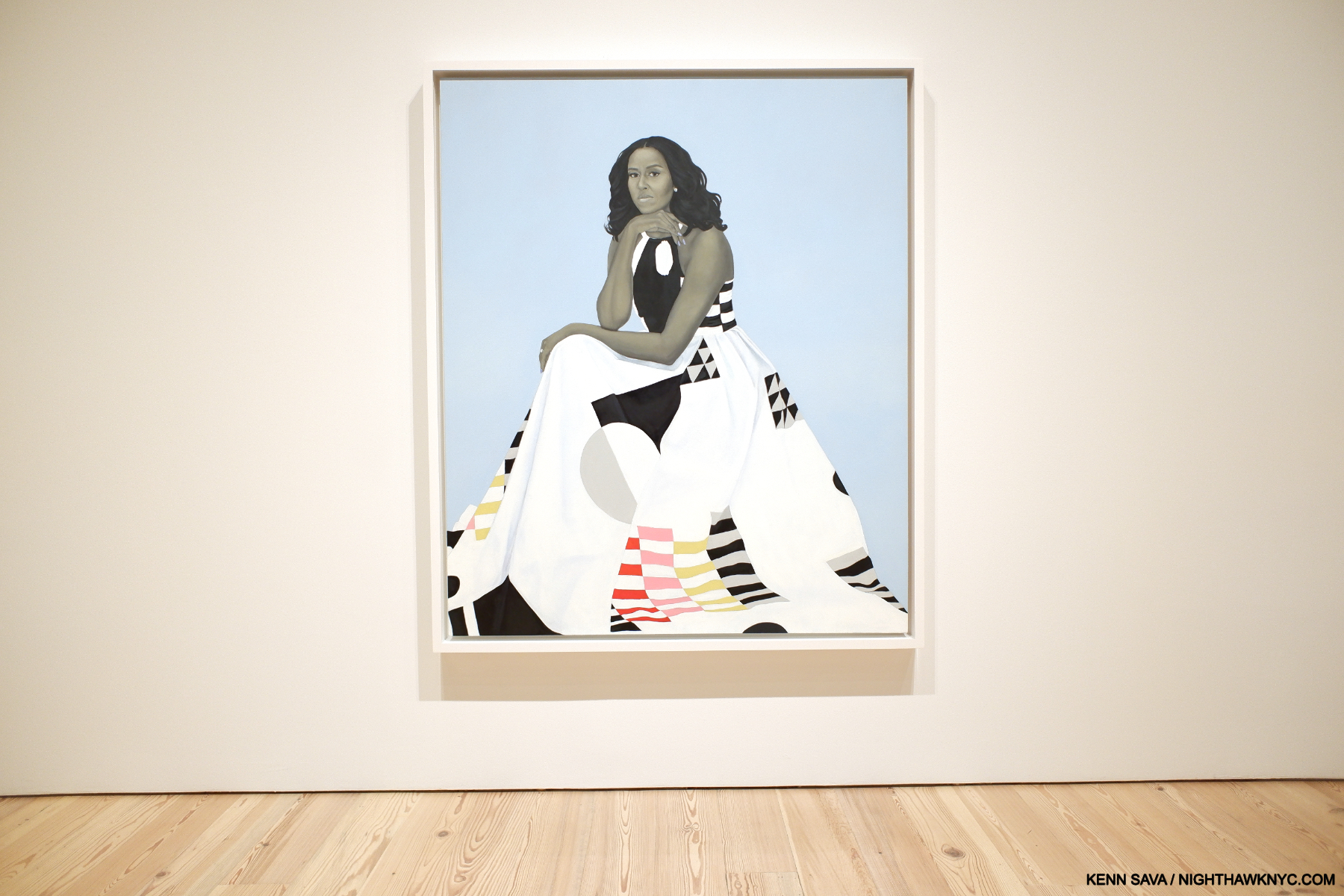
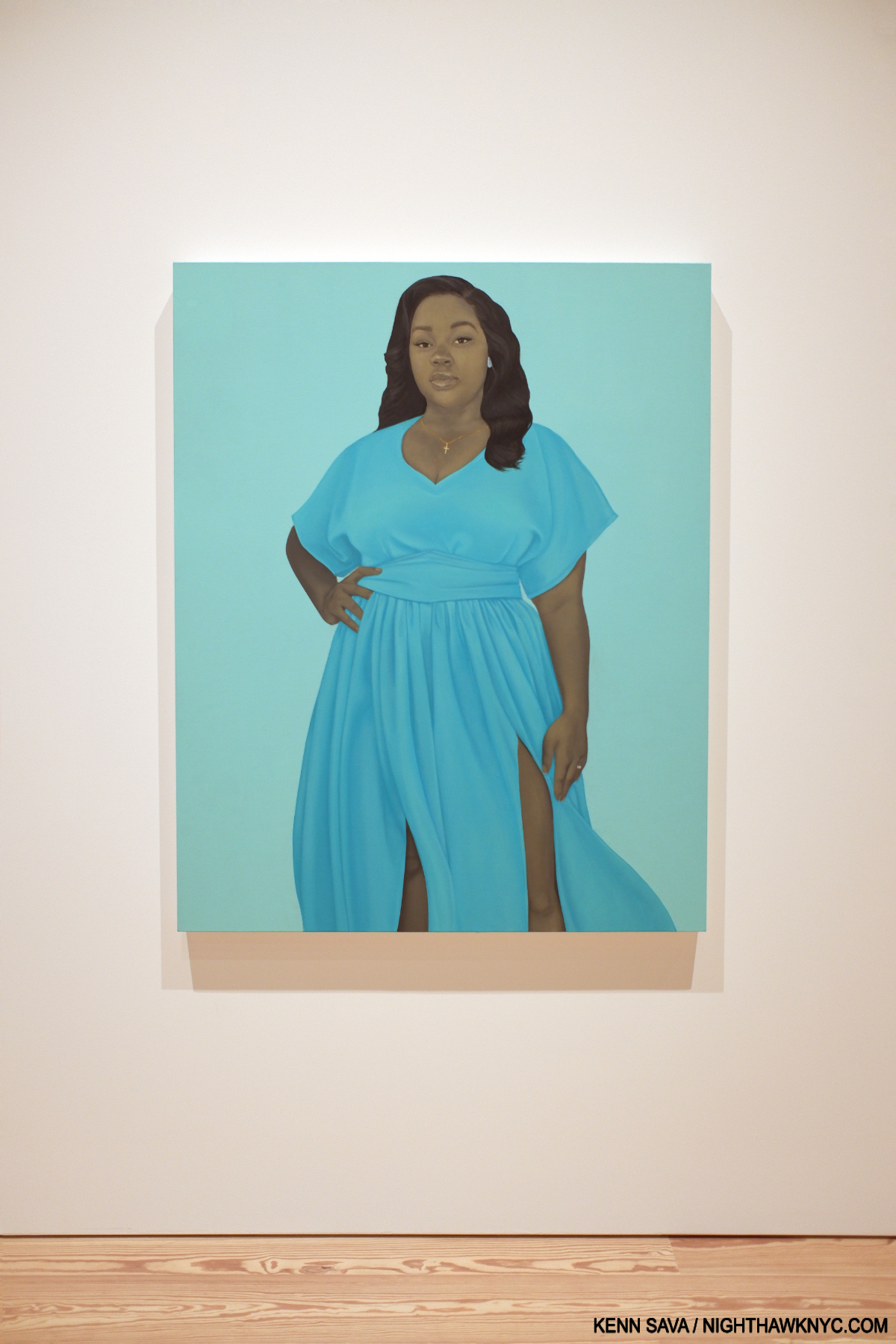
Michelle LaVaughn Robinson Obama aka First Lady Michelle Obama, 2018, Oil on linen. (The first title was on the wall card.) After being personally selected by Mrs. Obama to Paint her official Portrait, a prescient choice at the time. Amy Sherald’s stature has only continued to grow. The former First Lady selected the Michelle Smith Milly label dress she is wearing that channels Piet Mondrian through Gee’s Bends Quilt Making, blending the modern with the historic. Gee’s Bend is a remote Black Alabama community of the descendants of former slaves.

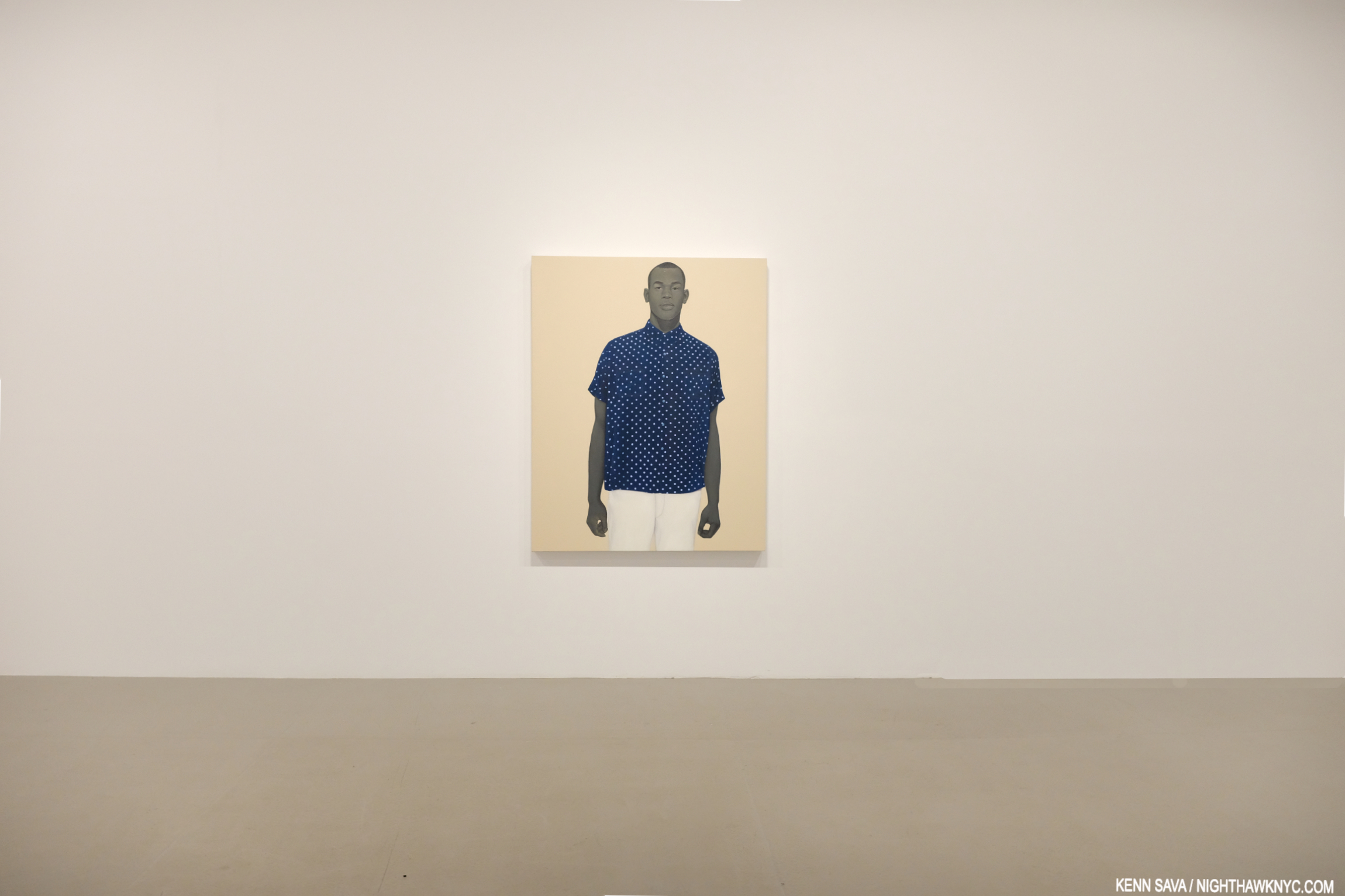
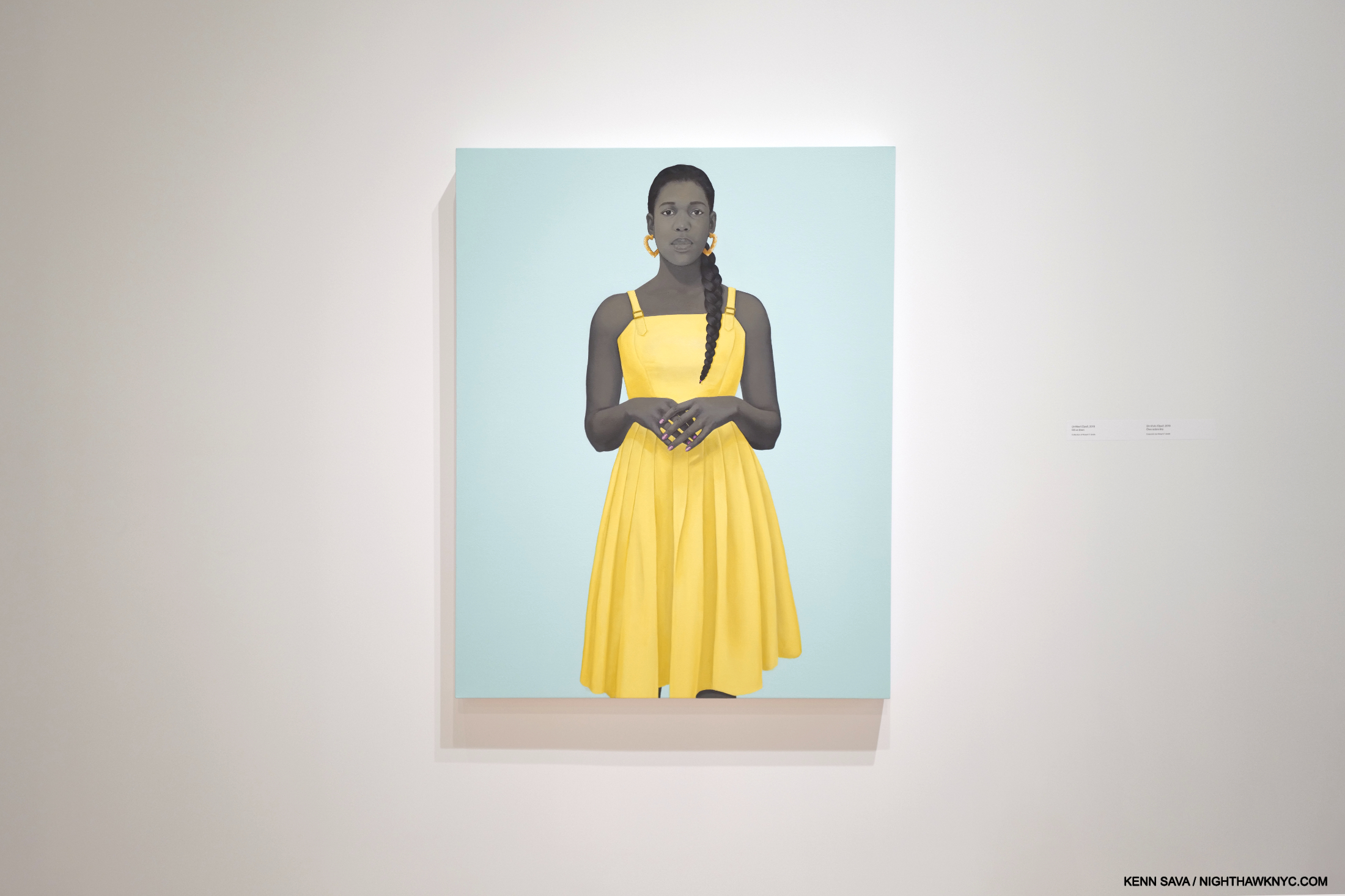
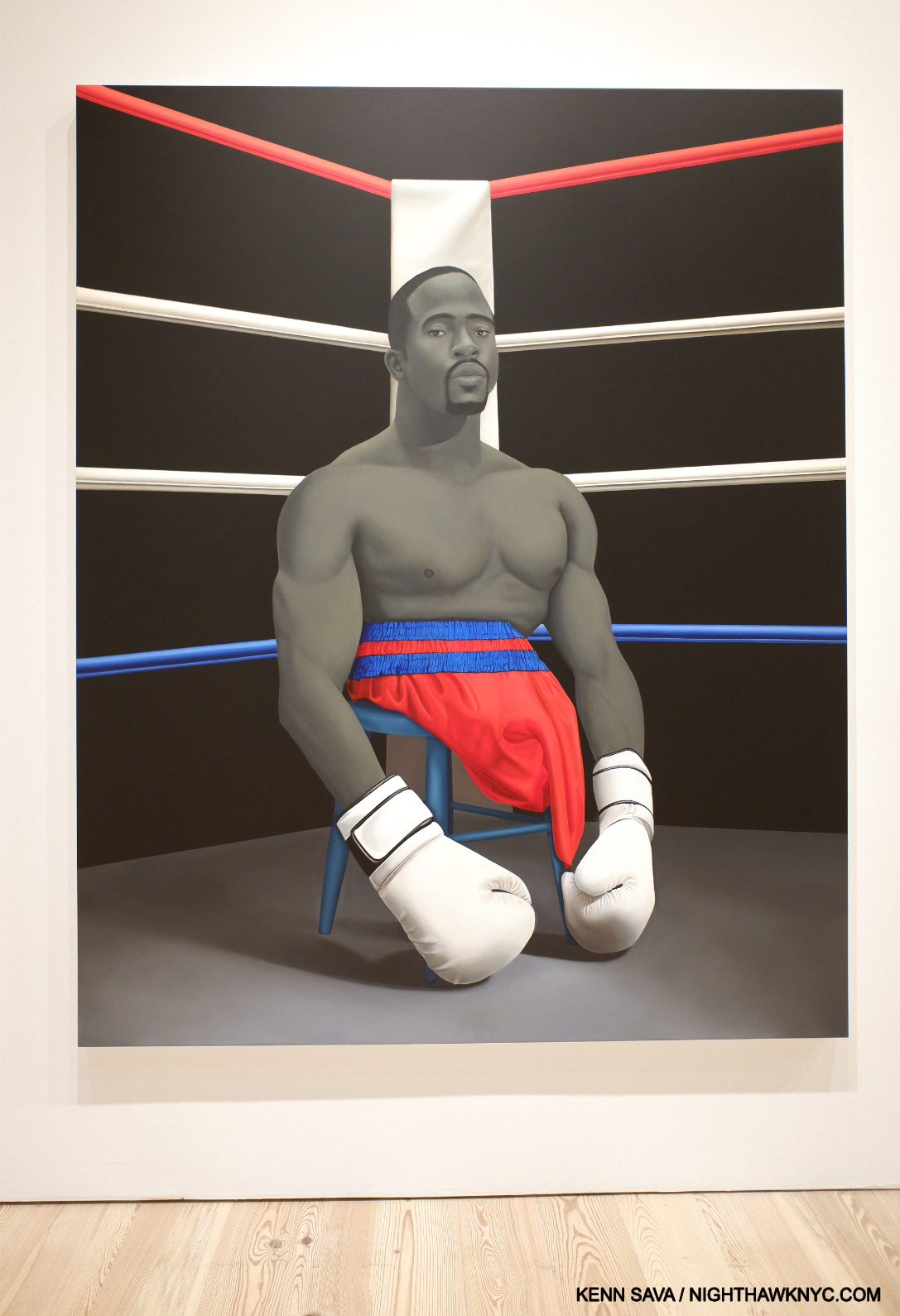
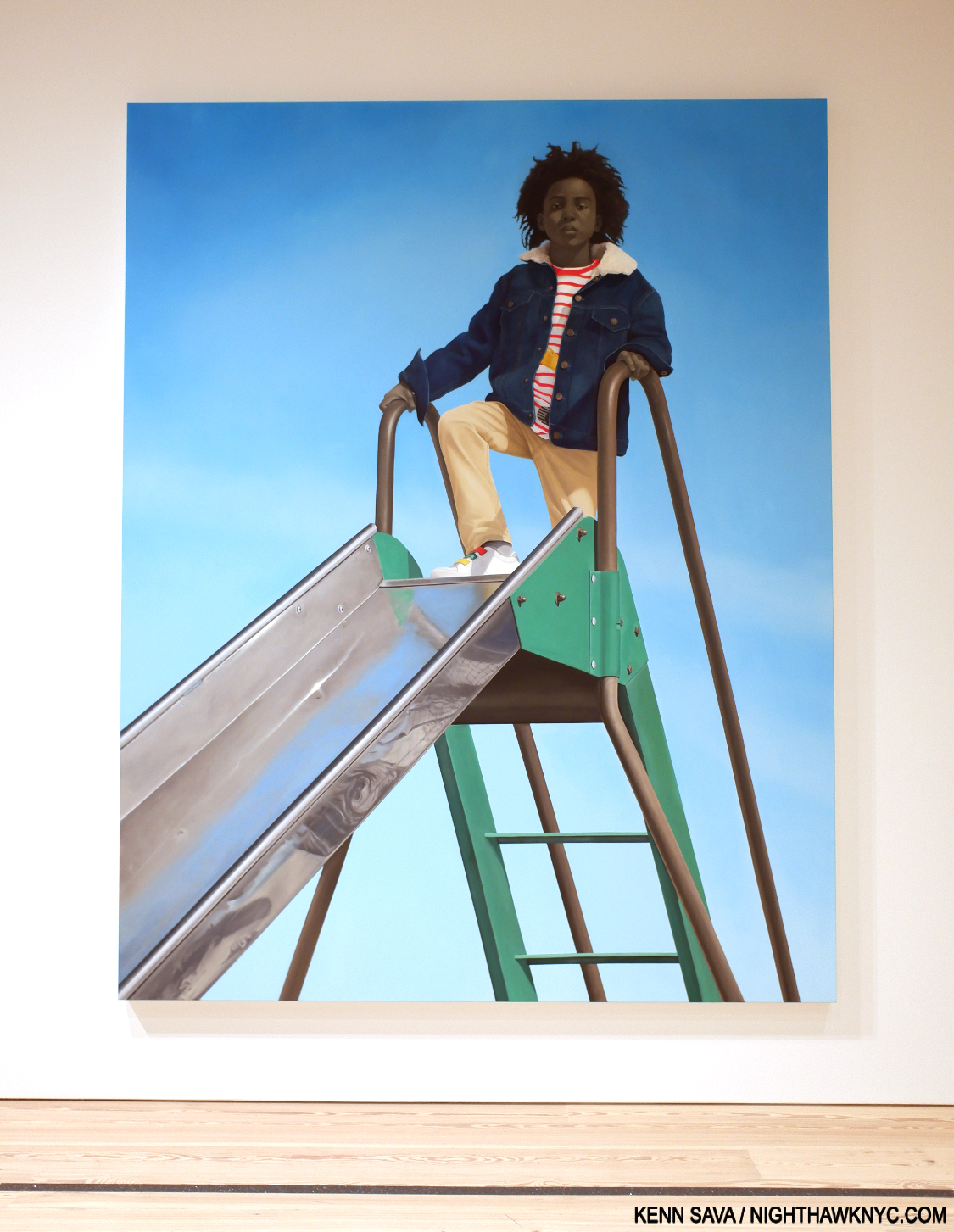
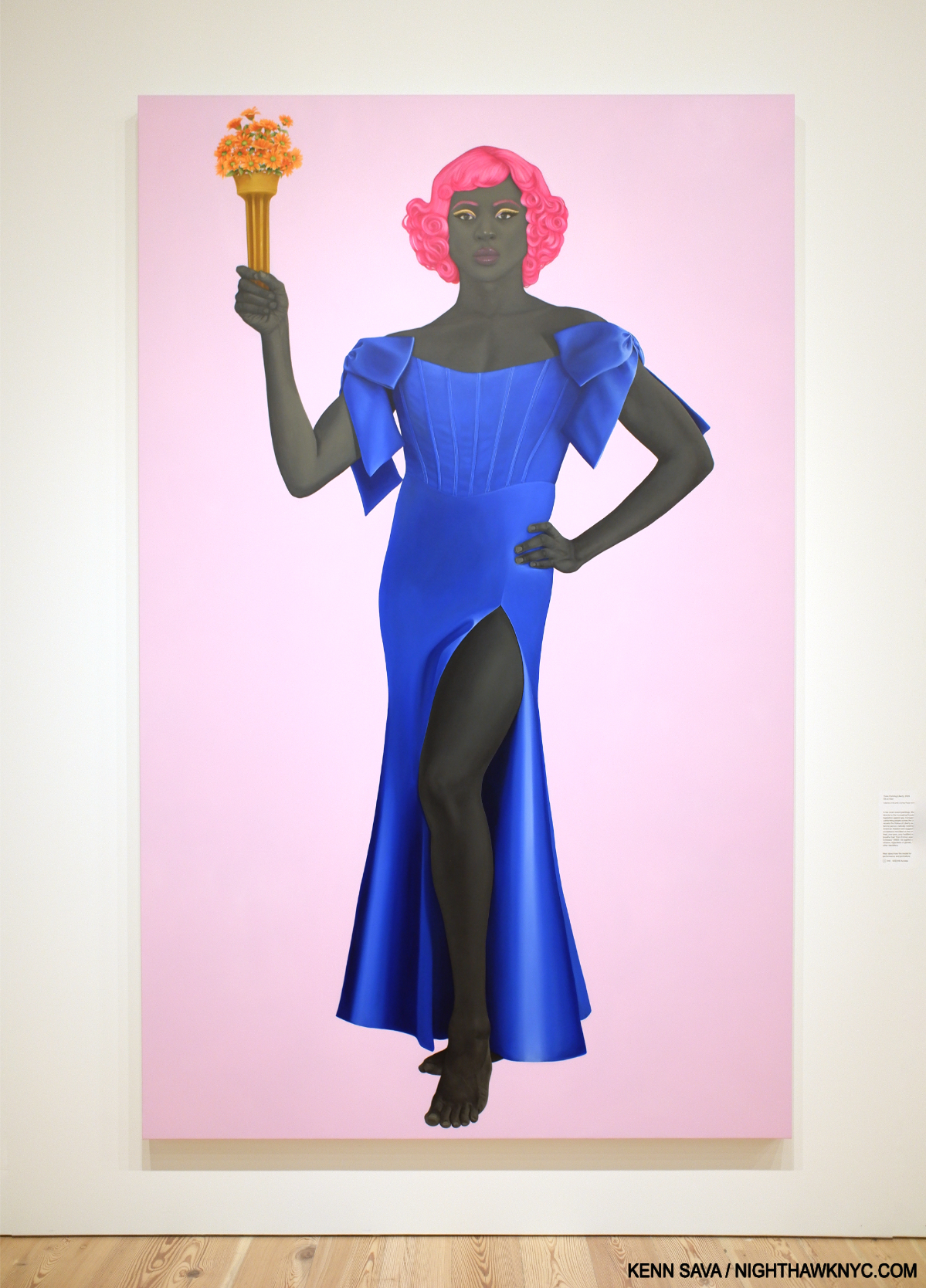
Most well-known today, perhaps, for her Portraits of Michelle Obama and Breonna Taylor, Amy Sherald: American Sublime revealed the depth of her accomplishment (already) in works that are almost always forthright, with subjects usually facing the viewer head-on, while steeped in a subtlety that rewards extended and repeated looking. Adding a unique twist is that the faces, hands, arms, legs of each of her subjects are gorgeously rendered in grisaille(!), something I’ve never seen done in a color Painting before, and something that has become her trademark. She uses grisaille as a way of “challenging the concept of color as race1.”

Untitled (Opal), 2019, Oil on linen. Standing in front of Opal, I found myself wondering why I’d never seen a Painting like this before. It seems so incredibly straight-forward, yet only Amy Sherald could have Painted it and made it as unique as it is. From the grisaille, to the position of her hands & fingers, to her expression and the choice of colors, which Wes Anderson might admire, it’s a remarkable blend of a Portrait of Opal through the eyes of an Artist with a vision.

In the late 1990s and early 2000s I spent much time wondering what new developments would come to Portraiture after the work of great 20th Century Artists, like Francis Bacon, Lucian Freud, Frank Auerbach, Alice Neel, Marlene Dumas, Picasso, and others. 25+ years in, the genre is continually being reinvented, yet again, by a number of Artists who have come to prominence this decade- including Amy Sherald, Nathaniel Mary Quinn, and Frank Auerbach (who passed away in 2024).

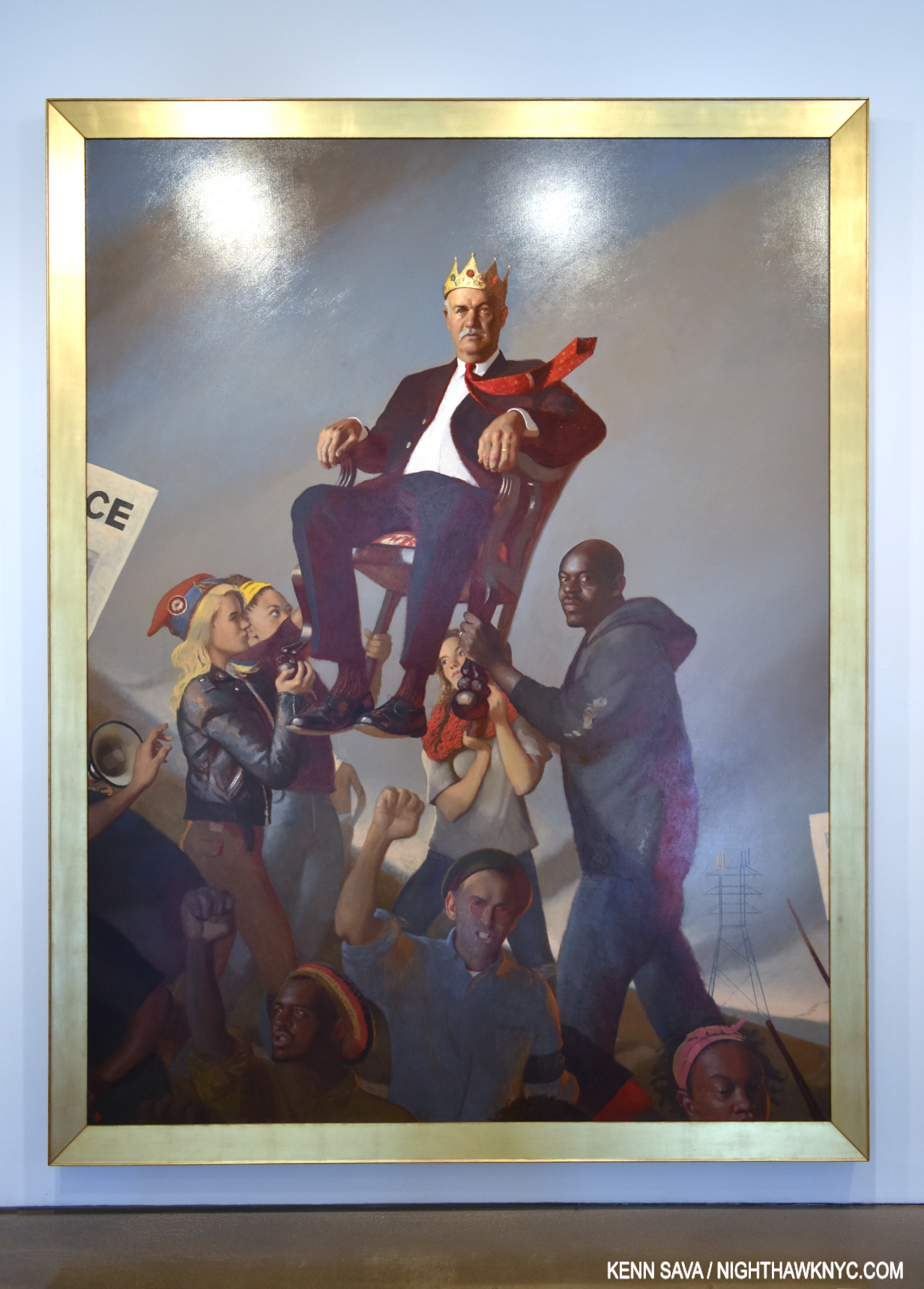
Bo Bartlett, Oligarchy, 2016, Oil on linen. See at Ameringer McEnery Yohe, August 12, 2016.

Interestingly, Amy credits the Painter Bo Bartlett with showing her the possibilities. Others have posited that Ms. Sherald’s use of grisaille goes back to old black & white Photos of Black subjects, and not Painting or Painted Portraiture. However, on 19th Century Photographs Ms. Sherald said-

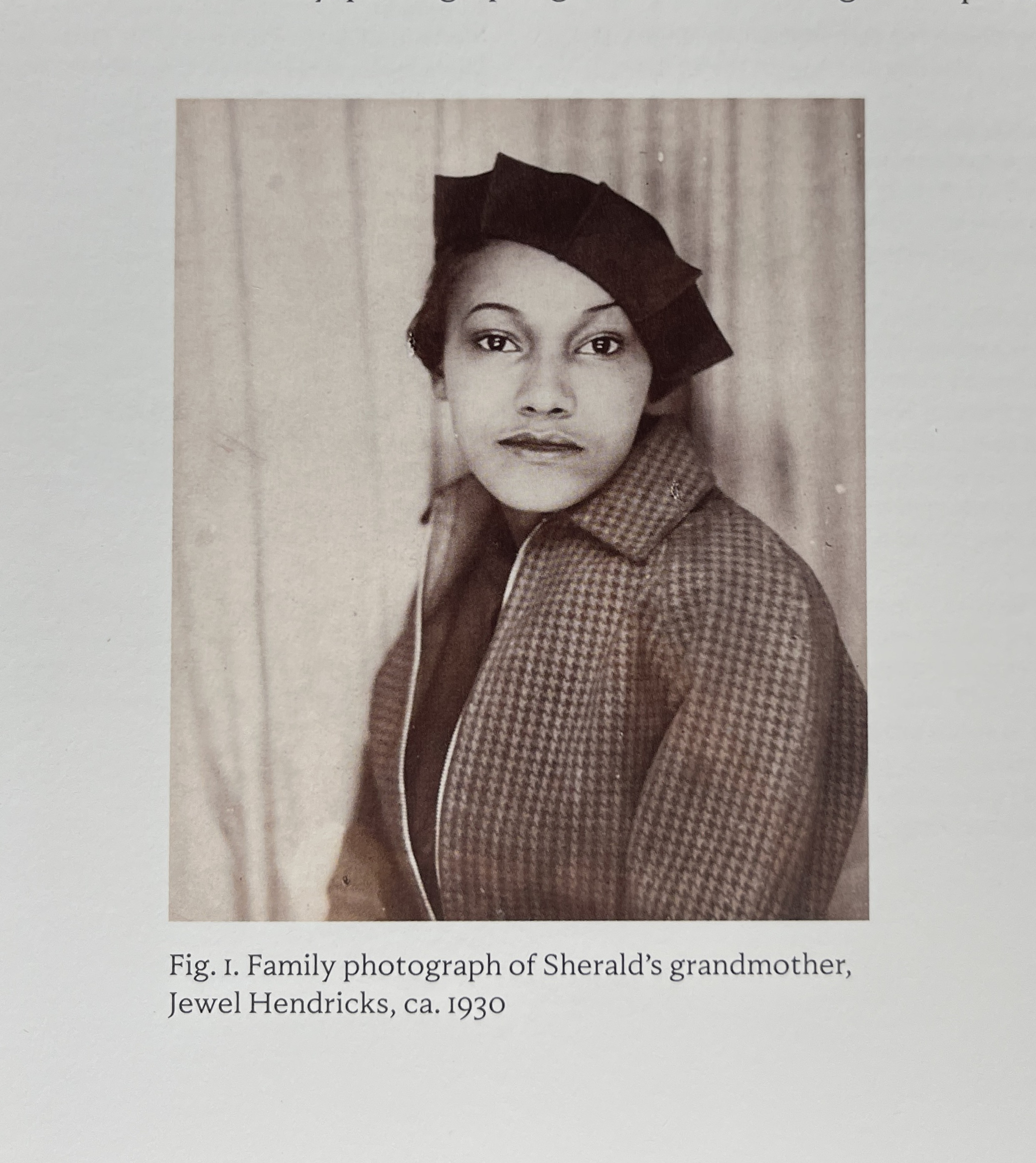
“It wasn’t what inspired my work, but it’s what affirmed my journey with it, and it’s where I was finally able to find these representations of black Americans that spoke to me in the same way that I wanted my work to speak to the world. They were family photographs, similar to the image of my grandmother that I oftentimes mention, where she had her picture taken.”

The Artist’s grandmother, Jewel Hendricks, as seen on page 28 of the excellent American Sublime catalog.

“Looking at how they represented themselves— they’re quiet, regal, graceful. It was an outward action that had inward meaning. They don’t smile, but there’s something there-this is what I look for in people— the feeling that you get when you look at those old photographs. When you look into their eyes, you are being told a story. It’s almost as if they’re standing in front of you, and they have a living and breathing kind of energy. There is something so captivating about that. And it’s not frivolous. It’s a very serious, deliberate kind of thing, having your picture taken, especially then2.”

Breonna Taylor, 2020 Oil on linen.

In work after work, American Sublime reveals that Amy Sherald is a master of Portrait story telling. Her Portrait of Michelle Obama, Michelle LaVaughn Robinson Obama, is a classic case in point that manages to subtly weave multiple threads. Crossing cultural boundaries by dialoguing Mondrian-like elements and Gee’s Bends Quilt Making is artistically ground-breaking, topped off with a natural and wonderfully relaxed pose, enhanced by the background pale blue, that is just stunning.

This is what Amy Sherald does.

Commissioned to Paint the late Breonna Taylor, her first posthumous Portrait, Ms. Sherald visited her family and spent time with her mother, Tamika Palmer, who spoke of Breonna’s interest in fashion. Amy commissioned a dress for the Portrait, and also added an engagement ring on her finger “to represent the love between Taylor and her partner, Kenneth Walker… Sherald incorporated the ring to give him solace and to suggest a brighter future3.” Of the finished Painting she said, “I don’t think I thought much about the viewer so much as I thought about her family when I was making this portrait….but when you’re speaking about violence against women and police brutality, she’s become the face for that movement,” she said4.

The intro for the Audio Guide for her 2019 Painting, The Girl Next Door says, “The artist discusses how she transforms the historical function of portraiture…” That’s a lot to have accomplished in 18 years already. Along the way, she renders a wide range of subjects that encompass an equally wide range of Black Americans, including more than a few who are new to museum walls showing the scope of her vision.

American Grit, 2024 Oil on linen.

As soon as she was able to, she sought out the family of the woman, Kristen, whose heart she now has. Amy was 39 when she received Kristin’s heart. Kristin died at 38. Amy calls it “a perfect match.”

Kingdom, 2022 Oil on linen

“What kind of person was she? What kind of things did she like. Who did she love? I romantically believe in muscle memory, heart memory. It means a lot for me to be able to just kind of get to know her family a little bit. When I met her father he made me feel her heart beat. … I still call it Kristen’s heart.”

Trans Forming Liberty, 2024 Oil on canvas

“I live without fear. I work without fear. I wake up and produce these ideas without thinking so much about painting something stupid or people not liking it. I’m living this moment: I wake up every day, and I have to make sure that my work continues to speak to generations. I need to make things that are going to resonate in that way.” 

For Love, and for Country, 2022 Oil on linen.

She continues, “But I also truly believe in who I am as a human. I believe in my power. I believe in timing. I believe that this is my “now,” and that nothing can go wrong now. I understand that as a fact. I’ve been through the worst of the worst, and it was still okay. I wake up, and I keep it moving every day for Kristin and my brother Michael. You don’t waste second chances5.”

A God Blessed Land (Empire of Dirt), 2022 Oil on linen.

*- Soundtrack for this piece is “I Can See Clearly Now,” written & performed by Johnny Nash from the 1972 album of the same name, which he performs here the following year-

For those who kept me here, and for Lisa, who gave this total stranger her extra ticket to the sold-out Basquiat show at the Brant Foundation in Spring, 2019, enabling me to see it and share it with the world. As she was leaving she told me she was looking forward to seeing Amy Sherald: the heart of the matter….

NighthawkNYC.com has been entirely self-funded & ad-free for 10 1/2 years, during which over 340 full-length pieces have been published! If you’ve found it worthwhile, PLEASE donate securely by PayPal below to allow me to continue. Thank you, Kenn.

You can also support it by buying Art, Art & Photography books, and Music from my collection! Art & Books may be found here. Music here and here.

Written & photographed by Kenn Sava for nighthawknyc.com unless otherwise credited. To send comments, thoughts, feedback or propositions click here. Click the white box on the upper right for the archives or to search them. Subscribe to be notified of new Posts below. Your information will be used for no other purpose.

  1. https://nmwa.org/art/artists/amy-sherald/
  2. “Amy Sherald in Conversation with Ta-Nehisi Coates” in Amy Sherald: The World We Make, P.184
  3. https://nmaahc.si.edu/object/nmaahc_2021.117
  4. ibid.
  5. ibid. P.186

CJ Hendry: Colored Pencil Mastery to Art SuperStar

THIS SITE IS FREE & AD-FREE!
If you find this piece worthwhile, please donate securely via PayPal so I & NighthawkNYC can continue. More ways you can support it at the end. Thank you.

Written & Photographed by Kenn Sava (*- unless otherwise credited)

Show seen- CJ Hendry, Flower Market 2.0, Rockefeller Center, September 19-21, 2025

Having just written about Hilma af Klint’s Flower Paintings (with guest star Georgia O’Keeffe), there is another Artist who garnered quite a bit of attention with Flower Art in NYC in 2025: the Artist known as CJ Hendry. Learning about her and experiencing her work in 2025 turned out to be an adventure, the likes of which I’ve never experienced in the NYC Art world.

What do I mean, “quite a bit of attention…”, and “The likes of which I’ve never experienced…”? Check out the 5 city-block long line of people (on the far side of the barricade) waiting to get into her show, sped-up 400%-

I sped it up 400%(!) so you wouldn’t have to spend the 10 minutes I spent walking to the end of what was the longest line I’ve ever stood in in NYC, let alone for an Art event. What’s it all about? Why are so many people interested in CJ Hendry?

Ms. Hendry first came to my attention this past Spring while I was researching the current State-of-the-Art in Colored Pencil Drawing, and discovered this-

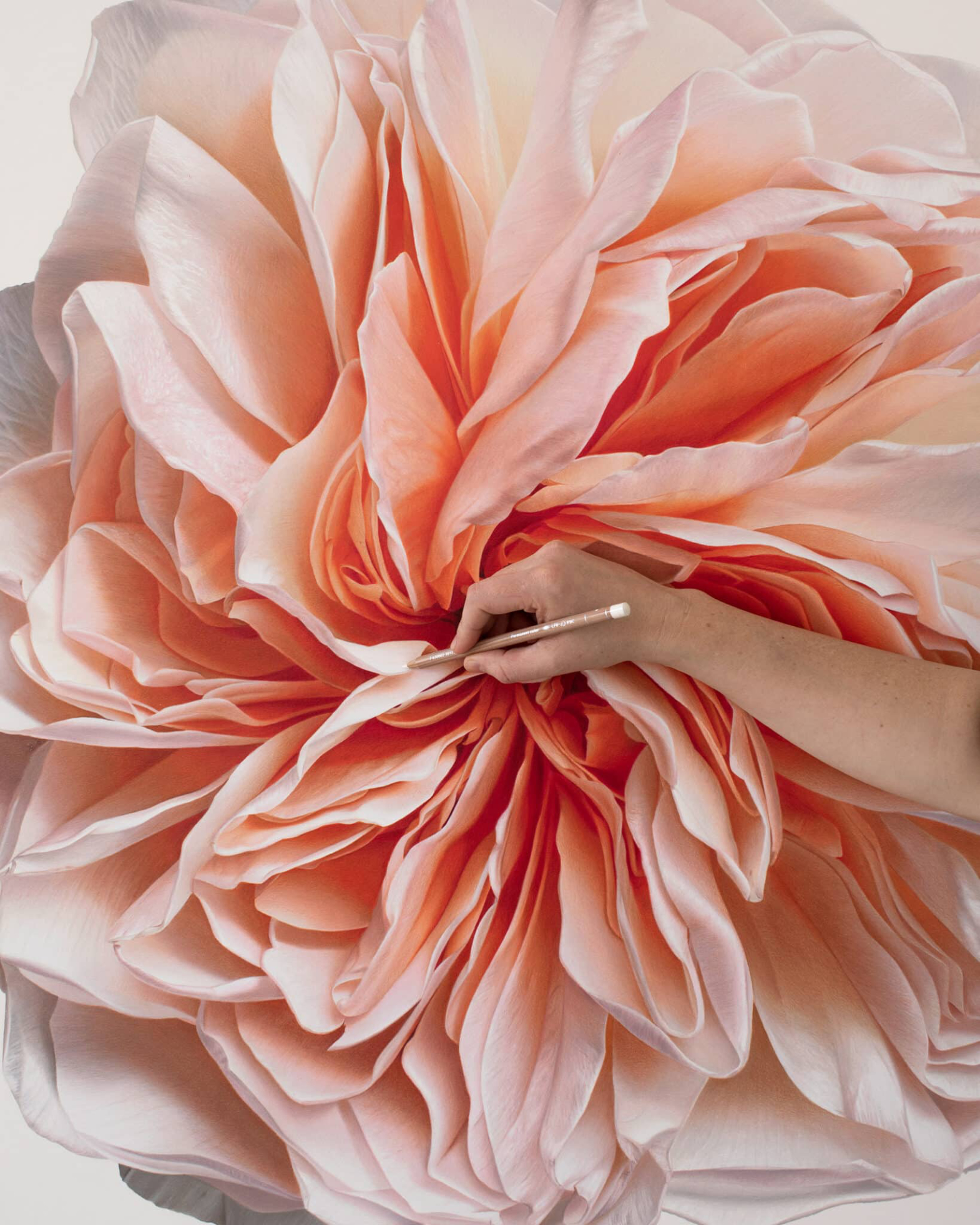
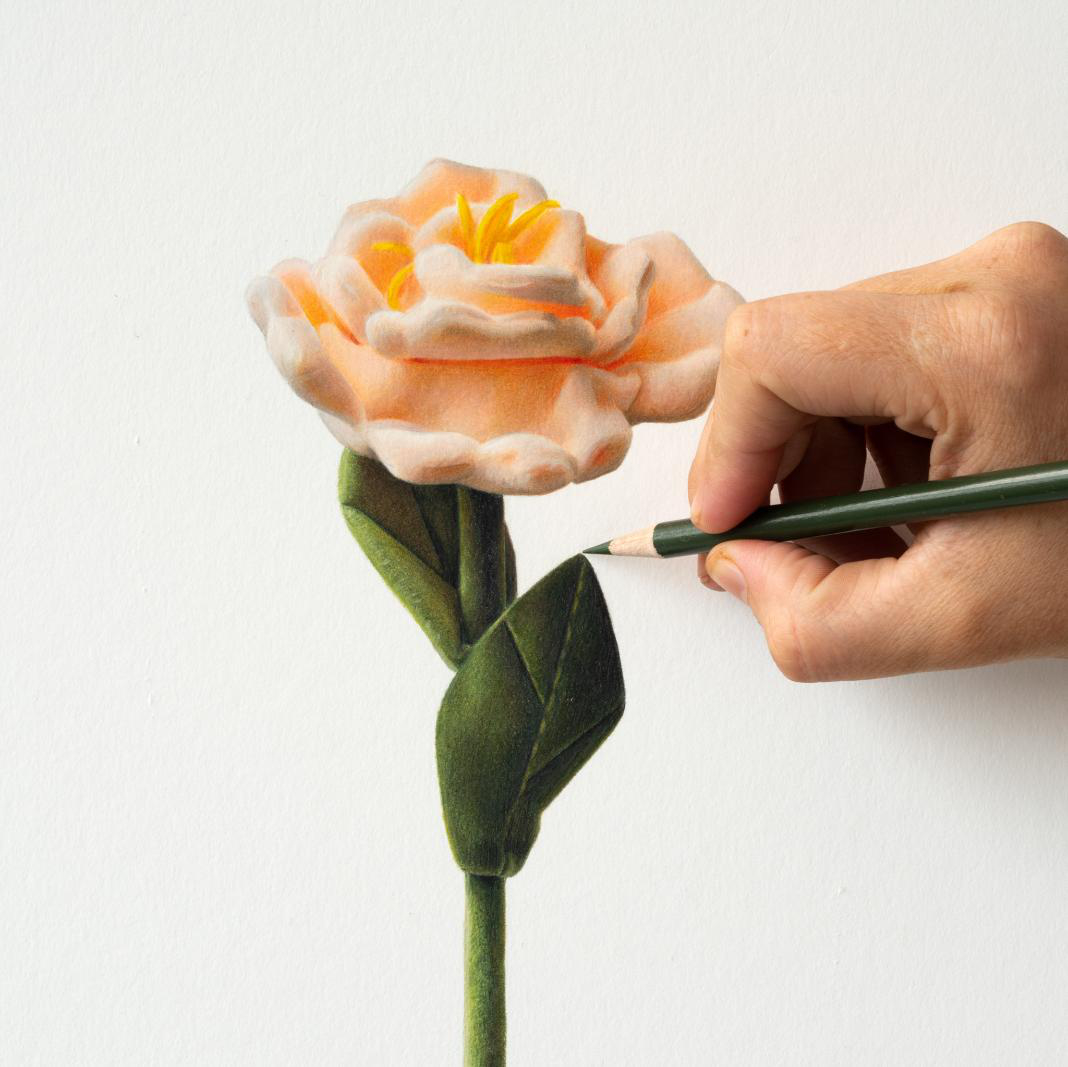
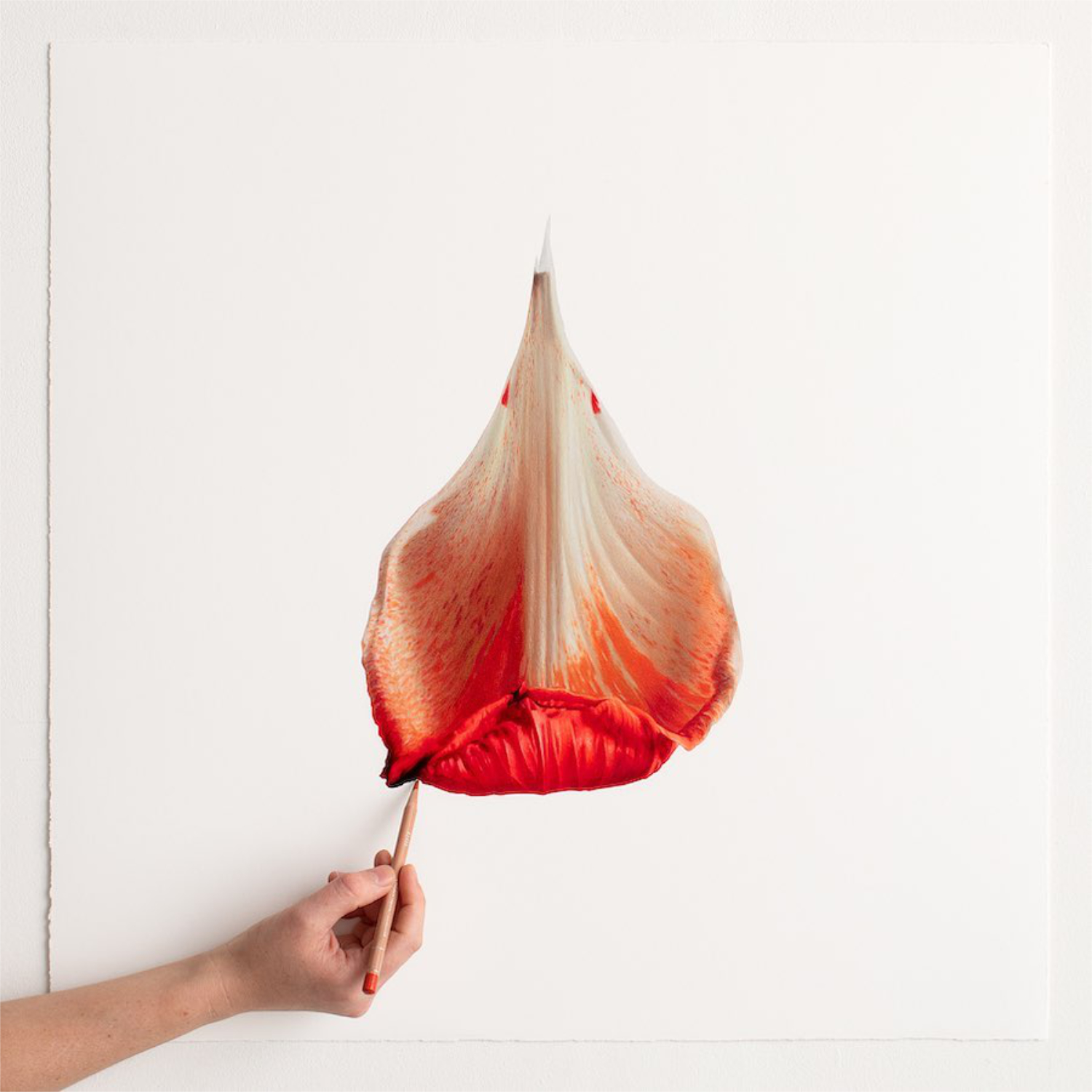
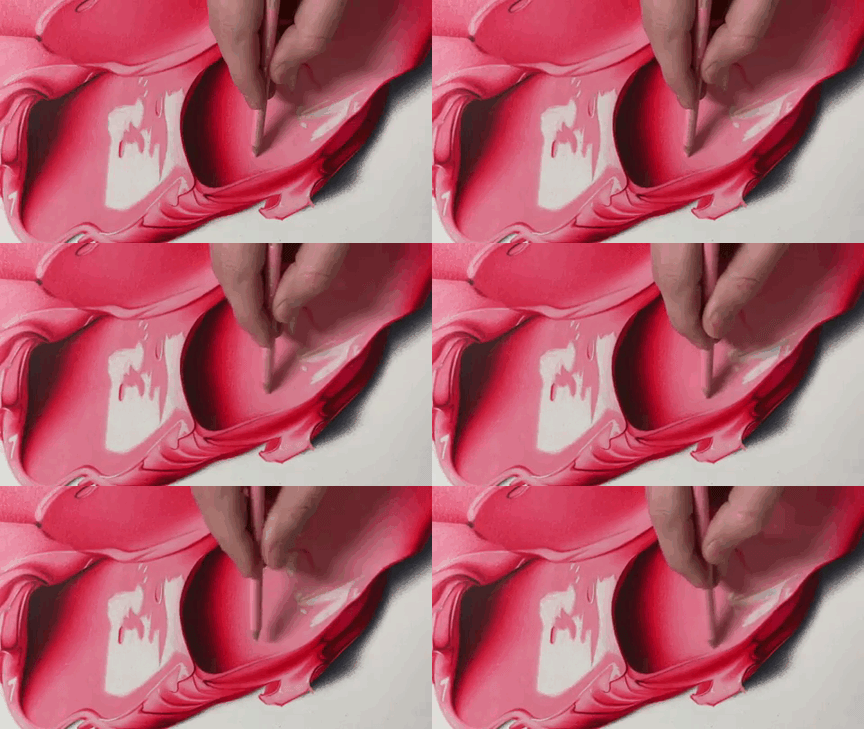
Detail of Light Peach Rose, the whole 41 x 41 inches shown next, Colored Pencil, on paper or board (not specified), Date unknown. The Artist works on a detail with a Caran D’ache Luminance Color Pencil. *- CJ Hendry Studio Photo.

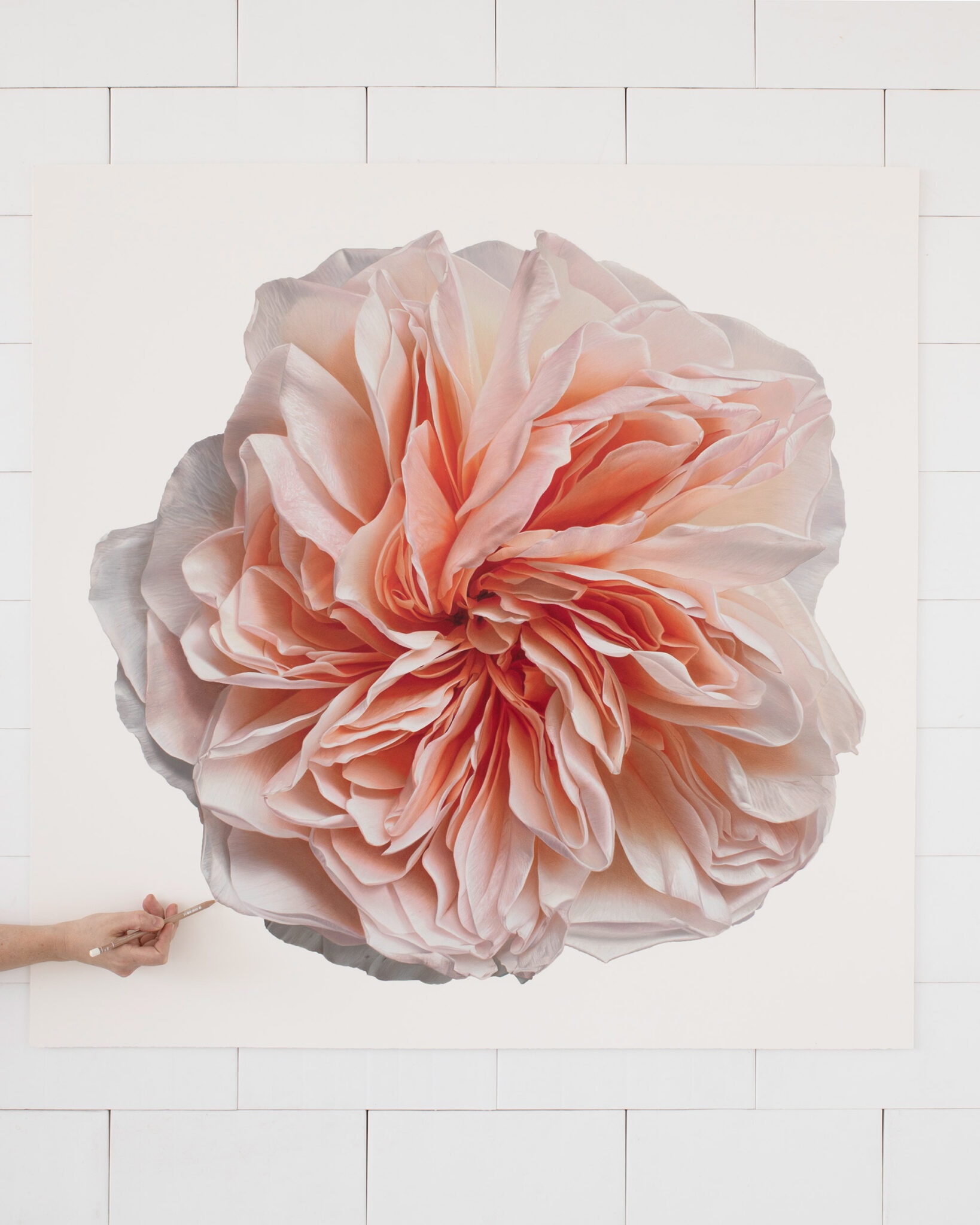
The full work, Light Peach Rose, 41 x 41 inches, mounted on a wall, as the Artist adds a detail, or holds the pencil there ostensibly so we know it’s not a Photograph. *- CJ Hendry Studio Photo.

Astounded by her work, as numerous others have been, I searched deeper, looking for answers about how she gets such spectacular results.

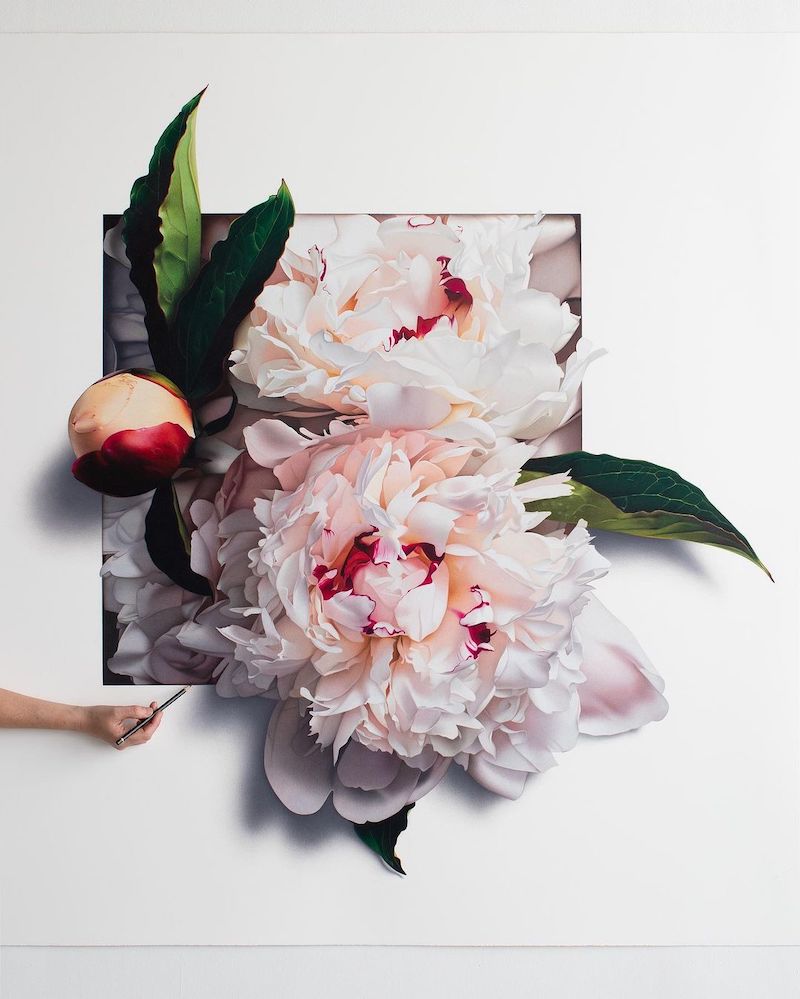
One of her most remarkable Flower Drawings. Title, size, date, materials besides Colored Pencils, unknown. Ms. Hendry loves to play with the picture plane and the picture “frame,” here, with a large part of the composition seeming to extend out of the frame and appear to be 3-D. In some of her pieces she even Draws an intricate gilded frame. *- CJ Hendry Studio Photo.

Details are few and far between. It’s not that she’s overly secretive, I think she’s just busy. The closest I’ve come are a few yt videos she’s posted where you can actually watch her Draw. One lasts SIX HOURS! Yes, I’ve watched all of it, and parts of it more than once. It’s not a lesson per se, it’s the Artist at work, and there’s no sound (Ms Hendry usually listens to audiobooks or shows during her marathon Drawing sessions), but it’s revealing nonetheless.

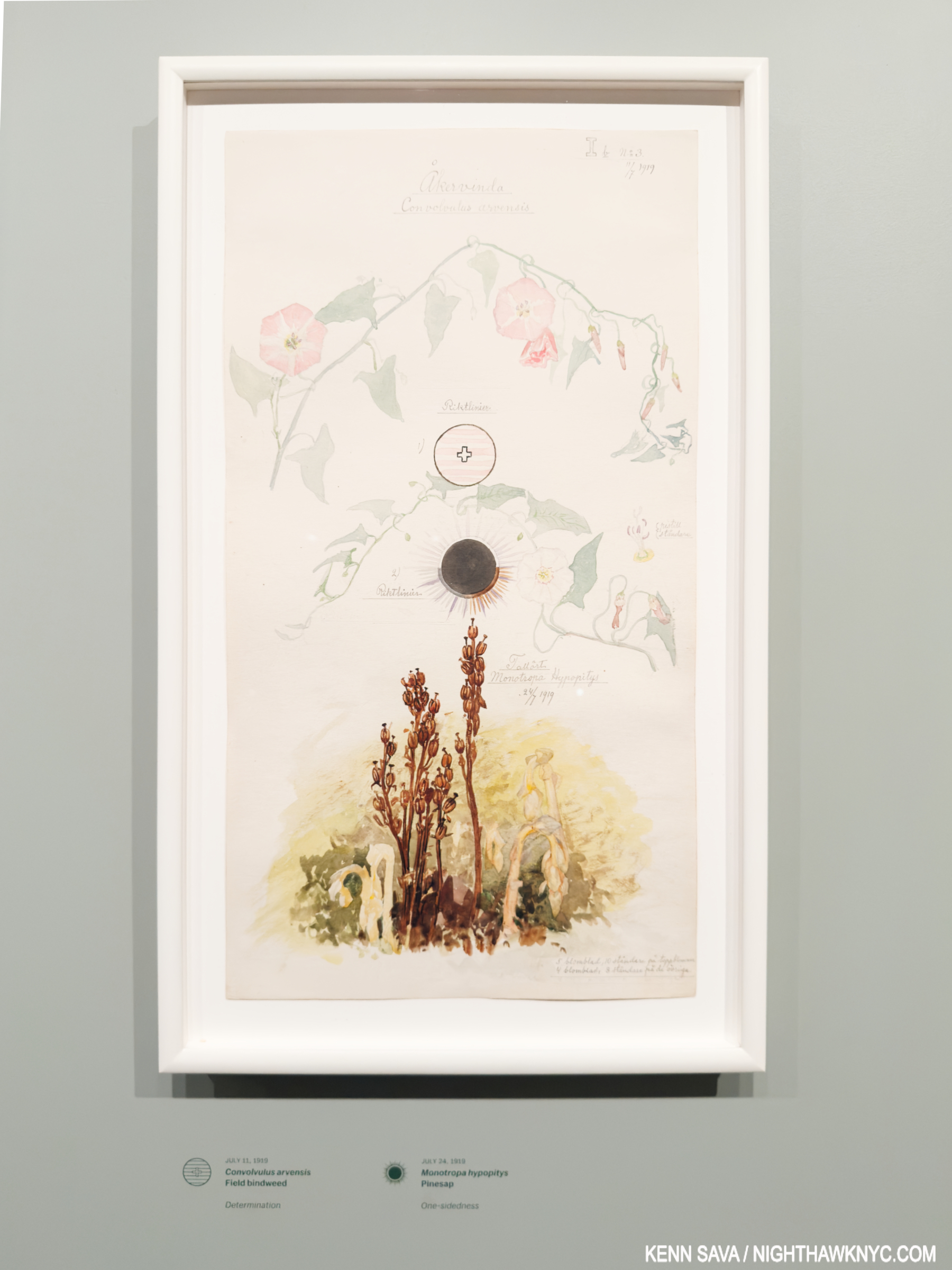
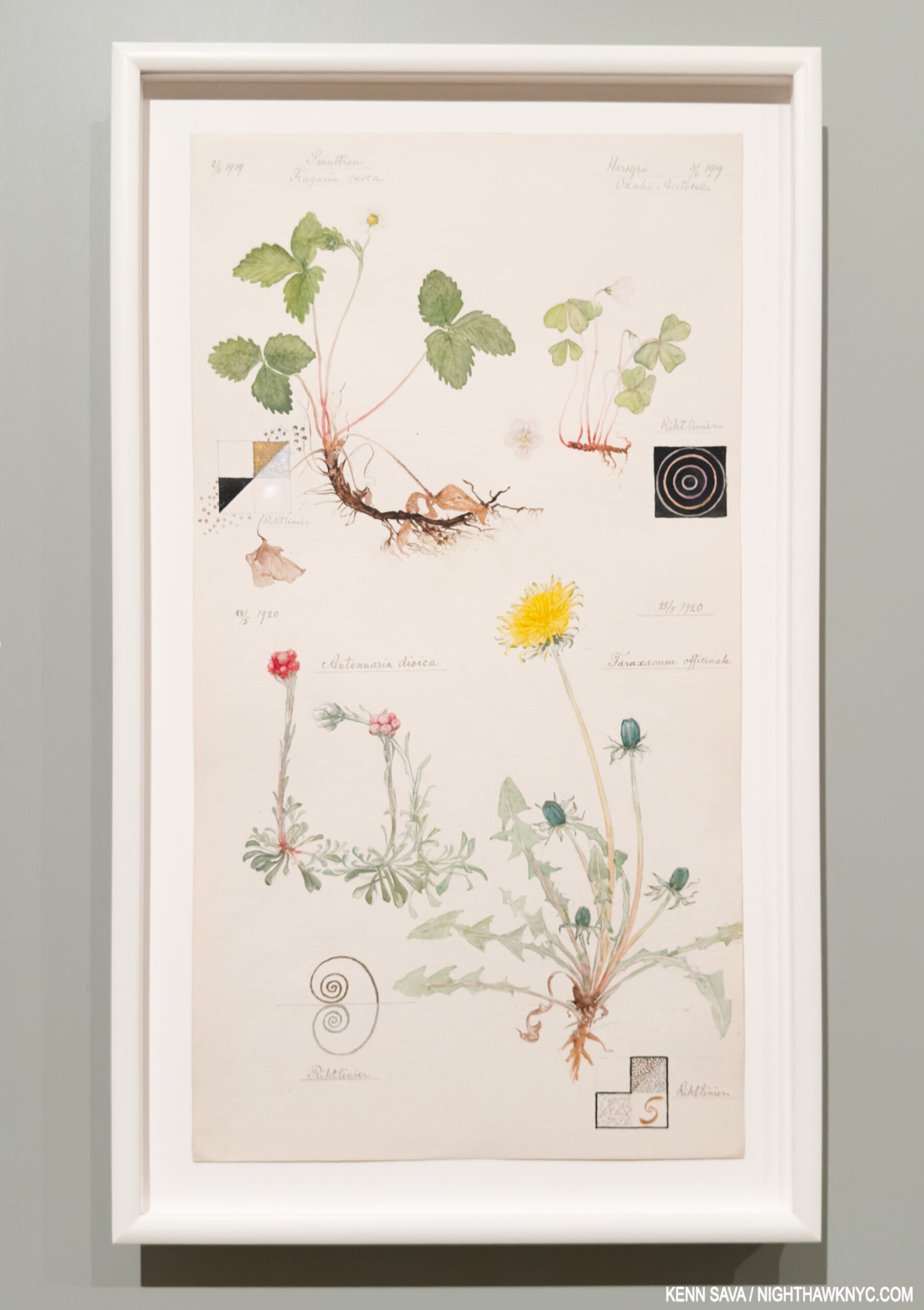
My most recent piece on Hilma af Klint focused on her Nature Series Portfolio consisting of 42 Watercolor Paintings containing renderings of 100 varieties of flowers that was on view at MoMA this Spring and Summer. The piece focused on Art depicting individual flowers, which is exactly what CJ Hendry is doing here. As the year went on, I found myself pondering the similarities, and differences, between CJ Hendry, Hilma af Klint and Georgia O’Keeffe on a regular basis. I’ll get to that.

Flower, Colored Pencil on Paper or board, Date unknown. One of her source Drawings for her Plush Flowers, seen further below. *- CJ Hendry Studio Photo.

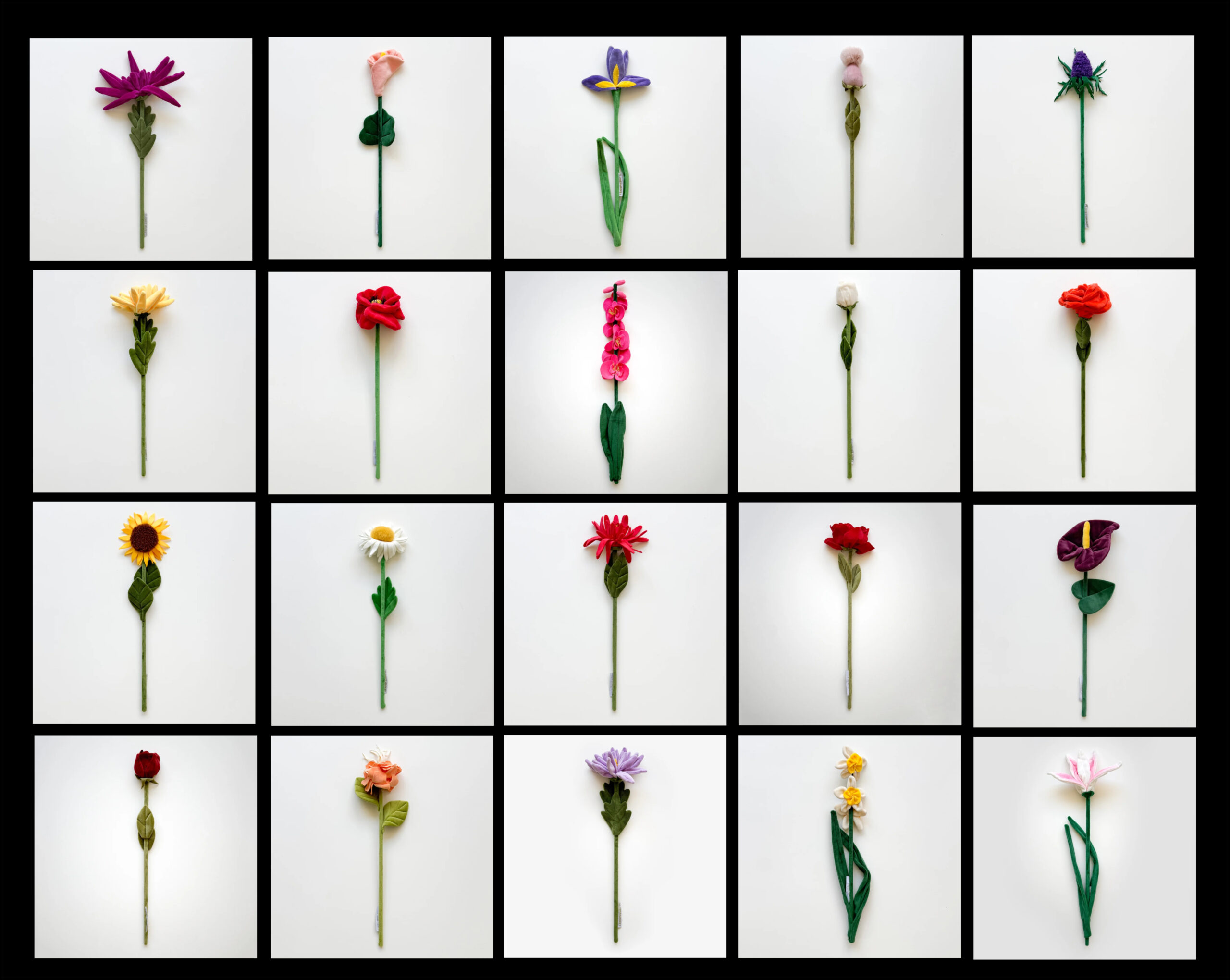
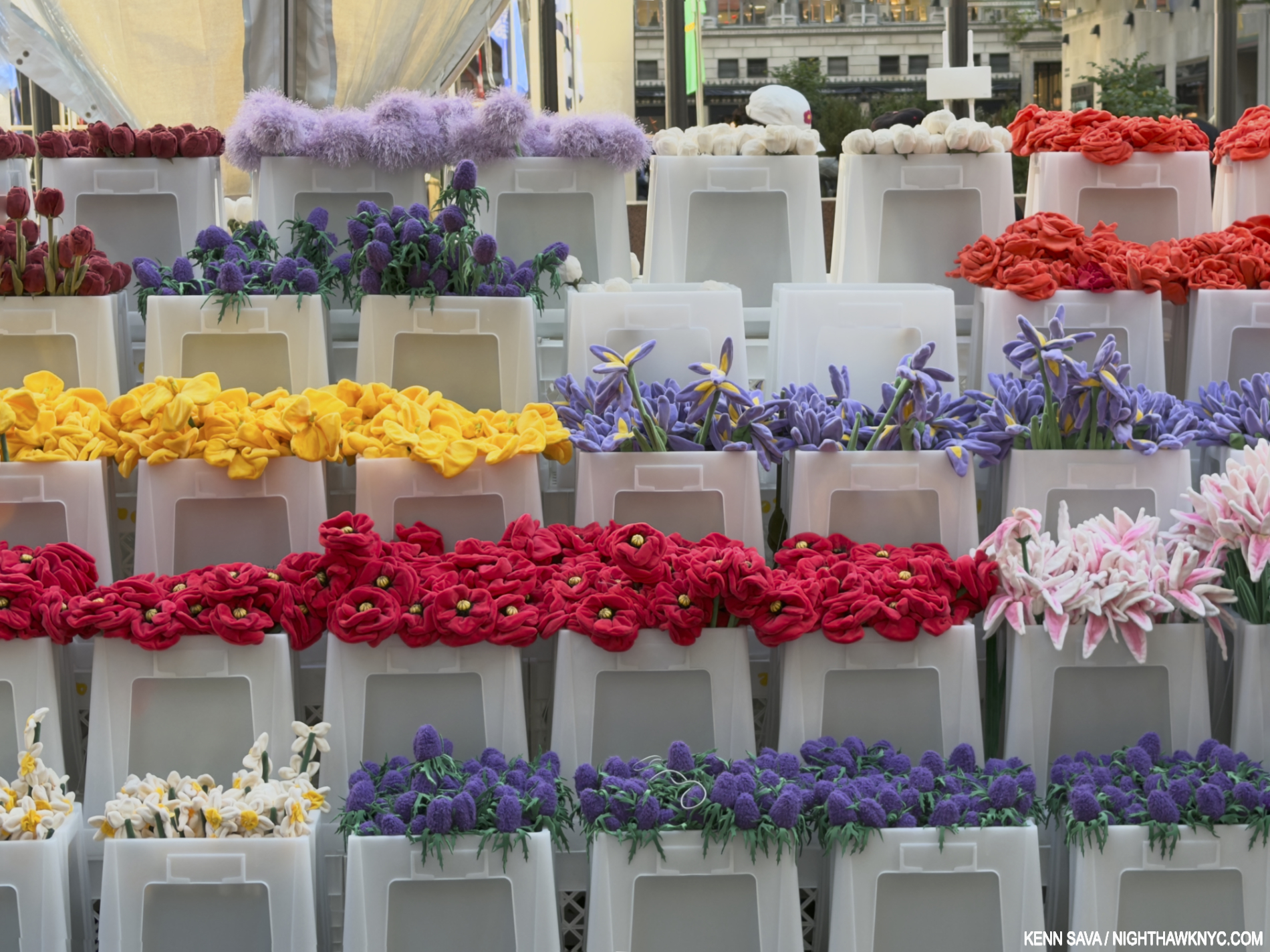
Having spent 2025 looking at Flower Art almost exclusively, I was immediately struck by another series of Flowers she’s drawn, that includes this one. I’ve seen twelve of these Drawings, though there are likely more given she & her team proceeded to make them into a series of about 27 different Plush Flowers that were given away and sold in the two Flower Markets she’s set up on Roosevelt Island in 2024, and in Rockefeller Center in September, 2025- the show all those folks in the video were waiting to get in to see51. Looking at these reminded me of Georgia O’Keeffe’s famous quote about “realism”-

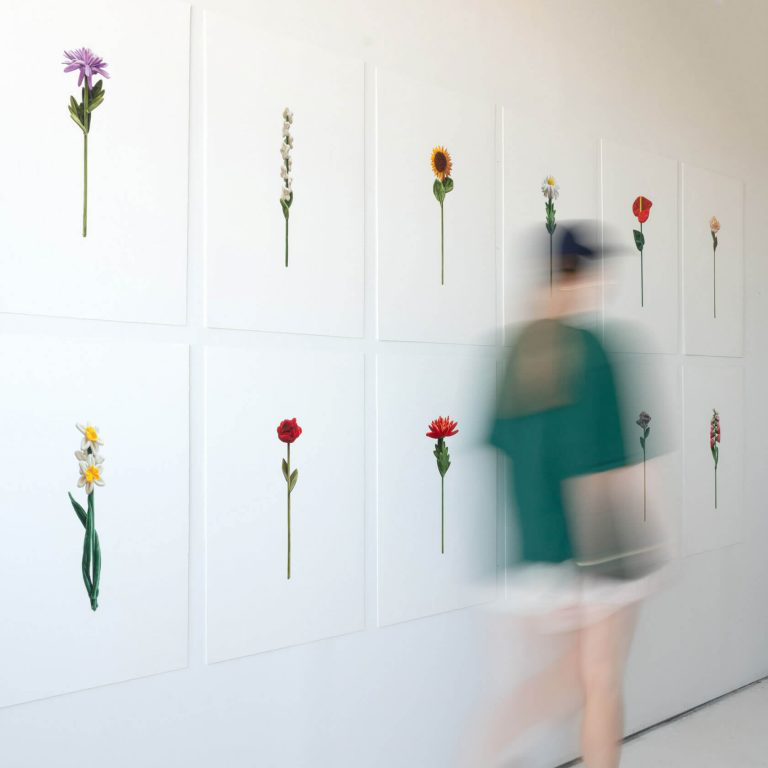
Busy lady. The Artist moves past a wall of 12 of her Flower Drawings. *- CJ Hendry Studio Photo.

“Nothing is less real than realism. Details are confusing. It is only by selection, by elimination, by emphasis, that we get at the real meaning of things,” Georgia O’Keeffe.

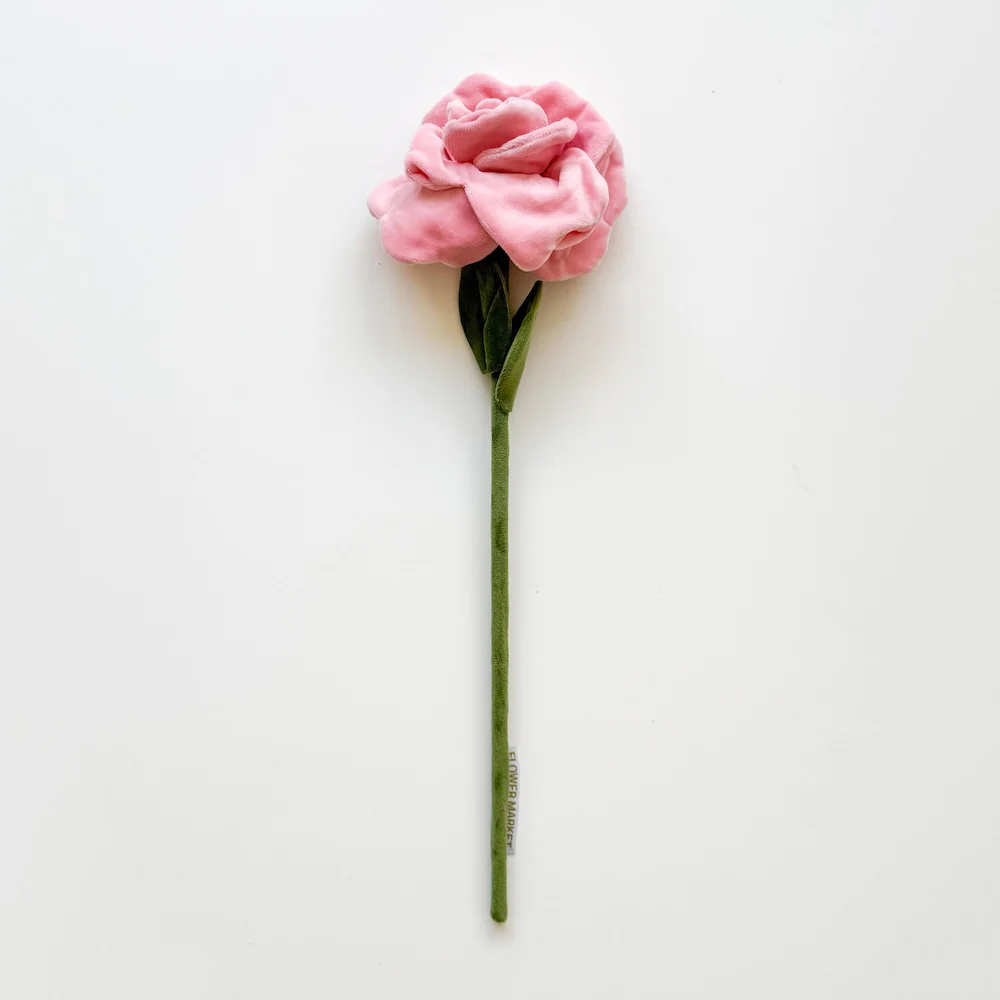
Plush Flower, 2024-5. Each 20 inches tall. Each meticulously crafted, with a double-sided tag. *- CJ Hendry Studio Photo.

I don’t know if Ms. Hendry knows that quote, or has been influenced by it, yet looking at her Plush Flowers and the Drawings they’re based on, I’m struck by how sensitively she’s “edited” nature’s creations while still retaining species recognition. Frankly, it’s darn remarkable.

The Artist with a full Bouquet of her Plush Flowers. *- CJ Hendry Studio Photo.

As we’ve seen up top, she’s as capable as any human being currently alive/known to me this side of Robert Longo and Andrew Holmes at being able to Draw hyper-realistic (her term for her work) flowers. That she hasn’t here I find very interesting. She opted to create her own take on these Flowers that look like Roses, Sunflowers, et al, riffing on their essence. Were these Drawn/designed to make mass-manufacturing of them more affordable? I tend to doubt it because the attention to detail on each Plush Flower, as the end result result is known as,  is there. When I say “mass-manufacturing,” CJ Hendry deals in hundreds of thousands of them! In her own way, it seems to me that has done something not all that different from what Hilma af Kint did in her Nature Studies Portfolio on view at MoMA as I said in my piece on it: her Plush Flowers and the Drawings they’re base on speak to the essence of each species, as she sees it.

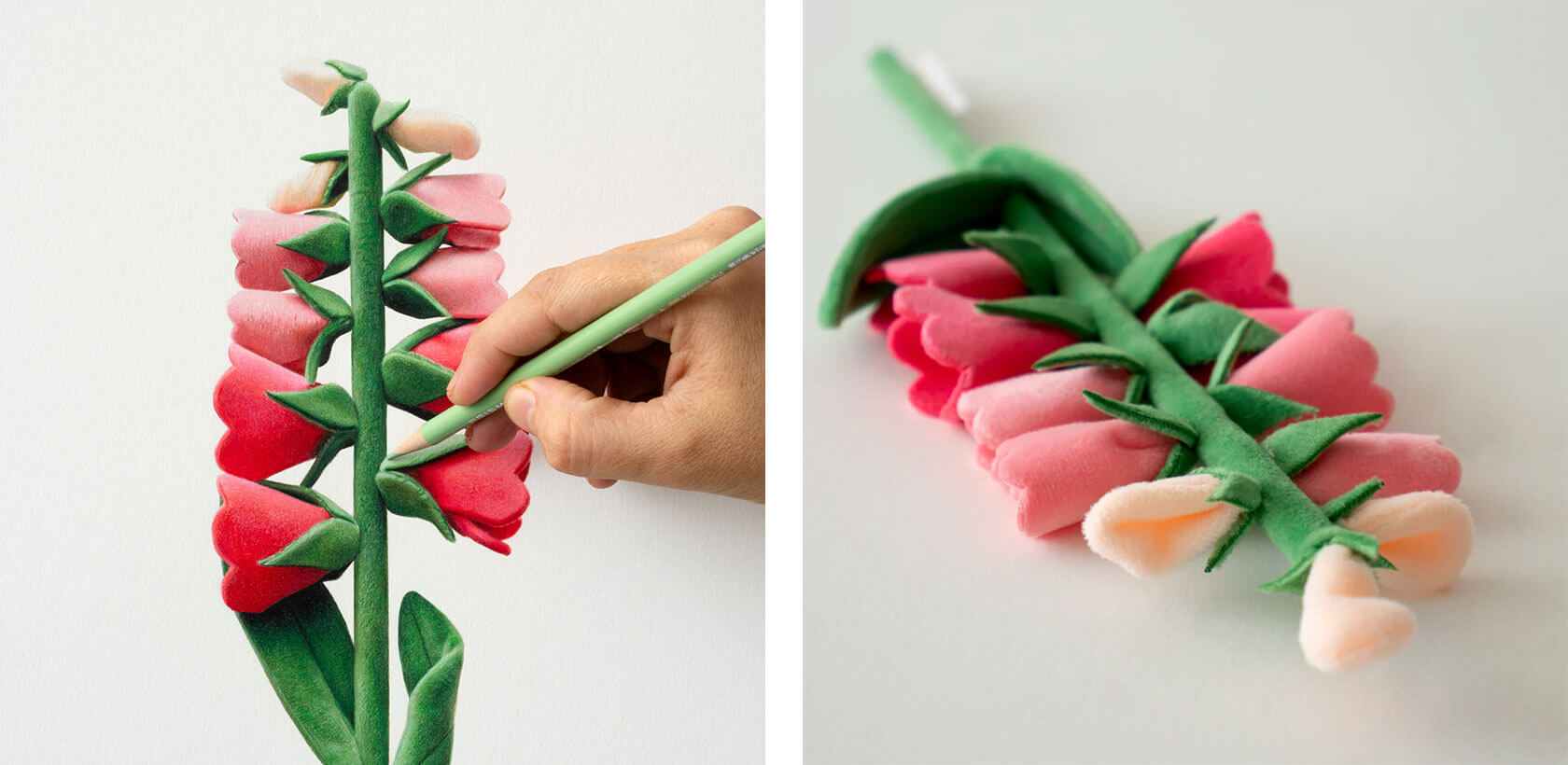
Original Drawing, left, resulting Plush Flower as sold at her Flower Market, right. *-  CJ Hendry Studio Photo.

A grid I put together of 25 of the 27 CJ Hendry 2025 Plush Flowers based on her Drawings available at her 2025 NYC Flower Market. *-Photos by CJ Hendry Studio.

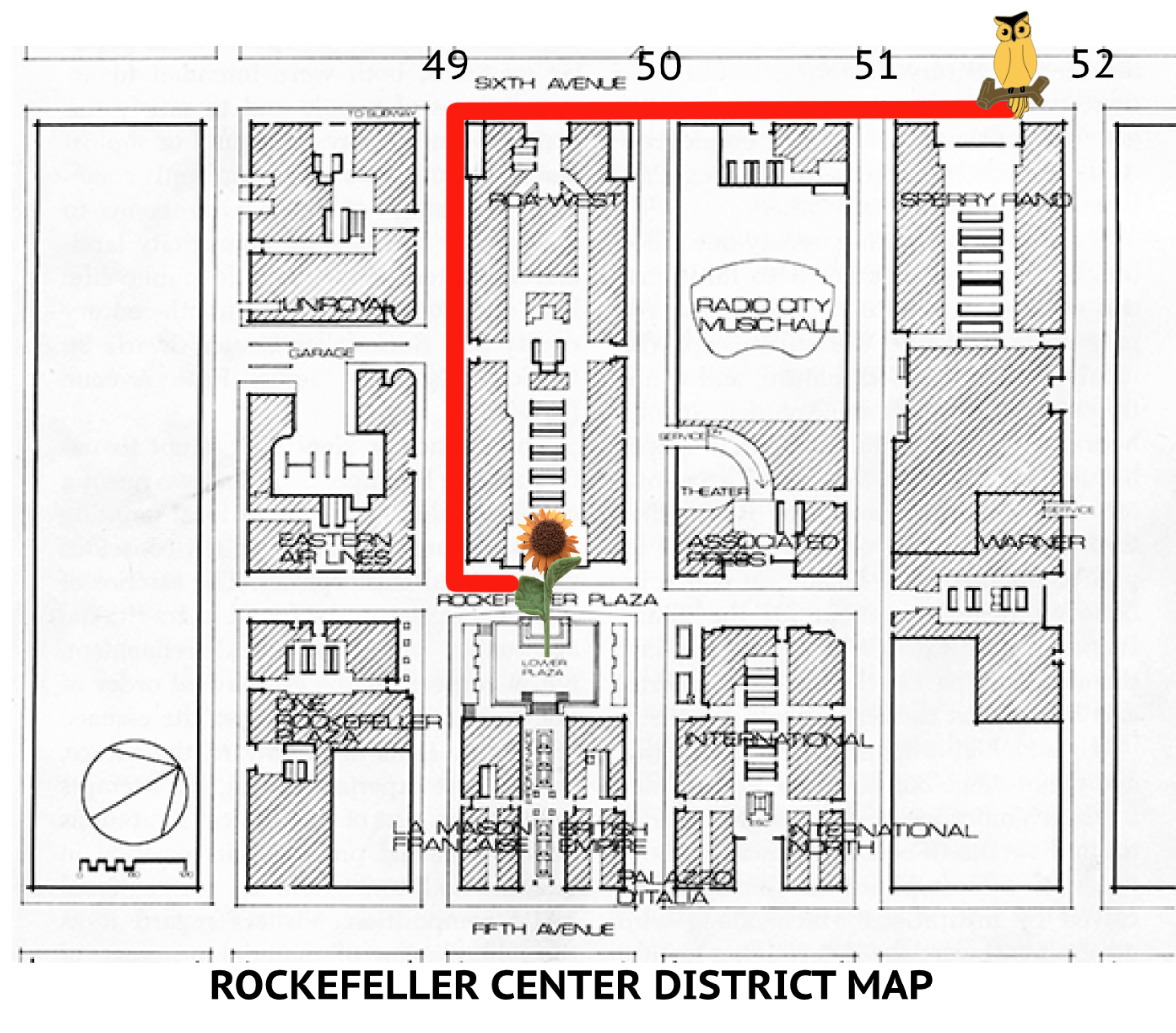
Beyond her Flowers speaking to the essence of the flowers they replicate, they also speak to A LOT of people, as you saw in the video I posted up top, taken on Saturday, September 2o, 2025. That 5 city-block long line for a flower show (CJ Hendry’s Flower Market 2.0 at Rockefeller Plaza), or an Art show, must be a record. Here’s a map of the route I took in the video-

The map of the line, September 20, 2025.
Map Key-
Sunflower (one of CJ Hendry’s Plush Flowers)- Location of CJ Hendry’s Flower Market.
Red Line- My path to the end of the line of those waiting to get in.
Oof- Kenn Sava’s position at the end of the line.
Note- The distance from Rockefeller Plaza to 6th Avenue is about 2 City blocks.

In it we’re walking west on West 49th Street, before turning right onto Sixth Avenue, past Radio City Music Hall, and up to just short of the corner of West 52nd Street! The gent in the blue suit at the end of the line is selling tickets for Top of the Rock (i.e. the roof deck of 30 Rockefeller Plaza), directly behind the location of Flower Market, which offered an exclusive 28th Plush Flower to those who went.

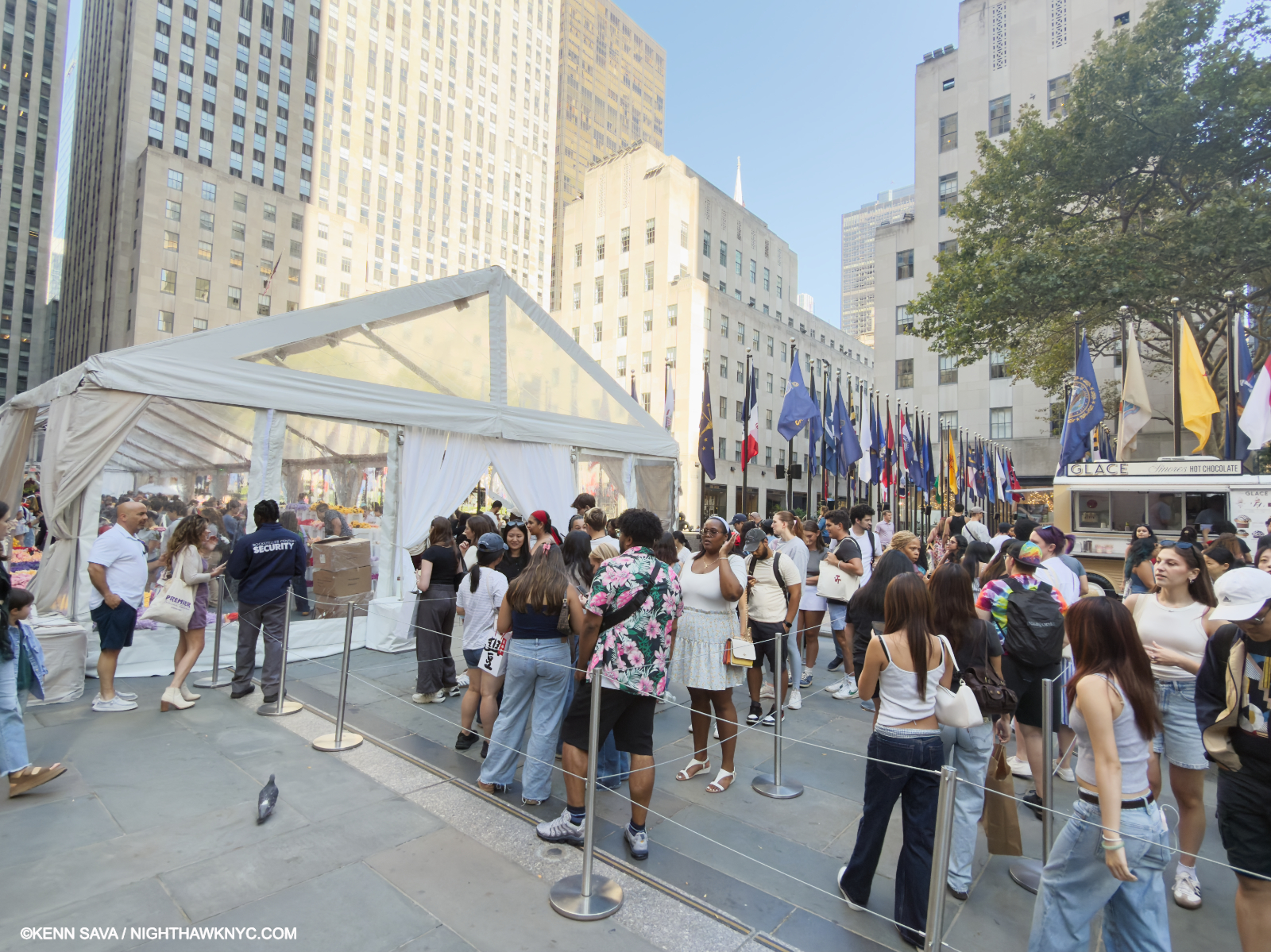
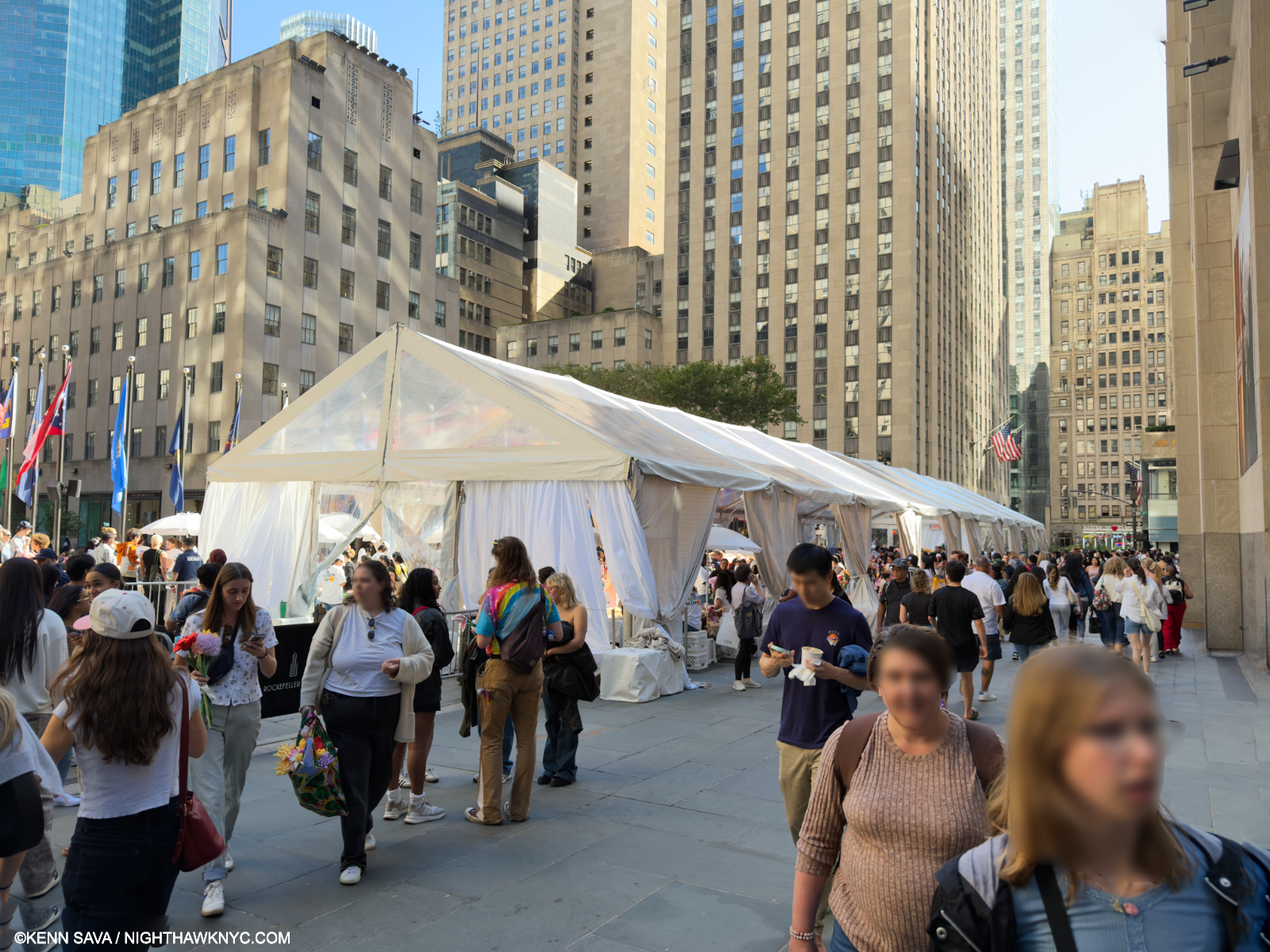
At the other end of the line, the wait for these visitors near the entrance of Flower Market (the white tent)  is just about over.

The wait to get in was TWO HOURS! When I finally reached the end of the line to begin my wait I found myself standing so far from the show’s entrance I was within feet of the corner of West 52nd Street on 6th Avenue. It dawned on me that I was now a block away from MoMA where at that very moment Hilma af Klint: What Stands Behind the Flowers was beginning its final week! Flowers, flowers everywhere…When Flower Market opened on September 19th, I heard that over 100,000 Pluh Flowers were available. After the show ended, those remaining were sold on her site in bouquets of the all 27 Flowers. They sold out within days.

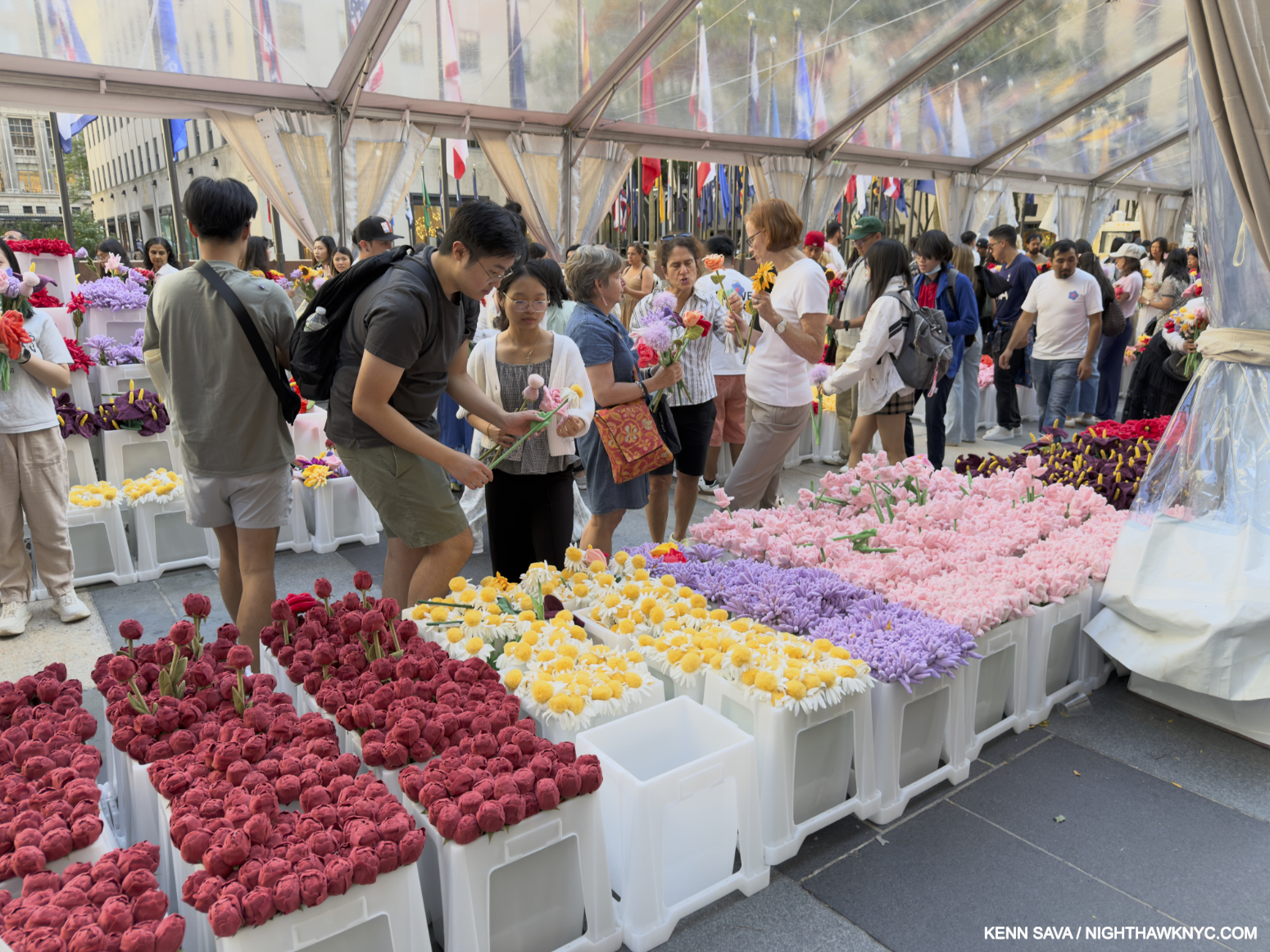
Bouquet up! Inside Flower Market 2.0, Visitors can have one of any one of the 27 designs for free. Each additional Flower is $5.00. I happened to notice that Crate & Barrel sells their decorative flowers for $19.95 to about $50 EACH, and they’re not designed by a known Artist (as far as I know). September 20, 2025.

After possibly being the first to put Georgia O’Keeffe and Hilma af Klint together last time, I now might well be the first to put Hilma af Klint & CJ Hendry together, but for that weekend, anyway, they weren’t all that far apart. CJ Hendry’s Flower Market was up (from September 19-22, 2025) 3 blocks directly south and parallel of MoMA smack dab in the heart of Rockefeller Plaza, as the map earlier shows, behind the famous skating rink, steps away from Fifth Avenue, St. Patrick’s Cathedral, Radio City Music, Hall, etc., etc., and smack dab in front of the iconic Art Deco RCA Building at 30 Rock. Yes, the big time. Real Estate in NYC doesn’t come any more expensive than this.

Just HOW popular is CJ Hendry? In an interview last year Ms. Hendry stated that she grossed $20 million in a prior year. Putting that in perspective, that’s $20 million…

-WITHOUT a dealer or gallery representation- ever. (Her Colored Pencil Drawings currently go for $85,000 to $500,000. depending on size. But before you reach for your wallet, there’s another line to get on, this one “for years,” for the chance to buy one, only through her website.)
-WITHOUT a traditional white-wall “show.”
-WITHOUT a book out. In fact, there are surprisingly few articles written on her work.

So, HOW did this. happen?  CJ Hendry (she’s gone by her initials for as far back in her youth as I could go) is a mid-30-something transplanted Aussie Artist born in Durban, South Africa before growing up in Brisbane. She now lives & works in Brooklyn. She spent seven years in college studying Architecture and finance but left without a degree(!). In fact, she quit “days before I was kicked out for failing grades2.” While she was in school she worked as an $18./hour waitress, spending all her money on high-end luxury fashion & accessories. After quitting college, she decided to sell her wardrobe on eBay and with the proceeds take 365 days and devote herself to something she knew she had always been good at: Drawing, to see if she could make any headway with it.  Now, I don’t think I need to tell anyone that making a living Drawing is something that has really only been accomplished (after YEARS of struggle) by comic book Artists & graphic novelists, like R. Crumb and Chris Ware. In Art, Drawing is seen as a means to an end (in another medium), and almost never the end itself. She put in 16-hour days Drawing born of the discipline she learned becoming a professional swimmer who failed twice to make Australia’s Olympic Team. She decided not to put in another four years to try a third time. Still, “I owe everything to that (discipline)3,” she says now. It enabled her to create a portfolio she took around to Brisbane galleries. There was no interest.

“I didn’t take the traditional route because no one wanted to sign me. Fuck, I guess I’m on my own….I just did it on my own.”

She decided to post her work on Instagram. It took a while until she received a DM expressing interest in buying her work. The sender came out to her parent’s house, where she was still living, saw the work in her bedroom and paid CJ the amount she asked (“in the thousands,” she says) for the piece. With the proceeds she bought herself a Chanel Surf Board, which I believe still hangs in her studio, and she took things from there.

“Everything I draw would sell, and I’m so grateful for that. I went to a university for finance. I get business. I love business. I think I’m better at business than I am art. I’m a hopeless artist. I’m an ok artist, but I’m really good at strategy & business. and I love that. I think art is the byproduct of strategy and business. I think there are a lot of artists who are very good artists but don’t maybe have that business side4.”

As a result of her Flower Market and her Plush Flowers,  I realized that Colored Pencil Drawing is far from all she does. She’s mounted events/shows that have garnered notoriety for their unique concepts and installations to the point that they draw crowds, then live on in legend after (clicking on each entry in that link will show you what I mean). As part of these events, she created pieces (original Drawing-inspired objects in a you-name-it wide range of materials) that seem to me, and no doubt others, to bring her very close to the realm of something akin to 21st Century “Pop.” (For the sake of keeping this piece from getting VERY long, and since she has released so many other items, I’ll keep the focus here to her Flowers.) She now Draws with a few assistants, part of the “small team” she’s enlisted to facilitate and realize her many projects, shows, multi-media pieces, etc. So, CJ Hendry has become her own factory, now headquartered in a 22,000 square foot studio in Greenpoint, BKLYN. As I pealed her onion, discovering more and more about her, the name Andy Warhol repeatedly came to my mind.

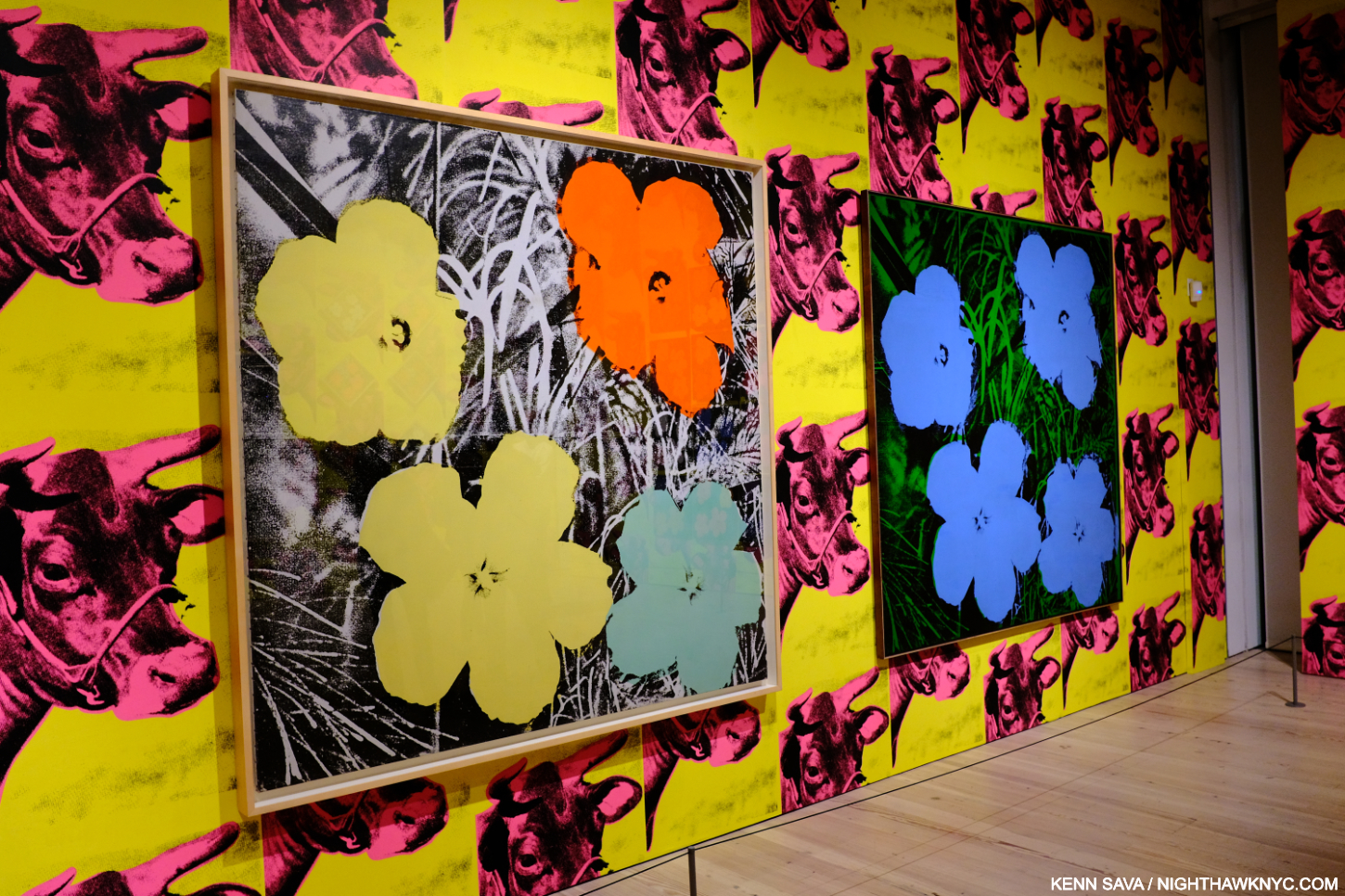
Andy Warhol, Flowers, Screenprints, 1964-65 seen at Andy Warhol: From A to B And Back Again, Whitney Museum, December 21, 2018

I began to wonder- Is she Andy Warhol 2.0,? Seriously.

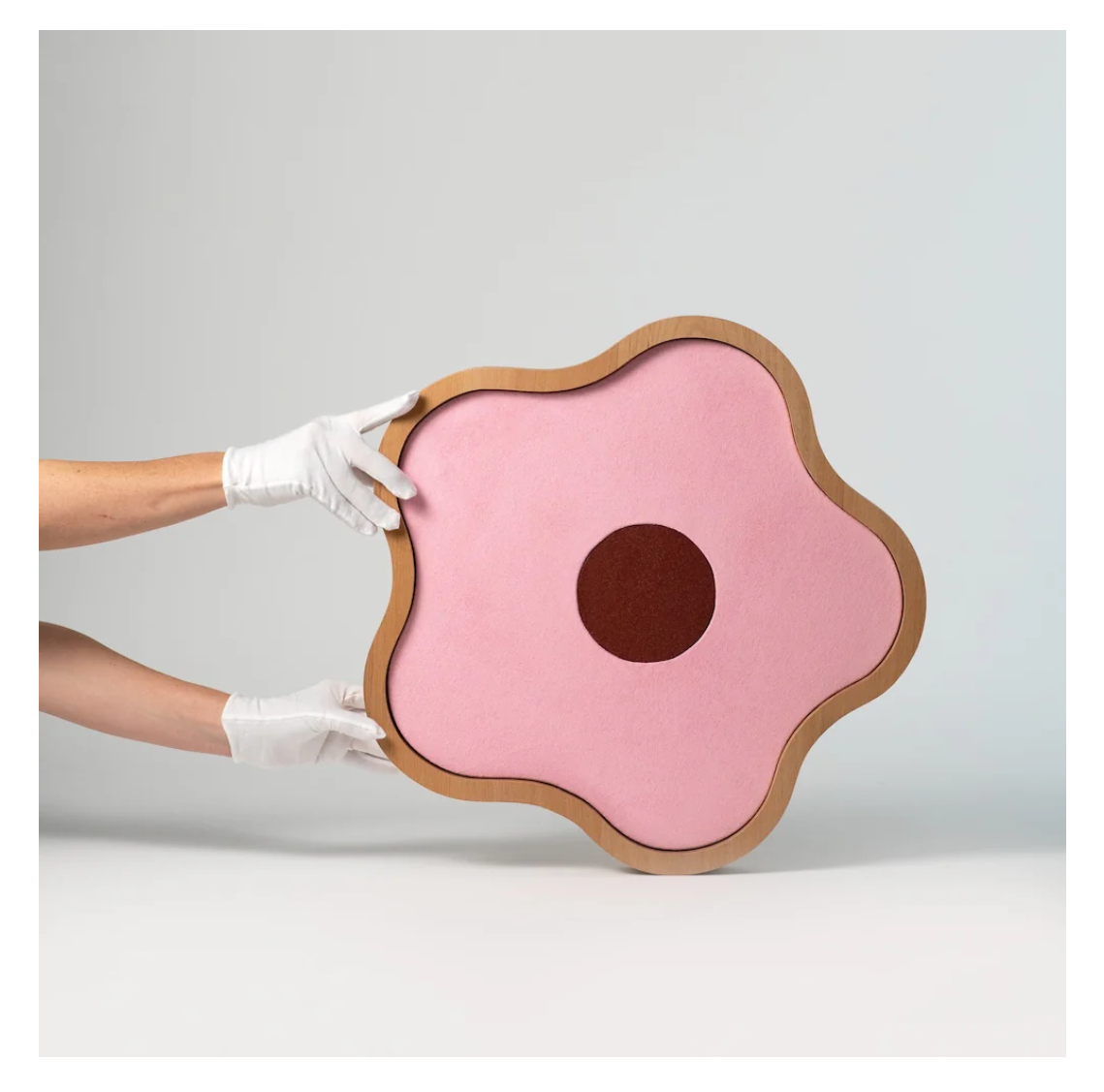
CJ Hendry, Blomma, 2025, Painted canvas Flower and Beech wood frame. This design has become her de facto symbol. *- CJ Hendry Studio Photo.

From an Art & business perspective, I think thee is a very strong case to be made that she is at least one of those that could be said about, while remaining resolutely CJ Hendry. Unlike the vivacious, omni-present Mr. Warhol, however, CJ appears to have no “social life.” She was quoted on August 9th on Instagram saying her life is “work and kids…not much else, ” which is a change from the 24/7 she said she worked since she started making Art. She is never seen at parties, or out on the town, or with media stars. The only “CJ Hendry Superstars” are her products, which have always sold out to this point. Yet, in an interview she recommended “not investing” in her5, but rather buy the work of up-and-coming Artists who need the support. Her Art is also noteworthy for the lack of human subjects in it to date. I’ve only seen one CJ Hendry Portrait- a commission from 4 years ago. Like Andy, CJ began her Drawing career rendering luxury products, including shoes, boots, and fashion accessories. From them she’s moved on to “things that are always around us,” like well-worn sneakers, cigarette butts and flowers. On Drawing the latter she said-

Who says a Drawing isn’ t Art? Unknown title, date, Caran d’Ache Luminance colored pencil (in her hand) on paper or board. *-  CJ Hendry Studio Photo

“Ever since I started mucking around with being an artist, flower imagery kind of frustrated me…It always seemed like the obvious and basic direction to go. I held off for many years because I just couldn’t figure them out. So somehow petals make sense, the flower being broken down, not full of life. Each petal looks so different like its own mini sculpture…”

I can’t say I’ve seen an Artist take this approach to them. Who else has Drawn or Painted a flower petal as their finished piece? In Art classes, students are taught to study anatomy in order to render the figure. Ms. Hendry is taking the same approach to flowers. It can only help her when she comes to depicting the whole.

Right now, it looks like flowers may be a anomaly in her work. Looking back, Ms. Hendry turned her focus to a subject, produced a series of Drawings of it, perhaps released some related items, and moved on. Though she recently Drew a character named “Juju,” and released a batch of (now sold-out) related items, her Flowers will continue to be a part of her work. She has announced Flower Markets will be mounted in Abu Dhabi and Hong Kong early this year.

The Artist works on one of her Complementary Colors series of Drawings circa 2018. Notice the pencil point. It looks to me like a right out-of-the-box Prismacolor Premier! In fact, in the videos I’ve seen, she uses very basic accessories. Electric sharpener (an Xacto seen in one), spray fixative, painter’s tape to hold down copy paper shielding white areas while she works flat on a very large wood table. I haven’t seen her erase (in what I’ve seen), use a mahlstick, a pencil extender or an easel. (She puts a sheet of something unknown, possibly, glassine, under her drawing hand as she works over finished areas.) Oh, and there’s an entire shelving unit of boxes holding thousands of colored pencils arranged by color. Drawings in progress, or finished, are kept in suitably sized clear archival sleeves. *- CJ Hendry Studio gif

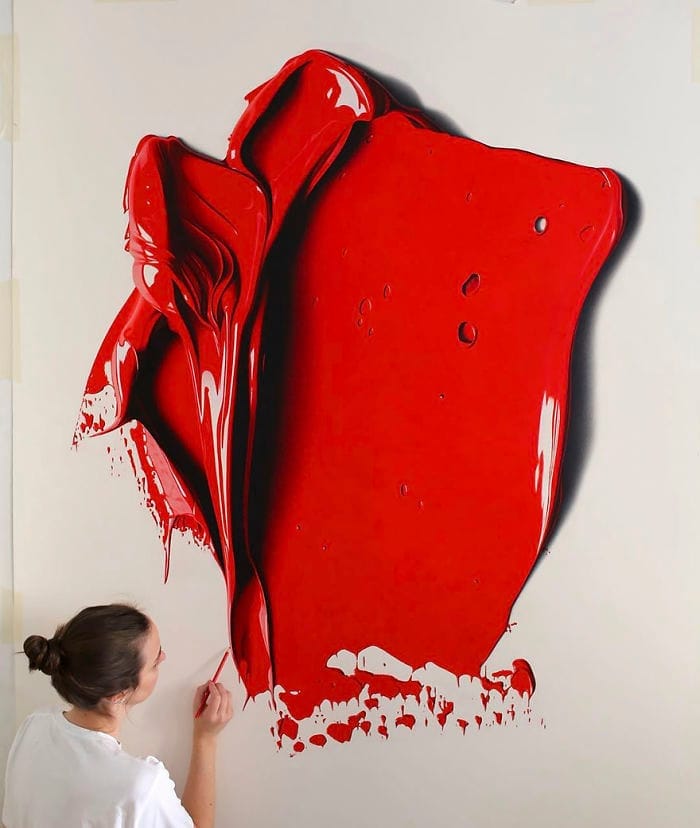
Among the numerous striking pieces in her career to date is a stunning 2018 series called Complementary Colors. Like all of her work, it speaks for itself

Possibly the paint blob she was just seen working on. Colored pencil(!) on ? Title, size, date unknown from her Complimentary Colors series. c.2018. *-  CJ Hendry Studio Photo.

“I’ve peaked! It is downhill from here for me.” CJ Hendry, TedTalk, 2018.

She couldn’t have been more wrong when she said those words in 2018 at about the time she created the paint blob above. Her career has gone straight up, like an arrow into the weightlessness of space since, hitting that $20M she mentioned a year or two ago! Still, the market and the public are fickle. The CJ Hendry buzz may subside one of these days, but with Drawing talent like she has I doubt she’s entirely going away.

While the future is unwritten, we can take stock of the recent past. In addition to the facts that she’s brought more attention to Drawing as a medium & an Art form, which sorely needs it, and colored pencil Drawing (DITTO!), the thing I admire most about Ms. Hendry is that she’s succeeded entirely by her own devices. She’s proven it can be done, but, IT’S NOT THAT EASY!

“If you try to follow in someone’s footsteps exactly it won’t work for you. You’ve got to find your own thing. I haven’t had anyone to follow. There’s no one who’s done it this way. I’m a huge anomaly in the art world2.”

When repeatedly asked about how she did it, she stresses the HARD work she put in to get here- those 16-hour drawing sessions, 24/7. All the sacrifices she made (i.e. a social life, college, etc.) AND the fact that she has a background in finance. Hilma af Klint and Georgia O’Keeffe had to work to succeed in a male-dominated world. Georgia had a champion in Alfred Stieglitz who helped her navigate it early on. Hilma wasn’t so lucky. She never found her champion and decided her work was for the future. Whether that future is now, or not…the jury is out in my view.

I wonder how many visitors chose a Sunflower and thought about Van Gogh. I did.

That brings me to the similarities and differences between Hilma and CJ Hendry. As I wrote in my recent piece on her, Hilma didn’t live to realize the Temple she envisioned to house her Art, partly because she was seeking to have her work installed by existing spiritual organizations. As I said, I believe her work has been left in a quandary as a result.

Flower Market 2.0, Rockefeller Center, NYC, September 20, 2025.

CJ Hendry built her own “temple.” Actually, she’s already built a whole series of them. She uses temporary spaces for her shows/events, including some that have involved complete renovations of buildings, to realize her visions. Ironically, at the moment I took this picture, Flower Market 2.0, was pointed directly & poignently at MoMA & Hilma af Klint: What Stands Behind the Flowers three blocks north (to the left). What stands behind these Flowers is a woman who’s a force of nature. “Carpe diem” could well be CJ Hendry’s motto. While Hima af Klint’s work’s place is, it seems, still undecided, and appears stuck between today’s Art machine & the Artist’s intentions, as I said last time, CJ Hendry stands at the opposite end of that spectrum, as someone who relishes and uses the Art machine’s focus on “materialism” while skating rings around the usual dictates of today’s Art establishment, remarkably achieving success without its help or involvement, on her own terms.

She’s right, no one can follow in someone else’s footsteps and expect the same results. Still, there is much to be learned from her example. Perhaps, most importantly, that it CAN be done.

I don’t think CJ Hendry will be the last Artist to “make it” on their own terms.

*- Soundtrack for this piece is “God Bless the Child,” by Billie Holiday and Arthur Herzog, Jr, 1939, seen here in this incredibly rare live recording by the immortal Lady Day with the equally immortal Count Basie, who I had the honor of meeting-

NighthawkNYC.com has been entirely self-funded & ad-free for over 10 years, during which over 350 full-length pieces have been published! If you’ve found it worthwhile, PLEASE donate securely by PayPal below to allow me to continue. Thank you, Kenn.

You can also support it by buying Art, Art & Photography books, and Music from my collection! Art & Books may be found here. Music here and here.

Written & photographed by Kenn Sava for nighthawknyc.com unless otherwise credited. To send comments, thoughts, feedback or propositions click here. Click the white box on the upper right for the archives or to search them. Subscribe to be notified of new Posts below. Your information will be used for no other purpose.

  1. With Flower Markets being announced for 2026 in Hong Kong and Abu Dhabi.
  2. Short Story Long podcast #162, CJ Hendry.
  3. ibid.
  4. Both quotes ibid.
  5. ibid
  6. Short Story Long podcast #162, CJ Hendry.

Hilma af Klint in the 21st Century: The Spirit vs. The Machine

THIS SITE IS FREE & AD-FREE!
If you find this piece worthwhile, please donate securely via PayPal so I & NighthawkNYC can continue. More ways you can support it at the end. Thank you.

Written & Photographed by Kenn Sava (*- Additional Photographs by Lana Hattan, and others as credited)

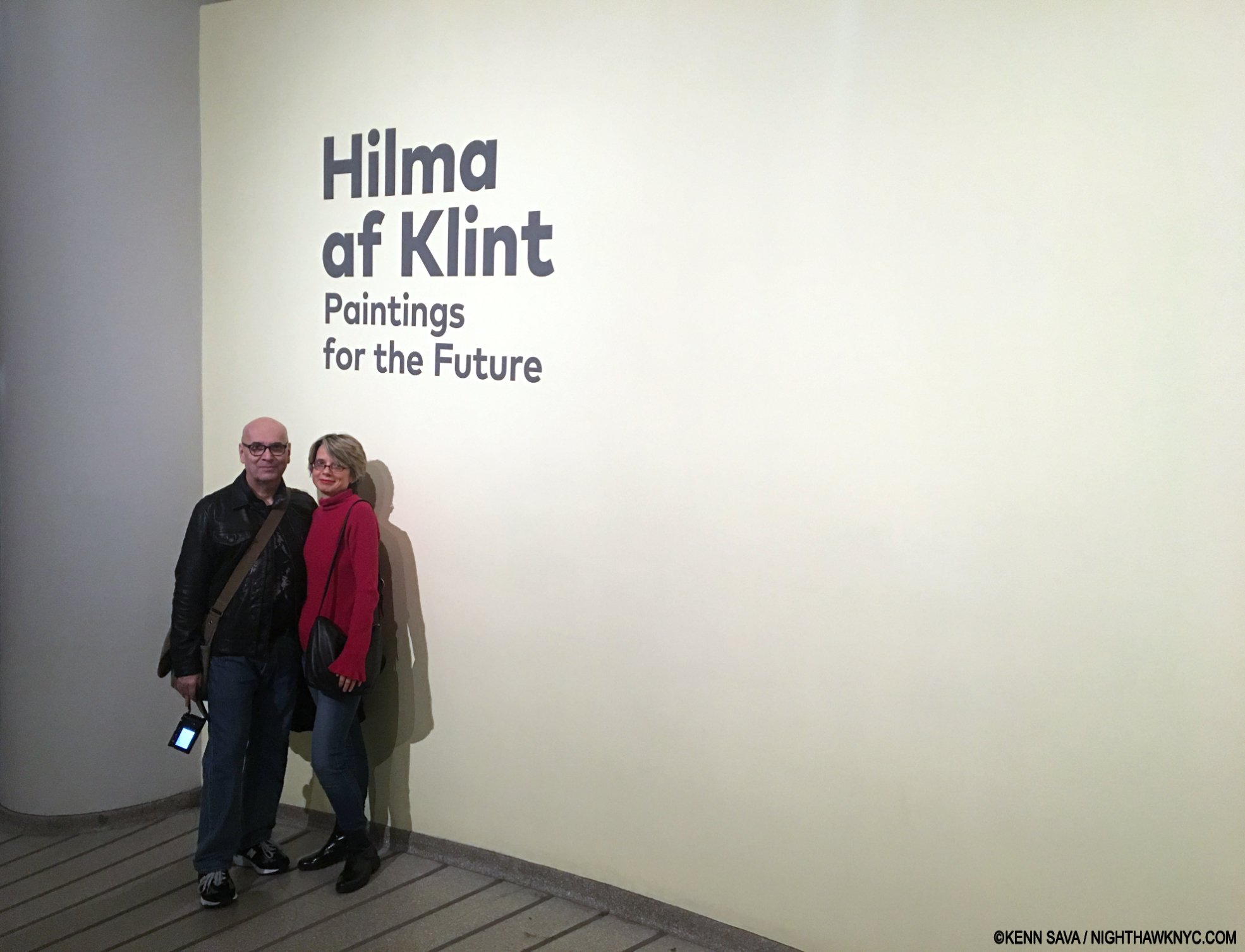
Shows seen: Hilma af Klint: Paintings for the Future, Guggenheim Museum, 2018-19.
Georgia O’Keeffe: To See Takes Time, MoMA, 2023, and
Hilma af Klint: What Stands Behind the Flowers, MoMA, 2025
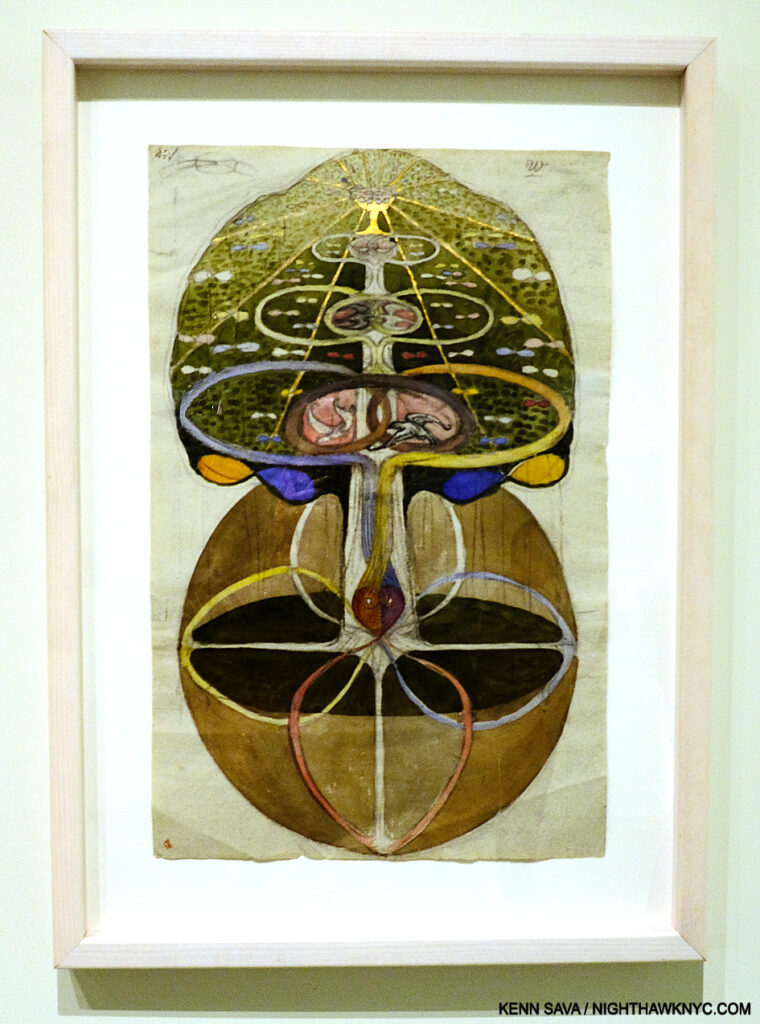
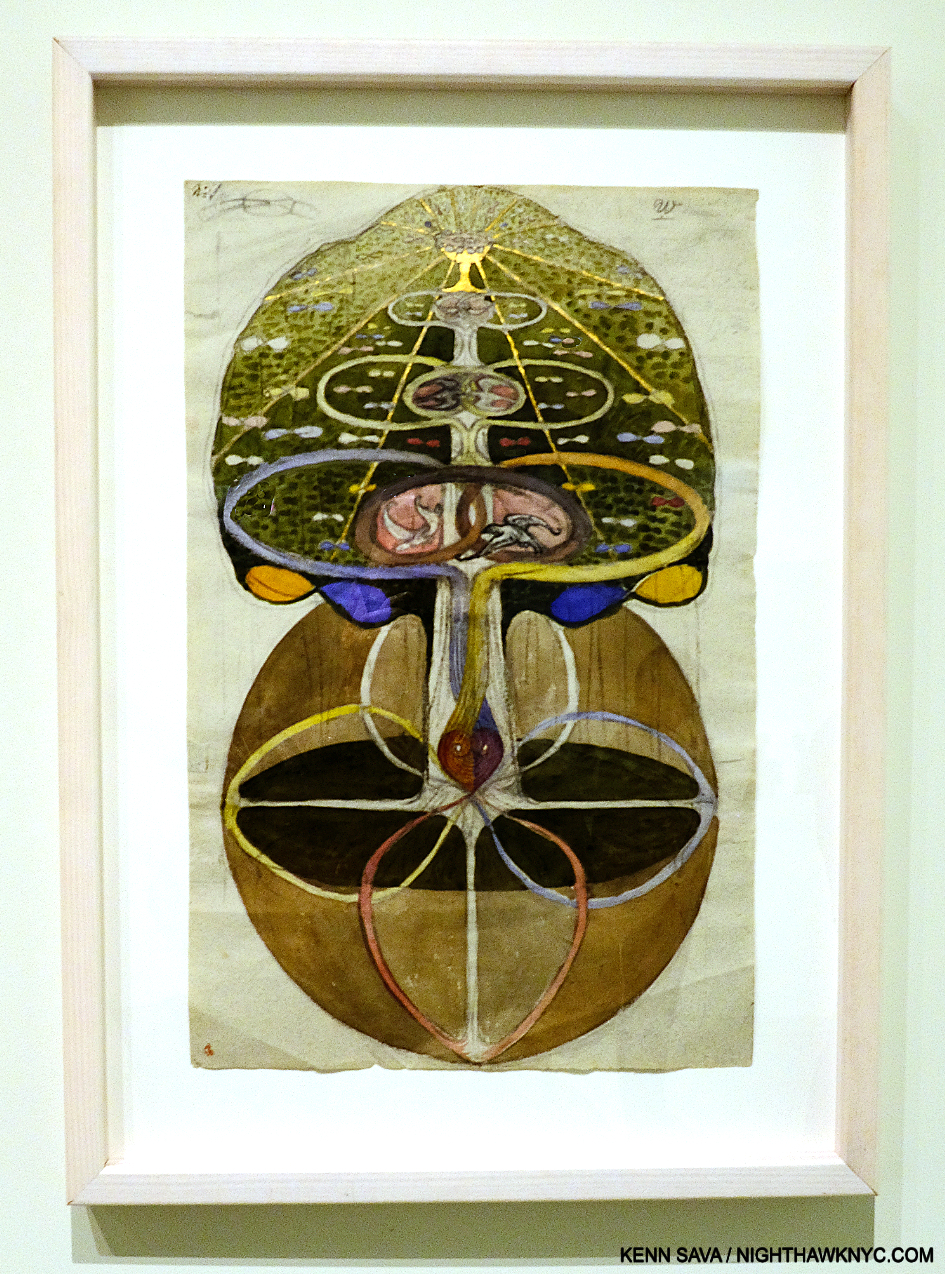
Hilma af Klint, Tree of Knowledge, No. 1,  from The W Series, 1913, Watercolor, gouache, graphite, metallic paint, and ink on paper, Guggenheim Museum, December 31, 2018..

Succinctly put, Hilma af Klint is one of the most remarkable and unique Artists I’ve encountered.
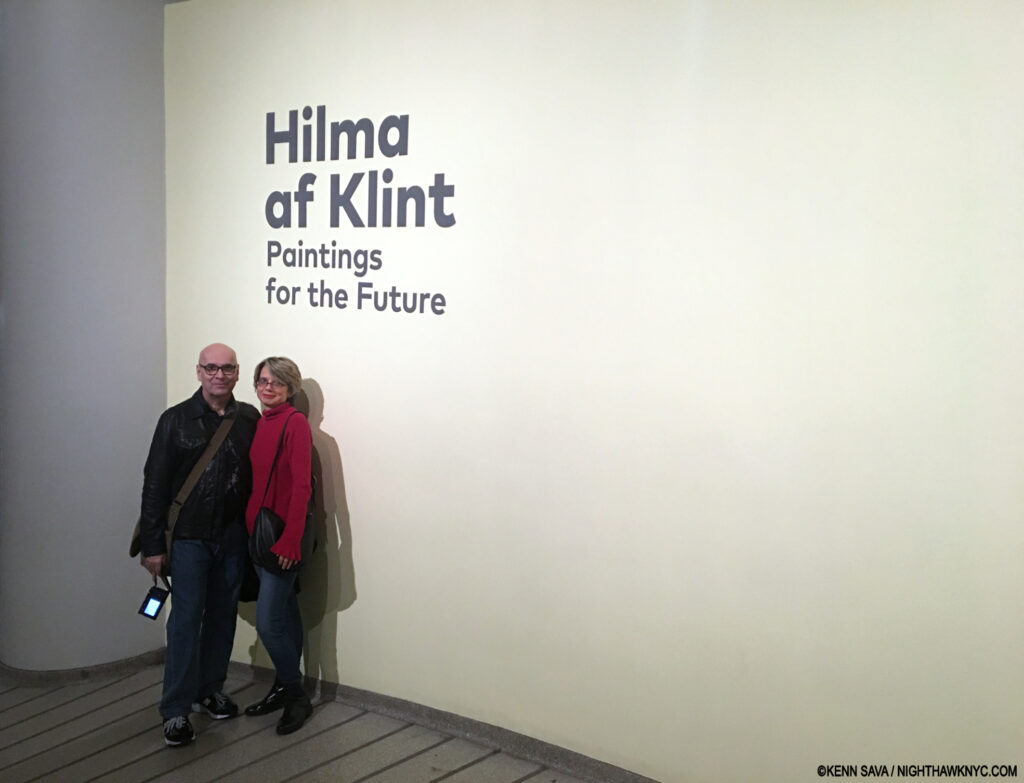
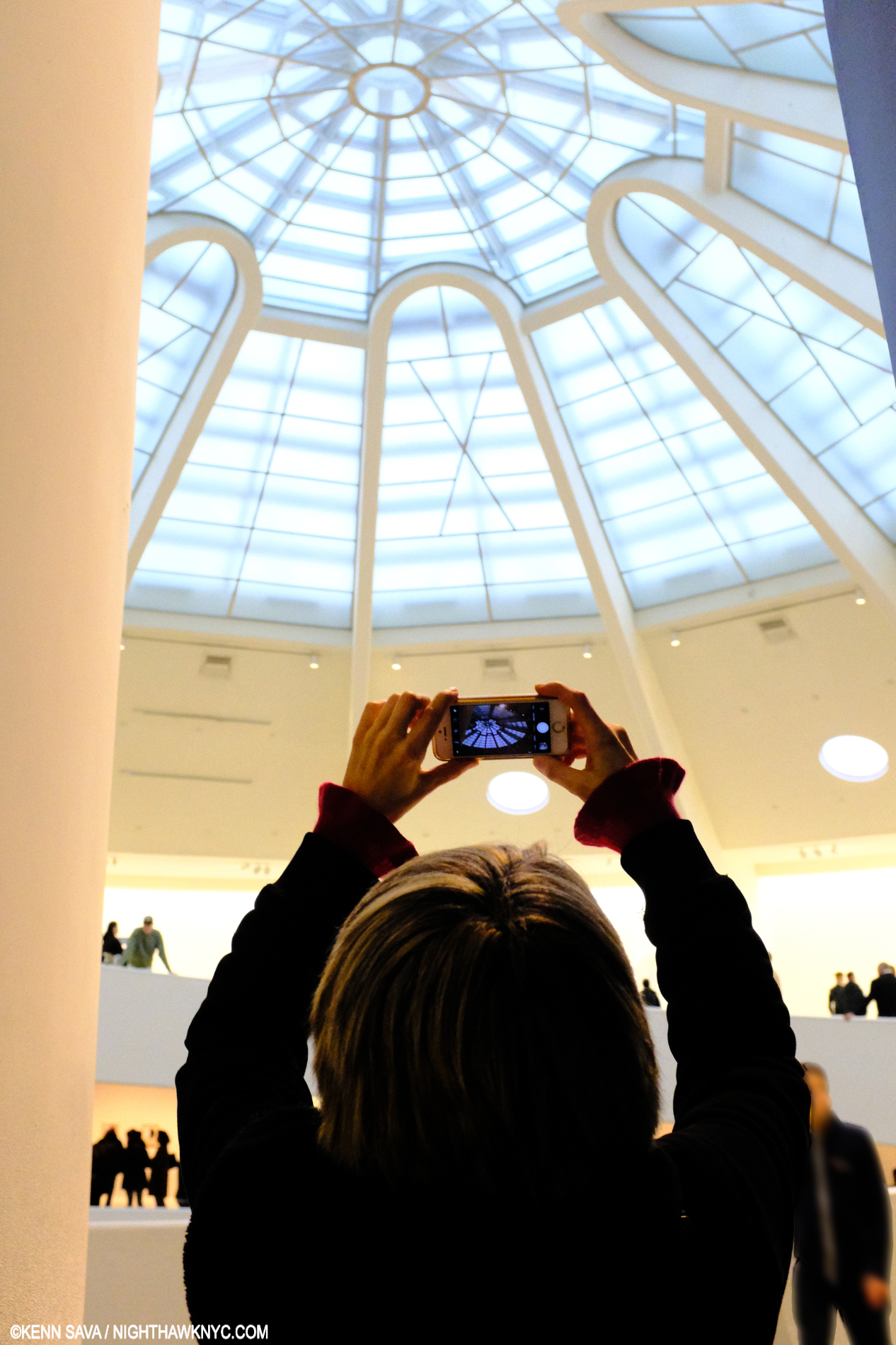
Of the thousands of Art shows I’ve seen in my life, I consider about 10 to be truly monumental. Hilma af Klint: Paintings for the Future is one of them. I’m so grateful I got to experience it with Lana Hattan1, and her Photos are included in this piece. Guggenheim Museum, New Year’s Eve, December 31, 2018. Enduring Thanks to the woman who took this.

Having seen two shows of her work, and most of the books published on it, Hilma’s work continually surprises me. Much of her oeuvre features that rarest of all qualities in Art: it’s unprecedented. I saw Paintings for the Future exactly seven years ago as I write this yet I haven’t written about it to this point for two reasons- 1) I’m still thinking about it and researching Hilma (as my featured entry on Hilma books in my “NoteWorthy Art Books of the 21st Century” piece earlier this year attests). 2) I’ve come to see that boxing Hilma as an “abstract Artist,” as the Art machine has labelled her, does her an immense disservice. I find it at odds with the very nature of her work.
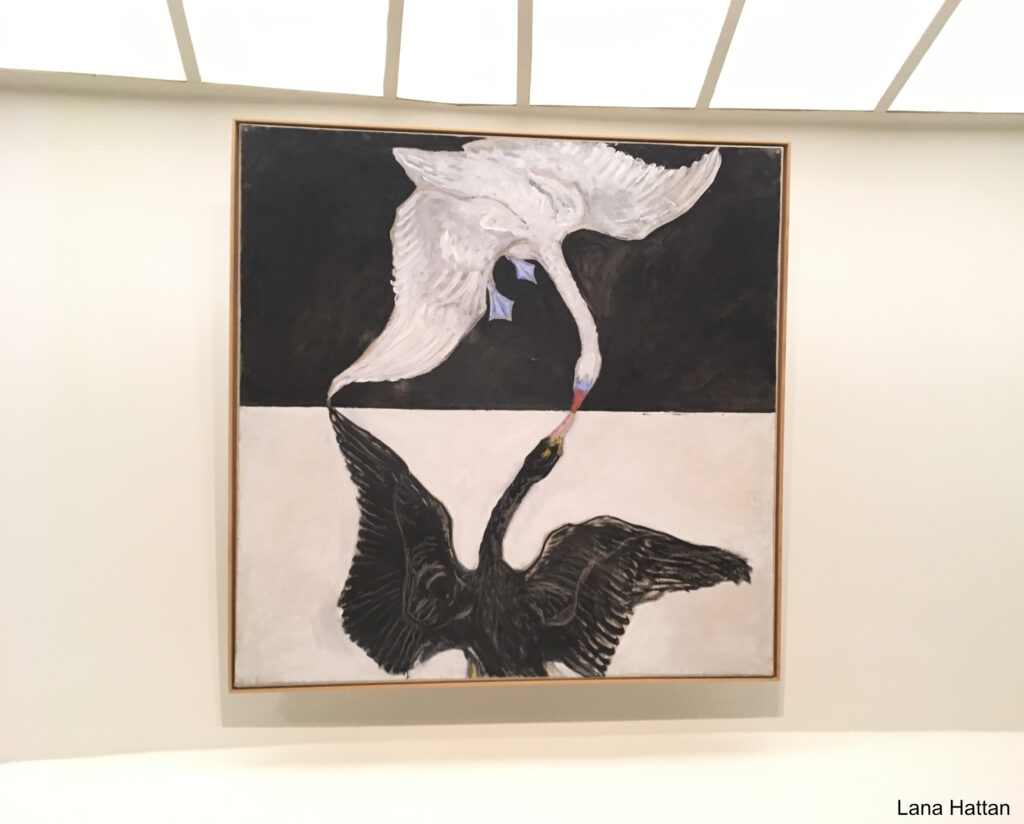
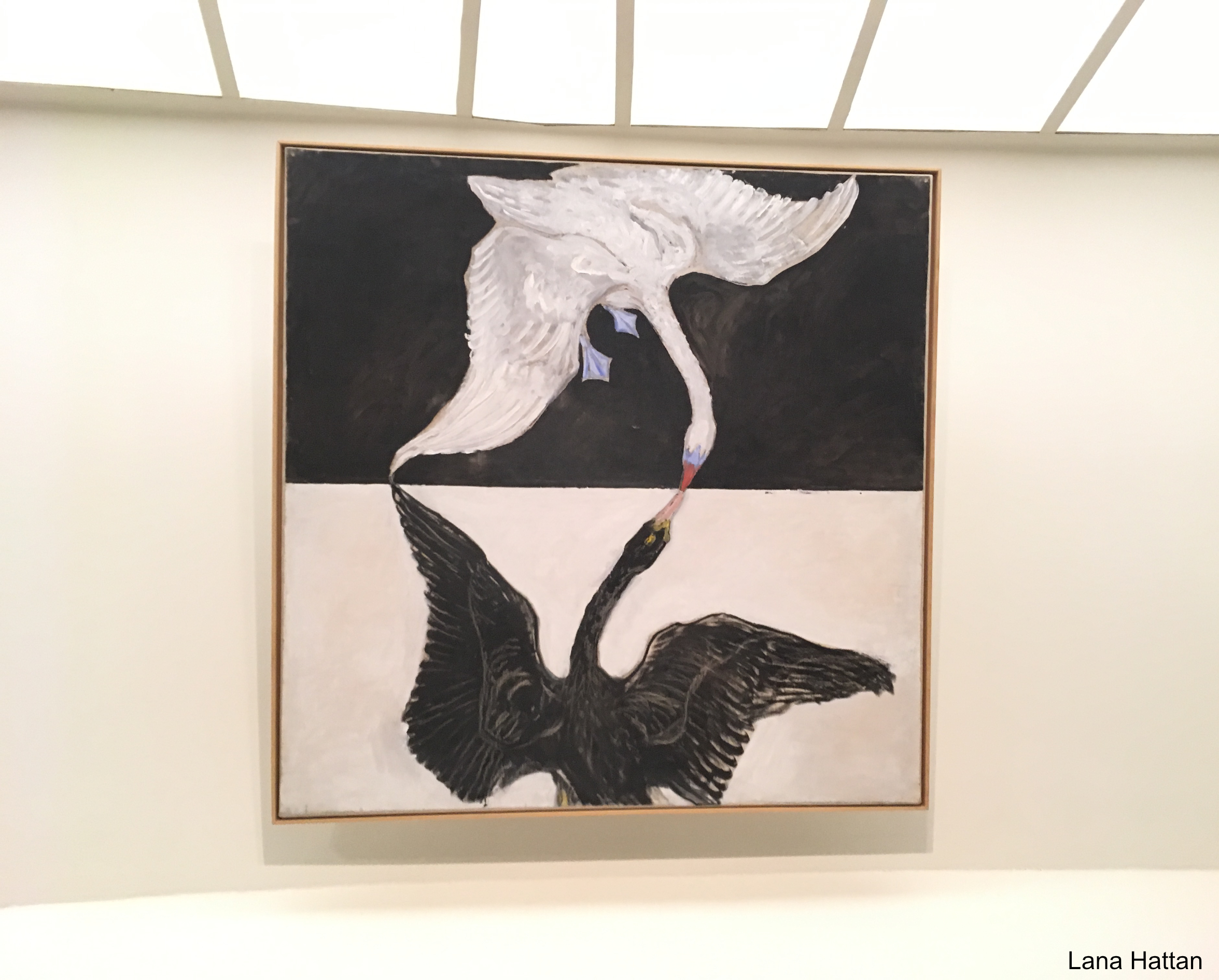
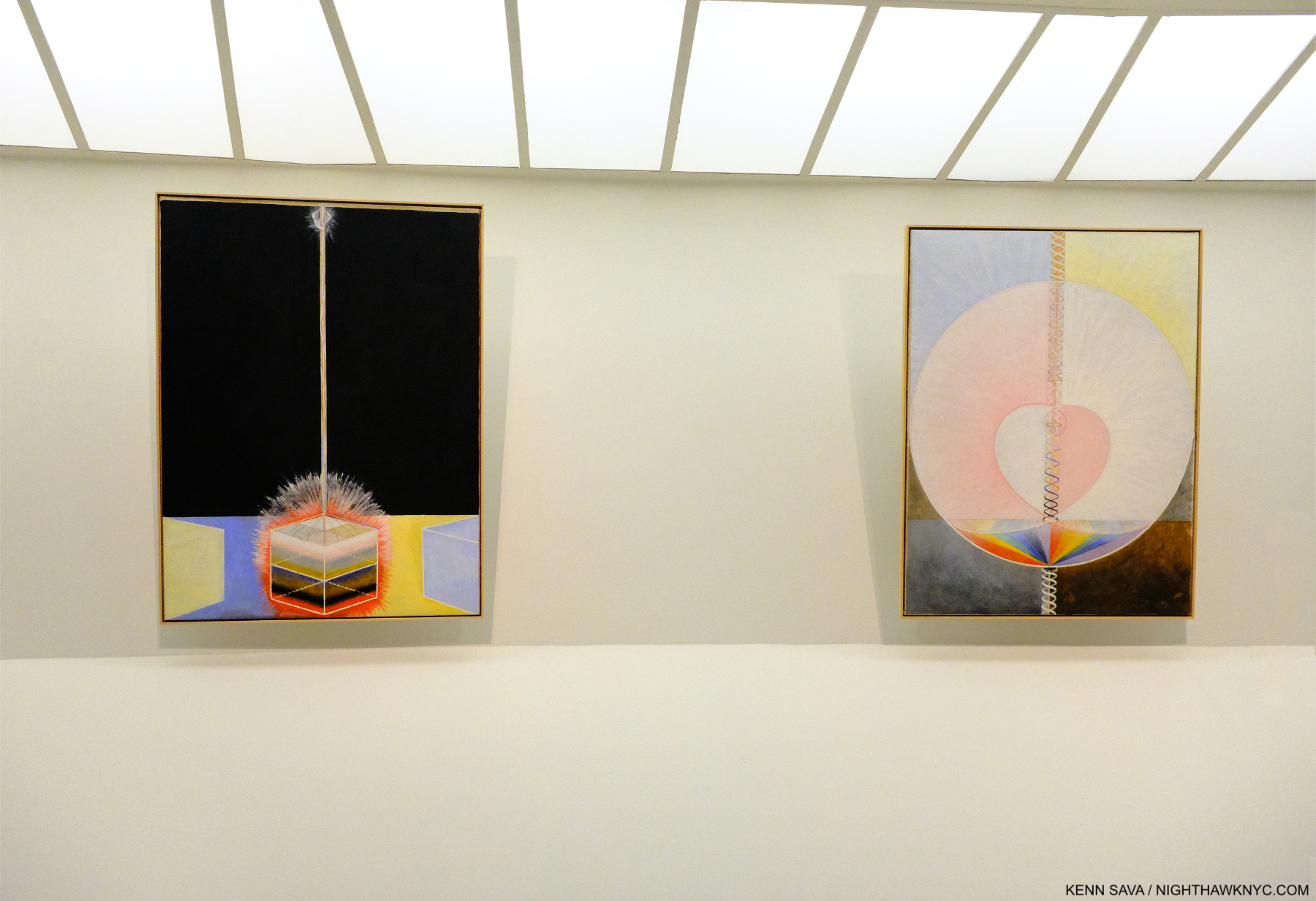
Group IX/SUW, The Swan, No. 1 from The SUW/UW Series, 1915, Oil on canvas. Reaching for the light. Of all the Painting shows I’ve seen at the Guggenheim Museum, the installation of Hilma af Klint: Paintings for the Future was transcendent. More on this later. *- Photo by Lana Hattan, Guggenheim Museum, December 31, 2018. I’m pleased to be able to present this show through her eyes, too.

Beyond all of that, recent developments may make her work “Basquiat hard” (my term for an Artist’s work that is mostly out of pubic view) to see going forward.
That’s a lot to cover. I’ll try to in what follows.

It begins with the flower…

“If your heart is in them flowers, bring ’em on,” Tanya Tucker-*
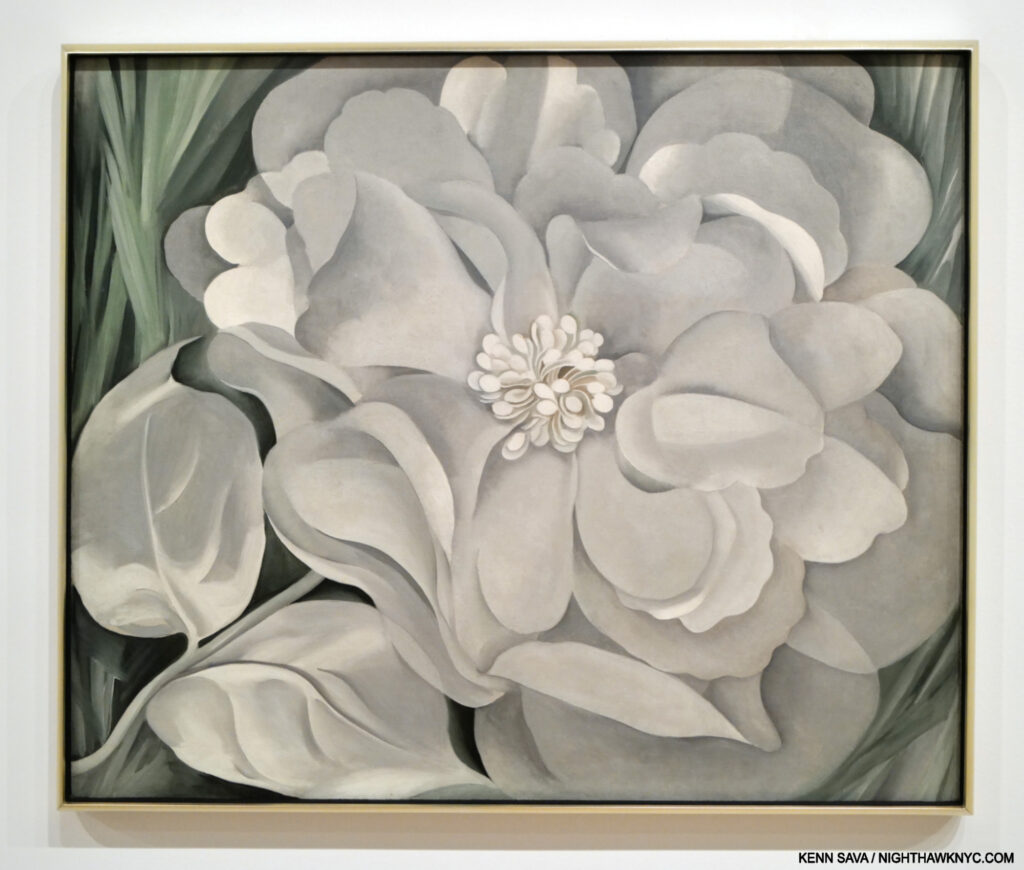
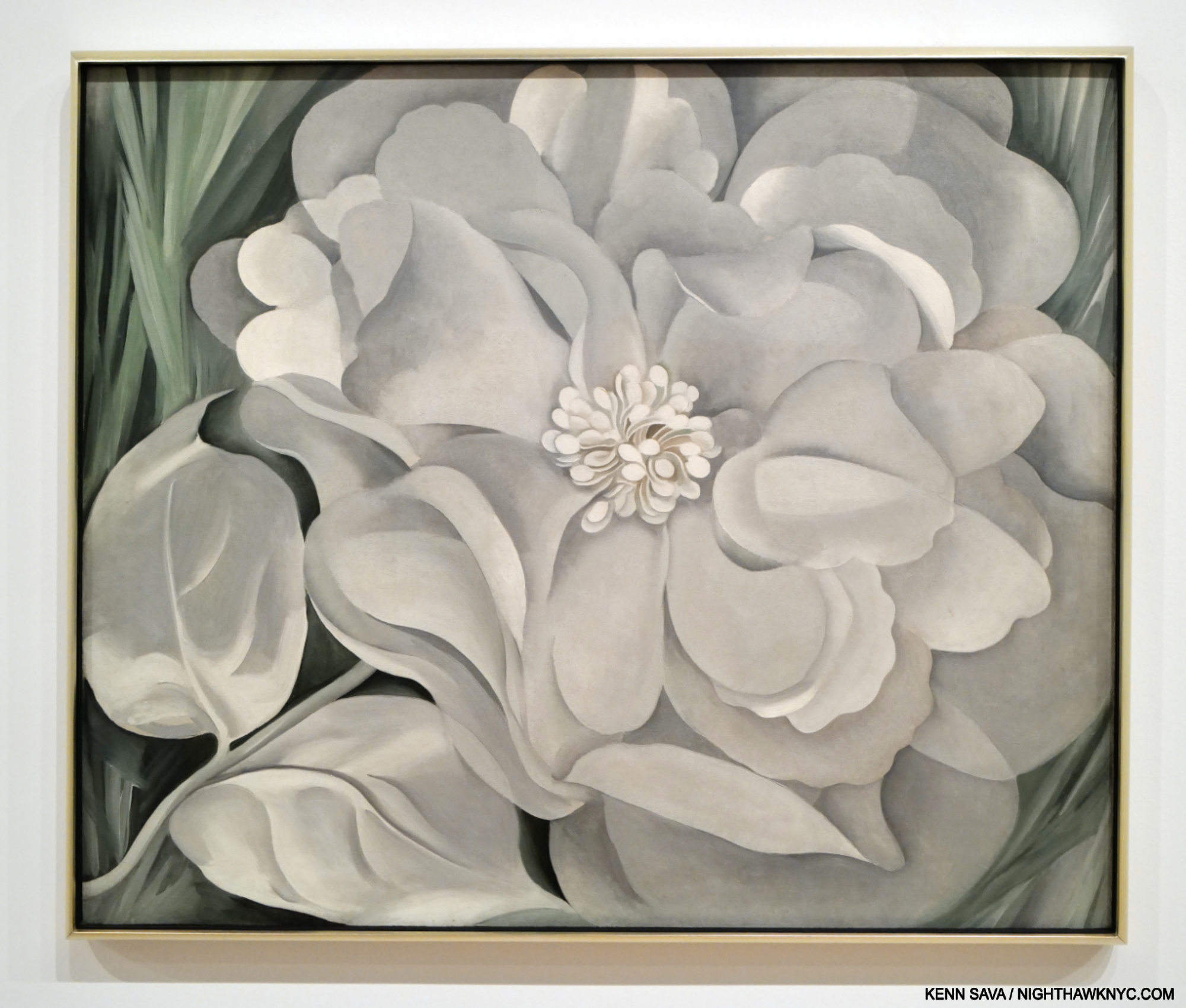
Georgia O’Keeffe, The White Calico Flower, 1931, Oil on canvas, as seen at the Whitney Museum, June 30, 2023

Flower Art was a niche thing, largely reserved for Illustration, until Artists like Georgia O’Keeffe (1887-1986) made viewers sit up and take notice of them. Of course, Vincent van Gogh, and the 17-century Dutch Masters a century before him, among countless others, had Painted wonderful Still-Life bouquets for many years prior, but individual flowers had not received much attention. Earlier last century, that began to change.
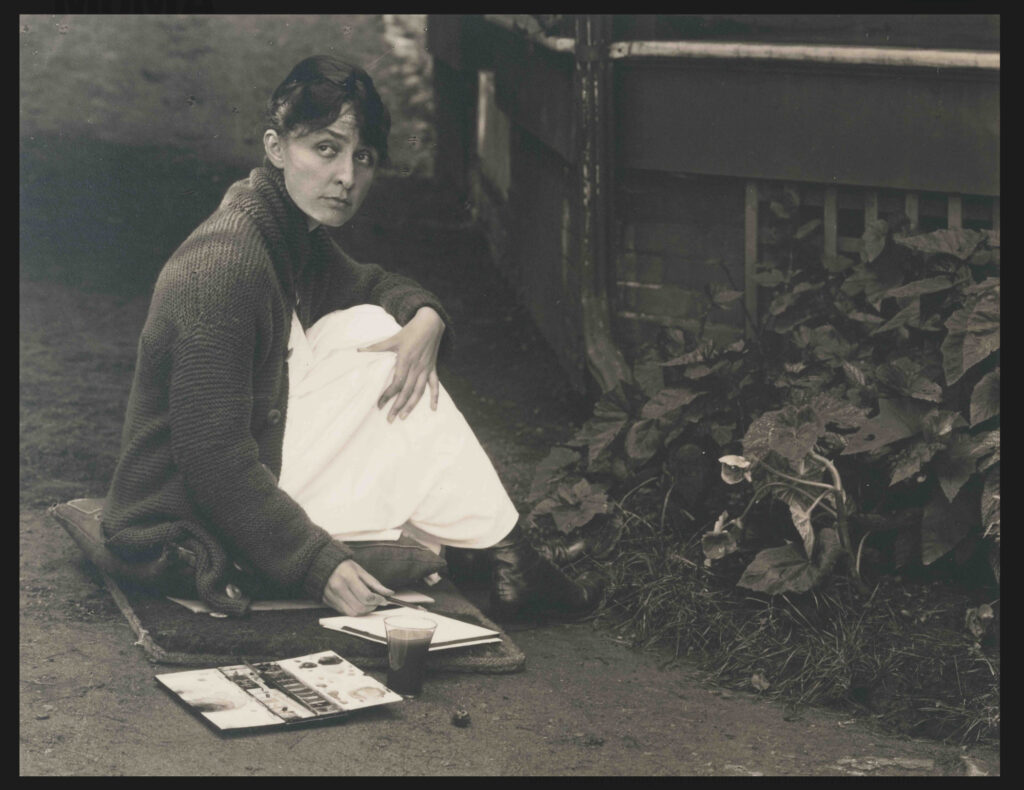
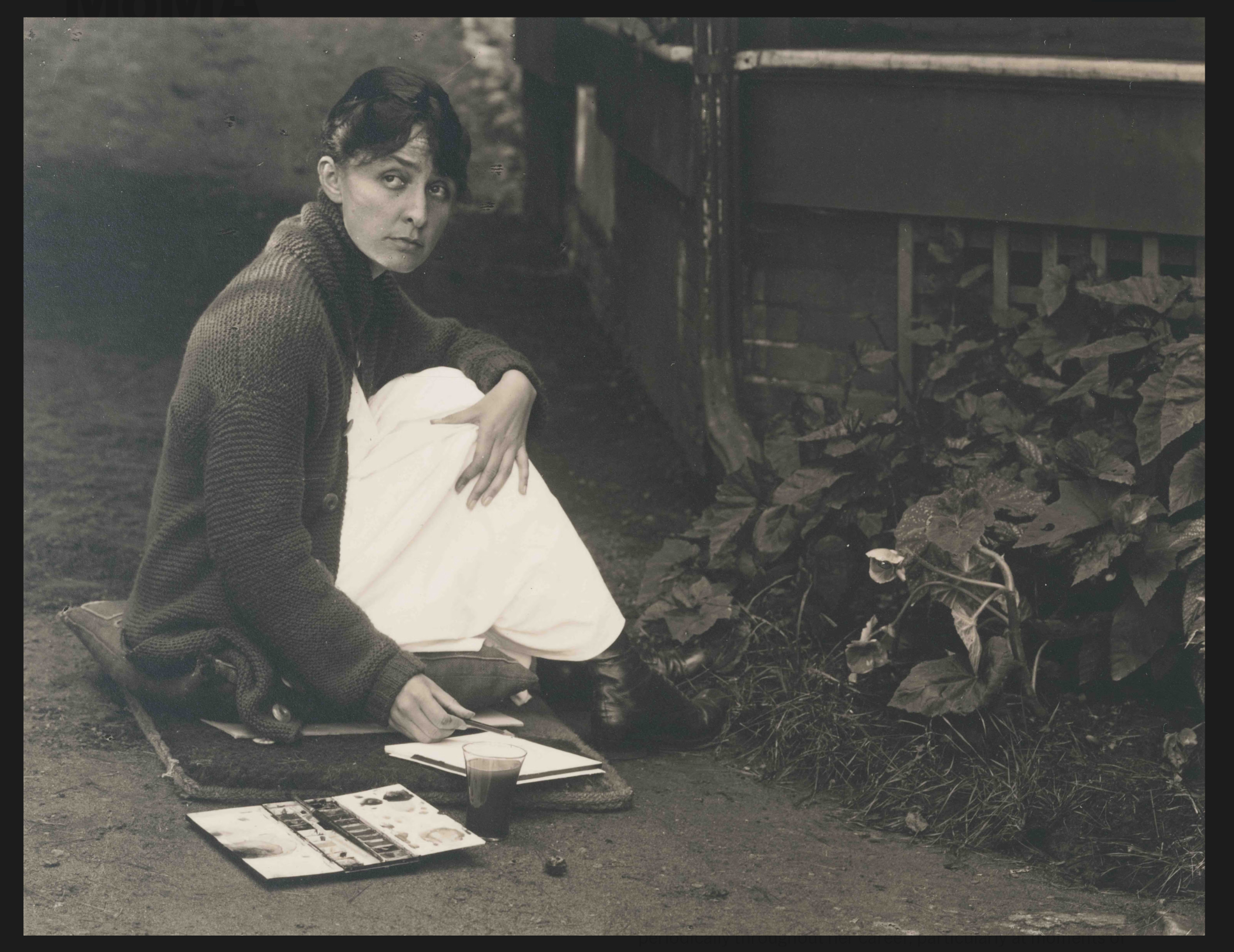
Alfred Stieglitz, Georgia O’Keeffe, 1918. Gelatin silver print. It’s hard to believe Georgia could Draw & Paint flowers like this, and it looks like Mr. Stieglitz found it remarkable, too. Note the year this was taken. *- Georgia O’Keeffe Museum Photo.

“Nobody sees a flower really; it is so small. We haven’t time, and to see takes time- like to have a friend takes time,” Georgia O’Keeffe, paraphrased by MoMA for the title of their 2023 show, Georgia O’Keeffe: To See Takes Time.
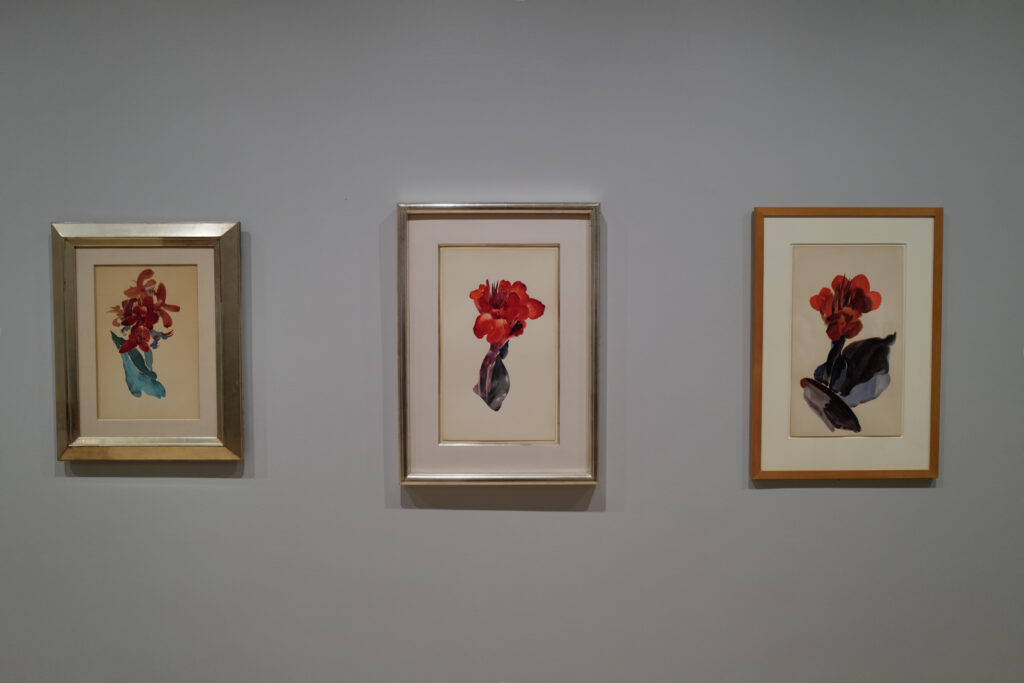
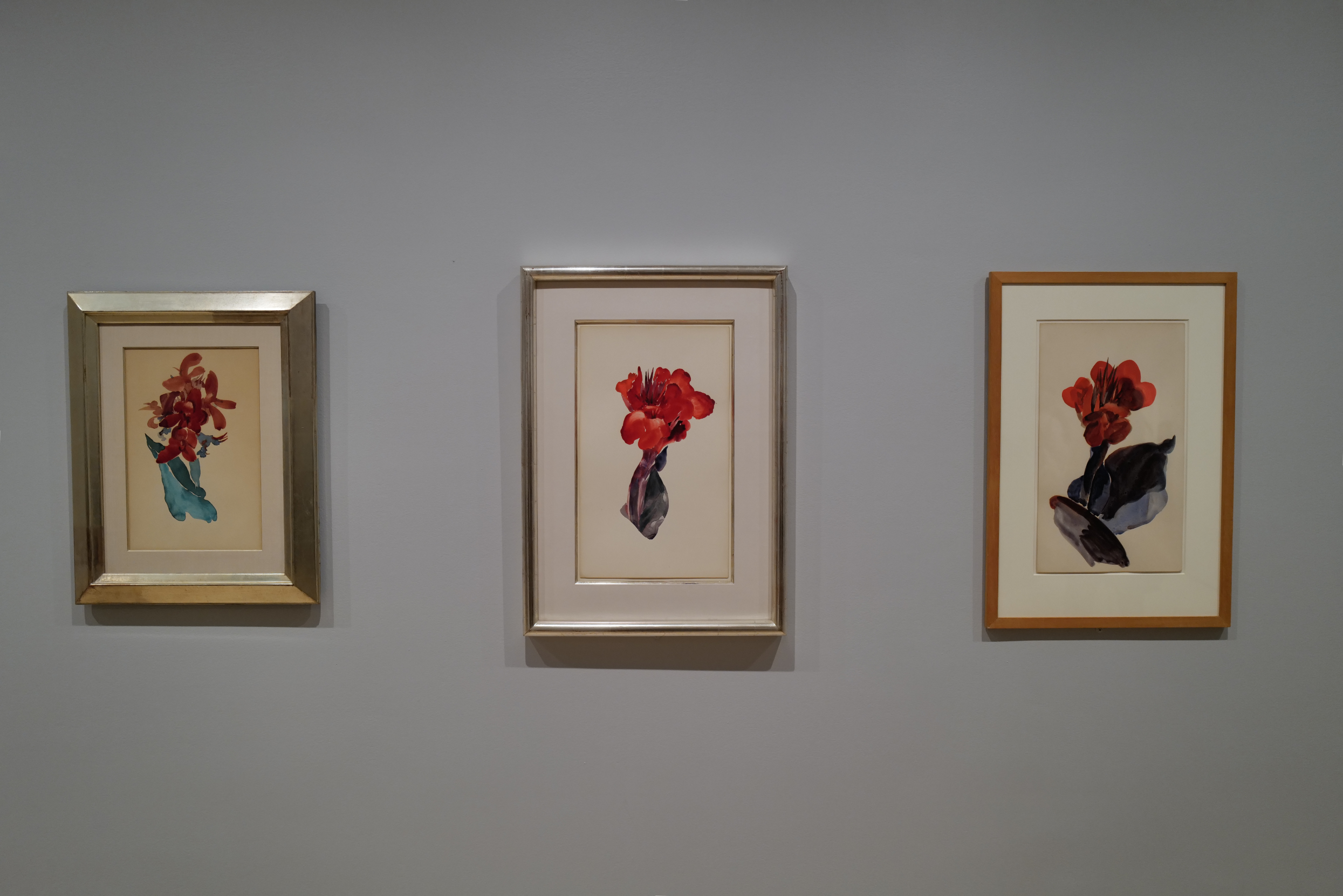
Georgia O’Keeffe, Canna Lily, 1918-20 Watercolor on paper, seen at Georgia O’Keeffe: To See Takes Time., MoMA, July 4 2023. Exactly 2 years later these same gallery walls would display Flower Watercolors by Hilma af Klint Painted at about the same time. (Lights lowered to protect the Art.) MoMA, June 9, 2023.

She continued: “So I said to myself- I’ll paint what I see- what the flower is to me but I’ll paint it big and they will be surprised into taking the time to look at it- I will make even busy New Yorkers take time to see what I see of flowers.” She would eventually give us 200 Paintings of them, a number of which are now iconic. So, it was fitting that MoMA’s Georgia O’Keeffe: To See Takes Time  contained some of her Flowers, including three early Calla Lilies watercolors from 1918-20, right as she was transitioning from Painting in watercolors to oils2.

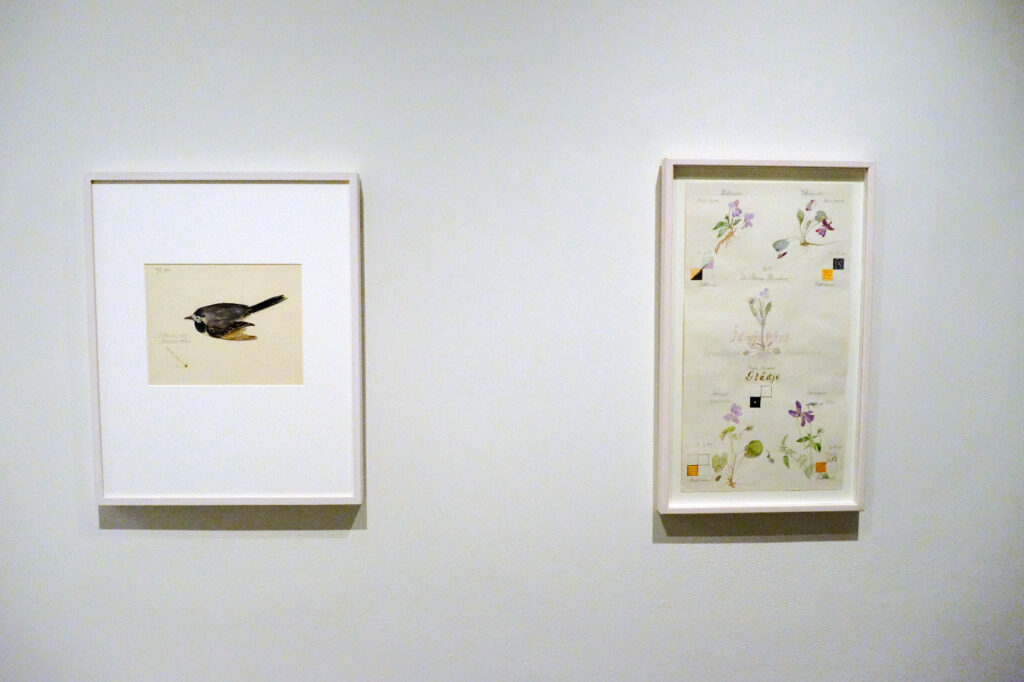
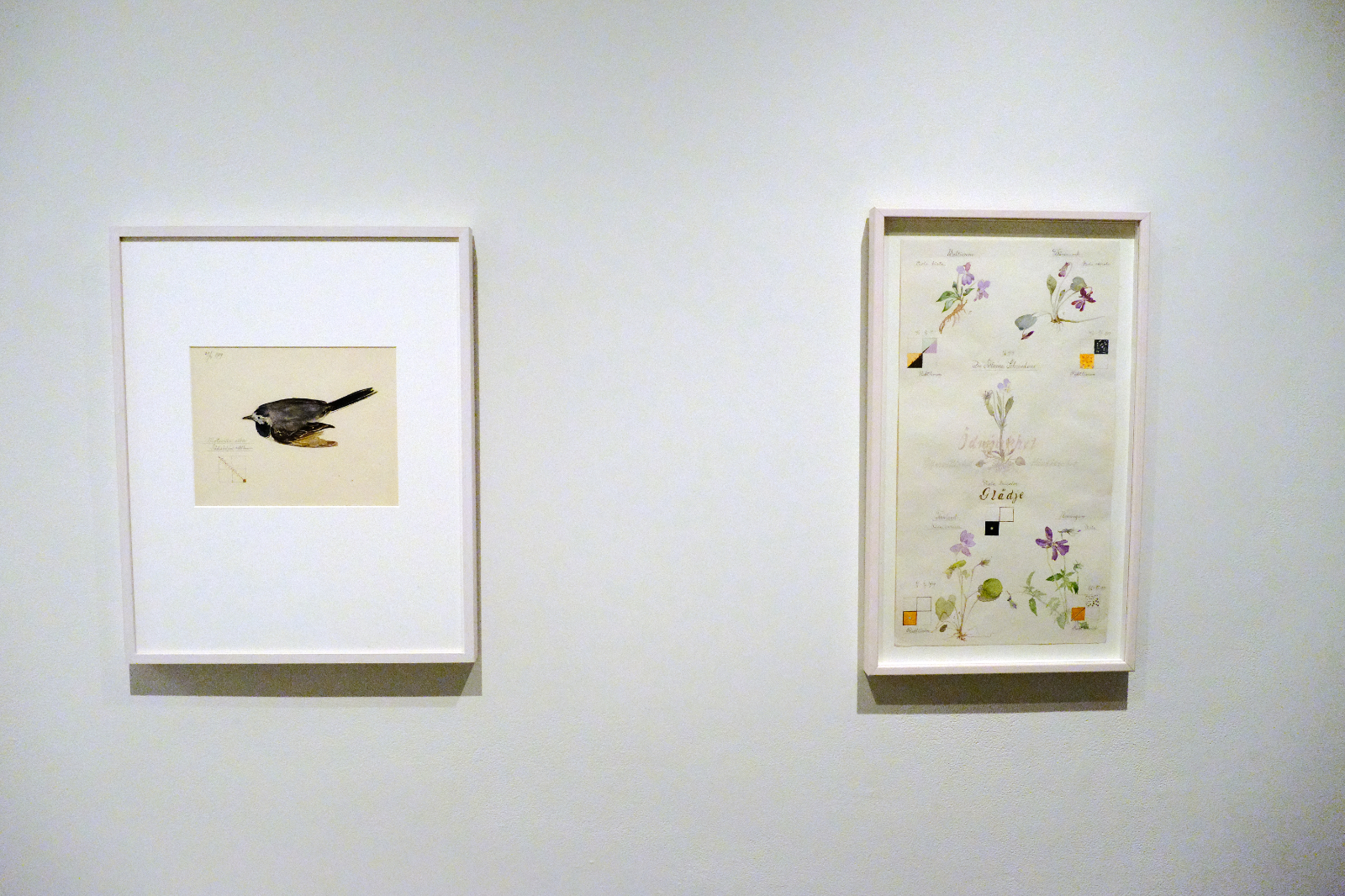
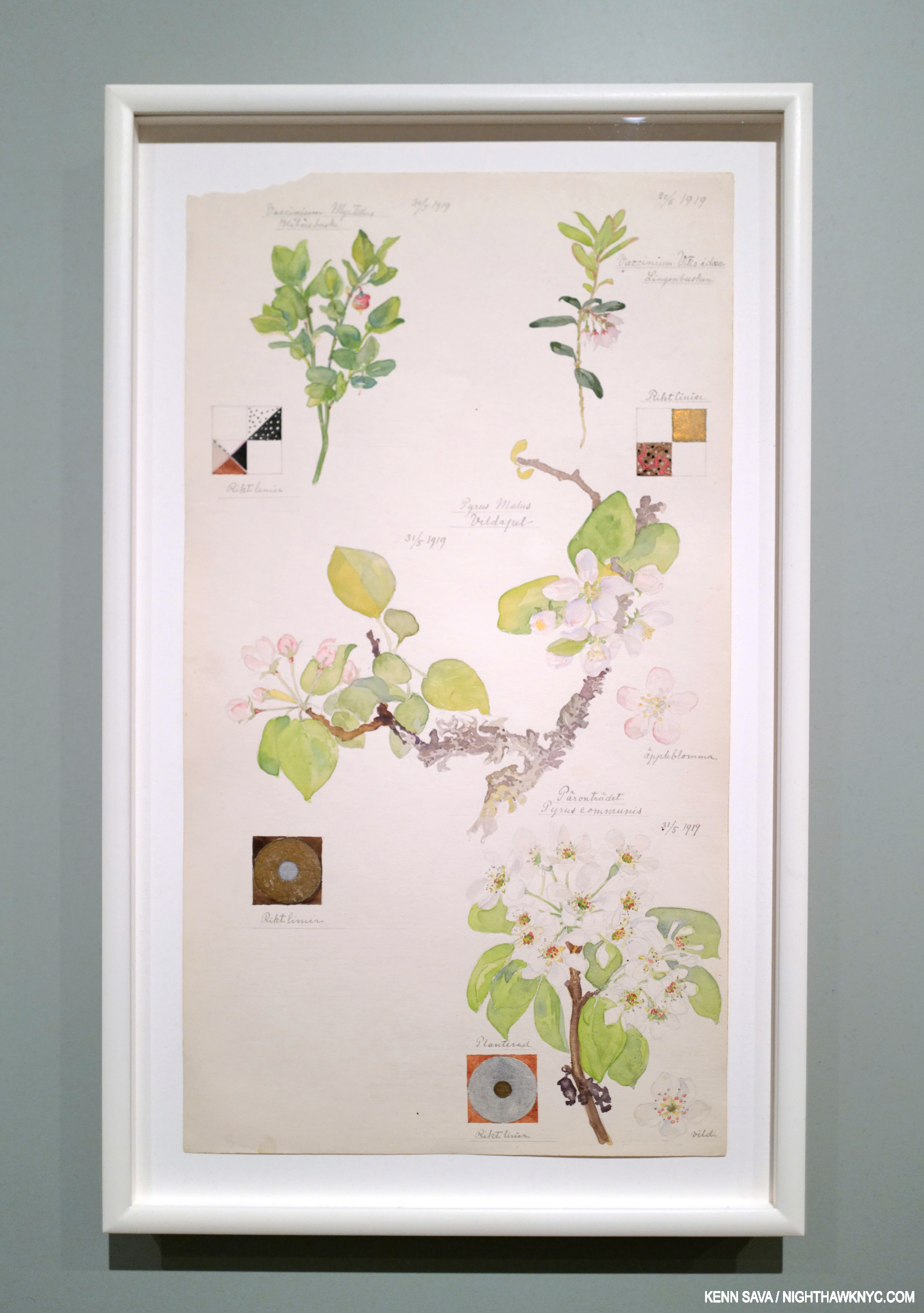
Hilma af Klint, Motacilla Alba: Wagtail with Guidelines, left, Violet Blossoms with Guidelines, both from Series I, 1919, Watercolor, graphite, and metallic paint on paper, right. Tucked away in Paintings for the Future this Flower Watercolor, right, looks like a page from Hilma af Klint’s Nature Studies Portfolio that would become the focus of the next major NYC Museum show of her work seven years later. An interesting realistic(!) harbinger, it’s not part of that Portfolio. Seen at the Guggenheim Museum, December 31, 2018, this sheet was also included in MoMA’s What Stands Behind the Flowers in 2025. MoMA’s wallcard for it speculates that Hilma may have removed it from Nature Studies.

Meanwhile at the same time Georgia was creating her Calla Lilies, across the ocean in Sweden, an almost completely unknown Artist named Hilma af Klint (i.e. HaK, born 25 years before Georgia in 1862) began rendering over 100 Flowers in Watercolors in a Portfolio she titled Nature Studies, 1919. As far as I know, they didn’t know each other (though I wonder if Art astute Hilma came to know of Georgia as the American rose to fame). As far as I can tell, the set remained hidden from public display until May 11, 2025, when MoMA opened Hilma af Klint: What Stands Behind the Flowers, coincidentally in the same galleries that had held Georgia O’Keeffe: To See Takes Time two year before

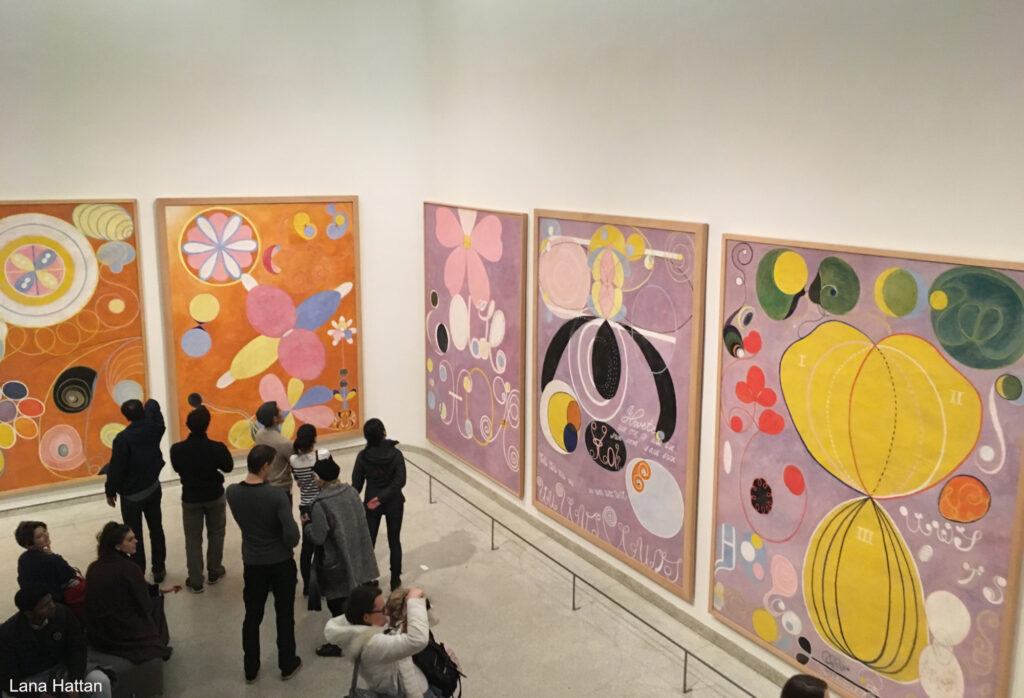
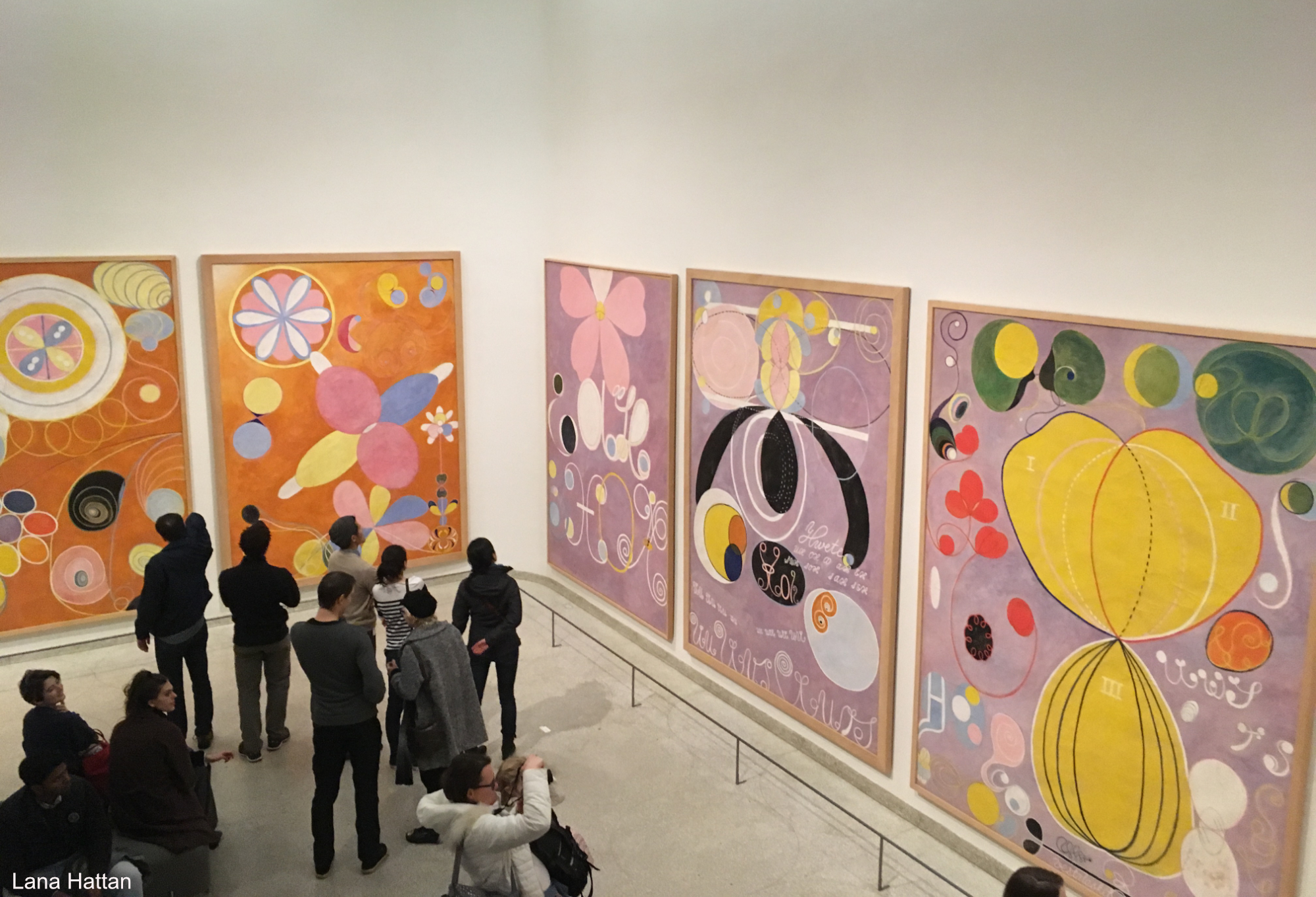
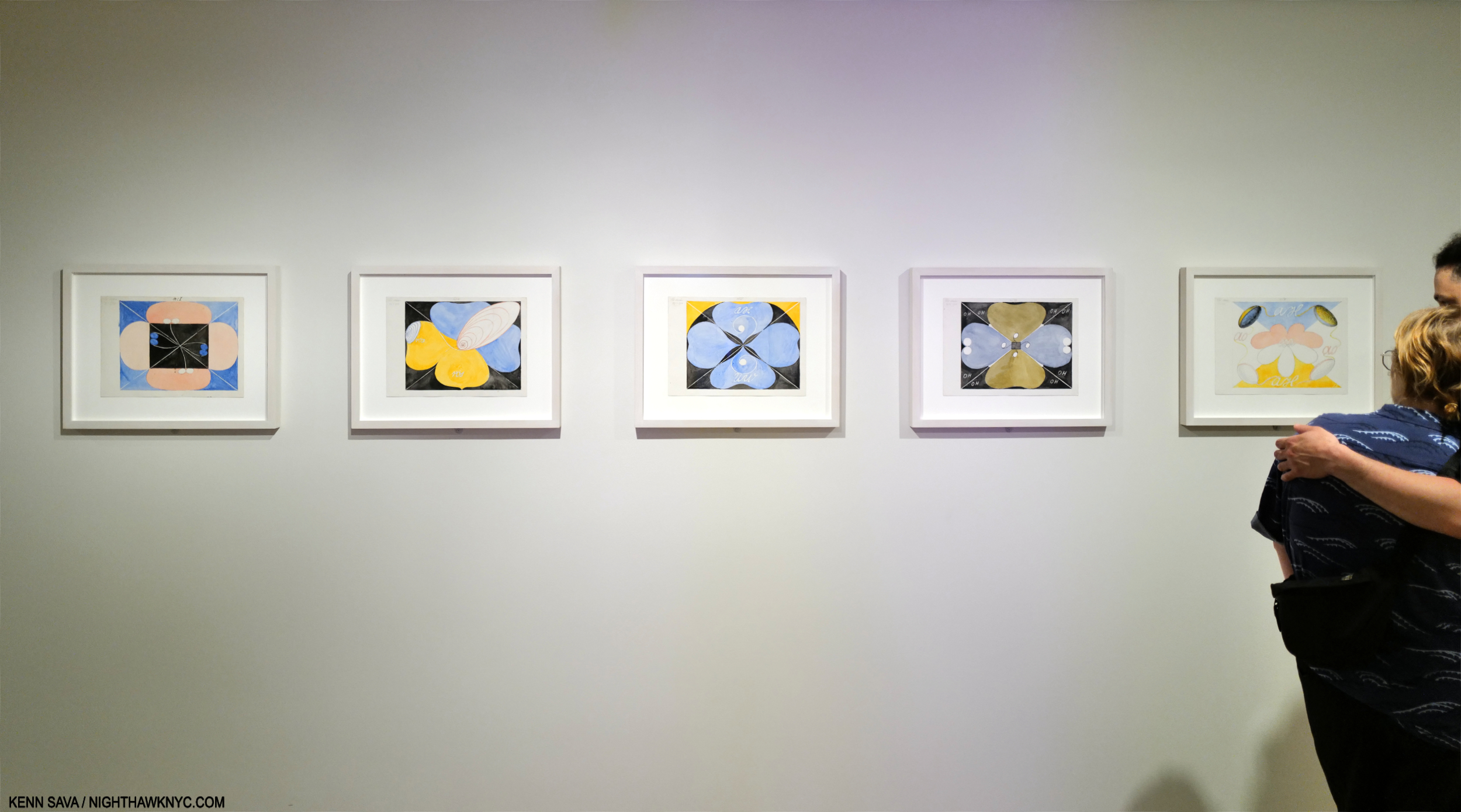
Five of Hilma af Klint’s The Ten Largest, a series devoted to the human lifespan, part of her now-famous Paintings for the Temple series. Note the shapes that seem organic or “flower-like.” Guggenheim Museum, December 31, 2018. *- Photo by Lana Hattan, Guggenheim Museum, December 31, 2018.

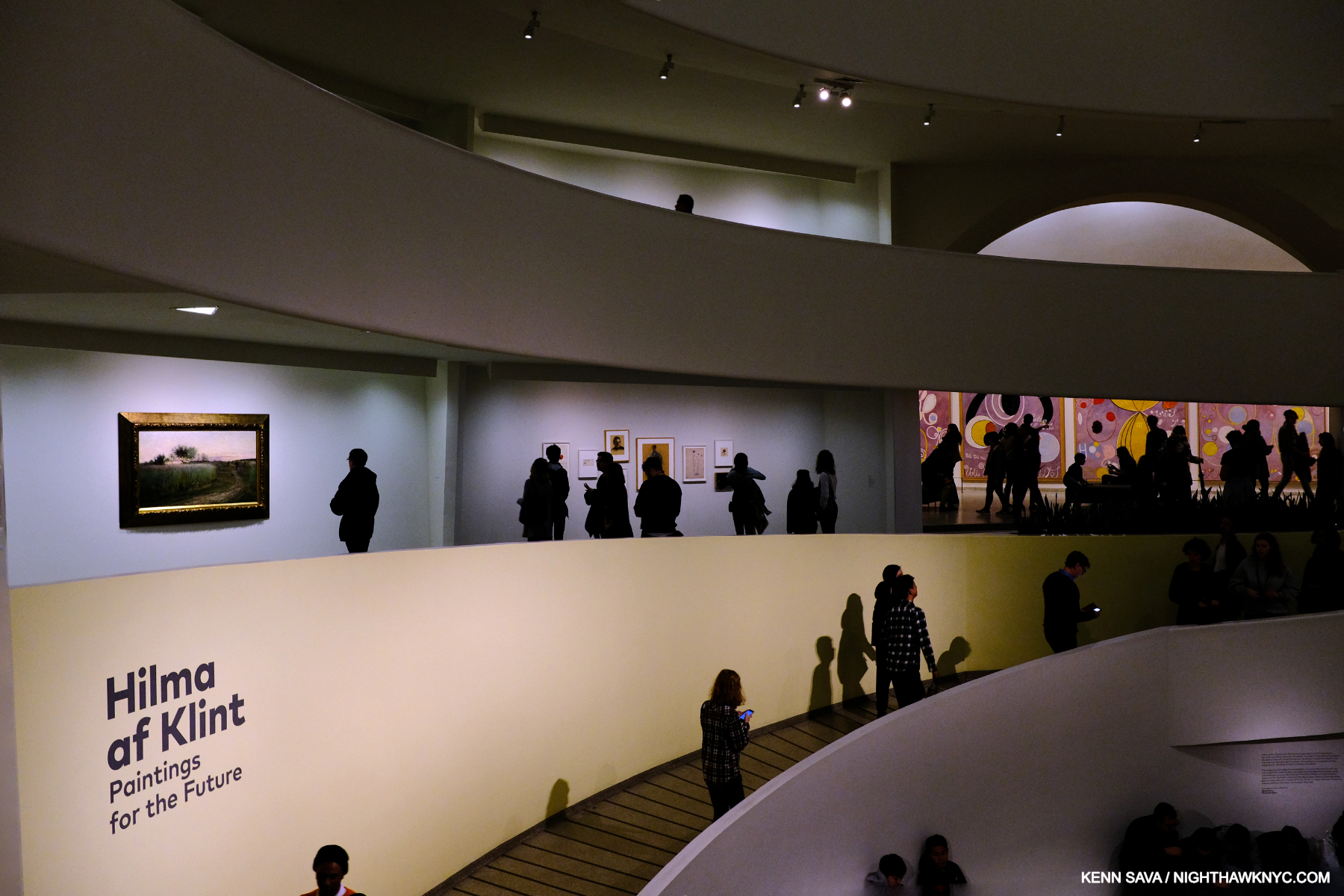
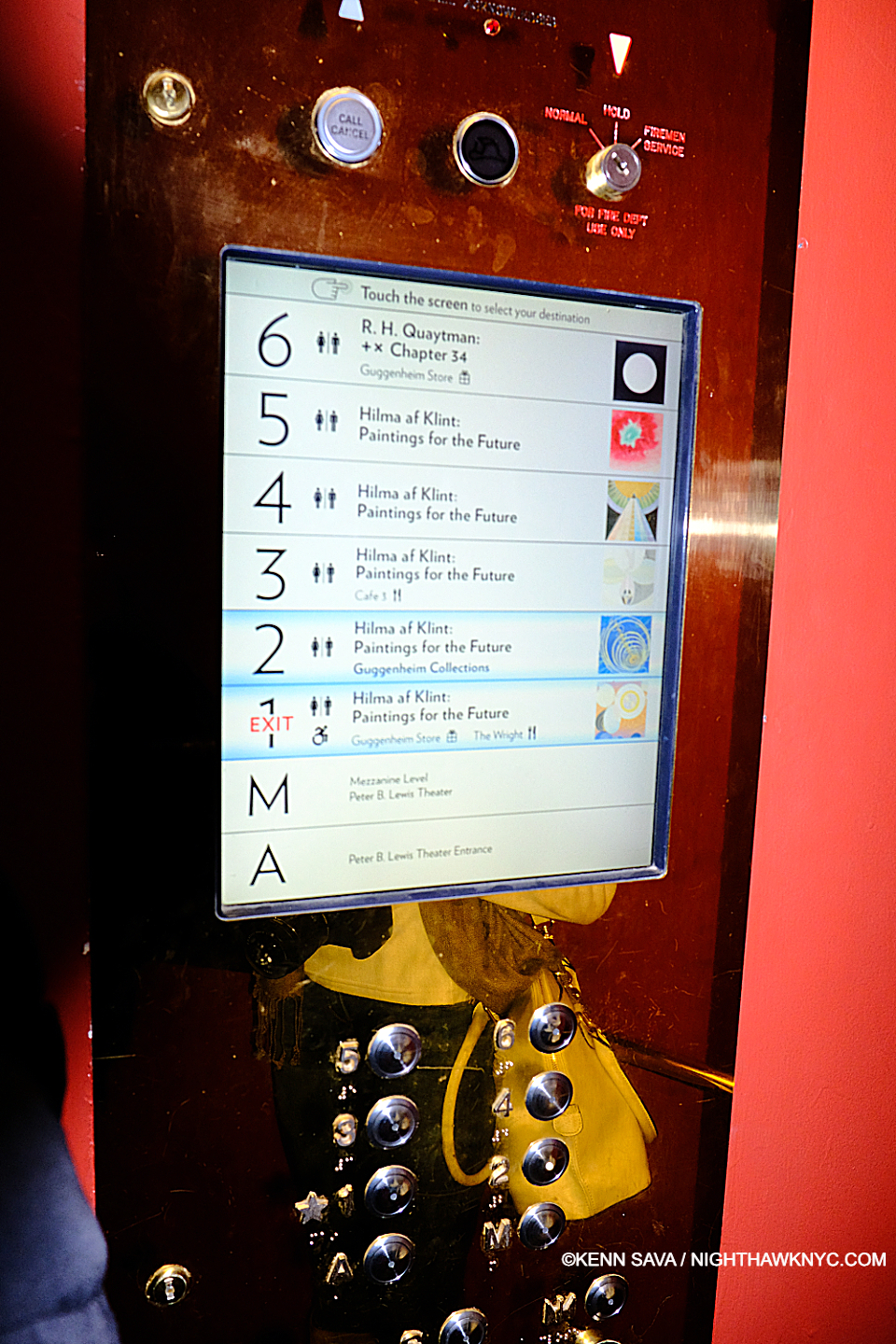
When her Art was last seen in an NYC museum in 2018-19, Hilma af Klint: Paintings for the Future drew a Guggenheim Museum all-time record 600,000 other viewers to Frank Lloyd Wright’s Museum Rotunda. I always walk down the ramp after taking the unique semi-circular elevator to the top of the Guggenheim as Frank Lloyd Wright wanted visitors to do which means I saw Paintings for the Future in reverse chronological order. Preceding it, R.H. Quaytman: +x, Chapter 34, occupied the 6th, or top Ramp. While this might seem incongruous to some, a deep dive into Hilma af Klint’s sparse NYC history reveals that R.H. Quaytman has a long history of championing Hilma af Klint that includes curating the first HaK show in an NYC museum, The Secret Pictures by Hilma af Klint at MoMA PS1 in early 19893. +x, Chapter 34 worked seamlessly with Paintings for the Future in my view.
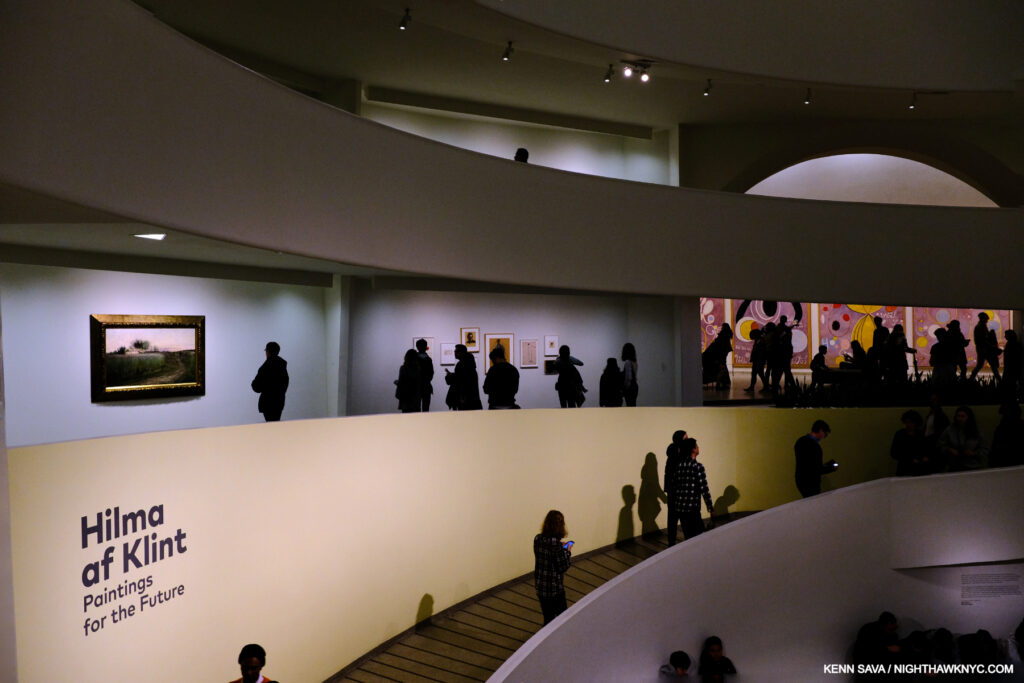
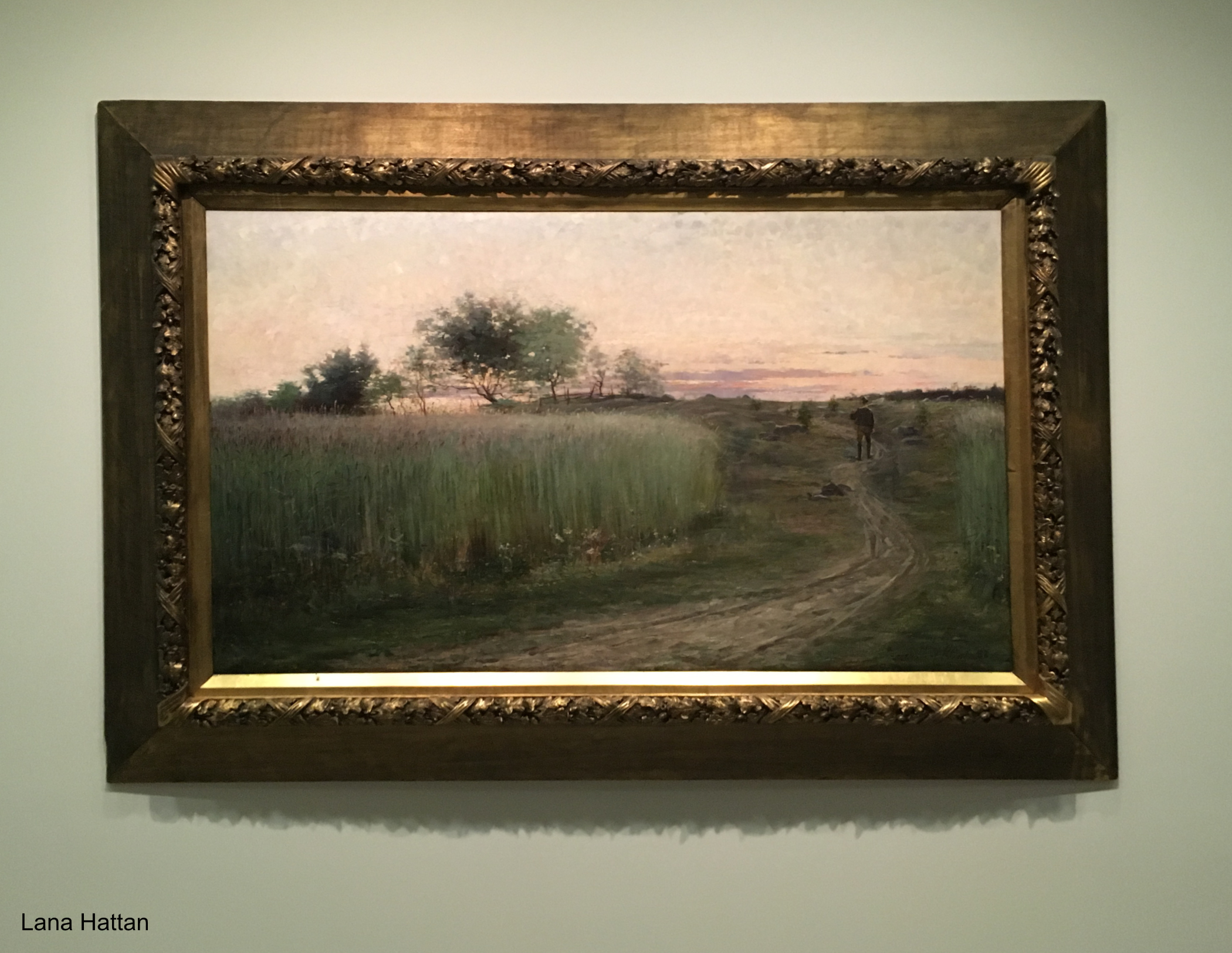
Herein lies a problem (among others) with branding HaK an “abstract Artist.”  To the left, above the sign, on Ramp 1 is Summer Landscape, 1888, Oil on canvas, juxtaposed by parts of three of The Ten Largest, all 10 from 1907, far right, from her landmark Paintings for the Temple series, partially shown in the prior picture, in a completely different style. December 31, 2018.

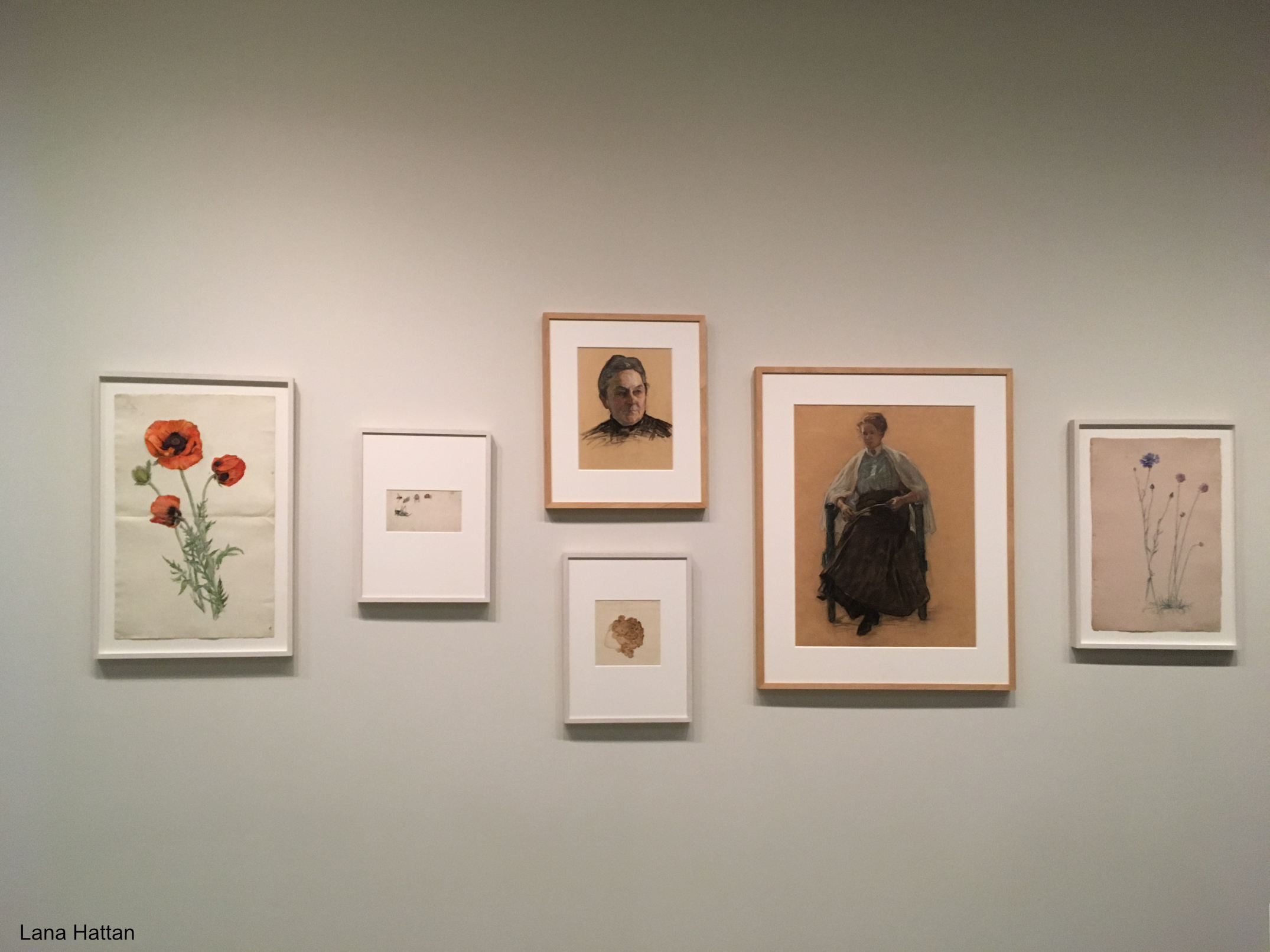
As we got to Ramp 1 (the lowest ramp), there were two bays containing work that looked pretty representational to me that featured Summer Landscape, 1888, above, left, and 2 Flower Watercolors from the 1890s, center, between the  visitors above, all shown closer below-
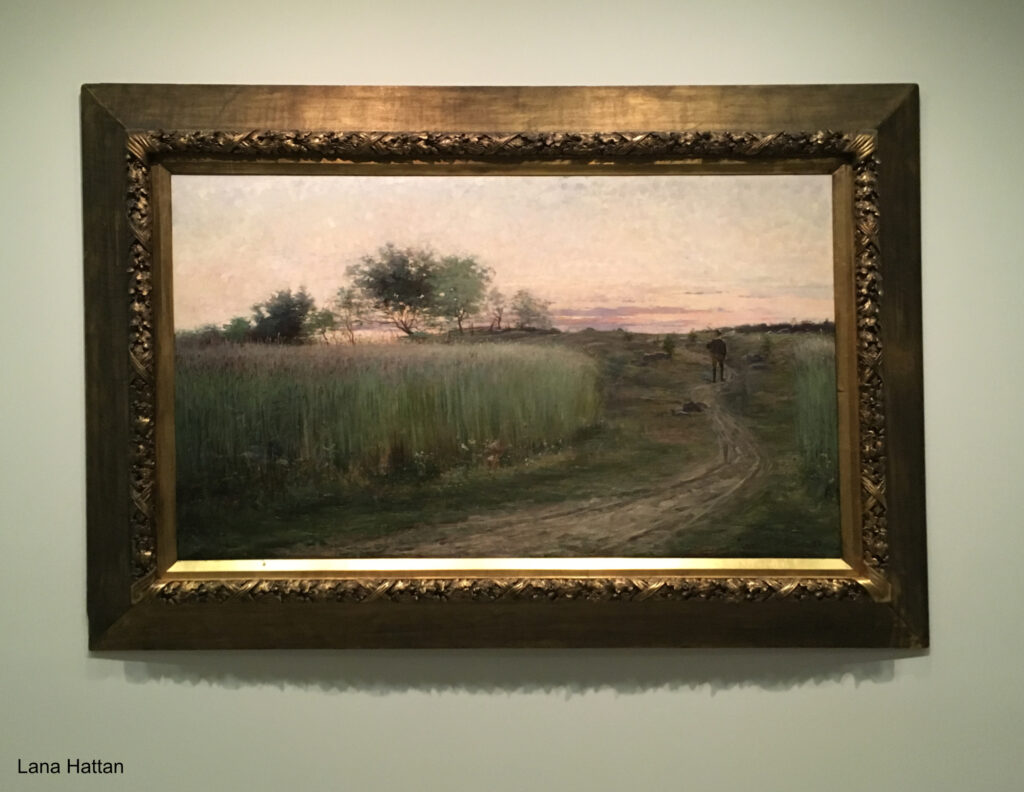
Summer Landscape, 1888, Oil on canvas. Hilma was about 26 when she Painted this in the year she graduated from the Royal Academy of Fine Arts.*- Photo by Lana Hattan, Guggenheim Museum, December 31, 2018.
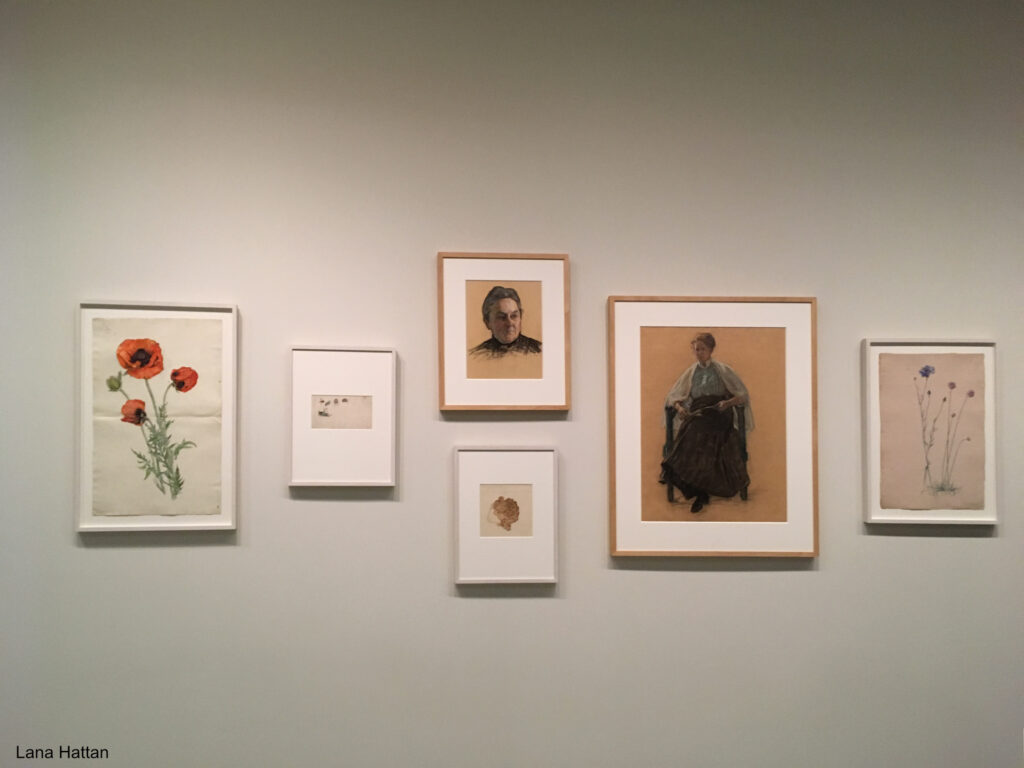
Poppy, 1890s, Watercolor, ink, and graphite on paper, left, Portrait study of the head of a woman, center, and Portrait study of a sitting woman to its right,  both Charcoal, crayon and graphite on paper, both c.1918. Distortion of the frames due to the curved wall. *-Photo by Lana Hattan, Guggenheim Museum, December 31, 2018.

Though early in her career, before the more well-known Paintings they call “abstract,” these revealed an accomplished technique in both oils and watercolors, honed over 6 years at the Royal Academy of Fine Arts in Stockholm (1882-88), where Hilma was one of its first female students. At that moment, I realized there was much more to Hilma af Klint than the Art machine’s limiting marketing hype would have us believe.
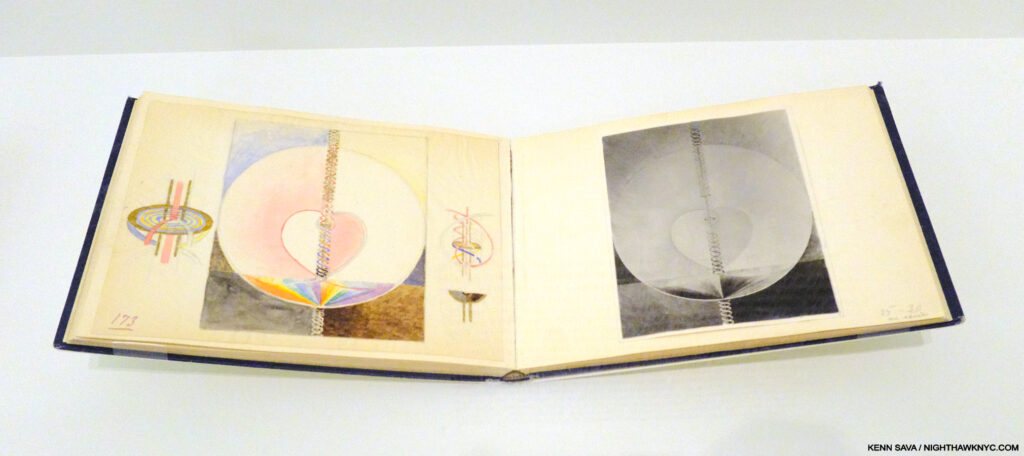
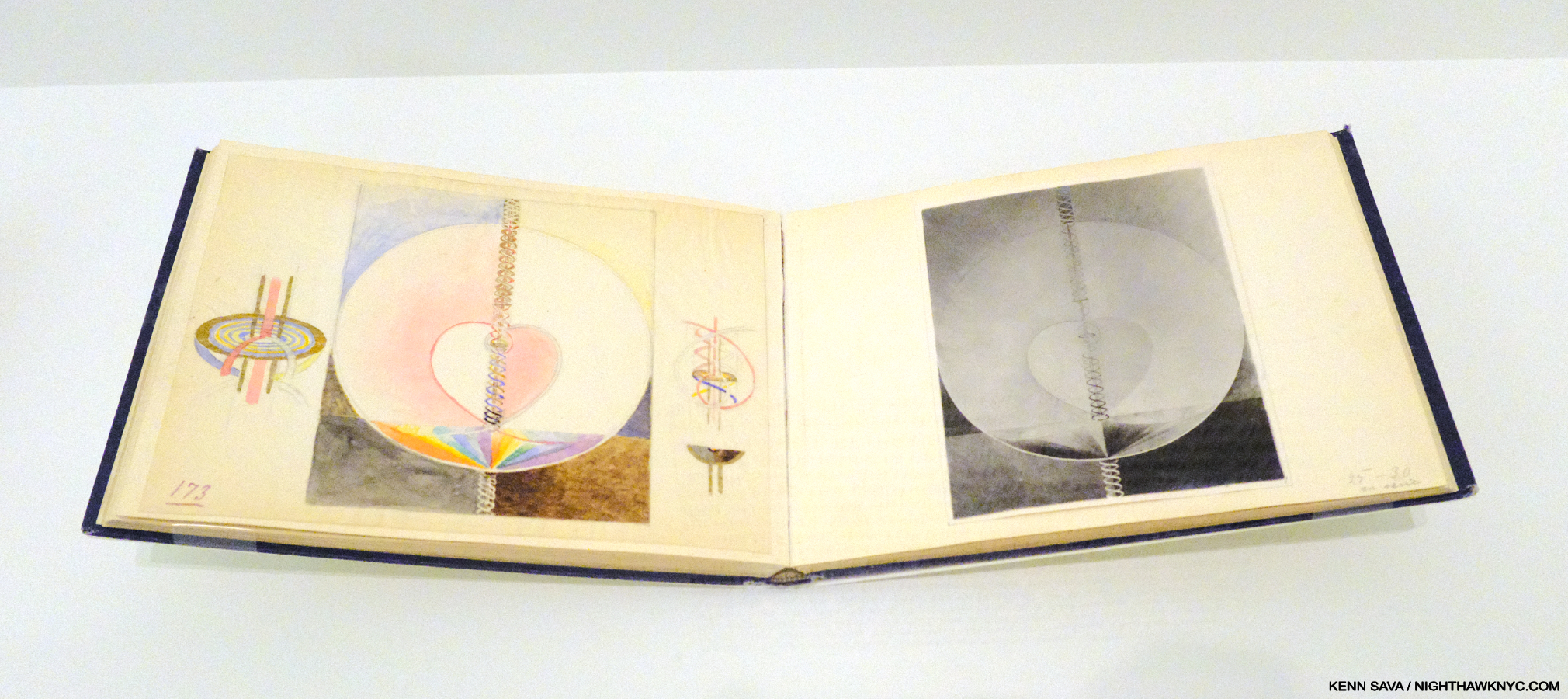
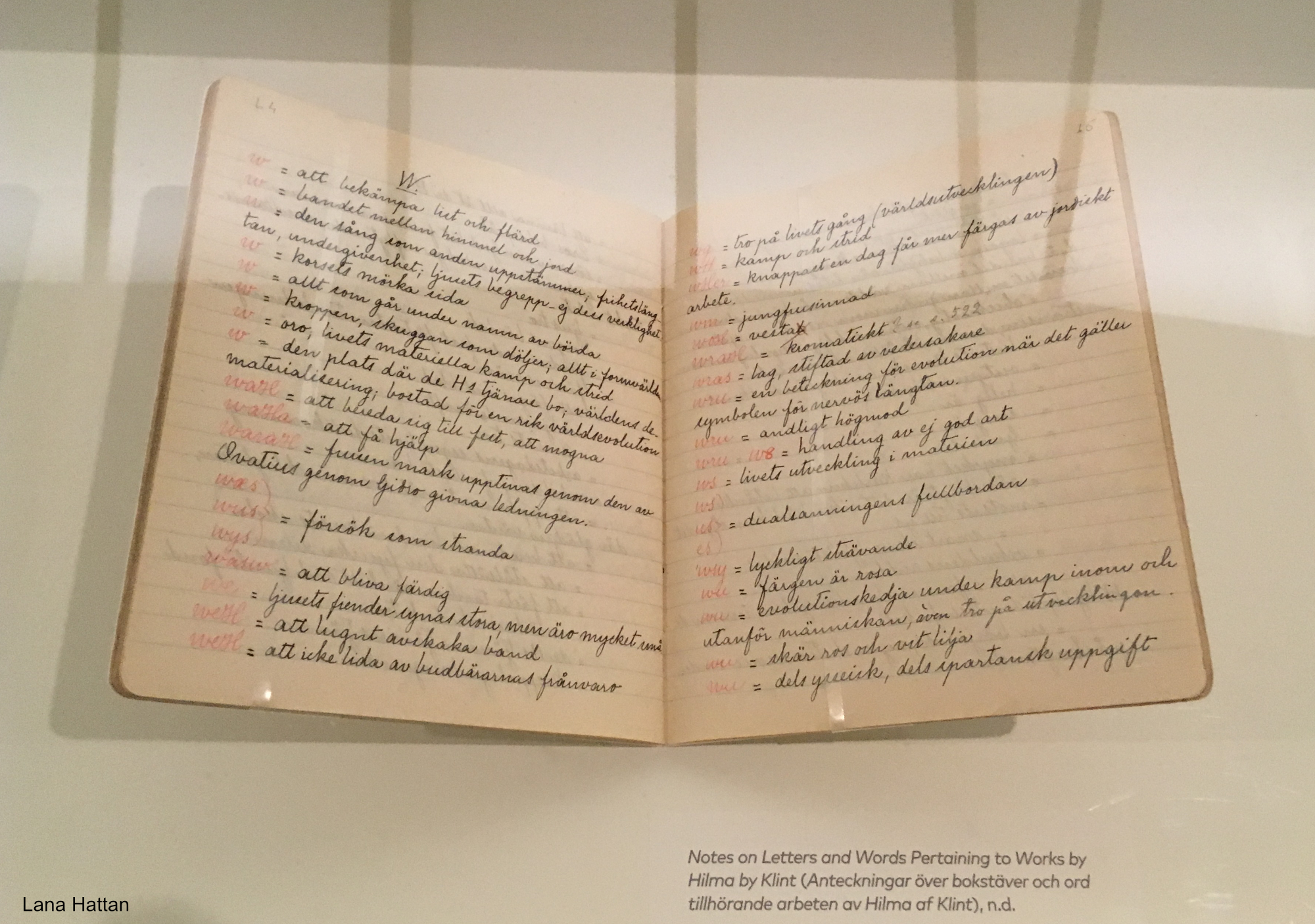
“Blue Book” Vol. 10. Hilma painstakingly recreated every one of her Paintings for the Temple (Painted, again, by hand) in a series of blue books on the left-hand page accompanied by a black & white Photo of the piece on the right-hand page, probably because color photography wasn’t yet practical. Guggenheim Museum, December 31, 2018.

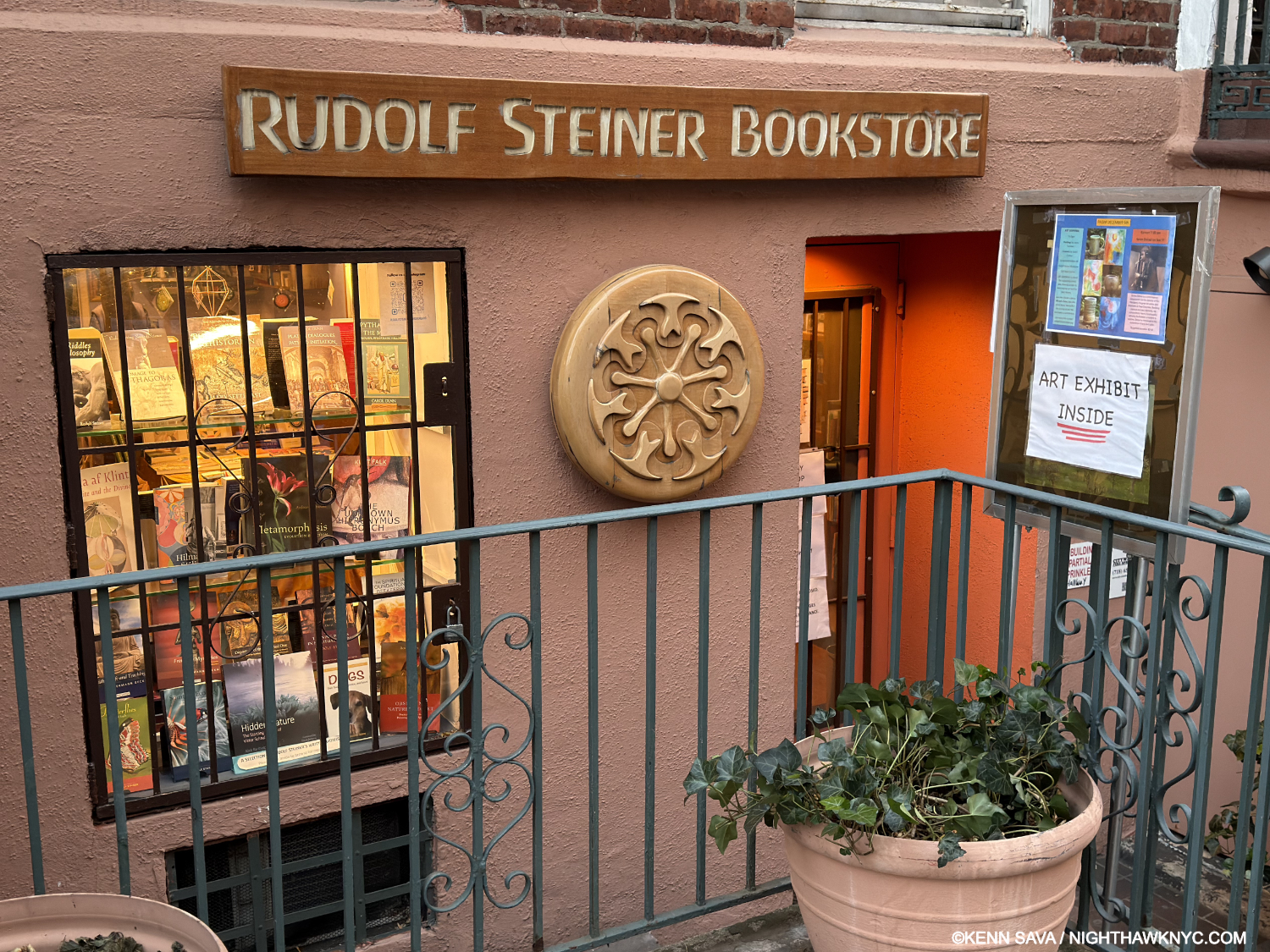
Hilma, a devoted, life-long spiritualist,t who attended seances (and believed her “most important work” was the 192-canvas series The Paintings for the Temple, 1906-15, partially shown earlier, which were guided by other beings), came to feel that her time wasn’t THE time for her Art to be seen. Since the entire Temple series is so numerous, and includes 10 very large Paintings, Hilma fastidiously recreated the entire series in 10 remarkable smaller “Blue books,” as they are known, a “portable museum,” which she carried with her to show Rudolf Steiner (in 1920), and others, in hopes of having the originals shown in a spiritual context. That’s how important it was to her.

This makes me wonder- How many “abstract” Artists would be able to exactly recreate 192 of their Paintings? An impressive technical achievement, that she could do it tells me that her compositions were no accident, something I think is important to bear in mind.
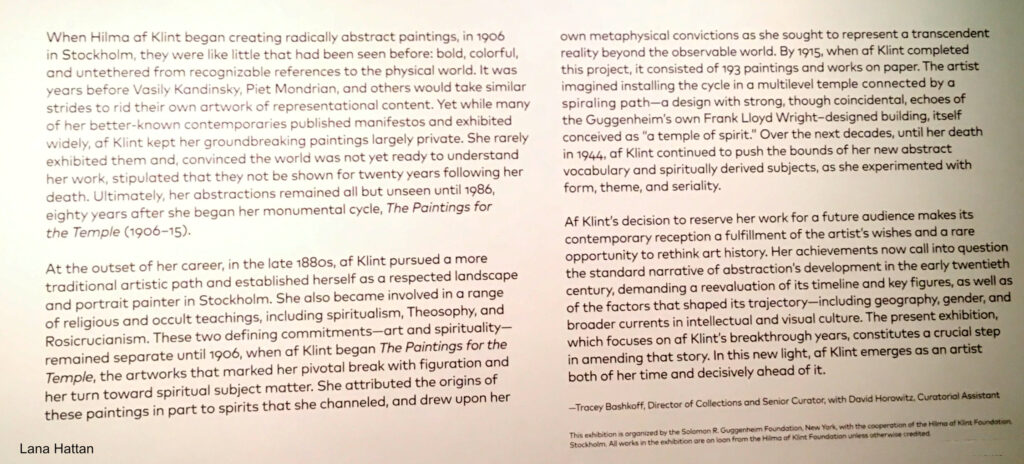
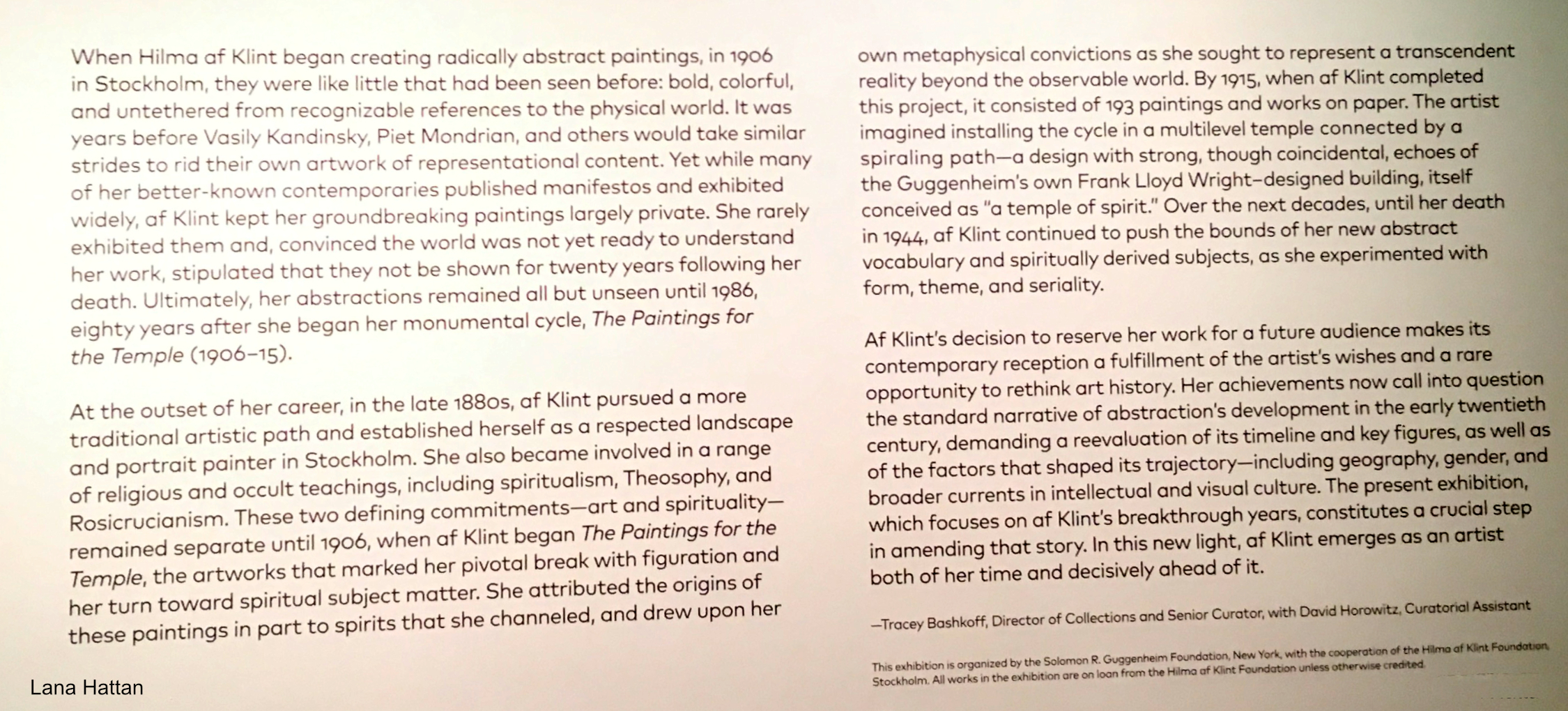
Is THIS the time Hilma envisioned for her work? The introductory wall card for Paintings for the Future on the Guggenheim’s curved wall outlines how the curators saw Hilma’s Art in 2018. I disagree with parts of this. For example, they mention HaK being “a respected landscape and portrait painter,” acknowledging she Painted in other styles, yet they ignore the fact that she returned to Painting representationally in 1919 with Nature Studies, as I show further on. They state her work was “untethered from recognizable references to the physical world.” What about the flowers and other natural elements that appear frequently, as shown in The Ten Largest picture earlier, and in Group VII (further on) and other pieces later on? *- Photo by Lana Hattan, Guggenheim Museum, December 31, 2018. Click for full size.

Failing to achieve this, in 1932, she decreed that none of her Paintings or Drawings should be shown until twenty years after her death in hopes of finding a more accepting time. Her work wound up being out of sight for 45 years. After she was tragically struck by a street car in 1944 and died from her injuries, her will left her entire creative estate to her nephew, Erik. Her work was stored in an attic for two decades before Erik had the Paintings unrolled and Photographed. Those 1,300 Paintings and 26,000 pages of text forms the basis of what is now the Hilma af Klint Foundation, which was created in 19724. The Foundation made a major effort to organize the work and prepare it for public display. Eleven of her Paintings were finally shown in The Spiritual in Art: Abstract Painting 1890-1985 in Los Angeles in 1986, but it wasn’t until 2013 that she finally received a full retrospective (in Europe), in a show titled Hilma af Klint: Pioneer of Abstraction (the catalog for which is also on my list).
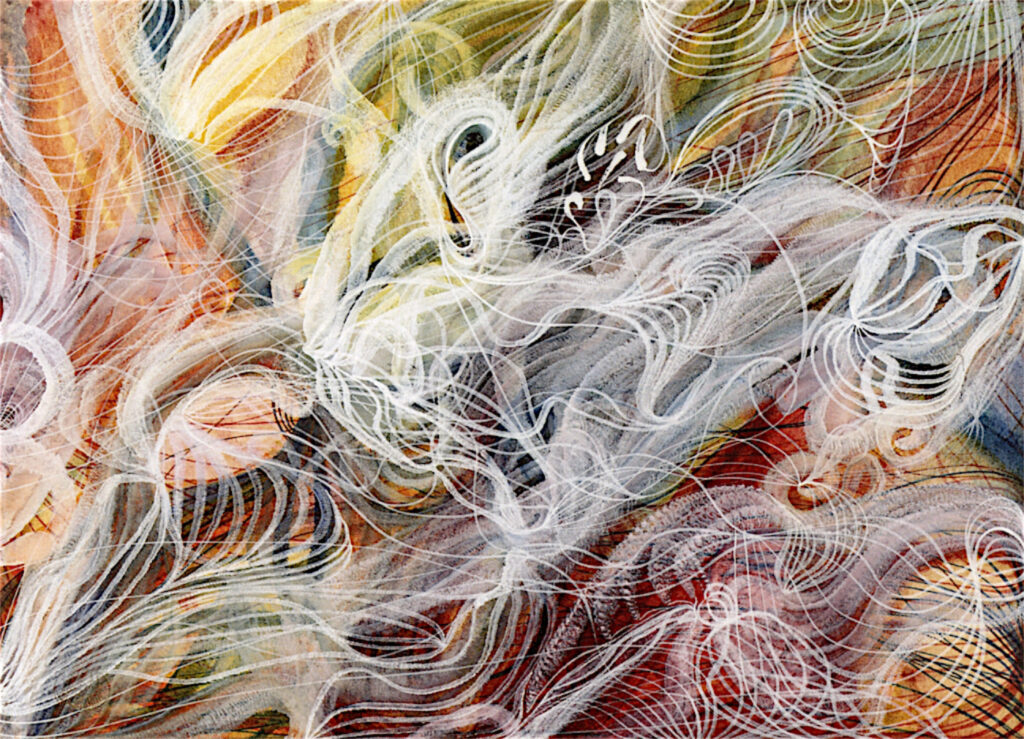
Georgiana Houghon, The Love of God, August 3, 1864, Watercolor and gouache on paper, 23.7 x 32.6 cm, An Automatic Painting, Hilma af Klint was about 2 when Georgiana Painted it. *-Victorian Spiritualists’ Union, Melbourne Photo.

That show rode on the hype about Hillma being “the first abstract Artist,” (says the Tate, no less) before Kandinsky, Mondrian, et al., and a woman. The truth is Hilma was not even the first woman in her spiritualist circle to create what they call abstract work- Georgiana Houghton (1814-1884), 48 years Hilma’s senior, who proceeded her in creating Automatic Paintings & Drawings, may be a better candidate for that title. But, boxing HaK as such helped the powers that be draw huge crowds to the 2013 show of a complete unknown. Paintings for the Future (one of the two most important NYC Painting shows I saw in the prior decade, along with this one) took things to an entirely different level. Six years later comes MoMA’s Hilma af Klint: What Stands Behind the Flowers, her first NYC museum show since the Guggenheim blockbuster. Hilma’s work doesn’t need any hype to “sell” it now. The world knows who she is. All the “abstraction” talk has kept people from looking at her work, in my view. It’s time to look at the Art for what it is.
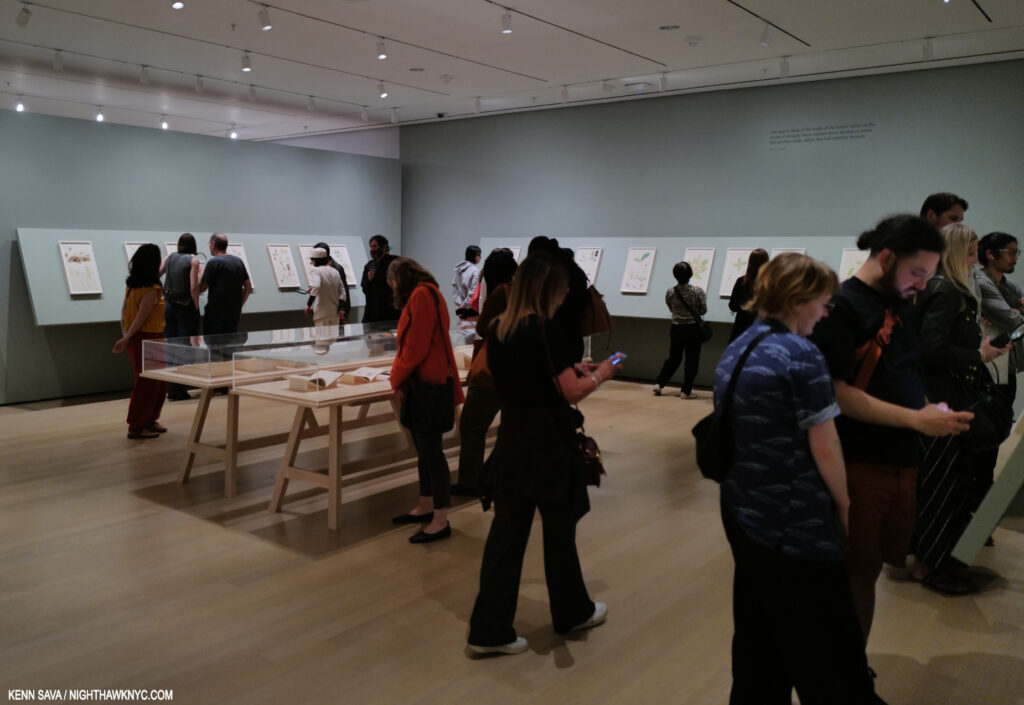
Installation view of the 2nd gallery of Hilma af Klint: What Stands Behind the Flowers at MoMA, which contained the first part of Nature Studies on the walls and a selection of her writings, and books by others on flower studies, in the center vitrine. Opening week, May 18, 2025.

What Stands Behind reveals that AFTER she completed the Paintings for the Temple in 1915, Hilma went back to working “representationally!” I guess no one bothered to tell her she was supposed to be an “abstract” Artist in the future. The more likely case is that HaK was a very talented and creative woman, an Artist more than capable of creating in whatever style she needed to work in for what she was trying to accomplish. It seems to me that THAT is a MORE impressive thing than sticking her in any one limiting box!

“One has to think of the realm of the nature spirits as the realm of thought; these entities hover around us, some like driving winds, others like soft summer breezes,” Hilma af Klint, MoMA wall card.
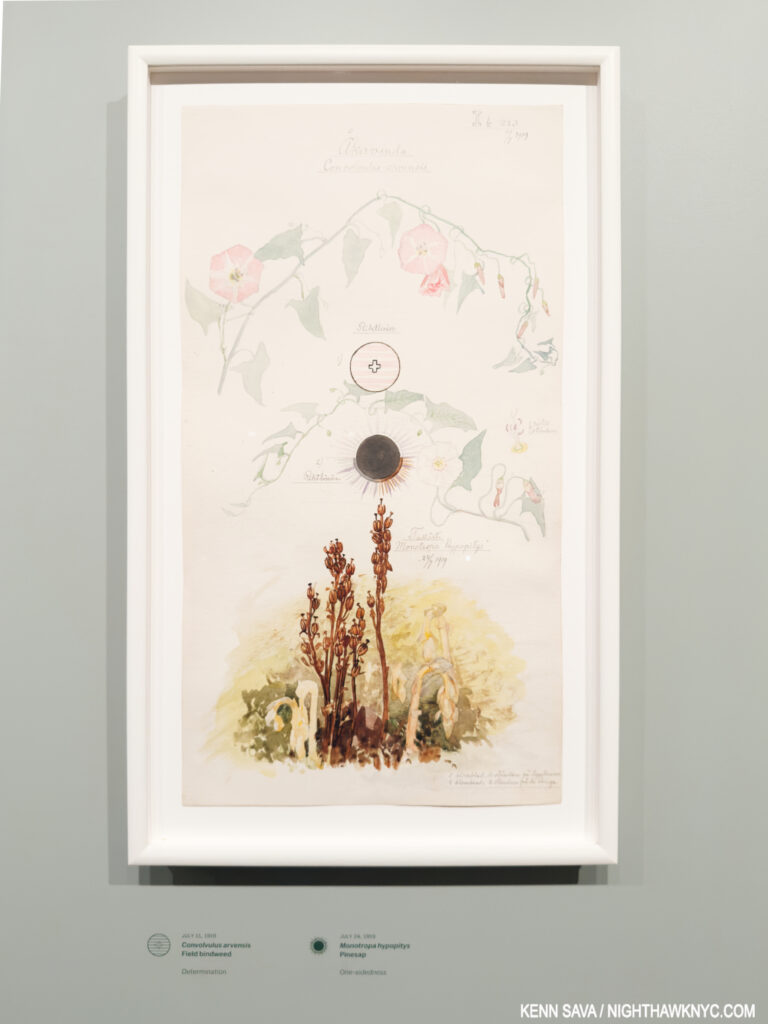
Convolvulus arvensis (Field Bindweed), Monotropa hypopitys (Pinesap). Sheet 20 from the portfolio Nature Studies July 11–24, 1919, Watercolor, pencil, ink, and metallic paint on paper. One of the 46 sheets in watercolor, pencil, ink, gouache and metallic paint on paper included in Nature Studies. Being 19 11/16 by 10 5/8 inches, these sheets would seem too large for Hilma to work on in situ. But that’s purely my conjecture. Unlike Georgia O’Keeffe, HaK didn’t confine herself to one specimen per sheet. Over 100 are included on the Nature Studies! Underneath, the curators translate HaK’s notations of the species name and its character as perceived by the Artist: “Determination” for the Field Blindweed, top, and “One-sidedness” for the Pinesap, bottom. MoMA, September 26, 2025.

She also continued to work on creating a “language” (see Group 2, further below) that included letters, words and diagrams. These are seen in almost all of the series she created in her life (including Nature Studies).
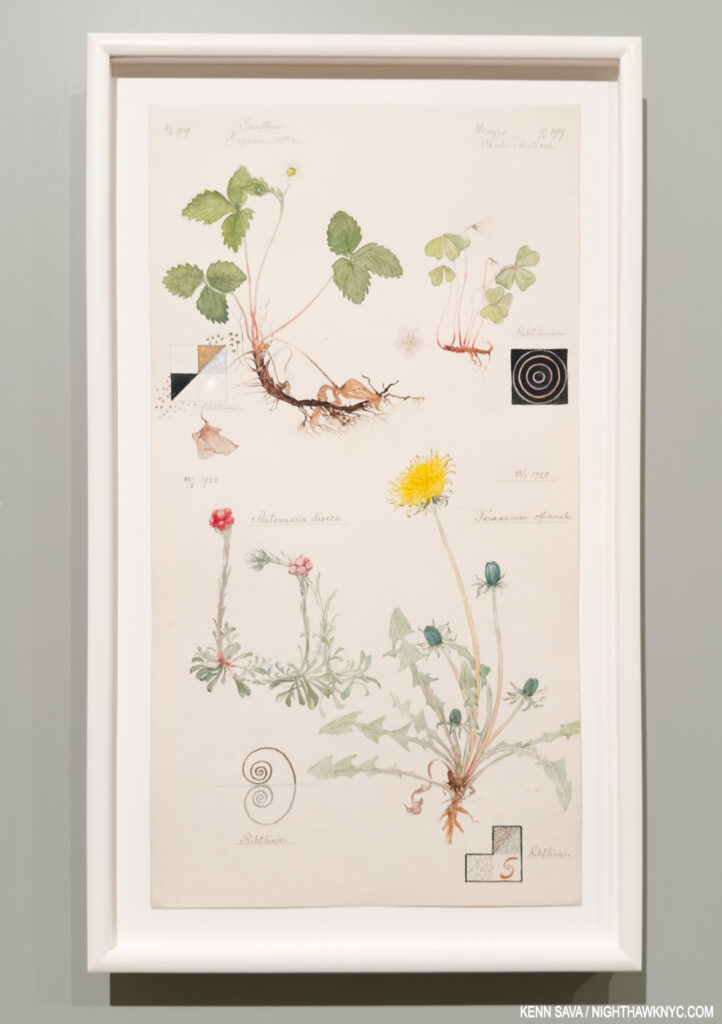
Woodland Strawberry, Hilma’s notation- “Liberator. Longing to produce balance within the blood syntem by expelling either white or red biood cells.” European wood sorrel- “Fragility-submissiveness shyness-humility fear -respect self-loathing-obedience.” Catsfoot– “Peace and harmony.” and Dandelion- “Beginning.”
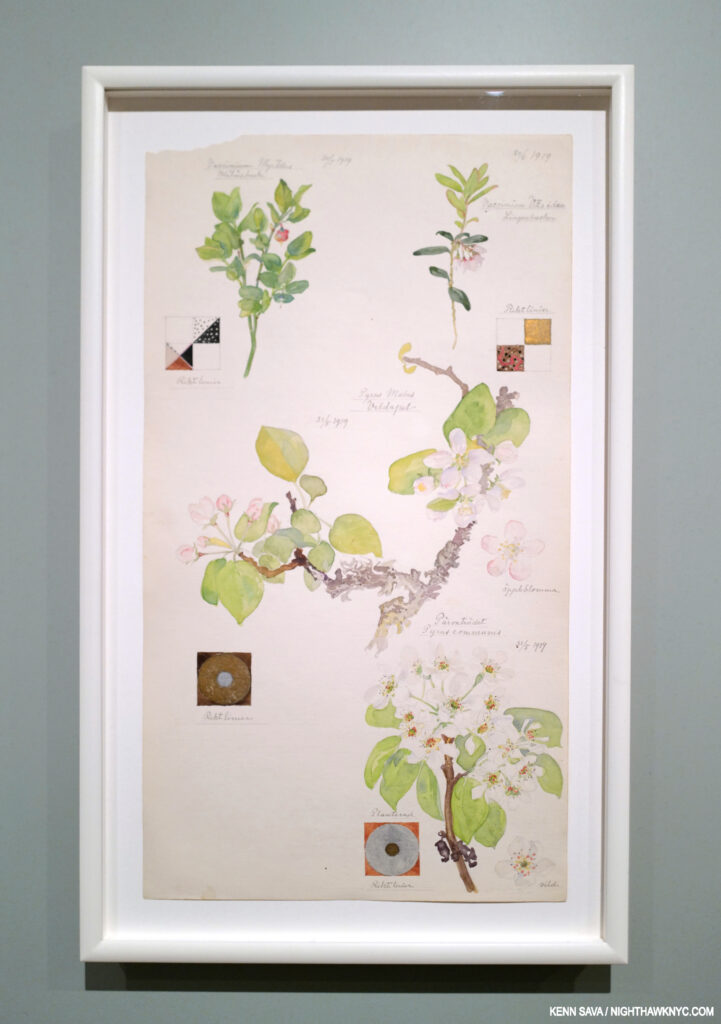
Bilberry, Apple, Common Pear, Lingonberry

Looking at Hilma’s Art is different than looking at the Art of any other Artist I know of. Quite a few of her Paintings for the Temple (as seen in the picture earlier) and other “abstract” works included at MoMA (below) have elements that look organic, including flower shapes. In some of her Temple series, lines of dots connect figures, reminiscent of the af Klint family’s heritage as noted cartographers & mapmakers. Then, any number of her pieces, including almost all her Nature Studies, include diagrams that contain basic geometric shapes- circles, squares, cones, etc. The viewer needs to decide what to make of them, or look to the Hilma’s Notebooks for insights. Finally, there’s the “language” the Artist developed, abetted by her use of letter “codes,” as Julia Voss outlines in her Biography. As a result, it seems to me there is still a long way to go in coming to fully understand Hilma af Klint’s work. Lumping it all into ANY one-word catchphrase box only takes us further away from that point of truly understanding it-if that’s possible.
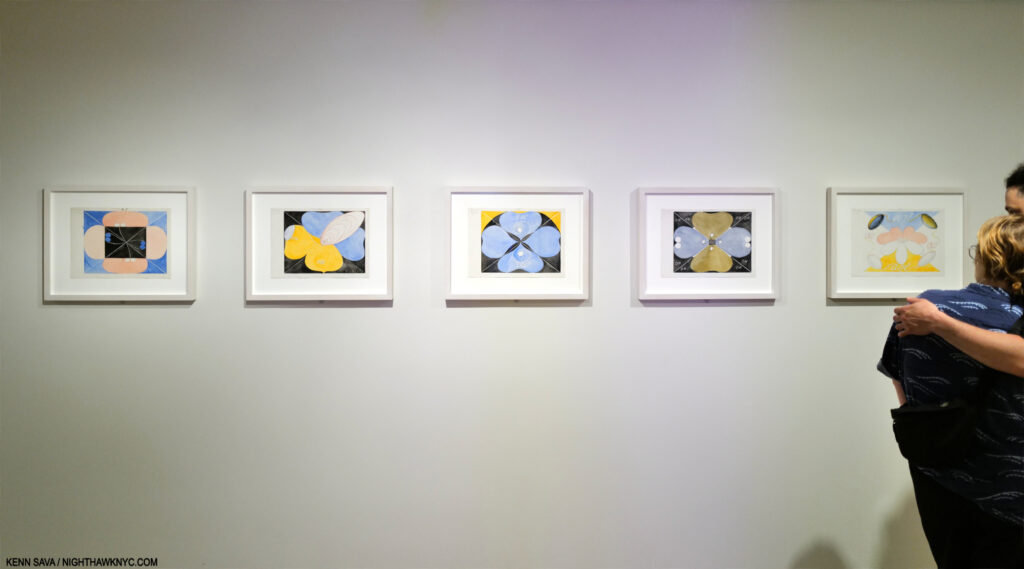
Group VII, No 1-5, from the US Series, 1908, Watercolor and pencil on paper. 11 years. before the Nature Studies portfolio, what seems to be flower-like shapes abound. Seen at the beginning of  MoMA’s show.
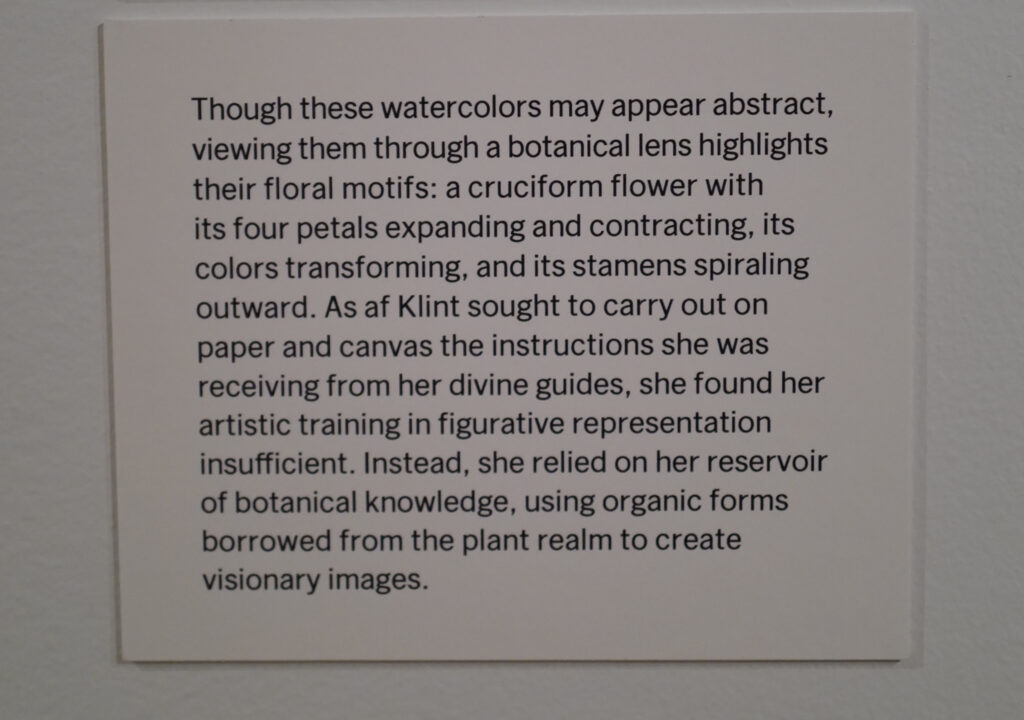
The wall card for Group VII. Installed at the show’s entrance, is a relatively rare instance of the Art world looking beyond Hilma the “abstract Artist” thus far, or hedging their bets on their use of that box. Here, the organic shapes are accompanied by letters that are parts of the “code” Hilma used. See next.
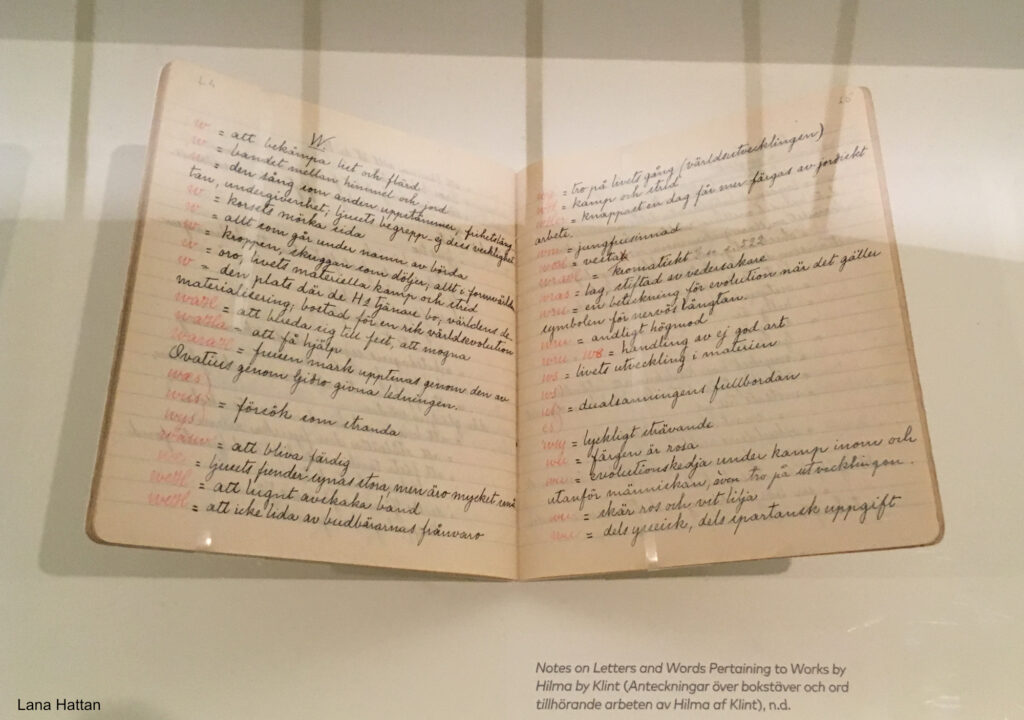
Another piece of the puzzle. Hilma’s original Notebook containing her Key to the mysterious words and omnipresent letter “codes” she used throughout her oeuvre. It’s an essential part of “decyphering” her work. Hilma’s code is detailed in English in the book Hilma af Klint: Notes and Methods. *- Photo by Lana Hattan, Guggenheim Museum, December 31, 2018.

ALL this talk about Hilma’s style misses the point! Hilma was not out to win any “style wars.” All of her work was about something entirely different, and that difference was substance over style.
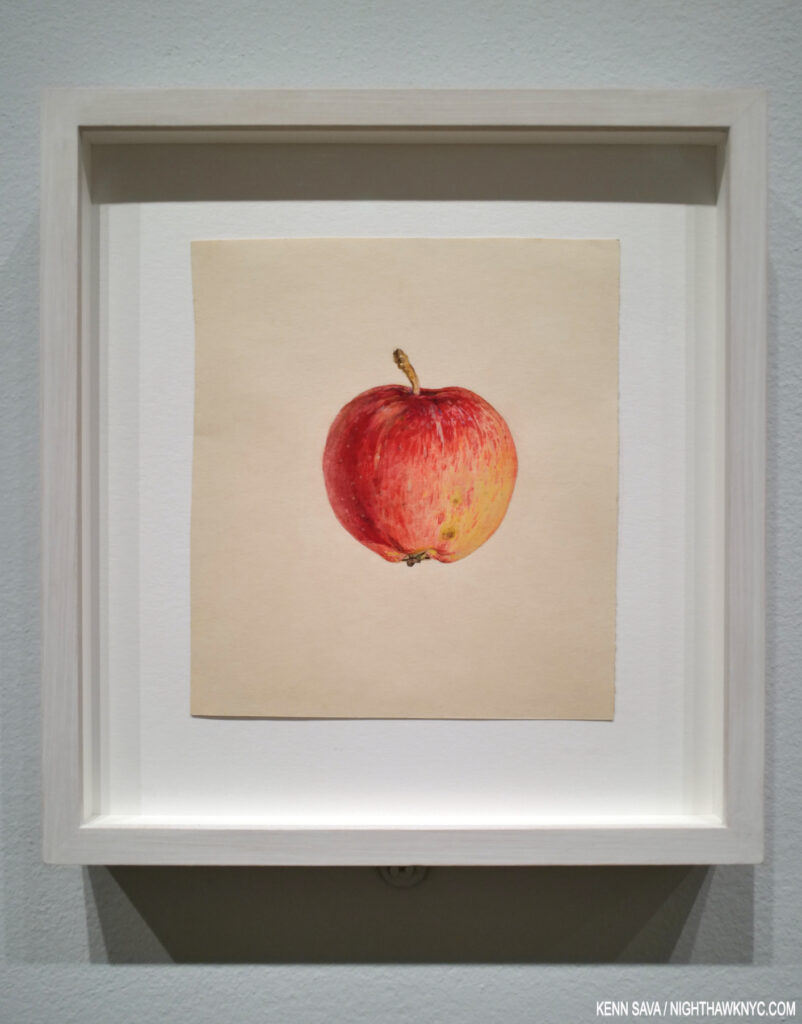
Apple, no date, Watercolor on paper. Virtually every Art or Drawing class begins with rendering, coloring & shading basic shapes, like the sphere (often an apple, orange or lemon). Here HaK takes it to an entirely different level, and we get to marvel at her powers of observation, especially in the incredibly subtle variance of the local color. It’s also fascinating to me how minimal the shadows are, something you never see taught in how-to books which glory in the different kinds of shadows. In most of her Nature Studies, except the previous one, Hilma leaves out the ground, as she does here, too. In this case, doing so gives her the chance to show more of the bottom detail, again something I can’t say I’ve seen done often.

On the opposite end of that spectrum from the 21st century hype around it, there is something else at the beating heart of her work, something her “abstract” Paintings for the Temple and her representational Nature Studies have in common, and something that is at the core of the recent debate regarding continuing to publicly display her work. Hilma af Klint’s work is centered on the spirit. She created her work for fellow spiritual seekers. The Paintings for the Temple are devoted to the human spirit (with the aid of spirits who have moved on to another level). After completing them in 1915, never one to think small, the Artist turned her attention to an even bigger subject- the spirit of the natural world, commencing with the atom, in works that filled three quarters of the first gallery at MoMA, before moving on to the spirit in nature, beginning with flowers (in Nature Studies), which filled most of the succeeding two large galleries. These were supplemented by her late Flower Watercolors, which reminded me of some of Georgia OKeeffe’s Watercolors that were shown in these galleries at MoMA in 2023. The bottom line is that Spiritual Art is still outré to the Art machine, whatever type it is. They can’t sell it, and Art without monetization does not keep the Art machine going.
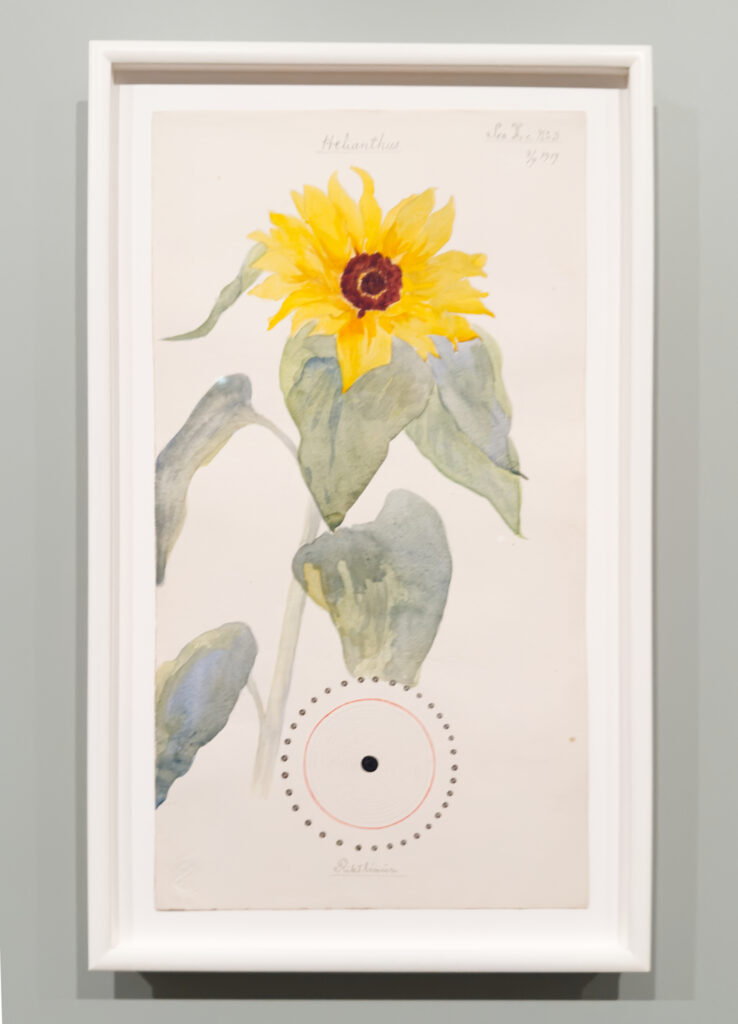
Common Sunflower. To Hilma- “Love is the greatest of all.”

Meanwhile, throughout What Lies Behind, part of the sheer joy in looking at her work, her marvelous technique shines in piece after piece. It’s surprising to me that Hilma has gotten so little credit for it. She came upon it the hard way, through continual hard work and 6 years at the Royal Academy of Fine Arts. This was followed by work as an Illustrator, including illustrating a book on horse surgery by the director of the Veterinary Institute, Stockholm, who kept Hilma’s Drawings for the rest of his life.
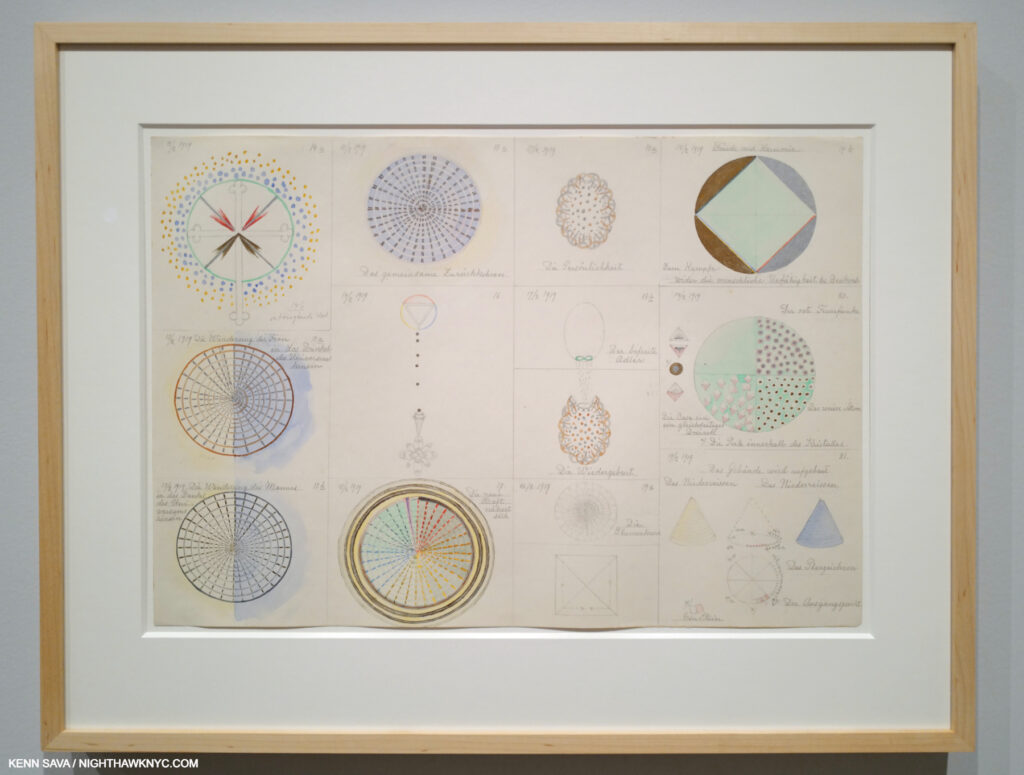
From Group 2 February 12-19, 1919 Watercolor, pencil, and metallic paint on paper. This was one of numerous examples of her technique I could site. Here, we see the Artist working on ideas for herself in a series of sheets titled Group 1, Group 2, Group 3. No matter for public display or her own purposes, Hilma was always meticulous in her execution. Of the Groups, MoMA says- “Together, the drawings form narratives that allude to pollination, reproduction, and evolution. By April 19, 1919, after more than three months of progress, af Klint had established a vast and diverse diagrammatic language. The very next day, she began her Nature Studies portfolio.”
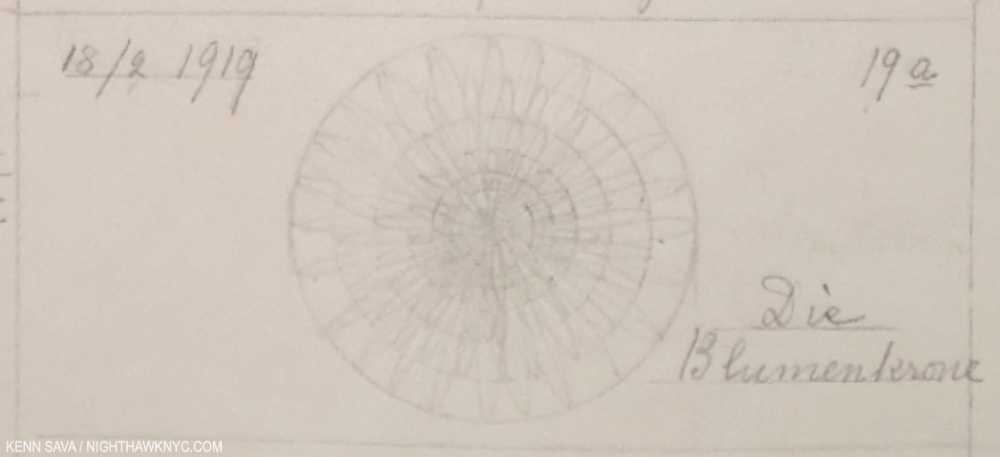
This enlarged detail of the lower center of the previous image perhaps measures 3 or 4 inches wide by an inch and change high (the bounding rectangle). Easy to miss because it’s in pencil and the actual Drawing part seems to have faded,  it’s noteworthy for two reasons. First, its meticulousness, and second for the title- Die Blumenkrone means “The Flower Crown.” Even in the dead of wnter (i.e February 18th as the date reads), Hilma had flowers on her mind.

What Stands Behind also makes the case in spades or her accomplishment as a Watercolorist- both in her Flowers and in the later Flower work (not part of the Nature Studies series) shown in the final gallery, in a different style again, as seen below.
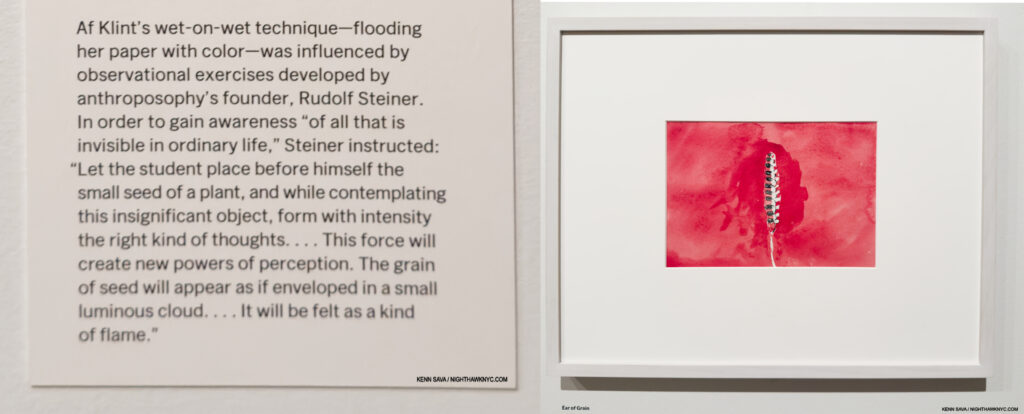
Ear of Grain, 1922, Watercolor on paper, from the series, On the Viewing of Flowers, with a apparetnly relevant section of the wall card, left. MoMA, September 26, 2025.
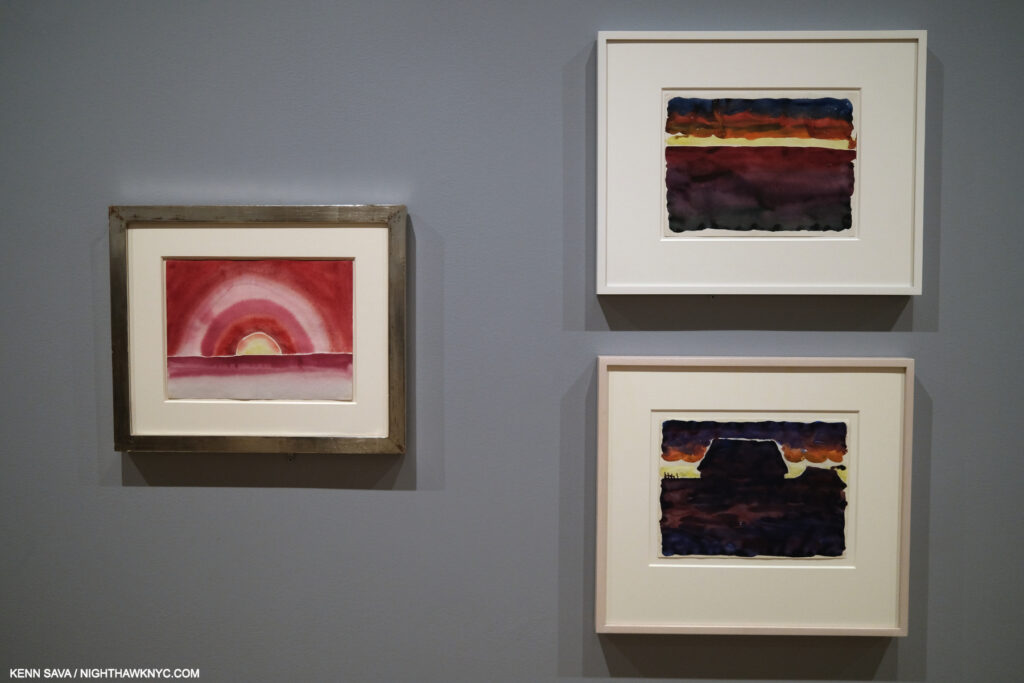
Georgia O’Keeffe, Morning Sky, left, and Morning Sky, and Morning Sky with Houses, right, 1916, Watercolors on paper. MoMA, September 9, 2023.

I might be the only one to draw parallels between Georgia O’Keeffe & Hilma af Klint, but when I saw the wall of 1922 Watercolors by Hilma in the last gallery, including Ear of Grain, above, I couldn’t help but recall Georgia’s Watercolors that had been hung in these galleries two years previously. It’s fascinating to think about their commonalities, as extraordinary, ground-breaking Artists, and as extraordinary women, at much the same time, on almost opposite sides of the globe. What Stands Behind The Flowers begins some of the heavy lifting on the road to assessing Hilma af Klint’s full accomplishment. In spite of that, I’m not sure THIS is the ideal time Hilma envisioned for her Art to be shown.
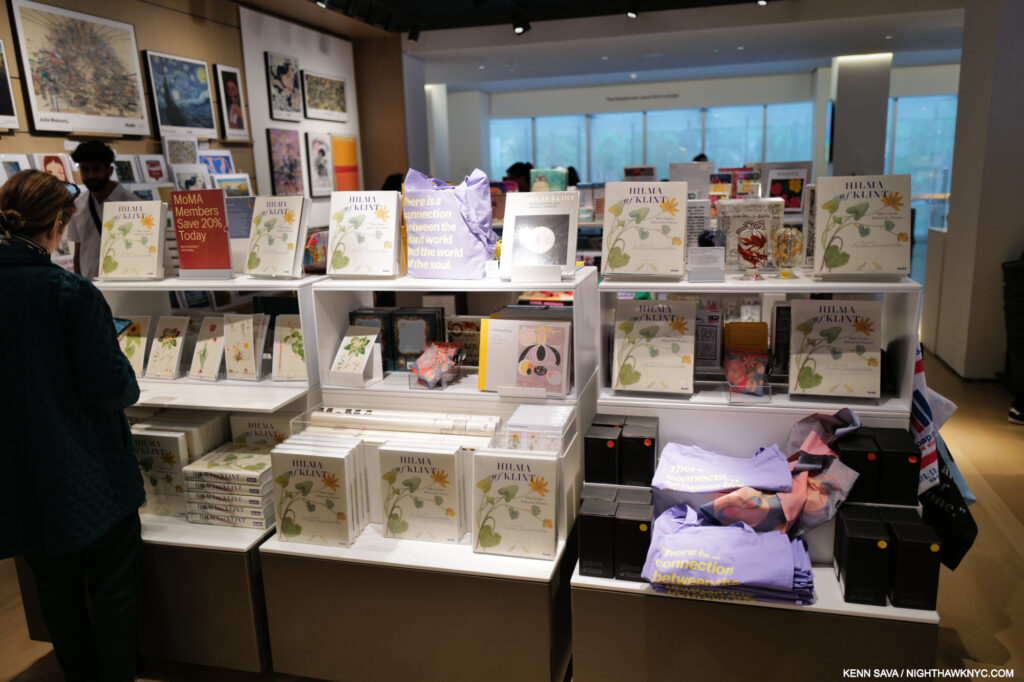
MoMA Gift Shop display for the show. More items behind me and to the left. While I’ll reserve comment on the other items, MoMA’s Exhibition Catalogue for the show is highly recommended. May 18, 2025.

In too many (most?) cases today a work of Art is mentioned followed by its price as if that’s the most important thing about it! Then, the rush is on to plaster it on everything from umbrellas to baby onesies. Hilma’s spiritualist Art stands directly at odds with that. She opposed materialism in Art. To this point, it’s largely escaped it (though MoMA, who has come to own Nature Studies, produced a $500.00 Limited Edition of it, as far as I can tell, the first Hilma af Klint Limited Edition, in addition to putting the series on refrigerator magnets, postcards and a poster)5.

Rebel. With a cause.

Trapped in the future. But, is this THE future she envisioned for her Art? One of the few Photographs of Hilma af Klint. This one was affixed to a wall at the Guggenheims’s landmark Paintings for the Future in 2018.

Perhaps this experience sounded a warning bell. Earlier this year a struggle broke out inside the Hilma af Klint Foundation about whether or not her work should continue to be exhibited. The Foundation’s chairman of the board, af Klint’s great-grandnephew, who, like his great-grandfather, is also named Erik af Klint, is against it feeling that Hilma wanted her work to be seen in a spiritual context by fellow seekers, i.e. to “keep the work available to those who seek spiritual knowledge or who can contribute to fulfilling the mission that Hilma af Klint’s spiritual principles intended.”
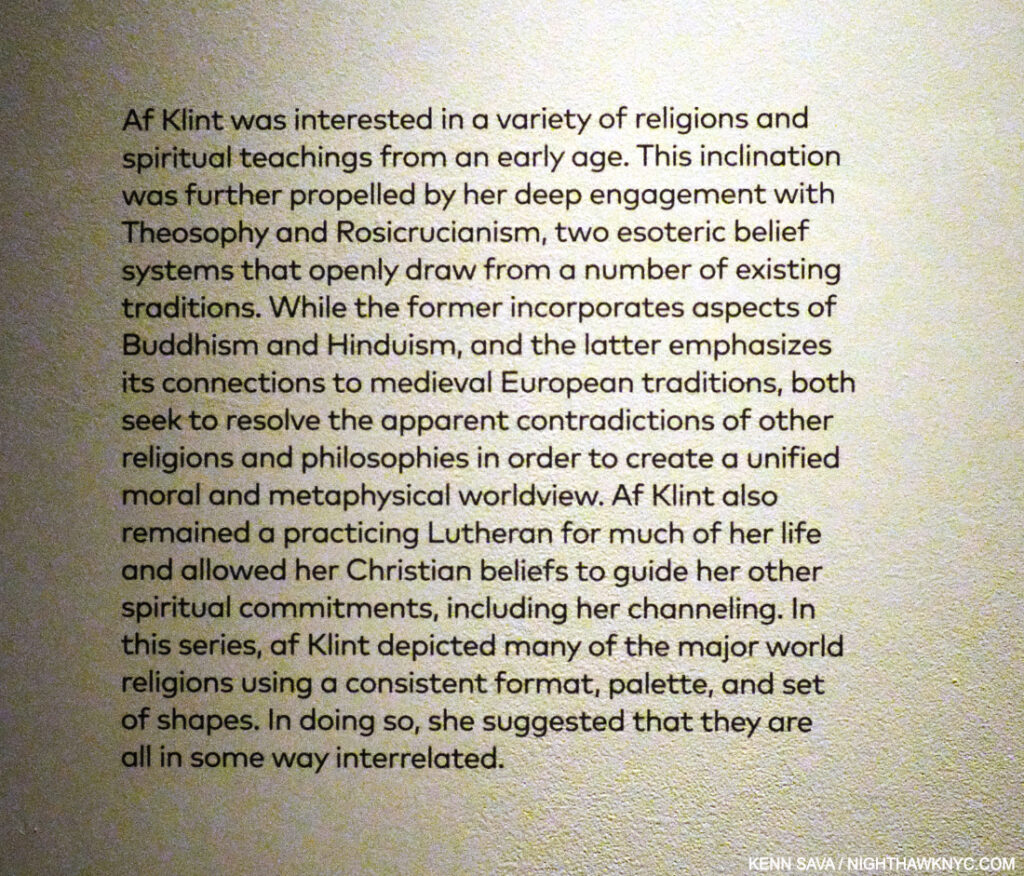
On Hilma’s spiritualism. Guggenheim Museum, December 31, 2018..

Therefore, I think there is a strong case to be made for ending public displays of her work at this point. Perhaps a future time will be more ready to accept, and see her work as she intended it to be seen, and provide the Artist’s full accomplishment with the respect it deserves..
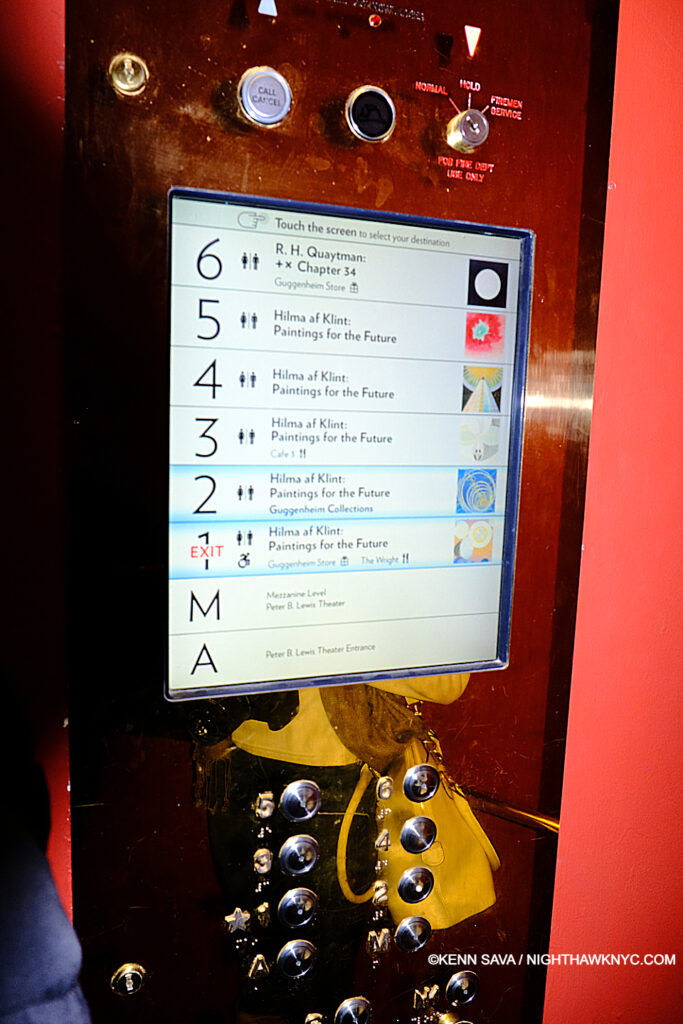
“Beam me up, Frank!” The control panel on Frank Lloyd Wright’s semi-circular Elevator at the Guggenheim. December 31, 2018.

Experiencing Paintings for the Future at Frank Lloyd Wright’s Guggenheim brought home another problematic aspect of experiencing Hilma af Klint’s work today.
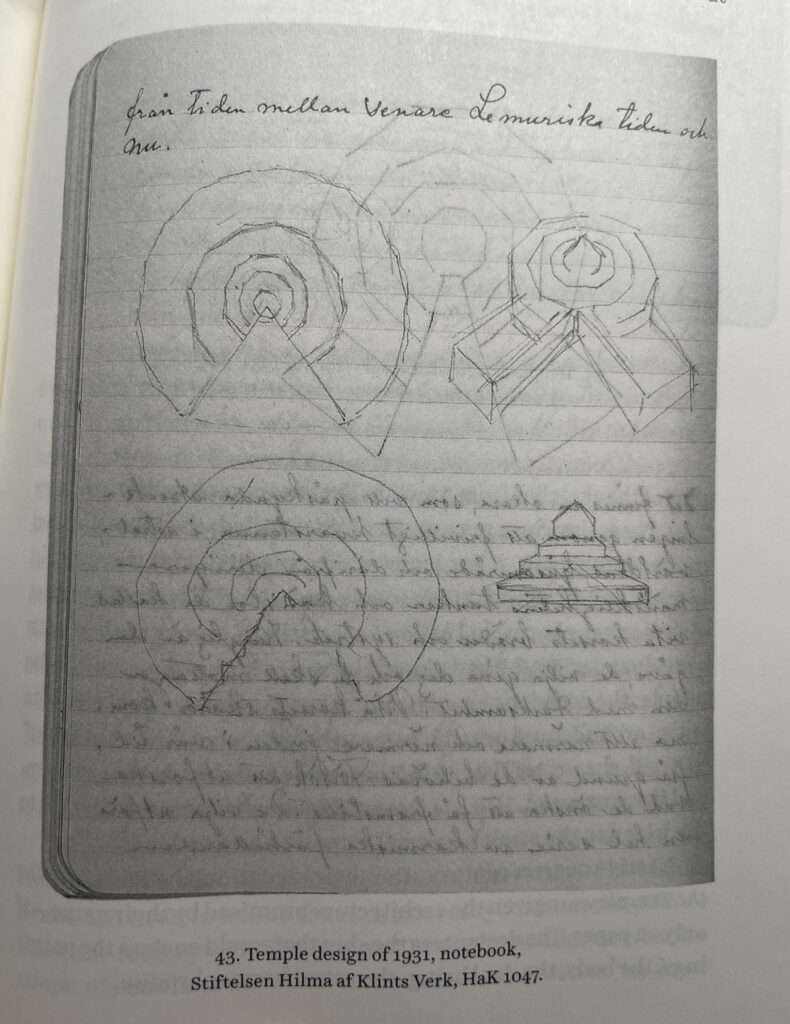
Temple Design, 1931, Notebook in the Hilma af Klint Foundation Collection (*) as seen in Julia Voss, Hilma af Klint.

It turns out that Hilma had not only envisioned that “ideal space” for the display of her work, i.e. a “Temple” as she called it (as in her Paintings for the Temple series), she put some of her ideas for it down on paper.
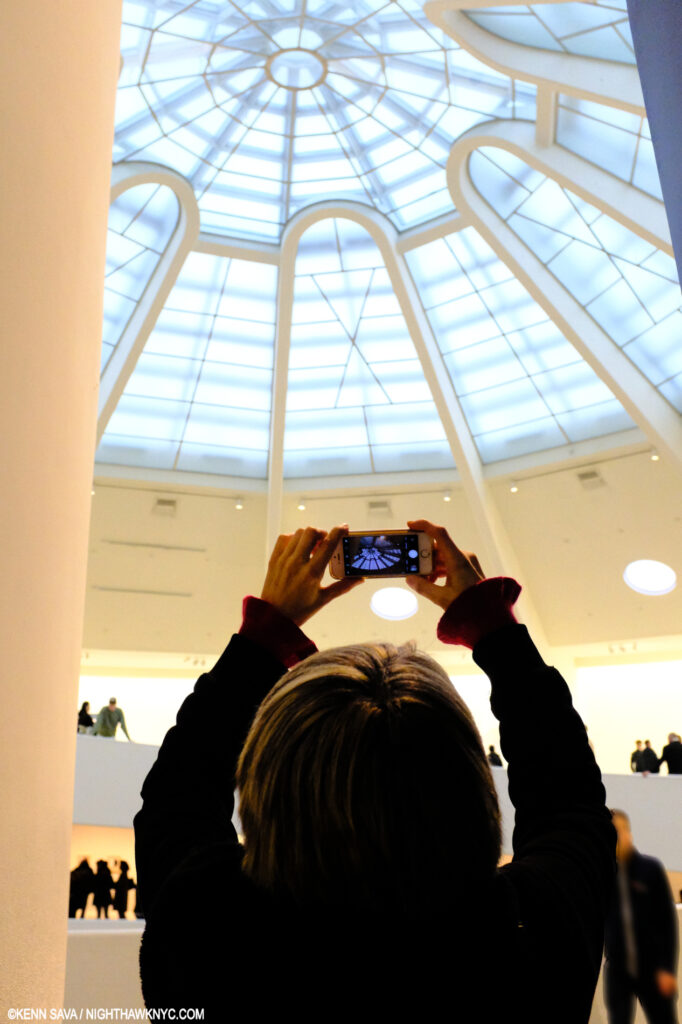
Lana Hattan immediately upon exiting the elevator on the 6th Floor, in both of our favorite buildings, in one of my favorite pictures of her. I thank her for her generosity in allowing me to publish some of the Photos she took that day. December 31, 2018.

Her sketches for it have quite a bit in common with Wright’s masterpiece on 5th Avenue. Both feature circular floors or ramps that rise to a top that opens up to the sky. Also coincidentally, Hilla Rebay, director of the Museum Non-Objective Painting which  preceded the Guggenheim Museum, said she envisioned “people communing with the work in Solomon R. Guggenheim’s collection in a a ‘temple of spirit.6,'” in commissioning Wright to design it.
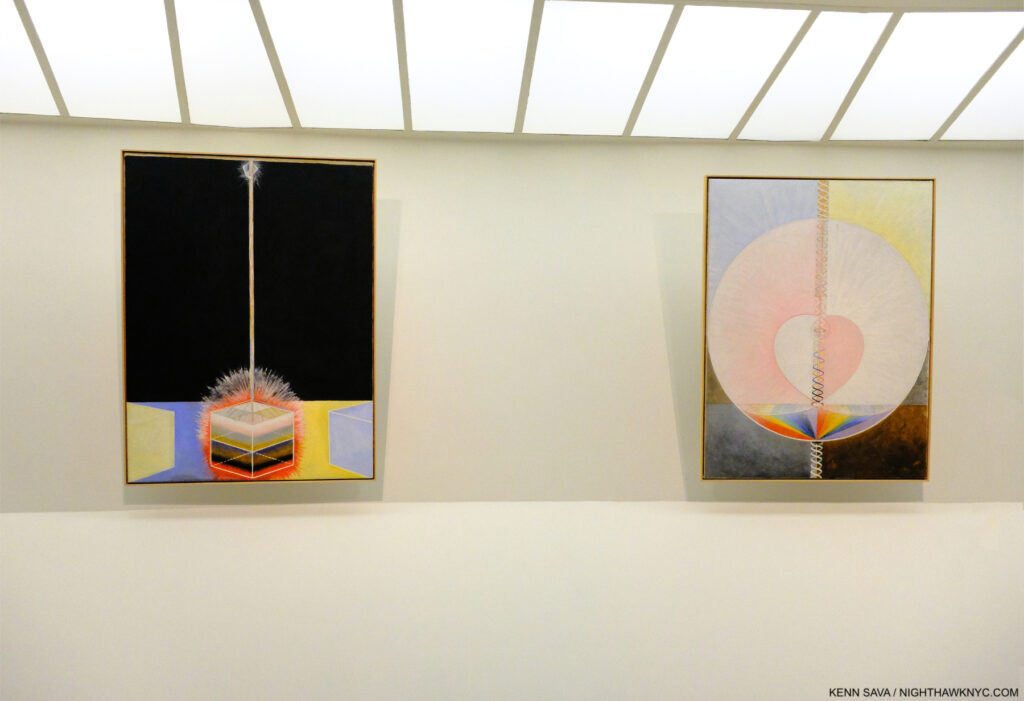
Group IX/UW, The Dove, No. 3, left, Group IX/UW, The Dove, No. 1, right, both from The SUW/UW Series, 1915, Oil on canvas.The work on the right is the original of the work she reproduced by hand in the Blue Book picture shown earlier. Guggenheim Museum, December 31, 2018..

I didn’t know about her Temple, or her Drawings for it, when I saw the Guggenheim show, yet I came away feeling the Architecture added exponentially to the experience of it. At this point, it leaves me feeling her dream should be realized, though that’s not part of the current discussion (as far as I know). Failing to realize the Temple she had envisioned to hold at least part of her work, it remains in a sort of limbo without it.

Of course, today’s Art machine is adamantly opposed to Hilma shows ending, seeing a potentially huge marketing opportunity vanish. Her art being for spiritual seekers, is diametrically different than how the Art world sees it now. Spiritual seeking vs dollar signs- I’ll be interested in seeing which way this one turns out, but I’ll be hoping Mr. af Klint succeeds. (Digression for full disclosure- In case anything I write here makes you wonder, I’m not a religious person. I’ll leave it at that and end the digression.) I’ve always believed the Artist’s intentions for her (or his) work should be respected above all else. As for all those who will bemoan not being able to see her work, consider that for most of the past 30 years Jean-Michel Basquiat has been THE most popular Contemporary Artist in the world, and almost none of his work is in the hands of museums or public collections resulting in a paucity of shows, as I discussed here7. Somehow his popularity has continued to increase without direct access to his work.
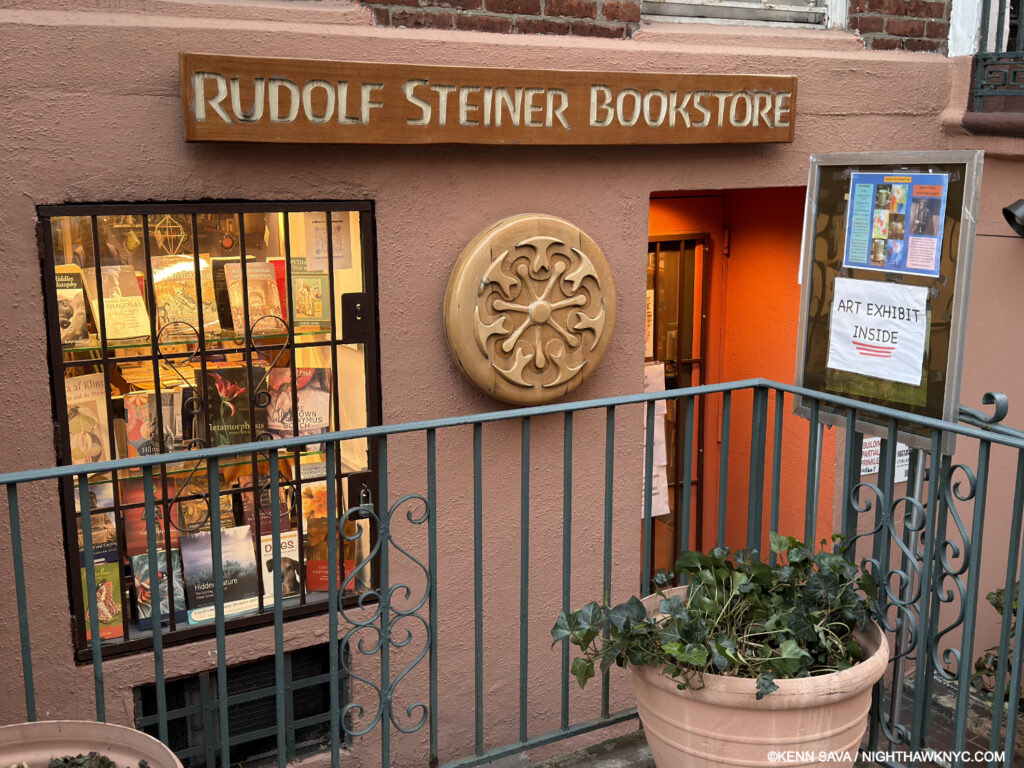
Hilma af Klint books for sale in the window at the Rudolf Steiner Bookstore in Manhattan. A long-time admirer of Mr. Steiner, I think she’d be ok with this. December 11, 2025.

Hilma’s work can be seen by everyone in the excellent seven-volume Catalogue Raisonne her Foundation has published (which I collectively named a NoteWorthy Art Book of the 21st Century), and a number of other books. For those who want to know more about Hilma, Julia Voss’s excellent Hilma af Klint Biography is the current go-to source and a must-read. It reveals an extremely private woman who was solely focused on her spiritual development and her Art to the extent that she wrote virtually NOTHING about herself and her private life in those 26,000 pages she left! But, she did make crystal clear what she was about and what she wanted for her Art.

If Hilma were alive today would she be enamored with the Art world and its machine, an Art world that seems to have no clue how to handle “spiritual Art?” I have my doubts. That future she envisioned in the 1930s still feels like a dream. So, it just might be a good thing if Hilma af Klint shows stop. Some further point in the future may be a better time for her work to be seen & fully appreciated- one without  an Art world in such a hurry to judge it, box it, and associate it solely by the dollar signs it hangs on it.

Wake me up when we get there.

*- Soundtrack for this piece is “Bring My Flowers Now,” by Tanya Tucker, the de facto title track from her 2019 album, While I’m Livin’, which she performs here-

“I know we’re gonna ride again someday…”

NighthawkNYC.com has been entirely self-funded & ad-free for over 10 years, during which over 350 full-length pieces have been published! If you’ve found it worthwhile, PLEASE donate securely by PayPal below to allow me to continue. Thank you, Kenn.

You can also support it by buying Art, Art & Photography books, and Music from my collection! Art & Books may be found here. Music here and here.

Written & photographed by Kenn Sava for nighthawknyc.com unless otherwise credited. To send comments, thoughts, feedback or propositions click here. Click the white box on the upper right for the archives or to search them. Subscribe to be notified of new Posts below. Your information will be used for no other purpose.
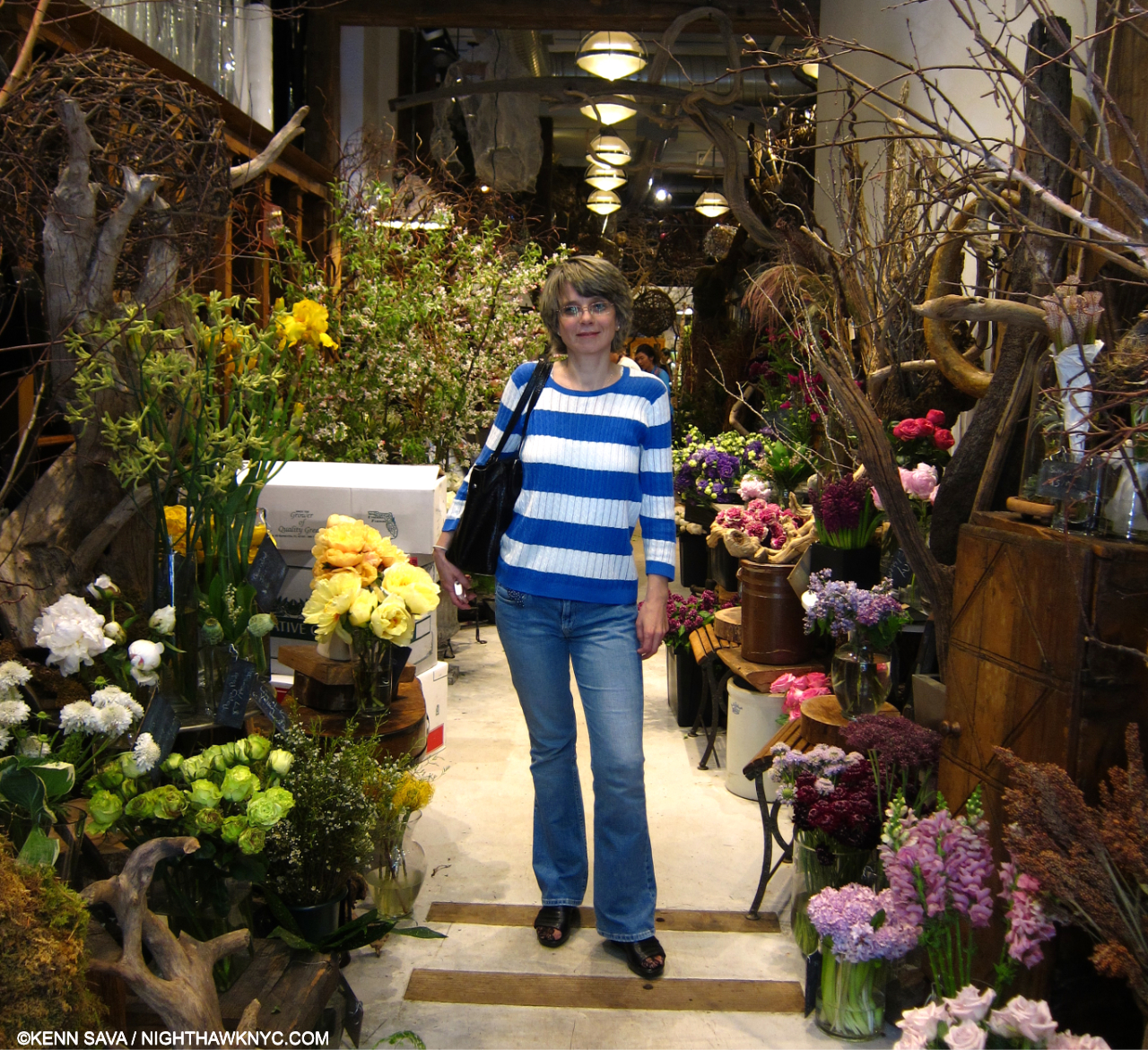
  1. The last show we’ve been able to see together.
  2. She would begin Painting flowers in earnest in the mid-1920s.
  3. Ms. Quaytman’s book Spine and her new book, Book, 2025, are on my list of NoteWorthy Art Books of this century.
  4. Julia Voss, Hilma af Klint: A Biography, PP..1,2 & 4. After mentioning I was in the middle of reading it at the time I published my NoteWorthy Art Books of the Century piece, I’ve added A Biography to the list. A marvelous accomplishment with a terrific translation from the original German, it’s essential reading for anyone interested in HaK.
  5. I’m still a bit puzzled by Nature Studies’ Provenance. MoMA’s site says they bought it, but from whom and how that owner came to own it is unspecified. How it didn’t wind up in, or being acquired by, her Foundation puzzles me. I tried to find out, but received no answers.
  6. Here.
  7. By the way, I have managed to cover almost every single NYC Basquiat show these past 10 years, so you can see a good deal of his work here.

Shakespeare, After All…

THIS STIE IS FREE AND AD-FREE!
If you find this piece worthwhile, please Donate securely via PayPal so I can continue doing them. Thanks!

Written & photographed by Kenn Sava (*- unless otherwise credited).

Having announced that I’m taking a break from Art writing in September to recover from a year’s worth of illnesses and ailments, compounded by the absence of any means of support for Independent Art writing, I’ve finally had time for something else!

In what little free time I have not spent working on surviving I’ve turned to Literature. Not one of the “Visual Arts,” per se[1, though everything he wrote was written to be performed. What we have was collected 6-7 years after his death in 1616, in The First Folio, by John Hemming and Henry Condell, fellow members of the King’s Men with Shakespeare, to whom the world owed an incalculable debt- 20 of his works find their only reliable text in it. Shakespeare never wrote with the intention of publishing, only of performance, a Visual Art..], but an Art, of course, nonetheless.

It’s like he’s been there waiting for me for my whole life…Shakespeare, by John Quincy Adams Ward. I’m not a fan of any of the Statues in Central Park besides Bethesda Fountain, the two in Conservatory Garden,  and this one. Seen on October 27, 2024. Click any picture for full size.

Having been assigned to read James Joyce’s Dubliners as a senior in high school, the highest grade I was allowed to attain by my parents, so taken by it was I that I went on to his A Portrait of the Artist as a Young Man and then Ulysses on my own after. And so ended my life’s experience with Literature (and formal education for that matter. Everything I “know” now I learned on my own, except how to read & write and basic math). My life then became an endless procession of Art book after Art book. Until September. With no Art pieces hanging over my head to finish, in late September I decided to try and begin to try fill that gnawing Lit gap that’s been there for a very long time indeed. Immediately, there was NO DOUBT in my mind who I would turn to first in this quest.

William Shakespeare (circa April 23, 1564- April 23. 1616)

Edward Hopper, Shakespeare at Dusk, 1935, Oil on cavas. Literary Walk, Central Park, 90 years ago. The same Sculpture I shot above, 89 years after Hopper Painted it.  The inscription on the base says it was installed here in Central Park in honor of  The Bard’s 300th Birthday, which was in April, 1864. Yet, the Artist inscribed “1870” under his signature. Something is wrong in the State of New York.*- Photographer unknown.

Believe it or not, I’ve reached this stage in my life and never once cracked open one of his Plays or collection of Poems. HOW is that possible?  I blame my teachers. I remember being assigned such things as Ivanhoe in school which my book report on received a failing grade for primarily because I just couldn’t even bring myself to even open it. At the same time, my parents confiscated my copies of Orwell’s Animal Farm and 1984 because the “legion of decency” (small caps, mine-they were neither) blacklisted them. Suffice it to say that if I read Lit for the next 50 years, Ivanhoe is STILL going to remain unopened!

I quickly realized, however, that it may be impossible to reach adulthood without your life having been touched by William Shakespeare- even if, like me, you’ve never read him! How? Lines from his Plays and Poems have become cliches in many of our daily lives, often/usually without realizing their origins. FIFTY of them, including “For goodness sake,” “Too much of a good thing,” “Vanish into thin air,” or “All’s well that ends well,” can be found here! 

Edward Hopper, Study for Shakespeare at Dusk, 1935, Graphite pencil on paper. Comparing his Studies to the final Painting, shown earlier, t’s interesting how Hopper moved the trees around and changed the buildings. Seen at Edward Hopper’s New York, October, 17, 2022

In addition to that, the man contributed somewhere between 1,700 and 3,00 words to the English language (depending on whose numbers you choose to believe)! And these are not obscure words. They include-

Alligator

Bedroom

Critic (gulp)

Downstairs

Eyeball

Fashionable

Gossip

Huffy

Kissing

Lonely

Manager

Obscene

Puppy dog

Questioning

Rant

Skim milk

Traditional

Undress

Worthless

Zany

PHEW! (That’s not one- as far as I know!)

Between the quotes that have become catchphrases and the words he contributed to the language, I can’t think of any Visual Artist (i.e. Painter, Photographer, et al) who has had such a reach into our everyday lives as Shakespeare has. And that’s not even considering his Plays and Poems as Plays and Poems!

If these walls could talk! King Edward VI Grammar School – Church Street, Stratford-upon-Avon. It is “almost certain” that Shakespeare attended school here. *- Photo by Elliott Brown, Wikimedia Commons

As if that’s not astounding enough, remember Shakespeare only went to school until he was 14! He wasn’t permitted to go to college. What he didn’t learn in school, he taught himself!

PARTIAL view of the Shakespeare books at The Strand Bookstore, September 28, 2024. This bookcase has 10 shelves of books on The Bard. On the bookcases directly behind it, I counted 7 more shelves of Shakespeare books!

So, there I was in late September in a book store, but, for the first time in the 40+ years I’ve been going to this store, I found myself in a section I’d never been in before. Their Shakespeare section. I was shocked by what I saw. The books filled the entire bookcase! And, it filled most of the bookcase behind it! Though I’ve focused on these pages on Modern & Contemporary Art, I have written about Artists going back to the 15th century- Jan van Eyck, and the Renaissance- Michelangelo. In the 600 years that represents (1400-2025) NO Artist known to me has had anything close to the amount written about them as William Shakespeare has! Not Michelangelo, or Leonardo- even combined. Not Picasso. Not Vincent van Gogh (who I’ve written about twice). No one.

This is a bit ironic. Professor and Shakespeare biographer, Stephen Greenblatt, has this to say about Shakespeare and books-

“Even though as a poet Shakespeare dreamed of eternal fame, he does not seem to have associated that fame with the phenomenon of the printed book. And even when he was well established as a playwright, with his plays for sale in the bookstalls in St. Paul’s Churchyard, he showed little or no personal interest in seeing his plays on the printed page, let alone assuring the accuracy of the editions. He never, it seems, anticipated what turned out to be the case: that he would live as much on the page as on the stage… but the real excitement for him would have been access to books. Books were expensive, far too expensive for a young actor and untried playwright to buy out of his own pocket, and yet the ambitious Shakespeare needed them if he was to rise to the challenge posed by (Christoper) Marlowe’s stupendous work (i.e. specifically Tamburlaine).1

That explains a question a number of writers have wondered about- according to his last will, Shakespeare left no books. As I stood in front of more books on a subject I’m interested in than I’ve ever faced, one question loomed large- Where do I start?

The Rizzoli 400th Anniversary Edition of The First Folio of Shakespeare. It’s nice, but if I were in the market for a copy of The First Folio (TFF hence), I’d get the Norton Facsimile Edition. Why? The Rizzoli is a repro of the copy of TFF in the British Library. The Norton selects the page in each of 82 of the existing copies that’s in the best condition.

Eschewing all the biographies and commentaries, I started looking at the books containing his work- what he Wrote. I quickly discovered that there are COUNTLESS editions of EVERYTHING Shakespeare Wrote going back to what is called The First Folio (TFF hence), the very first published collection of his Plays published in 1623, seven years after his death, by two of his fellow actors & friends. The world owes an incalculable debt to those friends, John Hemminge (aka John Heminges) and Henry Condell. Shakespeare remembered them in his will. Now considered the most important book of fiction ever published. In it, about half of Shakespeare’s plays make their first appearance. They most likely would have been lost to history if not for its publication, the story of which has been the subject of a good many books on its own. I’ve come across 3 reproductions of TFF– The luxurious 400th Anniversary Edition published in 2023 by Rizzoli, the equally luxurious compilation edition published by Norton (which I prefer, IF I were in the market for one, as I explain above), and a used paperback copy of a knockoff edition of it that Norton sued over and was subsequently withdrawn. 

The cover of Volume II of the Bantam paperback edition of The Complete Works of William Shakespeare. David Bevington edited the plays and contributes superb introductions to each Play.

But, Early Modern English, which is what Shakespeare wrote and spoke is a tough nut for me to crack. So are the fonts they used in 1623. So, I put TFF back on the shelf and kept looking. My eyes then alighted on a set of the Complete Works published by Bantam. Five words on the covers caught my attentions- “WITH FOREWORDS BY JOSEPH PAPP.” Even I know that Joseph Papp (1921-1991) was, and remains, “Mr. New York Shakespeare.”

Shakespeare Garden, Central Park, mere steps from The Delacourt Theater, home of Shakespeare in the Park.

Legendary for founding both The Public Theater and the annual, beloved, Shakespeare in The Park performances (i.e. in Central Park, under his New York Shakespeare Festival), who better to turn to for guidance? And so, the very first Shakespeare book I opened was Volume 1 of the Bantam Complete Works of William Shakespeare. I immediately turned to Mr. Papp’s “Foreword” for the whole set (reproduced below. (He also contributed “Forewords” to each Play!), I read these words—

“It’s hard to imagine, but Shakespeare wrote all his plays with a quill pen, a goose feather whose hard end had to be sharpened frequently. How many times did he scrape the dull end to a point with his knife, dip it into the inkwell, and bring up, dripping wet, those wonderful words and ideas that are known all over the world?,” as you can see below-

Bingo. I was immediately hooked, and 4 months later, remain so. Shakespeare has taken over my life. I found out the set in the store was incomplete, so I went home and bought a complete used 6-volume set online for $25. However, before I left the store that night, so I could get started right away, I opted for Helen Vendler’s The Art of Shakespeare’s Sonnets, which includes all of them, in a reproduction of the original publication accompanied by a version in a modern font, her commentary on each, and a CD of her reading most of them. I was especially taken with how she depicts their form visually. Faced with upwards of 20 shelves of books, I must have been guided by providence in choosing both of these as my starting points. 

“For though the camomile, The more it is trodden on, the faster it grows, Yet youth, the more it is wasted, The sooner it wears.” A scene in Shakespeare Garden with a quote from 1 Henry IV (II, 4).

After reading the first half of  the Sonnets, the Bantams arrived and I chose to begin the Plays with King Lear for no particular reason. It proved to be a most interesting choice- especially after the opening body of Sonnets. As you know, the first section of Sonnets harp over and over on the duty of a young and beautiful man to father children, a subject particularly hard for my older, childless, self to read, over and over, in the words of the man I already consider the greatest writer the language has ever produced.

Pregnant pause.

Then, King Lear is the story of an older man who is turned out by two of his three adult children! Damned if you do, and damned if you don’t, eh Shakespeare? Needless to say, my head was spinning after my first two Shakespeare experiences. What’s “the answer?” What is Shakespeare “telling us?”

“Heigh-ho! Sing, heigh-ho! Unto the green holly, Most friendship is feigning, most loving mere folly. Then heigh-ho the holly! This life is most jolly.” A quote from As You Like It (II, 7)  in Shakespeare Garden.

One thing that’s already apparent to me from that bookcase, above, is that any number of the greatest minds of the past 400 years have written about and commented on Shakespeare. Tolstoy, Freud, George Bernard Shaw, Mark Van Doren, Isaac Asimov, Harold Bloom, Bertolt Brecht, and the aforementioned James Joyce among them, the list is endless and formidable. I’m not daring to throw my hat in that ring speaking on what Shakespeare is saying- especially only 4 months into exploring The Bard! As a result, after finishing each Play (Romeo & Juliet and Hamlet have followed), I’m taking 2 to 3 weeks to read commentary by some of these illustrious figures on the play just finished (I go into each Play cold. So far I’m choosing which one to read randomly. That may change to roughly chronologically as I get more info on dates when they may have been Written- there doesn’t seem to be a consensus.). I’m also waiting to watch any of the Films made of these Plays (most of which are incomplete, edited versions of the Play) until my own ideas on them have solidified.

DISCLAIMER- The subjects I touch on below remain contested. Therefore, I want to make it clear that I’m stating my opinions. 

A NighthawkNYC Art Book of the (1st Quarter of the) 21st Century. (The full list to come.) Though I answered a good many Shakespeare questions through my research, Stephen Greenblatt’s classic Will in the World, 2004, answered the rest, and those I hadn’t thought of. A spectacular achievement, if you read one book ON Shakespeare, this would be my recommendation. A New York Times Bestseller for 9 weeks, Professor Greenblatt is the general editor of The Norton Shakespeare, a Pulitzer Prize Winner, a National Book Award Winner for Nonfiction, and a Harvard Professor who has written 4 other books on Shakespeare.

In September, I decided to begin this quest by answering two questions (for myself)- First, WHO wrote Shakespeare? Second, when you consider his collected works total 835,996 words! Of these, 12,493 words occur only once, HOW did a man who was not permitted to go to college manage to write such knowing and diverse work, including so many words? I’ll make this short and just say, my research proved (to my satisfaction) that Shakespeare indeed wrote Shakespeare, and if you want specifics, I subsequently found them all wonderfully delineated in Pulitzer Prize & National Book Award Winner Stephen Greenblatt’s Will in the World. Even the title is startling; calling him “Will,” humanizes him and makes me feel like he’s someone I “know” already. Why do I care who wrote Shakespeare? Because I care who Painted The Starry Night, The Sistine Chapel, and on and on. There is autobiography to a lesser or greater extent in a good deal of, perhaps most of, the Art I’ve seen, and that becomes integral to looking at the work. IF we didn’t know who Painted the Mona Lisa don’t you think the #1 question people would have is not about her smile, but about who Painted it? Professor Greenblatt gets this.

“But the whole impulse to explore Shakespeare’s life arises from the powerful conviction that his plays and poems spring not only from other plays and poems but from things he knew firsthand, in his body and soul2.”

Through 419 absolutely riveting pages he goes on to make it perfectly plain that NO ONE else could have written Shakespeare (in my reading). Suffice it to say that though I became convinced of the answers to my first two questions elsewhere, Professor Greenblatt does a much more complete job of answering both.

HOW did the son of the failing glover make it into the theater? In the absence of any documentary traces, the principal evidence, pored over for clues by generations of ardent admirers, is the huge body of work that Shakespeare left behind, the plays and poems that spark the interest in the life in the first place and provide tantalizing hints of possible occupations he might have followed3.”

Along the way, I began to see that very intensive, focused, research may have been key for Shakespeare. I can relate to that in my own, tiny, way4. Having written 350 pieces here on about 300 Artists, many of which I was working on 3 or 4 at a time, I had to do my research, distill it, and move on to the next topic. Most of his Plays are based on the work of predecessors, and those sources are known, I wonder if Shakespeare did something somewhat similar. As an actor, he was already, no doubt, a quick study. 

“Shakespeare was a master of double consciousness. He was a man who spent his money on a coat of arms but who mocked the pretentiousness of such a claim; a man who invested in real estate but who ridiculed in Hamlet precisely such an entrepreneur as he himself was; a man who spent his life and his deepest energies on the theater but who laughed at the theater and regretted making himself a show.” 

Is this why there seem to be conflicting “messages” about having children between the Sonnets and King Lear? He continues…

“Though Shakespeare seems to have recycled every word he ever encountered, every person he ever met, every experience he ever had—it is difficult otherwise to explain the enormous richness of his work—he contrived at the same time to hide himself from view, to ward off vulnerability, to forswear intimacy5.”

Since The First Folio was compiled and edited by two Actors and friends of Shakespeare, John Heminges and Henry Condell, Martin Droeshout’s Portrait of William Shakespeare as it appears in it seven years after his death, is the most accepted representation of what Shakespeare looked like. On the facing page, Writer & Shakespeare associate, Ben Jonson writes that “the graver had a strife with nature to out do the life.” I’ve reproduced his full text, with his original spelling-

Ben Jonson
To the Reader

This Figure, that thou here seest put,
It was for gentle Shakespeare cut:
Wherein the Grauer had a strife
with Nature, to out-doo the life:
O, could he but haue drawne his wit
As well in brasse, as he hath hit
His face; the Print would then surpasse
All, that was euer writ in brasse.
But, since he cannot, Reader, looke
Not on his picture, but his Booke.

B.J.

Irony of ironies, something else then entered into my exploration of Shakespeare. Painting. “Just when I thought I was out…” Wait. That’s not from Shakespeare. (Is it?)

Having “settled” the above questions for myself, I was able to begin reading his work. Then, I got “stuck” on something I’d seen in the first few pages of TFF: Shakespeare’s Portrait, in an engraving done by one of  two Martin Droeshouts (There may have been two Martin Droeshouts in the same extended family, one, or both, of who may have been engravers). The consensus seems to be Martin Droeshout the Younger, 1601-c.1650, who was too young to have seen/known Shakespeare during his life.  Martin’s Portrait is, frankly, bizarre! The head too big for the body, and apparently disassociated from it, something’s wrong with his left eye (which might be his right eye since everything is usually reversed in an engraving), and on and on. Yet, on the facing page is the great Writer and Shakespeare associate, Ben Jonson’s, statement that “the graver had a strife with nature to out do the life,” meaning, I take it, that the Portrait looks better than Shakespeare did in real life, in his view. And that, along with the implied approval of two of his “fellows,” as Shakespeare refers to them in his will, John Hemminge (aka John Heminges) and Henry Condell who complied (“gather his works,” in their words), edited TFF and thereby approved the Portrait, are the most direct testimony there is on what Shakespeare looked like that we still have!

Attributed to John Taylor, William Shakespeare, aka the Chandos Portrait, Datę unknown. Seen in the National Portrait Gallery, London. *-Photo by City Guide London on Tumblr.

The second most accepted “Portrait” of Shakespeare is that on his funeral monument, since that, too, was overseen by those who knew him (though it has been altered over time). That attributed to John Taylor, above, is the 3rd and most accepted Painting. The very first work acquired by London’s National Portrait Gallery, they seem to have hedged their bet on it, saying their claim that it represents Shakespeare has “increased, but it’s not absolutely watertight. We may never find the clincher piece of evidence- though it may turn up6,” Dr. Tarnya Cooper of the NPG said.

The theory is that the Droeshout Portrait was based on a Painting. But, if it survives, which one? Over the centuries a number of candidates have been put forth. You know me. Unable to resist, I began looking at supposed Portraits of The Bard. I actually saw the Chandos Portrait on my last trip out of NYC overnight, when I went to London’s National Portrait Gallery in 2012. It hasn’t been cleaned since the NPG acquired in 1856, which makes it really hard to see, and some alteration has occured. The “white” of the collar has been worn down to just the undercoating for the whole Painting. It also features a possibly damaged, left eye. It has a beard, what appears to be curlier hair, and an earring- things that don’t appear in the Droeshout. It does, however, have the best provenance of the bunch of Paintings claiming to be “him.” But, as Dr. Cooper says, not enough to make it conclusively Shakespeare- or by John Taylor, for that matter. 

William Shakespeare lived from circa April 23, 1564 to April 23, 1616 and spent much of his adult life in London, a time when there were more than a few great Painters around. Having your portrait done was coming into fashion at this time, too. Being a man of enough success that he was both part owner of The Globe Theater and able to retire in his early 50s, it stands to reason that he would have had one done at some point, maybe more than one. Still, most of those we have are posthumous portrayals. Finding one rendered from life is the holy grail, and the reason why the search is so intense. It’s been postulated that these posthumous portrayals may have been done from Shakespeare’s death mask (which also apparently survives), or his skull (which was removed from his tomb, violating his curse, which itself may be the final thing he wrote, against “moving his bones,” and may also still be around).

The Wadlow Portrait, c.1590s, Oil on canvasas *-Photographer unknown.

A number of these Portraits, the Chandos, the Droeshout, share an interesting trait-  if we take their primary features, the eyes and mouth and superimpose them, which I did using photo editing software, they line up. That, itself is quite strange, but hard to ignore. I was taken by one of the newest entries to the “Shakespeare” Portrait field, a Painting that’s come to be known as “The Wadlow Portrait,” after its owner, Stephen Wadlow, a self-employed window washer who inherited the Painting from his father, Peter. It hung over the family TV until an OMG moment watching a Shakespeare doc made the family wonder IF it might be HIM. Stephen has spent the past decade researching it and the results have been increasingly encouraging. Though I can’t imagine the drain of time and resources involved in such a quest, it seems that he’s been getting positive feedback from the tests the piece has undergone and his research. Looking over the documentation on his website, it doesn’t seem the time to stop looking for an answer is now.

So as to not make a very long piece longer, I will let Simon Andrew Stirling neatly sum up the stories on ALL of the major purported Shakespeare Portraits in this fascinating piece he wrote for Goldsmiths University, which completes the path I have been going down in what is compelling fashion, in my view- thus far.

Answering the “What did Shakespeare look like?” question is not going to be as “easy” as answering the “Who wrote Shakespeare?” question. At least for me! Ben Jonson neatly summed up the real point of all this 400 years ago in his “To the Reader” piece, above-

“Reader, looke not on his picture, but his Booke.”

And so, onward to Macbeth.

*- Soundtracks for this piece are “I Contain Multitudes,” (a Walt Whitman quote) by Bob Dylan from Rough and Rowdy Ways, 2020, and since he does, and “Brush Up Your Shakespeare<‘ From Kiss Me Kate by Cole Porter, 1948. The first time in 360 pieces that one has had more than one soundtrack!

NighthawkNYC.com has been entirely self-funded & ad-free for 10 1/2 years, during which over 360 full-length pieces have been published! If you’ve found it worthwhile, PLEASE donate securely by PayPal below to allow me to continue. Thank you, Kenn.

You can also support it by buying Art, Art & Photography books, and Music from my collection! Art & Books may be found here. Music here and here.

Written & photographed by Kenn Sava for nighthawknyc.com unless otherwise credited. To send comments, thoughts, feedback or propositions click here. Click the white box on the upper right for the archives or to search them. Subscribe to be notified of new Posts below. Your information will be used for no other purpose.
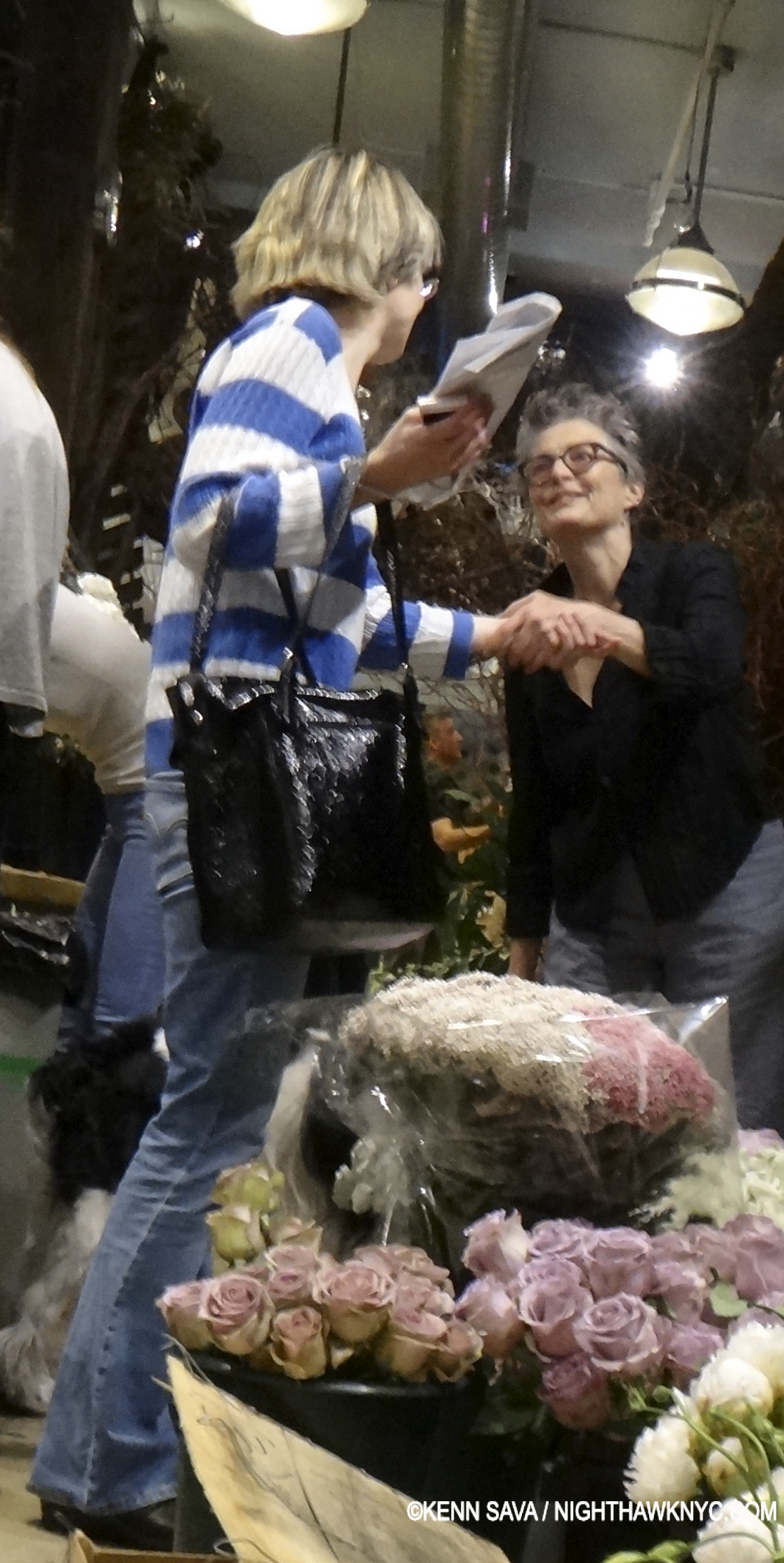
  1. Stephen Greenblatt, Will in the World, P.193
  2. Stephen Greenblatt, Will in the World, P. 119
  3. Stephen Greenblatt, ibid, P.71
  4. PLEASE don’t read that as my comparing myself to Shakespeare. (I laughed typing that.)
  5. Stephen Greenblatt, ibid, P.185
  6. Here.

Es Devlin Rides the Wild Horses

This site is Free & Ad-Free! If you find this piece worthwhile, please donate via PayPal to support it & independent Art writing. You can also support it by buying Art & books! Details at the end. Thank you.

Written & Photographed by Kenn Sava (*- unless otherwise credited).

Show Seen: An Atlas of Es Devlin @ the Cooper Hewitt, Smithsonian Museum of Design

The one and only Es Devlin in the one and only time she appears in her show, in her piece Memory Place. (her hands appear a few times elsewhere). Displayed in the show’s entrance lobby where visitors wait for the next showing of her 4-minute intro video which takes place in a fascinating recreation of her studio. The pictures in this piece are thumbnails. Click any for full size.

Having first experienced Es Devlin’s brilliance in 2010, the release of her debut Art , An Atlas of Es Devlin, the NighthawkNYC.com NoteWorthy Art Book of the Year for 2024, fired my curiosity as to what the show of the same name would be like. How would Es Devlin and the curators at the Cooper Hewitt distill the innumerable projects Ms. Devlin has been involved in these past 29 years already, and the book’s 900 pages, into a comprehensive and concise show, a “mid-career” retrospective, no less?

The show is so innovative, the attention to detail so exceptional, that even the shipping crates that transported the Art have their place in it! One of many things in An Atlas I’ve never seen before. I explain further on. Seen here are the labels on a crate that contained 2 models.

Opening in November, 2023, I pondered this all through 2024 as various ailments kept me from getting to 2 East 91st Street, and finding out. Stage Design is one of the most ephemeral Art forms there is. The book is divided between Sketches and notes, followed by a large section of color Photos of the performances. Building my expectations around that, finally getting to see the show twice during it’s final week, I got the unexpected: a show that largely consisted of beautiful scale Models of the stage sets, most created for exhibition! (Two were contained in the shipping crate shown here.) Well, if anything has proven to be the trademark of Es Devlin’s work, it’s the unexpected, which continues to remind me of Robert Rauschenberg.

Hang on to your hats! Installation view of the introductory gallery in the recreation of her studio before the Film begins. I rushed in to get this shot before it was filled up by those in line behind me. Beware, those seemingly innocent items on the table are not what they seem. Neither is that back wall.

Filling  the entirety of the 3rd floor, arriving visitors are asked to wait for the next showing of a 4-minute Introductory Film, which takes place in a gallery designed as a recreation of her studio, with a large work table in the middle, filled with the tools of her craft.

As the Artist speaks and Draws in the Video projected on the rear wall, the objects on the table undergo all sorts of permutations.

As visitors surround it and begin to take it all in, the Film begins. Compellingly narrated by the Artist in powerfully evocative words in Ms. Devlin’s hypnotic voice, accompanied by stunning visuals that somehow bring items lying on the table to life, the Artist takes us on a tour of her ideas and her work.

One section of the recreation of Es Devlin’s studio with the lights low during the Introductory Film. Full of ideas, some realized, some partially realized, some not realized yet, I imagined this room to be something akin to walking around in her brain.

On three of the walls surrounding the table were a cornucopia of fascinating objects I could have spent a few hours studying on their own. A bit like Sarah Sze’s incredibly involved installations, a lot of work went into their installation.

The Film ends with a bang.

At the culmination of the presentation, the Artist’s hands split the screen in half, opening the back wall, revealing her piece, Iris, beckoning visitors to enter the beginning of the main body of the show. Talk about a dramatic opening. Stage craft meets Art show in a way I can’t say I’ve experienced before. But, I bet I will again. I have no doubt An Atlas was must-see viewing for innumerable curators and gallerists.

The second “introductory gallery” features Es’s Iris.

Working with “names’ virtually her entire career, the first stop is her Iris with a voice over of Es reciting the names of her collaborators. A nice “Thank You” for the opportunities and sharing the credit for the results of this most collaborative of mediums. Iris, with multiple aperture blades, contains the names of the Artist collaborators on the outer blades, and all those involved with creating and mounting her projects fill the inner blades, a list that fills the first 9 pages in her book! It introduces what is a running theme in the show: collaboration, as you might expect for an Artist whose craft is Stage Design, like a bass player, something that doesn’t exist on its own (unless you’re a genius, like my late acquaintance, Jaco Pastorius). Still, it’s definitely her show. Her voice and vision runs through each and every work. Still, as any creative person who’s been hired by someone knows, working with someone else “who has a say” is often extremely challenging; perhaps the hardest part of the job. More than likely the Artist got the job for being who he or she is. For someone else to come in and suddenly want to change/modify that vision can be both counterproductive and counterintuitive. Not every Artist can do it.  The “dynamics” of creative collaboration is why most bands have the shelf life of milk. Yet, though it must have been there, in An Atlas there is no sign of creative struggle or difficulty. Making this all the more impressive, the list of her projects takes 4 pages in the book (as I showed here)! Either her brilliance is just a matter of fact for all her bosses, or she has an extremely winning way, as belied by her hypnotic voice. My money’s on both.

Installation view of the first gallery of work, with the earliest pieces at the far end. If you look closely you’ll notice mirrors at each end of the wall. In what might have been an effort to make the show feel larger, all the galleries had wall-sized mirrors on each end.

After leaving Iris, next up is the gallery of her fascinating early works, largely Drawings and Mixed Media works on paper, i.e. pen, markers, paint on paper Portrait and figure studies, like countless other Art students. I had to look closer to find the roots of her Stage Design work. In between the large studies, I saw sketchbooks, notebooks and loose sheets that contained outlines and ideas for stage productions, none of which are listed in her book.

On the very bottom of the far end of the wall, just above the power outlets, and so difficult to see, I spotted these notebook pages, the one at the lower right reads “Madam Butterfly,” perhaps one of the earliest Stage Designs in the show (the book in the upper left is dated October, 1994). Note that Es has Drawn the entire thing, boldly and confidently, in ink with no white-out or corrections. That speaks to the clarity of her vision, even early on. Immediately above it is a costume design. Note the inclusion of the pencil. I just love that her work was so centered on Drawing and hand-written notes, and continues to be. I don’t see Madam Butterfly listed in her book.

From this gallery, what are we to make of her beginnings? Where did all of what has followed come from? Between visits, I researched her background. Her CV on esdevlin.com, lists her Education, chronologically, as-

-Cranbrook School, 1984-1989 (a “co-ed grammar school1
-BA Hans English Literature 2.1, Bristol University, 1990-1993
-Fine Art Foundation, Central Saint Martins, UAL, 1994-1995
-Motley Stage Design Course, 1995-1996

That’s it! After taking Art-centric courses for scarcely two years, then she just takes off. In only the second gallery of work, at the beginning of her professional career, the ideas are fresh, innovative & previously unseen- qualities that characterize her work to this day. Still in school(!), she’s already on her way. In the first vitrine, I was struck by her work with Wire, a 4-piece rock band, in 2003. Zillions of 4-piece bands, including a few with yours truly involved, have appeared on stage since The Beatles set a standard for what such a lineup “should” look like. “I didn’t know much, but I was bored of seeing the typical silhouette of a band,” she said on the wall card (where all Es Devlin quotes herein derive).

And so, Wire appeared like this-

Studies: Flag: Burning, for the band Wire’s Farewell Performance, 2003, Barbican Hall, London. Es Devlin’s first stage design for a concert. She made “illustrated cue sheets from which they ran the lights and the videos.” She spoke about not having enough money to afford velcro to enclose the band, so she had to use staples.

11 years later, another 4-piece band looked like this-

No staples here! U2, “Innocence & Experience” World Tour, 2014. *= Photo from esdevlin.com.

Wire would lead to such extraordinarily innovative shows as “Innocence & Experience,” 2014, and the subsequent “Experience & Innocence,” 2018, both by U2, who also includes 4 members. I believe this performance of “Who’s Gonna Ride Your Wild Horses” is from the “Experience & Innocence” tour. I saw U2 on what I believe was their first U.S. tour at the Ritz in 1980. Bono still sounds as strong as ever. To my mind, Wire, 2003, to U2 a decade later provides a classic case study in Es Devlin’s evolution.

Model, Bangerz, 3-D printed resin, recreated for exhibition. Staged, 2014, Miley Cyrus’s Bangerz World Arena Tour. Models of Ms. Devlin’s designs were the highlight of the show for me. Here, her face is a video projection from above that continually changed. To the side, a huge model of her beloved dog was also on stage. “We decided the Miley Cyrus should perform the entire show on her tongue. The first iteration was impractical, so we reduced the length of the tongue to a slide, down which Miley made her entrance- a sculptural portrait of a young woman rewriting her own script.”

Moving through the show, it became apparent to me that though elements recur, as. you see, Es Devlin has no one “style.” Since her words appear on virtually every wall card. Who else to speak better about her work? I’ll largely let her take it from here.

Model, The Lehman Trilogy, Painted MDF, acrylic, yardstick, 3-D printed resin, brass, and LED, recreated for exhibition, Staged in 2018 at the Royal National Theater, London, and the Park Avenue Armory, NYC. Es Devlin’s Tony Award-winning, rotating, design for Stefano Massini’s play The Lehman Trilogy, based on the family of businessmen. All the Models shown here with a center pole rotated. “A revolving glass box propels the action of The Lehman Trilogy, a parable that follows three generations of the Lehman family to chart the rise and periodic crashes of capitalism. Cardboard bankers boxes formed the foundations of the visual vocabulary. The more we invested the boxes with meaning, the more poignant the revelation became that those containers of cotton and coffee would become containers of financial records and numbers, ultimately revealing themselves to contain nothing at all.”

Model, Parsifal, Laser-cut form, resin and paint, recreated for exhibition. Staged in 2012 at the Royal Danish Opera, Copenhagen. “Richard Wagner conceived his final work as a ritual mass for the consecration of a stage. Over four hours of largely static drama, the audience transcends time and space through a rite of compassion. The director Keith Warner and I conceived an enormous revolving rook chess piece whose conical interior formed a new theater within Copenhagen’s opera house. We presented Parsifal’s odyssey from naivety to wisdom as a resistance to the rules of an antiquated game.”

As her career has progressed, a good number of her works have an “otherworldly” feel to them. Figures are frequently enclosed, in a maze, or presented in surroundings that are hard to fathom, often with no apparent way out.

Model, Howie The Rookie, Graphite and paint on laser-cut MDF and LED, recreated for exhibition, Staged 1999, Bush Theater, London, UK. “My first stab designs were experiments in framing light. The Bush Theatre was a room above a West London pub with an audience of 75 people. Mark O’Rowe’s play Howie the Rookie is a pair of potent, visceral monologues set in the housing estates of Tallaght on the outskirts of Dublin, Ireland. I perforated a concrete plane with a line of light. This line conveyed both a burning horizon and a road making on a highway.”

Model, Macbeth, Graphite and paint on laser-cut MDF, acrylic mirror and LED, recreated for exhibition, Staged 2003, Theater an her Wien, Vienna. “The design for Ernest Block’s opera of Shakespeare’s play Macbeth was based on a revolving mirrored illusion box. It’s rotations evoked Macbeth’s churning conscience. We conjured scenes through smoke and mirrors. A half-bed wedged against a mirror appeared as a single whole, while Macbeth and his wife were duplicated. The illusion of a whole banquet full of guests overlaid their machinations as the box turned.”

Installation view of one of the corridors. It’s not as long as it looks. Note the overhead video projectors.

Model, Atlas, 3D-printed resin and LED, recreated for exhibition. Staged 2019, Los Angeles Philharmonic, Walt Disney Concert Hall, Los Angeles, CA. Meredith Monk’s transcendent wordless opera, Atlas, charts the spiritual growth of the 19th-century explorer Alexandra David-Néel. The young girl encounters travel companions and spirit guides within a 12-meter-diameter sphere, scored with webs of international trade and travel routes. The form encompasses Monk’s radiant vision of a possible alternative to the current world order.”

Model, La Caja Mágica/The Seed, Graphite and paint on laser-cut MDF, nd LED, recreated for exhibition. Staged 2010 MTV Europe Music Awards, La Caja Mágica Arena, Madrid, and 2020, Jubail Mangrove Park, Abu Dhabi. “For the MTV Europe Music Awards, I imagined a 10-meter high revolving box that could reveal a shapeshifting series of performances. (Among others) Rhianna sang within a sea of red carnations pouring out of an iris (see next pic).”

Model, Fundamental, MDF, acrylic, acetate, and LED, recreated for exhibition. Staged for the Pet Sop Boys World Tour, 2006-7. Es says, “Neil Tennant and Chris Lowe’s album Fundamental critiqued Tony Blair, George W. Bush, the Iraq War, and immigration policy. For the tour, an X-ray image of a divided brain expressed the cognitive dissonance we felt as our country remained entangled in a ware we didn’t want. The show was performed outside the Tower of London, complete with projected pink tanks for the anti-war extravaganza ‘The Sodom and Gomorrah Show’ and giant sequined cowboy hats for the Bush/Blair pantomime “I’m with Stupid.” 

Model, Your Voices, Acrylic, filament, nylon thread, and LED, recreated for exhibition. Installed in the fountain at Lincoln Center, NYC, in 2022, Es says of it, “New York is the most linguistically diverse city on the planet, with 637 languages spoken by its inhabitants. Your Voices celebrated this diversity. Like a giant harp, the sculpture’s glowing arcs enveloped visitors and local choirs with an illuminated web. The piece rotated through a soundscape of languages from all over the city: from Arabic to Ashanti to Zapotec and Zulu. The strands spliced and framed the viewer’s perspectives, just as our perspectives are shifted when we learn to speak through the voices of others.”

Installation view.

Model, Compton Super Bowl, Laser-cut MDF, acrylic, 3D-printed resin, and LED, recreated for exhibition. Staged for the 2022 NFL Super Bowl Halftime Show featuring Dr. Dre, Kenrick Lamar, Eminem, Mary J. Blige, Snoop Dogg, and 50 Cent, Los Angeles, CA. “Dr. Dre and I proposed etching a map of the city of Compton onto the global Super Bowl stage. We case the buildings as charcters that led from Snoop Dogg’s house to 50 Cent in the club to Eminem breaking out of jail.”

Model: Come Home Again, 2022, Acrylic and printed resin. “For Come Home Again, I constructed a one-third-scale replica of the dome of London’s St. Paul’s Cathedral on the lawn outside Tate Modern, facing the cathedral across the river. I filled dome with observational drawings of 243 of the 15,000 non-human species that call London home; the Londoners most at risk of extinction. ”All of the 243 animals depicted were based on Es Devlin Drawings.

Es Devlin in front of  the real Come Home Again, Tate Modern, London, 2022 *- Photo by Matt Alexander

The shipping crates for the Art, teased earlier, filled a gallery where a video screen was mounted in a stage set, providing seats for the visitors, with more all around me as I took this, and, cutting down on the need for space to store them! Something I’ve never seen before, it’s a  touch that shows the depth of the imagination and attention to detail that went into An Atlas at the Cooper Hewitt.

As if all the thought, planning and work that went into mounting An Atlas wasn’t enough, there is the incredibly innovative 900-page(!) book that accompanies it! So far, it’s the only Art book I’ve named a NoteWorthy Art Book for 2024, and that was before I saw the show. Here, in the show’s final gallery, another recreation of her studio, visitors get a look at the making of it, including the original book dummy (off-camera, in a vitrine to my left). This time, visitors were free to handle the items on the table, which were reproductions of the original work materials…right?

An Atlas, the show, reveals, that as her fame and notoriety grows,  so too are the opportunities for the Artist to step out and present her own work, without an overriding “boss,” as she has in major works like Come Home Again, and Your Voices, both 2022, and, of course, in An Atlas of Es Devlin, the book & show. Her own work shows the Artist bringing “big questions” to the forefront- including species near extinction (in Come Home Again, and in her piece Nevada Ark for U2’s The Sphere shows in 2023),

That Es Devlin’s work, and practice, is deeply rooted in traditional Art-making techniques, like Drawing and Sculpture, is a continual touchstone in both the show and the book. She uses them to produce work that lives on, and continually pushes, the cutting-edge of Stage Design and Production. I find this both fascinating and inspiring. On one hand, her example shows what is still possible by just putting pen or pencil to paper; that a master’s or doctorate degree are not prerequisites for achieving a very successful career, or greatness, in one’s chosen field in the Arts. On the other, it also reaffirms over and over again the power of one person’s creative vision. In her chosen field, her work strikes me as being downright unprecedented. In the larger world of Art, Es Devlin’s vision is at once as personal and as expansive as almost anyone else’s working today.

*- Soundtrack for this piece is “Who’s Gonna Ride Your Wild Horses,” by U2 from Achtung Baby, 1991.

My look at the 900-page An Atlas of Es Devlin, the NighthawkNYC.com NoteWorthy Art Book of 2024, published to accompany the show, is here

NighthawkNYC.com has been entirely self-funded & ad-free for 9 years, during which 330 full-length pieces have been published! If you’ve found it worthwhile, PLEASE donate by PayPal below to allow me to continue. Thank you, Kenn.

You can also support it by buying Art, Art & Photography books, and Music from my collection! Art & Books may be found here. Music here and here.

Written & photographed by Kenn Sava for nighthawknyc.com unless otherwise credited. To send comments, thoughts, feedback or propositions click here. Click the white box on the upper right for the archives or to search them. Subscribe to be notified of new Posts below. Your information will be used for no other purpose.
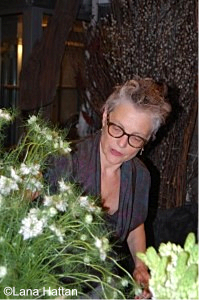
For “short takes,” my ongoing “Visual Diary” series, and outtakes from my pieces, be sure to follow @nighthawk_nyc on Instagram!

Thank you, SV.

  1. Their site describes the school as “a co-educational grammar school in the heart of the glorious Wealden countryside.”

Stepping Into “Edward Hopper’s Nighthawks”

This site is Free & Ad-Free! If you find this piece worthwhile, please donate via PayPal to support it & independent Art writing. You can also support it by buying Art & books! Details at the end. Thank you.

Written & Photographed by Kenn Sava.

The numeric convergence begins. August 28, 2013, eleven years ago next month- – The last time I stood in front of the real thing- Edward Hopper, Nighthawks, 1942, at Hopper Drawings at the old Whitney Museum. A moment later, a friend snapped a picture of me standing next to it. Would I ever get closer to it? Pictures in this piece are thumbnails. Click any for full size.

The Edward Hopper/NighthawkNYC Convergence, 1-

July 15, 2015, nine years ago this month, in my very first piece, “Welcome to the Night,” I mentioned I’ve always related to that figure sitting by himself with his back to the viewer in Edward Hopper’s Nighthawks, 1942. The one that no one ever talks about. Why is he even in the Painting?  Well, he’s really only half in it; his left side completely blends into the black background. So, what’s his deal? Did his date go bad? Is he worried about the recent outbreak of World War II? Is he waiting for the lady in red to lose her guy? (The couple are likely Edward & Jo Hopper stand-ins.1).  Well, he’s there and I’m glad he is. He’s also a witness to everything going on inside, close enough to the other subjects to hear their conversations. In Nighthawks, he has THE ideal seat to see and hear everything that’s really going on, that the rest of us can only imagine.

I’ve been that guy too many times to count, out on my own late at night in Hopper’s Greenwich Village neighborhood. I relate to that “witness” aspect of him, too. After all, isn’t that what I’m doing here; being a witness to the Art, Photography, Music  books I’ve experienced?. So, I named this site NighthawkNYC after him. Hopper’s Painting is titled “Nighthawks.”

But, what would it be like to be him?

Triple self-portrait, August 28, 2013. “That shape is my shade, there where I used to stand,” as I quoted Steely Dan’s “Deacon Blues” in my very first piece, “Welcome to the Night,” on July 15, 2015.

Convergence 2-

On July 29, 2019, five years ago this week, I published “My Search For Edward Hopper’s Nighthawks Diner,” chronicling my decades-long quest to find the iconic eatery/drinkery. It’s turned out to be my most popular piece thus far.

This past Sunday, July 21st, I finally found it!

It happened to be on a triangular corner- Check.
It happened to be in the West Village, not all that far from 3 Washington Square, where Edward & Jo Hopper lived for half a century- both key criteria the real deal has to fit- Check.
But, it was not where I’d looked for it as I wrote in the piece. It was out in the open! Without a roof!?

I let that slide. After all, in the Painting we really can’t see the ceiling, just the light coming down, and it’s a one-story building shown at night. Maybe there was no roof? Imagine that. “Maybe. Maybe not,” I hear you saying.

The famous “Only 5c Phillies America’s No. 1 Cigar” sign was up top- Check.
The outside was painted in that familiar green- Check.

Everything looked like it was supposed to. Am I dreaming? Then, a nice gent named Nilo beckoned me inside!

As I approached the counter, about to take “my”place- the only seat I was interested in taking,  all the details long engrained in my memory were right in front of me.

It was empty. Wow. Perfect! I could look around and drink it all in without feeling self-conscious. Wait!…AM I conscious? A coffee will wake me up. I’m in the right place.

Living a dream…Kenn Sava, left, Lucas, right. July 21, 2024, Meatpacking District, NYC. Photo by Nilo for NighthawkNYC.com.

I could take the seat of my alter ego in peace, without that pesky couple, she in the flame-red dress, with her male companion, who for the past 82 years have gotten all the attention, in the room. I was free to finally chat with the counterman. His name was Lucas and I told him how long I’ve been looking for the place- and even wrote about just that, the nice weather, what else was going on this weekend. You know, small talk; the kind of stuff strangers talk about when they’re suddenly thrust together. But, we weren’t total strangers in the classic sense. We both knew why we were here. As he went back and forth to his duties, I just kept looking around, drinking it all in. Wow. I’m sitting inside of Nighthawks!

There’s the famous two large coffee urns.
There’s the yellow wall with that mysterious door.
The bar was the familiar brown.
The classic white ceramic coffee cups, glass salt & peppers, and napkin dispensers were all around giving me a feeling of familiarity and “home.” I guess that’s what happens when you’ve been looking at them for so long in Painted form.

So real, you could reach out and touch them. Of course, I did…

And, I got to experience it from THE seat, to see what “he” saw and ponder him anew. Maybe “he” was me in a prior life. If so, how many people have gotten to relive a moment from a prior life?

This MUST be the place! FINALLY! I can’t wait to rush home and tell readers I found it! What a scoop!

A close call with a bike running a Walk sign on the walk home snapped me out of it and back to reality. As I reviewed my pictures to make sure my phone was OK, it turns out I had come upon something called “Step Into Hopper. 

Convergence 3-

After nine years of “riffing” on Nighthawks in my Banner, it finally came to life! The Whitney Museum & the Meatpacking District got together to mount “Step Into Hopper,” along with fabrication by Theresa Rivera Design and an exceptional, welcoming, staff, to “recreate” Nighthawks, 1942, Early Sunday Morning, 1930, and his eternally mysterious Soir Bleu, 1914within one mile or so of the original sites of two of them2.

“Early Sunday Morning,” a take-off on Hopper’s 1930 timeless masterpiece of a street in my neighborhood, a few blocks away, on Seventh Avenue between West 15th & 16th Streets. Notice the shadow from the barber pole goes the “wrong way,” as it does in the Painting. People who live there know the sun never shines in that direction on 7th & 15/16th!

Convergence 4-

It truly was a moment frozen in time. Something out of a dream… I ended “My Search For Edward Hopper’s Nighthawks Diner”  with a quote from the song I chose as the Soundtrack for the piece, “I Saw You In A Dream” by Japanese House….

“I saw you in a dream
You had stayed the same
You were beckoning me
Said that I had changed”

How prescient.

Before I “changed.” Take away the side addition, and the former Rivera Cafe on 7th Avenue was my “Oh my gosh!” moment, as I wrote in “My Search…” Seen on July 23, 2018- convegently, six years ago this week.

In reading the mail that continues to come in on the piece, it seems that many people share my dream of unexpectedly coming across the Nighthawks Diner and having an “Oh my gosh!” moment of discovery.

Kenn Sava “inside” “Soir Bleu” (the Painting seen on the sandwich sign above) with the wonderful Tillie the Clown proving every bit as mysterious and stunning as the figure in the 1914 Painting done in Paris. Photo by Gregory for NighthawkNYC.com

A lot of folks seem to want to step inside, sit down at the counter for a bit, and just live in the Painting; experience it from the inside  even for a few moments. As if that might help solve its mystery…On Sunday, I came as close as I’m likely going to to having my “Nighthawks” moment.

A few moments after the Photo of me and Lucas inside “Nighthawks” was taken, I looked around for him and couldn’t find him. Lucas disappeared.

Of course he did.

Convergence 142-

Today, as I write this on July 22nd is Edward Hopper’s 142nd Birthday. Happy Birthday, big guy (Hopper was 6’5″). Thanks for saving me a seat in Art heaven. A short visit is probably the best I can hope for.

*- As it was for “Welcome to the Night” 9 years ago, the Soundtrack for this piece is  “Deacon Blues,” by Steely Dan (my “Forgotten Songs I Will Love Forever #2″, which remains the Anthem of NighthawkNYC.com, from their immortal album Aja, 1977. (I have no idea why the guy who made tihis video shows their album Gaucho. Ignore that- it’s Track 3 on Aja.)

“Sharing the things we know and love
With those of my kind
Libations, sensations
That stagger the mind.”

If the Nighthawks Diner had a jukebox, I like to think “Deacon Blues” would be on it.

Undying thanks to Kevin Callahan for the tip, the iconic Lucas for the coffee & the convo, Tillie the Clown for the Tillie Experience, Milo, Wendy, Alisa and Gregory for the Photos, their consideration and kindness in creating an experience I’ll never forget. A tip of the Fedora to the Meatpacking District, the Whitney Museum & Theresa Rivera Design for mounting Step Into Hopper. Push by Lana Hattan (9 years of NighthawkNYC.com– it’s ALL her fault!)

Be sure to see my 3-part series on the 2022-23 blockbuster Edward Hopper’s New York which begins here.

NighthawkNYC.com has been entirely self-funded & ad-free for 9 years, during which 330 full-length pieces have been published! If you’ve found it worthwhile, PLEASE donate by PayPal below to allow me to continue. Thank you, Kenn.

You can also support it by buying Art, Art & Photography books, and Music from my collection! Art & Books may be found here. Music here and here.

Written & photographed by Kenn Sava for nighthawknyc.com unless otherwise credited. To send comments, thoughts, feedback or propositions click here. Click the white box on the upper right for the archives or to search them. Subscribe to be notified of new Posts below. Your information will be used for no other purpose.
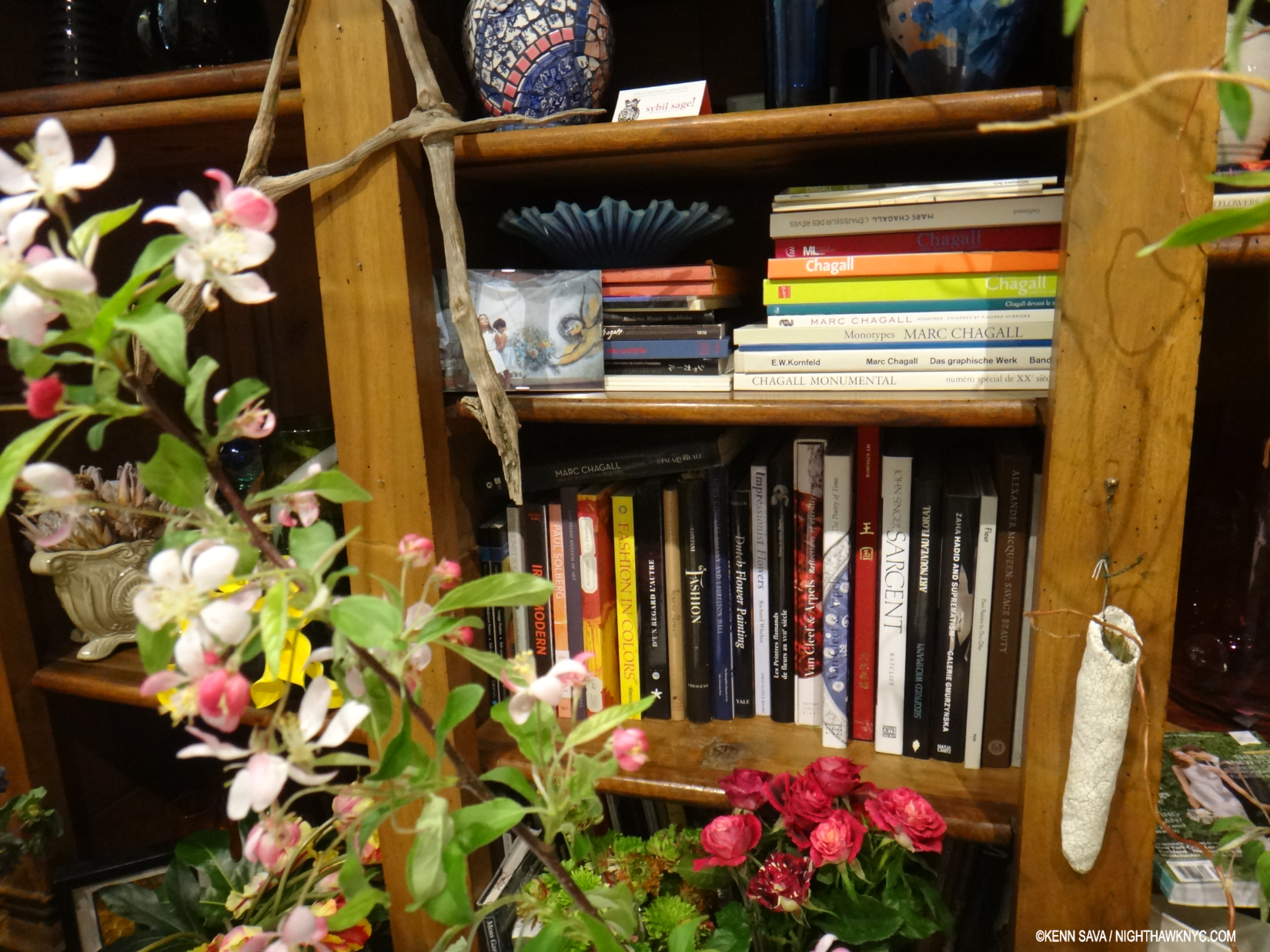
For “short takes,” my ongoing “Visual Diary” series, and outtakes from my pieces, be sure to follow @nighthawk_nyc on Instagram!

  1. Cone to think of it, why are both guys wearing their Fedoras inside? Preparing for quick exits?
  2. The original site of Nighthawks remains up for discussion, as I wrote about, but most likely was inspired by locations in the nearby West Village.

Ed Ruscha & The Two-Sided Coin of Influence

This site is Free & Ad-Free! If you find this piece worthwhile, please donate via PayPal to support it & independent Art writing. You can also support it by buying Art & books! Details at the end. Thank you.

Written & Photographed by Kenn Sava (*- Unless otherwise credited.).

This is the third and final part of my look at Ed Ruscha/Now Then. Part 1  is here. Part 2 is here.

1- Heads

One door closed, another opened. Los Angeles County Museum on Fire, 1965-8, Oil on canvas, seen at MoMA. Ed Ruscha/Now Then is now open there. Pictures in this piece are thumbnails. Click any for full size.

Ed Ruscha/Now Then is a memory for those of us who saw it at MoMA from September 10, 2023 to January 15th of this year. It’s a memory in the making for those who are seeing it now at LACMA, seen above in Ed Ruscha’s 1965-8 nebulous “portrait” of it (which I discussed in Part 1), or will be seeing it until it closes there on October 6th. They’ll be pleased to know it’s a show with staying power, a show I continue to relive and think about on a daily basis, six months after it closed here. After following the trail of his devlopment in Part 1, “Ed Ruscha’s Head Scratchers,” seeing some echoes of the work of Artists past, I began to wonder… Every Artist I’ve come across has had influences. Who influenced Ed Ruscha? As the show was up, and now after it ended here, that question lingered.

Marcel Duchamp, L.H.O.O.Q., 1919, or later. One Artist Ed Ruscha has repeatedly expressed his admiration for is Duchamp, who he met in the early 1960s. There are numerous version of L.H.O.O.Q. since the 1919 original. I chose this one because t contains all the elements of the original, which I cannot find (if you have  let me know)- the mustache, the goatee, and the famous letters all of which Duchamp added to a Mona Lisa postcard. Duchamp once said that L.H.O.O.Q. means “there is fire down below,” though I’ve seen other definitions.  *- Photographer unknown.

“Duchamp had quite a sizable influence on me from a pictorial standpoint and from an emotional standpoint,” Ed Ruscha (Ed Ruscha, Leave Any Information After the Signal, P.324).

Ed Ruscha has not written an autobiography, so his book, Leave Any Information After the Signal, a collection of “Writings, Interviews, Bits, Pages” from 1960 to 2000 is the closest thing we have to a primary written source. In addition to just looking, I turned to it, along with the numerous other interviews he’s given over his six-decade plus career, for insights.

As seen in Part 1– Encountering Johns’s  Target with Four Faces in a black & white reproduction in a 1957 magazine was, he said, an ‘atomic bomb’ in his training, ‘a stranger fruit’ that he ‘saw as something that didn’t seem to follow the history of art. My teachers said it was not art. ‘I didn’t need to see the colors or the size…’ ‘I was especially taken with the fact that it was symmetrical, which was just absolutely taboo in art school- you didn’t make anything symmetrical…Art school was modernism, it was asymmetry, it was giant brush strokes…it was all these other things that were gestural rather than cerebral. So I began moving to things that had more of a premeditation1.’” Jasper Johns, Target with Four Faces, 1955, Encaustic on newspaper and cloth over canvas surrounded by four tinted-plaster faces in wood box with hinged front. Seen in Jasper Johns: Mind/Mirror at the Whitney in 2021.

Besides naming Duchamp, Jasper Johns and his counterpart Robert Rauschenberg, Ed Ruscha hasn’t addressed the subject of influences all that often.

René Magritte, The Treachery of Images (This is Not a Pipe), 1929, Oil on canvas. (Not in the show.) *-LACMA Photo

Pondering the visual evidence, the first name that came to mind was Rene Magritte, 1898-1967, a well-known Belgian Artist who also had a long career and touched on a number of subjects Ed Ruscha has, while sharing his fondness for taking the familiar out of context (which Mr. Ruscha does with words, objects and places). He also incorporated words. Though often labelled a “Surrealist,” his work touches on any number of other realms and styles of Painting, which made him ahead of his time. As a result, his influence is extraordinary and ongoing. Time and again, I’d look at an Ed Ruscha, or a section of one, and think “Magritte,” beginning with Actual Size, 1962, which I showed in Part 1, which echoes Magritte’s The Treachery of Images, 1929 better known by the famous words it includes, “This is Not a Pipe2.” The Magritte seems to echo his contemporary, Duchamp’s L.H.O.O.Q., from 1919.

Salvador Dalí, Open Field with Ball in Centre and Mountains in  Rear, Study for the Walt Disney film Destino, 1948, Oil on masonite, left. Ed Ruscha, Painkillers, Tranquilizers, Olive, 1969, right. (*- Dali from the Dalí & Film MoMA catalog. Ed Ruscha as I saw it in the show.)3.

Of him, Mr. Ruscha said, “Yes, Magritte did influence me, but it came the other way around—what I call 360-degree influence. That’s influence from a person’s thoughts and force and not from his pictures, which the person being influenced has not seen, until later on. The same with Dalí. I’ve been influenced by Dalí, but it’s been through other sources. Because I’ll go back, and I’ll be working on something and I’ll see a picture of Dalí’s I’ve never seen before, and there is my work. (P.56).” I wrote about seeing Dalí in Rauscha in Part 1– before I found that quote.

Surrealism Soaped and Scrubbed, Ed Ruscha’s cover design for Artforum 5, No. 1, Special Issue: Surrealism, September, 1966. 

What about “Surrealism’s” influence, that of the group of European Artists so labelled?

Ed Ruscha was Art Director for Artforum Magazine from 1966-19724. His cover for the September, 1966 “Surrealism” Special Edition I find fascinating, particularly in regards to Ed Ruscha’s Art, overall. While this image has almost nothing to do with “historical Surrealism,” I find it ripe with the “kind” of surrealism (small “s,” which he also uses here) I see in Ed Ruscha’s work, while also being another of his trademarked play on words. There is nothing in “historical Surrealism” that influenced this (as far as I know), and so it’s another work that makes me wonder what, if anything, inspired it. On page 349 of Leave Any Information After the Signal, Mr. Ruscha denies the influence of the Surrealists handling of light on his work. That’s all he has to say about it.

The Back of Hollywood, 1977, Oil on canvas. Was Ed Ruscha the first to Paint words backwards? Probably not.

What about influences on his Word Painting? In After the Signal, he said,  “Well, there’ve been so many artists who have used words throughout the centuries really, but the ones I enjoy are mostly from the twentieth century. Say, Kurt Schwitters. [. . .] 5” On page 115, Paul Karlstrom directly asks Mr. Ruscha,  “Who were your heroes then, your role models?” He replied, “Well, I guess de Kooning was, and Franz Kline. Franz Kline had a lot to say at that particular time, and so they were more or less the passwords. You just emulated them, almost automatically. Then if you couldn’t emulate them you weren’t really on the right track. I still think that. But the work of Johns and Rauschenberg marked a departure in the sense that their work was premeditated.” It sounds like he was referring to his early days as a student under the Abstract Expressionist influenced Chouinard faculty in the late 1950s, as once again, it’s hard for me to see the influence of de Kooning or Kline in Ed Ruscha’s work.

Joan Miró, Photo: This is the Color of My Dreams 1925, Oil on canvas. *- Met Museum Photo

The Surrealists began as a literary “movement,” that experimented with “automatic writing.” Later, their influence spread to Painting. In Miró’s Photo: This is the Color of My Dreams, it comes full circle. Part of the Artist’s “peinture-poésie” (painting-poetry) series, this strikes me as a forerunner or precursor to the Word Paintings of Ed Ruscha. Yet, I have no idea if he saw it, or other works in Mirós series,  or when.

America’s Future, 1977, Oil on canvas. The title is shown in the next picture.

The feeling I’m left with is that these Artists “effected” him in ways outside of a direct visual influence. They are, what I call, “echoes.” What Ed Ruscha called “360 degree” influences. As for the stated influences, in Part 2, I mentioned that Thomas Cole was the influence on Mr. Ruscha’s Course of Empire series, from who he borrowed the name of the series. It seems to me the rest of his influences, if any, remain up for conjecture. Still, taking him at his work on possible influences would leave Ed Ruscha remarkably original.

Detail. Though Painted 18 years before he began his Course of Empire series I showed in Part 2, seeing this made me wonder if this work should be appended to the end of the series, i.e. the final outcome of it.

2- Tails

Turning the influence coin over, however, 67 years, and counting, into one of the most remarkable careers in American Art history, at this moment in time it’s hard to think of another Modern & Contemporary Artist, let alone an American Artist, who is more influential than Ed Ruscha is. In fact, it’s impossible for me to list here all the realms in which his influence can be seen. Those that come to mind the quickest include-

-His role in furthering the breaking of the strangle hold of Abstract Expressionism in Painting in the early 1960s.

-His unique way of incorporating words and typography into his Art.

-His Paintings of L.A. and the American West6.

No place on the planet has more Artist’s books than NYC’s Printed Matter, home of 15 ,000 books they’ve created. How many are/were inspired in part or wholly by Ed Ruscha? I don’t know the total but I keep finding more every time I go in. May 6, 2024.

-His ground-breaking Artist’s books/PhotoBooks. (Is it a stretch to say he’s played a defining role in the Contemporary Artist’s Book & PhotoBook phenomenon? I don’t think so.)

-His style of nonjudgmental roadside and aerial Photography.

-Entire genres of Painting, Photography and books have sprung up around his work.

Jeff Brouws, Various Small Books Referencing Various Small Books by Ed Ruscha, 2013. 288 pages of books, and just books, by other Artists influenced by Ed Ruscha, and it’s now 11 years old!

To this point, at least two substantial books, including the book above, have been published focused solely on his influence! All of this is even more impressive (or mind-boggling) when you consider Ed Ruscha is still with us and going strong at 86. Usually, the influence of Artists is something referred to in the past tense.

-His unique way of incorporating words and typography into his Art.

Ed Ruscha’s presence is so pronounced at Printed Matter, they even have a well-worn box just for books he’s influenced. ‘Nuff said. No, that’s not a copy of Mr. Ruscha’s very rare Twentysix Gasoline Stations. It’s Michalis Pincher’s 2009 homage to it, which “borrows” Ruscha’s cover verbatim.

All of this, also, makes it harder to fathom that Ed Ruscha/Now Then was the first large Ed Ruscha show here in 41 years7, and his first show at MoMA! That makes the extent of his influence that much more impressive. Suffice it to say it’s a lot easier to see Ed Ruscha’s influence than it might be to see the influence of others on his work.is so pronounced.

The saddest moment of the entire 4 month run of Ed Ruscha/ Now Then: the show’s entrance, moments after it closed for the last time on January 15, 2024. I saw it on its first preview day, and I was there when it closed for good. Shows are fugacious events. The ending of a great show is always sad; like saying “goodbye” to a friend. One you’ll never see again.

-Takeaways

In addition to providing an opportunity to ponder the scope of his influence, Now Then provides the chance to assess his achievement and his place among the important Artists of both the 20th and 21st centuries. Ed Ruscha strikes me as an Artist who is continually moving forward to the point that he is a seemingly endless innovator. Ed Ruscha/Now Then provided a rare chance to see the craft behind the mystery his work evokes; to watch the Artist move on an almost step-by-step basis from his beginnings though each of his phases, with a focus on his recurring themes and his innovations.

Yet, he’s also an Artist who’s extremely aware of his, and our, pasts, and his Art stays in touch with it often in surprising ways. Ed Ruscha has never stood still long enough to have any box his work gets put in fit for very long. The Ed Ruscha box is the only one that fits an Artist as extraordinarily diverse as Mr. Ruscha has been and continues to be. Ed Ruscha/Now Then is a show that will live long in memory, and no doubt, influence.

Part 1 of my look at Ed Ruscha/Now Then is here. Part 2 is here.

*- Soundtrack for this piece is  “Goodnight My Love,” as performed by Paul Anna. In 2017, MOCA commissioned a short documentary on two themes in Ed Ruscha’s work (the text of which is here). In the resulting piece, Ed Ruscha says, “I’m gonna play this tune called ‘Goodnight My Love’ and this represents everrything I felt about California when I first came out here…” Because he doesn’t specify which recording he’s going to play, I chose the Paul Anka version from 1969.

NighthawkNYC.com has been entirely self-funded & ad-free for 9 years, during which 330 full-length pieces have been published! If you’ve found it worthwhile, PLEASE donate by PayPal below to allow me to continue. Thank you, Kenn.

You can also support it by buying Art, Art & Photography books, and Music from my collection! Art & Books may be found here. Music here and here.

Written & photographed by Kenn Sava for nighthawknyc.com unless otherwise credited. To send comments, thoughts, feedback or propositions click here. Click the white box on the upper right for the archives or to search them. Subscribe to be notified of new Posts below. Your information will be used for no other purpose.

For “short takes,” my ongoing “Visual Diary” series, and outtakes from my pieces, be sure to follow @nighthawk_nyc on Instagram!

  1. Alexandra Schwartz, Ed Ruscha’s Los Angeles, P.15
  2. I cannot think of Rene Magritte without thinking of the singular Photographer, Duane Michals. When I met him, I quickly shifted the chat from Photography to Painting. He rightly gloated over the fact that he had met and Photographed his three favorite Painters- Balthus, Giorgio de Chirico, and Rene Magritte, with who he did a terrific PhotoBook, that he graciously signed for me. All three are under-appreciated in my book, and remain among my favorites, too.

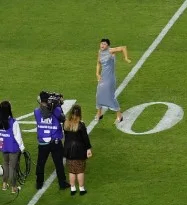
  3. In spite of being among the best known, in my view, Dalí may be the most under-appreciated Artist of the 20th century, as anyone who saw the incredible Salvador Dalí Centennial Exhibition at the Philadelphia Museum in 2005 knows. It’s partially his own fault, as the endless fantastic stunts he put on overshadows the appreciation of his Art in my opinion. History will eventually fix that, I believe.
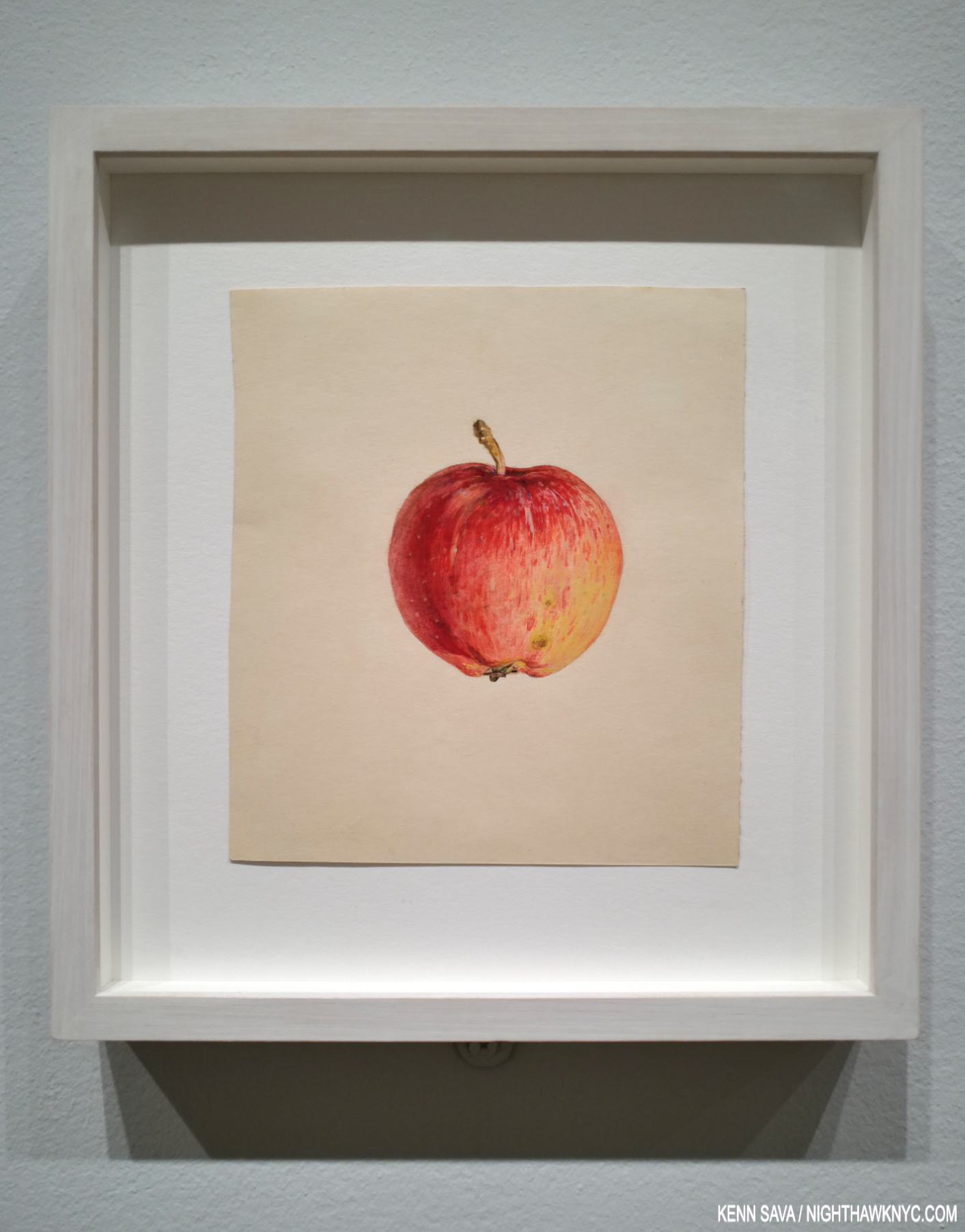
  4. Alexandra Schwartz, P.35
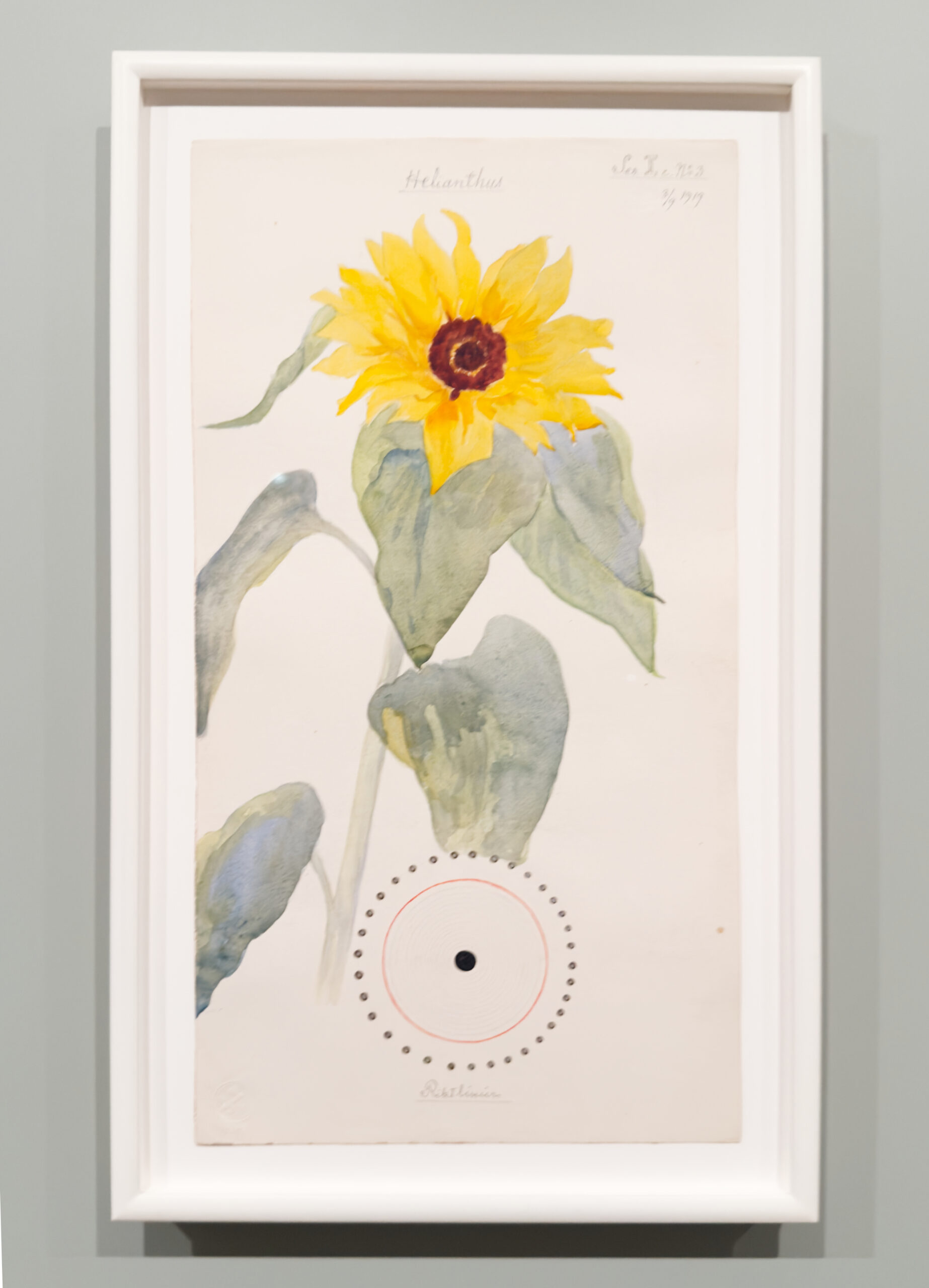
  5. Ed Ruscha, Leave Any Information After the Signal, P. 324
  6. Along with those of, and quite different from,Georgia O’Keeffe.
  7. As I mentioned in Part 1, the last big Ed Ruscha show here was the traveling retrospective, The Works of Ed Ruscha, which came to the Whitney Museum in 1982!