NYC: APRIL, 2020 – A SLIDESHOW BY KENN SAVA

Written & Photographed by Kenn Sava

The response to my previous piece, “The Sound of Silence,” has been a bit overwhelming. My thanks to all of you who have read it and especially to those who have taken the time to write. I’ve heard from people all over the world, all of who are also knee-deep in trying to get through the pandemic themself, so I deeply appreciate it. At times like these it’s important to feel we’re in this together.

NYC in April, 2020 has been a month like none I’ve ever experienced. As I write these words, over 18,000 are dead- just in NYC (as of today, May 1st, 2020, per the stats here, which are updated daily). It’s a very rare thing to find the streets of Manhattan empty for a few hours- even well after midnight. To find them that way day after day is something I’ve never seen here before. I began making trips (as safely as possible, usually on foot) to some of the major landmarks of NYC to document what it was like to be there. The experiences left me with a multitude of feelings, as I said in my prior piece, that I’m still processing.

Inspired by a suggestion I received, I’ve decided to expand the concept of that piece, and share more of the Photos I’ve taken in April, 2020, in a slideshow. Yes, after 4 1/2 years of writing about everyone else’s work, I’m sharing some of my own. In it, the title of my previous piece, “The Sound of Silence,” is taken literally since I don’t have permission to use it legally (Dear Paul Simon- May I?)- the soundtrack is silence. It’s designed to be watched fullscreen.

I hope that wherever this finds you, you and yours get through this in good health. Be well.

NighthawkNYC.com has been entirely self-funded and ad-free for over 6 years, during which over 250 full length pieces have been published. If you’ve found it worthwhile, you can donate to keep it going & ad-free below. Thank you!

Written & photographed by Kenn Sava for nighthawknyc.com unless otherwise credited.
To send comments, thoughts, feedback or propositions click here.
Click the white box on the upper right for the archives or to search them.
For “short takes” and additional pictures, follow @nighthawk_nyc on Instagram.

Subscribe to be notified of new Posts below. Your information will be used for no other purpose.


The Sound of Silence: The Slideshow

Written & Photographed by Kenn Sava

The response to my previous piece, “The Sound of Silence,” has been a bit overwhelming. My thanks to all of you who have read it and especially to those who have taken the time to write. I’ve heard from people all over the world, all of who are also knee deep in trying to get through the pandemic themself. At times like these it’s important to feel we’re in this together. I hope that wherever these words find you, you and yours get through this in good health.

There’s always Music going on in my mind. So, all of the 228 pieces I’ve written so far have a soundtrack that accompanies the words and the pictures. Never before have I taken one of those soundtracks and made it into a slideshow. Until now. At the suggestion of Lana Hattan, I’ve compiled some of the Photos I’ve taken this month (April, 2020, and only in April, 2020) into a slideshow, extending the concept of my piece, accompanied by the lyrics of the song.

As I completed it, I was shaken to hear of the tragic passing of Dr. Lorna Breen, Medical Director at New York-Presbyterian Allen Hospital yesterday. As an Emergency Room Doctor, she was on the front lines of fighting the coronavirus pandemic.

“She went down in the trenches and was killed by the enemy on the front line. She loved New York and wouldn’t hear of living anywhere else,” her father said.

My life was saved at New York-Presbyterian in 2007, so it is with the deepest respect that I dedicate this slideshow to Dr. Breen, and all those working to get us through this.

Be well.

*-Soundtrack for this Post is “The Sound of Silence” by Paul Simon and recorded by Simon & Garfunkel on their debut album Wednesday Morning, 3AM, 1964, with overdubs on the 1966 album, Sounds of Silence and live on Concert in Central Park, recorded in 1981.

Special thanks to Lana Hattan. 

NighthawkNYC.com has been entirely self-funded and ad-free for over 6 years, during which over 250 full length pieces have been published. If you’ve found it worthwhile, you can donate to keep it going & ad-free below. Thank you!

Written & photographed by Kenn Sava for nighthawknyc.com unless otherwise credited.
To send comments, thoughts, feedback or propositions click here.
Click the white box on the upper right for the archives or to search them.
For “short takes” and additional pictures, follow @nighthawk_nyc on Instagram.

Subscribe to be notified of new Posts below. Your information will be used for no other purpose.


The Sound of Silence

Written & Photographed by Kenn Sava

In 2017, I did a PhotoEssay commemorating the 10th anniversary of my cancer treatment. This year, I’ve decided to do another one, taking a look at this extraordinary April in New York…

There’s “Autumn in New York” and “April in Paris,” but no songwriter has yet written “April in New York.” This April may or may not inspire such a song, but one thing’s for sure- April, 2020 will long be remembered by everyone who’s lived through it- in NYC, and everywhere else.

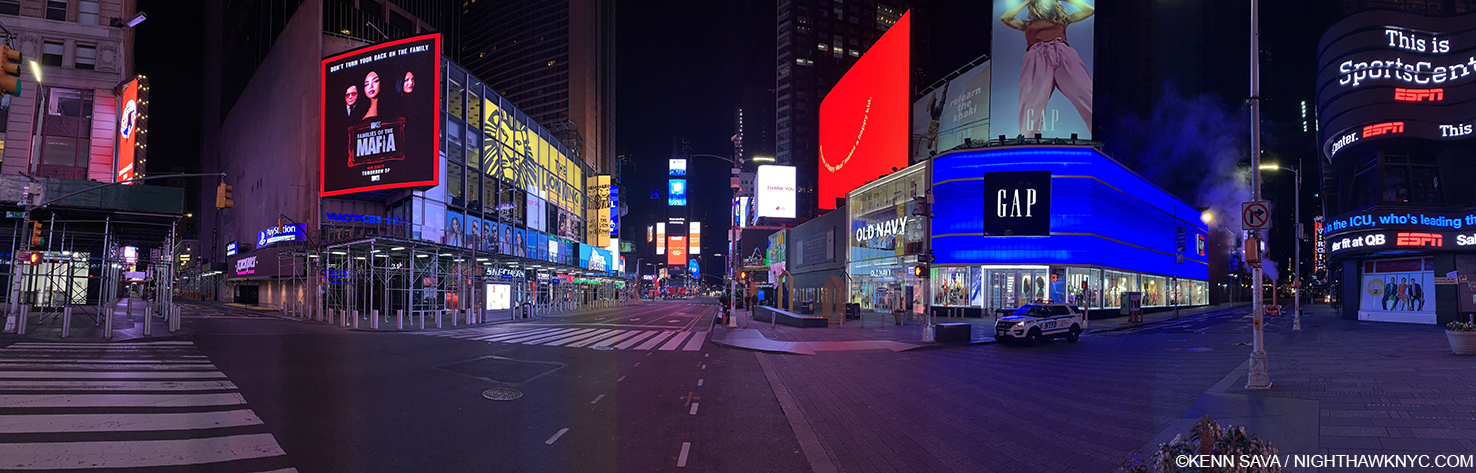
Here, in one of the current centers of the pandemic, with New York City, alone, accounting for 129,788 cases and 13,240 confirmed or probable deaths from the coronavirus1 as I write this, people have been mostly hunkered down and staying inside. Last week, however, for a reason I can’t quite explain, I felt compelled to walk over to Times Square. I got there after 11pm, normally a time when activity is high in the days before the pandemic. I’m not sure what I was expecting to find. It’s not a place I have any reason or desire to go to. Most New Yorkers I know say pretty much the same thing. When I turned the corner of 8th Avenue onto 42nd Street, a corner once known as “the crossroads of the world,” I was taken by what I saw. Actually, I probably shouldn’t have been- it was pretty much what I’d been seeing on the mile walk there. The streets were deserted. Nothing was open. There were too few cars or trucks to qualify as“traffic” along ever-busy 8th Avenue that I should have been prepared for a similar sight on 42nd Street, but I wasn’t. What I saw was actually hard to believe.

It was completely deserted. The only sign of life was a police car’s revolving lights on top parked out front of the McDonald’s near 7th, which might have been open for takeout. If so, it was the only even partially open business I saw in Times Square. Or, maybe something had happened warranting a police visit. From the other side of the street, I couldn’t tell, and I wasn’t about to get curious. I turned the corner and walked up 7th Avenue to 44th Street, stopped on the corner and looked around. I was completely and utterly alone.

A song started playing softly in my brain…

“Hello darkness, my old friend.
I’ve come to talk with you, again.”*

Alone in Times Square. 7th Avenue at West 44th Street, 11:24pm, April 8, 2020. Click any picture in this Post for full size.

There was another NYPD car across the street with its lights on. I don’t know if anyone was inside it, or not. That was the only sign of “life” I could see anywhere around me. I can’t remember ever seeing it this deserted before. Ever. In my entire lifetime, I’ve never experienced a feeling quite like it.

“In restless dreams I walked alone
Narrow streets of cobblestone
‘Neath the halo of a street lamp
I turned my collar to the cold and damp
When my eyes were stabbed by the flash of a neon light
That split the night
And touched the sound of silence”*

I spent some of my formative days on “the deuce” as West 42nd Street was called back when it was as it appears in the film Taxi Driver. It was raw, seedy, nasty and dangerous, but it never closed. Ever. It was, literally, the same 24 hours a day, everyday. Of course, those days are long gone. I’ve never “gotten” what 42nd Street is supposed to be now, beyond a pseudo theme park for tourists. Ditto Times Square around the corner. No wonder New Yorkers never go there. Of course, they go to the shows on the side streets, and there are some good restaurants on those as well, too, but Times Square is one gigantic wasteland as far as I’m concerned. The “redesign” is a disaster. Personally, I can’t imagine why anyone would come to New York City and go to Times Square. Even just to see it.

On this night. No one (else) did.

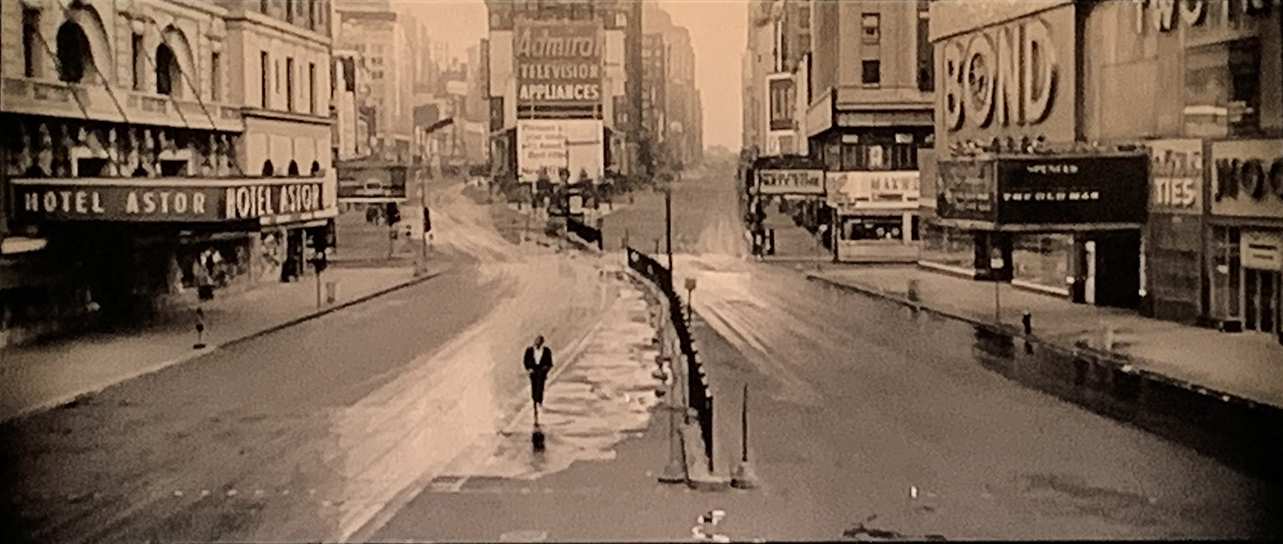
Harry Belafonte alone in Times Square in The World, The Flesh and The Devil, 1959. In 1981, I would see The Clash perform six times at Bond Casino, seen here when it was Bond Clothing, on the right.

In The World, The Flesh and The Devil, Harry Belafonte plays a miner trapped in a cave-in who resurfaces only to discover mankind has been wiped out in a nuclear holocaust. He sets out to look for other survivors. Bizarrely enough, this film, with the scene above, was on the night after I was in Times Square equally alone. The difference being I KNOW there are millions of other people still here. They are all hunkered down, like I am 23 hours a day, trying to survive the coronavirus pandemic.

I haven’t been able to get the feeling out of my mind since. It’s also stuck with me for other reasons I’m still trying to fully understand.

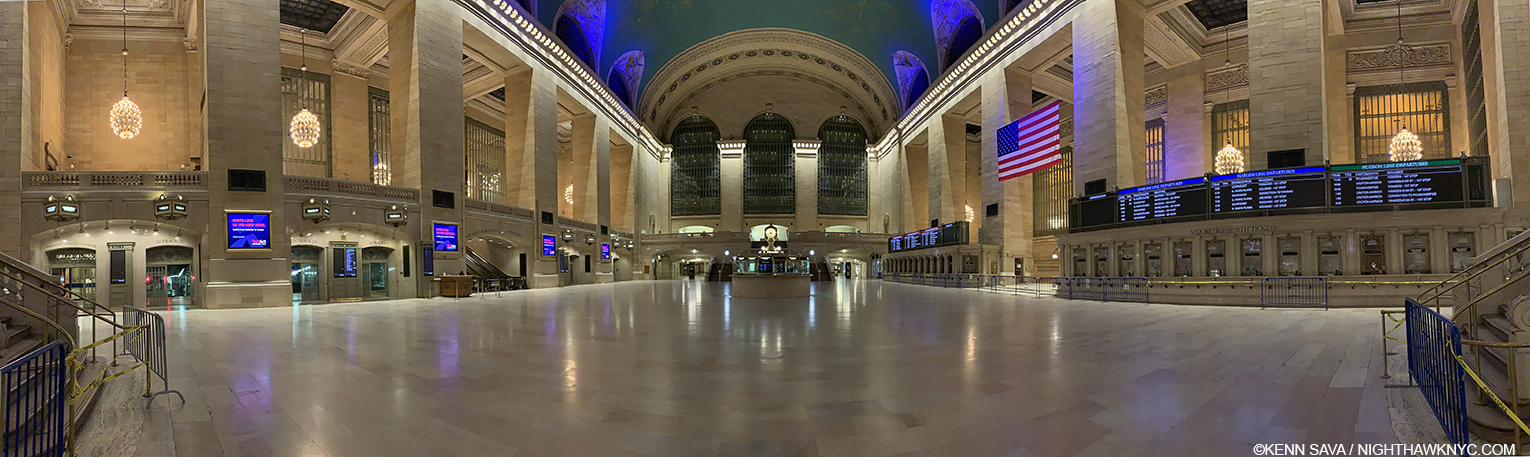
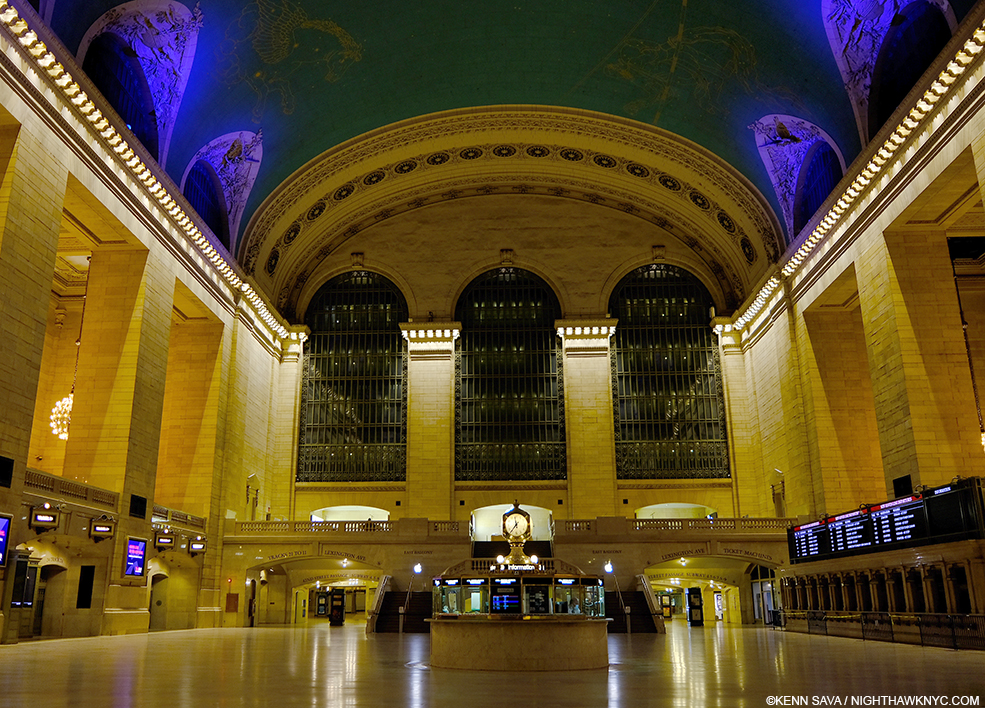
A few days later, I walked over to Grand Central Terminal, getting there at about the same time I got to Times Square, just before 11:30pm on a weeknight. A time when it’s generally pretty busy. On the way (about a mile), I counted about 10 people- on either side of the street. I entered through the Vanderbilt Avenue corner, not sure it would be open, when I came out of the underpass into the world famous main terminal, the feeling was very much the same as it was in Times Square, with a difference.

Grand Central Terminal, April 14, 2020, 11:34pm.

Standing there, alone again, reminded me that we are all on our own in a crisis. Only those working hard to keep the essentials of life going- doctors, nurses, power station workers, truck drivers, food store employees, essential business employees, pharmacy workers, postal, delivery and transit workers are keeping us from being in a very, very bad situation, particularly for as long as this is likely to wind up being. Standing there at that moment in Grand Central, I was also struck by something else. A train station is a place about travel, about going somewhere or arriving here form somewhere else. That feeling is completely alien to me. I have nowhere else to go. I realized then that the thought of leaving has never entered my mind. But for some reason, standing there, I didn’t feel hopeless, I just felt like I always do, with cancer, Sandy or 9/11- I have to find a way through it by myself.

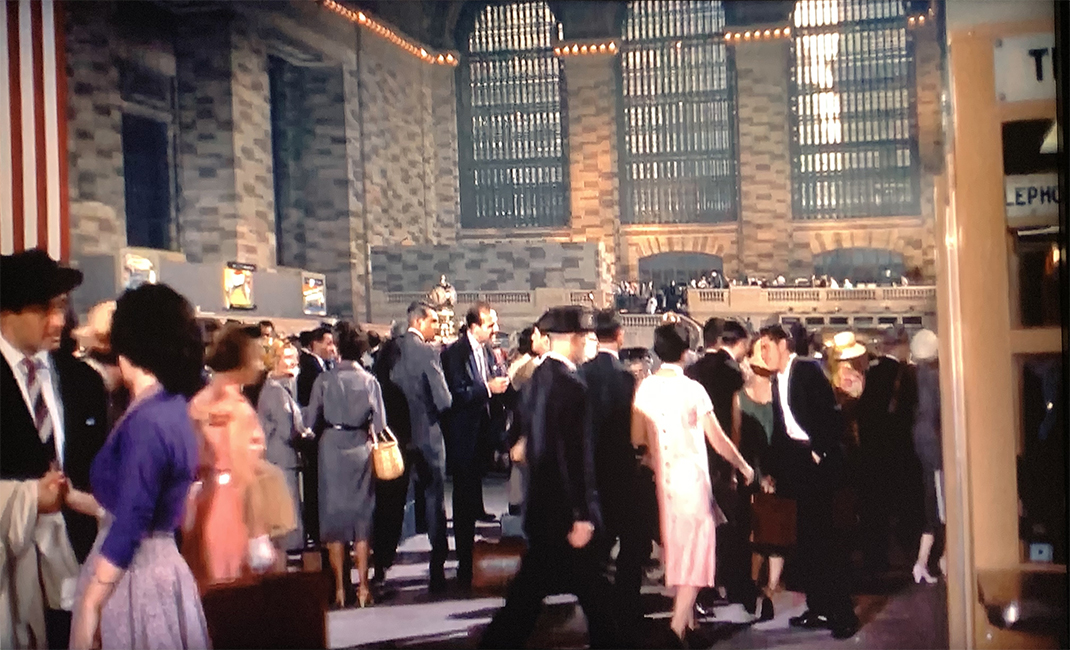
Cary Grant, left of center, in Grand Central Terminal, in Hitchcock’s North by Northwest, 1959, shows the space as it more normally is during the morning/evening rush.

Last week, a reader asked me if I’d ever been through something like this before. I had to give a qualified “Yes.” The 2012 Hurricane Sandy blackout- when we had none of those things I just listed that we have, thankfully, now, for between 5 and 12 days depending on where you were. No power, no mass transit. Not one thing was open because of a lack of electricity, and at night, the temperature went down to about 32. I spent days hunkered down in my bed fully dressed under every blanket I could muster as everything in my refrigerator and freezer went bad and I had to go about a mile to charge my phone. Of course, MANY other people had things much worse from Hurricane Sandy than I did. Many, many people lost everything. An apartment building 4 blocks from me, that I had been in the day before the hurricane, collapsed. It has still not been rebuilt. The risen tide from the Hudson River came to within one block of my apartment building, flooding many of the ground floor galleries in West Chelsea, while devastating lives all around the area. I was lucky. Still, I learned a lot from going through that, a 2 day blackout in the 90’s and of course, going through 9/11. Then, there was the Chelsea bombing in 2016 that was too close for comfort…

Close to the same scene just shown, minus Cary and everyone else. Grand Central Terminal, April 14, 2020, 11:36pm.

Standing there at that moment in Grand Central, I was also struck by something else. A train station is a place about travel, about going somewhere or arriving here from somewhere else. That feeling is completely alien to me. I never leave NYC. As with the other crisis I’ve lived through here, I, like everyone else, just finds a way. 

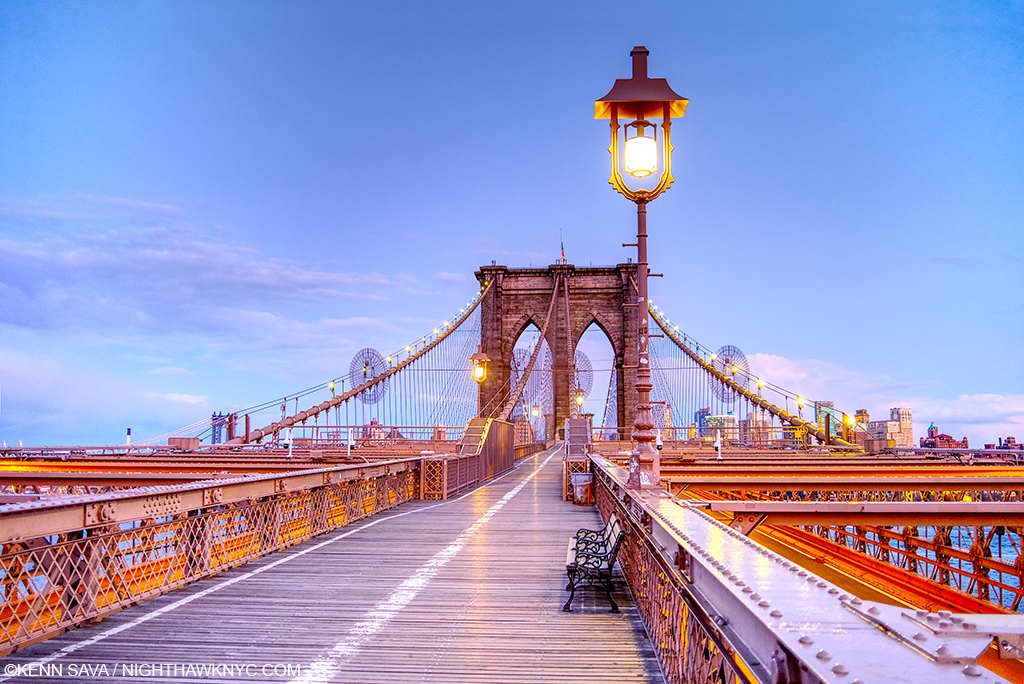
When I think about rising above it and transcendental places in NYC, the first place that comes to my mind is, in my opinion, what may well be the greatest feat of building by modern man in the world, Brooklyn Bridge. Before you say, “You’re nuts,” watch Ken Burns’ Documentary film on the making of Brooklyn Bridge, then see what you think. On April 16th, I decided to go there and see how The Bridge was faring during the pandemic.

Just after sunset on Brooklyn Bridge, facing Brooklyn, 7:53pm, April 16, 2020. If I could save one modern structure for eternity it would be Brooklyn Bridge. It is one of the supreme achievements of mankind, both Artistically and as a testament to the human spirit. In this case the spirit of those who designed it and built it while overcoming impossible odds.

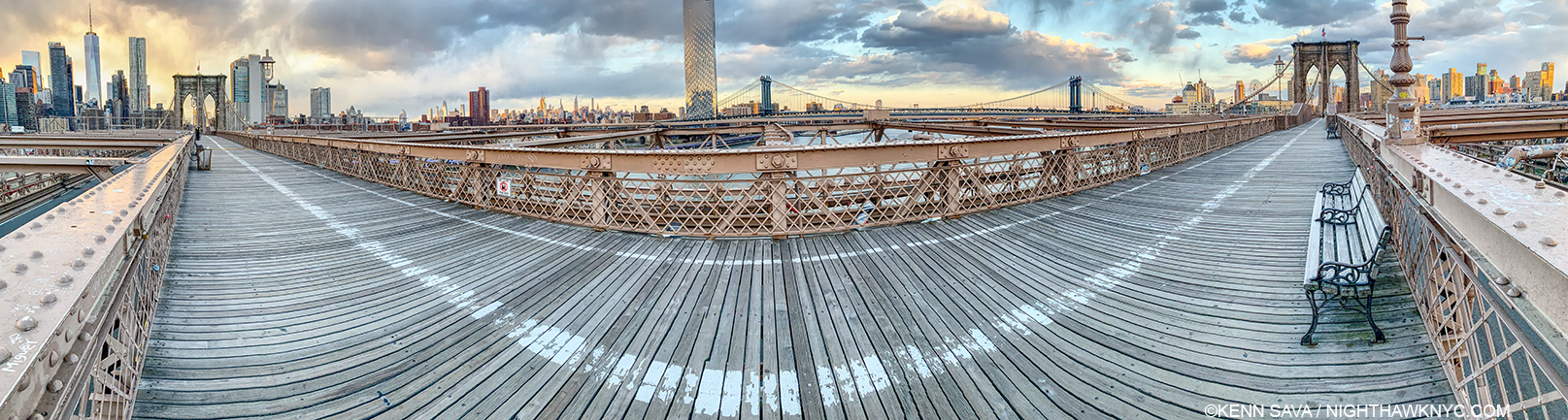
I walked the entire span, beginning on the Brooklyn side, and arriving on the Manhattan side just after sunset. It was emptier than I could imagine it during daytime hours. As anyone who has had the joy of walking The Bridge knows, when you reach the center you are, magically, all of a sudden on top. The cabling has ended, the sides and even the railings seem to melt away and you feel like you are standing on top of the world. Now, imagine doing this in 1883 when The Bridge opened. At that point, you REALLY WERE on top of the world! This was decades before the advent of the skyscraper. Standing there, you were higher than anything you could see- anywhere around you. It truly must have felt like going to outer space. Of course, I paused and spent a good 30 minutes pondering everything that had been going on as I stood there, alone.

Alone in the middle of Brooklyn Bridge, with Manhattan to the left, Brooklyn to the right, and the East River straight ahead, 7:11pm, April 16, 2020.

“Because a vision softly creeping
Left its seeds while I was sleeping
And the vision that was planted in my brain
Still remains
Within the sounds of silence.”*

Thinking about things I’ve lived through in NYC, of course, 9/11 was the first major crisis I would point to. That morning, as I walked to work with one Tower on fire, the second about to be hit, a neighbor standing on the corner told me the first plane had flown down 7th Avenue- it had flown down my block! To this day, no one I know died in the horror that ensued. Both people I knew at the time got out. Still, the mysteries of the brain being what they are, somehow my sleeping mind connected that American Airlines Flight 11 that hit the North Tower of the World Trade Center with the heroic United Flight 93. In my dream (actually, a recurring nightmare), it was the passengers and crew of American Flight 11 that fought back and jumped the hijackers, causing Flight 11 to crash early- into my apartment building. 

18 years later, those thoughts were not in my mind when I decided to visit the Oculus in Santiago Calatrava’s World Trade Center Path Station Terminal at the site of the World Trade Center Towers. What is always on my mind when I visit the site of the World Trade Center is my own past. I grew up in the area. My dad had an office 2 blocks from the WTC for 45 years. I remember walking past the Towers while they were being built. Years later, the company I worked for had two Holiday Parties at Windows On The World Restaurant at the top of the South Tower, a few hundred feet from where the Oculus now is, including one for Holiday, 2000, the last Holiday season that would ever be celebrated there. Walking through the area my thoughts were on change. As in HOW MUCH change has gone on Downtown just in my lifetime

Crossing Church Street, I walked up to the front doors, half expecting to find them locked. The door opened, and there was a man standing along the wall, just inside the door. He was one of about 7 or 8 people I saw while I was inside who just stood in a spot. And stood in that spot throughout. Homeless, I guess. Most had some sort of baggage with them. There were 3 police officers walking around, who checked in on them to make sure they weren’t sleeping, among their other duties. But there was almost no one else there. I moved to the edge overlooking the 57,000 square foot floor. All the surrounding stores were closed. Off in the far distance, at the other end, the PATH train station was still in operation. Once in a while, someone walked from my end across the floor to take a PATH train uptown or to New Jersey. Mostly, I was utterly alone, once more. Again, I stood transfixed by the scene.

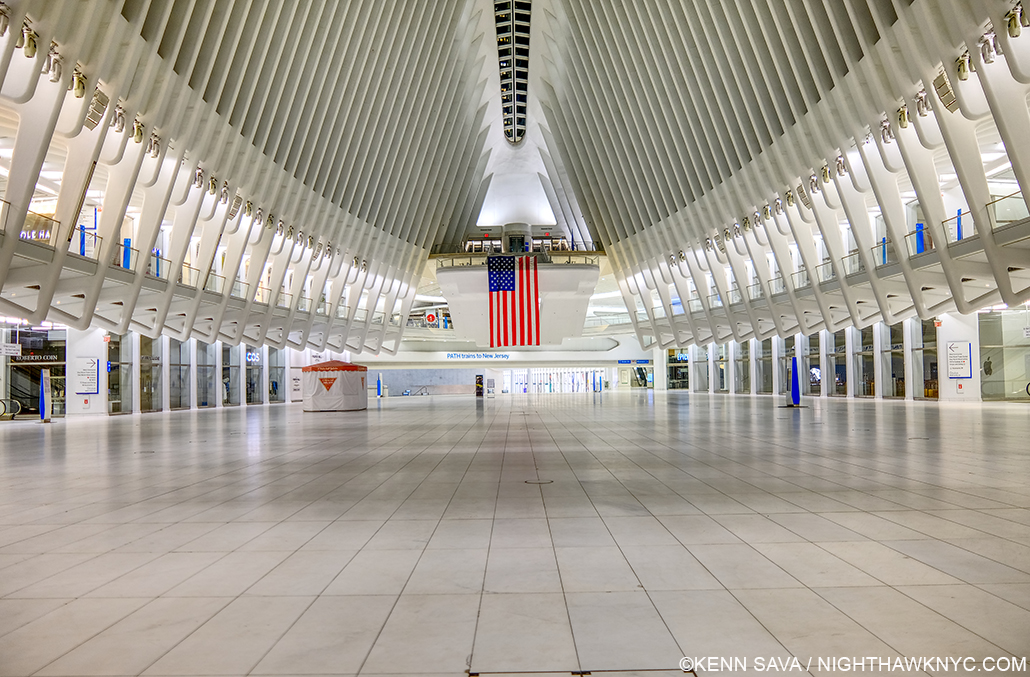
The 57,000 square foot main floor of Santiago Calatrava’s Oculus on April 15, 2020 at 11:56pm.

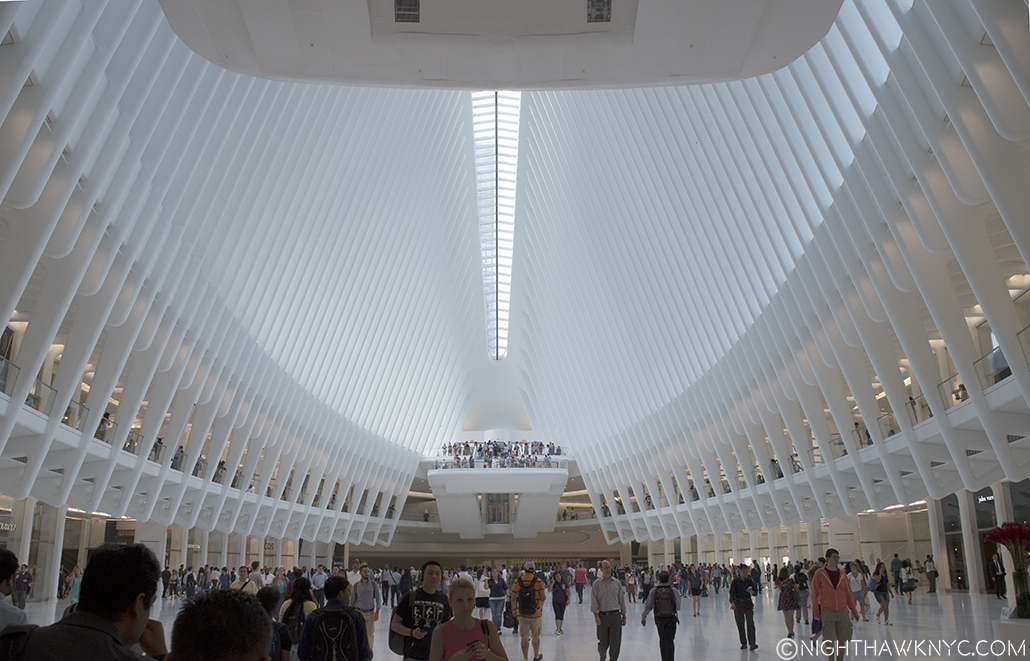
Speaking of change, I wrote about being at the Oculus in August, 2016 as it opened. That day, the floor looked like this-

Standing in the same spot I stood in taking the prior picture, on August 17, 2016 at 3pm.

Here, in this gleaming, barely 4 year old facility, was a shocking look at our present in a nutshell. The brick and mortar economy, represented by the stores that surround both levels of the Oculus, with more elsewhere in the 800,000 square foot complex, has completely paused, save for food stores, pharmacies, and home supply stores. The world has almost completely come to a stop. In fact, I think this period of time when we’ve all been home will be eventually seen as a pause between life as it was and life the way it will be. I think most of us know right now that once activity start up again, things will be different. Many of us have been, at least, subtly changed by this experience. Exactly how things will be different remains to be seen, but they will be different. Beyond the horror of all the illnesses and deaths, we will always look back at this moment “between” the old and the new as “the pause” between them.

Right now, the focus is on finding those infected, treating those ill, and keeping the virus from spreading. Eventually, we all hope, this crisis will mitigate. And then what? A lot of people (even those who haven’t gotten sick) are seriously hurting. Many have lost their jobs- temporarily, or permanently. There’s going to be a gigantic, collective, “starting over” for countless people. The ways people interact or get together and many other aspects of life not known right now will also be different. The way many businesses do business will be changed. A few/some/many small businesses, who knows how many, won’t reopen. More business will be done online.

What does this all mean?

“And the sign said:
The words of the prophets are
Written on the subway walls
And tenement halls
And whispered in the sound of silence.””

7th Avenue at West 20th Street, April 17, 2020, 8:29pm. On this very corner, Jack Kerouac’s novel On The Road ends. He wrote it 3 blocks west.

We won’t know specifically how life will be different until this is over. And no one knows when that will be right now. In the midst of all this silence, something else that can’t be heard is happening.

Change.

While we are all alone together inside, hopefully staying safe, the world is changing. The only choice we have is to adapt to it.

*- Soundtrack for this Post is “The Sound of Silence” by Paul Simon and performed by Simon & Garfunkel on the album Wednesday Morning, 3AM, 1964, and with overdubs on Sounds of Silence, released in 1966. They perform it on September 19, 1981 in Central Park below. As I write this, almost 53 million people have watched it-

This Post is dedicated to all those keeping us going, particularly in my case, my thanks to the staffs of Trader Joe’s, and Gristede’s, Chelsea, NYC, Rite-Aid, Home Depot, Con Ed, the USPS, to the truck drivers and delivery people who keep this island supplied, and to Drs. Ro & Hoffman.

NighthawkNYC.com has been entirely self-funded and ad-free for over 6 years, during which over 250 full length pieces have been published. If you’ve found it worthwhile, you can donate to keep it going & ad-free below. Thank you!

Written & photographed by Kenn Sava for nighthawknyc.com unless otherwise credited.
To send comments, thoughts, feedback or propositions click here.
Click the white box on the upper right for the archives or to search them.
For “short takes” and additional pictures, follow @nighthawk_nyc on Instagram.

Subscribe to be notified of new Posts below. Your information will be used for no other purpose.

  1. The current stats are here.

Noah Davis: The Art of Vision

Written & Photographed by Kenn Sava

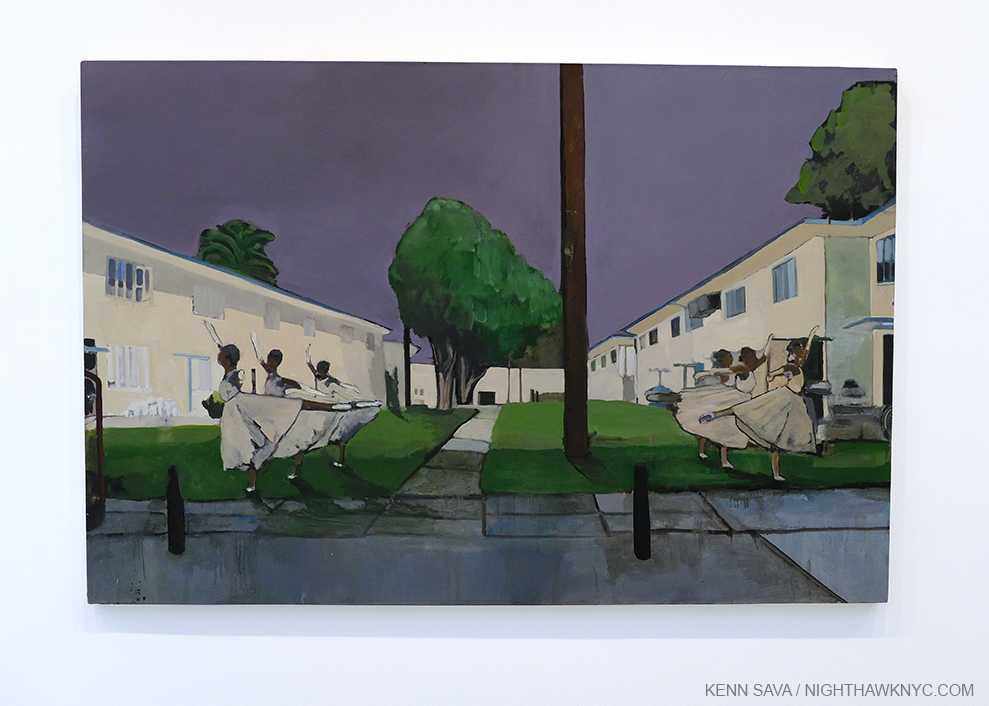
Art & Artists can come from anywhere at any time. Even from unexpected places, like a housing project. Pueblo del Rio: Arabesque, 2014, Oil on canvas, 48 x 72 inches. Pueblo del Rio, 1941-2,  is a housing project designed by Paul Williams at 52nd Street and Long Beach Avenue, Los Angeles, one of two works in the show set there. African-American Architect Paul Williams was a big influence on Noah Davis, according to his chosen curator Helen Molesworth, and he set other Paintings among Paul Williams buildings.

There is, sadly, no shortage of brilliant younger masters who left us far before their time. The tragedy endures but their Art prevails, and in the end, assumes a life of its own. In Contemporary Art, perhaps no one known to me seemed to do more as an Artist, curator, and visionary in as short a time as the late Noah Davis did before he passed from a rare soft tissue cancer at just 32 on August 29, 2015. Now thirteen years out from my own cancer treatment, the variety of cancers I hear and read about never ceases to astound me. One thing my journey through it taught me was that no two journeys are alike. Unlike mine, in Noah Davis’ case, cancer ran in his family, claiming his dad a few years before it took him. For some perspective (no comparisons intended)- Mozart died at 35. Raphael was 37. More recently, Jean-Michel Basquiat was 27. Music has Jeff Buckley, at 30, Jimi Hendrix, Kurt Cobain, both 27, among a long list of others. Photography has Francesca Woodman, at 22. Literature, and humanity, has Anne Frank, at just 15, and on and on…

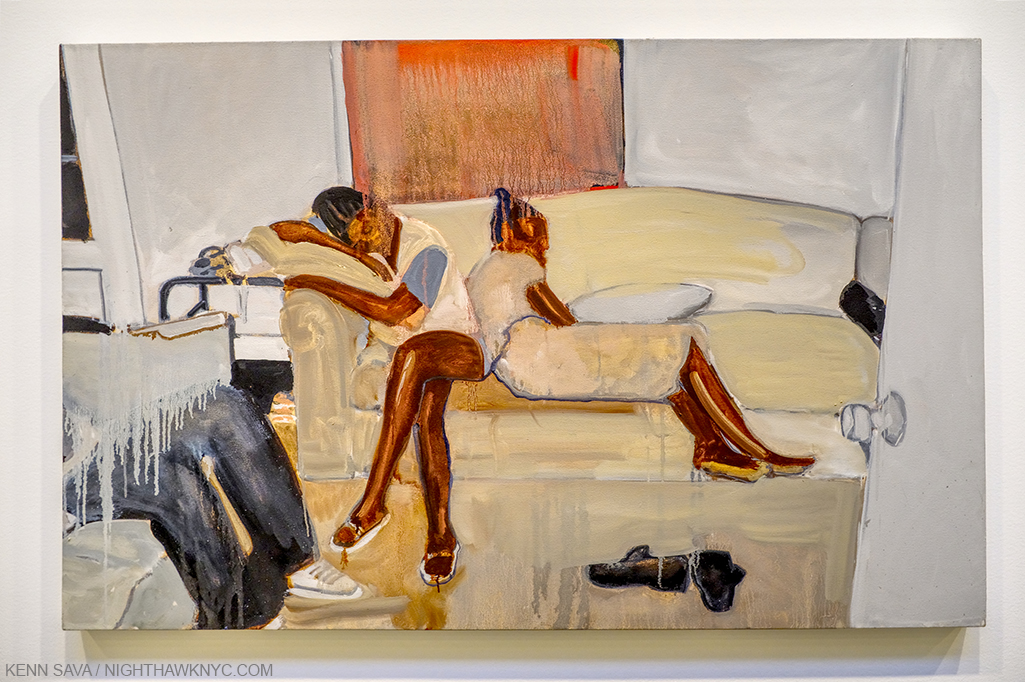
Untitled, 2015, Oil on canvas, 32 x 50 inches. Of this late work, show curator Helen Molesworth spoke about the line between the two women on the couch in her gallery talk. The separation and isolation between two so close together on barely half of the couch is compelling in a Hopperesque way, yet, I haven’t been able to summarize everything this fascinating piece says to me because every time I look at it, I see something else. I see some of what I see in Deana Lawson’s work, some of what I see in Kerry James Marshall’s, Francis Bacon, and there’s a Rothko-with-a-difference in the background, yet what strikes me most is that in this work, as in any number of other works on view Noah Davis is entirely on his own. He has studied, learned, assimilated, and then staked out his own turf as a wholly formed Artist to be reckoned with does. In the moment I shot this picture, the feeling that I was standing in front of a masterpiece was undeniable.

I’ve been blessed with knowing some, and working with some others, who left far too soon. I met the incandescent Jaco Pastorius in 1976 at the release of his now classic debut solo album at Peaches Records Store in Fort Lauderdale, Florida. I watched as he put his hands in wet cement on the store’s “walk of fame” outside along Sunrise Boulevard (which I believe is still there) that evening never imaging he would leave us a scant 11 years later. I spoke to him a number of times over those years and we both wound up (independently) in NYC shortly before his tragic murder at just 35. I worked with the late, brilliantly talented, Mark Ledford, and worked with the equally brilliant Thomas Chapin, on three albums, both of who passed at, or before, 40 in the early stages of the prime of their careers, and their lives. I think of all three of them every single day. Though the passage of time eases some of the pain, in my experience, loss is something that does not go away.

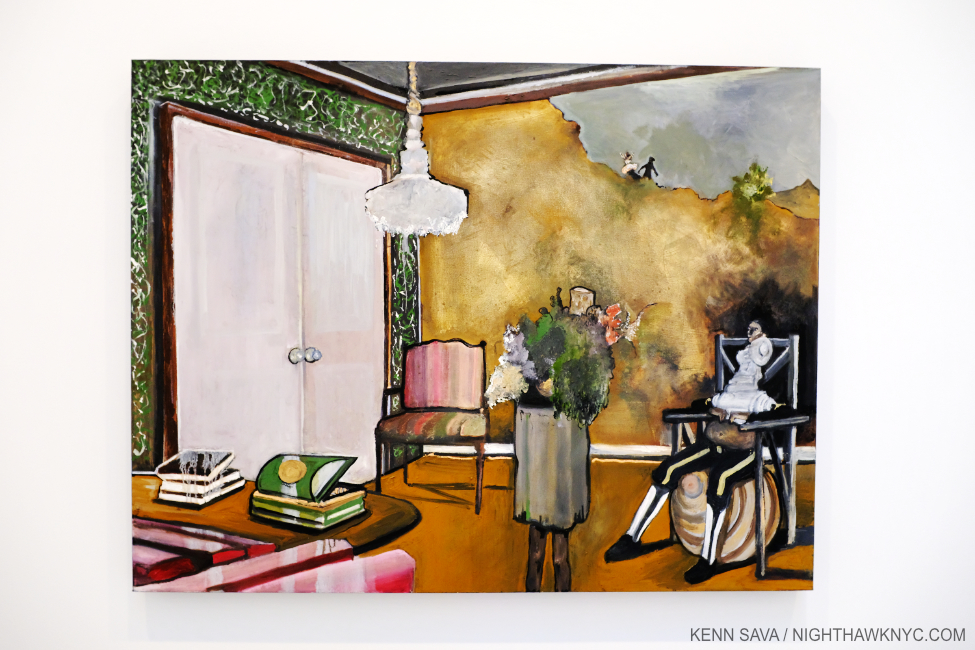
Waiting Room, 2008, Oil and acrylic on canvas, 80 x 65 inches. In many of his works, a space opens up that sometimes seems to be an abyss. Here, the abyss is above us and two figures in the upper distance appear to be looking down on the scene below. Is the Waiting Room an “abyss,” where the outcome (possibly to be revealed  behind those large white doors) is unknown as is the effect it might thave on life to come? It can also have that surreal, “Is this really happening?” feel to it. Like any work of Art, it’s open to whatever the viewer may see in it. This was, however, Painted at about the time Noah Davis was diagnosed with cancer, after his father was.

But, thank goodness we have what they created- their Art, their Music, their words, and what they taught us. Us. Everyone whose lives were touched by all of these Artists are part of their legacy.

I never had the good fortune to meet Noah Davis, who was born in Seattle, and studied at Cooper Union in Greenwich Village, becoming something of a sensation here about a decade ago before leaving without graduating around 2004 (because he felt that his education was no longer pushing him, it is said), and moving to L.A.. I was only casually familiar with his work until I walked into David Zwirner on 19th Street, where his Art and his legacy filled no less than three entire galleries.

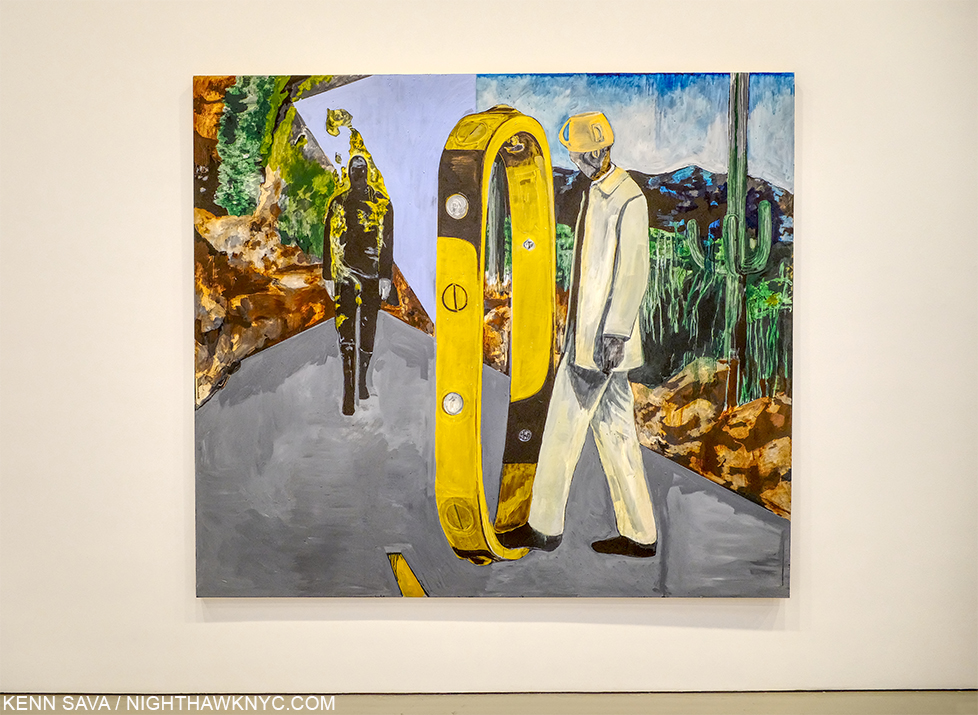
Imaginary Enemy, 2009, Oil on wood panel, 84 x 98 inches. Does the figure in white on the right, with what appears to be a cup on his head, have one foot on a portal? Or? The figure approaching on the left appears to be n flames. The strange, angular plane behind him has the effect of another dimension, as in Cubism. I’m still enjoying wrestling with this one, too, but I will say there are elements that remind me of Neo Rauch.

My mind was blown by all I saw. Noah Davis was, and is, a major figure in the Art of our time- in more ways than one.

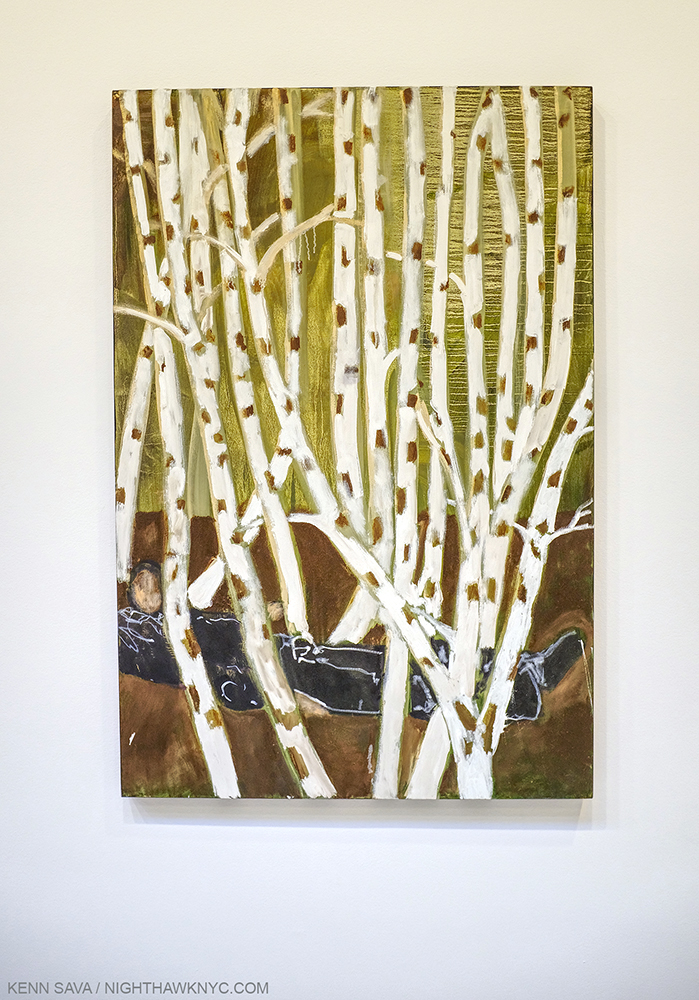
Untitled (Birch Trees), 2010, Oil on canvas, 54 1/2 x 36 1/2 inches. Many of Noah Davis’ Paintings include nebulous, mysterious faces and heads. Maybe I’ve been looking at too much Francis Bacon this past year, but I find them unique and surprisingly compelling, given their frequent lack of features.

My perception had been that at 32 he was still developing, pursuing his own style- as most Artists in their early 30’s are. Ha! As I moved from work to work, I saw an Artist who was completely in control of a full range of styles, which he could dip into at will and which only hinted at influences in tantalizing and intriguing ways, while being wholly his own. Work after different work. How is this possible? The range. The depth. The power. It was all there in the service of his vision.

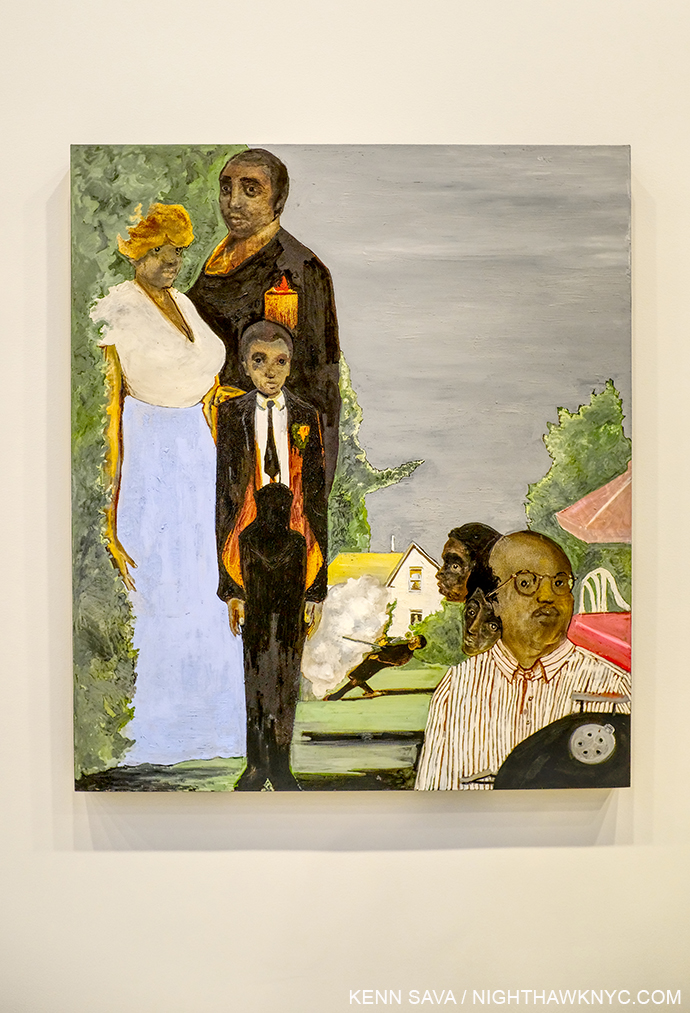
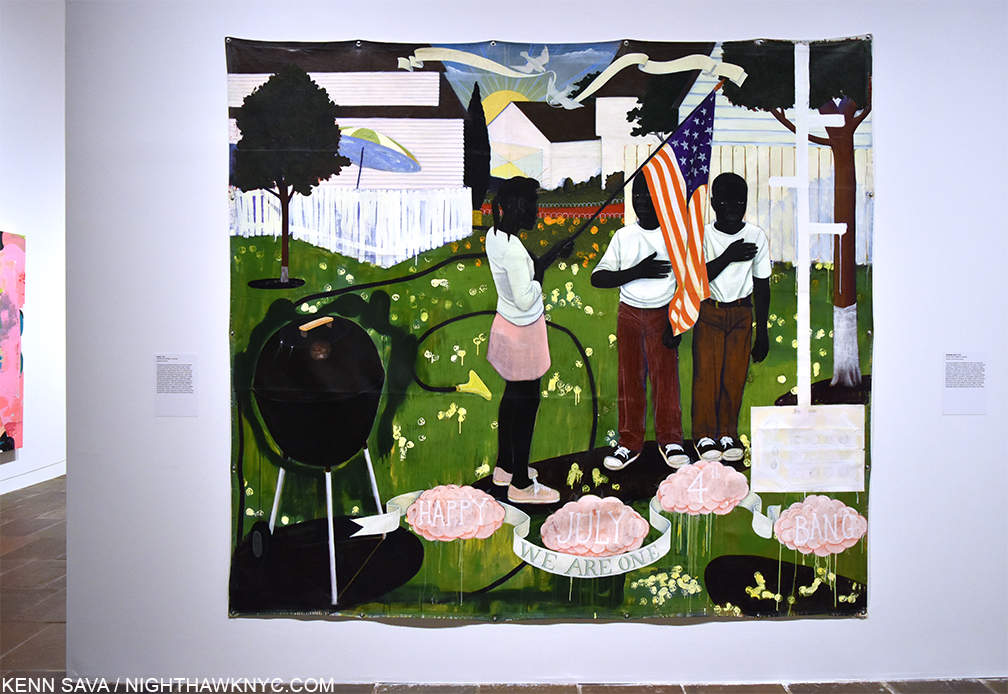
The Last Barbecue, 2008, Oil on canvas, 60 x 52 inches. Here, the faces are more defined. The group portrait on the left in countered by the odd triple portrait on the right behind the lid of the barbecue, and the scene in the center is surreal, disturbing and puzzling. It is an explosion, or? Looking at it, it was hard not to think of Kerry James Marshall’s Bang, 1994, a 4th of July barbecue scene.

Flashback- November 12,2016 at Kerry James Marshall: Mastry at The Met Breuer. KJM’s Bang, 1994, Acrylic and oil on unstretched canvas(! Notice that it’s tacked to the wall.), 103 x 114 inches.

Before he passed, Mr. Davis asked Helen Molesworth (who, a few years ago gave us the landmark Kerry James Marshall: Mastry Retrospective that I wrote about after its Met Breuer stop) to be his curator. The Zwirner show, which Ms. Molesworth has brilliantly selected and installed, is not arranged chronologically, which I am thankful for. It serves to downplay the “end” and the tragedy of Mr. Davis’ early loss and put the focus squarely on his Art and his accomplishment, where it belongs. (By my count, only 3 of the works did not have owners listed on the checklist.) Each work dialogs with other pieces from a few years later or earlier in ways only someone intimately familiar with the Artist and the work could bring us, which, by itself, sets this apart from most gallery shows of deceased Artists. Her work hasn’t ended here. Ms. Molesworth, who was controversially fired from her post at MOCA in 2018, has also been busy creating an upcoming monograph on Noah Davis, interviewing those who knew the Artist, due to be published this fall, which should be a slam dunk candidate for one of the most important Art books of the year, if not the decade.

1975 (8), 2013, Oil on canvas in artist’s frame, 49 q/w x 73 1/2 inches.

The show featured “fantastical” work, like Imaginary Enemy, alternated with domestic and family scenes. 1975 (8), 2013, was based on a Photograph from the 1970s Davis Family Photo Archives. It reminds me of the mural his mentor and friend Henry Taylor did a few years ago for NYC’s High Line.

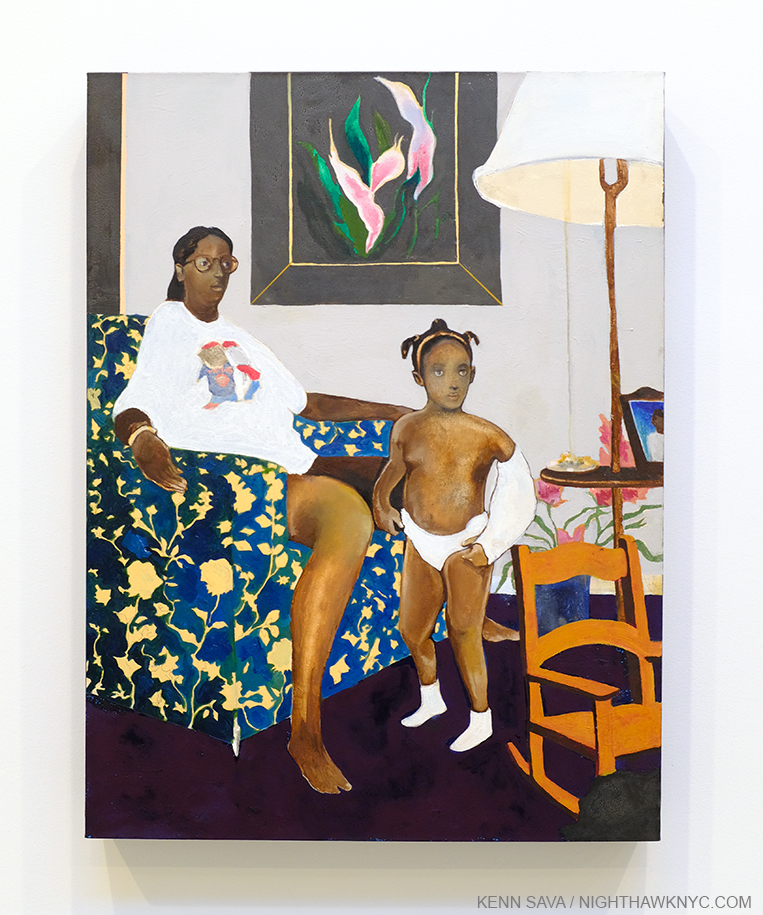
Single Mother with Father Out of the Picture, Date unknown, Oil, acrylic, and graphite on canvas, 40 x 30 1/4 inches. There’s an elegance and a timeless, haunting, beauty to this work, which though all too common in our world, I can’t recall having been the subject of a Painting before.

Mr. Taylor has written eloquently about his friend who was 30 years his junior and the effect and influence Noah had on him, his work and his career. One of the more important Painters of our time, reading his words is eye opening, an important testament to Noah Davis’ legacy.

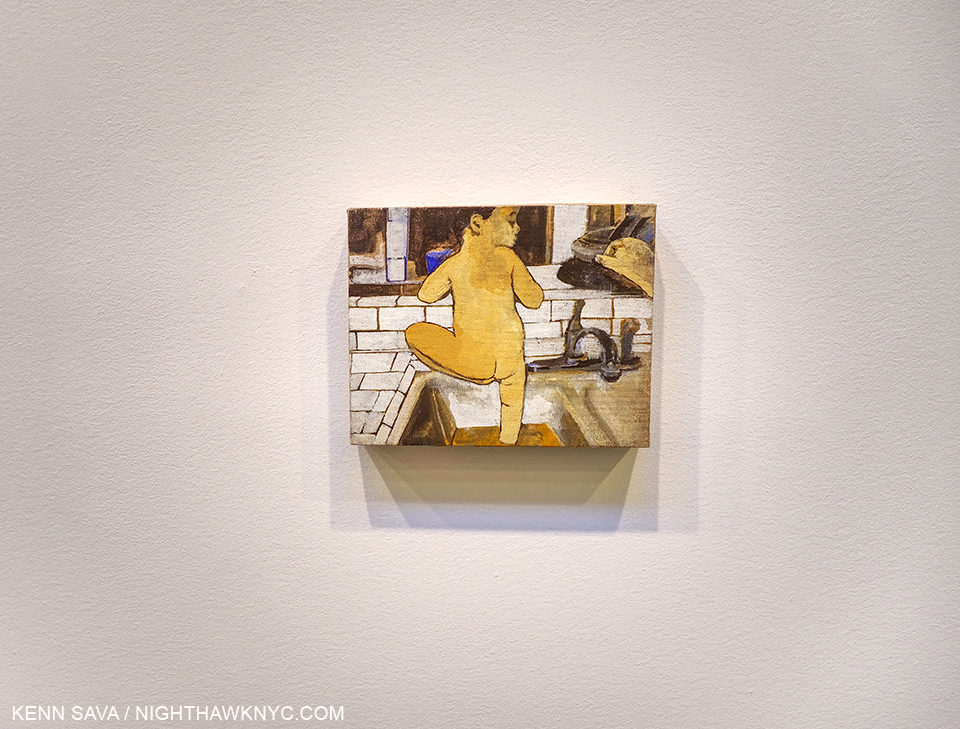
Untitled (Moses), 2010, Oil on linen on wood panel, 8 x 10 1/4 inches.

Perhaps none of these familial works is more poignant than the smallest Painting in the show, Untitled (Moses), 2010, 8 x 10 1/4 inches, showing his son, which may be based on another Photo from his family archives. In this remarkable, small, work, unique among Artist’s portraits of their children known to me, His son Moses has one foot in the water in the sink and one out, as if already leaving. The world shown in the window is dark.

But, as the remarkable, both precocious and fully formed mature works his Paintings are, there was more. Much more.

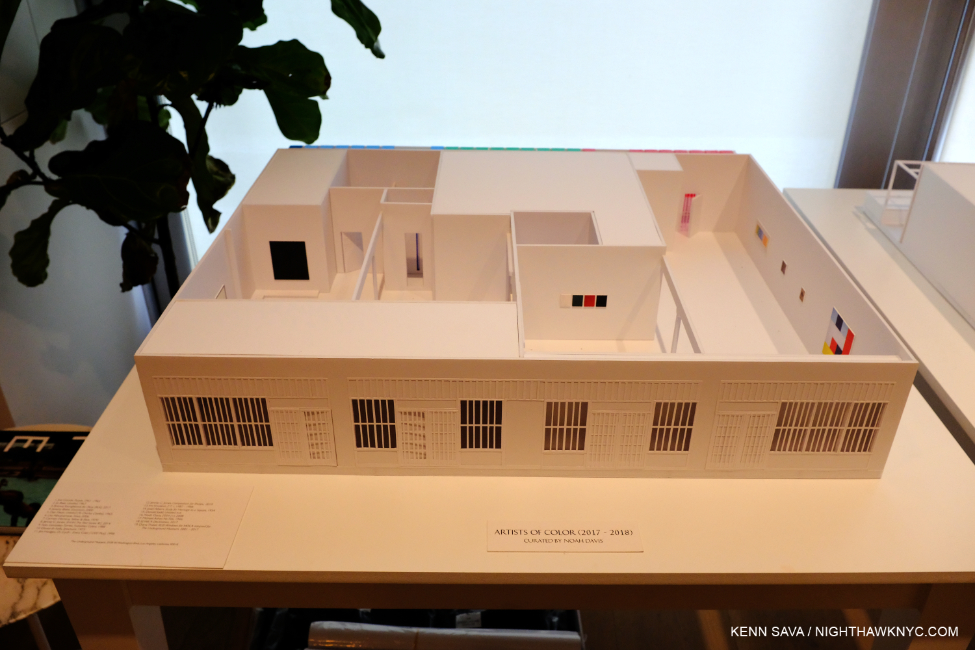
The Underground Museum is an ongoing Monument to the legacy of Noah Davis. Here, a model of it, showing its facade, with a mockup of the show ARTISTS OF COLOR, 2017-8, curated by Noah Davis. Mr. Davis left the plans for 18 shows for the UM, as it’s known, when he passed. After finding the space, Noah, his wife, Karon, and their baby, Moses, lived in the UM while it was under construction.

Having dealt with galleries early on, Noah Davis was one of those who came to feel the gallery model doesn’t work for them (something I’ve heard in innumerable conversations). Not an “established” Artist with big resources by any means, he nonetheless then dared to set out to forge his own path. With his wife, Sculptor Karon Davis, he took over 3 storefronts at 3508 West Washington Boulevard in the West Adams section of L.A., and opened what they christened the “Underground Museum” to bring museum quality Art, for free, to an area that was “underserved” by existing institutions.

“Noah wanted a space where he could show the work of himself and his friends. He wanted a space that could exist outside of the gallery/museum matrix,” Helen Molesworth said in a talk she gave at the opening.

The daring of that is only topped by his vision.

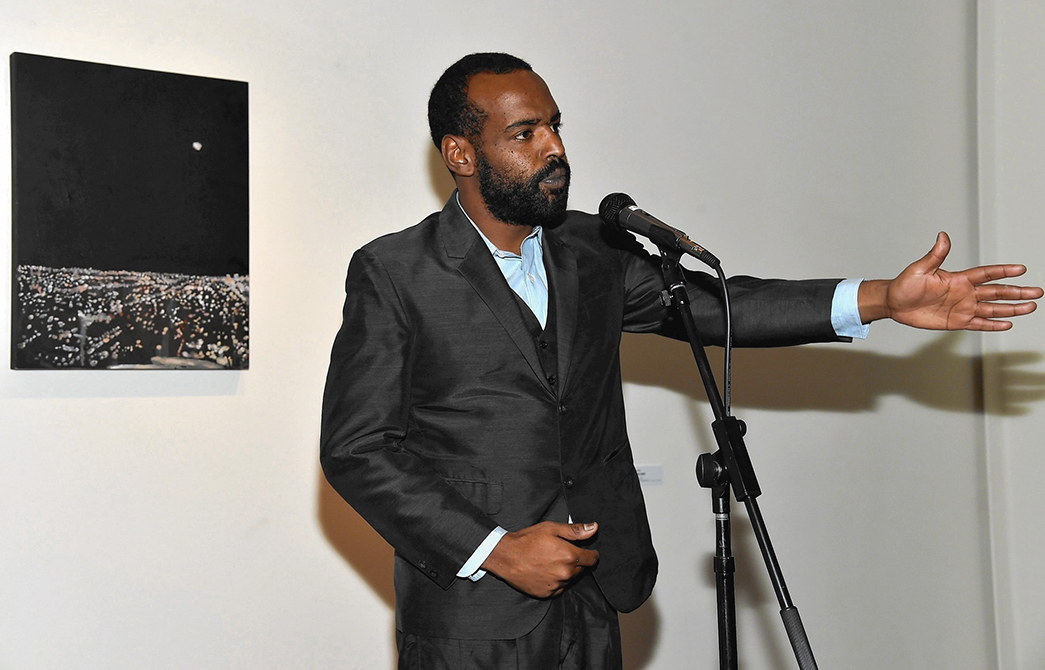
Noah Davis speaking in front of LA Nights, 2008, Oil on wood panel, 25 1/2 x 19 1/2 inches, which was also in this show. Photo by Alberto E. Rodriquez/WireImage.

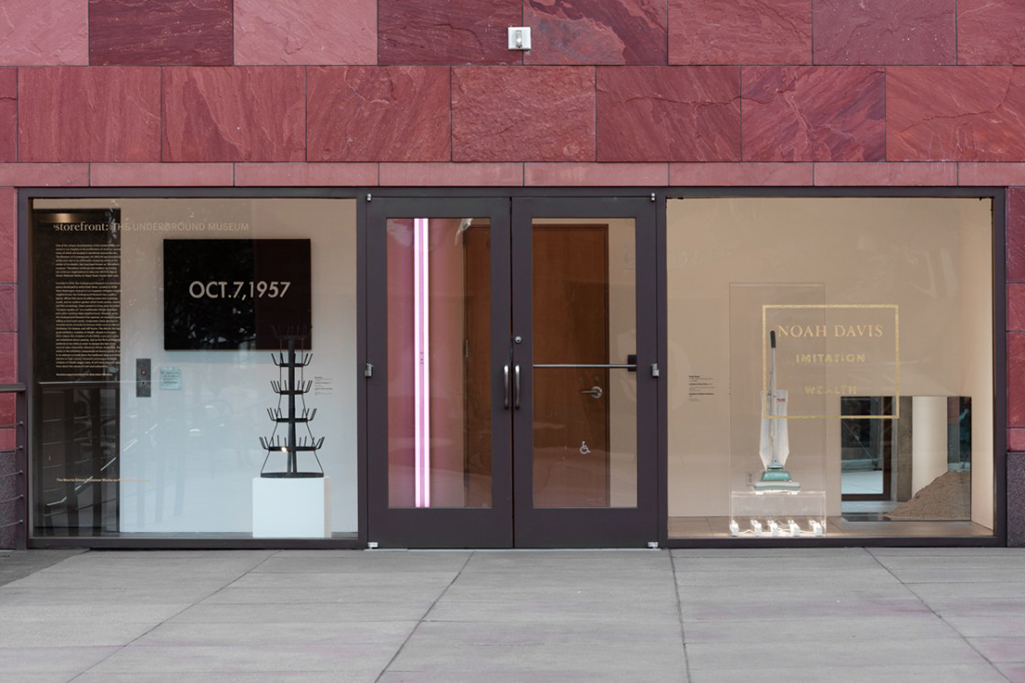
In the first show he mounted at the Underground Museum, Imitation of Wealth, Noah recreated well-known works of Art by Marcel Duchamp, Jeff Koons, On Kawara, Robert Smithson and others that he wasn’t able to borrow the originals of so that the people in this underserved area could experience them. For me, it’s another indication of wide-ranging his knowledge of Art history and his taste was. Robert Rauschenberg famously erased a De Kooning Drawing, but I can’t think of any other Artist who has done such a thing and created an entire show of “pseudo reproductions.” As a first show, Imitation of Wealth was both an auspicious “Hello,” and a shot across the bow of the Art world.

Noah Davis’ first Underground Museum show, Imitation of Wealth, reinstalled at MOCA’s Storefront space in 2015.  The imitation of a “date” Painting, Imitation of Om Kawara. Oct 7, 1957, left, happens to be his father’s birthday. Noah Davis’ Imitation of Marcel Duchamp, 2014 (Bottle Rack) is in front of it, Imitation of Don Flavin (lamp) behind the door, and on the far right, behind his Imitation of Jeff Koons (vacuum on a vitrine), and his Imitation of Robert Smithson with sand and mirrors to the far right LACMA Photo by Fredrick Nilsen.

Helen Molesworth, at the time, Chief Curator of MOCA was impressed enough with his idea to make a three year arrangement with UM to collaborate! An arrangement like this is unheard of. Tell me the other case where a world class museum has made an arrangement like this with an Artist in his early 30s to lend Art and work together to present shows in THEIR space. MOCA reinstalled Imitation of Wealth in their Storefront space in 2015, where it opened the day he passed away. He did live to see works from MOCA lent to the Underground Museum.

Noah Davis knew what was “right” for his Art, and as part of that he also had a vision of the future, of bringing Art to the people, for free. But even by 32, he moved past the vision to create the reality. Today, the UM is an important venue, one that has featured the work of Kerry James Marshall, William Kentridge, Henry Taylor, Kara Walker, and Deana Lawson, Kahlil Joseph, Noah Davis’ brother, among others.

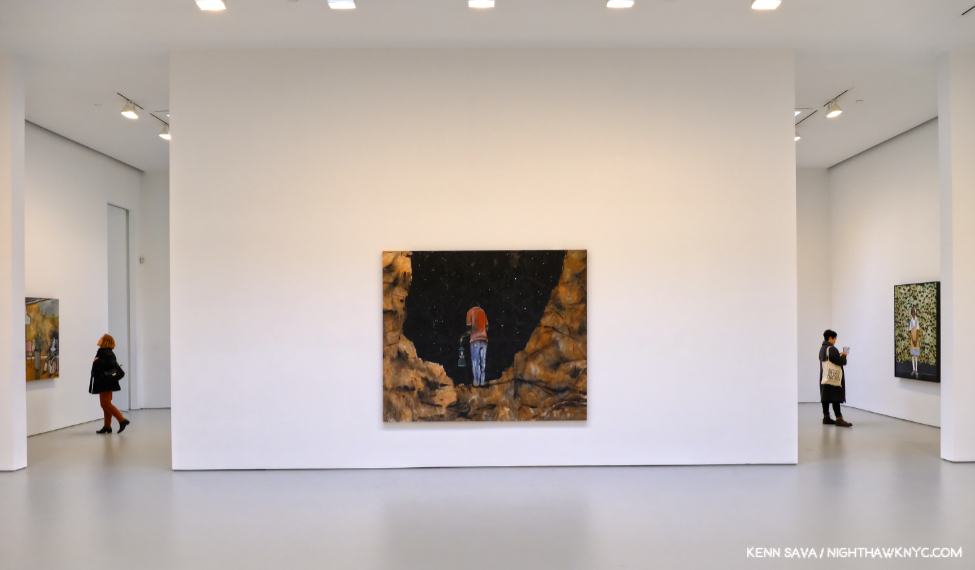
Of all the works in the show, Painting for My Dad, 2011, is the most haunting for me- perhaps the most unforgettable Painting I’ve seen in years. It was Painted while his father was in hospice with terminal cancer. We see his Dad about to embark into an unknown, dark, land with a lantern. The landscape, which strikes me as being distantly descended from Cezanne (which I also felt in Imaginary Enemy, shown earlier) in Noah Davis’ own way, is typical of how Mr. Davis took influences from across Art history and made them his own.

It’s fascinating (and something you can’t help but notice) to spot the possible influences from Art history in Noah Davis’ Paintings, and where he’s taken them. Kerry James Marshall’s Paintings set in projects, Henry Taylor’s way with figures, Francis Bacon’s nebulous portraits, Surrealism, and on and on. Every time I look at his work I see more of them, but in each and every instance he has made them his own. He’s not showing off a copious knowledge of Art history, he’s building on what others have done in the service of expressing himself with his own voice. Henry Taylor, Kerry James Marshall, Francis Bacon- these aren’t mentioned by way of comparison- I don’t believe in qualitatively comparing Artists, but just the fact that you can mention Noah Davis in the same sentence with those older masters says quite a bit about the man’s work. Walking through these rooms and looking at his work, even the selection of it shown here, I see someone who was, already, a master Painter, who’s work is going to remain important, in my view. Not only that, Noah Davis hung their work in his shows! In fact, he was one of those who take credit for “discovering” the now renowned Photographer Deana Lawson in 2009, when Mr. Davis served on a jury for a prize that Ms. Lawson submitted for. Ms. Lawson was subsequently featured in the show Deana Lawson: Planes at the UM.
The world not only lost a great Artist when he passed, it lost a budding brilliant curator, one who might have help fill the huge gap that exists in bringing Art out of the galleries and museums to the people. It also lost someone who broke the mould of the Artist/gallery matrix and found his own way. Whatever you think of his Paintings, his example is an enduring, important model for Artists today and in the future. That he was able to make his own way at such a young age has got to inspire countless people who come after him- maybe not to establish their own museum, but to find what works for them1. In the end, that on its own is an amazing, and major, legacy.

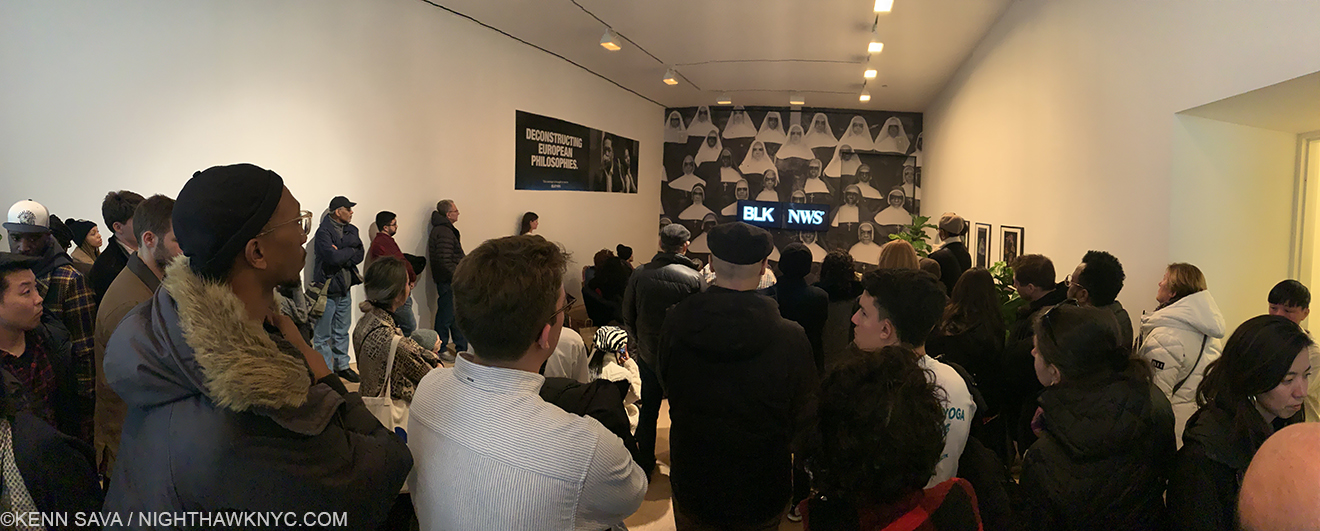
February 22, 2020. Closing day in the third gallery, designed to look a bit like the office at the UM, visitors watch videos and films by Kahlil Joseph, Noah’s brother, and others. I’m holding the camera above my head. Such were the crowds, it took me five minutes to navigate from this spot to the door to the right.

As I sit here now that this unforgettable show has closed, I’m left to wonder. What will last longer…what will have the bigger impact on the future- Noah Davis’ Art, or his example, manifested in the Underground Museum? His vision is their common thread. In the example he set, it seems to me that there is much for Artists to learn-now and in the future.

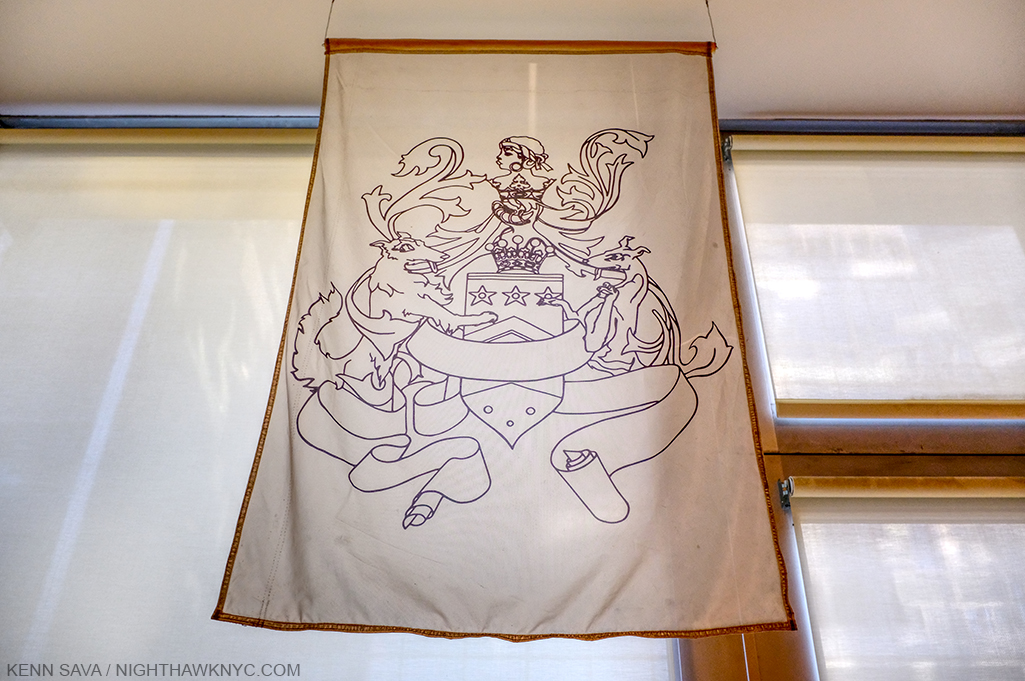
Letting the UM flag “fly high,” as Jimi Hendrix once said on the closing day in gallery 3. Long may it wave.

You can support the Underground Museum here, or by visiting it. The Noah Davis show is scheduled to open there “soon.”

*- Soundtrack for this post is “Bold As Love,” From Axis: Bold As Love, by Jimi Hendrix.

NighthawkNYC.com has been entirely self-funded and ad-free for over 6 years, during which over 250 full length pieces have been published. If you’ve found it worthwhile, you can donate to keep it going & ad-free below. Thank you!

Written & photographed by Kenn Sava for nighthawknyc.com unless otherwise credited.
To send comments, thoughts, feedback or propositions click here.
Click the white box on the upper right for the archives or to search them.
For “short takes” and additional pictures, follow @nighthawk_nyc on Instagram.

Subscribe to be notified of new Posts below. Your information will be used for no other purpose.


  1. As many are, and have been doing in their own ways, all around the world.

NYC’s Museums Are “Temporarily Closed”- UPDATED

Written & Photographed by Kenn Sava

Tonite, as I write, all of Manhattan’s “Big Five” Art Museums and the Brooklyn Museum are “temporarily closed” due to concerns over the coronavirus, marking the first time this has happened since 9/11.

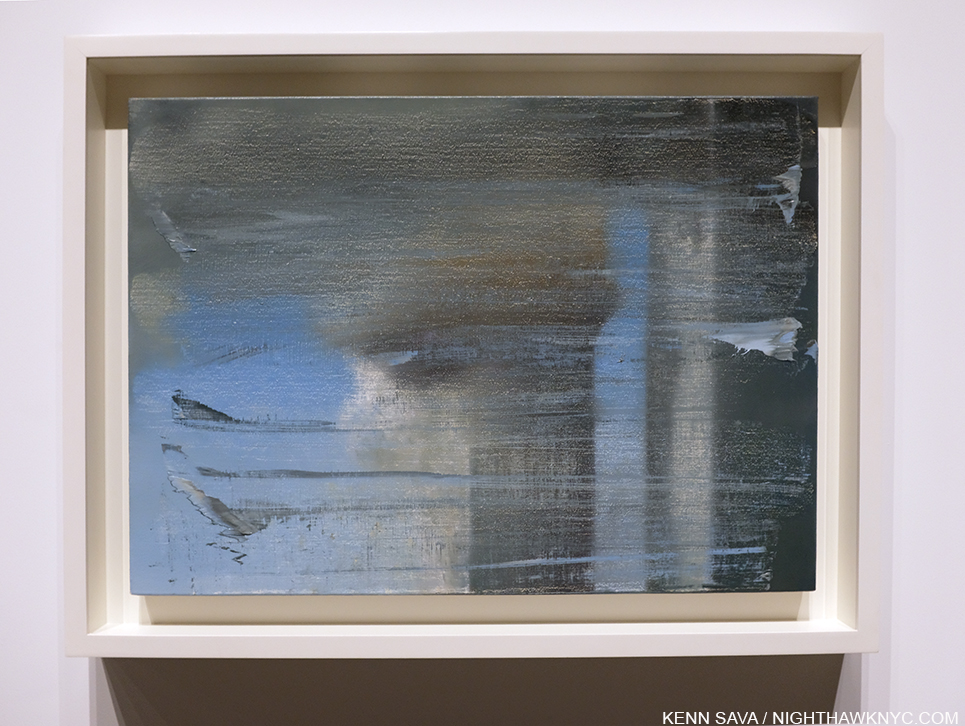
Gerhard Richter, September, 2005, Oil on canvas. The Artist created this four years after 9/11. Seen at Gerhard Richter: Painting After All on March 12, 2020, the final day The Met Breuer was open before its “temporary closing.”

Extraordinary measures for extraordinary times. 

Unfortunately, this comes at a moment when there are a number of important shows going on including-

Vida Americana: Mexican Muralists Remake American Art, 1925-1945 at the Whitney Museum

Dorothea Lange and Donald Judd at MoMA

Jordan Casteel and Peter Saul at the New Museum

Gerhard Richter: Painting After All at The Met Breuer

each of which only recently opened. 

I was able to see both Vida Americana and the Gerhard Richter this week before their sudden closings, which came without notice, and while I mull them over, I will say it would be a real shame if the closures turn out to be extended and prevent more people from seeing both of these shows, though of course, the health and wellbeing of visitors and staff must come first. In particular, Vida Americana is, perhaps, the most important Painting show I’ve seen in an NYC museum since Kerry James Marshall: Mastry graced The Met Breuer in late 2016 to 2017. 

The Gerhard Richter show, while a terrific feat of curating by Sheena Wagstaff and her team in bringing in major works from all over which are very handsomely hung, offers an opportunity to see his work through the eyes of our time and in light of both what has come since, as well as what has been discovered about what was done before and during his time by Artists who were in eclipse for too long. In my opinion, Mr. Richter, perhaps a bit like Andy Warhol, winds up with quite a few works that don’t seem to have aged all that well and it will be interesting to see if the future finds these works speak to them. There are other works who’s gravitas is plain- like the exceptional Birkenau series, (unforgettably installed adjacent to 4 incredibly rare surviving Photos taking inside Auschwitz II Birkenau by a member of the Sonderkommandos), the beautiful Forest series, and a number of fine works that seem to have been overlooked thus far. This show is a great opportunity for each viewer to assess, or reassess, for themself.

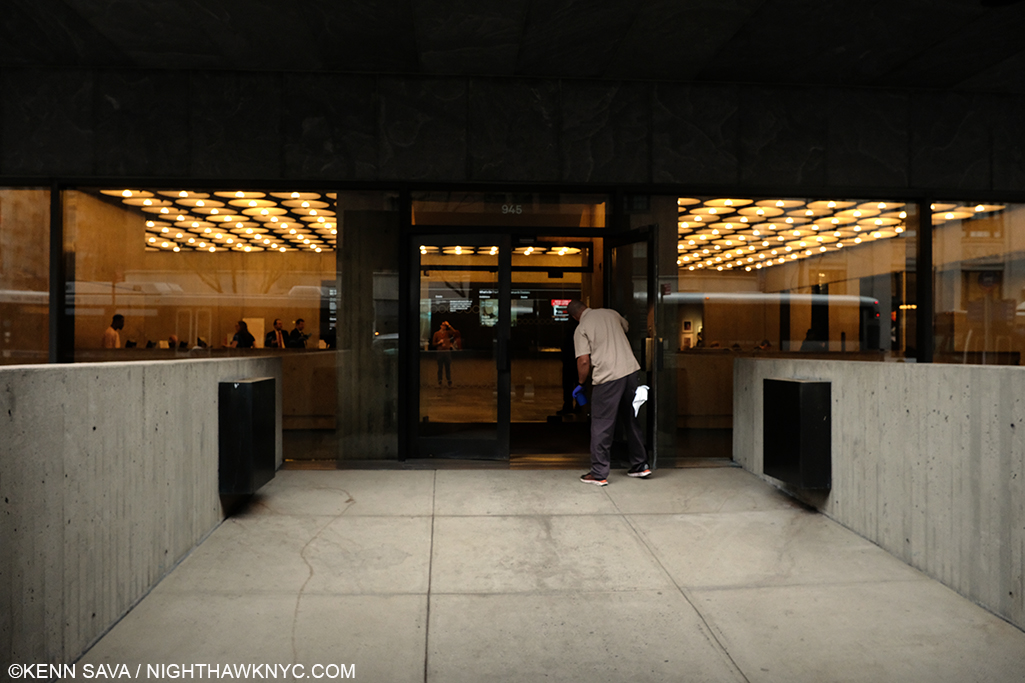
5pm, March 12, 2020. Minutes before closing at The Met Breuer, a staff member is still busy cleaning the doors. When they’ll get opened again to the public is anyone’s guess. I heard one guard say to another, “See you May 1st.” Was that his guess? The Gerhard Richter show is scheduled to open at MOCA, L.A. on August 15th, making it unlikely to be extended in NYC.

Here’s hoping the closings will be brief. But, if they are not, and, with the postponing of a number of Art & Photography shows this past week around the country, how long will it be before the galleries follow suit? In addition to any and all of the other effects it may have, all of this makes me wonder what the effect of the coronavirus may wind up being on the Art world, and the Art market, which has seen an unabated, meteoric, rise over the past three decades. 

In the meantime, stay healthy out there.

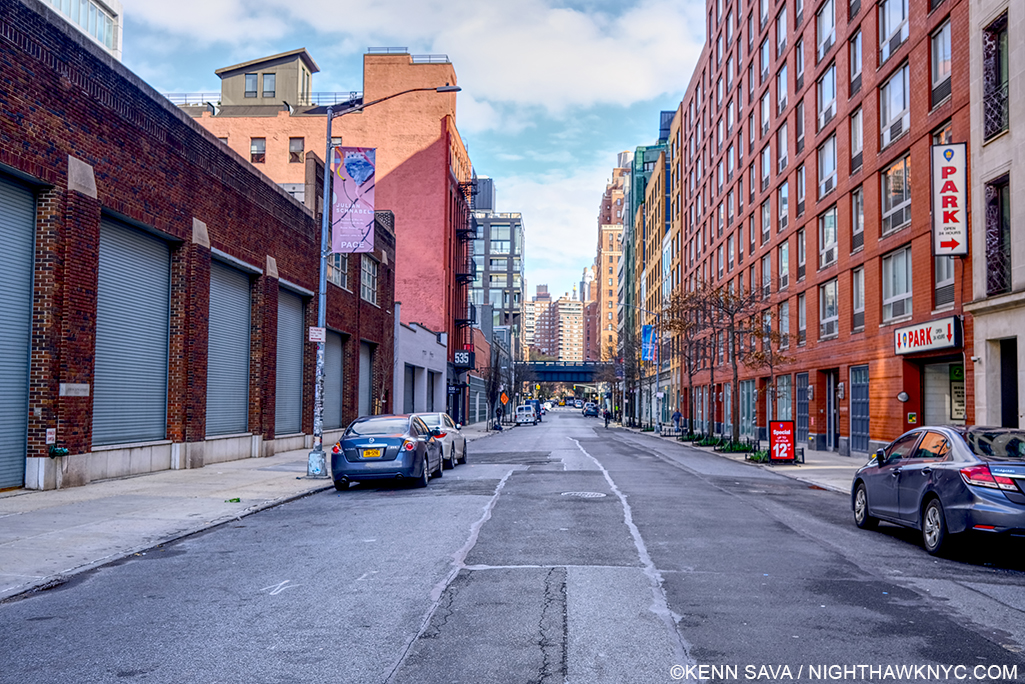
Mid Tuesday afternoon, March 17, 2020. Normally, West 24th Street in the gallery district of Chelsea would see a steady stream of foot and vehicular traffic going to the galleries lining both sides of the street from end to end. Today? I could have safely laid down to take this shot.

UPDATE- March 13th, one day later. Many, even most, of the NYC galleries have announced either closures or “open by appointment only.”

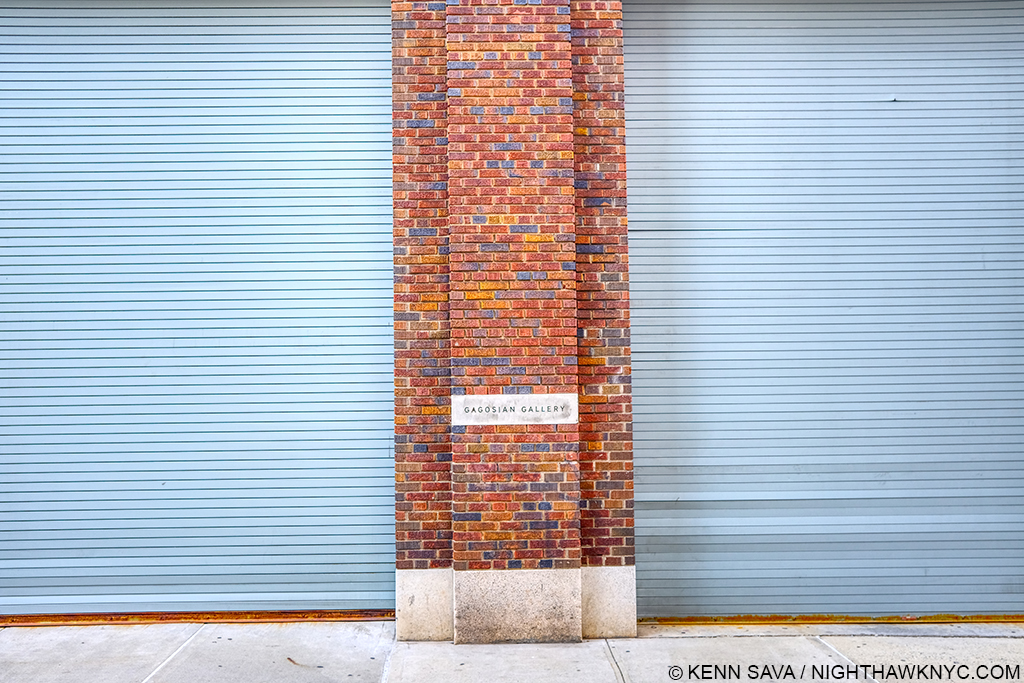
Gagosian on West 24th Street, scene of Jonas Wood’s latest NYC show, would normally be open.

While I expect many other non-Art businesses to close temporarily in the near future, a good many, especially smaller, businesses would be in extreme financial peril if they were to close for an extended time, particularly in the never more expensive NYC business environment.

The scene over on West 21st Street. The terrific Sarah Sze show was here late last year. Today, that jogger doesn’t have to worry about running into anyone, and the street looks like it did before the galleries came here.

It’s hard not to think about how that reflects on the “Art business.” It also makes me wonder how these “appointment only” galleries know the health status of whoever they are choosing to let in, among other things.

NighthawkNYC.com has been entirely self-funded and ad-free for over 6 years, during which over 250 full length pieces have been published. If you’ve found it worthwhile, you can donate to keep it going & ad-free below. Thank you!

Written & photographed by Kenn Sava for nighthawknyc.com unless otherwise credited.
To send comments, thoughts, feedback or propositions click here.
Click the white box on the upper right for the archives or to search them.
For “short takes” and additional pictures, follow @nighthawk_nyc on Instagram.

Subscribe to be notified of new Posts below. Your information will be used for no other purpose.


Harry Gruyaert- In Living Color

Written & Photographed by Kenn Sava (except *)

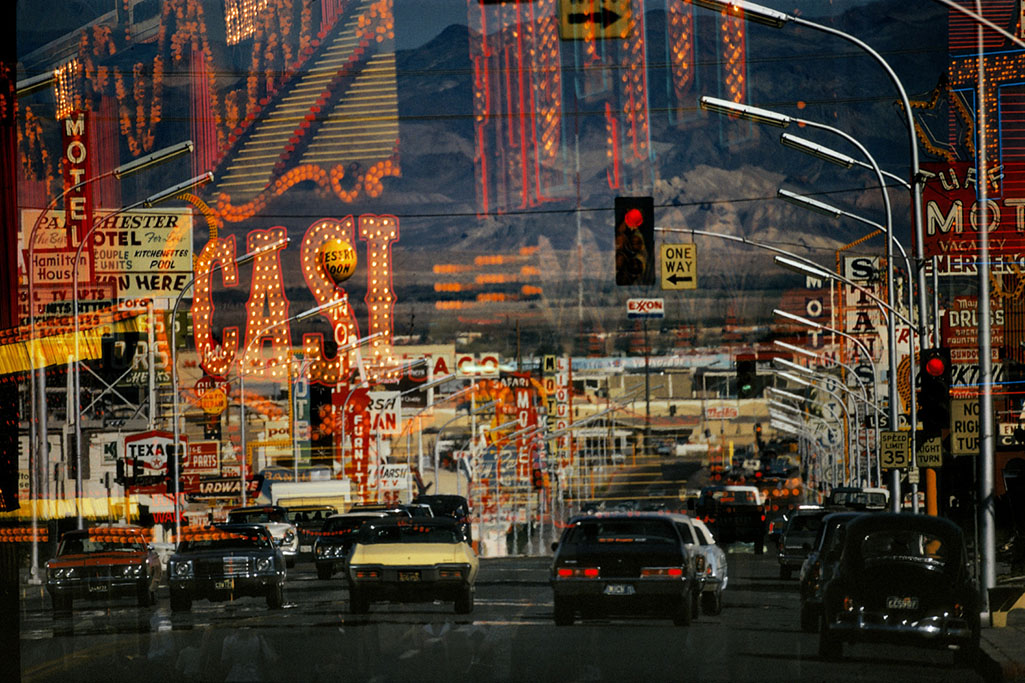
Freemont Street, Las Vegas. Nevada, USA., 1982. From West in the two-volume set East/West. *Photo by Harry Gruyaert, Magnum Photos.

Harry Gruyaert is one of any number of very fine European Photographers who are much better known at home than they are here. A good many of them have had long, accomplished, careers, and achieved substantial recognition on the other side of the pond. Here, in the USA, not so much. Last year, when I published my conversation with Harry Gruyaert, I was shocked to receive emails that said, “Thanks for introducing me to him.”

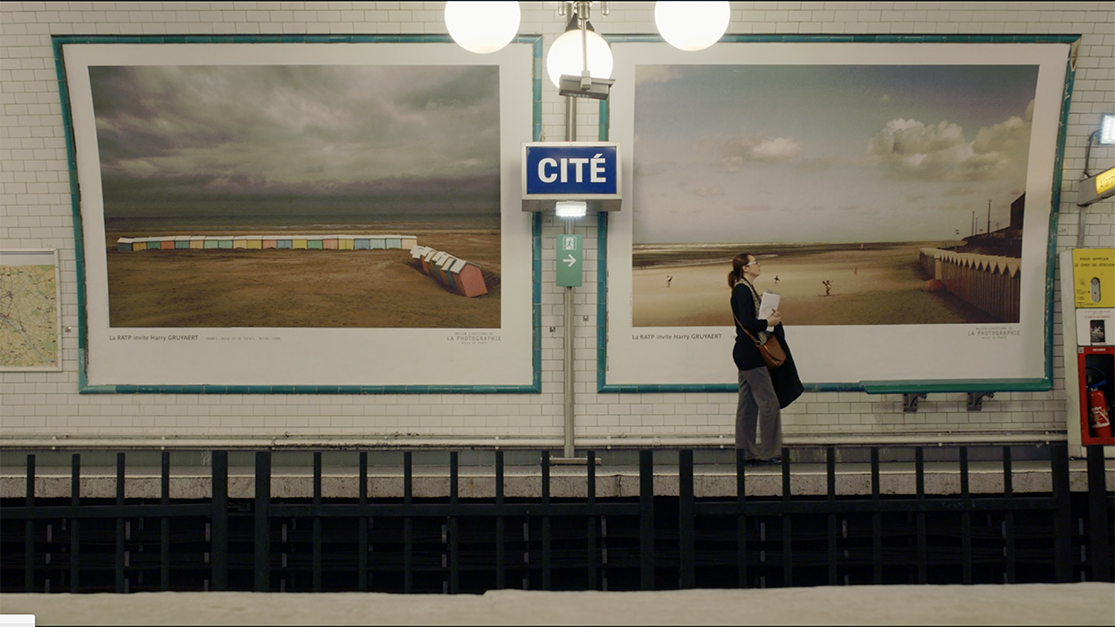
In 2017, 174 Harry Gruyaert Photographs were on view in eleven stations of the Paris Metro at the invitation of RATP, the Paris public transport operator. *Seen here in a still from the Harry Gruyaert: Photographer Documentary. Both of these Photographs may be seen in his recent book, Edges.

Really? Harry Gruyaert, who was born in Antwerp, Belgium in 1941, is one of the Photographers responsible for bringing color Photography to the mainstream Fine Art world, along with William Eggleston, Stephen Shore, Constantine Manos and others, after the early, pioneering though not as well known color work of Edward Steichen (going back to 1909!), Keld Helmer-Petersen, (in the 1940s), Saul Leiter and Fred Herzog (from the 1950s, on), and others. Harry was the subject of the recent Harry Gruyaert – Retrospective at FOMU Foto Museum in Antwerp, and the documentary film Harry Gruyaert: Photographer. He’s an Artist who’s work has appeared in eleven Paris Metro Stations and intriguing crops of his work have appeared on the cover of 68 Penguin Books Inspector Maigret detective novels by Georges Simenon. All of this is over and above the fact that he’s been a member of Magnum Photos since 1981 and is a former Vice President of the world’s foremost collective of Photographers.

What’s it going to take for some of these very accomplished Photographers to gain similar acclaim and following here?

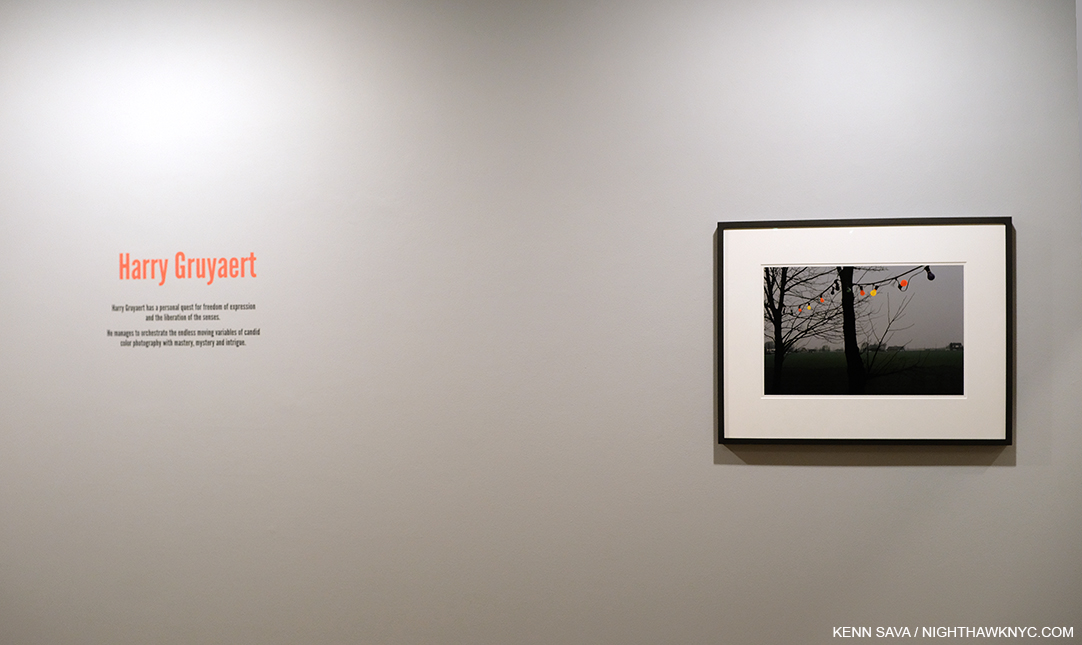
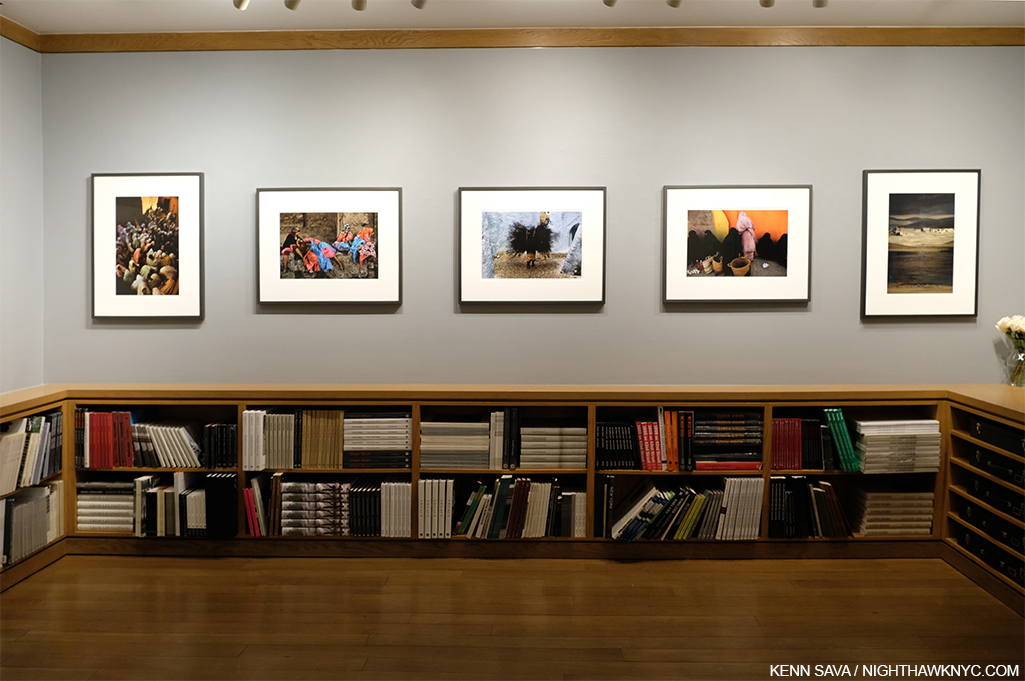
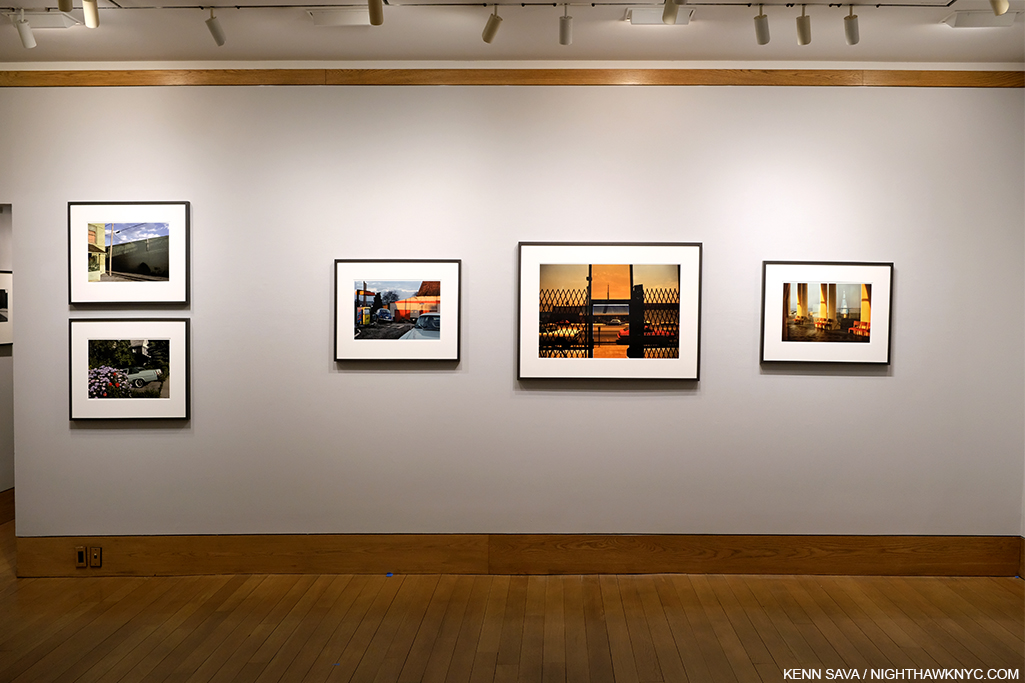
The show’s entrance with Antwerp, Belgium, 1988, 13 1/8 x 19 3/4 inches. All prints in the show are Archival pigment prints; printed later.

Perhaps, in his case at least, the tide is beginning to change. Part of the reason Mr. Gruyaert hasn’t been better known here to this point may be that almost all of the PhotoBooks he released earlier in his career are long out of print making it very hard for anyone new to him to discover his work. Though I have had an interest in Mr. Gruyaert’s work, I’ve never seen any of his older books, like the legendary Morocco– even in rare book stores.

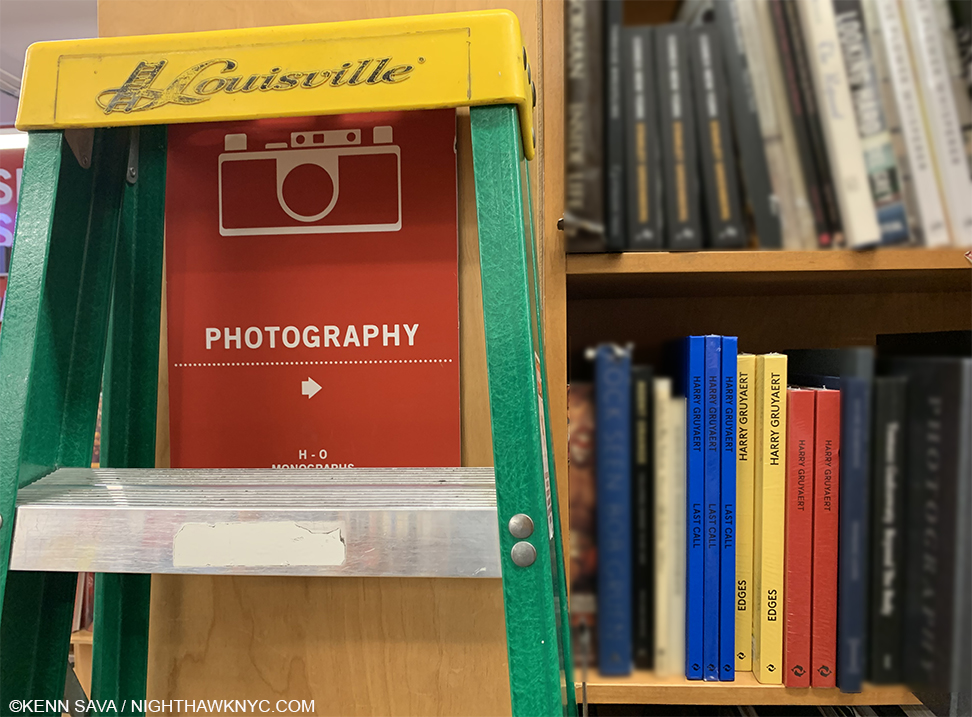
Blue, yellow and red- the colors of the covers of three of the most recent Harry Gruyaert monographs.

More recently, Thames & Hudson has released 4 new books over the past 5 years (Harry Gruyaert, 2015, a retrospective with the red cover, and best place to start exploring his work, the also excellent two-volume set East/West, 2107, Edges, 2019, and the just released Last Call, 2020), which are helping to bring his work back to the eyes of the PhotoBook world.

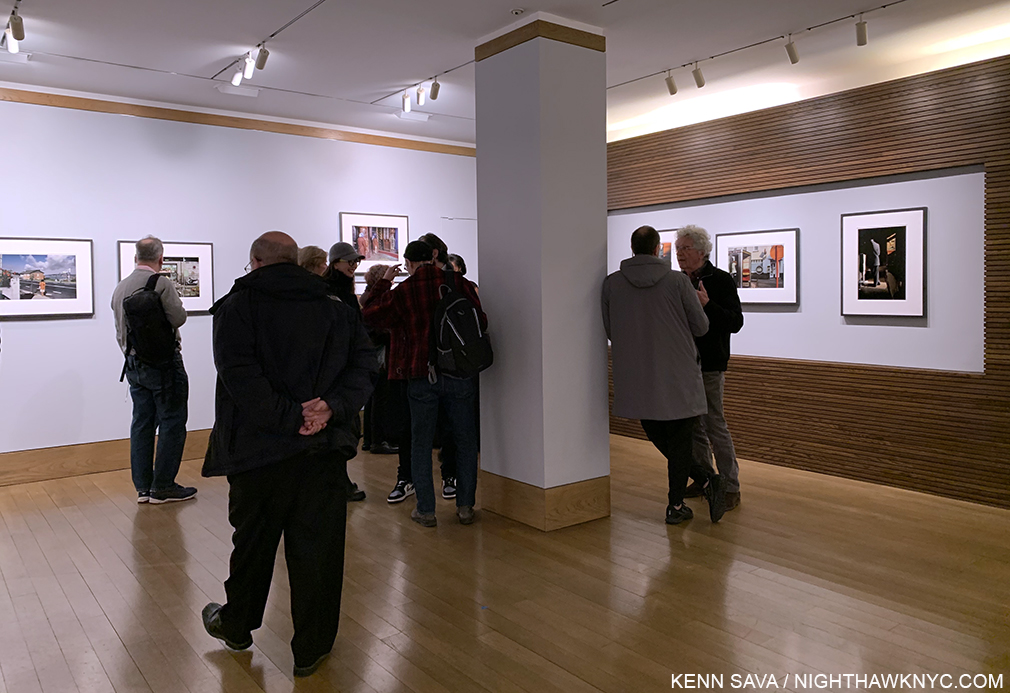
Harry Gruyaert at the Howard Greenberg Gallery, installation view. On the wall or in a book, Harry Gruyaert’s work tends to grab viewers at first sight.

With Harry Gruyaert at the Howard Greenberg Gallery, his first show in the USA in decades, the next step has been taken. After our conversation  last year from Paris, I finally had the chance to meet Harry at the opening. There he was, with Roger Szmulewicz, Director of Gallery51, his European dealer, on January 23rd. Harry told me this was his first USA show since the release of Morocco, which was published in 1990! Then, in keeping with the spirit of Last Call, which he shot in airports, Mr. Gruyaert, still a frequent traveler, told me he was off to Japan in two days.

Harry Gruyaert, left, chatting with Roger Szmulewicz, Director of Gallery51 at the opening.

As I learned in our conversation last year, Mr. Gruyaert is a fascinating, multi-dimensional, man, who has had a remarkable career and life, which has been characterized by being in the right place at the right time, in the right light, as was to be seen in spades on the walls of Howard Greenberg.

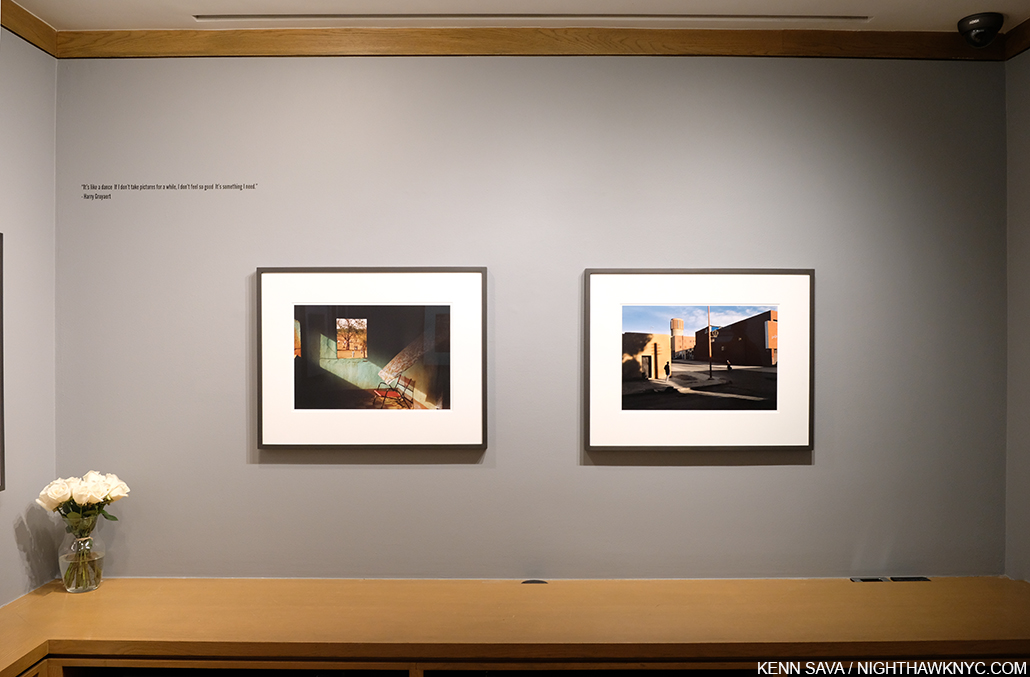
Gao, Mali, 1988, 13 1/8 x 19 5/8 inches, left and the haunting Quarzata, Morocco, 1986, 13 1/8 x 19 3/4 inches, right.

Here and now, in the moment, a good many of Harry Gruyaert’s most familiar, and beautiful, pieces were on view.

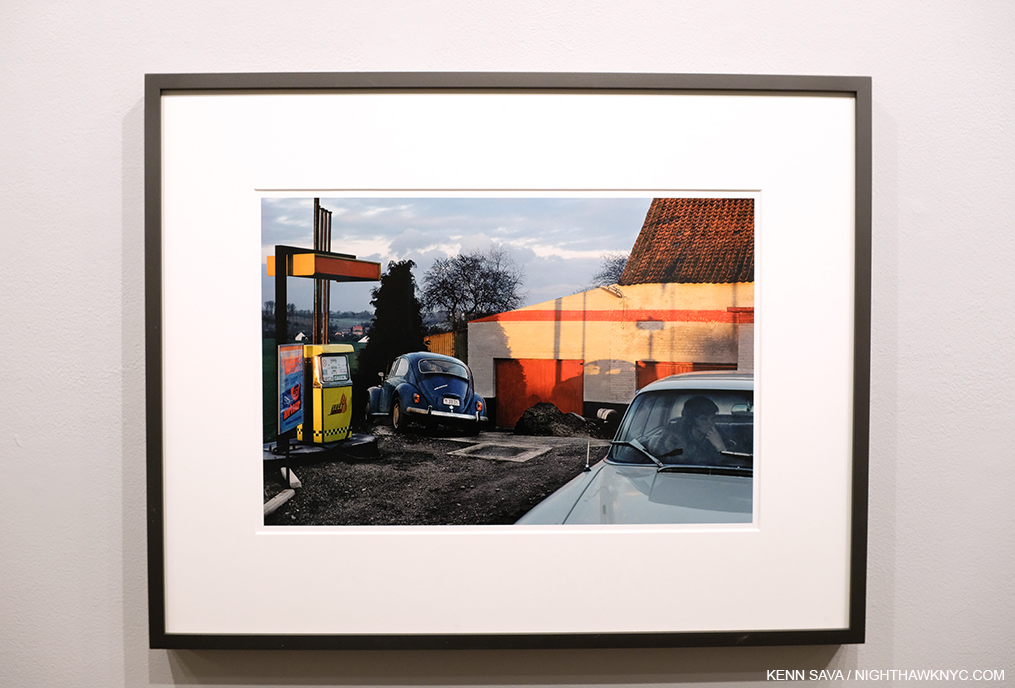
Province of Brabant, near Wavre, Belgium, 1981, 13 1/8 x 19 5/8 inches

For me, the show felt like reuniting with old friends. Province of Brabant, near Wavre, Belgium, 1981, in particular has long been among my favorites. There’s so many levels to this composition- the colors and their interaction, the distant landscape, the play of geometric shapes and shadows, the jarring angle the VW Beetle sits at, and then you get to the woman sitting in the car. It’s like a still from a movie, an outtake from a Michelangelo Antonioni Film he never made. Mr. Gruyaert, a long-time fan of Michelangelo Antonioni, and a former TV Director early in his career, produced a film that showed clips from Antonioni Films interspersed with some of his Photographs in the show The Image to Come at Cinémathèque Française in 2009.

Installation view. To the right of center works from his East/West series hang next to each other. LA, USA, 1982, the larger piece and Ostend, Belgium, 1982, to its left.

A little known chapter in his distinguished career also saw him in the right place to document the work of the legendary Artist Gordon Matta-Clark during some of the semial years of that Artist’s career. Most of those shots, which are seen frequently when Mr. Matta-Clark’s work is discussed, don’t bear his name, since they now belong to Mr. Matta-Clark’s estate, but the fact that Harry was there at the right time, taking remarkable (black & white) Photos are yet another part of his legend.

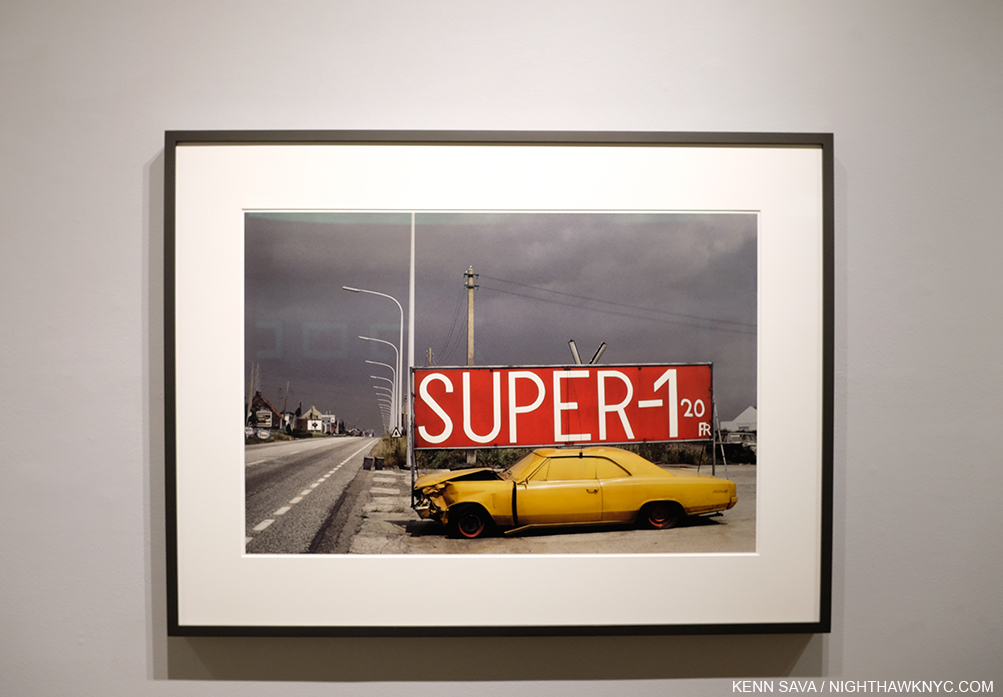
National Road #1, Boom, Province of Antwerp, Belgium, 1988, 20 7/8 x 31 1/2 inches

With such a long and distinguished career to dip into to mount shows from, here’s hoping there will be cause for many more Harry Gruyaert sightings on this side of Planet Earth.


Harry Gruyaert, far right, at the opening.

In person, in living color.

*- Soundtrack for this Post is “East West” by Morrissey from Kill Uncle.

NighthawkNYC.com has been entirely self-funded and ad-free for over 6 years, during which over 250 full length pieces have been published. If you’ve found it worthwhile, you can donate to keep it going & ad-free below. Thank you!

Written & photographed by Kenn Sava for nighthawknyc.com unless otherwise credited.
To send comments, thoughts, feedback or propositions click here.
Click the white box on the upper right for the archives or to search them.
For “short takes” and additional pictures, follow @nighthawk_nyc on Instagram.

Subscribe to be notified of new Posts below. Your information will be used for no other purpose.


A Year of Art: 2019

Written & Photographed by Kenn Sava

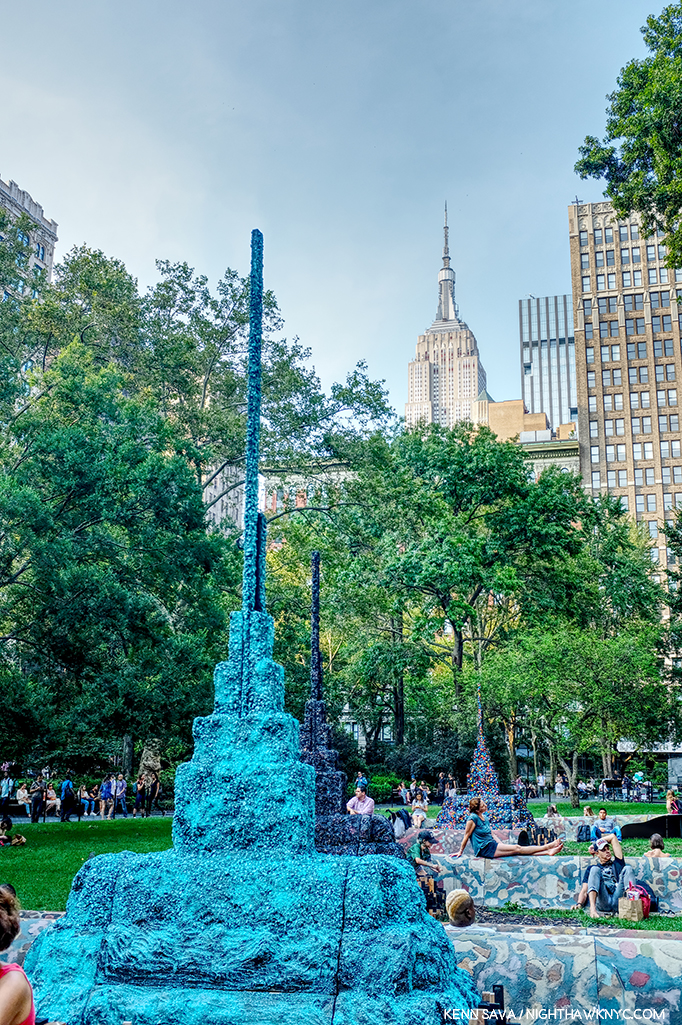
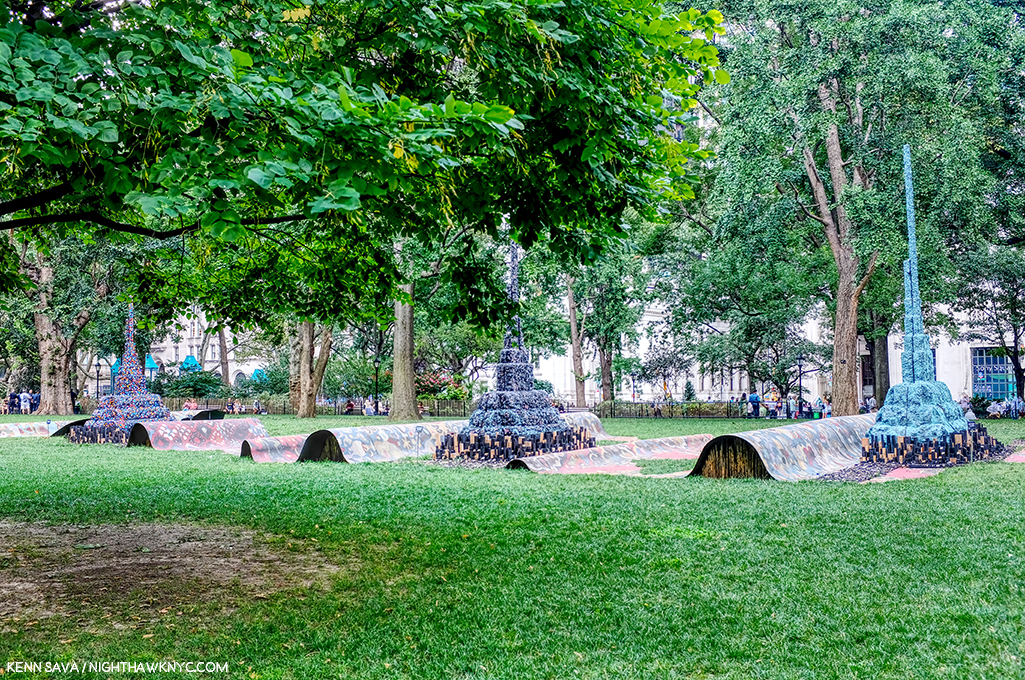
Detail of Leonardo Drew’s Public Art project, City in the Grass, 2019, seen in August in Madison Square Park, where it was on view from June through December. In conversation, Mr. Drew spoke of the influence of Indian Stupas, though the Empire State Building 10 blocks behind, might be one as well.

A strange year in Art in NYC ended a few weeks ago. A year that saw one of Manhattan’s “Big 5” museums (MoMA) close for four months, including the entire summer, while it remodeled, then reopen to mixed reviews (mine among them), while another one (The Whitney) faced an Artist revolt mid-Biennial, another (The Met) had what seemed to me to be a fairly “quiet” year on the show front as it adapted to the first full year under its new Director, Max Hollein, while the other two, the New Museum and particularly the Guggenheim, chugged along presenting top notch show after top notch show. Meanwhile, no less than 5 shows of the work of Jean-Michel Basquiat were mounted around town, and though I wrote a series of pieces on them I still don’t know “Why now?” While I’ve written about a number of other shows I found particularly NoteWorthy in 2019, already, there were some other excellent shows that linger in my mind, in the space freed up by the plenty of others that do not. If I were to sum of the year in Art seen, I will remember it as a year where Sculpture, long a very overlooked medium, though not here, struck back and broke through.

NoteWorthy Sculpture Shows-

Lingering closest to the front of my mind is the incredible Sarah Sze at Tanya Bonakdar Gallery, which I just wrote about, along with Jean-Michel Basquiat at The Brant Foundation, the most unforgettable shows I saw in 2019.

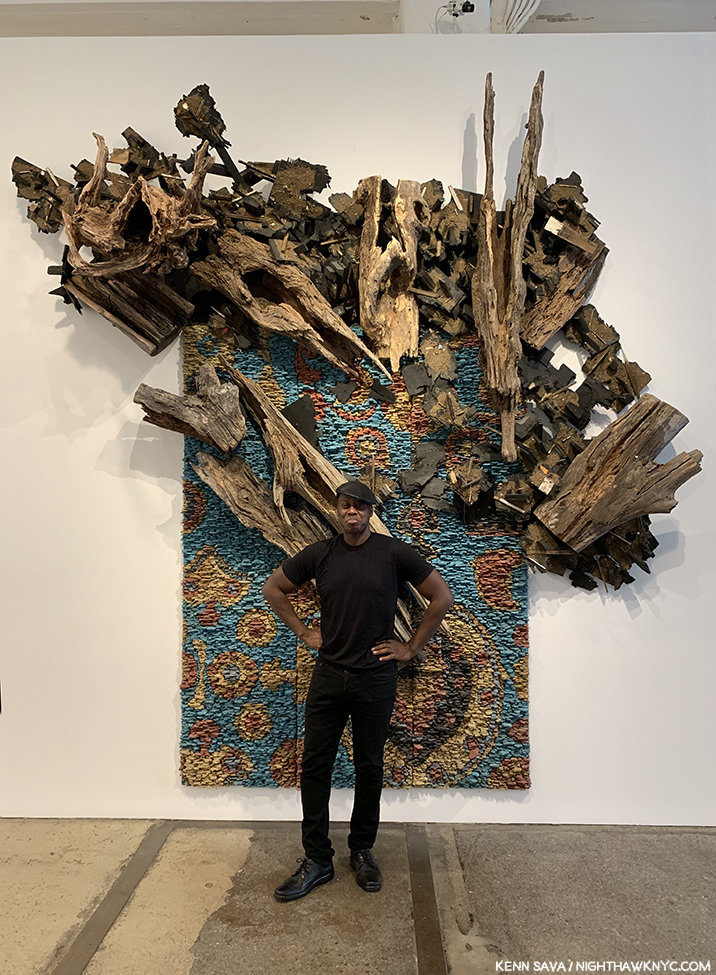
Leonardo Drew poses in front of Number 217, 2019, Wood, plaster and paint, on the last day of his show at Galerie Lelong, August 2, 2019

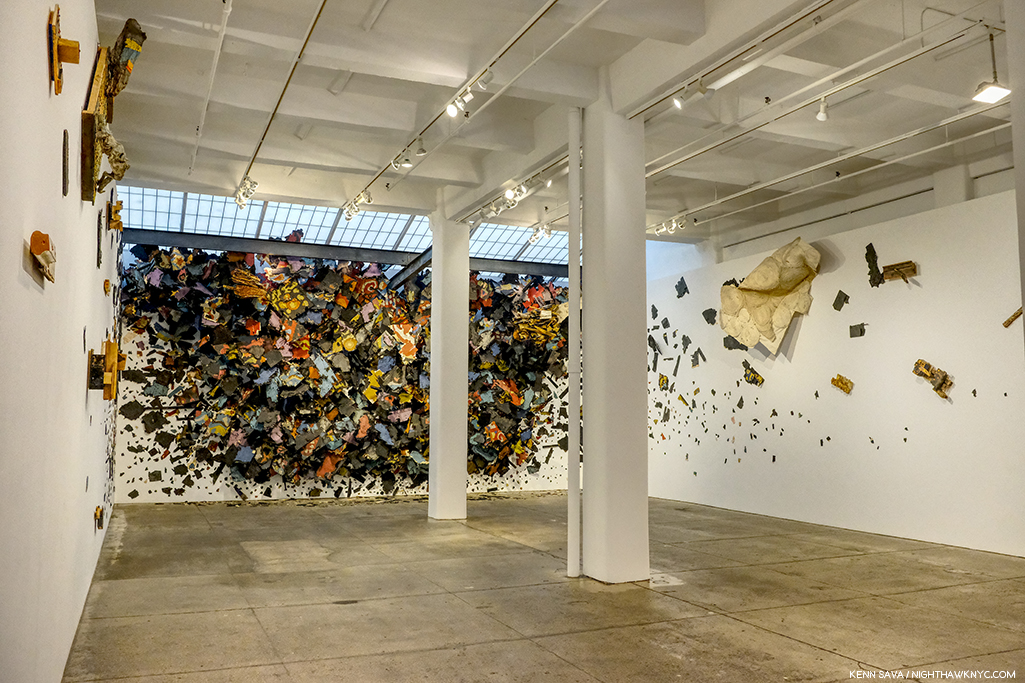
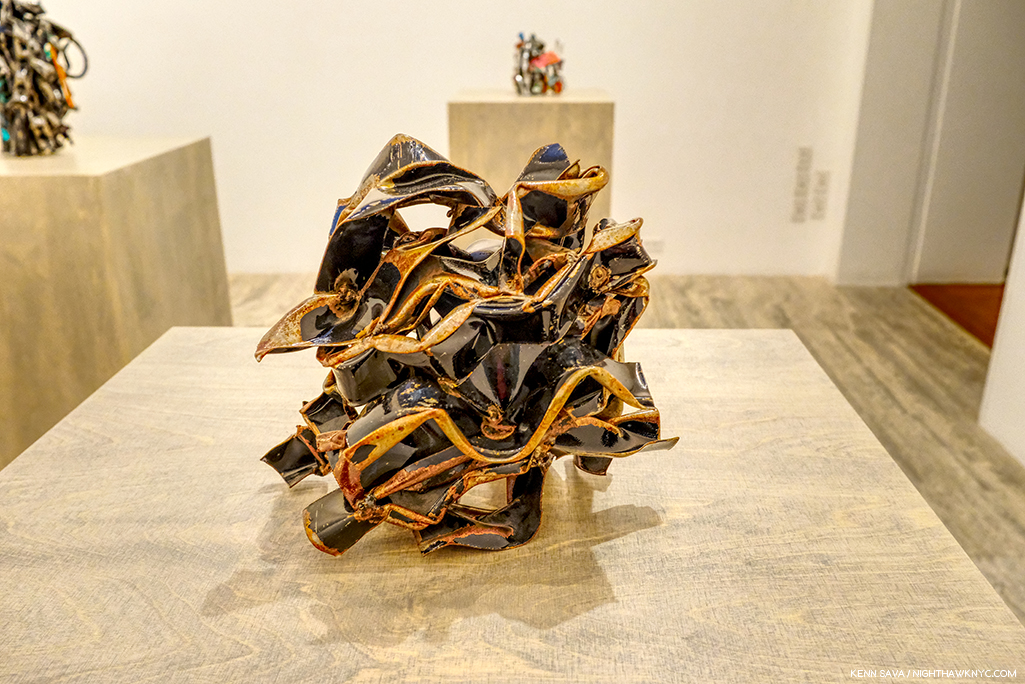
Leonardo Drew at Galerie Lelong and City in the Grass at Madison Square Park. Mr. Drew has achieved substantial success around the world, with work in the Permanent Collections of any number of museums, including The Met’s, yet he still seems to be something of a “well-kept secret” to the larger Art public. One of the most original, interesting and visionary Sculptors working today, I thought his show at Galerie Lelong was close to perfect.

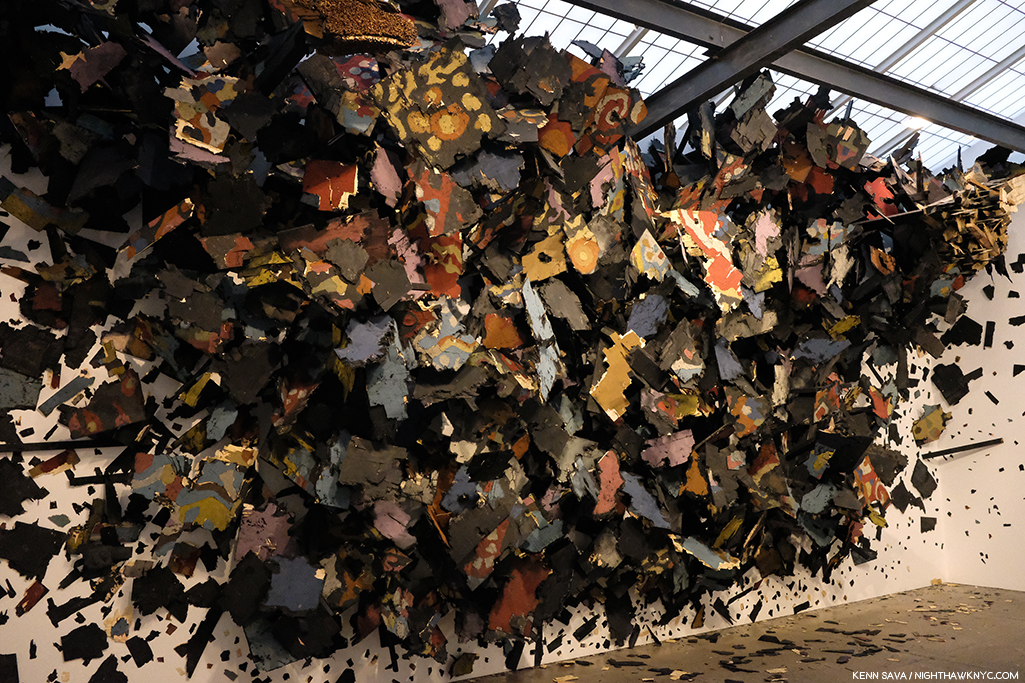
Number 215, 2019, Wood, paint and sand.

As with Sarah Sze, the show marked the introduction of Painting by the Artist, though not in the “traditional” sense. The Artist told me Number 215 began as a Painting (his), which he then deconstructed as if it had exploded.

Detail. The show also introduced color into Leonardo Drew’s work.

One monumental work in the large gallery accompanied by five others in the remaining space, each one selected with supreme taste to provide a wonderful group. While his show was up, Mr. Drew also debuted his first Public Art piece, a work commissioned for Madison Square Park.

City in the Grass seen on a day when the lawn was closed to be rested from the non-stop traffic it had been receiving. At the base of each of the three “Stupa”-like structures were wooden “cities” rendered in Mr. Drew’s typically extensive detail to the point that, up close, you could literally spend hours moving through them with your eyes.

In all my years of living in the City, and living here with Public Art, I’ve never seen a piece that was so quickly adopted by the public. Kids endlessly climbed all over it while their parents and other adults languished on other parts of the gigantic piece, as can be seen in the first picture above. Mr. Drew appeared in the Park at least twice to speak about the work and proved to be an extremely thoughtful speaker.

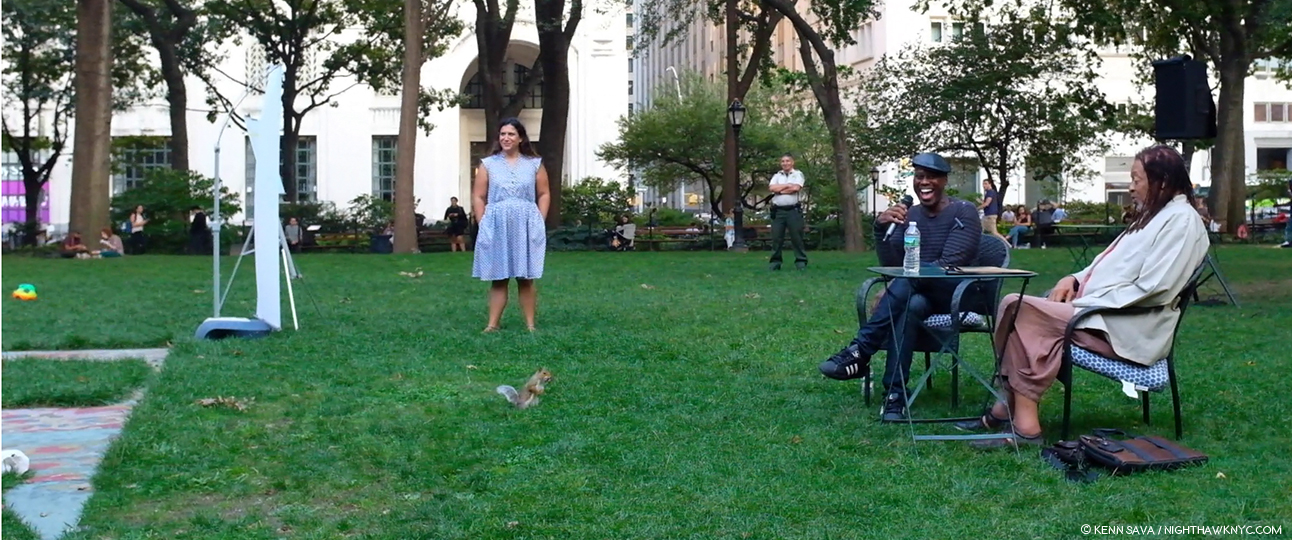
Such was the public acceptance of City in the Grass that even one of the Park’s permanent residents came by to hear the Artist speak about it in a public talk, with renowned writer (and Miles Davis Autobiography co-author) Quincy Troupe, right, on September 11, 2019.

In terms of precedents or influences, Thornton Dial and Jack Whitten (who rented space to Mr. Drew early on the Artist told me) come to mind, but not really. Leonardo Drew is an original. Before he’s done, many decades hence, I believe his work is going to wind up in as many museum as just about any other Sculptor of his generation. 

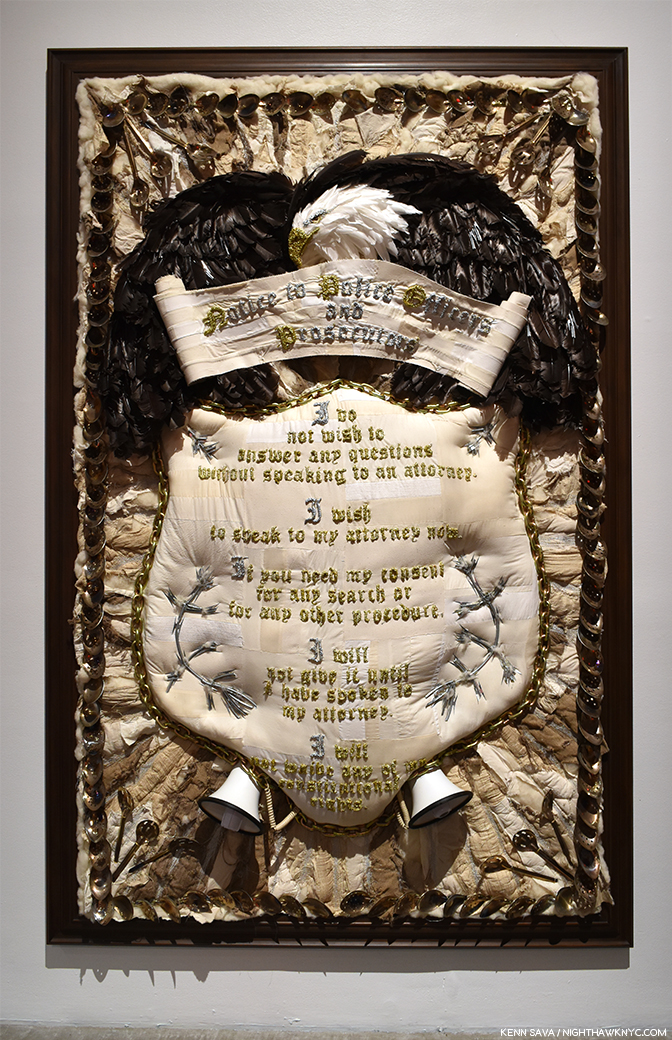
Nari Ward, Homeland Sweet Homeland, 2012, Cloth, plastic, megaphones, razor wire, feathers, chains and silver spoons, 96 x 60 inches. Along with everything else going on in this, the detail is incredible.

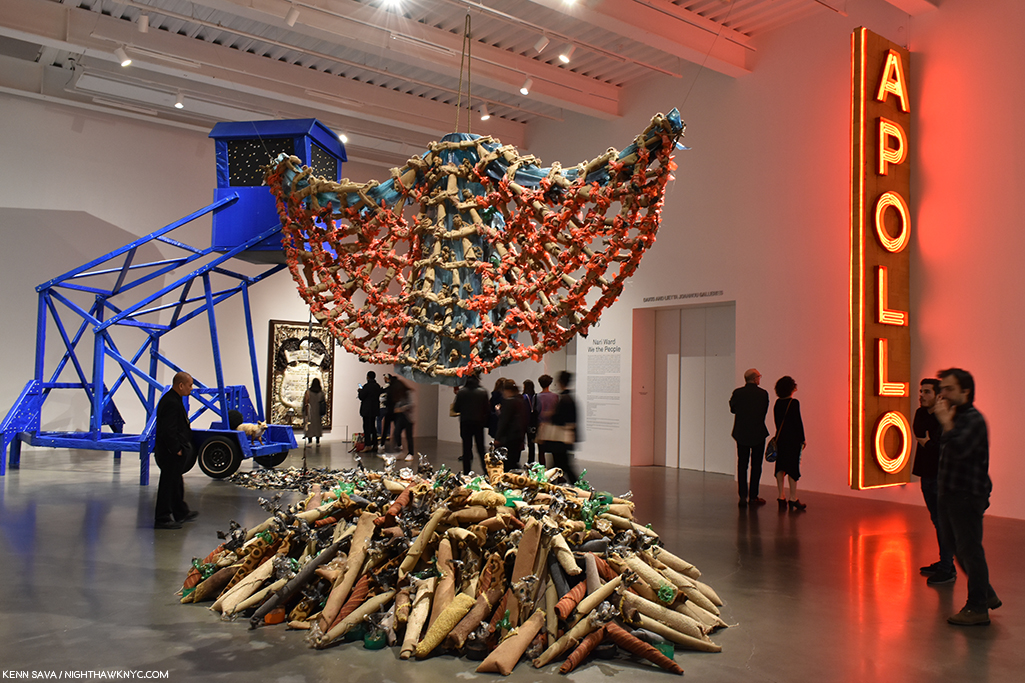
Nari Ward: We The People at the New Museum- Since the 1990s Nari Ward has been repurposing a very wide range of mundane, even humble, materials, often in staggering amounts, in new, surprising and exciting ways. We The People was another long overdue retrospective of the work of this exceedingly creative Artist.

Installation view of part of one of the three floors the show filled.

Occupying multiple floors of the building each work was strong, different from the one before, and shared an uncommon ability to linger in the mind. Another blockbuster show mounted by the terrific team of Massimiliano Gioni and Gary Carrion-Murayari for the New Museum, which continues to rise in stature in my eyes.

Installation view of the 2nd of 3 galleries.

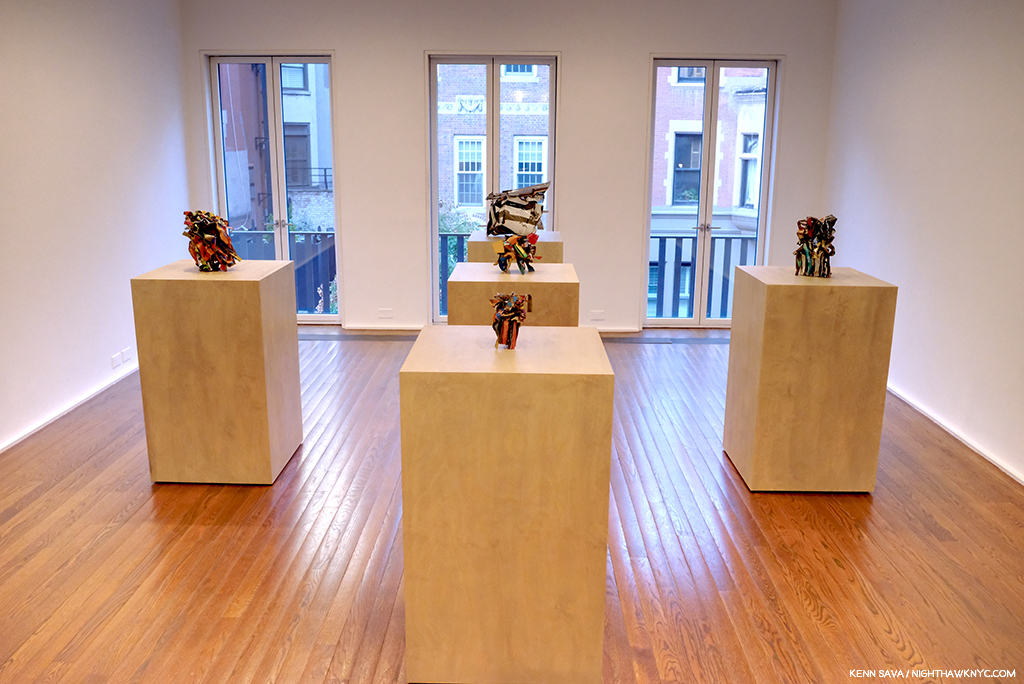
John Chamberlain: Baby Tycoons (with Eva Hesse Drawings) at Hauser & Wirth, East 69th Street- Lesser known work by two ground breaking, unique Artists/Sculptors, both no longer with us were paired in a beautifully installed show at Hauser & Wirth’s uptown outpost. While Ms. Hesse’s Drawings provided a fascinating insight into her career and process, Mr. Chamberlain’s gorgeous small works completely enthralled me.

While his classic larger pieces can look completely “accidental,” his smaller work shows the incredible attention to detail that he brought to bear in all of them. 

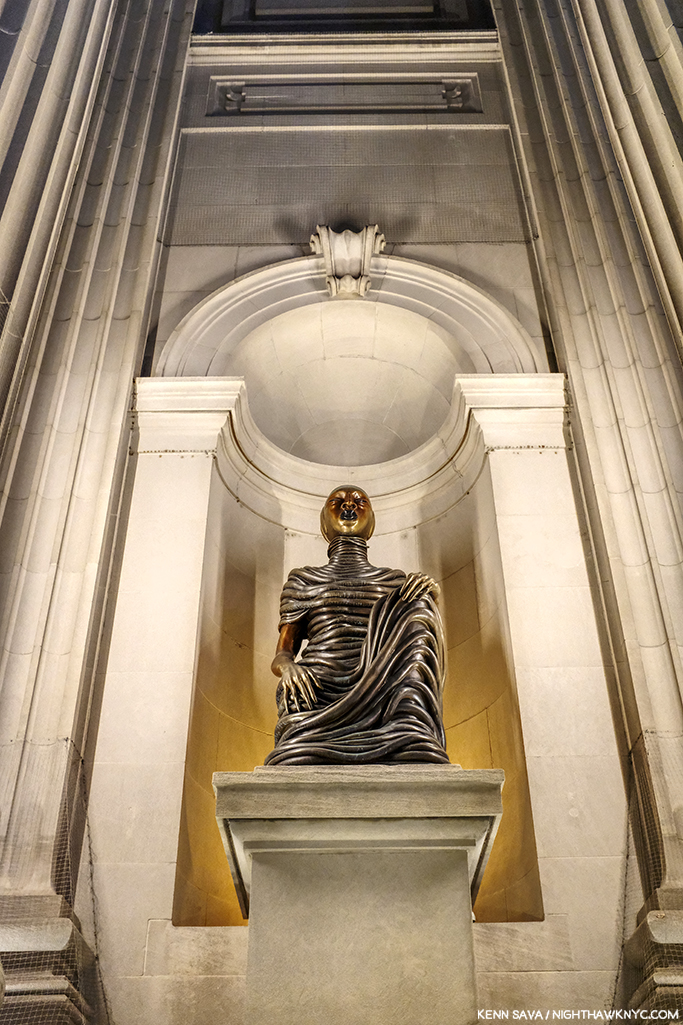
Wangechi Mutu, The NewOnes, will free Us, The Facade Commission outside The Met, 5th Avenue- The 5th Avenue Richard Morris Hunt Facade has long been a sore point for me. We’ve been living with it as it is for so many of its 117 years that most visitors fail to realize it remains unfinished! Being Landmarked, having neighbors and being in Central Park has kept TM from finishing what was started back 150 years ago and reached this form in 1902. I pray that one day they’ll be allowed to. It’s not like sticking a brand new pyramid in front of it! It’s just completing the existing facade. So, this year I was pleasantly shocked to see they found an extremely creative and Artful partial workaround. The Facade Commission as they call it bring us 4 terrific bronze Sculptures by Wangechi Mutu titled The NewOnes, will free Us that look superb in the heretofore empty niches outside facing 5th Avenue. On view 24/7 through this June 8th, don’t miss them on your next visit. 

As the year ended, all of this left me wondering- Are we in a “Golden Age of Contemporary Sculpture”?

Elsewhere, among the shows I haven’t written about-

NoteWorthy Painting Shows-

Lorna Simpson, Darkening, 2018, Ink and screen print on gessoed wood, 108 x 96 inches.

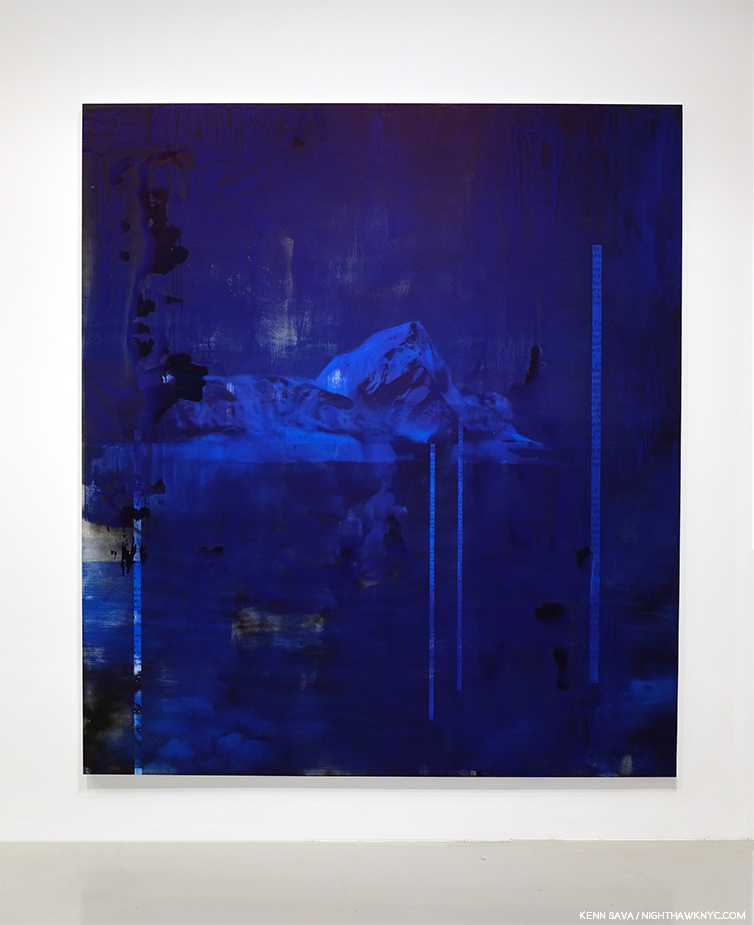
Lorna Simpson: Darkening at Hauser & Wirth, West 22nd Street- To this point I’ve been familiar with Ms. Simpson’s Photographs, works on paper and collages, but these Paintings came as a shock. Innovative, fresh, haunting, beautiful, the show felt like it came out of the blue, but I’m sure it didn’t. It struck me as a breakthrough. I returned to see it a few times and when it was over I was surprised it hadn’t received more attention than it got, and left me very much looking forward to see where she’s taking this next.

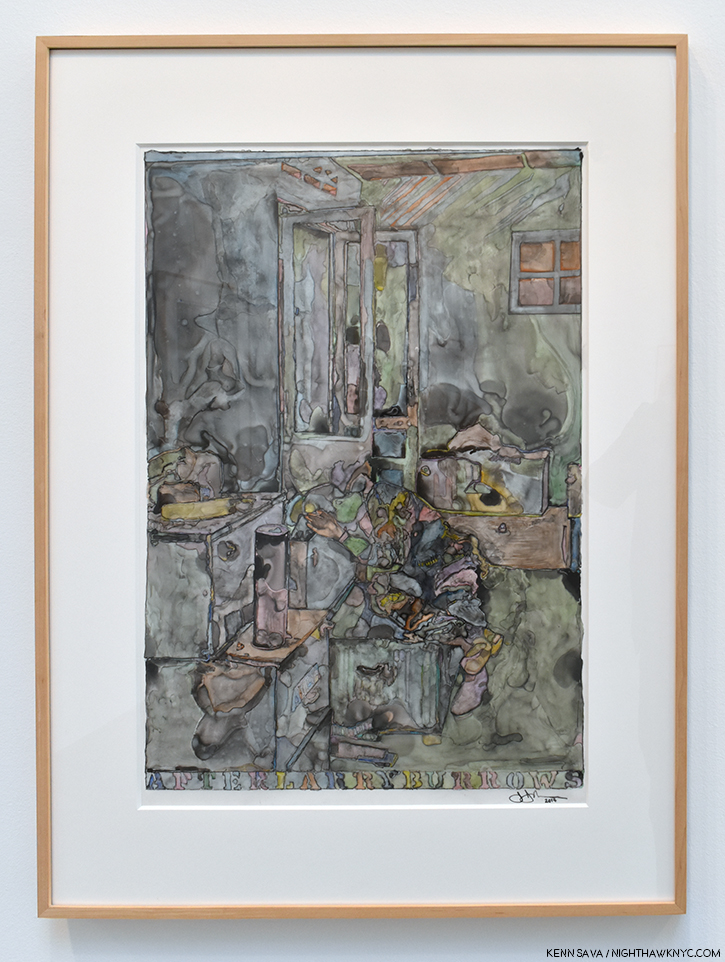
Jasper Johns, After Larry Burrows, 2014, India ink and water-soluble encaustic on plastic, 32 x 24 inches, one of a series of terrific works by the Artist based on this Photograph.

Jasper Johns: Recent Paintings & Works on Paper at Matthew Marks- Though he turns 90 in May, and a Retrospective is on the Whitney calendar, don’t begin to think Jasper Johns is done. One of the last Artists left to us (along with Susan Weil) from his group that included Robert Rauschenberg, Cy Twombly, Merce Cunningham, John Cage, Willem deKooning, et al, I didn’t know what to expect when I walked into Matthew Marks to see this show of recent works. I left determined to return as often as I could before it closed. I’ll admit that I haven’t followed Mr. Johns career as closely as I followed his one time close associate Robert Rauschenberg, who has had a major influence on the way I see the world, but it sure seems his work has continued to evolve and I, for one, found new surprises in this remarkable show. Too old to be drafted for the Vietnam War he was nonetheless deeply effected by it, as everyone living in this country at the time couldn’t help but be. A number of the works Mr. Johns showed were based on an extraordinary Photograph taken by Larry Burrows in Vietnam, a war that tragically produced too many indelible images, called Farley Breaks Down. Among countless others, Larry Burrows, also, lost his life in the war in 1971. While Photography has been the basis of countless Paintings, in these it was most subtle, almost like a memory, complete with the “haze” of camouflage-like coloring, yet its power was undiminished. Seeing these brought to my mind that one of the things that brought Mr. Johns wide attention early on were his Flag Paintings in the late 1950s.

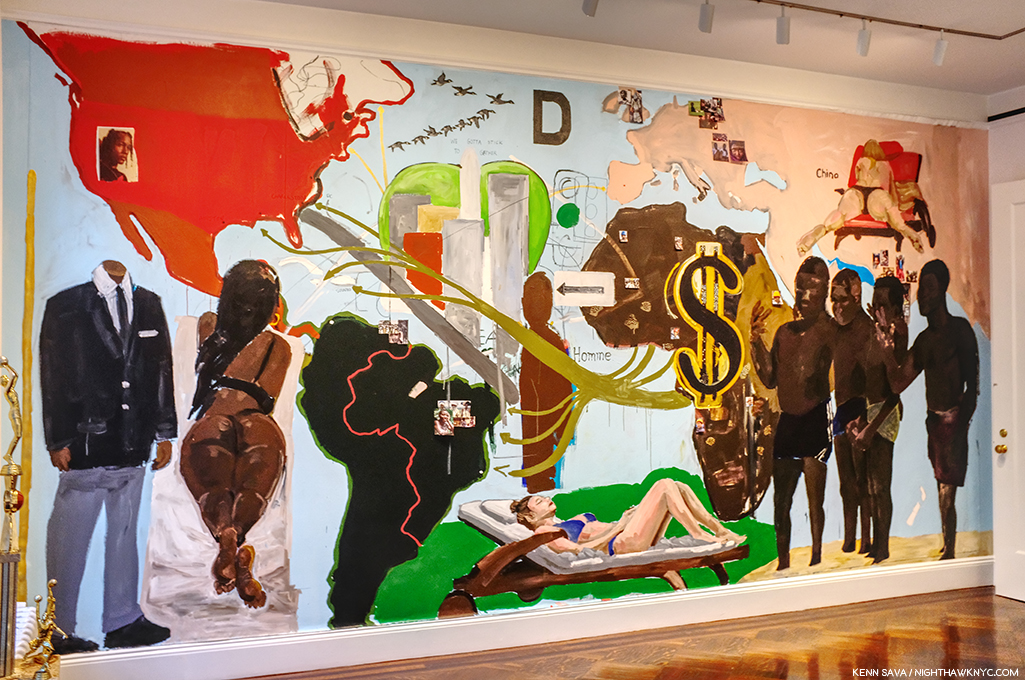
Henry Taylor’s Mural at Blum & Poe, September 24th- before he modified it.

Henry Taylor: NIECE COUSIN KIN LOOK WHO LONG IT’S BEEN at Blum & Poe- It’s been 2 years since Mr. Taylor’s “New York Moment,” as I called it, when his mural debuted on the High Line concurrently with his being one of the “stars” of the 2017 Whitney Biennial, given both his prominent placement with a large work in the lobby on the 6th floor and an entire gallery he shared with his friend, Deana Lawson. His first solo show since showed that not even hip trouble, which sounded serious, could keep the Artist from traveling and continuing to work.

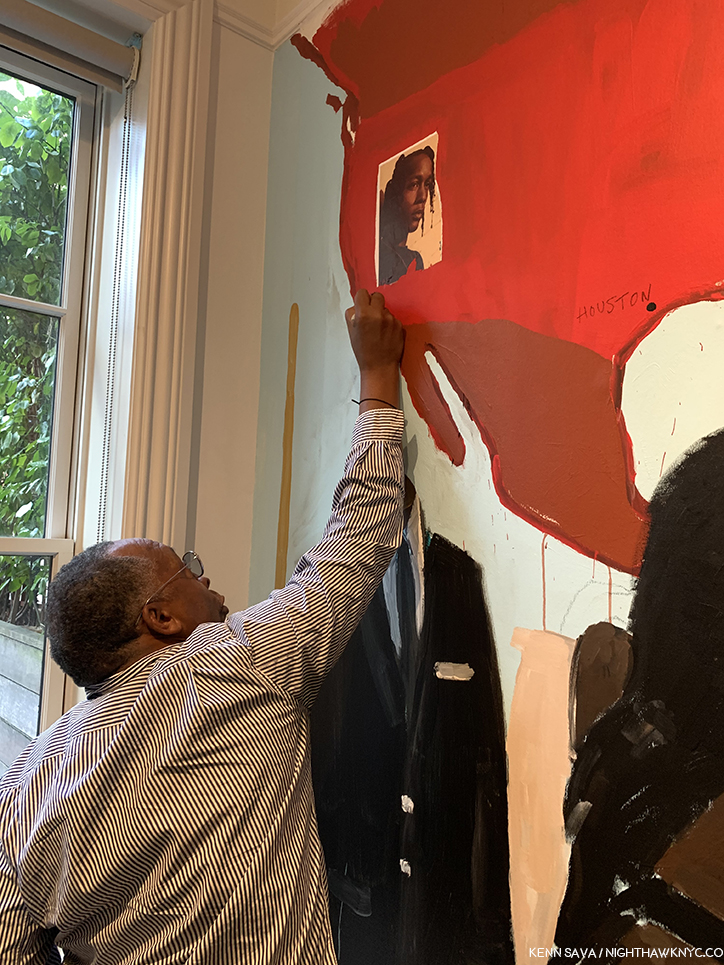
Henry Taylor uses my pen to modify his mural seen above, September 24, 2019.

The opening was highlighted, for me, by meeting Mr. Taylor, who proceeded to borrow my pen to modify the largest works in the show right in front of my eyes, and later proceeded to inscribe a message on the wall in the garden. Mr. Taylor seemed in fine form, not showing any lingering effects of his ailment and the work on view was classic Henry Taylor. A number of visitors approached Mr. Taylor asking for him to sign his recent monograph. I couldn’t help notice that he seemed to Draw in each book, something that indicated to me he’s another Artist who can’t stop Drawing. Of course, in my copy, he appended a sketch of my pen.

The social revolution… Installation view.

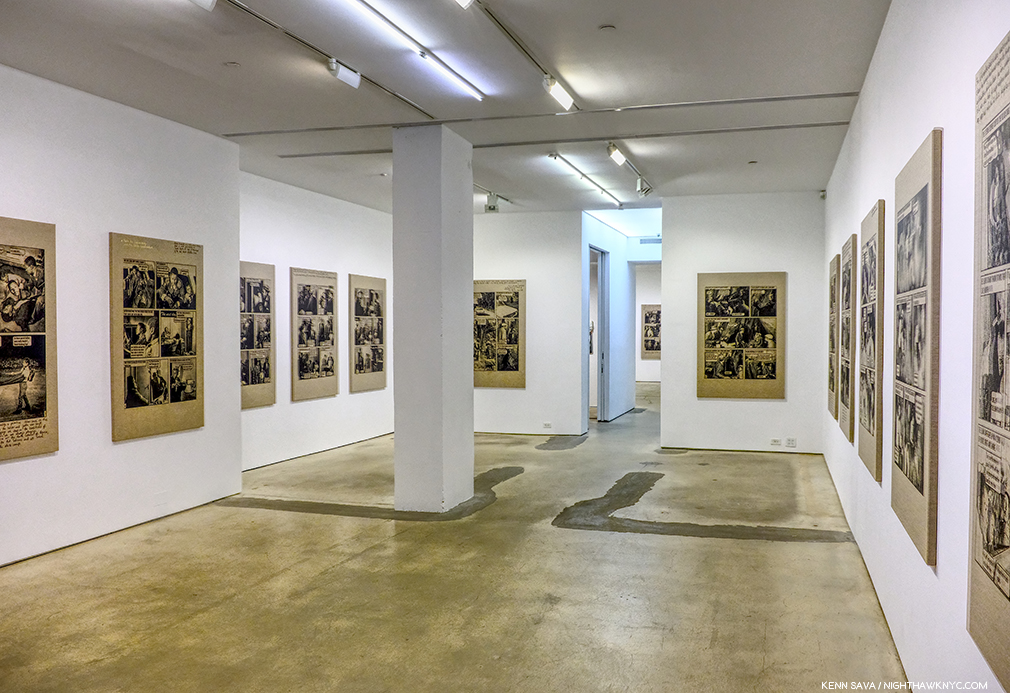
Meleko Mokgosi The social revolution of our time cannot take its poetry from the past but only from the poetry of the future and Pan-African Pulp at Jack Shainman Gallery, West 20th, West 24th Street, and The School, Kinderhook, NY- The now Brooklyn-based Artist is so prolific his latest work occupies no less than THREE of Jack Shainman’s spaces, including the entirety of The School in Kinderhook, NY, out of reach for this writer.

Pan-African Pulp installation view. In this series, Mr. Mokgosi uses source images from the 1960s South African photo-novel Lance Spearman “to examine the history of pan-Africanism.”

The two Chelsea shows I was able to see are marked by remarkable, continued, growth leading me to feel that Mr. Mokgosi is yet another Jack Shainman Artist, like Kerry James Marshall before him, on his way to museum collections. 

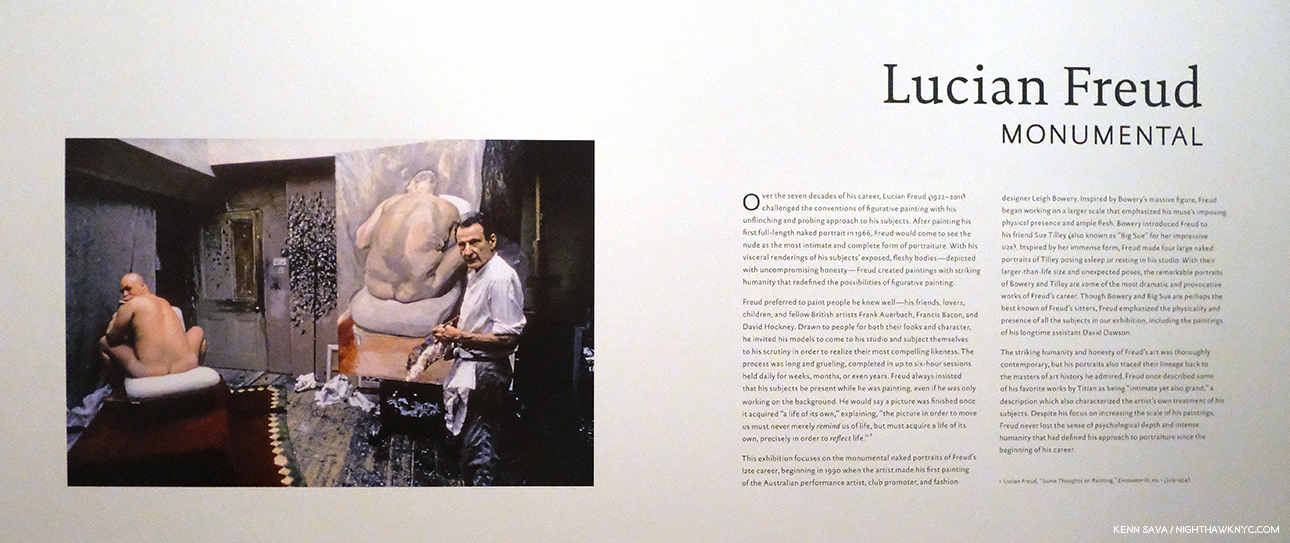
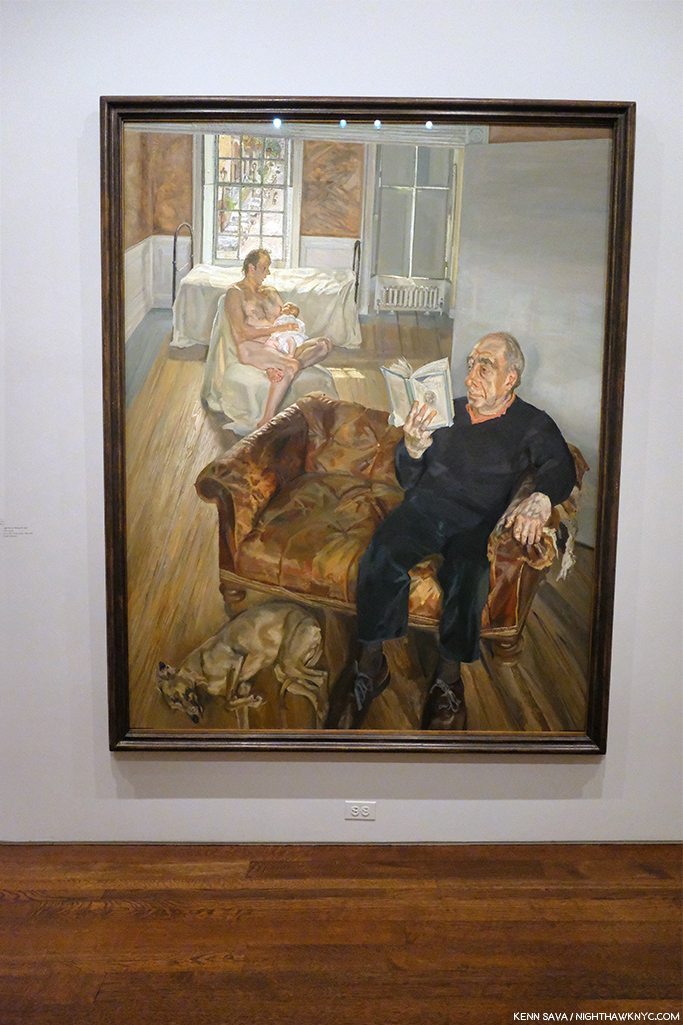
Lucian Freud: Monumental at Acquavella Gallery and Francis Bacon’s Women at Ordovas- Two shows that barely made the cut, with both ending in early January, served as a reminder that I didn’t really need of the fact that both Painters, one time friends, are towering figures in 20th century Art who’s influence remains strong. I couldn’t help wonder how the Freud show benefitted by the presence of legendary former Metropolitan Museum Director, Philippe de Montebello, now a Director of Acquavella Gallery, right across the street from his former and long-time 1000 Fifth Avenue home.

The show featured Mr. Freud’s nudes, emphasizing his extraordinary way of Painting flesh, the aspect of his work that has long fascinated me as much as any other. Here, the only clothed figure in the show.

Regardless, it was an exemplary, concise, museum quality gallery show of the work of an Artist who hasn’t had a show here in too long.

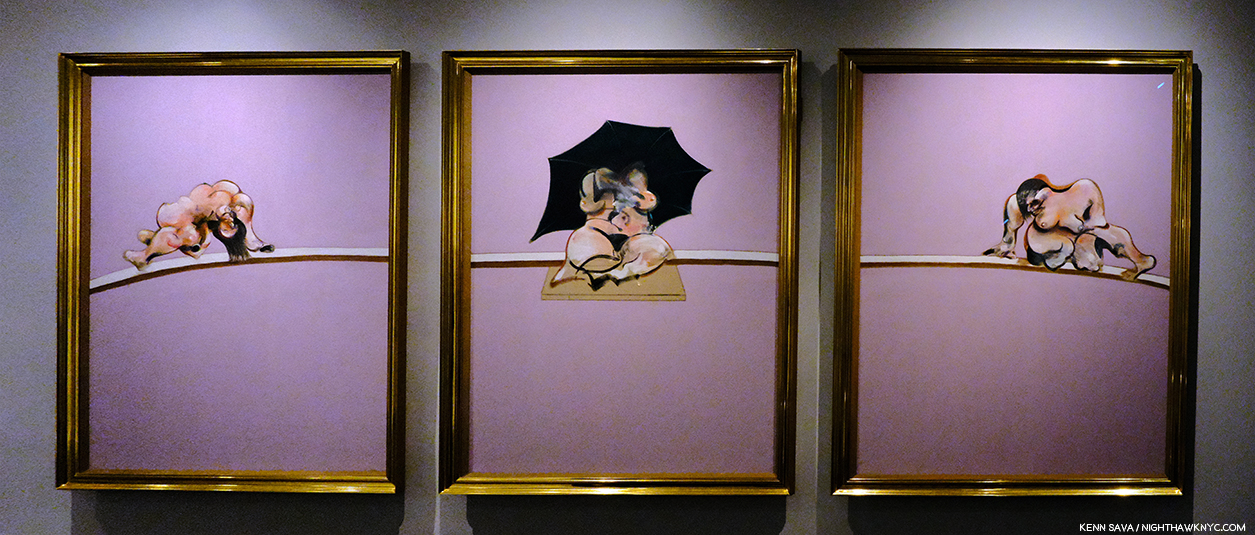
Among many other things, Francis Bacon reintroduced the Triptych to Painting.

Nearby, Bacon’s Women, a subject I can’t say I’ve ever heard broached before, was a revelation. The surprising concept was beautifully executed and mounted in Ordovas’ classic East 77th Street townhouse. Francis Bacon has proved to be an Artist who’s accomplishment has only grown more and more interesting and relevant as time has passed, and so, the rare chance to see some of his lesser seen work was not to be missed.

NoteWorthy Drawings Shows-

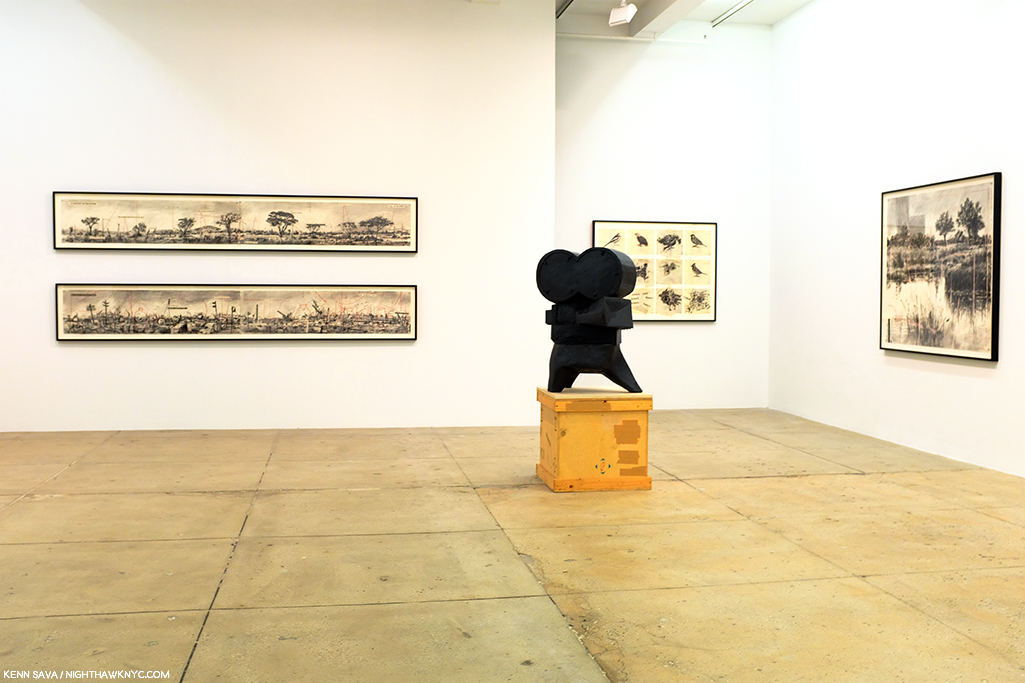
Installation view.

William Kentridge: Second-hand Reading at Marian Goodman- The legendary South African Artist returned to NYC with what seemed to me to be more innovations in his unique and powerful Drawings, along with a selection of his equally unique Sculpture, and Film, shown in the room behind his Projector Sculpture, above.

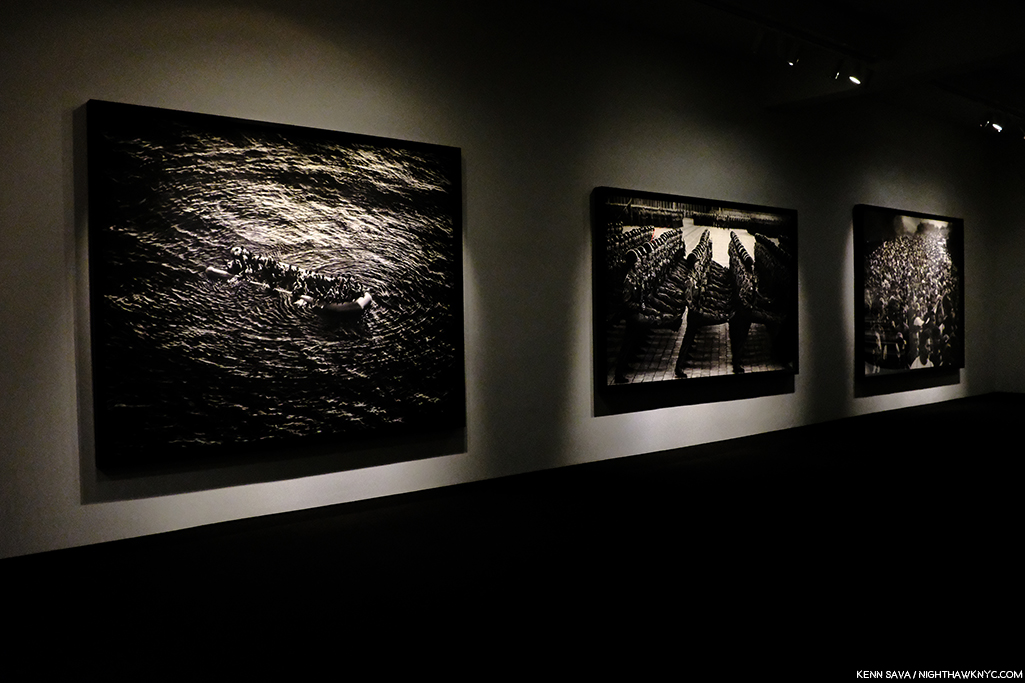
Installation view of 3 of the 7 monumental charcoal Drawings, yes Drawings, in the show by a contemporary master of the medium. Mr. Longo  told me it took 6 months to create the one on the right, 8 months for the one on the left.

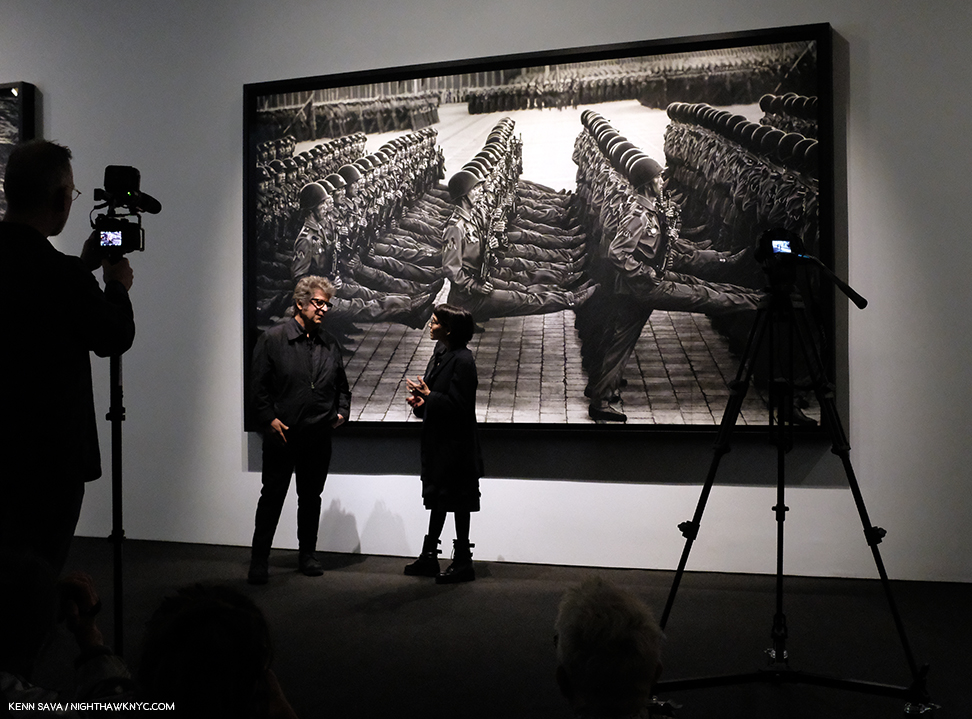
Robert Longo: Fugitive Images at Metro Pictures- During his Artist’s talk in the gallery on January 11th, Mr. Longo broke down discussing one of his pieces with Nancy Spector, Artistic Director of the Guggenheim Museum. I came away even more impressed with the Artist, who’s work I already hold in high esteem.

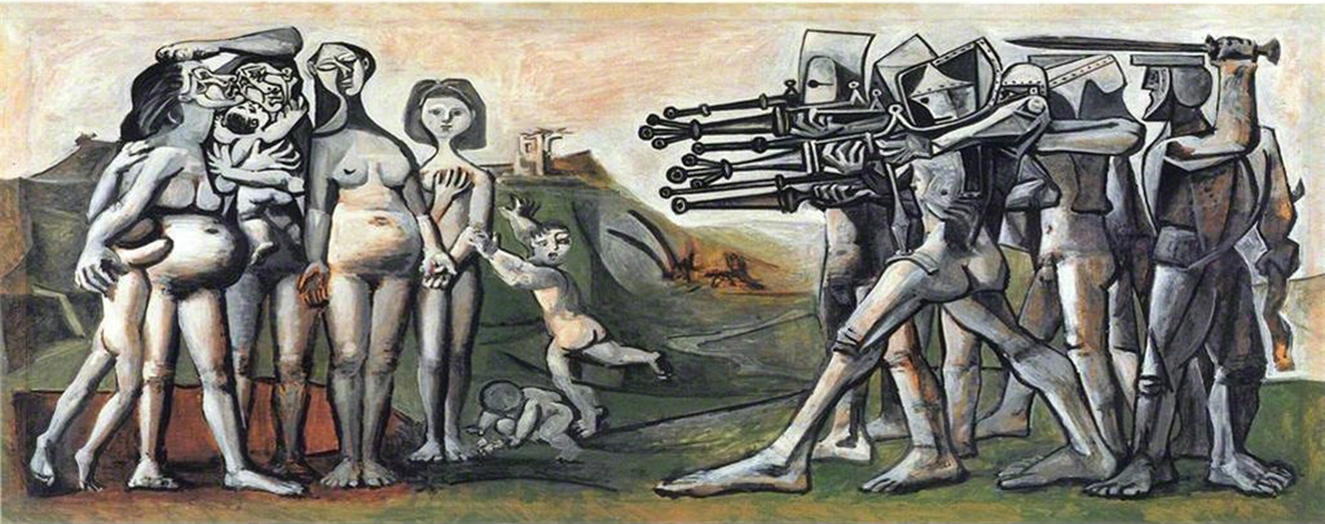
Robert Longo in conversation with Nancy Spector, Artistic Director of the Guggenheim Museum in front of a Drawing of North Korean soldiers.

Not one to miss a perfect segue…If I had to single out one person who had a great year in NYC Art in 2019, it would be Nancy Spector, who, along with her team, produced a steady string of very good shows at the Guggenheim, continuing their run these past few years, a number of which I’ve written about.

NoteWorthy Photography Show

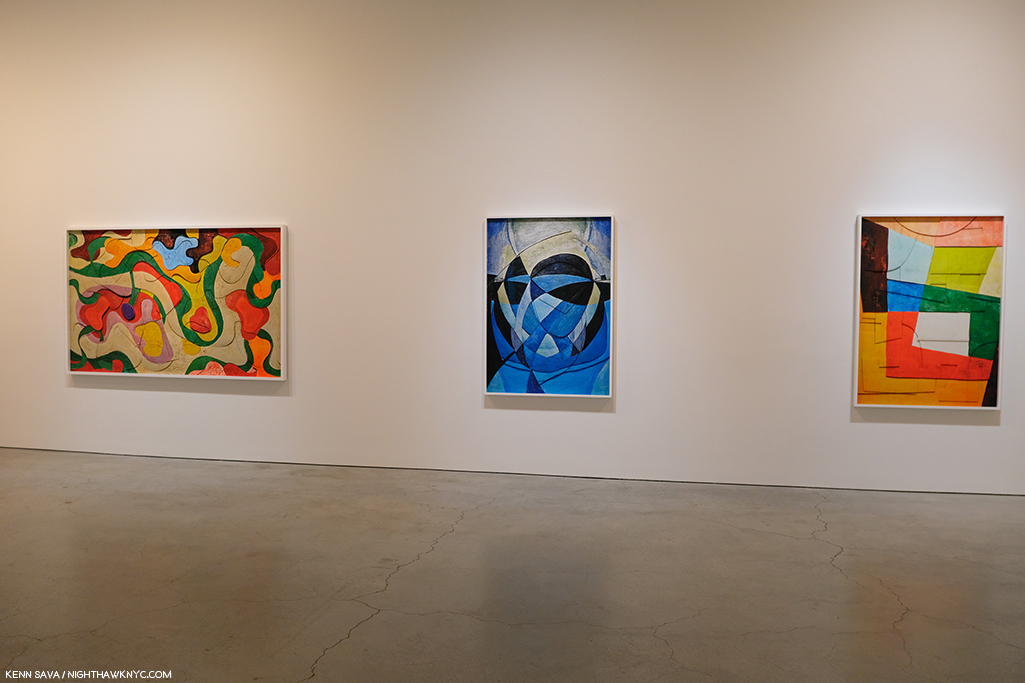
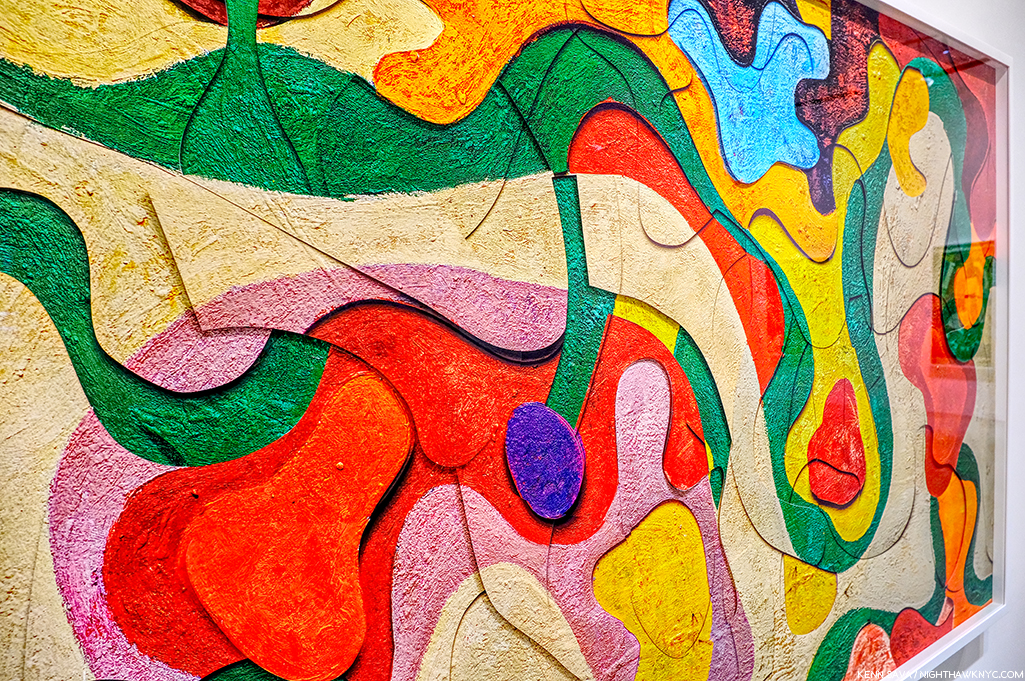
Vik Muniz: Surfaces Installation View. These are called multimedia. A close look reveals the numerous layers of each work in which Mr. Muniz reinterprets 20th century abstract Paintings to fascinating effect. Garden Design, after Roberto Burle Marx, Pierrot, after Willys de Castro, Composition/Space, after Cicero Dias, Surfaces, 2019, Multimedia, left to right.

Vik Muniz: Surfaces and Museum of Ashes at Sikkema Jenkins & Co- Looking through the two volume Vik Muniz Catalogue Raisonne, the first thing that strikes me is that it’s arranged in sections according to the technique he used, something I can’t say I’ve seen before, and something even more remarkable when you consider that a good number of these techniques he invented. Along the way, he’s already created a substantial body of memorable pieces, which have gained him worldwide recognition.

Detail of the layers of Garden Design, after Roberto Burle Marx. As a result, each piece is unique.

He was at it, again, adding yet two more innovations, in his remarkable two part show at Sikkema Jenkins & Co. Beyond his endless inventiveness, technique being a means to an end, the results have continued to resound. No mean feat when you consider that one part of his show was based on famous masterpieces of Painting, above, in the Surfaces section of the show, the other based on “resurrecting” Art works lost in a fire, turning their very ashes into recreations, in the Museum of Ashes section. Surfaces was based on Paintings by Arthur Dove, Hans Hoffman, Stuart Davis, Carmen Herrera, Ellsworth Kelly, Marsden Hartley and Romare Bearden, among others, adding a new dimension to the perception of each of these works. Daring!

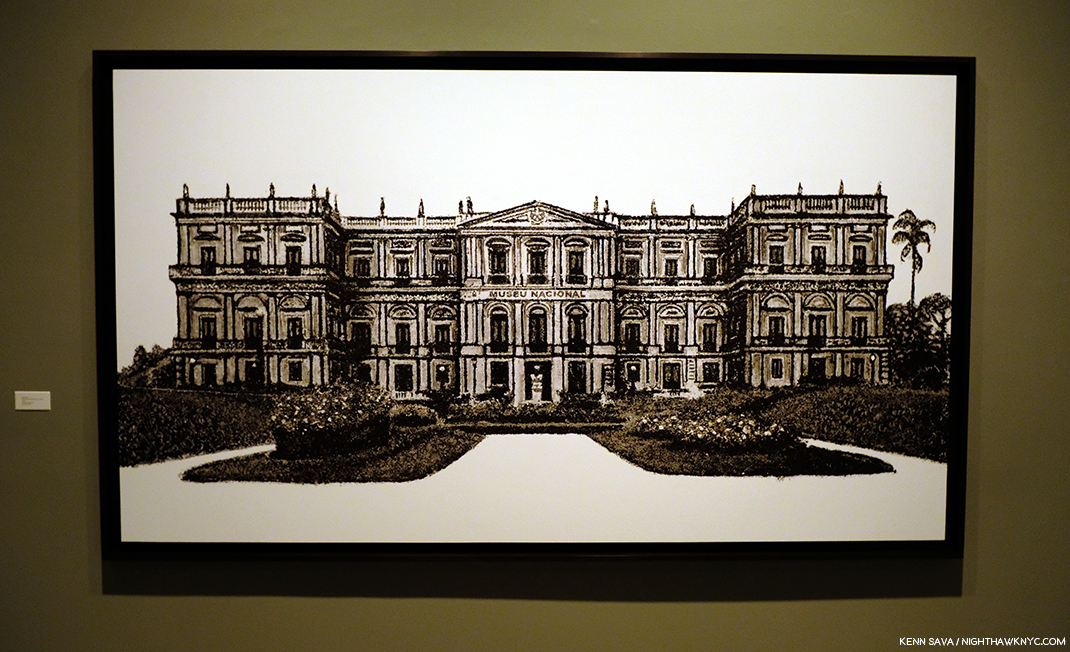
Vik Muniz recreated works from the Museu Nacional from their very ashes! Here he recreates its facade. Museu Nacional, Museum of Ashes, 2019, Archival inkjet print.

On September 2, 2018, the entire Museu Nacional in Rio de Janeiro burned to the ground, including all its collections amassed over the past 200 years. The museum was Muniz’ favorite cultural institution in the city, a place he visited often with his children. On the wall card to this section, Mr. Muniz said, “I cried upon learning of the fire as if I had lost something personal, some kind of string that held the insanity of my present together.”  The Artist proceeded to work with the archeologists sifting the ashes of the building and its contents and was provided with ashes and the exact location they were found.

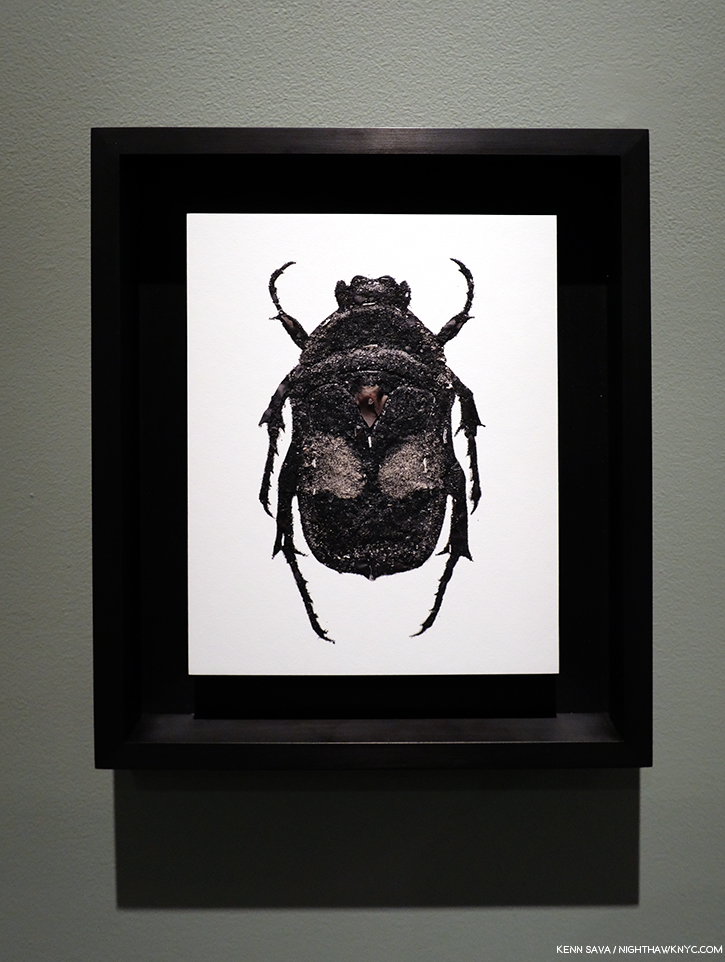
Beetle, Museum of Ashes, 2019, Archival inset print.

He proceeded to reconstruct some of the objects that had been lost- in ash, which he then Photographed. The results speak for themself, and, amazingly, echo what has been lost.

As 2020 gets underway, there would seem to be a bit more stability on the horizon, but not entirely. Change, after all, is the only constant in the universe. The protests at the Whitney resulted in board resignations, and MoMA plans to be open for the full year, as far as I know now. Art in NYC, 2020, however, will already be remembered for two memorable events. The Met marks the 150th Anniversary of the opening of its iconic 5th Avenue location this year- with a closing. 2020 will also be remembered as the year the short-lived Met Breuer closed.

*- Soundtrack for this Post is “Restless Farewell” by Bob Dylan from the timeless The Times They Are A-changin’, 1964.

NighthawkNYC.com has been entirely self-funded and ad-free for over 6 years, during which over 250 full length pieces have been published. If you’ve found it worthwhile, you can donate to keep it going & ad-free below. Thank you!

Written & photographed by Kenn Sava for nighthawknyc.com unless otherwise credited.
To send comments, thoughts, feedback or propositions click here.
Click the white box on the upper right for the archives or to search them.
For “short takes” and additional pictures, follow @nighthawk_nyc on Instagram.

Subscribe to be notified of new Posts below. Your information will be used for no other purpose.


Sarah Sze: Creativity, Unbounded

Written & Photographed by Kenn Sava

“I bring together the materials I find around me. I gather them to try and create immersive experiences that occupy rooms, that occupy walls, landscapes, buildings, but ultimately I want them to occupy memory.” Sarah Sze, TED Talk.

Crescent (Timekeeper), 2019, Mixed media

In the 4 1/2 years of NHNYC I’ve never yet called a Contemporary Artist a genius. Until now. [Drum roll]

Sarah Sze is a genius in my opinion.

As I take stock of the Art I saw in 2019, along with Jean-Michel Basquiat at The Brant Foundation (which I looked at here), the most unforgettable show I saw this past year was Sarah Sze at Tanya Bonakdar Gallery. As I write this three months after it closed, it’s at the front of my memory of everything I saw last year.

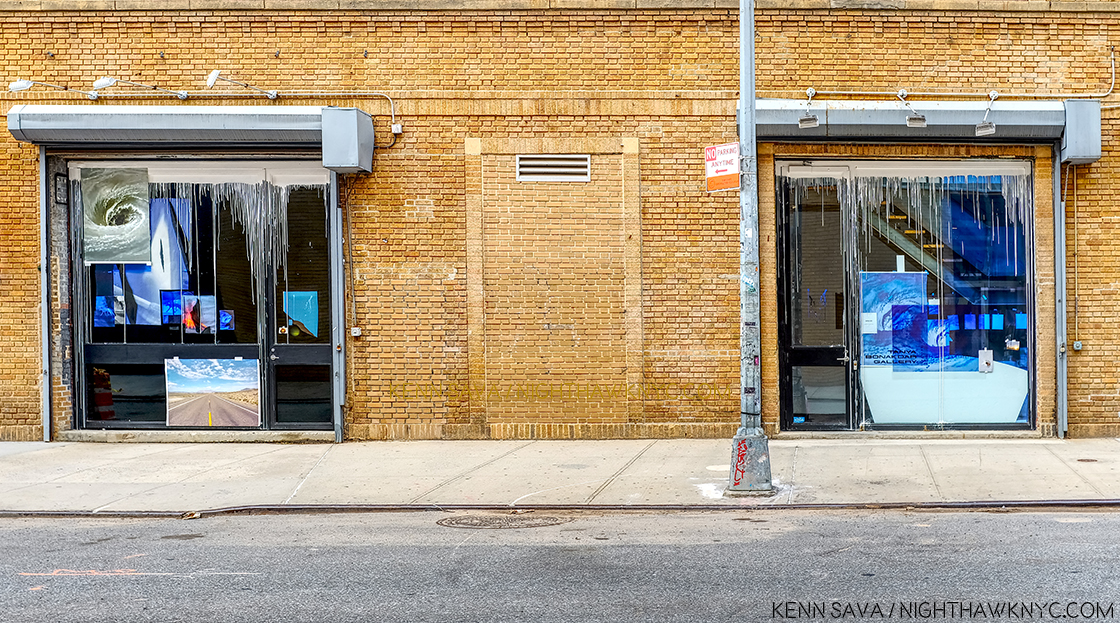
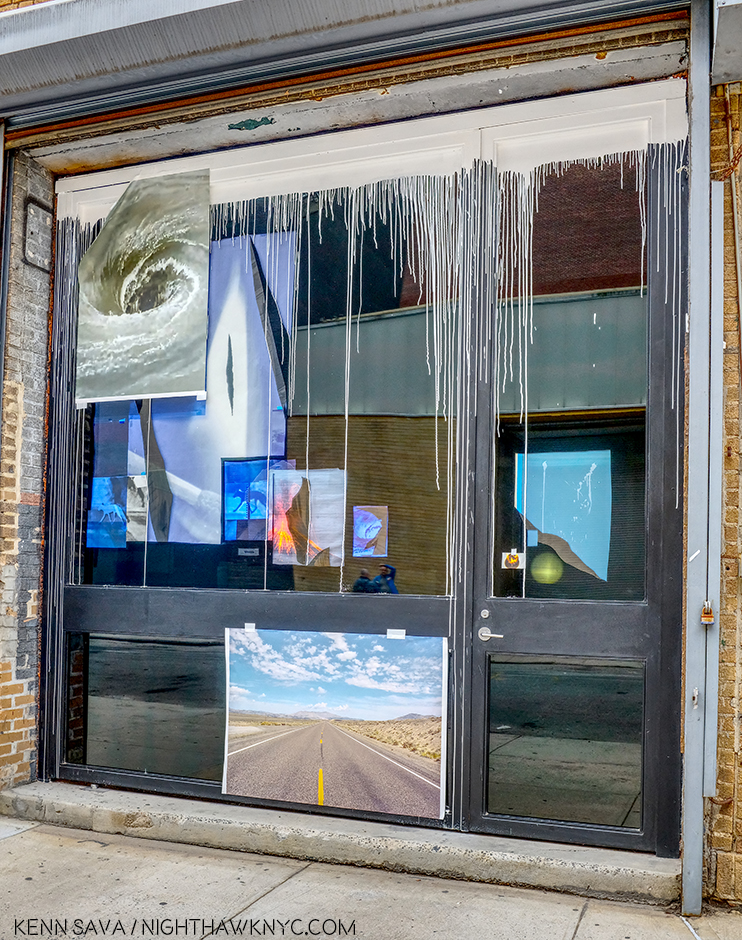
Overflowing. Sarah Sze began on the outside(!) of the gallery’s doors and windows.

Detail of part of Images in Refraction (West) on the western part of the facade of Tanya Bonakdar Gallery (to the left in the previous picture) reveals the multimedia nature of what’s on view inside, and the multi-dimensional talent of the Artist. Painting, Sculpture, Collage, Engineering & Architecture, Photography, Film, Installation- you name it. You get it. And then some.

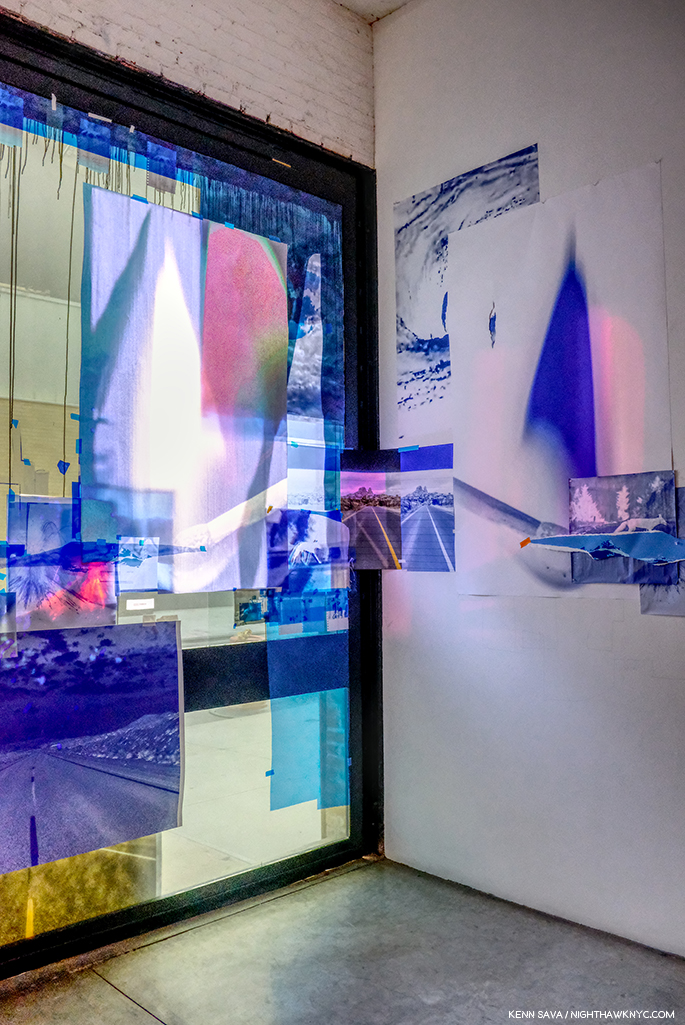
I’ve seen her gallery shows over the past decade, and each time, I left shaking my head. Part sculpture, part installation, part construction project, part hardware store free-for-all, they were always impossible to fully take in at one look. You saw their shape from a distance and admired the overall composition, and then learned the devil was in the detail, and the detail, and the seemingly endless detail. Still, I wasn’t prepared for her expansion into multi-media, including the debut of her Paintings, she presented on West 21st Street this fall where not even two floors, the reception area, the ancillary walls, both sides of the galleries windows, doors, or the space under the stairs were enough to contain her seemingly boundless creativity.


Looking out at the view seen previously of Images in Refraction (West), with installation on the wall, right, leading to the first gallery.

Not to mention 4 galleries filled with her trademark seemingly infinite detail.

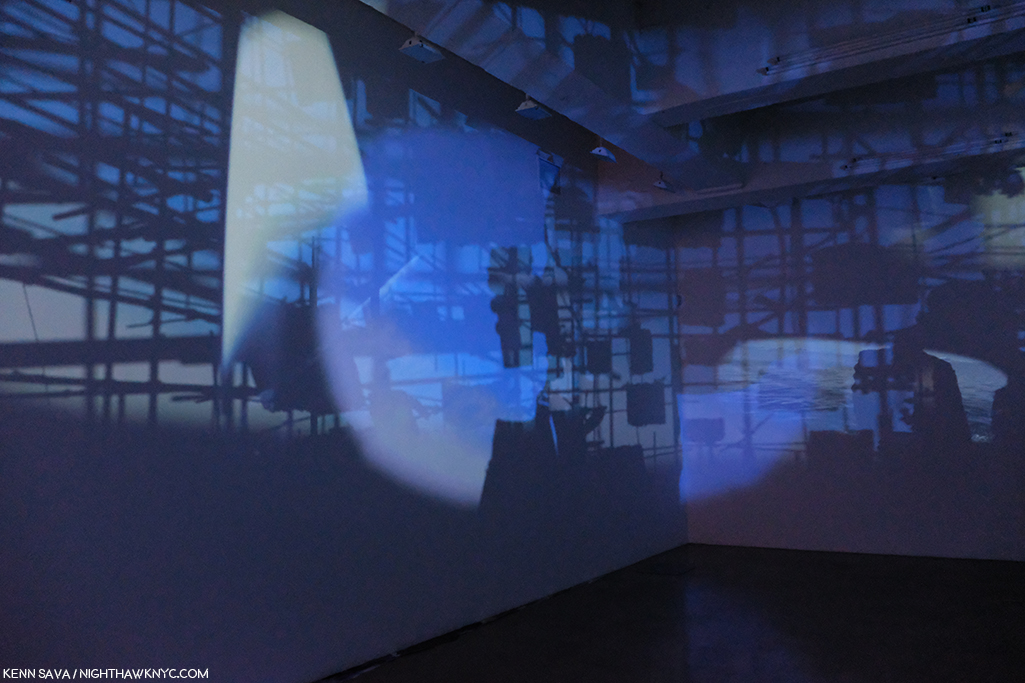
Detail of the ever-changing projection that filled the walls surrounding Crescent/Timekeeper.

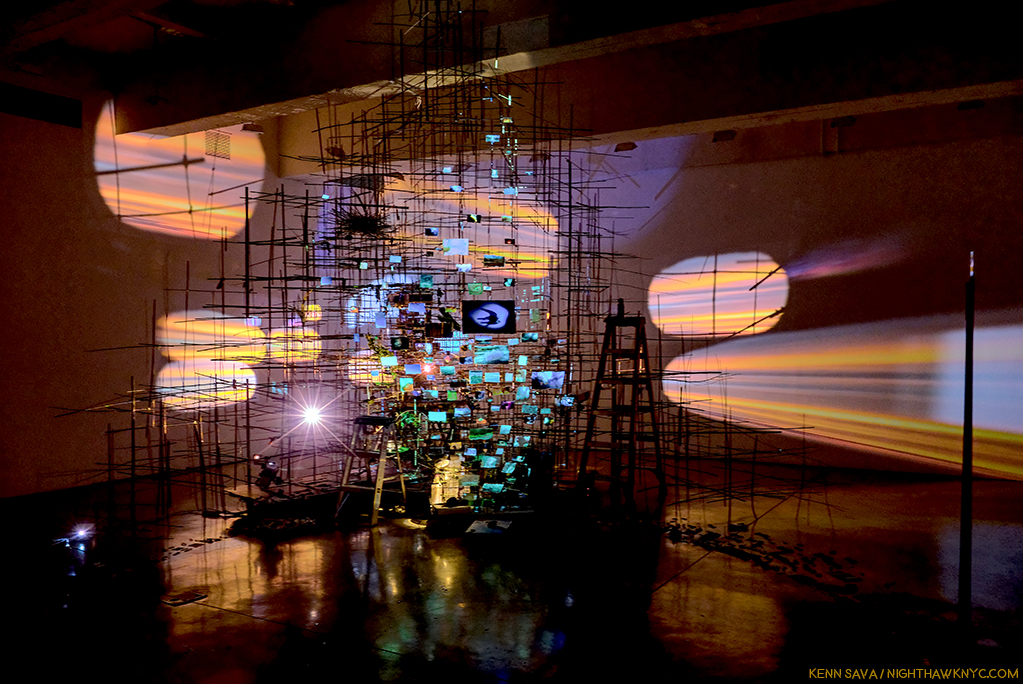
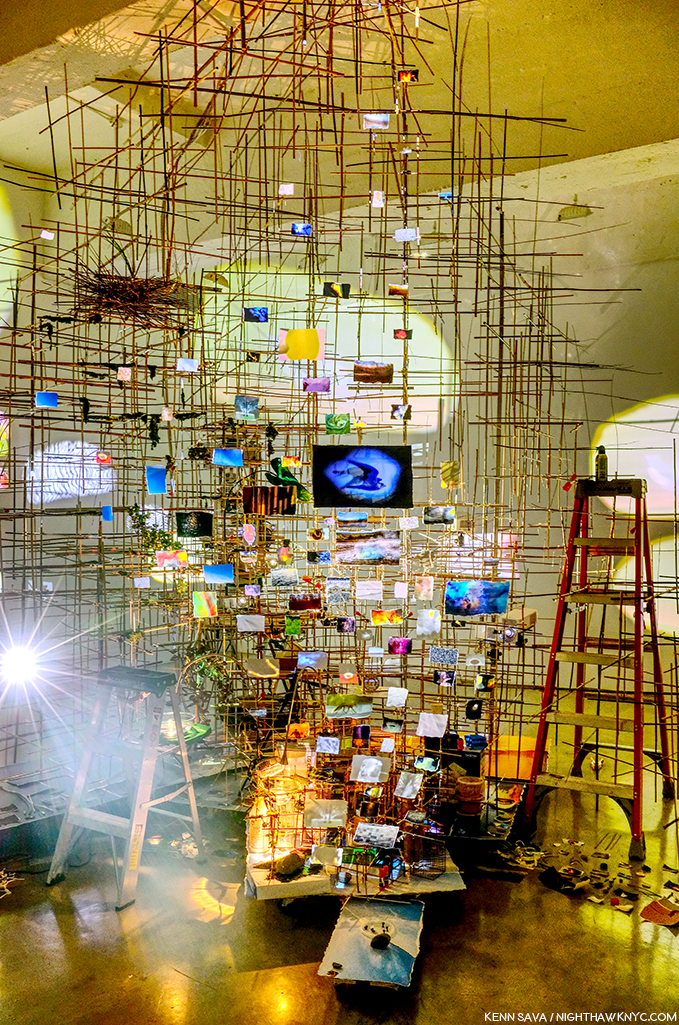
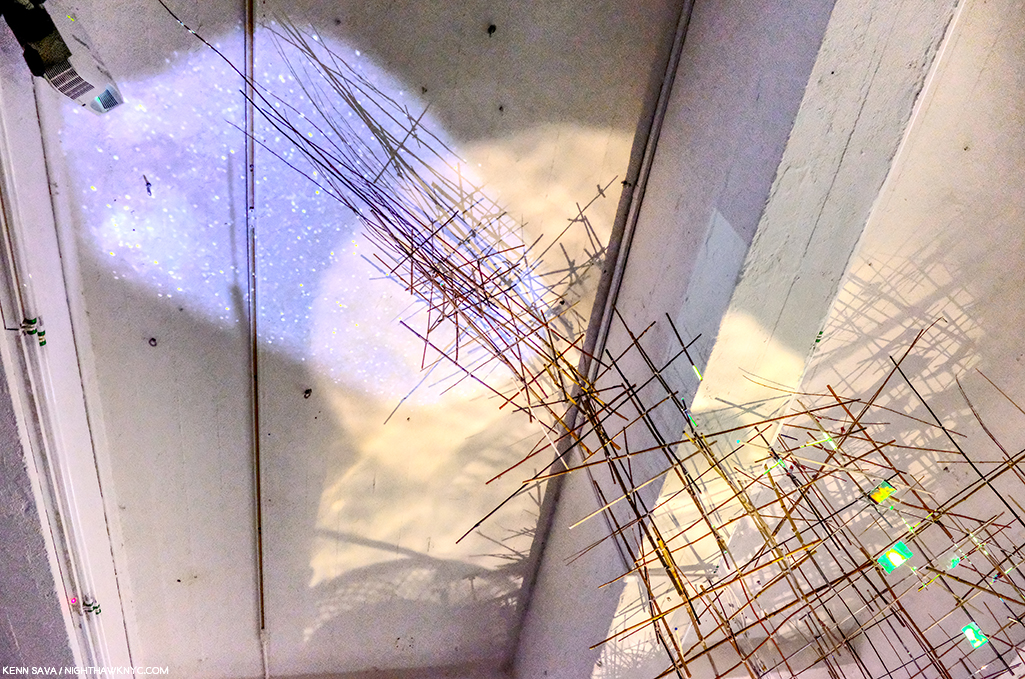
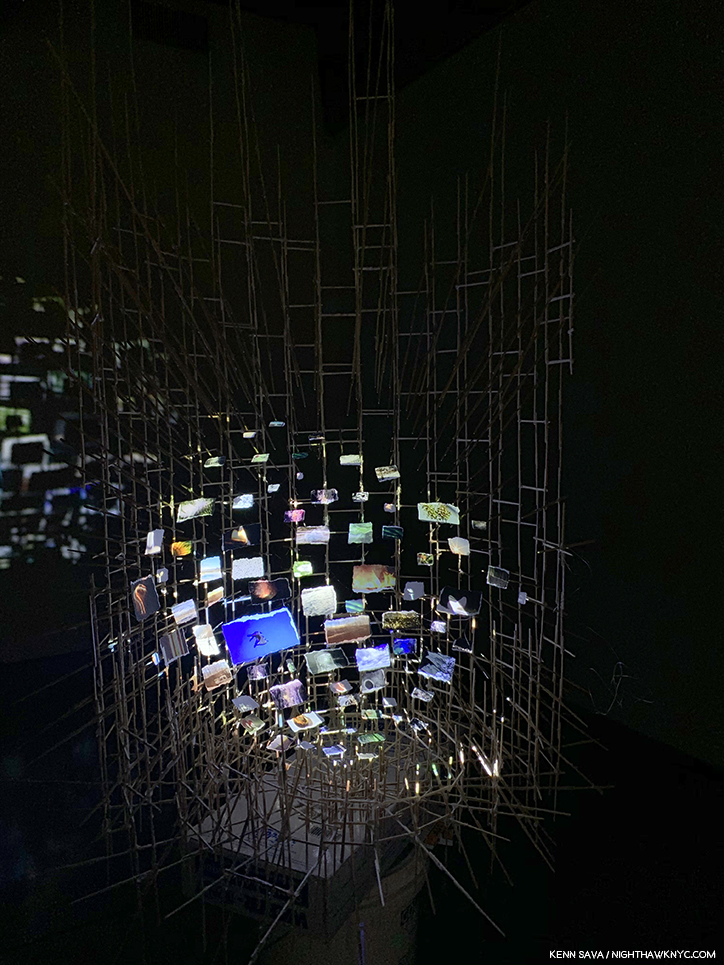
After the lead-in provided by entering the gallery and passing through the prelude in the reception area, Crescent (Timekeeper), 2019, turned the large gallery into a fully immersive experience from the moment you entered the space and tried to take it all in from about 25 feet away, as may be seen in the very first image above, like some alien craft in a pre-2001:A Space Odyssey 1960s sci-fi movie. “Yes. Something landed…and…it’s glowing! Moving in for a closer look. Tell Lana I love her…” Situated near one far corner allowed embedded rotating projectors to have much of the surrounding walls to themselves engulfing you as you enter the space.

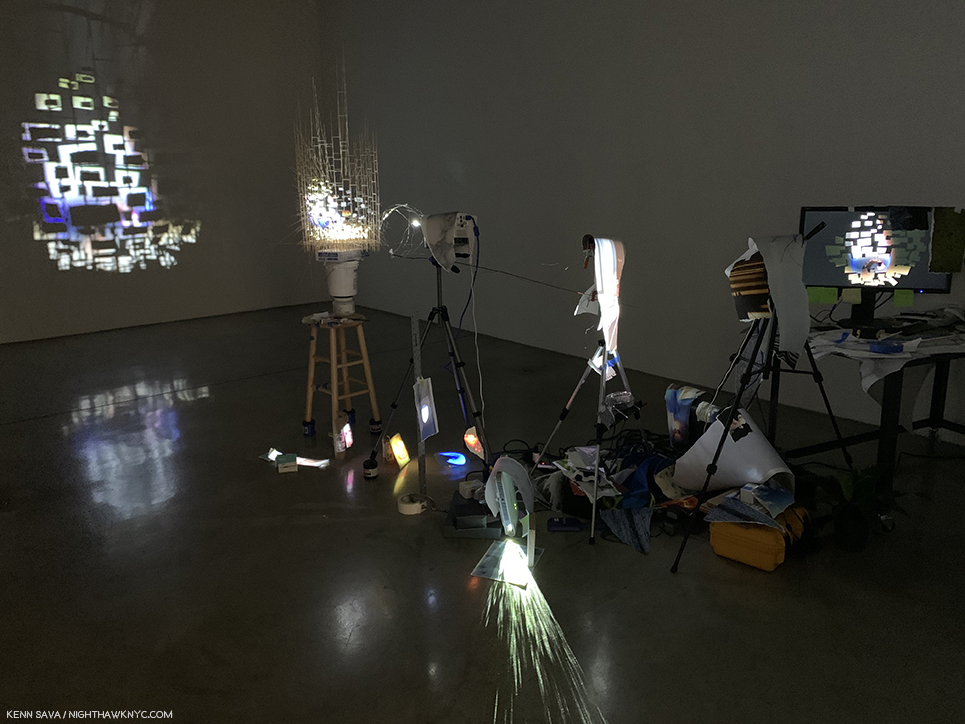
Close up/Details of the center section of Crescent (Timekeeper). Stepladders are a recurring motif in Sarah Sze’s work. As she’s said, “Everything you need to make the piece is in the piece.”

As you approach between two “arms” extending out on the floor, you realize that the center section contains about 50 screens of varying size. Standing there for a few moments reveals each one of those screens contains projected images moving independently of each other. Yet, tracing them back, you find only a few overhead projectors. ? On one visit the work struck me as an almost nostalgic look at life on earth. Suffice it to say, you need to experience it for yourself.

To the stars…Gazing at the top of the “superstructure” of Crescent (Timekeeper), 2019, Mixed media.

With so much to see in just this work, I was somewhat shocked when I realized Crescent (Timekeeper) wasn’t the only “monumental” work on view!

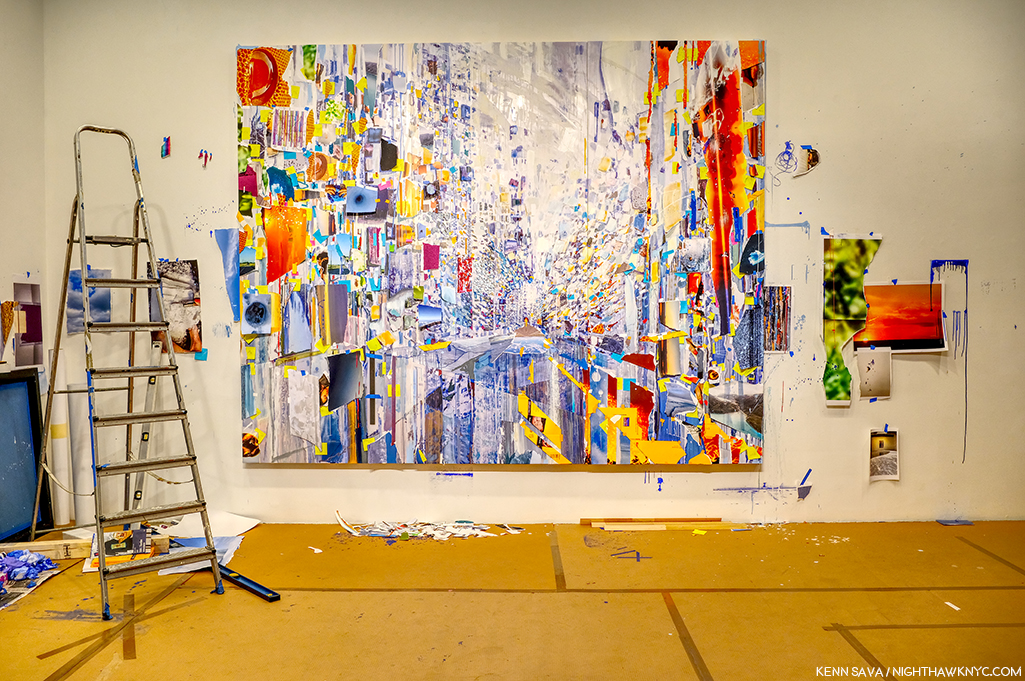
Detail, part of one of 4 walls that makes up After Studio, 2019, with the work Surround Sound (After Studio), 2019, Oil paint, acrylic paint, acrylic polymers, ink, aluminum, archival paper, disband and wood, 103 1/4 x 130 inches, center. No Photo can begin to covey what it was like to be in this work, which is what visitors to this space were, but looking at the piece on the wall, center, the first “Painting” by Sarah Sze I’ve seen, might begin to.

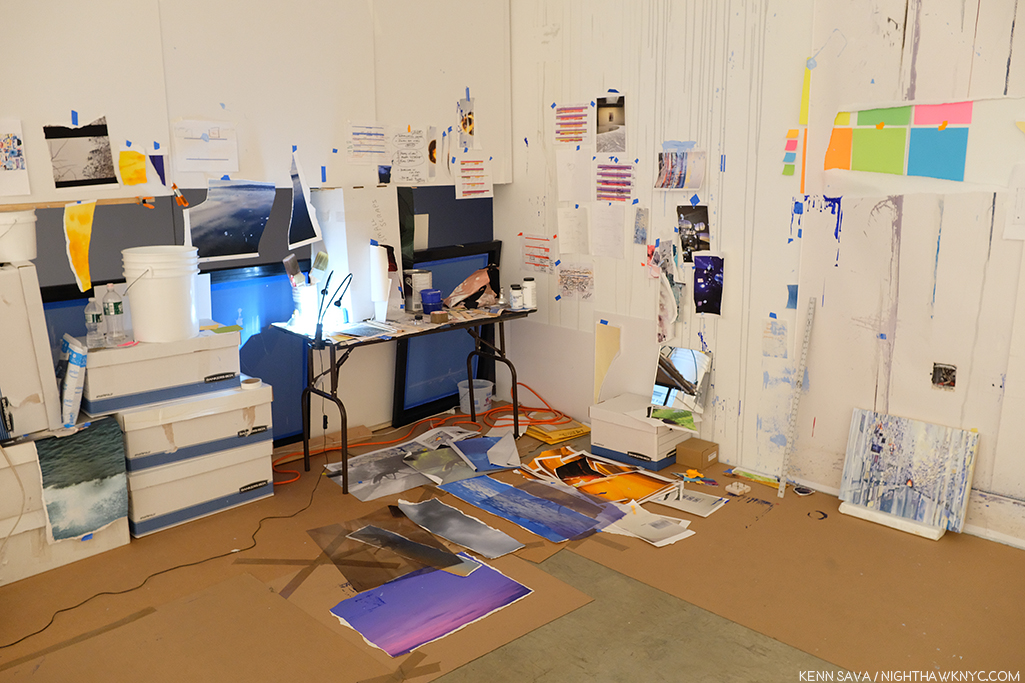
In a smaller, rear, gallery on the first floor, I encountered one of the most amazing things I’ve ever seen in an Art show- what looked to be a complete (re)construction of one of her studios down to the last detail. A work titled After Studio, 2019. It appeared to me to center around a series of Paintings by Sarah Sze, the first I’ve ever seen, though they are as much Collage as Painting. ”In the age of the image, a painting is a sculpture,” Sarah Sze said in 2019.

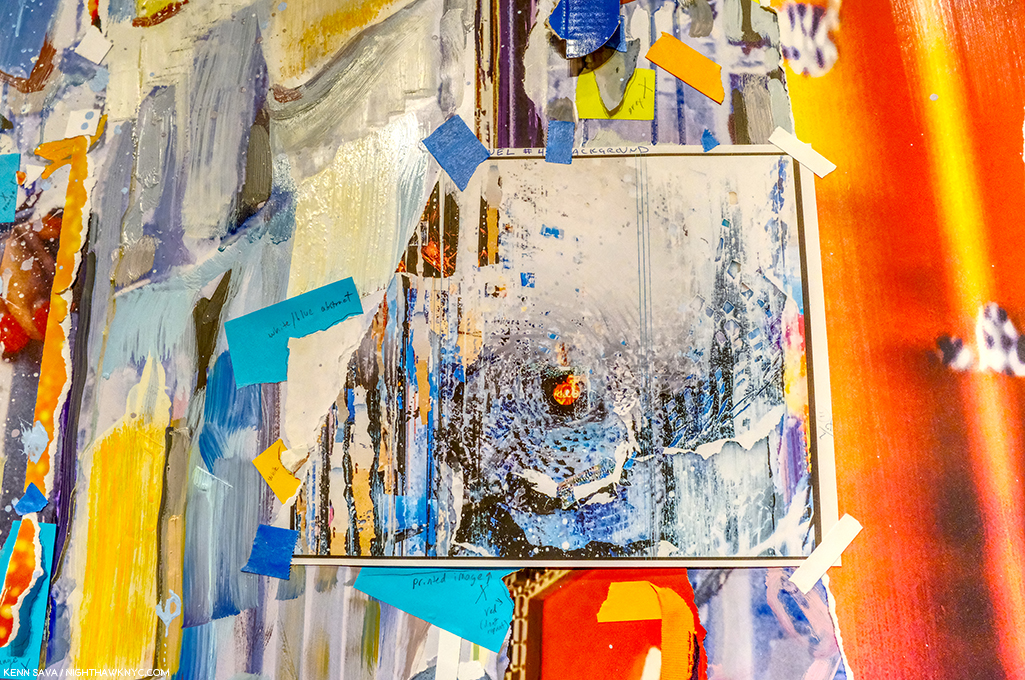
Details of details from the right of center section of Surround Sound (After Studio) seen above.

That sentiment puts her in the direct line of Picasso & Braque’s Cubism, Marcel Duchamp, Joseph Cornell, Robert Rauschenberg, Jasper Johns, Jack Whitten, Frank Stella and, more recently, Mark Bradford and Julie Mehertu. With everything Sarah Sze includes in her Paintings, two things struck me as particularly interesting- her use of Photography (apparently her own), and her “use” of words. They’re there, if you look closely, but they almost exclusively appear to be “notes to self” rather than to others on “post-it” like notes. I was told that the Artist went back and replaced each one with archival equivalents as she completed the work. Yes Surround Sound (After Studio) is complete, and some very astute museum bought it.

The corner of the opposite and adjacent walls. Remind yourself- You’re in a gallery.

I returned to experience After Studio again and again and it felt to me like I was walking around in the Artist’s mind. Often when I see Art, especially landscapes, I close my eyes to feel the presence of place in the piece in my mind’s eye. Here was one “landscape,” I couldn’t keep my eyes open long enough to drink in. Nary a foot of After Studio, save for the center space to move around it, lacked vision or wonder. When I left if for the last time on October 17th, I was fully in awe1.

Another detail, this one interesting for showing some of the Photographs the Artist may, or may not, use, along with what may happen to them on the way.

On the 2nd floor, the large back gallery contained more Paintings, and a Painted floor. All told, nine Paintings were in the show. I guess I shouldn’t be surprised by the appearance of her Paintings, after all Sarah Sze studied to be a Painter for a decade before turning her attention to “make meaning of the things around us through materials2.” For me, as amazing as the installations are, the Paintings linger with me every bit as much. No small feat.

I am thrilled to see her interest in Painting return in stunning works like this. 12 Landscapes (After Object), 2019, Oil paint, acrylic paint, acrylic polymers, ink, aluminum, archival paper, disband and wood (triptych), 73 1/2 x 110 1/4 inches.

Detail of 12 Landscapes (After Object).

I was told the show took 2 1/2 weeks to install- for a show that only ran for 6 weeks!

Images in Translation, 2019, Mixed media.

Finally, upstairs in the Project Room, Images in Translation, 2019, was installed in the dark, making it very hard to get a shot of that comes close to doing it justice.

Detail.

Time to head downstairs and back outside.

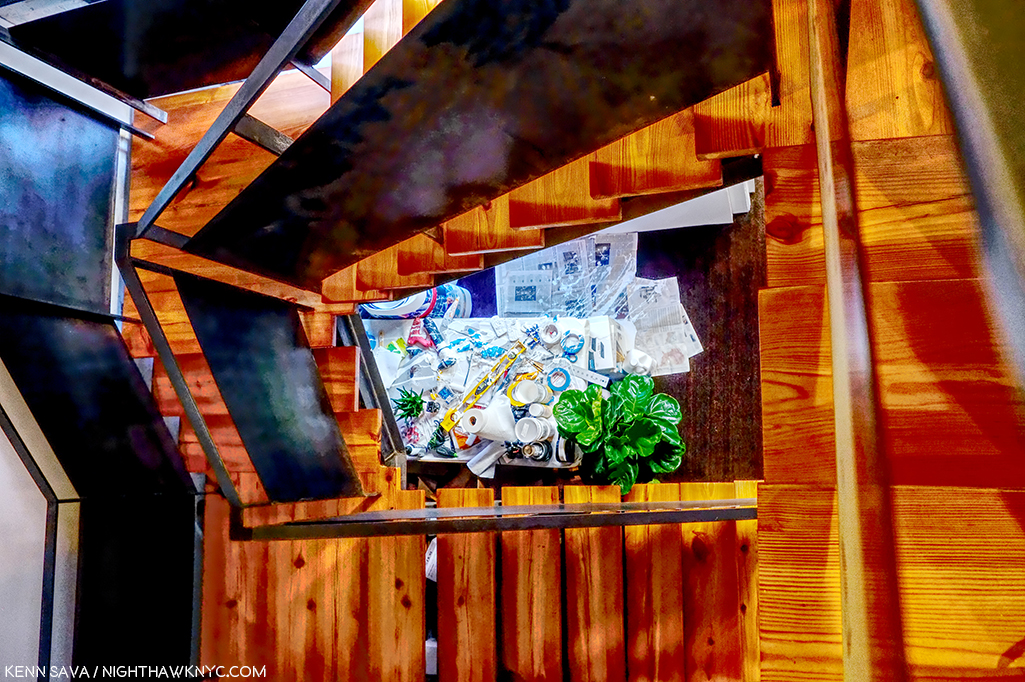
Looking down from 2 flights above at Images in Refraction(East) under the stairs.

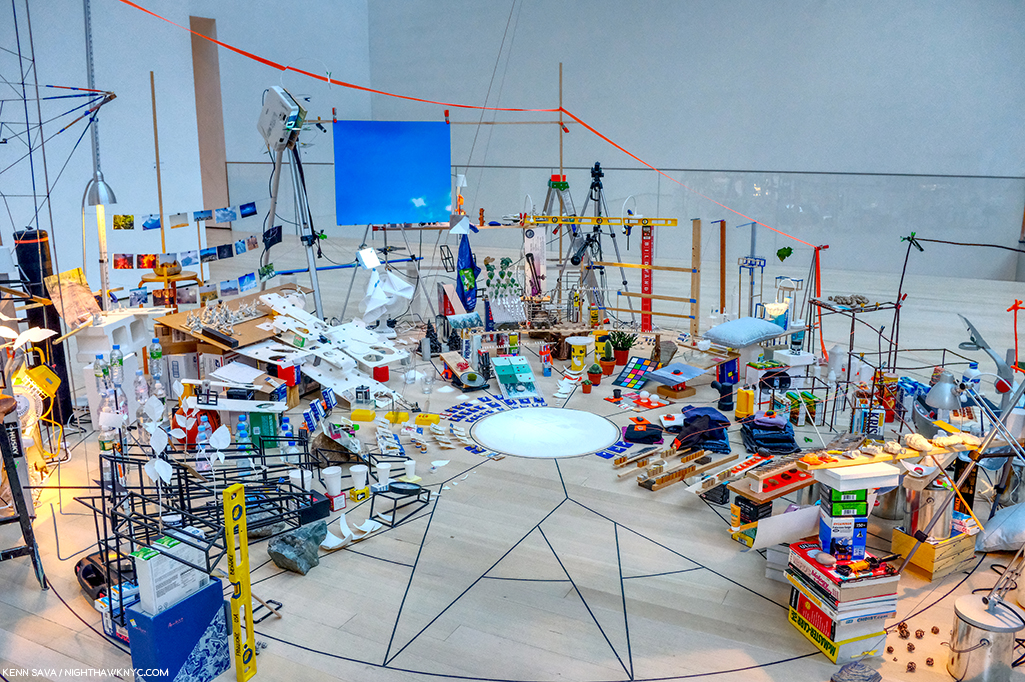
I then immediately started scrambling down West 21st Street to find the pieces of my exploded mind that had wound up on the ground. On September 21st, the opening day of the “New” MoMA, two days after Sarah Sze ended, I discovered this installed on the 6th floor-

Sarah Size, Triple Point (Pendulum), 2013, seen at MoMA, Opening day, September 21, 2019

Sarah Sze’s Triple Point (Pendulum), a work that was originally shown at the 2013 Venice Biennale when the Artist represented the USA, was on display, front and center, in the exhibition Surrounds: 11 Installations.

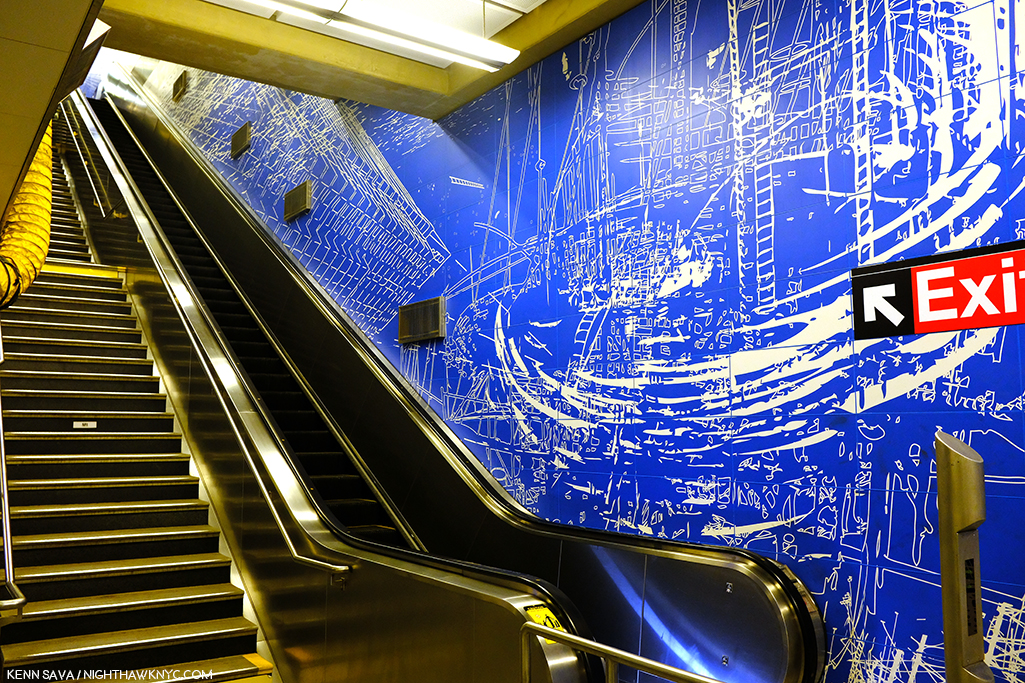
The immersive experience Sarah Sze gives us in Blueprint for a Landscape in the 96th Street 2nd Avenue Station is based on a fantasy of the construction of Hudson Yards, which is no where near it.

Though that show, too, has now ended, New Yorkers are able to see Sarah Sze’s work anytime- 24/7/365. Ms. Sze created the Art in the 96th Street Subway Station on the new 2nd Avenue line, which opened in 2017, making her one of a handful of Artists who’s work was installed during the creation of the brand new Subway Station it will be seen in permanently. I’ve lauded before the taste of those charged with selecting Art for the Subway, and here’s yet another instance of brilliant vision, in my opinion. Here’s a look for readers without a MetroCard. I can’t help thinking that in 100 years, people will treasure this remarkable video of both the construction of the Station and the Artist actually there, giving a walkthrough-

Sarah Sze is moving between Sculpture, Painting, Photography, Film, Installation and collage in new ways, creating results that have never been seen before. Her work is like the city, like the forest, like a home, and filled with elements, reminders, and the detritus of each. And, in a work like Crescent (Timekeeper), it’s full of what will be memories and associations in the form of images. To what end? As in all great Art, that’s left to each viewer to decide.

More details of After Studio

In my view, though the show marks something of a new “period” in her work, it’s seamless with what’s come before. Already a world famous Artist, could it be that she’s only scratched the surface of her talent? A year ago I’d be shocked to have said that about her work. Now? I’m ready to bet on it.

I have no idea how she conceives her pieces, but in each one of Sarah‘s shows- literally, never more than in her most recent show, I felt like I was walking around inside of her brain.

Ah…so this is what it’s like to be a genius…

*Soundtrack for this Post is “Aurora” by Bjork from Vespertine.

NighthawkNYC.com has been entirely self-funded and ad-free for over 6 years, during which over 250 full length pieces have been published. If you’ve found it worthwhile, you can donate to keep it going & ad-free below. Thank you!

Written & photographed by Kenn Sava for nighthawknyc.com unless otherwise credited.
To send comments, thoughts, feedback or propositions click here.
Click the white box on the upper right for the archives or to search them.
For “short takes” and additional pictures, follow @nighthawk_nyc on Instagram.

Subscribe to be notified of new Posts below. Your information will be used for no other purpose.


  1. I returned on October 19th, the show’s closing day, but there was a line to get into After Studio. I passed and left feeling fortunate to have spent a few hours in it by myself over the run of the show.
  2. Ted Talk

Jean-Michel Basquiat, At 59

Written & Photographed by Kenn Sava (except *)

Part 3 of a series…

In January, 1983, Henry Geldzahler asked Jean-Michel Basquiat- “Is there anger in your work now?
He replied, “It’s about 80% anger1.”

Jean-Michel Basquiat, at about age 20, walks with his clarinet at the intersection of East 88th Street and 5th Avenue across from the Guggenheim Museum, circa 1980-81 in a screenshot from the movie, Downtown ’81, directed by Edo Bertoglio and written by Glenn O’Brien. 39 years later the Guggenheim has mounted a show of work the Artist would create over the next few years. *

The Brant Foundation’s Jean-Michel Basquiat was the largest show of the five going on in NYC this year featuring the work of Jean-Michel Basquiat (J-MB, henceforth), or about him. Though it provided a rare opportunity to see a broad range of his Paintings through most of his career, there was no context to the show, beyond it being an exceptional, diverse, collection of his Paintings. My impression was the attention paid to presenting groups of work by theme consisted of a group of portraits in the rear gallery on the 4th floor, a room half full of Paintings of Boxers and a wall of Paintings with unusual stretchers, both on the second floor. The lack of a theme or themes is mitigated by the fact that in many of his works there are multiple themes present allowing viewers to piece together their own narratives in, and between, pieces. Yet, as time goes on, and the focus of J-MB studies turns away from the well-worn biography and more and more to the “less discovered land,” i.e. his work, some of the themes lying just beneath the surface are starting to finally get the attention they deserve.

In that same interview with Henry Geldzahler, J-MB said that “royalty, heroism and the streets” were his favorite subjects. Over on the sixth floor of the Guggenheim Museum, in Basquiat’s Defacement: The Untold Story, the only museum show of the five J-MB and J-MB related shows going on in NYC this year, all three of those themes were featured, with “the streets” perhaps most front and center. The show’s overriding focus was the death of Michael Stewart, a 26 year old Artist who died of injuries he received “on the streets,” after being arrested by the Port Authority Police on September 25th, 1983, for allegedly drawing or writing in the 14th Street L subway station two weeks earlier on September 15th.

The scene of a crime. The 1st Avenue Brooklyn bound L Subway Station, currently under construction. It’s a narrow platform as subway platforms go with nothing obstructing the view from one end to the other. The only entrance/exit, the one Michael Stewart must have entered and been removed through, is just to my right rear. Seen in October, 2019.

A public outcry and numerous protests ensued. The effect was immediate, deep and lasting, as the show reminds us, bringing us right back to the moment. The downtown community of Artists that Michael Stewart, J-MB, Keith Haring, and many others, were a part of, also responded with their creativity. In his “Chronology” in the Whitney Retrospective catalog, Franklin Sirmans writes, “Basquiat always conscious of racial realities is deeply effected by the death of Michael Stewart on September 15th…Basquiat, perhaps in fear, practices a form of denial. He consciously distances himself from the situation. No matter what his art world status might have been, incidents such as this were a constant part of his life2.” He continues, quoting Keith Haring, “One thing that affected Jean-Michel greatly was the Michael Stewart story…He was completely freaked out. It was like it could have been him. It showed him how vulnerable he was.” He then quotes J-MB as saying, “It could have been me. It could have been me3.” Michael Stewart died 8 months or so after J-MB said his work is “about 80% anger.”

Keith Haring’s Cable Building studio after Defacement was cut from the wall to the right of center, where he created it, 1985. *Keith Haring Foundation Photograph.

The show’s centerpiece is a work that has come to be called Defacement (The Death of Michael Stewart), 1983, that J-MB created on a wall of Keith Haring’s Cable Building studio at some point between September 29th and October 5th, 19834.

Keith Haring’s Bedroom, Greenwich Village, 1989. *Photograph by Nancy Elizabeth Hill, Keith Haring Foundation.

When he moved out of the Cable Building, Mr. Haring had it cut out of the wall and framed. In an indication of how he felt about the work, it hung over his bed, where it remained, apparently, until he died, in February, 1990, almost exactly a year and a half after J-MB.

Along with it, in the first gallery were 6 other Paintings and two limited edition prints by J-MB. In the second gallery, the rest of the show recounts the tragic story highlighted by vintage posters announcing protests, newspaper articles and ephemera, accompanied by Art by Keith Haring, David Hammons, George Condo, Lyle Ashton Harris and Andy Warhol. A moving highlight of the show is the inclusion of very rare examples of Michael Stewart’s work, which I have never seen before, from his family’s collection. At the time of his death, Mr. Stewart was planning his first show. Seeing these works now, the sense of lost possibilities remains undimmed 36 years later. Of him, Fred Brathwaite (aka Fab5Freddy) says- “Michael Stewart was a new artist making moves on the scene and one of the few people of color in the mix downtown at that time. He came from an intellectual educated family and wanted to find a place where he could express himself in a cool way around like-minded people….When he was killed and the police claimed he was writing his name on the wall in the subway-which was surprising and seemed unlikely to us- the media jumped all over the idea that he was a graffiti artist. …It was like a chill going through you, realizing that it could be me- it could be any of a number of people I knew. Even though we all knew that Michael Stewart was not the graffiti artist they were portraying him to be, it could clearly have been any person of color, particularly myself and the numerous others I knew who were making art and would occasionally tag a wall, or had that background. That was frightening5.”

Andy Warhol, Daily News (Gimbels Anniversary Sale), ca. 1983, Synthetic polymer paint on canvas, 24 x 16 inches.

Mr. Brathwaite’s testimonial is excerpted from an interview he gave for the show’s exceptional catalog, which deserves special mention. Informative new essays by curators are followed by almost 60 pages of recollections by Artists, journalists, and other figures were were part of this period in NYC history, each based on new interviews conducted by curator Chaédria LaBouvier in 2018 and 2019 that were edited into concise statements for this publication- an amazing list that includes Mr. Brathwaite (Fab5Freddy), Dianne Brill, Michelle Shocked, Kenny Scharf, Eric Drooker, Lyle Ashton Harris, Jeffrey Deitch, Annina Nosei, George Condo, Tony Shafrazi, ABC-TV reporter Lou Young (who did over 60 pieces on the Michael Stewart story), Ronald Fields (a member of the first grand jury in 1983) and Carrie Stewart, mother of Michael Stewart. Their contributions bring the reader, as the show does, right back to the place and time in the kind of detailed recollections only those who lived it on the front lines could relate. When I’ve spoken in Parts 1 & 2 about the need for those who knew the Artist to step up and speak, this is a shining example of what those with first hand knowledge to bring to the table. Anyone interested in Jean-Michel Basquiat, Michael Stewart and/or his tragic end should find their way to the catalog before it goes out of print. Many exhibition catalogs have a notoriously short shelf life after shows end.

Defacement (The Death of Michael Stewart), 1983, Acrylic and marker on plasterboard, 25 x 30 1/2 inches.

In the first gallery, a long, rectangular space leading to Defacement (The Death of Michael Stewart), 1983, as the work is now known, due to the fact the Artist has written “¿Defacement©? ” in the upper center, are other works by J-MB that revolve around the themes of the police, royalty and the death of kings. Defacement feels like a dream, or nightmare, due to the presence of “clouds” of blue, pinkish and black paint. Painted on a white background, the blue figures, with pink/red skin, of the police frame and tower over the central black figure, apparently seen from the back. There are parts of what appears to be two circles in black around the head of the center figure, who’s hands and feet are not visible. Apparently, some of the marks on the work may have been added by others, like the letters on the right side that appear to be (“ZERLOL”), but it appears these circles are under the blue paint and so may have been done by J-MB. One of the policemen appear to be looking out at the viewer.

Francisco Goya, The Third of May, 1808, Oil on canvas, *Prado Museum.

One thing that stands out to me is the composition in context of Art History, particularly, in works of Goya and Picasso. In Goya’s legendary The Third of May, 1808, the soldiers stand decidedly to the right- the same side as the viewer.

Picasso, Massacre in Korea, 1951, Oil on canvas, *Picasso Museum, Paris.

In Picasso’s Massacre in Korea, 1951, the viewer is placed right in the center, with the soldiers on the right, and the victims on the left, one or two of who look out at the viewer. In Defacement, J-MB has also placed the viewer in the center, between the policemen, and directly behind the black figure/Michael Stewart, who appears without hands or feet. The effect made me feel like being in line to run the gauntlet- like you’re next in line, in line with his reported feeling “It could have been me. It could have been me.” It’s hard not to take the Painted “¿Defacement©?” as a double entendre. Did Michael Stewart really deface the subway station? And, why are the police “defacing” him, removing his face from the world?

La Hara, 1981, Irony of a Negro Policeman, 1981, both Acrylic and oilstick on wood panel, both 72 x 48 inches, Untitled (Sheriff), 1981, Acrylic and oilstick on canvas, 51 1/2 x 74 inches, from left to right.

On the right hand wall are three Paintings featuring policemen. All three are different. One has a white officer, one a black officer, one a grey officer (the two in Defacement appear to be pink-ish red). Two have white backgrounds, one red. All three are extremely nebulous (at least to me), even in the nebulous work of J-MB. All three are terrifying, and so perfectly set the stage for, and compliment Defacement.

The prints Back of the Neck, 1983, 50 1/4 x 102 inches, which I saw 14 years ago at the Brooklyn Museum (See Part 1Part 1), who is is on loan from, and Tuxedo (1982-3), 102 1/4 x 60 inches, both prints are editions of 10.

On a wall facing it are the limited edition print, Back of the Neck, also from 1983, my old friend from the 2005 Brooklyn Museum Retrospective on loan from the museum, and another print, Tuxedo, 1982-3, a work that references kings. As others have pointed out, Back of the Neck could be a reference to the injuries sustained by Mr. Stewart.

CPRKR, 1982, Acrylic, oil stick, and paper collage on canvas, mounted on tied-wood support, 60 x 40 inches, Self-Portrait, 1983, Oil, acrylic and oil stick on two wood doors and wood panel, with graphite and ink on paper, 96 3/4 x 63 3/4 inches, and Charles the First, 1982, Acrylic and oil stick on canvas, three panels, 78 x 65 inches, left to right.

On the 4th wall are a stunning trio centered around the Self-Portrait, 1983, and two works that pay homage to another of J-MB’s “Kings,” Charlie Parker. Both of those relate to (his) death, and the death of kings. To the left is, perhaps, the most poignant work the Artist did referencing Bird, CPRKR. In it, he memorializes his death, listing the place and date, under a crown, with the moniker, “Charles The First” written below. And so, it fits with Defacement. Right next to it is the Self-Portrait, 1983, which in this show is impossible to think about without considering the year it was Painted, particularly since on its right-hand panel, the words “To Repel Ghosts” are Painted. To the right of these is Charles the First, 1982, with it’s equally haunting words “Most Young Kings Get Their Heads Cut Off” written along the bottom. Of the “young kings” referenced in this room, Michael Stewart died at 26, J-MB at 27 and Bird at 34. Charlie Parker turns 100 on August 29, 2020. Michael Stewart would be 61 today. As I pointed out in Part 2, J-MB should be 59 years old RIGHT NOW, in mid-career as the museums call it. Both should be living, vibrant, forces. Not ghosts.

Jean-Michel Basquiat, Untitled, 1987, Andy Warhol, Daly News (Gimbels Anniversary Sale), 1983, Keith Haring, Michael Stewart- USA for Africa, 1985, left to right.

Not mentioned anywhere that I’ve seen, this is the only time Jean-Michel Basquiat, Andy Warhol and Keith Haring, the three figureheads of the Art of their time in NYC ever addressed the same event, (as far as I know). I’m not saying Untitled, 1987, shown in the group above, seen in the second gallery, is a reference to Michael Stewart- I don’t know, but Defacement is. Describing the amazing Keith Haring work, the defunct website basquiatdefacement.com said, “It depicts a black man being strangled while handcuffed to a skeleton holding a key. People from all nations drown in a river of blood below, while others shield their eyes from the scene, and the green hand of big money oversees the scene6.”

Michael Stewart poses for Dianne Brill Menswear, 1983, from the show’s catalog. “Michael was buried in a suit I designed,” Dianne Brill writes in her piece in the catalog (P.107).*

Basquiat’s Defacement: The Untold Story is one of the most powerful, smaller shows I’ve seen in years. Though it depicts events that took place 36 years ago, its relevance was, I’m sure, not lost on a good number of its viewers.

Alexis Adler, Jean-Michel Basquiat (the exact title is unknown to me).

Two other shows, the last two I saw in the group of five7, document little seen sides of J-MB. In The 12th Street Experiment: Photographs of Jean-Michel Basquiat, the Photographs in question are by embryologist and former J-MB girlfriend and roommate, Alexis Adler, who lived with the Artist from 1979-80.

Alexis Adler speaks about Jean-Michel Basquiat and her Photographs of the Artist at The Bishop on Bedford Gallery, Brooklyn, May 18, 2019.

A veritable Portrait of the Artist as a Young Man, this was a show that, along with the items in Ms. Adler’s archive J-MB left behind in, and on, her apartment (on tour in museums shows elsewhere at the time, most recently at the Cranbrook Museum, The Museum of Contemporary Art, Denver and in Europe), form an important and unique collection. In my research, I’ve come to see that J-MB’s formative period after he left home for good has gone largely overlooked and understudied. Alexis Adler has stepped forward, sharing her experiences and her knowledge, in books, essays and traveling around the world speaking about her time with Jean-Michel Basquiat from 1979-80 and his Art, in addition to sharing her collection in the shows I mentioned. As she walked me through the show of her Photographs at The Bishop Gallery on Bedford, Brooklyn, I was amazed at both the J-MB work that Alexis has documented in Photographs and the range of experimentation the young Artist was undertaking- extending down to his continually evolving hairstyles! Lacking funds, he worked with whatever he found, whatever was at hand- including the doors, walls, and floor of the apartment, and whatever he found on the street, making him part of the line that includes Duchamp, Rauschenberg and Jasper Johns, among others.

A Performance piece that involved installing a television set in a refrigerator. J-MB wears one of his hand Painted helmets here in one of a series of Photographs documenting the performance.

There is an element of performance in a number of these Photographs and in the work, which took place at the time he was performing with his band, Grey (and he is seen practicing his clarinet). Personally, I find this work fascinating and remarkable- on its own and for what it anticipates. A good deal of it might surprise many only familiar with his Paintings and Drawings.  This period seems to me to be more than only “early experimentation,” as it contains the roots and beginnings of much that came after, including his Painting. That he was Painting on everything he could find (out of a lack of funds for traditional Art materials, no doubt), presages his later Paintings executed on doors, like Self-Portrait, 1983 in the Guggenheim show, to fence slats, like Gold Griot, seen at The Brant in Part 2, among others.

Alexis Adler, Basquiat in the apartment, 1981. Note the work by Bacon right behind his head. In another of Alexis Adler’s Photos, Burroughs’ Naked Lunch is seen attached to the wall. More evidence of J-MB’s Beat connection I mentioned in Part 1.

In addition, Ms. Adler said that J-MB studied her Art textbooks from the classes she was taking at the time. I found fascinating evidence of this in this Photo of hers, where a work by Francis Bacon is mounted on the wall. I wondered in Part 2 what Francis Bacon would think of J-MB’s Untitled, 1981. Here is the proof that J-MB knew of Francis Bacon’s work that very year.

Alexis Adler, Painted television in the apartment, c.-1979–1980. It’s amazing this Photo of the work exists, but I would love to see it in color because there’s nothing else like this in his subsequent Paintings!

Ms. Adler, who spoke about having her ear to the ground and priding herself on being aware of what was coming next, said she “knew” J-MB was an important Artist almost immediately. “He said he would. I was definitely the first one to believe him. Everyone else was like, ‘Sure Jean.’ He was brilliant. I could tell. His spirit — everything about him. He was an amazing person, a very deep-thinking individual.” It’s only because she acted on that feeling and bought a camera that we have a record of these works which would otherwise be lost to history.

Alexis Adler, Refrigerator in the apartment, ca. 1979-80, Untitled (Famous Negro Athletes), 1980-81, left to right.

Seeing the show, I came to feel that this early period of J-MB should be appreciated as a “period” of his work every bit as much as his later work has been broken down into periods. It stands apart. While it’s formative and precocious and different from what he’s “famous” for, it’s a part of the whole. It has the same spirit of freedom, of experimentation, the unexpected, of seeing new possibilities that characterize all his work.

Lee Jaffe was a Musician at the time who had just recorded and performed with Bob Marley when he met J-MB. The two struck up a friendship and traveled extensively together. In the fifth and last show I saw, Lee Jaffe’s Photographs of J-MB at Eva Presenhuber Gallery, show him in relaxed settings, where the Artist is just being himself. He’s seen as just another tourist, mugging with other tourists, and looking extremely at ease.

Lee Jaffe, Jean-Michel Painting in St. Moritz, 1983-2019, Dye sublimation on aluminum, 60 x 209 inches.

The highlight of Mr. Jaffe’s show for me was this fascinating montage showing J-MB creating a work in St. Moritz, virtually from start to finish, something I don’t recall seeing anywhere else.

Four Untitled works, 1985, far left, with three black & white works from 1984-2019. J-MB, as a real person. About two hundred feet behind that wall on the right, Jean-Michel Basquiat lived from 1983, until he died, on August 12th, 1988.

Somehow, these images felt jarring to me after reading so much drama-soaked biography and anecdote. Compounding this “reality,” ironically, the show was installed at 39 Great Jones Street, just a few doors west of 57 Great Jones Street, where J-MB lived, and died, which I showed at the very beginning of Part 1 of this series, bringing this five-month journey full circle.

Coincidentally, right around the corner from The Brant, on B and East 10th Street, is Charlie Parker Place, where Bird lived from 1950 to 1954, in the building to the right with the woman in white on the stairs. May, 2019.

A few weeks after seeing The Brant show, I took a trip to “Charlie Parker Place,” on Avenue B where Bird lived from 1950 to 1954. Taking stock of everything I’d seen, I sat across the street in Tompkins Square Park and listened to Bird, trying to hear him through J-MB’s ears. The soaring, unexpected majesty, the spontaneous “flights” of imagination, the beauty (much of it created in the sordid world of 1940s nightclubs, rife with drugs, crime and of course alcohol), the daring, the guts to be different, to be yourself…to be free, inside yourself, and then outside. I was sitting a mere 4 blocks from The Brant Foundation, and around the corner from where J-MB lived with Alexis Adler. As such, ironically, I was at a sort of center of this whole journey I’d been on, right across the street from Bird’s former residence, a man who’s been a part of my evolution, too.

I kept thinking back to the fact that J-MB lost his spleen, his (blood) filter, when he was hit by a car at age 6. That’s what his work looks like. It includes everything, everything around him, at the time, or in his experience. So much is going on in modern life, how else can you really depict it? The only “filter” in the work of Jean-Michel Basquiat is that of his unique eye and sensibility.

The Artist @OR1EL poses with his work which includes what appears to be a Portrait of Jean-Michel Basquiat next to his left knee. I note a J-MB Crown on his left shoe. Seen at the 8th Avenue L Station- 4 stations west of the L station Michael Stewart was arrested in, May 28, 2019.

Alas, Jean-Michel Basquiat isn’t 59 right now. He’s a ghost, a spirit. His Art is only 31 to 40 years old. It remains very much alive- speaking to, and moving, an extraordinary number of people. In the 31 years since his own tragic end his influence seems to still be increasing.

Charlie Parker Place, June 7, 2019.

As I left Charlie Parker Place that June day, I was startled to see what someone had written on a newspaper box right on the corner. Downtown 81 is the film that J-MB starred in made in 1980-81, a still from which I showed at the beginning of this piece. In the same style as the Film’s logo, someone had appended “DOWNTOWN 18.” Jean-Michel Basquiat learned from those who came before him, and today others are learning from him.

Portraits of Jean-Michel Basquiat and his associates Keith Haring and Andy Warhol flank Frida Kahlo at 22nd Street & 10th Avenue in Chelsea, looming over the Chelsea Art galleries behind me.

Art history is a continuum. Pass it on.

To answer that question I asked in Part 1– Over these past five months, five shows, all the books, and now three long pieces on his Art, I have come to side with the believers. I’ve come to believe that Jean-Michel Basquiat was, perhaps, the most important Painter known to me to emerge in the 1980s. His work is here to stay.

Postscript-
It turns out I’m not the only one who’s come around to the Art of Jean-Michel Basquiat. Tonight, I went the Preview for the “New MoMA.” And, lo and behold in one of the very first galleries on the 2nd floor, I saw this-

Well? They borrowed it from a “Private Collection.” But, that it’s here is a big statement, and possibly a reversal of their assessment I wrote about way back in Part 1. Now? It appears they feel it’s not only “worth the storage space,” his work is worth giving pride of place to, too. By the way? It’s clear that MoMA’s researchers need to take heed from J-MB’s own words that he was “not a graffiti artist,” which I quoted in Part 1. They also left out that Glenn O’Brien wrote the screenplay for Downtown ’81, which I showed a still from up top. He cast him in the Film after featuring J-MB regularly on his cable access show…which brings this piece full circle, too.

– Soundtrack for this Post is “Donna Lee’ by Charlie Parker as performed by the Charlie Parker All Stars featuring the legendary Bud Powell on piano and that other immortal of Music, Miles Davis, on trumpet. Miles was 21(!) when this recording was made, live, on August 5, 1947. In 1976, when I was coming up as a bassist, another genius, Jaco Pastorius, (to my mind, the “Jimi Hendrix of the bass), blew everyone’s minds by beginning his debut solo album with a performance of “Donna Lee” on his bass. Jaco, who I met and spoke with over the years, was tragically killed in September, 1987 at at 35, less than a year before J-MB’s death. Both performances are pillars of the Art of Music. Here’s Bird & Miles-

*My thanks to to Alexis Adler, May Yeung of the Guggenheim Museum, and to Lisa for pulling my coat to Alexis Adler’s talk.

This is Part 3 of my series on the five Jean-Michel Basquiat and related shows going on in NYC this year. Parts 1 & 2 are under this one, or here and here

NighthawkNYC.com has been entirely self-funded and ad-free for over 6 years, during which over 250 full length pieces have been published. If you’ve found it worthwhile, you can donate to keep it going & ad-free below. Thank you!

Written & photographed by Kenn Sava for nighthawknyc.com unless otherwise credited.
To send comments, thoughts, feedback or propositions click here.
Click the white box on the upper right for the archives or to search them.
For “short takes” and additional pictures, follow @nighthawk_nyc on Instagram.

Subscribe to be notified of new Posts below. Your information will be used for no other purpose.


  1. Henry Geldzahler was the former Curator for American Art at The Met, later Commissioner of Cultural Affairs for NYC. He interviewed J-MB in January 1983, for Andy Warhol’s Interview Magazine, as reprinted in Jean-Michel Basquiat, published by Charta, 1999, P.LIX,
  2. Whitney Retrospective Catalog, P.243
  3. from an interview with Suzanne Mallouk.
  4. Defacement Exhibition catalog, P.19
  5. Defacement Exhibition catalog, P.104
  6. Here, footnote 22.
  7. I wasn’t able to get to the sixth show, Basquiat x Warhol, which was 3 hours outside of NYC.

Jean-Michel Basquiat At The Brant Foundation

Written & Photographed by Kenn Sava

This is Part 2 of my series on the five Jean-Michel Basquiat related shows going on in NYC in 2019. Part 1 is below, or here.

Show seen: Jean-Michel Basquiat at the Brant Foundation, 2019
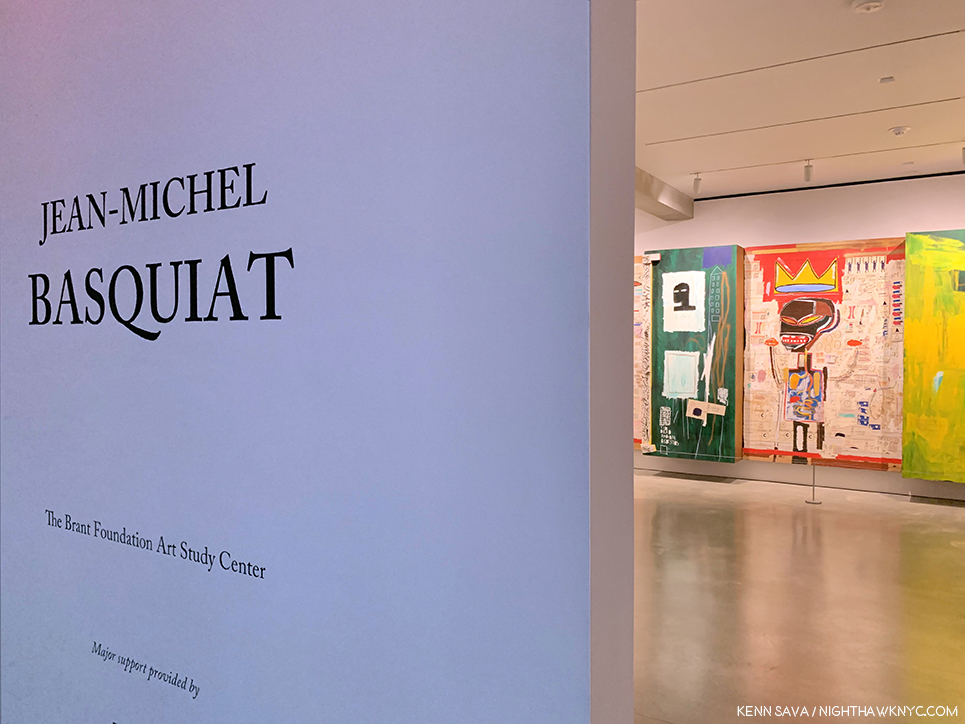
Outside looking in. The most important show in NYC known to me thus far this year was a show I would be extremely fortunate to see.

Jean-Michel Basquiat, the first exhibition at The Brant Foundation’s new East Village location is a NoteWorthy show because it is a major, museum-quality show mounted at a private institution of the work of a single major Artist with more Paintings on view than all the major NYC institutions, combined, could mount- multiplied twelve-fold. This led me to wonder- What other major Artist-Contemporary, Modern, or Old Master- has so much of their work, and so many of their major pieces in private hands?
The East Village, NYC, May 13, 2019. Looking towards the Empire State Building (rear, left of center). Bad weather, no ticket for the show, no sleep, no umbrella. It was going to take more than that to keep me from seeing this show, AND something close to a miracle to allow me to do so.

It’s easy to have mixed feelings about this. I’ve read some complain that it’s another case of the 1% at its worst; that this show is a case of the very rich showing off. On the other hand, it seems to me that there is a stronger case to be made admiring the vision, and the guts, of the collectors who stepped up and bought much of the work of Jean-Michel Basquiat (J-MB henceforth) when he needed it most, not to mention go through the trouble of sharing it with the public, who, in the case of Jean-Michel Basquiat’s Art, are largely dependent on them doing so to be able to see it. Showing off? Yeah. I guess.

Almost every Artist in the early stages of their career needs the support of buyers and collectors to survive and to continue to create. Yet, it’s also easy to forget that most of these  collectors possibly also bought Art by Artists that have long since been forgotten, (which is one reason I strongly believe in only buying Art you love– if it becomes worth less- even substantially less- than you paid for it? You can always display it and enjoy it.) And? As I wrote in part 1 of this series, the NYC museums, except the Whitney, collectively passed on his work at the time- and continue to do so. The only way they’re likely to fix that now is by gift or donation. The affordability train has long ago left the station for anyone else besides that 1%. The Big 41 had their chance. In the case of some institutions- chanceS, as I outlined.
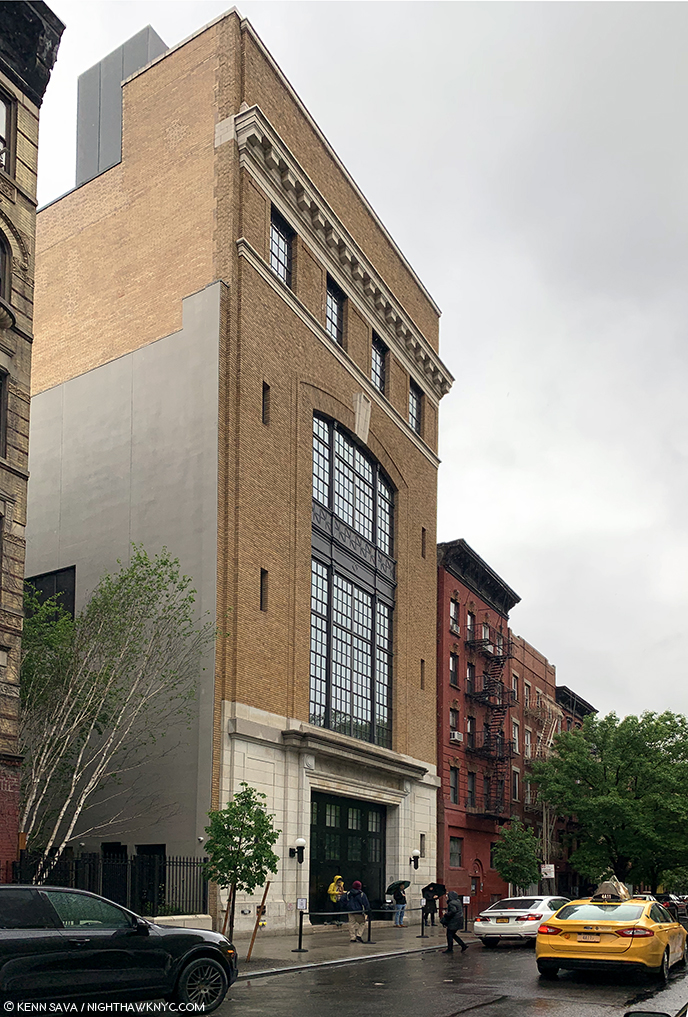
Unnamed on the exterior, in classic East Village cool, The Brant Foundation, 421 East 6th Street, 10am, Monday, May 13, 2019. If I’m up at 10am, and not STILL up, you know there’s a special reason why. That cab exiting stage right is leaving with my umbrella. See ya.

At The Brant Foundation, a show of 70 Paintings and 1 Sculpture was on view, making it the largest show of Basquiat’s Paintings in NYC since the Brooklyn Museum’s Basquiat Retrospective in 2005, which I saw. Combined with the Basquiat work in the other five 2019 shows, the total approximately equals how many were shown in Brooklyn in 2005. The Brant show largely includes work in the collections of Stephanie and Peter Brant, alongside pieces on loan from the Broad Museum, (a private museum of the collection of another early collector, Eli Broad, who own at least of 13 of J-MB’s Paintings), among other significant loans. Since so much of his work is in private hands who knows how long it will be before we see a bigger or similar number of J-MB’s work here again. So, the six Jean-Michel Basquiat related shows in NYC and vicinity this year (counting the Warhol x Basquiat show going on in Kinderhook, NY, which proved too far for me to get to) might be the best chance I’m going to get to reassess and reconsider his work that it’s barely been 40 years since he began creating it.

The first order of business was getting in to The Brant show and actually seeing it. After all my efforts to get a ticket failed, I resorted to drastic measures. I took the unprecedented step of getting up with 3 hours sleep at 9am and going down to The Brant on May 13th, the last day the show was open, or the day before it closed- I’m still not sure. As I got there at 10am, right as it opened and visitors for the the first timed slots were arriving, I quickly realized this was going to take an act of fate. Compounding things, it was raining and I’d left my umbrella in the cab. I decided to take a Zen approach and stand off to the side, where that tree is to the left, above, and see what happened.

About 30 minutes later, Jessie, the on-top of everything Brant staff person manning the entrance, who knew I was casting my lot to fate, called me over from the door. A lady had arrived and told him she had an extra ticket. Really? A real-life Angel of Providence had appeared when I SERIOUSLY needed one. I walked over and met Lisa, and yes, she had an extra ticket that she was willing to let me use. Miracles really do happen. The fact this piece exists is solely due to her generosity. Seeing it over the 3 and a half hours I spent in it allowed me to flesh out the portrait of Jean-Michel Basquiat’s accomplishment that began for me at Xerox, adding the best look at his most important work I’m likely to get. Any assessment of J-MB’s work and achievement begins with his Paintings. I’d seen 100 works in 2005 at the Brooklyn Retrospective, but I hadn’t prepared to see them. Now IS the time. Lisa’s generosity not only enabled me to create this piece, it also permits me to create the multi-part series on 5 of the 6 Basquiat-related shows I wanted to do, now that she made it possible for me to see the “centerpiece” show of the group. I’m also grateful to Jessie for thinking of me. Due to both of their kindness and consideration, I am thrilled to be able to share what I saw with you.
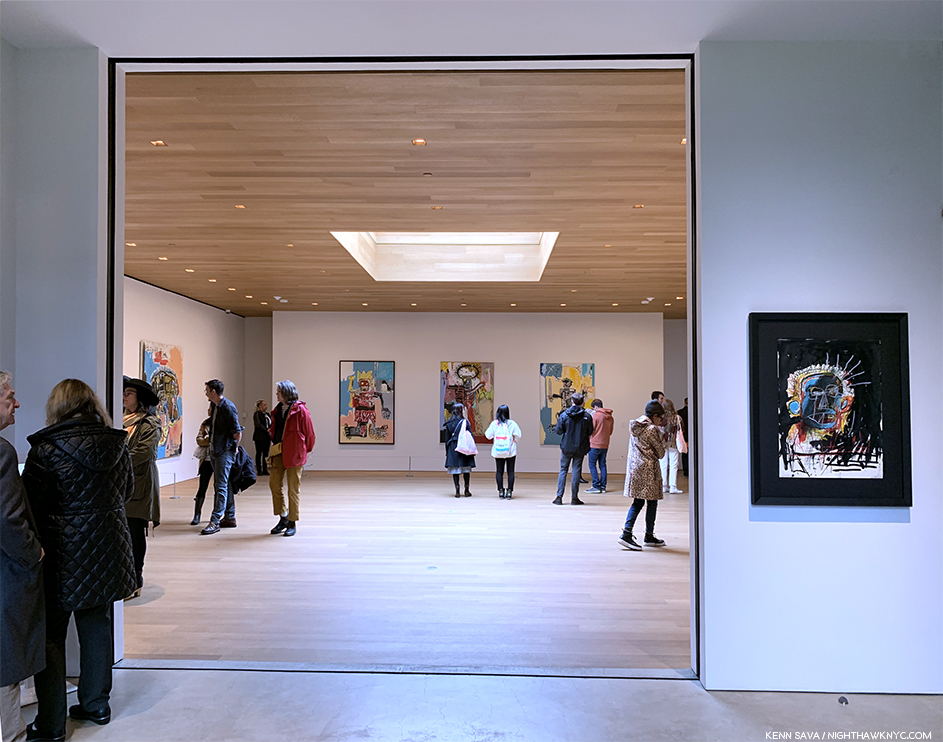
For a while, it looked like I wasn’t going to get to see this. Standing at the entrance to the show- the lobby of the 4th floor, just after exiting the elevator 90 degrees to the right.  You can see the variance in the lighting in the main gallery from here. Outside, to the right of center is Untitled (Self-Portrait), 1982.

The elevator took us to the 4th floor, where everyone starts and then walks down to the floors below, the show being installed on all 4 floors. It should be said that the group of new visitors getting off the elevator each time on 4 was surprisingly small. The galleries were pretty sparsely filled- incredibly so for a major show on either it’s last day or next to last day. Well, there was well over 1 billion dollars of Art on display, so they opted to keep the crowd manageable.
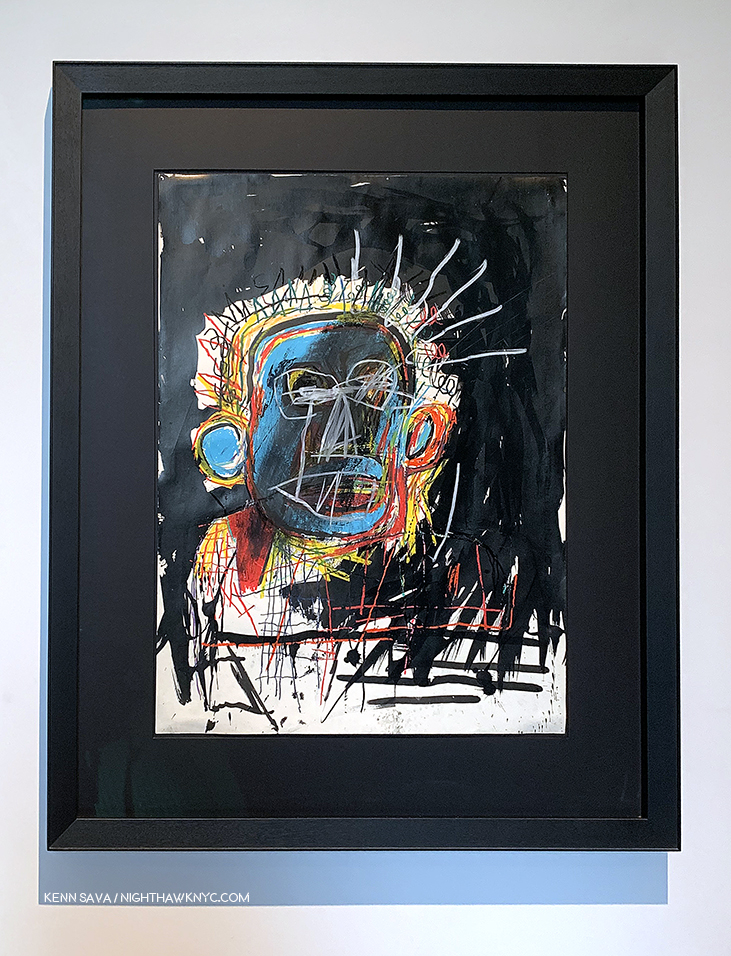
Untitled (Self-Portrait), 1982, Oilstick and ink on paper, 30 x 22 inches. The first work in the show.

Though the urge might have been to hurry into the large, main gallery shown above, I was stopped in my tracks by the work hanging to the right just outside. There was Untitled (Self-Portrait), 1982, one of the most unique Self Portraits I’ve ever seen. I wondered what Picasso would have thought of it. The colors, and then particularly the black background fascinates me as I ponder at what stage J-MB added it. And then I wondered what Clyfford Still would think of it. Like a number of J-MB’s “heads” from 1981-2, he flattens everything to the picture plane, something not seen all that often in Art. 4 floors of J-MB still to go. What an auspicious start!
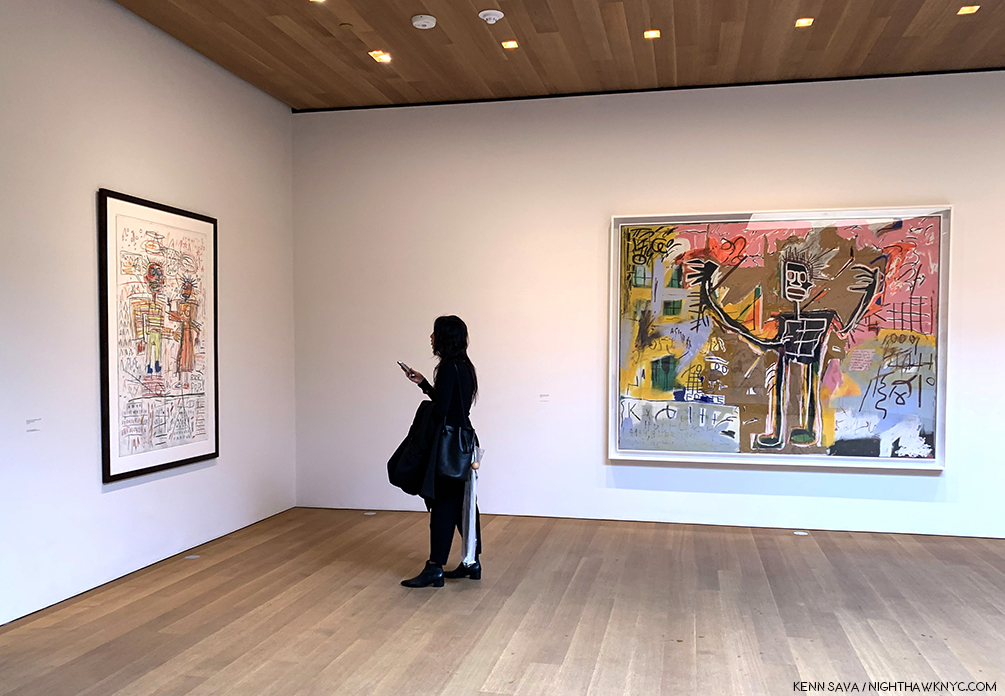
A real-life Angel of Providence. Lisa studying Self-Portrait with Suzanne, 1982, in the main gallery on 4.

It turns out that Lisa is a school teacher and an Art lover with superb, wide-ranging, taste that runs from Brancusi through Morton Feldman as I found out as we chatted while going in.
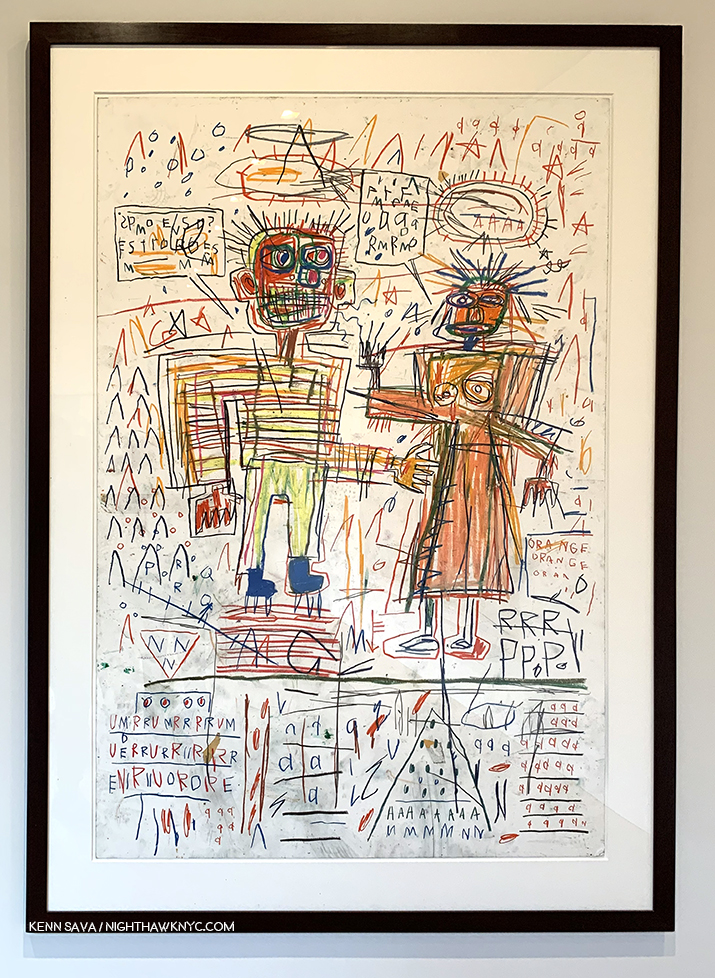
Self-Portrait with Suzanne, 1982. The compelling work Lisa studies above shows the artist with Suzanne Mallouk, the subject of Widow Basquiat, in 2010. It’s the only work known to me created by J-MB showing the Artist with one of his lovers. Beyond this, it’s fascinating to study the way he’s rendered himself here compared with the other “heads” and Self-Portraits from 1981-2.

Before I get too far into the show, I’ll say the building looked brand new, the restoration of the former Con Ed Substation being first class from top to bottom. I have mixed feeling about it’s suitability for the display of Art, but honestly, I get some of those feelings almost everywhere I see Art. In my experience, the #1 problem in seeing art is lighting, combined with the scarcity of truly non-glare glass or acrylic. As my friend, Corinne, co-owner of NYC’s legendary City Frame, tells me- currently, it’s expensive. Then again, not all Painting is glazed. Increasingly, Artists, including Raymond Pettibon and Kara Walker, and Photographers, including Gregory Halpern, have shown their work without frames, often just tacking it to the walls at the corners. Still, glazed or not, lighting- artificial or natural, is a problem that rears its head in almost every show I see. The same was the case at The Brant.
I don’t care how rich I was, I don’t think I’d install a pool over irreplaceable Art.

The fourth floor is the top floor and features a skylight, apparently, filled with water- unless this had collected from the rain? I don’t know. They must either have Lloyd’s of London insurance, 8 million tons of confidence in whoever installed it, or both, to hang a few hundred million dollars worth of one of a kind Art underneath it, including more than one of J-MB’s greatest works, in my opinion. But, beyond this, being a cloudy, rainy, day, the large skylight wasn’t letting in as much light as it might have at other times.
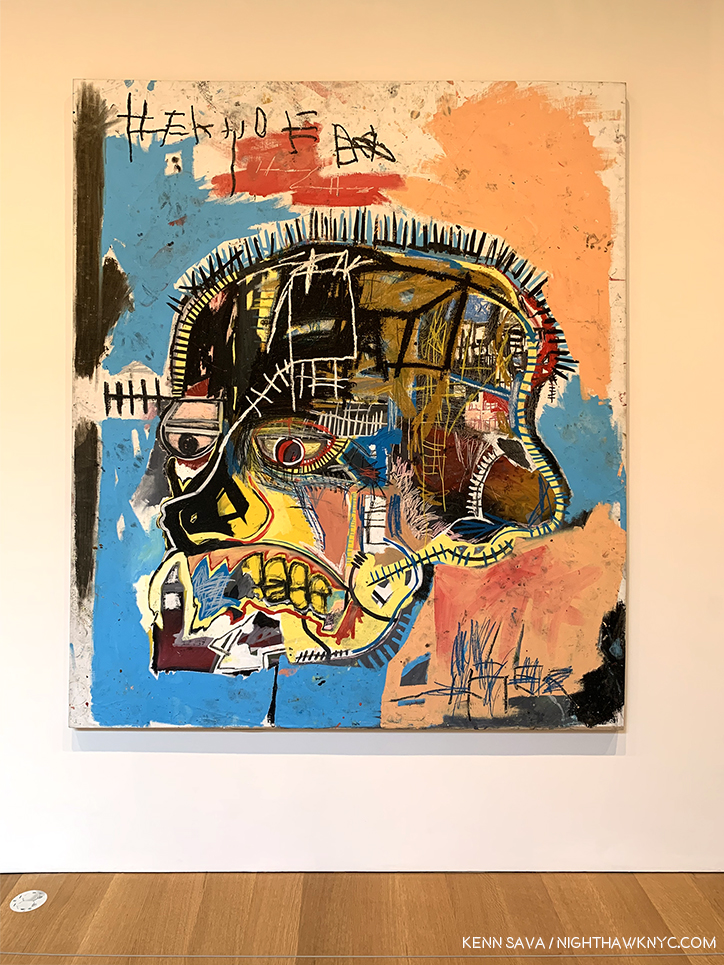
Hanging a few feet from the skylight/pool (as you can see in the installation view earlier) is Untitled, 1981, acrylic and oil stick on canvas, 81 x 69 1/4 inches, from The Broad, L.A., the upper half of which was in a shadow during my visit.

Typical of all the works on view in this room, the upper half of Untitled, 1981, on loan from The Broad in LA was in a shadow. Still, the power of seeing this work in person was staggering. I took all of it in from a distance when I first saw it, then walked over to see the other works in the room. Finally, I walked back over to look closely at it at length.
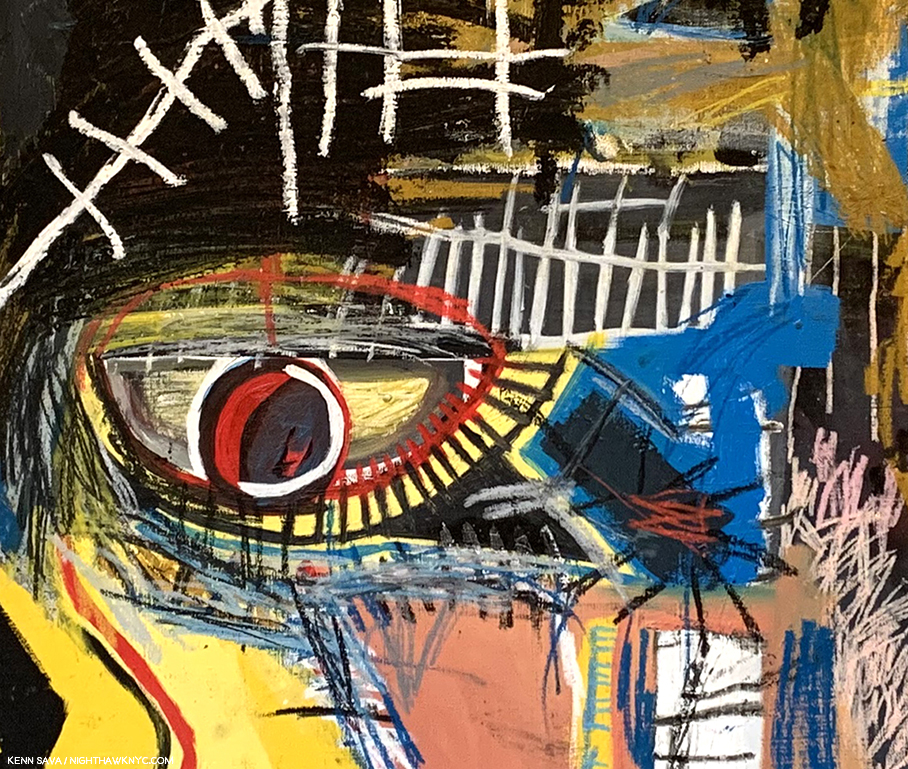
Detail of Untitled, 1981.

The difference in the experiences is remarkable, as you can see. But, no matter how closely I looked, minding the security rope you can see at the very bottom of the picture above, it was still drawing me closer. Like a Rembrandt, or Van Gogh, where I’d like to study each brushstroke for it’s content, here I was being drawn in to look at each detail. The feeling I got was that each small part of it was a world unto itself, yet irrevocably part of the whole. What, exactly, are we seeing? It’s not a skull because there are eyes and there is hair, at least part of a beard, and some teeth, though others are missing. And there are what appear to be stitches and possibly some letters over all of it- a cryptic message, like the figure, in a language no one had ever seen before. (Compare this to the work on view in Xerox that I looked at in the first Part! There, the details were, largely, words.) This is 1981- a year after the first show the work of J-MB appeared in. It’s a work from near the beginning of his post-SAMO© career as an Artist. And, it’s one of the most remarkable shots across the bow in Art history, possibly since Picasso’s Les Damoiselles or Duchamp’s Bride Stripped Bare. When I’ve seen it in books, I haven’t been able to stop looking at it. Seeing it in person it felt like I’d never really seen it. But, even saying that? There’s literally nothing like this in Western Art history to 1981. In his book, The Art of J-MB, Fred Hoffman makes a case for this being among J-MB’s “key” works. I don’t have a list, but I won’t argue with that. I just keep wondering if Francis Bacon, who outlived J-MB, passing away in 1992, saw it and what he thought, or would think, of it.
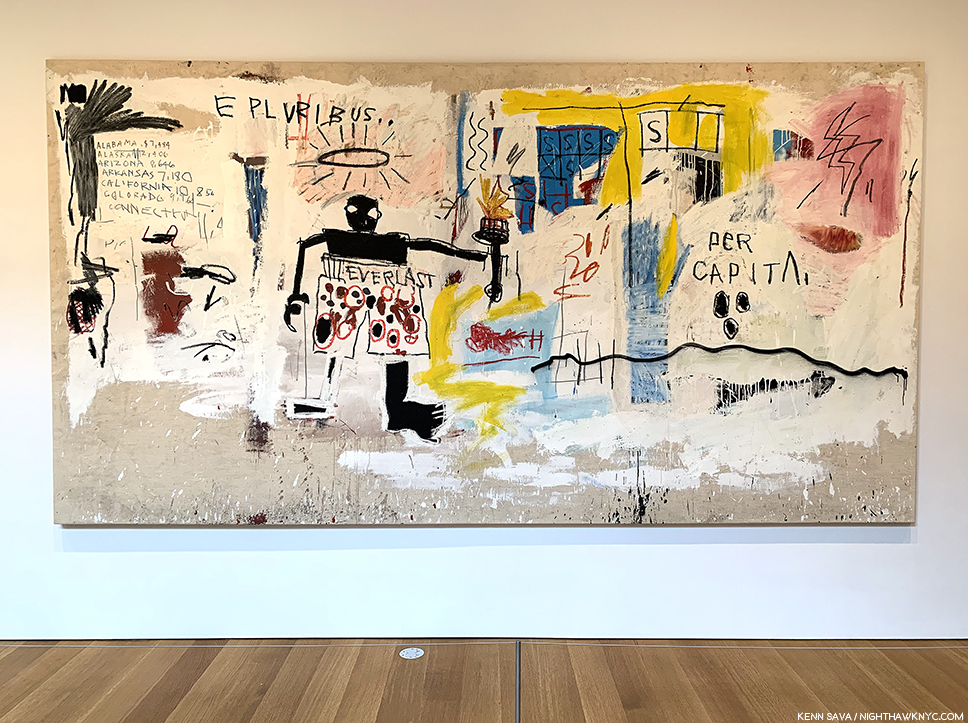
Per Capita, 1981

Across from Untitled was the incredible Per Capita, also from 1981, with it’s central figure in Everlast boxing trunks, a halo over his head and his outstretched left arm holding a torch that sure looks to me like that of the Statue of Liberty. Over the halo are the words, “E PLURIBUS…,” or, “out of many,” leaving out the equally famous, “UNUM,” or “one.” The title (which may or may not be the Artist’s title- I simply don’t know), “Per Capita,” means, “per unit of population; per person,” in one definition, per American Heritage Dictionary, and “equally to each individual,” in another. Along the left side appears to be the beginning of an alphabetical list of states with the per capita income of its citizen next to them. Even on a partial list, that manages to include states in 3 of the 4 corners of the country, the variance is striking. Fred Hoffman wrote at length about this piece in his essay in the catalog for the 2005 Brooklyn Museum Retrospective, where he also listed it among J-MB’s key works, where he says the central figure is Cassius Clay, as Muhammad Ali was known when he won the gold medal at the 1960 Olympics (The Art of J-MB, P.129.), which could also make that an Olympic torch.

As I looked at this fascinating work, I couldn’t help wonder if the “UNUM,” or “one” E PLURIBUS was seeking with its … was the solitary figure, as in “Out of many, THIS one.” J-MB’s love of boxers is well known and was to be seen in most of an entire gallery on the 2nd floor, as well as in his portrait (in which he wears Everlast boxing trunks) in the famous Warhol*Basquiat poster for their joint show a few years later in 1985 at Tony Shafrazi Gallery, which could also make this a Self-Portrait.

It’s hard to write about this show and not include every work in it- many are major, many others important for any one of a number of reasons, and they all deserve mention.
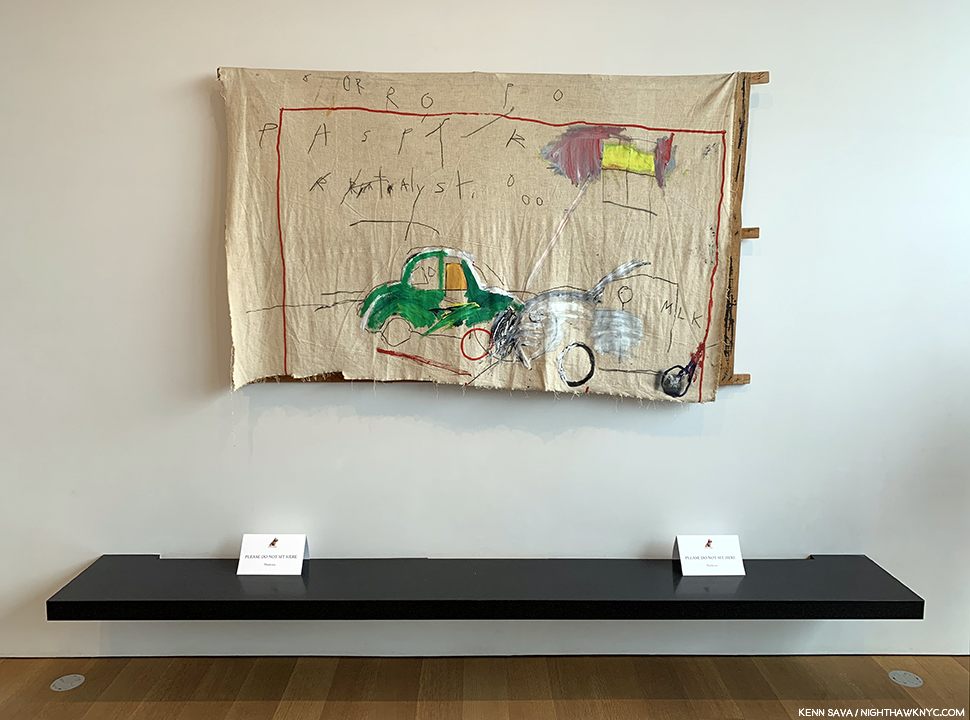
Untitled (Car Crash), 1980, Acrylic and lipstick on canvas with exposed wood supports. So much of J-MB’s story and his Painting begins in this work where he recreates the accident where he was hit by a car at age 6 that hospitalized him for a month and caused the loss of his spleen. Seen in the small rear gallery on 4.

On 4, there was also a small rear gallery along the rear of the building. Here, too, lighting was a question. The far wall was lined with a floor to ceiling window, which, you guessed it, let in a lot of light- even on this dreary day. I have no idea if they cover it/partially cover it in full sun.
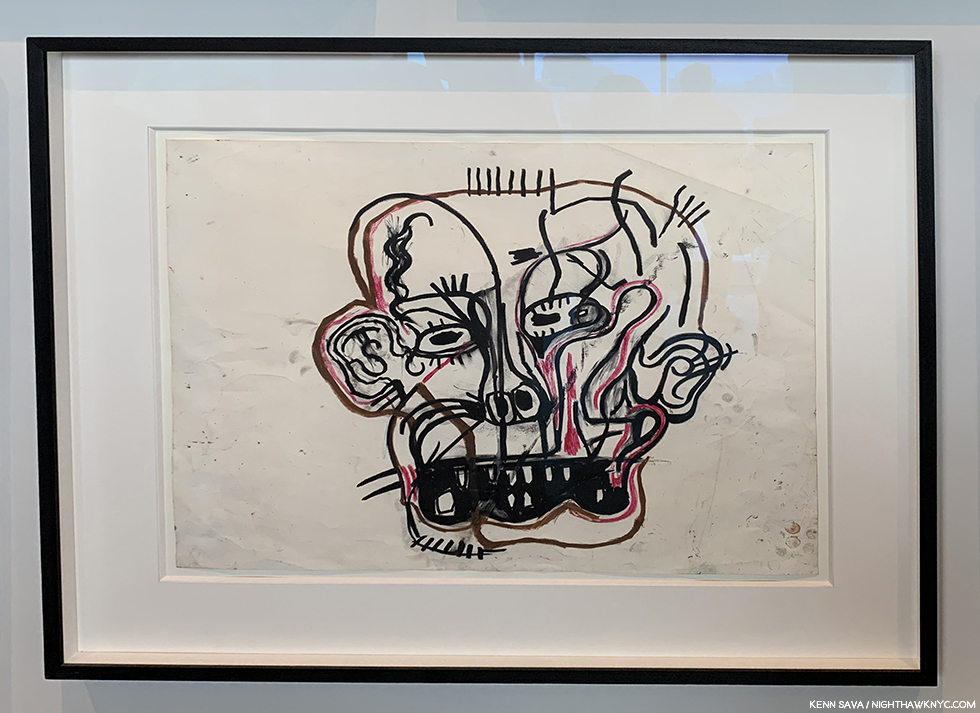
Untitled, 1981, Oilstick on paper. Seen in the small, gallery in the back of the 4th floor. There’s so much that’s revolutionary in this extraordinary work, and at the same time it gives us another take on the two Untitled (Head) Paintings in the show, this time the “head” is seen from the front and not from an angle and has been flattened, like the picture plane. The right side is almost Cubist.

Down on 3, the lighting was better.
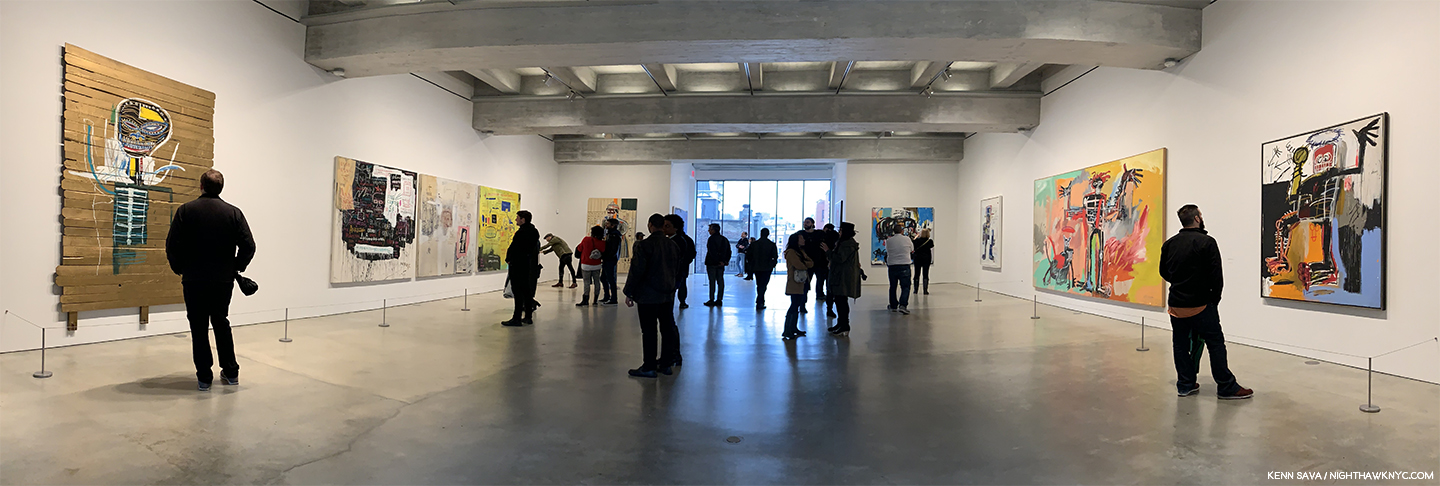
3rd floor. Installation view.

The main source of natural light being another picture window, but this time it was at the end of a large rectangular space and didn’t interfere with the most of the large works on view, including this one-
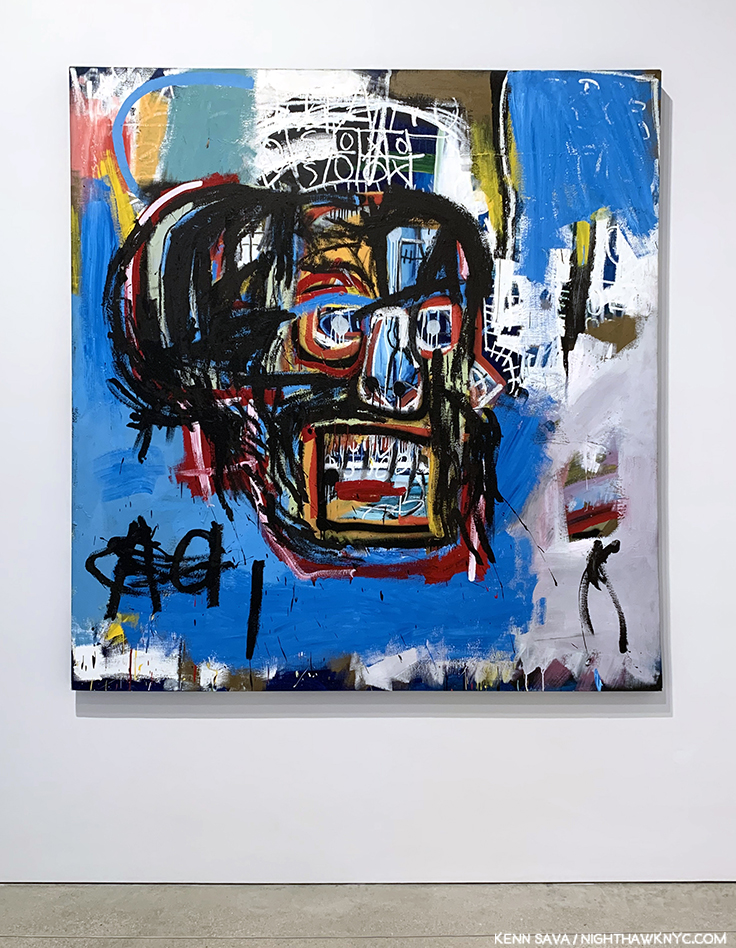
Untitled, 1982, now in the collection of Yusaku Maezawa, while on loan to the Jean-Michel Basquiat exhibition at The Brant Foundation, May 13, 2019.

In May, 2017, this Painting, Untitled, 1982, by Jean-Michel Basquiat sold at Sotheby’s for 110.5 million dollars. As someone who prefers to consider Art for what it is without the shadow of dollars, as much as possible, this fact gives even me pause for thought. Here it was, on a corner wall of the third floor, appearing as another work in the show as opposed to something “special.” I applaud this decision.

Do I think it’s “worth” 110.5 million dollars? Anything is worth only what someone is willing to pay for it (And, there were multiple bidders for it). Given that the question of whether something is, or isn’t “Art” won’t be settled during any of our lifetimes, only hundreds of years hence if the work continues to speak to people, the question of commerce- supply and demand, is what is rearing its head in Contemporary Art auctions, in my view. Jean-Michel Basquiat’s public career as an Artist only lasted a few months over 8 years, from June, 1980 to his death on August 12, 1988. Though he was extraordinarily prolific during that time, creating 1,000 Paintings and 2,000 Drawings2, included in it are only so many major works (a number that I personally feel is larger than some others seem to think), and Untitled, 1982, happens to be one, in my view. Looking at the lists of the highest prices paid at auction for Art reveals that many, if not most, of them are the best works available as most of the major work by established Artists of, say, Picasso’s time or earlier (considering he passed away in 1973), are in museums which are not likely to part with them. The works auctioned are certainly not the most important works by any of the Artists on the list, as I’m sure most would agree (perhaps not the purchasers), though it’s subjective. The $110.5 million for Basquiat’s Untitled, 1982, is for a major Basquiat, in my opinion.

But, the more astonishing thing for me to realize (Hey? It’s not my money) is that at the time of the auction, in May, 2017, Jean-Michel Basquiat would have been 56 years old! Untitled, 1982, is a work he Painted when he was 21 or 22 years old. People talk about this sale marking the highest price ever paid for a work by an African-American Artist. Others mention the highest price ever paid for a work by any American Artist.

They never mention that this sale makes Jean-Michel Basquiat the YOUNGEST Artist in HISTORY to have a work sell for over 100 million dollars- either by age at the time of the sale (56), or age when he created the work(21-22)!

At 56 in 2017, he would be considered to be in “mid-career” as the museums call it. At 58, right now(!), he should still be every bit the vibrant, revolutionary force in Art he was for the 8 short years of his career. That he already feels like such a part of history is indicative of it being already thirty-one years, this August 12th, since his passing.
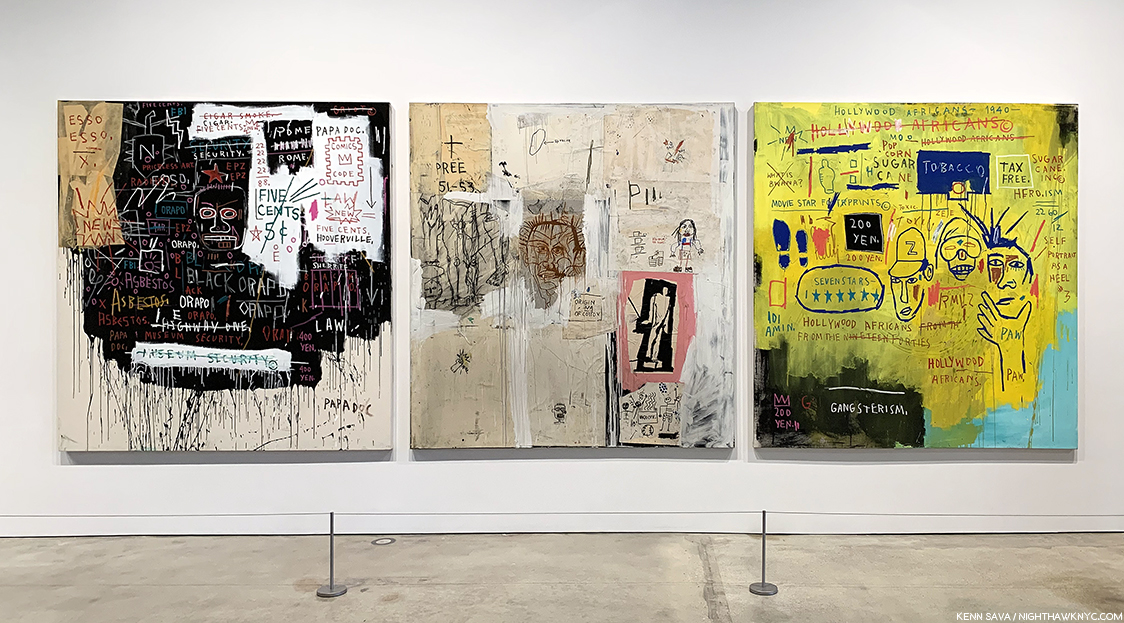
Museum Security (Broadway Meltdown), 1983, left, Big Shoes, 1983, Hollywood Africans, 1983, right, a work on loan from the Whitney Museum. The two to the left are in private collections. In 1983, after they were created, these three works hung on the same wall (with other works) at Larry Gagosian Gallery, LA, as is shown in the Whitney Retrospective catalog, P.251

Also on 3 was this striking group of three works, each from 1982, which included a work from an NYC museum!- Hollywood Africans, from the Whitney. These were fascinating contrasts to the collaged work on view at Xerox, Museum Security and Hollywood Africans both featuring words more than image, but were done exclusively in paint, as far as I could tell.
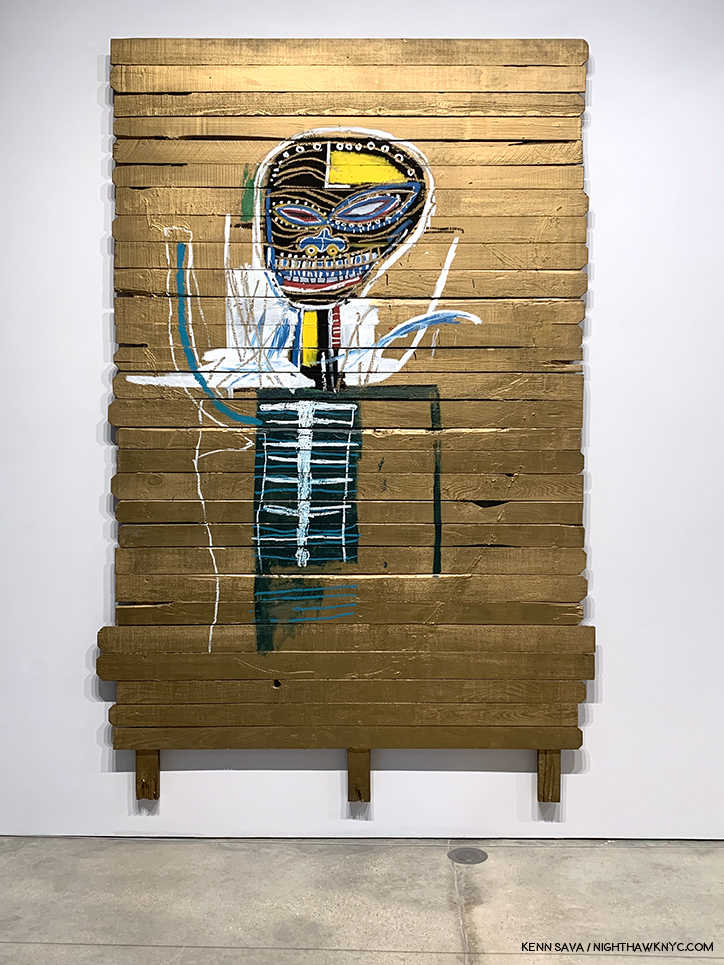
Gold Griot, 1984, Acrylic and oilstick on wood, 117 x 73 inches. You can get a sense of how big it is in the installation view, above.

The somewhat monumental Gold Griot is a very well known work and is memorably recalled in Fred Hoffman’s The Art of J-MB (P.63) as having originated from slat fencing (possibly that referred to in Phoebe Hoban’s book, P.140, that his assistant Matt Dike had acquired from a fence behind Larry Gagosian’s LA house). Mr. Hoffman’s book includes a picture of J-MB creating the work where we see the Painted head looks to be about 8 times larger than his own. Mr. Hoffman references Andy Warhol’s Gold Marilyn, 1962, in speaking of the work’s “pop” influence, with the figure isolated from the gold background, before saying, “The figure is as much a divine apparition as a living human being. With its ethereal gold background surface, the figure of Gold Griot pays homage to sculptural representations of the divine in various sub-Saharan African cultures.3.”

Detail of Gold Griot, 1984.

Looking closer, it’s fascinating to see how J-MB’s depiction of the head has evolved in 2 or 3 years. Gold Griot reminds me of the innovations of Robert Rauschenberg and Jasper Johns, when it comes to Painting surfaces, though it’s resolutely its own work.
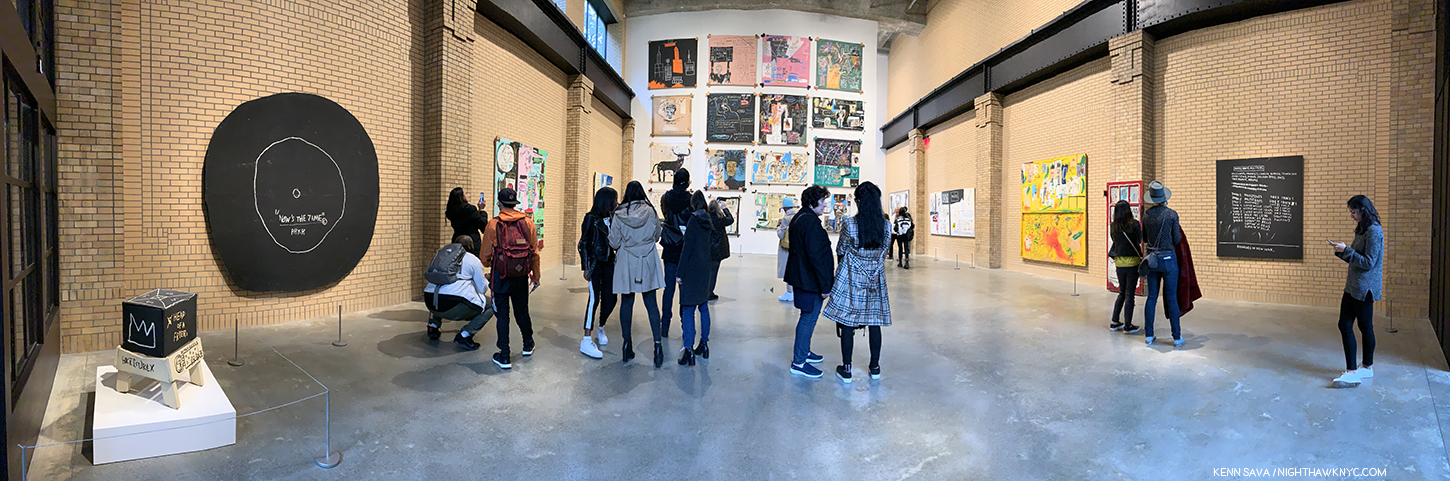
2nd floor. Installation view. The work on the immediate left is See Plate 3, 1982, Sculpture in two parts, Acrylic and oilstick on wood, canvas, mounted on wood, the only Sculpture displayed in the show.

The second floor is a bit of a strange space for displaying Paintings. A very tall space, which at first it seems more conducive to the work of monumental Sculptures, like Richard Serra’s, and lined with brick walls. The curators made it work, choosing to install the Paintings in a single row on the two side walls, then salon style on the third wall. While this made seeing the works in the top two rows challenging, it did allow for the maximum number of Paintings to be shown. As a result, I learned to live with it. In hindsight, I’d say they made the best use of the available space throughout the building, though I feel the building was less than ideal for this show because of the uneven lighting and the very high walls on the 2nd floor.
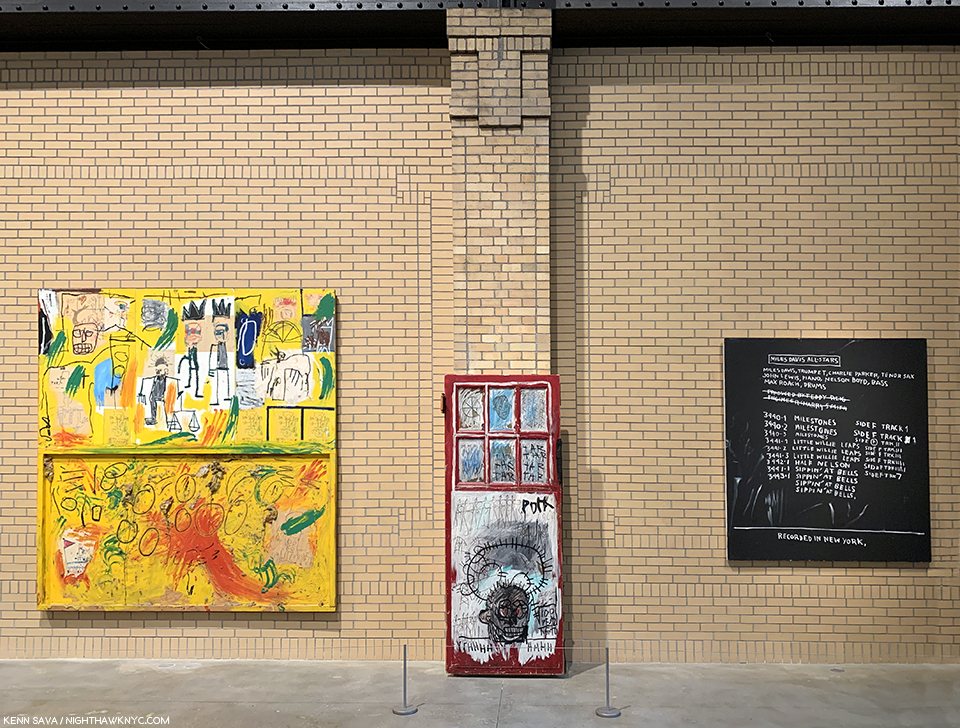
Untitled (Yellow Tar & Feathers), 1982, Pork, 1981, Discography II, 1983, left to right.

Along the sides, important works like Untitled (Yellow Tar & Feathers), 1982, were joined by others not as well known. Discography II contains a list of the details of a Miles Davis Allstars recording session which is historically noteworthy because Charlie Parker performed as a sideman for Miles for one of the only times in his career. To that point, Miles was exclusively a sideman for Bird.
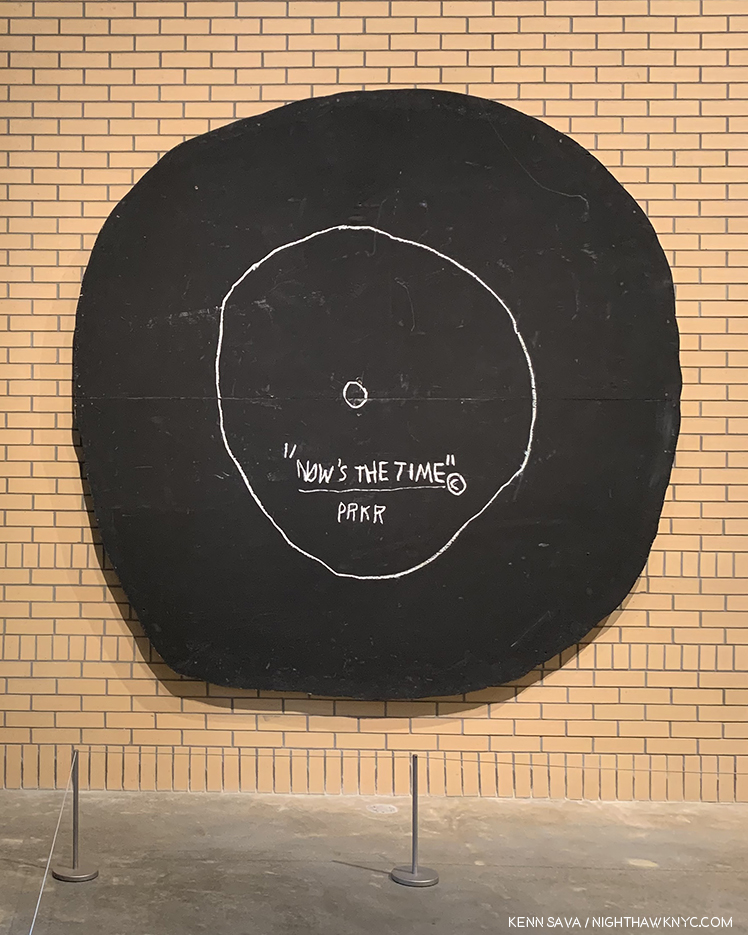
Now’s The Time, 1985, Oilstick and acrylic on plywood, 92 1/2 inches in diameter.

While on the opposite wall, the work referencing Jazz continued with the very cool Now’s The Time, 1985, an homage to the 1945 Charlie Parker record hangs. It also compliments the work on the large wall hung salon style, being they all have unique, experimental stretchers holding their canvases.
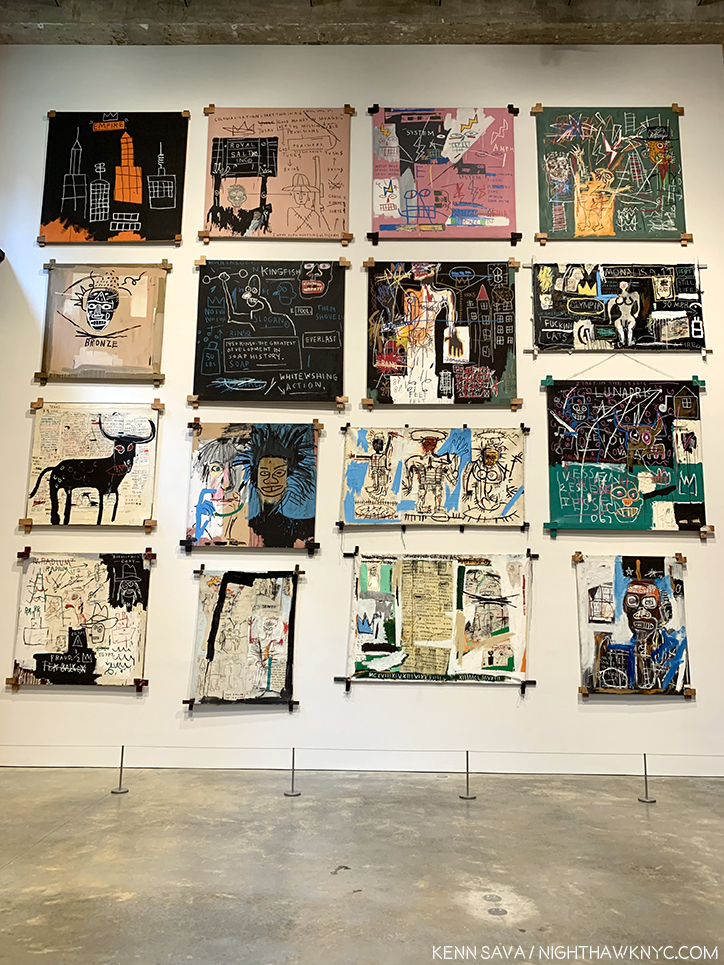
On the salon style wall, one thing each of its 16 works share are the unusual stretchers. One thing about J-MB’s Paintings that you don’t hear much about today are his unusual mounts. Constructed for J-MB by his assistants, including Stephen Torton and Matt Dike, there were other examples on the upper floors, and they are another thing that makes his work unique.
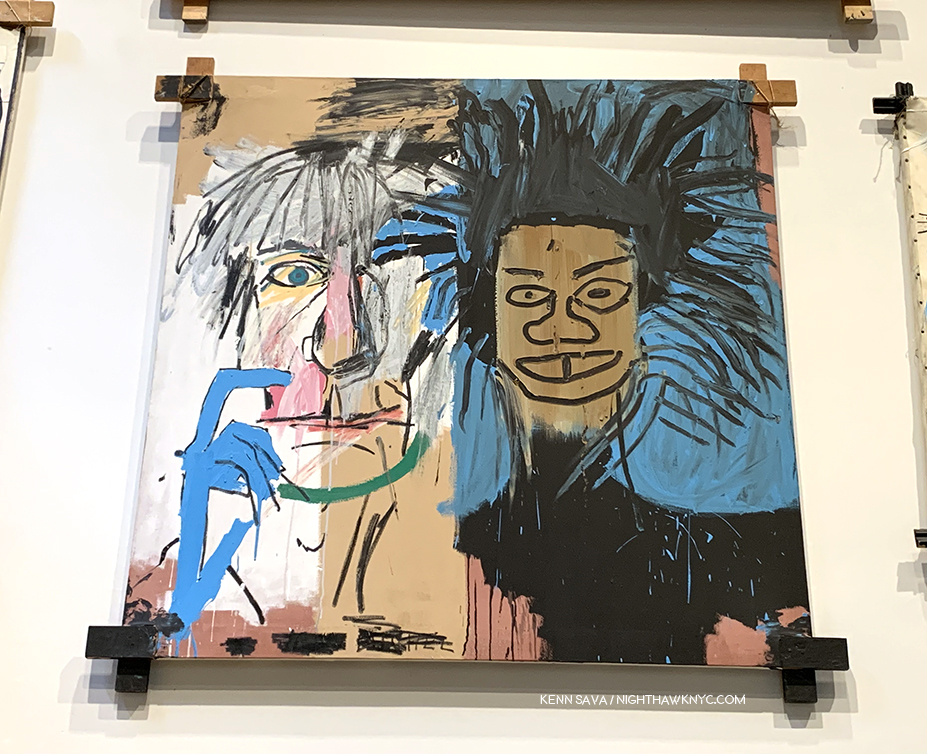
Jean-Michel Basquiat, Dos Cabezas, 1982, a portrait of Andy Warhol and a Self-Portrait that presaged the Warhol- Basquiat collaborations in 1985.

The 2nd floor also included a rear gallery, which featured 4 portraits of boxers and 3 other very power portraits.
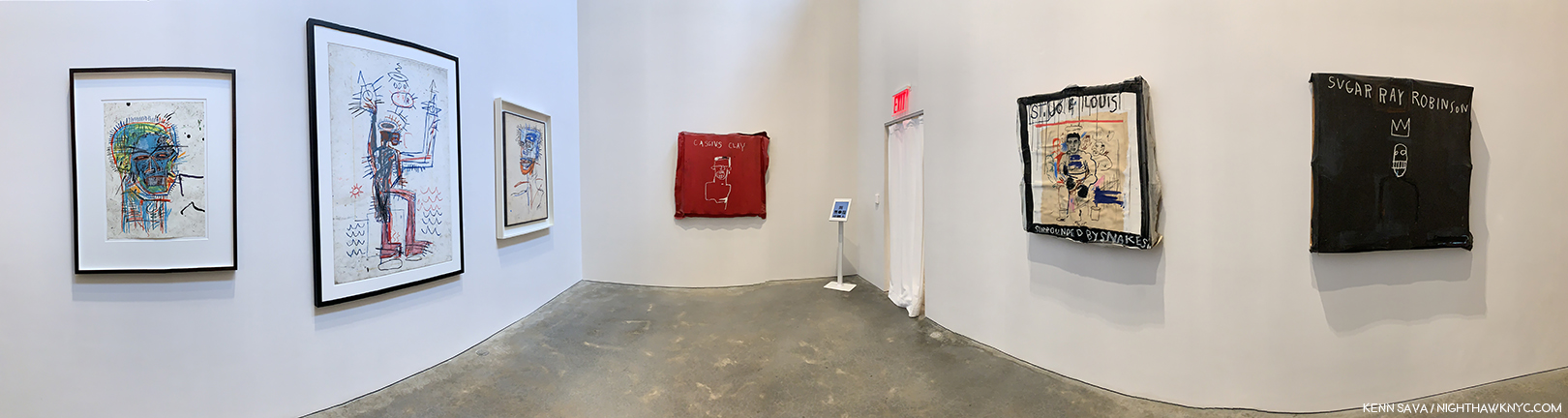
Rear gallery on the 2nd floor installation view.

J-MB had a deep fascination with boxers, and they appear both as Self-Portraits and as homages. Sometimes both. Sometimes it’s hard to tell which.
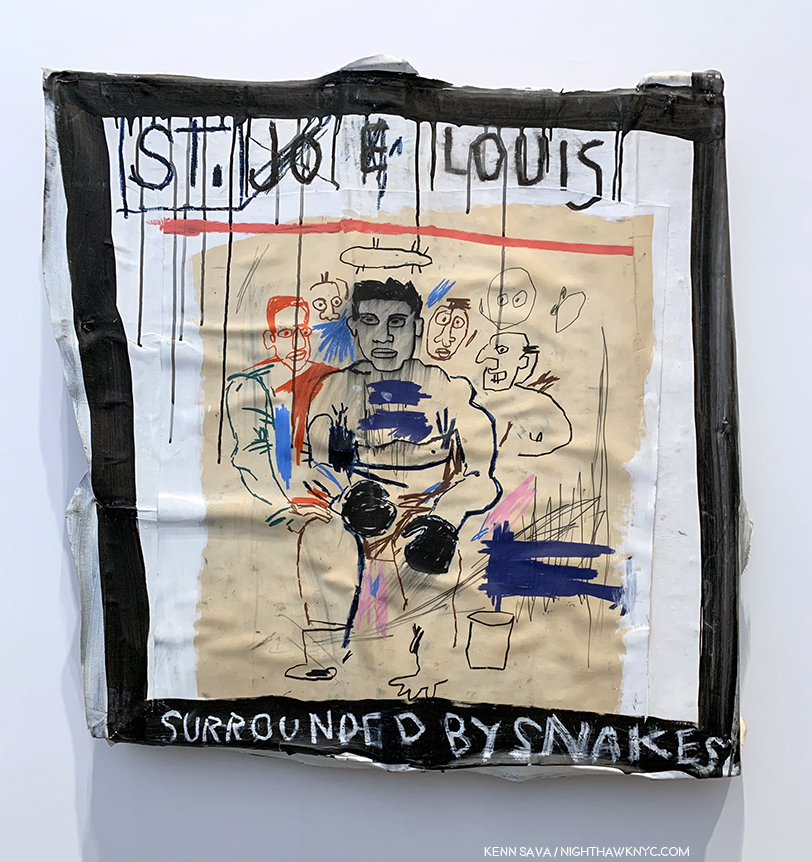
St. Joe Louis Surrounded by Snakes showed the boxer, one of Basquiat’s heroes, encircled by sharkish white managers. ‘That was Jean-Michel,’ said Suzanne Mallouk.” Phoebe Hoban. Basquiat, P.113. Early on, Paul Simon attempted to buy it for $8,000., but was thwarted by Rene Ricard. According to the iPad next to it, seen in the installation view, which served in lieu of wall cards, it now belongs to the Brants. (ibid, P.114).
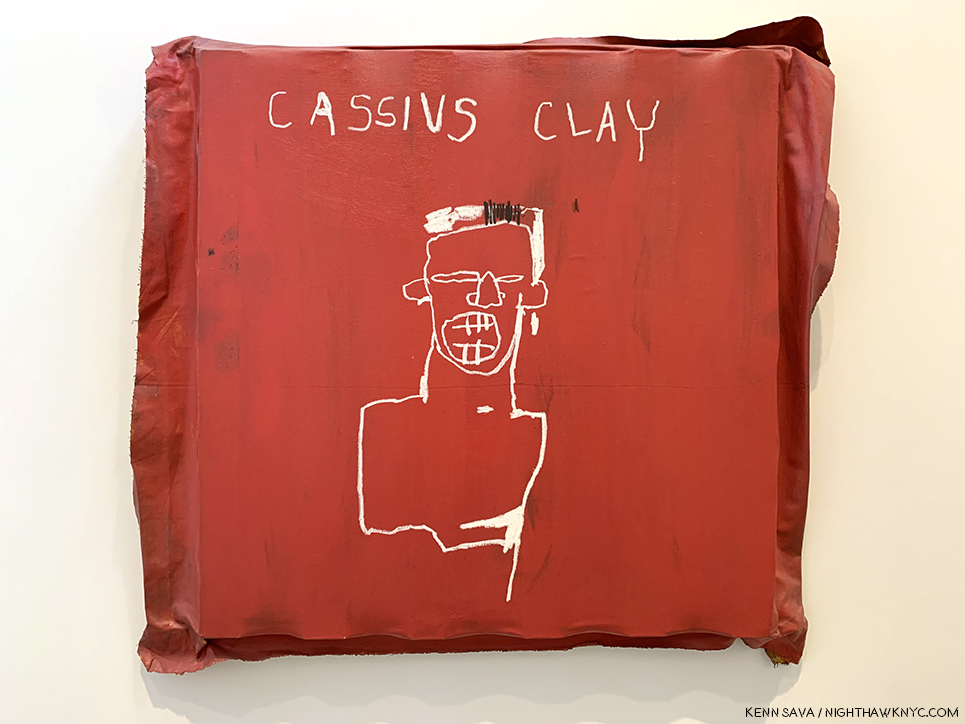
Muhammad Ali changed his name from Cassius Clay in 1964. As Cassius Clay, he won the gold medal at the 1960 Olympics, becoming a hero to many, including J-MB, who references it, here, by using his name at the time, in this work from 1982.
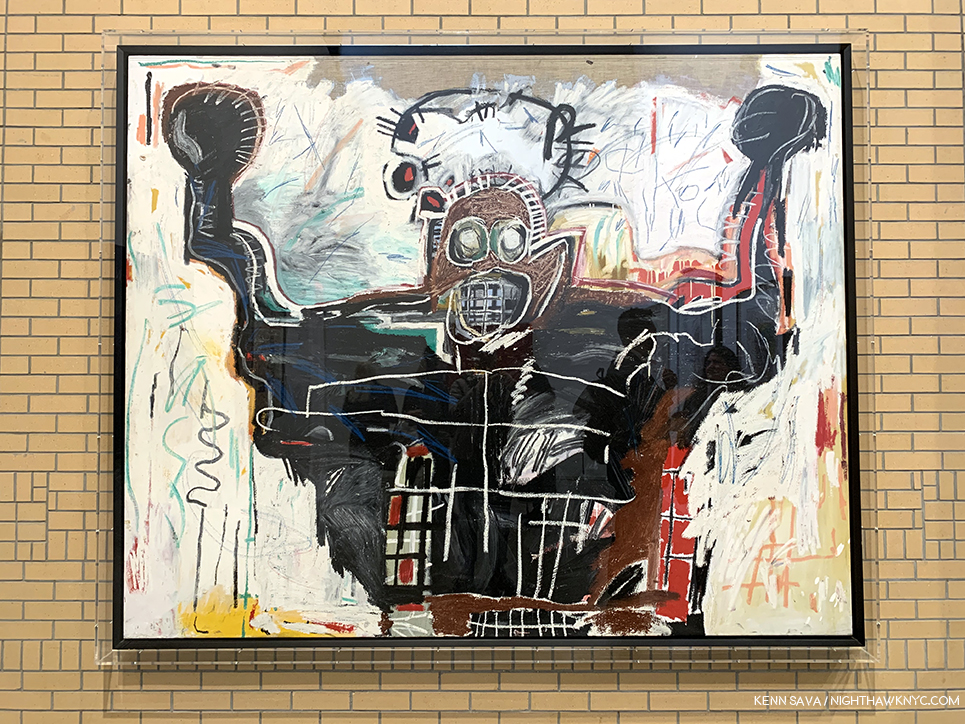
Untitled (Boxer), 1982, Acrylic and oilstick on canvas, 76 x 94 inches. Fred Hoffman calls this immensely powerful work, “… the expression of the black man’s physical and spiritual attributes.” (The Art of J-MB, P.133)

I almost missed the works installed on the first floor. Luckily, I spotted the small sign pointing to them right as I was beginning to look for the exit. Thank goodness I didn’t as it included some of his largest and at least one of his most important works.
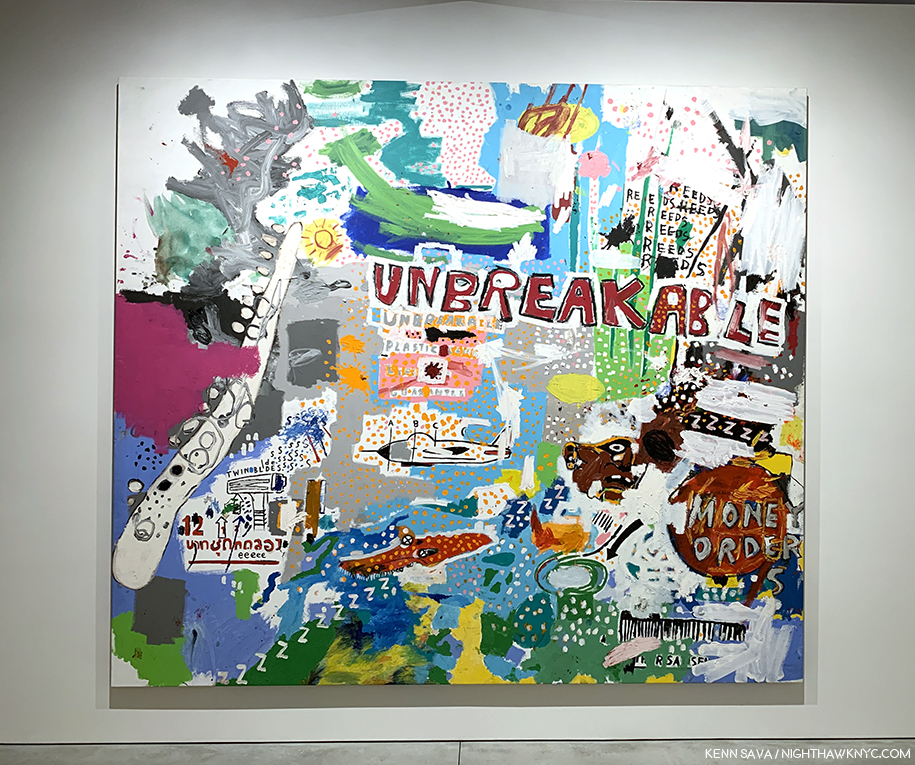
Unbreakable, 1987, Acrylic on canvas, 98 x 111 3/4 inches.

I’d never seen a J-MB work like Unbreakable prior to seeing it. Given it’s dated 1987, perhaps this is a glimpse into where his work was heading. In it, he synthesizes everything he’s been using- images, words, and color.
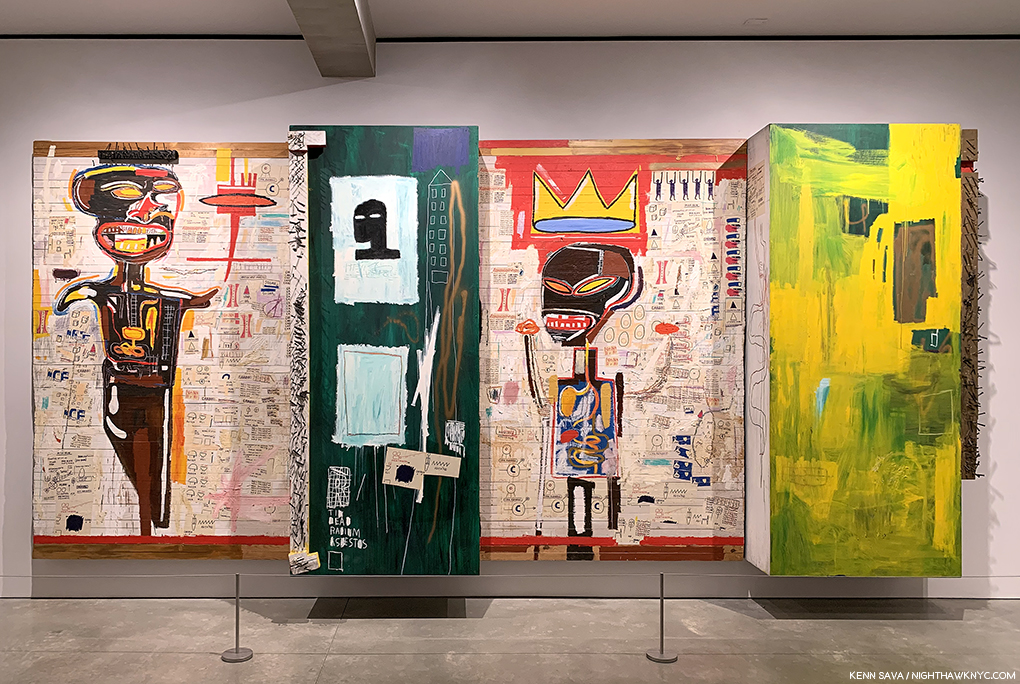
Grillo, 1984, Acrylic, oil, paper collage, oilstick and nails on wood, 96 x 211 1/2 inches- close to 20 feet by 8 feet!

What a powerful, stunning, incredible work Grillo is! It’s taken Robert Rauschenberg’s Combine Paintings in an entirely new direction. I love the juxtaposition of the two panels with figures (one left, one right of center) with the panels immediately to each of their right. I do wonder if this piece was meant to sit on the floor or be raised a foot as it is here.
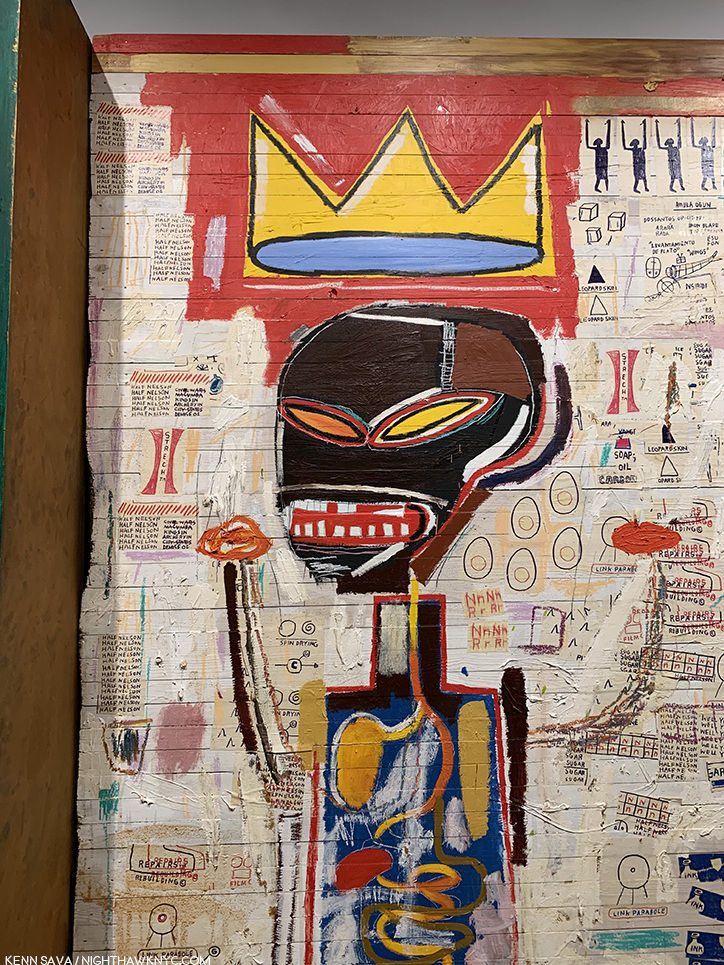
Detail of the right of center panel.

As I looked closer at Grillo, I noticed a good many color Xeroxes collaged on. Yet, the two figures hold the key to it, I think. On the left is a figure holding a torch. Over his head there’s a pice of wood with nails sticking out of it. That sure could be interpreted as a “crown of thorns.” Around him are various repeated words, including- “Soap,” “Oil,””Butter,” Carbon,” and “Stretch,” along with at least two Bebop song titles- “Well You Needn’t,” by Thelonious Monk and “Half-Nelson,” recorded by Bird. What this figure represents I don’t know, but there are elements of the martyr and the heroic included. The other figure, apparently a king, wears a large crown, accompanied by small attendants to its right, and has his hands raised, like the boxers seen upstairs. He appears to be looking towards the left side figure, and both figures have their internal organs shown, perhaps yet another reference to Gray’s Anatomy.
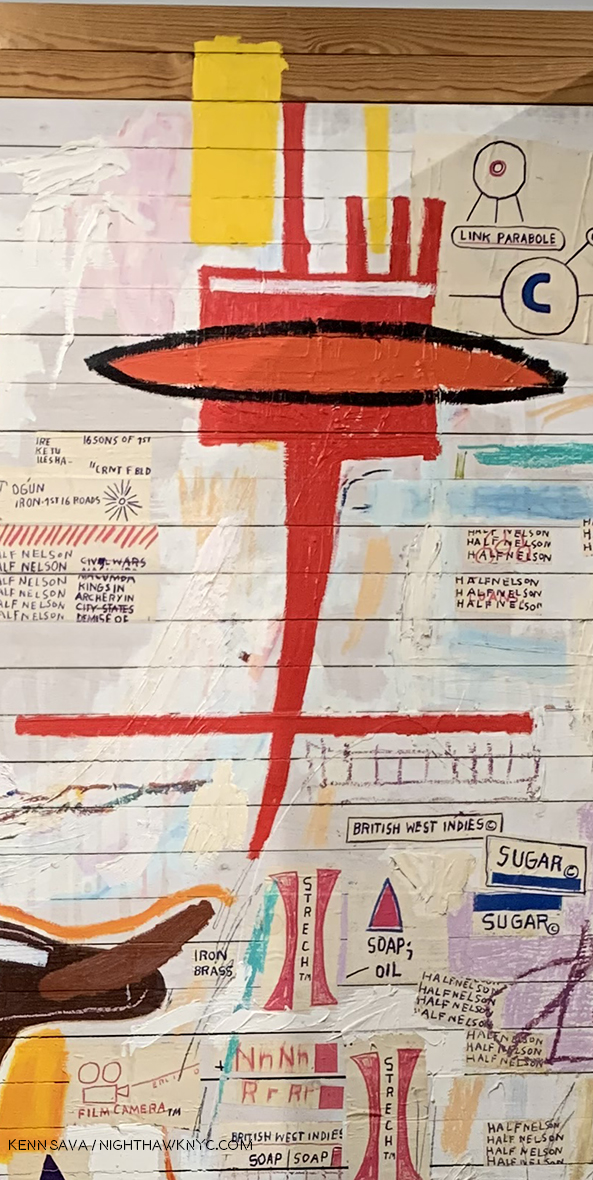
And, there’s this- The left hand figure, how has a board with nails over his/her head, possibly a crown of thorns?, holds a torch…

The work speaks volumes about how J-MB’s Art has evolved in 7 short years, and the unlimited potential the future held for it, and for him.
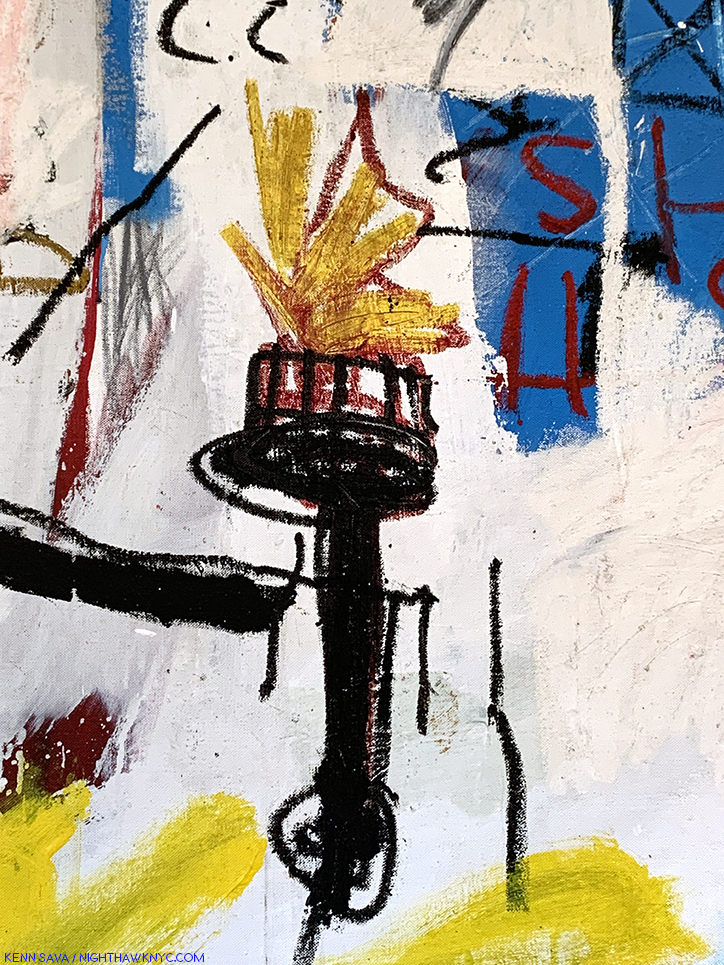
…which reminds me of the one seen 3 floors up in Per Capita, 1981.

A few days later, Lisa shared her thoughts on the show. “I thought the Basquiat show was quite spectacular. There were so many works that I had never seen before. In particular, I was struck by the great thick black oil slicks. There is something about this sheen, like shoe polish, that you can’t truly appreciate unless you see the paintings in person. They give the works a lot of dimension and texture. They also remind me of Franz Kline – totally dynamic and emotive in gesture. The oil slicks are bold and grimy, like New York. His compositions tend to mimic graffiti on the street – throw ups, wheatpaste posters, and tags on a wall/single canvas.”

There was a bit of the feel that the show was something of an afterthought to the just completed Louis Vuitton show. A “Hey, we’ve got all this work assembled, why don’t we just put it up in NYC?,” kind of thing. I quickly moved past it, the lighting and other questions with the space I’ve mentioned. Nothing dulled the effect of seeing so much work that STILL looks fresh, vital, and contemporary, in spite of countless imitators, commercial “appropriations” of his symbols and the passage of over 30 years since he left. What I saw at The Brant was the work that has defined the legacy of J-MB- in quite a few of his more well known Paintings, works characterized by his characters, in which his words take much more of a back seat than they did over at Xerox. Thinking about J-MB at The Brant four months later, the show has become more monumental in my eyes.

While Peter Brant may represent what many call “the 1%,” so does Jean-Michel Basquiat. For me, J-MB represents that extraordinary, and extraordinarily rare, group of people who are able to overcome unfathomable difficulties- racially, socially, financially, educationally and, apparently, familial, and some difficulties that appear on the outside to have been self-inflicted (though quite possibly resulting from the others- I’m not a doctor or a therapist), then somehow surmount ALL of that and go on to rewrite Art history in about a decade. How many people can this be said of?

How ever many you choose to include? I’m not sure it would even equal 1%.

This Post is dedicated to Lisa, with my undying thanks. My gratitude is due to Jessie for his consideration. Anyone reading this owes them their thanks as well.

*- Soundtrack for this Post is “Bold As Love,” by another brilliant Artist who died at just 27, Jimi Hendrix, which concludes the timeless Axis: Bold As Love.

“Anger he smiles towering in shiny metallic purple armor…
My red is so confident that he flashes
Trophies of war and ribbons of euphoria
Orange is young, full of daring
But very unsteady for the first go around
My yellow in this case is not so mellow
In fact I’m trying to say it’s frightened like me
And all these emotions of mine keep holding me from
Giving my life to a rainbow like you
[Chorus]
But they’re all bold as love
Yeah, they’re all bold as love”

In lieu of the immortal Hendrix original recording here’s a cover to inspire you to seek out the original-

This is Part 2 of my series on the five Jean-Michel Basquiat related shows going on in NYC in 2019. Part 1 is below, or here.
My prior pieces on Painting are here

NighthawkNYC.com has been entirely self-funded and ad-free for over 6 years, during which over 250 full length pieces have been published. If you’ve found it worthwhile, you can donate to keep it going & ad-free below. Thank you!

Written & photographed by Kenn Sava for nighthawknyc.com unless otherwise credited.
To send comments, thoughts, feedback or propositions click here.
Click the white box on the upper right for the archives or to search them.
For “short takes” and additional pictures, follow @nighthawk_nyc on Instagram.

Subscribe to be notified of new Posts below. Your information will be used for no other purpose.
 

  1. I’m speaking of Manhattan’s museums, only, here and leaving off The New Museum who have no permanent collection.
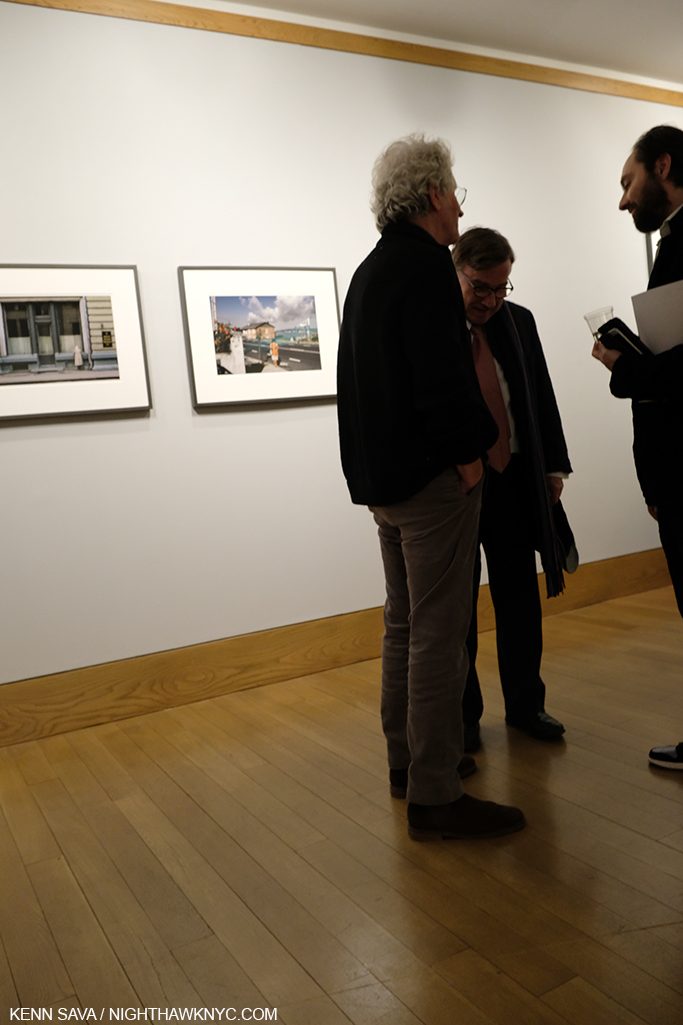
  2. according to the Brant Foundation.
  3. ibid P.65