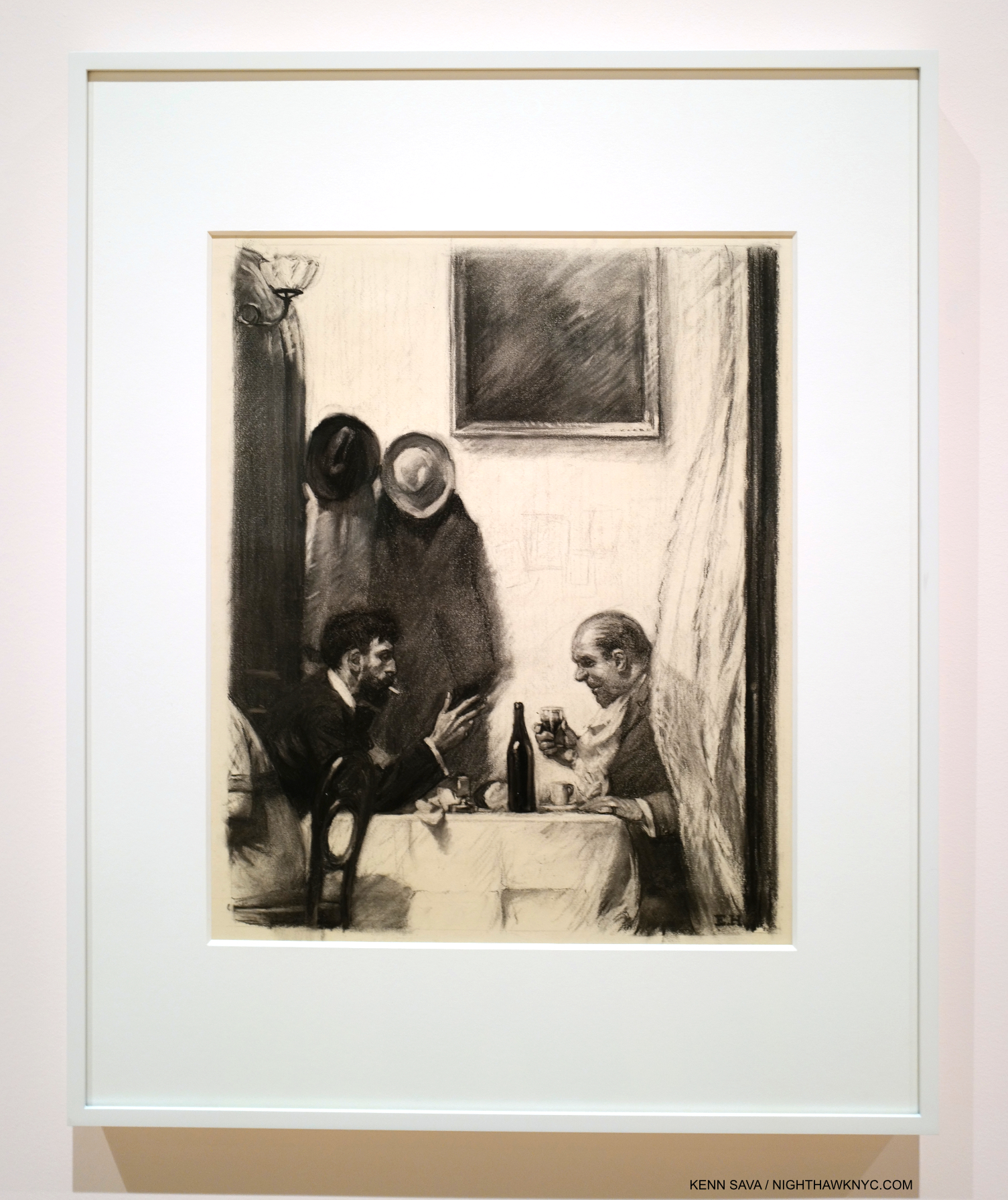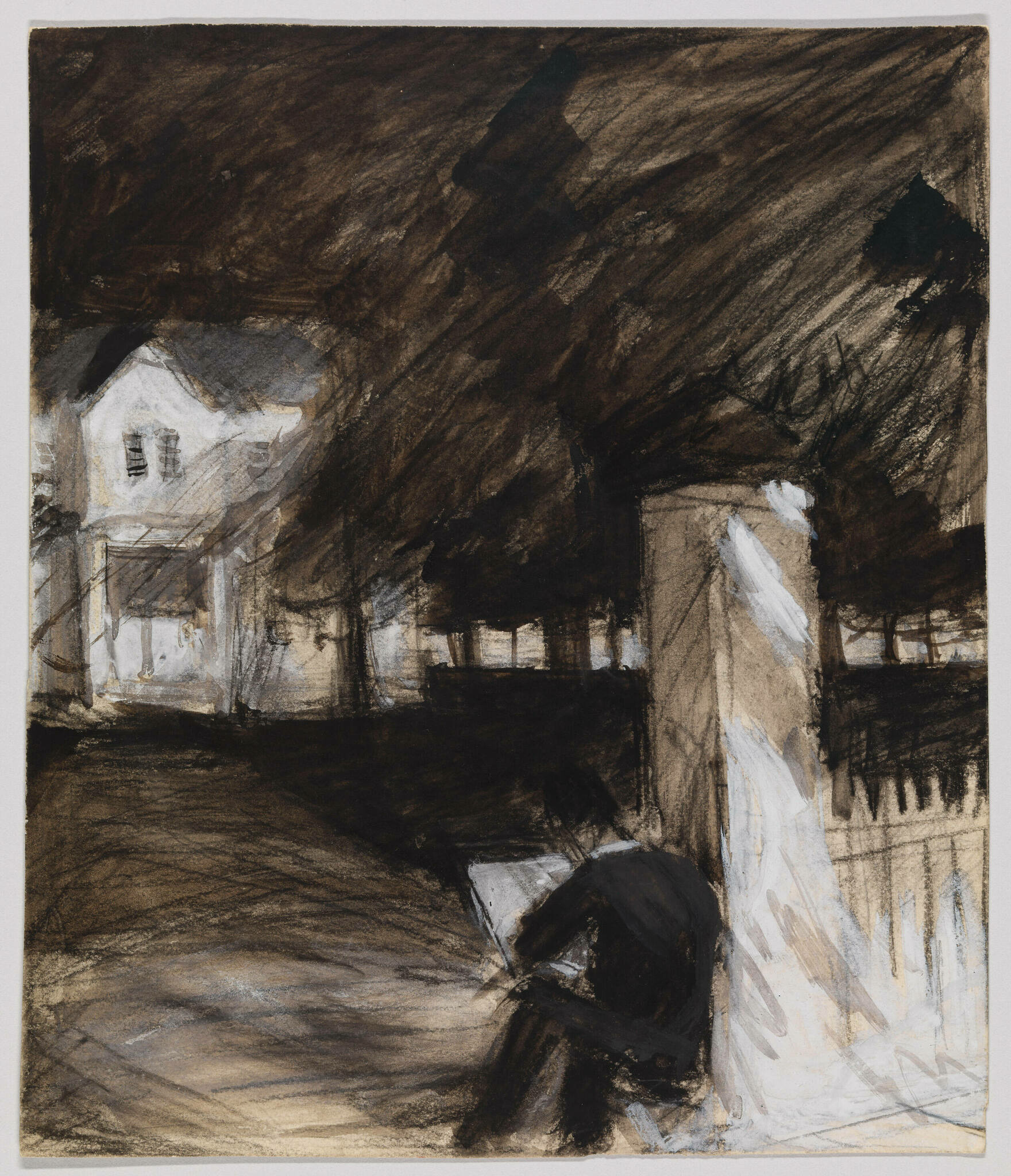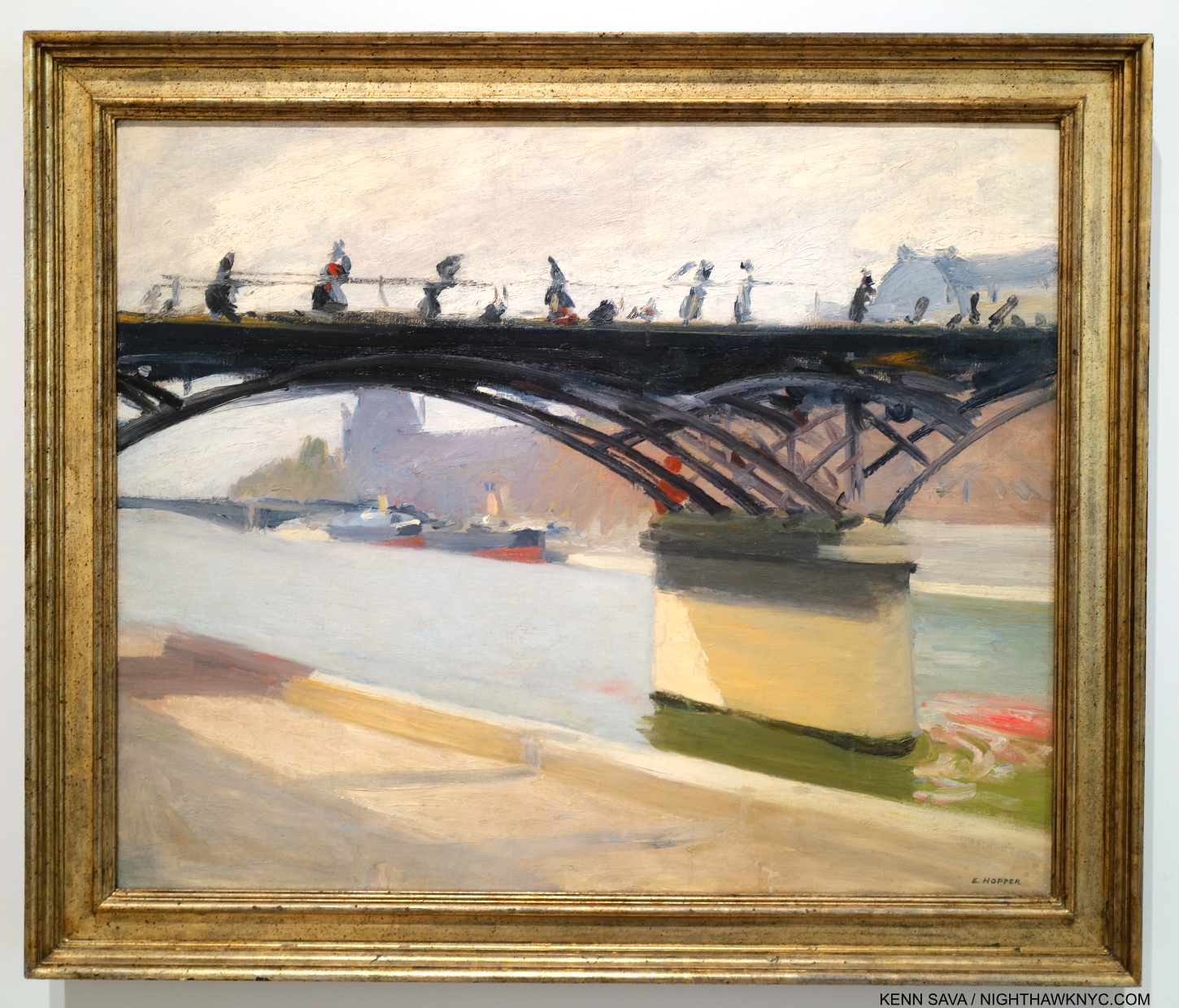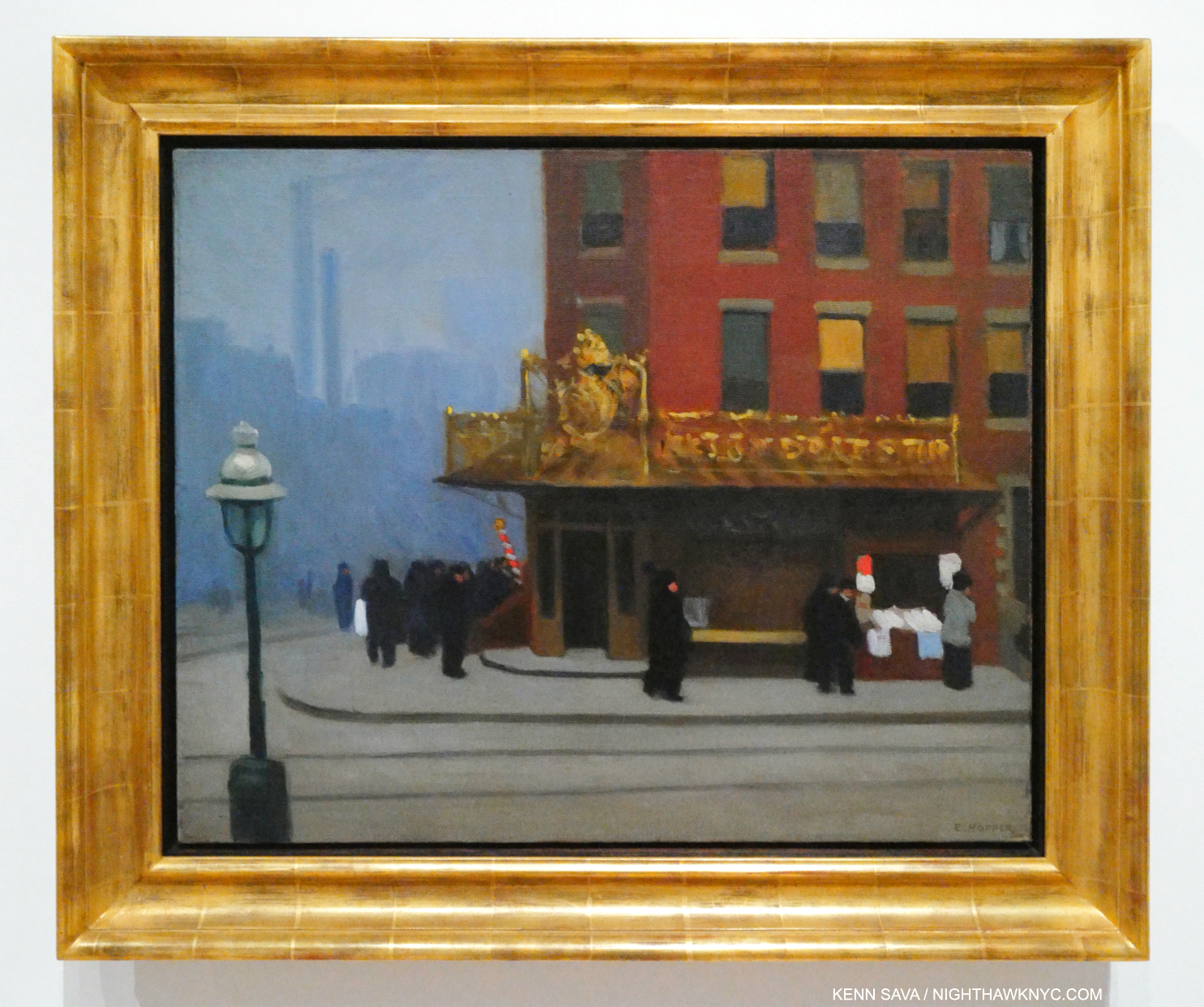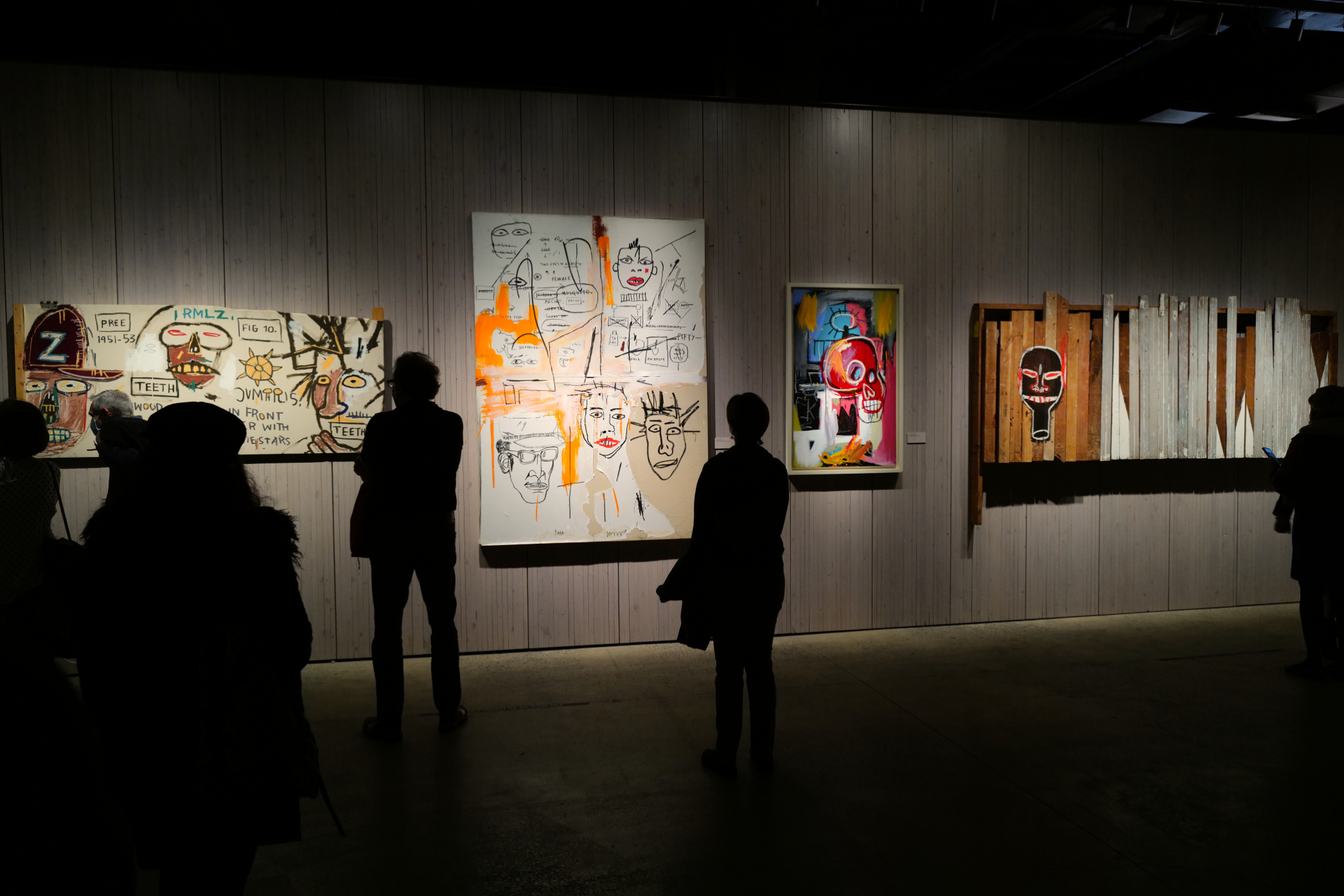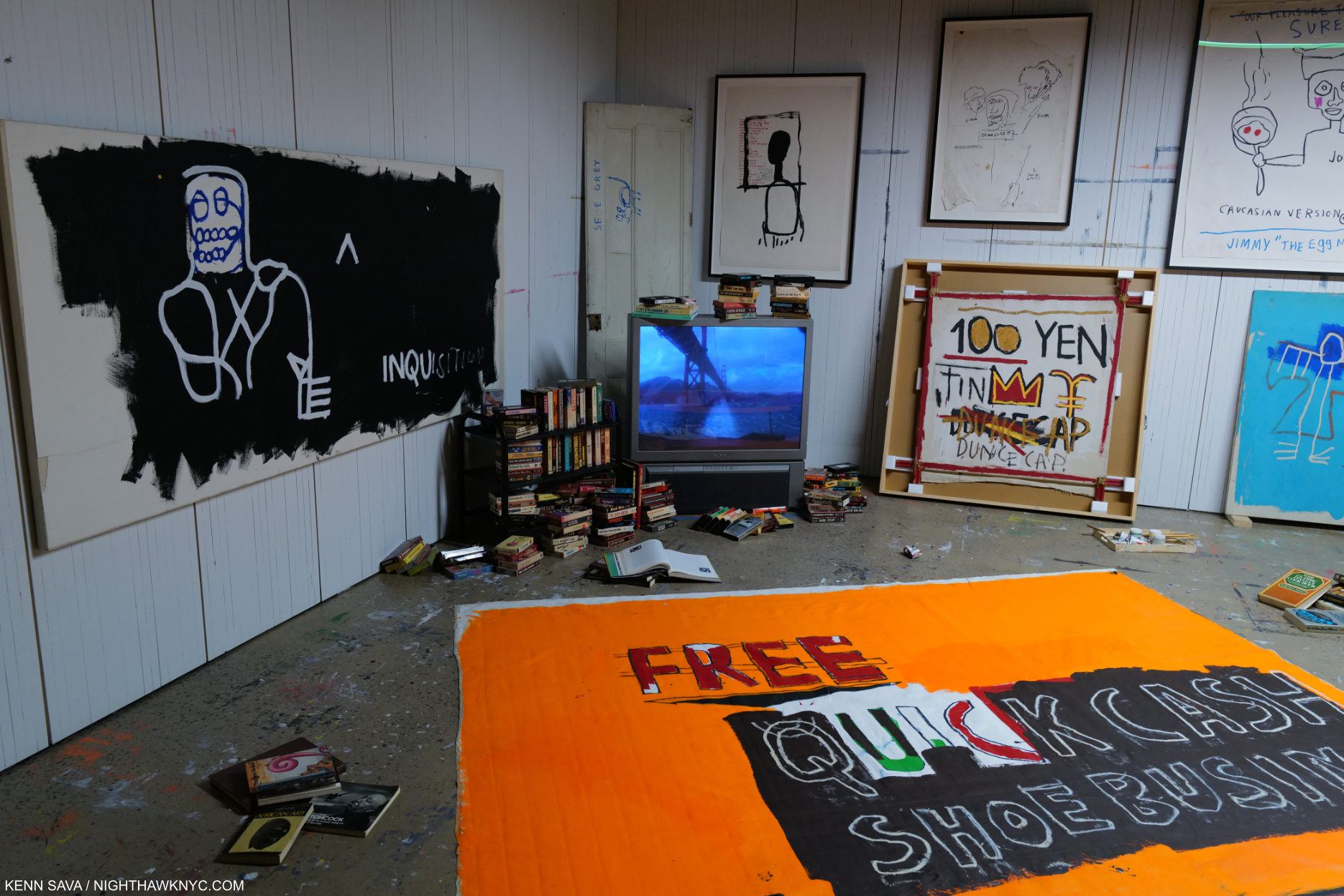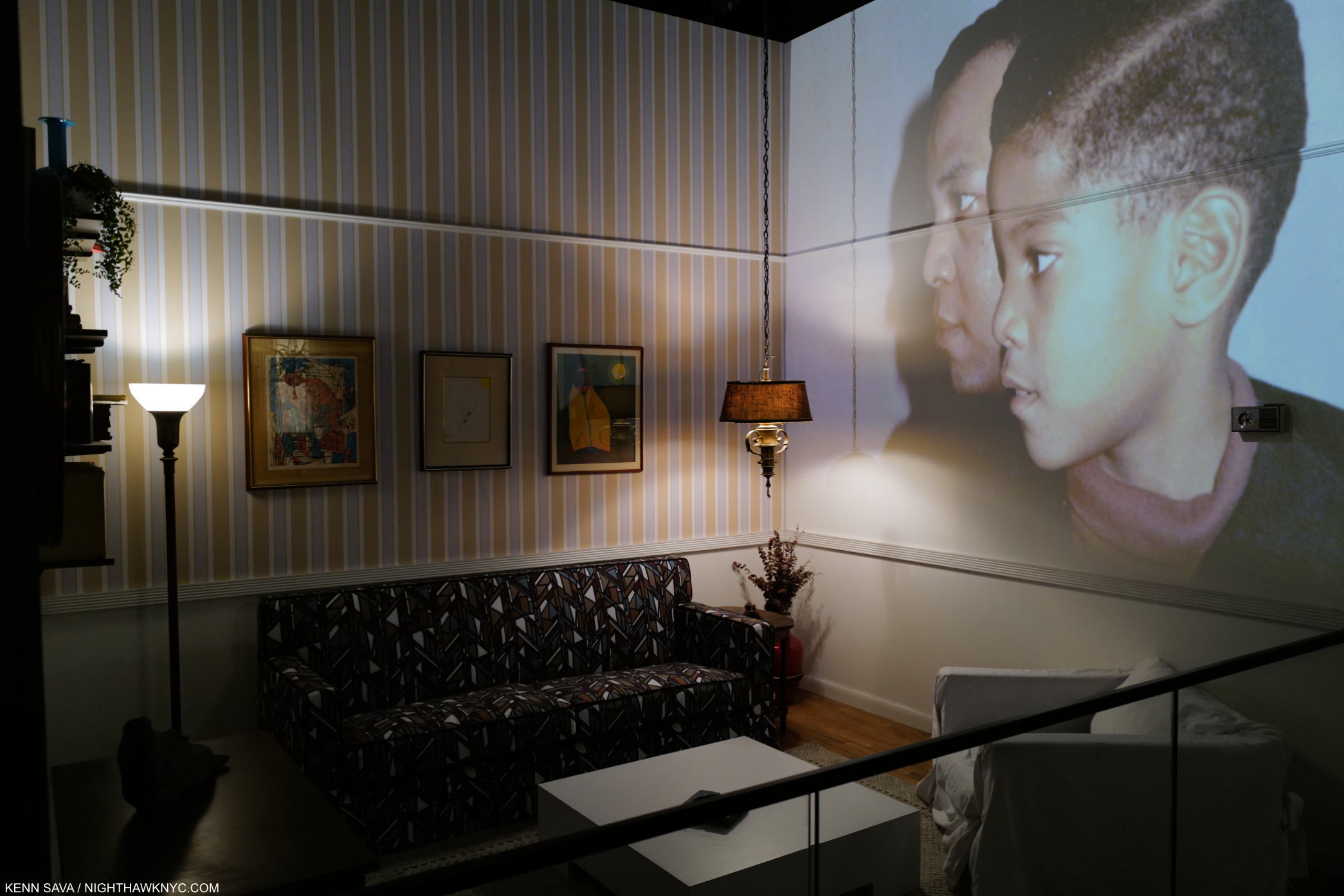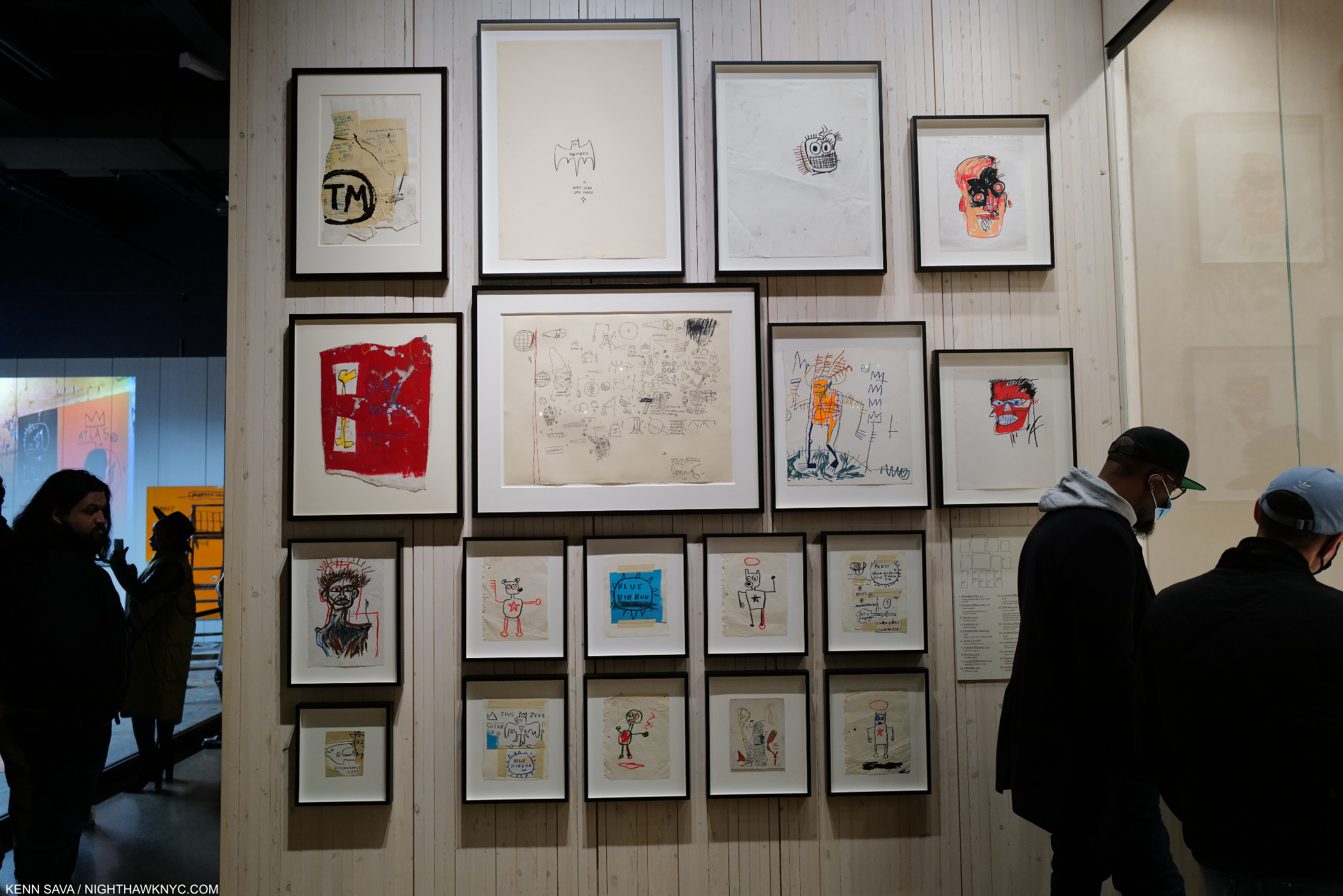
Gregory Halpern In NYC

This site is Free & Ad-Free! If you find this piece worthwhile, please donate via PayPal to support it & independent Art writing. You can also support it by buying Art & books! Details at the end. Thank you.

Written & Photographed by Kenn Sava

Shows seen- Impressions @ Fotografiska, July 20, 2023 and
Immersion: Gregory Halpern, Raymond Meeks and Vasantha Yogananthan @ ICP, through January 8, 2024
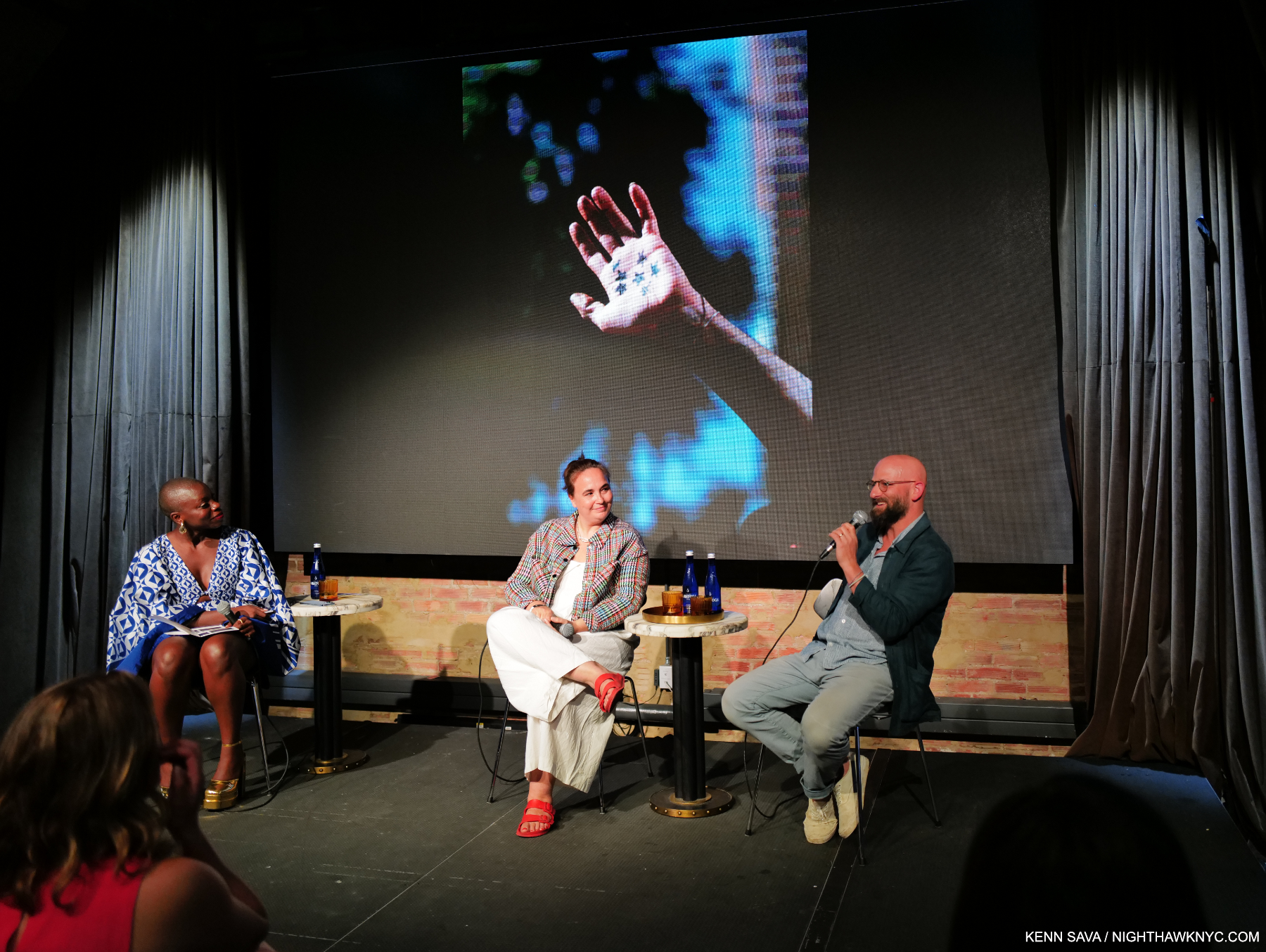
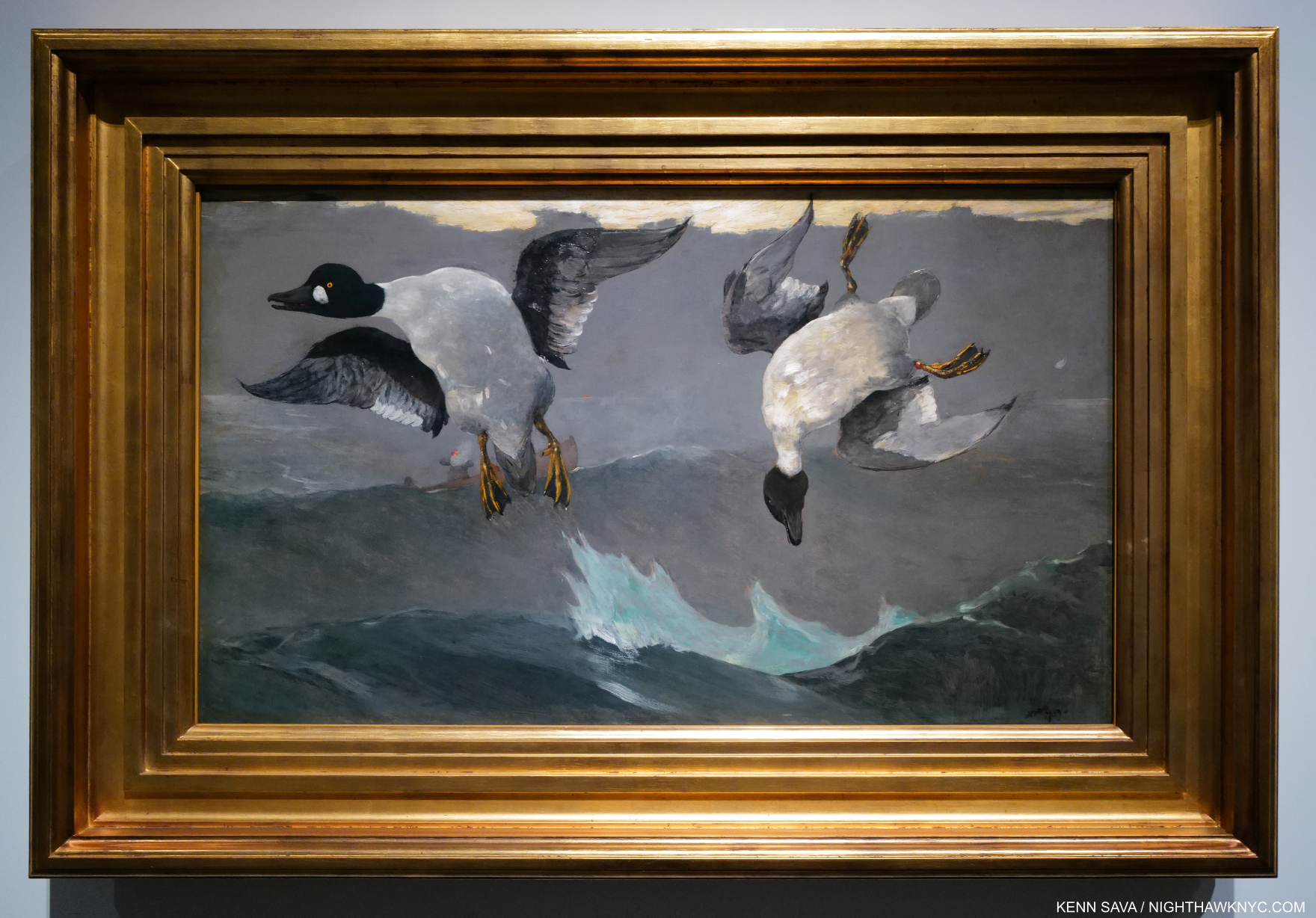
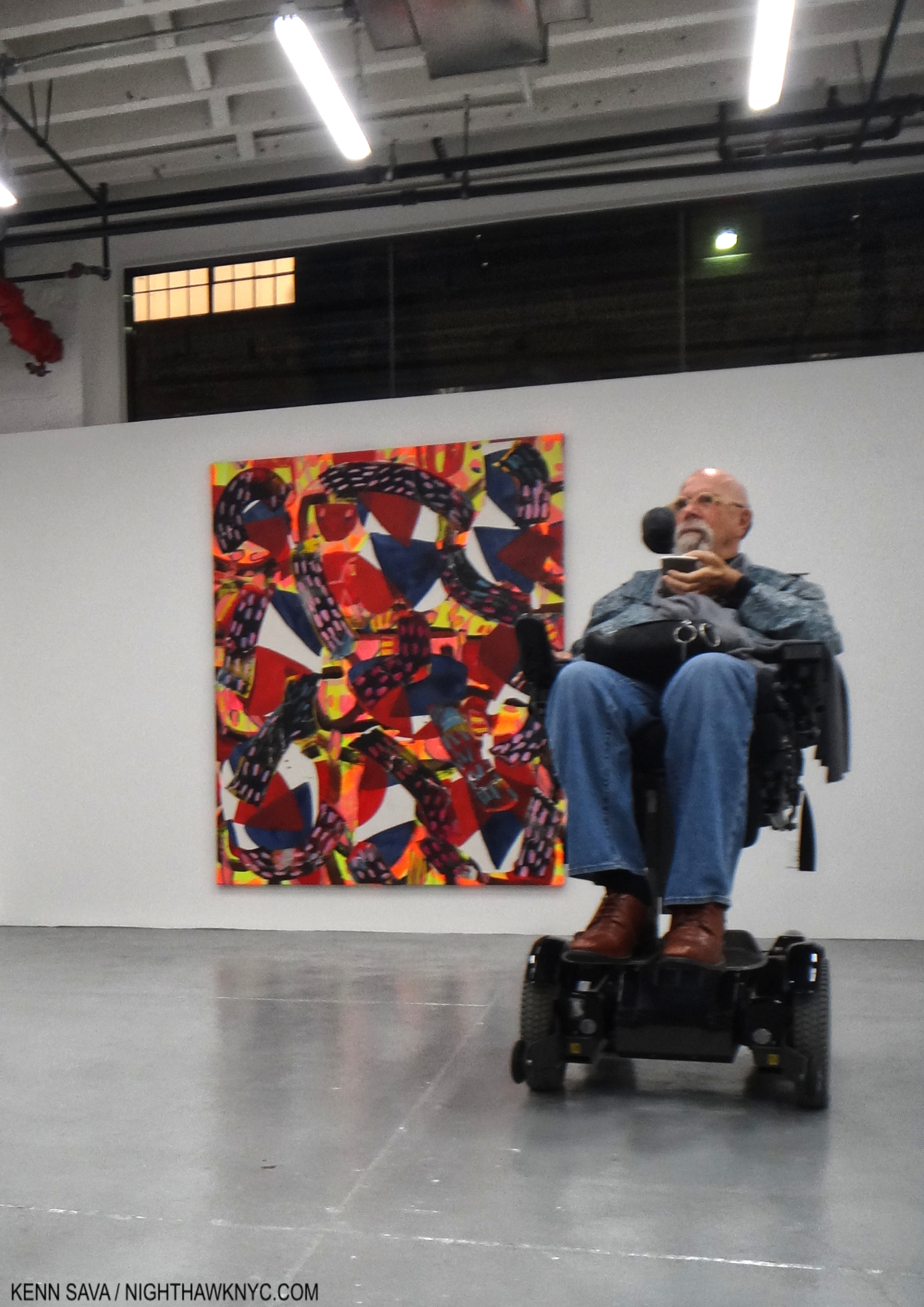
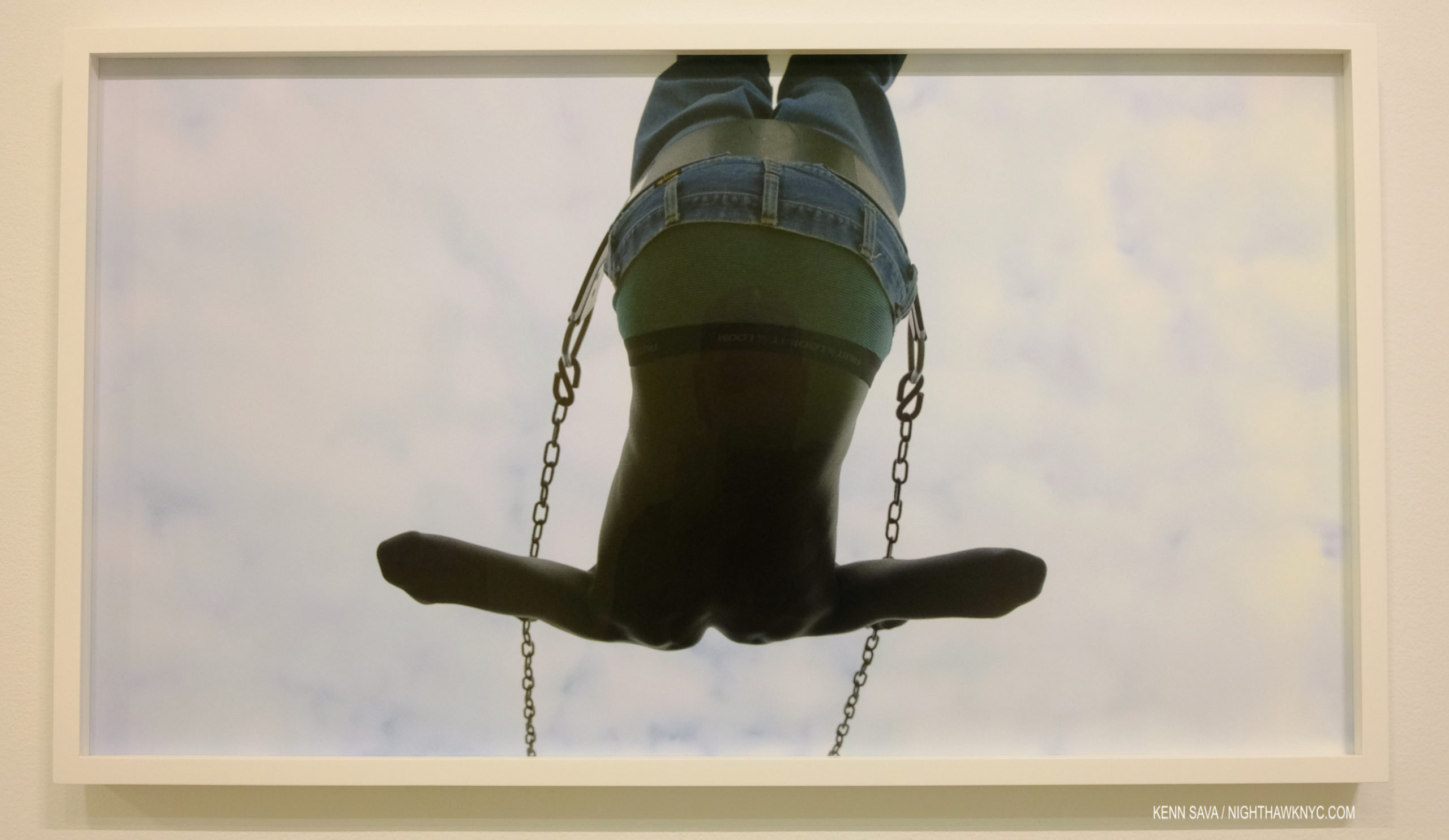
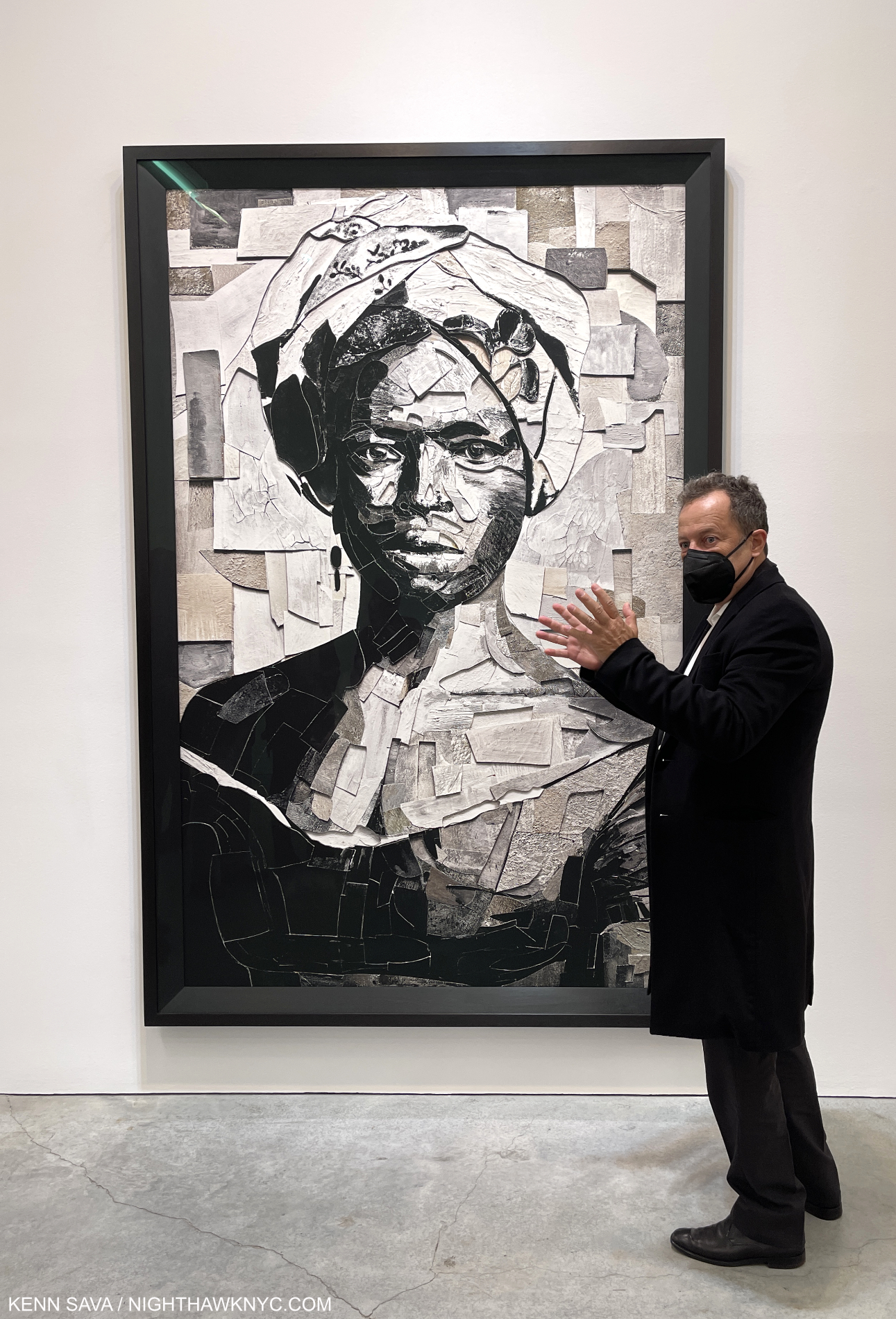
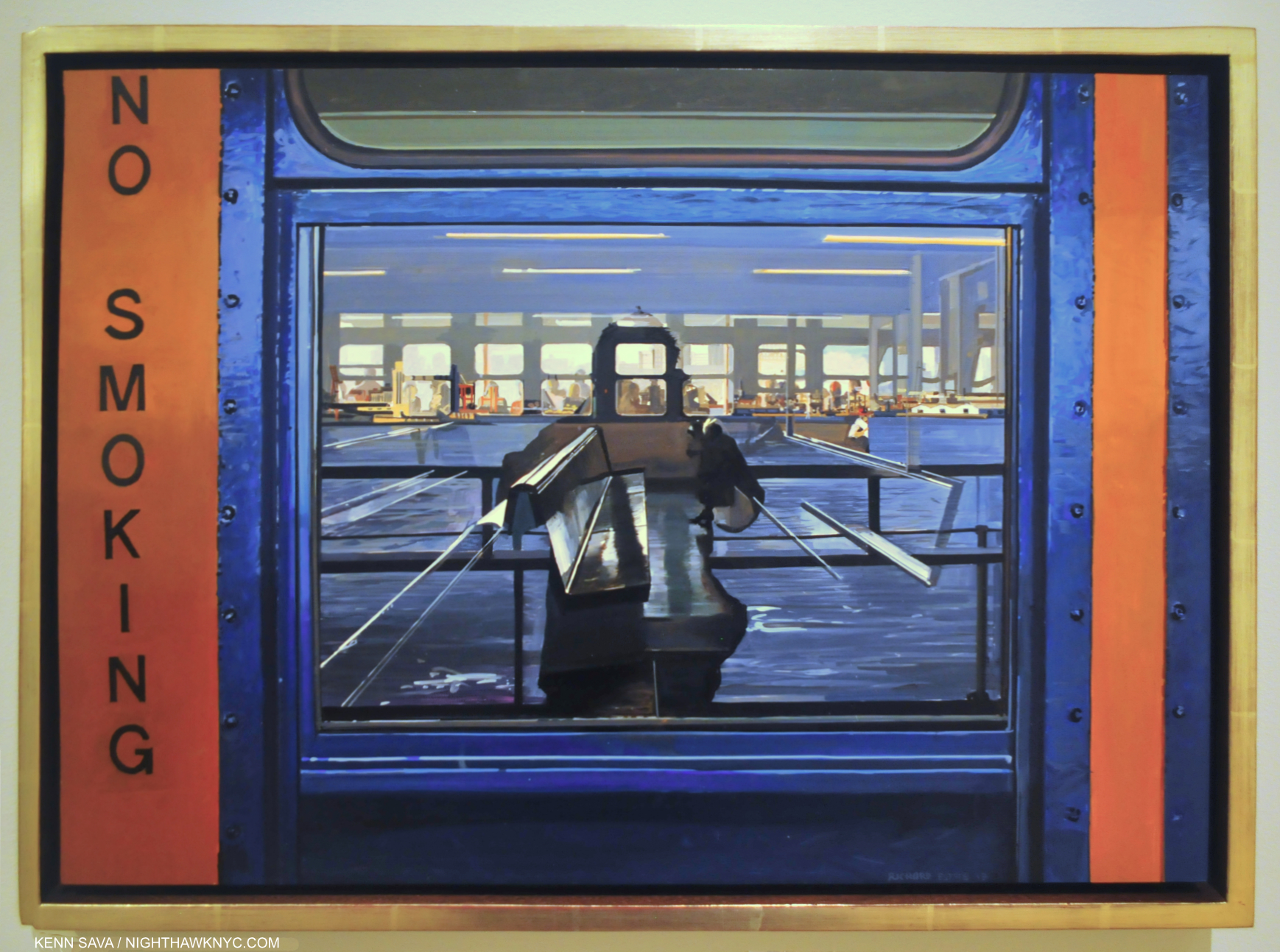
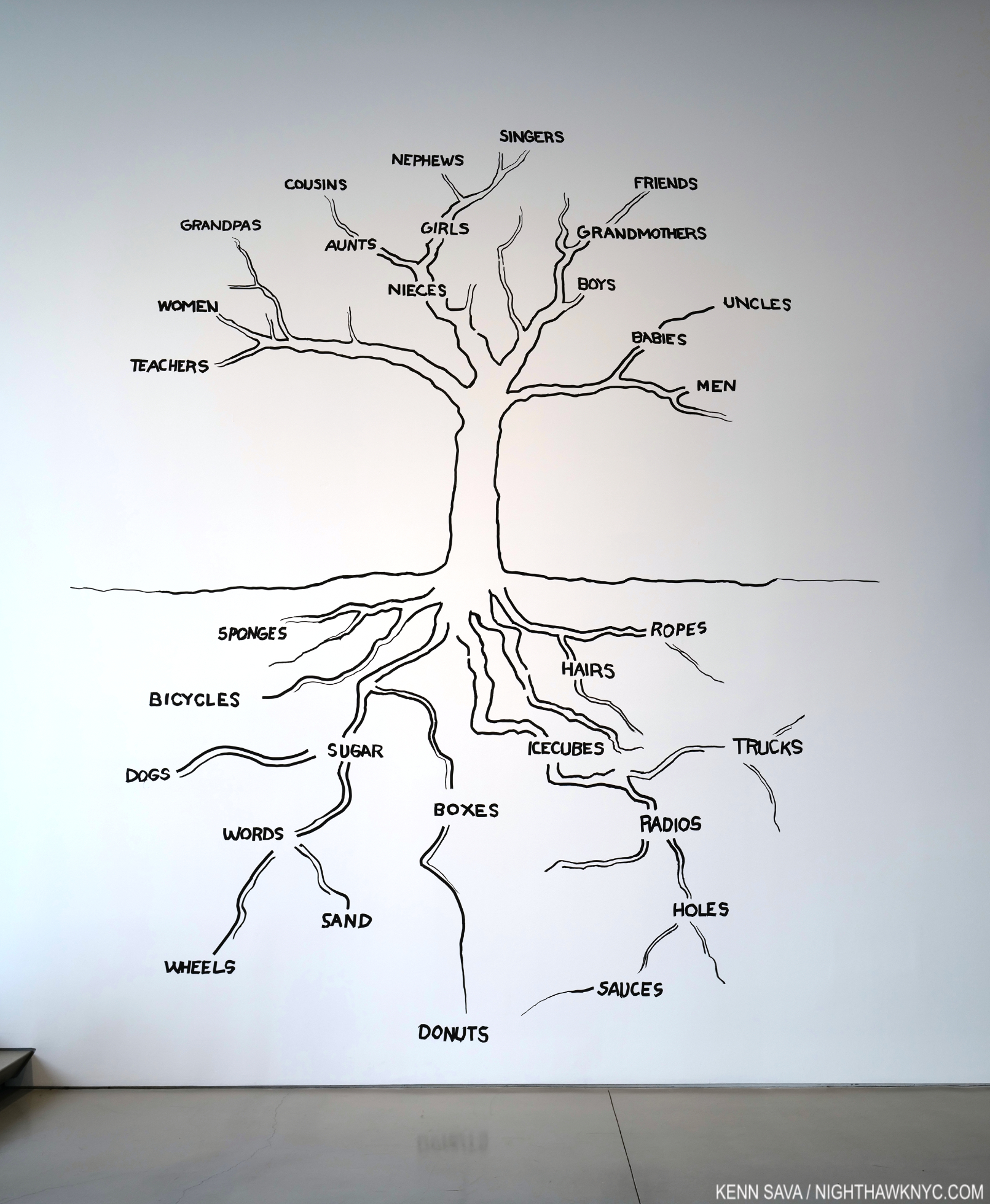
Gregory Halpern, right, giving a brief overview of his career to date as an introduction to his work including this well-known image from his PhotoBook,  ZZYZX, with Magnum Photos President, Photographer, and fellow exhibitor, Cristina de Middel, center, and narrator Jessica Nabongo at Impressions @ Fotografiska, July 20, 2023. Click any image for full size.

Two shows featuring the work of Gregory Halpern provided all-too-rare opportunities to see his work here in what were the NYC debuts of both his newest work, and his most recently published work. While familiar to most from his remarkable series of PhotoBooks this past decade as a “book Artist,” the shows provided the chance to see him as a “wall Artist.” Though neither was a Gregory Halpern solo show, they proved revelatory1.
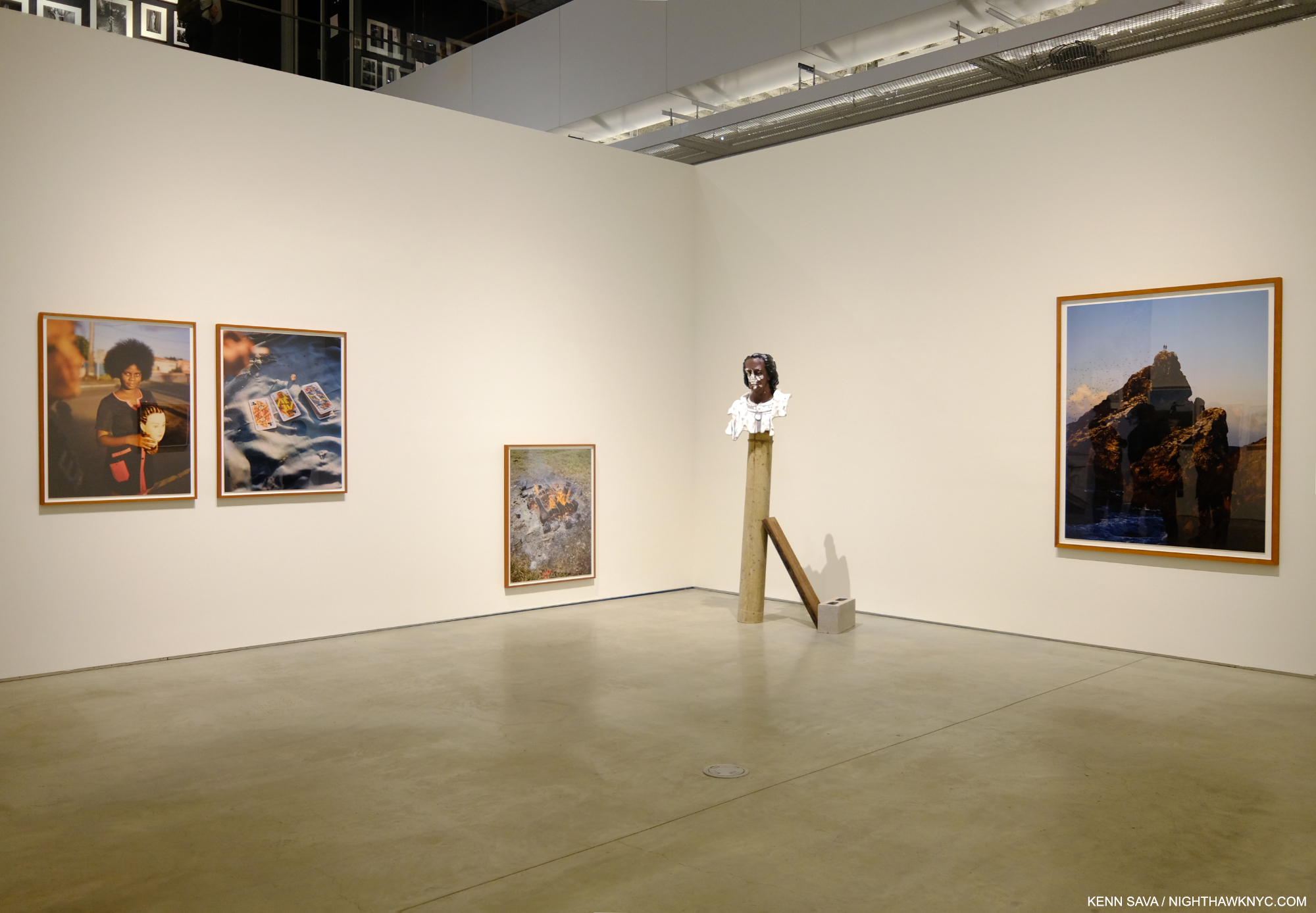
 Immersions installation view

On September 26th, Immersion opened at ICP, where I was last for William Klein: YES. Immersion is the name of a commission program involving an amalgamation of French and American organizations awarding selected Photographers, called laureates, a sponsorship to create a body of work either in France or the US. Gregory Halpern was a laureate in 2018. Raymond Meeks and Vasantha Yogananthan are the other two laureates included in the show. For his part, Mr. Halpern decided to go to Guadeloupe, a former French colony, a daring and somewhat ground-breaking choice (Raymond Meeks chose two regions in France, and Vasantha Yogananthan chose New Orleans).

So, why Guadeloupe?
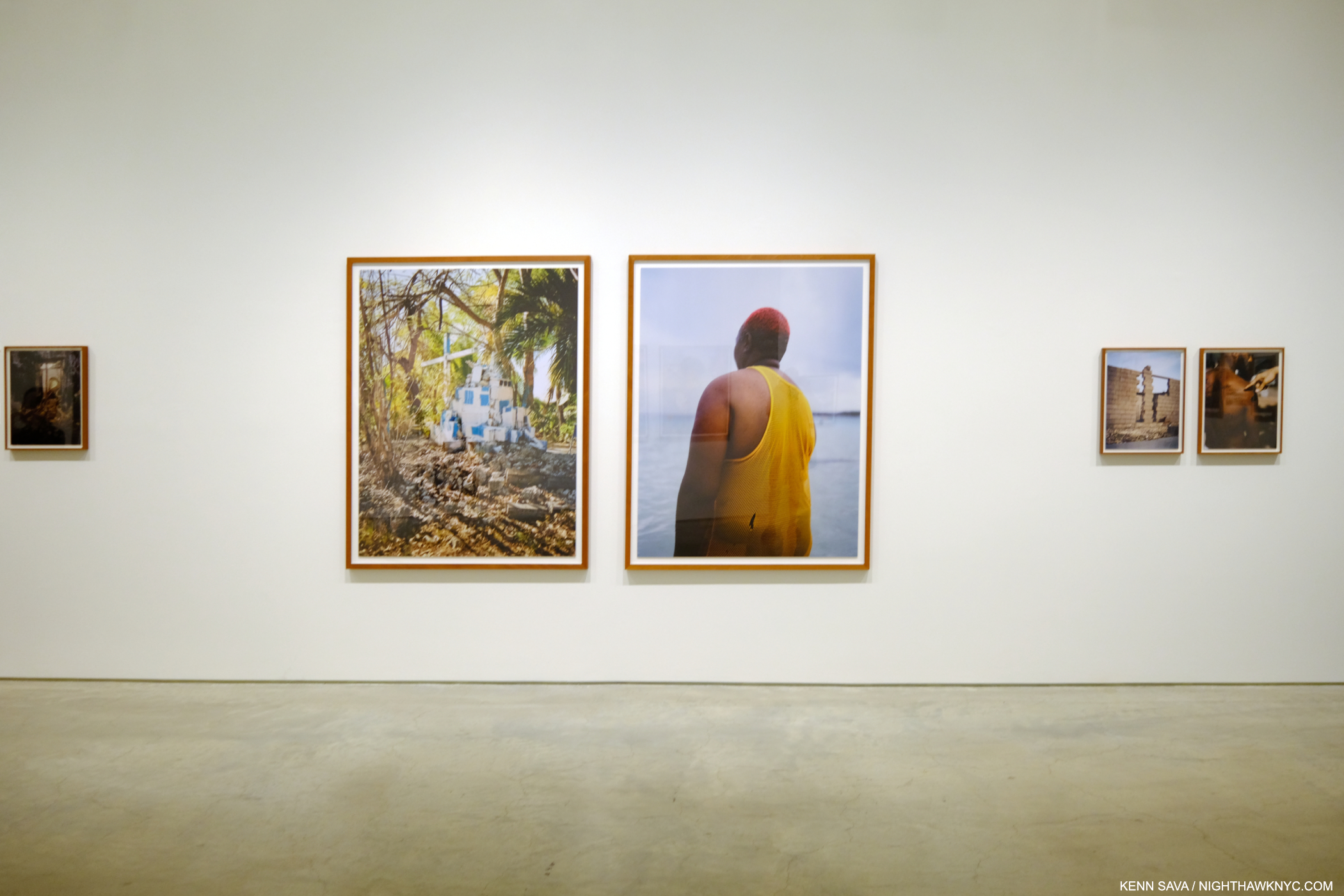
 Immersions installation view.

“I think I knew I would find a certain form of Surrealism there,” Mr. Halpern explained in an interview with Curator Clément Chéroux2.

The stage set, after research and a number of trips to Guadeloupe to take the Photographs, he undertook the rigorous selecting and arranging process he outlined during a talk when I saw him last at The Strand Bookstore in September, 2019. Aperture published the resulting body of work, indeed perhaps his most surreal, in Let the Sun Beheaded Be (a NighthawkNYC Noteworthy PhotoBook of 2020). In Immersion NYC finally gets to see the work as Photographs.
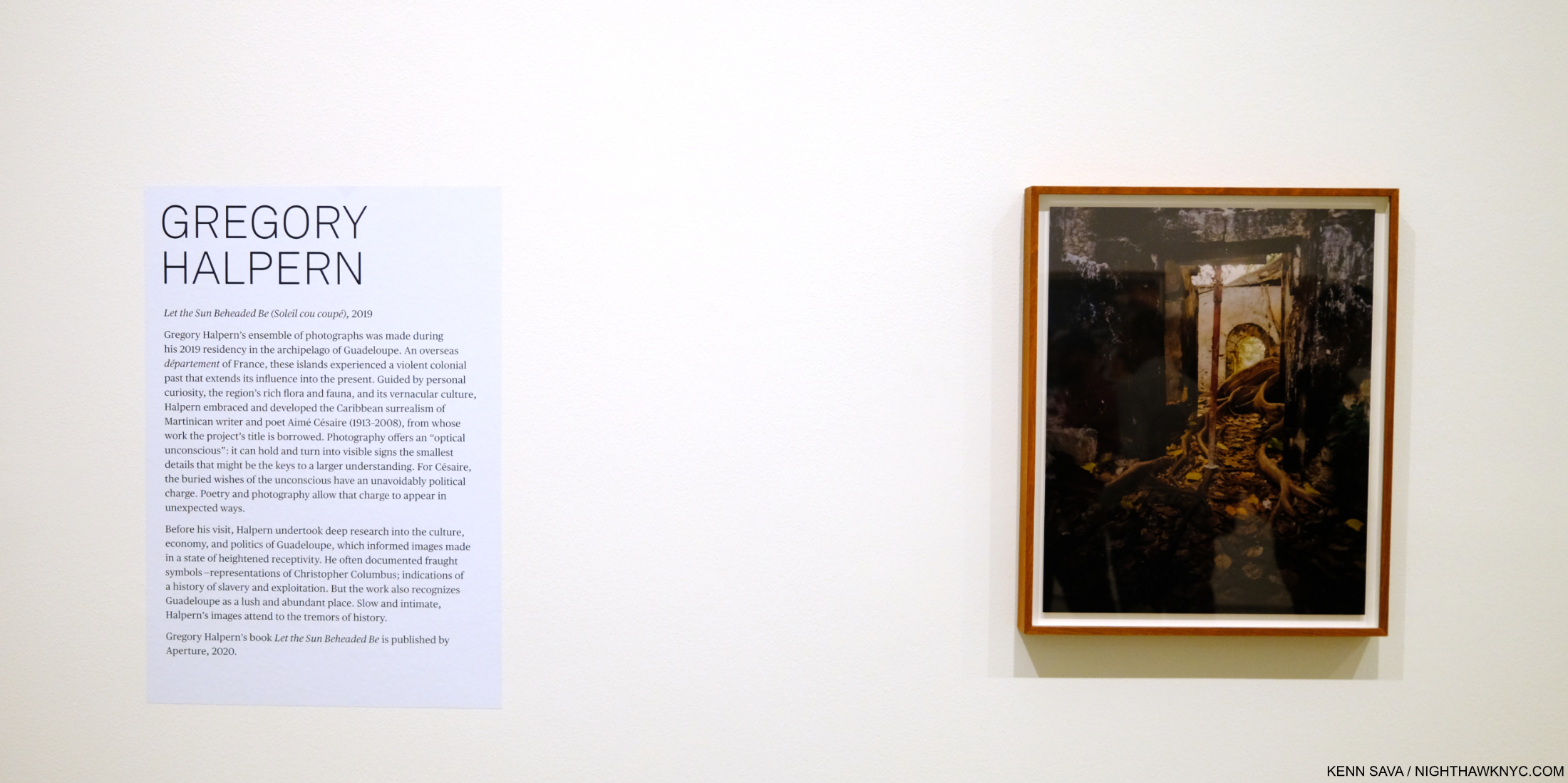
The show was concise, typically open-ended, and bookended by the Artist’s first foray into Video(!) and a stunning, leaning, Sculpture3. It opens with one of the most compelling images in the book.
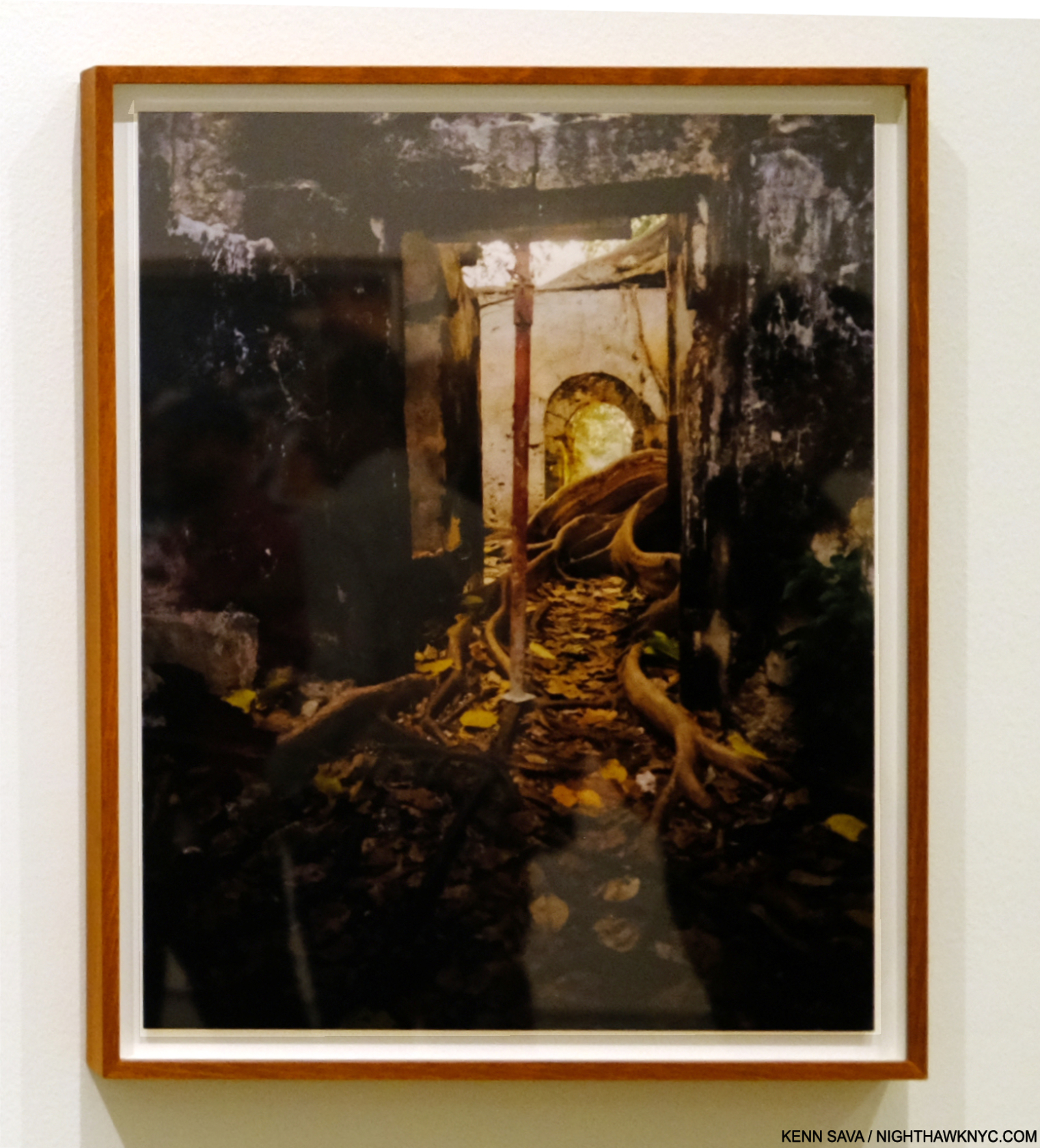
Untitled, as all the images are in the book, is described by Mr. Chéroux- “Shot in a former slave prison in the town of Petit-Canal, northwest of Grande-Terre, it shows the tentacular development, right inside the building, of a tree commonly known as a strangler fig because the strength of its wide roots destroys everything on which it grows4.”
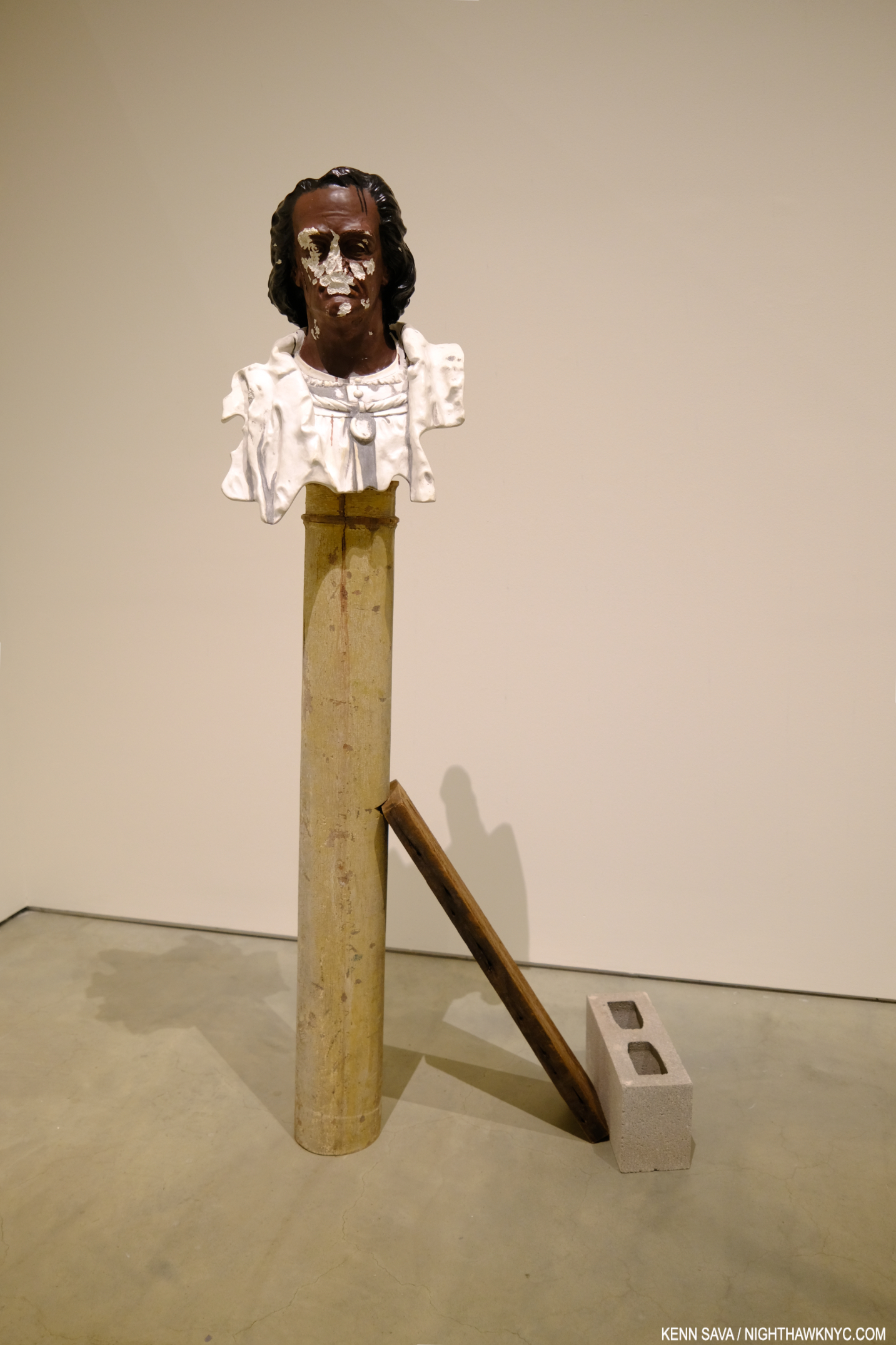
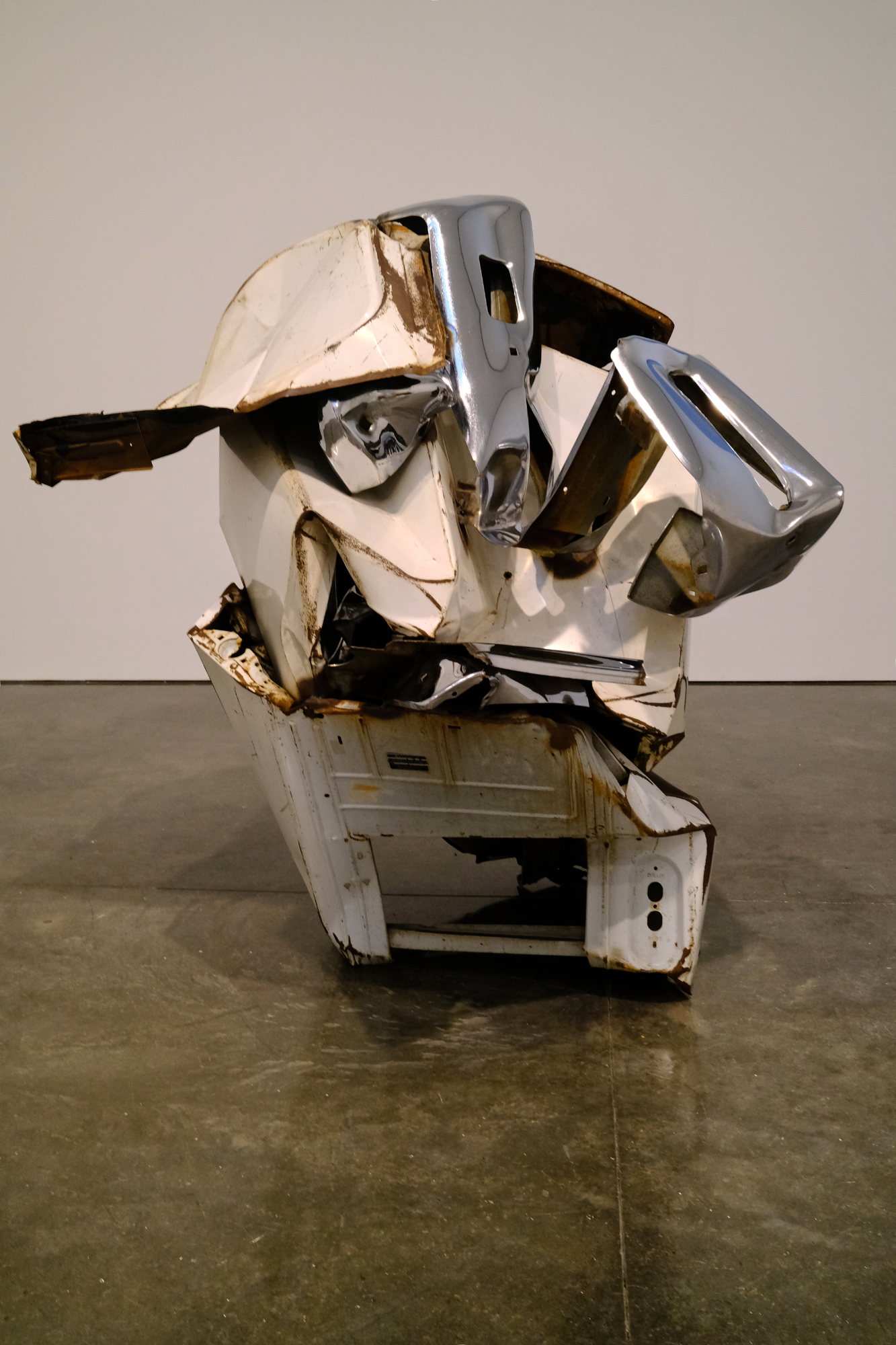
Christ Columb, 2023, Marble, cement, stainless steel, wood and cinderblock. An “exact replica of a bust of Christopher Columbus that currently stands in Guadeloupe,” per the wall card. “Exact” in that it even mirrors the vandalism to the real bust’s face.

It serves to define his terms. In these Photos, Mr. Halpen consciously avoided tourist trappings, saying in the book’s conversation with Stanley Wolukau-Wanambwa that after seeing how the tourists acted and treated the locals, he realized his burden as another white outsider with a camera would be even heavier, especially because he wasn’t fluent in either French or creole. He chose instead to focus on the stormy history, the place, the human, the animal, and the vernacular, in what are the five unofficial “chapters” of the book.
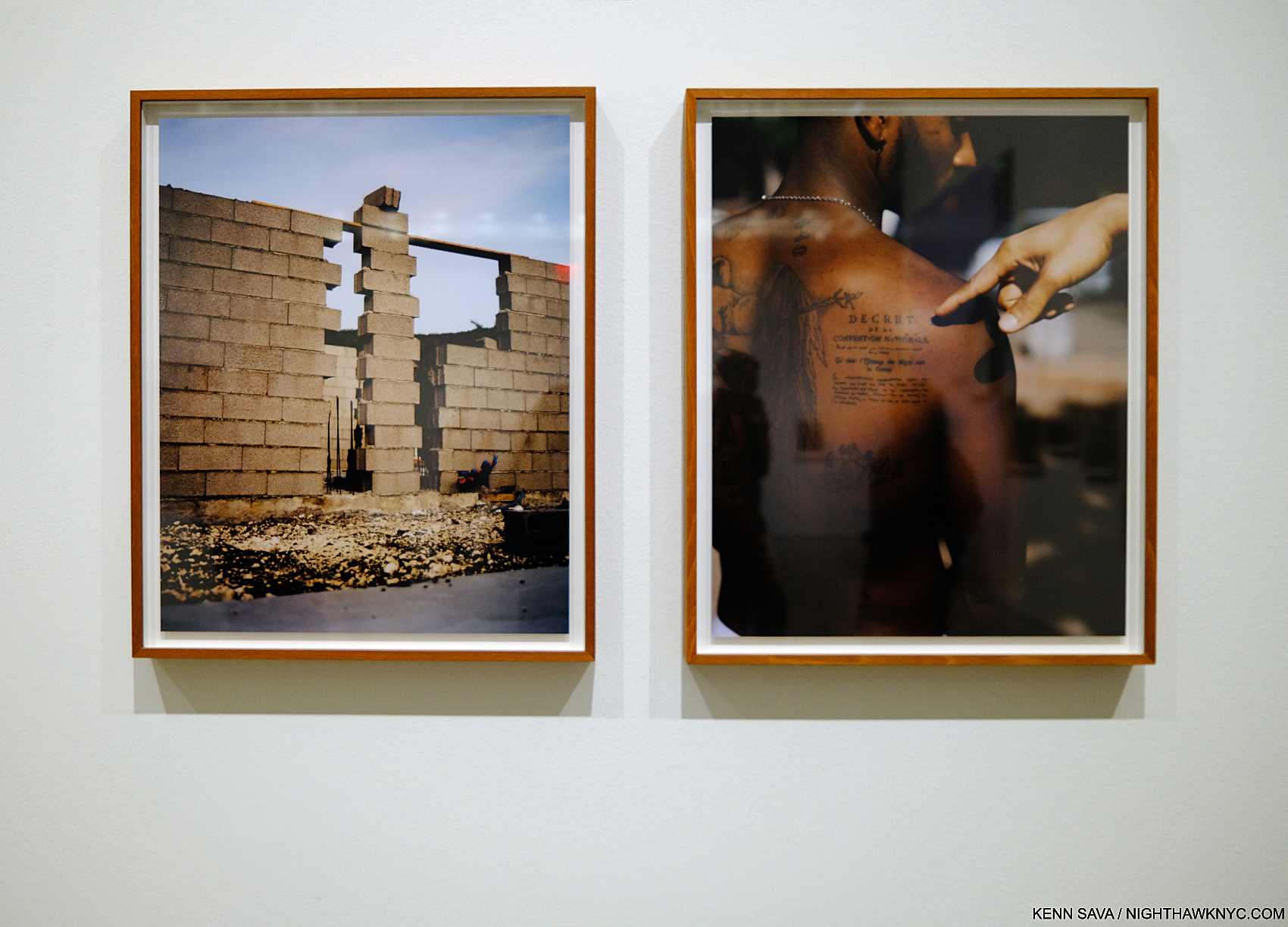
History/the place, the human…”The tattoo is a replica of the 1848 decree abolishing chattel slavery in Guadeloupe (the second, final abolition, after Napoleon reneged on his 1815 abolition,” from the wall card regarding the work on the right.

Surrealism runs throughout all of them, yet in Let the Sun it’s, perhaps, an overriding mood as much as it is actually on view. Possibly, this is due to the inherent surrealism Mr. Halpern said he was expecting to find, or perhaps it was also due to his reading material during his visits. The title “Let the Sun Beheaded be” comes from Soliel cou coupé (or Solar Throat Slashed) by Martinican poet Aimé Césaire, who was influenced by the concluding lines of “Zone,” the first poem in Guillaume Apolliinaire’s Alcools, 1913, “Adieu Adieu / Soliel cou coupé” (Farewell, farewell / Let the Sun beheaded be). Apolliinaire coined the term “surrealism” circa 1917. Césaire’s earlier work found its way into the hands of André Breton, one of the leading surrealist theorists, and the two became long-time friends. Speaking of Solar Throat Slashed curator Clément Chéroux points out in his essay the numerous connections between the guillotine, which was brought to Guadeloupe with the French after the French Revolution and put to extensive use in the colony, and Photography- down to the “guillotine shutter.” Thankfully, the guillotine shutter is the only use of the notorious device in the work, though death takes many forms.
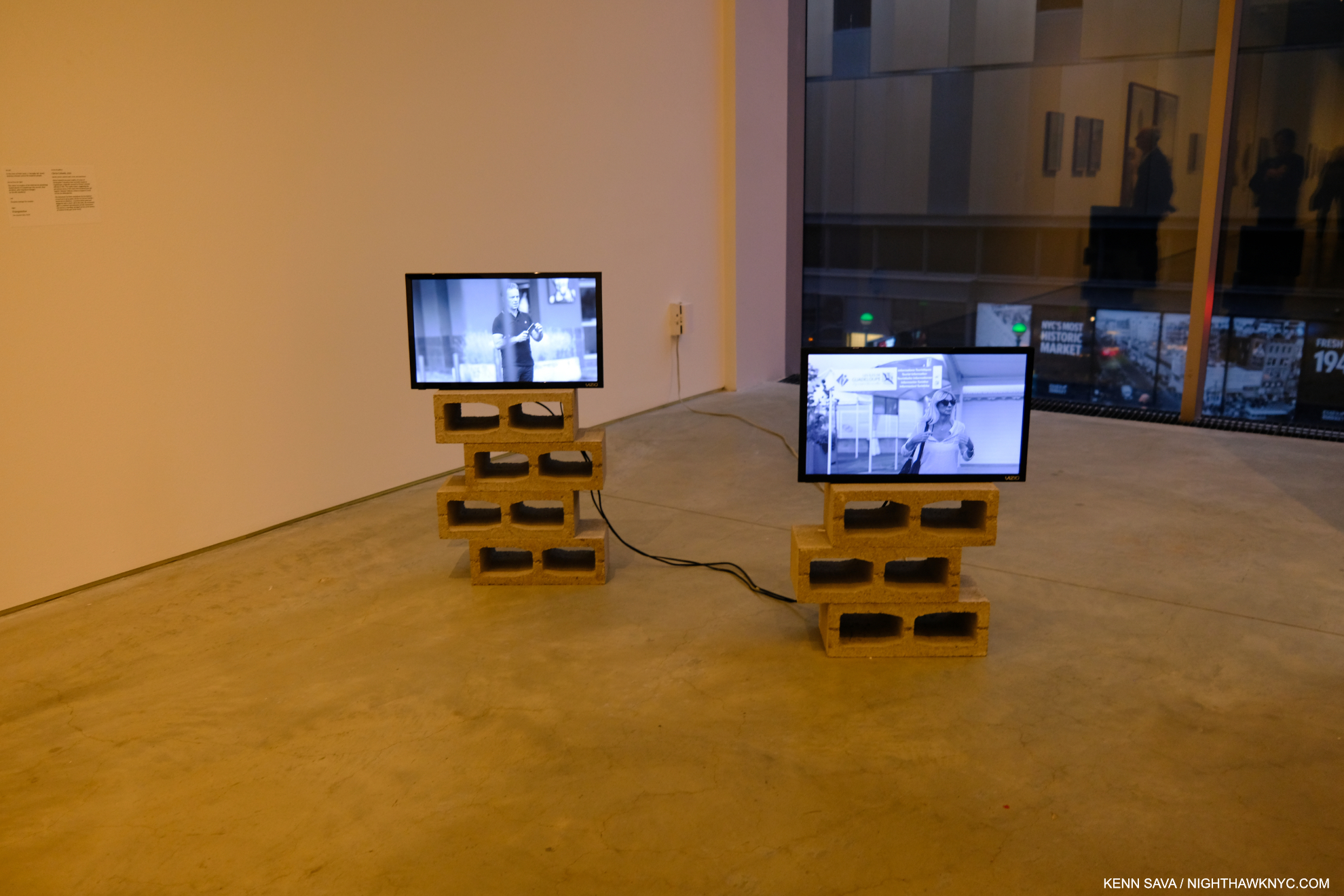
Stills from Triangulation, 2-channel video(!), duration 4:20.

Yet, after finishing his Photography, he subsequently returned to make a 2-channel Video titled Triangulation, which meditates on the coming and going of the cruise ships and their cargo. The Video, his first to be shown in public, startled me for having a different approach than his Photography does! Whereas he goes to great length to speak with his Photographic subjects, even collaborating with them to an extent in his Photo Portraits, in Triangulation, he’s an observer. Highlighting the risks of this, at one point, staged or not, a cruise ship employee with “Photographer” emblazoned on his shirt, ironically moves towards the camera making a “STOP” signal . The Video added a counterpoint to the show. At once showing that side of Guadeloupe most known to the outside world, but showing it not from the standpoint of the tourists, but almost from the viewpoint of the locals if and when they watch these foreigners arriving & disembarking on their island. 
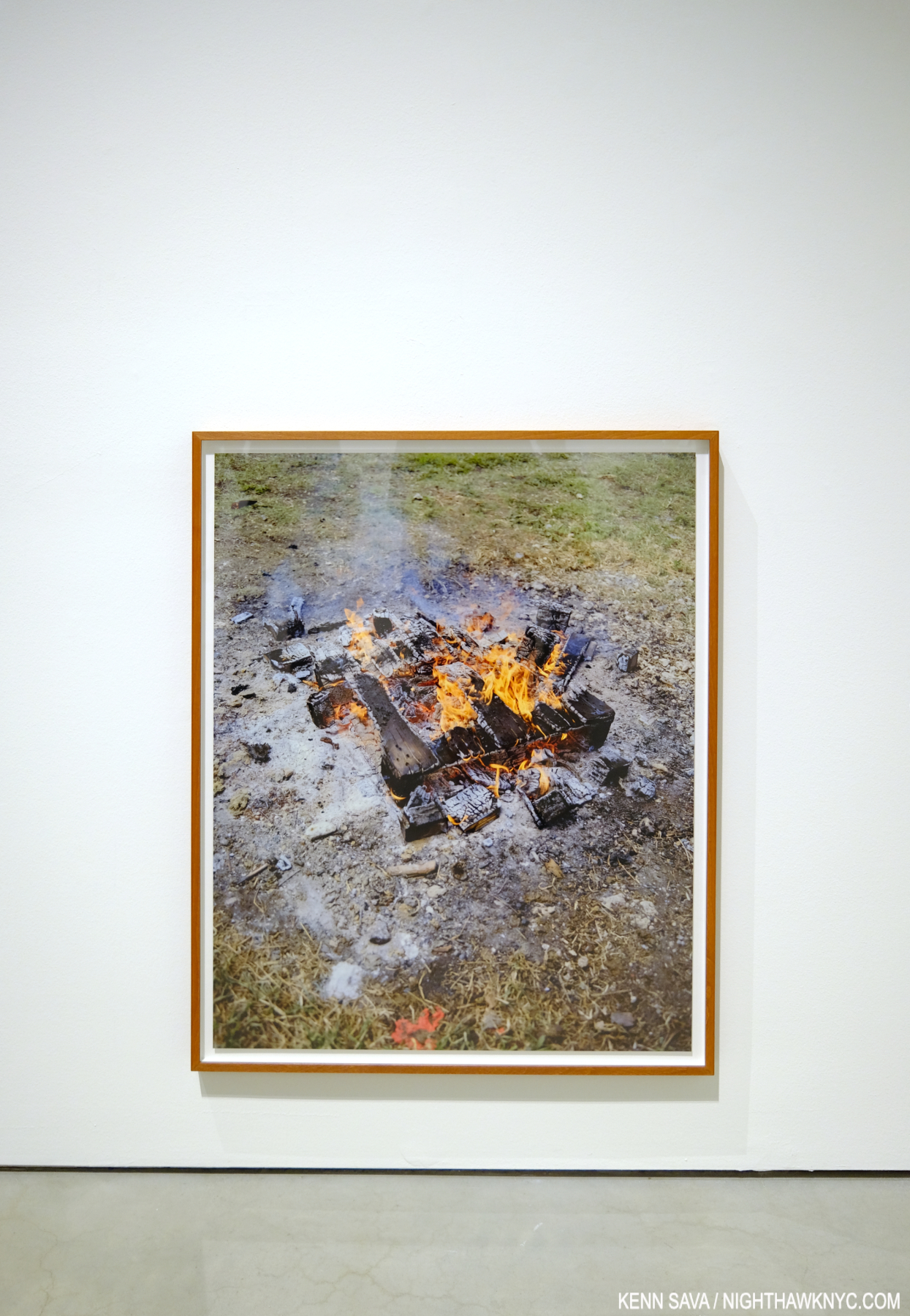
Appropriately hung near the floor. Seeing it this size created a completely different impression than the image in the book.

Another thing that struck me seeing this work was size. Images have a tendency to live in our minds in the size they appear in in a book. Unlike a Painting or Drawing, we may tend to forget Photographs can be printed larger or smaller. I heard from readers when I named Mr. Halpern’s Omaha Sketchbook a NoteWorthy PhotoBook of 2019 who disagreed, saying they were unhappy with the size of all the images in it- each a reproduction of a Photo cut from a medium format contact sheet, done to remain true to his original mockup- a “sketchbook.” Let the Sun returned to full page images to stunning effect (I happened to love the daring in the design of Omaha and the sizes of the Photos therein). At ICP, the Prints ranged from slightly larger than page size to very large, probably 40 inches or larger. The added real estate enabling the images to begin to attain a “life-size” presence. 

“In Guadeloupe, slavery memorials are everywhere, so the weight of that history is much more perceptible than in the United States.” Gregory Halpern in the Conversation.

In my 2019 overview of his work, “Gregory Halpern’s America,” I wrote about his work’s hold on me. I still can’t think of any other living Photographer whose work speaks to me as much as his continues to. Given that his instant classic book ZZYZX is now in its 4th printing, and his three subsequent books have sold out, I’m apparently far from the only one it speaks to. I went in to Immersions believing that Let the Sun is somewhat underappreciated compared to his U.S. based books (i.e. all of his previous books). I came out feeling I may have underestimated it. Let the Sun is a book that could inspire change on a number of levels- from opening the eyes of people who’ve never been to Guadeloupe (like myself), to increased possibilities for the Photographic Portrait, to publishers who have neglected the Caribbean (& it’s Artists) to this point in Art & PhotoBooks, to the shame that the history of slavery in this country has been so ignored. For those reasons, it’s something of a landmark book in my view.
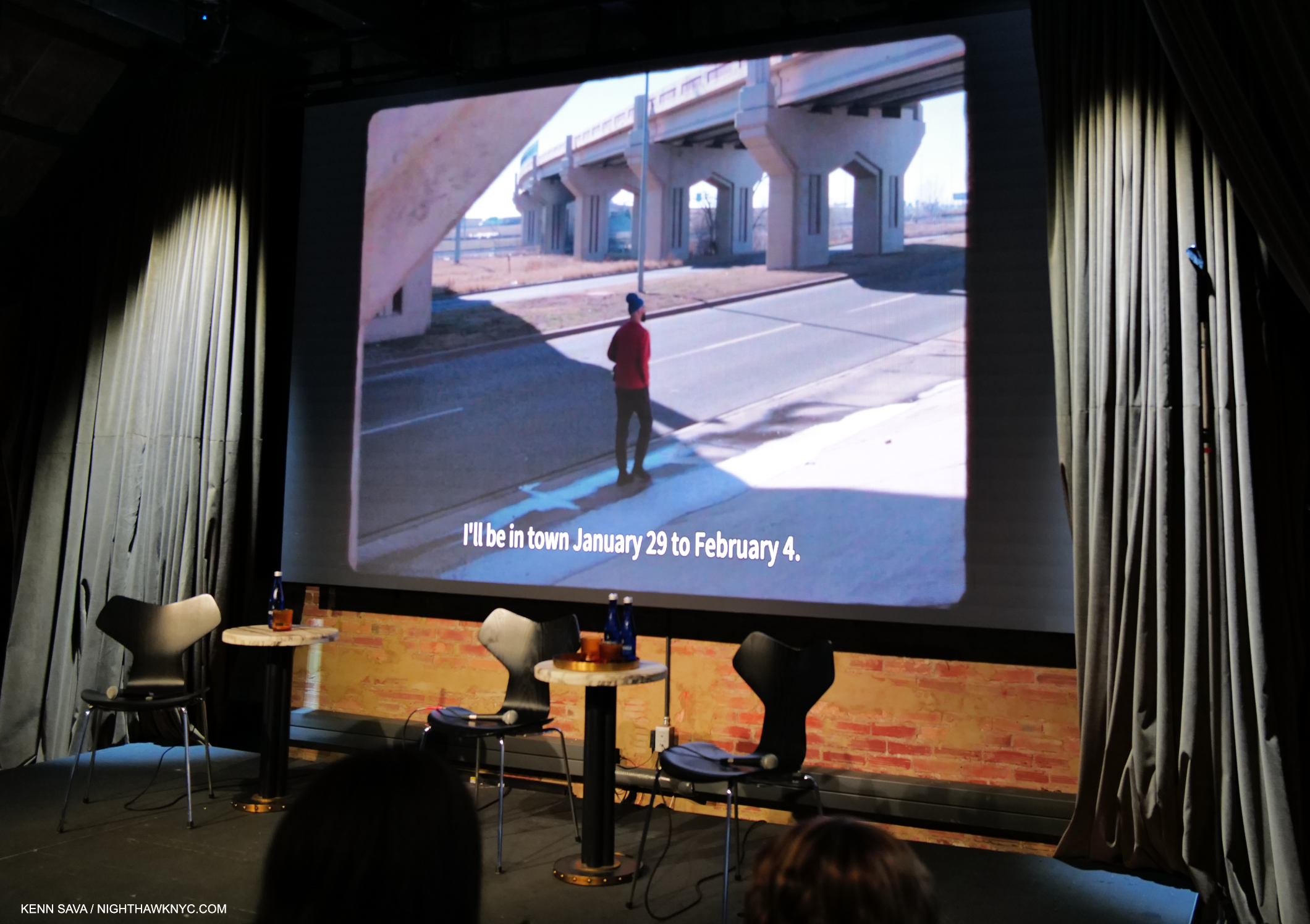
On the road, again. Gregory Halpern looking for subjects in Oklahoma City as he talks in the voice-over about his Instagram announcement seeking Portrait subjects. Still from a fascinating video short about his week in OKC at Fotografiska, July 20, 2023.

A few weeks earlier, at Fotografiska in the Flatiron on July 20th, Mr. Halpern was joined by 3 Magnum Photos Photographers, of which he is now also a full member, in a show sponsored by a hotel chain titled Impressions. The Photographers were ensconced in separate hotels around the world and asked to document what they experienced. Mr. Halpern went to Oklahoma City, and exhibited 4 Photos (as did each of the others- Cristina de Middel, Jonas Bendiksen, and Alessandra Sanguinetti) in what is the first new work I’ve seen of his since Let the Sun Beheaded Be, 2020.

Here is Mr. Halpern’s presentation-
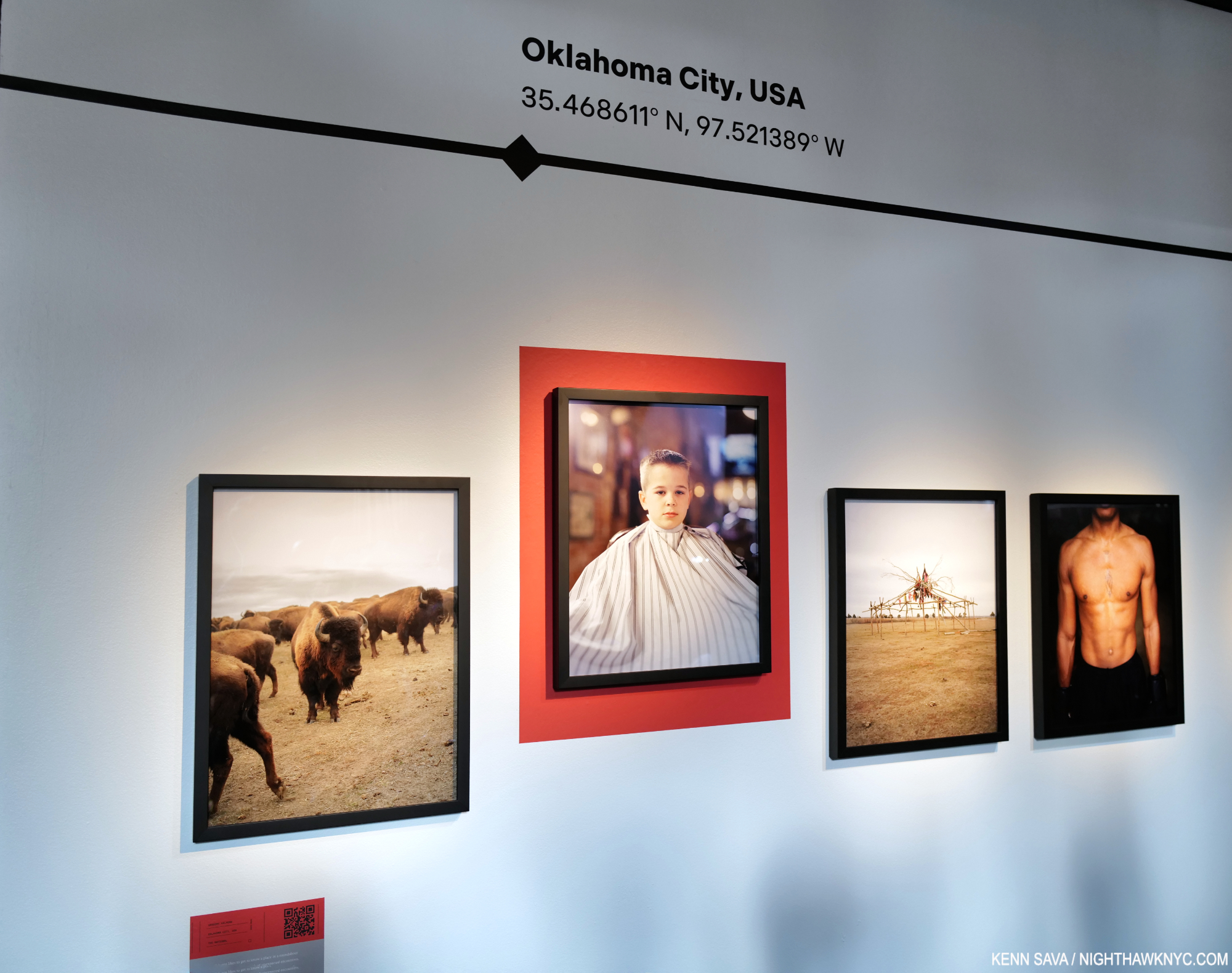
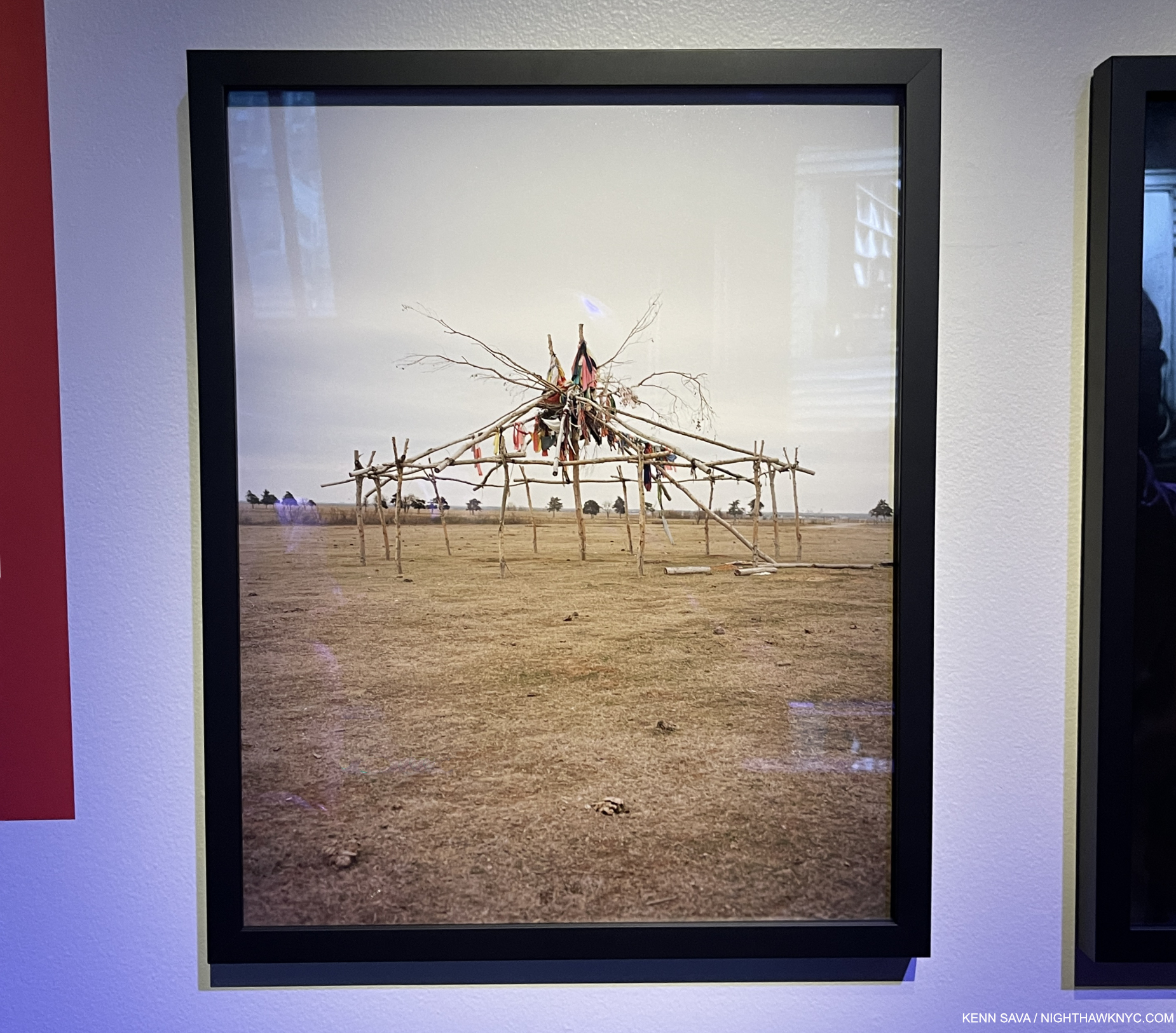
I find the arrangement particularly interesting. We see animals, a Portrait of a young man in a barber’s cloth, some sort of structure, and a torso bearing a tattoo. Looking at these, yes, Let the Sun came back to me. Each of the four images “represents” one of its unofficial themes- animals, a human, the evidence of the land/history, and another human. The surreal is also represented in all four (at least for me).
It would be easy to say they “harken back” to what we saw in Omaha Sketchbook. That book featured images of masculinity (along with images of animals, the land & history and other themes), like Douglas, Army Jurnior Reserve Officer Training Corps, Bellevue, 2005-18, to cite one example out of many; the young man getting a haircut harkens back to those societal expectations and traditions. Ostensibly, it’s a straight-ahead image of an event that parents are fond of documenting during childhood. Yet, there’s an air of mystery around it. The young man stares at the camera with a somewhat stoic look that gives away little. The barber cloth hiding anything the might tell us more about him. His haircut appears to be finished and he’s ready to face the world again. Yet, I’m reminded of Clément Chéroux’s essay in Let the Sun when he speaks about the guillotine, Guadeloupe, and the mechanics of Photography. He mentions Photographers refer to Portraits as “cutting heads.” Here we see just that twice- once with only the head (in a Print mounted on a red background), and once of a torso sans head. Notice how the Print of the young man is mounted higher than the others- at a height where the young man’s head just about “completes” the Portrait of the tattooed torso on the right.
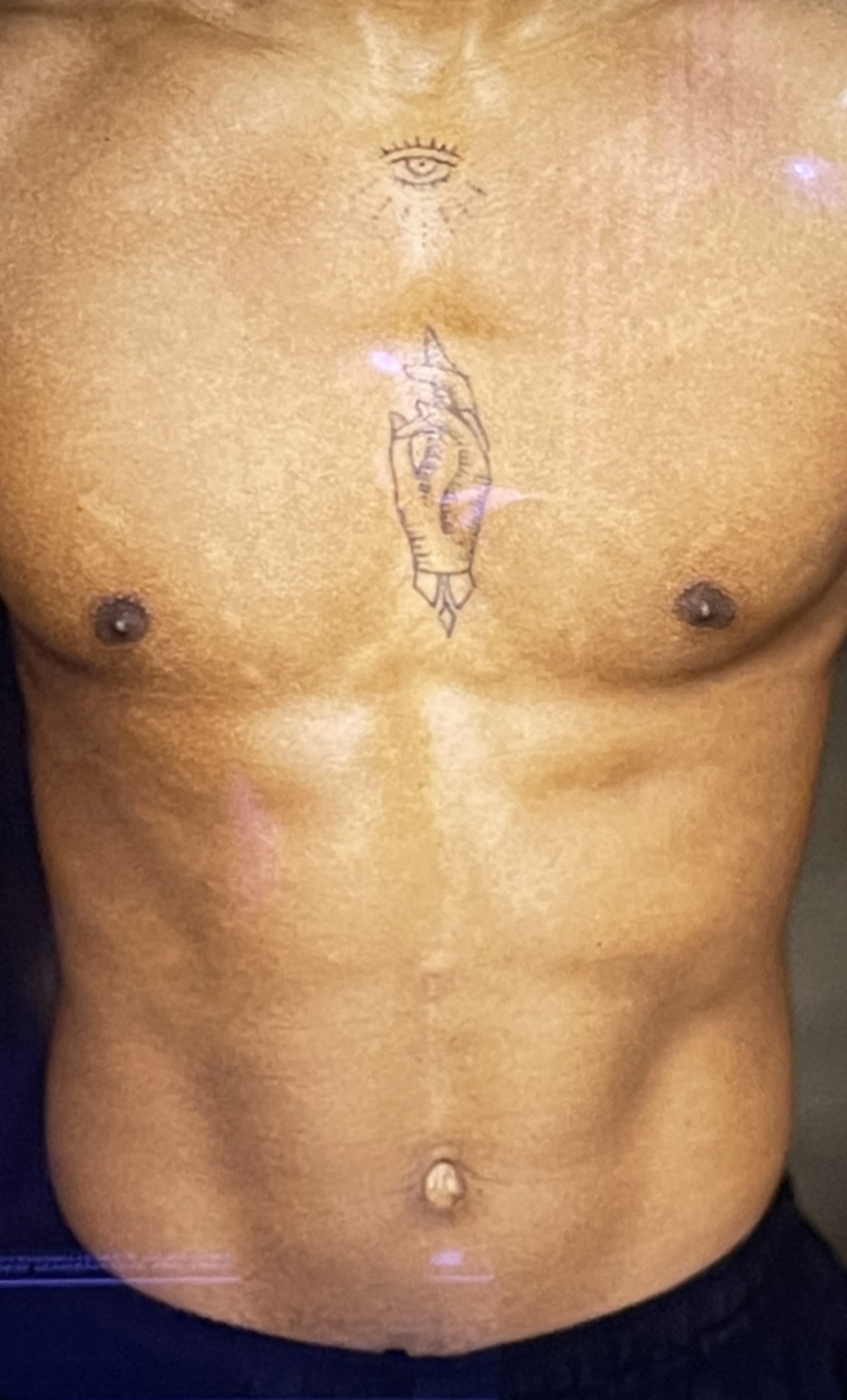
Detail of the far right Photo, showing the tattoo. Speaking of recurring themes, t’s interesting to contrast this with the very first image in this piece from ZZYZX.

It reminds me of some of the games the Surrealists used were fond of playing, like the one Kerry James Marshall based his recent show on.
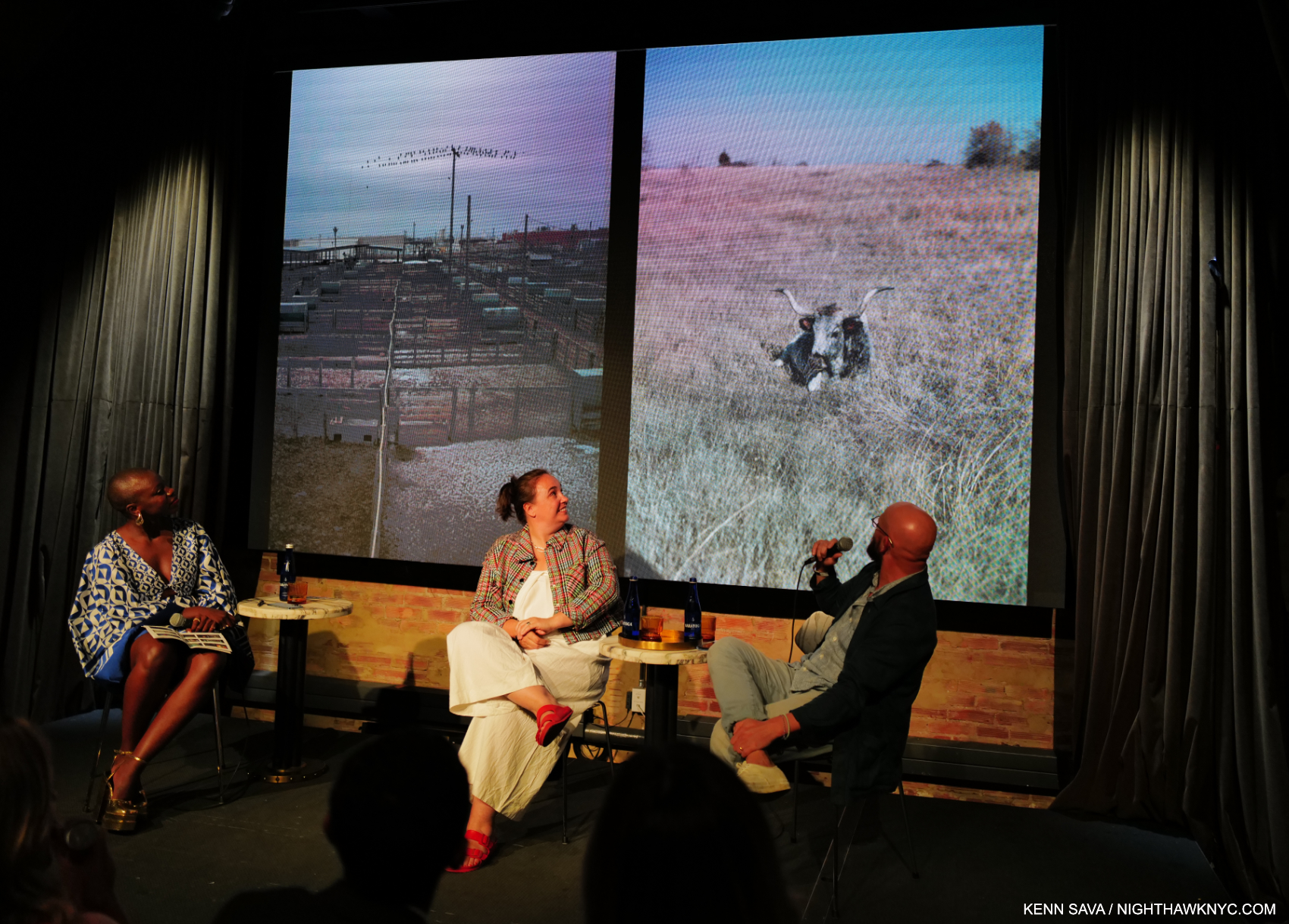
Mr. Halpern discussing two other images from his OKC series.

Of course, this is only my reading of it- your results may differ, as Mr. Halpern’s intentions may as well. In the end, I’m lucky I never have to leave NYC to find Surrealism. It finds its way here from all over the world.

*- Soundtrack for this piece is “Captains and Cruise Ships” by Owl City.

NighthawkNYC.com has been entirely self-funded & ad-free for over 8 years, during which 300 full-length pieces have been published! If you’ve found it worthwhile, PLEASE donate to allow me to continue below. Thank you, Kenn.

You can also support it by buying Art, Art & Photography books, and Music from my collection! Art & Books may be found here. Music here and here.

Written & photographed by Kenn Sava for nighthawknyc.com unless otherwise credited. To send comments, thoughts, feedback or propositions click here. Click the white box on the upper right for the archives or to search them. Subscribe to be notified of new Posts below. Your information will be used for no other purpose.

  1. As far as I know, there has not been a Gregory Halpern solo show in NYC since the auspicious Gregory Halpern: A at Clamp Gallery from January 5th to February 11th, 2012, as hard as that is to believe. If you know of one subsequently, please let me know.
  2. From 2019, per Clément Chéroux, “GH/971” in Let the Sun Beheaded Be.
  3. Which is not his first. He showed Sculpture for the first time earlier this year in Gregory Halpern: 19 Winters/7 Springs at Transformer Station, Cleveland.
  4. ibid

Nick Cave: Beauty Deeper Than Skin

This site is Free & Ad-Free! If you find this piece worthwhile, please donate via PayPal to support it & independent Art writing. You can also support it by buying Art & books! Details at the end. Thank you.

Written & Photographed by Kenn Sava

Show Seen- Nick Cave: Forothermore @ the Guggenheim Museum

No. Not THAT Nick Cave.

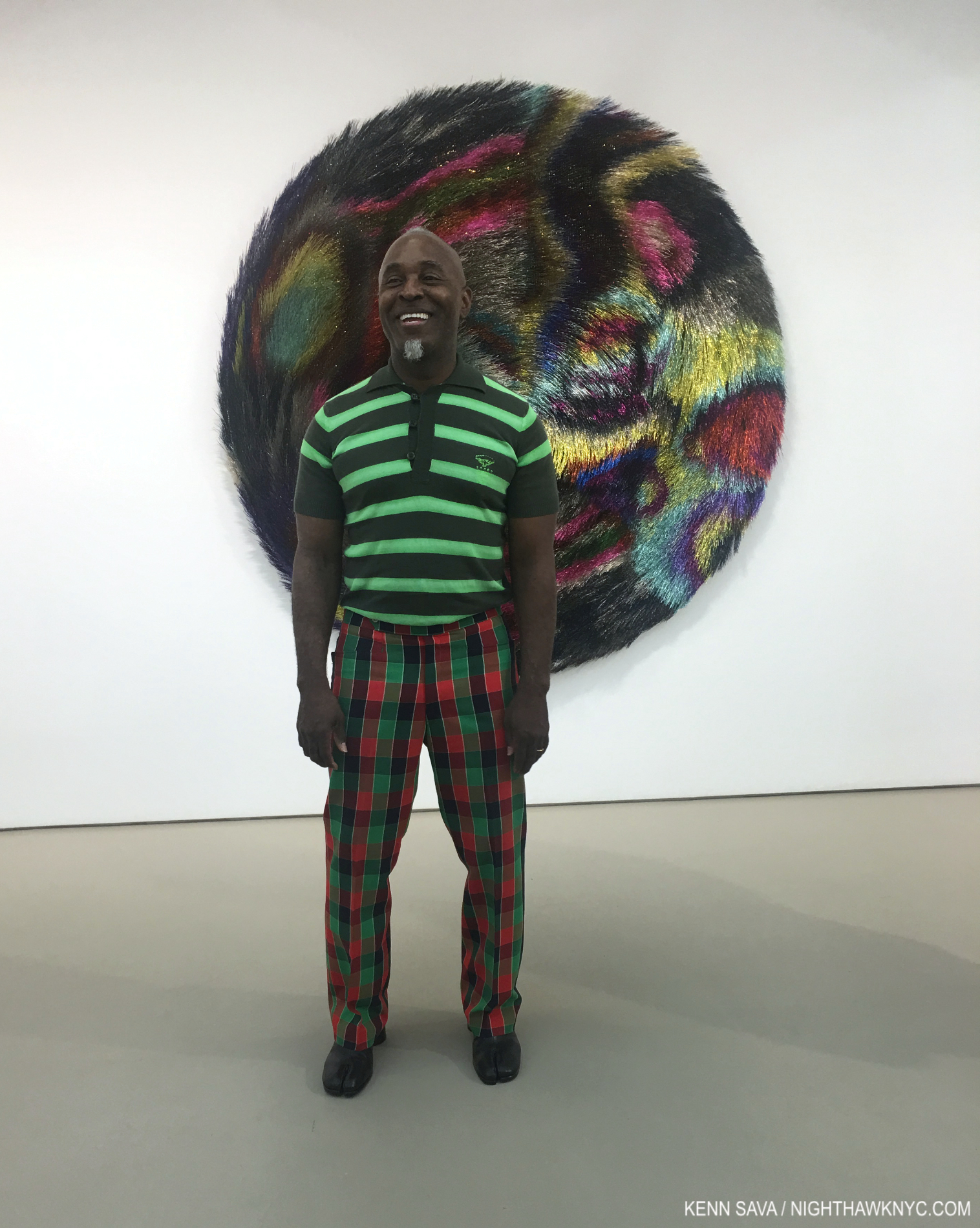
THIS Nick Cave. The Artist standing in front of Tondo, 2018, Mixed media including wire, bugle beads, sequined fabric and wood at the opening of Nick Cave: Weather or Not at Jack Shainman May 17, 2018 . Tondo was also on view in Fororthermore.

Nice Cave, the multi-dimensional Artist, that is, who deserves every bit as much notoriety as the other, rightly very well-known Nick Cave, whose work I also admire. This Nick was born in 1959 in Fulton, Missouri, and now lives & works in Chicago, where he has been creating beautiful heart-rending Art for over 30 years. Art, largely created as his response to the world around him marked by racism, profiling and the murders of unarmed Black men and women.

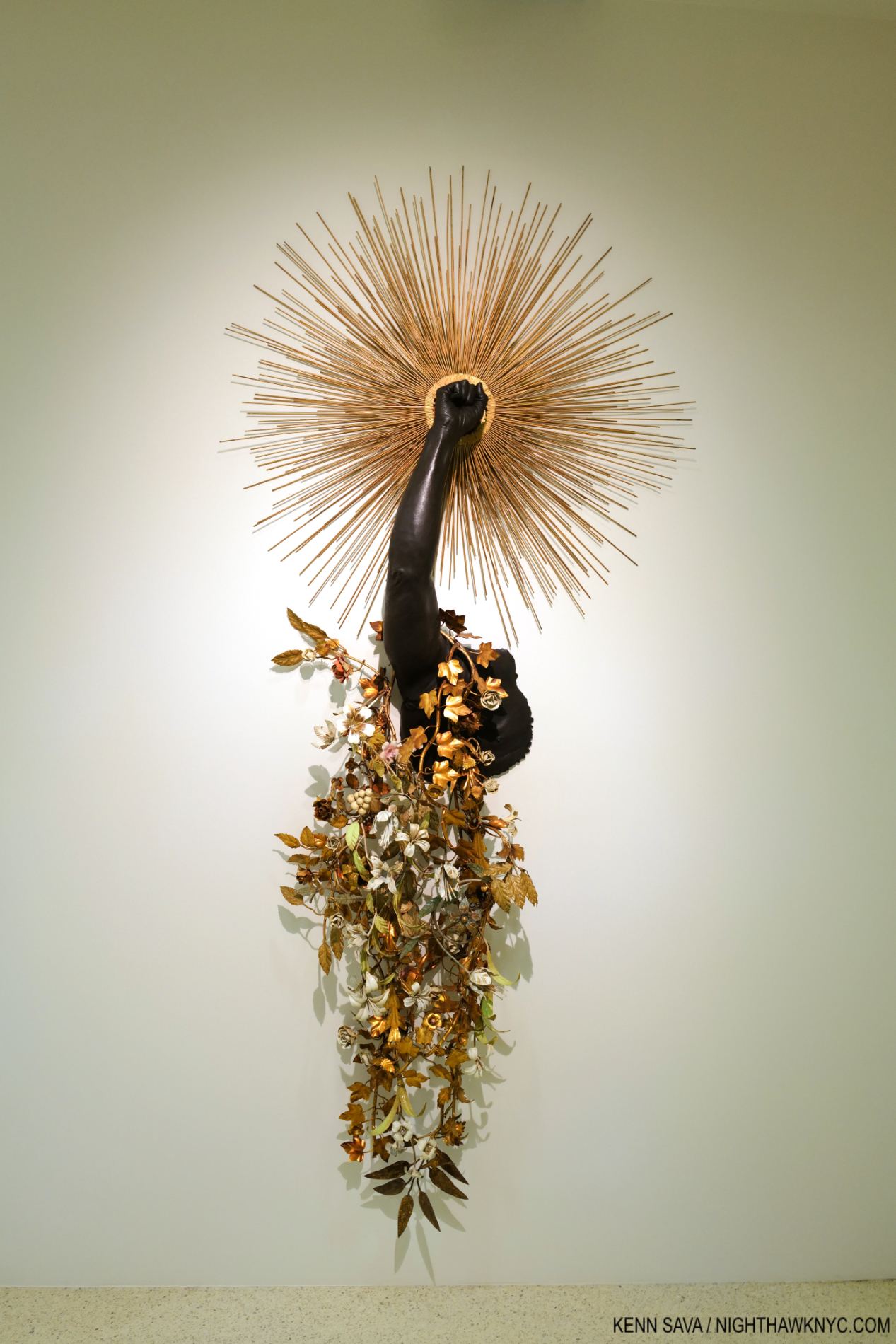
Arm Peace, 2018, Cast bronze, sunburst and vintage tole flowers 85 × 39 × 12 inches. (One of two pieces in the show named Arm Peace.) In my book, this deserves to be “iconic,” as do a number of other pieces in Forothermore.

Even though I had seen a number of his shows at Jack Shainman, his books, and I have been in his presence twice, I was completely unprepared for Nice Cave: Forothermore his mid-career Retrospective at the Guggenheim. I went in believing Mr. Cave is one of the more important Artists working today. I left speechless.

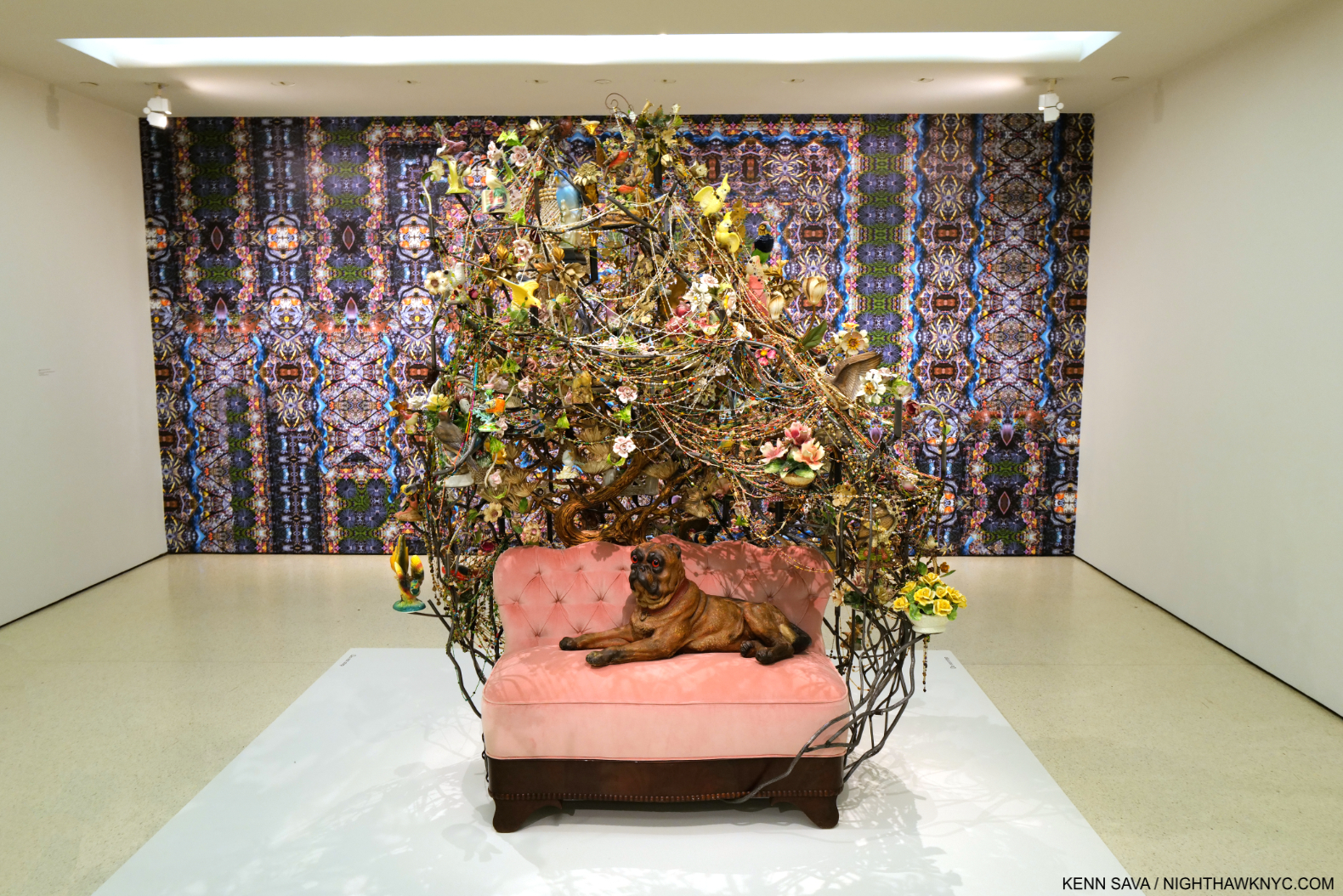
Rescue, 2013, Mixed media including ceramic birds, metal flowers, ceramic Pug, vintage settee, and light fixture 91 × 78 × 54 1/2 inches, front, Nick Cave in collaboration with Bob Faust Wallpaper Near Rescue Works (New Work), 2021, TBC, Dimensions variable, on the back wall.

As a result, I’ve decided to let Mr. Cave, who has a gift for expressing himself in words, to go with his extraordinary gifts for visual expression, do much of the talking in this piece. In Forothermore, a number of the pieces I’d seen over the years, and many others, came together as a startling whole of 49 pieces over three sections: What It Was, What It Is, and What It Shall Be, in 3 locations in the museum. I must admit that I am not a fan of the side galleries the Guggenheim added during their expansion of Frank Lloyd Wright’s masterpiece (which I fought at the time they announced them, and my argument was published in The New York Times, my first published writing). The newer galleries are oddly shaped, because Wright didn’t design these spaces to be galleries. In my view, they detract and distract from Wright’s original intention and design of Art in the Rotunda. That being said, Nick Cave: Forothermore was one of the more important shows in NYC so far this young decade, if not THE most important show I’ve seen. The Guggenheim deserves kudos for bringing it here.

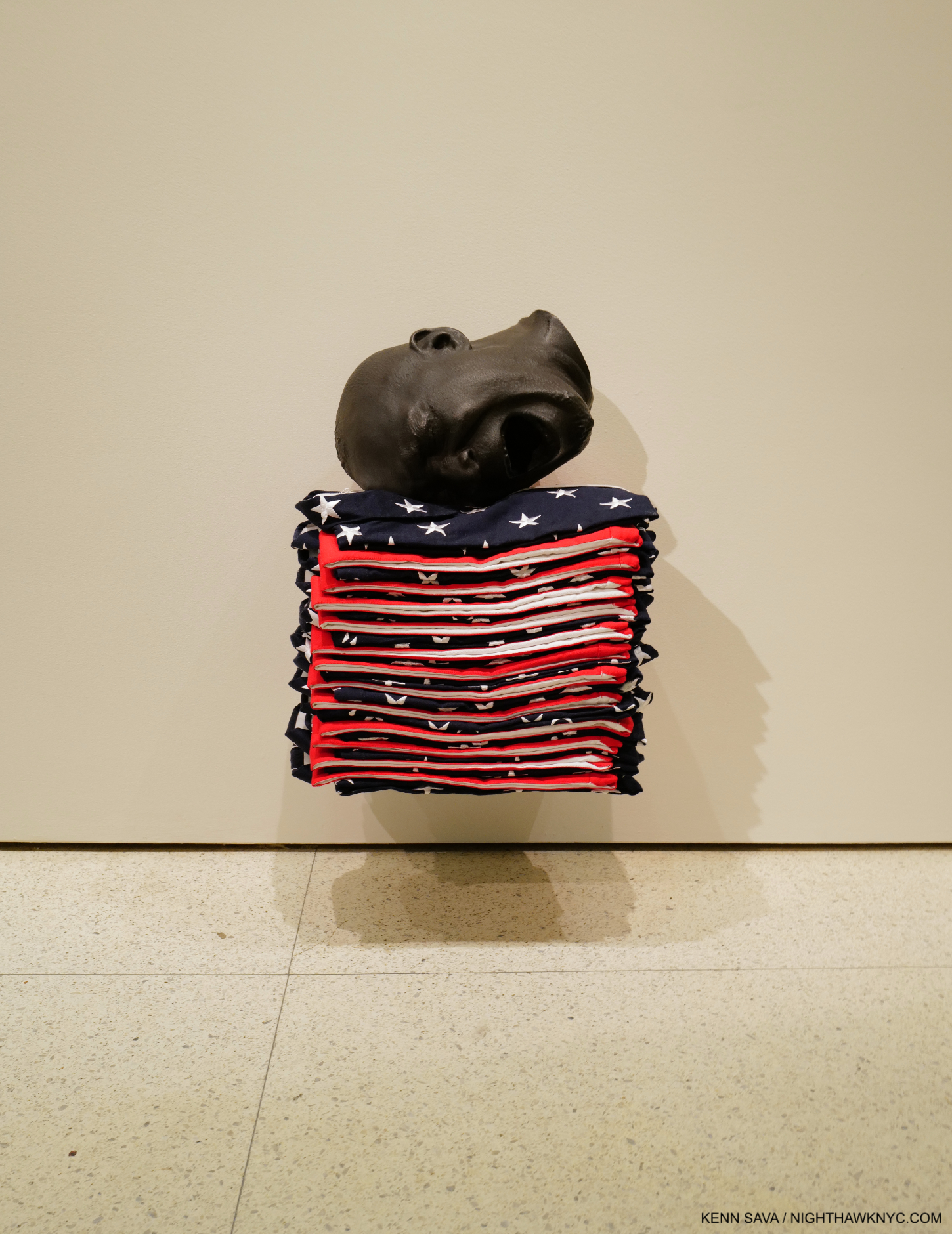
Untitled, 2018, Mixed media including a bronze head and 13 American flag shirts, 23 3/4 × 15 3/4 × 12 inches

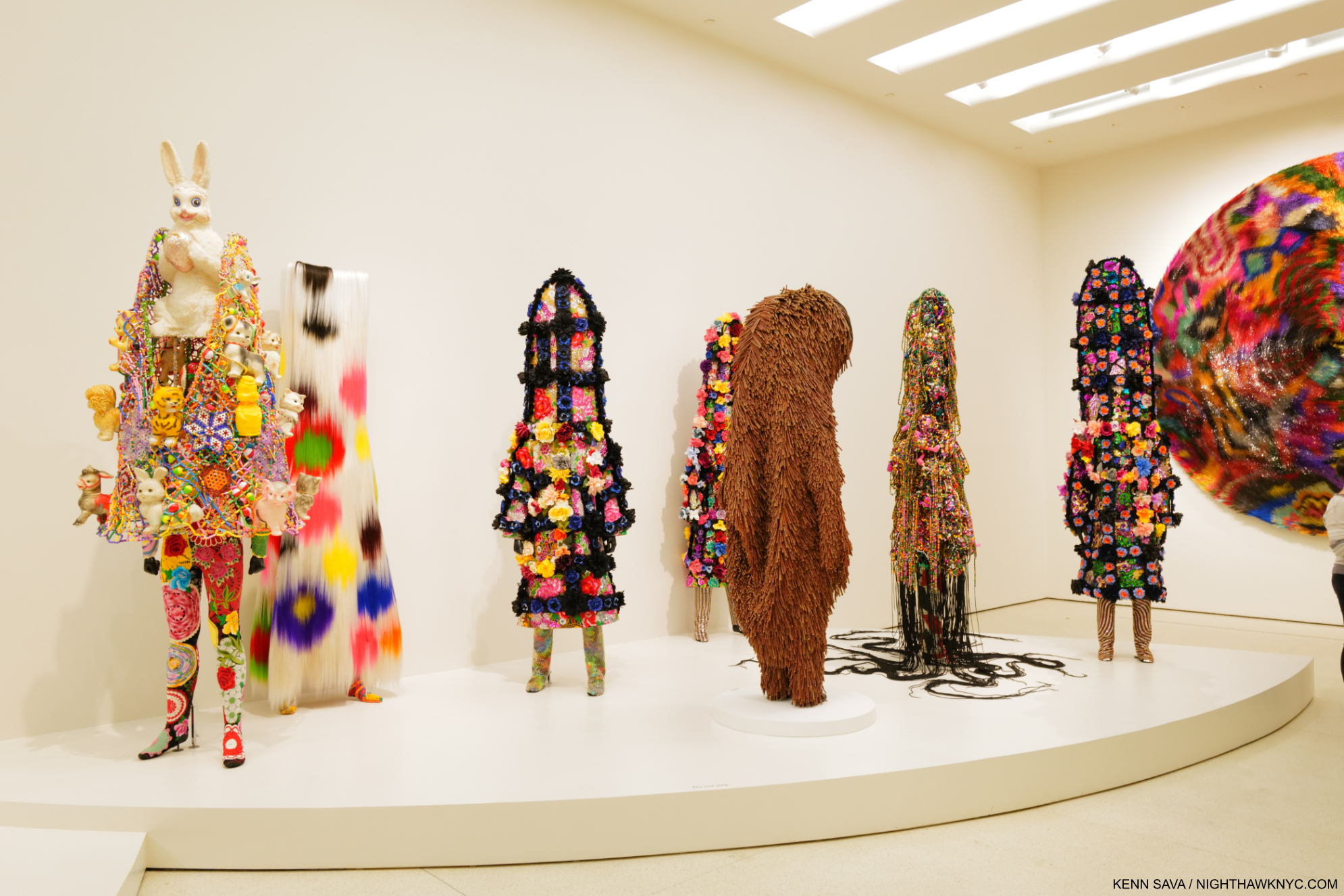
At first glance, much of Nick Cave’s Art, particularly his famous Soundsuits, look otherworldly until a close look reveals virtually all of it consists of everyday or found items used in incredibly imaginative ways. Part Sculpture, part Music, part furniture, part Collage, part fashion, and partially created using textile production and jewelry-making techniques, there seems to be no limit to what Mr. Cave’s pieces are or fixed rules about how they’re made. Still, all of what we see now is part of his extraordinary response to the reality of his life and that of other Black men and women.

It started early…

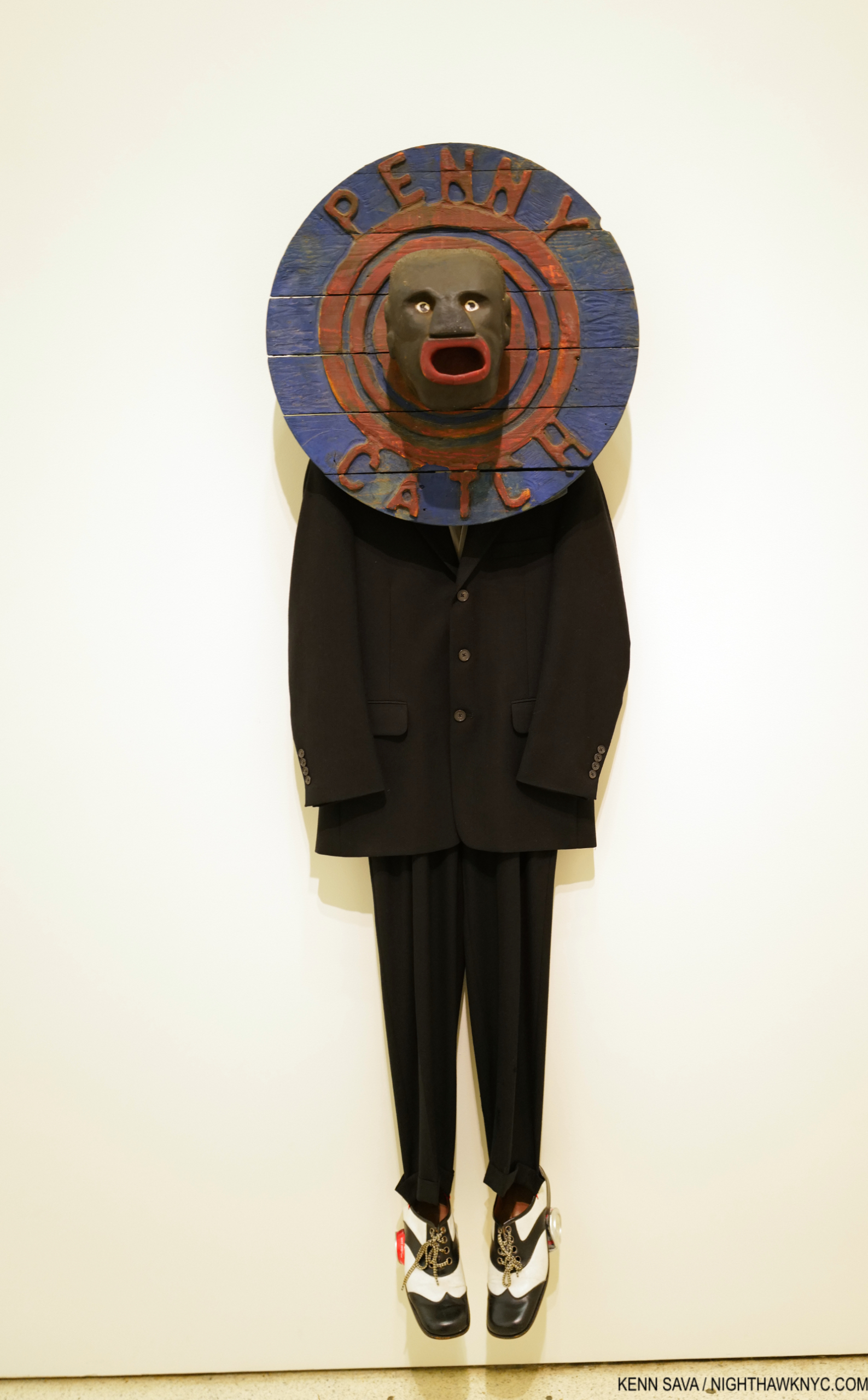
Penny Catcher, 2009, Mixed media including vintage coin toss, suit, and shoes 74 × 23 × 14 inches

“My mother told me when I was, like, eight years old, the complexity of what I would have to deal with. So knowing made me think, ‘I’ve got to build a thick skin. I’ve got to be able to operate in a world…that could work against me as opposed to for me. What do I do with that?'”1

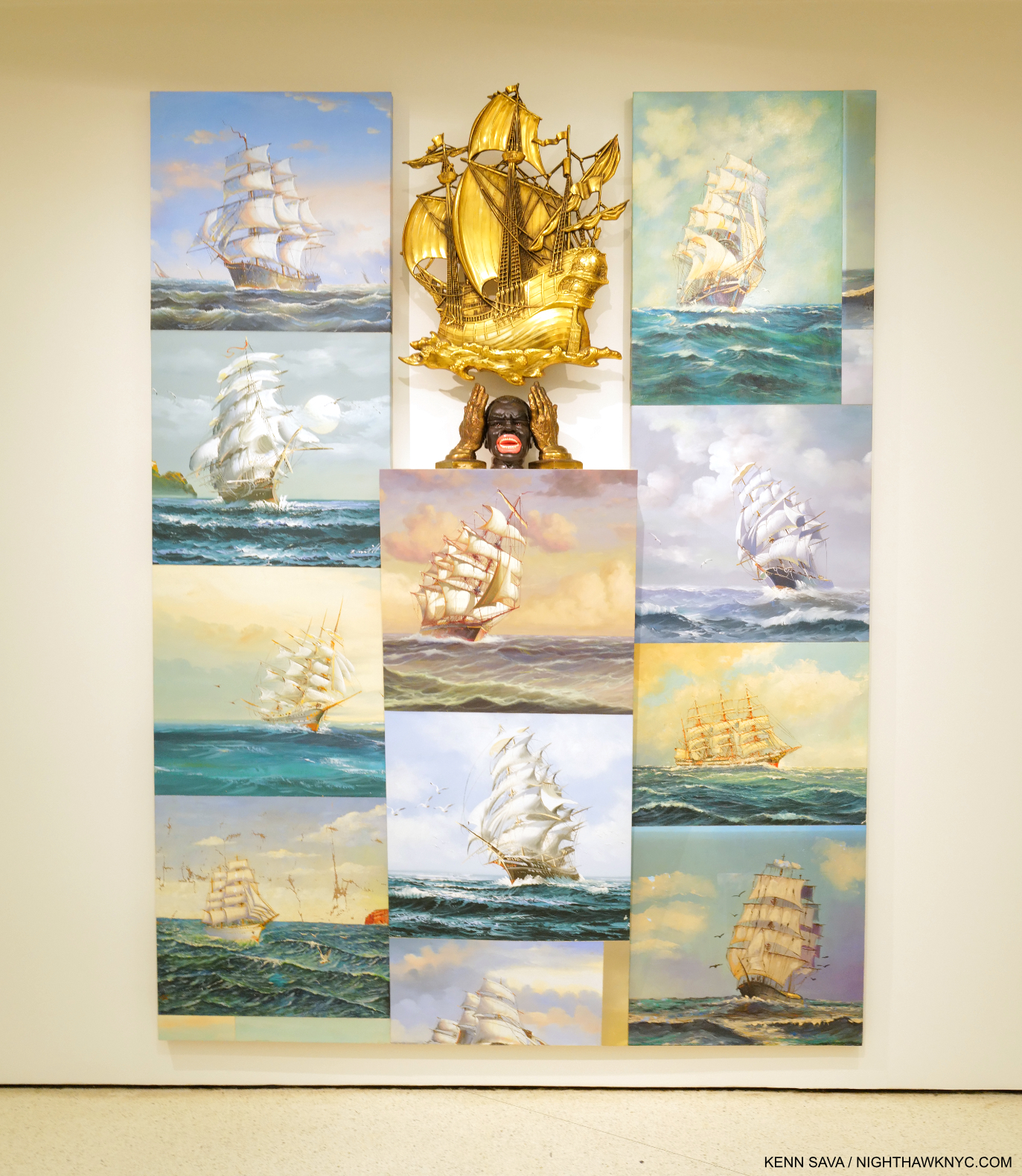
Sea Sick, 2014. Mixed media including oil paintings, ceramic container, cast hands, and plastic ship 96 × 72 × 10 1/2 inches. At 8 feet tall, with 11 Paintings of the kind of 17th century ships slavers used mounted salon-style, each shown in full sails, almost looking to be going back and forth, at angles to inspire sea sickness among those on board, with a striking head and hands in the center, as if screaming “ENOUGH!” The head was a tobacco holder that was later sold as a spittoon!

“I have been racially profiled. I’m walking home with my portfolio from teaching. I am pulled…surrounded by undercover cops saying, ‘Lie down on the floor’– because the convenience store was robbed down the street. That has been my reality. Get it together up here (points to his head). Psychologically, I have to really get it together. And I just have to get quiet–to put it in perspective and to not lash out into rage. And if I do, lashing out for me is creating this (a Soundsuit). All of that becomes the impulse to create.”2

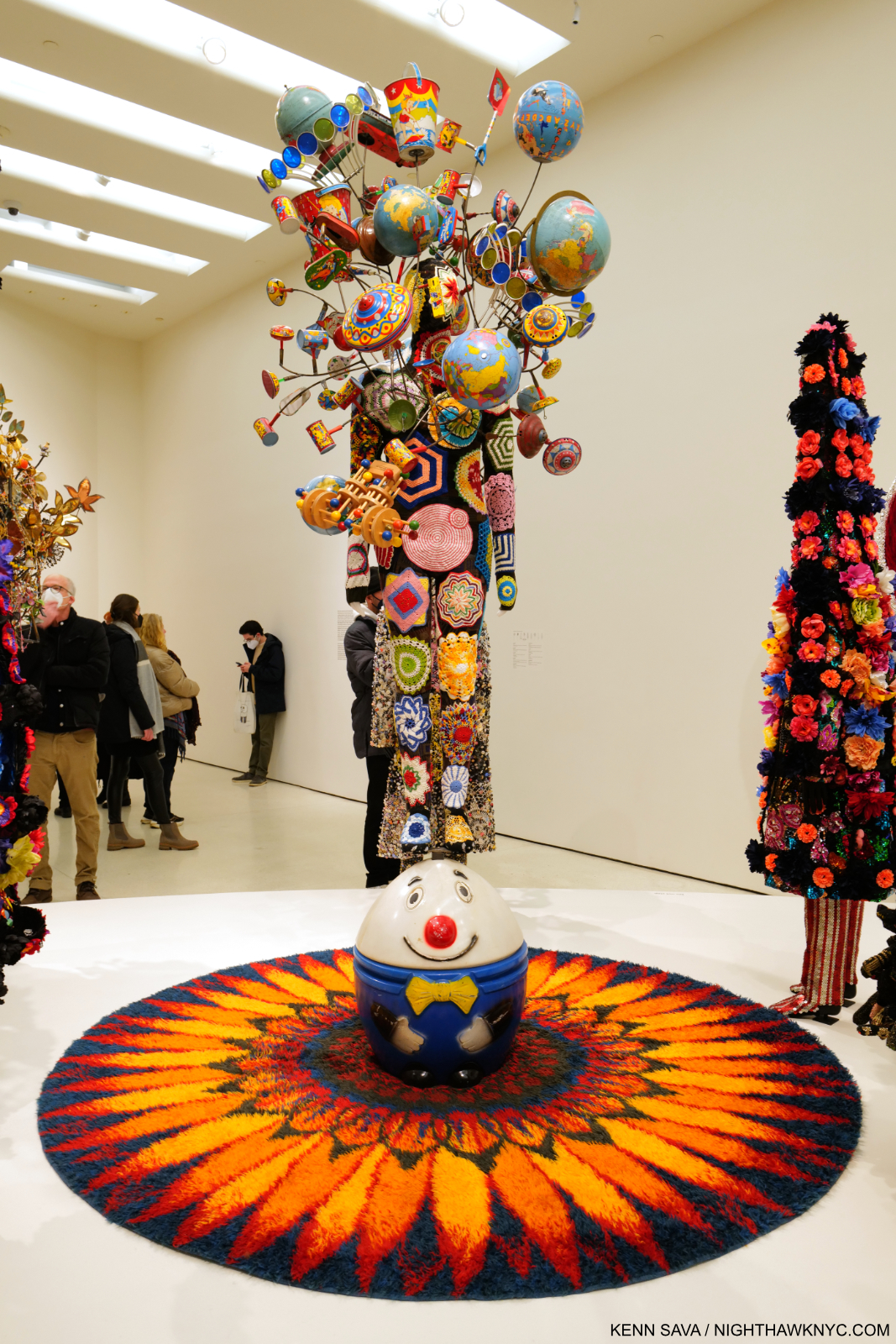
Soundsuit 2012 Mixed media including embroidery, fabric, vintage toys, rug, and mannequin Soundsuit: 127 × 98 × 93 inches

Best known to this point for his ongoing series of Soundsuits– works that combine all the processes listed earlier in an ultimate manifestation of that “thick skin” he referred to, that a performer then wears as one of many in  one of Mr. Cave’s joyous and bombastic performances. For display, the performer is replaced with a mannequin. The range of materials they have included over the years would fill a Sears Roebuck catalog. In spite of the long history of both fashion and theater, I have seen virtually nothing like them3. The Soundsuits brought him immediate fame. Their origin may be lesser known-

“The first Soundsuit was in ’92 in response to the Rodney King incident, the L.A. riots. I was sitting in the park one day  and just sort of thinking about, What does it feel like to be  discarded, dismissed, profiled?
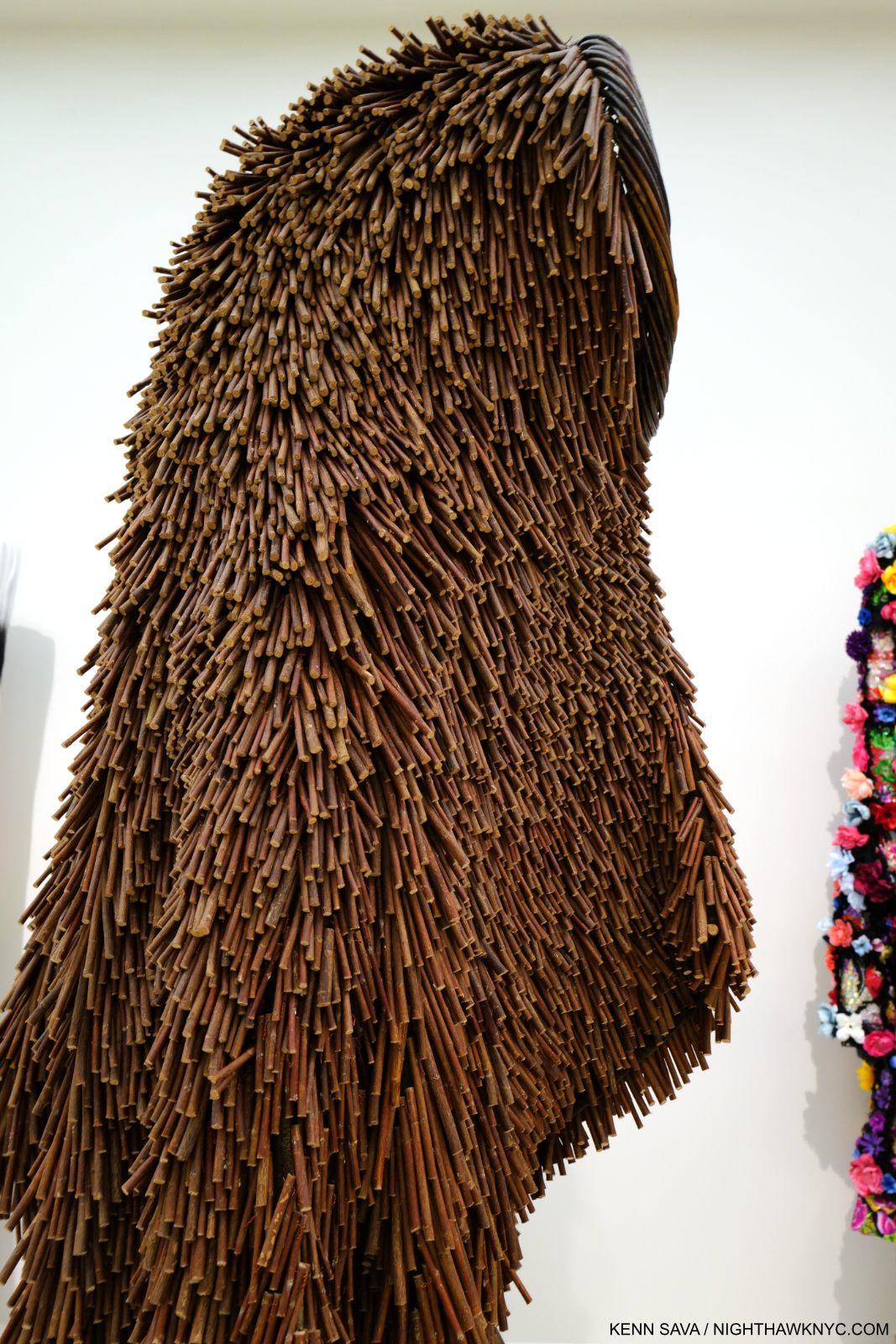
There was this twig on the ground. And I looked at that twig as something discarded. And then I proceeded to just start collecting the twigs in the park. And I brought them all back to the studio. And then I started to build this sculpture. I started to realize that the moment I started to move in it, it made sound. Then it just literally put everything in perspective. I was building this suit of armor, something that I could shield myself from the world and society. And so out of that came this sculpture-performative kind of work.”4

Detail of a Soundsuit made largely from twigs. Soundsuit, 2011, Twigs, wire, upholstery, basket, and metal armature, 83 × 27 × 40 inches. Seen in full from the side in the next picture.

That “discarded” and “forgotten” twig set a precedent for the materials he’s used in his Art since, a collection of objects and materials that seems encyclopedic, some of which speak to Mr. Cave of his childhood, when objects like figurines were cherished family possessions. This creates a duality whereby even though a number of the objects he incorporates are offensive, even disgusting (like the spittoon in Sea Sick), it’s very hard not to see “beauty” and “Art” in Nick Cave’s work, particularly in how masterfully he combines everything in ways that are reminiscent of Duchamp, Rauschenberg and Betye Saar, among others, though in entirely his own way. In so doing, he’s forged a style without having one style. Along with the beauty, there’s an undeniable joy in a good deal of his work, which reaches its zenith, perhaps, in his live performances with dancers performing in his Soundsuits in a communal celebration.

Soundsuits. From left, Soundsuit, 2022 with vintage bunny, Soundsuit, 2015 with synthetic hair, Soundsuit 9:29, 2021-2022, Soundsuit, 2011 shown in the prior picture, Nick Cave, Soundsuit 9:29, 2021, Soundsuit, 2019, and Soundsuit 8:46, 2021, far right.

Yet, in spite of their outward appearance, all is not joy with his Soundsuits. Mr. Cave reveals how he sees them-

“I don’t ever see the “Soundsuits” as fun. They really are coming from a very dark place. The “Soundsuits” hide gender, race, class. And they force you to look at the work without judgment. You know, we tend to want to categorize everything. We tend to want to find its place. How do we, sort of, be one on one with something that is unfamiliar?”5

“I think after the first Soundsuit, I had a different approach to art making. And I realized that I was an artist with a conscience. The moment I did was the moment that  my life literally turned upside-down. I think it’s just me kind of experimenting. It’s like, you know, a scientist  exploring alternative ideas.”6

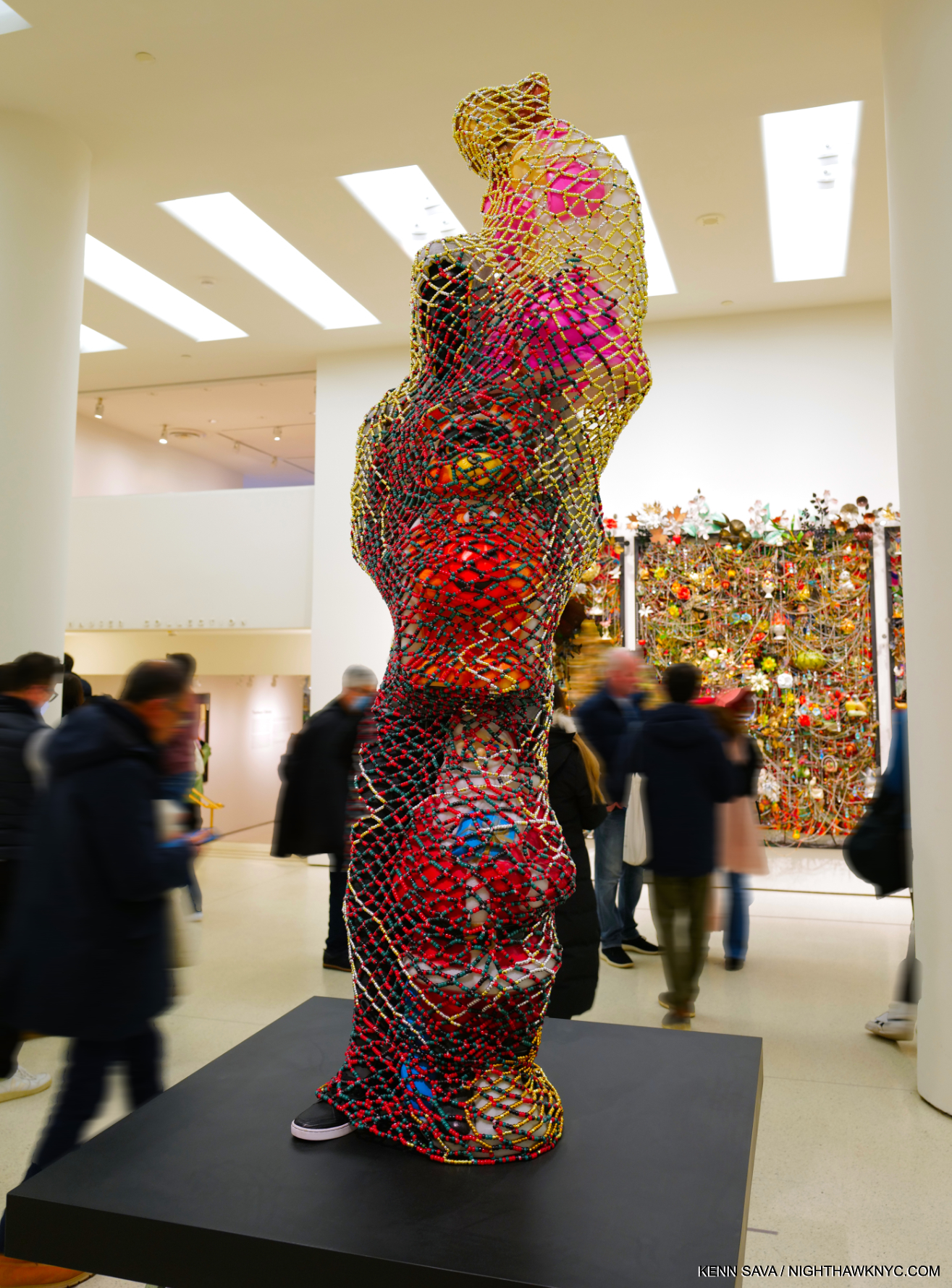
TM13, 2015. Mixed media including vintage blow molds, pony beads, pipe cleaners, mannequin, and garments, 89 × 48 × 49 inches. The Trayvon Martin Soundsuit.

Trayvon Martin is a new work  that was shown at Cranbrook. It’s made up of a Black mannequin dressed  in a hoodie and sneakers and jeans. And then surrounding its body  is these plastic blow molds. Which are, like sometimes at Halloween, there are these plastic forms  that are set out in yards. And so they are surrounding this  sort of figure almost as guardians. But then over top of the entire structure is  this web that’s constructed out of pony beads. So from a distance, it looks like this amazing sort of gold  sculptural form until you get up close and you realize that there  is someone trapped inside.” 7

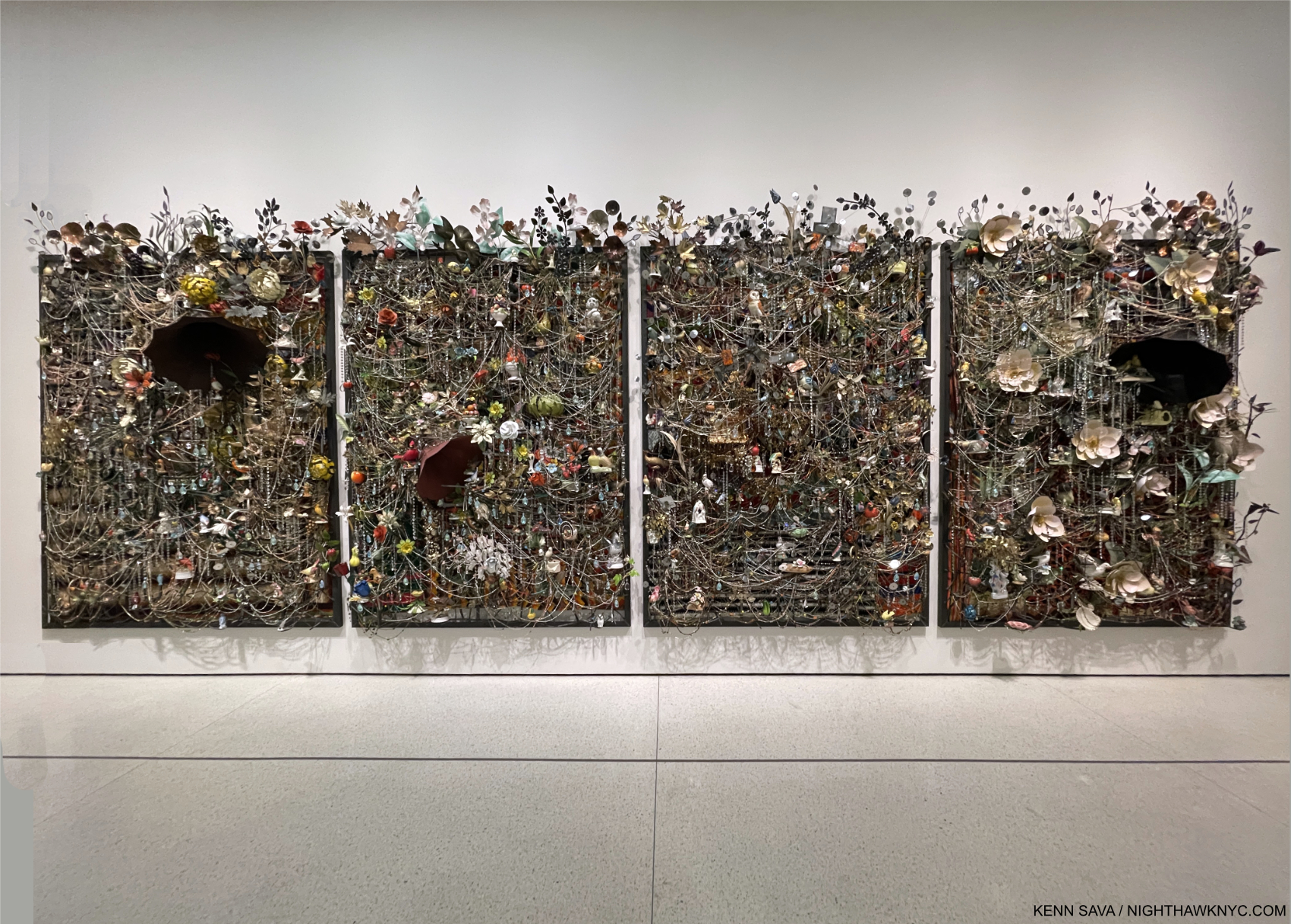
Wall Relief, 2013, Mixed media including ceramic birds, metal flowers, afghans, strung beads, crystals and antique gramophone
4 panels: 97 × 74 × 21 in., each. Perhaps the most complex work on view among many very complex pieces.

“The title (“Forothermore”) is a neologism, a new word that reflects the artist’s lifelong commitment to creating space for those who feel marginalized by dominant society and culture—especially working-class communities and queer people of color. The show both highlighted the development of Cave’s singular art practice and interrogated the promises, fulfilled or broken, that the late 20th and early 21st centuries offered to the ‘other,'” the Guggenheim said.

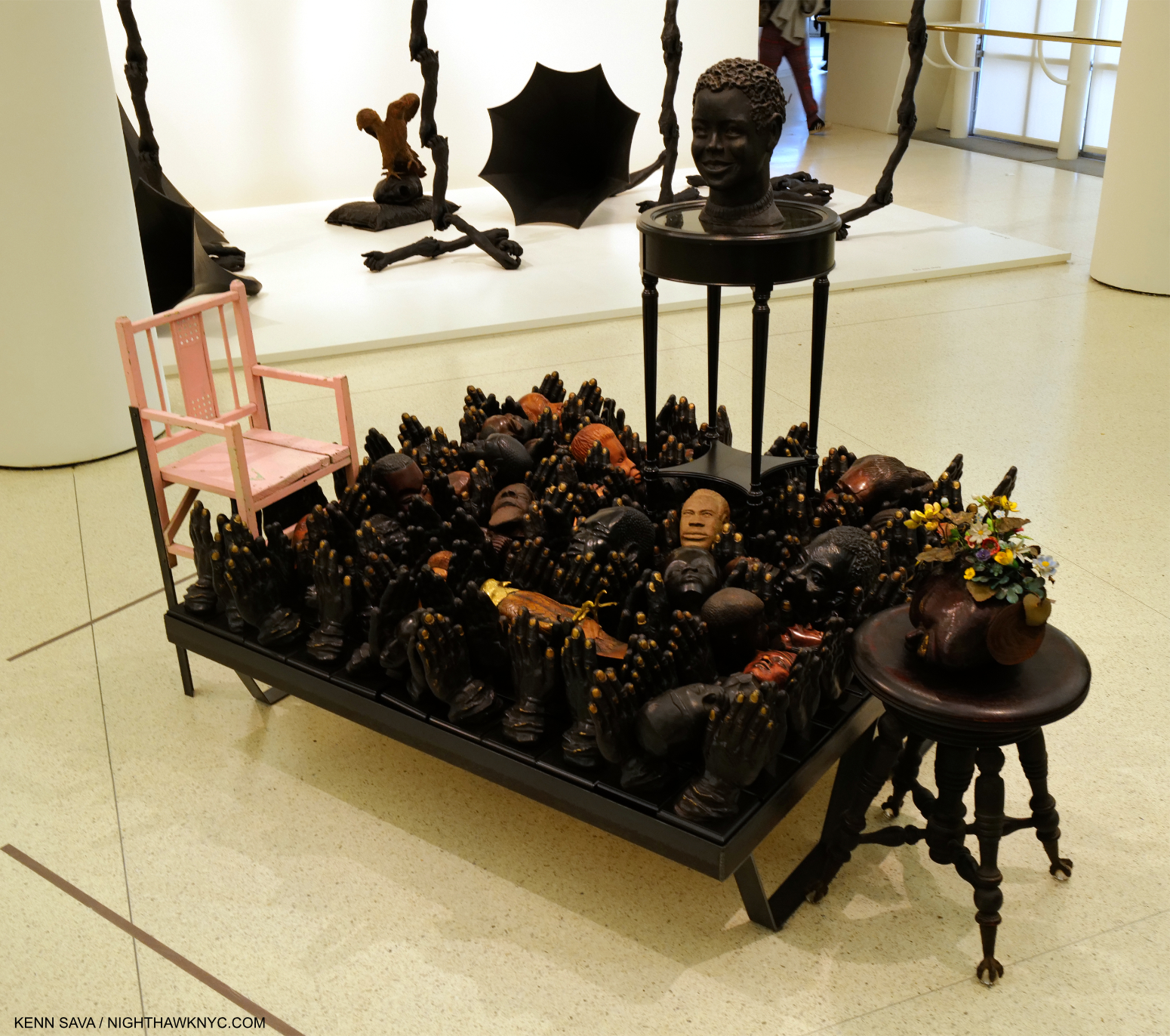
Untitled, 2018, Mixed media including round table, clay head, piano bench, carved head with vintage tole flowers, child pink chair, 19 carved heads, 1 carved eagle, cast polyurethane hands, 52 1/8 × 52 1/8 × 61 inches

“You know, I think at the end of the day,  it’s me giving back to the community  and being this sort of change agent. I want to change our way of  engaging with one another. I want to use art as a form of diplomacy. That’s why I’m in this state of urgency right now. And I don’t know. I just feel so unsettled. I’m doing what I’m doing, but I’m not sure if it’s happening fast enough.”8

Detail of Tondo, 2022, Metal mesh, hardware cloth, bugle beads, wire, sequin fabric and wood.

Nick Cave is rewriting the power of Art, to paraphrase Simon Schama. He’s doing it by channeling horror and pain- both experienced by others, and by himself, into “lashing out” by creating. And, he’s doing so in ways never before seen. I see a lot of Art, and I see a lot of shows. It’s not often that I am awestruck by an Artist’s creativity, but I am by Nick Cave’s. Still, it’s hard to really get a full sense of Mr. Cave’s extraordinary gifts. If Nick Cave can produce such beautiful and powerful work in a world like this, I can’t help but wonder what he’d create in a world without racism.

*- Soundtrack for this piece is “Peace,” by Gil Scott-Heron, a Bonus track from the 2014 reissue of his 1971 album Pieces of a Man.

Thank you, Maddie.

SPECIAL ADDENDUM- The NYC MTA recently completed the installation of Nick Cave’s monumental, 4,600 square feet, 3-part, permanent Public Art piece, Each One, Every One, Equal All, in the subway under Times Square, the latest in their absolutely stellar on-going series of Public Art projects for the NYC subway. It rivals Sarah Sze’s entire subway station installation (which I showed here) for the largest Art work in the NYC subway system. It took multiple trips to fully see the whole thing, and my look at it can be seen here.

NighthawkNYC.com has been entirely self-funded & ad-free for over 8 years, during which 300 full-length pieces have been published! If you’ve found it worthwhile, PLEASE donate to allow me to continue below. Thank you, Kenn.

You can also support it by buying Art, Art & Photography books, and Music from my collection! Art & Books may be found here. Music here and here.

Written & photographed by Kenn Sava for nighthawknyc.com unless otherwise credited. To send comments, thoughts, feedback or propositions click here. Click the white box on the upper right for the archives or to search them. Subscribe to be notified of new Posts below. Your information will be used for no other purpose.

Rod Penner’s America: Small Town Nation

This site is Free & Ad-Free! If you find this piece worthwhile, please donate via PayPal to support it & independent Art writing. You can also support it by buying Art & books! Details at the end. Thank you.

Written & Photographed by Kenn Sava

Show Seen- Rod Penner: Small Town Meditations – Traveling exhibition seen in NYC @ Meisel Gallery

“America: A Nation of Small Towns”
Title of the 2020 United States Census Report.

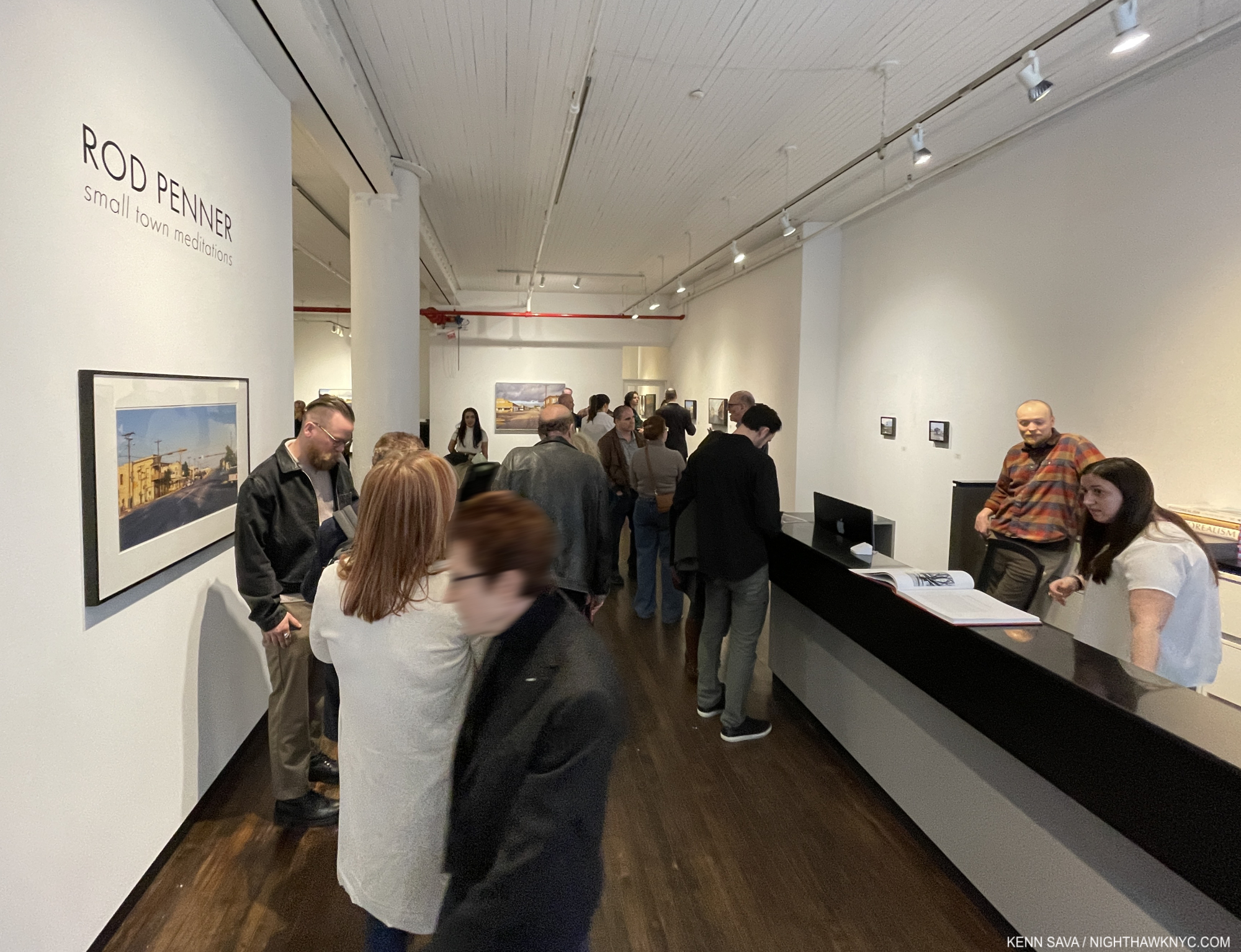
Small towns in the big town. The opening, NYC, March 18. 2023.

I’ve already written as much, and maybe more, than anyone else has about Rod Penner’s Art over the past six years. Most recently, I wrote my fifth Penner piece, an extensive look and the first anywhere, at the first full-length book on his work, Rod Penner: Paintings, 1987-2022. If Mr. Penner’s work speaks to you and you haven’t seen a copy, make a point to. It accomplishes the rare double feat of being equal parts long-awaited full-length Monograph and Catalogue Raisonne, containing everything he’s Painted through 2022, in one volume. All of this being said, my pieces on his Art were based on seeing one show of smaller Paintings in 2017 and two works in a prior group show. This spring, I finally had a chance to see a show with a more representative overview of his work going back to 1998. I came away feeling I saw much in his work I hadn’t seen before.

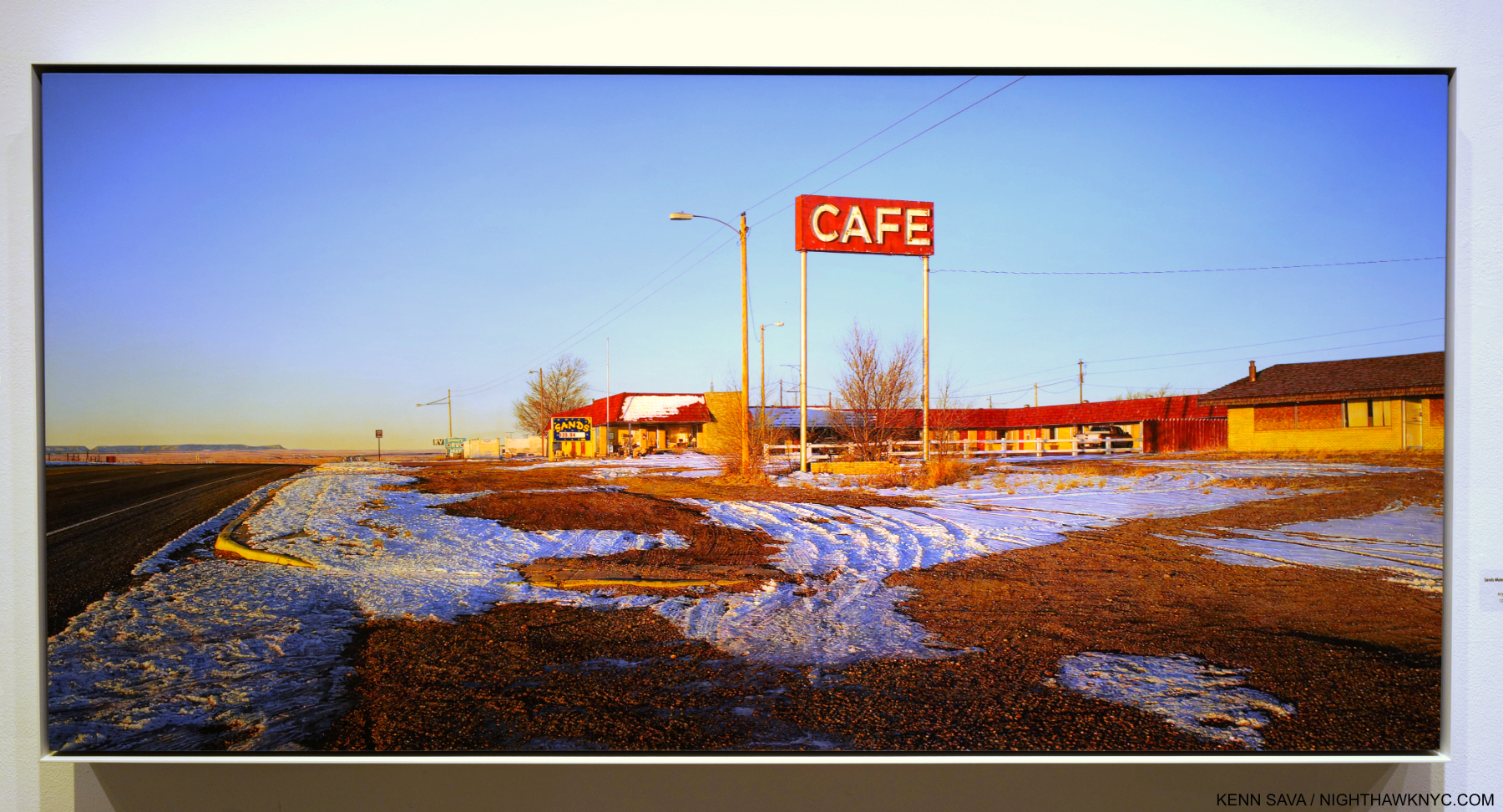
My only previous Rod Penner solo show, in 2017, consisted solely of 6 by 6 inch and 5 by 7 inch Paintings, each jam-packed with detail. Though Sands Hotel & Cafe/Vaughn, MN, 2019, Acrylic on canvas, is a huge 31 by 64 inches (almost 5 1/2 feet long!), the detail is every bit as stunning, representing a staggering amount of work. I continually get lost looking at the fore and mid-ground in what strikes me as a bit of an unusual composition. But, of course, there’s much more to it. Click for full size.

Rod Penner: Small Town Meditations consisted of a group of 17 Paintings that establish Mr. Penner as the foremost Painter of small town America working today, inheriting the mantle from John Salt, and Charles Sheeler & Edward Hopper before the late Mr. Salt (1937-2021).

John Salt, Red Mailbox #2, 2015, Casein on linen, 45 x 65 inches. Seen in 2018 in the same space occupied by Rod Penner: Small Town Meditations. Casein is a water soluble medium that derives from milk casein, and is used masterfully here to create such a rich, yet mysterious, atmosphere.

Rod Penner was born & raised in Canada before marrying his wife, Debbie, and relocating to Texas in 1988, where the majority of his work is set. In the Q&A I did with him in 2017, the Artist said this about the beginning of his Painting career-

“Shortly after arriving in the Lone-Star State, I rediscovered the work of John Salt and felt an instant connection. I couldn’t drive past a trailer home (and there are many in Texas) without thinking “Salt.” At this point, I wanted to spend more time in the studio and less time searching out subjects to paint, so I started driving around the town we lived in and took photos of these tract houses that were everywhere. I found them visually interesting. As with all the streets and buildings that I paint, these homes, under certain weather and lighting conditions, became transformed. I painted my first tract house in 1989 and it sparked a series of paintings that were later shown at O.K. Harris in NY.”

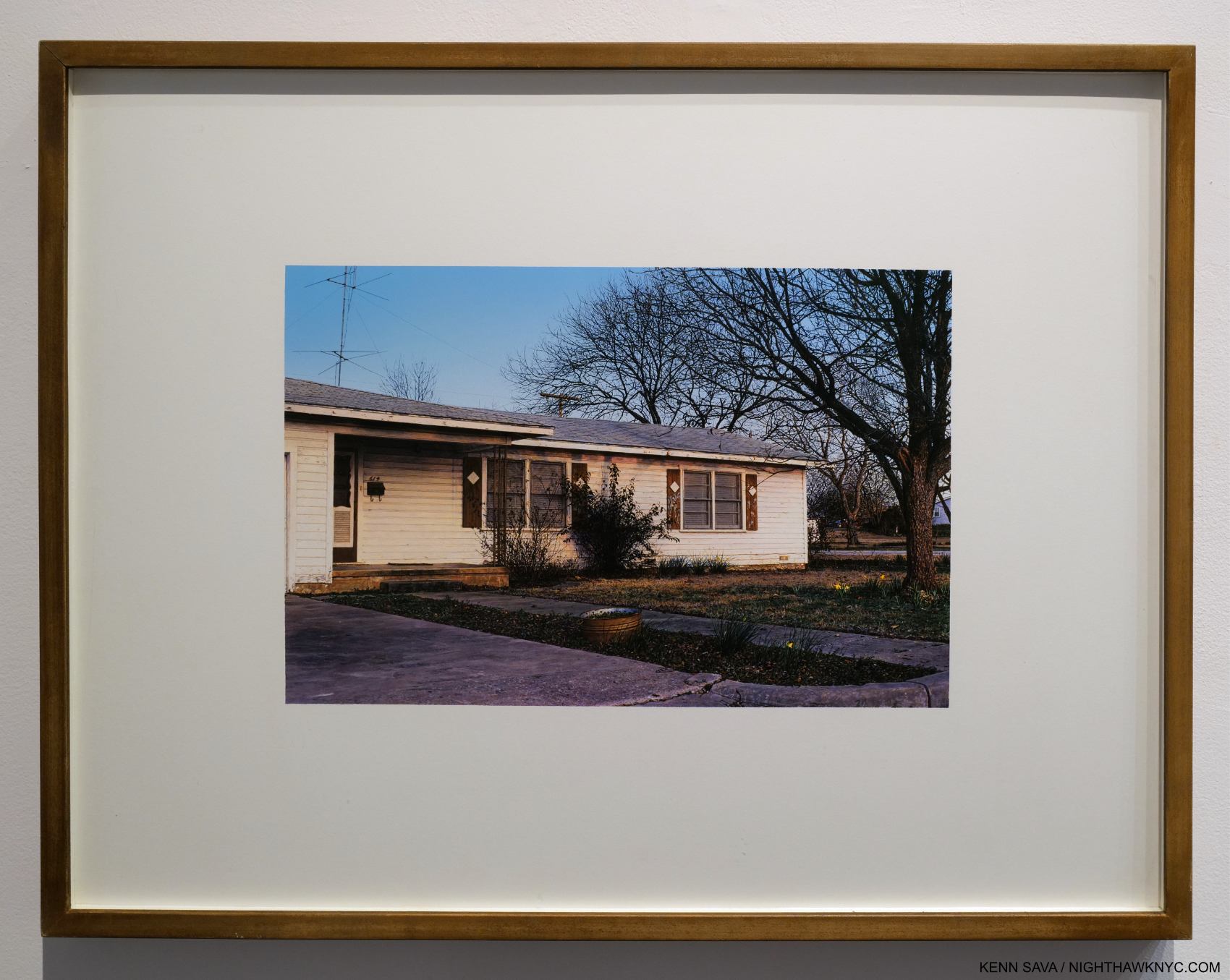
614/House with Daffodils, 1998, 10 1/4 x 15 inches, Acrylic on board.

While people appear in very few of his Paintings, right from the beginning, virtually every piece he’s created is rich with their presence. First, there’s what people have built on the land that signifies them. Then there’s the condition of these structures, which are steeped in individual modifications and adornment. Some are in need of attention; perhaps a new coat of paint or repairs. It seems that the occupants are too busy living in them to do them right now. In addition to the building, we often see the evidence of human habitation: toys, tools or lawn implements in the yard; though vehicles are not seen nearly as often as they are in John Salt’s homestead works where they are one of his trademarks. Combined with the lived-in condition of the house all of this makes for a de facto “Portrait” of its inhabitants, in my view. His work is rich in character, one thing that sets him apart. Character adds an incalculable amount of depth to his Paintings. In a larger sense, his work is a “Portrait” of how, and where, many Americans lived in the last half of the 20th and early parts of the 21st centuries.

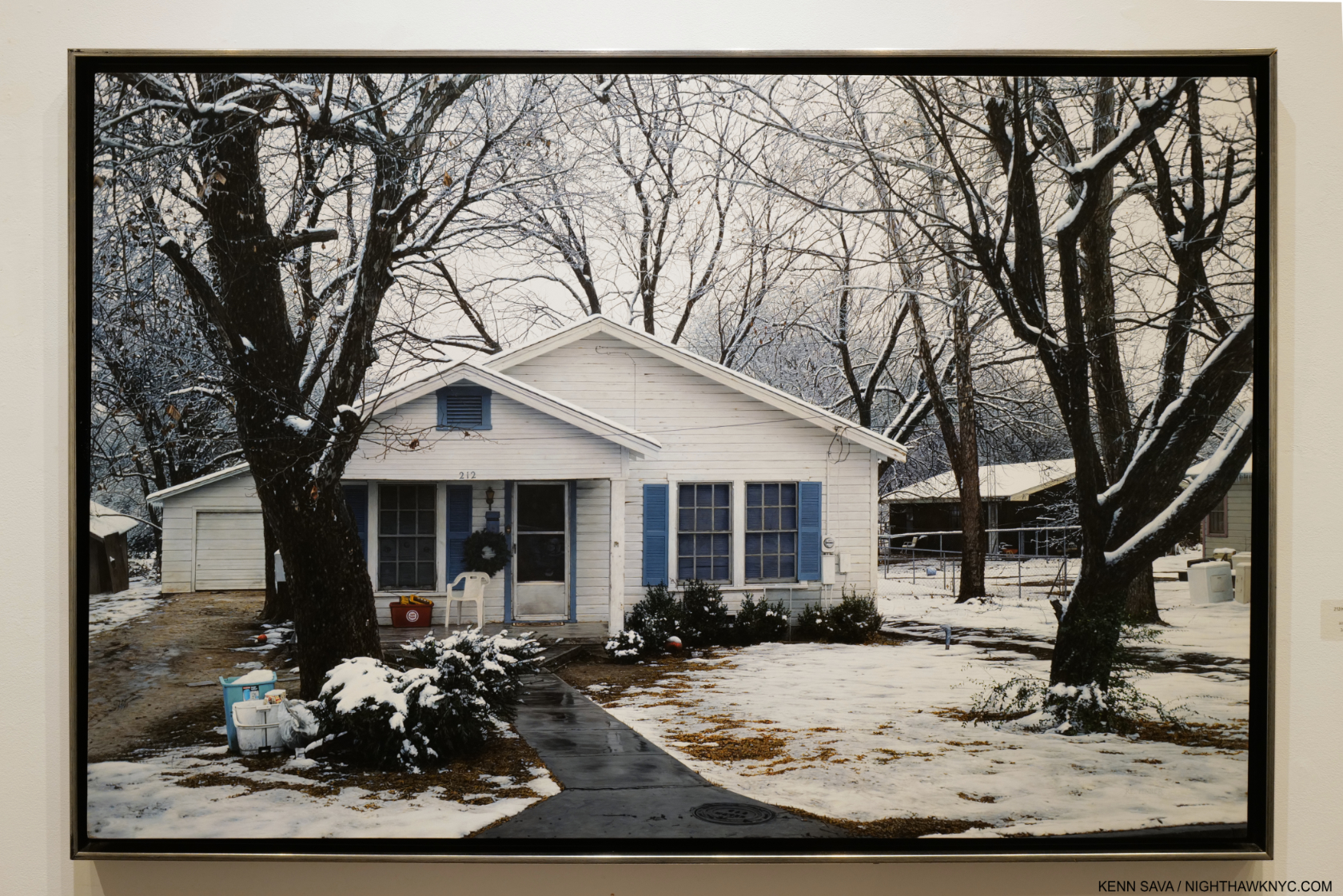
212/House with Snow, 1998, 36 by 54 inches, From here on, all works shown are Acrylic on canvas unless noted.

The idea of “home” looms large in Rod Penner’s oeuvre, striking me as one of his main themes, be it in actual houses or motels (temporary homes), like Sands Hotel & Cafe/Vaughn, MN, 2019, shown earlier. None of his homes are palatial. Rather, they are all well lived-in. The roofs and paint look weather-worn, as if they’ve survived countless storms or harsh winters. It’s easy to make this fit the “Portrait” analogy. A number of his Texas scenes include snow- something the rest of us may have trouble associating with one of America’s southern-most states, but the terrible storms they’ve had these past years are changing that. Snow makes these scenes look they could have been seen in many other places in the country. Yet, in spite of it all, they’re still standing, and much of the same can no doubt be said of whoever lives in them.

212/House with Snow, 1998, a masterpiece in my view, sums up so much about the broad and vague idea of “home.” For me, that doesn’t necessarily mean a place; A person could be “home” for someone, and much of what I see here, and the feelings it generates, would still apply. Like virtually all of Rod Penner’s Paintings 212 cries out to be seen up close.

How much you see in a Rod Penner Painting is only limited by how long you look at it.

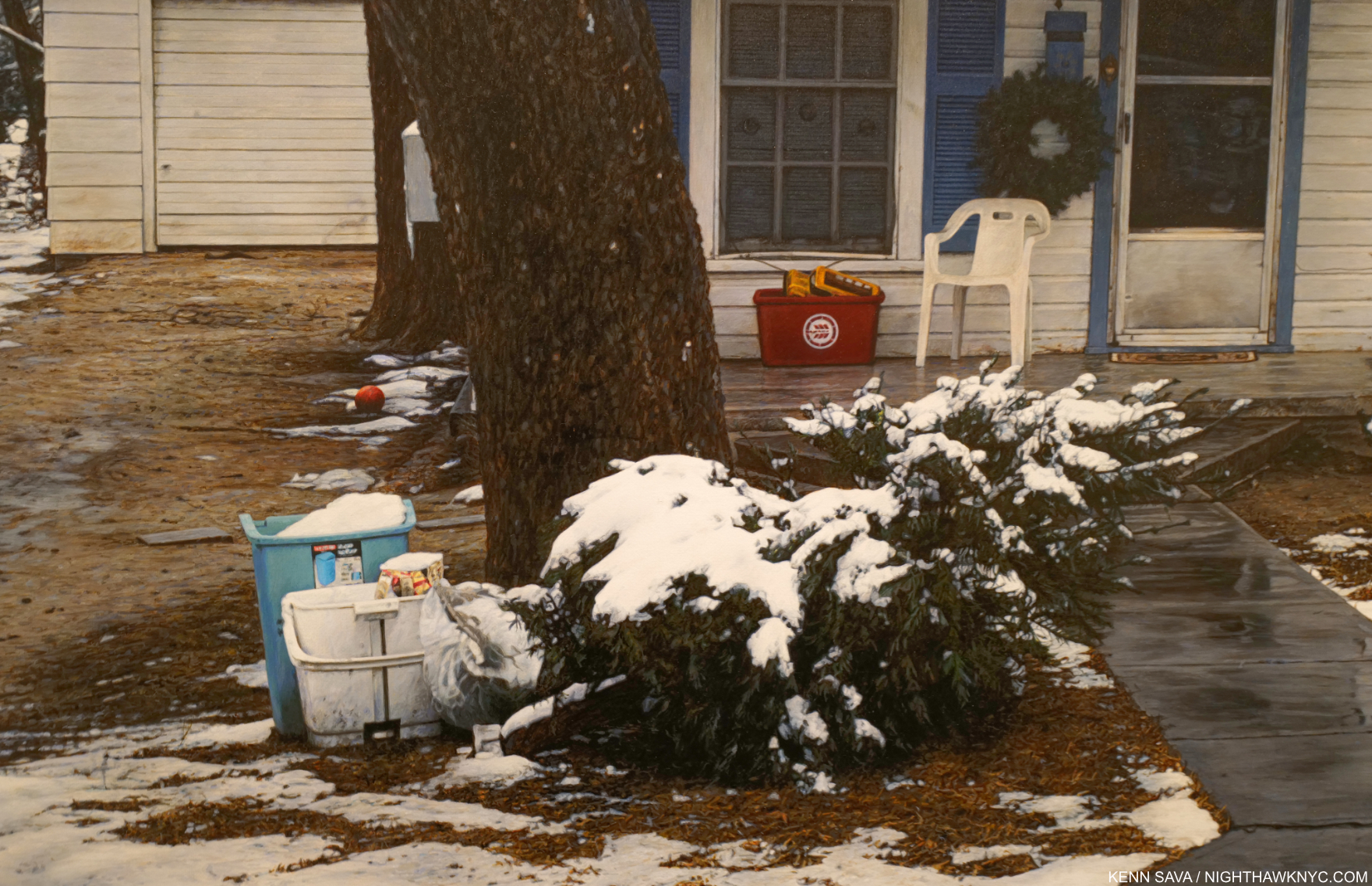
A number of his House Paintings are set during the Holidays. In this detail from 212/House with Snow, we see the Christmas tree lying diagonally in front ready to go out with the trash & recycling. A poignant image by itself. It’s been there a little while given it’s snowed since it was put there. A toy bus (maybe a Xmas present?) pokes out from a red box with an intricate logo on it- all in this stunning little section, which is typical of all of Rod Penner’s Paintings. Oh! That’s before you get around to admiring the incredible detail on the Christmas tree branches, the tree trunk behind it, or the condition of the paint on the house and garage! Then, there’s the ground…

Yet here, as in all Rod Penner’s work, in my opinion, he puts the detail at the service of Art. The detail is revelatory, like a well-turned sentence in a great novel, or like the floor in Jan van Eyck’s The Annunciation in Washington. It never preaches. It never gives too much away, leaving it all to the viewer. In fact, when I first met Mr. Penner, he was reluctant to speak about his Art. He told me he wanted his Art to speak for itself. Personally, I’m glad he has softened that stance a bit and has spoken about his work, especially in his Artist’s Statement in his book. I only wish the Art media respected what the Artist says about his/her own work more than what anyone else says about it.

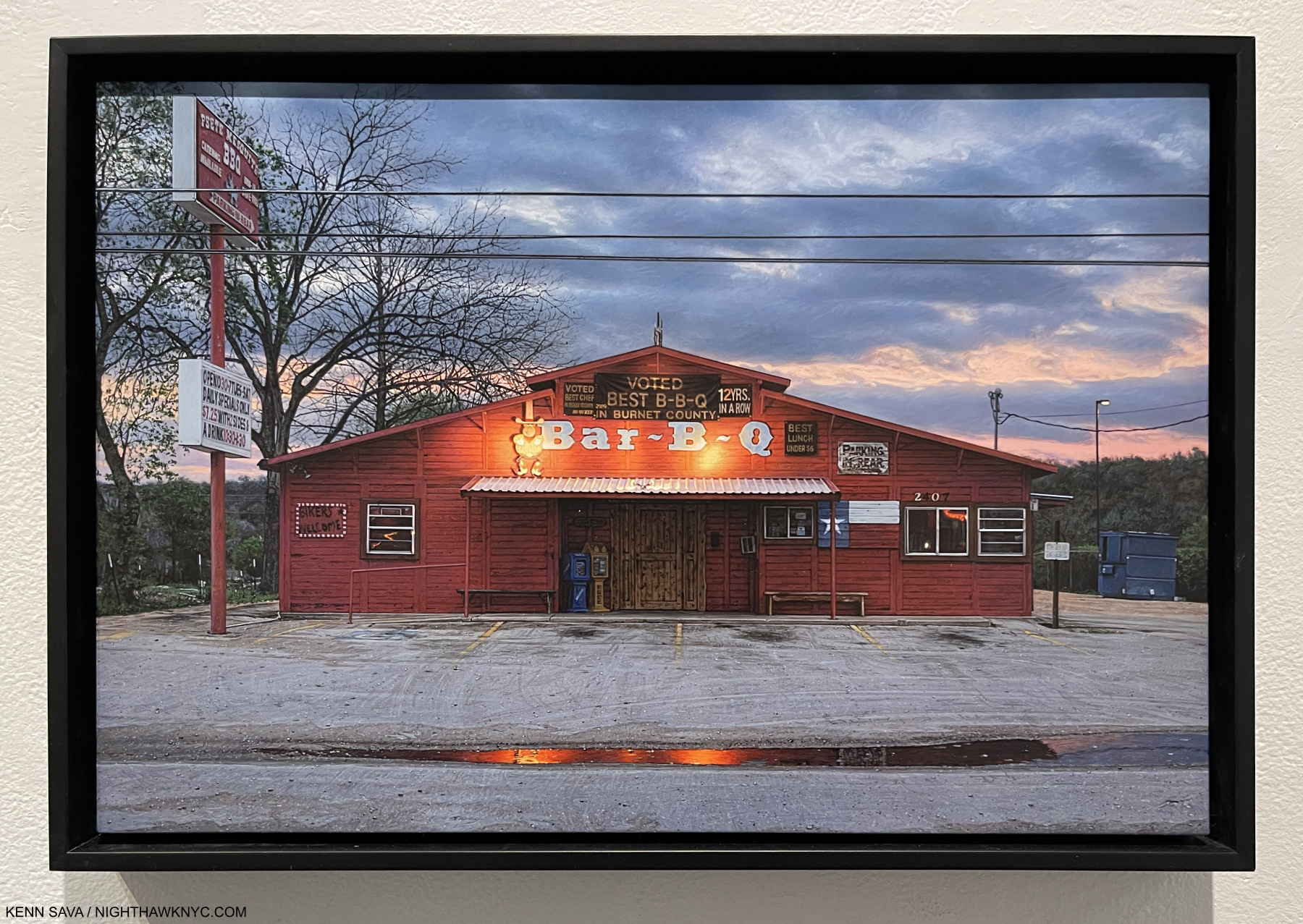
Bar-B-Q/Marble Falls, TX, 2022, 12 x 18 inches. The latest in a long and memorable series of roadside eateries and gas stations. Those foreshortened signs to the left must have been fun to Paint.

Another theme in his work is life on the move: gas stations and roadside eateries loom large here, in addition to motels.. This makes it apparent that the Artist gets around since every scene he renders he has visited in person. Sometimes, it’s hard to look at these and not smile. What may be Mr. Penner’s subtle sense of humor can be at once poignant, and again tack sharp. In person, the Artist is quick to smile, so it’s hard not to see that coming across in his work at times. At the March opening, two visitors were present who had traveled all the way from Marble Falls, TX for it. Well-familiar with the real-life Bar-B-Q back home, it must have been a strange, but welcoming, feeling to see its likeness hanging on the wall in a SoHo gallery thousands of miles from home.

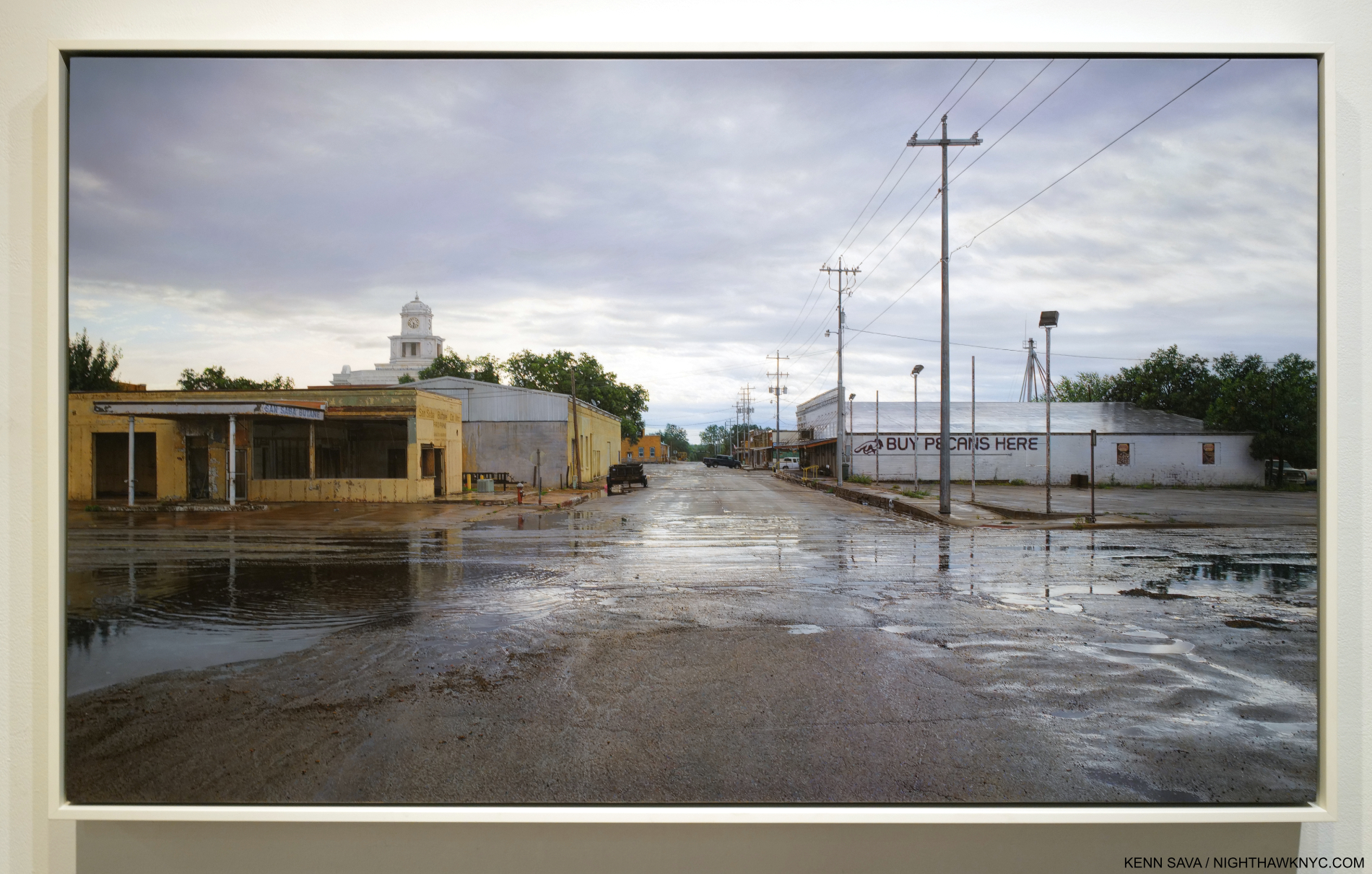
Buy Pecans Here/San Saba, Tx, 2021, 31 by 52 inches.

Buy Pecans Here/San Saba, Tx, 2021 marks Rod Penner’s return to large Painting after his series of small San Saba pieces I saw in his last NYC solo show. When I look at this, I see an early 21st century “History Painting.” The Old Masters famously rendered scenes from history, usually in suitably large scale. Here, Rod Penner shows a number of stages of San Saba’s history in one scene in the recent past (2021). In the back, San Saba County Courthouse, 1911, peaks out of the trees and rooftops, surrounded by what man has built in the area in the following 110 years, including telephone poles and power wires, which may now carry the internet, including NighthawkNYC. San Saba is known as the “Pecan Capital of the World,” so the appropriately sized Pecan store sits stolidly on the earth occupying much of the right side as if anchoring that reputation. Further down the block on that side is G&R Grocery, behind the white pickup. Across the street in the rear the red brick of “Station” peaks out- that’s the only word left on its sign. Mr. Penner featured both of these buildings in his San Saba Series of small Paintings in 2016-7, which I showed here. Buy Pecans Here also got its own Painting. In the front left is another one, the former San Saba Butane Co., which he immortalized in a show-stopping small Painting of the same name, looking a bit more the worse for wear than it does even here. Yet, it’s still standing, seemingly waiting for what’s coming next. The ground weather and the skies add incalculably to the mood. An unfathomable amount of work must have gone into this Painting.

Like San Saba Butane, a number of the places he Paints are out of business. I don’t have to tell anyone how prevalent that is, wherever you are, in the age of the pandemic, before and “after.” Yet, it’s something rarely seen in Painting. Businesses opening, being active, and going out of business are part of the business cycle. That is the “history” I see in Buy Pecans Here/San Saba, Tx.

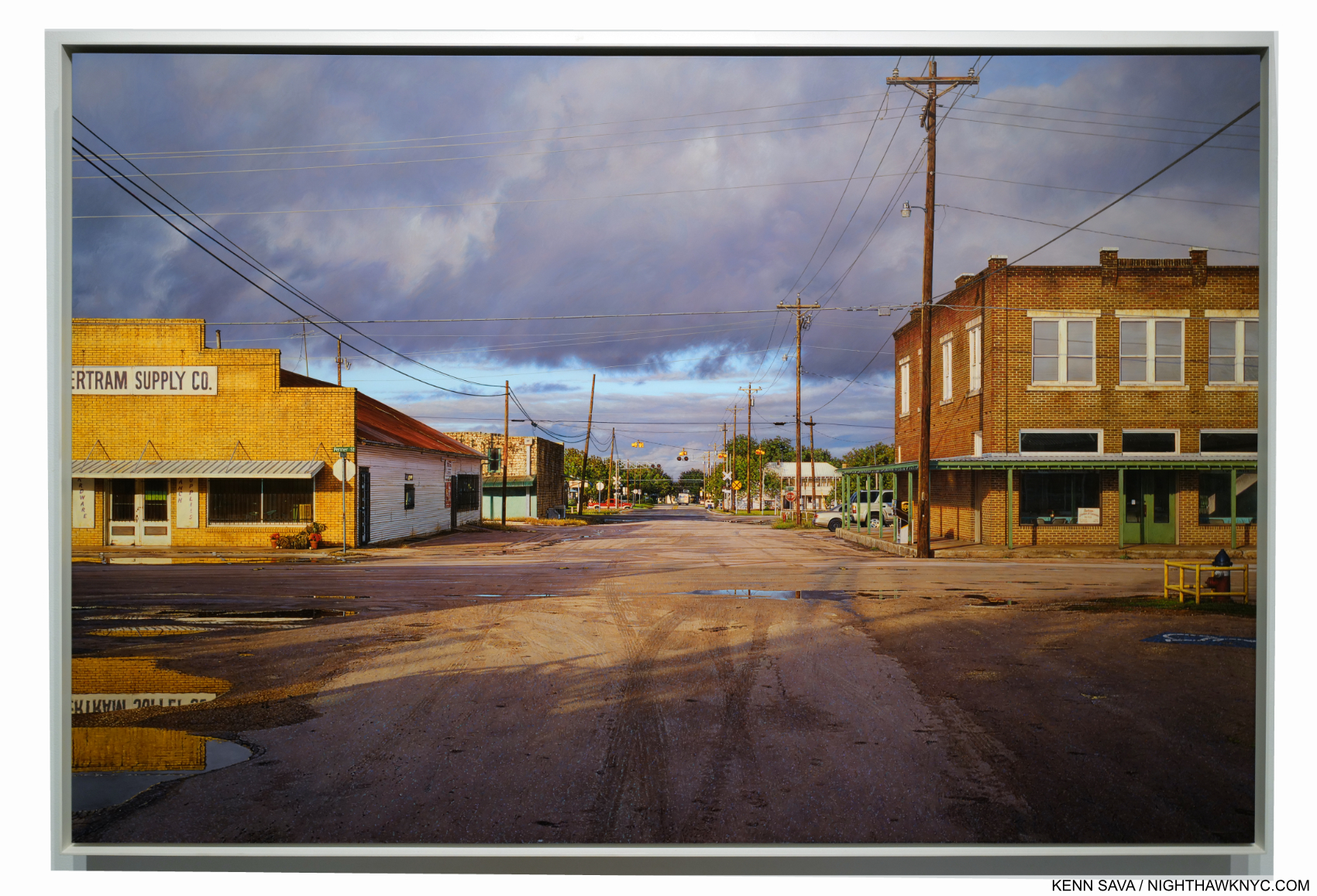
Bertram Supply Co., 2015-6, 31 by 52 inches.

Rod Penner Paints democratically. I’m not referring to politics. I’m using the word in its original meaning. That is that Rod Penner Paints everything he shows us with equal weight. Virtually everything, front to back, is in focus, like it is in many of Richard Estes’s Paintings. Everything is shown at the hyperlocal distance, as Photographers say1. Therefore, it’s up to each viewer to decide what’s important to the narrative they weave in their mind. It also allows for different scenarios at each viewing with different things standing out each time.

Compositionally, it seems to me that many, if not most, of Mr. Penner’s Paintings, and all those shown here, consist of three horizontal “bands” or areas. He presents the sky in a top band, the buildings/main subjects in the center band, and the ground weather in the lower/foreground band. One of the subtler joys of Rod Penner’s work is that he is a master of rendering the ground effects of weather (i.e. rain, snow, graupel, mud, or the baked naked earth), a bit like JMW Turner was a master or rendering skies (in a completely different way, of course). The ground weather is a unique, and often stunning, part of most of his Paintings, easy to overlook, but not to be missed. The detail they contain is astonishing and in addition to adding so much to the “narrative,” they also hint at how much time and thought went into every inch of his Paintings- regardless of size.

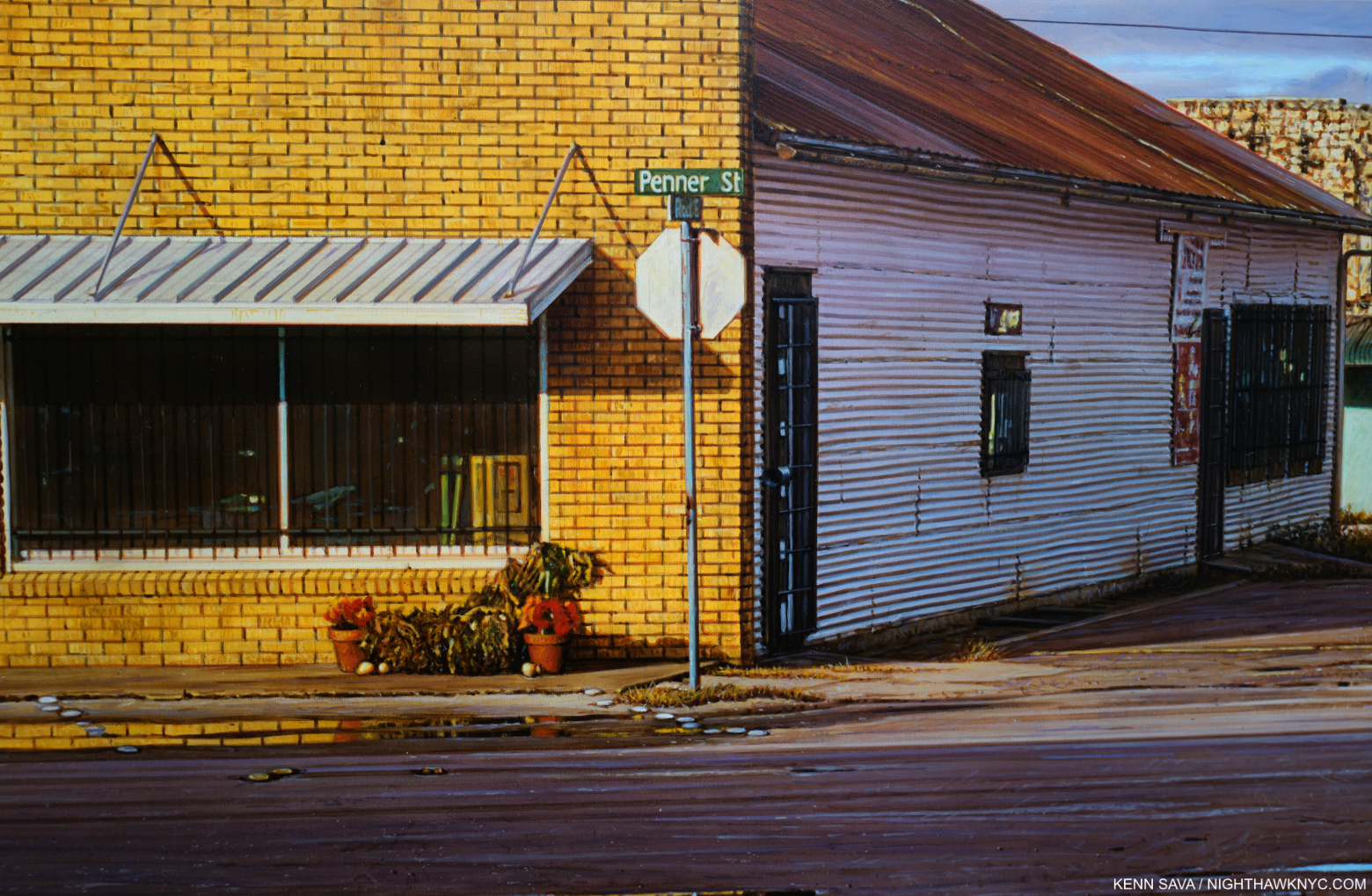
Welcome to PennerVille. A close look at Bertram Supply Co., reveals the Artist’s name on the street sign, with “Rod E.” foreshortened for the cross street sign under it, indicative that he’s put his name on this scene. It’s becoming his genre.

Rod Penner: Small-Town Meditations sums up in capsule form Rod Penner’s accomplishment. To me, that is nothing less than preserving the lives that countless Americans have lived these past 40 years in paint. Rod Penner is creating a body of work that defines and preserves what a good deal of America- small town America (which most of America consists of)- is and has been like these past 4 decades as much, if not more, than any other Artist has.

Having said that, I would also add that I’m not sure that that’s his point! It may be. Or, it may simply be what I’m seeing in his work. His Art is open-ended enough so that everyone is free to see in it what they will.

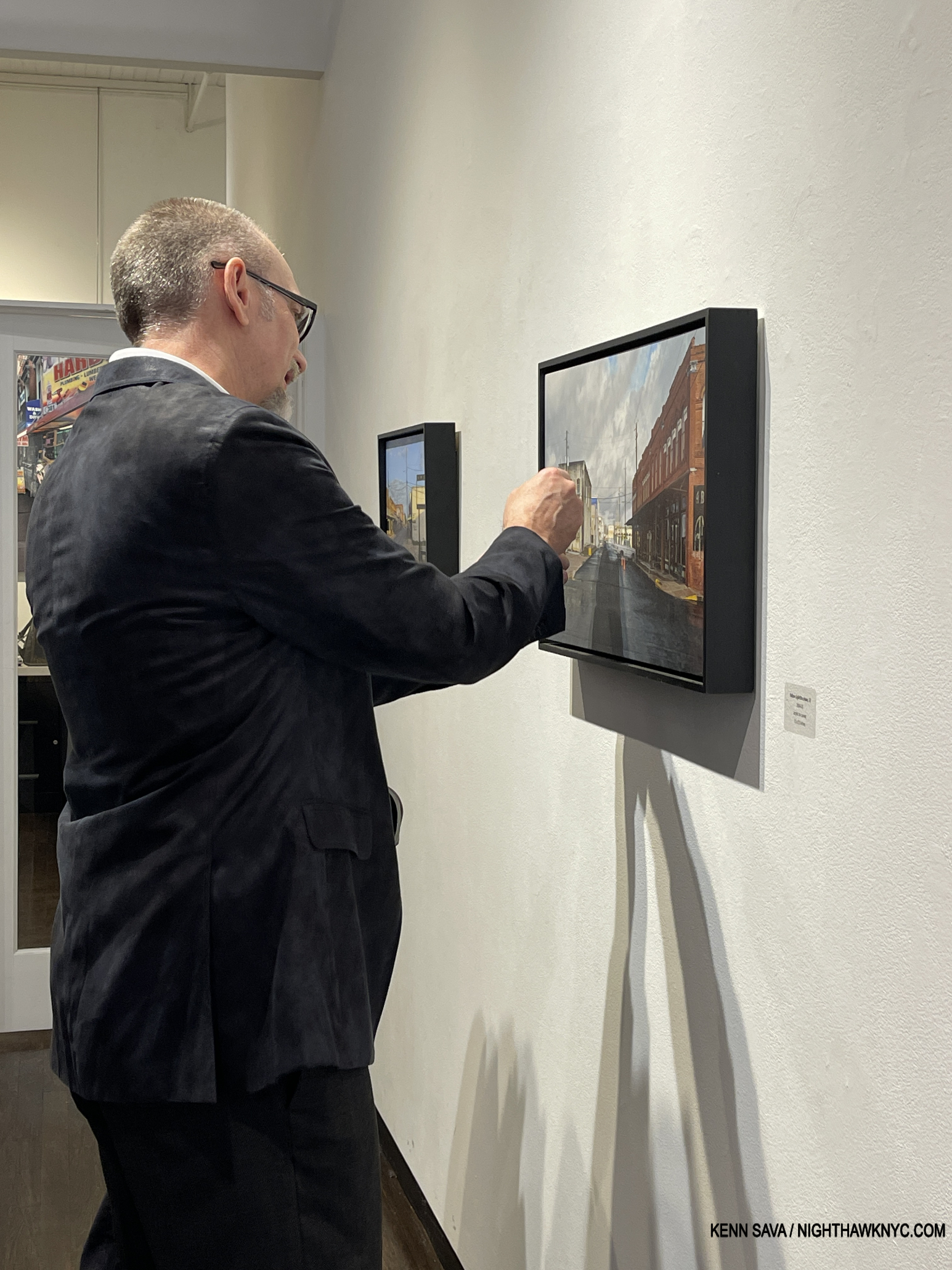
Rod Penner discussing how he created some of the detail in Yellow Light/Brenham, TX, 2004-5, 15 x 25 inches with a visitor behind him at the opening, March 18, 2023.

Saying all of this would seem to overlook the most obvious characteristic of Rod Penner’s Paintings: his world-class technique. His technical skill (readily seen in the details from Bertram Supply Co., or 212/House with Snow, above) approaches the level of the Old Masters. Yet, technique, by itself, does not make Art. In Rod Penner’s case, his technique is only the beginning of the story. Every time you look at his work, you get to write your own ending for it. 

*- Soundtrack for this piece is “Small Town” by John Mellencamp.

My prior pieces on Rod Penner are-

The Vermeer of Marble Falls, Texas,”April 28, 2017

“Rod Penner: Brilliance, Under Cloudy Skies,” June 10, 2017

Q&A With Master Painter Rod Penner,” June 14, 2017

Rod Penner’s Neighborhood,” August 3, 2017

and- “NoteWorthy Art Books- Rod Penner: Paintings, 1988-2022,” April 7, 2023.

NighthawkNYC.com has been entirely self-funded & ad-free for over 8 years, during which 300 full-length pieces have been published! If you’ve found it worthwhile, PLEASE donate to allow me to continue below. Thank you, Kenn.

You can also support it by buying Art, Art & Photography books, and Music from my collection! Art & Books may be found here. Music here and here.

Written & photographed by Kenn Sava for nighthawknyc.com unless otherwise credited. To send comments, thoughts, feedback or propositions click here. Click the white box on the upper right for the archives or to search them. Subscribe to be notified of new Posts below. Your information will be used for no other purpose.

  1. The focus distance at a given aperture on a lens where everything after that point is in focus, and somethings before are as well, depending on the settings and the lens.

Jaune Quick-to-See Smith’s Survival Map

This site is Free & Ad-Free! If you find this piece worthwhile, please donate via PayPal to support it & independent Art writing. You can also support it by buying Art & books! Details at the end. Thank you.

Written & Photographed by Kenn Sava

Show Seen: Jaune Quick-to-See Smith: Memory Map @ The Whitney Museum

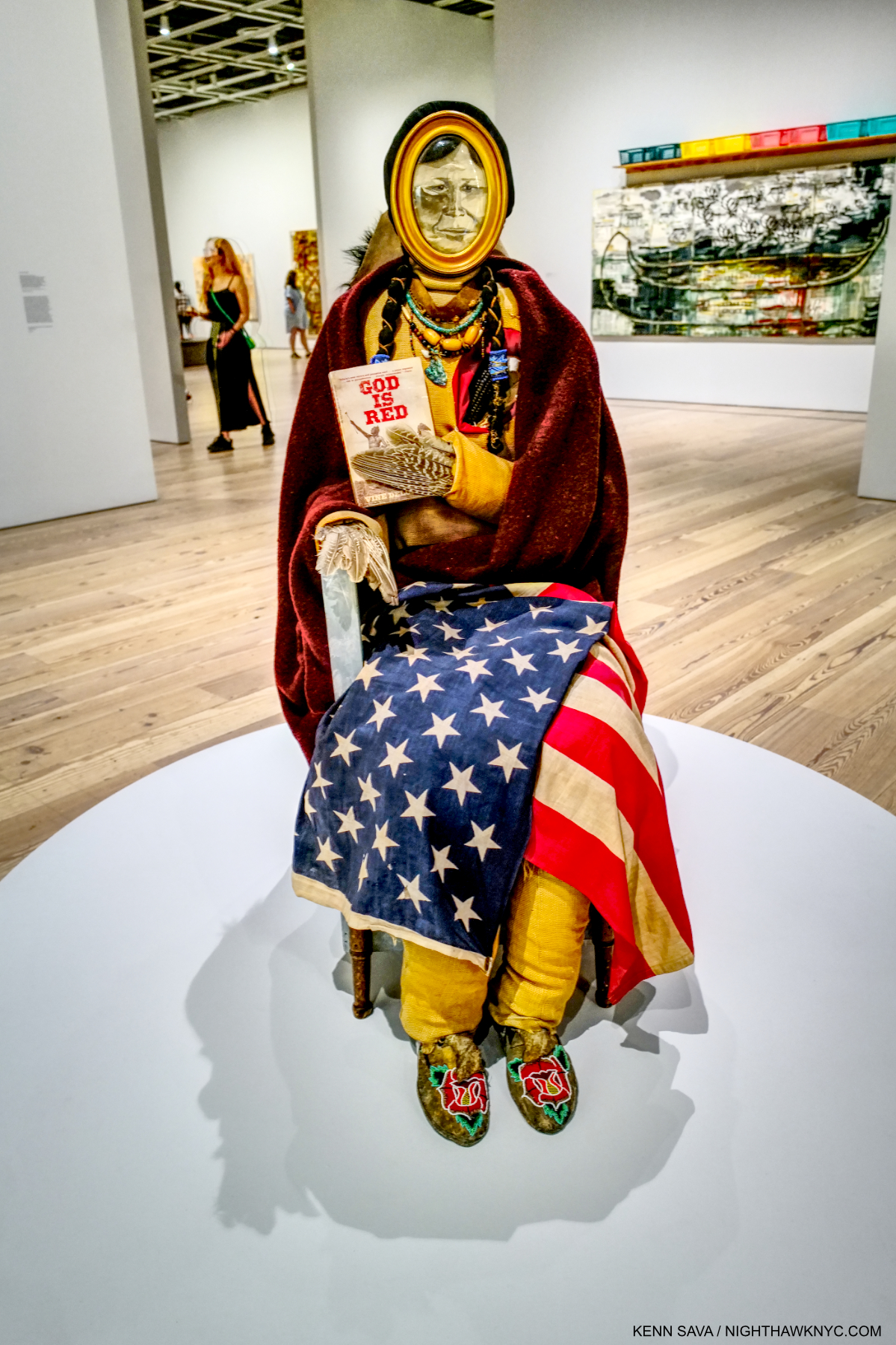
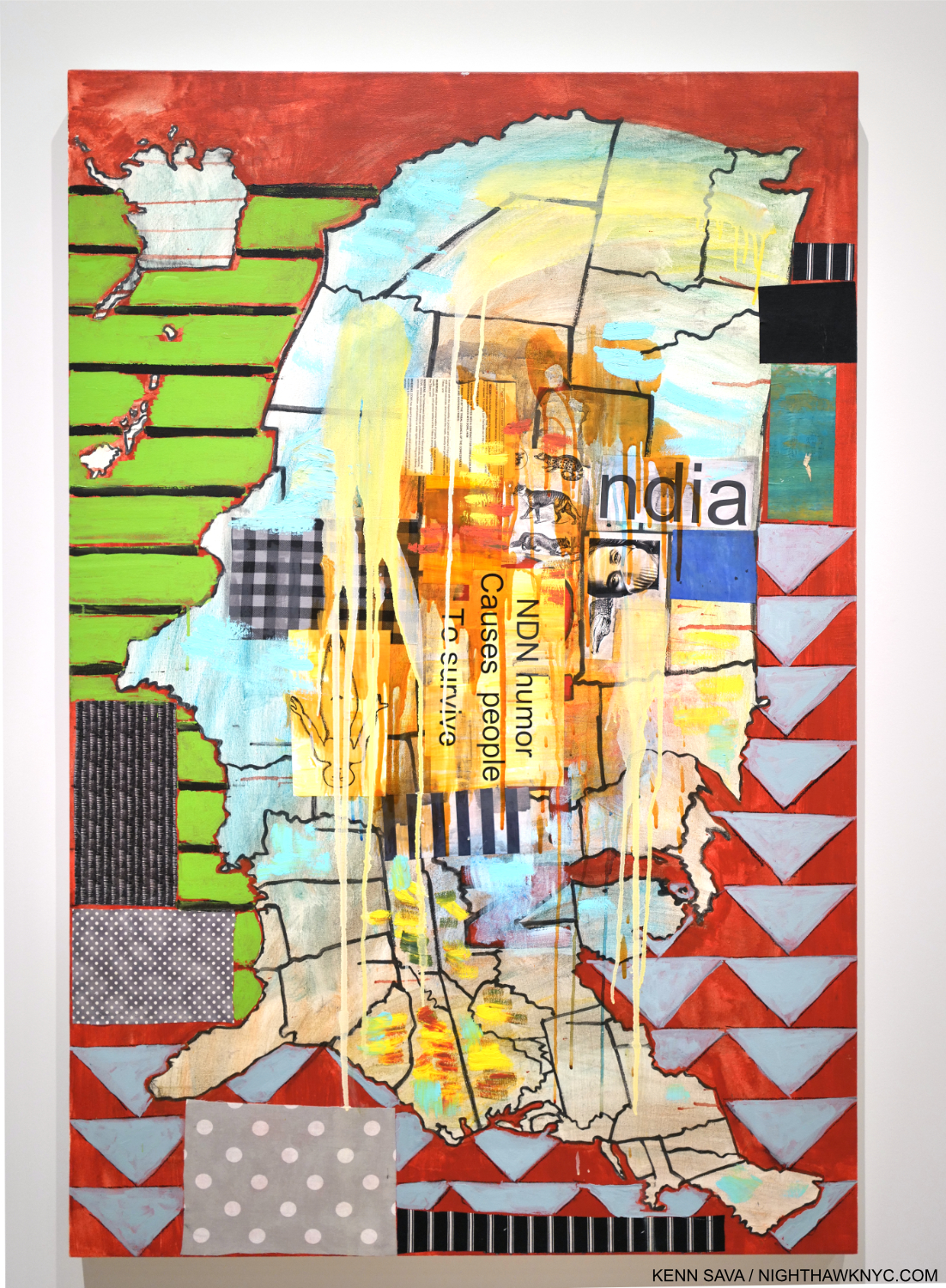
Indian Madonna Enthroned, 1974, Mixed-media.

It took 83 years for Jaune Quick-to-See Smith to get her first NYC retrospective. As if that’s not notable enough, Jaune Quick-to-See Smith: Memory Map is also the “largest and most comprehensive show of her work to date,” the Whitney says of its installation of 130 of her Paintings, Drawings, Prints, and Sculptures covering almost 5 decades of her career on its 5th floor, where it follows Edward Hopper’s New York, and 3rd floors.

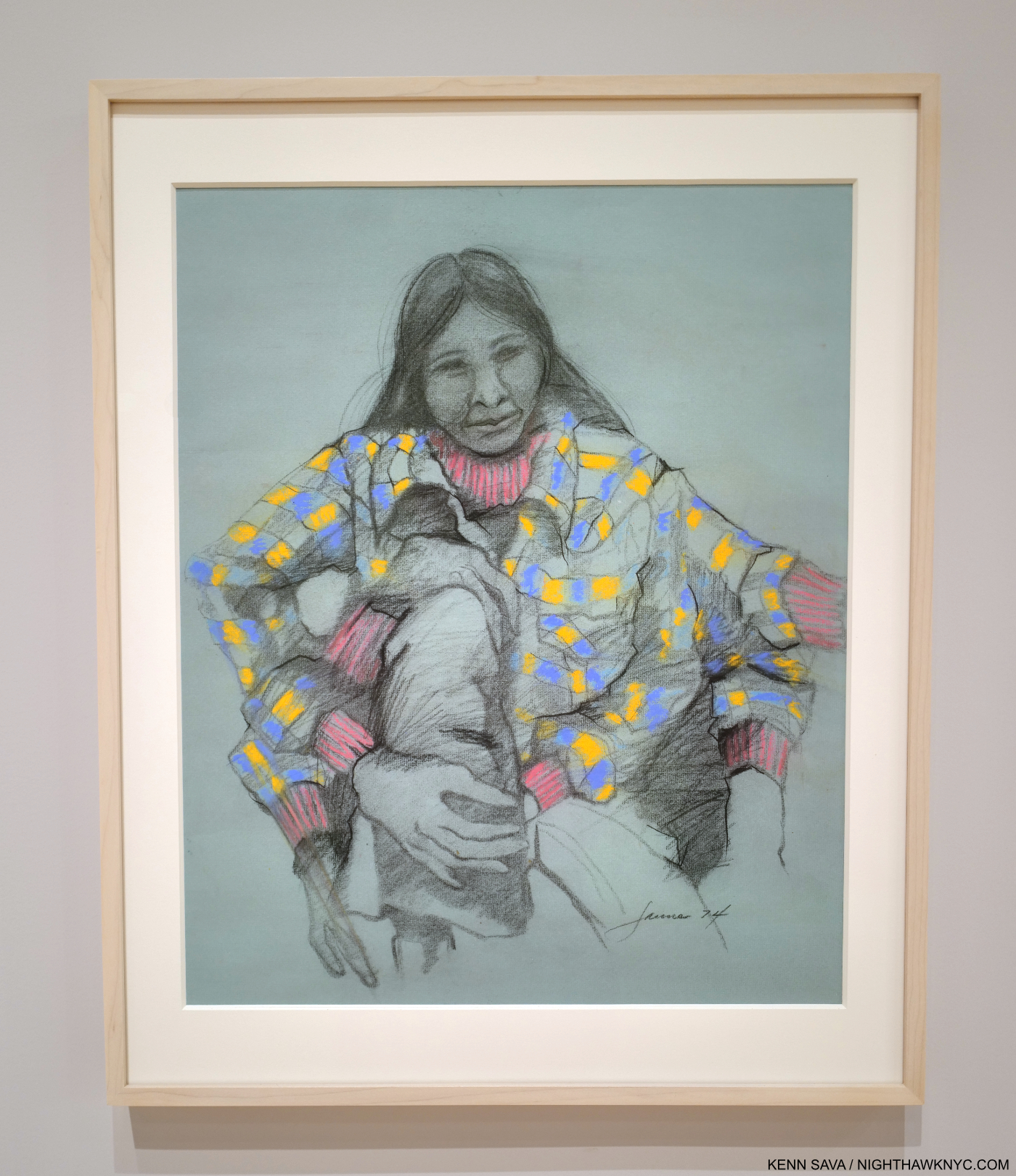
Self-Portrait, 1974, Pastel, graphite pencil and charcoal on paper. The Artist showing herself with 6 arms.

Born in 1940, a citizen of the Confederated Salish and Kootenai Nation, the show reveals Jaune Quick-to-See Smith to be an Artist of her time, one that is fluent with contemporary Art styles and techniques. An Artist, and a person, passionate about the well-being of her people and the world in which they, and we all, live. Yet, she’s also been ahead of her time in bringing many issues her people face to the Art world, which has only recently begun to be more open to Indigenous Artists.

Homeland, 2017, Oil and acrylic on canvas, radiates from the Confederated Salish and Kootenai Nation’s Flathead Reservation in Montana.

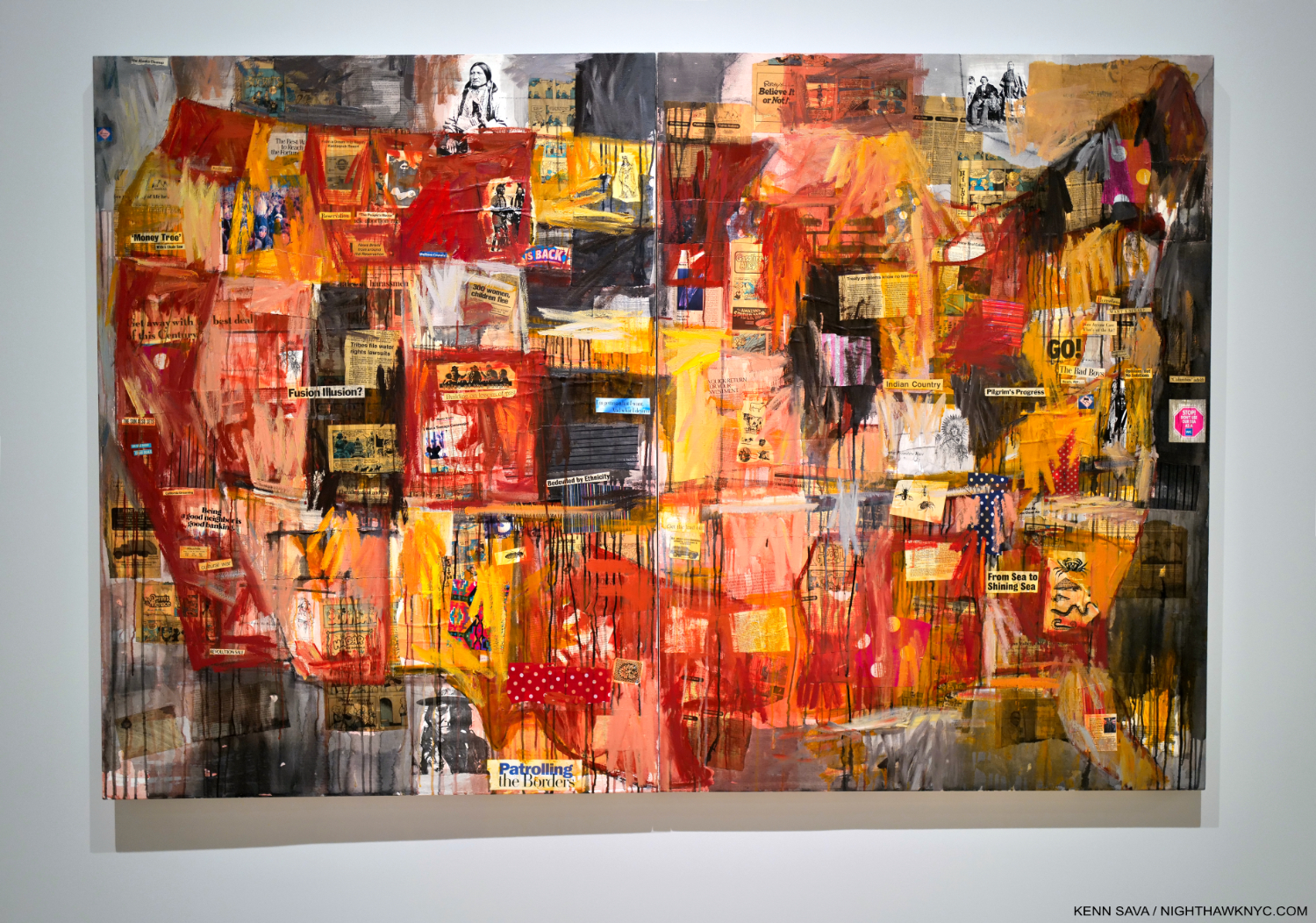
Indian Map, 1992, Oil, paper, newspaper and fabric on canvas.

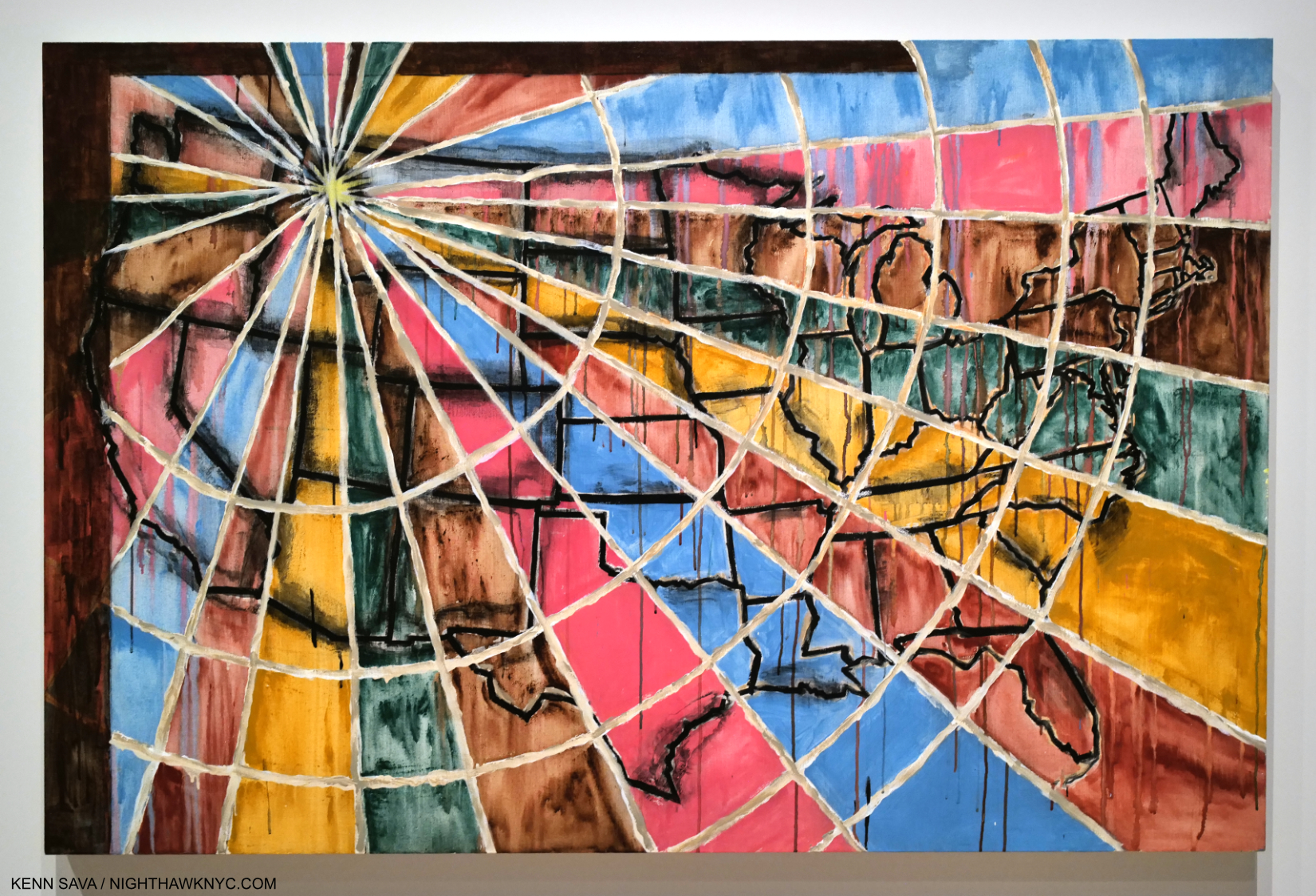
Survival Map, 2021, Acrylic, ink, charcoal, fabric, and paper on canvas

As a result, it seems to me that her work has been on the line between being of its time and ahead of its time throughout her career, both in terms of style and content. She proves herself fluent in moulding the language developed by her peers to her purposes over her career while also creating as many of her own innovations.

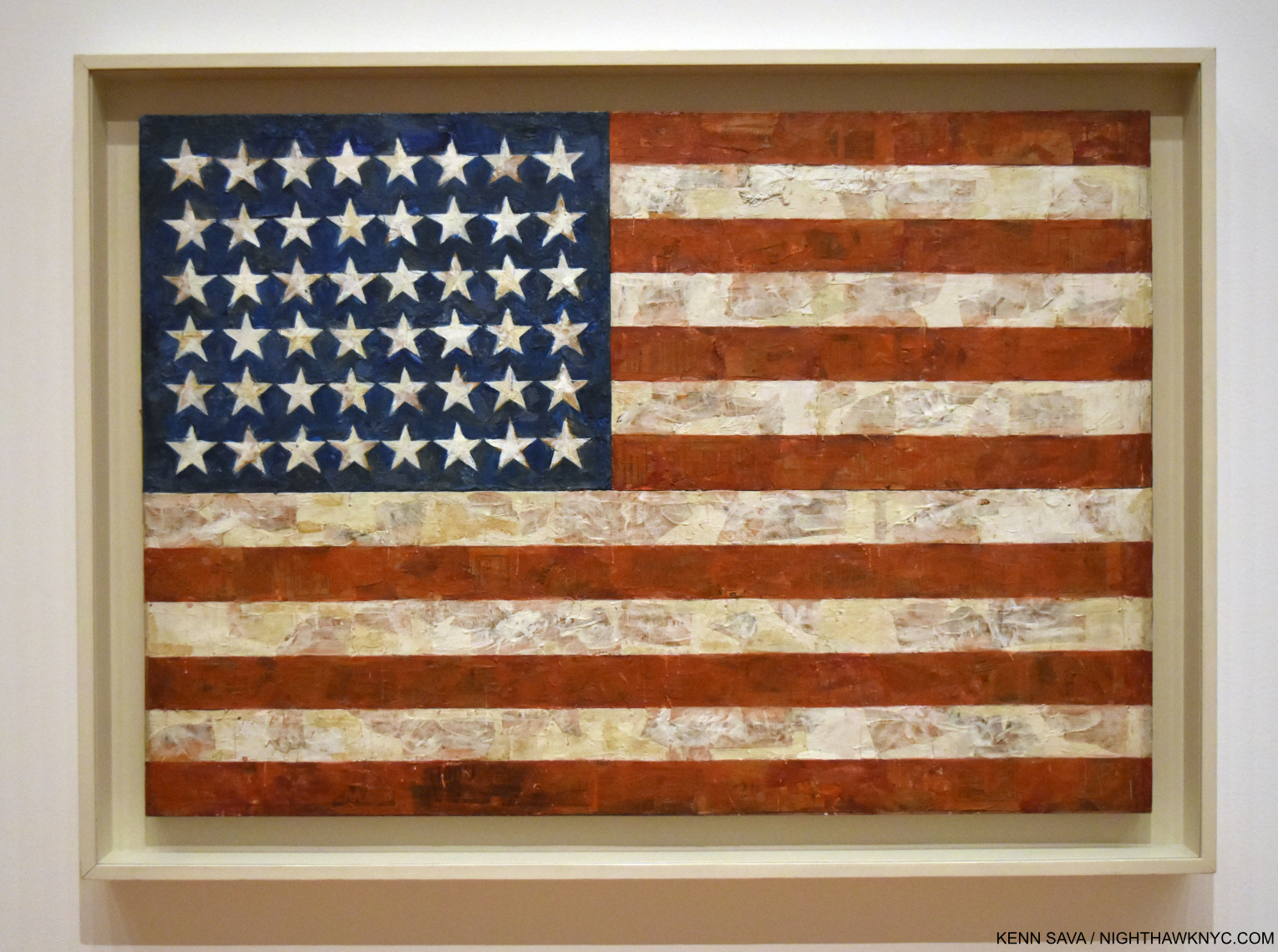
Jasper Johns, Flag, 1954-55, Encaustic, oil, and collage on fabric mounted on plywood, three panels, seen at MoMA, 2017.

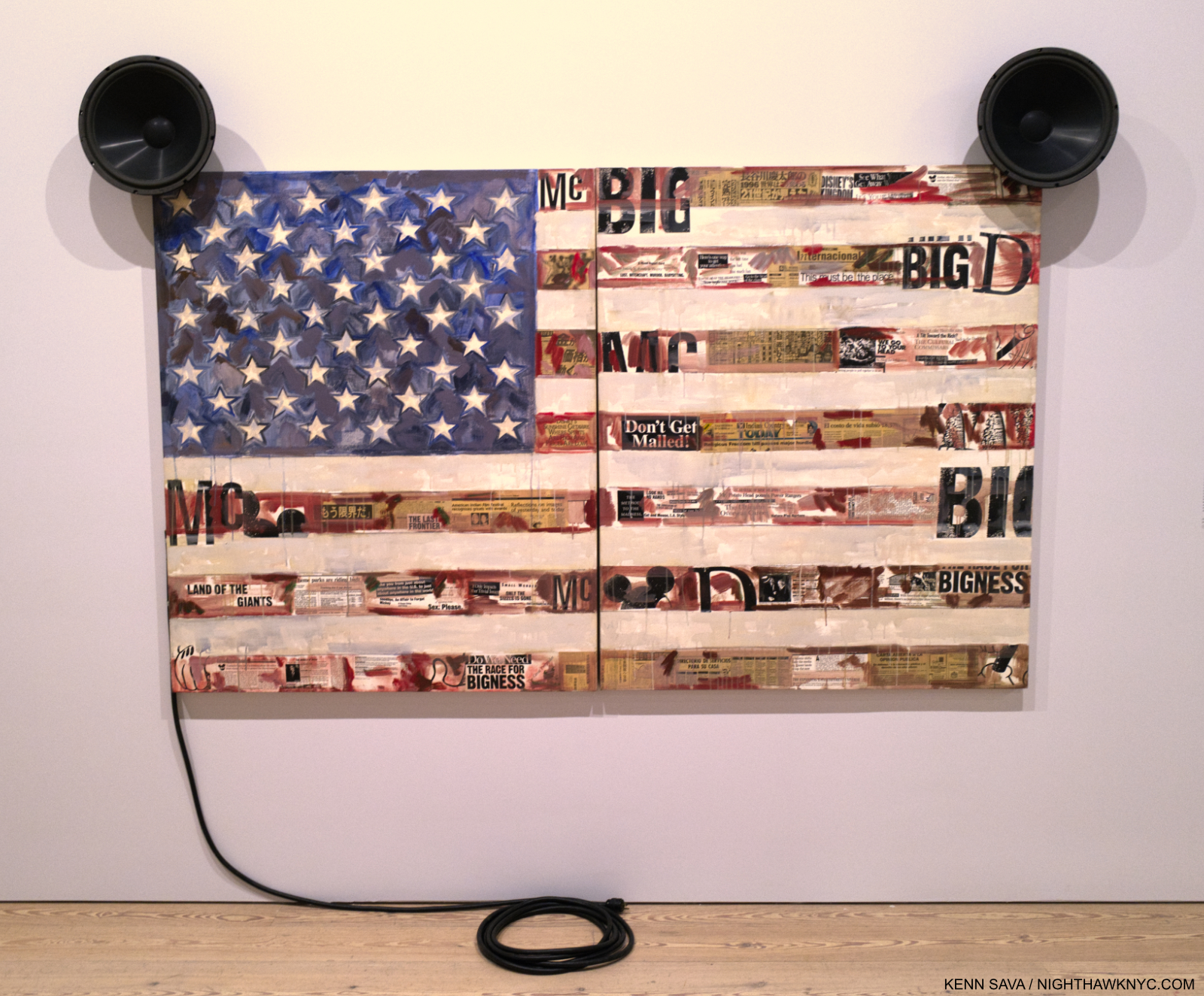
McFlag, 1996, Oil, paper and newspaper on canvas with speakers and electrical cord

Among the numerous Artists she references, including Magritte and Picasso, two names repeatedly came to mind, both at the forefront of the developments in American Contemporary Art of her time. Maps and Flags play a central role in the work on view, echoing Jasper Johns (B. May 15, 1930). Whereas Mr. Johns’s intentions for using the flag and maps remains, like most of his work, ambiguous, Ms. Quick-to-See Smith uses them to powerfully present the lives and issues faced by Indigenous People. 

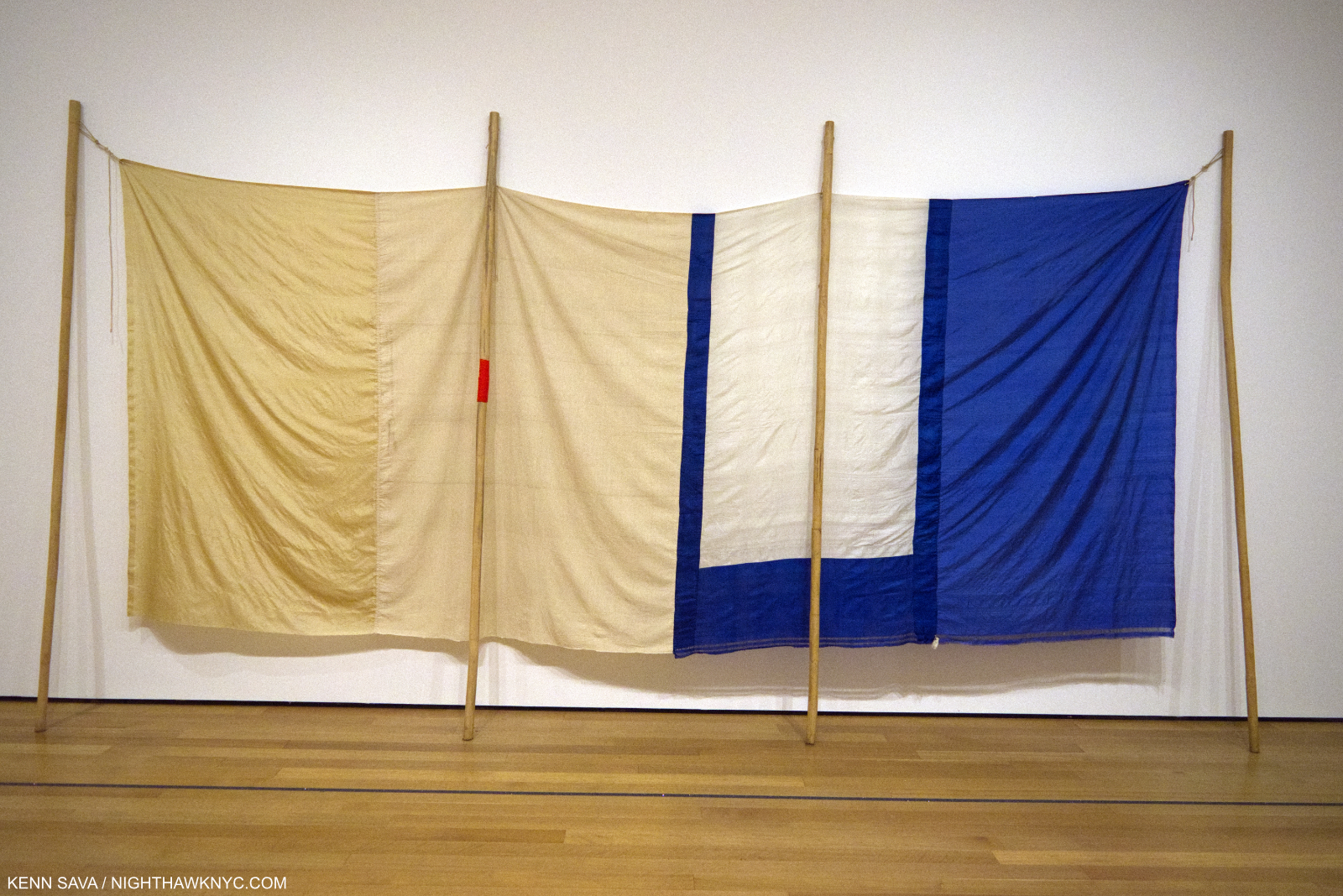
Robert Rauschenberg, Gull (Jammer), 1976, Sewn silk, rattan poles, and twine, 1976, seen at MoMA in 2017.

Other works echo Robert Rauschenberg (Oct 22, 1925- May 12, 2008).

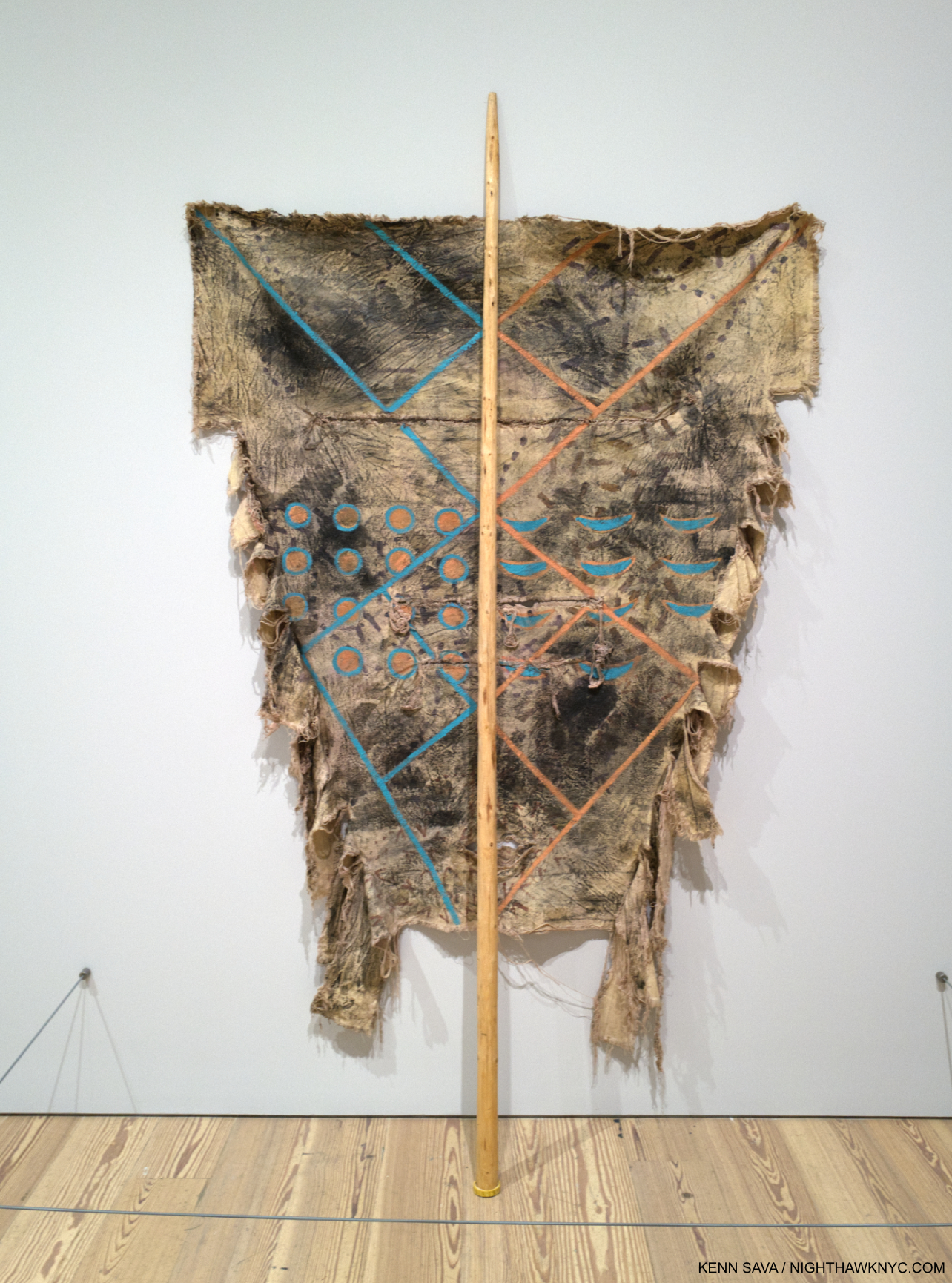
Ronan Robe #4, 1977, Oil, beeswax, charcoal and soot on canvas with lodgepole.

In 1985, the Artist got involved in efforts to save Petroglyph Park in New Mexico, creating what would become her Petroglyph Park Series, 1985-7, and marking the beginning of the appearance of current events in her Art.

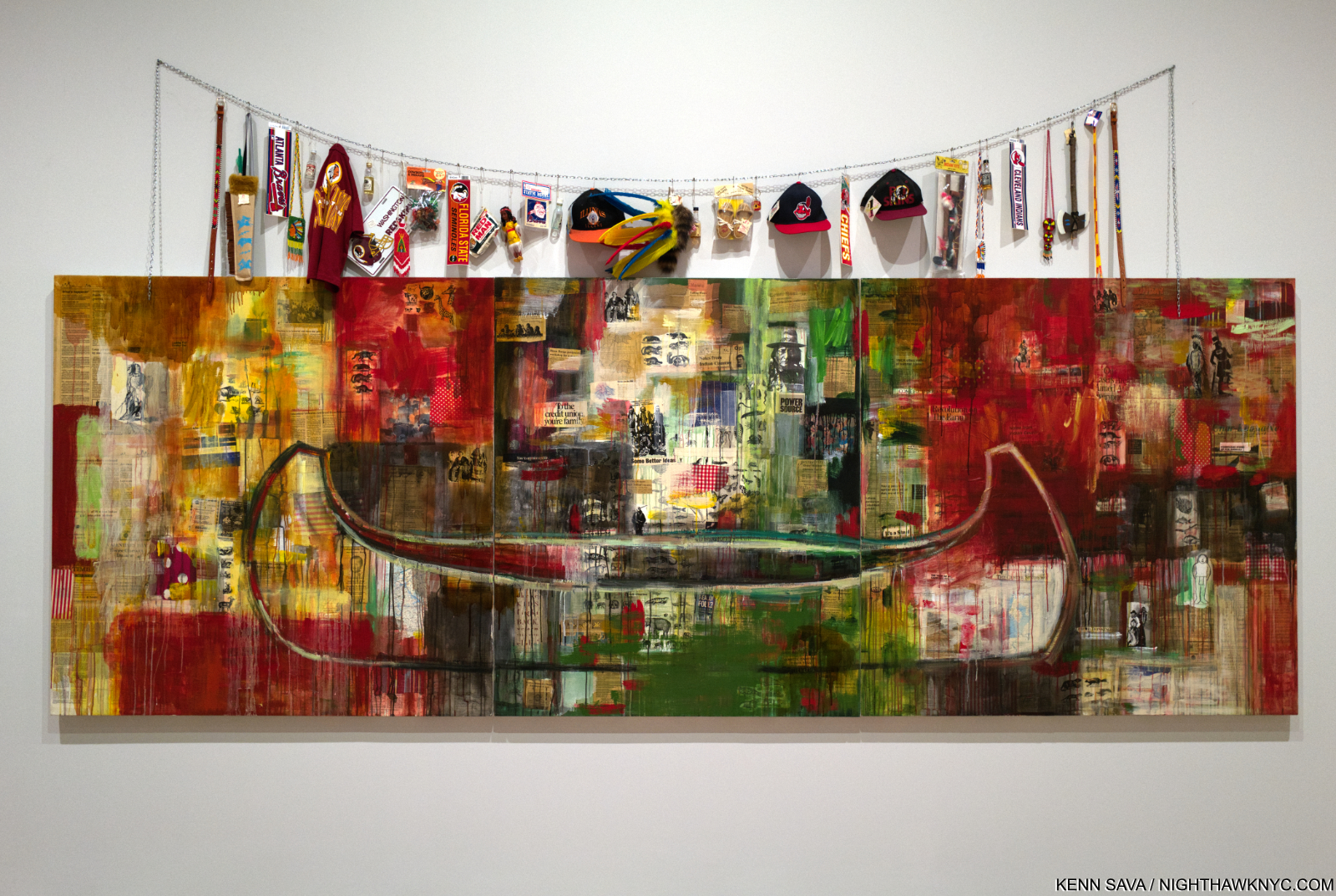
Trade (Gifts for Trading Land with White People), 1992, Oil, paper, newspaper, and fabric on canvas with found objects on a chain. Perhaps a history of exploitation with “trinkets” being exchanged for land. A number of the sports teams whose ephemera hangs above the Painting, have subsequently changed their names, some have not. Other items shown remain in production, including children’s toys which cheaply knock-off Native American culture.

Historic events don’t escape her attention, either.

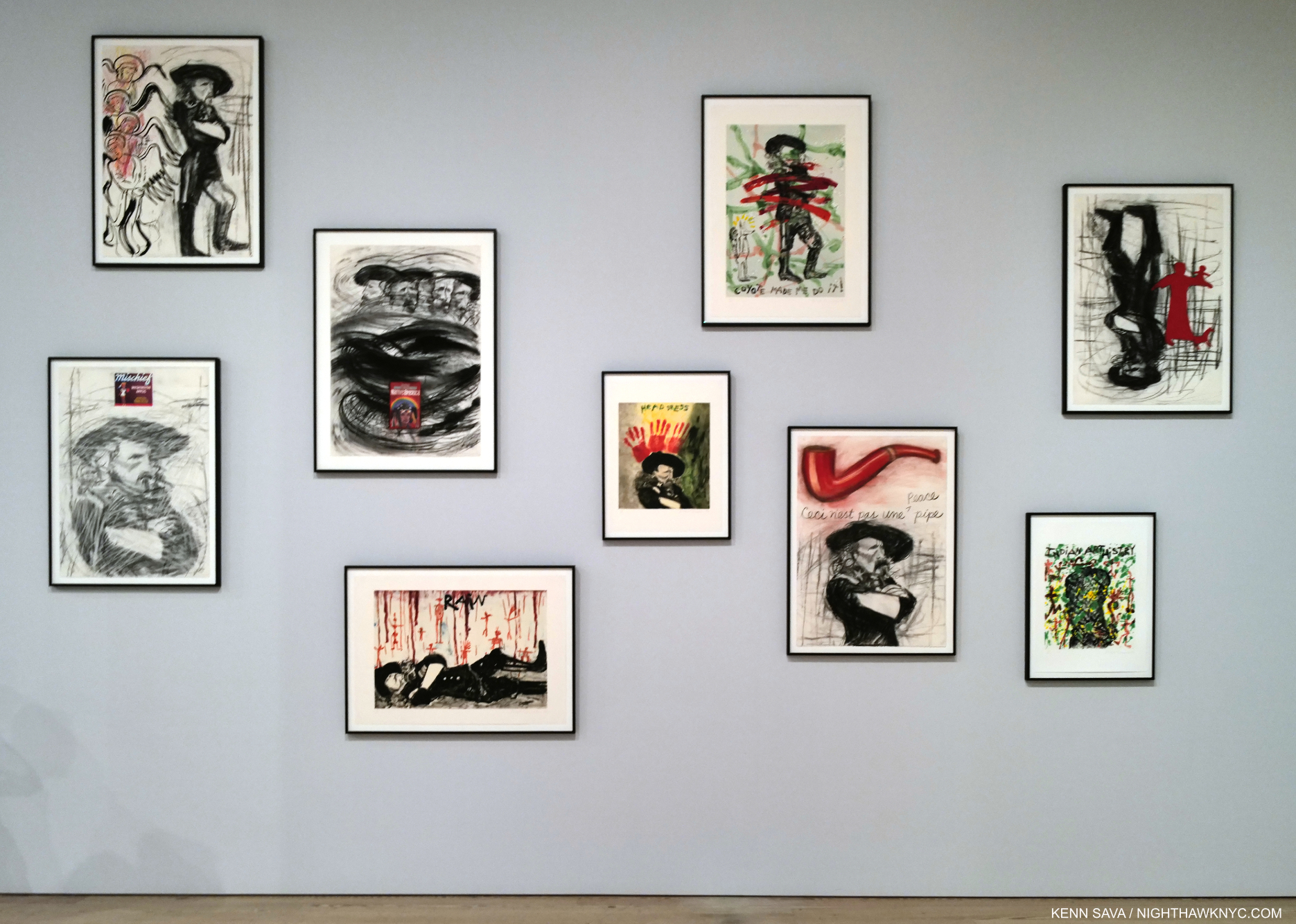
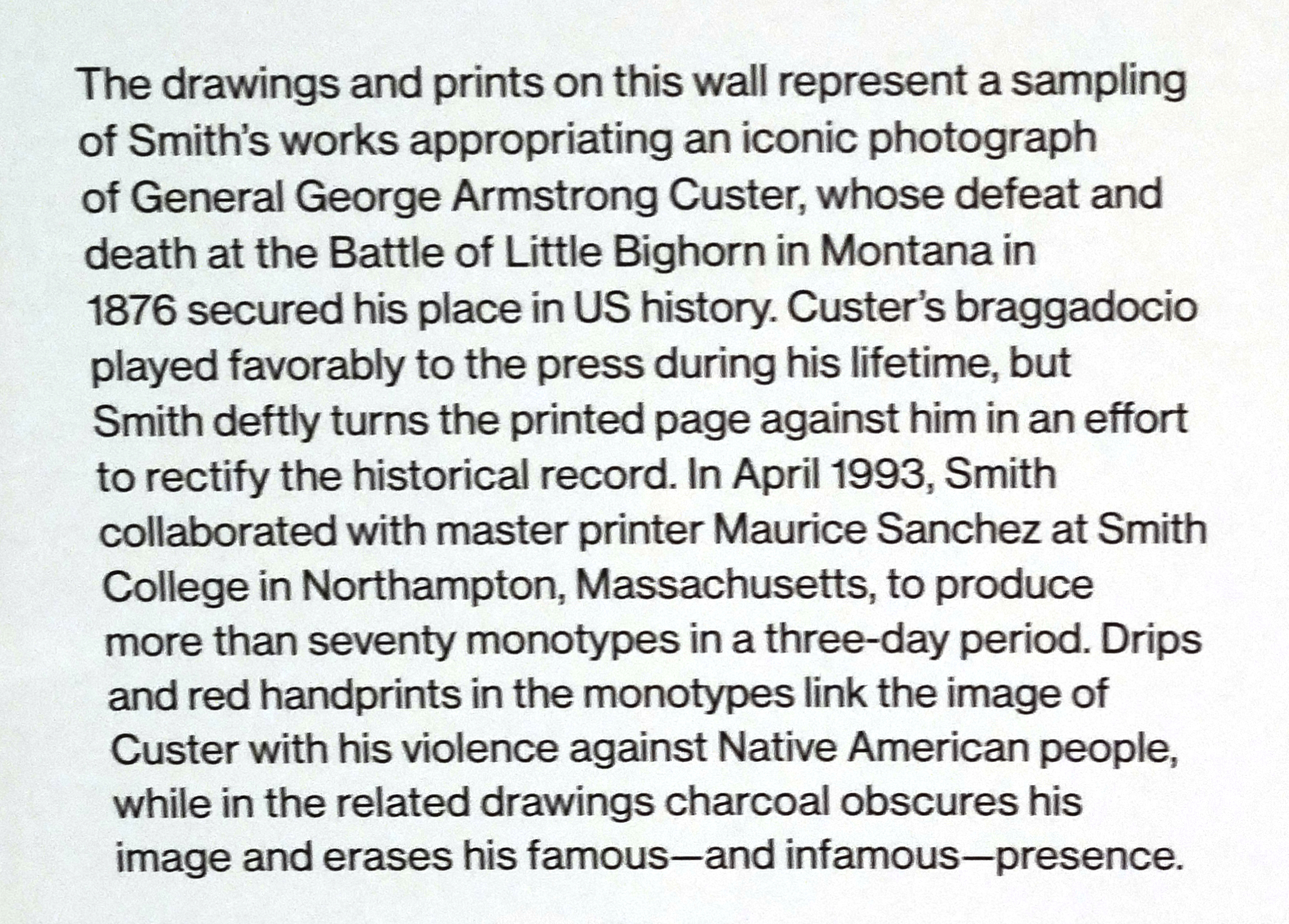
9 Monotypes from the Custer Series, 1993. The work next to the lower right is after Magritte. The text reads, “This is not a peace pipe.”

Wall card for the Custer Series.

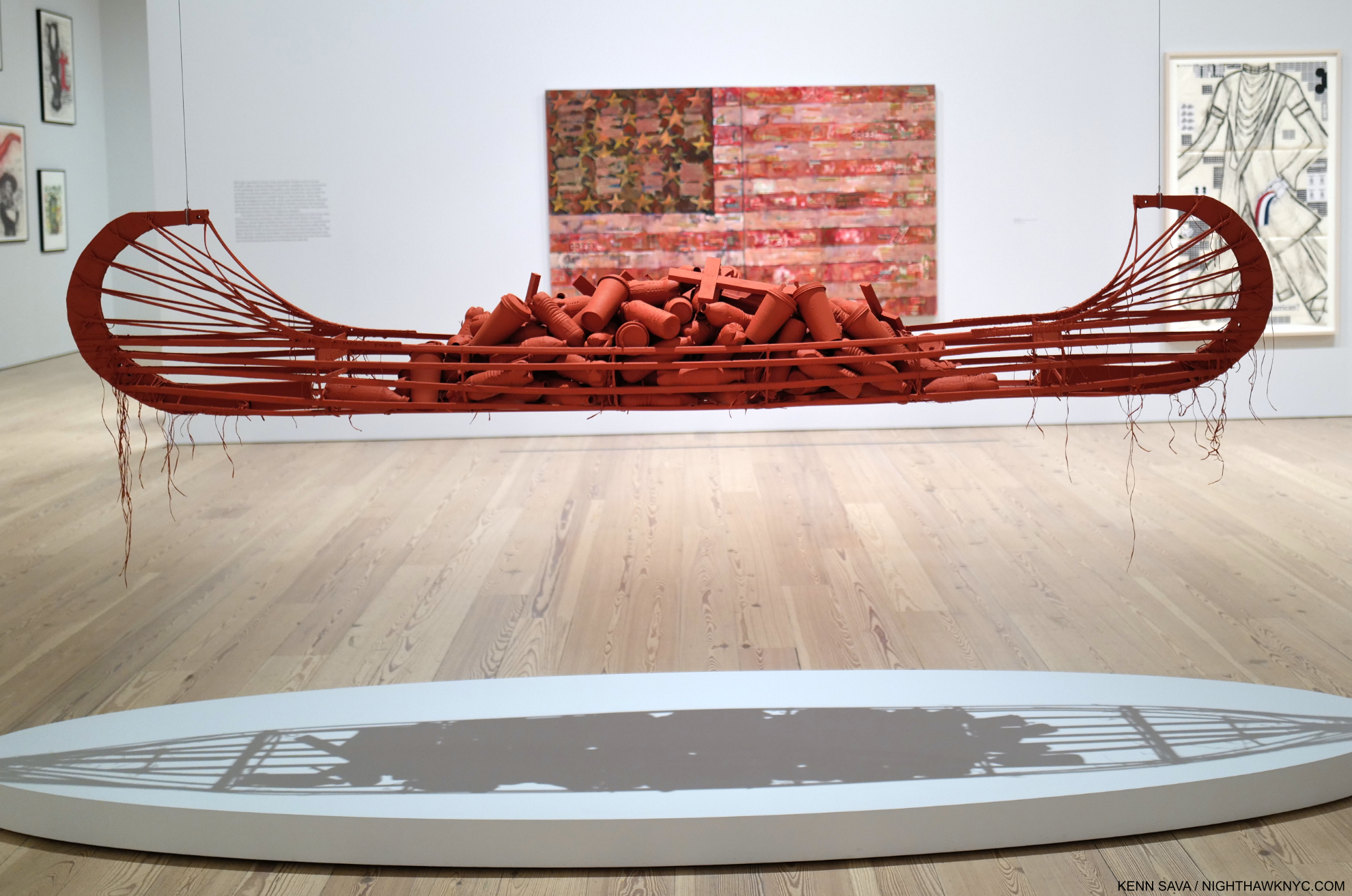
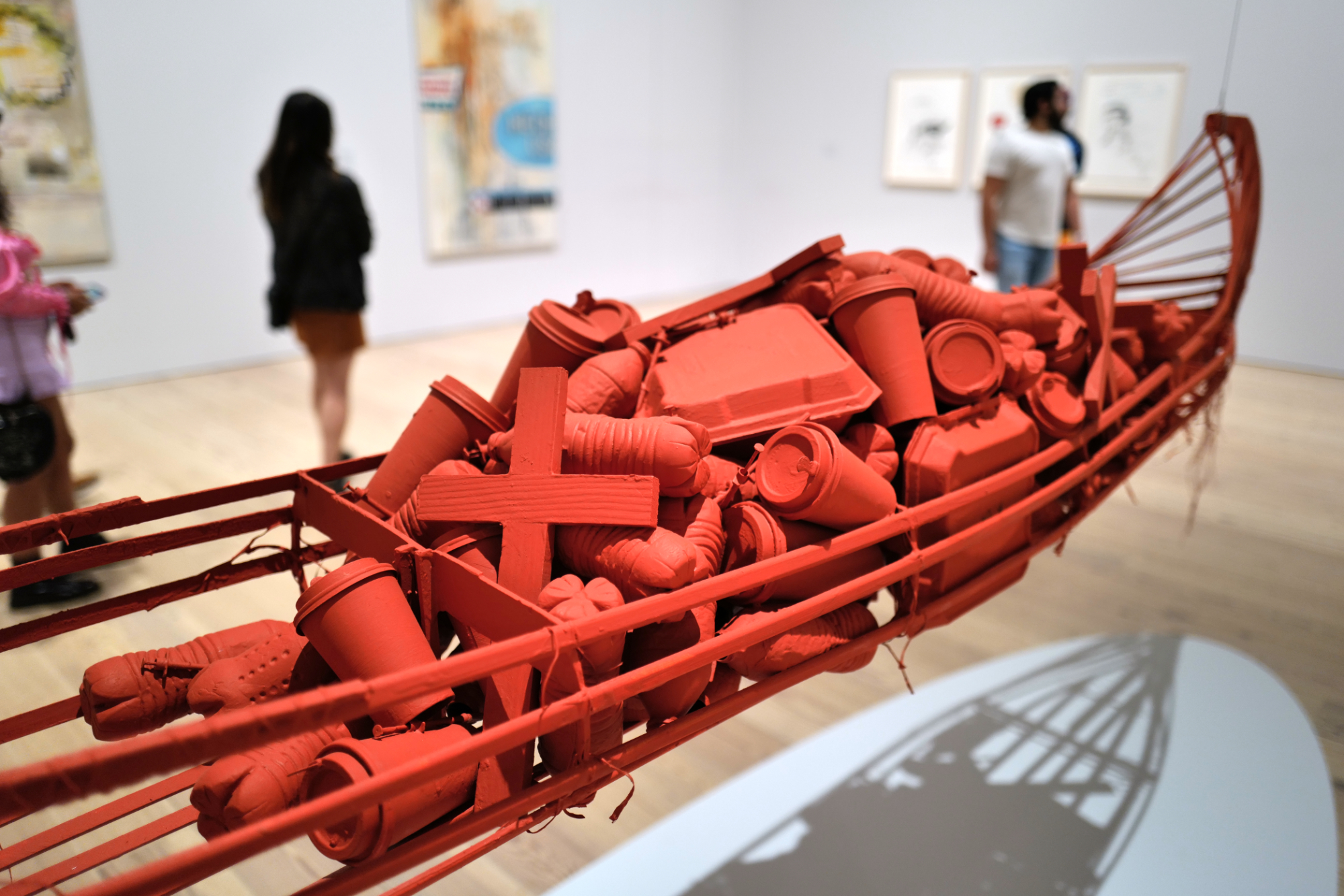
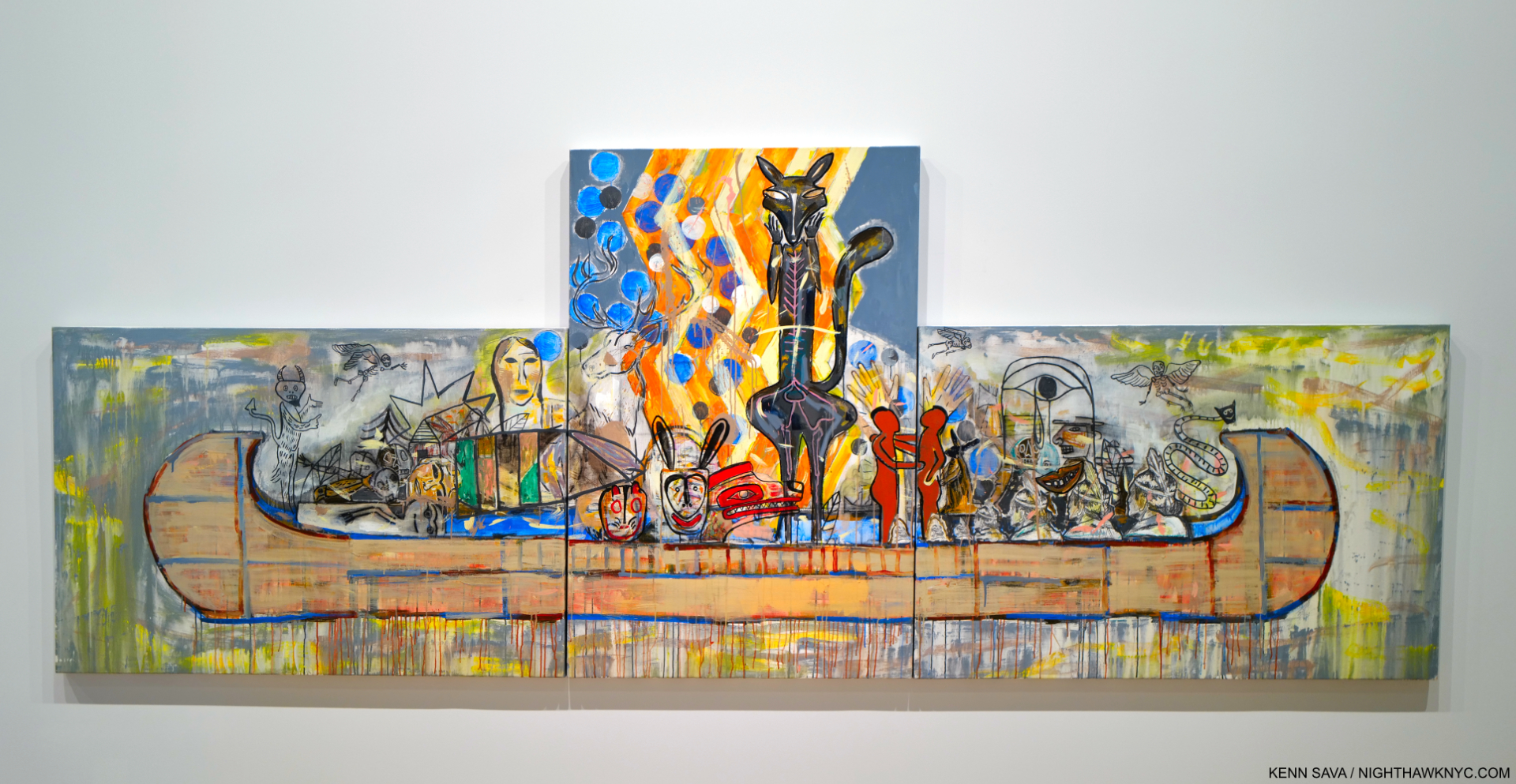
The Confederated Salish and Kootenai Nation’s Flathead Reservation is located in Montana, site of the Little Bighorn. Canoes, often labelled “Trade Canoes” (except for the one above), are a recurring theme, each one rendered strikingly differently.

Trade Canoe: Making Medicine, 2018, Mixed media, foreground, Green Flag, n.d., on the back wall.

Detail.

Trade Canoe: Forty Days and Forty Nights, 2015, Oil, acrylic, oil crayon, paper and charcoal on canvas, introduces the show, and is seen to the left in the picture of the show’s lobby, seen further below.

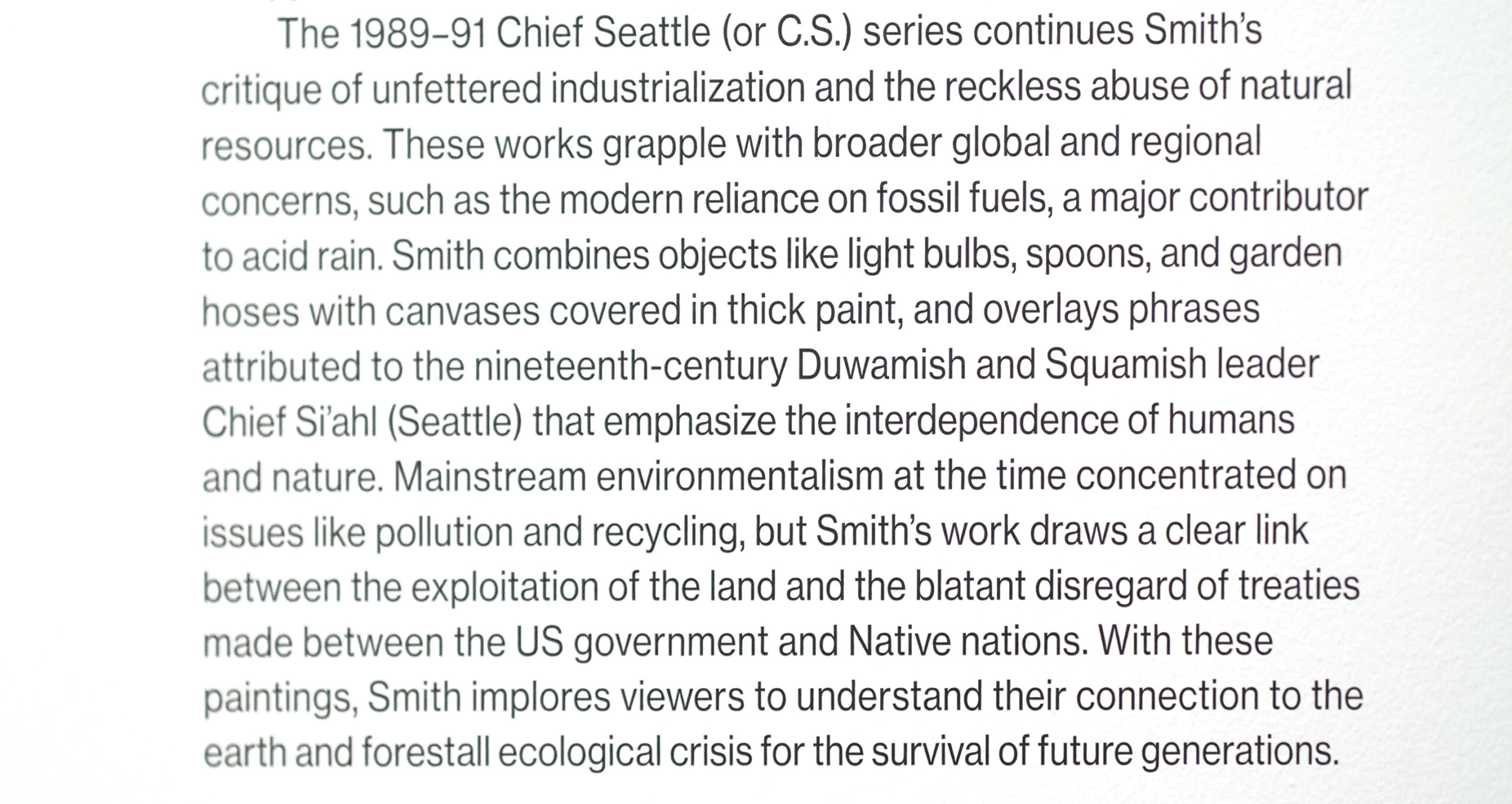
In addition to having her eye on what’s going on around her, her Art also has a wonderful way of looking back to the rich history of her culture. Messages of protest are side by side with sage wisdom. Her Chief Seattle Series (or C.S. Series), 1989-91, does this wonderfully and adds a timeless element to her work. The Wall Card says-

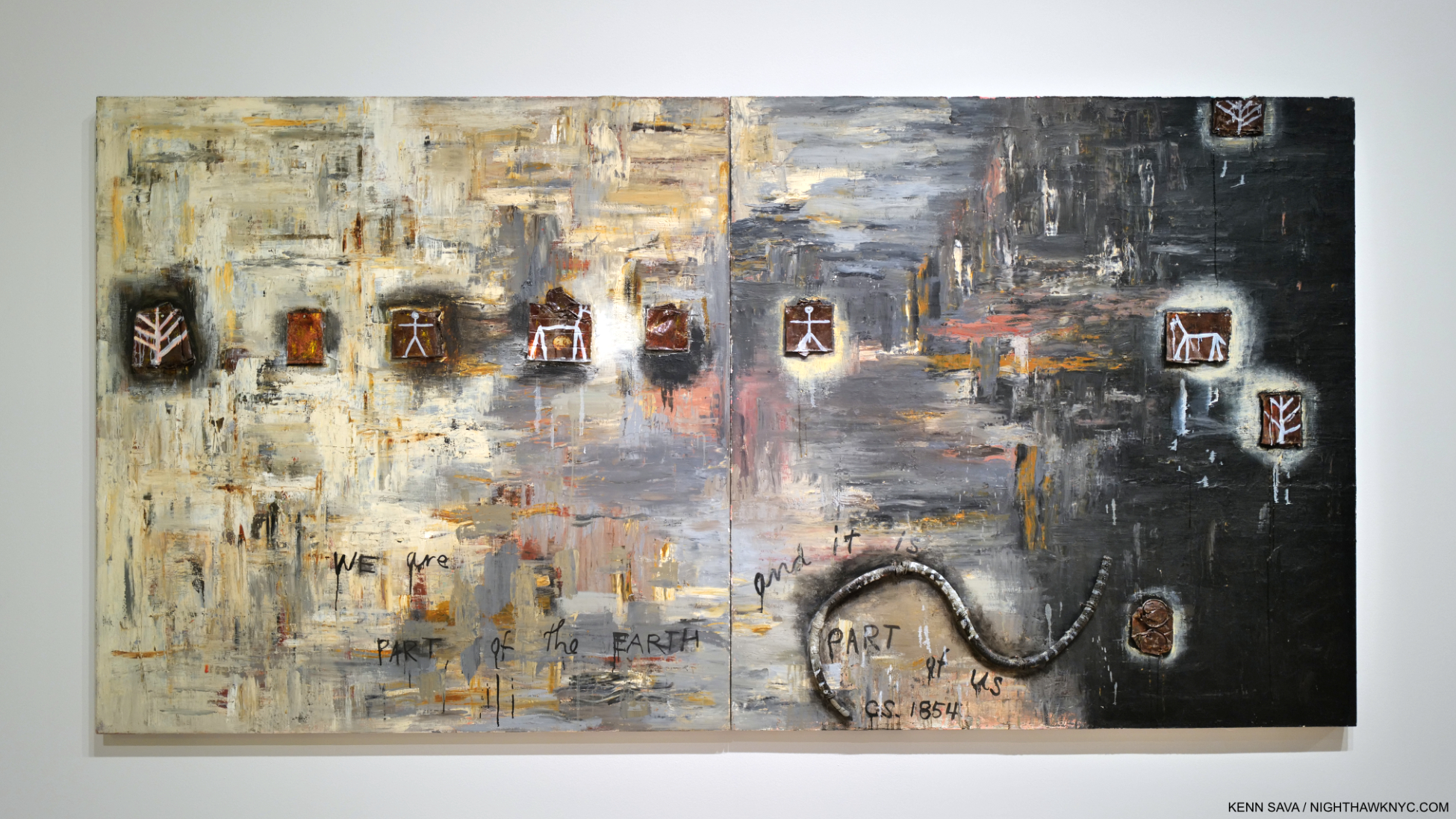
The Garden (C.S. 1854), 1989, Oil, rubber hose, crushed tin and aluminum cans, and nails on canvas. C.S. is Chief Seattle and The Garden is part of Chief Seattle Series from 1989-91. It reads, “WE are part of the EARTH and it is PART of US, C.S., 1854.”

Jaune Quick-to-See Smith has created an important, innovative and powerful body of work that somehow all manages to remain of the moment no matter when she created it. On the one hand, that’s a sign the country hasn’t evolved faster and how much remains to be done. 

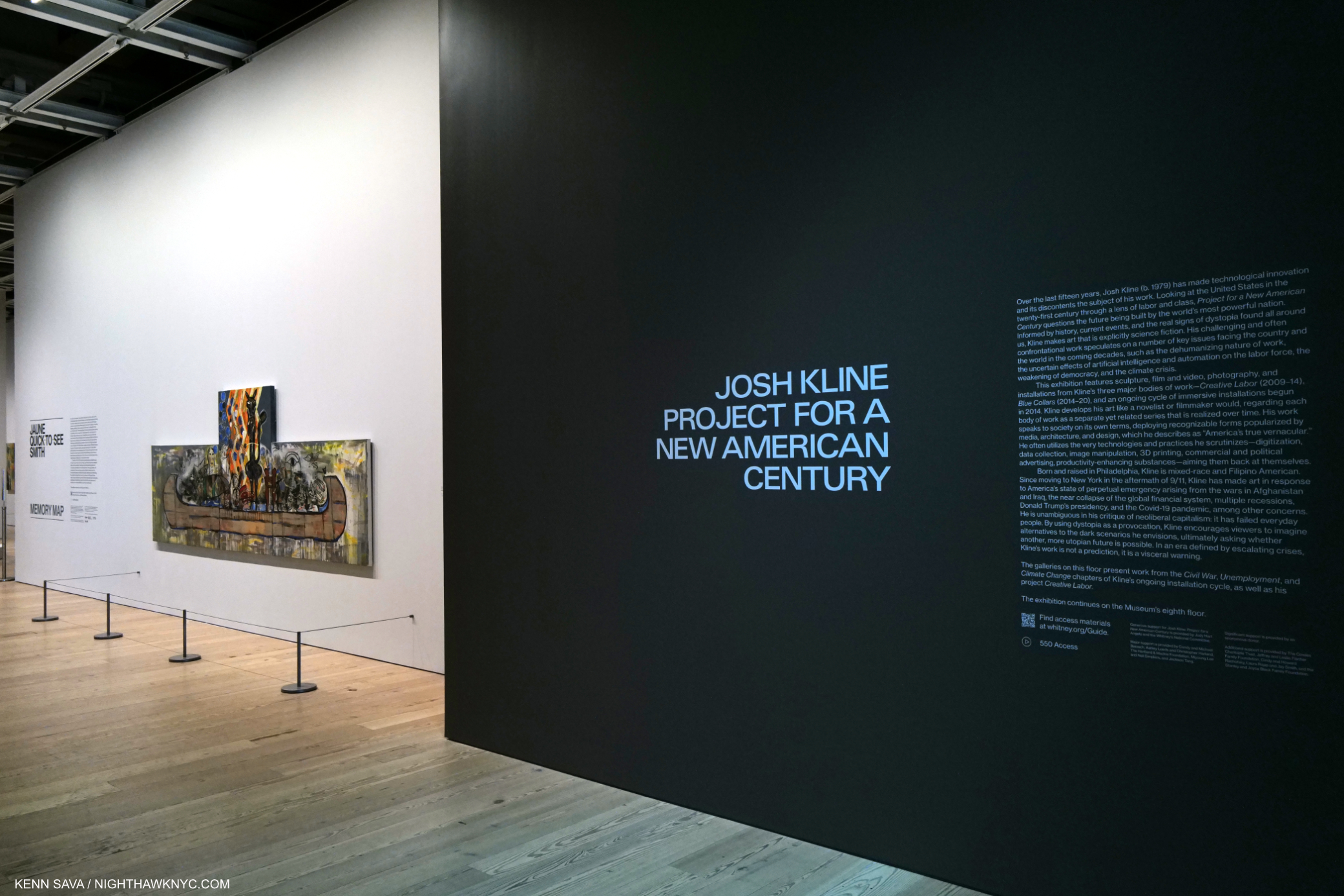
Memory Map shares the 5th floor with Josh Kline: Project for a New American Century, which is compelling in its own right. The shows overlap as both express concern over climate change and the impact of social, economic and technological change on the labor force.

On the other hand, it’s a testament to the Artist’s range, humanity, and perhaps above all, her perseverance. 

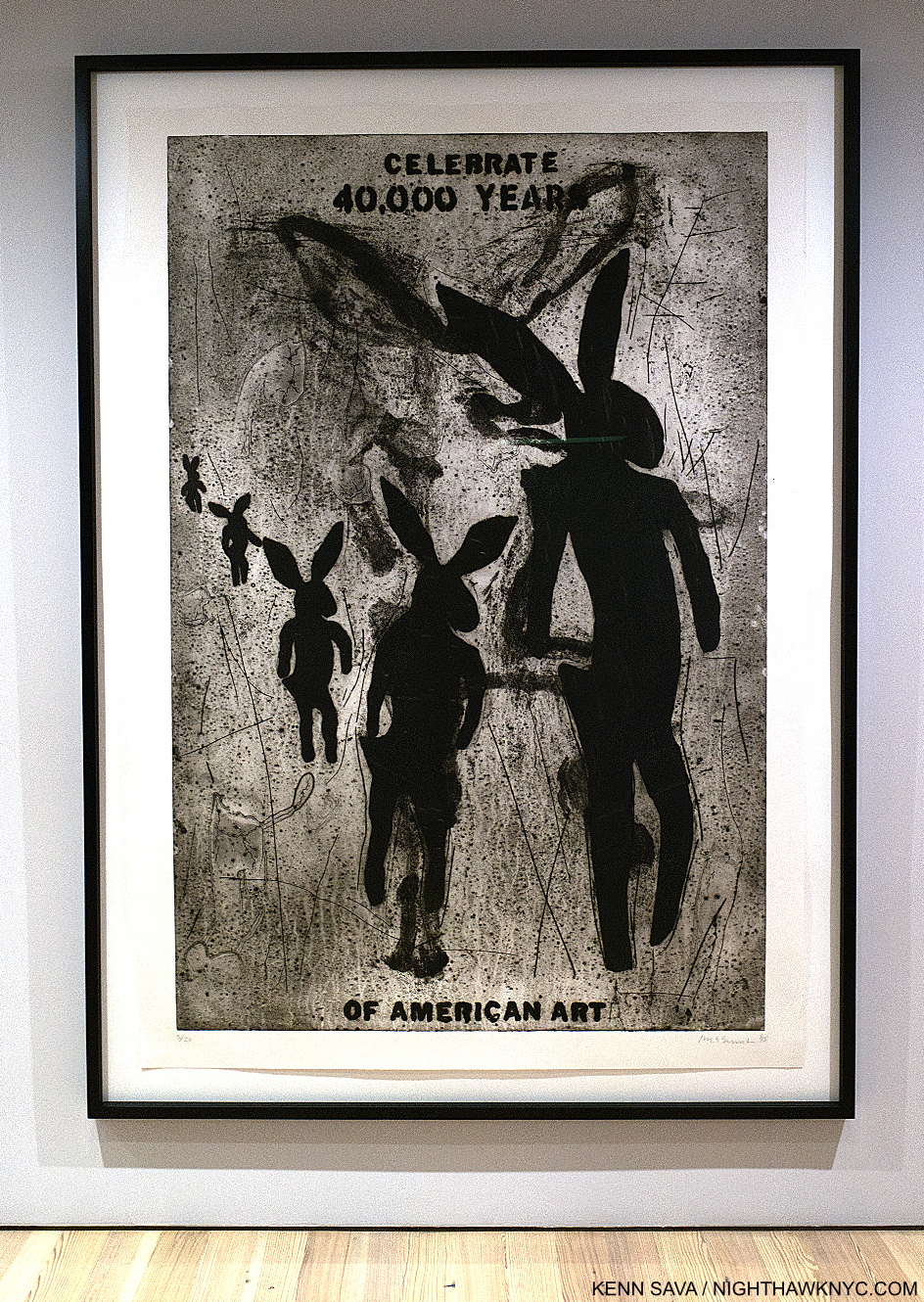
Celebrate 40,000 Years of American Art, 1995, Collagraph. A reminder that the ancient, original Art of our land has yet to be fully appreciated.

In some ways, the case of Jaune Quick-to-See Smith reminds me of Alice Neel, who didn’t see her first full-length monograph published until she was 83, the year before she died. Shows of, and books on, her work have increased ever since. I expect Ms. Quick-to-See Smith to also receive increasing attention as time goes on, and hopefully, she will still be around to see, and enjoy, it. Memory Map proves she deserves every bit of it. 

*- Soundtrack for this piece is “Now That the Buffalo’s Gone” by Buffy Sainte-Marie, who was born on the Piapot 75 Reserve in Saskatchewan, Canada. She announced her retirement from live performance earlier this month after 60 years of performing.

NighthawkNYC.com has been entirely self-funded & ad-free for over 8 years, during which 300 full-length pieces have been published! If you’ve found it worthwhile, PLEASE donate to allow me to continue below. Thank you, Kenn.

You can also support it by buying Art, Art & Photography books, and Music from my collection! Art & Books may be found here. Music here and here.

Written & photographed by Kenn Sava for nighthawknyc.com unless otherwise credited. To send comments, thoughts, feedback or propositions click here. Click the white box on the upper right for the archives or to search them. Subscribe to be notified of new Posts below. Your information will be used for no other purpose.

NoteWorthy Art Shows: Spring, 2023

This site is Free & Ad-Free! If you find this piece worthwhile, please donate via PayPal to support it & independent Art writing. You can also support it by buying Art & books! Details at the end. Thank you.

Written & Photographed by Kenn Sava.

As I celebrate the 8th Anniversary of NighthawkNYC.com on July 15th, my thoughts turn to some excellent shows I saw but didn’t get a chance to write about! I’ll take a brief look at a few I call NoteWorthy here…

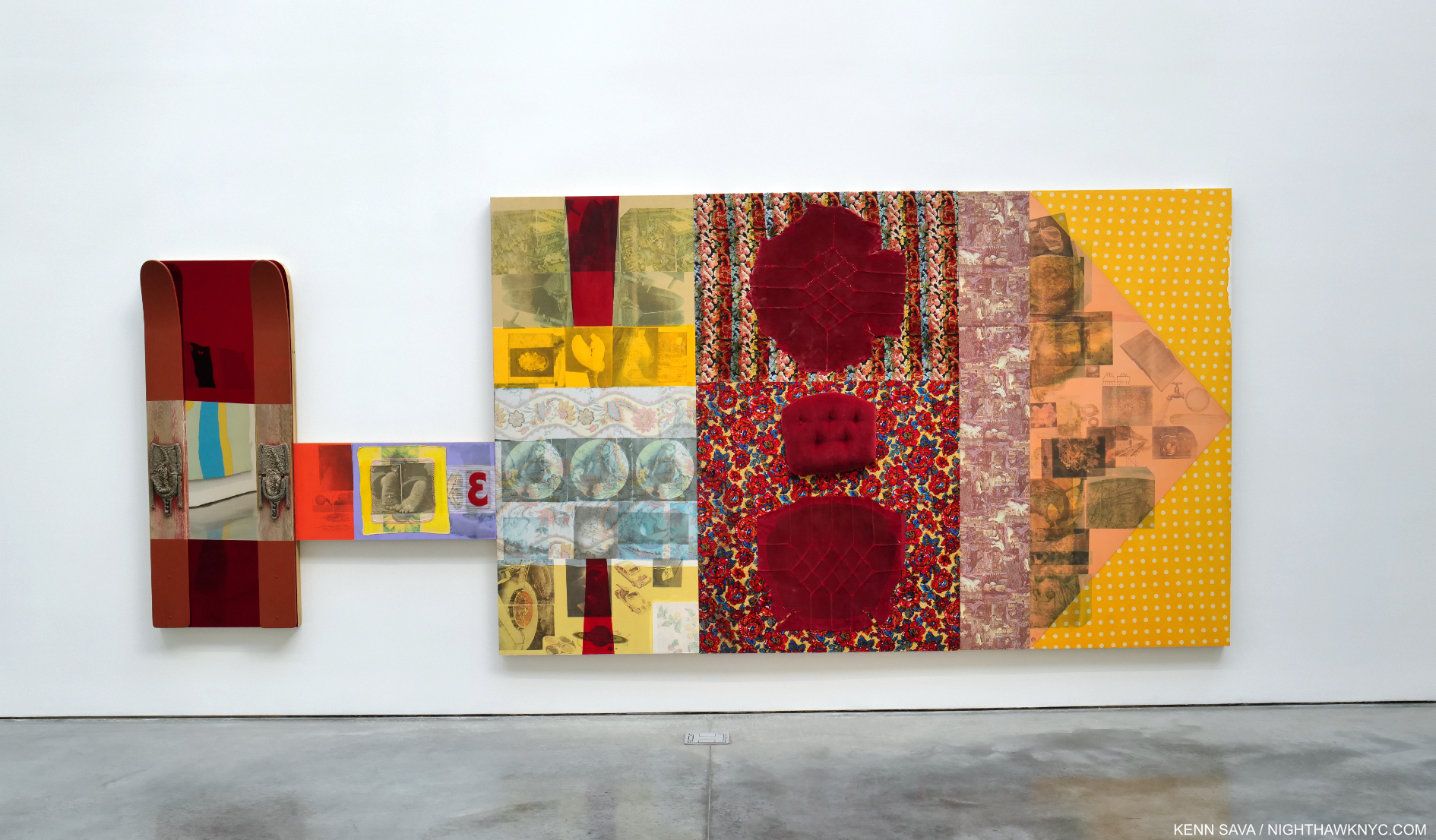
Robert Rauschenberg: Spreads and Scales @ Gladstone Gallery-

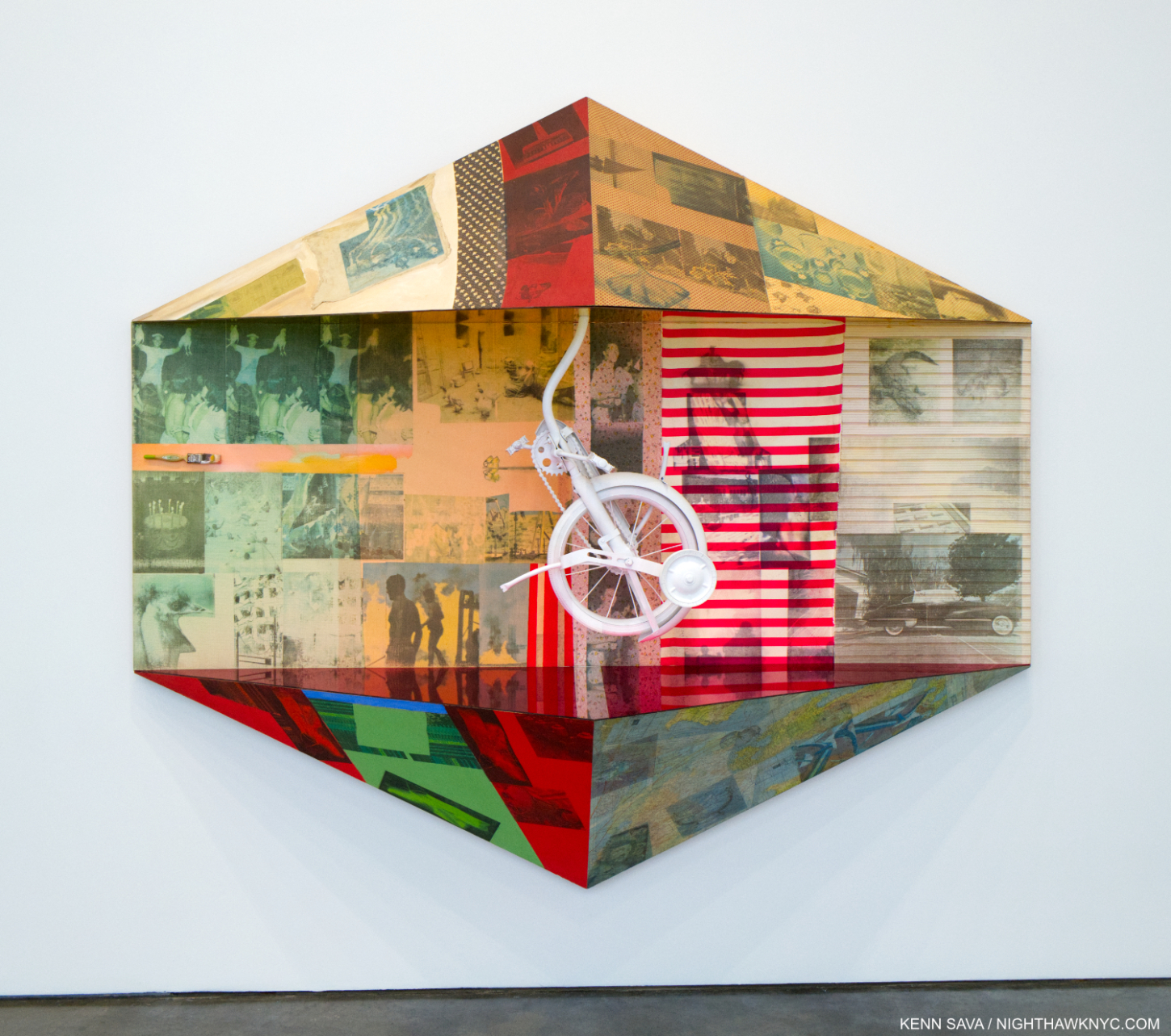
Robert Rauschenberg has been one of my favorite Artists since I discovered his work in the 1980s. In 2017, I wrote an extensive series on the plethora of shows going on around town then during what I termed “The Summer of Rauschenberg.” Spreads and Scales was a concise but very interesting show of work I’ve never seen before reinforcing my belief that no matter how much of his work you’ve seen, even 15 years after his passing in 2008, there’s work of his that you more than likely still haven’t seen.

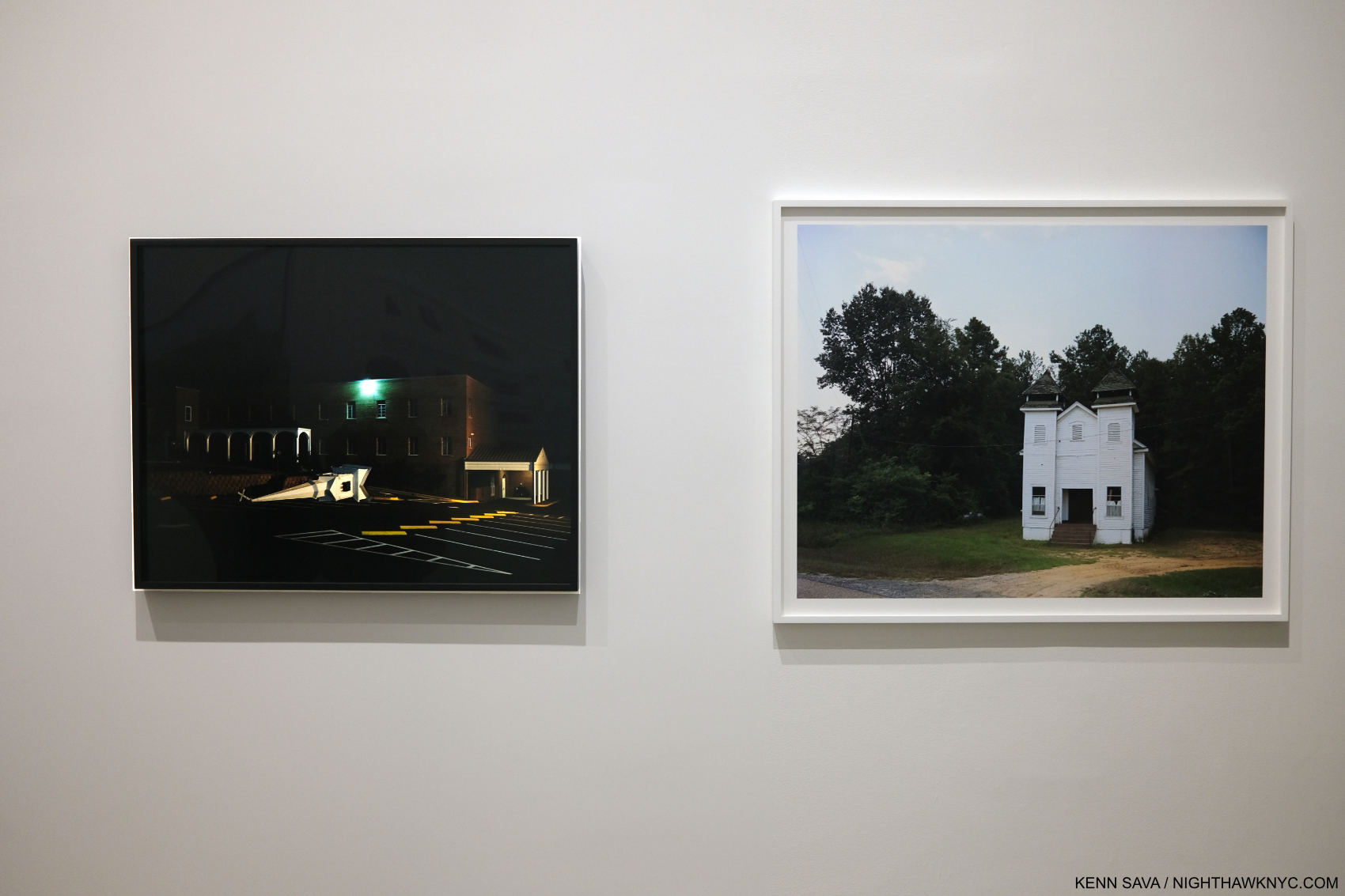
William Christenberry & RaMell Ross: Desire Paths @ Pace-

RaMell Ross, Sleepy Church, 2014, left,  and William Christenberry, Church, Sprott, Alabama, 1981, both Pigment print mounted on dibond.

An interesting, unexpected paring of the work of the late Photographer, William Christenberry, perhaps best known for his association with William Eggleston, and the Academy Award Nominated Filmmaker & Artist, RaMell Ross, who I last saw in a solo show at Aperture Foundation in June, 2018. Interesting became compelling in its final gallery.

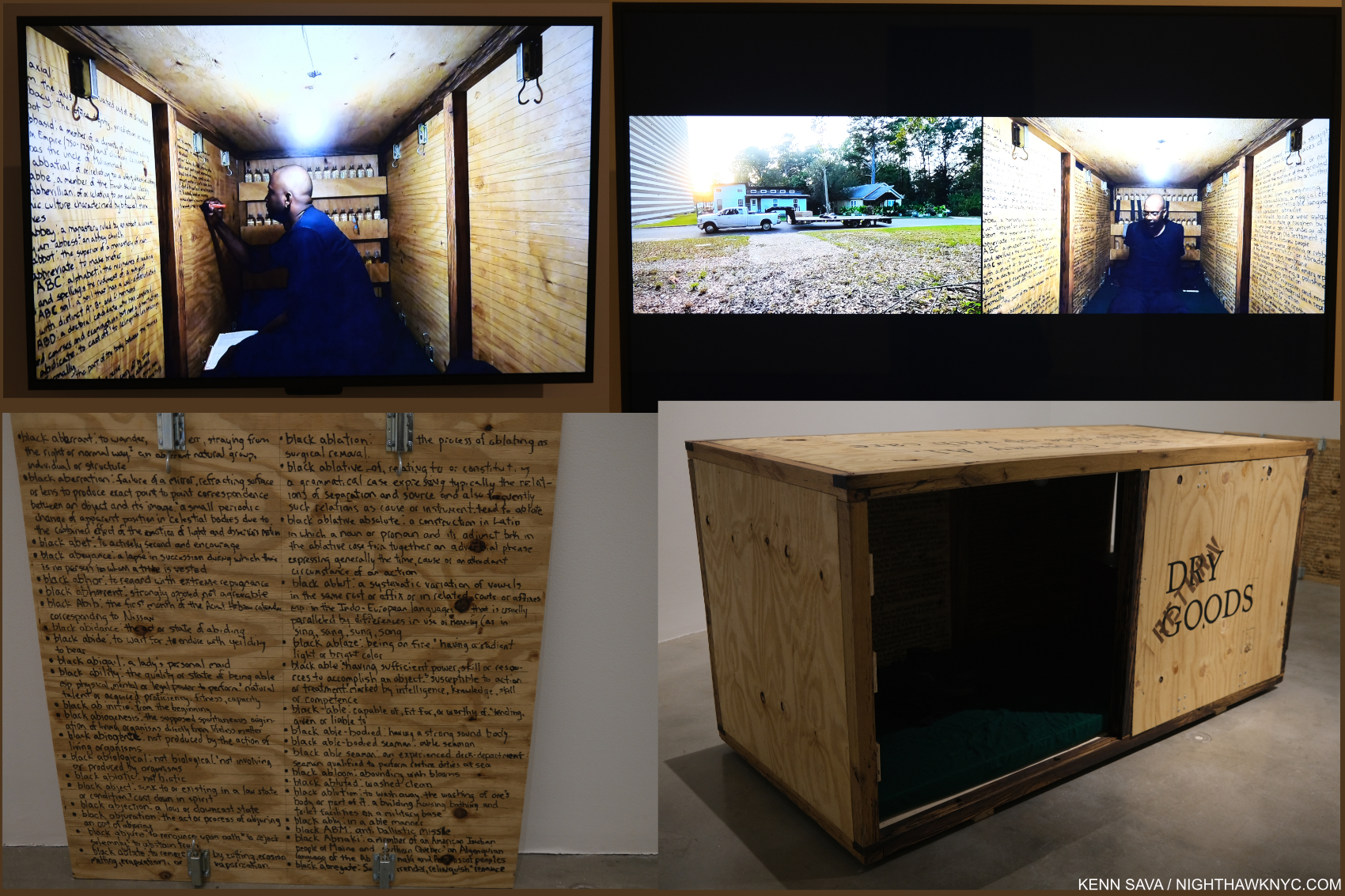
RaMell Ross, Return to Origin, 2021. From the upper left- the Artist working away while in transit, sealed in the box; two video stills- the truck after unloading the box, simultaneous shot of RaMell inside; one of the panels showing the Artist’s inscriptions during transit; the box labelled “DRY GOOD.”

There, sitting on the floor was a very large box cryptically labelled “DRY GOODS” in a large stencil on the exterior, I looked at it, noticed there was writing all around the inside and then when I was about to move on I saw the accompanying video. It turns out RaMell Ross created & used the box to reenact Henry Brown’s legendarily daring act of mailing himself out of slavery to freedom in 1849! Mr. Ross shipped himself, sealed in this box, from Rhode Island to Hale County, Alabama. The trip took 59 hours, all the while the contents were unknown to the contracted truck driver whose gooseneck rig was carrying the crate. The journey, captured on the video, was being shown on that nearby monitor. In addition to reminding today’s viewers of Mr. Brown’s incredible feat (in a smaller box), it also reminds me of the preciousness of freedom. Something not fully appreciated, until it’s gone.

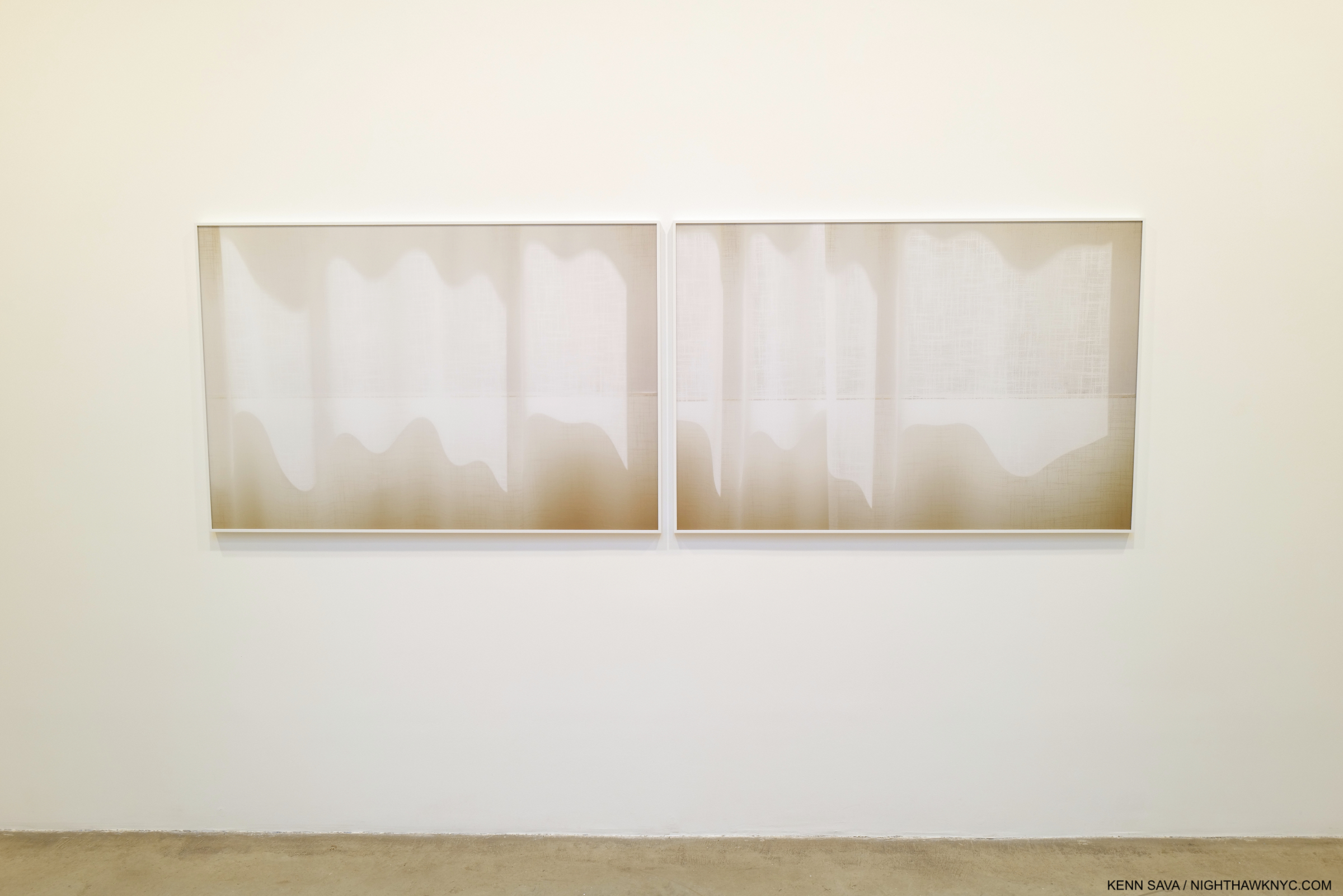
Uta Barth @ Tanya Bonakdar-

Frozen poetry. …and to draw a bright white line with light (Untitled 11.10), 2011, Inkjet Prints.

Compositions 5, 12 & 7, left to right, each Inkjet Prints from 2011, seen next to a street-facing picture window. Uta Barth’s work has had me deeply under its spell for the past three years.

Sundial (07.6), 2007, Mounted color Photographs.

In my opinion, Uta Barth is one of the most under-appreciated Photographers working today. I came across a copy of her retrospective The Long Now a few days before the pandemic shutdown and its poetry captivated me. With empty streets and empty rooms everywhere for the following months on end, I saw “Uta Barths” everywhere. Her spell has continued ever since. Artists who change the way I see the world are few and far between.

Installationv view of one section of ...from dusk to dawn, 2022, Mounted color Photographs with single-channel video monitor, includes an embedded video on one of these pieces that changes frames so subtly you may not see it change.

Finally having a chance to see her work in person @ Tanya Bonakdar Gallery, Uta Barth presented one, large, new piece, …from dusk to dawn, 2022, in multiple sections that nearly wrapped around the entirety of the downstairs main gallery and a curated selection of “classic” Uta everywhere else in the gallery. The new piece showed one location of Richard Meier’s Getty Center, L.A., over the course of a year, as it changed with time. Being in California, we don’t see the variety of weather we might in some other place, but with Uta Barth it’s always about the light. 

Tauba Auerbach: Free Will @ Paula Cooper Gallery-

One of the rising stars of the Art world, Tauba Auerbach’s latest, her first NYC show since her acclaimed early mid-career retrospective S v Z @ SF MoMA, 2021, didn’t disappoint while offering the usual surprise.

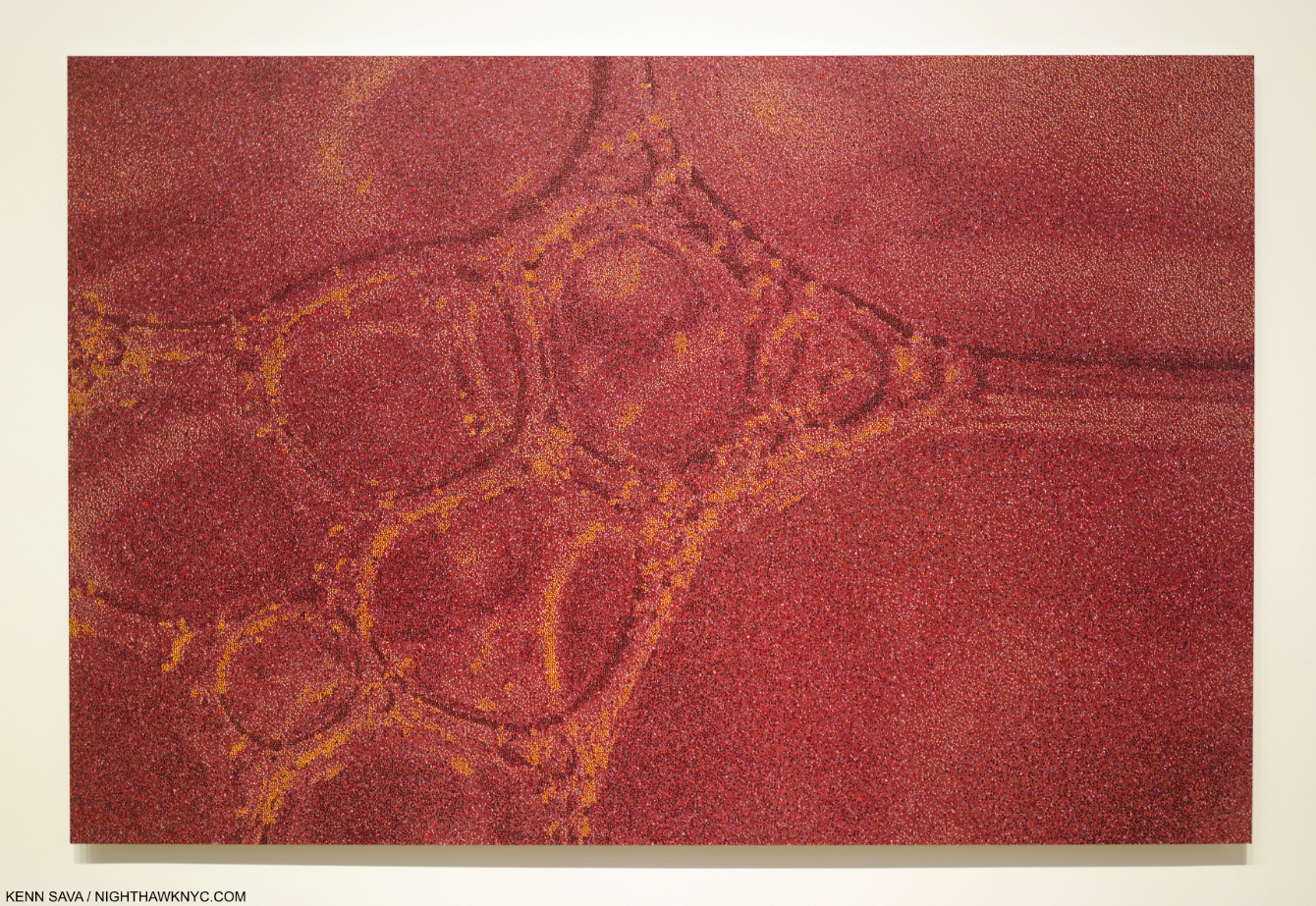
Foam, 2023, Acrylic on dibond. One of a series of Paintings(!) of foam as seen through a microscope.

“The exhibition is an expression of curiosity about spontaneously emergent structure, tendency and habit, and their intersection with the notion of free will. The work brings together historical rendering techniques like pointillism and midtone drawing with microscopy, algorithmic image processing, off-loom weaving, spraying techniques and mathematical surface modeling,” per the Press Release.

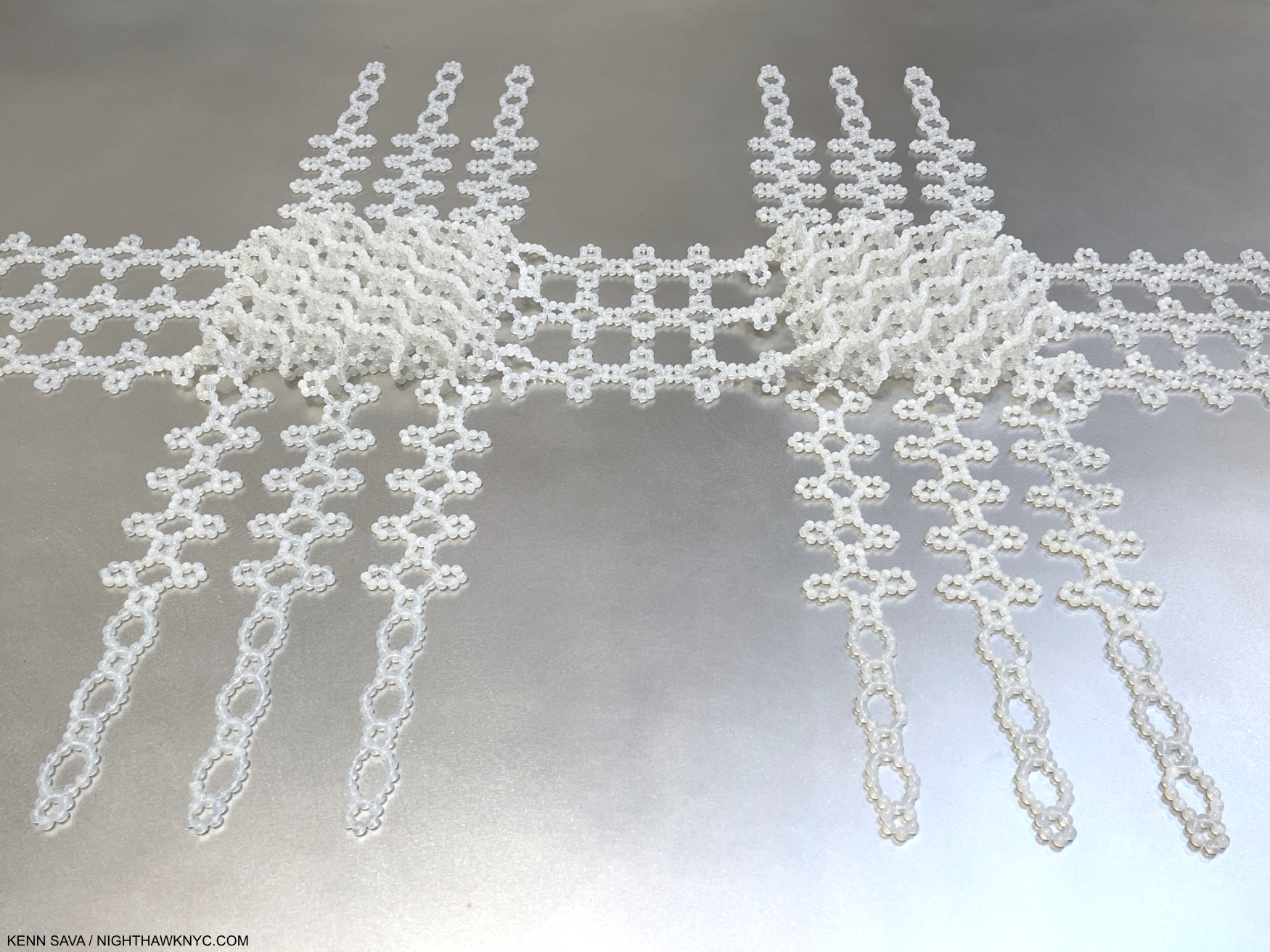
Org, 2023, Glass, nylon coated steel cord, 2 x 80 1/2 x 41 3/8 in.

New were incredibly detailed “pointillistic” (her term) Paintings accompanied by tables of intricate objects and a number of equally interesting sculptural works in the adjoining gallery. Both the objects in the main gallery and these “sculptures” reminded me that Tauba Auerbach has her own publishing company, Diagonal Press, which produces fascinating and intricate books and multiples.

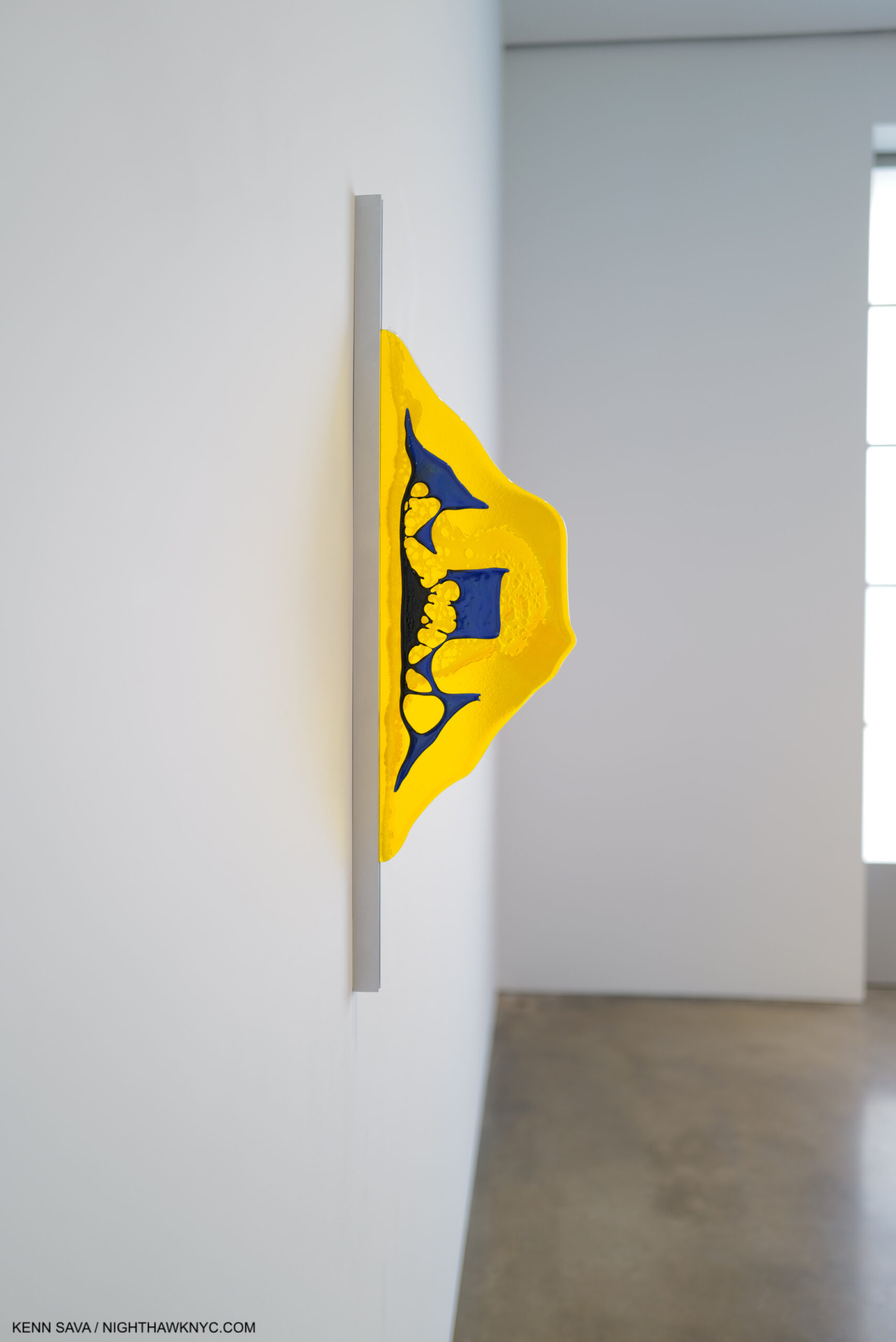
Spontaneous Lace, 2023, Kiln-formed glass in aluminum

It might be premature for me to say this, but Tauba Auerbach reminds me a bit of Frank Lloyd Wright, to me one of the great Artistic geniuses of all time. Ms. Auerbach is not an Architect, as far as I know, but her work reminds me of the brilliance of Wright’s “ancillary” designs for his buildings: his fabric designs, dishwear, furniture and rugs. Frank Lloyd Wright continually pursued “building the way nature built,” i.e. “organically,” as he called it. Much of Tauba Auerbach’s work is inspired by nature and carries forward some of its techniques, as seen here in Free Will. Barely in her 4th decade, the high esteem attached to her name is well-deserved in my view, and she is definitely an Artist to keep a close eye on.

LaToya Ruby Frazier @ Gladstone Gallery-

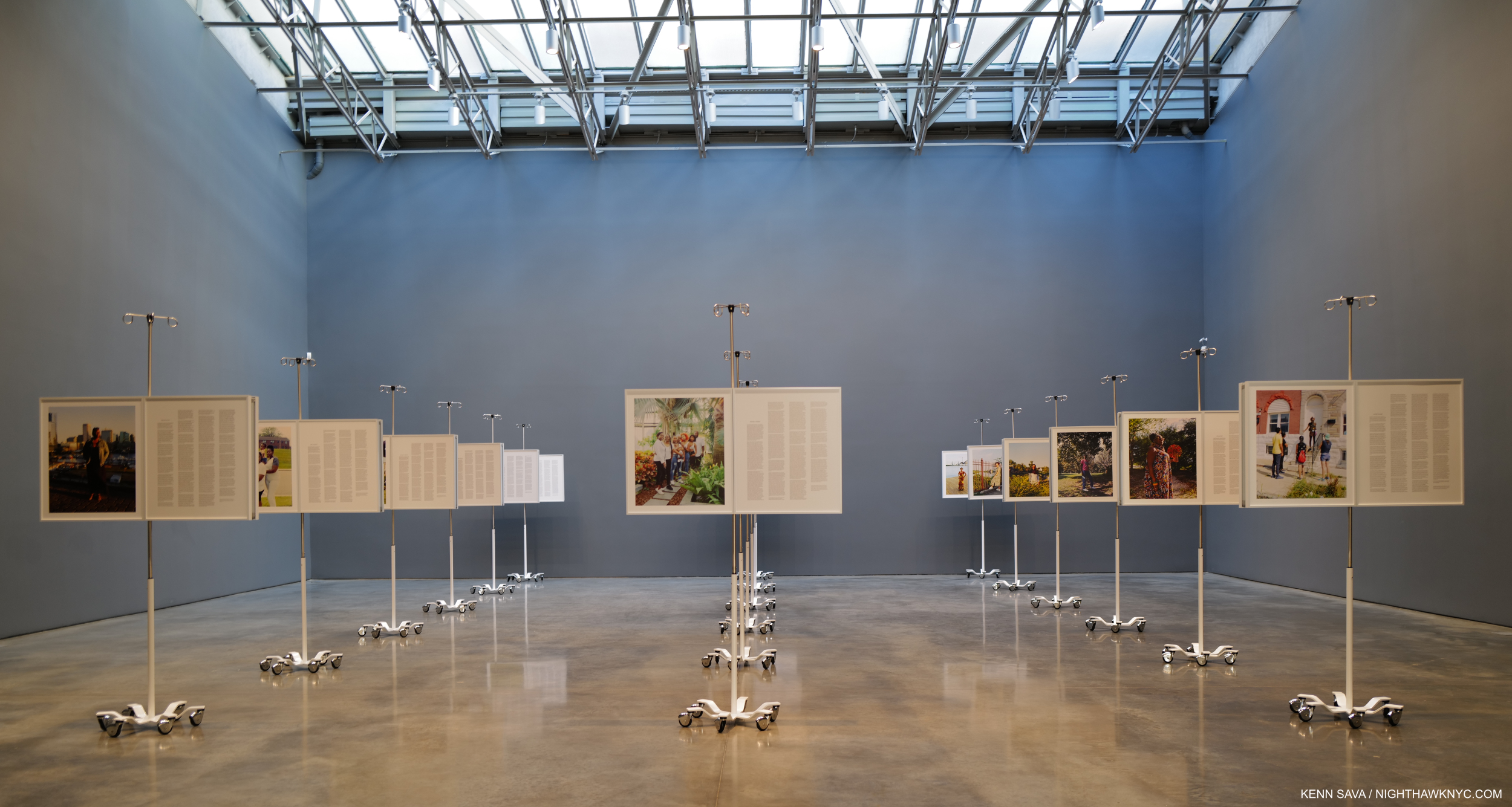
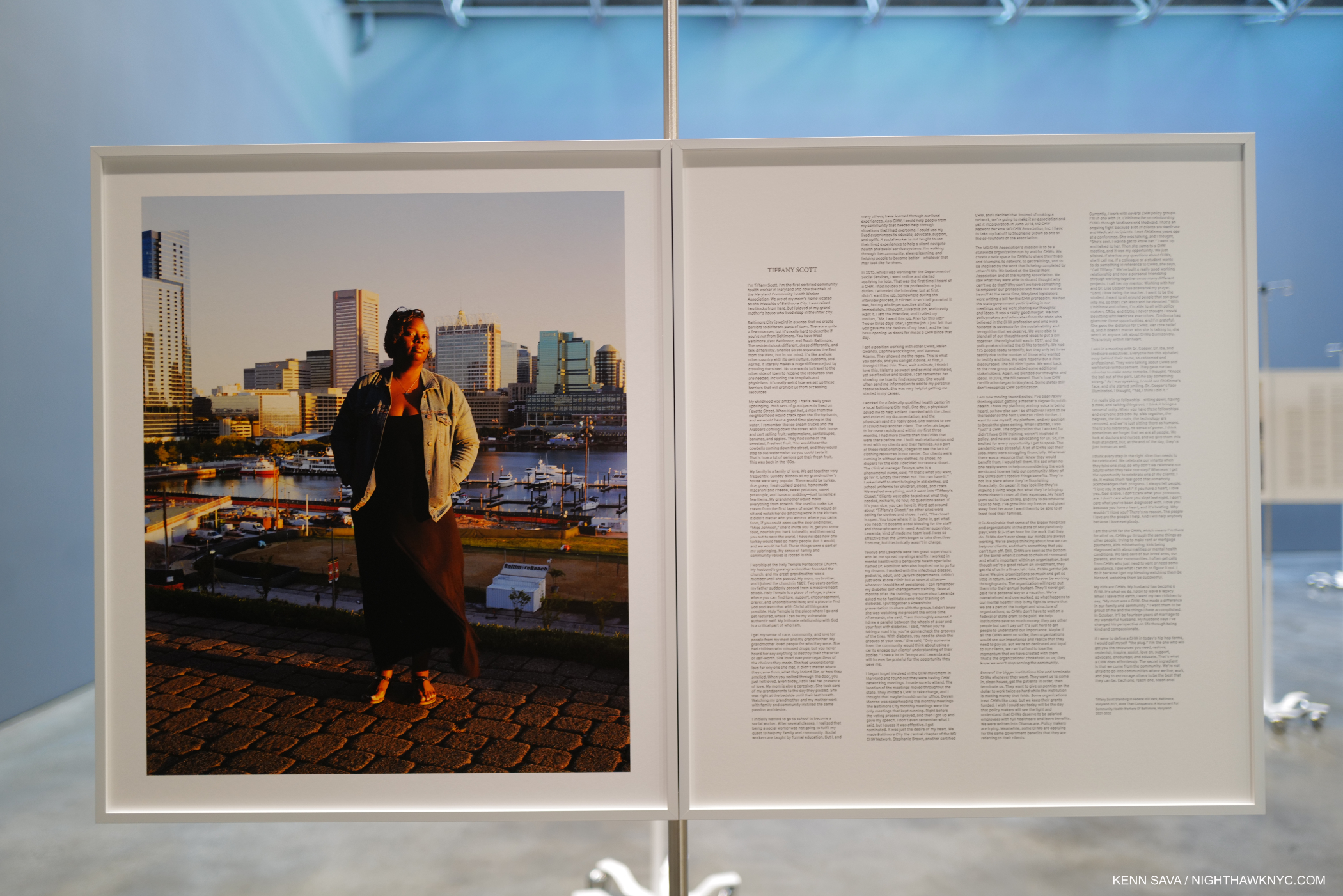
Steadily, LaToya Ruby Frazier has been building a remarkable oeuvre, equal parts documentary and Art, in her own, unique, way. Her latest show, LaToya Ruby Frazier at Gladstone consisted of one major work– More Than Conquerors: A Monument for Community Health Workers of Baltimore, Maryland 2021-22, 2022 made up of 66 archival inkjet prints mounted on 18 stainless steel I.V. poles, which amounted to stations.

At each stop her Photographs were accompanied by personal statements from the subject that were every bit as riveting as Ms. Frazier’s work- no small feat. The show was a wonderful table-setter for Ms. Frazier’s mid-career retrospective set to open shortly at MoMA. An Artist & Activist who has focused so much of her work on groups and communities deserving wider attention it’s my hope the show will do just that for her work and career.

Nicole Eisenman Prince @ Print Center New York-

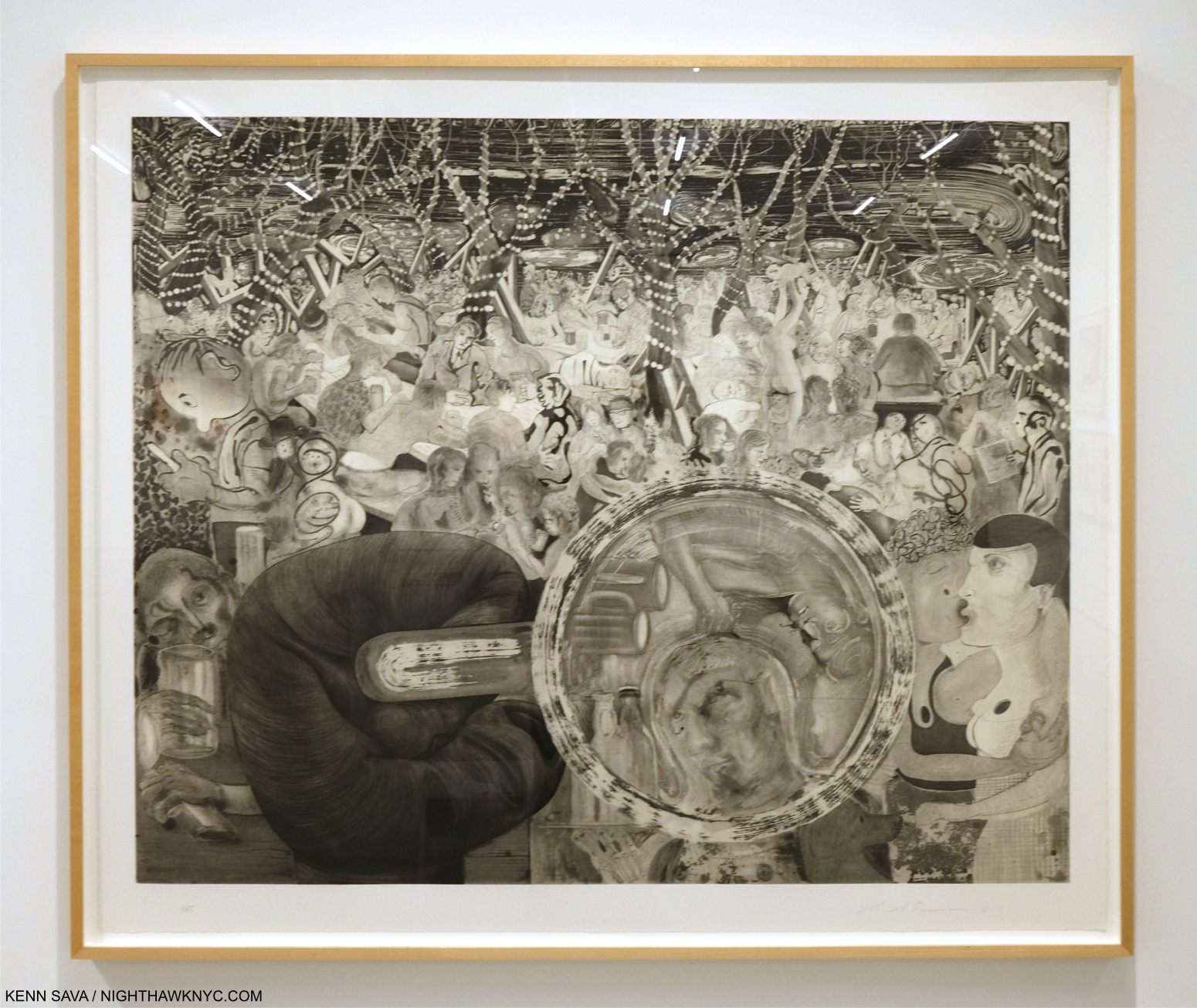
Beer Garden, 2012-7, Etching, acquatint, and drypoint with chine colle, A stunning 44 3/8 by 51 3/4 inches!

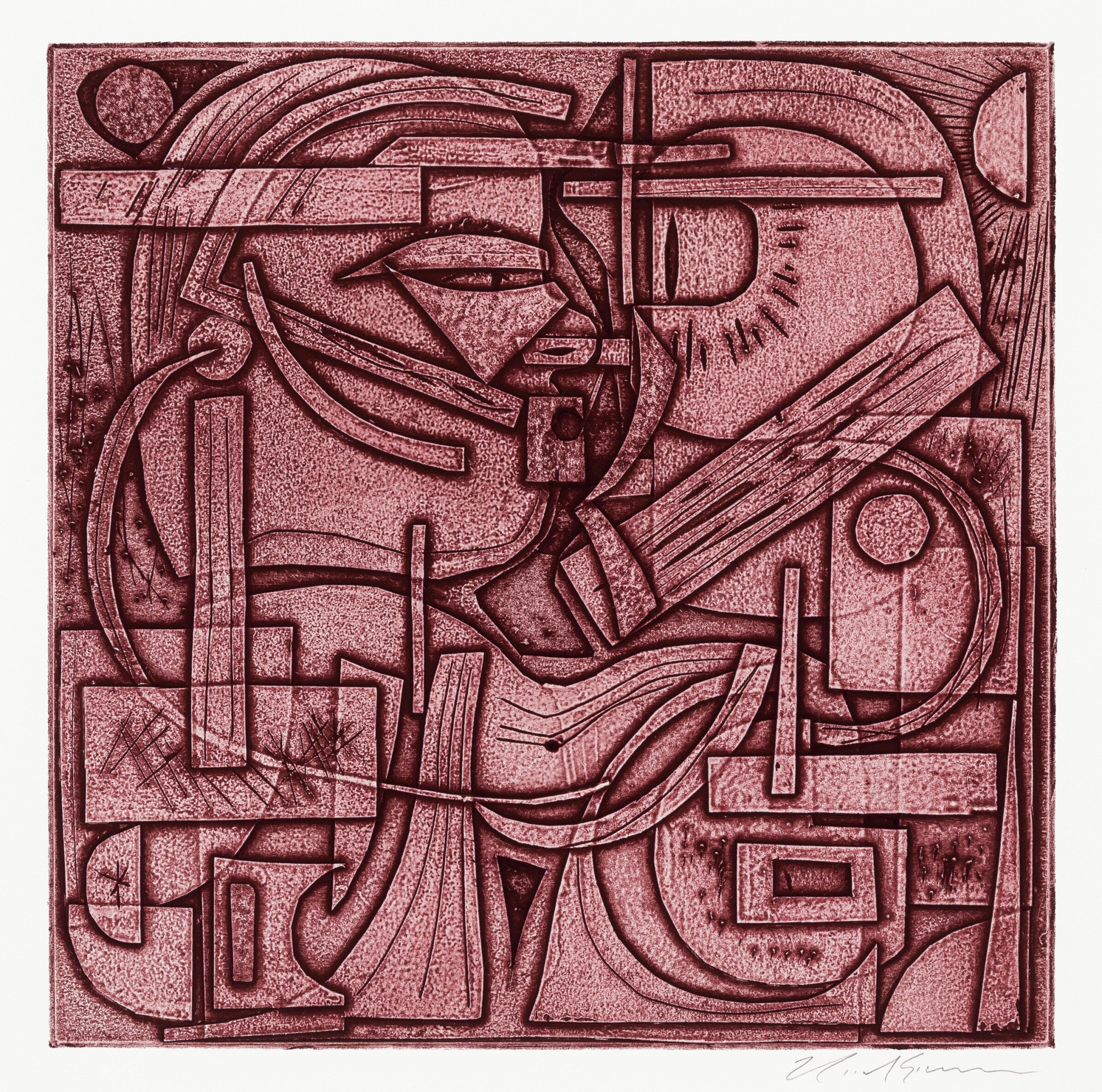
A fascinating and insightful retrospective of yet another side of her work: her seldom-seen prints. A wonderful presentation of 40 works, including new and rare works. A plethora of unique styles and compositions kept the show fresh and exciting, and I imagine would prove new even to those who know her Painting and Sculpture, which were seen to terrific effect in her New Museum survey in 2016, for which this show offered a marvelous, if delayed, addendum.

Machine Learning Kiss, 2018 Collagraph, 19 3⁄4 × 20 inches. *-unknown Photographer.

NighthawkNYC.com has been entirely self-funded & ad-free for over 8 years, during which 300 full length pieces have been published! If you’ve found it worthwhile, PLEASE donate to allow me to continue below. Thank you, Kenn.

You can also support it by buying Art, Art & Photography books, and Music from my collection! Art & Books may be found here. Music here and here.

Written & photographed by Kenn Sava for nighthawknyc.com unless otherwise credited. To send comments, thoughts, feedback or propositions click here. Click the white box on the upper right for the archives or to search them. Subscribe to be notified of new Posts below. Your information will be used for no other purpose.

Edward Hopper At The Whitney: Troubling Choices

This site is Free & Ad-Free! If you find this piece worthwhile, please donate via PayPal to support it & independent Art writing. You can also support it by buying Art & books! Details at the end. Thank you.

This is the Postscript to my series on Edward Hopper’s New York at the Whitney Museum, which may be found here-

 Part 1: Edward Hopper’s Impressions of New York

Part 2: Edward Hopper: The Last Traditionalist Faces Change

The Postscript follows-

Written & Photographed by Kenn Sava (*-unless otherwise credited)

Postscript

“Train wheels running through the back of my memory
When I ran on the hilltop following a pack of wild geese
Someday, everything is going to be smooth like a rhapsody
When I paint my masterpiece.”*

After ALL I said in Parts 1 & 2 about Edward Hopper’s Art & Edward Hopper’s New York at the Whitney, all is not sunshine in the world of Edward Hopper’s Art in 2022-3 in spite of the show’s resounding popularity.

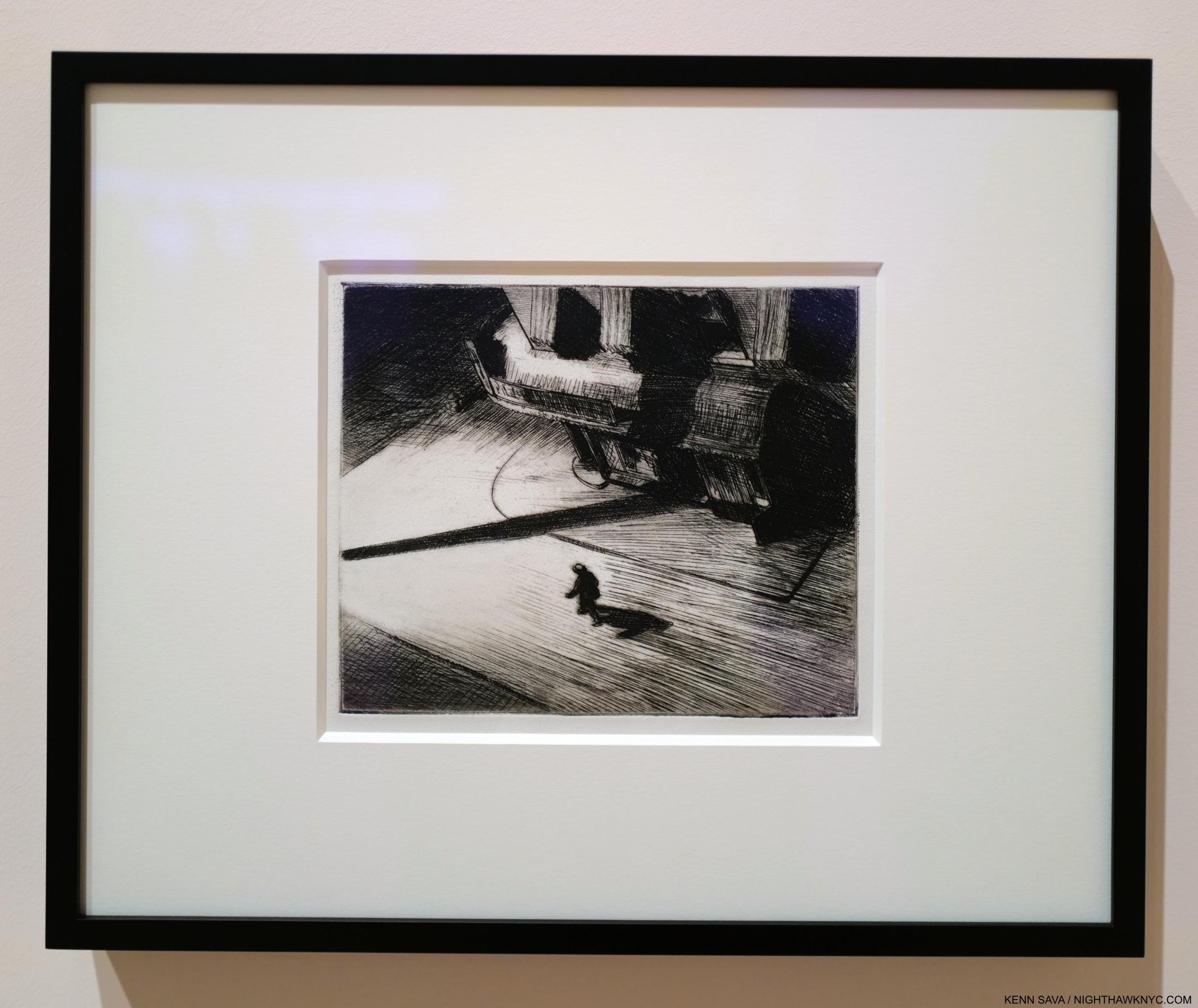
Edward Hopper, Night Shadows, 1921, Etching. One of the first pieces by Hopper to speak to me. Looking at it, I wonder- who is the lonelier? The man walking on the street, or the observer? A similar experience is to be had with Nighthawks. Seen at Edward Hopper’s New York. I chose this piece because it mimics the shadows I see surrounding the Art of Edward Hopper in 2022-23. Click any picture for full size.

While Edward Hopper might not have been a fan of some of the changes he saw going on around him, as I showed in Part 2, those who are admirers of his work may not approve of some of the choices being made involving his Art by the Whitney Museum, the  holders of the largest collection of Edward Hopper’s Art in the world. Their holdings, built up over the prior 40 years, ballooned to extraordinary size when they became the beneficiary of the Jo Hopper Bequest in 1970, which gifted them Edward & his wife Jo’s estates (including both of their Art; Jo was an Artist, too), an unprecedented gift from an American Painter to an American museum. Edward Hopper chose the Whitney as his beneficiary due to Gertrude Vanderbilt Whitney having been an early supporter of his Art. In 1920, Mrs. Whitney’s manager, Juliana Force, gave him his first one-man show at the Whitney Studio Club, the predecessor of the Whitney Museum. After he passed in 1967, Jo Hopper was too ill to change his wishes- which she may well have done had she been in better health1.

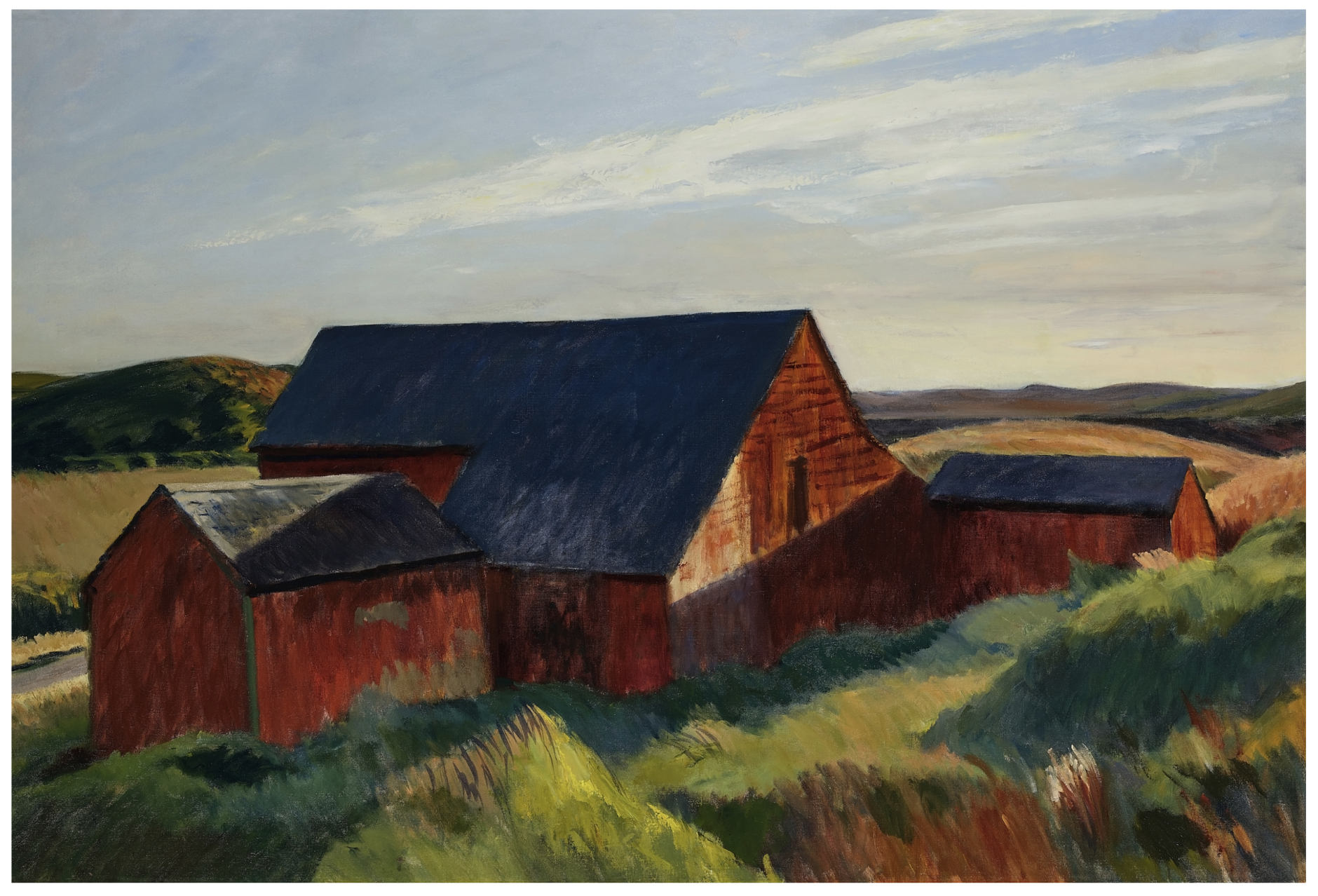
Going…going…SOLD! Cobb’s Barns, South Truro, 1930-3, Oil on canvas. I spent two days in Truro, MA, where the Hoppers spent their summers, back in the 1980s, drinking in the air, the light and the atmosphere Hopper loved for most of his life. *- Whitney Museum Photo. Not in the show.

In May, the Whitney sold (at least) one Edward Hopper Painting, Cobb’s Barns, South Truro, 1930-3 from the 1970 Bequest. I find that quite worrisome (Wait. No. There is no strike-through button in WordPress- make that “I’m sickened by this”) for any number of reasons. For one thing, from what I saw over 14 visits to Edward Hopper’s New York, it looks to me that Hopper’s popularity is, and has been, steadily increasing, world-wide to the point that he is now among the most popular American Artists world-wide, if he is not now the most popular. Is the Whitney “selling at the top” in parting with his work now? Or, is their selling short-sighted?

Of course, no one can foresee the future, and though the Art market has done nothing but go higher since the late 1980s, no bull market lasts forever. As a result, I would have chosen something else to sell while the market is high. With all due respect to the other Artists in their collection, something else not by Hopper. In spite of all that’s already been written about his work these past 100 years, it seems to me it’s still early in the assessment of Edward Hopper’s Art & accomplishment. His work with human subjects has received so much attention that his landscapes, for example, are still to be fully assessed & fully appreciated, I believe, as I said in Part 2. They have begun to receive more attention this past decade, but there is still much to learn from them. Therefore, the Whitney’s decision to sell one of his Landscapes (a man-altered landscape, as I characterized these in Part 2) comes with the risk of being premature. I believe they will be worth more as time goes on. Apparently, so does the buyer.

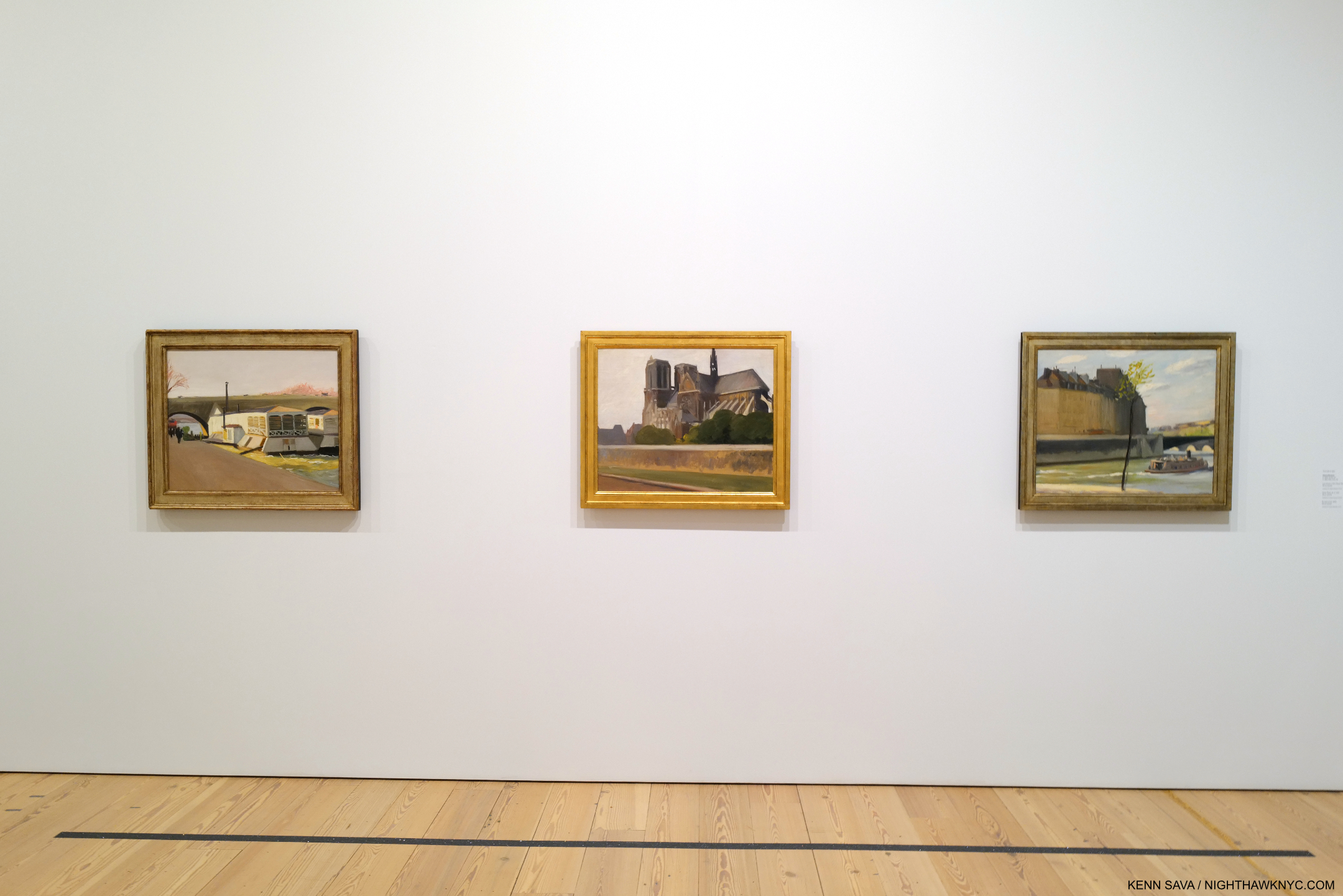
Unbeknownst to most visitors to Edward Hopper’s New York on the 5th Floor, upstairs on 7, the Whitney has been rotating Edward Hopper works in half a gallery. Seen in January, 2023, these three are from his trips to Paris, 1906-10, and so not appropriate for inclusion in the New York show. Like his Landscapes, they have been overlooked to this point.

Besides his Landscapes, his early work (to 1922) also remains under-appreciated and considered it seems to me.

“In every artist’s development the germ of the later work is always found in the earlier. The nucleus around which the artist’s intellect builds his work is himself; the central ego, personality, or whatever it may be called. and this changes little from birth to death. What he was once, he always is, with slight modification. Changing fashions in methods or subject matter alter him little or not at all.” Edward Hopper2

There has not as yet been a full assessment done of them. In light of the powerful work that came later it’s easy to pass these by, but in them I see the germs of much of what was to come. It may be that this early work and his landscapes turn out to not be as popular as his later work. That doesn’t mean they’re not important for other reasons.

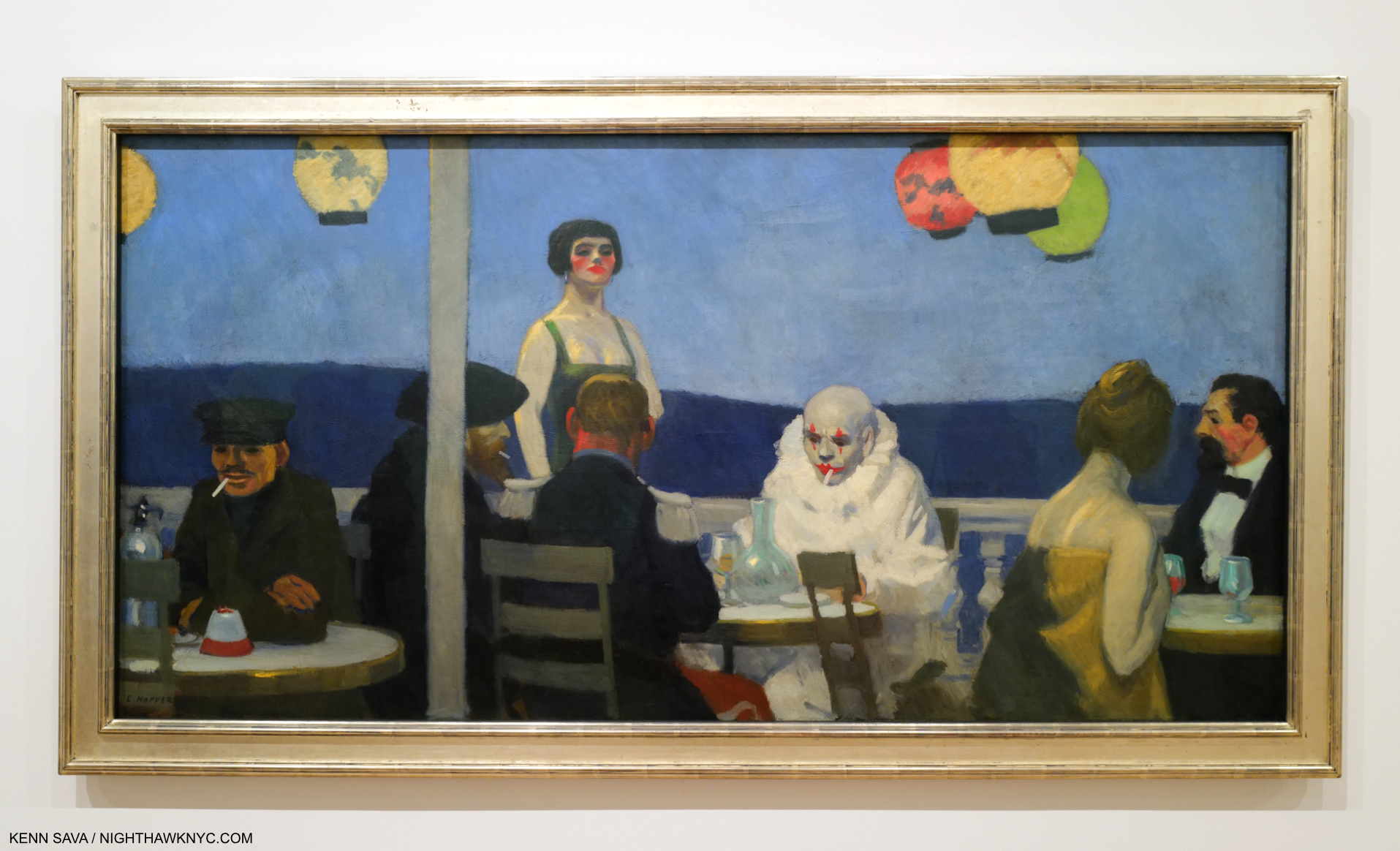
Soir Bleu, 1914. A work that has puzzled viewers for almost 110 years also seen on the Whitney’s 7th floor Permanent Collection galleries in January, 2023, while Edward Hopper’s New York was up on the 5th.

One of the most notorious pieces of his early work, Soir Bleu, 1914, is a unique outlier in Edward Hopper’s oeuvre. A work depicting a scene ostensibly in Paris but Painted in NYC after he returned, it doesn’t quite fit with what came before, or after. Exactly what is going on here has mystified many. It’s another example of how far Hopper studies have to go.

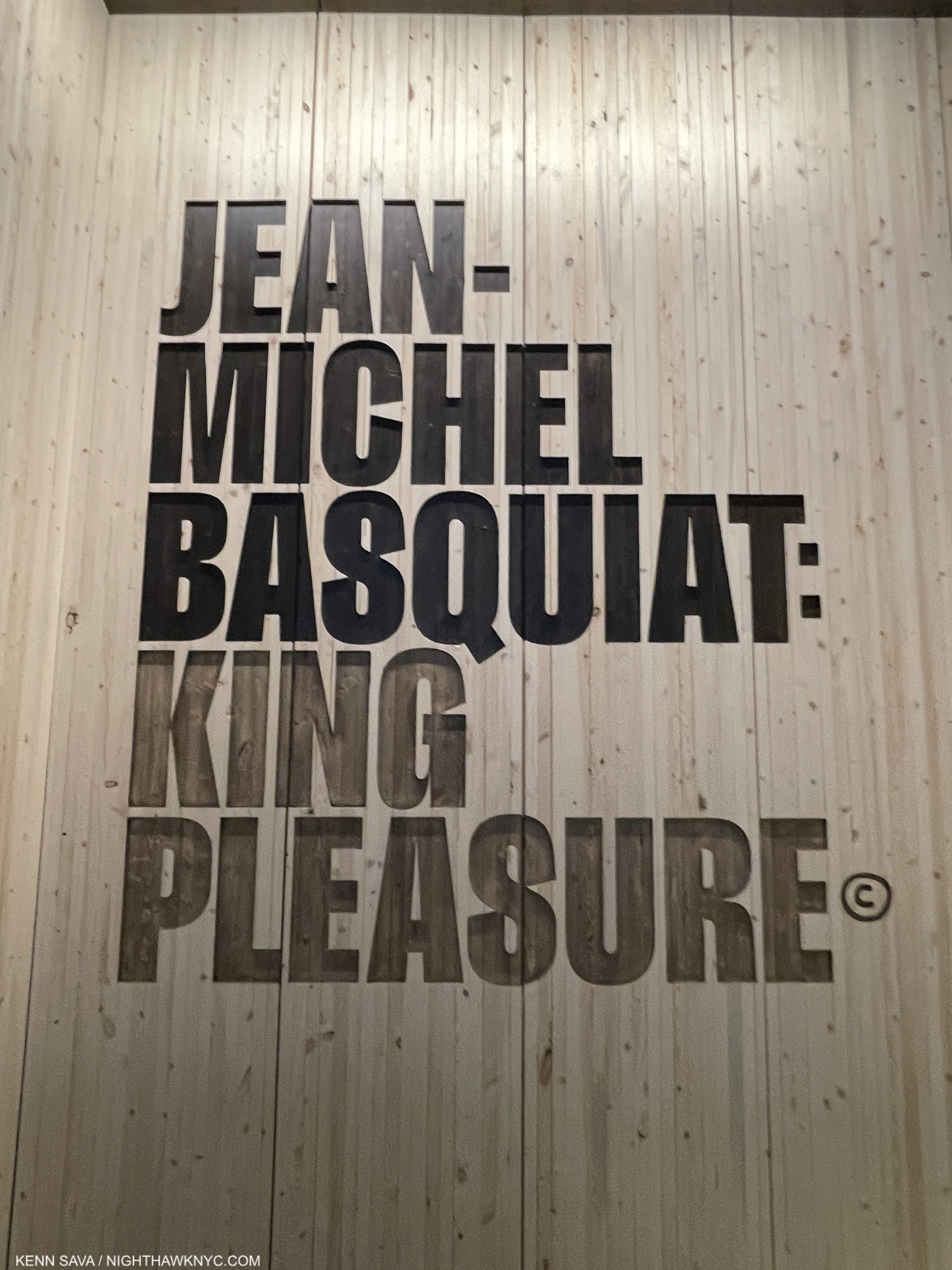
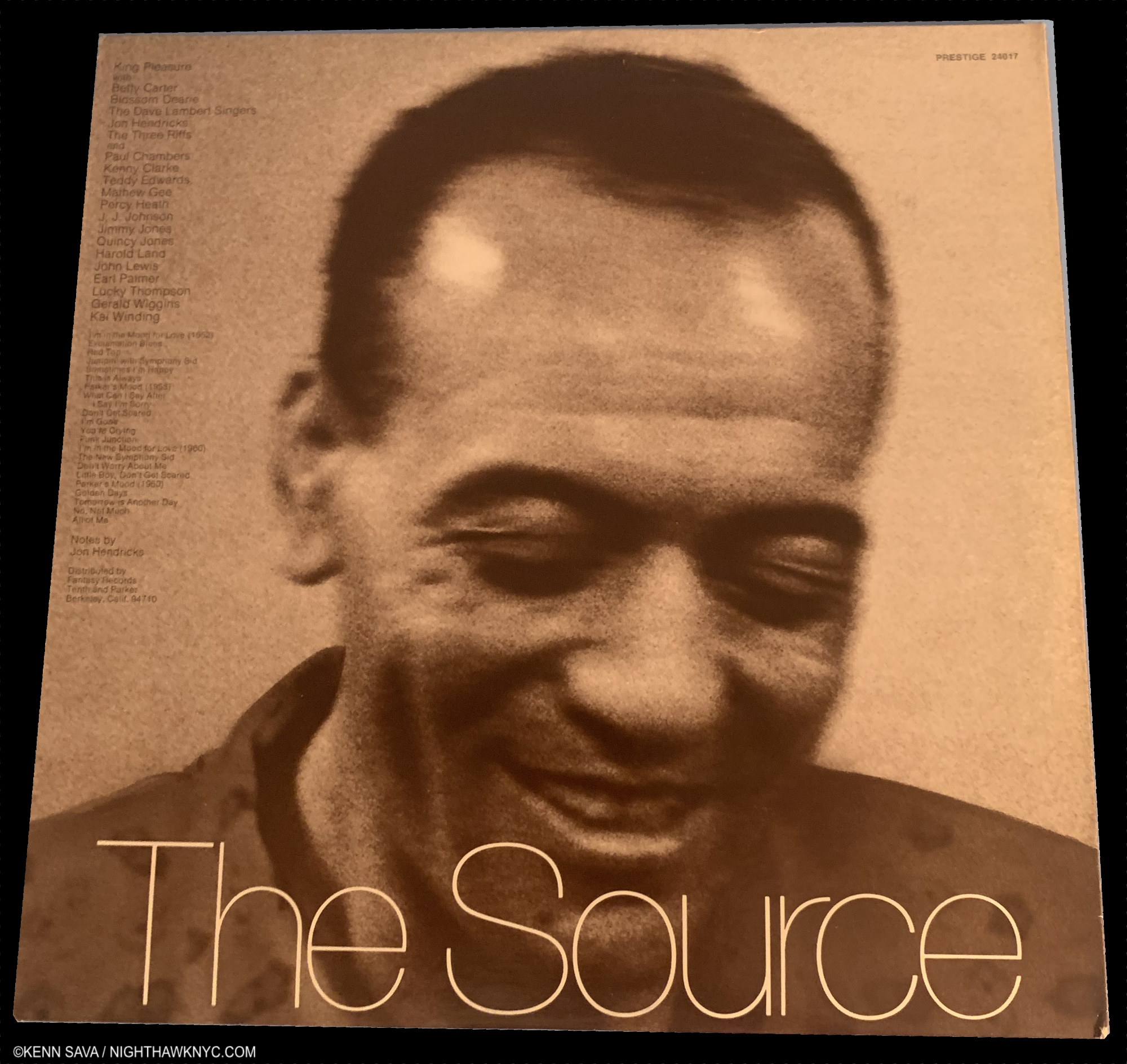
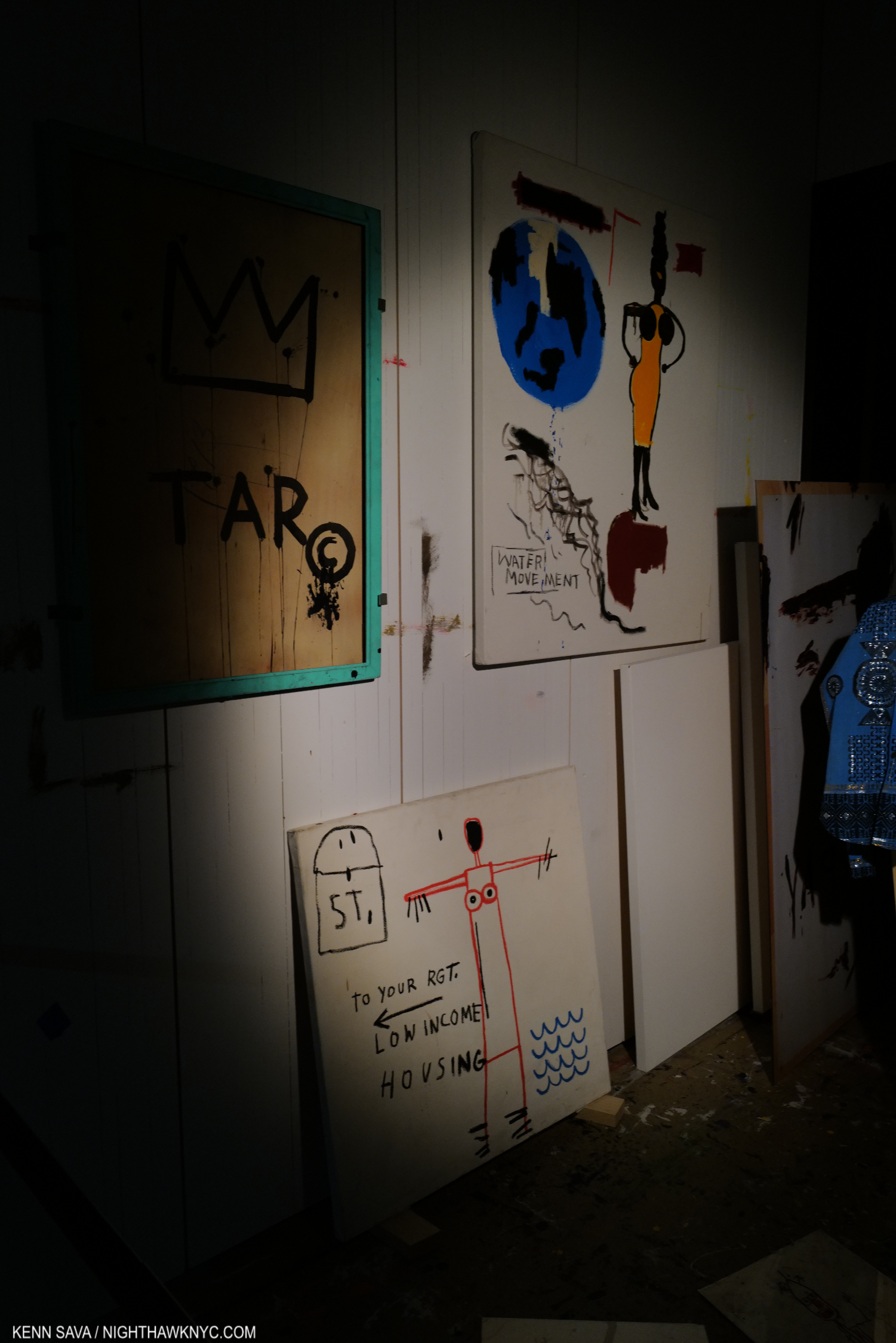
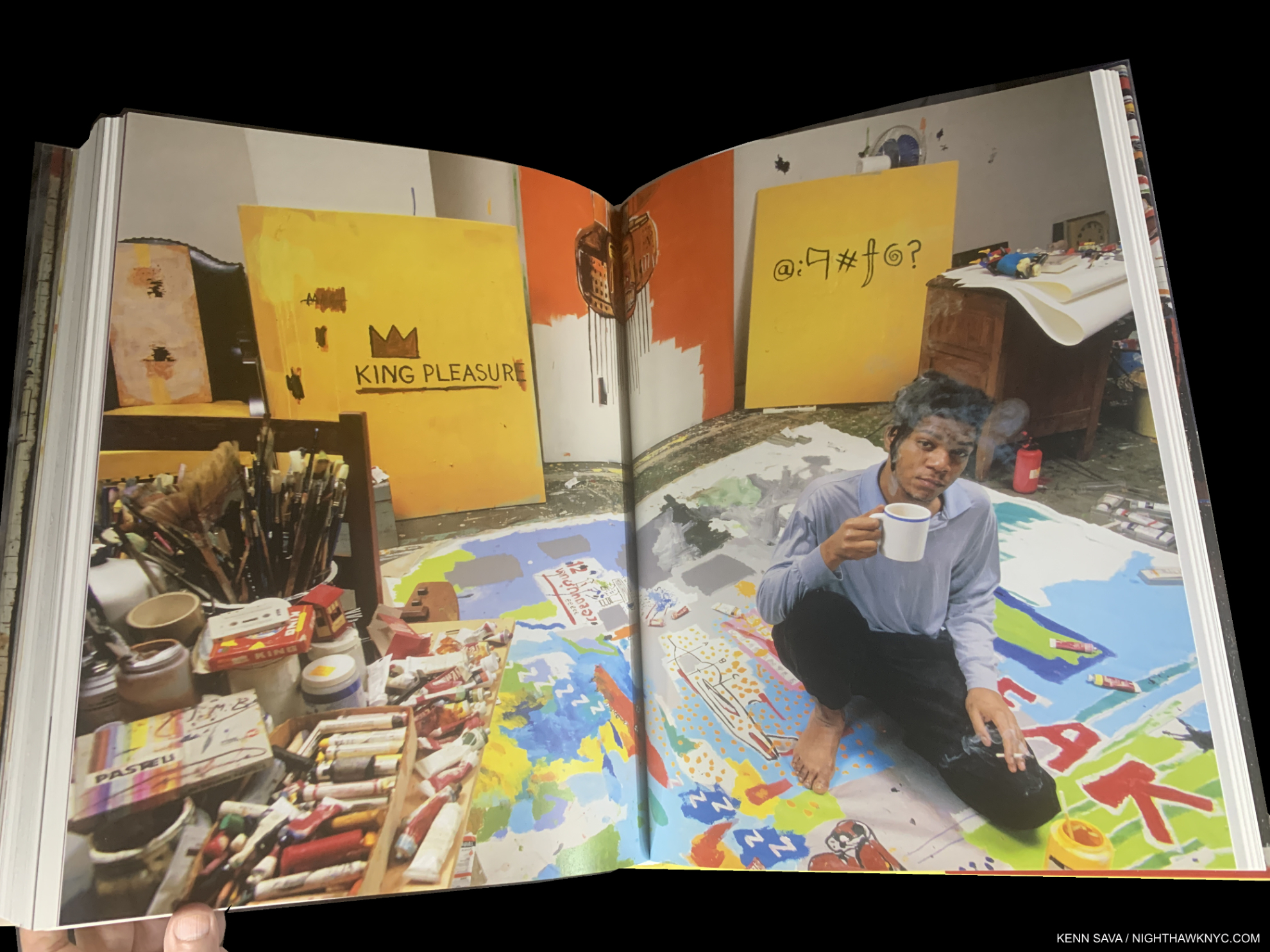
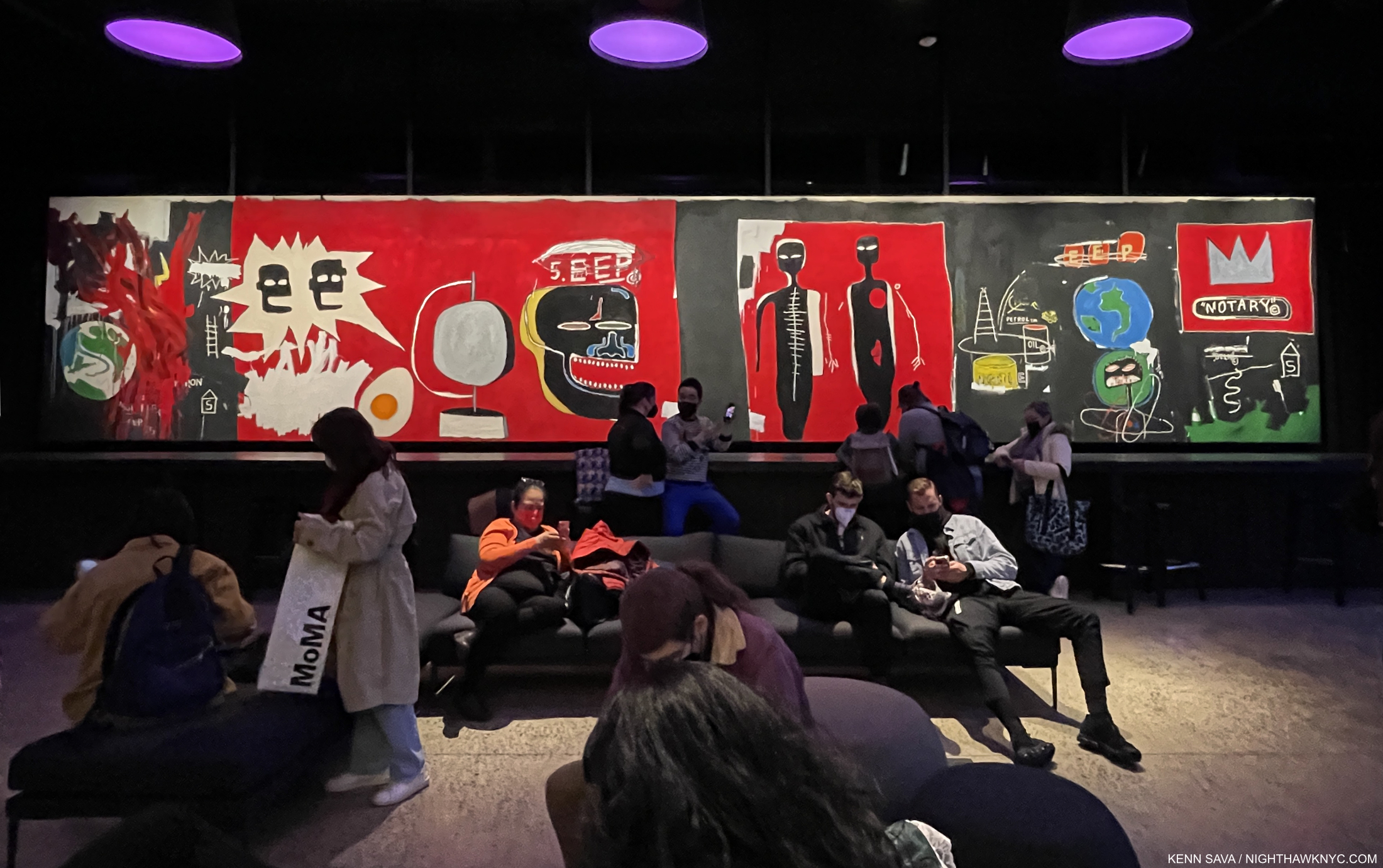
Earlier this year I looked at the state of Jean-Michel Basquiat’s Art and concluded that there may not be enough in his family’s collection to open a museum. Jean-Michel sold much of his Art as he created it, so much of it had long been dispersed when he died in 1988. His estate went to his family who retain was was left (which formed the basis for the show Jean-Michel Basquiat: King Pleasure, which I wrote about here). The Whitney, on the other hand, currently shows over 3,000 pieces by Edward Hopper from their collection online. They just might have enough to open something of a substantial, permanent, rotating, Edward Hopper exhibition, if not an outright museum! (They have been running a small rotating selection of his work in part of a gallery on the 7th floor where they display work from the Permanent Collection for a while, part of which, seen in January, 2023, I show above.)

Can you imagine what a big deal an Edward Hopper Museum in NYC would be? No other Artist has one here…yet. I can only begin to imagine how much it would enhance the value of their collection. Should they? Obviously, the finances would need to be considered, and I have no idea how that would shake out. It’s just one possible avenue the Whitney can explore. Have they? No one knows.

The selling of Hopper’s Art at this point makes me wonder what the long-term plan is for their Hopper holdings. It’s a question I think more people should be asking. My opinion is that at this point (June, 2023), I would not only hold on to everything they have, I would be adding to it.

The Whitney’s history of managing the extraordinary 1970 Jo Hopper Bequest has already proved littered with questionable decisions, this sale being only the latest. They sold some of it early on until the public outcry caused them to stop. I can’t help but wonder how The Met would have handled the Hopper gift. They have received extraordinary gifts from the estates of Diane Arbus and Walker Evans (among others), both of which they have handled masterfully, in my view.

Unfortunately, there’s more…

Jo Painting, 1936, Oil on canvas. Jo Hopper doing what she loved doing most. Though he met her when they were both Art students of Robert Henri, Edward was not a fan, or supporter, of her Art. Seen in Edward Hopper’s New York.

You may have noticed that I said the Whitney  are “the  holders of the largest collection of Edward Hopper’s Art in the world,” though I mentioned the Jo Hopper Bequest gifted his and Jo’s Art to the museum. The reason I didn’t mention hers is that they no longer have it. The Whitney allegedly disposed of most of Jo Hopper’s work that was included in her 1970 gift with her husband’s work, as hard as that is to imagine.

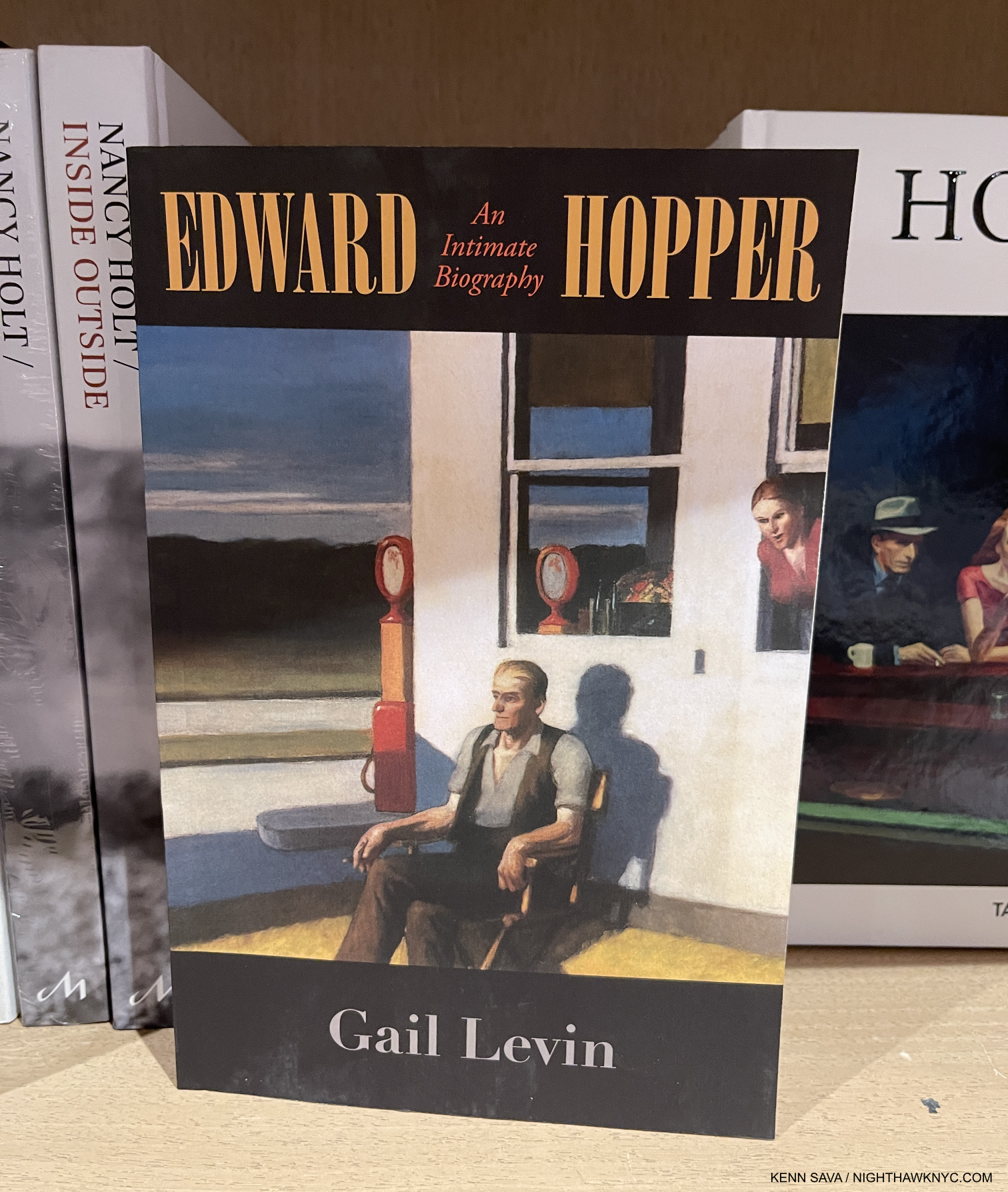
Regarding the woman, herself. Gail Levin, the Whitney’s first Edward Hopper curator and author of the definitive Hopper biography, Edward Hopper: An Intimate Biography, based on decades of research into Edward, Jo, and their relationship, writes at length about his wife of 43 years, Josephine Nivison (“Jo”) Hopper. Based on her feelings as expressed in the unpublished Diaries she kept for about 30 years, and interviews, the resulting picture is not a pretty one for those who look at Edward with admiration. At her husband’s death, everything passed to Jo, who was ill, and then blind, the final year of her life. She was in no condition to change her husband’s intentions and gift their estates to another institution. After the Bequest went to the Whitney, they then hired Gail Levin to curate it. She recounts what she discovered when she looked for Jo’s Art-

“In going through the Hopper collection, I expected to see Jo’s art as well as Edward’s. I had read James Mellow’s article in the Times, describing canvases by Jo in the bequest as “generally pleasant, lightweight works: flowers, sweet-faced children, gaily colored scenic views.” But I found nothing. Dealing with the bequest, (Whitney Director John) Baur naturally looked for advice to (Lloyd) Goodrich, his immediate predecessor as director and Hopper’s recognized interpreter and friend. Together Baur and Goodrich rejected Jo’s work as unworthy of the museum. They arranged for some of her paintings to be given away; they simply discarded the rest. They saw no need to invest even in archival photographs. Ironically, the only paintings from this group that can now be traced are four that went to New York University, which had troubled the Hoppers for years with efforts to evict them from their home.

In all, only three works by Jo were added to the Whitney’s permanent collection. None was ever exhibited. All three had disappeared by the time I began work in 1976. None has ever turned up 3.”

Ms. Levin also states that “From what remains of Jo’s paintings, it is clear that she was not the major talent that her husband was4,” Still, her importance, as a witness, a model, a partner & wife, and for what she went through during their 43-year marriage is only going to grow as time goes on, I believe, especially if her Diaries are ever published. The importance of her work will also rise, as a result- above and beyond whatever judgement is placed on its quality. The result is that history has been forever denied everything her work would tell us. Another reason to be angry at the way the Bequest has been handled.

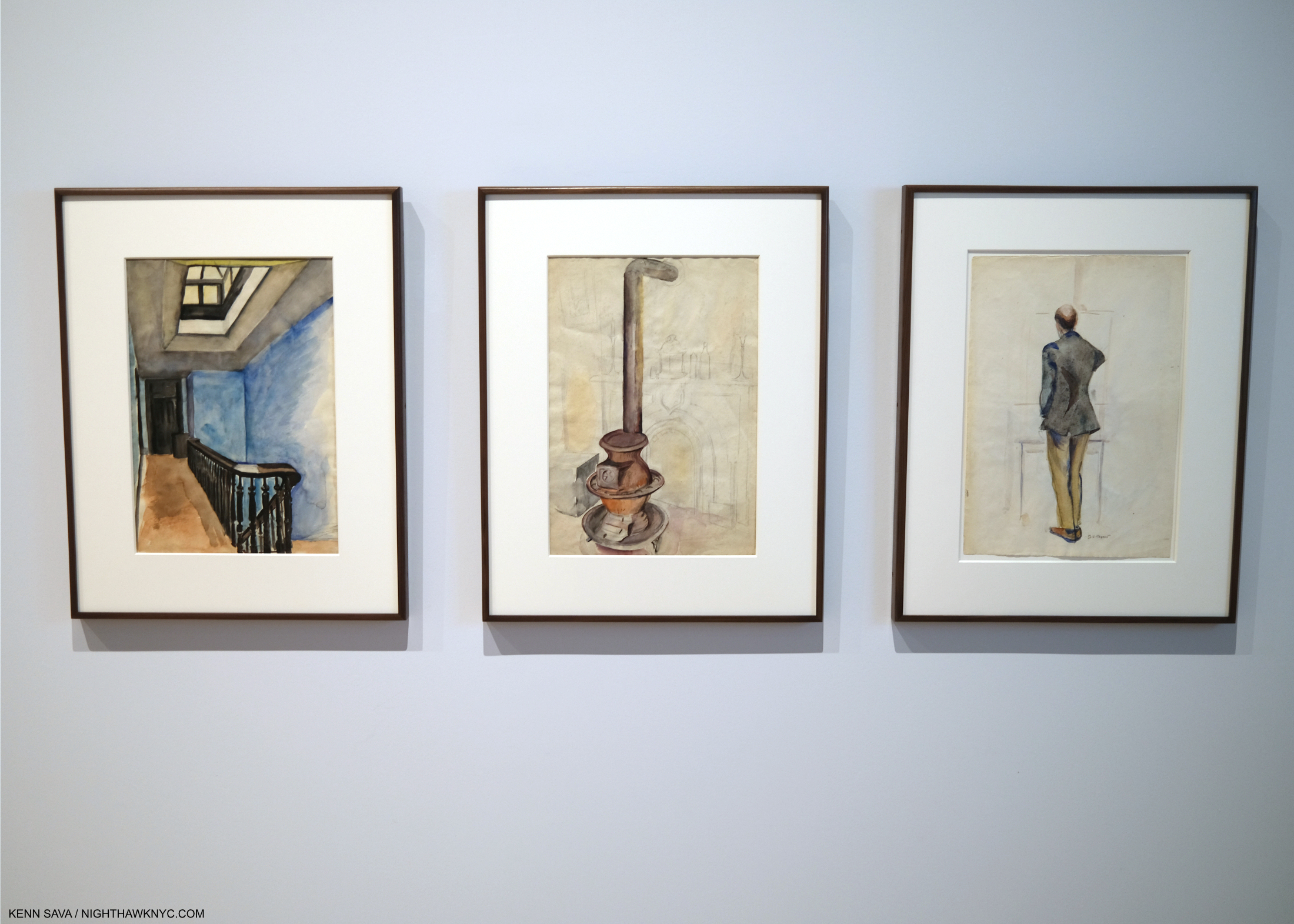
3 works by Jo Hopper seen in Edward Hopper’s New York. Left to right- 74 Stairs to Studio at Three Washington Square, 1932, Stove and Fireplace, Three Washington Square, 1932, Back of E. Hopper, 1930, Each Watercolor and graphite on paper.

Edward Hopper’s New York honored his wife and the Jo Hopper Bequest, which made up the vast majority of the work on view, by including 3 of her Watercolors. 2 were on loan.

Unfortunately, there’s still more…

Essential for researchers and anyone interested in Hopper’s Art, or the man and his wife, Edward Hopper: An Intimate Biography, by Gail Levin, out of print for a while has just been reprinted again. At 700+ pages, it’ll fill all your summer reading needs.

As if selling Edward Hopper’s work and discarding Jo’s is not enough to diminish the Whitney’s Hopper holdings, they may have been further diminished by theft of Hopper’s Art from his estate! Gail Levin has called out the man behind a donation recently made to the Whitney, part of which was included in Edward Hopper’s New York (none of which I showed- purposely), with a mysterious (to put it politely) provenance. According to her, this man (who I will not name here) may have stolen quite a bit of Art & ephemera from the Hopper estate while he had access to their properties when he was serving as a caretaker- all of which should have gone to the Whitney under the terms of Jo Hopper’s will, as Edward’s survivor. This person kept what he took, sold some of it, and has donated some to the Whitney. About 1,000 pieces may still be in the hands of his heirs. If ALL of it had gone to the Whitney, as the Hoppers intended, the world would be that much closer to gaining a full appreciation of the Hopper’s Art & accomplishment. And, the Whitney would be that much closer to a Hopper Museum.

Screenshot of the homepage of Gail Levin’s “Ethics & Visual Arts” site. I so admire her courage & dedication.

Ms. Levin brought the subject of this alleged theft to public light in 2012 around the time of the Whitney’s Hopper Drawing show. Earlier, after she discovered it, she brought it to the attention of the Whitney, who subsequently fired her as a result, she says. Wait. Weren’t they outraged when they heard about this? What did they do about it, besides fire Gail Levin? The controversy was rekindled when Edward Hopper’s New York opened in October including some of these questionable pieces. She has revealed the full story in a series she calls “Ethics and the Visual Arts.”  I feel it’s important that anyone who cares about Hopper’s Art read what she has to say about what happened, here. (She also did a video interview earlier this year about all of this which may be seen here.)

Robert Henri, Gertrude Vanderbilt Whitney, 1916. I wonder what Gertrude Vanderbilt Whitney, whose collection of American Art became the basis of the  Whitney Museum, would make of how the Jo Hopper Bequest has been handled. Mrs. Whitney was also an under-appreciated Sculptor. Seen on the 7th Floor while Edward Hopper’s New York hung on the 5th, January, 2023. Robert Henri taught both Edward & Jo Hopper a decade earlier, and Painted a Portrait of Jo.

It’s hard not to feel outraged and violated by all of this. So, I do!

It’s my hope a thorough investigation will take place into all of this- including the Whitney’s mysterious involvement in it, according to Ms. Levin, and if it is determined the pieces were gained illicitly by this man steps are taken to rectify it as soon as possible. As extremely concerning as this all is on Hopper’s Art, it seems to me it also serves as a warning to living Artists to learn from this and safeguard their own estates and intentions.

This extremely troubling episode Gail Levin has brought to the public’s attention cast a shadow on what was otherwise an excellent and important show. I hope it will be the last Hopper show it hangs over.

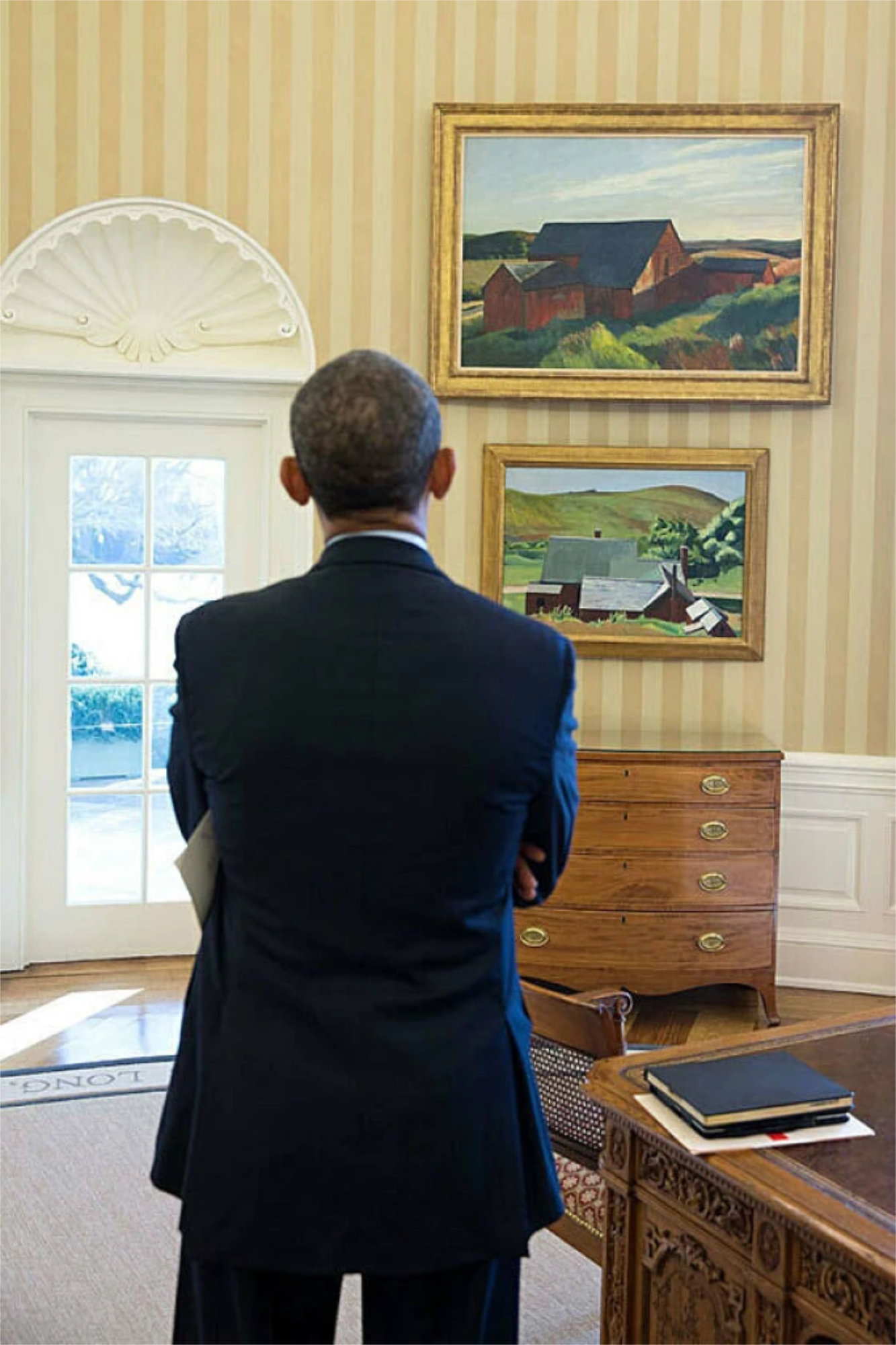
Cobb’s Barns, South Truro hanging in the Oval Office of the White House where President Obama is admiring it. February 7, 2014. *-Photo by Chuck Kennedy.

Between the Jo Hopper Bequest and the Hopper they have in their Permanent Collection, what amounts to the Edward Hopper Archives at the Whitney is very likely their most important holding at this point. They have a huge responsibility to the public, now and in the future, to protect and preserve it. It’s past time Art lovers speak up about what’s been going on with it and get some concrete answers.

“Everyone was there to greet me when I stepped inside
Newspapermen eating candy
Had to be held down by big police
Someday, everything is going to be different
When I paint my masterpiece”*

*- Soundtrack for this Post is “When I paint my masterpiece,” by Bob Dylan from Bob Dylan’s Greatest Hits Vol. II, 1971-

NighthawkNYC.com has been entirely self-funded & ad-free for over 8 years, during which 300 full length pieces have been published! If you’ve found it worthwhile, PLEASE donate to allow me to continue below. Thank you, Kenn.

You can also support it by buying Art, Art & Photography books, and Music from my collection! Art & Books may be found here. Music here and here.

Written & photographed by Kenn Sava for nighthawknyc.com unless otherwise credited. To send comments, thoughts, feedback or propositions click here. Click the white box on the upper right for the archives or to search them. Subscribe to be notified of new Posts below. Your information will be used for no other purpose.

  1. Source for all of this information is Gail Levin, Edward Hopper: An Intimate Biography, Expanded Edition, 2007, Introduction & P.128
  2. from a letter from Hopper dated 1935 quoted in Gail Levin, Edward Hopper As Illustrator, P.1.
  3. Gail Levin, Edward Hopper: An Intimate Biography, Expanded Edition, P. xvi
  4. Gail Levin, Edward Hopper: An Intimate Biography, Expanded Edition, P.723

Edward Hopper’s Impressions of New York

This site is Free & Ad-Free! If you find this piece worthwhile, please donate via PayPal to support it & independent Art writing. You can also support it by buying Art & books! Details at the end. Thank you.

Written & Photographed by Kenn Sava (*-unless otherwise credited)

Show Seen: Edward Hopper’s New York @ The Whitney Museum
Part 1 of 3 Parts.

Introduction

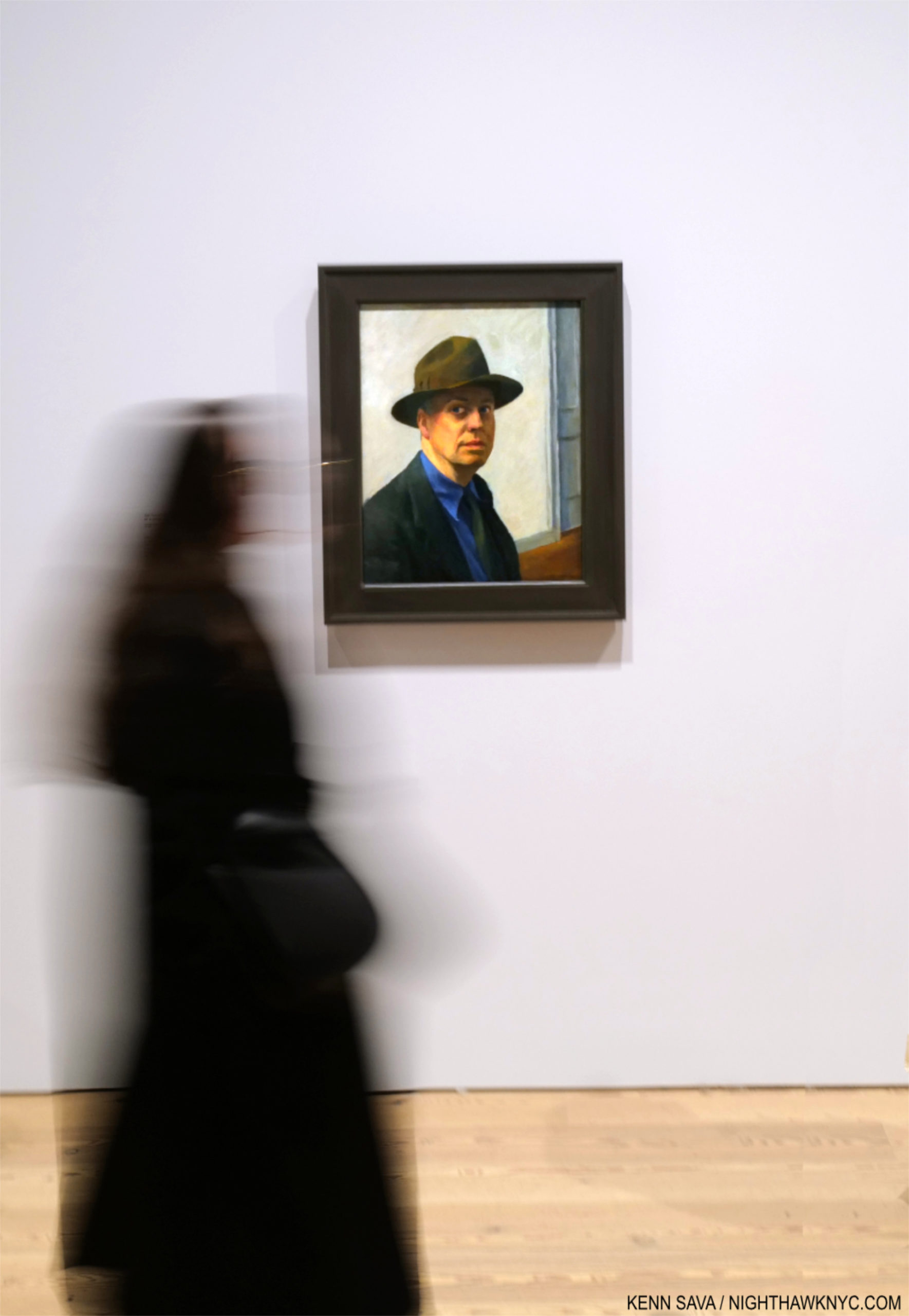
Smack dab in the heart of Edward Hopper’s New York, the Artist stares out at us in one of hs few Self-Portraits, one he began 98 years ago (1925-30). What would Edward Hopper make of his New York now? Click any picture for full size.

Edward Hopper. What more can I say about his Art? In 2015, I named this site after his masterpiece, Nighthawks, because of that figure with his back to us that no one ever talks about. I relate to him more than I do any other figure I’ve ever seen in a Painting because I’ve been that guy, alone in a bar, cafe or restaurant in Edward Hopper’s New York too many times to count.

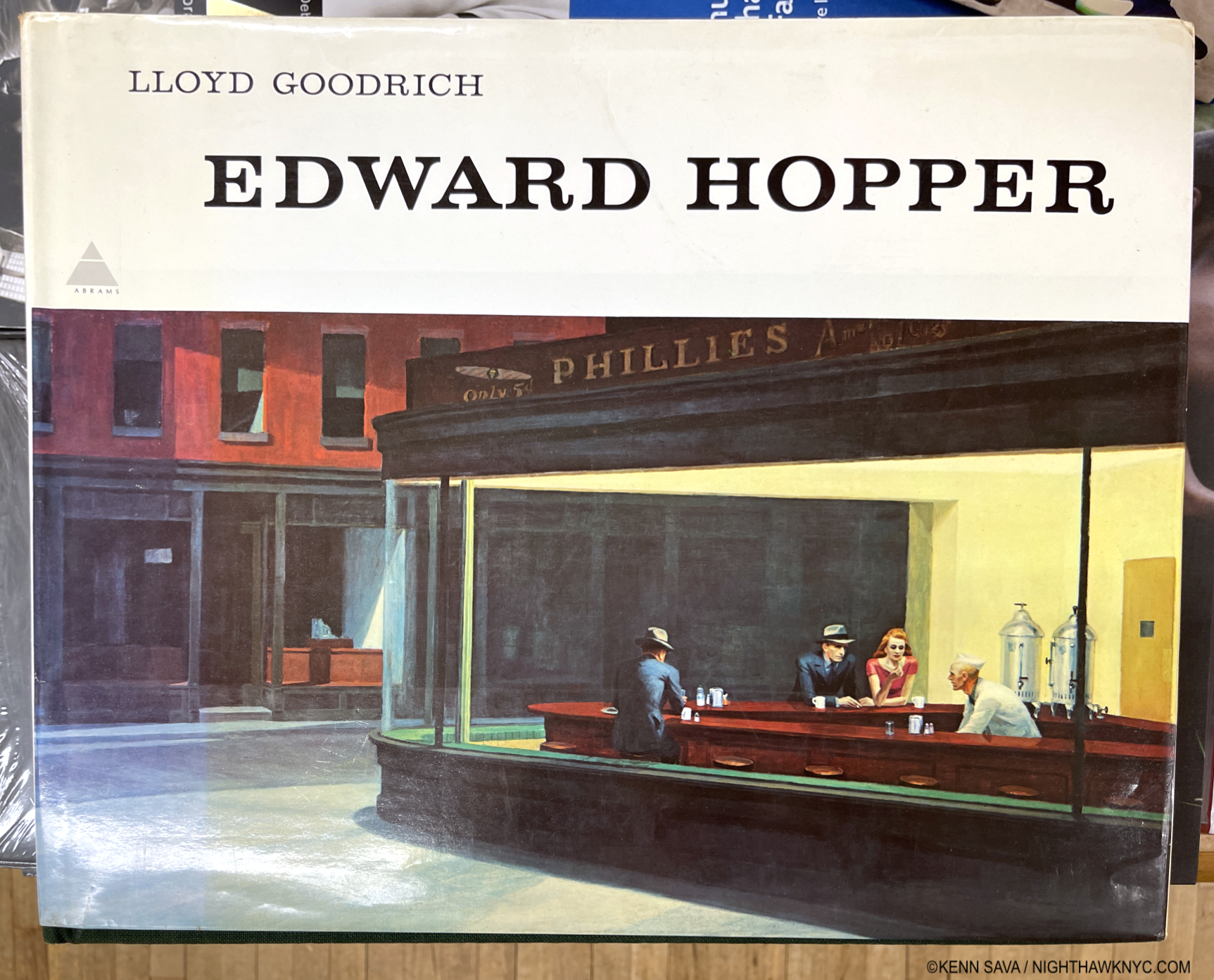
The first time I ever saw Edward Hopper’s work was in the late 1970s in a friend’s parent’s copy of this massive 10-pound, 16 by 13 1/2 inch, monograph by Lloyd Goodrich 1 published by Abrams in 1978, with 306 pages and 246 illustrations, but only 88 in color, unfortunately. One or other of his Paintings has been lingering somewhere on my mind since. My banner has been a continual homage to Nighthawks for the past 7+ years2.

Mister Hopper’s Neighborhood

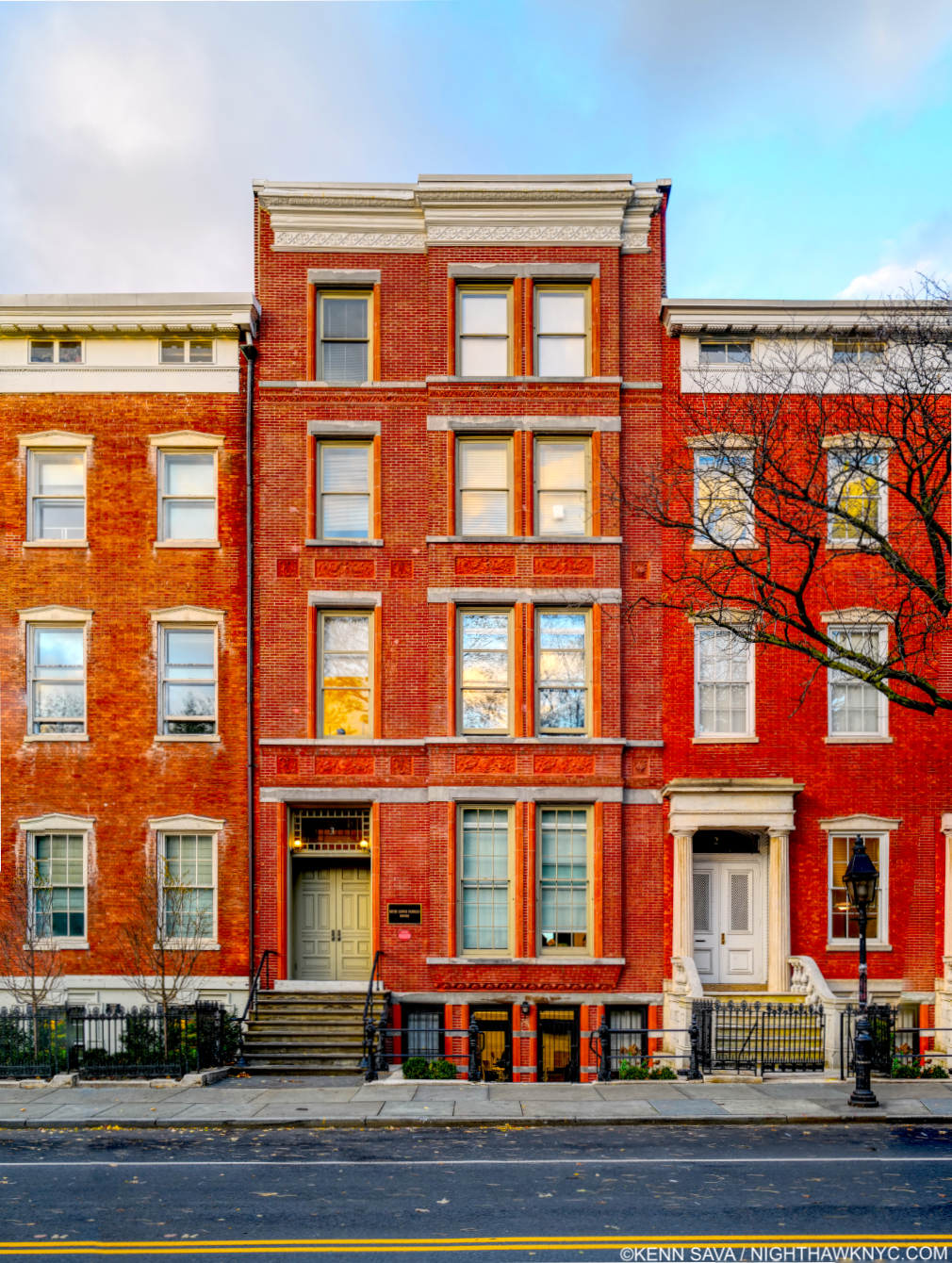
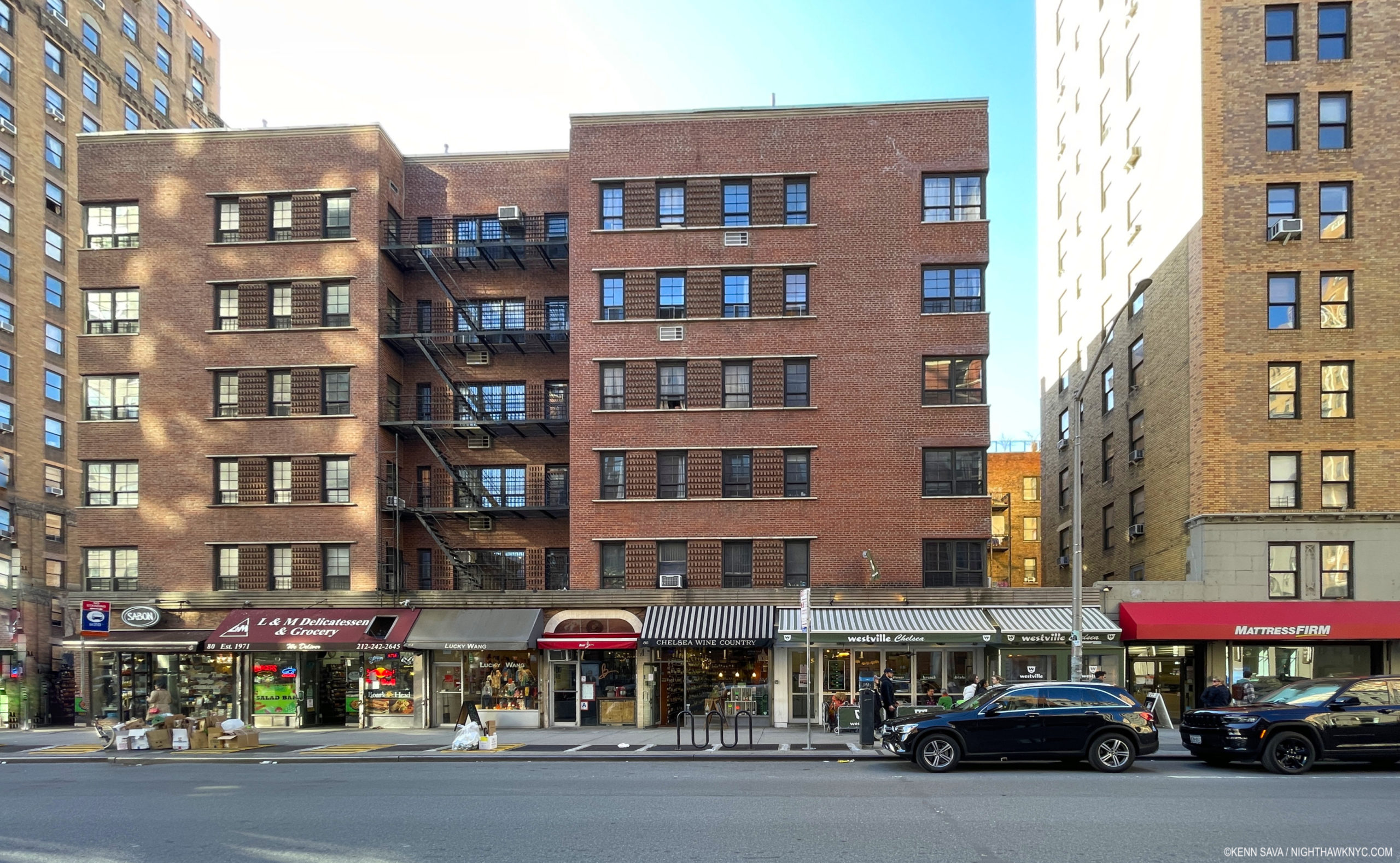
The heart of Edward Hopper’s New York for over 50 years: 3 Washington Square (center). Between them, he &  his wife Jo, lived on the top floor from 1913 to 19683. Beginning in 1947, they had to fight NYU, who took over the building in 1946, to stay. Today, the Hopper Studio has been preserved though the rest of the building is in active use by NYU, as it was when I shot this, November 16, 2022. Nighthawks, among countless other Hoppers, was Painted here4.

At this point, I have lived in what was his extended neighborhood for over 3 decades. I have sat in the Park right in front of his long-time home and wondered if he sat on this very spot. I’ve walked by numerous actual sites he Painted, and I spent a night in the Provincetown, Massachusetts  rooming house he Painted in Rooms for Tourists, 1945, while I was in Cape Cod fruitlessly trying to find his Truro summer house and drinking in the atmosphere of another area he Painted. Today, any number of times I’m reminded I’m literally walking in his footsteps on streets he is known to have walked. Living in his footsteps is probably more accurate.

Early Sunday Afternoon, March 26, 2023. Does this scream “Edward Hopper Painting?” 93 years later, it’s hard to see Early Sunday Morning, 1930 (which I discuss in Part 2), in this scene in my neighborhood, but this is where it was on 7th Avenue between West 16 & 17th Streets. Only the building partly shown on the right is in the Painting. I had to wait for the sun to go behind the center building (to the west) to take this shot, its glare still bleaches out the wall of the building on the right, proving the direction the Sun shines in the Painting was “Artistic license.”

A bit of my passion for his Art comes from this “shared experience” of this part of Manhattan at different times, but most of it lies in the endless mystery at the heart of his Art. Mystery that no amount of looking seems to solve. Until I saw Edward Hopper’s New York, that is. 300 pieces in here on NighthawkNYC.com since July, 2015, except for a bit at tail end of “My Search for Edward Hopper’s Nighthawks Diner,” this is the first time I’ve written about his Art.

Setting the Stage

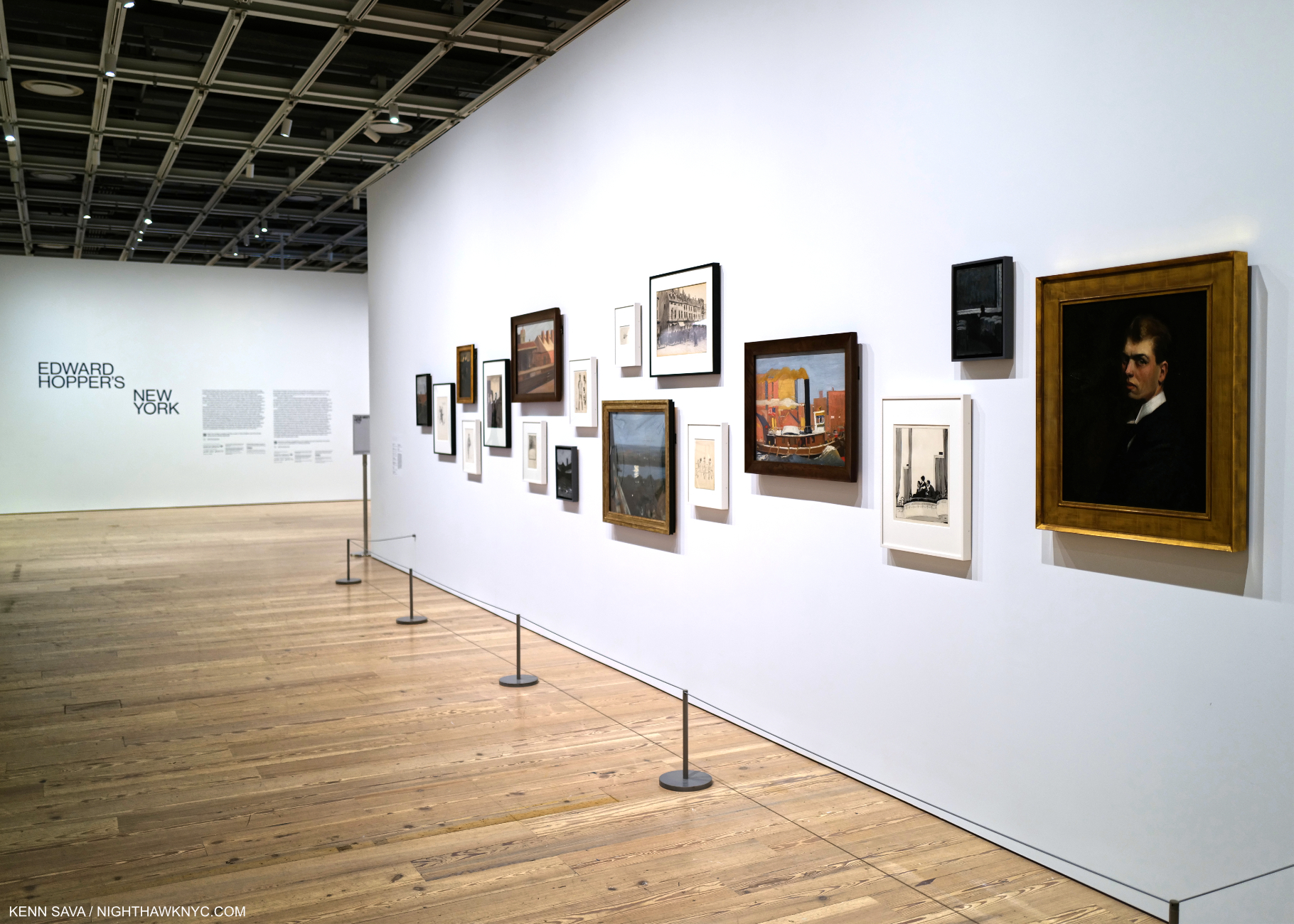
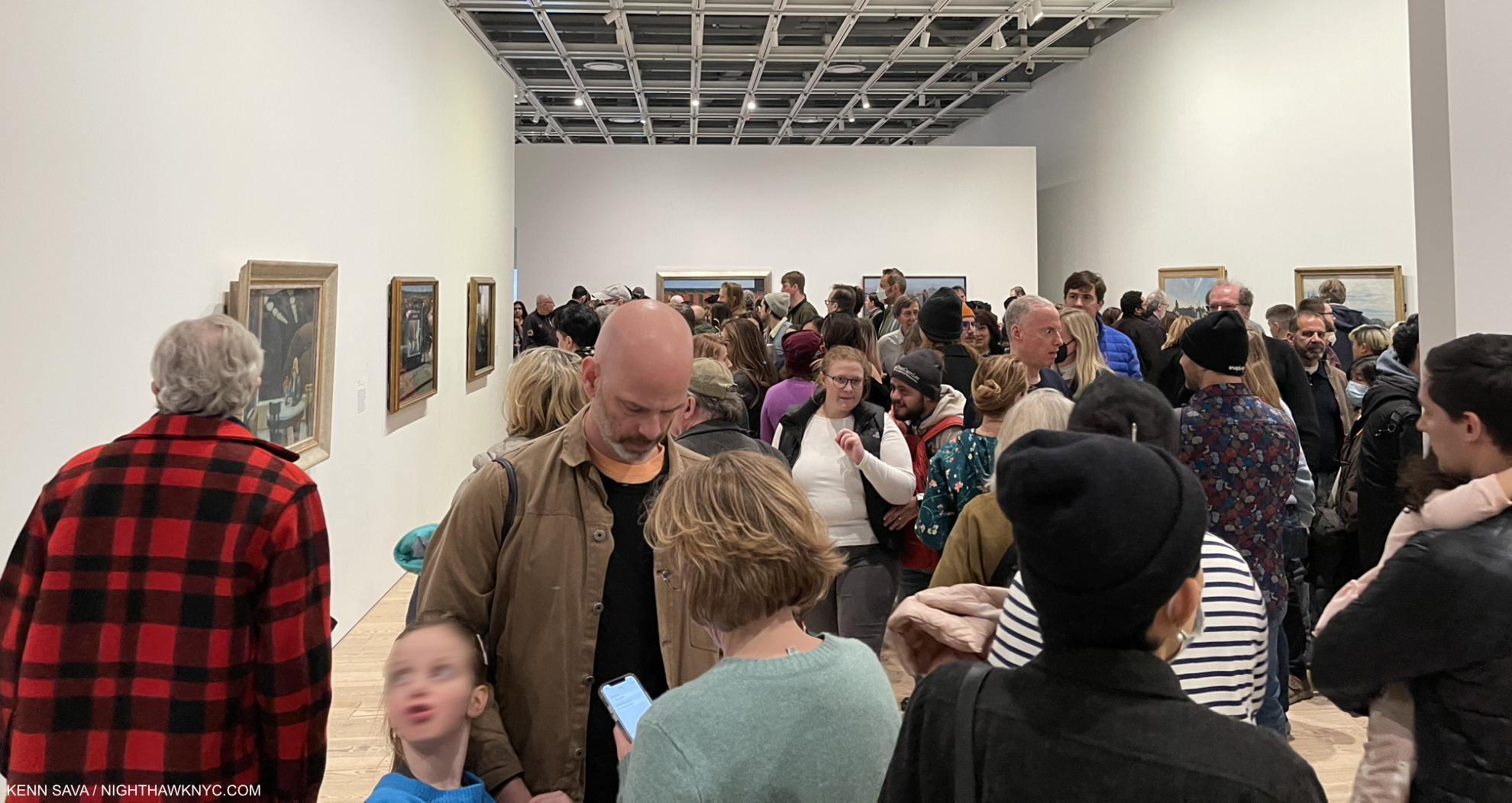
Before the crush. Edward Hopper’s New York Member’s Preview Opening Day, October 13, 2022. A wall of early work, including Self-Portrait, Oil on canvas (as all works featured are, unless specified), right, introduces the show. For Hopper, 1906 marks the beginning of his life as an Artist, the year he graduated from Art school, then embarked on his first trip to Paris. He would return twice before 1910, then return to NYC to get his Art career started.

While not a career retrospective (there has not been an Edward Hopper Retrospective in the U.S. since Edward Hopper: The Art & the Artist in 1980-81 5), Edward Hopper’s New York is a career-long look at what is, perhaps, his most famous subject- New York City, where he lived & worked for almost 60 years. I took the chance to see its 58 Oil or Watercolor Paintings6 by Hopper, among the 200 works and items of ephemera on view, 14 times between its opening day, above, and its closing day, below.

Now. Or never. This is about as crowded as an NYC Art show gets. 5pm, March 5, 2023. One hour to go on its final day. The final weekend was sold out.

Edward Hopper’s New York was the very first time  I’ve seen so many Edward Hopper Paintings in one place. I went 14 times because who knows when I’ll get another chance.

There’s how Hopper Painted, then there’s what he Painted. I’m going to attempt to look at both. In this part, I take a look at how he Painted, i.e. his style, and how, and if, it evolved. In Part 2, I look at what he Painted in a piece that is a personal reaction to what I see when I look at Edward Hopper now. Having the chance to see and study this many Hopper Paintings from early through late in his career Edward Hopper’s New York completely changed how I see his work. This is shocking to me because I’ve been looking at his work almost as long as I have anyone else’s- well over 40 years. To this point, I saw his work as one of the ultimate (and perhaps unsurpassed) expressions of modern loneliness and isolation of the century. Now, I see that as ancillary to other themes, themes that occur even when there are no human subjects. Themes that occur in his work in and outside of NYC.

One great thing about Art is that it’s there for everyone to see and make up their own minds what it says to them. I’m sharing here what it says to me. I hope everyone will look at Edward Hopper, and all Art, for themselves. 

In a Restaurant, 1916-25, Charcoal on paper. For those who’ve criticized Hopper’s technique. He came by it honestly. 6 years in Art schools under esteemed Artist teachers. How they felt about his skill is evident in the fact that he was assigned to teach life Drawing, one of the hardest types of Drawing, before he graduated.

“In every artist’s development the germ of the later work is always found in the earlier. The nucleus around which the artist’s intellect builds his work is himself; the central ego, personality, or whatever it may be called. and this changes little from birth to death. What he was once, he always is, with slight modification. Changing fashions in methods or subject matter alter him little or not at all.” Edward Hopper7

Edward Hopper was born on July 22, 1882 in Nyack, NY, some 80 miles as the Owl majestically flies from the City. He visited the City as a child with his parents, then came here on a daily basis while attending Art school from 1899-19068. Towards the end of that time, he took up residence on West 14th Street, before taking three trips to Paris from 1906-10. After returning to the City, he lived at 53 East 59th Street9 before moving to 3 Washington Square in 191310.

Untitled (Study of Man Sketching in Front of a House), c. 1900, Opaque watercolor, fabricated chalk and graphite pencil on paper (recto); Graphite pencil, pen and ink and opaque watercolor (verso). *-Whitney Museum Photo. Not in the show.

Seeing that introductory wall, shown earlier, sent me delving deeper into Edward Hopper’s Artistic beginnings (1895, at about age 15, to 1913, when he moved into 3 Washington Square at about 31) for the first time, looking to see when his themes began, how his style and technique changed over that time, and what they could tell me about his familiar later work. Most of Hopper’s early work is in the Whitney’s Permanent Collection, thanks largely to the 1970 Jo Hopper Bequest. It is, unfortunately, too rarely seen, and in my view, under-considered.

From the beginning, one thing that stands out to me is that Edward Hopper was a “traditional” Painter. That is, he relied on his preliminary Drawings & Studies as the basis of his Paintings, as Painters had been doing for as long as there had been Painters. Though Photography was making steady inroads into all aspects of life, and being used by an ever-increasing number of Artists & Painters during his lifetime, Edward Hopper never used Photographs as the basis of his work11. Untitled (Study of Man Sketching in Front of a House), from the year his Art school studies began, may be of a fellow student or be a de-facto Self-Portrait. In either case, it shows something I imagine Edward Hopper did regularly for the rest of his career. In addition to relying on long-standing traditional methods, Edward Hopper steadfastly remained true to his vision. He not only resisted Abstraction, but he uncharacteristically fought against it in print, in a publication titled Reality, which he contributed to.

Le Pont des Arts, 1907. Edward Hopper Painted this outdoors near where he was staying on his first trip to Paris. So, it’s strange to see early on in a show devoted to his NYC work. Nonethelessless, it’s interesting for its style and for its content (see Part 2).

While in Paris, Edward Hopper saw shows of the work of the so-called “impressionists,” (a box I don’t subscribe to, so I will use “earlier French Painters” instead) but, apparently did not see the work of Picasso. It’s hard not to see their influence in this, but, at least for me, not that of any one Artist in particular stylistically. Under their spell, he seems to be doing his own take on it.

The question for me became- How far did this influence go, and how long did it last?

“It took me ten yers to get over Europe,he said.12. Ten years after Europe would be 1920. Looking at the show, a case could be made it lasted much longer.

New York Corner (Corner Saloon), 1913 became a touchstone for me over my 14 visits. If it wasn’t for the familiar lamp post and the smoke stacks in the rear, you might think this is a corner in Paris. A charming and unique early New York work, it was in MoMA’s collection until at least 1981. At some point after, they sold it! A shortsighted mistake in my view.

After returning from Paris, the 28-year-old Artist set about surviving as one. To this end, his work as an Illustrator from 1917 to 1925 provided him with income until his work began to sell. His first show, at the Whitney Studio Club in 1920 (the predecessor to the Whitney Museum), with 16 Oils, produced no sales. In 1923, his Watercolors began to sell after they were shown at the Brooklyn Museum. Then, in 1925, The Met bought 15 Hopper Etchings. Later that year, he sold Apartment Houses to the Pennsylvania Academy, his first museum Painting sale. As his Paintings finally began to sell (mirroring the experience of Winslow Homer, to whom his Watercolors were compared, whose Watercolors also sold before his Oils began to13), in September, 1925, he was able to give up illustration14. Among his early Paintings, the wonderful New York Corner, 1913, caught my eye. It’s interesting to contrast it with this work by John Sloan, one of his teachers, Sixth Avenue and Thirtieth Street, 1907.

John Sloan, Sixth Avenue and Thirtieth Street, 1907. The Sixth Avenue elevated train, which Hopper frequented, runs to the left. The gold sign on the right reads “LION BEWERY,” which was the 6th largest brewery in the US in 189515. I believe this view may be looking downtown, if that’s the Jefferson Market Courthouse in the background. *-Photographer unknown.

New York Corner currently resides in the collection of the Canter Center, Stanford University. Upon acquiring it, their press release says, “New York Corner, created when the artist was 31 and considered the first work made in his representational style.” Wait. What?

“representational-noun 1. showing things as they are normally seen” Cambridge Dictionary

What’s “representational” about it?

In December, 1913, Edward Hopper moved into 3 Washington Square on the Park, where he would live for the rest of his life, so this may have been executed based on a scene near his East 59th Street home just before or just after his move (unless this is a scene on East 14th Street. There’s nothing like the background anywhere else in what would be his West Greenwich Village neighborhood.). When I look at New York Corner, I see an Artist who’s in transition. It seems to me Hopper is wrestling with the influence of his teachers Robert Henri & John Sloan, and what he’d seen in Paris. The top half (i.e. the building) is slightly more “representational,” slightly more resolved (especially in comparison to work he did in Pars, like River Boat or Le Pont Royal, both 1909, and American Village, 1912,), while the bottom half is entirely out of focus. The figures are more like shadows, the indistinct but distinctive gold signage is striking, and stands in stark contrast to the sign in the Sloan. It only adds more mystery to the feel of the whole piece. The upper two floors of the building feature windows that are not much different from those seen on the upper floor of Early Sunday Morning (which are more defined) or across the street from the diner in Nighthawks (ditto). He’s starting to get there.

New York Interior, 1921. Seen through a window, this wonderful piece is one of a number of Hoppers that reminds me of Degas. See Night Windows, below. Notice the clutter on the mantel. Then compare this with Room in New York, seen further below.

As I’ve said, I don’t subscribe to most of the “-isms” that proliferate in Art, and the world, and that applies to putting Edward Hopper in anything other than the “Edward Hopper box.” As time goes on, putting him in the “realism” box he’s usually stuck in seems increasingly problematic. To wit- In Gail Levin’s massive 780-page Expanded Edition of her Intimate Biography of the Hoppers I couldn’t find one instance of Edward Hopper referring to his Art as “realism.”

“realism-noun 1: corcern for fact or reality and rejection of the impractical and visionary” Merriam-Webster

Richard Estes, Times Square, 2004, Paintings don’t come much more technically astounding than this. Unless, they’re by Jan van Eyck. Having stood on this spot before, during and after 2004, I can certainly verify the overwhelming visual noise that still is Times Square, something that has never been more faithfully realized than it is here.

I’m sorry, but when I look at his Art, it doesn’t fit that definition. For another thing, “realism” in Art is a term that began seeing heavy use in the 19th century, though I’ve seen the term applied to Artists like Caravaggio, 1571-1610. In all that time, things have changed. In 1966, the year before Edward Hopper died, Richard Estes began Painting New York in ways that redefined what had been called “realism,” making everything stuck in that box previously look, well, “different.” While Edward Hopper often Painted scenes looking through windows, Mr. Estes took the art of rendering their reflections to an entirely new level, while often Painting at the hyperfocal distance, which added new depth to his depictions of the world. Suddenly, the eye was free to go anywhere on the canvas and it was all rendered “democratically” (i.e. with apparent equal weight) and in focus. Others, including Rod Penner, followed, pushing the envelope of what had been done, all the while in the service of Art. There was suddenly more than one kind of “realism!” Since none of them have put their Art in a box in their interviews, I certainly don’t subscribe to the terms others ascribe to their Art. Therefore, Messers Hopper, Estes and Penner reside in only one “box” each: the one with their name on it. “Realism” has been used for over 125 years! it’s past time to retire it. It’s outlived its supposed meaning.

Night Windows, 1928. Among the earlier French Painters, Edgar Degas is someone I see in numerous Edward Hopper compositions. Perhaps more than I see any other Artist. Hopper seemed to share Degas’s voyeuristic streak. Many of both of their Paintings show women being observed apparently without their knowledge.

It’s pretty plain to see that these recent developments are at odds with Edward Hopper’s style. Then again, I don’t think he was ever out to win the realism race. Hopper authority Gail Levin said his work has “the suggestion of reality16.”

Finally, there’s this for all those who box Hopper as a “realist”-

“I think I’m still an impressionist…” Edward Hopper.

Edward Hopper didn’t say that in 1913 after Painting New York Corner. He said it in 1962, a mere five years before he died! He said it in an interview published in Katherine Kuh’s book The Artist’s Voice: Talks With Seventeen Artists, in 196217. That Edward Hopper, who never minced words, or used them without careful consideration (like the careful consideration he gave every detail of his compositions) especially in the very few interviews he did, would say this so late in his life and career HAS to be taken seriously. So far, it hasn’t been. The “realism” noise surrounding his work remains deafening. I came upon the “impressionist” quote after already being convinced by the visual evidence in Edward Hopper’s New York that he took what he learned from the earlier French Artists and used it in his own way. He was one of the Artists who forged what some call an “American style,” an important goal at the time. Yet, his influences remained in his work throughout his life to the extent he chose to use them, in varying degrees, to suit his purposes in each particular work.

GeorgiaO’Keeffe quoted on the back cover of the catalog for her 2021 show at Museo Nacional Thyssen-Bornemisza.

Part of that influence, I believe, was that as time went on, Edward Hopper began removing unnecessary objects from his Paintings. It seems to me his work lives on its mystery. Isn’t too much information an enemy of mystery? He also stopped using “real” settings, creating his own, possibly based on actual places combined with his imagination. In spite of my decades of looking for the “real” Nighthawks diner, this may well be what he really did: he based it on a place he saw then modified it in his imagination to suit his purposes (and he said as much). And that is the key: everything superfluous went out of his Art. That’s one thing that makes Nighthawks such a brilliant, timeless, nebulous work.

The result? For me, many of Edward Hopper’s New York Paintings are “impressions.”

Room in New York, 1932.

I rest my case with Room in New York, from 1932. One of his masterpieces, in my view, it defies every single box Edward Hopper has been put in. It’s one of his many scenes looking into a window. Perhaps something he saw in a fleeting moment while riding the Sixth Avenue elevated train, or in passing as he walked, or maybe it’s a scene he imagined, possibly filtered through his own relationship experience. If, and it’s a huge “if,” this is (at least partially) filtered through his marriage, this may be as frankly as he ever depicted it. Look closer-

Edward Hopper’s “realism?” Bah humbug. A classic example of why I ignore boxes and just look at the work for myself!

Look! The faces have no details! This is by intent, of course. He obviously considered facial details to be unnecessary to what he was trying to express, or distracting from it. Is this what he meant when he said, “I think I’m still an impressionist…?” Isn’t this closer to the work of the earlier French Painters than anything else? No so-called “realist” Painted like this! Only George Seurat, among those earlier French Painters, Painted like this- on occasion (not all the time). In most Paintings that include humans, their faces and expressions carry the weight of the work. Not here in this scene that includes a woman and a man and not much else. How utterly daring! Without them, what’s a viewer to focus on? For me, all that’s left is the body language. And that red dress. “All dressed up with no where to go?” The woman in Nighthawks is also wearing a red dress. Could it be a pendant to Room in New York?

When people talk about the”genius” of Edward Hopper, for me, it’s on view in Room in New York, 1932. He had evolved through his education, his time overseas, his influences & experiences, and had arrived at the place of knowing, then executed it using his time-tested, traditional, methods. He knew what he wanted to say here, and had developed the confidence to leave out the non-essential (perhaps, inspired by seeing the earlier French Painters do it), including “minor details” like facial features! He created an impression of a scene, in my view, real or imagined, that mimics the fleeting moment that may have inspired it and somehow works perfectly, just as it is, without them.

Two on the Aisle, 1927.

In Two on the Aisle, from 1927, five years before Room in New York, the faces are “incomplete,” but more “defined” than the two in Room in New York. Perhaps he became emboldened to go further after works like this. 

The Sheridan Theater, 1937.

In Sheridan Theater, nothing is in sharp focus.

Then, in Morning Sun, 1952, the woman’s face (Jo was his model) is Painted so expertly (in my opinion) as to leave her expression ambiguous, making the work open to endless contemplation. These are just a few of the works that have “selective details,” i.e. details the Artist chose to include, or omit. In my view, this is always done to forward what he’s trying to express.

Boxes confine an Artist to one style. If the Artist says my work is in this box? So be it. It’s when other people put an Artist in a box that’s wrong in my view; for the Artist, and for not giving the viewer the chance to see the Art for themselves. Artists, being people, are free to change their minds, evolve, even move into other styles over time. Boxes don’t allow for this. Edward Hopper used his technique and the wide range of his skill as he saw fit in each work. A good number of them (i.e. many) strike me as “impressions,” and it’s their nebulosity that adds so much richness to considering them. There is enough detail in these to ring true with viewers, and enough vagueness to allow them to return to the work again and again. In other works, like Office at Night,1940, he chose to sharpen things up, but still managed to keep the mystery and the drama due to the brilliance of his composition and the realization it.

“Great art is the outward expression of an inner life in the artist, and this inner life will result in his personal vision of the world,” Edward Hopper18.

On the surface, these works may be “impressions” to my eyes. They are also transcriptions of the Artist’s “personal vision of the world.” Whatever you call them, they are as close as Edward Hopper got to making his inner world, “reality.”

*-Soundtrack for this piece is “An American in Paris” by George Gershwin, 1898-1937, a contemporary of Edward Hopper. Born 16 years after Hopper, he died, tragically of an undiagnosed brain tumor, 30 years before the Painter would. Hopper’s taste (if any) in Music is unknown to me, however as Edward Hopper’s New York points out in a room dedicated to it, he was an avid theater and movie-goer. As such, the name George Gershwin could not have been unknown to him. Gershwin, like Hopper, helped define what some call an “American style” of Music, as some say Hopper did for Art. Gershwin, who also Painted, was born in the City and spent most of his life here. Here “An American in Paris,” in homage to Hopper’s time there, is performed on a piano roll by George Gershwin, himself-

In Part 2, here, I take a look at what Edward Hopper’s Art says to me now, after immersing myself in Edward Hopper’s New York. Part 3 looks at some current issues surrounding Edward Hopper’s Art. 

NighthawkNYC.com has been entirely self-funded & ad-free for over 8 years, during which 300 full length pieces have been published! If you’ve found it worthwhile, PLEASE donate to allow me to continue below. Thank you, Kenn.

You can also support it by buying Art, Art & Photography books, and Music from my collection! Art & Books may be found here. Music here and here.

Written & photographed by Kenn Sava for nighthawknyc.com unless otherwise credited. To send comments, thoughts, feedback or propositions click here. Click the white box on the upper right for the archives or to search them. Subscribe to be notified of new Posts below. Your information will be used for no other purpose.

  1. The first Hopper authority, outside of his wife, the Artist Josephine Nivison Hopper aka Jo, and curator behind the 1950 Edward Hopper Retrospective and the 1964 Edward Hopper show.
  2. In saying all of the above I am not saying that Edward Hopper is my favorite Artist, or I think he’s “the best.” I don’t believe in qualitatively comparing creative beings or works.
  3. Edward passed in 1967. Jo, the Artist Josephine Nivison Hopper, continued to live there in failing health until she died in 1968.
  4. Hopper worked on Nighthawks during the beginning of World War II for the U.S., having started it around the time of Pearl Harbor. In the Logbook of Hopper’s work, Jo recorded it being completed on January 21, 1942, as I show here. Jo worried German bombs would be falling through their skylight. Edward was too busy working to seem to care, or maybe he was escaping into work (Gail Levin, Edward Hopper: An Intimate Biography Expanded Edition, P.348.)
  5. on 2 floors of the old Whitney, who have mounted smaller shows juxtaposing Hopper with other Artists, since, as well as the floor they gave him in their Full House show in 2005, and the Hopper Drawing show, which I saw in 2013, which had over 200 Drawings and some Paintings, including Nighthawks, on loan, as I partially showed in my very first piece in 2015.
  6. which does not include about 30 Illustrations whose media were not listed but many appear to include watercolor.
  7. from a letter from Hopper dated 1935 quoted in Gail Levin, Edward Hopper As Illustrator, P.1.
  8. Twice the length of time his teacher Robert Henri recommended.
  9. Gail Levin, Intimate Biography, P.84
  10. While spending summers in Maine and then in Truro, MA.
  11. The lone exceptions I’m aware of are his 2 Civil War-related Paintings which may have been based on Photographs he saw in a published collection of Civil War Photographs.
  12. Gail Levin, Edward Hopper: The Art & the Artist, P.126
  13. Gail Levin, Intimate Biography Expanded, P.171
  14. https://archive.artic.edu/hopper/chronology/
  15. https://en.wikipedia.org/wiki/Lion_Brewery,_Inc.
  16. Gail Levin, Intimate Biography Expanded, P. 441.
  17. P.135, as quoted in Sheena Wagstaff, “The Elation of Sunlight,” in Edward Hopper Tate Exhibition Catalog, 2005, P.25.
  18. Statement in Reality #1 as seen in the show.

Jean-Michel Basquiat, At 62

This site is Free & Ad-Free! If you find this piece worthwhile, please donate via PayPal to support it & independent Art writing. You can also support it by buying Art & books! Details at the end. Thank you. 

Written & Photographed by Kenn Sava

Show Seen: Jean-Michel Basquiat: King Pleasure

King Pleasure is now a ghost, a shadowy figure in Jazz history. Born Clarence Beeks in Tennessee in 1922, one night in the early 1950s he heard the great Eddie Jefferson sing lyrics he (Mr. Jefferson) had written to James Moody’s recorded tenor saxophone solo on “I’m in the Mood for Love.” Putting words to a recorded, improvised, solo was something no one had done before.

Clarence Beeks, aka King Pleasure (seen here in a rare Photo on the back of a rereleased Lp in my collection), smiled all the way to the bank. In spite of the record company labelling, Eddie Jefferson was HIS source.

King Pleasure was so taken with it, he learned it himself, brought it to NYC, recorded it, and had a hit with it in 1952 (i.e. he stole it). Mr. Pleasure achieved the fame that escaped Eddie Jefferson, who continued to set lyrics to Jazz solos until he was tragically shot and killed as he left a nightclub one night in May, 1979. He bemoaned Mr. Pleasure’s theft, but said “…in a way it opened it up for me1.” Still, the beauty of Mr. Pleasure’s and Mr. Jefferson’s records endure to charm listeners to this day- as they, apparently, did Jean-Michel Basquiat (J-MB henceforth). 

A peak inside a previously unseen world. Partial installation view of the large area devoted to a recreation of Jean-Michel Basquiat’s Great Jones Street Studio as seen in Jean-Michel Basquiat: King Pleasure.

As I walked through the doors of Jean-Michel Basquiat: King Pleasure (J-MB: KP henceon the far west side on an April Tuesday during the show’s first week, greeted by the wooden sign in the first Photo, I wondered how many of my fellow show-goers knew that the title of the show referred to a Basquiat Painting with the words “King Pleasure” on it, and that those words were the stage name of an actual person.

Jean-Michel Basquiat in a cloud of smoke in his Great Jones Street Studio with his Painting, King Pleasure, which the show is named after, partially seen in the back, left of center, in 1987, the year he Painted it. As near as I can tell, it currently resides in a private collection- like most of J-MB’s major works. From the Basquiat Taschen XXL, P.442-3.

As I left Jean-Michel Basquiat: King Pleasure, I wondered how many visitors noticed the Painting the show was named for was not included in it!

Installation view.

So, if the Painting is not in it, what’s the point of naming the show Jean-Michel Basquiat: King Pleasure? Is it a riff on the words “king” and “pleasure?” While there were some major Baquiat works on view, most of the “200 never-before-seen pieces” advertised2 were not “major,” in my opinion. So, the show wasn’t the “king” of Basquiat “pleasure.” Of the NINE major Basquiat shows I’ve seen (which is more than the total shows I’ve seen by ANY other Artist. It stuns me to realize this. I wasn’t interested in his work for most of my life!3), the 2019 Brant’s Basquiat came the closest to that in my opinion. So, the name was borrowed from a Painting the Artist created but that is off in a private collection somewhere.

Partial installation view of the large area devoted to a recreation of J-MB’s Great Jones Street Studio, his final home. Quite a few pieces were installed in this large space which also included ephemera and (his, I assume) Artist’s supplies. From what I could make of them from behind that barrier, the pieces in this space were uneven in terms of quality. Showing them in the context of a studio space allows them license for possibly being “unfinished.”

A bit like King Pleasure, himself, borrowed “Moody’s Mood for Love” from Eddie Jefferson?

Recreation of the Basquiat family home living room, his first home.

Though I didn’t count them, I’ll take the organizer’s word for it that the show included “200 never-before-seen pieces.” Being it opened 33 1/2 years after the Artist’s death, and given his level of popularity, it’s pretty remarkable there are that many never-before-seen pieces left. It goes without saying that the chance to finally see the previously unseen work J-MB left that is now in his family’s collection is a landmark opportunity for the countless fans of his work. The show was so well installed it had a museum exhibition-quality feel to it (though it was not installed in a museum). The entire exhibition interior was custom built. Galleries of Art were interspersed with spaces devoted to recreating the Basquiat family home living room, J-MB’s Great Jones Street studio, and and a final, surprise, installation at the very end. I felt the quality of the work, overall, was “good” to “very good” with a few (5-10) major pieces, though a number of other pieces left me puzzled.

A wall of items that puzzles me. Look at the top row, for example. WHAT exactly are these? Pieces like these (and NOT these) are one reason why authenticating original Basquiats is likely to remain a hot topic.

The show was so well installed it was “smart” enough to down play, almost “hide,” some nebulous pieces. A wall of smaller works, seen above, seemed to be scraps of ripped paper with writing or a Drawing on it. Each becomes a “work of Art” and is displayed as such, but there was no information as to what it is (beyond the ubiquitous “Untitled, Ink on paper,” or whatever the case may be). Was it found like this? Where? Was it torn from a larger sheet with more on it? Did the Artist intend for it to be seen? All the things Art historians need to know to properly assess exactly what is here, and, eventually, to determine the Artist’s place in history. Pieces like this, without clarification, could possibly serve to bring down the impression of the whole oeuvre in the eyes of some. Also included was also a lot of ephemera, which was better described.

Part of a large case containing personal belongings. Unlike the previous wall, above, cards explained their significance to the Artist.

Some of it related to the Artist and events in his life, as above, and some part of his ongoing studies (in the Studio recreation). The ephemera led to the show being touted as “revealing the man.” Yes, he owned a bike, and it’s here, but it seems to me, the books in J-MB’s collection need to be read, the videos need to be seen, to glean their import and influence on the Artist. Only the Art historians or the VERY interested will have the time and patience to do that. Visitors pass through displays of hundreds of these items, lucky if a few titles remain in their memory.

Among those remaining in mine, I spotted a number of Jazz books J-MB & I both owned. Books on John Coltrane, Miles Davis, and this classic biography of Charlie Parker, Bird Lives! by Ross Russell, on top of the boxes, center. I owned this same paperback edition that J-MB reportedly bought by the case and gave to friends. Unavailable in the US, I had to buy mine from a store in Canada in 1982. Seen in the Studio recreation area.

My thoughts went to the care the Francis Bacon Estate and curators took in 1998 when Mr. Bacon’s equally legendary 7 Reece Mews, London, Studio was dismantled, the 7,000 items it contained catalogued, moved to the Dublin City Gallery The Hugh Lane in Dublin in the country where the Artist was born, and reinstalled EXACTLY as it has been left by Mr. Bacon when he died. Was something similar done with what remained at his Great Jones Street Studio after J-MB died? Maybe it was. I don’t know and I can’t tell.

Installation view of “THE IRONY OF THE NEGRO POLICEMAN” gallery. Edgar, N.D., left and Jailbirds, 1983, right.

While the nebulous work I mentioned doesn’t help his case, in my opinion, overall, the work on view does serve to fill in some holes for those trying to assess his place in Art history. Almost all of the work is related to themes that will be familiar to those familiar with J-MB’s work. This was highlighted by separate galleries devoted to some of them- “ROYALTY,” which included some Charlie Parker pieces and some sports pieces, “THE IRONY OF THE NEGRO POLICEMAN,” with pieces like Jailbirds, 1983, above and below, that speak for themselves, bringing the Artist’s ever-present focus on race to a boil, and, the final room, “THOSE WHO DRESS BETTER CAN RECEIVE CHRIST.”

Untitled (Cowboy & Indian), 1982

Virtually all of the Art on view consisted of Paintings & Drawings, which were hung on the walls. There was only one free-standing piece.

Untitled, 1983, Acrylic and oil stick on wood. The very first piece in the show. A major work in my view, perhaps the most important piece in the show.

Among the pieces I thought were “major” works were Untitled, 1983, the very first piece in the show, and the very last piece in the show- another indication of how well the show was conceived and laid out. Putting a major piece first immediately raises the bar and removes the “quality” question from viewer’s mind (i.e. “Will there be any ‘great” work on view, or just a bunch of fair to middling pieces?”). Installing one last leaves them on a high. As viewers were leaving the show proper, on the way to the exit, off to the left, a black wall contained the word “PALLADIUM” at the top in silver letters. ?

What is this? Around this wall would be one of the most remarkable experiences I’ve ever had in an Art show…

Walking around it I was astounded to find a recreation of the infamous Michael Todd Room on the top of the legendary, now lost, Palladium Nightclub on East 14th Street. To the right, above the bar, was the Mural, Nu-Nile, J-MB had created for the space in 1985, which I had no idea had survived! What a shock! Seeing it again I felt I was standing in front of a piece of history- a real piece of a now lost NYC at one of its many peaks- the peak of nightlife in the City that had been building for decades, that was soon to be lost under Guiliani, as well as a major work in J-MB’s oeuvre.

Nu-Nile, 1985, Acrylic and oil stick on canvas. I still can’t believe I saw this again.

I had been in the real Michael Todd Room a few times over my many visits to the Palladium back in the day, walking around the space, which included another large Painting from the Todd Room, the recreation of the space, though simple, wasn’t all that bad. I could actually feel the original when I was in it! A wonderful feeling.

When I did finally leave the show, I began to wonder about it. Today, December 22, 2022 (the date I am publishing this), had he lived, Jean-Michel would be celebrating his 62nd birthday, and very possibly still creating Art in mid-career! Early death is, unfortunately, WAY too common in Art & Music history. Being left to wonder “What if?” is no substitute for being able to see a complete body of work created over a full life time.

Part 2, titled Jean-Michel Basquiat: Now You See It. Now You Can’t looks at Jean-Michel Basquiat: Art & Objecthood, another major Basquiat show that was up at the same time as J-MB:KP, and concludes with my thoughts on where to for his Art in 2023 and beyond. 

*-“James Moody, you can come in and blow now, we’re through…” the final lyrics to the Soundtrack for this Post- “Moody’s Mood for Love,” by Eddie Jefferson, recorded by King Pleasure in 1952.

NighthawkNYC.com has been Free & Ad-Free for over 7 years, during which over 275 pieces have been published! If you’ve found it useful, I need your support to continue.
I’m pleased to announce you can now support it by buying Art, ArtBooks and PhotoBooks! I’ve curated a selection of 400 books & pieces of Art from my collection, offered through my partnership with eBay seller GallerieK. Featured items of particular interest to my readers may be seen here. The complete selection is here now!

Or, you can donate by PayPal to help keep NighthawkNYC.com online & ad-free below. Thank you!

Written & photographed by Kenn Sava for nighthawknyc.com unless otherwise credited.
Comments, thoughts, feedback or propositions? Click here
Click the white box on the upper right for the archives or to search them.
Subscribe to be notified of new Posts below. Your information will be used for no other purpose.

  1. Here.
  2. per the show’s site.
  3. The 9 are- J-MB: KP and Jean-Michel Basquiat: Art & Objecthood at Nahmad in 2022, the four I saw and wrote about in 2019, the Brooklyn Museum Basquiat Retrospective in May, 2005, the large Jean-Michel Basquiat show at Gagosian in 2013, and the Basquiat: The Unknown Notebooks show also at the Brooklyn Museum in 2015.

Not Your Father’s Winslow Homer

Winslow Homer: Crosscurrents is now over. If you missed it, one of the few places you can still see a bit of it is here! If you appreciate that, please donate to keep this site alive. I can no longer create it AND fund it myself. Thank you.

Written & Photographed by Kenn Sava (*-unless otherwise credited)

Ahhh….The summer blockbuster. What would Art life be without one? In spite of covid, we’ve been blessed here in NYC with big and memorable shows the past two summers, though of course, remaining careful is the only way to see one. So, I donned my double masks and went to see this year’s summer-fest, Winslow Homer: Crosscurrents, at The Met.

Winslow & chill…Detail of Lady of Santiago (Girl With a Fan), 1885, Watercolor on paper. Less than one quarter of the whole 8 7/8 by 11 1/2 inch piece is shown. How this is Painted is just stunning. Look at her face! Look at those Palm tree leaves! Not bad for not having any lessons, right? His mother was an accomplished Artist and gave Winslow some help early on, later he took a few lessons in Oils, beyond that, he was self-taught.

Interestingly, and probably purely coincidentally, Winslow Homer turns out to be almost an exact contemporary of the Artist who enthralled me last summer, Paul Cézanne, he of Cézanne Drawing at MoMA: Cézanne, 1839-1906; Homer, 1836-1910! Cézanne was, and remains, one of the most influential Artists of his time. Winslow Homer, though continually popular since he began creating, has not enjoyed the same reputation as a ground-breaker as the French master. To this point.

You’d need a telescope to see The Gulf Stream, center, from the show’s entrance, which announces it as the centerpiece for the entire show. There are a lot of very good Paintings before and after you get to it.

That sound you heard might be the tides beginning to turn after Winslow Homer: Crosscurrents.

The Surgeon at Work at the Rear During an Engagement, from Harper’s Weekly, July 12, 1862, Wood engraving on paper. A number of Homer’s War pieces compile different scenes he may have witnessed on one of his trips to the front of the Civil War into one composition. I wonder if this is the case here. Homer was about 26 at the time he created this Drawing which was sent back, and then engraved by someone else. (* Not included in Crosscurrents. Smithsonian Museum of American Art Photo)

After early work as a free-lance illustrator covering the genteel life around him, Winslow Homer moved to NYC in 1859, where he took a few lessons in Oil Painting at the National Academy of Design with Frederic Rondel. He took a job as an illustrator for Harper’s Weekly right after the Civil War started in April, 1861, and much to his surprise, quickly found himself at the front in Virginia! It was there that he would come into his own, creating a body of War Illustrations that was important, historic, and ground-breaking, becoming, along with renowned Photographers Matthew Brady and Alexander Gardner, America’s first visual War reporters.

Crosscurrents begins at this point, in 1863. With 88 Oils and Watercolors, covering the full range of subjects the Artist rendered after he found himself and his direction during the War, and tracing the rest of his long career, the show is centered around The Met’s masterpiece, The Gulf Stream, 1900,1906. Work after work shows the lie to the out-dated standing perception and in its stead reveals how shockingly contemporary Winslow Homer is, 112 years after his death. The feeling one leaves the show with is akin to “How could we have missed so much in Winslow Homer?”

The Veteran in a New Field, 1865, Oil on canvas. As time went on, he felt he needed a different medium to express the depth of what he wanted to communicate. So, in 1863, he turned to Oil Painting, a medium he had only briefly studied. The soldier’s jacket lies to the right in this powerful image from the end of the War and the beginning of the Reconstruction. Originally, the scythe’s blade was even longer.

Part of the reason opinions on Winslow Homer haven’t changed is there’s been a lack of big Homer shows, and even Crosscurrents isn’t a full blown retrospective. The Met and National Gallery of Art in Washington had a Homer Retrospective in 1959, which the catalog shows to have had around 130 works. The Whitney had a Homer show in 1974 that had 200 works (per its catalog). For perspective, Winslow Homer created 300 Oil Paintings and 685 Watercolors, plus Prints and Drawings over the course of his career1. 2022 is proving to be a fortuitous time to see 88 Homers. 

Prisoners from the Front, 1866, Oil on canvas. The work that made Winslow Homer’s name, reputation and career. It was then quickly acquired by the young Metropolitan Museum.

Before the War ended, Winslow wound up making multiple trips to the Virginia front. Of one, his mother wrote-

“Winslow went to the war front of Yorktown and camped out about two months. He suffered much, was without food 3 days at a time & all in camp either died or were carried away with typhoid fever- plug tobacco & coffee was the staples…He came home so changed that his best friends did not know him, but is well & all right now2.”

The War forever changed Homer, and his Art. The genteel subjects were gone. To go deeper, he finally turned to Oil Painting in 1863 at the age of 27, fairly old to begin.

Sharpshooter, 1863, Oil on canvas. Not bad for a first Oil Painting, right?

“He was painting by eye, not by tradition; painting what he saw, not what he had been taught to see.” Lloyd Goodrich3

Sharpshooters were, perhaps, the most deadly branch of the Army in the Civil War. The series The Civil War: Brothers Divided, credits sharpshooters with winning the Battle of Gettysburg, and by extension the Civil War4. In Sharpshooter, we see one taking aim. In 1896, Homer recalled-

“I looked through one of their rifles once when they were in a peach orchard in front of Yorktown in April, 1862. The impression struck me as being as near murder as anything I ever think of in connection with the army & I always had a horror of that branch of the service5.“ He included this sketch in his letter-

His very first Oil Painting, Sharpshooter, 1863, opens the show in attention- grabbing fashion. When I look at it, I feel for whoever may be on the other end of the telescope. After seeing the Drawing, I believe that’s what Homer intended.

There it is: right from the very first work, and then time and again, as I walked through the 40+ years of his career covered in Crosscurrents, what stands out for me is his empathy. This is what makes Winslow Homer special in his time, and timely today.

His strikes me as being on the level of the empathy I see in Rembrandt, Vincent Van Gogh, and especially in Goya. All his life he traveled, and many of his pieces reflect things he actually witnessed (some were based on newspaper reports). This combination of observation with his inherent empathy brings an uncanny “realism” to his work, even allowing that some pieces are based on the accounts of others, and some are compilations of events. And so, taking his Paintings as “documentary” is a bit problematic. I prefer to focus on the empathy.

Defiance: Inviting a Shot before Petersburg, 1864, Oil on panel. A Confederate soldier about to get what he’s asking for- two small puffs of smoke are seen at the middle left would seem to indicate the dare accepted, the shots on their way. And so, this is the flip-side of Sharpshooter.

On an adjacent wall, the very next Painting would seem to indicate the Artist may have been thinking similarly. Perhaps, he felt he wanted to be clearer about his intentions, and create a “more direct” work? Here, he shows us the opposite viewpoint. Brilliantly paired in the show. Defiance is utterly remarkable. It’s not like the sharpshooters needed a lot of help.

A Visit from the Old Mistress, 1876, Oil on canvas. Seeing this work from 11 years after the end of the War and the middle of the Reconstruction made me wonder if I’ve seen a more powerful 19th century American Painting. Who else Painted anything like this before 1900?

Then, in the period after the War, the Reconstruction, Winslow Homer did something no other Artist I know of did- He made Paintings showing the life of the newly freed Black men and women, and in the process created a unique record of part of their experience, and race relations in the country, at the time. This is another thing that makes him a ground-breaking Artist and gives hm much relevance, today. In A Visit From the Old Mistress, 1876, volumes are said in the eyes and body language. Early on, the Mistress held a red flower in her right hand, which the Artist Painted over after changing his mind. Over time, a hint of the red has become visible near her shoulder. Given that much (but not all) of what he shows us are scenes he witnessed, I’m left to wonder if he saw this scene and the one below. If not, how could he have Painted them so convincingly? His empathy powerfully comes through, yet as strong as it is, here and in all his work, he never hits the viewer over the head with it, and it is his subtlety that I believe has caused the appreciation of his empathy, power and brilliance to be somewhat under-appreciated for so long.

Dressing for the Carnival, 1877, Oil on canvas. A tour de force in so many ways beginning with color and ending up in a timeless meditation on so many things. Who else Painted anything like this?

In 1873, Winslow Homer produced his first Watercolor (at about 37 years of age!). They would become both rightly revered for their virtuosity among any done during his lifetime and extremely popular, helping the Artist survive. No small thing since after Prisoners from the Front, he struggled to regain the same level of success with his Oils, which continually disturbed him, no matter how popular his Watercolors became. Along the way, his focus changed. He turned to the sea. First, in Cullercoats, England, than in New England, and finally in the Gulf Stream- the Bahamas, Bermuda, Cuba and Florida. Based in Prouts Neck, Maine, he regularly traveled south to avoid the harsh northern winters. That might  be why there was only one Winslow Homer snow scene in the show!

Eight Bells, 1886, Oil on canvas, struck me as endemic of Homer’s work on man & the sea. Here, two sailors take measurements. Man trying to understand the sea.

Of course, Winslow Homer is rightly revered for his sea pictures. Along with the intense, timeless drama in many of these pieces, what has always stood out for me is his mastery of rendering the sea itself. Crosscurrents includes quite a few highlights, including some daring sea rescues Homer witnessed or read about. Regarded so at the time, Winslow Homer remains one of the real masters of sea Paintings. No mean feat in a country about 100 years old at the time in view of the long history of sea Art in many other countries.

Oranges on a Branch, 1885, Watercolor on paper. Hypnotically beautiful, during one visit, another visitor nearby railed against the inclusion of the building on the lower right in this rare Homer Still Life. Oranges were something of a delicacy at the time, and a treat as a staple at meals in the Bahamas, they would seem exotic to many contemporary American viewers.

As darkly hued as many of his Oil Paintings are, as a result of his yearly winter trips south, all of a sudden come his Watercolors that just explode with light and color.

Native Hut at Nassau, 1885, Watercolor on paper. During his trips, Homer kept a close eye on the local population and had a gift for capturing their lives in extraordinary works like this, a scene he may have seen on a walk from his luxury hotel. While picturesque elements of the piece would appeal to American viewers, the condition of the local’s lives is front and center. Again, something not many were doing in 1885.

Homer’s Watercolors were extremely popular with collectors, and even he seemed to get caught up in it. He’s quoted in the show saying-

“You will see, in the future I will live by my watercolors.”

At The Met, they indeed glisten with the beautiful light he found in the Bahamas and elsewhere on the Gulf Stream. But, for me, it’s his Oils that are the revelation, and which largely serve to rewrite our perception of him. Homer followed sales of his Oils closely, and took the results personally, particularly when they were misunderstood. His Watercolors cast his subjects in a different light, no pun intended, and seem to me to be more meditative, while his Oils bring the power.

A Garden in Nassau, 1885, Watercolor on paper. Another poignant example shows a child outside a walled private garden. A small detail- Homer’s watercolor palm leaves are always amazing, and offset the sparseness of the wall.

Still, a number of those on view, like these two above, get to the same power, empathy and subtlety, seen in his Oils.

Shark Fishing, 1885, Watercolor on paper. Ummm…I think they’re going to need a bigger boat. The shark is similar to one seen in The Gulf Stream, 15 years later.

In 1885, while in the Gulf Stream, Winslow Homer may have seen and recorded a boat in distress in a sketchbook. The sketch was in the show, as were a number of fascinating Watercolors that seem to reveal something of the development of The Gulf Stream Oil Painting over the next 21 years. Not all of the pieces I’m showing here were in the show’s Gulf Stream section. I’m including Shark Fishing, above, (which is not a disaster work like the others), due to the similarities between the shark in The Gulf Stream. It also includes two Black sailors.

Sharks (The Derelict), 1885, Watercolor on paper. It would seem that this was a work that informed The Gulf Stream, with many of its familiar compositional elements, minus the sailor.

The Gulf Stream Oil was displayed in 1900, then Homer reworked it in 1906. (Possibly in response to criticism?) The Met quickly acquired it the same year.

The Gulf Stream, c.1889, Watercolor on paper. What would be the final composition is taking shape.

In this version, there is no sign of rescue, which is closer to the Oil as it was originally displayed. No water spout to the right. The sailor looks down in the direction of the sharks.

The Gulf Stream, 1900, 1906, Oil on canvas. It was praised and condemned early on. From The Met’s Audio Guide- “When the Worchester Art Museum was considering its purchase, two women Trustees objected to the unpleasantness of the subject. Homer wrote to his agent- “The boat and sharks are of very little consequence. You can tell these ladies that the unfortunate negro who is by now so dazed and parboiled will be rescued and return to his friends and home and ever after live happily.” In 1906 he added the ship on the upper left horizon. 

Not many images exist of The Gulf Stream before his 1906 modifications of it, most noticeably adding the ship on the horizon in the upper left in 1906. A print displayed nearby shows the work as it originally was displayed in 1900 without it. Was it added in response to the worry for the lone sailor expressed to him by viewers? In a letter to his dealer the Artist vehemently expressed that “the subject of this piece is its title.” It’s hard for me to see one subject in it. I’m puzzled by how the man is Painted, and why he is looking off to our right. Perhaps, Homer felt that looking straight ahead, as he does in the Watercolor above, was too obvious. Some see the Painting as being inspired by the recent death of Homer’s father. Yet, he had produced Watercolors of this subject 15 years before. Whatever the case is, it again features a Black man. Perhaps the most iconic American Painting to do so from its time, or earlier. Or, from substantially later, for that matter.

Natural Bridge, Bermuda, 1901, Watercolor on paper. It’s hard for me to look at this and not think of Cézanne’s rock formations I showed in my Cézanne Drawing piece his last year that were done at almost the same time.

“If a man wants to be an artist, he should never look at pictures.” Winslow Homer quoted in Lloyd Goodrich’s Winslow Homer, P.21.

Winslow Homer kept to himself. His life is in his work. He refused to cooperate with his biographer and so very little is known about his possible influences. Writers and critics have been left to wonder about them, and I do, too. He spent 10 months living in Paris when much was going on in the Art world there. Yet, almost nothing is known about how he felt about what he saw. I see bits of Manet, Monet, Cézanne and Goya in his work. Is it coincidental?

Near Andersonville, 1865-66, Oil on canvas. The wall card speaks of the “Black woman emerging from a darkened interior, standing on a threshold and contemplating an uncertain future” near Andersonville, the site of an horrific Confederate prison.

Strong women are also featured in Homer’s work. The Black woman in the stunning early Oil, Near Andersonville, above, and women he encountered in the seaside communities he lived in in Cullercoats, England, and New England, like this one-

The Gale, 1883-93, Oil on canvas.

Again, something not many other Artists were doing at the time.

Right and Left, 1909, Oil on canvas. Homer’s next to last Oil Painting.

Late in his life, he turned his attention to mortality and the struggle of life and death, animal versus animal and man versus animal, as here, and of course earlier, he had depicted the struggle of man versus man, in the Civil War, and man versus the sea. It takes an effort to find the hunters in the piece, since the work is designed to show us the scene from the victim’s viewpoint, like Defiance, shown earlier. This is something unique in my experience to Homer in Art.

As if ALL of that isn’t enough, Winslow Homer’s compositions continually surprise me with their originality. Right and Left being one classic example among many. Something he is not generally appreciated for.

Winslow Homer with The Gulf Stream and his palette in his Prouts Neck, Maine Studio, c. 1899-1900

Francis Bacon said whether something was art or not wouldn’t be known for 75 to 100 years. I’ve always felt it took longer. Still, at about 100 years since his passing, it seems to me that Winslow Homer’s stock is beginning to rise to about mark twain (2 fathoms, or 12 feet, the depth the river must be for a riverboat to pass safely), also the pen name of almost an EXACT contemporary of Winslow Homer- Samuel Langhorne Clemens, 1835-1910, being 1 year older, and passing in the same year! Like Mark Twain is, for many among American Novelists, in my book, Winslow Homer is just about at the top of innovative and important 19th century American Painters, for his Paintings, his mastery of Watercolor, and his illustrations.

Regardless of how the future looks at him, it seem to me that he’s certainly an Artist with a lot to say to us today. His technique catches the eye, then his subtlety and empathy hold the mind, and the heart.

*- Soundtrack for this Piece is- (“I ain’t gonna work on) Maggie’s Farm (no more),” by Bob Dylan from Bringing it All Back Home, 1965.

This Piece is dedicated to Amy Harding (who made a long trip to see this show, particularly admiring Dressing for the Carnival), for her help in getting this piece published and her long-time support!

NighthawkNYC.com has been entirely self-funded and ad-free for over 7 years, during which over 275 full length pieces have been published. I can no longer fund it myself. (More here.) If you’ve found it worthwhile, please donate to keep it online & ad-free below. Thank you!

Written & photographed by Kenn Sava for nighthawknyc.com unless otherwise credited.
To send comments, thoughts, feedback or propositions click here.
Click the white box on the upper right for the archives or to search them.
For “short takes” and additional pictures, follow @nighthawk_nyc on Instagram.

Subscribe to be notified of new Posts below. Your information will be used for no other purpose.

  1. According to Helen A. Cooper, Winslow Homer Watercolors, P.16
  2. Winslow Homer: The Nature of Observation, P.34
  3. Lloyd Goodrich, Winslow Homer, 1973, P.17
  4. https://www.imdb.com/title/tt5427912/
  5. https://americanart.si.edu/artwork/army-potomac-sharp-shooter-picket-duty-10711

NighthawkNYC.com Is Seven! A Year In The Life Of…

Written & Photographed by Kenn Sava.

In honor of its 7th Anniversary, July 15, 2022, I decided to take a look back at Year Seven of NighthawkNYC.com, my most challenging year yet.

Lying in the hospital in November, I seriously doubted I’d be able to continue NighthawkNYC.com and get through Year Seven. Then, things got a bit worse…

During Year 7-
-The galleries that survived (alongside the countless galleries, stores, restaurants and businesses that didn’t) reopened, with restrictions, after the covid shutdown.
-The museums moved closer to full schedules (though not completely), with restrictions.
-Cézanne, Alice Neel, Jennifer Packer, Jasper Johns were each given blockbuster shows. Richard Estes, who like Jasper Johns also turned 90 this past year, was not. I wrote about all of them this year.

Along with this, this past year was a very hard year for me, personally. I hit year 15 free of cancer, but dealt with a mysterious illness that I still don’t have an answer for, then suffered a devastating financial setback. In spite of ALL of it, I created & published TWENTY-FIVE full-length pieces in those 52 weeks! 20 of them while I was working on the 3 Richard Estes pieces that took me 11 months to finish.
See for yourself-

Published on NighthawkNYC.com between July 15, 2021 and July 14, 2022, Year Seven, interspersed with personal “highlights” of my year-

August 1, 2021- “The Met’s Alice Need Love Letter To NYC” (Clicking on the title in each white box below opens the piece so you can revisit it.)

The Met’s Alice Neel Love Letter To NYC

August 21- “Don’t Call Chuck Close A ‘Photorealist'”

The last time I saw Chuck Close, I ran into him while we were both out gallery crawling late one Thursday eve in October, 2017, here in a small basement gallery in Chelsea. It was fascinating to watch him study Art he (or I) had never seen before and hear his comments.

Don’t Call Chuck Close A “photorealist”

September 10- “Remembering 9/11”- For the very first time, to commemorate the 20th Anniversary of that that horrific, indelible day, I shared my memories of 9/11 and the Photos I took before, on 9/11, and immediately after.

Just unimaginable. The view from my window shortly after 9:05am on 9/11/2001 showing the North Tower, 1 World Trade Center, on fire. I’ve never shared any of the Photos in this piece before.

Remembering 9/11

On September 15th, I began having spells of lightheadedness. I immediately went to the doctor, who tested me and couldn’t find anything wrong. 

September 21- “Cézanne’s Other Revolution”

The Murder, 1874-75, Pencil, watercolor, and gouache on paper. In this tiny work, the knife is held high amidst an idyllic scene, with an ominous cross lurking above.

Cézanne’s Other Revolution

October 23- “Art Is Back In Chelsea”

Metro Pictures on West 24th Street. I have seen many memorable shows here, including the fine Louise Lawler show that’s up now. They said they decided to close because of the globalization of the Art market, which doesn’t suit their model. I’ll miss it.

Art Is Back In Chelsea

November 7- “Tyler Mitchell: Bringing Joy Back To Art”

Tyler Mitchell

Tyler Mitchell: Bringing Joy Back To Art

At 4:30pm on November 9th, I nearly fainted crossing 8th Avenue. Wearing all black in the dark, I’m sure I would have been killed if the light had changed. I staggered to the other side then managed to get in a cab and go to the Emergency Room. After 10 hours, they decided to admit me. I was in the hospital for 3 days and saw 27 doctors. None could tell me what was wrong. I walked home (about 2 miles) after being released feeling just like I did when I went to the E.R. .

November 19- “John Chamberlain’s Twisted Dreams.” A nurse chastised me for working on this piece while I was in the hospital.

John Chamberlain’s Twisted Dreams

At 4:30pm on November 20th, the day after I published the John Chamberlain piece, I had another near fainting spell. I went back to the Emergency Room where I spent another 7 hours. Again, they couldn’t find a cause. This time I was released and walked home. To this minute, I still don’t know what was wrong. I was subsequently put on medication for a heart problem discovered during testing. The lightheadedness seemed to largely get better. The doctors I informed of this said it didn’t make any medical sense. 

November 27- “NoteWorthy PhotoBooks, 2021”

Zanele Muholi, the catalog for her show at, and published by, the Tate, London.

NoteWorthy PhotoBooks, 2021

December 28- “NoteWorthy Art Books (And Bricks), 2021”

Toyin Ojih Odutola, The UmuEze Amara Clan and the House of Obafemi

NoteWorthy Art Books (and Bricks), 2021

January 14, 2022- “NoteWorthy Music Book, 2021- Paul McCartney: The Lyrics”

From The Lyrics: Throughout the text Sir Paul regularly registers a very wide range of literature. Art is not left out. Left, we see him visiting Willem de Kooning, and right, one of his own Paintings from 1991.

NoteWorthy Music Book, 2021- Paul McCartney: The Lyrics

On January 20th, I suffered a devastating financial loss that leaves me having to focus on my survival full-time. To that point, I had worked on NighthawkNYC full-time for 6 1/2 years for no money, while other costs, besides my labor, have been quite substantial. 

February 4-  “Jasper Johns: Contemporary Art Begins Here”

Jasper Johns, Untitled, 2021, Acrylic and graphic over etching on paper. As strong as ever- at 90!

Jasper Johns: Contemporary Art Begins Here

February 19- “Cancer, +15”  Going in to cancer treatment, I had a 20% chance of getting through year 1 without additional treatment. Hard to believe I’m alive 15 years later…There are no words to express my Thanks. I hope sharing my experiences may help others…

Cancer, +15

February 21- “Jennifer Packer Arrives”

Jennifer Packer @ The Whitney. The word is out. The crowds are beginning to show up. December 28, 2021.

Jennifer Packer Arrives

March 21- “The Sculptural Photography of Vik Muniz”

Vik Muniz with his Nameless (Woman with Turban) after Alberto Henschel, 2020, Archival inkjet print, 90 by 59 inches, One of a kind.

The Sculptural Photography of Vik Muniz

April 4- “Nick Sethi’s PhotoBook Release In Canal Street”

Mind the meter. Nick Sethi takes it to the streets.

Nick Sethi’s PhotoBook Release In Canal Street

April 7- “The Brutal/Smells Like Teen Spirit Mashup” (Olivia Rodrigo meets Kurt Cobain)

Screencap of “Good 4 u,” Directed by Petra Collins.

The Brutal / Smells Like Teen Spirit Mashup

April 14- “Highlights of the Whitney Biennial: Matt Connors”

Matt Connors, One Wants to Insist Very Strongly, 2020

Highlights of the 2022 Whitney Biennial: Matt Connors

April 22- “Caslon Bevington’s Counterfeit Weather”

Caslon Bevington, Frictions (Variations A), 2022, Acrylic on panel, 16 x 20″

Caslon Bevington’s Counterfeit Weather

May 9- “Alec Soth: A Pound of Pictures”

Alec Soth: A Pound of Pictures

May 16- “Ahndraya Parlato: Magic, Mystery, Love & Death”

The cover of Who Is Changed and Who Is Dead

Ahndraya Parlato: Magic, Mystery, Love & Death

May 22- “Richard Estes: Painter. With No Prefixes”

Richard Estes even took over my banner for his 90th. Double Self-Portrait, 1967, from near the beginning of his mature career, seen here behind me.

Richard Estes: Painter. With No Prefixes.

June 6- “Richard Estes Art: What I See”

Richard Estes, Times Square, 2004, This may be the most technically astounding Painting I’ve ever seen, along with any Painting by Jan van Eyck. Having stood on this spot before, during and after 2004, I can certainly verify the overwhelming visual noise that still is Times Square, something that has never been more faithfully realized than it is here.

Richard Estes Art: What I See

June 19- “Richard Estes: Two ‘Manifestos'”

Self-Portrait, 2013

Richard Estes: Two “Manifestos”

June 29- “Learning to Think like David Byrne”

Learning To Think Like David Byrne

July 11- “Thank You, Sheena Wagstaff” I’ll miss the recently departed Chair of The Met’s Modern & Contemporary Department. I close out Year Seven of NHNYC with a look at what she’s given me, NYC, and the world this past decade.

Sheena Wagstaff looking at a very large work by Ursula von Rydingsvard at Galerie Lelong & Co., April, 2018, when I happened upon her when we were both making the rounds of galleries one afternoon (independently, of course).

Thank You, Sheena Wagstaff

P H E W!
I can’t begin to tell you how much work all of that was. Oh, and I got through it all, and spent all of the year, alone. Every minute of it for the second year in a row. Trust me. You don’t want to try it.

On July 15, 2015, I started this site to share my passion for Art and what I’ve seen in the NYC Art world with those everywhere else. In the past 7 years, I’ve published about 275 full-length pieces- 275 in 364 weeks! I have created everything you see on this site for free, and it’s been FREE to access for all!

Well, sooner or later something had to give. Nothing is truly “free” on the internet, though. It means that all the expenses incurred in creating, running  and maintaining NighthawkNYC.com have fallen on me. For the past 7 years, I’ve managed to keep this site ad-free. To defray some of the high costs, I experimented with Amazon links for 3 pieces, then abandoned them. I’ve considered using Patreon, I’ve been told I should put up a pay-gate like other similar sites use.

I’ve decided that first, I should see how much support there is for what I’ve been doing.

If you like what I’ve been doing, if you find this site useful, if you’ve discovered an Artist you previously didn’t know and now are interested in, or a book you’ve taken to, or you want to support Independent Art writing- your support has never been needed more than it is right now. THIS is the time to help.

Donate to keep it up & ad-free below. Thank you!

As always- Thank You for reading my pieces.

*-Soundtrack for this Post is “New York Minute” by Don Henley from The End of the Innocence, 1989 performed here by Eagles, unplugged in 1994-

Written & photographed by Kenn Sava for nighthawknyc.com unless otherwise credited.
To send comments, thoughts, feedback or propositions click here.
Click the white box on the upper right for the archives or to search them.
For “short takes” and additional pictures, follow @nighthawk_nyc on Instagram.

Subscribe to be notified of new Posts, if any, below. Your information will be used for no other purpose.

For L.