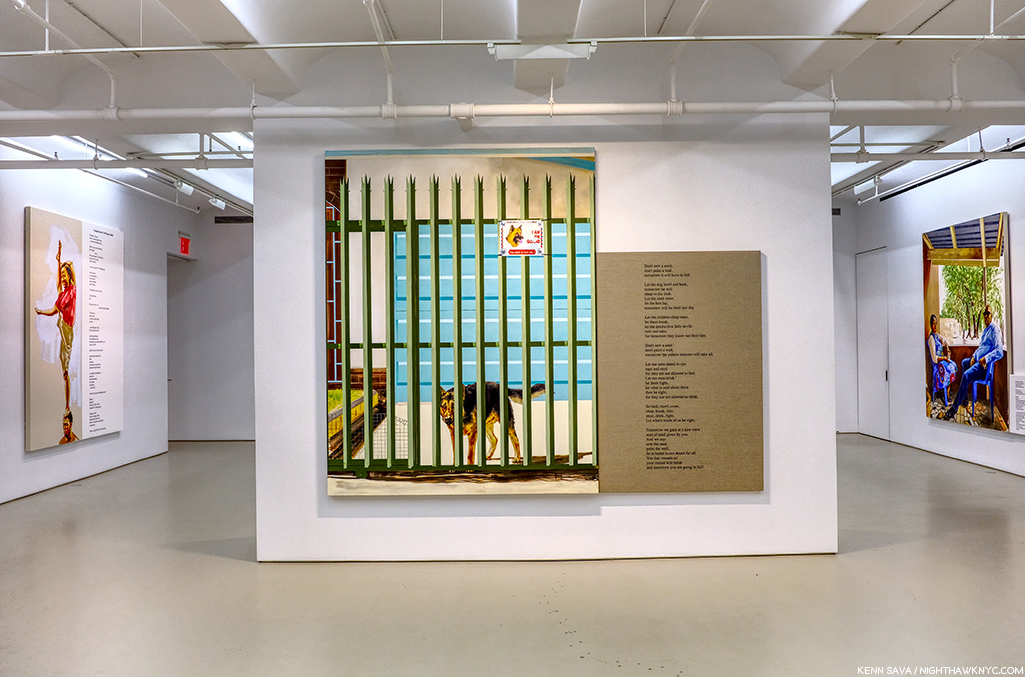
The Met Breuer: Hail, and Farewell

Written & Photographed by Kenn Sava

Part Two of a series.

2,197 days.

I’m about to enter it for what I didn’t know would turn out to be the last time, on what would turn out to be its very last day. I’ll miss it.

That’s how long The Met Breuer (TMB) was open. March 8, 2016 (Member’s preview) through March 12, 2020, when it “temporarily closed” for the pandemic shutdown1. With the calendar turning to July, The Met’s time in the Breuer Building has ended, as I outlined in Part 1, making March 12th the final day it was open to the public. I was there on both its first and last day, and some in between. Though I regretfully missed some of TMB’s shows, I saw the major shows and a good many of the others. 

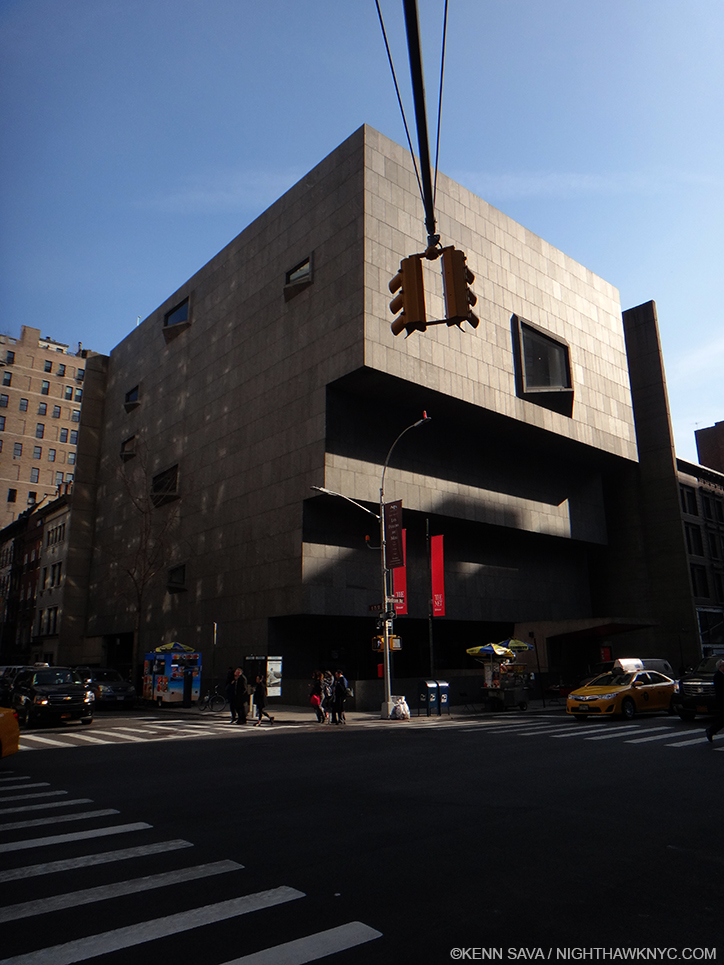
The Met Breuer, March 12, 2020.

My interest in The Met Breuer was born in curiosity. In May, 2011, they announced they would be taking over the Breuer building at 945 Madison Avenue.

“With this new space, we can expand the story that the Met tells, exploring modern and contemporary art in a global context that reflects the breadth of our encyclopedic collections. This will be an initiative that involves curators across the Museum, stressing historical connections between objects and looking at our holdings with a fresh eye and new perspective. This project does not mean that we are taking modern and contemporary art out of the Met’s main building, but it does open up the possibility of having space to exhibit these collections in the event that we decide to rebuild the Lila Acheson Wallace Wing where they are currently shown…” Met Director, Thomas P. Campbell, in The Met’s press release May 11, 2011. 

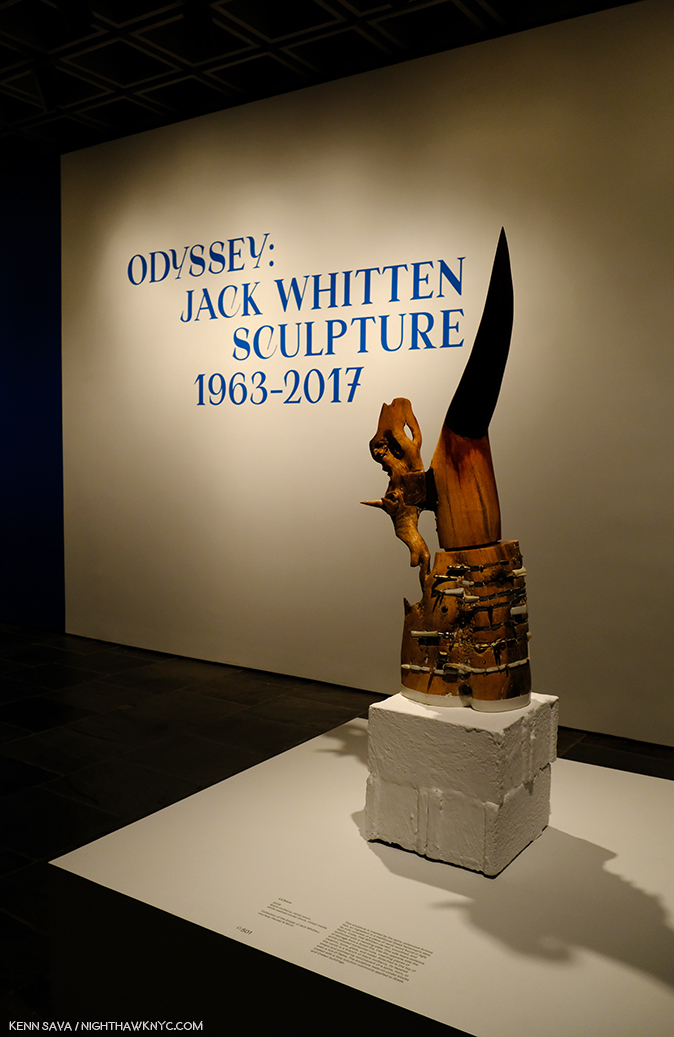
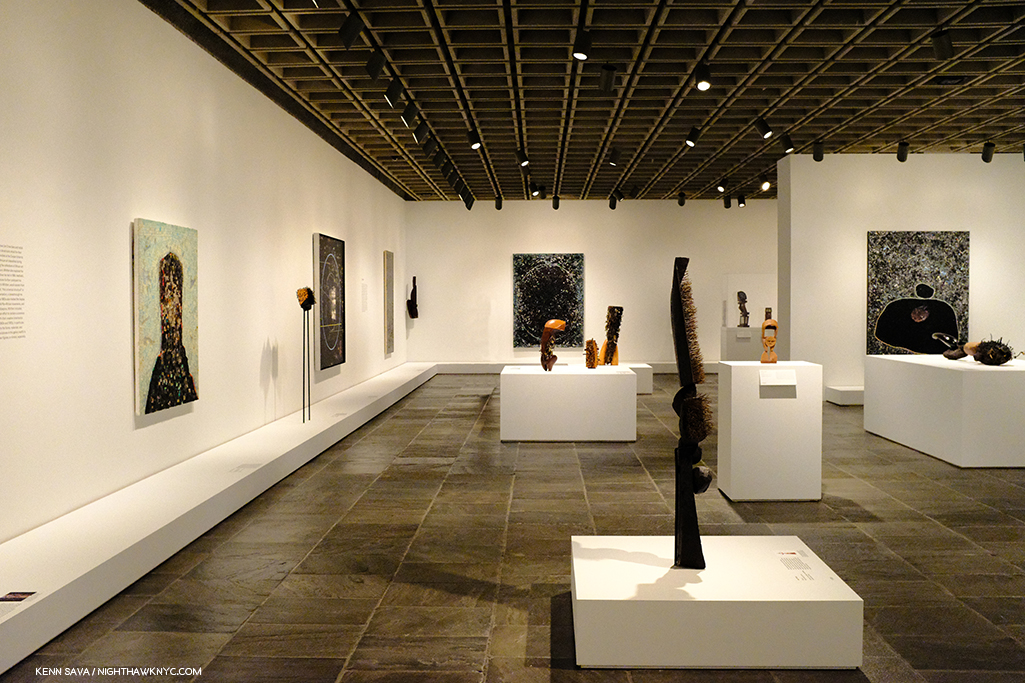
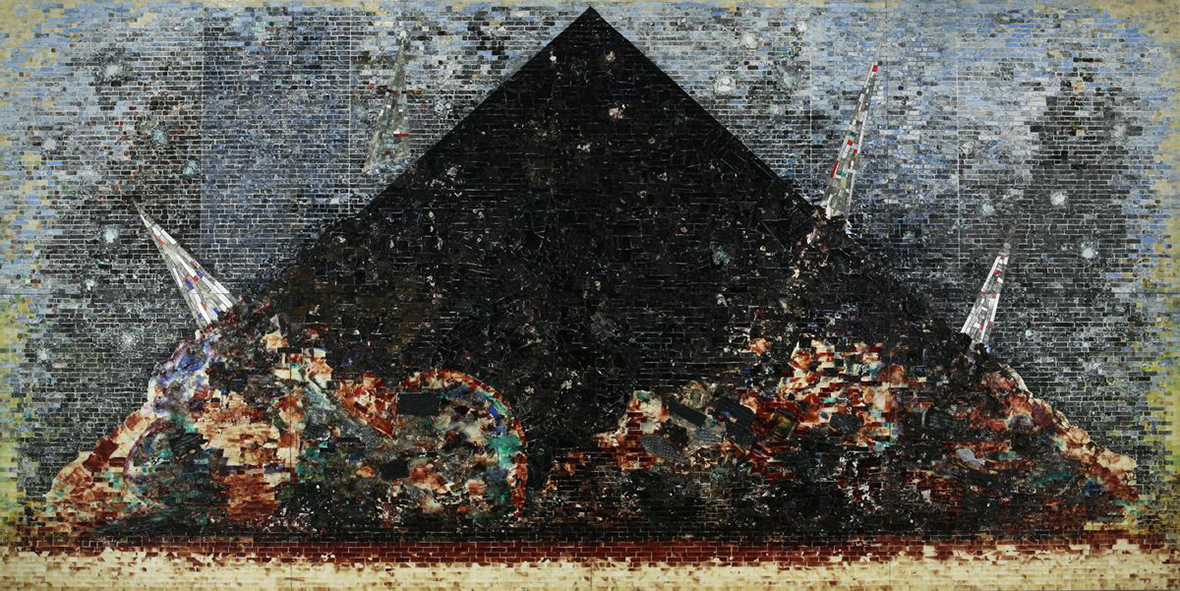
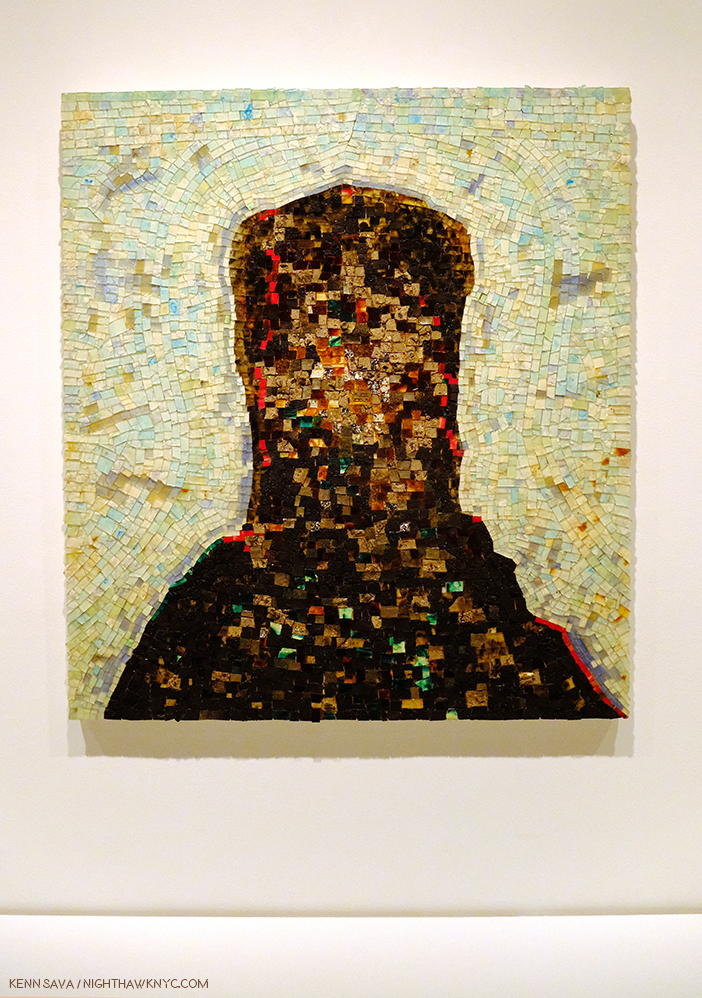
Going up. The elevator doors open onto Jack Whitten: Odyssey in October, 2018, one of the true blockbuster shows mounted at TMB.

After decades of being in denial about Modern & Contemporary Art’s worthiness of being in The Met, this marked a gigantic turn. Of course, it came 40 years too late to acquire most of the major works (or ANY of the major works) of some of the most important Artists of the past 40 years. Truth be told, I for one, was in agreement with The Museum about M&C Art from 1980 until about 2014, when I felt enough time had passed to begin to assess what had been done. A LOT of money had been invested in renovations to, and an 8 year lease on, the building Marcel Breuer had designed at 945 Madison Avenue at East 75th Street fo the Whitney Museum (see Part 1 for more on the history). The pressure was on. The Met, under then Director Thomas Campbell, had decided to make its mark in Modern & Contemporary Art, and brought Sheena Wagstaff on board from the Tate Modern, London, in January, 2012, as Chairman of the Department. What approach would Ms. Wagstaff (who’s shows at the Tate ranged from Edward Hopper to Jeff Wall), her staff and The Met take to M&C Art and how would it hold up against shows up at the Guggenheim, MoMA, The New Museum, The Whitney and the Brooklyn Museums?

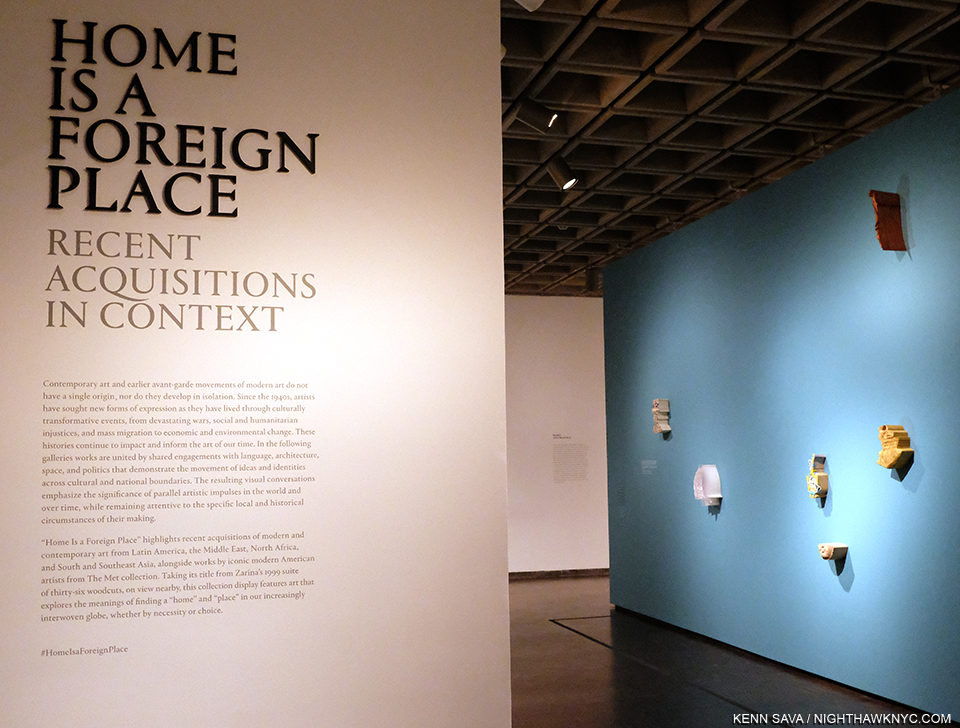
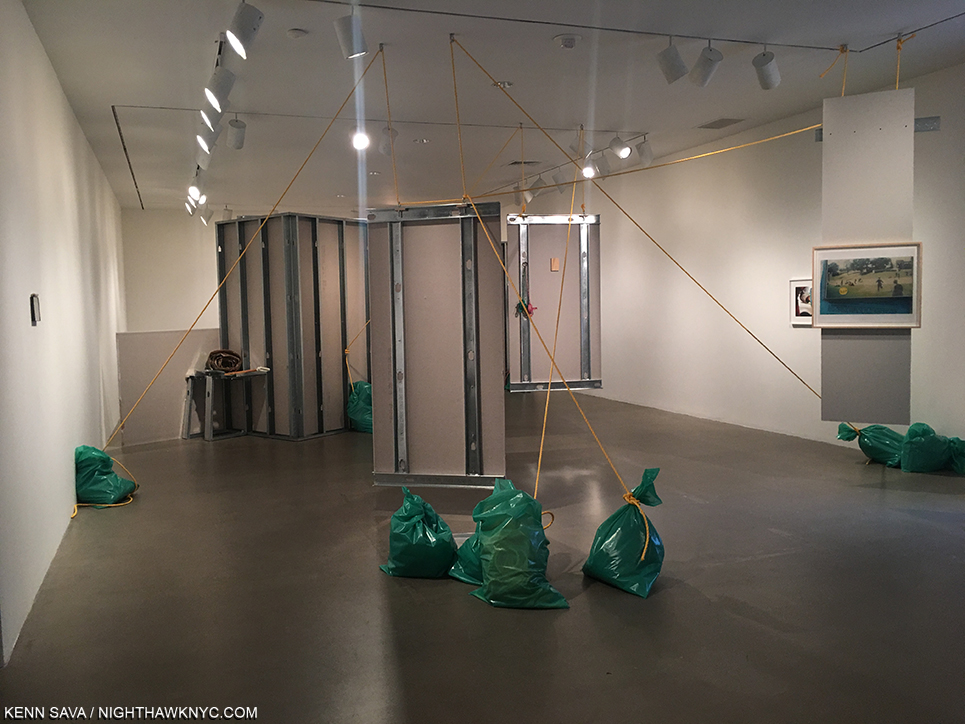
Home is a Foreign Place, one of the 3 shows that closed TMB, drawn from recent additions to the Permanent Collection showed how far The Met’s collection of M&C has come.

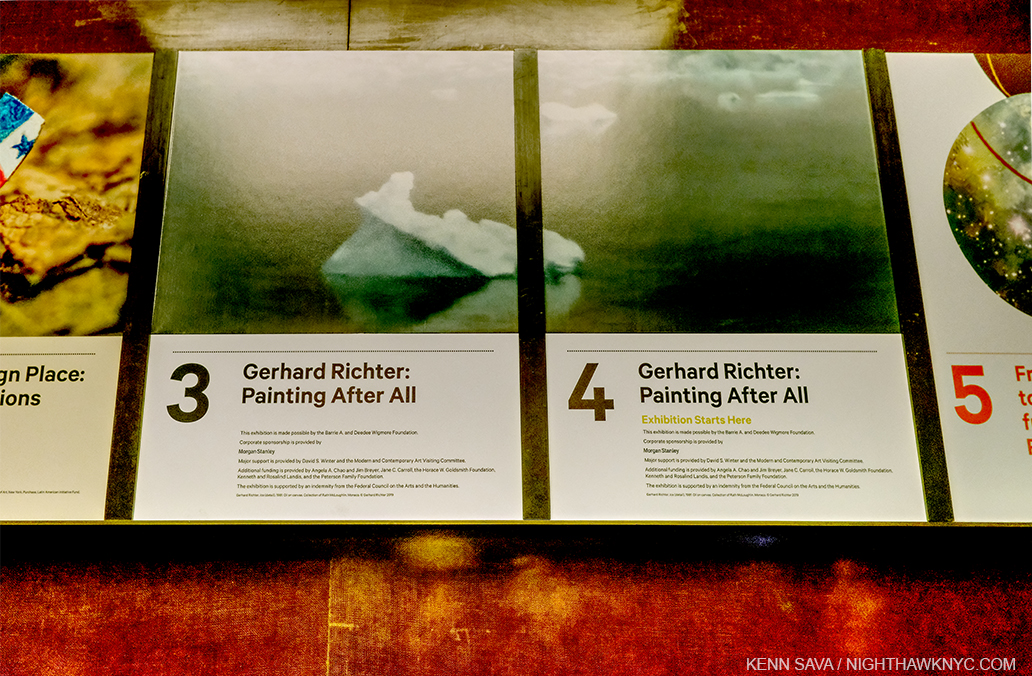
Going into the opening, the press was all about how The Met was “hopelessly behind” NYC’s other Big Five museums, let alone those elsewhere in the country, in Contemporary Art. 2,197 days later, The Met Breuer has done the remarkable- It’s put The Met on that map. It did so by mounting a number of the most important shows of the past four years. From Nasreen Mohamedi and Unfinished: Thoughts Left Visible, which opened TMB, to Gerhard Richter: Painting After All, which closed it. In between, Kerry James Marshall: Mastry, will remain it’s peak moment in my mind, though there were others. And there were a surprising number of revelations along the way.

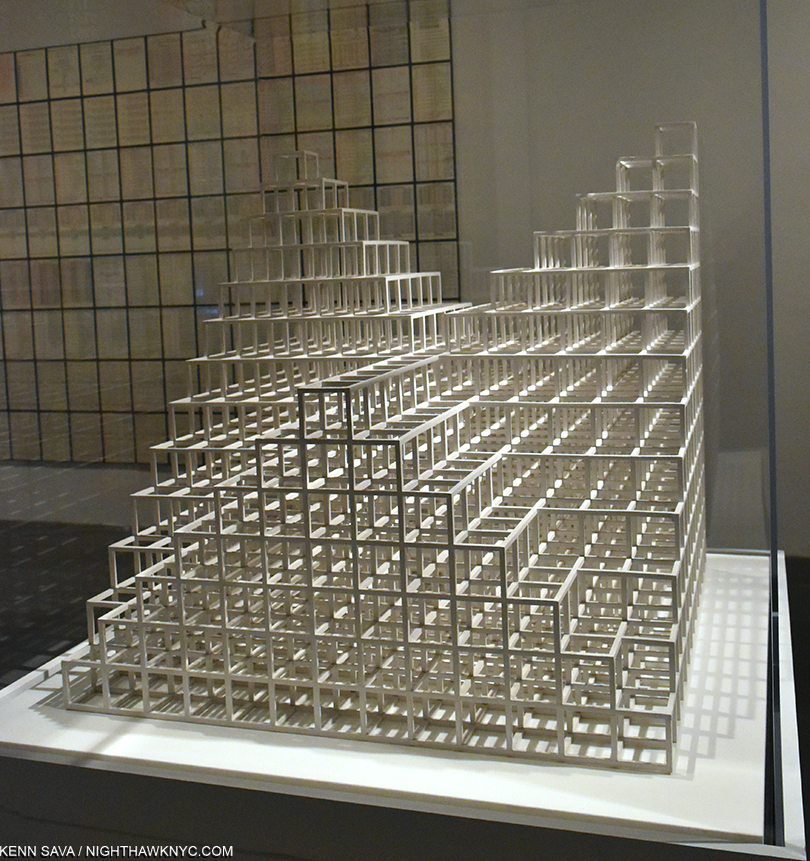
Sol LeWitt was an Artist I never paid much attention to until I saw this work, 13/3, 1981, Painted balsa wood, in the Breuer’s show, , in December, 2017. Ever since, his work continues to fascinate me

Originally scheduled to be open as TMB until July 5th, it still would have closed with the Gerhard Richter and Home Is A Foreign Place: Recent Acquisitions In Context and From Gericault To Rockburne: Selections From The Michael & Juliet Rubenstein Gift, the final three shows on its 2020 schedule. While the legacy is complete, in terms of the shows mounted, the influence was cut short as countless thousands more would have gotten to see these shows over the approximately four months longer they would have remained open. 

For now, I look back at some Highlights from The Met Breuer. The name of each show, listed in no particular order, is linked to the piece I wrote about it at the time-

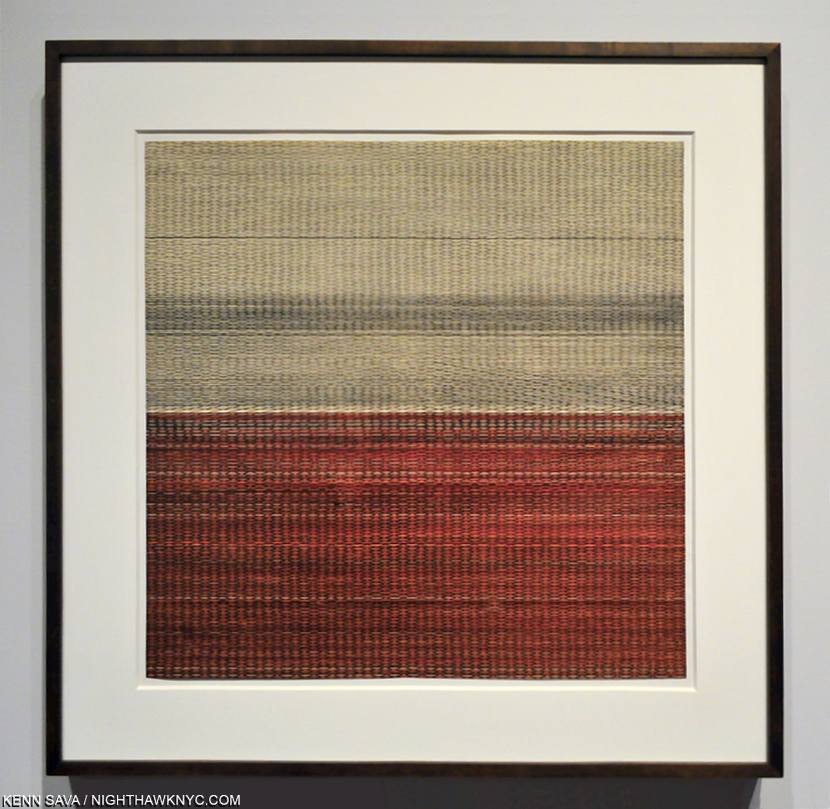
Approaching this work, I thought “What is a piece of textile doing here?” “Untitled, 1970s, Graphite and ink on paper,” the wall card read. Wait. What? This is a DRAWING? Then, all of a sudden, a loud click when off in my mind, and Art was never the same for me again.

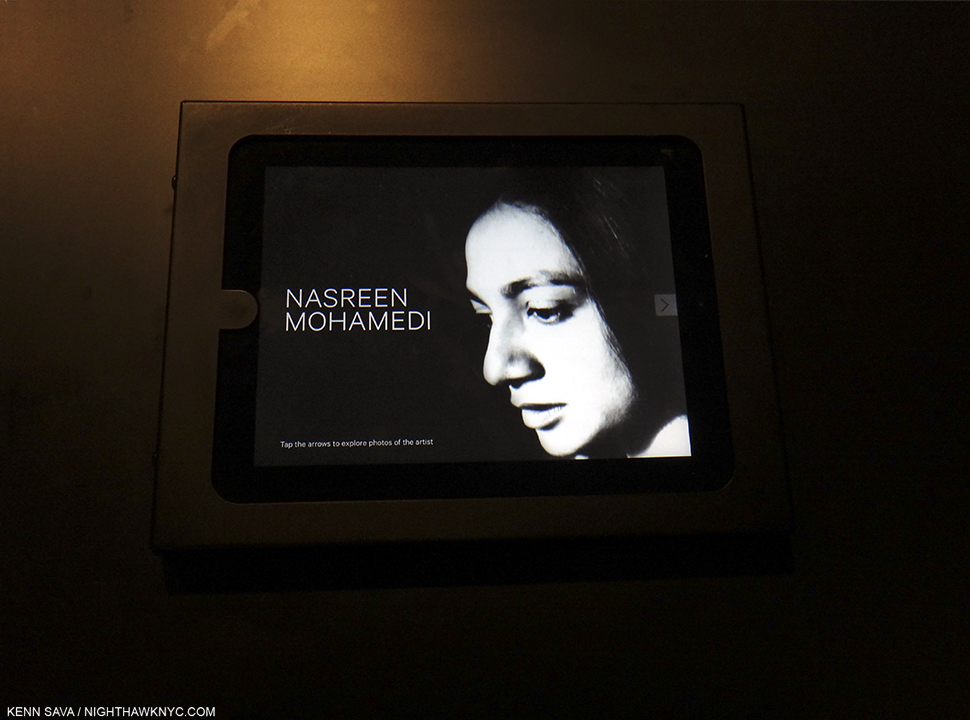
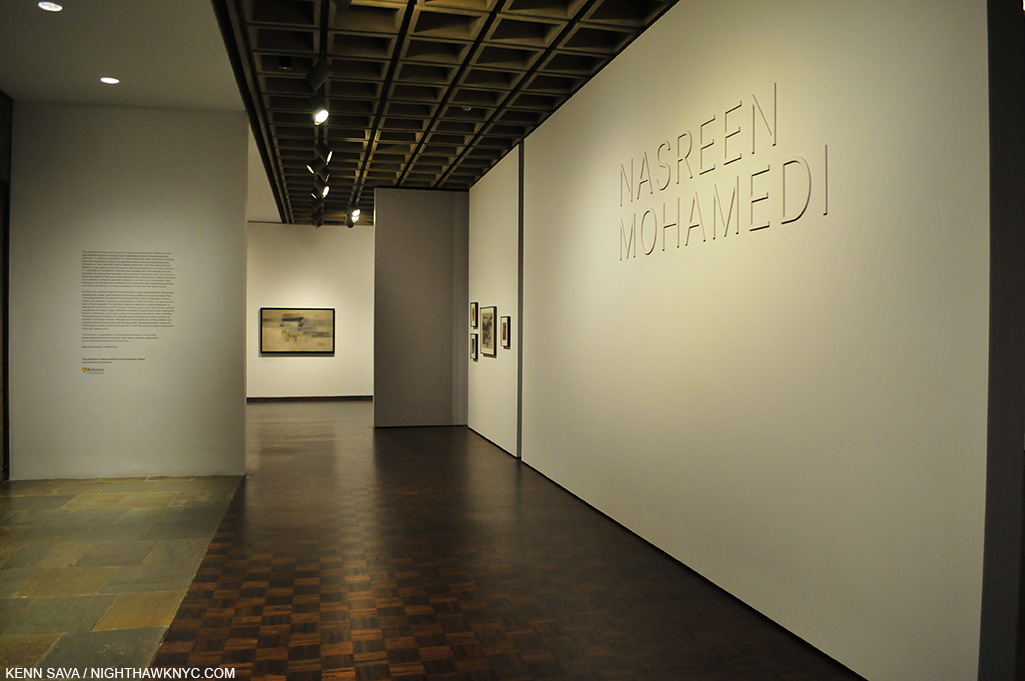
Nasreen Mohamedi Revelations. That might be the word that lingers with me with I think about TMB. They began on Day 1…The first show I saw that first day at TMB remains my personal favorite of all the shows I saw there. I had no idea who Nasreen Mohamedi was when I got off the elevator that day on 2. But Sheena Wagstaff sure did.

Incomparable is the word I now use to describe Nasreen Mohamedi, who lived in obscurity for 53 years and gave away her Art as gifts. Seen here in one of the handful of existing Photos of her, this one has lingered in my mind from the first moment I saw it, here in a slide show in the final gallery in March, 2016.

The show included Photos taken by Ms. Wagstaff of the area of Nasreen’s unmarked grave well off the beaten path in Kihim, Mumbai, India. THAT’S passion. THAT’S dedication. At that moment I saw them, I knew TMB would be one of NYCs most important cultural institutions. 

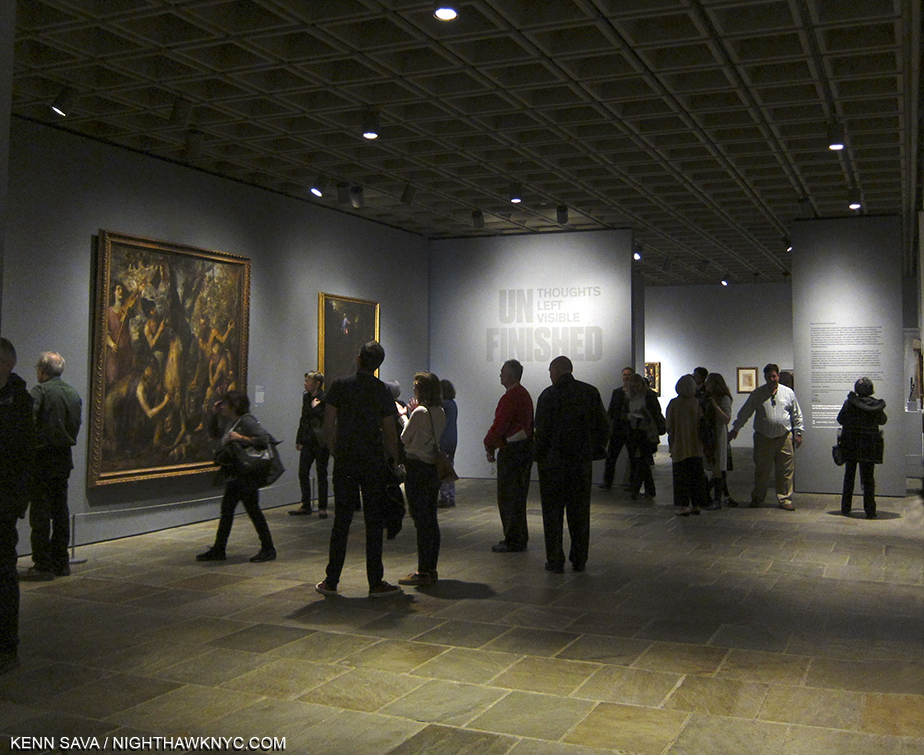
Unfinished, Member’s Preview. The first look at one of the most memorable shows to appear at The Met Breuer, March 8, 2016. Work by Titian, left.

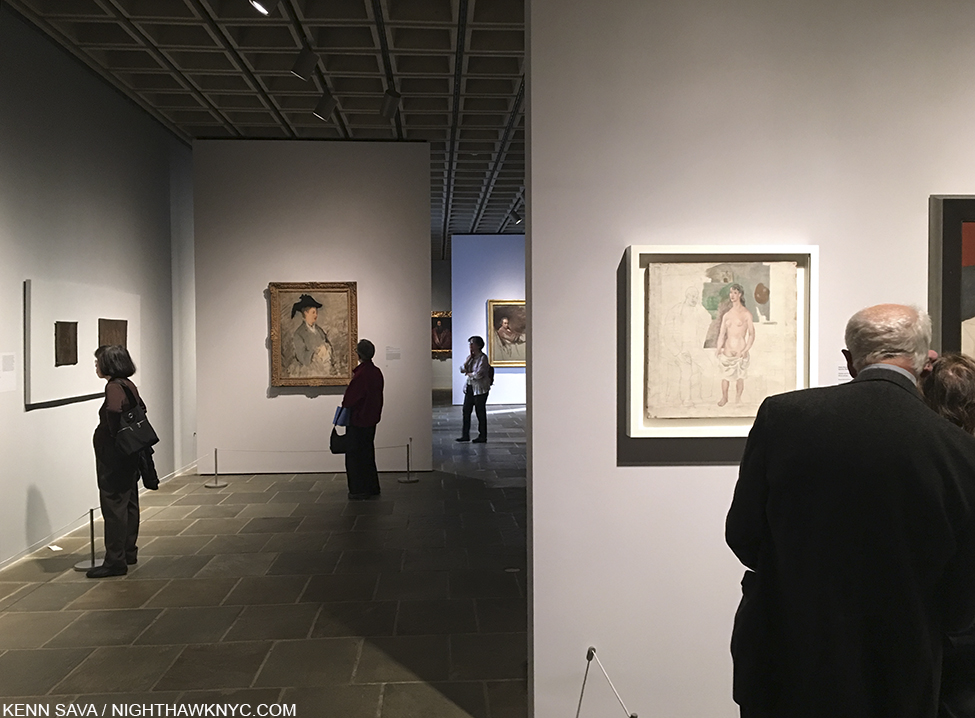
Unfinished: Thoughts Left Visible. In the hundreds of years Art shows have been mounted, someone must have mounted one around this concept, right? I haven’t heard of it. If there was one, I doubt it was mounted as incredibly well and included rarely seen works by Michelangelo, Leonardo (the twin Kings of the unfinished work in the Renaisaance), Jan van Eyck, JMW Turner, and countless others. TMB’s first major blockbuster, and the other inaugural show in March, 2016, along with Nasreen Mohamedi. It belied The Met’s stated “mission” with TMB as “an outpost for Modern & Contemporary Art,” filling two floors, while the Nasreen got one. Given all the riches included, I have yet to hear anyone complain. Overall, over time, TMB was what The Museum said it would be.

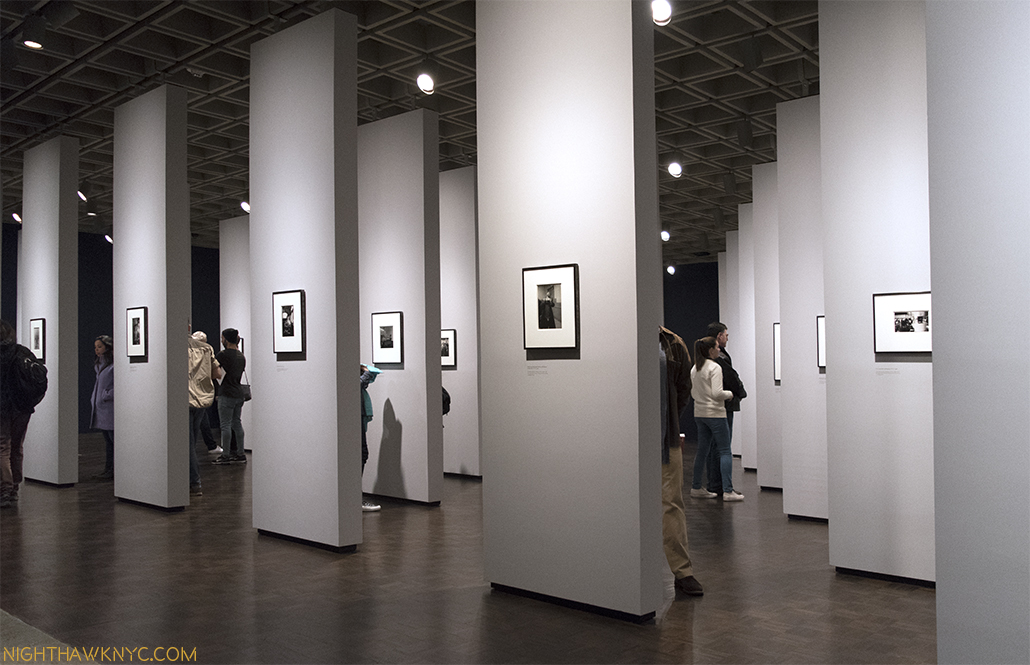
Diane Arbus: In The Beginning was a revelation, as well, as much for the work as for the amazing way the show was installed- each of the over 100 pieces got its own wall- another thing I’ve never seen before. It also included a portrait of a departed friend of mine, Stormé DeLarverie, who told me more than once that it was she whose scuffle with police had incited the Stonewall uprising (she disagreed with the use of the term “riot.”), and that she had posed for Diane Arbus in 1961. At the time, I took both claims with grains of salt. Now, the world knows that both are facts, and in her gorgeous portrait by Ms. Arbus, which I snuck a shot of and show in my piece, Stormé will forever live on in The Met. In In The Beginning, she, fittingly, got a wall to herself.

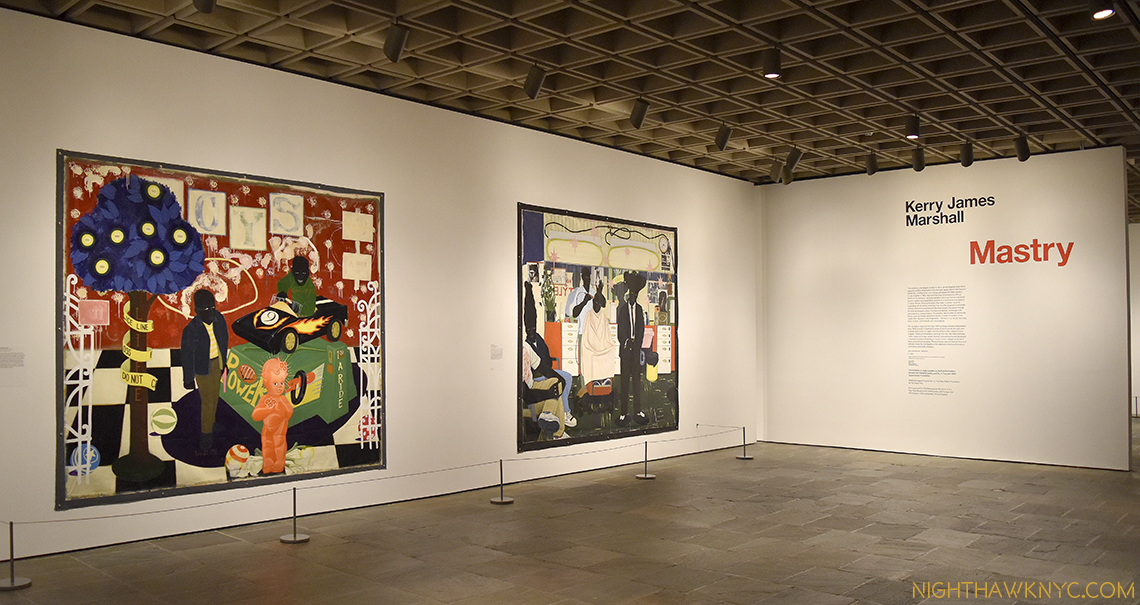
The beginning of Kerry James Marshall: Mastry.

Kerry James Marshall: Mastry. As great a Painting show as I’ve seen in years. Maybe decades. 

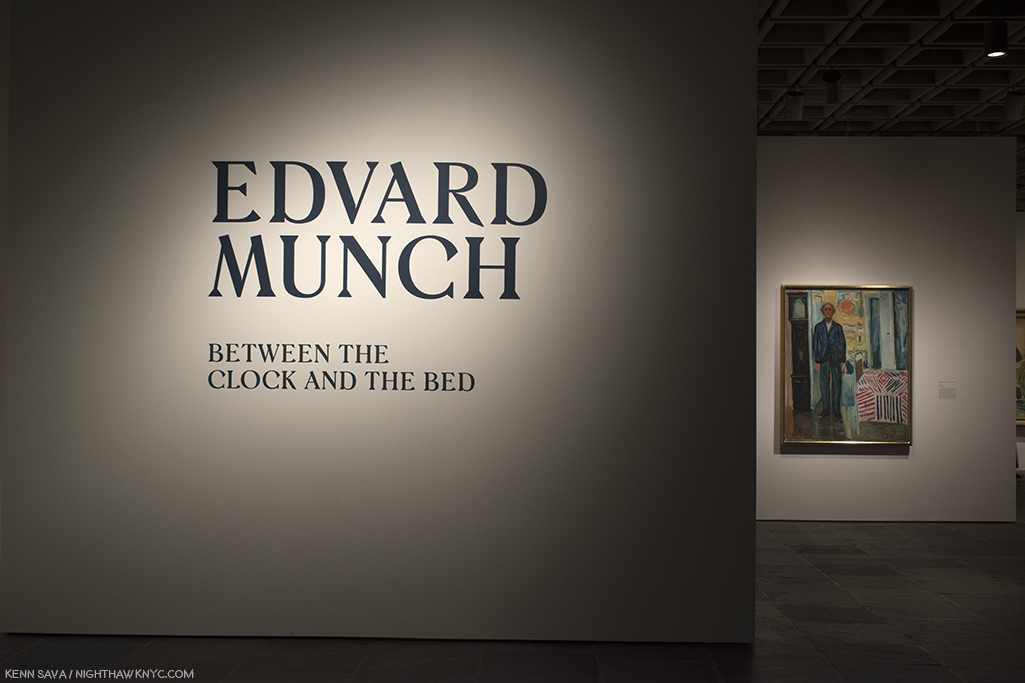
Edvard Munch: Between the Clock and the Bed. A welcome reminder of the enduring accomplishment of this wonderful Artist who’s rarely seen in a show here. Between showed Mr. Munch is one of the very few Artists to successfully use techniques, styles and colors in realms that had only been used by Vincent van Gogh, who he was only 10 years younger than, and who he outlived by 54 years. 

Lichnos, 2008, at the entrance. 100 feet into this show my jaw was on the ground. It stayed there throughout.

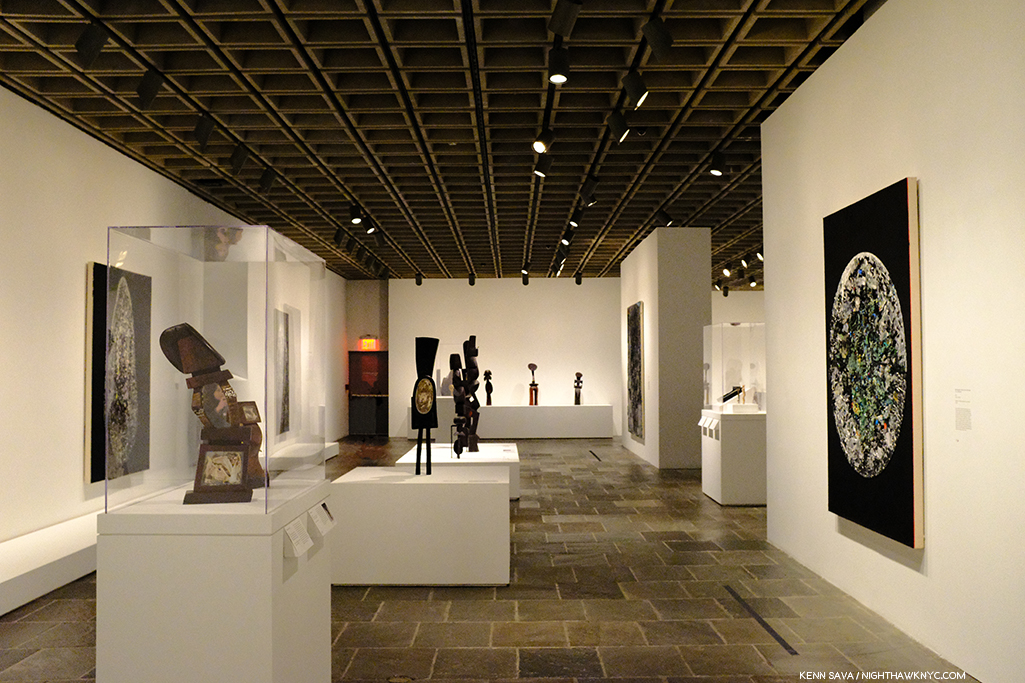
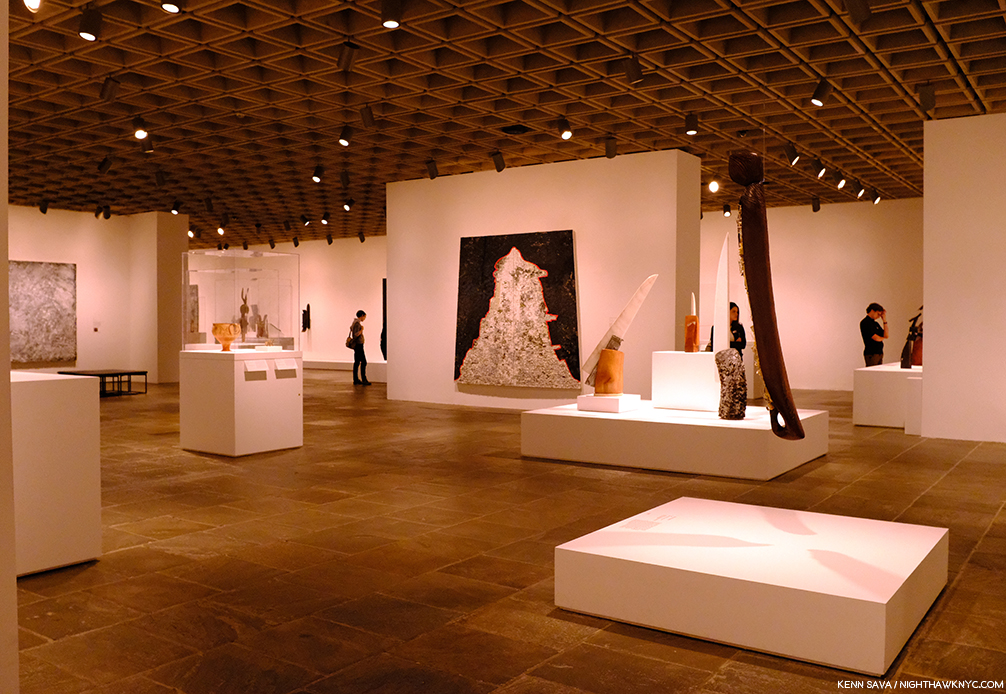
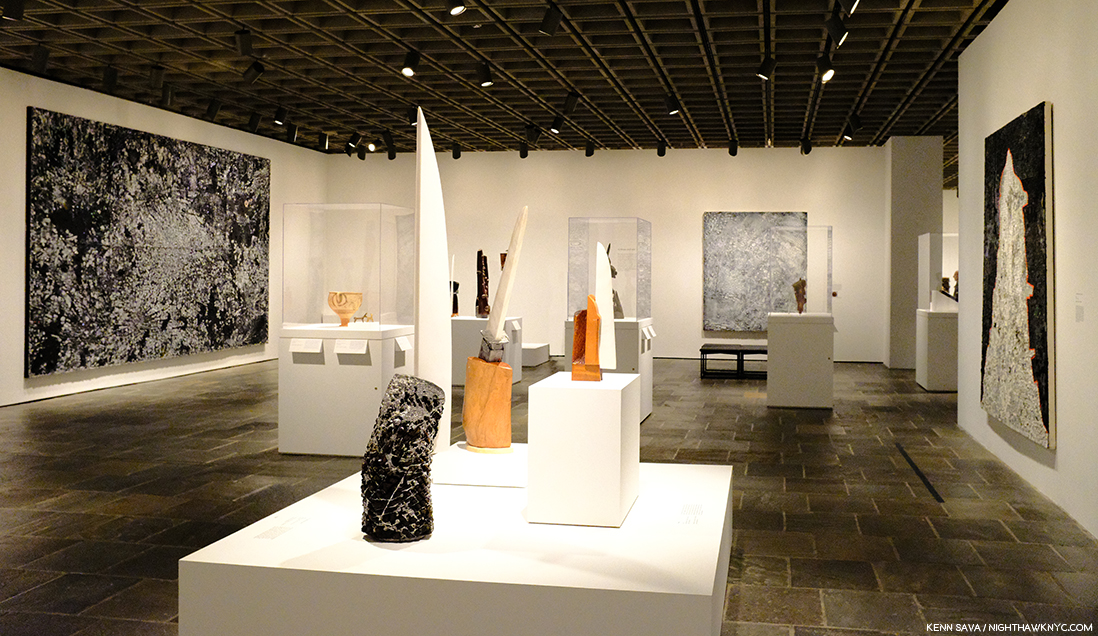
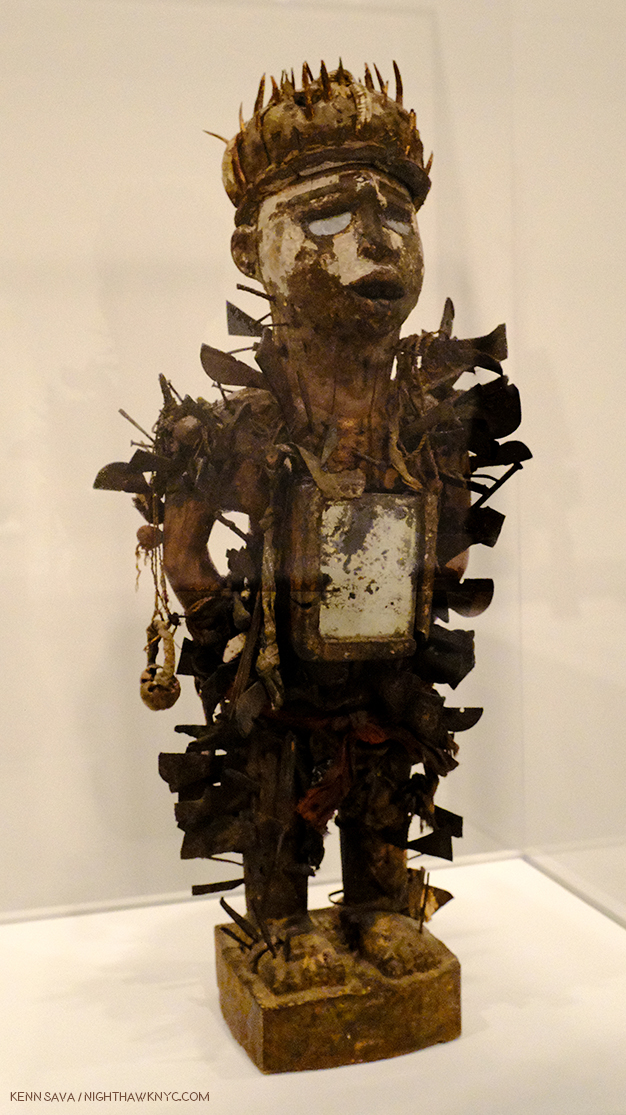
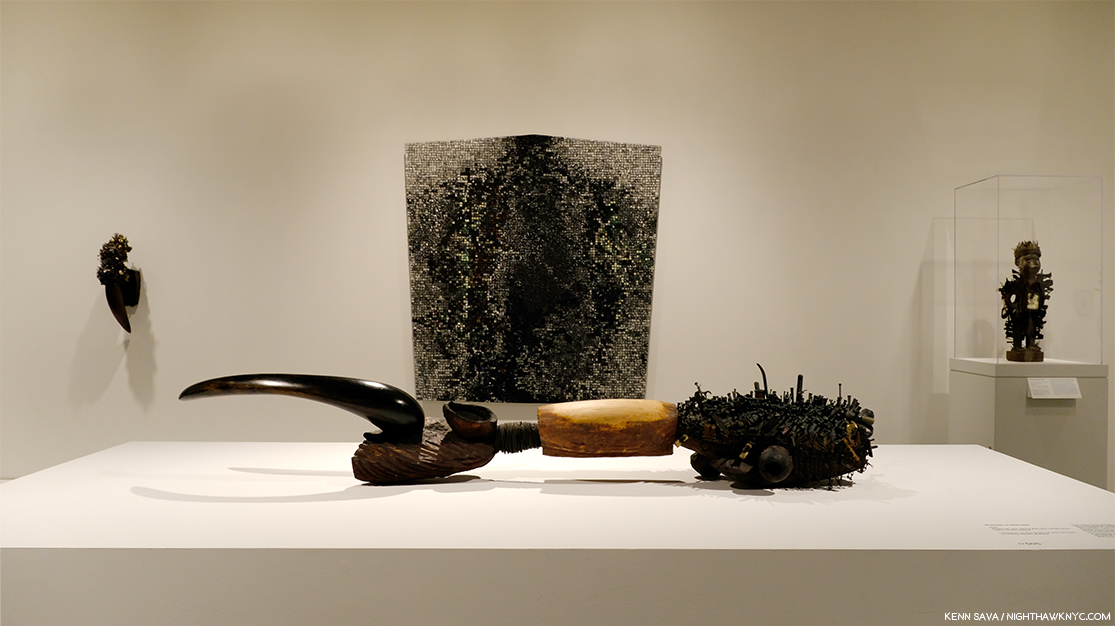
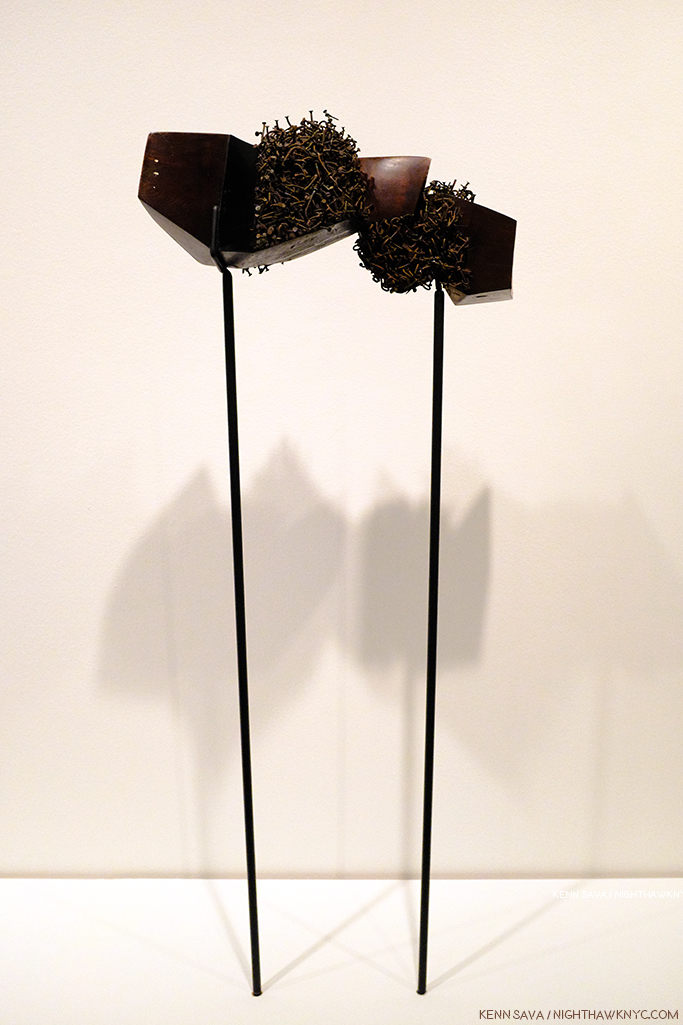
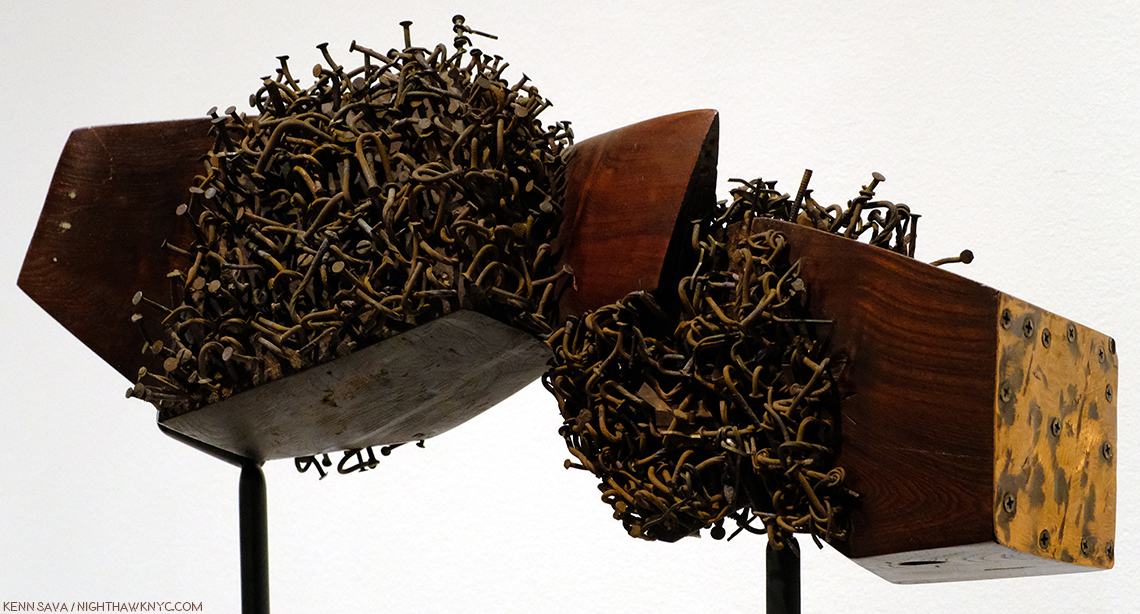
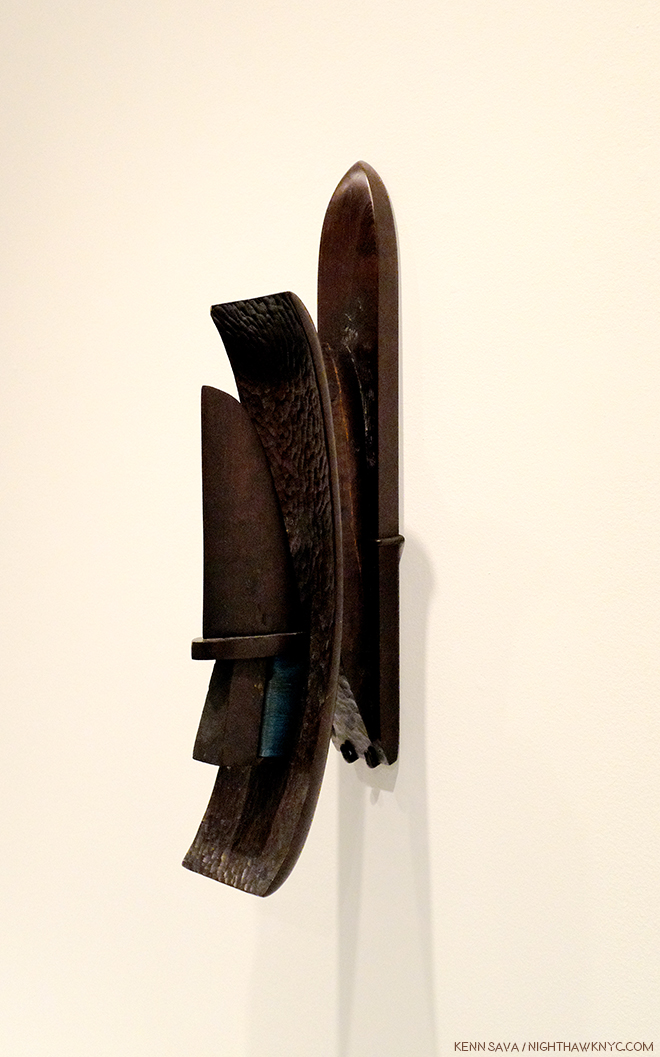
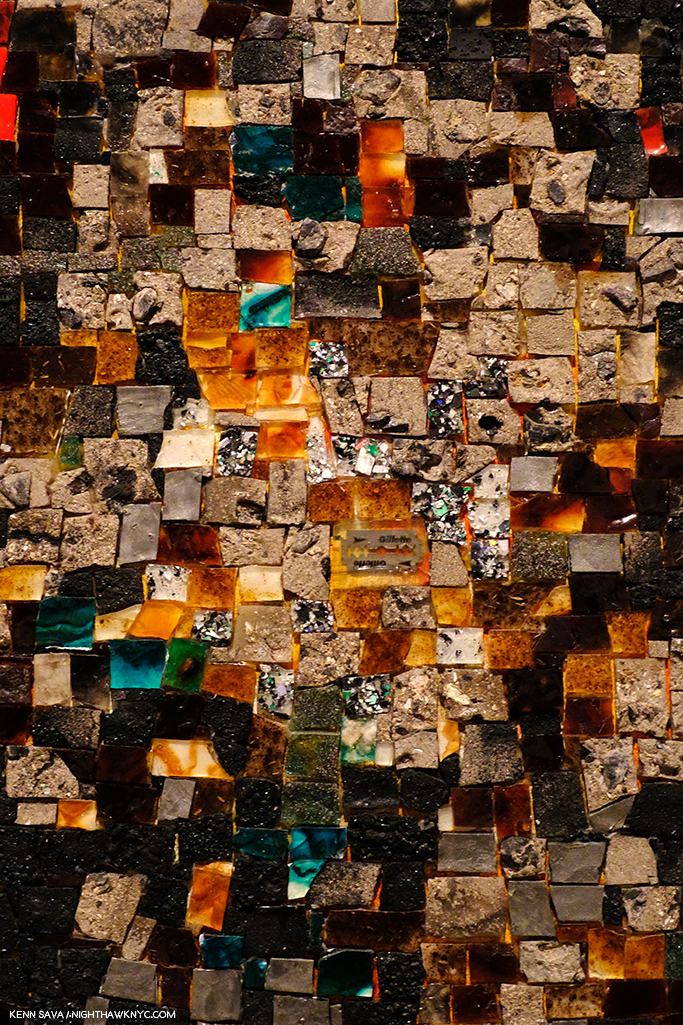
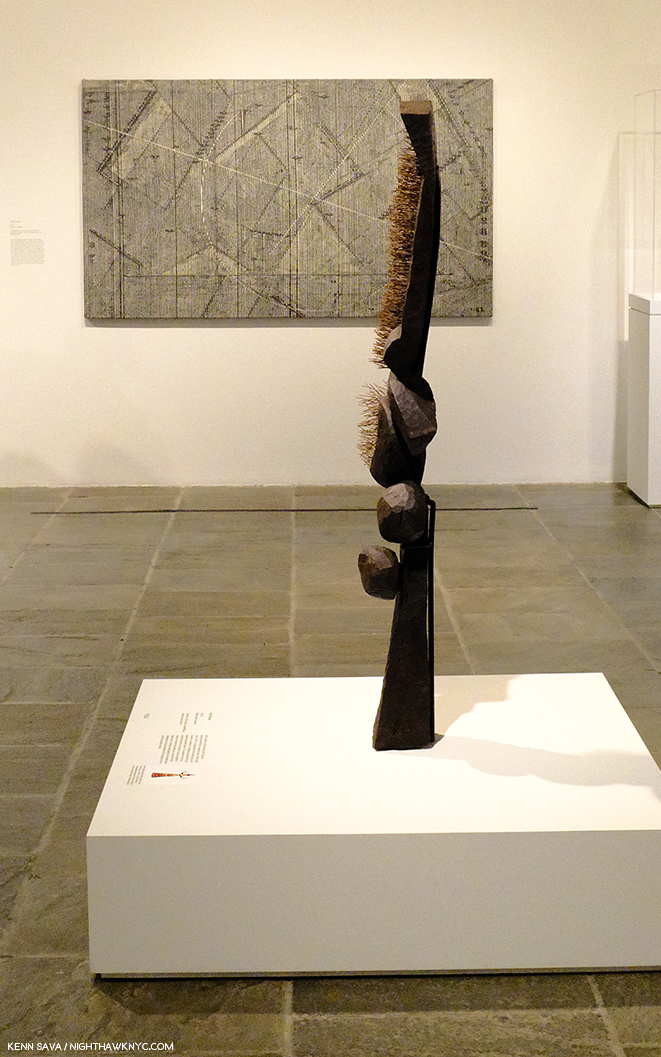
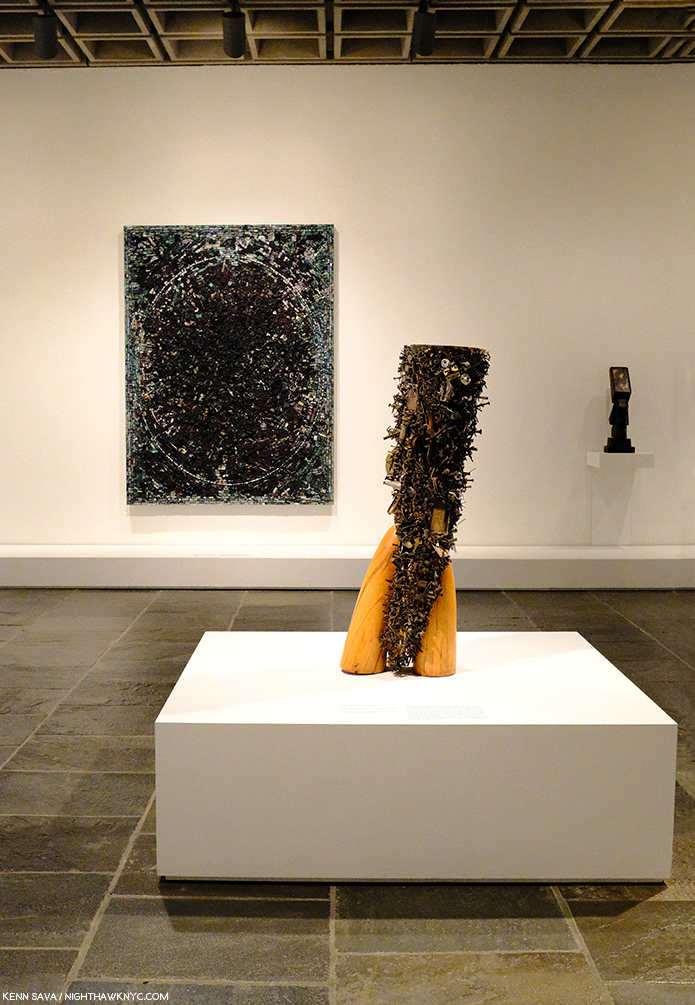
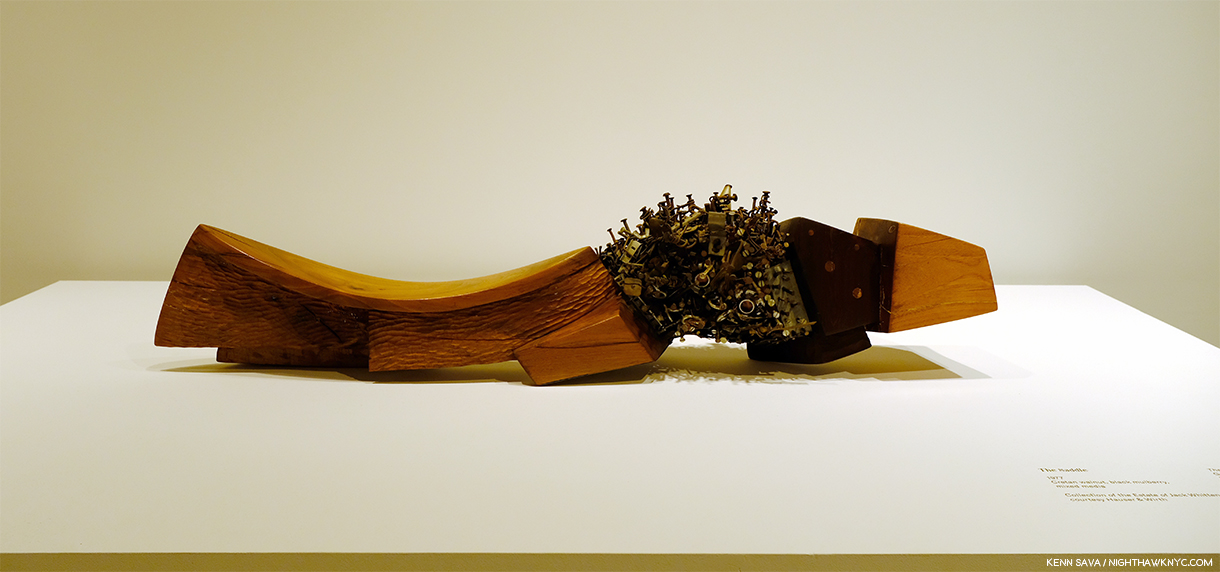
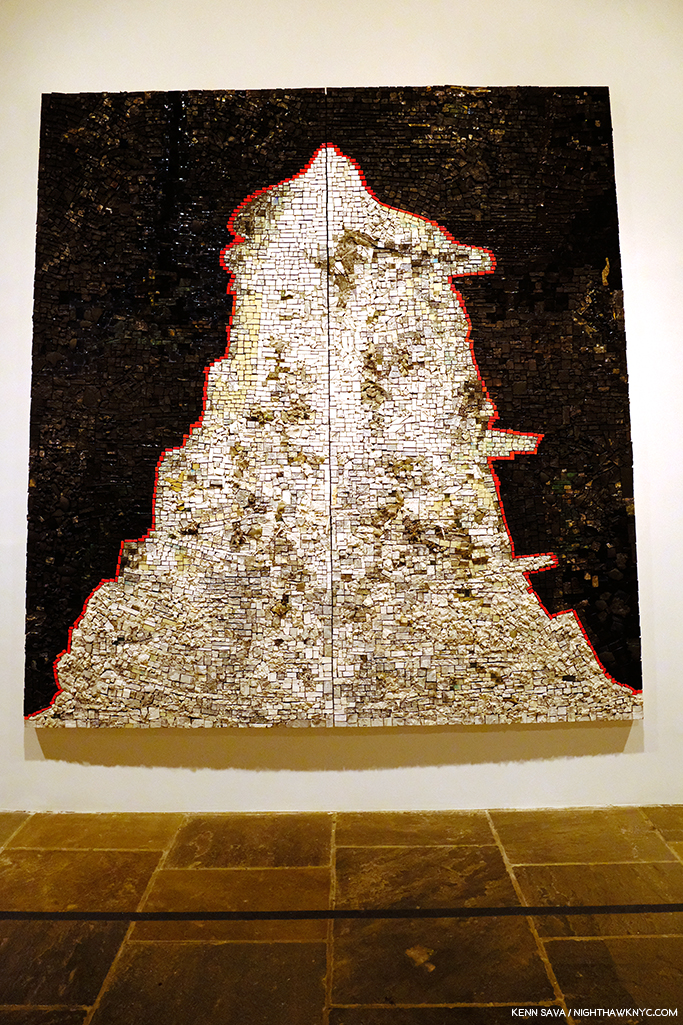
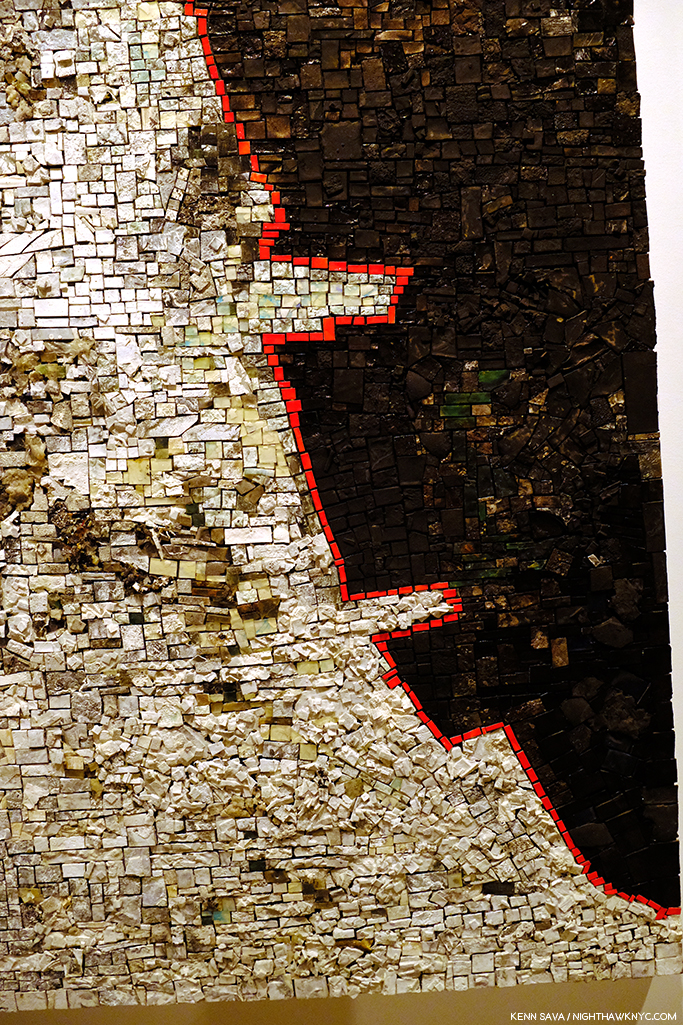
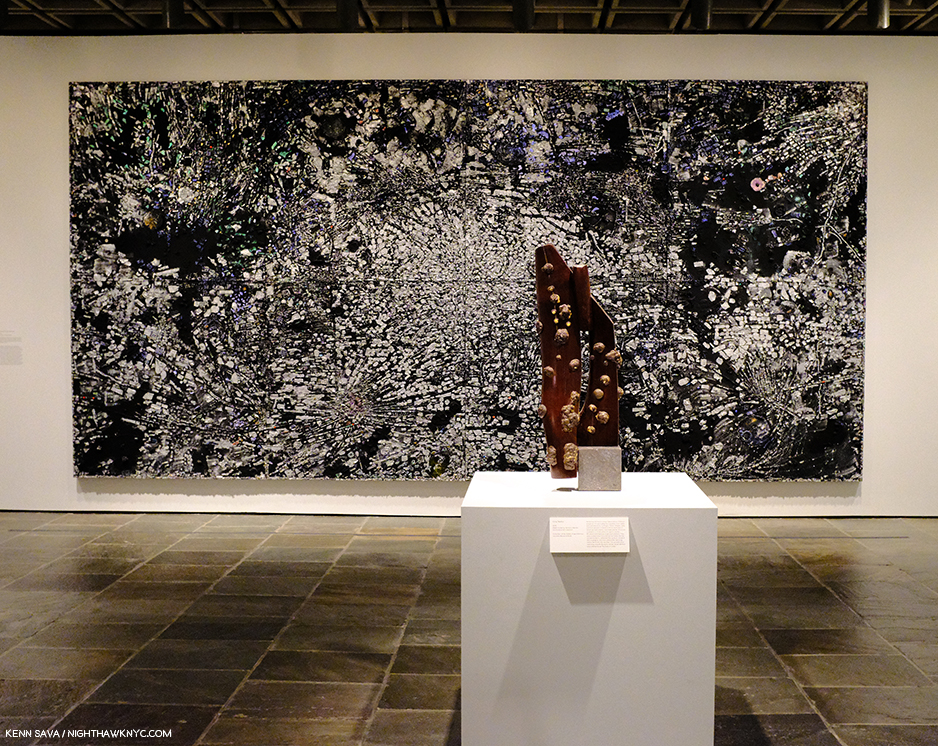
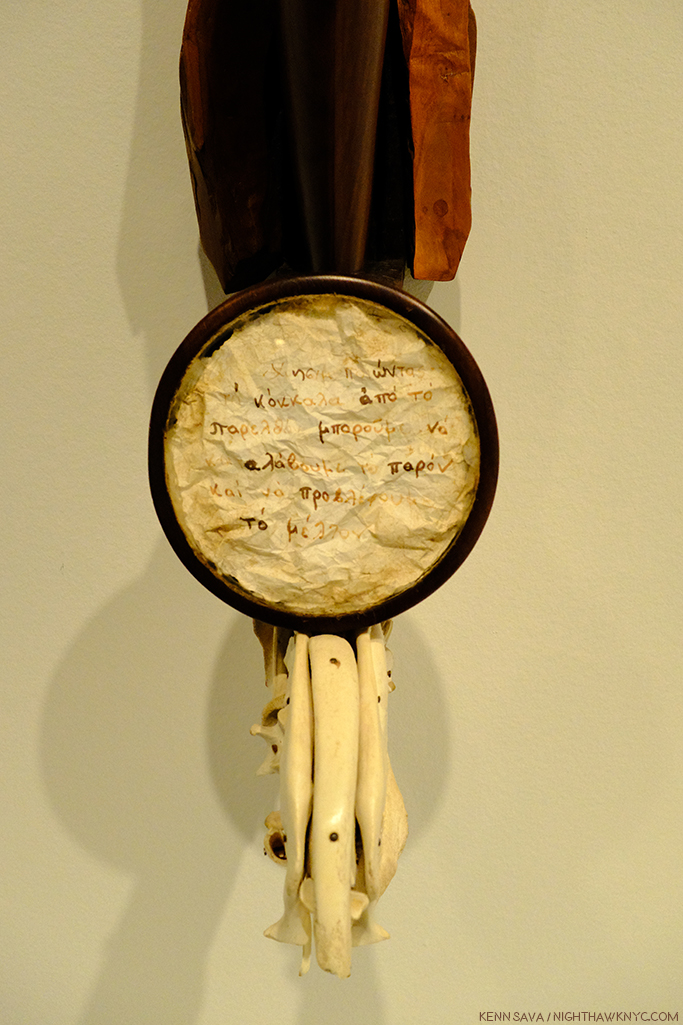
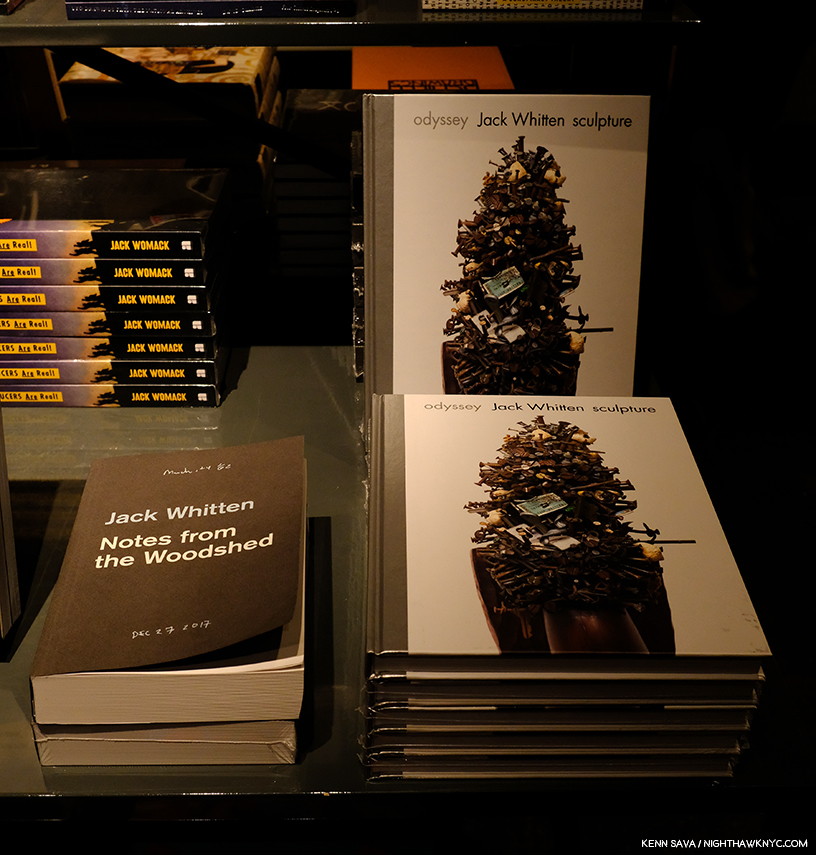
Odyssey: Jack Whitten Sculpture, 1963-2017. Quick. Who’s the other Artist who is a Master of one medium, and who kept his mastery of another from public view his entire career? One stunning revelation after another that never let up. More remarkable for such a large show.

As I said in my piece on the show- “TWO whole museum floors of about 100 Paintings? My idea of heaven…” Having five floors at The Breuer added different dimensions to any number of shows, allowing a good number of shows to fill two whole floors- the kind of space that would be VERY hard to have at 1000 Fifth Avenue. The space between works at Gerhard Richter: Painting After All was one of its most memorable features and gave it an entirely different feel, allowing each work “space to breathe,” rare in big shows, and something I’ll miss very much.

Gerhard Richter: Painting After All. Exquisitely selected and hung, somehow managing to condense almost 6 decades of work into a selection that while not a “greatest hits” included enough of them, along with a good many surprises, and a chance to see the monumental Birkenau works. Unfortunately, it was open for all of NINE DAYS! It turns out that I saw it on its final day, at considerable risk. 

Along with other memorable shows-

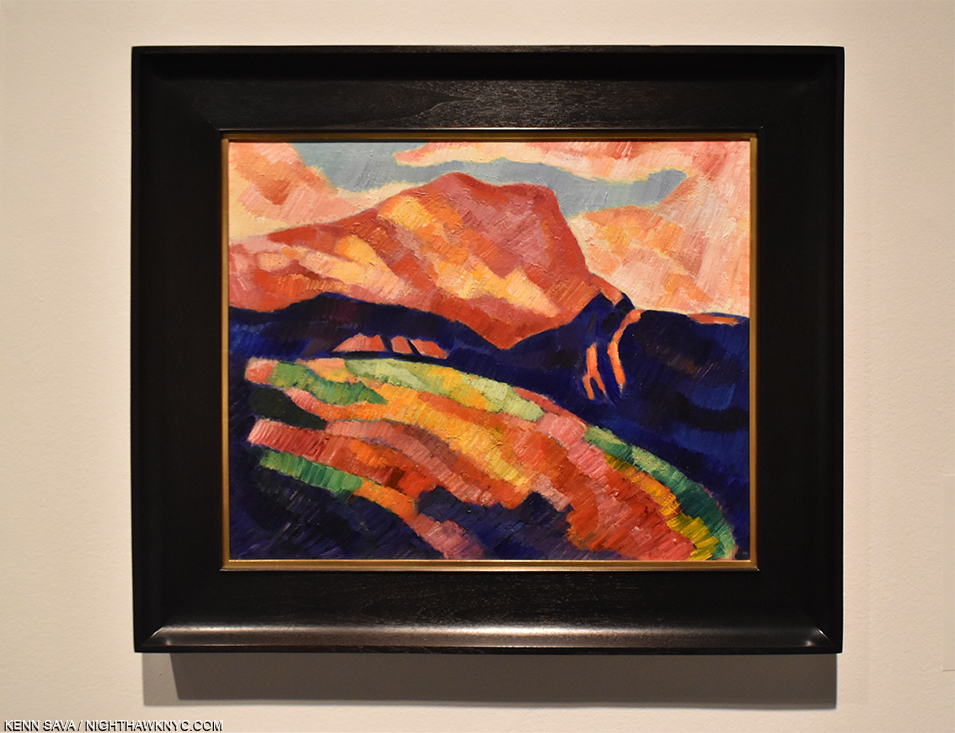
Marsden Hartley’s Maine Marsden Hartley was unique and an Artist, though steeped in what the Europeans had and were doing, found his own ways. This was a show that served to open the mind, even in 2017, to the possibilities of Painting seen through a very free eye and mind in often daring fashion. A real breath of fresh air.

Marsden Hartley, Mont Sainte-Victoire, c.1927. Pretty daring to go to Aix-en-Provence and go toe-to-toe with the Master, Cezanne, in the land he made iconic. This work, in a show about Marsden Hartley’s work in Maine, this work set the stage for his bold brushwork and use of color in what would come.

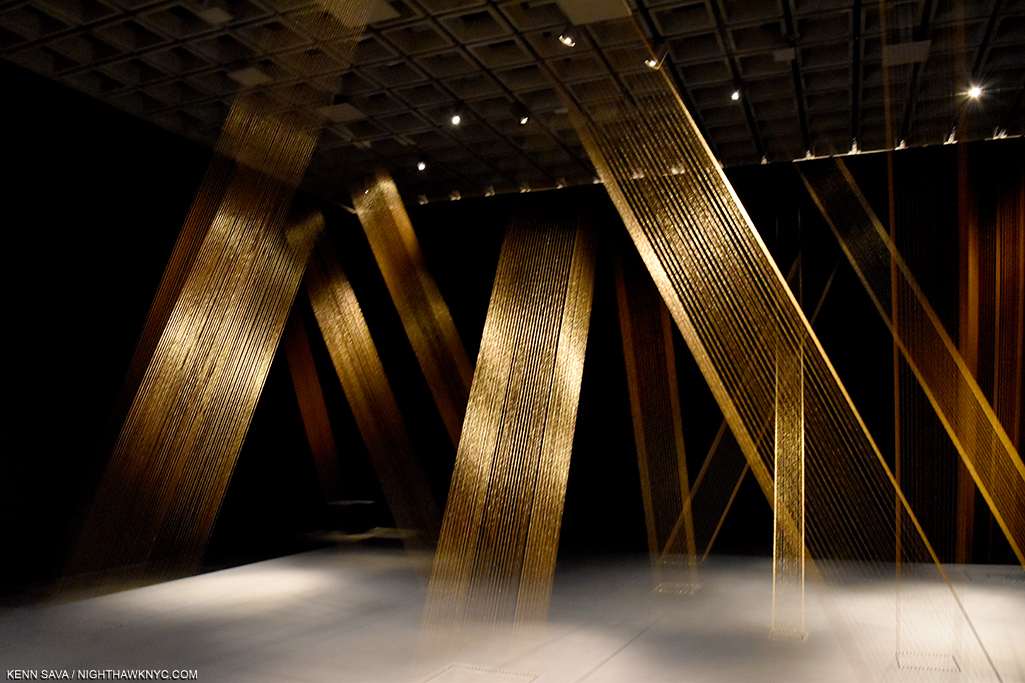
Lygia Pape:A Multitude of Forms  No one medium could hold Lygia Pape’s vision, so the visitor to A Multitude of Forms was met with an ever-changing presentation that delighted the eye as much as it captured the mind.

Lygia Pape, Tetia 1, C, 1976-2004, Golden thread, nails, wood, lighting, a work that wonderfully characterized the ephemeral nature of Ms. Pape’s work in a show remembered for its endless variety and surprise. Seen at Lygia Pape: A Multitude of Forms, her first major show in a US museum in June, 2017.

Everything is Connected: Art and Conspiracy-

Rachel Harrison, Snake in the Grass, 1997. A work inspired by the Artist’s trip to Dealey Plaza, sight of JFK’s Assassination. While I was captivated by it, NHNYC Researcher Kitty said this work reminded her of being in her father’s garage.

And shows consisting of work from The Met’s Permanent Collection including-

Obsession: Nudes by Klimt, Schiele and Picasso From the Schofield Thayer Collection. With only 9 by Klimt and the majority by Shiele- no complaints here.

Provocations: Anselm Kiefer At The Met Breuer-

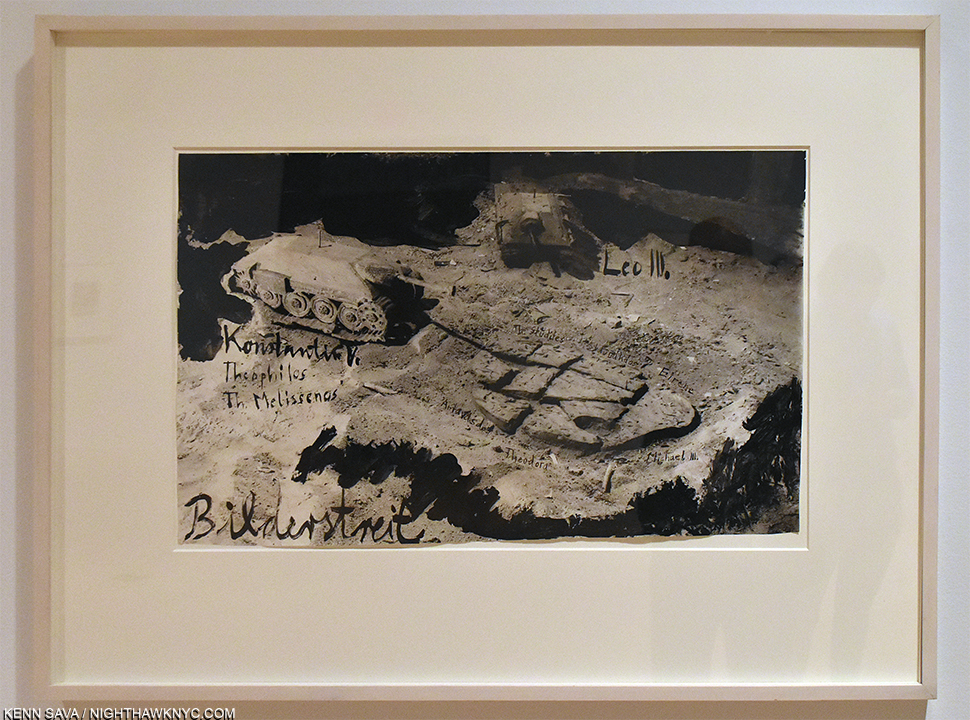
Anselm Kiefer, Iconoclastic Controversy, 1980, Gouache and ink on photograph, the wall card reads in part, “Rooted in the Second Commandment’s prohibition of graven images, the medieval debate involved the persecution of the artist-monks and the destruction of icons. Here he restaged the conflict in his studio with miniature versions of WWII tanks (one has destroyed a piece of clay in the shape of an artist’s palette)…The image links the iconoclastic battle to the Nazi’s attack on 
“degenerate art” in the late 1930s, which led to the destruction of hundreds of works of modern art.”

and Home Is A Foreign Place: Recent Acquisitions in Context. (Installation view of its lobby shown earlier)-

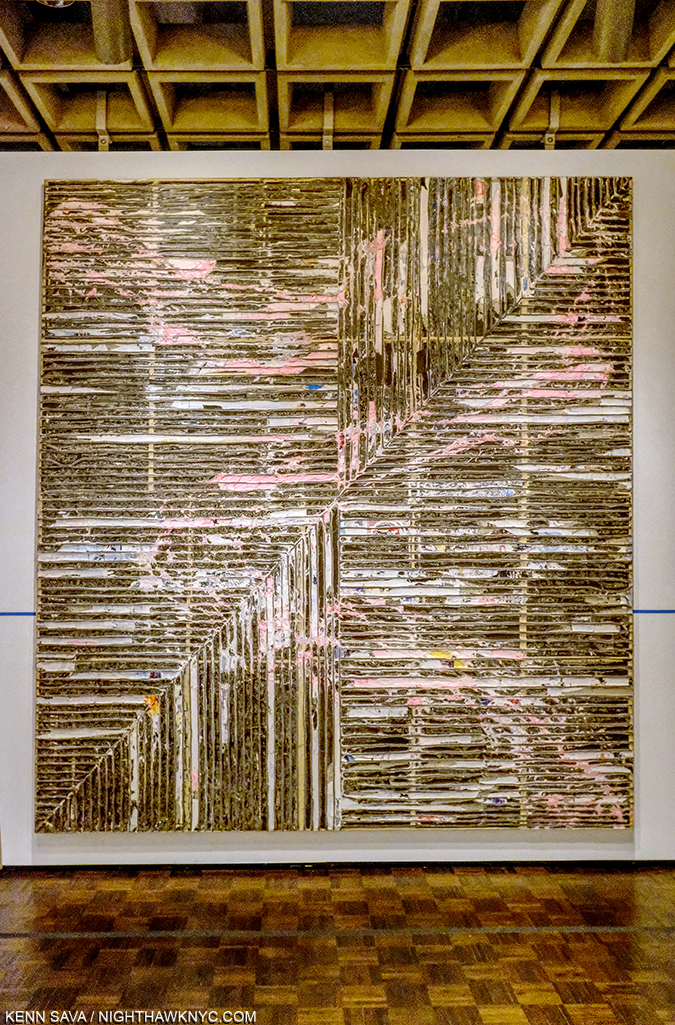
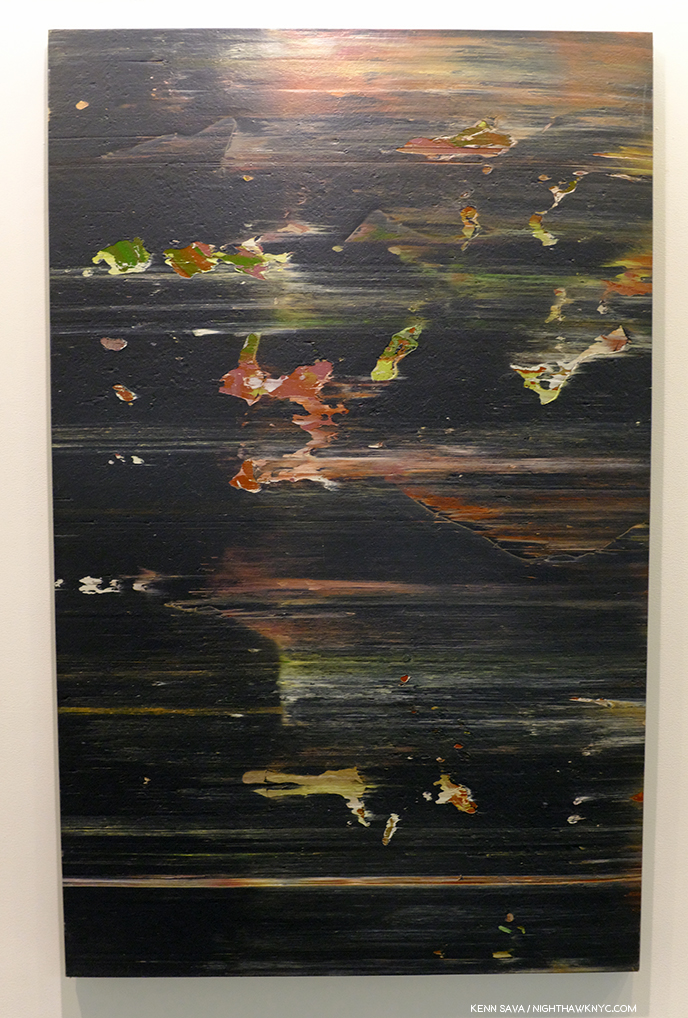
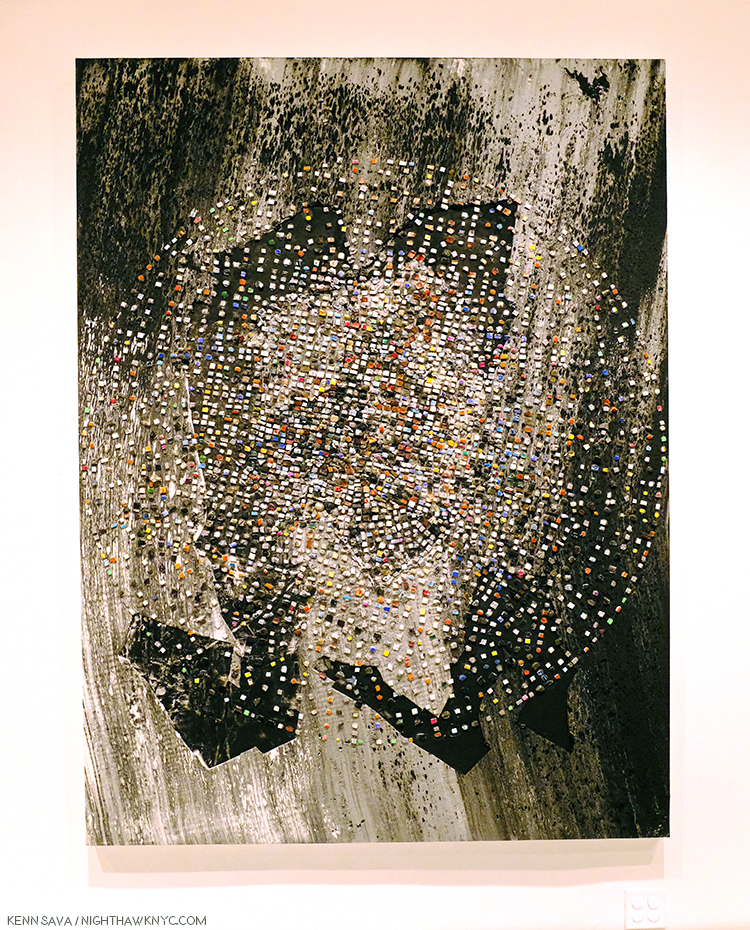
Mark Bradford, Crack Between the Floorboards, 2014. Can an Art writer have personal favorites? If he/she is a human being, it’s pretty hard not to. Mark Bradford is one of mine. So, I will long remember that this piece was the third to last work I saw on what turned out to be the closing day of The Met Breuer in the show Home Is A Foreign Place. The penultimate piece was Untitled, 1970, by Nasreen Mohamedi.

It’s fitting to end this piece with this show. Here, one could see just how far The Met’s Permanent Collection has come. Yes, there is a long way to go. Museums elsewhere in the US have built a lead in Contemporary Art that is, perhaps, insurmountable. But, The Met now has enough work in its own collection to mount fascinating shows like this. I was most impressed by the steps they’ve taken thus far as I looked at the acquisition dates on the items in Home Is A Foreign Place.

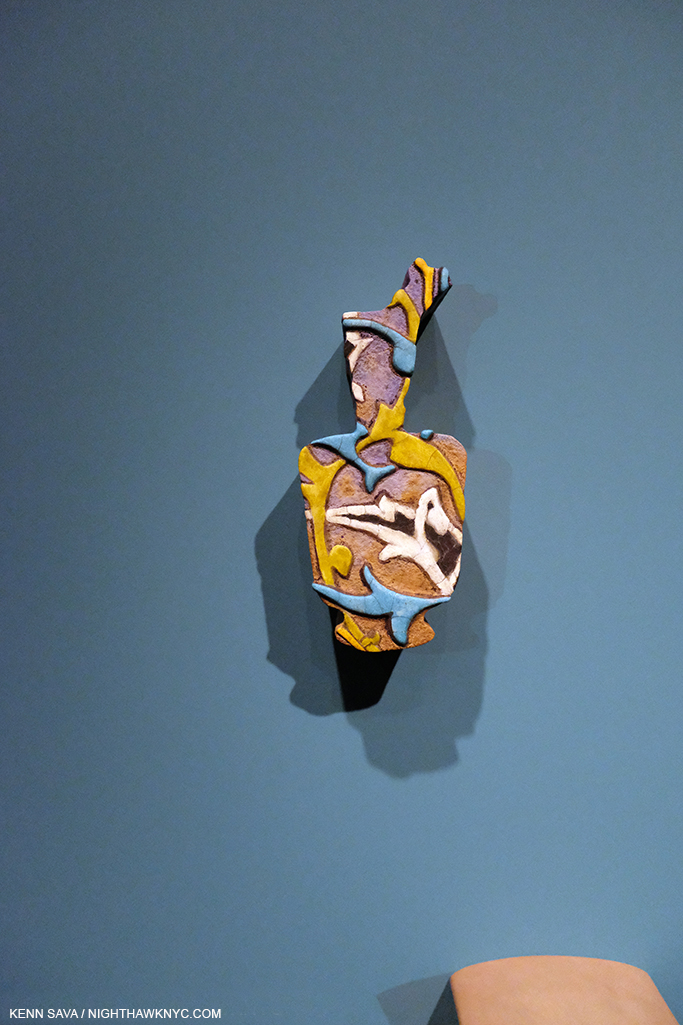
The very last work I saw at The Met Breuer is this piece from a series by Walid Raad, from 2014-5 in Home Is A Foreign Place. The wall card spoke about the Artist’s interest in the shadows these objects cast and how they enhance and expand the form. A bit like the shadow a museum visit casts…

And then, there were the shows I missed, like Vija Clemins. Phew…ALL of this in exactly 4 years! I think that’s a track record that can hang with what any of NYC’s other big museums- including The Met, 1000 Fifth Avenue.

Yes, there were a lot of very good, even great, shows at The Met Breuer during its four year run. You probably have your own list of favorites. Regardless of which show we’re talking about, the Breuer Building gave all of its shows the added dimension of space- often a whole floor, even two. There’s a lot to be said for that, and it will be very difficult to mount such shows at 1000 Fifth Avenue2. I’ll miss the place as The Met Breuer. I already cherish the days I got to spend there.

This is the Second part of my look back at The Met Breuer. Part 1 is here. Some thoughts on the “bigger picture” are coming.  

*- Soundtrack for this post is “Hail & Farewell” by Big Country. “Hail and farewell, Life begins again…”

You can now follow @nighthawk_nyc on Instagram.

NighthawkNYC.com has been entirely self-funded and ad-free for over 7 years, during which over 250 full length pieces have been published. If you’ve found it worthwhile, you can donate to keep it going & ad-free below. Thank you!

Written & photographed by Kenn Sava for nighthawknyc.com unless otherwise credited.
To send comments, thoughts, feedback or propositions click here.
Click the white box on the upper right for the archives or to search them.
For “short takes” and additional pictures, follow @nighthawk_nyc on Instagram.

Subscribe to be notified of new Posts below. Your information will be used for no other purpose.


  1. By my count. Subtract 10 days if you want to count from its official opening on March 18th.
  2. The huge China: Through the Looking Glass Fashion show in 2015 was mounted in different parts of The Met, which probably remains the only way to do it.

A Look Back At The Met Breuer

Written & Photographed by Kenn Sava

First part of a series. 

I was there when it opened (to Members) March 8, 2016, and now I find I was there when it closed on March 12, 2020.

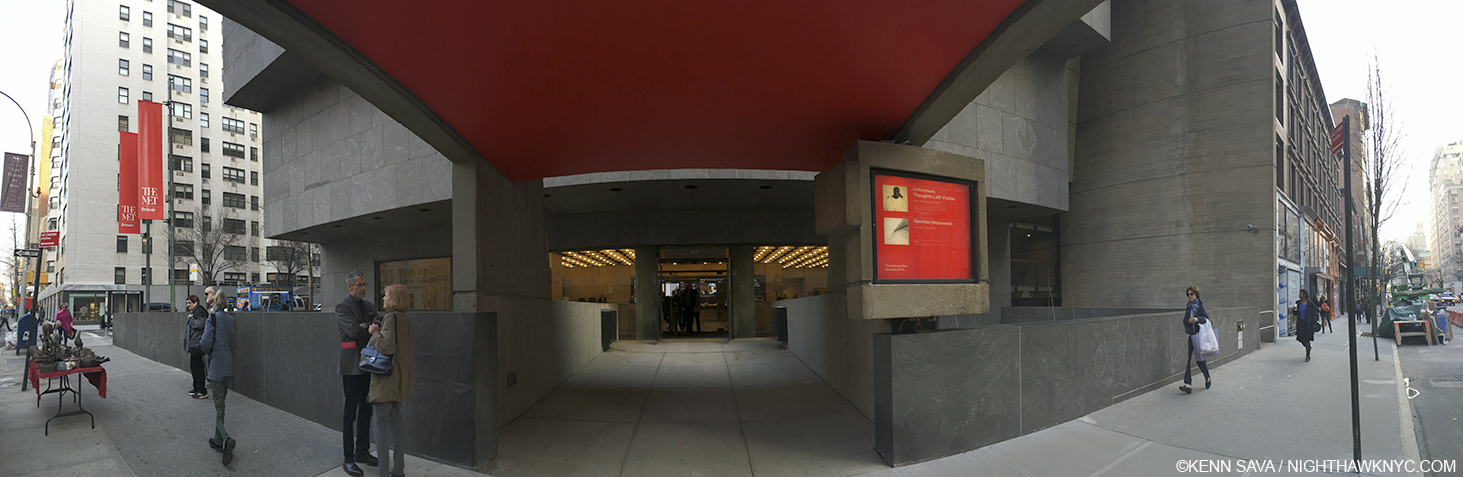
First look. Approaching The Met Breuer for Member’s Preview, March 8, 2016.

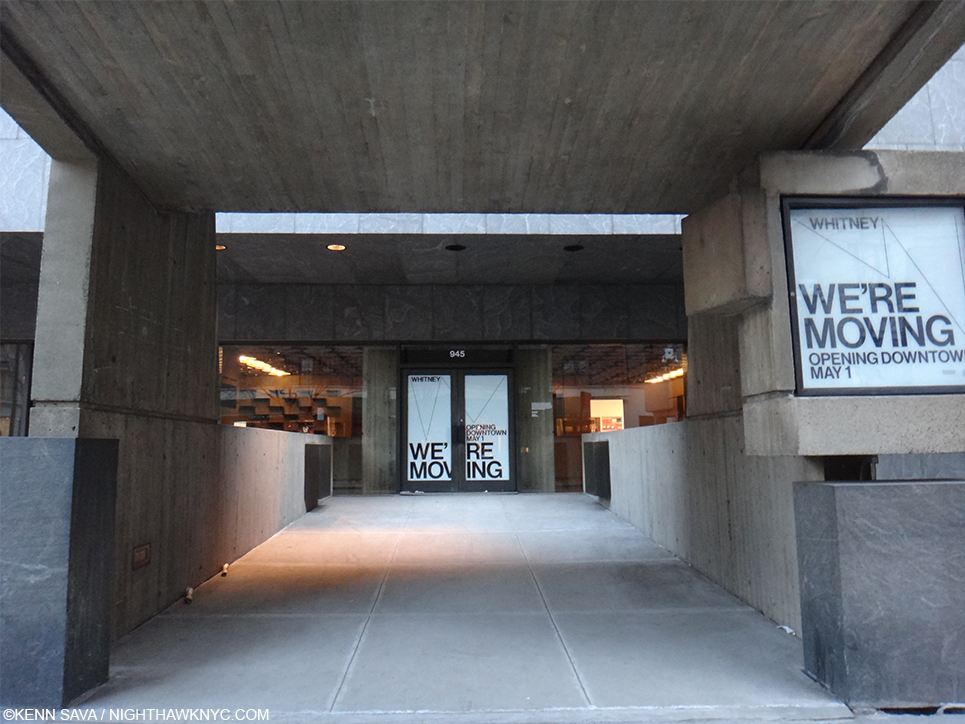
With the calendar turning to July, what had been a “temporary” closing due to the pandemic has become permanent with the turning over of The Met’s lease on the building Marcel Breuer designed at 945 Madison Avenue at East 75th Street to The Frick Collection. Originally commissioned by The Whitney Museum, who occupied it for almost 50 years after it opened in September, 1966, The Met (TM, henceforth) rechristened it “The Met Breuer,” (I promptly christened it TMB). The Frick Collection will now move in.

There was no press release or official announcement when The Met’s (TM) turned the Breuer building over to The Frick Collection, effective July. There was a mention on TM’s Instagram page, and now only this on the Visitors page on TM’s website.

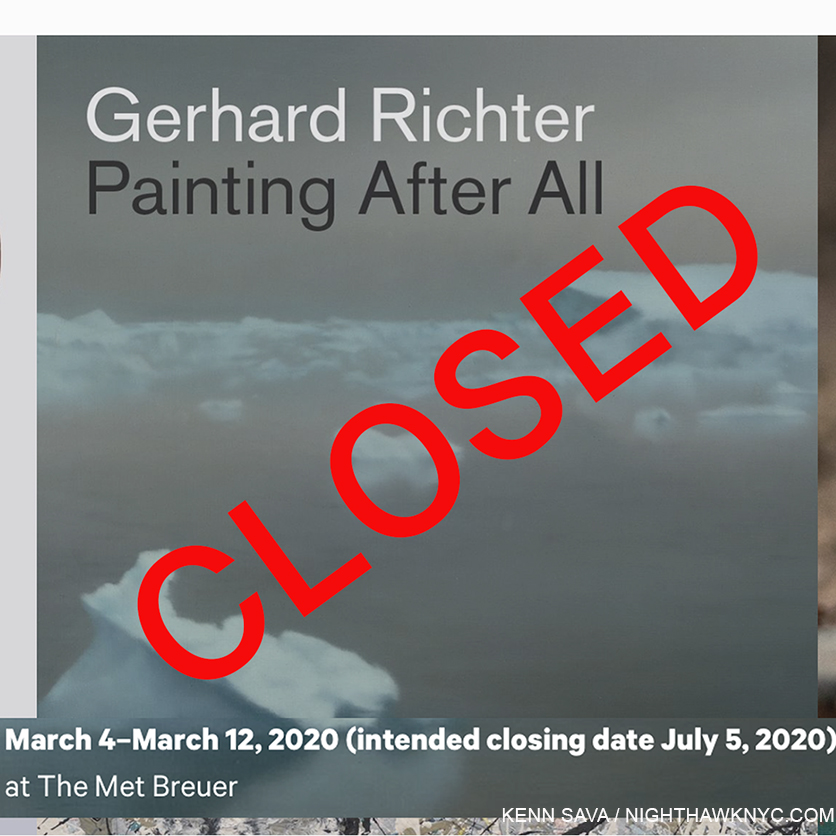
In mid-July, the status of Gerhard Richter: Painting After All, which was had been open for just 9 days, and which I saw March 12th, its last day, was clarified when its listing along with those of the two other shows that were open at the time of the “temporary” closing, were moved to the “Past Exhibitions” section of The Met’s website.

After checking every day since March, the show appeared on the “Past Exhibitions” page on July 17th. I’ve enlarged the date section for legibility and added the red text to their listing.

So, with the status of its final chapters finally clarified, the book is now closed on The Met Breuer. It’s time to begin to assess it and its legacy. In Part 1 of my look back, I’ll look at the beginning and the end of TMB. Part 2 will look at some of the highlights of the intervening four years. Part 3 will include some thoughts on the “bigger picture” and what it may “mean.”

Back to the future. March 7, 2015

After trying to get approval for a remodeling of the Breuer Building failed1, the Whitney then decided to build a new building downtown in the Meatpacking District, and so moved out of the Breuer Building in October, 2014. It’s seen here empty in March, 2015, almost exactly a year before The Met Breuer would open here.

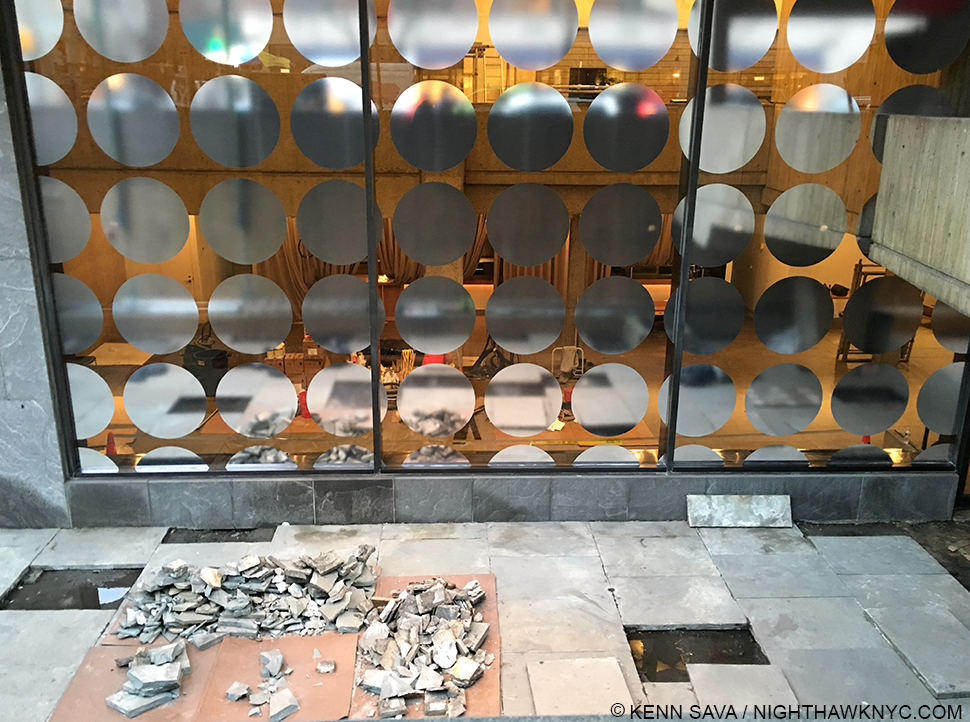
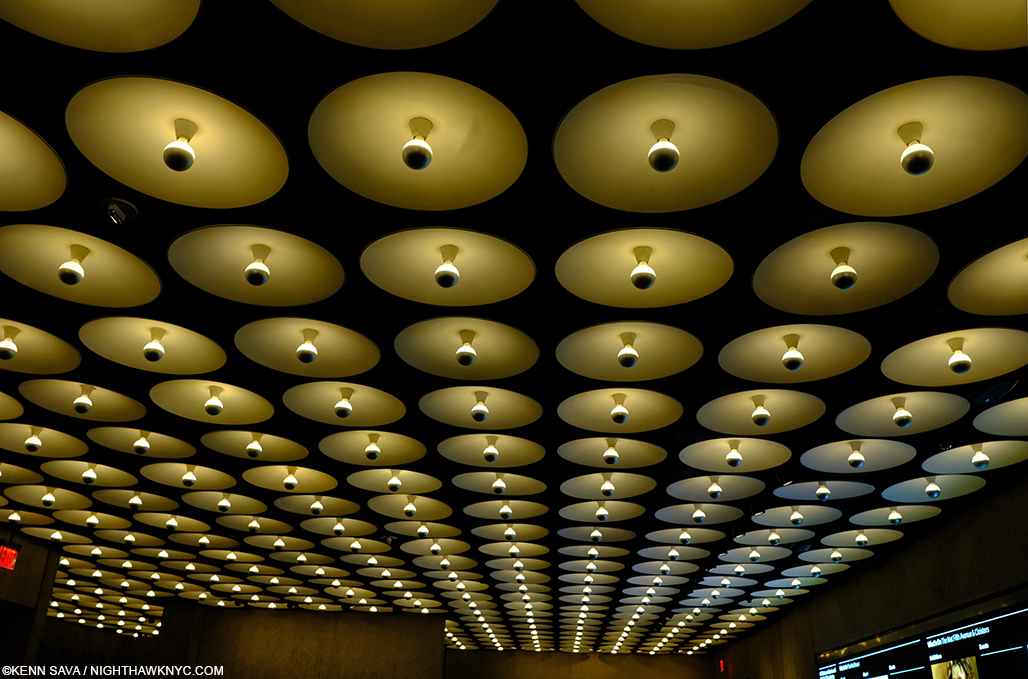
The Met announced it would take over the Breuer Building as it’s “outpost” for Modern & Contemporary Art in 2011. Seen here on December 18, 2015. I was told that the silver circles on the windows were meant to echo the ceiling lighting of the lobby inside shown further below.

Looking down at the lower level, December 18, 2015. See the next picture.

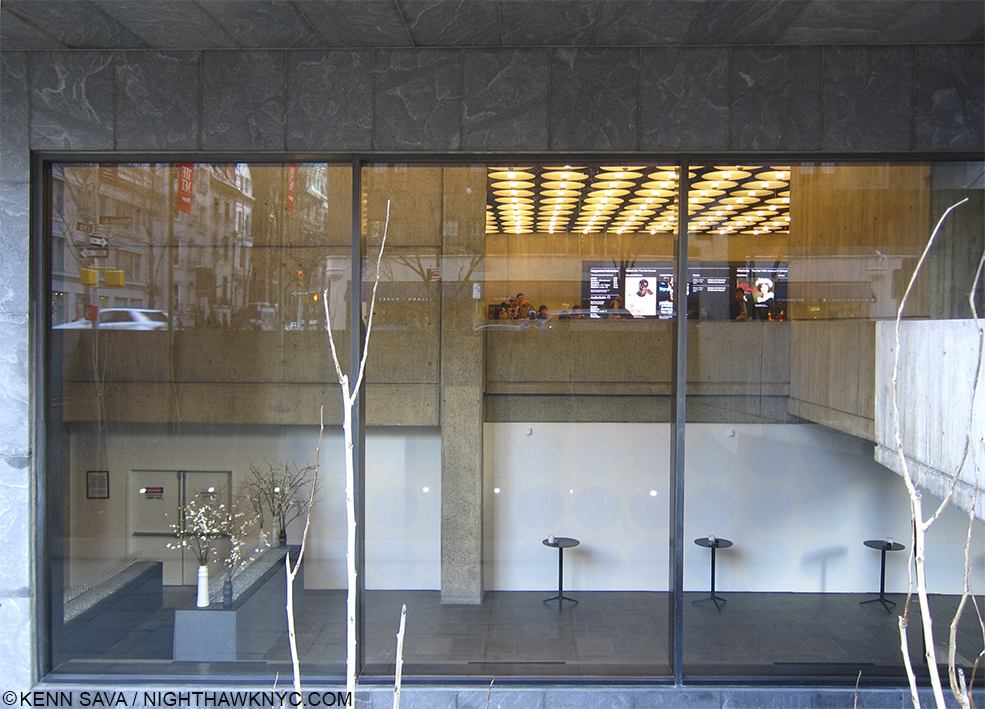
The same window. March 8, 2016, Member’s Preview Opening Day. The white wall on the lower level is in front of a bar that had not been completed. The circular ceiling lights are partially seen upstairs.

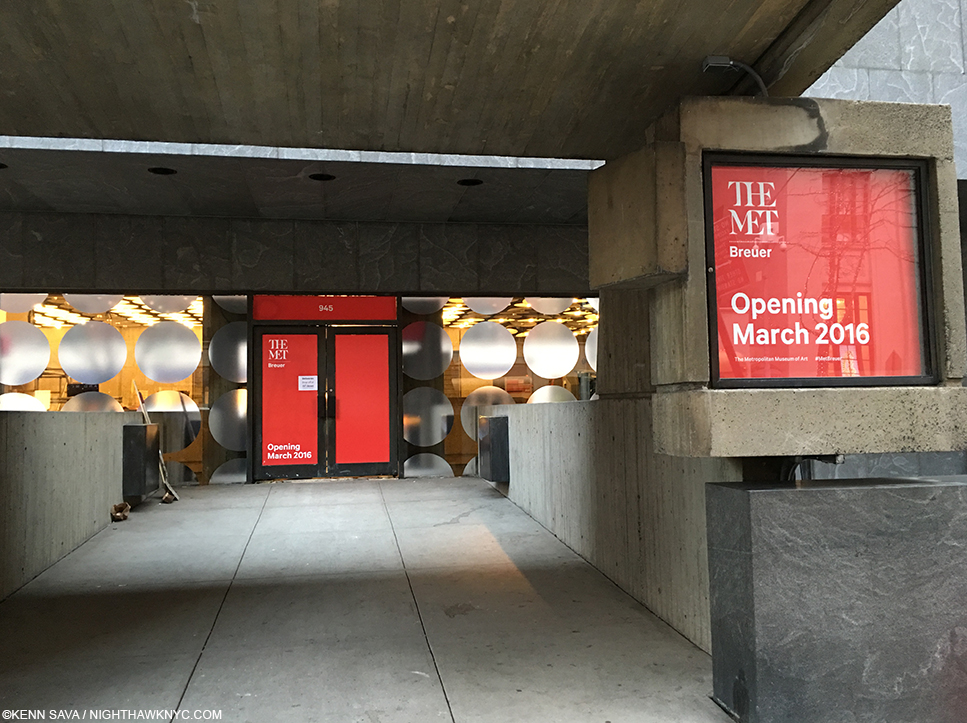
Member’s Preview, March 8, 2016. Close-up of the sign to the right follows.

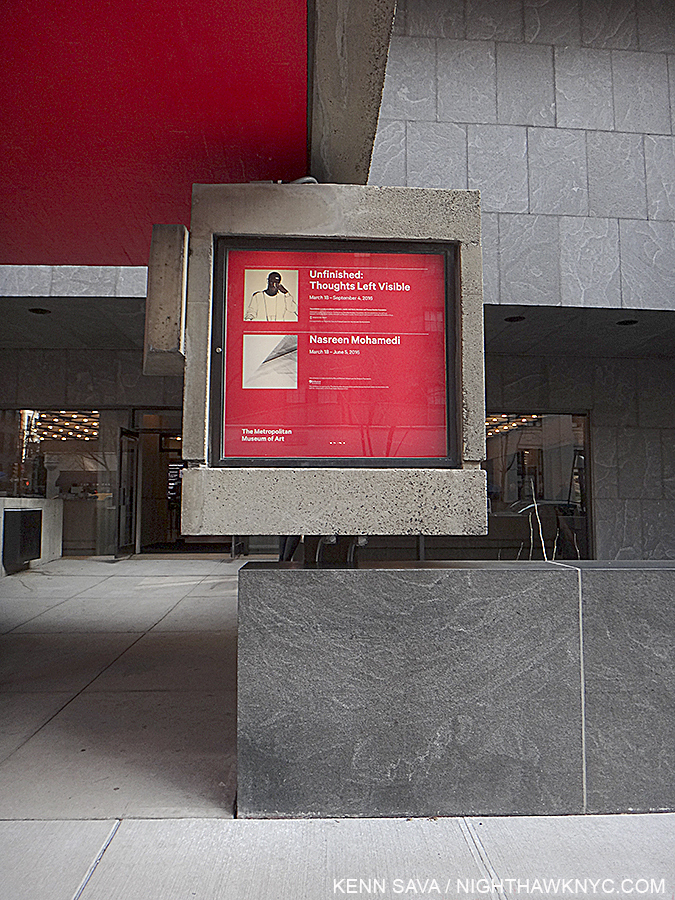
On the sign are the two inaugural shows that are both now legendary in my book- Nasreen Mohamedi and Unfinished: Thoughts Left Visible both unseen when I took this shot before going in.

The original Marcel Breuer lobby lighting seen in October, 2018.

The building remained largely unchanged by The Met, except for extensive renovations to the lower level, where they installed the Flora Bar and Cafe. Over the years, I’ve warmed up a bit to the design of this building, which is generally described in unattractive terms, including “brutalist.” I’ve always wondered how Marcel Breuer felt about this term being applied to his work. I characterize the building as “overly cold.” To me, now, it feels like it’s keeping a secret close to its vest, one that even an exploration of all its floors does not reveal. There are some details of the design I’m quite fond of- the windows, particularly the large front facing window, and the lobby ceiling lighting. Both of which strike me as “warm” touches in the midst of the unrelenting cold stone inside and out. Even the seating is stone.

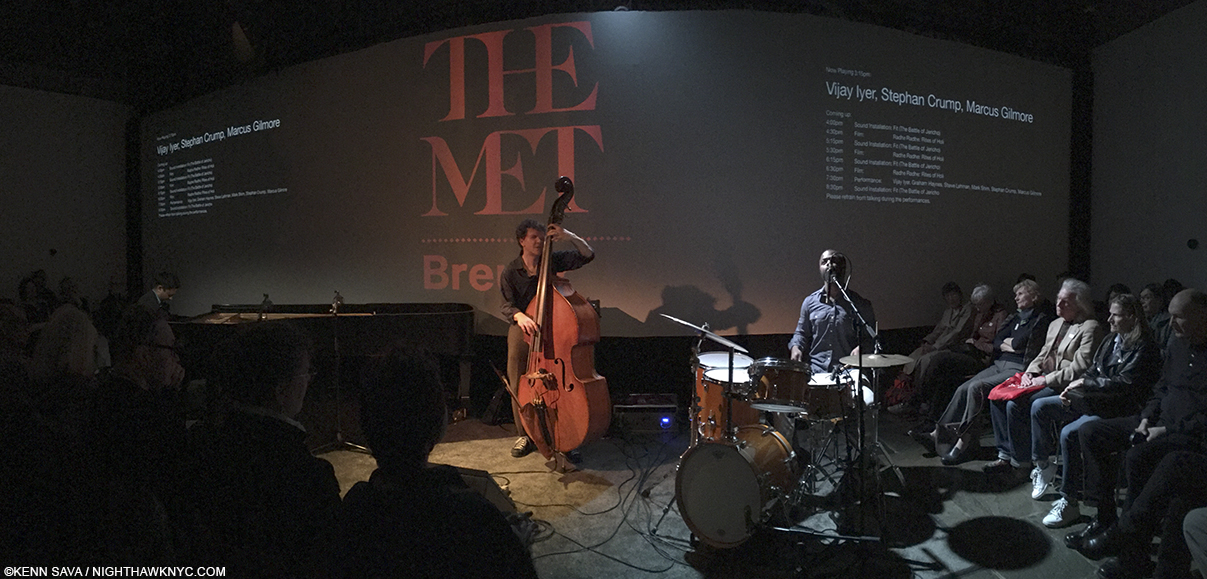
“Wake Up over there on the right!” It’s MacArthur “genius” grant recipient, Vijay Iyer, in the shadows, left, on piano, performing with his Trio for Members during their preview in the first floor Gallery, March 8, 2016.

Being in this space, listening to Vijay Iyer’s Trio, reminded me that my very first exposure to the work of the great Joseph Cornell was the Joseph Cornell: Cosmic Travels show, 1995-96 I saw in this space when it was the Whitney2. I’ve been a big fan ever since.

A rare shot of Tatsuo Miyajima’s Arrow of Time, on view in TMB’s first floor gallery seen in 2016. The only show to take place there before it became the gift shop.

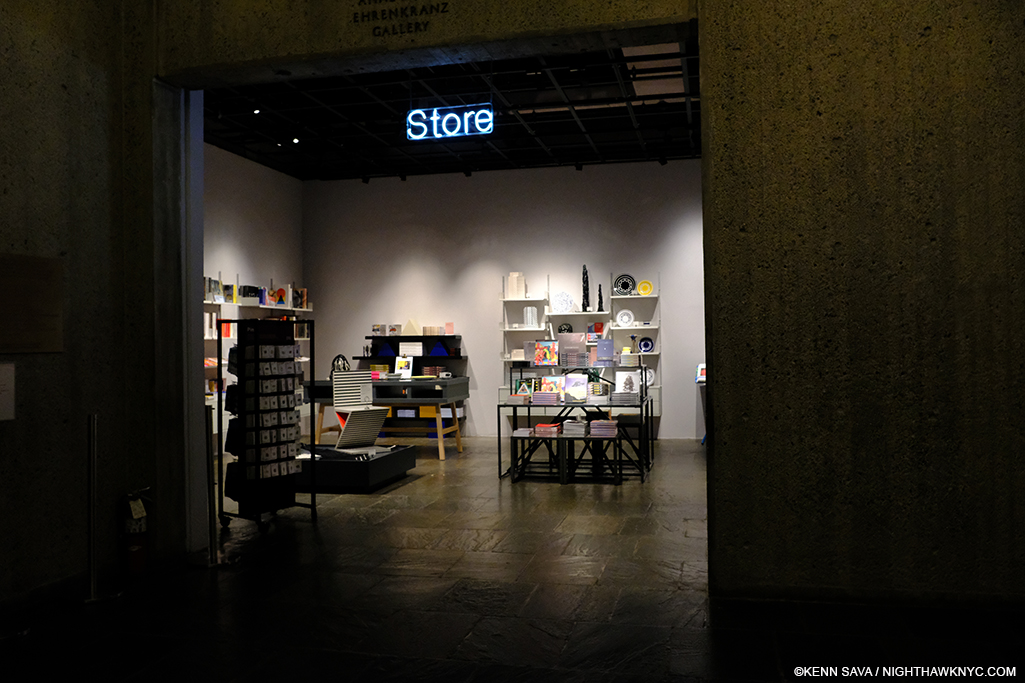
The same space seen in October, 2018, soon after it became the Store, as it would remain.

After various attempts at showing Art in this space, it became the gift shop.

Nasreen Mohamedi, lobby installation view.

The first two shows got TMB off to an “auspicious” start, as I called my piece on Unfinished: Thoughts Left Visible. I had no idea the impact Nasreen Mohamedi would have on me, creating an open and closed case for her place among the great Artists of the 20th century. I returned to see it thirteen times, and I still walk around it in my mind.

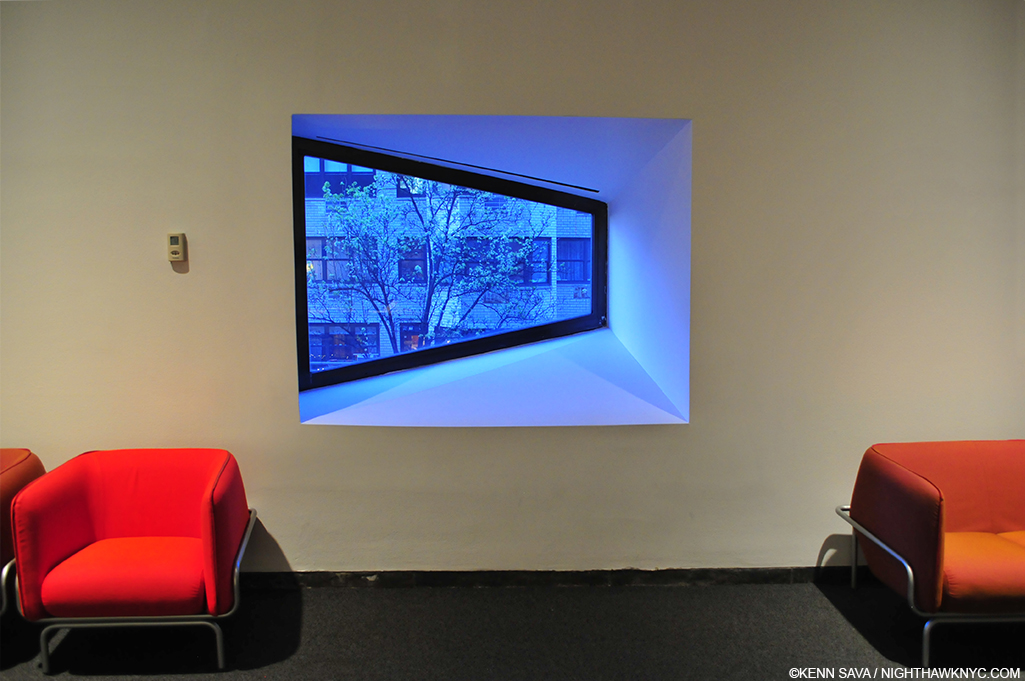
Chairs in the final room of Nasreen Mohamedi with one of Marcel Breuer’s unique windows.

Unfinished: Thoughts Left Visible, installation view that first day.

Scenes from The Last Day of The Met Breuer…

Back for what turned out to be the last time, March 12, 2020.

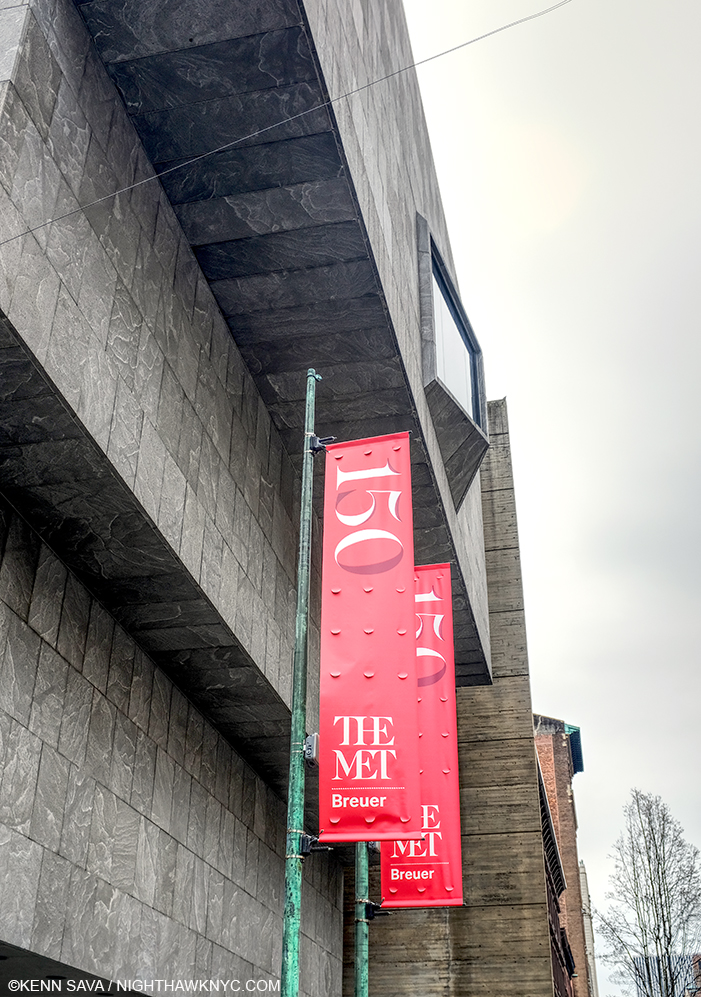
The Met 150th Anniversary banners flying on the corner on what would turn out to be the last day of The Met Breuer strike me as being quite ironic. Unfortunately, they have not had much to celebrate this year. The Met Breuer was closed on the 150th Anniversary of The Met’s founding, April 13th, and then permanently when the calendar turned to July. Losing a branch is a memorable event, but (considerable financial savings aside) not something to celebrate. What it was, is, in my view.

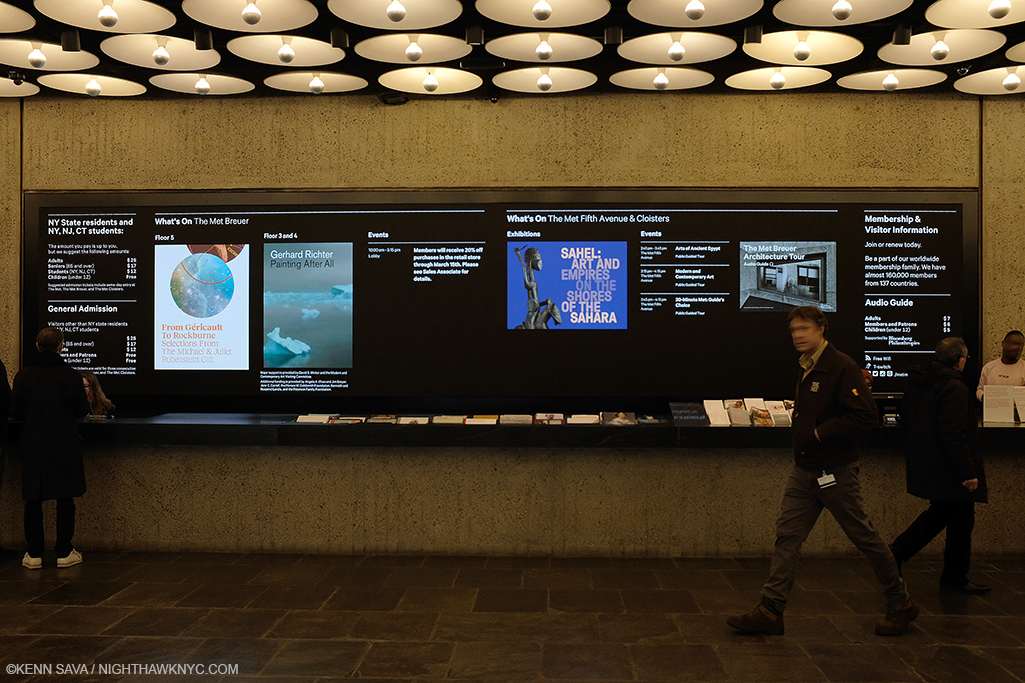
Last call. The sign on the final day lists three very good shows, the other two open for a bit longer than the scant 9 days Gerhard Richter: Painting After All was.

Three very good shows were up that final day, including Gerhard Richter: Painting After All, which will be remembered among all the Artist’s many shows, I believe. I saw all three that day. My look at the Gerhard Richter show that final day is here. At the time, NYC had little idea about the virus that would soon devastate us, how it was spread and what precautions to take. I wasn’t wearing a mask, March 12th. I didn’t have one. A number of the guards were. I didn’t realize then how big a risk I was taking going to The Met Breuer that day, or seeing the other shows I ran around to see just before the March 13 shutdown.

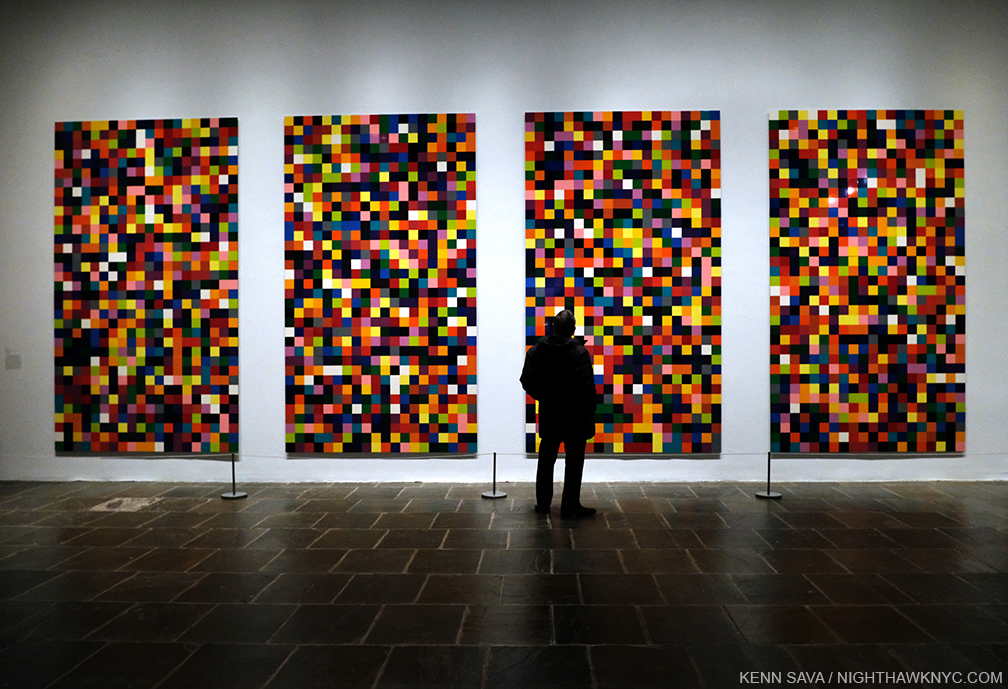
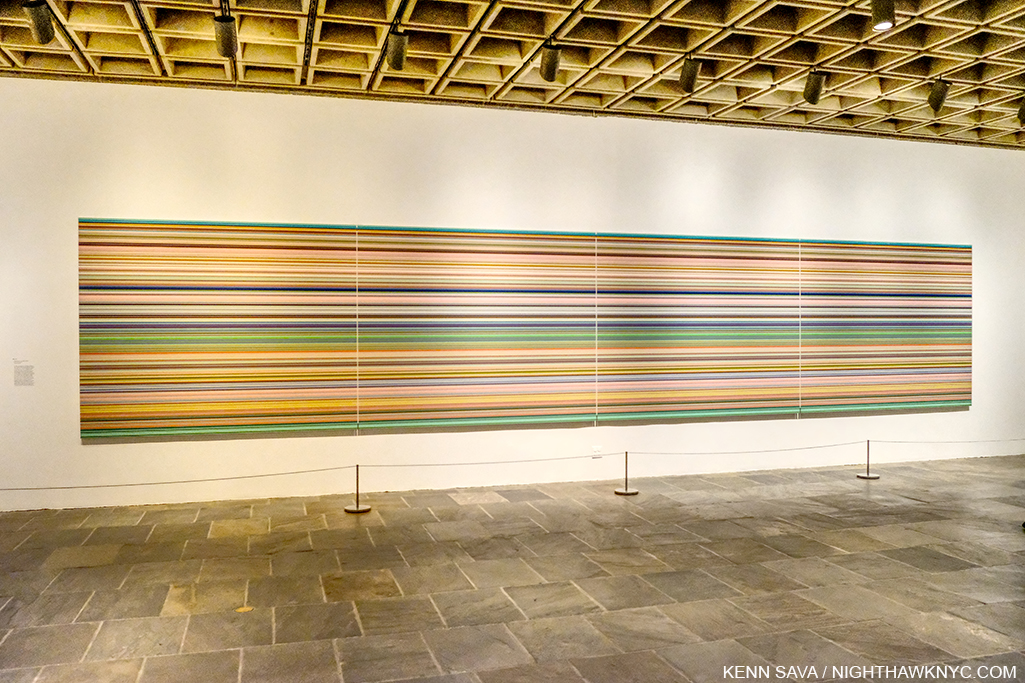
Gerhard Richter, 4,900 Colors, 2007, Enamel paint on aluminum.

A number of pieces I saw that day also spoke to the conditions looming in the City, and the world. Looking at Mr. Richter’s 4,900 Colors it was hard not to feel that the future was fuzzy and out of focus. It still is.

A final look at the lobby counter before leaving for the last time.

I stood outside for a few minutes as the clock approached the 6pm closing, just taking in the scene. When would TMB reopen? There were no thoughts, then, that it wouldn’t, though of course I had TM’s announcement of the summer hand off to The Frick in the distant back of my mind. Summer was a long way off in late winter. As I was leaving, I overheard two staff members say to each other “See you June 1st,” and I wondered if they knew something I didn’t. June 1st? Wow. They’ll be closed for TWO AND A HALF MONTHS! It would turn out to be four and a half months, and never reopen. The Met announced in early July “tentative plans” to reopen at 1000 Fifth Avenue on August 29th. By then, it will be five and a half months.

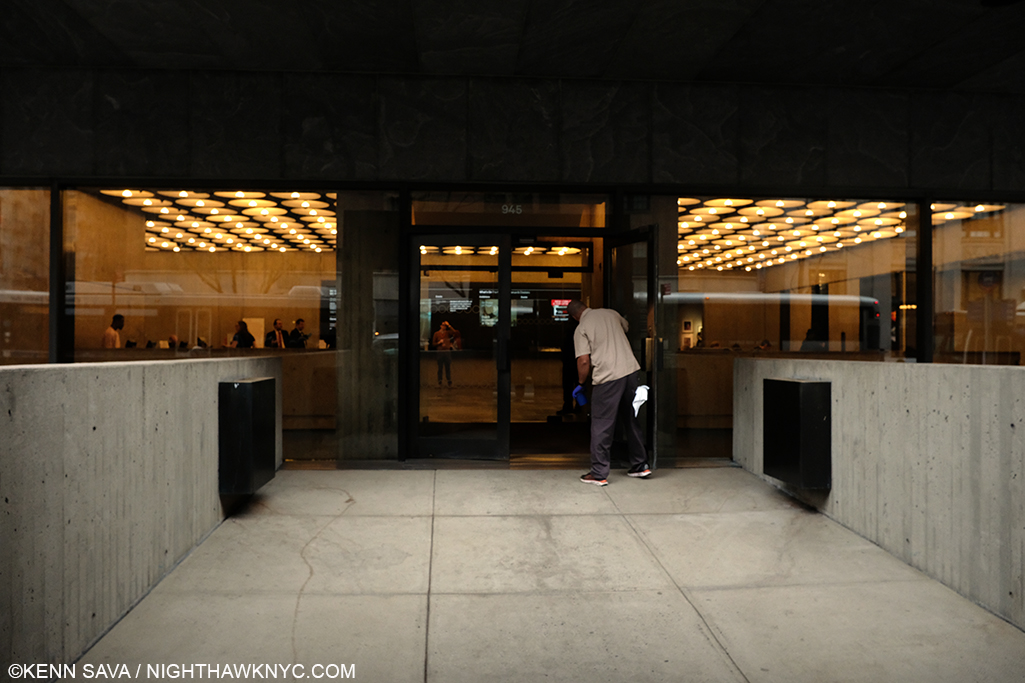
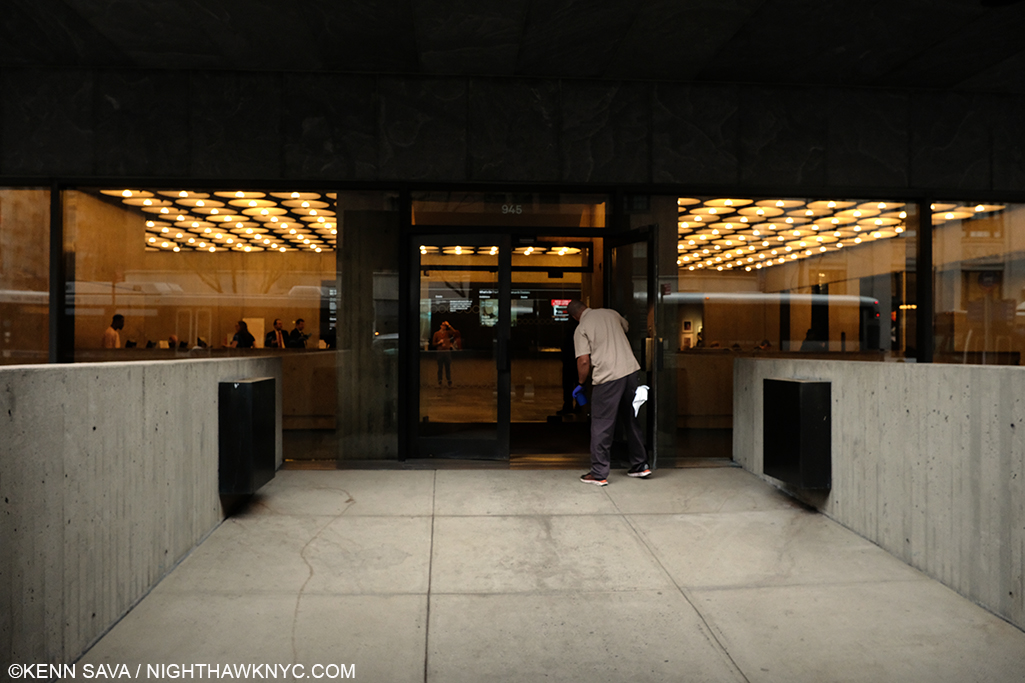
Last look. It’s 5:50pm, March 12, 2020, as I’m leaving. The Met Breuer is “temporarily closing” in 10 minutes, yet this intrepid staff member is busy cleaning the front doors. It would never reopen to the public, and so this remains my last memory of it.

I’m left with the feeling that when The Met Breuer’s doors closed March 12th, something else may have closed with them. I’ll address that in Part 3. Next, I’ll look at what I saw between March 8, 2016 and March 12, 2020.

*- Soundtrack for this post is “Soundwalk 9:09” by John Luther Adams, commissioned by The Met for The Met Breuer’s opening, that takes its title from the amount of time it takes to walk from 1000 Fifth Avenue to The Met Breuer, in two parts. “Uptown” for listening while walking from TMB uptown to TM, and “Downtown” for the reverse. Both pieces may be heard here.

NighthawkNYC.com has been entirely self-funded and ad-free for over 6 years, during which over 250 full length pieces have been published. If you’ve found it worthwhile, you can donate to keep it going & ad-free below. Thank you!

Written & photographed by Kenn Sava for nighthawknyc.com unless otherwise credited.
To send comments, thoughts, feedback or propositions click here.
Click the white box on the upper right for the archives or to search them.
For “short takes” and additional pictures, follow @nighthawk_nyc on Instagram.

Subscribe to be notified of new Posts below. Your information will be used for no other purpose.


  1. I was active in trying to get it, and the proposed Guggenheim Museum expansion at the time, stopped, with mixed results, as I recounted here.
  2. For some reason the Whitney doesn’t list this show on their site. Though I don’t have pictures of it, I know it was there- I still have the exhibition brochure, and so do these folks.

Gerhard Richter’s Met Blockbuster: Open For Just 9 Days!

Written & Photographed by Kenn Sava

UPDATE- July 16, 2020- The Met now lists Gerhard Richter: Painting After All on its “Past Exhibitions” page1, meaning it will NOT reopen!

After checking every day, the show appeared on the “Past Exhibitions” page on July 17th. I’ve enlarged the date section for legibility and added the red text…My original look at the show follows-

What if they mounted a blockbuster and nobody got to see it? 

Ahhhh….A major show covering TWO whole museum floors with about 100 Paintings? My idea of heaven…

As I write this in early June, 2020 what is known is that Gerhard Richter: Painting After All will be remembered as the last major show to be mounted at The Met Breuer (TMB) before The Met’s lease on the Marcel Breuer’s Madison Ave at East 75th Street building ends in July and The Frick Collection moves in while the renovations of their 1 East 70th Street home take place. What’s still unknown is how long the show ran for. It opened on March 4th, then “temporarily closed” after I saw it on March 12th, due to the coronavirus shutdown. That’s all of NINE days! The Met’s site says “Closing Date To Be Announced” on its listing, but what are their options for reopening it? With The Met’s lease on the Breuer Building ending in July, reopening it there would seem to have to come in June, which we are half-way through. On May 19th, Met CEO Daniel Weiss said that The Met “hoped” to reopen on August 15th, “or a few weeks later.” His announcement made no mention of TMB, but that timeframe would seem to rule out a TMB reopening. Moving it to 1000 Fifth Avenue might seem to be an option, terms of loans and space requirements for shows previously planned permitting. That might also put any number of employees at risk of the virus, though. Then, there’s this-

The X Factor. The show’s listing in the coming attractions section of MOCA’s site with a start date of August 15th.

This show was scheduled to open at MOCA, LA, on August 15th. So, there remains a chance Gerhard Richter: Painting After All (GR:PAA, henceforthwon’t reopen in NYC. IF that does come to pass, its 9 day run will be the shortest for a major show at a major museum here in my memory. That would be a shame considering the last major Gerhard Richter show in NYC was 20 years ago, a chance missed to assess how his older work looks now and see his more recent work. I started looking closely at Mr. Richter shortly after that NYC show, so in the past 20 years I’ve seen his gallery shows (of mostly new and recent work), but I’ve never seen 100 of his Paintings in one place. Being that Mr. Richter is 88, this may be the last major show of his work during his lifetime. The Artist did not attend the opening, though members of his family did, I was told by Met staffers.

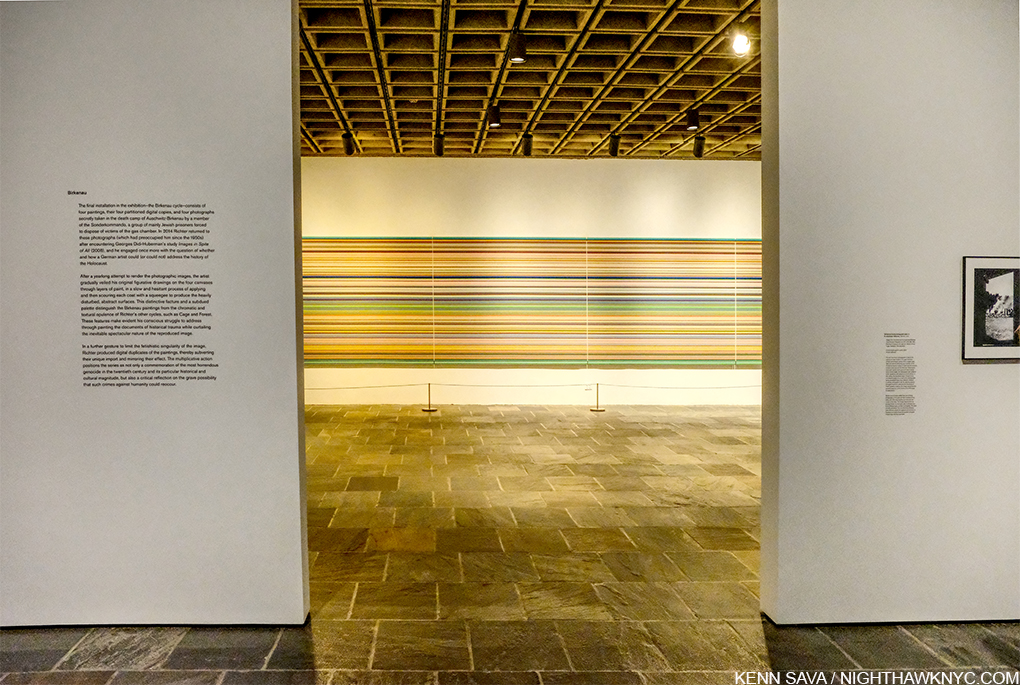
Installation view, showing part of Strip, 2013, in the final gallery, seen on March 12th- hours before the show “temporarily closed.”

SPOILER ALERT! Since The Met’s site still says “Closing Date to be Announced” for this show, my hunch is that they will find a way to reopen it, especially because The Met originated GR:PAA (which is co-curated by Met Modern & Contemporary Art Chairman Sheena Wagstaff), and so has a sizable investment in it. My bet is that they will get an extension on the Breuer lease and use that to give this show a proper run, and The Met Breuer the fitting end I think it deserves. So, if you don’t want a peek at it yet, you may want to wait before proceeding. This piece will still be here when it doesn’t reopen! In which case, you’ll have to go to L.A. to see it, and I will be among the very few to have seen it here.

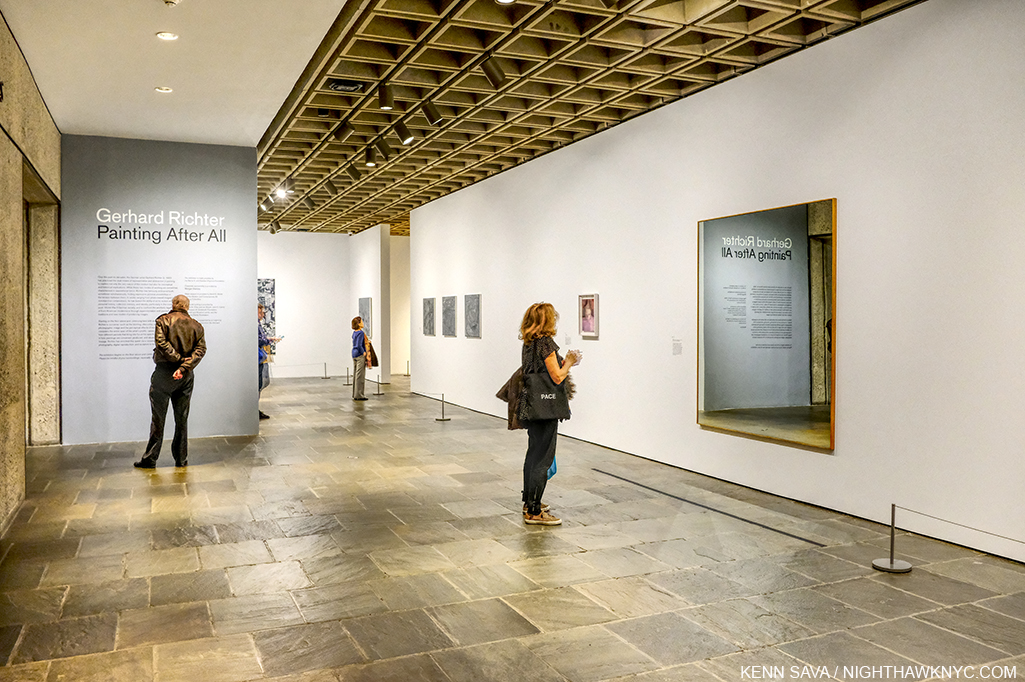
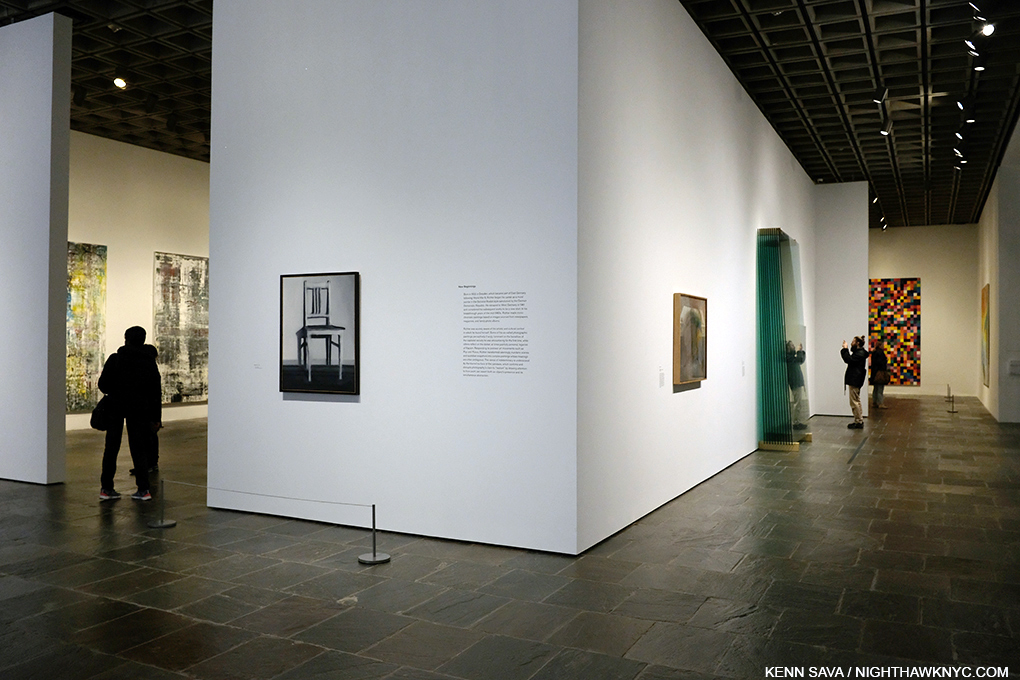
Installation view of the lobby on the 3rd floor, the concluding floor of the show. Surprisingly for a show called “Painting After All,”  works in glass greet the visitor on both floors. Mirror, 1986, shown here, right.

Installed on the 3rd and 4th floors of the Breuer, and beginning on 4, GR:PAA is not a retrospective and not a “greatest hits.” It lies somewhere between the two. It covers the whole of his career and juxtaposes many very familiar works, alongside some that are barely known to many here. I can’t help but wonder about the Artist’s involvement in GR:PAA, because the selection and arrangement of it has a bold feel to it. For a show that covers such a long period of time, it also has a bit of a sparseness, the work is not crowded together. Each piece has space to breathe. In the documentary Gerhard Richter: Painting, the Artist and his staff are shown using mockups of exhibition spaces and miniatures of each Painting as they work out and assess the placement of each. It’s hard for me to think that something similar didn’t take place with GR:PAA, though Ms. Wagstaff and her staff have repeatedly shown they are more than capable of mounting extraordinary shows without the Artist’s involvement, so in wondering, I mean to take nothing away from their achievement here, which is yet another Met Breuer show that will live on in memory and in discussion. Here, you have a major, living Artist. If you can get his involvement in your show, why wouldn’t you use it2? Whatever the case is, the selection and arrangement of the work take GR:PAA to another level.

“Art requires freedom…in dictatorships there is no art, not even bad art.” Gerhard Richter.

He would know. Gerhard Richter has lived in two countries where there was no freedom. He was born in Dresden in 1932, 11 months BEFORE Adolf Hitler became chancellor of Germany. His father was drafted into the Wehrmacht in 1938 and sent to the horror of the Eastern Front. The elder Richter didn’t return to Germany until 1946. Gerhard finished growing up in East Germany before managing a crafty defection to West Germany in 1961. He’s lived in Nazi Germany, Communist East Germany, West Germany and (the Federal Republic of) Germany in his lifetime.

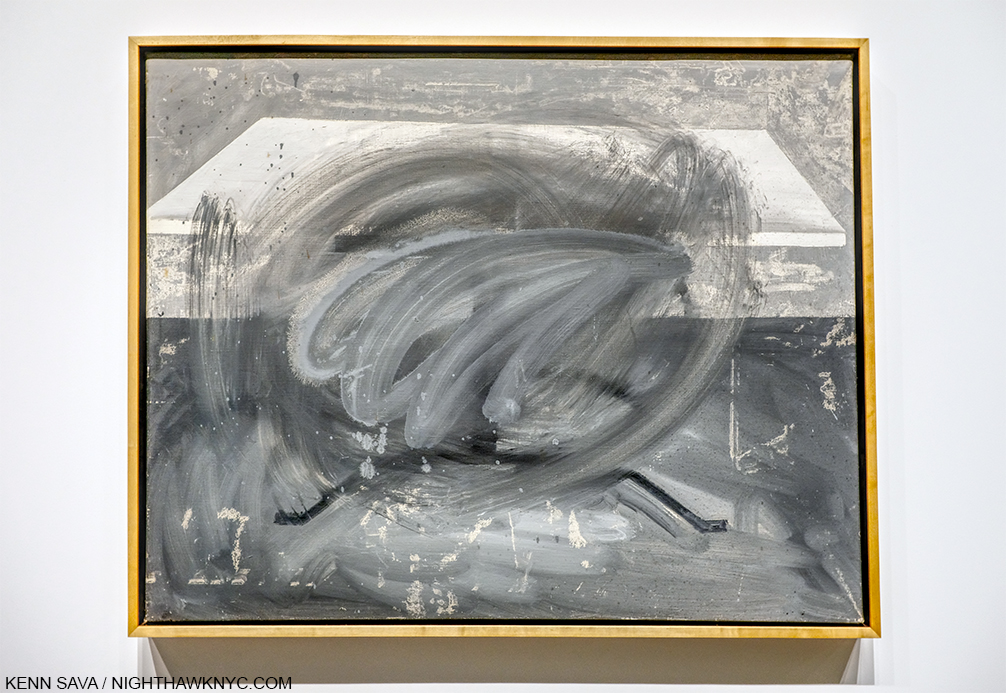
Table, item #1 in the Gerhard Richter Catalogue Raisonne, though not his first work. In the Catalogue, this is listed under “Household Icons” in the “Photo Paintings” section of his site, yet, with its abstract elements it seems to straddle the fence between the two categories of Paintings his work is broken down into there.

These experiences have continually informed his work3 be it in the people, places and things he’s encountered in them, or in things that went on while he was living there that he didn’t personally encounter (like the Holocaust) in a career that is closing in on 60 years. Officially, the first work listed in his Catalogue Raisonne (CR 1), Table, is dated 1962, 58 years ago. Among works that pre-date Table are a Mural he Painted in 1955, and the work Elbe, included in this show in a Print version, was created in 1957.

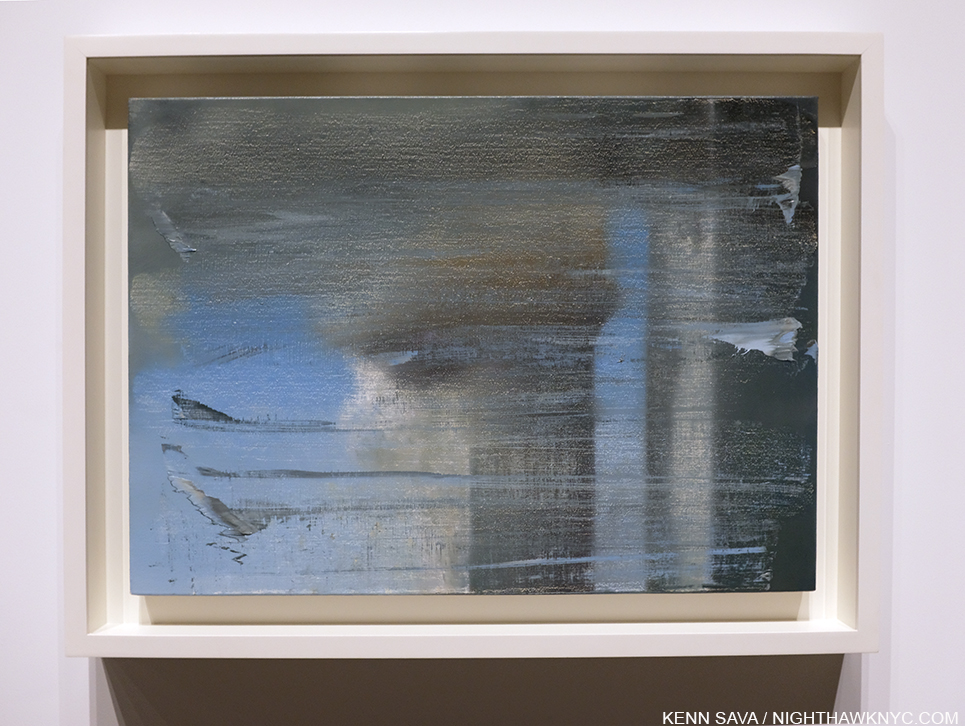
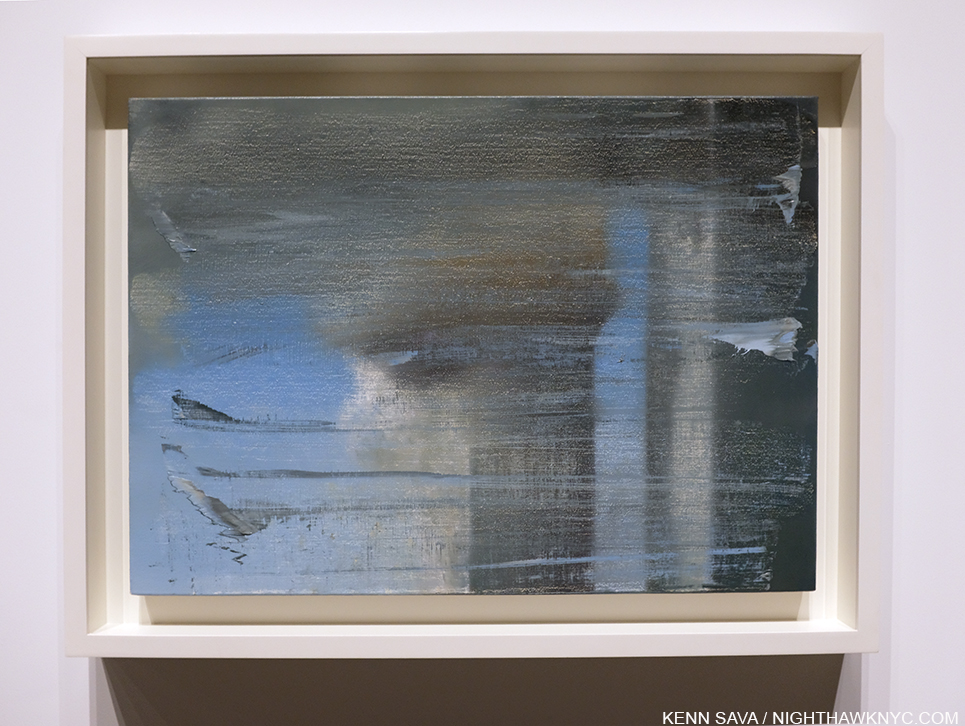
September, 2005, Oil on canvas, 20 1/2 x 28 3/8 inches. Painted four years after 9/11, it’s one of the more haunting works done relating to the tragedy I’ve seen, perhaps because it mimics the view I had of 9/11 from my window. Placed in the show’s first gallery, it greeted this viewer like a cold smack in the face. It’s also the only work that references NYC in the show. Mounted on the same wall with Table, it’s another work that abstracts reality, from 40+ years later, reinforcing the fact that Photographs have been one source of Mr. Richter’s Paintings for at least 5o years.

In the intervening years, Gerhard Richter’s work has been marked by a variety in output that has ranged from Prints, Drawings, Artist’s Books, Sculptures, Films and Paintings. On his website, his Paintings are broken down into two main groups- “Photo Paintings” (further broken down to 36 categories!), and “Abstracts” (in 8 groups by date and 6 other groups).

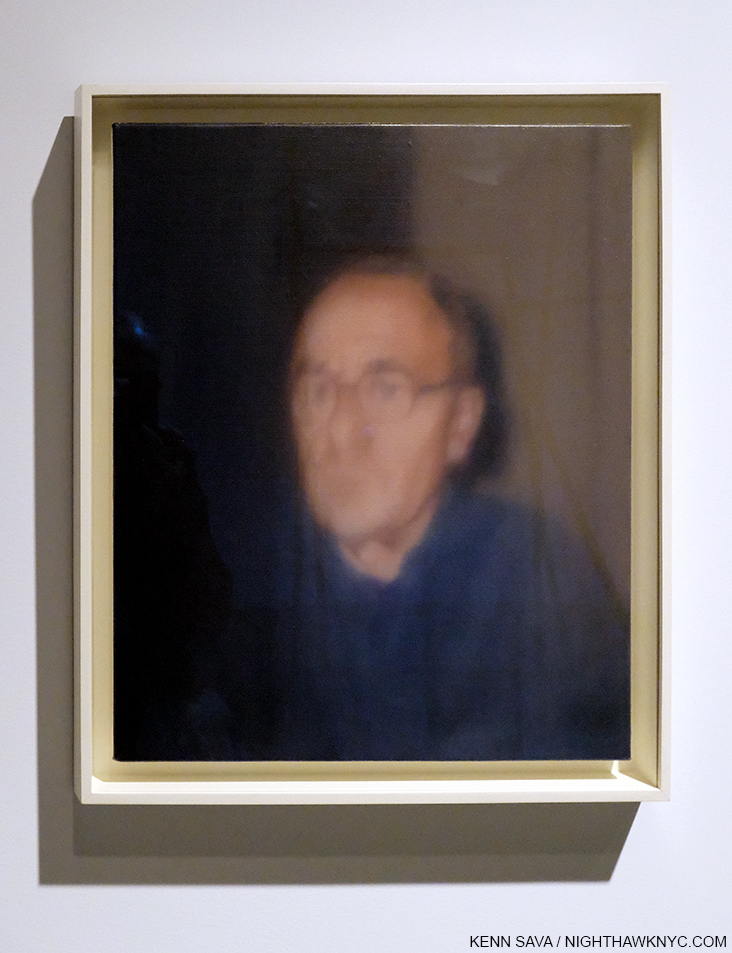
Self-Portrait, 1996, Oil on linen, 20 1/16 x 18 1/8 inches. It’s been a while since I’ve looked at Gerhard Richter’s work. Now, his Photo-Paintings, to use his term, like this one, look fresher to me than I had remembered and fresher than a number of his Abstracts.

“To talk about painting is not only difficult but perhaps pointless, too. You can only express in words what words are capable of expressing, what language can communicate.
Painting has nothing to do with that.” Gerhard Richter, 1966, quoted in the Documentary Gerhard Richter Painting.

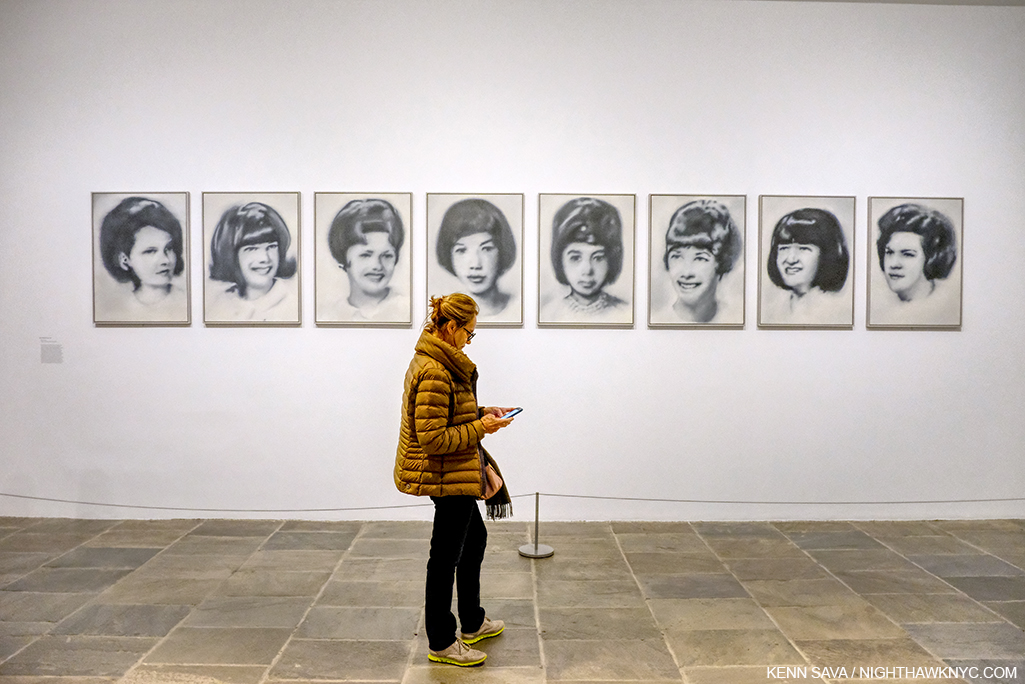
Eight Student Nurses, 1966, Oil on canvas, refers to the mass murder of 8 young women by Richard Speck in Chicago, 1966. These are from his Grays, which evoke the effect of black & white Photographs.

As I walked through Painting After All, I was struck by how fresh the Photo Paintings looked…

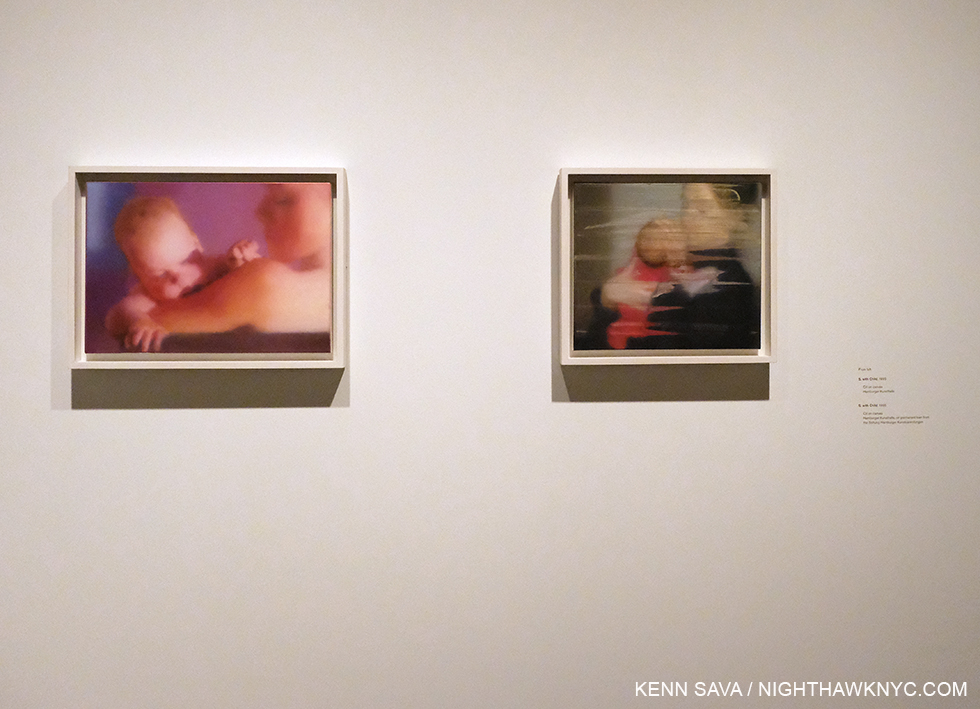
S. with Child, 1995, (both)

which I didn’t get from a number of the Abstracts.

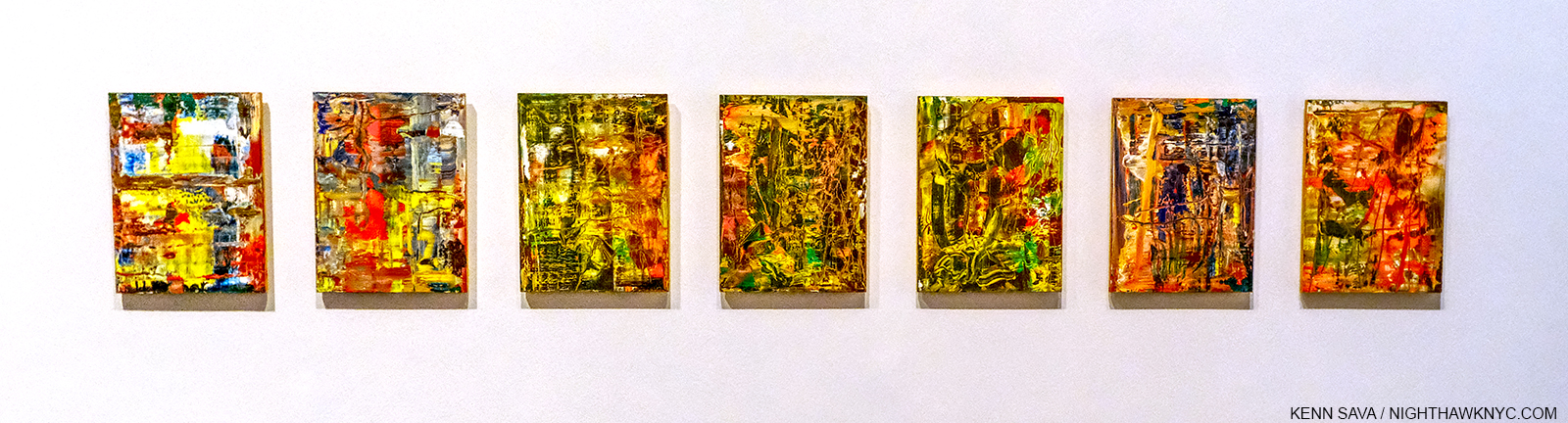
Seven Abstract Paintings, 2016, Oil on wood, each 15 3/4 x 11 13/16 inches. In these later abstractions, it looks like the Artist is using other techniques besides only the “squeegee” to modify the paint he had applied.

Part of the latter feeling may stem from the discovery that the late Jack Whitten had been extensively mining the squeegee technique Mr. Richter’s Abstracts are known for a full decade before he did. I’ve seen reference to Mr. Whitten using a squeegee in 19694, but he may have started before that5. The earliest Gerhard Richter squeegee work I seem to be able to find is from the mid 1980s.

Jack Whitten, Siberian Salt Grinder, 1974, Synthetic polymer paint on canvas, seen at MoMA in 2019.

Still, some of the Abstracts did stand out.

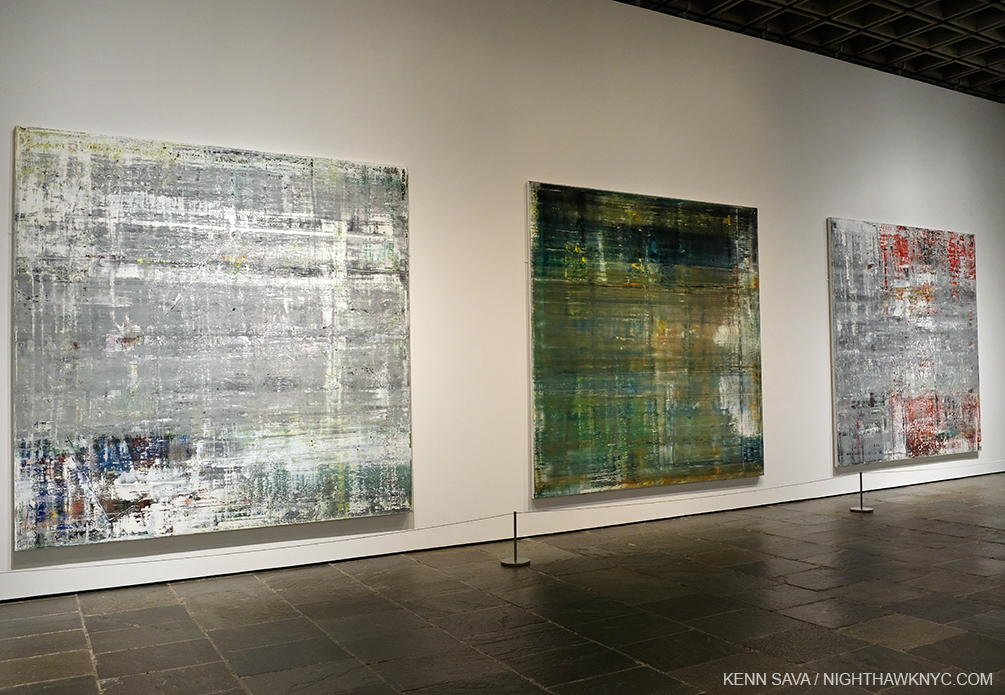
Three of the six Cage Paintings, 2006, each Oil on canvas, 9 1/2 feet square, which get their own room, the other three facing these.

The legendary Cage Paintings were much more stunning in person than in the book of the same name, especially in a group of all six of them, set off in a central gallery of their own on the 4th floor. Seeing them, and being able to be able to walk right up to them and see the details of their layers was one of the highlights of the show.

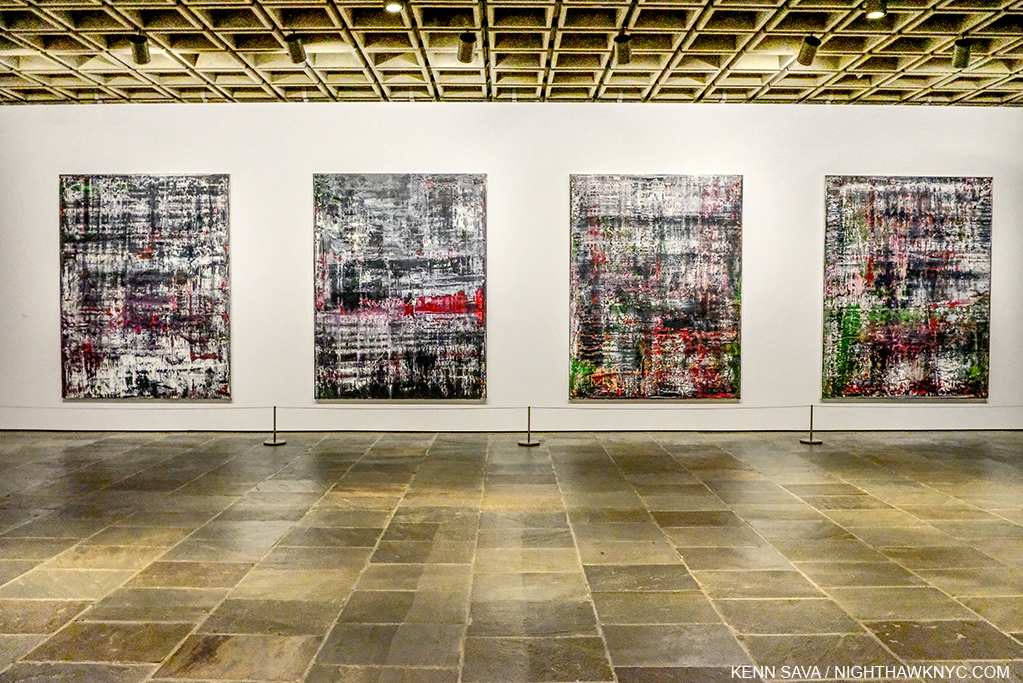
Four Birkenau Paintings, 2014, Oil on canvas, each 8′ 6 3/8 x 78 3/4 inches faced four Prints made from them in the next to last room of the show.

The other highlight, among the Abstracts, and of the whole exhibition, was the chance to see his recent Birkenau series of Paintings and the Prints he made after them. Installed in the show’s penultimate room along with the only four existing Photographs taken by Sondernkommandos surreptitiously in the titular Nazi Birkenau death camp, Gerhard Richter had wanted for decades to do something regarding the Holocaust. He originally started by using the Photographs as the basis for his work, but soon started over from scratch, abstractly. The results are remarkable and unforgettable. They, literally, drip with pain, bloodshed and horror.

4,900 Colors, 2007, Enamel paint on aluminum.

And there were other “kinds” of abstractions, like 4,900 Colors…

Strip, 2013, Inkget print on fine art paper between acrylic and aluminum.

And Strip, 2013.

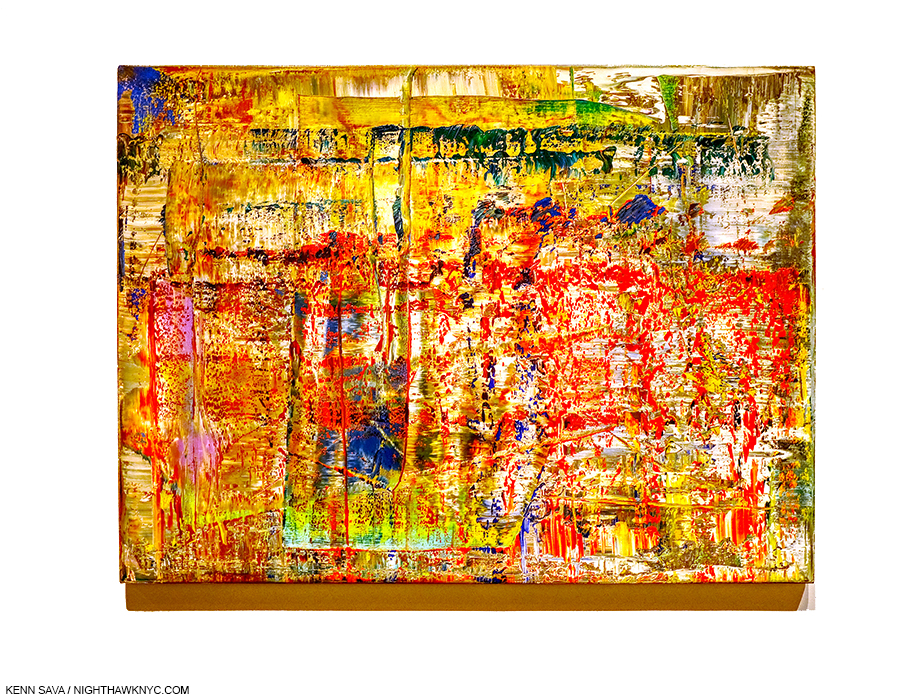
Strip began here. Abstract Painting, 1990, seen on the 4th floor, was digitally manipulated in Photoshop hundreds, maybe thousands of times until the thin bands of color we see in Strip are achieved. These would have to be magnified to see an actual image.

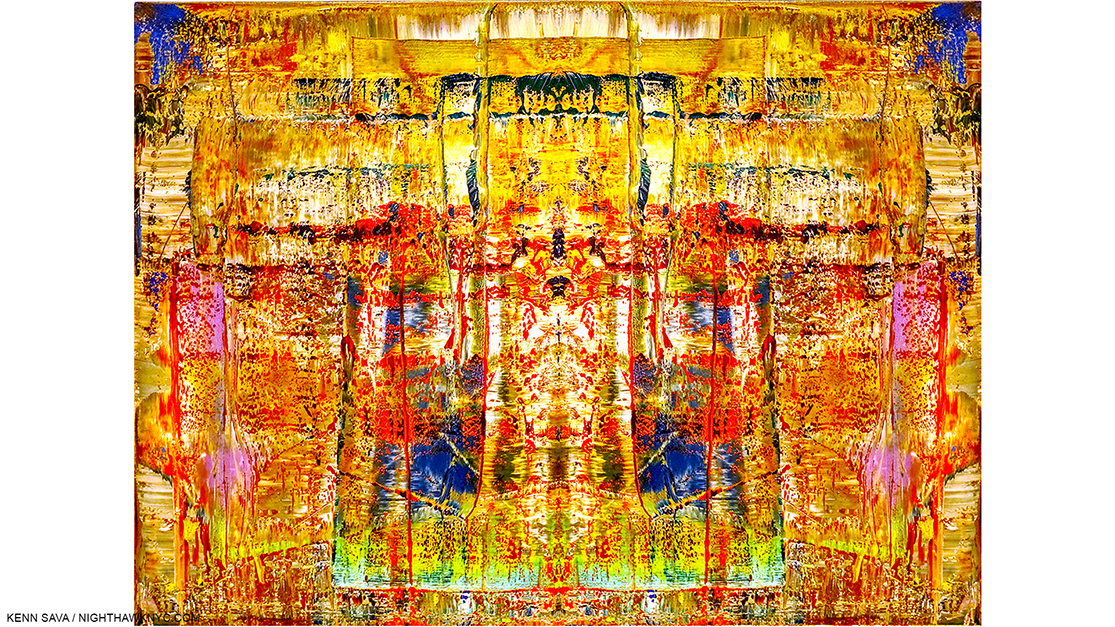
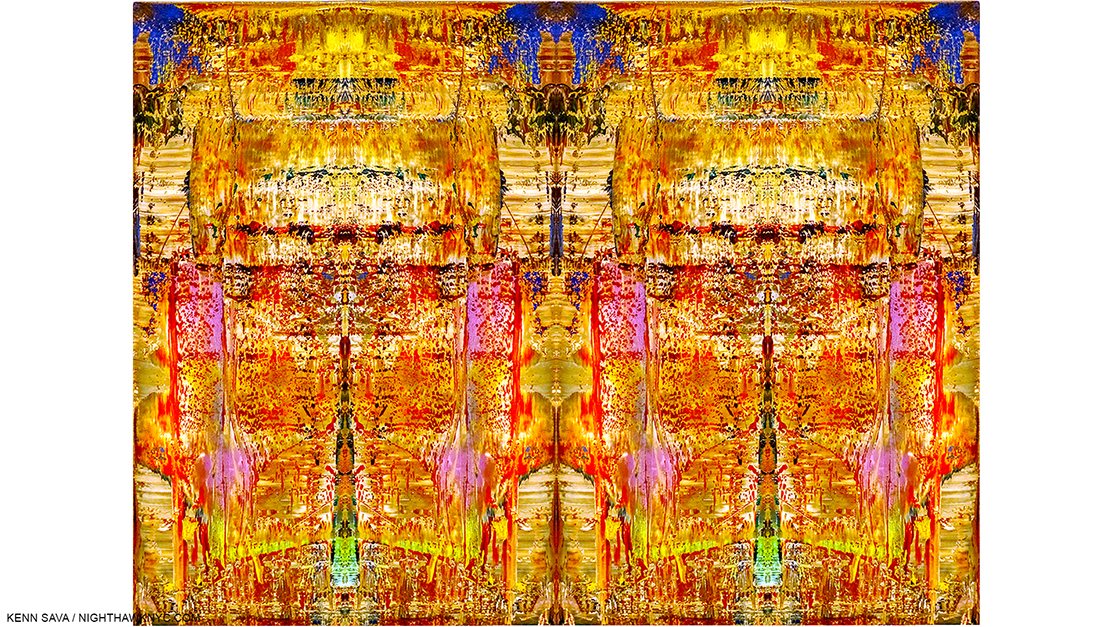
This version of Strip, seen in the show’s last gallery on the 3rd floor, began life as Abstract Painting, 1990, seen on the 4th floor. The process Mr. Richter used to create the works in his Strip series is outlined in the Artist’s book, Patterns, in which he took his Abstract Painting (CR: 724-4) and manipulated it in Photoshop, using a mirroring process, he then repeated over and over until the results were reduced to the fine lines of color seen in Strip.

My results after Step 1.

Using his process, I took Abstract Painting, 1990, which I just showed, and began to create my own Strip from it.

My results after Step 2.

I got to the third stage.

My results after Step 3.

Already you can see where this is going, given a few hundred, or more, steps. Even these preliminary results made me feel that this exercise was fascinatingly making some sort of order out of the seeming “chaos” of abstraction.

Installation view of the 4th floor, with the lobby, where the show begins to the right.

Or course, it will be a long time before the final assessment of Gerhard Richter’s work is done, and hopefully, a long time before he stops creating it.

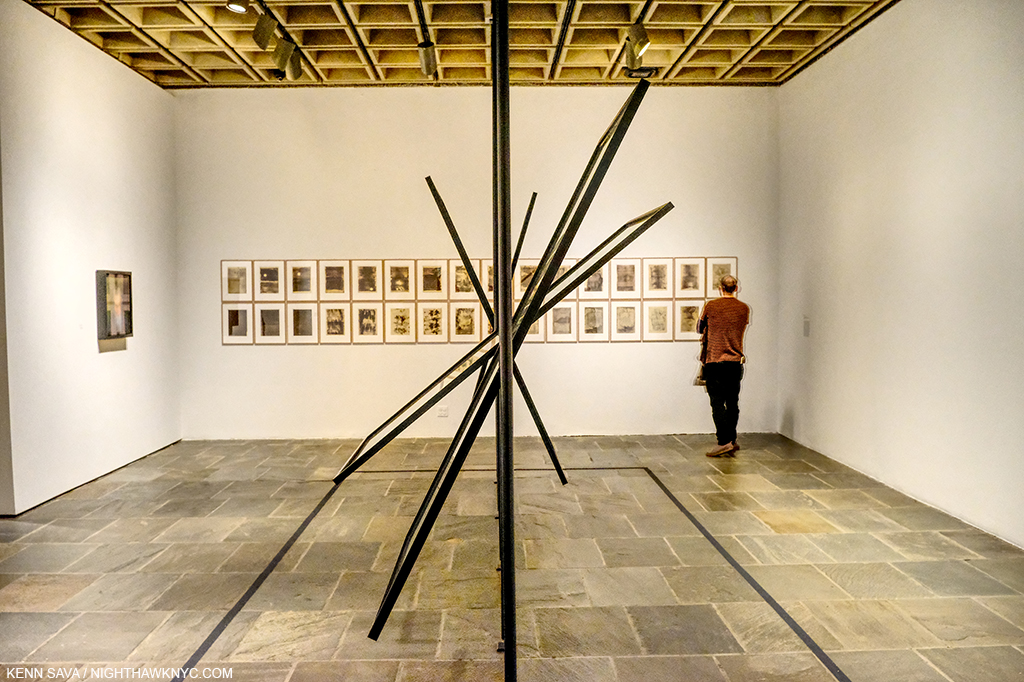
Early, and recent work. Here, early, Four Panes of Glass, 1967 in front of Elbe, 1957/2012, along the back wall, Originally paint roller on paper, 1957, eprinted as inkjet prints in 2012.

“In 2020, art can be made from literally anything. So why still paint?” Met Museum Primer for GR:PAA

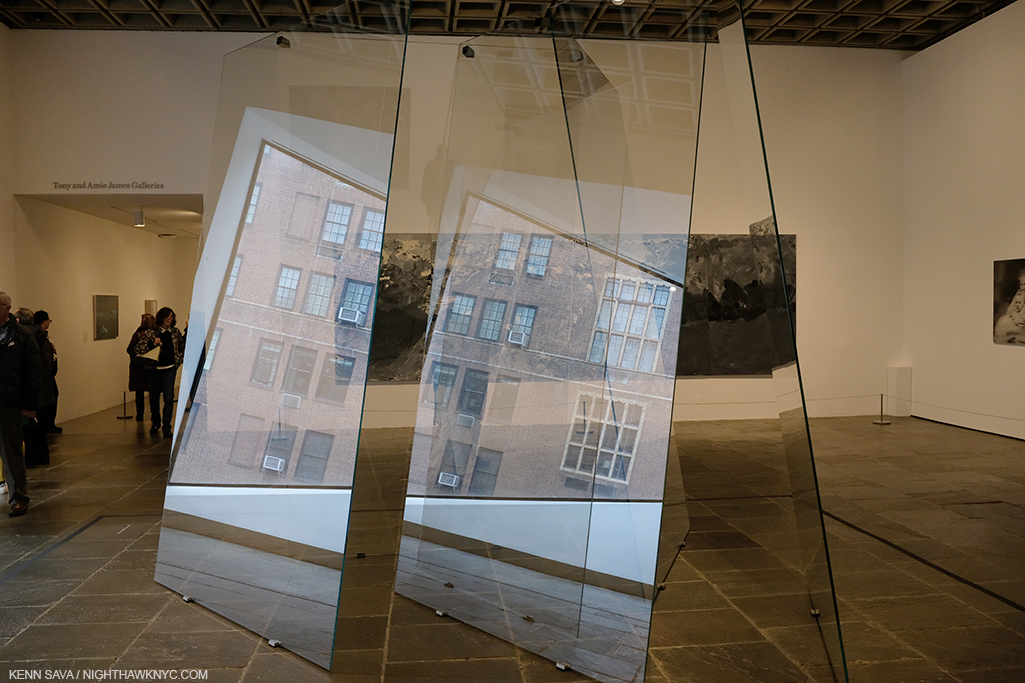
Recent. Installation view showing House of Cards (5 Panes), 2020, Glass and steel, the most recent work in the show. That’s the view across Madison Avenue coming in through Marcel Breuer’s window to the left, reflected in the glass.

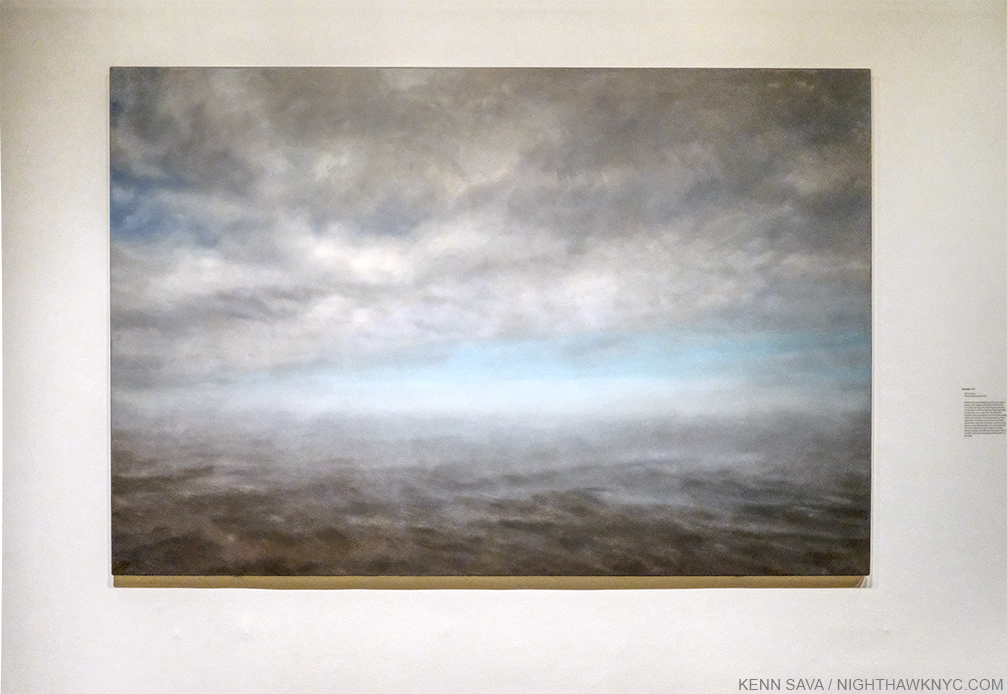
Though works in other medium are included, as seen above, even with these forays, his Painting have continued, and continued to be the main focus of his work. Highlights from many of the major categories of Painting that Mr. Richter has worked in are included, including his hugely influential landscapes, like Seascape, 1975.

Seascape, 1975, Oil on canvas, 78 3/4 inches by 9 feet 10 1/8 inches. I was stopped by this work when I came across it.  It spoke to me of so much going on at that moment- the looming covid shutdown, which would begin for Art in NYC a few hours later, and along with it, the status of this show. How the world would be different after…Are the clouds clearing, or is a storm coming? Is that light a dawn, or a sunset?

For me, the title Gerhard Richter: Painting After All  has multiple meanings. It can be read as a statement that Gerhard Richter has continued to Paint, or gone back to Painting, after exploring other mediums, his entire career. It can also be read as a statement about all the tumult that has gone on in the Arts over his lifetime, during which time Painting has received unprecedented challenges from Photography and other mediums which have attempted to take it’s prime place among the visual Arts. Regardless of how I, or anyone, feels about a work here or there, the one thing that remains is that Gerhard Richter has consistently shown what Painting can do, what it’s capable of giving us, that other mediums can’t- including Photography, to this point. In doing so, he has set signposts for other Painters to follow to continue to mine what Painting is uniquely capable of.

It can, also, be read as a statement about the survival, and ongoing importance of Painting. After all.

Particularly after my 3+ year immersion in Modern & Contemporary Photography, I’ll go with that one.

*- Soundtrack for this Post is the album Richter 858 by Bill Frisell, that was originally released along with a volume of Gerhard Richter’s Abstract Pictures 858-1 through 858-8. In 2005, then rereleased on Soundlines.

NighthawkNYC.com has been entirely self-funded and ad-free for over 6 years, during which over 250 full length pieces have been published. If you’ve found it worthwhile, you can donate to keep it going & ad-free below. Thank you!

Written & photographed by Kenn Sava for nighthawknyc.com unless otherwise credited.
To send comments, thoughts, feedback or propositions click here.
Click the white box on the upper right for the archives or to search them.
For “short takes” and additional pictures, follow @nighthawk_nyc on Instagram.

Subscribe to be notified of new Posts below. Your information will be used for no other purpose.


  1. Here
  2. This is probably discussed and clarified in the show’s catalog. Due to the shutdown, which has closed all bookstores, I have not seen the catalog. I may update/correct this when I do.
  3. In works in the show, like Uncle Rudi and others, and work that are not here, like the intriguing October 18, 1977 series.
  4. Here
  5. In his remarkable book, Notes From The Woodshed, Mr. Whitten, a master woodworker, writes about  the making of the tools he used to make them- “The Developer” he called a large one.

NYC’s Museums Are “Temporarily Closed”- UPDATED

Written & Photographed by Kenn Sava

Tonite, as I write, all of Manhattan’s “Big Five” Art Museums and the Brooklyn Museum are “temporarily closed” due to concerns over the coronavirus, marking the first time this has happened since 9/11.

Gerhard Richter, September, 2005, Oil on canvas. The Artist created this four years after 9/11. Seen at Gerhard Richter: Painting After All on March 12, 2020, the final day The Met Breuer was open before its “temporary closing.”

Extraordinary measures for extraordinary times. 

Unfortunately, this comes at a moment when there are a number of important shows going on including-

Vida Americana: Mexican Muralists Remake American Art, 1925-1945 at the Whitney Museum

Dorothea Lange and Donald Judd at MoMA

Jordan Casteel and Peter Saul at the New Museum

Gerhard Richter: Painting After All at The Met Breuer

each of which only recently opened. 

I was able to see both Vida Americana and the Gerhard Richter this week before their sudden closings, which came without notice, and while I mull them over, I will say it would be a real shame if the closures turn out to be extended and prevent more people from seeing both of these shows, though of course, the health and wellbeing of visitors and staff must come first. In particular, Vida Americana is, perhaps, the most important Painting show I’ve seen in an NYC museum since Kerry James Marshall: Mastry graced The Met Breuer in late 2016 to 2017. 

The Gerhard Richter show, while a terrific feat of curating by Sheena Wagstaff and her team in bringing in major works from all over which are very handsomely hung, offers an opportunity to see his work through the eyes of our time and in light of both what has come since, as well as what has been discovered about what was done before and during his time by Artists who were in eclipse for too long. In my opinion, Mr. Richter, perhaps a bit like Andy Warhol, winds up with quite a few works that don’t seem to have aged all that well and it will be interesting to see if the future finds these works speak to them. There are other works who’s gravitas is plain- like the exceptional Birkenau series, (unforgettably installed adjacent to 4 incredibly rare surviving Photos taking inside Auschwitz II Birkenau by a member of the Sonderkommandos), the beautiful Forest series, and a number of fine works that seem to have been overlooked thus far. This show is a great opportunity for each viewer to assess, or reassess, for themself.

5pm, March 12, 2020. Minutes before closing at The Met Breuer, a staff member is still busy cleaning the doors. When they’ll get opened again to the public is anyone’s guess. I heard one guard say to another, “See you May 1st.” Was that his guess? The Gerhard Richter show is scheduled to open at MOCA, L.A. on August 15th, making it unlikely to be extended in NYC.

Here’s hoping the closings will be brief. But, if they are not, and, with the postponing of a number of Art & Photography shows this past week around the country, how long will it be before the galleries follow suit? In addition to any and all of the other effects it may have, all of this makes me wonder what the effect of the coronavirus may wind up being on the Art world, and the Art market, which has seen an unabated, meteoric, rise over the past three decades. 

In the meantime, stay healthy out there.

Mid Tuesday afternoon, March 17, 2020. Normally, West 24th Street in the gallery district of Chelsea would see a steady stream of foot and vehicular traffic going to the galleries lining both sides of the street from end to end. Today? I could have safely laid down to take this shot.

UPDATE- March 13th, one day later. Many, even most, of the NYC galleries have announced either closures or “open by appointment only.”

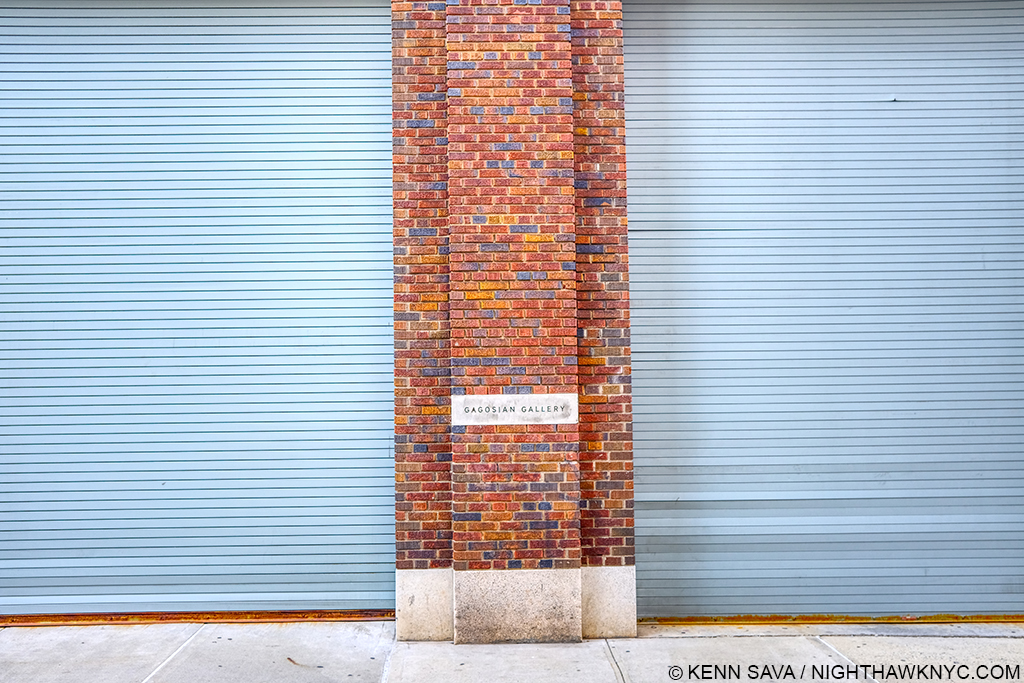
Gagosian on West 24th Street, scene of Jonas Wood’s latest NYC show, would normally be open.

While I expect many other non-Art businesses to close temporarily in the near future, a good many, especially smaller, businesses would be in extreme financial peril if they were to close for an extended time, particularly in the never more expensive NYC business environment.

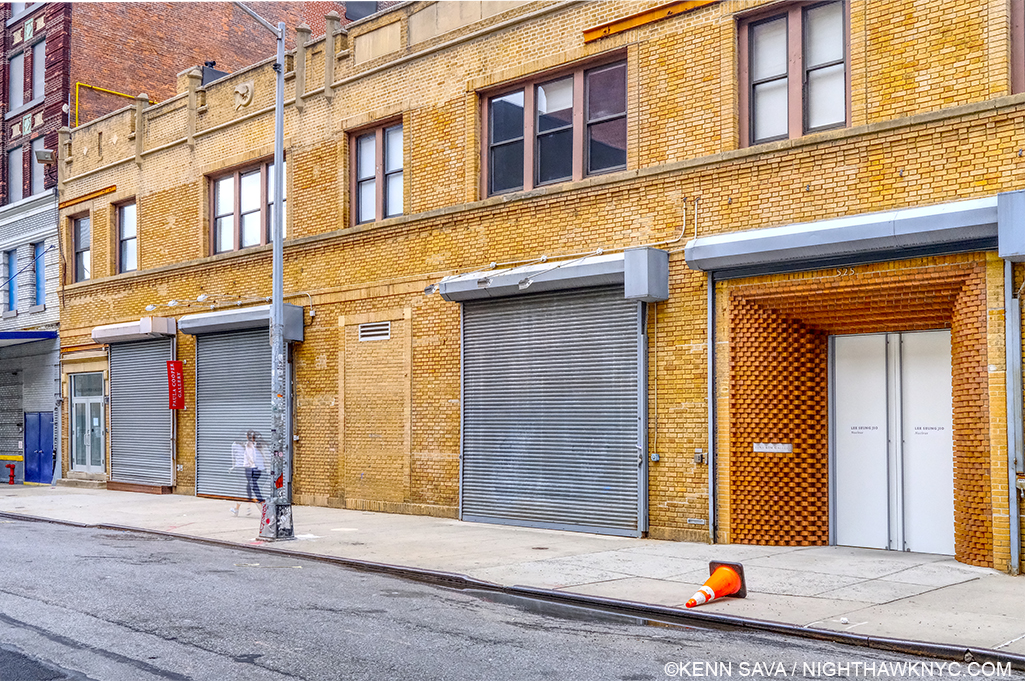
The scene over on West 21st Street. The terrific Sarah Sze show was here late last year. Today, that jogger doesn’t have to worry about running into anyone, and the street looks like it did before the galleries came here.

It’s hard not to think about how that reflects on the “Art business.” It also makes me wonder how these “appointment only” galleries know the health status of whoever they are choosing to let in, among other things.

NighthawkNYC.com has been entirely self-funded and ad-free for over 6 years, during which over 250 full length pieces have been published. If you’ve found it worthwhile, you can donate to keep it going & ad-free below. Thank you!

Written & photographed by Kenn Sava for nighthawknyc.com unless otherwise credited.
To send comments, thoughts, feedback or propositions click here.
Click the white box on the upper right for the archives or to search them.
For “short takes” and additional pictures, follow @nighthawk_nyc on Instagram.

Subscribe to be notified of new Posts below. Your information will be used for no other purpose.


Art- With A Capital “A”

For The Record #1. First part of a series.

Written & Photographed by Kenn Sava

Back at The Met, May 6, 2018. The Museum, as it’s referred to, is one of the world’s great repositories of Art with a capital “A” with collections covering 5,000 years of it from all cultures in all its forms. It’s also one of the very best things about living in NYC. No. It’s THE best thing in my opinion. 1,700+ visits in since August 1, 2002, every time I turn the corner and see the building looming in front of me, I still get a chill down my spine. I touch the corner as I go in each time as a way of saying “Hello” to an old friend and to give thanks for each and every opportunity I get to do so.

To mark the 4 and a half year Anniversary of NighthawkNYC, during which I’ve published 225 pieces in 240 weeks (Phew…), I thought I’d take the opportunity to set the record straight on a few things that I feel are at the core of what I believe, and what I’ve written here. Perhaps I should have “explained” them at the beginning instead of letting those who’ve read these pieces (for which I Thank You) wonder, “What the heck?” Well, better late than never. Herewith the first installment in a brief series called For The Record. Consider them “footnotes” or “addendums” to every piece I’ve written.

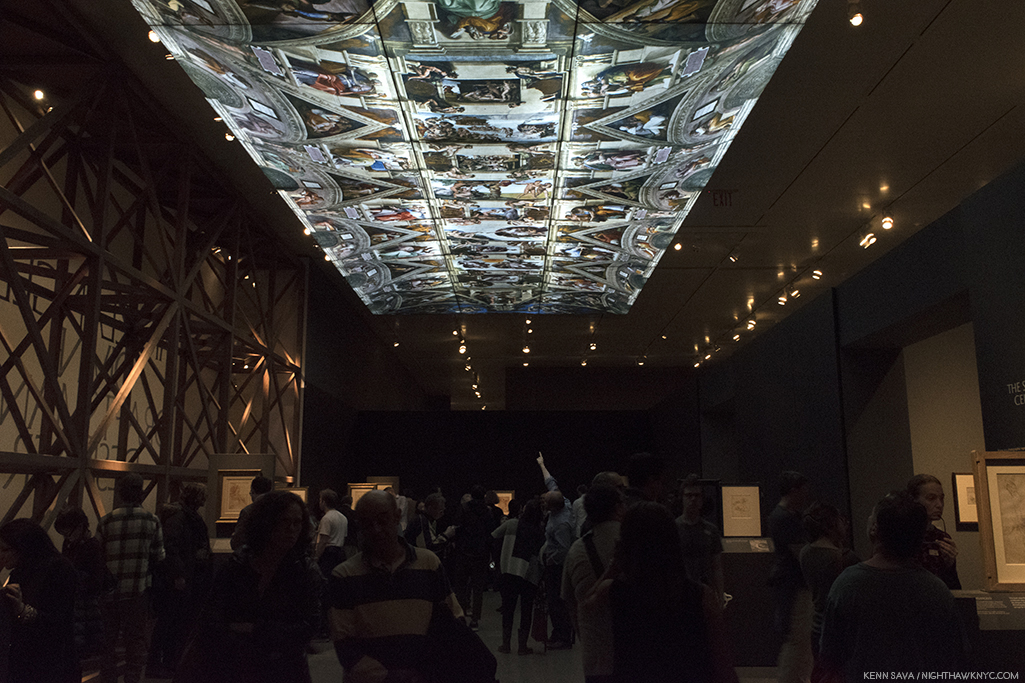
Michelangelo’s Sistine Chapel Ceiling reproduced as part of The Met’s staggering Michelangelo: Divine Draftsman & Designer, 2017-8, one of the sublime experiences of my life.

First- Art is of one of man and womankind’s supreme accomplishments in my view. I believe there should be some distinction between the Art of someone like Michelangelo and, say, the art of someone learning (said with all due respect).

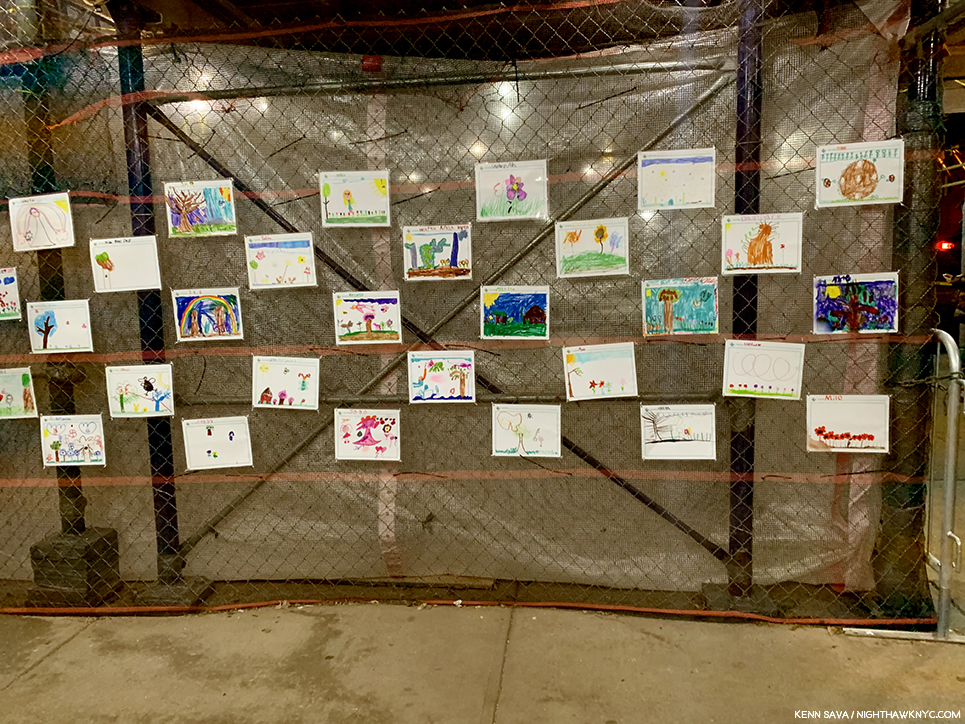
Various young artists, unknown titles. A display of children’s art beautifying an NYC public school under renovation.

That’s why I capitalize Art and its associated terms (Artist, Painter, Sculptor, Musician, Painter, Photographer, et al.). It’s my way of showing these people the respect I think they’ve earned and deserve. I’ve done this here since Day 1- July 15, 2015, and I’m sure there are some who frown at me for doing it, and some who disagree with me for doing it. Along the way, I’ve seen a few others doing it this way and frankly, I’m surprised it hasn’t become more widely adopted. I hope it does soon.

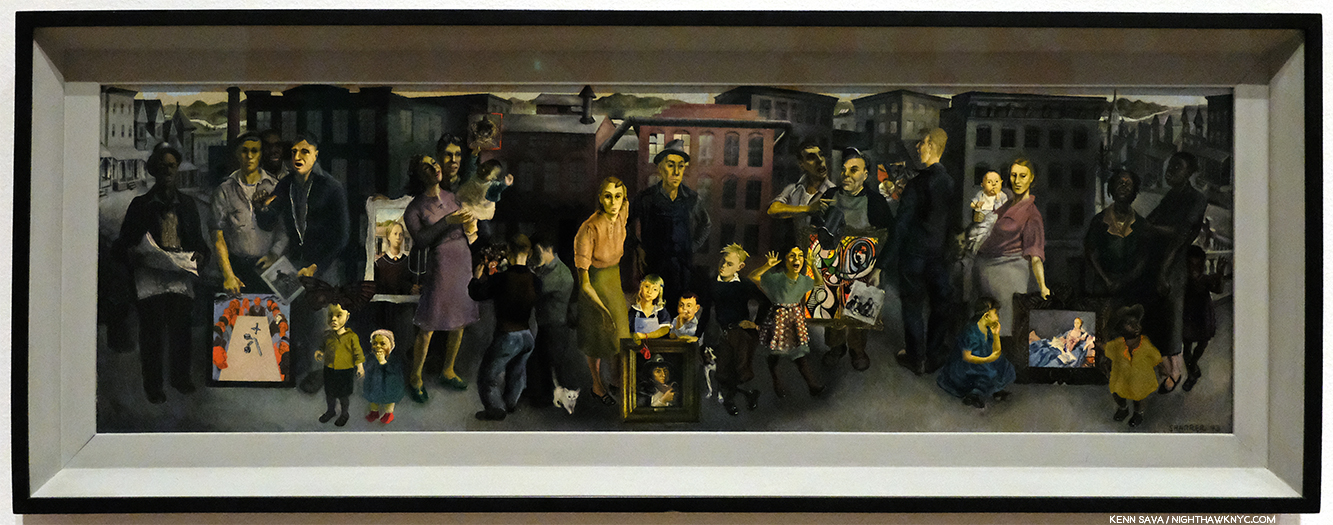
The terrific, and terrifically overlooked, Honore Sharrer’s, Workers and Paintings, 1943, Oil on board, seen at MoMA. Some of the Art she includes are Grant Wood’s American Gothic, Picasso’s Girl before a Mirror, and others by Jean-Francois Millet and Diego Rivera. Though this work and the originals of most of what she includes in it are 100 years old, +/-, for me, this and all of them are Art. Will the future agree? Time will tell…

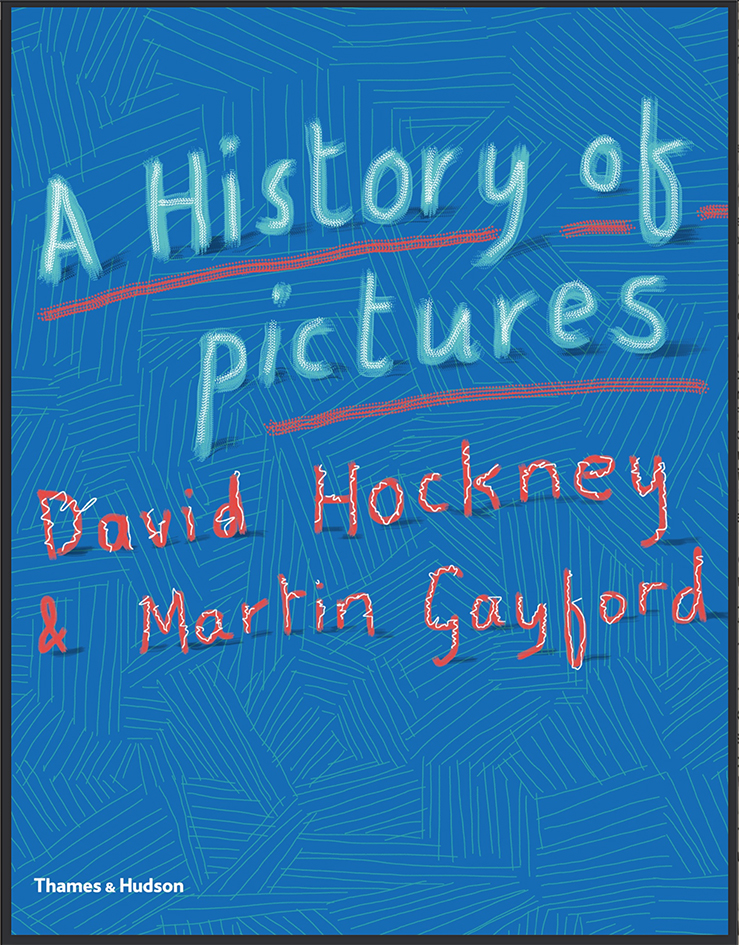
“What makes a work of art? I don’t know. There are lots of people who tell you they are making art. Maybe some of them are, but I’m not sure that’s true for all of them. Perhaps I’m old fashioned, but that’s not a phrase I would use. I’d prefer to say I’m making pictures – depictions.” David Hockney, A History of Pictures, with his capitalization, eBook P.2.

I’ve held David Hockney’s writings, and ideas, in the highest regard since his revolutionary, and eternally controversial, book Secret Knowledge came out in 2001, but I find it cumbersome to use the word “pictures” here in place of “Art.” Regarding what “makes a work of art?,” as he asks, it seems to me that it takes hundreds of years for the dust to settle on what’s being created in our time and for something, a “picture,” as Mr. Hockney says, to be considered “Art” (IF it continues to speak to people). None of us will be around when that bell rings. So, in the meantime, I’ve opted to use the term Art, capital “A,” respectfully, applying it to all working Artists, present or past.

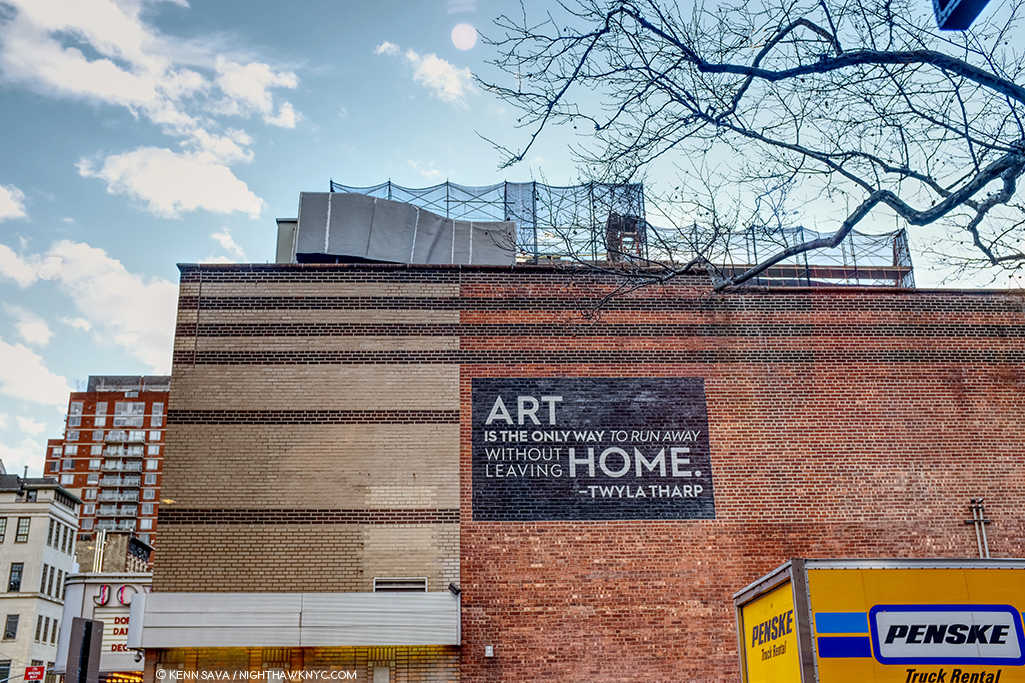
Thanks, Twyla. I couldn’t have said it better. And so, this scene has appeared in my Banner, sans moving truck, for the past year. If that truck is waiting for me, it may have a long wait. I haven’t been out of Manhattan overnight since February 4, 2012. The Joyce Theater, December, 2019.

The other reason I do it is because Art is my religion. Frank Lloyd Wright, who I consider to be an “ultimate Artist,” capitalized Nature since it was his religion. Art is mine.

Reach out and touch faith. For me, going to The Met is going to church, as I said early on. At this point in my life, it feels like Home. Back Home, again, late on December 22, 2018. Weather be damned. It’s always beautiful inside.

*-Soundtrack for this Post is ”Personal Jesus” by Martin L. Gore of Depeche Mode, from their 1990 album Violator. They perform it here on Letterman

For The Record is a series of pieces that are about key/core subjects & beliefs that underly everything else I’ve written here.

NighthawkNYC.com has been entirely self-funded and ad-free for over 6 years, during which over 250 full length pieces have been published. If you’ve found it worthwhile, you can donate to keep it going & ad-free below. Thank you!

Written & photographed by Kenn Sava for nighthawknyc.com unless otherwise credited.
To send comments, thoughts, feedback or propositions click here.
Click the white box on the upper right for the archives or to search them.
For “short takes” and additional pictures, follow @nighthawk_nyc on Instagram.

Subscribe to be notified of new Posts below. Your information will be used for no other purpose.


A Year of Art: 2019

Written & Photographed by Kenn Sava

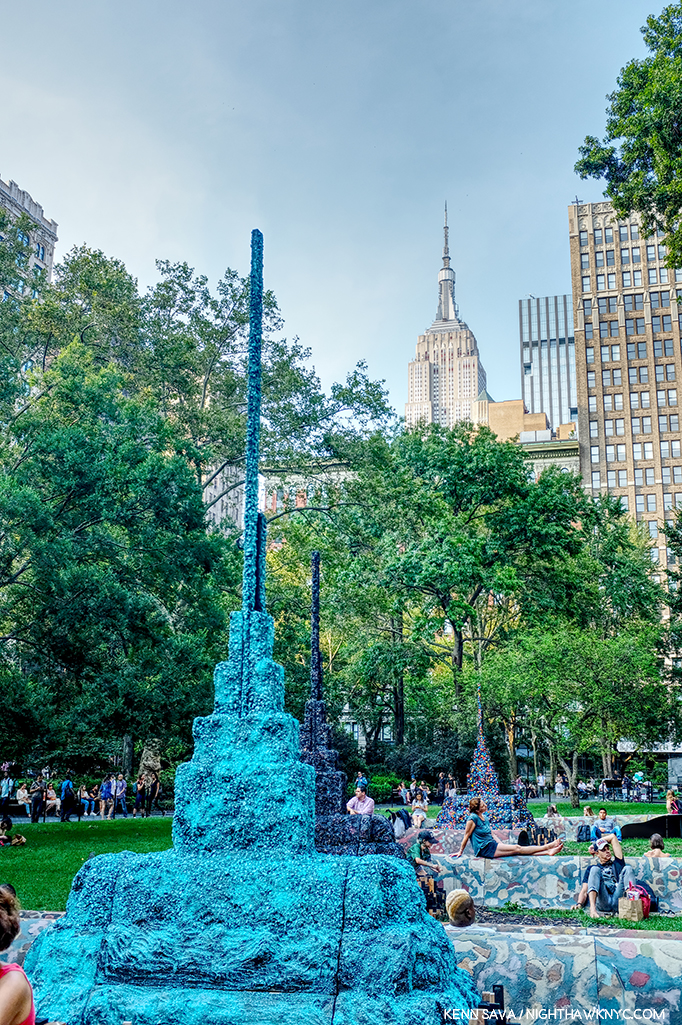
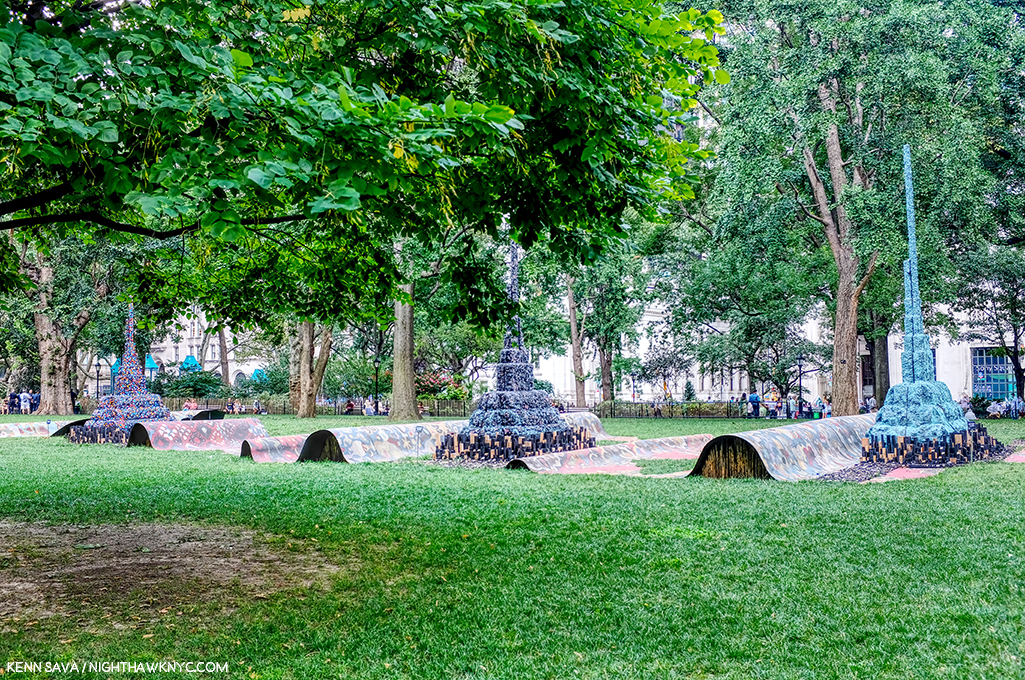
Detail of Leonardo Drew’s Public Art project, City in the Grass, 2019, seen in August in Madison Square Park, where it was on view from June through December. In conversation, Mr. Drew spoke of the influence of Indian Stupas, though the Empire State Building 10 blocks behind, might be one as well.

A strange year in Art in NYC ended a few weeks ago. A year that saw one of Manhattan’s “Big 5” museums (MoMA) close for four months, including the entire summer, while it remodeled, then reopen to mixed reviews (mine among them), while another one (The Whitney) faced an Artist revolt mid-Biennial, another (The Met) had what seemed to me to be a fairly “quiet” year on the show front as it adapted to the first full year under its new Director, Max Hollein, while the other two, the New Museum and particularly the Guggenheim, chugged along presenting top notch show after top notch show. Meanwhile, no less than 5 shows of the work of Jean-Michel Basquiat were mounted around town, and though I wrote a series of pieces on them I still don’t know “Why now?” While I’ve written about a number of other shows I found particularly NoteWorthy in 2019, already, there were some other excellent shows that linger in my mind, in the space freed up by the plenty of others that do not. If I were to sum of the year in Art seen, I will remember it as a year where Sculpture, long a very overlooked medium, though not here, struck back and broke through.

NoteWorthy Sculpture Shows-

Lingering closest to the front of my mind is the incredible Sarah Sze at Tanya Bonakdar Gallery, which I just wrote about, along with Jean-Michel Basquiat at The Brant Foundation, the most unforgettable shows I saw in 2019.

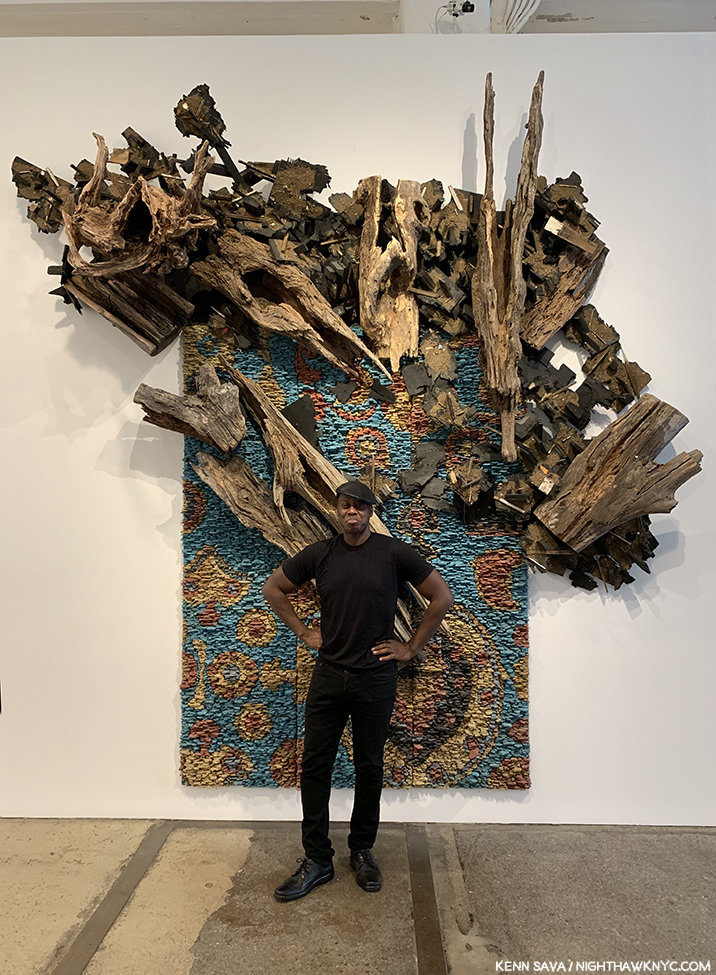
Leonardo Drew poses in front of Number 217, 2019, Wood, plaster and paint, on the last day of his show at Galerie Lelong, August 2, 2019

Leonardo Drew at Galerie Lelong and City in the Grass at Madison Square Park. Mr. Drew has achieved substantial success around the world, with work in the Permanent Collections of any number of museums, including The Met’s, yet he still seems to be something of a “well-kept secret” to the larger Art public. One of the most original, interesting and visionary Sculptors working today, I thought his show at Galerie Lelong was close to perfect.

Number 215, 2019, Wood, paint and sand.

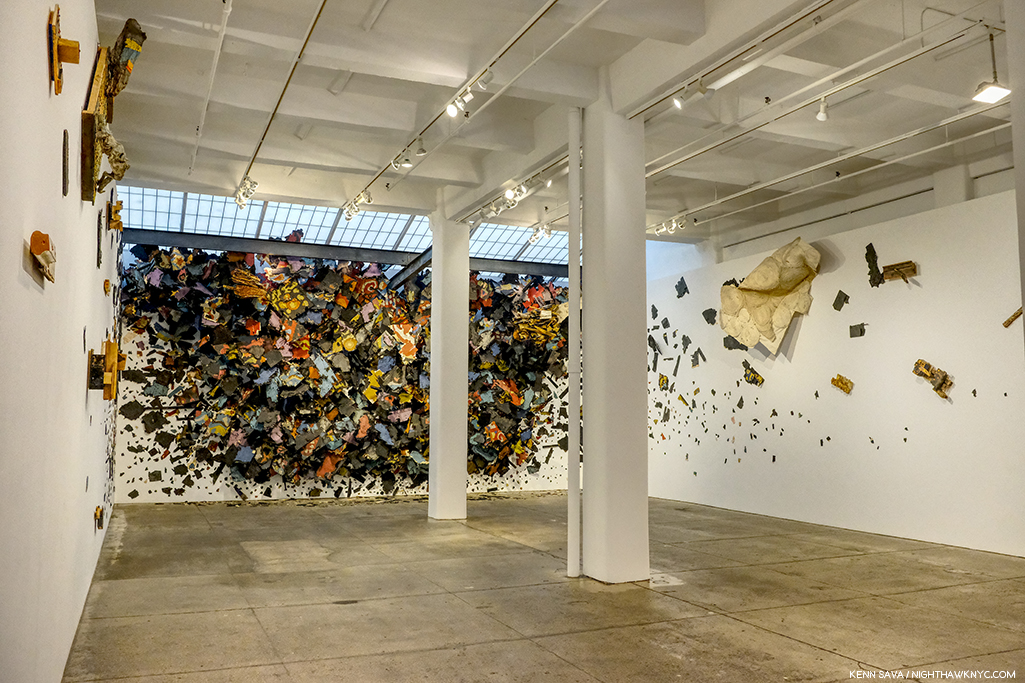
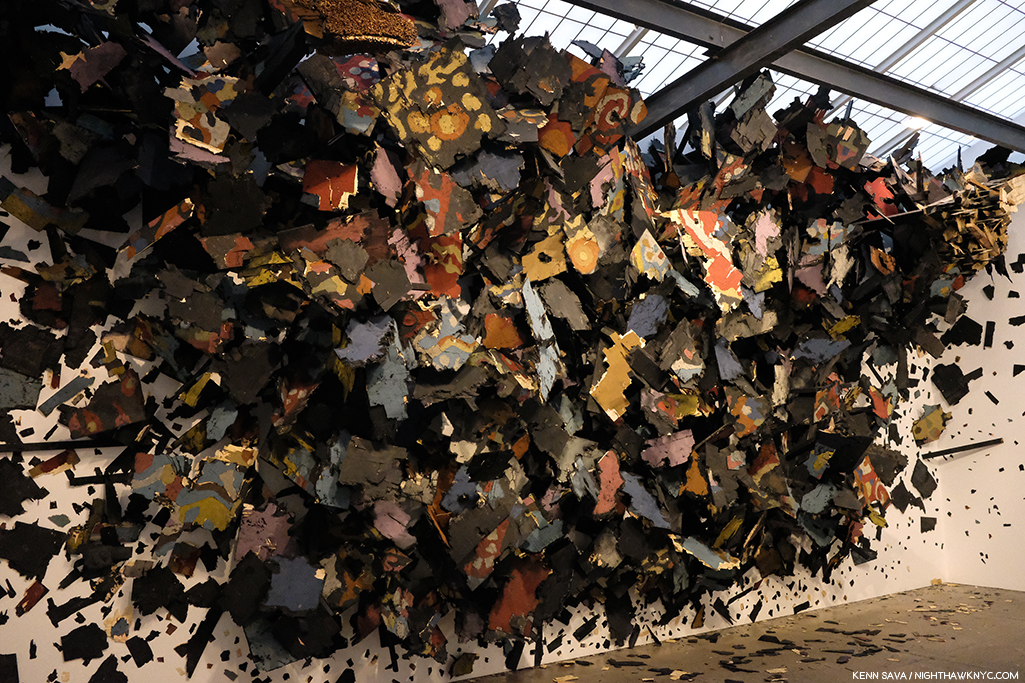
As with Sarah Sze, the show marked the introduction of Painting by the Artist, though not in the “traditional” sense. The Artist told me Number 215 began as a Painting (his), which he then deconstructed as if it had exploded.

Detail. The show also introduced color into Leonardo Drew’s work.

One monumental work in the large gallery accompanied by five others in the remaining space, each one selected with supreme taste to provide a wonderful group. While his show was up, Mr. Drew also debuted his first Public Art piece, a work commissioned for Madison Square Park.

City in the Grass seen on a day when the lawn was closed to be rested from the non-stop traffic it had been receiving. At the base of each of the three “Stupa”-like structures were wooden “cities” rendered in Mr. Drew’s typically extensive detail to the point that, up close, you could literally spend hours moving through them with your eyes.

In all my years of living in the City, and living here with Public Art, I’ve never seen a piece that was so quickly adopted by the public. Kids endlessly climbed all over it while their parents and other adults languished on other parts of the gigantic piece, as can be seen in the first picture above. Mr. Drew appeared in the Park at least twice to speak about the work and proved to be an extremely thoughtful speaker.

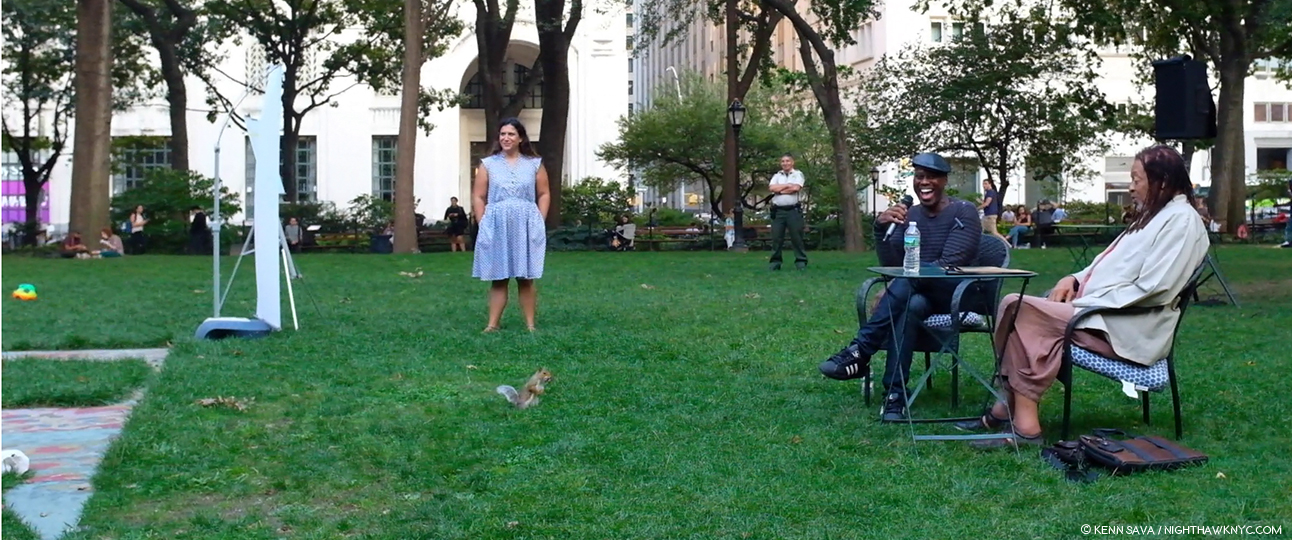
Such was the public acceptance of City in the Grass that even one of the Park’s permanent residents came by to hear the Artist speak about it in a public talk, with renowned writer (and Miles Davis Autobiography co-author) Quincy Troupe, right, on September 11, 2019.

In terms of precedents or influences, Thornton Dial and Jack Whitten (who rented space to Mr. Drew early on the Artist told me) come to mind, but not really. Leonardo Drew is an original. Before he’s done, many decades hence, I believe his work is going to wind up in as many museum as just about any other Sculptor of his generation. 

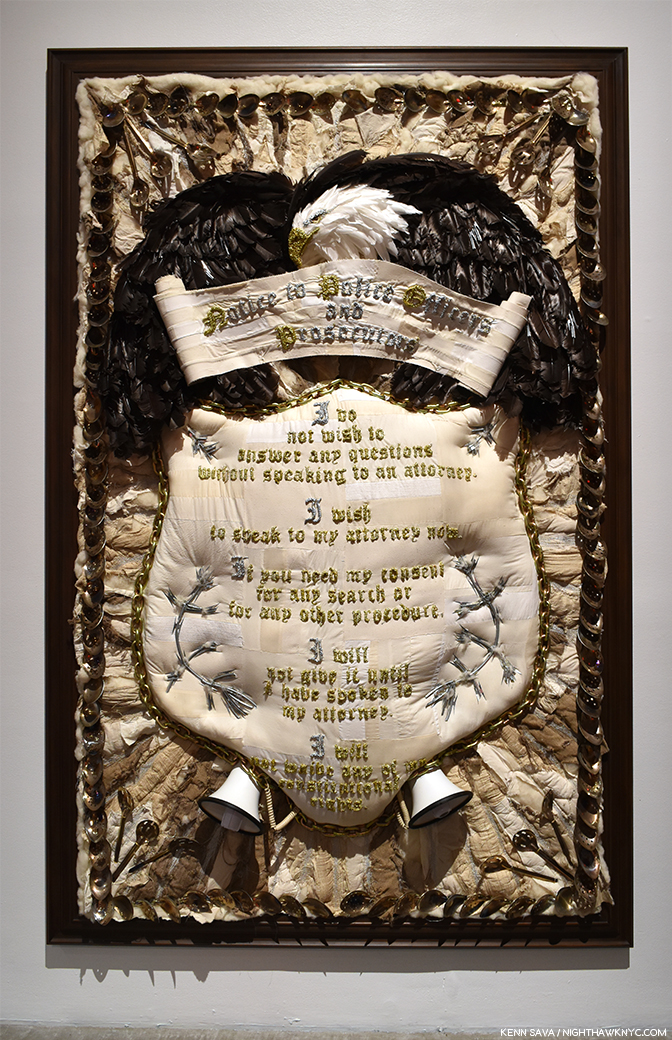
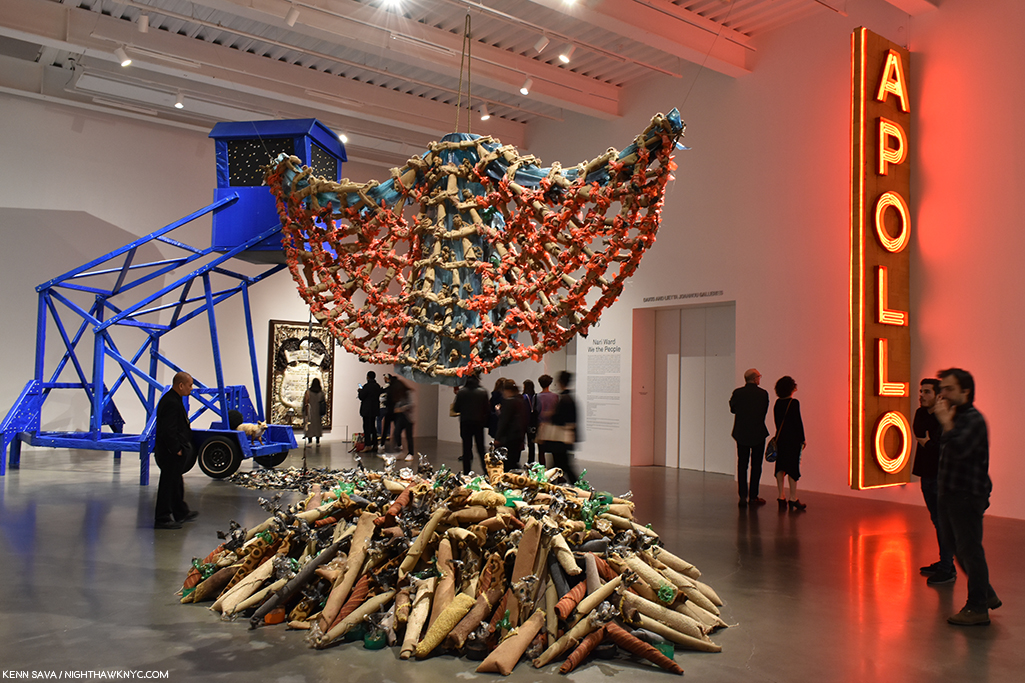
Nari Ward, Homeland Sweet Homeland, 2012, Cloth, plastic, megaphones, razor wire, feathers, chains and silver spoons, 96 x 60 inches. Along with everything else going on in this, the detail is incredible.

Nari Ward: We The People at the New Museum- Since the 1990s Nari Ward has been repurposing a very wide range of mundane, even humble, materials, often in staggering amounts, in new, surprising and exciting ways. We The People was another long overdue retrospective of the work of this exceedingly creative Artist.

Installation view of part of one of the three floors the show filled.

Occupying multiple floors of the building each work was strong, different from the one before, and shared an uncommon ability to linger in the mind. Another blockbuster show mounted by the terrific team of Massimiliano Gioni and Gary Carrion-Murayari for the New Museum, which continues to rise in stature in my eyes.

Installation view of the 2nd of 3 galleries.

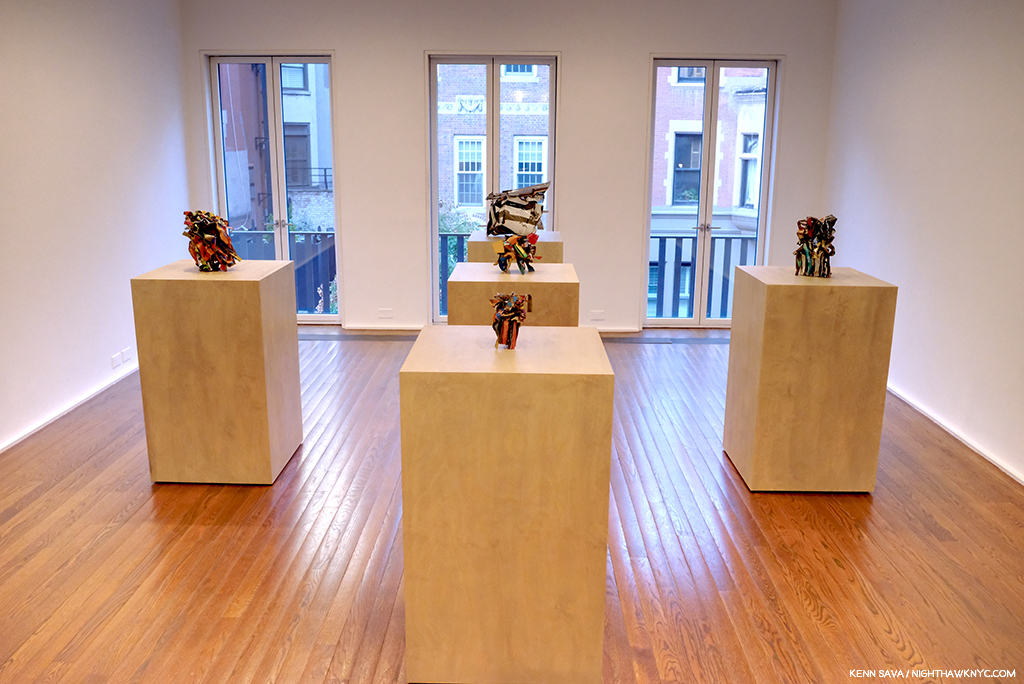
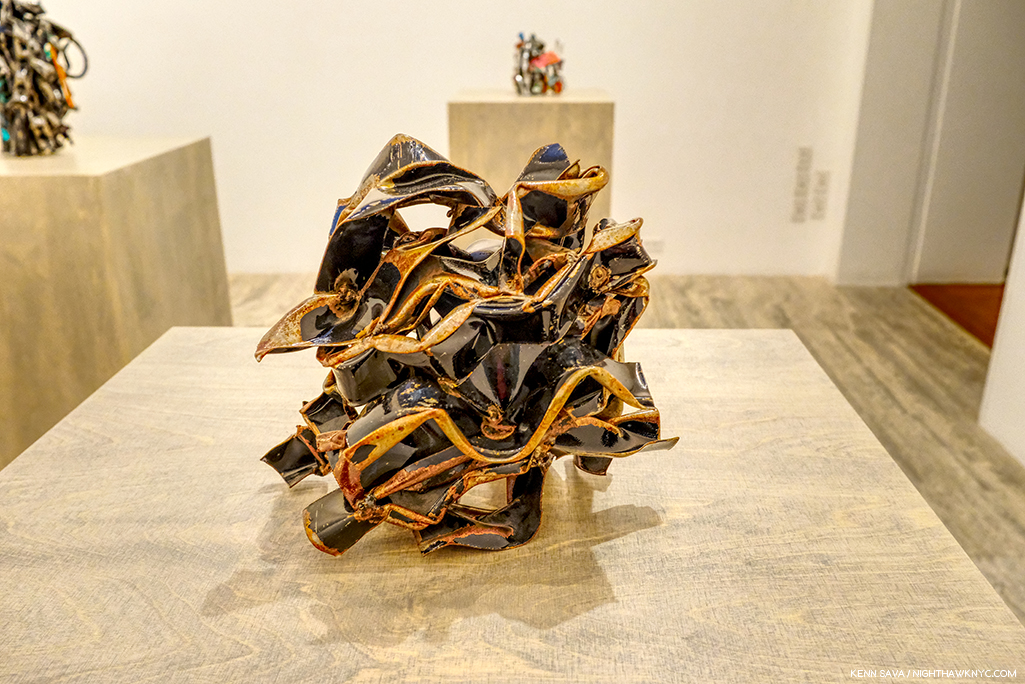
John Chamberlain: Baby Tycoons (with Eva Hesse Drawings) at Hauser & Wirth, East 69th Street- Lesser known work by two ground breaking, unique Artists/Sculptors, both no longer with us were paired in a beautifully installed show at Hauser & Wirth’s uptown outpost. While Ms. Hesse’s Drawings provided a fascinating insight into her career and process, Mr. Chamberlain’s gorgeous small works completely enthralled me.

While his classic larger pieces can look completely “accidental,” his smaller work shows the incredible attention to detail that he brought to bear in all of them. 

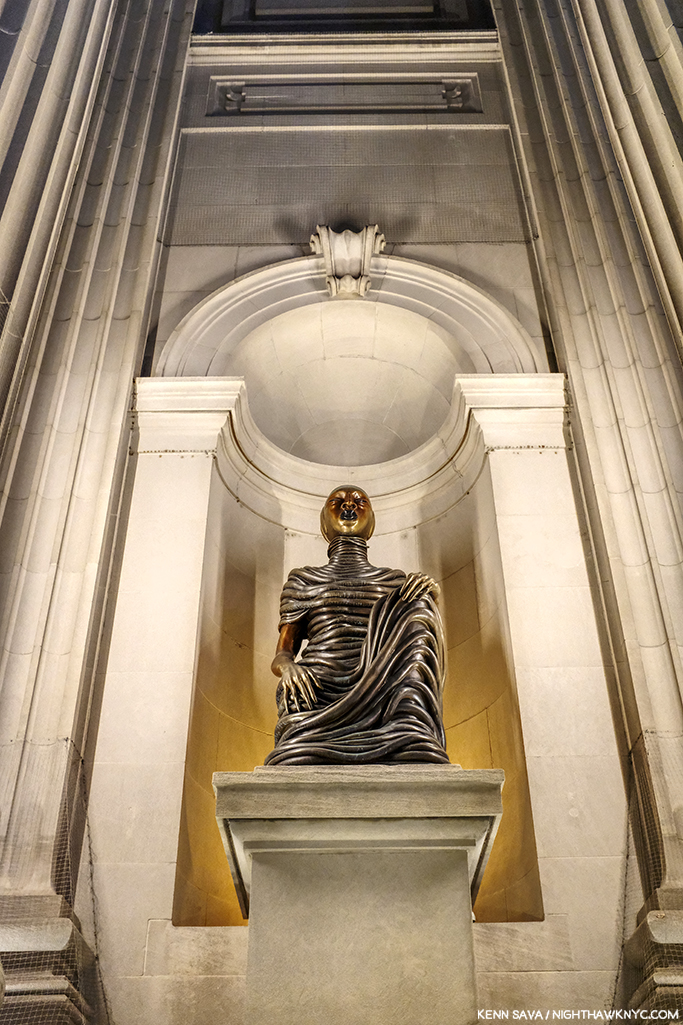
Wangechi Mutu, The NewOnes, will free Us, The Facade Commission outside The Met, 5th Avenue- The 5th Avenue Richard Morris Hunt Facade has long been a sore point for me. We’ve been living with it as it is for so many of its 117 years that most visitors fail to realize it remains unfinished! Being Landmarked, having neighbors and being in Central Park has kept TM from finishing what was started back 150 years ago and reached this form in 1902. I pray that one day they’ll be allowed to. It’s not like sticking a brand new pyramid in front of it! It’s just completing the existing facade. So, this year I was pleasantly shocked to see they found an extremely creative and Artful partial workaround. The Facade Commission as they call it bring us 4 terrific bronze Sculptures by Wangechi Mutu titled The NewOnes, will free Us that look superb in the heretofore empty niches outside facing 5th Avenue. On view 24/7 through this June 8th, don’t miss them on your next visit. 

As the year ended, all of this left me wondering- Are we in a “Golden Age of Contemporary Sculpture”?

Elsewhere, among the shows I haven’t written about-

NoteWorthy Painting Shows-

Lorna Simpson, Darkening, 2018, Ink and screen print on gessoed wood, 108 x 96 inches.

Lorna Simpson: Darkening at Hauser & Wirth, West 22nd Street- To this point I’ve been familiar with Ms. Simpson’s Photographs, works on paper and collages, but these Paintings came as a shock. Innovative, fresh, haunting, beautiful, the show felt like it came out of the blue, but I’m sure it didn’t. It struck me as a breakthrough. I returned to see it a few times and when it was over I was surprised it hadn’t received more attention than it got, and left me very much looking forward to see where she’s taking this next.

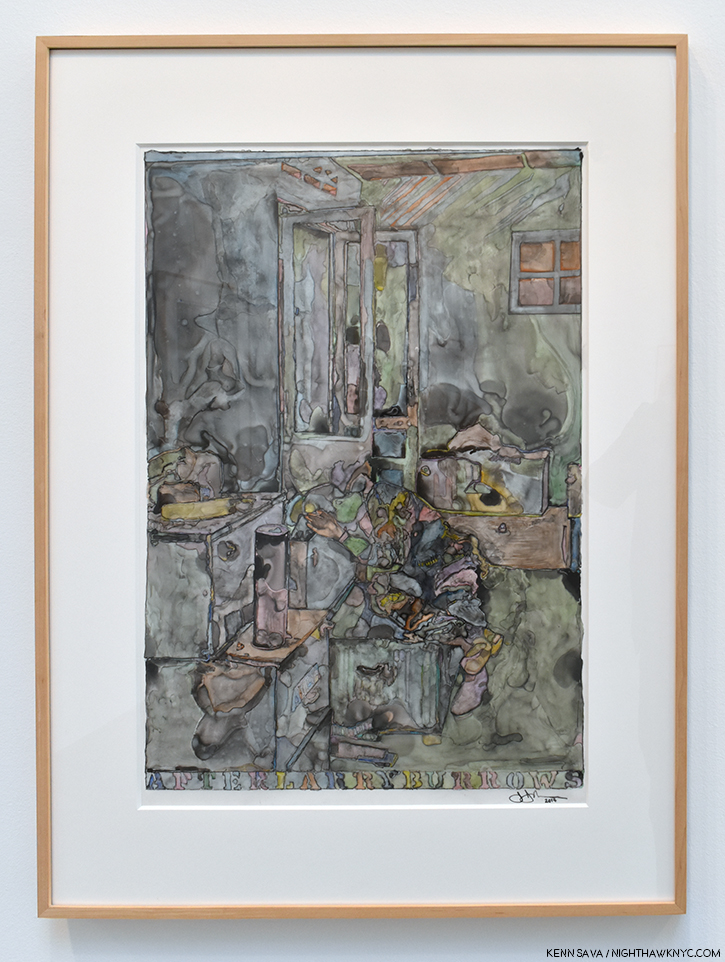
Jasper Johns, After Larry Burrows, 2014, India ink and water-soluble encaustic on plastic, 32 x 24 inches, one of a series of terrific works by the Artist based on this Photograph.

Jasper Johns: Recent Paintings & Works on Paper at Matthew Marks- Though he turns 90 in May, and a Retrospective is on the Whitney calendar, don’t begin to think Jasper Johns is done. One of the last Artists left to us (along with Susan Weil) from his group that included Robert Rauschenberg, Cy Twombly, Merce Cunningham, John Cage, Willem deKooning, et al, I didn’t know what to expect when I walked into Matthew Marks to see this show of recent works. I left determined to return as often as I could before it closed. I’ll admit that I haven’t followed Mr. Johns career as closely as I followed his one time close associate Robert Rauschenberg, who has had a major influence on the way I see the world, but it sure seems his work has continued to evolve and I, for one, found new surprises in this remarkable show. Too old to be drafted for the Vietnam War he was nonetheless deeply effected by it, as everyone living in this country at the time couldn’t help but be. A number of the works Mr. Johns showed were based on an extraordinary Photograph taken by Larry Burrows in Vietnam, a war that tragically produced too many indelible images, called Farley Breaks Down. Among countless others, Larry Burrows, also, lost his life in the war in 1971. While Photography has been the basis of countless Paintings, in these it was most subtle, almost like a memory, complete with the “haze” of camouflage-like coloring, yet its power was undiminished. Seeing these brought to my mind that one of the things that brought Mr. Johns wide attention early on were his Flag Paintings in the late 1950s.

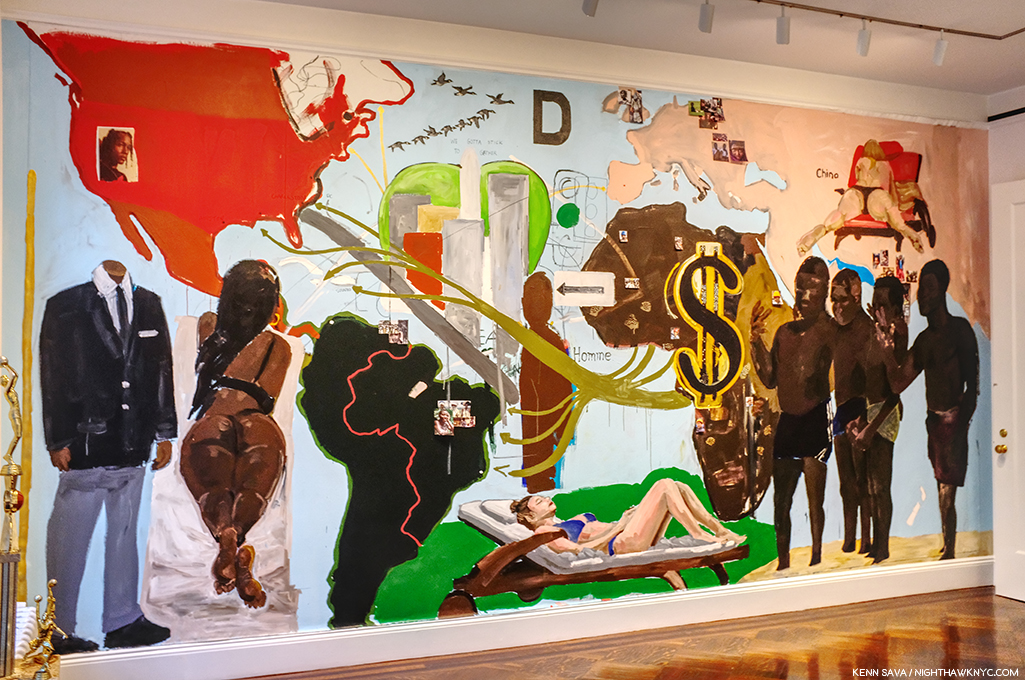
Henry Taylor’s Mural at Blum & Poe, September 24th- before he modified it.

Henry Taylor: NIECE COUSIN KIN LOOK WHO LONG IT’S BEEN at Blum & Poe- It’s been 2 years since Mr. Taylor’s “New York Moment,” as I called it, when his mural debuted on the High Line concurrently with his being one of the “stars” of the 2017 Whitney Biennial, given both his prominent placement with a large work in the lobby on the 6th floor and an entire gallery he shared with his friend, Deana Lawson. His first solo show since showed that not even hip trouble, which sounded serious, could keep the Artist from traveling and continuing to work.

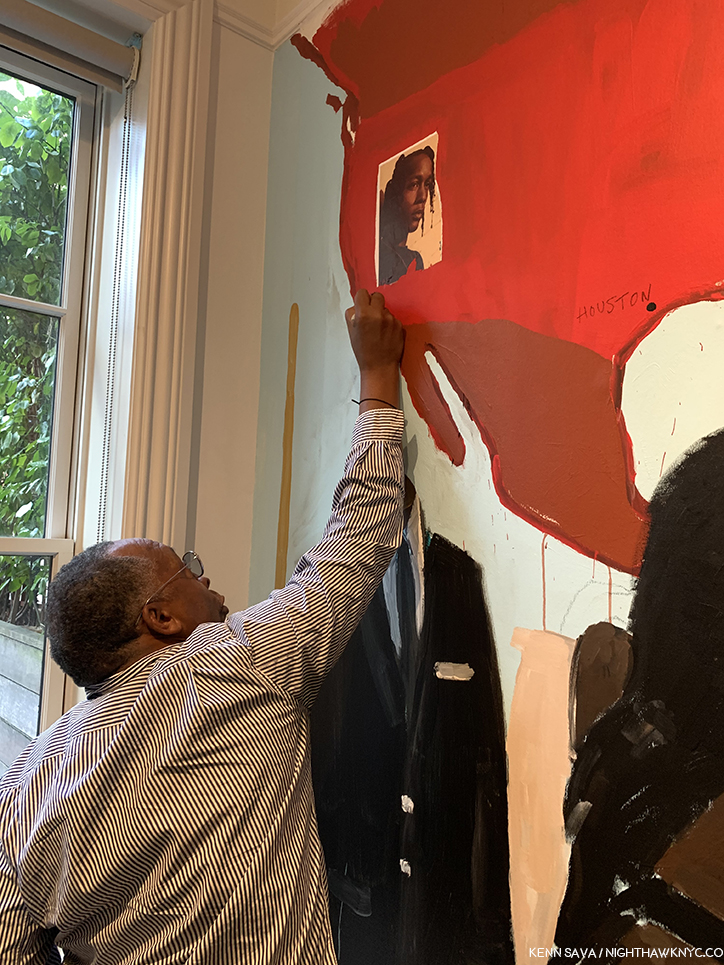
Henry Taylor uses my pen to modify his mural seen above, September 24, 2019.

The opening was highlighted, for me, by meeting Mr. Taylor, who proceeded to borrow my pen to modify the largest works in the show right in front of my eyes, and later proceeded to inscribe a message on the wall in the garden. Mr. Taylor seemed in fine form, not showing any lingering effects of his ailment and the work on view was classic Henry Taylor. A number of visitors approached Mr. Taylor asking for him to sign his recent monograph. I couldn’t help notice that he seemed to Draw in each book, something that indicated to me he’s another Artist who can’t stop Drawing. Of course, in my copy, he appended a sketch of my pen.

The social revolution… Installation view.

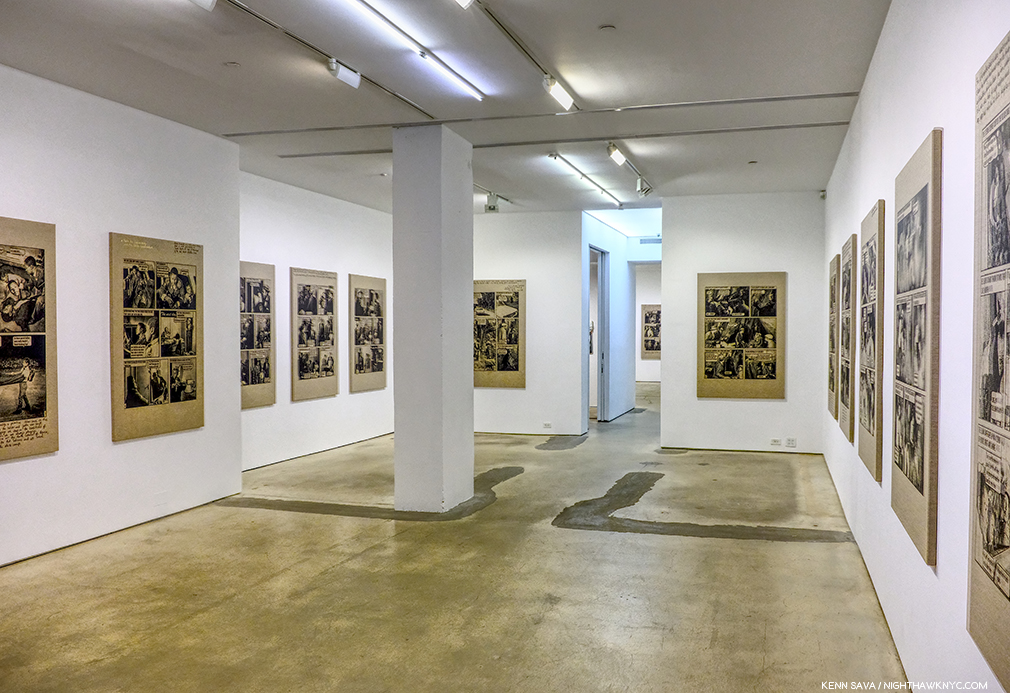
Meleko Mokgosi The social revolution of our time cannot take its poetry from the past but only from the poetry of the future and Pan-African Pulp at Jack Shainman Gallery, West 20th, West 24th Street, and The School, Kinderhook, NY- The now Brooklyn-based Artist is so prolific his latest work occupies no less than THREE of Jack Shainman’s spaces, including the entirety of The School in Kinderhook, NY, out of reach for this writer.

Pan-African Pulp installation view. In this series, Mr. Mokgosi uses source images from the 1960s South African photo-novel Lance Spearman “to examine the history of pan-Africanism.”

The two Chelsea shows I was able to see are marked by remarkable, continued, growth leading me to feel that Mr. Mokgosi is yet another Jack Shainman Artist, like Kerry James Marshall before him, on his way to museum collections. 

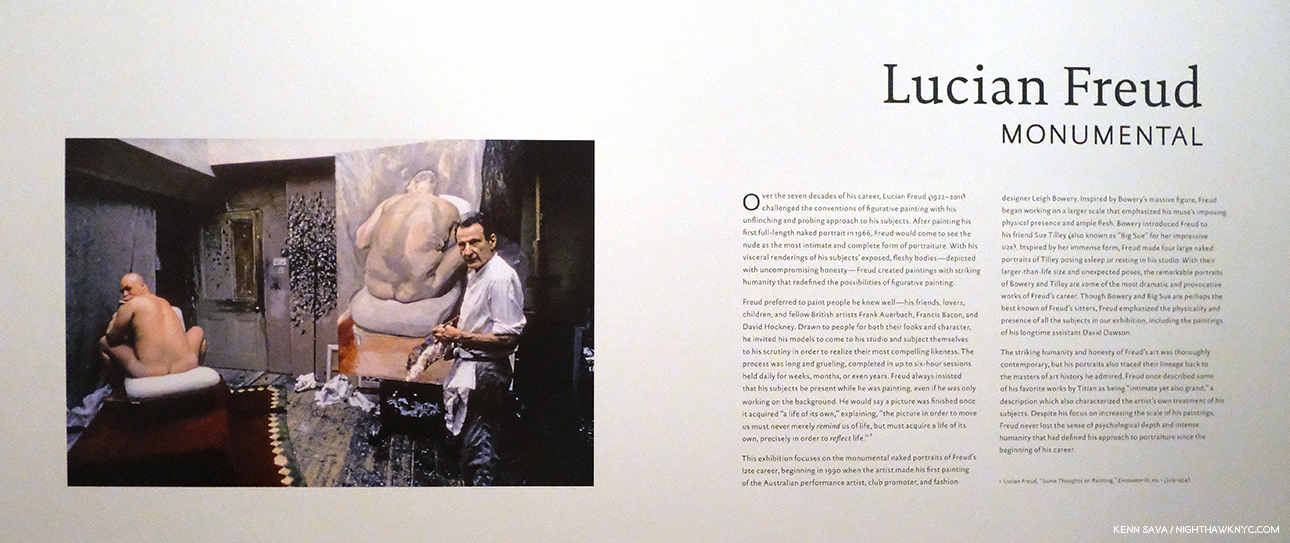
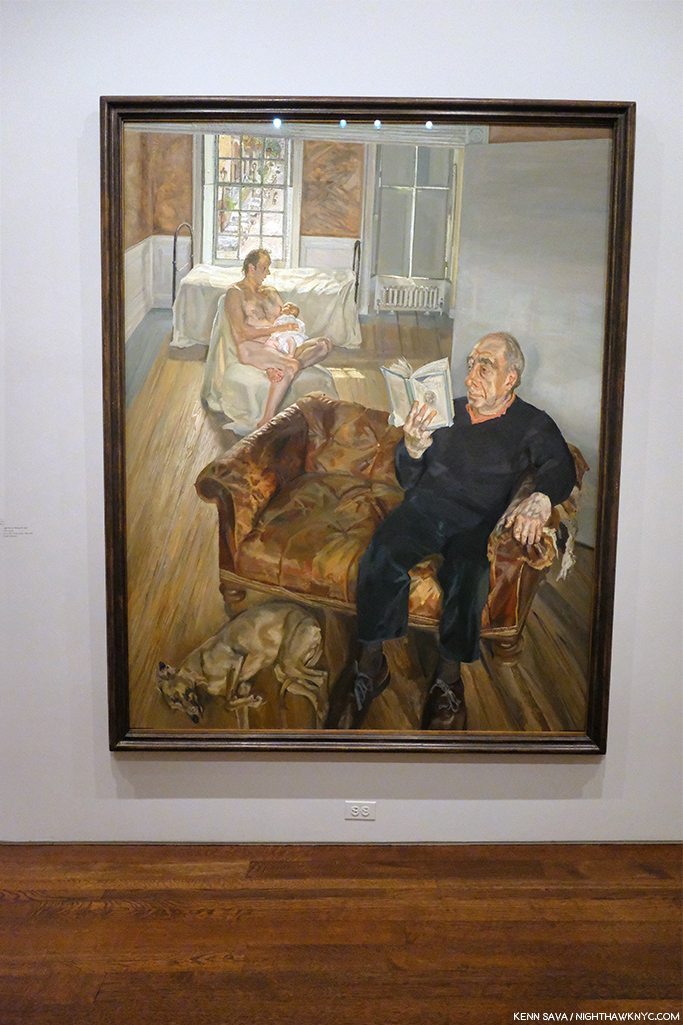
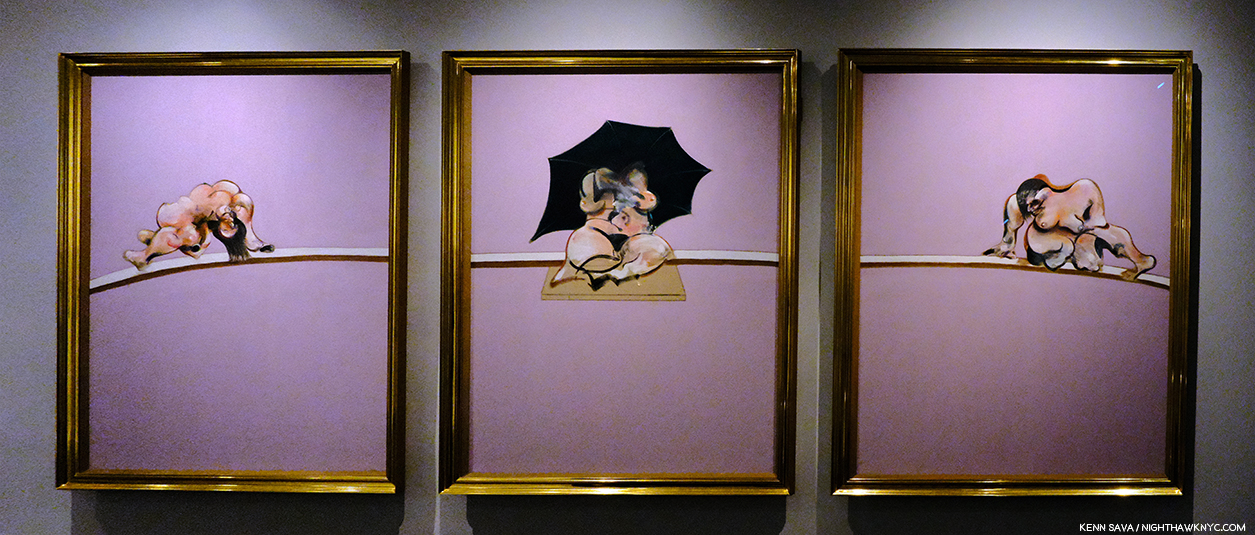
Lucian Freud: Monumental at Acquavella Gallery and Francis Bacon’s Women at Ordovas- Two shows that barely made the cut, with both ending in early January, served as a reminder that I didn’t really need of the fact that both Painters, one time friends, are towering figures in 20th century Art who’s influence remains strong. I couldn’t help wonder how the Freud show benefitted by the presence of legendary former Metropolitan Museum Director, Philippe de Montebello, now a Director of Acquavella Gallery, right across the street from his former and long-time 1000 Fifth Avenue home.

The show featured Mr. Freud’s nudes, emphasizing his extraordinary way of Painting flesh, the aspect of his work that has long fascinated me as much as any other. Here, the only clothed figure in the show.

Regardless, it was an exemplary, concise, museum quality gallery show of the work of an Artist who hasn’t had a show here in too long.

Among many other things, Francis Bacon reintroduced the Triptych to Painting.

Nearby, Bacon’s Women, a subject I can’t say I’ve ever heard broached before, was a revelation. The surprising concept was beautifully executed and mounted in Ordovas’ classic East 77th Street townhouse. Francis Bacon has proved to be an Artist who’s accomplishment has only grown more and more interesting and relevant as time has passed, and so, the rare chance to see some of his lesser seen work was not to be missed.

NoteWorthy Drawings Shows-

Installation view.

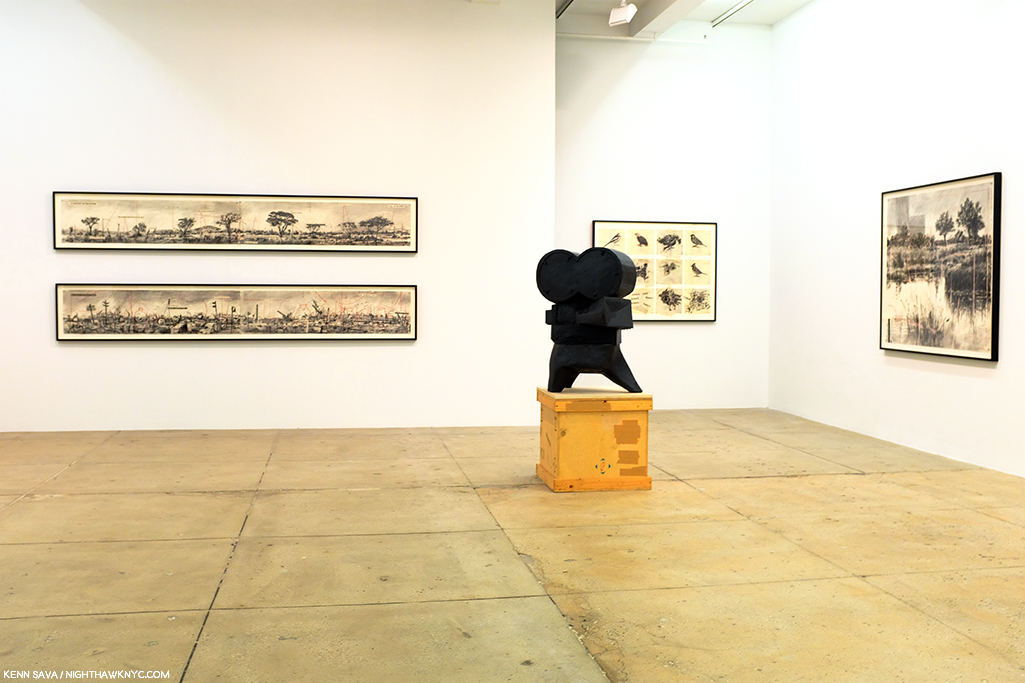
William Kentridge: Second-hand Reading at Marian Goodman- The legendary South African Artist returned to NYC with what seemed to me to be more innovations in his unique and powerful Drawings, along with a selection of his equally unique Sculpture, and Film, shown in the room behind his Projector Sculpture, above.

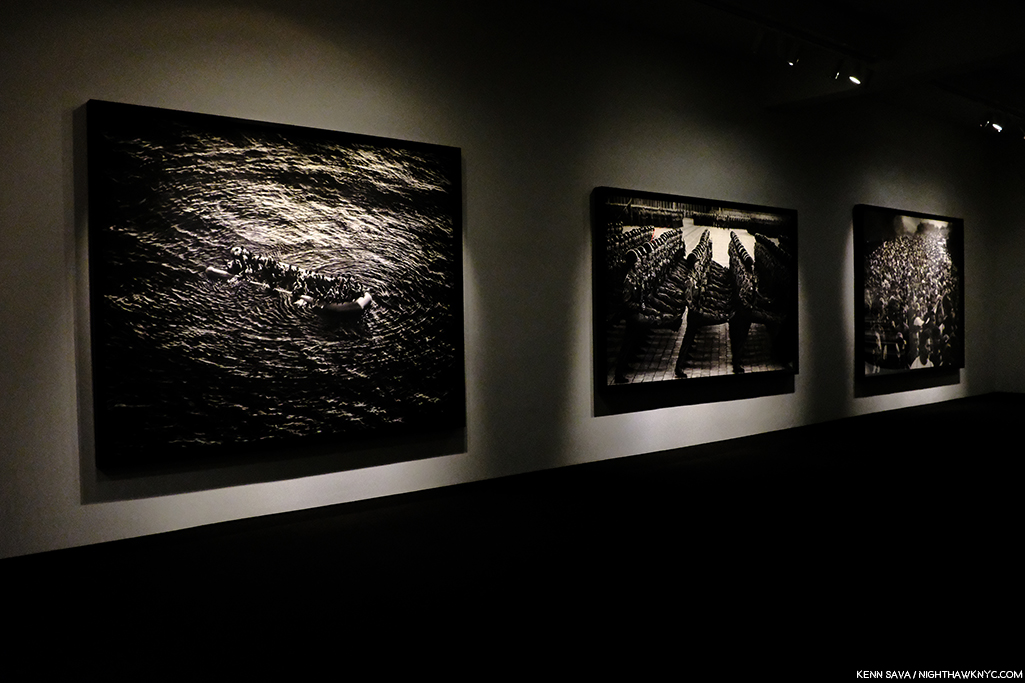
Installation view of 3 of the 7 monumental charcoal Drawings, yes Drawings, in the show by a contemporary master of the medium. Mr. Longo  told me it took 6 months to create the one on the right, 8 months for the one on the left.

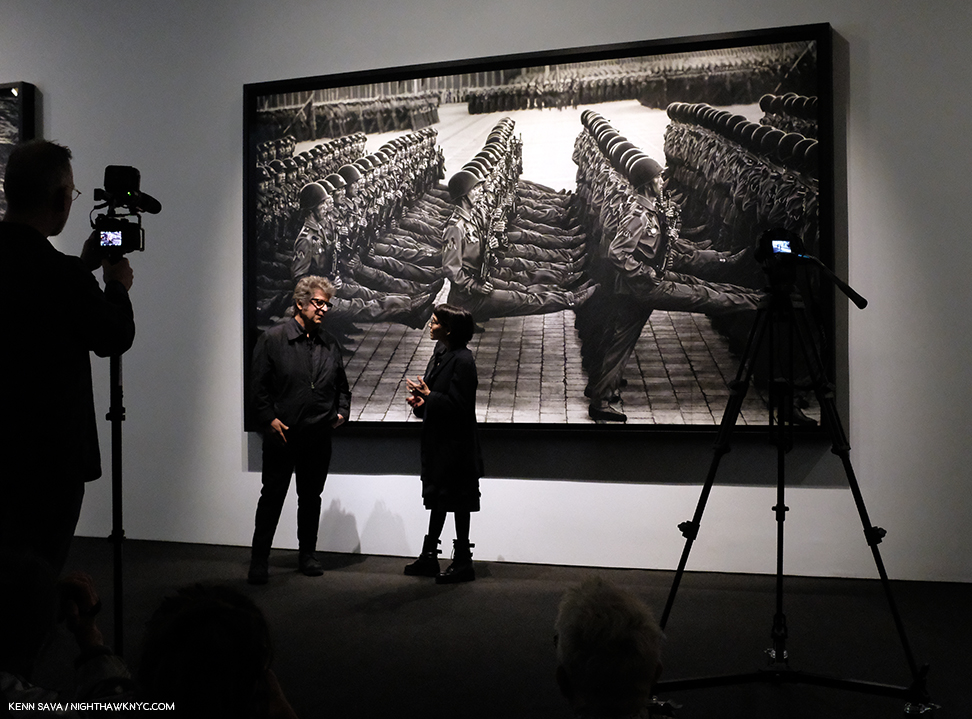
Robert Longo: Fugitive Images at Metro Pictures- During his Artist’s talk in the gallery on January 11th, Mr. Longo broke down discussing one of his pieces with Nancy Spector, Artistic Director of the Guggenheim Museum. I came away even more impressed with the Artist, who’s work I already hold in high esteem.

Robert Longo in conversation with Nancy Spector, Artistic Director of the Guggenheim Museum in front of a Drawing of North Korean soldiers.

Not one to miss a perfect segue…If I had to single out one person who had a great year in NYC Art in 2019, it would be Nancy Spector, who, along with her team, produced a steady string of very good shows at the Guggenheim, continuing their run these past few years, a number of which I’ve written about.

NoteWorthy Photography Show

Vik Muniz: Surfaces Installation View. These are called multimedia. A close look reveals the numerous layers of each work in which Mr. Muniz reinterprets 20th century abstract Paintings to fascinating effect. Garden Design, after Roberto Burle Marx, Pierrot, after Willys de Castro, Composition/Space, after Cicero Dias, Surfaces, 2019, Multimedia, left to right.

Vik Muniz: Surfaces and Museum of Ashes at Sikkema Jenkins & Co- Looking through the two volume Vik Muniz Catalogue Raisonne, the first thing that strikes me is that it’s arranged in sections according to the technique he used, something I can’t say I’ve seen before, and something even more remarkable when you consider that a good number of these techniques he invented. Along the way, he’s already created a substantial body of memorable pieces, which have gained him worldwide recognition.

Detail of the layers of Garden Design, after Roberto Burle Marx. As a result, each piece is unique.

He was at it, again, adding yet two more innovations, in his remarkable two part show at Sikkema Jenkins & Co. Beyond his endless inventiveness, technique being a means to an end, the results have continued to resound. No mean feat when you consider that one part of his show was based on famous masterpieces of Painting, above, in the Surfaces section of the show, the other based on “resurrecting” Art works lost in a fire, turning their very ashes into recreations, in the Museum of Ashes section. Surfaces was based on Paintings by Arthur Dove, Hans Hoffman, Stuart Davis, Carmen Herrera, Ellsworth Kelly, Marsden Hartley and Romare Bearden, among others, adding a new dimension to the perception of each of these works. Daring!

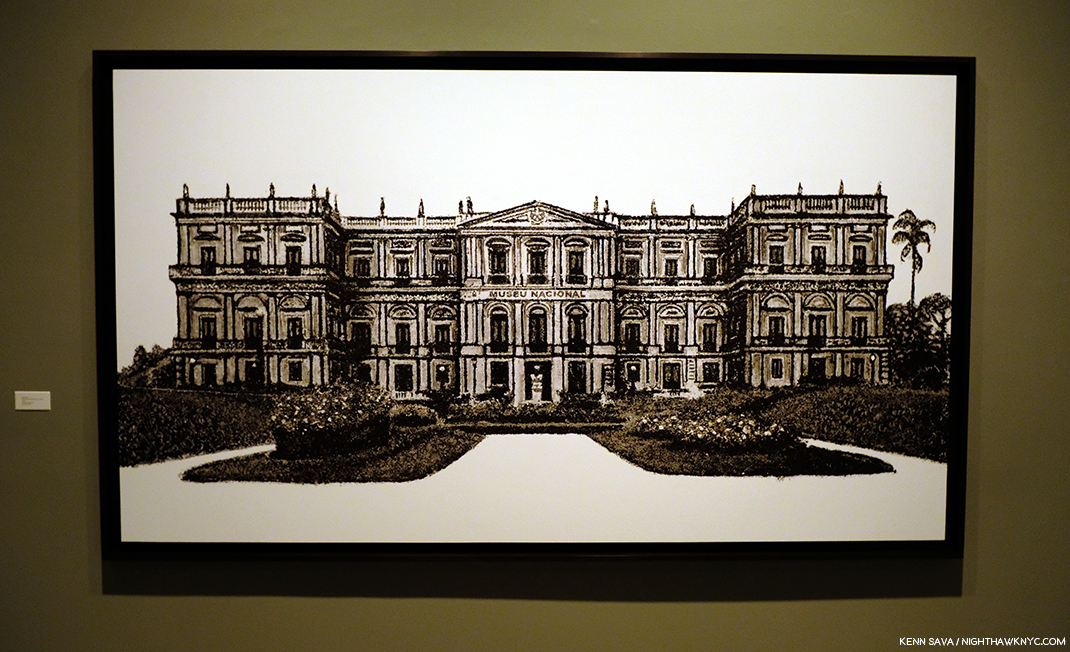
Vik Muniz recreated works from the Museu Nacional from their very ashes! Here he recreates its facade. Museu Nacional, Museum of Ashes, 2019, Archival inkjet print.

On September 2, 2018, the entire Museu Nacional in Rio de Janeiro burned to the ground, including all its collections amassed over the past 200 years. The museum was Muniz’ favorite cultural institution in the city, a place he visited often with his children. On the wall card to this section, Mr. Muniz said, “I cried upon learning of the fire as if I had lost something personal, some kind of string that held the insanity of my present together.”  The Artist proceeded to work with the archeologists sifting the ashes of the building and its contents and was provided with ashes and the exact location they were found.

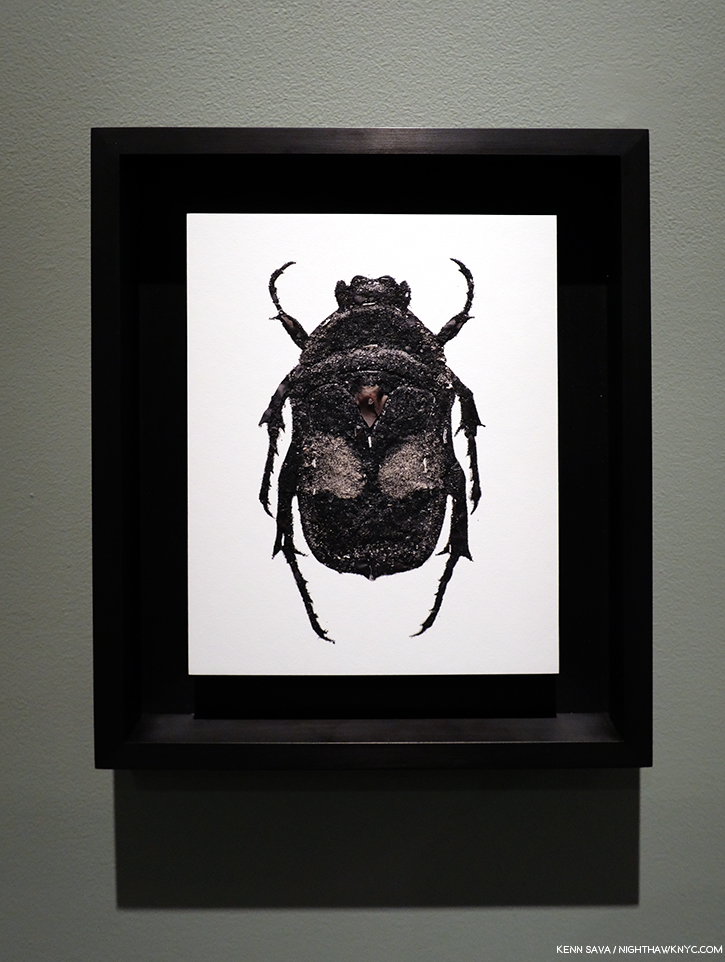
Beetle, Museum of Ashes, 2019, Archival inset print.

He proceeded to reconstruct some of the objects that had been lost- in ash, which he then Photographed. The results speak for themself, and, amazingly, echo what has been lost.

As 2020 gets underway, there would seem to be a bit more stability on the horizon, but not entirely. Change, after all, is the only constant in the universe. The protests at the Whitney resulted in board resignations, and MoMA plans to be open for the full year, as far as I know now. Art in NYC, 2020, however, will already be remembered for two memorable events. The Met marks the 150th Anniversary of the opening of its iconic 5th Avenue location this year- with a closing. 2020 will also be remembered as the year the short-lived Met Breuer closed.

*- Soundtrack for this Post is “Restless Farewell” by Bob Dylan from the timeless The Times They Are A-changin’, 1964.

NighthawkNYC.com has been entirely self-funded and ad-free for over 6 years, during which over 250 full length pieces have been published. If you’ve found it worthwhile, you can donate to keep it going & ad-free below. Thank you!

Written & photographed by Kenn Sava for nighthawknyc.com unless otherwise credited.
To send comments, thoughts, feedback or propositions click here.
Click the white box on the upper right for the archives or to search them.
For “short takes” and additional pictures, follow @nighthawk_nyc on Instagram.

Subscribe to be notified of new Posts below. Your information will be used for no other purpose.


2018: The Year In Art Seen, And Met

Written & Photographed by Kenn Sava

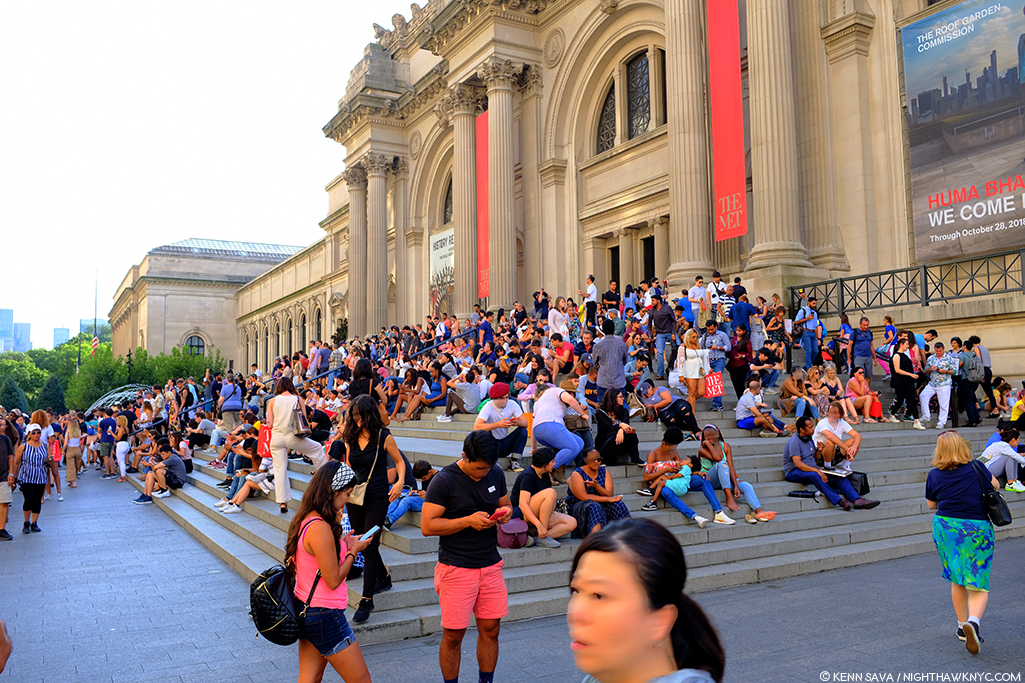
Will Art ever be more popular than it is now? On January 4th, 2019,  The Met announced another attendance record was set in 2018 when almost 7.4 million visited The Met Fifth Avenue, The Met Breuer or The Cloisters1.

On this late summer day, I’ll be lucky if I can figure out a way to get up the stairs to get in! Click any Photo for full size.

Simply put, when I think back on 2018, I’ll remember the extraordinary number of truly great shows I saw at The Met and The Met Breuer this past year, among those 7.4 million. While I certainly spent quality time at the other Museums and saw wonderful shows at each of them (not to mention countless galleries and a few Art & Book fairs), it’s almost impossible to top the list of shows The Met, collectively, mounted this year- especially when you consider that I didn’t even see the biggest show of them all- biggest by attendance that is, the show that drew 1,659,647 visitors- Heavenly Bodies: Fashion and the Catholic Imagination (I saw the parts of it that were installed outside of the show proper).
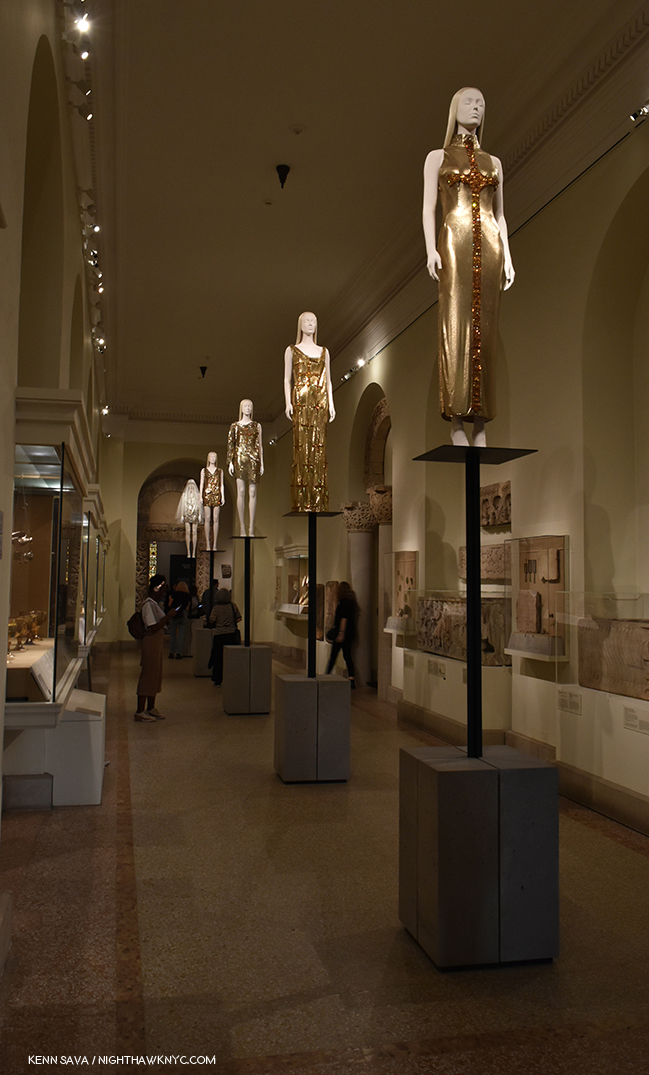
Heavenly Bodies: Fashion and the Catholic Imagination– A view of part of the show installed to the south of the Great Staircase.

I chose to skip it. My friend, the fashion Blogger extraordinaire, Magda, saw it and did a terrific piece on it, here.  As for the Art I saw in 2018? I’ll remember most standing on this spot near the south west corner of the 2nd floor of The Met, and marveling at the sight in front of me in a 270 degree range.

I’ve never seen the likes of this before. A 270 degree panorama from “the spot.” 2nd Floor, Metropolitan Museum.

Before my eyes, there were no less that 4 major and/or historic shows going on within yards of each other AT THE SAME TIME!

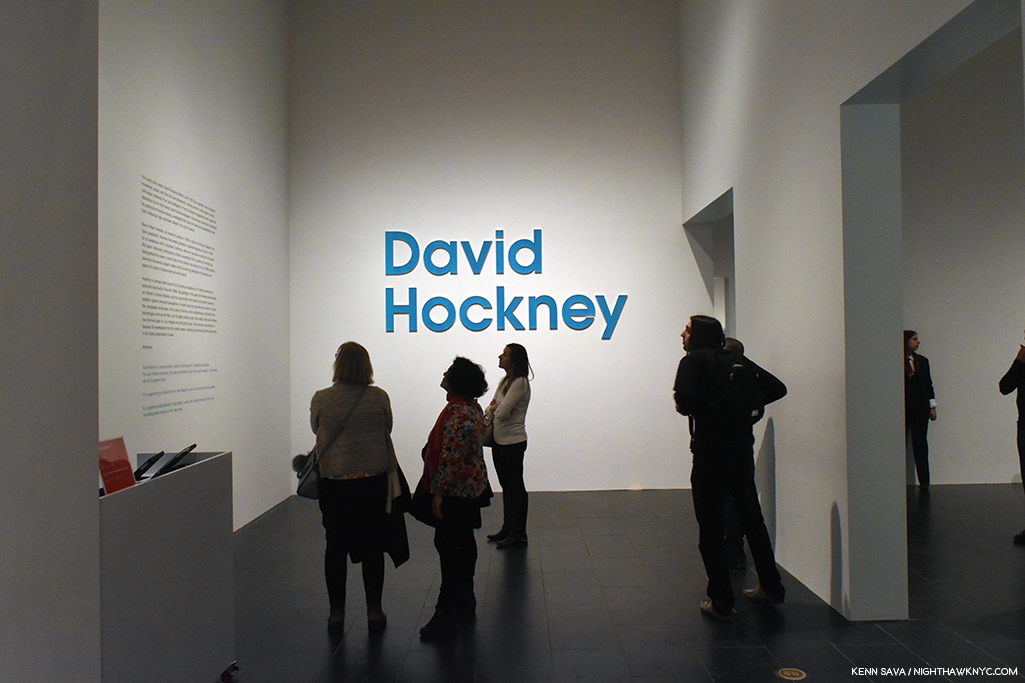
A fortnight of heaven. From right to left- 1- Rodin At The Met, 2- Michelangelo: Divine Draftsman & Designer, 3- David Hockney 80th Birthday Retrospective, 4- Birds of a Feather: Joseph Cornell’s Homage to Juan Gris. This photo was taken on February 4th, 2018. The last day all four of these shows were open at the same time.

Behind me, to the far right in the panorama, above, was Rodin At The Met (1, above), which I had just walked through to get to this spot.
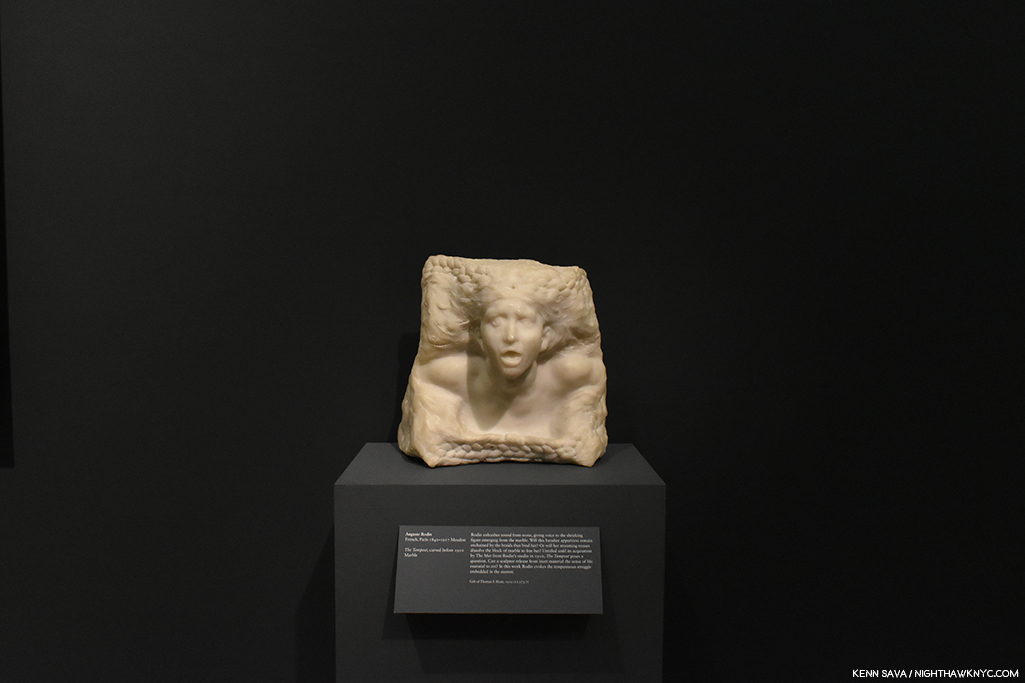
Rodin, The Tempest, before 1910, Marble, seen in Rodin In The Met.

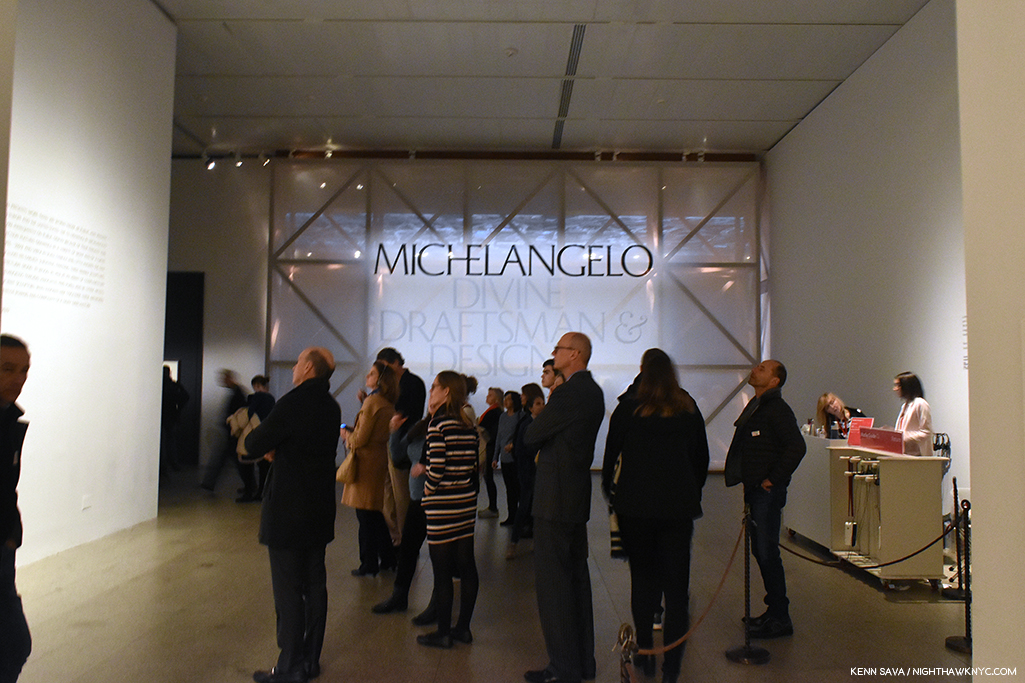
Just to my right was the once in a lifetime Michelangelo: Divine Draftsman & Designer (2), containing 133 of the Master’s Drawings and 3 Sculptures. Just to the left of that was the David Hockney 80th Birthday Retrospective (3). Down the hall to the left, Birds of a Feather: Joseph Cornell’s Homage to Juan Gris (4) recently opened. The run of all four overlapped from January 23rd to February 4th, when I took the above, just 13 days.

Had enough? C’mon. This is NYC!
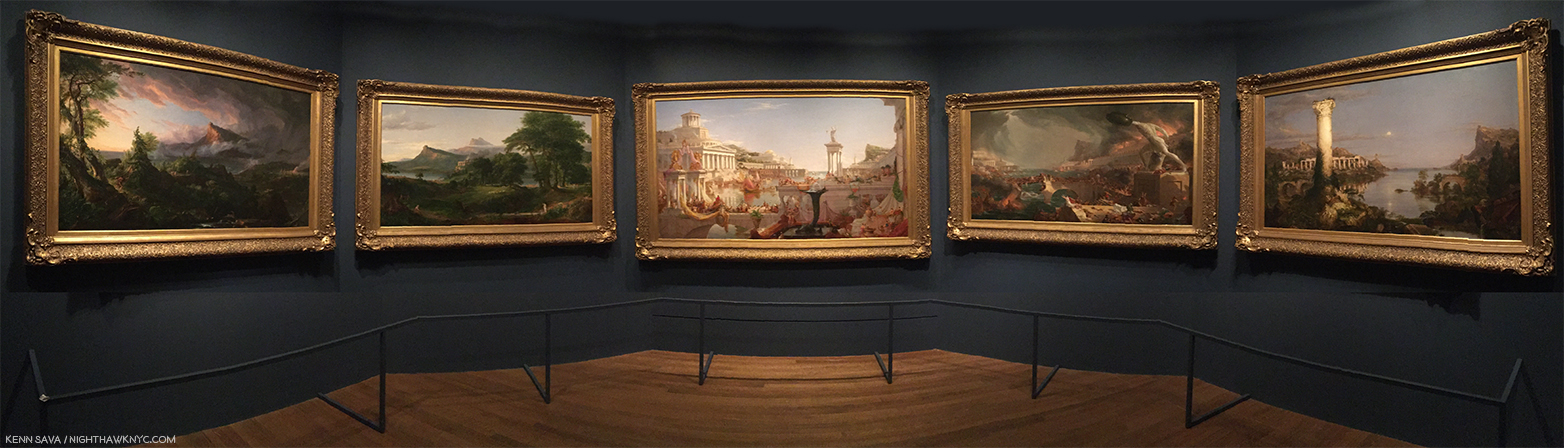
Thomas Cole, The Course of Empire, Oil on canvas, 1833-36, on loan from the New York Historical Society. Installation view of Thomas Cole’s Journey: Atlantic Crossings. 170 years later, they would inspire Ed Ruscha to create a contemporary version that was shown in conjunction with the National Gallery, London, incarnation of this show.

ALSO going on at that very moment down in the American Wing, Thomas Cole’s Journey: Atlantic Crossings was a quite pleasant surprise, AND, over at The Met Breuer, the revelatory Edvard Munch: Between The Clock And The Bed was closing that very day! The Met, typically, has up to 25 shows up at any one given time. But, SIX MAJOR Shows up at the same time is extraordinary. WHERE else in the world does that happen?
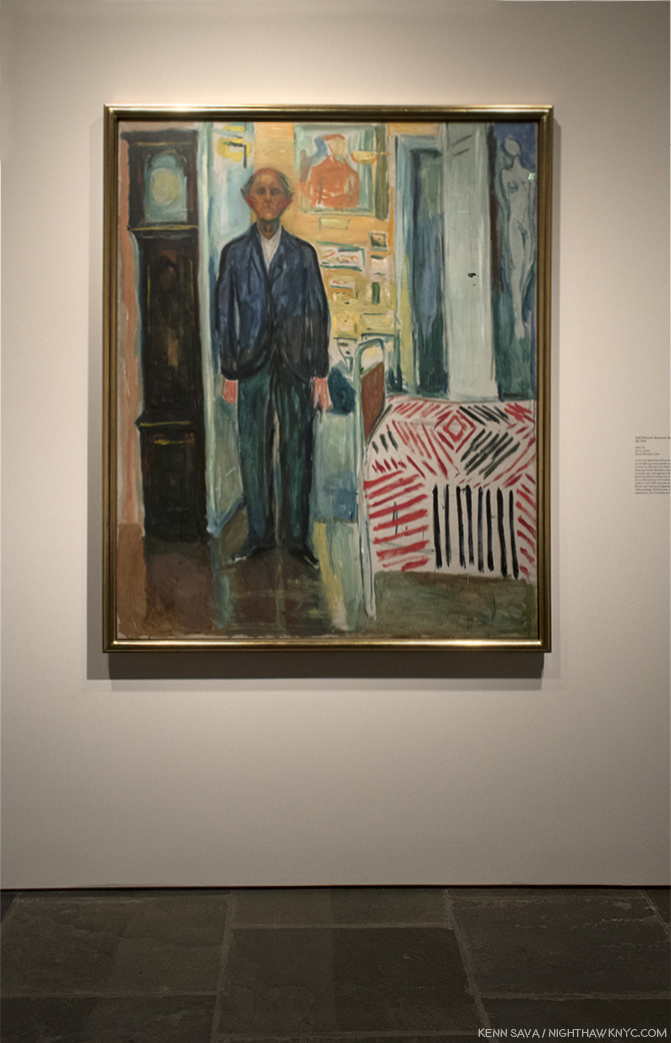
Edvard Munch, Self-Portrait: Between the Clock and the Bed, 1940-43, Oil on canvas. His last significant “self-scrutiny” as he referred to his self-portraits, he stands before the faceless clock and bed, in front of his Paintings.

Thus far, I’ve written about 3 of them-

Michelangelo: Divine Draftsman & Designer

Thomas Cole’s Journey: Atlantic Crossings

Edvard Munch: Between The Clock And The Bed

Given all of this, even before January, 2018 was over, I knew nothing was going to top The Met in Art in NYC this year. But? Keep an open mind, right? Let em try! Well, now that the year is over, and I take stock at all that happened, nothing changed my mind. In fact, there were more great shows at The Met as the year unfolded. So much happened that in spite of all of my coverage, there are other shows and Artists I feel the need to show and talk about. I’ve decided to focus on 3 Artists here I encountered or discovered in Met shows in 2018- one, very famous, another, who recently passed without receiving as much acclaim as I feel he deserves, and a third who, I feel, is one of the most important Artists of our time.

First, a spot quiz- Before you read the caption, who is this by?
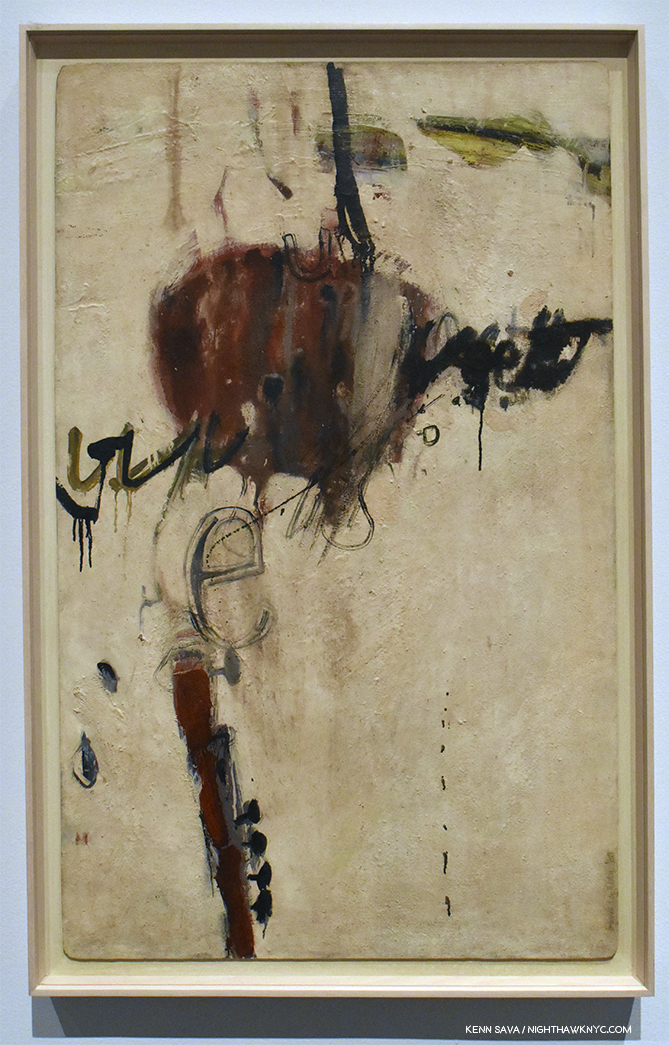
Tyger Painting No 2, by David Hockney, 1960, when the Artist was about 22, Oil and mixed media on board.

When I saw that David Hockney was installed right next door to all the treasures by no less than Michelangelo, the Artist called “Il Divno,” I couldn’t help but wonder what that initial phone call was like…a Met executive reaching out to Mr. Hockney by phone, saying something like, “David, this is _______ from The Met. We have some good news for you, and, maybe, some not as good news for you. The good news is The Metropolitan is giving you an 80th Birthday Retrospective! Congratulations! The not as good news is it’s being mounted right next to a once in a lifetime Michelangelo show containing 133 of the master’s Drawings and 3 of his Sculptures…” And you say you want to be a famous Artist? Stay humble. Fame is relative, possibly fleeting.
The Met reported 702,516 people visited the Michelangelo show, and 363,877 attended David Hockney.

I haven’t spent much time looking at the Art of David Hockney, but I have with his exceptional books, particularly the now classic, Secret Knowledge, and the fascinating History of Pictures: From the Cave to the Computer Screen. Secret Knowledge, which has made a real contribution to Art History, was nothing less than a bombshell when it was released in 2001. His, and physicist Charles Falco’s, theory that the Old Masters (including Jan van Eyck, my first personal God of Painting) used optics, recently developed in Van Eyck’s time, to get the incredible realism they achieved was deemed heresy. Until you looked at the “evidence” they presented, including a huge wall Hockney created of postcards of Paintings created before 1400 and up to modern times that showed a sudden sharpening of their realism occurring about the beginning of the fifteenth century.

Upon closer look, their theory made perfect sense. I wished it had come years earlier when I was struggling to learn how to draw by “eyeballing” my subjects, which, of course, continues to have its place. Secret Knowledge became a superb BBC TV Documentary, and then a television series, and its impact is being felt to this day. The 2016 Film Tim’s Vermeer shows inventor Tim Jenison using these techniques to “re-create” how Vermeer might have done his Paintings. Of course, Secret Knowledge is a theory, not history, though as I said, it’s one that makes sense. Perusing it and A History of Pictures, released in late 2016, I was led to Cameraworks and his interviews on Photography, which I’ve found equally compelling. So, the David Hockney Retrospective gave me a long-delayed chance to consider his long, prolific and restless Art career. Afterall, since the passing of Lucian Freud and Francis Bacon, he is oft referred to as “England’s foremost living Painter.” 
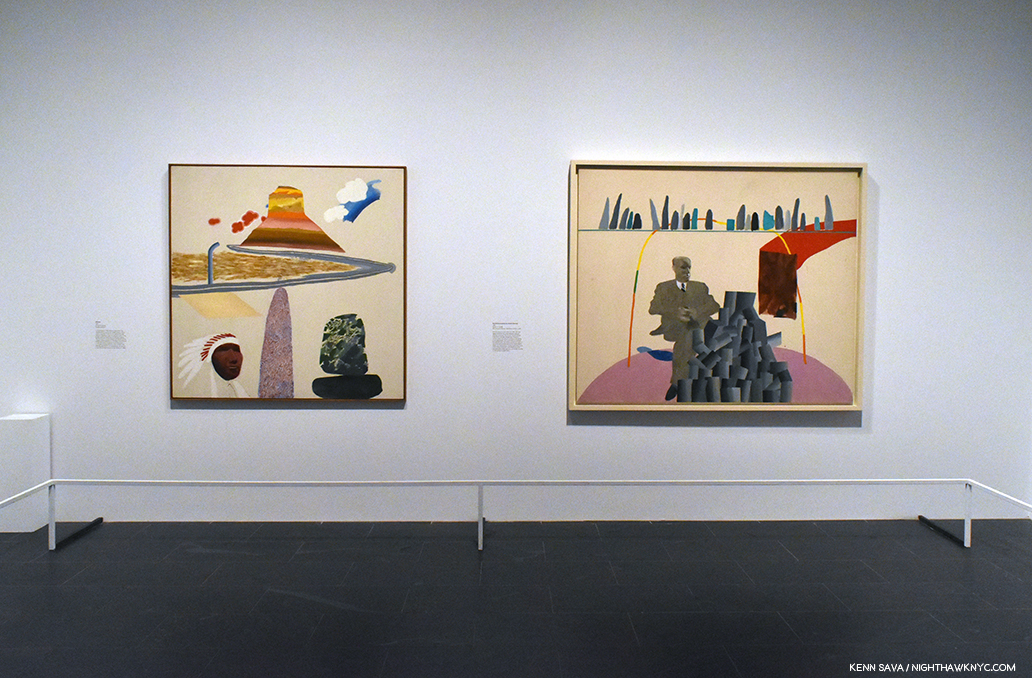
Arizona, 1964, left, Portrait Surrounded by Artistic Devices, 1965, right.

Though his popularity would be a while coming, requiring a move half way around the world to California, David Hockney showed a remarkable tenacity early on, Painting in styles that were, well, “different” from that of any other Painter of the time. He moved from abstraction to works that were somewhere between abstract and figurative, generally including a figure, before landing on a style that retained his use of color while becoming even more representational.
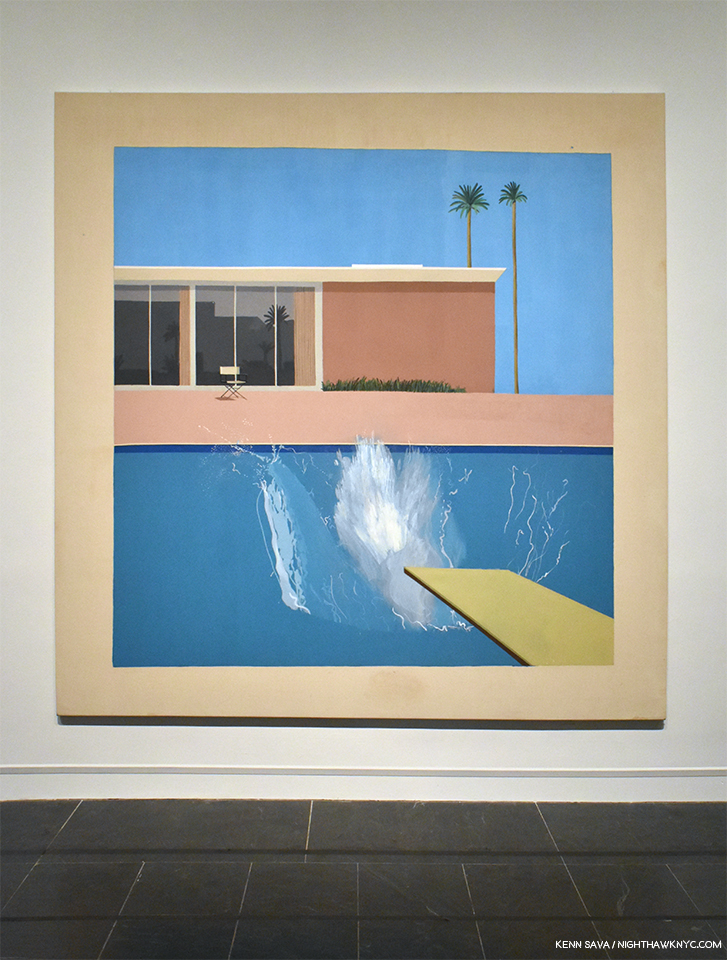
A Bigger Splash, 1967, Acrylic on canvas. Without the unseen swimmer, the splash becomes a passage out of Abstract Expressionism, jarring the all too peaceful scene.

Moving to LA, his style exploded into color, a sudden taste for representationalism in a style that came to epitomize upper class California living to the point that its now sparked something of a “response,” from Ramiro Gomez, who focuses on the workers maintaining these places-
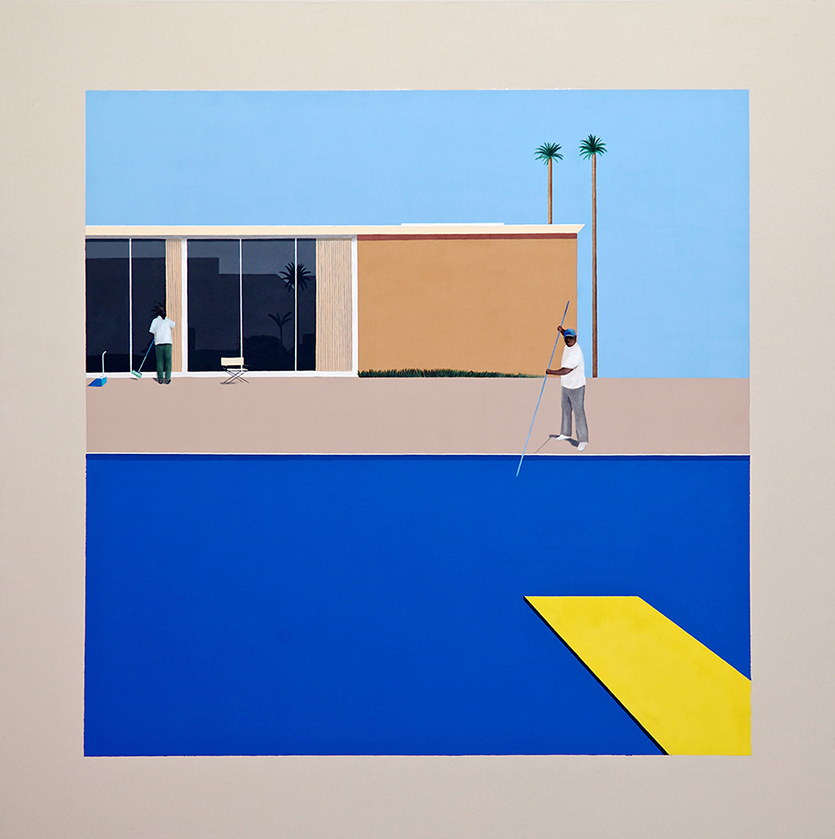
Ramiro Gomez, No Splash, 2013, 96 x 96 inches, after David Hockney’s A Bigger Splash, 1967, focuses on the pool workers instead of the residents. Photo: Osceola Refetoff for Charlie James Gallery

David Hockney could have continued to paint these ad infinitum and, no doubt, sell every single one he produced. But, he’s far too restless, and curious, to stand in any one spot for too long.
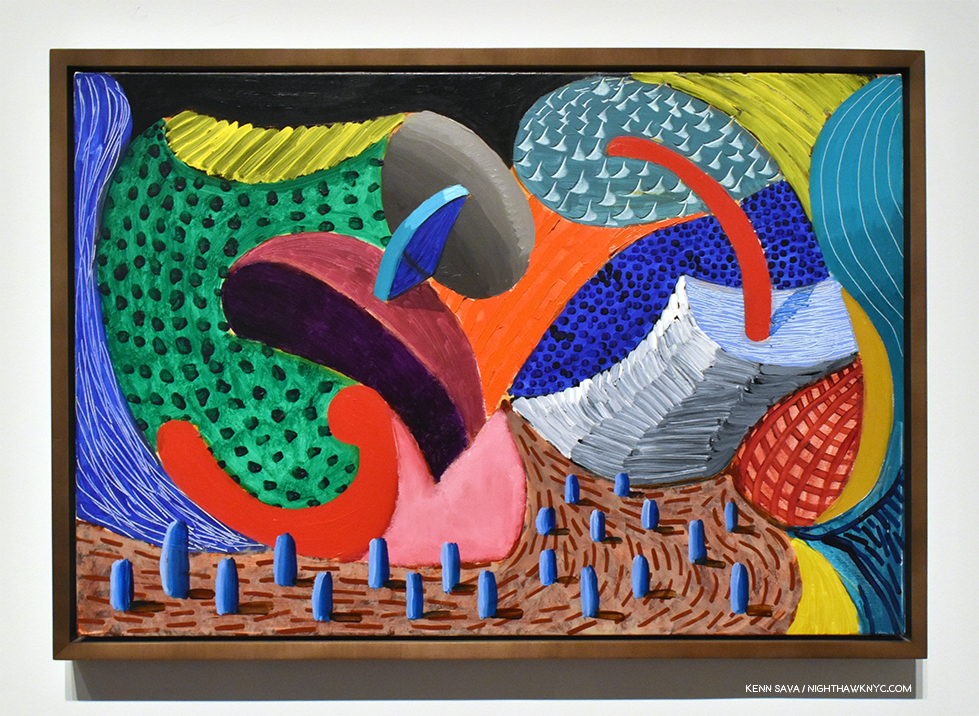
The Twenty-Sixth Very New Painting, 1992. Picasso and Cubism have never been very far from David Hockney’s mind- to this day.

He then revealed his own take on portraiture in single subjects and couples before exploring, and breaking the boundaries of, Photographic perception with his “joiners,” which explored his belief that we don’t see the way the camera sees- with a fixed, single, viewpoint.
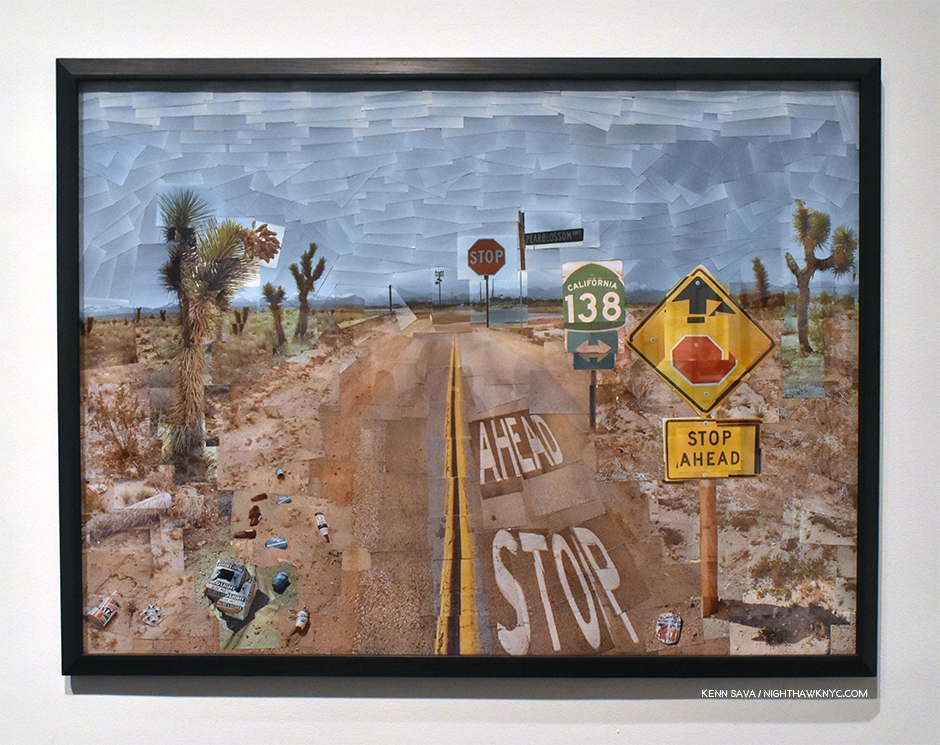
In Pearblossom Highway, 11-18th April, 1986, #1, 47 x 64 inches, a “joiner” composed of hundreds of Photographs, David Hockney explores his belief that a camera has a fixed viewpoint and a single vanishing point. So, putting hundreds of Photos together creates many. He’s said he considers this work “a panoramic assault on Renaissance one-point perspective2.”

All along he drew, and he drew and he drew. There were times when I admit looking at his work and wondering how well he could draw but being well acquainted with the difficulties involved in mastering the line, as the show moved through his Drawings, its seminal and central place in his practice becomes clear as he relentlessly forged ahead. As the Drawing section ended, he seemed to me to have finally made peace with Drawing, having taken it from graphite on paper to the use of the Camera Lucida and more recently, to the iPhone and the iPad.
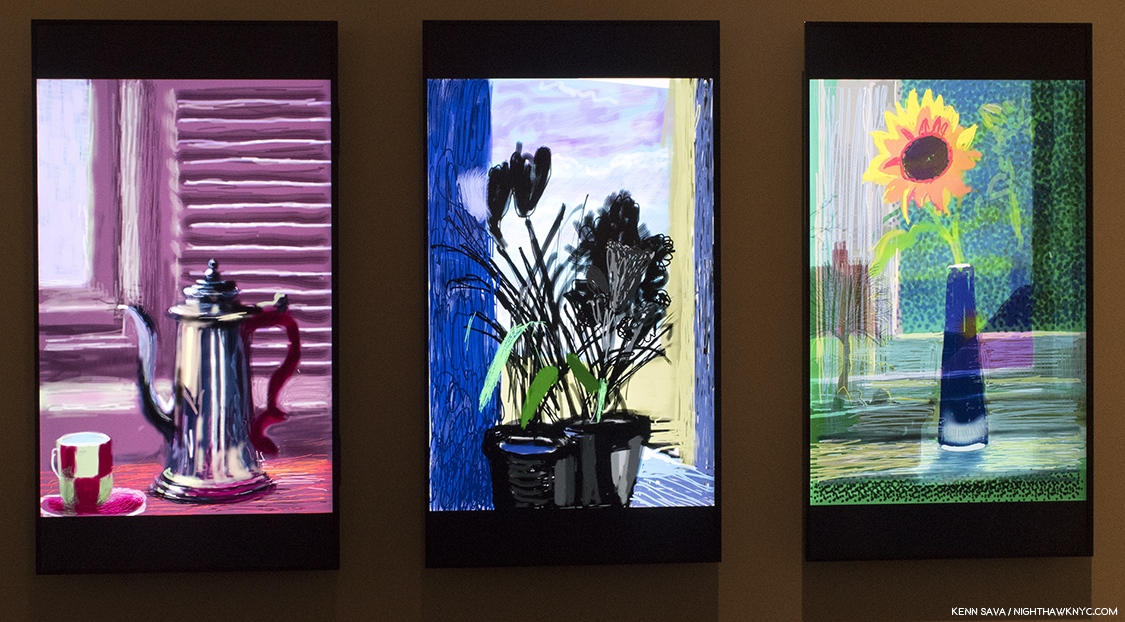
Three iPad Drawings, shown in-progress side by side in the final room.

His painting, too, continually evolved over the years and decades.
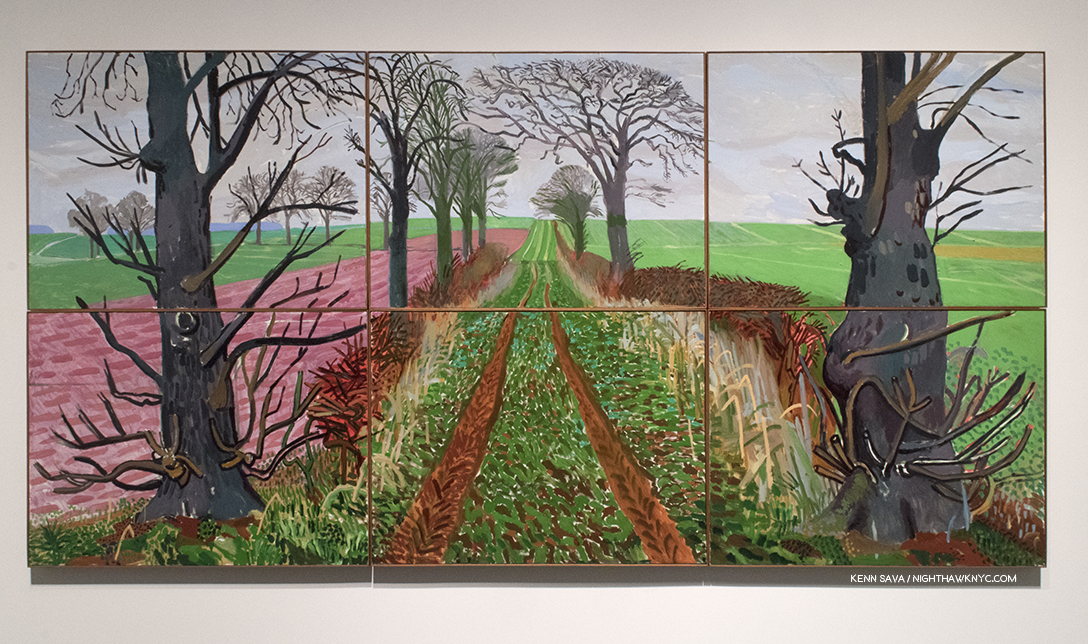
A Closer Winter Tunnel, February-March, 2006.

He left LA to return to the home his late mother had lived in and turned his attention to a little known area called the Yorkshire Wolds and created a remarkable series of landscapes, including some multi-panel monumental works, along with multi-channel videos that show this area that no Artist had previously “discovered” to be full of picturesque wonders.
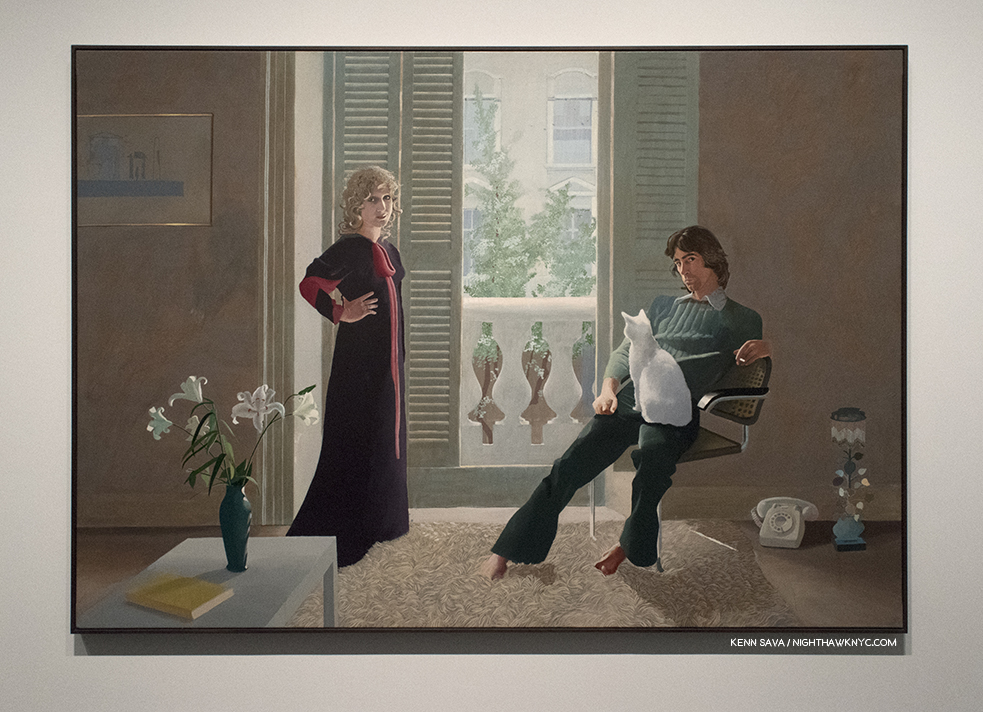
Mr and Mrs Clark and Percy, 1971. The “coolness” here can be partially explained by the fact that this was a rare commission the Artist accepted and so, he didn’t have a personal relationship with them.
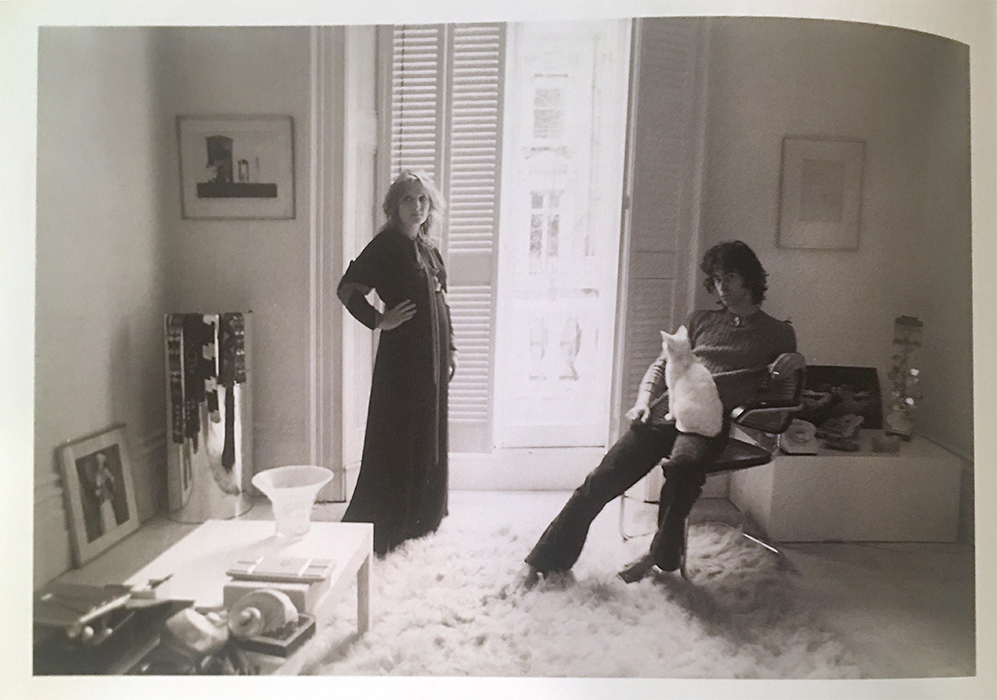
Mr and Mrs Ossie Clark, 1970, Photograph. Not mentioned anywhere in the show, and not very well known, is that David Hockney used Photographs, usually his own, as source material for years. Later, he finally created Photographs as stand-alone works. It’s fascinating to see what’s changed in the finished Painting. (From David Hockney on Art, Conversations with Paul Joyce, P.14, hence the curve.)

Personally, I find a cool distance in most of David Hockney’s work (felt most clearly in his double portraits, but present in everything from his landscapes to his single portraits) that the bright colors and the often undeniable beauty do not hide. This works to his advantage during the period he spent immortalizing the Yorkshire Wolds, beginning in 2005, until about 2013, near where he grew up, seen before. It’s hard for me to look at these beautiful works without being a little bit reminded of the work of another of his long time influences, Vincent van Gogh. Particularly because Mr. Hockney chose to largely create these works on the spot, en plein air, during all four seasons, late winter seen above. The passage of time looms large in this series of works, as it has in the intervening years since Mr. Hockney worked in these fields as a  young man. Yet, in them we see everything change- the seasons, the weather, individual trees, everything except the Artist. That we can only see through surveying his work through the years.
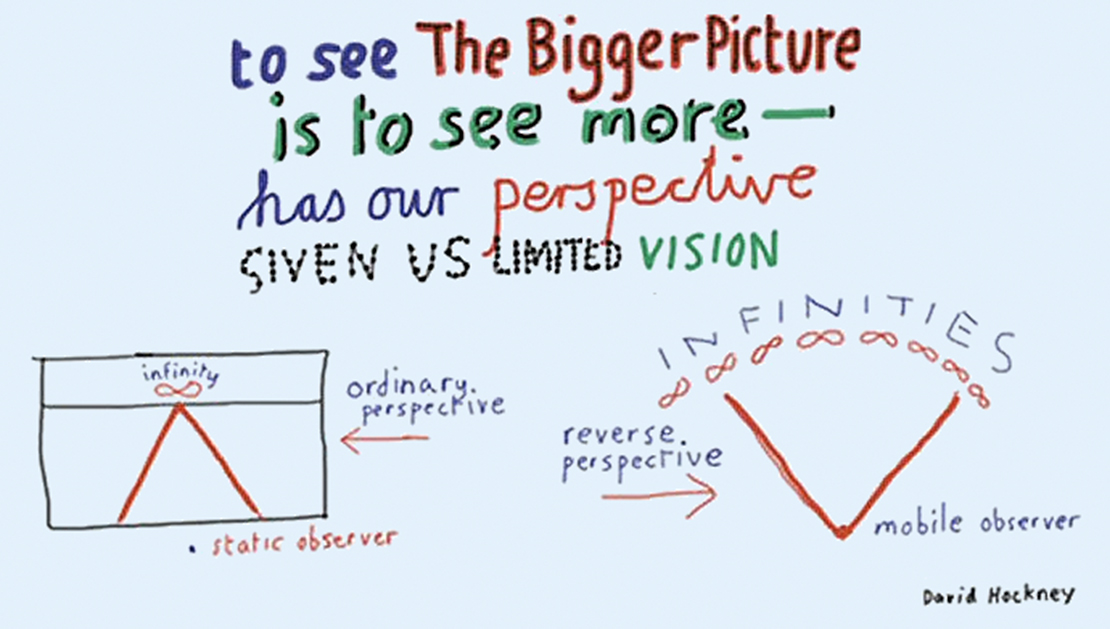
Ordinary versus Reverse Perspective.

David Hockney revealed an Artist who doesn’t get enough credit for his progressiveness, the resistance of his work to current fads, and its individuality. From the beginning he turned a deaf ear to trends and norms, rejecting both Abstract Expressionism and Pop while somewhat brazenly, and frankly, featuring homosexuality (which was illegal in England until 1967). After the tragic death of an assistant, Mr. Hockney sold the Yorkshire house in 2015 and returned to L.A. “Reverse perspective,” as he refers to it, has taken full hold in his most recent work, as seen in the final gallery at The Met, and at Pace on West 25th Street in David Hockney: Something New in Painting (and Photography) (and even Printing), in April and May.
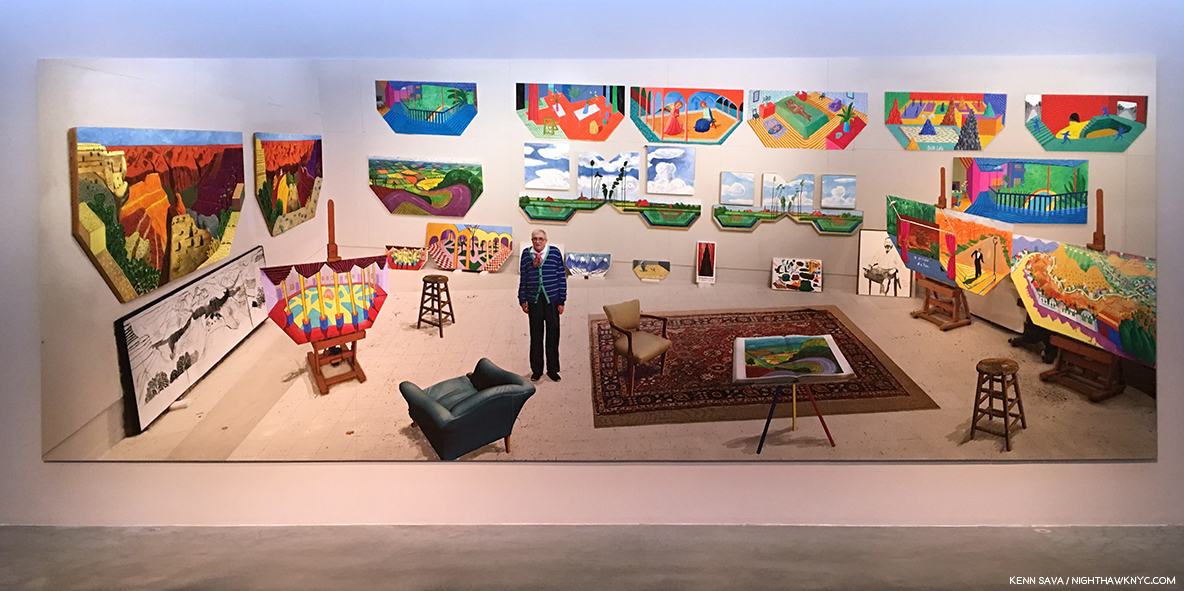
Here, in David Hockney: Something New in Painting (and Photography) (and even Printing) at Pace, spring, 2018, Mr. Hockney cleverly manages to include all the works on the surrounding walls in the Pace show in this Photographic Drawing, as he calls it, which forces the eye to move around the work, each stop becoming a new perspective.

Taken to another level, I think, he’s also comparing Photography to Painting. In addition to his fascinating thoughts on perspective and how cameras see versus how humans see, I found he had already put down in print quite a few things I was feeling about Painting versus Photography a year and a half into my deep dive into “post-The Americans” Photography. I’ll save those for another piece.

Mr. Hockney has been first a number of times, so far, in a rage of realms, including Photography. Being first is not something history often rewards. David Hockney’s popularity seems to know no bounds, and his influence is there to be seen in the work of any number of Artists. Yet, as with every other Artist, posterity will decide where David Hockney’s Art belongs, and time will tell if it will be as popular in hundreds of years as it is now, or not. In the meantime? I’m interested to see what this Artist who lives to create does next.
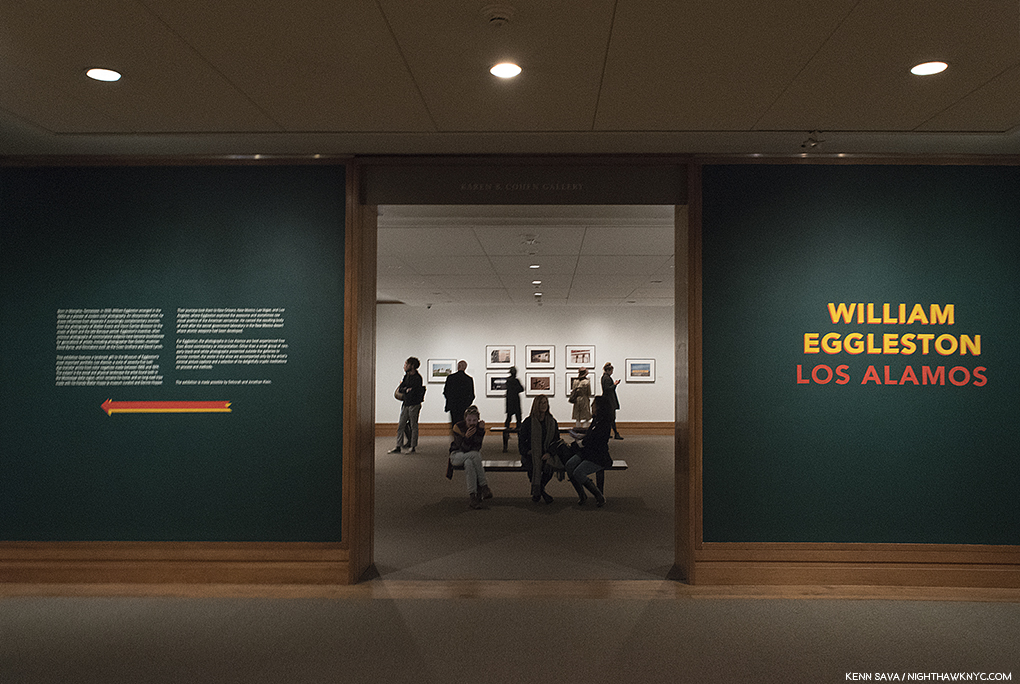
Coincidentally, and fortuitously, 10 days after I took that panorama from “the spot,” The Met’s William Eggleston: Los Alamos opened, giving me a chance to revisit the work of the Artist who’s show at David Zwirner in December, 2016 led to my deep dive into the world of Contemporary Photography. I wrote about Los Alamos here.
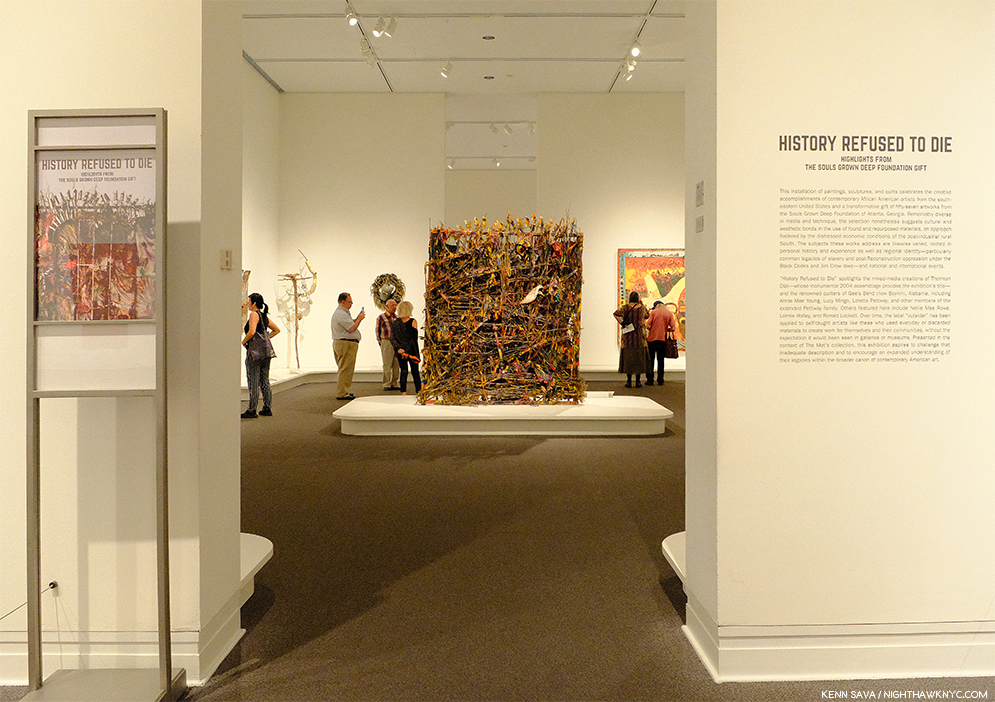
Exit/Entrance installation view of History Refused to Die, showing the recto of the titular work, the recto  is seen below, center.

After the six major shows ended, I returned to The Met to see History Refused to Die, a sleeper of a show publicity-wise, that honored the recent gift to The Museum by the Souls Grown Deep Foundation by featuring a selection of 30 Paintings, Sculptures, Drawings and Quilts from it by self-taught contemporary African American Artists, highlighted by a number of truly amazing works by the late Thornton Dial (1928-2016).
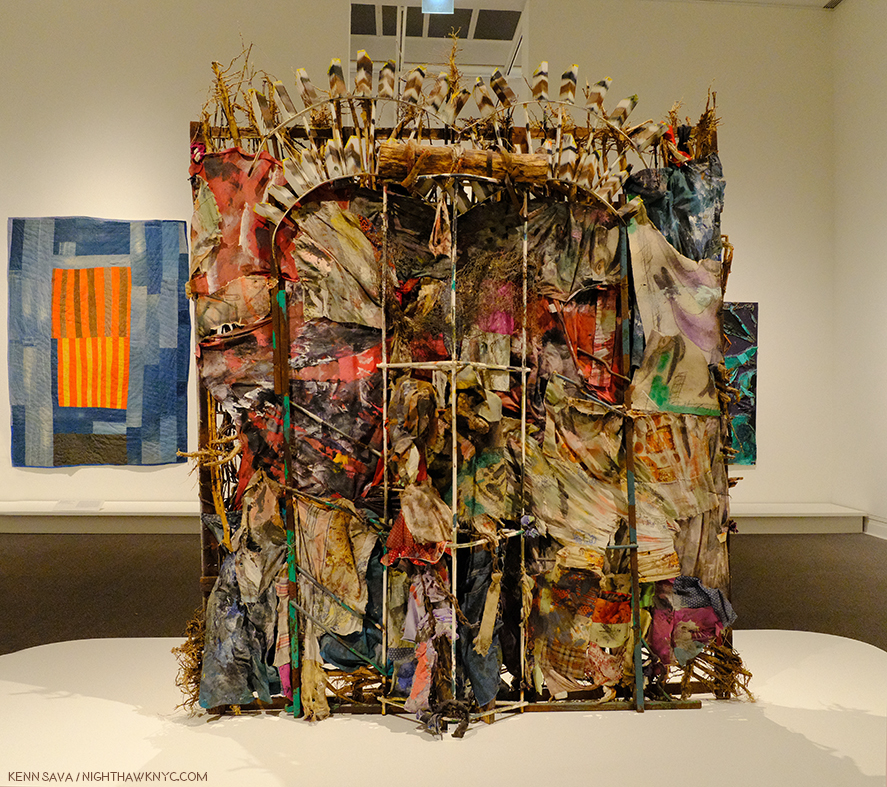
Thonton Dial, History Refused to Die, 2004, Okra stalks and roots, clothing, collaged drawings, tin, wire, steel, Masonite, steel chain, enamel and spray paint, front, center. Verso of the work seen above.

Mr. Dial created a body of work after having watched the events of 9/11 on television. It, and the subsequent war were the subjects of a few works seen here, among others.
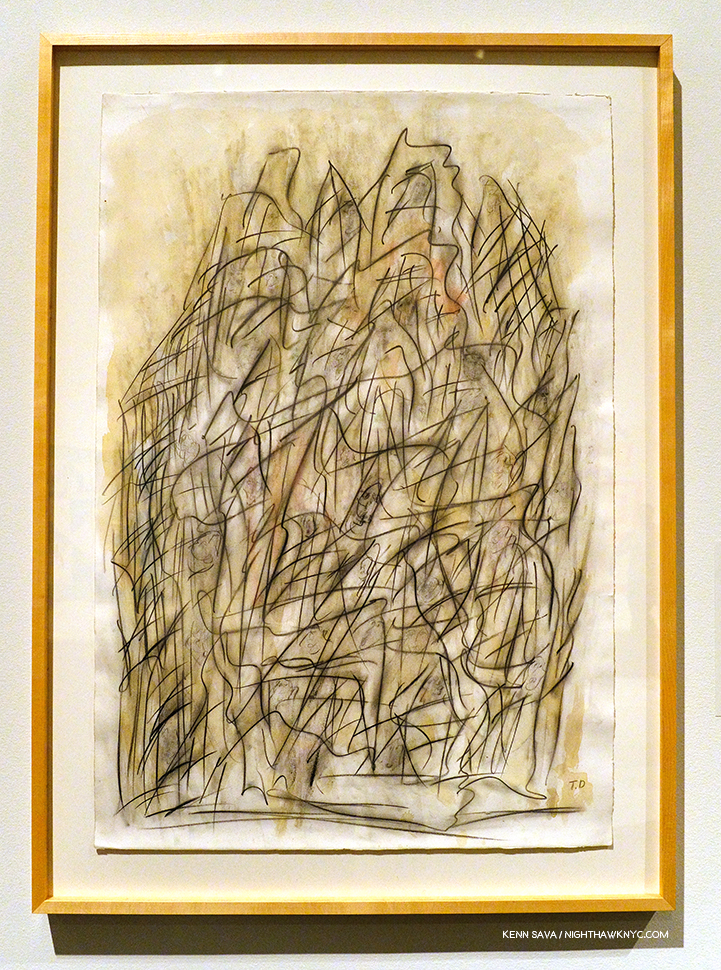
Thornton Dial, 9/11: Interrupting the Morning News, 2002, Graphite, charcoal, and watercolor on paper.
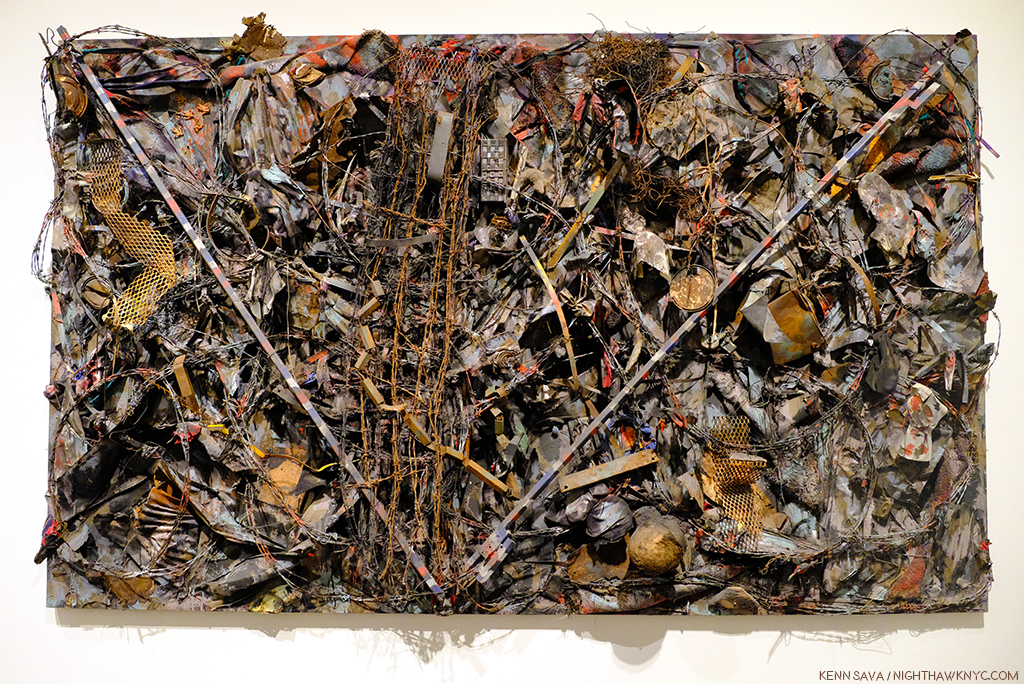
Thornton Dial, Victory in Iraq, 2004, Mannequin head, barbed wire, steel, clothing, tin, electrical wire, wheels, stuffed animals, toy cars and figurines, plastic spoons, wood, basket, oil, enamel, spray paint and two-part epoxy putty on canvas and wood.
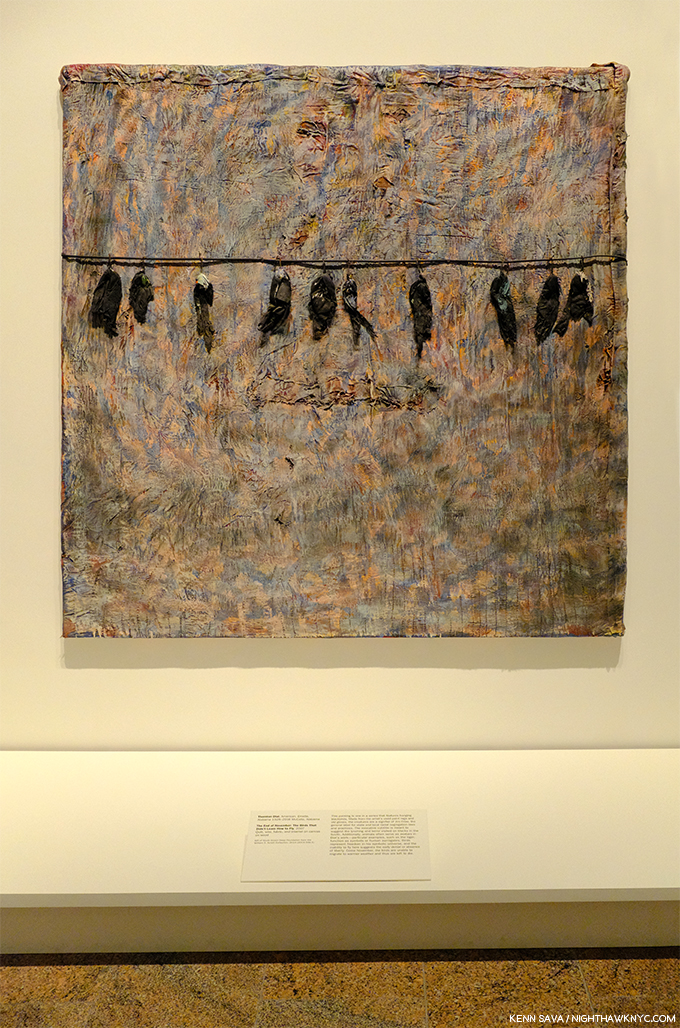
Thonton Dial, The End of November: The Birds That Didn’t Learn How to Fly, 2007, Quilt, wire, fabric, and enamel on canvas on wood.

While I returned a few times to see Mr. Dial’s work again, I was also impressed with that of Ronald Lockett (1965-1995), a cousin of Thornton Dial.
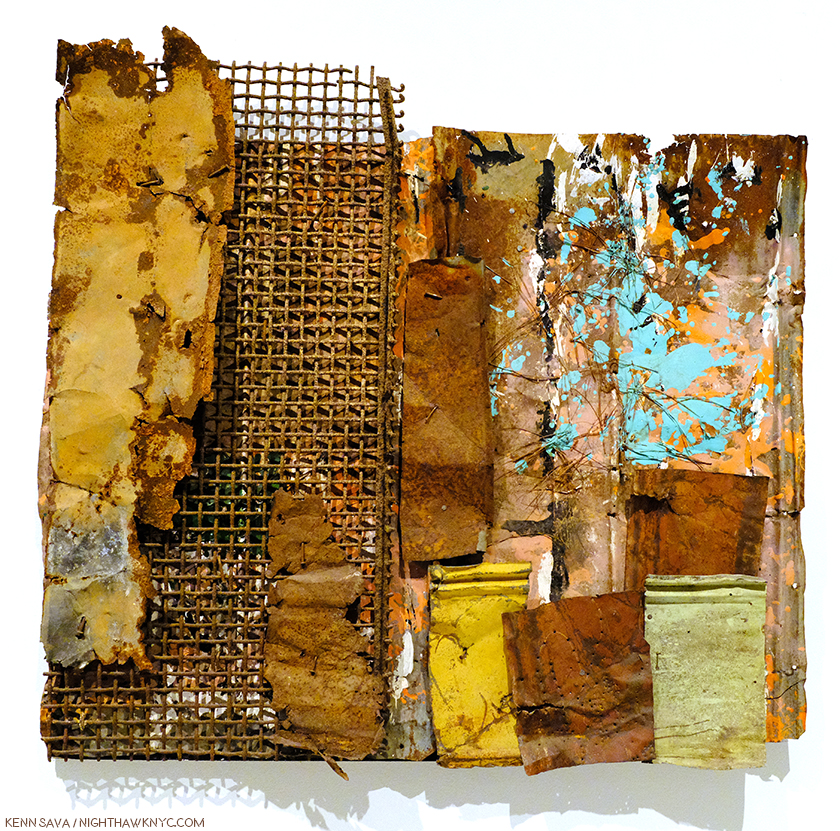
Ronald Lockett, The Enemy Amongst Us, 1995, Commercial paint, pine needles, metal and nails on plywood.

One of the great things about this show was the complete freedom the Artists worked with. It’s hard for me not to believe that that was one of the benefits of being self-taught in their case. Yes, even today, you can be a self-taught Artist and still get in to The Met’s Permanent Collection.
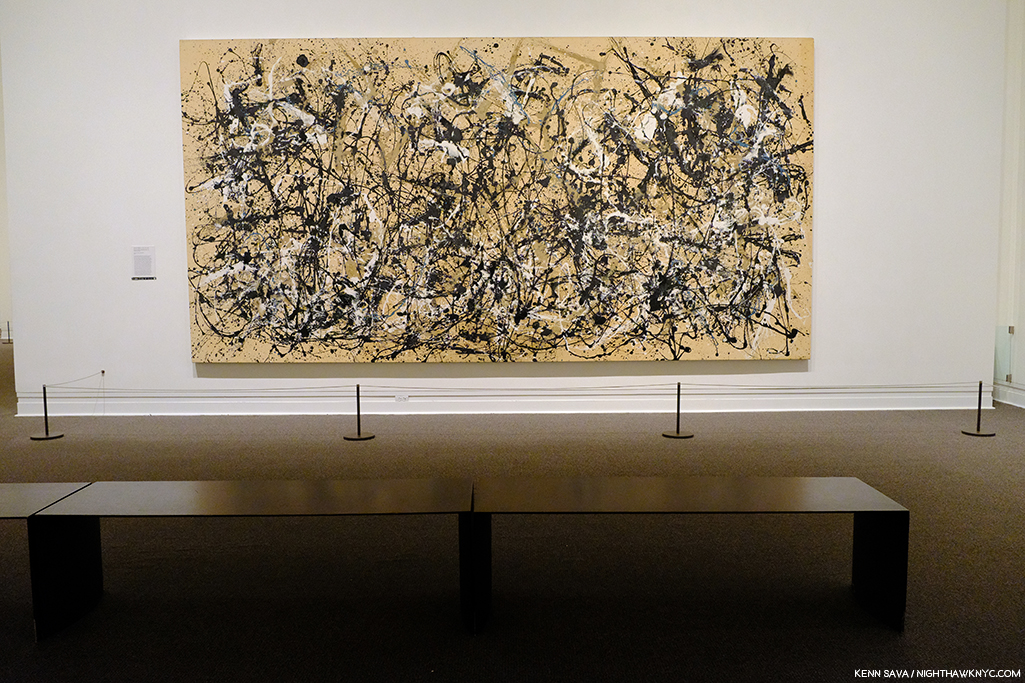
Over my 1,500+ visits to The Met, I’ve spent countless hours sitting there in front of Jackson Pollock’s Autumn Rhythm (Number 30), 1950, Enamel on canvas, 105 x 207 inches, dating back to before I started counting my visits. Seen here on August 31st, at the entrance to what was then the Abstract Expressionist galleries.

Just to the left of one of the two entrances/exits to History Refused to Die, I paused to revisit an old friend.  Almost 30 years ago, I sat on those benches for hours on end staring at and contemplating one of the most remarkable and revolutionary Paintings in Western Art, Jackson Pollock’s Autumn Rhythm (Number 30), 1950, at the time my favorite Painting in The Met (“favorite” does not mean “the best.” I don’t believe in that), and, perhaps, the crown jewel of The Met’s Abstract Expressionism collection. In my opinion, this is a key wall in The Met. Its the entrance to the Abstract Expressionist galleries behind it, and it looks out to visitors passing the “corridor” I’m standing in going to the stairs. Over all these intervening decades, its never been moved from this spot. Little did I know when I took this Photograph on August 31st, it would be the last time I would see it here.
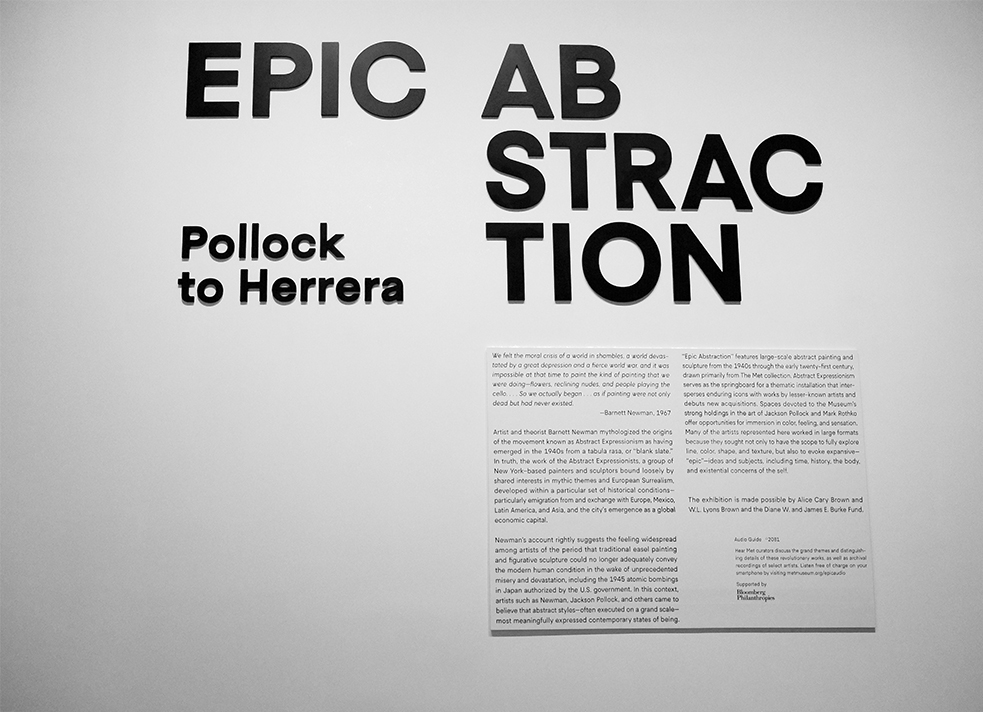
Fall brought the revelation that was Odyssey: Jack Whitten Sculpture 1963-2017, which opened at The Met Breuer just before History Refused to Die closed. Finally, and currently, back at 1000 Fifth Avenue, while the very good Delacroix show was going on down the hall, Epic Abstraction, opened on December 17th, a show I also find somewhat remarkable. It’s an “ongoing” show, meaning it has no end date at this point, largely because it and Reimagining Modernism, downstairs on the first floor, are reinstallations of works from The Met’s Permanent Collection, along with a few loans (in the case of Epic Abstraction).
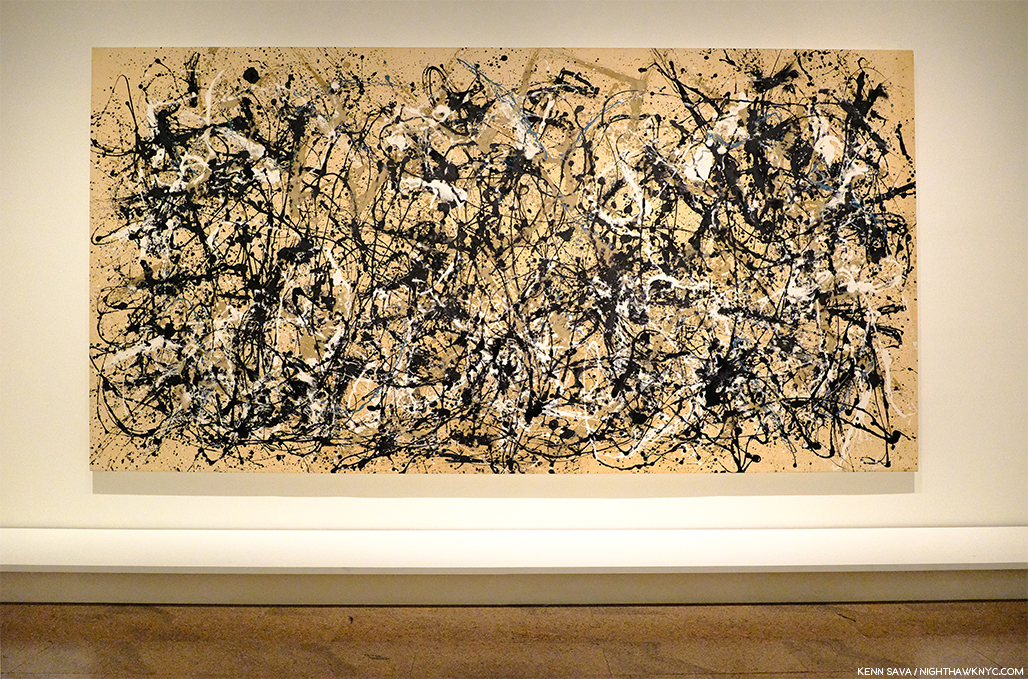
Immediately adjacent to the sign, mere steps into the show, lookie here! It’s my old friend Autumn Rhythm! 

When I walked in the first time, I was startled to see that the show begins with Autumn Rhythm! Wow. They moved it! While I admired it at the beginning of this “epic” show, questions immediately flooded into my mind. An Abstraction show that BEGINS with Autumn Rhythm? That’s incredibly bold. Talk about throwing down a gauntlet for all that’s come after. Well, the subtitle of the show is Pollock to Herrera, so, chronologically, this is the beginning. That Sheena Wagstaff, Randall Griffey (credited with organizing Epic Abstraction & Reimagining Modernism- kudos) and the Modern & Contemporary Staff chose to move Autumn Rhythm and give it pride of place in this show I take as a “sign” they may agree with me about its importance. While I wondered what is going to maintain this level in the rest of the show to come, my mind then turned to the inevitable question- WHAT did they choose to hang in that prime spot where Autumn Rhythm hung for the past few decades?
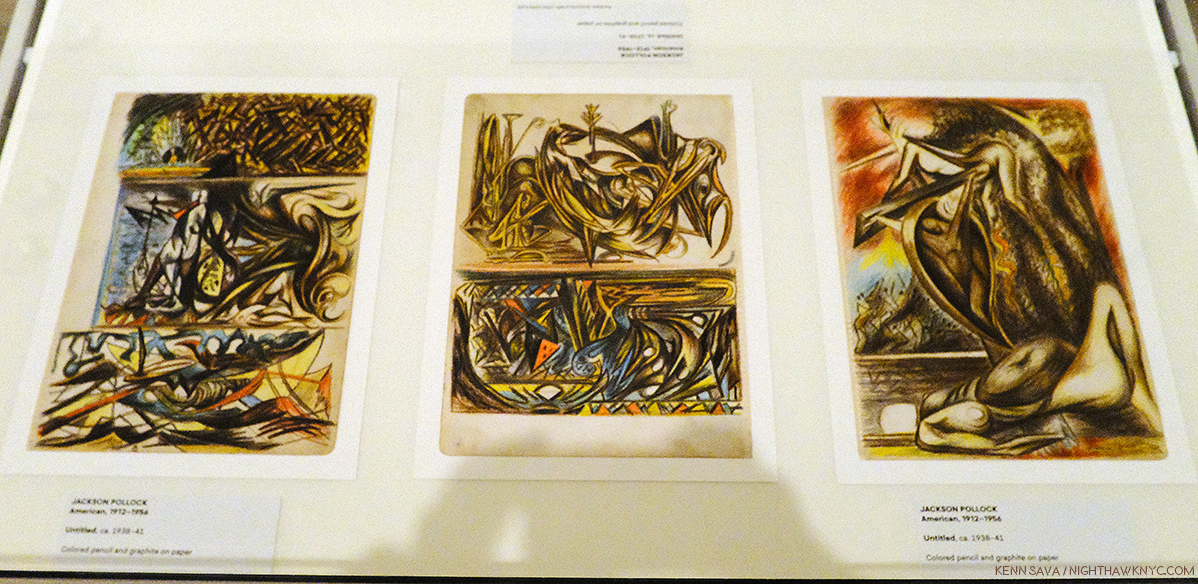
Epic. Jackson Pollock, 3 Drawings, each, Untitled, 1938-41, Colored pencils and graphite on paper.

The first room is entirely devoted to the work of Jackson Pollock, except for one work- Kazuo Shiraga’s Untitled, 1958! Highlights, besides the reinstalled Autumn Rhythm include 3 spectacular colored pencil Drawings that should permanently quiet anyone who thinks that Jackson Pollock couldn’t draw. As remarkable as this start was, the second gallery is entirely devoted to Mark Rothko, save for a central sculpture by Isamu Noguchi! This is sure to stagger any long time Met goer. For decades, only 2 or 3 Rothkos have been on view at any given time. What museum on earth, besides the National Gallery in Washington, has enough Mark Rothkos sitting in storage to fill an entire gallery? Talk about an embarrassment of riches. I couldn’t believe it. Instantly, my fears about how they were going to keep the pace of this show going disappeared. Of course. They topped themselves.

Finally, making it through the first two galleries, still in shock, I turned the corner to finally see what was now in the spot Autumn Rhythm occupied. A sharp right turn, and my eyes alighted on this-
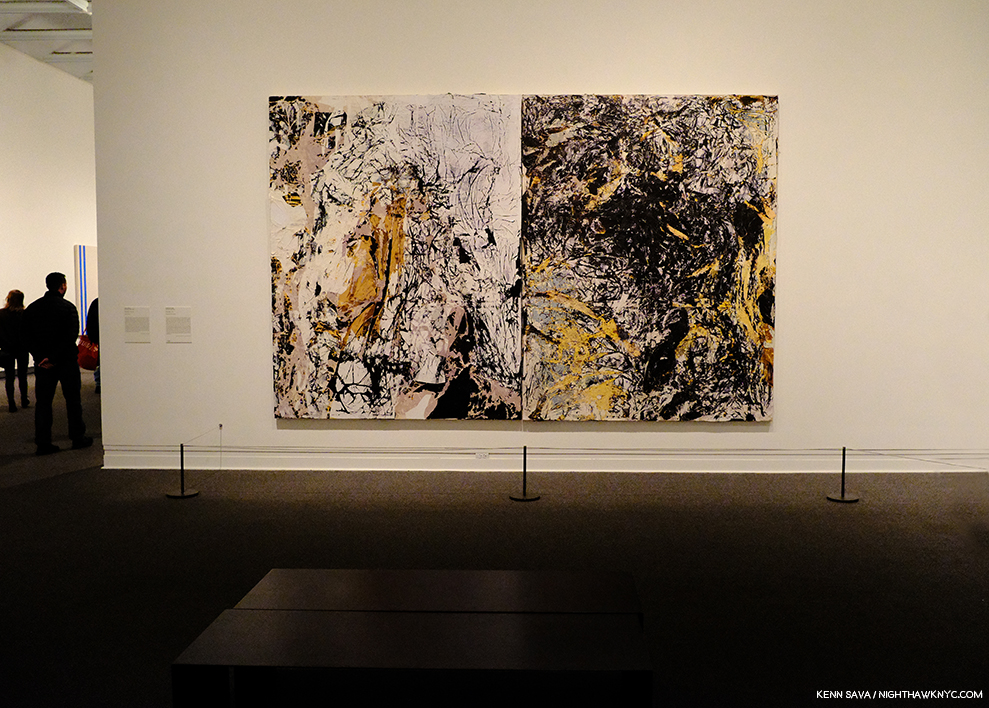
Mark Bradford, Duck Walk, 2016, Mixed media on canvas. Taking its title from Chuck Berry’s strut across the stage strumming his guitar, now hangs where Jackson Pollock’s Autumn Rhythm (Number 30) hung for decades.
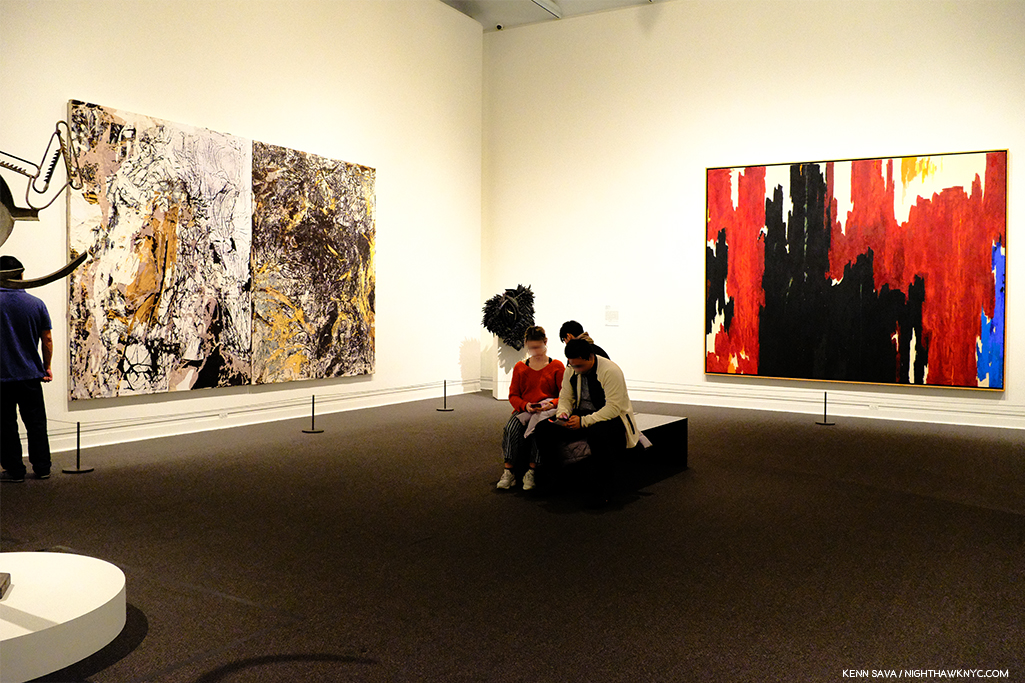
If you don’t think a lot of thought went into this, Untitled, 1950, by Clyfford Still, one of Mark Bradford’s influences, hangs directly adjacent to it on the wall to the right, with the Sculpture, Raw Attraction, 2001, by Chakaia Booker, Rubber tire, steel, and wood, between them, behind the lady in red, and Tanktotem II by David Smith, barely seen at the far left.

Mark Bradford’s Duck Walk, 2016, a Mixed media on canvas diptych floored me the minute I saw it. It’s every bit as daring as Autumn Rhythm, in my opinion, done in a completely unique way, as Pollock’s was 66 years earlier in 1950. Mark Bradford uses layers of colored paper that he cuts through using a very wide range of techniques. Of course, Mr. Bradford didn’t do it in a vacuum. He’s had influences, including David Joseph Martinez and Clyfford Still, who’s been somewhat overlooked it seems to me among Abstract Expressionists. But not by Mark Bradford.
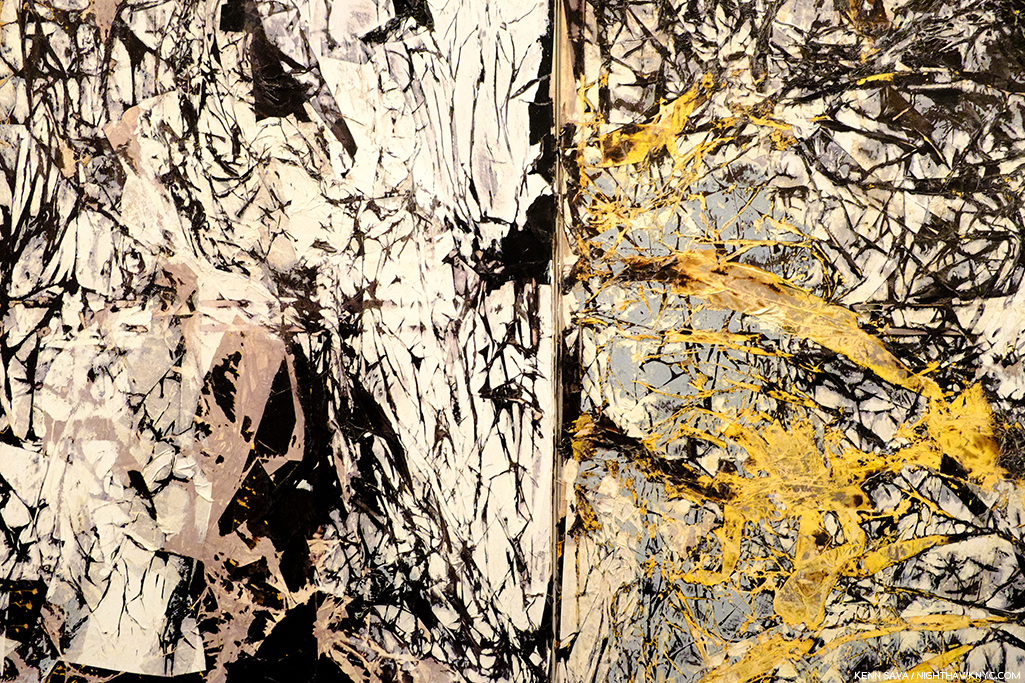
Detail of the center where the two canvases meet. Interestingly, the two pieces are shown in the opposite configuration on The Met’s website.

“Abstraction for me, I get it-you go internal, you turn off the world, you’re hermetic, you channel something. No. I’m not interested in that type of abstraction. I’m interested in the type of abstraction where you look out at the world, see the horror-sometimes it is horror-and you drag that horror kicking and screaming into your studio and you wrestle with it and you find something beautiful in it. That’s what I was always determined to do. I have never turned away.” Mark Bradford3.

Mrs. N’s Palace, 1964-77, by Louise Nevelson. Notice the black line on the floor going off to the left. That was left by a wall The Met took down to install this monumental work, the back of which is to the left. I’ve never seen this space, the room behind the Mark Bradfordls Duck Walk open like this before.

Now? Four visits in to Epic Abstraction, I can think of no other work in the show that deserves to be hung in this spot more. It not only holds its own with anything else in the show, which is a who’s who of Modern & Contemporary Abstractionists that includes de Kooning, Motherwell, Louise Nevelson, Franz Kline, Carmen Herrera, Cy Twombly, Dan Flavin, Alexander Calder, Joan Mitchell (including some pieces I’ve never seen on view), along with Pollock, Rothko and Noguchi. I was also very pleased to see that The Met managed to get a great work by a great contemporary Artist before the Artist’s prices made it possible only by donation. (Recently, tennis star John McEnroe sold a Painting by Mr. Bradford for over 12 million dollars at auction-to the Eli Broad Museum, in LA). It now joins single Paintings by Kerry James Marshall4 and Jack Whitten in The Met’s Modern & Contemporary Art collection, a collection that, unfortunately, can’t compare with the collections of museums in Chicago, L.A. or San Francisco in works by these Artists, at this point, due to…? I don’t know why. The Met owns 2 Paintings and a set of 6 prints, which are currently on display in the Drawings & Print Gallery, by Mark Bradford, seen below, with the accompanying card-
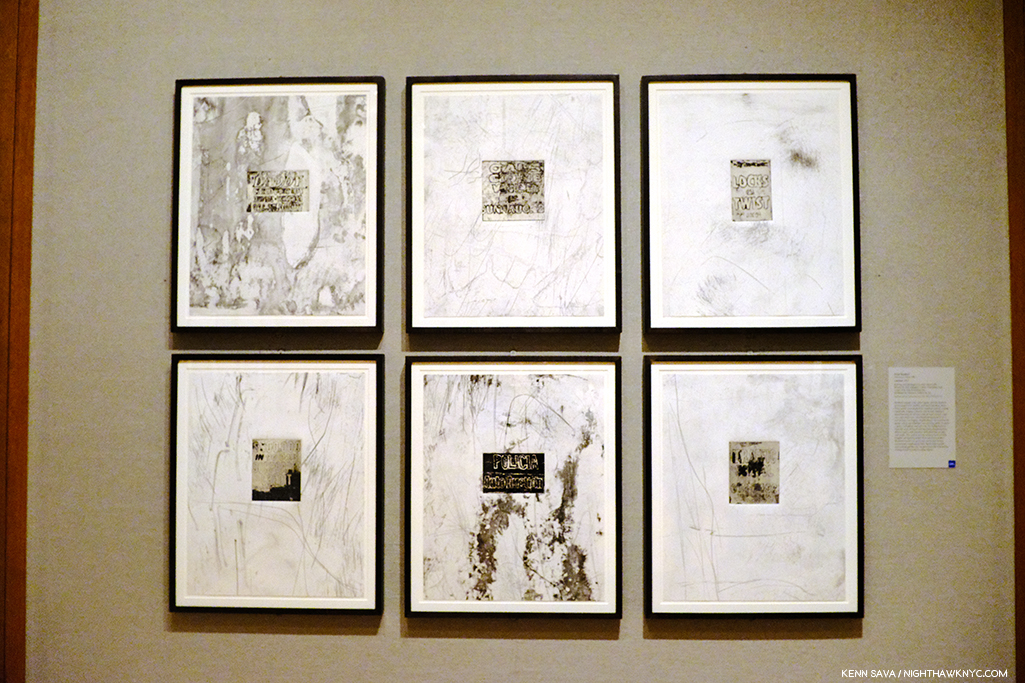
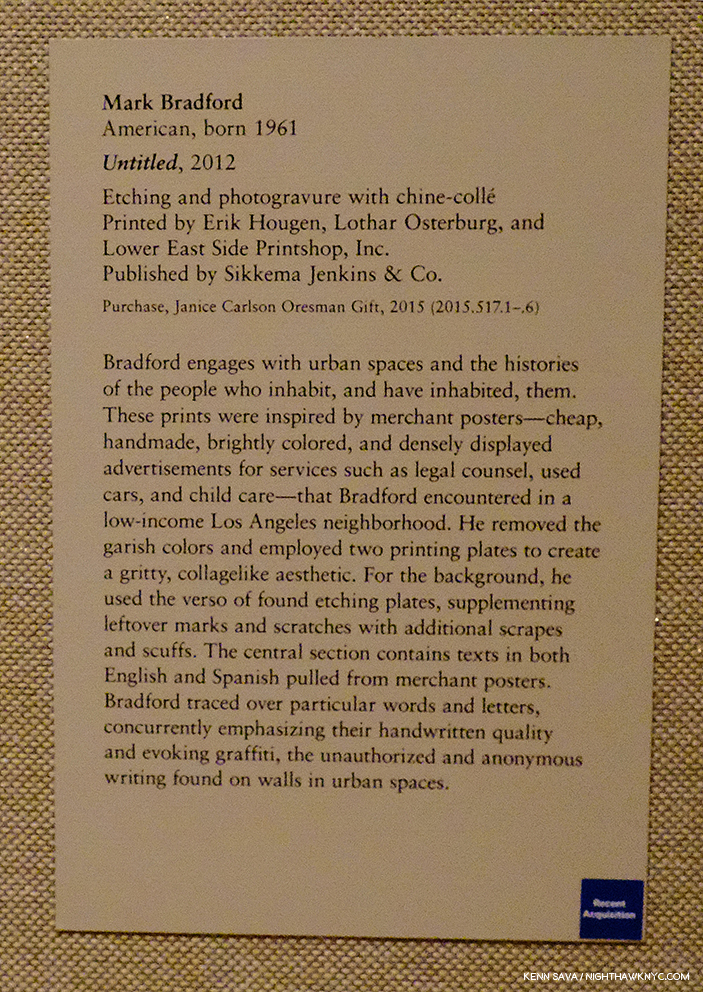
On the heels of Tomorrow is Another Day (named for the last spoken lines in Gone With The Wind), the show he mounted at the 2017 Venice Biennale after being chosen to represent the USA5, and his current installation, Pickett’s Charge, his largest work to date, currently on view at the Hirshhorn Museum in Washington (well, if and when the government re-opens, through 2021), I believe Mark Bradford is one of the world’s most important living Artists. He is an Artist who has been speaking truth about the reality of the world and the issues it faces from early on in his career and doing so in his own ways, developing unique techniques in a variety of medium. “The world is on fire,” he said in a 2017 interview in the catalog accompanying Pickett’s Charge, “whether we like it or not.” “I do feel there are moments in history when the intensity of the world in which you live comes to your door. We are at that moment now. There’s no way around it. Politically and socially we are at the edge of another precipice. I’m standing in the middle of a question about where we are as a nation6.”

Anselm Kiefer, Bohemia Lies By The Sea, 1996, 75 1/4 inches x 18 feet 5 inches, left, Kerry James Marshall, Untitled (Studio), 2014, Acrylic on PVC panels, 85 5/16 x 119 1/4 inches, right.

It’s also hard for me to not look at the choice of installing Duck Walk in this spot as a statement. Has the baton been passed to the next generation? Mark Bradford was born in 1961, 5 years after Jackson Pollock’s tragic early death. This baton passing might have also be happening downstairs in the Modern & Contemporary Mezzanine, Gallery 915, The Met’s large Anselm Kiefer, Bohemia Lies by the Sea, which for many, many years has occupied an end wall, has been moved to a side wall, and its former spot is now occupied by Kerry James Marshall’s Untitled (Studio). (Note- Anselm Kiefer was the subject of Provocations: Anselm Kiefer at The Met Breuer in early 2018).

If you continue further down the stairs to the first floor, you’ll discover the early Modern Art galleries have, also, been completely reinstalled, as Reimagining Modernism 1900-1950. It’s endlessly fascinating to me to see which pieces have come on display and which have gone into storage, (or loan?)
The signs they are a-changin’

Times are changing at The Met, in the Modern & Contemporary Galleries, and in the rest of the Museum, as new Director Max Hollein now takes charge (though I imagine Epic Abstraction & Reimagining Modernism were being planned prior). Along with The Met as a whole, the Modern & Contempoaray Department had another remarkable year. The list of memorable and/or important shows that have already appeared at The Met Breuer continues to grow. This is the second time in three years I’ve singled out Sheena Wagstaff and her Modern & Contemporary Department for having great years in NYC Art. Yes, the New Museum, who I singled out last year, continue to impress and grow, and yes MoMA had a number of memorable shows this year, including Stephen Shore  and two featuring the work of Charles White, the Guggenheim impressed with Danh Vo and Hilma af Klint, but none of them had the year The Met had, in my view, particularly in Modern & Contemporary Art.

They started from so far behind compared to the other Museums. I wonder how many others are now noticing.


BookMarks- I only list items in BookMarks that I strongly believe in and personally recommend. If you like what you see here, you can make a donation to help keep NHNYC.com ad-free through PayPal by clicking on the box to the right of the banner at the top of the page that will take you to the Donation button. Your support is VERY much appreciated. Thank you!
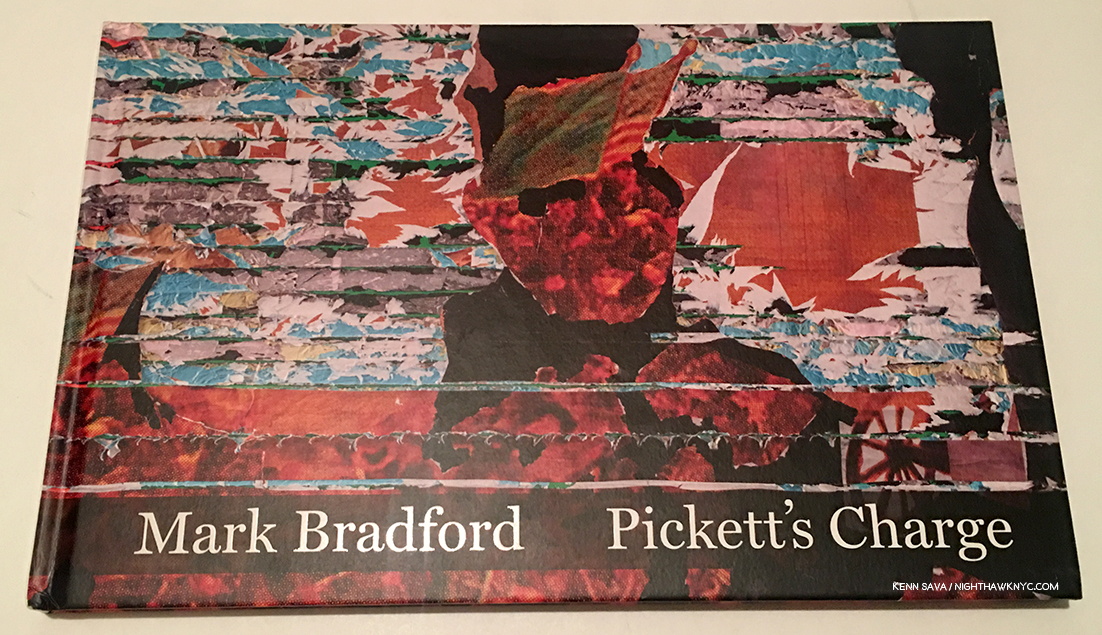
David Hockney’s Secret Knowledge (New and Expanded Edition): Rediscovering the Lost Techniques of the Old Masters is one of the most revelatory Art History books of the century thus far and is recommended to the Art History buff and the Art student. The Expanded Edition is only available in paperback, but it is the version I recommend. Keep an eye out for the excellent 2 part BBC Documentary, too.

His A History of Pictures: From the Cave to the Computer Screen, is a wider look at Art History, seen from an Artist’s perspective, which makes it somewhat unique, and is recommended for the general Art History student and buff. There is also a version for children.

Hockney’s Cameraworks is a remarkable book, unlike any other Photography monograph I know of. It includes a look at his Photography through 1984, along side a fascinating interview. Currently out of print, it’s highly recommended to Photographers, Hockney fans, and those interested in this sticky debate about perspective in Art, and definitely worth looking for. Copies in very good condition (minimal wear to the book or dust jacket, without marks of any kind or writing) may still be found for less than 100.00.

The best overview of Thornton Dial’s work, currently, is Thornton Dial in the 21st Century published by Tinwood Books in 2006. The time has come for a complete, comprehensive monograph on his life and work, and this, the best we currently have, is recommended until it arrives.

Mark Bradford (Phaidon Contemporary Artist Series) is the best and most current introduction to Mr. Bradford career. After that, it’s a toss up between 2010’s Mark Bradford published by Yale U. Press or Tomorrow Is Another Day, one of Michelle Obama’s “personal favorites.”  The Yale book is the most comprehensive book on his work to 2010, with the best images of his work to that date, while Tomorrow is an in-depth look at the work Mr. Bradford created for the US Pavillion at the 2017 Venice Biennale.

*- Soundtrack for this Post is “Coming Up” by Paul McCartney fromMcCartney II, 1980, seen here performing it with Wings, and Linda McCartney, Live in Kampuchea, 1979-

NighthawkNYC.com has been entirely self-funded and ad-free for over 6 years, during which over 250 full length pieces have been published. If you’ve found it worthwhile, you can donate to keep it going & ad-free below. Thank you!

Written & photographed by Kenn Sava for nighthawknyc.com unless otherwise credited.
To send comments, thoughts, feedback or propositions click here.
Click the white box on the upper right for the archives or to search them.
For “short takes” and additional pictures, follow @nighthawk_nyc on Instagram.

Subscribe to be notified of new Posts below. Your information will be used for no other purpose.
 

  1. Met attendance numbers quoted in this piece are from this press release.
  2. //www.getty.edu/art/collection/objects/106006/david-hockney-pearblossom-hwy-11-18th-april-1986-1-british-1986/
  3. Mark Bradford: Phaidon Contemporary Artists Series, Interview with Anita Hill, P.18
  4. The Met also owns a woodcut (a print) by Mr. Marshall
  5. Containing work that is now on view at the Baltimore Museum, under its Director, Christopher Bedford, long one of the leading Mark Bradford champions
  6.  //hirshhorn.si.edu/exhibitions/mark-bradford-picketts-charge/

R.I.P. Sister Wendy

Written by Kenn Sava

Terribly sad news reached me that Sister Wendy Beckett passed away earlier today at 88. As one of the countless millions who watched her religiously on TV and video, I loved the new style of Art criticism she brought based on her surprisingly open-minded insights and decades of study. As one got to know a little about her, her life as a cloistered nun made it seem incongruent that she would be able to discuss earthly Art so openly. But, she did, and in the process enthralled countless viewers, and readers, with her insights and passion. She was so dedicated to living a life of denial she didn’t go to museums! She learned about Art through books.

Sister Wendy outside the trailer she lived in on the grounds of the Carmelite Monastery in East Haring, England. Photographer unknown.

To know the works only through books where even in the best ones you’ll see a given work from one, maybe two Photos, and then to finally SEE all of them in person?

Sister Wendy in New York harbor circa the late 1990’s with the World Trade Center in the background. The opening shot of PBS’ Sister Wendy’s American Collection- The Metropolitan Museum.

Think how incredible it must have been for her to finally go to The Met, for example, having suddenly become a most unexpected television star, first for the BBC and then for PBS, when she made the terrific documentary about it for Sister Wendy’s American Collection. It makes me feel a bit guilty for having been to The Met a thousand and a half or so times since 2002.

Sister Wendy seeing Rembrandt’s Aristotle with a  Bust of Homer, 1653,  in one of the European Paintings galleries on the 2nd floor from Sister Wendy’s American Collection- The Metropolitan Museum. Before it was moved, I stood there many times looking at it and thinking about what it was like for her to stand here and see it in person.

Isn’t it ironic, and strangely fitting, that for someone who discovered and learned so much about Art through books, so many others have discovered her and learned so much about Art through her books and videos?

It was a huge learning experience for her, too. I first discovered Sister Wendy through her articles in Modern Painters magazine. The name “Sister Wendy Beckett” at the top stopped me. Who? Her articles there are different than her books and magazine. They are text with few illustrations, but her “magic” shines through. Yet, as good as they are, these pieces were a drop in the bucket of Sister Wendy’s vast knowledge of Art and Art history, as we were to soon find out. Whoever chose her to be on television was brilliant. Becoming the host of video series on the BBC and PBS here in the US, she found herself having to explore Art in realms outside of her favorites. She said of this, “…one also has to remember that if I’m to do encyclopedic museums and give a fair idea of what’s in them, I have to move outside medieval art, Oriental art, ceramics, and the Old Masters. If I had stuck just to what I myself love best, every program would have been exactly the same, because each of these museums has superb holdings in my four favorite areas. But nobly, self-sacrificingly, thinking only of the good of others, I forced myself to investigate areas of art into which perhaps I had up to now taken little interest. As always happens with self-sacrifice, I was blissfully rewarded.” This is something I always keep in mind when I come across something new that doesn’t speak to me right away. I’ve learned to keep looking.

Sister Wendy, seen in the Egyptian Galleries at The Met around 1999, with Fragmentary Head of a Queen, 18th Dynasty, c1352 BC, a personal favorite of hers in all of The Met’s collection. I was astounded when I found that out- It’s such a small work, usually displayed in a small room, off the court leading to the famous Temple of Dundur that I’m sure most visitors to The Met miss it. Yet, Sister Wendy, somehow, found it, and spoke about the beauty and tragedy of this work and what it means in our time, 3300 years later, brilliantly. Just remarkable.

To this day, I can’t look at it without thinking about her. These two Photos are stills from Sister Wendy’s American Collection- The Metropolitan Museum.

As you watch, it’s hard to tell which areas are new to her and which aren’t, she speaks so passionately about all of them.

On the grounds of the Monastery. Photographer unknown.

After she completed the televisions series and wrote a number of books she retired from Art History and went back to the seclusion she lived in ever since. To her trailer, seeing or speaking with no one, save the nun who brings her meals and collects her laundry.

Though I’m not religious, Sister Wendy has been a huge influence on me, and I’m sure many, many others. She, and Lana Hattan, are the two reasons NighthawkNYC exists. While I begged her in these pages almost three years ago to come back to us, it was not to be. Now, I’m eternally grateful to her for creating the large body of videos and books she did, which is extraordinary given her beliefs and dedication to living a cloistered life.  It’s endlessly interesting to me that she chose to venture into the world this publicly for these few short years, but she gave the world a blessing that I hope will live on and inspire others for as long as Art does.

When you take it all into consideration? It’s remarkable we had her at all. Today, I give thanks that we did.

Her legacy will live on in the sheer joy of discovering Art that she inspired in others, and as a result, through all of those who’s lives she touched. Including countless people she never even met.

Sister Wendy gave a huge gift to all of us. 


BookMarks-

This is not a posed photo.

Without doubt, my favorite Sister Wendy book is Sister Wendy’s The Story of Painting. In my opinion it is the place to begin a Western Art History library. Book #1. The first one to get. Though out of print, copies are still to be found at reasonable prices. If you are getting it to be a cornerstone of your Art History library, get the hardcover version, since it will hold up much better than the paperback, which is too big for its binding in my experience. She covers the entire canon, through all it’s periods, in all its many styles. Right up to the fairly recent past. It’s surprisingly thorough for an overview. And? Her choices can be, well, eccentric, but almost no one can make a case for ANY work of Art like Sister Wendy. If a work spoke to her? She shows it. It doesn’t matter if the Artist is a household name, or not. That’s something that has been at the forefront of my mind ever since- Let the Art speak to you and pay attention to what does. All these years later? There’s no greater lesson to be learned in studying, or enjoying, Art than that. 

Sister Wendy’s 1000 Masterpieces  is every bit as good though it doesn’t follow the trail of time that Story of Painting does chronologically. Masterpieces is arranged alphabetically by Artist, so it moves all over time and periods as you turn the page. I recommend it for those who want to read her thoughts about works not included in Story of, which anyone taken by her will want to, and to those who can’t find Story of It’s done in almost exactly the same style as Story of Painting, but? If it ain’t broke…

Sister Wendy’s Story of Painting is also my favorite Sister Wendy video series. Luckily, it’s still available as part of Sister Wendy – The Complete Collection (Story of Painting / Grand Tour / Odyssey / Pains of Glass)For me as an Art lover? Sister Wendy’s Story of Painting is among the best things I’ve ever seen on television. It deserves to be as popular as Seinfeld. For a while there when it was originally on, it got to be about as close to it as might be possible for an Art History show. It’s still the best series of its kind there is. 

After that,Sister Wendy’s American Collection is an extraordinary chance to visit six of the greatest American museums with Sister Wendy. Virtually every moment of them is a wonder, the revelations are constant, thought-provoking and timeless. As I wrote three years ago, I was flabbergasted that she was able to visit “my Museum” and point out things that almost no one would know. She made it seem “new” to me and that’s something I found shocking from someone who had never been there, and I still do. 

I long felt that I would have given anything to have gone to a museum with her. This was as close as I got. Here’s your chance- to go to six of them with her. As with any Art she spoke or wrote about? You’ll learn something new- every single time. 

*- Soundtrack for this Post is “Grace,” written and performed by Jeff Buckley on Grace. About it, Jeff said, “It’s about not feeling so bad about your own mortality when you have true love.” I chose this because though she was a cloistered nun who lived as a hermit, Sister Wendy well knew of and felt deeply about the trouble, the “fire” in the world, which she said is “not what it should be. It’s an aggressive, unloving world,” in her comments about the Fragmentary Head of a Queen, 18th Dynasty, c1352 BC, seen earlier, which had been broken by forces or people unknown to us. And? Because she had true love…

NighthawkNYC.com has been entirely self-funded and ad-free for over 6 years, during which over 250 full length pieces have been published. If you’ve found it worthwhile, you can donate to keep it going & ad-free below. Thank you!

Written & photographed by Kenn Sava for nighthawknyc.com unless otherwise credited.
To send comments, thoughts, feedback or propositions click here.
Click the white box on the upper right for the archives or to search them.
For “short takes” and additional pictures, follow @nighthawk_nyc on Instagram.

Subscribe to be notified of new Posts below. Your information will be used for no other purpose.
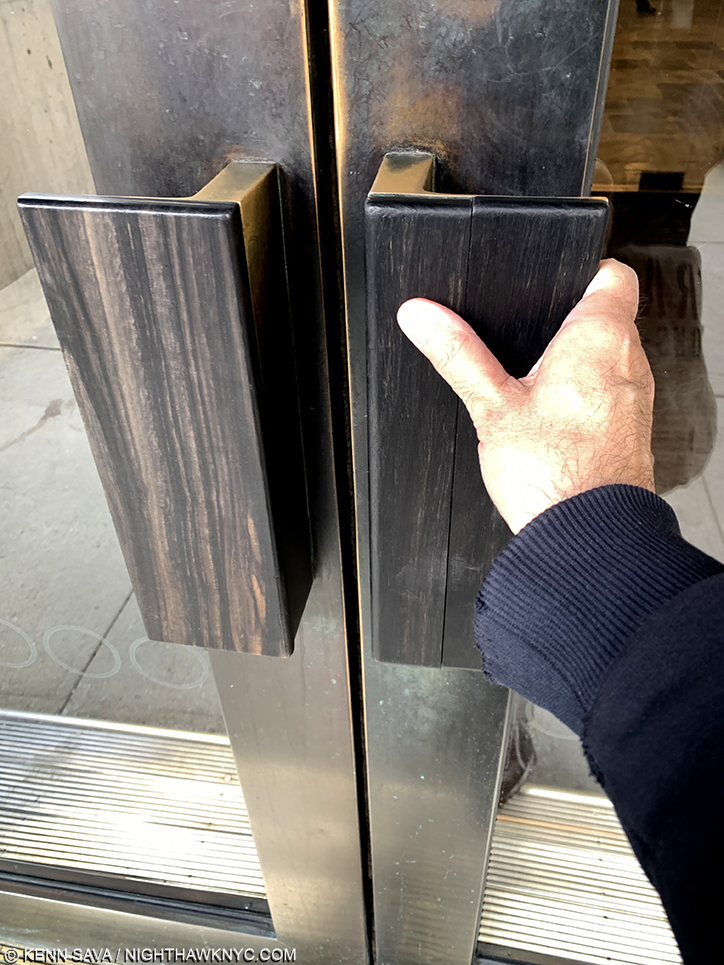
 

R.I.P Ricky Jay: Art Collector Extraordinaire

Written & Photographed by Kenn Sava

When I learned that Ricky Jay had passed on November 24th at 72, I found myself revisiting his remarkable show Wordplay: Matthias Buchinger’s Drawings from the Collection of Ricky Jay that appeared at The Met spring, 2016. I’ve never been into magic but I have to admit being completely under the spell of Ricky Jay when I’ve seen him on TV, video and even the movies he appeared in. Even being an outsider to his world, he struck me as being remarkable. As I watched, it seemed he was a throwback, someone who learned his craft like Musicians and Artists learn theirs, through direct experience with their predecessors and through long and careful study of them. I admired most the respect he had for those who had mastered his craft before him. I soon discovered there was much more to Ricky Jay. How to characterize him?

“Oh what a thrill
Fascinations galore
How you tease
How you leave me to burn”*

Well, the bio on his site says, “While Ricky Jay has long been considered one of the world’s great sleight-of-hand artists, his career is further distinguished by the remarkable variety of his accomplishments as an author, actor, historian and consultant.” Ricky Jay was a wonder in many, many ways. As it turns out, even that wide-ranging description leaves out his accomplishments as a collector. 

Installation view of Wordplay: Matthias Buchinger’s Drawings from the Collection of Ricky Jay at The Met, March 18, 2016.

Wordplay was a unique opportunity to take a look at part of the one-of-a-kind collection Ricky Jay amassed, and it also revealed how much he knew about the amazing Artists, and people, it included.

Elias Back, Portrait of Matthias Buchinger Surrounded by Thirteen Vignettes, 1710, when Mr. Buchinger would have been about 36, showing him surrounded by 13 scenes of him displaying some of his remarkable skills. The bottom part of the sheet was left blank, Mr. Jay surmises so the Artist could inscribe and dedicate it. This work is “a promised and partial gift by Ricky Jay to The Met” in 2015.

Chief among them was Matthias Buchinger, one of the most astounding figures in the history of Western Art. Born in 1674 in Ansbach, Germany, without hands or lower legs, he stood all of 29 INCHES tall. Nonetheless, he went on to master an incredible range of skills. Surrounding a 1710 portrait of Matthias Buchinger by Elias Back, when he would have been about 36, are vignettes depicting him displaying some of his remarkable skills including shaving himself, making a quill pen, performing cups and balls, drawing, threading a needle, playing musical instruments, playing cards, and a form of bowling.

Matthias Buchinger, Self-portrait, London, 1724, 7 1/2 x 11 5/8 inches. Collection of Ricky Jay. Photo by The Met.

In the realm of Art, Matthias Buchinger became a master draftsman, a master calligraphy.

Detail showing Mr. Buchinger’s amazing micrography, the miniature writing embedded in the hair. Photo by The Met.

This he also demonstrated (or showed off) through micrography, the art of writing in minute characters that he often embedded in his Drawings, even complete Psalms(!).

Matthias Buchinger, Ten Commandments, London, December 3, 1730, 14 1/2 x 21 inches, A “promised and partial gift of Ricky Jay” to The Met.

Being a long-time aficionado, and student of the Art of Drawing, I had never seen anything like it. And haven’t. To this day.

Detail of the lower panel bearing the Artist’s inscription and dating of the work.

Ricky Jay brought to wider attention one of the most remarkable figures in Western Art History (as it is known to me), while bringing that figure into the world of Fine Art in one of the world’s greatest museums, where his work stood alongside the most renowned Artists in history. Yet, the show was remarkable not only for showing Matthias Buchinger but for including other Artists who were born without limbs, all in works from Ricky Jay’s collection amassed over 30 years.

Unknown Artist, Portrait of Johanna Sophia Liebschern, 1780-90, states that “she has no arms but is able to use knife, fork, snd spoon with her left foot and feed herself, [and] is able to prettily write, sew, draw, cut a quill pen, load and shoot a pistol.” Collection of Ricky Jay.

So, in honor of the late Mr. Jay, I pay my respects by revisiting the piece I Posted on April 5, 2016 about this remarkable show, The Greatest German Reality Show Star, Circa 1700. I’ll be most interested to see what happens to Mr. Jay’s remarkable collection. Personally? Of course, I hope it goes to The Met, to whom he already generously partially donated some of the Artworks shown here.

*- Soundtrack for this Post is Tomorrow Never Dies, by Sheryl Crow, the theme from the James Bond movie of the same name, one of the 39 or so films Ricky Jay appeared in.

NighthawkNYC.com has been entirely self-funded and ad-free for over 6 years, during which over 250 full length pieces have been published. If you’ve found it worthwhile, you can donate to keep it going & ad-free below. Thank you!

Written & photographed by Kenn Sava for nighthawknyc.com unless otherwise credited.
To send comments, thoughts, feedback or propositions click here.
Click the white box on the upper right for the archives or to search them.
For “short takes” and additional pictures, follow @nighthawk_nyc on Instagram.

Subscribe to be notified of new Posts below. Your information will be used for no other purpose.
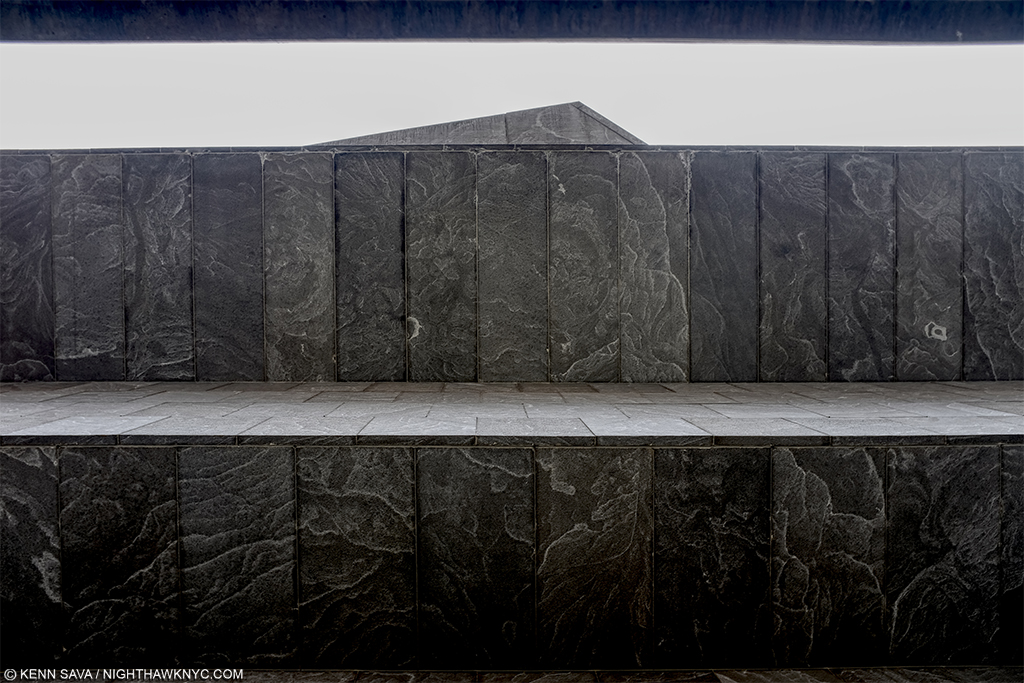
 

Jack Whitten- Secrets From The Woodshed

Written & Photographed by Kenn Sava (*unless otherwise credited)

Dead Reckoning I, 1980, Acrylic on canvas, 73 x 73 inches. Click any Photo for full size.

When Jack Whitten left us, far too soon, this past January 20th, his hard earned, long-time-coming place among the most important and innovative Painters of his time was assured. This was most recently brought home for me in Spring, 2017 with the excellent Jack Whitten at Hauser & Wirth, where I was completely enthralled by the selection of 19 Paintings, all from 2016, save one each from 2015 and 2017.

Quantum Wall (A Gift for Prince), 2016, Acrylic on canvas with tivar. 190 x 84 inches(!), seen at  Jack Whitten, at Hauser & Wirth, February 7, 2017.

Jack Whitten often said his Paintings were “made,” not “Painted1.” In creating these Paintings, he worked with what he called “tesserae,” a chunk of acrylic that had been cut from a large slab of acrylic poured into a mould that were then applied to the canvas like mosaics. Walking through Jack Whitten last year, each Painting was so meticulously “made,” I couldn’t believe he could make so many of them in one year, in his late 70s.

Installation view of the first gallery of Jack Whitten at Hauser & Wirth, February 7, 2017. Quantum Wall (A Gift for Prince), seen above is on the back wall.

Standing front and center in the main gallery, the Paintings were accompanied by something I never saw before- a Jack Whitten Sculpture(!)- Quantum Man (The Sixth Portal), 2016. I wasn’t sure what to make of it. Surrounded by the Paintings, I came away struck by how different it seemed from them. During the run of the show, the Art documentarians, Art21, created this short piece on Jack Whitten. It serves as a wonderful introduction-

Earlier this year, the collected journals, essays and public talks of the Artist were published in the massive 500+ page book, Jack Whitten: Notes from the Woodshed (see BookMarks at the end). But, there was more…MUCH more hidden in that woodshed. It turned out the Artist had been creating a body of Sculpture going back to 1963 that he kept to himself, only having shown them twice in Crete, where he had a home and where he created many of his Sculptures. Except for that one work included in his last Hauser & Wirth show in 2017, he had never shown his Sculpture in this country (as far as I know).

Until now.

I’ve never seen the likes of this before. Lichnos, 2008, named after a somewhat dangerous Greek fish, at the entrance at The Met Breuer, November 23, 2018.

A few years ago he finally decided to show them. Unfortunately, he didn’t live to see the resulting show, Odyssey: Jack Whitten Sculpture 1963-2017 (henceforth, Odyssey), when it opened at the Baltimore Museum of Art on April 22nd, before moving to The Met Breuer on September 6th.

To say it’s a revelation is a huge understatement. Odyssey isn’t “A” revelation- It’s a revelation in so many ways, I can’t count them.

The meaning of my life- in one Photo. Installation view of the first gallery shows Jack Whitten’s earlier Sculpture surrounded by five of his Paintings. I was filled with wonder each and every time I entered this space.

When I entered the 3rd Floor at The Met Breuer to see it for the first time on October 5th, I had walked no more than 100 feet into the first gallery, when I realized, “THIS is why I go to Art shows.” Meaning, I live for the chance to discover something new and great. Standing in a spot where I could take in the whole room, I felt like I was, truly, in a different world- a world that, somehow, had managed to synthesize the past and the present in a completely unique and fresh way that pointed straight ahead. That visit, I never made it out of the first room shown above. So transfixed was I by every work it contained, it took me 3 subsequent visits to see all of the show. Each of my eventual eight visits left me filled with wonder at this wider view of the sheer scope and range of Jack Whitten’s creativity and talent. I felt that I was standing in a space that was somehow sacred. Each work reverberated with a deeper essence greater than the sum of its parts or its stunning design. Each has a spirit of its own.

As I moved through the show, at the pace of a frozen glacier (remember them?), I was struck by the feeling that it’s so sad that having overcome so much in his life Jack Whitten didn’t live to see this utter triumph- a show mounted by two of this country’s great Museums that once and for all establishes him as a Master Artist of our time.

And then, another revelation hit me, in the form of a question- WHEN was the last time a great Artist who had worked his entire life creating a major body of work in one medium (in this case, Painting) passed away and then ANOTHER major body of his work, in a completely different medium (Sculpture) was discovered? If you can think of one, let me know.

While Jack Whitten’s Sculpture feature wood, that’s not all they consist of. His brilliance extended to his taste, evidenced in the materials he carefully selected for these works. A partial list includes lead, copper, a wide range of wood (see this list-2), fishing line, various bones, and Gorilla Glue & saw dust are combined with any number of more common objects. Yes, those “blades” seen in the 3 striking works in the foreground are marble.

Moving through the show, it became apparent that the style of Jack Whitten’s Sculpture evolved every bit as much as his style of Painting did. New materials came into the mix, creating a vocabulary that extended dramatically beyond wood, but the essence of their spirit remained consistent.

The White House, September 22, 2016. *Photo by Cheriss May arts.gov

Jack Whitten was born (in 1939) and raised in Alabama before becoming discouraged by the racial turmoil he had encountered and seen first hand, particularly in the demonstrations he took part in3. He moved to NYC in 1960 to study at Cooper Union. Here, he was able to learn from “both sides,” he put it, encountering some of the most well known white and black Artists of the time, including Mark Rothko, Willem de Kooning, Jacob Lawrence, Philip Guston, Romare Bearden, Franz Kline, Andy Warhol and many others4. In fact, throughout his life, Jack Whitten met many of the great figures of his time, from Dr. Martin Luther King to John Coltrane to President Obama, seen above awarding him a National Medal of Arts for 2015. More importantly, he felt he learned from each one. He also saw some of the great cultural and societal events of our times- including Dr. King’s “I have a dream” speech, after having met him a few years earlier. Jack Whitten was, also, an eyewitness to the first plane flying into the World Trade Center on 9/11 from 14 blocks away! Incredibly, his voice is heard on the only video there is of that plane impacting the North Tower, by the Naudet brothers who were making a documentary on the New York Fire Department. Following them around, that morning they answered a call about a gas leak at the building Jack Whitten owned on Lispenard Street. The Naudets happened to be filming the firemen who were trying to find it when the plane flew right over their heads! Jack Whitten’s voice is the one heard making the expletive as it crashes into the North Tower5. He subsequently made one of his most powerful and important Paintings, in my opinion, 9.11.01, in 2006.

9.11.01, Acrylic on canvas, 20 x 240 inches. Not included in Odyssey. Photo- Hauser & Wirth

I’m not the only one who thinks so. Earlier this year, the Baltimore Museum of Art, who had sold works by Andy Warhol and Franz Kline (both of whom Jack Whitten knew) to fund new acquisitions astutely used some of that money to buy 9.11.01. The Museum’s Director, Christopher Bedford called it, “the most significant acquisition I’ll ever make for a museum.” He went on to say that he feels that “in 100 years it will be regarded as highly as Matisse’s Blue Nude, 1907, currently considered the crown jewel of the Museum’s holding6.”

All throughout his life, he followed his own path. Shortly after arriving in NYC, he visited the City’s Museums, where he saw the work of African Artists in The Met and the Brooklyn Museum that had the biggest and longest lasting influence7 on his Art, especially his Sculpture, which he began about 1963.

Power Figure: Male (Nkisi), 19th century, Angola or Democratic Republic of the Congo.

“All of this stuff was inspired by those figures. All of it. That’s the source,” Jack Whitten said of his Sculpture and these early African figures he saw in NYC museums (per the Audio Guide).

Homage to Malcolm, 1965, front, Homage to the Kri-Kri, 1985, left, the Painting, Black Monolith III For Barbara Jordan, 1998, rear center and Power Figure: Male (Nkisi) 19th century from Angola, via The Met’s permanent collection, right, one of the possible influences on Jack Whitten’s Sculpture, who visited The Met after moving to NYC in 1960, to study its collection of African Art.

Finding inspiration, (Odyssey includes some of the African, early American and Mycenaean Art from The Met’s permanent collection that may have influenced him), he also honored the purpose of many of these older works. And so, we see works that are “Power Figures,” “Guardians” (including one for wife, his daughter as well as himself), “Totems,” or “Reliquaries,” while others reference animals, including Owls, Scorpions, Orfos, Lichnos and Sharks. Two reference contemporary figures (something his Paintings do more often)- the then recently deceased Malcolm X, created in 1965, above, and the fascinating John Lennon Altarpiece created in 1968 (seen further below). In discussing his Homage to Malcolm, I was struck by the Artist’s comment on the Audio Guide regarding the “rough to smooth” character of the work, explaining, “The man had many stages to his personality. It’s another example of white folks trying to squeeze black people into one dimensional people. But, we’re not that.”

The Afro-American Thunderbolt, 1983-84

It then became apparent that a number of other Sculptures in this show also move from “rough to smooth,” each with exquisite craftsmanship.

Detail.

One of the reasons I think Mr. Whitten may have kept his Sculpture to himself is that many of the works are personal. He created a series of Guardian figures for his family, and this one for himself. As he said on the Audio Guide, “Growing up in the South, we had no protectors, so I built that one for myself, and it has served me well.”

The Guardian III, For Jack, 1986. Notice the blue section underneath, made from coiled fishing line. These “hidden” colors appear in a number of his Sculptures, where they seem to glow from underneath.

With, apparently, only those closest to him knowing, Jack Whitten managed to rewrite Sculptural history for the 20th and 21st centuries, beginning by forging his own way with African Art that by-steps the influence of the European modernists and Cubism, (including no less than Picasso, who’s own monumental 2015 Sculpture show at MoMA I wrote about here) of the early 20th century8.

Even though he studied at Cooper Union, looking at his career, it becomes obvious he learned every bit as much, if not more, from his conversations with other Artists, his observations and through discovering his own techniques- in both Sculpture and Painting.

Black Monolith II (For Ralph Ellison), 1994, Acrylic, molasses, copper, salt, coal, ash, chocolate, onion, herbs, rust, eggshell, razor blade on canvas, 58 x 52 inches.

Detail of the center of the “head.”

If Odyssey only consisted of Jack Whitten’s Sculpture, it would still be a major show. That it ALSO contains 16 major Paintings provides an unprecedented opportunity to see works from the same periods in different medium side by side. The whole is brilliantly installed, bringing different combinations of work into view at the same time as the visitor moves around. The sum of its parts takes Odyssey to an entirely different level into the realm of historic, in my opinion, where it now joins the list of truly great shows to have appeared at The Met Breuer. It’s becoming a formidable list, possibly unequalled in NYC since it opened on March 15, 2016. Imagine that.

Bush Woman, 1974-5, in front of Delta Group II, 1975, the only work by the Artist in The Met’s collection, as far as I know. The superb installation of Odyssey is apparent in the juxtaposition of these two works, where the similarities and the differences are apparent and striking. Given both, it’s endlessly fascinating to me that Jack Whitten finished these two pieces in the same year.

“My inspiration for painting comes from the wood. All of my ideas in painting come from the wood. My head is bursting!” he said, referring to his Sculpture9.

John Lennon Altarpiece, 1968, seen in front of Black Monolith VIII (For Maya Angelou), 2015, 84 x 63 inches, left and The Guardian I, For Mary, 1983, right.

I bore those words in the front of my mind as I looked closer. During the last 3 of my 8 visits, I tried hard to see what he meant, and, truth be told, I am still trying to connect his Sculpture to his Painting. Then again, that’s the nature of the mystery of inspiration.

This is NOT by Gerhard Richter. Its Slberian Salt Grinder, 1974, Synthetic polymer paint on canvas, 72 x 50 inches, by Jack Whitten that predates the German Painter’s “Squeegee Paintings” by about 15 years! Displayed “In Memoriam – Jack Whitten” at MoMA, seen on October 26, 2018.

He’s said this connection begins with his Slab series of Paintings, like Slberian Salt Grinder (on view at MoMA at the moment, “In Memoriam – Jack Whitten,” and so not included in Odyssey), above. “Painters use paint. I am a painter. My years of carving wood have been the single most important influence on my painting. The Slab paintings from the 1970s are elementary form derived directly from my sculptures10.” These works may have been a visual “response” to Jazz immortal John Coltrane’s famous “sheets of sound.” Jack Whitten created these “planes of light,” as he called them11. Interestingly, Jack Whitten’s Slab works pre-date Gerhard Richter’s work in a not dissimilar style, done with a squeegee, by over a decade12, something he has rarely been given credit for. Whitten created a 12 foot long tool he called the “developer,” that looked like a long wooden rake, to create the Paintings in this period, as he spoke about in the Art21 piece earlier.

The Saddle, 1977. A title with a few interpretations, including sexual.

Regardless how they directly influenced his Sculpture, as he didn’t in his Paintings, it quickly became obvious that Jack Whitten wasn’t going to stand still here, either. The sizes and shapes continued to be completely unpredictable and, taken as a whole, often without recognizable precedent. Still, the craftsmanship is always masterful, the combination of elements surprising and fresh, and the result unique. Added to all of this, over my visits, I found they don’t give up all their secrets quickly, or easily.

Detail revealing the tiny women’s portraits among the metal work, possibly referencing the sexual interpretation of the work’s title? As I took this Photo, a visitor next to me said, “The woodwork is beautiful…it’s insane.”

The visitor was right, of course. In fact, Jack Whitten earned his living for years using his masterful woodworking skills, until he was finally able to support himself through his Art. His feelings about his struggles and lack of greater acceptance and recognition are poignantly revealed in Notes From The Woodshed.

Anthorpos #1-3, 1972-4, three of the earlier Sculptures in Odyssey flanked by two of his Black Monolith Series of Paintings- VII Du Bois Legacy: For W.E. Burghardt, 2014, left, and VI Mask (Updated Version for Terry Adkins), 2014 right. (That’s a covered Breuer window in the back)

In August, 2017, the Artist said- “Wood is elemental matter; it is alive, organic and waiting for someone to release its spirit…that’s my job. When I find an interesting log, I study it and wait for the subject to reveal itself. I have logs that have been resting in my storage space for more than forty years. I do not impose the subject, it is within the log13.”

Memory Container, 1972-3, left, with Black Monolith, V Full Circle: For LeRoi Jones A.K.A. Amiri Baraka, 2014, Acrylic on canvas, 84 x 63 inches. Jack Whitten and LeRoi Jones (at the time) used to go and hear Jazz together at The 5 Spot Cafe (which I wrote about recently). About him, Jack Whitten said, “He made this full circle in life. He had a strong center anchor. It was very important for me to meet a black person who could be that outspoken.” (Audio Guide)

Mr. Whitten may have been influenced by Ancient Art and African Art but he took his own approach to it- “Whitten’s private logbooks show him pointing to the need to relate to African objects without the interfering filter of earlier modernisms (“Picasso’s European interruptions,” he called them14.”) He proceeded to do this in any number of ways, from creating his own forms, to adding a plethora of personal and found items to a number of these works, including Memory Container, 1972-3.

Detail of the right side of container of Memory Container as seen in the prior Photo.

All the while, he was Painting. “The point I want to make with painting is that abstraction, as we know it, can be directed towards the specifics of subject- a person, a thing, an experience. My goal is to use painting to build abstraction as symbol15.” His Black Monolith series of Paintings, dating back to the 1980’s are stunning examples of what he was speaking about.

Black Monolith, IX (Open Circle For Ornette Coleman), 2015, Acrylic on canvas, 84×63 inches. Mr. Coleman, who Jack Whitten met at the 5 Spot Cafe decades earlier,  is the only Artist Mr. Whitten memorialized who I met. He was extraordinarily nice and unforgettably generous to me.

As remarkable as seeing the previously unknown body of Sculpture is, perhaps equally remarkablly ALL 11 Black Monliths are included in Odyssey! In my view, they may be his supreme achievement in Painting.

Black Monolith IV For Jacob Lawrence, 2001, Acrylic on canvas, 96 x 96 inches.

Detail.

There are worlds in each work.

Gray Matter, 2010, stands in front of Atopolis: For Edouard Glissant, 2014, Acrylic on 8 canvas panels, 124 x 248 inches, on loan from MoMA.

Just when I was convinced of the abstract nature of Jack Whitten’s Sculpture, I happened on this Photo hanging on a wall in the Chelsea Restaurant, The Dish!

Taken as a whole, Odyssey presents a body of work that is so wondrous, so singular, so strong, so endlessly creative that it continually astounds.

Technological Totem Pole, 2013. Jack Whitten refers to the marble base as “the charger,” and he spoke about seeing totems from Alaska and elsewhere at the Brooklyn Museum. “Later on I began to think of them as computer based. Information is stored in them, about the tribe, the history of the people…When I use modern technology, it’s a way of connecting the present to the past.” (Audio Guide). And yes…the clock is telling the correct time.

Take the final Sculpture in the show for example, Technological Totem Pole, 2013. In place of all the items Jack Whitten had included on his earlier work that may be seen as having been influenced by work from the past, here he adds artifacts of the current time to a pole in a work that can be seen as a “tribute” to our time, or maybe a statement about what we will leave behind- it’s up for each viewer to decide.

Detail.

For me, like every piece that proceeds it, it’s another example of Jack Whitten’s endlessly creative mind, as well as being a testament to how far his Sculpture came in 50 years.

On a personal level, Jack Whitten’s work moves me greatly. When I first realized it, I wasn’t quite sure why. Is it his story of staying true to his vision and constantly creating fresh, unique, and innovative work? That’s part of it, I’m sure. So is that he didn’t live to see the wide acclaim this Odyssey has received. The other part is that his Painting, and now his Sculpture, both comprise bodies of work that embody our time, I feel, witnessed in the range of people he tributed as much as by how. Even more than that, having never had the chance to meet Jack Whitten, when I listen to him speak and see him on video, I’m always taken by what a “regular guy” he was, yet he was someone who responded to many of the things that speak to me- from his taste in Jazz (including Thelonious Monk and John Coltrane- neither of who I got to see perform live as he did), to his feelings about life and the world around him. Then, there’s the other side of Jack Whitten- a mystical, spiritual side combined with a visionary. In that sense he reminds me of Jazz’ Sun Ra or Ornette Coleman- you’ve never heard anything like them before. At first listen you might think they’re nuts, but closer inspection reveals an extraordinary rigor to every single note the write or play. While countless Musicians pick up an instrument, very very few can play it like no one else can.

In an Art age dominated by “movements” from Abstract Expressionism to Pop to Minimalism and beyond, Jack Whitten’s Art looks like no one else’s. He is his own movement. An Artist who literally “made” his own way, and kept going, kept moving ahead, no matter what. Even through serious illness towards the end.

“That painting came out of a lot of pain,” Jack Whitten said in the Art21 piece earlier. Black Monolith XI (Six Kinky Strings: For Chuck Berry), 2017. Jack Whitten speaks about the “battle” he fought with illness to create this amazing work, one of his final pieces, in the Art21 video Posted earlier.

With Odyssey, we get to finally see one of the great “secrets” in Modern and Contemporary Art. It’s almost as if there is suddenly now a “second act” to Jack Whitten’s career- over 50 years in the making. But, being able to finally see his Sculpture in concert with his Painting, we also get a bit of a sense of his full accomplishment- for the first time. The result is it’s going to demand a complete rewriting of Mr. Whitten’s achievement and accomplishment in the Art history books. They will now begin with the words-  “Jack Whitten was one of the most important Painters and Sculptors of his time.” EITHER one of those would be more than enough to make him a major figure in Art. Both? That brings to mind the names of Duchamp, Man Ray, Barnett Newman, Burgoyne Diller, Cy Twombly, Louise Bourgeois, Ellsworth Kelly, Eva Hesse, Sol LeWitt, Lee Bontecou, Jasper Johns, Robert Rauschenberg, Andy Warhol, fellow Alabamian Thornton Dial, and Picasso, among contemporaries. Rarified air.

In February, 2017 the Brooklyn Rail published an interview with Jack Whitten which ended with interviewer Jarrett Earnest asking him “What do you see as  the role of art today?”

He replied- “I use the word antidote. There is so much shit going on in society that I don’t believe in—the only thing I believe in is art. I have nothing else. Art is the only thing I’ve got to go on, and I see it as being able to provide an antidote to all this evil shit that is going on. And it is evil—I cannot stress that enough. Obviously, it’s going to get much worse too. We haven’t seen nothing yet. All of us will be tested—that I can promise you.”

Phoenix for the Youth of Greece, 1983

Detail. In the circular compartment, Jack Whitten placed an artificially aged handwritten note that reads- “Using the bones from the past, we can understand the present and foresee the future.”

It’s always sad for me when a truly great Art show ends. As Odyssey closed, I consoled myself by looking forward to the opening of another (as yet, unannounced) show- the long overdue, full scale, Jack Whitten Retrospective. Because, If Odyssey: Jack Whitten Sculpture 1963-2017  doesn’t make the case that NOW is finally the time for it? Nothing will.


BookMarks-

2 books. About as big a selection of Jack Whitten books as you are likely to find these days.

Jack Whitten: Odyssey: Sculpture 1963–2017 – With the closing of Odyssey, the real work of studying, appreciating and learning from this newly discovered body of work can begin. It’s gotten off to a great start with the exceptional catalog for the show. Given how few books are in print about Jack Whitten, it’s easily the best place to start exploring his Art and learning about him. I first saw it at the NYABF in September, before the show opened. I knew right then this would be a major, unforgettable show. Highly recommended.

As I mentioned earlier, Jack Whitten: Notes from the Woodshed, released earlier this year, is over 500 pages of journals and other writings by the Artist that have an effect not unlike that of reading a diary. While it includes technical detail regarding his work  in progress at whatever time, already completed, or to come, the Artist’s writings are also full of feelings, anecdotes, realizations and exhortations. As such, it’s a fascinating glimpse into both the Art world of his time and a record of his journey, and often, his struggle. Particularly recommended to Artists, it’s very readable for the general reader (it does not include any illustrations of his Art) and will serve as an invaluable reference book and exceedingly valuable historical document going forward.

If you can find it, Jack Whitten: Five Decades of Painting, published in 2015 by the Museum of Contemporary Art, San Diego, is the catalog for the last, great Jack Whitten traveling museum show of the same name, the largest show of his Paintings to date. Now out of print and becoming harder to find, it’s very well done, with both valuable essays and a decade by decade selection of the Paintings, the only overview of his Paintings published to date.

It’s my hope that the study and appreciation of Jack Whitten’s work is only beginning, which should be the case for an Artist I feel will be one of the more influential figures in Painting & Sculpture going forward. There are, fortunately, some excellent video interviews with him currently up online. As good as the available books are, there’s nothing like hearing him speak.

My thanks to Leah Straub of the Museum of Contemporary Art, San Diego, for her assistance.

*-Soundtrack for this Post is Lonely Woman by Ornette Coleman, from the prophetically titled The Shape of Jazz to Come, recorded in 1959, around the time Jack Whitten met him at the 5 Spot Cafe, which I recently wrote about.

NighthawkNYC.com has been entirely self-funded and ad-free for over 7 years, during which over 250 full length pieces have been published. If you’ve found it worthwhile, you can donate to keep it going & ad-free below. Thank you!

Written & photographed by Kenn Sava for nighthawknyc.com unless otherwise credited.
To send comments, thoughts, feedback or propositions click here.
Click the white box on the upper right for the archives or to search them.
For “short takes” and additional pictures, follow @nighthawk_nyc on Instagram.

Subscribe to be notified of new Posts below. Your information will be used for no other purpose.
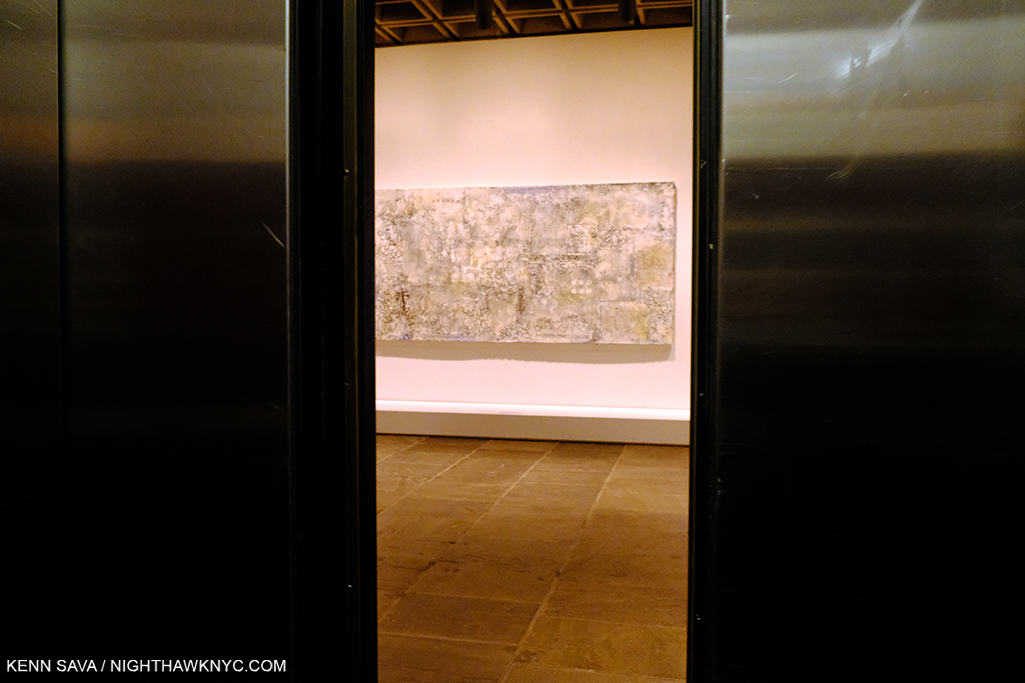
 

  1. Odyssey: Jack Whitten Sculpture 1963-2017 Exhibition Catalog (henceforth Odyssey Catalog), P.39
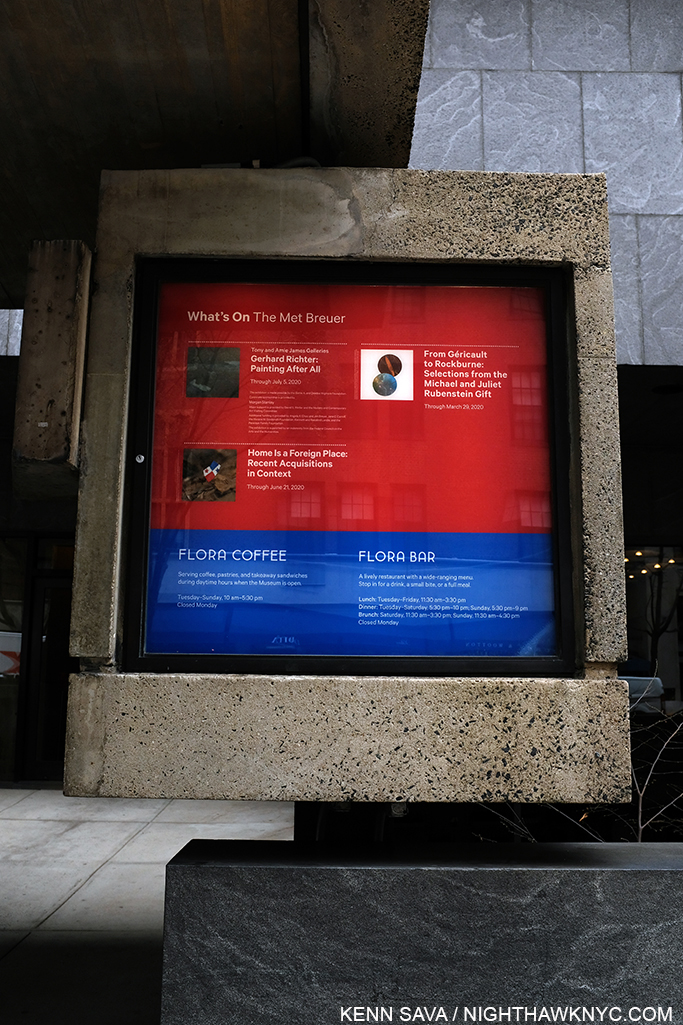
  2. Woods used by Jack Whitten in his Sculpture include-American white oak
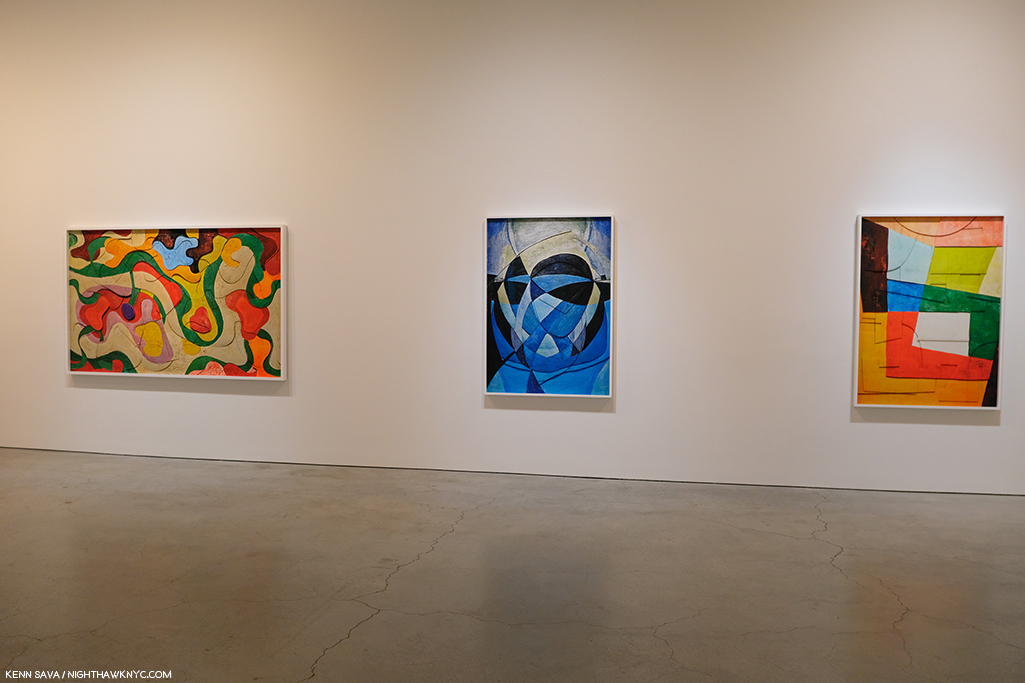
    Black mulberry (a staple throughout his Sculptural career)
    and white mulberry
    Cretan walnut
    Olive wood
    Wild cypress
    Carob wood
    Serbian oak
  3. Graphically described in this 2017 interview.
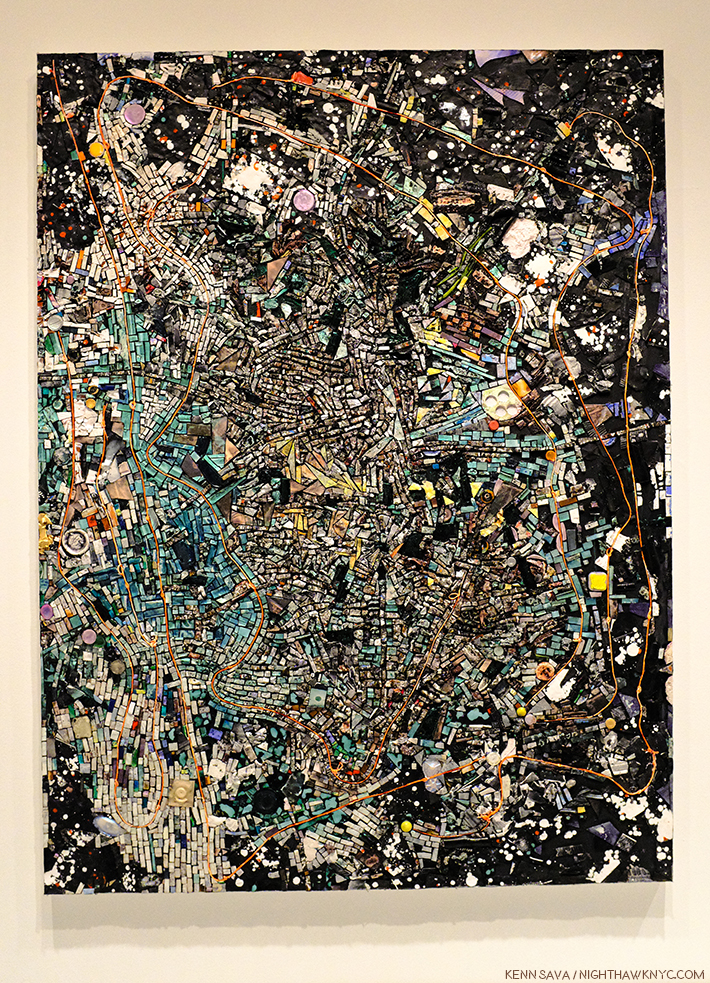
  4. Jack Whitten: Five Decades of Painting, P.19
  5. Jack Whitten: Five Decades of Painting, P.43-4.
  6. //news.artnet.com/art-world/baltimore-deaccessioning-proceeds-1309481
  7. //brooklynrail.org/2017/02/art/JACK-WHITTEN-with-Jarrett-Earnest
  8. See the discussion beginning on p.20 of the Odyssey catalog.
  9. Jack Whitten: Notes from the Woodshed, P.395.
  10. Odyssey Catalog, P. 38
  11. //prod-images.exhibit-e.com/www_alexandergray_com/Whitten_Walker_Blog_9_22_20150.pdf
  12. //www.tate.org.uk/art/artworks/richter-abstract-painting-809-3-ar00027
  13. Odyssey catalog, P.38
  14.  Odyssey catalog, P.21
  15. Jack Whitten, Alexander Gray Associates Exhibition Catalog, 2013, P. 3.