“Best” Doesn’t Exist In The Arts

For The Record #3. 

Third- I don’t believe in qualitatively comparing Artist or works of Art. There is no such thing as “Best” in the Arts. Qualitatively comparing Artists or Artworks is pointless. Whatever criteria you use are subjective. In my view, awards and “halls of fame” are pointless. Turn those halls of fames into museums.

Stanley Kubrick, seen here in his 1946 Photograph with “showgirl” Rosemary Williams, at the entrance to the Museum of New York show of his Look Magazine Photographs  never won a “best director” oscar. Neither did Charlie Chaplin. Neither did Alfred Hitchcock. Neither did Orson Welles. Neither has every black, female, Hispanic, or Asian director, ever.

For every award “winner” there are countless others who can also be said to “deserve” to have “won.” I wish all awards would cease. For every “hall of fame” member there are countless others who could have been included. I think they should all be closed and museums opened in their place. All of this being said, I have no problem with those who win awards enjoying them. As contradictory as that may sound, acknowledgement of Artists in any form in this country, particularly, is very hard to come by. It’s not their “fault” they “won.” History shows that all of these awards have missed many others as deserving, and also shows that some of the most important Artists in their fields never won any award- until someone decided late in their career that they better try and “fix” their oversight. The hype and marketing surrounding awards and award winners is meant to make you feel theirs is the final word on the subject. There is NO such thing!

Experience the work for yourself and make up your own mind. See if it speaks to you, or not. At the end of the day, or of the year? That’s ALL that matters.

So, I’ve preferred to use the term “NoteWorthy,” to refer to Art, shows, and books that have lingered with me, have had the most impact, and which I think others should know about so they can make up their own minds about. I also use the term “favorite,” which does not mean “best,” to connote something I personally like, whether or not I think it’s “important” or “NoteWorthy.” We all have what I call “guilty pleasures”- like a song we know is going to be forgotten as soon as we can get it out of our heads!

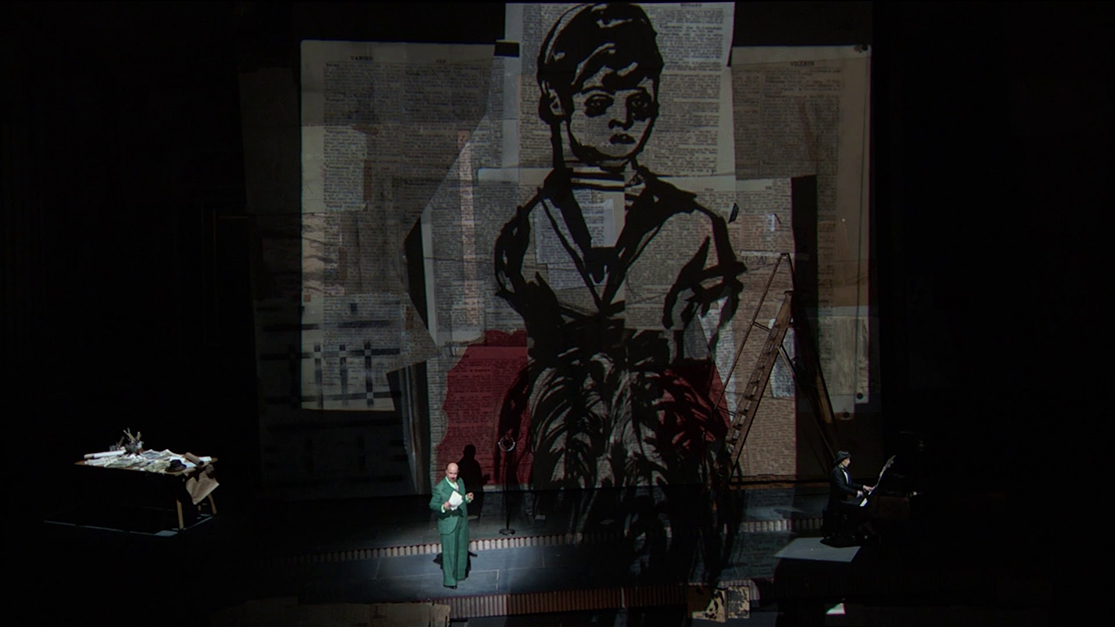
Screencap from The Metropolitan Opera’s broadcast of Alban Berg’s Lulu, with production design by the great William Kentridge, in 2015.

If something doesn’t speak to you…? Well, if something doesn’t speak to me I try and keep an open mind about it and revisit it one day, sometimes years later. I try and not say “I don’t like it.” I just let it lie with me, continue to think about it, and revisit it later, even years later. At that time, it still may not speak to me, but sometimes it does. In some of those cases the work and the Artist became very important to me. Like Alban Berg and his opera Lulu, which on first hearing may sound completely chaotic. As I listened to more and more Music in more and more styles, my ears opened up. Now, I only hear Mozartean beauty in Lulu, which has become my favorite opera. At other times, I’ve wrestled with Art or Music I just didn’t get. This involved digging deeper into the background of the work and looking or listening harder. Yes, harder. So, I try and always keep an open mind. That being said, there are some things I admit I will NEVER like or appreciate. Hitler was a painter (small ”p” intended), remember? It’s too bad he wasn’t able to get into school, become an Artist, and make a good contribution to the world, instead.

Instead of awards, perhaps give an Artist a grant, a commission, or buy their work, if you want to help them.

*-Soundtrack for this Post is “Award Tour” by A Tribe Called Quest from their immortal Midnight Marauders, 1993.

For The Record is a series of pieces that are about key/core subjects & beliefs that underly everything else I’ve written here. The first two parts are here

NighthawkNYC.com has been entirely self-funded and ad-free for over 6 years, during which over 250 full length pieces have been published. If you’ve found it worthwhile, you can donate to keep it going & ad-free below. Thank you!

Written & photographed by Kenn Sava for nighthawknyc.com unless otherwise credited.
To send comments, thoughts, feedback or propositions click here.
Click the white box on the upper right for the archives or to search them.
For “short takes” and additional pictures, follow @nighthawk_nyc on Instagram.

Subscribe to be notified of new Posts below. Your information will be used for no other purpose.


NYC: APRIL, 2020 – A SLIDESHOW BY KENN SAVA

Written & Photographed by Kenn Sava

The response to my previous piece, “The Sound of Silence,” has been a bit overwhelming. My thanks to all of you who have read it and especially to those who have taken the time to write. I’ve heard from people all over the world, all of who are also knee-deep in trying to get through the pandemic themself, so I deeply appreciate it. At times like these it’s important to feel we’re in this together.

NYC in April, 2020 has been a month like none I’ve ever experienced. As I write these words, over 18,000 are dead- just in NYC (as of today, May 1st, 2020, per the stats here, which are updated daily). It’s a very rare thing to find the streets of Manhattan empty for a few hours- even well after midnight. To find them that way day after day is something I’ve never seen here before. I began making trips (as safely as possible, usually on foot) to some of the major landmarks of NYC to document what it was like to be there. The experiences left me with a multitude of feelings, as I said in my prior piece, that I’m still processing.

Inspired by a suggestion I received, I’ve decided to expand the concept of that piece, and share more of the Photos I’ve taken in April, 2020, in a slideshow. Yes, after 4 1/2 years of writing about everyone else’s work, I’m sharing some of my own. In it, the title of my previous piece, “The Sound of Silence,” is taken literally since I don’t have permission to use it legally (Dear Paul Simon- May I?)- the soundtrack is silence. It’s designed to be watched fullscreen.

I hope that wherever this finds you, you and yours get through this in good health. Be well.

NighthawkNYC.com has been entirely self-funded and ad-free for over 6 years, during which over 250 full length pieces have been published. If you’ve found it worthwhile, you can donate to keep it going & ad-free below. Thank you!

Written & photographed by Kenn Sava for nighthawknyc.com unless otherwise credited.
To send comments, thoughts, feedback or propositions click here.
Click the white box on the upper right for the archives or to search them.
For “short takes” and additional pictures, follow @nighthawk_nyc on Instagram.

Subscribe to be notified of new Posts below. Your information will be used for no other purpose.


The Sound of Silence: The Slideshow

Written & Photographed by Kenn Sava

The response to my previous piece, “The Sound of Silence,” has been a bit overwhelming. My thanks to all of you who have read it and especially to those who have taken the time to write. I’ve heard from people all over the world, all of who are also knee deep in trying to get through the pandemic themself. At times like these it’s important to feel we’re in this together. I hope that wherever these words find you, you and yours get through this in good health.

There’s always Music going on in my mind. So, all of the 228 pieces I’ve written so far have a soundtrack that accompanies the words and the pictures. Never before have I taken one of those soundtracks and made it into a slideshow. Until now. At the suggestion of Lana Hattan, I’ve compiled some of the Photos I’ve taken this month (April, 2020, and only in April, 2020) into a slideshow, extending the concept of my piece, accompanied by the lyrics of the song.

As I completed it, I was shaken to hear of the tragic passing of Dr. Lorna Breen, Medical Director at New York-Presbyterian Allen Hospital yesterday. As an Emergency Room Doctor, she was on the front lines of fighting the coronavirus pandemic.

“She went down in the trenches and was killed by the enemy on the front line. She loved New York and wouldn’t hear of living anywhere else,” her father said.

My life was saved at New York-Presbyterian in 2007, so it is with the deepest respect that I dedicate this slideshow to Dr. Breen, and all those working to get us through this.

Be well.

*-Soundtrack for this Post is “The Sound of Silence” by Paul Simon and recorded by Simon & Garfunkel on their debut album Wednesday Morning, 3AM, 1964, with overdubs on the 1966 album, Sounds of Silence and live on Concert in Central Park, recorded in 1981.

Special thanks to Lana Hattan. 

NighthawkNYC.com has been entirely self-funded and ad-free for over 6 years, during which over 250 full length pieces have been published. If you’ve found it worthwhile, you can donate to keep it going & ad-free below. Thank you!

Written & photographed by Kenn Sava for nighthawknyc.com unless otherwise credited.
To send comments, thoughts, feedback or propositions click here.
Click the white box on the upper right for the archives or to search them.
For “short takes” and additional pictures, follow @nighthawk_nyc on Instagram.

Subscribe to be notified of new Posts below. Your information will be used for no other purpose.


The Sound of Silence

Written & Photographed by Kenn Sava

In 2017, I did a PhotoEssay commemorating the 10th anniversary of my cancer treatment. This year, I’ve decided to do another one, taking a look at this extraordinary April in New York…

There’s “Autumn in New York” and “April in Paris,” but no songwriter has yet written “April in New York.” This April may or may not inspire such a song, but one thing’s for sure- April, 2020 will long be remembered by everyone who’s lived through it- in NYC, and everywhere else.

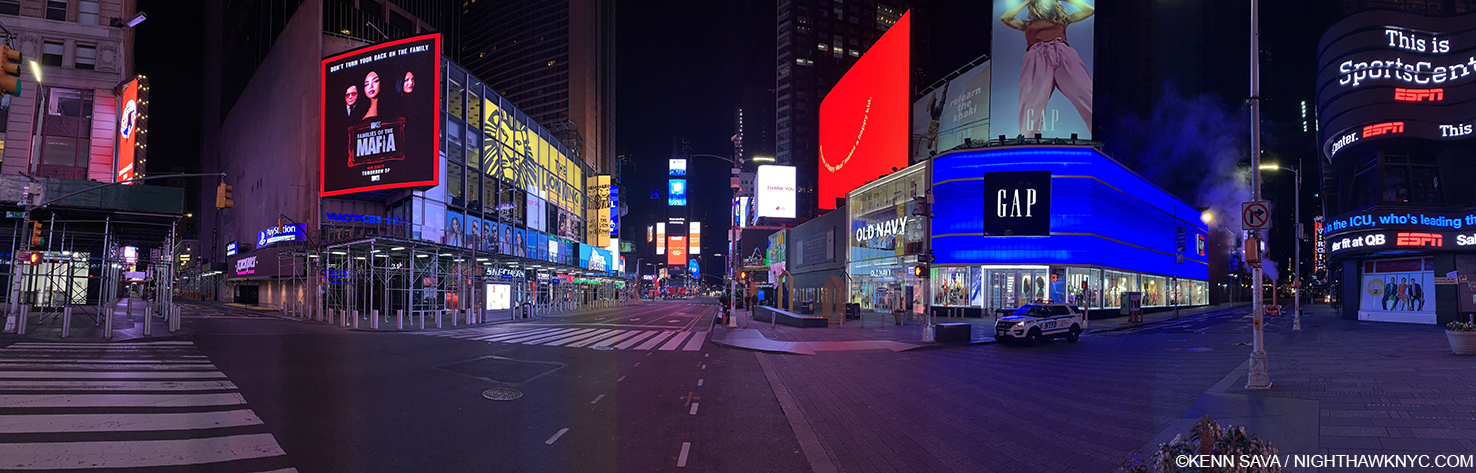
Here, in one of the current centers of the pandemic, with New York City, alone, accounting for 129,788 cases and 13,240 confirmed or probable deaths from the coronavirus1 as I write this, people have been mostly hunkered down and staying inside. Last week, however, for a reason I can’t quite explain, I felt compelled to walk over to Times Square. I got there after 11pm, normally a time when activity is high in the days before the pandemic. I’m not sure what I was expecting to find. It’s not a place I have any reason or desire to go to. Most New Yorkers I know say pretty much the same thing. When I turned the corner of 8th Avenue onto 42nd Street, a corner once known as “the crossroads of the world,” I was taken by what I saw. Actually, I probably shouldn’t have been- it was pretty much what I’d been seeing on the mile walk there. The streets were deserted. Nothing was open. There were too few cars or trucks to qualify as“traffic” along ever-busy 8th Avenue that I should have been prepared for a similar sight on 42nd Street, but I wasn’t. What I saw was actually hard to believe.

It was completely deserted. The only sign of life was a police car’s revolving lights on top parked out front of the McDonald’s near 7th, which might have been open for takeout. If so, it was the only even partially open business I saw in Times Square. Or, maybe something had happened warranting a police visit. From the other side of the street, I couldn’t tell, and I wasn’t about to get curious. I turned the corner and walked up 7th Avenue to 44th Street, stopped on the corner and looked around. I was completely and utterly alone.

A song started playing softly in my brain…

“Hello darkness, my old friend.
I’ve come to talk with you, again.”*

Alone in Times Square. 7th Avenue at West 44th Street, 11:24pm, April 8, 2020. Click any picture in this Post for full size.

There was another NYPD car across the street with its lights on. I don’t know if anyone was inside it, or not. That was the only sign of “life” I could see anywhere around me. I can’t remember ever seeing it this deserted before. Ever. In my entire lifetime, I’ve never experienced a feeling quite like it.

“In restless dreams I walked alone
Narrow streets of cobblestone
‘Neath the halo of a street lamp
I turned my collar to the cold and damp
When my eyes were stabbed by the flash of a neon light
That split the night
And touched the sound of silence”*

I spent some of my formative days on “the deuce” as West 42nd Street was called back when it was as it appears in the film Taxi Driver. It was raw, seedy, nasty and dangerous, but it never closed. Ever. It was, literally, the same 24 hours a day, everyday. Of course, those days are long gone. I’ve never “gotten” what 42nd Street is supposed to be now, beyond a pseudo theme park for tourists. Ditto Times Square around the corner. No wonder New Yorkers never go there. Of course, they go to the shows on the side streets, and there are some good restaurants on those as well, too, but Times Square is one gigantic wasteland as far as I’m concerned. The “redesign” is a disaster. Personally, I can’t imagine why anyone would come to New York City and go to Times Square. Even just to see it.

On this night. No one (else) did.

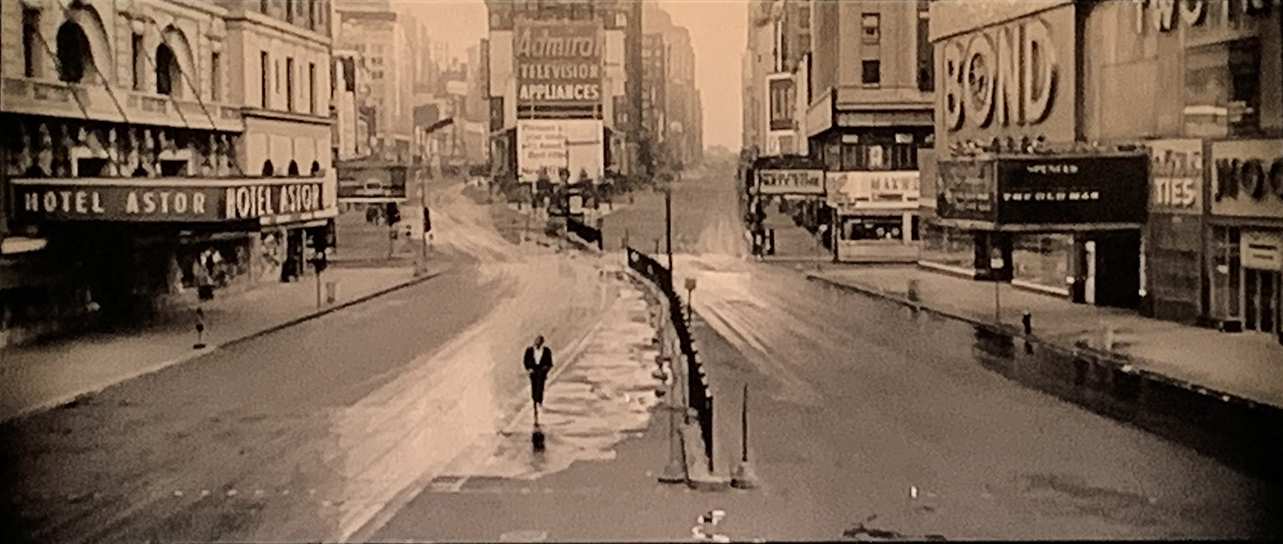
Harry Belafonte alone in Times Square in The World, The Flesh and The Devil, 1959. In 1981, I would see The Clash perform six times at Bond Casino, seen here when it was Bond Clothing, on the right.

In The World, The Flesh and The Devil, Harry Belafonte plays a miner trapped in a cave-in who resurfaces only to discover mankind has been wiped out in a nuclear holocaust. He sets out to look for other survivors. Bizarrely enough, this film, with the scene above, was on the night after I was in Times Square equally alone. The difference being I KNOW there are millions of other people still here. They are all hunkered down, like I am 23 hours a day, trying to survive the coronavirus pandemic.

I haven’t been able to get the feeling out of my mind since. It’s also stuck with me for other reasons I’m still trying to fully understand.

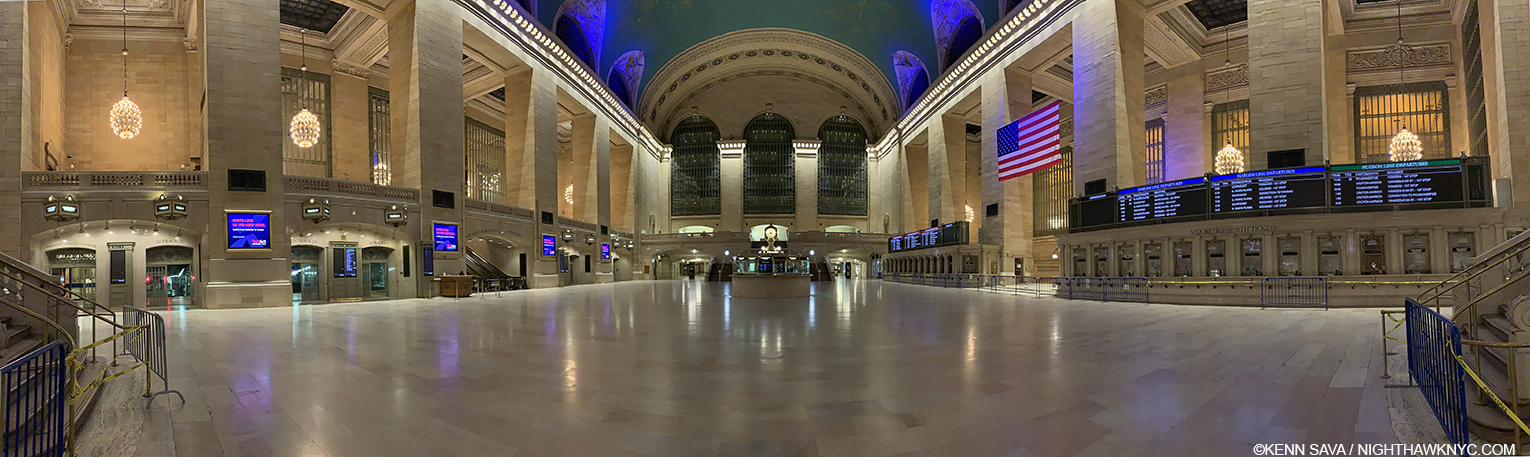
A few days later, I walked over to Grand Central Terminal, getting there at about the same time I got to Times Square, just before 11:30pm on a weeknight. A time when it’s generally pretty busy. On the way (about a mile), I counted about 10 people- on either side of the street. I entered through the Vanderbilt Avenue corner, not sure it would be open, when I came out of the underpass into the world famous main terminal, the feeling was very much the same as it was in Times Square, with a difference.

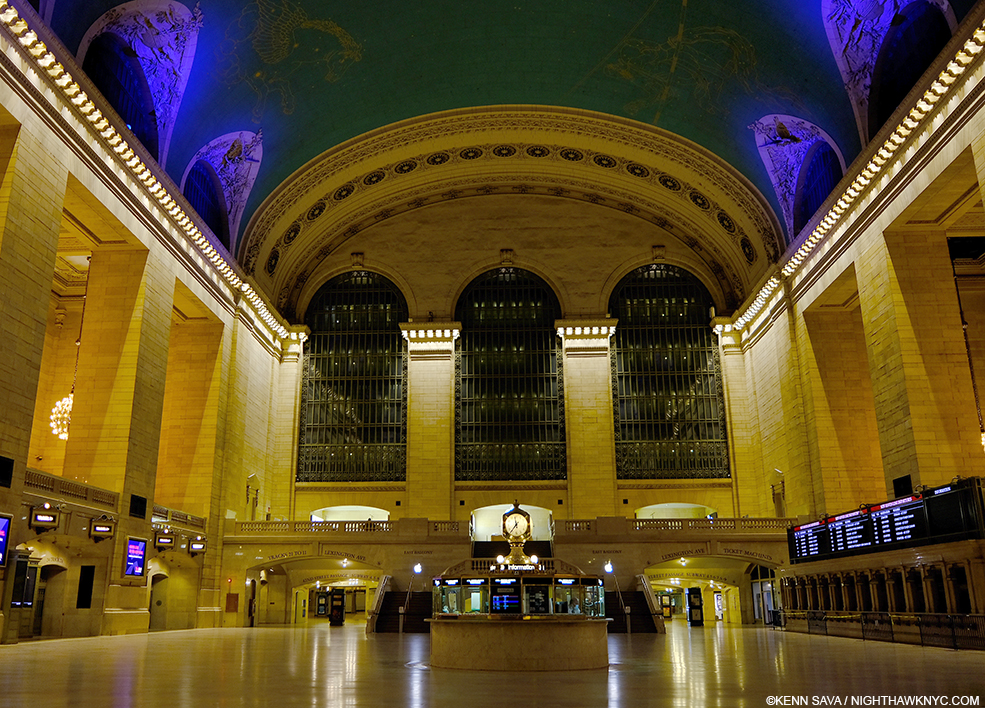
Grand Central Terminal, April 14, 2020, 11:34pm.

Standing there, alone again, reminded me that we are all on our own in a crisis. Only those working hard to keep the essentials of life going- doctors, nurses, power station workers, truck drivers, food store employees, essential business employees, pharmacy workers, postal, delivery and transit workers are keeping us from being in a very, very bad situation, particularly for as long as this is likely to wind up being. Standing there at that moment in Grand Central, I was also struck by something else. A train station is a place about travel, about going somewhere or arriving here form somewhere else. That feeling is completely alien to me. I have nowhere else to go. I realized then that the thought of leaving has never entered my mind. But for some reason, standing there, I didn’t feel hopeless, I just felt like I always do, with cancer, Sandy or 9/11- I have to find a way through it by myself.

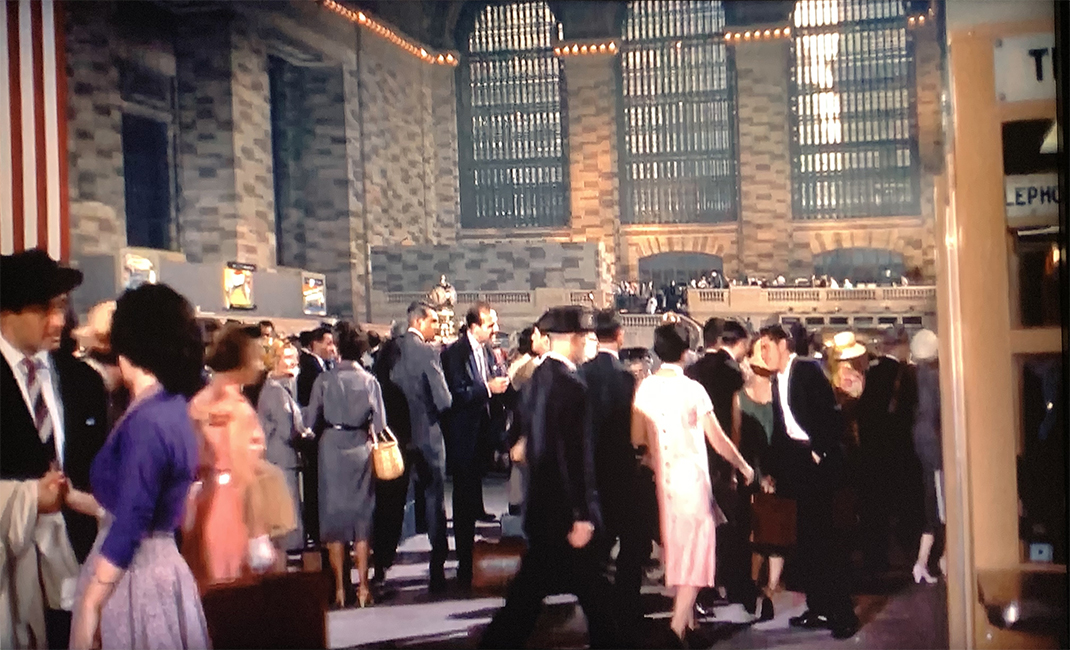
Cary Grant, left of center, in Grand Central Terminal, in Hitchcock’s North by Northwest, 1959, shows the space as it more normally is during the morning/evening rush.

Last week, a reader asked me if I’d ever been through something like this before. I had to give a qualified “Yes.” The 2012 Hurricane Sandy blackout- when we had none of those things I just listed that we have, thankfully, now, for between 5 and 12 days depending on where you were. No power, no mass transit. Not one thing was open because of a lack of electricity, and at night, the temperature went down to about 32. I spent days hunkered down in my bed fully dressed under every blanket I could muster as everything in my refrigerator and freezer went bad and I had to go about a mile to charge my phone. Of course, MANY other people had things much worse from Hurricane Sandy than I did. Many, many people lost everything. An apartment building 4 blocks from me, that I had been in the day before the hurricane, collapsed. It has still not been rebuilt. The risen tide from the Hudson River came to within one block of my apartment building, flooding many of the ground floor galleries in West Chelsea, while devastating lives all around the area. I was lucky. Still, I learned a lot from going through that, a 2 day blackout in the 90’s and of course, going through 9/11. Then, there was the Chelsea bombing in 2016 that was too close for comfort…

Close to the same scene just shown, minus Cary and everyone else. Grand Central Terminal, April 14, 2020, 11:36pm.

Standing there at that moment in Grand Central, I was also struck by something else. A train station is a place about travel, about going somewhere or arriving here from somewhere else. That feeling is completely alien to me. I never leave NYC. As with the other crisis I’ve lived through here, I, like everyone else, just finds a way. 

When I think about rising above it and transcendental places in NYC, the first place that comes to my mind is, in my opinion, what may well be the greatest feat of building by modern man in the world, Brooklyn Bridge. Before you say, “You’re nuts,” watch Ken Burns’ Documentary film on the making of Brooklyn Bridge, then see what you think. On April 16th, I decided to go there and see how The Bridge was faring during the pandemic.

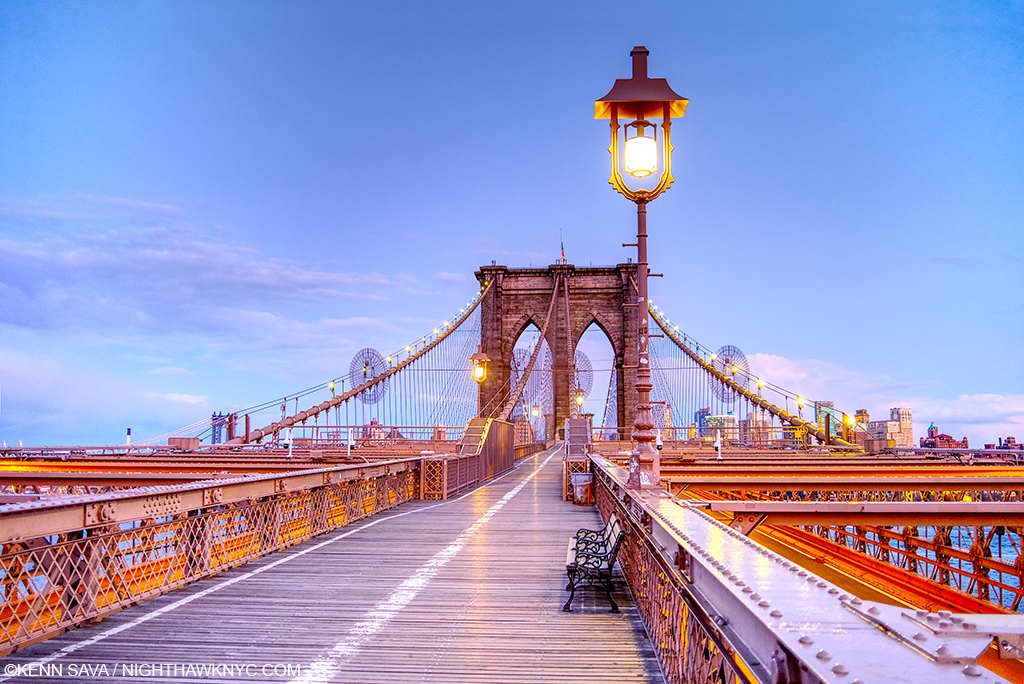
Just after sunset on Brooklyn Bridge, facing Brooklyn, 7:53pm, April 16, 2020. If I could save one modern structure for eternity it would be Brooklyn Bridge. It is one of the supreme achievements of mankind, both Artistically and as a testament to the human spirit. In this case the spirit of those who designed it and built it while overcoming impossible odds.

I walked the entire span, beginning on the Brooklyn side, and arriving on the Manhattan side just after sunset. It was emptier than I could imagine it during daytime hours. As anyone who has had the joy of walking The Bridge knows, when you reach the center you are, magically, all of a sudden on top. The cabling has ended, the sides and even the railings seem to melt away and you feel like you are standing on top of the world. Now, imagine doing this in 1883 when The Bridge opened. At that point, you REALLY WERE on top of the world! This was decades before the advent of the skyscraper. Standing there, you were higher than anything you could see- anywhere around you. It truly must have felt like going to outer space. Of course, I paused and spent a good 30 minutes pondering everything that had been going on as I stood there, alone.

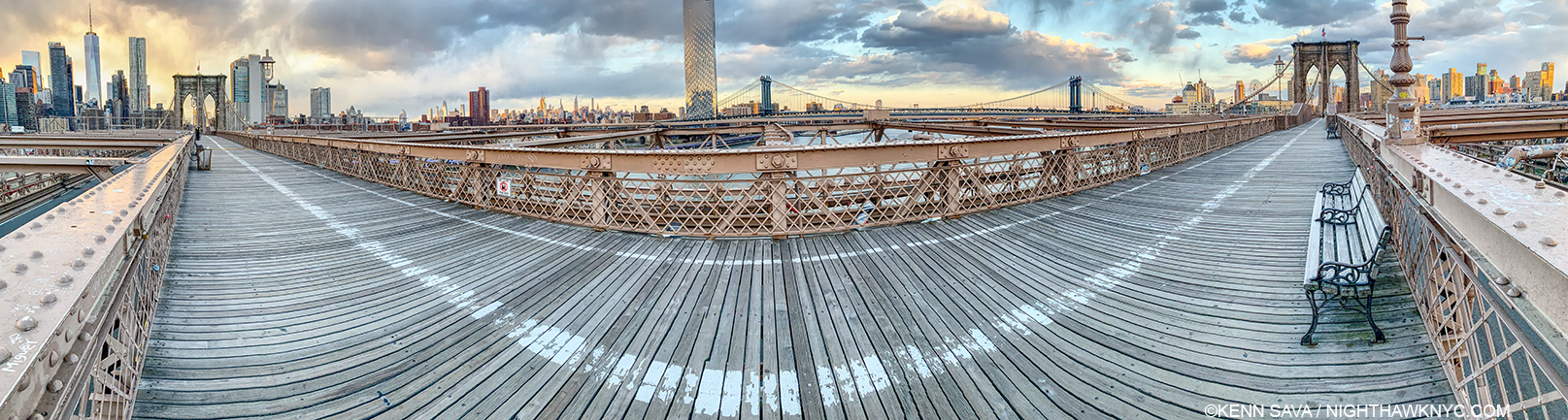
Alone in the middle of Brooklyn Bridge, with Manhattan to the left, Brooklyn to the right, and the East River straight ahead, 7:11pm, April 16, 2020.

“Because a vision softly creeping
Left its seeds while I was sleeping
And the vision that was planted in my brain
Still remains
Within the sounds of silence.”*

Thinking about things I’ve lived through in NYC, of course, 9/11 was the first major crisis I would point to. That morning, as I walked to work with one Tower on fire, the second about to be hit, a neighbor standing on the corner told me the first plane had flown down 7th Avenue- it had flown down my block! To this day, no one I know died in the horror that ensued. Both people I knew at the time got out. Still, the mysteries of the brain being what they are, somehow my sleeping mind connected that American Airlines Flight 11 that hit the North Tower of the World Trade Center with the heroic United Flight 93. In my dream (actually, a recurring nightmare), it was the passengers and crew of American Flight 11 that fought back and jumped the hijackers, causing Flight 11 to crash early- into my apartment building. 

18 years later, those thoughts were not in my mind when I decided to visit the Oculus in Santiago Calatrava’s World Trade Center Path Station Terminal at the site of the World Trade Center Towers. What is always on my mind when I visit the site of the World Trade Center is my own past. I grew up in the area. My dad had an office 2 blocks from the WTC for 45 years. I remember walking past the Towers while they were being built. Years later, the company I worked for had two Holiday Parties at Windows On The World Restaurant at the top of the South Tower, a few hundred feet from where the Oculus now is, including one for Holiday, 2000, the last Holiday season that would ever be celebrated there. Walking through the area my thoughts were on change. As in HOW MUCH change has gone on Downtown just in my lifetime

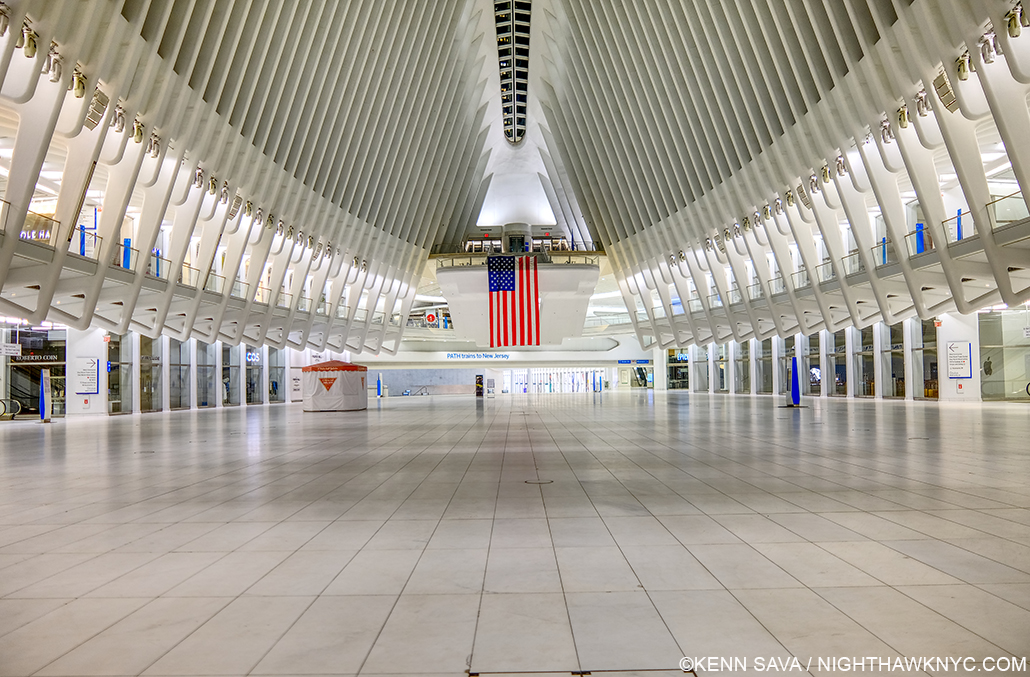
Crossing Church Street, I walked up to the front doors, half expecting to find them locked. The door opened, and there was a man standing along the wall, just inside the door. He was one of about 7 or 8 people I saw while I was inside who just stood in a spot. And stood in that spot throughout. Homeless, I guess. Most had some sort of baggage with them. There were 3 police officers walking around, who checked in on them to make sure they weren’t sleeping, among their other duties. But there was almost no one else there. I moved to the edge overlooking the 57,000 square foot floor. All the surrounding stores were closed. Off in the far distance, at the other end, the PATH train station was still in operation. Once in a while, someone walked from my end across the floor to take a PATH train uptown or to New Jersey. Mostly, I was utterly alone, once more. Again, I stood transfixed by the scene.

The 57,000 square foot main floor of Santiago Calatrava’s Oculus on April 15, 2020 at 11:56pm.

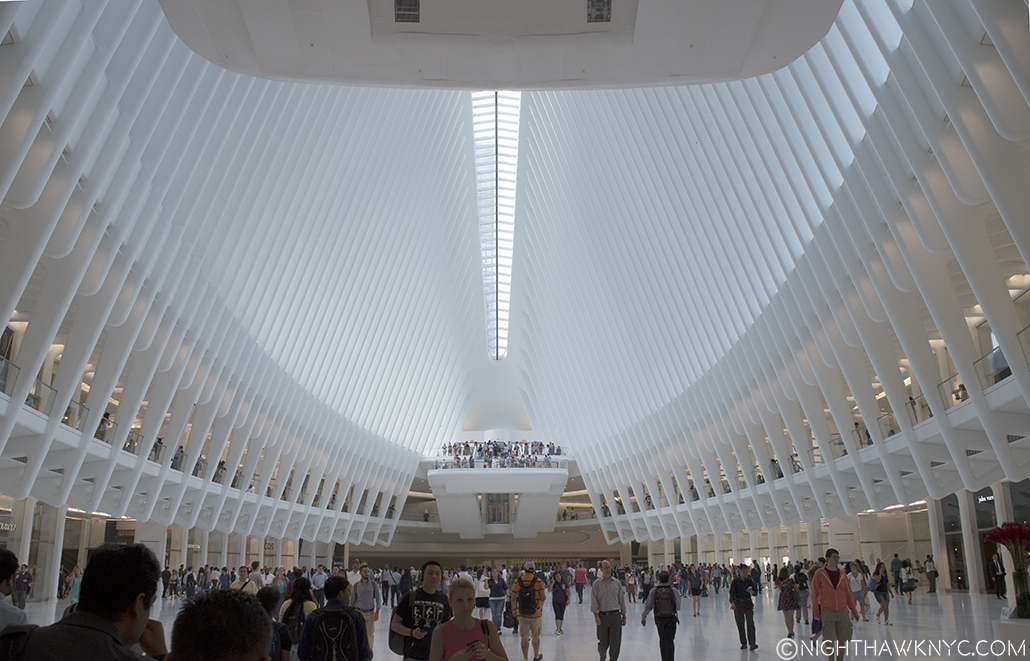
Speaking of change, I wrote about being at the Oculus in August, 2016 as it opened. That day, the floor looked like this-

Standing in the same spot I stood in taking the prior picture, on August 17, 2016 at 3pm.

Here, in this gleaming, barely 4 year old facility, was a shocking look at our present in a nutshell. The brick and mortar economy, represented by the stores that surround both levels of the Oculus, with more elsewhere in the 800,000 square foot complex, has completely paused, save for food stores, pharmacies, and home supply stores. The world has almost completely come to a stop. In fact, I think this period of time when we’ve all been home will be eventually seen as a pause between life as it was and life the way it will be. I think most of us know right now that once activity start up again, things will be different. Many of us have been, at least, subtly changed by this experience. Exactly how things will be different remains to be seen, but they will be different. Beyond the horror of all the illnesses and deaths, we will always look back at this moment “between” the old and the new as “the pause” between them.

Right now, the focus is on finding those infected, treating those ill, and keeping the virus from spreading. Eventually, we all hope, this crisis will mitigate. And then what? A lot of people (even those who haven’t gotten sick) are seriously hurting. Many have lost their jobs- temporarily, or permanently. There’s going to be a gigantic, collective, “starting over” for countless people. The ways people interact or get together and many other aspects of life not known right now will also be different. The way many businesses do business will be changed. A few/some/many small businesses, who knows how many, won’t reopen. More business will be done online.

What does this all mean?

“And the sign said:
The words of the prophets are
Written on the subway walls
And tenement halls
And whispered in the sound of silence.””

7th Avenue at West 20th Street, April 17, 2020, 8:29pm. On this very corner, Jack Kerouac’s novel On The Road ends. He wrote it 3 blocks west.

We won’t know specifically how life will be different until this is over. And no one knows when that will be right now. In the midst of all this silence, something else that can’t be heard is happening.

Change.

While we are all alone together inside, hopefully staying safe, the world is changing. The only choice we have is to adapt to it.

*- Soundtrack for this Post is “The Sound of Silence” by Paul Simon and performed by Simon & Garfunkel on the album Wednesday Morning, 3AM, 1964, and with overdubs on Sounds of Silence, released in 1966. They perform it on September 19, 1981 in Central Park below. As I write this, almost 53 million people have watched it-

This Post is dedicated to all those keeping us going, particularly in my case, my thanks to the staffs of Trader Joe’s, and Gristede’s, Chelsea, NYC, Rite-Aid, Home Depot, Con Ed, the USPS, to the truck drivers and delivery people who keep this island supplied, and to Drs. Ro & Hoffman.

NighthawkNYC.com has been entirely self-funded and ad-free for over 6 years, during which over 250 full length pieces have been published. If you’ve found it worthwhile, you can donate to keep it going & ad-free below. Thank you!

Written & photographed by Kenn Sava for nighthawknyc.com unless otherwise credited.
To send comments, thoughts, feedback or propositions click here.
Click the white box on the upper right for the archives or to search them.
For “short takes” and additional pictures, follow @nighthawk_nyc on Instagram.

Subscribe to be notified of new Posts below. Your information will be used for no other purpose.

  1. The current stats are here.

Death To Boxes!

Written & Photographed by Kenn Sava (except *)

For The Record #2.

Boxes Must Die!

In the Arts, that is.

Doing my part.

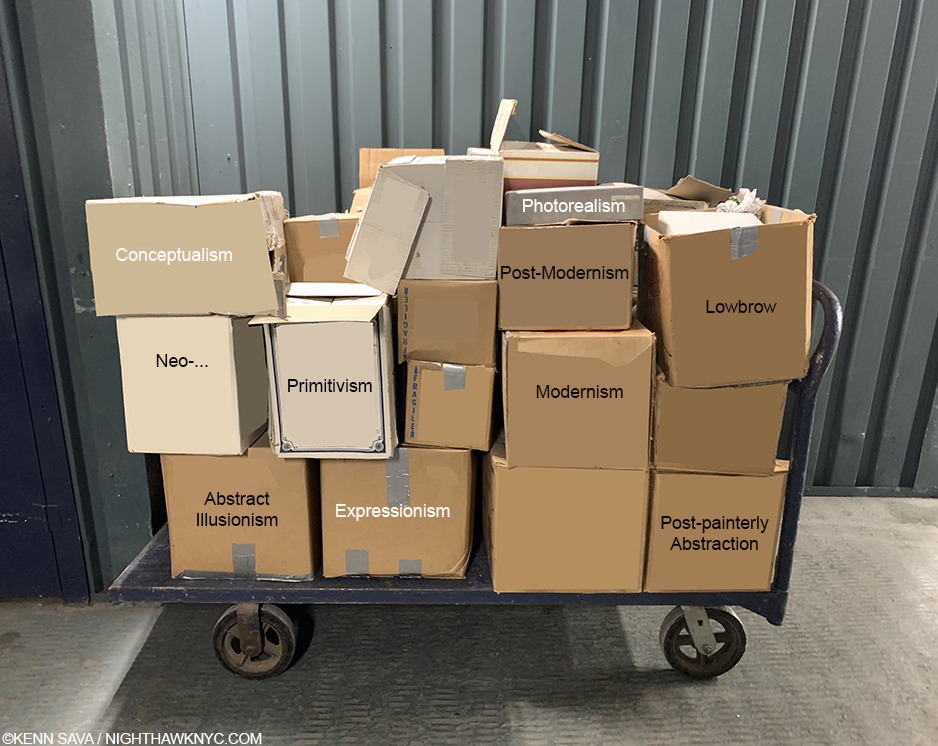
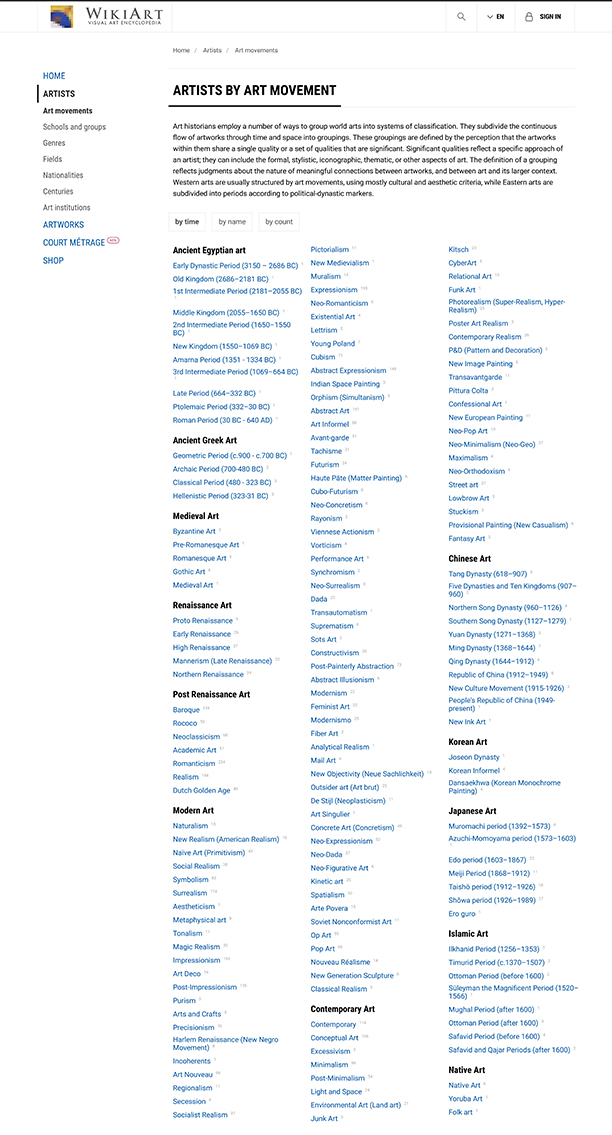
Artists are people. Like anyone else, you can’t put an Artist in a box (i.e. a so-called “style”,“school” or “movement”) UNLESS he or she puts themself in one, and that distinction is critical. No one else can, in my opinion, and that includes Art historians, gallerists, or yes, writers. Over the years I’ve spent studying and researching Art history, it seems the vast majority of the time, these labels get stuck on Artists by someone else, often someone with something to sell or someone attempting to write about the Artist. Whoever else does it, I believe they do more harm than good. It seems to me that all these terms serve to do is to keep you from looking at the Art for yourself and making up your own mind. They’re a kind of shorthand for “this is that.” They want you to think- “Oh. I already know what ‘this’ is, so I ‘know’ what that is.”

Really?

Now, press a little harder.

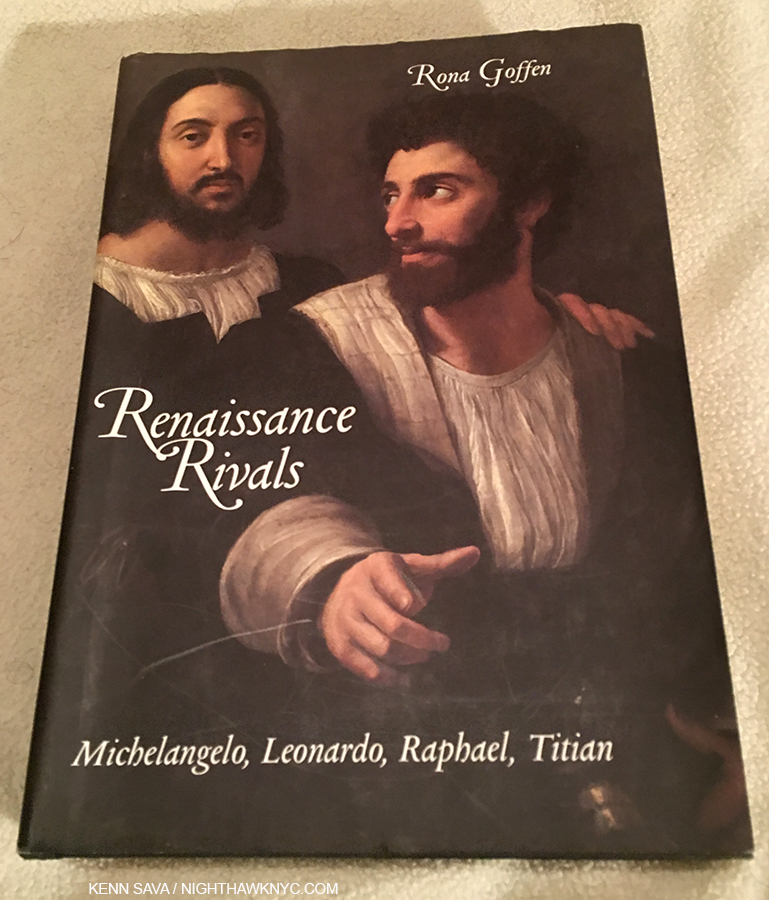
How many “schools” or “movements” have there really been in Art history among museum level Artists? Both imply the Artists were organized around shared beliefs. Most Artists I’ve met tend to be solitary beings who work alone (or, with their assistants, if they have them). The Renaissance is often listed as a “movement.” This brings an upside down smile to my face. While there were a number of Artists and others who turned their attention to the work of the ancients, which they “revived” in their own way, the term implies a unity that might not have been the case. Many of the leading Artists of the 15th century (particularly Leonardo da Vinci, Michelangelo and Raphael) were rivals who competed for jobs and, as far as is known, never “got together around shared beliefs.”


My copy of Rona Goffen’s Renaissance Rivals. Check this out if you want to get a taste to what life for these Artists may have really been like.

Raphael is reported visiting Leonardo’s studio, but there is no report that Leonardo was actually there at the time. Perhaps, the only time we may surmise that Leonardo and Michelangelo may have been in the same place at the same time was they were both commissioned to create frescoes on opposite walls of the same building. I wonder what they would think of being lumped together by posterity. It seems to me that what is known as “the Renaissance” in Art may be also be characterized as “the optical revolution,” since, as David Hockney’s Secret Knowledge points out, the fifteenth century seems to be the period when optics were introduced into Painting, “The Romantics?” While images of a period of group love pre-dating the hippies by 200 years might be a nice thought, there was no banding together among Artists, only others who see common threads in their work. In fact, the actual 1960s hippies were more of an actual “movement,” though they are not thought of as an “Art movement”…yet. “The Impressionists?” In 1874 thirty Artists showed their work in the space formerly occupied by the Photographer Nadar in a show titled The Anonymous Society of Painters, Sculptors, Engravers, etc. This show included work by Monet, Degas, Renoir, Pissarro, Cezanne, Berthe Morisot among others. It wasn’t until their third show in 1877 that the term “Impressionists,” which had been coined by a critic, after the work Impression, Sunrise, 1873, by Monet, was “accepted” by the group. They held a total of eight shows through 1886. Not one bore the word “Impressionist” in its title. It seems to me a “bad habit” had begun. Ever since, dealers, critics and historians have continually fallen all over themselves trying to put names (i.e. boxes) on whatever has been done since, in a criminally short sighted “rush to judgment” naming competition. Very rarely since, however, have the Artists involved agreed to have their work so “boxed.”

It’s one thing to have a lack of imagination yourself, but to foist it on others, including possibly, many who have not seen the Art under discussion is doing them, and the Art, a real disservice.

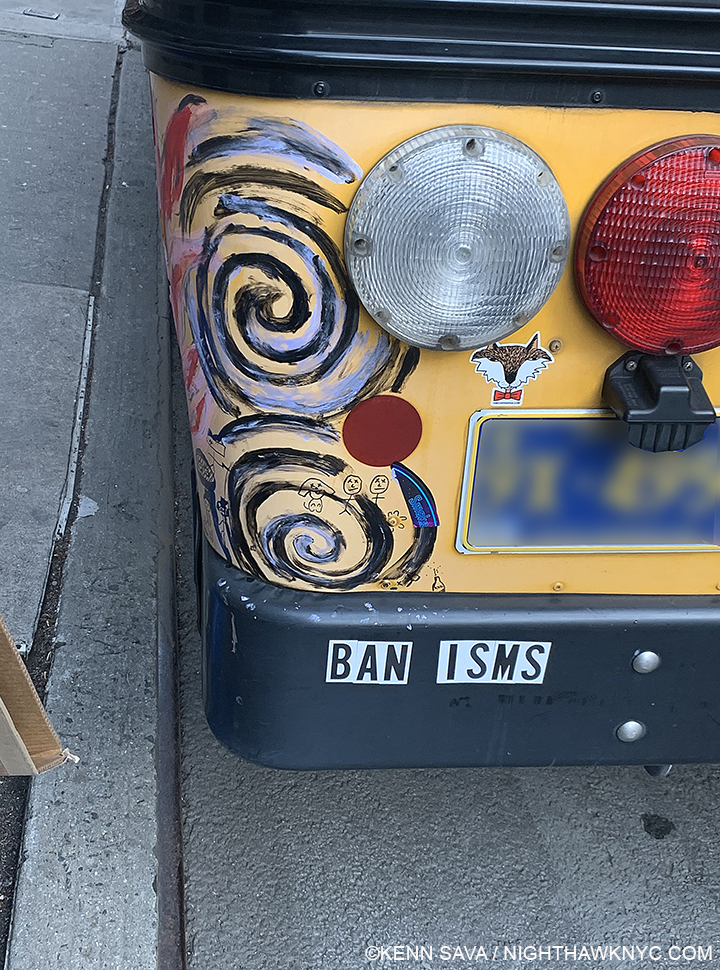
I’m this close to agreeing with this sentiment, in the Arts, though I’m sure there must be at least one “ism” that’s “ok,” right?

Beyond this, the practice speaks of a terrible lack of responsibility on the part of those naming and using boxes to speak about Art. Do these people who come up with these boxes ever stop to think about the ramifications of putting someone in a box? Short term? Long term? Longer term? Once in such a box, getting out is extremely hard, if not impossible. In many (if not most) cases, living Artists in such a situation would be risking their financial survival and their careers to fight back. I’ve spoken with a number of Artists who have expressed their frustration with this to me. As a result, I’ve come to feel they represent the tip of the proverbial iceberg in the high seas of the Art world. Unlike some others, this iceberg isn’t melting nearly fast enough.

When you come across one of these terms, take a quick look back into what the Artist has said about his or her work and see if he or she ever used the term themself in speaking about their Art, or if they really aligned themselves with others in the broader sense of a “school” or “movement.” My bet is that if you do this often you’ll become unsurprised to find that 90% of the time, or more, no such arrangement ever existed. IF it did, most of the time it didn’t last for more than a decade of their career. As far as “styles” go, I laugh when I see someone other than the Artist try and name an Artist’s style. For me, it’s like “naming” a wave in the ocean. “That wave seems angry. That’s the ‘expressionist’ wave. The wave that hit me in the face when I waded in was the ‘hyper-realistic’ wave…”

The common sense thing to do, in my opinion, when looking at Art is to let the Artist have some. Let him or her “speak” for themselves through their work. Look at it through your own eyes.

Being human beings, Artists, like the rest of the universe, are subject to change. Along with death and taxes, change is one of the universal laws of the universe, right? Many Artist’s styles change or evolve over time, some, like Picasso or Miles Davis, changed frequently, over the course of their careers. Then, whatever “box” the powers that be had put them in no longer applied. Now what? People coming to their work with one box in their head are now confronted with work nothing like it! Oops. Instead of coming to realize the obvious, scholars, critics and dealers struggle to put him or her in a new box.

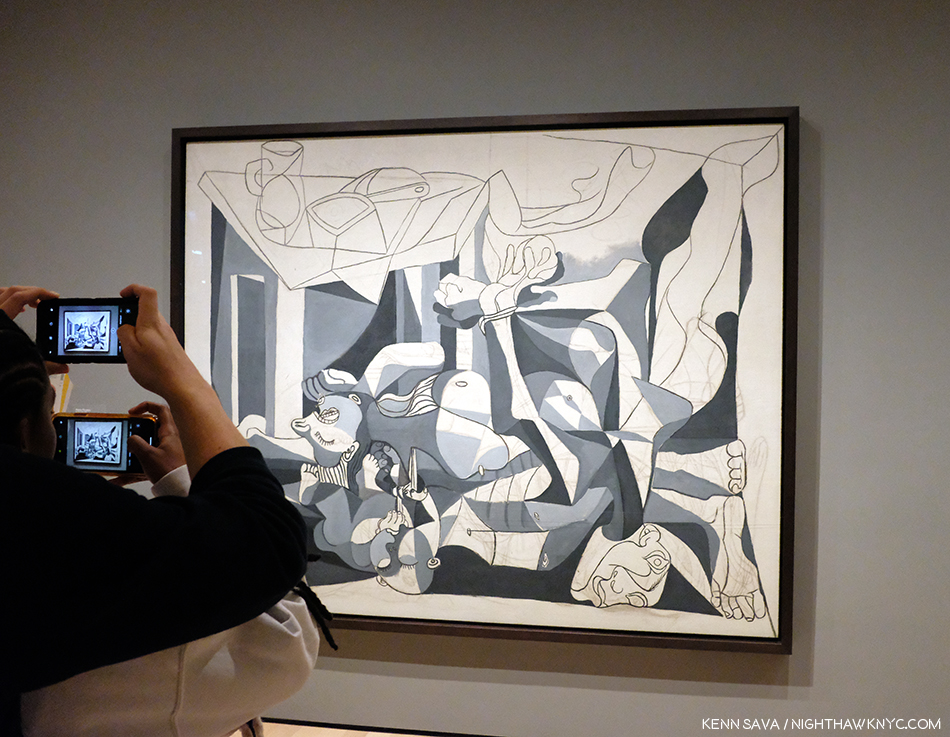
“Blue Period,” “Rose Period,””Cubism,” “Late Period,” and on and on. In the end, Picasso, is simply Picasso- a talent so broad it burst any and all categories in almost as many mediums. Unfortunately, his example wasn’t apparently enough for the practice to cease once and for all. Here, his The Charnel House, 1944-5, is seen at MoMA. While Guernica is world-famous as a work that was Painted in 1937, during the pre-WW II Spanish Revolution, The Charnel House bookends it from the end of the War after the discovery of the horror of the death camps.

Why didn’t they just take the “easy way” out? If you insist on using boxes, Picasso, Miles, EVERY Artist, in my view, belongs in one box- the one with their name on it. Aren’t people unique? So are Artists. So, WHY do some insist on lumping them together in a box?

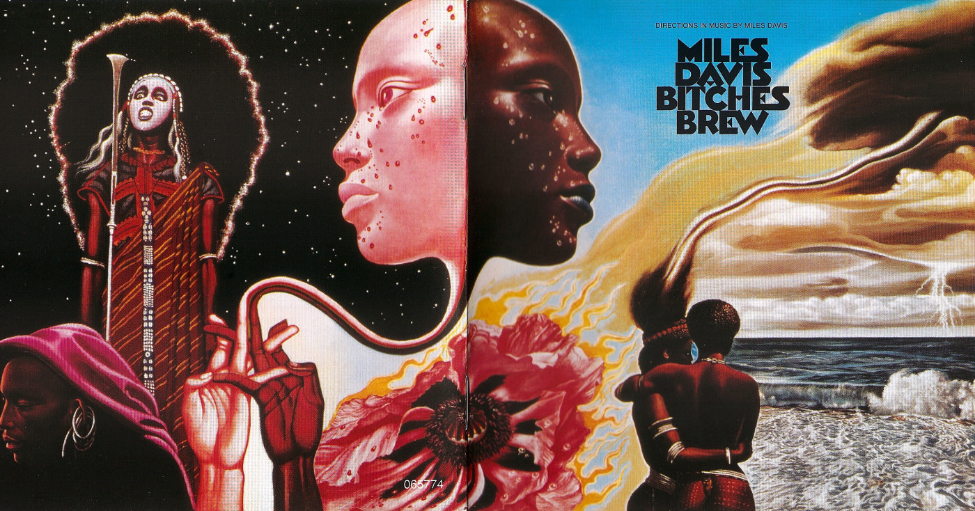
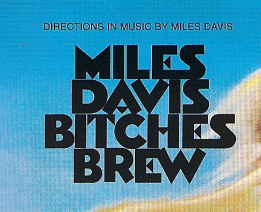
People tried to put Miles Davis in a box his whole life. FIFTY YEARS AGO, on March 30th, 1970, he permanently messed up their minds when he released this masterpiece. With a cast of Musicians who are now each legends in their own rite, it couldn’t have been more aptly titled. The cover art is perfect, too. *Sony picture.

It seems to me that Miles Davis eventually “answered” those trying hopelessly to pigeonhole him. Later in his career, he started labelling his albums “DIRECTIONS IN MUSIC BY MILES DAVIS.”

Word. Put it right up top, in CAPS before anyone else can call it something else. Enough said. *Crop of the previous Sony picture.

Speaking of human beings, “women Artists”, “transgendered Artists,””disabled Artists,””Asian Artists,””black Artists”- these are boxes too! People are people and Artists are Artists. Let’s leave it at that.

Whatever the short term “gain” someone got from boxing an Artist, little thought appears to be given to the fact that Art is this Artist’s career, and so, something they’re going to have to deal with for the rest of it. Some, like Chuck Close and Todd Hido have been able to break out of the boxes they were initially put in and gone on to show other sides of their creativity. How did they do it? It seems to me that both of them were and are frequent interview subjects, and this allowed them to frame the conversation around their own work to the point that they “drowned out” any other voices about it. If you look around, you’ll find they are in the vast minority. It’s very hard to do. Both achieved enough popularity to garner frequent interviews where they were free to speak about their work on their own terms. I can’t help but wonder how many others have given up, or worse, possibly even ended their careers…or their lives.

Seriously.

When Art is your life, what else matters?

Perusing the new book Genealogies of Art, which has 448 other pages that try to trace the “lineage” of Art down through the centuries. Hmmm….Yes, most Artists have influences, but who’s to say how much anyone has been influenced by someone else? What about multiple influence? It seems to me drawing direct lines between and “connecting” them (which is on the other 448 pages) is pointless and meaningless. So far, these are the only two pages I agree with. Personally? I would have left it at this.

It’s way past time for this practice to end. STOP teaching this in Art history classes! Stop using boxes, “schools,” “movements” that Artists never joined, or bogus, imagined, “styles” that mislead and pigeonhole!

It’s time to look at the Art for what it is and for what it says to you (if anything), without prejudice or boxes, labels, imaginary “schools,” or “styles.” So, when you hear a meaningless marketing term like say, “photorealism,” do what I do. Ignore it!

Save a career. Maybe even save a life. Stop the insanity- NOW!

Of course, NighthawkNYC asks that you please dispose of boxes responsibly. Put them where they belong.

*-Soundtrack for this Post is “Bitches Brew” by Miles Davis from the aforementioned album of the same name. Here, Miles and most of the Musicians on the record including legendary Saxophonist Wayne Shorter, perform it in Copenhagen, 1969, shortly before the album’s March, 1970 release-

This Post in honor of the 50th Anniversary of the release of Bitches Brew, one of the great box-busting moments in 20th century Art, is dedicated to all those Artists I’ve spoken with who suffer with being stuck in boxes, and all of those who are that I haven’t. 

For The Record is a series of pieces that are about key/core subjects & beliefs that underly everything else I’ve written here. The first part is here. 

NighthawkNYC.com has been entirely self-funded and ad-free for over 6 years, during which over 250 full length pieces have been published. If you’ve found it worthwhile, you can donate to keep it going & ad-free below. Thank you!

Written & photographed by Kenn Sava for nighthawknyc.com unless otherwise credited.
To send comments, thoughts, feedback or propositions click here.
Click the white box on the upper right for the archives or to search them.
For “short takes” and additional pictures, follow @nighthawk_nyc on Instagram.

Subscribe to be notified of new Posts below. Your information will be used for no other purpose.


Art- With A Capital “A”

For The Record #1. First part of a series.

Written & Photographed by Kenn Sava

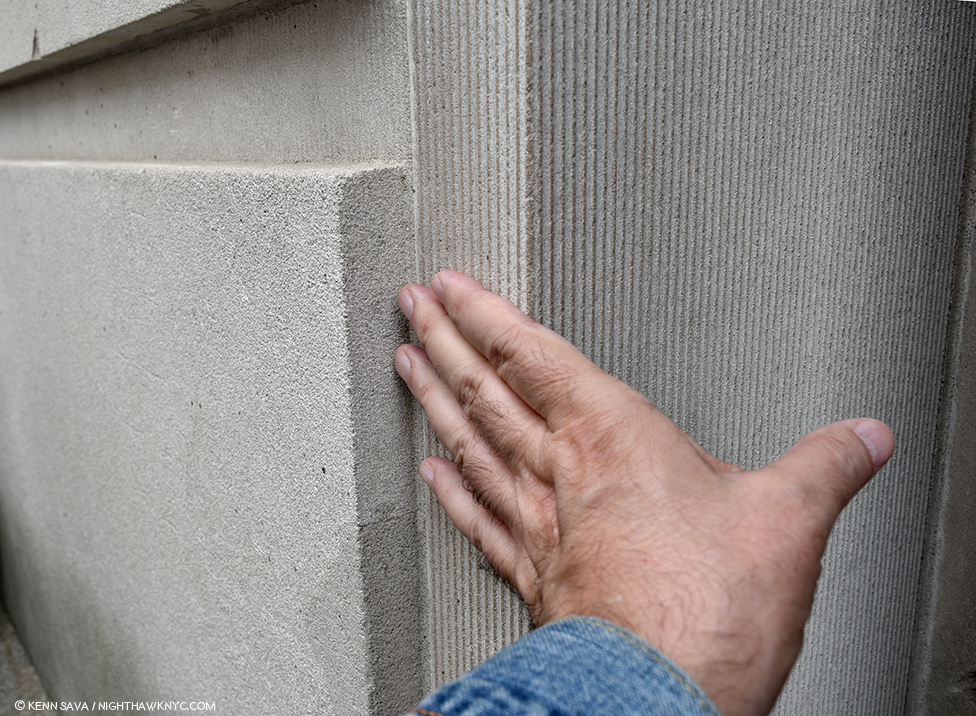
Back at The Met, May 6, 2018. The Museum, as it’s referred to, is one of the world’s great repositories of Art with a capital “A” with collections covering 5,000 years of it from all cultures in all its forms. It’s also one of the very best things about living in NYC. No. It’s THE best thing in my opinion. 1,700+ visits in since August 1, 2002, every time I turn the corner and see the building looming in front of me, I still get a chill down my spine. I touch the corner as I go in each time as a way of saying “Hello” to an old friend and to give thanks for each and every opportunity I get to do so.

To mark the 4 and a half year Anniversary of NighthawkNYC, during which I’ve published 225 pieces in 240 weeks (Phew…), I thought I’d take the opportunity to set the record straight on a few things that I feel are at the core of what I believe, and what I’ve written here. Perhaps I should have “explained” them at the beginning instead of letting those who’ve read these pieces (for which I Thank You) wonder, “What the heck?” Well, better late than never. Herewith the first installment in a brief series called For The Record. Consider them “footnotes” or “addendums” to every piece I’ve written.

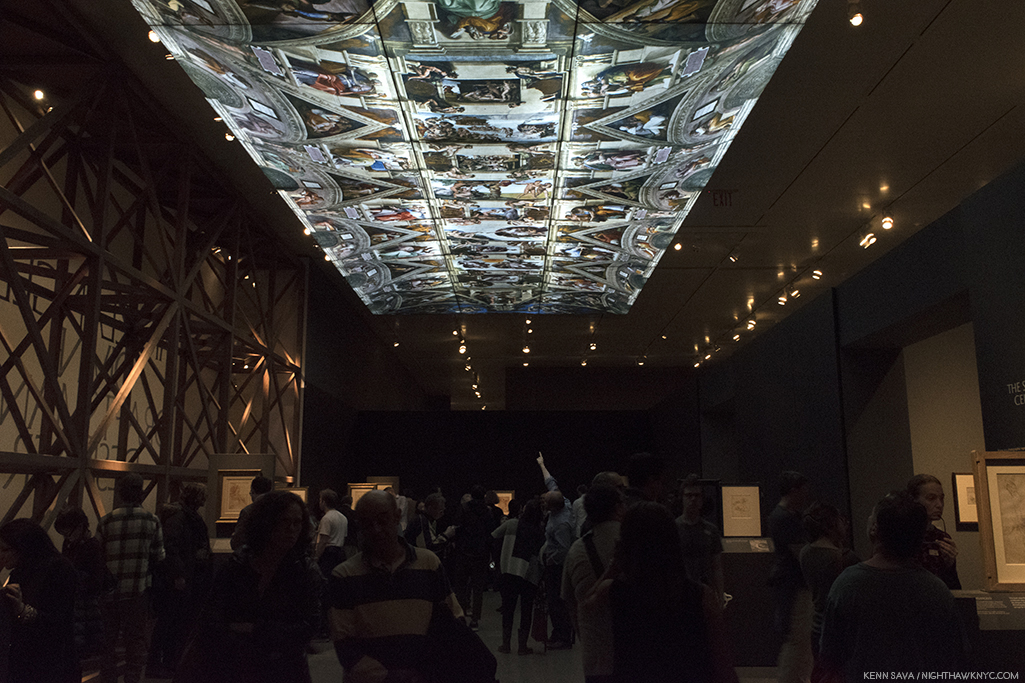
Michelangelo’s Sistine Chapel Ceiling reproduced as part of The Met’s staggering Michelangelo: Divine Draftsman & Designer, 2017-8, one of the sublime experiences of my life.

First- Art is of one of man and womankind’s supreme accomplishments in my view. I believe there should be some distinction between the Art of someone like Michelangelo and, say, the art of someone learning (said with all due respect).

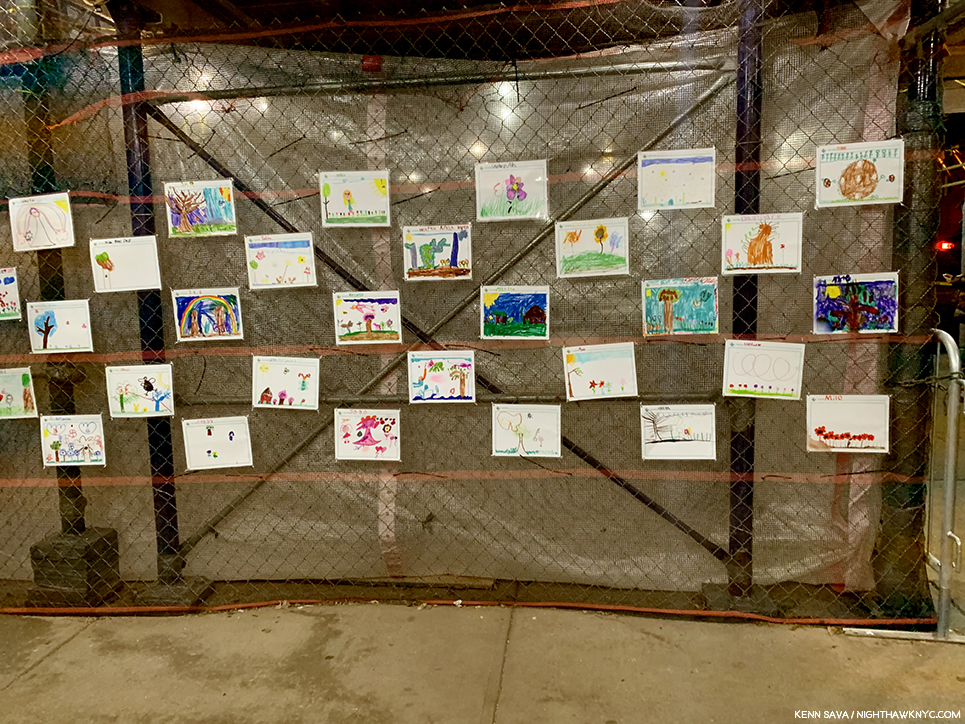
Various young artists, unknown titles. A display of children’s art beautifying an NYC public school under renovation.

That’s why I capitalize Art and its associated terms (Artist, Painter, Sculptor, Musician, Painter, Photographer, et al.). It’s my way of showing these people the respect I think they’ve earned and deserve. I’ve done this here since Day 1- July 15, 2015, and I’m sure there are some who frown at me for doing it, and some who disagree with me for doing it. Along the way, I’ve seen a few others doing it this way and frankly, I’m surprised it hasn’t become more widely adopted. I hope it does soon.

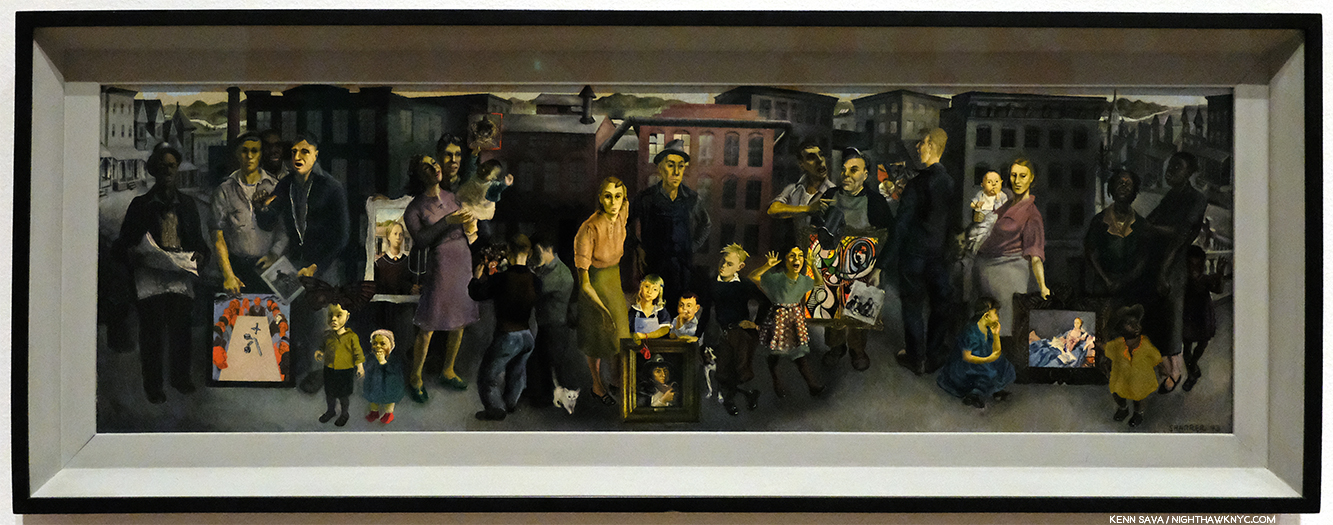
The terrific, and terrifically overlooked, Honore Sharrer’s, Workers and Paintings, 1943, Oil on board, seen at MoMA. Some of the Art she includes are Grant Wood’s American Gothic, Picasso’s Girl before a Mirror, and others by Jean-Francois Millet and Diego Rivera. Though this work and the originals of most of what she includes in it are 100 years old, +/-, for me, this and all of them are Art. Will the future agree? Time will tell…

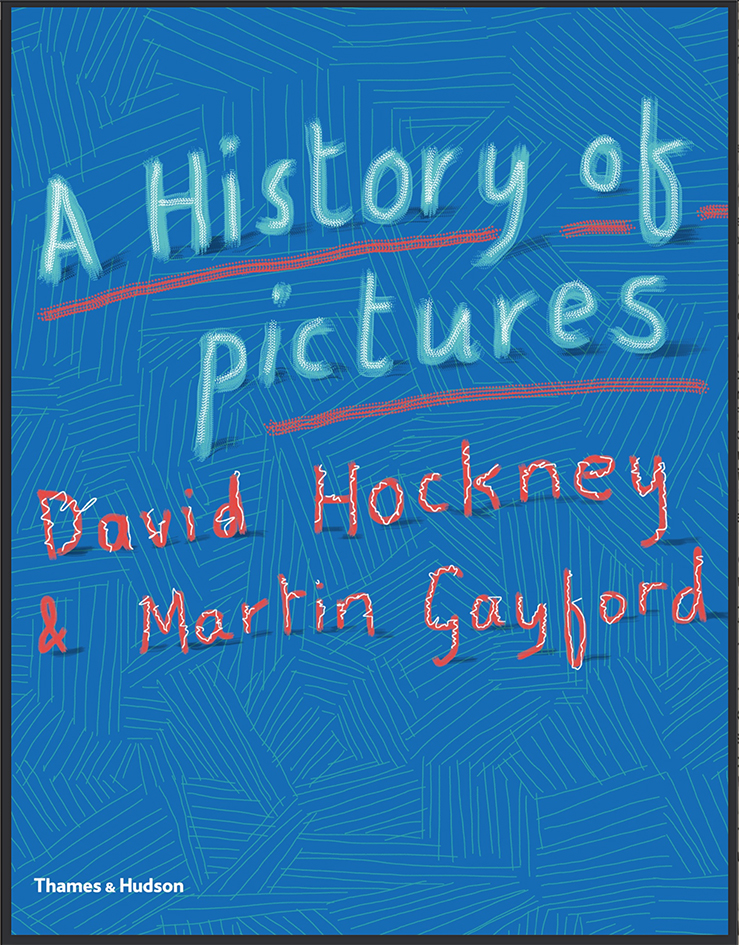
“What makes a work of art? I don’t know. There are lots of people who tell you they are making art. Maybe some of them are, but I’m not sure that’s true for all of them. Perhaps I’m old fashioned, but that’s not a phrase I would use. I’d prefer to say I’m making pictures – depictions.” David Hockney, A History of Pictures, with his capitalization, eBook P.2.

I’ve held David Hockney’s writings, and ideas, in the highest regard since his revolutionary, and eternally controversial, book Secret Knowledge came out in 2001, but I find it cumbersome to use the word “pictures” here in place of “Art.” Regarding what “makes a work of art?,” as he asks, it seems to me that it takes hundreds of years for the dust to settle on what’s being created in our time and for something, a “picture,” as Mr. Hockney says, to be considered “Art” (IF it continues to speak to people). None of us will be around when that bell rings. So, in the meantime, I’ve opted to use the term Art, capital “A,” respectfully, applying it to all working Artists, present or past.

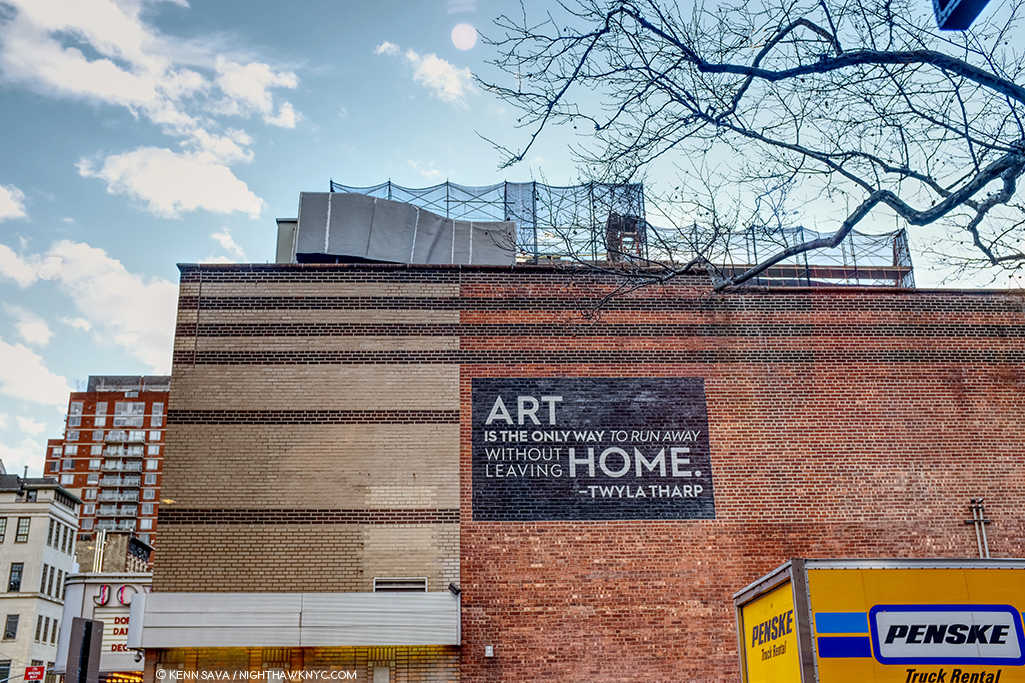
Thanks, Twyla. I couldn’t have said it better. And so, this scene has appeared in my Banner, sans moving truck, for the past year. If that truck is waiting for me, it may have a long wait. I haven’t been out of Manhattan overnight since February 4, 2012. The Joyce Theater, December, 2019.

The other reason I do it is because Art is my religion. Frank Lloyd Wright, who I consider to be an “ultimate Artist,” capitalized Nature since it was his religion. Art is mine.

Reach out and touch faith. For me, going to The Met is going to church, as I said early on. At this point in my life, it feels like Home. Back Home, again, late on December 22, 2018. Weather be damned. It’s always beautiful inside.

*-Soundtrack for this Post is ”Personal Jesus” by Martin L. Gore of Depeche Mode, from their 1990 album Violator. They perform it here on Letterman

For The Record is a series of pieces that are about key/core subjects & beliefs that underly everything else I’ve written here.

NighthawkNYC.com has been entirely self-funded and ad-free for over 6 years, during which over 250 full length pieces have been published. If you’ve found it worthwhile, you can donate to keep it going & ad-free below. Thank you!

Written & photographed by Kenn Sava for nighthawknyc.com unless otherwise credited.
To send comments, thoughts, feedback or propositions click here.
Click the white box on the upper right for the archives or to search them.
For “short takes” and additional pictures, follow @nighthawk_nyc on Instagram.

Subscribe to be notified of new Posts below. Your information will be used for no other purpose.


Looking At The Past And Seeing The Future

Written by Kenn Sava

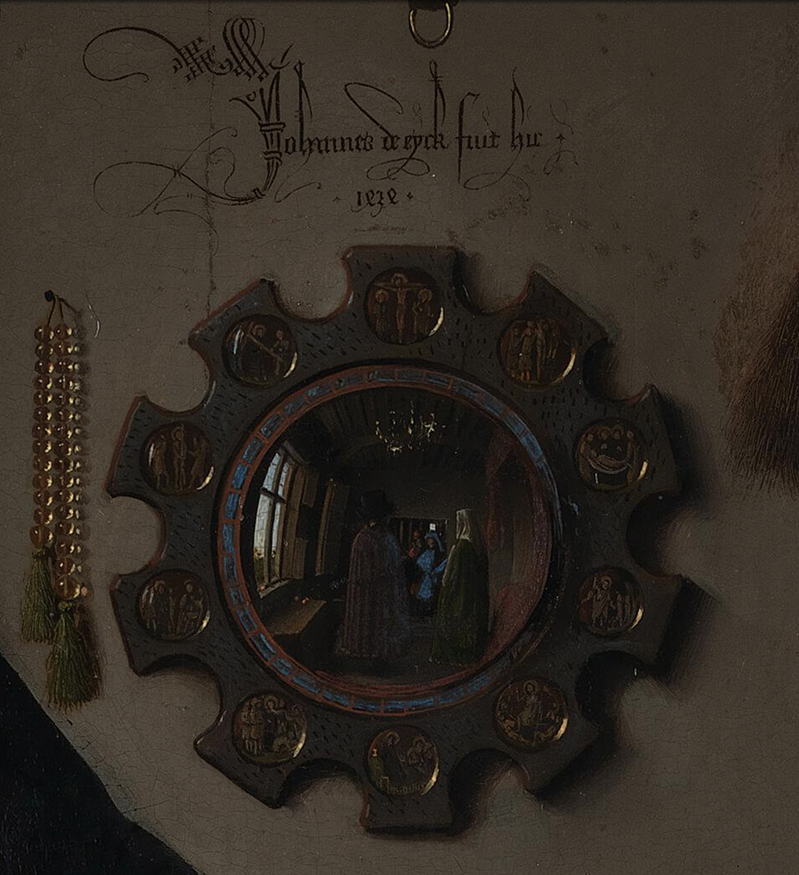
“Johannes van Eyck made this,” the inscription by the Artist reads in this detail from “The Arnolfini Portrait,” which he also dated 1434. Closer to Van Eyck Photo.

Is Jan van Eyck the “greatest” Painter ever?

“Wait? Kenn Sava call someone ‘the greatest’ anything? I thought he didn’t believe in qualitatively comparing Artists or Artwork?” I don’t. There’s no such thing as “the best” in the Arts. Yet, the work of Jan van Eyck seems to me to be beyond the boundaries of normal discourse. I’m asking technically now. In that sense, and instead of “greatest,” let’s put it this way- Does Jan van Eyck (and, possibly, his brother Hubert, who may or may not, have worked on some or many of his early pieces before passing away in 1426) remain unsurpassed among Painters? If you or yours know of a greater technician in the history of Painting, by all means, set me straight. I’d LOVE to see him or her. Still, technique is only a means to an end, right? On its own, it doesn’t make something “Art.”

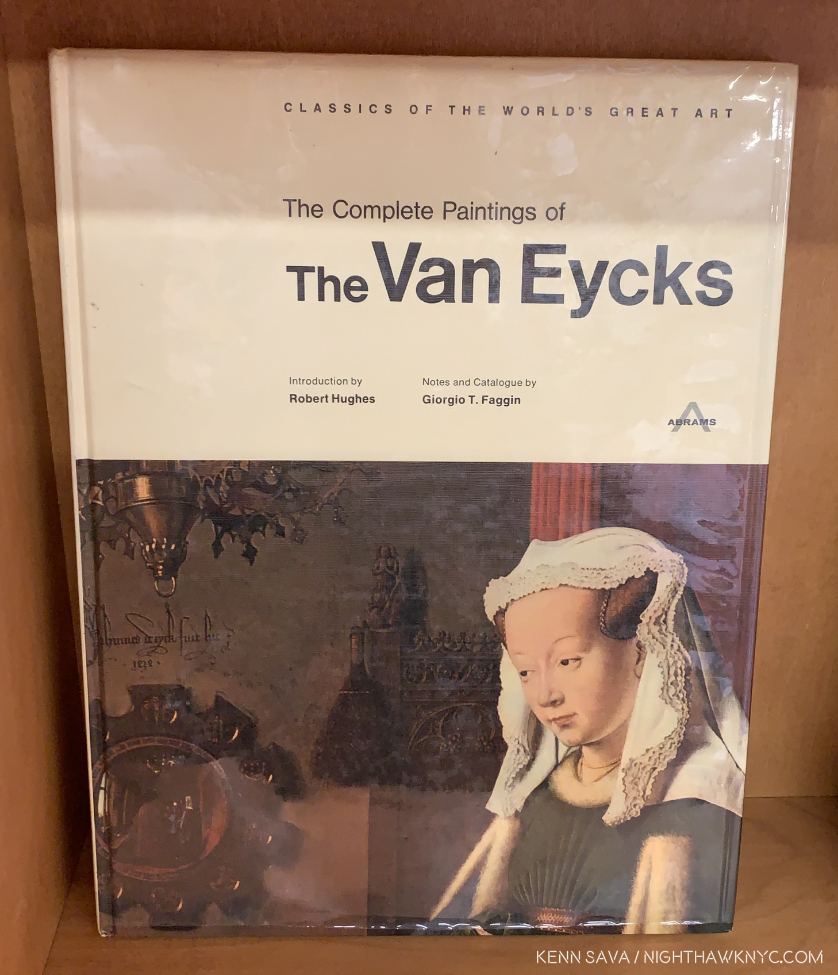
When I was a kid, freshly a teen, I discovered the work of Jan van Eyck (JvE) in this book-

I’d never seen anything like it. I still haven’t. There are a lot of ways you can discover an Artist you previously didn’t know today. Back then, coming across a book on him or her in a library, bookstore or a friend’s house, were the primary means for me. It’s now one of a number of primary means. In what was a black & white world at the time, impossible to imagine today, seeing this kind of color was part of the revelation. The closer I’ve looked over the decades, I’ve found his work is like the proverbial onion- There’s MUCH more going on in it than beautifully meets the eye at first look, with virtually every single detail carrying layers of meaning that have taken the intervening 600 years to begin to unravel.

On my 17th birthday, the first day I was eligible for it, I went to get my driver’s license- a big deal as we all know for anyone heretofore confined to riding bikes or walking. I went to take my eye test and the tester said, “Read the chart on the wall.” “What wall?,” I replied. Crushed. I had to go and get glasses. Finally, I passed and got the treasured document.

Freedom!

A week or two later,  bright and early one August Saturday morning, I took my first extended driving trip. I got in the family car and drove it to Washington DC by myself, a trip that took me well over 5 hours. I parked in front of the National Gallery of Art and went inside. I looked at one Painting for about 30 minutes, and left. I got in my car and drove all the way back.

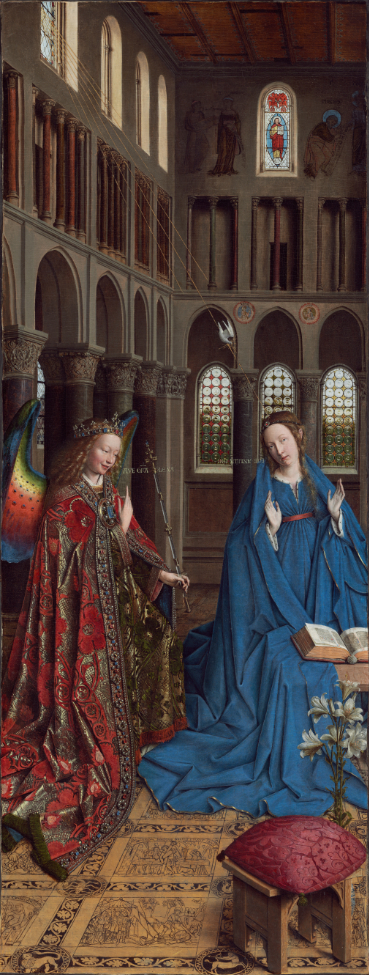
A few months later, I did the same exact thing, again. I went back to see Jan van Eyck’s The Annunciation a second time.

Jan van Eyck, The Annunciation, c. 1434/1436, Oil on canvas transferred from panel, 35 1/2 x 13 7/16 inches. National Gallery of Art, Washington, Photo.

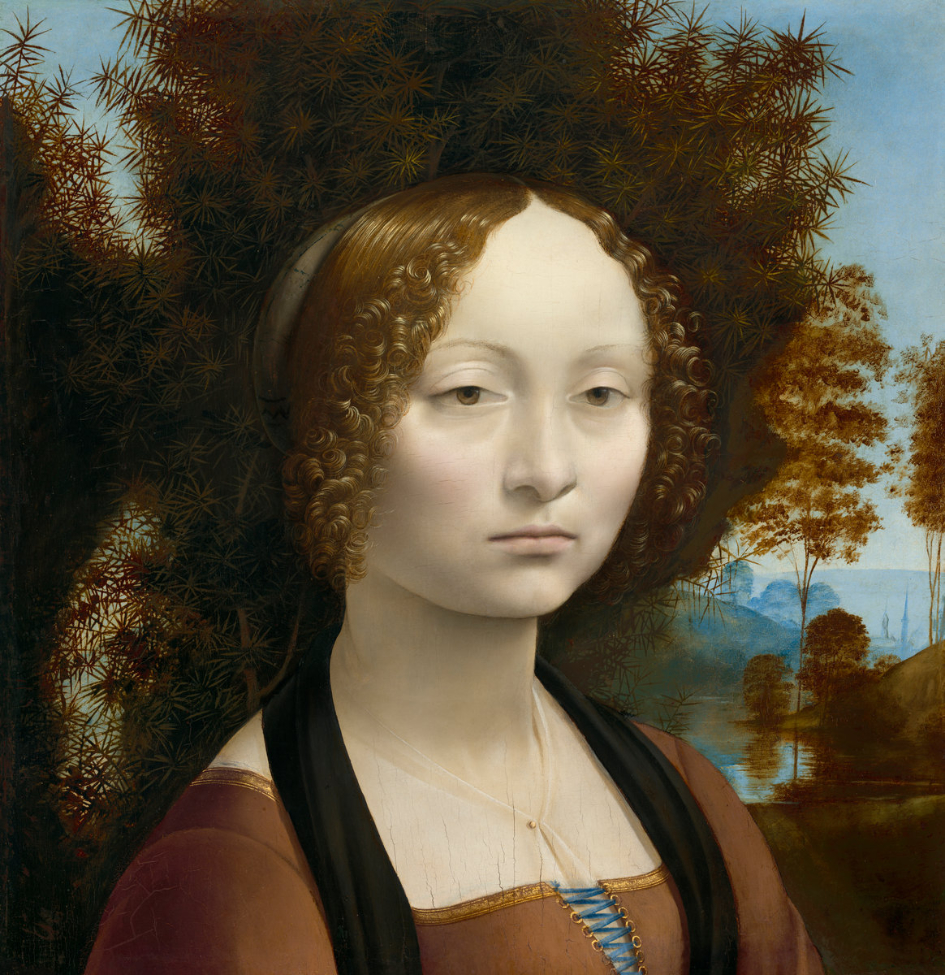
For me, this work summed up everything I loved about Painting, most of which I wasn’t able to put into words at the time. Only now, looking back on it decades later can I see in it the germs of any number of things that have continued to interest me since. This time, however, I looked at a second Painting, Leonardo da Vinci’s Ginevra de’ Benci, (c. 1474/1478, Painted only about 40 years later!1 to this day my favorite Leonardo (“favorite” does not mean “best”).

Leonardo da Vinci, Ginevra de’ Benci, c. 1474/1478, Oil on panel, 15 x 14 9/16. Historians believe that at one point this portrait had folded arms below what remains today. National Gallery of Art, Washington, Photo

I then stopped in the gift store and bought a poster of the Van Eyck, I got in my car and drove home.

Such was the effect Jan van Eyck’s work had on me. It still does.

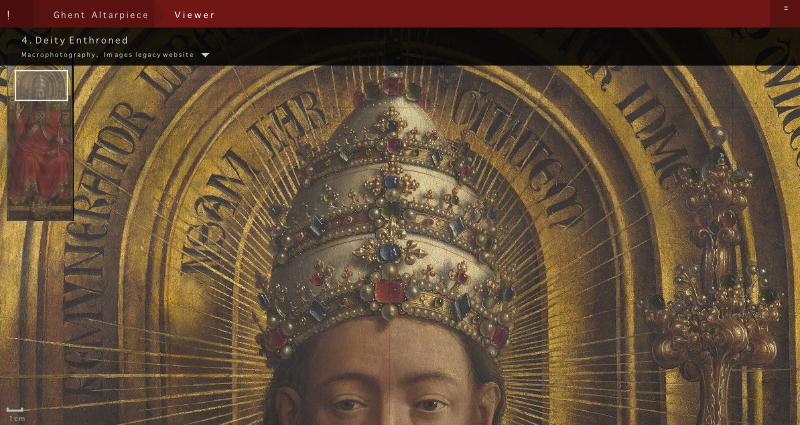
These days, I don’t have to get in a car and drive almost 6 hours to see one of Van Eyck’s incomparable masterpieces. Now, I can see much of what the Master created that resides in museums all around the world without leaving my chair. In fact, I can now see them INFINITELY closer than even Mr. Van Eyck may have. How astounding is that?

Jan & Hubert van Eyck, Detail of the “Deity Enthroned” section from the Ghent Altarpiece, before restoration. Note the 1cm scale in the lower left corner. 1cm is .4 of an inch! Screenshot of Closer to Van Eyck Photo.

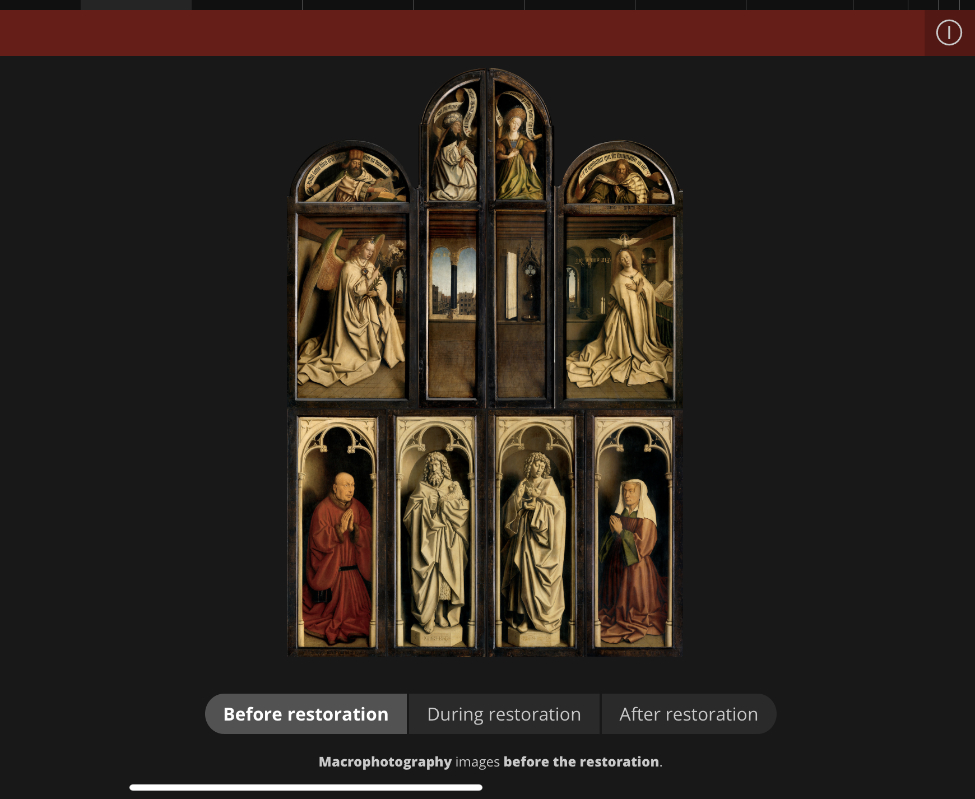
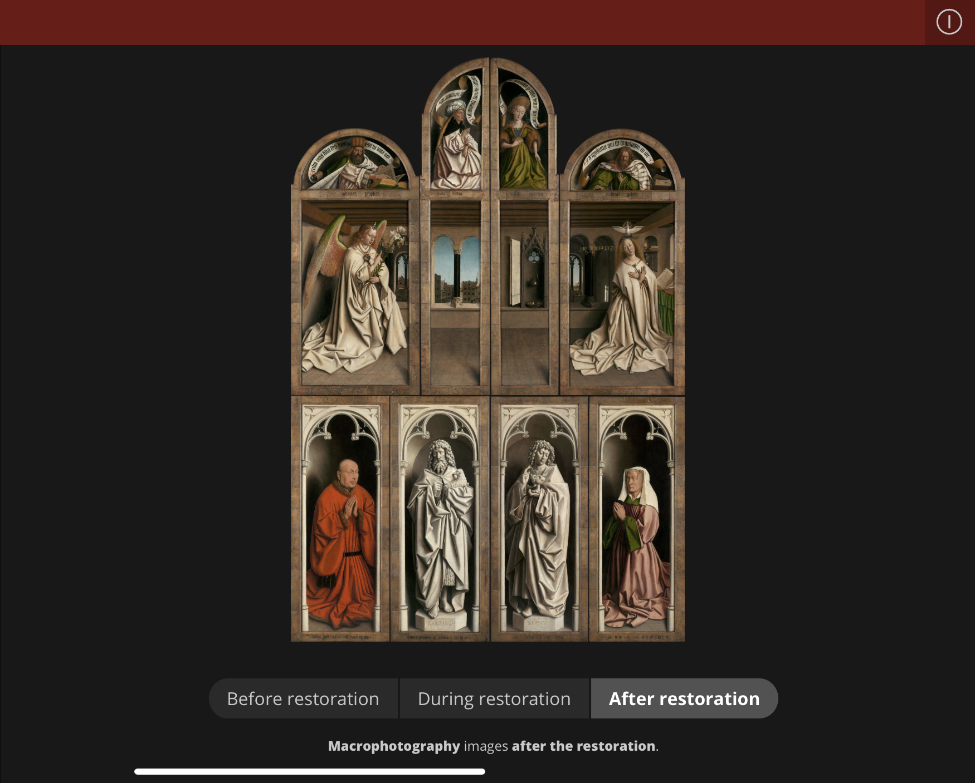
Closer to Van Eyck centers around the incomparable “Ghent Altarpiece” (as it is known today. The Artist’s name for the work is unknown) and its ongoing restoration- all 11.5 by 15.5 feet of its inside AND 11.5 by about 7 3/4 feet of its exterior (seen when the panels are closed)! 

The 8 panels visible when the work is closed seen before restoration. Closer to Van Eyck Photo.

The same 8 panels seen closed after restoration. Closer to Van Eyck Photo.

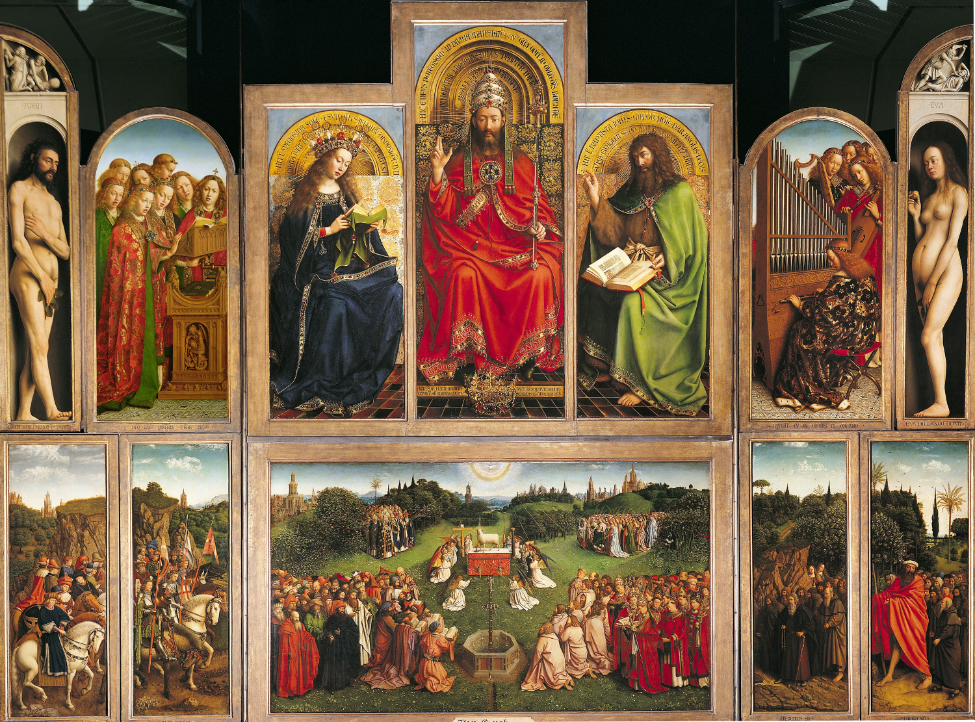
Well, what we have of it after its six century journey that saw part of it looted by Napoleon’s armies in 1794, the whole stolen by the Nazis in WW2 and stored in a salt mine. One of its panels (the so-called “Just Judges,” seen in a copy in the lower left corner of the Photo below, which may contain a Self-Portrait) was later stolen by an incredibly selfish sacristan and has still not been recovered.

Hubert & Jan van Eyck, the “Ghent Altarpiece,” 11.5 by 15.5 FEET, mid-1420s to 1432, Oil on 24 panels, 12 seen here with open. In this Photo, the  work is seen prior to restoration which has begun with the exterior panels. NPR Photo.

For me, the Ghent Altarpiece is on the shortest of short lists of the supreme accomplishments of human creativity.

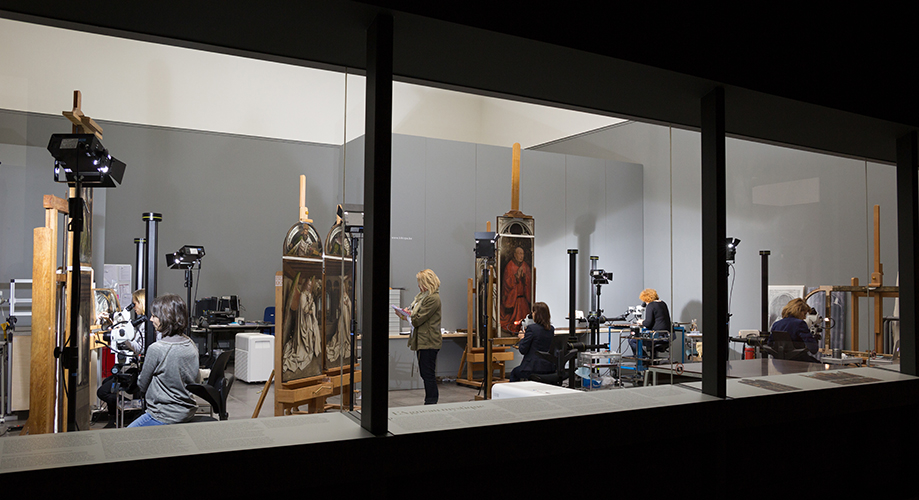
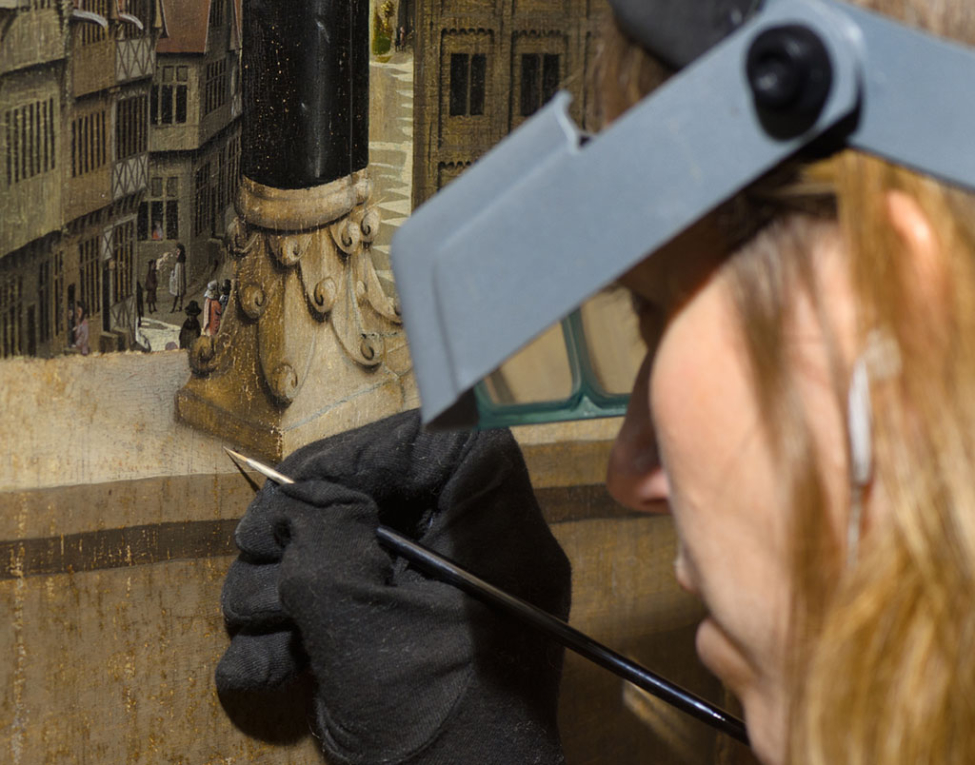
The public restoration of the exterior panels of the “Ghent Altarpiece” at the Museum of Fine Arts, Ghent (i.e this is the view museum visitors can have of the ongoing work). Photo: KIK-IRPA, Brussels. From Closer to Van Eyck.

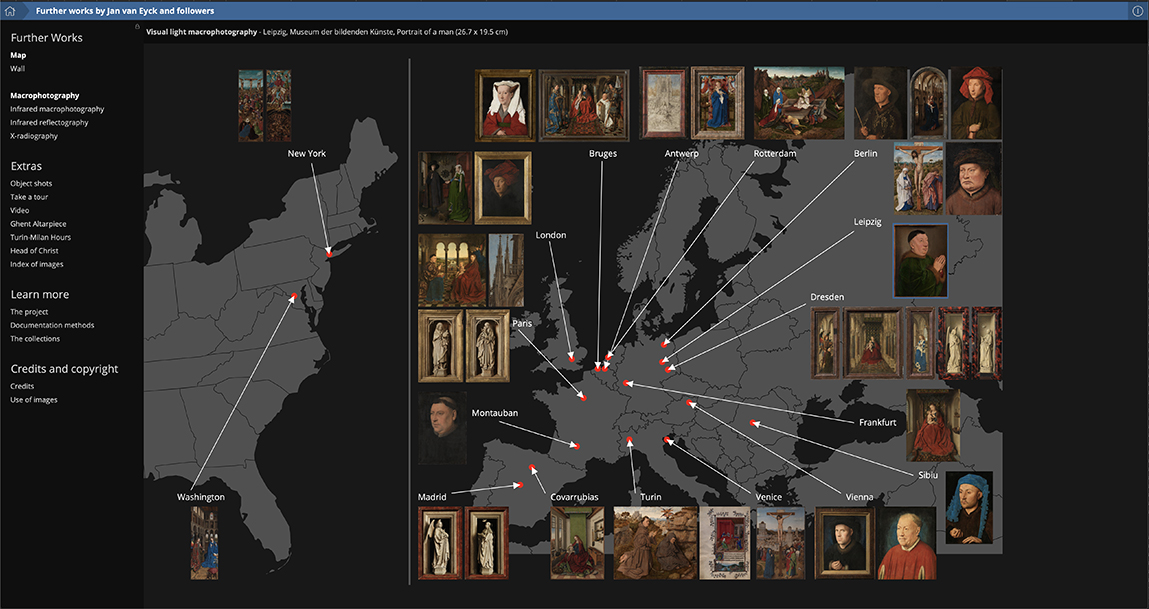
On Closer to Van Eyck you can study each of the 20 panels in the infinite detail of 100 billion pixels in macrophotography, infrared macrophotography, infrared reflectography and x-radiography. The Ghent Altarpiece would have been enough- MORE than enough to make Closer to Van Eyck one of the world’s most essential Art references, but it’s been continually expanded to the point that it now covers THIRTY SIX other works by, or attributed to, Jan Van Eyck from museums all over the world.

“Further works” above and beyond the “Ghent Altarpiece” by, or attibuted to, JvE that can be studied in extraordinary detail on Closer to Van Eyck, each one a masterpiece in its own right now numbers an incredible 36.

These include my old friend The Annunciation in DC. Good thing. I haven’t owned a car in over 20 years.

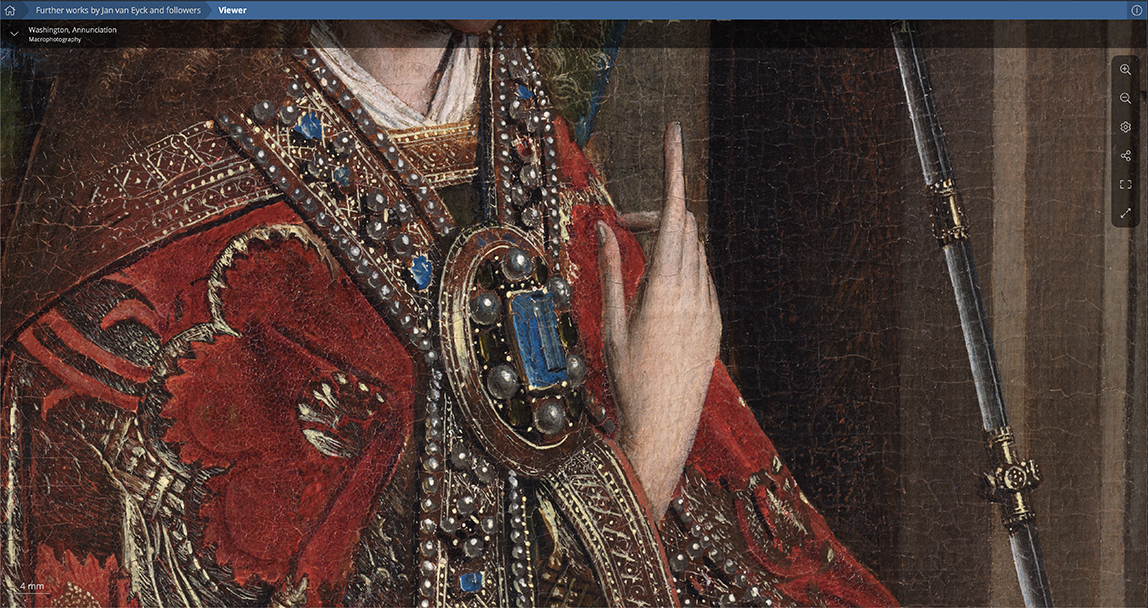
I didn’t see it like this. Detail of The Annunciation. Notice the scale on the lower left. 4mm is .15 of one inch! Closer to Van Eyck Photo

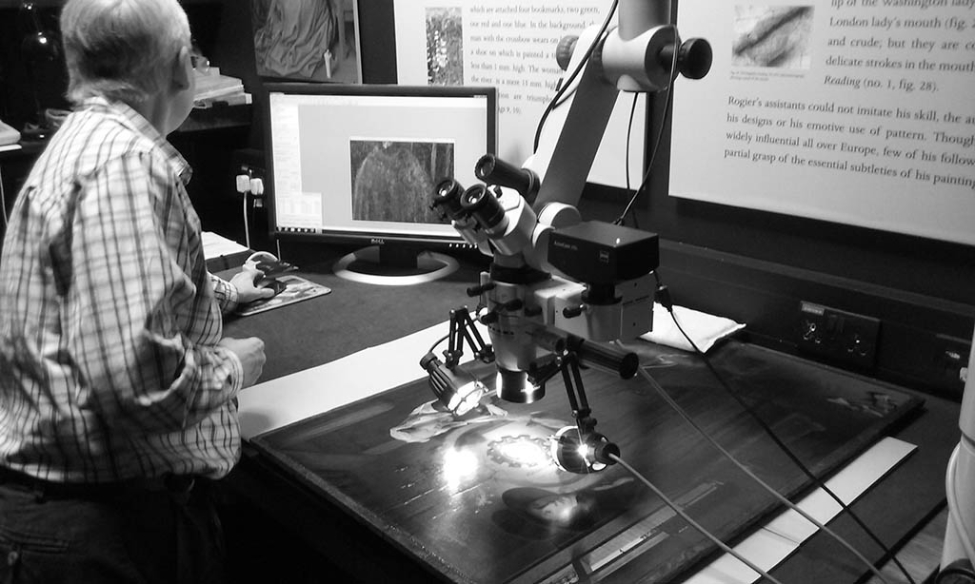
Having the chance to study Van Eyck to this degree should lead to countless new discoveries about his work and working methods. It may also help answer some long standing questions, of which there are too many to number. Beginning, perhaps, with this one. Even to this lay viewer, at normal magnification, it’s obvious The Annunciation is not the co-called “hyper-realism” or whatever other meaningless box some try to use to stick Artists in. For all of the astounding detail in The Annunciation, and other works by JvE, the figures of Mary and the Angel are oversized relative to the room they’re in. It goes without saying that for one of the supreme Masters of Painting this was intentional.

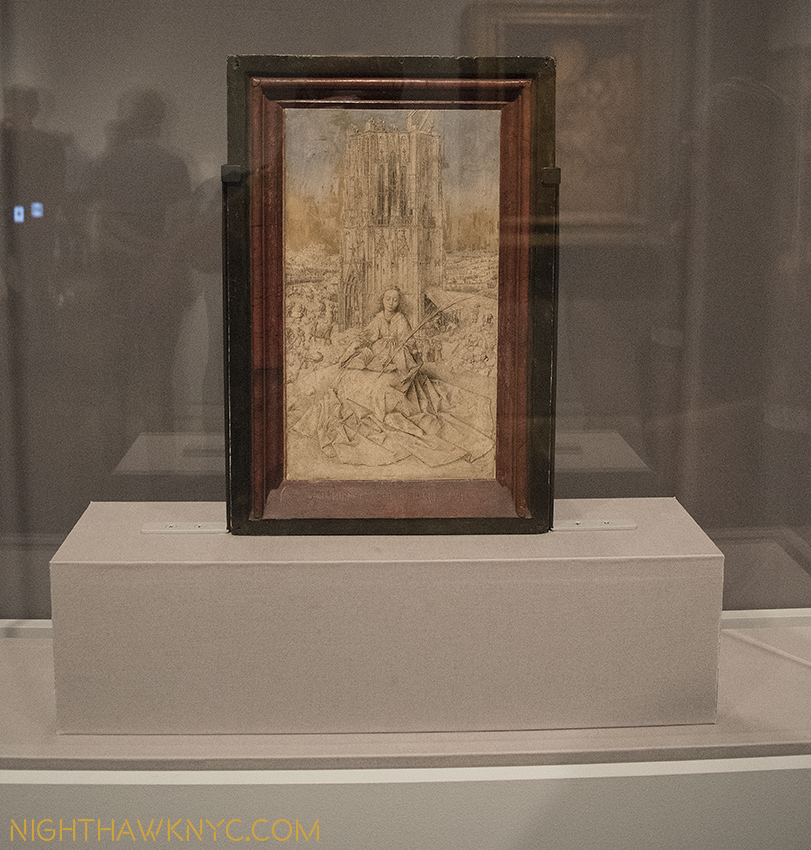
Small wonder. "Saint Barbara," 1437, Jan Van Eyck. Barely 12 inches tall.

This is as close as I’m ever allowed to study a Van Eyck in person. ” Saint Barbara“ looms larger than life here in this incredible Drawing by Jan van Eyck from 1437 that’s barely 12 inches tall. I don’t believe this is due to the Saint being closer to the viewer. From my piece on Unfinished at The Met Bruer in 2016.

Why did he choose to do this? David Hockney may provide an insight. In A Bigger Message: Conversation with David Hockney, by Martin Gayford, Mr. Hockney says, “If you look at Egyptian pictures, the Pharaoh is three times bigger than anybody else. The archaeologist measures the length of the Pharaoh’s mummy and concludes he wasn’t any larger than the average citizen. But actually he was bigger – in the minds of Egyptians2.” From there, you can look as closely and as deeply as you want. No matter how closely I look, the wonders never cease.

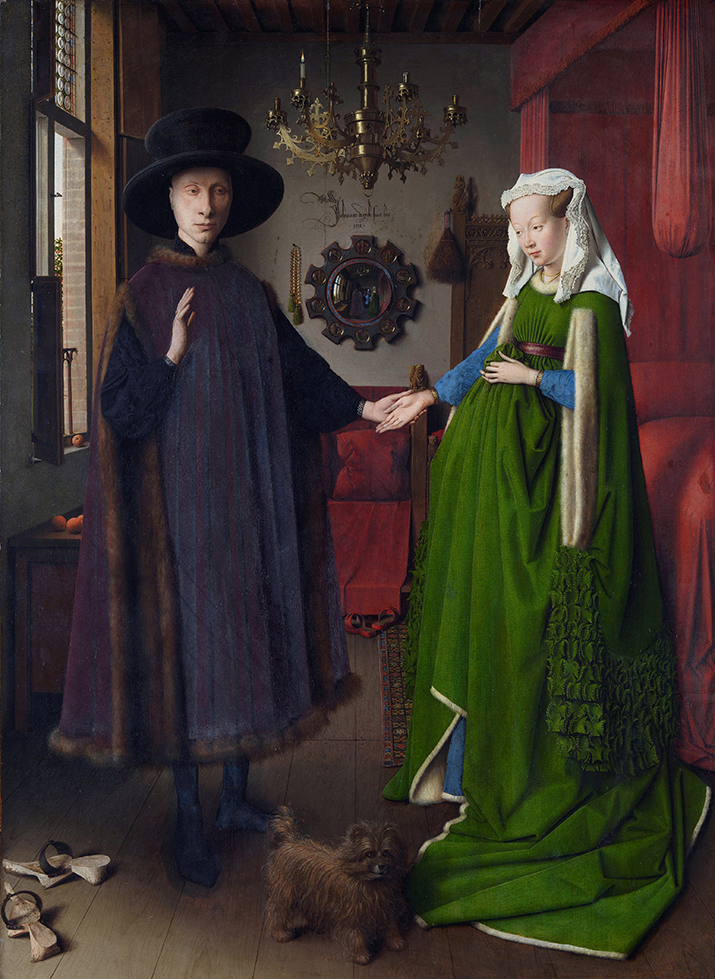
“The Arnolfini Portrait,” Full common title, “Portrait of Giovanni(?) Arnolfini and his Wife,” (Title given by the Artist is unknown), Signed(!) and dated 1434, 32 1/4 x 23.6 inches, National Gallery, London, Photo.

Two works recently added to Closer to Van Eyck are two of his most renowned masterpieces that reside at The National Gallery, London, home of “The Arnolfini Portrait” and “Portrait of a Man (Self Portrait?).“

Ready for its close up. “The Arnolfini Portrait” lying on the table to the right in September, 2017. Closer to Van Eyck Photo.

I spent an hour in the small gallery that contained them during my last trip out of NYC overnight in 2012 the day after I saw the once in a lifetime Leonardo da Vinci: Painter at the Court of Milan, at London’s National Gallery, the most complete display of Leonardo’s surviving Paintings ever mounted. It’s difficult for me to imagine a harder test than seeing the work of any Artist virtually side by side with that of Leonardo’s. Eight years later, the time I spent in that small gallery remains indelible. Seeing “The Arnolfini Portrait” in person was overwhelming. Then, I saw this-

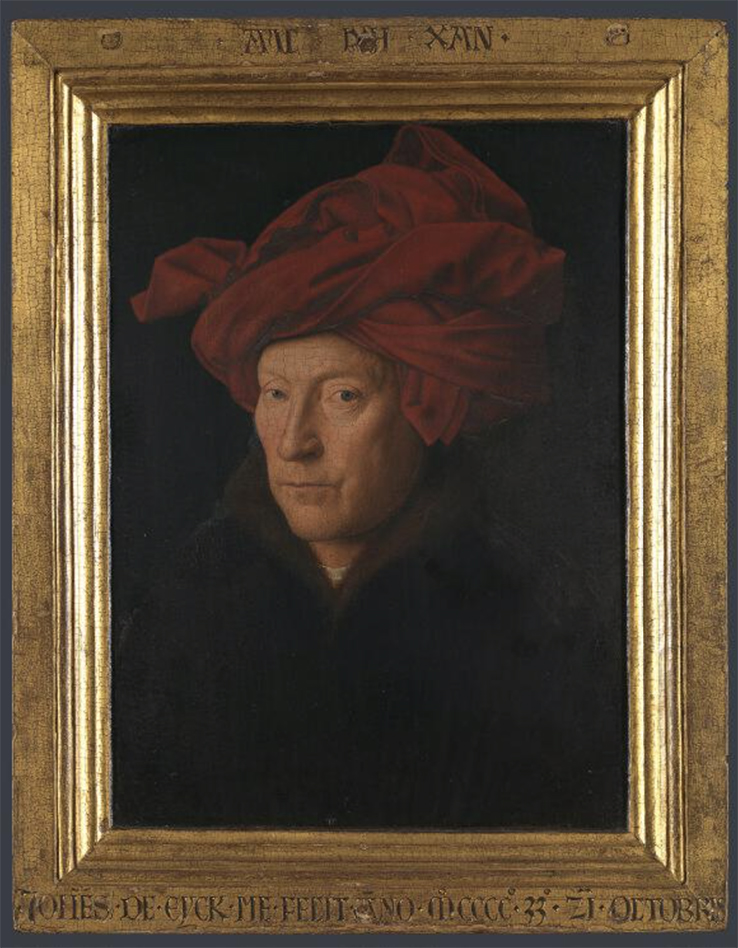
Portrait of a Man (Self Portrait?), 1433, Oil on oak, 10 1/4 x 7 1/2 inches. National Gallery, London, Photo.

Though I’d seen it in books countless times, standing right in front of it, all of a sudden, I was gripped by an unescapable feeling. This IS him! Why do I believe that Portrait of a Man (Self Portrait) is a Self Portrait? It doesn’t feel like the kind of portrait that would result from a commission- unless the commissioner was quite unconventional, and not one of the other portraits JvE did were “unconventional” in this sense. For one thing, he has a stubble. It’s too hard for me to believe that anyone commissioning a famous Artist (which he was) at the time would want to be immortalized with stubble. For another, the chaperon on his head is up on the sides. It looks positively sculptural- almost like a John Chamberlain. This has the look of someone who’s busy working on something that involves frequent turns of the head, often quick ones, and is keeping it out of the way by tucking it up on its sides. Compare this work with “Portrait of a Man with a Red Chaperon” in Berlin, also on Closer to Van Eyck. Here, the sitter has no stubble and his chaperon is very neatly positioned on his head. Also, the sitter looks straight ahead. In the London Portrait of a Man, he looks askance at the viewer- like he would if he were Painting himself by looking in a mirror- as David Hockney surmises in his revolutionary and essential book, Secret Knowledge: Rediscovering the Lost Techniques of the Old Masters. Finally, the sitter looks out at us over almost 600 years with a quiet confidence and surety that, along with that almost avant-garde chaperone on his head, convinces me that here is a very unique man, one with the confidence to show the world, and time immemorial, who he really is, doing what he loves doing. Jan van Eyck may have Painted himself in reflection in the famous mirror in “The Arnolfini Portrait,” and in one or two other works. These may provide some additional insight when looking at Portrait of a Man.

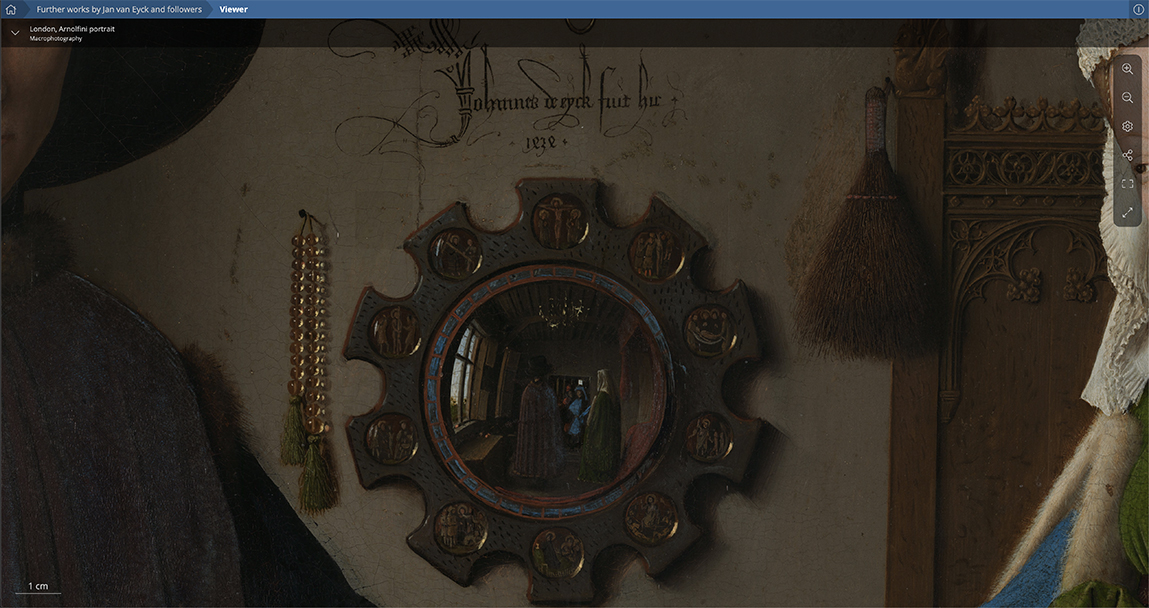
Jan van Eyck, Detail of the signature and the mirror immediately below the chandelier, seen further below, from “The Arnolfini Portrait.” It’s long been thought there’s a reflected “Self Portrait” in it of the Artist standing in the doorway in blue. Certainly an “unconventional” one, if it is. Velazquez borrowed this idea in Las Meninas, 222 years later in 1656. Notice the miniature scenes from the Passion of Christ around the mirror, and the reflected chandelier(!), all the while bearing in mind that when I measured this section in Photoshop, the entire mirror, with its frame, measured 3.85 inches in diameter! This is the closest we have been able to study this…until now. National Gallery, London, Photo

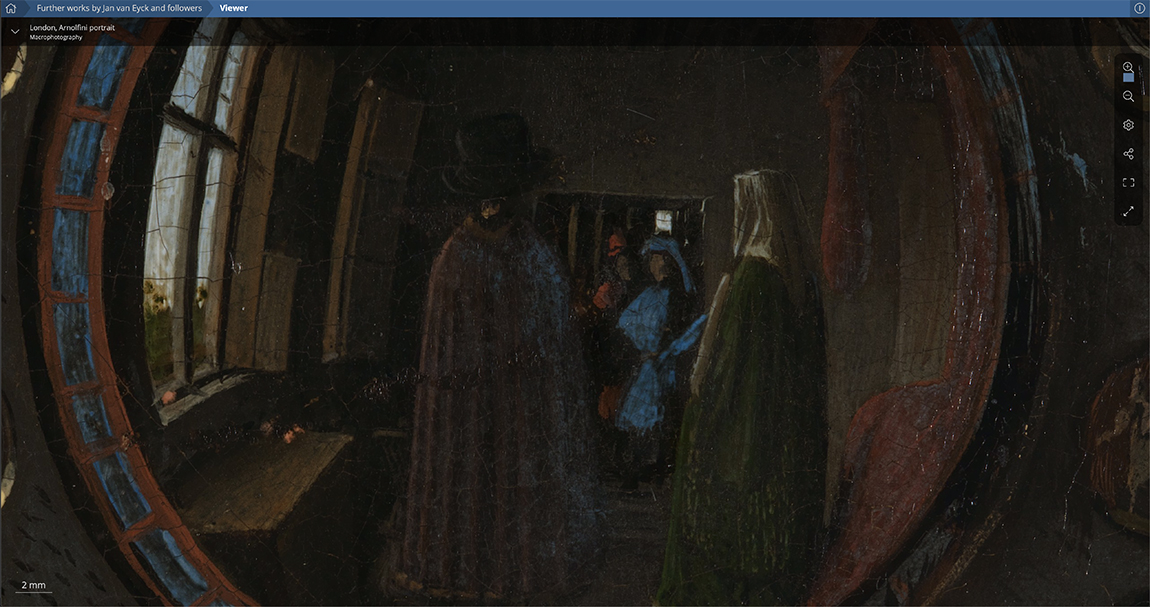
“The Arnolfini Portrait” has now been added to Closer to Van Eyck. The public has never seen it like this. Finally(!) we can see what is going on in the famous convex mirror. A number of historians believe JvE is in the blue coat. Seeing this, I now wonder if he wouldn’t be the gent in the back in the red. 2mm is .078 of one inch!

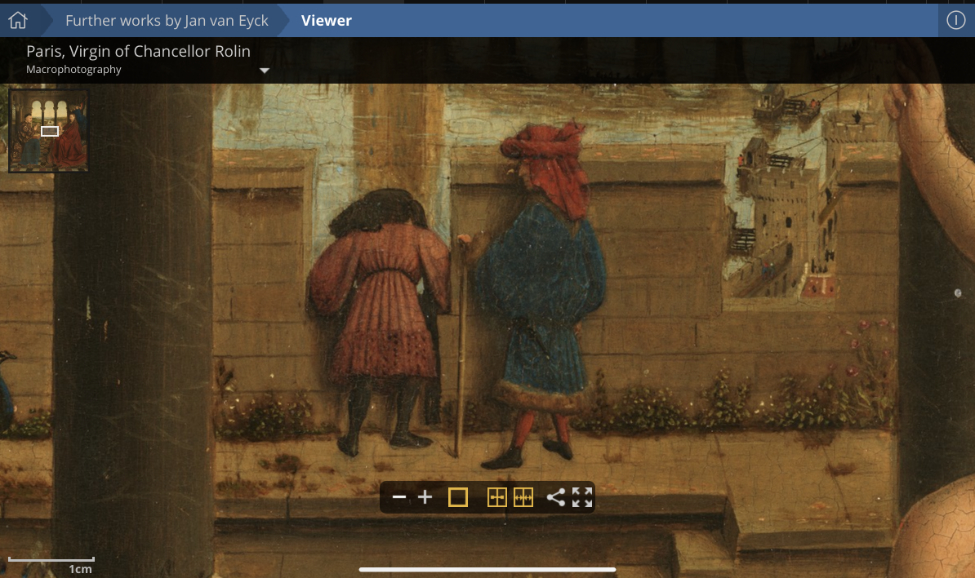
Among the others, perhaps most fascinating to me are the two figures in the middle distance of Virgin of Chancellor Rolin, the figure on the right in the red chaperone I suspect just might be a Self-Portrait of Jan with his mysterious brother Hubert to the left.

Detail of the middle distance of Virgin of Chancellor Rolin, in the Louvre, just one of the “other” works by/attributed to JvE that are included on Closer to Van Eyck. I’m stuck on the idea that this is a portrait of Jan and his brother, the virutally lost to history, Hubert van Eyck. Note the red chaperone and the nose on the figure I believe may be Jan, and compare both to Portrait of a Man. From Closer to Van Eyck.

IF this is a dual portrait of the brothers it would be the only one known of Hubert during his lifetime3 One of 5 surviving documents that mention him during his lifetime say he was a Painter “without equal.” Well, he was older than Jan. In it, we see the face of the man in profile showing a prominent nose, and his red chaperone is down as he is not working. Finally, in Portrait of a Man, we don’t see the sitter’s hands, as we do in a number of JvE’s other portraits. This leads me to believe they were busy Painting. All of these reasons, and a gut feeling, reinforce my feeling that the Portrait of a Man is a Self-Portrait. Interestingly, around the frame of that work (see Photo posted earlier), apparently in his own hand, is written “Als Ich Can,” JvE’s motto (“As I can,” with “Ich” a play on Eyck) along the top, and “Jan van Eyck made me on 21 October 1433” along the bottom. Of course, the experts have argued about this back and forth for almost 600 years. I’m convinced. Ok. Now, back to world peace…

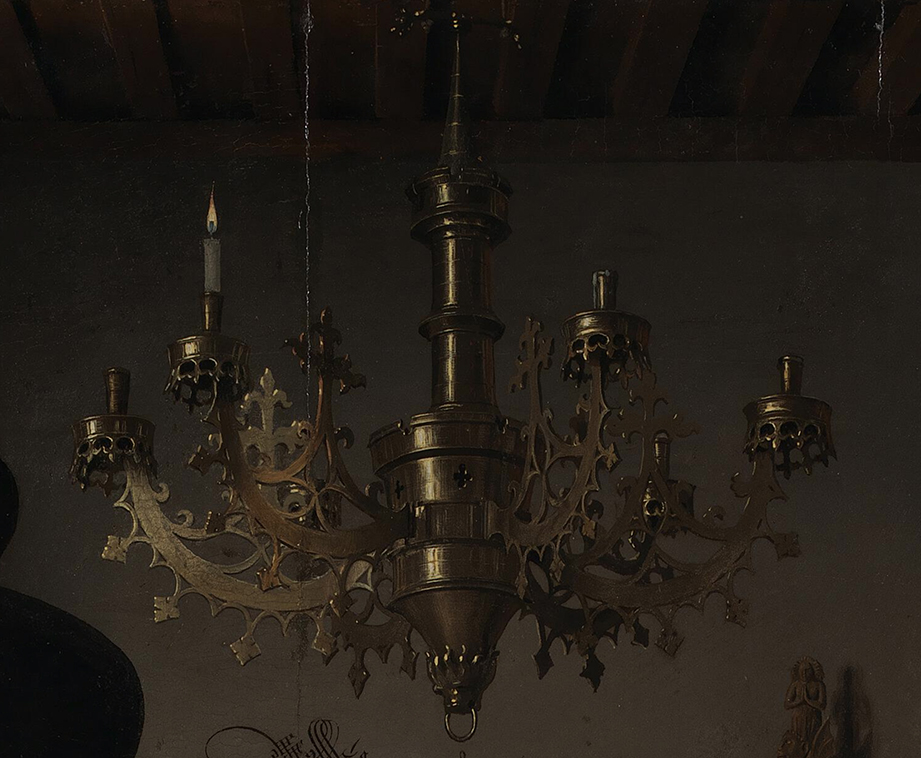
Detail of “The Arnolfini Portrait.” The section of the chandelier beginning at the top of the sole flame is about 5 inches tall by 6.7 inches wide. HOW could anyone paint this in 1434? The sole lit candle makes me believe this Painting is a memorial commissioned by the man, Giovanni Arnolfini, who JvE may have also Painted by himself, for his wife, Costanza Trenta, who died the year before, and who stands under extinguished candles. National Gallery, London, Photo

Part of me has been searching for “the next Van Eyck” my whole life. That is both unfair and unrealistic. Times were so different back in 1400 I’m sure I can’t begin to imagine it. Oil painting was, virtually, a brand new medium at the time, and for centuries it was said (by Vasari, apparently incorrectly) that Jan van Eyck had “invented” oil painting. If he didn’t, he was certainly among the very first to master it on the highest level. The craft and Art of Painting were different then, too, apparently. In Secret Knowledge, David Hockney sheds much light on what may, or may not, have been some of the techniques Artists from around JvE’s time, forward, including Vermeer, may have used to create some of these works which, like the chandelier in Van Eyck’s “The Arnolfini Portrait,” seem to border on the impossible. Optics. If they did use optics, in no way does that diminish the achievement, in m view.

The evidence for JvE’s candidacy for technical supremacy may never be presented better, or in more detail, than it is on Closer To. Leaving that pointless question aside leaves you free to look and marvel. You will never see it better in person- no matter HOW close they let you get to his work with your naked eyes. The ramifications of this are staggering to consider. Among them, this quickly came to my mind-

Is THIS the future of seeing Art?

It’s not hard to think that, one day, museums might follow suit doing something similar with works in their collections and posting amazing, super high resolution macrophotography on their sites. In 100 years, will ALL museums be online with sites like this, where, no doubt for a fee, you can visit any work in their collection and study it in virtually infinite detail? I’m not sure how many Artworks I’d want to study as closely as I want to JvE’s. Most Art is best seen from a comfortable distance. Yet given the difficulties in seeing Art in person now almost anywhere- glare, uneven or poor lighting, inferior glazing, etc., etc, it’s a situation crying out for something “better.” And, we may get “something else,” until that “better” is found- if it ever is.

Panel XIV of the Ghent Altarpiece, during final inpainting. Saint Bavo Cathedral © Lukas-Art in Flanders vzw; photo: KIK-IRPA, Brussels. When I look at the Painting of this section, the miniature street scene in the background, only a small piece of it seen here, makes me wish JvE created more secular Art. From Closer to Van Eyck.

And so, for all of these reasons, I bestow the first NighthawkNYC Art Website of the Year Award on Closer to Van Eyck, which, like NighthawkNYC, is free- so far. In this one site, we get to see the distant past as never before. And, possibly, the future.

Rembrandt never left Holland during his lifetime. Closer to Van Eyck is making it possible for me to never leave NYC, again.

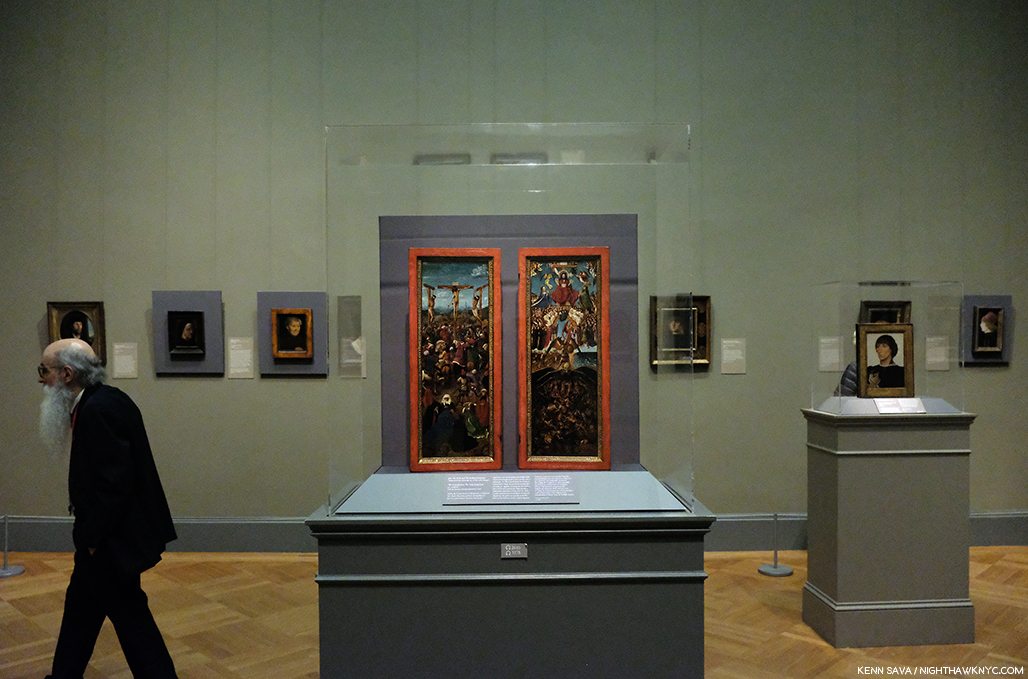
At least NYC is home to three works thought to be by “Jan van Eyck and Workshop,” as all three are labeled. “The Crucifixion” and “The Last Judgement” seen above at The Met (both may be seen on Closer to Van Eyck), and “The Virgin and Child with St. Barbara, Stl. Elizabeth and Jan Vos,” on view over at the Frick Collection. By the way, that gentleman existing to the left is the same Met Guard Fred Cray featured in his PhotoBook, Changing of the Guard! Well? It’s a small world, and getting smaller…

*-Soundtrack for this Post is “You Can Leave Your Hat On” by Randy Newman.

My thanks to Lana Hattan.

NighthawkNYC.com has been entirely self-funded and ad-free for over 6 years, during which over 250 full length pieces have been published. If you’ve found it worthwhile, you can donate to keep it going & ad-free below. Thank you!

Written & photographed by Kenn Sava for nighthawknyc.com unless otherwise credited.
To send comments, thoughts, feedback or propositions click here.
Click the white box on the upper right for the archives or to search them.
For “short takes” and additional pictures, follow @nighthawk_nyc on Instagram.

Subscribe to be notified of new Posts below. Your information will be used for no other purpose.


  1. It is reported that Jan van Eyck’s portraits were admired in Italy in the 1430’s. Is it possible Leonardo knew the work of Van Eyck?
  2. eBook version, P.61
  3. Some believe Hubert may have Painted this. Some others believe Jan may have contributed. I’m skeptical on both counts for any number of reasons. For starters, I can’t believe either would have been capable of the terrible geometry of the grave.

The “New” MoMA, And The Gorillas In The Room

Written & Photographed by Kenn Sava (except *)

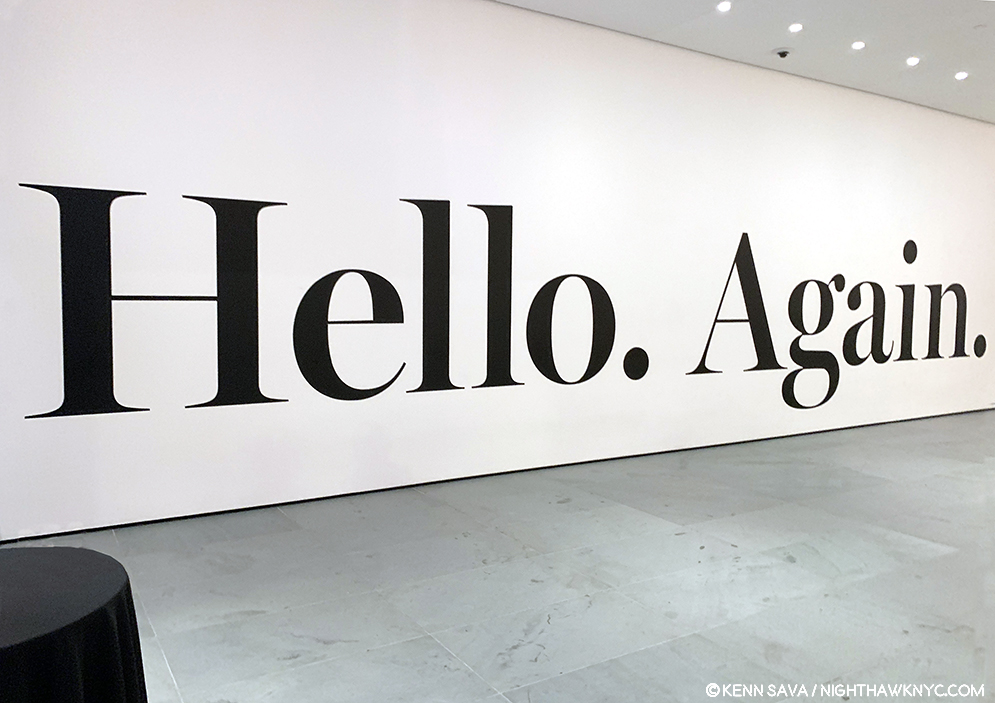
MoMA, 1st floor lobby sign, October 19, 2019. I’ve been through this before. The last time, it was a nightmare. How would this “new” MoMA be?

MoMA and I go a long way back. It’ll be 40 years next year. 

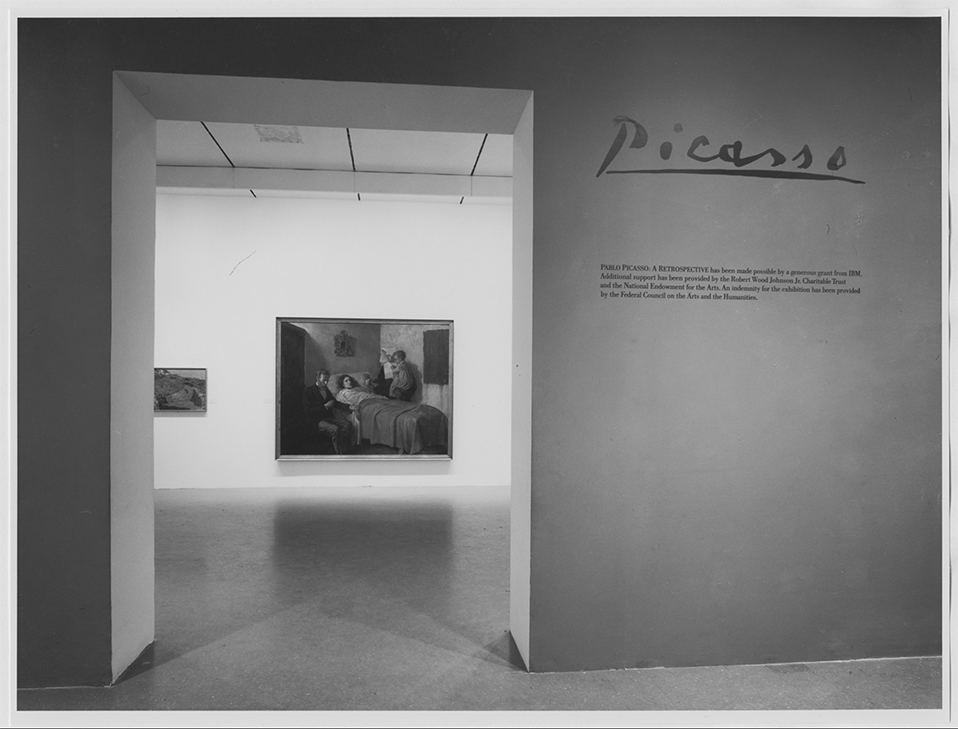
I can remember this like it was yesterday…The entrance to Pablo Picasso: A Retrospective at MoMA, 1980. My Art show attending career began when I walked through that entrance. *MoMA Photo.

I first went to The Museum of Modern Art in 1980 for their incomparable Pablo Picasso: A Retrospective that took over the whole museum. I was on the road with a band at the time and I flew back to NYC twice to see it. Though it was not my first trip to a museum to see Art, it began my career of seeing Art shows and is burned indelibly in my mind since. While I came away feeling the late works were underappreciated, the earliest works which were new to me, like Science and Charity, 1897, Painted at age 15, seen through the entrance, above, particularly astounded me, and it never let up from there. An almost impossibly high bar had been set. I wasn’t able to attend MoMA regularly until after the 1984 renovation, which I call MoMA, 1984. Looking back on that MoMA now, I have quite fond memories of the building. I’ll never forget being in the gallery the museum dedicated to Claude Monet’s Water Lilies, 1914-26, long a very important bridge between representational Art and abstraction for me. As I recall, it was a small room, with a bench along the window overlooking West 53rd Street. You entered the room where panel 1 met panel 2, at about 10 o’clock as you faced it. You sat there and the three huge panels surrounded  you, making you feel like you were inside it. It was one of the greatest feelings I’ve ever had looking at Art. I didn’t think MoMA, 1984 was anything special at the time, but given how lacking MoMA, 2006, the most recent MoMA was, which of course, is still with us in the partially new MoMA, 2019, I now feel quite nostalgic for a building that was “adequate” at best, overall.

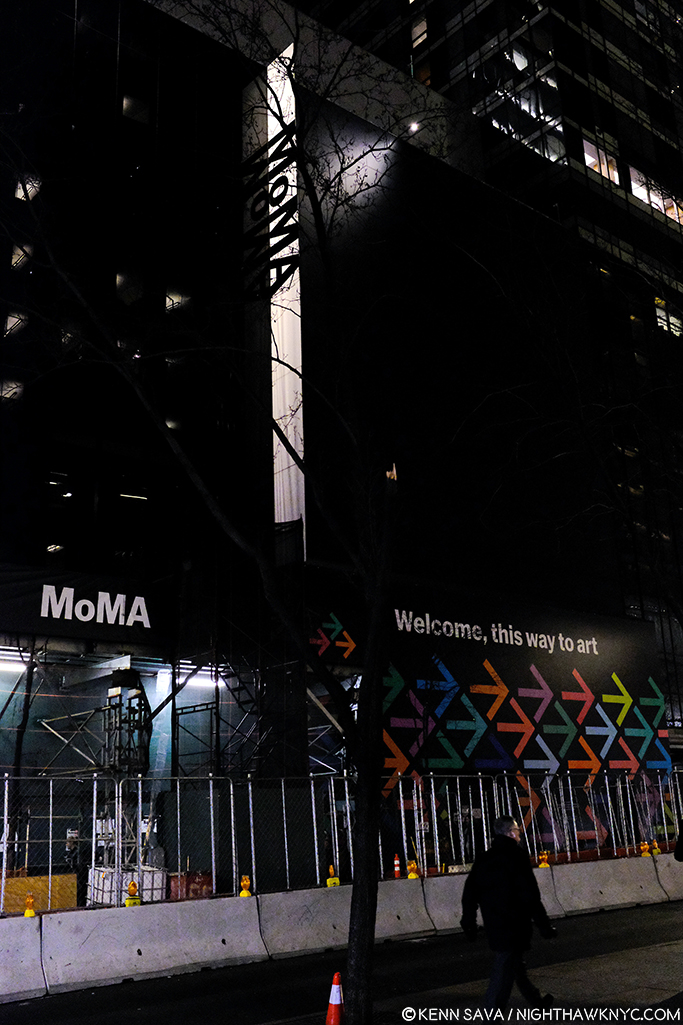
The heart of Art darkness. Construction for MoMA, 2019 in progress at the famous main entrance, behind the arrows pointing visitors to the temporary entrance, December 20, 2018.

I saw Matisse-Picasso at MoMA Qns in 2003, where MoMA was temporarily as MoMA, 1984 became MoMA, 2006, which I went to innumerable times (and have written about a number of its shows here on NYNYC), from it’s earliest days. MoMA, 2006, which opened that November, was terrible, in my opinion (I replaced a stronger negative). I remember standing in utter shock looking at Monet’s Water Lilies installed around the base of the huge, open space, they called the “atrium,” where they had no sense of their compositional continuity or unity. Barnett Newman’s Broken Obelisk, 1963-9, installed in the center of the space looked better there than anything I’ve seen there that came after it, which is not really saying anything all that positive.

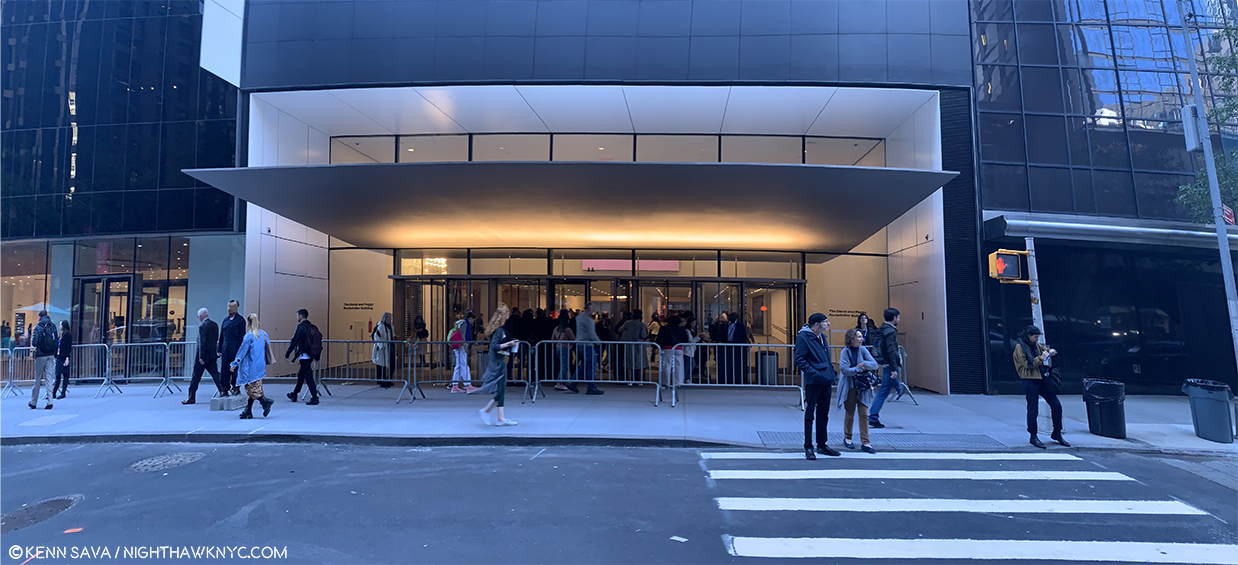
The newly renovated main entrance. Opening day, October 21, 2019.

“The Shopping Mall of Modern Art,” I took to calling MoMA, 2006, the one we’ve been living with these past 13 years. I don’t live in the suburbs partially because I hate malls, yet, here we were given one. The Architect, Yoshio Taniguchi, said1 “The model for MoMA is Manhattan itself.“ He spoke about how Central Park is like MoMA’s Sculpture Garden in his concept. Apparently he felt the rest of Manhattan is one giant shopping mall, cause that’s the design we got- a department store, nothing more, nothing less, who’s floors/departments are connected by an escalator, as they always are. If MoMA had decided to move to an entirely new location instead of turning MoMA, 2006 into MoMA, 2019, whoever would have come into the building would have a virtual turnkey Macy’s II ready to go. “Contemporary on 2,” “This way to the Permanent Collection, and home fixtures…I mean Design”…

That brings me to the Gorillas in the room…Both of them.

“There’s a hole
In my life
There’s a hole
In my life”*

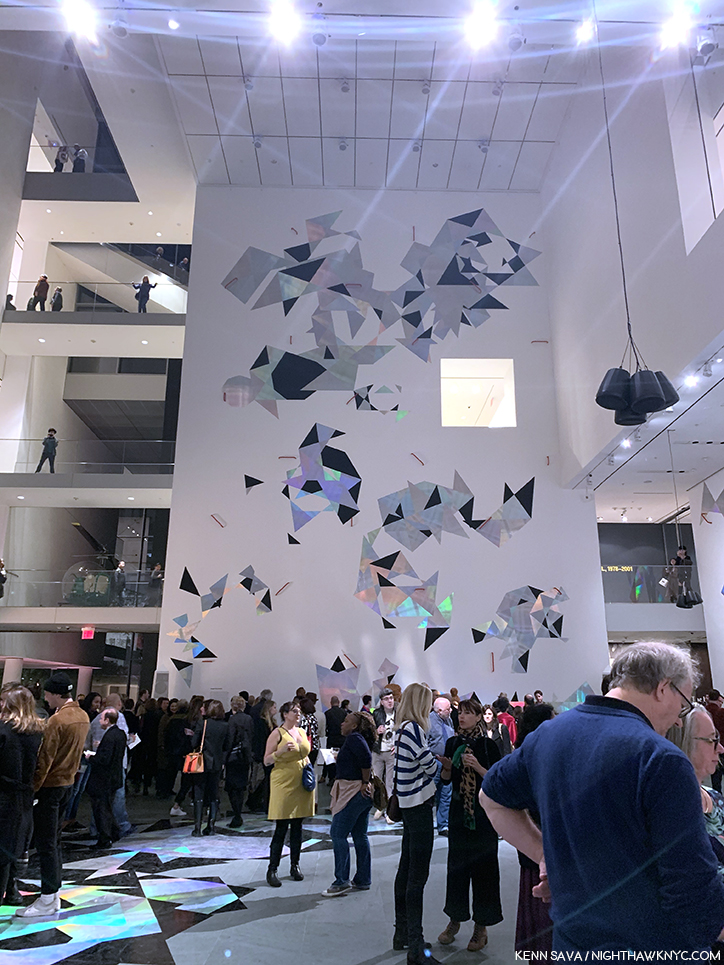
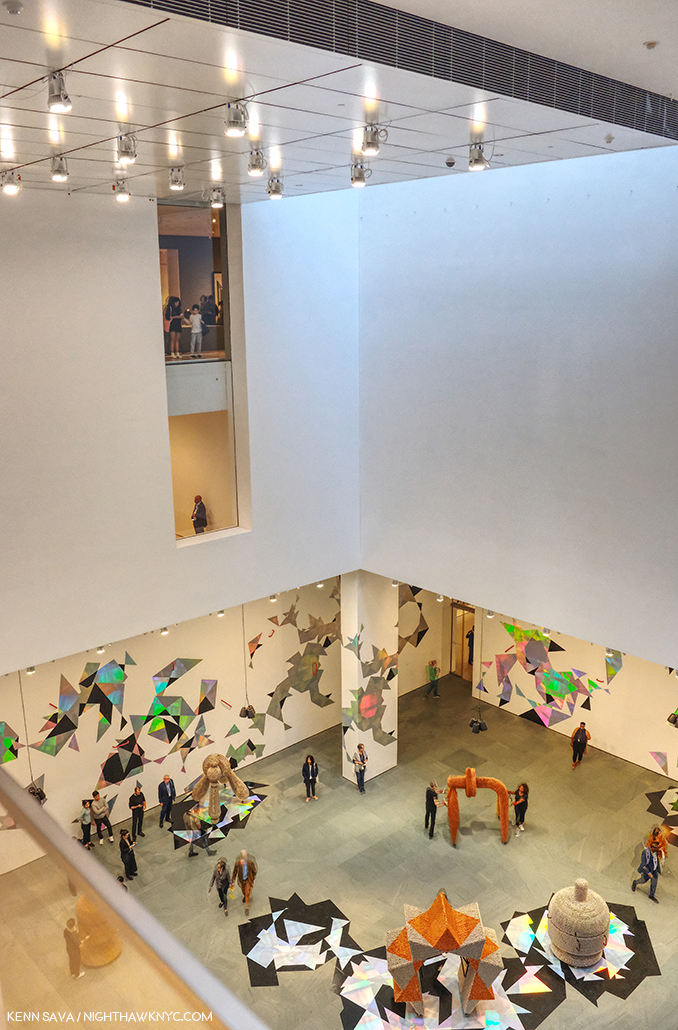
The “atrium,” Member’s Preview” for the “new” MoMA, October 19, 2019.

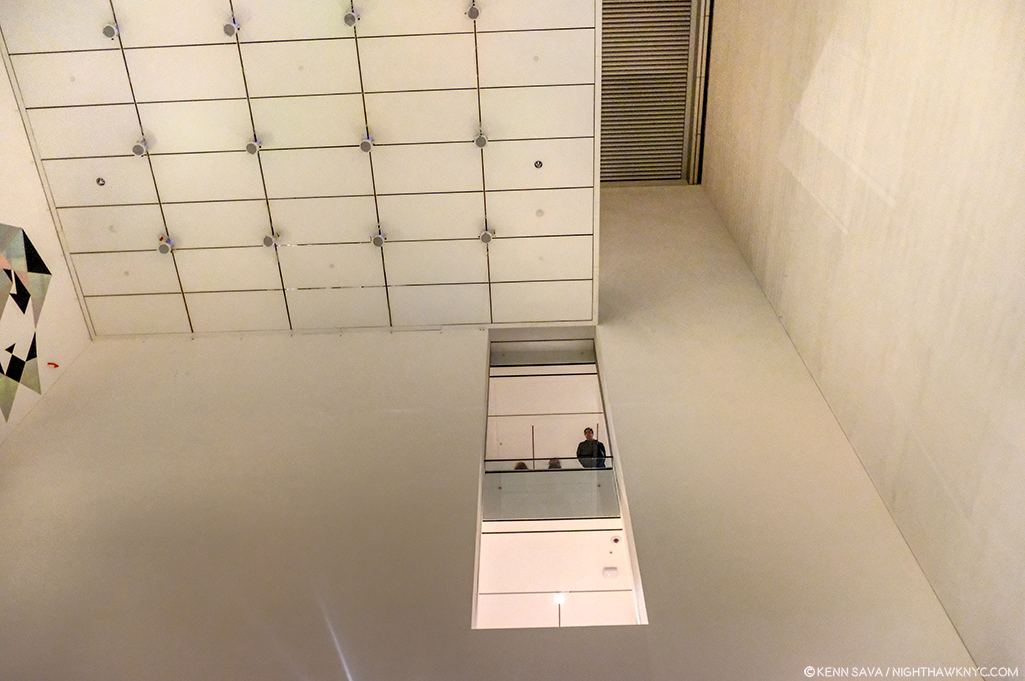
The first is that 110 foot tall gorilla in the building officially or unofficially called the “atrium.“ For some reason that I have not for the life of me been able to figure out over a few hundred visits these past 13 years, the Architect decided to drop a 110 foot tall atrium, (the “hole” I call it), smack dab in the middle of the building that, apparently, even some of the world’s great curators haven’t found a defining use for in almost one and a half decades2. I don’t blame them. I blame the Architect and whoever else thought this space was a good idea. I’ve never seen them use any more than the first 20 feet or so of its 110 until they mounted a decal-like iridescent work, seen above, on one of its walls for the opening of MoMA, 2019. And, I blame those who decided not to remove it in MoMA, 2019.  MoMA created MoMA, 2019, partially, because they “needed more space.” Well, guess what? You’ve got 7,700 square feet, or so, of completely useless space right smack dab in the middle of the building3, right in the middle of some of the most expensive real estate on earth. Instead of extending each of the floors as they should have been originally and filling that hole, they tore down an existing, good, museum, The American Folk Art Museum, formerly at 45 West 53rd Street next door!

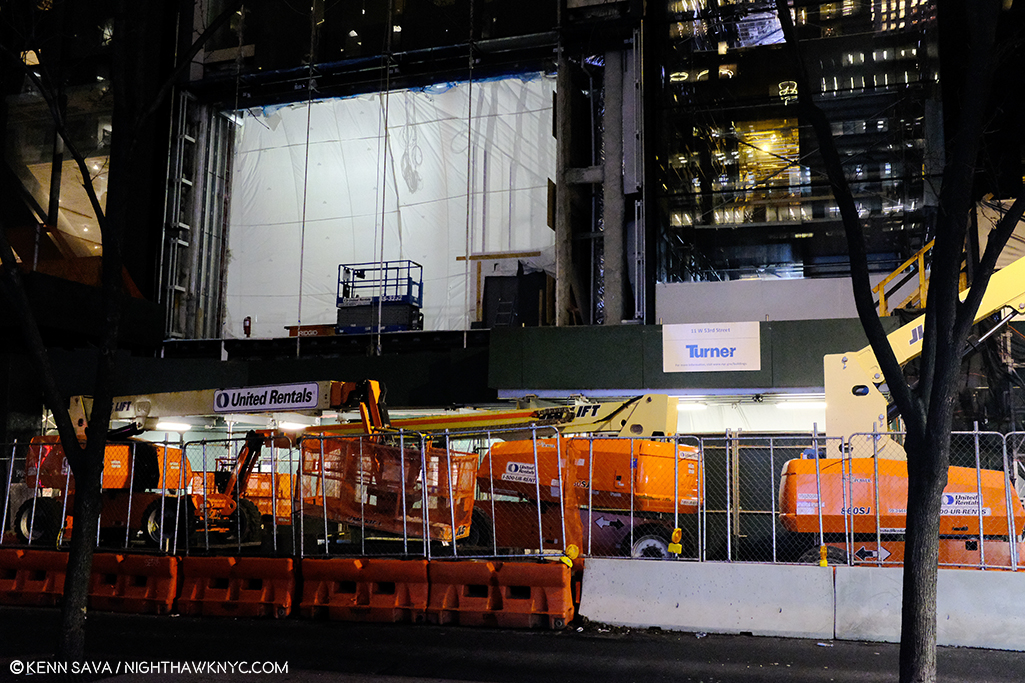
Construction of the new building for MoMA, 2019, where the American Folk Art Museum stood, seen on December 20, 2018.

“Shadow in my heart
Is tearing me apart
Or maybe it’s just something
In my stars”*

Frankly, all of this galls me.

“Soaring…””Majestic…””One of NYC’s great interior spaces…” Oh, sorry. I was reading about the Guggenheim. I can’t find anyone saying that about this.

Because of the atrium, the flow of every floor in MoMA, 2006 is broken up, causing headaches for visitors and curators. This goes right to the heart of the museum’s purpose- showing Art. A good number of the galleries in MoMA, 2006 felt strangely shaped, small, or lost. In this case, small doesn’t add “intimacy.” Instead, it serves to actually minimize the effect of the Art being shown in them, in my experience. The Brancusi show mounted before the summer, 2019 closure, and the new Betye Saar show both suffer from this, in my opinion, both being mounted in the same 2nd floor gallery, tucked off to the south side of the hole, behind sliding glass doors (which I also think are an annoying idea and an energy drain), unchanged between Moma, 20o6 and MoMA, 2019.

Apparently, given it’s still here in MoMA, 2019, MoMA is in denial that the atrium is a problem. For me, visiting MoMA, 2006 gives me the unmistakable feeling that I’m continually walking around, and working my way around, the hole, instead of the whole experience just flowing.

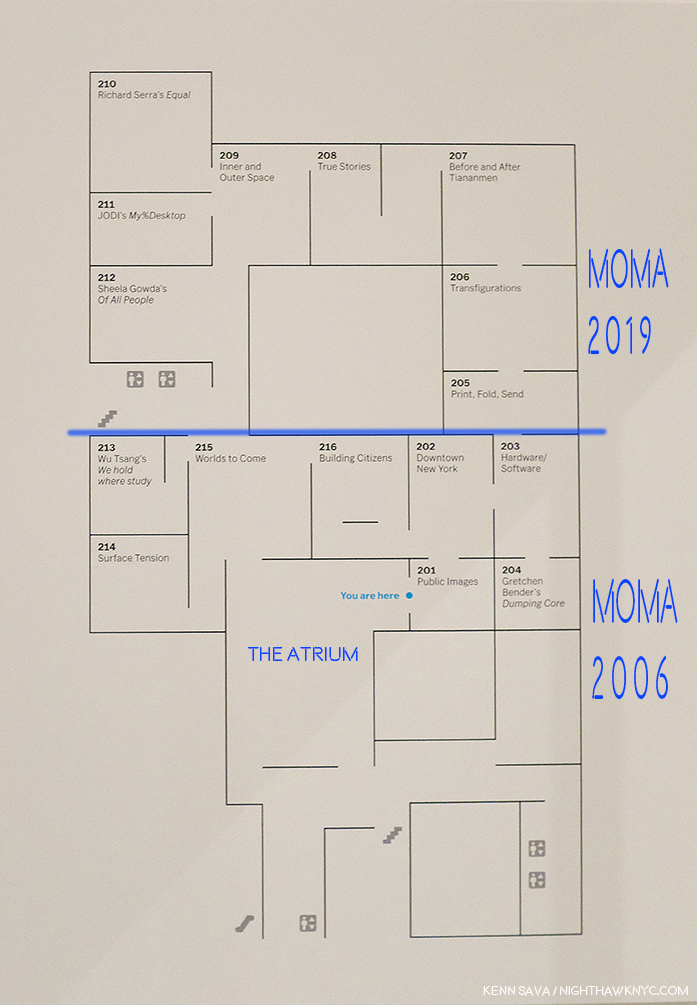
MoMA’s floor plan for part of the “new” 2nd floor. I’ve added notations in dark blue- a label for the atrium to point out where it is and how it needs to be navigated around. I’ve also labelled where MoMA, 2006 was (below the added blue line) and labelled where MoMA, 2019 is now (above the blue line) in the margin. Not shown- the other galleries on this floor, located in what MoMA now calls the “South” section (to the left and lower left.). All are effected by the “atrium.” Bear in mind- this is only ONE floor!

In fact, in MoMA, 2019, they’ve decided to double down. Keeping the hole, they’ve opted to extend the existing 2nd, 3rd, 4th and 5th floors the other way- to the west. I take this as an admission that the floors needed to be extended. We differ on how. You can see this in the 2nd floor floor plan, above. I’ve drawn a blue line to the left from gallery 205 and everything above that is the new building, what I call MoMA, 2019, below is what I call MoMA, 2006. It almost works. It does serve to minimize the “interference”/inconvenience of the hole, unless you’re in a section where you have to navigate around it. Alas, as soon as you are back in the “old” building, the MoMA, 2006 part, there it is, rearing its ugly head again, sending you to a floor plan trying to find your way. But, it also dramatically effects MoMA’s curators, and no doubt, every single show they mount in these spaces. WHY they just didn’t remove the atrium and extend the floors and make the 2nd, 3rd, 4th, and 5th floors full floors? (The 6th floor is a different matter, I believe due to the heights of the buildings. It already is a full, raw, space in the MoMA, 2006 building and a cafe has been installed on 6 on the MoMA, 2019 side (which I have not seen as yet. You can walk through from MoMA 2006 to MoMA 2019 on 2, 3, 4 and the 5th floor, but you can’t on 6. If you’re on 6 in MoMA 2006, you have to go down to 5, walk over to MoMA, 2019, and then go up to 6 on that side, or vice versa). That they didn’t remove the atrium is another, huge, mistake in my view. Alas, it’s too late for tears. And having been sad about MoMA’s building since MoMA, 2006 opened, I’m about cried out. Yes, MoMA, 2006 was so bad it actually kept me from going at times.

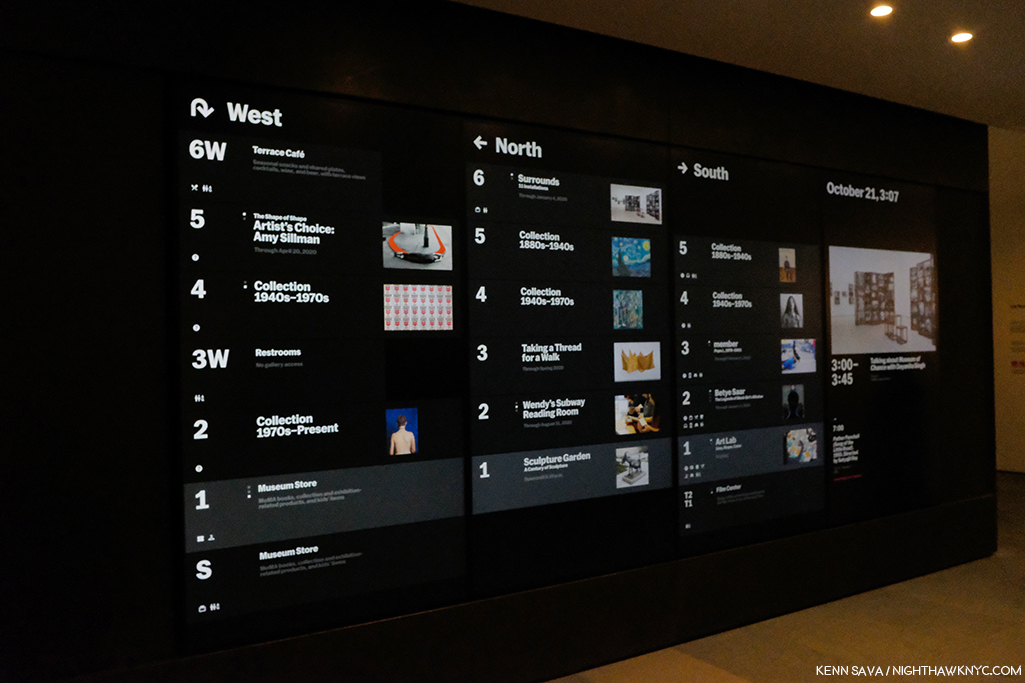
Where the heck am I going? Before going anywhere, it’s a good idea to check the “central scoreboard,” as I call it. West? North? South? What? Look quick! Those listings next to each floor change to show other things going on on that floor. Seen on the official opening day, October 21, 2019.

Another question for me is HOW do you redesign the building into MoMA, 2006, spending over 850 million dollars doing so, and not early on in the game ask, “WHERE are we going to put our most popular works?” Apparently, no one asked. Over the subsequent 13 years of the building, Monet’s Water Lilies and Van Gogh’s Starry Night, to name two, were continually moved, and never once looked to have found THE place for them. I lost count of how many places I saw the Water Lilies in MoMA, 2006, all the while with that indelible memory I recalled earlier in my mind.

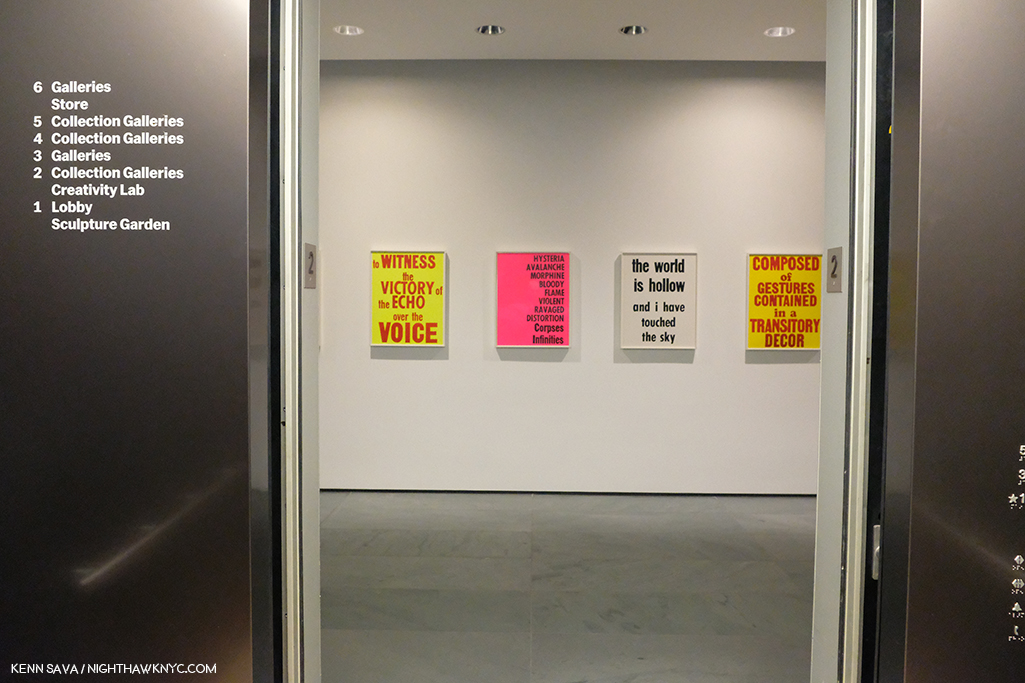
The brand new elevator doors open on my first visit to MoMA, 2019’s 2nd floor, October 19, 2019.

SURELY someone would ask that question when it came to designing MoMA, 2019! Two visits in? The answer is a decided…I’m not sure.

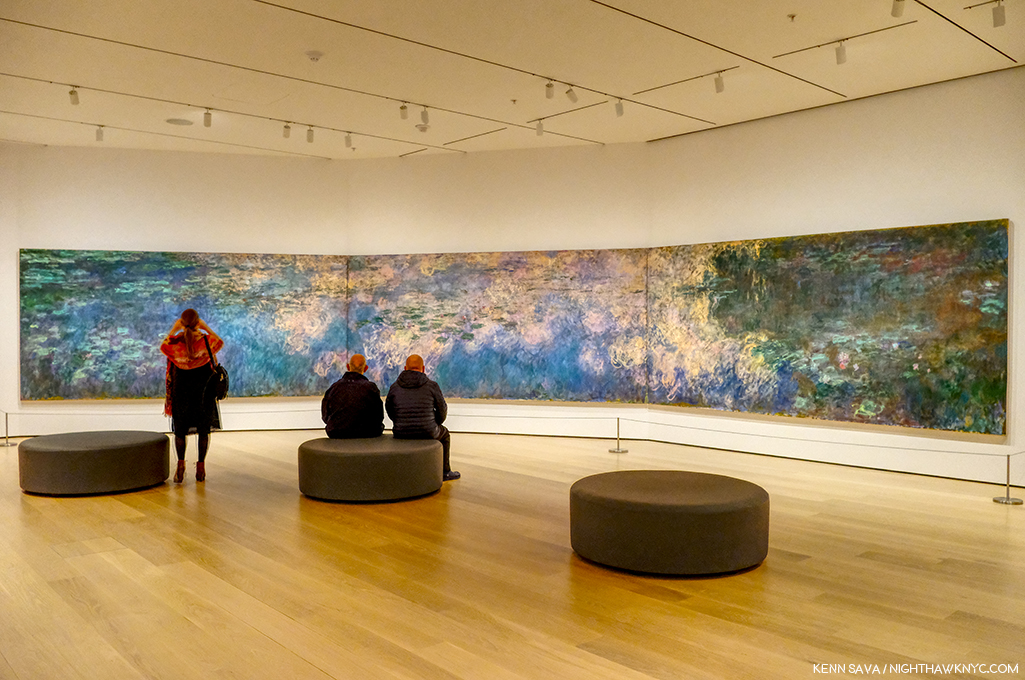
Home? At last? Monet’s Water Lilies, 1914-26, in a gallery devoted to his Water Lily Paintings (yes, they have others). We’ll see how long these stay here.

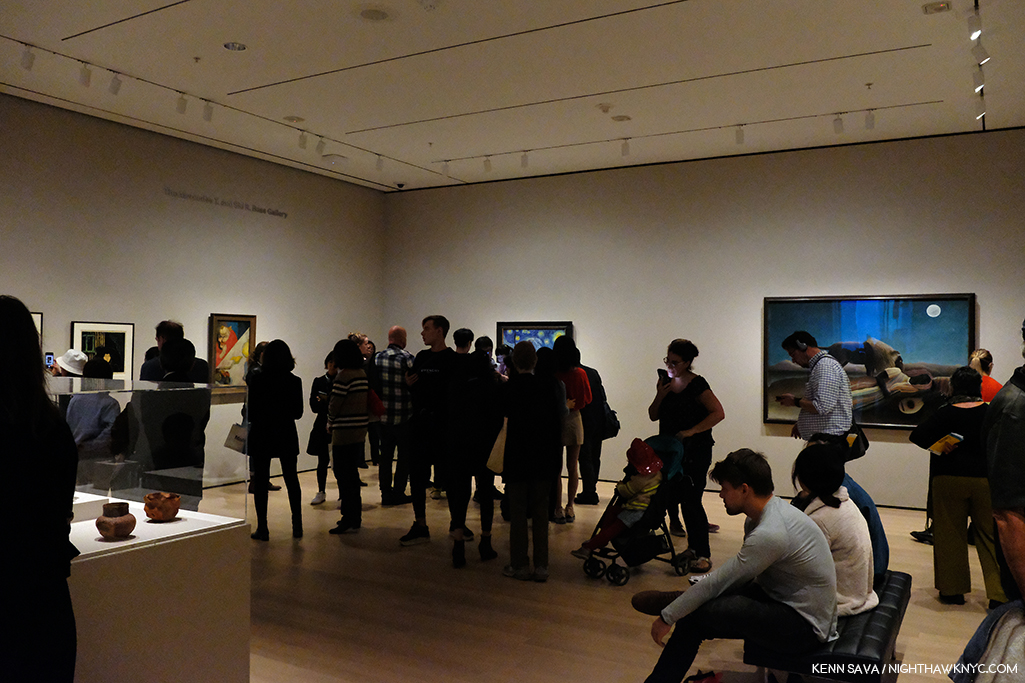
The Water Lilies seem to have been given some thought. They are decently situated in a gallery that contains only Monet Water Liliy works on an angled wall, similar to one of the installations they had in MoMA, 2006. You can scan the whole work continuously but it doesn’t give you a “wrap around” feeling. Starry Night fares far less well. It’s stuck in a corner(!?) at the end of a long gallery. I was shocked when I walked in and saw this. It’s just terrible.

Cornered! Vincent van Gogh’s beloved Starry Night, 1889 can be barely seen (as usual), though it’s now stuck in a corner. Seen on the official opening day, October 21, 2019

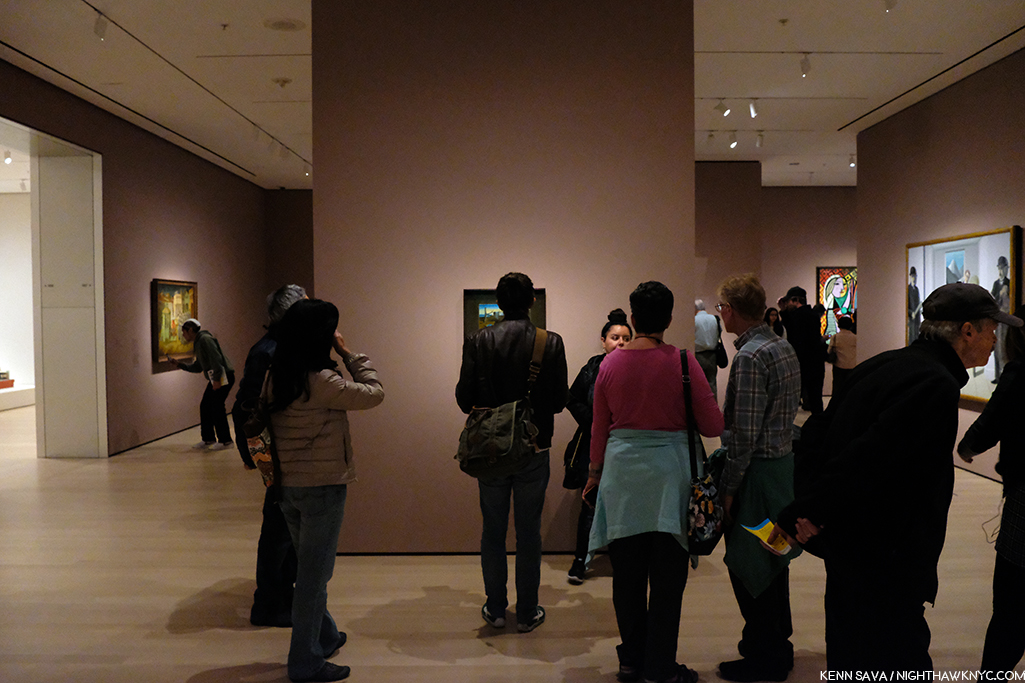
In this large gallery one other Van Gogh is installed half way down the wall to the left. I didn’t get the feeling of connection with the other works shown near Starry Night. Munch, who I greatly admire, is seen on the left hand wall, and while many pair him with Vincent, he gives me a completely different feeling, though l’ve wondered if Vincent may have been an influence on the Artist who was a decade younger. MoMA may have felt that putting other Van Goghs next to Starry Night might have created too big a crowd. I can live with seeing Munch next to Van Gogh’s. As seen in this gallery, due to the new arrangement of the galleries, multiple works by the same Artist are spread out, often across galleries.

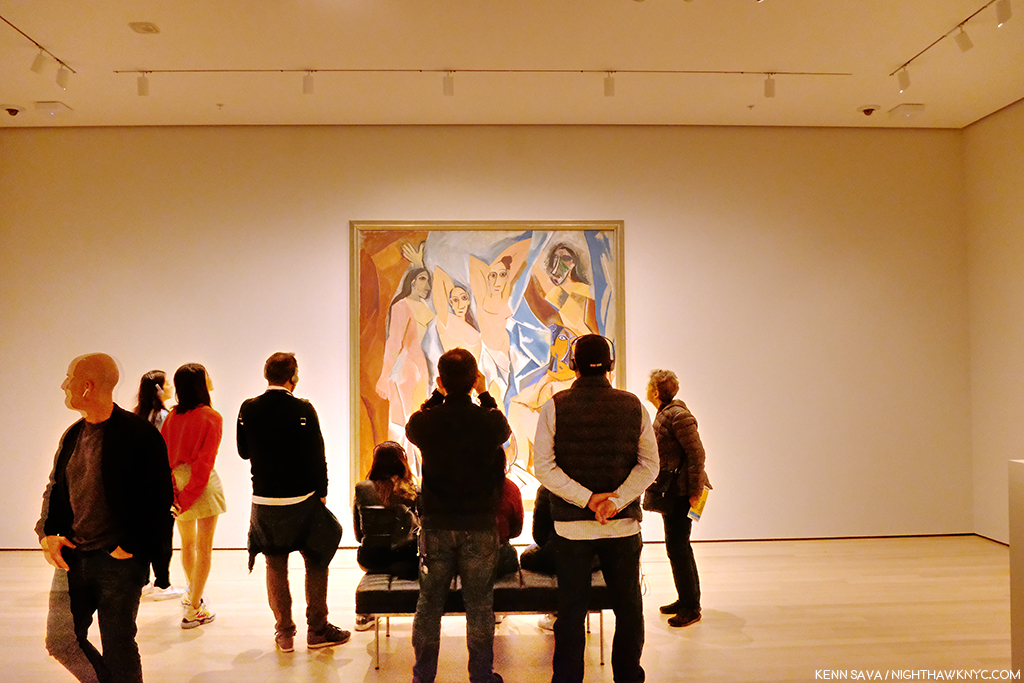
Picasso, Les Demoiselles d’Avignon, 1907.

That means that if you want to see, say, the Picassos, you have to plot a path to a number of rooms, where you might see one, or you might see 3 or 4. If you have multiple Artists on your hit list of pieces to see? You’re going to need a good chunk of time- just to plan your routes. Especially if they’re installed over multiple floors. I have mixed feelings so far about this arrangement, but I’ve been living with this collection for decades, and while I prefer seeing it chronologically so you can see how Art has evolved over time, mixing it up can be a nice change of pace and reveal new synergies. This “theme” strategy, which is more like that of a special exhibition, feels geared to people like me who have lived with the collection for a while and might welcome being surprised (if that’s what they feel). First time visitors, or those here with limited time, may feel differently.

Picasso, The Charnel House, 1944-5. The iconic Guernica is a work Picasso Painted in 1937, in the early days of World War II. The Charnel House was Painted at the end of the War, bookending Guernica, though far less well-known. Guernica was part of MoMA’s collection until Picasso died. He stipulated in his will it be returned to Spain. So, including it in the 1980 Picasso Retrospective, where I was able to see both of them, was something of a farewell before Guernica went to Spain.

Picasso seems to fare better than Starry Night. At least three of his major works (Les Demoiselles d’Avignon, 1907, Three Musicians, 1921, and The Charnel House, 1944-5) get walls all to themselves- in different galleries.

The upper left corner of Dali’s, The Persistence of Memory, 1931 (aka the “Soft Watches”). Picasso watch- Girl before a Mirror, 1932, is partially seen in the rear to the right.

As for other works on the most popular list, one was easier to find. Dali’s The Persistence of Memory, 1931 (aka the “Soft Watches”) gets a pillar to itself front and center in gallery 517. And on the opposite side of the same wall is Frida Kahlo’s Self-Portrait with Cropped Hair, 1940. That was easy. I only had to ask once to find it. (The Water Lilies? I asked 3 times. I saw another visitor seeking them ask twice.)

I found the galleries to be well lit, as readers well know, lighting is one of my long standing peeves in most spaces I see Art. One gallery of 2 Hopper Paintings accompanied by a good many Photographs was a bit dark, I presume this was intentional for conservation purposes. The consistency of the lighting across the museum that I’ve seen thus far is to be commended.

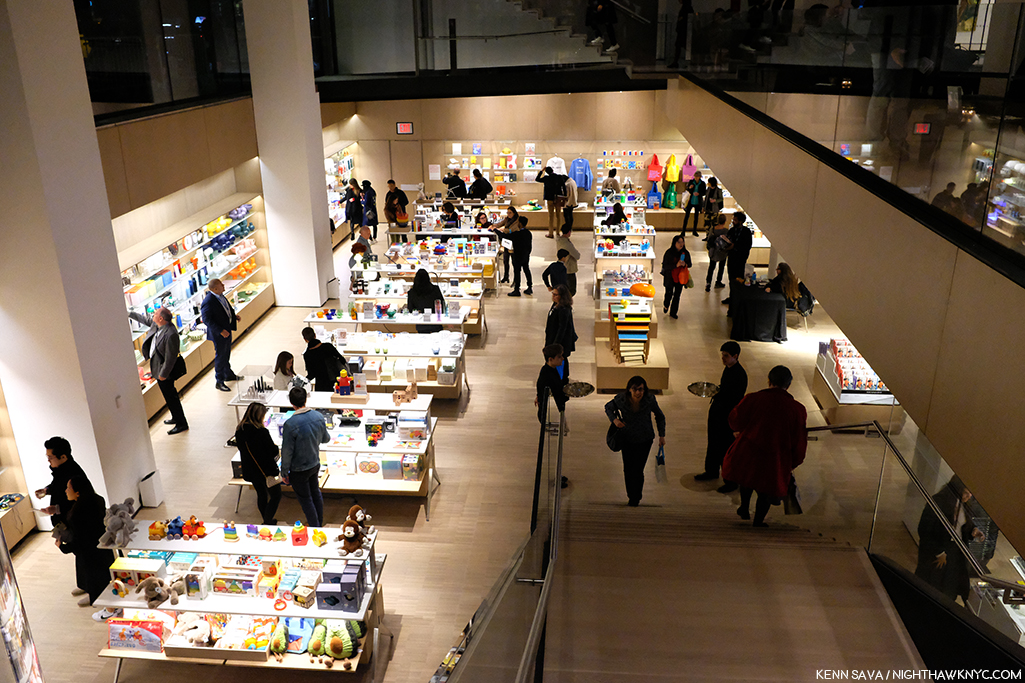
Lower level gift & book shop. One of at least 2 in the museum.

The first floor lobby felt like being in any of the faceless, large Times Square hotels nearby. It felt that a lot of money was spent here. Yet, I can never recall asking someone “How was your visit to such and such museum?” and getting the response, “Oh, the lobby was amazing!” I believe “sinking” the gift shop/book store is a mistake. Getting anywhere in MoMA, 2019 requires taking stairs and elevators. The last thing people may feel like doing is taking MORE stairs just to visit a shop. We shall see.

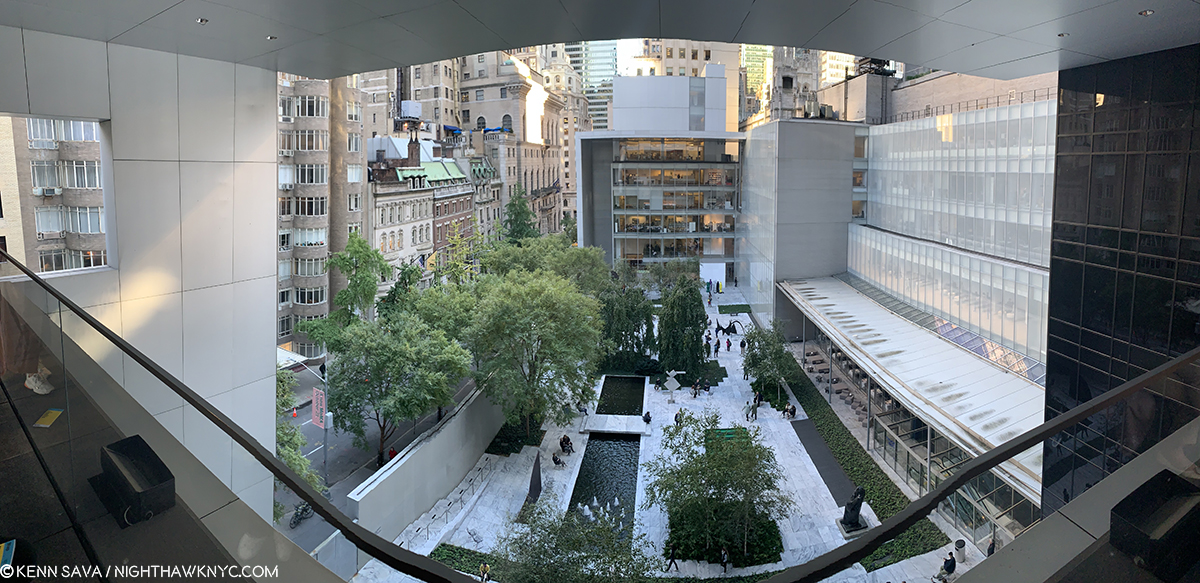
Not listed on the floor plan, the previous cafe has been replaced by a Brancusi gallery on 5 (gallery #500). Behind it, we now get free access to the outside patio overlooking the Sculpture Garden.

“There’s something missing from my life
Cuts me open like a knife
It leaves me vulnerable
I have this disease
I shake like an incurable
God help me please”*

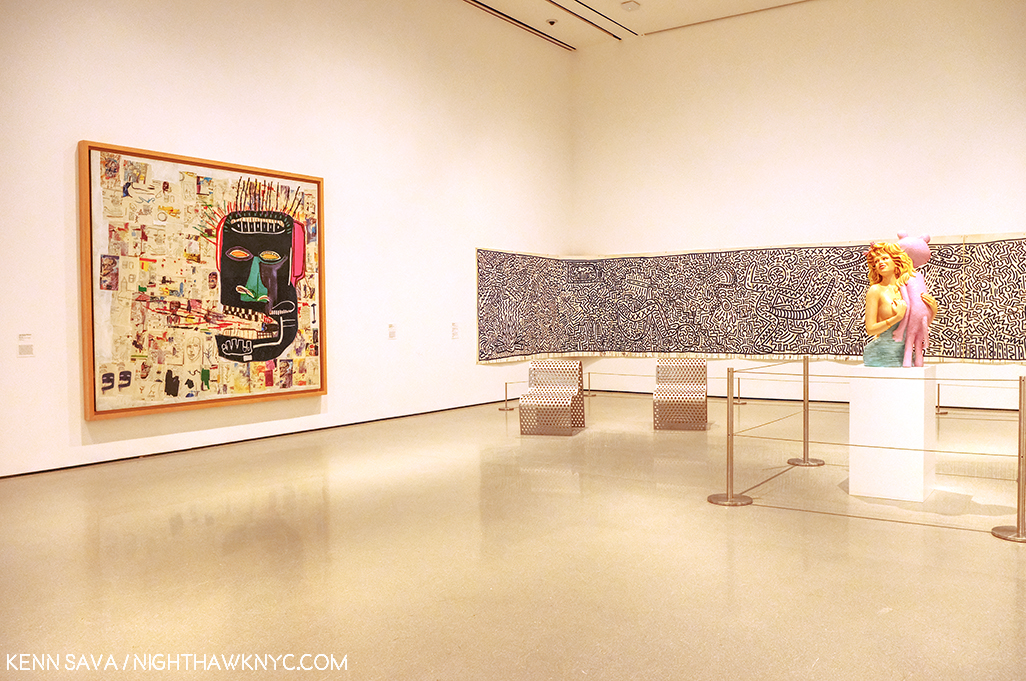
Jean-Michel Basquiat, Glenn, 1985, left, Keith Haring, Untitled, 1982, right.

Then there’s the other gorilla in the room at the “new” MoMA, 2019. My feeling is that MoMA, The Museum of Modern Art, is dangerously close (if it hasn’t happened already) to remaining just that, indefinitely. It’s not THE Museum of Modern & Contemporary Art many think it is. Their collection of the most important Contemporary Art is nowhere to the level of it’s preeminent collection of Modern Art (the period I consider to be approximately from Edouard Manet’s Le Dejeuner sur l’herbe, 1862, through 1979), or the collections of important Contemporary Art in LA, SF or Chicago, in the US. MoMA (and all the NYC museums) have fallen hopelessly behind in collecting important Contemporary Art. Jean-Michel Basquiat (J-MB) is a classic case, but he’s not alone. As they admitted, they didn’t collect his work early on and now it’s too late. I recently recounted MoMA’s history (or lack thereof) with J-MB in my series on the J-MB shows going on in NYC this year. Revealingly, only one of the 5 shows in NYC was mounted in a museum- The Guggenheim. Then, when I walked into the member’s preview for MoMA, 2019 on October 19th, low and behold there was a Basquiat front and center in the second gallery, above. It turns out they borrowed it from a private collection. This seemed to me to be a classic case of “smoke and mirrors,” of trying to hide this large hole in their Contemporary Art collection- and, after all these years (40 next year), possibly an admission they were “wrong” about Jean-Michel Basquiat.

Louise Lawler’s Does Andy Warhol Make  Your Cry?, 1988, above, and a group of 24 Untitled Film Stills, by Cindy Sherman.

Elsewhere on the 2nd floor, the entire first gallery, titled “Public Images,” was made up of work by women Artists, as if to immediately counter the oft mentioned fact that a very small number of women Artists have been given retrospectives by MoMA. They have also installed a Betye Saar show, The Legends of Black Girl’s Window, across the atrium, centered around a recent acquisition by the museum of earlier work by Ms. Saar. It doesn’t include any of her more recent, powerful, work, some of which were presented in Washboards, 1997-2017, presented earlier this year at the New York Historical Society. While nothing will detract from her overdue appearance in a substantial show in another NYC museum, I was left wondering why they didn’t mount the long overdue full Betye Saar Retrospective, who is still going strong at 93, while she’s alive to enjoy it. Looking at MoMA’s permanent collection online, time and again, I found either a lack of any works by important Contemporary Artists (Ai Weiwei? Robert Frank’s Photographs? Leonardo Drew? Rod Penner? Gregory Halpern? Petra Collins?…None by any of them. The most recent work by Betye Saar, who was born in 1926, is from 1972- 47 years ago!), a lack of their important work, or a lack of depth of these works (2 works, each, by Henry Taylor, Francesca Woodman, 1 Painting and 10 Prints by Richard Estes, 2 Paintings, 2 Studies and 22 Drawings by Kerry James Marshall and Jean-Michel Basquiat– 0 Paintings, 2 Prints, 10 Drawings). A close look at what is installed in the Contemporary galleries on 2, which makes a point of being inclusive, strikes me as an attempt to rewrite MoMA’s perception in the face of criticism, and, some smoke and mirrors- how much will require more than 2 visits. In the meantime, go and make your own study.

Before the crowds. Parts of 4 galleries, Contemporary Art, 2nd floor. Member’s preview, October 19, 2019.

Tourism is a big deal for MoMA, the other NYC museums, and NYC. If the Art going public begins to perceive the reality that NYC is not the place to go see important Contemporary Art, one of the most popular periods of Art there is at the moment, this would be a disaster, especially after having just spent over 450 million dollars on MoMA, 2019. Smoke and mirrors might buy them some time, but whether they can overcome the self-inflicted damage they’ve already done remains to be seen. MoMA was incalculably helped to become THE Museum of Modern Art by a visionary curator, Alfred Barr, during its formative years. More recently, those in charge didn’t believe in the work of these Contemporary Artists at the time, didn’t have the vision and foresight Mr. Barr did, and so they missed the boat.

Mark Bradford, James Brown is Dead, 2007, Torn-and-pasted printed paper, 47 3/4 x 267 inches. I’ve made no secret of my admiration for Mr. Bradford, who I consider one of today’s most important Artists. In fairness, since I’ve mentioned some of the Artists omitted from their collection, MoMA owns 4 of Mr. Bradford’s larger works, 1 Sculpture, 1 Video and about 17 Multiples. So, I find it interesting they chose this work for display.

They, and their counterparts at the other NYC museums, may well have cost NYC it’s world leading status as THE Art capital of the world, we shall see. It’s too late now. Only mass, and massive, donations will help to close that gap now.

Though I am a paying member, I dreaded going to see the “new” MoMA, 2019. Such is the level of disdain I have for MoMA, 2006, which I consider to be the worst major museum building I’ve ever been in, it actually keeps me from going to see the Art! Maybe I’m just too used to MoMA, 2006 that MoMA, 2019 actually feels “not so bad.” Well Let’s see. MoMA, 2006 cost 858 million dollars according to The Times. I’ve seen 450 million as the cost of MoMA, 2019. That’s at least 1.3 BILLION dollars to make something I just said was “not so bad.”

Well, in 10 years, when MoMA decides that they “need more space,” which you know they will, I know where they can get 7,700 square feet of it, without tearing down anyone else’s building. Let’s say by then it will cost another 500 million to create MoMA, 2029. Then, they’ll have a chance at actually making the building “decent.”

Gee…Wait a minute. Between MoMA, 2006 and MoMa, 2019, they’ve spent 1.3 billion dollars? If they spent that on Art back when MoMA decided to build MoMA, 2006? You might actually have a collection of important Contemporary Art on the level with MoMA’s collection of Modern Art.

Instead? We got one of the biggest Architectural design mistake in NYC in my lifetime, right up there with not allowing the world’s greatest Architects, beginning with Frank Lloyd Wright, who’ve tried to build here a chance to build more than one building each. More? That the powers that be at MoMA thought putting a gigantic hole in the middle of the most expensive real estate on earth was a good idea, and then less than 10 years later tear down an actually good museum saying they “need more space” is plain hubris.

On second thought, maybe that hole does signify something about Manhattan after all. It signifies the hole in the collections of Contemporary Art at MoMA, and the other Big 4 NYC Museums. Smoke and mirrors aren’t going to be able to cloud that realization from many for very much longer.

“Be a happy man
I try the best I can
Or maybe I’m just looking for too much?”*

*-Soundtrack for this Post is “Hole In My Life” from Outlandos d’Amour by The Police, performed live in Paris in 1979, here-

NighthawkNYC.com has been entirely self-funded and ad-free for over 6 years, during which over 250 full length pieces have been published. If you’ve found it worthwhile, you can donate to keep it going & ad-free below. Thank you!

Written & photographed by Kenn Sava for nighthawknyc.com unless otherwise credited.
To send comments, thoughts, feedback or propositions click here.
Click the white box on the upper right for the archives or to search them.
For “short takes” and additional pictures, follow @nighthawk_nyc on Instagram.

Subscribe to be notified of new Posts below. Your information will be used for no other purpose.


  1. In the same New York Magazine piece, the author, Alexandra Lange, concluded that MoMA, 2006, “…is a question, sublimely unanswered.” 13 years later, I’ve still got a few questions, which I ask in this piece. Living with them has been painful, not “sublime.”
  2. Yes, the Tate Modern in London did something a little similar, but dissimilar enough to make the difference, and they’ve continually found good uses for it since it opened around the same time as MoMA, 2006.
  3. Where did I get 7,700 square feet from as the size of this space? I’ve been unable to find out the official square footage of the atrium (interesting, no?). It hasn’t been published anywhere and those I asked at the museum didn’t know or wouldn’t tell me. So? I took it upon myself to calculate it. 110 feet is the published (known) height. I stepped off 35 paces from wall to wall and each of my paces is 24 inches. That’s 70 feet, and 7,700 square feet in total by my guesstimation.

Forgotten Songs I Will Love Forever, #2- Steely Dan’s Deacon Blues

This site is Free & Ad-Free! If you find this piece worthwhile, please donate via PayPal to support it & independent Art writing. You can also support it by buying Art & books! Details at the end. Thank you.

Written & Photographed by Kenn Sava (*- unless otherwise credited)

Part 2 of an ongoing Series. Part 1 is here.

“Deacon Blues” by Steely Dan, written by Donald Fagen & the late Walter Becker, as recorded on their classic album, Aja, in 1977.

Hideki Fujii’s (1934-2010) classic Photo of the extraordinarily enigmatic model & actress Sayoko Yamaguchi (1947-2007). She did far more, including being a ground-breaking Artist, but even if she had only done this one Photograph, she’ll live forever.

Comment- As close to the unofficial/official Theme Song of NighthawkNYC.com as there is likely to be, and I said as much in my very first Post in July, 2015, and here in in 2024. For me, Steely Dan represents a kind of zenith in Pop & Rock- the moment where pure instrumental musicianship peaked before the machines, computers and automation began taking over. (There’s nothing inherently “wrong” in that. It’s just different.) “Libations. Sensations. That stagger the mind…”

Compared to the otherworldly beauty on the cover for Aja, it looks like the band didn’t have a lot of input into the single’s cover. Photographer unknown.

Lyrics-

This is the day of the expanding man
That shape is my shade
There where I used to stand
It seems like only yesterday
I gazed through the glass
At ramblers, wild gamblers
That’s all in the past

You call me a fool
You say it’s a crazy scheme
This one’s for real
I already bought the dream
So useless to ask me why
Throw a kiss and say goodbye
I’ll make it this time
I’m ready to cross that fine line

Learn to work the saxophone
I’ll play just what I feel
Drink Scotch whiskey all night long
And die behind the wheel
They got a name for the winners in the world
I want a name when I lose
They call Alabama the Crimson Tide
Call me Deacon Blues

My back to the wall
A victim of laughing chance
This is for me
The essence of true romance
Sharing the things we know and love
With those of my kind
Libations
Sensations
That stagger the mind

I crawl like a viper
Through these suburban streets
Make love to these women
Languid and bittersweet
I rise when the sun goes down
Cover every game in town
A world of my own
I’ll make it my home sweet home

Learn to work the saxophone
I’ll play just what I feel
Drink Scotch whiskey all night long
And die behind the wheel
They got a name for the winners in the world
I want a name when I lose
They call Alabama the Crimson Tide
Call me Deacon Blues

This is the night of the expanding man
I take one last drag
As I approach the stand
I cried when I wrote this song
Sue me if I play too long
This brother is free
I’ll be what I want to be

I learned to work the saxophone
I play just what I feel
Drink Scotch whiskey all night long
And die behind the wheel
They got a name for the winners in the world
I want a name when I lose
They call Alabama the Crimson Tide
Call me Deacon Blues

Tenor solos by Pete Christlieb.

Making a masterpiece. The making of “Deacon Blues”-

;

“We would work then past the perfection point (italics mine) until it became natural.”

I get chills watching this. When Aja came out, I, and every musician I knew, were just in awe of the incredible taste shown on every single note, and what wasn’t played. Then, there’s the lyrics…

Great Music will never die. Pay Steely Dan forward.

*-R.I.P. Walter Becker (1950-2017)

NighthawkNYC.com has been entirely self-funded & ad-free for over 8 1/2 years, during which 320 full-length pieces have been published! If you’ve found it worthwhile, PLEASE donate to allow me to continue below. Thank you, Kenn.

You can also support it by buying Art, Art & Photography books, and Music from my collection! Art & Books may be found here. Music here and here.

Written & photographed by Kenn Sava for nighthawknyc.com unless otherwise credited. To send comments, thoughts, feedback or propositions click here. Click the white box on the upper right for the archives or to search them. Subscribe to be notified of new Posts below. Your information will be used for no other purpose.

My Search For Edward Hopper’s Nighthawks Diner

Written & Photographed by Kenn Sava (*unless otherwise credited).
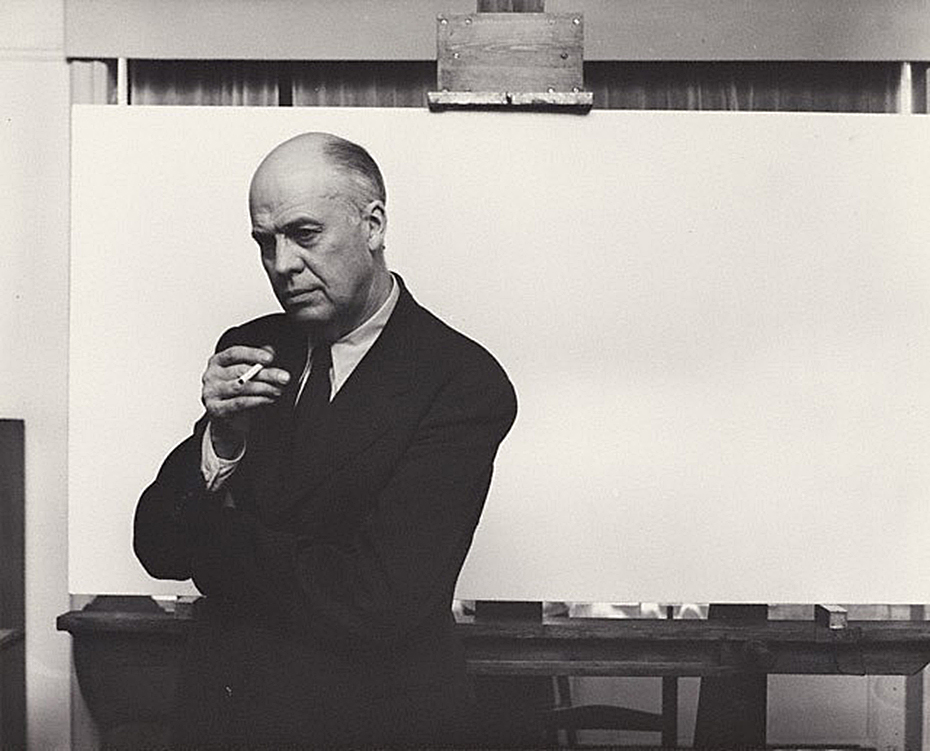
Arnold Newman, Edward Hopper in his New York studio, November 1, 1941, Gelatin silver print, *Arnold Newman Collection/Getty Images.

You’re looking at Art history.

After the fact, this may be one of the most historic Photographs in American Art. I’m not only talking about it being a wonderful portrait of Edward Hopper. It’s much more. The date is November 1, 1941. On January 21, 1942, the Artist’s wife, Jo Hopper, would record the completion of the work her husband created on that blank canvas he is posing in front of in the Artist’s Ledger of his work.
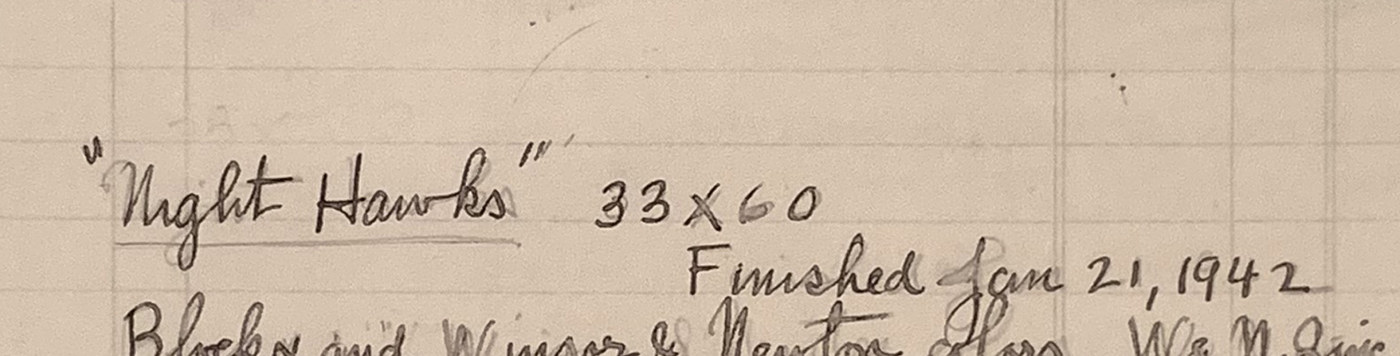
A section of Edward Hopper’s Ledger page for Nighthawks, from the book, Edward Hopper: Paintings and Ledger Book Drawings. It wound up in the Art Institute of Chicago almost immediately. Its sale netted Edward Hopper about $1,700.00.

In the intervening 81 days, Edward Hopper Painted the incomparable Nighthawks on that very canvas. We don’t know if Arnold Newman had any clue as to what Edward Hopper’s intentions were for that canvas. But we know now. The odds are that he had finished his preliminary work- the inspiration, the sketches, the reference Drawings, the sizing calculations he usually did, and ordered the stretcher and canvas we see behind him on his famous easel. Most likely? At this very moment, this masterpiece was all in his mind, and possibly on it, as Arnold Newman pressed his shutter release.

Click.

For the following 77 1/2 years (exactly, as I write this), and counting, the world has been fascinated by Nighthawks like they have few other Paintings created in the 20th Century. Some of us, including myself, are borderline obsessed by it.
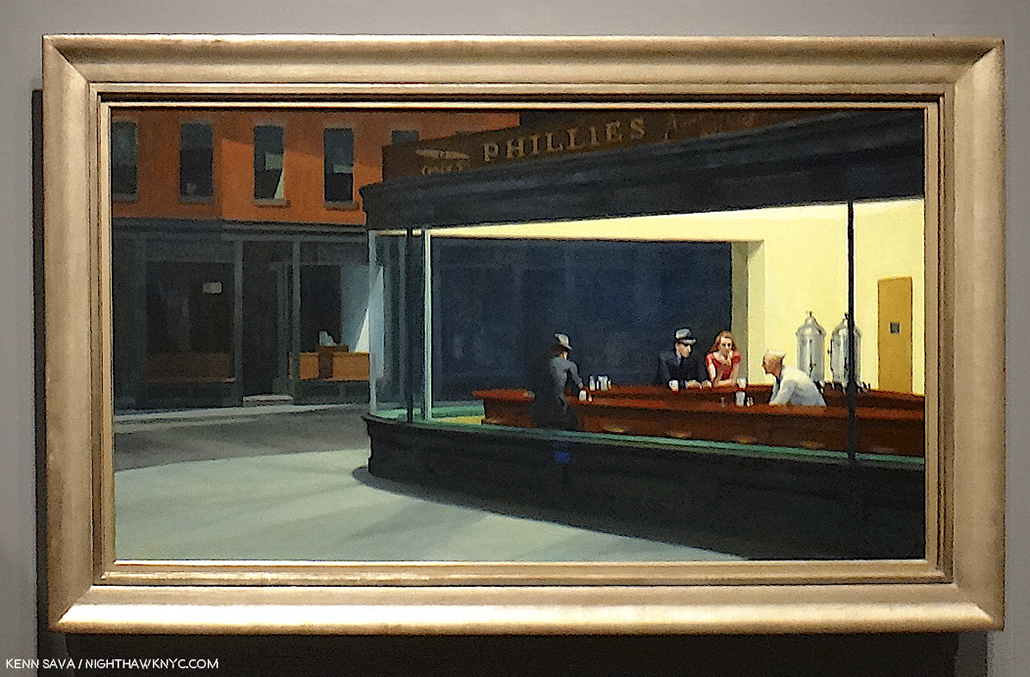
Written on my soul. The last time I stood in front of Nighthawks. August 28, 2013, at Hopper Drawing at the old Whitney Museum.

I’ve stood in front of it twice in my life. The first time at The Art Institute of Chicago in 2005, the second at the old Whitney Museum in 2013. In July, 2015, I named this site after it and wrote about why in the very first piece I Posted here, “Welcome To The Night,” To commemorate the 4th anniversary of NighthawkNYC.com, I present My Search for the Nighthawks Diner.
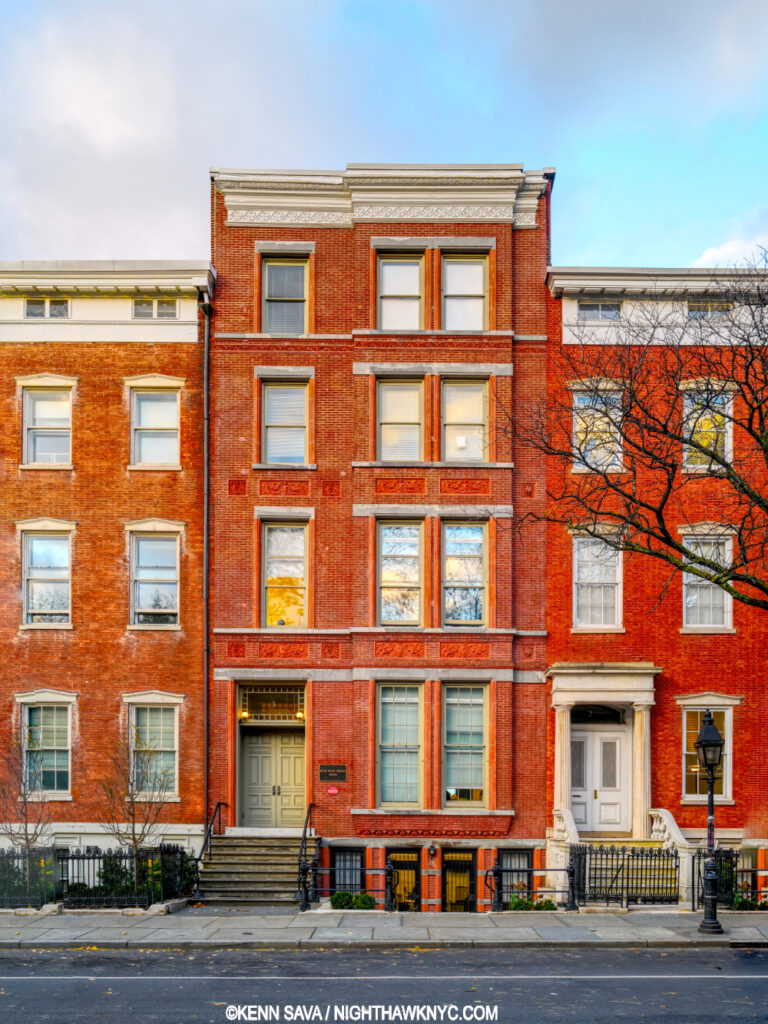
The beating heart of Edward Hopper’s world. Edward Hopper posed for Arnold Newman, and Painted Nighthawks here, on the top floor of 3 Washington Square North, just east of the Arch in Washington Square Park, in Greenwich Village, that it looks out on, where the Hoppers lived for over 50 years, from 1913 until the Artist’s death in 1967. This is a key point for a variety of reasons, and an intriguing one because Edward Hopper was the furthest thing from “bohemian” one could imagine. Yet, living here he, like most New Yorkers, walked regularly, probably daily, and so the areas he was able to walk to may have become the sites of, or the inspirations for, his Paintings. And so, for almost all of the past 77 years viewers have been asking the question-

“WHERE is the diner Edward Hopper Painted in Nighthawks?”

I’ve been trying to find it for the better part of my life. Having lived in the area for 28 years and having frequented it before I lived here, the Village is an area I’m as familiar with as I am any anywhere. During that time, as during the Hopper’s time here, change has been the only constant. Change has also been a constant enemy in the attempts to locate, for once and for all, the diner we see in Nighthawks. My search has been carried out using only a few tools. First, the extensive Hopper literature. Though very little of it is directly relevant to this search, much of it is indirectly relevant, providing a framework for how, when and where he created his extensive oeuvre of Paintings, Watercolors and Drawings. The books by Gail Levin, (the Hopper’s biographer and the author of numerous other books on the Artist and his work, including the 4 volume Catalog Raisonne), particularly her Hopper’s Places, Second edition and the catalog for the 2013 Whitney Hopper Drawing show have been the most referred to for this quest. Outside of this, I have relied on my own two feet, my cameras and, yes, my gut.

Once that “Could this be IT?” bell goes off, I research the possibility, beginning with “What did this place look like around 1940?” Is any of that here to be seen now (i.e. when I was standing there)? What does common sense tell me? In the case of Edward Hopper, “common sense” comes from studying his work. Hopper’s Places provides part of the basis for some of that “common sense.” In it, Ms. Levin shows us contemporary Photographs she, herself, has taken at various sites Edward Hopper Painted around the world- though not Nighthawks, “…to show how he both recorded and transformed” these places, she says in her “Preface to the Second Edition,” P.vii. On P. x, she adds, “Research for the biography also revealed that in his later years Hopper relied upon observing specific sites more often than anyone had previously realized.” Even though much has changed over time, I still get a bit of a sense of Hopper’s approaches to rendering actual places. Much is, also, to be learned by looking at and studying historic and contemporary pictures of places under consideration. In the case of Nighthawks, I used all of these tools in my search.
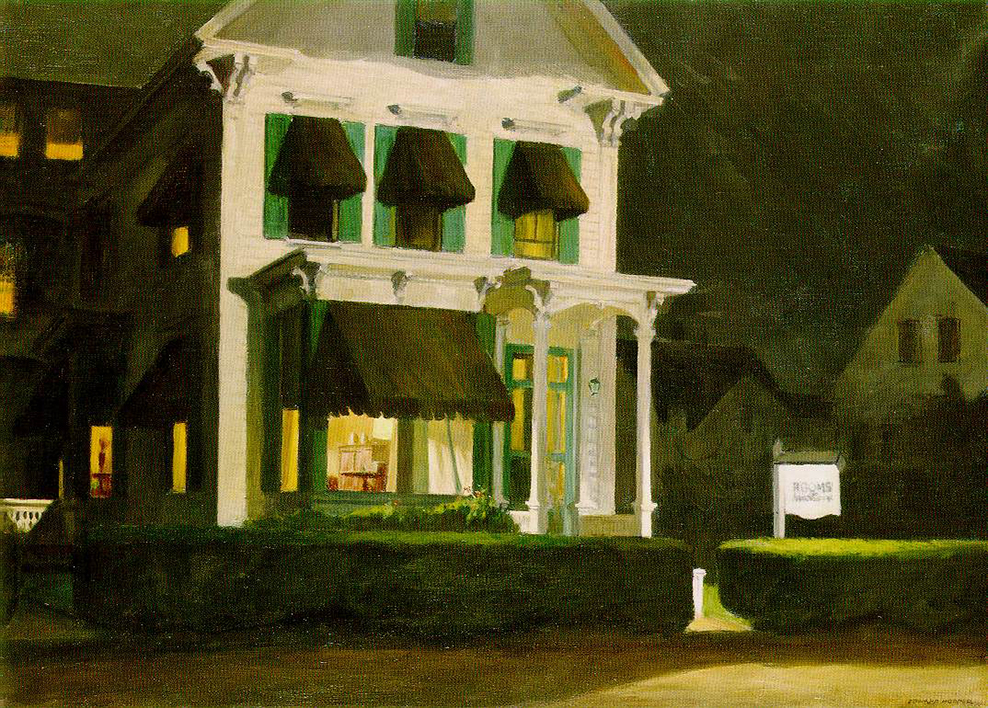
Rooms for Tourists, 1945. About 40 years later, I found this actual Rooming House this Painting is based on in Cape Cod, Mass., and stayed there. *Photographer unknown.

My gut has already helped me find one of “Hopper’s Places.” In the 1980s, I was traveling through Cape Cod and looking for a place to stay in Provincetown, Mass. I came upon a small Rooming House and instantly recognized it from the Hopper Painting, Rooms for Tourists, and so I just had to stay there. Part of my belief that Edward Hopper based Nighthawks on a real diner was finding that actual Rooming House in the 1980s when I visited Cape Cod.

I’ve spent most of my time searching in the West Village. For two primary reasons. First, this was the neighborhood Edward Hopper lived in and walked through regularly and most often. Second, as soon as one walks south of West 14th Street (the Village’s northern border) on 7th Avenue South, you’re faced with this-
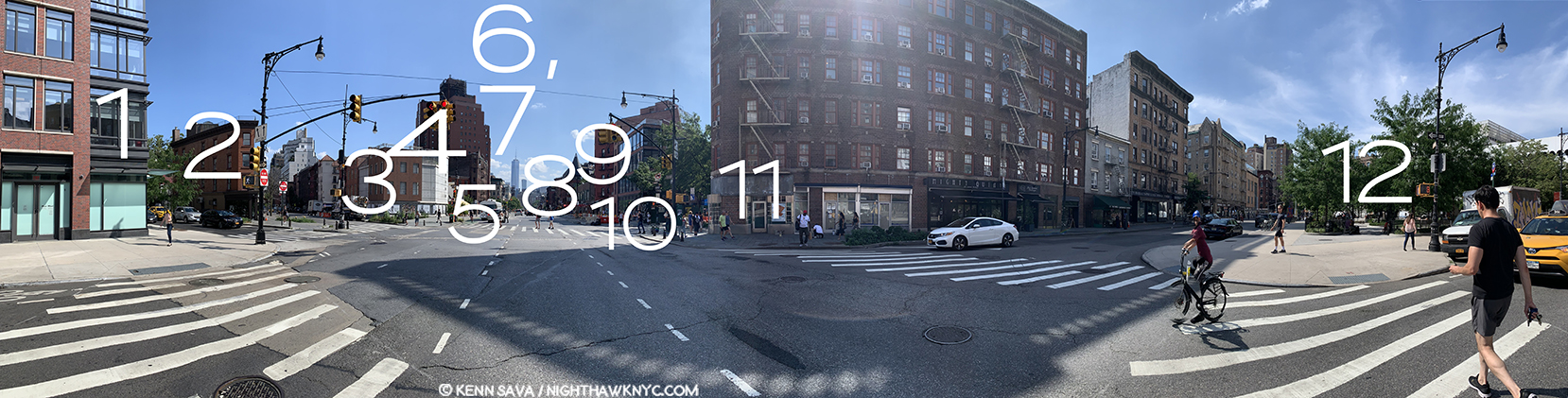
Standing in 7th Avenue South at the intersection of Greenwich Avenue and West 11th Street, facing south, July, 2019. It HAS to be somewhere in this picture, right? No. There are countless triangular corners in the West Village, but this view is the most likely to contain it, I think. Click for full size.

As I stood in the middle of 7th Avenue South (NOT recommended), looking into the heart of what was Edward Hopper’s New York (turn left at #3 and it’s a mere one Avenue and 4 blocks from his home, shown above), there were no fewer than TWELVE triangular corners around me! Edward Hopper knew each and every one of them well. Those familiar with Manhattan know that almost all of it north of 14th Street is a grid made up almost exclusively of rectangles. Below 14th Street, “old Manhattan” streets wind seemingly with minds of their own, interrupted here and there with a semblance of uptown’s rectangular regularity. The triangular corners we see in Nighthawks are everywhere. WHERE to begin?
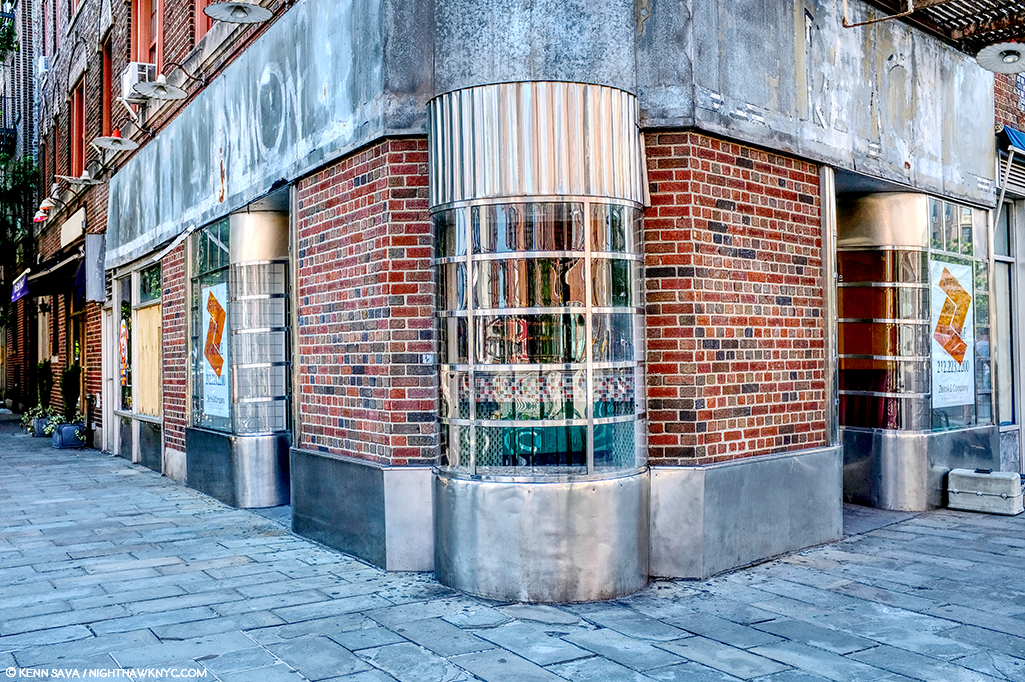
The former Two Boots Pizzeria, #11 in the picture above, is from the right period, but its building goes straight up, so I ruled it out quickly. Nothing feels “right” to me about it.
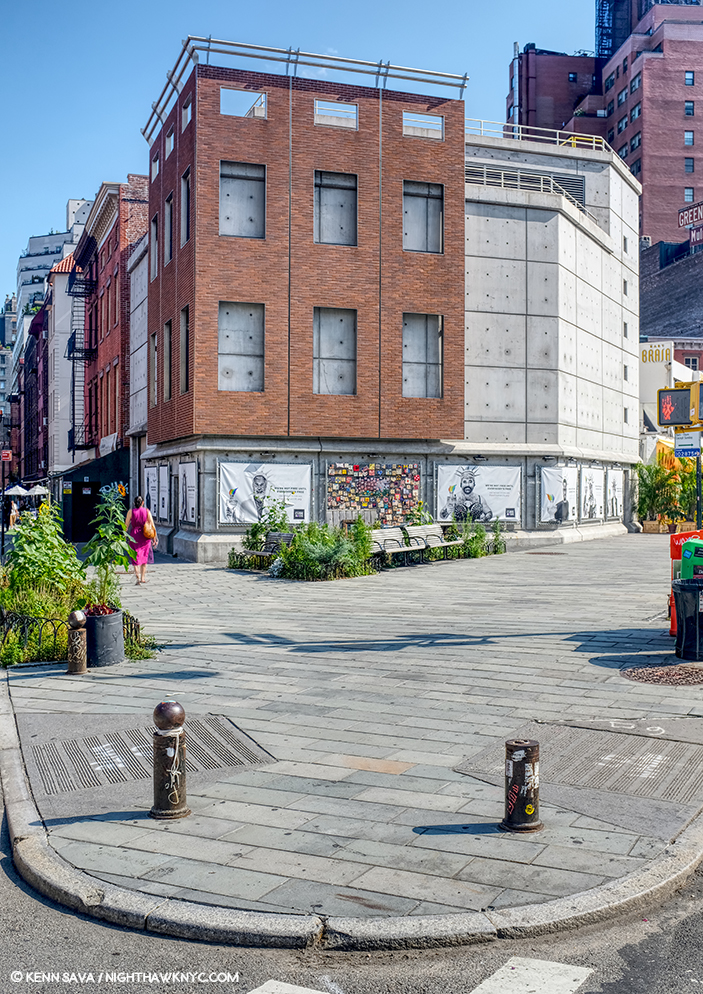
Mulry Square (in the foreground), #3 in the picture.

Perhaps no site has gotten more “hype” about it over time in regards to Nighthawks than Mulry Square, #3 in the picture. In spite of what many have said, I have seen nothing to indicate to me that this was the site of the Nighthawks Diner.
I would guess this would be  the early 1980s from the Rita Marley ads and Miles Davis ads, on the remnants of the hamburger place, which may be the remnants of the actual hamburger place that stood here in the 1940’s, which I show later on. Miles Davis came out of retirement in 1981. Is that a covered window along the left side? I haven’t been able to find out. *Photographer unknown.

The historical archives show a gas station with a small burger place at the time, but it looks more like a White Castle precursor to me than anything resembling the Painting’s diner. If anything, it may have been an inspiration for the “fishbowl effect”- where we are looking in through the glass at the customers. More on this later.
This is seen on the other end of Mulry Square, #4 in the picture, on another triangular corner, today. No viable candidates have been reported on this, also triangular, side of the Square, which is occupied by this too modern edifice today. I’ve also ruled it out.
#9. Max Gordon Corner, named in honor of the long time owner of the Village Vanguard.

Directly across the street from #4 is this building, #9 in the picture, which has been home to the world’s greatest Music club, in my opinion, the Village Vanguard since 1927. There is a pizza place on the corner and the windows go through to the back street, but at 2 stories, I’ve long ago ruled it out. However, Art history will remember this spot because another great Painter, Richard Estes, wonderfully Painted it. (Which reminds me- In 2016, I visited the known site of one of Richard Estes’ latest Paintings in a piece I ironically called “Richard Estes’ Dayhawks At The Corner Cafe.”)
Village Cigars, 7th Avenue South and Christopher Street, Greenwich Village, NYC, June, 2019.

The site of Village Cigars is not numbered in the picture, being further down 7th Avenue on the right past #8. It’s garnered surprisingly little to no attention in the Nighthawks searches I’ve seen to this point. It has some things going for it- the shape and the cigar sign (Nighthawks has a Phillies cigar ad over the diner) but in speaking with the manager, I was told it’s been here for over 100 years, but it’s been a cigar store the whole time. Also, it doesn’t have the curved front window, those dual subway entrances were most likely also there in 1940 and are not in the Painting, and the buildings behind it are too far away. I’ve ruled it out. The Stonewall Inn is a few hundred feet to the left.
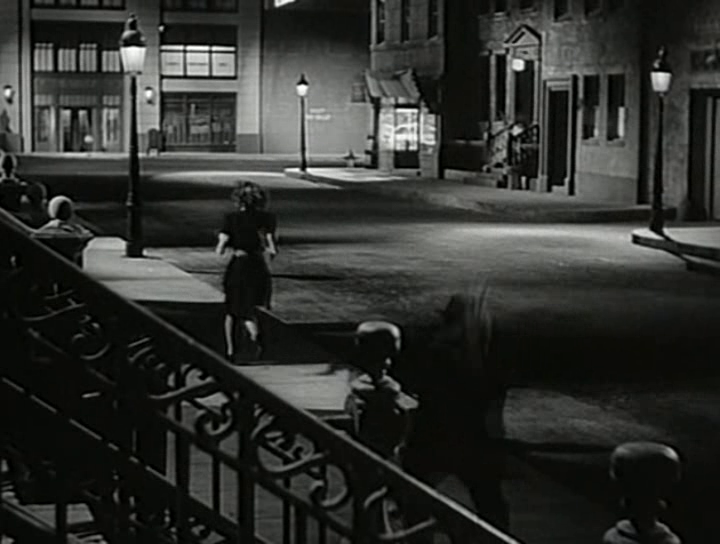
Some believe the inspiration lay in movies of the period, like this one, Stranger on the Third Floor, 1940. The suggested diner down the street on the right looks nothing like it, in my opinion. Possibly another “fishbowl effect” inspiration.

I remain completely unconvinced by any and all suggestions of movies I’ve seen. Yes, Edward Hopper was taken by a short story, “The Killers,” written by Ernest Hemingway in 1929, but I, for one, have not seen the evidence of that in the setting in the Painting. In the figures and the mood? Much more likely. “The Killers” was also made into a film, but, in 1946, too late to be considered. Maybe the Painting influenced it, as it has countless movies since.

That leaves the contenders. Speaking of movies, Edward Hopper reportedly frequented the Lowe’s Sheridan Movie Theater (which stood where #12 is in the picture earlier, and is seen further below), and based a Painting inside of it. His walk to and from it is interesting to me and it has been suggested that a few locations along this route are candidates for the Nighthawks diner. I looked closely at these.
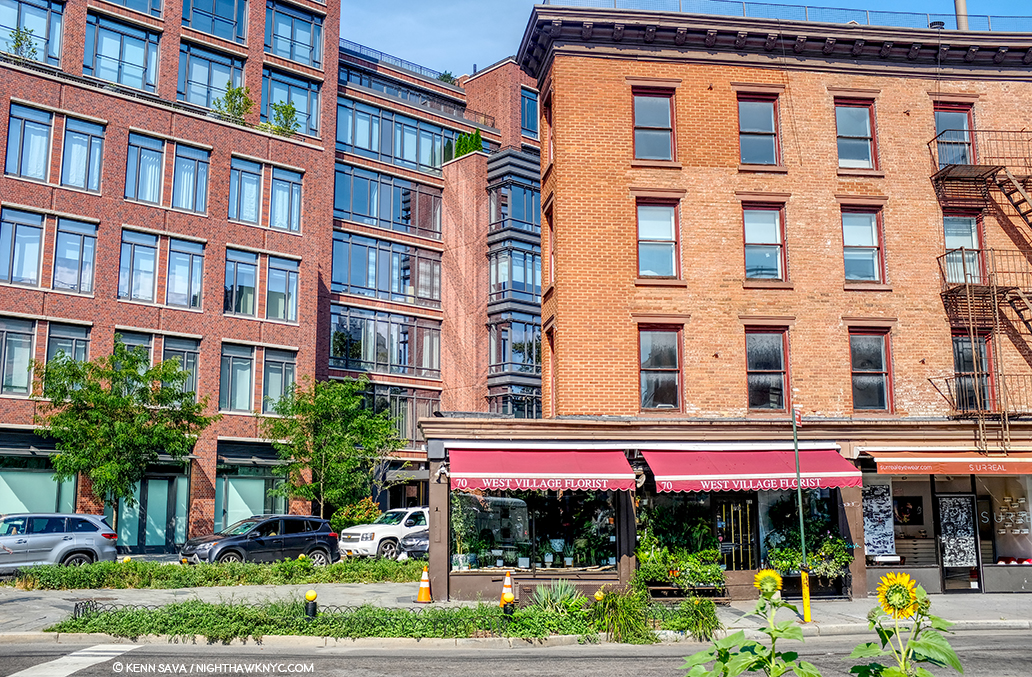
Yes, West Village Florist at 70 Greenwich Avenue is sort of triangular. The picture above was taken standing on the northern edge of Mulry Square, seen earlier. Yes, it was along one of Edward Hopper’s possible routes from his apartment to the Lowe’s Sheridan Theater, which was directly across 7th Avenue to the left of the picture.
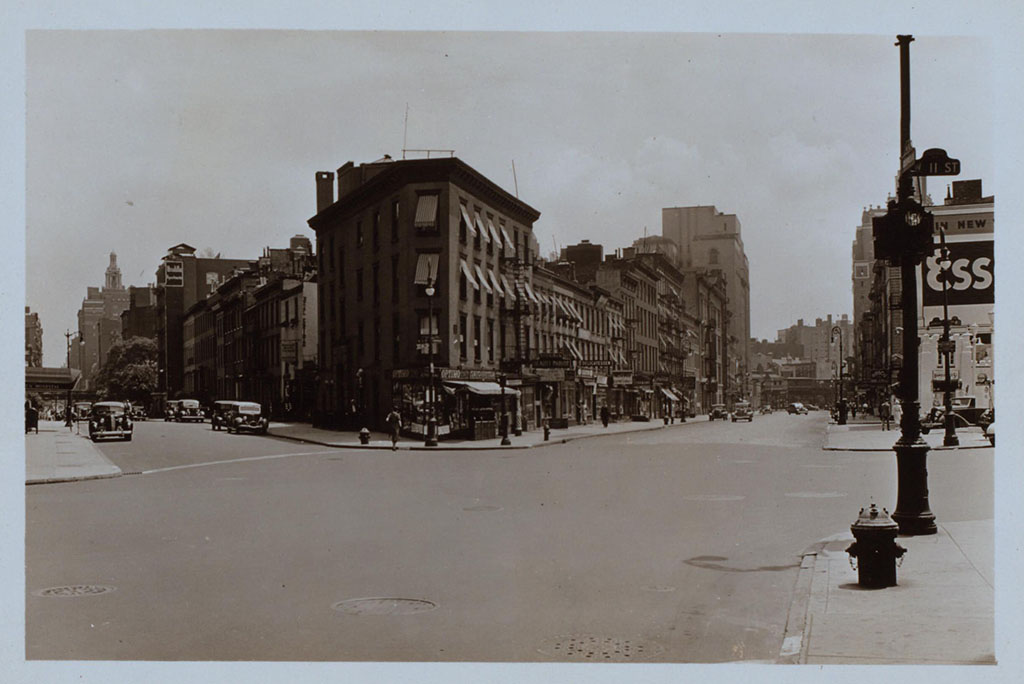
This picture came to me dated 1938 and that would appear correct. Looking toward Mulry Square on the right shows the side of the White Castle-ish hamburger place seen earlier under the Esso sign. The place on the triangular corner, center, at the intersection of 7th Avenue South, Greenwich Avenue and West 11th Street, is now West Village Florist, shown here when it was a cigar/cigarette store. Whoever told this picture is standing on the curb outside of what was Too Boots Pizza, #11 in the panorama posted earlier, with the Lowe’s Sheridan Movie Theater directly to his or her left. Photographer unknown to me.

Yes, it housed a deli 20 years ago before becoming a flower shop the manager told me, and my research added a cleaner/tailor shop circa 1914, and a cigar store in the period of Nighthawks as seen in historical pictures (including in 1938, above), but it’s too small inside, the prow is also too small, and the corner lot too big in my reading of the Painting. Nowhere have I seen reference to it being a diner or coffee shop at any point. The buildings in the background are wrong now, and were wrong then, according to historical pictures.
Inside West Village Florist, standing just inside the door. I had room to stretch my arms out, with maybe an extra foot on each side, but the space quickly narrows, as you can see. It’s just too small. Stop by and see what you think. They are very nice people who have a beautiful assortment of plants and flowers.

There is little doubt he saw it, but as I showed earlier, there are countless triangular corners in the area that could have been a partial inspiration. At best, that’s all this is, and I doubt it was a big influence. I’ve ruled it out.
West Village Florist’s building has this unique, strange, angled shape to it seen from head on, July, 2019.

The serious contenders.
The intersections of Greenwich Avenue and West 12th Street with the Loew’s Sheridan Square Movie Theater, rear. Photograph by Percy Loomis Sperr (1890-1964), Manhattan: 12th Street – Greenwich Avenue, 1932, *NYPL Digital Archives.

In this 1932 picture of the intersection of Greenwich Avenue and West 12th Street, the low, triangular shaped building in front of the west side (the back) of the Lowe’s Sheridan Movie Theater is Crawford Lunch. There are historic pictures taken from Greenwich (on the right) that show customers in Crawford Lunch with West 12th Street seen behind them- which I reproduce further below. I think it is entirely plausible that Edward Hopper saw this, too, and this inspired his conception of a sort of “fishbowl” like setting. Here was an actual working diner/restaurant of the time. Today’s West Village Florist building is about 3/4 of the way down to the right of this picture.
Change is the only constant in New York. The same scene, today! I stood as close as I could to the spot the 1932 picture above was taken to take this in July, 2019- 87 years later!

It’s so different, 87 years later, as to defy anyone to guess this site had anything to do with Nighthawks. Therein lies a good deal of the problem finding its sources. It’s now The NYC AIDS Memorial Park at St. Vincent’s Triangle. Note- the brown building on the very far left. It does not look like what’s in the background of the Painting. More on this follows. The Whitney’s Hopper Drawing catalog suggests that Edward Hopper may have looked through Crawford Lunch and seen the “fishbowl effect” we see in the Painting.
Subway construction photograph of 88-86 Greenwich Avenue and West 12th Street, New York City, April 18, 1926. Identifier- 86446d_GreenwichAve_SubConst958. *Collection of the New York Historical Society.

Here, we see a revealing example of this “fishbowl effect” seen at Crawford Lunch in a picture taken on April 18, 1926. Notice how you can see into and through the restaurant, on the right, to West 12th Street behind the man in the dark hat under the word LUNCH on the window. The brown apartment building seen in the far left in the prior picture is about to be built seen straight ahead just across the 12th Street past Crawford. Note, also, the word “LUNCH” on the window for later. I believe this is the possible source of the effect given how close it is to the Lowe’s Sheridan Theater (next door). However, it could have as easily been something he saw somewhere else on his walks, in a place they, or anyone else I’ve come across has not considered. But, unlike most of the locations suggested to date, Crawford Lunch was an actual restaurant at the right time and in the, possibly, right place.
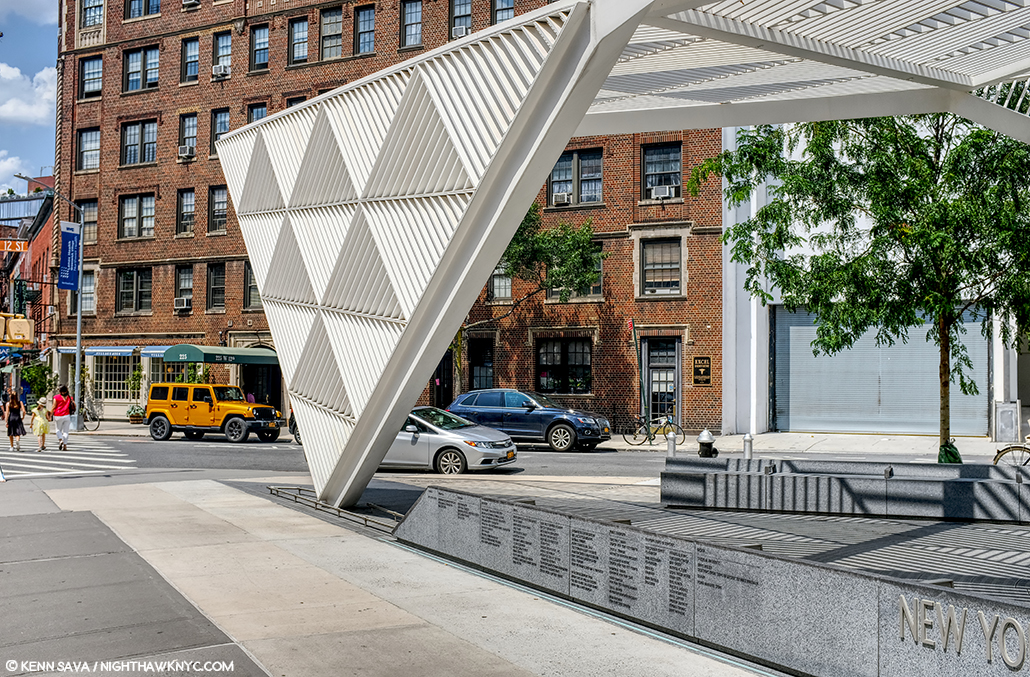
The almost identical view in the previous picture today at the former site of Crawford Lunch also approximates the view seen in Nighthawks. That brown brick apartment building, seen early in its construction above, has been here since the late 1920s, and hence, at the time of Nighthawks, making it wrong for the Painting. Seen in July, 2019.

That Crawford Lunch was an influence would seem to be confirmed by this-
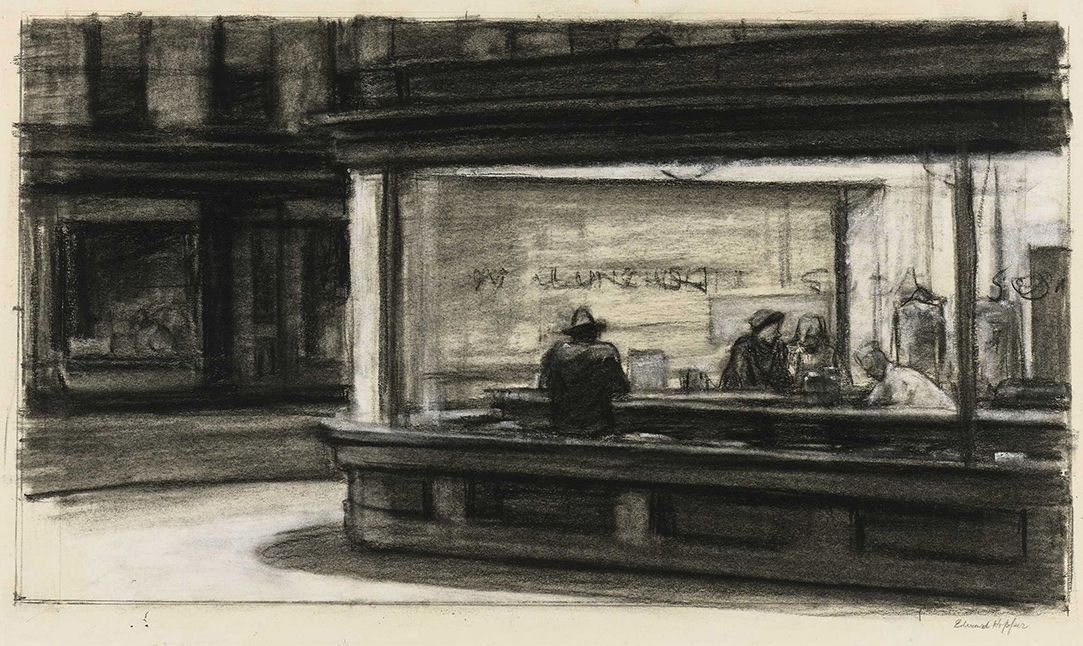
Study for Nighthawks, 1941 or 1942. Fabricated chalk and charcoal on paper; 11 1/8 × 15 in. Given he finished Nighthawks on January 21, 1942, I doubt this was done in 1942. It seems he was still finalizing his ideas when this was done. *Whitney Museum collection & photo.

I can barely make out the word “LUNCH” on the widow above the man with his back to us in this study for the Painting. As we know, Edward Hopper did not include this in the final Painting, among other changes he made to what we see in this incredible and endlessly fascinating Drawing. It sure reminds me of the Crawford Lunch window and may be a give away of its source and, possibly, the source, once and for all, of this “fishbowl effect.”

Edward Hopper said little about the inspiration for Nighthawks and, frankly, I don’t know what to make of what he is reported to have said. In Katherine Kuh’s The Artist’s Voice, P.134, he says, the Painting “was suggested by a restaurant on Greenwich Avenue where two streets meet.” He adds, “I simplified the scene a great deal, and made the restaurant bigger.” Um, Ed? Could you be a bit more obtuse? “Greenwich Avenue where two street meet,” is said to mean West 12th Street & 7th Avenue South by Gail Levin (Hopper’s Places). Couldn’t “two streets meet” mean Greenwich & West 12th Street, where Crawford Lunch was? If it means Greenwich and two other streets, it has to be the triangles where West Village Florist and Mulry Square are. In any event, “…suggested…” I believe means a scene he saw at one of these places, the “fishbowl effect,” which I think he saw at Crawford Lunch, a confirmed restaurant at the time. But, Crawford Lunch doesn’t look like the diner in the Painting- even if he “…made the restaurant bigger.” Neither does the hamburger place on Mulry Square or West Village Florist. And that comment doesn’t specify it’s the same restaurant he mentions on Greenwich Avenue. It could mean “the restaurant we see in the Painting.” Intensely frustrated by this, I finally decided to continue on my own path. This meant looking a little further afield from the Greenwich Avenue vicinity. It turns out I didn’t have far to look.

Further down 7th Avenue South, not as far as Village Cigars, and still well within Edward Hopper’s walking neighborhood, I came across this-
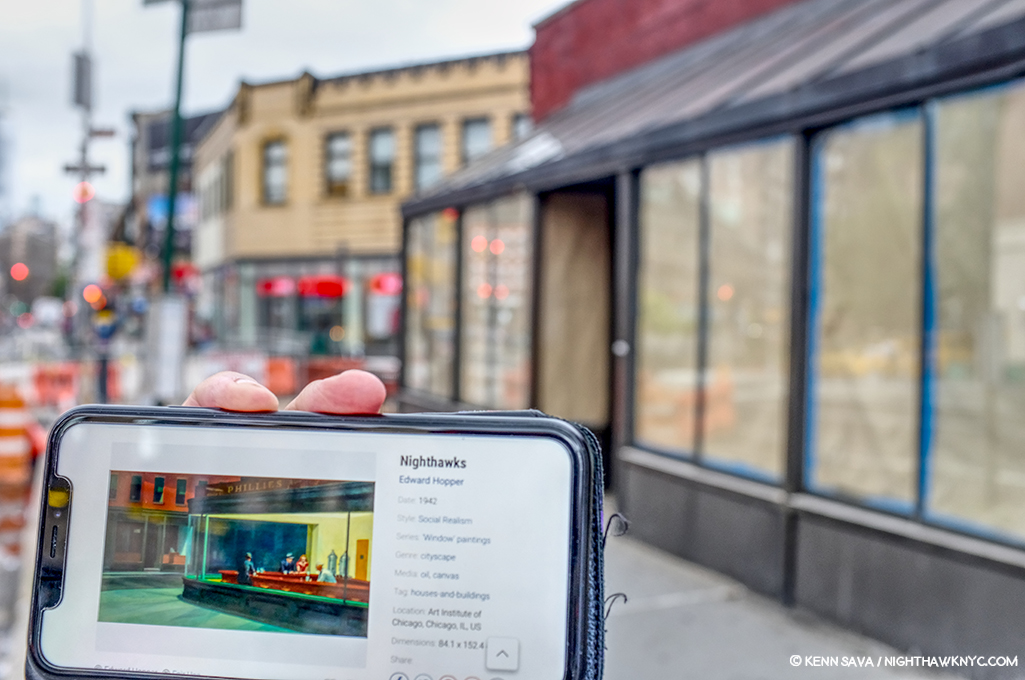
“Oh. My. Gosh.”

The site of the now sadly defunct Riviera Cafe, which was open here for 48 years, from 1969 until August 31, 2017.
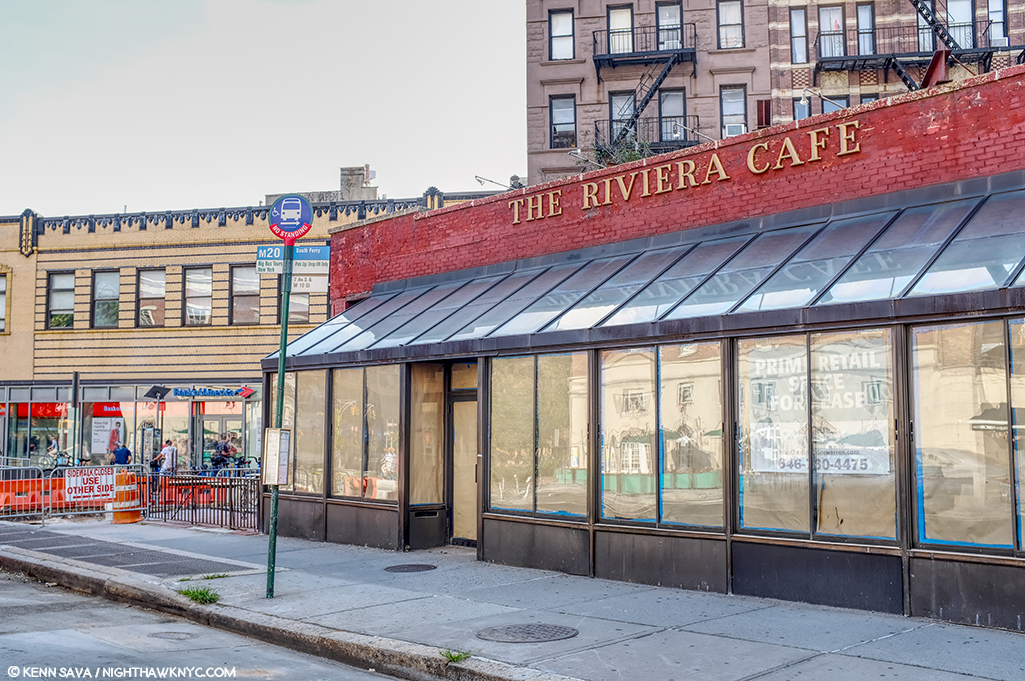
The former Riviera Cafe at 225 West 4th Street at 7th Avenue South.

When I came across this site, I had an “Oh. My. Gosh.” moment. Picture it without the modern “greenhouse” addition and it becomes much more like the diner in Nighthawks. Back in the day, I spent a few nights in this place, as I’m sure many reading this have, too, since it was centrally located right at the heart of the West Village. The building behind it to the left, while not exactly what we see in the Painting (I believe they are the same buildings that were standing on this site in 1940), at two stories, which fits all we can see in the Painting (they may go higher in Nighthawks, or they may be cut at two- we can’t tell), and they’re the right distance, though at a slightly different angle, from what we see in the Painting. If this is the location Edward Hopper used, why didn’t he use the buildings we see in the background? I believe it was because of the color. That long building which takes up a good portion of the back is too brightly colored to fit the mood he wanted in Nighthawks. So, possibly, he replaced them. More on this in a minute. I measured the depth of the greenhouse at 90 inches- 7.5 feet. If it were not there, it would have allowed me to stand closer to the building taking this shot. Thinking back to my visits here, there was a bar along the back wall then, and I believe there were tables behind the seats/stools facing the bar, approximately under where that brick wall would come down with the greenhouse gone. Would a horseshoe counter have fit here?

As I looked closer, I discovered this-
The front of The Riviera Cafe facing West 4th Street and giving it its address, 225 West 4th Street.

Lo and behold, there was something none of the other candidates I’ve discussed thus far have- a curved front window! And, it’s the same on both sides of that door! But, that door. Was it always there, or was the curve complete at one point, which would make The Riviera, minus the modern greenhouse addition, an almost perfect match for Nighthawks Diner?
The back of The Riviera Cafe on West 4th Street.

Stepping around to the back of The Riviera- more intrigue. What’s up with the right half of the wall, and what was there before they replaced it? A window? Also, that door to the left looks earily similar to the door in the Painting on the inside of the Nighthaks Diner. As I said, when I was here, I remember a long bar inside that wall and along it, meaning you’d probably be able to see the necks of liquor bottles in that rectangular window that’s still there, center. But, that’s now/more recently. What about in the past?

Intrigued, to say the least, searching further, I uncovered this-
1941! The year Nighthawks was Painted. Percy Loomis Sperr (1890-1964), Manhattan: 7th Avenue South – 4th Street (West), 1941, *NYPL Digital Archives.

In 1941, The Riviera was called Riker’s and it was a restaurant! It looks pretty new and shiny, too. Some encouraging things in this picture- there are retractable awnings instead of the permanent greenhouse, for one, but that troublesome front door is still there to the left, and it looks to be the same structure, with the curved windows on either side of it.

The Riviera Cafe occupies the biggest triangular space in this part of the West Village. It’s very accessible to the Hopper’s apartment (a few blocks to the east). Why has it never been properly considered as a candidate?

In 2013, during the Hopper Drawing show, the Whitney Museum came out and said the following-
“…has led art historians to cite the building’s prow as one of the influences…” What are the others? Seen in 2013.

They’re talking about the Flatiron Building, which is on West 23rd Street at the intersections of Broadway and 5th Avenue- no where near Greenwich Avenue, where that quote has caused most to look, and it’s not even in Greenwich Village! So, the museum has taken the same approach I did in this sense. Also, in the Hopper Drawing catalog they fail to publish the Kuh Hopper quote (above), only footnoting the page in her book it’s on (P.118, footnote 2)! Perhaps, they, too, find it as frustrating as I do? (I realized this only this past week, after my quest had been completed.) They state the Flatiron was “one of the influences,” but fails to name any others!?? “One of” means “more than one.” Well? I’m naming names here.
An installation of “Nighthawks” in the prow of the Flatiron Building by the Whitney Museum in 2013. The installation is 2D and only a few inches deep, as I show below. I shot it at this angle to show the problematic lining up of the buildings in the back on Broadway, across the plaza, which is not at all like what we see in the Painting. Seen on September 1, 2013.

Assessing the Flatiron’s candidacy, I discovered that at one point it was a cigar store (again, the Painting has a Phillies cigar ad on the top of the diner), but I did not find evidence of it having been a diner. Looking closer at the interior space, I discovered it ostensibly measures 10 feet wide, at its widest, to the right in the picture above, by 30 feet long. I’m no restauranteur, but that seems pretty narrow to me to get a horseshoe shaped counter inside, room for seating around it, room to navigate around those seats and room for the counterperson to work. Glare notwithstanding, here’s what the space looks like pressed against the front curved window-
A look at the installation of “Nighthawks” in the prow of the Flatiron Building on September 1, 2013.

Notice the radiator on the right, and how far it is from the window. There’s another one on the left which is hard to see in this picture. Both, and the room around them they require for safety and comfort, considerably cut into the amount of usable space here. Also notice the large column to the left rear of the photo, which serve to partially support the gigantic mass of the building above them, which also has a counterpart that’s hard to see because of the glare on the right side (see the picture of the whole prow, above it). The opening between them appears to be tight. How are people supposed to come and go here?

Then, there’s the site itself. It doesn’t feel to me like what we see in the Painting.
A panorama shows the distance between what would be the far side of the prow in the Painting and the buildings across the plaza and Broadway.

The buildings that would be in the background of the Painting are too far away and angled incorrectly- 23rd Street angles to the south east relative to the Flatiron at this point making the buildings begin too far back to be seen as they are in Nighthawks, in addition to being not at all like those seen in the Painting in the many existing historical pictures. Therefore, I believe the Flatiron’s prow isn’t what we see as the diner in the Painting, and this wasn’t the scene shown in the Painting. Of course, any Artist is completely free to do whatever they want, to make anything into anything else, whether it would fit in the “real” place, or not. (There is no such thing as “photorealism” in Painting, in my opinion, but that’s a battle for another day.) Edward Hopper, as per that quote, could have made West Village Florist or the Fatiron’s prow bigger, but their settings are still wrong, in my opinion, so I don’t believe he used either. However, like the Whitney, I believe the Flatiron’s prow was an influence.
Currently under renovation? Cleaning? Diner installation? Maybe I should wait and see what emerges before reaching a conclusion. (Just kidding.) July, 2019.

Looking at the Painting, one thing is undeniable- that curved window Edward Hopper includes. I’ve found it nowhere else besides on the Flatiron- either on existing buildings or in historical pictures. And, some of the ribs we see on the window in the Painting are present on the Flatiron’s prow today. In 1939, Edward Hopper exhibited at the World’s Fair1, and so he may have seen the Fair, but was certainly aware of it.
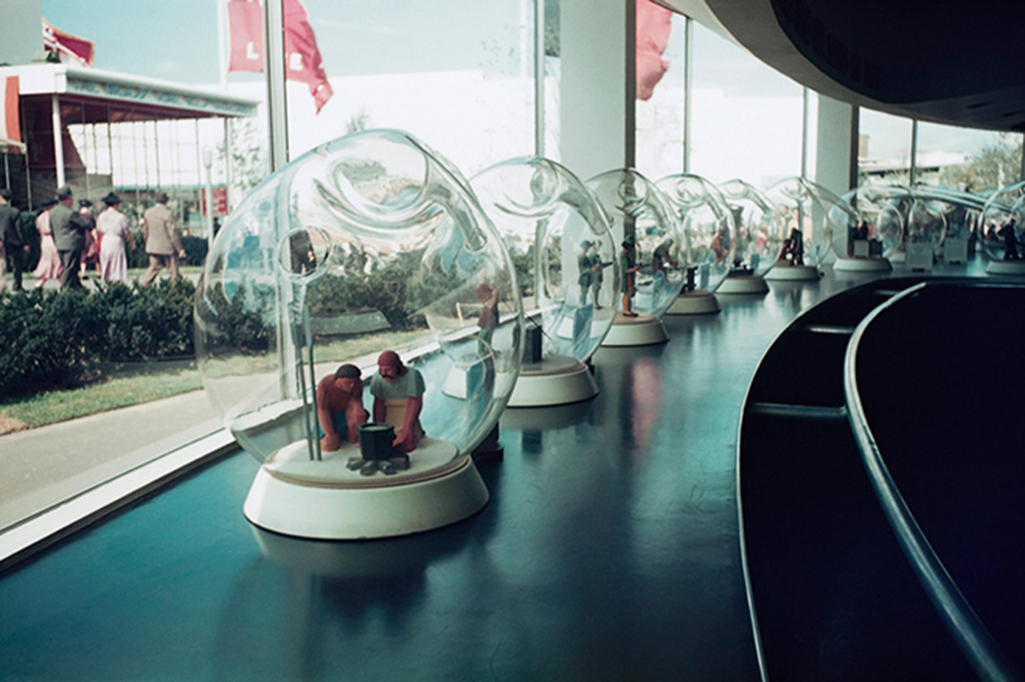
“Fishbowl effect” indeed. The history of glass making through the ages seen in glass bubbles at the Glass Incorporated Pavilion at 1939 World’s Fair, Queens, New York, New York, USA. Coincidence? Or influence? *Image by Peter Campbell/CORBIS

It was an Art Deco marvel. The Nighthawks diner has a decidedly Deco/Streamlined/Moderne feel to it. Though the Flatiron is a Beaux Arts building, the curved window of the prow has a decidedly Art Deco, streamlined, feel to it.
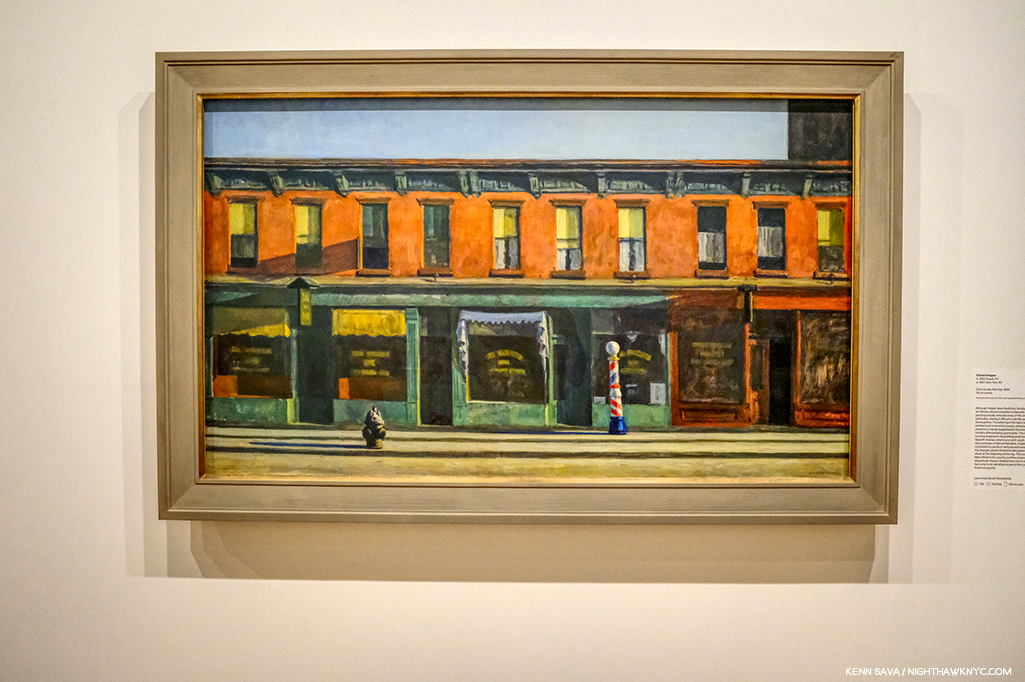
Early Sunday Morning, 1930, seen at the Whitney Museum, July, 2019. This looks uncannily similar to the background of Nighthawks to me.

Yet, what he depicts in the background of Nighthawks looks curiously not dissimilar to his Early Sunday Morning, 1930. It’s almost like he dropped those buildings into the background. But, 10 years after the earlier work a good many of those buildings were no doubt still everywhere around town, so they may as easily be generic. Whatever their origin, in this way he juxtaposes the old New York with the new world just seen in the 1939 World’s Fair, which showcased “modern” streamlining and the new flourescent lighting.

Early Sunday Morning is something of a “pendant” to Nighthawks as Carter E. Foster points out in the Hopper Drawing catalog (P.99). It’s the same size and shape and the two are bookends in some ways.
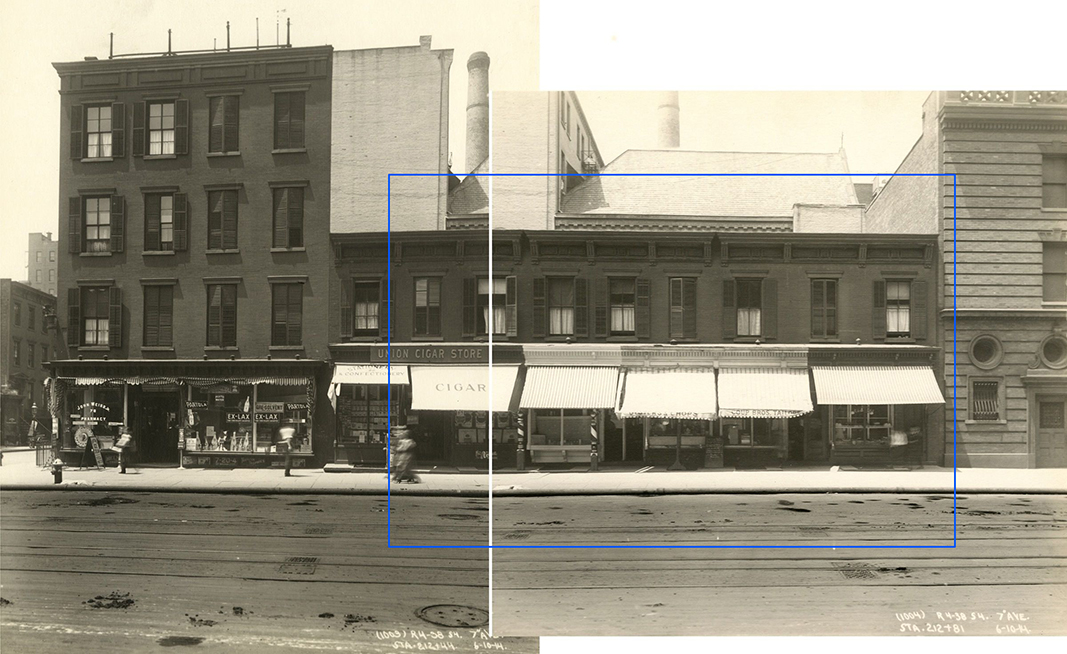
7th Avenue between Fifteenth and Sixteenth Streets, June 10, 1914. I’ve indicated the scene depicted in Early Sunday Morning, with a blue bounding line centering around 88 7th Avenue, seen in these two photos taken on June 10, 1914- 16 years before the Painting. The shutters on the windows are gone in 1930, so are the awnings, and there was only one barber pole. The hydrant was either to the left, or around the corner to the left. The center white line are the borders of the two photographs shown. All the buildings in these pictures have long ago been replaced. Subway Construction Photos modified from the Whitney Hopper Drawing website.

Interestingly, the inspiration for Early Sunday Morning were shops on 7th Avenue, but not in Greenwich Village. They have been located as being between 15th and 16th Streets in Chelsea, just north of the Village. Comparing the Painting to period pictures is fascinating. While it’s unlikely that Edward Hopper stood with a sketchbook and drew the scene, he did capture any number of correct details. But, he changed others- most notably the sunlight. The sun never shines on 7th Avenue at the angle he Paints it shining!
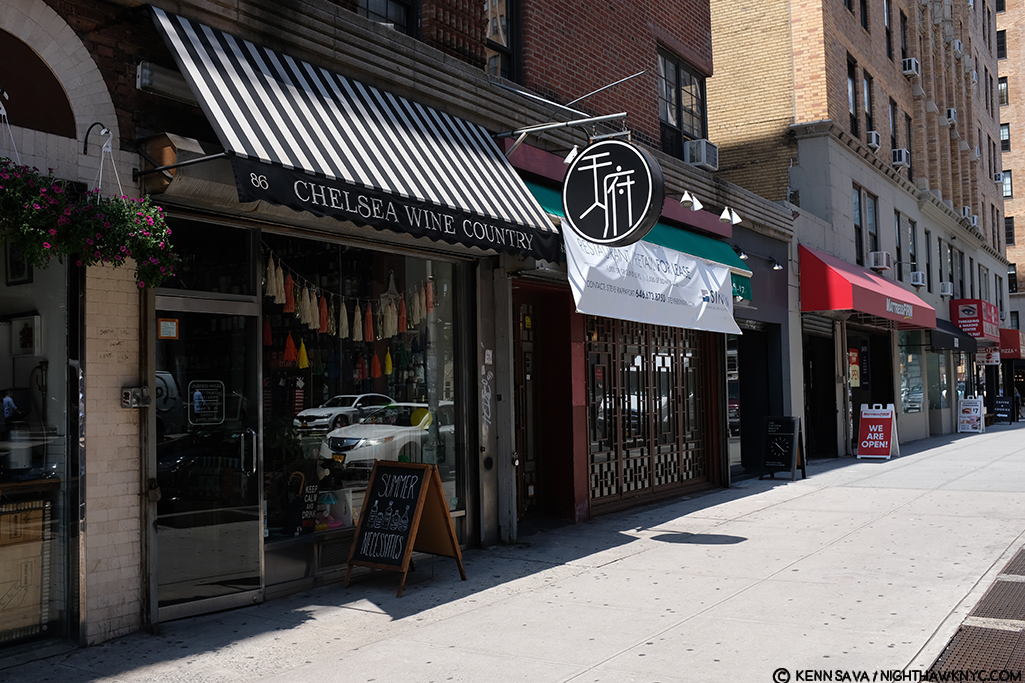
Mid-Sunday Afternoon. The site of Early Sunday Morning, seen in July, 2019. The original buildings have long ago been replaced. Notice how the shadows go in the opposite direction of those in the Painting.

7th Avenue runs North/South, not East/West, like the sun. In reality, the sun would be directly behind the viewer! So? Here’s a case of a found actual site and how Edward Hopper used creative license to mould it to his vision- even if that meant changing nature! What’s moving a curved window 20 blocks south compared to moving the sun?

My Conclusion-
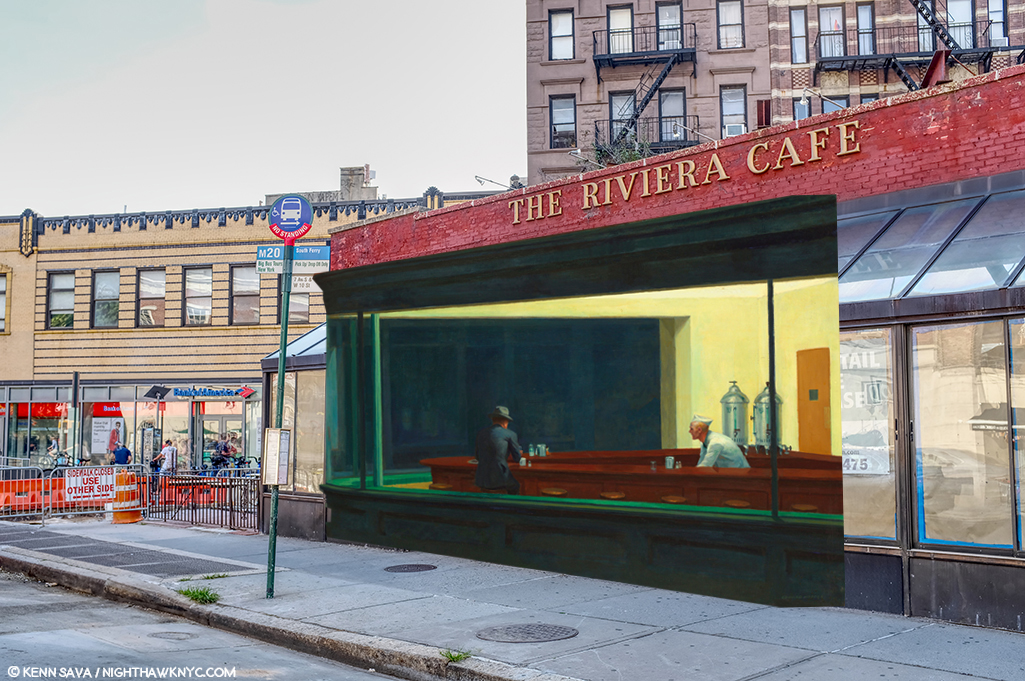
I currently believe that Edward Hopper saw Riker’s about 1941 and those 2 curved windows in its front. I believe he, too, may have been frustrated by that front door and decided to “remodel” it. With a a paintbrush. So, he morphed the Flatiron’s prow’s curved window onto it and then created his own (though somewhat similar to the real) background on West 4th Street in the Painting.

Unless and until I find better candidates, THIS is what I believe Edward Hopper did.

Yes, I’ve used the original, 2015, NighthawkNYC.com banner, which removed the famous couple, leaving that figure I relate to in honor of NHNYC’s 4th Anniversary. On the same page she dated Nighthawks on in the Hopper Ledger, Jo Hopper refers to him as “sinister.” I love her, anyway. Before she died the year following Edward, she bestowed one of the greatest American Artistic Estates to the Whitney Museum (who promptly “rewarded” her incredible generosity by throwing out virtually all of her work, thereby denying Art historians and Art lovers a chance to assess her work on its own- forever2). And I used the banner because, yes- I once sat at The Riviera Cafe’s bar by myself, too.

But, beyond ALL of this, for me? Nighthawks is the first truly modern American Painting. It marks the beginning of all that came after. It captures the essence, the FEELING of living in a City- here, in New York, or anywhere, but even more, it captures the feeling of modern life, which has become more and more about isolation, and fleeting moments of connection- or not, since January, 1942. I always try and remember that Nighthawks, like many of Edward Hopper’s other works, is a voyeuristic moment seen by a pedestrian, who more than likely kept moving on, past this fleeting moment and this scene, wherever it was, and didn’t pause to ponder it indefinitely, like so many have since.

Moments exist as flashes of time.

Click.

Here right now, gone forever. Unless, you’re one of the great geniuses in American Art history, who has the vision, the power and the talent to make it last, and speak to us, indefinitely.

But, for me, at least, Nighthawks isn’t about capturing a fleeting moment magically, though it does.

The other reality that common sense dictates be mentioned is that 78 years later, a better explanation than mine, or a better real life candidate for the Nighthawks Diner may never be found. It may have existed only in his imagination, with a few pieces of real life thrown in- like the Flatiron prow’s window. And that, too, may be part of his point. Nighthawks, in one reading, may not be about place as much as it is the psychological, the inter-personal, and? 

Loneliness.  
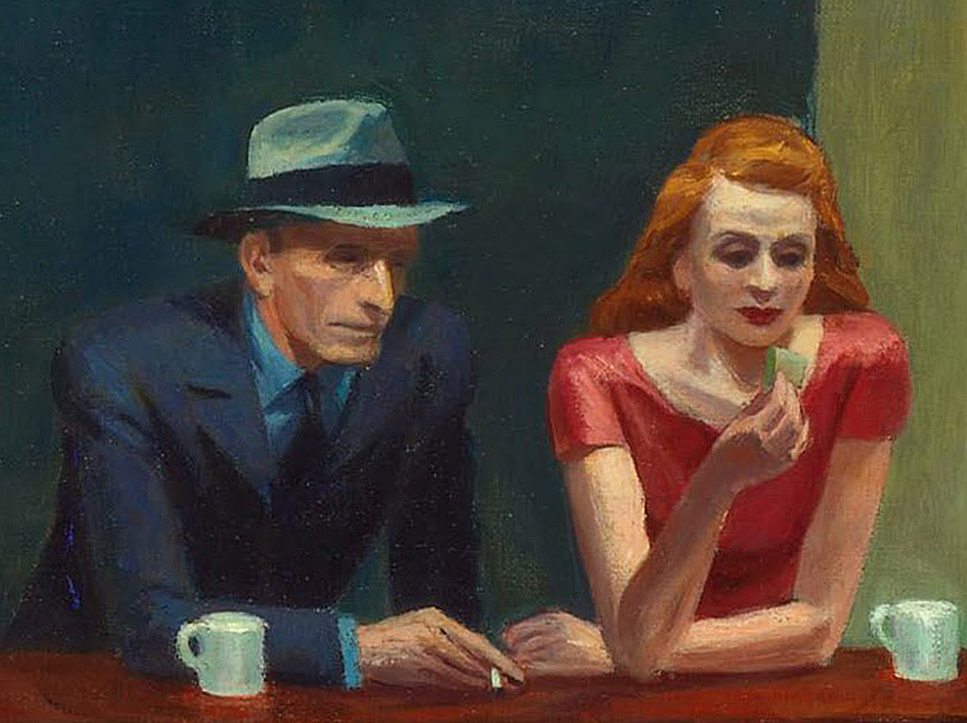
Have two people in Art ever been closer together, yet further apart?

The woman in red is all dressed up to go HERE?, I can hear her mentally screaming. Her “companion” sits physically next to her, close to her, but, in my reading of it, their hands don’t quite seem to touch. Maybe you see it differently. For me? I can’t look at this and not think of God and Adam in Michelangelo’s Sistine Chapel Ceiling. There is no life giving, or love giving touch here. He has a cigarette in his hand- not her (left) hand, which remains empty. There is a distance that belies how close together they sit. All of this is, somewhat humorously, mimicked by the twin silver coffee urns to the right of them, that are, also, immobilized and frozen in time. At least they’re together for a common purpose! The same can’t be said of the immortal duo sitting at the counter. 

The gent, who’s nose Jo Hopper called a “Night Hawk” after the beak of the bird seems to be in a conversation with the counterman. About what? Here, he has this lady dressed to kill next to him and he’s ignoring her? Every time I’ve seen this happen in a bar or nightclub, instantly my antennae went up. Something’s not right here. If she’s not getting attention? Something’s wrong. But this is December, 1941. Pearl Harbor happened right in the middle of work on this Painting! 36 days after Arnold Newman took that Photo of Edward Hopper up top. It’s very hard not to think about that when looking at it, though it’s probably easier for many now that World War II was over 75 years ago. Are they discussing the War? Being drafted? Enlisting? A friend who has already been killed? Possibly another denizen of the diner? There are all those empty stools at the counter, after all. “Where is he?” “Oh. You haven’t heard?…” 

The War brought many things. It also brought separation, life without love, life without women, for men, and without men for women, or partners for the LGBT communities. 
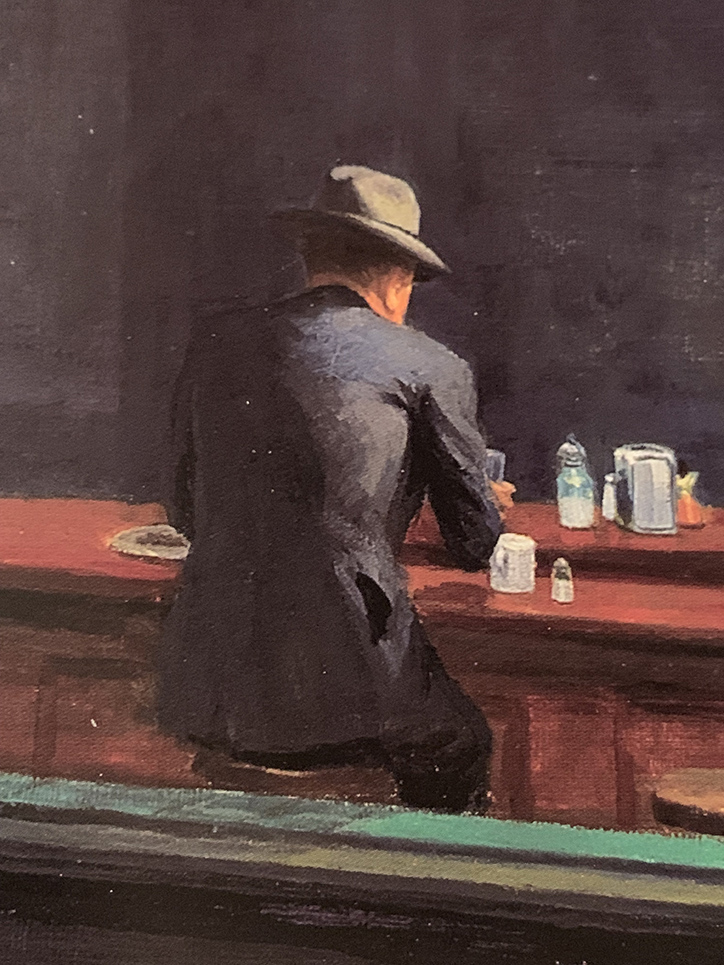
Then? There’s my alter-ego. Frozen in paint. Immobilized. Alone forever. Perhaps the most isolated figure in Western Art. What appears to be a rolled up newspaper is under his left elbow. No doubt he knows the score. At least he’s possibly not leaving anyone behind. 

But, for a moment? Let’s forget World War II is getting off to a raging start around the world at this very moment, if we can. Edward Hopper probably conceived this work before Pearl Harbor. What’s striking to me is that of all the loneliness I’ve just mentioned, there’s still more of it I haven’t. 

Let me ask you this- Who is more lonely in the scene in this Painting? 

Any of those 4 people in the diner?
Or?
The person viewing this scene from outside the diner?

For me? Nighthawks remains the ultimate parable of loneliness.  

Maybe then, I shouldn’t be on such a mission to find the “real” place it depicts. Maybe then, it doesn’t need a real place to inhabit. It exists as a permanent condition of being alive inside each one of us, as it did inside of Edward Hopper. Maybe I look for it in the hope of finding the end of it.

*- Soundtrack for this Post is “I Saw You In A Dream” by Japanese House….

“I saw you in a dream
You had stayed the same
You were beckoning me
Said that I had changed”

NighthawkNYC.com has been entirely self-funded & ad-free for 10 years, during which more than 350 full-length pieces have been published! If you’ve found it worthwhile, PLEASE donate by PayPal below to allow me to continue. Thank you, Kenn.

You can also support it by buying Art, Art & Photography books, and Music from my collection! Art & Books may be found here. Music here and here.

Written & photographed by Kenn Sava for nighthawknyc.com unless otherwise credited. To send comments, thoughts, feedback or propositions click here. Click the white box on the upper right for the archives or to search them. Subscribe to be notified of new Posts below. Your information will be used for no other purpose.

For “short takes,” my ongoing “Visual Diary” series, and outtakes from my pieces, be sure to follow @nighthawk_nyc on Instagram!
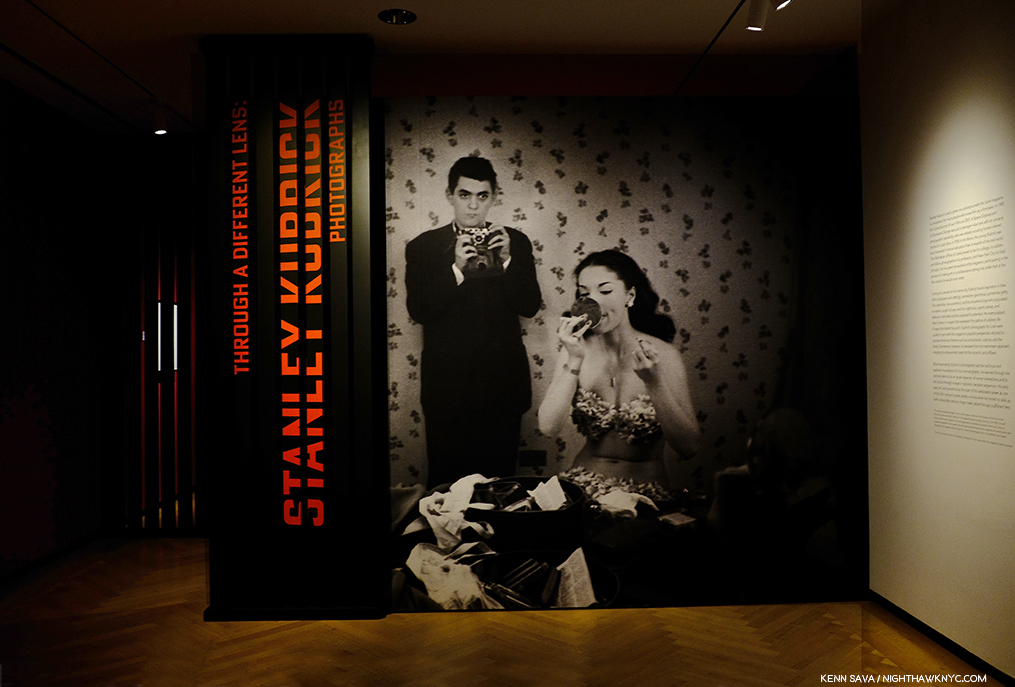
  1. Hopper Drawing footnote 33, P.119
  2. Gail Levin, Edward Hopper: An Intimate Biography, P. xv-xvii