Noah Davis: The Art of Vision

Written & Photographed by Kenn Sava

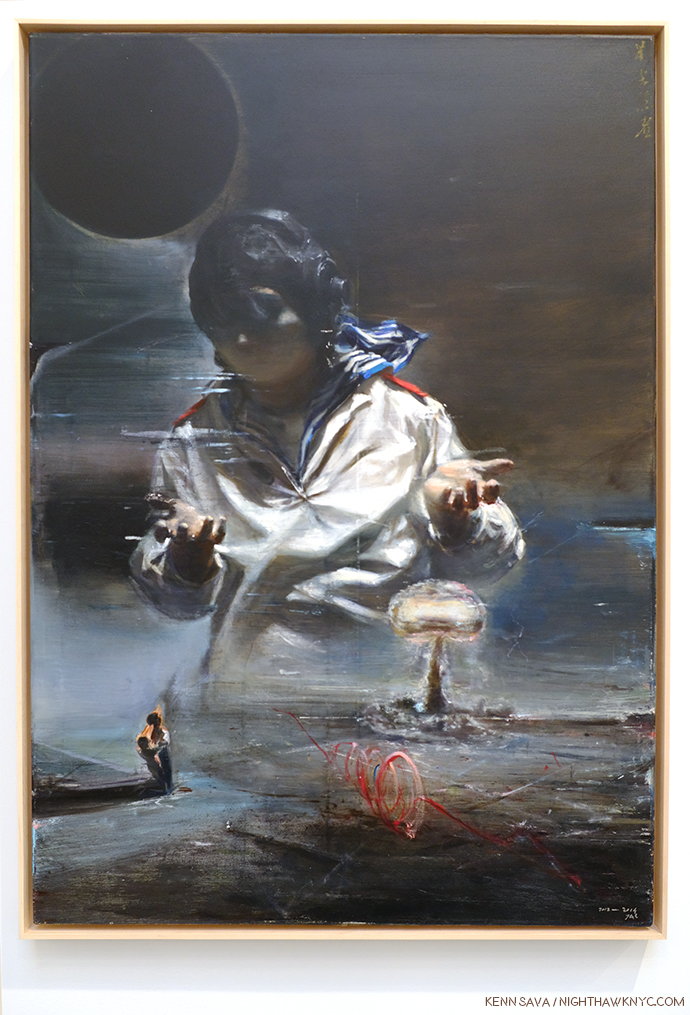
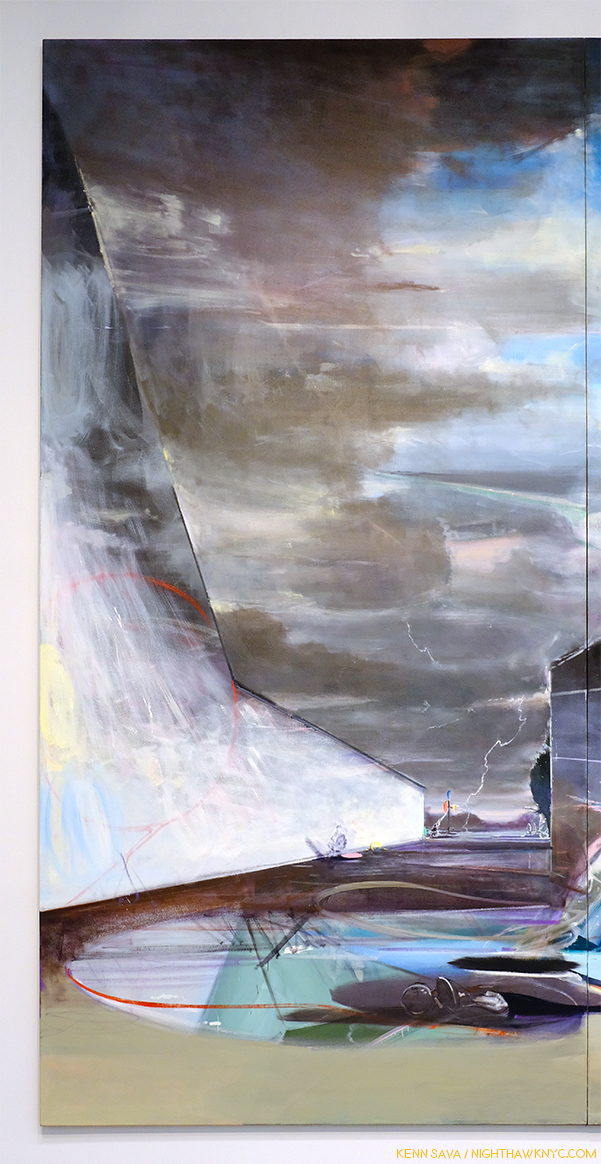
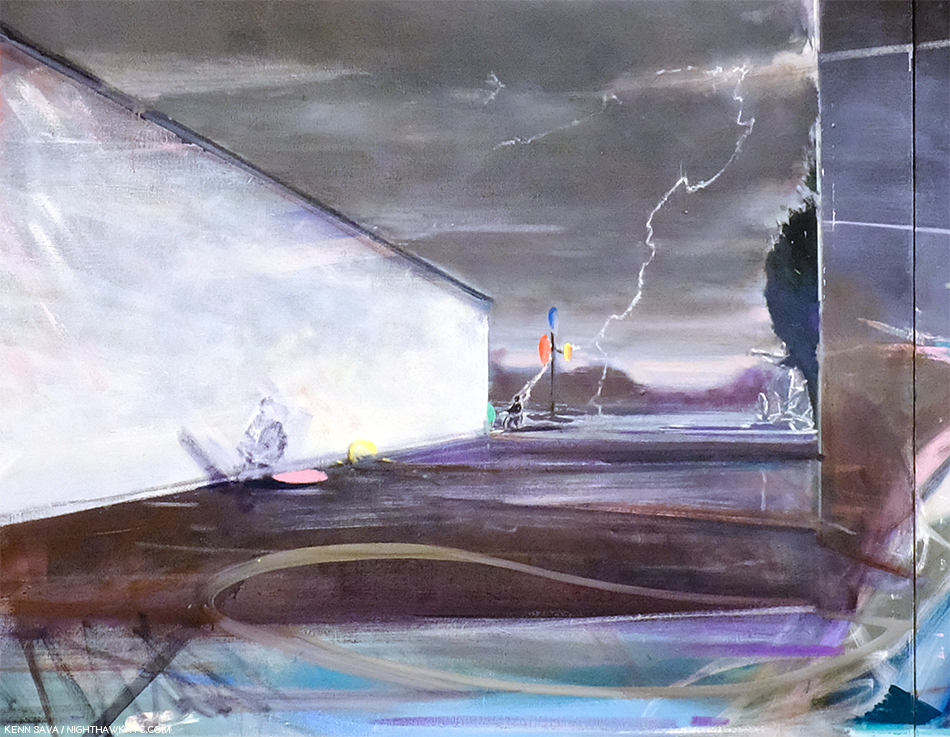
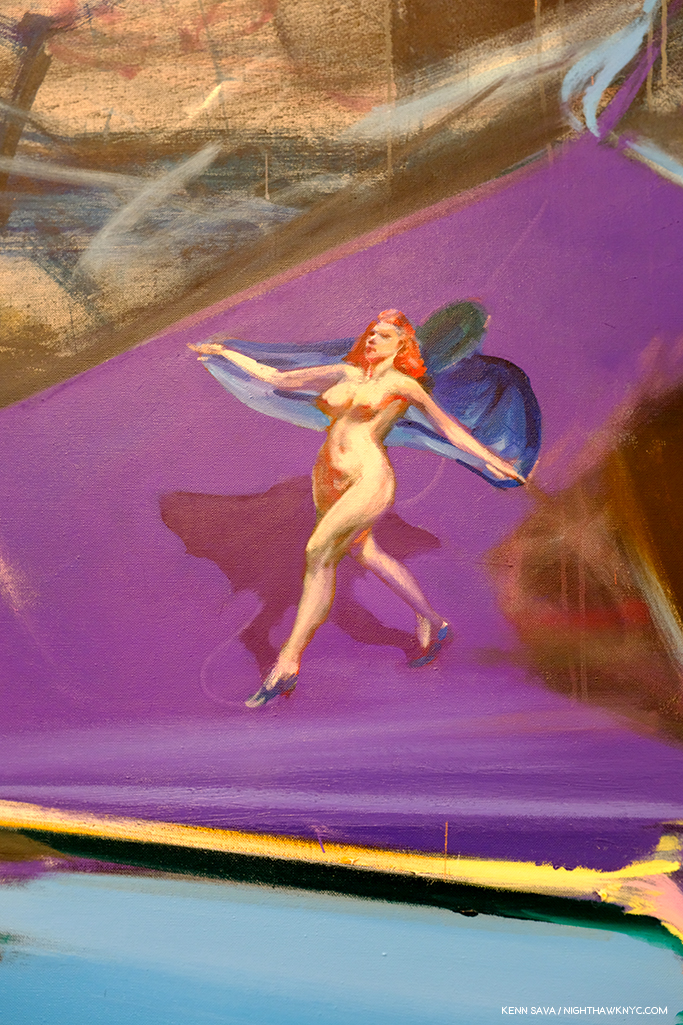
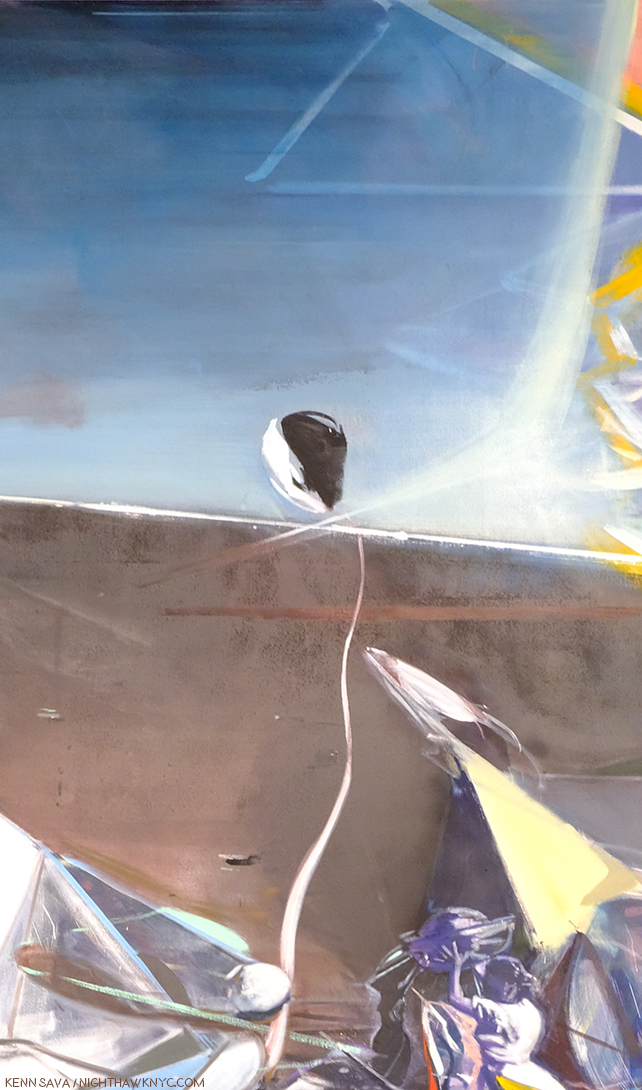
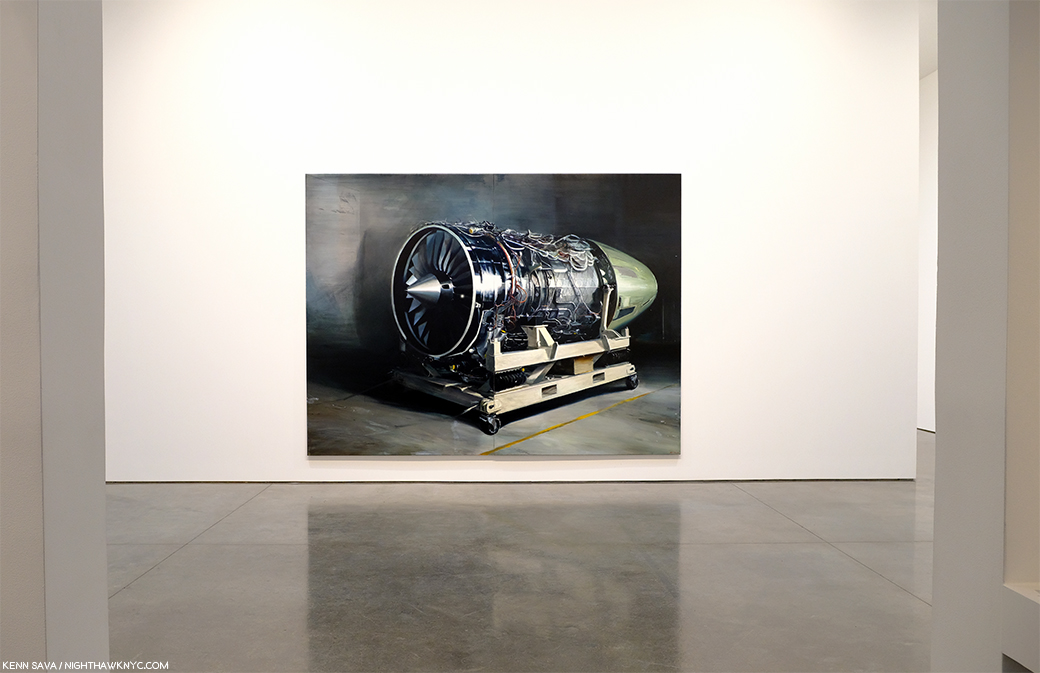
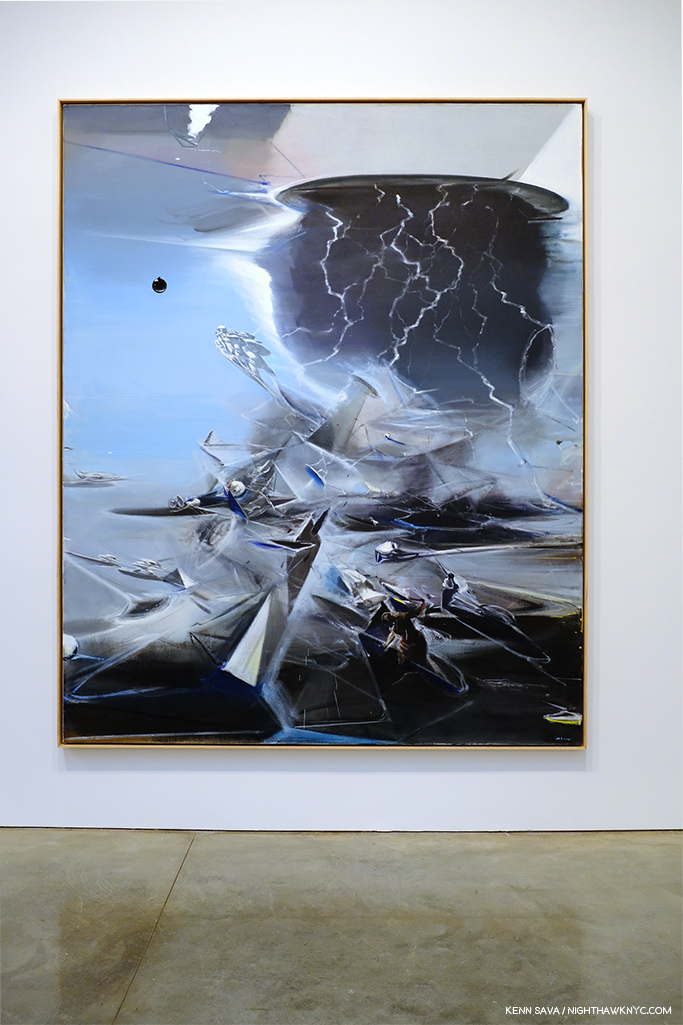
Art & Artists can come from anywhere at any time. Even from unexpected places, like a housing project. Pueblo del Rio: Arabesque, 2014, Oil on canvas, 48 x 72 inches. Pueblo del Rio, 1941-2,  is a housing project designed by Paul Williams at 52nd Street and Long Beach Avenue, Los Angeles, one of two works in the show set there. African-American Architect Paul Williams was a big influence on Noah Davis, according to his chosen curator Helen Molesworth, and he set other Paintings among Paul Williams buildings.

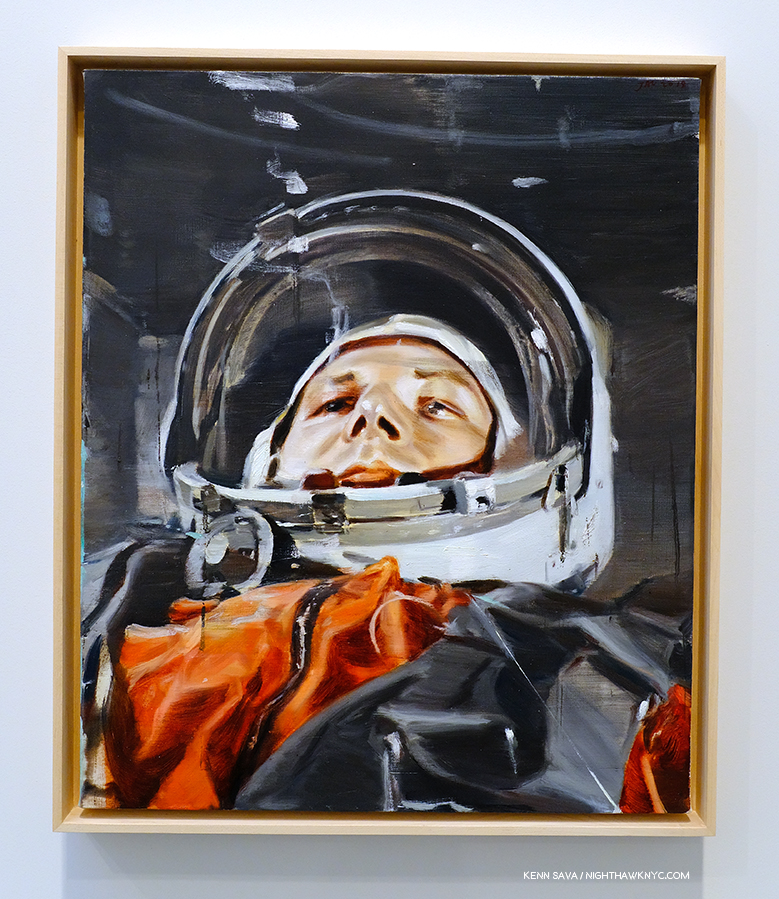
There is, sadly, no shortage of brilliant younger masters who left us far before their time. The tragedy endures but their Art prevails, and in the end, assumes a life of its own. In Contemporary Art, perhaps no one known to me seemed to do more as an Artist, curator, and visionary in as short a time as the late Noah Davis did before he passed from a rare soft tissue cancer at just 32 on August 29, 2015. Now thirteen years out from my own cancer treatment, the variety of cancers I hear and read about never ceases to astound me. One thing my journey through it taught me was that no two journeys are alike. Unlike mine, in Noah Davis’ case, cancer ran in his family, claiming his dad a few years before it took him. For some perspective (no comparisons intended)- Mozart died at 35. Raphael was 37. More recently, Jean-Michel Basquiat was 27. Music has Jeff Buckley, at 30, Jimi Hendrix, Kurt Cobain, both 27, among a long list of others. Photography has Francesca Woodman, at 22. Literature, and humanity, has Anne Frank, at just 15, and on and on…

Untitled, 2015, Oil on canvas, 32 x 50 inches. Of this late work, show curator Helen Molesworth spoke about the line between the two women on the couch in her gallery talk. The separation and isolation between two so close together on barely half of the couch is compelling in a Hopperesque way, yet, I haven’t been able to summarize everything this fascinating piece says to me because every time I look at it, I see something else. I see some of what I see in Deana Lawson’s work, some of what I see in Kerry James Marshall’s, Francis Bacon, and there’s a Rothko-with-a-difference in the background, yet what strikes me most is that in this work, as in any number of other works on view Noah Davis is entirely on his own. He has studied, learned, assimilated, and then staked out his own turf as a wholly formed Artist to be reckoned with does. In the moment I shot this picture, the feeling that I was standing in front of a masterpiece was undeniable.

I’ve been blessed with knowing some, and working with some others, who left far too soon. I met the incandescent Jaco Pastorius in 1976 at the release of his now classic debut solo album at Peaches Records Store in Fort Lauderdale, Florida. I watched as he put his hands in wet cement on the store’s “walk of fame” outside along Sunrise Boulevard (which I believe is still there) that evening never imaging he would leave us a scant 11 years later. I spoke to him a number of times over those years and we both wound up (independently) in NYC shortly before his tragic murder at just 35. I worked with the late, brilliantly talented, Mark Ledford, and worked with the equally brilliant Thomas Chapin, on three albums, both of who passed at, or before, 40 in the early stages of the prime of their careers, and their lives. I think of all three of them every single day. Though the passage of time eases some of the pain, in my experience, loss is something that does not go away.

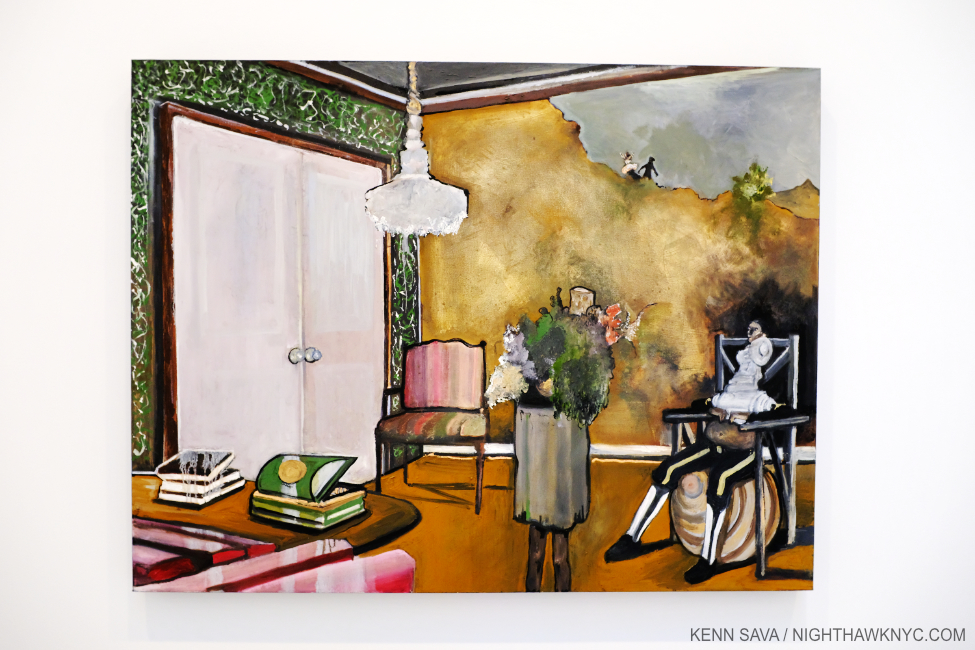
Waiting Room, 2008, Oil and acrylic on canvas, 80 x 65 inches. In many of his works, a space opens up that sometimes seems to be an abyss. Here, the abyss is above us and two figures in the upper distance appear to be looking down on the scene below. Is the Waiting Room an “abyss,” where the outcome (possibly to be revealed  behind those large white doors) is unknown as is the effect it might thave on life to come? It can also have that surreal, “Is this really happening?” feel to it. Like any work of Art, it’s open to whatever the viewer may see in it. This was, however, Painted at about the time Noah Davis was diagnosed with cancer, after his father was.

But, thank goodness we have what they created- their Art, their Music, their words, and what they taught us. Us. Everyone whose lives were touched by all of these Artists are part of their legacy.

I never had the good fortune to meet Noah Davis, who was born in Seattle, and studied at Cooper Union in Greenwich Village, becoming something of a sensation here about a decade ago before leaving without graduating around 2004 (because he felt that his education was no longer pushing him, it is said), and moving to L.A.. I was only casually familiar with his work until I walked into David Zwirner on 19th Street, where his Art and his legacy filled no less than three entire galleries.

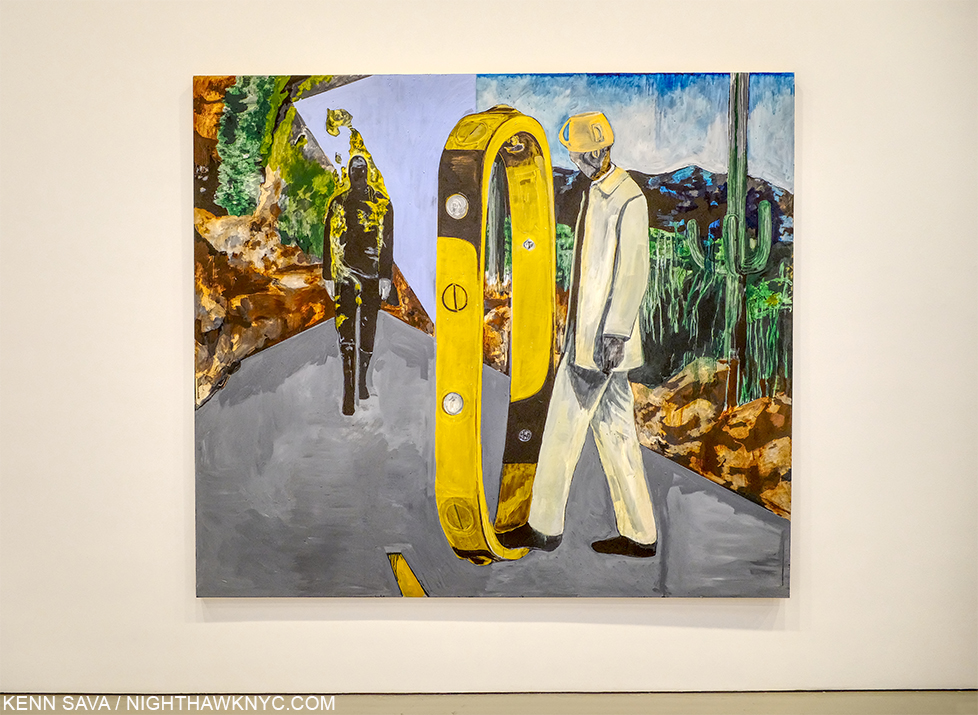
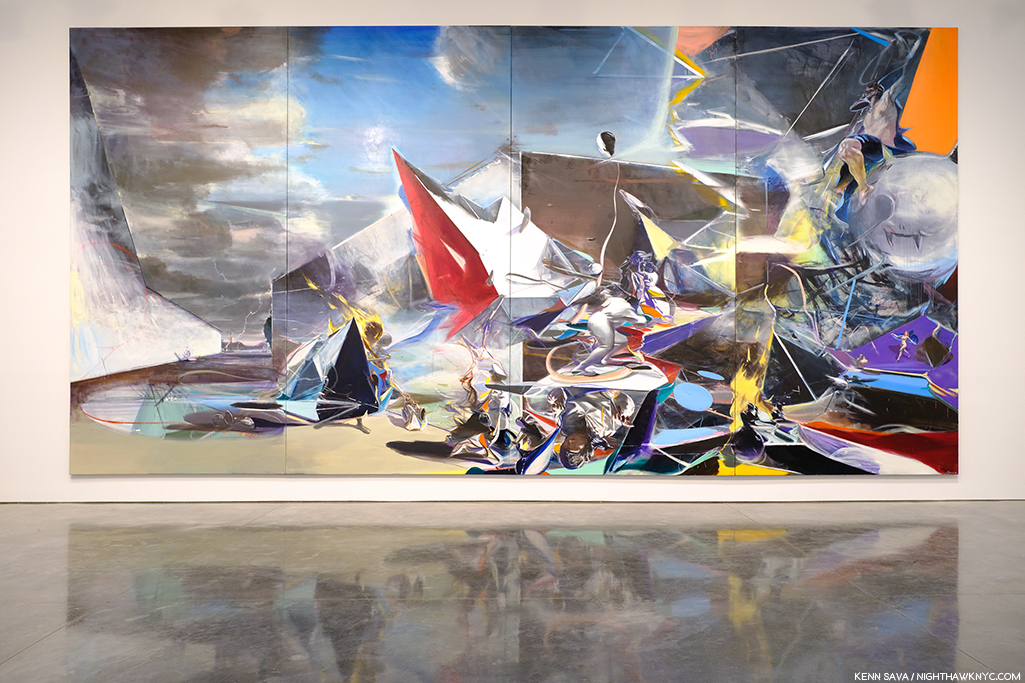
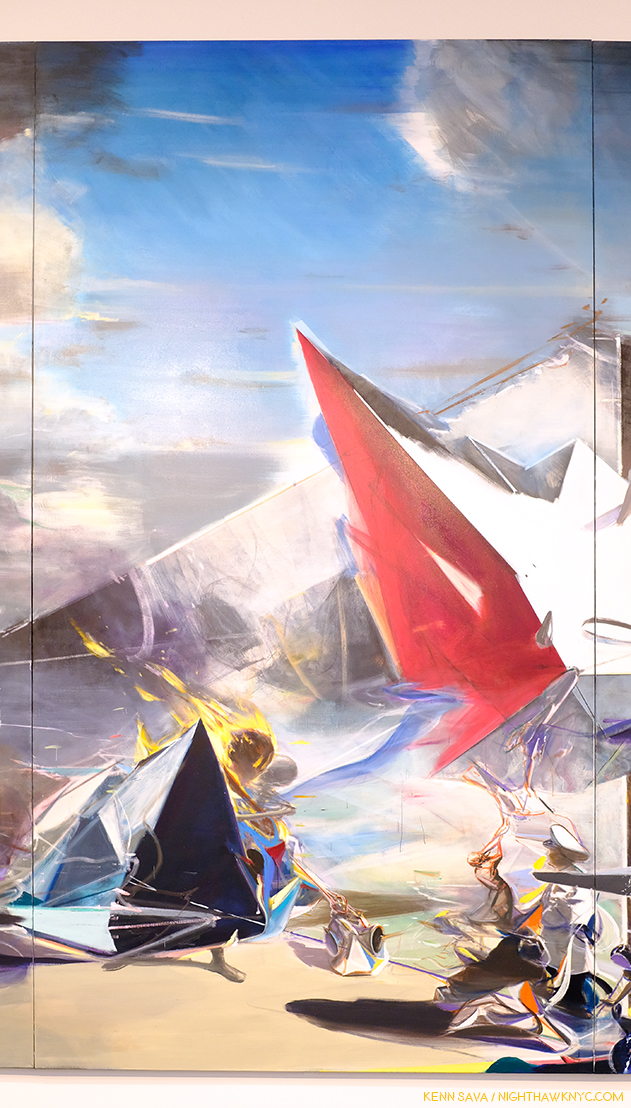
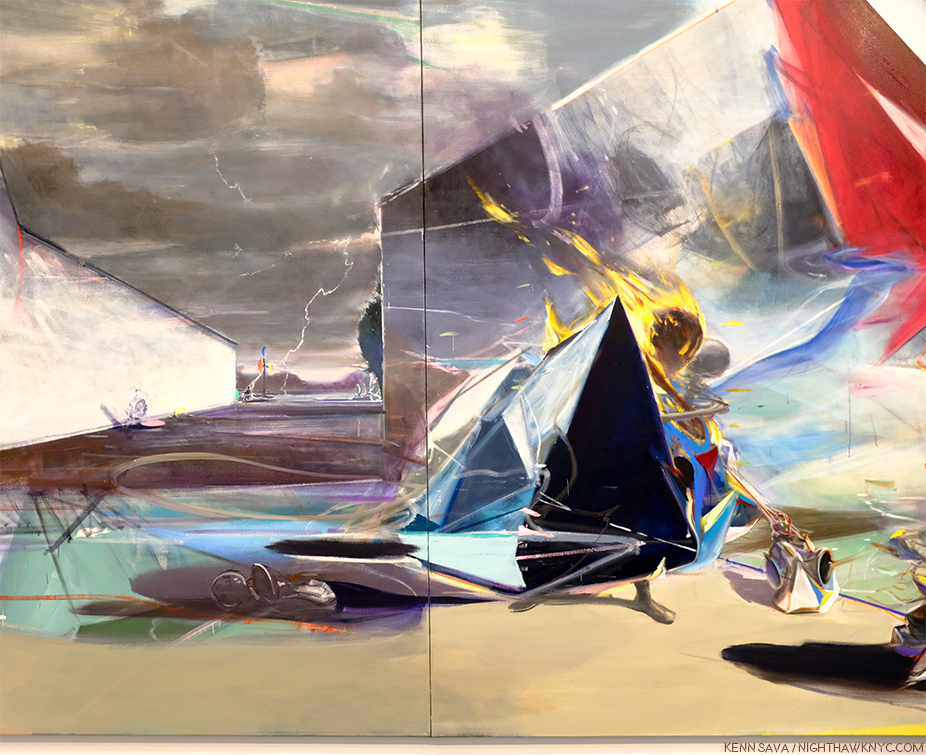
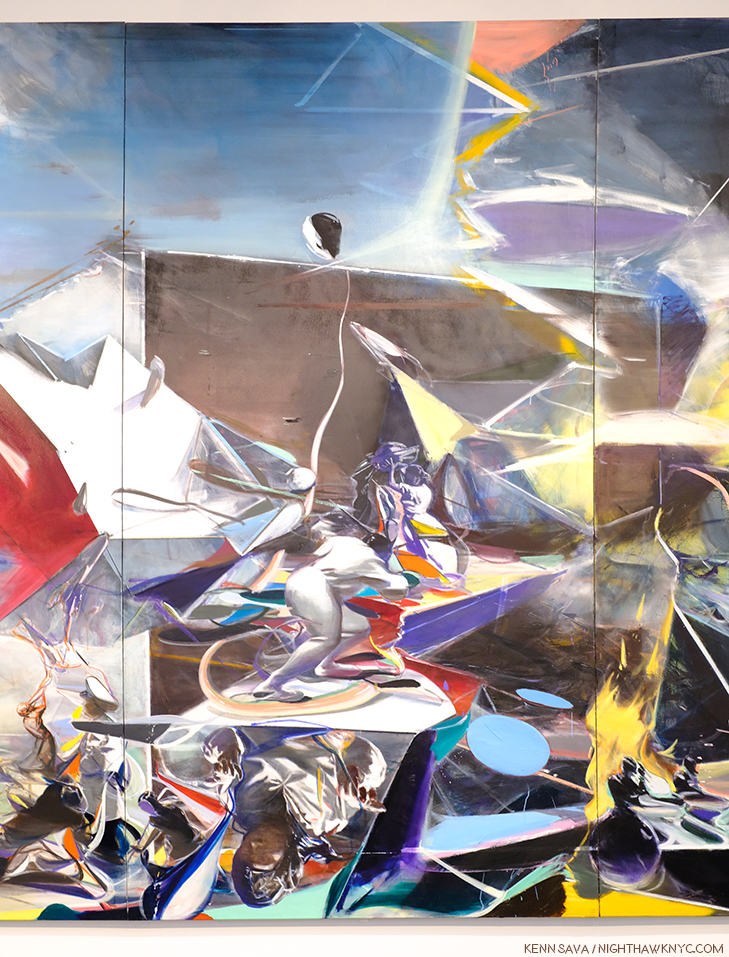
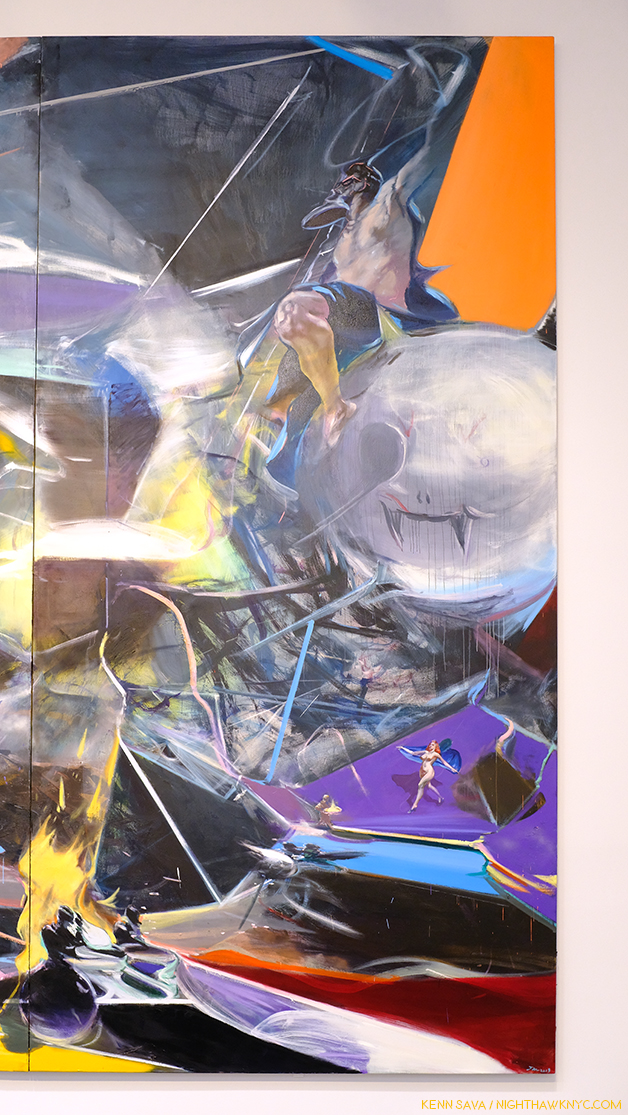
Imaginary Enemy, 2009, Oil on wood panel, 84 x 98 inches. Does the figure in white on the right, with what appears to be a cup on his head, have one foot on a portal? Or? The figure approaching on the left appears to be n flames. The strange, angular plane behind him has the effect of another dimension, as in Cubism. I’m still enjoying wrestling with this one, too, but I will say there are elements that remind me of Neo Rauch.

My mind was blown by all I saw. Noah Davis was, and is, a major figure in the Art of our time- in more ways than one.

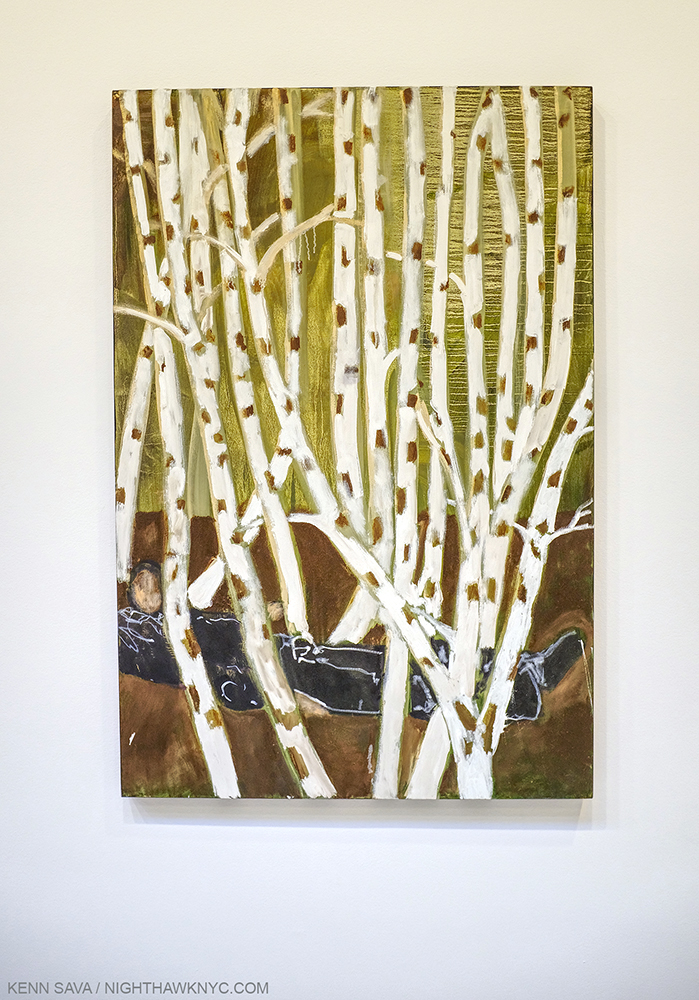
Untitled (Birch Trees), 2010, Oil on canvas, 54 1/2 x 36 1/2 inches. Many of Noah Davis’ Paintings include nebulous, mysterious faces and heads. Maybe I’ve been looking at too much Francis Bacon this past year, but I find them unique and surprisingly compelling, given their frequent lack of features.

My perception had been that at 32 he was still developing, pursuing his own style- as most Artists in their early 30’s are. Ha! As I moved from work to work, I saw an Artist who was completely in control of a full range of styles, which he could dip into at will and which only hinted at influences in tantalizing and intriguing ways, while being wholly his own. Work after different work. How is this possible? The range. The depth. The power. It was all there in the service of his vision.

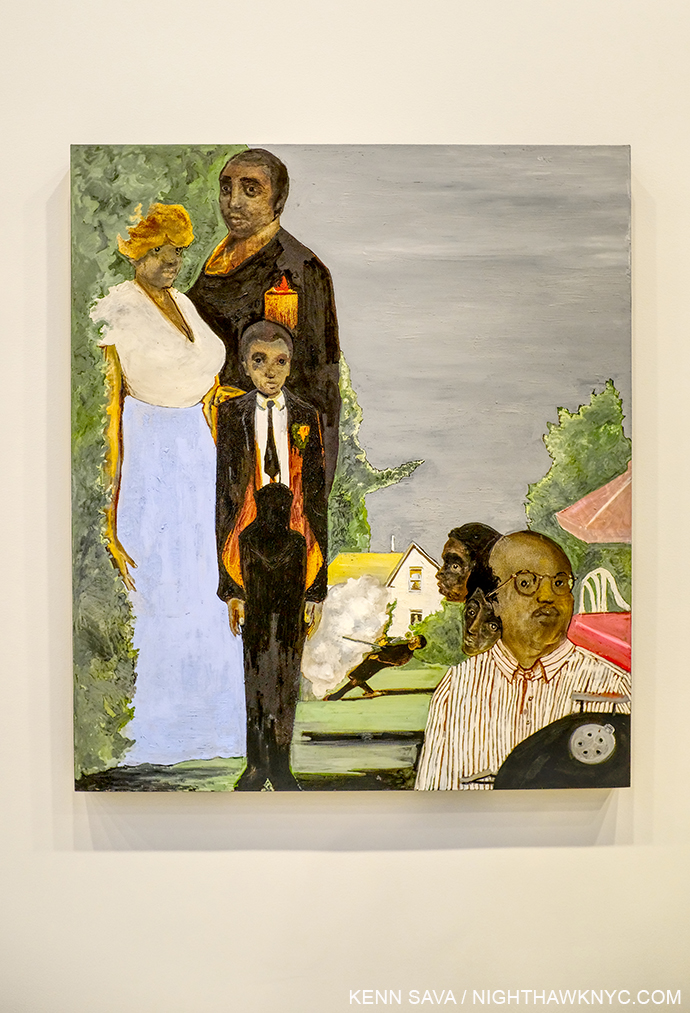
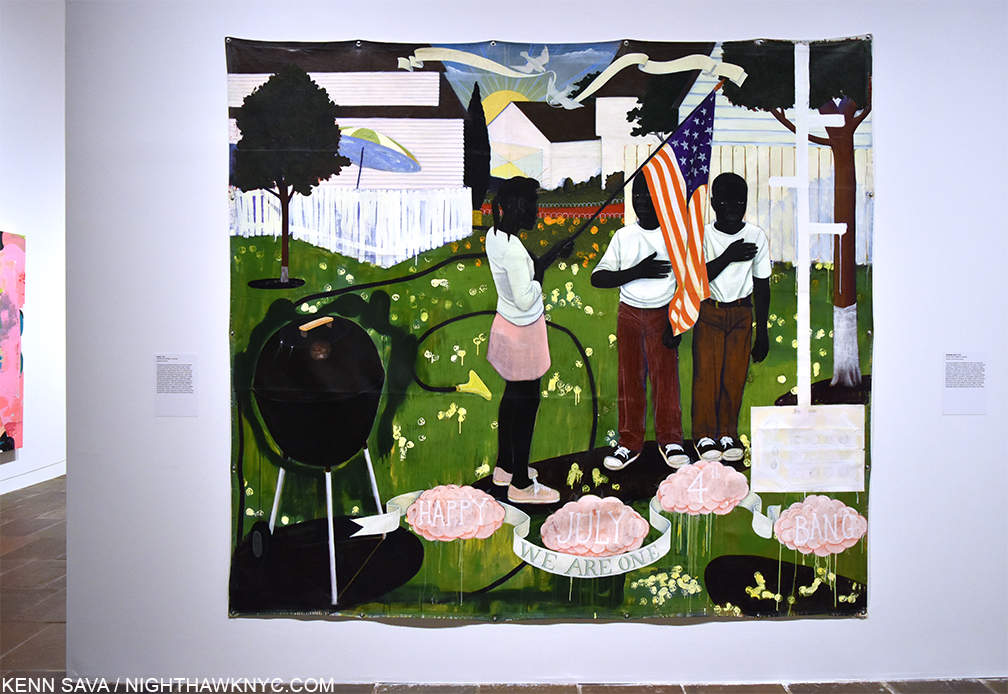
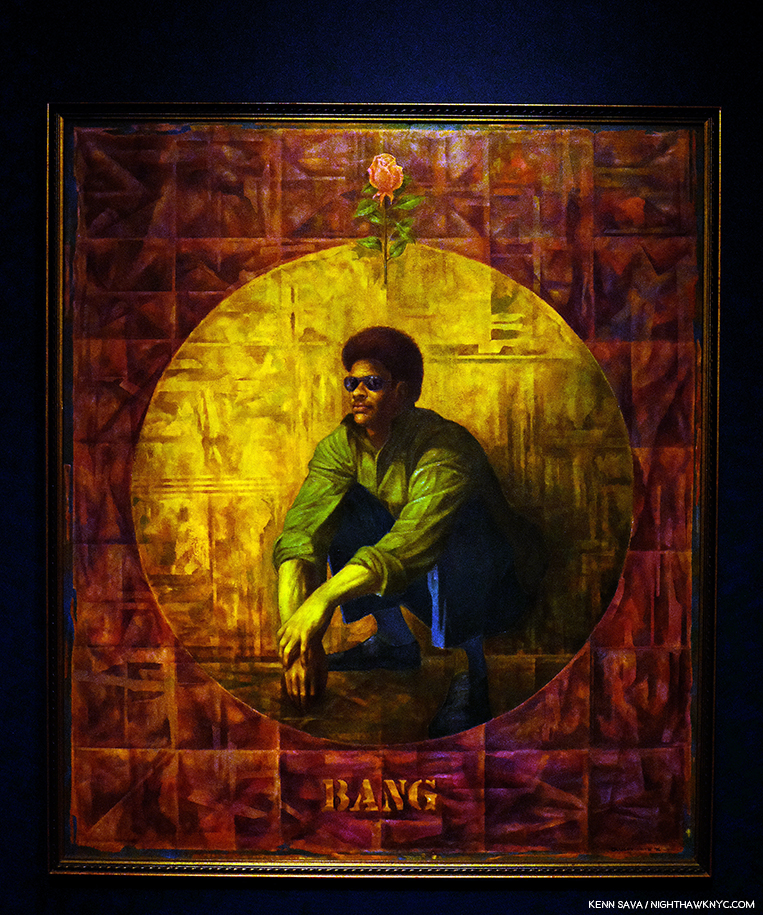
The Last Barbecue, 2008, Oil on canvas, 60 x 52 inches. Here, the faces are more defined. The group portrait on the left in countered by the odd triple portrait on the right behind the lid of the barbecue, and the scene in the center is surreal, disturbing and puzzling. It is an explosion, or? Looking at it, it was hard not to think of Kerry James Marshall’s Bang, 1994, a 4th of July barbecue scene.

Flashback- November 12,2016 at Kerry James Marshall: Mastry at The Met Breuer. KJM’s Bang, 1994, Acrylic and oil on unstretched canvas(! Notice that it’s tacked to the wall.), 103 x 114 inches.

Before he passed, Mr. Davis asked Helen Molesworth (who, a few years ago gave us the landmark Kerry James Marshall: Mastry Retrospective that I wrote about after its Met Breuer stop) to be his curator. The Zwirner show, which Ms. Molesworth has brilliantly selected and installed, is not arranged chronologically, which I am thankful for. It serves to downplay the “end” and the tragedy of Mr. Davis’ early loss and put the focus squarely on his Art and his accomplishment, where it belongs. (By my count, only 3 of the works did not have owners listed on the checklist.) Each work dialogs with other pieces from a few years later or earlier in ways only someone intimately familiar with the Artist and the work could bring us, which, by itself, sets this apart from most gallery shows of deceased Artists. Her work hasn’t ended here. Ms. Molesworth, who was controversially fired from her post at MOCA in 2018, has also been busy creating an upcoming monograph on Noah Davis, interviewing those who knew the Artist, due to be published this fall, which should be a slam dunk candidate for one of the most important Art books of the year, if not the decade.

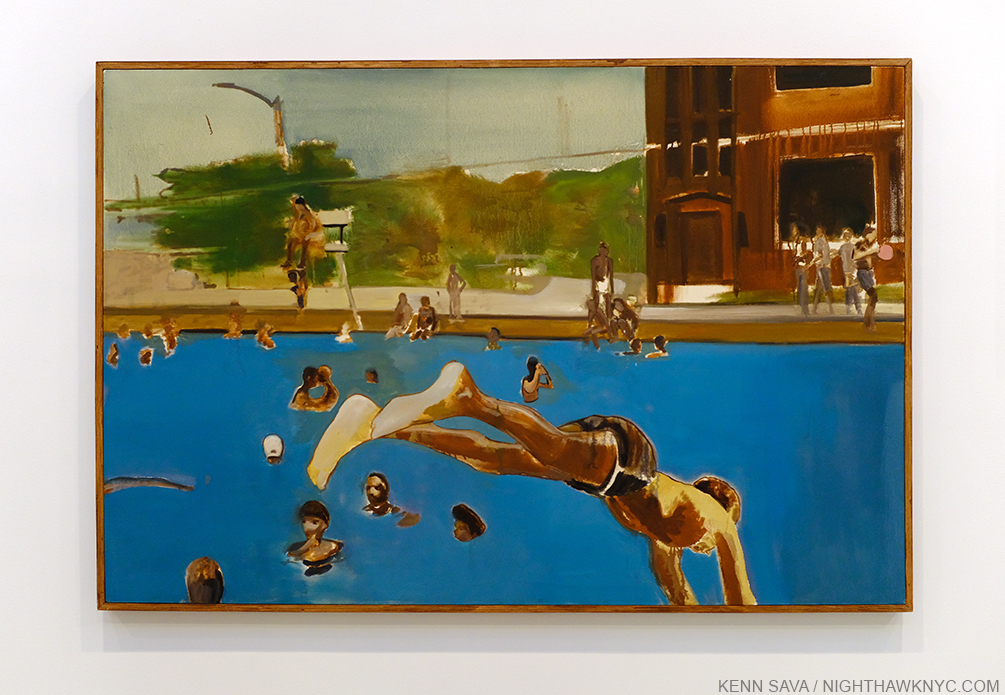
1975 (8), 2013, Oil on canvas in artist’s frame, 49 q/w x 73 1/2 inches.

The show featured “fantastical” work, like Imaginary Enemy, alternated with domestic and family scenes. 1975 (8), 2013, was based on a Photograph from the 1970s Davis Family Photo Archives. It reminds me of the mural his mentor and friend Henry Taylor did a few years ago for NYC’s High Line.

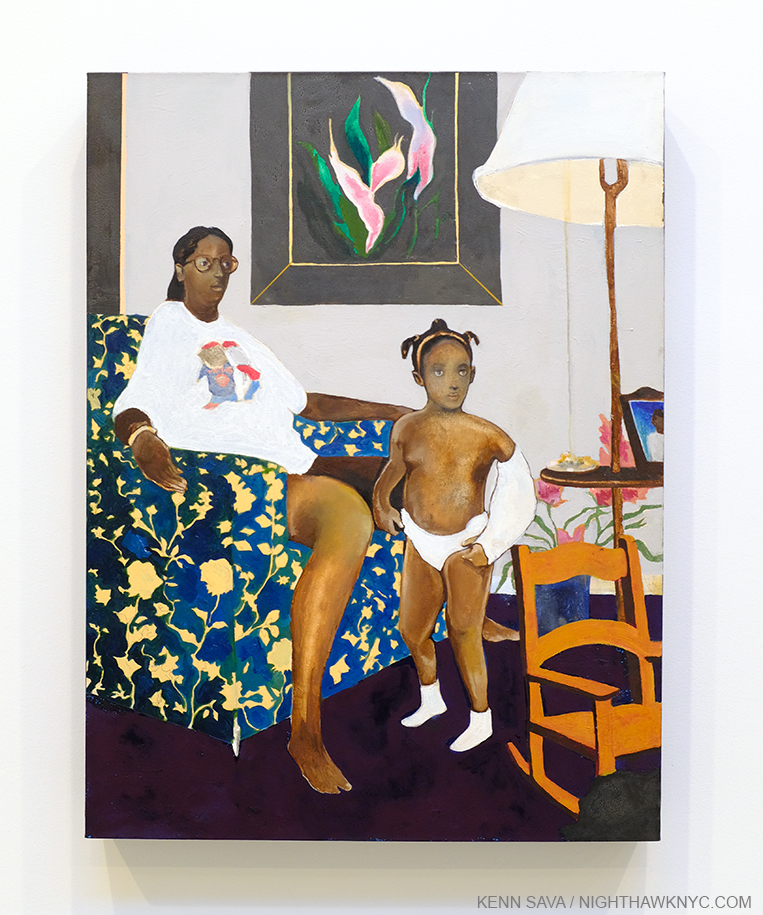
Single Mother with Father Out of the Picture, Date unknown, Oil, acrylic, and graphite on canvas, 40 x 30 1/4 inches. There’s an elegance and a timeless, haunting, beauty to this work, which though all too common in our world, I can’t recall having been the subject of a Painting before.

Mr. Taylor has written eloquently about his friend who was 30 years his junior and the effect and influence Noah had on him, his work and his career. One of the more important Painters of our time, reading his words is eye opening, an important testament to Noah Davis’ legacy.

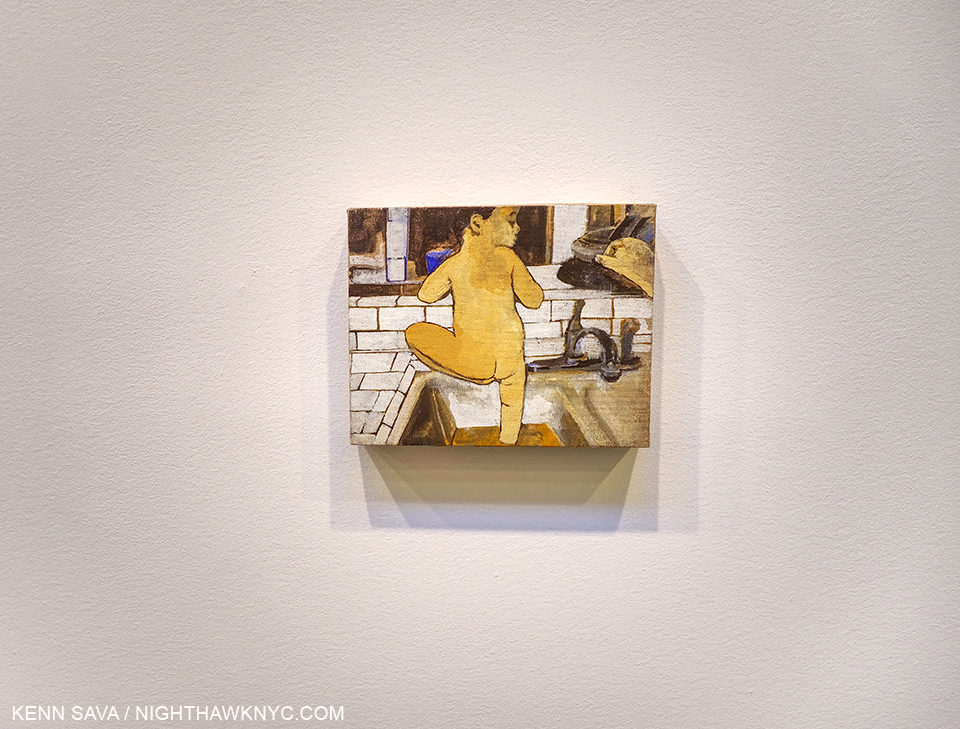
Untitled (Moses), 2010, Oil on linen on wood panel, 8 x 10 1/4 inches.

Perhaps none of these familial works is more poignant than the smallest Painting in the show, Untitled (Moses), 2010, 8 x 10 1/4 inches, showing his son, which may be based on another Photo from his family archives. In this remarkable, small, work, unique among Artist’s portraits of their children known to me, His son Moses has one foot in the water in the sink and one out, as if already leaving. The world shown in the window is dark.

But, as the remarkable, both precocious and fully formed mature works his Paintings are, there was more. Much more.

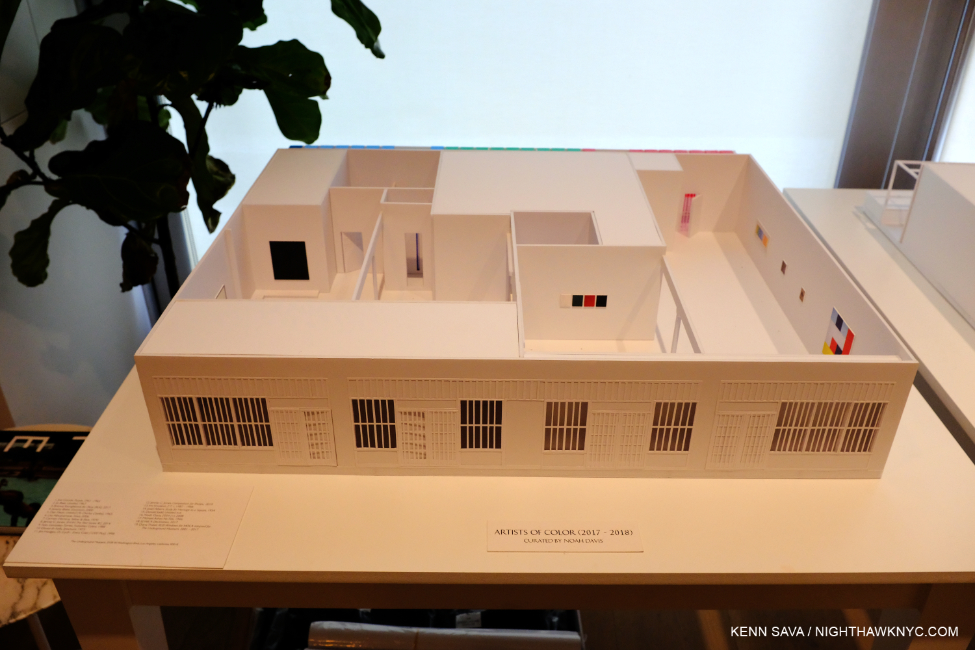
The Underground Museum is an ongoing Monument to the legacy of Noah Davis. Here, a model of it, showing its facade, with a mockup of the show ARTISTS OF COLOR, 2017-8, curated by Noah Davis. Mr. Davis left the plans for 18 shows for the UM, as it’s known, when he passed. After finding the space, Noah, his wife, Karon, and their baby, Moses, lived in the UM while it was under construction.

Having dealt with galleries early on, Noah Davis was one of those who came to feel the gallery model doesn’t work for them (something I’ve heard in innumerable conversations). Not an “established” Artist with big resources by any means, he nonetheless then dared to set out to forge his own path. With his wife, Sculptor Karon Davis, he took over 3 storefronts at 3508 West Washington Boulevard in the West Adams section of L.A., and opened what they christened the “Underground Museum” to bring museum quality Art, for free, to an area that was “underserved” by existing institutions.

“Noah wanted a space where he could show the work of himself and his friends. He wanted a space that could exist outside of the gallery/museum matrix,” Helen Molesworth said in a talk she gave at the opening.

The daring of that is only topped by his vision.

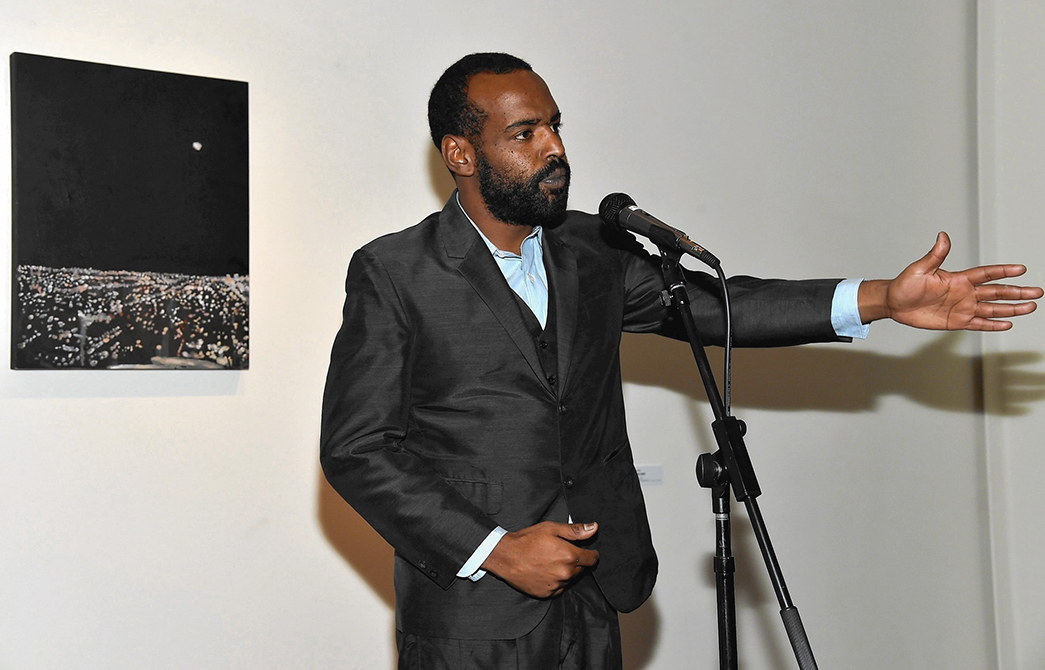
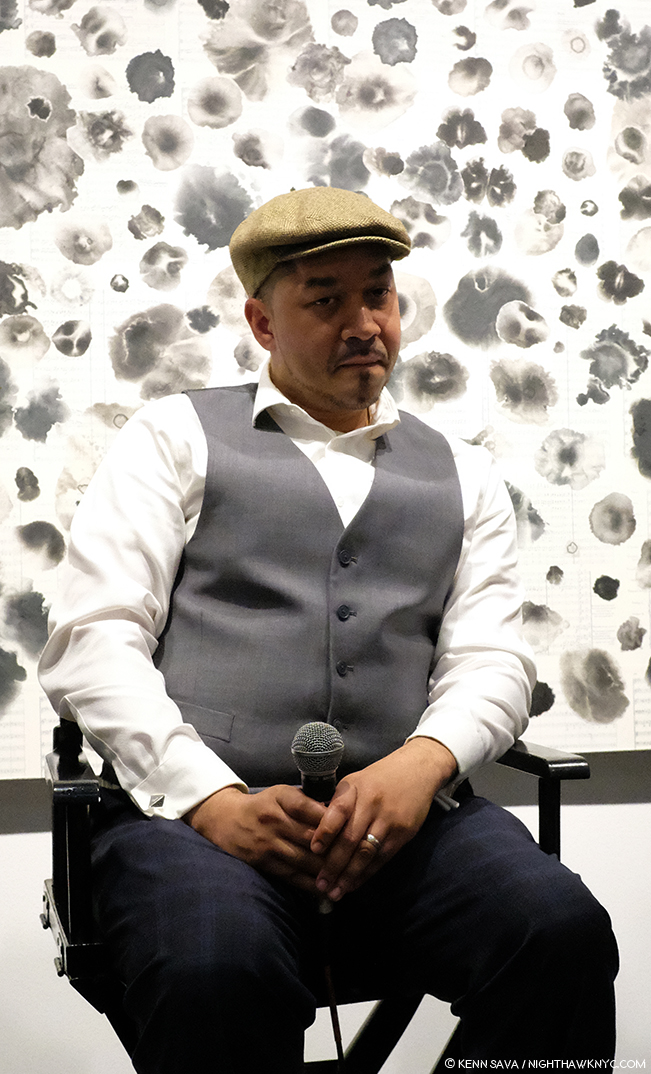
Noah Davis speaking in front of LA Nights, 2008, Oil on wood panel, 25 1/2 x 19 1/2 inches, which was also in this show. Photo by Alberto E. Rodriquez/WireImage.

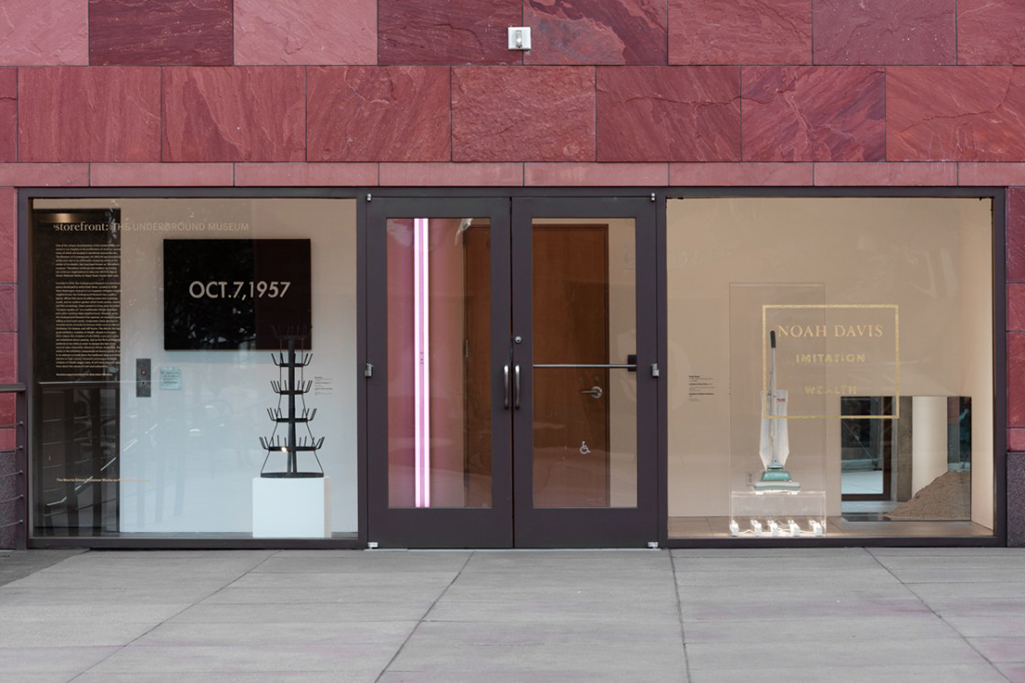
In the first show he mounted at the Underground Museum, Imitation of Wealth, Noah recreated well-known works of Art by Marcel Duchamp, Jeff Koons, On Kawara, Robert Smithson and others that he wasn’t able to borrow the originals of so that the people in this underserved area could experience them. For me, it’s another indication of wide-ranging his knowledge of Art history and his taste was. Robert Rauschenberg famously erased a De Kooning Drawing, but I can’t think of any other Artist who has done such a thing and created an entire show of “pseudo reproductions.” As a first show, Imitation of Wealth was both an auspicious “Hello,” and a shot across the bow of the Art world.

Noah Davis’ first Underground Museum show, Imitation of Wealth, reinstalled at MOCA’s Storefront space in 2015.  The imitation of a “date” Painting, Imitation of Om Kawara. Oct 7, 1957, left, happens to be his father’s birthday. Noah Davis’ Imitation of Marcel Duchamp, 2014 (Bottle Rack) is in front of it, Imitation of Don Flavin (lamp) behind the door, and on the far right, behind his Imitation of Jeff Koons (vacuum on a vitrine), and his Imitation of Robert Smithson with sand and mirrors to the far right LACMA Photo by Fredrick Nilsen.

Helen Molesworth, at the time, Chief Curator of MOCA was impressed enough with his idea to make a three year arrangement with UM to collaborate! An arrangement like this is unheard of. Tell me the other case where a world class museum has made an arrangement like this with an Artist in his early 30s to lend Art and work together to present shows in THEIR space. MOCA reinstalled Imitation of Wealth in their Storefront space in 2015, where it opened the day he passed away. He did live to see works from MOCA lent to the Underground Museum.

Noah Davis knew what was “right” for his Art, and as part of that he also had a vision of the future, of bringing Art to the people, for free. But even by 32, he moved past the vision to create the reality. Today, the UM is an important venue, one that has featured the work of Kerry James Marshall, William Kentridge, Henry Taylor, Kara Walker, and Deana Lawson, Kahlil Joseph, Noah Davis’ brother, among others.

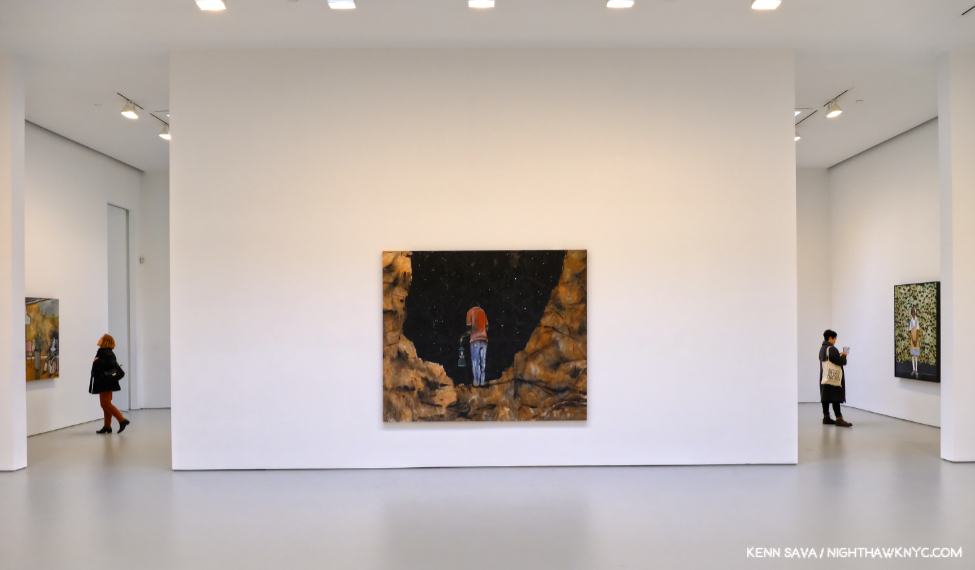
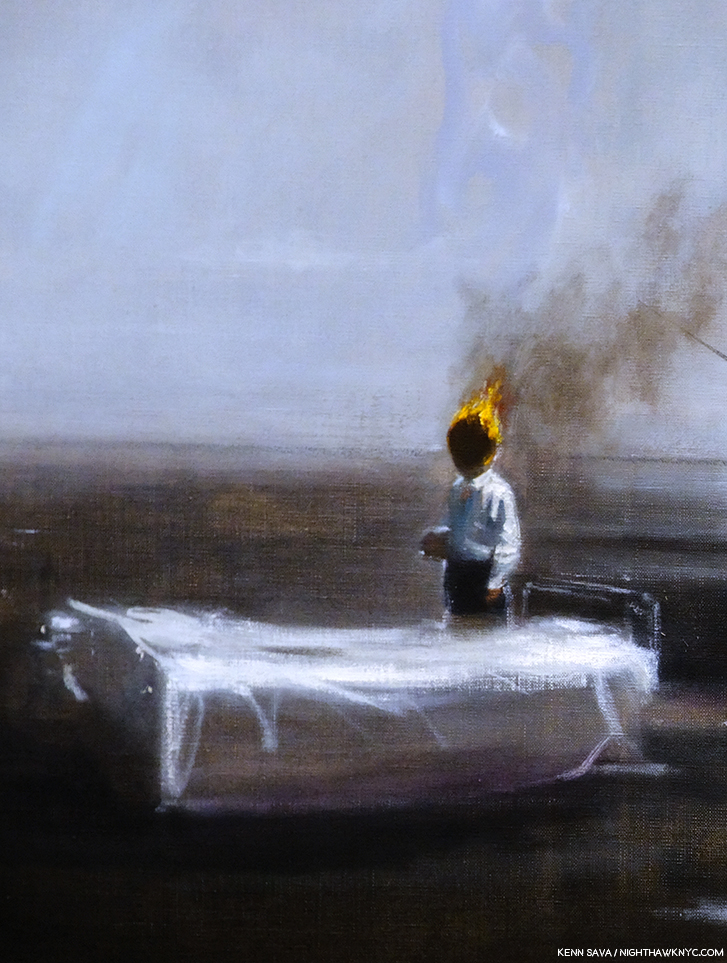
Of all the works in the show, Painting for My Dad, 2011, is the most haunting for me- perhaps the most unforgettable Painting I’ve seen in years. It was Painted while his father was in hospice with terminal cancer. We see his Dad about to embark into an unknown, dark, land with a lantern. The landscape, which strikes me as being distantly descended from Cezanne (which I also felt in Imaginary Enemy, shown earlier) in Noah Davis’ own way, is typical of how Mr. Davis took influences from across Art history and made them his own.

It’s fascinating (and something you can’t help but notice) to spot the possible influences from Art history in Noah Davis’ Paintings, and where he’s taken them. Kerry James Marshall’s Paintings set in projects, Henry Taylor’s way with figures, Francis Bacon’s nebulous portraits, Surrealism, and on and on. Every time I look at his work I see more of them, but in each and every instance he has made them his own. He’s not showing off a copious knowledge of Art history, he’s building on what others have done in the service of expressing himself with his own voice. Henry Taylor, Kerry James Marshall, Francis Bacon- these aren’t mentioned by way of comparison- I don’t believe in qualitatively comparing Artists, but just the fact that you can mention Noah Davis in the same sentence with those older masters says quite a bit about the man’s work. Walking through these rooms and looking at his work, even the selection of it shown here, I see someone who was, already, a master Painter, who’s work is going to remain important, in my view. Not only that, Noah Davis hung their work in his shows! In fact, he was one of those who take credit for “discovering” the now renowned Photographer Deana Lawson in 2009, when Mr. Davis served on a jury for a prize that Ms. Lawson submitted for. Ms. Lawson was subsequently featured in the show Deana Lawson: Planes at the UM.
The world not only lost a great Artist when he passed, it lost a budding brilliant curator, one who might have help fill the huge gap that exists in bringing Art out of the galleries and museums to the people. It also lost someone who broke the mould of the Artist/gallery matrix and found his own way. Whatever you think of his Paintings, his example is an enduring, important model for Artists today and in the future. That he was able to make his own way at such a young age has got to inspire countless people who come after him- maybe not to establish their own museum, but to find what works for them1. In the end, that on its own is an amazing, and major, legacy.

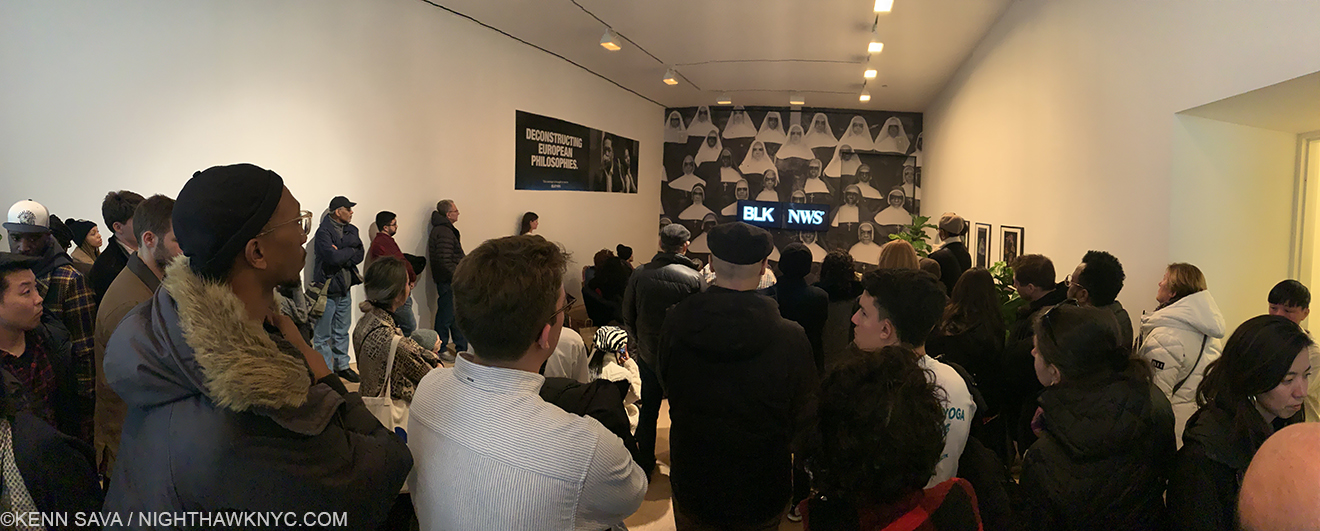
February 22, 2020. Closing day in the third gallery, designed to look a bit like the office at the UM, visitors watch videos and films by Kahlil Joseph, Noah’s brother, and others. I’m holding the camera above my head. Such were the crowds, it took me five minutes to navigate from this spot to the door to the right.

As I sit here now that this unforgettable show has closed, I’m left to wonder. What will last longer…what will have the bigger impact on the future- Noah Davis’ Art, or his example, manifested in the Underground Museum? His vision is their common thread. In the example he set, it seems to me that there is much for Artists to learn-now and in the future.

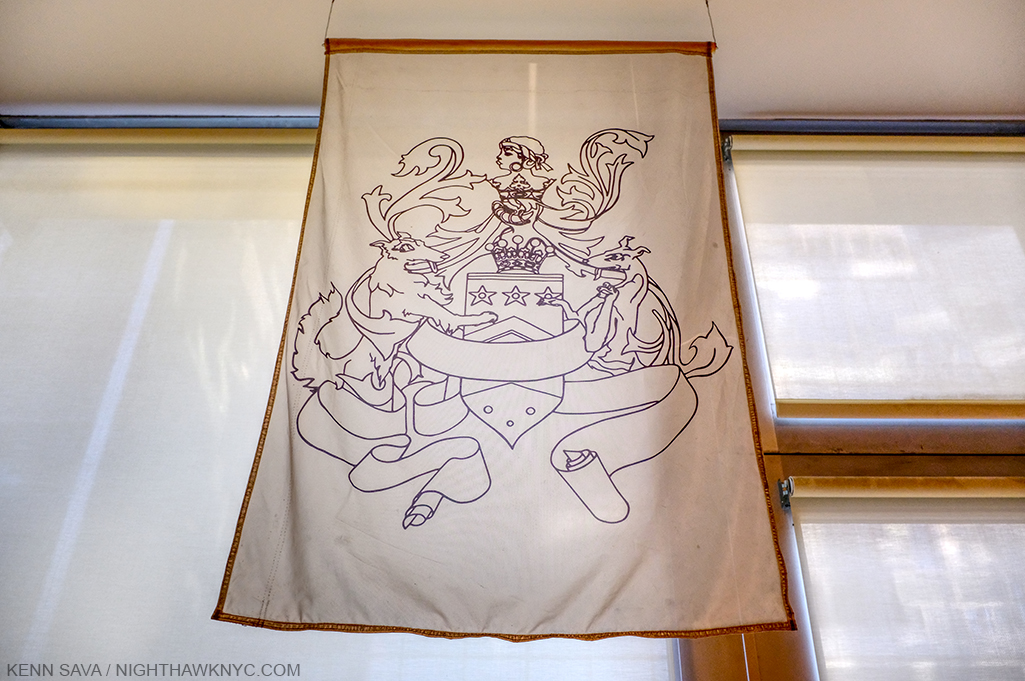
Letting the UM flag “fly high,” as Jimi Hendrix once said on the closing day in gallery 3. Long may it wave.

You can support the Underground Museum here, or by visiting it. The Noah Davis show is scheduled to open there “soon.”

*- Soundtrack for this post is “Bold As Love,” From Axis: Bold As Love, by Jimi Hendrix.

NighthawkNYC.com has been entirely self-funded and ad-free for over 6 years, during which over 250 full length pieces have been published. If you’ve found it worthwhile, you can donate to keep it going & ad-free below. Thank you!

Written & photographed by Kenn Sava for nighthawknyc.com unless otherwise credited.
To send comments, thoughts, feedback or propositions click here.
Click the white box on the upper right for the archives or to search them.
For “short takes” and additional pictures, follow @nighthawk_nyc on Instagram.

Subscribe to be notified of new Posts below. Your information will be used for no other purpose.


  1. As many are, and have been doing in their own ways, all around the world.

Jean-Michel Basquiat, At 59

Written & Photographed by Kenn Sava (except *)

Part 3 of a series…

In January, 1983, Henry Geldzahler asked Jean-Michel Basquiat- “Is there anger in your work now?
He replied, “It’s about 80% anger1.”

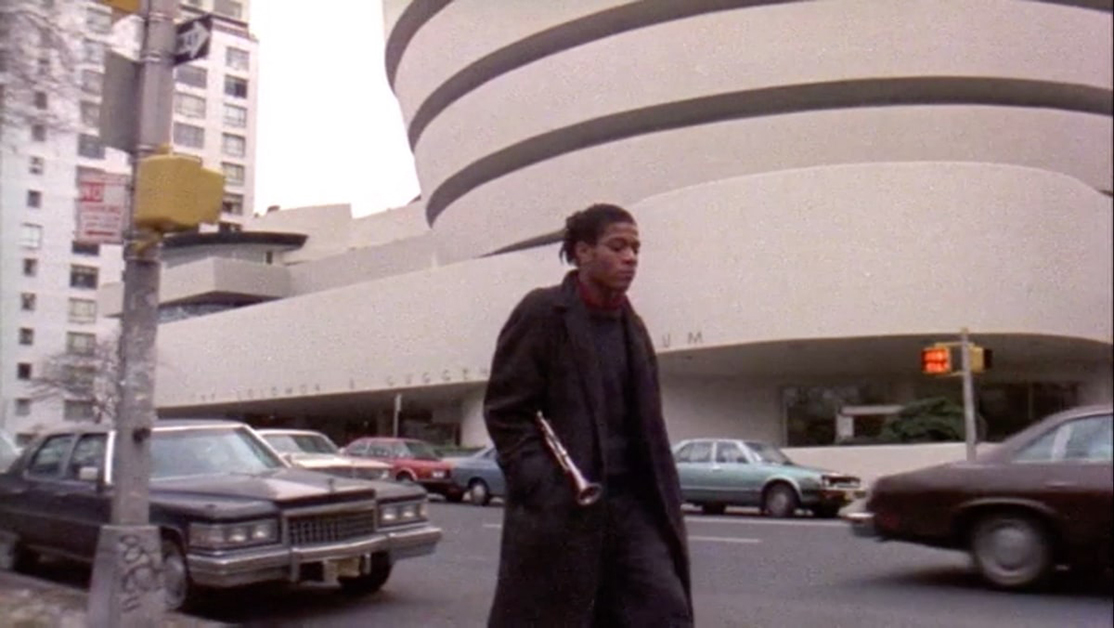
Jean-Michel Basquiat, at about age 20, walks with his clarinet at the intersection of East 88th Street and 5th Avenue across from the Guggenheim Museum, circa 1980-81 in a screenshot from the movie, Downtown ’81, directed by Edo Bertoglio and written by Glenn O’Brien. 39 years later the Guggenheim has mounted a show of work the Artist would create over the next few years. *

The Brant Foundation’s Jean-Michel Basquiat was the largest show of the five going on in NYC this year featuring the work of Jean-Michel Basquiat (J-MB, henceforth), or about him. Though it provided a rare opportunity to see a broad range of his Paintings through most of his career, there was no context to the show, beyond it being an exceptional, diverse, collection of his Paintings. My impression was the attention paid to presenting groups of work by theme consisted of a group of portraits in the rear gallery on the 4th floor, a room half full of Paintings of Boxers and a wall of Paintings with unusual stretchers, both on the second floor. The lack of a theme or themes is mitigated by the fact that in many of his works there are multiple themes present allowing viewers to piece together their own narratives in, and between, pieces. Yet, as time goes on, and the focus of J-MB studies turns away from the well-worn biography and more and more to the “less discovered land,” i.e. his work, some of the themes lying just beneath the surface are starting to finally get the attention they deserve.

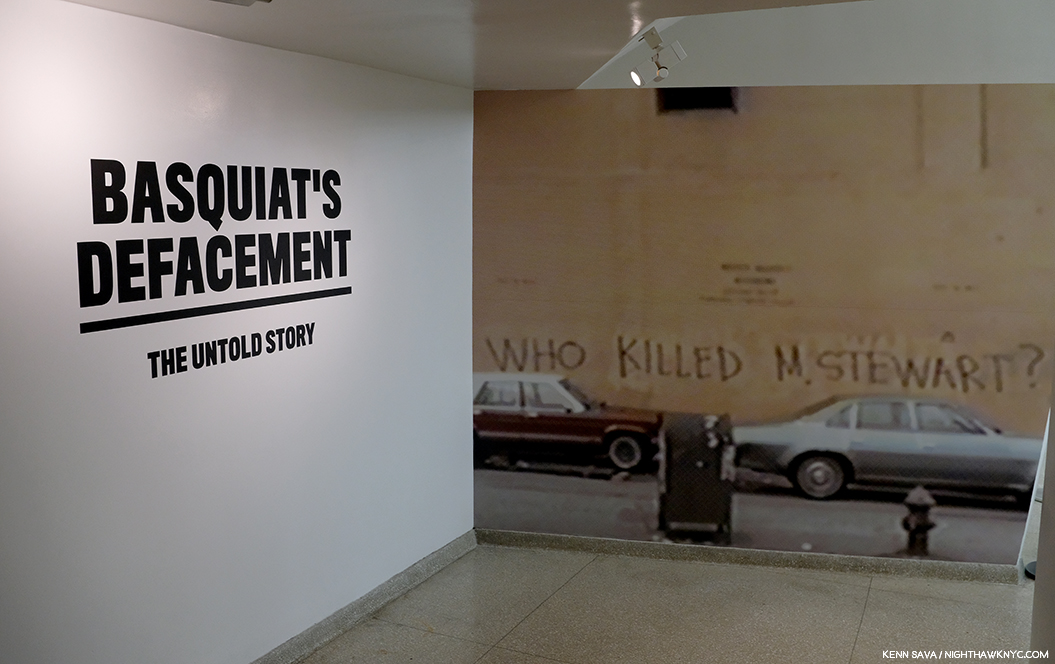
In that same interview with Henry Geldzahler, J-MB said that “royalty, heroism and the streets” were his favorite subjects. Over on the sixth floor of the Guggenheim Museum, in Basquiat’s Defacement: The Untold Story, the only museum show of the five J-MB and J-MB related shows going on in NYC this year, all three of those themes were featured, with “the streets” perhaps most front and center. The show’s overriding focus was the death of Michael Stewart, a 26 year old Artist who died of injuries he received “on the streets,” after being arrested by the Port Authority Police on September 25th, 1983, for allegedly drawing or writing in the 14th Street L subway station two weeks earlier on September 15th.

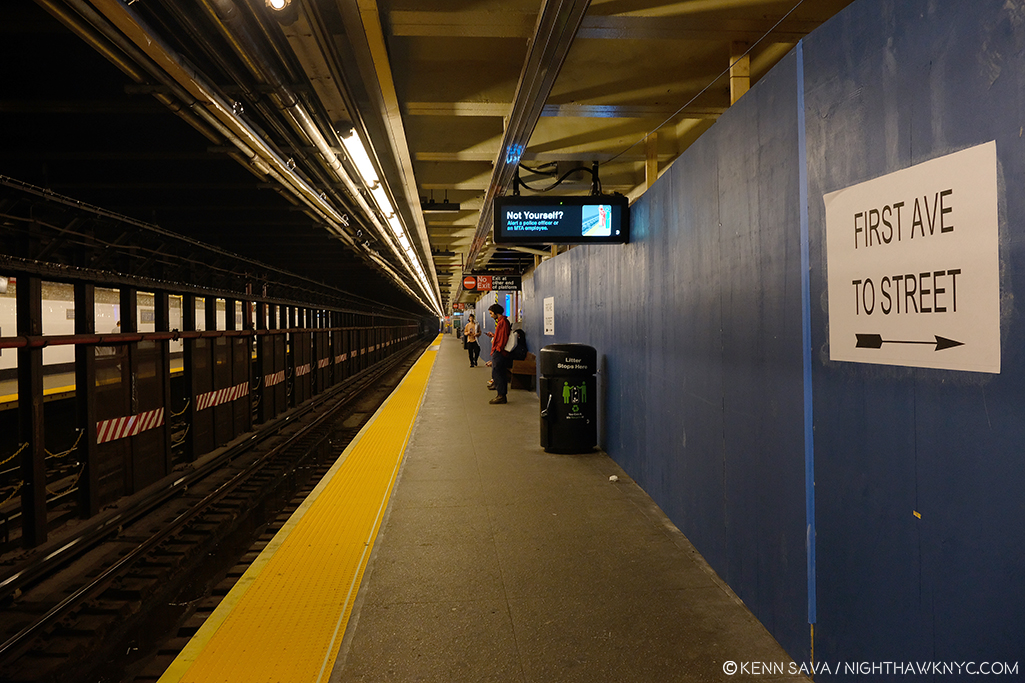
The scene of a crime. The 1st Avenue Brooklyn bound L Subway Station, currently under construction. It’s a narrow platform as subway platforms go with nothing obstructing the view from one end to the other. The only entrance/exit, the one Michael Stewart must have entered and been removed through, is just to my right rear. Seen in October, 2019.

A public outcry and numerous protests ensued. The effect was immediate, deep and lasting, as the show reminds us, bringing us right back to the moment. The downtown community of Artists that Michael Stewart, J-MB, Keith Haring, and many others, were a part of, also responded with their creativity. In his “Chronology” in the Whitney Retrospective catalog, Franklin Sirmans writes, “Basquiat always conscious of racial realities is deeply effected by the death of Michael Stewart on September 15th…Basquiat, perhaps in fear, practices a form of denial. He consciously distances himself from the situation. No matter what his art world status might have been, incidents such as this were a constant part of his life2.” He continues, quoting Keith Haring, “One thing that affected Jean-Michel greatly was the Michael Stewart story…He was completely freaked out. It was like it could have been him. It showed him how vulnerable he was.” He then quotes J-MB as saying, “It could have been me. It could have been me3.” Michael Stewart died 8 months or so after J-MB said his work is “about 80% anger.”

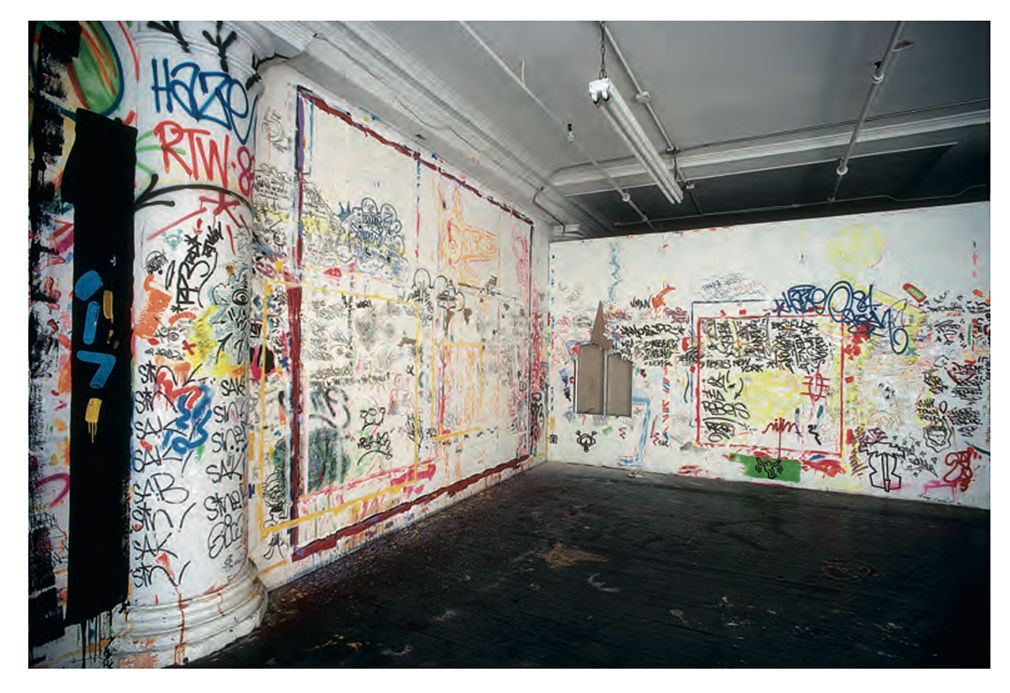
Keith Haring’s Cable Building studio after Defacement was cut from the wall to the right of center, where he created it, 1985. *Keith Haring Foundation Photograph.

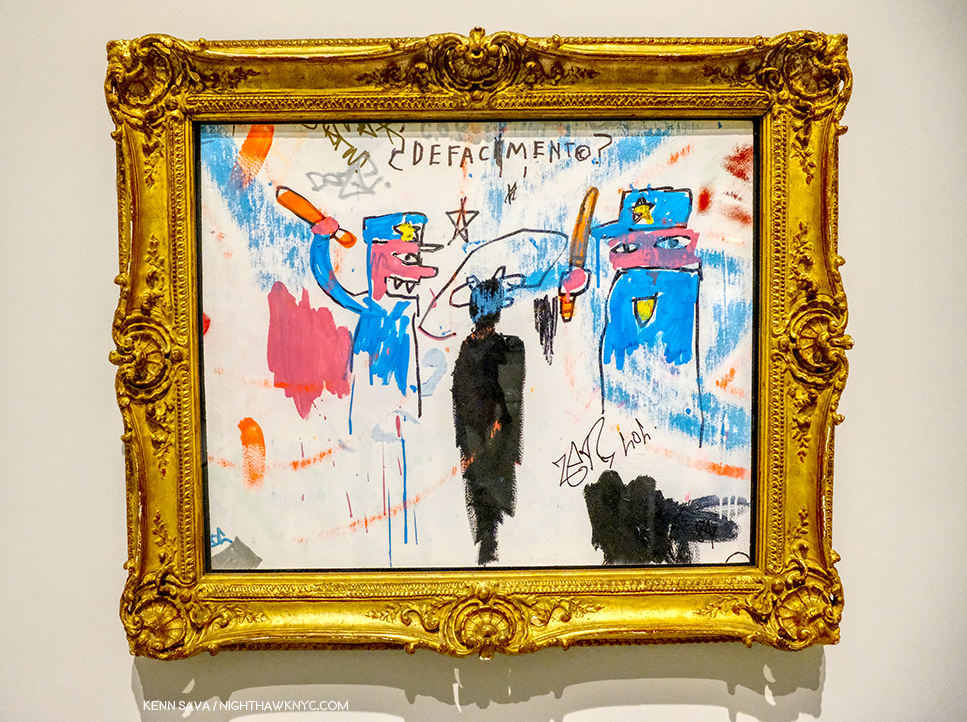
The show’s centerpiece is a work that has come to be called Defacement (The Death of Michael Stewart), 1983, that J-MB created on a wall of Keith Haring’s Cable Building studio at some point between September 29th and October 5th, 19834.

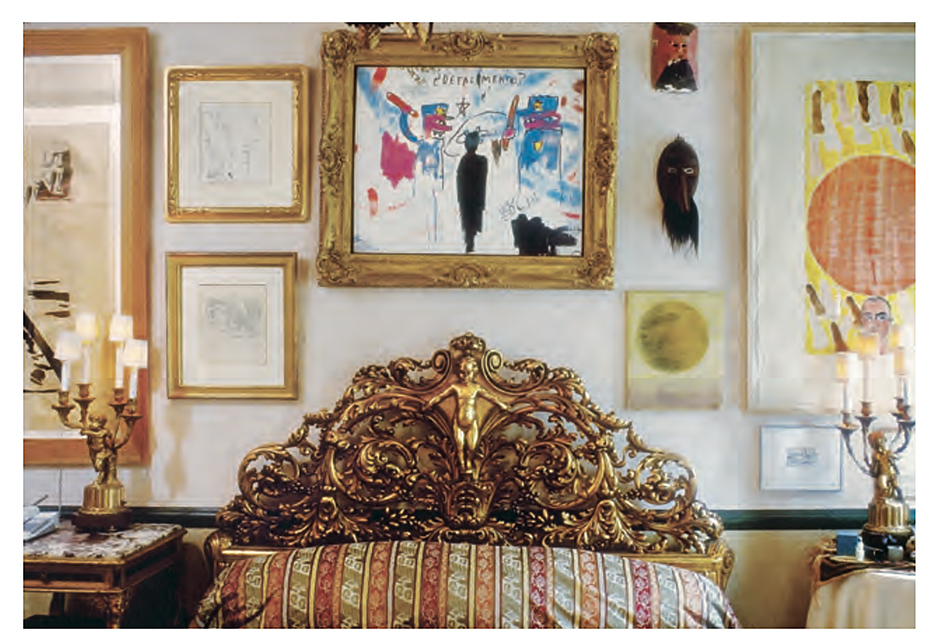
Keith Haring’s Bedroom, Greenwich Village, 1989. *Photograph by Nancy Elizabeth Hill, Keith Haring Foundation.

When he moved out of the Cable Building, Mr. Haring had it cut out of the wall and framed. In an indication of how he felt about the work, it hung over his bed, where it remained, apparently, until he died, in February, 1990, almost exactly a year and a half after J-MB.

Along with it, in the first gallery were 6 other Paintings and two limited edition prints by J-MB. In the second gallery, the rest of the show recounts the tragic story highlighted by vintage posters announcing protests, newspaper articles and ephemera, accompanied by Art by Keith Haring, David Hammons, George Condo, Lyle Ashton Harris and Andy Warhol. A moving highlight of the show is the inclusion of very rare examples of Michael Stewart’s work, which I have never seen before, from his family’s collection. At the time of his death, Mr. Stewart was planning his first show. Seeing these works now, the sense of lost possibilities remains undimmed 36 years later. Of him, Fred Brathwaite (aka Fab5Freddy) says- “Michael Stewart was a new artist making moves on the scene and one of the few people of color in the mix downtown at that time. He came from an intellectual educated family and wanted to find a place where he could express himself in a cool way around like-minded people….When he was killed and the police claimed he was writing his name on the wall in the subway-which was surprising and seemed unlikely to us- the media jumped all over the idea that he was a graffiti artist. …It was like a chill going through you, realizing that it could be me- it could be any of a number of people I knew. Even though we all knew that Michael Stewart was not the graffiti artist they were portraying him to be, it could clearly have been any person of color, particularly myself and the numerous others I knew who were making art and would occasionally tag a wall, or had that background. That was frightening5.”

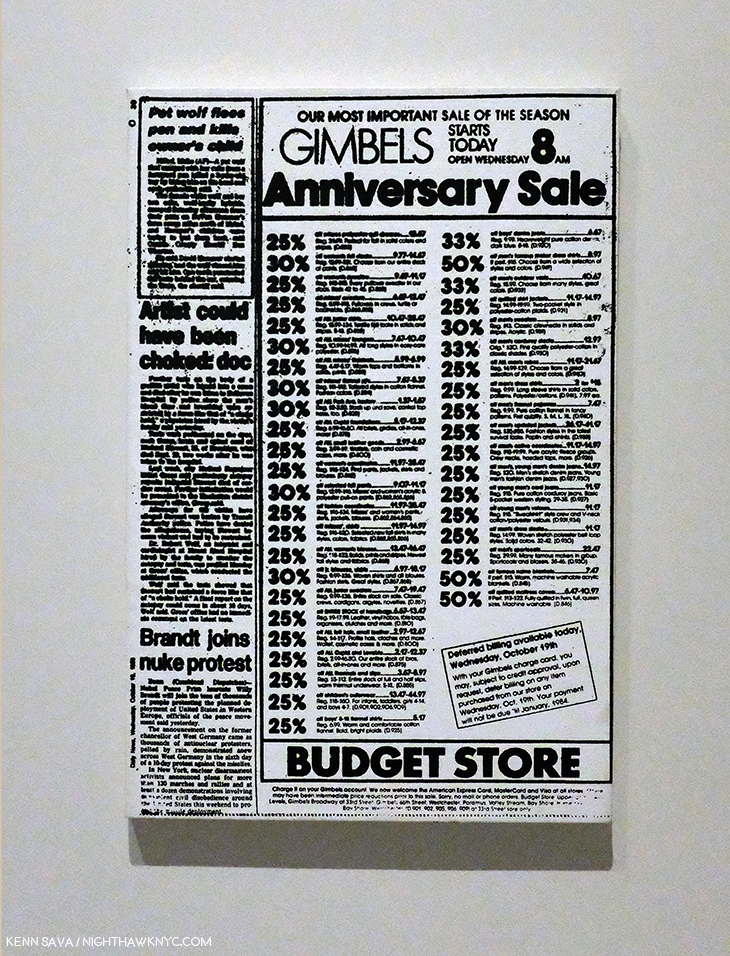
Andy Warhol, Daily News (Gimbels Anniversary Sale), ca. 1983, Synthetic polymer paint on canvas, 24 x 16 inches.

Mr. Brathwaite’s testimonial is excerpted from an interview he gave for the show’s exceptional catalog, which deserves special mention. Informative new essays by curators are followed by almost 60 pages of recollections by Artists, journalists, and other figures were were part of this period in NYC history, each based on new interviews conducted by curator Chaédria LaBouvier in 2018 and 2019 that were edited into concise statements for this publication- an amazing list that includes Mr. Brathwaite (Fab5Freddy), Dianne Brill, Michelle Shocked, Kenny Scharf, Eric Drooker, Lyle Ashton Harris, Jeffrey Deitch, Annina Nosei, George Condo, Tony Shafrazi, ABC-TV reporter Lou Young (who did over 60 pieces on the Michael Stewart story), Ronald Fields (a member of the first grand jury in 1983) and Carrie Stewart, mother of Michael Stewart. Their contributions bring the reader, as the show does, right back to the place and time in the kind of detailed recollections only those who lived it on the front lines could relate. When I’ve spoken in Parts 1 & 2 about the need for those who knew the Artist to step up and speak, this is a shining example of what those with first hand knowledge to bring to the table. Anyone interested in Jean-Michel Basquiat, Michael Stewart and/or his tragic end should find their way to the catalog before it goes out of print. Many exhibition catalogs have a notoriously short shelf life after shows end.

Defacement (The Death of Michael Stewart), 1983, Acrylic and marker on plasterboard, 25 x 30 1/2 inches.

In the first gallery, a long, rectangular space leading to Defacement (The Death of Michael Stewart), 1983, as the work is now known, due to the fact the Artist has written “¿Defacement©? ” in the upper center, are other works by J-MB that revolve around the themes of the police, royalty and the death of kings. Defacement feels like a dream, or nightmare, due to the presence of “clouds” of blue, pinkish and black paint. Painted on a white background, the blue figures, with pink/red skin, of the police frame and tower over the central black figure, apparently seen from the back. There are parts of what appears to be two circles in black around the head of the center figure, who’s hands and feet are not visible. Apparently, some of the marks on the work may have been added by others, like the letters on the right side that appear to be (“ZERLOL”), but it appears these circles are under the blue paint and so may have been done by J-MB. One of the policemen appear to be looking out at the viewer.

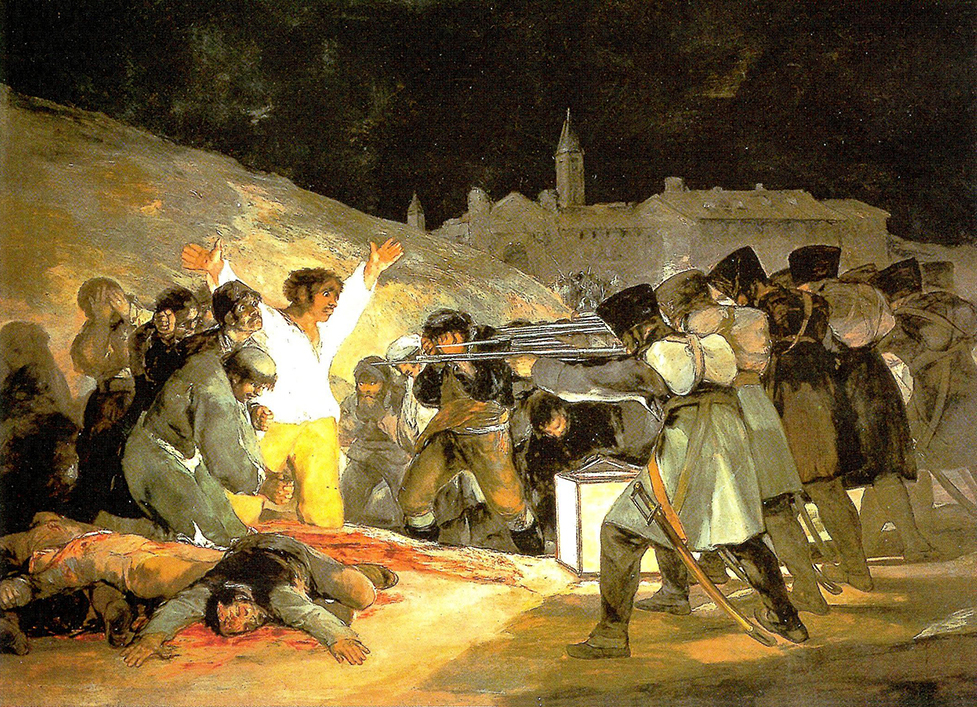
Francisco Goya, The Third of May, 1808, Oil on canvas, *Prado Museum.

One thing that stands out to me is the composition in context of Art History, particularly, in works of Goya and Picasso. In Goya’s legendary The Third of May, 1808, the soldiers stand decidedly to the right- the same side as the viewer.

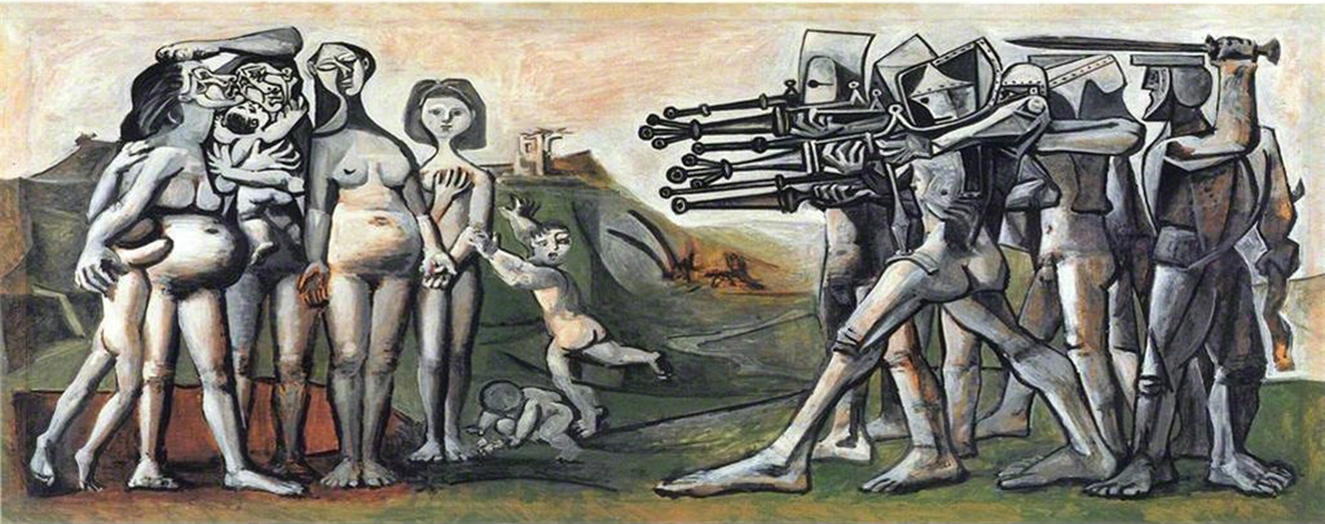
Picasso, Massacre in Korea, 1951, Oil on canvas, *Picasso Museum, Paris.

In Picasso’s Massacre in Korea, 1951, the viewer is placed right in the center, with the soldiers on the right, and the victims on the left, one or two of who look out at the viewer. In Defacement, J-MB has also placed the viewer in the center, between the policemen, and directly behind the black figure/Michael Stewart, who appears without hands or feet. The effect made me feel like being in line to run the gauntlet- like you’re next in line, in line with his reported feeling “It could have been me. It could have been me.” It’s hard not to take the Painted “¿Defacement©?” as a double entendre. Did Michael Stewart really deface the subway station? And, why are the police “defacing” him, removing his face from the world?

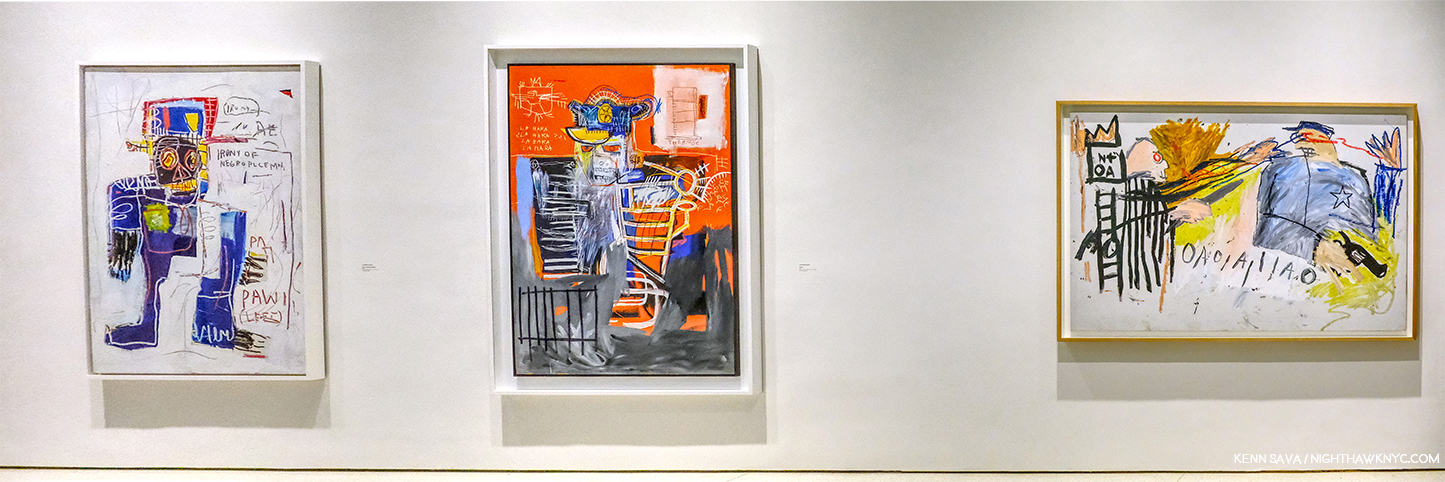
La Hara, 1981, Irony of a Negro Policeman, 1981, both Acrylic and oilstick on wood panel, both 72 x 48 inches, Untitled (Sheriff), 1981, Acrylic and oilstick on canvas, 51 1/2 x 74 inches, from left to right.

On the right hand wall are three Paintings featuring policemen. All three are different. One has a white officer, one a black officer, one a grey officer (the two in Defacement appear to be pink-ish red). Two have white backgrounds, one red. All three are extremely nebulous (at least to me), even in the nebulous work of J-MB. All three are terrifying, and so perfectly set the stage for, and compliment Defacement.

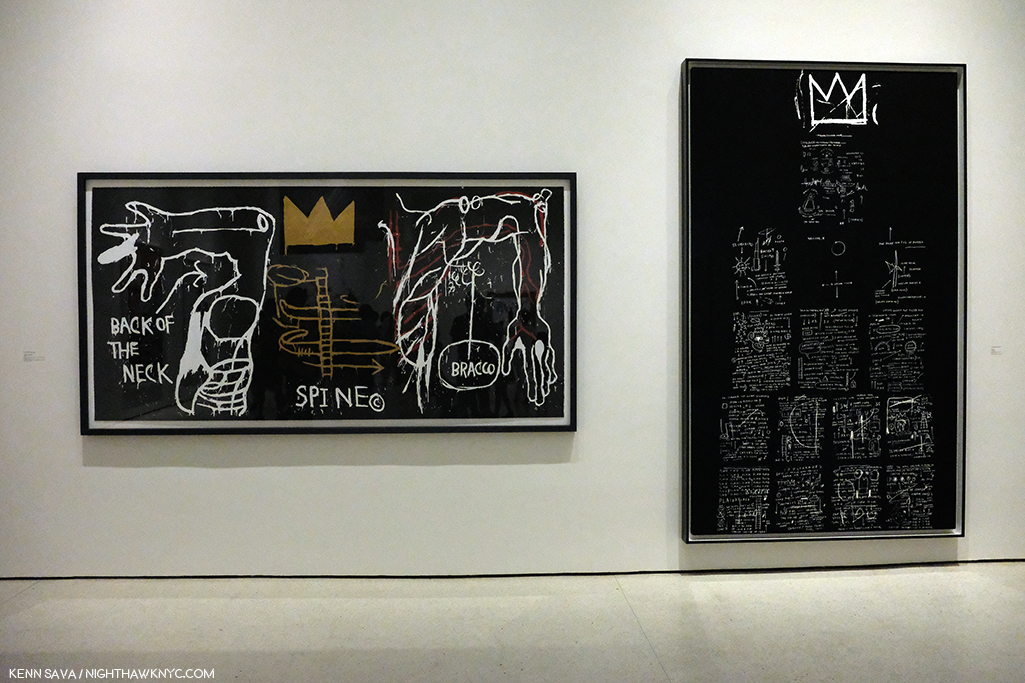
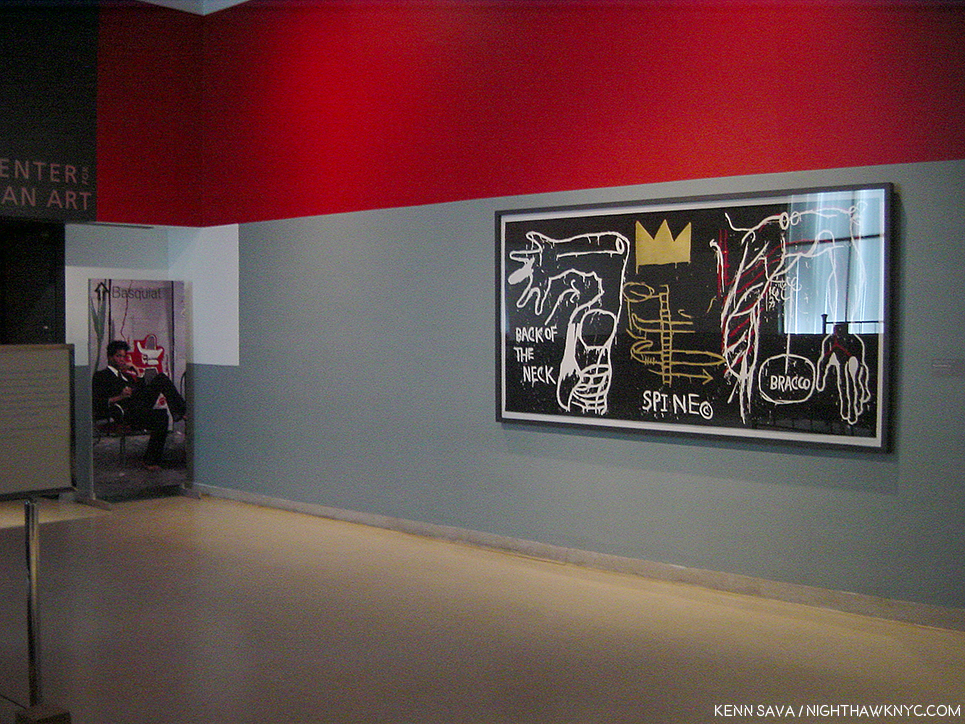
The prints Back of the Neck, 1983, 50 1/4 x 102 inches, which I saw 14 years ago at the Brooklyn Museum (See Part 1Part 1), who is is on loan from, and Tuxedo (1982-3), 102 1/4 x 60 inches, both prints are editions of 10.

On a wall facing it are the limited edition print, Back of the Neck, also from 1983, my old friend from the 2005 Brooklyn Museum Retrospective on loan from the museum, and another print, Tuxedo, 1982-3, a work that references kings. As others have pointed out, Back of the Neck could be a reference to the injuries sustained by Mr. Stewart.

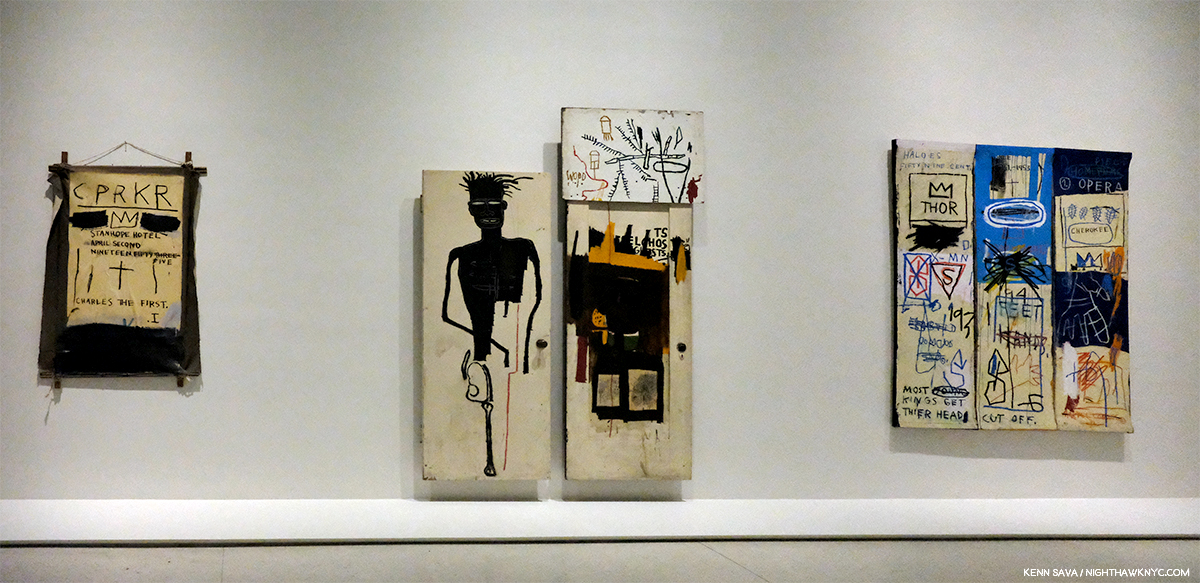
CPRKR, 1982, Acrylic, oil stick, and paper collage on canvas, mounted on tied-wood support, 60 x 40 inches, Self-Portrait, 1983, Oil, acrylic and oil stick on two wood doors and wood panel, with graphite and ink on paper, 96 3/4 x 63 3/4 inches, and Charles the First, 1982, Acrylic and oil stick on canvas, three panels, 78 x 65 inches, left to right.

On the 4th wall are a stunning trio centered around the Self-Portrait, 1983, and two works that pay homage to another of J-MB’s “Kings,” Charlie Parker. Both of those relate to (his) death, and the death of kings. To the left is, perhaps, the most poignant work the Artist did referencing Bird, CPRKR. In it, he memorializes his death, listing the place and date, under a crown, with the moniker, “Charles The First” written below. And so, it fits with Defacement. Right next to it is the Self-Portrait, 1983, which in this show is impossible to think about without considering the year it was Painted, particularly since on its right-hand panel, the words “To Repel Ghosts” are Painted. To the right of these is Charles the First, 1982, with it’s equally haunting words “Most Young Kings Get Their Heads Cut Off” written along the bottom. Of the “young kings” referenced in this room, Michael Stewart died at 26, J-MB at 27 and Bird at 34. Charlie Parker turns 100 on August 29, 2020. Michael Stewart would be 61 today. As I pointed out in Part 2, J-MB should be 59 years old RIGHT NOW, in mid-career as the museums call it. Both should be living, vibrant, forces. Not ghosts.

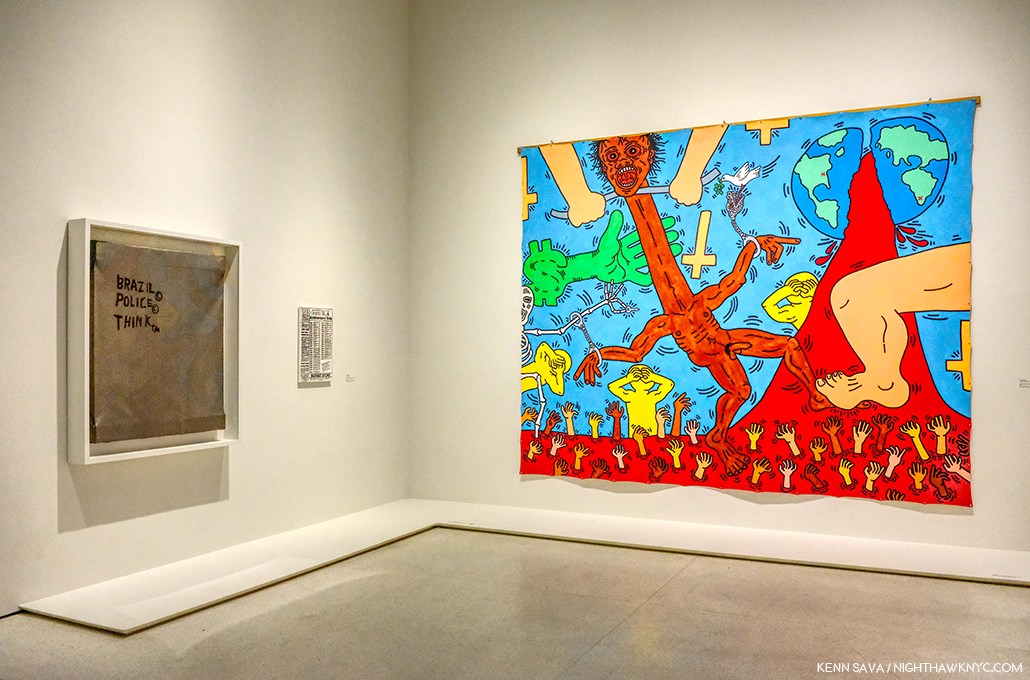
Jean-Michel Basquiat, Untitled, 1987, Andy Warhol, Daly News (Gimbels Anniversary Sale), 1983, Keith Haring, Michael Stewart- USA for Africa, 1985, left to right.

Not mentioned anywhere that I’ve seen, this is the only time Jean-Michel Basquiat, Andy Warhol and Keith Haring, the three figureheads of the Art of their time in NYC ever addressed the same event, (as far as I know). I’m not saying Untitled, 1987, shown in the group above, seen in the second gallery, is a reference to Michael Stewart- I don’t know, but Defacement is. Describing the amazing Keith Haring work, the defunct website basquiatdefacement.com said, “It depicts a black man being strangled while handcuffed to a skeleton holding a key. People from all nations drown in a river of blood below, while others shield their eyes from the scene, and the green hand of big money oversees the scene6.”

Michael Stewart poses for Dianne Brill Menswear, 1983, from the show’s catalog. “Michael was buried in a suit I designed,” Dianne Brill writes in her piece in the catalog (P.107).*

Basquiat’s Defacement: The Untold Story is one of the most powerful, smaller shows I’ve seen in years. Though it depicts events that took place 36 years ago, its relevance was, I’m sure, not lost on a good number of its viewers.

Alexis Adler, Jean-Michel Basquiat (the exact title is unknown to me).

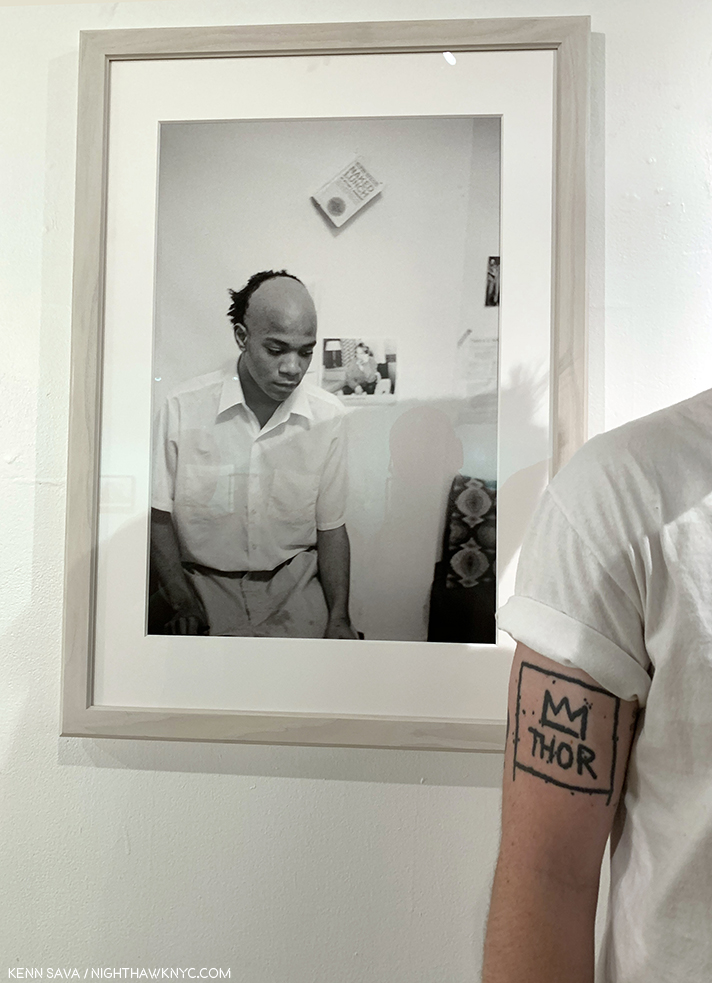
Two other shows, the last two I saw in the group of five7, document little seen sides of J-MB. In The 12th Street Experiment: Photographs of Jean-Michel Basquiat, the Photographs in question are by embryologist and former J-MB girlfriend and roommate, Alexis Adler, who lived with the Artist from 1979-80.

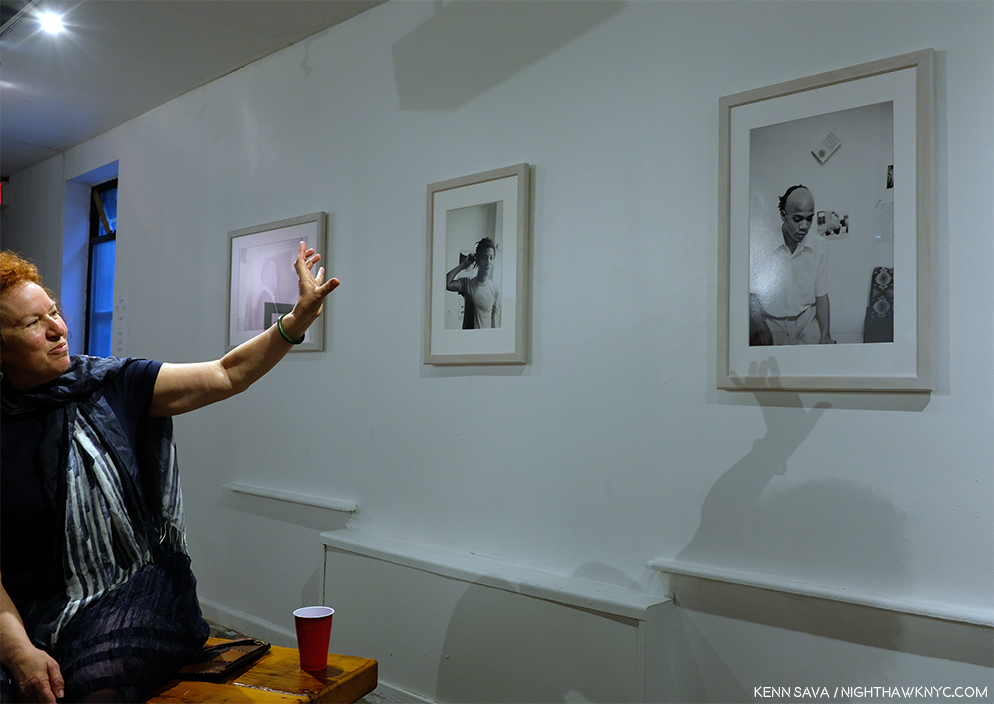
Alexis Adler speaks about Jean-Michel Basquiat and her Photographs of the Artist at The Bishop on Bedford Gallery, Brooklyn, May 18, 2019.

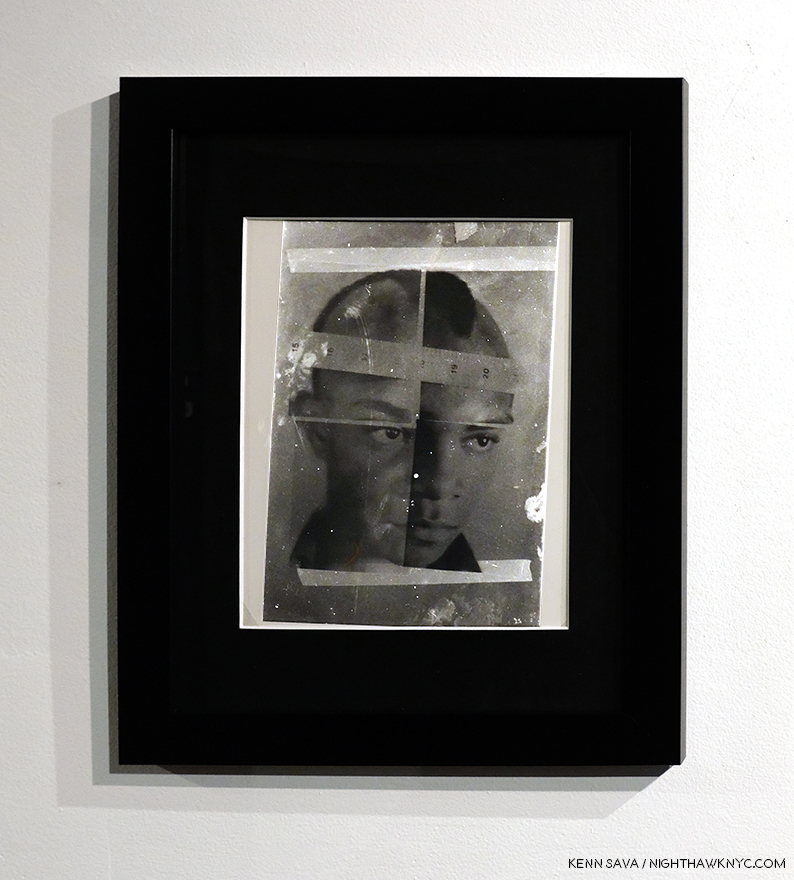
A veritable Portrait of the Artist as a Young Man, this was a show that, along with the items in Ms. Adler’s archive J-MB left behind in, and on, her apartment (on tour in museums shows elsewhere at the time, most recently at the Cranbrook Museum, The Museum of Contemporary Art, Denver and in Europe), form an important and unique collection. In my research, I’ve come to see that J-MB’s formative period after he left home for good has gone largely overlooked and understudied. Alexis Adler has stepped forward, sharing her experiences and her knowledge, in books, essays and traveling around the world speaking about her time with Jean-Michel Basquiat from 1979-80 and his Art, in addition to sharing her collection in the shows I mentioned. As she walked me through the show of her Photographs at The Bishop Gallery on Bedford, Brooklyn, I was amazed at both the J-MB work that Alexis has documented in Photographs and the range of experimentation the young Artist was undertaking- extending down to his continually evolving hairstyles! Lacking funds, he worked with whatever he found, whatever was at hand- including the doors, walls, and floor of the apartment, and whatever he found on the street, making him part of the line that includes Duchamp, Rauschenberg and Jasper Johns, among others.

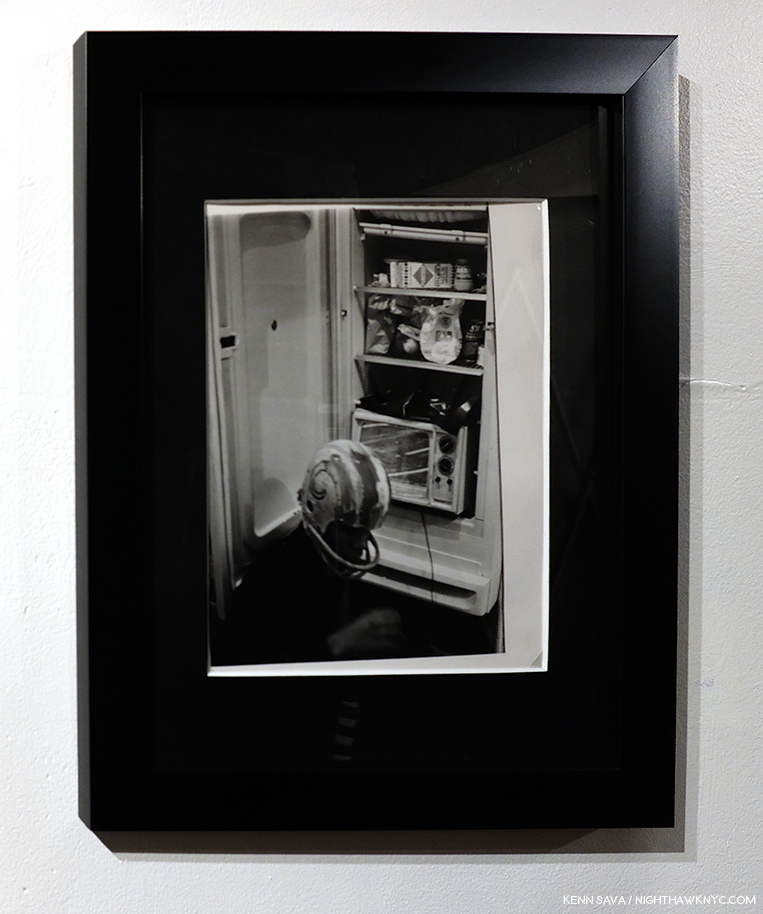
A Performance piece that involved installing a television set in a refrigerator. J-MB wears one of his hand Painted helmets here in one of a series of Photographs documenting the performance.

There is an element of performance in a number of these Photographs and in the work, which took place at the time he was performing with his band, Grey (and he is seen practicing his clarinet). Personally, I find this work fascinating and remarkable- on its own and for what it anticipates. A good deal of it might surprise many only familiar with his Paintings and Drawings.  This period seems to me to be more than only “early experimentation,” as it contains the roots and beginnings of much that came after, including his Painting. That he was Painting on everything he could find (out of a lack of funds for traditional Art materials, no doubt), presages his later Paintings executed on doors, like Self-Portrait, 1983 in the Guggenheim show, to fence slats, like Gold Griot, seen at The Brant in Part 2, among others.

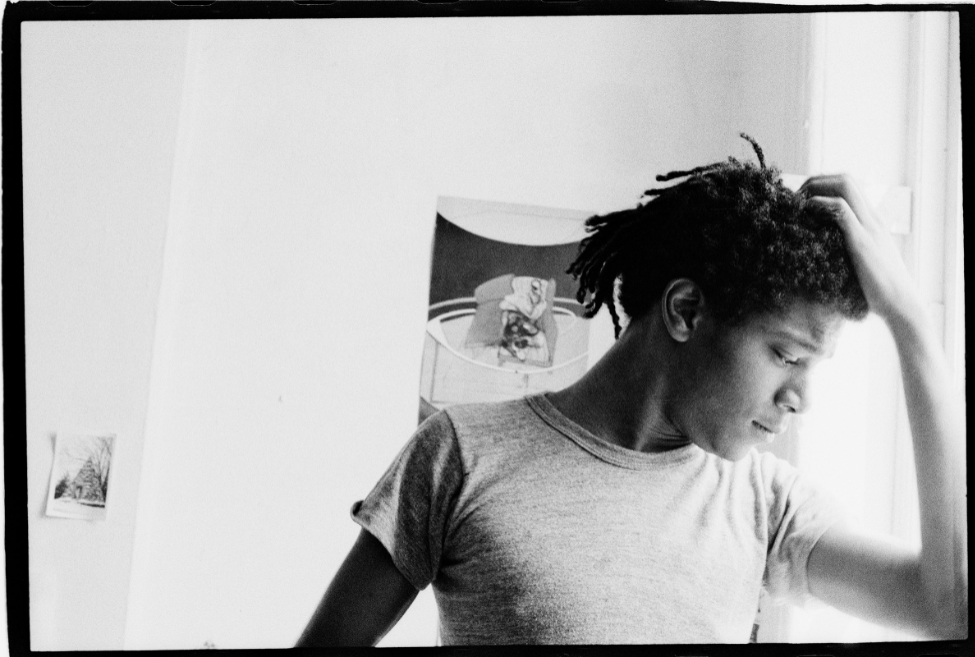
Alexis Adler, Basquiat in the apartment, 1981. Note the work by Bacon right behind his head. In another of Alexis Adler’s Photos, Burroughs’ Naked Lunch is seen attached to the wall. More evidence of J-MB’s Beat connection I mentioned in Part 1.

In addition, Ms. Adler said that J-MB studied her Art textbooks from the classes she was taking at the time. I found fascinating evidence of this in this Photo of hers, where a work by Francis Bacon is mounted on the wall. I wondered in Part 2 what Francis Bacon would think of J-MB’s Untitled, 1981. Here is the proof that J-MB knew of Francis Bacon’s work that very year.

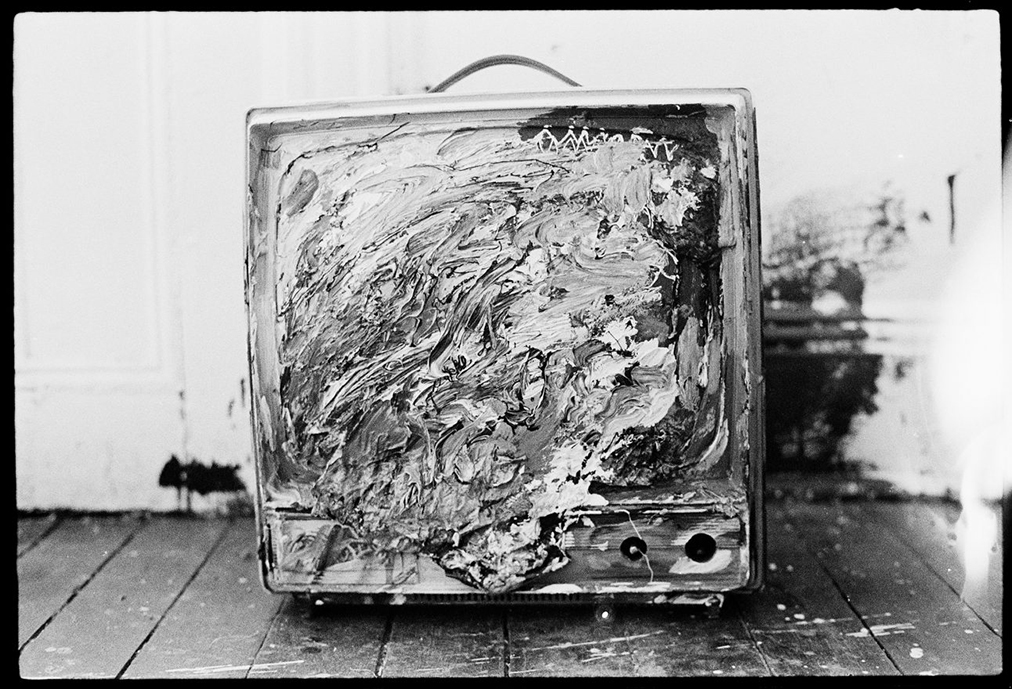
Alexis Adler, Painted television in the apartment, c.-1979–1980. It’s amazing this Photo of the work exists, but I would love to see it in color because there’s nothing else like this in his subsequent Paintings!

Ms. Adler, who spoke about having her ear to the ground and priding herself on being aware of what was coming next, said she “knew” J-MB was an important Artist almost immediately. “He said he would. I was definitely the first one to believe him. Everyone else was like, ‘Sure Jean.’ He was brilliant. I could tell. His spirit — everything about him. He was an amazing person, a very deep-thinking individual.” It’s only because she acted on that feeling and bought a camera that we have a record of these works which would otherwise be lost to history.

Alexis Adler, Refrigerator in the apartment, ca. 1979-80, Untitled (Famous Negro Athletes), 1980-81, left to right.

Seeing the show, I came to feel that this early period of J-MB should be appreciated as a “period” of his work every bit as much as his later work has been broken down into periods. It stands apart. While it’s formative and precocious and different from what he’s “famous” for, it’s a part of the whole. It has the same spirit of freedom, of experimentation, the unexpected, of seeing new possibilities that characterize all his work.

Lee Jaffe was a Musician at the time who had just recorded and performed with Bob Marley when he met J-MB. The two struck up a friendship and traveled extensively together. In the fifth and last show I saw, Lee Jaffe’s Photographs of J-MB at Eva Presenhuber Gallery, show him in relaxed settings, where the Artist is just being himself. He’s seen as just another tourist, mugging with other tourists, and looking extremely at ease.

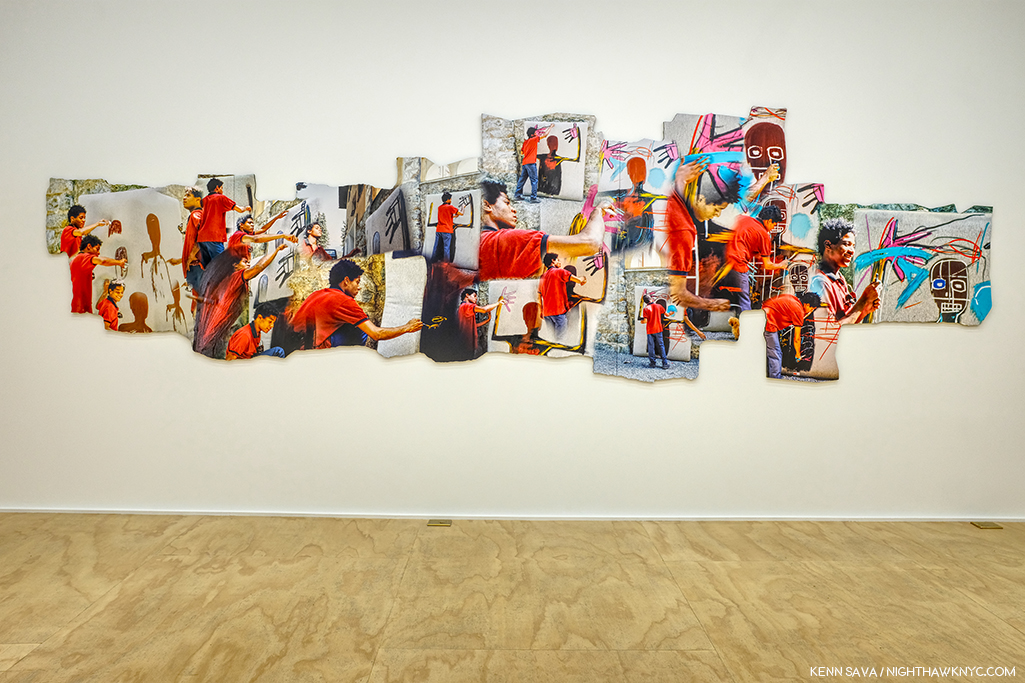
Lee Jaffe, Jean-Michel Painting in St. Moritz, 1983-2019, Dye sublimation on aluminum, 60 x 209 inches.

The highlight of Mr. Jaffe’s show for me was this fascinating montage showing J-MB creating a work in St. Moritz, virtually from start to finish, something I don’t recall seeing anywhere else.

Four Untitled works, 1985, far left, with three black & white works from 1984-2019. J-MB, as a real person. About two hundred feet behind that wall on the right, Jean-Michel Basquiat lived from 1983, until he died, on August 12th, 1988.

Somehow, these images felt jarring to me after reading so much drama-soaked biography and anecdote. Compounding this “reality,” ironically, the show was installed at 39 Great Jones Street, just a few doors west of 57 Great Jones Street, where J-MB lived, and died, which I showed at the very beginning of Part 1 of this series, bringing this five-month journey full circle.

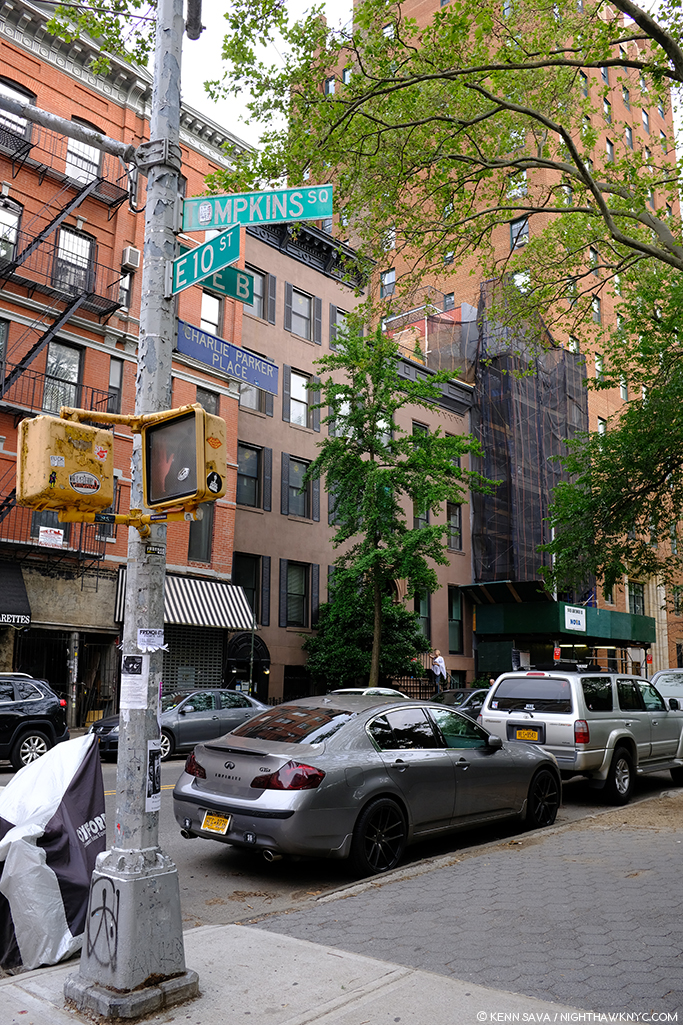
Coincidentally, right around the corner from The Brant, on B and East 10th Street, is Charlie Parker Place, where Bird lived from 1950 to 1954, in the building to the right with the woman in white on the stairs. May, 2019.

A few weeks after seeing The Brant show, I took a trip to “Charlie Parker Place,” on Avenue B where Bird lived from 1950 to 1954. Taking stock of everything I’d seen, I sat across the street in Tompkins Square Park and listened to Bird, trying to hear him through J-MB’s ears. The soaring, unexpected majesty, the spontaneous “flights” of imagination, the beauty (much of it created in the sordid world of 1940s nightclubs, rife with drugs, crime and of course alcohol), the daring, the guts to be different, to be yourself…to be free, inside yourself, and then outside. I was sitting a mere 4 blocks from The Brant Foundation, and around the corner from where J-MB lived with Alexis Adler. As such, ironically, I was at a sort of center of this whole journey I’d been on, right across the street from Bird’s former residence, a man who’s been a part of my evolution, too.

I kept thinking back to the fact that J-MB lost his spleen, his (blood) filter, when he was hit by a car at age 6. That’s what his work looks like. It includes everything, everything around him, at the time, or in his experience. So much is going on in modern life, how else can you really depict it? The only “filter” in the work of Jean-Michel Basquiat is that of his unique eye and sensibility.

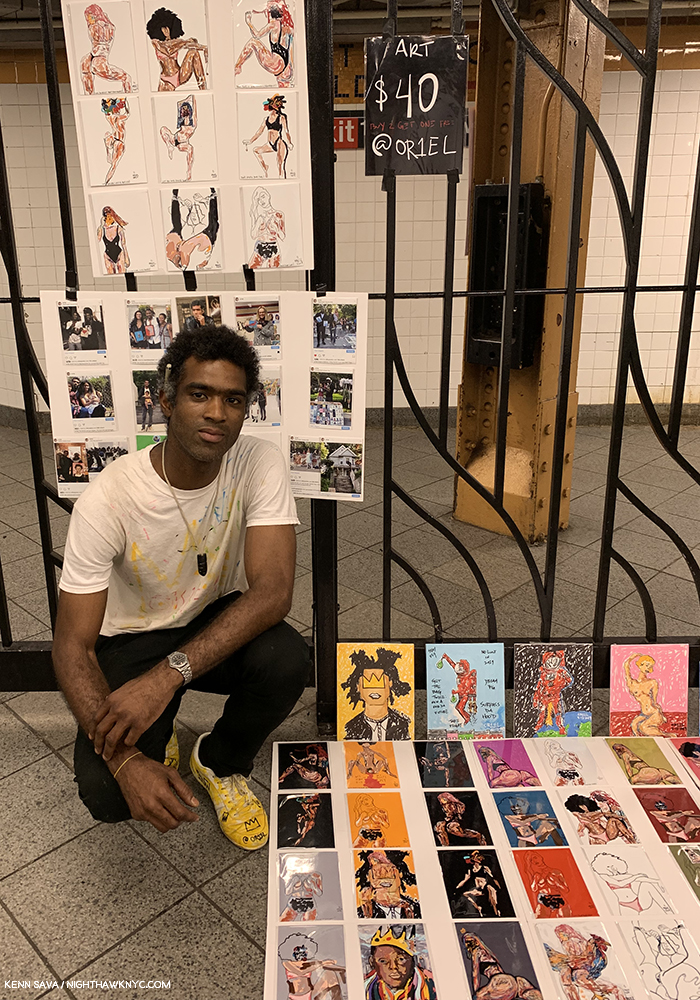
The Artist @OR1EL poses with his work which includes what appears to be a Portrait of Jean-Michel Basquiat next to his left knee. I note a J-MB Crown on his left shoe. Seen at the 8th Avenue L Station- 4 stations west of the L station Michael Stewart was arrested in, May 28, 2019.

Alas, Jean-Michel Basquiat isn’t 59 right now. He’s a ghost, a spirit. His Art is only 31 to 40 years old. It remains very much alive- speaking to, and moving, an extraordinary number of people. In the 31 years since his own tragic end his influence seems to still be increasing.

Charlie Parker Place, June 7, 2019.

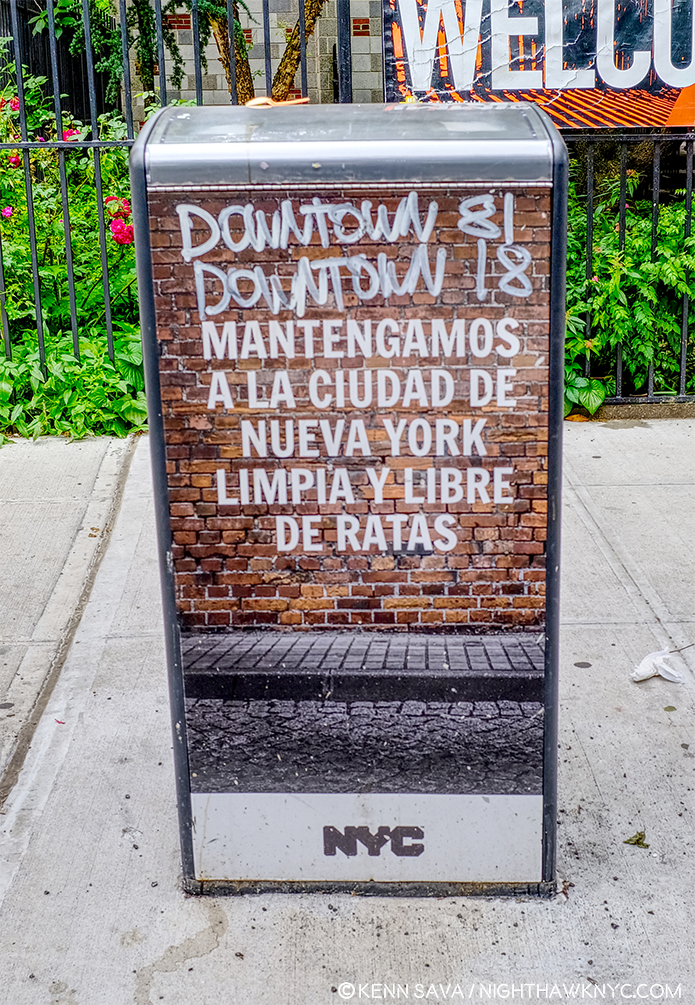
As I left Charlie Parker Place that June day, I was startled to see what someone had written on a newspaper box right on the corner. Downtown 81 is the film that J-MB starred in made in 1980-81, a still from which I showed at the beginning of this piece. In the same style as the Film’s logo, someone had appended “DOWNTOWN 18.” Jean-Michel Basquiat learned from those who came before him, and today others are learning from him.

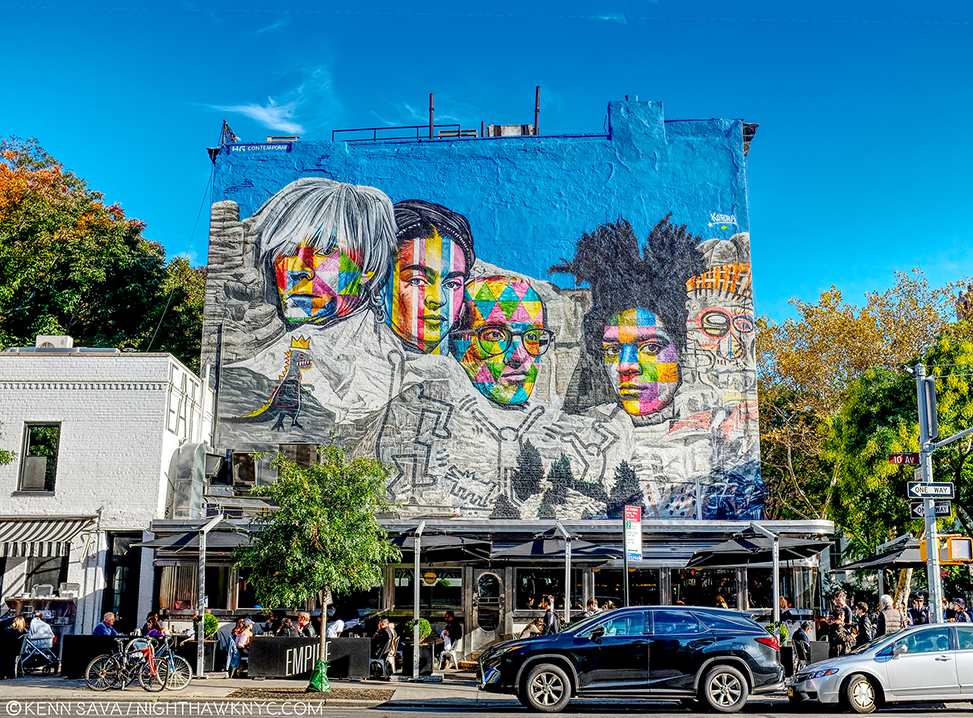
Portraits of Jean-Michel Basquiat and his associates Keith Haring and Andy Warhol flank Frida Kahlo at 22nd Street & 10th Avenue in Chelsea, looming over the Chelsea Art galleries behind me.

Art history is a continuum. Pass it on.

To answer that question I asked in Part 1– Over these past five months, five shows, all the books, and now three long pieces on his Art, I have come to side with the believers. I’ve come to believe that Jean-Michel Basquiat was, perhaps, the most important Painter known to me to emerge in the 1980s. His work is here to stay.

Postscript-
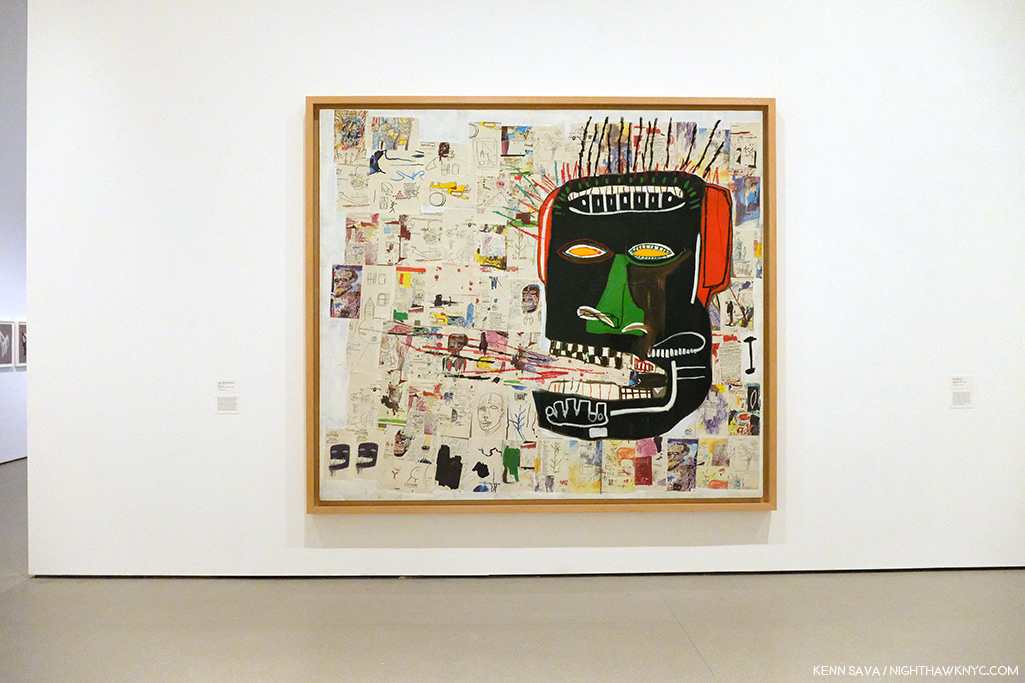
It turns out I’m not the only one who’s come around to the Art of Jean-Michel Basquiat. Tonight, I went the Preview for the “New MoMA.” And, lo and behold in one of the very first galleries on the 2nd floor, I saw this-

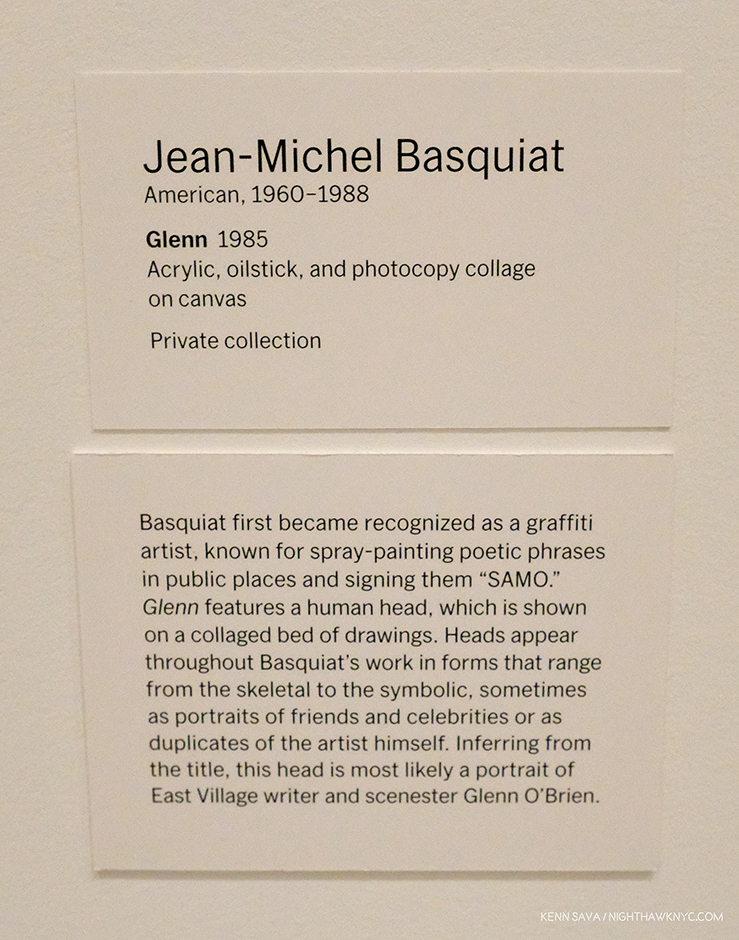
Well? They borrowed it from a “Private Collection.” But, that it’s here is a big statement, and possibly a reversal of their assessment I wrote about way back in Part 1. Now? It appears they feel it’s not only “worth the storage space,” his work is worth giving pride of place to, too. By the way? It’s clear that MoMA’s researchers need to take heed from J-MB’s own words that he was “not a graffiti artist,” which I quoted in Part 1. They also left out that Glenn O’Brien wrote the screenplay for Downtown ’81, which I showed a still from up top. He cast him in the Film after featuring J-MB regularly on his cable access show…which brings this piece full circle, too.

– Soundtrack for this Post is “Donna Lee’ by Charlie Parker as performed by the Charlie Parker All Stars featuring the legendary Bud Powell on piano and that other immortal of Music, Miles Davis, on trumpet. Miles was 21(!) when this recording was made, live, on August 5, 1947. In 1976, when I was coming up as a bassist, another genius, Jaco Pastorius, (to my mind, the “Jimi Hendrix of the bass), blew everyone’s minds by beginning his debut solo album with a performance of “Donna Lee” on his bass. Jaco, who I met and spoke with over the years, was tragically killed in September, 1987 at at 35, less than a year before J-MB’s death. Both performances are pillars of the Art of Music. Here’s Bird & Miles-

*My thanks to to Alexis Adler, May Yeung of the Guggenheim Museum, and to Lisa for pulling my coat to Alexis Adler’s talk.

This is Part 3 of my series on the five Jean-Michel Basquiat and related shows going on in NYC this year. Parts 1 & 2 are under this one, or here and here

NighthawkNYC.com has been entirely self-funded and ad-free for over 6 years, during which over 250 full length pieces have been published. If you’ve found it worthwhile, you can donate to keep it going & ad-free below. Thank you!

Written & photographed by Kenn Sava for nighthawknyc.com unless otherwise credited.
To send comments, thoughts, feedback or propositions click here.
Click the white box on the upper right for the archives or to search them.
For “short takes” and additional pictures, follow @nighthawk_nyc on Instagram.

Subscribe to be notified of new Posts below. Your information will be used for no other purpose.


  1. Henry Geldzahler was the former Curator for American Art at The Met, later Commissioner of Cultural Affairs for NYC. He interviewed J-MB in January 1983, for Andy Warhol’s Interview Magazine, as reprinted in Jean-Michel Basquiat, published by Charta, 1999, P.LIX,
  2. Whitney Retrospective Catalog, P.243
  3. from an interview with Suzanne Mallouk.
  4. Defacement Exhibition catalog, P.19
  5. Defacement Exhibition catalog, P.104
  6. Here, footnote 22.
  7. I wasn’t able to get to the sixth show, Basquiat x Warhol, which was 3 hours outside of NYC.

Jean-Michel Basquiat At The Brant Foundation

Written & Photographed by Kenn Sava

This is Part 2 of my series on the five Jean-Michel Basquiat related shows going on in NYC in 2019. Part 1 is below, or here.

Show seen: Jean-Michel Basquiat at the Brant Foundation, 2019

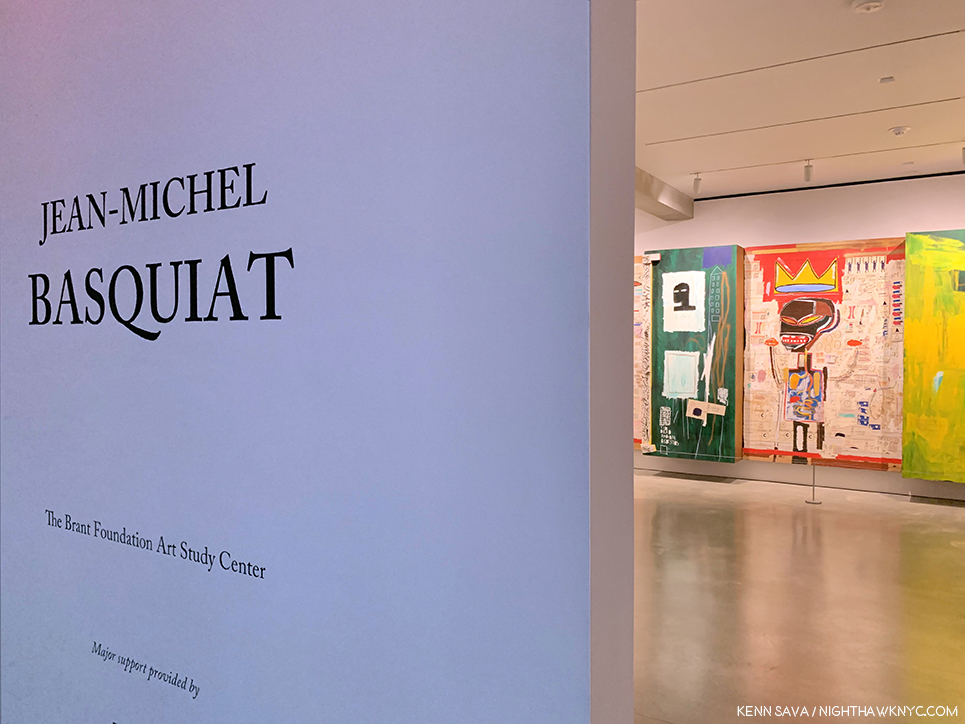
Outside looking in. The most important show in NYC known to me thus far this year was a show I would be extremely fortunate to see.

Jean-Michel Basquiat, the first exhibition at The Brant Foundation’s new East Village location is a NoteWorthy show because it is a major, museum-quality show mounted at a private institution of the work of a single major Artist with more Paintings on view than all the major NYC institutions, combined, could mount- multiplied twelve-fold. This led me to wonder- What other major Artist-Contemporary, Modern, or Old Master- has so much of their work, and so many of their major pieces in private hands?

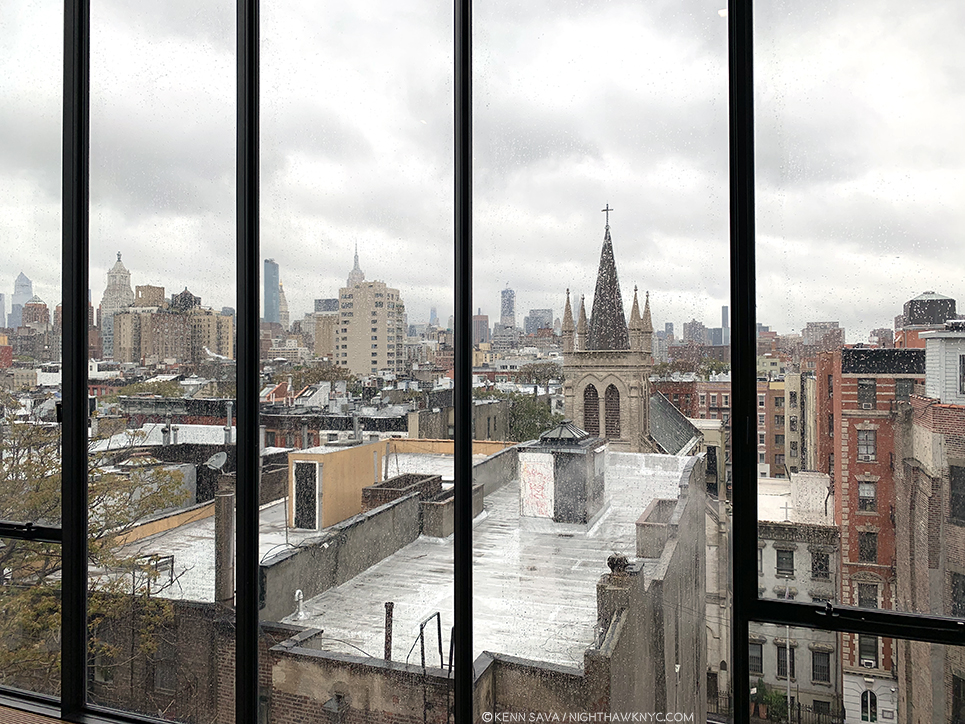
The East Village, NYC, May 13, 2019. Looking towards the Empire State Building (rear, left of center). Bad weather, no ticket for the show, no sleep, no umbrella. It was going to take more than that to keep me from seeing this show, AND something close to a miracle to allow me to do so.

It’s easy to have mixed feelings about this. I’ve read some complain that it’s another case of the 1% at its worst; that this show is a case of the very rich showing off. On the other hand, it seems to me that there is a stronger case to be made admiring the vision, and the guts, of the collectors who stepped up and bought much of the work of Jean-Michel Basquiat (J-MB henceforth) when he needed it most, not to mention go through the trouble of sharing it with the public, who, in the case of Jean-Michel Basquiat’s Art, are largely dependent on them doing so to be able to see it. Showing off? Yeah. I guess.

Almost every Artist in the early stages of their career needs the support of buyers and collectors to survive and to continue to create. Yet, it’s also easy to forget that most of these  collectors possibly also bought Art by Artists that have long since been forgotten, (which is one reason I strongly believe in only buying Art you love– if it becomes worth less- even substantially less- than you paid for it? You can always display it and enjoy it.) And? As I wrote in part 1 of this series, the NYC museums, except the Whitney, collectively passed on his work at the time- and continue to do so. The only way they’re likely to fix that now is by gift or donation. The affordability train has long ago left the station for anyone else besides that 1%. The Big 41 had their chance. In the case of some institutions- chanceS, as I outlined.

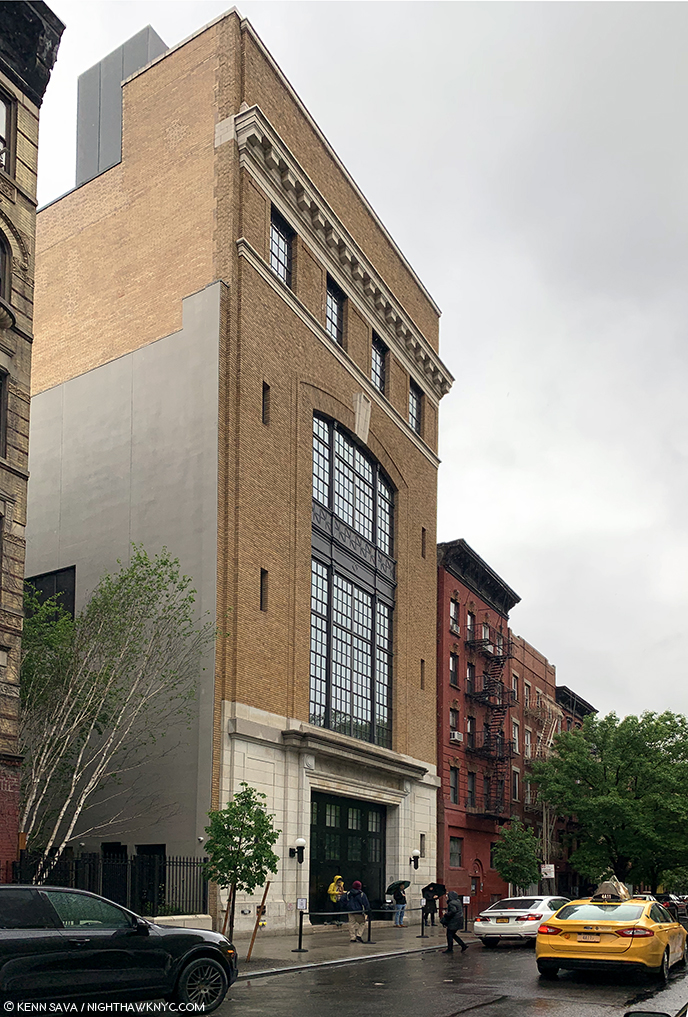
Unnamed on the exterior, in classic East Village cool, The Brant Foundation, 421 East 6th Street, 10am, Monday, May 13, 2019. If I’m up at 10am, and not STILL up, you know there’s a special reason why. That cab exiting stage right is leaving with my umbrella. See ya.

At The Brant Foundation, a show of 70 Paintings and 1 Sculpture was on view, making it the largest show of Basquiat’s Paintings in NYC since the Brooklyn Museum’s Basquiat Retrospective in 2005, which I saw. Combined with the Basquiat work in the other five 2019 shows, the total approximately equals how many were shown in Brooklyn in 2005. The Brant show largely includes work in the collections of Stephanie and Peter Brant, alongside pieces on loan from the Broad Museum, (a private museum of the collection of another early collector, Eli Broad, who own at least of 13 of J-MB’s Paintings), among other significant loans. Since so much of his work is in private hands who knows how long it will be before we see a bigger or similar number of J-MB’s work here again. So, the six Jean-Michel Basquiat related shows in NYC and vicinity this year (counting the Warhol x Basquiat show going on in Kinderhook, NY, which proved too far for me to get to) might be the best chance I’m going to get to reassess and reconsider his work that it’s barely been 40 years since he began creating it.

The first order of business was getting in to The Brant show and actually seeing it. After all my efforts to get a ticket failed, I resorted to drastic measures. I took the unprecedented step of getting up with 3 hours sleep at 9am and going down to The Brant on May 13th, the last day the show was open, or the day before it closed- I’m still not sure. As I got there at 10am, right as it opened and visitors for the the first timed slots were arriving, I quickly realized this was going to take an act of fate. Compounding things, it was raining and I’d left my umbrella in the cab. I decided to take a Zen approach and stand off to the side, where that tree is to the left, above, and see what happened.

About 30 minutes later, Jessie, the on-top of everything Brant staff person manning the entrance, who knew I was casting my lot to fate, called me over from the door. A lady had arrived and told him she had an extra ticket. Really? A real-life Angel of Providence had appeared when I SERIOUSLY needed one. I walked over and met Lisa, and yes, she had an extra ticket that she was willing to let me use. Miracles really do happen. The fact this piece exists is solely due to her generosity. Seeing it over the 3 and a half hours I spent in it allowed me to flesh out the portrait of Jean-Michel Basquiat’s accomplishment that began for me at Xerox, adding the best look at his most important work I’m likely to get. Any assessment of J-MB’s work and achievement begins with his Paintings. I’d seen 100 works in 2005 at the Brooklyn Retrospective, but I hadn’t prepared to see them. Now IS the time. Lisa’s generosity not only enabled me to create this piece, it also permits me to create the multi-part series on 5 of the 6 Basquiat-related shows I wanted to do, now that she made it possible for me to see the “centerpiece” show of the group. I’m also grateful to Jessie for thinking of me. Due to both of their kindness and consideration, I am thrilled to be able to share what I saw with you.

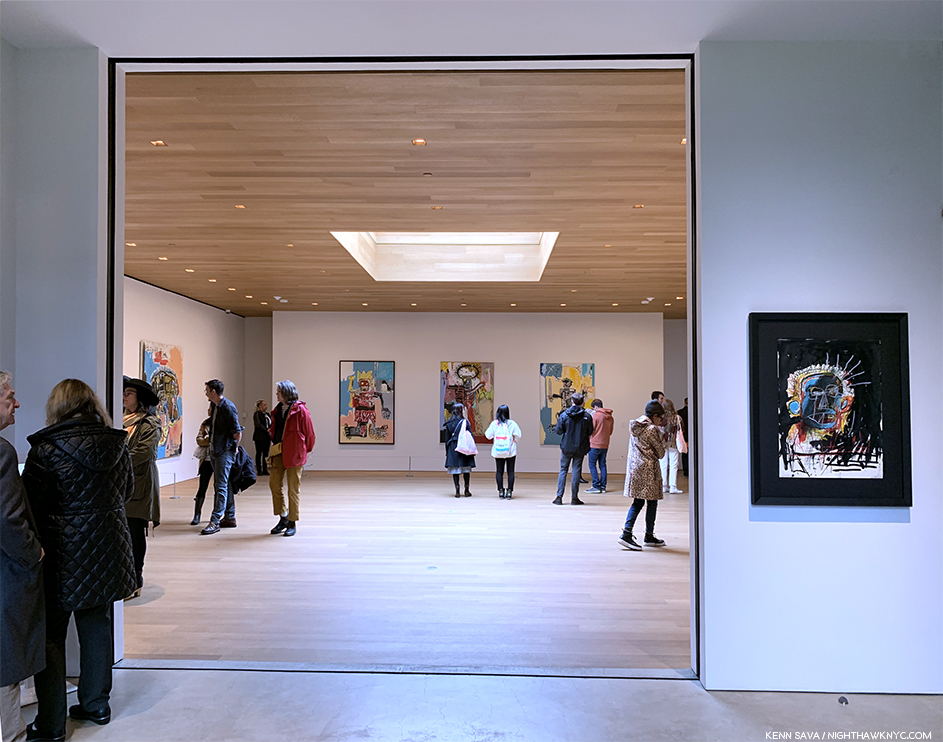
For a while, it looked like I wasn’t going to get to see this. Standing at the entrance to the show- the lobby of the 4th floor, just after exiting the elevator 90 degrees to the right.  You can see the variance in the lighting in the main gallery from here. Outside, to the right of center is Untitled (Self-Portrait), 1982.

The elevator took us to the 4th floor, where everyone starts and then walks down to the floors below, the show being installed on all 4 floors. It should be said that the group of new visitors getting off the elevator each time on 4 was surprisingly small. The galleries were pretty sparsely filled- incredibly so for a major show on either it’s last day or next to last day. Well, there was well over 1 billion dollars of Art on display, so they opted to keep the crowd manageable.

Untitled (Self-Portrait), 1982, Oilstick and ink on paper, 30 x 22 inches. The first work in the show.

Though the urge might have been to hurry into the large, main gallery shown above, I was stopped in my tracks by the work hanging to the right just outside. There was Untitled (Self-Portrait), 1982, one of the most unique Self Portraits I’ve ever seen. I wondered what Picasso would have thought of it. The colors, and then particularly the black background fascinates me as I ponder at what stage J-MB added it. And then I wondered what Clyfford Still would think of it. Like a number of J-MB’s “heads” from 1981-2, he flattens everything to the picture plane, something not seen all that often in Art. 4 floors of J-MB still to go. What an auspicious start!

A real-life Angel of Providence. Lisa studying Self-Portrait with Suzanne, 1982, in the main gallery on 4.

It turns out that Lisa is a school teacher and an Art lover with superb, wide-ranging, taste that runs from Brancusi through Morton Feldman as I found out as we chatted while going in.

Self-Portrait with Suzanne, 1982. The compelling work Lisa studies above shows the artist with Suzanne Mallouk, the subject of Widow Basquiat, in 2010. It’s the only work known to me created by J-MB showing the Artist with one of his lovers. Beyond this, it’s fascinating to study the way he’s rendered himself here compared with the other “heads” and Self-Portraits from 1981-2.

Before I get too far into the show, I’ll say the building looked brand new, the restoration of the former Con Ed Substation being first class from top to bottom. I have mixed feeling about it’s suitability for the display of Art, but honestly, I get some of those feelings almost everywhere I see Art. In my experience, the #1 problem in seeing art is lighting, combined with the scarcity of truly non-glare glass or acrylic. As my friend, Corinne, co-owner of NYC’s legendary City Frame, tells me- currently, it’s expensive. Then again, not all Painting is glazed. Increasingly, Artists, including Raymond Pettibon and Kara Walker, and Photographers, including Gregory Halpern, have shown their work without frames, often just tacking it to the walls at the corners. Still, glazed or not, lighting- artificial or natural, is a problem that rears its head in almost every show I see. The same was the case at The Brant.

I don’t care how rich I was, I don’t think I’d install a pool over irreplaceable Art.

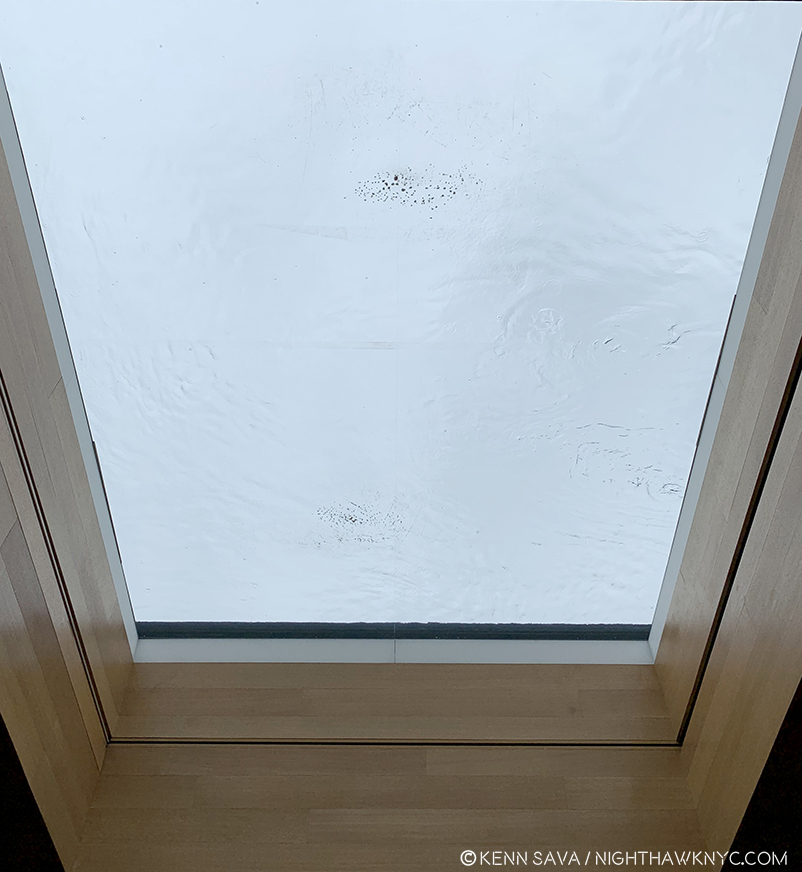
The fourth floor is the top floor and features a skylight, apparently, filled with water- unless this had collected from the rain? I don’t know. They must either have Lloyd’s of London insurance, 8 million tons of confidence in whoever installed it, or both, to hang a few hundred million dollars worth of one of a kind Art underneath it, including more than one of J-MB’s greatest works, in my opinion. But, beyond this, being a cloudy, rainy, day, the large skylight wasn’t letting in as much light as it might have at other times.

Hanging a few feet from the skylight/pool (as you can see in the installation view earlier) is Untitled, 1981, acrylic and oil stick on canvas, 81 x 69 1/4 inches, from The Broad, L.A., the upper half of which was in a shadow during my visit.

Typical of all the works on view in this room, the upper half of Untitled, 1981, on loan from The Broad in LA was in a shadow. Still, the power of seeing this work in person was staggering. I took all of it in from a distance when I first saw it, then walked over to see the other works in the room. Finally, I walked back over to look closely at it at length.

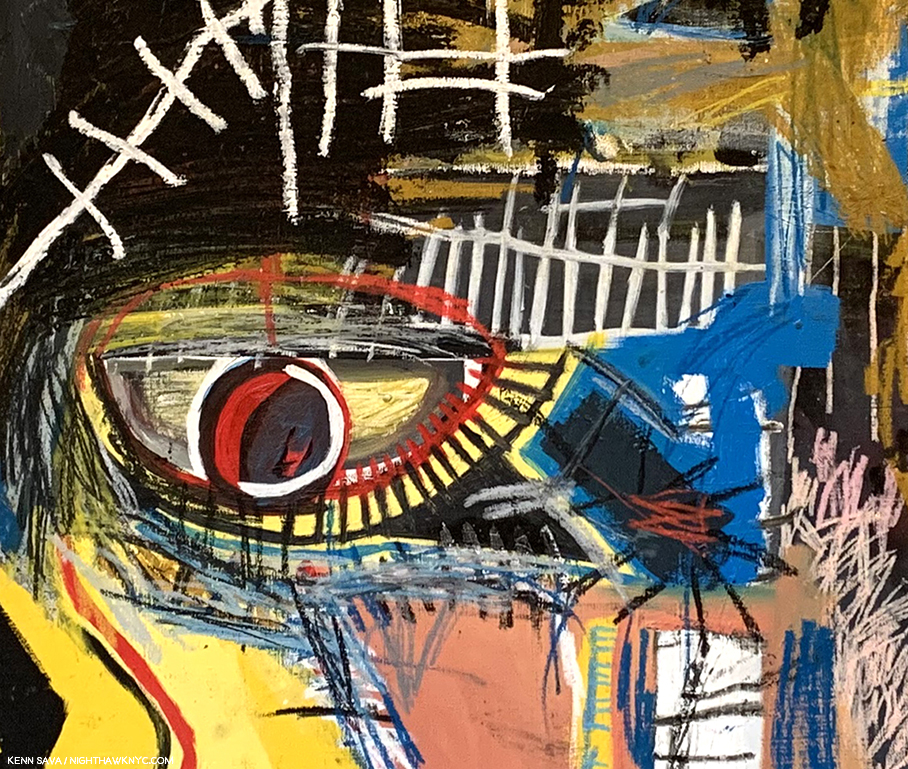
Detail of Untitled, 1981.

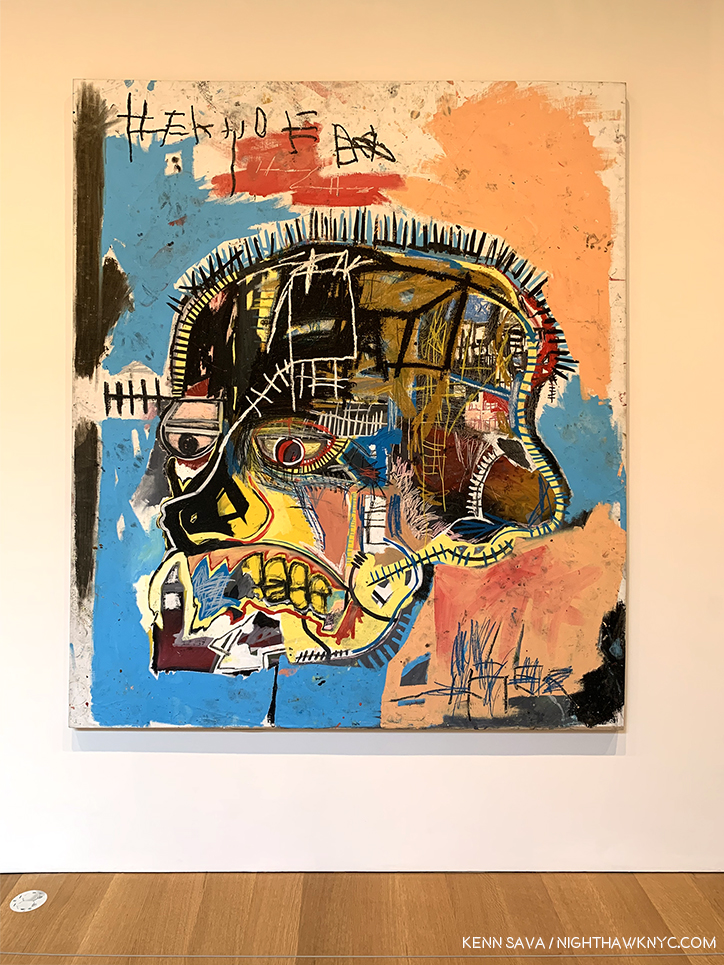
The difference in the experiences is remarkable, as you can see. But, no matter how closely I looked, minding the security rope you can see at the very bottom of the picture above, it was still drawing me closer. Like a Rembrandt, or Van Gogh, where I’d like to study each brushstroke for it’s content, here I was being drawn in to look at each detail. The feeling I got was that each small part of it was a world unto itself, yet irrevocably part of the whole. What, exactly, are we seeing? It’s not a skull because there are eyes and there is hair, at least part of a beard, and some teeth, though others are missing. And there are what appear to be stitches and possibly some letters over all of it- a cryptic message, like the figure, in a language no one had ever seen before. (Compare this to the work on view in Xerox that I looked at in the first Part! There, the details were, largely, words.) This is 1981- a year after the first show the work of J-MB appeared in. It’s a work from near the beginning of his post-SAMO© career as an Artist. And, it’s one of the most remarkable shots across the bow in Art history, possibly since Picasso’s Les Damoiselles or Duchamp’s Bride Stripped Bare. When I’ve seen it in books, I haven’t been able to stop looking at it. Seeing it in person it felt like I’d never really seen it. But, even saying that? There’s literally nothing like this in Western Art history to 1981. In his book, The Art of J-MB, Fred Hoffman makes a case for this being among J-MB’s “key” works. I don’t have a list, but I won’t argue with that. I just keep wondering if Francis Bacon, who outlived J-MB, passing away in 1992, saw it and what he thought, or would think, of it.

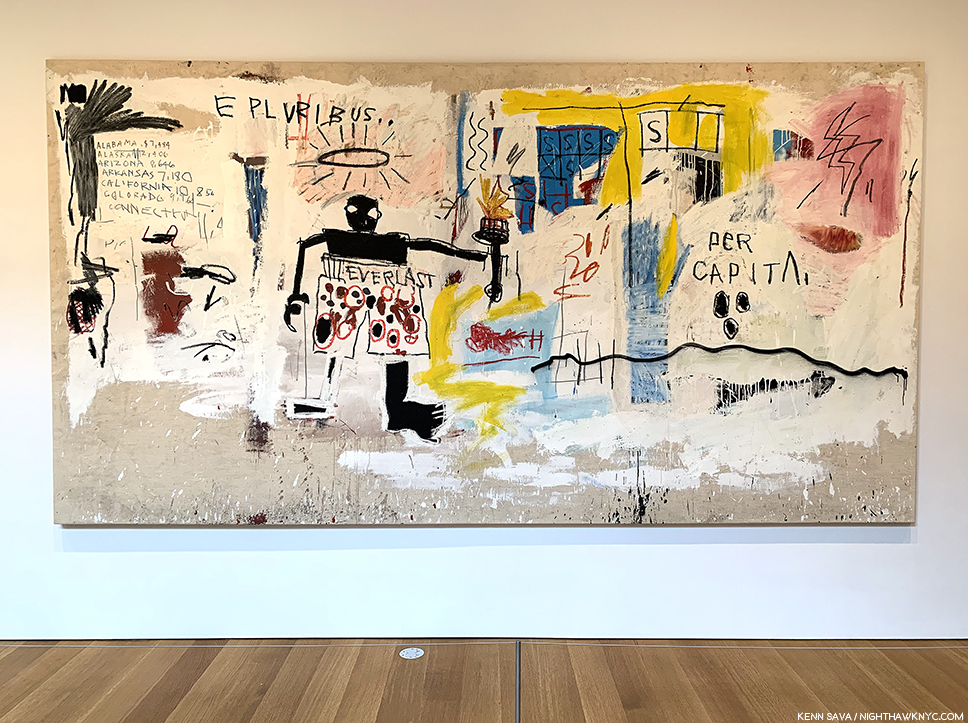
Per Capita, 1981

Across from Untitled was the incredible Per Capita, also from 1981, with it’s central figure in Everlast boxing trunks, a halo over his head and his outstretched left arm holding a torch that sure looks to me like that of the Statue of Liberty. Over the halo are the words, “E PLURIBUS…,” or, “out of many,” leaving out the equally famous, “UNUM,” or “one.” The title (which may or may not be the Artist’s title- I simply don’t know), “Per Capita,” means, “per unit of population; per person,” in one definition, per American Heritage Dictionary, and “equally to each individual,” in another. Along the left side appears to be the beginning of an alphabetical list of states with the per capita income of its citizen next to them. Even on a partial list, that manages to include states in 3 of the 4 corners of the country, the variance is striking. Fred Hoffman wrote at length about this piece in his essay in the catalog for the 2005 Brooklyn Museum Retrospective, where he also listed it among J-MB’s key works, where he says the central figure is Cassius Clay, as Muhammad Ali was known when he won the gold medal at the 1960 Olympics (The Art of J-MB, P.129.), which could also make that an Olympic torch.

As I looked at this fascinating work, I couldn’t help wonder if the “UNUM,” or “one” E PLURIBUS was seeking with its … was the solitary figure, as in “Out of many, THIS one.” J-MB’s love of boxers is well known and was to be seen in most of an entire gallery on the 2nd floor, as well as in his portrait (in which he wears Everlast boxing trunks) in the famous Warhol*Basquiat poster for their joint show a few years later in 1985 at Tony Shafrazi Gallery, which could also make this a Self-Portrait.

It’s hard to write about this show and not include every work in it- many are major, many others important for any one of a number of reasons, and they all deserve mention.

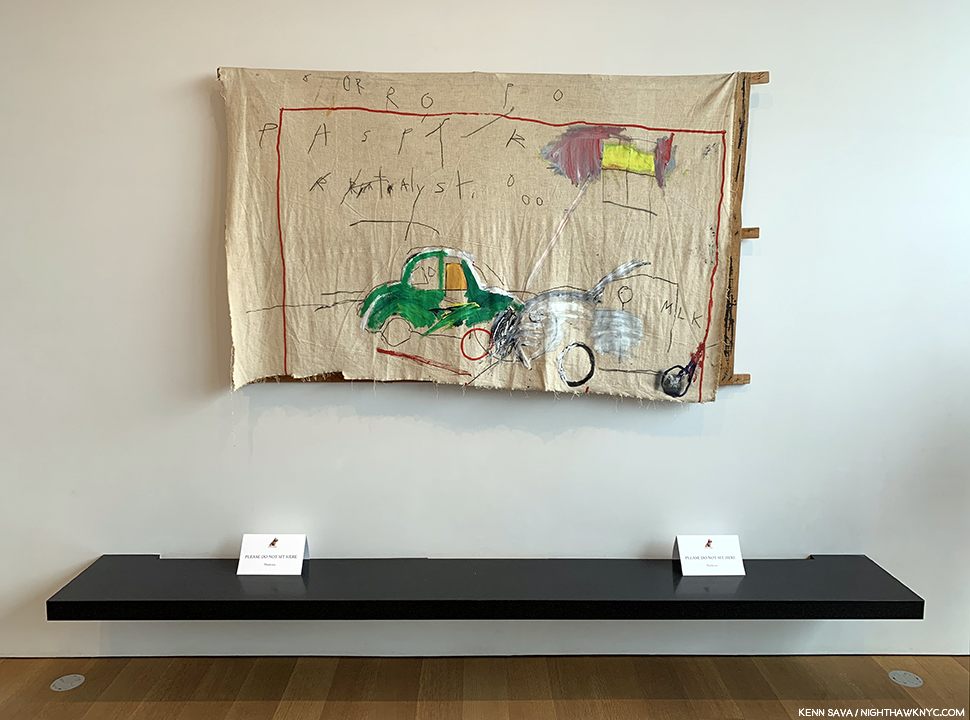
Untitled (Car Crash), 1980, Acrylic and lipstick on canvas with exposed wood supports. So much of J-MB’s story and his Painting begins in this work where he recreates the accident where he was hit by a car at age 6 that hospitalized him for a month and caused the loss of his spleen. Seen in the small rear gallery on 4.

On 4, there was also a small rear gallery along the rear of the building. Here, too, lighting was a question. The far wall was lined with a floor to ceiling window, which, you guessed it, let in a lot of light- even on this dreary day. I have no idea if they cover it/partially cover it in full sun.

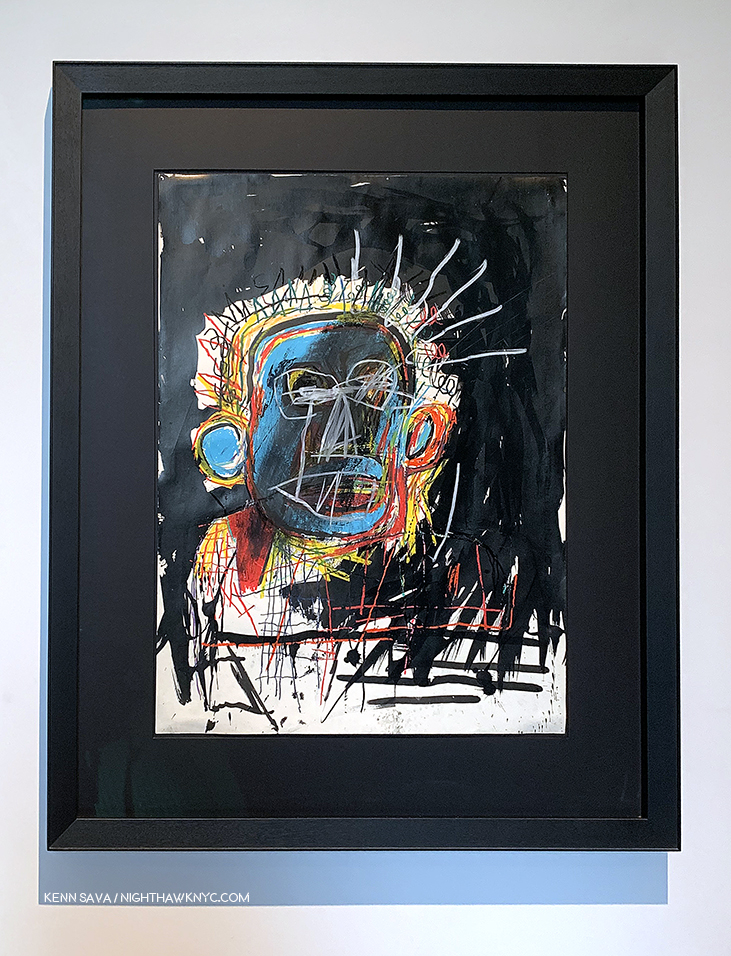
Untitled, 1981, Oilstick on paper. Seen in the small, gallery in the back of the 4th floor. There’s so much that’s revolutionary in this extraordinary work, and at the same time it gives us another take on the two Untitled (Head) Paintings in the show, this time the “head” is seen from the front and not from an angle and has been flattened, like the picture plane. The right side is almost Cubist.

Down on 3, the lighting was better.

3rd floor. Installation view.

The main source of natural light being another picture window, but this time it was at the end of a large rectangular space and didn’t interfere with the most of the large works on view, including this one-

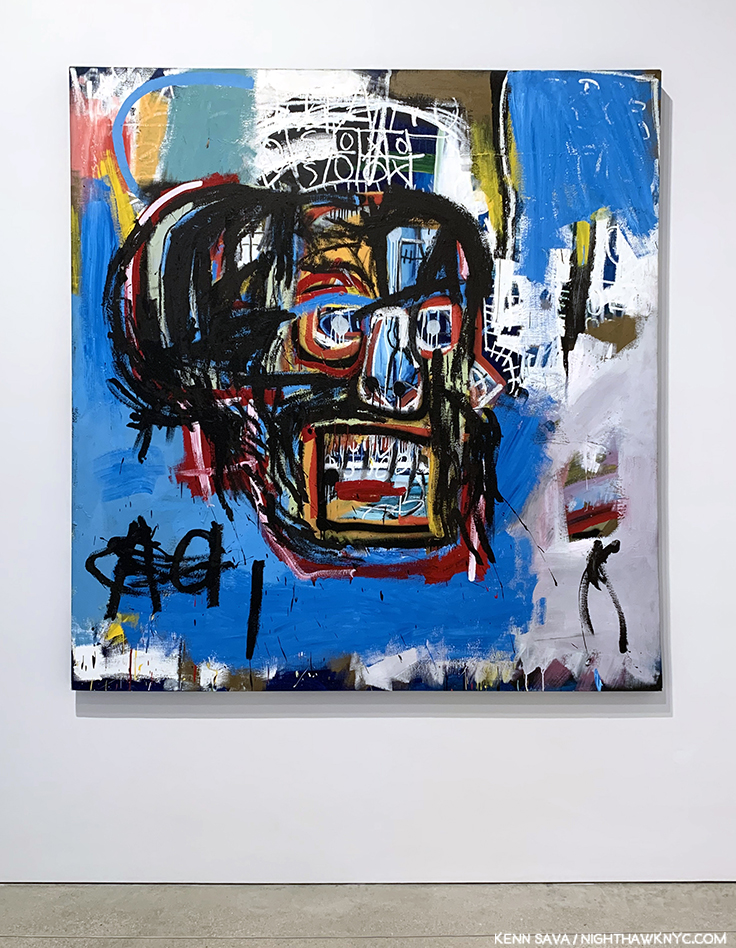
Untitled, 1982, now in the collection of Yusaku Maezawa, while on loan to the Jean-Michel Basquiat exhibition at The Brant Foundation, May 13, 2019.

In May, 2017, this Painting, Untitled, 1982, by Jean-Michel Basquiat sold at Sotheby’s for 110.5 million dollars. As someone who prefers to consider Art for what it is without the shadow of dollars, as much as possible, this fact gives even me pause for thought. Here it was, on a corner wall of the third floor, appearing as another work in the show as opposed to something “special.” I applaud this decision.

Do I think it’s “worth” 110.5 million dollars? Anything is worth only what someone is willing to pay for it (And, there were multiple bidders for it). Given that the question of whether something is, or isn’t “Art” won’t be settled during any of our lifetimes, only hundreds of years hence if the work continues to speak to people, the question of commerce- supply and demand, is what is rearing its head in Contemporary Art auctions, in my view. Jean-Michel Basquiat’s public career as an Artist only lasted a few months over 8 years, from June, 1980 to his death on August 12, 1988. Though he was extraordinarily prolific during that time, creating 1,000 Paintings and 2,000 Drawings2, included in it are only so many major works (a number that I personally feel is larger than some others seem to think), and Untitled, 1982, happens to be one, in my view. Looking at the lists of the highest prices paid at auction for Art reveals that many, if not most, of them are the best works available as most of the major work by established Artists of, say, Picasso’s time or earlier (considering he passed away in 1973), are in museums which are not likely to part with them. The works auctioned are certainly not the most important works by any of the Artists on the list, as I’m sure most would agree (perhaps not the purchasers), though it’s subjective. The $110.5 million for Basquiat’s Untitled, 1982, is for a major Basquiat, in my opinion.

But, the more astonishing thing for me to realize (Hey? It’s not my money) is that at the time of the auction, in May, 2017, Jean-Michel Basquiat would have been 56 years old! Untitled, 1982, is a work he Painted when he was 21 or 22 years old. People talk about this sale marking the highest price ever paid for a work by an African-American Artist. Others mention the highest price ever paid for a work by any American Artist.

They never mention that this sale makes Jean-Michel Basquiat the YOUNGEST Artist in HISTORY to have a work sell for over 100 million dollars- either by age at the time of the sale (56), or age when he created the work(21-22)!

At 56 in 2017, he would be considered to be in “mid-career” as the museums call it. At 58, right now(!), he should still be every bit the vibrant, revolutionary force in Art he was for the 8 short years of his career. That he already feels like such a part of history is indicative of it being already thirty-one years, this August 12th, since his passing.

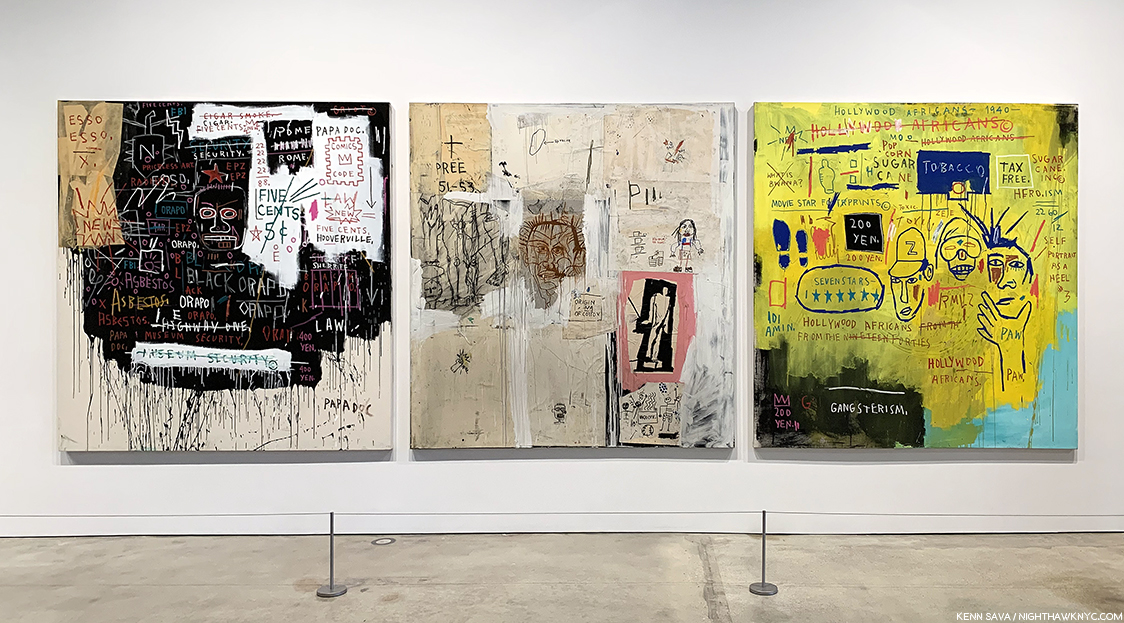
Museum Security (Broadway Meltdown), 1983, left, Big Shoes, 1983, Hollywood Africans, 1983, right, a work on loan from the Whitney Museum. The two to the left are in private collections. In 1983, after they were created, these three works hung on the same wall (with other works) at Larry Gagosian Gallery, LA, as is shown in the Whitney Retrospective catalog, P.251

Also on 3 was this striking group of three works, each from 1982, which included a work from an NYC museum!- Hollywood Africans, from the Whitney. These were fascinating contrasts to the collaged work on view at Xerox, Museum Security and Hollywood Africans both featuring words more than image, but were done exclusively in paint, as far as I could tell.

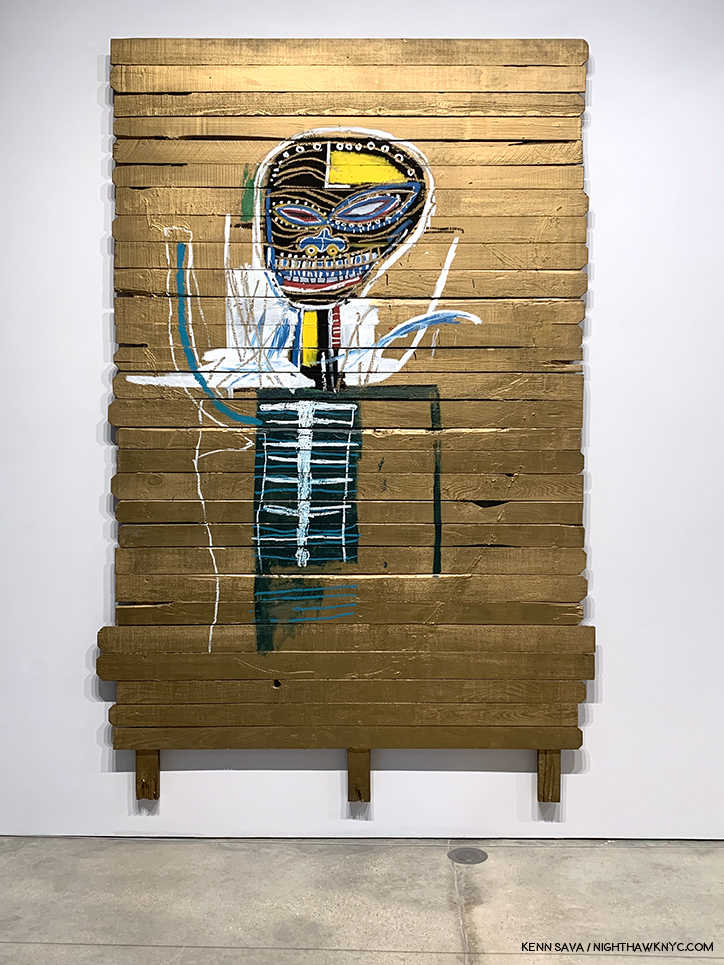
Gold Griot, 1984, Acrylic and oilstick on wood, 117 x 73 inches. You can get a sense of how big it is in the installation view, above.

The somewhat monumental Gold Griot is a very well known work and is memorably recalled in Fred Hoffman’s The Art of J-MB (P.63) as having originated from slat fencing (possibly that referred to in Phoebe Hoban’s book, P.140, that his assistant Matt Dike had acquired from a fence behind Larry Gagosian’s LA house). Mr. Hoffman’s book includes a picture of J-MB creating the work where we see the Painted head looks to be about 8 times larger than his own. Mr. Hoffman references Andy Warhol’s Gold Marilyn, 1962, in speaking of the work’s “pop” influence, with the figure isolated from the gold background, before saying, “The figure is as much a divine apparition as a living human being. With its ethereal gold background surface, the figure of Gold Griot pays homage to sculptural representations of the divine in various sub-Saharan African cultures.3.”

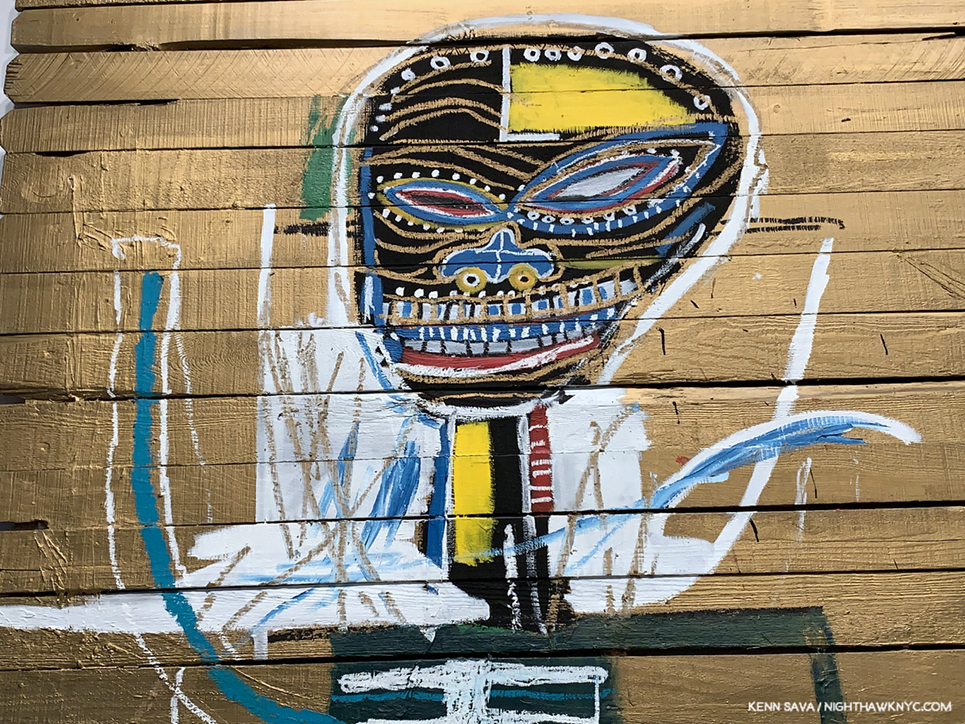
Detail of Gold Griot, 1984.

Looking closer, it’s fascinating to see how J-MB’s depiction of the head has evolved in 2 or 3 years. Gold Griot reminds me of the innovations of Robert Rauschenberg and Jasper Johns, when it comes to Painting surfaces, though it’s resolutely its own work.

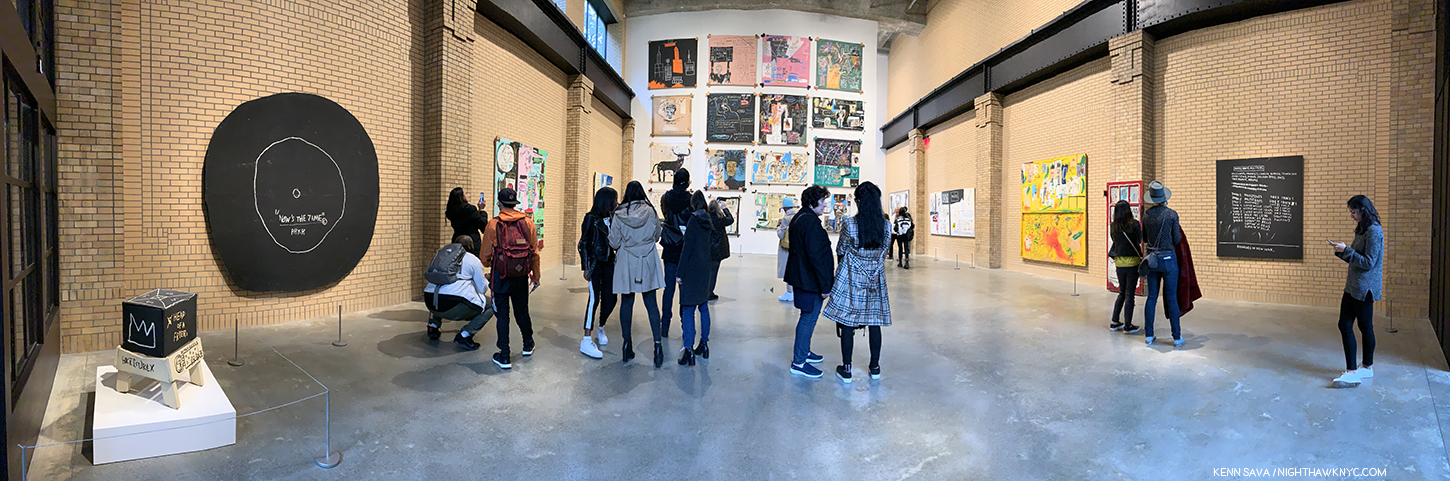
2nd floor. Installation view. The work on the immediate left is See Plate 3, 1982, Sculpture in two parts, Acrylic and oilstick on wood, canvas, mounted on wood, the only Sculpture displayed in the show.

The second floor is a bit of a strange space for displaying Paintings. A very tall space, which at first it seems more conducive to the work of monumental Sculptures, like Richard Serra’s, and lined with brick walls. The curators made it work, choosing to install the Paintings in a single row on the two side walls, then salon style on the third wall. While this made seeing the works in the top two rows challenging, it did allow for the maximum number of Paintings to be shown. As a result, I learned to live with it. In hindsight, I’d say they made the best use of the available space throughout the building, though I feel the building was less than ideal for this show because of the uneven lighting and the very high walls on the 2nd floor.

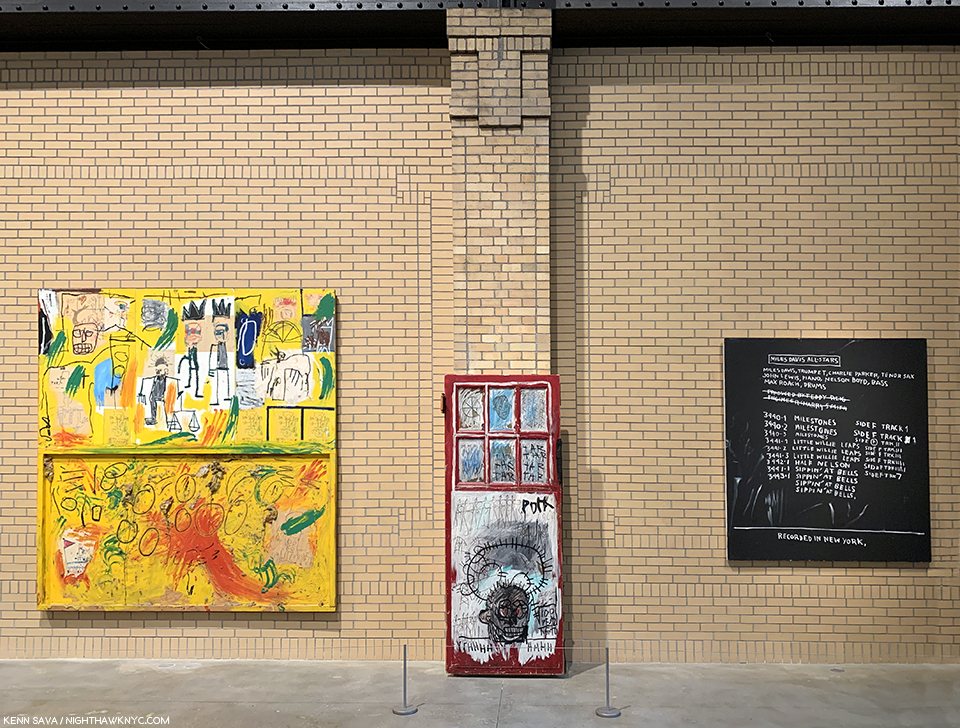
Untitled (Yellow Tar & Feathers), 1982, Pork, 1981, Discography II, 1983, left to right.

Along the sides, important works like Untitled (Yellow Tar & Feathers), 1982, were joined by others not as well known. Discography II contains a list of the details of a Miles Davis Allstars recording session which is historically noteworthy because Charlie Parker performed as a sideman for Miles for one of the only times in his career. To that point, Miles was exclusively a sideman for Bird.

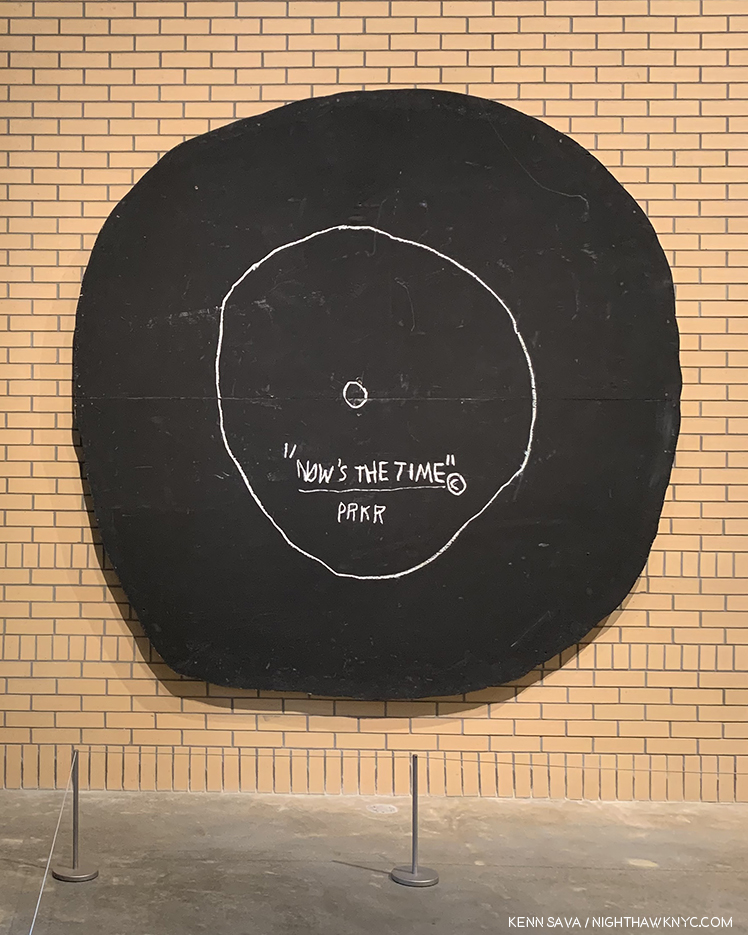
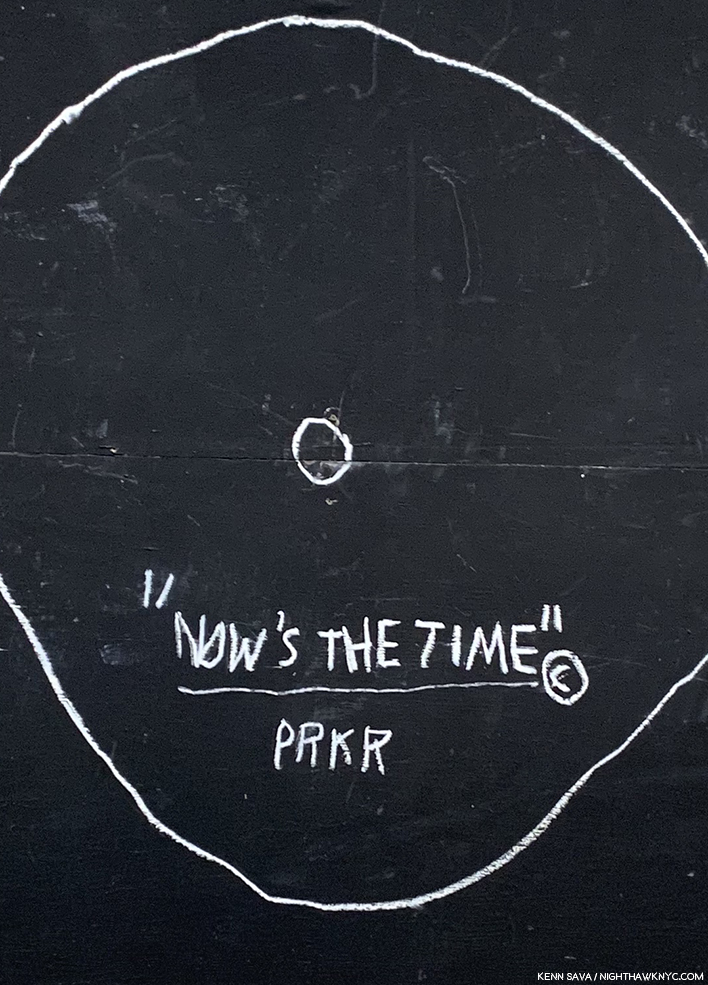
Now’s The Time, 1985, Oilstick and acrylic on plywood, 92 1/2 inches in diameter.

While on the opposite wall, the work referencing Jazz continued with the very cool Now’s The Time, 1985, an homage to the 1945 Charlie Parker record hangs. It also compliments the work on the large wall hung salon style, being they all have unique, experimental stretchers holding their canvases.

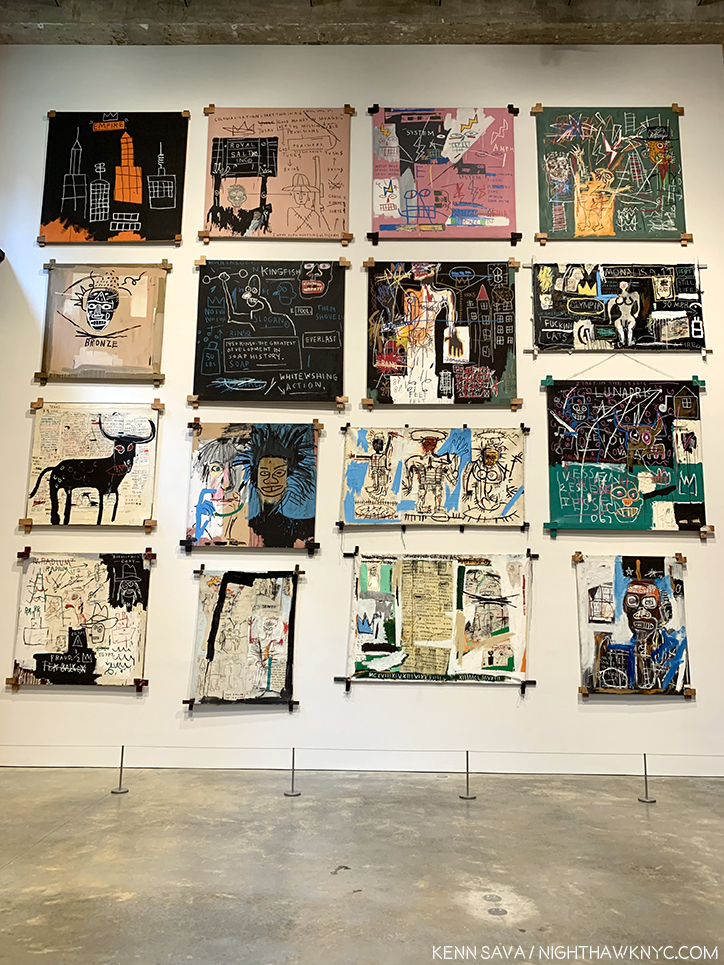
On the salon style wall, one thing each of its 16 works share are the unusual stretchers. One thing about J-MB’s Paintings that you don’t hear much about today are his unusual mounts. Constructed for J-MB by his assistants, including Stephen Torton and Matt Dike, there were other examples on the upper floors, and they are another thing that makes his work unique.

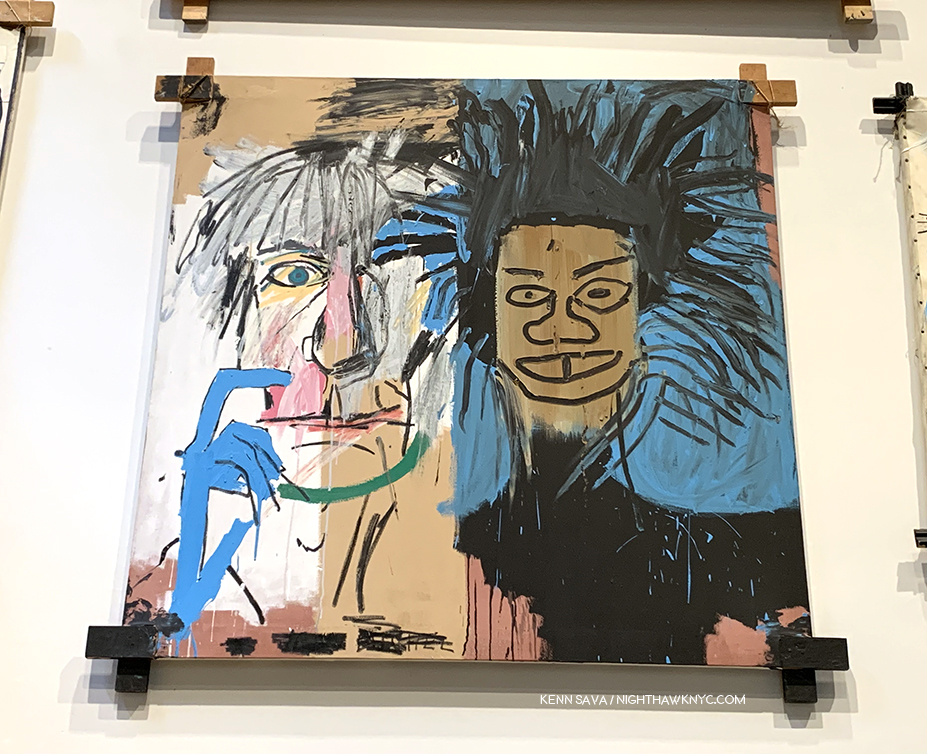
Jean-Michel Basquiat, Dos Cabezas, 1982, a portrait of Andy Warhol and a Self-Portrait that presaged the Warhol- Basquiat collaborations in 1985.

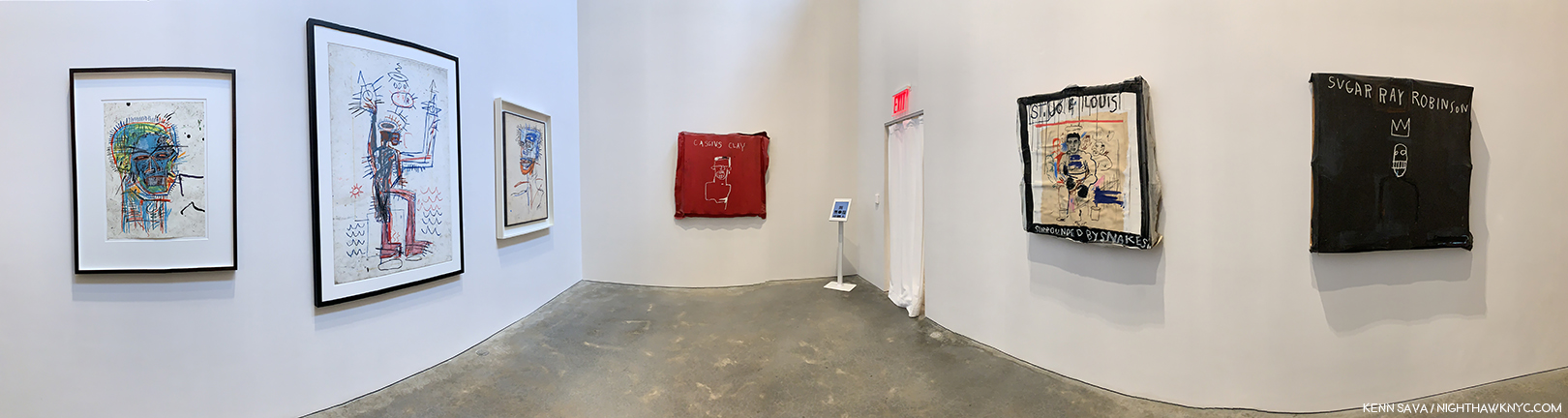
The 2nd floor also included a rear gallery, which featured 4 portraits of boxers and 3 other very power portraits.

Rear gallery on the 2nd floor installation view.

J-MB had a deep fascination with boxers, and they appear both as Self-Portraits and as homages. Sometimes both. Sometimes it’s hard to tell which.

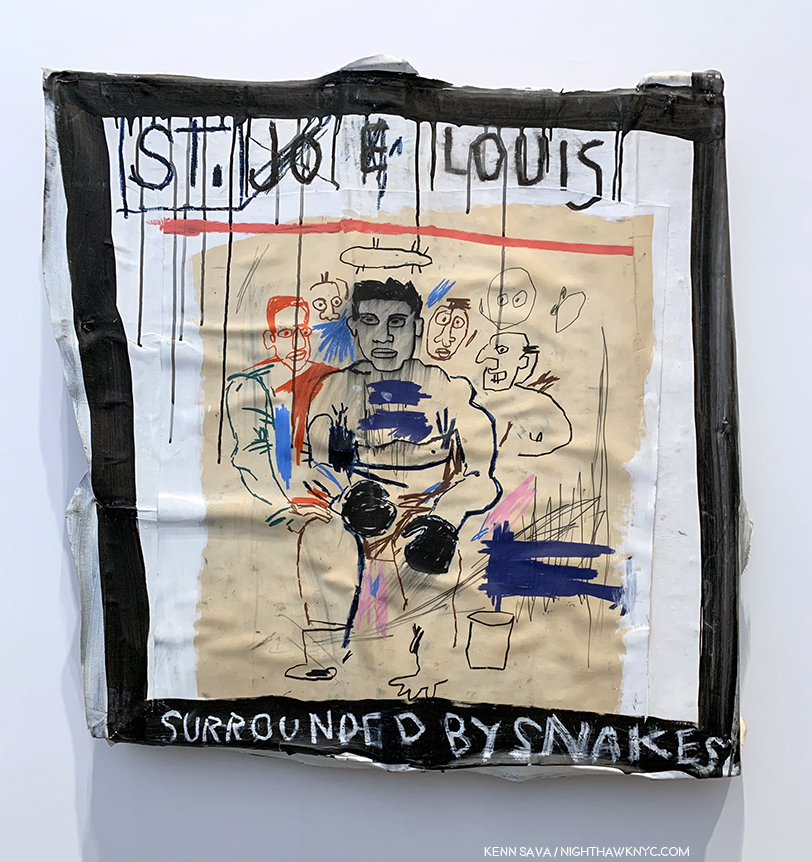
St. Joe Louis Surrounded by Snakes showed the boxer, one of Basquiat’s heroes, encircled by sharkish white managers. ‘That was Jean-Michel,’ said Suzanne Mallouk.” Phoebe Hoban. Basquiat, P.113. Early on, Paul Simon attempted to buy it for $8,000., but was thwarted by Rene Ricard. According to the iPad next to it, seen in the installation view, which served in lieu of wall cards, it now belongs to the Brants. (ibid, P.114).

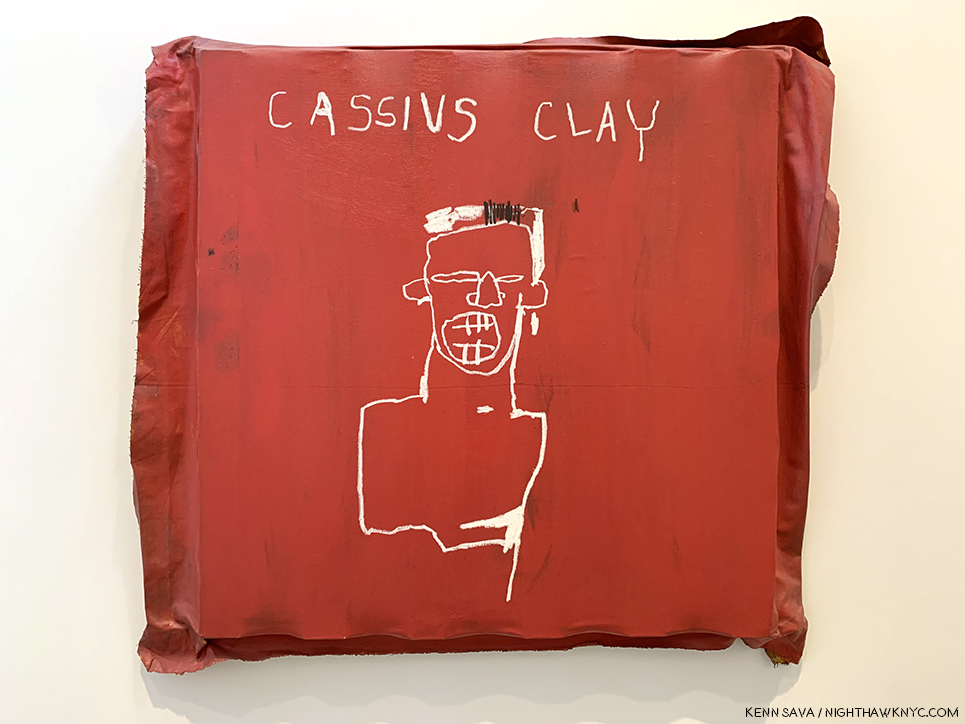
Muhammad Ali changed his name from Cassius Clay in 1964. As Cassius Clay, he won the gold medal at the 1960 Olympics, becoming a hero to many, including J-MB, who references it, here, by using his name at the time, in this work from 1982.

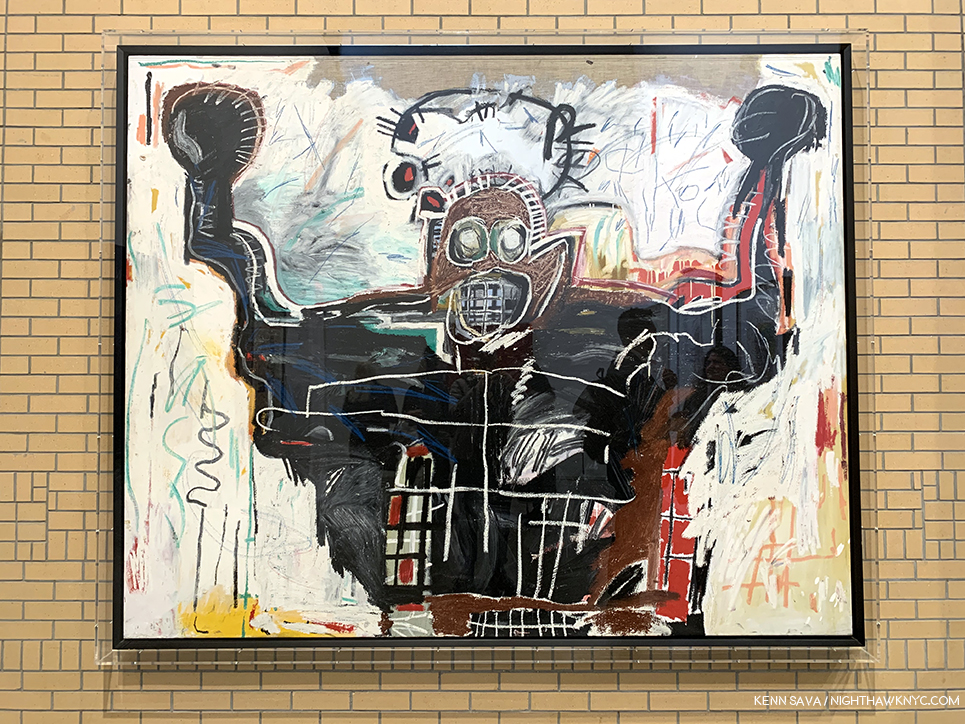
Untitled (Boxer), 1982, Acrylic and oilstick on canvas, 76 x 94 inches. Fred Hoffman calls this immensely powerful work, “… the expression of the black man’s physical and spiritual attributes.” (The Art of J-MB, P.133)

I almost missed the works installed on the first floor. Luckily, I spotted the small sign pointing to them right as I was beginning to look for the exit. Thank goodness I didn’t as it included some of his largest and at least one of his most important works.

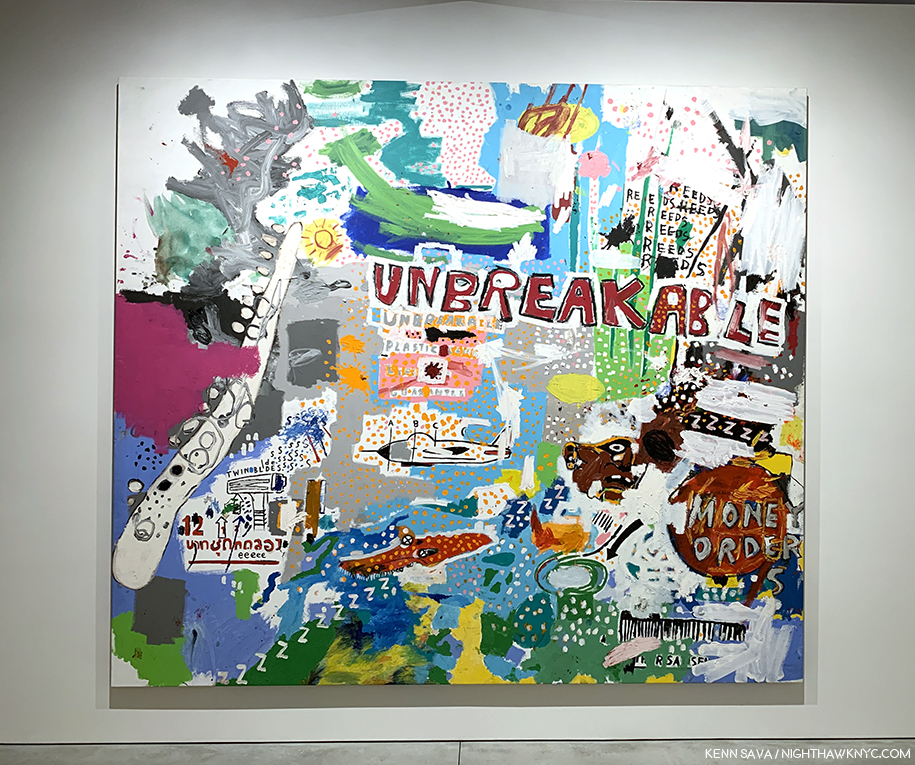
Unbreakable, 1987, Acrylic on canvas, 98 x 111 3/4 inches.

I’d never seen a J-MB work like Unbreakable prior to seeing it. Given it’s dated 1987, perhaps this is a glimpse into where his work was heading. In it, he synthesizes everything he’s been using- images, words, and color.

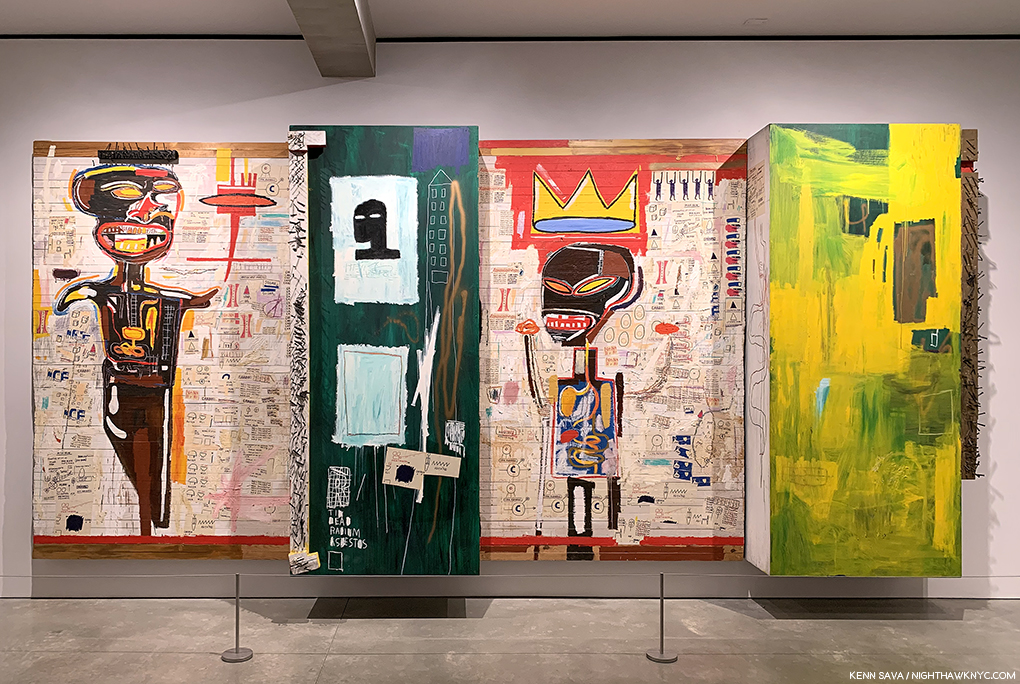
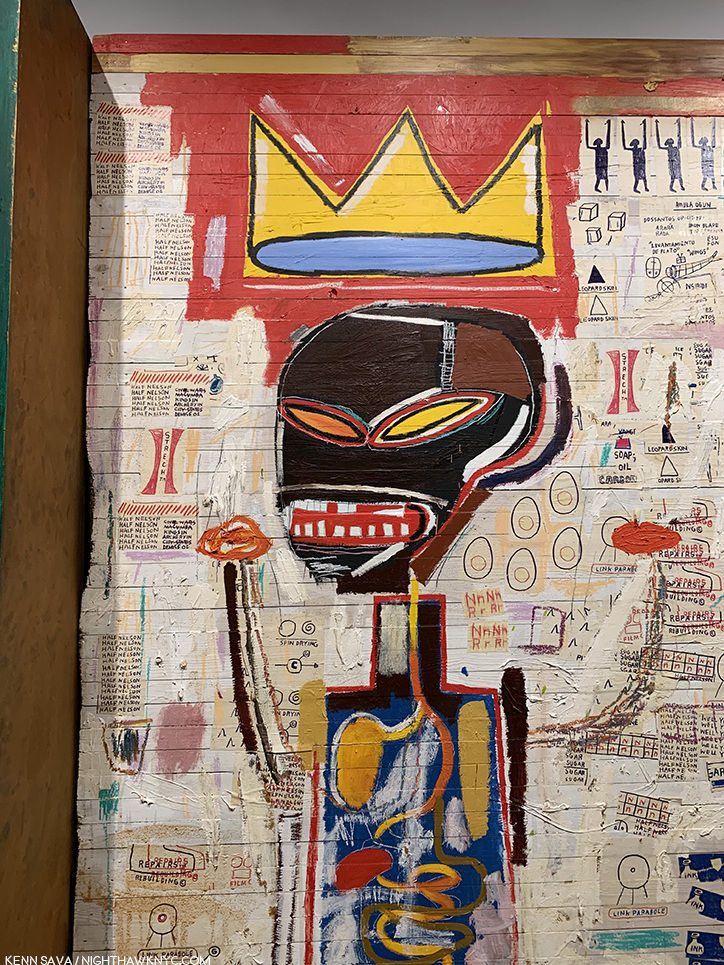
Grillo, 1984, Acrylic, oil, paper collage, oilstick and nails on wood, 96 x 211 1/2 inches- close to 20 feet by 8 feet!

What a powerful, stunning, incredible work Grillo is! It’s taken Robert Rauschenberg’s Combine Paintings in an entirely new direction. I love the juxtaposition of the two panels with figures (one left, one right of center) with the panels immediately to each of their right. I do wonder if this piece was meant to sit on the floor or be raised a foot as it is here.

Detail of the right of center panel.

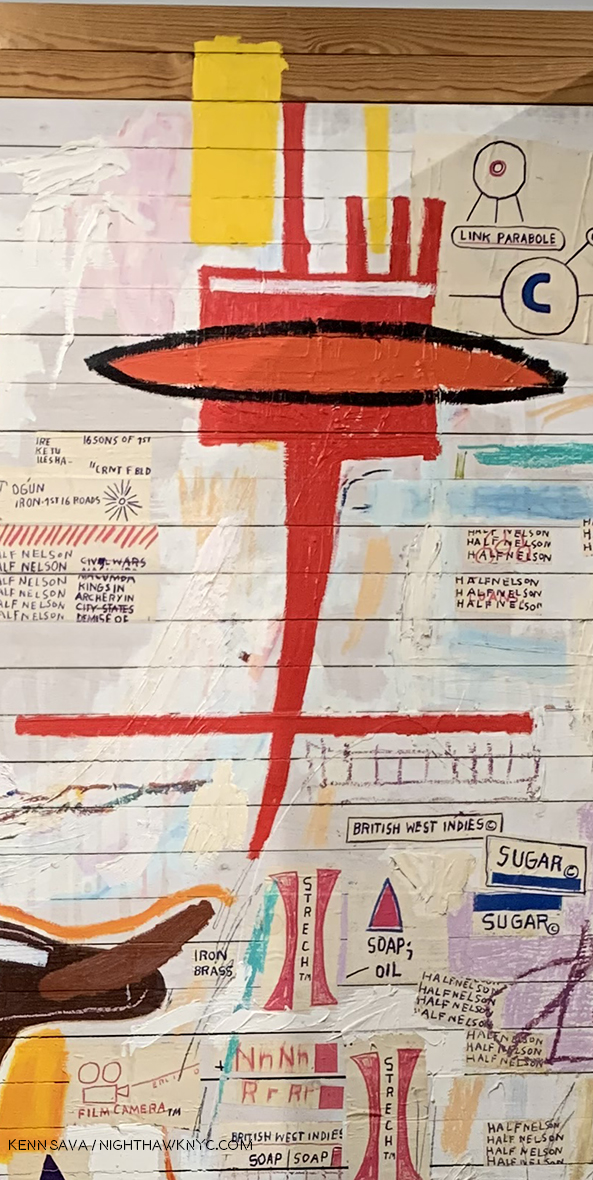
As I looked closer at Grillo, I noticed a good many color Xeroxes collaged on. Yet, the two figures hold the key to it, I think. On the left is a figure holding a torch. Over his head there’s a pice of wood with nails sticking out of it. That sure could be interpreted as a “crown of thorns.” Around him are various repeated words, including- “Soap,” “Oil,””Butter,” Carbon,” and “Stretch,” along with at least two Bebop song titles- “Well You Needn’t,” by Thelonious Monk and “Half-Nelson,” recorded by Bird. What this figure represents I don’t know, but there are elements of the martyr and the heroic included. The other figure, apparently a king, wears a large crown, accompanied by small attendants to its right, and has his hands raised, like the boxers seen upstairs. He appears to be looking towards the left side figure, and both figures have their internal organs shown, perhaps yet another reference to Gray’s Anatomy.

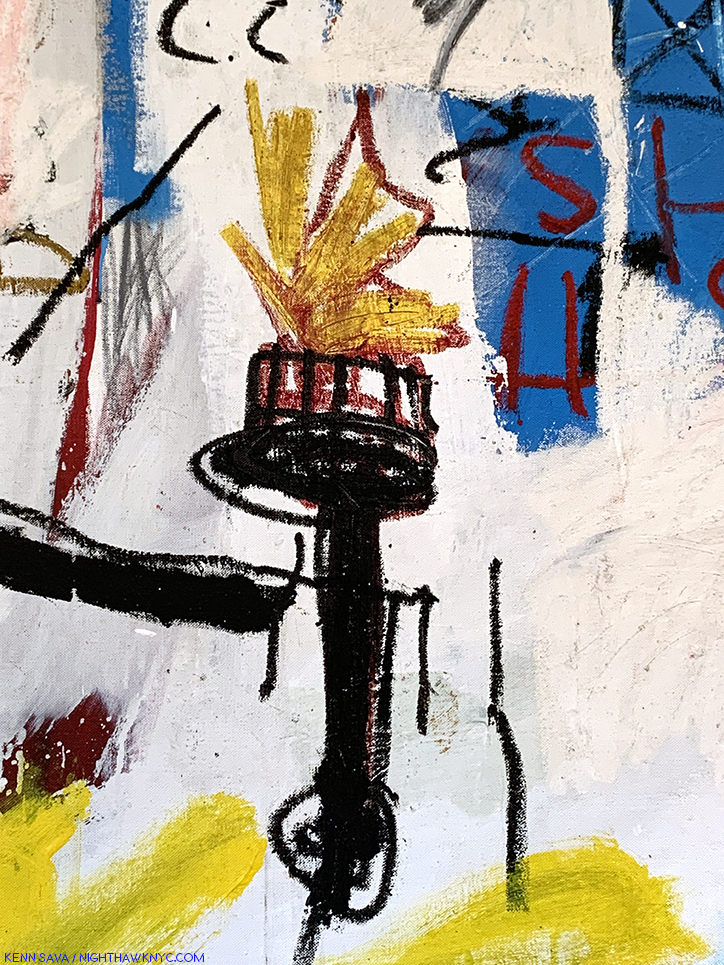
And, there’s this- The left hand figure, how has a board with nails over his/her head, possibly a crown of thorns?, holds a torch…

The work speaks volumes about how J-MB’s Art has evolved in 7 short years, and the unlimited potential the future held for it, and for him.

…which reminds me of the one seen 3 floors up in Per Capita, 1981.

A few days later, Lisa shared her thoughts on the show. “I thought the Basquiat show was quite spectacular. There were so many works that I had never seen before. In particular, I was struck by the great thick black oil slicks. There is something about this sheen, like shoe polish, that you can’t truly appreciate unless you see the paintings in person. They give the works a lot of dimension and texture. They also remind me of Franz Kline – totally dynamic and emotive in gesture. The oil slicks are bold and grimy, like New York. His compositions tend to mimic graffiti on the street – throw ups, wheatpaste posters, and tags on a wall/single canvas.”

There was a bit of the feel that the show was something of an afterthought to the just completed Louis Vuitton show. A “Hey, we’ve got all this work assembled, why don’t we just put it up in NYC?,” kind of thing. I quickly moved past it, the lighting and other questions with the space I’ve mentioned. Nothing dulled the effect of seeing so much work that STILL looks fresh, vital, and contemporary, in spite of countless imitators, commercial “appropriations” of his symbols and the passage of over 30 years since he left. What I saw at The Brant was the work that has defined the legacy of J-MB- in quite a few of his more well known Paintings, works characterized by his characters, in which his words take much more of a back seat than they did over at Xerox. Thinking about J-MB at The Brant four months later, the show has become more monumental in my eyes.

While Peter Brant may represent what many call “the 1%,” so does Jean-Michel Basquiat. For me, J-MB represents that extraordinary, and extraordinarily rare, group of people who are able to overcome unfathomable difficulties- racially, socially, financially, educationally and, apparently, familial, and some difficulties that appear on the outside to have been self-inflicted (though quite possibly resulting from the others- I’m not a doctor or a therapist), then somehow surmount ALL of that and go on to rewrite Art history in about a decade. How many people can this be said of?

How ever many you choose to include? I’m not sure it would even equal 1%.

This Post is dedicated to Lisa, with my undying thanks. My gratitude is due to Jessie for his consideration. Anyone reading this owes them their thanks as well.

*- Soundtrack for this Post is “Bold As Love,” by another brilliant Artist who died at just 27, Jimi Hendrix, which concludes the timeless Axis: Bold As Love.

“Anger he smiles towering in shiny metallic purple armor…
My red is so confident that he flashes
Trophies of war and ribbons of euphoria
Orange is young, full of daring
But very unsteady for the first go around
My yellow in this case is not so mellow
In fact I’m trying to say it’s frightened like me
And all these emotions of mine keep holding me from
Giving my life to a rainbow like you
[Chorus]
But they’re all bold as love
Yeah, they’re all bold as love”

In lieu of the immortal Hendrix original recording here’s a cover to inspire you to seek out the original-

This is Part 2 of my series on the five Jean-Michel Basquiat related shows going on in NYC in 2019. Part 1 is below, or here.
My prior pieces on Painting are here

NighthawkNYC.com has been entirely self-funded and ad-free for over 6 years, during which over 250 full length pieces have been published. If you’ve found it worthwhile, you can donate to keep it going & ad-free below. Thank you!

Written & photographed by Kenn Sava for nighthawknyc.com unless otherwise credited.
To send comments, thoughts, feedback or propositions click here.
Click the white box on the upper right for the archives or to search them.
For “short takes” and additional pictures, follow @nighthawk_nyc on Instagram.

Subscribe to be notified of new Posts below. Your information will be used for no other purpose.


  1. I’m speaking of Manhattan’s museums, only, here and leaving off The New Museum who have no permanent collection.
  2. according to the Brant Foundation.
  3. ibid P.65

Jean-Michel Basquiat: Now’s The Time

Written & Photographed by Kenn Sava (except *)

Part 1 of a series.

It’s hard to believe that not even 40 years have passed since Jean-Michel Basquiat burst upon the Art scene, (after his career as part of the legendary graffiti duo SAMO©), when the month long The Times Square Show opened 39 years ago on June 1, 1980 at 201 West 41st Street. Just eight years, one month and eleven days later, on August 12, 1988, he would be found dead from a heroin overdose at the infamous age of 27 at his home and studio at 57 Great Jones Street.

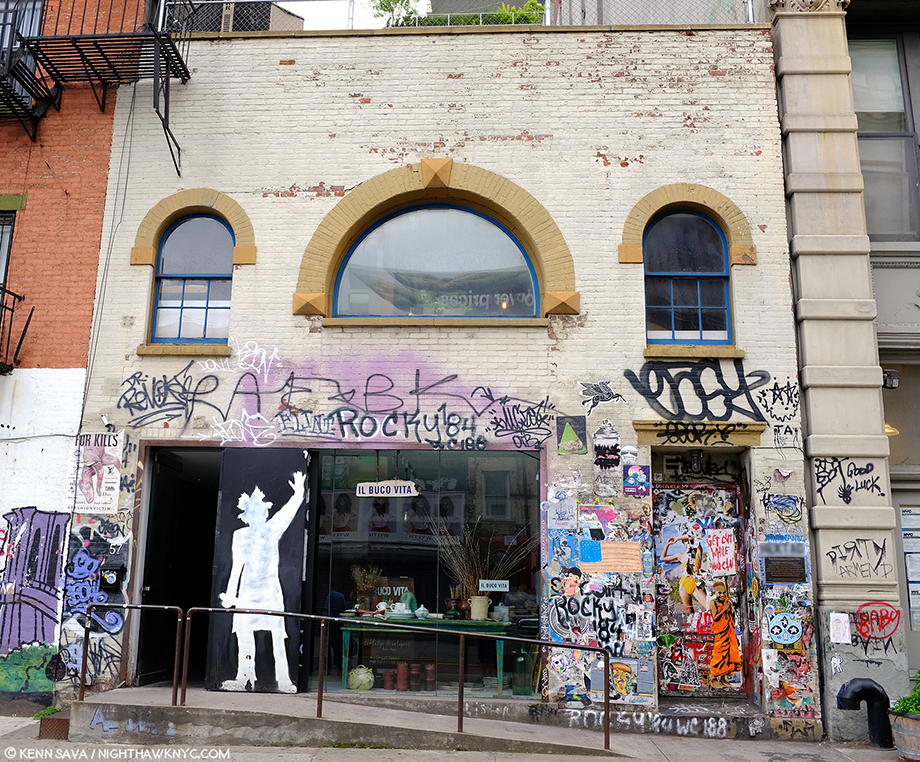
What appears to be an anonymously applied silhouette of the late Artist looms large here at the one time stable at 57 Great Jones Street, NYC, seen in May, 2019. Back in the day, it was owned by Andy Warhol who rented it to Jean-Michel Basquiat, who lived here from 1983 until he died here on August 12, 1988. His studio was on the ground floor, his living quarters upstairs. By the way? In an interview with Becky Johnston and Tamra Davis, Jean-Michel Basquiat said, “I don’t really consider myself to be a graffiti artist, you know?1” That might surprise those attempting to cover every square inch of the building now.

He didn’t live to see the Art market crash (unrelatedly) the following year, from which it has since recovered and grown many, many fold larger than it was during the bubble of his day, nor did he live to see the end of the controversy around him and his Art. It’s never subsided-

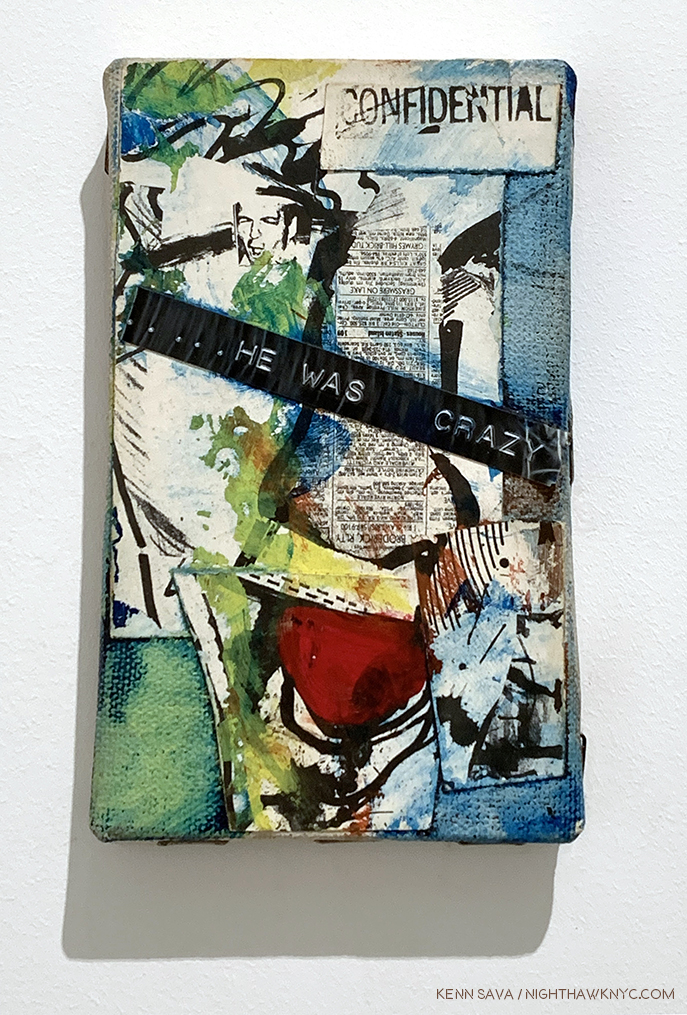
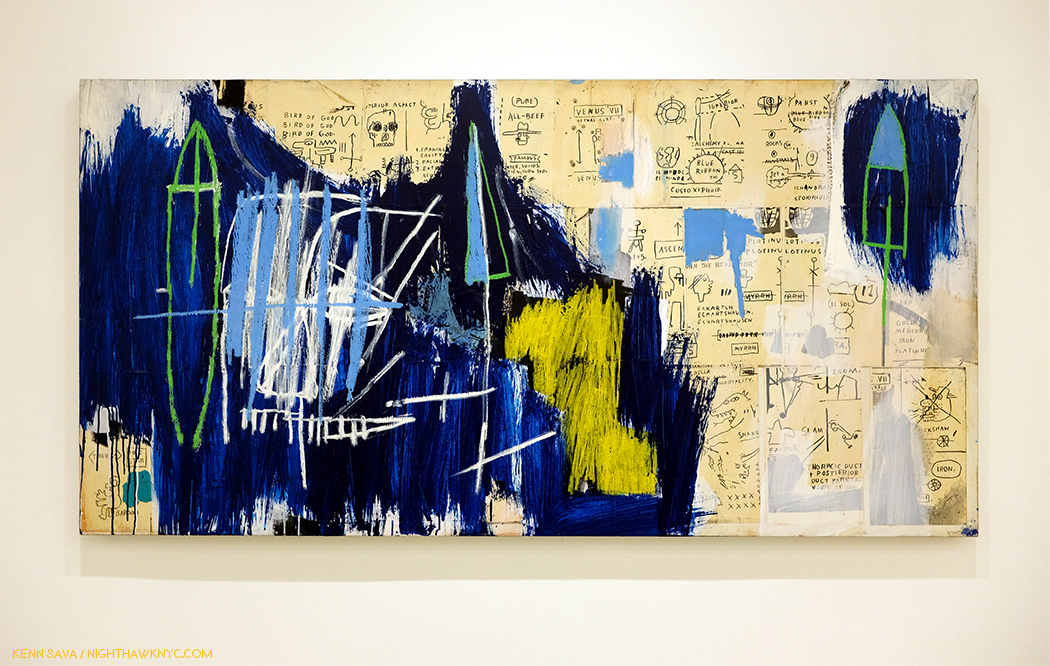
He Was Crazy, 1979, Mixed media on canvas, all of 5 x 3 inches, the earliest and smallest work on view at Jean-Michel Basquiat / Xerox.

-Robert Hughes titled his obituary “Requiem for a Featherweight.”

-“He was essentially a talentless hustler…,” according to Hilton Kramer in a piece titled,  “He had everything but talent” in 1997.

-“Come on…Basquiat? Really? Sort of an art hoax. Just the incoherent rantings of a tortured soul obsessed with drugs and a deluded quest for acknowledgment, which he did achieve. Doesn’t make it good.” A direct quote from the comments more recently here.

Yes, there are still plenty of haters hating on the work on Jean-Michel Basquiat.

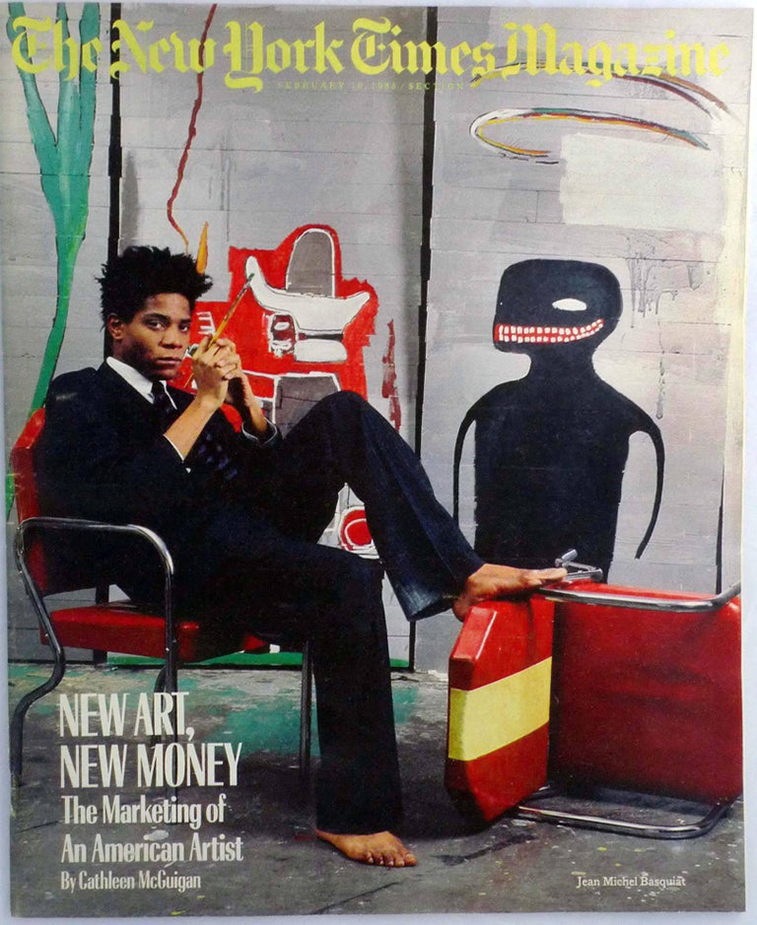
The now infamous cover of The New York Times Magazine from February 10, 1985 by Lizzie Himmel shows the Artist in his studio. The article, by Cathleen McGuigan, included a look at the Artist that seems surprisingly balanced today given all the controversy surrounding him at the time.”The extent of Basquiat’s success would no doubt be impossible for an artist of lesser gifts,” she wrote.

On the other hand, there are the countless other members of the Art viewing public for who Jean-Michel Basquiat’s work has continued to speak since he started making it, and Painting that speaks to people over time is what comes to be accepted as “Art” a few centuries on it seems to me. Yet, the Art viewing public is not the only group divided on the work of Mr. Basquiat. On page 44 of the book, The Art of Jean-Michel Basquiat. Fred Hoffman, one of the curators of the 2005 Brooklyn Museum Basquiat Retrospective and a man who produced prints with Jean-Michel Basquiat (J-MB henceforth) for 2 years, writes, “Herbert and Leonore Schorr offered the Museum of Modern Art the opportunity to choose a painting from their collection as a gift. The museum replied that having a painting by Jean-Michel Basquiat was not even worth the cost of the storage.” On May 26, 2017, this quote appears in the New York Times, “‘It’s an artist who we missed,’ said Ann Temkin, the chief curator of paintings and sculpture at the Museum of Modern Art, which does not own a single Basquiat work2. ‘We didn’t bring his paintings into the collection during his life or thereafter3.’”

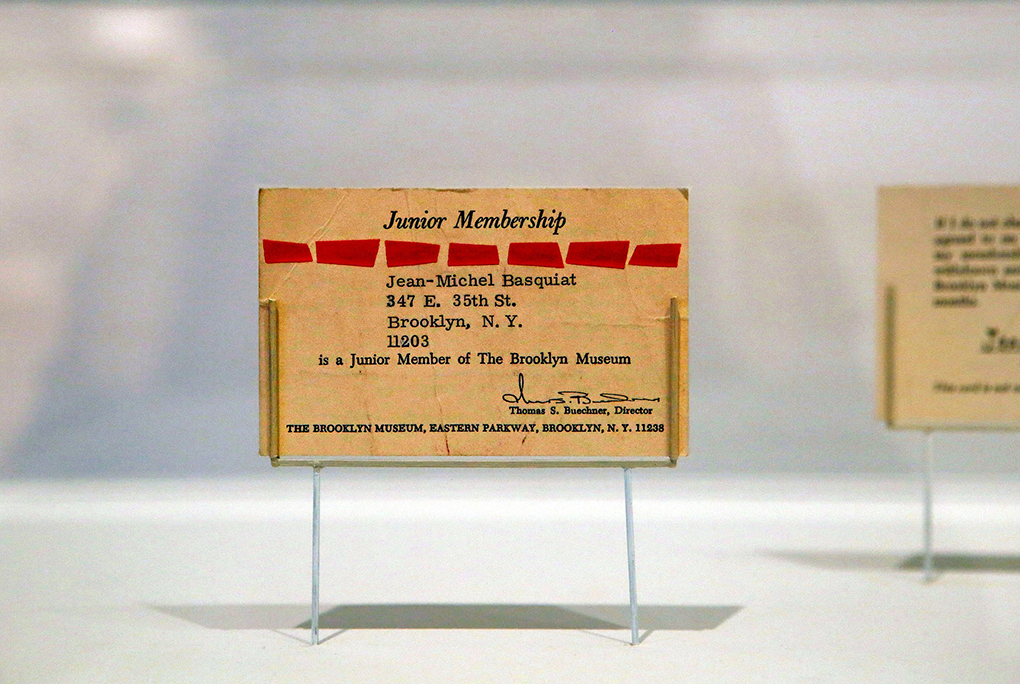
6 year old Jean-Michel Basquiat’s membership card to the Brooklyn Museum. It’s not well known that J-MB was an avid museum goer, attending the Brooklyn Museum and later, frequenting The Met with his friend Fab5Freddy. Credit 2015 The Estate of Jean-Michel Basquiat/ADAGP, Paris, via ARS, New York; Hiroko Masuike, via The New York Times.

In fact, as I write this? Of NYC’s “Big five” museums, only the Whitney owns a Basquiat Painting- they own 3, according to their online collection catalogue (none are currently on view as of my last visit, this past month. Also, I should note that among the 5 Manhattan museums The New Museum has no permanent collection. By the way, The Brooklyn Museum owns one print, seen below, and a Drawing.)

None of those feelings were mine though I wasn’t a “fan” of the work of Jean-Michel Basquiat. Then, as now, I was focused on Artists I felt were overlooked. My feeling in the 1980s was that too much money was being spent on, and too much attention given to, Contemporary Artists with no track record. Artists whose work hadn’t stood the test of time, hadn’t stood up to critical, and historical, assessment, whose work wasn’t in major museums, and on and on. By default, though not in particular, that included the work of J-MB. Still, I’ve always kept an open mind. There are very very few Artists or Musicians who’s work I will never, ever love- no matter what. But, there are some. Hitler was a painter- lowercase “p” for once- remember?

May 12, 2005. The only picture I was able to get (quickly) just outside the Basquiat Retrospective at the Brooklyn Museum, since pictures were not permitted inside. Back of the Neck, 1983, Screenprint, right, seen in the lobby and the show’s poster to the left. Glare was a problem in 2005, too. You can see the show in official shots, here.

So, on May 12, 2005, I went to that Brooklyn Museum Basquiat Retrospective that Mr. Hoffman was a curator of. When I got home, I wrote, “His work still doesn’t speak to me, beyond the fact that I so admire his freedom. The show was very well done.” I also came away struck by his love of Jazz. Anyone who loves classic Jazz is OK with me. I also remember being surprised at how prolific he was in such a short time, which reminded me of Van Gogh, who’s Painting career lasted only about a year or so longer. Looking back on it now? My head was elsewhere. I was drawing on a daily basis in a representational style, and so I was lost studying Ingres, Hopper, Richard Estes and Rembrandt, who I had recently gone to Chicago to see a show of. But? Having bought one at the show, I began wearing T-shirts with Jean-Michel Basquiat’s Art on them. His work just fits walking around NYC.

Untitled, 1980, the white on yellow original of which is in the Whitney Museum’s collection, is a work that was shown at New York/New Wave in 1981 at MoMA PS1, now appears on a Uniqlo SPRZ NY Women’s T, seen in June, 2019.

Slight digression- I’m not for giving a free ad here, but I must give props to Uniqlo for putting the Art and cover Art of so many great Artists and Musicians4 on their SPRZ NY line of T shirts. Some of the Art line is co-sponsored by MoMA. In turn, Uniqlo pays for the free Friday nights at the MoMA, which countless thousands attend each week. Uniqlo has continually featured J-MB’s work on their clothes, in spite of the problematic history of Basquiat and MoMA. Fred Hoffman in The Art of J-MB (P.175, footnote 2) relates this story about Untitled, 1983, a limited edition print of 10 copies he did with J-MB- “Untitled was given to the Museum of Modern Art in 1984. After it was in the catalogue for the MoMA 1984 exhibition An International Survey of Painting and Sculpture, the work was completely overlooked by the museum, and excluded when the museum first put its collection online. It was not exhibited in the galleries until 2015. Only with the collaboration between MoMA and Uniqlo beginning in 2014, when a cropped image of Untitled was used as the signature image for the marketing of the ‘SPRZ’ collection of iconic artist images applied to clothes, did the museum finally recognize the work as part of its collection.” 2015! To this day? I still wear Uniqlo J-MB T’s, even though I wasn’t a “fan.” End digression.

Jean-Michel Basquiat appears to be admiring  Nick’s Basquiat tattoo in one of Alexis Adler’s Photos of him at Bishop Gallery. Nick is an Art Teacher.

Ok. So, who’s “right?” The haters, the non-believers, and the NYC museums, who, unanimously, minus one, passed on acquiring his Paintings? Or, the incalculable number of members of the Art loving public to who the Art of J-MB speaks, perhaps, like that of few other Artists today, judging by how often I see others wearing his Art and icons, along with the innumerable Artists who’ve been influenced by his work, and those few collectors who bought up the bulk of his best work shortly after he created it?

All I can show you- pictures were not allowed in the show.

Fast forward. On May 7th, 2019, I went to see Picasso’s Women at Gagosian on Madison. It’s one of those shows that, though small, reminds you, as if you need to be, why Picasso was one of the towering creative geniuses of 20th Century Art, in my view. Each and every work is in a different style, and most were masterpieces. Yet, it’s a show that will only live on in the memory of those who saw it as no photos were permitted. I walked out through the building’s lobby, my head spinning. Just before I exited, next to the front door, I spotted this-

Minutes after I saw this poster my mind began to change.

Jean-Michel Basquiat / Xerox. I asked the guard where it was. “On 3,” he replied. Still recovering from Picasso, I pondered if I could clear my head enough for about 5 seconds, then I went back in and went up to Nahmad Contemporary on 3.

3 hours later, I left, realizing I’d never really seen the work of Jean-Michel Basquiat before. I had missed it. In Xerox, the term “Painter,” all of a sudden feels too small, even for an Artist notorious for getting paint everywhere- including on his multi-thousand dollar Armani suits, as can be seen in the infamous cover of The New York Times Magazine shown earlier.

But, this is a show that features his under-known multimedia works that include photocopies- color Xeroxes being one of his favorite tools, one he loved so much, he bought his own color Xerox machine. (I’m sure there are many others, but right now? I can’t think of many Artists who made color Xeroxes as big a part of their work- particularly Painters.) As a result, here images recur- his own images, exclusively, which is down right refreshing in this age of copious “reappropriation.” Drawings or Paintings that the Artist has Xeroxed and pasted onto canvas which he then proceeded to add to and modify in any number of ways, including Paint on.

Installation view. I was completely unprepared for the depth and endless detail in this body of work I had previously not known.

As a result, in Jean-Michel Basquiat / Xerox, we see J-MB the collagist as much as we do the writer, or the Painter. Suddenly, his work looks different. The figures recede, words come to the fore. Many, many words.

Odours of Punt, 1983, Acrylic, oilstick and Xerox collage on canvas, 40 x 83 inches

Odours of Punt, 1983, was one of the first works in Xerox and it was one of the first works to get to me. A “non-fan” up to that moment, something clicked in me when I saw this. In it, J-MB borrows Painting techniques from all over Art History on his way to making something…else. The history of Painting from 1947, on, was staring me in the face, to the left, while something entirely new and different was vying for my attention on the right. On the left, I felt Clyfford Still being channeled underneath Cy Twombly and Jean Dubuffet yet what he created is something distinctly his own- a remarkable thing in itself. And extremely abstract, at least to my eyes. While its right side felt like it was coming from another world, made up of fragmentary images. Neither side would seem to “go” with the other at first glance, yet, somehow, as my eye and brain moved between the two “worlds” of the work, they manage to hold together almost miraculously well. This is something I’ve felt in the presence of the greatest works of Abstraction, including those by, say, Kandinsky, Jackson Pollock from 1947 to 52, Mark Rothko, Jack Whitten, and Mark Bradford today. It’s incredibly hard to do, which is evidenced by the fact that almost none of them (who’s careers have completed), except for Kandinsky, (who was 77 when he passed away, and Painting abstractly for about 35 years), were seemingly able to do it indefinitely. Jackson Pollock seemed “to lose his fastball” in his last few years and his style began to change, and Mark Rothko lost…his life (I’m not saying that’s related to his Art). Perhaps these are only coincidences. J-MB didn’t make it to 30 years of age.

Detail of the upper center.

On the right, equally abstract to me was what seemed to be a new creative language. “BIRD OF GOD,” “VENUS VII,” “COSTOXIPHOID,””BLUE RIBBON,” and on and on, accompanied by innumerable drawings and diagrams. Man, there’s A LOT to see in this! Even now, almost 4 months later? I feel like I’ve only begun to look at it. For only one example- Costoxiphoid is a ligament that connects the ribs. At age 6, J-MB was injured in a car accident. While he was hospitalized (his spleen, i.e. his “filter,” was removed), his mother brought him a copy of Gray’s Anatomy. It would be a sourcebook for his Art for the rest of his life, and possibly here for “1. Cranial Cavity, 2. Facial,…” to the left of center. The title (assuming this is the Artist’s title- many of his works were “named” by others) is also an enigma. “Odours” referring to “any property detected by the olfactory system,” per Merriam-Webster, and “punt” have multiple meanings, including “an open flat bottom boat with squared ends.”

Untitled, left, and Peter and the Wolf, both Acrylic, lipstick and Xerox collage on canvas, both 1985, both 110 x 114 inches, seen from about 15 feet away, the figures in these pieces are almost entirely swallowed up by everything else.

Walking through Xerox, it was impossible not to begin to understand that J-MB‘s work is deep. Deeper than just about anyone has even written about so far. These works contain a staggering, almost obsessive, amount of detail, and details that swallow up the figures, one of the things the Artist is most famous for. Figuring out what’s going on in all of this detail is going to take 2 things- #1, an expert, most likely one who knew the Artist, or #2- A long time.

Not having known Jean-Michel Basquiat, I, like those born after August 12, 1988, can only look at his work and see what it says to me. In a short time, my looking thus far has given rise to some threads that I am going to continue to study.

First among them is Jazz. Being a former Musician, who produced Jazz records and wrote for a national Jazz magazine for 4 years, perhaps I am pre-disposed to spotting them. Fair enough. While many people talk about J-MB and Hip-hop, looking at the work in this show, I failed to see even one reference to it. This struck me, particularly because one thing that stood out to me at Xerox to the point that I couldn’t overlook it was the CONTINUAL, and extraordinary number of, references to Jazz- be it Jazz Musicians, records or song titles. In fact, they were so prevailing, you’d have to look hard to find even one work here without a Jazz reference somewhere in it (which I may, or may not, have).

Untitled, 1985, Xerox collage mounted on panels, 48 x 85 inches.

In Untitled, 1985, a collection of color Xeroxes mounted on panels, the Jazz references are almost overflowing.

Almost right in the middle of Untitled is this portrait of Miles Davis, playing, or holding, his horn.

Fittingly, smack dab in the middle of it is this portrait of trumpeter and bandleader Miles Davis. Which reminds me of this still from a Miles Davis video from the late 1950s-

Miles Davis performing “So What” in a 1958 film called The Sound of Miles Davis in a group that also included the great John Coltrane.

And then there’s the work shown in the Xerox poster, King of the Zulus, 1984-5. “King of the Zulus” is, also, the name of a Louis Armstrong and his Hot Five record from 1926.

The work from the poster seen in the flesh. King of the Zulus, 1984-5, Acrylic, oilstick and xerox collage on paper mounted on canvas, 86 x 68 inches.

Detail of the lower left corner of King of the Zulus. This gives a little idea of the depth of what’s going on in this work.

The lower left corner of King of the Zulus includes a drawing of another Louis Armstrong record, “Potato Head Blues,” which some feel is at the top of the list of his finest recordings (those are some mighty brave folks. Miles Davis once said that Louis played everything you can possibly play on the trumpet. He would know. I’d never dare a guess at “greatest.” It doesn’t exist.). In his 1979 movie Manhattan, Woody Allen (who is also a Jazz Musician) has his character say that “Potato Head Blues” is “one of the reasons that life is worth living.”

Red Joy, 1984, Oilstick and Xerox collage on canvas, 86 x 68 inches.

Later, I came across the transcription of an interview with J-MB by Becky Johnston and Tamra Davis in which Becky Johnston asks him-

“BJ: What music do you like?

J-MB: Bebop’s I guess my favourite music. But I don’t listen to it all the time; I listen to everything. But I have to say bebop’s my favourite.”

Detail of the lower right corner of Red Joy. That’s a portrait of the great saxophonist and composer Charlie “Bird” Parker, with a musical quote from his composition “Red Cross” on the top.

“Bebop” was a revolutionary, new, style of Jazz that Bird, Dizzy Gillespie, Thelonious Monk and Charlie Christian developed in the late 1930s and early 1940s. Louis Armstrong predated and outlived Bebop (which peaked in the 1940s), so it’s obvious that J-MB listened to Jazz from other periods as well as Bebop. Regarding the work that might omit a Jazz reference? Interestingly, look as I might, I didn’t find any Jazz references in Odours of Punt, seen earlier, rare among the works in Xerox. Unless the repeated “BIRD OF GOD,” near the upper left is a reference to Charlie “Bird” Parker. What else could it mean? My guess is that it is- until an expert comes forward. When he died, it’s reported in Pheobe Hoban’s biography that crates of Jazz records belonging to the Artist were thrown out, along with a carton of copies of Ross Russell’s 1973 Parker bio, Bird Lives!5.

Jean-Michel Basquiat holding a copy of The Subterraneans by Jack Kerouac. He was reported seen carrying one around in Pheobe Hoban’s biography of the Artist. *Photographer unknown.

As for the second thread, the proliferation of words in the works included in Jean-Michel Basquiat / Xerox got me to look closer than I ever did before. Then, in my research, I discovered something interesting. Jean-Michel Basquiat had a love of the Beats. At various points he is reported to be continually reading William Burroughs Naked Lunch (a picture of him with a copy of it was taken by Alexis Adler was shown earlier- the picture with Nick’s tattoo, in which Naked Lunch is shown mounted on the wall behind J-MB) and Junky, as is reported in Pheobe Hoban’s Basquiat: A Quick Killing In Art, (eBook P.75). Later on, he is reported to be carrying around Jack Kerouac’s The Subterraneans, as is seen above. These struck me. Then, I discovered something more. J-MB knew both William Burroughs and Allen Ginsberg, and can be seen with both here! He was also Photographed by Allen Ginsberg, a terrific and still somewhat overlooked Photographer in his own right. While others make cases for J-MB being a member of this or that “group,” how crazy is it to make a case for J-MB as a descendant of the Beats? There’s more direct evidence for it than there is for some of the claims I’ve seen. Some have made the case for J-MB the Poet. From his SAMO© days to what we see in his Notebooks, he does have one of the most unique ways with the English language of any writer known to me.

Detail of the lower left section of Untitled, 1987, Acrylic, oil stick, and Xerox collage on canvas, 100 x 114 inches, reveals lists of song titles, under two semi-circular Drawings of record labels.

It’s become apparent to me that the cult of personality surrounding the Artist, and his fame (which, he longed for while he was homeless early on, and chased later, which makes him, at least partially responsible for) has, also, served to delay the serious critical assessment of his work. I’m not saying there isn’t any. There is. There are some very fine essays in the catalogues for the shows done so far, beginning with Richard Marshall’s excellent piece, “Repelling Ghosts,” in the catalogue for the very first J-MB Retrospective, at the Whitney Museum in 1992, and, as I said, Fred Hoffman has done a yeoman’s job of pointing the way to where Basquiat scholarship may be finally going, but the need for this is most urgent in my opinion, before the work is left to those who did not personally know the Artist. From what I’ve read thus far, Jean-Michel Basquiat’s Art was best “understood” by those who knew him. Some of them have already passed away, taking with them whatever they didn’t write down or share in interviews about the Artist and his work. Since the real critical assessment of his work has taken so long to get underway, there is, it seems to me, a real danger that if this continues to happen, J-MB‘s Art will remain an eternal mystery, like say, Vermeer’s, is to us today. Part of this is due to the fact that museums have been slow accepting J-MB‘s work, or even borrowing it to mount shows of it. Museum shows generally result in new scholarship published in the accompanying catalogs. The pace of museum shows has picked up over the past decade, both in the US and in Europe, but, in my opinion, when it comes to actually studying the work, the scholarship has been spotty so far. So? Anyone delving into the work of J-MB for the first time, as I am, is left with a lot of biography and a little Art criticism to fall back on- no matter how many books you see. As a result? I was largely left to make of it what I can- like viewers who weren’t alive in J-MB‘s time are.

Untitled, 1985-6, in front of Embittered, 1986, Graphite, paint and Xerox collage on wood.

Also apparent from some of the pieces written thus far that people fall all over themselves trying to “claim” J-MB for this school or that, from so-called “primitivism” to so-called “expressionism” to so-called “neo-expressionism,” to (more recently) so-called “conceptualism”- none of which J-MB, himself, used for his work, which is the only thing that matters, in my opinion, to hip-hop.

Jay Z, who did not know him, said this in his autobiography, Decoded, published in 2010, on page 95-“…People always wanted to stick B in some camp or another, to past on some label that would be stable and make it easy to treat him like a commodity. But he was elusive. His eye was always on a bigger picture, not on whatever corner people tried to frame him in. But mostly his was probably on himself, on using his art to get what he wanted, to say what he wanted, to communicate his truth. B shook any easy definition. He wasn’t afraid of wanting to succeed to get right, to be famous…”

The visual evidence in the work itself shows me, at least, something different from all the claims I mentioned before Jay Z. Jean-Michel Basquiat belongs in one “box,” and one “box” only- the “Jean-Michel Basquiat box.” Though he definitely belongs to the continuum of Art History, as Richard Marshall lays out in detail in his excellent essay in the Whitney Retrospective Catalogue, which probably surprises many, Jean-Michel Basquiat is unique unto himself. Period.

Kokosolo, 1983, Acrylic, oilstick, and Xerox on canvas, 43.3 x 82.6 inches.

Meanwhile, back at Xerox, I love the use of paint here. Jean-Michel Basquiat’s work is about layers and here it’s hard to know what’s on top and what’s on the bottom layer. J-MB spoke many times about his use of crowding out words and letters and said one of the reasons he did it was to make the viewer look closer. I can’t help wonder if he’s doing the same with the yellow here- making us look closer at what’s under the yellow. 

Galileo Galilei, 1983, Acrylic, oilstick, and Xerox on canvas, 78.75 x 51 inches.

In Galileo Galilei, 1983, I was struck by a number of things, first, from a distance, the circles, ostensibly the outline of the moon. But the circle is quartered, which is not like the moon. It’s something done in graphs and in Drawing. That reminded me- Drawing a circle is something that has a long and legendary history in Art. The great ancient Greek Painter, Apelles, and later the Renaissance master, Giotto, both used their ability to draw perfect circles freehand as calling cards.

Rembrandt, Self Portrait with Two Circles, c.1665, *Kenwood House, London.

I am one of those who believes Rembrandt followed suit, leaving his own “calling card” as their heir in his Self-Portrait with Two Circles.

Detail, or rather, Details. Note the multiple lines that make up the circles and the repeated list. I recognize these part words as being a list of songs from Charlie Parker’s Savoy recordings because I have these records. “Koko Take 1,” and so on. As for everything else going on in this work? I’m hoping someone who knew J-MB will come forward and discuss it.

Here, we happen to have two, or parts of three, drawn circles. Was J-MB aware of the Apelles/Rembrandt circles? 

This body of work is an example of one of the last vestiges of reproduction in Art before the digital age took hold. Seeing this now does really make it feel like more than 35 years have passed, yet, they don’t look dated. Nor do the beginnings of this work, the “(Anti) Product Postcards” he created, many with Jennifer Stein, who speaks about them here.

Early on, J-MB created Postcards, including these, many hand labelled “(Anti) Product” on the verso, which he sold for $1 each. Andy Warhol bought one when J-MB first met him while he was eating at a restaurant with Henry Geldzahler. They are among the earliest examples I’ve seen of J-MB’s collage. Some of these were collaborations with Jennifer Stein.

I returned to see Jean-Michel Basquiat / Xerox twice more since it proved to be a “personal rosetta stone” into the Art of J-MB. It was an extraordinary gallery show in many ways. The 33 works on view that ranged from He Was Crazy from 1979, shown earlier, through 1987, covering all but the final year of his Painting career and his life. Alas, even in three visits, I can only hope to scratch the surface layer of all that lies in these work by Jean-Michel Basquiat. But, there was something else. Alone with the security guard in the show for most of the 7 or 8 hours I spent there over 3 visits, I was struck by something else.

Silence.

A silence that was singing in a way that would bring a smile to John Cage’s face. If there’s been too much of any one thing around the work of Jean-Michel Basquiat to this point, it’s noise. A byproduct of his tragic death far too young is there are no more “Page 6” scandals, no more gossip, no more rumors. Only the work remains, hanging silently in these rooms. That silence said it’s time to let that Art speak for itself. And it’s time that those who knew and/or worked with the Artist to share what they know, and provide whatever insights they have before those, too, are lost forever.

Current and older books on Jean-Michel Basquiat and his work. Of these, the catalogs for the J-MB Retrospectives at the Brooklyn Museum (first, upper left) and the Whitney Museum, 2nd from left, front, were the two I referred to most often. The Unseen Notebooks (4th from the right, top) is also excellent. Fred Hoffman’s books are available for download from his website and are recommended. While it contains images of the most works available in print, I found the new Taschen XL, far right, problematic. A catalog for Alexis Adler’s traveling show, seen bottom left, of her collection is a revelation.

After I left Xerox for the last time, I, too felt the clock ticking. I immediately launched a deep dive into Basquiat monographs, in and out of print, and read everything I could get my hands on. As my research began, I quickly came upon a startling fact- Jean-Michel Basquiat: Xerox (which ran from March 12 through June 1st) is one of no less than SIX shows of Jean-Michel Basquiat’s work, or pertaining to the Artist, going on in the NYC vicinity in 2019!

The other five are-
Jean-Michel Basquiat at The Brant Foundation, March 6 – May 14th
The 12th Street Experiment: Photography of Jean-Michel Basquiat By Alexis Adler at Bishop on Bedford, Brooklyn, May 3 – June 13th
Lee Jaffe: Jean-Michel Basquiat at Eva Presenhuber, June 28th – July 28th
Basquiat x Warhol at The School/Jack Shainman Gallery, Kinderhook, NY, June 1 – September 7th
Basquiat’s Defacement: The Untold Story at the Guggenheim Museum, June 21st – November 6th
and…two Paintings from the collaboration of Jean-Michel Basquiat and Andy Warhol, along with ephemera from their collaboration, were on view in Andy Warhol at the Whitney Museum earlier this year, which I wrote about, here.

First? I wondered- Why six shows now?

Jean-Michel Basquiat was born on December 22, 1960 and died 31 years ago on August 12, 1988. 2020 will be a double anniversary for J-MB- 60 years since he was born, 40 years since The Times Square Show launched his career. 2019? No special significance, as far as I know, four months into my research. The Brant show shares the same curator (and many of the 120 works) with the Jean-Michel Basquiat show at the Foundation Louis Vuitton, Paris, which ended on January 14, 2019. The Brant’s opened on March 6th. So, beyond commemorating a “Basquiat anniversary,” the timing of that show may just have been fortuitous and practical, as in “we’ve got all these works together, why don’t we also show them in the new space in NYC?” As for the timing of the others? I have no idea.

Nola Darling lying on Jean-Michel Basquiat’s grave in She’s Gotta Have It.*

Between these six shows, the total number of works by Basquiat (counting those in collaboration with Andy Warhol) should total slightly more than the 120 shown in that Foundation Louis Vuitton, Paris, show, in addition to Photographs of J-MB by early roommate, Alexis Adler, and Musician and friend, Lee Jaffe. As such, these shows present the opportunity to see the most works by the Artist since the 160 pages from his Notebooks along with other works and some Paintings were shown in the Jean-Michel Basquiat: Unknown Notebooks show at the Brooklyn Museum in 2015, and the most Paintings by the Artist in NYC since that 2005 Basquiat Brooklyn Museum Retrospective. Unlike the “Summer of Rauschenberg,” which I covered extensively in 2017, where the satellite shows “revolved” around MoMA’s Robert Rauschenberg: Among Friends Retrospective, this time, the only museum show in the bunch, Basquiat’s Defacement at the Guggenheim, is a satellite show to the blockbuster Brant Foundation’s (a private organization) first public exhibition- Jean-Michel Basquiat, which included a whopping 70 Paintings and 1 Sculpture, the main act. Given that the vast majority of J-MB‘s best work resides in private collections, this brings home the fact that going forward, unlike with most Artists, the public is going to depend on the generosity of collectors displaying their work to see them, and researchers are going to depend on them to study it.

As a result, I quickly realized after that it might be now or never if I wanted to see a large body of Basquiat’s work and reassess it, and see WHO is “right”- the haters or the believers. With 39 years elapsing since J-MB‘s debut at the Times Square Show, enough time has elapsed to get a bit of perspective. So?

Detail of Now’s The Time, a Painting that looks like the classic 1945 Charlie Parker record of the same name, with “PRKR,” J-MB’s “shorthand” for Bird’s last name.

Now…is INDEED the time. It’s the time for the real assessment of Jean-Michel Basquiat’s Art to take over from the sensational biography. For me? Who knows when I’ll have the opportunity to see this much of his work in NYC again. It might be now, or never. NOW is my time, too.

My thoughts immediately turned to the Brant Foundation’s inaugural show in their new East Village location, Jean-Michel Basquiat, which was up and running and the clock was ticking on its run. NHNYC researcher Kitty, a Basquiat fan since she saw him in person back in the day at the Mudd Clubb, had seen it and gave a glowing report. I began scrambling to get a ticket. No luck online. The show had been completely sold out (though tickets were free) since it opened. Hmmm…HOW to see the most publicized and talked about show in NYC in early 2019? Or, would my glimpse at Xerox of what I had missed remain a lingering tease?

To be continued…

This piece is dedicated to my former friend, grae, who knew J-MB, and to Kitty, who was in the same room with him in the clubs back in the day, and who has patiently accepted his work not speaking to me all these years. My thanks to Nick. 

This is Part 1 of my series on the five Jean-Michel Basquiat shows going on in NYC this year. Part 2 may be found under this one, or here. Part 3 is here

*-Soundtrack for this Post is what else? “Xerox” by Julian Casablancas + The Voidz. If  you’re a Strokes fan, check this out, if you haven’t. Also, it doesn’t sound all that distant from J-MB‘s own band, Grey. Maybe they were an influence.?

NighthawkNYC.com has been entirely self-funded and ad-free for over 6 years, during which over 250 full length pieces have been published. If you’ve found it worthwhile, you can donate to keep it going & ad-free below. Thank you!

Written & photographed by Kenn Sava for nighthawknyc.com unless otherwise credited.
To send comments, thoughts, feedback or propositions click here.
Click the white box on the upper right for the archives or to search them.
For “short takes” and additional pictures, follow @nighthawk_nyc on Instagram.

Subscribe to be notified of new Posts below. Your information will be used for no other purpose.


  1. Here. He repeated this elsewhere as well.
  2. By “work,” I believe they mean a Painting. According to its site, MoMA owns 12 prints and Drawings by Jean-Michel Basquiat. No Paintings.
  3. //www.nytimes.com/1985/02/10/magazine/new-art-new-money.html?searchResultPosition=1
  4. They were the only company in the world to acknowledge the 100th Anniversary of the 1st Jazz record in 2017, though the record in question is not what I call “Jazz,” and featured an astounding array of classic under-known Blue Note Record covers on T shirts.
  5. Both, Pheobe Hoban’s Basquiat: A Quick Killing In Art, eBook P.19

Studio K.O.S. Carries On After Tim Rollins

Written & Photographed by Kenn Sava

I’ll always miss my late friend Tim Rollins who left us at just 62 years of age in January of last year1, but I can’t imagine how his “Kids” feel.

Tim Rollins & K.O.S.: A History. Published in 2009 to accompany the traveling retrospective of 25 years of their work. I’ll never forget seeing Tim with the phone book sized “draft” of this book in 2009, which he let me thumb through, in awe, while it was in preparation.

His Kids, better known as “Kids of Survival,” or K.O.S., a group of at-risk public school students, some barely in their teens, (as you can see in the Photo taken of them, above, by Lisa Kahane in the 1980s that appears on the cover of the retrospective on them), that Tim taught Art to that became the group “Kids of Survival” in 1984. When they began, he told them, “Today, we’re going to make art. We’re also going to make history.” With work in over 87 museums and public institutions (and counting)2, they’ve succeeded on both counts. In 2010, a terrific documentary film on Tim and K.O.S. was released entitled Kids of Survival: The Art and Life of Tim Rollins and K.O.S., which details the unprecedented journey both Tim and the members of K.O.S. took as they forged their own way into Art history. “History” is a word that keeps coming up in discussing Tim and K.O.S. in 2019, which is fitting because this year marks the 35th Anniversary of the founding of K.O.S..

Boys to men. Together, they made history. Tim Rollins & K.O.S. in 2016. Steven Vega, Ricardo Savinon, Robert Branch, Tim Rollins, and brothers Angel & Jorge Abreu, left to right, at Lehmann Maupin Gallery, West 22nd Street. Lehmann Maupin Photo

“To dare to make history when you are young, when you are a minority, when you are working, or nonworking class, when you are voiceless in society, takes courage. Where we came from, just surviving is ‘making history.’
So many others, in the same situations, have not survived, physically, psychologically, spiritually, or socially. We were making our own history. We weren’t going to accept history as something given to us.” Tim Rollins.

Tim even added “and K.O.S.” to his signature. Angel Abreu signed under it. From my collection.

While he taught them Art in school, with the goal of having them get into college, he also began naming everything he and the they created as being by “Tim Rollins & K.O.S.” Giving the students/apprentices equal status with the Artist as collaborators was unprecedented in the history of visual Art, as far as I know, as so much of what he did was unprecedented in Art education. Now, a year after Tim’s passing, K.O.S. have announced that they are going to continue as Studio K.O.S.. “History” becomes “living history.”

Curator Ian Berry, “Thinking about the increasingly important role of what Tim and K.O.S. did together over 30 plus years is so important for us to see now.” Installation view of Tim Rollins and K.O.S.: Workshop at Lehmann Maupin in May.

The past, the present and the future were the subjects of the show Tim Rollins and K.O.S.: Workshop at Lehmann Maupin in May and June, the first by Studio K.O.S. It included a “mini-retrospective” of their work curated by Ian Berry, who said of his selection, “The show’s called Workshop. I was thinking of works that really exemplified the idea of a group of artists sitting together around a table making work together. Sharing ideas. Thinking, reading, talking, seeing together. So each of the works is a very overt example of their hands and the imagery of the individual members on each of the works.”

Amerika (For Karl), 1989, Watercolor on paper mounted on canvas, 97 x 132 inches

He continued, “And then, I’m thinking about the guys being in Studio K.O.S. without Tim, and I’m thinking about the crazy politics that we’re living in, and thinking about the increasingly important role of what Tim and K.O.S. did together over 30 plus years is so important for us to see now. I really value the idea of this show now. It’s so important to see education leading to justice. It’s so important seeing different versions of identity and self-empowerment and speech, that is so needed now. It’s great seeing these images of Pinocchio logs potentially waiting for birth. It’s great to see this really intense room of all black works, which I hope moves you to be engaged, and be active in thinking about what’s going on around you. It’s a history, but it’s also a workshop that we’re all hopefully invited to join in.”

“It’s great to see this really intense room of all black works…” Two works from I see the promised land (after the Rev. Dr. Martin Luther King, Jr.), both 2008, Matte acrylic and book pages on canvas, 108 x 72 inches each.

Walking through the show with as unbiased eyes as I could possibly muster, given my personal connection, I found myself in complete agreement with Mr. Berry when he spoke of “the increasingly important role of what Tim and K.O.S. did together over 30 plus years.” When I’ve seen their work over the years, it’s generally been a piece here or there, as in MoMA’s 2007 show What is Painting: Contemporary Art from the Collection, where the group’s Amerika VIII, 1986-7, was on view.

Installation view of MoMA’s 2007 show, What is Painting: Contemporary Art from the Collection, with Amerika VIII, 1985-6, left. MoMA Photo.

I remember standing in front of it and feeling overcome with joy- the joy of a beautiful work and my sense of all that had gone into, and all that had been overcome, achieving it- let alone having it wind up in the Permanent Collection of the Museum of Modern Art (An aside- To this day, MoMA owns NO Paintings by Jean-Michel Basquiat. That’s another story). Then, I walked over to the label you can barely see to the right of the work in the Photo. My jaw hit the floor. Here’s exactly what it said-

If you know of another Artist in Art history who included the names of his students or apprentices on his work, let me know. MoMA Photo.

I remembered standing there thinking- “Can you imagine being them, having overcome all they did, then seeing not just your work, but YOUR NAME on the wall at the Museum of Modern Art?” Angel Abreu was about 12 years old(!), Ricardo Savinon was about 15(!) when this was made.

Seeing a wonderfully chosen selection of their work today, it looks remarkably prescient. Beyond it being a landmark collaboration that marks fresh paths for Art education, their work doesn’t feel one bit dated, and, even more? I think it’s going to hold up; it’s going to continue to speak indefinitely to viewers, regardless of age. My recommendation is that the other museums & institutions not included in the current list of 87 above step up and acquire a work while they can.

The “Kids” are adults now who have forged their own successful careers in Art, and Tim lived to see it happen, something I’m sure gave him as much joy as anything else he experienced in his life. You can see just that on his face in the Photo of he and K.O.S. from 2016 I showed earlier. While each now has a successful career of their own, the legacy they embody and share is still every bit a vital part of their lives, and it sounds like it will continue to be going forward. There remains much to be done.

The legacy continues. Ricardo Savinon, Robert Branch, Jorge and Angel Abreu, members of Studio K.O.S., joined by curator Ian Berry, from left to right. Lehmann-Maupin Gallery, West 22nd Street, May 3, 2019.

During the run of the show, a panel discussion was held on May 3rd in which Ian Berry was joined by four long standing members of K.O.S.- Ricardo Savinon, Robert Branch, and brothers Angel & Jorge Abreu, men that were very young men when they first met Tim and became members of K.O.S.. Surrounded by Art they created with Tim, each proceeded to tell his story- how he came to be part of the group and the journey they’ve taken over the years, that I’m sure felt like they passed way too quickly. Over the course of 90 minutes, the stories were powerful and joyful, each one a remarkable tale of perseverance and single-minded dedication on the part of students and teacher. Nary a tear was shed, instead laughter was free flowing throughout.

Ricardo Savinon is someone I’ve known for well over a decade. During that time, he was the person I saw most often with Tim. They struck me as having a closeness that truly was on that fine line between family members and close friends along with a very strong level of mutual respect. Rick, as he’s known, was extremely ill, hospitalized, and was reportedly near death himself, when Tim passed away. Thankfully, he recovered, but when I last saw Rick, at Tim’s Public Memorial Service last April, he looked very thin and gaunt. So, I was extremely relieved to see him now back to his usual full of life self, with his ever present sharp wit and even sharper mind in full effect. Rick joined K.O.S. in 1985 at about 14. He went on to study at the School of Visual Arts before becoming the interior designer, Art installer and curator he is today. Angel Abreu, who is about 3 years younger than Rick, met Tim and joined K.O.S. in 1986. He has worked on every major K.O.S. project and exhibition since he joined. Today, he’s a Painter and is on the faculty of the School of Visual Arts, where Tim, himself, studied between 1975 and 1977 and more recently was an SVA faculty member when he passed. His brother, Jorge, joined K.O.S. at age 12 about 1991, as he related in an unforgettable story I relay below. Today, he’s working on a poetry collection around growing up in the golden age of hip-hop. Robert Branch joined Tim and K.O.S. at 16, circa 1993. Today, he holds a BFA from Cooper Union and a masters from Teacher’s College, Columbia University. I had met both Angel and Robert in passing with Tim over the years.

Angel Abreu speaking about participating in a show at Saatchi Gallery in London at age 13, rubbing elbows with Ashley Bickerton and Jeff Koons.

Angel Abreu- “What I’d like to say before we get into this, is that if you can imagine, at 12, 13, 14, or 15 years old, we really didn’t know what was going on. But what we did know, at least I can speak for myself, is that I could not stay away. This was before cellphones, right. And there were many moments when we had, and again, Tim would tell us, ‘There’s no greater motivator than a deadline.’ We are so thankful that we had so many amazing deadlines.”

By any means necessary (Trapped/Caught), 1985-7, Black gesso on book pages mounted on canvas, 21 x 28 inches. From The Autobiography of Malcolm X.

“But we had no idea. It wasn’t really until later until I think we got into high school and into college where we realized how extraordinary this was that we were doing. But, really it was the day to day we’d go into the studio. And he’d say, ‘Ok, by the way, we just got included in the next Whitney Biennial.’ Alright, that’s cool, Tim. I have no idea what that is. Yeah, that’s good.”

Ricardo Savinon, “Tim was Professor X…”

Rick Savinon- “Also, I want to chime in. How impactful that us being part of the group and realizing that we were kind of outsiders with our families joining an outsider group. So, it was almost like the X Men where Tim was Professor X and he got together this group of mutants who didn’t know how to hone in their skills.”

X-Men/Malcolm X (after Marvel Comics and Malcolm X), 1997, Comic book covers on rag board. 1 of 12 parts.

“But in the studio he taught us how. But, in doing so, we impacted so many people, Our peers, our families, our friends. I mean I remember probably after 15 years of being in the group, I have a friend of mine who was walking down the street and said, ‘I was taking Art History class and I saw a picture of you. What the hell’s going on? What are you up to?’ I just said well very calmly, ‘I’m glad that you’re pursuing art. I’m part of this art group for the past 20 years, and this is what we’ve been doing. And he was so proud because we managed to come from a situation where there’s a lot of poverty, violence and we together, we decided to do what was necessary for ourselves. And a lot of others, our peers, our friends that are still friends of mine. I’m very modest. ‘What are you doing right now?’ I’ll say ‘Well, I’m an artist.’ ‘Well, what kind of art, maybe graffiti?’ ‘No, no…’ And so, they’ve always been proud, my family’s been proud. That’s part of the reason my niece is studying engineering at this point because I’ve influenced her. In some subtle way, in the things that I’ve done. Not sitting her down and lecturing her. But just because she’s acknowledging what I’ve been doing. I’m sure that Angel and Jorge and Robert their family does the same…their kids.”

Jorge Abreu, “So, this was a tragedy for my family…”

Jorge Abreu- “Alright, so I’ve got a story to tell. So, just imagine seeing your older brother he’s going off to London (at age 12) and doing all these great things, and you’re home playing Nintendo 64, except it wasn’t Nintendo 64. No. We still had the Commodore. So, obviously this was ground breaking. The way I sort of came into the group was sort of an S.O.S. kind of thing. We had a summer vacation with my dad down to the D.R. We had a terrible car accident, the day before we were supposed to fly back to New York. I was unconscious for 2 weeks. Woke up. Before then I was a kind of straight A student. But, I woke up. Lost my memory. Didn’t recognize who my family was. Ended up staying in the Dominican Republic for a couple months after that rehabbing and recuperating.”

“So, this was a tragedy for my family. We lost my dad at that point, through the accident. Finally get back to New York. I couldn’t walk. One day I woke up. Had to do a whole lot of rehab. My memory was shot. So I went back to school. I believe it was the sixth grade. Really lost. Really intimidated. Really insecure. My mom had some concerns. But, I’d always been a writer as a younger child. I don’t know what happened, sort of a transformation. Now, I wanted to draw. I started drawing and doodling. Obviously my mom was a little concerned for me, so she sort of approached Tim. ‘He’s starting to draw. try to get him involved in the group.'”

Amerika, The Hotel Occidental, 2006, Acrylic and graphite on book pages on canvas, 72 x 59 inches.

“I remember the first day. I had known of Tim. When I went into the studio, I had my portfolio. Alright. And this portfolio consisted of many MLB team logos. Right? So, top notch stuff. So, Tim sort of laughed it off but he gave me a shot. I’m a true believer that this you can take from one of Tim’s great quotes from Amerika when Karl joined the utopian group that took him in right before he was going to leave America. That everyone is an artist. This skill can be developed. If you stick with it. It’s all about just doing it. So, I’m pretty sure Tim was kinda like, ‘This kid’s alright, but he’s not the best.’ But, I continued to come and kept coming and kept coming. I earned my spot. I’m definitely thankful for that. I didn’t know what I was joining. But hey, if it took this guy to London (indicating Angel), I want to be part of it. Next time I want to go, too. “

Robert Branch, “This was my one opportunity and I wasn’t going to let it go.”

Robert Branch- “So, I joined the group later on, I was 16 years old, I was at a High School in the Bronx. JFK. That doesn’t stand for ‘jail for kids.’ The only reason I was going to school was that I had these Dominican working parents. Listen, you either go to school or you get a job or dad’s going to kick your ass. My dad’s bigger than me, so…I was real lucky in that there was a dean who was real tough and he wouldn’t let me skip class.  I really wanted to be a comic book artist. Waiting to be the right age where I could bring my portfolio down to Stan Lee. Luckily, the Art teacher would make sure I attended school, he would call my dad. So, I had this kinda thing where they were really on me and they didn’t want me to fail.”

A Midsummer Night’s Dream (After Shakespeare and Mendelssohn), 2014

“I was really fortunate that the Art teacher brought me to the studio on a trip, walked past the Pinocchio on a freezing cold day, I come all the way down there to the Bronx and I’m like, ‘This is it.’ I’m coming to study here. I’m going to ask as many questions as I can. This is my one shot to figure out what it’s like to be an artist. Because, up to that point, I had not been able to take an art class until my junior year in high school. Think about that. New York City, one of the wealthiest cities in the world, and it had no opportunities to take art classes, and I was in a high school that had some resources, so you know I made the most of it. I was in the studio and I was like ‘What’s this? What do you do with this?’ I asked at least a dozen questions and Tim said, ‘Oh my god, he’s either really into art, or he’s going to come back and rob me.'”

In each work a seed is included- somewhere. In, this detail of A Midsummer Night’s Dream (After Shakespeare and Mendelssohn), as seen above, it’s a a mustard seed visible right in the center of this picture. A beautiful and fitting metaphor.

“So, it was just a wonderful experience because this was my one opportunity and I wasn’t going to let it go. Tim was deeply intuitive and he knew that I had this interest in making art. And that was the beginning of a journey that took me from…my dad…I ended up going to college and I would never have crossed that threshold  if it weren’t for the support and mentorship that Tim gave me. And you know what a college experience can mean to a person’s life. I wouldn’t have gone down that path.”

“Tim wasn’t just my friend, my first white friend, he was an authority figure. I remember dropping something off at his apartment. I had my nephew in the back. My dad drove us. I’m a real city kid- I don’t drive. So, my nephew asks, ‘Who’s that guy?’ My dad said, ‘Well, next to me, that’s the most important man in Robert’s life.’ And that’s the gift that Tim gave me with his friendship and consummate mentorship.”

Believe it or not, out of everything Tim & K.O.S. created thus far, this work, what appears to be simple logs laying on a gallery floor, speaks to me, personally, as much as anything they’ve created.

“Recognize the creative glimmer in others,” Tim said.

When you look closer…Detail of Pinocchio (after Carlo Collodi), as seen above, 1991, Wood, plastic, wax, tung oil, 43 x 6 x 6 inches.

As their work, Pinocchio shows, brilliantly in my opinion, locked inside each of us are whole untapped worlds of possibilities. Tim Rollins even saw mine.

*My thanks to Rick Savinon, Studio K.O.S., and Twice Sold Tales, Seattle, WA. 


BookMarks-

Tim Rollins and K.O.S.: A History by the aforementioned Ian Berry is the standard reference on the group’s work and history, as I mentioned published to accompany the traveling 25th Anniversary Retrospective. 220 pages, full of illustrations, stories and an interview with Tim. Highly recommended to anyone interested in exploring their amazing accomplishments and the even more amazing story of how it all came to be.

Kids of Survival: The Art and Life of Tim Rollins + K.O.S.. is an unforgettable documentary on Tim and the group, a must see for everyone- Art lover or not, in my view. It’s, also, an invaluable look at teaching Art today. Having known Tim and a few members around the time of it’s release, it gave me a “you are there” look at their incredible backstory, into them before I knew them, and even much, much younger. It’s somewhat miraculous that this story exists on film as much as it does, and it leaves me praying that there will be an updated version, given this was released in 2010.

*- Soundtrack for this Post is the X-Men Theme from the 1996 Television show.

NighthawkNYC.com has been entirely self-funded and ad-free for over 6 years, during which over 250 full length pieces have been published. If you’ve found it worthwhile, you can donate to keep it going & ad-free below. Thank you!

Written & photographed by Kenn Sava for nighthawknyc.com unless otherwise credited.
To send comments, thoughts, feedback or propositions click here.
Click the white box on the upper right for the archives or to search them.
For “short takes” and additional pictures, follow @nighthawk_nyc on Instagram.

Subscribe to be notified of new Posts below. Your information will be used for no other purpose.


  1. My Remembrance of Tim Rollins is here.
  2. Per the list, here.

Jia Aili’s Transcendental Vision

Written & Photographed by Kenn Sava (*unless otherwise credited)

T-minus two months to 50 years ago human beings first set foot on the moon. I well remember following the trip on TV (though I have a friend who, though alive at the time, doesn’t believe it actually happened). With all the hoopla about to begin commemorating mankind’s greatest scientific achievement, I saw this relatively small Painting hanging on the wall at Gagosian, West 21st Street, and was suddenly struck by a different feeling. A feeling of what life, on earth, is like today.

Jia Aili, Astronaut, 2018. Oil on canvas, 23 1/2 x 19 11/16 inches.

Buckle up!

Watch your step!

Keep an eye on the sky and the other on where you’re about to put you next footstep.

And off you go into the great adventure called life in these increasingly challenging times. Heaven only knows where any of us will wind up. Back safely “home,” or…

But, this isn’t Neil Armstrong, Buzz Aldrin or John Glenn. The uniform is the wrong color. My associate, Lana Hattan, informs me it’s early Soviet space pioneer cosmonaut Yuri Gagarin, 1934-1968, the first human being to go into outer space, and so, ideology aside, a man who has earned his place among the bravest men who ever lived.

Yuri Gagarin in a possible source image. *Photographer unknown. 

Seeing this now, almost exactly 58 years after his flight (April, 1961), I was gripped by the metaphysical aspects of it- as a response to the twin questions of “What is there? What is it like?” Living in an age when technology is ever so gradually pushing us into “brave new worlds,” it takes courage on all of our parts to respond to what’s there and what it’s like, to take the leap of faith life today requires simply to survive. Oh, and make sure you have your pressure suit, gloves and helmet fully secured to survive the increased traffic of all kinds coming at you from all directions on the streets and even the sidewalks!

Untitled, 2012-14, 52 x 37 1/2 inches.

Protection suits…technology…nuclear explosions…lightning storms…apocalypse…desolation. All of these things loom as large in the Paintings of Chinese Contemporary Painter Jia Aili as seen in Jia Aili: Combustion at Gagosian, West 21st Street, as they do in the modern world- all over the world.

And? In the middle of all of this, there are a number of “humanoid” beings with their heads on fire.

Detail from Jia Aili’s Untitled, 2013, Oil on canvas, 47 1/2 x 81 inches.

A Painter at the peak of his or her talent can seem like someone with their head on fire. The wonderful canvases just seem to flow like a molten stream from their hand to the walls of galleries, museums or their collectors. That’s how I felt seeing this show spanning about a decade of Jia Aili’s Paintings. Completely enthralled, as I looked closer, there were so many passages in his Paintings that looked like they could be a work of their own. Combined, it seems to me, these passages create an entirely fresh style of composition. Take a look at this-

The gigantic Sonatine, 2019, 196 x 393 inches- 33 feet long!

Since there is so much to see in any one of these works, I’m going to focus on one in this piece. The huge, new, Sonatine, 2019, strikes me as the Artist’s most compelling work among the pieces I’ve seen on view here or in the monograph Jia Aili: Stardust Hermit, 2019. A sonatine  in Music, is a shorter sonata, both are musical compositions for one or two instruments in three, maybe four, movements, each in a different style, the whole may last about 40 minutes, more or less. Sonatine was also a 1993 Japanese gangster film. Which one of these is referred to here? Your guess is as good as mine, but I’m going with the musical composition definition, particularly because it has four panels and the mood seems to change between them.

“I almost never have a narrative in mind when I’m beginning a work, I start out from pure intuition. But quite a few viewers discover narratives, particularly in the larger-scaled pieces. That made me realize that narrative is about a way of reading-a visual narrative is produced by the order of vision,” Jia Aili1.

Sonatine begins, in my reading, in an unsettling, ominous, quiet in the far left of its four large panels, progressing to otherworldly utter chaos on the right. Along the way, there’s a fascinating mix of styles, references, shapes, images and partial images that take the mind in an any number of directions. First, regarding the huge scale, I’m reminded that Jia Aili studied billboard painting, like another great Painter who worked marvelously in huge scale, James Rosenquist, before changes in advertising in northeastern China brought the end of jobs for them. Yet, the motifs here have more to do with a kind of “personal language” than they do with anything that could be called “pop.”

Detail of Sonatine, its left hand panel.

Nothing I have read indicates Sonatine’s four panels should be considered individually. Yet, the more I looked at it, the more each took on a life of its own in my mind. Your results may differ. (Keep that in front of your mind throughout this.) In the left panel, I get the sense of being in a deserted or abandoned shopping center or commercial parking lot, but the odd triangular shape on the far left, almost seems to be sucking the atmosphere up and out of the Painting’s upper left corner. Looking very closely, I noticed that the line that extends down to the right, looking like a wall in perspective, faintly continues under the triangular shape. Well, whatever this white shape is, it reminds me of a wall. It leads the eye to a mysterious, distant horizon that contains a signpost or totem of sorts, under a threatening dark sky.

Sonatine, detail of the left hand panel.

Two figures appear, one shadowy about half way down the “wall” on the left, the other a dark shape, both possibly mounted on bikes, otherwise disconnected and at purposes unknown. The dark figure in the rear is being struck by lightning, a recurring meteorlogical motif in the skies of Jia Aili’s work. As I walked through the show, and noted more recurring motifs, I came to feel that these elements make up his dramatis personae. In Jia Aili’s case, the way he uses them almost seems like a sort of “code.”

From Jia Aili: Stardust Hermit

Back in the left center panel, another wall comes in diagonally from the right, serving to move the eye to the left panel’s background and then leading the viewer towards the center of the massive work, where things get extremely complicated. Still, i found myself repeatedly drawn back to the mysterious far left panel. I don’t know why,

*Curran Hatleberg, Waiting, 2012, Photograph.

The left hand panel eerily reminds me of this Photograph by Curran Hatleberg, who was selected to appear in the 2019 Whitney Biennial, taken in 2012, seven years before Jia Aili painted Sonatine.

Detail of Sonatine, its center left panel.

The sky suddenly clears at the top of the center left panel. Two figures, at least one who’s head is on fire, appear, shrouded in a triangular shape that almost entirely covers them. It almost looks like a black hole, possibly to another dimension. Is the second figure, which is grey and appears to be wrapping the flaming figure with a boney arm, a skeleton?

Sonatine, Detail of the far left and center left panels.

It’s hard to tell, yet in my reading of the work it is2. From looking at the works in this show featuring flaming figures, I came to regard them as living human beings- the flame represneting life, being alive, like that in a lit candle. From the direction of the flames, I believe the figure on fire is moving towards the center, though it’s main struggle appears to me to be with death, who’s desperately clinging to him, as again, a pair of shapes, this time jagged triangles, frame the two figures.

Sonatine, the center right panel.

In the center right panel things get sticky. It’s hard to tell exactly who is involved or what is going on. A white figure strains in the very center. Why and against what is nebulous at best- at least to me. Just behind him or her, is the figure of a woman holding a large bowl over her head, another recurring motif in the works on view here. Is the figure in white, who appears to be wearing a black helmet with, possibly, a horn protruding from the right top, a threat to her? Immediately to its left is the torso of another figure with a white hat or hood pointed in the same direction, towards the woman with the bowl. What is the woman carrying in the bowl? Life giving water, or food? There’s no way of knowing. She appears to be turned slightly to the left, though there’s no obvious way for her to move there. This makes me feel she’s not an actual “figure,” but a symbol- a piece of Jia Aili’s “code.” These three figures stand on another angled plane, this one seemingly beginning in mid air near the foreground and ending at a point in the mid background. All around them is a cacophony of shapes, colors and partial figures, at least one upside-down, which climaxes in the far right panel.

Sontaine, the right panel.

Dominating the far right panel is a large figure near the top with a naked torso and a mask. he’s sitting on a large white sphere with two horns at each side of the top. This sphere figure also recurs in quite a few places, in varying sizes, throughout the show. It looks to have two nostrils and a mouth with two large teeth extending down. They both appear to be watching what’s going on in the three left hand panels.

Sonatine, detail of the right panel reveals a quote from Edward Hopper’s Girlie Show, 1941.

Hiding near the center of the right panel is a small nude figure. On closer inspection, I realized it’s a quote from Edward Hopper’s Girlie Show, 1941. Why is it here in the midst of all of this chaos? There’s no way of knowing from the evidence before us. But, I wasn’t able to get it out of my mind for a number of reasons. It’s the most literal of any number of influences of other Western Painters that are hinted at in Jia Aili’s work.

Sonatine. Detail of upper center right panel.

The symphony of darkness and chaos reaches Sistine Chapel levels with ominous figures on the right looking down on the seemingly insignificant figures below. Except for one element. Taking flight in the middle of the center right panel, a lone balloon rises into the reappearing sunlight. The only person or thing that appears to be escaping, or having hope of doing so.

As I walked through the show, along with all the recurring motifs, I noticed the theme of “escape” recurring as well. It appears in a variety of means. There’s Astronaut, 2018, which Ms. Hattan believes is Yuri Gagarin. Then, there’s this-

The Engine, 2018. 118 x 157 1/2 inches. The means to escape, landlocked on a cart that needs some other means of moving. Seen from the show’s entrance.

And this angelic being leaving the scene of cataclizmic chaos to the left in Frozen Light, 2017-

Frozen Light, 2017, 125 1//4 by 100 3/4 inches.

Looking at Sonatine, or any work of Art is purely subjective and likely to change the very next time I look at it. See what it says to you.

What do you see? Producer and Art researcher, Lana Hattan, the person responsible for NighthawkNYC existing, pondering Hermit From The Planet, 2015-16, 157 1/2 by 236 1/4 inches on 3 panels, on March 15, 2019.

Part of the joy in looking at the work of Jia Aili is his sheer creativity and how much there is to see in each of his pieces.

Jia Aili, Blues, No. 49, 2018, Acrylic on canvas in 2 parts, 106 1/2 x 165 1/2 inches. The torso in red at the very center reminds me a bit of the anamorphic skull in Hans Holbein the Younger’s The Ambassadors, 1533.

In Sonatine and in Blues, No. 49, I’m continually drawn to thinking they’re autobiographical, “about” being an Artist working with the whole of Art History and dealing with the current condition of humanity. The light skies and bright colors, (which almost look like a Pantone chart in the right side of Blues, No. 49), alternate with dark, desolate landscapes populated sparsely.

This, and the following two stills below, are from the video produced for * Christie’s Shanghai 2015 Spring Auctions: The Art of Jia Aili.

Jia Aili grew up in Dandong, a city in the northeastern Chinese province of Liaoning, which directly borders, and faces, Sinuiju, North Korea(!) across the Yalu River.

Untitled, 2013, 63 x 47 inches. The entire, incredible, work, I showed a detail of early on.

The more I looked at it, I wondered if Untitled, 2013 was a pseudo- “Portrait of the Artist as a Young Man.” At least, that’s the image I have from reading about his upbringing. Frankly, it’s now hard for me not to think of it when I look at his work. But, it doesn’t end there, which is a good thing for someone who has never been to China. Jia Aili has gone to school on Art History as well and as thoroughly as almost any other Contemporary Artist I’ve come across recently. The more I looked at this show, which I returned to numerous times, drawn to its unearthly beauty, it’s universal imagery, and it’s subtle and not so subtle references to a whole plethora of Artists, it became hard not to feel that Jia Aili is “speaking” to, and possibly for, many, many human beings who are living in a nuclear world that’s becoming overwhelmed by technology that is just about beyond the ability of anyone to control. This is interesting because though many of the items he shows are familiar, their reality isn’t. Everything is slightly different, as in an alternate reality.

Of all the influences I saw and continue to see in Jia Aili’s work, perhaps none seems to be more present to me than that of the great Francis Bacon. How else to feel about this-

The earliest work in the show. Jia Aili was about 29 when he painted this. Untitled, 2008, Oil, acrylic, mirror, artist’s tape on canvas in 3 parts, 118 x 236 inches.

Jia Aili was new to me when I walked into Gagosian on March 5th. By the time I had finished the second room, and seen a total of 9 works, I was enthralled. I left kicking myself for having missed the Artist in town from Beijing at the opening the night before. Looking into him further, I discovered that Contemporary Chinese Art specialist, gallerist Eli Klein, of Eli Klein Gallery, was the first to show Jia Ailia in this country. I asked Mr. Klein how he discovered Jia Aili. He said, “I first heard about Jia Aili in speaking with a curator named Eli Zagury. I have a habit of picking the brains (and eyes) of those whom are working in contemporary Chinese art so I asked him which artists he was into. I can’t remember when and where this conversation took place, it must have been sometime in 2008. He may have mentioned a number of artists, but in my subsequent research Jia Aili was the only one who garnered my significant interest. I made it a point to set up a studio visit with Jia Aili the next time I was in Beijing. I met with him there for close to half a day, visiting two of his studios, including one airplane hanger-sized space containing a massive work he was painting which was acquired by the DSL Collection. The visit stuck with me and I kept a dialog open, finally inviting him to exhibit with my gallery in Miami the next December (2009).”

These early works, like Untitled, 2008, above, are particularly fascinating to me now, both to trace the evolution of Jia Aili’s work, to look for continuities, and to place it in his continuum. Much has changed, but not everything. Some of the motifs remain.

Jia Aili, who turns 40 this year, is now high on my list of Contemporary Painters anywhere in the world. I will be keeping an eye on where he and his Art goes from here. He’s already been receiving the attention of others. His Nameless Days 2 sold for 1.3 million dollars in 2015, though as I’ve said many times, auction results are meaningless to me when talking about Art- People buy Art for a lot of reasons. I will say, in his case, I think his work is going to be around. For a while. His work shows just what Painting can still achieve in the face of onslaughts from other Artforms and from technology.

Dust, 2016, 177 1/4 x 315 inches. Exactly what it looks like. From a destroyed world? Note the glass ball hanging near the upper left corner just in front of the canvas.

“What a painting expresses depends on more than its image alone. I don’t think my paintings are born out of the emotion or feeling of a certain moment; I hope their meaning emerges from a more complete level. For me, the action of painting involves facing specific, delicate matters. I rarely make overall cultural assumptions, I prefer to focus on the relativity and absoluteness of painting, on using color, shape, and structure to create transcendental vision.” Jia Aili3

Though Jia Aili comes from a place, and has grown up in an environment, so different from my experience that I can’t even begin to imagine them, his vision and talent is such that they enable the Artist, aided by his extensive knowledge of Western & Eastern Art History & techniques, to cut across space and place to speak to humanity- wherever it is. Jia Aili has achieved a universality that is rare in Contemporary Painting. While we live in a time when so much feels unsettled, contentious and downright terrifying. Jia Aili expresses all of this, while staying true to his roots, his influences and his experience.

It’s hard for me to think of a more exciting, more accomplished and more promising Painter aged 40 or under anywhere.

*- Soundtrack for this Post is “Bob Dylan’s Dream” by Bob Dylan from FreewheelinBob Dylan. When Jia Aili was in town for his show, he spoke to Gagosian Quarterly of being “in New York again, where Bob Dylan, F. Scott Fitzgerald and J.D. Salinger have all lived,” while telling a story of his life in 2007 when he moved to Beijing that reminded me of its lyrics-

[Verse 1]
While riding on a train going west
I fell asleep for to take my rest
I dreamed a dream that made me sad
Concerning myself and the first few friends I had
[Verse 2]
With half-damp eyes I stared to the room
Where my friends and I spent many an afternoon
Where we together weathered many a storm
Laughin and singin till the early hours of the morn
[Verse 3]
By the old wooden stove where our hats was hung
Our words was told, our songs was sung
Where we longed for nothing and were satisfied
Jokin and talkin about the world outside
[Verse 4]
With hungry hearts through the heat and cold
We never much thought we could get very old
We thought we could sit forever in fun
And our chances really was a million to one
[Verse 5]
As easy it was to tell black from white
It was all that easy to tell wrong from right
And our choices, they were few and the thought never hit
That the one road we traveled would ever shatter or split
[Verse 6]
How many a year has passed and gone
Many a gamble has been lost and won
And many a road taken by many a first friend
And each one I’ve never seen again
[Verse 7]
I wish, I wish, I wish in vain
That we could sit simply in that room again
Ten thousand dollars at the drop of a hat
I’d give it all gladly if our lives could be like that

*- My thanks to Lana Hattan, and to Phil Cai and Eli Klein of Eli Klein Gallery. 

NighthawkNYC.com has been entirely self-funded and ad-free for over 6 years, during which over 250 full length pieces have been published. If you’ve found it worthwhile, you can donate to keep it going & ad-free below. Thank you!

Written & photographed by Kenn Sava for nighthawknyc.com unless otherwise credited.
To send comments, thoughts, feedback or propositions click here.
Click the white box on the upper right for the archives or to search them.
For “short takes” and additional pictures, follow @nighthawk_nyc on Instagram.

Subscribe to be notified of new Posts below. Your information will be used for no other purpose.


  1. Interview in Gagosian Quarterly, Spring, 2019, P.138.
  2. This couple is repeated in what may be a study for Sonatine (my conjecture) included in the show, titled Angry Practice, 2018.
  3. Gagosian Quarterly, Spring, 2019, P.138.

Overlooked Masters- Ray K. Metzker

Written & Photographed by Kenn Sava

The camera often draws attention, but infrequently, fame. Ray K. Metzker, 68 G-3, Philadelphia, 1963. Click any Photo for full size.

Fame is a fickle thing. It finds some accidentally, it’s unwanted by others who receive it, heaped ad nauseam on a select few while the rest of the world asks “Huh?” And, it eludes still others that the quality of their work would say deserves greater attention.

Both titled 67 AM 26-27, Double Frame, 1967. All works are Gelatin silver prints, unless noted. Seen on January 23rd. Apparently, these amazing works were created by only partially advancing the film before taking the second Photo (in the bottom half).

I’m sure we all have mental lists of folks, and Artists, who fall into each of these categories. I’ve decided to start giving some attention to some of those who reside on my latter list by including them here. My list, of course, consists mostly of Artists & Musicians, people that qualify as the true “reality stars” in my book.

One of them (I’m not going in any particular order) is the late Photographer, Ray K. Metzker. Well, the timing of my listing him first is helped by the impetus of a very interesting show of his work up at Howard Greenberg, Ray K. Metzker: Black & Light. I’m relatively new to his work myself, so seeing this show came as a thunderbolt.

Thunder, and lightning. 67 AM 26-27, Double Frame, 1967, seen again on visit #3, on March 1st. The curators had flipped them from my first visit (see first Photo). I don’t know which way I like them better. Do you?

His craft, the strength & purity of his vision, right down to the beauty of his prints, combine to create a unique impression. That vision was extraordinarily flexible. He used it to turn seemingly mundane images into more- pairs, series, composites, the likes of which I’d never seen before. Ray Metzker had a gift of making the seemingly commonplace into a magically unique moment.

12 works from the series Pictus Interruptus, 1978-80, Gelatin silver prints.

Ray K. Metzker passed away four years ago on October 9, 2014, after a long and successful career, but  these days his work is something of a well-kept secret. That’s a shame because with his continual innovation, it seems to me that his work has something for everyone- except for those dead set against black & white Photography. Though particularly rich for his fellow Artists & Photographers, it strikes me as for anyone who loves the joy of looking.  After being represented by Laurence Miller for over 30 years during his lifetime, his estate is now represented by Howard Greenberg Gallery. As seen in their first show at Greenberg, Ray K. Metzker: Black & Light, a generous selection of 57 pieces made an air tight case that Ray K. Metzker was one of the masters of his time.

Arrestation 07 06, 2007, Collage of two silver gelatin prints.

Nicely installed in the main gallery, it was possible to look around the room and marvel at all the different techniques on display. Perhaps it was good they were all in the same room so as to reinforce that it was one creative vision behind this extraordinary range. Some of that can be laid at the feet of his teachers, Aaron Siskind and, particularly, Harry Callahan, but I also found a bit of the great Man Ray, who he didn’t study with, in his work. As you move through the show, it quickly becomes apparent that Ray K. Metzker is one of those Artists where you look at his work and immediately start wondering, “Ok. How did he do that?,” soon after give up, and just surrender to the beauty and magic before you.

Six works from the Arrestation Series, 1996-2007- all Collages of two to five gelatin silver prints.

After seeing recent shows of the work of other sadly deceased Photographers printed by others posthumously, it was a real joy to see the Artist’s gorgeous prints, where the mastery of his printing is an essential part of Mr. Metzker’s Art. Ummm…Isn’t it for EVERY Photographer? Hmmm…(Sidestepping rabbit hole…at least for now.)

58 CD-4, Chicago, 1958, left and 58 CH-6, Chicago, 1958, right.

As ever, it’s interesting for me to ponder what was going on in Painting at the time Ray K. was creating many of these works- 1964-2008. His teacher, Aaron Siskind, had gotten the reputation as being the “Abstract Expressionist Photographer,” but though Mr. Metzker uses abstract elements found in the “real world,” they’re miles apart from what Mr. Siskind did (some of which was on view in a smaller side gallery, so you could compare and contrast on the spot). Collage, and the feeling and effect of collage, appears in a good number of these works, which echoes what Robert Rauschenberg, Jasper Johns, Ray Johnson and any number of his contemporary Painters were bringing new life to at the time, beginning in the late 1950s, often using Photographs as an element in their work. In the 12 Pictus Interruptus works seen above, however, it’s only the feeling of collage that’s present. Perhaps most of all, it’s hard to overlook the possible influence of Andy Warhol, particularly in Ray Metzker’s composites, perhaps his most well known works, which were not on view here.

While I’m drawn to everything Ray K. Metzker did, I found myself particularly taken with the gorgeous collection of abstract images on view here.

61 DZ-21, Frankfurt, 1961

One of the remarkable things about Ray Metzker’s work is the old mantra verbalized by Constantine Manos–  “show us something we have never seen before and will never see again.” He does this in work that, as seen here, comes in varying degrees, and types, of abstraction, including some that are only abstract in the unusual way he shows us a scene we recognize, as in 61 DZ-21, Frankfurt, 1961.

63 FO 5, Philadelphia, 1963

While in 63 FO 5, Philadelphia, 1963, we see a work created in the same year that Ed Ruscha, primarily a Painter to this point, published his seminal and revolutionary PhotoBook, Twentysix Gasoline Stations, that takes a somewhat similar but different, more abstract look at the roadside vernacular.

Aaron Siskind, Untitled, 1950, seen in the side gallery.

In them, I see works that hover on the edge between what’s come before, (particularly in Man Ray and Aaron Siskind), that looks ahead to the work of Sara VanDerBeek and Daniel Shea.

Sailor Mix, 1964, Collage of six gelatin silver prints.

Ray Metzker quickly moved beyond the influence of Aaron Siskind, Harry Callahan, W. Eugene Smith and the others, while taking threads they started in new directions, and it seems to me, to new levels. He created images in the days before digital file manipulation that are utterly remarkable- both in their craft, but primarily, in their vision.

Arrestation 96 07 VII, 1996, Collage of two silver gelatin silver prints.

Though Ray K. Metzker has an exceptional gift for black, darkness and shadow in his work, it’s interesting that very few of his Photographs are taken at night, as far as I can tell, generally preferring the extreme contrast of bright against pitch black.

Left to right Whimsy 7, Whimsy A-30,Whimsy 2, each from 1974, each a collage of four gelatin silver prints.

It’s interesting to me that while Ray K. Metzker seems to be in something of an eclipse at the moment, his influence is there to be seen in the work of Artists who are gaining notoriety. This makes me feel that time is beginning to catch up to Ray Metzker and that more people will be looking at his work as we move forward.

67 DH, Philadelphia, 1967, a rare Self-portrait.

That there’s still much to learn from it, enjoy and marvel at, is an obvious take away from Black & Light, but most of all, it serves as a wonderful appetizer that I hope made many people dig deeper into the work of this great, continually surprising, Photographer, as it did for yours truly.


BookMarks- I only list items in BookMarks that I strongly believe in and personally recommend. If you like what you see and read here, I hope you’ll consider donating so I can keep NHNYC.com going, and going ad-free. You can donate by clicking the box at the top of the screen and clicking the Donate link. Your support is VERY much appreciated. Thank you!

A copy of the rarely seen The Photographs of Ray K. Metzker by Keith F. Davis.

Ok, now? It gets sticky. There are two terrific retrospectives of the work of Ray K. Metzker. The problem is both are out of print and expensive on the after market. This is a shame because it restricts the greater Photography world who doesn’t know his work from discovering it, exploring it and appreciating it. They are-

-Ray K. Metzker: Light Lines by William Ewing, Nathalie Herschdorfer and Ray K. Metzker, Steidl, 2008- Light Lines includes the most Ray K. Metzker Photographs yet published in one volume- 180 tritone-printed images, and well over 200 images overall. It also includes an interview with the Artist and what Keith F. Davis in the other book calls, “the most definitive chronology/bibliography to date.” Personally, I find the breaking down of the plates section into categories distracting. If this was the Artist’s choice, I accept it. I don’t like to put any parameter around the work of someone as creative as Ray K. Metzker. Personally? It’s one reason I am very glad the second monograph exists.

-The Photographs of Ray K. Metzker by Keith F. Davis, Nelson-Atkins Museum, 2012. 116 plates, and somewhere over 150 images over 244 pages, issued in an edition of 2,500 copies. It includes the essay “The Photographic Journey of Ray K. Metzker,” by Keith F. Davis, one of the leading Photography curators in the country, (who has important monographs to his name including the classics Harry Callahan: New Color – Photographs, 1978-1987 and Multitude, Solitude: The Photographs of Dave Heath, and the new The Photographs of Ralston Crawford), which breaks down his entire career. As a result, it may be the most important piece yet written on Ray K. Metzker’s Photography. It also includes transcriptions of published pieces written by the Artist and a thorough bibliography. Even though it has fewer plates than Light Lines, they are presented in one continuous section- beautifully rendered- and almost all the same size (unlike Light Lines, which includes some smaller Plates), and chronologically. I find this lets your thoughts run free as you turn the pages. It is the Ray K. book I find most often in my hand.

Ideally, you’d want to look through both and decide. You may be able to do this in a local library (my search showed the NY Public Library has neither). My feeling is they both have things to recommend them and you cannot go wrong. Either way you go, currently, the cheapest copy, in any condition, of Light Lines is $200 and up and Photographs of RKM, the rarer book, $300 and up. Nonetheless, both are highly recommended until a new book comes along. It seems unlikely either will be reprinted, though one never knows with Steidl.

There are a number of other books of Ray Metzker’s work that specialize in selected areas of it, though these are the only two that cover the full range of this incessantly creative Artist.

If Ray K. Metzker’s work is to become better known an in-print & available comprehensive monograph would be essential.

*- Soundtrack for this Post is “Shadows And Light,” by Joni Mitchell from her album of the same name, and a subject that Joni, being an accomplished, long-time, Painter, is well-versed to speak on.

NighthawkNYC.com has been entirely self-funded and ad-free for over 6 years, during which over 250 full length pieces have been published. If you’ve found it worthwhile, you can donate to keep it going & ad-free below. Thank you!

Written & photographed by Kenn Sava for nighthawknyc.com unless otherwise credited.
To send comments, thoughts, feedback or propositions click here.
Click the white box on the upper right for the archives or to search them.
For “short takes” and additional pictures, follow @nighthawk_nyc on Instagram.

Subscribe to be notified of new Posts below. Your information will be used for no other purpose.


Stanley Kubrick: A Photographer’s Odyssey

Written & Photographed by Kenn Sava (*unless otherwise credited)

At first, I was surprised to hear that Through a Different Lens: Stanley Kubrick Photographs  was at the Museum of the City of New York, a first rate institution, though one that doesn’t often show up on my schedule of Art or Photography shows. Yes, Stanley Kubrick was born and raised in the Bronx, so as one of  NYC’s great native sons, it makes historical sense. It turns out it made perfect sense artistically as well. The MCNY is home of part of the Look Magazine Archives. Stanley Kubrick sold Photographs to, and later became a staff Photographer for, the popular Look Magazine from April, 1945 until August, 1950.
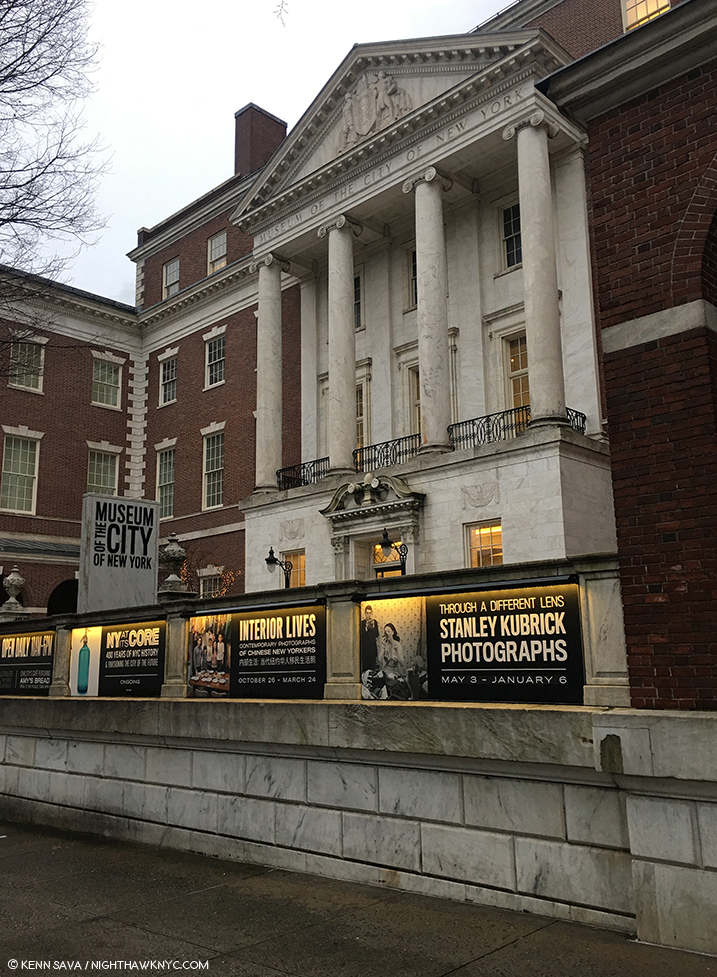
“Open the Pod Bay Doors, Stanley.” Click any Photo for full size.

The majority of Look Magazine’s Photo Archives (5,000,000 Photographs) were donated to the Library of Congress. However, those relating to NYC were donated to the Museum of the City of New York. These include approximately 12,000 contact prints, and negatives Stanley Kubrick created for Look over 129 NYC assignments1, the vast majority of them have never been published.
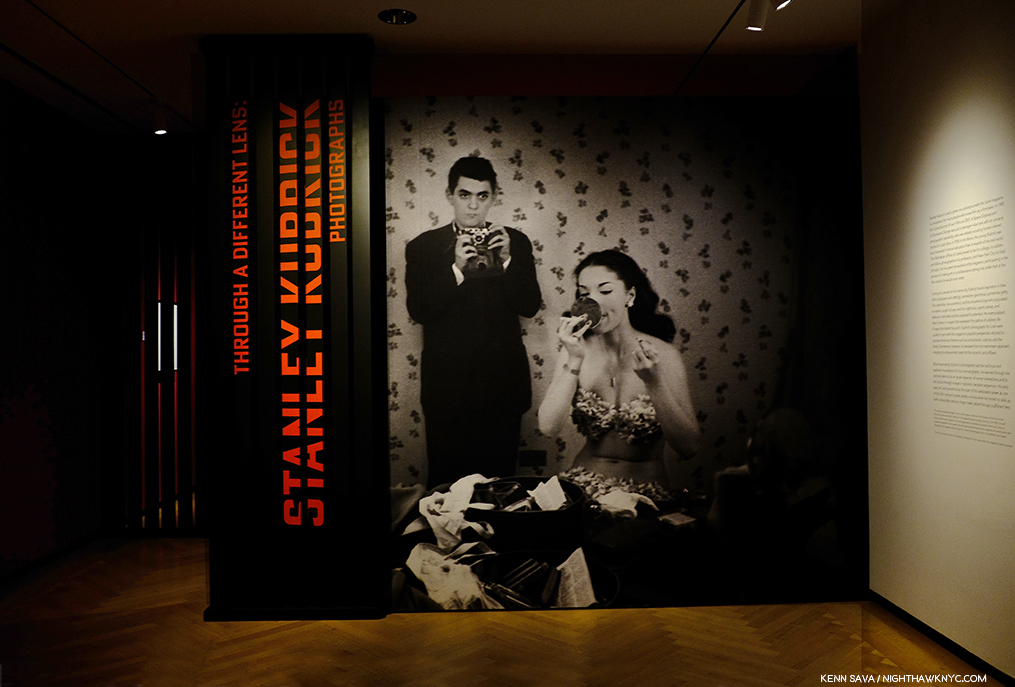
The eyes of a genius. The show’s entrance features this haunting Photograph by Stanley Kubrick in which he shoots himself and the “Showgirl” Rosemary Williams reflected in her large tabletop mirror. The Photo, Stanley Kubrick taking a picture of Rosemary Williams applying lipstick, which is cropped on the sign, is from the unpublished story, “Rosemary Williams- Showgirl,” March, 1949.
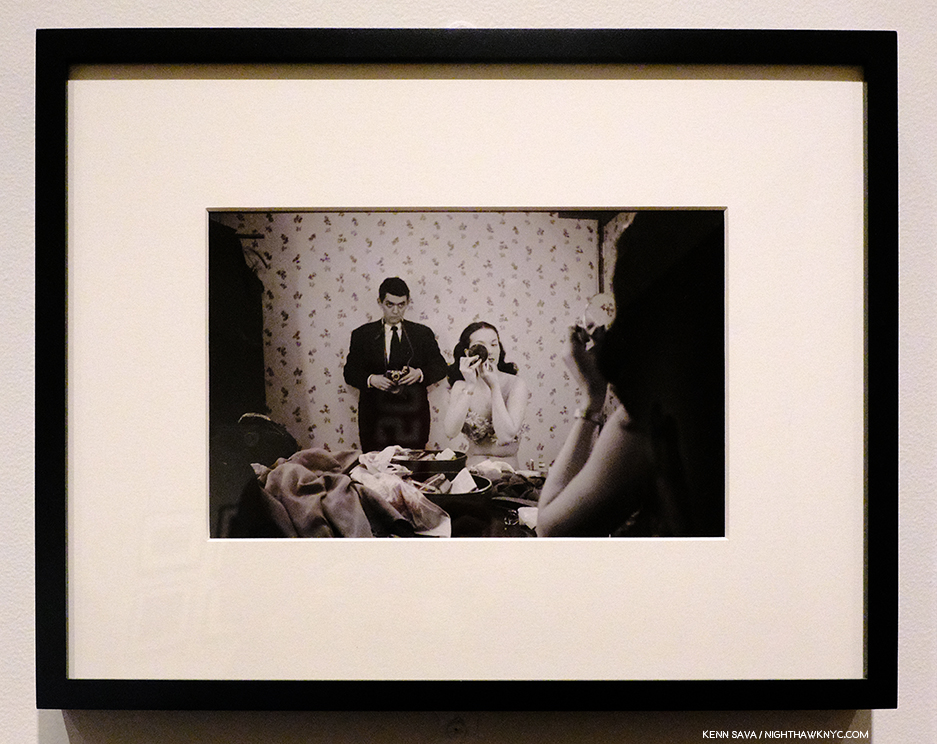
Also from the same story, Rosemary Williams Applies Lipstick, March, 1949, a companion piece to the shot above. Stanley was 19 when he took these. I’ve seen the look he has on his face in these two shots in other pictures of Stanley Kubrick, and each time its caption includes the descriptive “intense concentration.” For a number of reasons, this may be the most remarkable Photograph I’ve seen thus far in this body of his work. I picture him having that look as he took every shot in this show.

Stanley Kubrick remains a magnificent mystery to me, akin to the monolith in his classic 2001: A Space Odyssey. His films (all 13 of them) are high on my list of favorites. I can think of no other Director I revere as highly as Stanley Kubrick, other than Charlie Chaplin2. Yet, it’s still not all that well known that before he became a Director, Stanley Kubrick was a professional Photographer. Remarkably, he was 17 years old when he sold his first Photograph to Look Magazine, then one of the most popular magazines in the country, in 1945. Hmmm…who was the last Photographer I wrote about who achieved recognition that mature Photographers yearn for their whole lives at 17? Stephen Shore was 17 when he sold his first Photo to MoMA.
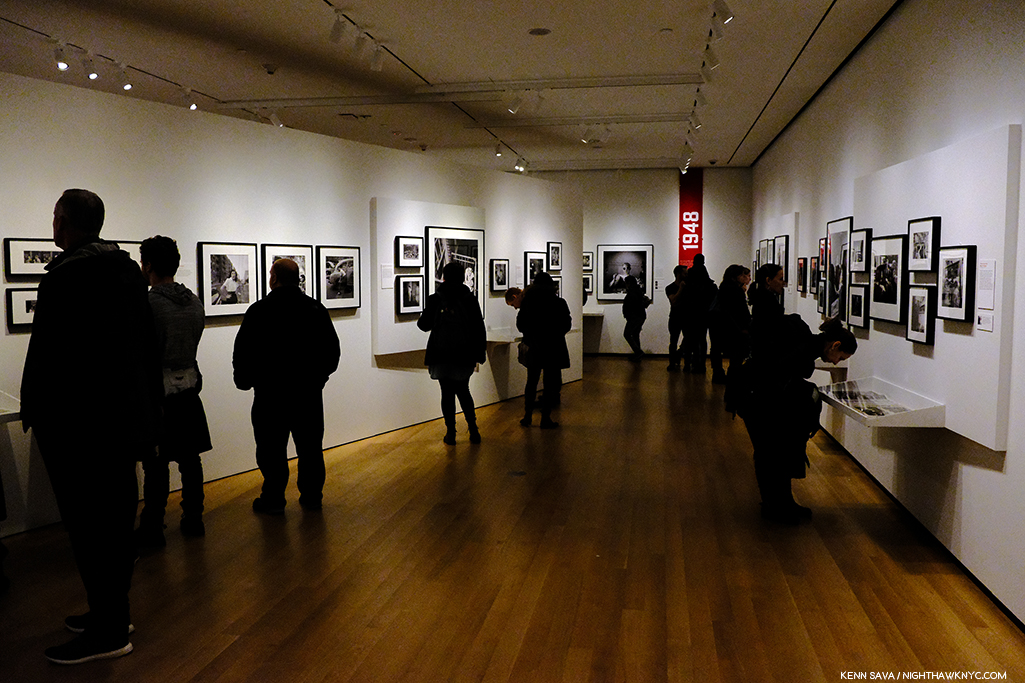
New to this body of his work, I went to see the 130 of his Photographs (though there was no indication, these appeared to be exclusively recent digital prints, not silver gelatin prints) on view in the show to get a sense of SK- the Photographer, but primarily, I went specifically looking for evidence of the later, mature genius Film Director. I found it. It just wasn’t how I was expecting to find it. I’ve seen a number of comments online from people who find these shots “banal,” and terms connoting similar degrees of a tepid response. Perhaps, like some of them, I was hoping to see shots full of brilliant moments filled with that unique mystery and awe every moment of his Films hold, at least for me. Then again, I should have realized that very little about Stanley Kubrick lies where you’d expect to find it.

“Observation is a dying art.” Stanley Kubrick, Stanley Kubrick: Interviews.
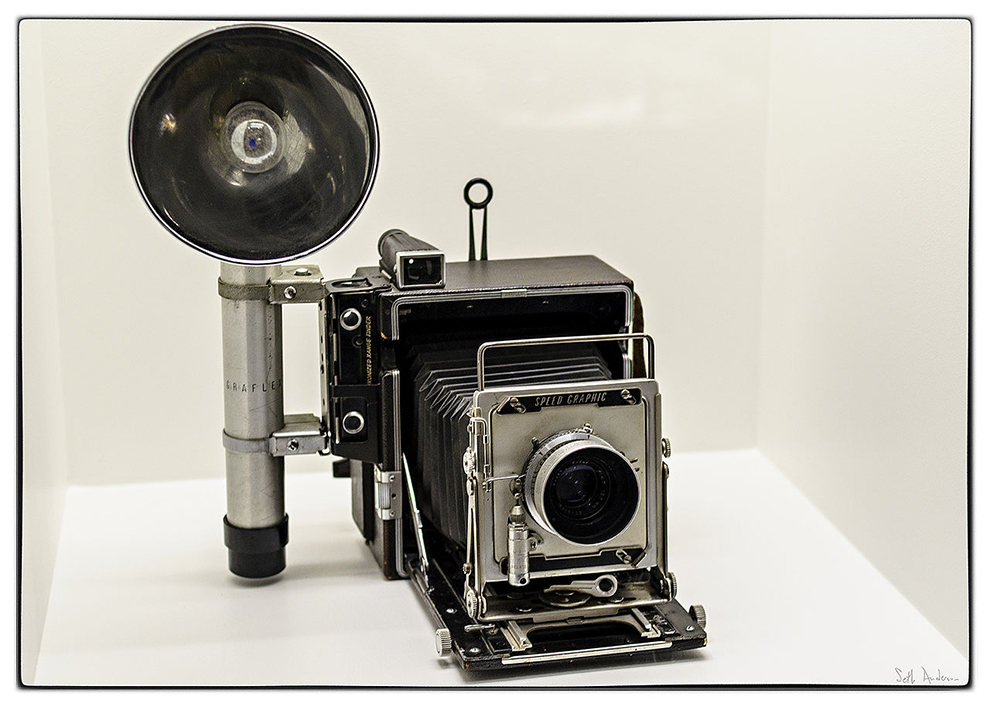
Stanley Kubrick’s Graflex Pacemaker Speed Graphic camera as seen in the Stanley Kubrick show at LACMA in 2013 still looks to be in decent condition after seeing heavy use at least between the years 1941-50. *Photo by Seth Anderson

The story begins when Jack Kubrick, a physician and passionate amateur Photographer, gave his son a professional Graflex Pacemaker Speed Graphic camera for his 13th birthday on July 26th, 1941. Stanley’s friend, Marvin Traub, had a darkroom in his house, so after their sojourns around town taking Photos, the two would develop their film there. On or about April 13, 1945, the day after Franklin D. Roosevelt died, Stanley came across this scene at 170th Street & the Grand Concourse, in the Bronx3

17 year old Stanley Kubrick’s FDR Dead, 1945, was the first Photograph he sold to Look Magazine.

Well, sort of. At first he said this shot resulted from “lucky happenstance.” But, he later admitted he “coaxed4” the news seller, surrounded by newspapers declaring President Franklin D. Roosevelt had died, into this pose.

Wait. What?

He went home and developed the film in the darkroom that he had by then installed in his own house and took it into Manhattan to the offices of Look Magazine. There, Helen O’Brian, chief of the Photography Department, saw it and paid him 25 dollars for it.
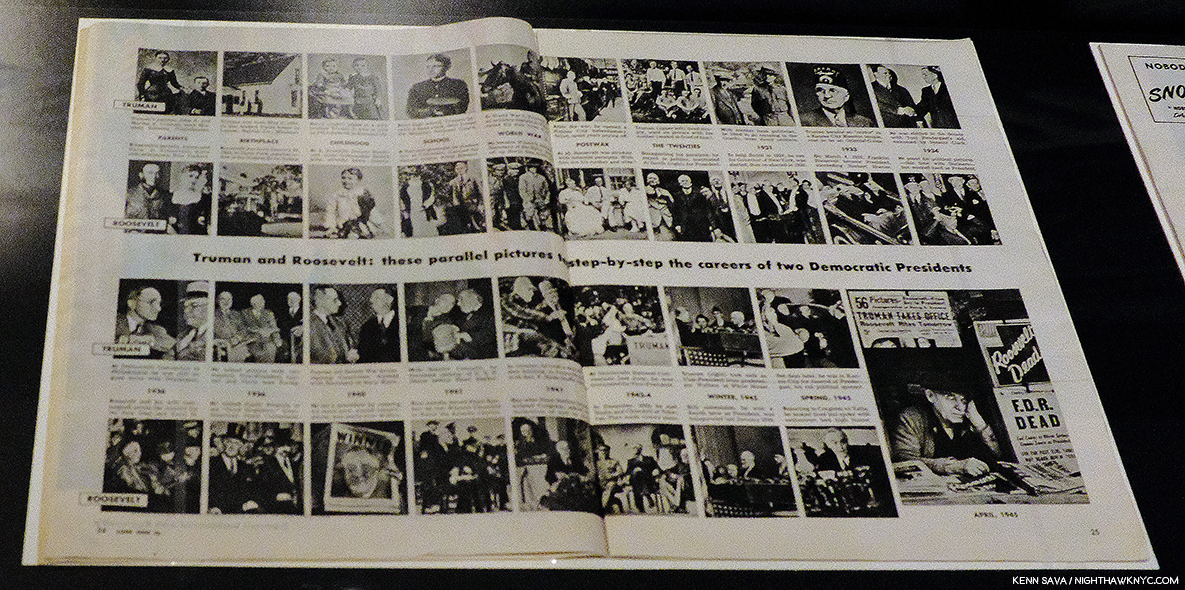
It ran in the spread above in Look’s June 26, 1945 issue, the last of 36 Photos, and the only enlarged image in the group. Stanley Kubrick was still a High School student at William Howard Taft High School in the Bronx. Think about this- In June, 1945, Stanley Kubrick had not even had his Graflex for 4 years. But, there’s more to it. That he “urged the salesman to look more depressed than he was for dramatic effect5” is “directing”- he’s eliciting a performance for a scene.

Therefore, this is the first instance we have of Stanley Kubrick putting his “directing” skill into practice.

It, also, serves to put the viewer on notice that from here on out his Photographs may not be entirely as they seem. As my research continued (and continues), I found more and more Photographs that curators and researchers say were posed or staged. Not all of them, but a good number. For me, this first revelation turned out to be only one way in which Stanley Kubrick, the Director & Filmmaker, begins to manifest his presence in the work of his younger self. As for that younger self, while he was too old at 17 to be a “child prodigy,” when you take his ability, his eye, and his gift for whatever the composition needed into account, from his work at 17, I think he qualifies as a “prodigy.”
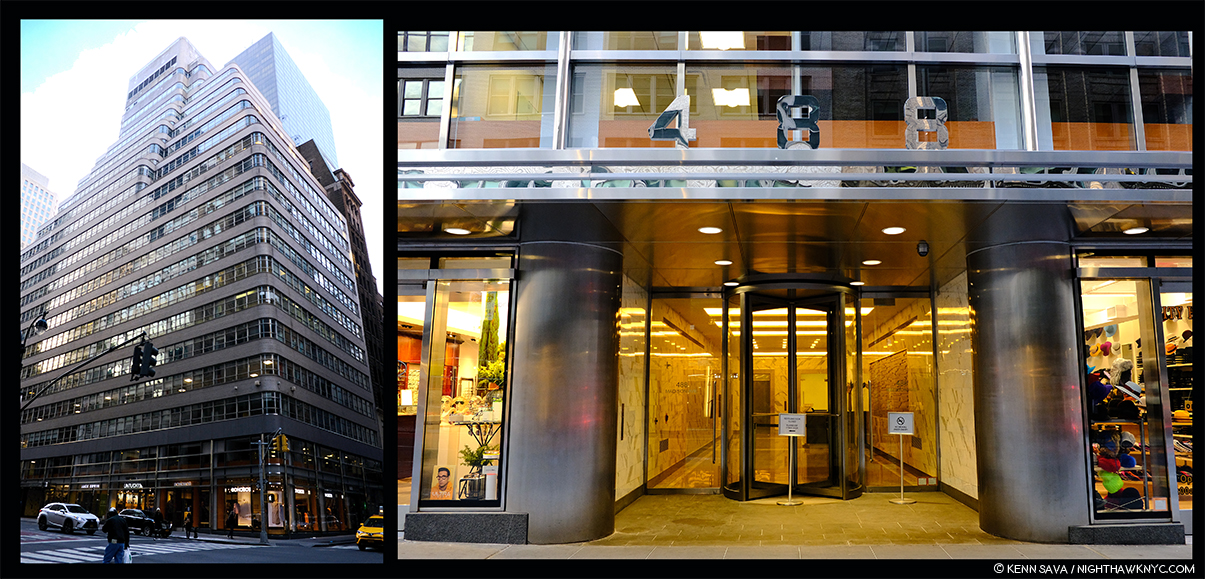
The mothership. The Look Magazine Building, 488 Madison Avenue, around the corner from MoMA, was built in 1948-50, during the last half of Stanley Kurbrick’s employment there. It’s now a landmark building. Seen on February 2, 2019.

“One thing that helped me get over being a school misfit was I became interested in photography at about 12 or 13.” Stanley Kubrick6.

From “How A Monkey Looks to People…How People Look to a Monkey,” Published in Look, August 20, 1946. SK was a $50. a week Apprentice Photographer when he took this classic Photo at 18 years of age.

He sold Photos to Look from time to time until he graduated in January, 1946. Thanks to his frequent truancy cutting class to go see movies at the Loew’s Paradise Theatre near his home (hmmmm….), his 67 grade average was too low to compete for a place in college against the returning G.I.’s7, when a 75 was the floor to even be considered. So, Helen O’Brian hired him for Look as an Apprentice Photographer for $50. a week. He became a full Staff Photographer in October, 1946. Stanley Kubrick grew up fast. Look became his college. “By the time I was 21, I had four years of seeing how things worked in the world. I think if I had gone to college I would never have become a Director8.” It was a unique “college” in that it offered posterity a chance to study the development of the “student” over the 5 years he was there.

“Writing, of course, is writing, acting comes from the theater, and cinematography comes from photography.” Stanley Kubrick9.

Unpublished contact strips depicting people conversing the street, probably shot with a telephoto lens. There’s an undeniable “cinematic” feel to these series, a number of other such sequences were included in the show.

On his way to becoming a great Director, Stanley Kubrick was an accomplished professional Photographer first, skills that never left him, and that he would use constantly in his Films. The component skills he developed being a Photographer (who was already technically proficient)- composition, lighting, setting a scene, working with subjects, would prove invaluable to him. As would observation – that “dying art.” In addition, a number of the assignments he was sent on became experiences that he also used to learn about what would be his later profession.
One of those “other” skills is storytelling. Even besides the strips just shown, there is a strong sense of it throughout the quite sympathetic body of work seen here. Where did it come from? Whatever its origin, it’a already on full display, here, at 19. His unique way of telling a story is certainly a hallmark of his Films. Here are some of the 250 Photos he shot for an unpublished assignment called “Shoeshine Boy,” handed in on October 6, 1947, one of the most fascinating stories I’ve seen, in which he followed the title boy, Mickey, to his job, to school, doing errands, hanging out with his friends and family, and tending his pigeon coop. Mickey was only 7 years younger than Stanley Kubrick at the time.

Stanley’s Photographs are technically accomplished from the first one to the last. Surprisingly so for the viewer new to this work, given his youth and the fact that he was self-taught. His Photographs turn out to be up to any technical challenge thrown his way- day, night, portraits, action, off the cuff, groups- what I’ve seen thus far of his 135 assignments run the full gamut. It doesn’t matter the situation, the environment, the lighting or time of day. Is he the “master” magazine Photographer? No. He’s not. There are times when any one of the innumerable technical elements inherent in Photography seems to let him down, but by and large I came away exceedingly impressed with his technical ability. Stephen Spielberg said that one thing that bonded Stanley Kubrick’s Films together was “the incredible virtuoso that he was with craft10.” I get that sense from looking at his Photography. Unlike Weegee (who ALWAYS seems to get his shot, and 95% of the time does so using flash), Stanley doesn’t shoot one way. He adapts to the situation and what he’s trying to express, which is gutsy for a young Photographer trying to secure his place on a staff of a magazine such as Look, which included some established names, like Arthur Rothstein and John Vachon. The deeper you look into this work, the more there is to say about it. Though only touched on in the books and articles I’ve seen, in my opinion, every single aspect of this work needs to be studied in depth-
From “Rosemary Williams-Showgirl,” unpublished from March, 1949, Rosemary Williams and a man at a candle-lit table, 1949. An early candle-lit Stanley Kubrick Photograph that just might seem to presage the extraordinary lighting & camerawork in his now classic Barry Lyndon, 1975, where, by then, he would master the exposure.

-His technique- Where was it in April, 1945, and how it changes and how it evolved over his Look career. This includes his compositional choices, positioning (love of low angles and overheads), lighting (natural light versus flash), and how all of these may have appeared in his Films.
Stanley Kubrick shot surreptitiously in the Subwary for a piece titled “Life and Love on the New York Subway,” March 4, 1947, using a cable release that ran down his sleeve. He had no way of knowing that Walker Evans had, also, shot secretly in the subway in 1941 because Walker did not publish his series until the book, Many Are Called, was published in 1966, out of fear of lawsuits from his subjects because he did not have releases from them.

-The assignments-  Both published and unpublished. Between the Library of Congress’ and the MCNY’s websites about half of his Photographs appear to be online, as far as I can tell. The complete body of SK’s Photographs needs to be made available. Only then can a proper assessment of his achievement and what it portends for his future work be made.
An unprecedented Photo. Rocky Graziano in an unpublished outtake from the story “Rocky Graziano: He’s a Good Boy Now,” which ran on Valentine’s Day, 1950. It says a lot that Rock Graziano, who was coming back from a scandal, would allow this shot to be taken. Boxing was a subject Stanley Kubrick shot on a number of occasions for Look, and the depth at which he studied this subject, like this and the shot of Willie Beltram, below, paid dividends in the heightened realism he achieved in a few of his later Films.

-The assignments that tie directly into his later Films. These include a number of boxing stories, the Aqueduct Race Track story, the stories involving TV Productions, actors and actresses (ranging from Montgomery Clift, Zero Mostel, and Frank Sinatra, to the unknown Rosemary Williams), and his Naked City shoot.
Stanley Kubrick posed this shot from the “Subway” series in 1947. How do we know this? That’s his future wife, Toba Metz (who he married in May, 1948) on the left, who appears in other shots in the series. More on this shot in BookMarks, at the end.

-Which shots did he pose? (As far as is known).

Why is all of this necessary? While there have been shows like this fine show and others in Europe, they, and the books just scratch the surface. They only reveal part of the story, only presenting a limited glimpse of the whole body of work, due to its size, which Professor Rainer Crone says is 12,000 Photographs. The books that have been published thus far (all but one of them out of print) each contain between 2 and about 400 hundred. Even if you have all of them in front of you (I have three), you still only get to see part of any one story he shot! Stanley, like most staff Photographers at Look, shot a lot of Photographs for their stories to allow the editors the widest leeway in making their selection (I wasn’t able to determine if he ever made the selections himself, or had any say in it. It would appear he did not.). With, say, 250 images for a given story, almost– none of his assignments have been published complete thus far (as far as I can tell). This is incredibly frustrating and, of course, it does not allow a full assessment of his work- even on one assignment.
Willie Beltram, October/November, 1947, from an unpublished story, the first time SK shot boxers, a subject he would return to a few times at Look, and in his early Films, Day of the Fight and Killer’s Kiss. In those films, too, he would get right into the ring and very close to the action. It seems to me it also looks ahead to the carnage he graphically depicted in Paths of Glory and Full Metal Jacket.

Is it practical to release tens of thousands of Photographs? One look at the ten volume(!) set Taschen published of the existing material for Stanley Kubrick’s unmade Film, Napoleon, which includes 15,000 location Photos AND 17,000 “slides of Napoleonic imagery” (though shown at a large thumbnail size) would seem to say- “Where there’s a will? There’s a way.” After being immersed in this work for the better part of the past 4 months, I believe it is important enough that it needs to be done, and I predict someone will do it- one day (and I say that knowing nothing about the politics/legalities involved with, and between, the Kubrick Estate, the Library of Congress, and the MCNY). After pouring over the show, the existing web resources, and the 3 books I have (which together include about 8 or 900 images, though some are duplicated), my desire to see more has only grown. Given the unlikeliness of Stanley Kubrick’s Films diminishing in interest or importance any time soon this need will only remain, if not grow. From my study, I’ll say this-

I’m absolutely convinced there is more to learn about Stanley Kubrick, the Director, in this body of work- his Look Photographs, than there is anywhere else besides his actual Films and his interviews.
Weegee? No. Stanley Kubrick during the prodcution of the Weegee inspired film, Naked City. Speaking of “Street Photography,” it’s interesting to note that both Stanley Kubrick and Garry Winogrand were born in the Bronx in 1928. For perspective, Diane Arbus, who knew Stanley during his Look days, was born in 1923.

Put them all online, perhaps in a joint website. Maybe that’s the most practical way. Arrange them by story assignment-unpublished or not, in chronological order. Reproduce each magazine story, when there is one, follow that with all the Photographs, published and unpublished (uncropped, full size, since they were cropped on occasion in the magazine), in the order they were taken, and also include the contact sheets, would be my suggestion. Whether this all comes out as a book, or series of books, perhaps by year? That’s up to a publisher. I think it would find buyers. Is this going to be a popular series? No. Then again, no “catalog rainsonne” is a best seller. It’s for specialists. It’s for those passionately interested in the Artist’s (Stanley Kubrick’s) work, and for those seeking to learn from his path. It’s probably not for the everyday lover of Photography, though a well produced summary volume might be reasonably popular. (See BookMarks at the end for more on the existing books and some recommendations.)
Four Photographs from the unpublished “Naked City,” assignment,  July 31, 1947. Stanley Kubrick went to shoot the production of the Film Noir movie, which took its name from Weegee’s famous book. Weegee was someone Stanley Kurbrick admired, and years later hired him as Still Photographer on Dr. Strangelove. Here, Stanley got to watch Director Jules Dassin (upper right) work and observe the production. None of this would be lost on him. His early Films, Killer’s Kiss, and the terrific The Killing are both Film Noir and both shot in the city.

Experts, including German Professor Rainer Crone (the first person to research this body of work, with Stanley Kubrick’s personal blessing, mount exhibitions of it and write the first books on it) mention a few stories, in particular, as being springboards to the future career of Stanley Kubrick. Many agree that his Look shoot of the filming of the Film Noir classic Naked City was a key moment, giving him an inside look at a rare movie production going on at the time in a big city. Boxing assignments were also influential. He shot Rocky Graziano and relatively unknown boxer Walter Cartier. In 1951 Stanley Kubrick made a 12 minute documentary short Film entitled Day of the Fight following the same Walter Cartier around from wake up until after the final K.O., veritably recreating his Look story, “Prizefighter,” on Film. In that sense, this marked the beginning of the end for Stanley Kubrick at Look. In addition, late in his career at Look, his assignments brought him more and more often into contact with TV Productions, actors and actresses. All of these experiences proved “educational” for him for where he would go next.
In the article “Prizefighter,” featuring the boxer Walter Cartier, the subtitle of this section is “The Day of a Fight.”

By this point, he had seen what he needed to see to begin making films, down to knowing what equipment he’d need, where to get it and how much it would cost to rent. Long desiring to make Documentaries, he turned the Walter Cartier “Prizefighter” story into one.
Screenshot of the title card of Day of the Fight, 1951, his first film, at age 25, which runs a bit over 12 minutes, and which he Photographed.

Stanley Kubrick’s early films carry this credit-
His credit line in Killer’s Kiss, 1955. He also wrote the story. See the Appendix for more screenshots that are reminiscent of SK’s Look Photos.

“Photographed by Stanley Kubrick.” Today, we would call it “Cinematography.” But, I think the term “Photographed” is telling. Eventually, by the The Killing, 1956, unionization forced him to hire a Cinematographer11. Yet, SK would continue to look through the viewfinder (and there are countless shots of his on his sets doing just that) and the camera, and continue to shoot Film on occasion.
Photographer/Director Shane Rocheleau at the NYABF, September 22, 2018.

Fascinated by the difference between shooting still Photographs and Film, I reached out to a man who has experience creating both- Shane Rocheleau. The subject of a Q&A I did in September, 2018,  I even mentioned Stanley Kubrick in describing his talents in my NoteWorthy PhotoBooks, 2018, saying that his first PhotoBook, You are Masters of the Fish and Birds and All the Animals, or YAMOTFABAATA as it reads on the spine, was “edited like a Stanley Kubrick Film.” I’m not sure there’s a higher invocation I could give someone in Photography or Film. In addition to being an exceptionally talented Photographer, Shane Rocheleau is already proving to be one of the new masters of PhotoBook editing & sequencing. During my research into him, I also discovered that he is a Film Director. I reached out to him, and he confirmed this for me, and sent along this link where his Film, Tide, 2009, that he also wrote, can be seen. I asked him about the differences between shooting still Photographs and Film. He said-

“I can’t pretend to speak for a genius like Kubrick, but I’ll give you a bit of insight into the differences between creating photographs and creating films, for me. To clarify first, though:  I am not a documentary photographer, and I am not an experimental filmmaker. If I were both, my answers below would, maybe, flip-flop. What I know of Kubrick, he, like me, was not a documentary photographer nor an experimental filmmaker.

When I hear the word “conceptual” placed in proximity with “art”, it means something very specific to me. Namely, it means that the artist’s conclusion was rendered before the art was executed. Plans were made. The resulting art product serves to explain, announce, demonstrate, manifest, etc. knowledge or forms the artist has already resolved (The God of Genesis appears to have been a conceptual artist). While when making films I may be unsure of the knowledge I’m attempting to disseminate, but my narratives and forms are usually fairly well determined. Story, arc, shots, and sequences are imagined prior, and props, actors, location, etc. are fairly settled. My film will have some room to grow or morph at every step in the creative process; however, I view the overall arc of its making to be well aligned with my idea of conceptual art:  I imagine the film first, then execute its making.

For me, the photographic process operates in contrast with conceptual art. While I usually begin a photography project with an idea, never in my experience has that idea remained intact through to the end; on the contrary, I always learn I was wrong. The photographic process is inherently about discovery. Even when I presage a photograph, the final product reveals something very new, often even contradictory. Rather than marked by understanding, my ideas are rended by my photographs. Confusion necessarily ensues, and meaning emerges as I let go of certainty, make unexpected pictures, sequence and pair the absurd, and indulge discovery. The final project is a new growth, a new understanding. Contrary to a conceptual process, once I resolve my ideas, I’m done.”

After making 3 short Documentary Films (Day of the Fight, Flying Padre, both 1951, and The Seafarers, 1953), he realized that the only way to make enough money to sustain a career was in making feature Films. By then, he had quit is job at Look and would never look back. He would make his first feature Film, Fear and Desire, later in 1953, which he also “Photographed.”

In order to look a little closer at the similarities between Stanley Kubrick’s early Films and his Look Photographs, I’ve created an Appendix that appears below this piece (or, here) that includes screenshots from the first part of his second feature Film, Killer’s Kiss, 1955, “Photographed” by SK, that look similar to me to some of his Photographs I’ve shown here.

Beyond these similarities, the influence of his still Photography lived on in his later work, even after he was working with other Cinematographers. For one thing, he is often seen holding a still film camera on the set.
Stanley Kubrick on the set of Spartacus– with THREE still cameras around his neck! Mr. Rocheleau thought that he was shooting for pleasure, given the smile on his face. The reason would seem to not be an instant need to see the Photos since the film would need to be developed. *From the Stanley Kurbrick Archives. 

As his vision matured, and his resources (and budget) increased, it largely outstripped what we see in his Look Photographs. One significant remaining holdover was Stanley Kubrick continued to rely on a still camera, now a Polaroid instant camera, to take Photos to see how the scene looked in two dimensions and to check colors, continuity, and for other reasons,. on the sets of many of his films, including the classic 2001: A Space Odyssey


For those looking for evidence of the lasting  effect of Stanley Kubrick’s still Photography career and experience on his Films, this may be the defining image. With his Polaroid Pathfinder 110A on the set of 2001. *From the Stanley Kurbrick Archives. 

I’ve seen estimates that SK shot 10,000 Polaroids during the production of 2001. In the book The Making of Kubrick’s 2001, 1970, Jeremy Bernstein’s 1966 Profile of Stanley Kubrick, originally published in The New Yorker, is reprinted. In it, Mr. Bernstein says, “I asked Kubrick what he needed the Polaroid for, and he explained that he used it for checking subtle lighting effects for color film. He and the director of photography, Geoffrey Unsworth, had worked out a correlation between how the lighting appeared on the instantly developed Polaroid film and the settings on the movie camera12.” He continued to use it, as he does here, on Full Metal Jacket, 1987-
Stanley hands a freshly shot Polaroid print to an associate as it develops on the set of Full Metal Jacket where he appears to still be using his Polaroid Pathfinder 110A, some 20 years after 2001. *From the Stanley Kurbrick Archives. 

Perhaps by his last Film, Eyes Wide Shut, 1999, he was using an early digital camera, or perhaps he still preferred to see the image instantly on a print. A lover of new technologies, who knows what he would have been doing or how he would have been working today. Whatever the means, the value of his early training as a still Photographer would, no doubt, have still been paying off for him.

Given the level of his talent and his vision it probably shouldn’t be a surprise that as we approach the 20th anniversary of his death on March 7, 1999, next month, there is still much to discover about, and in, the work of Stanley Kubrick.

*- Soundtrack for this Post is “My Old School” by Walter Becker & Donald Fagan of Steely Dan, recorded on their second album, Countdown to Ecstasy, 1973. (Yes, it’s on Countdown to Ecstasy. I have no idea why the producers of this video show the cover of Can’t Buy A Thirll.)

The Appendix to this Post, Stanley Kubrick: A Photographer’s Odyssey-Appendix, is below, following BookMarks, or here.


BookMarks-

If you like what you find on NighthawkNYC, I hope you’ll consider supporting it so that I can continue to spend the countless hours and pay the expenses it takes to keep it going these past 3+ years-without ads. If so, you can also make a donation through PayPal by clicking on the box to the right of the banner at the top of the page that will take you to the Donation button. Your support is VERY much appreciated. Thank you!

As I said above, this body of work is vast and covers 5 years. The issue of how to approach it becomes Question One for anyone attempting to make a book about it. To date, all the books I’ve seen have been focused on exploring it. None have attempted to present the complete picture or look at this work in light of what came after (a book with tens of thousands of Photogaphs would be massive, even if it consisted of thumbnails, like Gerhard Richter’s Atlas). The 3 books I’ve seen thus far all take the same approach- an historical look at selected stories and images and only occasionally mention his later Film career13 For a variety of reasons, none of these books is “the” definitive book on Stanley Kubrick’s Look Photographs, in my opinion. The books are-
Stanley Kubrick Photographs: Through a Different Lens, published by Taschen in conjunction with the MCNY, and its curators, Sean Corcoran and Donald Albrecht, in 2018, is the catalog for this show. The only book currently in print on the subject of Stanley Kubrick’s Photographs, it contains about 300 of them, over 332 pages that are split between beautiful full-page and double page reproductions of single Photographs and reproductions of the Look Magazine stories they ran in. Unpublished assignments are also included. After the initial essays, the remainder of the book is arranged by year and assignment.
An outtake from “Life and Love on the New York Subway,” March 4, 1947, beautifully reproduced across 2 pages, which results in an image size of 26 1/2 by 22 inches! Compared with the shot posted earlier (from an online source), the man’s position has changed and the Photographer has moved closer. How do I know this hasn’t been cropped? This image appears on a strip from the contact sheet published in the Stanley Kubrick Archives.

The best thing about this book, in my opinion, is its size- It’s BIG. 10.8 x 13.2 x 1.5 inches and clocking in at 6.6 pounds. Unlike most recent very large PhotoBooks, this one takes continual advantage of its acreage, often going edge to edge14 This presents the opportunity to see selected landscape oriented Photos at the incredible size of 26 1/2 by 22 inches, as seen above!  The chance to see Stanley Kubrick’s Photographs in a large size does not exist, nor has it ever existed, outside of this book. EVEN in the show (save for a handful of wall size blowups, like the sign shown earlier)! Here you get to see many of its 300 images in full page, 10.8 x 13.2 inch, reproductions. Taschen’s history with XL size books is to make them smaller with each succeeding incarnation. So? If you want to see these images big, this may be your only chance to do so. As such, I expect this first edition will retain lasting interest with Kubrickians (did I just coin that term? I doubt it) indefinitely. As for its shortcomings, I am unhappy with some of the assignments included (Guy Lombardo shown at home. Why?) and those left out which have a direct import on his subsequent Film career. Therefore, it seems to me the editors may have intended this book to be a general interest book. Second, the images in this book are reproduced with a depth of blacks I haven’t seen before. The images in the show were also printed similarly as you can see in my piece. Nothing is said in the book (or in the show) about how these prints were made. In the Preface, Whitney Donhauser only states, “The Kubrick Archive has been photographed, scanned and retouched by…” Compare the one above to the other images below, the sources of which are not stated either. Also, the images on the MCNY website are darker than those on the Library of Congress site. I’m not sure what to make of this but it’s something to be aware of. In my opinion, the curators/editors should have addressed and clarified this somewhere. Overall, I recommend this book to anyone with an interest in seeing these Photographs large, and for those interested in this body of work not wanting to spend rare book prices for the out of print titles. Recommended with reservations.
Rainer Crone’s SK: Drama and Shadows, published by Phaidon in 2005

The other books on Stanley Kubrick’s Photographs are all either out of print, not in English, or both. Of these, Professor Rainer Crone is the man behind those I know of. He was the first one to show this work, with Mr. Kubrick’s blessing, and he has produced, I believe, 3 books about it so far. The most well known of these is the hardcover Stanley Kubrick: Drama & Shadows, published (in English) by Phaidon in 2005. Good, or better, copies can be found for 65.00 and up. It is very well done, does not give any evidence of cropping, though the reproductions do not have the depths of blacks the Taschen book has. The supporting texts are quite informative and reveal Mr. Crone’s ongoing interest in, and dedication to, this work. While its selection fills in some of the gaps in the Taschen book, again, I felt frustrated by some of what was left out (as I will be until a way is found to see all of this work).
A sample image, from SK’s “Aqueduct Racetrack: Hope, Despair and Habit” assignment, March, 1947, which I feel is important for its possible influence on his film The Killing, 1956, about a race track heist.

The front flap says it contains 400 Photographs over 240 pages of a good paper stock. Recommended, if you can find a copy in good condition at a reasonable price.
Rainer Crone’s SK Fotographie, the catalog accompanying a 2010 show in Milan.

I have one of Rainer Crone’s other books, Stanley Kubrick Fotographie, 1945-50, a large softcover book, though its text is only in Italian. This is frustrating because it’s the most recent of Rainer Crone’s books (I believe), being the catalog accompanying a show he curated in Milan in 2010. It includes interesting supplements, including a list of published Look articles and Photos of the covers of (all?) of those issues (Stanley Kubrick shot a few of the covers in color, but those are shown in black & white here). I don’t know the total image count over its 255 pages, but it includes more images in some of the series than the Taschen book. It is, however, extremely hard to find- much more so than Drama & Shadows. Recommended for specialists in SK’s Photographs.
A sample image shows another shot from the “How A Monkey Looks to People…How People Look to a Monkey,” assignment, from August, 1946. As you can see, the images here appear darker than in SK: Drama and Shadows. Perhaps it is using the digitized MCNY sources.

The body of literature on Stanley Kubrick and his Films is large and outside the scope of this piece, however one book must be mentioned and singled out from that body for its sheer uniqueness and extraordinary value- The Stanley Kubrick Archives began life as a 2005 Taschen XXL book that came with a filmstrip from Stanley Kubrick’s copy of 2001 that now sells for hundreds of dollars on the rare book market. More recently reissued in one of their small brick books it lists for 19.95. I mention it because it has a very interesting first chapter that discusses Stanley Kubrick’s Photography, along with countless Photographs of Mr. Kubrick at work, and a very large number of rare items from his own collection & archives. All of this makes it an essential book for anyone interested in Stanley Kubrick- Photographer or Filmmaker.

Finally, I have it on good account that some first edition copies of Shane Rocheleau’s first PhotoBook, YAMOTFABAATA, the only First PhotoBook to be listed among my NoteWorthy PhotoBooks of 2018, are still available from Gnomic Book, here.

My thanks to Shane Rocheleau and Mary Flanagan of the Museum of the City of New York.

NighthawkNYC.com has been entirely self-funded and ad-free for over 6 years, during which over 250 full length pieces have been published. If you’ve found it worthwhile, you can donate to keep it going & ad-free below. Thank you!

Written & photographed by Kenn Sava for nighthawknyc.com unless otherwise credited.
To send comments, thoughts, feedback or propositions click here.
Click the white box on the upper right for the archives or to search them.
For “short takes” and additional pictures, follow @nighthawk_nyc on Instagram.

Subscribe to be notified of new Posts below. Your information will be used for no other purpose.
 

  1. Through a Different Lens: Stanley Kubrick Photographs, published by Taschen in conjunction with this show, henceforth Exhibition Catalog, Preface
  2. “Ive always said the two people who are worthy of film study are Charlie Chaplin and Orson Welles as representing the two most diverse approaches to filmmaking.” Stanley Kubrick: Interviews, P. 79
  3. Jeremy Bernstein Audio Interview, 11/27/1966
  4. The Stanley Kubrick Archives, P.13
  5.  Exhibition Catalog, P.10
  6.  Jeremy Bernstein Audio Interview, 11/27/1966
  7. Jeremy Bernstein Audio Interview, 11/27/1966
  8. Exhibition Catalog, P.9, quoted from Michael Herr, Kubrick, P. 4
  9. //www.brainyquote.com/authors/stanley_kubrick
  10. //www.youtube.com/watch?v=Rd97Og-20Yc&app=desktop
  11. Stanley Kubrick Archives P.110
  12. The Making of Kubrick’s 2001, Edited by Jerome Agel, P.68
  13. The third book is in Italian, so I have no idea what it’s essays discuss.
  14. Since many of these images have never been previously published, I have no way of comparing them, so I don’t know if there is any cropping going on here. I seriously hope not and I am writing this under the assumption there is not. If you can prove differently, please let me know.

Charles White- Now

Written & Photographed by Kenn Sava

“Drawing is [a] particularly exciting medium for me. I just like the feel of it. My whole body is into it when I draw and I think black and white is as effective a medium [as any].” Charles White1

Charles White, Detail of Study for Nat Turner, Yesterday, Today, Tomorrow, 1968, Charcoal and oil wash over pencil on board. Click any Photo for full size.

Ah…the majesty of excellent draftsmanship… Just when you thought it was dead as a doornail, with Photography destroying all previous Artforms in its world dominating wake, along comes a Retrospective of one of the Masters of the craft of Drawing in the 20th Century, the late Charles White (1918-1979), who’s centenary is celebrated in the first major museum survey devoted to his Art in over 30 years. Charles White: A Retrospective, made its second stop at MoMA after debuting at the Art Institute of Chicago and now heads to LACMA beginning February 16th, thus tracing the 3 cities Mr. White lived in- in order. Its magisterial, full of wonders, and long overdue. The only possible caveat could be- MORE!…even bigger, please.

The entrance, divided by a sliding glass door, of one of the great shows of recent years.

By no means a small show, clocking in at 114 items (many of them quite large), over 13 section, the takeaway is that, henceforth, it will be impossible to deny Charles White his place in the pantheon of great Artists of the century. Again.

Charles White was a very successful Artist during his lifetime. He had gallery representation in each city he lived in and his work was collected by museums, nationally and internationally. He was also sought out as a teacher, particularly at Otis College of Art & Design in Los Angeles, from 1965 until his passing in 1979 at only 61. After his death, he fell into something of an eclipse. But, his influence has lived on through the work of his students including Richard Wyatt, Jr, Kent Twitchell (both muralists), and most prominently, Kerry James Marshall (a “representational” Painter) and David Hammons (who has worked in a wide range of media). Mr. Marshall never seems to miss an opportunity to laud Charles White- as a teacher and as an Artist, frequently speaking of him in the highest terms, as he has, again, writing the preface for the excellent Exhibition Catalog. He led me to take a deeper look at Charles White a few years ago. Mr. Hammons paid tribute to Charles White in October, 2017 when he curated the remarkable Leonardo da Vinci-Charles White show at MoMA, that I wrote about here. Judging by the crowds that attended this show, as the MoMA stop of the Charles White Retrospective “tour” ends and Los Angeles prepares to welcome it, I think it’s already safe to say, the Charles White “eclipse” is over.  The other take away, for me, is that Charles White’s influence deserves to be even greater than it already is. With all due respect to his students, Charles White’s Art more than speaks for itself.

Study for Nat Turner, Yesterday, Today, Tomorrow, 1968, Charcoal and oil wash over pencil on board.

When I was a kid, everyone drew. Some, eventually, took lessons and studied Drawing seriously, which is something you can devote your life to and learn something new each and every day. Even for those that didn’t study it, Drawing became a part of many of their lives, whether making doodles, notes, caricatures, or, what have you. That seems to be changing and I think it’s tragic. Drawing is another language, one that is every bit as effective at communicating as writing. I think it’s an essential life skill. Unfortunately, it’s one that I don’t see as many doing as they were 15 or 20 years ago. One look at the work of Charles White will show you what’s possible with Drawing. 

The final Drawing.Nat Turner, Yesterday, Today, Tomorrow, 1968, Drybrush and ink on board, 51 x 78 inches.

As beautiful and technically masterful as it is, Charles White’s work is about expressing ideas. “An artist must bear a social responsibility. He must be accountable for the content of his work. And that work should reflect a deep, abiding concern for humanity. He has that responsibility whether he wants it or not because he’s dealing with ideas. And ideas are power. They must be used one way or the other,” Charles White2. He was speaking in 1978. He could have been speaking yesterday.

Back cover of the Exhibition Catalog.

Those ideas revolved, largely, around his efforts to set the record straight on black history in America in response to the way it was taught when he was growing up. He did this through depicting both the famous and those not so famous in powerful and unique ways that seen over the course of my 4 visits seemed to resonate with visitors in ways I don’t often see. Time and again, I encountered whole families moving slowly from work to work, with the parents patiently explaining fine details of a subject’s life, or very little known cultural details Mr. White had depicted, from what I could gather when they were next to me.

Charles White hit the ground running. He received a scholarship to the School of the Art Institute of Chicago at 13. He drew this at 17-

Self-Portrait, 1935, Black crayon on cardboard.

He then began exploring a wide range of styles over the next few decades, some showing the influence of abstraction, cubism and mannerism, but, remarkably, always remaining his. I found it interesting to trace them in his early murals, for which only studies remain. The first one, Five Great American Negroes was done 4 years after the Self-Portrait, when Charles White was 21.

Charles White, Five Great Americans Negroes, 1939, Oil on canvas. From left to right- Sojourner Truth, Booker T. Washington, Frederick Douglass, George Washington Carver, and Marian Anderson

Here we see Charles White depicting famous figures- living and dead (these were selected by the readers of the newspaper who sponsored the mural), something he would do for much of the rest of his career. The enlarged arms and hands that begin to be seen here remind me of passages in Michelangelo and the Mannerists, like Hendrick Goltzius.  The Mexican Muralists- Diego Rivera, José Clemente Orozco and David Alfaro Siqueiros, who he met on a later trip to Mexico, were an obvious big influence. Artistically and philosophically.

Study for Struggle for Liberation (Chaotic Stage of the Negro, Past and Present), 1940, Tempera on illustration board.

One year later, his Struggle for Liberation (Chaotic Stage of the Negro, Past and Present), a 1940 project for a Chicago Library that was never completed, is known today only through this study and some Photographs taken by Gordon Parks. In this incredibly complex composition, the left side speaks to the past, the right to the present. Both scenes appear to be filled with everyday people, except for John Brown, apparently holding a gun,  in the lower left. According to curator Sarah Kelly Oehler in the Exhibition Catalog, this work can be seen as indication that his ideas were leaning left and towards putting more faith in everyday people to bring change. In the right side, “He depicted capitalism, politics, institutional power, and violence as responsible for the ongoing injustices faced by African Americans as they demanded their rights3.” The work was deemed “inappropriate” for a library, even one that served a black community. Charles White, apparently, finished the left side of it, then moved to New York.

Study for The Contribution of the Negro to Democracy in America, 1943. Tempera on board. Note the row of Civil War soldiers, near the center. Painted during World War II, these were possibly included in support of a campaign to gain equal rights at home and abroad for African American soldiers as a reminder of their contributions during the Civil War.

In the last of Charles White’s three early murals, The Contribution of the Negro to Democracy in America, 1943, the Artist includes at least 14 identified historical figures, in a circular composition. His style, again, is unique and fascinating. Note the hands of the guitar player, possibly Lead Belly (playing a guitar with no strings), in the lower right and the planar nature of the portraits. Again, there seems to be the influence of Diego Rivera, with the machinery in the center echoing his Detroit Industry Murals.

Five portraits, in five styles. Clockwise from top left- Worker, 1944, John Brown, 1949, Gideon, 1951, Untitled (Bearded Man), c. 1949, and Frederick Douglas, 1950.

This wall shows 5 portraits, each in a different style, that includes at least one study for a mural portrait.


Worker, 1944, Linocut on paper. From the Exhibition Catalog. .

When I look at these, and in particular the portraits of the Worker, John Brown, Untitled (Bearded Man) and Frederick Douglas, I’m reminded of the prints of the German Expressionist, Kathe Kollwitz (1967-1945), an Artist who was, also, passionately involved in social causes, increasingly after losing her son, Peter, in World War 1 in 1914. Kathe Kollwitz was influenced by Expressionist Ernst Barlach’s prints, but further stripped them down to their essentials, in stark works like this Frontal Self-Portrait, 1922-23.

Kathe Kollwitz, Frontal Self-Portrait, 1922-23, Woodcut. MoMA Photograph.

Charles White was both an avid Photographer and a collector of Photographs in books and in the media (like Francis Bacon). Charles White’s own Photography is only touched on in the show with this case of 17 Photographs. It’s a subject that warrants closer study.

A selection of Photographs taken by Charles White range from portraits to street scenes to shots of a protest in NYC.

Both his Photos and his collection of media provided him with reference material that he created many of his works from (also like Mr. Bacon). I find this interesting since Charles White was a master of life drawing which he also taught.

As his career went on, and his mature style appeared, particularly in his work after his move to California to help with the lingering side effects of the tuberculosis he got in the Army in 1944, his images are more and more open to interpretation.

Birmingham Totem, 1964, Ink and charcoal on paper, 71 x 40 inches.

Birmingham Totem, 1964, is an amazing work on many levels. First, it stands one inch shy of 6 feet tall, unheard of for a Drawing, except in this show. Second, it’s an “elegy” (per the wall card) to the four girls (one, aged 11, three age 14) that were killed in a KKK bombing of the 16th Street Baptist Church in Birmingham, Alabama on September 15, 1963. In it, a young man sits atop of pile of rubble, rendered in incredible detail. Even more remarkable, the young man holds a plumb line in his right hand, the weight of which is seen about half way down. He would appear to symbolize rebuilding.

J’Accuse #1, 1965, Charcoal and Wolff crayon on illustration board. This series marks the debut of Charles White’s mature style, based in realism. The hands and arms are no longer exaggerated. While the style is more direct, the composition is more open to interpretation, and so, more abstract, which would continue for the rest of his career. According to Ilene Susan Fort in the Exhibition Catalog, the 12 powerful and stunning works in the J’Accuse series “constitute a thematic indictment of the systemic, ongoing disenfranchisement of African Americans4.”

Charles White, master of Drawing, master of depicting the black form (per Kerry James Marshall- “Nobody else has drawn the black body with more elegance and authority.” Exhibition Catalog P.15), is someone who had a strong agenda he manifested in his work. He championed the struggle of African Americans, women (witness his 1951 solo show, Negro Women, where all 15 works on view included a woman), and workers, in Artworks that included both historical figures and every day people. Along the way, he created a body of work that adds another powerful voice telling another side of African American history with unique compositions featuring exquisite execution. Charles White’s compositions were always complex. From the earliest work shown, Kitchenette Debutantes, 1939,

General Moses (Harriet Tubman), 1965, Ink on paper.

Among the women that reappear in Charles White’s work, none is his subject more often than the activist and abolitionist Harriet Tubman (1822-1913). This later work, General Moses (Harriet Tubman), is a striking portrait of her. Then, so is this-

Harriet, 1972, Oil on board.

In what is, perhaps, his finest series, in my eyes, the late Wanted Poster Series, Charles White reimagines “Wanted” posters issued for runaway slaves.

Wanted Poster Series #17, 1971, Oil and pencil on poster board.

A series of 14 works he began in 1969, the images are powerfully direct, yet still retain a fascinating mystery as one ponders the details. The background textures and the stenciled text remind me of Contemporary Art techniques found in the work of, say, Jasper Johns.

Banner for Willie J., 1976, Oil on canvas, memorializes Charles White’s cousin, Willie J., an innocent bystander who was killed in a bar robbery.

Black Pope is the already classic example of late Charles White. Featured in the 2 piece MoMA show in 2017 opposite a Drawing by Leonardo da Vinci, it was also the subject of a fine MoMA book released at the time. It perfectly sums up the experience of looking at it, and late Charles White when it concludes on its final page, “If we today find the work difficult to define, the drawing demands that we try5.” It is this enigmatic approach to realism that may be of lasting influence to those who have come after Charles White, particularly Kerry James Marshall, though it seems to me it may be there in the work of Abstract Artists Jack Whitten and Mark Bradford as well.

Black Pope (Sandwich Board Man), 1973, Oil wash on board.

” I find, in tracing the course of the portrayal  of the Negro subject in art, a plague of distortions, stereotyped and superficial caricatures of ‘uncles’ ‘mammies,’ , and pickaninnies’,” he said6. Charles White is an important Artist because his work accomplished exactly what he set out to do. It does so most artfully, it seems to me. It’s full of life, depth and mystery. Yet, his work has an immediate directness that speaks to everyone as soon as they see it.

Now. And forever. Detail of just one part of the enigma of this endlessly fascinating work.

When I look at that “NOW” in Black Pope, I, too, wonder what the Artist was trying to tell us. Then, I quickly begin wondering what his reaction would be to living in this “NOW” and finding so little has changed. It’s terribly sad on one hand. On the other? It makes Charles White’s Art as relevant as its ever been.

UPDATE- My look at the two satellite Charles White shows concurrently at David Zwirner is here. One show is centered on the mural for Mary McLeod Bethune, Charles White’s last major work.


BookMarks- If you like what you find on NighthawkNYC, I hope you’ll consider supporting it so that I can continue to spend the countless hours and pay the expenses it takes to keep it going these past 3+ years-without ads.  To do so, you can make a donation through PayPal by clicking on the box to the right of the banner at the top of the page that will take you to the Donation button. Your support is VERY much appreciated. Thank you!

Charles White, A Retrospective, 2018

Charles White: A Retrospective, by Sarah Kelly Oehler, Esther Adler and with a preface by Kerry James Marshall, published in 2018 by the Art Institute of Chicago, is the finest book yet published on Charles White and easily the best one in print. It’s a terrific introduction to the Artist that will also serve as a go-to reference for years to come thanks to the depth it goes into on such little-known areas like Charles White’s Photography as well as the inclusion of a full and detailed chronology and exhibition history. The reproductions are gorgeous. Easily recommended.

Fun fact- The inside of the dust jacket folds out to reveal this beautiful detail from Wanted Poster #12, 1970, suitable for hanging.

Charles White: Black Pope by Esther Adler and published by MoMA in 2017, is the other recommended, in print, Charles White book. MoMA curator Esther Adler does a very good job of analyzing Black Pope and relating it’s history, in the process looking at a number of other works from Mr. White’s career. While A Retrospective is the first choice for an introduction, for those looking to go deeper into one of Charles White’s greatest and most mysterious works, this book has the most information we are likely to get anytime soon.

Charles White, Black Pope, MoMA, 2018

* -Soundtrack for this Post is this video of Lead Belly, frequent subject of Charles White, performing. Purportedly the only film ever made of him-

My thanks to Stephanie Katsias of MoMA. 

NighthawkNYC.com has been entirely self-funded and ad-free for over 6 years, during which over 250 full length pieces have been published. If you’ve found it worthwhile, you can donate to keep it going & ad-free below. Thank you!

Written & photographed by Kenn Sava for nighthawknyc.com unless otherwise credited.
To send comments, thoughts, feedback or propositions click here.
Click the white box on the upper right for the archives or to search them.
For “short takes” and additional pictures, follow @nighthawk_nyc on Instagram.

Subscribe to be notified of new Posts below. Your information will be used for no other purpose.
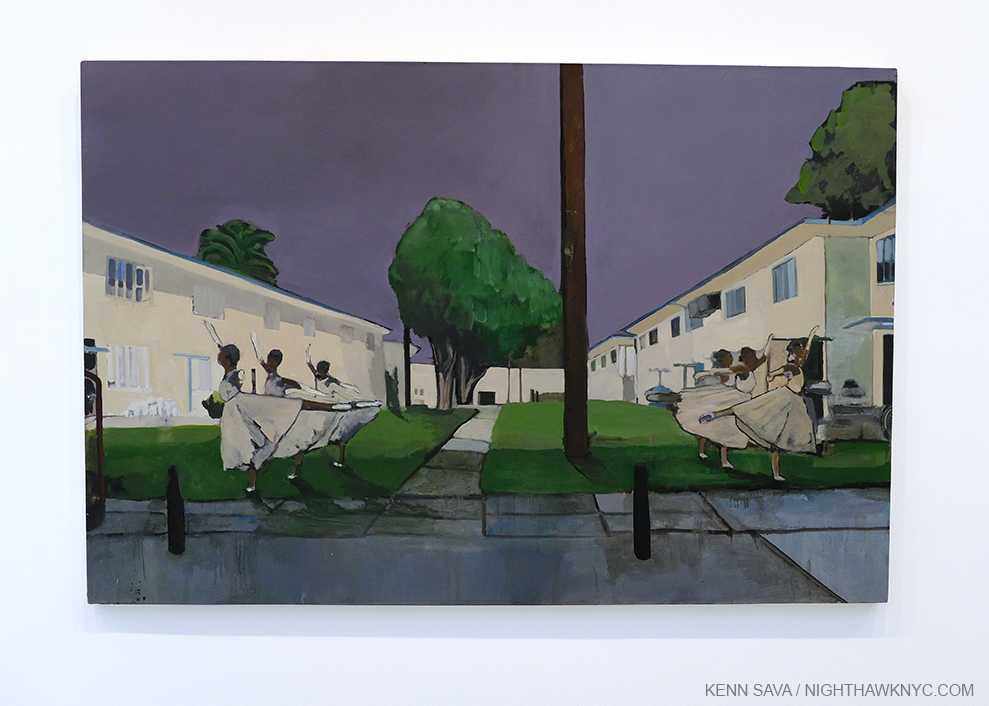
 

  1. Exhibition Catalog, P.39
  2. Black Pope Exhibition Catalog P.8
  3. Sarah Kelly Oehler, Exhibition Catalog, P. 32
  4. Exhibition Catalog, P. 131
  5. P.51
  6. Exhibition Catalog P.24

2018: The Year In Art Seen, And Met

Written & Photographed by Kenn Sava

Will Art ever be more popular than it is now? On January 4th, 2019,  The Met announced another attendance record was set in 2018 when almost 7.4 million visited The Met Fifth Avenue, The Met Breuer or The Cloisters1.

On this late summer day, I’ll be lucky if I can figure out a way to get up the stairs to get in! Click any Photo for full size.

Simply put, when I think back on 2018, I’ll remember the extraordinary number of truly great shows I saw at The Met and The Met Breuer this past year, among those 7.4 million. While I certainly spent quality time at the other Museums and saw wonderful shows at each of them (not to mention countless galleries and a few Art & Book fairs), it’s almost impossible to top the list of shows The Met, collectively, mounted this year- especially when you consider that I didn’t even see the biggest show of them all- biggest by attendance that is, the show that drew 1,659,647 visitors- Heavenly Bodies: Fashion and the Catholic Imagination (I saw the parts of it that were installed outside of the show proper).

Heavenly Bodies: Fashion and the Catholic Imagination– A view of part of the show installed to the south of the Great Staircase.

I chose to skip it. My friend, the fashion Blogger extraordinaire, Magda, saw it and did a terrific piece on it, here.  As for the Art I saw in 2018? I’ll remember most standing on this spot near the south west corner of the 2nd floor of The Met, and marveling at the sight in front of me in a 270 degree range.

I’ve never seen the likes of this before. A 270 degree panorama from “the spot.” 2nd Floor, Metropolitan Museum.

Before my eyes, there were no less that 4 major and/or historic shows going on within yards of each other AT THE SAME TIME!

A fortnight of heaven. From right to left- 1- Rodin At The Met, 2- Michelangelo: Divine Draftsman & Designer, 3- David Hockney 80th Birthday Retrospective, 4- Birds of a Feather: Joseph Cornell’s Homage to Juan Gris. This photo was taken on February 4th, 2018. The last day all four of these shows were open at the same time.

Behind me, to the far right in the panorama, above, was Rodin At The Met (1, above), which I had just walked through to get to this spot.

Rodin, The Tempest, before 1910, Marble, seen in Rodin In The Met.

Just to my right was the once in a lifetime Michelangelo: Divine Draftsman & Designer (2), containing 133 of the Master’s Drawings and 3 Sculptures. Just to the left of that was the David Hockney 80th Birthday Retrospective (3). Down the hall to the left, Birds of a Feather: Joseph Cornell’s Homage to Juan Gris (4) recently opened. The run of all four overlapped from January 23rd to February 4th, when I took the above, just 13 days.

Had enough? C’mon. This is NYC!

Thomas Cole, The Course of Empire, Oil on canvas, 1833-36, on loan from the New York Historical Society. Installation view of Thomas Cole’s Journey: Atlantic Crossings. 170 years later, they would inspire Ed Ruscha to create a contemporary version that was shown in conjunction with the National Gallery, London, incarnation of this show.

ALSO going on at that very moment down in the American Wing, Thomas Cole’s Journey: Atlantic Crossings was a quite pleasant surprise, AND, over at The Met Breuer, the revelatory Edvard Munch: Between The Clock And The Bed was closing that very day! The Met, typically, has up to 25 shows up at any one given time. But, SIX MAJOR Shows up at the same time is extraordinary. WHERE else in the world does that happen?

Edvard Munch, Self-Portrait: Between the Clock and the Bed, 1940-43, Oil on canvas. His last significant “self-scrutiny” as he referred to his self-portraits, he stands before the faceless clock and bed, in front of his Paintings.

Thus far, I’ve written about 3 of them-

Michelangelo: Divine Draftsman & Designer

Thomas Cole’s Journey: Atlantic Crossings

Edvard Munch: Between The Clock And The Bed

Given all of this, even before January, 2018 was over, I knew nothing was going to top The Met in Art in NYC this year. But? Keep an open mind, right? Let em try! Well, now that the year is over, and I take stock at all that happened, nothing changed my mind. In fact, there were more great shows at The Met as the year unfolded. So much happened that in spite of all of my coverage, there are other shows and Artists I feel the need to show and talk about. I’ve decided to focus on 3 Artists here I encountered or discovered in Met shows in 2018- one, very famous, another, who recently passed without receiving as much acclaim as I feel he deserves, and a third who, I feel, is one of the most important Artists of our time.

First, a spot quiz- Before you read the caption, who is this by?

Tyger Painting No 2, by David Hockney, 1960, when the Artist was about 22, Oil and mixed media on board.

When I saw that David Hockney was installed right next door to all the treasures by no less than Michelangelo, the Artist called “Il Divno,” I couldn’t help but wonder what that initial phone call was like…a Met executive reaching out to Mr. Hockney by phone, saying something like, “David, this is _______ from The Met. We have some good news for you, and, maybe, some not as good news for you. The good news is The Metropolitan is giving you an 80th Birthday Retrospective! Congratulations! The not as good news is it’s being mounted right next to a once in a lifetime Michelangelo show containing 133 of the master’s Drawings and 3 of his Sculptures…” And you say you want to be a famous Artist? Stay humble. Fame is relative, possibly fleeting.

The Met reported 702,516 people visited the Michelangelo show, and 363,877 attended David Hockney.

I haven’t spent much time looking at the Art of David Hockney, but I have with his exceptional books, particularly the now classic, Secret Knowledge, and the fascinating History of Pictures: From the Cave to the Computer Screen. Secret Knowledge, which has made a real contribution to Art History, was nothing less than a bombshell when it was released in 2001. His, and physicist Charles Falco’s, theory that the Old Masters (including Jan van Eyck, my first personal God of Painting) used optics, recently developed in Van Eyck’s time, to get the incredible realism they achieved was deemed heresy. Until you looked at the “evidence” they presented, including a huge wall Hockney created of postcards of Paintings created before 1400 and up to modern times that showed a sudden sharpening of their realism occurring about the beginning of the fifteenth century.

Upon closer look, their theory made perfect sense. I wished it had come years earlier when I was struggling to learn how to draw by “eyeballing” my subjects, which, of course, continues to have its place. Secret Knowledge became a superb BBC TV Documentary, and then a television series, and its impact is being felt to this day. The 2016 Film Tim’s Vermeer shows inventor Tim Jenison using these techniques to “re-create” how Vermeer might have done his Paintings. Of course, Secret Knowledge is a theory, not history, though as I said, it’s one that makes sense. Perusing it and A History of Pictures, released in late 2016, I was led to Cameraworks and his interviews on Photography, which I’ve found equally compelling. So, the David Hockney Retrospective gave me a long-delayed chance to consider his long, prolific and restless Art career. Afterall, since the passing of Lucian Freud and Francis Bacon, he is oft referred to as “England’s foremost living Painter.” 

Arizona, 1964, left, Portrait Surrounded by Artistic Devices, 1965, right.

Though his popularity would be a while coming, requiring a move half way around the world to California, David Hockney showed a remarkable tenacity early on, Painting in styles that were, well, “different” from that of any other Painter of the time. He moved from abstraction to works that were somewhere between abstract and figurative, generally including a figure, before landing on a style that retained his use of color while becoming even more representational.

A Bigger Splash, 1967, Acrylic on canvas. Without the unseen swimmer, the splash becomes a passage out of Abstract Expressionism, jarring the all too peaceful scene.

Moving to LA, his style exploded into color, a sudden taste for representationalism in a style that came to epitomize upper class California living to the point that its now sparked something of a “response,” from Ramiro Gomez, who focuses on the workers maintaining these places-

Ramiro Gomez, No Splash, 2013, 96 x 96 inches, after David Hockney’s A Bigger Splash, 1967, focuses on the pool workers instead of the residents. Photo: Osceola Refetoff for Charlie James Gallery

David Hockney could have continued to paint these ad infinitum and, no doubt, sell every single one he produced. But, he’s far too restless, and curious, to stand in any one spot for too long.

The Twenty-Sixth Very New Painting, 1992. Picasso and Cubism have never been very far from David Hockney’s mind- to this day.

He then revealed his own take on portraiture in single subjects and couples before exploring, and breaking the boundaries of, Photographic perception with his “joiners,” which explored his belief that we don’t see the way the camera sees- with a fixed, single, viewpoint.

In Pearblossom Highway, 11-18th April, 1986, #1, 47 x 64 inches, a “joiner” composed of hundreds of Photographs, David Hockney explores his belief that a camera has a fixed viewpoint and a single vanishing point. So, putting hundreds of Photos together creates many. He’s said he considers this work “a panoramic assault on Renaissance one-point perspective2.”

All along he drew, and he drew and he drew. There were times when I admit looking at his work and wondering how well he could draw but being well acquainted with the difficulties involved in mastering the line, as the show moved through his Drawings, its seminal and central place in his practice becomes clear as he relentlessly forged ahead. As the Drawing section ended, he seemed to me to have finally made peace with Drawing, having taken it from graphite on paper to the use of the Camera Lucida and more recently, to the iPhone and the iPad.

Three iPad Drawings, shown in-progress side by side in the final room.

His painting, too, continually evolved over the years and decades.

A Closer Winter Tunnel, February-March, 2006.

He left LA to return to the home his late mother had lived in and turned his attention to a little known area called the Yorkshire Wolds and created a remarkable series of landscapes, including some multi-panel monumental works, along with multi-channel videos that show this area that no Artist had previously “discovered” to be full of picturesque wonders.

Mr and Mrs Clark and Percy, 1971. The “coolness” here can be partially explained by the fact that this was a rare commission the Artist accepted and so, he didn’t have a personal relationship with them.

Mr and Mrs Ossie Clark, 1970, Photograph. Not mentioned anywhere in the show, and not very well known, is that David Hockney used Photographs, usually his own, as source material for years. Later, he finally created Photographs as stand-alone works. It’s fascinating to see what’s changed in the finished Painting. (From David Hockney on Art, Conversations with Paul Joyce, P.14, hence the curve.)

Personally, I find a cool distance in most of David Hockney’s work (felt most clearly in his double portraits, but present in everything from his landscapes to his single portraits) that the bright colors and the often undeniable beauty do not hide. This works to his advantage during the period he spent immortalizing the Yorkshire Wolds, beginning in 2005, until about 2013, near where he grew up, seen before. It’s hard for me to look at these beautiful works without being a little bit reminded of the work of another of his long time influences, Vincent van Gogh. Particularly because Mr. Hockney chose to largely create these works on the spot, en plein air, during all four seasons, late winter seen above. The passage of time looms large in this series of works, as it has in the intervening years since Mr. Hockney worked in these fields as a  young man. Yet, in them we see everything change- the seasons, the weather, individual trees, everything except the Artist. That we can only see through surveying his work through the years.

Ordinary versus Reverse Perspective.

David Hockney revealed an Artist who doesn’t get enough credit for his progressiveness, the resistance of his work to current fads, and its individuality. From the beginning he turned a deaf ear to trends and norms, rejecting both Abstract Expressionism and Pop while somewhat brazenly, and frankly, featuring homosexuality (which was illegal in England until 1967). After the tragic death of an assistant, Mr. Hockney sold the Yorkshire house in 2015 and returned to L.A. “Reverse perspective,” as he refers to it, has taken full hold in his most recent work, as seen in the final gallery at The Met, and at Pace on West 25th Street in David Hockney: Something New in Painting (and Photography) (and even Printing), in April and May.

Here, in David Hockney: Something New in Painting (and Photography) (and even Printing) at Pace, spring, 2018, Mr. Hockney cleverly manages to include all the works on the surrounding walls in the Pace show in this Photographic Drawing, as he calls it, which forces the eye to move around the work, each stop becoming a new perspective.

Taken to another level, I think, he’s also comparing Photography to Painting. In addition to his fascinating thoughts on perspective and how cameras see versus how humans see, I found he had already put down in print quite a few things I was feeling about Painting versus Photography a year and a half into my deep dive into “post-The Americans” Photography. I’ll save those for another piece.

Mr. Hockney has been first a number of times, so far, in a rage of realms, including Photography. Being first is not something history often rewards. David Hockney’s popularity seems to know no bounds, and his influence is there to be seen in the work of any number of Artists. Yet, as with every other Artist, posterity will decide where David Hockney’s Art belongs, and time will tell if it will be as popular in hundreds of years as it is now, or not. In the meantime? I’m interested to see what this Artist who lives to create does next.

Coincidentally, and fortuitously, 10 days after I took that panorama from “the spot,” The Met’s William Eggleston: Los Alamos opened, giving me a chance to revisit the work of the Artist who’s show at David Zwirner in December, 2016 led to my deep dive into the world of Contemporary Photography. I wrote about Los Alamos here.

Exit/Entrance installation view of History Refused to Die, showing the recto of the titular work, the recto  is seen below, center.

After the six major shows ended, I returned to The Met to see History Refused to Die, a sleeper of a show publicity-wise, that honored the recent gift to The Museum by the Souls Grown Deep Foundation by featuring a selection of 30 Paintings, Sculptures, Drawings and Quilts from it by self-taught contemporary African American Artists, highlighted by a number of truly amazing works by the late Thornton Dial (1928-2016).

Thonton Dial, History Refused to Die, 2004, Okra stalks and roots, clothing, collaged drawings, tin, wire, steel, Masonite, steel chain, enamel and spray paint, front, center. Verso of the work seen above.

Mr. Dial created a body of work after having watched the events of 9/11 on television. It, and the subsequent war were the subjects of a few works seen here, among others.

Thornton Dial, 9/11: Interrupting the Morning News, 2002, Graphite, charcoal, and watercolor on paper.

Thornton Dial, Victory in Iraq, 2004, Mannequin head, barbed wire, steel, clothing, tin, electrical wire, wheels, stuffed animals, toy cars and figurines, plastic spoons, wood, basket, oil, enamel, spray paint and two-part epoxy putty on canvas and wood.

Thonton Dial, The End of November: The Birds That Didn’t Learn How to Fly, 2007, Quilt, wire, fabric, and enamel on canvas on wood.

While I returned a few times to see Mr. Dial’s work again, I was also impressed with that of Ronald Lockett (1965-1995), a cousin of Thornton Dial.

Ronald Lockett, The Enemy Amongst Us, 1995, Commercial paint, pine needles, metal and nails on plywood.

One of the great things about this show was the complete freedom the Artists worked with. It’s hard for me not to believe that that was one of the benefits of being self-taught in their case. Yes, even today, you can be a self-taught Artist and still get in to The Met’s Permanent Collection.

Over my 1,500+ visits to The Met, I’ve spent countless hours sitting there in front of Jackson Pollock’s Autumn Rhythm (Number 30), 1950, Enamel on canvas, 105 x 207 inches, dating back to before I started counting my visits. Seen here on August 31st, at the entrance to what was then the Abstract Expressionist galleries.

Just to the left of one of the two entrances/exits to History Refused to Die, I paused to revisit an old friend.  Almost 30 years ago, I sat on those benches for hours on end staring at and contemplating one of the most remarkable and revolutionary Paintings in Western Art, Jackson Pollock’s Autumn Rhythm (Number 30), 1950, at the time my favorite Painting in The Met (“favorite” does not mean “the best.” I don’t believe in that), and, perhaps, the crown jewel of The Met’s Abstract Expressionism collection. In my opinion, this is a key wall in The Met. Its the entrance to the Abstract Expressionist galleries behind it, and it looks out to visitors passing the “corridor” I’m standing in going to the stairs. Over all these intervening decades, its never been moved from this spot. Little did I know when I took this Photograph on August 31st, it would be the last time I would see it here.

Fall brought the revelation that was Odyssey: Jack Whitten Sculpture 1963-2017, which opened at The Met Breuer just before History Refused to Die closed. Finally, and currently, back at 1000 Fifth Avenue, while the very good Delacroix show was going on down the hall, Epic Abstraction, opened on December 17th, a show I also find somewhat remarkable. It’s an “ongoing” show, meaning it has no end date at this point, largely because it and Reimagining Modernism, downstairs on the first floor, are reinstallations of works from The Met’s Permanent Collection, along with a few loans (in the case of Epic Abstraction).

Immediately adjacent to the sign, mere steps into the show, lookie here! It’s my old friend Autumn Rhythm! 

When I walked in the first time, I was startled to see that the show begins with Autumn Rhythm! Wow. They moved it! While I admired it at the beginning of this “epic” show, questions immediately flooded into my mind. An Abstraction show that BEGINS with Autumn Rhythm? That’s incredibly bold. Talk about throwing down a gauntlet for all that’s come after. Well, the subtitle of the show is Pollock to Herrera, so, chronologically, this is the beginning. That Sheena Wagstaff, Randall Griffey (credited with organizing Epic Abstraction & Reimagining Modernism- kudos) and the Modern & Contemporary Staff chose to move Autumn Rhythm and give it pride of place in this show I take as a “sign” they may agree with me about its importance. While I wondered what is going to maintain this level in the rest of the show to come, my mind then turned to the inevitable question- WHAT did they choose to hang in that prime spot where Autumn Rhythm hung for the past few decades?

Epic. Jackson Pollock, 3 Drawings, each, Untitled, 1938-41, Colored pencils and graphite on paper.

The first room is entirely devoted to the work of Jackson Pollock, except for one work- Kazuo Shiraga’s Untitled, 1958! Highlights, besides the reinstalled Autumn Rhythm include 3 spectacular colored pencil Drawings that should permanently quiet anyone who thinks that Jackson Pollock couldn’t draw. As remarkable as this start was, the second gallery is entirely devoted to Mark Rothko, save for a central sculpture by Isamu Noguchi! This is sure to stagger any long time Met goer. For decades, only 2 or 3 Rothkos have been on view at any given time. What museum on earth, besides the National Gallery in Washington, has enough Mark Rothkos sitting in storage to fill an entire gallery? Talk about an embarrassment of riches. I couldn’t believe it. Instantly, my fears about how they were going to keep the pace of this show going disappeared. Of course. They topped themselves.

Finally, making it through the first two galleries, still in shock, I turned the corner to finally see what was now in the spot Autumn Rhythm occupied. A sharp right turn, and my eyes alighted on this-

Mark Bradford, Duck Walk, 2016, Mixed media on canvas. Taking its title from Chuck Berry’s strut across the stage strumming his guitar, now hangs where Jackson Pollock’s Autumn Rhythm (Number 30) hung for decades.

If you don’t think a lot of thought went into this, Untitled, 1950, by Clyfford Still, one of Mark Bradford’s influences, hangs directly adjacent to it on the wall to the right, with the Sculpture, Raw Attraction, 2001, by Chakaia Booker, Rubber tire, steel, and wood, between them, behind the lady in red, and Tanktotem II by David Smith, barely seen at the far left.

Mark Bradford’s Duck Walk, 2016, a Mixed media on canvas diptych floored me the minute I saw it. It’s every bit as daring as Autumn Rhythm, in my opinion, done in a completely unique way, as Pollock’s was 66 years earlier in 1950. Mark Bradford uses layers of colored paper that he cuts through using a very wide range of techniques. Of course, Mr. Bradford didn’t do it in a vacuum. He’s had influences, including David Joseph Martinez and Clyfford Still, who’s been somewhat overlooked it seems to me among Abstract Expressionists. But not by Mark Bradford.

Detail of the center where the two canvases meet. Interestingly, the two pieces are shown in the opposite configuration on The Met’s website.

“Abstraction for me, I get it-you go internal, you turn off the world, you’re hermetic, you channel something. No. I’m not interested in that type of abstraction. I’m interested in the type of abstraction where you look out at the world, see the horror-sometimes it is horror-and you drag that horror kicking and screaming into your studio and you wrestle with it and you find something beautiful in it. That’s what I was always determined to do. I have never turned away.” Mark Bradford3.

Mrs. N’s Palace, 1964-77, by Louise Nevelson. Notice the black line on the floor going off to the left. That was left by a wall The Met took down to install this monumental work, the back of which is to the left. I’ve never seen this space, the room behind the Mark Bradfordls Duck Walk open like this before.

Now? Four visits in to Epic Abstraction, I can think of no other work in the show that deserves to be hung in this spot more. It not only holds its own with anything else in the show, which is a who’s who of Modern & Contemporary Abstractionists that includes de Kooning, Motherwell, Louise Nevelson, Franz Kline, Carmen Herrera, Cy Twombly, Dan Flavin, Alexander Calder, Joan Mitchell (including some pieces I’ve never seen on view), along with Pollock, Rothko and Noguchi. I was also very pleased to see that The Met managed to get a great work by a great contemporary Artist before the Artist’s prices made it possible only by donation. (Recently, tennis star John McEnroe sold a Painting by Mr. Bradford for over 12 million dollars at auction-to the Eli Broad Museum, in LA). It now joins single Paintings by Kerry James Marshall4 and Jack Whitten in The Met’s Modern & Contemporary Art collection, a collection that, unfortunately, can’t compare with the collections of museums in Chicago, L.A. or San Francisco in works by these Artists, at this point, due to…? I don’t know why. The Met owns 2 Paintings and a set of 6 prints, which are currently on display in the Drawings & Print Gallery, by Mark Bradford, seen below, with the accompanying card-

On the heels of Tomorrow is Another Day (named for the last spoken lines in Gone With The Wind), the show he mounted at the 2017 Venice Biennale after being chosen to represent the USA5, and his current installation, Pickett’s Charge, his largest work to date, currently on view at the Hirshhorn Museum in Washington (well, if and when the government re-opens, through 2021), I believe Mark Bradford is one of the world’s most important living Artists. He is an Artist who has been speaking truth about the reality of the world and the issues it faces from early on in his career and doing so in his own ways, developing unique techniques in a variety of medium. “The world is on fire,” he said in a 2017 interview in the catalog accompanying Pickett’s Charge, “whether we like it or not.” “I do feel there are moments in history when the intensity of the world in which you live comes to your door. We are at that moment now. There’s no way around it. Politically and socially we are at the edge of another precipice. I’m standing in the middle of a question about where we are as a nation6.”

Anselm Kiefer, Bohemia Lies By The Sea, 1996, 75 1/4 inches x 18 feet 5 inches, left, Kerry James Marshall, Untitled (Studio), 2014, Acrylic on PVC panels, 85 5/16 x 119 1/4 inches, right.

It’s also hard for me to not look at the choice of installing Duck Walk in this spot as a statement. Has the baton been passed to the next generation? Mark Bradford was born in 1961, 5 years after Jackson Pollock’s tragic early death. This baton passing might have also be happening downstairs in the Modern & Contemporary Mezzanine, Gallery 915, The Met’s large Anselm Kiefer, Bohemia Lies by the Sea, which for many, many years has occupied an end wall, has been moved to a side wall, and its former spot is now occupied by Kerry James Marshall’s Untitled (Studio). (Note- Anselm Kiefer was the subject of Provocations: Anselm Kiefer at The Met Breuer in early 2018).

If you continue further down the stairs to the first floor, you’ll discover the early Modern Art galleries have, also, been completely reinstalled, as Reimagining Modernism 1900-1950. It’s endlessly fascinating to me to see which pieces have come on display and which have gone into storage, (or loan?)

The signs they are a-changin’

Times are changing at The Met, in the Modern & Contemporary Galleries, and in the rest of the Museum, as new Director Max Hollein now takes charge (though I imagine Epic Abstraction & Reimagining Modernism were being planned prior). Along with The Met as a whole, the Modern & Contempoaray Department had another remarkable year. The list of memorable and/or important shows that have already appeared at The Met Breuer continues to grow. This is the second time in three years I’ve singled out Sheena Wagstaff and her Modern & Contemporary Department for having great years in NYC Art. Yes, the New Museum, who I singled out last year, continue to impress and grow, and yes MoMA had a number of memorable shows this year, including Stephen Shore  and two featuring the work of Charles White, the Guggenheim impressed with Danh Vo and Hilma af Klint, but none of them had the year The Met had, in my view, particularly in Modern & Contemporary Art.

They started from so far behind compared to the other Museums. I wonder how many others are now noticing.


BookMarks- I only list items in BookMarks that I strongly believe in and personally recommend. If you like what you see here, you can make a donation to help keep NHNYC.com ad-free through PayPal by clicking on the box to the right of the banner at the top of the page that will take you to the Donation button. Your support is VERY much appreciated. Thank you!

David Hockney’s Secret Knowledge (New and Expanded Edition): Rediscovering the Lost Techniques of the Old Masters is one of the most revelatory Art History books of the century thus far and is recommended to the Art History buff and the Art student. The Expanded Edition is only available in paperback, but it is the version I recommend. Keep an eye out for the excellent 2 part BBC Documentary, too.

His A History of Pictures: From the Cave to the Computer Screen, is a wider look at Art History, seen from an Artist’s perspective, which makes it somewhat unique, and is recommended for the general Art History student and buff. There is also a version for children.

Hockney’s Cameraworks is a remarkable book, unlike any other Photography monograph I know of. It includes a look at his Photography through 1984, along side a fascinating interview. Currently out of print, it’s highly recommended to Photographers, Hockney fans, and those interested in this sticky debate about perspective in Art, and definitely worth looking for. Copies in very good condition (minimal wear to the book or dust jacket, without marks of any kind or writing) may still be found for less than 100.00.

The best overview of Thornton Dial’s work, currently, is Thornton Dial in the 21st Century published by Tinwood Books in 2006. The time has come for a complete, comprehensive monograph on his life and work, and this, the best we currently have, is recommended until it arrives.

Mark Bradford (Phaidon Contemporary Artist Series) is the best and most current introduction to Mr. Bradford career. After that, it’s a toss up between 2010’s Mark Bradford published by Yale U. Press or Tomorrow Is Another Day, one of Michelle Obama’s “personal favorites.”  The Yale book is the most comprehensive book on his work to 2010, with the best images of his work to that date, while Tomorrow is an in-depth look at the work Mr. Bradford created for the US Pavillion at the 2017 Venice Biennale.

*- Soundtrack for this Post is “Coming Up” by Paul McCartney fromMcCartney II, 1980, seen here performing it with Wings, and Linda McCartney, Live in Kampuchea, 1979-

NighthawkNYC.com has been entirely self-funded and ad-free for over 6 years, during which over 250 full length pieces have been published. If you’ve found it worthwhile, you can donate to keep it going & ad-free below. Thank you!

Written & photographed by Kenn Sava for nighthawknyc.com unless otherwise credited.
To send comments, thoughts, feedback or propositions click here.
Click the white box on the upper right for the archives or to search them.
For “short takes” and additional pictures, follow @nighthawk_nyc on Instagram.

Subscribe to be notified of new Posts below. Your information will be used for no other purpose.
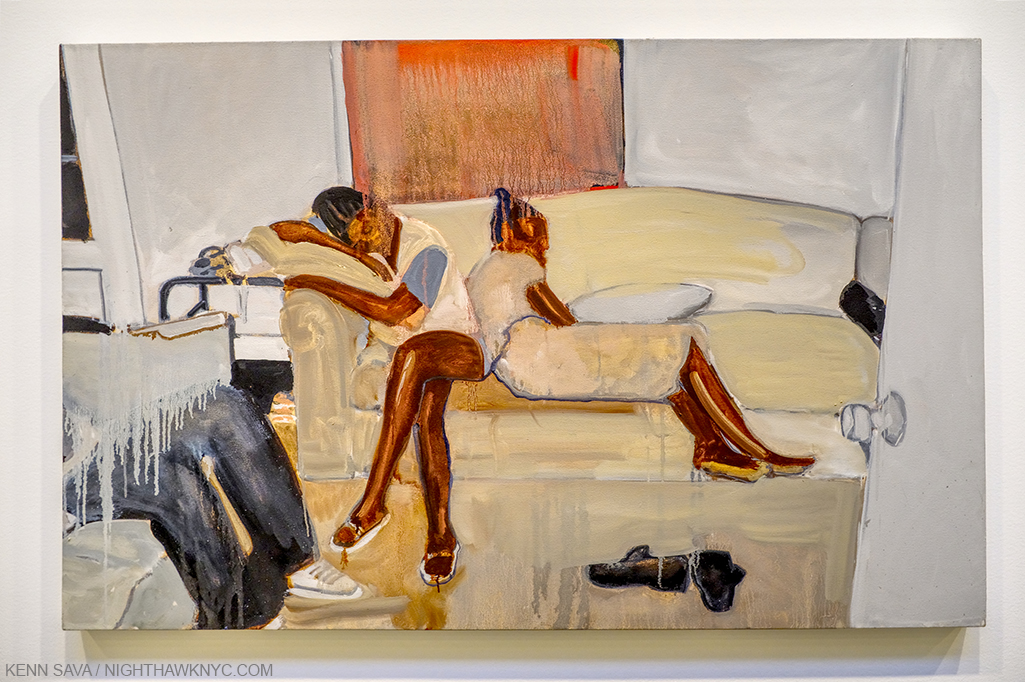
 

  1. Met attendance numbers quoted in this piece are from this press release.
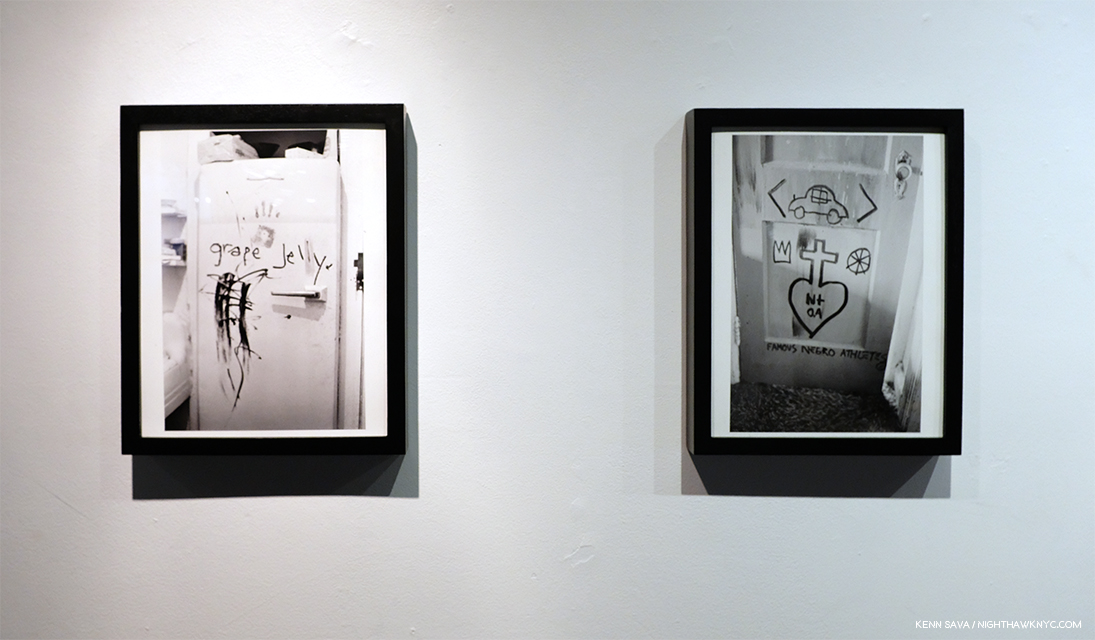
  2. //www.getty.edu/art/collection/objects/106006/david-hockney-pearblossom-hwy-11-18th-april-1986-1-british-1986/
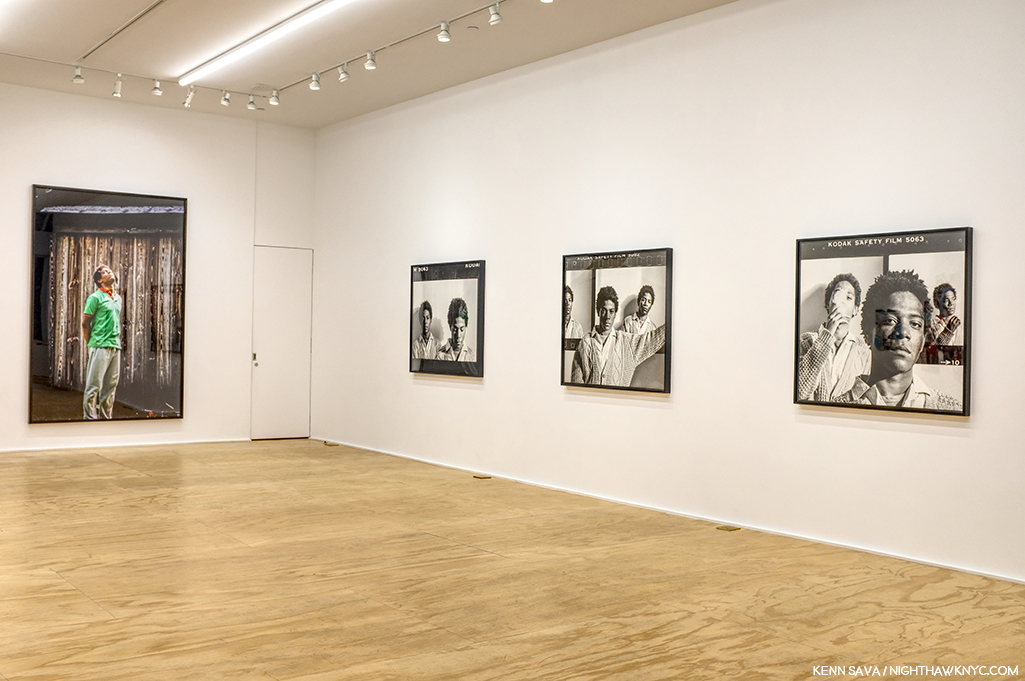
  3. Mark Bradford: Phaidon Contemporary Artists Series, Interview with Anita Hill, P.18
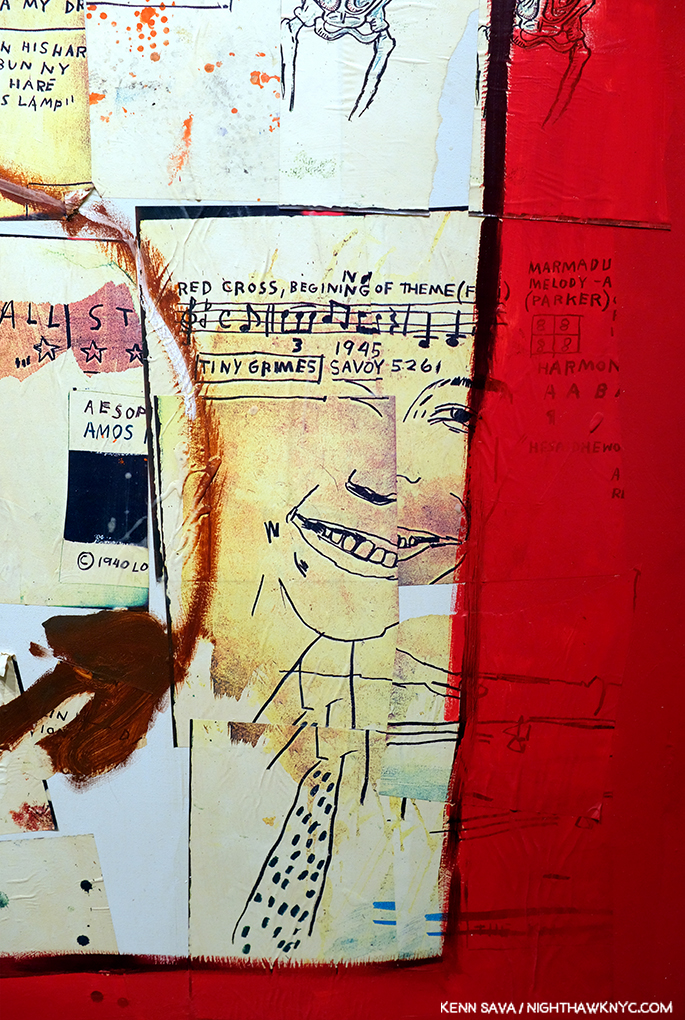
  4. The Met also owns a woodcut (a print) by Mr. Marshall
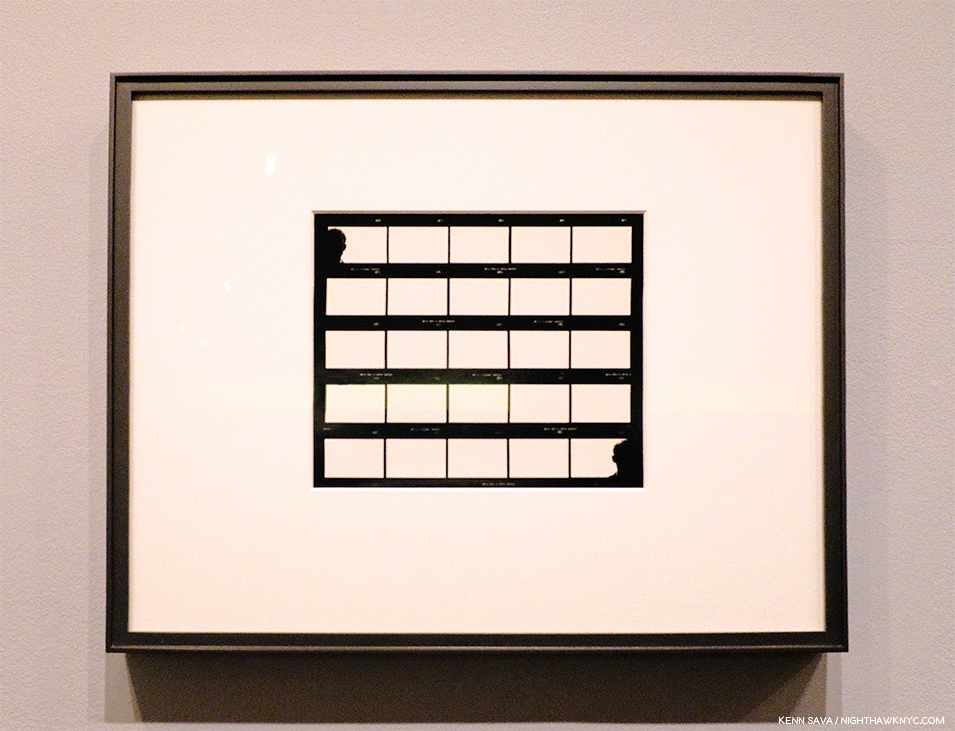
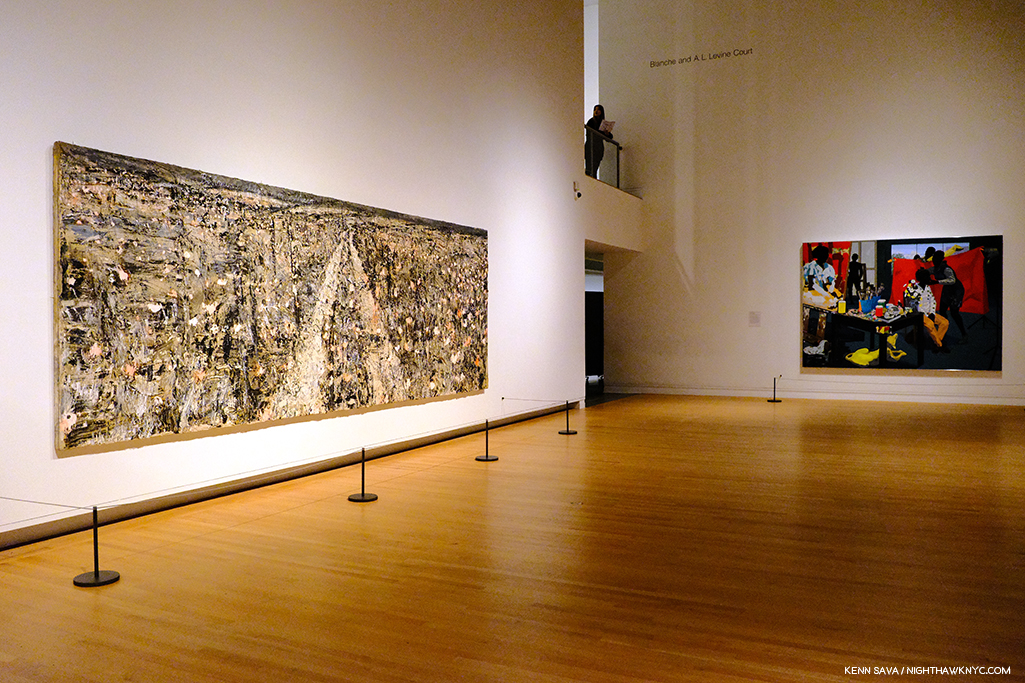
  5. Containing work that is now on view at the Baltimore Museum, under its Director, Christopher Bedford, long one of the leading Mark Bradford champions
  6.  //hirshhorn.si.edu/exhibitions/mark-bradford-picketts-charge/