The New Whitney Museum- The Roofdeck of American Art

This site is Free & Ad-Free! If you find this piece worthwhile, please donate via PayPal to support it & independent Art writing. You can also support it by buying Art & books! Details at the end. Thank you.

Written & Photographed by Kenn Sava (*- unless otherwise credited)
DSC_3074PNH

“American Tune”
“We come on the ship they call the Mayflower
We come on the ship that sailed the moon
We come in the age’s most uncertain hour
and sing an American tune”*
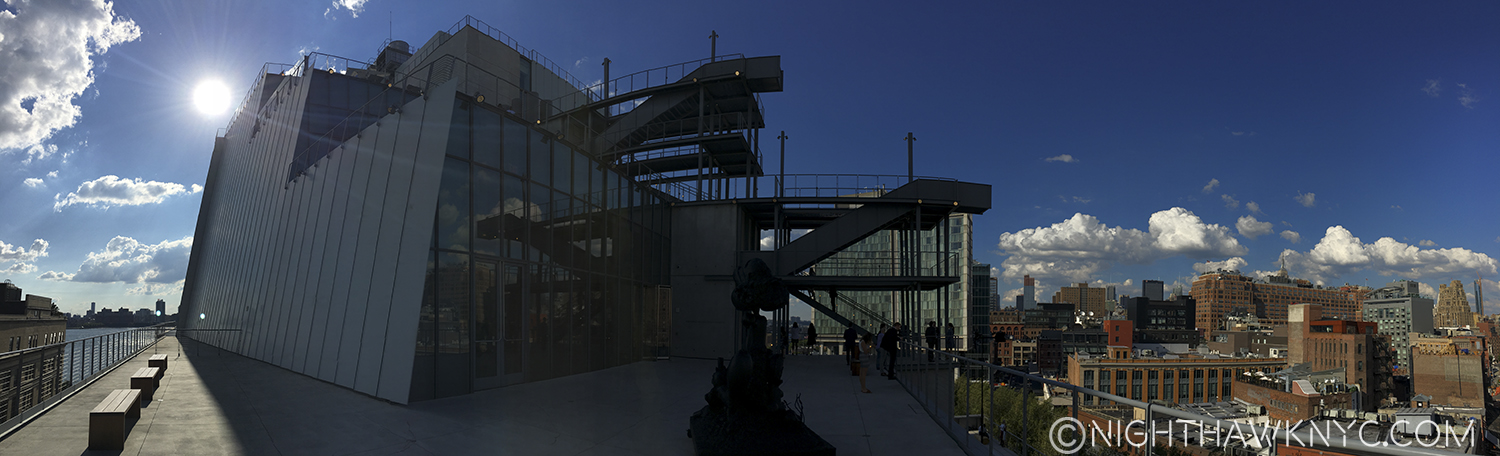
Looking west on the 6th Floor Roof deck, Spring, 2016.

Looking west on the 6th Floor Roof deck, Spring, 2016.

Part 1- The New Whitney Museum…And I

We actually go way back…

All the way back to June, 1987 when I had a letter published in the New York Times in opposition to the proposed expansion plans of the Guggenheim & Whitney Museums, after it was announced that both Museums wanted to modify & expand their existing buildings. I was outraged. How could you change these two singular masterworks without ruining them? I closed saying that “branch museums were the obvious answer” to modifying these Artworks of Architecture, in the Guggenheim’s case, Frank Lloyd Wright’s masterpiece was, perhaps, the greatest work of Art it owns. I went to the Community Board Meetings, but wasn’t directly involved beyond this letter. Mine was apparently chosen over the head of the opposition committee’s letter, much to his displeasure, I heard.
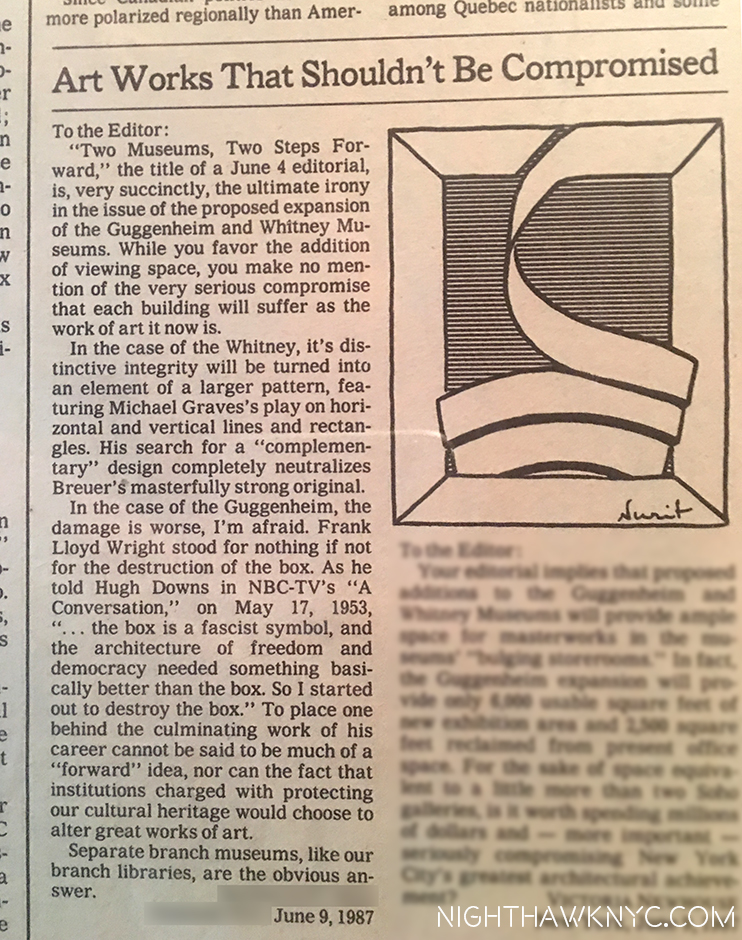
My letter in the NY Times Op-Ed page opposing the & Guggenheim & Whitney modifications, June, 1987. I love the very fitting drawing they added.

Almost 30 years later (wow…really?), how did “we” do?

Well, BOTH Museums took my “advice” and opened branch museums. The Whitney had a few around town, one across from Grand Central, another in Soho, while the Guggenheim opened what is, perhaps, the greatest Museum building since Wright’s enduring 5th Avenue masterpiece…by Frank Gehry in Bilbao, Spain of all places. It’s a “place” now, a true destination for culture vultures. They showed a model of another Gehry masterpiece they wanted to build downtown in the East River at the Guggenheim Gehry Retrospective in 2000. I bought a poster of it but, after 9/11, it was never mentioned again. ? They went ahead and remodeled Wright’s masterpiece, anyway, which I will never accept, AND continue to open branch Museums around the world as we speak. The Whitney, on the other hand, did not renovate Breuer’s unique original. Instead, we got something I never saw coming- They moved out and built an entirely new Museum.

Wow!

So? On my scorecard? I am one and a half out of 2.

The New Whitney opened in May, 2015 in the Meatpacking District, right at the southern end of the High Line. I’ve made frequent trips there so far studying the building from every angle I could, at night, and yes, even in day light. (Oh, the sacrifices I will make in the pursuit of Art.) The inaugural, and as I’ve said very good, show, in the new Renzo Piano building, “American Is Hard To See,” came and went. I also wrote about both the Frank Stella Retrospective and a show by filmmaker Laura Poitras that came and went, too, along with quite a few smaller shows. So, a few months after the 1 year Anniversary, I think I’ve finally had enough time and experience with the new place, over 45 visits, to have some thoughts coalesce. As always, I have not read any reviews of either the building or the shows mentioned.

Part 2- Renzo Piano’s Whitney Museum Building

U.S.S. Indianapolis. US Navy Photo

The U.S.S. Indianapolis, Why is this picture here? Stay tuned. (U.S. Navy Photo.)

It’s only a year or so old, but I don’t think many will fall in love with the exterior of the building. I must say that in all my trips there so far, I have yet to see anyone else take a picture of it. Maybe (more) time will tell. In this City where location isn’t everything, it’s the ONLY thing, the new Whitney sits on a rather unique lot. How many places in Manhattan can you think of that have BOTH a River view AND a Park view? Situated directly across the West Side Highway from the Hudson River, to the west, and the southern end of the High Line to the immediate east, the Museum hit on a very rare Daily Double. Unfortunately for long time Whitney architect Piano, who came on board during the Museum’s “expansion” days, this lot has 4 sides. To the north, the rest of the block is occupied by one of the few remaining Meat Packing businesses that actually pack meat in what really was The Meatpacking District.1 Yes, trucks of raw meat park within inches of the Museum’s north wall every weekday.
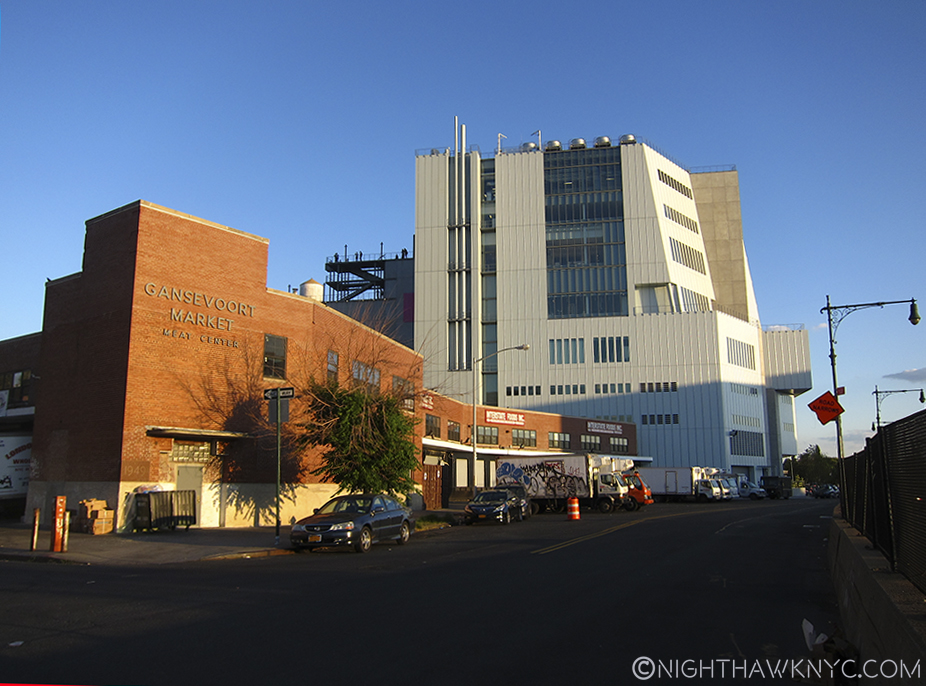
Yes, meat is still packed in the "Meatpacking District." Whitney's north side seen from West Street.

Yes, meat is still packed in the “Meatpacking District.” Whitney’s north side seen from West Street.
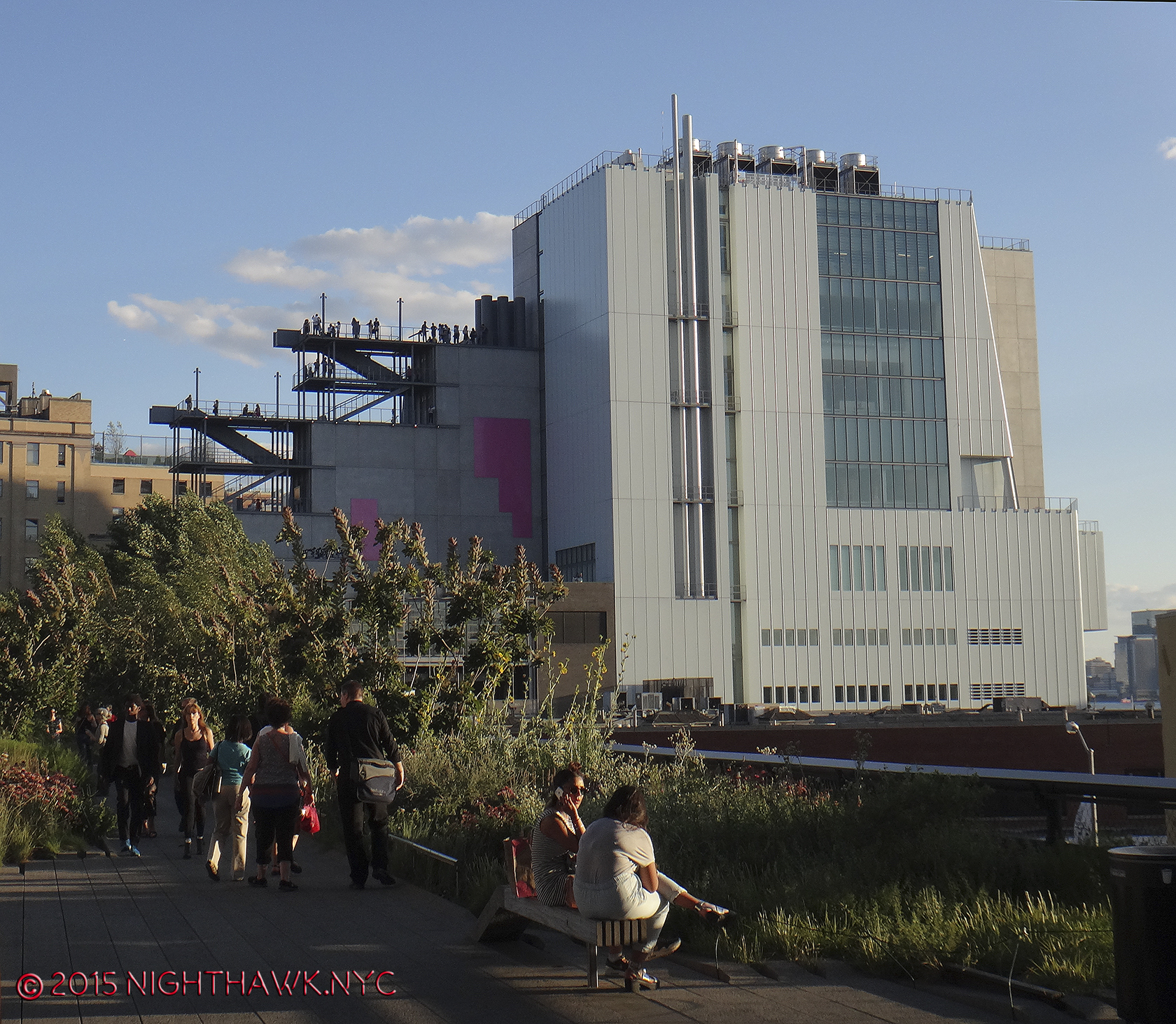
And, seen from the High Line.

And, seen from the High Line.

The two story meat complex provides a nearly unobstructed view of most of the north face of the Museum, from West Street or the High Line. I wonder what people who don’t know it’s the Museum think it is. I wonder how many of them will look at it and say, “Ah. A Museum.” My guess is not many. Maybe it’s an office building with not enough windows and a couple of long smoke stacks? A prison? It’s pretty non-descrip, making the stair cases that protrude from the rear of the building seem, well, odd. For myself, and probably countless others approaching the New Whit from the north, this is the first view they’ll get of it. The one defining feature of this side of the building is the exterior staircases. A cascade of them.
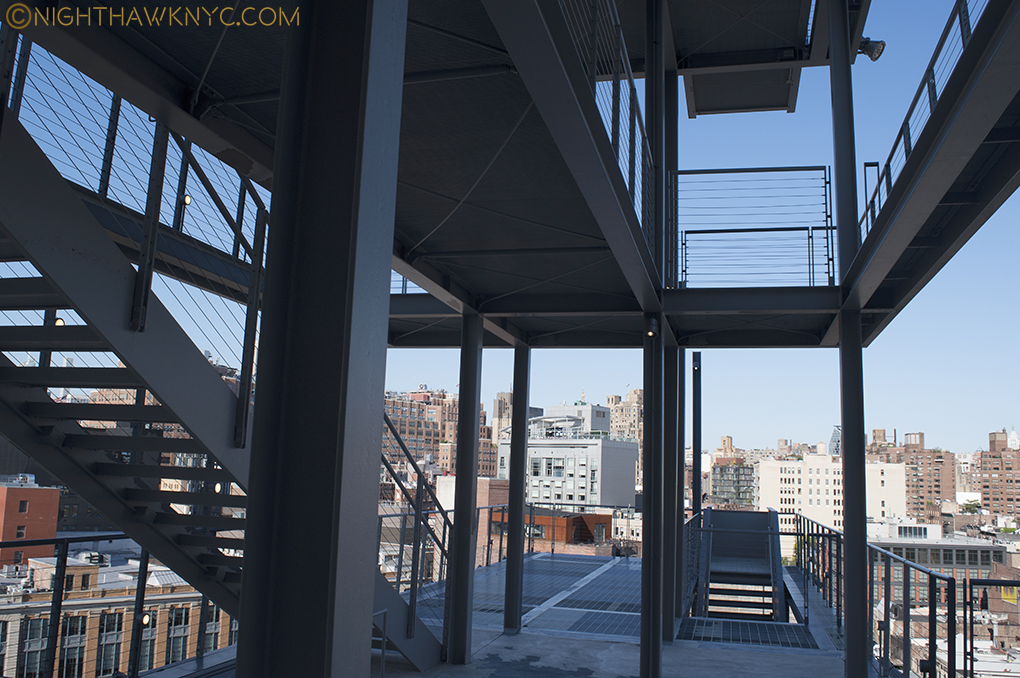
DSC_2948P2NH

Outdoor stairs as seen on the 7th Floor

To the south, across Gansevoort Street is a large, renovated apartment building, that also has Hudson River views on it’s western side. To put it mildly, this is a classic “high rent” district. Facing Gansevoort Street, the Museum presents visitors with an almost unbroken face of grey steel. Upon closer inspection, it also includes the Museum’s almost hidden entrance, which, until a sign was added recently, was only marked “Whitney Museum” on a glass window. Still, I can’t help wonder how the residents of that building across Gansevoort feel about paying those very high rents to look out their windows and see-
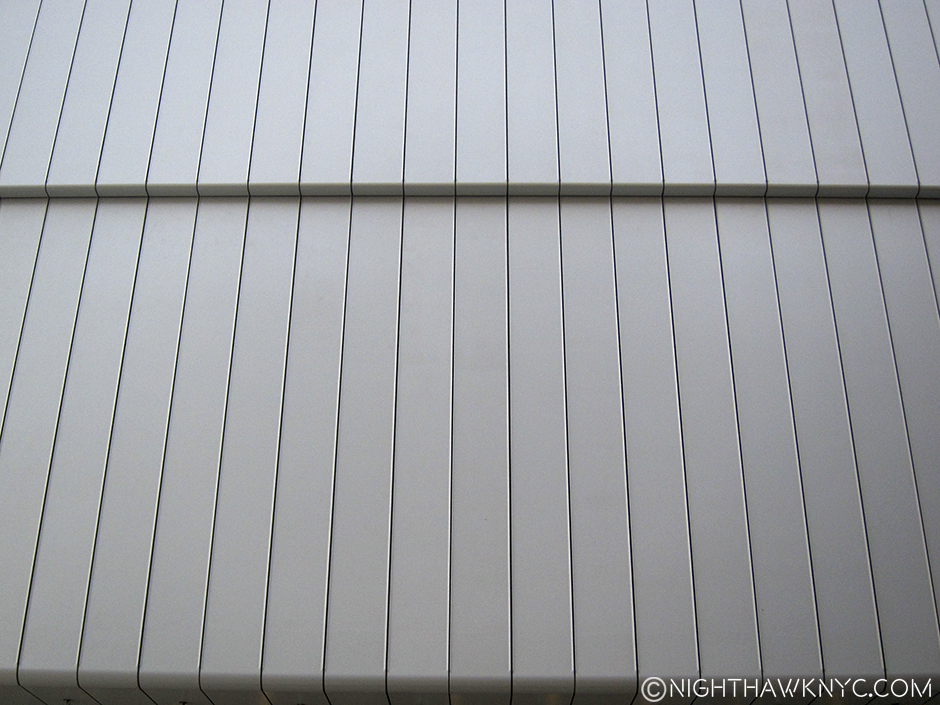
This, is their view.

This, is their view.

In fact, seen from the south, the building is so large that none of my cameras were able to get the whole thing in a shot from Gansevoort, including using an iPhone in Panorama mode. I had to go out into West Street to get one, which I don’t advise doing due to traffic coming randomly from 3 directions, not to mention my back being literally on the flimsy chain link fence bordering the West Side Highway with cars & trucks zipping around the bend at 60mph. Not a smart place to be standing with a camera. But this points out something interesting- there is no place where one can easily stand to get a good shot of the Museum- except, possibly, from a substantial distance. In fact, most of the shots of the building on the Whitney www site were taken from the rooftops of adjacent buildings. Maybe this is why no one takes pictures of it. Or? Maybe they don’t like it. ?
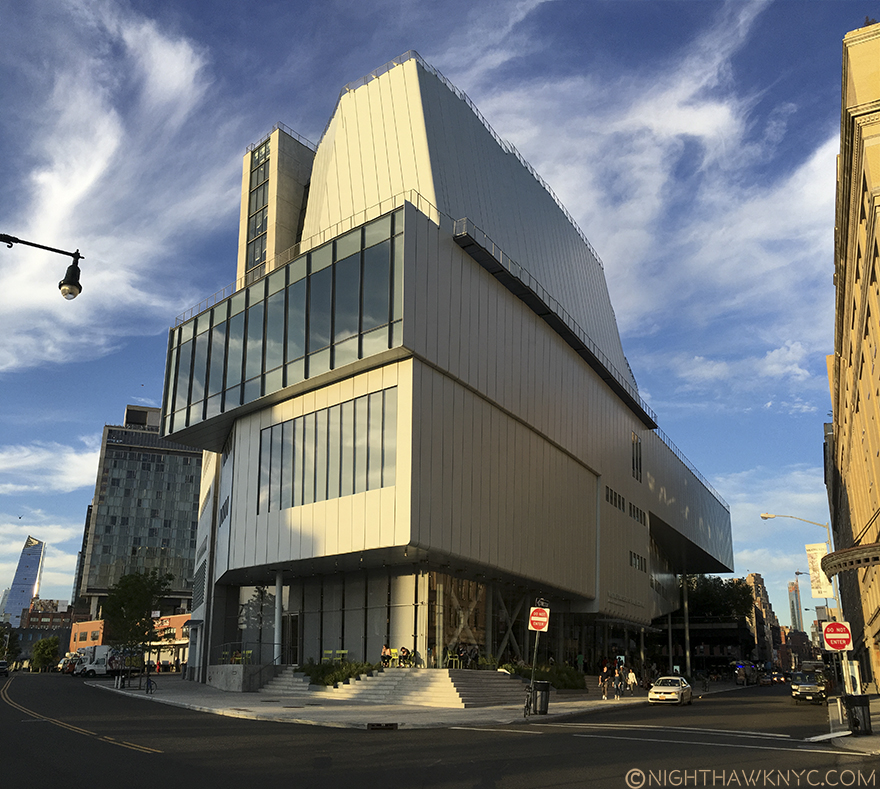
The closest I've come do death this year. The West Side Highway is inches behind me.

NOT to die for. I risked my life getting this shot. Southwest corner.

As we move to the western facade, with the large windows seen above (which reminds me of Zaha Hadid’s Library in Vienna), the upper one juts out at an angle seen from the north that vaguely reminds of the Breuer building’s Madison Avenue upper window.
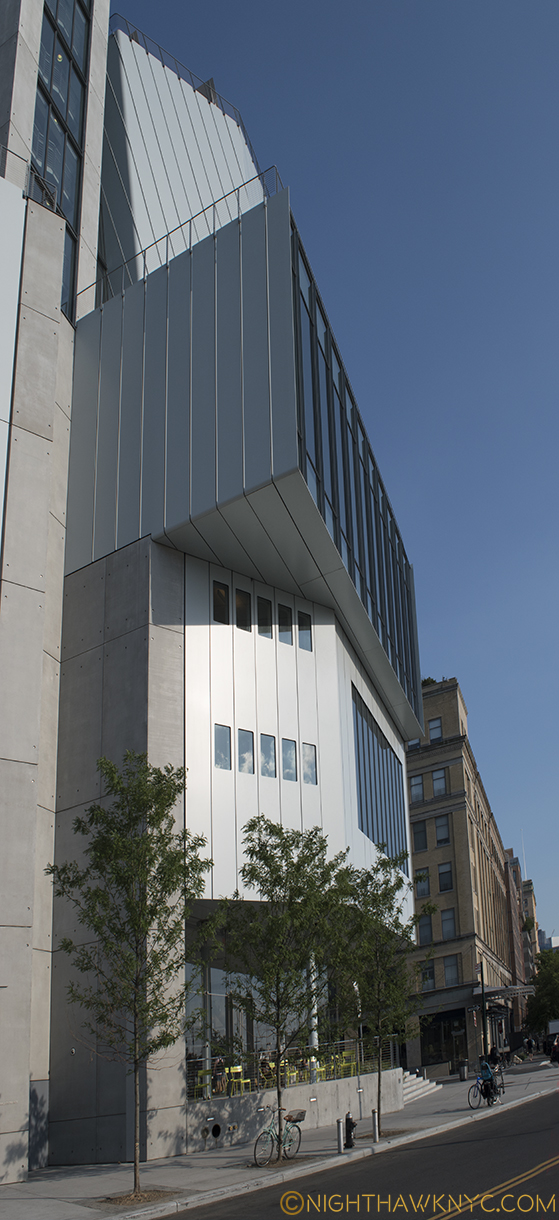
DSC_5300PNH

But more problematically, is a large Department of Sanitation complex smack dab right in front of it! “Holy Refuse Pile, Artman!” Garbage trucks coming and going all day and evening are not exactly what gives a “Riv View” it’s cache. (Feel free to insert your own wry joke about contemporary art here. I’ll wait…)
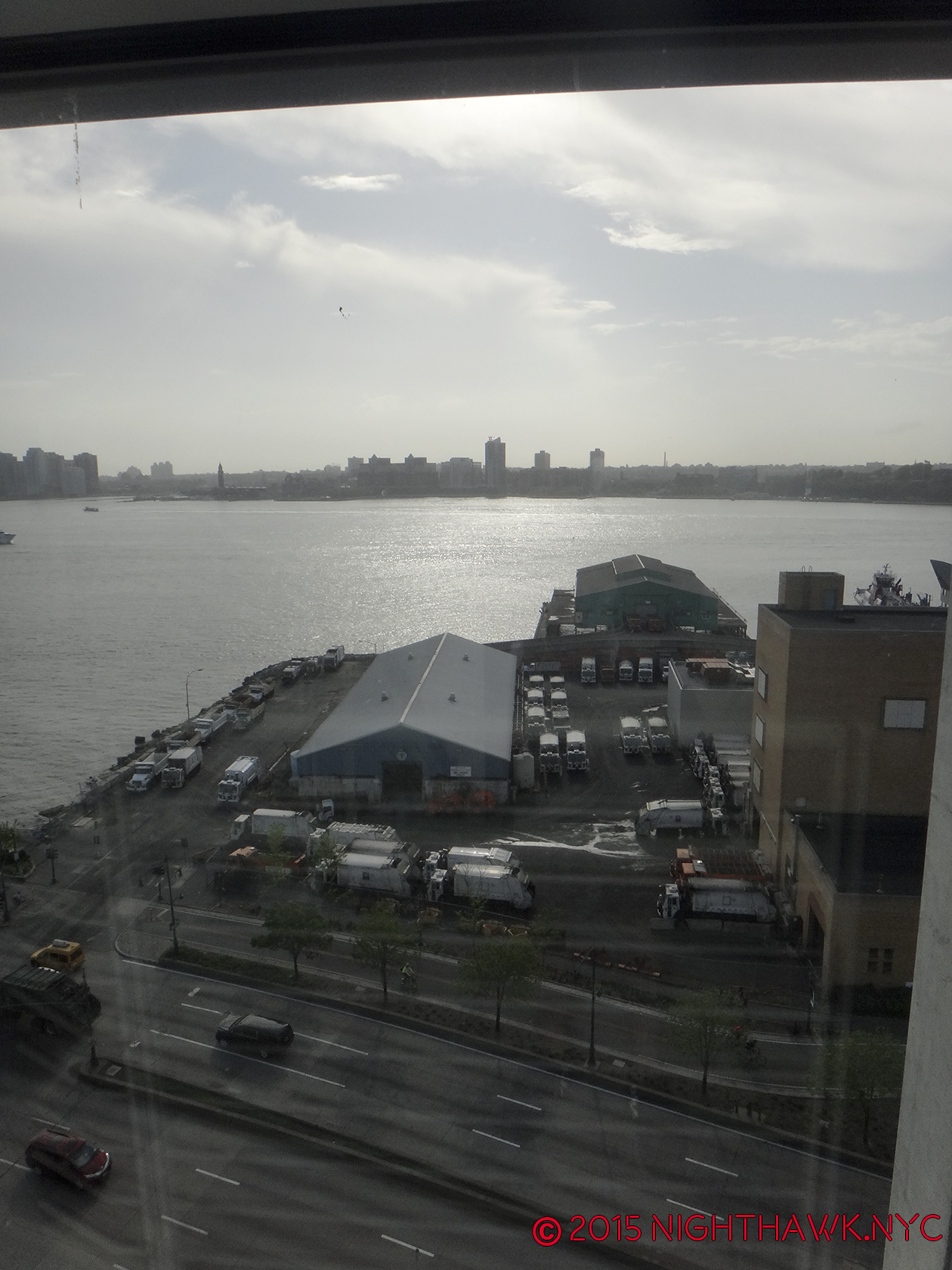
View of the Department of Sanitation from the 7th Floor stairs, 2015.

Riv View. Looking out at the Department of Sanitation from the 7th Floor stairs, 2015.

Mr. Piano has done his best to “minimize” the damage from the “offending” Department of Sanitation, and eternally busy West Side Highway, by opting to minimize the exposure of the western facade leaving a very narrow patio where, typically, only a few chairs usually are to be seen. It sits a few scant feet from the West Side Highway, after all, so it’s hard to imagine many people wanting to sit there for long. 3 trees have been planted along the curb in hope that one day they will provide some camouflage.
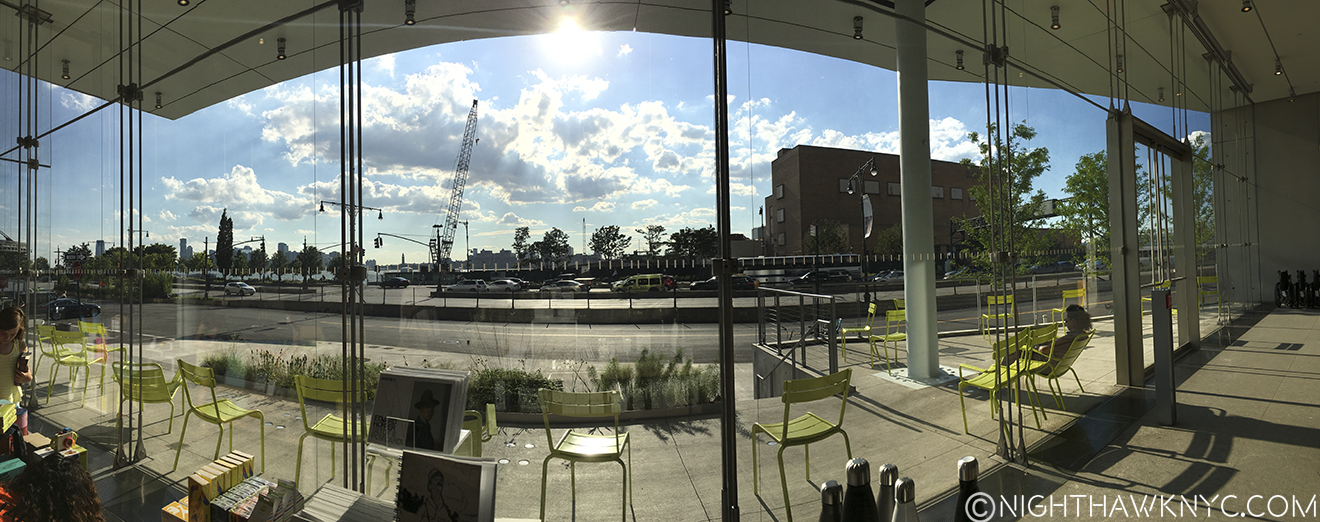
View from in front of the western facade, July, 2015, Being a tree in NYC is one helluva hard job.

View from in front of the western facade, July, 2016, Being a tree in NYC is one helluva hard job.

Regardless of the difficulties in seeing the building close up, it can be seen, for many blocks, both, to the north and south along the West Side Highway, and from across the Hudson River in New Jersey. Thanks(?) to the High Line there has been a boon in building in the area, with some very big name Starchitects (including, as I’ve written, the late Zaha Hadid’s only NYC Building going up at 520 West 28th Street, among many others) having new or recent projects in the area- some successful, some eyesores already. No less than Frank Gehry, the greatest architect of his time, in my book, himself, has a fairly new building about 6 blocks to the north of the New Whitney along the Highway, the gorgeous IAC Headquarters at 18th Street.
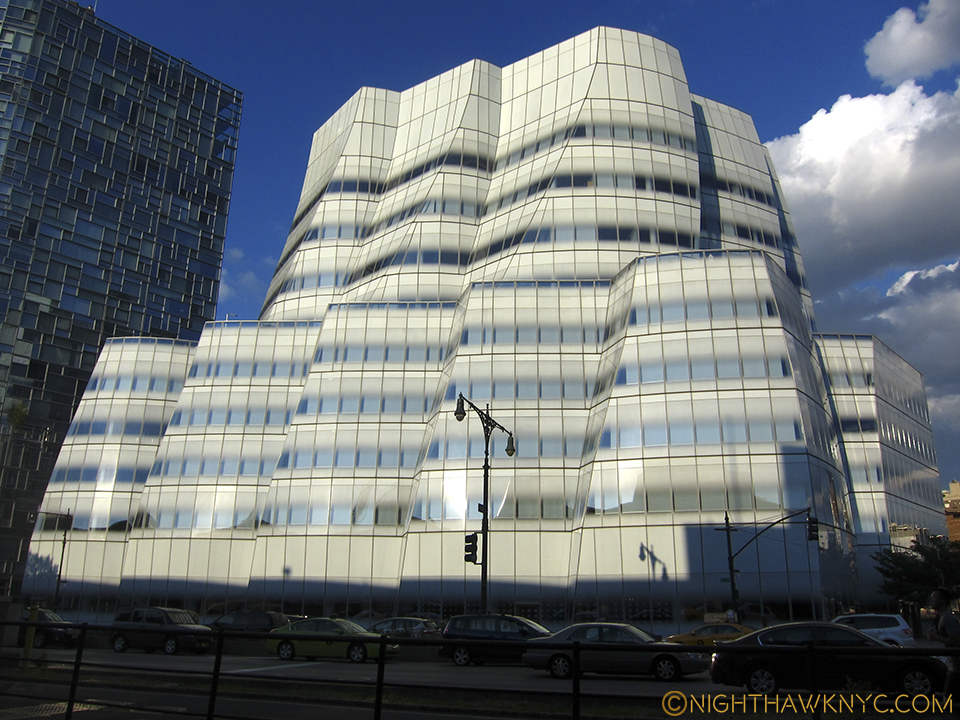
Like a sailboat on the Hudson, Frank Gehry's IAC Building is a gorgeous vision.

Like a sailboat on the Hudson it faces, Frank Gehry’s IAC Building is a shining example of the visionary architecture NYC needs more of, IMHO.

But, say what you want about this new Museum (don’t worry…I will), one thing that must be said is that the building isn’t obsessed with competing with it’s spectacular neighbor. Well? Not that spectacular neighbor, anyway. If anything, it sure feels to me like it’s competing with it’s OTHER “spectacular neighbor”- the High Line.
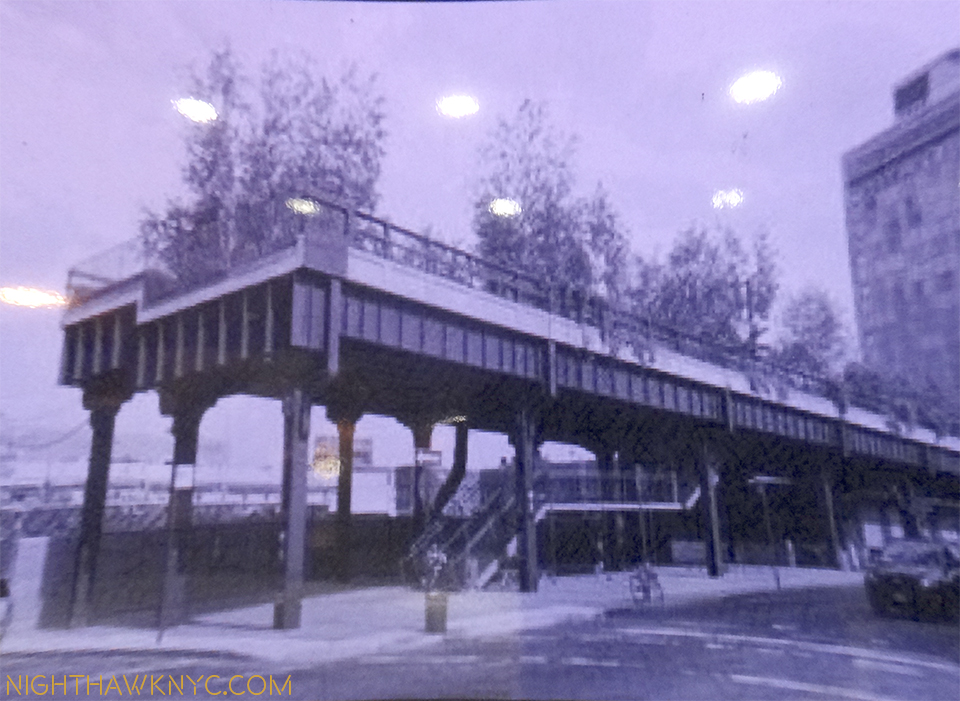
Southern terminus of the High Line, circa 2009. The new Whitney now occupies the space directly behind the left side.

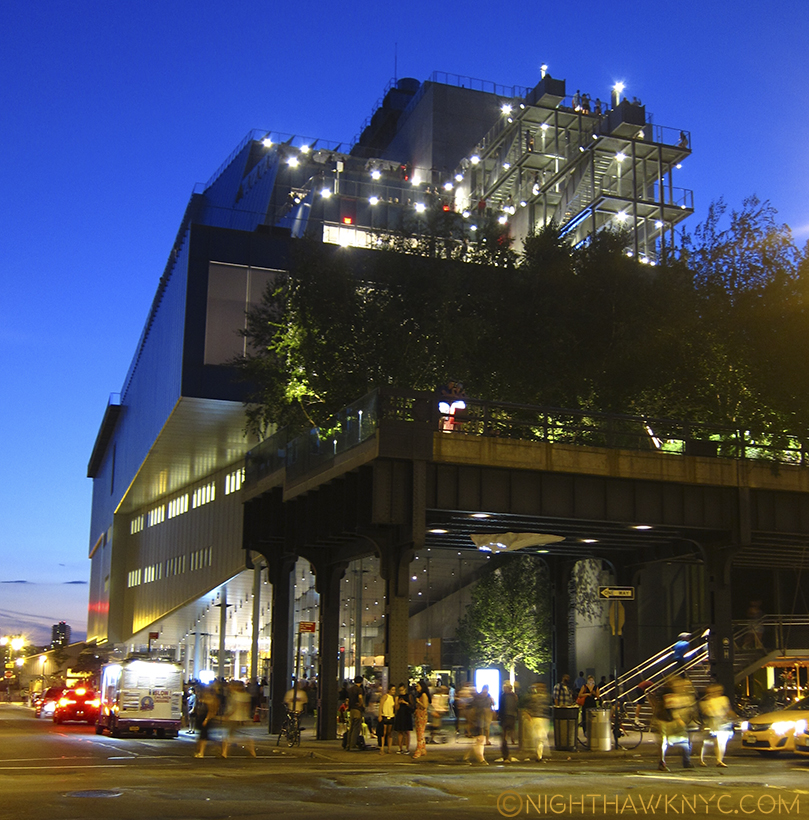
Southern terminus of the High Line, circa 2010, early in the construction of the new Whitney directly behind on the left side. And today, and tonite…
DSC_6042PNH


IMG_1130P2NH

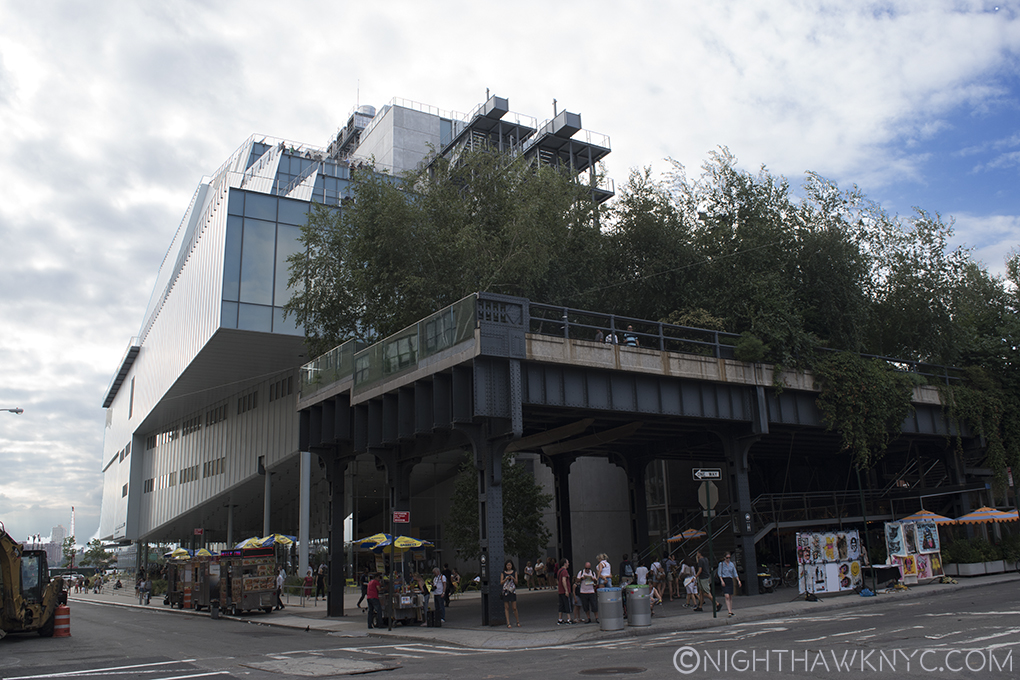
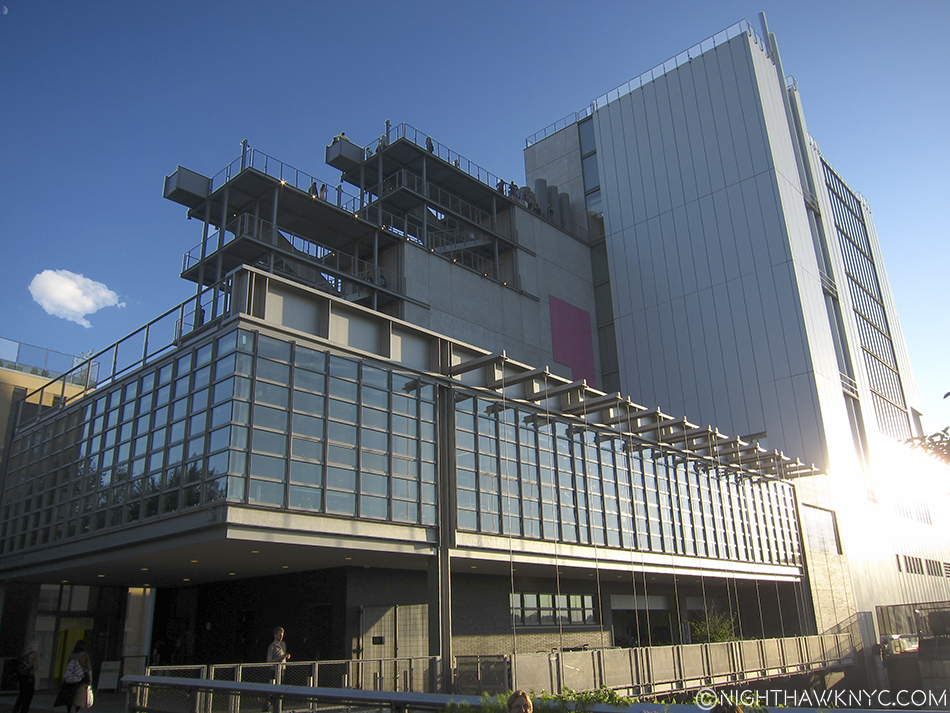
That brings us to the east side of the building, the side that abuts the High Line. Renzo Piano also designed the High Line Maintenance & Operations Building,
IMG_0782PNH

High Line Maintenance & Operations Building on the lot’s northeast corner.

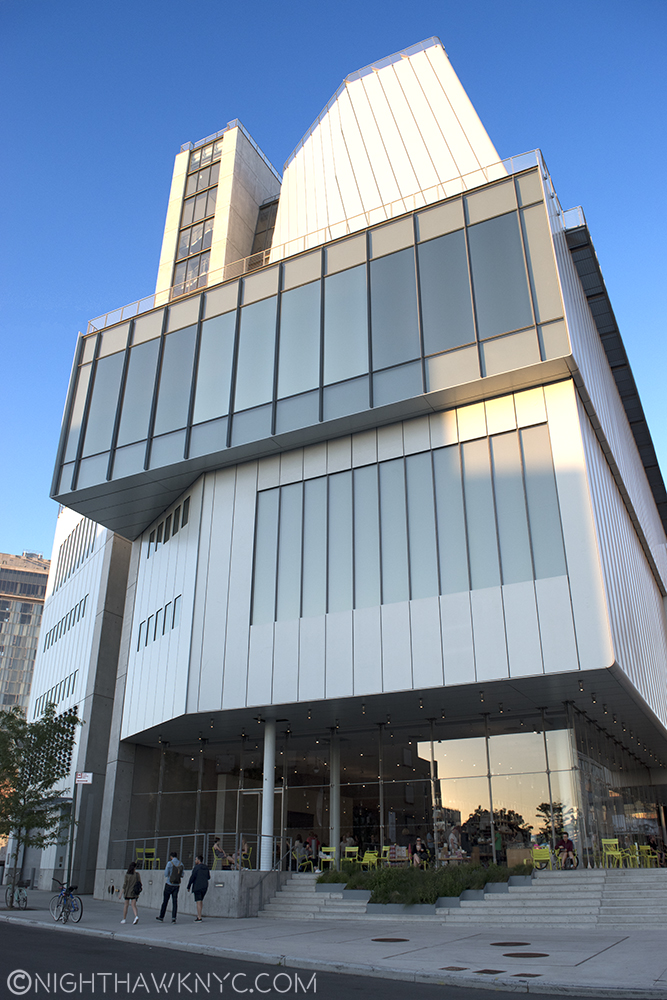
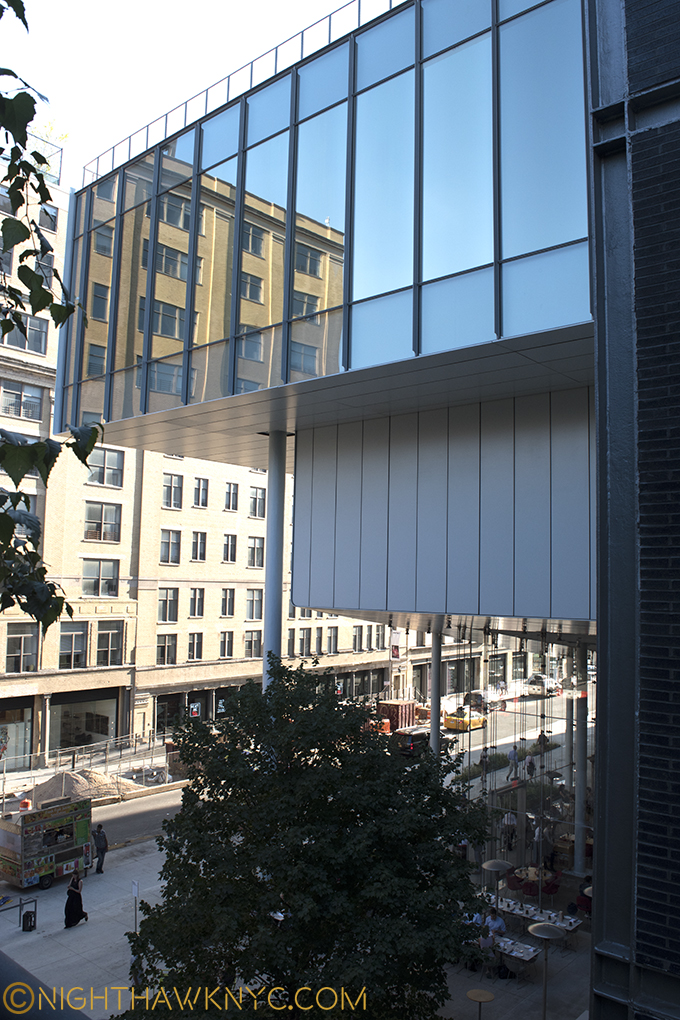
which looks like it’s part of the Whitney, occupying the north eastern corner of the lot. Next to that are a rectangular bank of windows of the 5th Floor Galleries. The lowest rectangle is cleverly cantilevered over the lower floors in a way that vaguely reminds of Wright’s Fallingwater. Above it are more rectangular rows of windows on the other gallery floors, which are accompanied by roof decks and outdoor stairs between floors.
Eastern face with 1st floor restaurant seen from the High Line.

Cantilevered lower eastern face with 1st floor restaurant seen from the High Line.

And, these are what raise my suspicion about purpose. So much outdoor space, and outdoor stairs in a place with the climate of Manhattan could be seen as highly questionable design. They are going to be unusable a good part of the year, so why do them? Aesthetically, to my eyes, the stairs look uncannily similar to the High Line’s access stairs. I wondered- Is this a case of “art snobbery” by an expensive to build, expensive to enter Museum trying to “upstage” a free & public park- a poorly thought out game of oneupmanship? An attempt to “blend in” with the High Line? Or?
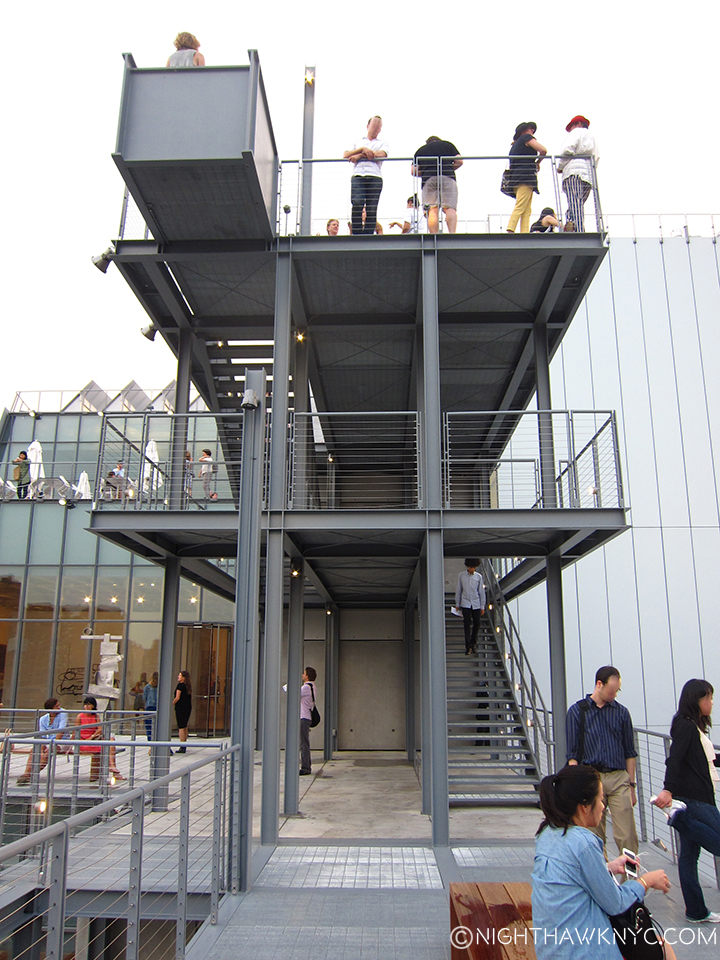
Whitney Museum Eastern Facade Exterior Stairs close up
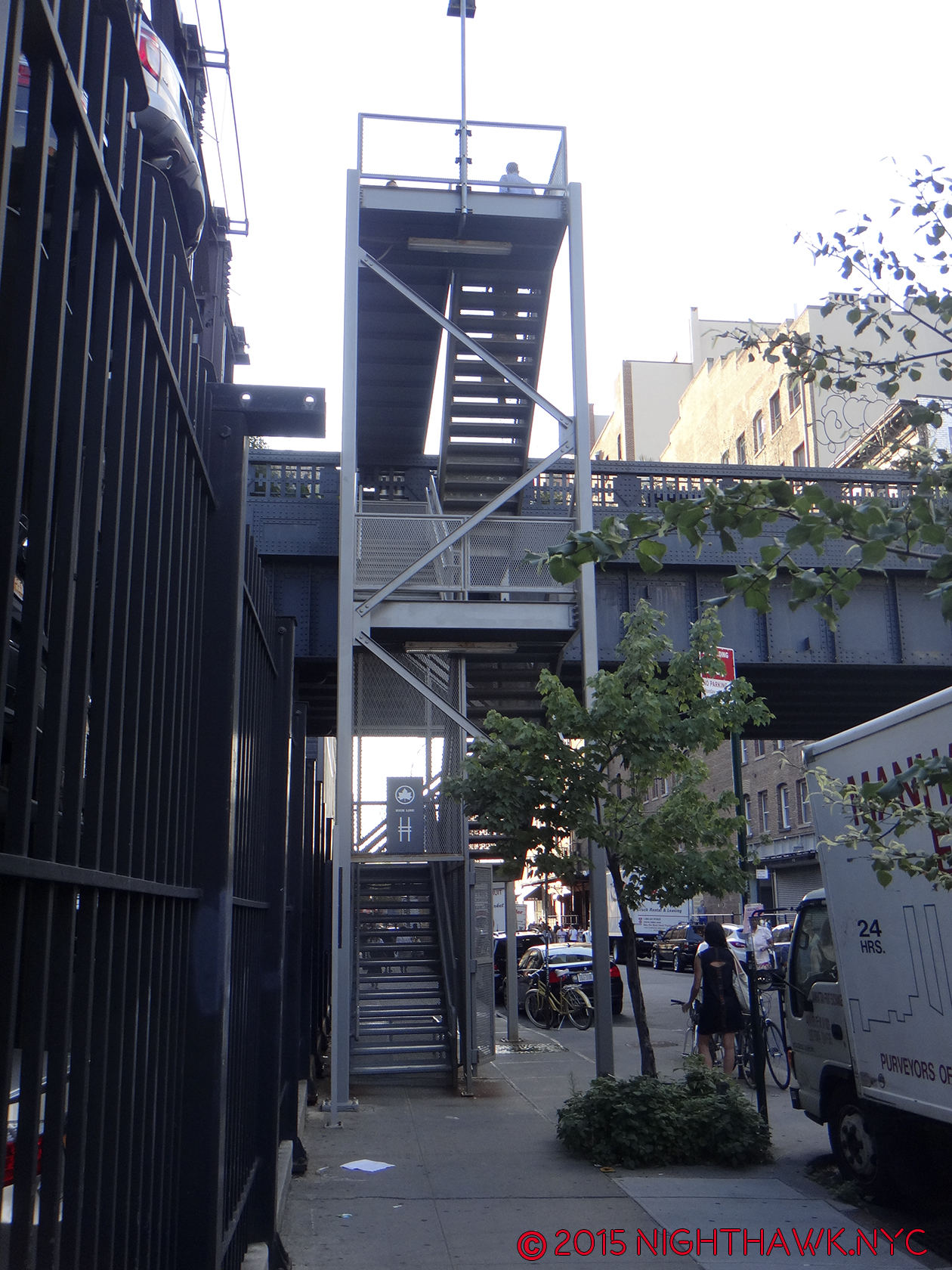
High Line Stairs at West 20th Street

High Line Stairs at West 20th Street

Other questions festered. Back along the south face. I spent a long time trying to think of what the shape of this building reminded me of. Hmmmm…Then one day, it hit me- From the south it looks like one of the US Navy’s newest ships- the USS Independence. From this side, it looks like it’s ready to go out to sea, well, out to the Hudson River. This feeling is hard to shake when you are looking at the few windows that look a bit like portholes, the “military—like” grey coloring, and the slightly sloping (i.e. “stealthy”) look of the upper floors. Add the rear decks and stairs to the Independence and the effect is so similar, it’s down right eerie.

Ok, flip the cantilever to the rear, and...? Eerily uncanny, no?

U.S.S. Indianapolis, again, with my highlighting. Ok, flip the cantilever to the rear, and…? Eerily uncanny, no?
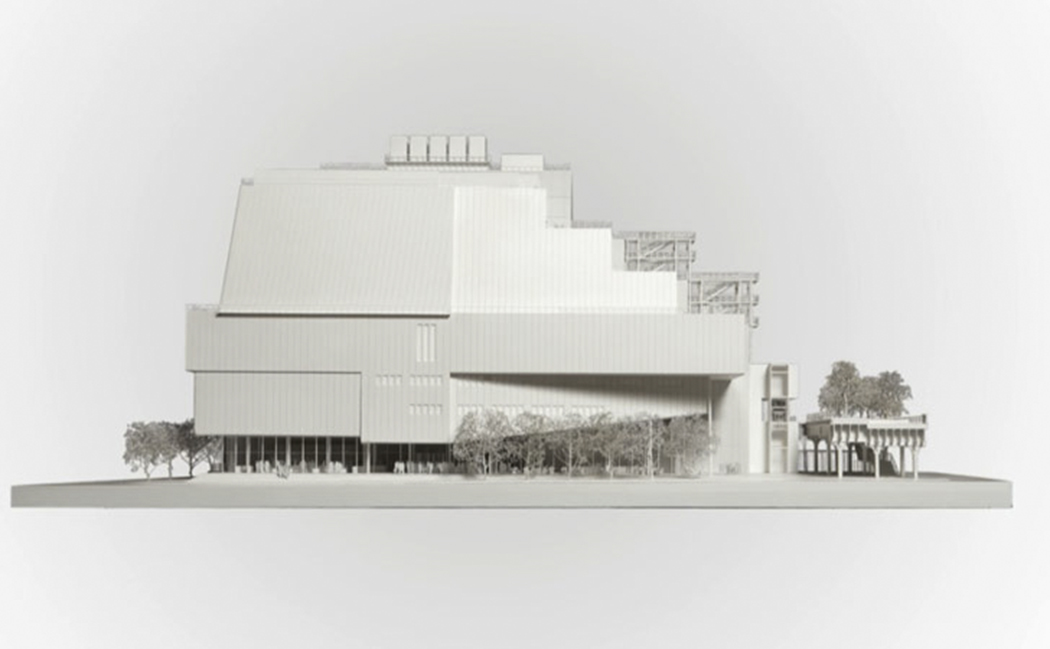
Photo from Renzo Piano Building Workshop website.

Photo from Renzo Piano Building Workshop website. Note that all of the “neighbors” have been removed, except for the High Line.

Part 3- The Roofdeck of American Art
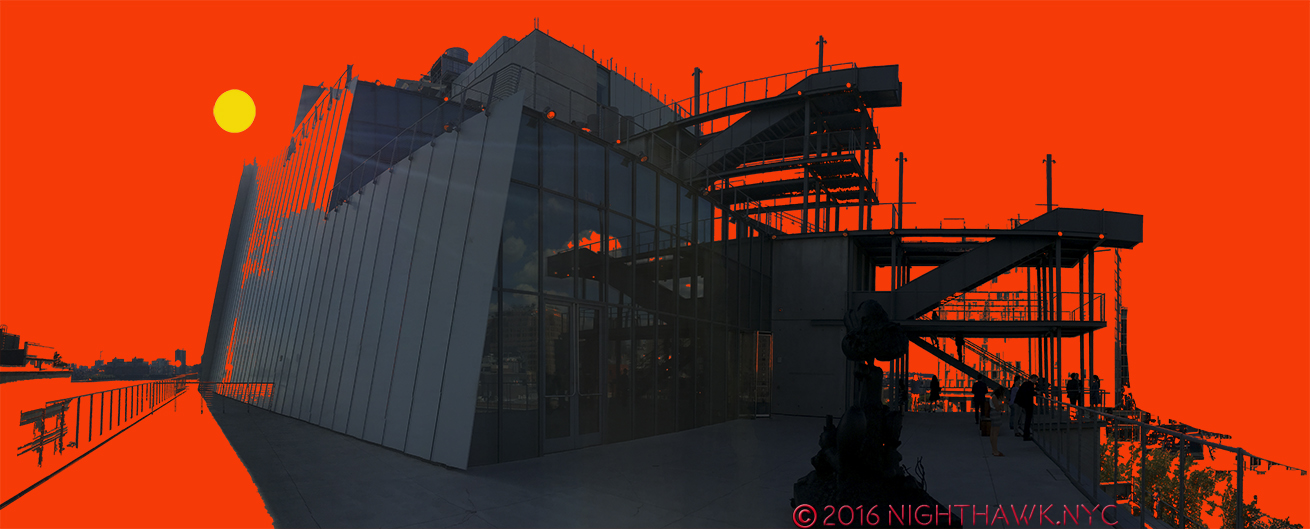
Bring sunscreen.

Want a tan with your art? 6th Floor deck, Spring, 2016.

Yes, that is what I’m calling the New Whitney- “The Roofdeck of American Art.” I think the decks are what people will remember most about the building. I only hope it’s not what they remember most about their visit. That will be up to the Museum’s curators and staff. But? As I will get to, I think other forces are at work, too.

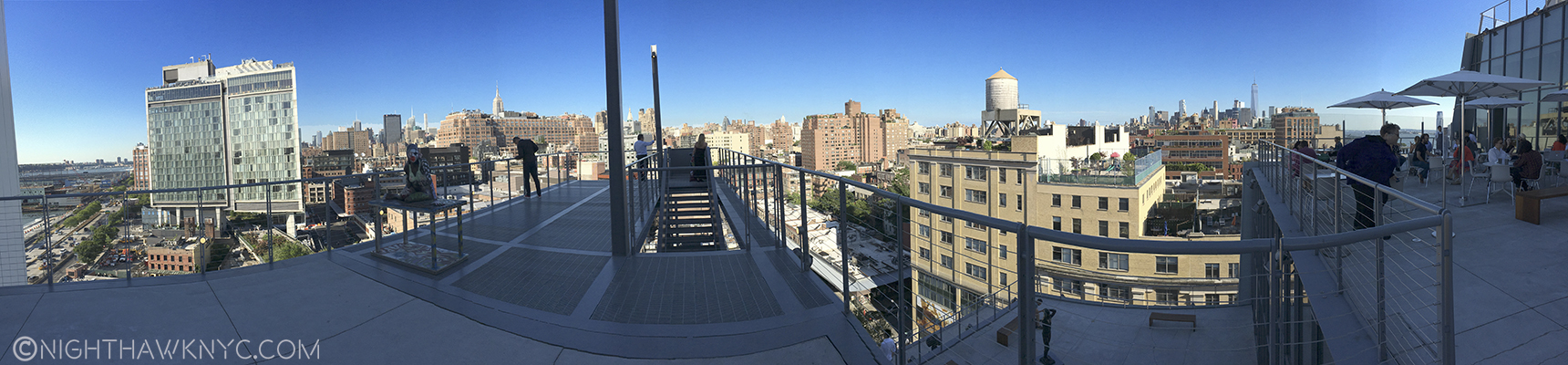
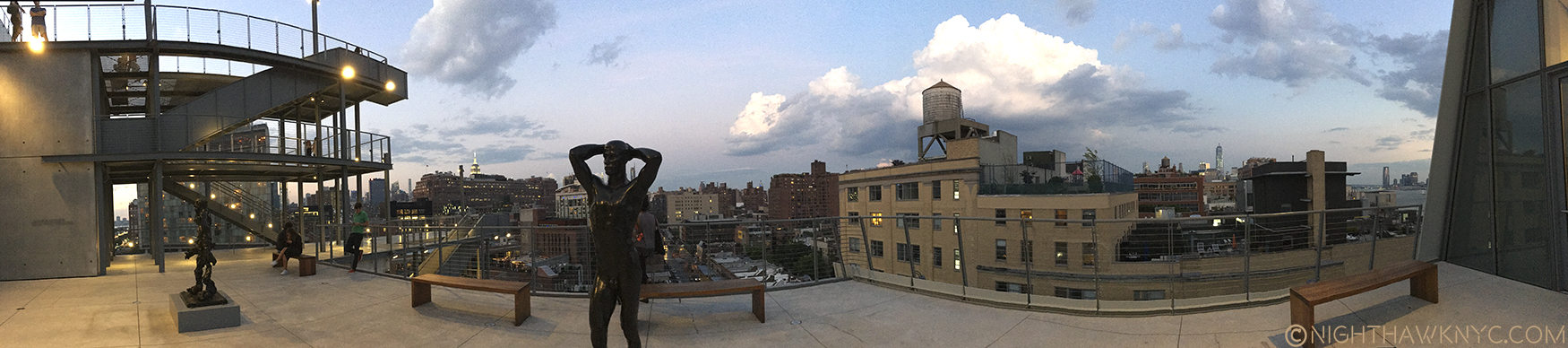
With 4 roof decks, I bet some will come only to enjoy the view and get some sun. The Museum turns the face the vast majority of visitors will experience most to it’s “rear,” to it’s east side facing the High Line. Doing so gives Mr. Piano a very convenient out of his Sanitation Department dilemma, “Riv View” notwithstanding, and allows a wonderful panorama of Manhattan, from Chelsea Piers to the north, the Empire State in the center and the Statue of Liberty, distantly, to the south. The decks allow space for dining (8th floor), sculpture (5th floor and the others), seating, and that 21st Century phenomenon- selfie sticks.
IMG_4907PNH

8th Floor Deck.

It’s very nice. You’ll like it. Bring sunscreen.
IMG_4848PNH

I promise that top ramp won’t be bent when you visit the 7th Floor Deck.

Part 4- Inside. “Hey look! They have art here…too!”

Inside, the first floor is the lobby, the most unsuccessful part of the entire interior- it’s an open space. The message here is “keep moving.” It’s about as unwelcoming a space as Moma’s lobby. (Actually, ALL of Moma, which for me stands for what it feels like- the “Mall of Modern Art,” feels unwelcoming!)
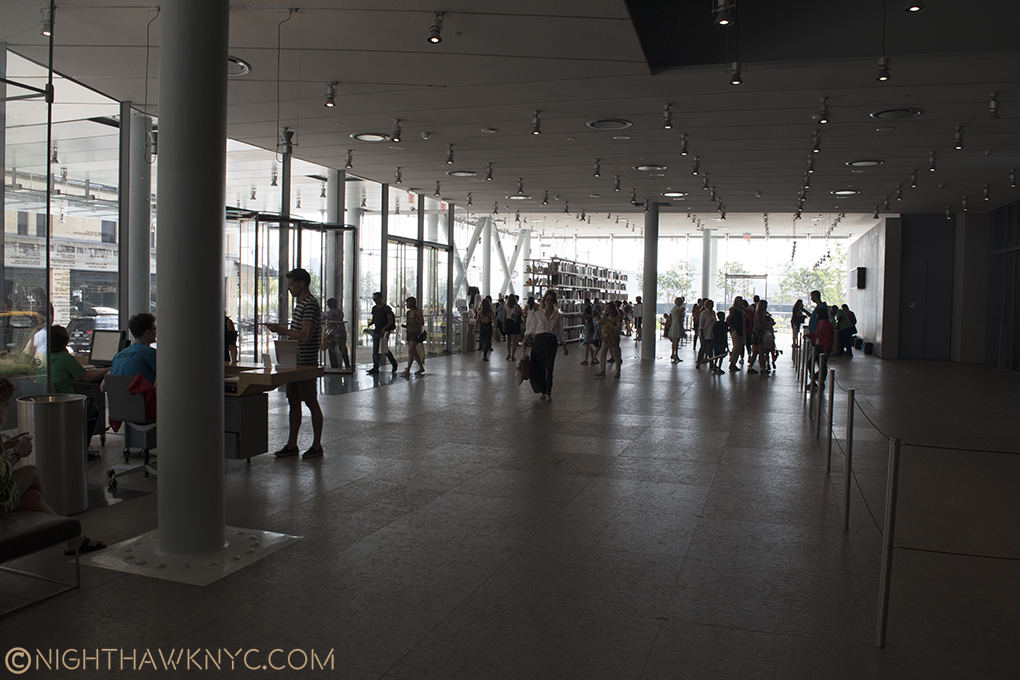
Welcome? No one will ever mistake the lobby for the Great Hall at The Met. Front door is opposite, where the black mat is.

Welcome? No one will ever mistake the lobby for the Great Hall at The Met. Front door is to the right of the nearest exposed column. Engineering made visible abounds. The free 1st floor gallery is to the immediate right, outside of the rope fence, which denotes you are in the Museum.

Once inside, here’s the routine I’ve settled upon, which probably sounds confusing- After entering as quickly as possible to minimize the time spent in the “lobby,” a short trip downstairs (don’t take the elevators- the wait is too long) brings you to the coatroom and the rest rooms (there are others restrooms on 3, 5, 7 and 8). The feeling here is 180 degrees from the lobby. This is completely designed. It makes you wonder what the hell happened upstairs. Take the stairs back to 1 and walk out past the rope line (keep your admission ticket handy) and visit the first floor gallery, which is free all the time. (Or, yes, you could visit the 1st floor gallery before paying to get in. I prefer to get my admission ticket first, which means I have to show it twice.) After that, show your ticket and get back in the Museum proper then take an elevator to the whatever floor you wish to see first- 3 (where the theater is for concerts, dance performances, etc), 5,6,7 or 8 (where the galleries are). Bear in mind there is no 2nd or 4th floor- they didn’t pay enough money to get those. No, at 422 million dollars, they did, but those floors are reserved for Museum staff and functions, so they’ve disappeared from the public elevator buttons.
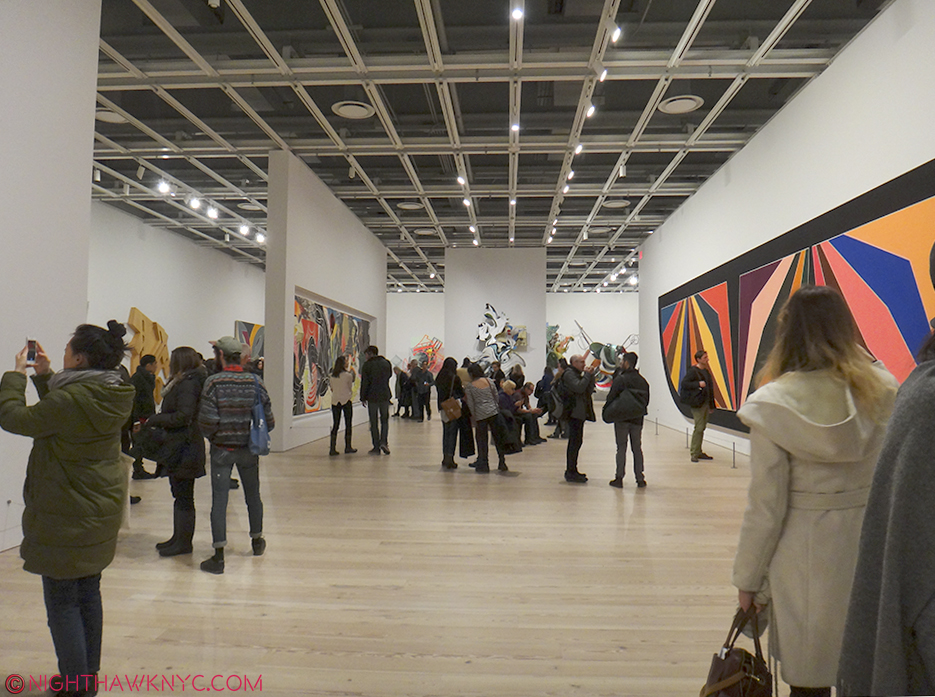
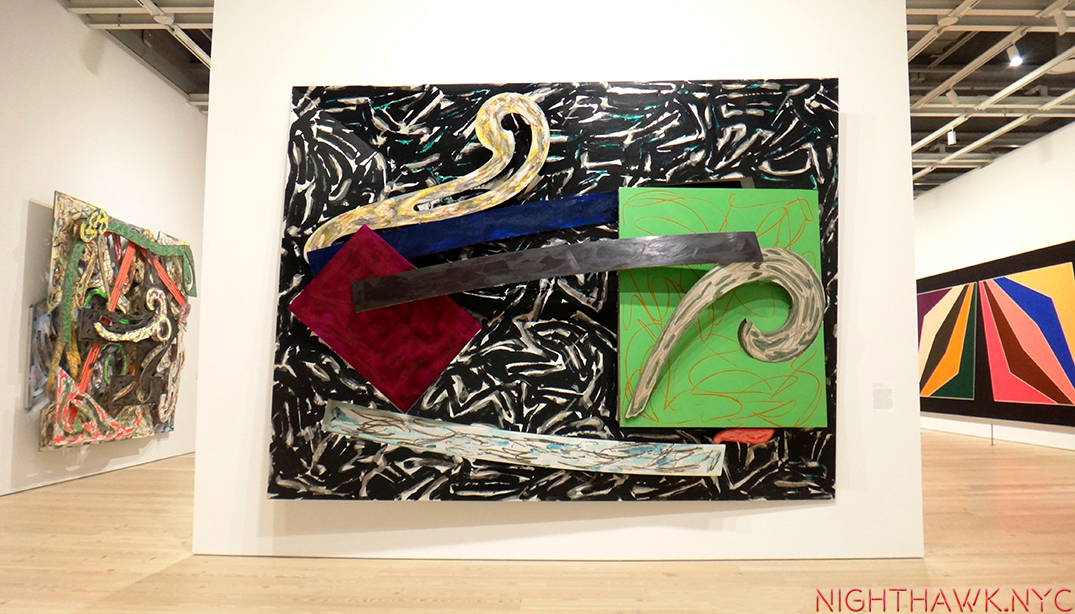
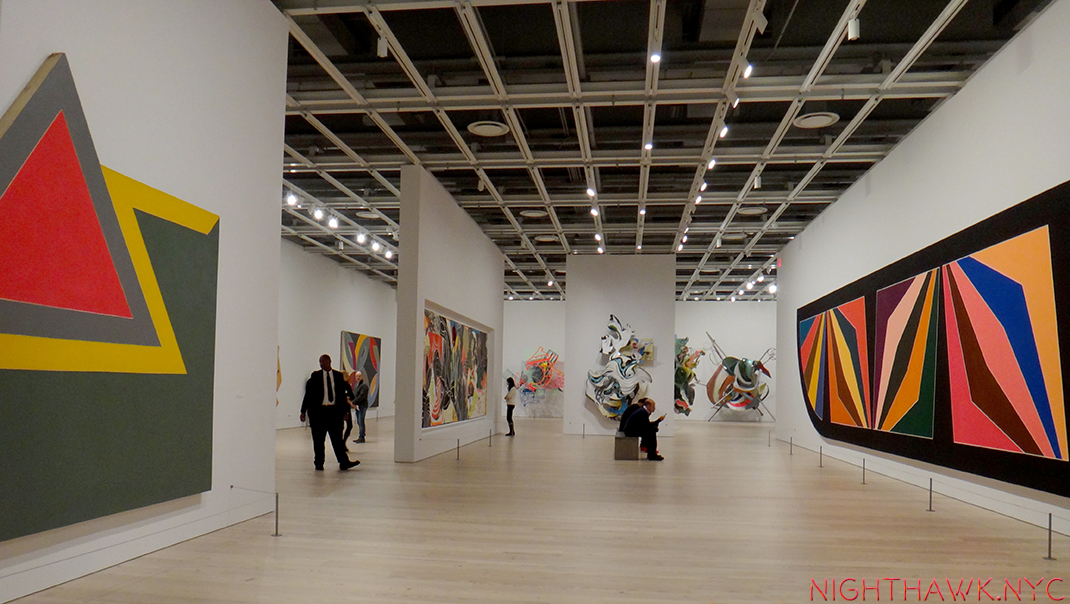
5th Floor seen during the Frank Stella Retrospective, Feb, 2016. The smaller walls can be moved to provide countless configuration possibilities.

5th Floor seen during the Frank Stella Retrospective, Feb, 2016. The smaller walls can be moved to provide countless configuration possibilities.

Inside, the building is very sharp, clean and neat with natural wood floors and new, white walls all around. As the rectangular shape belies, form mostly follows function, and 4 of the floors are given over to large, rectangular galleries. The open space allows for movable walls can be easily repositioned to allow an extremely wide range of configurations. Each floor is very well lit, (something that is continually a problem at The Met). With 3 sets of stair cases, there are plenty of stairs . None go all the way from 1-8, however. On the western wall, as seen below, stairs go from the 3rd floor to the 8th. To the east of the elevators, stairs run from 5 to the 1st floor. And, there are the exterior stairs on 6,7 and 8. The stairs are good to familiarize yourself with, since there is almost always a wait, the elevators are best used for going from 1 to 8 or from 5 to 1. The entire building, inside and out, is wheelchair accessible.
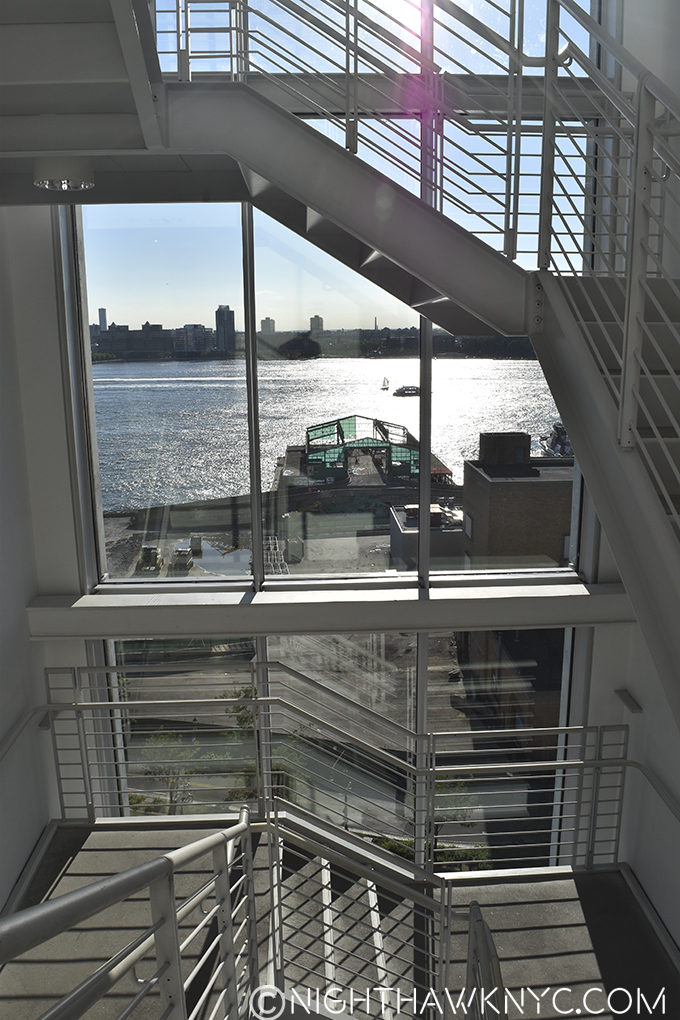
Western stairs, Spring, 2016. They seem to be dismantling the Sanitation complex. The Whit might be hoping a tower doesn’t go up in it’s stead.

Renzo Piano strikes me as a Master Engineer more than as a brilliant Architect. I got that feeling when I first saw the Pompidou Centre in Paris, with it’s engineering on the outside, and again with his New York Times Building (which he inherited from Gehry). Yes, he has done some beautiful buildings, but I repeatedly get the feeling of Piano, the Engineer, when I look at his work, and that shouldn’t be the primary feeling I’m left with. There is quite a bit of engineering being shown off, here too, much of it on the first floor, some in the exposed gallery ceilings, and some on the roof decks.
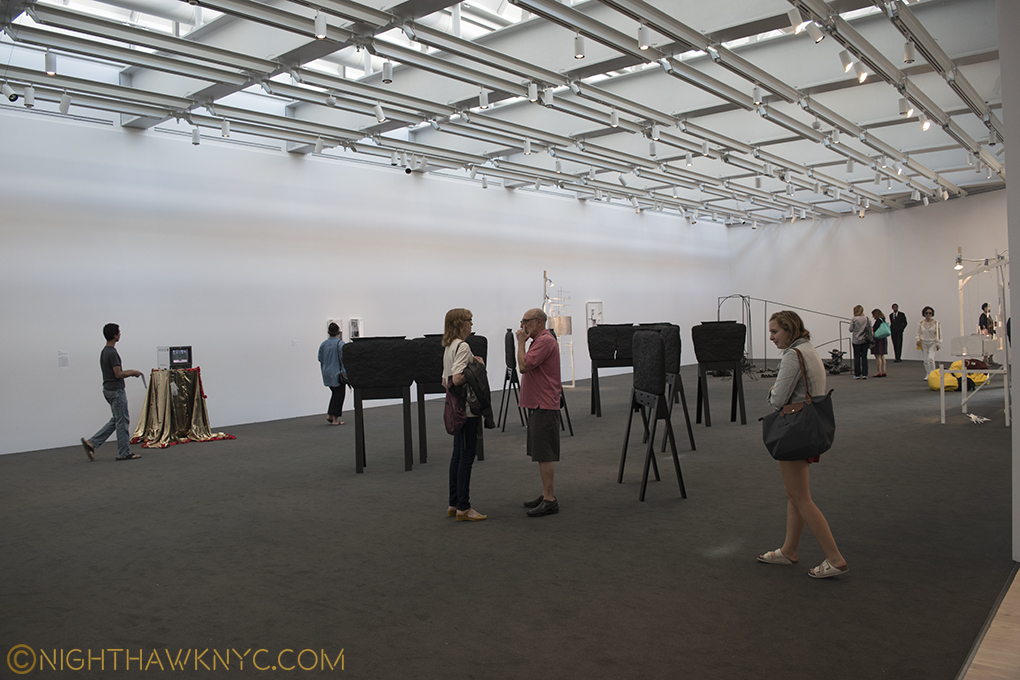
The 8th floor gallery lets in ambient sky light.

The 8th floor gallery lets in ambient sky light.

Now for the “nitty gritty.”

Given the luxury of having over a year to assess it, I’ve begun to wonder about the adequacy of the 50,000 square feet of indoor exhibition space, as nice as it is. “America Is Hard To See,” fit the whole Museum well, and showed it off to fine effect. Then, while the Frank Stella Retrospective was excellent, it only included 5 of his prints, and only 1 of his “Moby Dick” works. Was this because of hard decisions due to a prolific, 50+ year career, or due to a lack of space on the 5th floor? Currently, the otherwise excellent “Stuart Davis: In Full Swing” show feels unmistakably truncated. It shares the 5th floor with the “Danny Lyon: Message To The Future” show, (which may be overambitious). By comparison, The Met’s Stuart Davis show in 1991-92 had almost twice as many works, including over 30 that dated before the earliest work in the Whit’s show, like some from his “Van Gogh” period. While these have been going on indoors, I’ve been underwhelmed by what’s been installed thus far on the outdoor 5th Floor exhibition space. As time goes on, I’m starting to feel the 5th Floor may turn out to be a design mistake. Part of it is cut off to allow an entrance and exit corridor for the outdoor space, which is generally in shadow, and results in leaving a small indoor gallery on the other side of the outdoor gallery access corridor, which feels lost, and most importantly cuts down the size of the congruent 5th floor space. The other floors with outdoor decks run right up to the door leading outside with no corridor, etc.
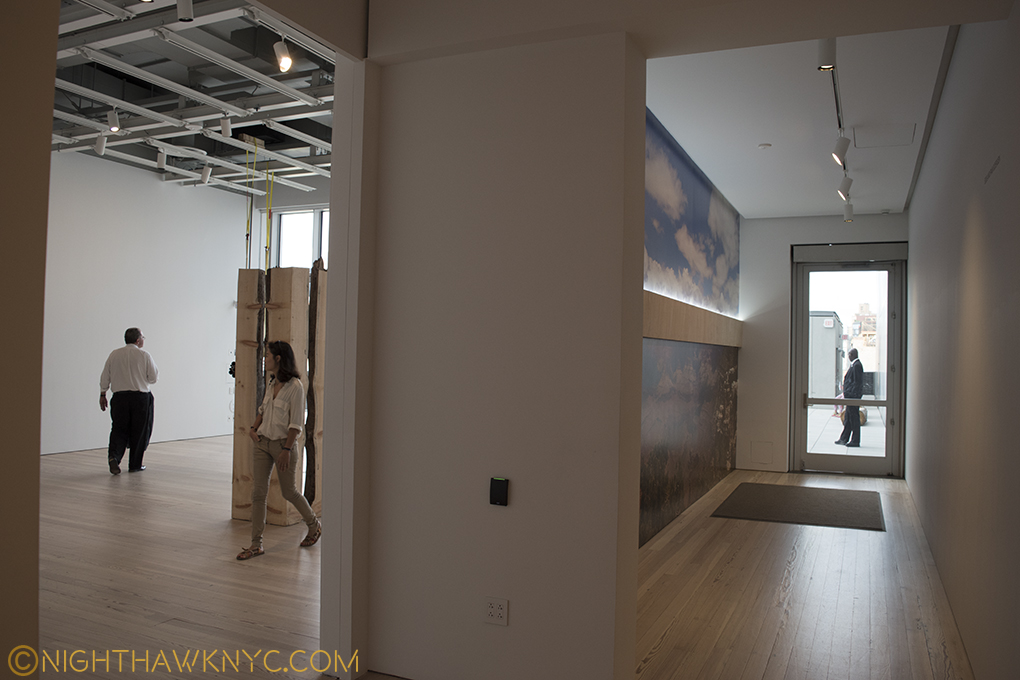
The 5th Floor is cut to allow this exit corridor to the Roof Deck Gallery, leaving a small gallery to the left that feels lost.

The eastern end of the 5th Floor gallery is cut to allow this exit corridor to the Roof Deck, which leaves the small gallery to the left that feels lost.

The Whitney says there is 13,000 square feet of outdoor space, over 25% of the amount of indoor space. I’m left to ask the age old question…”Did they create enough INDOOR space to display Art?,” the prime purpose of a Museum. Time will tell, BUT? If they didn’t? This will be a disaster reminiscent of Moma’s inexcusably horrible current/new building, where they somehow managed to create a massive multistory hole right in the middle of some of THE most expensive real estate on Earth, then claim they “need more space,” 10 years later!

You can’t make this stuff up!!!
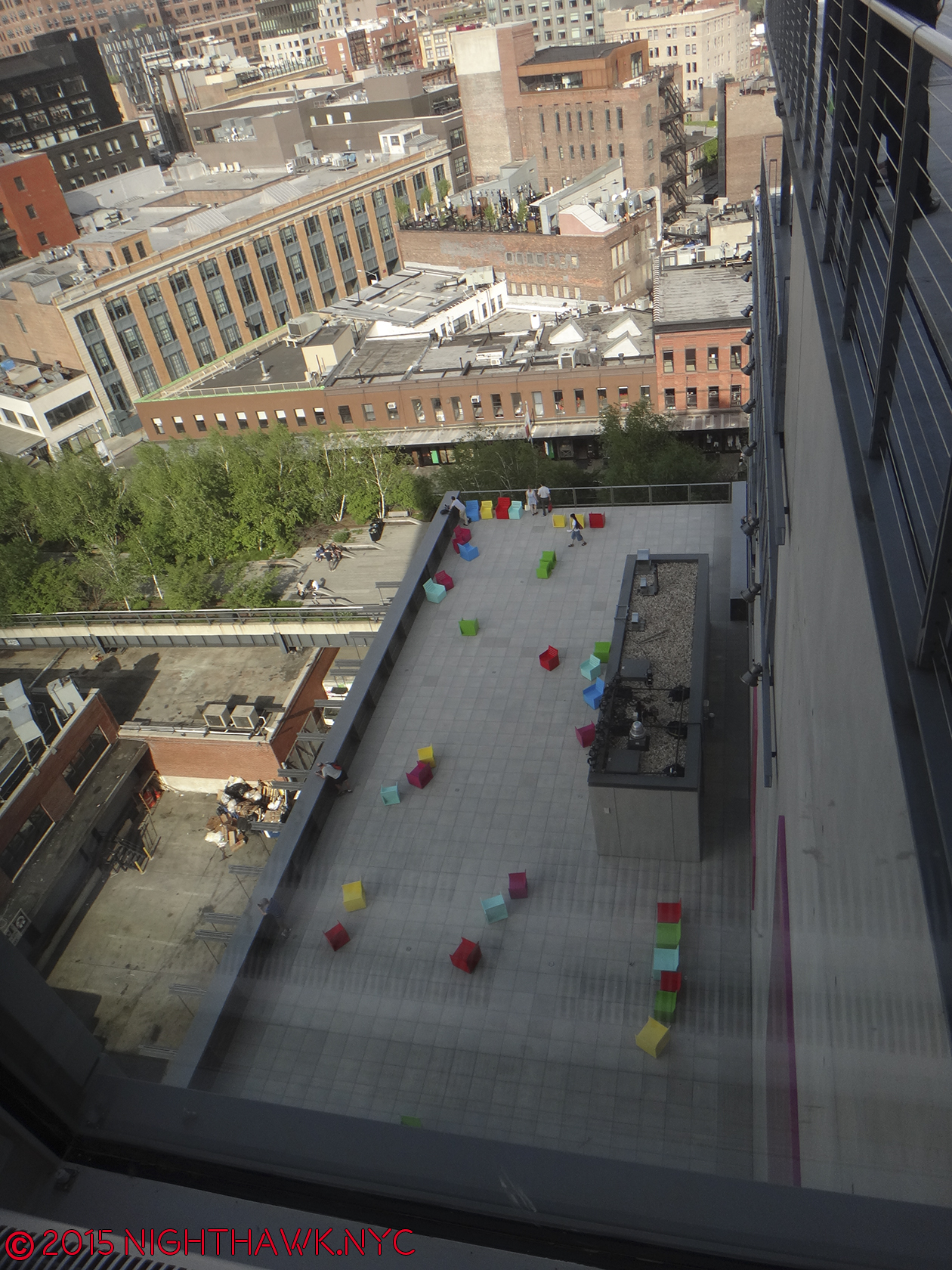
5th Floor Deck.

5th Floor Deck with installation. Yes, the colored seats are the Art work.

If the Whit needs more indoor space, well, the roof decks seem easy to enclose, and voila, 13,000 square feet more gallery space.

Or? PLEASE don’t tell me they’d have to expand this new building north, or up. I’m done writing letters. Besides, as much as I admire and respect Mrs. Gertrude V. Whitney and the collection built on hers, I have no attachment to this building.

And that brings me to this- Through it all, one thought stayed on my mind more than any other. I wonder what she would have thought of the place…

Part 5 – Gertrude Vanderbilt Whitney

“And I dreamed I was flying
And high up above my eyes could clearly see
The Statue of Liberty
Sailing away to sea
And I dreamed I was flying”*
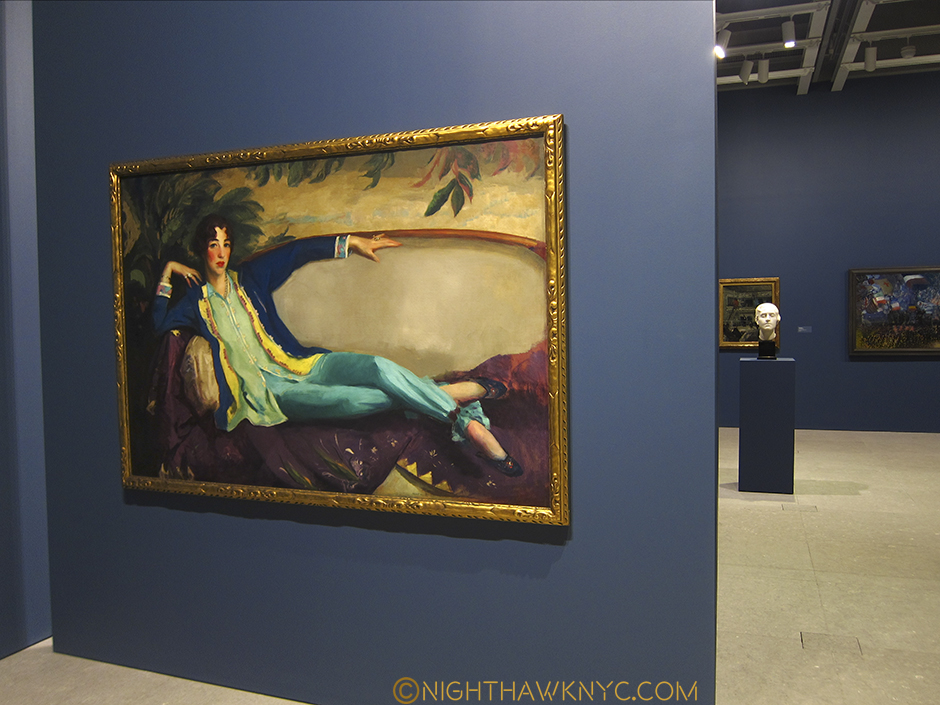
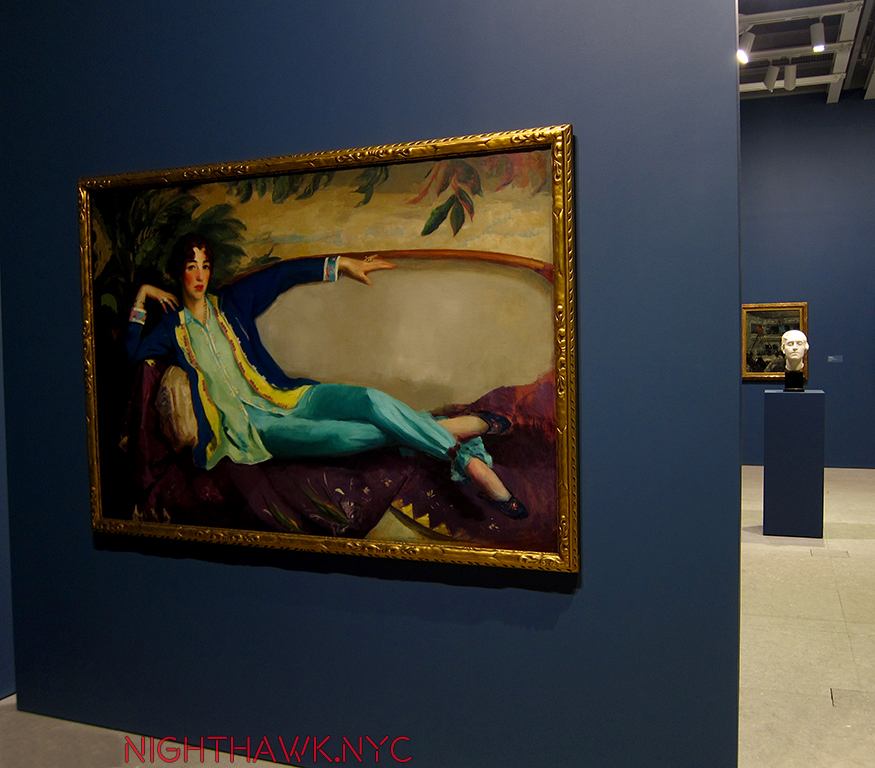
Portrait of Gertrude V. Whitney, 1917 by Robert Henri. Study for a Head for the Titanic Memorial by Mrs. Gertrude V. Whitney, in the background from "America Is Hard To See," 2015

Portrait of Gertrude V. Whitney, 1917 by Robert Henri. Study for a Head for the Titanic Memorial by Mrs. Gertrude V. Whitney, in the right background from “America Is Hard To See,” 2015

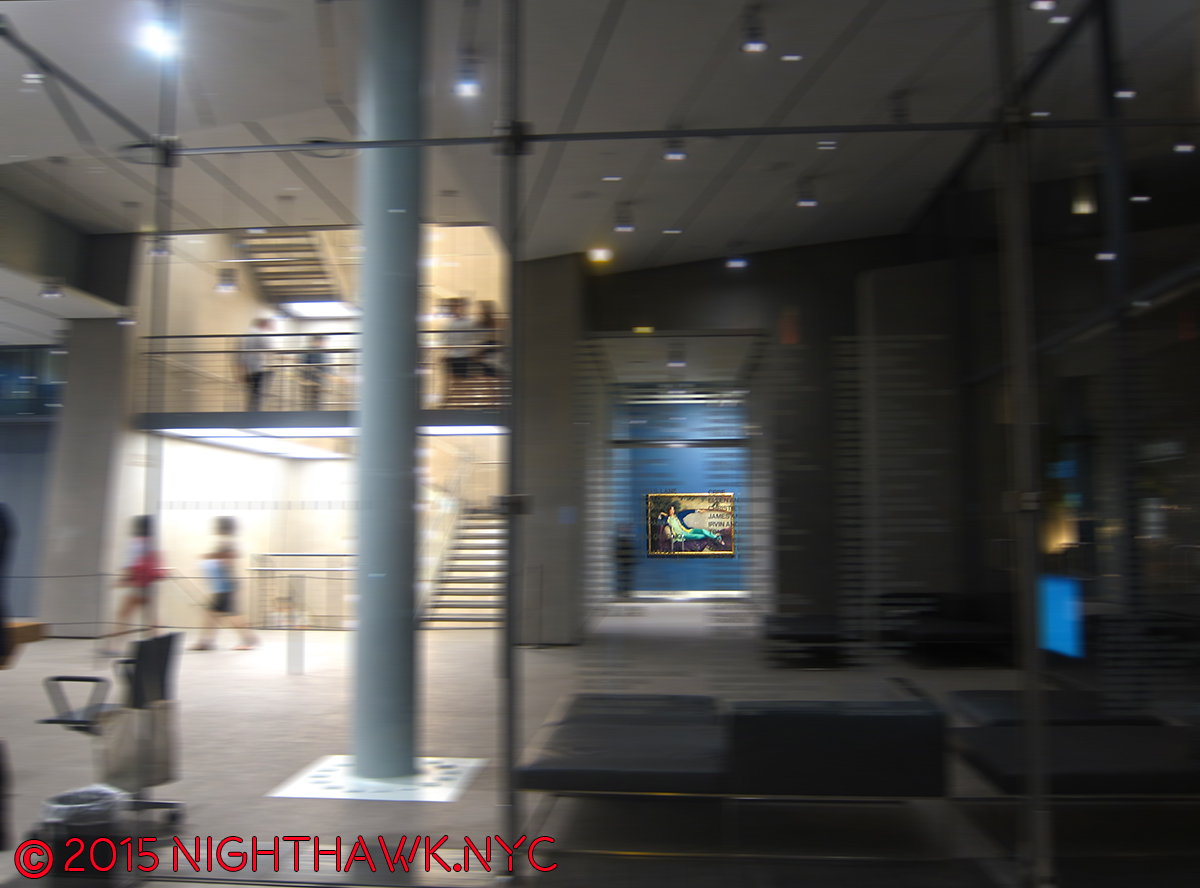
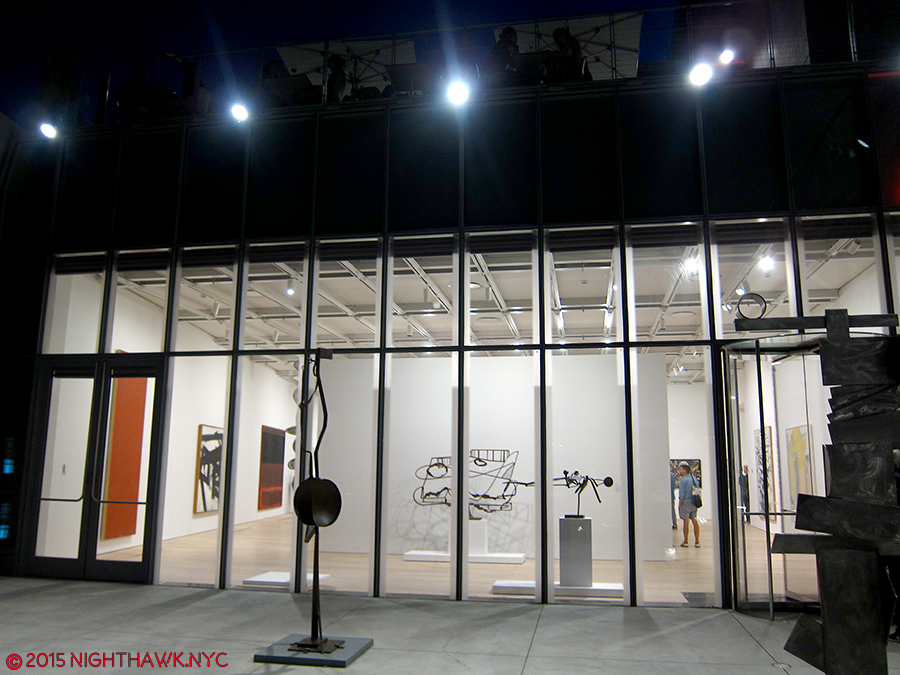
The founder of the Whitney Museum, as was beautifully demonstrated, remembered and honored in the first floor free to enter at all times gallery, where “America Is Hard To See” began was, also, a very accomplished sculptor2, in addition to being the greatest champion of American Art, perhaps ever. Immediately upon entering the first floor gallery, the first thing you saw was, fittingly, the wonderful portrait of her by Robert Henri that was perfectly placed facing the door, which also enabled it to be seen from outside the building, the only artwork that was. I wish it had been left right there. It wasn’t. As I write this, it’s upstairs as part of the “Human Interest: Portraits from the Whitney’s Collection” show. One of my pet peeves in Museum re-designs is how often they fail to answer this, seemingly basic, question- “Where are we going to put such and such major masterpiece?” Moma failed this miserably- How many times have they moved Monet’s “Waterlillies”, or Van Gogh’s “Starry Night”, in a vain attempt to find the right spot for each? This is unforgivable. While the Whitney has found a great spot for Calder’s Circus,
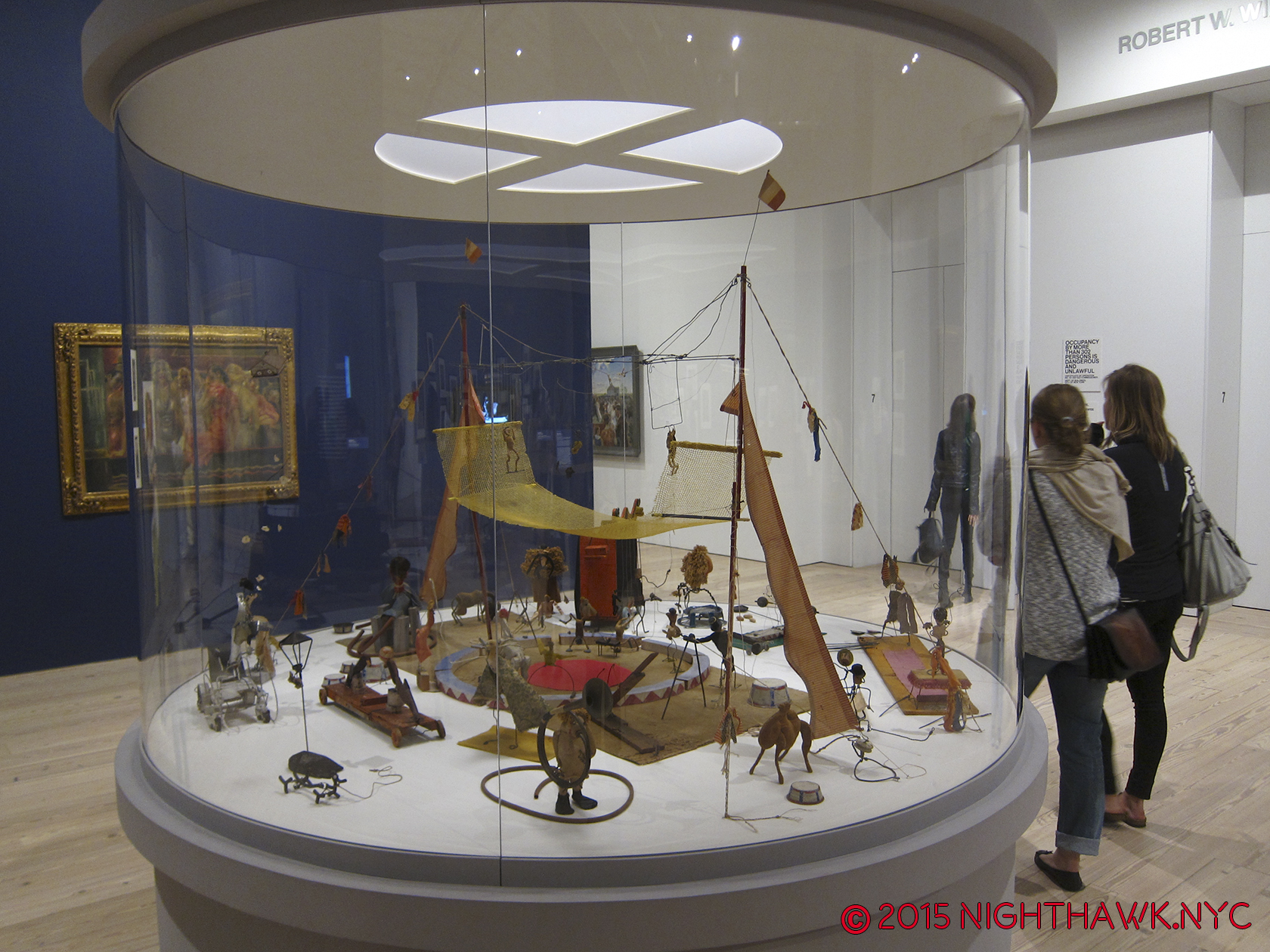
Calder's ingenious "Circus." When you go, be sure to see the accompanying video!

Home… at last. Calder’s ingenious “Circus.” When you go, be sure to see the accompanying video.

which was lost in the Breuer Building’s mezzanine, I’m left to wonder about Mrs. Whitney’s Portrait. Will it become their Waterlillies?
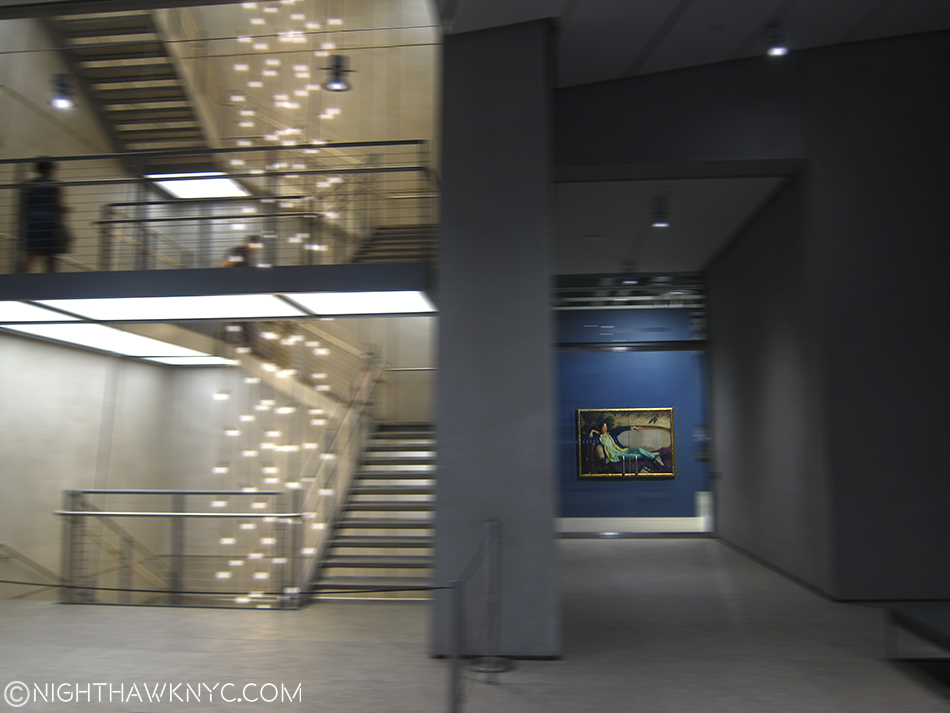
One of the very greatest figures in American Art History looks out on her domain, Portrait by Robert Henri, 1917. 1st Floor Gallery, seen from outside the building during "America is Hard to See," 2015. After? They should have left it right there.

One of the greatest figures in American Art History looks out on her domain. 1st Floor Gallery, during “America is Hard to See,” 2015. After? They should have left it right there.

Beyond her portrait’s place in the Museum, I wonder what she’d think of it. It’s still “her” Museum. They even, recently, put the name “Whitney Museum of American Art” on the southern facade. The new place is located a stone’s throw from the site of the first Whitney Museum that she opened in 1931 at 8 West 8th Street, and equally close to where Edward Hopper lived and worked on Washington Square. Edward & Josephine Hopper left their artistic estate to the Whitney, in honor of their long relationship with Mrs. Whitney. When the new Museum opened, there was a selection of Edward Hopper drawings from 1925 that he did at the Whitney Studio Club, which preceded the founding of the Museum, in the first floor gallery, adjacent to Henri’s Portrait of Mrs. Whitney, seen above. As time goes on, I think this gift will be seen as one of the greatest Art gifts of the 20th Century, even though it didn’t consist of many of Edward’s paintings. That’s when I try and forget the fact that the Whitney, tragically and unforgivably, discarded almost all of Josephine Hopper’s work that was included with it!

While we’ll never know what Mrs. Whitney would think of the new home of her collection, I know what I think.
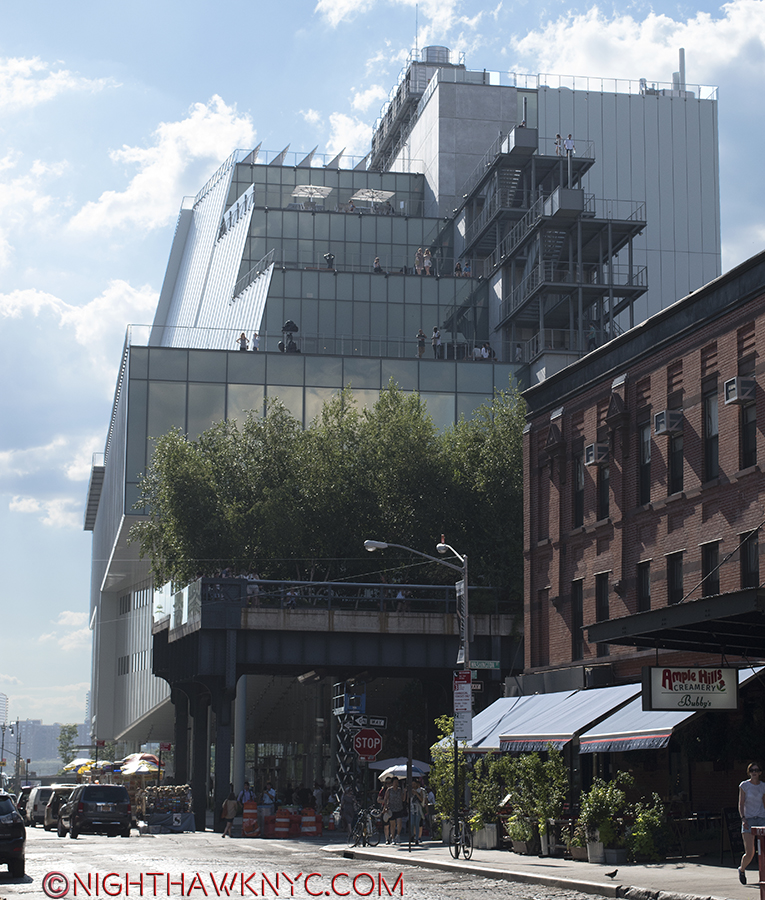
DSC_5259P2NH

Oneupsmanship? “Hey you down there on the High Line- You think you’re high up? Ha!”
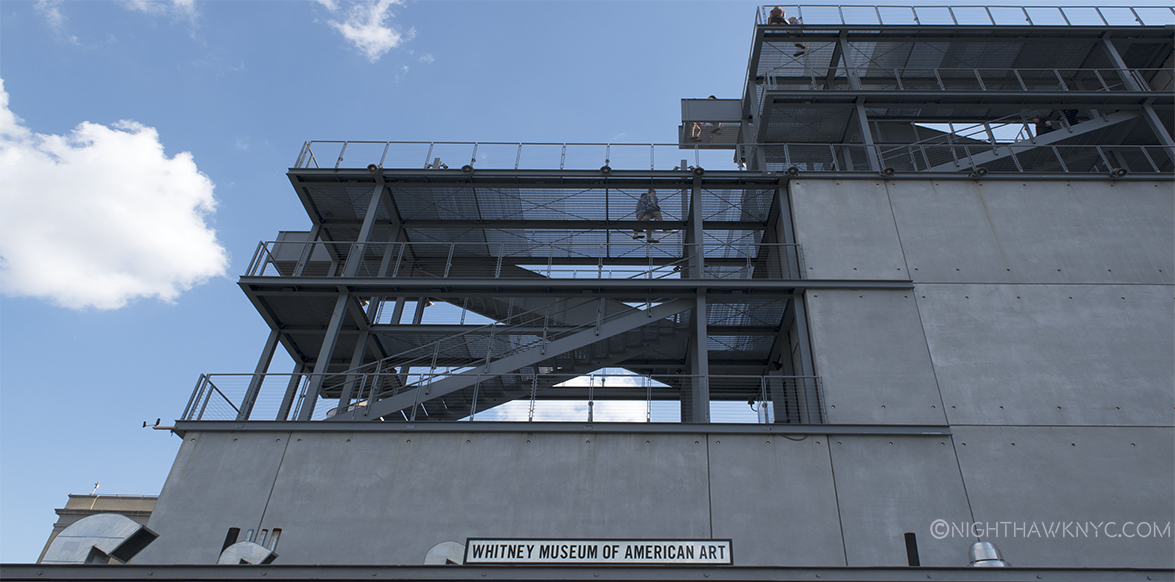
DSC_3674PNH

I’ve spent a year wondering- Why put 13,000 square feet of outdoor space in a building in a place with a climate like NYC?
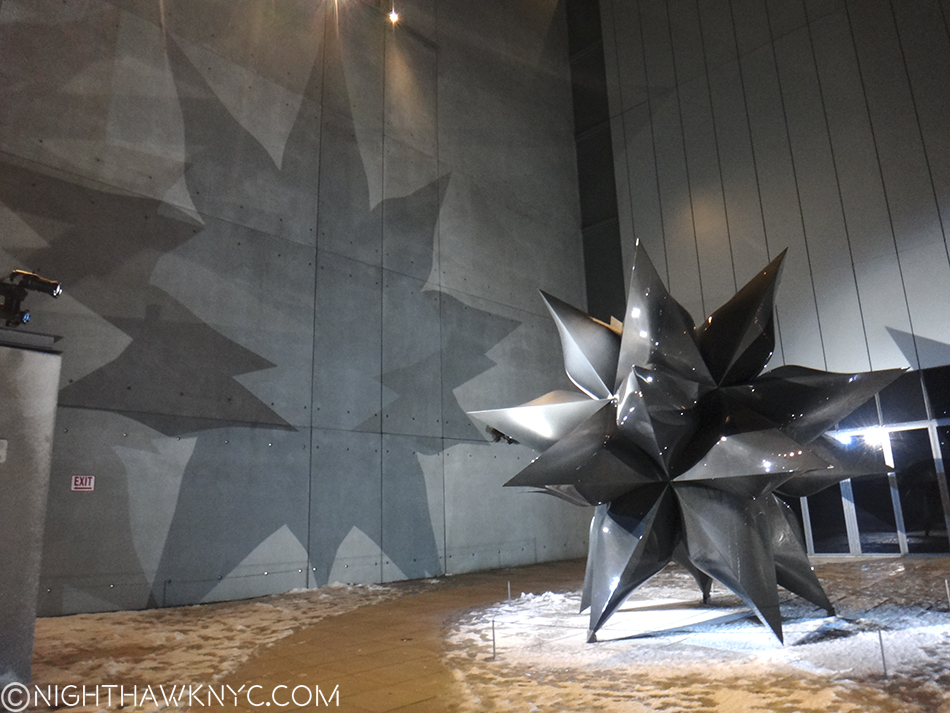
5th Floor roof deck with a Frank Stella Sculpture & reflection, Feb, 2016

5th Floor roof deck with a Frank Stella Sculpture & reflection, in the snow, Feb, 2016

Part 6- 5,000,000 Reasons

As I said, real estate in NYC is all about location. That applies to the Art world, too. The Met & The Guggenheim are in, or near, Central Park, and there is now talk of The Met creating a Central Park entrance as part of their Contemporary Art Galleries reconstruction3. Moma has the heart of midtown, and now the Whitney has the High Line. In my opinion, the location was selected, and the New Whitney is designed, to be a destination for High Line visitors- It’s roof decks are meant to beckon High Liners with an even better view since they are higher. That’s one explanation for the stair designs looking similar- imitation that’s designed to make High Liners feel the Museum is part of the High Line. And so? Location also pays off by providing a potential mass audience delivered right to your door. How much is that worth to a Museum? Given that the High Line currently draws over 5,000,000 visitors a year, it’s hard not to see this as a conscious decision designed to attract visitors for an even better view, and oh yeah, some Art. Once inside? I’ve already come to feel that the gallery size is limiting. As the collection grows (do Museum collections ever shrink?), I am left to wonder how quickly they’re going to wish they had some of that 13,000 square feet that’s sitting outside, inside.

But? If I’m correct about their motivation, the outdoors stairs & decks exist to beckon people from the High Line, which, is open year round, come rain, snow, or shine.
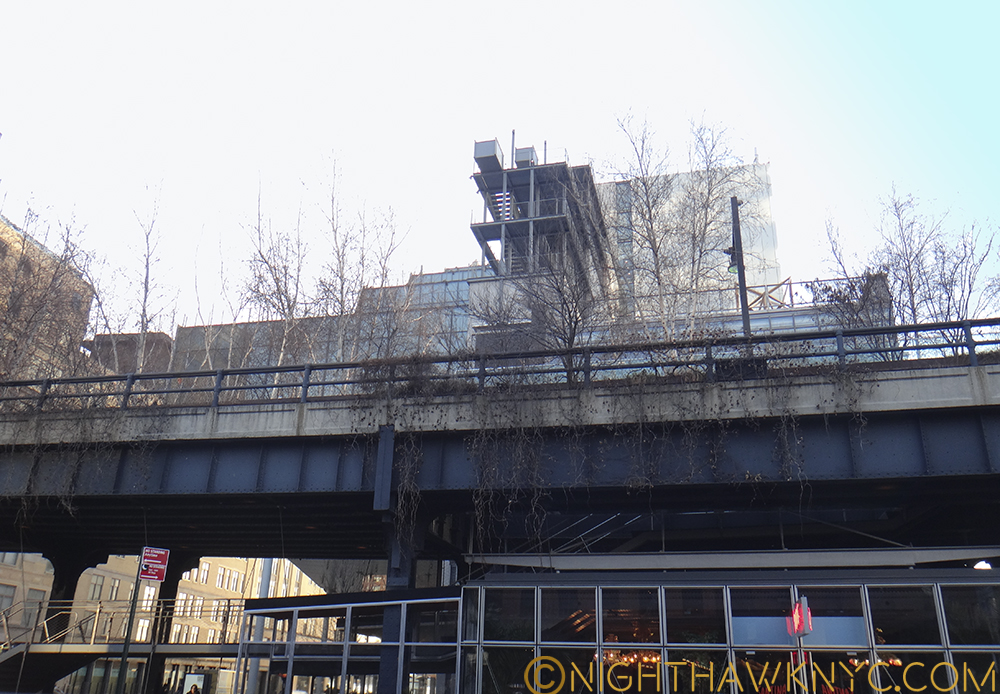
DSC09546PNH

“We come on the ship they call the Mayflower
We come on the ship that sailed the moon
We come in the age’s most uncertain hour
and sing an American tune
But it’s all right, it’s all right
You can’t be forever blessed”*

Overall? I’m displeased by the outward appearance of the new Whitney. Over a  year of trying to warm to it, of giving it yet another chance to speak to me later, I still find it downright strange. As an Art Museum, the inside is nice, with the above caveats. As far as the Art is concerned? I’m glad to have the Whitney’s pre-eminient collection of American Art back, and “America Is Hard To See” was a wonderful “Welcome Back” celebration of it’s return after the move Downtown. The Whitney is, also, to be congratulated for the guts they’e displayed in the choices of their early shows- giving Laura Poitras her first Museum show, featuring the great Cecil Taylor for a week, and having the retrospectives of modern master Frank Stella and the vastly underrated Stuart Davis (who Mrs. Whitney, herself, believed in and financially supported early on), among others, all have made the first year of the New Whitney Museum’s exhibitions quite memorable, and yes, very Artistically successful.

Yet? How long will the waters stay calm for the U.S.S. New Whitney Museum? The big question of long term success and long term viability remain to be answered.

Epilogue – The Whitney’s 422 Million Dollar Gamble
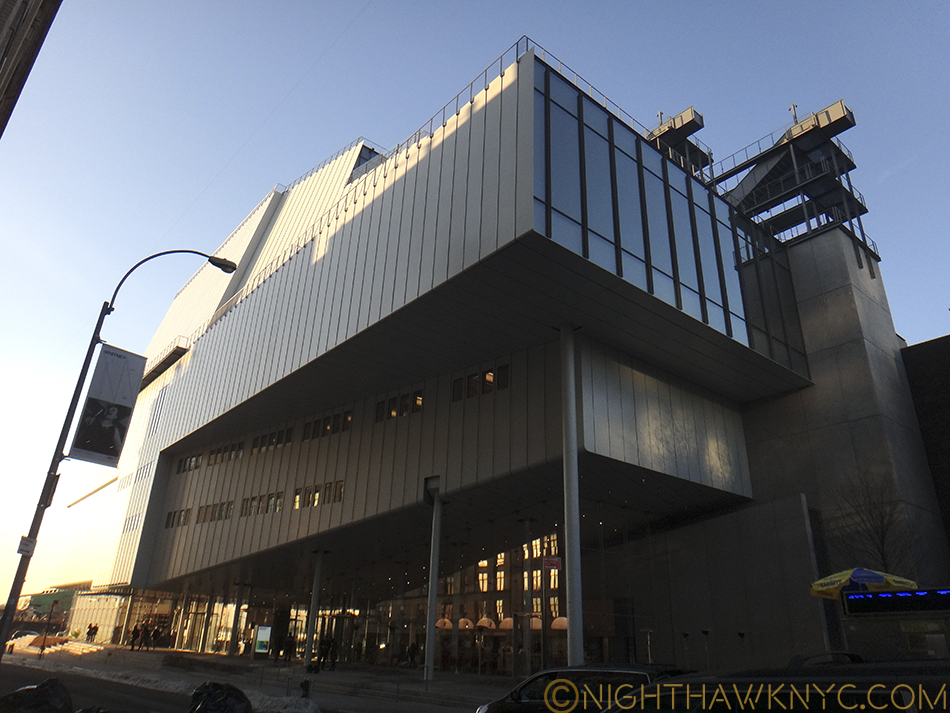
DSC09557PNH

The Whitney’s move downtown isn’t about moving nearer the “New” Art neighborhood of Chelsea or the “Older” Art neighborhood of Soho. It strikes me as being a a case of seeing an opportunity and taking it. They found a lot at one of the 2 ends of the High Line and saw their opportunity to move to a potential audience- the 5,000,000 current visitors to the High Line, and they took it. I believe that’s why their stairs look like the High Line’s, as I said.

For the Whitney, this is a $430,000,000.00 (the cost of the new building) gamble that the High Line is not a flash in the pan and it’s popularity is here to stay. If the High Line fails? Well? The City was about to tear it down anyway before it was turned into a Park.

But, if the High Line does fail (which seems unlikely at the moment), or visitors come in substantially lower numbers (much more likely), the Whitney may find themselves stranded, with an out of the way Museum that is not easily accessible by either bus or subway in a neighborhood that has a history of being “the wild west,” home to meat packing, prostitution, cutting edge music, and sex clubs (Madonna’s notorious book “Sex” was photographed almost 25 years ago at one 3 blocks away) not all that long ago, that has been remade with extra glitz and top of the market rents. And what about that neighborhood? What if the new glitz doesn’t stick? What if it all turns out to be wishful thinking on the part of landlords looking to make a killing after years of squalor? Walking around the past few months, the area seems to be having a bit of trouble supporting many of it’s ritzy new tenants at these prices. And? This is over a year after the Whitney added even more oomph to the now completed High Line being here.
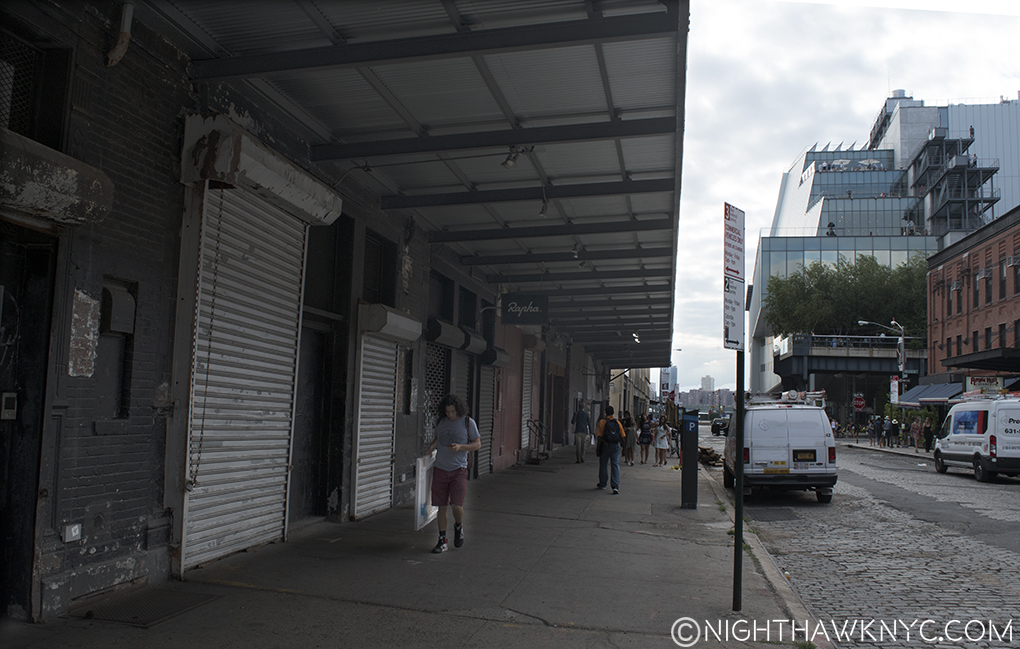
Empty storefronts on Gansevoort, one block east of the Whitney, August, 2016

Empty storefronts on Gansevoort fill 3/4 of the block, one block east of the Whitney, August, 2016

Is the “Meatpacking District” a fad destination that is about to fade? If so, what effect will this have on the new Whitney? Can it survive in a “not so fab” neighborhood?
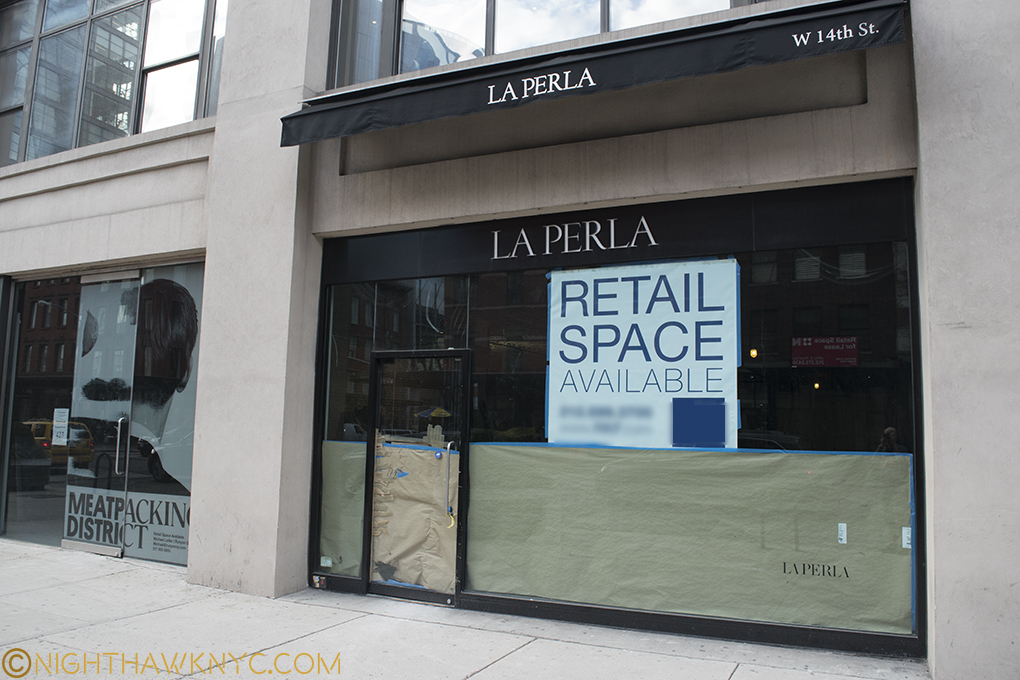
La Perla joins Alexander McQueen & Stella McCartney as former tenants of the Meatpacking District

Is the buzz over? La Perla joins Alexander McQueen & Stella McCartney as former tenants of the Meatpacking District who have moved elsewhere.

While collectors and investors throw unheard of sums at Contemporary Art these days (which strike me as “bets” given the largely unproven nature of the Art itself), here is a case of one of NYC’s “Big 4 Museums” placing an even bigger bet on a Park, that while it certainly is Contemporary Urban Art, hasn’t even been fully opened for TWO YEARS yet,. The Whitney placed their bet when the High Line was in it’s first of 3 phases. Phase 3, the final part, of the now completed High Line opened on September 20, 2014. This is not to mention that they bought in at the top of the market in a real estate market that (like the Art market) hasn’t seen a correction in over 25 years. Both will see corrections one of these days.

But when? This, is the 422 million dollar question.

“Still, tomorrow’s going to be another working day
And I’m trying to get some rest
That’s all I’m trying to get some rest”*
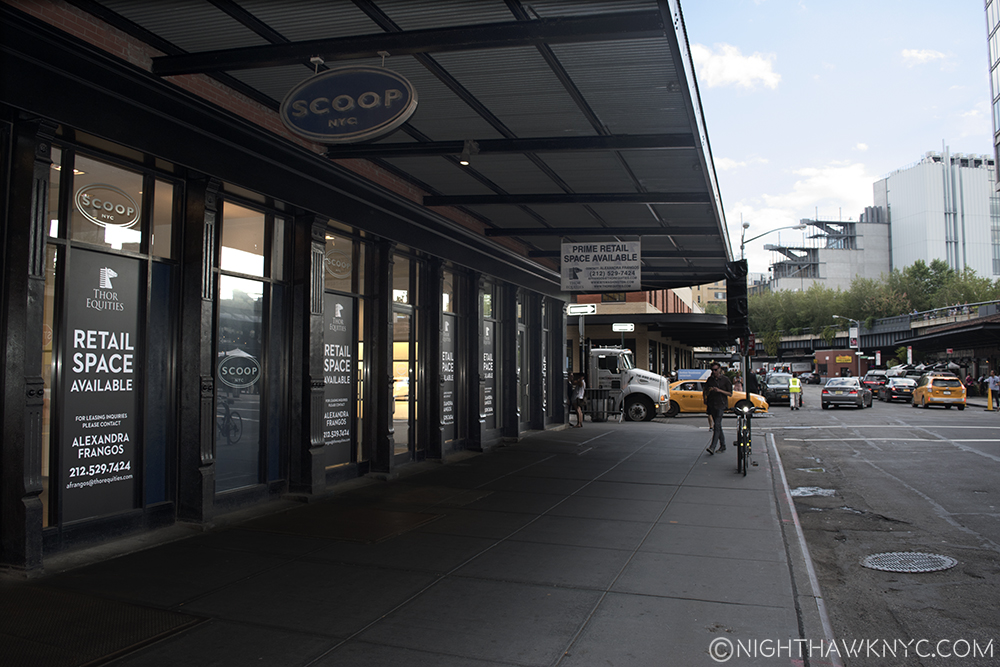
Around the corner on Washington Street, 4 now empty storefronts, one of which was the famous Hogs & Heifers Saloon (corner). August, 2016

In the Whitney’s shadow. Around the corner on Washington Street, 4 now empty storefronts in a row, one of which was the notorious Hogs & Heifers Saloon (where the white sign hangs). August, 2016

Well? If all of this goes south? They still stand a very good chance of being able to move back uptown in 8 years when The Met’s lease of the Breuer, their former home, is up. Given The Met’s own problems, it seems highly unlikely they’ll be extending that lease.

If the Whitney then wants to renovate it? It’ll be someone else’s problem.

*-Soundtrack for this Post is “American Tune” by Paul Simon. Published by Universal Music Publishing Group.

NighthawkNYC.com has been entirely self-funded & ad-free for over 8 years, during which 300 full-length pieces have been published! If you’ve found it worthwhile, PLEASE donate to allow me to continue below. Thank you, Kenn.

You can also support it by buying Art, Art & Photography books, and Music from my collection! Art & Books may be found here. Music here and here.

Written & photographed by Kenn Sava for nighthawknyc.com unless otherwise credited. To send comments, thoughts, feedback or propositions click here. Click the white box on the upper right for the archives or to search them. Subscribe to be notified of new Posts below. Your information will be used for no other purpose.
  1. In fact, the new Whit, itself, sits where one was.
  2. When will they have a show of HER work?
  3. Speaking of his vision in January, Met Director Thomas Campbell told the LA Times that “We are looking at an entrance, at terraces, at the roof garden.” Sounds like he’s visited the New Whitney.

“The Goddess of Line” (For Nasreen Mohamedi)

The Line is True

Perfect

Without Beginning

Without End

It sings the song of Essence

It Frees the Mind

To go where it might

Without Boundaries

Or constraint.

Whether One

Or Many

They Journey

Through their lives

Freed from Time

Freed from Place

Perusuing the Purity of Your Intention

They are all that remain.

The Brush has been set down

The Color has been sent away.

The Pen paints Black

Lines

On White.

The basic form

That doesn’t exist in Nature

Like yours Do,

Oh, Goddess of Line.

Bold

Subtle

Sure

Ordered

Singular

Or In Concert

They Flowed

From your Mind’s Eye

Through Your Hand

From Your Pen

To the Infinite

To That Place where…

We live without form

Or Any constraints.

The Truth Lives without time

or confinement

Free…To Be

What it is.

© April 28, 2016.

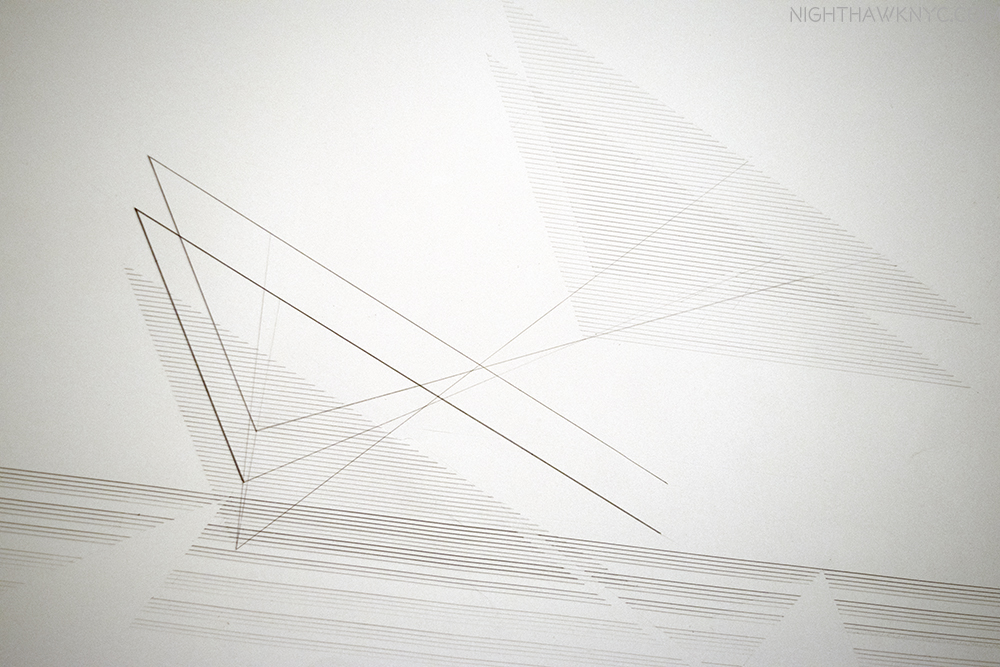
Detail from "Untitled" ca. 1980 by Nasreen Mohamedi (Graphite on Paper)

A Detail from “Untitled” ca. 1980 by Nasreen Mohamedi (Graphite on Paper)

This is Part Two of my Post on Nasreen Mohamedi. Part One is here.

NighthawkNYC.com has been entirely self-funded and ad-free for over 6 years, during which over 250 full length pieces have been published. As I face high expenses to keep it going, if you’ve found it worthwhile, please donate to keep it up & ad-free below. Thank you!

Written & photographed by Kenn Sava for nighthawknyc.com unless otherwise credited.
To send comments, thoughts, feedback or propositions click here.
Click the white box on the upper right for the archives or to search them.
For “short takes” and additional pictures, follow @nighthawk_nyc on Instagram.

Subscribe to be notified of new Posts below. Your information will be used for no other purpose.
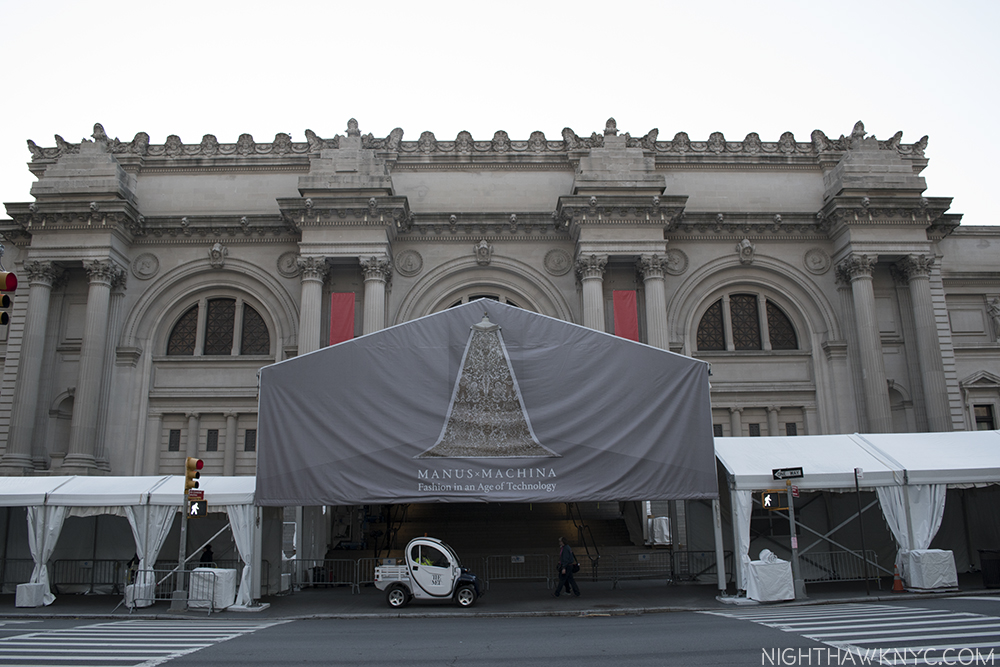
…And Here’s How It Looked Monday Evening

NighthawkNYC.com has been entirely self-funded & ad-free for over 8 years, during which 300 full-length pieces have been published! If you’ve found it worthwhile, PLEASE donate to allow me to continue below. Thank you, Kenn.

You can also support it by buying Art, Art & Photography books, and Music from my collection! Art & Books may be found here. Music here and here.

Written & photographed by Kenn Sava for nighthawknyc.com unless otherwise credited. To send comments, thoughts, feedback or propositions click here. Click the white box on the upper right for the archives or to search them. Subscribe to be notified of new Posts below. Your information will be used for no other purpose.
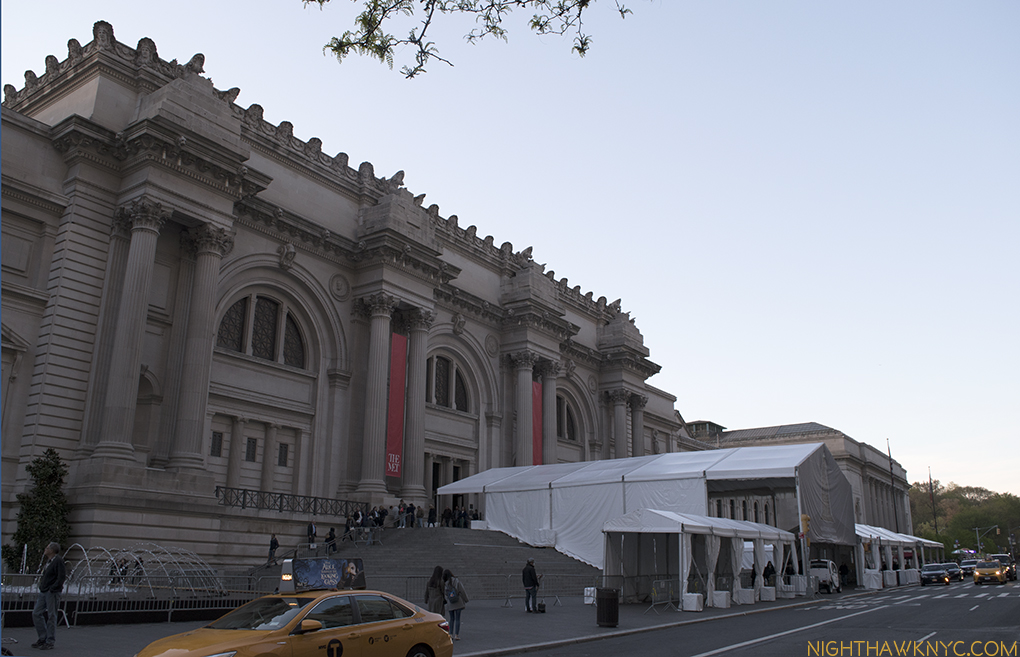
The Day Before “The First Monday In May,” 2016

This site is Free & Ad-Free! If you find this piece worthwhile, please donate via PayPal to support it & independent Art writing. You can also support it by buying Art & books! Details at the end. Thank you.

Written & Photographed by Kenn Sava

“We know what you’all been thinking nude is the brand new yawn
Everybody’s just drinking inhibitions just gone
You don’t need to be rude
You don’t need to be wild
Whatever you do: don’t compromise and done with style
The gold standard crazy amazing
Upper echelon of groove
The gold standard crazy amazing
Turn it up let you body move”*

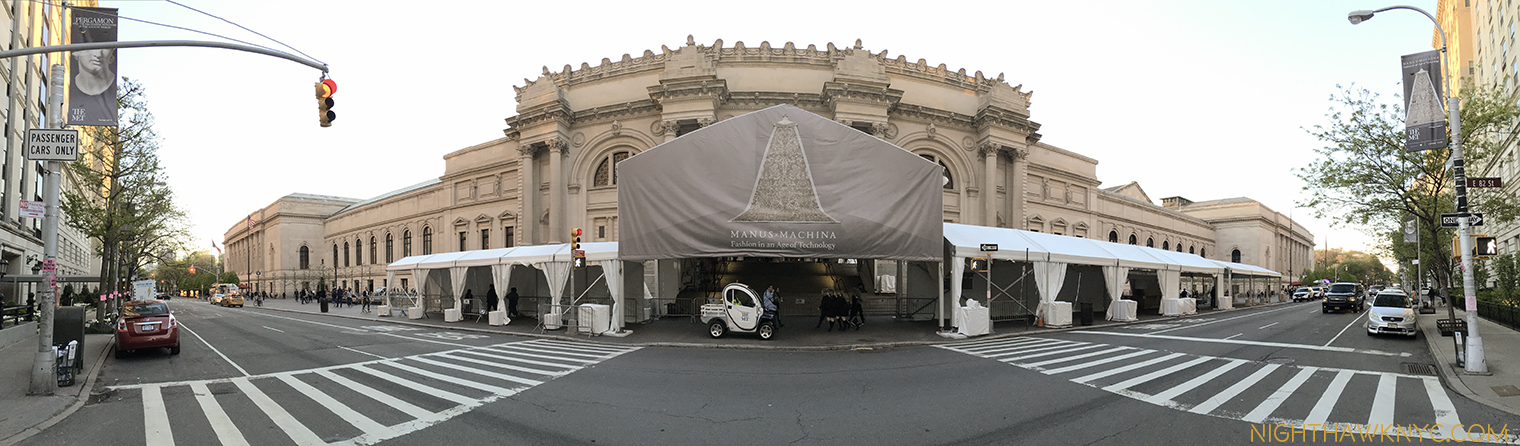
Here’s how the world famous 5th Avenue facade of The Met (TM) looks right now in preparation for it’s big close up- Monday’s “Manus X Machina” Metropolitan Museum Costume Institute Gala Benefit, perhaps fashion’s biggest night of the year in this country when a who’s who of “stars” and “big names” will be walking through these tents and up the landmark stairs dressed to (hopefully) impress.

T-Manus and counting…It feels like the night before the Space Shuttle was about to blast off, here at The “Cape.”

Even though I’ve written about TM more than just about anything else this past year, and been there 3 times this week alone, of course, I’m not invited, so this is as close as I’m gonna get. Come Monday night? I’d never be able to get even THIS close.

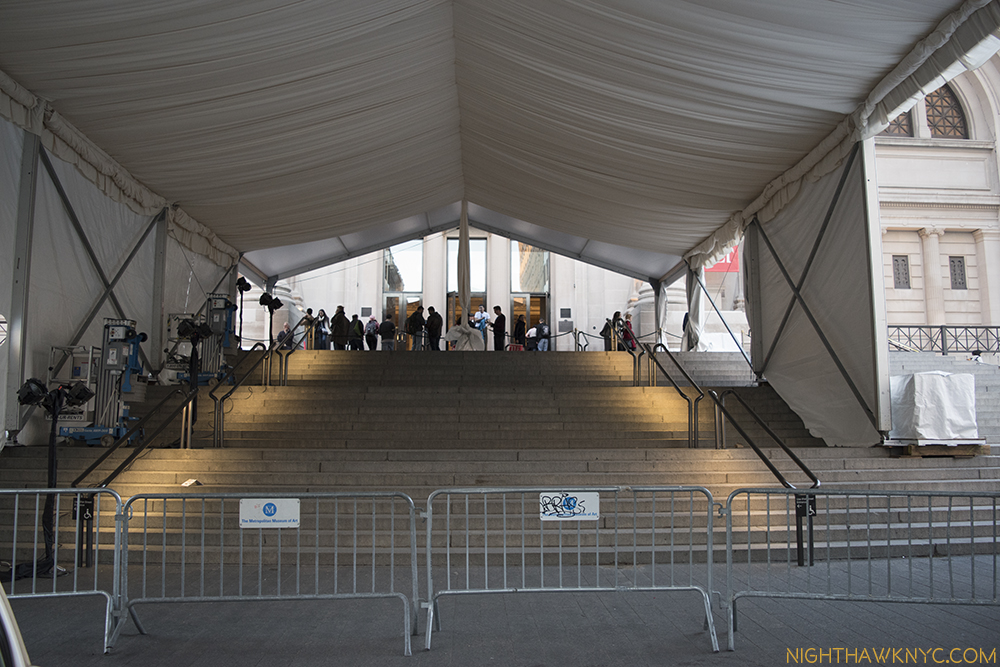
The view behind the grey awning, and under the canopy going up to the front door. Remember celebrities- No sitting is permitted on the stairs between those banisters! Oh, and have your bags ready to speed the security bag check.

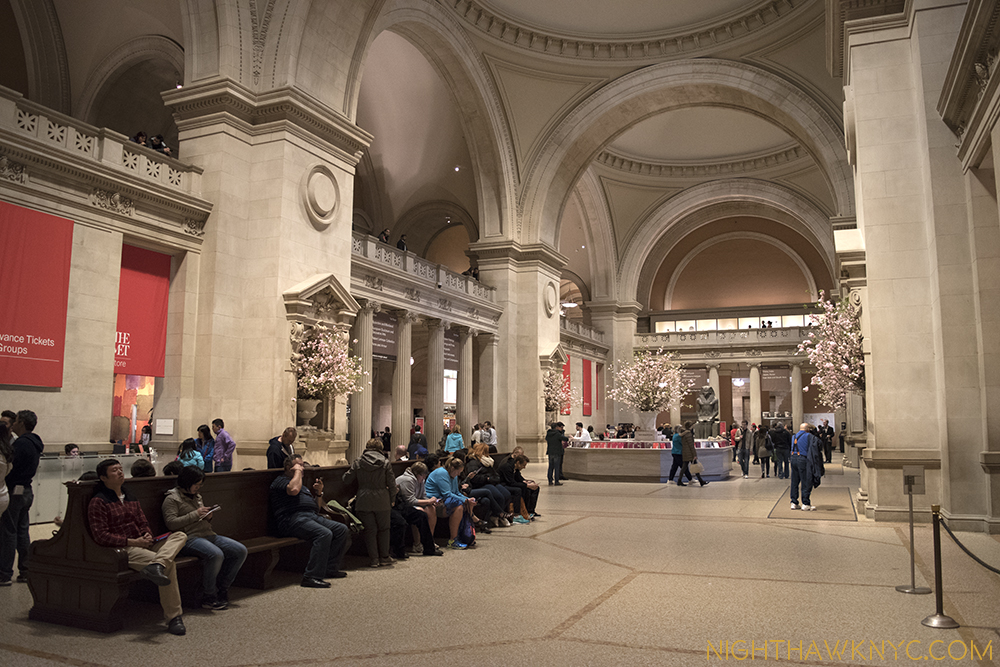
Someone’s gonna be busy over the next 24 hours! (If you want to see how busy they were, click here!) Inside the Great Hall, no signs of the impending festivities, yet. Yes, the flower arrangements are always beautiful.

I predicted in this Blog that 1,000,000 visitors would attend “Manus X Machina.” 2015’s “China: Through The Looking Glass” drew 817,000. Apple is sponsoring the show. Taylor Swift is involved. 1M would be great for TM. They took on a large expense with the new (and so far superb) Met Breuer, so I really hope it happens. I’ll be more interested in how good the show is. Andrew Bolton and the Met’s Costume Institute are “The Gold Standard” for fashion shows now, and they’ve raised the bar pretty high.

I’m excited for another chance to answer the eternal question- “Is Fashion Art?” Though I believe the female form is, I haven’t decided about Fashion. I do know that I really love looking at it and trying to decide.

Stay tuned.

In the meantime, it’s time for this year’s “First Monday In May,” If you’re wondering what it’s all about, here’s a peak at what went into it last year-

Ok. It’s time for me to grab my Armani Exchange Tuxedo, It’s time to party!

“24 carrot hashtag, put Ur phone in Ur bag, ain’t nobody got 2
tell U put Ur hands in the air, say “Ow!
The gold standard, crazy amazing, upper echelon groove
The gold standard, crazy amazing, turn it up, let Ur body move””*

*-Soundtrack for this Post is “The Gold Standard” By Prince from his excellent 2014 album, “Art Official Age,” published by Universal Music Publishing Group.

NighthawkNYC.com has been entirely self-funded & ad-free for over 8 years, during which 300 full-length pieces have been published! If you’ve found it worthwhile, PLEASE donate to allow me to continue below. Thank you, Kenn.

You can also support it by buying Art, Art & Photography books, and Music from my collection! Art & Books may be found here. Music here and here.

Written & photographed by Kenn Sava for nighthawknyc.com unless otherwise credited. To send comments, thoughts, feedback or propositions click here. Click the white box on the upper right for the archives or to search them. Subscribe to be notified of new Posts below. Your information will be used for no other purpose.
Nasreen Mohamedi’s “Simple” Perfection

Stop the Presses.

If you are an Author, or Publisher, of a book on the History of Art in the 20th Century? I’m sorry to say- you left out a unique, important, and great Artist.

Her name was Nasreen Mohamedi.

It’s ok. Until this past month, I, too, would have asked- “Who?”

She’s an Indian Artist who died in 1990 at the age of 53, without having sold a work, and who has had only 4 shows in New York (3 at the Talwar Gallery, the other at the Drawing Center).

Until now.

The Naked Face of Immortality?

Out of the shadows. Her Time Has Come.

It’s rare to spot a moment in time and say, “that was the moment when things changed.” Like a light coming on and what was hidden in the dark is made visible. What’s once seen may be very hard to forget. In the case of the Art of Nasreen Mohamedi that moment for those of us her work had remained unseen by happened on March 18 when when the lights came on and the doors opened on the 2nd floor of the new Met Breuer (TMB) for her Retrospective. It’s the “other” big show going on there (“Unfinished: Thoughts Left Visible” is on the 3rd & 4th Floor), together inaugurating the Met’s new outpost, 9 minutes away as the feet fly from their 1000 Fifth Avenue Mothership. While she is recognized, and her work eagerly sought after in Europe and Asia, (for up to $250,000., a piece), here, she has remained virtually completely unknown1. The “light” came on for me shortly after I walked through the doors to TMB’s 2nd floor on the eve of April 14.

Unbeknownst to me, at that very moment, Prince was giving what would, tragically, turn out to be his final performance in Atlanta.

By the time I was half way through the 8 galleries (containing about 130 works) that evening, I was completely & unalterably under her spell. After, I couldn’t get it out of my mind. I wanted to see more, and nothing else. Who was she? Where did this come from? 7 subsequent visits later, and counting, I am now borderline obsessed (there is a Part Two to this Post, the first time I’ve done it- link at the bottom). If I were about to have a daughter? I’d want to name her “Nasreen.” Such has been the impact of discovering the person, and her Art.

Mark my words. Well, mark one word, actually. “Nasreen.” I see her work only gaining in importance and influence as she becomes a world figure in Art. Her name will become part of the Art vocabulary. Luckily, it’s a beautiful name, of someone, who by all accounts, was an equally beautiful person. And, a name that’s as easy to remember as her Art is. Now, that word will be spread here, like it already is elsewhere, as more people experience it.

Experience what, exactly?

Her’s is very hard Art to write about, or talk about. The effect it has is, also, hard to describe. I’ve decided not to post pictures of it at the moment because it really needs to be seen in person. So, go and see it for yourself, if you can, and have that experience I love of seeing something new for the first time with fresh eyes, and I hope it is as rewarding for you as it has been for me. My feelings about it center on finding it beautiful- miraculously composed & gorgeously executed, spiritual in the sense that her works are meditation objects, not unlike a tree or a scholar’s rock. They reach for the inexpressible, yet somehow, inside, they resonate as being “true.” There’s a feeling to them of a foreign world that is somehow, strangely, not “alien.” Perhaps that is because there is no chaos in Nasreen’s work, only the most perfect order. There are no crooked lines, no jagged edges, no line out of place, in spite of the fact that she suffered from Huntington’s Disease from her 20’s on, which progressively robbed her of her motor skills, and then, took her life, as it had her siblings before her. Is it any wonder, then, that her work, and her efforts to pursue and develop it, are so intensely focused?

In that sense her Art is like Bach, perhaps, the ultimate genius of order and man-made perfection. In the “Fugue” of Nasreen’s work, the theme continues from piece to piece. As in a fugue, this time the dialogue between voices are only with her own. I found myself settling on Bach’s “Sonatas & Partitas for Solo Violin,” as performed by Nathan Milstein, as the Soundtrack to my visits. (I should also note that TM commissioned pianist/composer Vijay Iyer to compose a piece for this show, which ECM Records has released on the album, “A Cosmic Rhythm With Each Stroke,” which is the title of the piece dedicated to Nasreen. It features one of her drawings on the cover.) These are conversations she’s having with herself, as we see in her riveting, endlessly fascinating Diaries- works of Art unto themselves, which are generously stationed throughout the brilliantly designed show, that continue on in her paintings, and then in her photography, and finally in her drawings.

These are intensely private, personal works, but in a completely different sense than the work on view upstairs in “Unfinished.” (This show could have been titled “An Unfinished Life.”) Maybe they were therapeutic, physically and psychically for Nasreen. Maybe they were meant to prove to herself how “in tact” she still was as time, and illness, progressed. In any event, that they have come to speak to people in so many countries around the world, and for her to be given the high honor of not only a large show, that occupies an entire floor, by The Metropolitan Museum, but to be selected to be the FIRST Artist given a show, and a Retrospective at that, as part of their new Modern & Contemporary Art initiative at TMB says louder than just about anything else that she has arrived.

She certainly doesn’t seem to have been expecting “Art immortality.” In fact, she’s hasn’t made it all that easy on posterity, and that makes me wonder about how she viewed her own work. Curators don’t even know which way the works should be hung (only 4 works in the show are signed, one tell tale way of knowing which way to hang a work)…

DSC_0756PNEFP

they don’t know the names of the work (every single piece here has the same title- “Untitled.”)…they can only approximate when a work was created (you’ll see “circa” on all but three pieces that she signed and dated)…there is also some mystery to how she achieved some of the incredible effects she got in her work. She seems to have largely kept her work to herself, showing it to guests, but only publicly a couple of times before she passed. Instead of selling it, she gave some of her work as gifts to friends. What A Gift! 2

Nasreen’s (I Love saying her name) work seems basic. In fact, it’s hard to think of any Art that is more basic in concept than her work from 1970 on. She seems to have spent a good deal of her Artistic career continually simplifying, seeking the essence, the heart, the core of her vision. Whereas many Artists begin by drawing, then move to painting, Nasreen did the opposite. Having begun with painting, and collage, in color, most of her post 1970 work is pen with black ink and graphite on white paper. 3

I bet that 75% of all human beings have, at one point of their lives, put pencil or ink to paper and drawn something.

And? Most of hers is lines. Just lines. Or later, lines with circles or semi-circles- the most basic elements there are.

The rest of it is space (or “negative space” as Artists call it). Blank, white paper.

Been there. Seen it.

Ho hum.

Yawn.


Guess

Again.


Be prepared. Her work is among the most subtle you’ll ever see. “God Is In The Details,” van der Rohe famously said. If God is truly in the details, than Nasreen Mohamedi is the “Goddess of Line,” in my opinion (which I will expound on in the next part). In her hands, the “simple” line approaches the sacred. It transcends. It becomes “more,” “something else.” Look closer. Follow it’s course. Look a lot closer, spend some time with it. Live in the layers, the intersections, the distances- near and further. Come back and see it again.

It’s not going anywhere. I promise.

You’ll see something else.

I’ve spent much of the past few weeks looking for it but I have yet to find anyone who’s done what she did. I see a piece here or there that is kinda close (a Paul Klee, a Mondrian, a Ralston Crawford, a Malevich, and another, and yet another Malevich, an admitted influence, among them), but it’s isolated. Different.

Here is a consistent body of work4 that creates entirely new worlds that all speak the same language.

It’s the language of Zen.

of Poetry.

of Music.

of Structures hanging in space. (Don’t stars hang in space?)

It’s the channeling of superhuman perseverance into creating gorgeous works of visionary draughtsmanship in the face of terminal loss of motor skills, untold discomfort and pain.

it’s the language of essence, of purity, of unique beauty seen through the eyes of one uniquely beautiful person.

It’s the language of Art.

Even Timeless Art.

Whatever that is- I think this is it.

But, you can only see it at the new Met Breuer until June 5, then time’s up.

Given the scattered distribution of Nasreen’s approximately 200 surviving works- (as I said, she never sold a work, she gave some to friends), and the high prices being paid for one of her drawings, it may make it very hard for any museum to acquire a collection of them. In fact, in my past 14 years of Met attendance, I can’t recall one show where there wasn’t a single work that was not from The Met’s collection, before this one! It may, therefore, be unlikely a show of this size & comprehensiveness is seen here for a very long time. And that will make this a show that will be spoken about in legendary terms. You’ve been warned.

A tip of the hat, then, is very much in order to Chairwoman of The Met’s Modern & Contemporary Department, Sheena Wagstaff 5, her associate, Brinda Kumar & the powers that be at The Met for making THE perfect choice to begin their highly anticipated new Modern & Contemporary Art initiative at The Met Breuer. I’m in awe. I can’t begin to imagine how hard a choice this must have been- “Who to show first?” Can you say AUDACIOUS? AUSPICIOUS? I should be used to this, after all it’s The Met we’re talking about, but I’m not. And, oh? By the way? As I’ve said, the show upstairs ain’t bad either.

This is Part One of my Post on Nasreen. Part Two is here. I promise to take a deep breath soon.

*-The Soundtrack for this Post is J.S. Bach’s Sonatas & Partitas for Unaccompanied Violin as performed by Nathan Milstein on Deutsche Grammophon. (I look forward to hearing Vijay Iyer’s  “A Cosmic Rhythm With Each Stroke,” with Wadada Leo Smith soon.)

NighthawkNYC.com has been entirely self-funded and ad-free for over 6 years, during which over 250 full length pieces have been published. As I face high expenses to keep it going, if you’ve found it worthwhile, please donate to keep it up & ad-free below. Thank you!

Written & photographed by Kenn Sava for nighthawknyc.com unless otherwise credited.
To send comments, thoughts, feedback or propositions click here.
Click the white box on the upper right for the archives or to search them.
For “short takes” and additional pictures, follow @nighthawk_nyc on Instagram.

Subscribe to be notified of new Posts below. Your information will be used for no other purpose.
  1. At the moment, there is only one monograph on Nasreen Mohamedi in print- the superb catalog for this show, which was co-organized by the Museo Nacional Centro de Arte Reina Sofia, Spain in collaboration with the Kiran Nadar Museum of Art, New Delhi.
  2.  That night, 746 miles south, Prince was singing- “If I gave you diamonds and pearls, Would you be a happy boy or a girl, If I could I would give you the world, All I can do is just offer you my love” From “Diamonds & Pearls”, from the album of the same name, and published by Universal Music Publishing Group.
  3. Her photographs were black and white as well.
  4. I’m referring to the drawings, which are dated here from “circa 1970” until her death in 1990
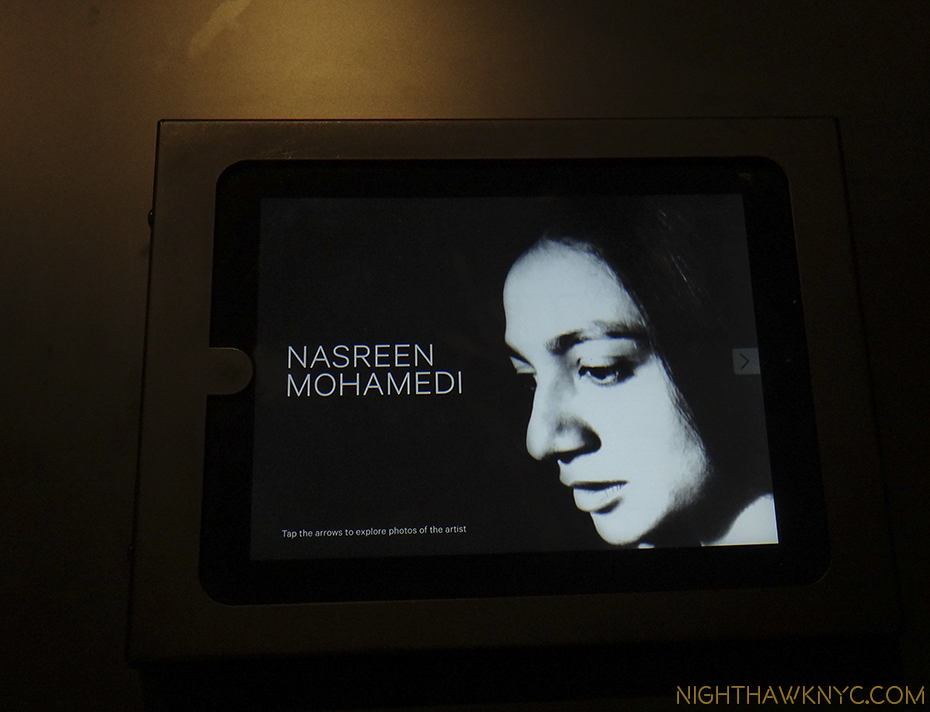
  5. If you look at the app on the iPad pictured above in the show’s reading room, it includes a picture of Nasreen Mohamedi’s unmarked grave, 18 miles south of Mumbai, taken by Ms. Wagstaff. A sign of the level of her personal dedication to this Artist.

The Greatest German Reality Show Star, circa 1700

This site is Free & Ad-Free! If you find this piece worthwhile, please donate via PayPal to support it & independent Art writing. You can also support it by buying Art & books! Details at the end. Thank you.

Written & Photographed by Kenn Sava (*- unless otherwise credited)

“My mama told me when I was young
We are all born superstars”*

Portrait of Matthias Buchinger, 1705

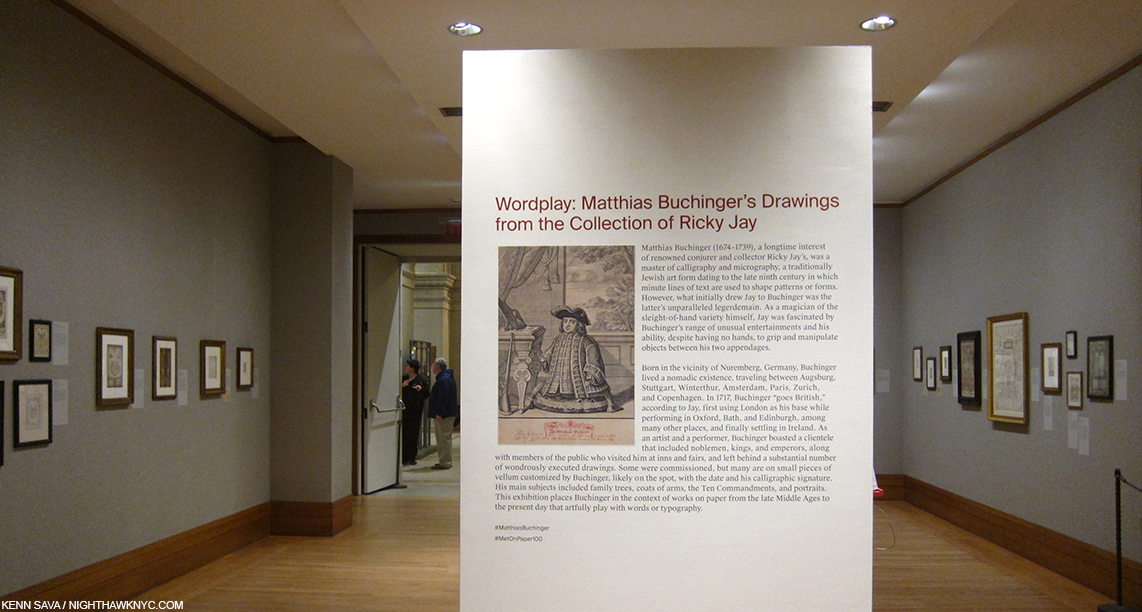
However you were born, the odds are you were more naturally capable right out of the box than Matthias Buchinger, who’s birth left him without hands or feet, and who stood a total of 29 inches (74cm) high. Yet, none of that stopped him from rising to the level of being called “The Greatest Living German” in 1726. Pretty darn lofty, for anyone. A Special Exhibition, Wordplay: Matthias Buchinger’s Drawings from the Collection of Ricky Jay, currently at The Met shows that, astoundingly, he nonetheless proves the equal of just about any other Artist in the entire Metropolitan Museum when it comes to technical proficiency. It will, also, give you pause for thought the next time you feel “incapable.”

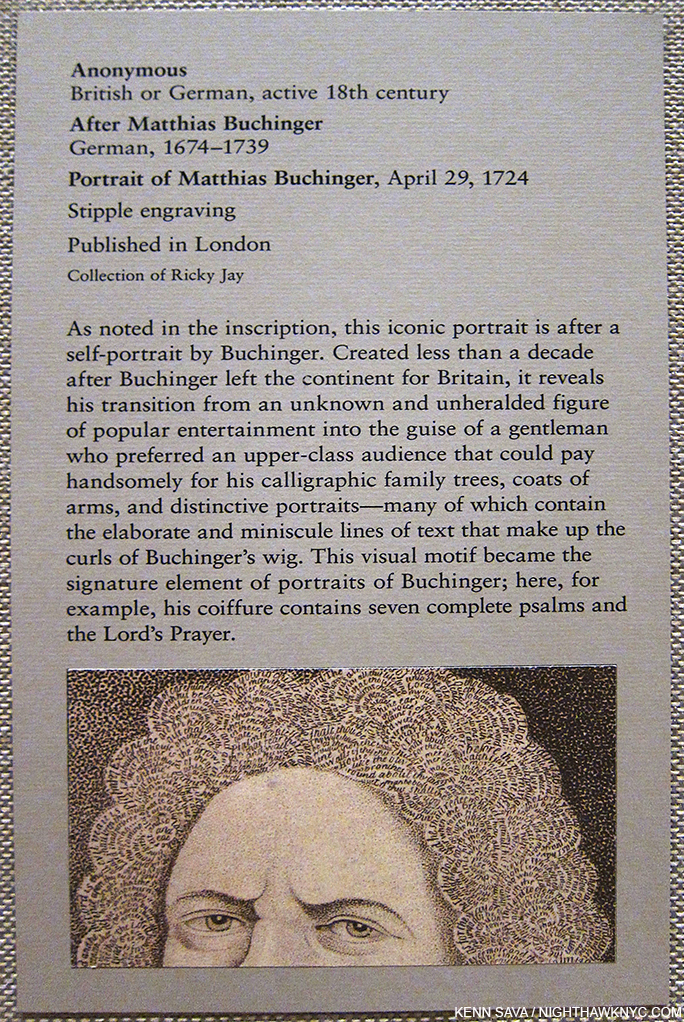
When you do? Consider this- Many of the works he created, which are now rare, but astutely collected by Master Magician, Ricky Jay over the past 30 years, are tiny to begin with. Add to this that Matthias Buchinger (MB) was so adept at holding his pen between his “stumps” he was able to write forwards, backwards, upside down or in the most minute sizes possible to the extent that he created drawings out of minuscule words, an Art called Micrography. A close up look at one small portrait of him reveals that his hair is made up of nothing but very tiny words- a couple Psalms and the Lord’s Prayer.  The entire show probably takes up 400 square feet- not even big for a gallery show. Yet rarely will you find so much packed into each square inch.

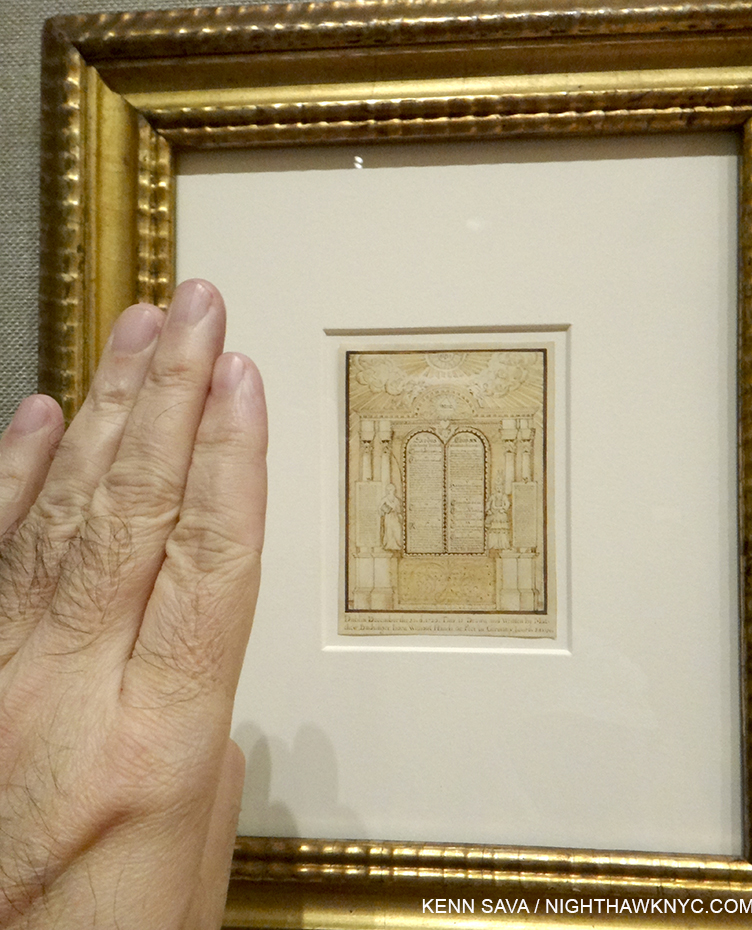
An index-finger sized rendering of The 10 Commandments by Mr. Buchinger is so small I couldn’t read it with the magnifier.

While his Art is being honored in this show, as amazing as it is, it barely scratches the surface of what MB was capable of.

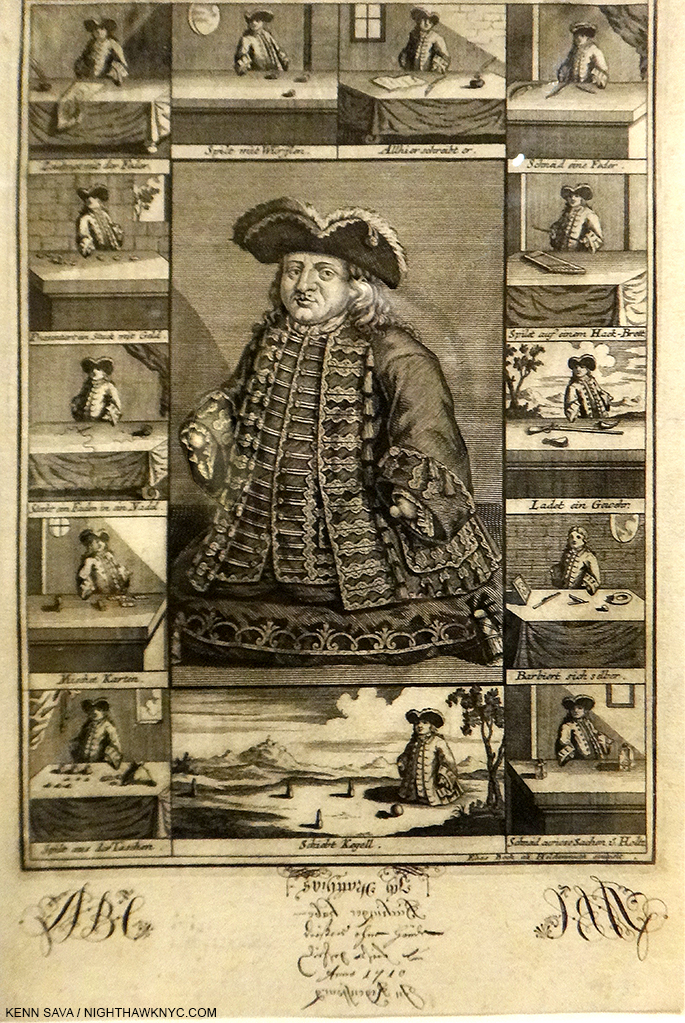
Buchinger surrounded by depictions of some of his skills.

He made his living touring Europe demonstrating the full range of his talents to the high & mighty as well as the common folk, in magic, calligraphy, making miniatures in bottles(!), threading a needle, loading a gun, shaving himself, playing music (he created some of his own instruments), playing games, among other things. Oh, and he was married 4 times and fathered 11 to 14 children!1

The second floor Drawings gallery, where the show is installed, is one of the must-see spaces in The Met. Shows change every 6-8 weeks here giving The Museum a chance to show off its extraordinary collection. Still, out of all the wonders I’ve seen in this space the past 14 years, I haven’t seen anything more consistently amazing than Wordplay.

I know what you’re thinking- today’s so-called “reailty” show stars wouldn’t even be good enough to apprentice on MB’s show!

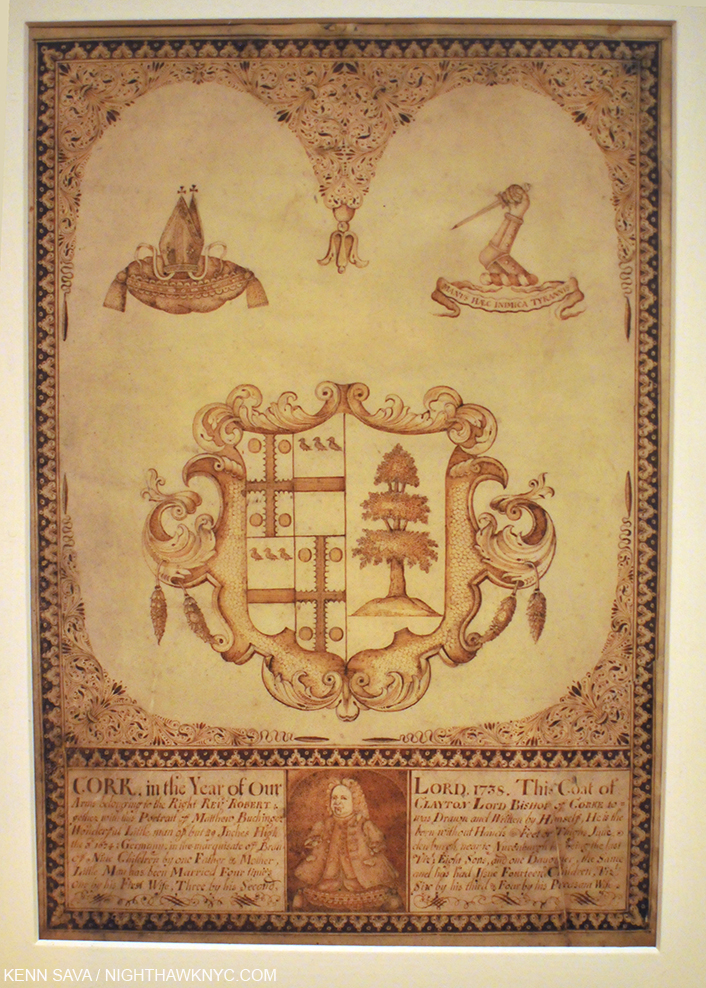
Coat of Arms, 1738, Pen and ink on vellum, the last known work by Matthias Buchinger includes a self-portrait and autobiographical paragraph in the lower margin. Bear in mind this entire work is about letter size.

“I’m beautiful in my way,
‘Cause God makes no mistakes
I’m on the right track, baby
I was born this way”*

Was he the greatest disabled Artist of all time? I have no idea. I’ve been blown away by the work of Chuck Close (brilliant before his brain aneurysm, continually evolving in ever new ways since), and Hendrik Goltzius, a Graphic Artist possibly on par with Durer despite having a severely deformed drawing hand, among others, and they are all beacons of what the human spirit is capable of, in the Arts as in so many other aspects of life. Yet, I can’t say I’ve seen anything quite like that of the Art of the “Little Man of Nuremberg,”

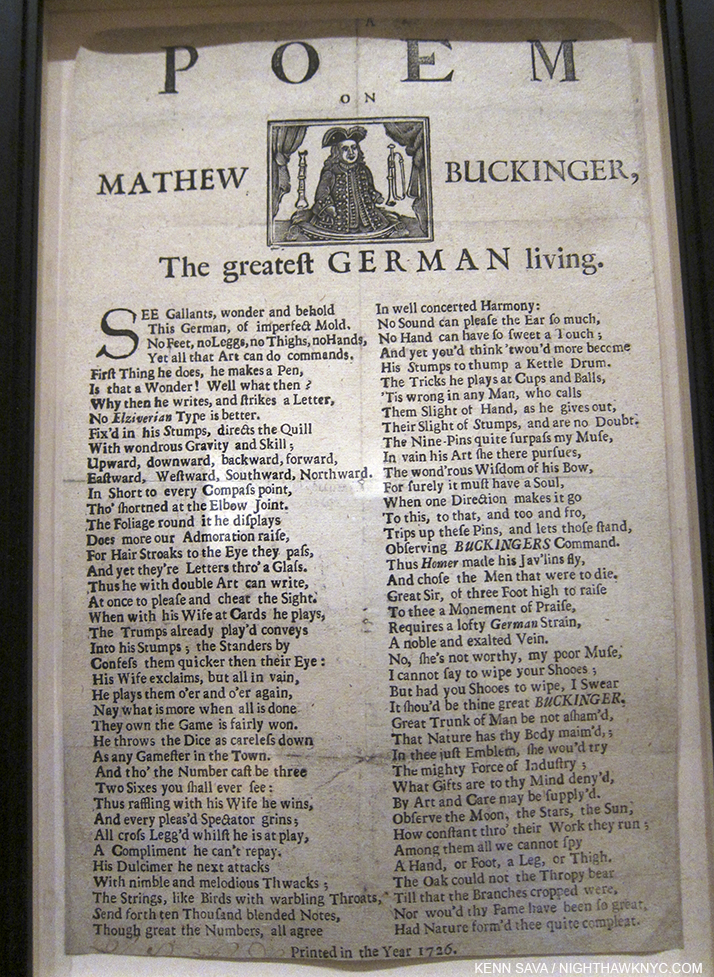
R-E-S-P-E-C-T. The Greatest German Living, a poem to Buchinger, 1726

“Don’t hide yourself in regret
Just love yourself and you’re set
I’m on the right track, baby
I was born this way, born this way”*

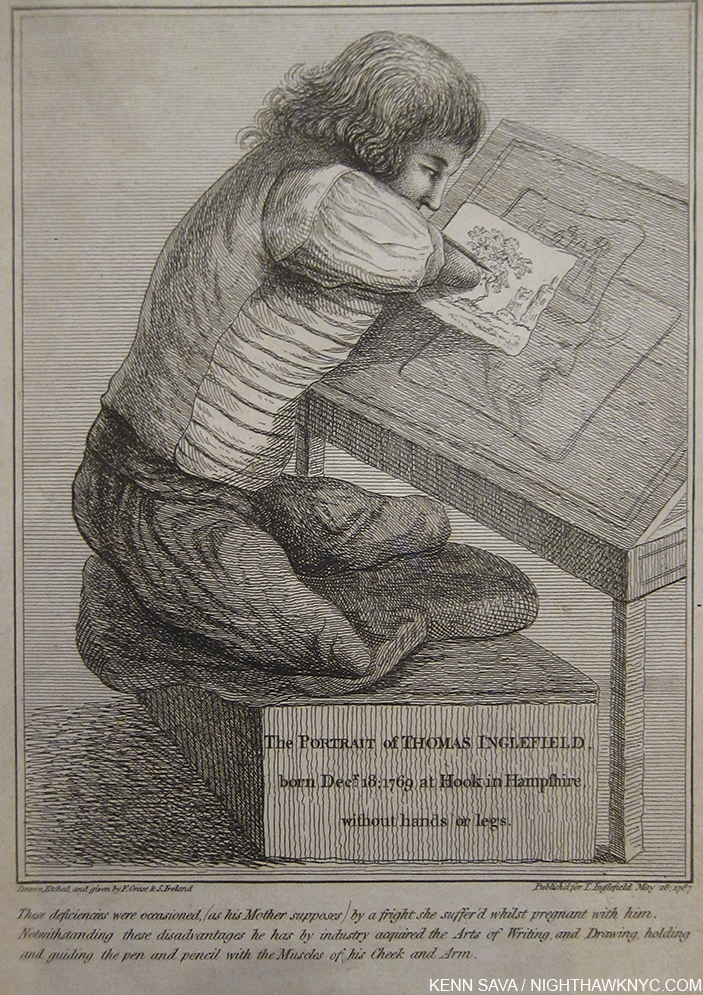
MB was, however, forced to turn to being a carnival side show act to gain appreciation for his abilities as an Artist as well as his many other skills, and to survive. The show includes a few works by other Artists of the same era who were also born without hands or feet, who made their living in the same manner. A “broadside” poster announcing the appearance of one is on view. MB would demonstrate his writing talents for show attendees for a fee and some of these souvenirs are on view here. (The Portrait of him surrounded by depictions of his skills bears his hand written inscriptions on the bottom margin.) Invariably, he always proceeds his signature with “Born without hands or feet…”

A portrait of Thomas Inglefield, also born without hands or feet, shows how Mr. Buchinger may have worked his magic.

Seeing all of this, and a smidgen of what life may have been like for these Artists in the 18th Century, it’s hard not think about the bigger picture.

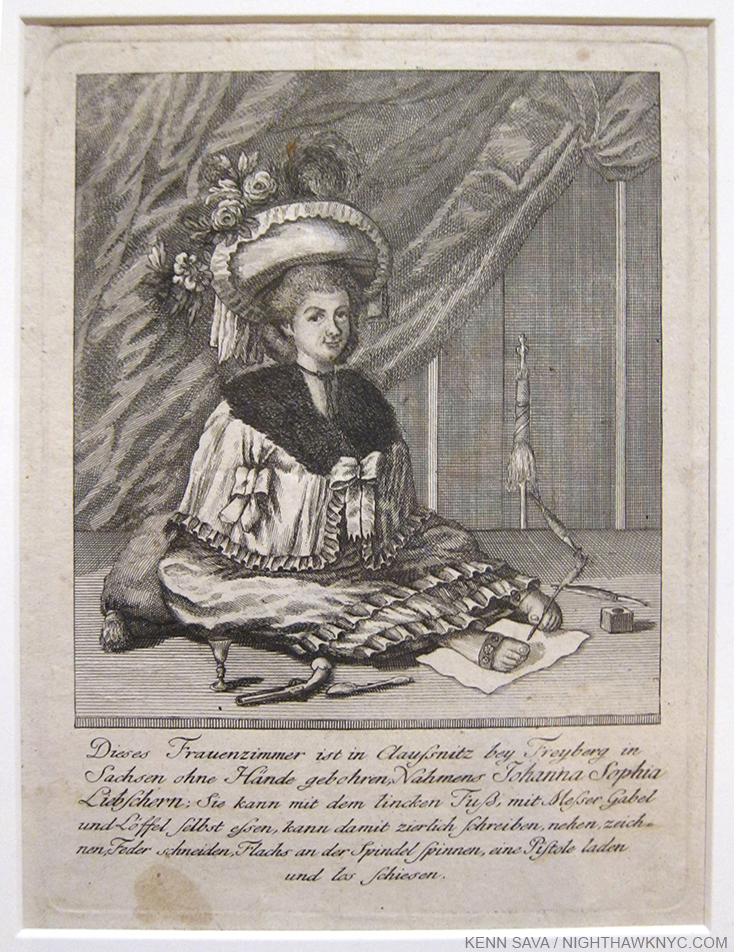
Anonymous, Portrait of Johanna Sophia Liebschern, ca.1780-90 the so-called “Fusskunstlerin,” or foot artist, as the piece is inscribed. It goes on to say, “she has no arms but is able to use knife, fork, and spoon with her left foot and feed herself, (and) is able to prettily write, sew, draw, cut a quill pen, load and shoot a pistol.” Like MB, Ms. Liebschern enjoyed considerable fame in her time, both voyeuristic and scientific.

“There’s nothin’ wrong with lovin’ who you are
She said, ’cause He made you perfect, babe
So hold your head up,
girl and you’ll go far”*

Thankfully, for the disabled, to my mind THE most overlooked group in our society, things seem to have gotten a little better. But, what do I know. I asked Magdalena Truchan, Fashion Guru, Designer, Artist and Blogger Extraordinaire over at her must read Blog, prettycripple.com, that very question- “Have things gotten better for disabled Artists?” She told me-

“I think lots of things have gotten better for disabled artists. They can make a living online as well and the world gets to see what they offer. There are so many groups out there that I come across who help disabled people. I read these things and smile. They have a better networking system today and while discrimination still exists people in the US don’t treat disabled people as lepers. Same in Europe. Life must have been hell for disabled people until the 70s in this country. Also, because of the the “bullying” problem for all people, now people are standing up to them and outing them on social media. So now it is un-PC to bully people. We have a long way to go but at least people have another avenue to voice themselves. You also see more disabled models and actors now. Although some disabled people on TV are not legit cripples. They are able bodied and stuck in chairs which sucks, but at least they are portraying disabled people.”

While it’s good to hear that, so much remains to be done for the disabled. I can’t help but wonder if part of the root of the cause of this slow progress might be that able-bodied people are secretly terrified of becoming disabled.? Even in this very show, the work is hung too high for wheelchair visitors to see, and though magnifying glasses are thankfully on hand, unless you are a bit over 6 feet tall, the higher works will still remain unavailable for close study, as you can see below. It must be a very frustrating experience for the disabled to come to this show. On the one hand they’ll be as impressed as anyone else by the work, but (unnecessarily) frustrated by the experience. What kind of message does this send?

The show is hung for the average size, or taller, standing adult.

That being said, this show is, also, a fascinating insight into the wondrous collection of Ricky Jay, renowned as the greatest living Sleight-of-Hand Artist and historian of its related arts, and who says that MB is “my flat-out favorite. I’ve been collecting materials on him for 30 years.2” Mr. Jay is someone who has spent his entire life mastering his craft, that way a great Painter or Musician does, all the while thoroughly exploring its history, researching its forgotten Masters, collecting rare books, artifacts and works of Art they created. This show is, therefore, is something of a byproduct of how he became who he is today. From what is on view here, the man has superb taste and a most discerning eye.

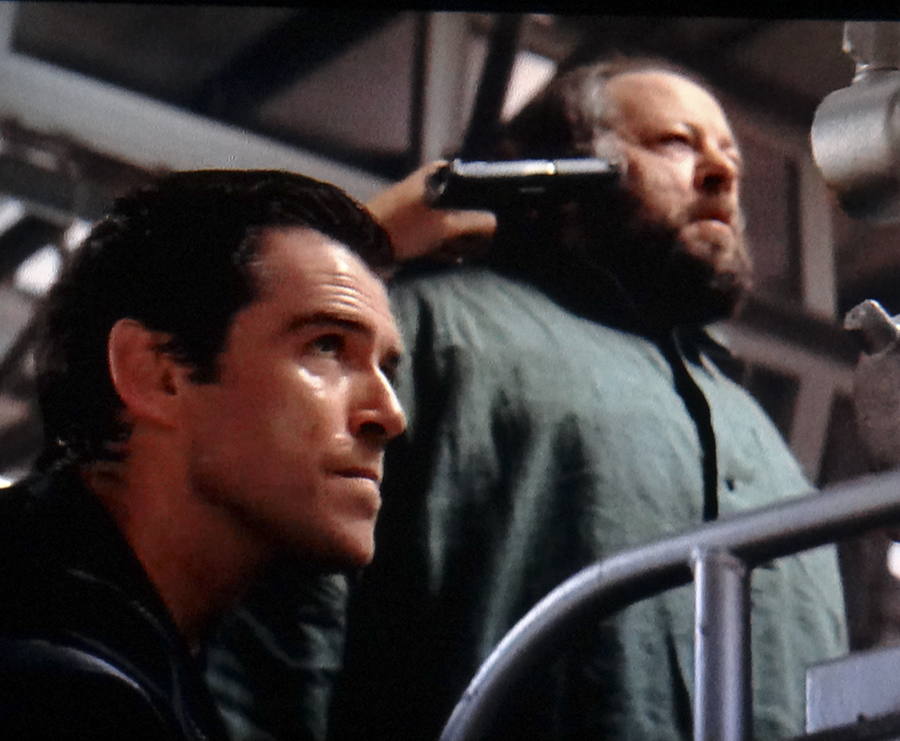
Be careful, Mr. Bond, or Ricky will turn your gun into a rabbit! Yes, that's the inimitable Ricky Jay in "Tomorrow Never Dies."

Be careful, Mr. Bond, or Ricky will turn your gun into a rabbit! Yes, that’s the inimitable Ricky Jay in the James Bond film Tomorrow Never Dies.

It leaves me eager to see more of his collection, so I hope it marks the beginning of a relationship between TM and the inimitable Mr. Jay. For more on him, check out the two excellent documentaries, Deceptive Practice: The Mysteries and Mentors of Ricky Jay, which airs as part of PBS’ American Masters series, and, Hustlers, Hoaxters, Pranksters And Ricky Jay, here on youtube.

Isle of View. Untitled by Rachel Harrison from her Perth Amboy Show at MoMA. Does Art Have to be this hard to see?

While “Wordplay” is a shining example of attention being paid to an extraordinary and overlooked Artist- disabled, or not, in a show that will inspire all, it’s one thing to honor this Artist, it’s another to make it largely inaccessible to disabled visitors. I’m not sure that helps inspire other disabled Artists, or disabled people, and that’s a shame. (Luckily, however, the excellent catalog for the show, by Mr. Jay, features beautiful, clear and full size reproductions of many of the works on display, along with Mr. Jay’s one-0f-a-kind insights. I found I could see the works better in the book than by actually looking at the real thing). It says to me that The Met’s interest here lies in the Art itself, and while I understand that, I think they missed a chance to include more of the Art going public, namely the group that includes these wonderful Artists, themselves.

*-Soundtrack for this Post is”Born This Way,” by Lady Gaga, written by NYC’s own Stefani Germanotta, Jeppe Laursen, Fernando Garibay and Paul Blair, from the album of the same title and published by Sony ATV Music Publishing, Warner Chappell Music Inc. and Universal Music Publishing.

NighthawkNYC.com has been entirely self-funded & ad-free for over 8 years, during which 300 full-length pieces have been published! If you’ve found it worthwhile, PLEASE donate to allow me to continue below. Thank you, Kenn.

You can also support it by buying Art, Art & Photography books, and Music from my collection! Art & Books may be found here. Music here and here.

Written & photographed by Kenn Sava for nighthawknyc.com unless otherwise credited. To send comments, thoughts, feedback or propositions click here. Click the white box on the upper right for the archives or to search them. Subscribe to be notified of new Posts below. Your information will be used for no other purpose.
  1. Ok..ok…I’ll insert the famous Groucho Marx joke- “I like my cigar, too, but I take it out once in a while.” Sorry.
  2. http://www.pbs.org/wnet/americanmasters/ricky-jay-collection/3649/

Live, From the New Met Breuer!

This site is Free & Ad-Free! If you find this piece worthwhile, please donate via PayPal to support it & independent Art writing. You can also support it by buying Art & books! Details at the end. Thank you.

Written & Photographed by Kenn Sava

It doesn’t officially open till March 18 but being The Met (TM) “regular” that I am, of course they let me in 10 days early. I wish. Actually, they’re letting Members in early, starting today March 8. I still feel special.

I can report the layout is unchanged, so muscle memory from visiting this place when it was the Whitney Museum still works just fine. Ah, the Breuer Whitney Museum. I was involved in the debate surrounding it’s proposed expansion/modification way back in 1987, but I’m saving that tale for my upcoming post about the “New” Whitney Museum, almost a year in the making. Stay tuned. In the meantime…

Think about this for a minute.

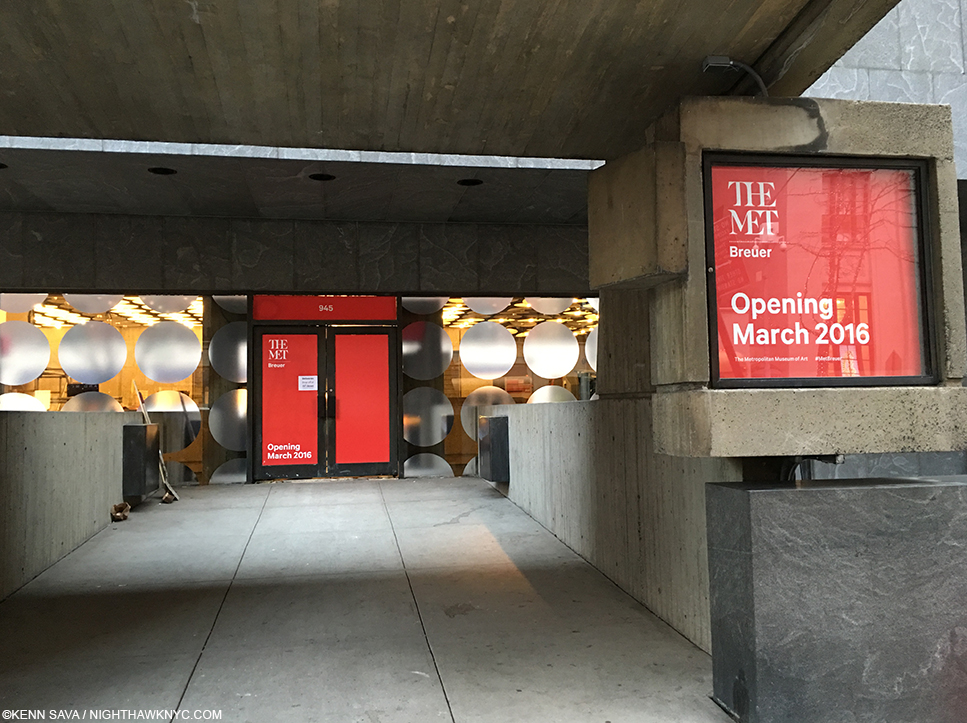
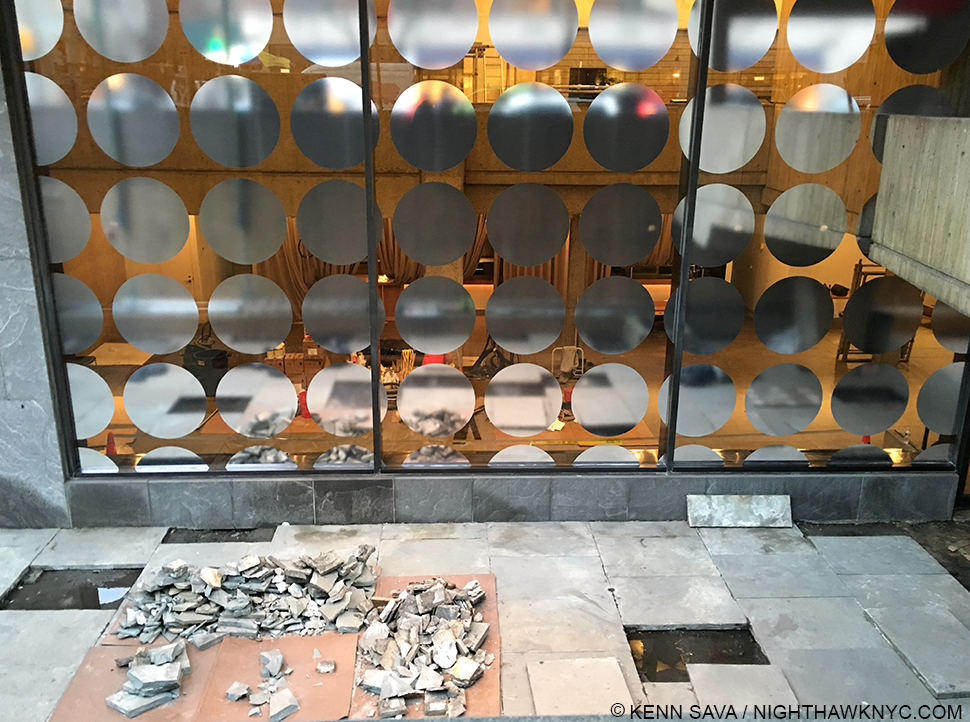
The Met announced it would take over the Breuer Building as it’s “outpost” for Modern & Contemporary Art in 2011. Seen here on December 18, 2015. I was told that the silver circles on the windows were meant to echo the lighting of the lobby inside.

This place was the entire Whitney Museum until a year and a half ago 1. The Met already runs the biggest Museum in the country at 1000 Fifth Avenue, AND The Cloisters way uptown. Now that the Whitney has moved downtown, TM has taken over the building, which is now known as The Met Breuer (TMB). By itself, TMB is as big as the Dallas Museum. To be operating 1000 5th Ave, the Cloisters and now to open a new, additional location of that size, a few blocks from 1000 5th, I find to be a “WOW!” moment.

They seemed to get it up and open pretty quickly (judging from how it looked when I passed by in December).

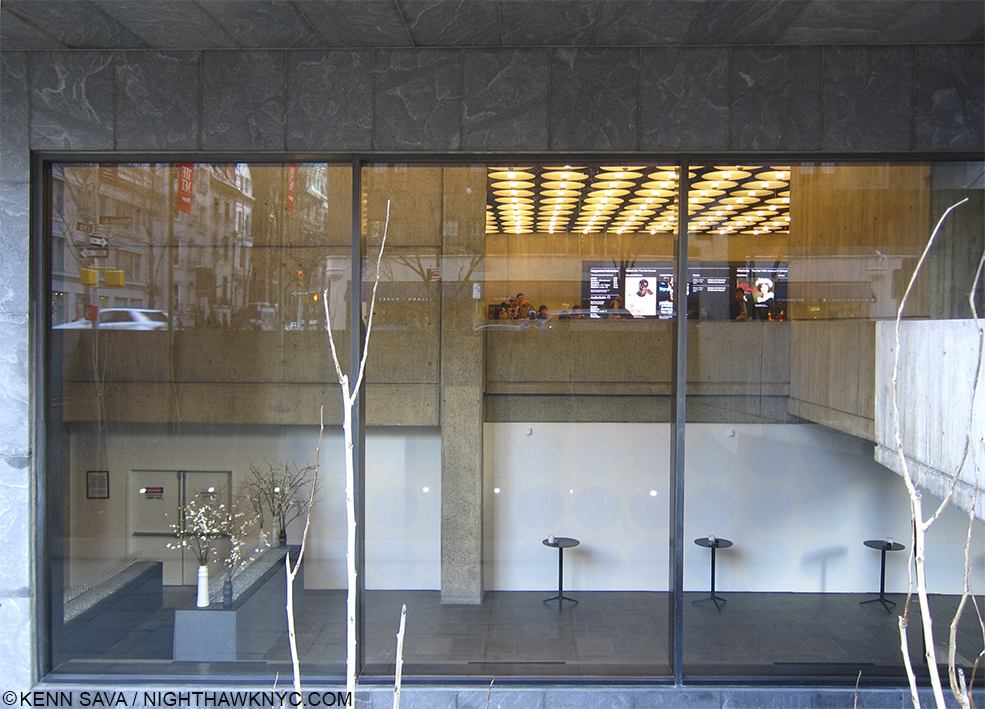
December 18, 2015. I was told the “Circle” Motif is a take off on the lobby’s ceiling lights. See next.

The same window. Member’s Preview Opening Day, March 8, 2016.

So? What’s new? What’s old? What’s borrowed? What’s blue?

Actually, nuptial euphemisms are not out of place here, since The Met & The Breuer building are “married” for at least the next 8 years, with an option to extend, which is longer than most marriages last between people, while TM’s contemporary galleries are undergoing complete renovations that will take a few years. I fully expect they will turn out to be as exemplary as the American & Roman Wings have. Though the layout of TMB made it instantly “familiar,” my first visit was not without some major surprises.

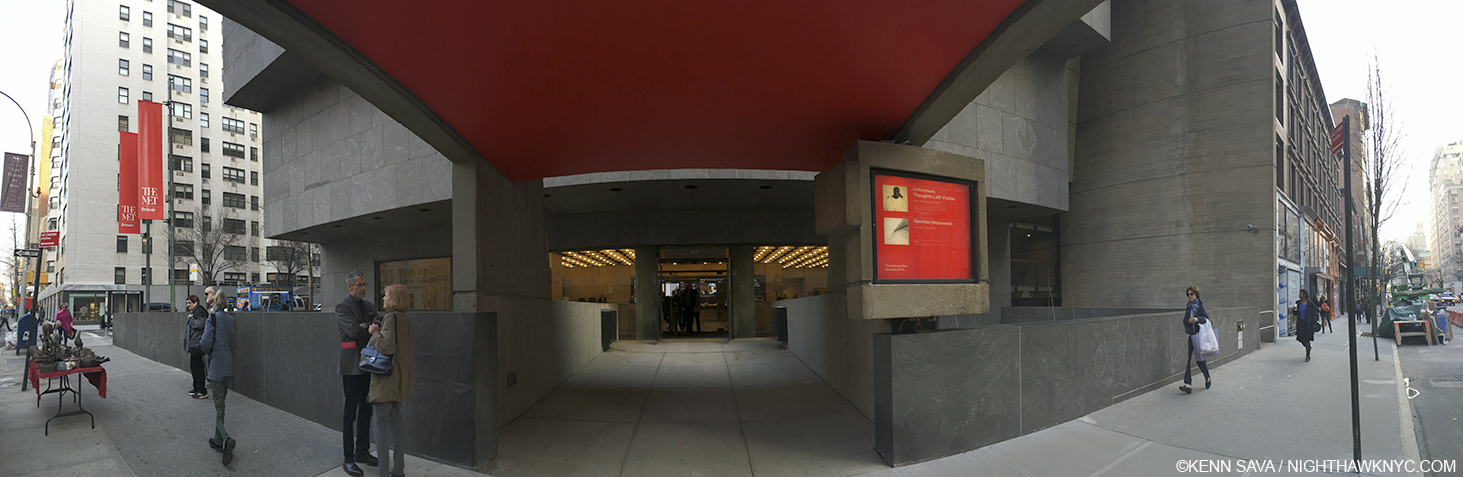
Members Only. It won’t look like this for long. Only 1 street vendor apparently got the word.

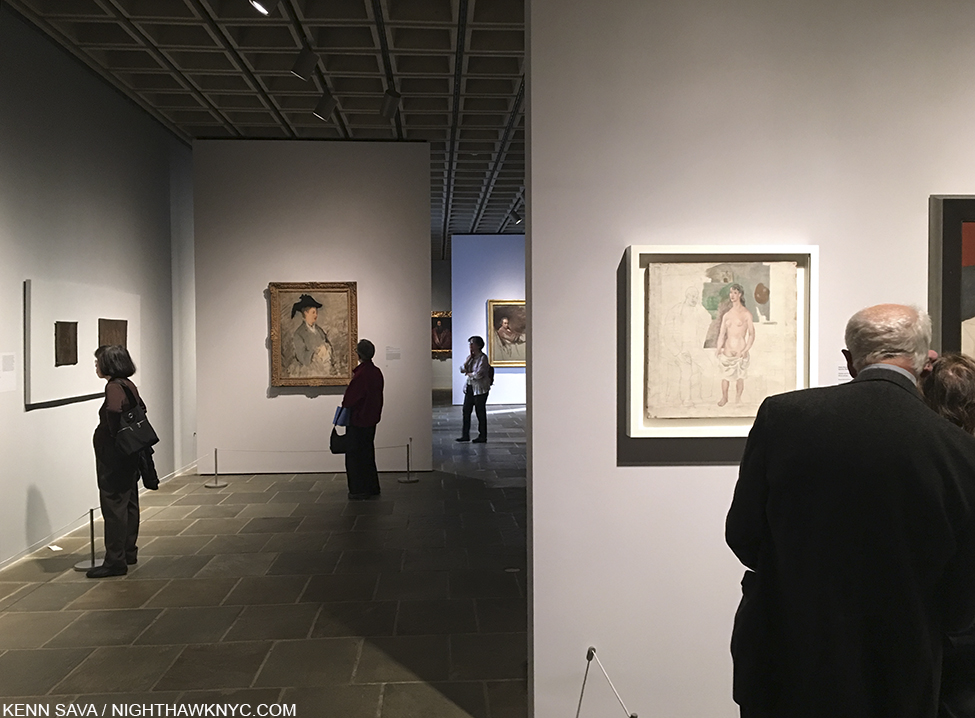
Apparently, I didn’t get the word, either. Since the contemporary galleries are those closing I was expecting ALL of TMB to be contemporary Art. Nope. 2 Floors are devoted to a superb show, Unfinished: Thoughts Left Visible featuring such well known “contemporary” artists as Rembrandt, Cezanne, Picasso, Van Eyck, Durer and Titian.

?

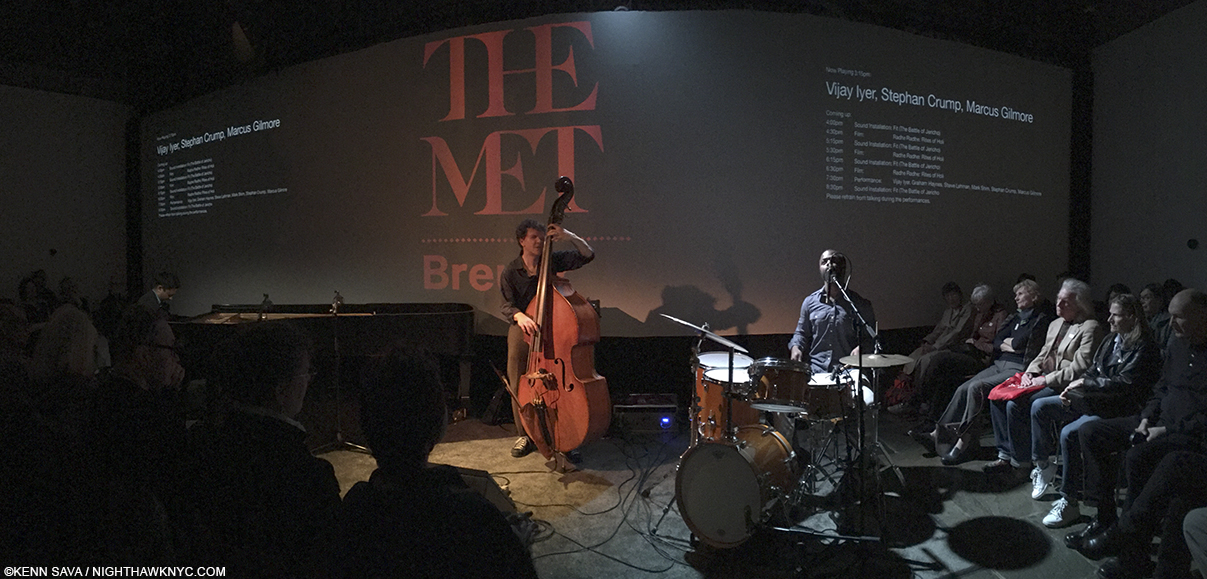
Apparently, TMB will be a “satellite” featuring Special Exhibitions AND contemporary Art. Hmmm… To say I’m surprised by this and why they’d do it is an understatement. Well? Unfinished is a VERY large show that handsomly fills Floors 3 & 4. Perhaps they see the Shows as the draw for getting a large number of people into the building, while they “also” display contemporary Art? There is a show, which I haven’t seen yet, by contemporary Indian artist Nasreen Mohamedi (1937-1990), but no display of works from the permanent collection of contemporary Art, at least to begin with. A cafe & bookstore will be on the top floor, which wasn’t open today. So? Three full floors can be devoted to shows, the small lobby gallery featured a live performance by Vijay Iyer and his trio today, which was well attended and sounded good throughout the adjacent lobby.

“Wake Up over there on the right!” It’s MacArthur “genius” grant recipient, Vijay Iyer, left on piano, performing with his Trio in the first floor Gallery.

Regardless, Unfinished turns out to be a surprise blockbuster, a wonderful chance to look over the shoulder of some of the greatest Artists in history, both Old & Modern Masters, as they create. Create, not created because for some reason, even death, they never “finished” the works in this show. The reasons vary. TM defines Unfinished as it applies to this show as- “This exhibition addresses a subject critical to artistic practice: the question of when a work of art is finished. Beginning with the Renaissance masters, this scholarly and innovative exhibition examines the term “unfinished” in its broadest possible sense, including works left incomplete by their makers, which often give insight into the process of their creation, but also those that partake of a non finito—intentionally unfinished—aesthetic that embraces the unresolved and open-ended.” However, what is here in nothing short of a chance to experience what it was like to visit the studios of these Artists. Processes and choices are laid bare as an astounding roster of names go by in the course of 197 works. Monet, Manet, Van Gogh, Degas, Turner, Jackson Pollock, Robert Smithson, Rauschenberg, Basquiat, Rodin (yes, there are some sculptures, too), David, Kerry James Marshall, Alice Neel, and of course, the “King of the Unfinished Work”- Leonardo da Vinci.

Unfinished, installation view.

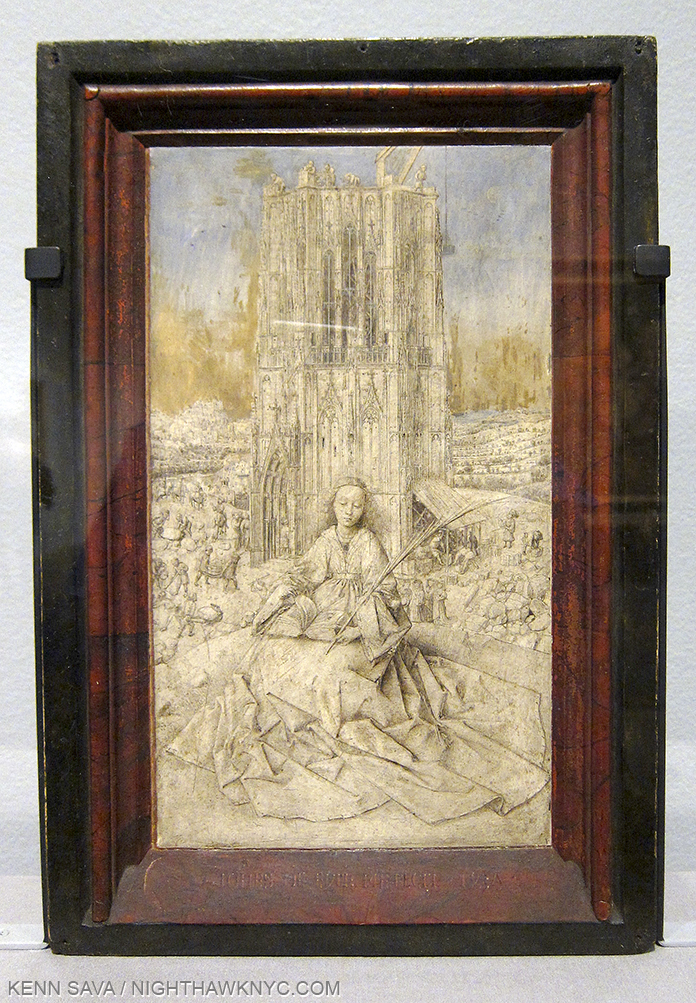
Jan van Eyck, Saint Barbara, 1437. I was shocked to see this masterpiece in Unfinished.

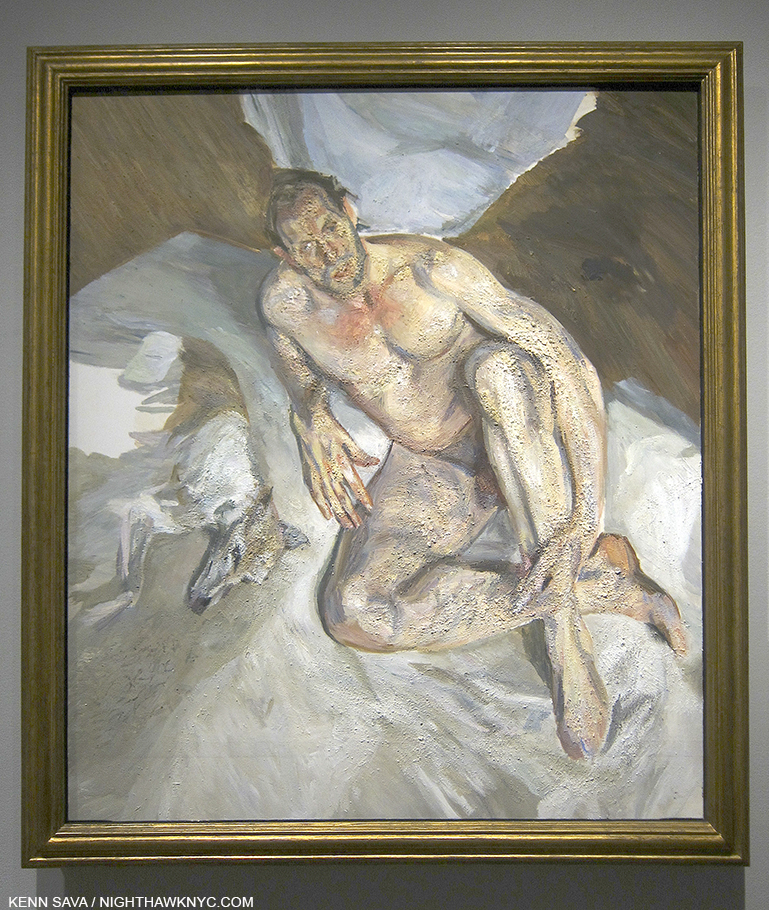
Lucian Freud, Portrait of the Hound, 2011, left unfinished on the Artist’s easel at his death.

My initial reaction is that TMB is great for Art lovers. Another major location to see world class Art in the City, with TM’s unequalled expertise, resources and 2 million or so collected works behind it. Unfinished is a must see show, especially for Artists. it’s chock full loans from major Museums (60% of the show), which is rare these days.

How it will turn out for TM, financially2, though it also remains to be seen what, if anything, will be done with the contemporary Art collection in the interim.

One day in, that’s the big question for me- What TM’s full plans are for contemporary Art at TMB. I’m looking forward to seeing how they unfold. My gut tells me it’s going to surprise a lot of critics and give TM new cred in a realm it’s been denigrated in for years. Oh? But that new Met logo isn’t wearing well on me.

For now, it’s terrific to have Art back at the Breuer, and, Unfinished is an unmitigated why-hasn’t-anyone-thought-of-this-before joy- for lovers of painting, and Art. I’m pleased to be among the first to “Kiss the Bride.”

*-Soundtrack for this Post is “The Art of Fugue” by J.S. Bach, left unfinished at the Master’s death, as recorded by Glenn Gould. You can see Gould perform the final part of  it here, and the entire hour and a half long piece, here.)

NighthawkNYC.com has been entirely self-funded & ad-free for over 8 years, during which 300 full-length pieces have been published! If you’ve found it worthwhile, PLEASE donate to allow me to continue below. Thank you, Kenn.

You can also support it by buying Art, Art & Photography books, and Music from my collection! Art & Books may be found here. Music here and here.

Written & photographed by Kenn Sava for nighthawknyc.com unless otherwise credited. To send comments, thoughts, feedback or propositions click here. Click the white box on the upper right for the archives or to search them. Subscribe to be notified of new Posts below. Your information will be used for no other purpose.

  1. The Whitney Breuer closed on October 19, 2014.
  2. It costs $17M a year to run per the NYT article linked above.}, is going to be something to watch. I’m hearing that by the 2 year mark it will be apparent where this is going long term, so we shall see. Yes, we’ve “lost” a little temporarily with the closing of TM’s contemporary galleries, but unlike when the American & Roman wings were closed for renovation, TM has more than made up for it with TMB[3. While TM didn’t open alternate spaces, beyond showing some works from the American Wing downstairs in the Lehman Galleries.

Happy 86th Birthday, Sister Wendy! I Miss You.

This site is Free & Ad-Free! If you find this piece worthwhile, please donate via PayPal to support it & independent Art writing. You can also support it by buying Art & books! Details at the end. Thank you.

Written & Photographed by Kenn Sava (*- unless otherwise credited)

Today, February 25th, is Sister Wendy’s 86th Birthday…

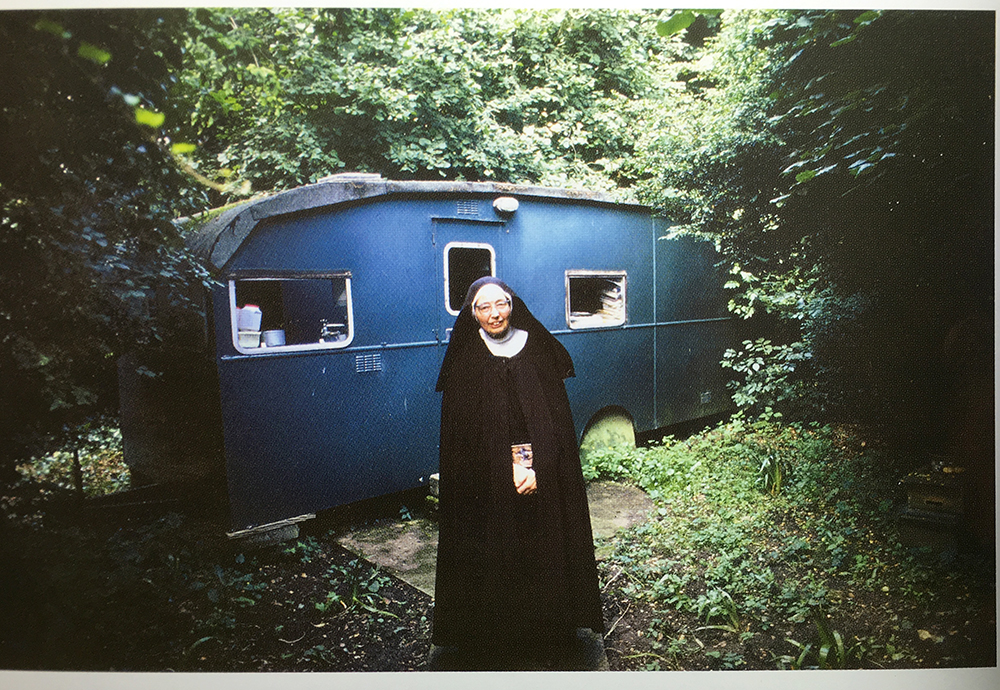
In front of the trailer she now lives in, in seclusion. As seen in her 2006 book Joy Lasts published by Getty Publishing.

Remember Sister Wendy ? The English Nun who became the most unlikely Art expert & historian in the history of Public Television (and the BBC) in the 1990’s, and probably, the most famous Art expert in television history? To me, she’s a rare instance when “most popular” is also one of the best.1

I absolutely LOVE her!

Ok, I’m a failed Catholic and our spiritual worlds are an Atlantic Ocean apart, but I’ve never been so captivated listening to ANYONE, who isn’t an Artist, talk about Art as I have been listening to her. She has this amazing way of being true to herself and her beliefs while at the same time being honest and open minded about what she is seeing and, most importantly, the all too rare ability of making Art accessible to anyone. She accepts the “human-ness” of men (and women) in a surprisingly sensitive way. Her Love of God remains intact when viewing the work of the most “human” of beings, which depicts them doing the most “human” of things on a fairly regular basis. Hearing a (committed virgin) nun discuss nudity for example, or even sex, is at first shocking, until you listen to what she has to say. Otherwise, I would have turned her off in minutes.

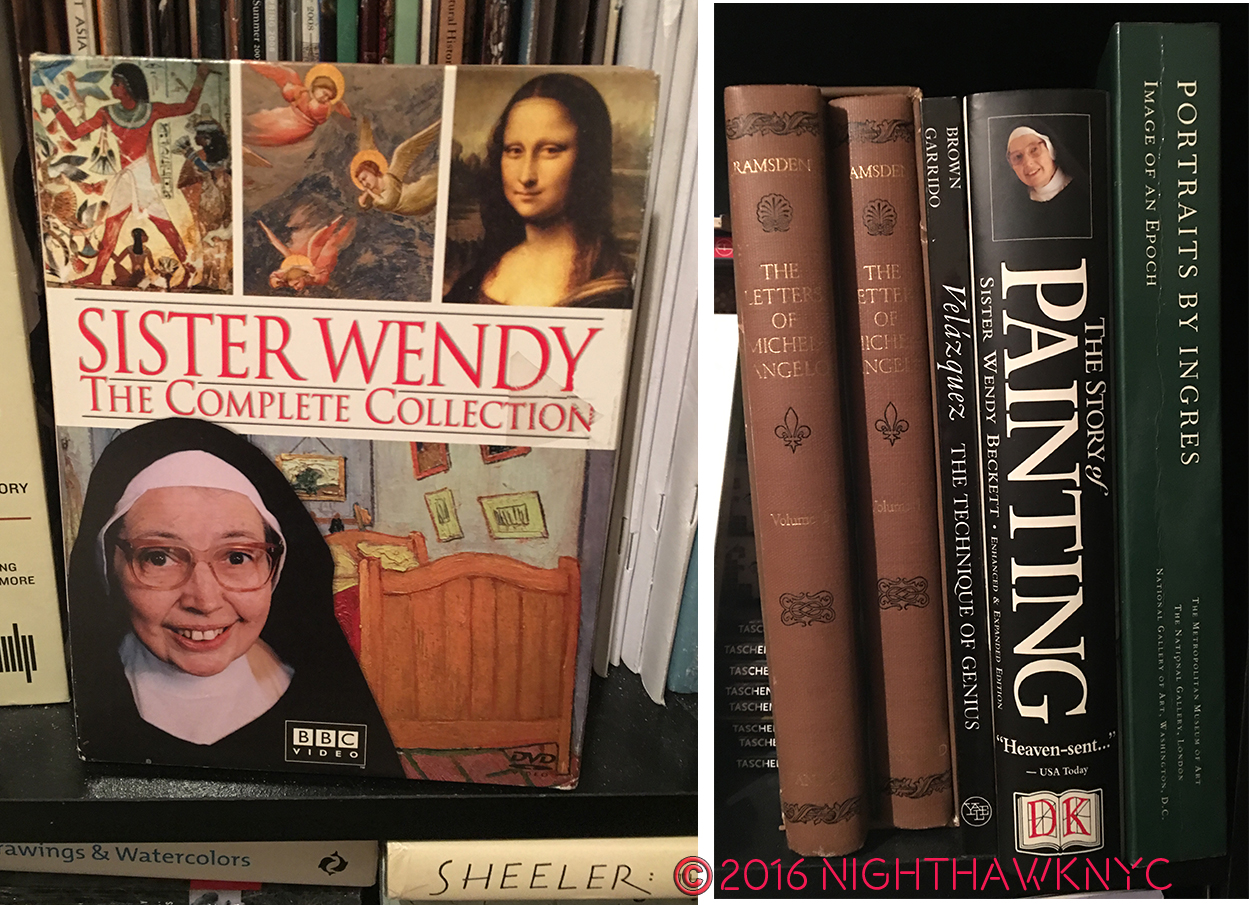
If you’re looking to learn about Art History? I heartily recommend her videos and books. In either medium, start with “The Story of Painting,” which for me was just a magical experience. (Her other essential book, “1,000 Masterpieces,” strikes me as being the world’s-finest-Museum-in-a-book that comes with her uncanny insights on each work.) My copy of the book and the videos are still within easy access. Even if you know something, or a lot of things about Art & Art History, you’ll find her insights eye opening, her opinions unique. But don’t stop there. “Sister Wendy’s American Collection,” (SWAC) a 6 part tour of some of the finest American Museums, is also essential.

Not posed- This is really how they are in my apt. Her book sits between MIchelangelo’s Letters, Velazquez and Ingres. I need her more than they do.

Actually, looking at Met Director Thomas P. Campbell’s Instagram page, which I dipped into last week, I happened on this picture that reminded me of “SWAC.” A spoiler for the video on The Met- During her Tour of TM, SW makes a point of showing us her “favorite” works in the Museum! I’ve been there over 1,300 times. I knew most of the works she selected (Phew!), but I was left stunned by this fact- TM has over TWO MILLION works in their collection. I doubt ANYONE has seen them all. How does this 70-something Nun from England find a work like this-

which is small (less than 6 inches tall) and not exactly displayed front and center, in the middle of 4 City Blocks of Art? Next time you go? I dare you to find it, without asking. SW singled it out as one of the most beautiful works in TM. Wow! I just mean “WOW!” Yes, it is, but the sheer act of her choosing it among everything else will forever blow my mind, years before Thomas Campbell singled it out, above.

Think about that for one minute- Anyone who goes to a Museum goes with a list of things they want to see- favorite artists, works, special shows, and on and on. Very few go with an open mind to “just see.” What’s that old Zen Buddhist saying? ”In the beginner’s mind there are many possibilities. In the expert’s mind there are few.” SW is an expert, yet, she goes to TM with an amazingly open mind and sees. That is just so incredibly hard to do.

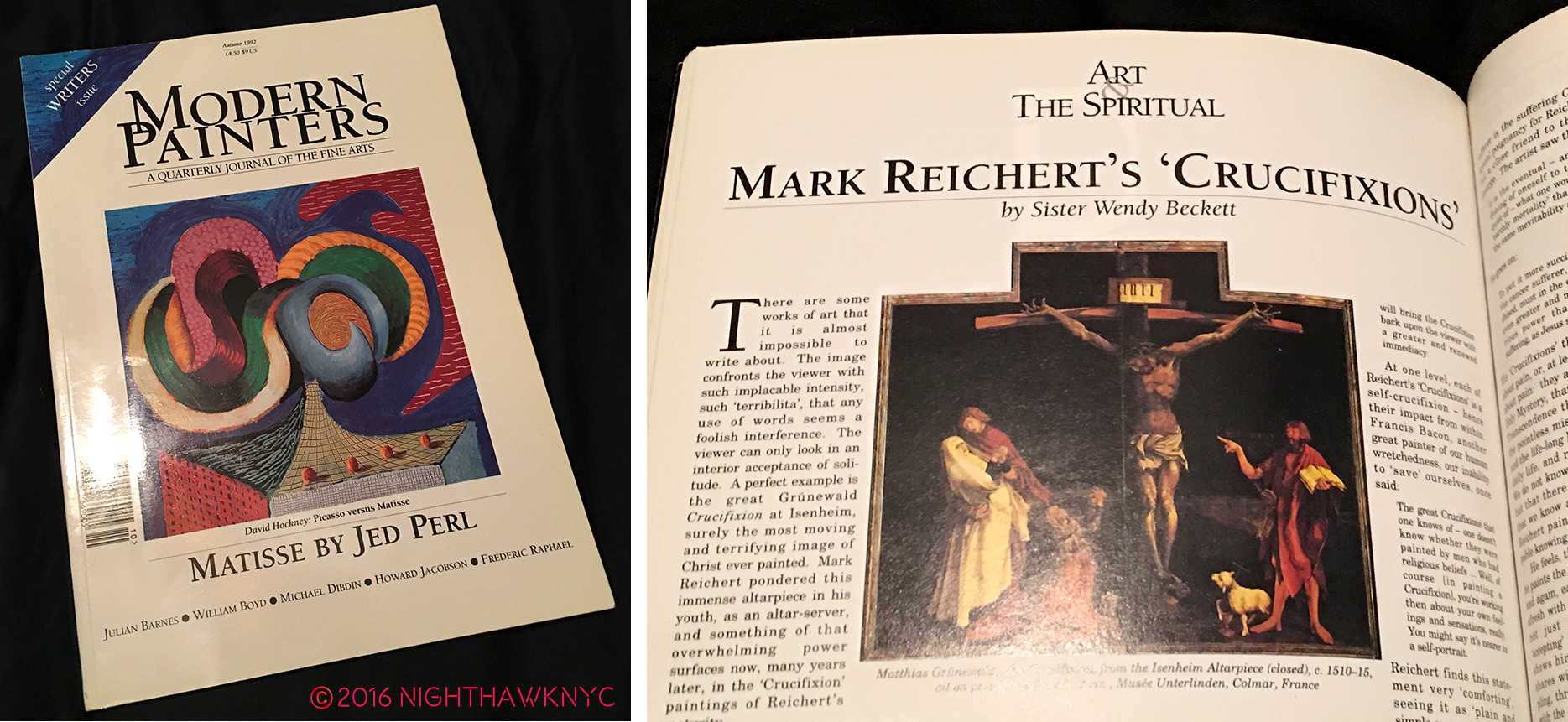
To this day, anytime I see it, that’s what I think about- “Sister Wendy chose this.” When I first saw this in her video, my jaw hit the floor. Seeing Mr. Campbell post it on Instagram reminded me of that video. It also reminded me of how much I, and I think many, many others, miss Sister Wendy. While I respect her 2001 decision to devote her life to living in seclusion and contemplation, ending her career on television, she has unique and all too rare Gifts- The Gift of being able to make ANY Art as human as the Artist did (maybe more so), and especially of making Art more accessible than most other critics & historians, and then for instilling her passion and sheer love and respect for great Art in her viewers and readers. She certainly did, and continues to do that for me! I’ll be eternally grateful to her for that. But? As I said recently, adult Art Education is sorely needed today- countless millions need her gifts as much now as ever! Fortunately, she has produced a fairly large body of videos and books. Unfortunately, some of the videos seem to be slipping out of print (Hello, BBC Video? I seriously hope not!). Lesser known are her early writings for Modern Painters Magazine, back when it was something special. That was where I first discovered her.

Modern Painters, Writer’s Issue, Autumn, 1992. Sister Wendy’s name doesn’t even make the list of writers on the cover! Before the year was over, she’d be the star of her own series on BBC TV, “Sister Wendy’s Odyssey.”

I’m not that close with “the Man Upstairs,” but just in case He or She happens to be a NighthawkNYC reader, or sees this Post in His or Her Omnipotence- Could You do the Art world a big favor and tell SW it’s “Ok” to come back to us? For the rest of us mere mortals, wherever or however you discover her, If you want to learn about Art History, or discover more about it, or if you just want to find out what makes Art worth your time and maybe “get” what all the Art fuss is about- I hope you’ll give her your time. I don’t know if there’s an afterlife, but I know one thing – For an Art Lover, or an aspiring one? Sister Wendy is blessing sent from Heaven.

HAPPY BIRTHDAY, SISTER WENDY, The Patron Saint of Art Lovers!

*- Soundtrack for this Post is “Happy Birthday to You”

Update 12/26/2018- I was very saddened to learn of Sister Wendy’s passing today. My R.I.P. for her may be found here.

NighthawkNYC.com has been entirely self-funded & ad-free for over 8 years, during which 300 full-length pieces have been published! If you’ve found it worthwhile, PLEASE donate to allow me to continue below. Thank you, Kenn.

You can also support it by buying Art, Art & Photography books, and Music from my collection! Art & Books may be found here. Music here and here.

Written & photographed by Kenn Sava for nighthawknyc.com unless otherwise credited. To send comments, thoughts, feedback or propositions click here. Click the white box on the upper right for the archives or to search them. Subscribe to be notified of new Posts below. Your information will be used for no other purpose.
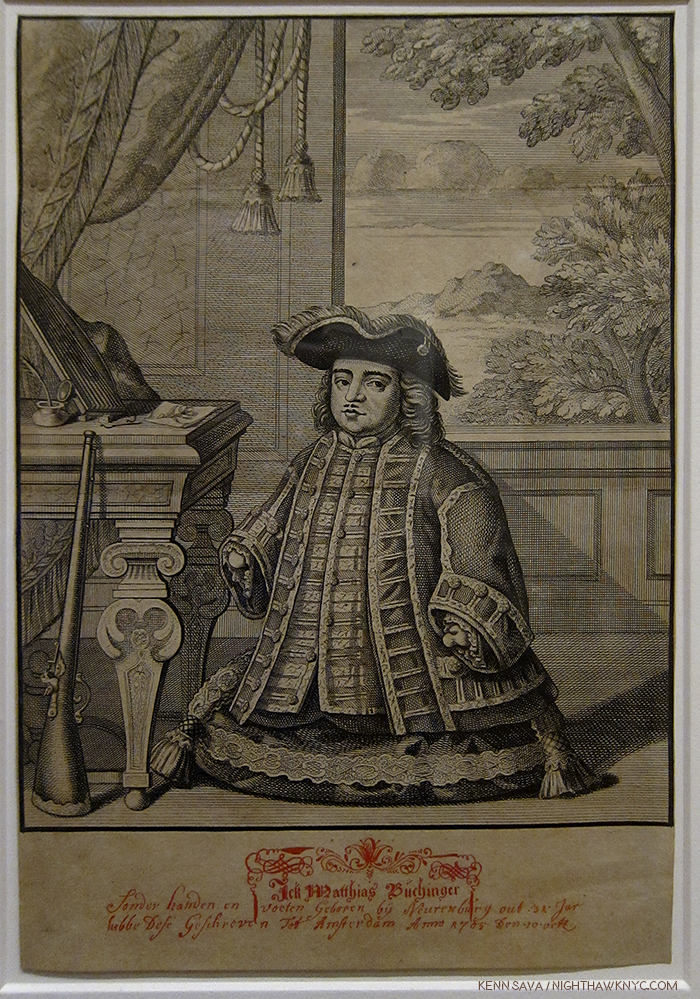
  1. Along with Kenneth Clark, Robert Hughes, Simon Schama, maybe one or two others I forget off the top of my head…

Art Shows, 2015 – Who Keeps Your Flame?

“But when you’re gone,
Who remembers your name?
Who keeps your flame?”*

IMG_7838PNH

January, 2015. Goya: Order and Disorder @The Museum of Fine Arts, Boston. Neither snow, nor 5 hours on a train kept the Nighthawk from the Front Door of Great Art.

Since I don’t believe in comparing creative work or creative people, AND I believe that “awards” for “Best” whatever among the Arts (and Sports) are absurd 1, I thought I’d do a “List In No Particular Order” of 2015 Art Shows I saw (some opened in 2014) that may or may not have closed for good, but still continue to open doors in my mind, and that’s more important than any award I could bestow.

“Oh can I show you what I’m proudest of?”*

Goya: Order and Disorder (Museum of Fine Arts, Boston, MA. No photos permitted.) AND Goya:Los Caprichos (National Arts Club, Gramercy Park, NYC)- Two concurrent, excellent shows, 250 miles apart, one huge, the other “small” showing two views of  Goya- one all encompassing, filling the whole lower level of the MFA, one narrowly focused on a rare, complete set of his landmark 80 print, Los Caprichos,(once owned by Robert Henri, who reappears below) combined to show the enduring power, importance, relevance and eternal influence of the Spanish Master. Many saw the former, far fewer saw the latter, tucked away in a dining? lecture? room on the second floor of the NAC (Behind hundreds of chairs on one of my visits!). An artist of nightmares, both surreal and all-too-real, the likes of which perhaps only Bosch can equal, who can then turn around and paint with the utmost lyricism, Goya was all about what it is to be human. Take your pick- portraits, historical pieces, landscapes, the otherworldly or the underworldly, children, tapestries, or his graphic works that hold their own with dare-I-say-Rembrandt, he’ll blow your mind.

DSC07316PNH

Goya/MFA on the show’s elevator entrance, overlooking Dale Chihuly’s Tree.

Remember My Name. Goya’s Self Portrait casts his all-seeing eye on us 215 years later.

The Sleep of Reason Produces Monsters from The Caprichos” So? Stay up!

DSC07711PNH

Neither blizzard, nor the furniture(!), kept the Nighthawk from seeing all of Goya’s incredible Los Caprichos at the National Arts Club, but I think they tried to.

Richard Pousette-Dart (Pace 510 West 25th, Chelsea)- I walked in and was completely captivated by “abstract” Art the way I haven’t been since the Mark Rothko Show at the “Old” Whitney in 1998, which was one of the greatest shows I’ve ever seen. (That’s not comparing.) Don’t be fooled by the apparent geometric simplicity, there is an astounding subtlety to these works that at once feel microscopically considered, often freely rendered, yet globally cohesive. Pousette-Dart had a number of styles, and this show represented one, geometric style, from the 1970’s in both large oils and smaller drawings. For any of those who think that Abstract Expressionism is “easy” to do, go ahead and try creating one of these, the largest is almost 8 foot square, and then see if it has the “Presence” of Dart’s. The amount of work that went into each piece belies their seemingly “simple” composition, is matched by an extraordinary primacy of order, and second only to their transcendent impact. Here, we see Richard Pousette-Dart as the great, “under known” abstract artist. While Pollock & Rothko have grown larger in stature, Pousette -Dart’s name deserves to be right there with theirs. There is only one word to describe this show’s effect- Magical.

Then? There’s never a chair around when you want one. Pousette-Dart @Pace- Presence, Circle of Night, 1975-6, center, Black Circle Time, 1980, left and White Circle Time, 1980, 90″ square each.

Imploding Black, 1975, six feet square. Transcendent,

Detail.

Cerchio di Dante, 1986, six foot square

Detail of the left side.

“Let me tell you what I wish I’d known
When I was young and dreamed of glory
You have no control
Who lives
Who dies
Who tells your story?”*

Richard Estes: Painting New York City (Museum of Art & Design, NYC)- My favorite contemporary artist, and one of the greatest living realists, FINALLY gets an NYC Museum show, and it was worth the wait. A virtual time capsule of NYC from the mid 1960’s to 2015’s astounding Corner Cafe, showing the 83 year old Master is still at the height of his considerable power. Oh…Do NOT call him a “photorealist” in my presence! Estes shows us the world we live in as we do not see it, (more on this soon) and so follows in the footsteps of Edward Hopper and Charles Sheeler in advancing American realism while, perhaps, being the first to include the abstraction that is also a part of the real world. A misunderstood painter, in my eyes, who is only just beginning to be really seen, finally.

Horn & Hardart Automat, 1967. Not since Hopper has a work spoken to me of life in the City like this does.

Columbus Circle, Maine Monument, 1989. 500 years ago, or 100, they came by ship. Now? They come by bus. Frozen in time, side by side.

Times Square, 2004. Nothing captures the experience of the place better than this, though Robert Rauschenberg is capable of giving me a similar feeling (See below).

“I try to make sense of your thousands of pages of writings
You really do write like you’re running out of time.”*

Picasso: Sculpture (MoMA)- If he had never done anything besides paint, Picasso would be considered among the all time Masters. But, noooooooooooo… Picasso was, perhaps, the most unique genius in (known) art history in that his genius was among the most restless. He almost never stopped creating, and he never stopped seeking new outlets for his creative vision. Consider- PICASSO HAD NO TRAINING AS A SCULPTOR! NONE. Yet, that didn’t stop him from becoming, perhaps, THE most revolutionary sculptor up to his time. There is so much great work to see in this show, I don’t even know where to start talking about it. “Picasso: Sculpture” shows us the naked face of endlessly creative genius the like the world has never seen. I’ll sum it up by saying virtually all of it is wonderfully selected, though some of the Cubist works here don’t stand up to his paintings, in my opinion, and wonder- When will we see his like, again? The “other” takeaway, for me, is- Oh…MoMA. I miss you. About as much as I miss your “old” building.

Standing Figure in Wire, 1928. Unprecedented. Astounding.

Sylvette, 1954. “I see you slightly folded…in steel, my dear.” Picasso must have said.

America Is Hard To See (Whitney Museum)- I’m saving my thoughts on the “New Whitney” Building (UPDATE- They may be seen here.), but the opening show in the new place was a wonderful “Welcome Back” to one of the first 3 of NYC”s Big Four Museums and a reminder of its world class (and first anywhere) collection of American Art. My personal highlight? The first floor gallery featuring a selection of Hopper Drawings done at the Whitney Studio which predated the Museum, and the absolutely mesmerizing portrait of Museum founder, the indomitable Mrs. Gertrude V. Whitney (also an overlooked sculptor) that looked out at Gansevoort Street, and for my money? SHOULD HAVE BEEN LEFT RIGHT THERE- PERMANENTLY! It wasn’t.

IMG_0992PNH

Frozen in time. Mrs Gertrude Vanderbilt Whitney looks out on the new home of the collection she started.

Mrs. Gertrude Vanderbilt Whitney by Robert Henri, 1917, with her Study for the Head of her Titanic Memorial from 1922, right. Yes. She was a sculptor, too.

Before the First Whitney Museum opened in 1931, there was the Whitney Studio Club, where artists came to draw from the model. See that guy to the left of center rear with the light shining on his bald head? That’s Edward Hopper, a regular. That’s why his estate was left to The Whitney. Litho by Mabel Dwight, 1931.

America is hard to change. Excellent, rarely seen, works by Grant Wood, Study for Breaking the Prairie, 1939,…

…And Kara Walker, A Means To An End, 1995, struck me as serendipitous.

IMG_0967PNH

America: Seen everywhere. Inside- Rothko’s Four Darks in Red, 1958, Pollock’s Number 27, 1950, Chamberlain, Jim, 1962 & Guston’s Dial, 1956…

IMG_0940PNH

…And, Outside- sculpture from one of the countless roof decks.

“And I’m still not trough I ask myself,
what would you do if you had more time
The Lord, in his kindness
He gives me what you always wanted
He gives me more time.”*

I end this section honoring two endlessly creative American “painters,” featured in very very good shows. Like Richard Estes, these two artists also put that “more” time of a long life to superb use. Yes, despite evidence to the contrary, they both consider themselves to be painters. To me, the “lessons” of their lives, how they were able to survive following their star in this country for so long, may prove to be as important as their considerable artistic legacies.

Robert Rauschenberg- Anagrams, Arcadian Retreats, Anagrams:A Pun (Pace 534 West 25th, Chelsea)- Presaging Photoshop, the late, great Mr. Rauchenberg continues to speak to our times though he, unfortunately, left us almost 7 years ago. Light years ahead of his times, throughout his life,  Anagrams…, a show of Mr. Rauschenberg’s final development, shows that once again, his work will look “contemporary” for years to come, and more amazingly, I think it will be as relevant as what anyone else is doing at the moment! As I just said, he represents something of an American miracle- an artist who was able to spend virtually his entire life creating EXACTLY what he wanted to, answering to no one but himself. That sure must seem miraculous to today’s American artists. Interestingly, like Mr. Estes, the works here are based on Mr. Rauschenberg’s own photography, to very different results. Unlike Mr. Estes, Mr. Rauschenberg’s are directly transferred to the piece, though with such skill and subtlety they have the effect of melting into the others they’re surrounded by. A surprisingly fresh, visually rich, often beautiful show who’s spell will call me a few more times before it ends on January 16. And then, I will miss it, but it will have changed the way I see the world, like Richard Estes has.

Rauschenberg @ PACE. I just loved this show.

Frank Stella (Whitney)- An art mover’s nightmare of a show, the Artist’s helpful hand notated directional markings seen on some of the pieces notwithstanding, it must have been hard for Mr Stella, himself, to narrow his 50-some year career down to one floor at the New Whitney, handsomely displayed in the still-new space. With only one Moby Dick piece in sight, the take away for me is that here is a Triumphant overview of another rare American artist who continues to explore and evolve, fickle times and the “harpoons” of even more fickle critics & collectors be damned. Mr. Stella has devoted his career to the eternal pursuit of finding new possibilities, “new spacial complexities” 2, for the Art Form of painting. Some of these sure look like sculpture, but I’ll bow to what he says on one of the show’s signs- “Q- You still call these paintings? A- Yes. They are, in fact, paintings.” Remarkably, as he closes in on 80 this May 12, Mr. Stella continues to “start over,” as Richard Meier says on the audio guide, eternally following his muse, breaking painting out of 2 dimensions, to lord-only-knows-where-next. In this show’s case? The Journey IS The Destination. Mr. Stella strikes me as a master conceptualist with an endless font of making the unlikely, and especially the unthought-of, real. Forget this show’s afterthought of a catalog, for me, his value, “message” and influence lie in the sheer physical experience of his work- they simply must be seen, and often, walked around like sculpture to be fully appreciated. Who else “paints” like this? If you go, and you should, check out the great quotes from Mr. Stella on the wall signage- “What you see is what you see.” And then some. What I saw was a show to fire your creativity, and inspire you to see new possibilities in anything, if there ever was one. You still have a few days left to see it before it closes after February 7. Then, the art movers get to pack it up and move it out. I would pay to watch that.

50+ years of “starting over.”

“Toto, We’re Not On Canvas, Anymore.” Stella Busts Painting Out.

“Um..A Little Higher On The Right?”

And lest I forget…

Cubism (The Met No photos permitted.)- TM is on a mission to shore up its Modern & Contemporary Art holdings, as we will soon see at The Met, Breuer, but this show featuring works of a promised gift goes a very long way to solidifying TM’s Cubists holdings, and then some. So many strong works by the Masters of Cubism, Picasso, Braque, the underrated Juan Gris, and Leger abound, they made me wonder where TM is going to install them all when they finally get them!

Madame Cezanne (TM No photos permitted.)- Portraits are not the first thing most think of when they think of Cezanne. Many think of his groundbreaking landscapes and genius with color, but this show of his, no doubt long-suffering wife, says as much about this under known muse as it does about Cezanne. The hours she spent posing for him reminds me of “The Man in The Blue Shirt,” by Martin Gayford about sitting for Lucian Freud. The show is a striking look at another side of this master of impressionism, and gives us rare opportunities to see 4 versions of a painting reunited, and Cezanne’s actual sketchbooks. A rare treat for the lover of Impressionism, portraiture and great Art.

China Through The Looking Glass (TM)- Except for Picasso: Sculpture and Goya’s Los Caprichos, the above shows are painting shows, my true love, but CTTLG is in a category all its own. ANY show that can get TM to stay open till Midnight has to make the Nighthawk’s list. After setting the bar high with “Alexander McQueen: Savage Beauty,” TM’s Costume Institute topped themselves with a spectacle that the 800,000 who saw it will remember almost as long, and which will prove quite a challenge for 2016’s “manus x machina,” or MxM, as I’m calling it to equal, let alone top. I predicted 1 Million will attend it, so GO EARLY (or don’t say I didn’t warn you) & Stay tuned!

Francis Bacon- Late Paintings – (Gagosian No photos permitted.) – with one work, a triptych selling for 142 million, I can’t fathom how much 28 are worth, but here was a chance to see that many in one show, focused on the seemingly contemplative, other-worldly “late” Bacon,

DSC07520PNH

especially after seeing the following (Rembrandt show) on the same day, which brought to mind subtle, fascinating convergences- self-portraits, multiple views, or states, for Rembrandt, diptychs & triptychs for Bacon, among them.

Rembrandt’s Changing Impressions (Columbia U.)- In lieu of the “big one” I missed (see below), this was a closer-to-home chance to see 50 or so prints by the Master and a rare chance to see various “states” (versions) of works side by side. A bit light on the most well known of Rembrandt’s etchings, but very worth 4 visits none the less.

Not a triptych. Rembrandt creates 3 masterpieces from one composition.

Chuck Close Recent Paintings (Pace 534, Chelsea)- I met Mr. Close, briefly, but in spite of the fact that he is one of the greatest portraitists of the 2nd half of the 20th Century+, I know he won’t remember my face. He has Prosopagnosia. He’s ALSO paralyzed and in a wheel chair. I never cease to be absolutely astounded at what he achieves and what new ground he breaks. Already a Master before his brain aneurysm, which would have stopped 99.5% of anyone not named Chuck Close, he’s gone on to create ever new works that continue his life long exploration of his famous “grid technique.” These works add even new elements- new palettes, a new approach to focus and depth of field, and more.

Linda & Mary McCartney (Gagosian Books)- If they had taken down all the title cards, removed the iconic shots among Linda’s, and you walked in without knowing which work was by who- Linda McCartney, or her and Paul’s daughter, Mary, you’d never know. That’s how amazingly symbiotic the eyes of the two photographers are. They see as one. Walking out, and I say this with nothing but respect, it really felt like Linda had never passed away. That her work continues. I’ve never seen anything quite like it.

DSC07609PNH

The daughter reflects well on her famous mother.

George Caleb Bingham (TM)- The year’s “sleeper” pick. I don’t know if he ever met Mark Twain, but if Mr. T. ever wanted an artist to illustrate “Huck” or “Tom Sawyer?” G.C.B. would get my vote. His work captured what it was to live on the River the way only Twain, himself, has, and makes a contribution to laying the ground work towards defining a truly “American” style of painting, and by the Mid-Nineteenth Century? It was about time! TM’s show reveals him to be something of a predecessor for that other great American 19th C. portraitist, Thomas Eakins, but with a style and a power of his own that still holds up.

Araki (Anton Kern, NYC)- He lost his wife…he gets prostate cancer…he says he no longer has sex…Nothing stops the indefatigable, legendary Araki. Don’t let the “casual” taping of the photos to the wall fool you- I found this show striking, poignant, meditative and moving. The images flowed one to the next, sometimes in harmony, sometimes in dissonance, but all of them speak with that sense that only Araki has. Some will say he’s a misogynist. I’m not a woman but I disagree. I see beauty and poetry in his shots of women. Reading some of the press materials on hand, I was struck by his comment that he had sex with most of his models. I couldn’t help wonder- Does that include Bjork? Live long, and much health, Araki.

Also lingering in my mind, tormenting me with what I missed, are the ones that got away-

Late Rembrandt (Rikjsmuseum, Amsterdam)- I agonized about going. For months. Like I agonize about Frank Gehry at LACMA right now! (Hello, Sponsorship?)

Bjork (Moma)- Sold out when I went. Bad reviews be damned, I love Bjork.

Overall, it was a good, but not great year. Still, these 17 shows had real staying power and lasting influence. I’m grateful that in NYC, we still have so much to see. As I said a few posts back, I live in mortal fear of missing a great show- Like all those I missed this year because I never knew about them, and still don’t.

As I look back on 2015, the Idea of great Art is what lingers in the mind, inspires, even instructs. The experience, talent and creativity of a great Artist speaks to the highest & best of mankind, in ways the rest of us can, perhaps, relate to, learn from, and even aspire to. As Mr. Pousette-Dart cosmically said-


In these times of so much senseless hatred, violence and the worst of human kind on display, we need this more than ever.

*Soundtrack for this post is “Who Lives, Who Dies, Who Tells  Your Story?” from the 2015 album I listened to the most, “Hamilton– Original Broadway Cast Recording, by Lin-Manuel Miranda.

NighthawkNYC.com has been entirely self-funded and ad-free for over 7 years, during which over 275 full length pieces have been published. As I face high expenses to keep it going, if you’ve found it worthwhile, please donate to keep it up & ad-free below. Thank you!

Written & photographed by Kenn Sava for nighthawknyc.com unless otherwise credited.
To send comments, thoughts, feedback or propositions click here.
Click the white box on the upper right for the archives or to search them.
For “short takes” and additional pictures, follow @nighthawk_nyc on Instagram.

Subscribe to be notified of new Posts below. Your information will be used for no other purpose.
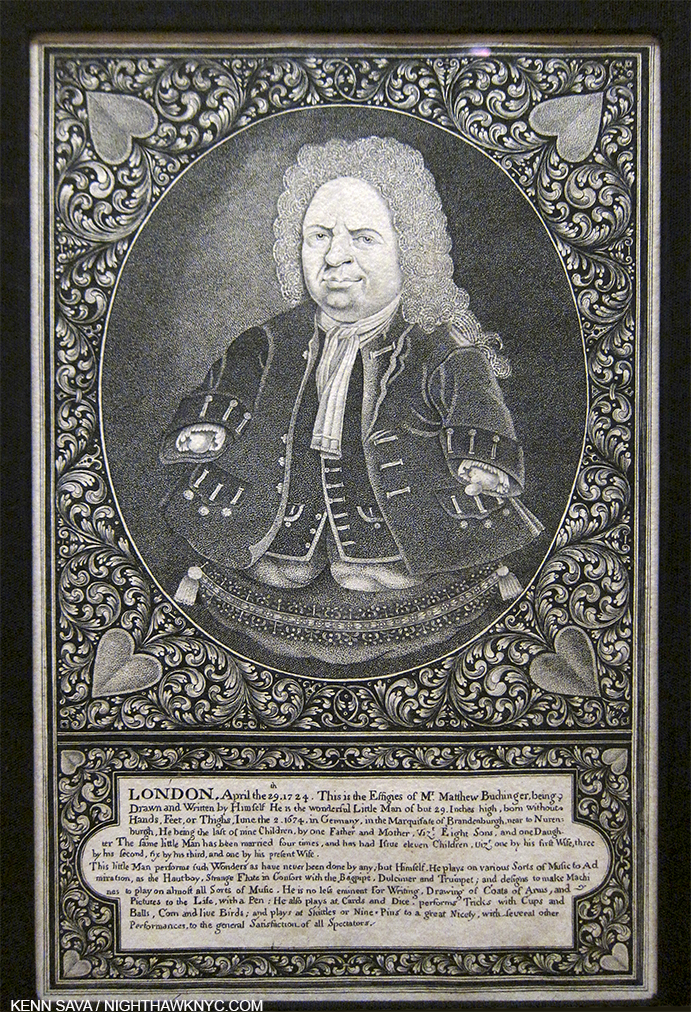
  1. Remember- Charlie Chaplin, Hitchcock, Fellini, Orson Welles, Akira Kurosawa, Ingmar Bergman or Stanley Kubrick, among others, never won an Oscar for Best Director! I rest my case.
  2. as is said on the audio tour, #508

13 Years At The Metropolitan Museum – Part Two – The Light

This site is Free & Ad-Free! If you find this piece worthwhile, please donate via PayPal to support it & independent Art writing. You can also support it by buying Art & books! Details at the end. Thank you.

Written & Photographed by Kenn Sava

This is Part Two of my ongoing series, “Thirteen Years At The Metropolitan Museum.” Part One is here.
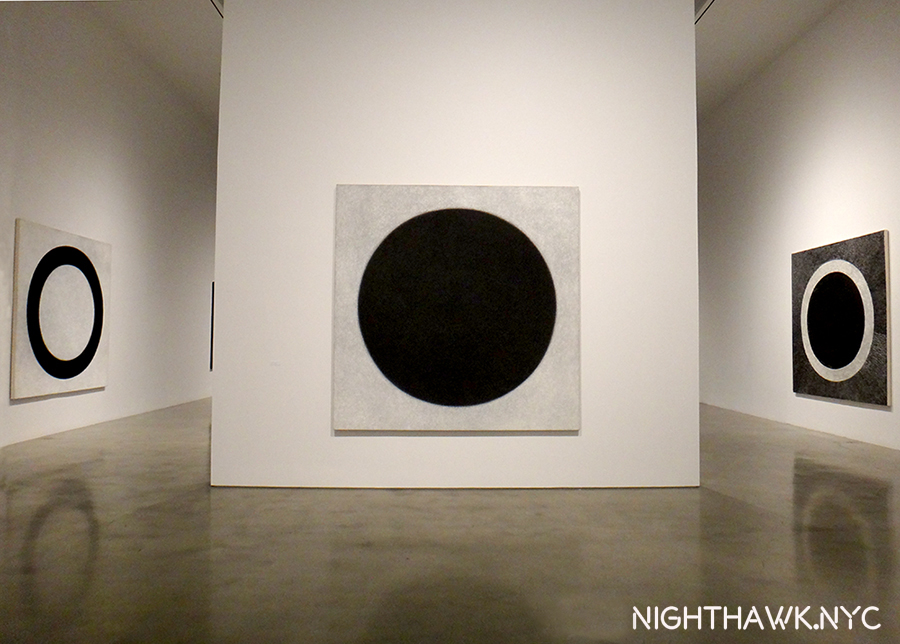
Her Aim Is True. With an arrow to my heart, Saint-Gaudens’ Diana points the way to the undiscovered land.
It happens more than I’d like.

I stop into the bookshop every time I go to The Met (TM), either on my way in, or out. As these 13 years have gone on, unfortunately, it’s become one of the few decent art book stores left. They have a good stock of current and new art books and, of course, a very good supply of Met Museum Publications. Nothing old or out of print, still, I always find something of interest, either about whatever artist I’m currently fixated on (there’s always at least one), or someone I’m only discovering through a show, or right there on their shelves.

My apartment. Almost. No, it’s The Met’s Bookstore.

Then, it happened.

I picked up this heavy hardcover called Portraits By Ingres. Ingres. Yes. There are a few of his portraits upstairs in the European Paintings Gallery and an amazing one, which has become my very favorite painting in The Museum, in the Robert Lehman Collection Galleries. I start looking through the book. There, on page after page after page are THE most incredible drawings I may have ever seen! What? I’m amazed. Astounded. The line! The delicacy. He knows exactly what to leave out and still, somehow, capture the essence of his subject’s face, like in Chinese or Japanese painting, but more so. He’s using graphite. No washes, no ink, no nothing. The most amazingly beautiful lines I’ve ever seen on paper.

How did I not know about this?

Since the book is old, it’s on sale. How old is it? I look at the publishing data. “Published on the occasion of Portraits by Ingres at the Metropolitan Museum October 5, 1999 through January 2, 2000” (You can actually download it now, direct from TM(!), here, for free.)

UGGGGGHHHHHHHHHHHHH! You mean, this was A SHOW?

AND? I MISSED IT?????

Oh my god… ….. ………….

And, that’s how I discovered THE WORST feeling I ever get when I to go TM. While Portraits By Ingres is the “big one that got away,” unfortunately, it’s happened more than once. And that’s only in the recent past.

Portraits By Ingres NYT 1999P

And? Look what I found recently on the back of an article I saved in the NY Times from 1999. History tugged my sleeve…and now mocks me.

Since then, I live with a terrible fear of missing a great show. Why? When a show is over? It’s gone…forever. It “lives on”, but to a much lesser extent in exhibition catalogs (thank goodness!) and through websites, online videos, maybe an app or two, but that’s it. The catalogs may or may not have all the works that were in the show and almost certainly won’t have them in their original sizes (maybe, one day, e-catalogs will, but the resolution of art e-books today is nowhere near there). Almost never are shows documented with a film or documentary, the way Leonardo: da Vinci: Painter At The Court Of Milan was.

In fact, I only discovered “the show of the Century,” Leonardo da Vinci: Painter @ CoM 3 days before it ended at the National Gallery, London. (It was put together by Luke Tyson, who I wrote about in Part One of this series, who is now working at TM.) I jumped on an over night flight and went straight to the National Gallery, without a ticket for the sold-out show, minutes before doors opened on its very last day. I got in (a story unto itself. The NY Giants won the Super Bowl that same night. Something crazy to watch in London). It’s the first and last time 9 of Leonard’s incomparable 17 (or so) paintings were being shown in one place. And, possibly, the first time ever both version of the “Virgin of the Rocks” were being shown together- in the same room (I had to take a step aside and pinch myself in utter amazement when I walked in to that gallery), and so much more as you can see on the checklist, here, including, astonishingly, a full size copy of The Last Supper done in 1520, shortly after the original had been painted! To think…If I hadn’t happened to accidentally stumble on that documentary at 3am on PBS, I would have missed it!

So, impelled by this fear, I have since designed each visit to TM around their exhibition calendar- I go and see whatever’s closing soonest, if I haven’t seen it already.

This has paid off, for me, in uncountable and undreamt of ways.

I have discovered countless artists I never knew about, who have enriched my life and my knowledge of art history in so many ways I can’t even count including Sanford Gifford (besides being a brilliant underknown member of the Hudson River School, he was also a Met Museum Founder in 1880), Henrick Goltzius (who overcame a fall into a fire that disfigured his drawing hand but turned that to his advantage becoming a graphic artist, perhaps, only equalled in the north by Durer), Thomas Eakins, Alexander McQueen, Christo & Jeanne-Claude (who I got to meet right before The Gates), Philip Guston, Bernini, Louis Comfort Tiffany, Chasseriau, Ellsworth Kelly, Girodet, Sean Kelly, Degas, Thomas Hart Benton, Jean-Baptiste Carpeaux, Cezanne, Antonio Canova, Liu Dan in the revelatory Ink Art in China show, Faberge, William Kentridge, Balthus, Paul Klee, Neo Rauch, among individual artists I “discovered” at Special Exhibitions at TM since 2002! Some I had heard of or knew a little about but I “discovered” them here.

As someone obsessed with Art History who draws a little bit, these artists had/have a huge and ongoing influence on me. I learned so much from all of them. They have helped me refine my focus. Before 1999 I was solely interested in modern and contemporary art. After seeing the Mark Rothko Show at the Whitney in 1998, I started to draw. Then, I realized I needed to go back through the entire history of art and learn from the masters who could draw. That led me to TM. TM led me to “the Light.”

This is not to mention artists I’ve discovered by wandering the galleries, like Ingres, Stuart Davis, Tiepolo, Remington, Caravaggio, Goya, Yves Tanguay and Juan Gris among them.

I’ve seen the light.

Even now, today, September 18, 2015, I returned from TM after spending a large part of last weekend there for the last few days of China, with a fresh revelation- George Caleb Bingham. Bingham. Hmm… I know of him though the one intriguing painting that’s been continually on display in the American Wing. It’s a work you walk by and always draws you closer. You ponder it and are left thinking. “It’s interesting…different…powerful and real. Bingham, huh? I don’t know him.” There’s no other by him work on view to reinforce the feeling that “I really need to look into him.” Well, maybe he was a one hit wonder.

23 year old Bingham’s Self Portrait beckons us in to “discover” his unique light.

It turns out, he was far from it. After seeing his about to close show, Navigating the West featuring his River paintings and drawings, I came away struck by an artist that seems to be something of a missing link. Someone who fills in a gap before Thomas Eakins. He’s a master of the natural pose,while making that pose always seem uniquely American, a powerful draughtsman, with a real gift for setting the stage in his compositions, which often feature beautifully out of focus backgrounds years before cameras showed such things, and in ways I haven’t seen many other artists do this well. Ever since Leonardo artists have put in very realistic backgrounds, often consisting of modern towns or locations regardless of the time period being depicted (which no doubt charmed contemporaries, but always struck me as being weird and bizarrely out of place in the story). Bingham’s rarely depict a recognizable location (according to the catalog), but they add to the air of authenticity that he is trying to present more convincingly than some of his Renaissance predecessors. Interestingly, Bingham was influenced by the Hudson River School after his first trip east, and his early landscapes show their trademarked lush and thickly detailed flora and fauna. As time went on, he paid more and more attention to the focus of his work- his characters. Carefully working and reworking them in masterful preparatory drawings, he was able to simply transfer them to his canvas and then make sure that everything else supported them, or they got left out. He became an editor as much as he was a draughtsman. The Met has prepared a fascinating short analysis of the process Bingham used in creating his masterpiece, “Fur Traders Descending The Missouri,” The Met’s painting that first caught my eye. He was downright ruthless in his editing, down to the smallest detail, creating a work of sublime economy that I wonder if it in turn influenced another masterpiece of American River art, Thomas Eakins’  Max Schmitt In A Single Scull, which happens to call TM its home, too.

His light runs the full range from soft to hard, and is never more masterful than in Fur Traders. The foreground water, in particular. Then there is a pair of masterful, yet entirely different, self portraits, one, early, of the artist in his 20’s, the other done 2 years before his passing. They speak volumes about his growth and the evolution of his technique and style. The early one is a marvel of seamlessly smooth skin coloring and belies a style of its own. It actually reminds me of early Ingres in this regard. The face just pops from the canvas 180 years later, and I found myself marveling at how few colors he accomplished this with. Ah, but then a closer look reveals his mastery of economical blending. The overall effect is both brilliant and unforgettable. All we see is his torso. No arms. No hands. Its all in back, except for the collar of his white shirt, and his face. He looks out at us with an expression that says “Yes, I may be young, but I’m already THIS good, and I’m taking no prisoners from here on.” And? he didn’t. The late self portrait was done by an entirely different artist, one who had learned nuance, who’s craft had vastly deepened and who wasn’t afraid of truth or age. Interestingly, he paints himself in the act of drawing. After seeing the many drawings on view, it’s a tribute well earned. His drawings hold every bit of their own even when viewed right next to the paintings they preceded, including his masterpieces, like TM’s own “Fur Traders Descending The Missouri” from about 1845, the work I had seen before in the American Wing-

Bingham’s Fur Traders Descending The Missouri. The work that drew me to his light.

Everything about Bingham’s river paintings (and the drawings/studies that led to their creation) says “American,” in exactly the same way as Mark Twain’s writing does. From the attire to the attitude, all done with masterful attention to detail and shadow, THIS is American art for the people. The show is devoid of portraits of the well-to-do, the famous, or the powerful and is, instead, populated by the people who were trying to survive in a new land while helping their new country survive in the process. Is it any wonder that the school children of Missouri took up a state wide collection to help the State buy (and thereby preserve) a collection of Bingham’s masterful, iconic drawings? While being an act they all can be eternally proud of, it shows those kids had better taste in art than some of the dealers in Chelsea do today.

While not a big show, it’s a very deep show, and since its doors are closing for good on Sunday at 5:15pm, I’m going to be scrambling to see it one or two more times before it does.

Afterall? I well know what happens then.

These wonderful work will go back to where they belong, possibly never to be seen together again.

The light will go off in those galleries Sunday night.

But, it will remain “on” inside me for the rest of my life.

The second best thing I’ve gotten out of going to The Met so often for 13 years is Discovery.

Hark! A Met Angel Beckons me to the Light. To not hear her call is my loss.

*-Soundtrack for this post is “The Shape Of Jazz To Come” by Ornette Coleman, 1959. I chose this to honor Ornette, who led us into many new frontiers of music, like TM has with Art, since he recently passed. He was exceedingly nice to me, a complete stranger to him, the one time I had the privilege of meeting him.

NighthawkNYC.com has been entirely self-funded & ad-free for over 8 years, during which 300 full-length pieces have been published! If you’ve found it worthwhile, PLEASE donate to allow me to continue below. Thank you, Kenn.

You can also support it by buying Art, Art & Photography books, and Music from my collection! Art & Books may be found here. Music here and here.

Written & photographed by Kenn Sava for nighthawknyc.com unless otherwise credited. To send comments, thoughts, feedback or propositions click here. Click the white box on the upper right for the archives or to search them. Subscribe to be notified of new Posts below. Your information will be used for no other purpose.