Robert Dunn’s Revolver

Written by Kenn Sava with Photographs by Kenn Sava & Robert Dunn

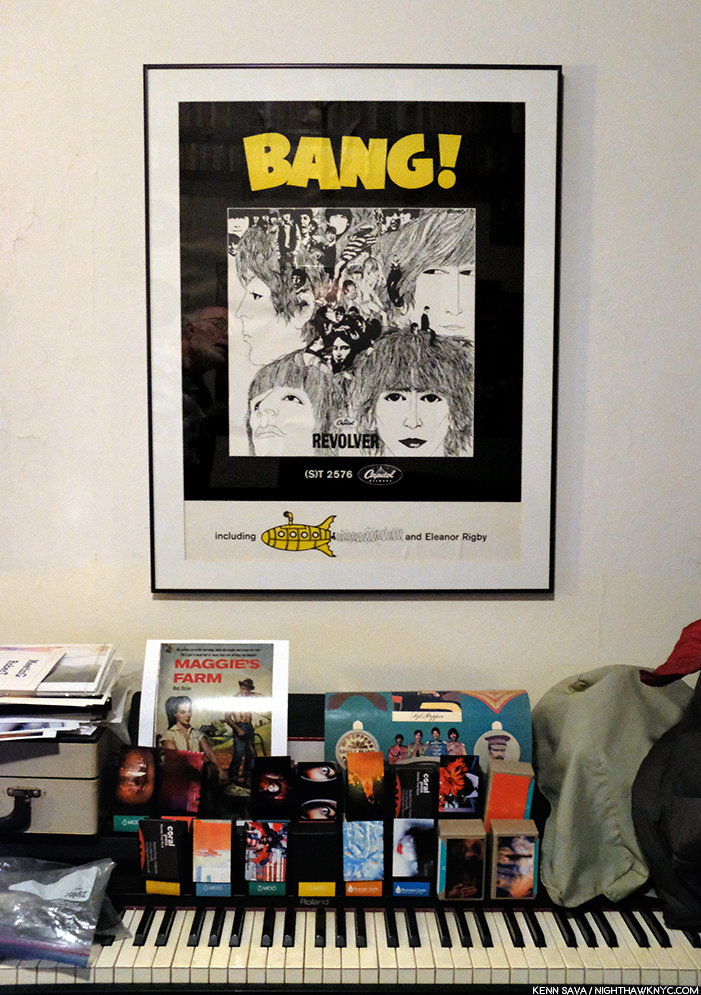
When I visited the Manhattan studio of the multi-dimensional Robert Dunn, I was struck by the large poster of The Beatles 1966 classic, Revolver, on his wall. Every Artist has influences. When I’m researching one, it’s always interesting to find out who their influences are, and what they reveal about that Artist’s work, their roots and development-if anything. I learned that Robert Dunn is an aficionado of Bob Dylan, classic Jazz, Blues, The Stones and The Beatles. Does it mean his work is influenced by them? That’s not for me to say. Still, Revolver is an album that shows off an extraordinarily wide range of The Beatles many sides. Hmmm….I asked him if I could snap a Photo of it.

Luckily, he didn’t ask me “Why?”

Robert’s Revolver poster (a copy of the rare original), hangs over a colorful selection of his business cards for Coral Press that feature his Photographs. Seen in his studio, February, 2019. Click any Photo for full size.

Like a six shooter, himself, Robert Dunn’s talent comes at you from all sides, in many media. In his life, thus far, he’s been or currently is-

-A Musician & Songwriter

-A published Author

-A  copy editor at Sports Illustrated for 3 decades, and a typist at The New Yorker, who published one of his Poems(!)

-A Photographer

-A Publisher of PhotoBooks AND Novels

-A Teacher, currently of 2 courses at The New School

BANG!, indeed. Looking at the homepage for his site, RobertDunn.net, I felt like I was in a Department Store!

*Homepage of RobertDunn.net. Enough creativity for any 6 people, and there’s still room left for whatever he turns his talent to next!

Shot dead by too much talent to pack into one Post, I realized I needed to switch my brain from auto to manual to adjust the focus of this piece. So, I opted to narrow the depth of field for closeups on two of those 6 barrels- Robert Dunn: Photographer & Robert Dunn: PhotoBook Publisher. Before you think I’m letting myself off the hook easy, consider this- over the past year I’ve seen a number of Robert Dunn’s PhotoBooks, all of which are published by his own publishing company, Coral Press. Each contained work in a different style! I had to turn back to the cover to make sure the Artist’s name was Robert Dunn, and I was more and more impressed each time I found it was. The man is so positively bursting with creativity you literally need to keep your mind on a swivel to keep up with it.

Robert Dunn’s Author’s page on Amazon where you can buy his novels, many of which are music-related in some way, echoes of his days in his band, Thin Wild Mercury.

Approaching his long, varied and accomplished career from the present, it wasn’t long after I discovered his Photography that I found out he’s also a published Novelist with no fewer than SEVEN Novels currently available on Amazon! AND, in whatever spare time he doesn’t possibly have, he teaches Writing AND Writing the Photobook at The New School1.

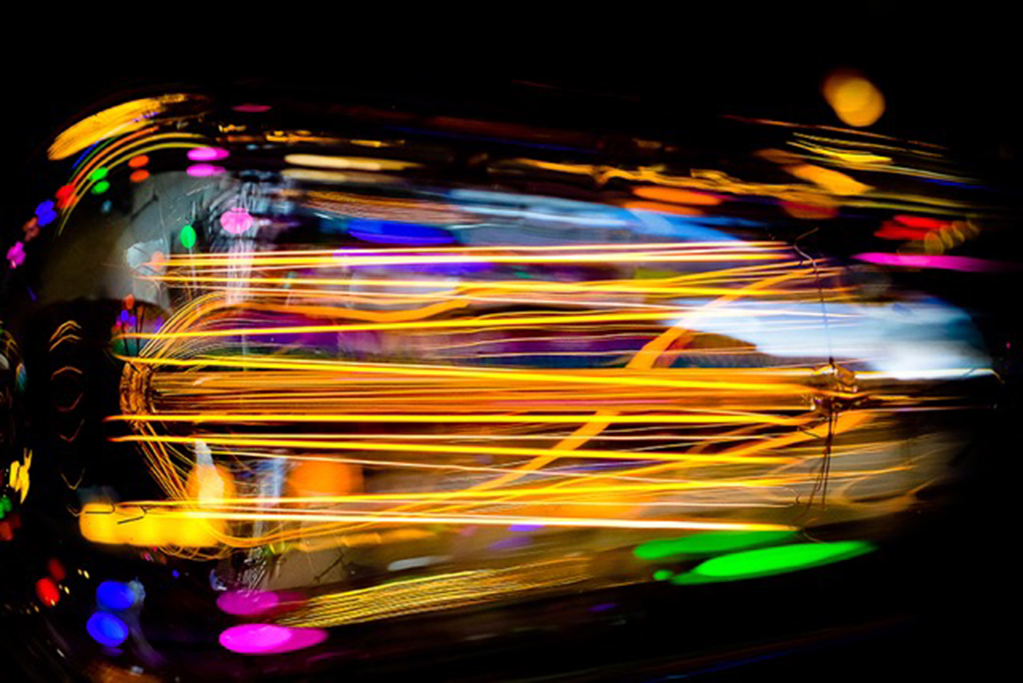
I asked Robert to select a group of Photos for this piece as examples of his work in each of his many styles, thinking that together, they would show his range. Unbeknownst to him until he sees this, I was, also, testing a secret hunch I had, born out of that opening Photo. Shhhh….Don’t tell him this, Ok? Before I asked him for the Photographs I had a feeling that whatever images he sent me would connect with The Beatles’ album Revolver.

(Off stage, background. Chime…chime…incoming email chime…”CANCEL MY EMAIL SUBSCRIPTION! I now KNOW you’re certifiable!”) I didn’t know exactly how. I just had a hunch they would. He sent me the batch of Photos you see below. There was no back and forth. No second guessing. And of course, no discussion about “matching” Photo with Song. The rhyme and reasons are purely my own- The blame lies here. I want to emphasize- At no time has Robert told me Revolver had anything to do with his work!

Why did I come up with this crazy concept?

As my long time readers know, every single one of the 200+ Posts I’ve done here on NHNYC.com over the 3 1/2 years of its existence has had its own soundtrack listed at the end- a piece of Music I’ve selected to accompany it, and that seems to fit that particular Post. Never have I selected more than one piece of Music to be the soundtrack of a Post. Until now. Robert’s multiple sides, and countless styles, call for it.

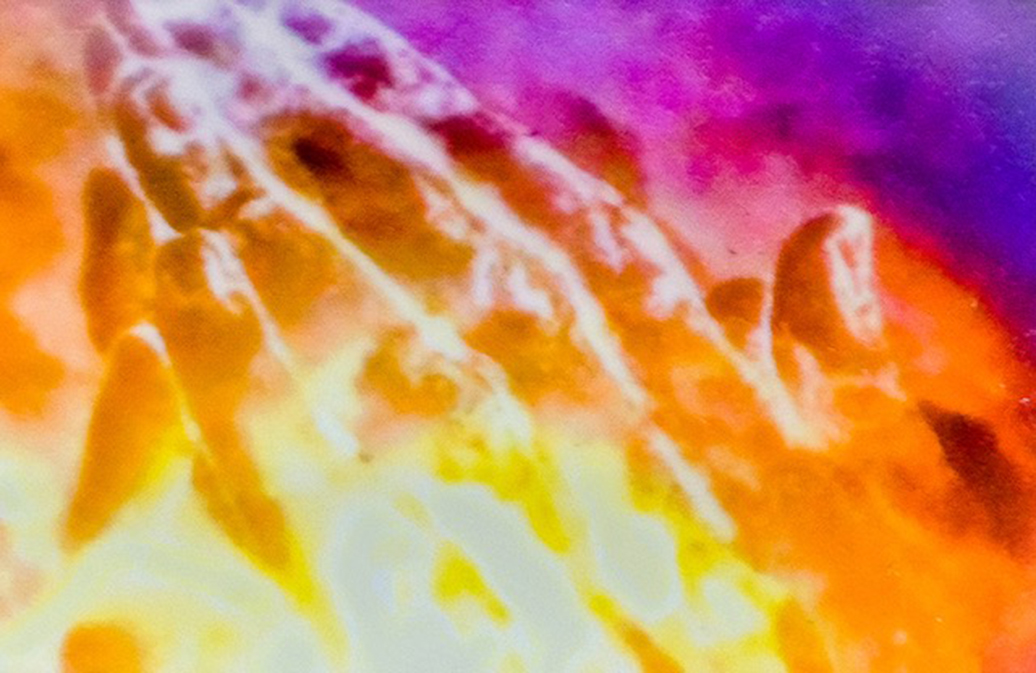
So, here are the Photos Mr. Dunn sent, with a caption listing which of the 34 PhotoBooks the Artist has released to date it appears in, along with a song from Revolver as its soundtrack. I’ve also included a link to the book the Photo appears in on the Coral Press site where you can see more of its contents. Each and every one of his books is well worth exploring. Every one of the 14 songs on The Beatles’ album is here and only appears once. The Beatles video for the track follows each Photo so you can listen to it as you look (all are audio only, except for “Yellow Submarine”). Robert may see this and say “What the heck?” and never speak to me again. I hope not, but here goes!

Please take the time to listen to each track while you look at Robert’s Photo it accompanies and see if you find a connection. (Lyrics for each song may be found here.)

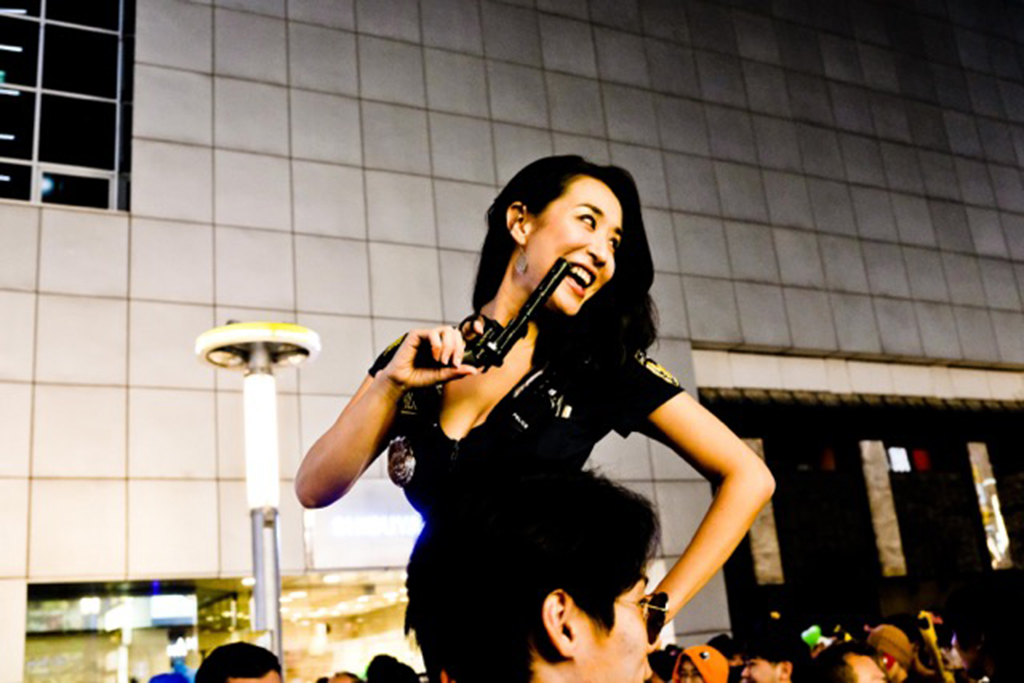
From OWS, Robert Dunn’s very first PhotoBook on the Occupy Wall Street protest. Fittingly, it gets “Taxman,”  the first track on Revolver.

Also from OWS. Its soundtrack is “I’m Only Sleeping”


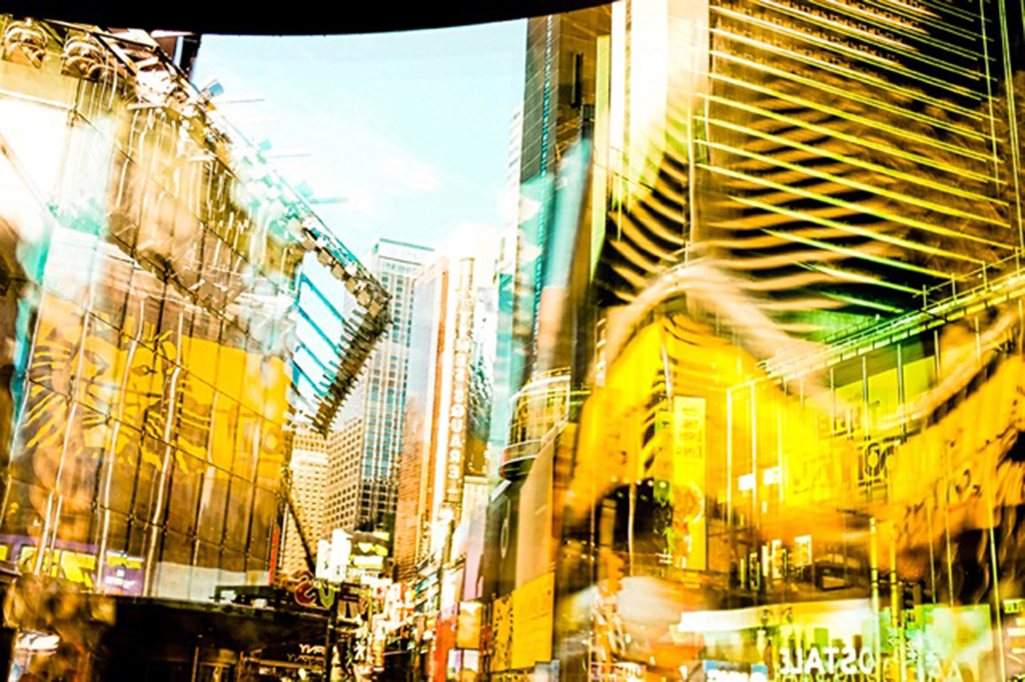
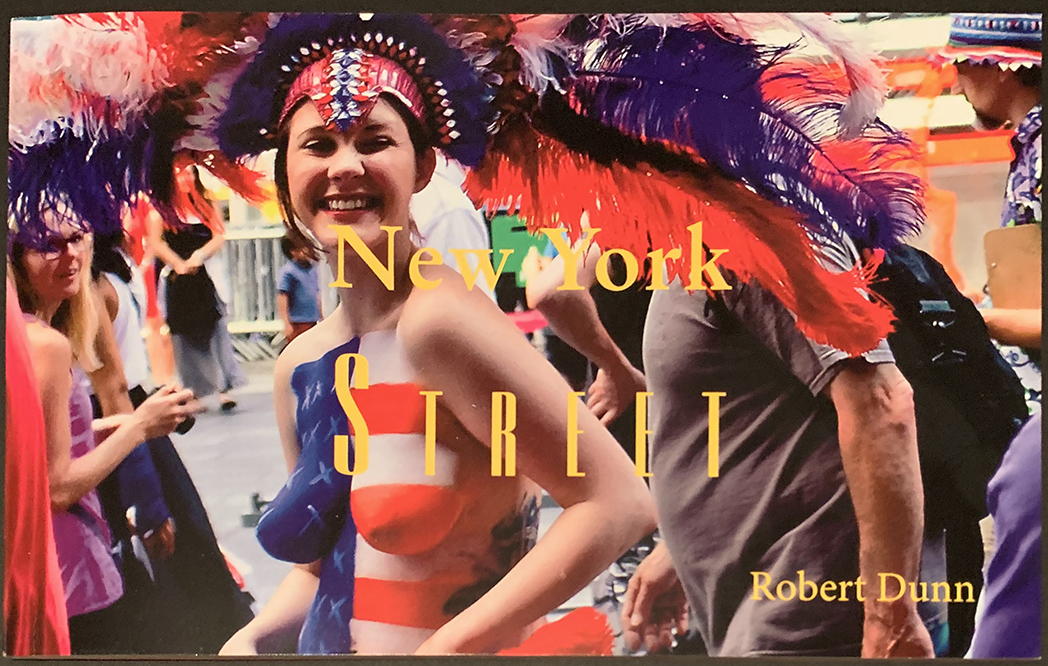
From New York Street. Its soundtrack is “Tomorrow Never Knows”

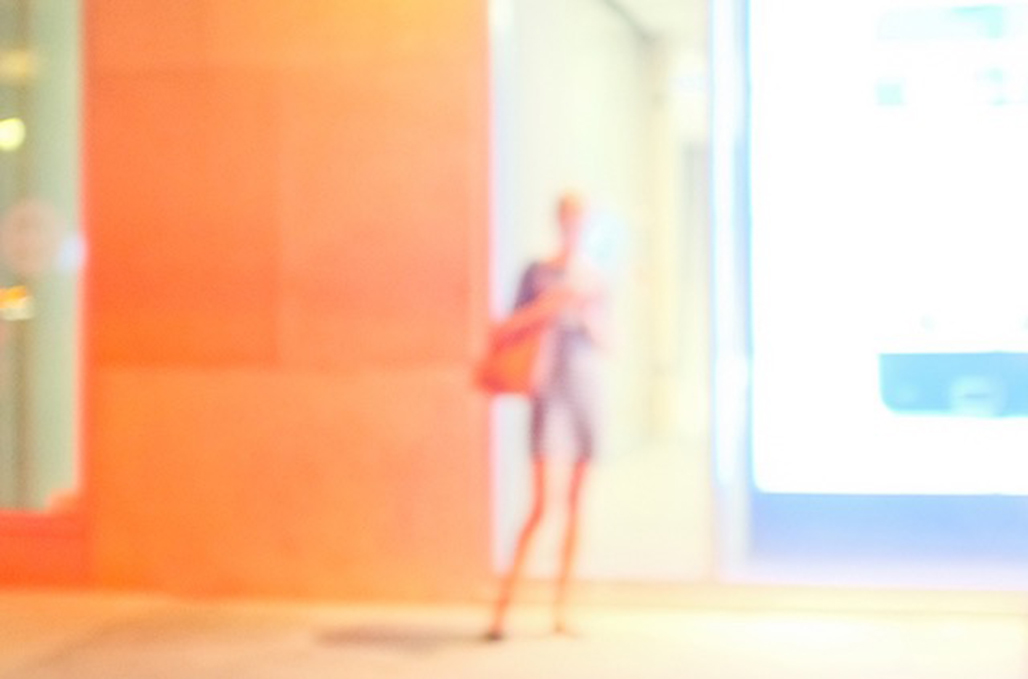
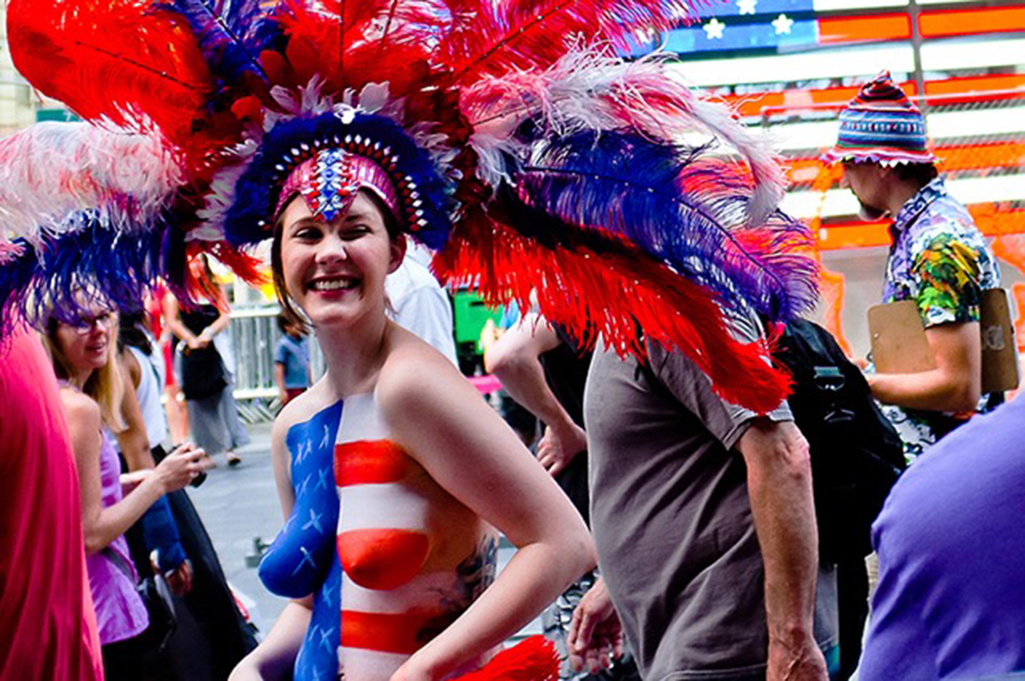
From Shibuya Time. Its soundtrack is “Love You To”

From Shibuya Time. Its soundtrack is “She Said She Said”

From Angel Parade 5. Its soundtrack is “For No One”

From New York Street. Its soundtrack is “Yellow Submarine”

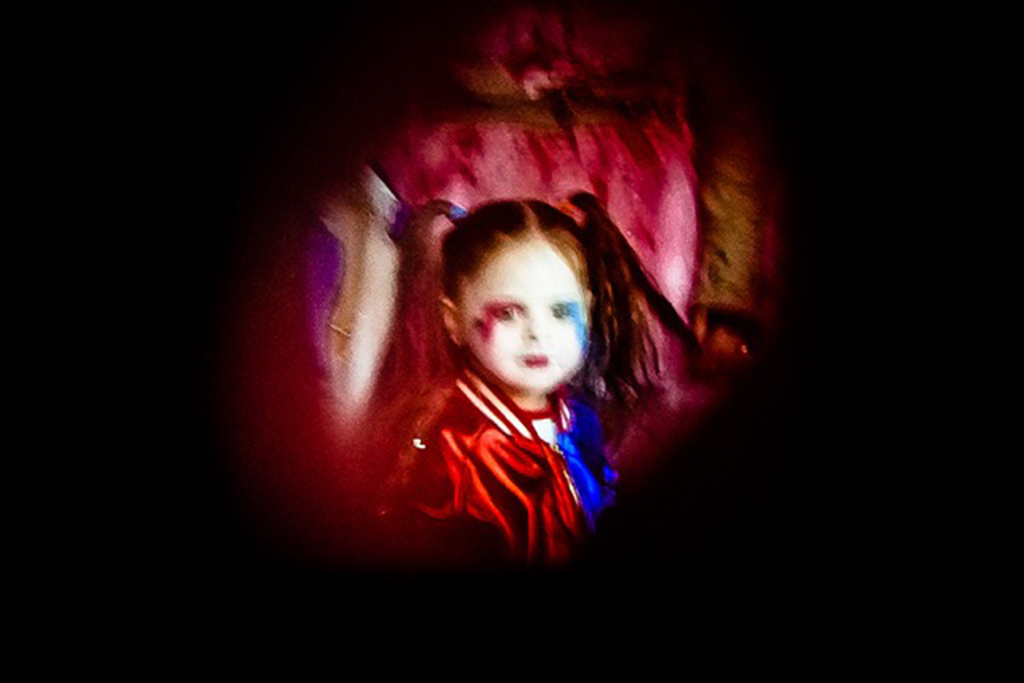
From Carnival of Souls. Its soundtrack is”Good Day Sunshine”

From Star of Light. Its soundtrack is “Got to Get You into My Life.”

From Star of Light. Its soundtrack is”Eleanor Rigby”

From All That Is Solid Melts Into Air. (To be published) Its soundtrack is “Dr. Robert”

From New York Street. Its soundtrack is “And Your Bird Can Sing”

From Electrick Spirits. Its soundtrack is “I Want to Tell You”

From Electrick Spirits. Its soundtrack is “Here, There and Everywhere”

Ok…ok…So? Why did I REALLY do this- match up Revolver with these Robert Dunn Photographs? When I look at Robert Dunn’s work and the range of styles he has created in thus far, I see an Artist who’s constantly exploring and reinventing himself, like The Beatles did (as you can hear in a micocosm on Revolver)– even if it takes venturing into an entirely new medium or Artform for him to do so! I find that exciting and, personally, inspiring. And? There aren’t a heck of a lot of other popular Musicians who have as many styles as Bob does- except The Beatles.

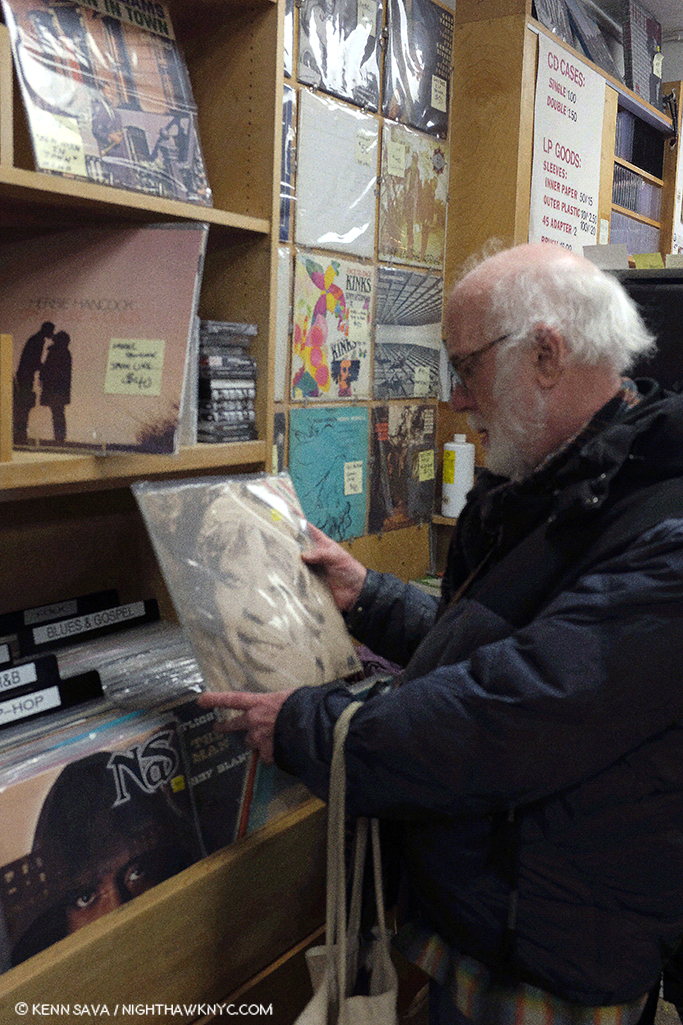
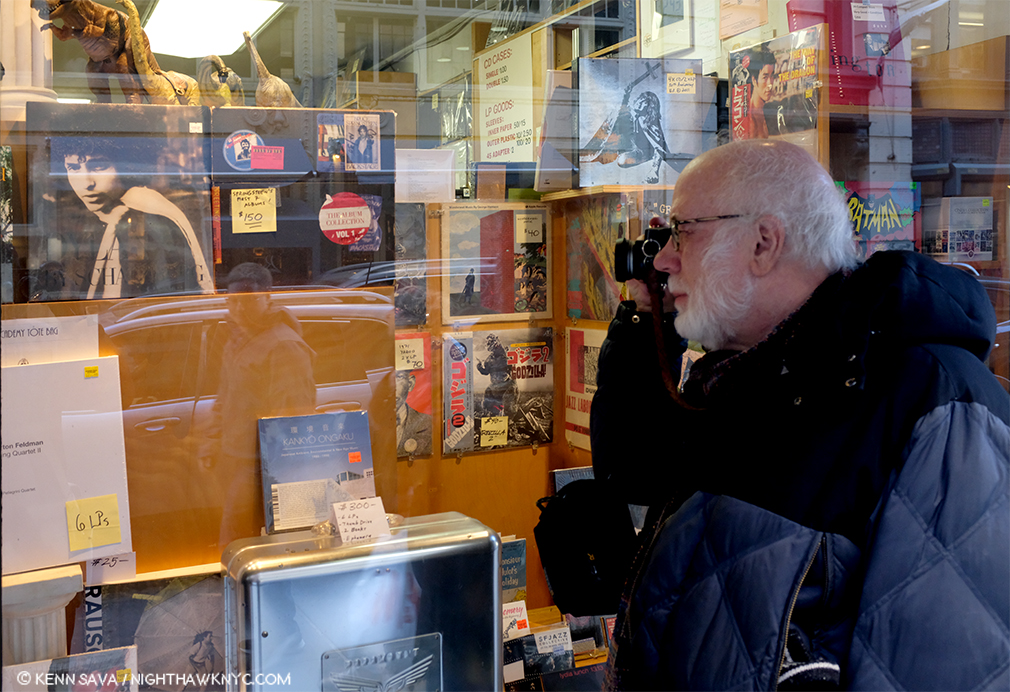
Robert Dunn, ALSO, a serious vinyl collector, considers a classic Blues Lp at NYC’s legendary Academy Records, February 16, 2019.

When I lived in Miami, the old cliche was, “If you don’t like the weather, wait 20 minutes. It’ll change.” Robert Dunn’s work only seems to change that often. But, somehow, no matter how much it changes, the “Sunshine” of his creativity always shines through, making it a “Good Day…”

The Photography of Robert Dunn may be explored in full at ecstaticlightphoto.com.

I’ve had my say, so now, it’s only fair to give the Artist a chance. I’m pleased to say that Robert was kind enough to answer some questions for me. These appear in the piece, Tomorrow Never Knows: Q&A With Robert Dunn, below this one. 

My thanks to Robert Dunn, and to Jackson Charles for the introduction.


BookMarks-

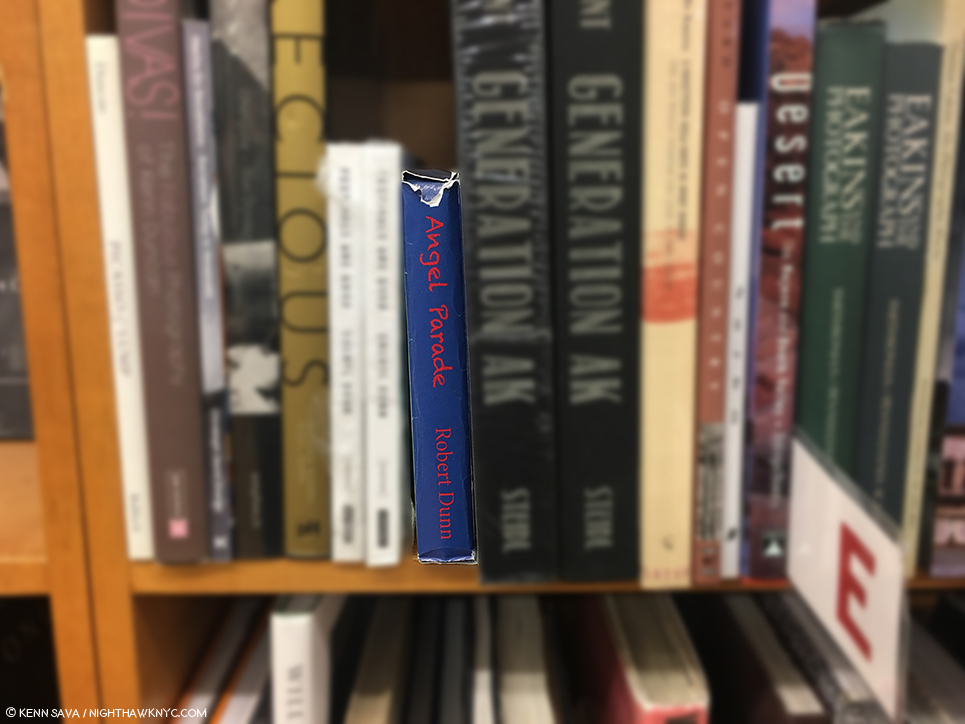
A used box set of Robert’s Angel Parade series for sale at The Strand in 2018. Its prior owner looks to have perused it a fair amount. The next time I looked, it was gone, off to a new home. My experience is they don’t last long in stores, but you can still buy them online.

Robert Dunn’s PhotoBooks are available as follows-

-By mail order, or in store, at Dashwood Books.

-By mail order, or in store, at Printed Matter.

or

Directly by mail order from Coral Press.

If you have any questions about obtaining them, feel free to write to Coral Press directly, or contact me and I will forward them for you.

NighthawkNYC.com has been entirely self-funded and ad-free for over 6 years, during which over 250 full length pieces have been published. If you’ve found it worthwhile, you can donate to keep it going & ad-free below. Thank you!

Written & photographed by Kenn Sava for nighthawknyc.com unless otherwise credited.
To send comments, thoughts, feedback or propositions click here.
Click the white box on the upper right for the archives or to search them.
For “short takes” and additional pictures, follow @nighthawk_nyc on Instagram.

Subscribe to be notified of new Posts below. Your information will be used for no other purpose.


  1. During the course of working on this piece, Professor Robert asked me why I capitalize Art, Music, and Photographer. I’ve been expecting this question every day since July, 2015, but he is the first person to ask! The short answer is, as I’ve mentioned in passing previously, that Art is my Religion. Many people create “art.” A select few create “Art.” For me, the work of someone like Michelangelo, and the other Artists I’ve written about here, deserves the respect of capitalization. Frankly? I don’t understand why it is not the norm. He then asked why I write photobook as PhotoBook, etc. The answer is- They’re part of my eccentric style, (like NoteWorthy or BookMarks). For me, a “photobook” like Robert Frank’s The Americans, also, deserves to be referred to differently than a book of photos (i.e. a “photobook”) of snapshots. I’ll get into this more in a future Post. But since among his many talents and extensive accomplishments, Mr. Dunn has 30 years experience as a Copy Editor at Sports Illustrated, I thought I’d better give the short answer now! We both agreed that consistency is key. I’ve been doing it this way since Day 1 of NHNYC.

Tomorrow Never Knows: A Q&A With Robert Dunn

Written & Photographed by Kenn Sava (*unless otherwise credited)

Poor Tomorrow. It has no idea what Robert Dunn will bring to it. Given his versatility and endless inventiveness, all bets are off.

That’s the feeling I get from looking at his Photography. My Post, Robert Dunn’s Revolver, is an overview of the multi-dimensional Robert Dunn’s Photography and PhotoBook Publishing. In preparing it, Robert was kind enough to, somehow, find some time in his busy life to answer some questions for me, thereby giving readers a chance to hear directly from this talented man, who generally “speaks” only through his work, unless you’re among the lucky few who take his classes at The New School on Writing, or “Writing the Photobook.” So, without further adieu, before tomorrow gets here, Robert Dunn-

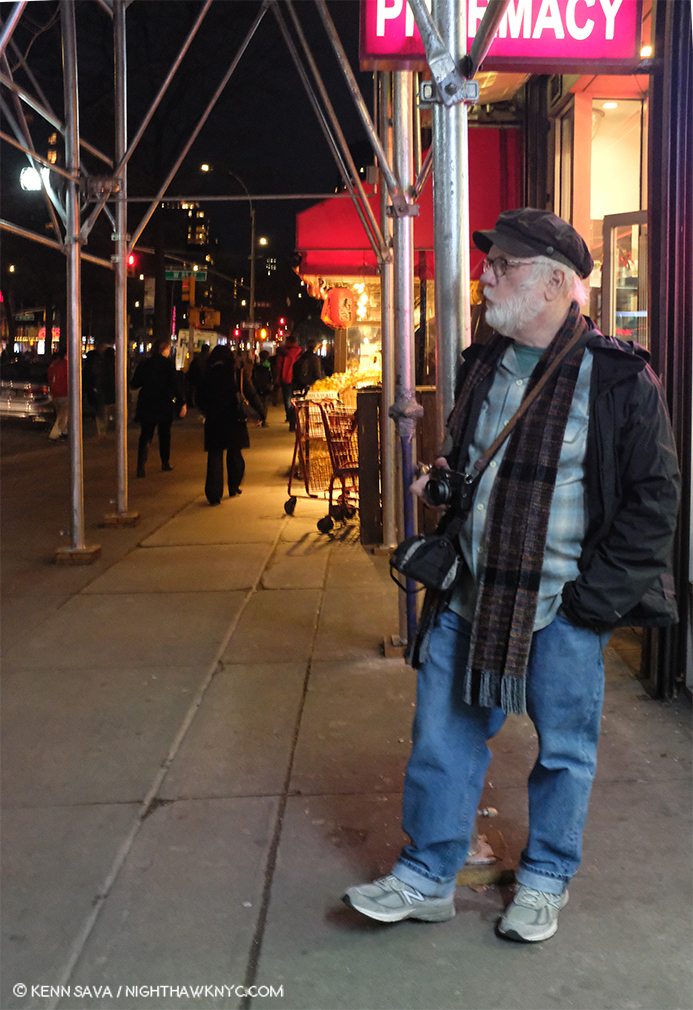
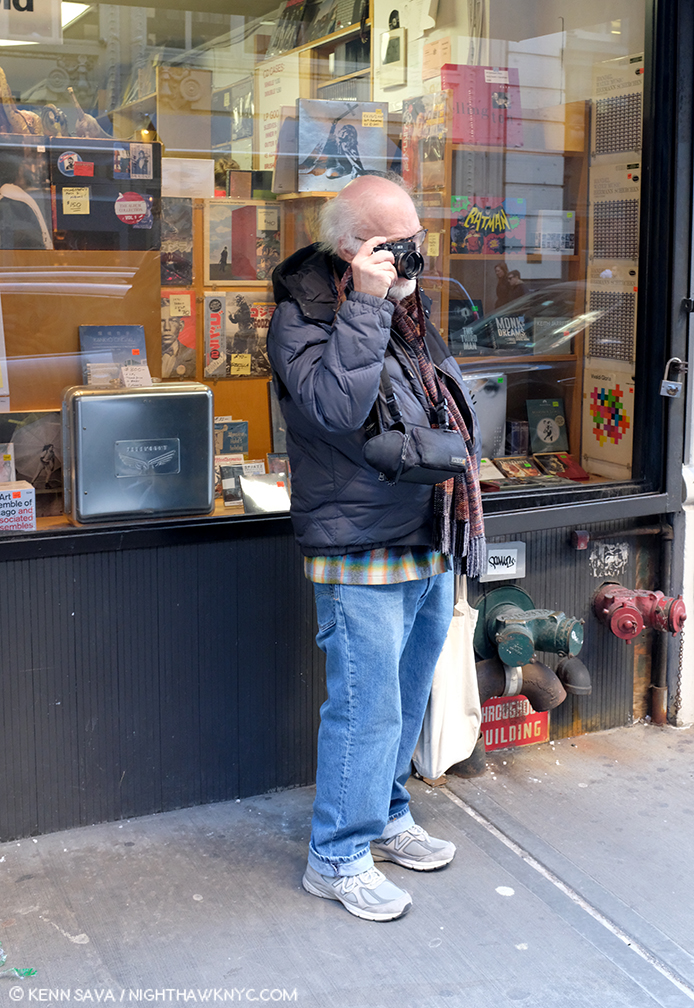
Robert Dunn on Broadway on the Upper West Side, surveys the scene, camera at the ready, February, 2019.

Kenn Sava (KS)- Bob, You’ve had successful careers as a Musician, Writer and a Teacher. Why did you turn to Photography? Was there a moment, event or influence that triggered its beginning?

Robert Dunn (RD)- Kenn, first off, thanks for letting me talk about my work for your impressive site.

Here’s my artistic, well, arc, I guess. When I was 13, I first heard Bob Dylan, immediately wanted to be him, learned guitar, wrote pretty good songs, and quickly found out I couldn’t sing at all. Turned out my strengths then were with the lyrics, so I got into literature, immediately wanted to be James Joyce, and wrote fiction and some poetry. (Surprisingly, my first publication was a poem in The New Yorker.) For the last few decades all I’ve written are novels.

Back in the ’80s, though, I got really interested in photography—especially color photography, inspired by William Eggleston. I pursued it pretty seriously, up to the point at which to make a good-sized high-end print, I’d either do that or pay the rent in my East Village apartment. So photography fell by the wayside. (One good thing about writing, all you needed to buy then was paper; today, not even that.)

I did purchase a few photobooks back then, and when I got back into studying and collecting photobooks, I was pleased to see the books I’d bought and cherished were Frank’s “Americans,” Eggleston’s “Guide,” Susan Meiselas’s  “Nicaragua,” and Bill Burke’s “I Want to Take Picture.”

But for what I do now, my interest was specifically renewed by a review of the then-new Fuji X100 camera I read in the Times. I immediately said to myself, I used to love taking pictures, and this camera sounds perfect. So after a little this and that, I was able to get one. (They were like new iPhones at first, sold out everywhere.) I went out that weekend to try it out and startled myself with what I was shooting.

Basically, the camera seemed to have a kind of mind of its own, and was taking pictures that captured light and color in a way I could hardly believe—and that I loved.

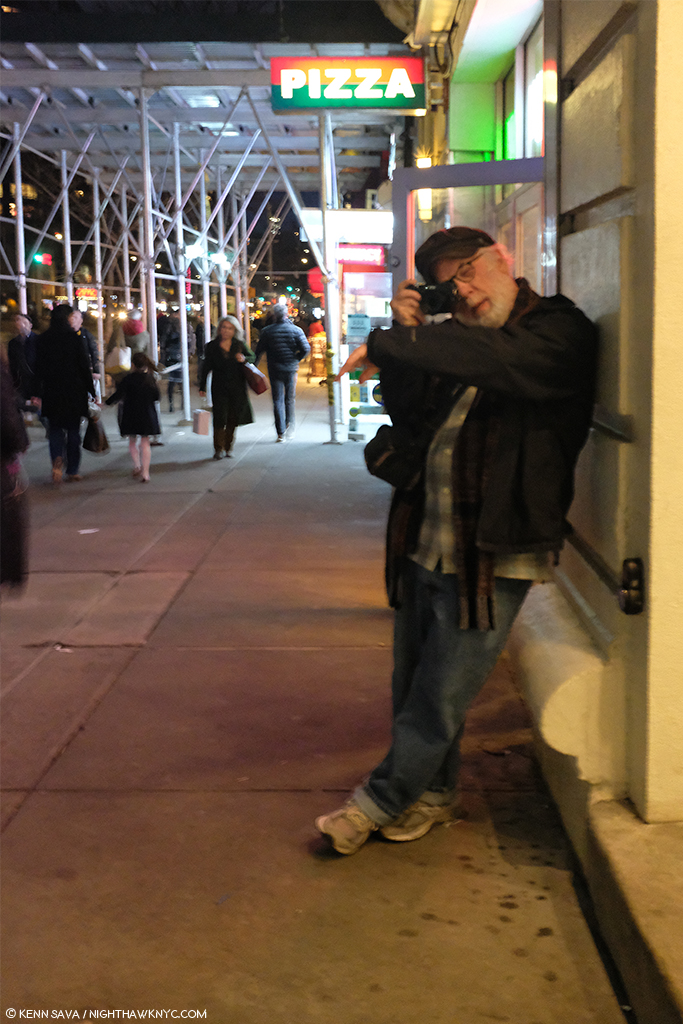
Coincidentally, I use the Fuji X100F, too, so I was particularly interested in how Mr. Dunn uses his. I’m not sure I was expecting to see this, however.

 So, yes, that’s where it all really started, with that first Fuji camera.    

KS- What’s the connection between your Novels and your Photography, or are they both just outlets for different sides of your creativity?

RD- A very intriguing question. I like to think that if I’m good at photography, it’s because years of writing fiction has taught me a few basic things, perhaps most important how to see as much as possible. I remember a lunch many, many years ago with a Knopf editor, Alice Quinn, who was a mentor back then. (She later was The New Yorker poetry editor.) I told her that day, “I think I’m finally learning how to see not just a person’s front, but behind them, too. See all the way around them.” I think I also meant much deeper inside a character, but in essence my idea was that I was expanding my range and depth of simple sight.

 And that’s what my photography is. Walking around taking in as much of what’s going on as I can, and trying my best to capture what’s most interesting about what’s there. If in the shots I take of people, I can see—and capture—some essence of their personality, their soul, then I think I’ve made a pretty good picture.

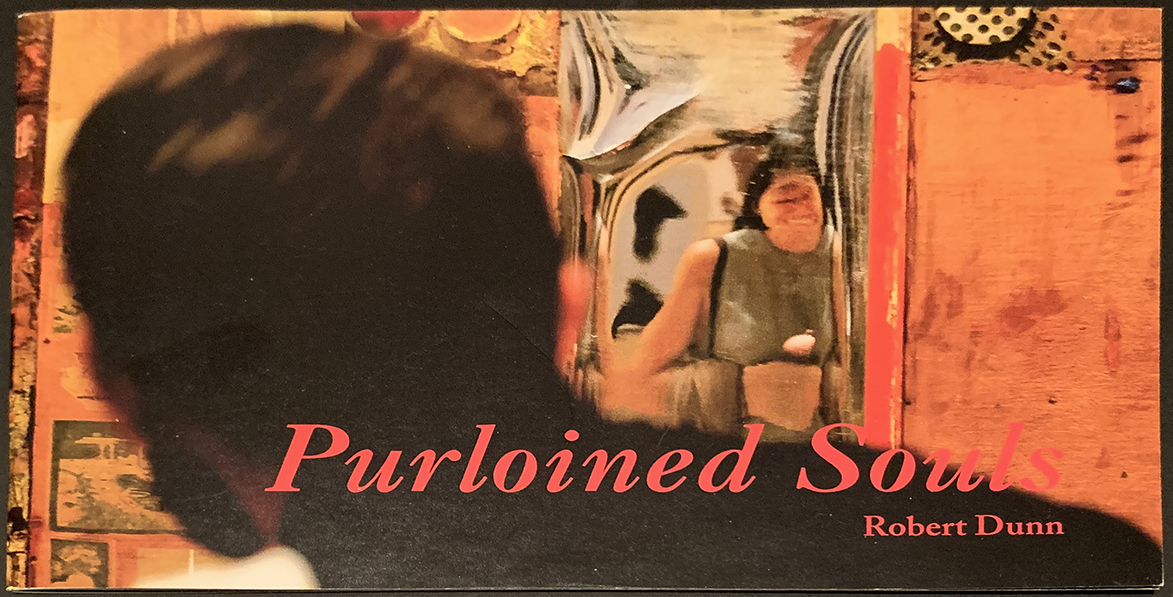
Purloined Souls, by Robert Dunn.

Oh, and one unexpected connection between my fiction writing and my first photobook, OWS—pictures I shot at Occupy Wall Street, back in 2011. I initially went down there to donate a few copies of my hippie-chick novel, Look at Flower, to their free library. The thing is, I went to college at UC Berkeley back in the early ’70s, and the air, the ambience, in Zuccotti Park immediately hit me with whiffs of those riotous years at Cal—a vibe I truly hadn’t experienced since. I got jazzed, and started shooting photos, then going back every week. There were a lot of photographers down there, but I made sure I didn’t shoot in any of the directions they were all shooting; I found my own details, moments, etc. OWS came out in 2012, and went into a second printing quickly. And a photo from it was in an ICP show.

KS- Is there something you particularly love about being a Photographer?

RD- Yes, and it ties in with my answer to the last question. I love almost everything about my photographic work, but at bottom I think I’m most psyched about the place my head goes into when I’m out with my camera on the streets, trying to take in everything around me, every telling gesture, every detail, incongruence, hint of something more than just what appears to be there. It’s a little like my fiction writing, when I get so lost in writing that time has no presence, and the story is all I know.

My photo taking, though, is an especially Zen sort of thing, where I’m out walking around totally in the moment, perceiving the whole world moving around me, always looking for a good shot. All the time I’m telling myself, Hmmnn, is that interesting? Nope. How about that? Nope. Is that worth shooting? Nope. Nope. No … oh, wait, that might be worth a click of the shutter.

All this happens in nanoseconds. Being in the world, yet not of it—trying to capture what most interests me in my camera. Losing myself to that, but also being fully there at the same time.

Robert Dunn is ALWAYS aware of his surroundings and the potential for images in the moment. During the no more than 2 minutes we stood outside Academy Records, he was looking everywhere at once, camera in hand. February, 2019.

KS- You seem to be a model of a D.I.Y. Artist, from creating the work to releasing your Photobooks and overseeing their sales through Coral Press. What’s been the hardest part of that for you?

RD- I love making photobooks; indeed, I have books that almost nobody has seen, just because I have an idea, fulfill it, and turn it into a book. Far and away the hardest part of this for me is getting books out there. Into stores, into people’s hands. Every day, I’m happy—no, I need—to take pictures. Not every day do I feel like walking into some place and trying to get them to sell my work.

 That said, things have worked out pretty well. My self-made books are in numerous museum libraries, including MoMA, ICP, the Brooklyn Museum, and the Tokyo Photographic Museum. They’ve been for sale at PS1 MoMA, Dashwood, the Strand, and the ICP bookstore, among other places (Note- See BookMarks at the end for a list of some).

 Funny story about ICP, and selling your own books in general. I took one of my early Angel Parade series there, and the woman in charge said she’d love to take copies, then said that she thought they should be priced at $18. I said, “You take fifty percent of each sale, right?” She nodded. Then I said, “O.K., each book costs me $12 to print, so if you sell one, I’ll get nine dollars from you. That way, hmnnn, I’m only paying people three dollars to own my books.” She shrugged, and I immediately said, “Good deal—hope you sell a lot!” Hey, it was the International Center of Photography. I meant it.

KS- Along the way, did anyone teach you any of this (Photography, digital technology, printing & publishing), or are you entirely self-taught?

RD- Well, nobody taught me anything, as in my taking a class to learn the stuff you ask about. I have been taking over and over, and really enjoying, a Master Printing course at ICP with Ben Gest; but even for that, when the requirement was great facility with Photoshop, I basically didn’t have very much, so I faked it till I got it.

But I never took a How to Photograph–type course. I wanted to learn by doing it myself, studying photographers who move me, and trusting my own intuitive artistic understanding more than anything anyone could tell me.

Same with writing. I never studied writing, though I was a Lit major in college. But I also was fortunate enough to be around some impressive writers back when I was getting going. My first-ever real job was at The New Yorker magazine. While I worked there, I was one of the redoubtable film critic Pauline Kael’s assistants, and for the final three years of the great novelist Bernard Malamud’s life, I was his paid assistant. Indeed, after he passed I was given his desk, and to this day I do all my work at it.

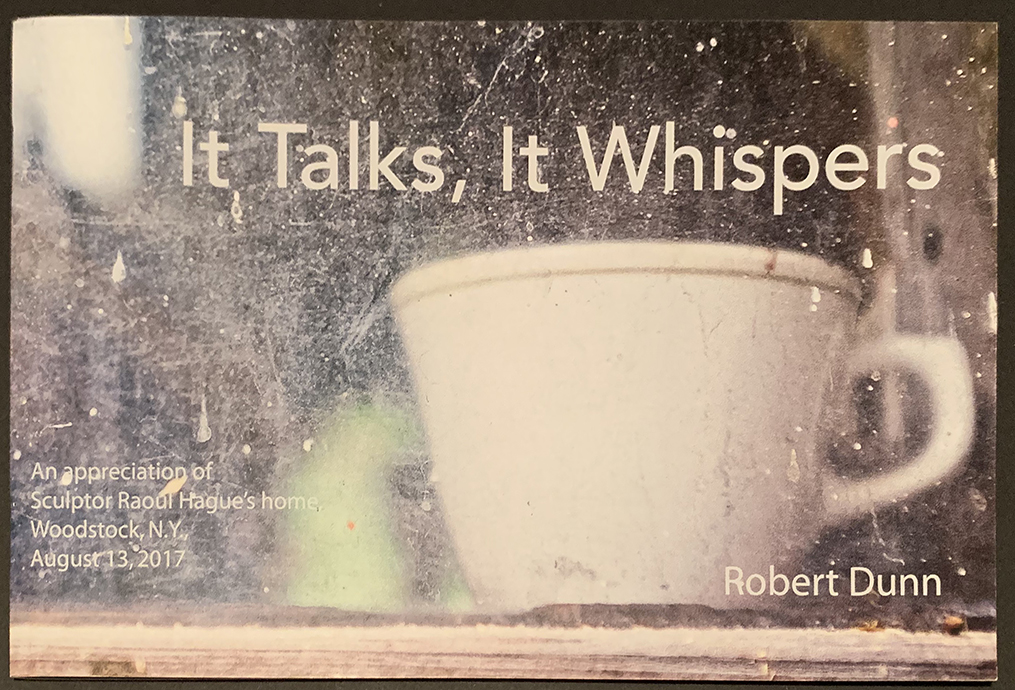
It Talks, It Whispers by Robert Dunn, one of my personal favorites of the books I’ve seen of his yet so far, is in ANOTHER style than those I showed in Revolver.

KS-  How did being a published Novelist help you with your PhotoBooks?

RD- Gave me experience on how books are put together, printed, and distributed. Pretty much the whole thing.

 KS- Your Photobooks (at least the ones I’ve seen) are all in the same size, style and format, which makes them different from those of most others I’ve seen. Why did you choose to make them this way?

RD- I have made books in other sizes. My Angel Parade series (now up to volume 16; I’m planning to get at least to 20) is in a more vertical format, and distinguished in the way that there are two volumes in each book. I was inspired by paperbacks of the 1950s that would put two novels in the same book, with two covers, one upside down on one side. That’s what I do with Angel Parade: volume 1 and volume 2 in the same book, just have to flip it over to read the other one. I liked that because it accentuated the idea of each work being separate, yet together. Each volume tells its own little non-linear or non-literal story.

But the more recent books you mention are the same because I use an online printer to put them out. All I have to do is upload a pdf and the books are mailed quickly back to me. And they look pretty good. As an eminent photobook scholar friend of mine says, “Your books now are kind of like Daido’s Record series—books done quickly, almost like journal entries, to capture what you’re up to and get them out there.”

There’s truth to that, though I also think of each book I do as a standalone work, with its own theme, story, reason for being. I do like the size and format of the books of mine you reference, but I also aspire to do larger, more intricate ones—books that more substantial, less zine-like; perhaps even more an art object than just a “story” in photos. To that end, I’d love to collaborate with somebody with strong bookmaking experience and talent.

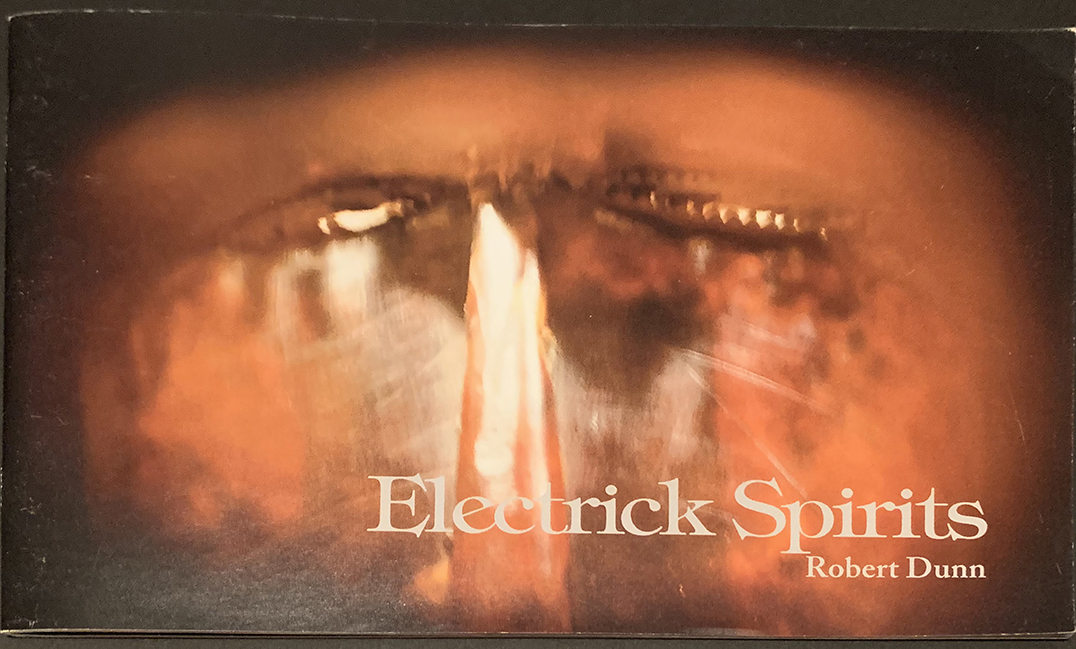
Electrick Spirits by Robert Dunn.

KS- I’ve heard from a number of Artists who are interested in learning how to make a Photobook of their work, and then how to distribute them. Do you have any advice for them? 

RD- Well, first off, you can simply do it. That’s key, not to wait around for anyone or anything to tell you how/what to do. Just make a book. Take the pictures, figure out how to lay it out, find somebody to print it, online or at a press … and there it is. You can even make something yourself with a laser printer or Xerox machine and staples. A young friend of mine, Jason Jaworski, is kind of the master of make your own book at home. He prints pages off a regular printer, folds them, makes a cover out of something lying around and cheap, and puts them out. Indeed, our books used to sit next to each other at the ICP Bookstore. I just looked at one. He was selling it for $10, which meant he was probably paying himself $2 an hour, if that.

But he made books, and they got noticed.

In essence, that’s what each of the students in my New School “Writing the Photobook” class do. They simply make their own book.

KS- You’ve used the Fuji X100F exclusively almost since it was released, right? 

RD- Actually, my first serious digital camera was the Fuji X100—no “F.” That was their first X100 model, the one I mentioned above. I used it for years, eschewing further iterations of the camera, until I read a piece on the X100F that said that model was finally the perfection of what the X100 started. So I decided to upgrade.

 But what I love about both X100s I own is foremost that the camera lets you see what the actual photo will look like through the viewfinder. There’s a little switch on the front that flips you from looking through glass in the viewfinder to actually seeing in it what the lens sees.

West 18th Street, NYC, February, 2019.

The latter is all-important in my photography. Easily seeing what the lens sees allows me to see the photo itself, with all its blur, contrast, magic intact. So I use that a lot.

I also like that the camera is pretty small and with a fixed focus. I believe in the maxim that if you want to zoom up on something, just get closer. As you can see from many of my photos, I often get very close.

Further, I like it that I can just throw the camera around, grab shots from my hip, or wherever, without having to look through the viewfinder at all. I do that a lot.

From Demons and Dogs, shortly after Robert got his X100 in 2012.

I’m all about seeing as much as I can on the street, then working to capture it quickly, with full mystery and expressiveness. I’m also about making photobooks in the spirit of: Take lots of photos, all kinds as long as they’re interesting, then sort them out into books later. That’s the novelist in me, I guess. As in the title of my New School class, I want to “write” my photobooks, though personally I never put words into books other than maybe a short preface. By “writing,” I mean giving each book a shape, a logic, a theme, a purpose. That’s what I find in the books I most admire.

KS- To this point, I know that you admire the work of Robert Frank and Daido Moriyama in particular, two Artists who are, it seems, equally celebrated for their Photography and their Photobooks. What is it about each that particularly speaks to you?

RD- My favorite Robert Frank story is told by Garry Winogrand in a Youtube video I watched of Winogrand being interviewed.

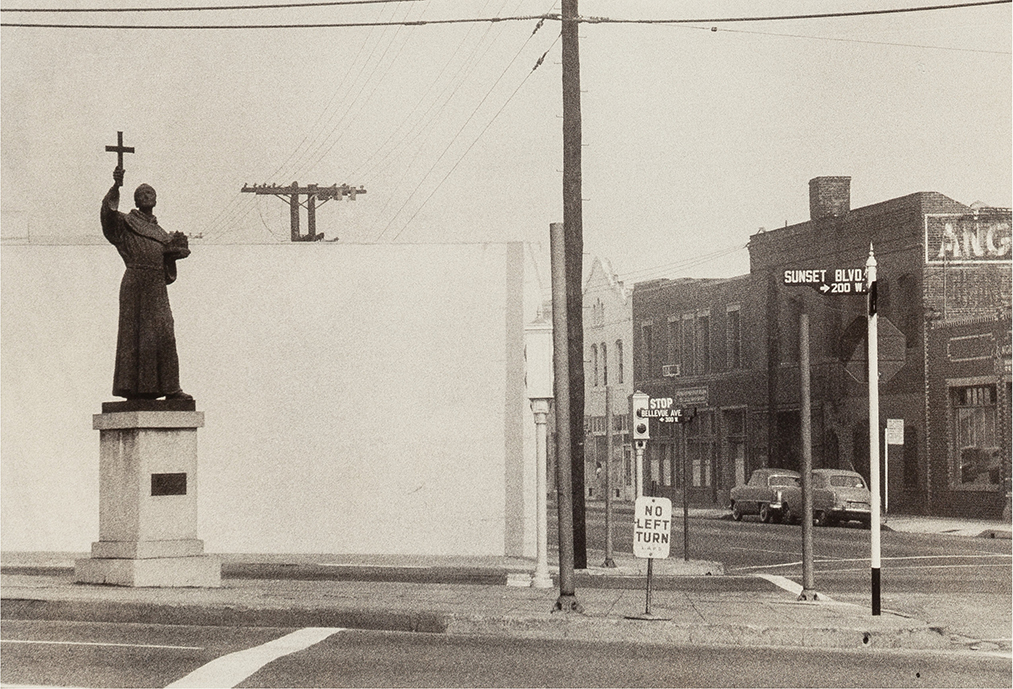
*Garry Winogrand, St.Francis Monument on Sunset Boulevard,1955

He talks about the shot in The Americans of the statue of St. Francis at the foot of Sunset Boulevard in L.A. Winogrand says, “There’s a picture in the Frank book of a statue…. (In 1955, before The Americans came out) I shot that goddamned statue. I made a reasonably good picture of it.

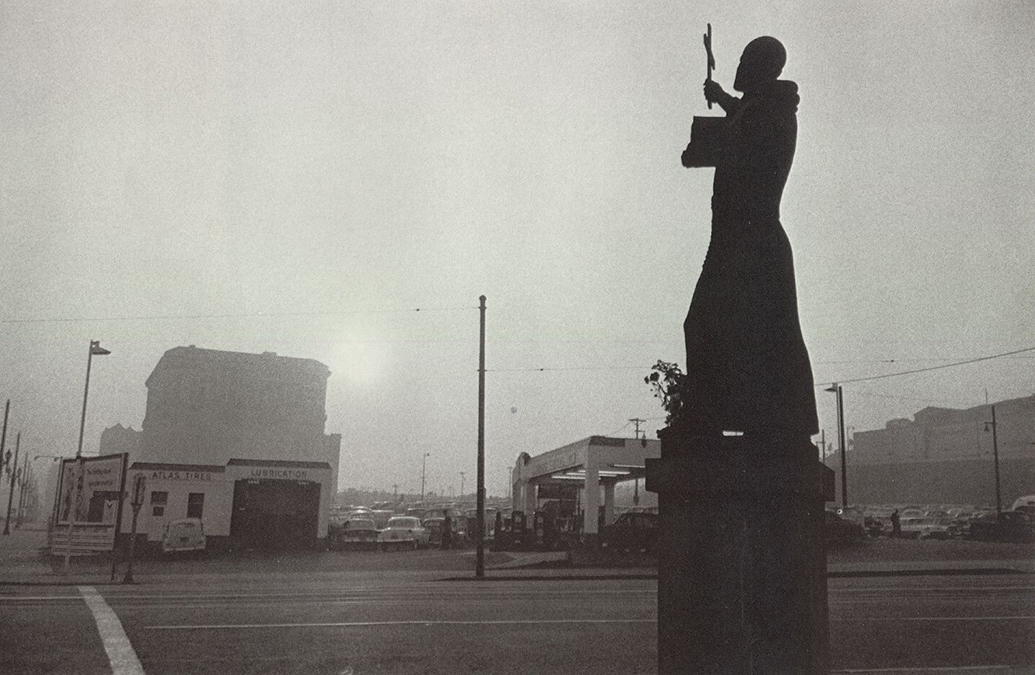
*Robert Frank, St. Francis, Gas Station and City Hall, Los Angeles, 1956

And I saw the Frank book, and it killed it. Put me away six ways, you know…. The picture I made was made. And the picture he made happened. It went whoosh right across the page…. It taught me a hell of a lot. Right off the bat, boom.”

Well, that’s one reason why I like Robert Frank so much: his photos still put me away six ways; they go whoosh across the page; and they teach me a hell of a lot. For some reason, Jimi Hendrix and his “Star-Spangled Banner” is popping into my head, as in, Wait, that’s not how we ever sang it before. That’s a great thing about any art form: one person can blow everything wide open, put us all away six ways … at least six ways.

As for Daido Moriyama, I can still remember the exact moment I found him. I was at the old ICP bookstore, and the clerk, Sarah, becoming a friend and guide, asked me if I knew Daido’s work. I said no, she showed me books of his on the shelves, and I immediately bought one—and kept buying them, till now I have first editions of much of his work.

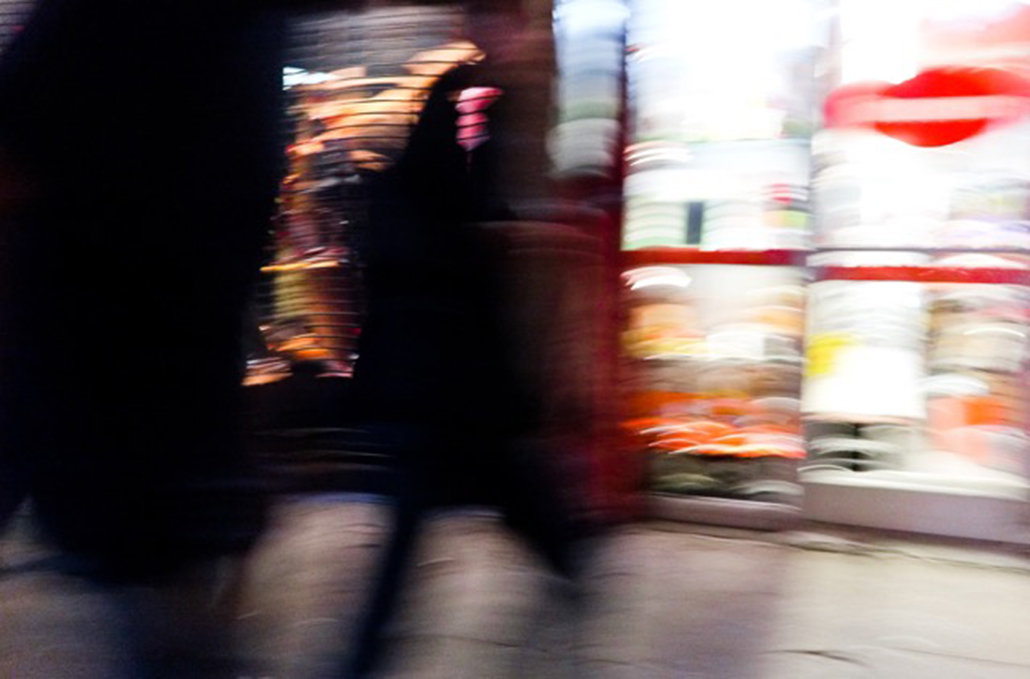
Robert Dunn, From New York Street.

What do I like with Daido? Besides some very strong photos, it’s mostly the freedom to do anything with a photo: have it blurry, scratched, out of focus … everything you’re not supposed to do. Also, that he’s always out on the street prowling for photos, grabbing them everywhere. I have a few photos I’m proud of that are for me just: Look what a strong photo that would make, and, look, I just caught it. One in particular of mine is a photo of a guy in the middle of 125th Street I shot a few years back, in my New York Street book. For some reason he has a long yellow rain slicker over his head and flying back from it, so you can’t see his face. He also has his hands raised high into the air, and in one is a religious tract.

Again, the guy was in the middle of the street. Flash, I saw him, and somehow got my camera around to snap the photo. I like to think my picture, too, wasn’t made. It just happened.

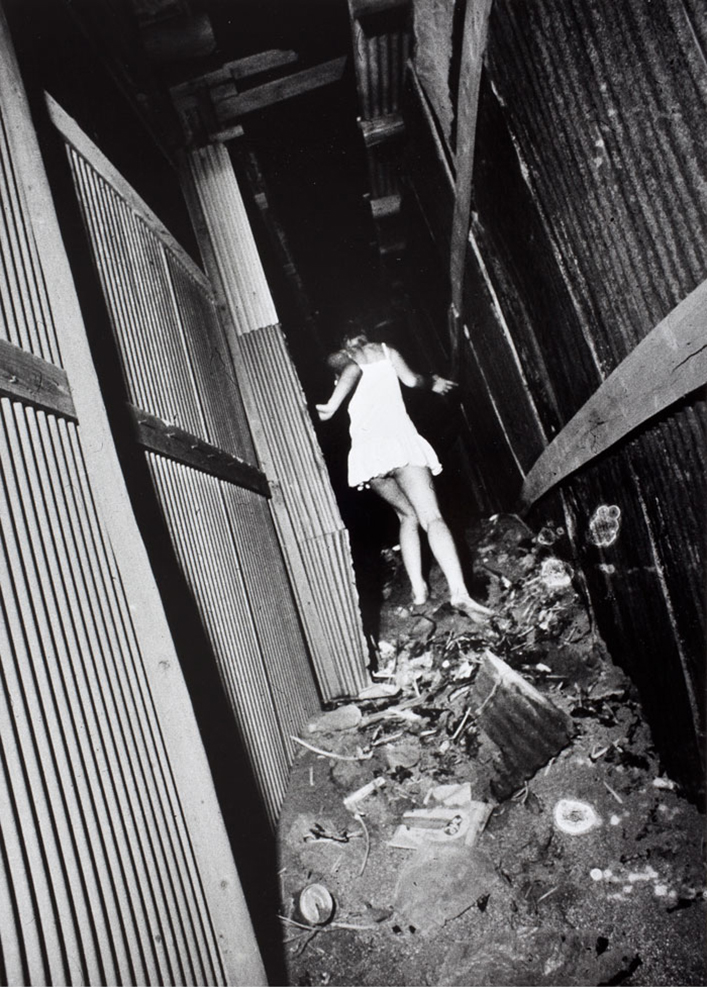
That’s the thing with a lot of Daido’s work, particularly the famous shot of a girl in an alley at night, barefoot in a slip. You know, when you look at any photographer’s work, whoever took the picture was right there. That’s the only way it works. Somebody has a camera, they snap the shutter, they make a picture of what the camera sees. That’s really all it ever is. So it all depends so much on who’s doing the shooting.

*Daido Moriyama, Untitled (Woman in white dress running), 1971

So I imagine Daido seeing the girl, flipping up his camera, and probably (as I would) feeling some pride in having gotten the shot, even though the angle is crooked and the light screwy. Indeed, that’s the lesson of Moriyama: angles, light, focus … it all means nothing unless you’ve snatched a truly interesting photo from the endless stream.

I also like this particular Daido shot because it engenders a huge story: who’s the girl, how did she get there, why is she barefoot in an alley in a slip, where is she going? Same with my guy in the middle of 125th Street. What he hell is he up to? 

KS- Since NHNYC was originally a Painting site, I always ask this: Are there any Painters who’ve influenced you or your Photography, or that particularly speak to you? 

RD- I’m especially interested in the play of color in my photos. Also, flows of energy. And deep mystery and spiritual invocation. So off the top of my head, to those ends I’ve learned things from Vermeer, Rothko, Van Gogh, Rembrandt, El Greco—I’m sure there are many more.

KS- Top 5 favorite albums (if you have favorites)? Or, top 5 albums that have influenced you the most?

RD- Record albums, that is, not my grandmother’s mottled leather photo collections? (Smile.)

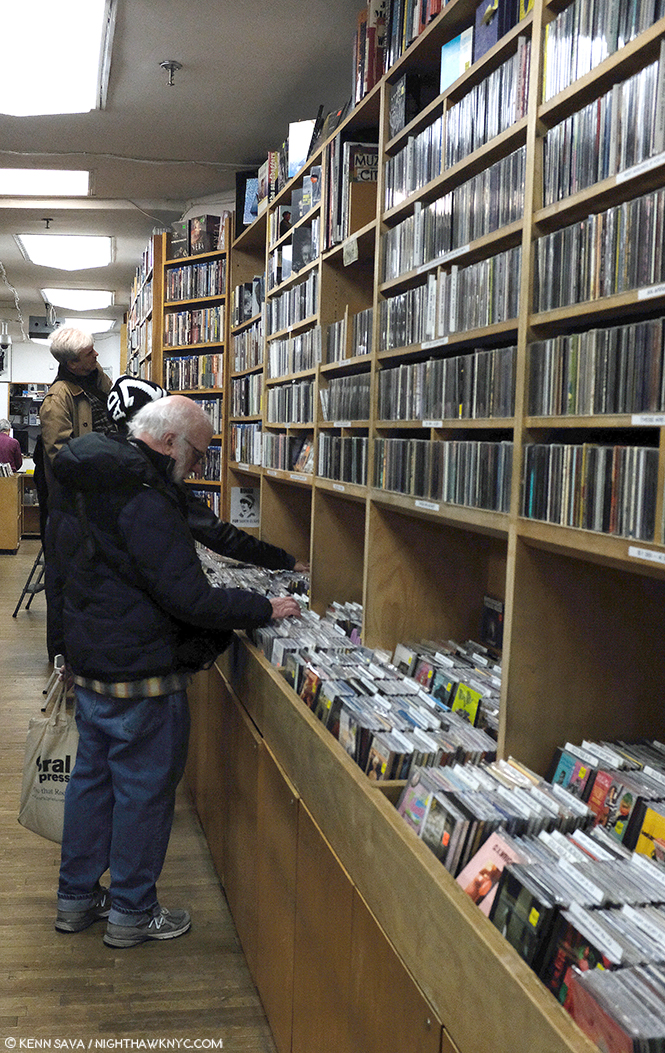
Robert checking out the CD’s at Academy Records, February, 2019

KS- Touche. Yes, Lps, since you have such a carefully curated collection of vinyl.

RD- I’ve been inspired at the deepest level by certain musicians; and in my own deepest understanding of what I’m up to photographically, certain records center me and guide me, though I wouldn’t want to try to articulate just how.

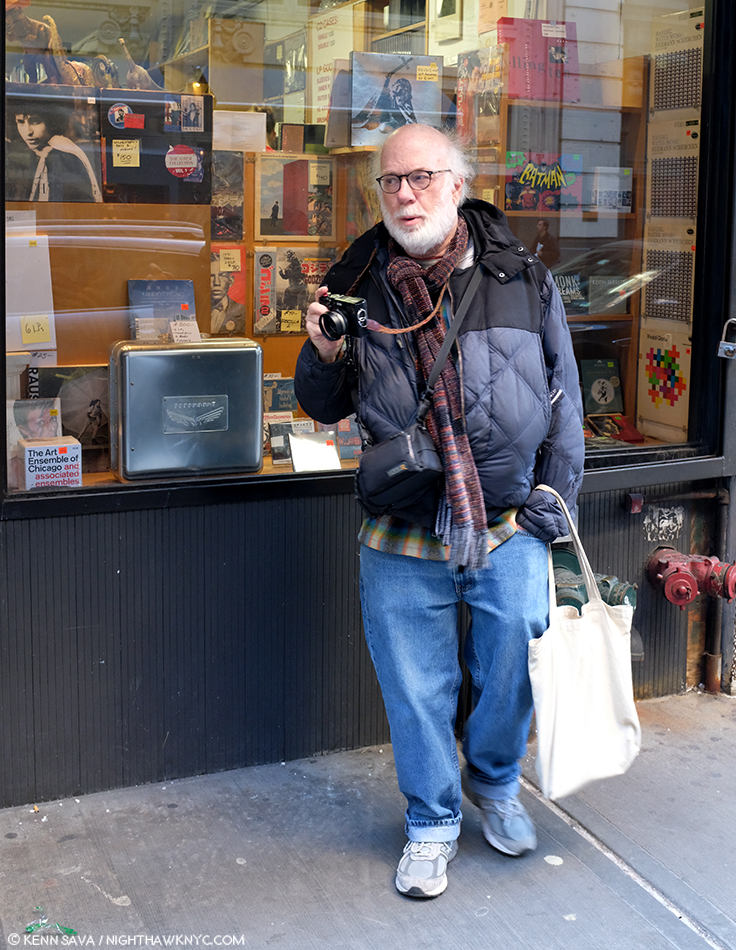
Outside of Academy Records, a PhotoBook of Bob Dylan caught his eye We’ll have to wait until “tomorrow” to see what he made of it.

Top Five of those? Dylan’s Blonde on Blonde and Highway 61 Revisited. The Beatles’ Revolver. John Coltrane’s My Favorite Things. Miles Davis’s Bitches Brew. That’s five, right? Oh, and how about a couple classical LPs: Janos Starker’s Complete Bach Cello Suites, and Glenn Gould’s Bach Goldberg Variations, the 1955 recording.

Again, not necessarily my alltime favorites, but definitely the ones that made me take certain turns with my photography, and that center my work all over again every time I listen to them. It’s all about color, complexity, soul, poetry, and transcendence—in whatever form they take.

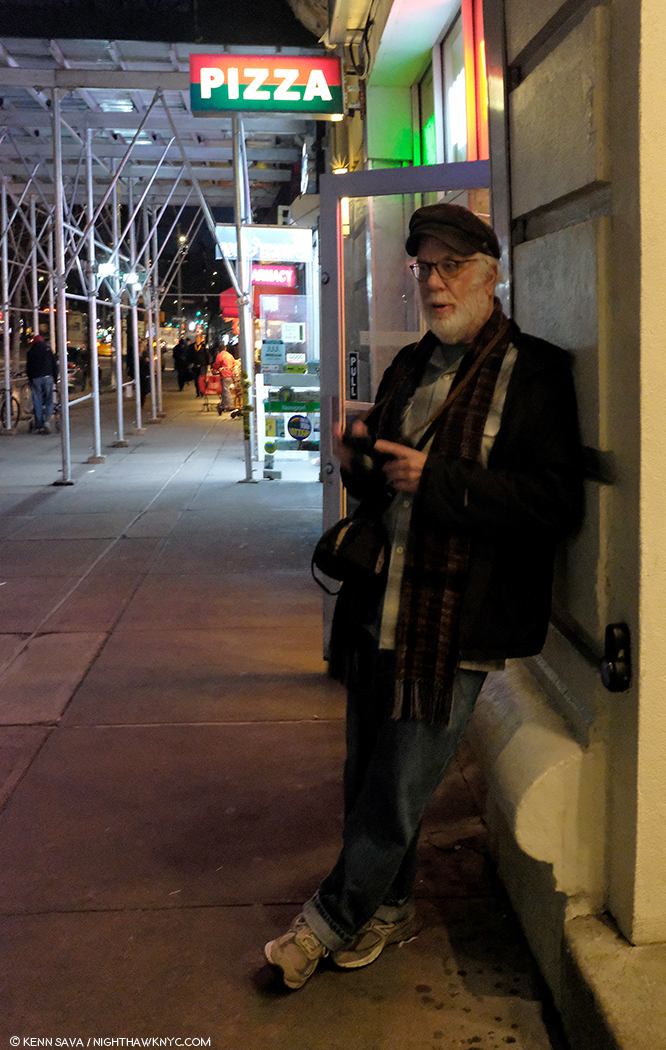
Robert waits to see what tonite brings, getting the jump on tomorrow.

—-End—

Postscript- A few days later, Bob wrote to tell me he’d seen my Stanley Kubrick A Photographer’s Odyssey Post. “Make sure I tell you how my old East Village apartment ended up as a set in one of his movies – for real!,” he said.

Hmmmm…Not able to resist that bait (or anything Kubrick), I immediately asked, “Was that your former apartment in Eyes Wide Shut? Actually, there were at least 2 in that one, but I thought he recreated NYC in London for that. Maybe it’s another Film…?”

He cleared up the mystery- “Good guess – it was Eyes Wide Shut – the East Village prostitute Cruise has the fling with. Long story, but short version is that I was getting thrown out after not actually living there for years. Guy who was there at the time had a photographer pal doing a series of shots of LES apartments, and she had the Kubrick connection. Kubrick flipped over shots of my place, and since I was being cut off the lease, and the landlord was going to gut the place after I was gone, we all met and cut a deal. The Kubrick woman paid a hundred bucks for all the built-in stuff – sink, stove, bathtub – and I got a hundred for my furniture. Then it was all shipped to Shepperton in London – and the film was (finally) finished. So when I see the movie, it’s my sink, my stove, my tub, everything… but the underwear hanging from the ceiling.”

Unfortunately, we’ll never know what Stanley Kubrick would think of Robert Dunn’s Photography. But, at least we know he could spot a fellow classic New Yorker from his furniture.

*- Soundtrack for this Post is “Spanish Key,” by Miles Davis from the legendary landmark album Bitches Brew, 1970. It’s one of my favorites, too, Bob. My recommended “Miles Davis Shortlist” is here.


BookMarks-

New York Street, a personal favorite, by Robert Dunn.

Robert Dunn’s PhotoBooks are available as follows-

-By mail order, or in store, at Dashwood Books.

-By mail order, or in store, at Printed Matter.

or

Directly by mail order from Coral Press.

If you have any questions about obtaining them, feel free to write to Coral Press directly, or contact me and I will forward them for you.

My thanks to Robert Dunn.

NighthawkNYC.com has been entirely self-funded and ad-free for over 6 years, during which over 250 full length pieces have been published. If you’ve found it worthwhile, you can donate to keep it going & ad-free below. Thank you!

Written & photographed by Kenn Sava for nighthawknyc.com unless otherwise credited.
To send comments, thoughts, feedback or propositions click here.
Click the white box on the upper right for the archives or to search them.
For “short takes” and additional pictures, follow @nighthawk_nyc on Instagram.

Subscribe to be notified of new Posts below. Your information will be used for no other purpose.


Stanley Kubrick: A Photographer’s Odyssey

Written & Photographed by Kenn Sava (*unless otherwise credited)

At first, I was surprised to hear that Through a Different Lens: Stanley Kubrick Photographs  was at the Museum of the City of New York, a first rate institution, though one that doesn’t often show up on my schedule of Art or Photography shows. Yes, Stanley Kubrick was born and raised in the Bronx, so as one of  NYC’s great native sons, it makes historical sense. It turns out it made perfect sense artistically as well. The MCNY is home of part of the Look Magazine Archives. Stanley Kubrick sold Photographs to, and later became a staff Photographer for, the popular Look Magazine from April, 1945 until August, 1950.
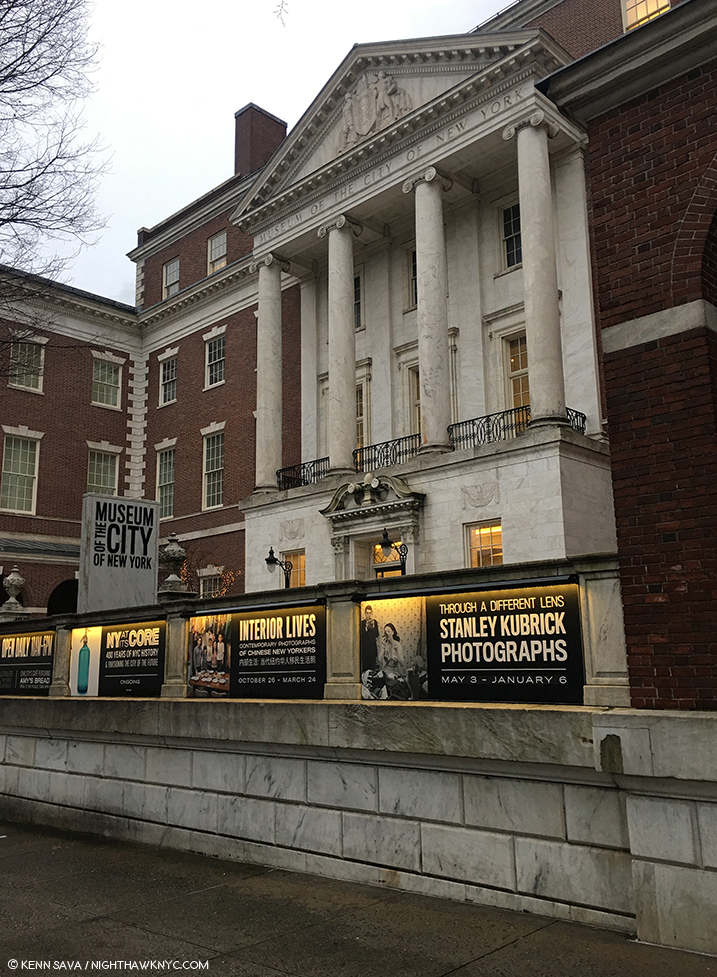
“Open the Pod Bay Doors, Stanley.” Click any Photo for full size.

The majority of Look Magazine’s Photo Archives (5,000,000 Photographs) were donated to the Library of Congress. However, those relating to NYC were donated to the Museum of the City of New York. These include approximately 12,000 contact prints, and negatives Stanley Kubrick created for Look over 129 NYC assignments1, the vast majority of them have never been published.
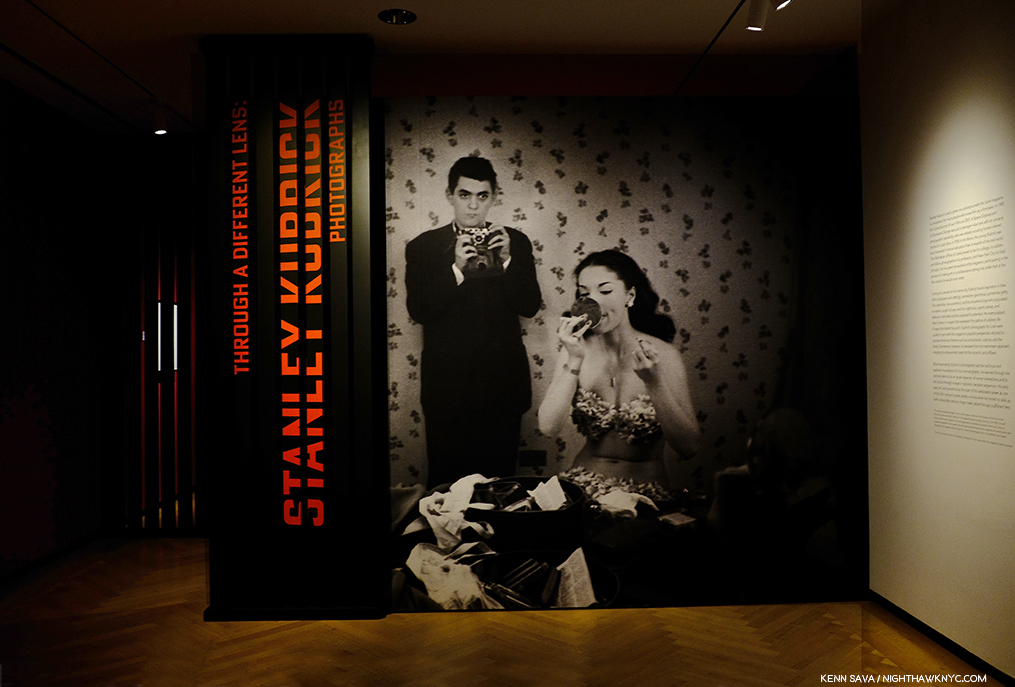
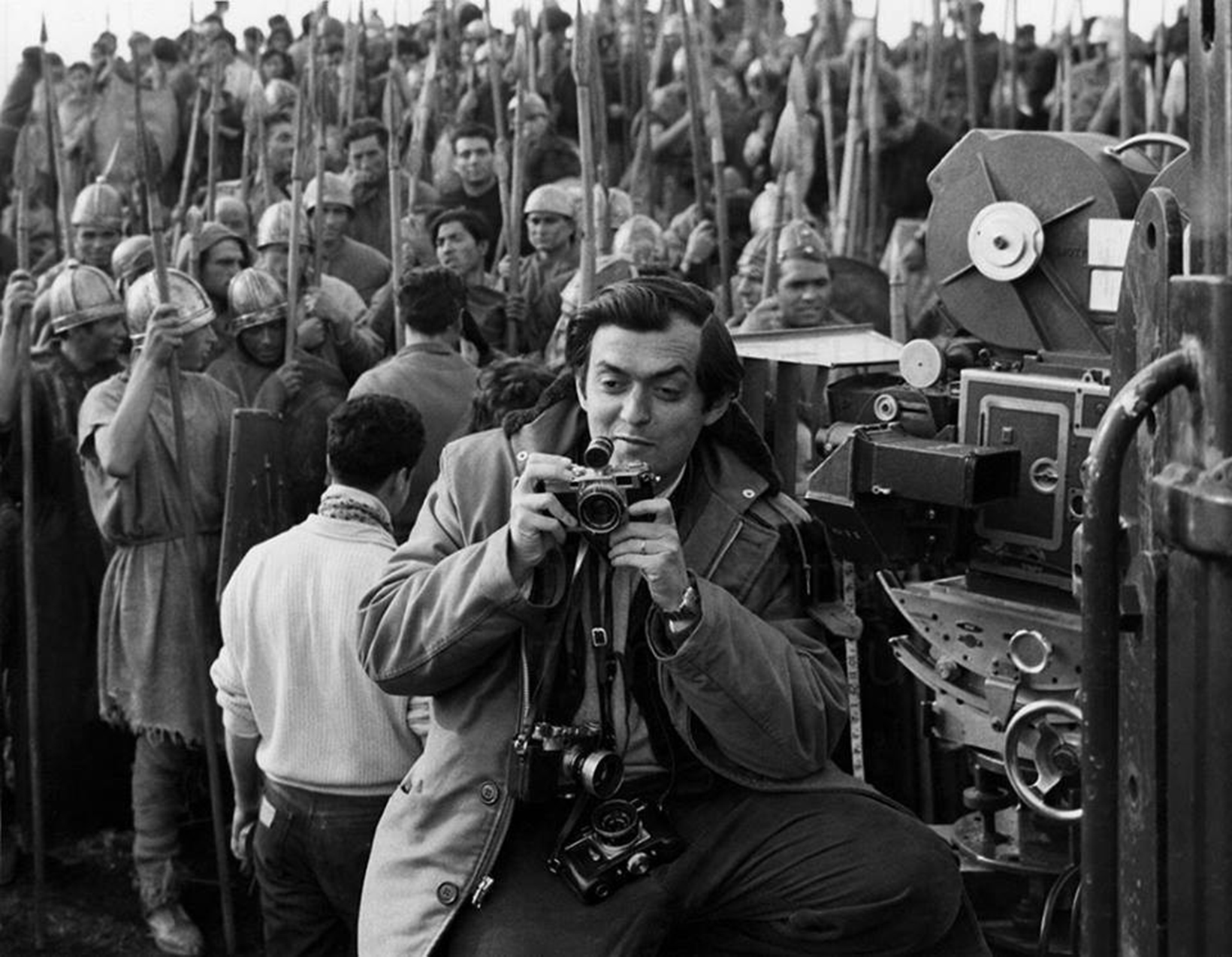
The eyes of a genius. The show’s entrance features this haunting Photograph by Stanley Kubrick in which he shoots himself and the “Showgirl” Rosemary Williams reflected in her large tabletop mirror. The Photo, Stanley Kubrick taking a picture of Rosemary Williams applying lipstick, which is cropped on the sign, is from the unpublished story, “Rosemary Williams- Showgirl,” March, 1949.
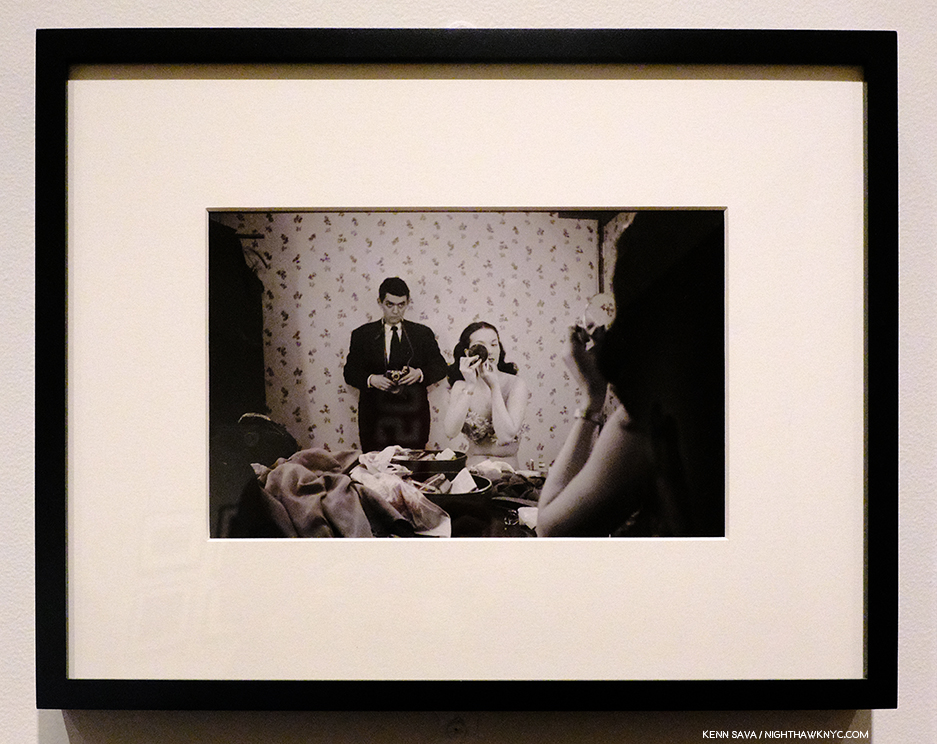
Also from the same story, Rosemary Williams Applies Lipstick, March, 1949, a companion piece to the shot above. Stanley was 19 when he took these. I’ve seen the look he has on his face in these two shots in other pictures of Stanley Kubrick, and each time its caption includes the descriptive “intense concentration.” For a number of reasons, this may be the most remarkable Photograph I’ve seen thus far in this body of his work. I picture him having that look as he took every shot in this show.

Stanley Kubrick remains a magnificent mystery to me, akin to the monolith in his classic 2001: A Space Odyssey. His films (all 13 of them) are high on my list of favorites. I can think of no other Director I revere as highly as Stanley Kubrick, other than Charlie Chaplin2. Yet, it’s still not all that well known that before he became a Director, Stanley Kubrick was a professional Photographer. Remarkably, he was 17 years old when he sold his first Photograph to Look Magazine, then one of the most popular magazines in the country, in 1945. Hmmm…who was the last Photographer I wrote about who achieved recognition that mature Photographers yearn for their whole lives at 17? Stephen Shore was 17 when he sold his first Photo to MoMA.
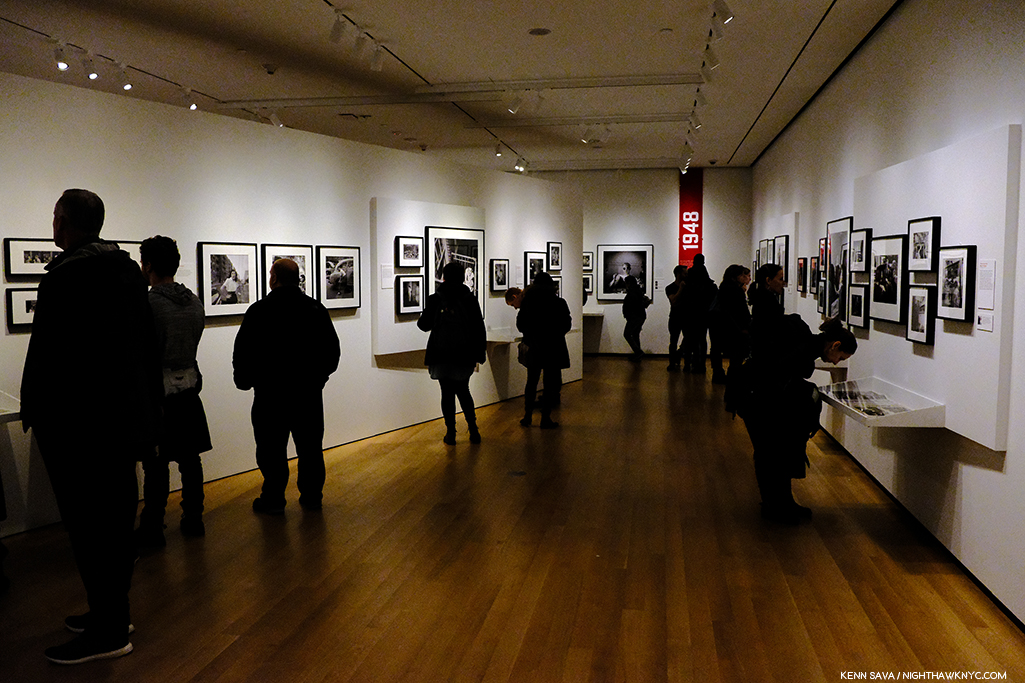
New to this body of his work, I went to see the 130 of his Photographs (though there was no indication, these appeared to be exclusively recent digital prints, not silver gelatin prints) on view in the show to get a sense of SK- the Photographer, but primarily, I went specifically looking for evidence of the later, mature genius Film Director. I found it. It just wasn’t how I was expecting to find it. I’ve seen a number of comments online from people who find these shots “banal,” and terms connoting similar degrees of a tepid response. Perhaps, like some of them, I was hoping to see shots full of brilliant moments filled with that unique mystery and awe every moment of his Films hold, at least for me. Then again, I should have realized that very little about Stanley Kubrick lies where you’d expect to find it.

“Observation is a dying art.” Stanley Kubrick, Stanley Kubrick: Interviews.
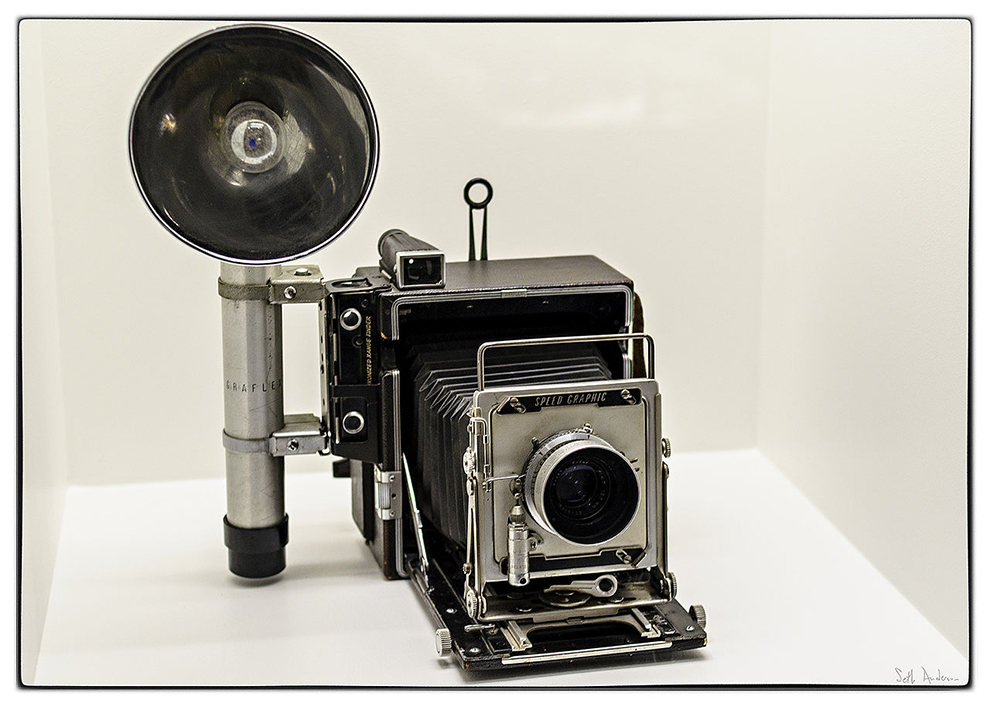
Stanley Kubrick’s Graflex Pacemaker Speed Graphic camera as seen in the Stanley Kubrick show at LACMA in 2013 still looks to be in decent condition after seeing heavy use at least between the years 1941-50. *Photo by Seth Anderson

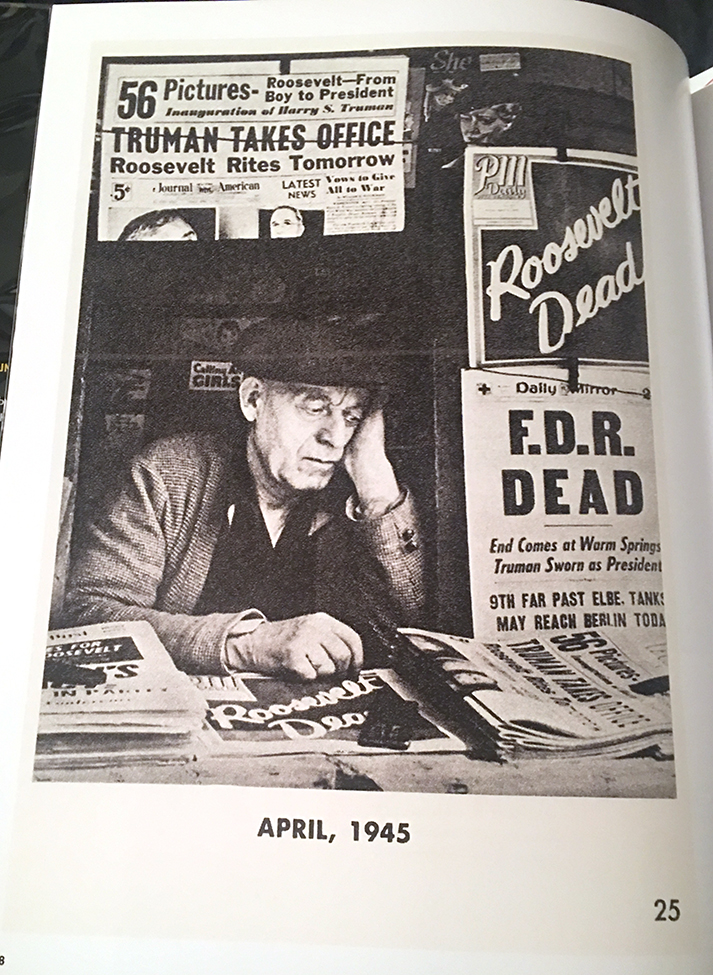
The story begins when Jack Kubrick, a physician and passionate amateur Photographer, gave his son a professional Graflex Pacemaker Speed Graphic camera for his 13th birthday on July 26th, 1941. Stanley’s friend, Marvin Traub, had a darkroom in his house, so after their sojourns around town taking Photos, the two would develop their film there. On or about April 13, 1945, the day after Franklin D. Roosevelt died, Stanley came across this scene at 170th Street & the Grand Concourse, in the Bronx3

17 year old Stanley Kubrick’s FDR Dead, 1945, was the first Photograph he sold to Look Magazine.

Well, sort of. At first he said this shot resulted from “lucky happenstance.” But, he later admitted he “coaxed4” the news seller, surrounded by newspapers declaring President Franklin D. Roosevelt had died, into this pose.

Wait. What?

He went home and developed the film in the darkroom that he had by then installed in his own house and took it into Manhattan to the offices of Look Magazine. There, Helen O’Brian, chief of the Photography Department, saw it and paid him 25 dollars for it.
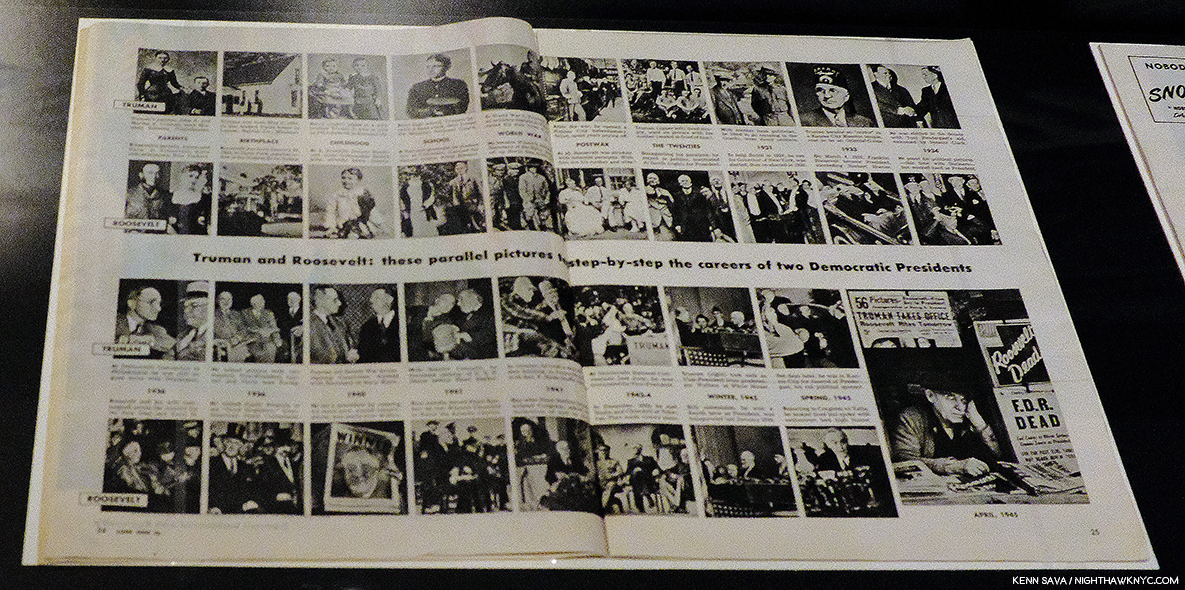
It ran in the spread above in Look’s June 26, 1945 issue, the last of 36 Photos, and the only enlarged image in the group. Stanley Kubrick was still a High School student at William Howard Taft High School in the Bronx. Think about this- In June, 1945, Stanley Kubrick had not even had his Graflex for 4 years. But, there’s more to it. That he “urged the salesman to look more depressed than he was for dramatic effect5” is “directing”- he’s eliciting a performance for a scene.

Therefore, this is the first instance we have of Stanley Kubrick putting his “directing” skill into practice.

It, also, serves to put the viewer on notice that from here on out his Photographs may not be entirely as they seem. As my research continued (and continues), I found more and more Photographs that curators and researchers say were posed or staged. Not all of them, but a good number. For me, this first revelation turned out to be only one way in which Stanley Kubrick, the Director & Filmmaker, begins to manifest his presence in the work of his younger self. As for that younger self, while he was too old at 17 to be a “child prodigy,” when you take his ability, his eye, and his gift for whatever the composition needed into account, from his work at 17, I think he qualifies as a “prodigy.”
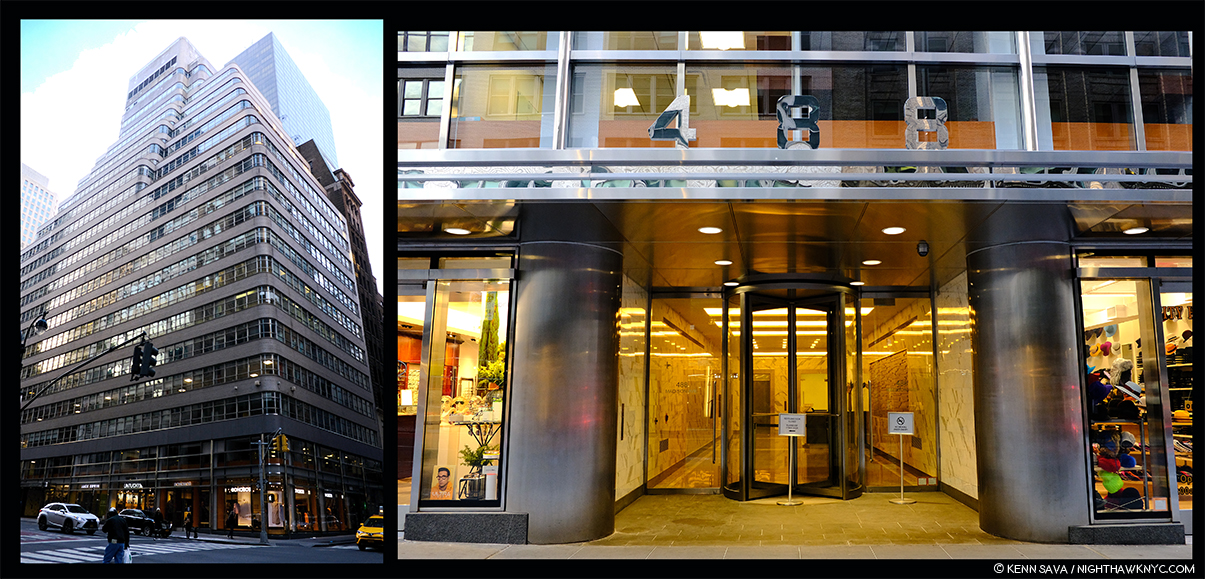
The mothership. The Look Magazine Building, 488 Madison Avenue, around the corner from MoMA, was built in 1948-50, during the last half of Stanley Kurbrick’s employment there. It’s now a landmark building. Seen on February 2, 2019.

“One thing that helped me get over being a school misfit was I became interested in photography at about 12 or 13.” Stanley Kubrick6.

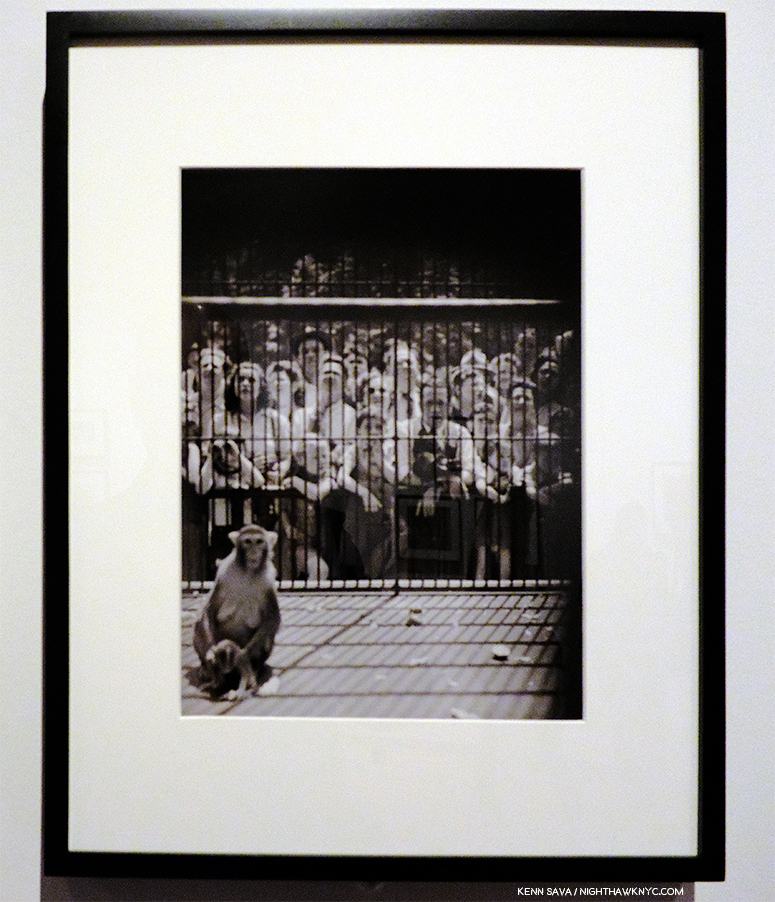
From “How A Monkey Looks to People…How People Look to a Monkey,” Published in Look, August 20, 1946. SK was a $50. a week Apprentice Photographer when he took this classic Photo at 18 years of age.

He sold Photos to Look from time to time until he graduated in January, 1946. Thanks to his frequent truancy cutting class to go see movies at the Loew’s Paradise Theatre near his home (hmmmm….), his 67 grade average was too low to compete for a place in college against the returning G.I.’s7, when a 75 was the floor to even be considered. So, Helen O’Brian hired him for Look as an Apprentice Photographer for $50. a week. He became a full Staff Photographer in October, 1946. Stanley Kubrick grew up fast. Look became his college. “By the time I was 21, I had four years of seeing how things worked in the world. I think if I had gone to college I would never have become a Director8.” It was a unique “college” in that it offered posterity a chance to study the development of the “student” over the 5 years he was there.

“Writing, of course, is writing, acting comes from the theater, and cinematography comes from photography.” Stanley Kubrick9.

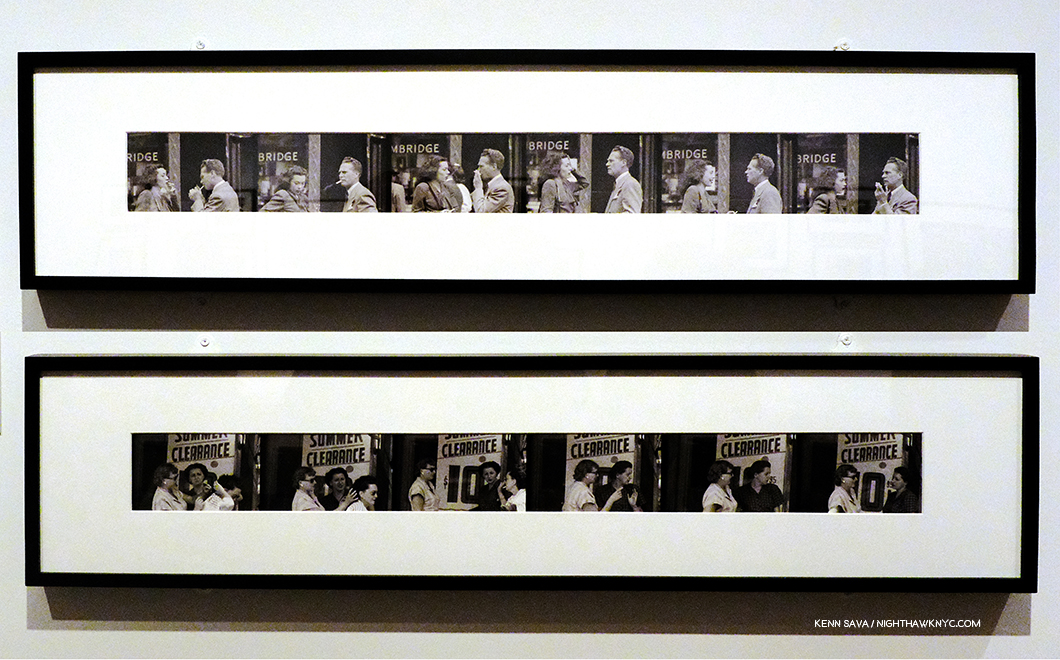
Unpublished contact strips depicting people conversing the street, probably shot with a telephoto lens. There’s an undeniable “cinematic” feel to these series, a number of other such sequences were included in the show.

On his way to becoming a great Director, Stanley Kubrick was an accomplished professional Photographer first, skills that never left him, and that he would use constantly in his Films. The component skills he developed being a Photographer (who was already technically proficient)- composition, lighting, setting a scene, working with subjects, would prove invaluable to him. As would observation – that “dying art.” In addition, a number of the assignments he was sent on became experiences that he also used to learn about what would be his later profession.
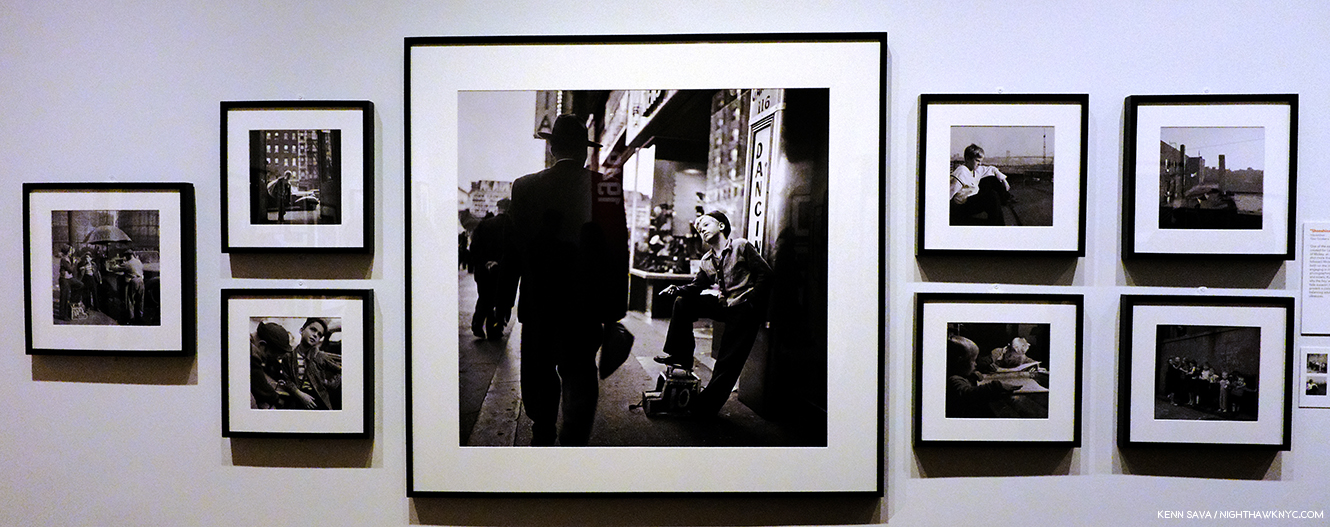
One of those “other” skills is storytelling. Even besides the strips just shown, there is a strong sense of it throughout the quite sympathetic body of work seen here. Where did it come from? Whatever its origin, it’a already on full display, here, at 19. His unique way of telling a story is certainly a hallmark of his Films. Here are some of the 250 Photos he shot for an unpublished assignment called “Shoeshine Boy,” handed in on October 6, 1947, one of the most fascinating stories I’ve seen, in which he followed the title boy, Mickey, to his job, to school, doing errands, hanging out with his friends and family, and tending his pigeon coop. Mickey was only 7 years younger than Stanley Kubrick at the time.

Stanley’s Photographs are technically accomplished from the first one to the last. Surprisingly so for the viewer new to this work, given his youth and the fact that he was self-taught. His Photographs turn out to be up to any technical challenge thrown his way- day, night, portraits, action, off the cuff, groups- what I’ve seen thus far of his 135 assignments run the full gamut. It doesn’t matter the situation, the environment, the lighting or time of day. Is he the “master” magazine Photographer? No. He’s not. There are times when any one of the innumerable technical elements inherent in Photography seems to let him down, but by and large I came away exceedingly impressed with his technical ability. Stephen Spielberg said that one thing that bonded Stanley Kubrick’s Films together was “the incredible virtuoso that he was with craft10.” I get that sense from looking at his Photography. Unlike Weegee (who ALWAYS seems to get his shot, and 95% of the time does so using flash), Stanley doesn’t shoot one way. He adapts to the situation and what he’s trying to express, which is gutsy for a young Photographer trying to secure his place on a staff of a magazine such as Look, which included some established names, like Arthur Rothstein and John Vachon. The deeper you look into this work, the more there is to say about it. Though only touched on in the books and articles I’ve seen, in my opinion, every single aspect of this work needs to be studied in depth-
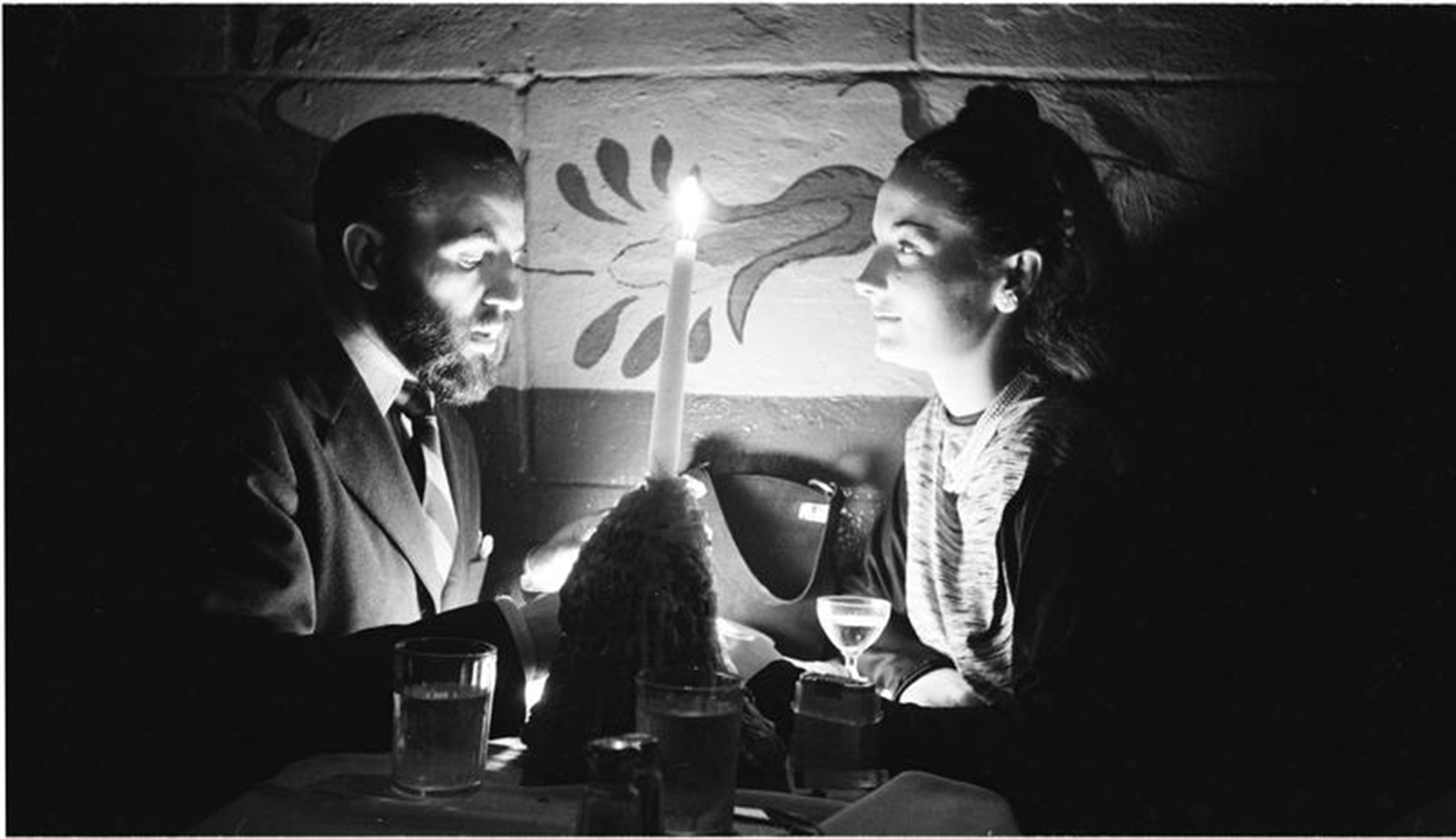
From “Rosemary Williams-Showgirl,” unpublished from March, 1949, Rosemary Williams and a man at a candle-lit table, 1949. An early candle-lit Stanley Kubrick Photograph that just might seem to presage the extraordinary lighting & camerawork in his now classic Barry Lyndon, 1975, where, by then, he would master the exposure.

-His technique- Where was it in April, 1945, and how it changes and how it evolved over his Look career. This includes his compositional choices, positioning (love of low angles and overheads), lighting (natural light versus flash), and how all of these may have appeared in his Films.
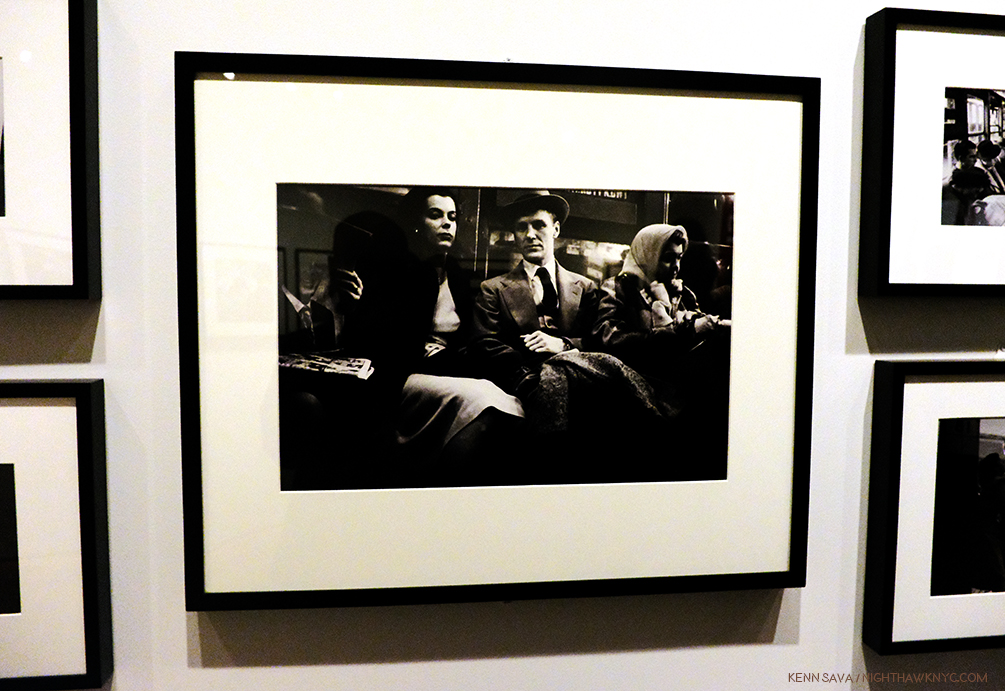
Stanley Kubrick shot surreptitiously in the Subwary for a piece titled “Life and Love on the New York Subway,” March 4, 1947, using a cable release that ran down his sleeve. He had no way of knowing that Walker Evans had, also, shot secretly in the subway in 1941 because Walker did not publish his series until the book, Many Are Called, was published in 1966, out of fear of lawsuits from his subjects because he did not have releases from them.

-The assignments-  Both published and unpublished. Between the Library of Congress’ and the MCNY’s websites about half of his Photographs appear to be online, as far as I can tell. The complete body of SK’s Photographs needs to be made available. Only then can a proper assessment of his achievement and what it portends for his future work be made.
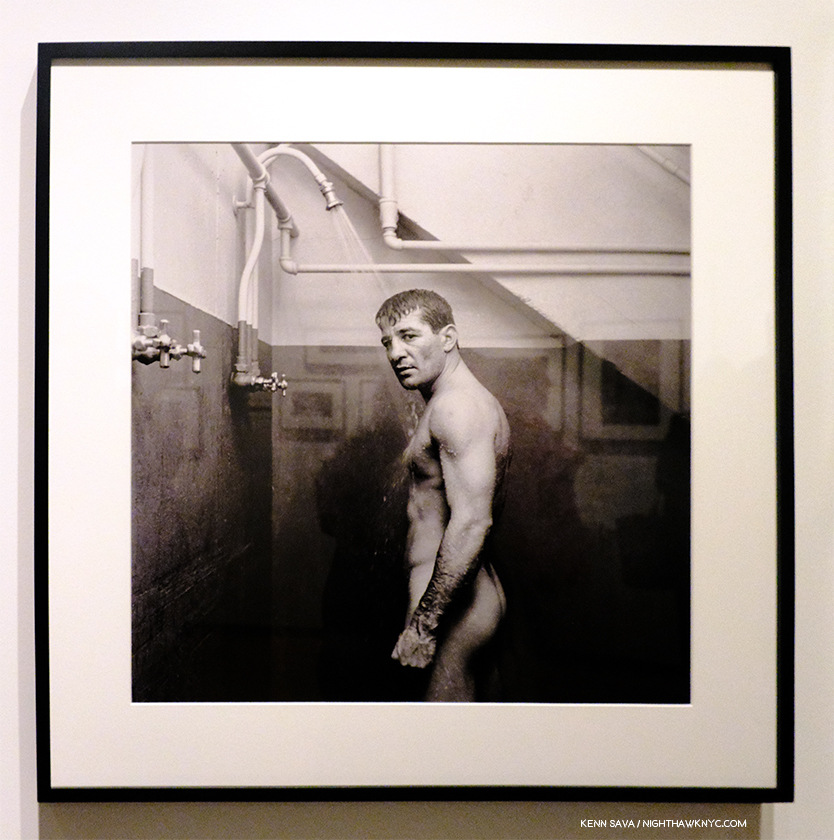
An unprecedented Photo. Rocky Graziano in an unpublished outtake from the story “Rocky Graziano: He’s a Good Boy Now,” which ran on Valentine’s Day, 1950. It says a lot that Rock Graziano, who was coming back from a scandal, would allow this shot to be taken. Boxing was a subject Stanley Kubrick shot on a number of occasions for Look, and the depth at which he studied this subject, like this and the shot of Willie Beltram, below, paid dividends in the heightened realism he achieved in a few of his later Films.

-The assignments that tie directly into his later Films. These include a number of boxing stories, the Aqueduct Race Track story, the stories involving TV Productions, actors and actresses (ranging from Montgomery Clift, Zero Mostel, and Frank Sinatra, to the unknown Rosemary Williams), and his Naked City shoot.
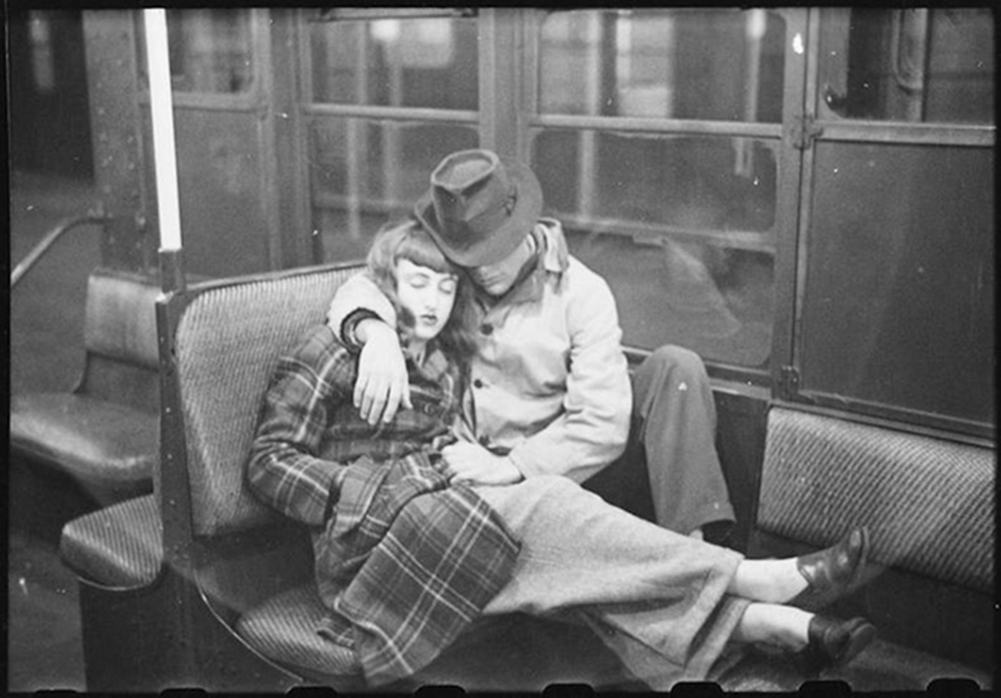
Stanley Kubrick posed this shot from the “Subway” series in 1947. How do we know this? That’s his future wife, Toba Metz (who he married in May, 1948) on the left, who appears in other shots in the series. More on this shot in BookMarks, at the end.

-Which shots did he pose? (As far as is known).

Why is all of this necessary? While there have been shows like this fine show and others in Europe, they, and the books just scratch the surface. They only reveal part of the story, only presenting a limited glimpse of the whole body of work, due to its size, which Professor Rainer Crone says is 12,000 Photographs. The books that have been published thus far (all but one of them out of print) each contain between 2 and about 400 hundred. Even if you have all of them in front of you (I have three), you still only get to see part of any one story he shot! Stanley, like most staff Photographers at Look, shot a lot of Photographs for their stories to allow the editors the widest leeway in making their selection (I wasn’t able to determine if he ever made the selections himself, or had any say in it. It would appear he did not.). With, say, 250 images for a given story, almost– none of his assignments have been published complete thus far (as far as I can tell). This is incredibly frustrating and, of course, it does not allow a full assessment of his work- even on one assignment.
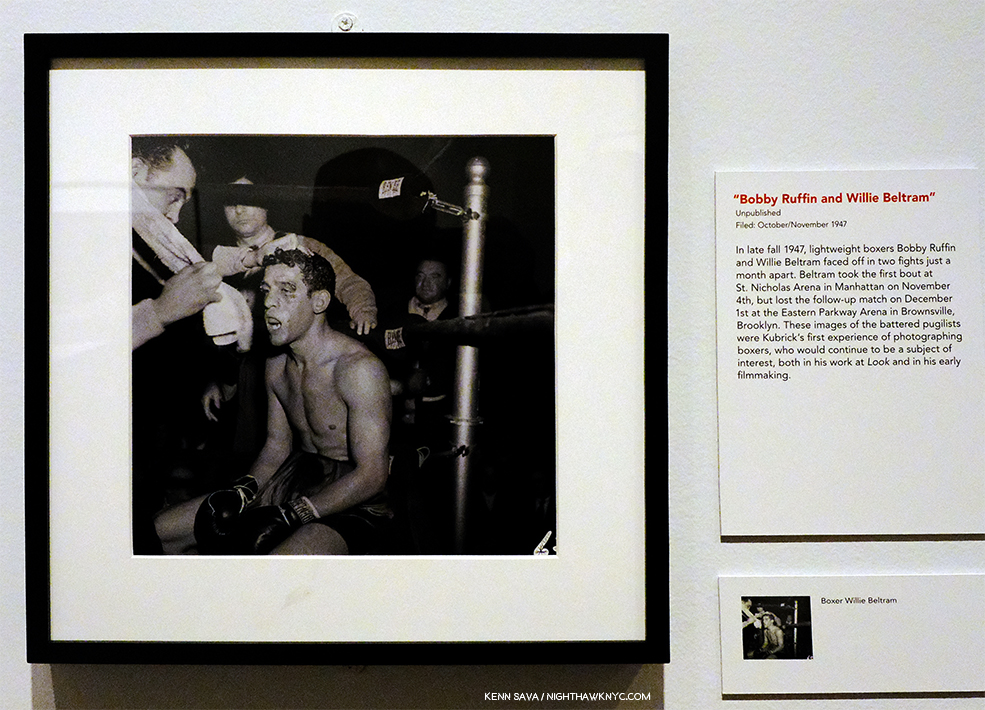
Willie Beltram, October/November, 1947, from an unpublished story, the first time SK shot boxers, a subject he would return to a few times at Look, and in his early Films, Day of the Fight and Killer’s Kiss. In those films, too, he would get right into the ring and very close to the action. It seems to me it also looks ahead to the carnage he graphically depicted in Paths of Glory and Full Metal Jacket.

Is it practical to release tens of thousands of Photographs? One look at the ten volume(!) set Taschen published of the existing material for Stanley Kubrick’s unmade Film, Napoleon, which includes 15,000 location Photos AND 17,000 “slides of Napoleonic imagery” (though shown at a large thumbnail size) would seem to say- “Where there’s a will? There’s a way.” After being immersed in this work for the better part of the past 4 months, I believe it is important enough that it needs to be done, and I predict someone will do it- one day (and I say that knowing nothing about the politics/legalities involved with, and between, the Kubrick Estate, the Library of Congress, and the MCNY). After pouring over the show, the existing web resources, and the 3 books I have (which together include about 8 or 900 images, though some are duplicated), my desire to see more has only grown. Given the unlikeliness of Stanley Kubrick’s Films diminishing in interest or importance any time soon this need will only remain, if not grow. From my study, I’ll say this-

I’m absolutely convinced there is more to learn about Stanley Kubrick, the Director, in this body of work- his Look Photographs, than there is anywhere else besides his actual Films and his interviews.
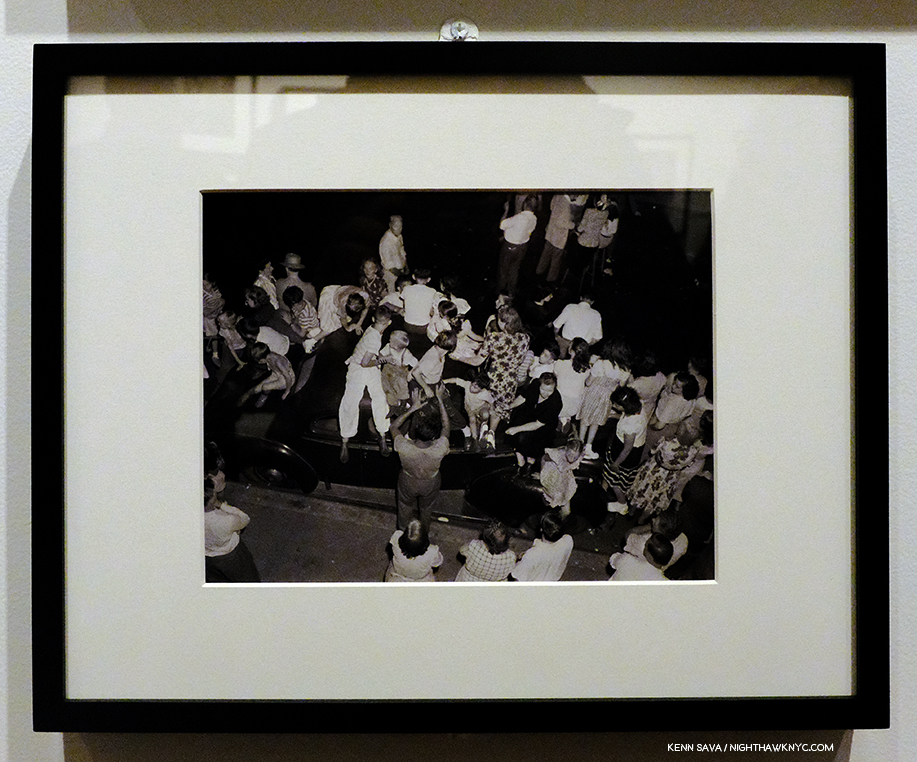
Weegee? No. Stanley Kubrick during the prodcution of the Weegee inspired film, Naked City. Speaking of “Street Photography,” it’s interesting to note that both Stanley Kubrick and Garry Winogrand were born in the Bronx in 1928. For perspective, Diane Arbus, who knew Stanley during his Look days, was born in 1923.

Put them all online, perhaps in a joint website. Maybe that’s the most practical way. Arrange them by story assignment-unpublished or not, in chronological order. Reproduce each magazine story, when there is one, follow that with all the Photographs, published and unpublished (uncropped, full size, since they were cropped on occasion in the magazine), in the order they were taken, and also include the contact sheets, would be my suggestion. Whether this all comes out as a book, or series of books, perhaps by year? That’s up to a publisher. I think it would find buyers. Is this going to be a popular series? No. Then again, no “catalog rainsonne” is a best seller. It’s for specialists. It’s for those passionately interested in the Artist’s (Stanley Kubrick’s) work, and for those seeking to learn from his path. It’s probably not for the everyday lover of Photography, though a well produced summary volume might be reasonably popular. (See BookMarks at the end for more on the existing books and some recommendations.)
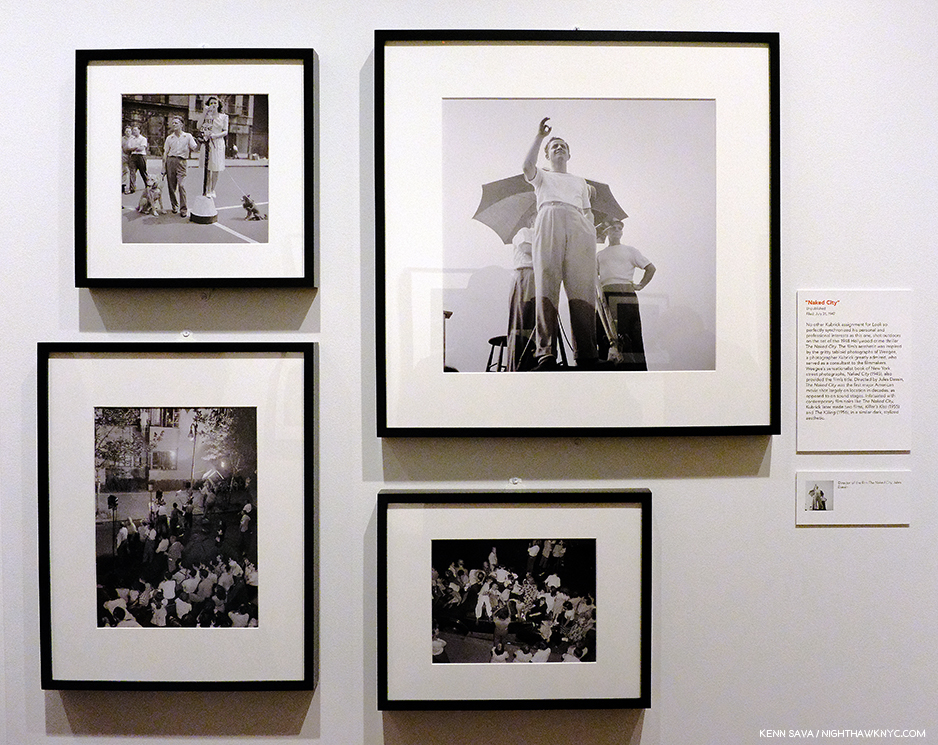
Four Photographs from the unpublished “Naked City,” assignment,  July 31, 1947. Stanley Kubrick went to shoot the production of the Film Noir movie, which took its name from Weegee’s famous book. Weegee was someone Stanley Kurbrick admired, and years later hired him as Still Photographer on Dr. Strangelove. Here, Stanley got to watch Director Jules Dassin (upper right) work and observe the production. None of this would be lost on him. His early Films, Killer’s Kiss, and the terrific The Killing are both Film Noir and both shot in the city.

Experts, including German Professor Rainer Crone (the first person to research this body of work, with Stanley Kubrick’s personal blessing, mount exhibitions of it and write the first books on it) mention a few stories, in particular, as being springboards to the future career of Stanley Kubrick. Many agree that his Look shoot of the filming of the Film Noir classic Naked City was a key moment, giving him an inside look at a rare movie production going on at the time in a big city. Boxing assignments were also influential. He shot Rocky Graziano and relatively unknown boxer Walter Cartier. In 1951 Stanley Kubrick made a 12 minute documentary short Film entitled Day of the Fight following the same Walter Cartier around from wake up until after the final K.O., veritably recreating his Look story, “Prizefighter,” on Film. In that sense, this marked the beginning of the end for Stanley Kubrick at Look. In addition, late in his career at Look, his assignments brought him more and more often into contact with TV Productions, actors and actresses. All of these experiences proved “educational” for him for where he would go next.
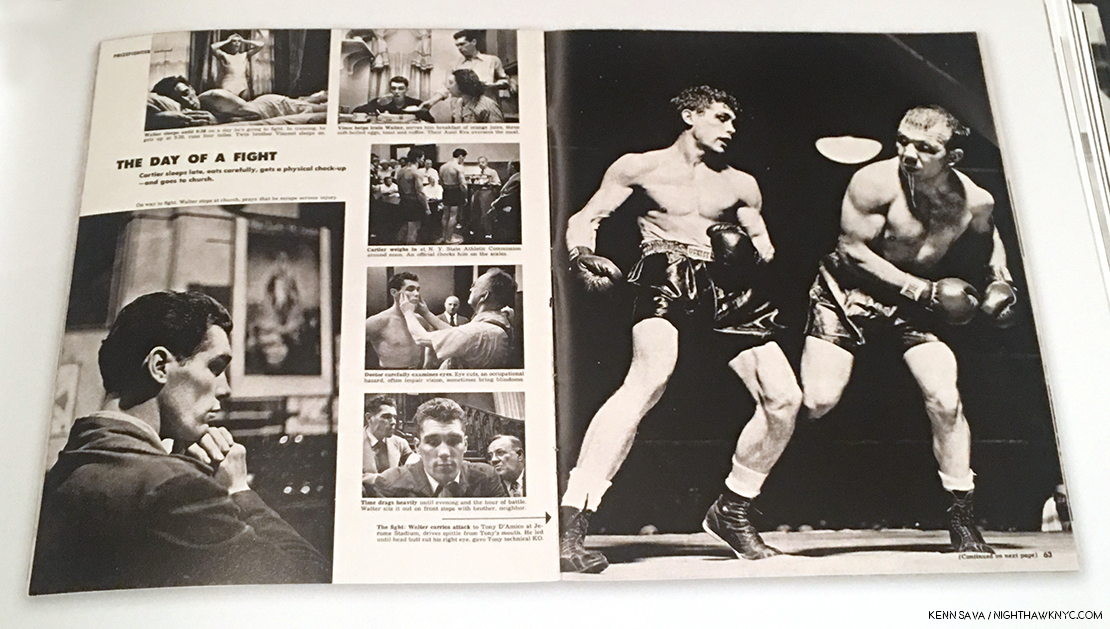
In the article “Prizefighter,” featuring the boxer Walter Cartier, the subtitle of this section is “The Day of a Fight.”

By this point, he had seen what he needed to see to begin making films, down to knowing what equipment he’d need, where to get it and how much it would cost to rent. Long desiring to make Documentaries, he turned the Walter Cartier “Prizefighter” story into one.
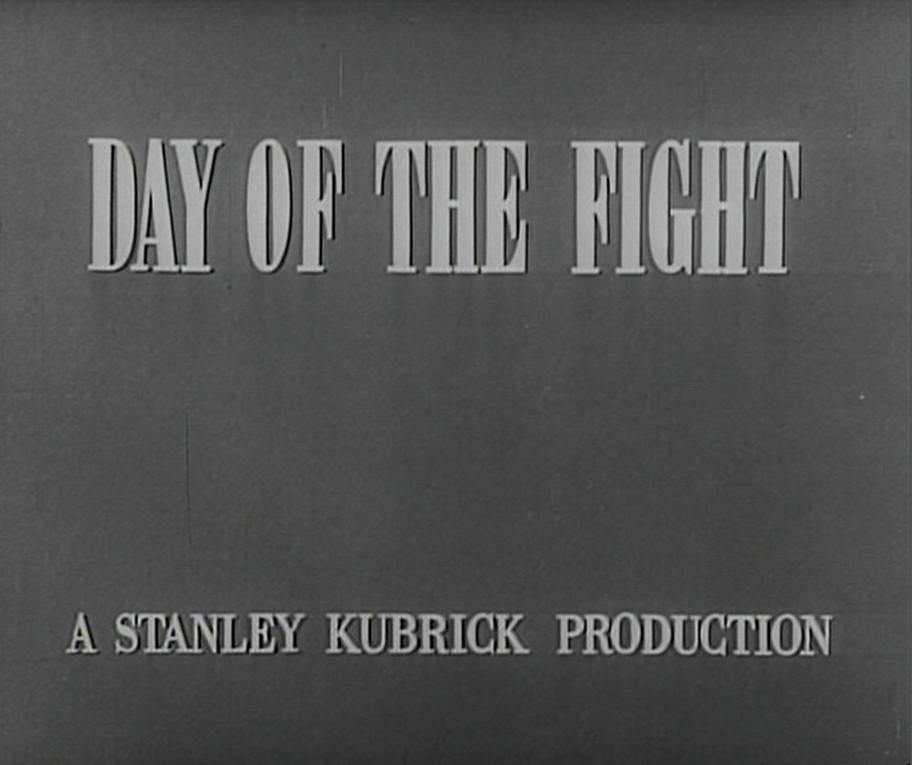
Screenshot of the title card of Day of the Fight, 1951, his first film, at age 25, which runs a bit over 12 minutes, and which he Photographed.

Stanley Kubrick’s early films carry this credit-
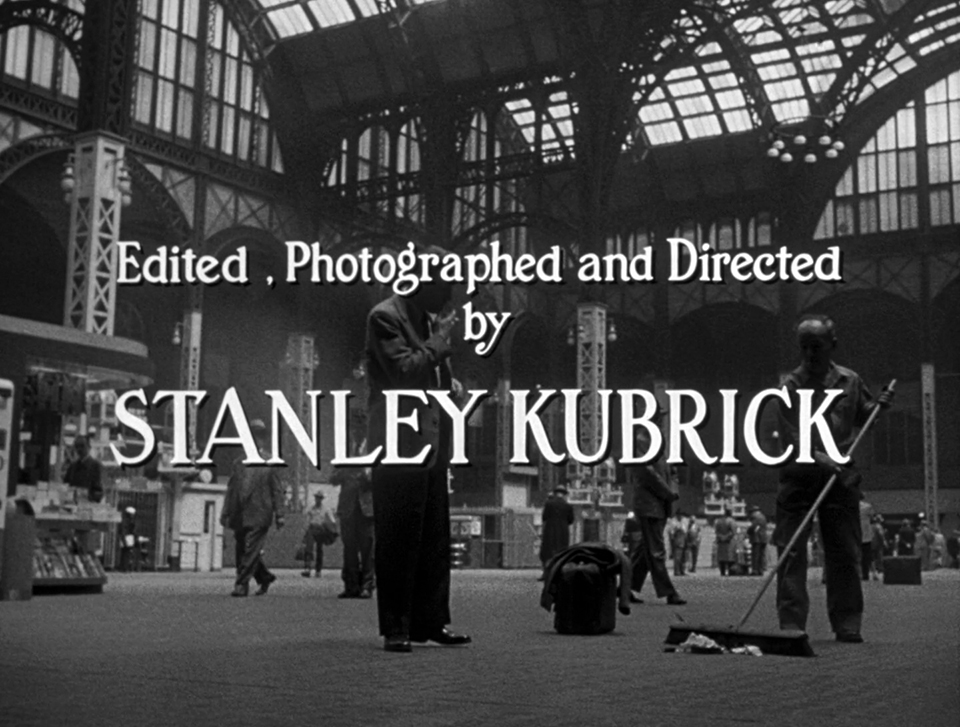
His credit line in Killer’s Kiss, 1955. He also wrote the story. See the Appendix for more screenshots that are reminiscent of SK’s Look Photos.

“Photographed by Stanley Kubrick.” Today, we would call it “Cinematography.” But, I think the term “Photographed” is telling. Eventually, by the The Killing, 1956, unionization forced him to hire a Cinematographer11. Yet, SK would continue to look through the viewfinder (and there are countless shots of his on his sets doing just that) and the camera, and continue to shoot Film on occasion.
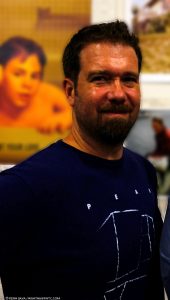
Photographer/Director Shane Rocheleau at the NYABF, September 22, 2018.

Fascinated by the difference between shooting still Photographs and Film, I reached out to a man who has experience creating both- Shane Rocheleau. The subject of a Q&A I did in September, 2018,  I even mentioned Stanley Kubrick in describing his talents in my NoteWorthy PhotoBooks, 2018, saying that his first PhotoBook, You are Masters of the Fish and Birds and All the Animals, or YAMOTFABAATA as it reads on the spine, was “edited like a Stanley Kubrick Film.” I’m not sure there’s a higher invocation I could give someone in Photography or Film. In addition to being an exceptionally talented Photographer, Shane Rocheleau is already proving to be one of the new masters of PhotoBook editing & sequencing. During my research into him, I also discovered that he is a Film Director. I reached out to him, and he confirmed this for me, and sent along this link where his Film, Tide, 2009, that he also wrote, can be seen. I asked him about the differences between shooting still Photographs and Film. He said-

“I can’t pretend to speak for a genius like Kubrick, but I’ll give you a bit of insight into the differences between creating photographs and creating films, for me. To clarify first, though:  I am not a documentary photographer, and I am not an experimental filmmaker. If I were both, my answers below would, maybe, flip-flop. What I know of Kubrick, he, like me, was not a documentary photographer nor an experimental filmmaker.

When I hear the word “conceptual” placed in proximity with “art”, it means something very specific to me. Namely, it means that the artist’s conclusion was rendered before the art was executed. Plans were made. The resulting art product serves to explain, announce, demonstrate, manifest, etc. knowledge or forms the artist has already resolved (The God of Genesis appears to have been a conceptual artist). While when making films I may be unsure of the knowledge I’m attempting to disseminate, but my narratives and forms are usually fairly well determined. Story, arc, shots, and sequences are imagined prior, and props, actors, location, etc. are fairly settled. My film will have some room to grow or morph at every step in the creative process; however, I view the overall arc of its making to be well aligned with my idea of conceptual art:  I imagine the film first, then execute its making.

For me, the photographic process operates in contrast with conceptual art. While I usually begin a photography project with an idea, never in my experience has that idea remained intact through to the end; on the contrary, I always learn I was wrong. The photographic process is inherently about discovery. Even when I presage a photograph, the final product reveals something very new, often even contradictory. Rather than marked by understanding, my ideas are rended by my photographs. Confusion necessarily ensues, and meaning emerges as I let go of certainty, make unexpected pictures, sequence and pair the absurd, and indulge discovery. The final project is a new growth, a new understanding. Contrary to a conceptual process, once I resolve my ideas, I’m done.”

After making 3 short Documentary Films (Day of the Fight, Flying Padre, both 1951, and The Seafarers, 1953), he realized that the only way to make enough money to sustain a career was in making feature Films. By then, he had quit is job at Look and would never look back. He would make his first feature Film, Fear and Desire, later in 1953, which he also “Photographed.”

In order to look a little closer at the similarities between Stanley Kubrick’s early Films and his Look Photographs, I’ve created an Appendix that appears below this piece (or, here) that includes screenshots from the first part of his second feature Film, Killer’s Kiss, 1955, “Photographed” by SK, that look similar to me to some of his Photographs I’ve shown here.

Beyond these similarities, the influence of his still Photography lived on in his later work, even after he was working with other Cinematographers. For one thing, he is often seen holding a still film camera on the set.
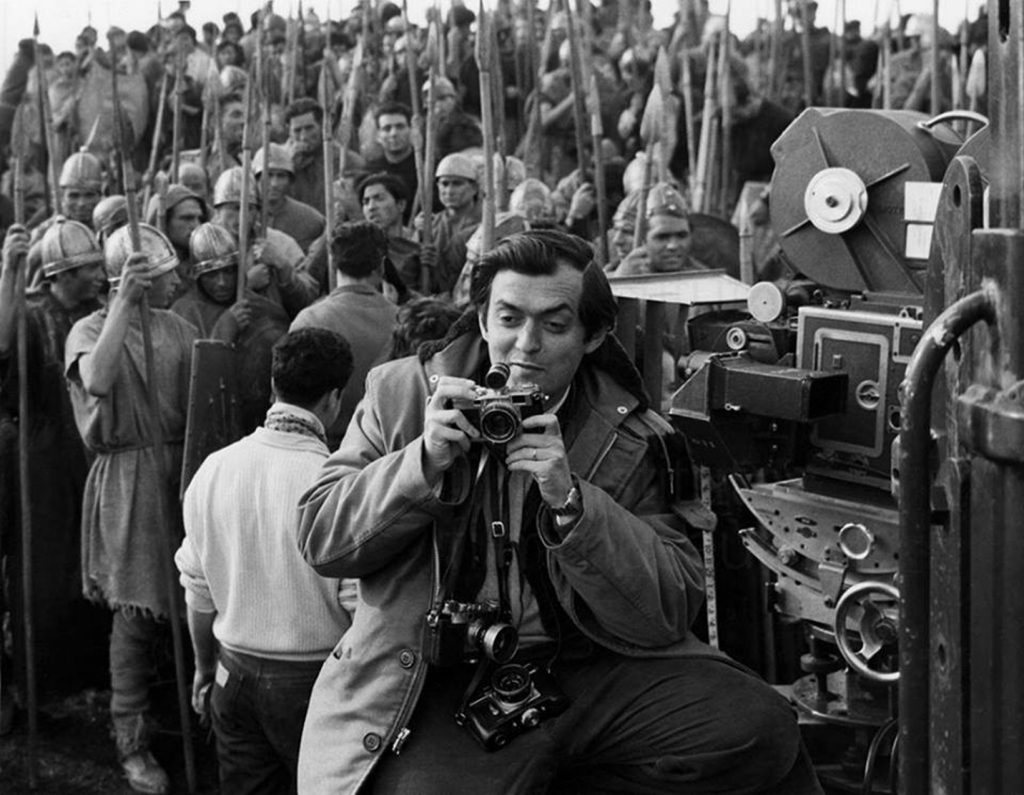
Stanley Kubrick on the set of Spartacus– with THREE still cameras around his neck! Mr. Rocheleau thought that he was shooting for pleasure, given the smile on his face. The reason would seem to not be an instant need to see the Photos since the film would need to be developed. *From the Stanley Kurbrick Archives. 

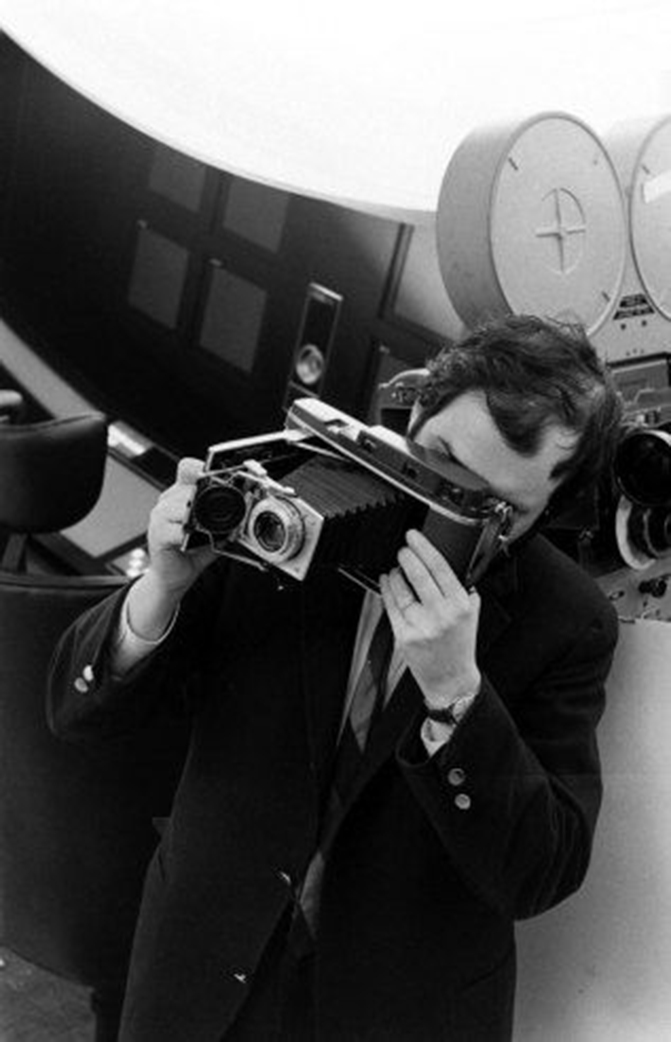
As his vision matured, and his resources (and budget) increased, it largely outstripped what we see in his Look Photographs. One significant remaining holdover was Stanley Kubrick continued to rely on a still camera, now a Polaroid instant camera, to take Photos to see how the scene looked in two dimensions and to check colors, continuity, and for other reasons,. on the sets of many of his films, including the classic 2001: A Space Odyssey


For those looking for evidence of the lasting  effect of Stanley Kubrick’s still Photography career and experience on his Films, this may be the defining image. With his Polaroid Pathfinder 110A on the set of 2001. *From the Stanley Kurbrick Archives. 

I’ve seen estimates that SK shot 10,000 Polaroids during the production of 2001. In the book The Making of Kubrick’s 2001, 1970, Jeremy Bernstein’s 1966 Profile of Stanley Kubrick, originally published in The New Yorker, is reprinted. In it, Mr. Bernstein says, “I asked Kubrick what he needed the Polaroid for, and he explained that he used it for checking subtle lighting effects for color film. He and the director of photography, Geoffrey Unsworth, had worked out a correlation between how the lighting appeared on the instantly developed Polaroid film and the settings on the movie camera12.” He continued to use it, as he does here, on Full Metal Jacket, 1987-
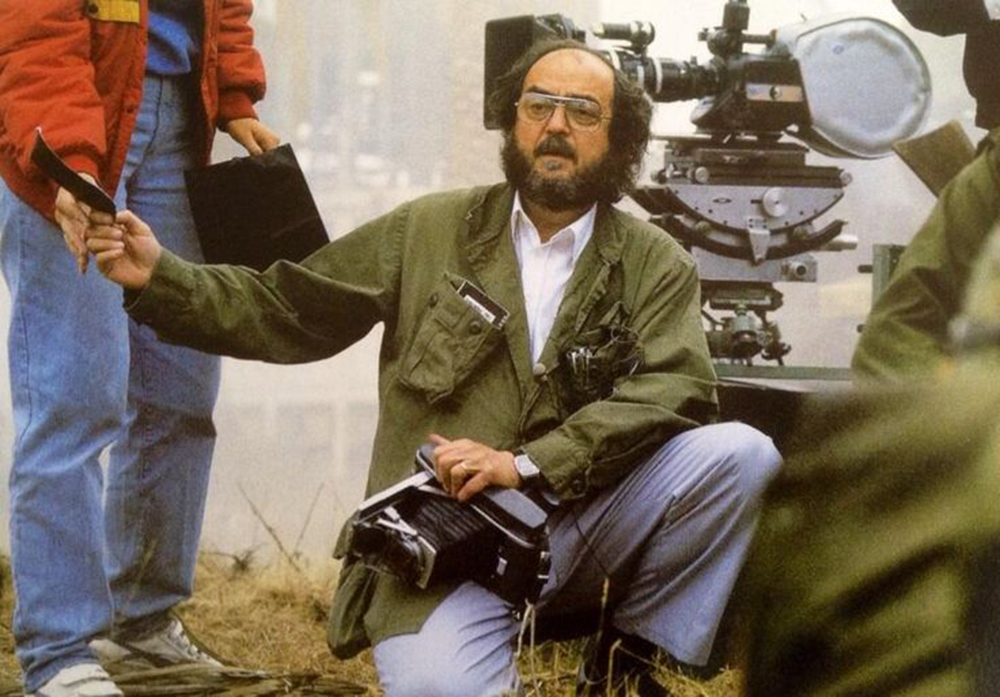
Stanley hands a freshly shot Polaroid print to an associate as it develops on the set of Full Metal Jacket where he appears to still be using his Polaroid Pathfinder 110A, some 20 years after 2001. *From the Stanley Kurbrick Archives. 

Perhaps by his last Film, Eyes Wide Shut, 1999, he was using an early digital camera, or perhaps he still preferred to see the image instantly on a print. A lover of new technologies, who knows what he would have been doing or how he would have been working today. Whatever the means, the value of his early training as a still Photographer would, no doubt, have still been paying off for him.

Given the level of his talent and his vision it probably shouldn’t be a surprise that as we approach the 20th anniversary of his death on March 7, 1999, next month, there is still much to discover about, and in, the work of Stanley Kubrick.

*- Soundtrack for this Post is “My Old School” by Walter Becker & Donald Fagan of Steely Dan, recorded on their second album, Countdown to Ecstasy, 1973. (Yes, it’s on Countdown to Ecstasy. I have no idea why the producers of this video show the cover of Can’t Buy A Thirll.)

The Appendix to this Post, Stanley Kubrick: A Photographer’s Odyssey-Appendix, is below, following BookMarks, or here.


BookMarks-

If you like what you find on NighthawkNYC, I hope you’ll consider supporting it so that I can continue to spend the countless hours and pay the expenses it takes to keep it going these past 3+ years-without ads. If so, you can also make a donation through PayPal by clicking on the box to the right of the banner at the top of the page that will take you to the Donation button. Your support is VERY much appreciated. Thank you!

As I said above, this body of work is vast and covers 5 years. The issue of how to approach it becomes Question One for anyone attempting to make a book about it. To date, all the books I’ve seen have been focused on exploring it. None have attempted to present the complete picture or look at this work in light of what came after (a book with tens of thousands of Photogaphs would be massive, even if it consisted of thumbnails, like Gerhard Richter’s Atlas). The 3 books I’ve seen thus far all take the same approach- an historical look at selected stories and images and only occasionally mention his later Film career13 For a variety of reasons, none of these books is “the” definitive book on Stanley Kubrick’s Look Photographs, in my opinion. The books are-
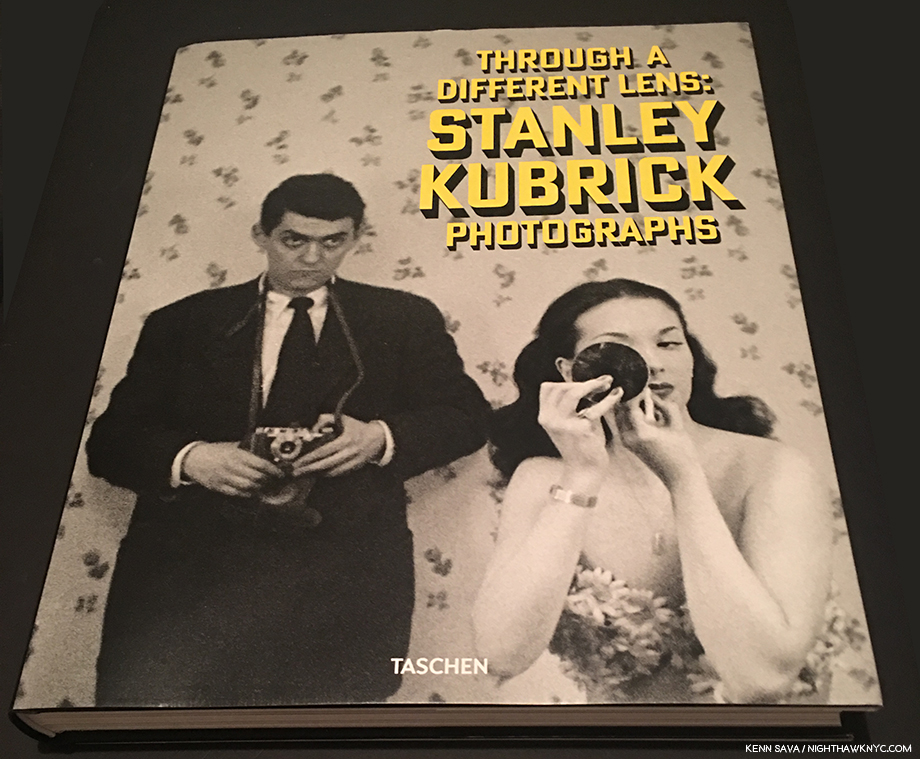
Stanley Kubrick Photographs: Through a Different Lens, published by Taschen in conjunction with the MCNY, and its curators, Sean Corcoran and Donald Albrecht, in 2018, is the catalog for this show. The only book currently in print on the subject of Stanley Kubrick’s Photographs, it contains about 300 of them, over 332 pages that are split between beautiful full-page and double page reproductions of single Photographs and reproductions of the Look Magazine stories they ran in. Unpublished assignments are also included. After the initial essays, the remainder of the book is arranged by year and assignment.
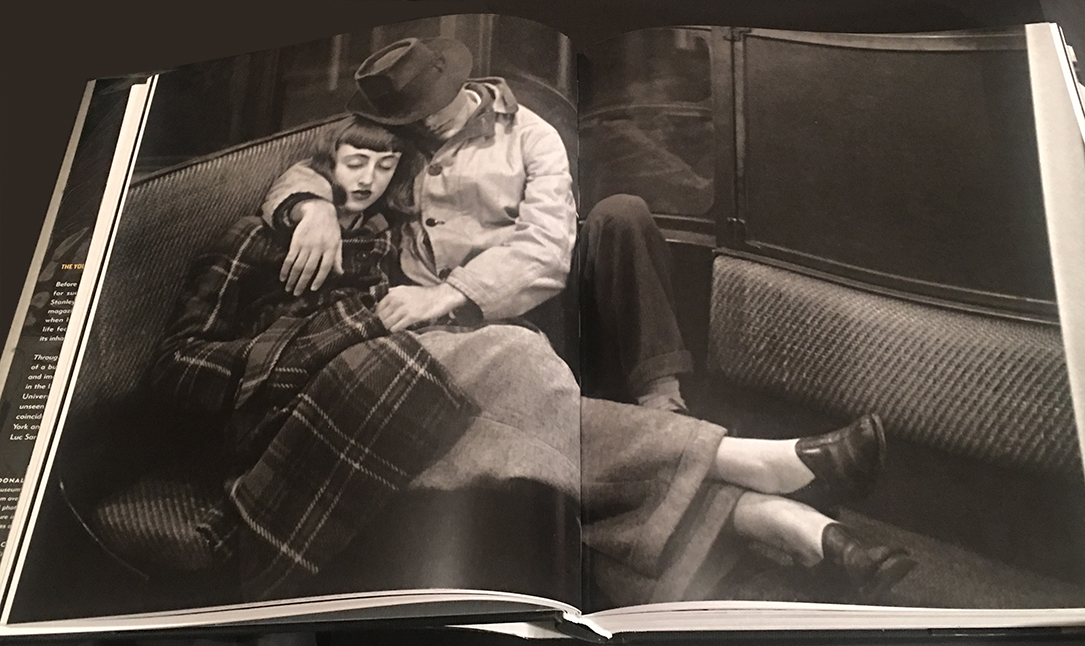
An outtake from “Life and Love on the New York Subway,” March 4, 1947, beautifully reproduced across 2 pages, which results in an image size of 26 1/2 by 22 inches! Compared with the shot posted earlier (from an online source), the man’s position has changed and the Photographer has moved closer. How do I know this hasn’t been cropped? This image appears on a strip from the contact sheet published in the Stanley Kubrick Archives.

The best thing about this book, in my opinion, is its size- It’s BIG. 10.8 x 13.2 x 1.5 inches and clocking in at 6.6 pounds. Unlike most recent very large PhotoBooks, this one takes continual advantage of its acreage, often going edge to edge14 This presents the opportunity to see selected landscape oriented Photos at the incredible size of 26 1/2 by 22 inches, as seen above!  The chance to see Stanley Kubrick’s Photographs in a large size does not exist, nor has it ever existed, outside of this book. EVEN in the show (save for a handful of wall size blowups, like the sign shown earlier)! Here you get to see many of its 300 images in full page, 10.8 x 13.2 inch, reproductions. Taschen’s history with XL size books is to make them smaller with each succeeding incarnation. So? If you want to see these images big, this may be your only chance to do so. As such, I expect this first edition will retain lasting interest with Kubrickians (did I just coin that term? I doubt it) indefinitely. As for its shortcomings, I am unhappy with some of the assignments included (Guy Lombardo shown at home. Why?) and those left out which have a direct import on his subsequent Film career. Therefore, it seems to me the editors may have intended this book to be a general interest book. Second, the images in this book are reproduced with a depth of blacks I haven’t seen before. The images in the show were also printed similarly as you can see in my piece. Nothing is said in the book (or in the show) about how these prints were made. In the Preface, Whitney Donhauser only states, “The Kubrick Archive has been photographed, scanned and retouched by…” Compare the one above to the other images below, the sources of which are not stated either. Also, the images on the MCNY website are darker than those on the Library of Congress site. I’m not sure what to make of this but it’s something to be aware of. In my opinion, the curators/editors should have addressed and clarified this somewhere. Overall, I recommend this book to anyone with an interest in seeing these Photographs large, and for those interested in this body of work not wanting to spend rare book prices for the out of print titles. Recommended with reservations.
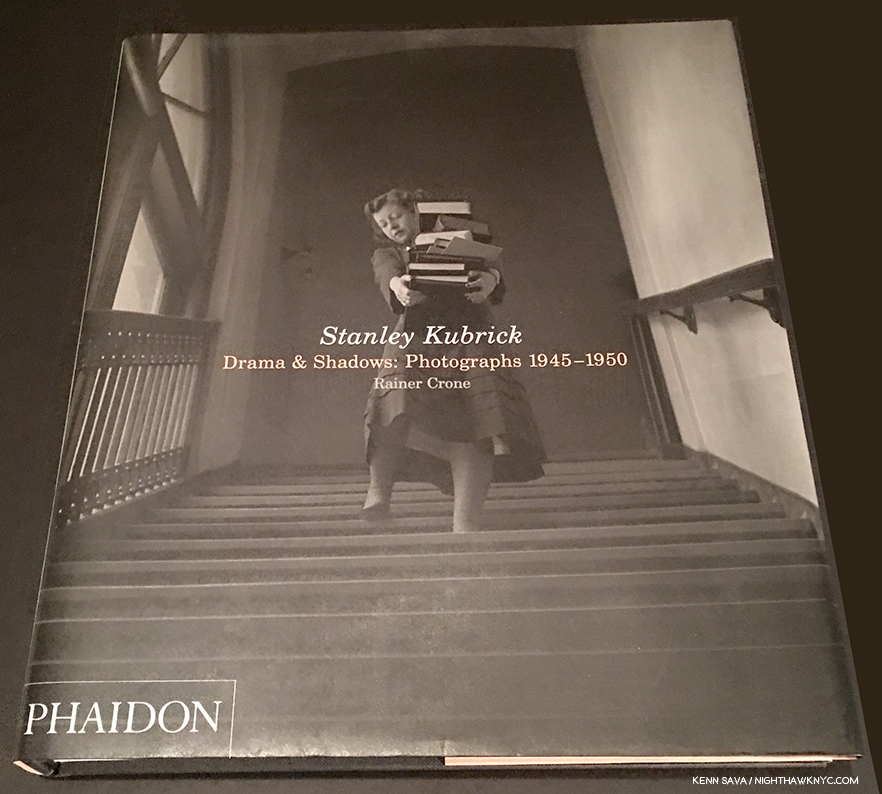
Rainer Crone’s SK: Drama and Shadows, published by Phaidon in 2005

The other books on Stanley Kubrick’s Photographs are all either out of print, not in English, or both. Of these, Professor Rainer Crone is the man behind those I know of. He was the first one to show this work, with Mr. Kubrick’s blessing, and he has produced, I believe, 3 books about it so far. The most well known of these is the hardcover Stanley Kubrick: Drama & Shadows, published (in English) by Phaidon in 2005. Good, or better, copies can be found for 65.00 and up. It is very well done, does not give any evidence of cropping, though the reproductions do not have the depths of blacks the Taschen book has. The supporting texts are quite informative and reveal Mr. Crone’s ongoing interest in, and dedication to, this work. While its selection fills in some of the gaps in the Taschen book, again, I felt frustrated by some of what was left out (as I will be until a way is found to see all of this work).
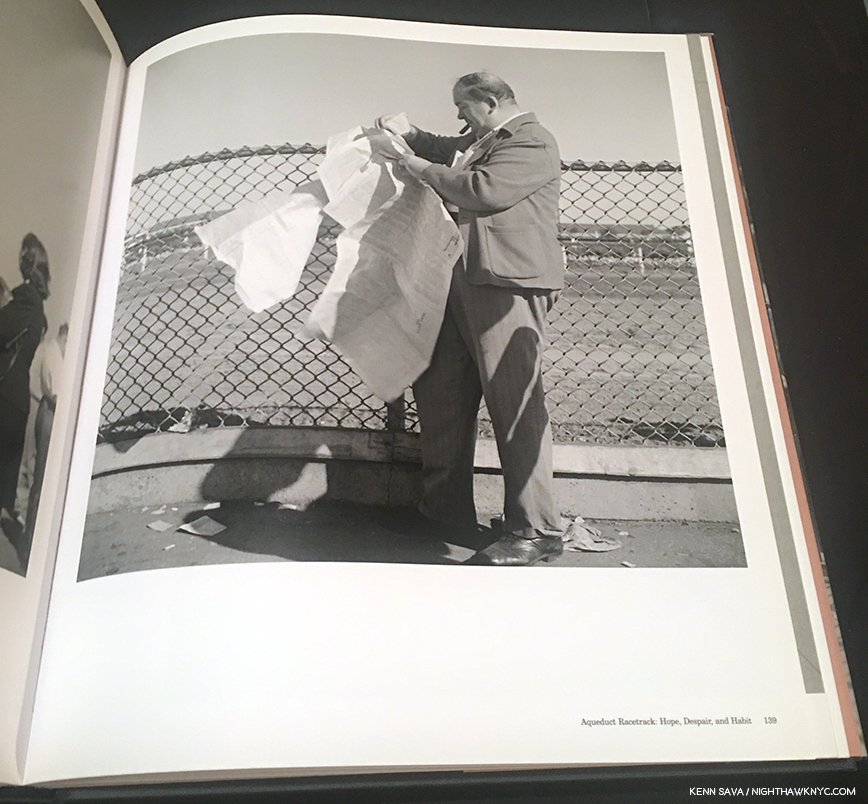
A sample image, from SK’s “Aqueduct Racetrack: Hope, Despair and Habit” assignment, March, 1947, which I feel is important for its possible influence on his film The Killing, 1956, about a race track heist.

The front flap says it contains 400 Photographs over 240 pages of a good paper stock. Recommended, if you can find a copy in good condition at a reasonable price.
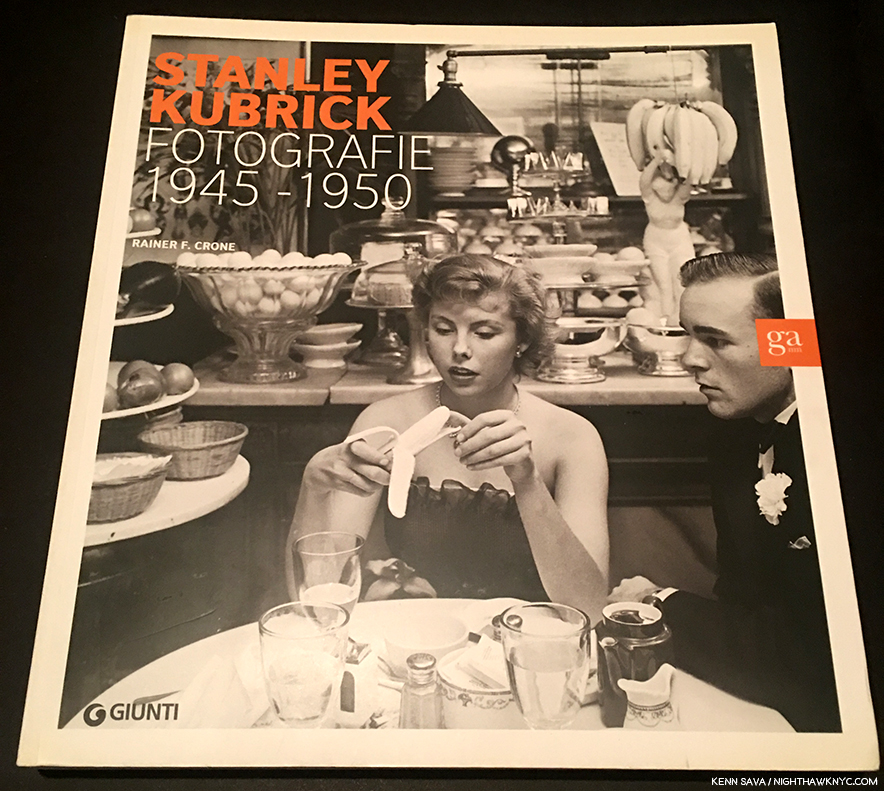
Rainer Crone’s SK Fotographie, the catalog accompanying a 2010 show in Milan.

I have one of Rainer Crone’s other books, Stanley Kubrick Fotographie, 1945-50, a large softcover book, though its text is only in Italian. This is frustrating because it’s the most recent of Rainer Crone’s books (I believe), being the catalog accompanying a show he curated in Milan in 2010. It includes interesting supplements, including a list of published Look articles and Photos of the covers of (all?) of those issues (Stanley Kubrick shot a few of the covers in color, but those are shown in black & white here). I don’t know the total image count over its 255 pages, but it includes more images in some of the series than the Taschen book. It is, however, extremely hard to find- much more so than Drama & Shadows. Recommended for specialists in SK’s Photographs.
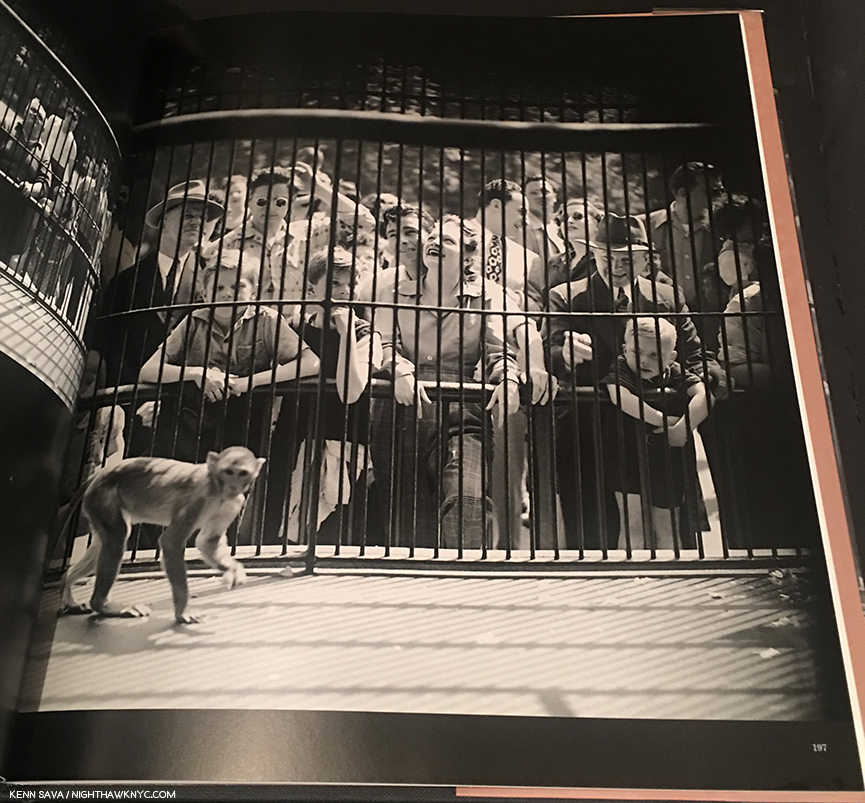
A sample image shows another shot from the “How A Monkey Looks to People…How People Look to a Monkey,” assignment, from August, 1946. As you can see, the images here appear darker than in SK: Drama and Shadows. Perhaps it is using the digitized MCNY sources.

The body of literature on Stanley Kubrick and his Films is large and outside the scope of this piece, however one book must be mentioned and singled out from that body for its sheer uniqueness and extraordinary value- The Stanley Kubrick Archives began life as a 2005 Taschen XXL book that came with a filmstrip from Stanley Kubrick’s copy of 2001 that now sells for hundreds of dollars on the rare book market. More recently reissued in one of their small brick books it lists for 19.95. I mention it because it has a very interesting first chapter that discusses Stanley Kubrick’s Photography, along with countless Photographs of Mr. Kubrick at work, and a very large number of rare items from his own collection & archives. All of this makes it an essential book for anyone interested in Stanley Kubrick- Photographer or Filmmaker.

Finally, I have it on good account that some first edition copies of Shane Rocheleau’s first PhotoBook, YAMOTFABAATA, the only First PhotoBook to be listed among my NoteWorthy PhotoBooks of 2018, are still available from Gnomic Book, here.

My thanks to Shane Rocheleau and Mary Flanagan of the Museum of the City of New York.

NighthawkNYC.com has been entirely self-funded and ad-free for over 6 years, during which over 250 full length pieces have been published. If you’ve found it worthwhile, you can donate to keep it going & ad-free below. Thank you!

Written & photographed by Kenn Sava for nighthawknyc.com unless otherwise credited.
To send comments, thoughts, feedback or propositions click here.
Click the white box on the upper right for the archives or to search them.
For “short takes” and additional pictures, follow @nighthawk_nyc on Instagram.

Subscribe to be notified of new Posts below. Your information will be used for no other purpose.
 

  1. Through a Different Lens: Stanley Kubrick Photographs, published by Taschen in conjunction with this show, henceforth Exhibition Catalog, Preface
  2. “Ive always said the two people who are worthy of film study are Charlie Chaplin and Orson Welles as representing the two most diverse approaches to filmmaking.” Stanley Kubrick: Interviews, P. 79
  3. Jeremy Bernstein Audio Interview, 11/27/1966
  4. The Stanley Kubrick Archives, P.13
  5.  Exhibition Catalog, P.10
  6.  Jeremy Bernstein Audio Interview, 11/27/1966
  7. Jeremy Bernstein Audio Interview, 11/27/1966
  8. Exhibition Catalog, P.9, quoted from Michael Herr, Kubrick, P. 4
  9. //www.brainyquote.com/authors/stanley_kubrick
  10. //www.youtube.com/watch?v=Rd97Og-20Yc&app=desktop
  11. Stanley Kubrick Archives P.110
  12. The Making of Kubrick’s 2001, Edited by Jerome Agel, P.68
  13. The third book is in Italian, so I have no idea what it’s essays discuss.
  14. Since many of these images have never been previously published, I have no way of comparing them, so I don’t know if there is any cropping going on here. I seriously hope not and I am writing this under the assumption there is not. If you can prove differently, please let me know.

Dana Schutz- Painting in an Earthquake

Written & Photographed by Kenn Sava

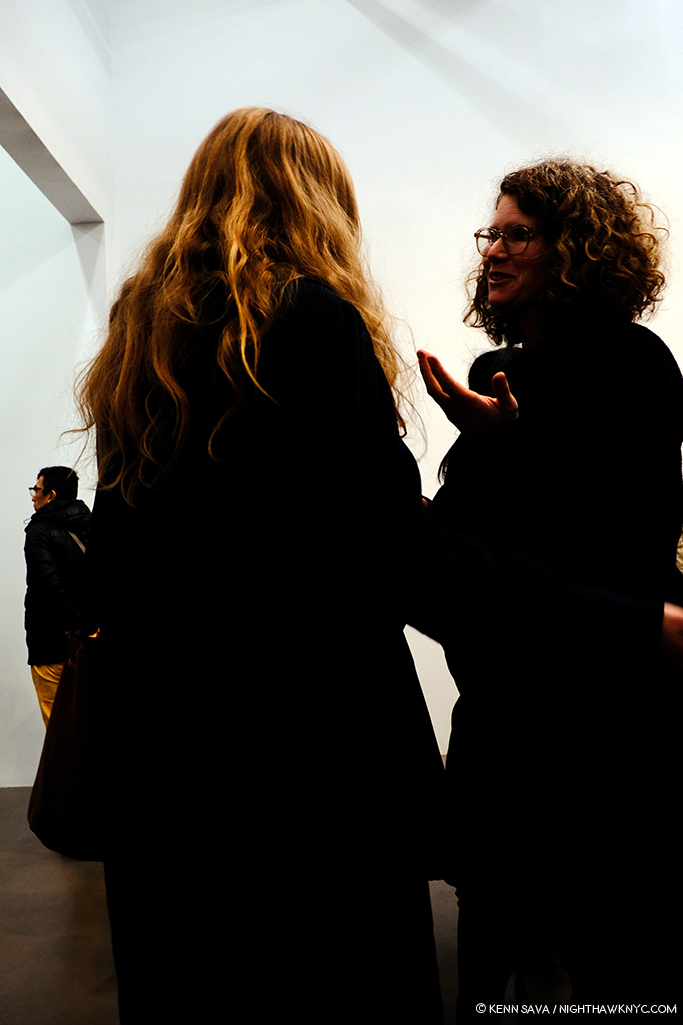
Dana Schutz, right, at her opening on January 10th.

When I last saw work by Dana Schutz it was in the 2017 Whitney Biennial, where her Painting, Open Casket, was met with controversy, a boycott, and calls that the work a) be taken down, even b) destroyed.

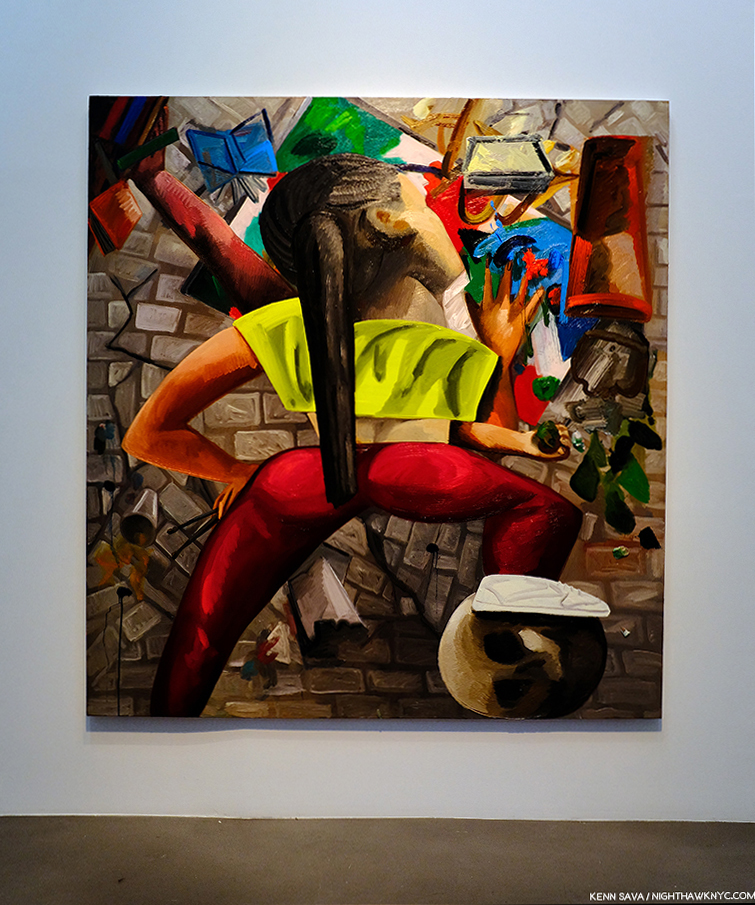
Painting in an Earthquake, 2019, 94 x 88 inches, seen in the Atrium gallery visible from 18th Street. It sets the stage while standing apart from the rest of the show. Though it’s seen 10 days into the New Year, it’s dated 2019. Every other work is dated 2018. (I thought I could detect the smell of drying paint in the galleries.)

Neither happened, and after the show ended, the Artist found refuge from the controversy by returning to Painting.

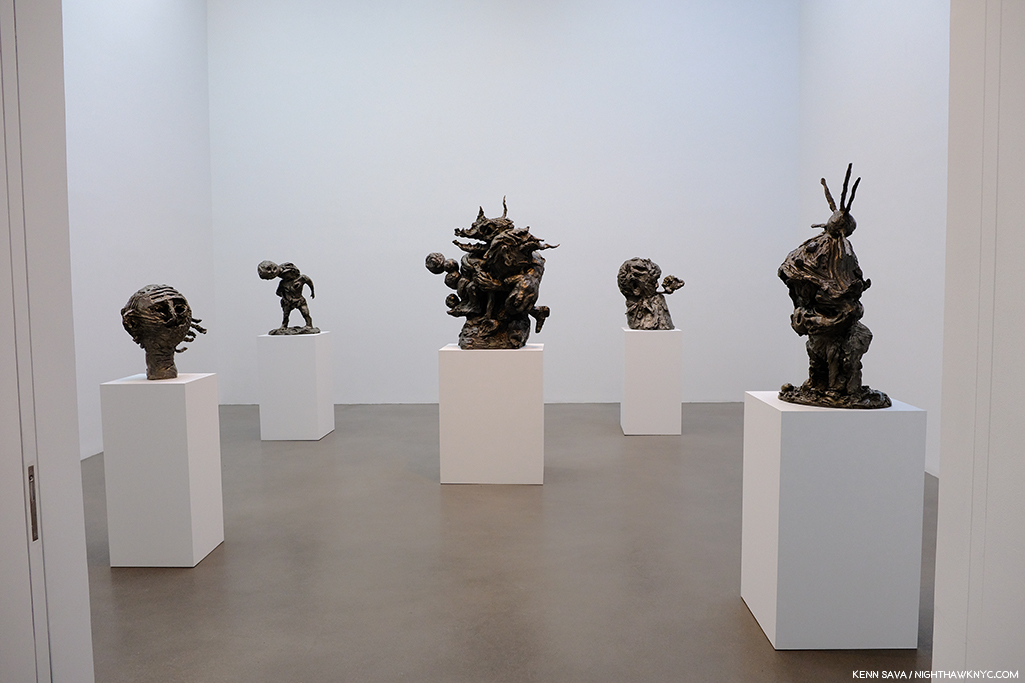
Installation view of the Sculpture in the first gallery.

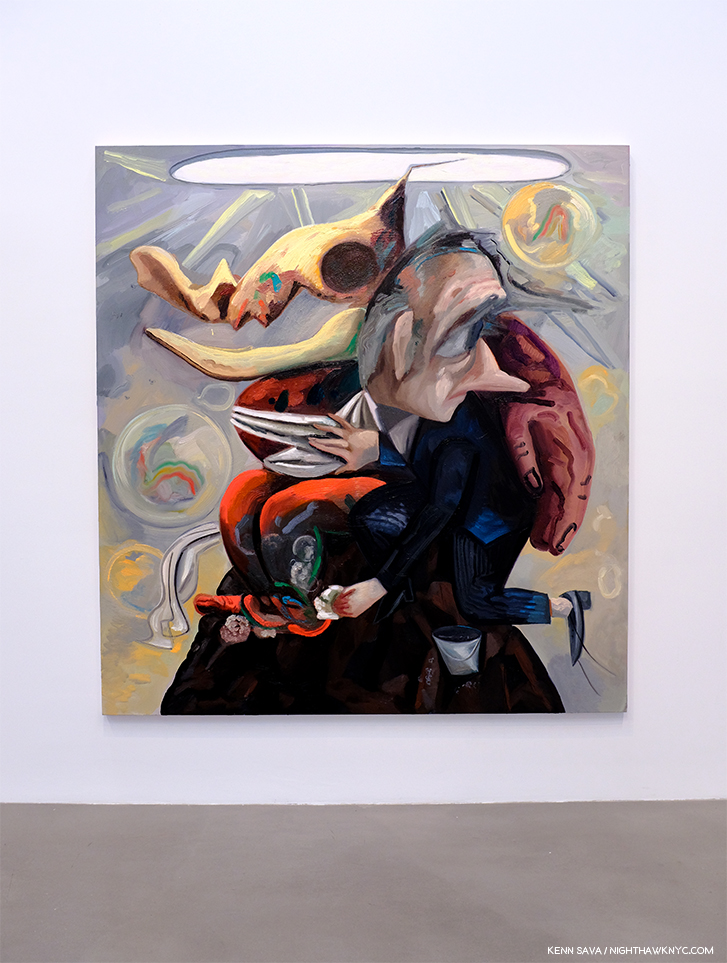
On January 10th, 2019, she opened Dana Schutz: Imagine Me and You, at Petzel Gallery, 456 West 18th Street, her first NYC solo show since the ’17 Biennial, and surprised me by including 5 Sculptures for the first time. While I immediately thought of the late, great Jack Whitten and his “second career” as a Sculptor that almost no one knew about during his lifetime, these are all dated 2018, and there was no indication if she had made any before. The Sculptures, which were molded in clay and then cast in bronze (per the press release), are shown in the first gallery, which means they are definitely not an “afterthought.”

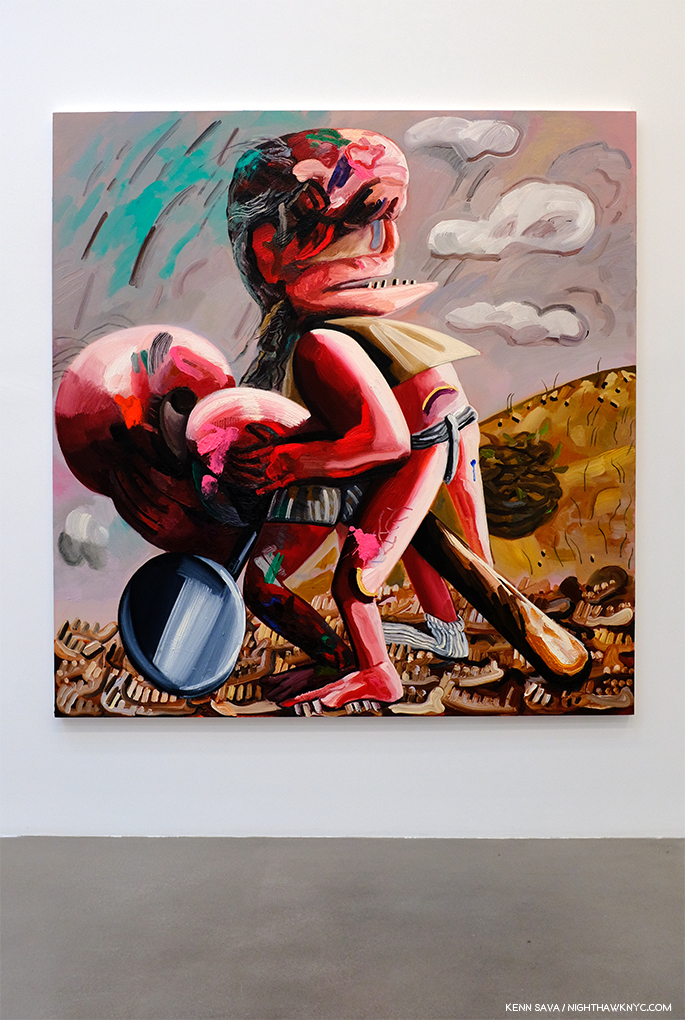
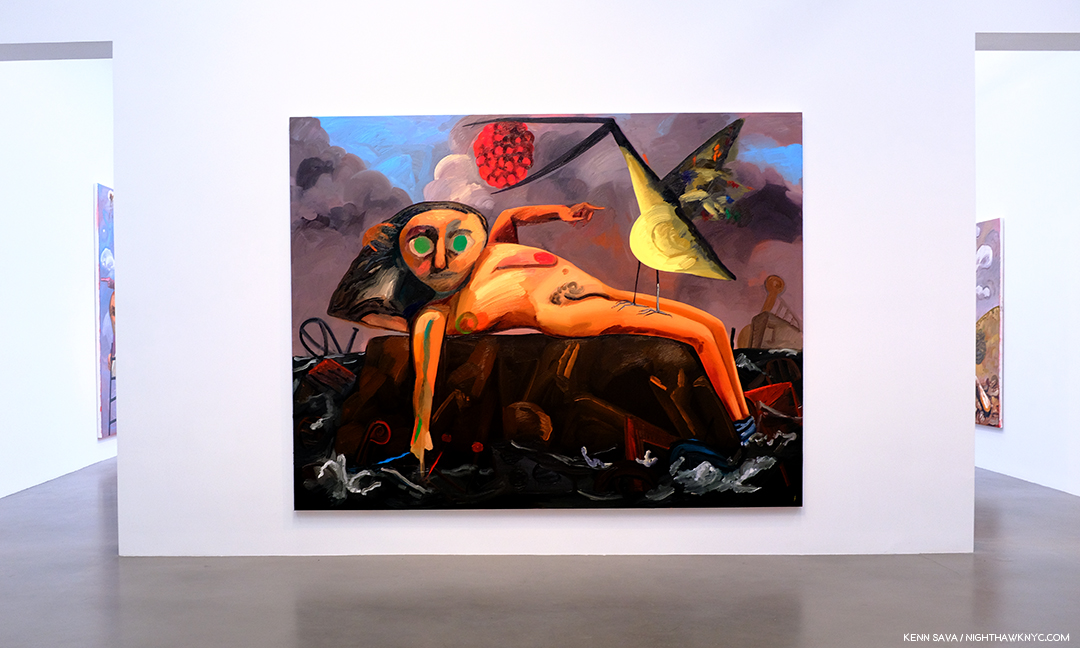
Washing Monsters, 2018, All Paintings are Oil on canvas, 94 x 87 inches.

With the 2019 Whitney Biennial scheduled to open on May 17th, the show provides an opportunity  to see what an alumnus has been up to since 2017.

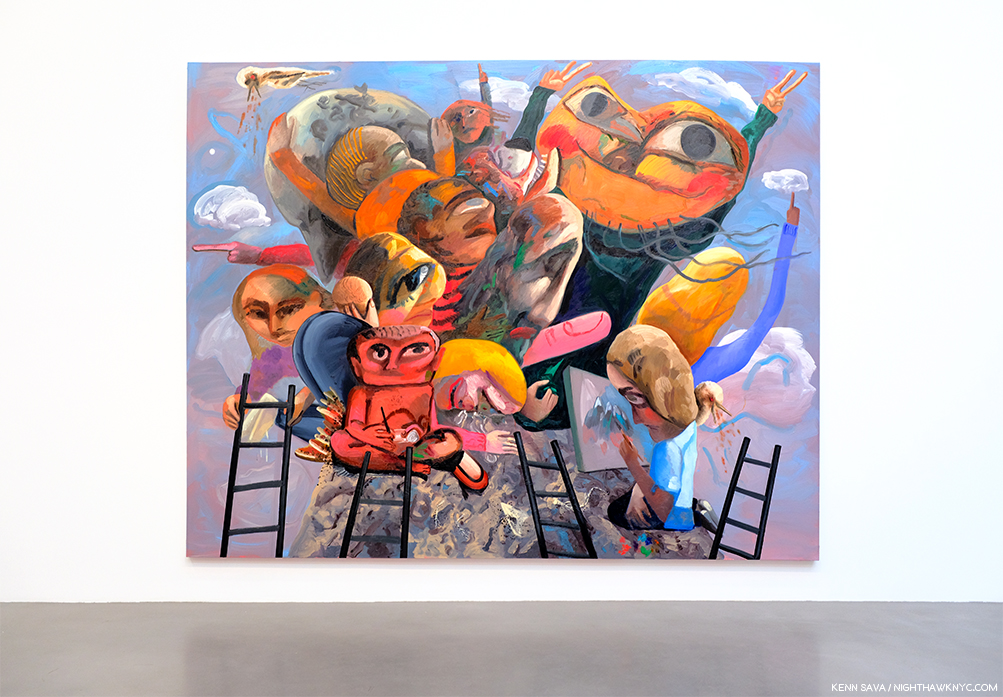
Mountain Group, 2018, Oil on canvas, 120 x 156 inches.

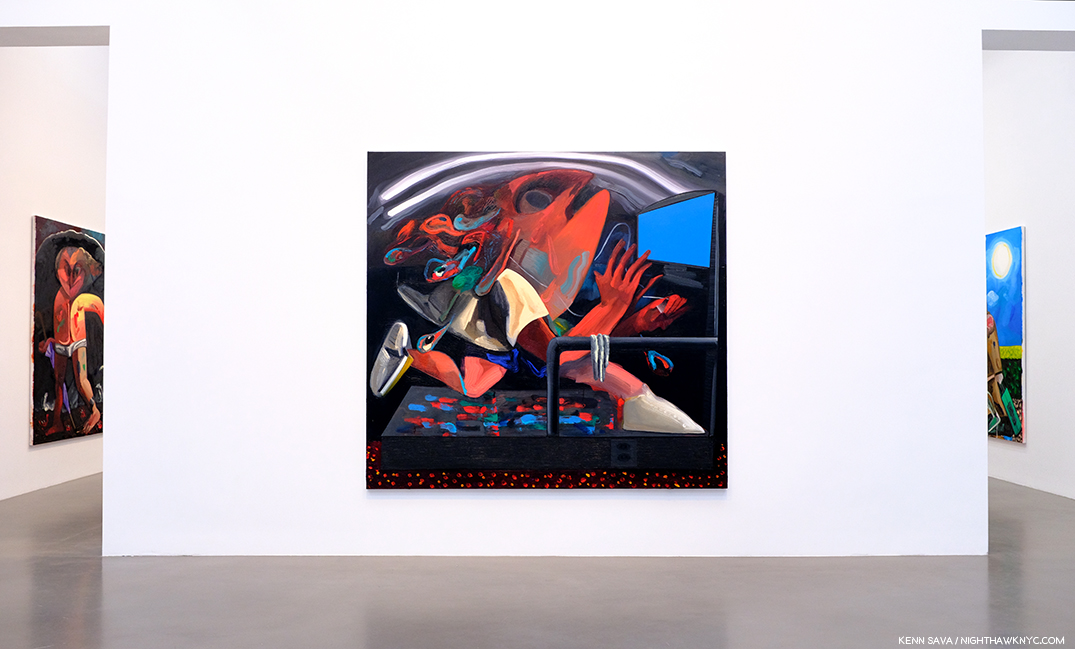
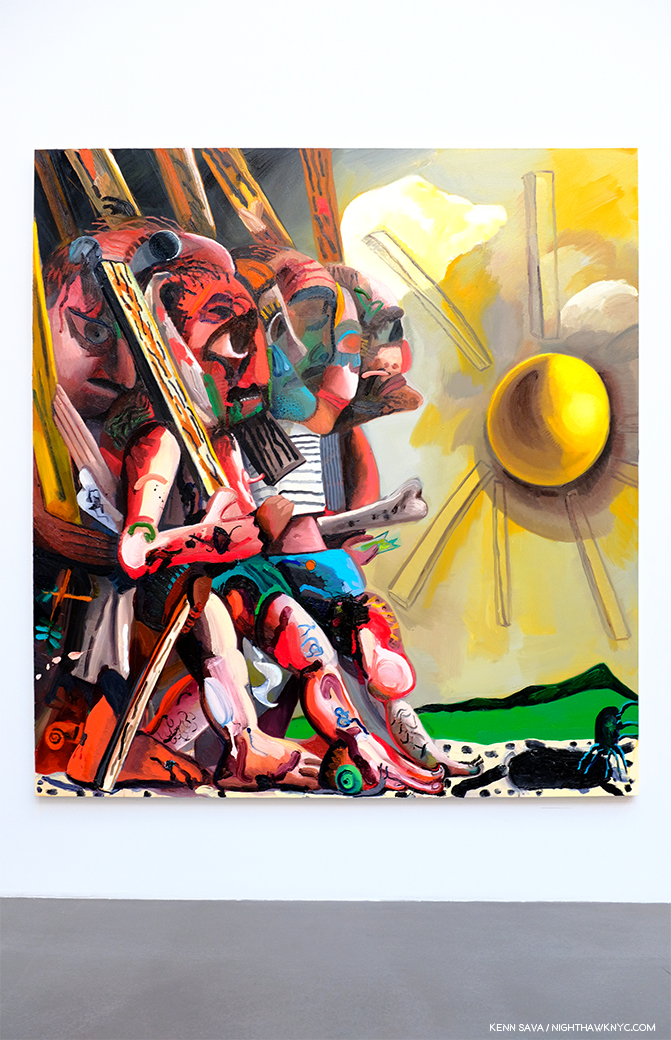
On the one hand, there’s much in her new Paintings that would seem to come right out of late Philip Guston, but overall, it seems to me, in the end, she moves past it to achieve a fresh daring of her own, particularly in Washing Monsters, shown above, Beat Out The Sun and Treadmill, shown further on.

Strangers, 2018, 88×84. Almost everything about this screams “late Philip Guston,” though the longer I looked at it, I moved past it.

Almost nothing feels still. Everything’s in motion.

Treadmill, 2018, 90 x 96 inches One thing I particularly like about these Paintings is her palette.

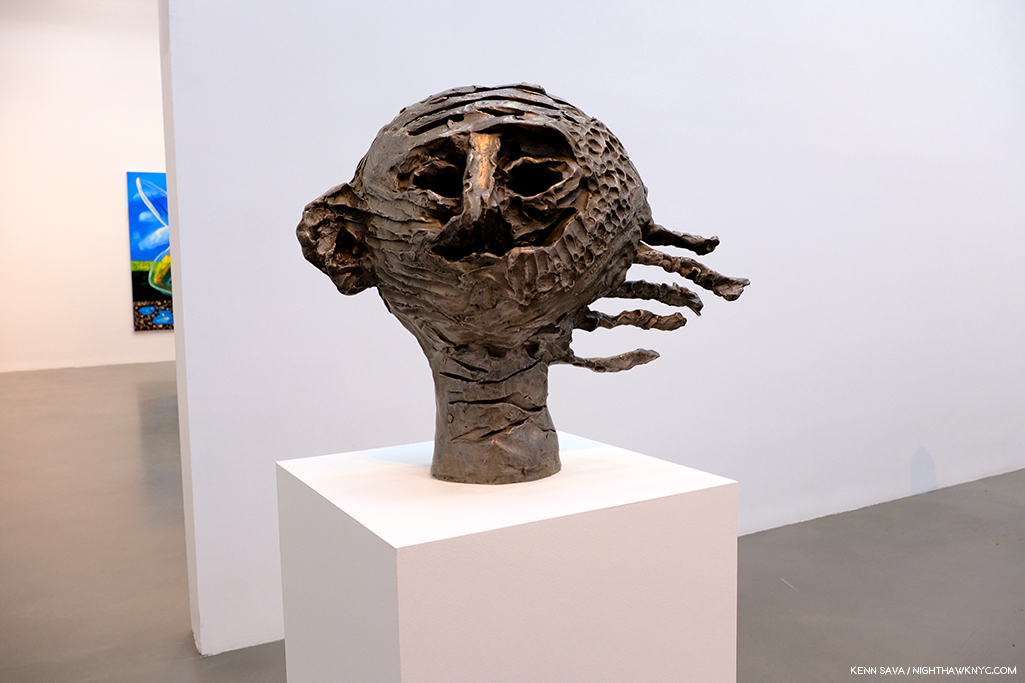
Even the Sculpture.

Head in the Wind, 2018, Bronze, 22x14x22 inches.

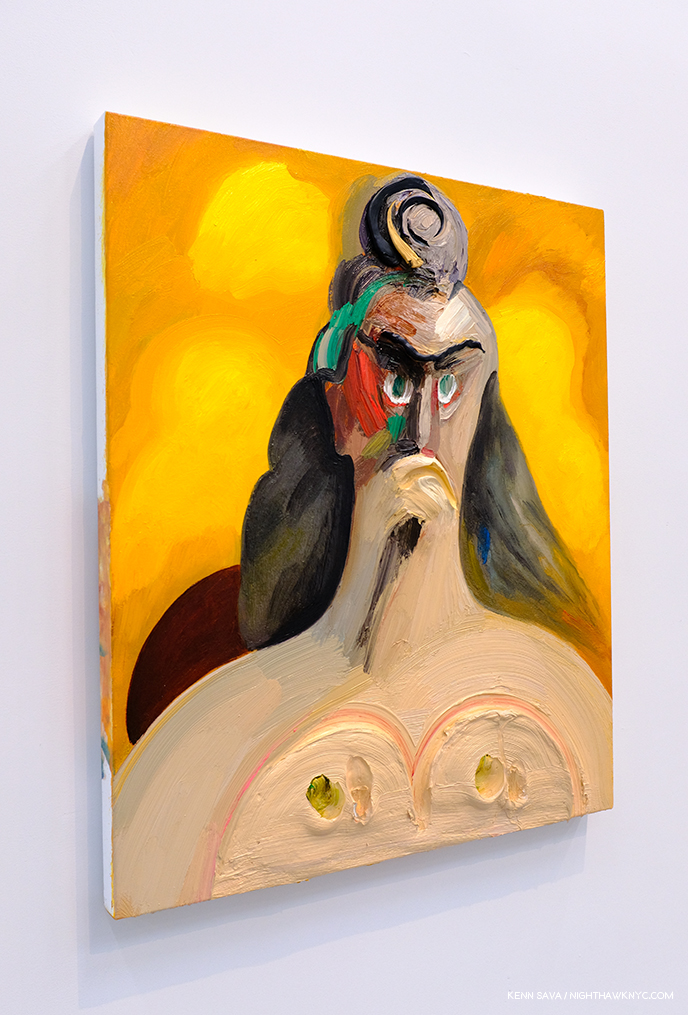
The paint is often applied thickly,

Here, the paint even casts its own shadows on the lower part. Touched, 2018, 30 x 26 inches.

which makes the inclusion of Sculpture in the show even more appropriate.

The Visible World, 2018, 108 x 140 inches.

The Sculpture both compliments and echoes the Paintings and the two combine for a show that is not overly large, in terms of the number of works, but feels unified.

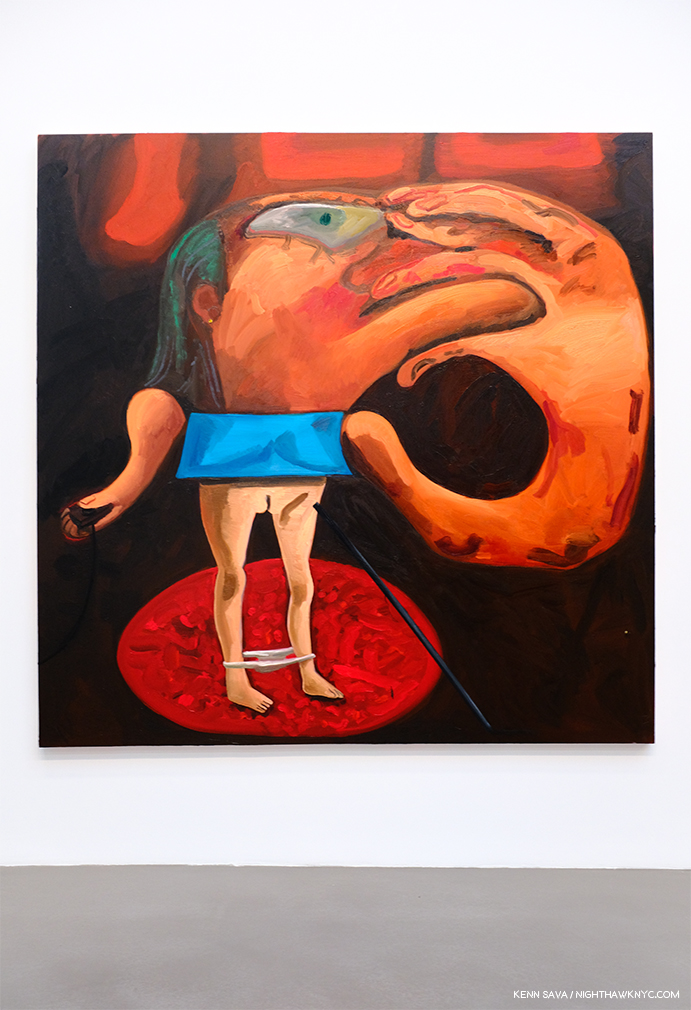
Presenter, 2018, 88 x 88 inches

It’s hard not to look at this work for signs of the effect of the controversy on it, and there are a number of passages that would seem to lend themselves to such an interpretation. But, overall, these works reward extended, and repeat, looking. In the brand new day of 2019, Dana Schutz’ Art is alive and well.

Beat Out the Sun, 2018, 94 x 87 inches

While this show runs through February 23rd, I’ll be curious to hear who has been chosen to be in this year’s Biennial– particularly among Painters and Photographers. Stay tuned.

*- Soundtrack for this Post is “Brand New Day,” by Van Morrison from Moondance, 1970.

NighthawkNYC.com has been entirely self-funded and ad-free for over 6 years, during which over 250 full length pieces have been published. If you’ve found it worthwhile, you can donate to keep it going & ad-free below. Thank you!

Written & photographed by Kenn Sava for nighthawknyc.com unless otherwise credited.
To send comments, thoughts, feedback or propositions click here.
Click the white box on the upper right for the archives or to search them.
For “short takes” and additional pictures, follow @nighthawk_nyc on Instagram.

Subscribe to be notified of new Posts below. Your information will be used for no other purpose.
 

Charles White’s Final Mural

Written & Photographed by Kenn Sava (*unless otherwise credited)

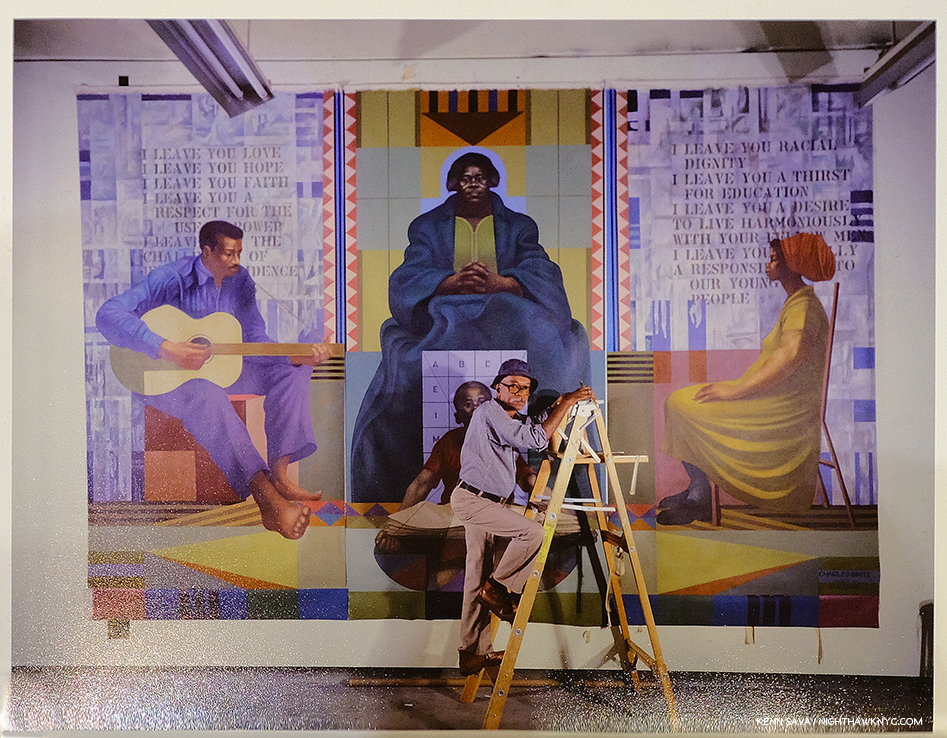
Charles White at work on the mural, Mary McLeod Bethune, in 1978, the year before his passing. *Photo by Frank J. Thomas. Click any photo for full size.

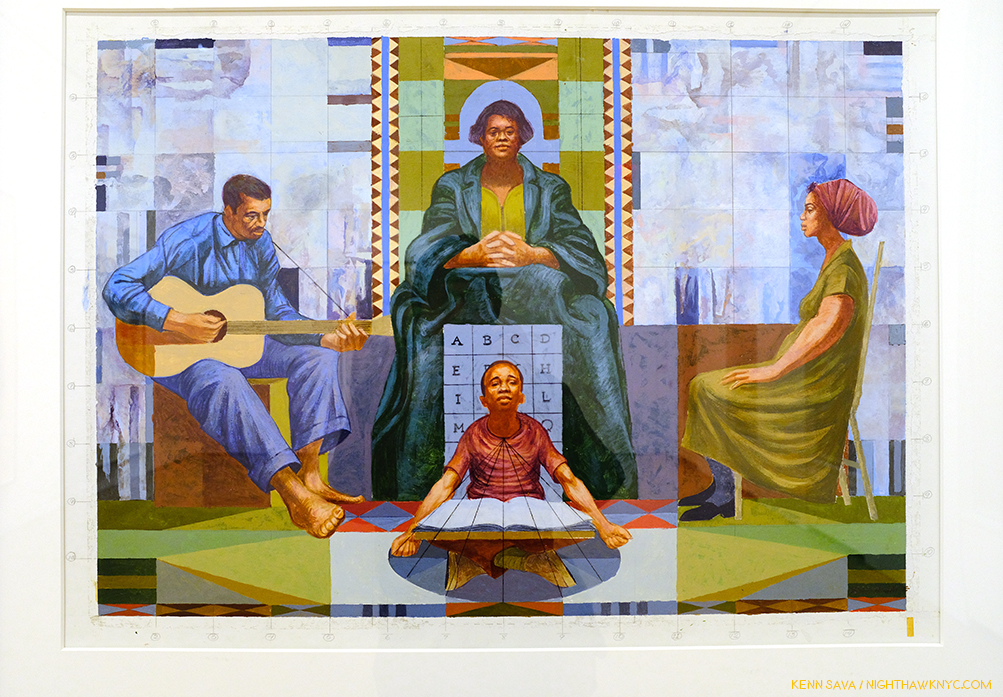
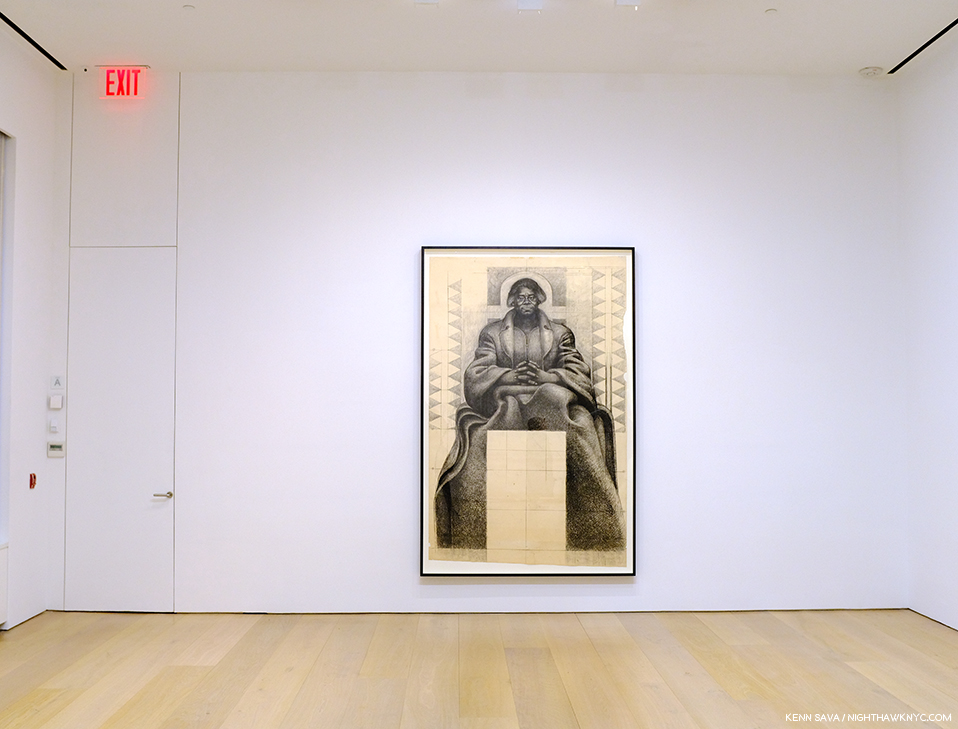
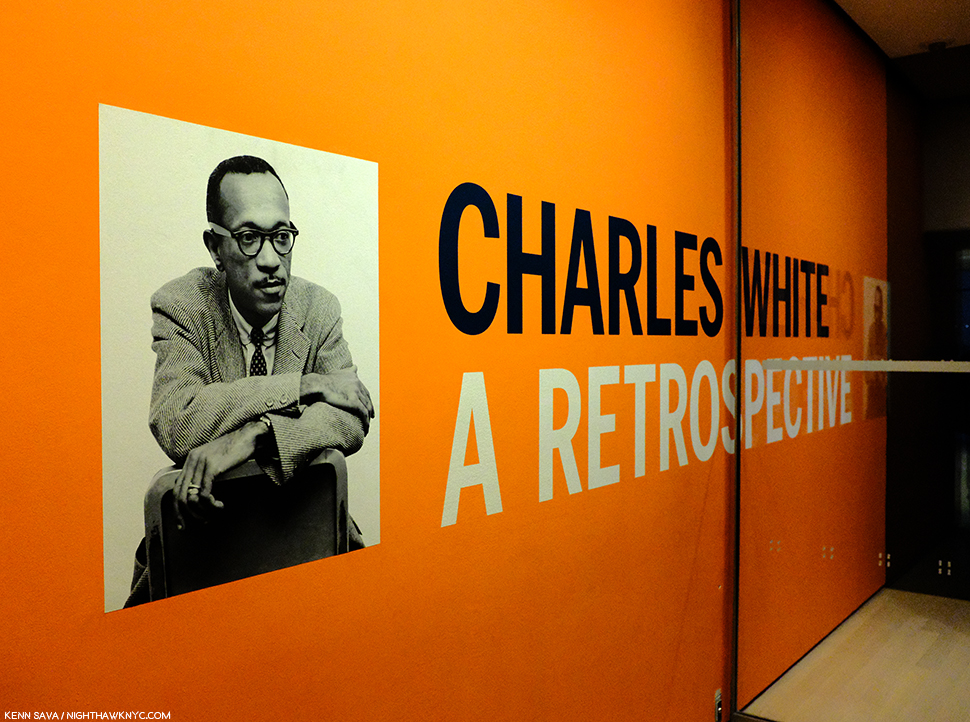
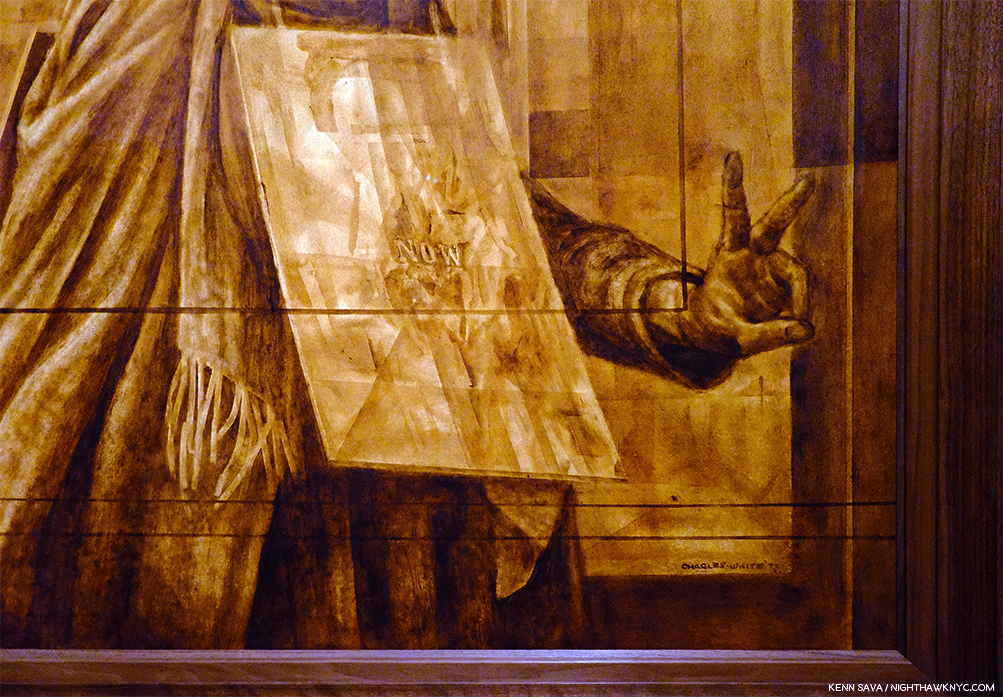
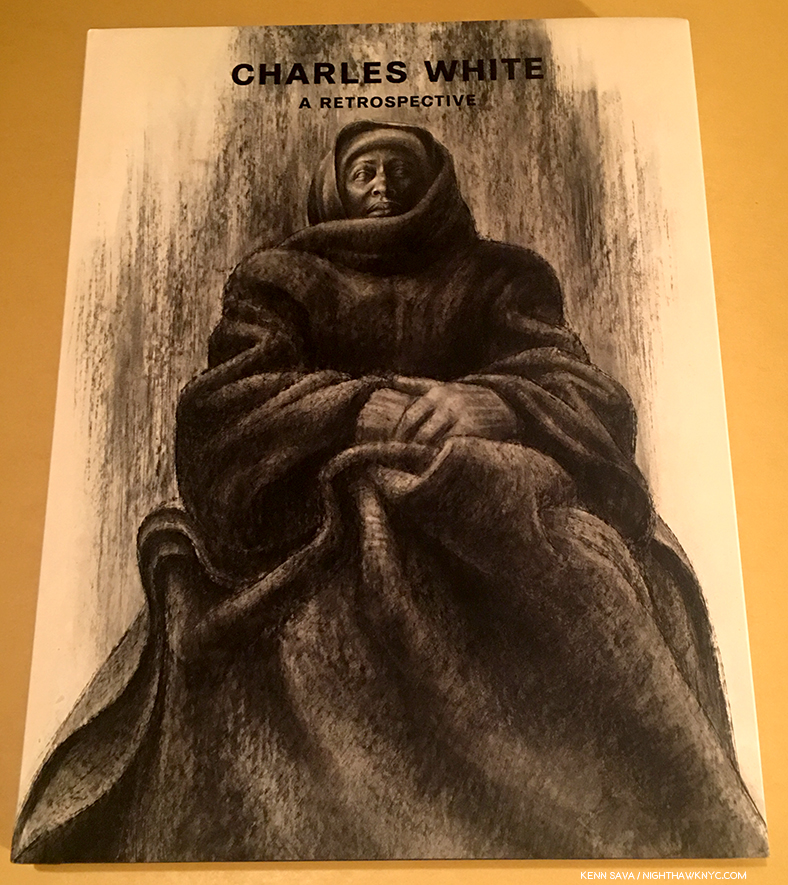
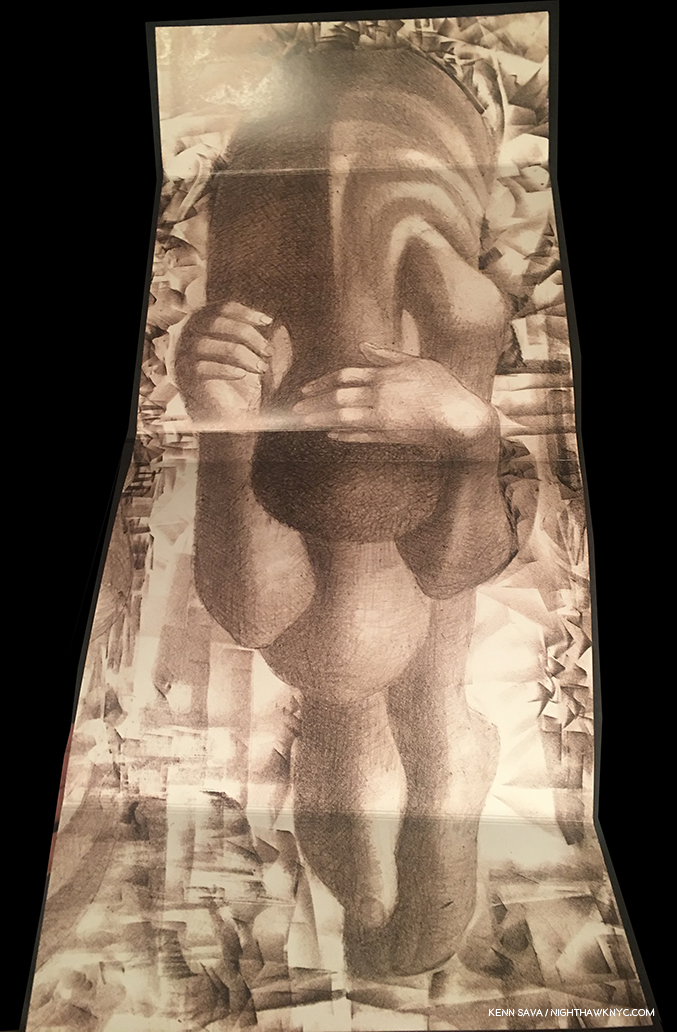
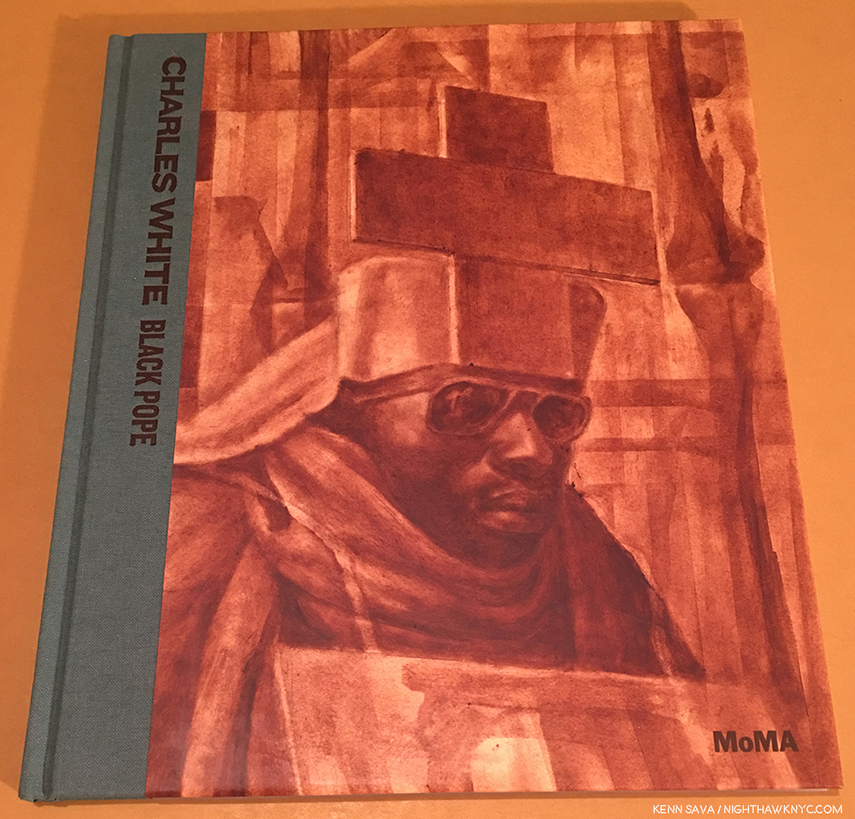
A pendant to the Charles White Retrospective recently at MoMA, David Zwirner mounted Charles White: Monumental Practice and Charles White: Selected Works, both on the 2nd floor of 537 West 20th Street. The former featured studies for Charles White’s Mary McLeod Bethune Mural, the last mural and major work the Artist would complete in his lifetime, honoring a great teacher who believed in “uplifting people through learning1.” The Presentation Study, and 4 monumental ink and chalk Drawings that range between 87 and 96 inches (8 feet!) tall, each, were accompanied by other preparatory Drawings and ephemera. Together, they reveal the course of Charles White’s final major work, and add more pieces to the picture of Charles White’s extraordinary accomplishment.

The Presentation Study, 1977-8, without the text, squared up for transfer, shows a child with an open book.

Taking a closer look at his final major work offers a rare look at his working method. Each of the Studies is lined with a grid and diagonals to help transfer the composition to the mural. The Presentation Study offers a  rare chance to see Charles White’s late style in full color. (Most of the late works in the MoMA Retrospective were monochrome.)

Study for Mary McLeod Bethune’s portrait

The mural shares the same grid pattern background overlaid with text seen in Charles White’s Wanted Poster series from 1969 through the early 1970s, and a strong woman as the central figure. The text, in this case, being Mary McLeod Bethune’s Last Will and Testament.

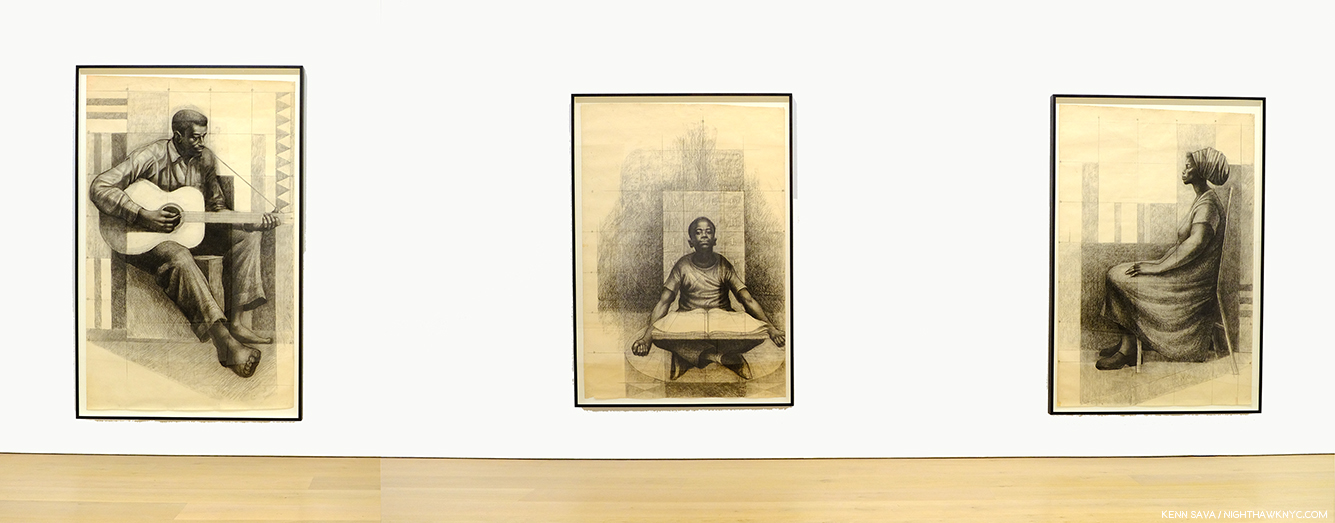
Studies for Mary McLeod Bethune Mural (Guitar Player, Seated Child with Book, and Seated Woman), 1977, Ink on charcoal on paper in 3 parts. The Seated Child is particularly interesting as the figure is off-center. Perhaps the rest of the sheet wss lost, but when seen close up, it still contains the grid and the diagonals to allow it to be properly placed in the larger composition.

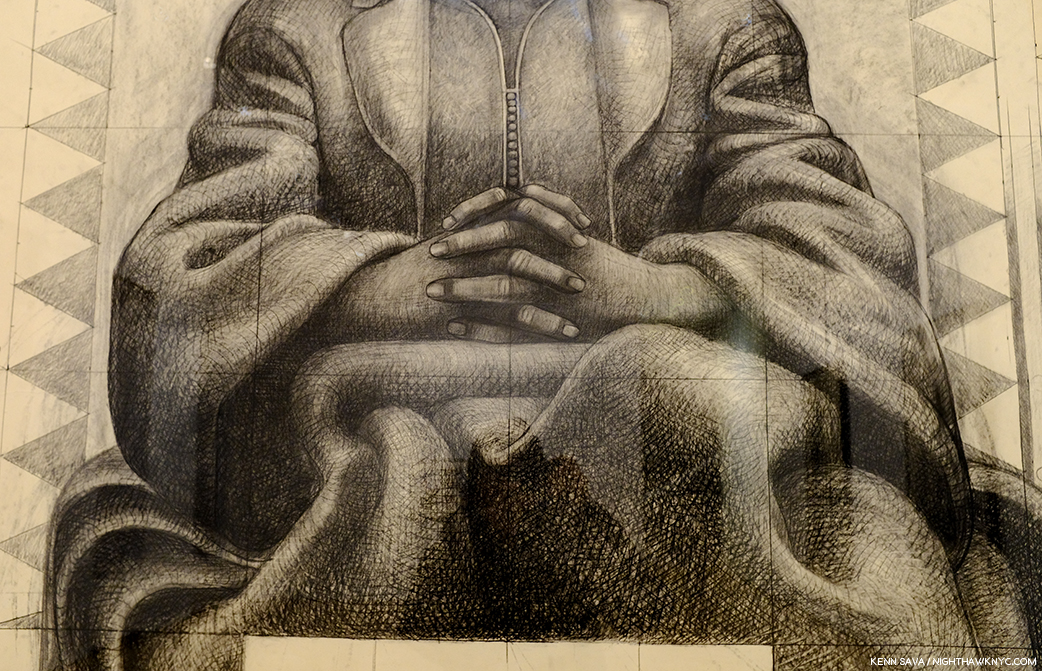
In fact these huge Drawings need to be seen close up. Only then can you get a full appreciation of, and marvel at,  Charles White’s mastery of Drawing and Draftsmanship, and the amount of work each of these contains.

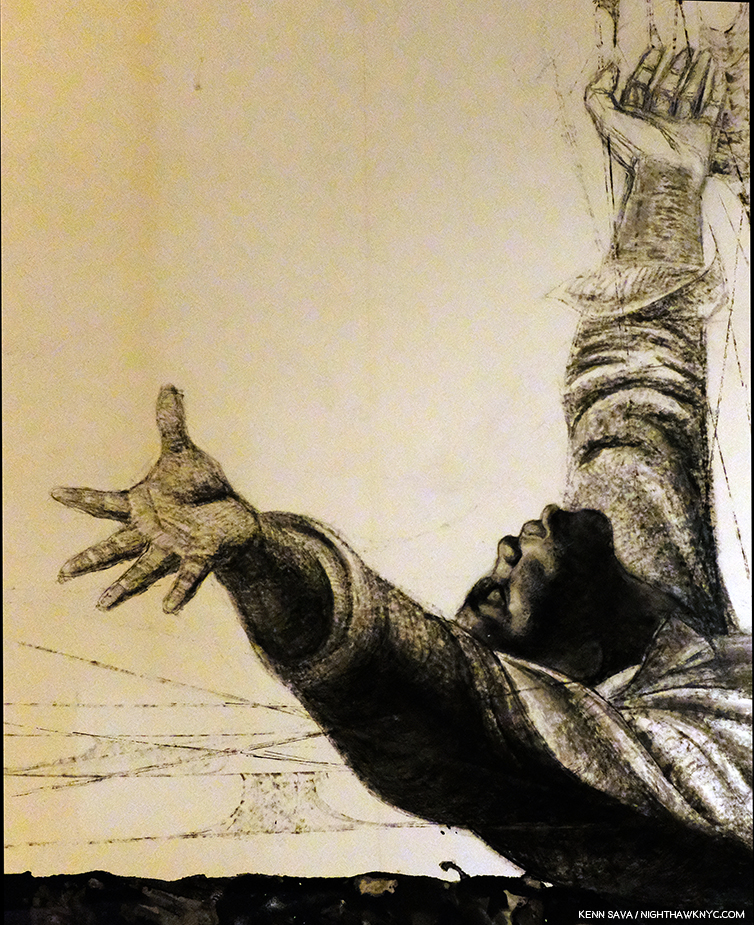
Detail of Study for Mary McLeod Behune showing Charles White’s mastery of the age old technique of cross-hatching. Particularly noteworthy for me in this are the hands. Notoriously difficult to render, I always pay attention to how an Artist renders hands. Charles White’s hands changed dramatically over his career, as I pointed out in my Post on the Retrospective, before he settled on this realistic style. Her hands are rendered here with particular strength and beauty. They are a focal point for the entire mural.

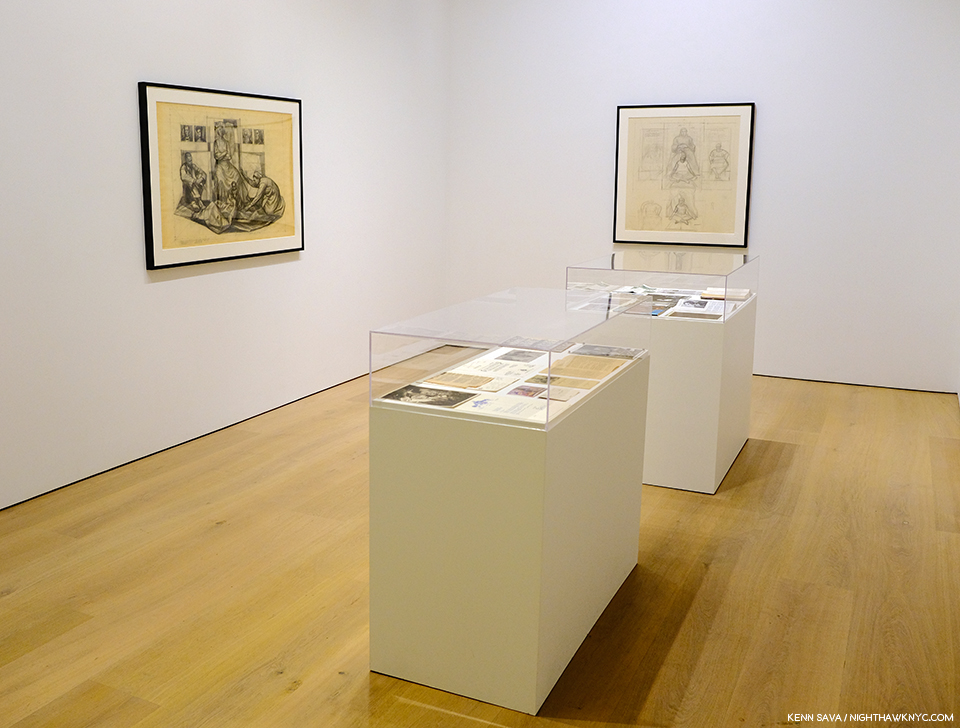
The second gallery contains additional studies and ephemera including Photos of the work in progress and documents regarding the project reveling the road Charles White had to traverse to do this project.

Installation view of the second gallery with ephemera in the vitrines.

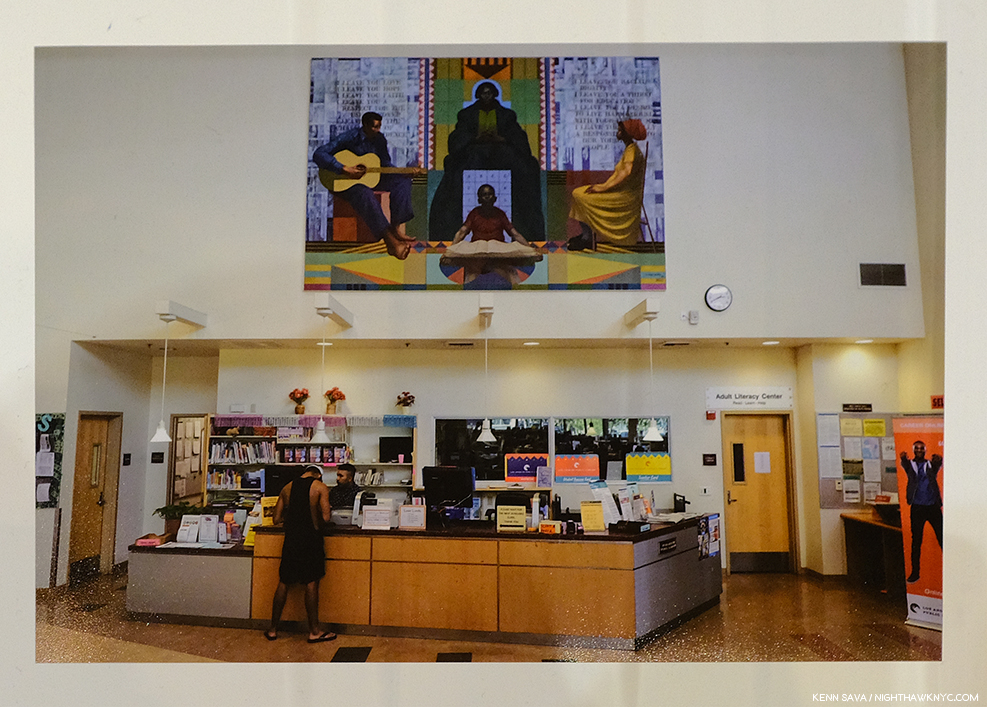
It concludes with this picture of the finished Mural installed in the Dr. Mary McLeod Bethune Regional Library, Exposition Park, Los Angeles. Charles White was paid just $3,000.00 for it2!

The mural which measures approximately 5 by 7 feet, installed in the Dr. Mary McLeod Bethune Regional Libray as it looks today.

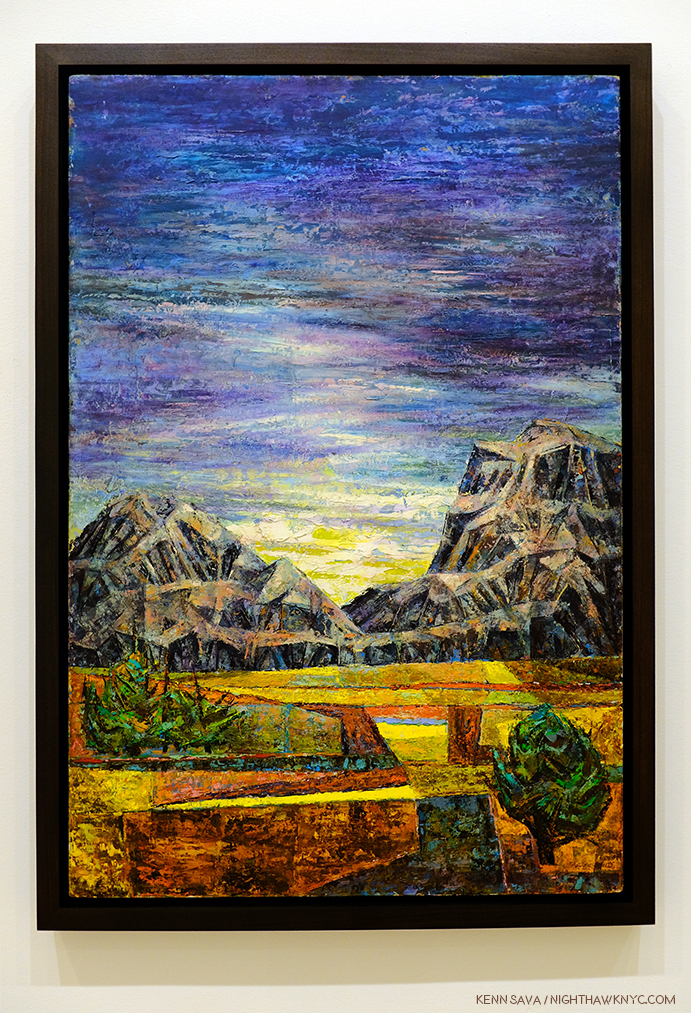
In the third gallery, where Charles White: Selected Works was on view, showing a variety of works from the 1930s through the 1950s, two works stood out to me. First, is the fascinating Landscape, ca. 1957-9. It was hard for me to look at this and not be reminded of Cezanne’s planar style in the mountains, with a more flattened geometric landscape in the foreground, and a sky that has as many colors as some bodies of water. It’s a fascinating look at a rare landscape done while Charles White was exploring some of the many styles he had at his fingertips.

Landscape, c.1957-59, Oil on board, 36 x 24 inches.

Directly across from it is the powerfully haunting Homage to Attica, one of the few watercolors by Charles White I’ve seen. Unlike the mysterious figure in his masterpiece, Black Pope, who’s eyes are hidden by sunglaasses, here, we get to the shrouded subject’s eyes, and only his eyes.

Homage to Attica, 1972, Watercolor on paper, 11 x 54 inches.

While the Retrospective closed at MoMA on January 13th, and now moves to LACMA in Charles White’s last home town, L.A., where it will open on February 17th and run through June 9th, the David Zwirner shows are up until February 16th.

*- Soundtrack for this Post is “Ol’ Man River,” by Jerome Kern & Oscar Hammerstein from Showboat as sung by Paul Robeson, one of Charles White’s frequent subjects, in 1937-

NighthawkNYC.com has been entirely self-funded and ad-free for over 6 years, during which over 250 full length pieces have been published. If you’ve found it worthwhile, you can donate to keep it going & ad-free below. Thank you!

Written & photographed by Kenn Sava for nighthawknyc.com unless otherwise credited.
To send comments, thoughts, feedback or propositions click here.
Click the white box on the upper right for the archives or to search them.
For “short takes” and additional pictures, follow @nighthawk_nyc on Instagram.

Subscribe to be notified of new Posts below. Your information will be used for no other purpose.
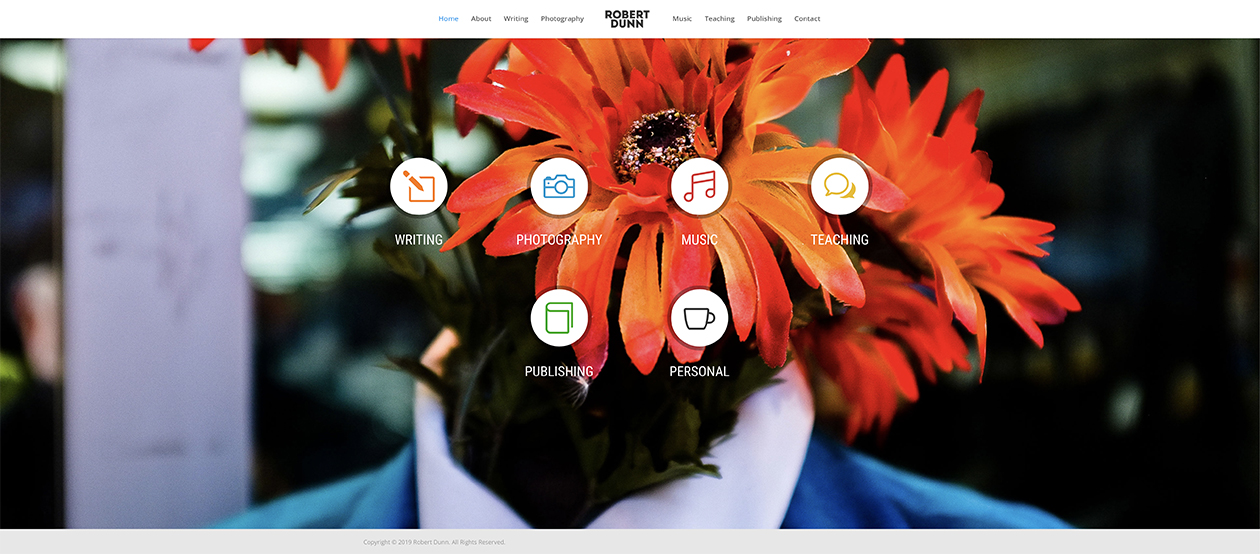
 

  1. Charles White: A Retrospective Exhibition Catalog, P.136
  2. http://www.publicartinla.com/LA_murals/USC/charles_white_mural.html

Charles White- Now

Written & Photographed by Kenn Sava

“Drawing is [a] particularly exciting medium for me. I just like the feel of it. My whole body is into it when I draw and I think black and white is as effective a medium [as any].” Charles White1

Charles White, Detail of Study for Nat Turner, Yesterday, Today, Tomorrow, 1968, Charcoal and oil wash over pencil on board. Click any Photo for full size.

Ah…the majesty of excellent draftsmanship… Just when you thought it was dead as a doornail, with Photography destroying all previous Artforms in its world dominating wake, along comes a Retrospective of one of the Masters of the craft of Drawing in the 20th Century, the late Charles White (1918-1979), who’s centenary is celebrated in the first major museum survey devoted to his Art in over 30 years. Charles White: A Retrospective, made its second stop at MoMA after debuting at the Art Institute of Chicago and now heads to LACMA beginning February 16th, thus tracing the 3 cities Mr. White lived in- in order. Its magisterial, full of wonders, and long overdue. The only possible caveat could be- MORE!…even bigger, please.

The entrance, divided by a sliding glass door, of one of the great shows of recent years.

By no means a small show, clocking in at 114 items (many of them quite large), over 13 section, the takeaway is that, henceforth, it will be impossible to deny Charles White his place in the pantheon of great Artists of the century. Again.

Charles White was a very successful Artist during his lifetime. He had gallery representation in each city he lived in and his work was collected by museums, nationally and internationally. He was also sought out as a teacher, particularly at Otis College of Art & Design in Los Angeles, from 1965 until his passing in 1979 at only 61. After his death, he fell into something of an eclipse. But, his influence has lived on through the work of his students including Richard Wyatt, Jr, Kent Twitchell (both muralists), and most prominently, Kerry James Marshall (a “representational” Painter) and David Hammons (who has worked in a wide range of media). Mr. Marshall never seems to miss an opportunity to laud Charles White- as a teacher and as an Artist, frequently speaking of him in the highest terms, as he has, again, writing the preface for the excellent Exhibition Catalog. He led me to take a deeper look at Charles White a few years ago. Mr. Hammons paid tribute to Charles White in October, 2017 when he curated the remarkable Leonardo da Vinci-Charles White show at MoMA, that I wrote about here. Judging by the crowds that attended this show, as the MoMA stop of the Charles White Retrospective “tour” ends and Los Angeles prepares to welcome it, I think it’s already safe to say, the Charles White “eclipse” is over.  The other take away, for me, is that Charles White’s influence deserves to be even greater than it already is. With all due respect to his students, Charles White’s Art more than speaks for itself.

Study for Nat Turner, Yesterday, Today, Tomorrow, 1968, Charcoal and oil wash over pencil on board.

When I was a kid, everyone drew. Some, eventually, took lessons and studied Drawing seriously, which is something you can devote your life to and learn something new each and every day. Even for those that didn’t study it, Drawing became a part of many of their lives, whether making doodles, notes, caricatures, or, what have you. That seems to be changing and I think it’s tragic. Drawing is another language, one that is every bit as effective at communicating as writing. I think it’s an essential life skill. Unfortunately, it’s one that I don’t see as many doing as they were 15 or 20 years ago. One look at the work of Charles White will show you what’s possible with Drawing. 

The final Drawing.Nat Turner, Yesterday, Today, Tomorrow, 1968, Drybrush and ink on board, 51 x 78 inches.

As beautiful and technically masterful as it is, Charles White’s work is about expressing ideas. “An artist must bear a social responsibility. He must be accountable for the content of his work. And that work should reflect a deep, abiding concern for humanity. He has that responsibility whether he wants it or not because he’s dealing with ideas. And ideas are power. They must be used one way or the other,” Charles White2. He was speaking in 1978. He could have been speaking yesterday.

Back cover of the Exhibition Catalog.

Those ideas revolved, largely, around his efforts to set the record straight on black history in America in response to the way it was taught when he was growing up. He did this through depicting both the famous and those not so famous in powerful and unique ways that seen over the course of my 4 visits seemed to resonate with visitors in ways I don’t often see. Time and again, I encountered whole families moving slowly from work to work, with the parents patiently explaining fine details of a subject’s life, or very little known cultural details Mr. White had depicted, from what I could gather when they were next to me.

Charles White hit the ground running. He received a scholarship to the School of the Art Institute of Chicago at 13. He drew this at 17-

Self-Portrait, 1935, Black crayon on cardboard.

He then began exploring a wide range of styles over the next few decades, some showing the influence of abstraction, cubism and mannerism, but, remarkably, always remaining his. I found it interesting to trace them in his early murals, for which only studies remain. The first one, Five Great American Negroes was done 4 years after the Self-Portrait, when Charles White was 21.

Charles White, Five Great Americans Negroes, 1939, Oil on canvas. From left to right- Sojourner Truth, Booker T. Washington, Frederick Douglass, George Washington Carver, and Marian Anderson

Here we see Charles White depicting famous figures- living and dead (these were selected by the readers of the newspaper who sponsored the mural), something he would do for much of the rest of his career. The enlarged arms and hands that begin to be seen here remind me of passages in Michelangelo and the Mannerists, like Hendrick Goltzius.  The Mexican Muralists- Diego Rivera, José Clemente Orozco and David Alfaro Siqueiros, who he met on a later trip to Mexico, were an obvious big influence. Artistically and philosophically.

Study for Struggle for Liberation (Chaotic Stage of the Negro, Past and Present), 1940, Tempera on illustration board.

One year later, his Struggle for Liberation (Chaotic Stage of the Negro, Past and Present), a 1940 project for a Chicago Library that was never completed, is known today only through this study and some Photographs taken by Gordon Parks. In this incredibly complex composition, the left side speaks to the past, the right to the present. Both scenes appear to be filled with everyday people, except for John Brown, apparently holding a gun,  in the lower left. According to curator Sarah Kelly Oehler in the Exhibition Catalog, this work can be seen as indication that his ideas were leaning left and towards putting more faith in everyday people to bring change. In the right side, “He depicted capitalism, politics, institutional power, and violence as responsible for the ongoing injustices faced by African Americans as they demanded their rights3.” The work was deemed “inappropriate” for a library, even one that served a black community. Charles White, apparently, finished the left side of it, then moved to New York.

Study for The Contribution of the Negro to Democracy in America, 1943. Tempera on board. Note the row of Civil War soldiers, near the center. Painted during World War II, these were possibly included in support of a campaign to gain equal rights at home and abroad for African American soldiers as a reminder of their contributions during the Civil War.

In the last of Charles White’s three early murals, The Contribution of the Negro to Democracy in America, 1943, the Artist includes at least 14 identified historical figures, in a circular composition. His style, again, is unique and fascinating. Note the hands of the guitar player, possibly Lead Belly (playing a guitar with no strings), in the lower right and the planar nature of the portraits. Again, there seems to be the influence of Diego Rivera, with the machinery in the center echoing his Detroit Industry Murals.

Five portraits, in five styles. Clockwise from top left- Worker, 1944, John Brown, 1949, Gideon, 1951, Untitled (Bearded Man), c. 1949, and Frederick Douglas, 1950.

This wall shows 5 portraits, each in a different style, that includes at least one study for a mural portrait.


Worker, 1944, Linocut on paper. From the Exhibition Catalog. .

When I look at these, and in particular the portraits of the Worker, John Brown, Untitled (Bearded Man) and Frederick Douglas, I’m reminded of the prints of the German Expressionist, Kathe Kollwitz (1967-1945), an Artist who was, also, passionately involved in social causes, increasingly after losing her son, Peter, in World War 1 in 1914. Kathe Kollwitz was influenced by Expressionist Ernst Barlach’s prints, but further stripped them down to their essentials, in stark works like this Frontal Self-Portrait, 1922-23.

Kathe Kollwitz, Frontal Self-Portrait, 1922-23, Woodcut. MoMA Photograph.

Charles White was both an avid Photographer and a collector of Photographs in books and in the media (like Francis Bacon). Charles White’s own Photography is only touched on in the show with this case of 17 Photographs. It’s a subject that warrants closer study.

A selection of Photographs taken by Charles White range from portraits to street scenes to shots of a protest in NYC.

Both his Photos and his collection of media provided him with reference material that he created many of his works from (also like Mr. Bacon). I find this interesting since Charles White was a master of life drawing which he also taught.

As his career went on, and his mature style appeared, particularly in his work after his move to California to help with the lingering side effects of the tuberculosis he got in the Army in 1944, his images are more and more open to interpretation.

Birmingham Totem, 1964, Ink and charcoal on paper, 71 x 40 inches.

Birmingham Totem, 1964, is an amazing work on many levels. First, it stands one inch shy of 6 feet tall, unheard of for a Drawing, except in this show. Second, it’s an “elegy” (per the wall card) to the four girls (one, aged 11, three age 14) that were killed in a KKK bombing of the 16th Street Baptist Church in Birmingham, Alabama on September 15, 1963. In it, a young man sits atop of pile of rubble, rendered in incredible detail. Even more remarkable, the young man holds a plumb line in his right hand, the weight of which is seen about half way down. He would appear to symbolize rebuilding.

J’Accuse #1, 1965, Charcoal and Wolff crayon on illustration board. This series marks the debut of Charles White’s mature style, based in realism. The hands and arms are no longer exaggerated. While the style is more direct, the composition is more open to interpretation, and so, more abstract, which would continue for the rest of his career. According to Ilene Susan Fort in the Exhibition Catalog, the 12 powerful and stunning works in the J’Accuse series “constitute a thematic indictment of the systemic, ongoing disenfranchisement of African Americans4.”

Charles White, master of Drawing, master of depicting the black form (per Kerry James Marshall- “Nobody else has drawn the black body with more elegance and authority.” Exhibition Catalog P.15), is someone who had a strong agenda he manifested in his work. He championed the struggle of African Americans, women (witness his 1951 solo show, Negro Women, where all 15 works on view included a woman), and workers, in Artworks that included both historical figures and every day people. Along the way, he created a body of work that adds another powerful voice telling another side of African American history with unique compositions featuring exquisite execution. Charles White’s compositions were always complex. From the earliest work shown, Kitchenette Debutantes, 1939,

General Moses (Harriet Tubman), 1965, Ink on paper.

Among the women that reappear in Charles White’s work, none is his subject more often than the activist and abolitionist Harriet Tubman (1822-1913). This later work, General Moses (Harriet Tubman), is a striking portrait of her. Then, so is this-

Harriet, 1972, Oil on board.

In what is, perhaps, his finest series, in my eyes, the late Wanted Poster Series, Charles White reimagines “Wanted” posters issued for runaway slaves.

Wanted Poster Series #17, 1971, Oil and pencil on poster board.

A series of 14 works he began in 1969, the images are powerfully direct, yet still retain a fascinating mystery as one ponders the details. The background textures and the stenciled text remind me of Contemporary Art techniques found in the work of, say, Jasper Johns.

Banner for Willie J., 1976, Oil on canvas, memorializes Charles White’s cousin, Willie J., an innocent bystander who was killed in a bar robbery.

Black Pope is the already classic example of late Charles White. Featured in the 2 piece MoMA show in 2017 opposite a Drawing by Leonardo da Vinci, it was also the subject of a fine MoMA book released at the time. It perfectly sums up the experience of looking at it, and late Charles White when it concludes on its final page, “If we today find the work difficult to define, the drawing demands that we try5.” It is this enigmatic approach to realism that may be of lasting influence to those who have come after Charles White, particularly Kerry James Marshall, though it seems to me it may be there in the work of Abstract Artists Jack Whitten and Mark Bradford as well.

Black Pope (Sandwich Board Man), 1973, Oil wash on board.

” I find, in tracing the course of the portrayal  of the Negro subject in art, a plague of distortions, stereotyped and superficial caricatures of ‘uncles’ ‘mammies,’ , and pickaninnies’,” he said6. Charles White is an important Artist because his work accomplished exactly what he set out to do. It does so most artfully, it seems to me. It’s full of life, depth and mystery. Yet, his work has an immediate directness that speaks to everyone as soon as they see it.

Now. And forever. Detail of just one part of the enigma of this endlessly fascinating work.

When I look at that “NOW” in Black Pope, I, too, wonder what the Artist was trying to tell us. Then, I quickly begin wondering what his reaction would be to living in this “NOW” and finding so little has changed. It’s terribly sad on one hand. On the other? It makes Charles White’s Art as relevant as its ever been.

UPDATE- My look at the two satellite Charles White shows concurrently at David Zwirner is here. One show is centered on the mural for Mary McLeod Bethune, Charles White’s last major work.


BookMarks- If you like what you find on NighthawkNYC, I hope you’ll consider supporting it so that I can continue to spend the countless hours and pay the expenses it takes to keep it going these past 3+ years-without ads.  To do so, you can make a donation through PayPal by clicking on the box to the right of the banner at the top of the page that will take you to the Donation button. Your support is VERY much appreciated. Thank you!

Charles White, A Retrospective, 2018

Charles White: A Retrospective, by Sarah Kelly Oehler, Esther Adler and with a preface by Kerry James Marshall, published in 2018 by the Art Institute of Chicago, is the finest book yet published on Charles White and easily the best one in print. It’s a terrific introduction to the Artist that will also serve as a go-to reference for years to come thanks to the depth it goes into on such little-known areas like Charles White’s Photography as well as the inclusion of a full and detailed chronology and exhibition history. The reproductions are gorgeous. Easily recommended.

Fun fact- The inside of the dust jacket folds out to reveal this beautiful detail from Wanted Poster #12, 1970, suitable for hanging.

Charles White: Black Pope by Esther Adler and published by MoMA in 2017, is the other recommended, in print, Charles White book. MoMA curator Esther Adler does a very good job of analyzing Black Pope and relating it’s history, in the process looking at a number of other works from Mr. White’s career. While A Retrospective is the first choice for an introduction, for those looking to go deeper into one of Charles White’s greatest and most mysterious works, this book has the most information we are likely to get anytime soon.

Charles White, Black Pope, MoMA, 2018

* -Soundtrack for this Post is this video of Lead Belly, frequent subject of Charles White, performing. Purportedly the only film ever made of him-

My thanks to Stephanie Katsias of MoMA. 

NighthawkNYC.com has been entirely self-funded and ad-free for over 6 years, during which over 250 full length pieces have been published. If you’ve found it worthwhile, you can donate to keep it going & ad-free below. Thank you!

Written & photographed by Kenn Sava for nighthawknyc.com unless otherwise credited.
To send comments, thoughts, feedback or propositions click here.
Click the white box on the upper right for the archives or to search them.
For “short takes” and additional pictures, follow @nighthawk_nyc on Instagram.

Subscribe to be notified of new Posts below. Your information will be used for no other purpose.
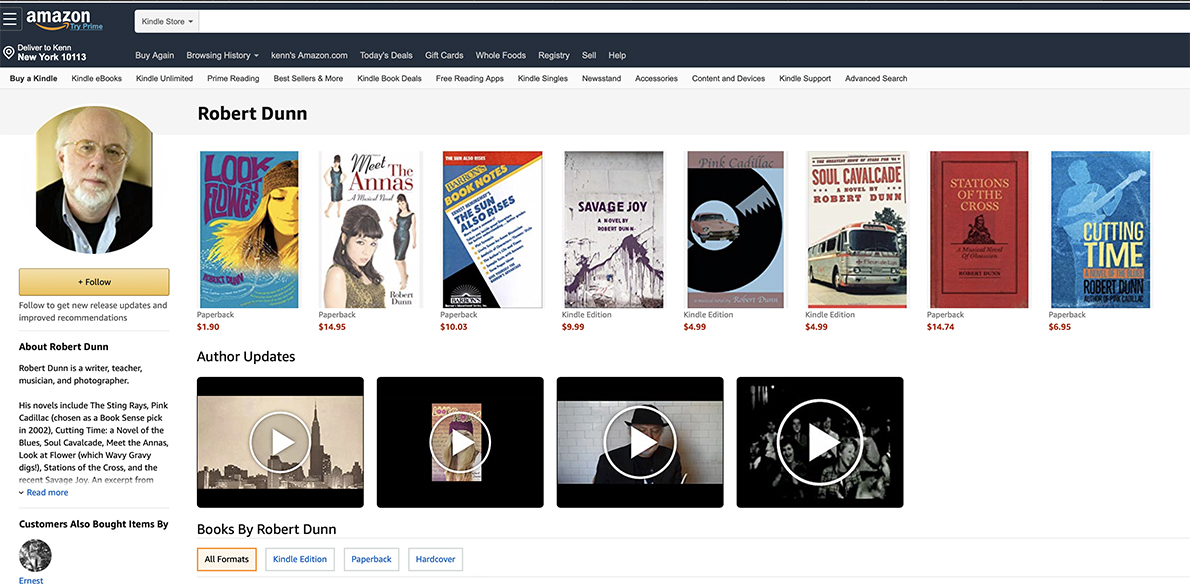
 

  1. Exhibition Catalog, P.39
  2. Black Pope Exhibition Catalog P.8
  3. Sarah Kelly Oehler, Exhibition Catalog, P. 32
  4. Exhibition Catalog, P. 131
  5. P.51
  6. Exhibition Catalog P.24

2018: The Year In Art Seen, And Met

Written & Photographed by Kenn Sava

Will Art ever be more popular than it is now? On January 4th, 2019,  The Met announced another attendance record was set in 2018 when almost 7.4 million visited The Met Fifth Avenue, The Met Breuer or The Cloisters1.

On this late summer day, I’ll be lucky if I can figure out a way to get up the stairs to get in! Click any Photo for full size.

Simply put, when I think back on 2018, I’ll remember the extraordinary number of truly great shows I saw at The Met and The Met Breuer this past year, among those 7.4 million. While I certainly spent quality time at the other Museums and saw wonderful shows at each of them (not to mention countless galleries and a few Art & Book fairs), it’s almost impossible to top the list of shows The Met, collectively, mounted this year- especially when you consider that I didn’t even see the biggest show of them all- biggest by attendance that is, the show that drew 1,659,647 visitors- Heavenly Bodies: Fashion and the Catholic Imagination (I saw the parts of it that were installed outside of the show proper).

Heavenly Bodies: Fashion and the Catholic Imagination– A view of part of the show installed to the south of the Great Staircase.

I chose to skip it. My friend, the fashion Blogger extraordinaire, Magda, saw it and did a terrific piece on it, here.  As for the Art I saw in 2018? I’ll remember most standing on this spot near the south west corner of the 2nd floor of The Met, and marveling at the sight in front of me in a 270 degree range.

I’ve never seen the likes of this before. A 270 degree panorama from “the spot.” 2nd Floor, Metropolitan Museum.

Before my eyes, there were no less that 4 major and/or historic shows going on within yards of each other AT THE SAME TIME!

A fortnight of heaven. From right to left- 1- Rodin At The Met, 2- Michelangelo: Divine Draftsman & Designer, 3- David Hockney 80th Birthday Retrospective, 4- Birds of a Feather: Joseph Cornell’s Homage to Juan Gris. This photo was taken on February 4th, 2018. The last day all four of these shows were open at the same time.

Behind me, to the far right in the panorama, above, was Rodin At The Met (1, above), which I had just walked through to get to this spot.

Rodin, The Tempest, before 1910, Marble, seen in Rodin In The Met.

Just to my right was the once in a lifetime Michelangelo: Divine Draftsman & Designer (2), containing 133 of the Master’s Drawings and 3 Sculptures. Just to the left of that was the David Hockney 80th Birthday Retrospective (3). Down the hall to the left, Birds of a Feather: Joseph Cornell’s Homage to Juan Gris (4) recently opened. The run of all four overlapped from January 23rd to February 4th, when I took the above, just 13 days.

Had enough? C’mon. This is NYC!

Thomas Cole, The Course of Empire, Oil on canvas, 1833-36, on loan from the New York Historical Society. Installation view of Thomas Cole’s Journey: Atlantic Crossings. 170 years later, they would inspire Ed Ruscha to create a contemporary version that was shown in conjunction with the National Gallery, London, incarnation of this show.

ALSO going on at that very moment down in the American Wing, Thomas Cole’s Journey: Atlantic Crossings was a quite pleasant surprise, AND, over at The Met Breuer, the revelatory Edvard Munch: Between The Clock And The Bed was closing that very day! The Met, typically, has up to 25 shows up at any one given time. But, SIX MAJOR Shows up at the same time is extraordinary. WHERE else in the world does that happen?

Edvard Munch, Self-Portrait: Between the Clock and the Bed, 1940-43, Oil on canvas. His last significant “self-scrutiny” as he referred to his self-portraits, he stands before the faceless clock and bed, in front of his Paintings.

Thus far, I’ve written about 3 of them-

Michelangelo: Divine Draftsman & Designer

Thomas Cole’s Journey: Atlantic Crossings

Edvard Munch: Between The Clock And The Bed

Given all of this, even before January, 2018 was over, I knew nothing was going to top The Met in Art in NYC this year. But? Keep an open mind, right? Let em try! Well, now that the year is over, and I take stock at all that happened, nothing changed my mind. In fact, there were more great shows at The Met as the year unfolded. So much happened that in spite of all of my coverage, there are other shows and Artists I feel the need to show and talk about. I’ve decided to focus on 3 Artists here I encountered or discovered in Met shows in 2018- one, very famous, another, who recently passed without receiving as much acclaim as I feel he deserves, and a third who, I feel, is one of the most important Artists of our time.

First, a spot quiz- Before you read the caption, who is this by?

Tyger Painting No 2, by David Hockney, 1960, when the Artist was about 22, Oil and mixed media on board.

When I saw that David Hockney was installed right next door to all the treasures by no less than Michelangelo, the Artist called “Il Divno,” I couldn’t help but wonder what that initial phone call was like…a Met executive reaching out to Mr. Hockney by phone, saying something like, “David, this is _______ from The Met. We have some good news for you, and, maybe, some not as good news for you. The good news is The Metropolitan is giving you an 80th Birthday Retrospective! Congratulations! The not as good news is it’s being mounted right next to a once in a lifetime Michelangelo show containing 133 of the master’s Drawings and 3 of his Sculptures…” And you say you want to be a famous Artist? Stay humble. Fame is relative, possibly fleeting.

The Met reported 702,516 people visited the Michelangelo show, and 363,877 attended David Hockney.

I haven’t spent much time looking at the Art of David Hockney, but I have with his exceptional books, particularly the now classic, Secret Knowledge, and the fascinating History of Pictures: From the Cave to the Computer Screen. Secret Knowledge, which has made a real contribution to Art History, was nothing less than a bombshell when it was released in 2001. His, and physicist Charles Falco’s, theory that the Old Masters (including Jan van Eyck, my first personal God of Painting) used optics, recently developed in Van Eyck’s time, to get the incredible realism they achieved was deemed heresy. Until you looked at the “evidence” they presented, including a huge wall Hockney created of postcards of Paintings created before 1400 and up to modern times that showed a sudden sharpening of their realism occurring about the beginning of the fifteenth century.

Upon closer look, their theory made perfect sense. I wished it had come years earlier when I was struggling to learn how to draw by “eyeballing” my subjects, which, of course, continues to have its place. Secret Knowledge became a superb BBC TV Documentary, and then a television series, and its impact is being felt to this day. The 2016 Film Tim’s Vermeer shows inventor Tim Jenison using these techniques to “re-create” how Vermeer might have done his Paintings. Of course, Secret Knowledge is a theory, not history, though as I said, it’s one that makes sense. Perusing it and A History of Pictures, released in late 2016, I was led to Cameraworks and his interviews on Photography, which I’ve found equally compelling. So, the David Hockney Retrospective gave me a long-delayed chance to consider his long, prolific and restless Art career. Afterall, since the passing of Lucian Freud and Francis Bacon, he is oft referred to as “England’s foremost living Painter.” 

Arizona, 1964, left, Portrait Surrounded by Artistic Devices, 1965, right.

Though his popularity would be a while coming, requiring a move half way around the world to California, David Hockney showed a remarkable tenacity early on, Painting in styles that were, well, “different” from that of any other Painter of the time. He moved from abstraction to works that were somewhere between abstract and figurative, generally including a figure, before landing on a style that retained his use of color while becoming even more representational.

A Bigger Splash, 1967, Acrylic on canvas. Without the unseen swimmer, the splash becomes a passage out of Abstract Expressionism, jarring the all too peaceful scene.

Moving to LA, his style exploded into color, a sudden taste for representationalism in a style that came to epitomize upper class California living to the point that its now sparked something of a “response,” from Ramiro Gomez, who focuses on the workers maintaining these places-

Ramiro Gomez, No Splash, 2013, 96 x 96 inches, after David Hockney’s A Bigger Splash, 1967, focuses on the pool workers instead of the residents. Photo: Osceola Refetoff for Charlie James Gallery

David Hockney could have continued to paint these ad infinitum and, no doubt, sell every single one he produced. But, he’s far too restless, and curious, to stand in any one spot for too long.

The Twenty-Sixth Very New Painting, 1992. Picasso and Cubism have never been very far from David Hockney’s mind- to this day.

He then revealed his own take on portraiture in single subjects and couples before exploring, and breaking the boundaries of, Photographic perception with his “joiners,” which explored his belief that we don’t see the way the camera sees- with a fixed, single, viewpoint.

In Pearblossom Highway, 11-18th April, 1986, #1, 47 x 64 inches, a “joiner” composed of hundreds of Photographs, David Hockney explores his belief that a camera has a fixed viewpoint and a single vanishing point. So, putting hundreds of Photos together creates many. He’s said he considers this work “a panoramic assault on Renaissance one-point perspective2.”

All along he drew, and he drew and he drew. There were times when I admit looking at his work and wondering how well he could draw but being well acquainted with the difficulties involved in mastering the line, as the show moved through his Drawings, its seminal and central place in his practice becomes clear as he relentlessly forged ahead. As the Drawing section ended, he seemed to me to have finally made peace with Drawing, having taken it from graphite on paper to the use of the Camera Lucida and more recently, to the iPhone and the iPad.

Three iPad Drawings, shown in-progress side by side in the final room.

His painting, too, continually evolved over the years and decades.

A Closer Winter Tunnel, February-March, 2006.

He left LA to return to the home his late mother had lived in and turned his attention to a little known area called the Yorkshire Wolds and created a remarkable series of landscapes, including some multi-panel monumental works, along with multi-channel videos that show this area that no Artist had previously “discovered” to be full of picturesque wonders.

Mr and Mrs Clark and Percy, 1971. The “coolness” here can be partially explained by the fact that this was a rare commission the Artist accepted and so, he didn’t have a personal relationship with them.

Mr and Mrs Ossie Clark, 1970, Photograph. Not mentioned anywhere in the show, and not very well known, is that David Hockney used Photographs, usually his own, as source material for years. Later, he finally created Photographs as stand-alone works. It’s fascinating to see what’s changed in the finished Painting. (From David Hockney on Art, Conversations with Paul Joyce, P.14, hence the curve.)

Personally, I find a cool distance in most of David Hockney’s work (felt most clearly in his double portraits, but present in everything from his landscapes to his single portraits) that the bright colors and the often undeniable beauty do not hide. This works to his advantage during the period he spent immortalizing the Yorkshire Wolds, beginning in 2005, until about 2013, near where he grew up, seen before. It’s hard for me to look at these beautiful works without being a little bit reminded of the work of another of his long time influences, Vincent van Gogh. Particularly because Mr. Hockney chose to largely create these works on the spot, en plein air, during all four seasons, late winter seen above. The passage of time looms large in this series of works, as it has in the intervening years since Mr. Hockney worked in these fields as a  young man. Yet, in them we see everything change- the seasons, the weather, individual trees, everything except the Artist. That we can only see through surveying his work through the years.

Ordinary versus Reverse Perspective.

David Hockney revealed an Artist who doesn’t get enough credit for his progressiveness, the resistance of his work to current fads, and its individuality. From the beginning he turned a deaf ear to trends and norms, rejecting both Abstract Expressionism and Pop while somewhat brazenly, and frankly, featuring homosexuality (which was illegal in England until 1967). After the tragic death of an assistant, Mr. Hockney sold the Yorkshire house in 2015 and returned to L.A. “Reverse perspective,” as he refers to it, has taken full hold in his most recent work, as seen in the final gallery at The Met, and at Pace on West 25th Street in David Hockney: Something New in Painting (and Photography) (and even Printing), in April and May.

Here, in David Hockney: Something New in Painting (and Photography) (and even Printing) at Pace, spring, 2018, Mr. Hockney cleverly manages to include all the works on the surrounding walls in the Pace show in this Photographic Drawing, as he calls it, which forces the eye to move around the work, each stop becoming a new perspective.

Taken to another level, I think, he’s also comparing Photography to Painting. In addition to his fascinating thoughts on perspective and how cameras see versus how humans see, I found he had already put down in print quite a few things I was feeling about Painting versus Photography a year and a half into my deep dive into “post-The Americans” Photography. I’ll save those for another piece.

Mr. Hockney has been first a number of times, so far, in a rage of realms, including Photography. Being first is not something history often rewards. David Hockney’s popularity seems to know no bounds, and his influence is there to be seen in the work of any number of Artists. Yet, as with every other Artist, posterity will decide where David Hockney’s Art belongs, and time will tell if it will be as popular in hundreds of years as it is now, or not. In the meantime? I’m interested to see what this Artist who lives to create does next.

Coincidentally, and fortuitously, 10 days after I took that panorama from “the spot,” The Met’s William Eggleston: Los Alamos opened, giving me a chance to revisit the work of the Artist who’s show at David Zwirner in December, 2016 led to my deep dive into the world of Contemporary Photography. I wrote about Los Alamos here.

Exit/Entrance installation view of History Refused to Die, showing the recto of the titular work, the recto  is seen below, center.

After the six major shows ended, I returned to The Met to see History Refused to Die, a sleeper of a show publicity-wise, that honored the recent gift to The Museum by the Souls Grown Deep Foundation by featuring a selection of 30 Paintings, Sculptures, Drawings and Quilts from it by self-taught contemporary African American Artists, highlighted by a number of truly amazing works by the late Thornton Dial (1928-2016).

Thonton Dial, History Refused to Die, 2004, Okra stalks and roots, clothing, collaged drawings, tin, wire, steel, Masonite, steel chain, enamel and spray paint, front, center. Verso of the work seen above.

Mr. Dial created a body of work after having watched the events of 9/11 on television. It, and the subsequent war were the subjects of a few works seen here, among others.

Thornton Dial, 9/11: Interrupting the Morning News, 2002, Graphite, charcoal, and watercolor on paper.

Thornton Dial, Victory in Iraq, 2004, Mannequin head, barbed wire, steel, clothing, tin, electrical wire, wheels, stuffed animals, toy cars and figurines, plastic spoons, wood, basket, oil, enamel, spray paint and two-part epoxy putty on canvas and wood.

Thonton Dial, The End of November: The Birds That Didn’t Learn How to Fly, 2007, Quilt, wire, fabric, and enamel on canvas on wood.

While I returned a few times to see Mr. Dial’s work again, I was also impressed with that of Ronald Lockett (1965-1995), a cousin of Thornton Dial.

Ronald Lockett, The Enemy Amongst Us, 1995, Commercial paint, pine needles, metal and nails on plywood.

One of the great things about this show was the complete freedom the Artists worked with. It’s hard for me not to believe that that was one of the benefits of being self-taught in their case. Yes, even today, you can be a self-taught Artist and still get in to The Met’s Permanent Collection.

Over my 1,500+ visits to The Met, I’ve spent countless hours sitting there in front of Jackson Pollock’s Autumn Rhythm (Number 30), 1950, Enamel on canvas, 105 x 207 inches, dating back to before I started counting my visits. Seen here on August 31st, at the entrance to what was then the Abstract Expressionist galleries.

Just to the left of one of the two entrances/exits to History Refused to Die, I paused to revisit an old friend.  Almost 30 years ago, I sat on those benches for hours on end staring at and contemplating one of the most remarkable and revolutionary Paintings in Western Art, Jackson Pollock’s Autumn Rhythm (Number 30), 1950, at the time my favorite Painting in The Met (“favorite” does not mean “the best.” I don’t believe in that), and, perhaps, the crown jewel of The Met’s Abstract Expressionism collection. In my opinion, this is a key wall in The Met. Its the entrance to the Abstract Expressionist galleries behind it, and it looks out to visitors passing the “corridor” I’m standing in going to the stairs. Over all these intervening decades, its never been moved from this spot. Little did I know when I took this Photograph on August 31st, it would be the last time I would see it here.

Fall brought the revelation that was Odyssey: Jack Whitten Sculpture 1963-2017, which opened at The Met Breuer just before History Refused to Die closed. Finally, and currently, back at 1000 Fifth Avenue, while the very good Delacroix show was going on down the hall, Epic Abstraction, opened on December 17th, a show I also find somewhat remarkable. It’s an “ongoing” show, meaning it has no end date at this point, largely because it and Reimagining Modernism, downstairs on the first floor, are reinstallations of works from The Met’s Permanent Collection, along with a few loans (in the case of Epic Abstraction).

Immediately adjacent to the sign, mere steps into the show, lookie here! It’s my old friend Autumn Rhythm! 

When I walked in the first time, I was startled to see that the show begins with Autumn Rhythm! Wow. They moved it! While I admired it at the beginning of this “epic” show, questions immediately flooded into my mind. An Abstraction show that BEGINS with Autumn Rhythm? That’s incredibly bold. Talk about throwing down a gauntlet for all that’s come after. Well, the subtitle of the show is Pollock to Herrera, so, chronologically, this is the beginning. That Sheena Wagstaff, Randall Griffey (credited with organizing Epic Abstraction & Reimagining Modernism- kudos) and the Modern & Contemporary Staff chose to move Autumn Rhythm and give it pride of place in this show I take as a “sign” they may agree with me about its importance. While I wondered what is going to maintain this level in the rest of the show to come, my mind then turned to the inevitable question- WHAT did they choose to hang in that prime spot where Autumn Rhythm hung for the past few decades?

Epic. Jackson Pollock, 3 Drawings, each, Untitled, 1938-41, Colored pencils and graphite on paper.

The first room is entirely devoted to the work of Jackson Pollock, except for one work- Kazuo Shiraga’s Untitled, 1958! Highlights, besides the reinstalled Autumn Rhythm include 3 spectacular colored pencil Drawings that should permanently quiet anyone who thinks that Jackson Pollock couldn’t draw. As remarkable as this start was, the second gallery is entirely devoted to Mark Rothko, save for a central sculpture by Isamu Noguchi! This is sure to stagger any long time Met goer. For decades, only 2 or 3 Rothkos have been on view at any given time. What museum on earth, besides the National Gallery in Washington, has enough Mark Rothkos sitting in storage to fill an entire gallery? Talk about an embarrassment of riches. I couldn’t believe it. Instantly, my fears about how they were going to keep the pace of this show going disappeared. Of course. They topped themselves.

Finally, making it through the first two galleries, still in shock, I turned the corner to finally see what was now in the spot Autumn Rhythm occupied. A sharp right turn, and my eyes alighted on this-

Mark Bradford, Duck Walk, 2016, Mixed media on canvas. Taking its title from Chuck Berry’s strut across the stage strumming his guitar, now hangs where Jackson Pollock’s Autumn Rhythm (Number 30) hung for decades.

If you don’t think a lot of thought went into this, Untitled, 1950, by Clyfford Still, one of Mark Bradford’s influences, hangs directly adjacent to it on the wall to the right, with the Sculpture, Raw Attraction, 2001, by Chakaia Booker, Rubber tire, steel, and wood, between them, behind the lady in red, and Tanktotem II by David Smith, barely seen at the far left.

Mark Bradford’s Duck Walk, 2016, a Mixed media on canvas diptych floored me the minute I saw it. It’s every bit as daring as Autumn Rhythm, in my opinion, done in a completely unique way, as Pollock’s was 66 years earlier in 1950. Mark Bradford uses layers of colored paper that he cuts through using a very wide range of techniques. Of course, Mr. Bradford didn’t do it in a vacuum. He’s had influences, including David Joseph Martinez and Clyfford Still, who’s been somewhat overlooked it seems to me among Abstract Expressionists. But not by Mark Bradford.

Detail of the center where the two canvases meet. Interestingly, the two pieces are shown in the opposite configuration on The Met’s website.

“Abstraction for me, I get it-you go internal, you turn off the world, you’re hermetic, you channel something. No. I’m not interested in that type of abstraction. I’m interested in the type of abstraction where you look out at the world, see the horror-sometimes it is horror-and you drag that horror kicking and screaming into your studio and you wrestle with it and you find something beautiful in it. That’s what I was always determined to do. I have never turned away.” Mark Bradford3.

Mrs. N’s Palace, 1964-77, by Louise Nevelson. Notice the black line on the floor going off to the left. That was left by a wall The Met took down to install this monumental work, the back of which is to the left. I’ve never seen this space, the room behind the Mark Bradfordls Duck Walk open like this before.

Now? Four visits in to Epic Abstraction, I can think of no other work in the show that deserves to be hung in this spot more. It not only holds its own with anything else in the show, which is a who’s who of Modern & Contemporary Abstractionists that includes de Kooning, Motherwell, Louise Nevelson, Franz Kline, Carmen Herrera, Cy Twombly, Dan Flavin, Alexander Calder, Joan Mitchell (including some pieces I’ve never seen on view), along with Pollock, Rothko and Noguchi. I was also very pleased to see that The Met managed to get a great work by a great contemporary Artist before the Artist’s prices made it possible only by donation. (Recently, tennis star John McEnroe sold a Painting by Mr. Bradford for over 12 million dollars at auction-to the Eli Broad Museum, in LA). It now joins single Paintings by Kerry James Marshall4 and Jack Whitten in The Met’s Modern & Contemporary Art collection, a collection that, unfortunately, can’t compare with the collections of museums in Chicago, L.A. or San Francisco in works by these Artists, at this point, due to…? I don’t know why. The Met owns 2 Paintings and a set of 6 prints, which are currently on display in the Drawings & Print Gallery, by Mark Bradford, seen below, with the accompanying card-

On the heels of Tomorrow is Another Day (named for the last spoken lines in Gone With The Wind), the show he mounted at the 2017 Venice Biennale after being chosen to represent the USA5, and his current installation, Pickett’s Charge, his largest work to date, currently on view at the Hirshhorn Museum in Washington (well, if and when the government re-opens, through 2021), I believe Mark Bradford is one of the world’s most important living Artists. He is an Artist who has been speaking truth about the reality of the world and the issues it faces from early on in his career and doing so in his own ways, developing unique techniques in a variety of medium. “The world is on fire,” he said in a 2017 interview in the catalog accompanying Pickett’s Charge, “whether we like it or not.” “I do feel there are moments in history when the intensity of the world in which you live comes to your door. We are at that moment now. There’s no way around it. Politically and socially we are at the edge of another precipice. I’m standing in the middle of a question about where we are as a nation6.”

Anselm Kiefer, Bohemia Lies By The Sea, 1996, 75 1/4 inches x 18 feet 5 inches, left, Kerry James Marshall, Untitled (Studio), 2014, Acrylic on PVC panels, 85 5/16 x 119 1/4 inches, right.

It’s also hard for me to not look at the choice of installing Duck Walk in this spot as a statement. Has the baton been passed to the next generation? Mark Bradford was born in 1961, 5 years after Jackson Pollock’s tragic early death. This baton passing might have also be happening downstairs in the Modern & Contemporary Mezzanine, Gallery 915, The Met’s large Anselm Kiefer, Bohemia Lies by the Sea, which for many, many years has occupied an end wall, has been moved to a side wall, and its former spot is now occupied by Kerry James Marshall’s Untitled (Studio). (Note- Anselm Kiefer was the subject of Provocations: Anselm Kiefer at The Met Breuer in early 2018).

If you continue further down the stairs to the first floor, you’ll discover the early Modern Art galleries have, also, been completely reinstalled, as Reimagining Modernism 1900-1950. It’s endlessly fascinating to me to see which pieces have come on display and which have gone into storage, (or loan?)

The signs they are a-changin’

Times are changing at The Met, in the Modern & Contemporary Galleries, and in the rest of the Museum, as new Director Max Hollein now takes charge (though I imagine Epic Abstraction & Reimagining Modernism were being planned prior). Along with The Met as a whole, the Modern & Contempoaray Department had another remarkable year. The list of memorable and/or important shows that have already appeared at The Met Breuer continues to grow. This is the second time in three years I’ve singled out Sheena Wagstaff and her Modern & Contemporary Department for having great years in NYC Art. Yes, the New Museum, who I singled out last year, continue to impress and grow, and yes MoMA had a number of memorable shows this year, including Stephen Shore  and two featuring the work of Charles White, the Guggenheim impressed with Danh Vo and Hilma af Klint, but none of them had the year The Met had, in my view, particularly in Modern & Contemporary Art.

They started from so far behind compared to the other Museums. I wonder how many others are now noticing.


BookMarks- I only list items in BookMarks that I strongly believe in and personally recommend. If you like what you see here, you can make a donation to help keep NHNYC.com ad-free through PayPal by clicking on the box to the right of the banner at the top of the page that will take you to the Donation button. Your support is VERY much appreciated. Thank you!

David Hockney’s Secret Knowledge (New and Expanded Edition): Rediscovering the Lost Techniques of the Old Masters is one of the most revelatory Art History books of the century thus far and is recommended to the Art History buff and the Art student. The Expanded Edition is only available in paperback, but it is the version I recommend. Keep an eye out for the excellent 2 part BBC Documentary, too.

His A History of Pictures: From the Cave to the Computer Screen, is a wider look at Art History, seen from an Artist’s perspective, which makes it somewhat unique, and is recommended for the general Art History student and buff. There is also a version for children.

Hockney’s Cameraworks is a remarkable book, unlike any other Photography monograph I know of. It includes a look at his Photography through 1984, along side a fascinating interview. Currently out of print, it’s highly recommended to Photographers, Hockney fans, and those interested in this sticky debate about perspective in Art, and definitely worth looking for. Copies in very good condition (minimal wear to the book or dust jacket, without marks of any kind or writing) may still be found for less than 100.00.

The best overview of Thornton Dial’s work, currently, is Thornton Dial in the 21st Century published by Tinwood Books in 2006. The time has come for a complete, comprehensive monograph on his life and work, and this, the best we currently have, is recommended until it arrives.

Mark Bradford (Phaidon Contemporary Artist Series) is the best and most current introduction to Mr. Bradford career. After that, it’s a toss up between 2010’s Mark Bradford published by Yale U. Press or Tomorrow Is Another Day, one of Michelle Obama’s “personal favorites.”  The Yale book is the most comprehensive book on his work to 2010, with the best images of his work to that date, while Tomorrow is an in-depth look at the work Mr. Bradford created for the US Pavillion at the 2017 Venice Biennale.

*- Soundtrack for this Post is “Coming Up” by Paul McCartney fromMcCartney II, 1980, seen here performing it with Wings, and Linda McCartney, Live in Kampuchea, 1979-

NighthawkNYC.com has been entirely self-funded and ad-free for over 6 years, during which over 250 full length pieces have been published. If you’ve found it worthwhile, you can donate to keep it going & ad-free below. Thank you!

Written & photographed by Kenn Sava for nighthawknyc.com unless otherwise credited.
To send comments, thoughts, feedback or propositions click here.
Click the white box on the upper right for the archives or to search them.
For “short takes” and additional pictures, follow @nighthawk_nyc on Instagram.

Subscribe to be notified of new Posts below. Your information will be used for no other purpose.
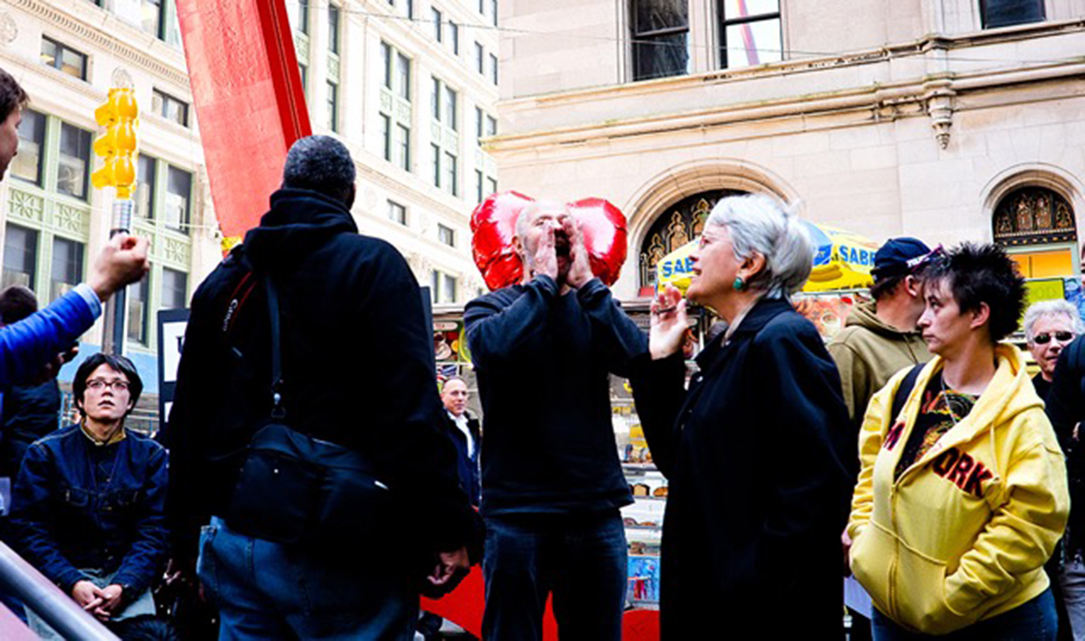
 

  1. Met attendance numbers quoted in this piece are from this press release.
  2. //www.getty.edu/art/collection/objects/106006/david-hockney-pearblossom-hwy-11-18th-april-1986-1-british-1986/
  3. Mark Bradford: Phaidon Contemporary Artists Series, Interview with Anita Hill, P.18
  4. The Met also owns a woodcut (a print) by Mr. Marshall
  5. Containing work that is now on view at the Baltimore Museum, under its Director, Christopher Bedford, long one of the leading Mark Bradford champions
  6.  //hirshhorn.si.edu/exhibitions/mark-bradford-picketts-charge/

Shahrzad Darafsheh: Transcending Cancer With Photography

Written by Kenn Sava. Photographs by Shahrzad Darafsheh, and others as credited.

Shahrzad Darafsheh, From her new, first PhotoBook, Half-Light. Courtesy of the Artist and Gnomic Book. Click any Photo for full size.

Meet Shahrzad Darafsheh-

Shahrzad was 32 when she was diagnosed with endometriosis, which progressed to cancer and resulted in her having a radical hysterectomy followed by chemotherapy. An extremely hard course of treatment for anyone- of any age. For this young woman, who’s thoughts were on looking forward to having a family, to have to do an about face and channel all her energies into a fight for her life, is unimaginable for the rest of us. Having been through cancer, myself, one thing I learned was that every patient’s journey is unique. There are, however, some commonalities to cancer that everyone who goes through it experiences, unfortunately.

Among them, there is not one aspect of yourself, or your life, that it does not turn upside down, and forever change.

June 26, 2018, from @shindal_, Shahrzad’s Instagram page. She appropriately added the only hashtag that fits- #fuckcancer.

Yet, through this very rigorous course of treatment that lasted until just recently, she remained true to herself, a tribute to her remarkable inner fortitude and character. Shahrzad used her Photography to help ground her and express what she was feeling, experiencing and seeing. The quiet dignity and strength she exudes in the video (courtesy of the Artist and Gnomic Book) forms a peaceful core at the heart of her extraordinary new PhotoBook, Half-Light, her first PhotoBook, published this fall by Jason Koxvold’s Gnomic Book.

With thousands of new PhotoBooks being released this year, it’s hard for any one of them to stand out. Half-Light impressed me to the point that it was one of my NoteWorthy First PhotoBooks for 2018, in a ridiculously hard year to choose a few out of all the terrific first PhotoBooks I saw this year. Yes, as a testament to cancer survivorship, it’s a remarkable achievement. Then, I found its images didn’t go out of my mind once I put it down. Yes, some resonated with my own cancer experience, particularly how you see the entire world differently all of a sudden with “new eyes.” Some are abstract and some realistic, but what struck me most is they all have a poetry that’s purely her own. It’s, also, a book that doesn’t lend itself to any one reading. In fact, its that way by design. Half-Light is laid out so it can be read from left to right, as is traditional in the English speaking world, and/or from right to left as is traditional in the Farsi of her native Iran. And so, it’s a journey with multiple endings, fitting for a newly diagnosed cancer patient, but also characteristic of life in general. It’s a journey with only one page of text containing Quatrain XIV from The Rubaiyat, the quatrain about the impermanence of all things, except death, on a first page in English, and from the right, a first page in Farsi, and from there it takes place through the eyes and, as she says above, in the mind.

From Half-Light. Courtesy of Shahrzad Darafsheh and Gnomic Book.

After I saw that video and experienced how eloquent she is, I hoped to be able to give her a chance to express herself a bit more, and to learn more about her and how she was doing. I reached out to Shahrzad via email in Tehran, Iran, and found her to be extraordinarily warm, open and grounded. Barely through her treatment herself, she was already speaking passionately about helping other cancer patients- especially women, in Iran, and around the world. I was thrilled when she generously agreed to answer some questions even though English is not her first language, and I have the honor of sharing her words here-

Kenn Sava (KS)- How are you?

Shahrzad Darafsheh (SD)- Hi Kenn, thanks for doing this interview.

KS- If we can start by going back to your start, how did you first get interested in Photography, and how did you become a Photographer?

“Her” from @shindal_, Shahrzad Darafsheh’s Instagram page, September 25, 2017.

SD- I was born in a family with great interest in art. My father was a carpet designer and a photography enthusiast. His was engaged with colors in his work, in different shapes and forms which was my early understanding of color. As a teenager I spent my time looking at his old prints, and also spent time with my brother watching great movies of that time. My mother put me in summer art classes like drawing, pottery and sculpture. These were my major acquaintances with art, and I liked photography the most. Very soon the camera became my closest friend and looking through the viewfinder the best way to see the world. It got more serious when I started to study photography at the university and since then I never stopped taking photographs.

From The Saffron Tales, by Yasmin Khan, with Photographs by Shahrzad Darafsheh.

KS- I think most people are new to your work, and so am I. I did see a book that might have had your work in it- The Saffron Tales by Yasmin Khan? So, I’m wondering what else have you done prior to Half-Light?

From The Saffron Tales, by Yasmin Khan, with Photographs by Shahrzad Darafsheh.

SD- Yes. The Saffron Tales aims to show Iranian people and culture through their cuisine and I was commissioned to take photographs of people we met, the atmosphere, landscapes, etc., from north west to south of Iran. It was a two-year project and I learned a lot. Beside that, I had never published my photographs in a book before.

From The Saffron Tales, by Yasmin Khan, with Photography by Shahrzad Darafsheh.

KS- In the video, you speak of the home you and your have built a house in a suburb of Tehran that you love. Were you born and raised in Tehran?

From Half-Light. Courtesy of Shahrzad Darafsheh and Gnomic Book.

SD- Yes. We both were born and raised in Tehran. We always knew that we didn’t want to be living in the city because of all the pollution and craziness that the city offers and now we’re planning to go farther, out into nature. Since the economy is the main issue for better living and ours is so corrupted, our desire in moving lays under the layers of ambiguity.

KS- What’s it been like for you being a woman Photographer in Iran?

From Half-Light. Courtesy of Shahrzad Darafsheh and Gnomic Book.

SD- I think being a female artist in itself is not so easy, as we can see the art history books are full of male artists. Everywhere in the world people are trying to bring more attention to female artists. I was aware that this year Tate Britain will exhibit six decades of women artists and according to them “female artists should be a central part of recent art history. Galleries have made progress in better representing female artists. But, it has been slow for too long. We are happy that it is speeding up.” You know this kind of thinking, and movement, is very rare in my country, so I think it’s bit harder here. I didn’t want to bring up women’s rights, censorship, everyday pressures and so much anxiety of everyday life but living in Iran is tied to these. Even though you can see more female artists, there is a long path for us to do what we love and make our living independent from our parents. I hope we can talk about it more another time.

KS- As we both know, hearing a doctor tell you, “You have cancer” is devastating. One of the worst things anyone can hear. How did you deal with it?

SD- It was few weeks after my laproscropic surgery and I was with my mom. The family worried a lot and all I wished was to lessen that pressure so I smiled! In just one second I decided that is how it’s going to be for me. I did several tests afterwards till I found out I had to take my uterus and both ovaries out. It was devastating.

April 6, 2018. During chemotherapy, away from home, staying with her mom. A Photo that appears in Half-Light.

My husband and I were trying to have a child before my first operation, doctors were saying that giving birth may reduce the symptoms of endometriosis, a reproductive organ disorder. But it caused infertility itself and I was going to lose every possibility of giving birth to a child.
I experienced a version of loneliness different from what I’ve experienced before and it had something to do with that smile. I never shared my fears, worries and tears with anyone till the end of chemotherapy.

The symptoms of “Chemo Brain,” August 3rd, 2018, during her chemotherapy treatments.

KS- It sounds to me that the choice of treatment must have been excruciatingly hard for you. As I wrote, after all my efforts and research, I made a mistake in my choice of treatment the first time I chose. What was your road like that led to your decision to go the treatment route you did- radical surgery followed by chemo?

SD- I knew there were no other choices rather than radical hysterectomy. I had tried alternative medicine for the endometriosis and it didn’t work for me. Maybe and just maybe it was my mistake. Some friends asked me what if I had taken the cysts out sooner? Nobody, even my doctors, know the answer. So I decided to let go of this thought. Also, there was a two month delay between radical surgery and chemo which frightened us a lot. But it all went well. Now the cancer is gone.

KS- Were there other doctors you could get opinions from? Did you get a second opinion?

Chemo Brian [Veins], August 11, 2018.

SD- I had my pathology samples rechecked followed with so many blood tests and they all showed stage one both ovarian and uterus cancer. I was in good hands. All three doctors that treated me are proficient. Unfortunately this is because they have too many patients. One of my surgeons operated on 5 more people after me that one day! I think despite lacking in other areas, the medical profession is at a high level in the capital and other big cities of Iran. Although they are very expensive and health insurances don’t cover most of it.

KS- What was it like being a newly diagnosed cancer patient in Tehran? Were there support groups? Did you have a choice of doctors or hospitals to be treated at?

From Half-Light. Courtesy of Shahrzad Darafsheh and Gnomic Book.

SD- Cancer patients are trying to talk more about their experiences to bring awareness. But, there are no support groups.

The first thing that every patient does is to google their situation in order to find out the experiences or others and if the treatment recommended to them has been successful. I did the same. I found some other patients on social media and it was a huge relief, especially during chemotherapy. I have never talked to them, I just watched their daily lives and their routines helped me stop thinking that I’m sick. And yes. There are several well equipped hospitals and great doctors but as I said before they are also expensive. I did a post in order to collect money for my first operation on Instagram selling some of my prints. And it was unbelievable. Half of my hospital bills were provided by my friends and complete strangers.

You can see the need of having support groups. It must also be simple to find them.

From Half-Light. Courtesy of Shahrzad Darafsheh and Gnomic Book.

KS- Is there health insurance in Iran?

SD- Yes there are several kind of health insurance in Iran. But the plans that offer the best coverage are government run and only full-time employees can have them. People who call themselves independent workers can make a full payment for a month in order to use benefit of the insurance. But in a private hospital no insurance is accepted, and they are more equipped than the other hospitals. So, I had no choice but to pay a lot of money and use the insurance for chemo.

KS- You told me you want to help start a NGO (Non-Government Organization). Can you talk about why this is needed, and your vision for it? How can others help?

From Half-Light. Courtesy of Shahrzad Darafsheh and Gnomic Book.

SD- It’s a big thing starting and running a NGO. I don’t know even if they will let me!
But it’s a thing that kept my mind busy since chemo. I saw lots of men and women every three weeks, with needles in their veins, weak with a vague gaze trying to find someone to talk to. We Iranians are very supportive for each other most of the time. I rarely saw a patient alone. But there are some things that you can’t share with your loved ones. Even the cancer patient’s family can’t share their fears with the patient. We should have an actual place for patients and their families to find each other and talk. Not just some virtual spaces to type the feelings out. For that reason I need to have a bigger voice and that’s what I hope Half-Light will help me to reach. You are helping with this interview, Kenn, even before I start doing it.

KS- She didn’t say it, so I will- You can support Shahrzad by buying Half-Light, which was 200% funded on Kickstarter, while some of the 300 copies of this beautiful book remain. See BookMarks at the bottom for more information.

What would you tell other women diagnosed with endometriosis?

From Half-Light. Courtesy of Shahrzad Darafsheh and Gnomic Book.

SD- Some cliches matter a lot-
Listen to your body. Don’t be shy to be examined, do check ups. Eat healthy food. Exercise regularly. Avoid anxiety and stress. (I sound like Google!)
And if you want to have a child, be quick.

KS- What would you tell other women diagnosed with cancer?

SD- Don’t be afraid. It’s not just you. It doesn’t matter how you lived before but how you manage to live from now on. Cancer is not an enemy to fight, it’s a condition that needs to be understood. Because it brings you a whole new life even after you pass through it.
You will see the darkness and it’s important not to be the black-hole, let the light in.

From Half-Light. Courtesy of Shahrzad Darafsheh and Gnomic Book.

Breathe and live to the fullest.

KS- How long after you were diagnosed did you decide to start this body of work that became Half-Light? Besides cancer and your treatment, was there a triggering moment or event where this project began?

SD- It was a year after I was diagnosed with Endometriosis.
Funny that I had a strong fear of ovarian cancer at first but doctors told me it’s a benign cyst and rarely it turns to cancer, so dealing with its constant pain became my routine. I started to feel something growing in my body which was not a baby. It was my own tissues behaving offbeat. I wasn’t able to do most of my daily tasks half of every month for four years.

I think the pain was the triggering event. The weakness it caused and all my anxieties…

KS- But then, creating became therapeutic for you?

SD- Yes, it was. Looking for scenes to describe how I was engaging deeply with my body for the first time, gave me the ability to keep my distance with it so I could understand the situation better. It also kept my mind busy. Every progress in the state of my health came with the progress of my work.
I did scans with pleasure, it gave me very nice material to work with. I owe my sanity to photography.

KS- Where have you gotten all of your amazing strength from?

From Half-Light. Courtesy of Shahrzad Darafsheh and Gnomic Book.

SD- Thank you for saying that. Honestly, I consider myself a strong person when I confront my body and mind. I’ve always loved challenging situations. Although I never thought it would be fear of death someday.
The body is in constant change as are our thoughts. In my opinion, both are controllable, especially at hard moments.
And I have a deep connection with nature. It always teaches me that nothing stays the same, be ready for change and accept what comes and how things happen.

KS- How long did you spend shooting this body of work?

SD- Since 2015. I choose to close it now after the test results came. So I’ve worked on this project for about three years.

KS- How did you find Jason (Koxvold of Gnomic Book)?

SD- While surfing on the internet. I felt a deep connection with his photographs. We were following each other’s work for a year. He wanted to see some of my work once but it was the begining of my journey through surgeries and so it didn’t happen. Jason reached to me, again, six months after that, when the chemo started. It was magical. For me, for my family and friends.

Working on my first book, this was how I spend my time during chemo. I say Half-Light is my child with cancer and it needs good care to grow.

From Half-Light. Courtesy of Shahrzad Darafsheh and Gnomic Book.

KS- Jason Koxvold is a Photographer & Artist in his own right. In two short years, the publishing company he started, Gnomic Book, has already made a name for itself as a producer of important, beautifully made PhotoBooks. Shane Rocheleau’s 2018 Gnomic Book, YAMOTFABAATA was one of my Noteworthy PhotoBooks of 2018. Jason’s own PhotoBook, KNIVES, is a powerful look at our changing world through focusing on one small area of upstate New York as it struggles to deal with the loss of its 150 year old knife factory- its largest employer, to China. At this point in the conversation, I reached out to Jason to learn more about how Half-Light came to light.

KS- Jason, how did you come to discover Shahrzad and this body of her work?

Jason Koxvold (JK)- About a year ago I saw Shahrzad’s work on instagram. I forget how I came across it, but it immediately resonated with me. We live in a time where so much work looks the same; it begins with one artist developing a specific visual language, then other artists mimic it, and then it becomes available as a VSCO preset and suddenly everyone’s doing it it. This was entirely not the case with Shahrzad’s work. I could see that she was telling a story, but I didn’t know what it was.

Each page of Half-Light is interleaved with a sheet that acts as a screen, as seen here, which presents an image that’s seen through a haze, or a veil- in “half-light.”

When you turn the “screen” page, you see the image, fully.

She didn’t appear to have a web site, so I reached out to her to ask if it would be possible to see a more coherent body of work – it was then that she told me that she was battling cancer, and that it was hard to find the energy to put something together for me in the short term.

KS- What were the difficulties in trying to publish this book, given that the Artist is in Iran?

JK- The biggest questions for me were the unknowns. I didn’t know if the work would get her into any kind of trouble; we hear stories of women attracting the attention of the authorities by showing their hair on Instagram, for example. I didn’t know if we would be able to send her any of her own books, from a US legal perspective and from an Iranian censorship perspective (we’re still waiting to see if the books are censored on arrival).

But in terms of the practicalities of making the work, it was surprisingly easy. We were able to have lengthy video conversations on Skype, exchange high-resolution files over Dropbox and Wetransfer, and even footage for the short film we made together about the work.

KS- What was your role?

The Farsi front cover of Half-Light, once removed from its bag, which is the back cover for English readers.

JK- Shahrzad was very open to my ideas around the form and sequencing of the book. My idea was around translucency and opacity, both from the perspective of the human body and the body politic of Iran. The sequence would create a journey from lightness to dark, as a Western reader – and the opposite, when read in Farsi. Shane Rocheleau helped with the sequencing as well; I always appreciate his ability to see not only the overarching story of a piece, but also connect individual images in more ephemeral moments.

KS- Shahrzad, have you seen the physical book yet? Jason told me you had not as of the NYABF in late September. If you have seen it, what do you think of it?

Shahrzad Darafsheh (SD)- Yes, I received my copy two months after it was published.
It looks and feels great. Jason did a great job with choosing the paper and everything. Such understanding in spite of such a long distance between us is unforgettable.

KS- Is there a community of Photographers in Tehran?

SD- Yes, there is National Iranian Photographer’s Society.

KS- I read that another Iranian Photographer, Shirin Aliabad, recently passed away from cancer. Did you know her?

Shirin Aliabadi, Miss Hybrid, 2008. The bandage on the nose indicates a nose job, which are popular in Iran, as the western “upturned nose” is highly sought after. *Photo courtesy The Third Line, Dubai

SD- Unfortunately this is the fourth female artist I’ve heard pass away from cancer this year. I’m familiar with her “ Miss Hybrid” series.

KS- Shirin Aliabad’s series, “Miss Hybrid,” was about “showing a Tehran that the Western media doesn’t show,” her husband and collaborator said in the New York Times. The Photographs in Half-Light have a universal feel to them, something that also might surprise Western readers- Most of them could be taken almost anywhere, something that will allow them to speak to a very wide range of viewers, though it’s an extraordinarily personal, and beautiful, book. Was this part of your intention?

SD- I’m very glad that it can speak universally. I never intended to do that. I think that’s how I see my world, Not really different from yours.

KS- What have you learned from cancer?

SD- To be me. To be here and now. To stop worrying and never stop loving.

KS- So…What’s next?

SD- I’m planning to have an exhibition and show Half-Light to a wider audience in Tehran.
Also I’m working on my proposal for gathering cancer patients together with the hope of bringing more quality to our lives.

-Though that ends our interview, the best thing Shahrzad shared with me was still to come. On December 23rd, she told me that her follow up tests after the completion of her treatments came back clean, with no sign of cancer! She said she was “super excited” about it.

Now, she can get back to sharing her beautiful, “full-light,” with the world.


BookMarks-

Half-Light by Shahrzad Darafsheh, which I selected as one of my NoteWorthy First PhotoBooks of 2018, is published in a first edition/first printing of only 300 copies, and is available from the increasingly impressive Gnomic Book, here. Jason Koxvold’s KNIVES and Shane Rocheleau’s YAMOTFABAATA, both published by Gnomic, are also recommended, and both are still available there as well. (All three are on sale as I write this.)

*- Soundtrack for this Post is “Heaven Is In Your Mind” by Traffic, the first track on their first album, 1967’s classic Mr. Fantasy.

My thanks to Shahrzad Darafsheh and Jason Koxvold. 

NighthawkNYC.com has been entirely self-funded and ad-free for over 6 years, during which over 250 full length pieces have been published. If you’ve found it worthwhile, you can donate to keep it going & ad-free below. Thank you!

Written & photographed by Kenn Sava for nighthawknyc.com unless otherwise credited.
To send comments, thoughts, feedback or propositions click here.
Click the white box on the upper right for the archives or to search them.
For “short takes” and additional pictures, follow @nighthawk_nyc on Instagram.

Subscribe to be notified of new Posts below. Your information will be used for no other purpose.

 

NoteWorthy PhotoBooks, 2018

Written & Photographed by Kenn Sava (*except as credited)

Let’s go book shopping! As I list PhotoBooks I consider NoteWorthy, let’s remember the Bookstores that are still left where you can actually see these books. The Strand Bookstore, NYC, is one of those I frequent. I hope there is at least one near you. Click any Photo for full size.

Another day. Another chance to look at PhotoBooks, to see life, and the world, through someone else’s eyes, to learn something and just maybe have a revelation. I look at A LOT of PhotoBooks (and Art Books). Nary a day passes that I don’t see one/some somewhere. In bookstores, used bookstores, museum stores, galleries, book fairs, pop-up shops, garage sales, online- you name it. Both, just released PhotoBooks and those I’ve only known through legend. I’m getting close to eating, sleeping and breathing Photo & ArtBooks. Why? I use them to research my pieces, to learn about Artists known & unknown to me, and to explore that fascinating phenomenon that is the PhotoBook- which, in its ultimate form, is a work of Art unto itself. A third of those I see I never look at, or think about, a second time. About 40% I do either look at again or think about again. And, far too many of them I purchase. (For the record- Yes, I’ve put my money where my mouth is. I bought every book on this list.)

MoMA PS1, Long Island City, scene of the recent New York Art Book Fair. In case you don’t know, there’s a quite good full time Art & PhotoBook store tucked inside, in addition to the excellent magazine shop off the lobby, right behind that grey wall to the right.

So, after all of this looking, I’ve decided to share a few of those here that have turned out to be especially memorable, or “NoteWorthy,” as I’m fond of saying (There’s no such thing as “best” in the Arts, in my view. I don’t believe in comparing Artists or creative work). Compiling this has been very hard.

Depth of Field. The scene in just one of the many rooms at the New York Art Book Fair (NYABF) @ MoMA PS1, Long Island City, September 21, 2018. I handed my camera to Kris Graves who took this Photo with it from behind his table.

First, we live at a moment when there are more PhotoBooks being produced than ever before. It seems there are an incalculable number of publishers and Artists creating books at a speed I doubt anyone can keep up with. So, as many PhotoBooks as I look at represents only a small percent of those released. Hey, I really tried!

William Eggleston: Black & White. The cover image shown on pages 82-3 of Steidl’s Fall/Winter 2017/2018 Catalogue. I was very much looking forward to seeing what revelations this might hold  in 2018 after the showing of Eggleston’s black & white work at The Met a few months back. Where are you? Phone home. *Steidl Photo.

Another thing is a bit complicated. Publication dates have become hard to figure. Some of the bigger PhotoBook publishers announce books and show them in their catalogs up to one year before they ever show up in stores here (physical bookstores). The brand new hardcover version of Steidl’s Fall/Winter 2018/19 catalogue now even contains a section featuring “Previously Announced” Books (i.e. books originally scheduled to have been out this year)! Some “Previously Announced” books never do show up (Steidl now completely omits the “Previously Announced” William Eggleston: Black and White. ?). And then, a book that appears as a newly released book in a bookstore here may have come out to the rest of the world in 2016 or 2017. How to treat those books? Do they “count” as eligible for 2018 lists? After mulling this over the past few months, I’ve decided to give lesser priority to publication dates and go by when I first saw the book appear in stores. So, one or two of these may have been released over the past few years, though most of them say “2018” in them. For me, the date of the book isn’t as important as the impact its had on me. That’s my criteria. Maybe, you’ll agree, maybe you won’t. Either way, I encourage you to make your own list.

The Rare Book Room at Strand Bookstore. How many books released this year will end up here?

Ok. With all of that out of the way, here they are, listed in no particular order, in a special edition of my regular BookMarks feature. (First, a special note-If you like what you find on NighthawkNYC, I hope you’ll consider supporting it so that I can continue to spend the countless hours and pay the expenses its taken to keep it going these past 3 years- without running ads. If you would like to, you can make a donation through PayPal by clicking on the box to the right of the banner at the top of the page that will take you to the Donation button. Your support is VERY much appreciated.)

***NoteWorthy PhotoBooks, 2018***

How do they do it? Teamwork. Lester Rosso, left with Paul Schiek, the creative masterminds behind TBW Books, and in front of their sign, reveal one of the secrets of their magic that, it seems to me, a number of others are now trying to emulate. Good Luck with that! Their secret? They consistently make excellent books with top Artists. NYABF, September 21, 2018.

-Gregory Halpern, Confederate Moons with Jason Fulford’s Clayton’s Ascent, Viviane Sassen’s Heliotrope and Guido Guidi’s Dietro Casa, part of TBW’s excellent Annual Series 6. If I were to recommend one new book this year, Gregory Halpern’s would be it. When I look at it, I see a frozen moment in life in America, 2017, seen in the shadows of the solar eclipse, an instant when nature reminds us that everything we stress out about or fight about pales alongside the power IT holds. My look at Confederate Moons is here

Gregory Halpern, left with the beard and the glasses, and Jason Fulford, right, in the green striped shorts, authored two of the four volumes in this year’s TBW Annual Series here sign them at TBW’s booth, NYABF, September 21, 2018. PhotoBook Business 102- You know you’re doing something right when Artists like these two want to work with you. Mr. Fulford has his own respected publishing house, J&L Books. Mr. Halpern, the 2016 Paris Photo-Aperture PhotoBook of the Year Award Winner, is fresh off his nomination to join Magnum Photos.

Diane Arbus: A box of ten photographs, Aperture. The only portfolio Diane Arbus produced during her lifetime is beautifully reproduced from the only set in a public collection, which happens to be the only one with 11, not 10, Photographs. This is one of the books that will be essential for anyone interested in Diane Arbus henceforth. Aperture says “it will never be reprinted.” Nuff said.

Instant classic. Diane Arbus: A box of 10 photographs. Seen at Aperture Gallery & Bookstore, an NYC Photo mecca.

-Harry Gruyaert, Harry Gruyaert (Retrospective with the red cover), and Harry Gruyaert: East/Westboth Thames and Hudson- Two books that solidify the Belgian-born Photographer’s place alongside the better-known “early masters of modern & contemporary color Art Photography,” including Eggleston, Stephen Shore, Saul Leiter, et al. (A term that puzzles me since color in fine Art Photography can be traced back to, at least, Sarah Angelina Ackland, circa 1900). More on both books in my recent conversation with Harry Gruyaert, here.

One of the irreplaceable things about physical book stores are its people, like Miwa Susuda of Dashwood Books, seen here. Miwa is, also, a writer and a PhotoBook publisher with her Session Press. In 2017, Session Press and Dashwood Books released the fine Blue Period / Last Summer by the legendary Japanese Photographer, Nobuyoshi Araki, a copy of which she holds. Seen at Dashwood on October 24, 2018.

-Cristina de Middel– The Perfect Man. Cristina de Middel is an Artist who should win an MTV Video Vanguard award. Huh? What I mean is that I can think of no other Photographer who’s books are consistently pushing the boundaries of what a PhotoBook is and can be. This is just the latest in her series of compelling books, most of which are built around subjects that only the most imaginative would say “There’s a PhotoBook in this!” While that certainly wins her major points in my book, if she wasn’t, also, a world class Photographer, she would just be a curiosity. She is. But, you don’t have to take my word for it- Magnum Photos nominated her to join the world’s leading Photographic collective in 2017. The Perfect Man starts with looking at the largest Charlie Chaplin impersonator festival (with many of its subject posed in scenes reminiscent of Mr. Chaplin’s immortal “Modern Times”), and winds up being a broad look at Indian masculinity, and then a look at social customs Indian women are faced with interacting with them. It’s another book that surprises, and another book, like her classic The Afronauts1, that shows the new and old worlds colliding at full speed in unexpected ways.

Kris Graves holding the contents of LOST, which comes as a set in the spiffy orange box with blue lettering under his hand at his +Kris Graves Projects booth at the NYABF, September 22, 2018. His newly released A Bleak Reality is seen in the foreground.

-Kris Graves, et al, LOST +Kris Graves Projects. A ground-breaking (sorry!) work in a number of ways. First, it’s a daring, TEN volume box set by a smaller publisher featuring the work of a number of established Artists (including Lois Conner and Lynn Saville) along side that of others who are on the way up (like Zora J. Murff, Joseph P. Traina and Owen Conway), each contributing a PhotoBook on a different city around the world. Second, typically for +KGP, the cost is quite reasonable, for both the individual books or the set. And last, taken as a whole it’s a stunning example of what a well-run, Artist-run publishing house can achieve. Did I mention that each component book stands, and stands out, on its own? Also in 2018, A Bleak Reality by Kris Graves from +KGP is a powerful look at 8 sites where young black men were murdered by police officers, a collection of his work that first brought Kris to my attention at AIPAD this past April, as I wrote about here.

Multi-talented Artist & Gnomic Book publisher, Jason Koxvold, center, with Gnomic Book Artists Shane Rocheleau, left, and Romke Hoogwaerts, right at the Gnomic Book booth at the NYABF, September 22, 2018.

-Shane Rocheleau, You are Masters of the Fish and Birds and All the Animals (or, YAMOTFABAATA as it reads on its spine), Gnomic Book. A book that looks at the legacy of being white and male in America, quickly expands in scope to include any number of related effects, artifacts and institutions. It also reveals that the words “think small” apparently do not exist in Mr. Rocheleau’s vocabulary. The results are a first PhotoBook that’s extremely ambitious in its scope, biblical in its effect, gorgeously shot with a magical combination of subtlety and abstraction, edited like a Stanley Kubrick film, and exquisitely produced down to the smallest detail- (like its beautiful, hypnotic, and seductive to the touch, cover)…Phew! Along the way, it’s also chock full of indelible images that combine to make it linger and linger on in the mind later. A remarkable achievement, particularly for a first PhotoBook- the only first PhotoBook in this Noteworthy PhotoBooks, 2018 section. Limited edition of 500 copies. My recent Q&A with Shane Rocheleau is here

Rosalind Fox Solomon, Liberty Theater, MACK. Something of a marvel, Liberty Theater consists of a body of work decades in the making, this one is special. Culled from 400 Photographs taken in the 1970s, 80s and 90s, across the south, these 77 show a wide range of glimpses into the complex issues of race and racism, class and gender divisions that could be pivotal moments from 77 films that each stand on their own while provoking a world of feelings and reactions. Except comfort. The title speaks to a performance, and her website says the images are “poised between act and reenactment…” Now 88, Rosalind Fox Solomon, who like Diane Arbus, studied with Lisette Model in the 1970s, shares something of Ms. Arbus’ mystery and power in images that demand repeat viewing, here, in a tightly edited volume that quietly stuns as often as it shocks, aided by yet another powerful essay by Stanley Wolukau-Wanambwa, who’s first PhotoBook also appears on this list.

***Noteworthy First PhotoBooks***

Shahrzad Darafsheh- Half-Light, Gnomic Book. Iranian Photographer Shahrzad Darafsheh was diagnosed with cancer at age 36. But? She hasn’t let it stop her creativity or her work! It seems to me that anyone who’s been through cancer, or knows someone who has, can relate to her new first PhotoBook, Half-Light. It’s, at once both intimately personal, and universal, a book that looks inwards and outwards at the same time. Designed to be read either in western style left to right, or right to left, the custom in Farsi, one time I went through it it felt like an out of body experience. Cancer changes your life- forever, and it also changes how you see life, forever. Here is a Photographic record of the early days of this very talented young Artist’s cancer experience, seeing the world anew and turning her lens on herself, and her surroundings with wondering eyes. Its 300 copies are far too few to reach the audience this book deserves, so don’t wait long. It’s somewhat miraculous that Gnomic’s Jason Koxvold somehow found this work and overcame all the layers of problems inherent in working with an Artist living in Iran to produce such a beautiful and important book.

Shahrzad Darafsheh’s Half-Light.

-Stanley Wolukau-Wanambwa – One Wall A Web. Stanley Wolukau-Wanambwa has been one of the most astute and urgent voices writing about Photography and PhotoBooks for some time now. His writing has appeared in a wide range of places, including in a number of PhotoBooks, like Jason Koxvold’s excellent Knives. With One Wall a Web the world gets to see his first collection of his Photographic work. Born in Uganda  and living here for a number of years, One Wall is a far ranging look at American life, culture and society with a focus on the black reality in this country in two sets of original Photographs surrounding a section of appropriated vintage archival Photographs. It’s so wide-ranging it even masterfully weaves Allen Ginsberg’s classic poem Howl in. It’s already clear to me that One Wall a Web is one of those books that define this moment, as his friend’s Shane Rocheleau’s does in its way. It’s a book people will be discussing, referring to and looking at for many years to come. As I write this, about 70 copies remain of the first edition.


Roma Publications co-founder Roger Willems holds a copy of One Wall a Web, by Stanley Wolukau-Wanambwa at Roma’s booth at the NYABF, September 22, 2018.

-Jo Ann Walters- Wood River Blue Pool, ITI Ithaca  Named after a river and a pool near her hometown of Alton, Illinois, a journey through its 120 pages it makes it quickly apparent that yes, still waters run deep. A book over 30 years in the making, it’s a veritable time capsule of people and places, seen with a strong and singular eye, here largely cast on women and girls around her hometown, and elsewhere from Minnestoa to Mississippi cry out for extended pondering- on the women and/or children depicted, their situations and surroundings, and the moment. Coincidentally, Ms. Walters also teaches at Purchase College on the same Photography faculty with Stanley Wolukau-Wanambwa. My thanks to Kris Graves for  making me aware of this book. He did so purely on the book’s exceptional merit as something I should see. Modestly, he did so without mentioning that he was once one of her students, which I found out later. Jo Ann Walters’ tree has many branches. Now? We finally get to sit under another one with wonder at her achievement. I’ve found it makes an interesting pairing with the following-

-Petra Collins- Coming of Age, Rizzoli. A minor sensation when it was released, causing first printing copies to instantly vaporize, surprising no one more than its publisher, Rizzoli, who scrambled to produce a second printing, which finally materialized after a few months absence. Coming of Age, (a perfect title in more ways than one), touched a nerve with its subject generation, and with the esteemed Artist, Marilyn Minter, who interviews Ms. Collins inside. It’s easy to see why. Petra Collins Photographs her subjects the way they would like to be seen, and shows sides of them and their lives the rest of us never see. While other Photographers have garnered more attention for more contrived work in this genre, Petra Collins is the one to watch, in my view.

-Rose Marie Cromwell, El Libro Supremo de la Suerte, TIS Books/LightWork. I lived in Miami and South Florida, where it’s impossible to escape the flavor and influence of nearby Cuba. Here’s, an amazing look at the real thing, shot over 8 years while the Artist lived in Havana. It’s a thunderbolt, filled with color, as  you’d expect, but it’s also full of a poignant intimacy that surprises. Another book with an instant buzz that saw copies flying out the door, and a long line for signed examples at TIS’ Booth at the NYABF. El Libro Supreme de la Suerte (The Supreme Book of Luck) supremely deserves it.

If you are able to pick only one book from that group? You are a better man or woman than I am.

PhotoBooks are all we sell! One wall of titles at Dashwood Books.

***NoteWorthy Photo Related Book without Photos***

In this “decisive moment,” the foreshortening got the better of my auto-focus.

-Henri Cartier-Bresson- Interviews and Conversations, 1951-98, Aperture. I picked up The Mind’s Eye, Cartier-Bresson’s writings on Photography and Photographers, which didn’t have the insights I was looking for. Interviews and Conversations does. On every single page. Essential. A reference book for the ages.

***NoteWorthy Reissues***

The New Arrivals wall at Printed Matter, presenters of the New York Art Book Fair. An amazing store that contains multitudes of worlds in the form of Artist’s books by umpteen thousand Artists and Writers. How do they know where all of them are? I never bother to try to find something- I just ask. Extra credit if you can spot the next book to appear on this list.

-Masahisa Fukase Ravens, MACK. (Pictured almost smack dab in the middle, above, in its grey slip case). Believe the hype. Shot in the aftermath of a divorce, this is an unforgettable masterpiece, one of the great achievements in PhotoBook history in my view. It says 2017 inside. I don’t care. I’m listing it here as a public service announcement. After being first published in 1986, it was out of print for the better part of 30 years! The word is copies are running low. Get it before it goes out of print. Again. I’m listing Ravens, also, to acknowledge MACK’s excellent series of reissues that has seen Alec Soth’s classic Sleeping By The Mississippi and Niagara, among a number of others reissued, making them affordable to students and Photography lovers, again, after long absences that has made them available only at very high prices on the rare book market. Bravo! The next selection is another one…

Paul Graham, center, with Lesley A. Martin of Aperture, left, discuss a shimmer of possibility at its re-release. AIPAD, April 13, 2018.

-Paul Graham, a shimmer of possibility, MACK. Though reissued once before, as a one volume paperback, MACK has finally released the book Paris Photo-Aperture gave their “The Best PhotoBook of the Last 15 Years” award to in 2012, in its original 12 volume format (which sold out in less than 3 months in 2012). A revolution when it was first released, its influenced countless books that have come since. Including a few on this list. Limited edition of 500 hand signed sets.

-Daido Moriyama: Record, Thames & Hudson, A selection from Nos 1-30, beginning in June 1972 of the magazine, Record, that the great Japanese Photographer continues to release to this very day. At age 80, he’s now up to No. 39. When I added them up, Numbers 1-30 would cost a thousand or so dollars, IF you could find them all. This beautiful selection from them sells for about 50.00, and is sure to bring many more eyes to the work of one of the most admired, and influential, living masters of Street Photography.

-Luigi Ghirri- It’s Beautiful Here, Isn’t It… Aperture. With 2008 1st Printings selling for over 300.00 per, my thanks to Aperture for issuing a 2nd printing this year otherwise I would have never seen it! Ghirri’s Kodachrome is the place to start exploring his work (especially in MACK’s gorgeous reissue, which seems to be disappearing), but this is a very nice selection of works from throughout his career. Intro by William Eggleston.  

Roy DeCarava & Langston Hughes- Sweet Flypaper of Life, First Print Press/David Zwirner Books. Roy DeCarava is one of the unsung masters of contemporary Photography, who is quietly undergoing a renaissance that’s seen a few of his books reissued at long last in honor of the Photographer’s 100th birthday in 2019. First published in 1955, it features 141 DeCarava Photographs chosen by Langston Hughes who then supplied an accompanying narrative. His aim, he said, “We have so many books about how bad life is. Maybe it’s time to have one showing how good it is.” It’s that, and more, as it shows life “Uptown” in the mid-1950s in a way unlike that seen in any other book. 

***NoteWorthy Catalog of the Year**

-Sally Mann- A Thousand Crossings. It’s going to be a while before another book coming along surpassing this as a one volume reference/summary/monograph of Ms. Mann’s work to date. Beautiful. Throughout.

-Saul Leiter- All About Saul Leiter– It came out in Japan last year, and has just been released here. I’d still recommend Early Color as the place to start exploring Saul Leiter, but this is an excellent second choice and provides more of a complete sense of the man’s work over his career. With all due respect to his black & white work- Saul Leiter is a supreme Photographic Artist with color and the effects of light, and that is the work of his I will always be drawn to, and there’s a lot of it in this beautiful volume. My look at the recent Saul Leiter: In My Room show and book is here.

-Luigi Ghirri- The Map and the Territory, MACK. Focused on his work from 1970s and 1980s this is a beautiful almost 400 page look at a visionary Photographer, who, was the only name Stephen Shore mentioned when I asked who he felt deserved more attention. He told me Luigi Ghirri was the Artist he used to recommend, before the internet did away with little known Artists. Which brings me to…

***NoteWorthy “Non-PhotoBook” of the Year/ Holiday gift of the Year***

The 3 Stereograph viewing stations, each containing 10 different stereo Photographs of New York, 1974, at the Stephen Shore Retrospective at MoMA, May 23, 2018.

Stephen Shore, Stereographs, New York, 1974, Aperture. Hey, it counts- its got an ISBN number…and 30 Stereo Photographs! I don’t know how many other visitors to the Stephen Shore Retrospective at MoMA were thinking, “Wow. This is COOL!,” when they sat at one of the 3 stations, each containing 10 of Mr. Shore’s Stereographic Photographs. Well, I was. Now, you can have your own! Hurry. Aperture only produced 400 sets each containing a “Stephen Shore” signature model viewer (cool!) and all 30 of the works seen at MoMA (ditto). Each set includes a card hand signed by Mr. Shore. Don’t sleep on it. I hear they’re going fast. All of those who already own it that I’ve spoken with said they hoped more images would be made available. Hear, hear. My piece on the monumental Stephen Shore Retrospective at MoMA is here

Stephen Shore: Stereographs, New York, 1974, published by Aperture.

***PhotoBook Discovery of the Year (Regardless of Publication Date)***

-Lewis Baltz, WORKS, Steidl, 2010. WORKS is THE most extraordinary box set I have yet seen. Period.

When you look at it like this, it could have been called “MONUMENT.” Note- There are two editions of WORKS. Mine is the first edition, 2010. the later WORKS- Last Edition edition adds the subsequent Candlestick Point (2011) and Texts (2013), which they just lay on top of this box. Both of those books are available separately, so you can create your own Last Edition. Their Last Edition also comes with a booklet containing Lewis Baltz’ Last Interview, which, unfortunately, is not available elsewhere.

Since discovering WORKS, Lewis Baltz has become one of the few Artists who have effected the way I see the world, and one of even fewer to effect how I think about what I see. Mr. Baltz passed away in 2014 at 69 and this was a project he worked on when he, apparently, knew the end was coming. The result is that WORKS is the complete 10 volume edition of his Photography as the Artist wanted it to be seen. The care and attention to detail he brought to this edition, matched by Gerhard Steidl and his team, make it the definition of “definitive.” It houses the career work of an Artist who’s work expanded from the so-called “New Topographic” approach to Photography to including how the forces that control man’s uses of the land have extended into virtually every realm of human life. Inside, the entire journey can be taken in one place, where its continuity and interconnectedness can be fully appreciated as it can be nowhere else, in drop-dead beautiful quality printing. Lewis Baltz was an Artist who while producing Art based in what he saw around him created a body of work that, also, warns about where this was (and is) all heading. In my view, this makes him one of the most important Photographers of our time. Each of the 1,000 copies is hand signed by the Artist!

For those not wanting to make the investment in WORKS (currently 600.00 and up), there is the one volume Lewis Baltz– the catalog published in 2017 to accompany the first posthumous retrospective of Mr. Baltz’ work in Madrid, and so another entry for NoteWorthy Catalog, 2018. (It reached me in January, 2018.) The best one volume survey of his work is a great way to get the feel of both his accomplishment and the interconnectedness of the various series he produced, (and yes, they are interrelated). Even more than A Thousand Crossings, it’s very hard for me to see another book surpassing Lewis Baltz as a one volume monograph, especially given its particularly beautiful Steidl production and superb essays by Urs Stahel and, particularly, Artist Walead Beshty.

And so, in my book, there are no “winners,” no “losers” among Artists. ALL Artists who have created a PhotoBook (since that’s what we’re talking about here) this year are Winners in my book! CONGRATULATIONS! Seeing so many books and speaking with so many Artists & publishers has given me a real sense of how hard it is to produce a book today, particularly in this country.

For the rest of us? Get out there, look at some PhotoBooks and see what speaks to you. For me? I look forward to seeing what’s coming next. And? I will be looking for it…

11pm, East 17th Street @ Union Square. It can be a lonely road seeking PhotoBooks in the dead of night, which I actually was. But, wait! “Hey, man. Got any PhotoBooks there I should know about?”

*-Soundtrack for this Post is Impossible Year by Panic! at the Disco from Death of a Bachelor.

My previous pieces on Photography are here.

NighthawkNYC.com has been entirely self-funded and ad-free for over 6 years, during which over 250 full length pieces have been published. If you’ve found it worthwhile, you can donate to keep it going & ad-free below. Thank you!

Written & photographed by Kenn Sava for nighthawknyc.com unless otherwise credited.
To send comments, thoughts, feedback or propositions click here.
Click the white box on the upper right for the archives or to search them.
For “short takes” and additional pictures, follow @nighthawk_nyc on Instagram.

Subscribe to be notified of new Posts below. Your information will be used for no other purpose.
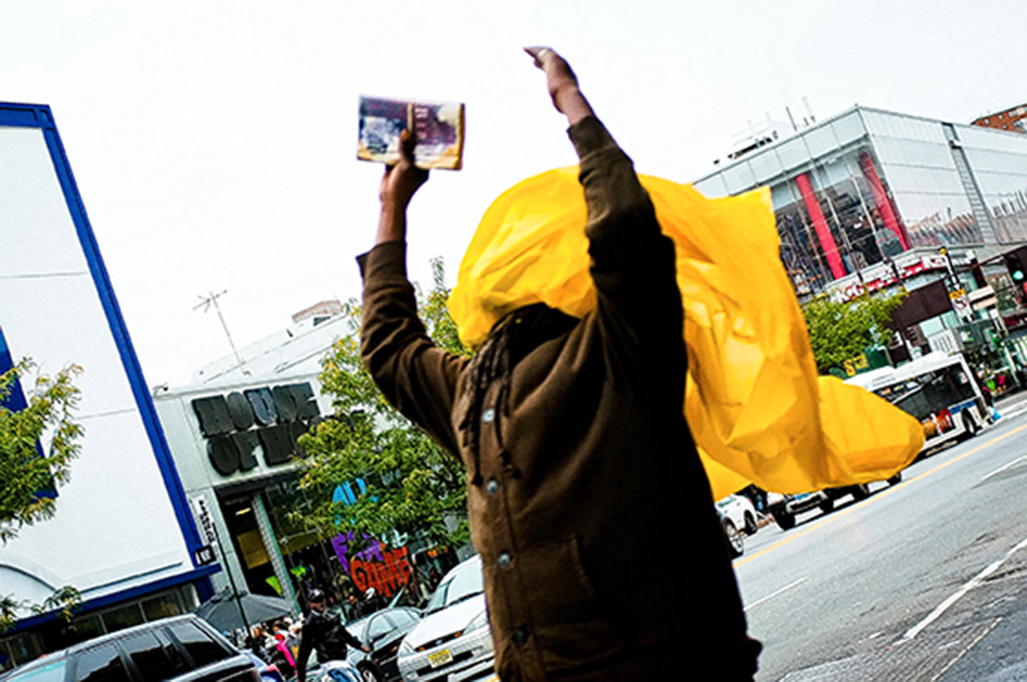
 

  1. Both Ms. de Middel and Vivienne Sassen, mentioned earlier, have come under controversy for their work in, and about, Africa.

R.I.P Ricky Jay: Art Collector Extraordinaire

Written & Photographed by Kenn Sava

When I learned that Ricky Jay had passed on November 24th at 72, I found myself revisiting his remarkable show Wordplay: Matthias Buchinger’s Drawings from the Collection of Ricky Jay that appeared at The Met spring, 2016. I’ve never been into magic but I have to admit being completely under the spell of Ricky Jay when I’ve seen him on TV, video and even the movies he appeared in. Even being an outsider to his world, he struck me as being remarkable. As I watched, it seemed he was a throwback, someone who learned his craft like Musicians and Artists learn theirs, through direct experience with their predecessors and through long and careful study of them. I admired most the respect he had for those who had mastered his craft before him. I soon discovered there was much more to Ricky Jay. How to characterize him?

“Oh what a thrill
Fascinations galore
How you tease
How you leave me to burn”*

Well, the bio on his site says, “While Ricky Jay has long been considered one of the world’s great sleight-of-hand artists, his career is further distinguished by the remarkable variety of his accomplishments as an author, actor, historian and consultant.” Ricky Jay was a wonder in many, many ways. As it turns out, even that wide-ranging description leaves out his accomplishments as a collector. 
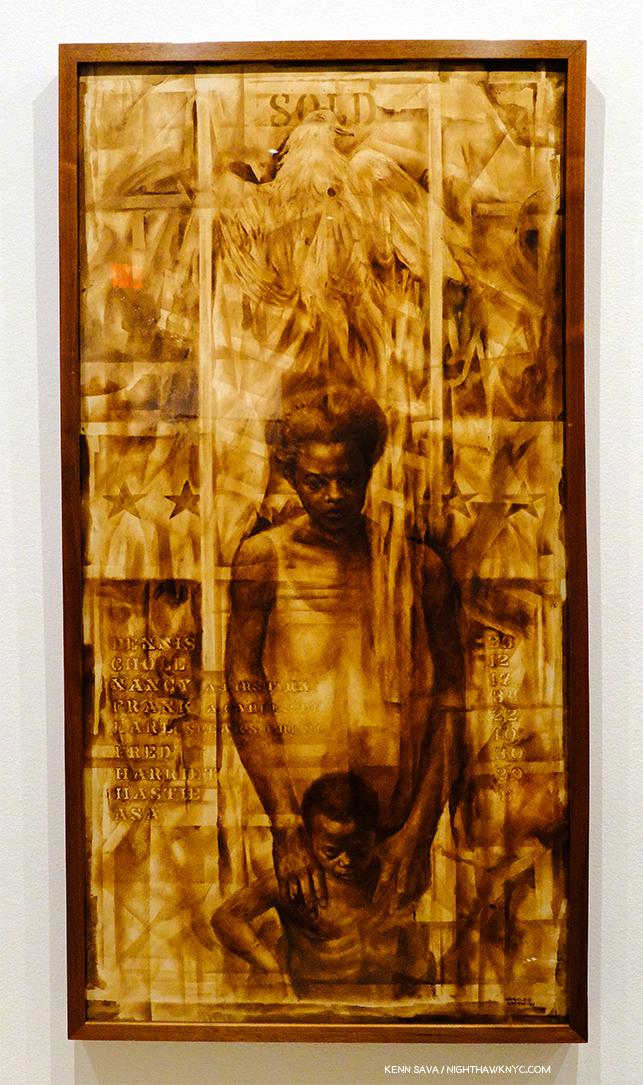
Installation view of Wordplay: Matthias Buchinger’s Drawings from the Collection of Ricky Jay at The Met, March 18, 2016.
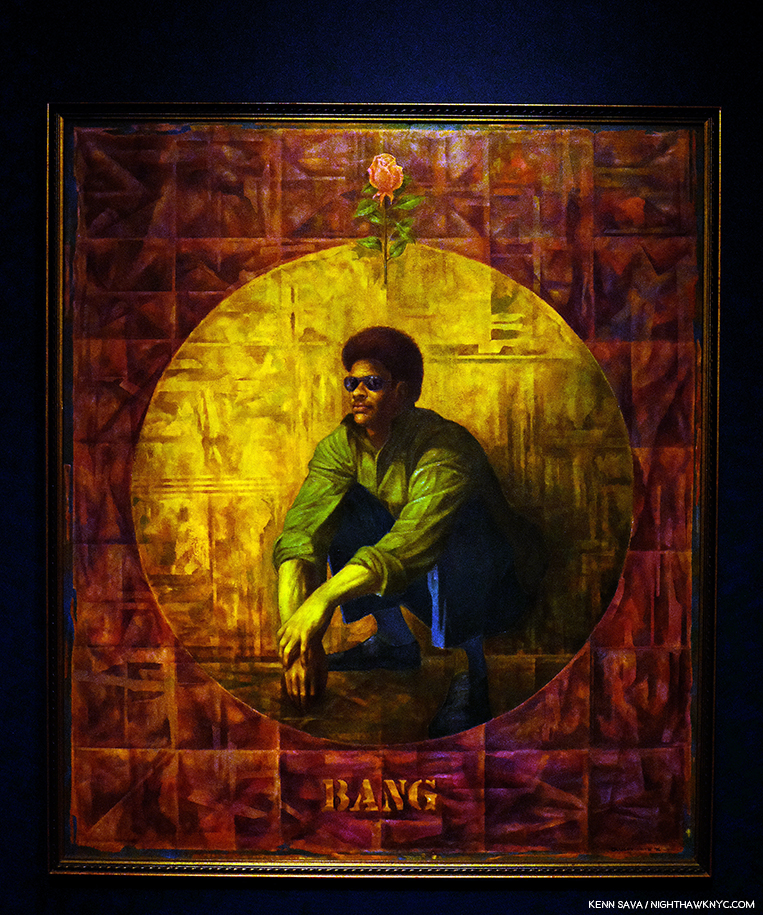
Wordplay was a unique opportunity to take a look at part of the one-of-a-kind collection Ricky Jay amassed, and it also revealed how much he knew about the amazing Artists, and people, it included.

Elias Back, Portrait of Matthias Buchinger Surrounded by Thirteen Vignettes, 1710, when Mr. Buchinger would have been about 36, showing him surrounded by 13 scenes of him displaying some of his remarkable skills. The bottom part of the sheet was left blank, Mr. Jay surmises so the Artist could inscribe and dedicate it. This work is “a promised and partial gift by Ricky Jay to The Met” in 2015.

Chief among them was Matthias Buchinger, one of the most astounding figures in the history of Western Art. Born in 1674 in Ansbach, Germany, without hands or lower legs, he stood all of 29 INCHES tall. Nonetheless, he went on to master an incredible range of skills. Surrounding a 1710 portrait of Matthias Buchinger by Elias Back, when he would have been about 36, are vignettes depicting him displaying some of his remarkable skills including shaving himself, making a quill pen, performing cups and balls, drawing, threading a needle, playing musical instruments, playing cards, and a form of bowling.

Matthias Buchinger, Self-portrait, London, 1724, 7 1/2 x 11 5/8 inches. Collection of Ricky Jay. Photo by The Met.

In the realm of Art, Matthias Buchinger became a master draftsman, a master calligraphy.

Detail showing Mr. Buchinger’s amazing micrography, the miniature writing embedded in the hair. Photo by The Met.

This he also demonstrated (or showed off) through micrography, the art of writing in minute characters that he often embedded in his Drawings, even complete Psalms(!).

Matthias Buchinger, Ten Commandments, London, December 3, 1730, 14 1/2 x 21 inches, A “promised and partial gift of Ricky Jay” to The Met.

Being a long-time aficionado, and student of the Art of Drawing, I had never seen anything like it. And haven’t. To this day.

Detail of the lower panel bearing the Artist’s inscription and dating of the work.

Ricky Jay brought to wider attention one of the most remarkable figures in Western Art History (as it is known to me), while bringing that figure into the world of Fine Art in one of the world’s greatest museums, where his work stood alongside the most renowned Artists in history. Yet, the show was remarkable not only for showing Matthias Buchinger but for including other Artists who were born without limbs, all in works from Ricky Jay’s collection amassed over 30 years.

Unknown Artist, Portrait of Johanna Sophia Liebschern, 1780-90, states that “she has no arms but is able to use knife, fork, snd spoon with her left foot and feed herself, [and] is able to prettily write, sew, draw, cut a quill pen, load and shoot a pistol.” Collection of Ricky Jay.

So, in honor of the late Mr. Jay, I pay my respects by revisiting the piece I Posted on April 5, 2016 about this remarkable show, The Greatest German Reality Show Star, Circa 1700. I’ll be most interested to see what happens to Mr. Jay’s remarkable collection. Personally? Of course, I hope it goes to The Met, to whom he already generously partially donated some of the Artworks shown here.
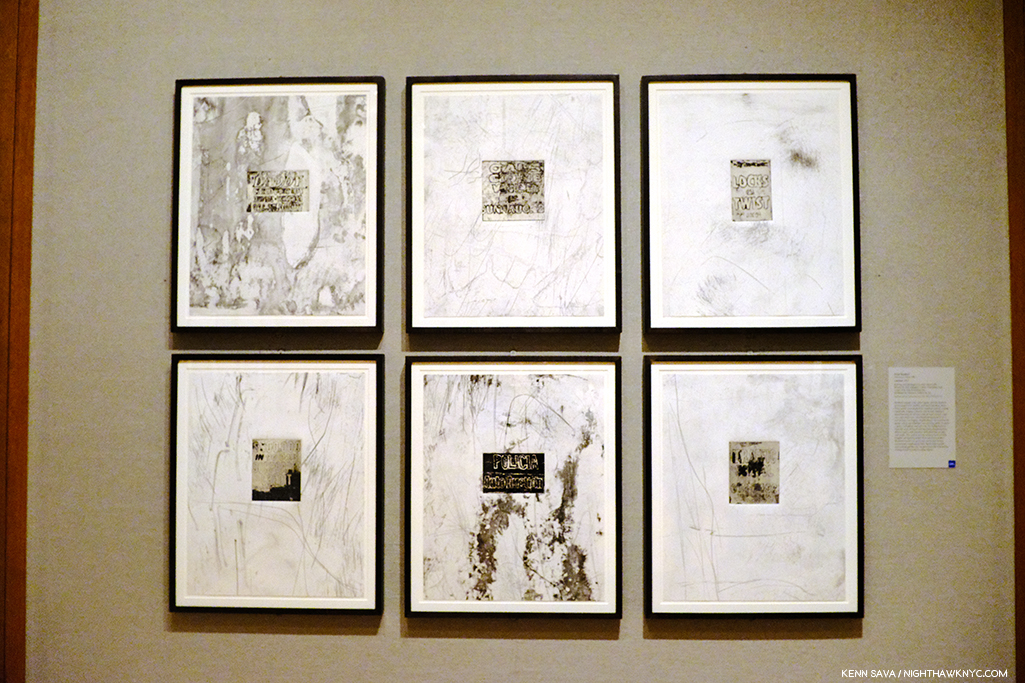
*- Soundtrack for this Post is Tomorrow Never Dies, by Sheryl Crow, the theme from the James Bond movie of the same name, one of the 39 or so films Ricky Jay appeared in.
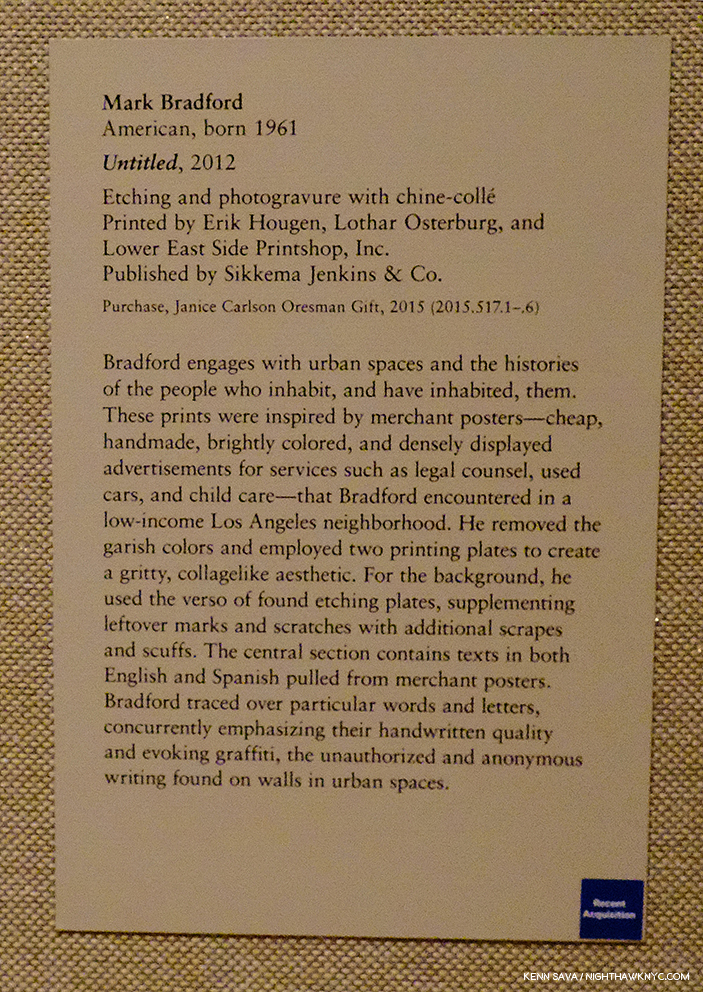
NighthawkNYC.com has been entirely self-funded and ad-free for over 6 years, during which over 250 full length pieces have been published. If you’ve found it worthwhile, you can donate to keep it going & ad-free below. Thank you!
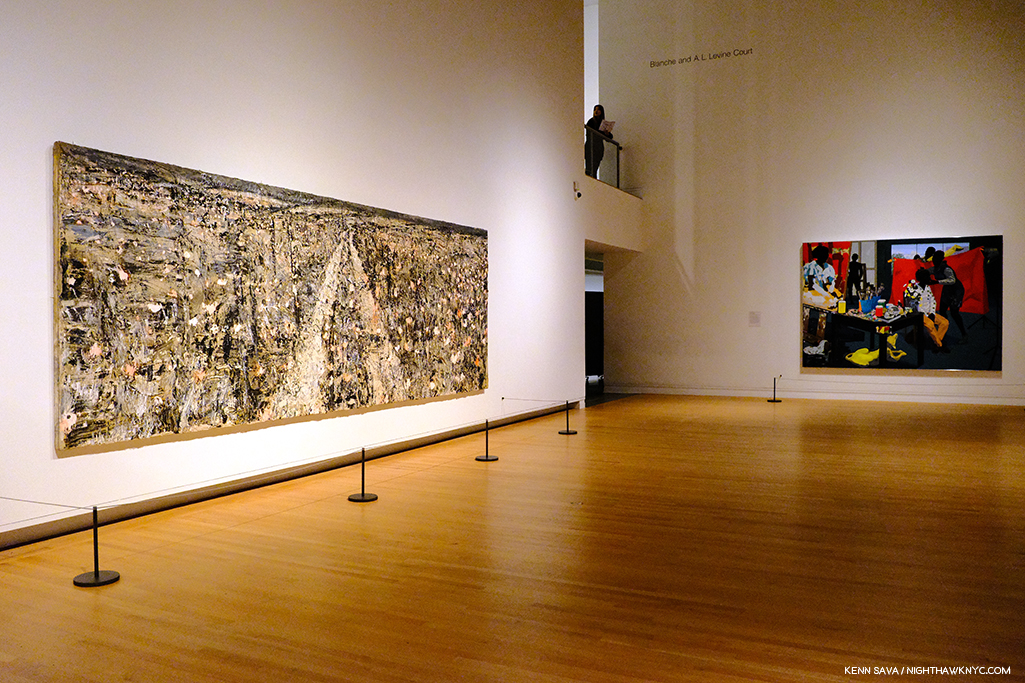
Written & photographed by Kenn Sava for nighthawknyc.com unless otherwise credited.
To send comments, thoughts, feedback or propositions click here.
Click the white box on the upper right for the archives or to search them.
For “short takes” and additional pictures, follow @nighthawk_nyc on Instagram.

Subscribe to be notified of new Posts below. Your information will be used for no other purpose.