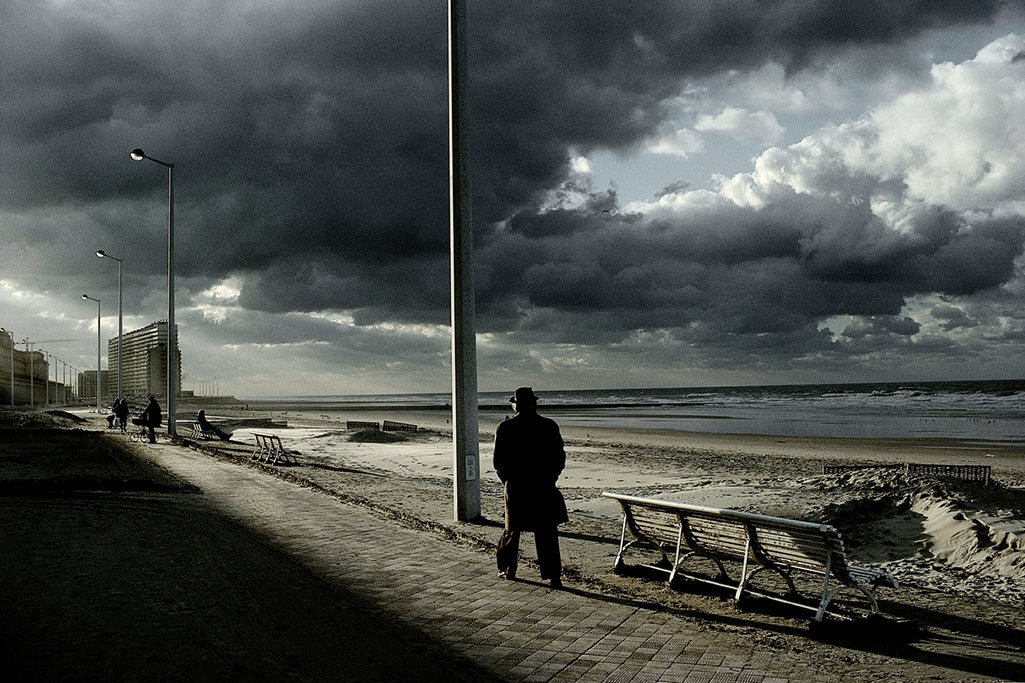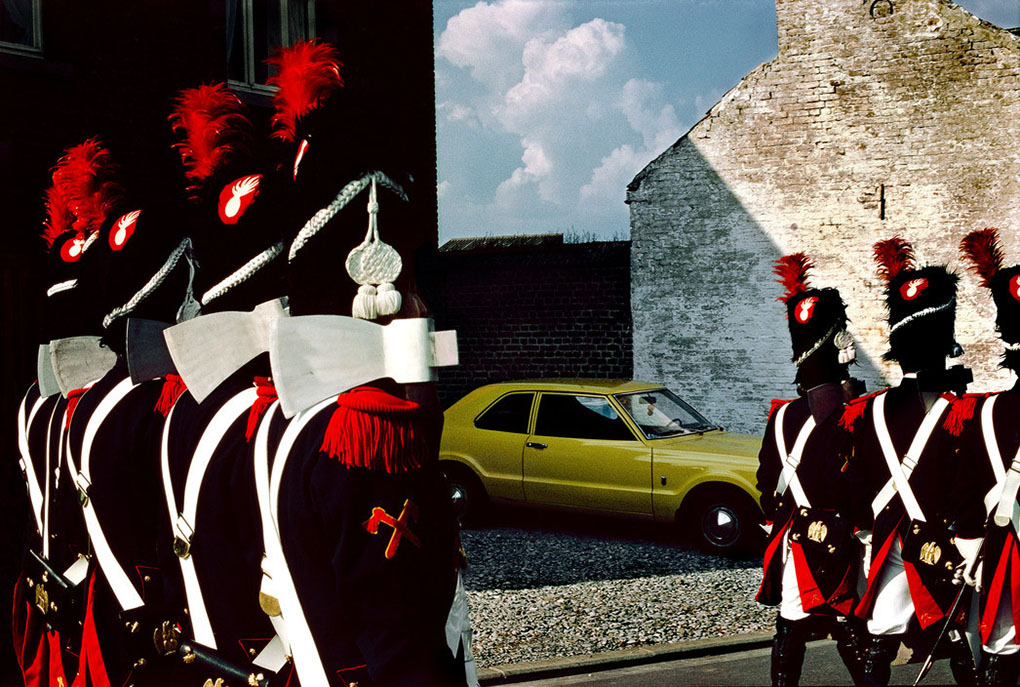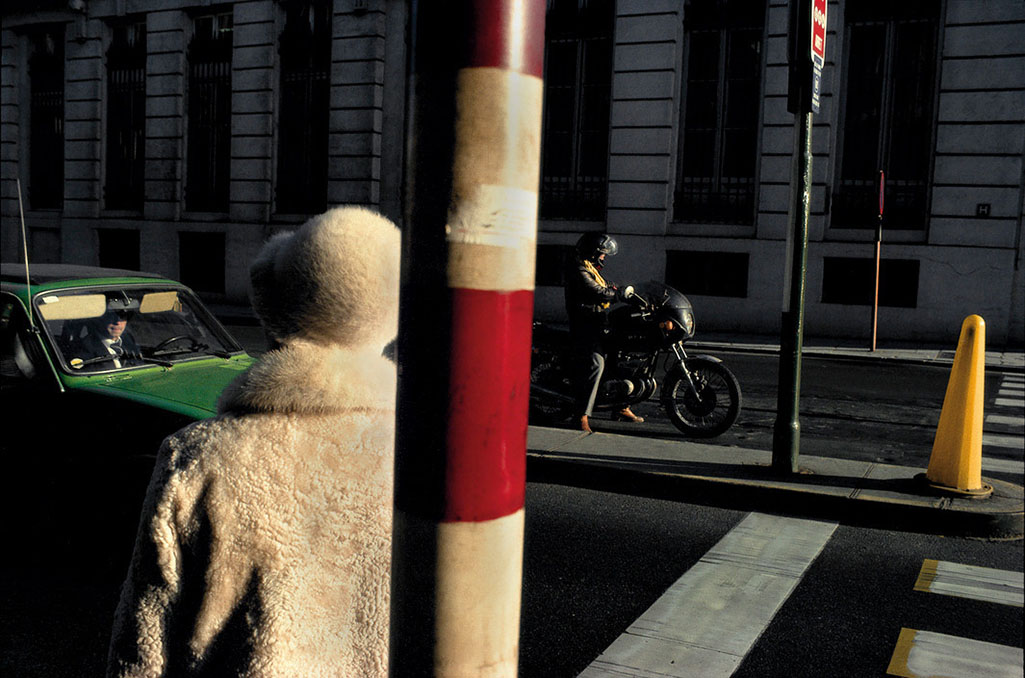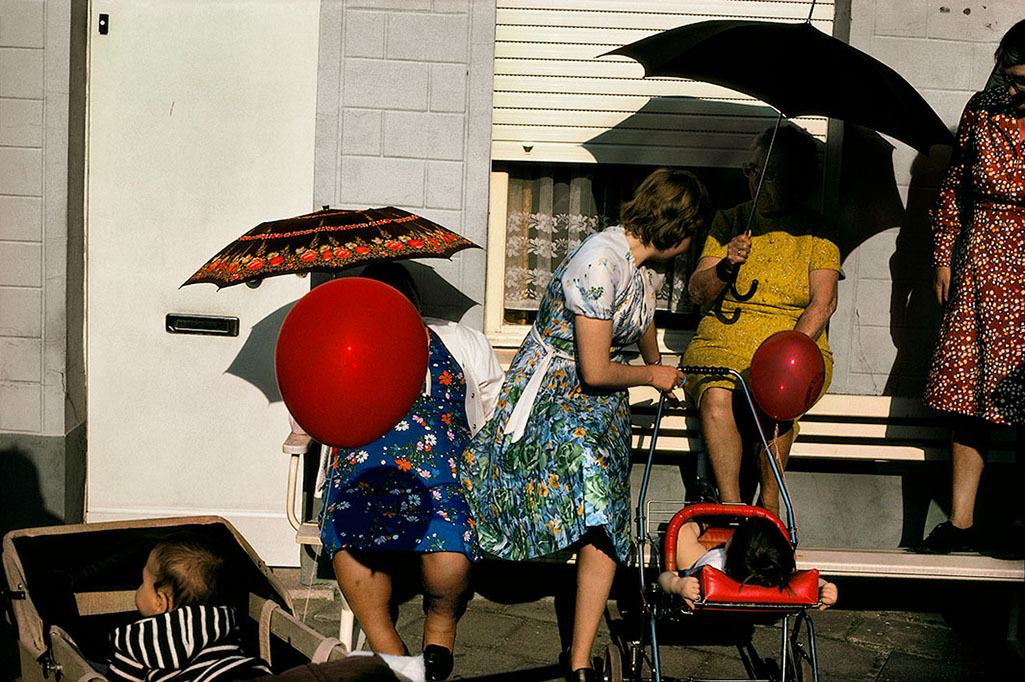
Celebrating Ten Years of NighthawkNYC.com!

Written & Photographed by Kenn Sava.

I started NighthawkNYC.com on July 15, 2015. During almost all of these past 10 years, the thought of reaching the Milestone of Ten Years was something that seemed as far away as Mars. Long-term isolation, sudden fainting spells that hospitalized me, heart problems, hearing damage, foot problems, the specter of going broke, and oh yeah, that little thing called the pandemic, the 2020s have been hard for me, as they have been for many of you, I’m sure.

So, as I sit here at 6:30 am on July 15, 2025, I’m partially here to see & celebrate this day I didn’t think I’d actually get this site to arrive. As the improbable started to become a real possibility it dawned on me that I HAD to write something to honor getting to this point, and ALL the work that has gone into getting it here, even though I’m supposed to be taking a break (which didn’t stop me from writing the two biggest pieces I’ve ever written!). My one-time neighbor, Joni Mitchell, from decades before my time here, says it best about being here this morning in her circa-1969 song “Chelsea Morning.” (We’ll keep it between us that I haven’t been to bed yet!)

“Woke up, it was a Chelsea morning
And the first thing that I heard
Was a song outside my window
And the traffic wrote the words”-*

Since Joni hasn’t shared how to get the traffic to write my words, I decided to use this occasion to reflect on where I’ve been, where I am, and to try and look a bit ahead.

Part 1-
A)- Where I’ve Been
Some Highlights, in my opinion anyway, from the past 10 Years…

“Oh, won’t you stay
We’ll put on the day
And we’ll wear it ’till the night comes.”-*

1)- “My Search For Edward Hopper’s Nighthawks Diner,” published July 29, 2019.  Decades in the making, it’s hands-down my most read, most discussed piece.
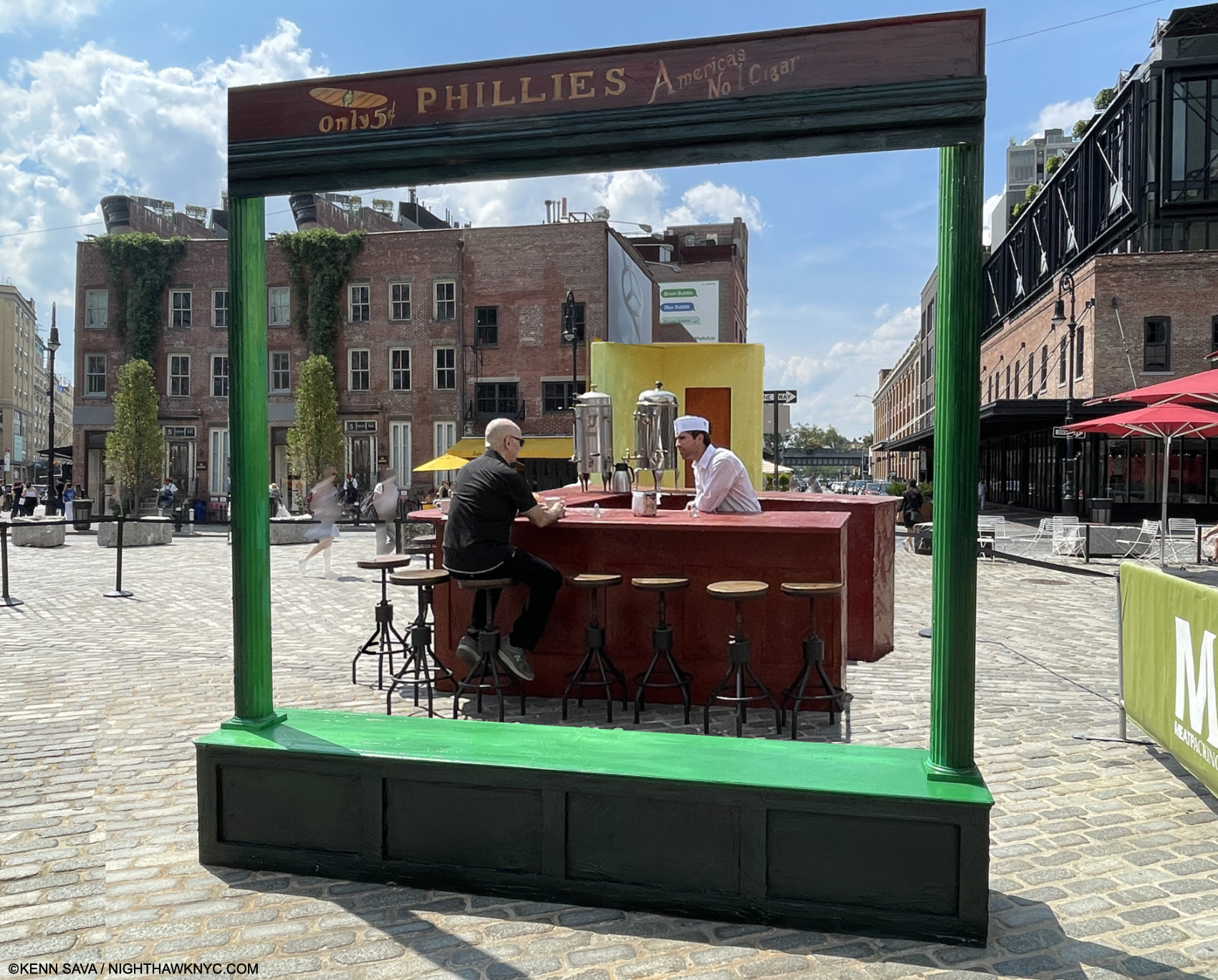
Update- On July 21, 2024, I finally found it! Meatpacking District, NYC. Kenn Sava, left, reenacting his Painted alter-ego, Logan, right. Photo by Nilo for NighthawkNYC.com. Continual Thanks to all involved & Kevin Callahan. Click any image for full size.

2)- “Vincent van Gogh: Home at Last,” published October 8, 2018. Preparing this piece on the reinstalled Van Gogh Masterpieces in the Permanent Collection of The Met suddenly took on an unexpected life of its own.
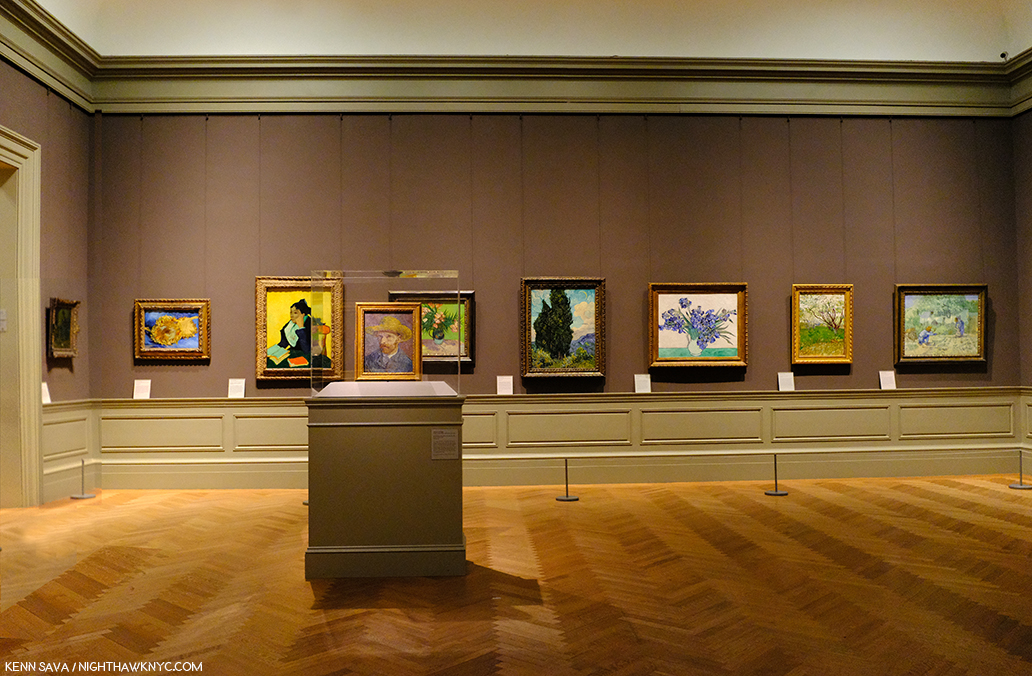
HOW great is it to be able to walk into a room and see THIS? For me, it’s one of the great joys of life in NYC. One part of the newly reinstalled Gallery 825 showing 9 of the 10 Van Goghs in this room. #10 is on the other side of the Self-Portrait with Straw Hat in the vitrine. This shot was available for literally one second over 3 visits and 3 hours I spent here. In the piece, you’ll see why.

3)- “Van Gogh’s Cypresses: Art From Hell,” published November 10, 2023. With all due respect to The Met’s great curators, I saw their blockbuster Van Gogh’s Cypresses completely differently than they did, apparently.
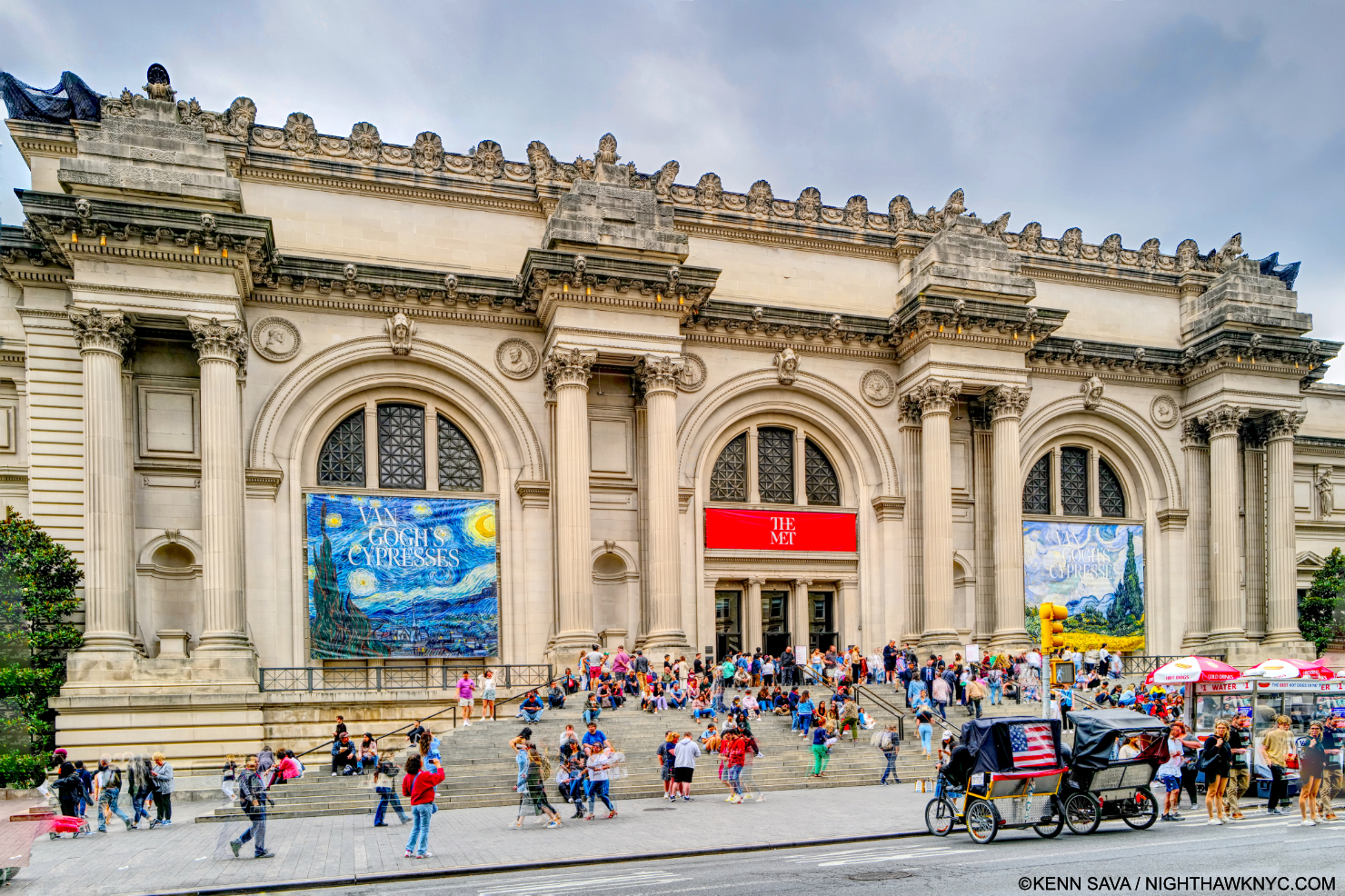
Welcome to The Met! In all my years of going to The Museum, as I call it currently 1,900+ visits since 2002, I’ve never seen TWO banners (left & right) up devoted to the same show. And, as I was soon to find out, it’s not like there weren’t other terrific shows going on! Seen on June 2, 2023.

4)- “Kerry James Marshall: The Revolution Was NOT Televised,” published March 1, 2017. THE most everything Painting show I saw in NYC in the 2010s. Along with Hima af Klint: Paintings for the Future, the two most important Painting shows mounted here in the prior decade.
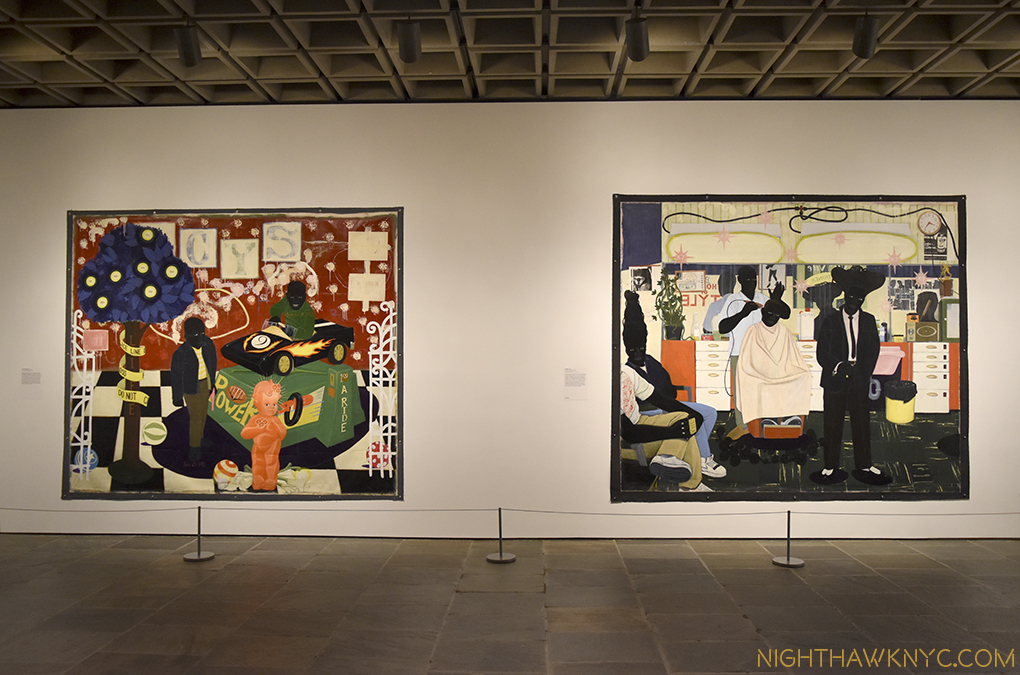
The finest moment, among many fine moments, in the all-too-short life of The Met Breuer. Installation view of Kerry James Marshall: Mastry. “De Style,” 1993, KJM’s barbershop, right, drips of life, fun, culture, individuality and style. On the left, his “The Lost Boys,” from the same year, a title borrowed from Peter Pan, is an homage to two children lost to gun violence, and all the boys who were “lost” to a variety of causes.

5)- “A Conversation with Photographer Harry Gruyaert,” Published September 22, 2018. Consistently among my most popular pieces, the renowned Belgian Photographer, and long-time Magnum Photos Member, discovered me through my “Saul Leiter: In My Room” piece and let his gallerist know he would be interested in speaking with me. A fan of his work, we spoke extensively via transatlantic phone. I discovered later how few interviews he has given.
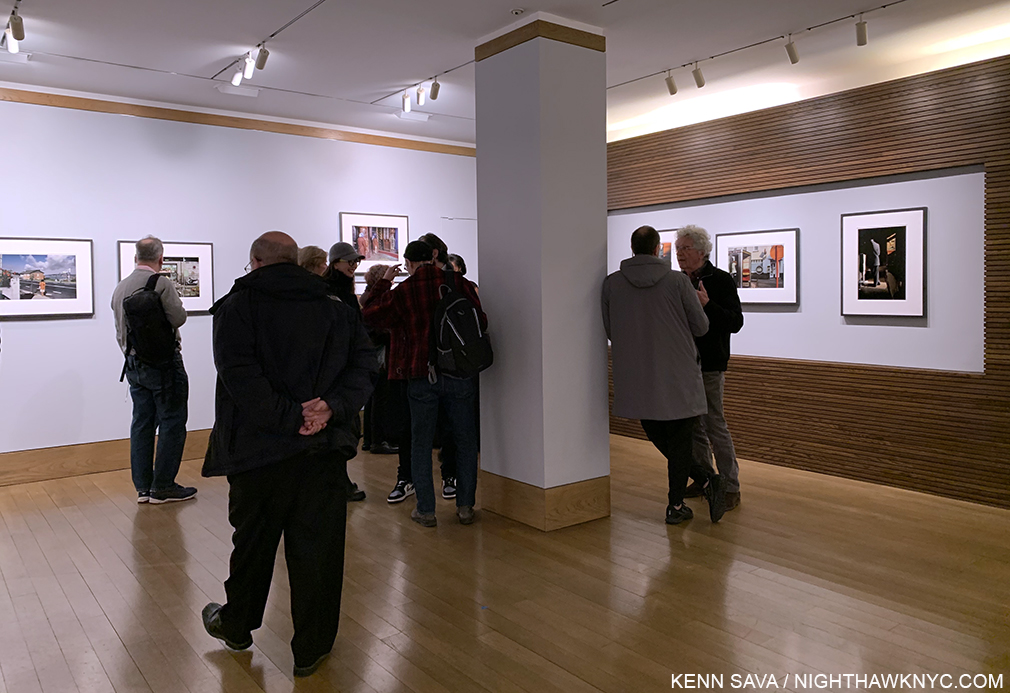
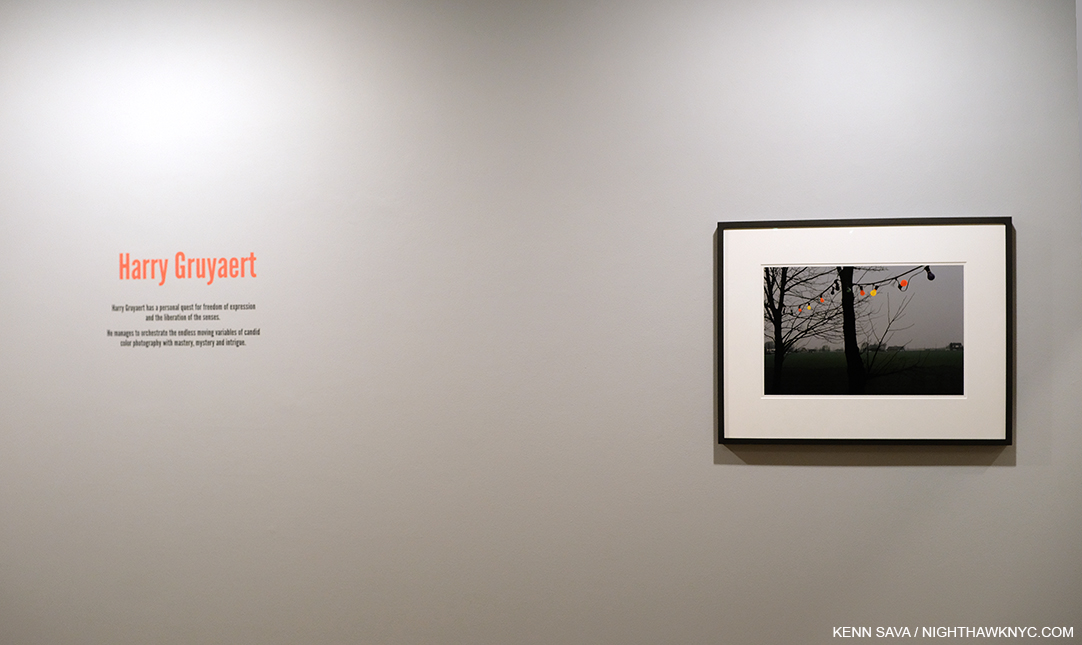
Subsequently, I met Harry Gruyaert, far right, in 2020 at the opening of his first American show since 1990!

6)- “Rod Penner’s America: Small Town Nation,” published August 22, 2023. This piece, based on his most recent NYC show which continued to solidify Mr. Penner as one of the foremost Painters of small-town America working today, continued my coverage of the Texas-based Artist’s NYC shows, with my prior pieces linked at the bottom of it. At one point, I had written more about Rod Penner than anyone else had. Maybe I still have. Rod was also kind enough to do a Q&A with me in 2017.
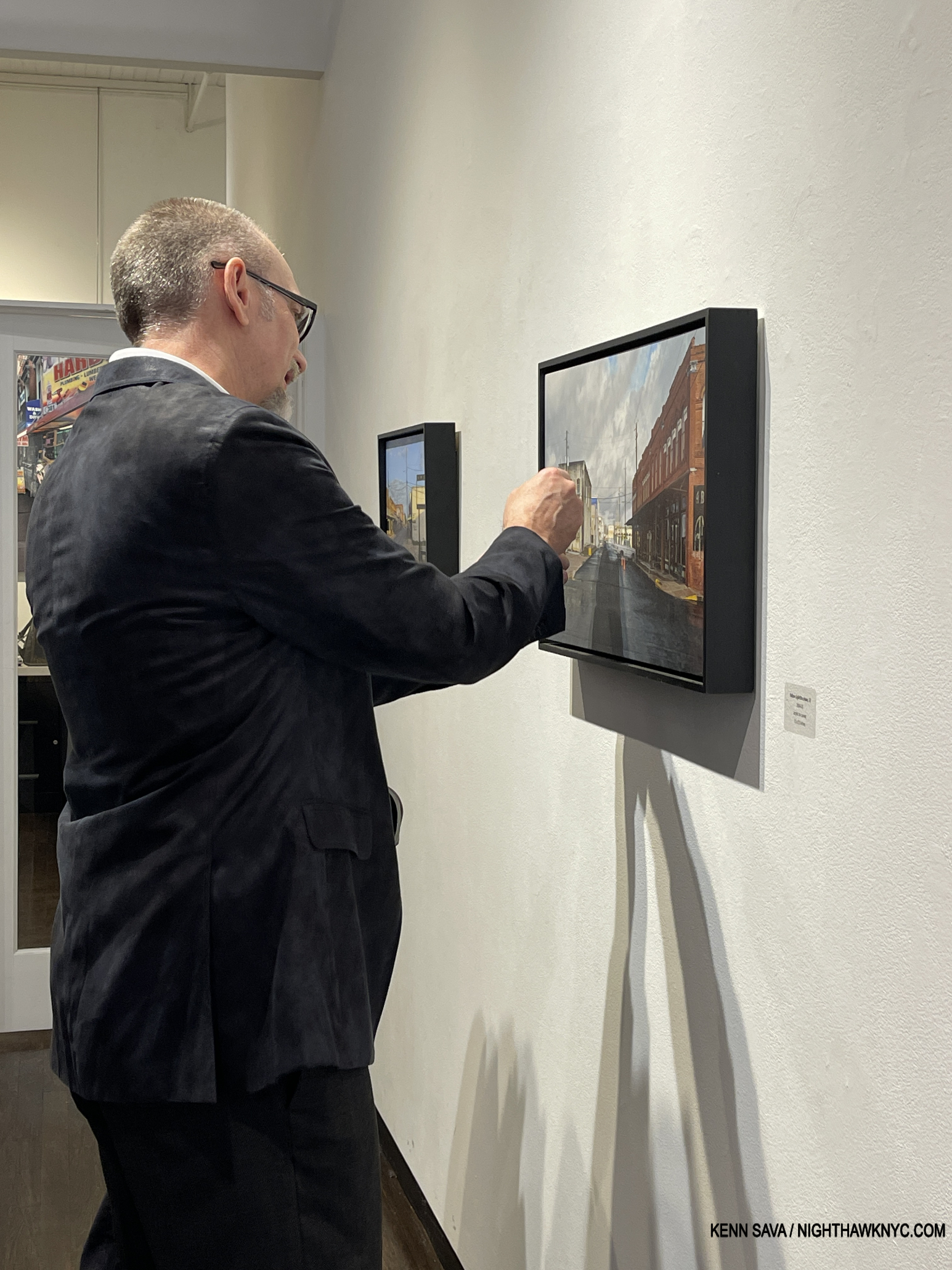
HOW does he do it? Rod Penner discussing one the very, very fine points of his Yellow Light/Brenham, TX, 2004-5, 15 x 25 inches, at his opening, March 18, 2023.

7)- “Henry Taylor: The Art of Empathy,” published March 8, 2024. Born of my unforgettable encounter with Mr. Taylor at the opening of his 2019 solo show.
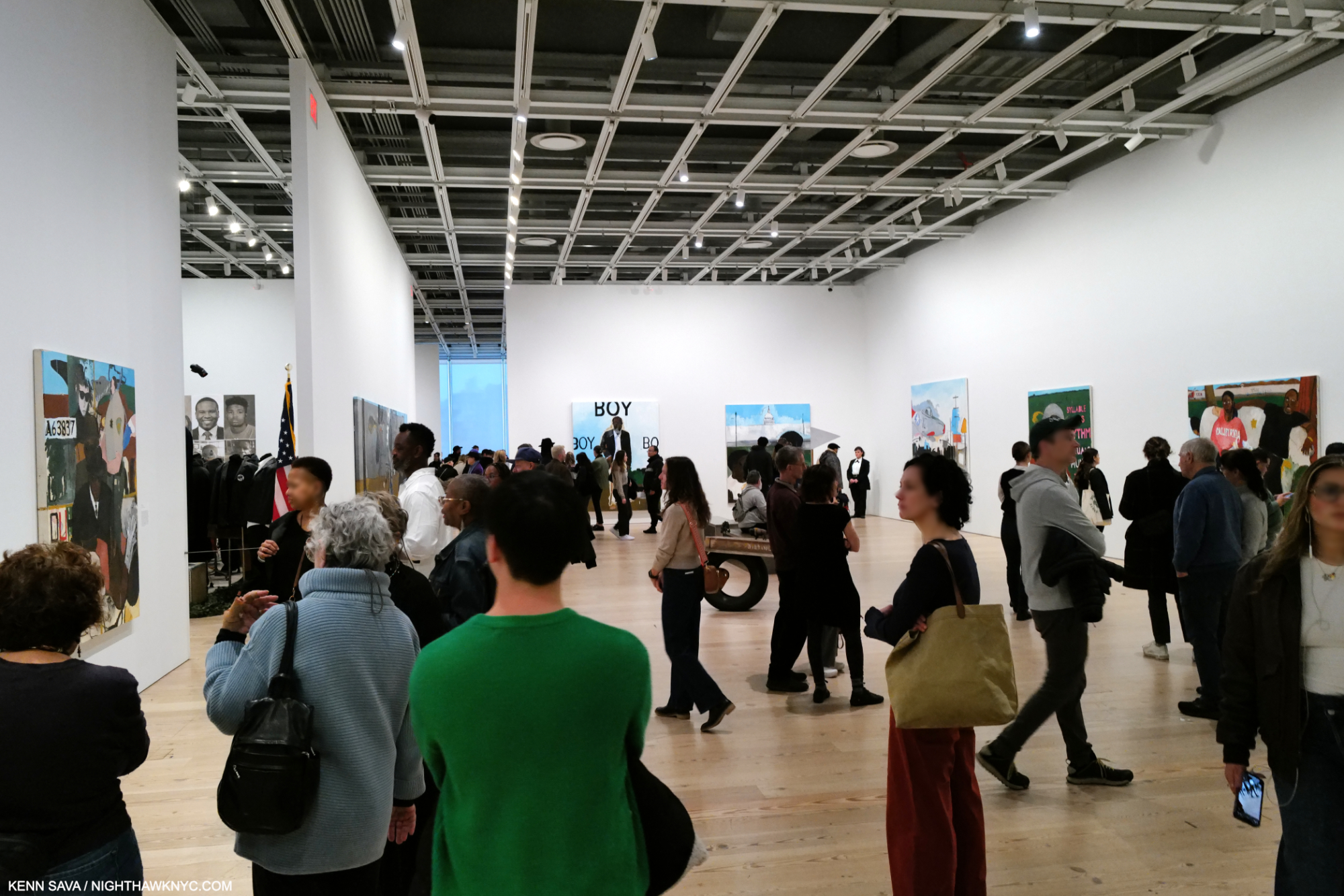
Installation view, an hour and a half before Henry Taylor: B Side closed for the last time, Whitney Museum, January 28, 2024.

7)- “Gregory Halpern’s America,” published November 8, 2019. Perhaps my biggest discovery during my 8 3/4-year “deep dive” into Modern & Contemporary Photography, my look at all of Mr. Halpern’s books through Omaha Sketchbook (2019), includes a look at its NYC book release in 2019, later the same night of my encounter with Henry Taylor!
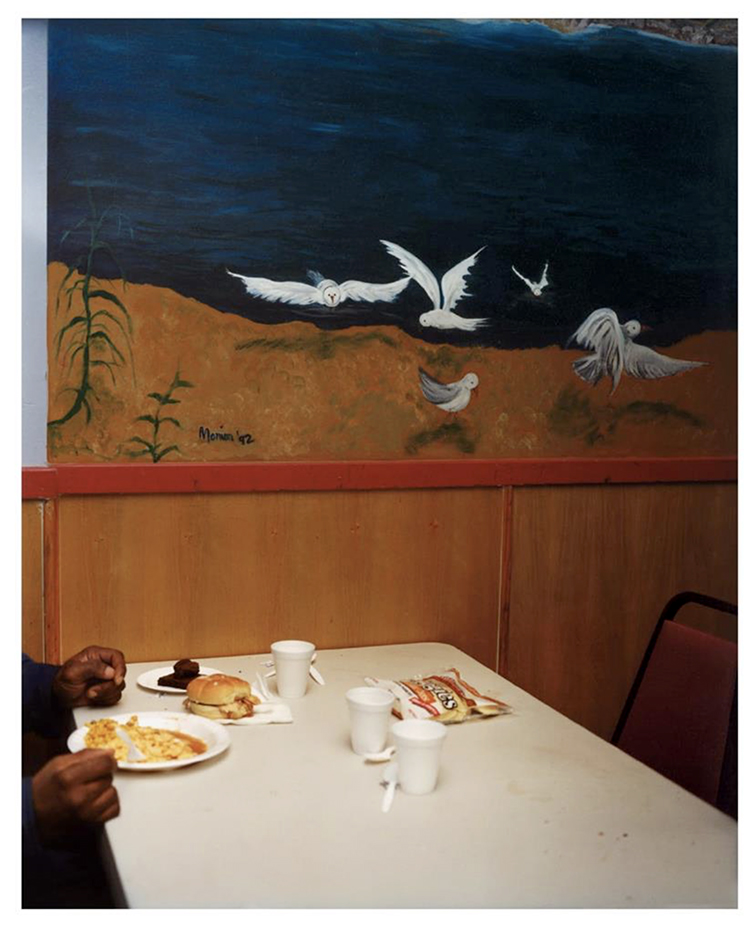
The very first work I saw by Gregory Halpern, “Untitled,” from his Buffalo series, seen at Aperture’s Booth at AIPAD: The Photography Show, April, 2017, I liked so much it’s been hanging on my wall since.

8)- “Raymond Pettibon: Artist Americanus,” published July 20, 2017. I was very fortunate to meet Mr. Pettibon and have him give me a tour of his Zwirner show, which I was thrilled about but also felt bad about because he was suffering from a quite damaged foot that caused him to sit the entire rest of the time he was at his opening. The show was also memorable as during its run I met Artist Caslon Bevington, whose work I’ve subsequently written about twice.
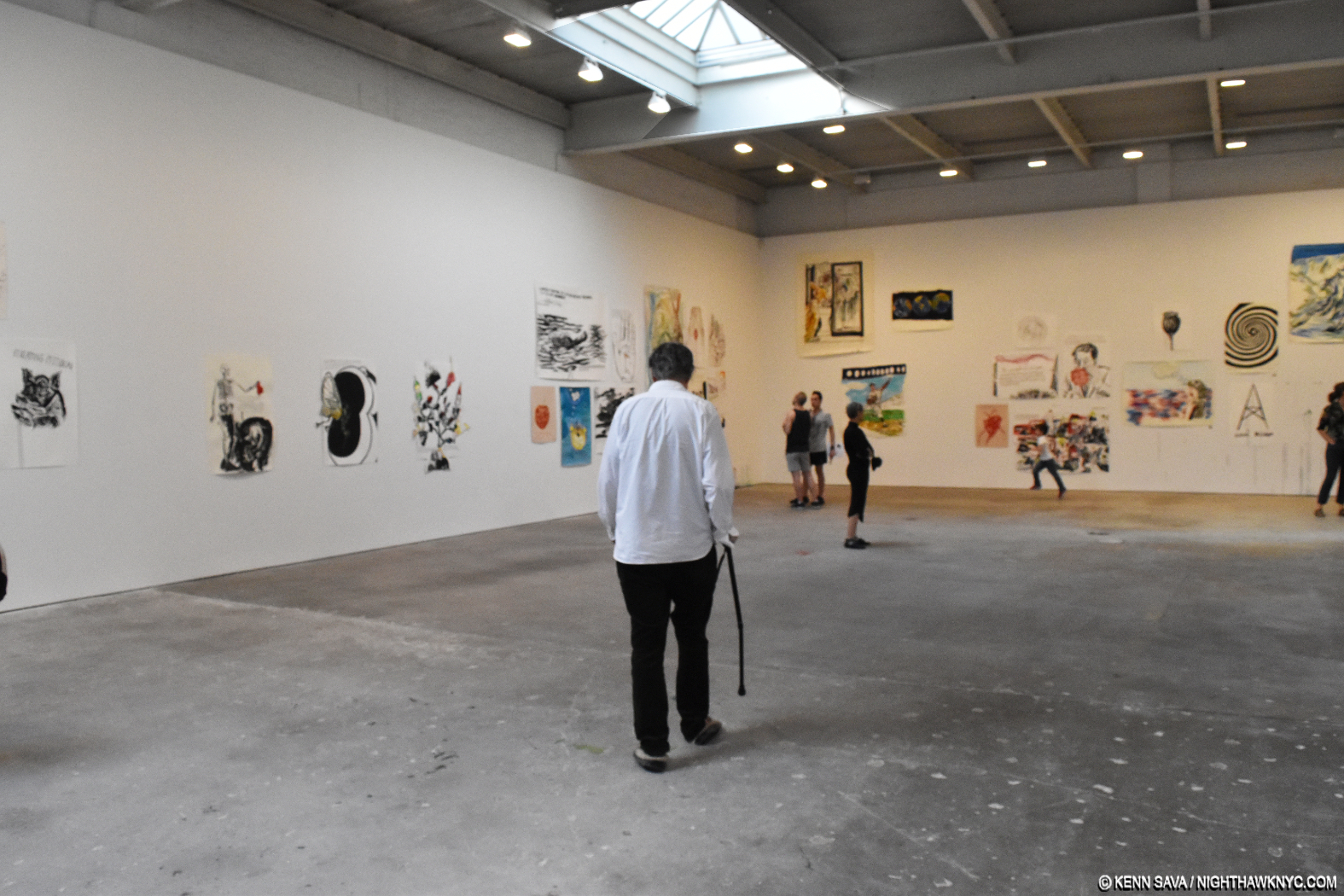
Playin’ hurt. The great Raymond Pettibon enters his show at the opening, April 29, 2017, with a cane. That small figure running in the distance is his son, Bo. Zwrner lent Raymond this space which he used to created the work you see on display. Quite a few paint splotches were to be found on the floor, leading me to think it must have been something to watch him creating these pieces.

9)- “Table for One: Patti Smith’s 18 Stations,” published April 17, 2016. I made about a dozen trips to Patti’s extraordinary Photography show and was shocked to walk in on the show’s last day to find the legend, herself, seated at the famous table she sits at on the cover of M Train signing books alone. She looked up, and realizing I was about to take her picture, cooperated. I then spoke with her, and wound up meeting her daughter as well. As the show closed, I found myself in the gallery with her as she walked through it one last time, trying to imagne what was going through her mind at each stop. I eternally regret not buying one of her Photographs. One of the Top 5 most-read and most-discussed pieces I’ve written.
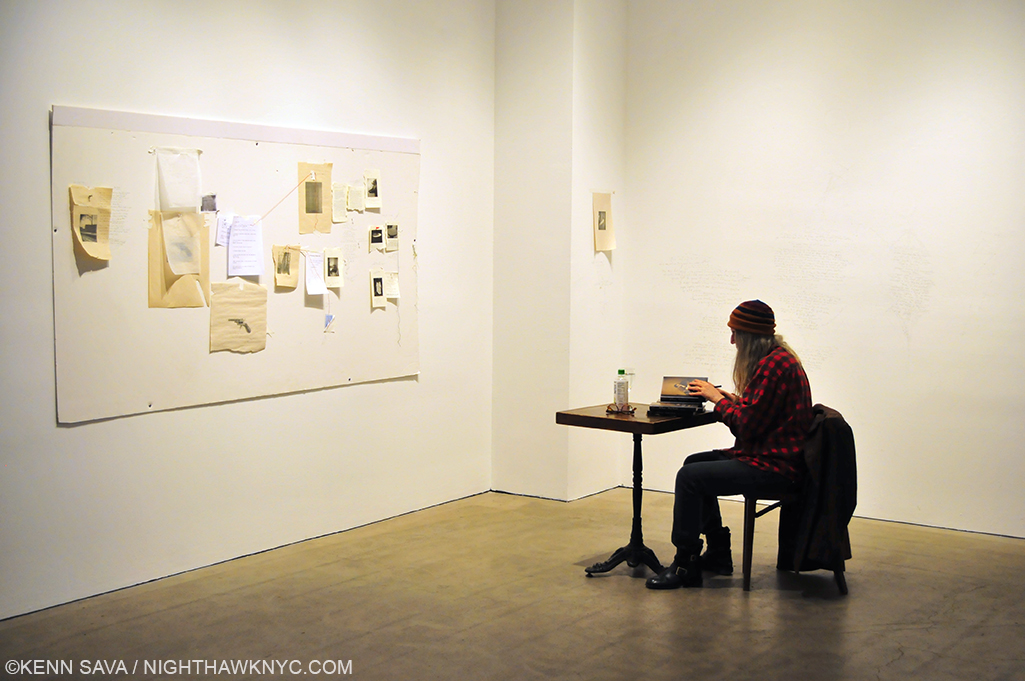
What becomes a Legend most? The one and only Patti Smith sits at her famous table.

B)- “Community Service”
1)- “Art” With a Capital “A,” published February 26, 2020. I should have written it sooner.
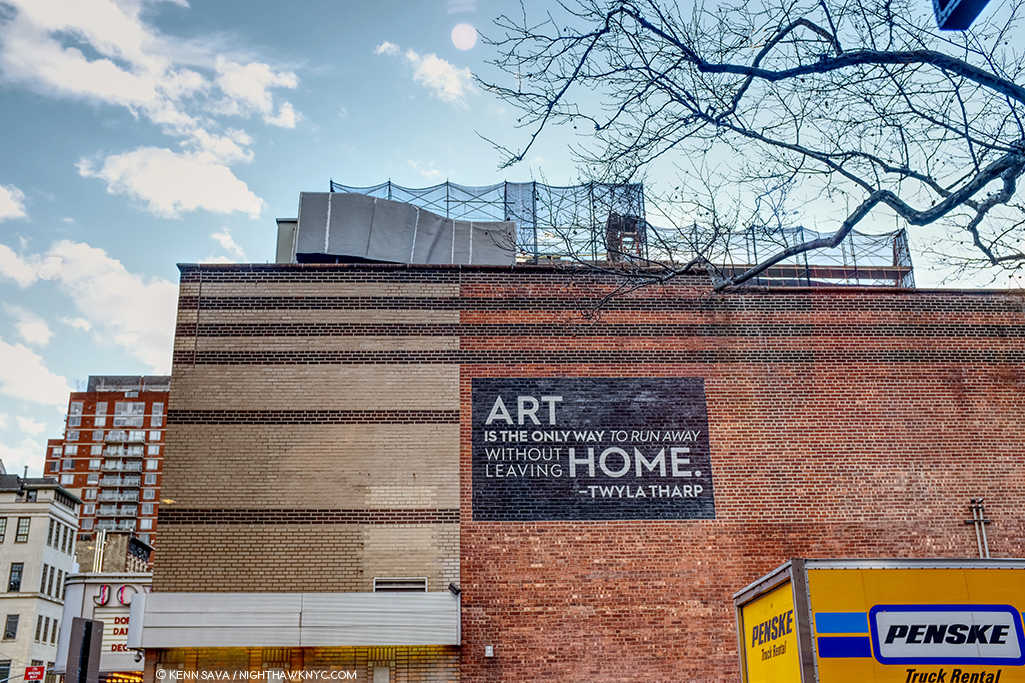
Thanks, Twyla! I couldn’t have said it better. And so, this scene has appeared in my Banner, sans moving truck, a number of times over the years. A look at ALL 41 of my banners this past decade is here. The Joyce Theater, December, 2019, as seen continually staring me in the face from my favorite seat in my beloved Starbucks on West 19th Street, the best SB in NYC. Another loss during the pandemic.

2)- “Death to Boxes!,” published on April 7, 2020. Another I should have written sooner. The problem has only gotten worse.
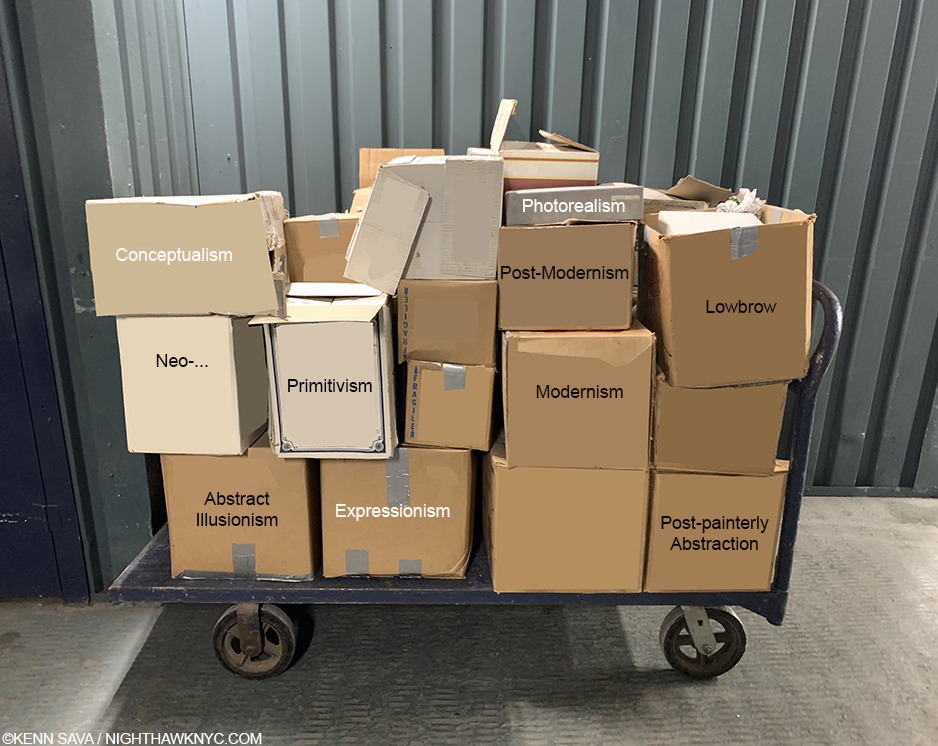
3)- “On Buying Art,” published on July 11, 2017. One I did write early on.
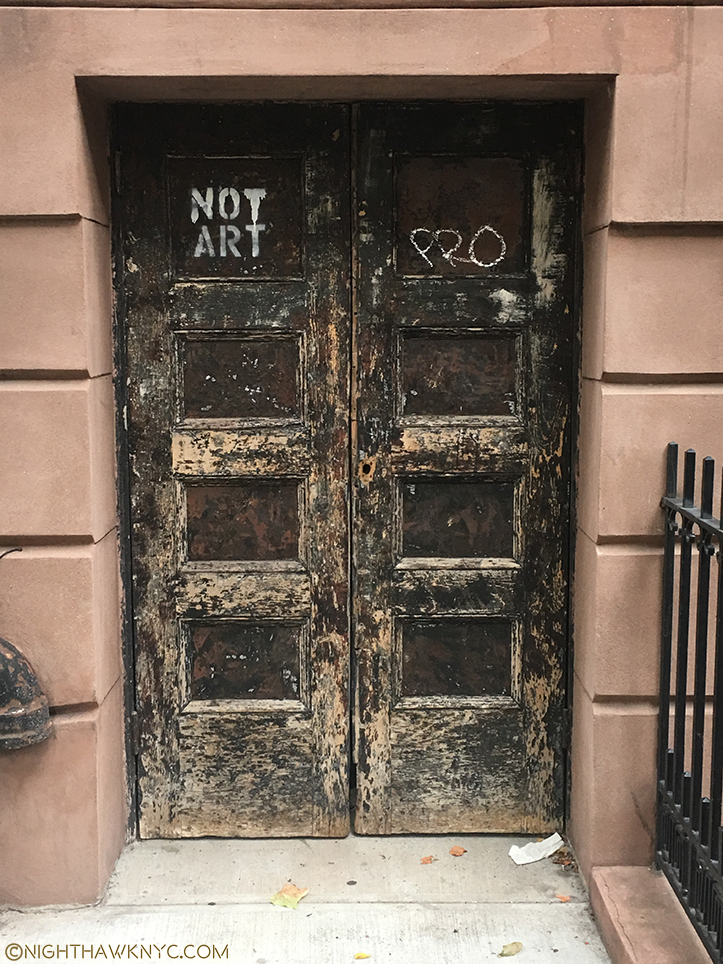
Knowing what not to buy is rarely THIS obvious.

C)- Milestones

“Oh, won’t you stay
We’ll put on the day
There’s a sun show every second”-*

1)- “Welcome to the Night,” published July 15, 2015. My very first piece!
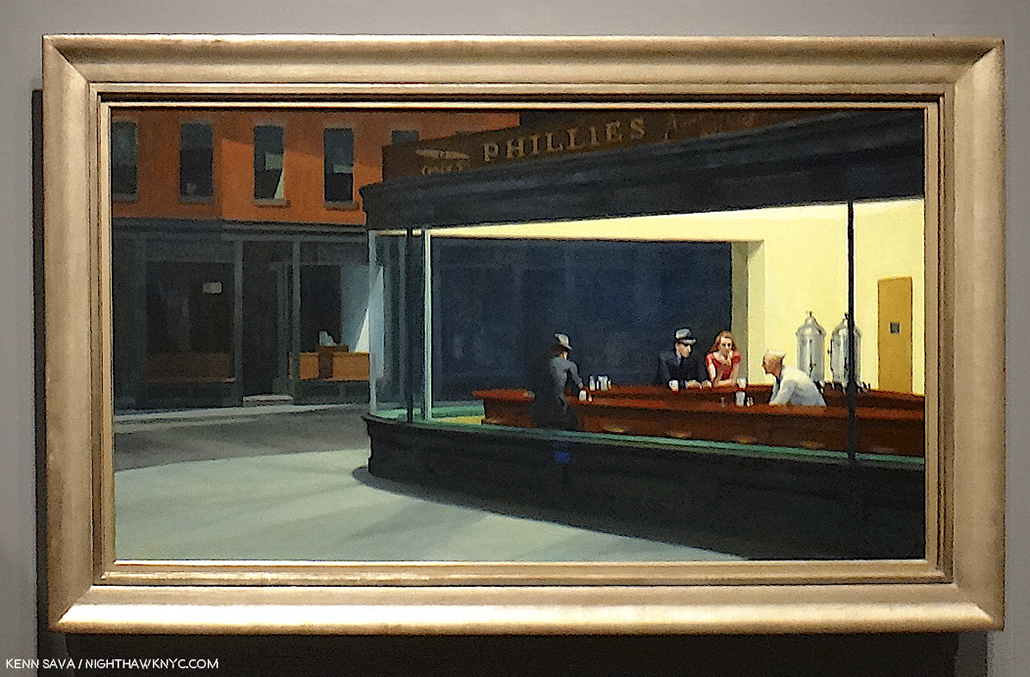
The last time I stood in front of Nighthawks, with my Painted alter-ego, dead center. August 28, 2013, at Hopper Drawing at the old Whitney Museum. Fun fact– I “borrowed” its frame for the frame you see in my banner! Shhhh…Don’t tell anyone.

2)- “Cancer Saved My Life,” published February 7, 2017, on the 10th Anniversary of my cancer treatment. My passion to share what I’ve seen & learned in the Art world comes from surviving with a 20% chance of making it through Year 1 post-treatment without needing more treatment. I’m happy to say 8 Anniversaries have followed- 18 in all! Miraculous.
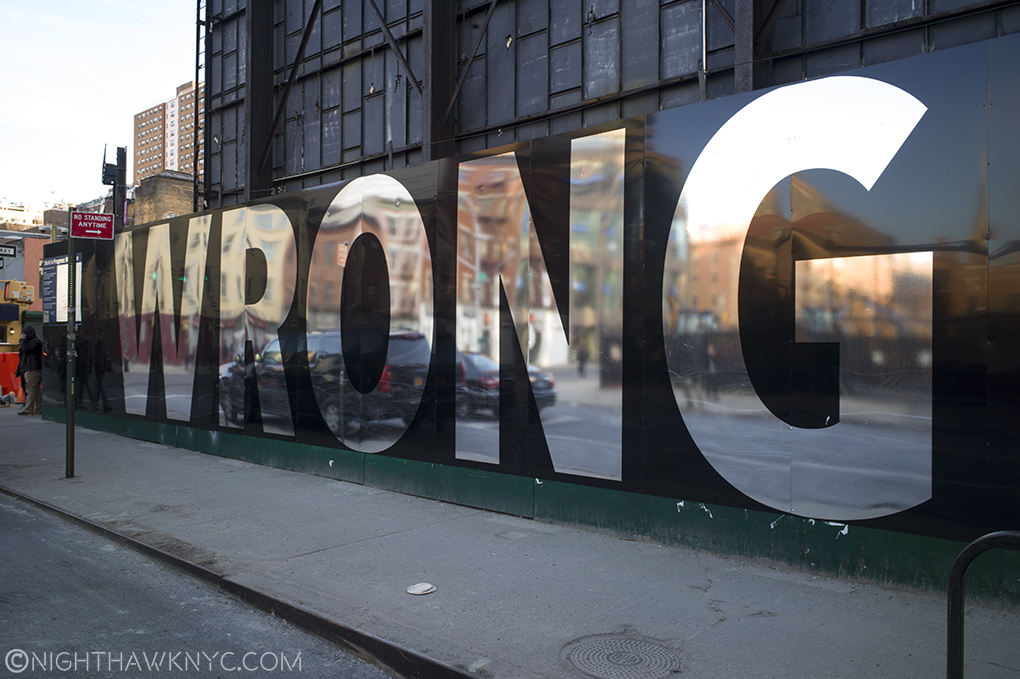
Every cancer patient’s worst nightmare. During my search for cancer treatment, after much research and agonizing, I settled on a treatment. My life was saved by a Doctor who patiently explained why it was the wrong choice for me moments before I was to begin it. Unfortunately, there wasn’t a sign this big to guide me.

3)- “Kenn Sava Named a Finalist…,” published November 25, 2023. I was, and am, honored to be named a Finalist for the 2023 Andy Warhol Foundation Arts Writers Award out of the 500 writers they said they considered.

D)- Journeys
1)- Goya: In Boston & NYC, published January 20, 2016. In January, 2015, I made a day trip to the Museum of Fine Arts, Boston to see their exceptional Goya: Order and Disorder show. A few months later, I saw a show of his complete Los Caprichos at the National Arts Club, here.
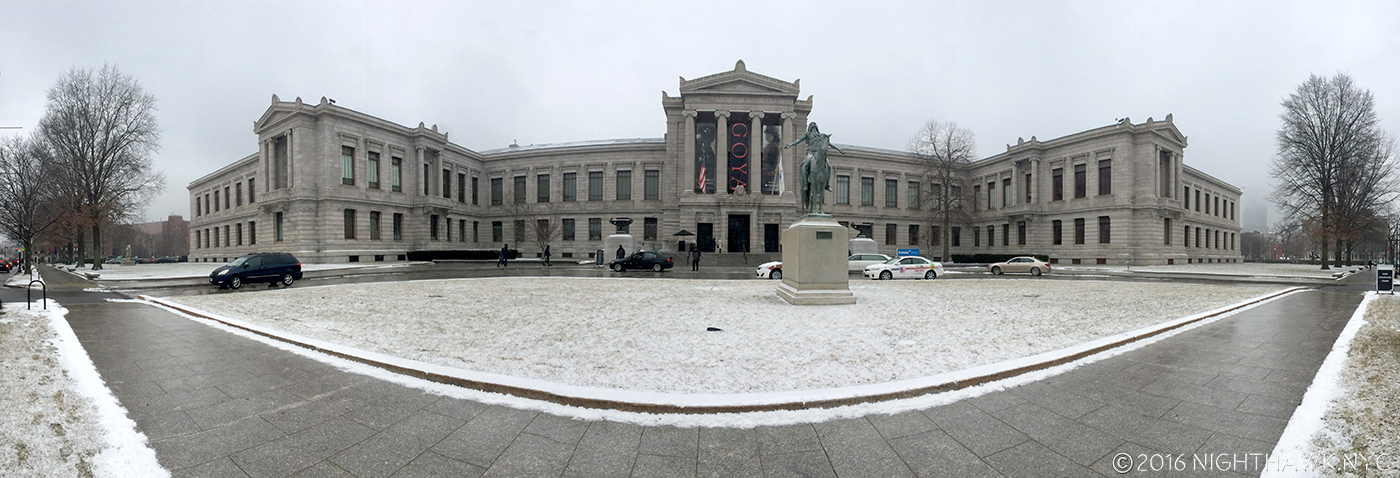
The Museum of Fine Arts, Boston in January, 2015, the last time I went out of town to see an Art show. Of course, I was back in my own bed that night.

2)- “13 Year At The Metropolitan Museum,” a 2-part series, the first part published on July 26, 2015. Though I’m in Manhattan, The Met is not exactly nearby. Nonetheless, I’ve managed to get there over 1,900 times since August 1, 2002. Some thoughts on it from 2015.
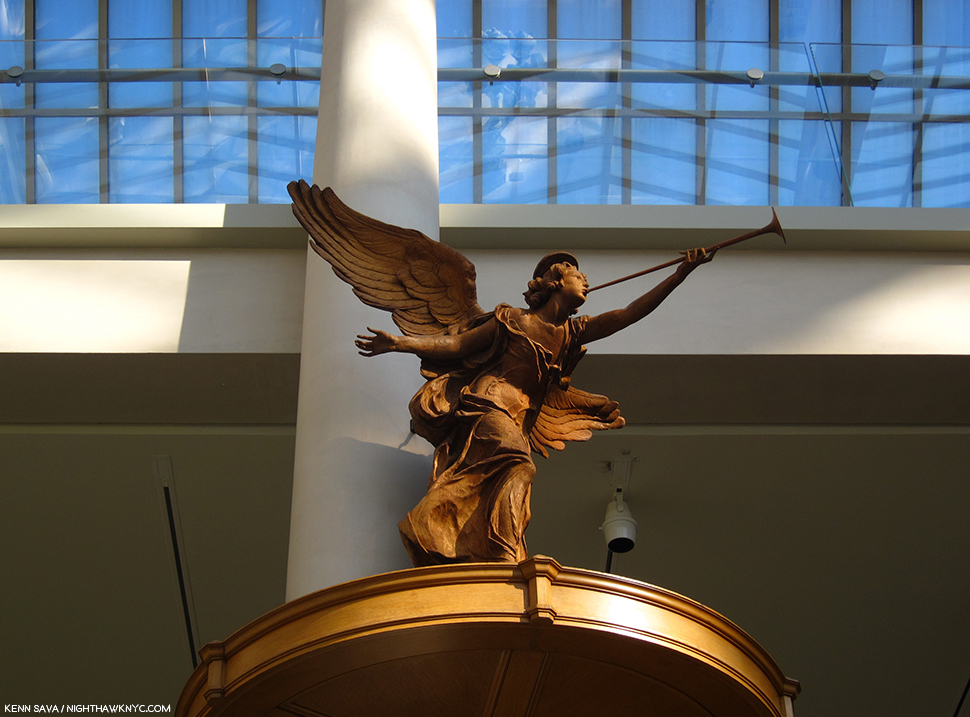
Hark! A Met Angel Beckons me to the Light. To not hear her call is my loss.

3)- “The Met Breuer: Hail, and Farewell,” published on August 1, 2020. I was there on March 8, 2016,  the first Member’s Preview Day, and I was there the moment it closed for the final time on March 12, 2020. In between, I saw more great shows there than anywhere else, largely due to The Met’s terrific Contemporary Chairperson, Sheena Wagstaff, who I’ve also written about at length more than once.
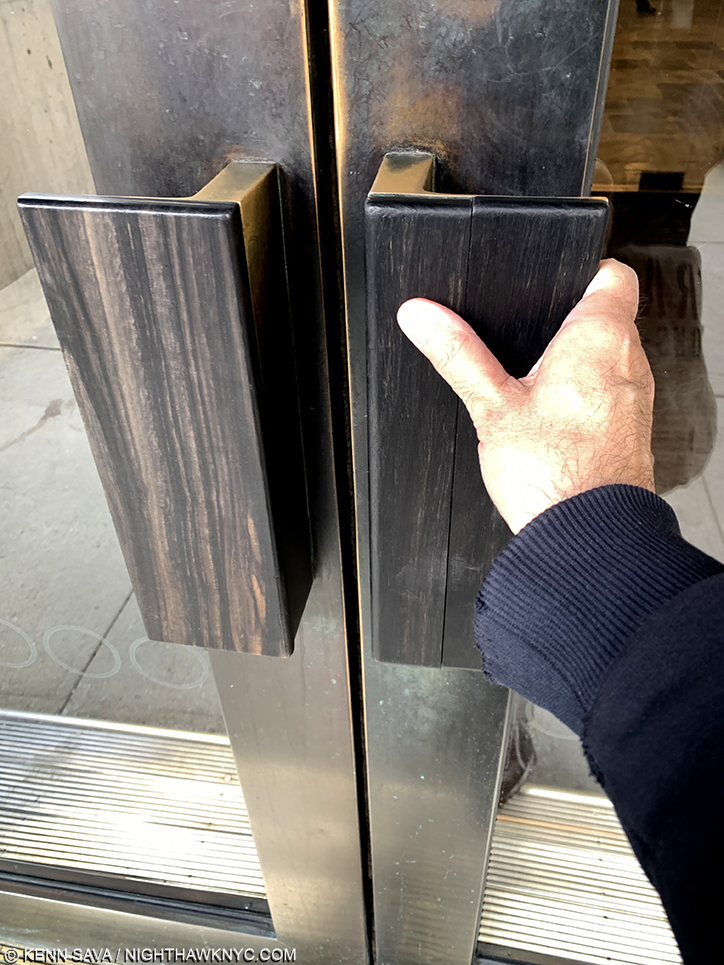
March 12, 2020. I’m about to enter The Met Breuer for what I didn’t know would turn out to be the last time, on what would turn out to be its last day ever.

4)- “Exclusive! A Visit to Raymond Pettibon’s Moscow Show!,” published November 20, 2017. Lana Hattan was able to get an associate to go The Garage and shoot Raymond Pettibon’s 400-piece Moscow Retrospective, Raymond Pettiboyn: The Cloyd o’ Misreadyng,” for me! Though this was before the cessation of relations between the U.S. and Russia, I was unable to make it. Raymond Pettibon made it, though, and created another of his classic Hand-Painted Murals for the show. Given there have been very few large Raymond Pettibon shows since, I’m very thankful to the Hattan Group, who did a terrific job as you can see, for  doing this for me, and enabling me to write about the show for NighthawkNYC readers! It’s the only show I’ve written about without actually seeing in person! It’s something you can’t see anywhere else.
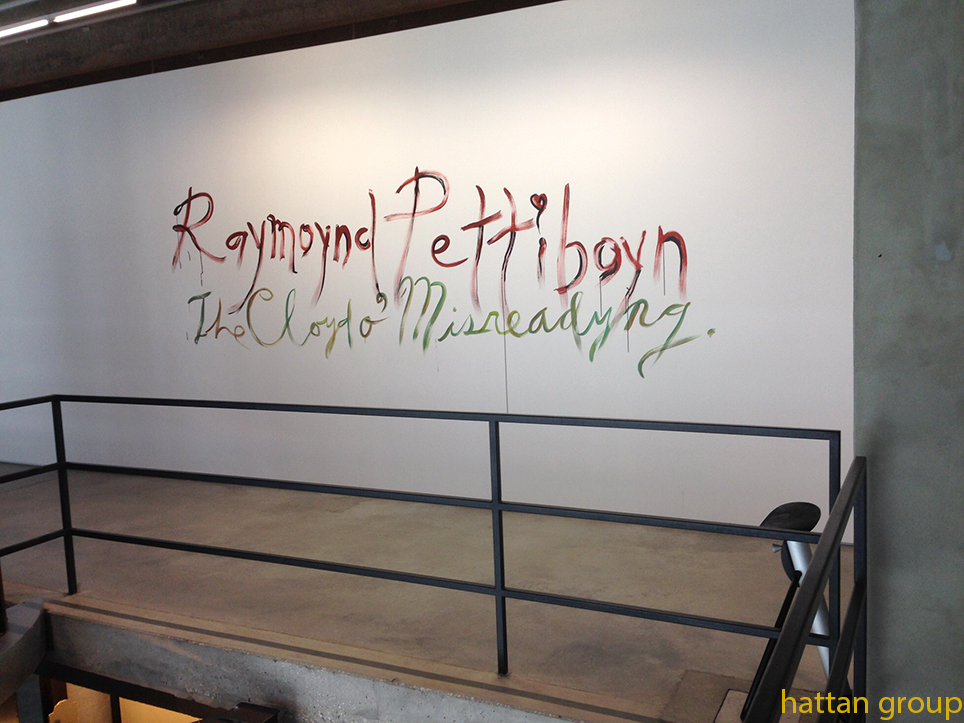
Live, from Moscow’s Garage! The show’s entrance features one of Raymond Pettibon’s famous hand-painted murals, around the corner from this sign. I hope the Russians are up on their “Pettibon English!” Photo by The Hattan Group for NighthawkNYC.com.

4)- “Antoine de Saint-Exupéry: Artist,” published on March 21, 2023. I’m self-taught at everything besides reading/writing and basic math thanks to a terrible school system and not being permitted to go college. As a result, I had never read The Little Prince, as hard as that is to believe, until Lana, whose favorite book it is, insisted I do. Of course, I immediately got hooked, like hundreds of millions of others have. We were lucky enough to attend the wonderful show of his work at the Morgan Library, and I returned there in 2023 for their show on the Art of Saint-Exupéry. The piece took on a life of its own after the French Ambassador to the U.S saw it and invited me to Washington, D.C. for a dinner he was hosting in honor of the 80th Anniversary of the publication of the book.
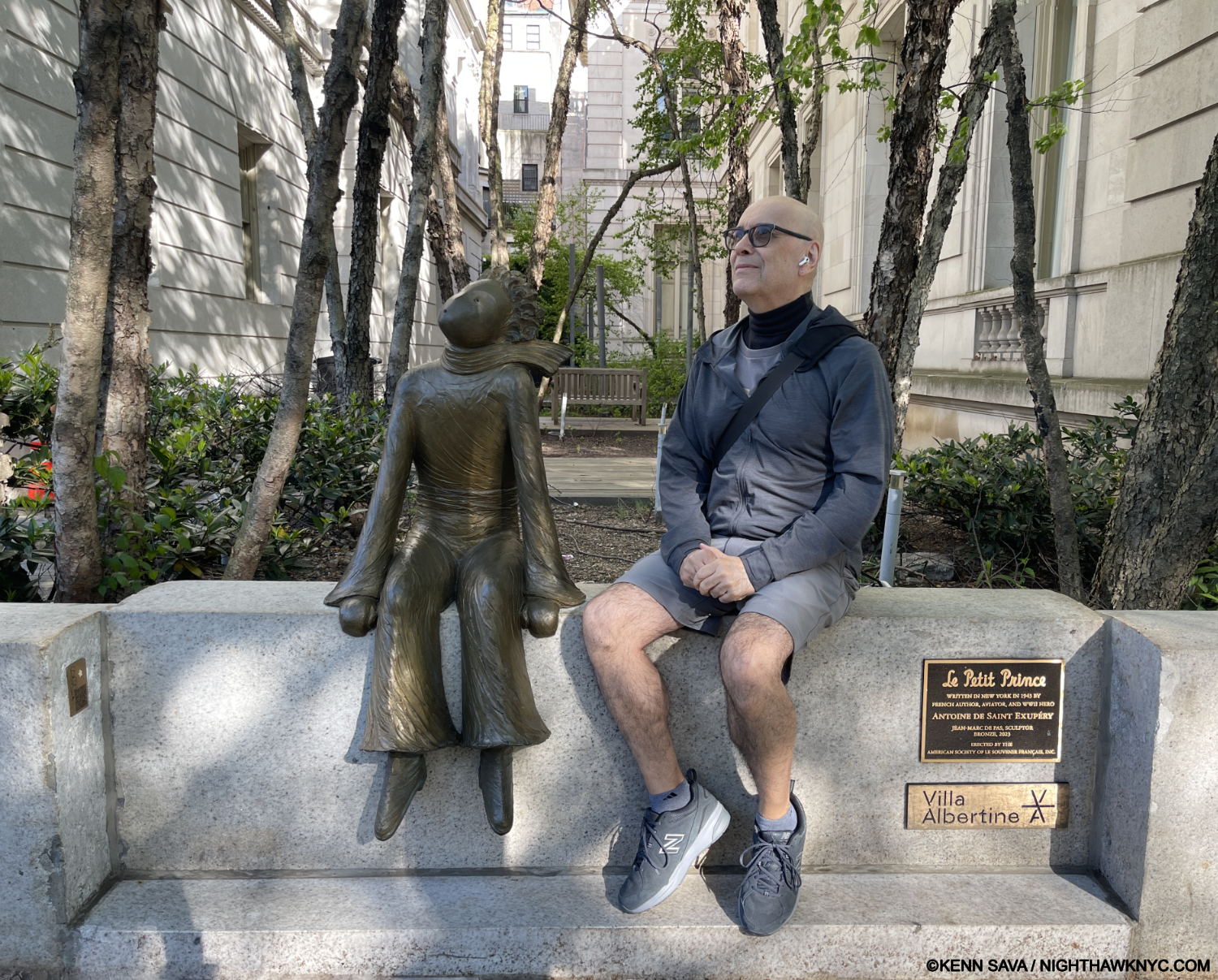
I join Saint-Ex’s most beloved creation in waiting for the return of his Asteroid. Hurry up, already! May 10, 2025. My thanks to the kind lady who took this.

E)- Epics
1)- “The New Whitney Museum: The Roofdeck of American Art,”  published August 1, 2016. I worked on my look at the “new” Whitney Museum for over a year after having been a voice against the expansion of the old building. Now that it’s 10 years old, nothing has changed anything I said about it.
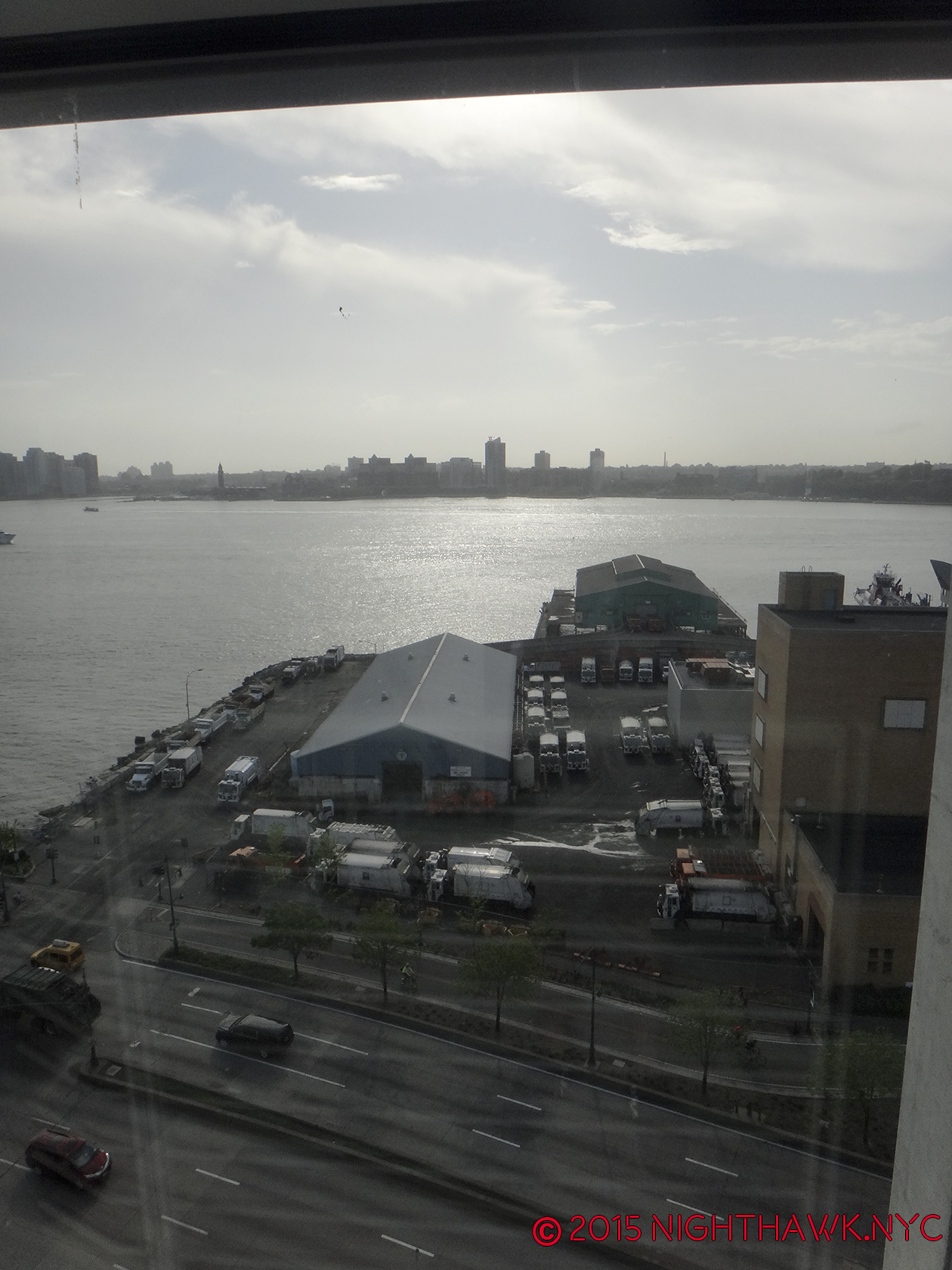
Nothing has changed except the Department of Sanitation complex in front of the museum, seen here in 2015, has been replaced with a park.

2)- “This Summer In ‘The Era of Rauschenberg,'” published September 19, 2017. I spent my summer going to MoMA’s Robert Rauschenberg: Among Friends (24 times) and the 4 Rauschenberg satellite shows going on around town. The Rauschenberg Foundation was impressed to the point that they invited me down for a private tour of their entire facility, his former studio, which was beyond an amazing experience for this long-time fan.
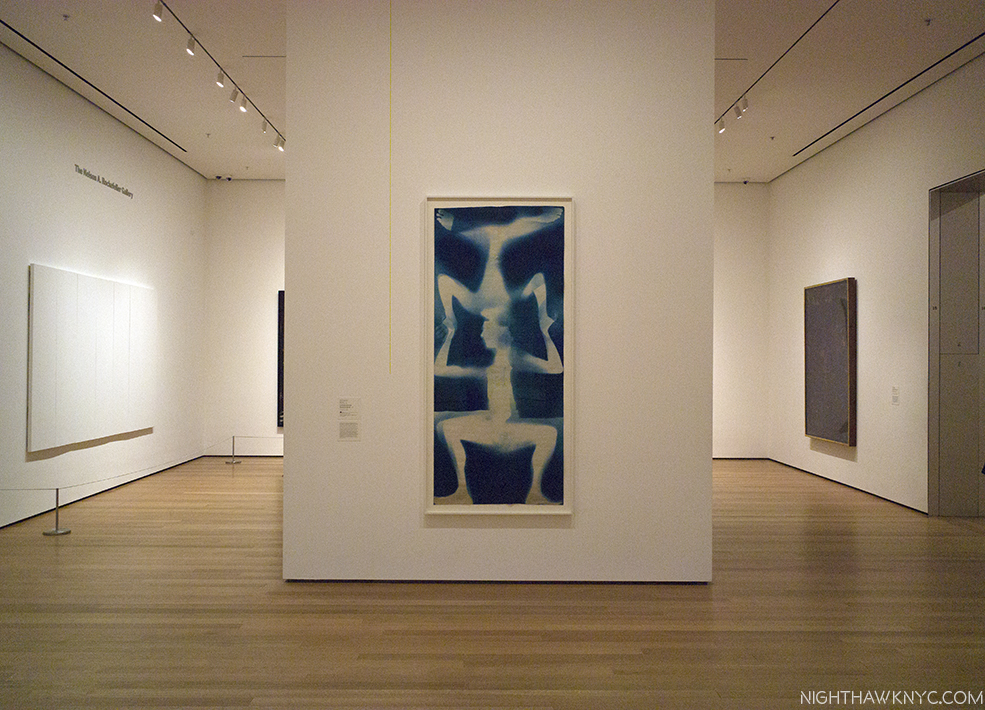
One nice note- The Rauschenberg Foundation informed Sue Weill, Aritst (and collaborator with him on Untitled (Double Rauschenberg), c.1950, Monoprint; Exposed blueprint paper, center)  & former Rauschenberg girlfriend, about my inclusion of her in this piece and others, and told me she was pleased to hear it. Partial installation view of the first gallery of Robert Rauschenberg: Among Friends. 

3)- “Richard Estes: Painter. With No Prefixes,” published May 22, 2022. I was surprised to see nothing else printed on the occasion of Richard Estes’s 90th Birthday, which I take as another reminder that the Art associated with  “photorealism” is still not of interest to almost all of the world’s museums. I agree with them on most of it. Yet, (see my piece on boxes, above), some Artists have been stuck in this box, or other boxes, without their consent. I don’t quite see Richard Estes work the way many others seem to. My 3-part series, built on decades of looking at his work, addresses just this.
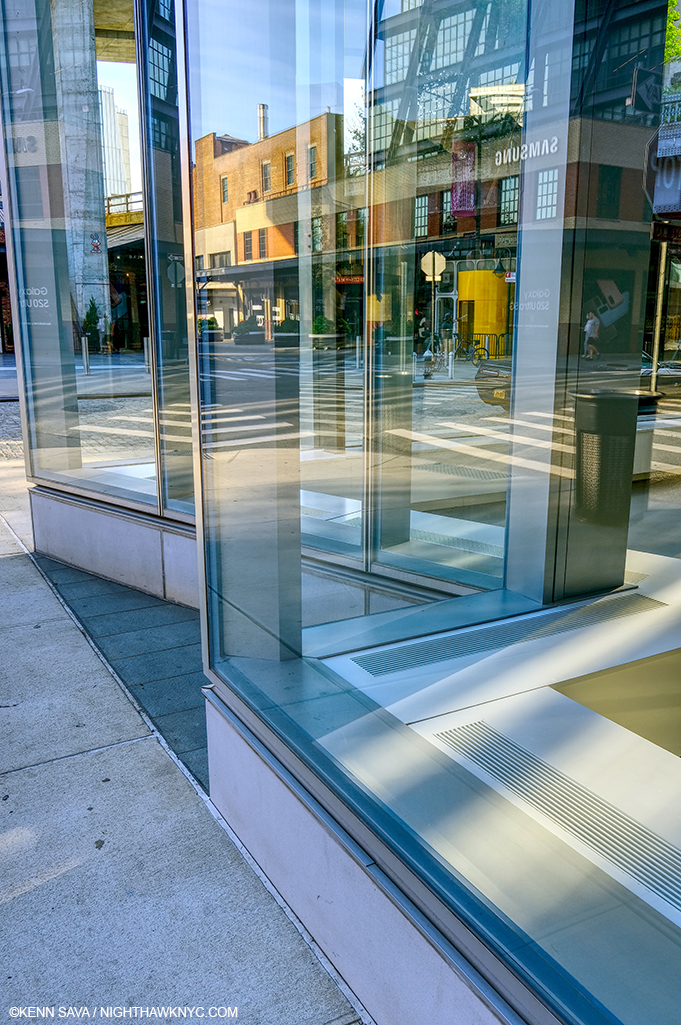
Kenn Sava, Homage to Richard Estes, NYC, May 27, 2020. Richard Estes was one of the first Artists to influence how I see the world. i.e. he helped open my eyes to the world around me everywhere!

4)- “Jean-Michel Basquiat at the Brant Foundation,” published October 6, 2019. Basquiat has been THE most popular Contemporary Artist for the entire existence of NighthawkNYC, yet, I didn’t know much about his work going in. When my friend, Kitty, told me about the Brant Foundation show, I decided to go, try and get up to speed on his work, and see what it said to me. As I sit here now, I’ve written more about Basquiat than any other Artist! And, I’ve seen more Basquiat shows since 2012 than I have by any other Artist. Both of those facts shock me. They just happened, primarily out of my desire to give his work as in-depth a look as I could. Along the way, I saw virtually every book ever published on his Art, and met and spoke with both of his sisters. The Brant piece is the first piece I wrote on his work. All the others may be seen doing an Archive search for Jean-Michel Basquiat.
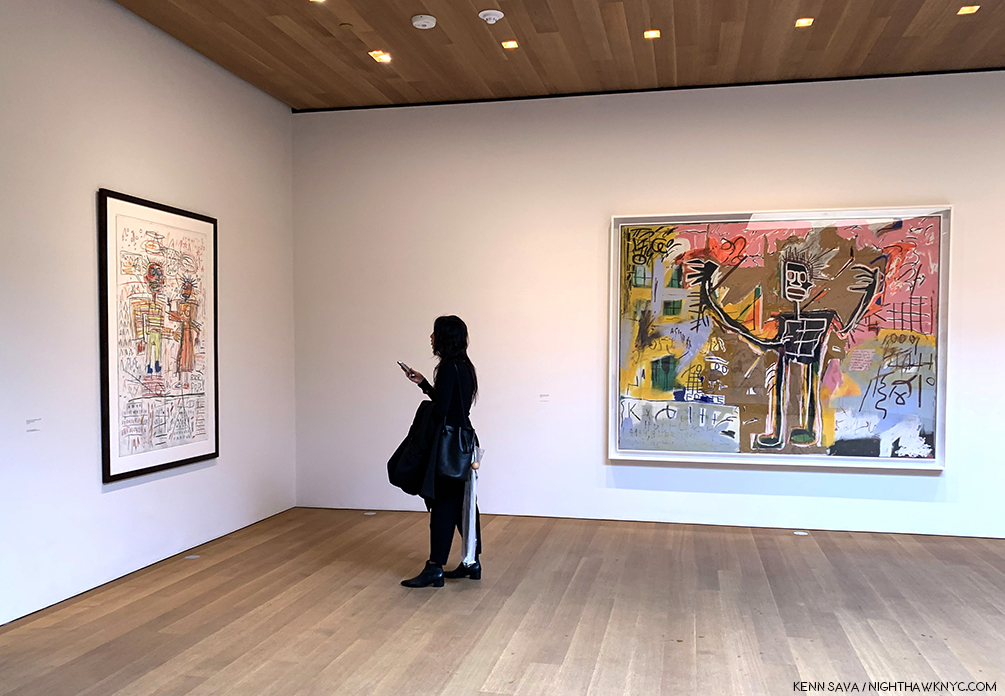
Lisa at the Brant Foundation Basquiat show studying Self-Portrait with Suzanne, 1982. There I was, standing outside in the rain for a solid hour, without my umbrella which had gotten left in the cab, without a ticket on the show’s last day, having failed to get a press pass. A staff member who had tried to help me circled back around and told me a visitor, Lisa, had an extra ticket, which she was kind enough to give to this total stranger. Thank you, Lisa. You set in motion what would become an epic journey of Artistic discovery. And oh, by the way, I subsequently paid $45 to get into Basquiat: King Pleasure, the show mounted by his sisters, even though I was going to write about it for free. Did The New York Times pay to get in, too?

5)- “700.000 Michelangelo Fans Can’t Be Wrong“, published March 4, 2018. A labor of love born out of a dozen visits to The Met’s once-in-a-lifetime blockbuster that 700,000 saw. More an effort of trying to remember as much as possible of what I saw because I knew I’d never see it again.
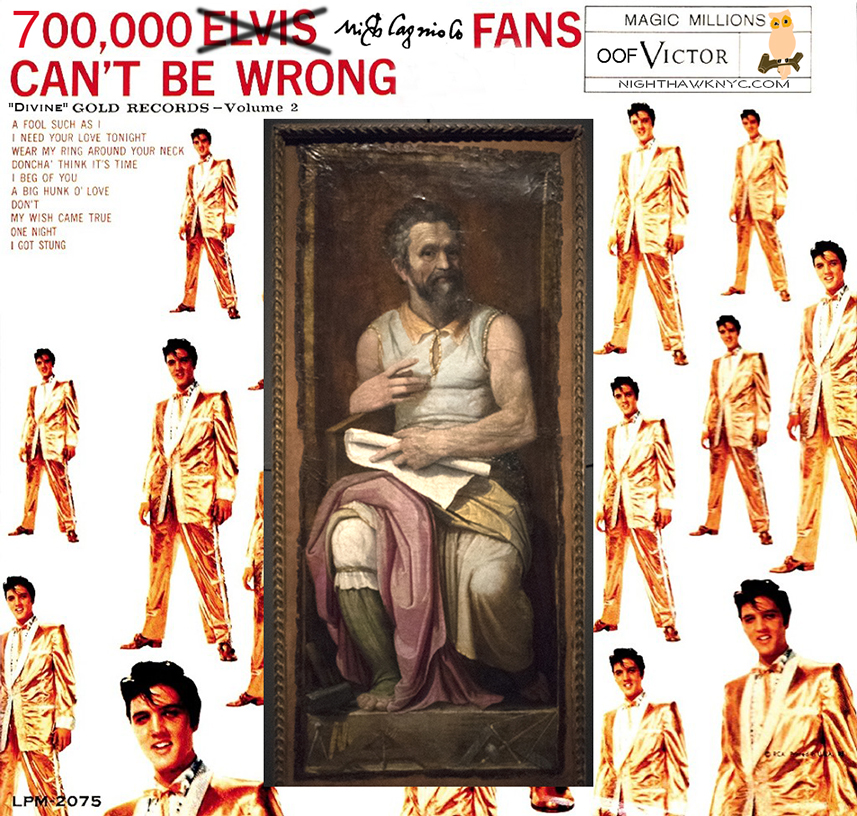
Take that, Elvis, who’s 1959 album title, and cover, I just borrowed. Michelangelo was the “King” of a different kind of rock. Old school rock.

6)- “A Year Without Art,” published May 7, 2021. Never in my wildest dreams did I ever think I’d go an entire year without being able to see Art! Well? In 2020-1, it happened.
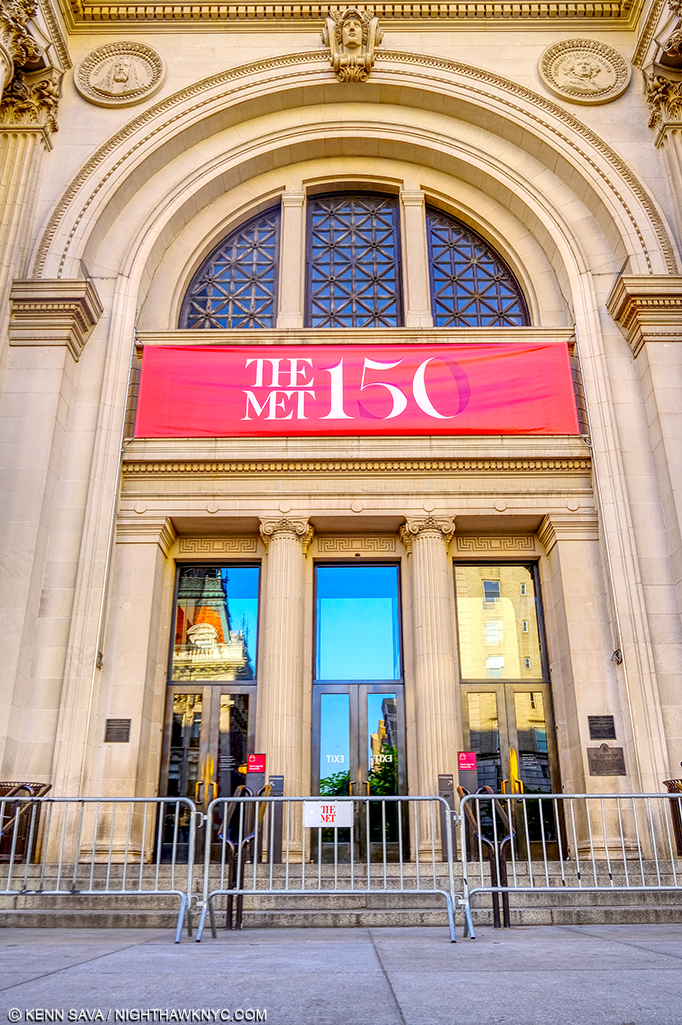
The Met’s famous main entrance, gated, during the 5 months it was closed, on May 21, 2020, unprecedented in my lifetime. Probably not the way they drew up celebrating their 150th Anniversary.

7)- The Photography Show, 2018, published April 23, 2018. I look back in disbelief at how much work I did around AIPAD, The Photography Show in 2018 and 2019. 4 part series on each…countless meetings with Photographers…endless looking all followed by months of work on the pieces. I didn’t make a dime doing it. I hope they appreciated it!
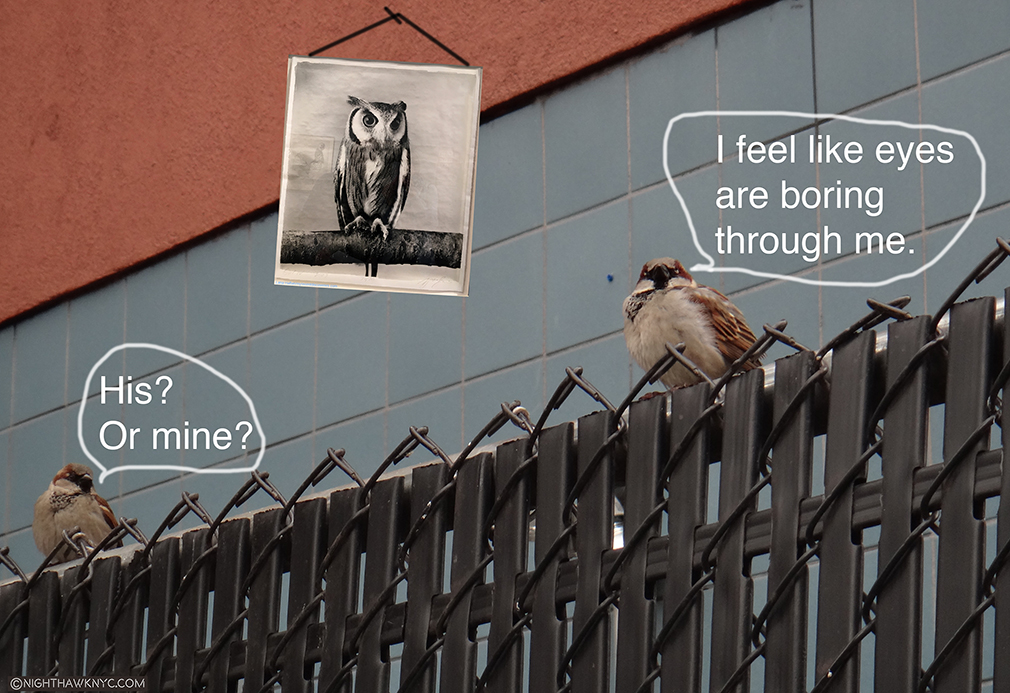
“On The Fence, # “The Wall Has Eyes” Edition. The Birdies, my fine feathered friends from their West 24th Street perch, that ran in my popular occasional featurette, “On The Fence,” for over a year. This one was included in my 2018 Photography Show series. I never replied to the reader who suggested I give up Art writing for “photo funnies”  as he called them- until now. I’m still thinking about it…All installments of “On The Fence” are here.

8)- “Ai Weiwei & The Value of One Refugee“, published January 7, 2017. The centerpiece of a group of 4 2016 Ai Weiwei shows, Ai Weiwei: Laundromat was a show unlike any other I saw this past decade, Ai & his team collected clothes, shoes and other artifacts left behind by refugees in the various camps he visited during the European Refugee Crisis and arranged them to compelling effect achieved in concert with countless Photos on the walls he took documenting what he saw and reproductions from media and social media accounts under foot. I wrote about all 4 of the shows, but Laundromat has lingered long in my memory. It was hard to visit the show and not think of Ai’s own experiences, which made him an almost ideal witness.
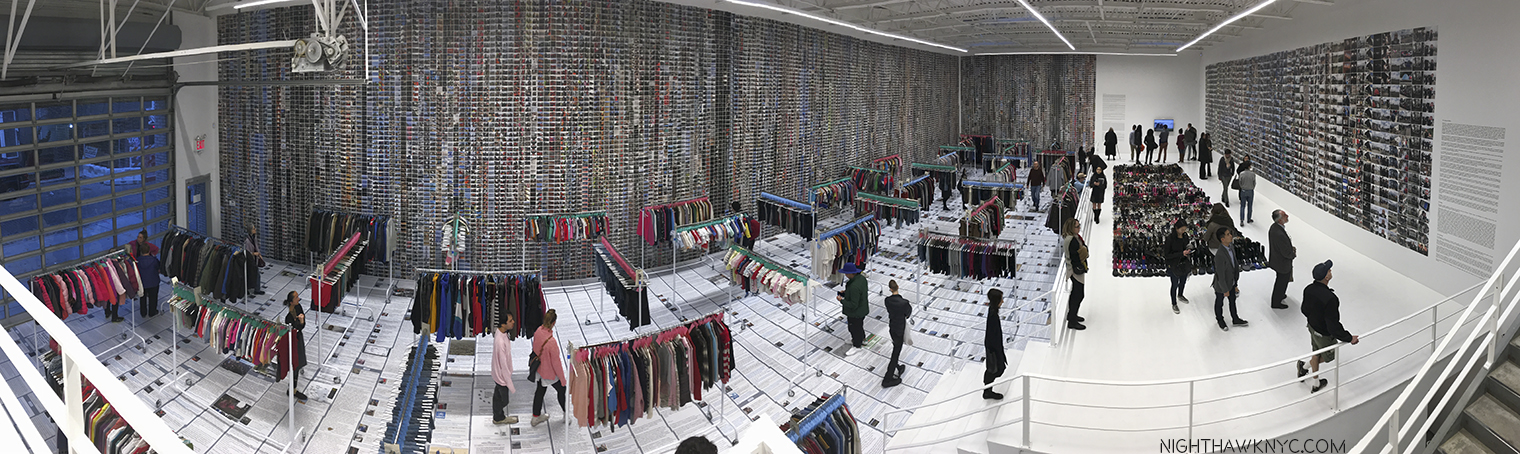
Birdseye view of almost the whole show.

9)- “Edward Hopper’s Impressions of New York,” the first of 3 pieces on the show published May 5, 2023. Wait. Who else has written multiple pieces that look at different aspects of one show? Maybe someone else has. I haven’t seen it. That’s exactly what I did for the blockbuster Edward Hopper’s New York at the Whitney, AND for MoMA’s Ed Ruscha/Now Then.
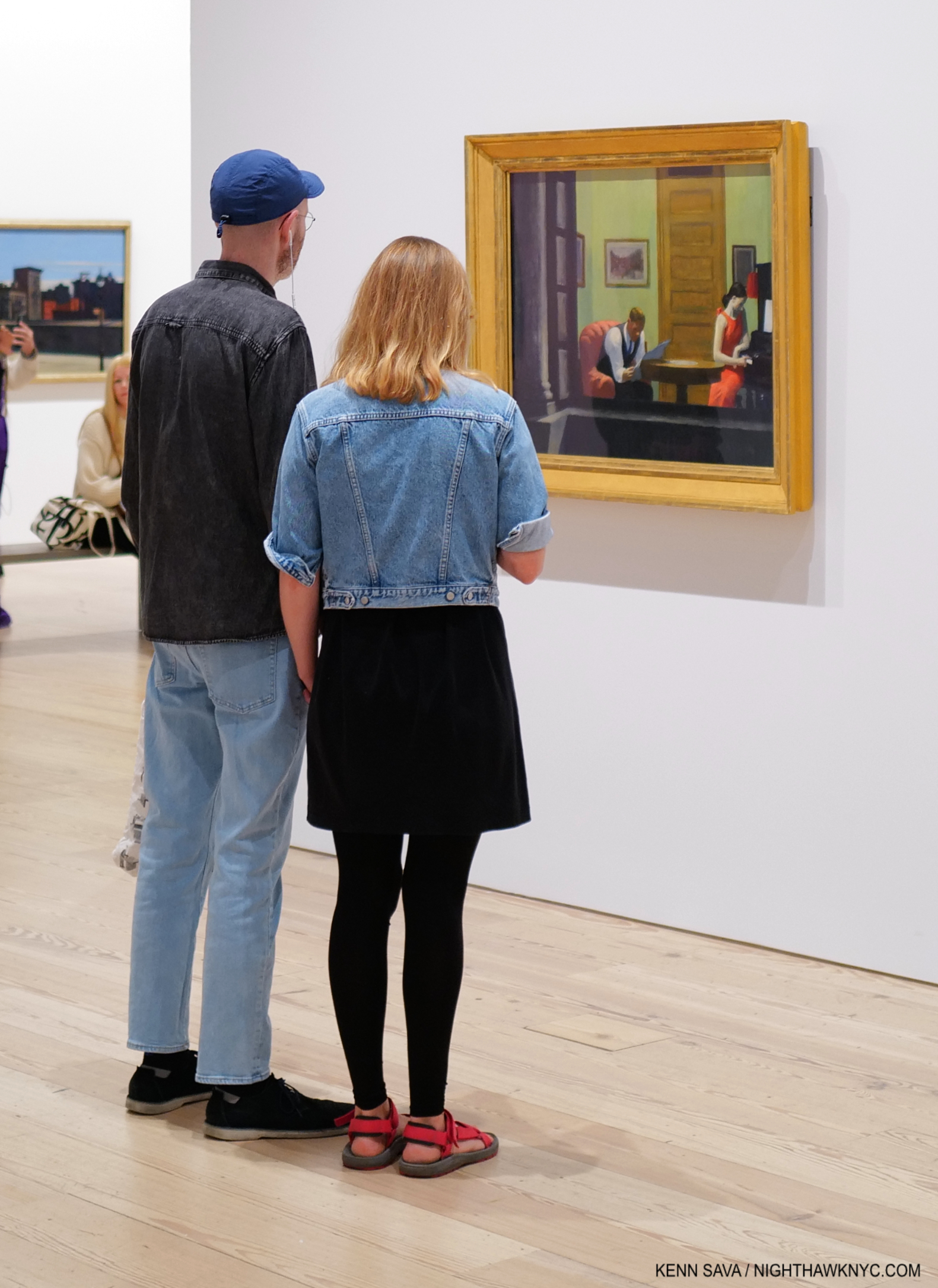
Edward Hopper’s New York, October 27, 2022.

10)- “NoteWorthy Art Books of the 21st Century,” published June 10, 2025. This, and NW PhotoBooks, the two biggest pieces I’ve ever written, represent my sharing what I’ve seen and learned over the past 50 years I’ve spent looking at Art books, and almost a decade of intensively looking at PhotoBooks. Having begun them last September, right before I announced I was taking a break, they kept gnawing at me in a “You HAVE to finish these!” way. The Epics of Epics on this site, an immense amount of looking and consideration went into both pieces. Usually, I worked on up to 4 pieces at a time. I can’t imagine working on anything else in the 10 months it took to write these.
That makes me wonder- Has anyone else (any other single person) written a list of recommended 21st Century Art Books AND a list of 21st Century PhotoBooks?
The Introduction to both pieces is here.
The “Golden Oof,” named for my Avatar.

11)- “NoteWorthy PhotoBooks of the 21st Century,” published June 25, 2025. Marks the end of my “deep dive” into Modern & Contemporary Photography that I began in December, 2016- There I just said it.
[A moment of silence.]
What did I learn from all of that? I stand by what I said here in 2019.
This “Painting guy” is going back to focusing on Painting. You heard it first.
NoteWorthy Sunset Photo by Lana Hattan.

Part 2- Where I’m Going

“Oh, won’t you stay
We’ll put on the day
And we’ll talk in present tenses”-*

1)- NighthawkNYC/Kenn Sava’s Art writing
I’m sorry to say that nothing has changed since I announced I was taking a break in September, 2024. There remains no means of support for independent Art writing. Surviving remains my #1 to #10 priority. I continue to work on the site remaining up. If something changes? I’ll let you know. 
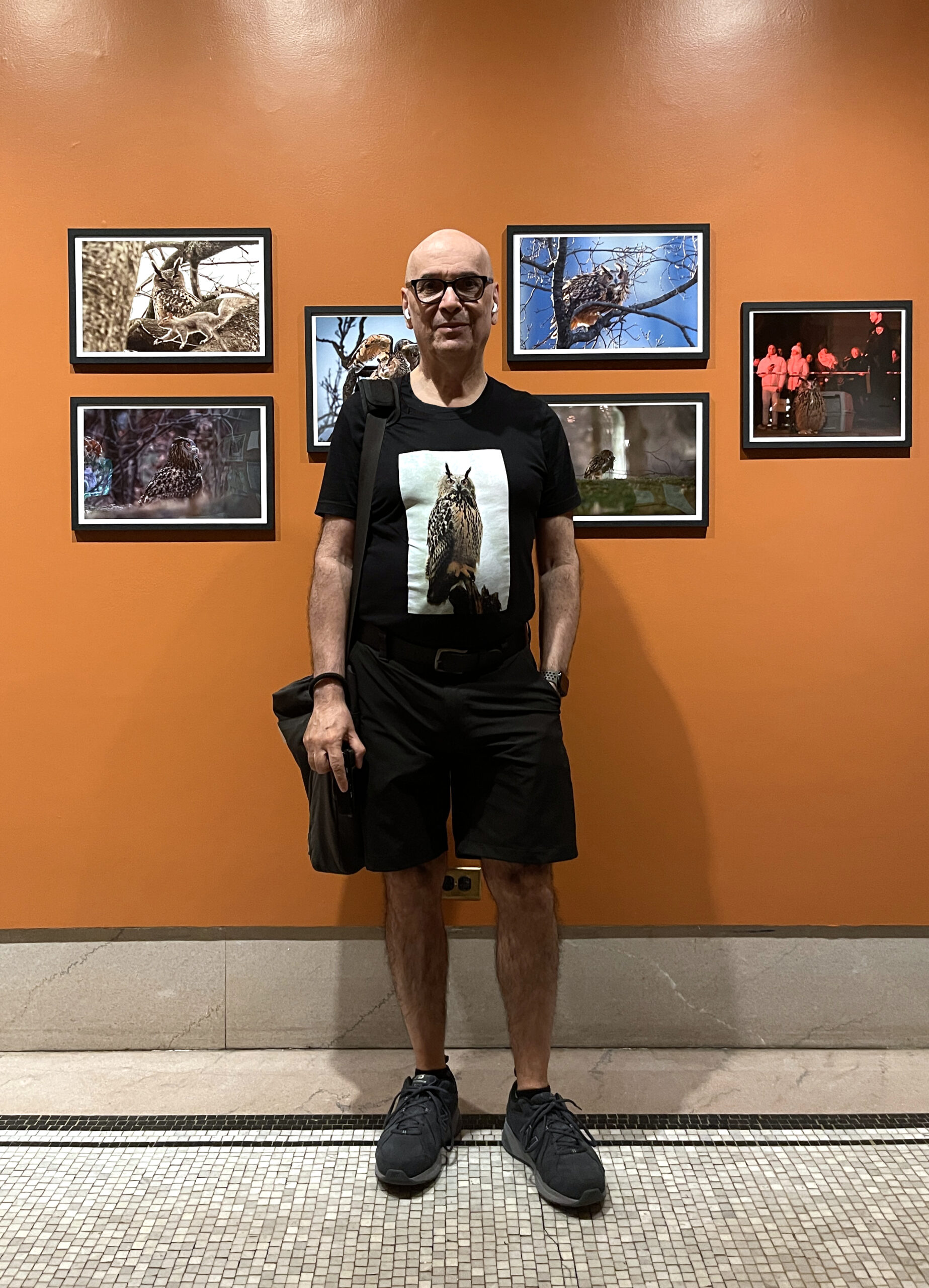
Flaco Lives! Kenn Sava at The Year of Flaco exhibition (in a Flaco T I had made last year), in front of a section of Photos of him early on in his freedom. The picture far right was taken right after he escaped from the Central Park Zoo. After never having been outside in his entire life, he suddenly found himself on Fifth Avenue & 60th Street! Maybe that’s why I’ve never seen a picture of him with his eyes so wide open. New York Historical, July 3, 2025. My piece on Flaco, written about a month and a half before his tragic demise, is here. My Thanks to Marybeth Ihle of the New York Historical.

2)- Kenn Sava, Producer
I’m hoping to re-release The Fuschia by Thomas Chapin, Peggy Stern, Drew Gress and Bobby Previte this year, and also finally release my solo album Strawberry Fields Forever.
Though I produced both projects, releasing and re-releasing them is not about me. Both were recorded in the mid-1990s, and, sadly, since then a number of the great Musicians who participated in them have passed away. I feel a sacred duty to them to get their work out there/back out there. Stay tuned. 

Coda- Before I “Go” Anywhere…
I started this site for one reason- To share what I’ve been lucky enough to see & experience in NYC and in Art & books with my fellow Art lovers around the world. I had a lot of passion, but no business plan.

While doing NighthawkNYC has been quite the financial hardship, I’m proud of the fact that readership has gone up each and every single year. Thank You to everyone who’s read one, or all, of my 350+ pieces here this past decade.

I especially want to Thank those of you who have made donations or bought pieces of my collections to help keep me going! For the rest of you, if you find, or have found, what I’ve done here since 2015 worthwhile, YOUR support is needed to keep this site up, and possibly, enable me to write more.

When the curtain closes
And the rainbow runs away
I will bring you incense
OWLS BY NIGHT (Caps mine ; ) )
By candlelight
By jewel-light
If only you will stay
Pretty baby, won’t you
Wake up, it’s a Chelsea morning”-*
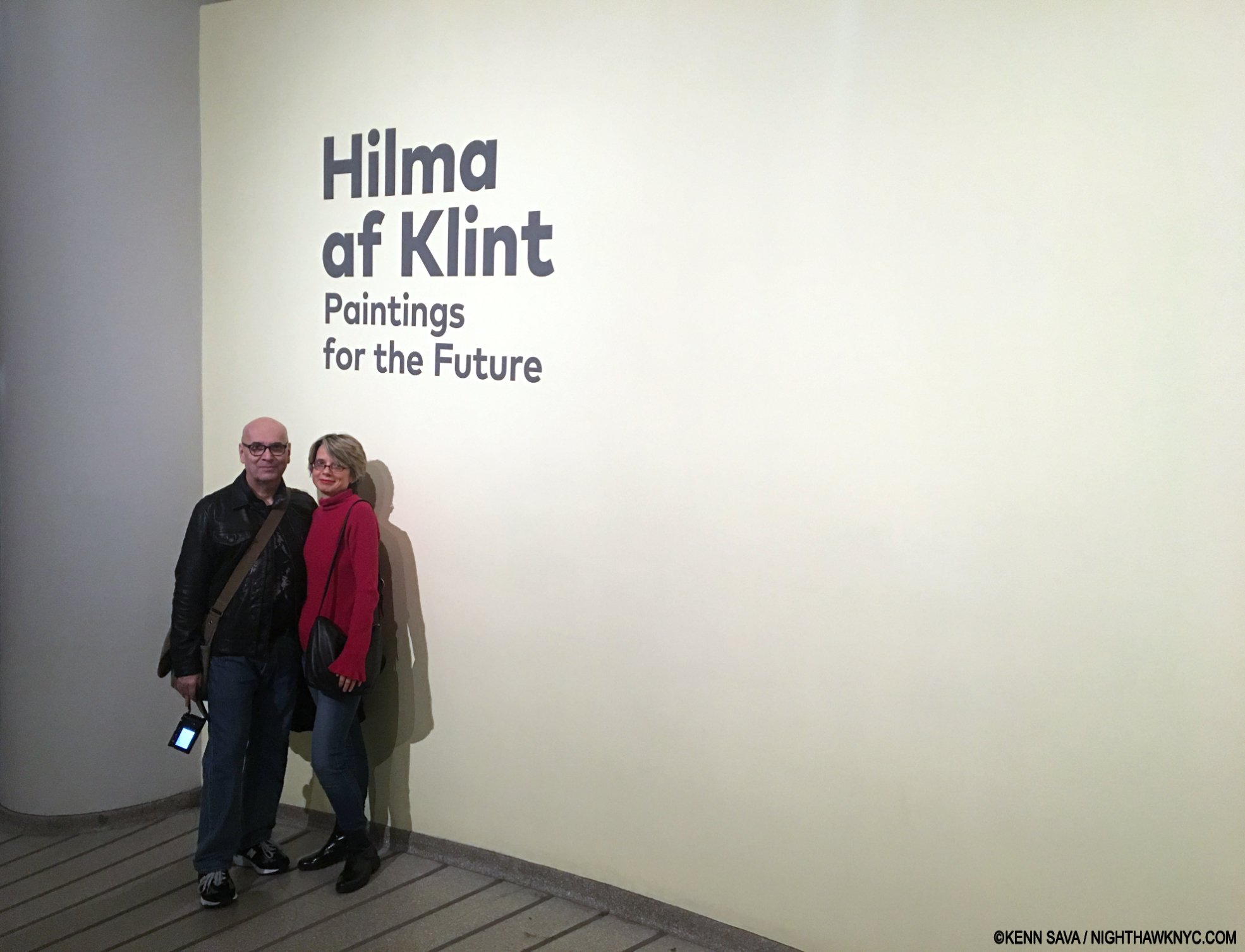
With Lana Hattan at Hilma af Klint: Paintings for the Future, the most recent show we’ve been able to see together at both of our favorite NYC building- The Guggenheim Museum. New Year’s Eve, December 31, 2018. My Undying Thanks to the woman who approached us and insisted she take our picture.

Finally, Thank You to Lana Hattan for pushing me to start writing about Art, and for your continual support through some thick and a lot of thin, every step of the way.
As I’ve said before, if you’ve found ANYTHING I’ve done here worthwhile, she’s the one who deserves your thanks.

As for me? I MADE IT TO 10 YEARS!
Kenn Sava.
July 15, 2025

P.S.- Feel free to drop me a line and let me know if I left out a piece you found particularly NoteWorthy.

For more- Check out my look back at “A Decade of NighthawkNYC.com Banners,” which have uncannily come full circle, here!

*- Soundtrack for this piece is “Chelsea Morning,” by Joni Mitchell, referencing her apartment 5 blocks from where I am writing this, and where I’ve written all of the 350+ pieces on NighthawkNYC. Joni moved here in 1967, before my time here, and proceeded to write a number of her early songs here. Just another of the Legends who’ve lived in my neighborhood, like Patti Smith. She performs it here in 1969-
 

Harry Gruyaert- In Living Color

Written & Photographed by Kenn Sava (except *)

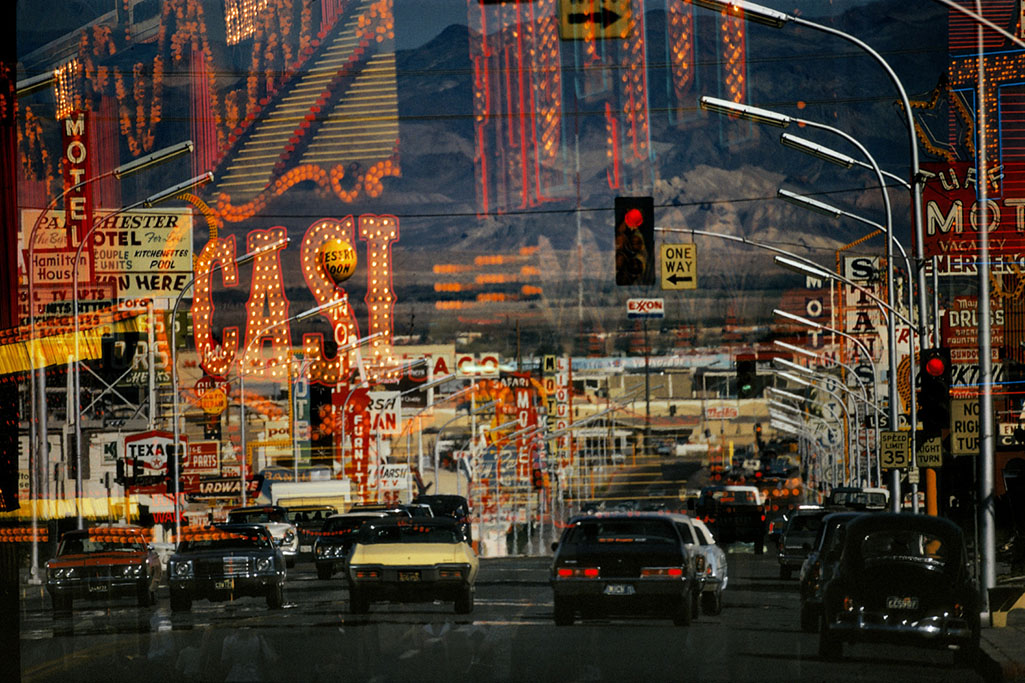
Freemont Street, Las Vegas. Nevada, USA., 1982. From West in the two-volume set East/West. *Photo by Harry Gruyaert, Magnum Photos.

Harry Gruyaert is one of any number of very fine European Photographers who are much better known at home than they are here. A good many of them have had long, accomplished, careers, and achieved substantial recognition on the other side of the pond. Here, in the USA, not so much. Last year, when I published my conversation with Harry Gruyaert, I was shocked to receive emails that said, “Thanks for introducing me to him.”

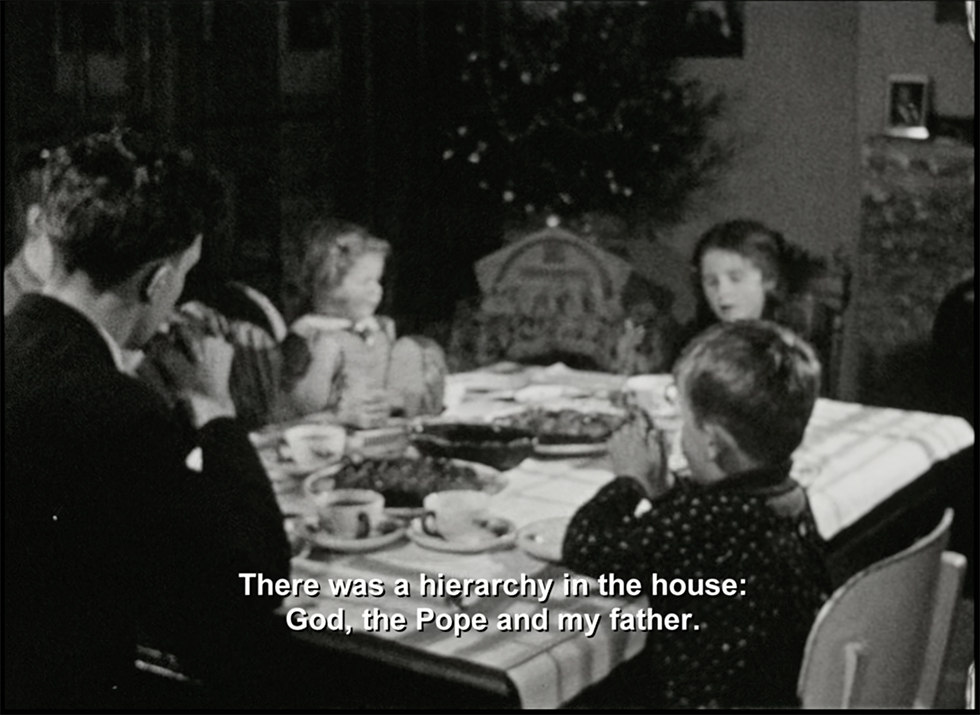
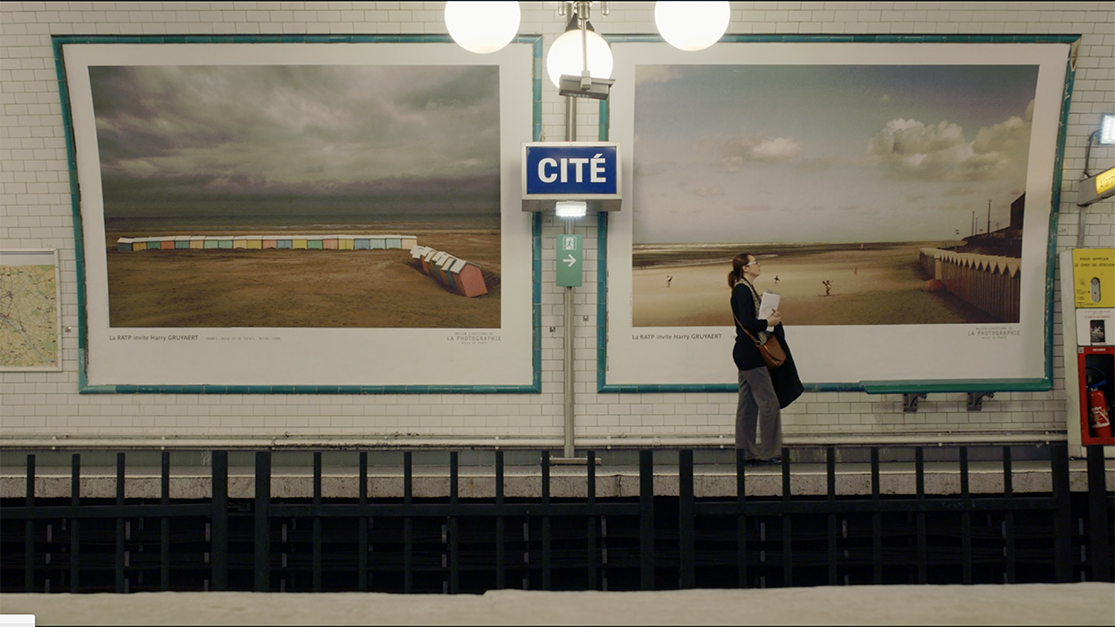
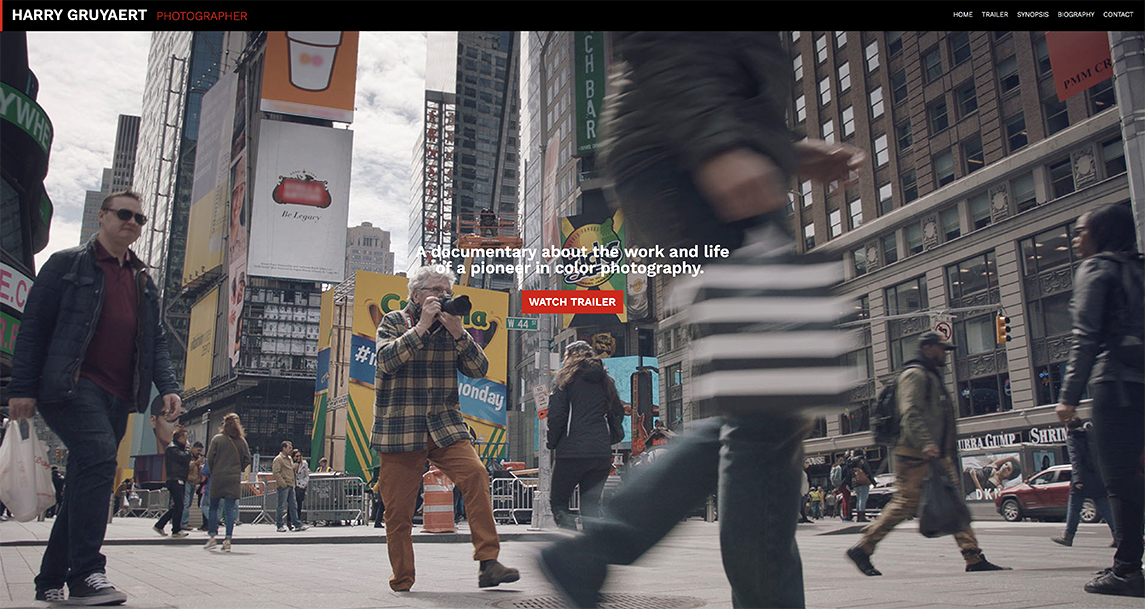
In 2017, 174 Harry Gruyaert Photographs were on view in eleven stations of the Paris Metro at the invitation of RATP, the Paris public transport operator. *Seen here in a still from the Harry Gruyaert: Photographer Documentary. Both of these Photographs may be seen in his recent book, Edges.

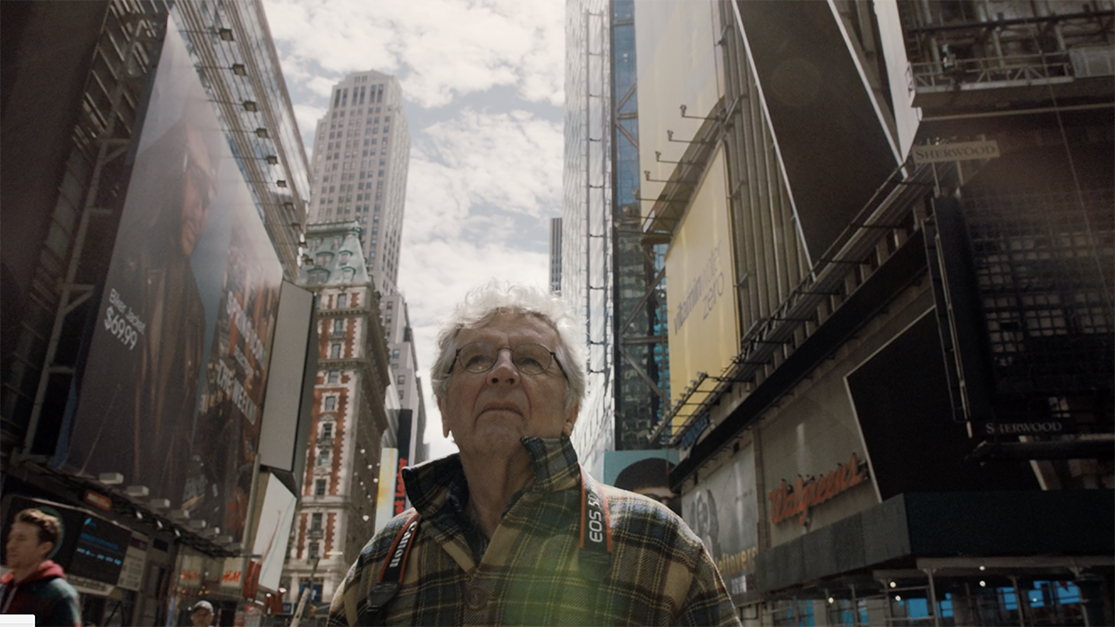
Really? Harry Gruyaert, who was born in Antwerp, Belgium in 1941, is one of the Photographers responsible for bringing color Photography to the mainstream Fine Art world, along with William Eggleston, Stephen Shore, Constantine Manos and others, after the early, pioneering though not as well known color work of Edward Steichen (going back to 1909!), Keld Helmer-Petersen, (in the 1940s), Saul Leiter and Fred Herzog (from the 1950s, on), and others. Harry was the subject of the recent Harry Gruyaert – Retrospective at FOMU Foto Museum in Antwerp, and the documentary film Harry Gruyaert: Photographer. He’s an Artist who’s work has appeared in eleven Paris Metro Stations and intriguing crops of his work have appeared on the cover of 68 Penguin Books Inspector Maigret detective novels by Georges Simenon. All of this is over and above the fact that he’s been a member of Magnum Photos since 1981 and is a former Vice President of the world’s foremost collective of Photographers.

What’s it going to take for some of these very accomplished Photographers to gain similar acclaim and following here?

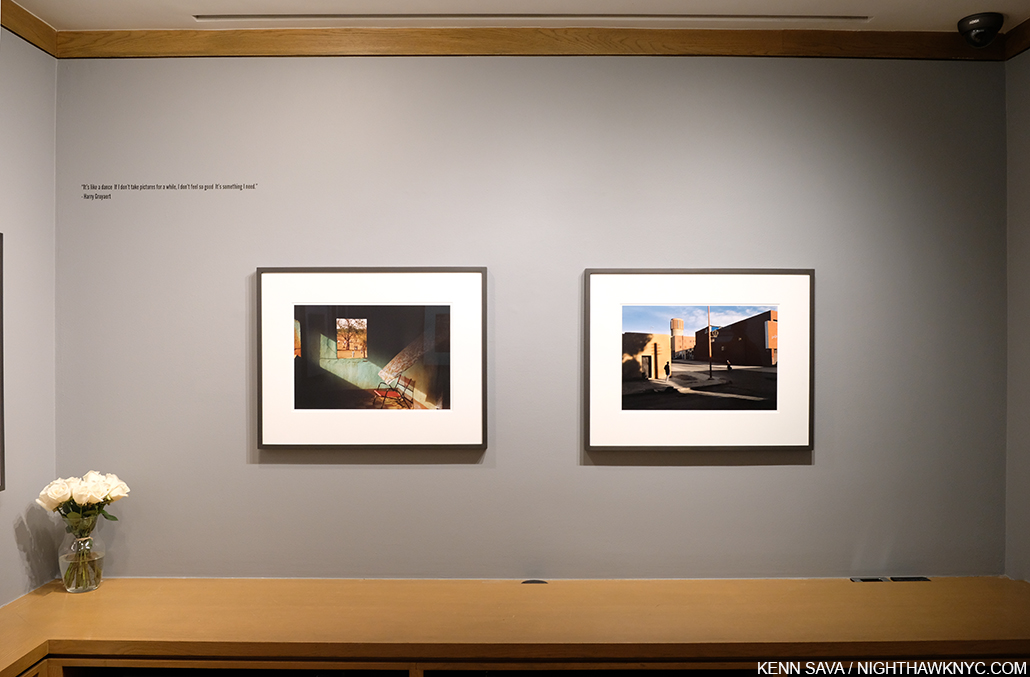
The show’s entrance with Antwerp, Belgium, 1988, 13 1/8 x 19 3/4 inches. All prints in the show are Archival pigment prints; printed later.

Perhaps, in his case at least, the tide is beginning to change. Part of the reason Mr. Gruyaert hasn’t been better known here to this point may be that almost all of the PhotoBooks he released earlier in his career are long out of print making it very hard for anyone new to him to discover his work. Though I have had an interest in Mr. Gruyaert’s work, I’ve never seen any of his older books, like the legendary Morocco– even in rare book stores.

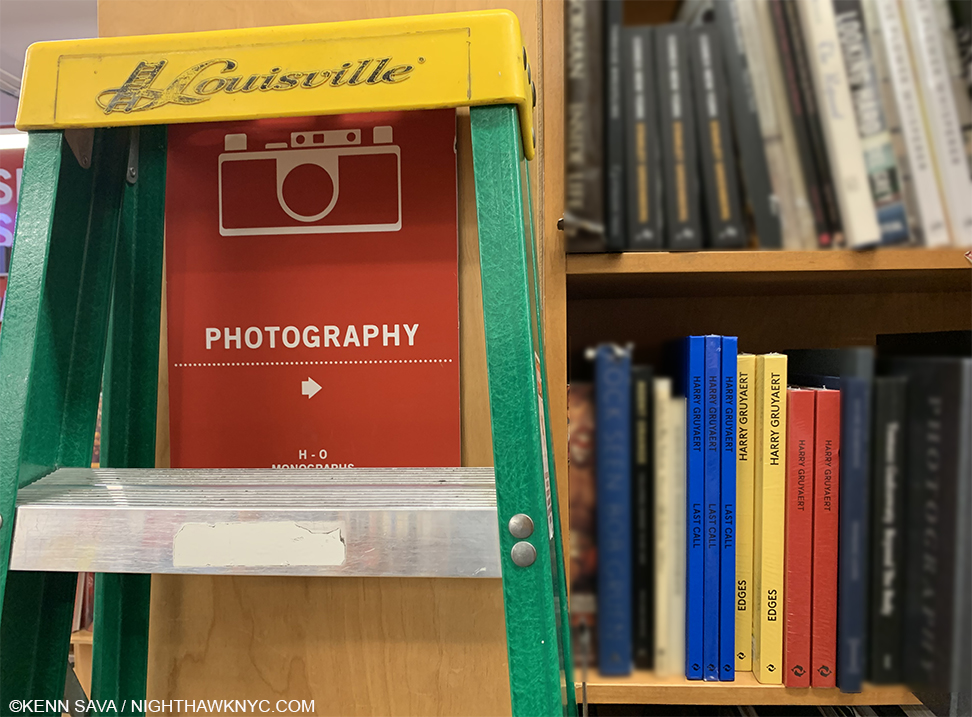
Blue, yellow and red- the colors of the covers of three of the most recent Harry Gruyaert monographs.

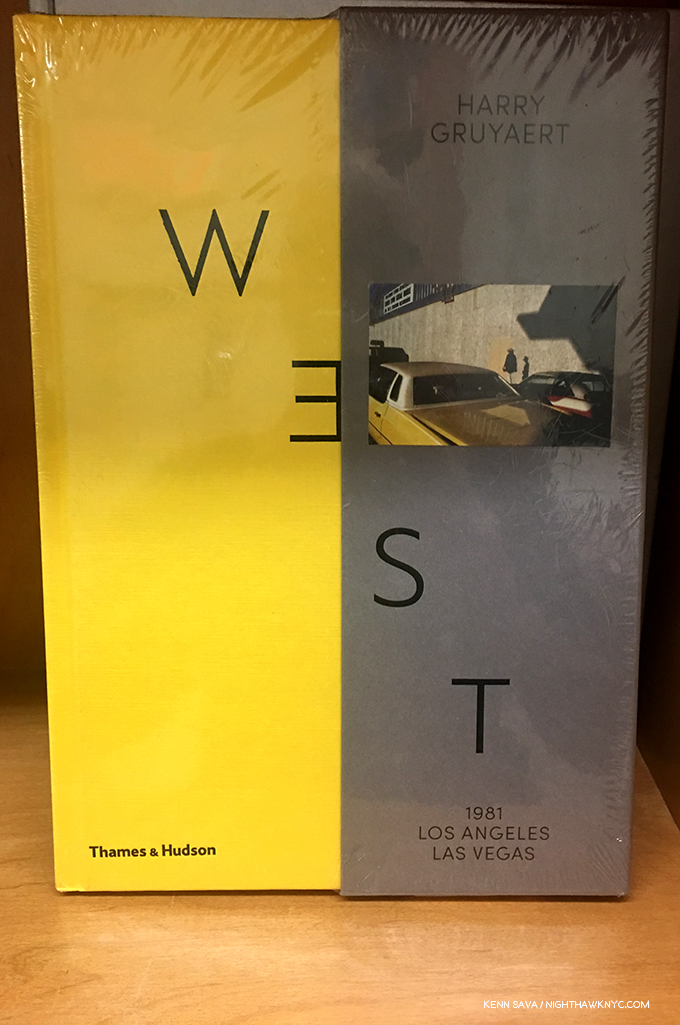
More recently, Thames & Hudson has released 4 new books over the past 5 years (Harry Gruyaert, 2015, a retrospective with the red cover, and best place to start exploring his work, the also excellent two-volume set East/West, 2107, Edges, 2019, and the just released Last Call, 2020), which are helping to bring his work back to the eyes of the PhotoBook world.

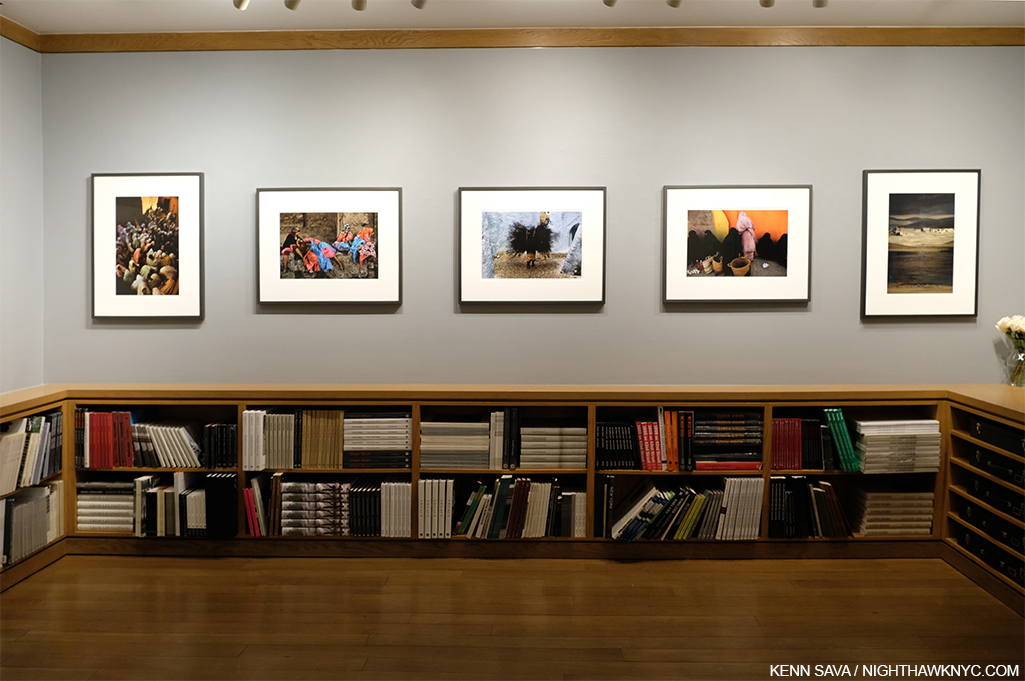
Harry Gruyaert at the Howard Greenberg Gallery, installation view. On the wall or in a book, Harry Gruyaert’s work tends to grab viewers at first sight.

With Harry Gruyaert at the Howard Greenberg Gallery, his first show in the USA in decades, the next step has been taken. After our conversation  last year from Paris, I finally had the chance to meet Harry at the opening. There he was, with Roger Szmulewicz, Director of Gallery51, his European dealer, on January 23rd. Harry told me this was his first USA show since the release of Morocco, which was published in 1990! Then, in keeping with the spirit of Last Call, which he shot in airports, Mr. Gruyaert, still a frequent traveler, told me he was off to Japan in two days.

Harry Gruyaert, left, chatting with Roger Szmulewicz, Director of Gallery51 at the opening.

As I learned in our conversation last year, Mr. Gruyaert is a fascinating, multi-dimensional, man, who has had a remarkable career and life, which has been characterized by being in the right place at the right time, in the right light, as was to be seen in spades on the walls of Howard Greenberg.

Gao, Mali, 1988, 13 1/8 x 19 5/8 inches, left and the haunting Quarzata, Morocco, 1986, 13 1/8 x 19 3/4 inches, right.

Here and now, in the moment, a good many of Harry Gruyaert’s most familiar, and beautiful, pieces were on view.

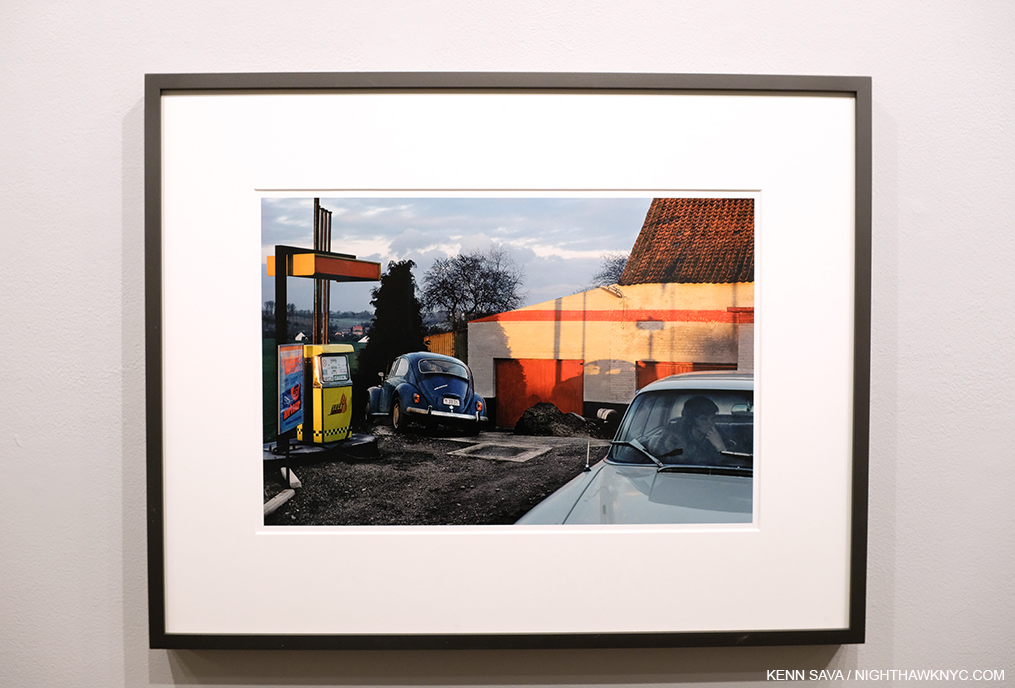
Province of Brabant, near Wavre, Belgium, 1981, 13 1/8 x 19 5/8 inches

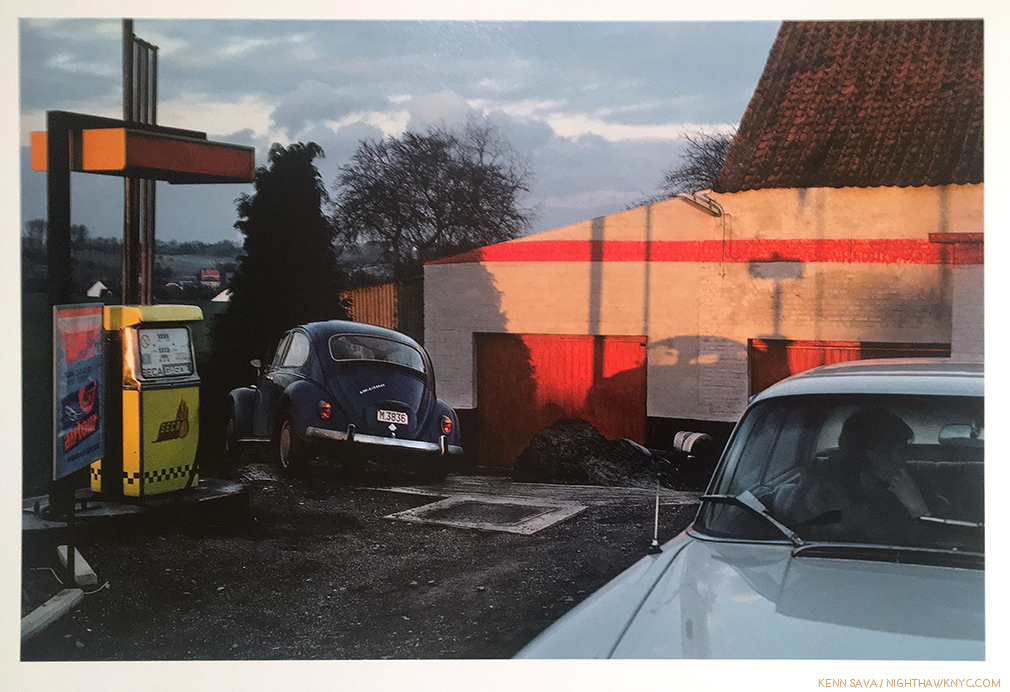
For me, the show felt like reuniting with old friends. Province of Brabant, near Wavre, Belgium, 1981, in particular has long been among my favorites. There’s so many levels to this composition- the colors and their interaction, the distant landscape, the play of geometric shapes and shadows, the jarring angle the VW Beetle sits at, and then you get to the woman sitting in the car. It’s like a still from a movie, an outtake from a Michelangelo Antonioni Film he never made. Mr. Gruyaert, a long-time fan of Michelangelo Antonioni, and a former TV Director early in his career, produced a film that showed clips from Antonioni Films interspersed with some of his Photographs in the show The Image to Come at Cinémathèque Française in 2009.

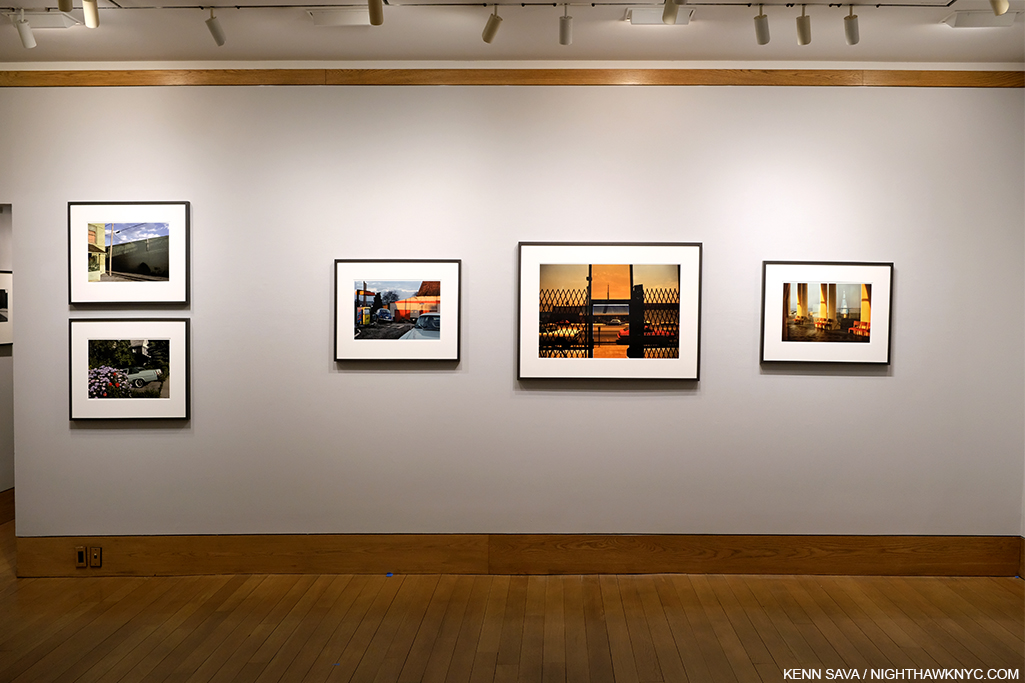
Installation view. To the right of center works from his East/West series hang next to each other. LA, USA, 1982, the larger piece and Ostend, Belgium, 1982, to its left.

A little known chapter in his distinguished career also saw him in the right place to document the work of the legendary Artist Gordon Matta-Clark during some of the semial years of that Artist’s career. Most of those shots, which are seen frequently when Mr. Matta-Clark’s work is discussed, don’t bear his name, since they now belong to Mr. Matta-Clark’s estate, but the fact that Harry was there at the right time, taking remarkable (black & white) Photos are yet another part of his legend.

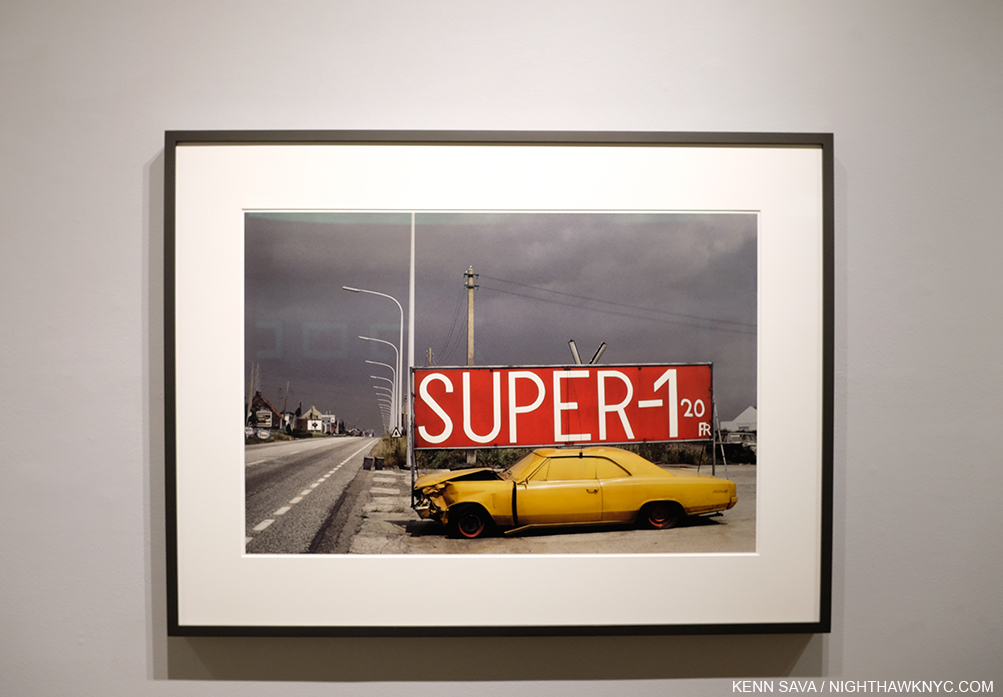
National Road #1, Boom, Province of Antwerp, Belgium, 1988, 20 7/8 x 31 1/2 inches

With such a long and distinguished career to dip into to mount shows from, here’s hoping there will be cause for many more Harry Gruyaert sightings on this side of Planet Earth.


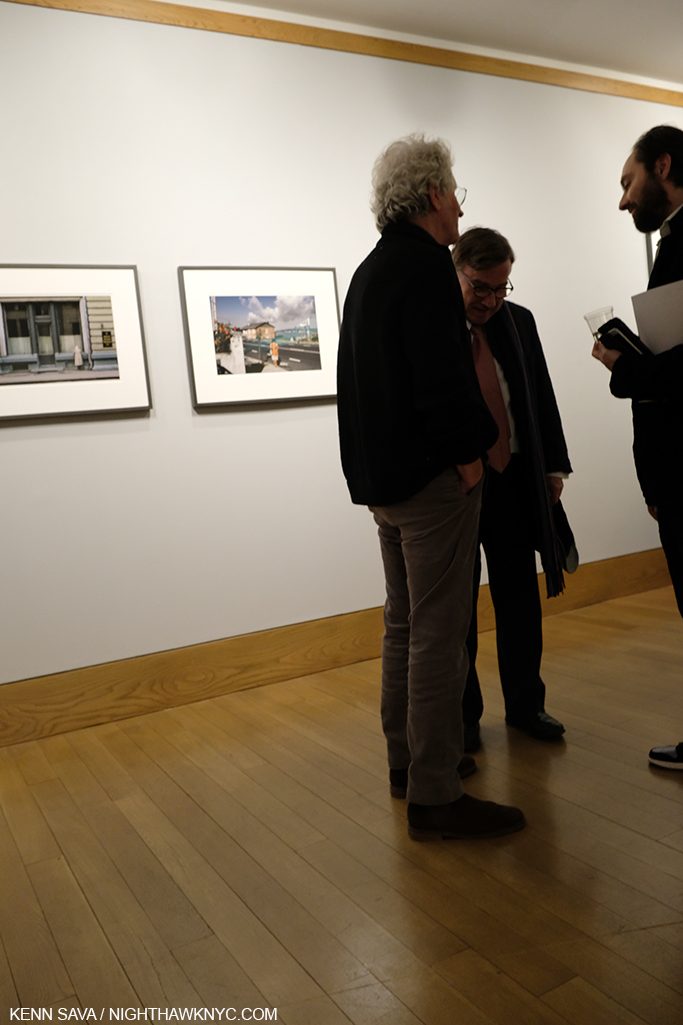
Harry Gruyaert, far right, at the opening.

In person, in living color.

*- Soundtrack for this Post is “East West” by Morrissey from Kill Uncle.

NighthawkNYC.com has been entirely self-funded and ad-free for over 6 years, during which over 250 full length pieces have been published. If you’ve found it worthwhile, you can donate to keep it going & ad-free below. Thank you!

Written & photographed by Kenn Sava for nighthawknyc.com unless otherwise credited.
To send comments, thoughts, feedback or propositions click here.
Click the white box on the upper right for the archives or to search them.
For “short takes” and additional pictures, follow @nighthawk_nyc on Instagram.

Subscribe to be notified of new Posts below. Your information will be used for no other purpose.


NoteWorthy PhotoBooks, 2018

Written & Photographed by Kenn Sava (*except as credited)

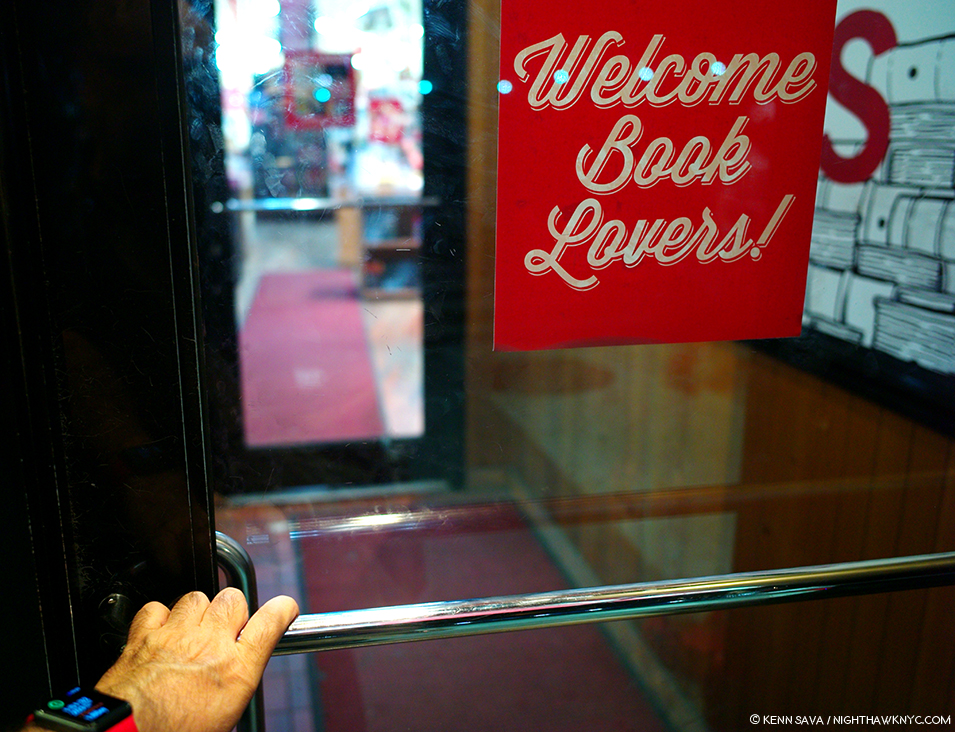
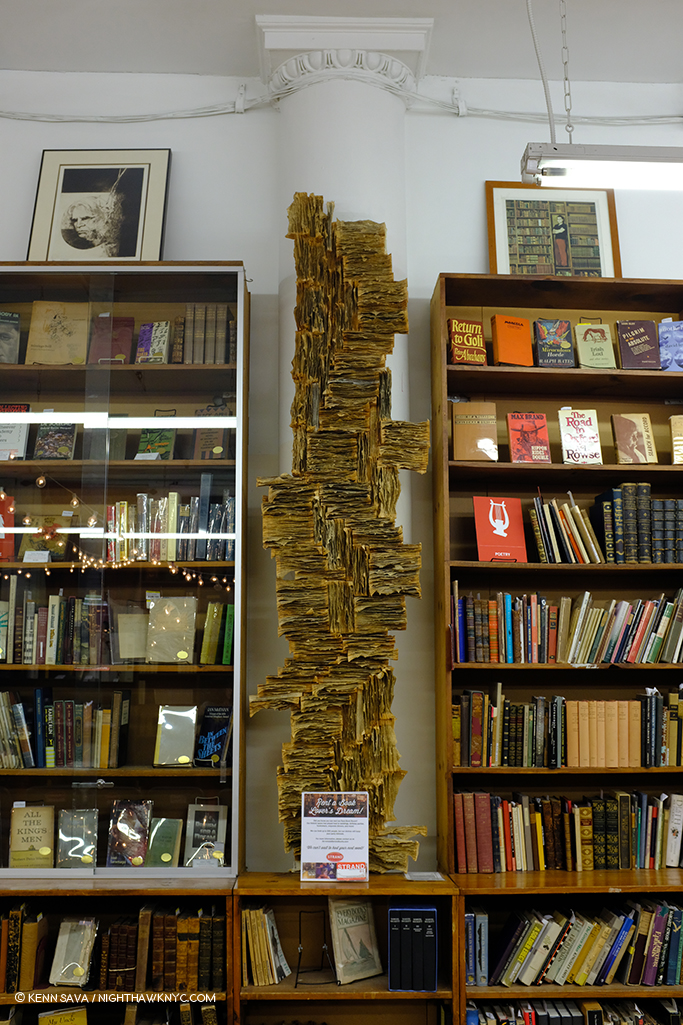
Let’s go book shopping! As I list PhotoBooks I consider NoteWorthy, let’s remember the Bookstores that are still left where you can actually see these books. The Strand Bookstore, NYC, is one of those I frequent. I hope there is at least one near you. Click any Photo for full size.

Another day. Another chance to look at PhotoBooks, to see life, and the world, through someone else’s eyes, to learn something and just maybe have a revelation. I look at A LOT of PhotoBooks (and Art Books). Nary a day passes that I don’t see one/some somewhere. In bookstores, used bookstores, museum stores, galleries, book fairs, pop-up shops, garage sales, online- you name it. Both, just released PhotoBooks and those I’ve only known through legend. I’m getting close to eating, sleeping and breathing Photo & ArtBooks. Why? I use them to research my pieces, to learn about Artists known & unknown to me, and to explore that fascinating phenomenon that is the PhotoBook- which, in its ultimate form, is a work of Art unto itself. A third of those I see I never look at, or think about, a second time. About 40% I do either look at again or think about again. And, far too many of them I purchase. (For the record- Yes, I’ve put my money where my mouth is. I bought every book on this list.)

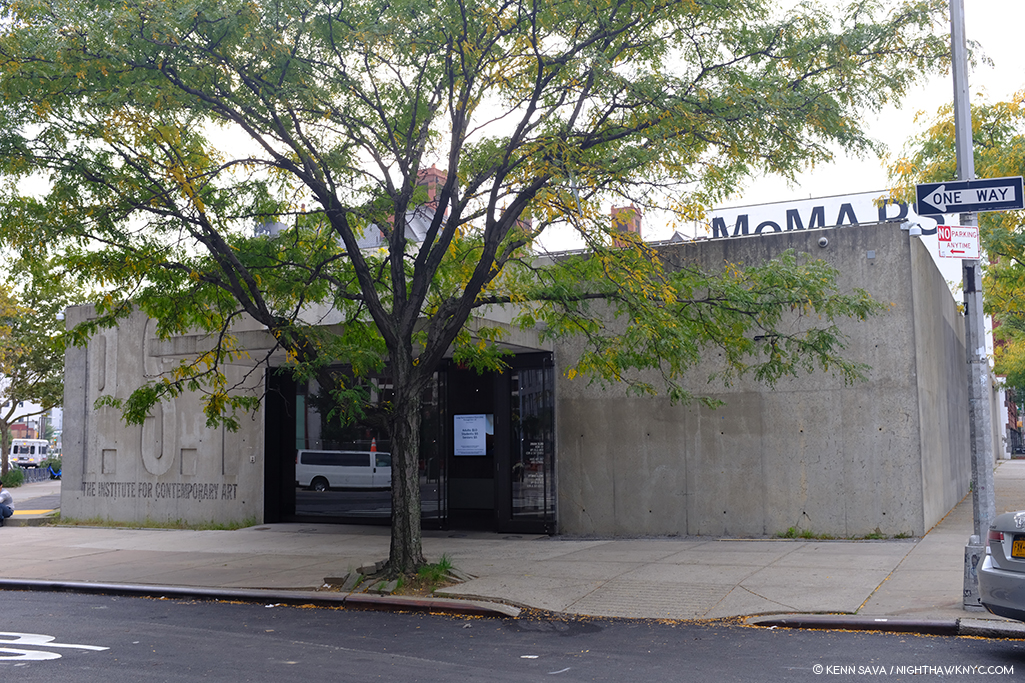
MoMA PS1, Long Island City, scene of the recent New York Art Book Fair. In case you don’t know, there’s a quite good full time Art & PhotoBook store tucked inside, in addition to the excellent magazine shop off the lobby, right behind that grey wall to the right.

So, after all of this looking, I’ve decided to share a few of those here that have turned out to be especially memorable, or “NoteWorthy,” as I’m fond of saying (There’s no such thing as “best” in the Arts, in my view. I don’t believe in comparing Artists or creative work). Compiling this has been very hard.

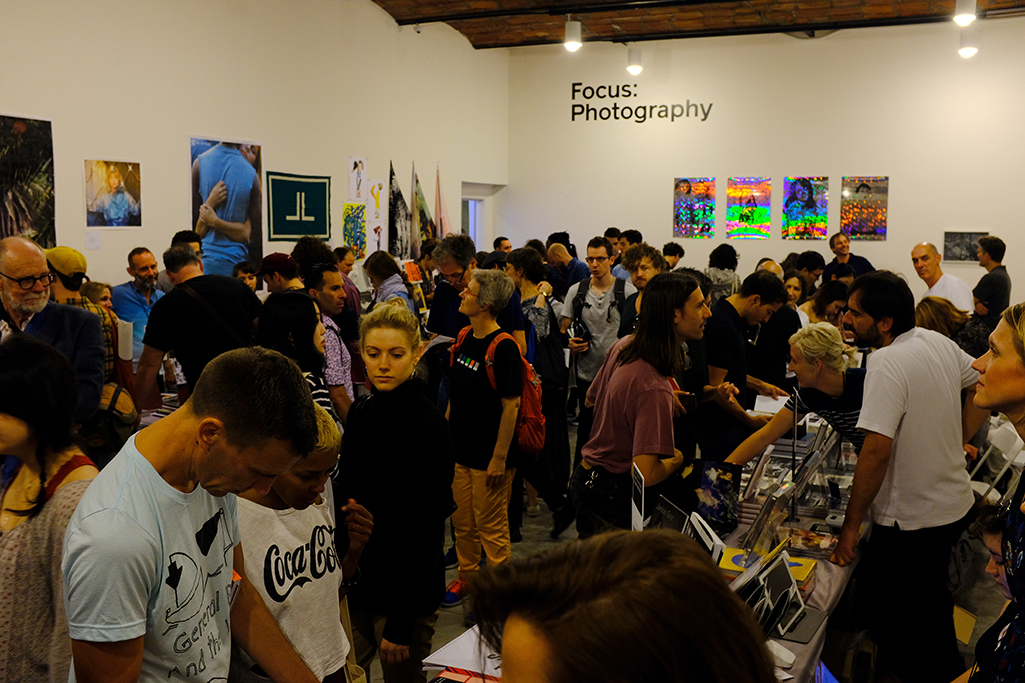
Depth of Field. The scene in just one of the many rooms at the New York Art Book Fair (NYABF) @ MoMA PS1, Long Island City, September 21, 2018. I handed my camera to Kris Graves who took this Photo with it from behind his table.

First, we live at a moment when there are more PhotoBooks being produced than ever before. It seems there are an incalculable number of publishers and Artists creating books at a speed I doubt anyone can keep up with. So, as many PhotoBooks as I look at represents only a small percent of those released. Hey, I really tried!

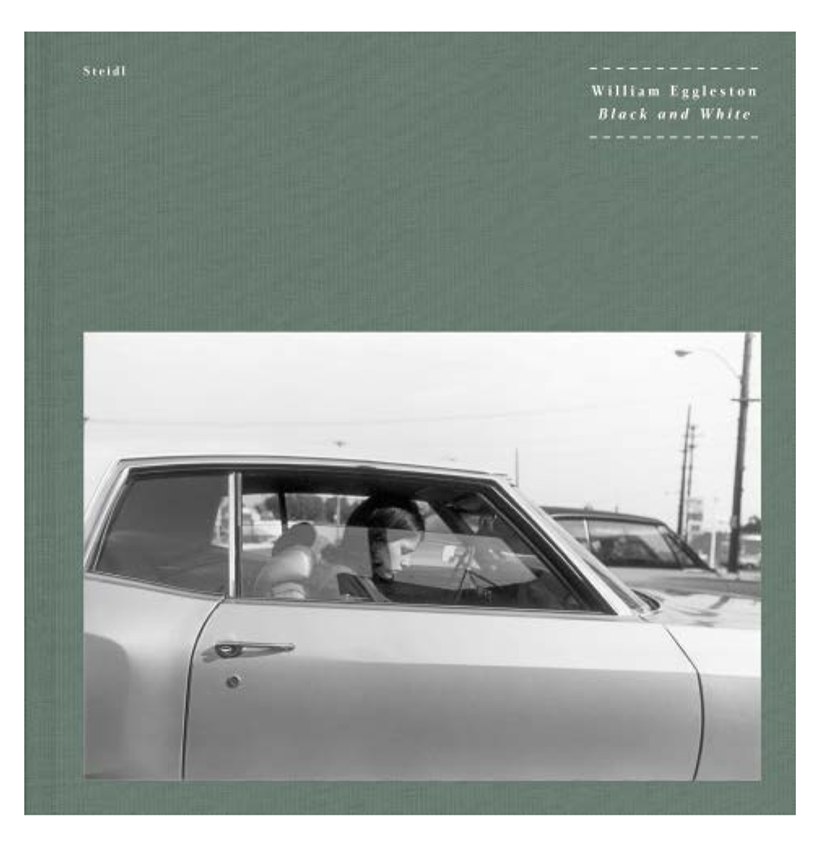
William Eggleston: Black & White. The cover image shown on pages 82-3 of Steidl’s Fall/Winter 2017/2018 Catalogue. I was very much looking forward to seeing what revelations this might hold  in 2018 after the showing of Eggleston’s black & white work at The Met a few months back. Where are you? Phone home. *Steidl Photo.

Another thing is a bit complicated. Publication dates have become hard to figure. Some of the bigger PhotoBook publishers announce books and show them in their catalogs up to one year before they ever show up in stores here (physical bookstores). The brand new hardcover version of Steidl’s Fall/Winter 2018/19 catalogue now even contains a section featuring “Previously Announced” Books (i.e. books originally scheduled to have been out this year)! Some “Previously Announced” books never do show up (Steidl now completely omits the “Previously Announced” William Eggleston: Black and White. ?). And then, a book that appears as a newly released book in a bookstore here may have come out to the rest of the world in 2016 or 2017. How to treat those books? Do they “count” as eligible for 2018 lists? After mulling this over the past few months, I’ve decided to give lesser priority to publication dates and go by when I first saw the book appear in stores. So, one or two of these may have been released over the past few years, though most of them say “2018” in them. For me, the date of the book isn’t as important as the impact its had on me. That’s my criteria. Maybe, you’ll agree, maybe you won’t. Either way, I encourage you to make your own list.

The Rare Book Room at Strand Bookstore. How many books released this year will end up here?

Ok. With all of that out of the way, here they are, listed in no particular order, in a special edition of my regular BookMarks feature. (First, a special note-If you like what you find on NighthawkNYC, I hope you’ll consider supporting it so that I can continue to spend the countless hours and pay the expenses its taken to keep it going these past 3 years- without running ads. If you would like to, you can make a donation through PayPal by clicking on the box to the right of the banner at the top of the page that will take you to the Donation button. Your support is VERY much appreciated.)

***NoteWorthy PhotoBooks, 2018***

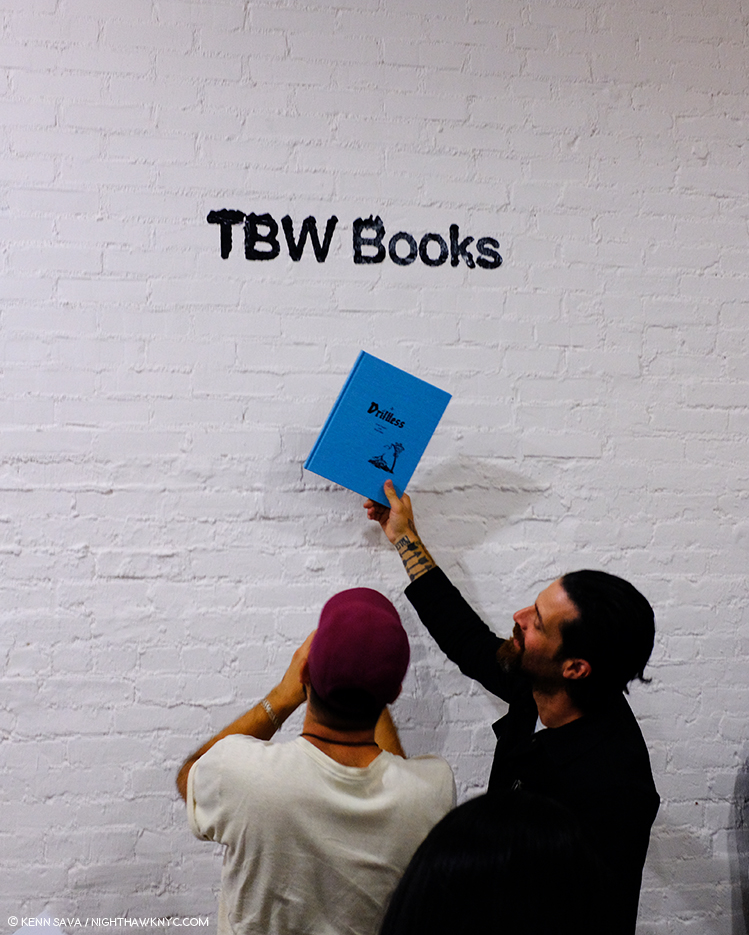
How do they do it? Teamwork. Lester Rosso, left with Paul Schiek, the creative masterminds behind TBW Books, and in front of their sign, reveal one of the secrets of their magic that, it seems to me, a number of others are now trying to emulate. Good Luck with that! Their secret? They consistently make excellent books with top Artists. NYABF, September 21, 2018.

-Gregory Halpern, Confederate Moons with Jason Fulford’s Clayton’s Ascent, Viviane Sassen’s Heliotrope and Guido Guidi’s Dietro Casa, part of TBW’s excellent Annual Series 6. If I were to recommend one new book this year, Gregory Halpern’s would be it. When I look at it, I see a frozen moment in life in America, 2017, seen in the shadows of the solar eclipse, an instant when nature reminds us that everything we stress out about or fight about pales alongside the power IT holds. My look at Confederate Moons is here
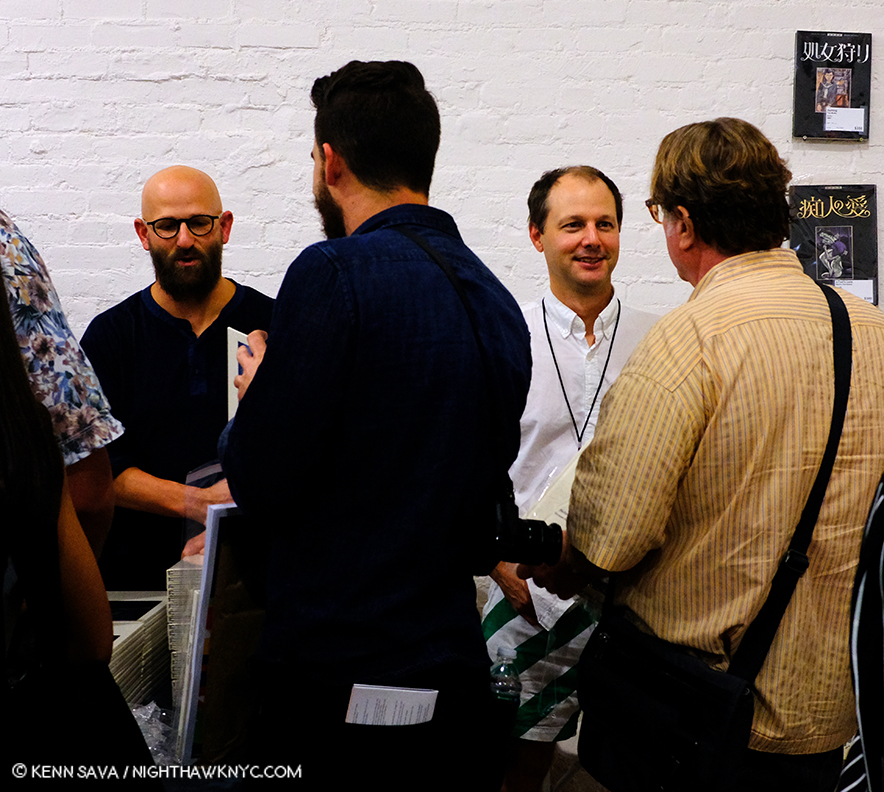
Gregory Halpern, left with the beard and the glasses, and Jason Fulford, right, in the green striped shorts, authored two of the four volumes in this year’s TBW Annual Series here sign them at TBW’s booth, NYABF, September 21, 2018. PhotoBook Business 102- You know you’re doing something right when Artists like these two want to work with you. Mr. Fulford has his own respected publishing house, J&L Books. Mr. Halpern, the 2016 Paris Photo-Aperture PhotoBook of the Year Award Winner, is fresh off his nomination to join Magnum Photos.

Diane Arbus: A box of ten photographs, Aperture. The only portfolio Diane Arbus produced during her lifetime is beautifully reproduced from the only set in a public collection, which happens to be the only one with 11, not 10, Photographs. This is one of the books that will be essential for anyone interested in Diane Arbus henceforth. Aperture says “it will never be reprinted.” Nuff said.
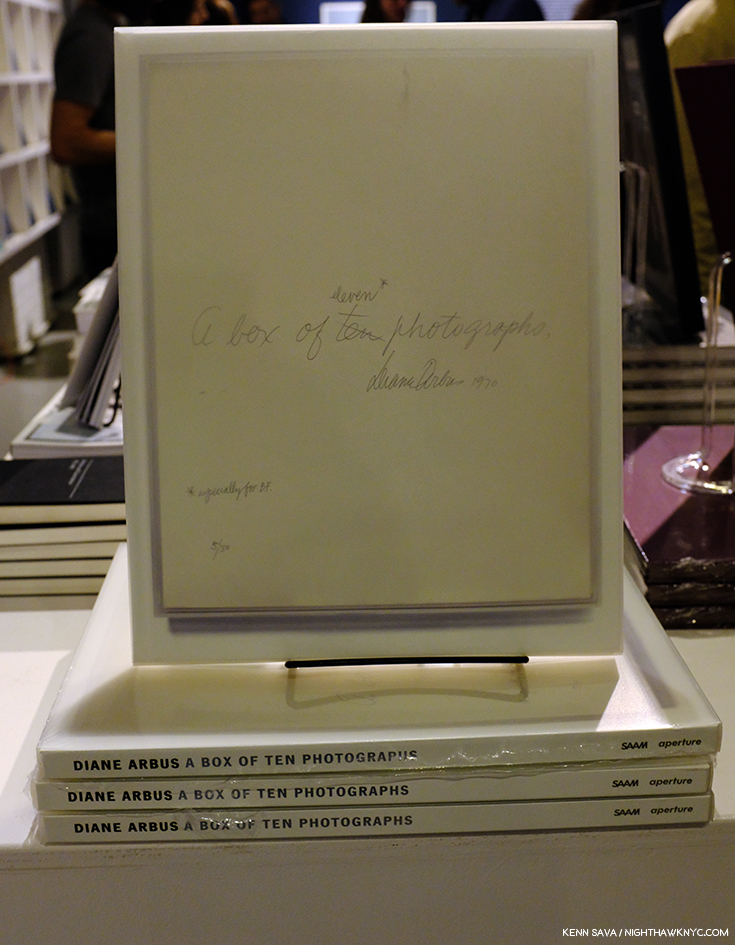
Instant classic. Diane Arbus: A box of 10 photographs. Seen at Aperture Gallery & Bookstore, an NYC Photo mecca.

-Harry Gruyaert, Harry Gruyaert (Retrospective with the red cover), and Harry Gruyaert: East/Westboth Thames and Hudson- Two books that solidify the Belgian-born Photographer’s place alongside the better-known “early masters of modern & contemporary color Art Photography,” including Eggleston, Stephen Shore, Saul Leiter, et al. (A term that puzzles me since color in fine Art Photography can be traced back to, at least, Sarah Angelina Ackland, circa 1900). More on both books in my recent conversation with Harry Gruyaert, here.
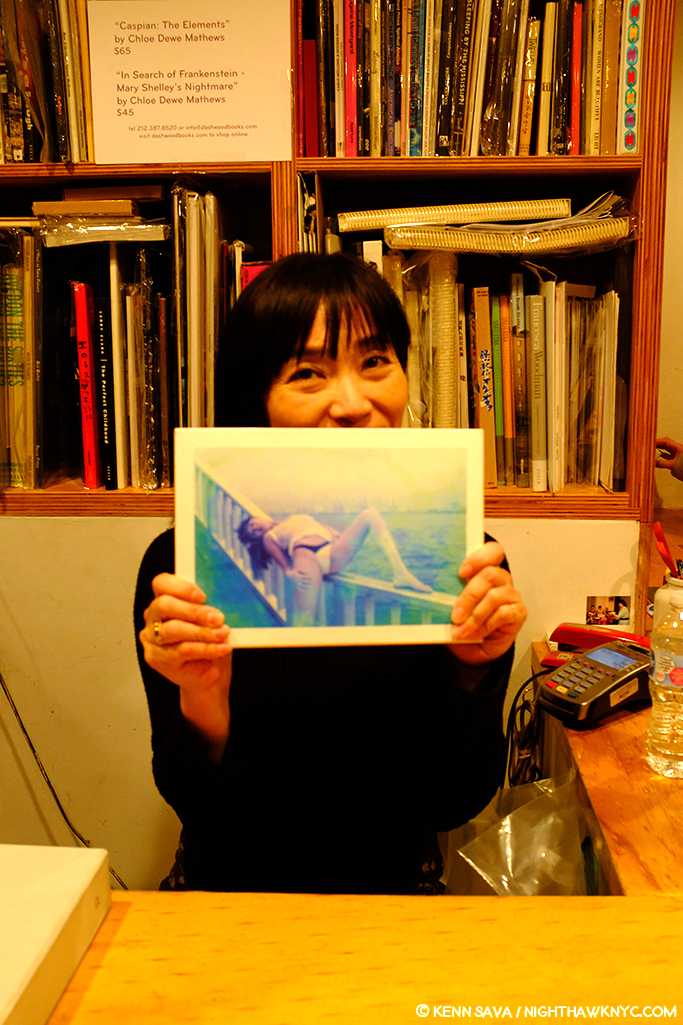
One of the irreplaceable things about physical book stores are its people, like Miwa Susuda of Dashwood Books, seen here. Miwa is, also, a writer and a PhotoBook publisher with her Session Press. In 2017, Session Press and Dashwood Books released the fine Blue Period / Last Summer by the legendary Japanese Photographer, Nobuyoshi Araki, a copy of which she holds. Seen at Dashwood on October 24, 2018.

-Cristina de Middel– The Perfect Man. Cristina de Middel is an Artist who should win an MTV Video Vanguard award. Huh? What I mean is that I can think of no other Photographer who’s books are consistently pushing the boundaries of what a PhotoBook is and can be. This is just the latest in her series of compelling books, most of which are built around subjects that only the most imaginative would say “There’s a PhotoBook in this!” While that certainly wins her major points in my book, if she wasn’t, also, a world class Photographer, she would just be a curiosity. She is. But, you don’t have to take my word for it- Magnum Photos nominated her to join the world’s leading Photographic collective in 2017. The Perfect Man starts with looking at the largest Charlie Chaplin impersonator festival (with many of its subject posed in scenes reminiscent of Mr. Chaplin’s immortal “Modern Times”), and winds up being a broad look at Indian masculinity, and then a look at social customs Indian women are faced with interacting with them. It’s another book that surprises, and another book, like her classic The Afronauts1, that shows the new and old worlds colliding at full speed in unexpected ways.

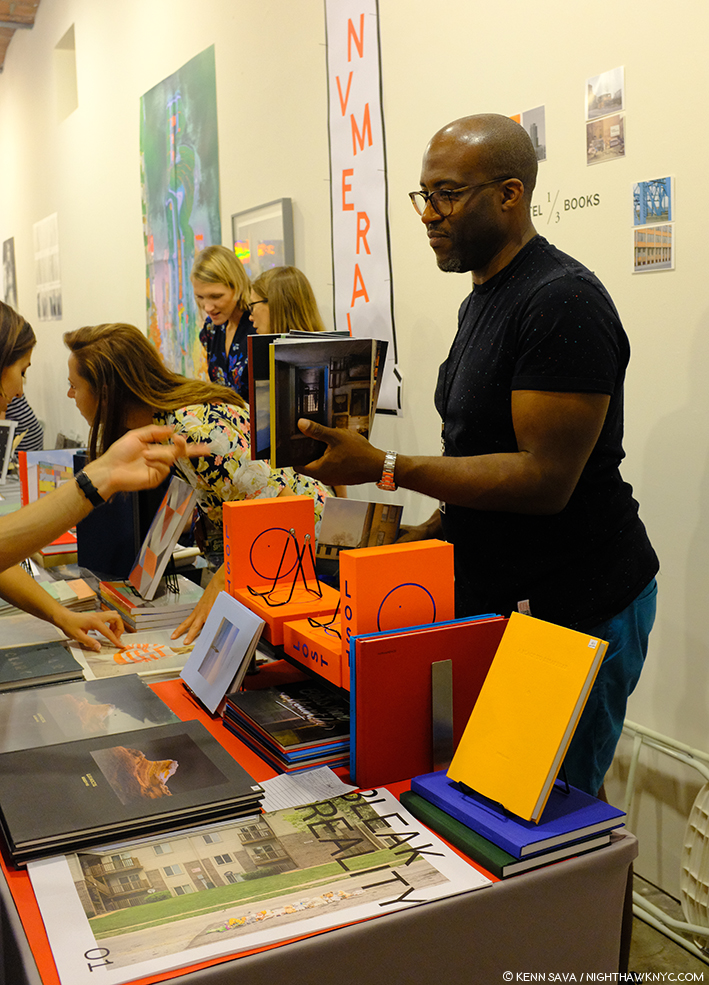
Kris Graves holding the contents of LOST, which comes as a set in the spiffy orange box with blue lettering under his hand at his +Kris Graves Projects booth at the NYABF, September 22, 2018. His newly released A Bleak Reality is seen in the foreground.

-Kris Graves, et al, LOST +Kris Graves Projects. A ground-breaking (sorry!) work in a number of ways. First, it’s a daring, TEN volume box set by a smaller publisher featuring the work of a number of established Artists (including Lois Conner and Lynn Saville) along side that of others who are on the way up (like Zora J. Murff, Joseph P. Traina and Owen Conway), each contributing a PhotoBook on a different city around the world. Second, typically for +KGP, the cost is quite reasonable, for both the individual books or the set. And last, taken as a whole it’s a stunning example of what a well-run, Artist-run publishing house can achieve. Did I mention that each component book stands, and stands out, on its own? Also in 2018, A Bleak Reality by Kris Graves from +KGP is a powerful look at 8 sites where young black men were murdered by police officers, a collection of his work that first brought Kris to my attention at AIPAD this past April, as I wrote about here.

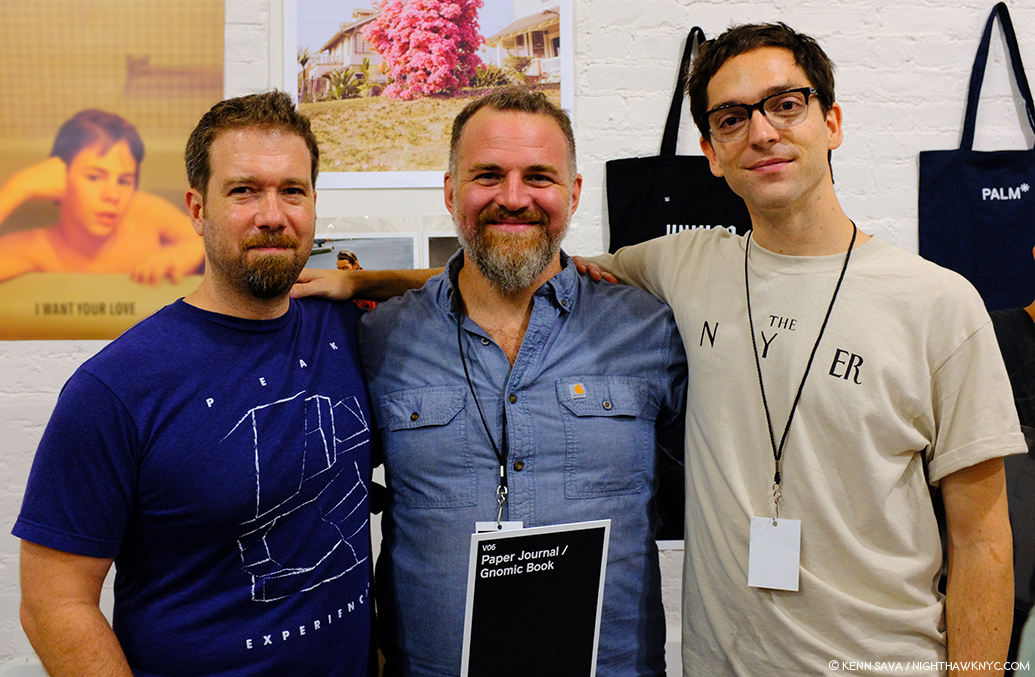
Multi-talented Artist & Gnomic Book publisher, Jason Koxvold, center, with Gnomic Book Artists Shane Rocheleau, left, and Romke Hoogwaerts, right at the Gnomic Book booth at the NYABF, September 22, 2018.

-Shane Rocheleau, You are Masters of the Fish and Birds and All the Animals (or, YAMOTFABAATA as it reads on its spine), Gnomic Book. A book that looks at the legacy of being white and male in America, quickly expands in scope to include any number of related effects, artifacts and institutions. It also reveals that the words “think small” apparently do not exist in Mr. Rocheleau’s vocabulary. The results are a first PhotoBook that’s extremely ambitious in its scope, biblical in its effect, gorgeously shot with a magical combination of subtlety and abstraction, edited like a Stanley Kubrick film, and exquisitely produced down to the smallest detail- (like its beautiful, hypnotic, and seductive to the touch, cover)…Phew! Along the way, it’s also chock full of indelible images that combine to make it linger and linger on in the mind later. A remarkable achievement, particularly for a first PhotoBook- the only first PhotoBook in this Noteworthy PhotoBooks, 2018 section. Limited edition of 500 copies. My recent Q&A with Shane Rocheleau is here
Rosalind Fox Solomon, Liberty Theater, MACK. Something of a marvel, Liberty Theater consists of a body of work decades in the making, this one is special. Culled from 400 Photographs taken in the 1970s, 80s and 90s, across the south, these 77 show a wide range of glimpses into the complex issues of race and racism, class and gender divisions that could be pivotal moments from 77 films that each stand on their own while provoking a world of feelings and reactions. Except comfort. The title speaks to a performance, and her website says the images are “poised between act and reenactment…” Now 88, Rosalind Fox Solomon, who like Diane Arbus, studied with Lisette Model in the 1970s, shares something of Ms. Arbus’ mystery and power in images that demand repeat viewing, here, in a tightly edited volume that quietly stuns as often as it shocks, aided by yet another powerful essay by Stanley Wolukau-Wanambwa, who’s first PhotoBook also appears on this list.

***Noteworthy First PhotoBooks***

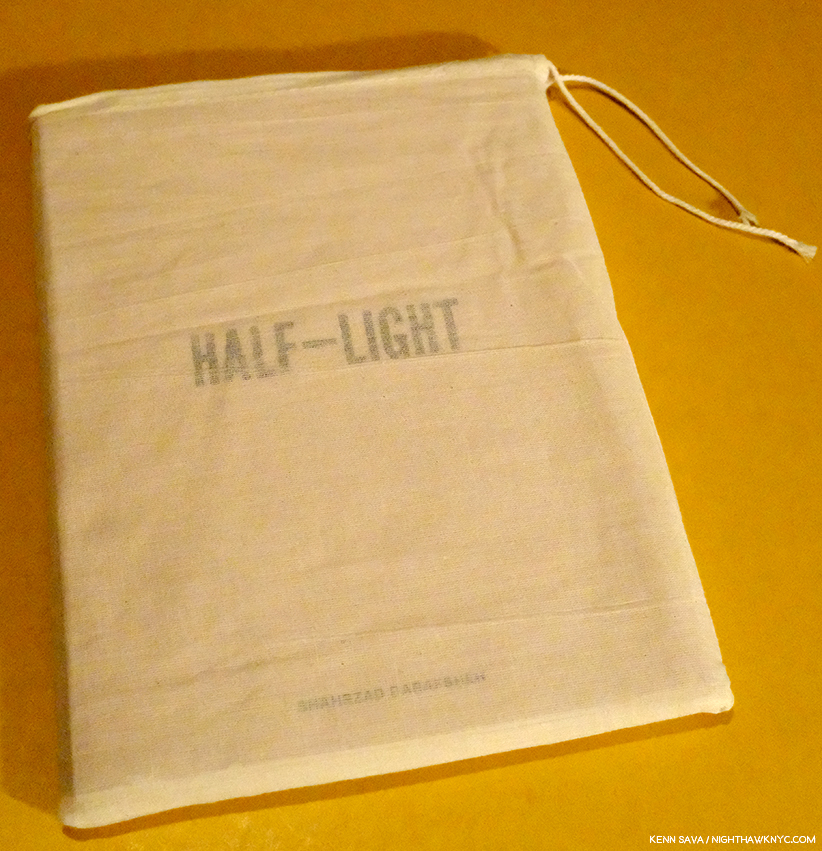
Shahrzad Darafsheh- Half-Light, Gnomic Book. Iranian Photographer Shahrzad Darafsheh was diagnosed with cancer at age 36. But? She hasn’t let it stop her creativity or her work! It seems to me that anyone who’s been through cancer, or knows someone who has, can relate to her new first PhotoBook, Half-Light. It’s, at once both intimately personal, and universal, a book that looks inwards and outwards at the same time. Designed to be read either in western style left to right, or right to left, the custom in Farsi, one time I went through it it felt like an out of body experience. Cancer changes your life- forever, and it also changes how you see life, forever. Here is a Photographic record of the early days of this very talented young Artist’s cancer experience, seeing the world anew and turning her lens on herself, and her surroundings with wondering eyes. Its 300 copies are far too few to reach the audience this book deserves, so don’t wait long. It’s somewhat miraculous that Gnomic’s Jason Koxvold somehow found this work and overcame all the layers of problems inherent in working with an Artist living in Iran to produce such a beautiful and important book.

Shahrzad Darafsheh’s Half-Light.

-Stanley Wolukau-Wanambwa – One Wall A Web. Stanley Wolukau-Wanambwa has been one of the most astute and urgent voices writing about Photography and PhotoBooks for some time now. His writing has appeared in a wide range of places, including in a number of PhotoBooks, like Jason Koxvold’s excellent Knives. With One Wall a Web the world gets to see his first collection of his Photographic work. Born in Uganda  and living here for a number of years, One Wall is a far ranging look at American life, culture and society with a focus on the black reality in this country in two sets of original Photographs surrounding a section of appropriated vintage archival Photographs. It’s so wide-ranging it even masterfully weaves Allen Ginsberg’s classic poem Howl in. It’s already clear to me that One Wall a Web is one of those books that define this moment, as his friend’s Shane Rocheleau’s does in its way. It’s a book people will be discussing, referring to and looking at for many years to come. As I write this, about 70 copies remain of the first edition.
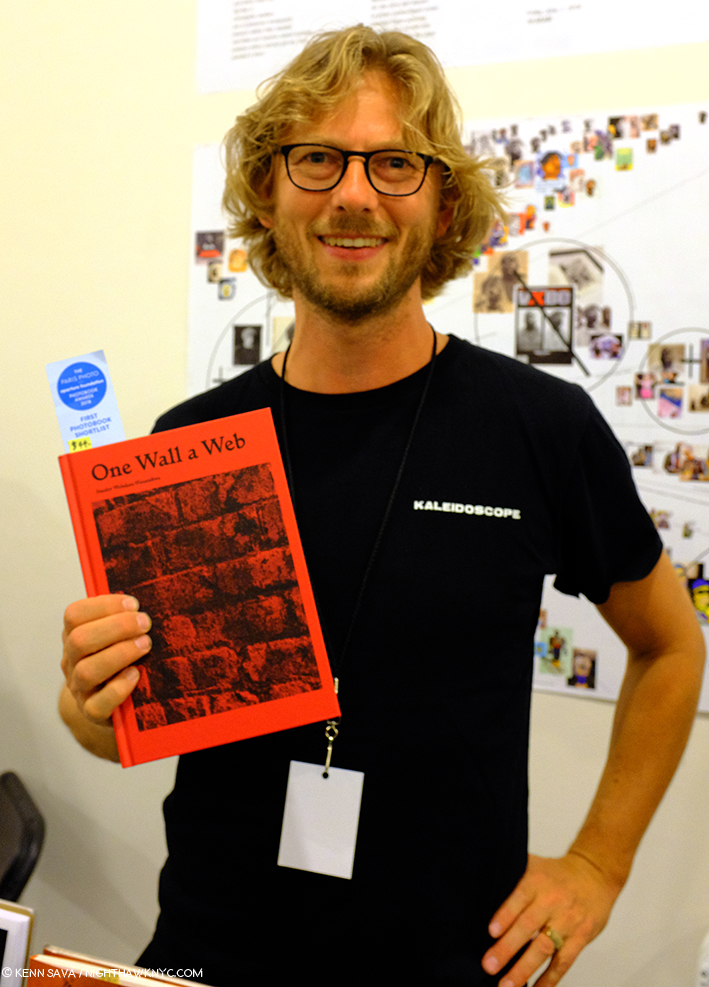
 

Roma Publications co-founder Roger Willems holds a copy of One Wall a Web, by Stanley Wolukau-Wanambwa at Roma’s booth at the NYABF, September 22, 2018.

-Jo Ann Walters- Wood River Blue Pool, ITI Ithaca  Named after a river and a pool near her hometown of Alton, Illinois, a journey through its 120 pages it makes it quickly apparent that yes, still waters run deep. A book over 30 years in the making, it’s a veritable time capsule of people and places, seen with a strong and singular eye, here largely cast on women and girls around her hometown, and elsewhere from Minnestoa to Mississippi cry out for extended pondering- on the women and/or children depicted, their situations and surroundings, and the moment. Coincidentally, Ms. Walters also teaches at Purchase College on the same Photography faculty with Stanley Wolukau-Wanambwa. My thanks to Kris Graves for  making me aware of this book. He did so purely on the book’s exceptional merit as something I should see. Modestly, he did so without mentioning that he was once one of her students, which I found out later. Jo Ann Walters’ tree has many branches. Now? We finally get to sit under another one with wonder at her achievement. I’ve found it makes an interesting pairing with the following-

-Petra Collins- Coming of Age, Rizzoli. A minor sensation when it was released, causing first printing copies to instantly vaporize, surprising no one more than its publisher, Rizzoli, who scrambled to produce a second printing, which finally materialized after a few months absence. Coming of Age, (a perfect title in more ways than one), touched a nerve with its subject generation, and with the esteemed Artist, Marilyn Minter, who interviews Ms. Collins inside. It’s easy to see why. Petra Collins Photographs her subjects the way they would like to be seen, and shows sides of them and their lives the rest of us never see. While other Photographers have garnered more attention for more contrived work in this genre, Petra Collins is the one to watch, in my view.
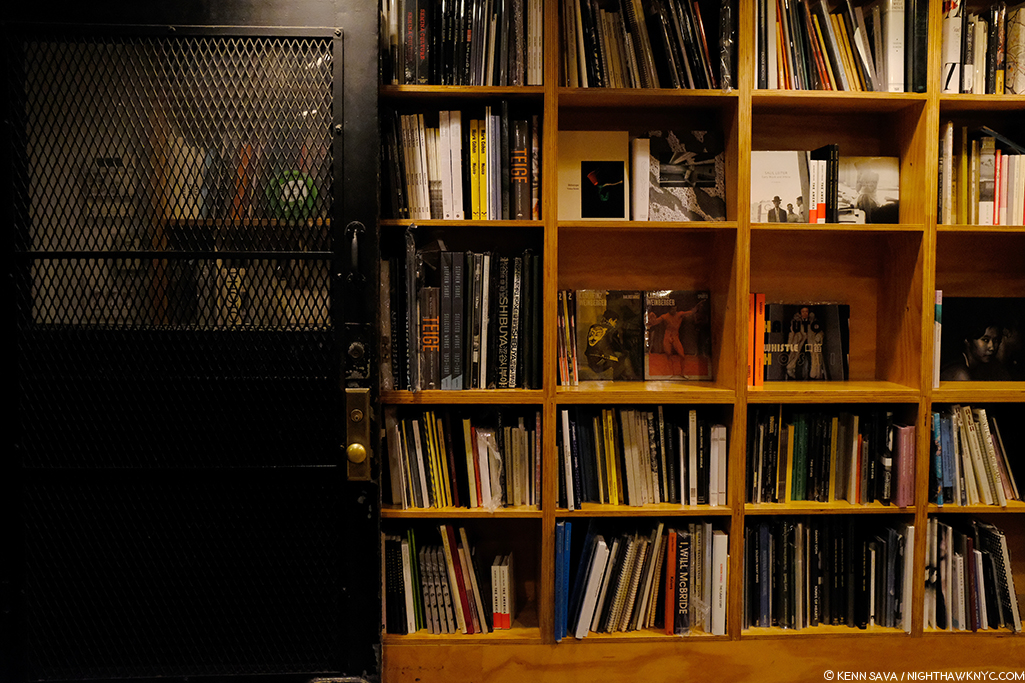
-Rose Marie Cromwell, El Libro Supremo de la Suerte, TIS Books/LightWork. I lived in Miami and South Florida, where it’s impossible to escape the flavor and influence of nearby Cuba. Here’s, an amazing look at the real thing, shot over 8 years while the Artist lived in Havana. It’s a thunderbolt, filled with color, as  you’d expect, but it’s also full of a poignant intimacy that surprises. Another book with an instant buzz that saw copies flying out the door, and a long line for signed examples at TIS’ Booth at the NYABF. El Libro Supreme de la Suerte (The Supreme Book of Luck) supremely deserves it.

If you are able to pick only one book from that group? You are a better man or woman than I am.

PhotoBooks are all we sell! One wall of titles at Dashwood Books.

***NoteWorthy Photo Related Book without Photos***

In this “decisive moment,” the foreshortening got the better of my auto-focus.

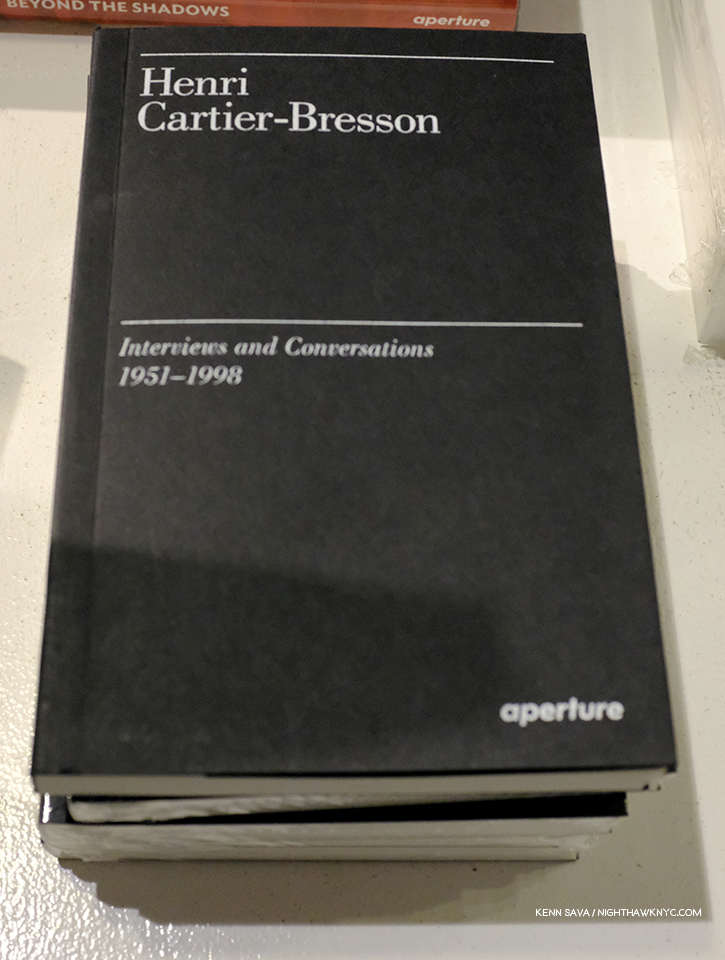
-Henri Cartier-Bresson- Interviews and Conversations, 1951-98, Aperture. I picked up The Mind’s Eye, Cartier-Bresson’s writings on Photography and Photographers, which didn’t have the insights I was looking for. Interviews and Conversations does. On every single page. Essential. A reference book for the ages.
***NoteWorthy Reissues***

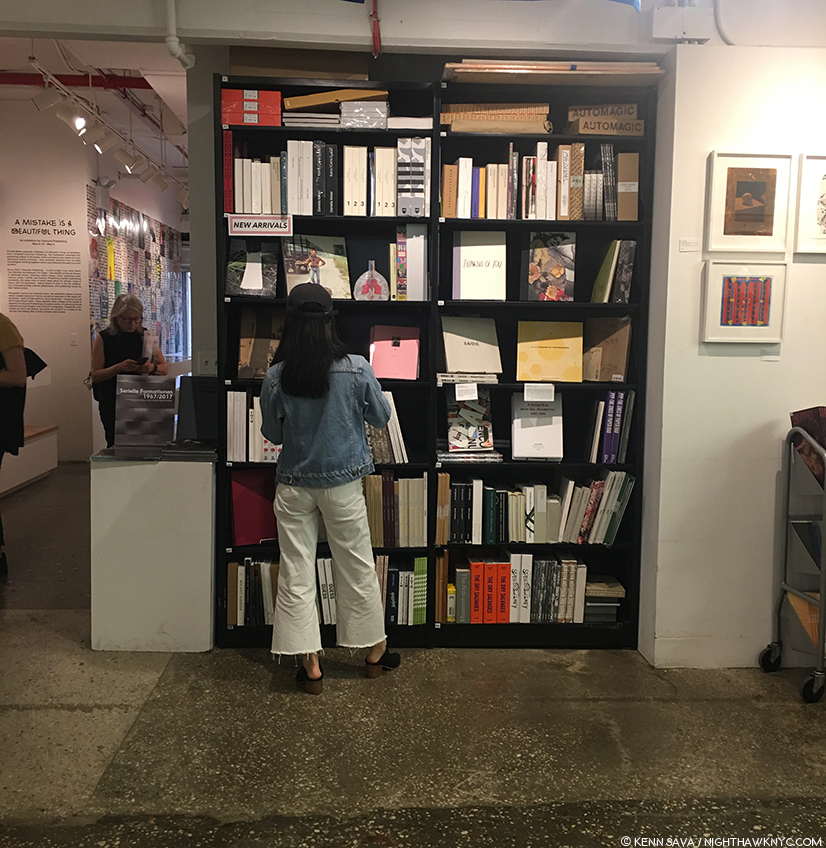
The New Arrivals wall at Printed Matter, presenters of the New York Art Book Fair. An amazing store that contains multitudes of worlds in the form of Artist’s books by umpteen thousand Artists and Writers. How do they know where all of them are? I never bother to try to find something- I just ask. Extra credit if you can spot the next book to appear on this list.

-Masahisa Fukase Ravens, MACK. (Pictured almost smack dab in the middle, above, in its grey slip case). Believe the hype. Shot in the aftermath of a divorce, this is an unforgettable masterpiece, one of the great achievements in PhotoBook history in my view. It says 2017 inside. I don’t care. I’m listing it here as a public service announcement. After being first published in 1986, it was out of print for the better part of 30 years! The word is copies are running low. Get it before it goes out of print. Again. I’m listing Ravens, also, to acknowledge MACK’s excellent series of reissues that has seen Alec Soth’s classic Sleeping By The Mississippi and Niagara, among a number of others reissued, making them affordable to students and Photography lovers, again, after long absences that has made them available only at very high prices on the rare book market. Bravo! The next selection is another one…
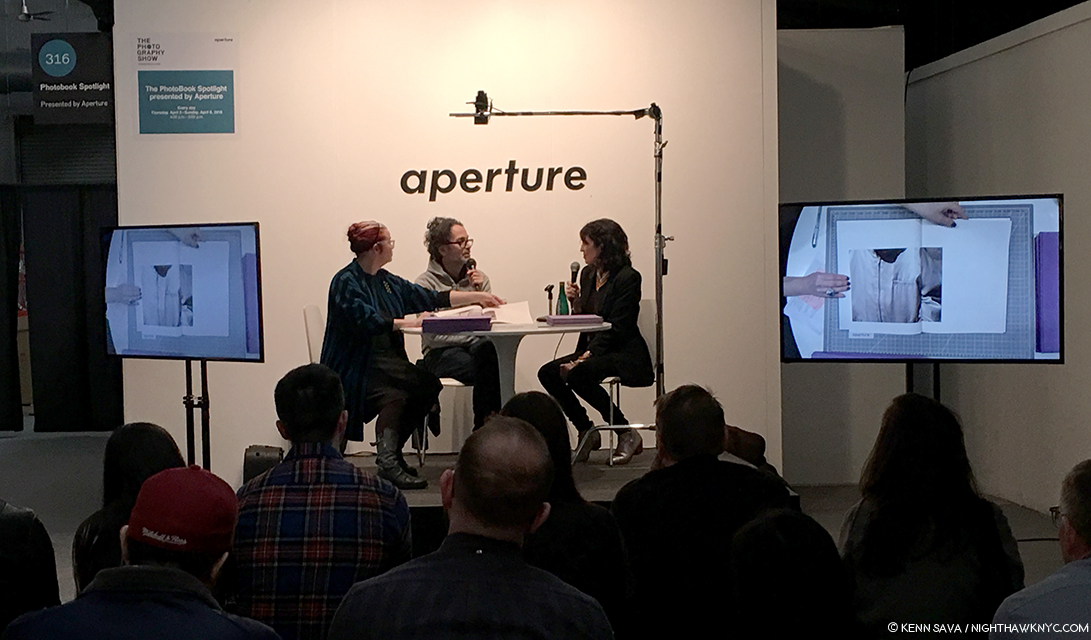
Paul Graham, center, with Lesley A. Martin of Aperture, left, discuss a shimmer of possibility at its re-release. AIPAD, April 13, 2018.

-Paul Graham, a shimmer of possibility, MACK. Though reissued once before, as a one volume paperback, MACK has finally released the book Paris Photo-Aperture gave their “The Best PhotoBook of the Last 15 Years” award to in 2012, in its original 12 volume format (which sold out in less than 3 months in 2012). A revolution when it was first released, its influenced countless books that have come since. Including a few on this list. Limited edition of 500 hand signed sets.

-Daido Moriyama: Record, Thames & Hudson, A selection from Nos 1-30, beginning in June 1972 of the magazine, Record, that the great Japanese Photographer continues to release to this very day. At age 80, he’s now up to No. 39. When I added them up, Numbers 1-30 would cost a thousand or so dollars, IF you could find them all. This beautiful selection from them sells for about 50.00, and is sure to bring many more eyes to the work of one of the most admired, and influential, living masters of Street Photography.
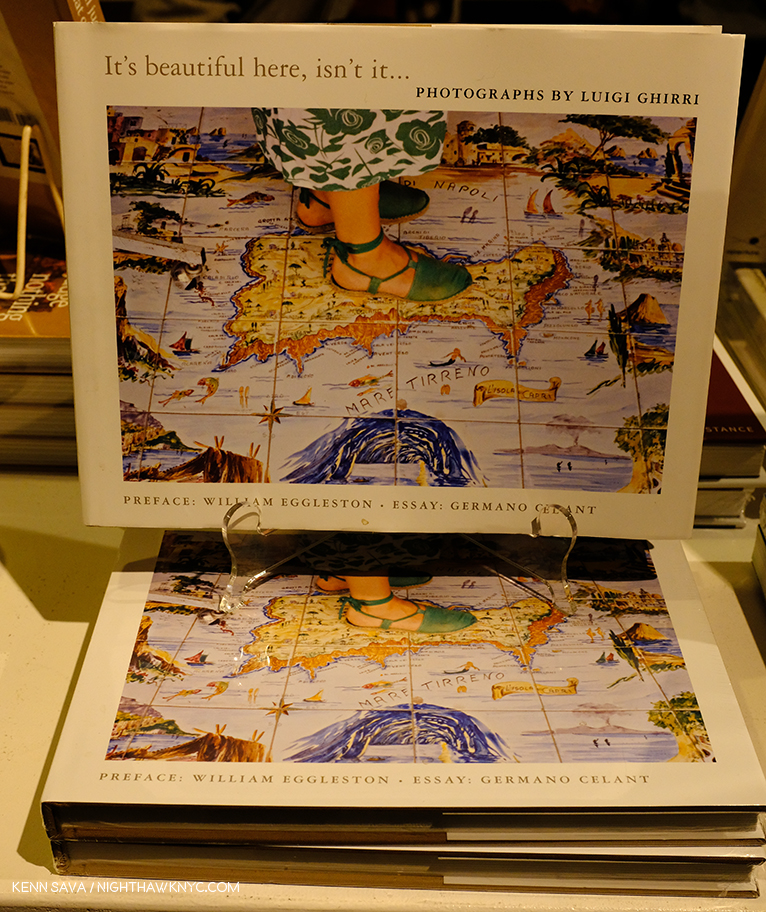
-Luigi Ghirri- It’s Beautiful Here, Isn’t It… Aperture. With 2008 1st Printings selling for over 300.00 per, my thanks to Aperture for issuing a 2nd printing this year otherwise I would have never seen it! Ghirri’s Kodachrome is the place to start exploring his work (especially in MACK’s gorgeous reissue, which seems to be disappearing), but this is a very nice selection of works from throughout his career. Intro by William Eggleston.  

Roy DeCarava & Langston Hughes- Sweet Flypaper of Life, First Print Press/David Zwirner Books. Roy DeCarava is one of the unsung masters of contemporary Photography, who is quietly undergoing a renaissance that’s seen a few of his books reissued at long last in honor of the Photographer’s 100th birthday in 2019. First published in 1955, it features 141 DeCarava Photographs chosen by Langston Hughes who then supplied an accompanying narrative. His aim, he said, “We have so many books about how bad life is. Maybe it’s time to have one showing how good it is.” It’s that, and more, as it shows life “Uptown” in the mid-1950s in a way unlike that seen in any other book. 

***NoteWorthy Catalog of the Year**

-Sally Mann- A Thousand Crossings. It’s going to be a while before another book coming along surpassing this as a one volume reference/summary/monograph of Ms. Mann’s work to date. Beautiful. Throughout.

-Saul Leiter- All About Saul Leiter– It came out in Japan last year, and has just been released here. I’d still recommend Early Color as the place to start exploring Saul Leiter, but this is an excellent second choice and provides more of a complete sense of the man’s work over his career. With all due respect to his black & white work- Saul Leiter is a supreme Photographic Artist with color and the effects of light, and that is the work of his I will always be drawn to, and there’s a lot of it in this beautiful volume. My look at the recent Saul Leiter: In My Room show and book is here.

-Luigi Ghirri- The Map and the Territory, MACK. Focused on his work from 1970s and 1980s this is a beautiful almost 400 page look at a visionary Photographer, who, was the only name Stephen Shore mentioned when I asked who he felt deserved more attention. He told me Luigi Ghirri was the Artist he used to recommend, before the internet did away with little known Artists. Which brings me to…
***NoteWorthy “Non-PhotoBook” of the Year/ Holiday gift of the Year***

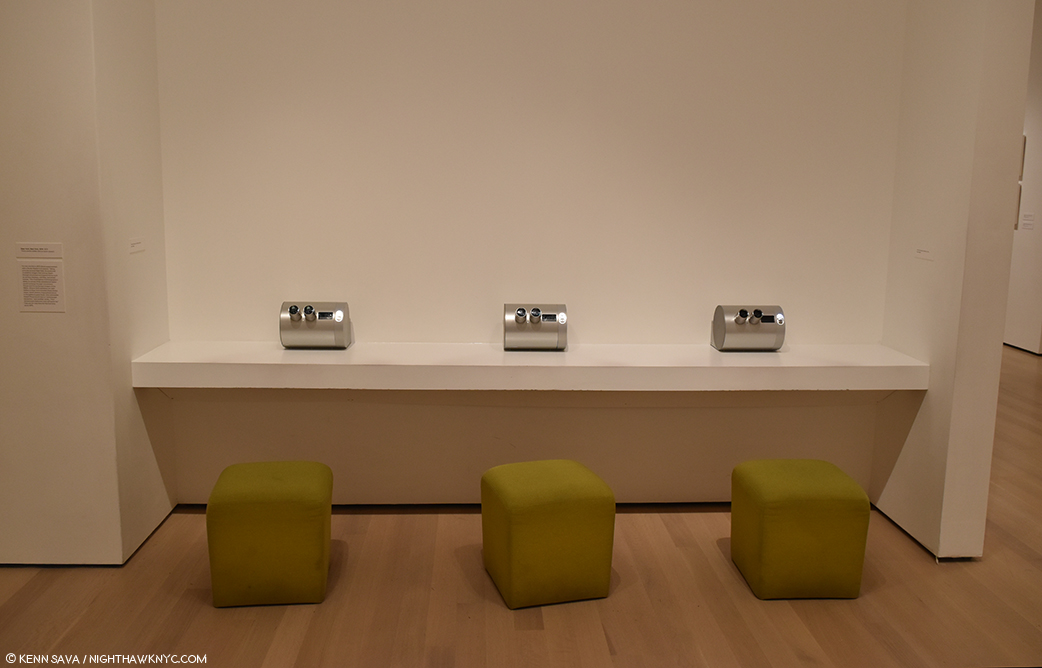
The 3 Stereograph viewing stations, each containing 10 different stereo Photographs of New York, 1974, at the Stephen Shore Retrospective at MoMA, May 23, 2018.

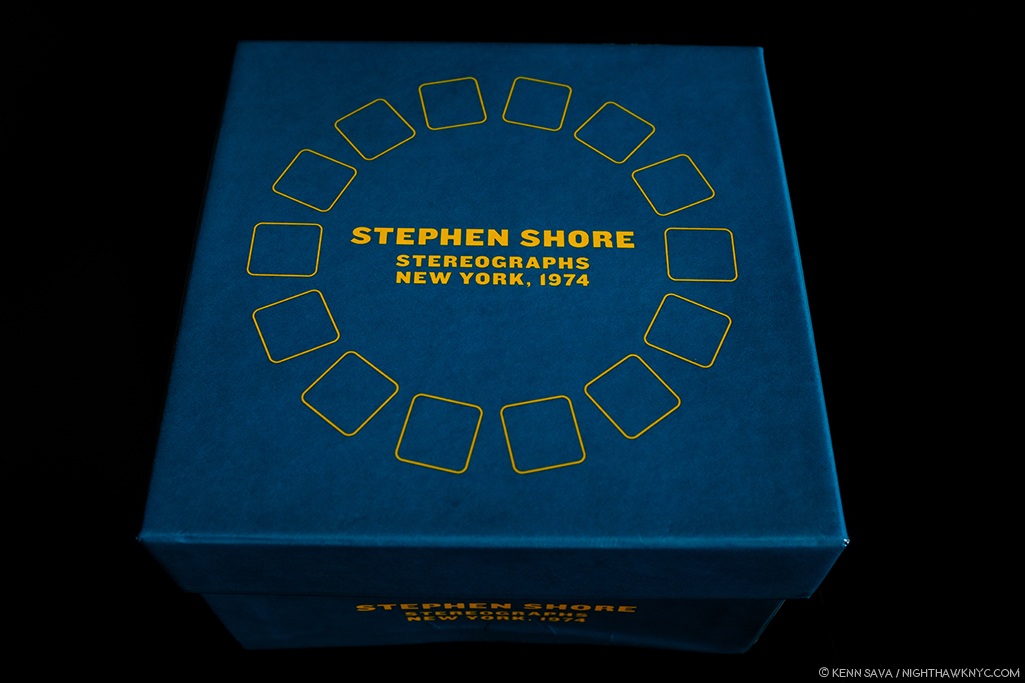
Stephen Shore, Stereographs, New York, 1974, Aperture. Hey, it counts- its got an ISBN number…and 30 Stereo Photographs! I don’t know how many other visitors to the Stephen Shore Retrospective at MoMA were thinking, “Wow. This is COOL!,” when they sat at one of the 3 stations, each containing 10 of Mr. Shore’s Stereographic Photographs. Well, I was. Now, you can have your own! Hurry. Aperture only produced 400 sets each containing a “Stephen Shore” signature model viewer (cool!) and all 30 of the works seen at MoMA (ditto). Each set includes a card hand signed by Mr. Shore. Don’t sleep on it. I hear they’re going fast. All of those who already own it that I’ve spoken with said they hoped more images would be made available. Hear, hear. My piece on the monumental Stephen Shore Retrospective at MoMA is here

Stephen Shore: Stereographs, New York, 1974, published by Aperture.

***PhotoBook Discovery of the Year (Regardless of Publication Date)***

-Lewis Baltz, WORKS, Steidl, 2010. WORKS is THE most extraordinary box set I have yet seen. Period.
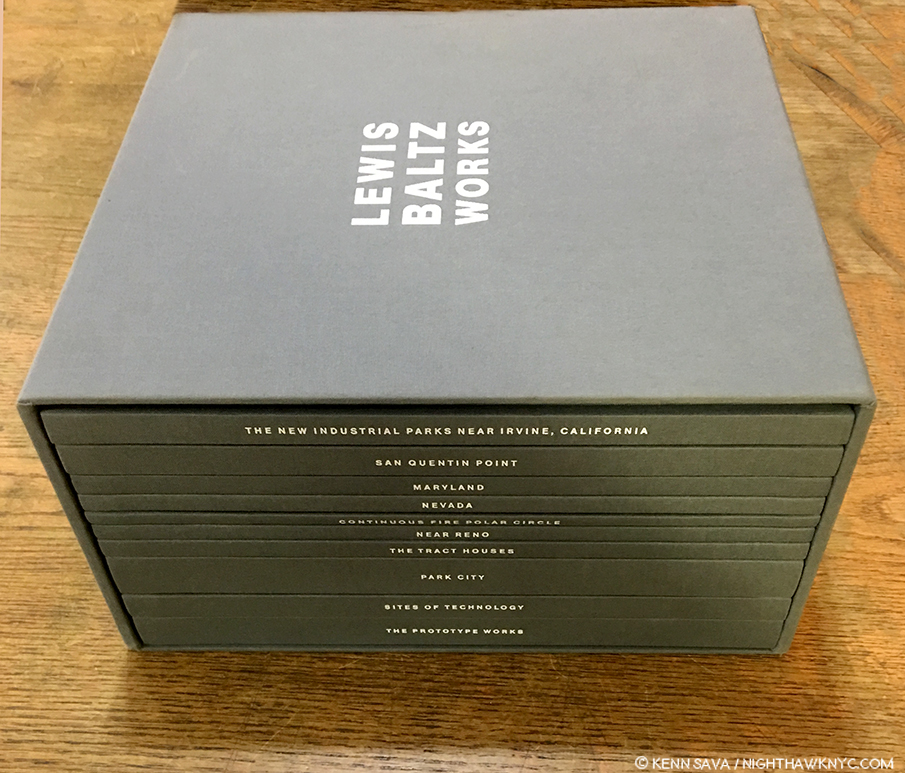
When you look at it like this, it could have been called “MONUMENT.” Note- There are two editions of WORKS. Mine is the first edition, 2010. the later WORKS- Last Edition edition adds the subsequent Candlestick Point (2011) and Texts (2013), which they just lay on top of this box. Both of those books are available separately, so you can create your own Last Edition. Their Last Edition also comes with a booklet containing Lewis Baltz’ Last Interview, which, unfortunately, is not available elsewhere.

Since discovering WORKS, Lewis Baltz has become one of the few Artists who have effected the way I see the world, and one of even fewer to effect how I think about what I see. Mr. Baltz passed away in 2014 at 69 and this was a project he worked on when he, apparently, knew the end was coming. The result is that WORKS is the complete 10 volume edition of his Photography as the Artist wanted it to be seen. The care and attention to detail he brought to this edition, matched by Gerhard Steidl and his team, make it the definition of “definitive.” It houses the career work of an Artist who’s work expanded from the so-called “New Topographic” approach to Photography to including how the forces that control man’s uses of the land have extended into virtually every realm of human life. Inside, the entire journey can be taken in one place, where its continuity and interconnectedness can be fully appreciated as it can be nowhere else, in drop-dead beautiful quality printing. Lewis Baltz was an Artist who while producing Art based in what he saw around him created a body of work that, also, warns about where this was (and is) all heading. In my view, this makes him one of the most important Photographers of our time. Each of the 1,000 copies is hand signed by the Artist!

For those not wanting to make the investment in WORKS (currently 600.00 and up), there is the one volume Lewis Baltz– the catalog published in 2017 to accompany the first posthumous retrospective of Mr. Baltz’ work in Madrid, and so another entry for NoteWorthy Catalog, 2018. (It reached me in January, 2018.) The best one volume survey of his work is a great way to get the feel of both his accomplishment and the interconnectedness of the various series he produced, (and yes, they are interrelated). Even more than A Thousand Crossings, it’s very hard for me to see another book surpassing Lewis Baltz as a one volume monograph, especially given its particularly beautiful Steidl production and superb essays by Urs Stahel and, particularly, Artist Walead Beshty.
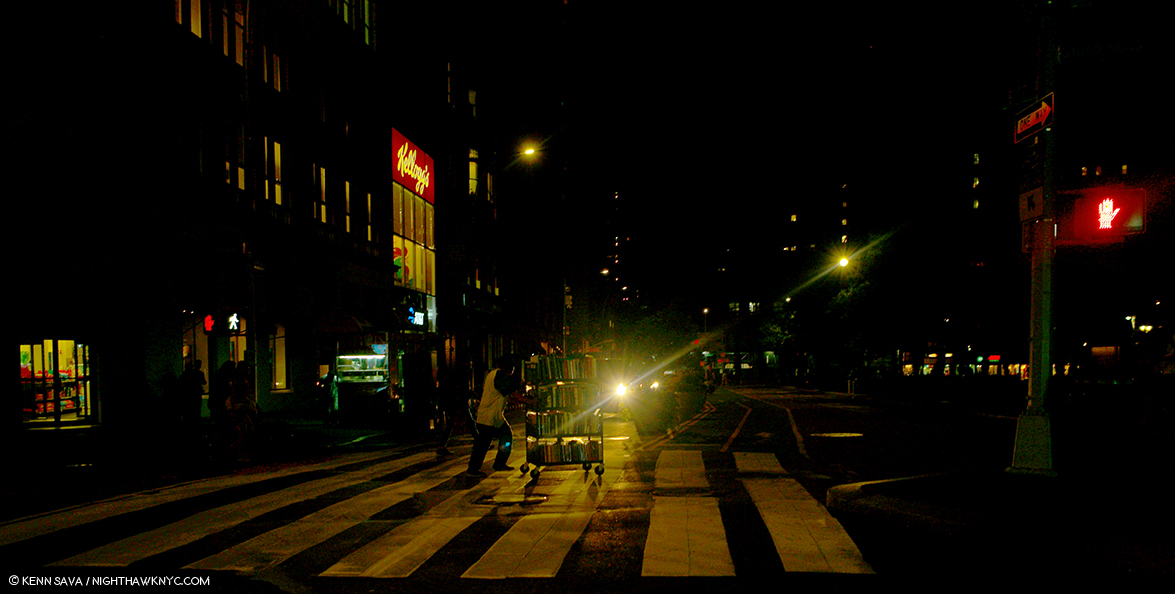
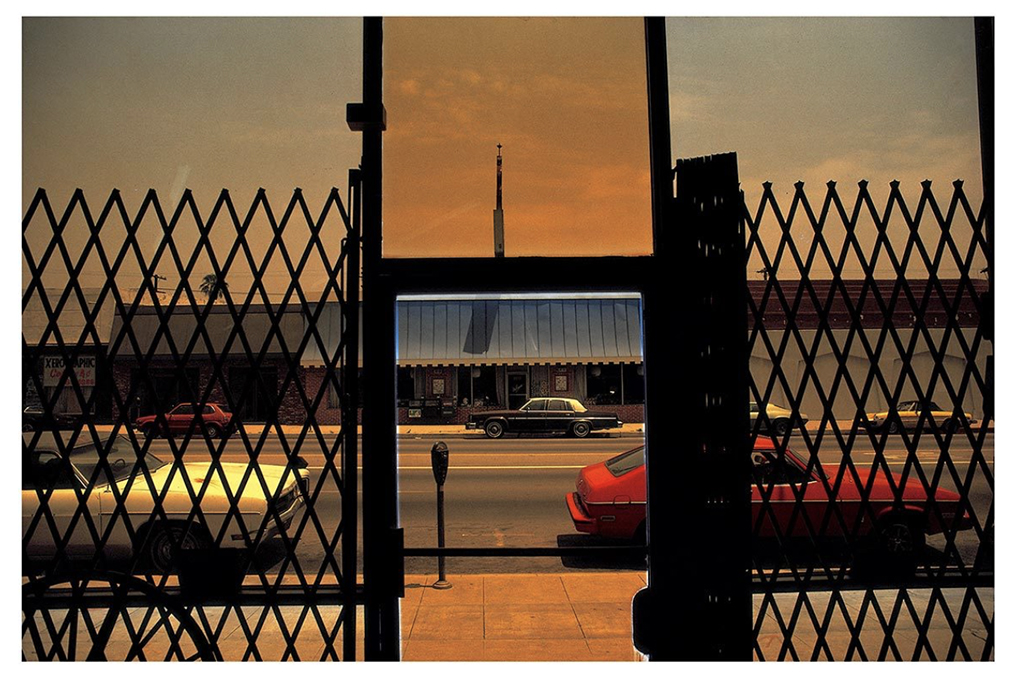
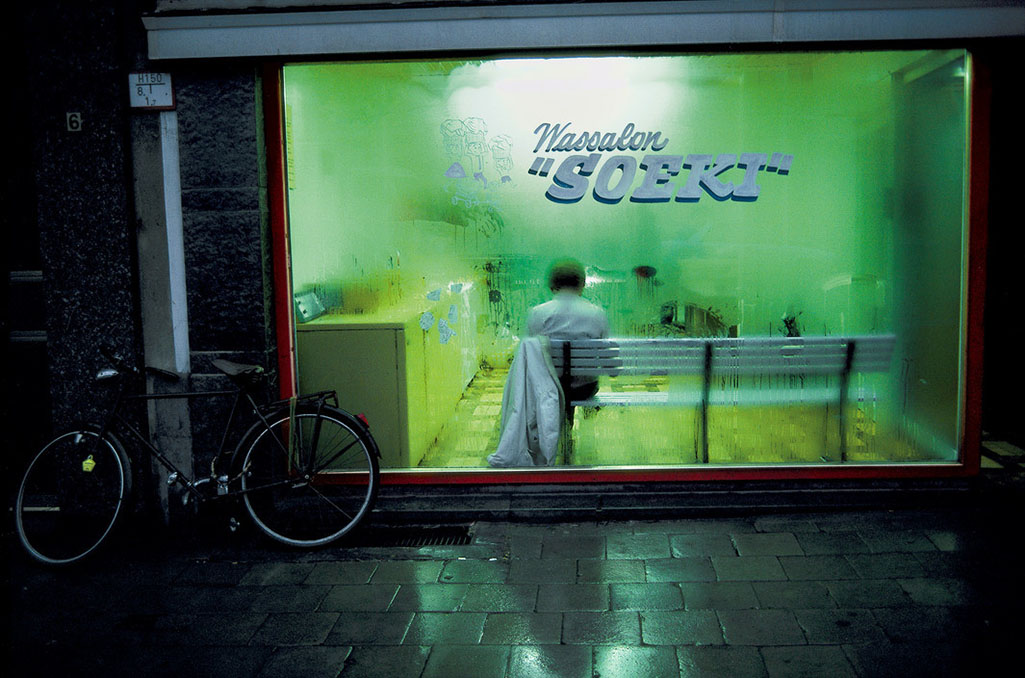
And so, in my book, there are no “winners,” no “losers” among Artists. ALL Artists who have created a PhotoBook (since that’s what we’re talking about here) this year are Winners in my book! CONGRATULATIONS! Seeing so many books and speaking with so many Artists & publishers has given me a real sense of how hard it is to produce a book today, particularly in this country.

For the rest of us? Get out there, look at some PhotoBooks and see what speaks to you. For me? I look forward to seeing what’s coming next. And? I will be looking for it…

11pm, East 17th Street @ Union Square. It can be a lonely road seeking PhotoBooks in the dead of night, which I actually was. But, wait! “Hey, man. Got any PhotoBooks there I should know about?”

*-Soundtrack for this Post is Impossible Year by Panic! at the Disco from Death of a Bachelor.

My previous pieces on Photography are here.

NighthawkNYC.com has been entirely self-funded and ad-free for over 6 years, during which over 250 full length pieces have been published. If you’ve found it worthwhile, you can donate to keep it going & ad-free below. Thank you!

Written & photographed by Kenn Sava for nighthawknyc.com unless otherwise credited.
To send comments, thoughts, feedback or propositions click here.
Click the white box on the upper right for the archives or to search them.
For “short takes” and additional pictures, follow @nighthawk_nyc on Instagram.

Subscribe to be notified of new Posts below. Your information will be used for no other purpose.


  1. Both Ms. de Middel and Vivienne Sassen, mentioned earlier, have come under controversy for their work in, and about, Africa.

A Conversation With Photographer Harry Gruyaert

Written by Kenn Sava. Photographs by Harry Gruyaert.

Harry Gruyaert is a mystery to me.

I wonder…HOW does he get such miraculous, beautifully atmospheric Photographs, over and over, again? It doesn’t matter what time of day,

Los Angeles, California, USA, 1981. Photo by Harry Gruyaert/Magnum Photos. I came across a print of this work in June and realized that I hadn’t done a deep dive into Harry Gruyaert’s work. Well? It’s summer. Into the pool!  Three months later, I’m still immersed in the sheer joy of looking. Click any Photo for full size.

or night it is.

Launderette. Town of Antwerp, Flanders Region, Belgium 1988. Photo by Harry Gruyaert/Magnum Photos.

What the weather is,

Ostende, Belgium, 1988. Photo by Harry Gruyaert/Magnum Photos.

or even what’s going on.

Commemoration of the Battle of Waterloo, 1981, Village in the Province of Brabant, Belgium. Photo By Harry Gruyaert/Magnum Photos.

And, he’s been doing it for going on 50 years now.

His Photographs will make you stop and wonder- What’s going on here?

Rue Royale, 1981. Brussels, Belgium. Photo by Harry Gruyaert/Magnum Photos.

Or, marvel at the almost magical combination of elements coming together in a split second of time,

Parade, 1988.Flanders region, Province of Brabant, Belgium. Photo by Harry Gruyaert/Magnum Photos.

any time,

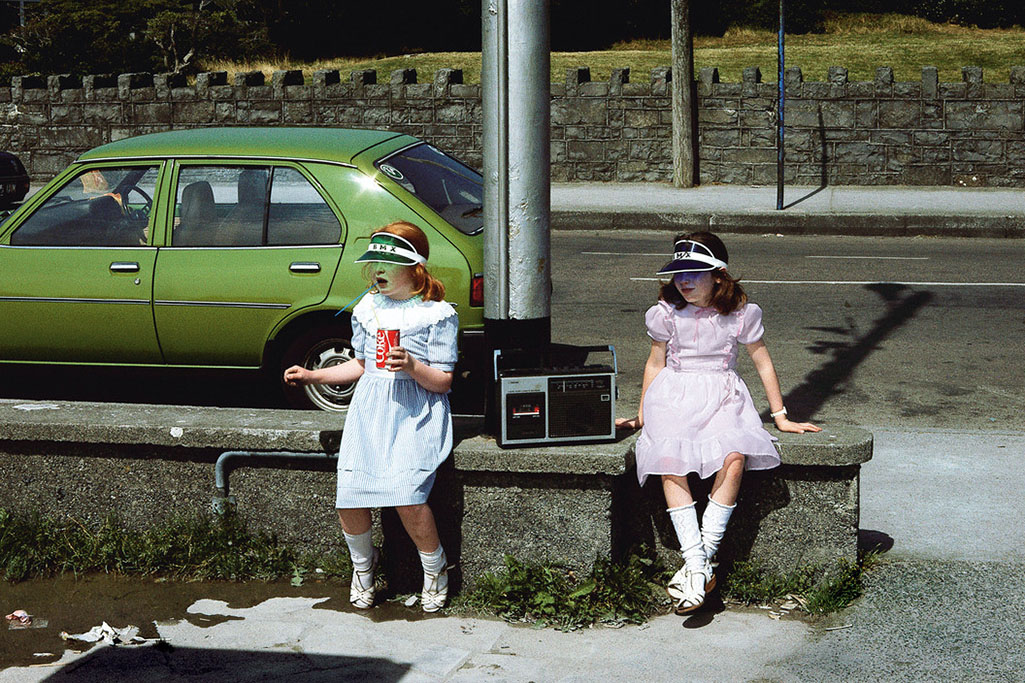
Galway, Ireland, 1988. Photo by Harry Gruyaert/Magnum Photos.

any where.

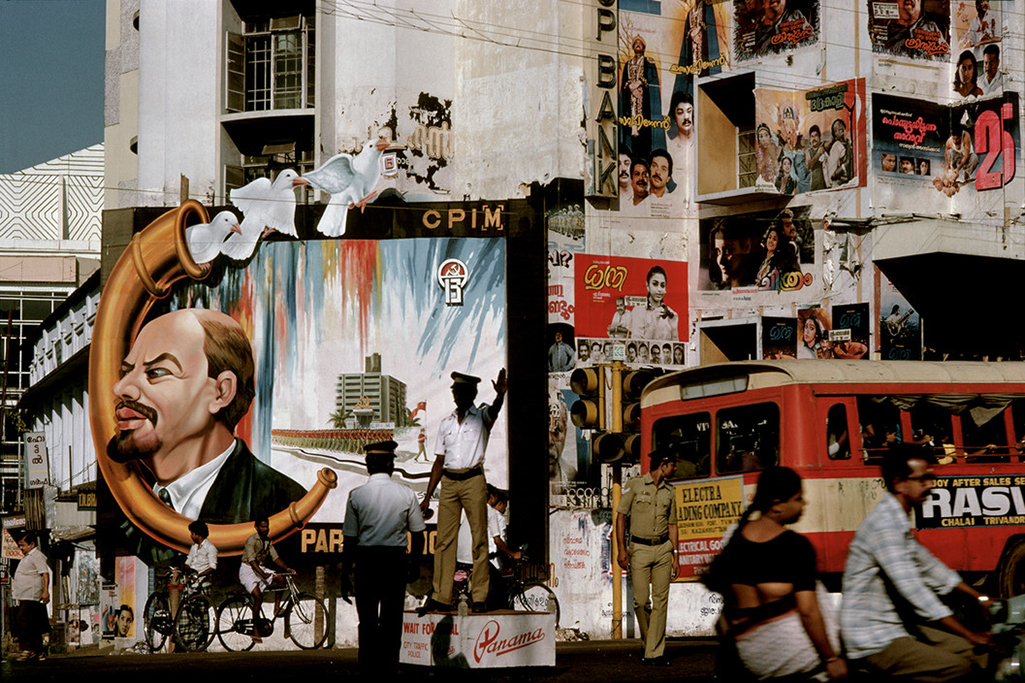
National Communist party congress, Trivandrum, India, 1989. Photo by Harry Gruyaert/Magnum Photos.

But, the biggest mystery of all, for me, is WHY is he still so relatively little known in the USA?

His name is heard nowhere nearly as often as his fellow contemporary Masters of color Photography- William Eggleston, Saul Leiter, Stephen Shore, and the rest. As I write this, there are only TWO books of his work in print here (see BookMarks at the end). Yet, I find, his work has a richness and subtlety, those gorgeous colors he’s legendary for, all in the service of a mystery, like an untitled still from a movie (sorry, Cindy), that brings me back to have another look, again and again. His work can stand right alongside that of his peers, and it will hold its own alongside any of them. Even beyond contemporary Photography, Harry Gruyaert’s work, also, speaks to the lover of Painting in me. His is that rarest of work that touches some of the same nerves that Edward Hopper is, perhaps, most renowned for- the insular loneliness that defines modern life.

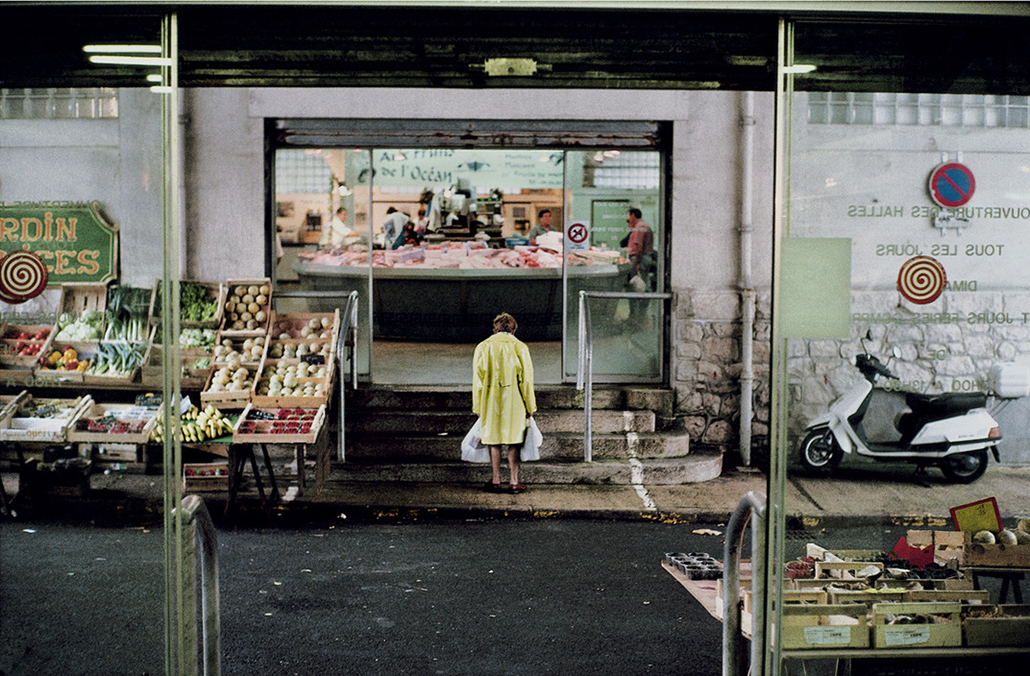
Covered market, Bairritz, France, 2000. Photo by Harry Gruyaert/Magnum Photos.

Born in Antwerp, Belgium in 1941, he joined Magnum Photos in 1981, as admittedly, and somewhat controversially, the first and only, non-PhotoJournalist in the legendary group. 37 years later, he’s still a member, and is it only a coincidence that the current roster may be the most diverse in its 71 year history? Still going strong, 2018 is turning out to be a big year for Harry. First, the Harry Gruyaert – Retrospective at FOMU Foto Museum in Antwerp, Belgium, from March 9th to June 9th, 2018, while the feature length documentary, Harry Gruyaert Photographer, premiered this summer. Meanwhile, this past Saturday, September 8th, saw the opening of his new show at Antwerp’s renowned Gallery Fifty One. The show is titled Roots, and features work Mr. Gruyaert created in his native Belgium, where his “roots” are.

I’m thrilled to say I had the privilege of speaking with Mr. Gruyaert in France after he just returned home from attending the opening of Roots, and in a far ranging interview, I was fortunate to ask him every question I could think of that I have yet to see asked of him thus far. What follows is not a blow by blow biography. It’s meant to fill in the gaps in what’s been written about Harry Gruyaert thus far. And so, it’s meant to intrigue, to inspire you to delve further into his long and rich career. I quickly discovered that he is not one to mince words. Hold on to your seats, and prepare to meet a living legend, who’s bursting with passion in his mid-70s. Ladies and gentlemen, my conversation with Harry Gruyaert on September 11th, 2018…

Before I could get a word out, he said…

Harry Gruyaert- I liked what you did on Saul Leiter, so…

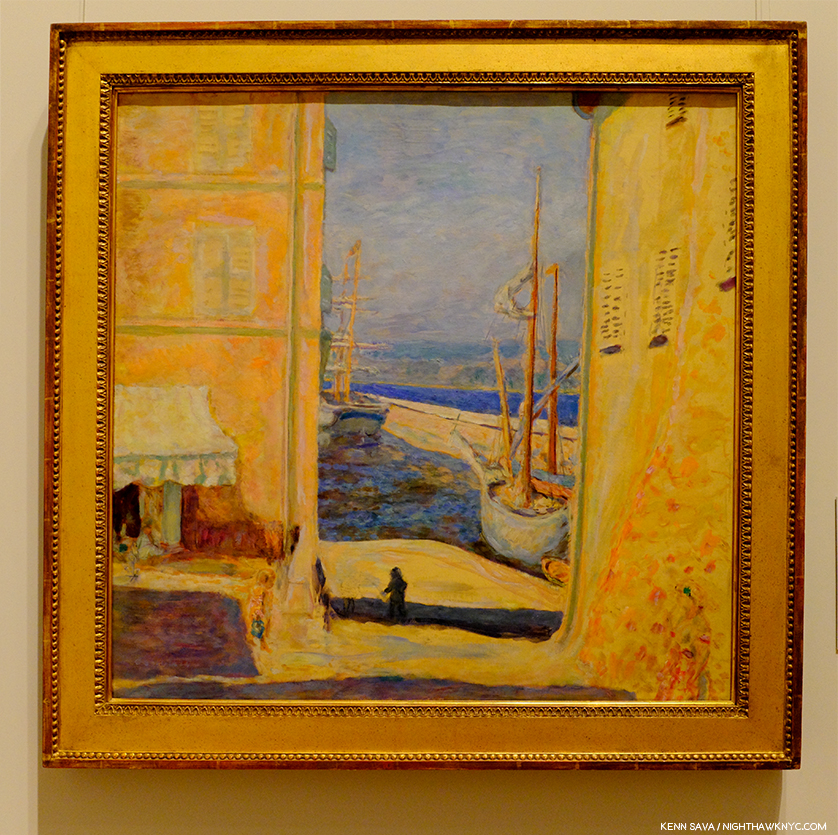
Kenn Sava- Oh, you did? Thank you very much. It’s interesting…I notice there’s a couple of things you seem to have in common with Saul. Early on, his father, also, was adamantly against his becoming a Photographer, and eventually disinherited him. He was also really loved Pierre Bonnard, as I mentioned. I note that you are as well. Saul who was known for his color work, did most of his intimate work in black & white, as you have.

Pierre Bonnard, View of the Old Port, Saint-Tropez, 1911, oil on canvas, seen at The Met.

Pierre Bonnard is not somebody who comes up all that often, I’ve had him come up twice with such great Photographers recently. What is it about Bonnard that particularly speaks to you?

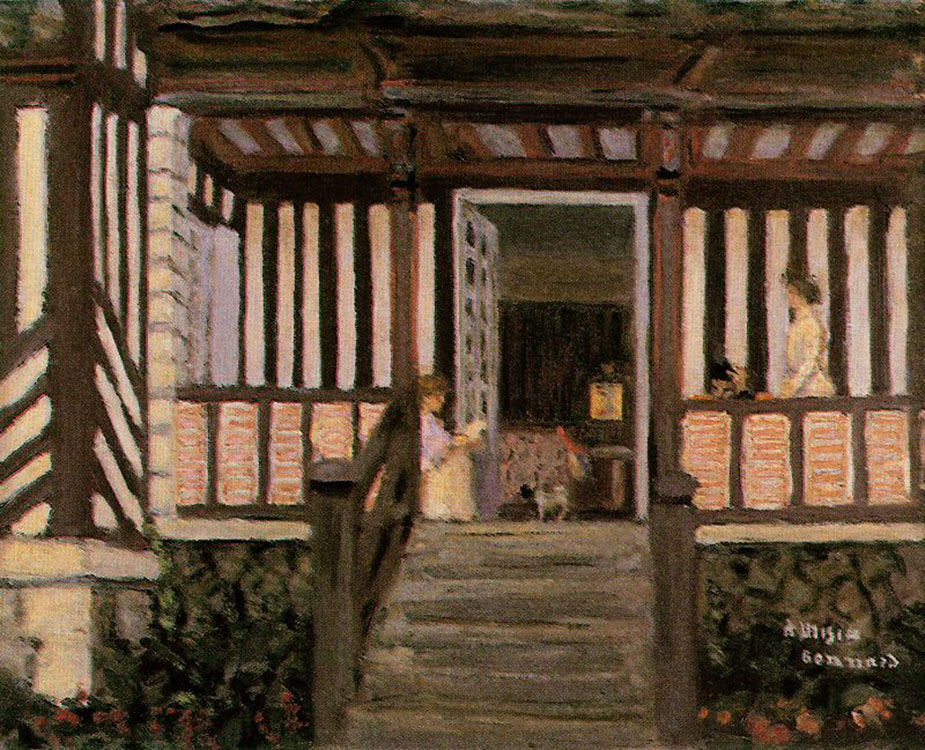
Pierre Bonnard, The House of Misia Sert, 1906, Oil on canvas.

HG- It’s extremely sensual, you know. It’s amazing. His cropping is really amazing. I really like so much the feeling he has towards his life, and his wife. It’s quite amazing.

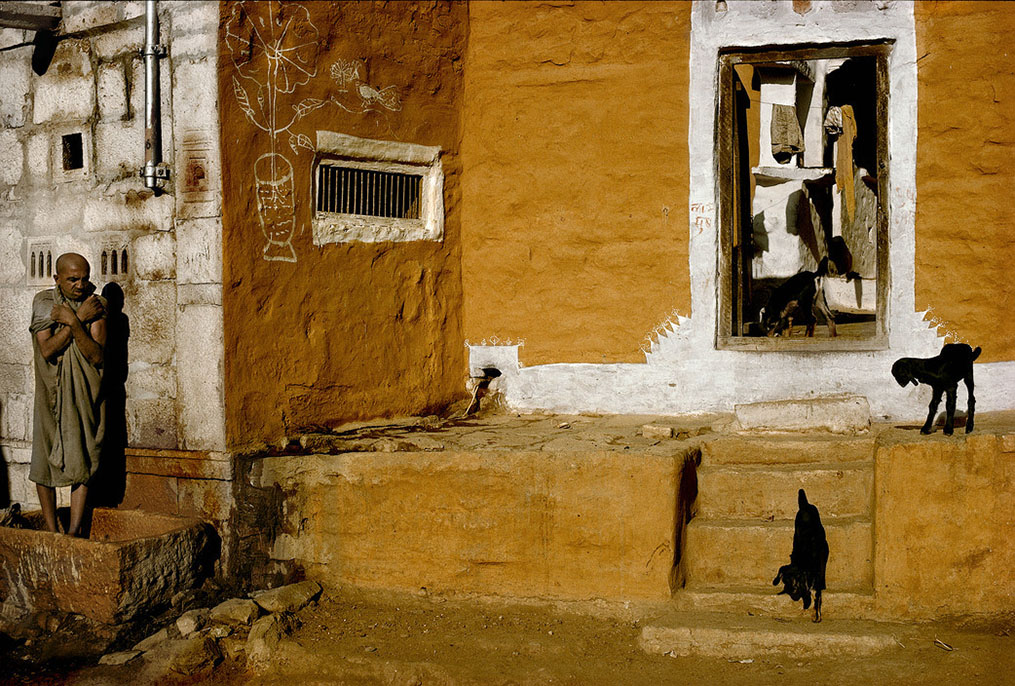
Town of Jaisalmer, State of Rajasthan, India, 1976. Photo by Harry Gruyaert/Magnum Photos. I couldn’t resist pairing this with Bonnard’s House above, without any input from Mr. Gruyaert. The more I look at them, the more I find coincidentally in common. Down to the animals just inside each door.

A funny thing about Saul Leiter. When I arrived in Paris in April, 1962, I went to Elle Magazine, which is a fashion magazine, and I showed my work to the art director, Peter Knapp, and he said, “Oh, you are the little Saul Leiter. “ I had no idea who Saul Leiter was. It took me 40 years to realize who was Saul Leiter, and strangely enough in the last Paris Photo, my work was hanging next to his in the booth of Gallery Fifty One, run by Roger Szmulewicz, and  believe it or not, who walks by as I was standing in the booth ? Peter Knapp ! It’s amazing. So I asked him, “Why did you tell me that all those years ago?” He said, “It’s because of the way you work with color, obviously.” I really find it exciting  when things like that happen. 

KS- So, his work had no influence on you. You weren’t aware of it.

HG- No. No. I found out much later when his first Steidl book came out and when I saw his show at the Foundation Cartier-Bresson in Paris, which was only a couple of years ago.

KS- This has been a big year for you with the FOMU Retrospective, the Documentary Harry Gruyaert Photographer, and now the Gallery Fifty One show, Roots, I wanted to congratulate you on all of that.

Harry Gruyaert, in the red slacks facing the camera, at the opening for his new show, Harry Gruyaert: Roots, September 8th. Photo by Gallery Fifty One..

HG- Thank you. 

KS- I came across your work in the Magnum Square Print sale and realized I hadn’t done a deep dive into your career. Part of the reason is there aren’t a lot of books of your work in print here. The Retrospective, with the red cover, and East/West being two. It seems that you’re slowly reissuing your books, right?

HG- Sure. You know I accumulated so much work. And the good thing about making books now, is that you have much more control than before. The quality of printing is much better and my new books look better than the ones I published before.

Moscow, Russia, USSR, 1989. From East in the 2 volume set, East/West. Photo by Harry Gruyaert/Magnum Photos.

KS- East/West is a fascinating book in that regard. I’m interested in why you chose to group the two books together. I know you’ve said many times you’re not a journalist, but looking at this work now from so many years later, it almost has a journalistic feel to it- A commentary about the materialism in America and the fall of the USSR at the time you were taking the pictures. Was that any part of the intention in issuing them together now in a slipcase? 

Freemont Street. Las Vegas, Nevada, USA, 1982. From West in East/West. Photo by Harry Gruyaert/Magnum Photos.

HG- Yes, that was part of the idea of publishing these two series of pictures together. Don’t forget, I’m a documentary Photographer, and in that sense I feel quite close to somebody like Cartier Bresson whose work is always about a particular place at a particular time. We have both travelled a lot and taken pictures in many different countries and share that same openness to different world and different cultures. Though I am a great admirer of american photographers, I sometimes feel that the work they have done in the states is more interesting than their work in other countries. I don’t know why that is. 

KS- You were involved with Henri Cartier-Bresson and I read the story of him asking you to color his prints. For everyone who wasn’t able to know him, what would you like them to know about him? Is there any one thing that particularly stands out?

Henri Cartier-Bresson, Hyeres, France, 1932

HG- (Laughs)…Oh boy. I was very lucky to have known him. He was very provocative. He was full of energy. Very provocative, and at the same time, he wanted to be a zen buddhist. (Laughs) Very interesting person. Complex. It’s such a lesson that he gave up Photography and went back to his old passion, Painting and Drawing, when he felt he had nothing more to say through photography. It was not on the level of what he did before, but it’s such a lesson. Then, he’d come and ask you, “What do you think of my Painting or Drawing?” He started all over again, questionning himself instead of relying on his reputation.

Shaded streets of the medina (old district), Near “Jemma el Fna” square, Marrakech, Morocco, 1986. Photo by Harry Gruyaert/Magnum Photos.

KS- That’s quite a compliment to you that he’d ask you to Paint his prints. 

HG- It all started when he came to see my first show about Morocco at the Delpire Galerie in Paris. My C. prints were far from perfect and he started making comments. He took bits of paper or little objects and put them on my prints to explain to me what he meant.Amazing. Then he sent me his book about Andre Lhote, who was his teacher in Painting and  called me up two weeks later, and said «  I have a suggestion to make.I will send a couple of my prints and I will send you a big box of pastels and you can try and color them.” I said, “Henri, it’s nice to think about it, but I’m not a Painter. I can’t even make a drawing.”

He had a problem with color photography. He felt it was only used for commercial reasons and was not really interested. And I think he really didn’t like the fact that many Magnum Photographers moved to color because that’s what magazines were asking for when they were better doing black & white. But some became very good magazine photographers and were very successful. 

In 2017, 174 Harry Gruyaert Photographs were on view in 11 stations of the Paris Metro at the invitation of RATP, the Paris public transport operator. Seen here are two images from his beach series, “Rivages,” (shores, or “Edges” as it’s called here), images that speak of the insignificance of man in the scope of nature, the Artist has said, while at the same time, showing a sense of humor, particularly on the left. Seen here in a still from the Harry Gruyaert Photographer Documentary.

KS- Was there a single moment or an event that got you first interested in Photography?

HG-Different things…I wanted to travel. I went to an exhibition in ’58 at the World’s Fair in Brussels. I saw the different pavilions : America, Russia, Japan, India… I was looking at the globe which I had at home. And I thought, I want to go to all these places. And I was also interested in fashion. I loved  Fashion magazines which were much better at the time, like Harper’s Bazar and Vogue, and photographers like Avedon and Irving Penn. And there were all these beautiful girls…

KS- So, it came out of your desire to travel.

Still from Harry Gruyaert Photographer.

HG- To travel, to discover things…I was always interested in Paintings. I always went to Museums. 

I never even thought about doing anything else. I was Director of Photography for a couple of television Film. I had a big admiration for the directors of photography who worked with  Italians film directors like Antonioni, I through they were really fantastic. I could have made a profession out of that, but I wanted to do my own stuff, my own Films and it meant working with a large crew of people and you needed a lot of money. The good thing about photography is that you can work on your own. If the digital small cameras of the quality we have now had existed at the time, things might have been different.

KS- When I look at your work I see elements of both- they seem like stills from a movie but then when it comes to printing, it’s some of the same techniques that come to bear that Painters would use, so you’ve almost married the two. Do you see it that way at all?

HG- Yeah, sure. The funny thing is that the directors I know in Paris, I’m friendly with some of them, have told me they’ve been inspired by some of my photographs…So it’s wonderful that it works both ways. 

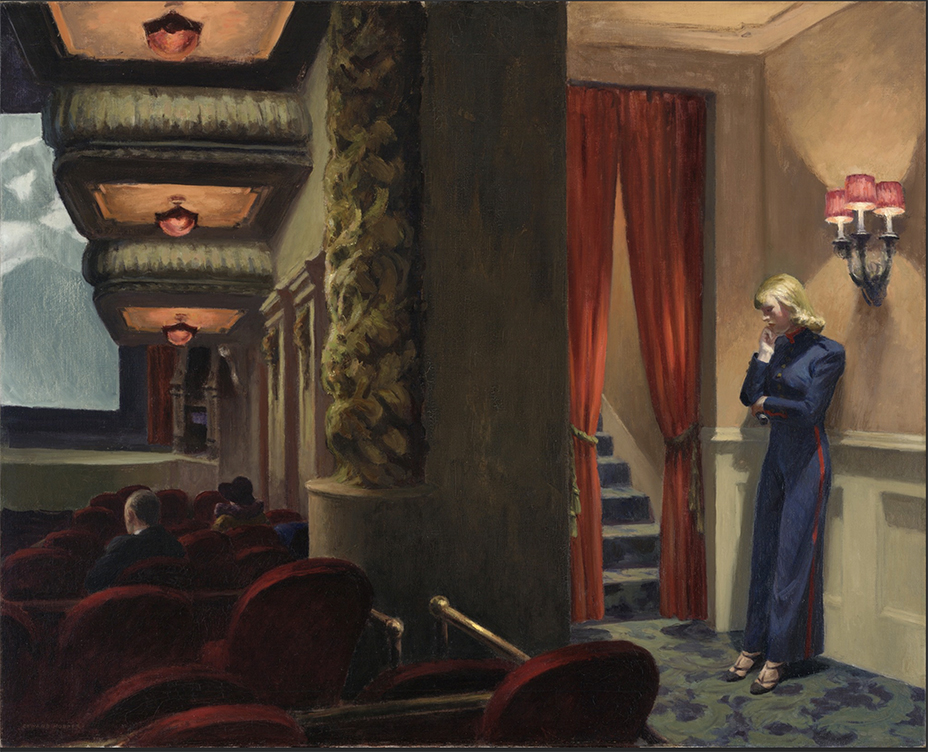
Edward Hopper, New York Movie, 1939, Oil on canvas.

KS- I’ve read a couple of your interviews over time talking about Edward Hopper. I think in one interview you said you didn’t really look at his work early on, but you can kind of see what people say when they talk about the similarities in the loneliness and isolation in your work. Since it didn’t come from Hopper, that sense that is in some of your work, where do you think that came from? Those isolated figures, that sense of loneliness and isolation that occurs in your work? 

Trans-Europe-Express, 1981. Belgium. Photo by Harry Gruyaert/Magnum Photos.

HG- I don’t really know. It’s not the person that interests me most. It’s the person in its environment. To me, all the elements are important. I don’t have any particular intention. It’s just what I see.

Bay of the Somme River in the town of Fort Mahon, Picardie, France, 1991. Photo by Harry Gruyaert/Magnum Photos.

I think humans have such a great idea about ourselves but nature is so much more powerful.

The Flemish House, by George Simenon. Cover Photo by Harry Gruyaert/Magnum Photos.

Talking about loneliness in the city…A funny thing that came up. Do you know (Georges) Simenon, the Belgian Writer of detective stories ? Inspector Maigret is the name of the detective. They translated them into english and they had trouble finding covers for them. Peter Galassi said to them, “Look at Harry’s work. I think you can find something there.” So, the guy from the publishing company sent me some lay-outs and I didn’t think it could work because the cover is vertical and 90% of my work is horizontal. But, the way he cropped it, it was really quite interesting and I asked him to print the full frame image on the back cover. 

The full frame source Photo for the cover. Bar, Antwerp, Belgium. Photo by Harry Gruyaert/Magnum Photos.

Then, Penguin Books in London picked it up. Believe it or not, we’ve done 65 covers.

KS- You’ve done 65 covers for them?

HG- Yes. Just from my archive. My archives are not only Magnum, only a small percentage is Magnum. So, she comes to Paris and looks through mainly my old work. When I did my show at FOMU at Antwerp, there was a big wall with all the covers of the books and small pictures of the full frame.

The strange thing is Simenon is Belgian. He’s from Liege. I’m from Antwerp. I met his son and he showed me some Photographs that Simenon did himself, and you find this kind of thing of a small figure in an urban landscape. With a certain lonelieness. Which you find often in my work. It’s really quite funny.

KS- You’ve spoken about a number of the places you’ve worked- Moscow, Belgium, California & the American West. How do you feel about New York?

It’s a small world. New York City. USA, 1996. The 23rd Street Subway station, across from the Met Life Building. It’s immediately recognizable to me because it’s in my neighborhood. Photo by Harry Gruyaert/Magnum Photos.
HG- Extremely exciting. I’ve done lots of work in New York. The first time I came to New York was in ’68. I was friends with people like Gordon Matta-Clark. All those Artists were important to me, in terms of the energy, in terms of what they were doing. 

National Road 1,near Mechelen, Antwerp Province, Belgium, 1988

Pop Art taught me to look at a certain banality with interest, a visual interest and a certain sense of humor.That changed the nature of the work I was doing in Belgium at the time.  In the beginning it was only in black & white. For two years, I didn’t see any color there. But Pop Art taught me to look at things in a different way and then I started to work in color.

So for two years there I only shot black & white.

Near Bruges, Belgium, 1975. Photo by Harry Gruyaert/Magnum Photos.

KS- I don’t really consider Robert Rauschenberg a Pop Artist but he was obviously very important at that time, and since. Has he had any influence on you at all?

Robert Rauschenberg, Black Market, 1961, seen at MoMA’s Robert Rauschenberg: Among Friends show, 2017.

HG- Oh, I love his work. I mean the personality… the openness, trying other things. There’s more sensuality in Rauschenberg. It’s more fun as well. 

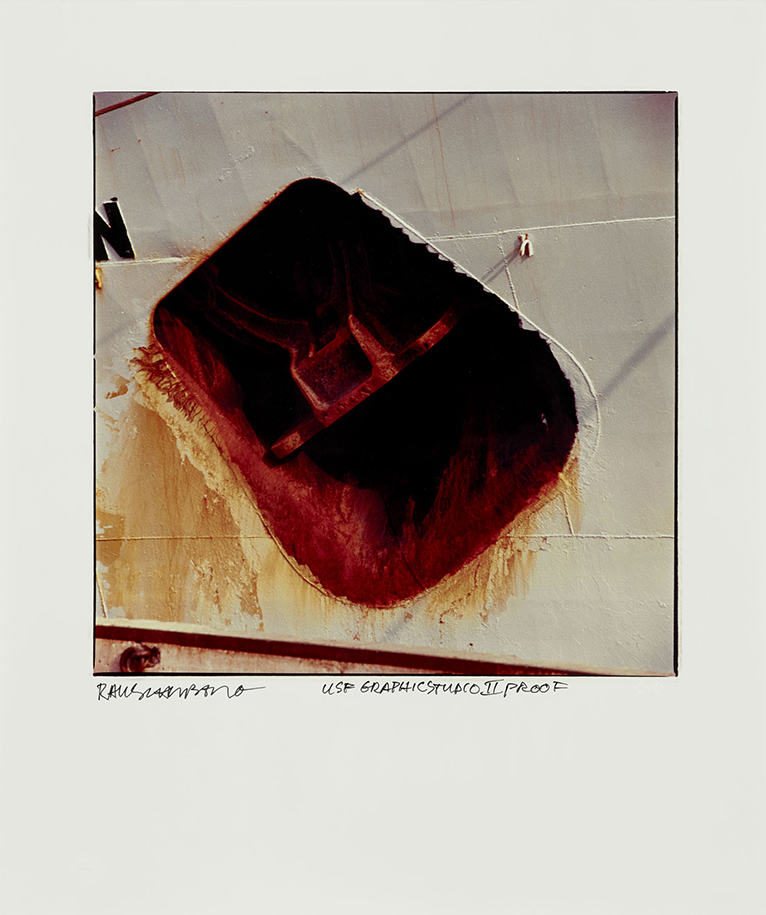
KS- In looking at someone like Robert Rauschenberg, and there’s others, too, who were Painters, but also were Photographers, it seems to me that their Photography doesn’t get any attention at all. Have you seen Rauschenberg’s Photography, and if so, what do you think of it?

Robert Rauschenberg, Anchor, from Studies for Chinese Summerhall, China, 1983. Photo by Graphicstudio, USF.

HG- Oh, sure. It’s interesting. Sometimes it takes time to discover things. So many Photographers are being discovered…look at Saul Leiter.

Excerpts from T.V. Shots, Photos taken between 1969 and the early 1970s. From the publisher- “Gruyaert’s break from television wasn’t all peaceful, though: his first serious body of work contained photographs of distorted TV images. By following events such as the 1972 Munich Olympics from home, he created a distressed parody of the current-affairs photo-story. The work caused controversy, both for its disrespectful assault on the culture of television and for its radical challenge (both formally and in terms of content) to the conventions of press photography. Gruyaert views it as the closest thing to journalistic photography he has ever made.” Photos by Harry Gruyaert/Magnum Photos, as seen in the 2007 Steidl book of the same name.
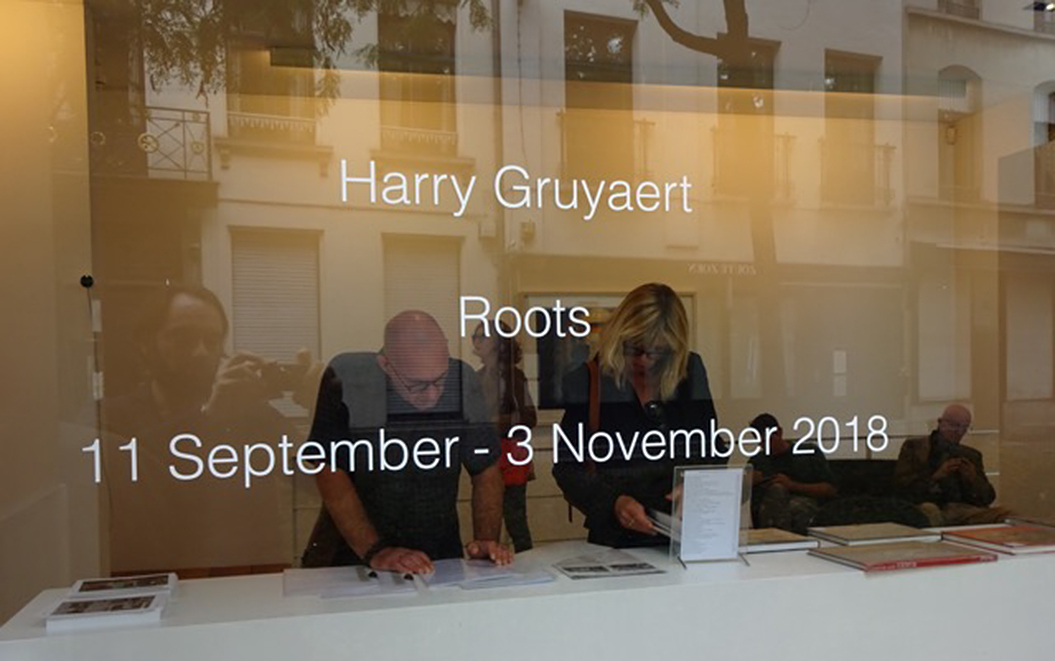
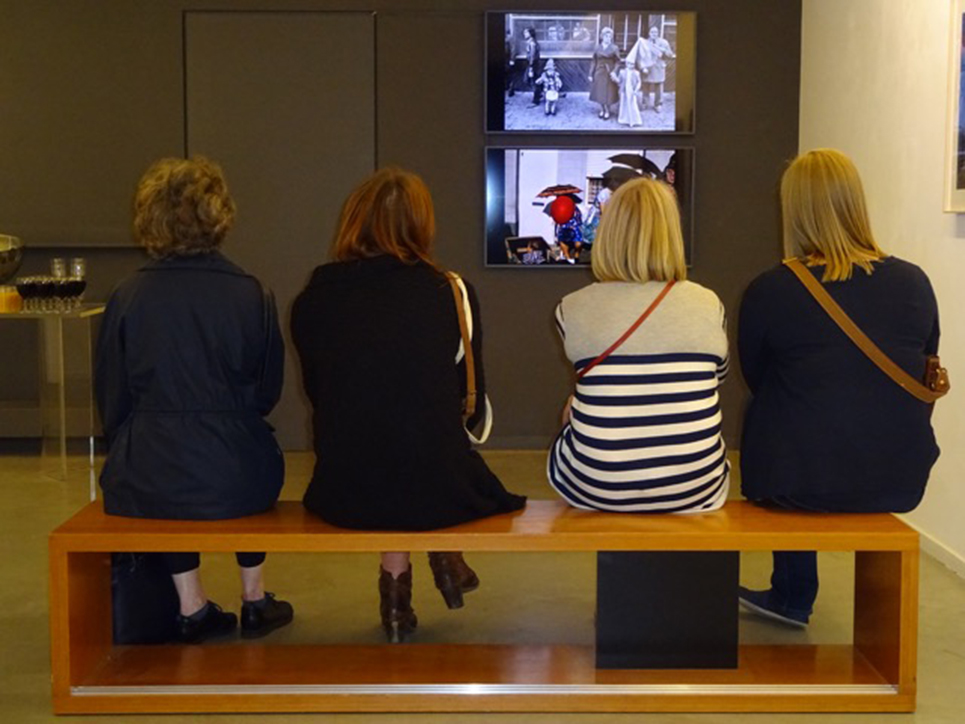
Imitation is the sincerest form of flattery, someone said. This is NOT by Harry Gruyaert. NYC Subway ad for Maniac, September, 2018

KS- Speaking of that…another Photographer who is also a Painter, is William Eggleston. You were able to see the legendary 1976 show at MoMA, Photographs by William Eggleston, and you spoke about being impressed with his dye-transfer prints. I’m wondering- What did you think of his work when you first saw it?

HG- It was amazing to see that, especially the quality of the printing. The first book is one of his best and one of my favorites. 

KS- So you think William Eggleston’s Guide would be among his best work?

HG- Sure. Yes. Definitely. There are other good things too. But the problem now is that publishers want to publish too many books. Some are good, some are not so good. Banality can be interesting, but sometimes, it’s just banal!

KS- In the Gallery Fifty One show you have 41 works in black & white and 19 works in color, though they are large. I notice there seems to be more surrealism in the black & white works, where it’s more subtle in the color work. Does that seem to be the case for you?

Belgium, Hofstade, Carnival (Superimposition), 1975, is included in the Gallery Fifty One show. Photo by Harry Gruyaert/Magnum

HG- Black and white and color are two different approaches. I took pictures of my daughters in black & white because I felt I got closer to them. Shooting in black and white I feel less preoccupied by the way people dress, the background or things that could distract me. I concentrate on the human quality of the person. Color is more complex. With color, the color really has to be the main thing…the most important thing…

A normally very busy street deserted by citizens for the first meal of the day. During the Ramadan. Cairo. Egypt, 1987. Photo by Harry Gruyaert/Magnum Photos.

KS- It’s said that Roots was, at one point, basically a “farewell” to Beligum, after your difficulties with your father…

HG- That was not so much the problem as the lack of a cultural environment.

“Midi” train station district, Brussels, Belgium, 1981, is included in the Gallery Fifty One show. Photo by Harry Gruyaert/Magnum Photos.

KS- But, it seems that you’ve made peace with Belgium. Have you done work in Belgium since Roots? 

HG- I do all the time. At the show I gave Roger (Gallery Fifty One’s Director) about 15 prints I did very recently, to show whoever’s interested that things change. Nothing stays the same. The colors are different now. The mentality’s different. Belgium is more like the rest of Europe, I guess…the same clothing…the same advertisements. It’s actually much more colorful, but in a more capitalistic driven way. It’s more fashionable somehow, and It’s more alike. Before, in Holland and Belgium, which are very near to each other, things were very different in the color aspect and all that. And now, things have become much more the same, like in the States.

KS- So you were saying that some of the American Photographers influenced you more than the Europeans. Who were those American Photographers who influenced you?

HG- (Lee) Friedlander, definitely. (Irving) Penn, (Richard) Avedon. Helen Levitt is wonderful, sure, Bruce Davidson and others…

Stephen Shore, Merced River, Yosemite Park, CA, 1974, Seen at the Stephen Shore Retrospective at MoMA, 2018

When I look at Stephen Shore’s work, I have the feeling that I am traveling with him. It’s really important in Photography to get to the person and have the feeling of being with him. That’s really important. Stephen Shore, but other Photographers as well. It’s physical. It’s the experience they have that appeals to me. It’s a physical thing. That’s why I don’t care much for conceptual work. It comes from the brain. For me, it has to come more from the stomach. It’s physical. It’s experience, which someone has at a given time, and through the experience I get contact with the person who did it.

A visitor spends quality time with Rembrandt(s). At The Met, February, 2015.

To me, Art is…When I look at Rembrandt, I’m with Rembrandt. When I look at Bonnard, I’m with Bonnard. When I look at conceptual work, I’m with the brain of somebody. If they have to write a lot of stuff before we’re able to understand what it’s all about, I’m not interested in the exhibition. I have to first look at the work and it should mean something. It has to appeal to me visually. 

KS- Have there been any Directors or Painters that have spoken to you more recently?  Anyone that’s come along since Antonioni, Magritte? Anything that’s more contemporary? Anything that you’ve really been impressed with?

HG- Recently? I’m a movie fan. I go to movies all the time. In the past I went to the cinema every day. I learned more from movies than anywhere else…movies and paintings…

About Antonioni. What’s really interesting…In 2009, 10 Magnum Photographers had a show at the Cinematheque Francaise in Paris, exploring  the relationship between still Photography and Film. My part was to show how much I was inspired by Film, and mainly, by Antonioni. So, I did a projection, which lasts about 25 minutes, with extracts of his movies – l’Avventura, The Eclipse and the Red Desert –  and some of my Photographs next to them.

Province de Brabant, Belgium, 1981. One of my personal favorite Harry Gruyaert Photos reminds me of the scene in Antonioni’s La Notte when Jeanne Moreau sits in the car in the rain. Photo by Harry Gruyaert/Magnum Photos.

There are three Antonioni Films I was limited to1. So, I was able to use certain things. …. But, when they saw the thing produced, the review were very happy about it.

KS- I would love to see that. You have a new book, Rivages about to come out, (to be released in the USA as Edges later this year). I’ve read that you’ve been enjoying using today’s technology to make better prints. Are you also involved with the selecting of the images for the books and the way they are sequenced, or does somebody else do that?

HG- Completely. It’s team work. I’m the first person, obviously. I’ve been working with the same people the past 4 or 5 books. It’s like teamwork. 

The English edition of Rivages (Edges) is coming out at the end of September. The French edition is earlier. I’m very happy with them. The printing and everything. 

KS- So, you’re selecting the images for the books. 

HG- Sure. There’s some discussions, obviously…yeah, teamwork.

KS- Are you working on another version of Morocco?

HG- No plans for the moment, but everything is sold out. 

I want to do a book about street photography in the different cities I’ve been to. You know like New York, Brussels, or whatever And also a book on India and Egypt, a book about my industrial work, about airport, about my daughters… So many things… I also want to redo It’s not about cars, which was first published with  Roger Smulewicz of Gallery 512, but in a larger and more complete version. 

KS- Was Luigi Ghirri an influence?

HG- I discovered him later. I like some of his work…I think lots of his …He’s more of an intellectual. He has a real concept, I think. And I’m kind of… I think more in terms of color and I don’t think that’s his main interest. We have a very different approach

KS- There’s a couple of images that kind of remind me of yours. The shot of Versailles from the distance…

HG- Those are the ones I prefer. 

Still from the Harry Gruyaert Photographer Documentary showing the Artist on the corner of West 42nd Street and 7th Avenue.

KS- What did you think of the final documentary, Harry Gruyert Photographer? Did you have a chance to see it?

HG- Sure.

KS- What was your reaction? Were you pleased with it?

HG- I’m pleased with it. It’s not my Film. Well, it’s the Film of the director. It became very personal. You know, the thing is my father had about 25 hours of family films. The director knew that and he used a lot of that in the Film, comparing what my father did and what I did, and talking about my upbringing, so it became a very family kind of Film, which is fine, I think it’s a bit over done…it’s his Film.

Harry Gruyaert in action in Times Square, NYC. He has spoken about how taking Photos is like a “dance” for him, which is obvious, here, in this shot from the Harry Gruyaert Photographer Documentary website. While other Photographers bring full Hollywood movie making gear to bear in making their Photos look “cinematic.” Mr. Gruyaert does it the old fashioned way, as you can see.

KS- Are there any plans to release it in America? Are we going to get to see it over here?

HG- Who knows. It’s just the beginning. 

Gallery Fifty One, Antwerp, Belgium.

KS- You just returned form Gallery Fifty One and the opening of your show in Antwerp. How did you feel about the show? How did the installation look to you?

HG- We tried something I had never done before. We set two screens, one on top of the other, very close. On one we showed black and white photographs and on the other color photographs.

Installation view of Roots at Gallery Fifty One showing dual video monitors. Photo by Gallery Fifty One.

Sometimes the relationship between them worked, sometimes it did not. But it was an an interesting experience. There’s much more black and white stuff (included in the show) than I have ever showed. The color photographs are the ones published in the new edition of Roots.

The Gruyaert family at dinner in a peaceful moment. Harry’s father, left, worked for the AGFA Film Company. His feelings about his son becoming a Photographer have been written about elsewhere. Still from Harry Gruyaert Photographer.

KS- Did your father ever come to accept you being a Photographer? Did he come to appreciate your work at all?

HG- Oh yes. He became very proud. (laughs) Once I was vice-president of Magnum, that was it for him. I think it was more about my position at Magnum than about my work.. 

KS- No one’s ever mentioned that anywhere. They always talk about how adamant he was against your becoming a Photographer. They never mention that he did finally come to accept it. Unlike Saul Leiter, who’s father disinherited him. So, at least, that’s good to hear.

HG- No, no no. My father was very proud at the end. He was. Whenever he would tell others how great his son was, it was special for him.

Our conversation ended there. A few days later in an email, Harry added this-

“I am just a photographer. If people look at my work and think it’s art, I am happy about it. But it is not for me to decide.”

Count me in that group of “people.”

While the mystery in Harry Gruyaert’s work will enthrall me for years to come, I hope the mystery surrounding his lack of recognition here will be history in the near future. After all, I’d rather leave the mystery writing to Simenon.


BookMarksMorocco is Harry Gruyaert’s most renowned book, winning the 1975 Kodak Prize. As he said, it’s been out of print since the last French edition, Maroc, published by Textuel in 2013. At the moment, two books are in print in the USA, Harry Gruyaert, with a red cover, a retrospective, published by Thames & Hudson in 2015, is likely to remain the most comprehensive overview of his work for the foreseeable future, particularly because, as he said, it has the Artist’s direct involvement.
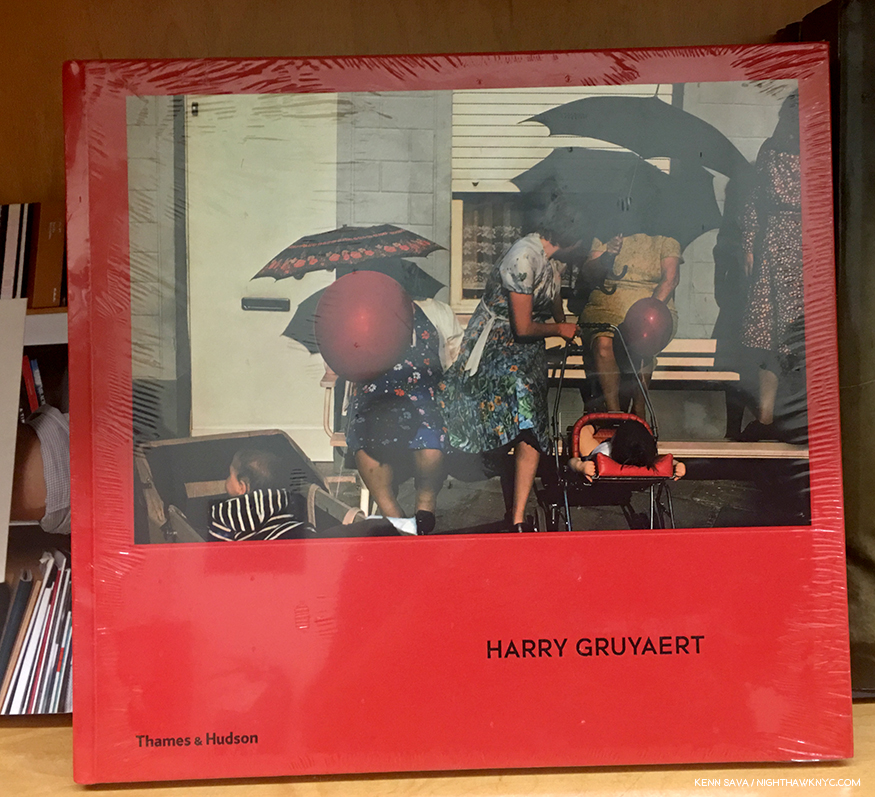
It’s gorgeous, in my view, and the place to start exploring Harry Gruyaert’s work and achievement among books currently in print in the USA.

Harry Gruyaert: East/West, a two volume set in a slipcase, contains East, Photos taken in Moscow near the very end of the USSR in 1989, and West, Photos taken in the American West (including Los Angeles and Las Vegas) in 1981, was published in 2017 by Thames & Hudson. It’s a fascinating look at both places decades ago, and intentionally, or not, provides a powerful visual contrast between capitalism and communism.

East/West

Equally compelling is how much Mr. Gruyaert’s color palette changes between the two bodies of work.

Just released by Editions Xavier Barral this past May (2018) is the new edition of Harry Gruyaert – Roots, a book “about” the Artist’s relationship with his native country, Belgium. It adds over 20 additional Photos to the 2012 edition, which quickly went out of print. As the Artist said in the conversation, he finds today’s printing far superior to what he was able to achieve in the past, making this the edition to get.
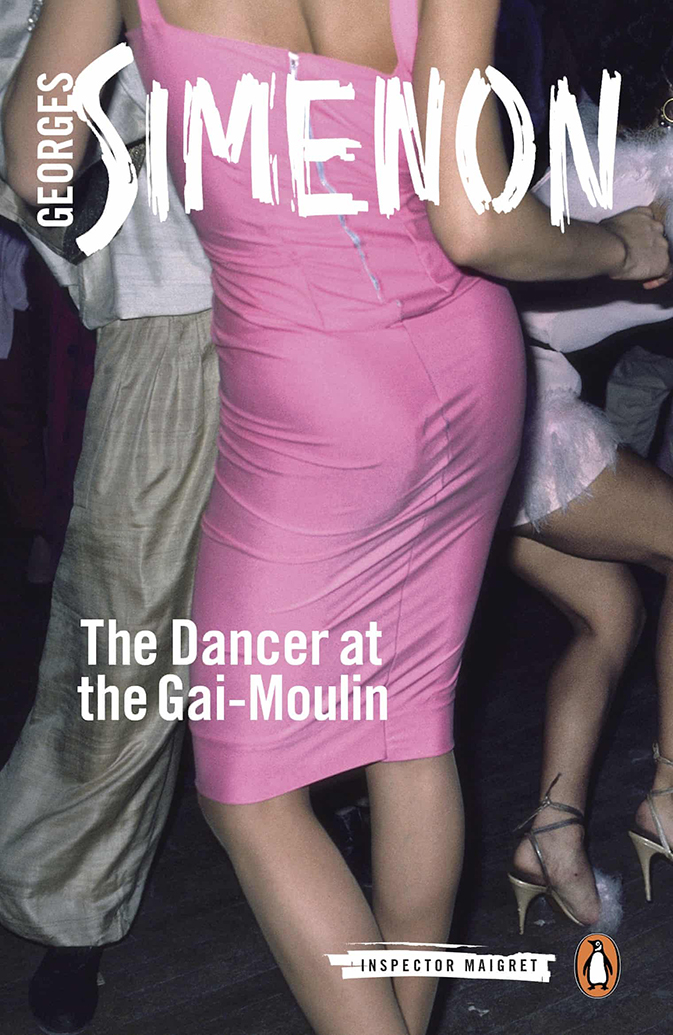
Coming soon will be Edges (or Rivages in French), another new edition of an out of print beautiful collection. In visual poetry, Mr. Gruyaert explores the relationship of man to nature, the land to the sea, and the earth to the sky in 144 pages. Soon to be published by Thames & Hudson.

While I recommend starting with the red Retrospective, all of these books are excellent and recommended.

Cover image cropped from an original by Harry Gruyaert/Magnum Photos.

And, for lovers of detective novels, Harry’s images appear as covers on 65 Simenon novels published by, and available in the USA through, Penguin Books.

*- Soundtrack for this Post is “I Should Watch T.V.” by David Byrne & St. Vincent from “Love This Giant.” Lyrics, here. Video, here-

My thanks to Harry Gruyaert and Gallery Fifty One.

My prior Posts on Photography may be found here.

NighthawkNYC.com has been entirely self-funded and ad-free for over 6 years, during which over 250 full length pieces have been published. If you’ve found it worthwhile, you can donate to keep it going & ad-free below. Thank you!

Written & photographed by Kenn Sava for nighthawknyc.com unless otherwise credited.
To send comments, thoughts, feedback or propositions click here.
Click the white box on the upper right for the archives or to search them.
For “short takes” and additional pictures, follow @nighthawk_nyc on Instagram.

Subscribe to be notified of new Posts below. Your information will be used for no other purpose.


  1. In 2009 the Cinematheque Francaise presented Images to Come, an exhibition exploring Magnum photographer’s take on the relationship between cinema and photograhy. The works are displayed alongside still from L’Avventura, The Eclipse and the Red Desert.
  2. Harry Gruyaert: It’s Not About Cars, published by Gallery Fifty One in 2017.