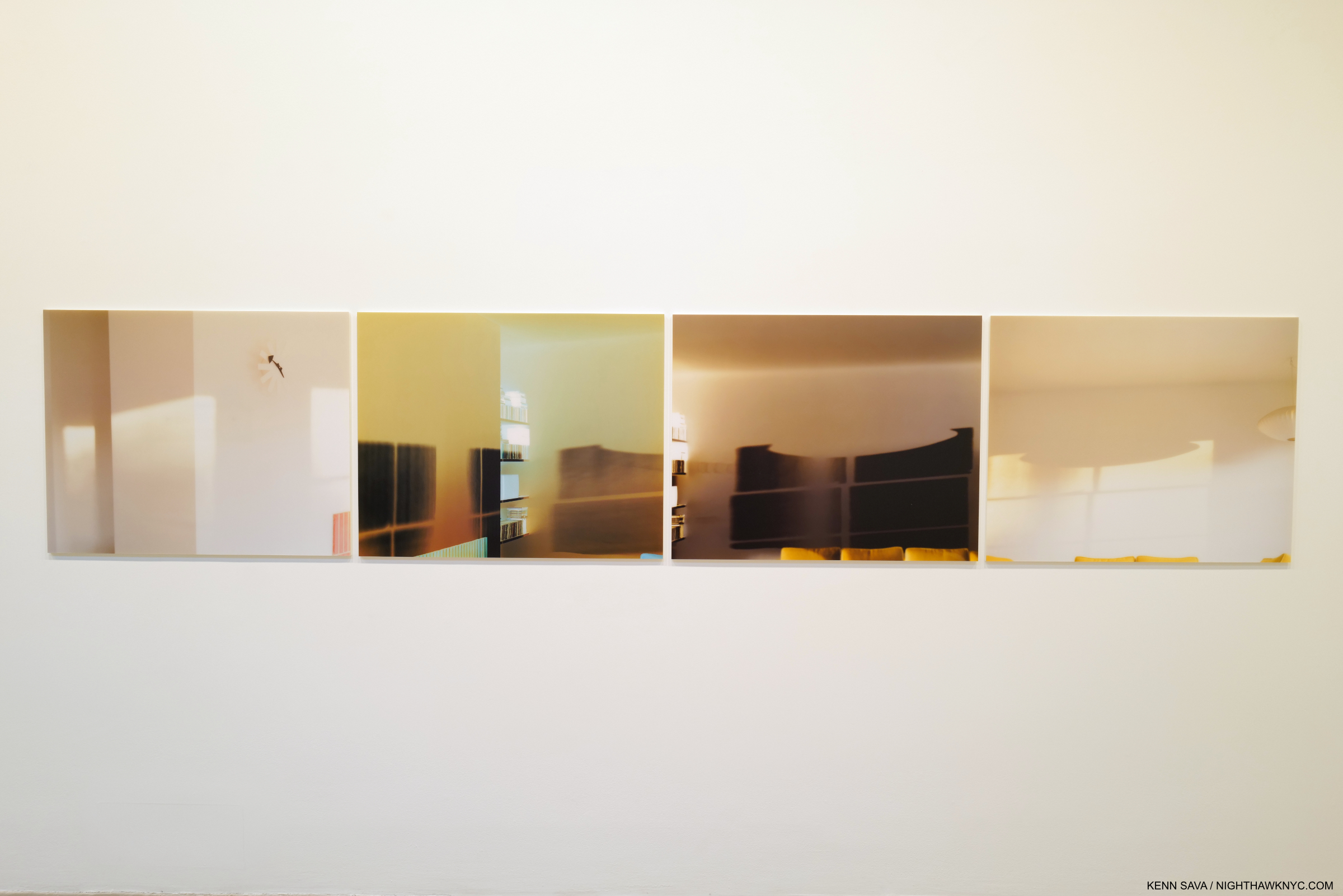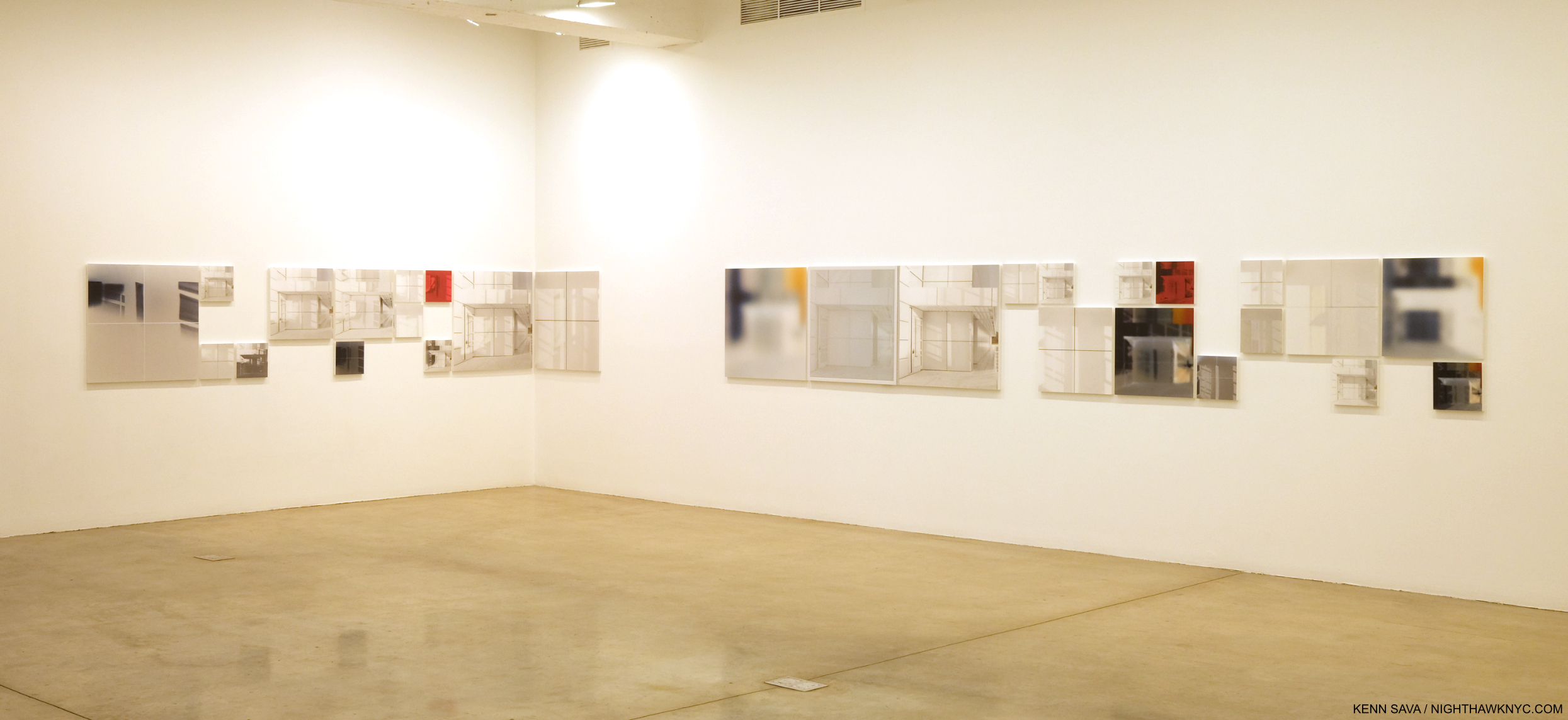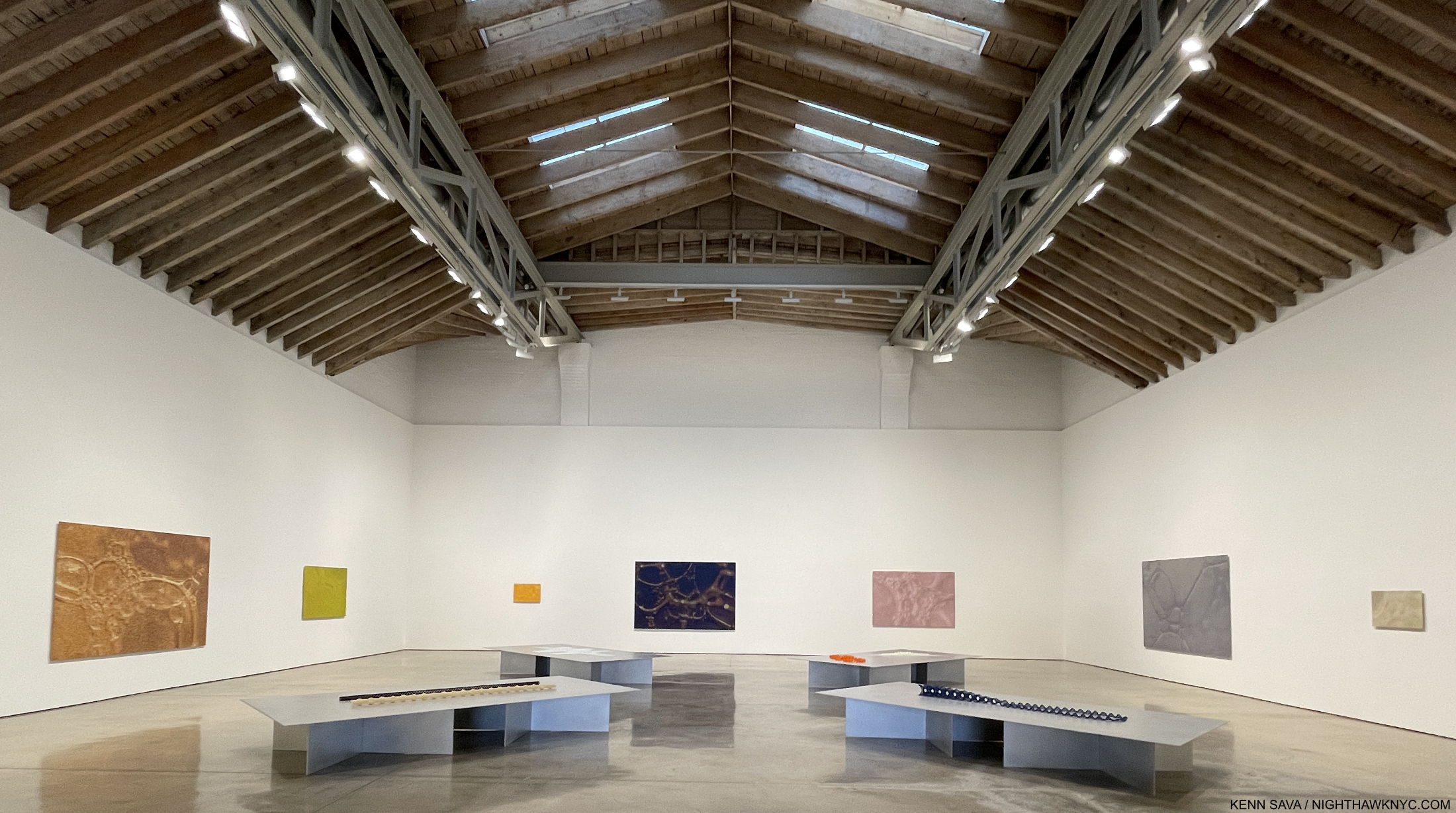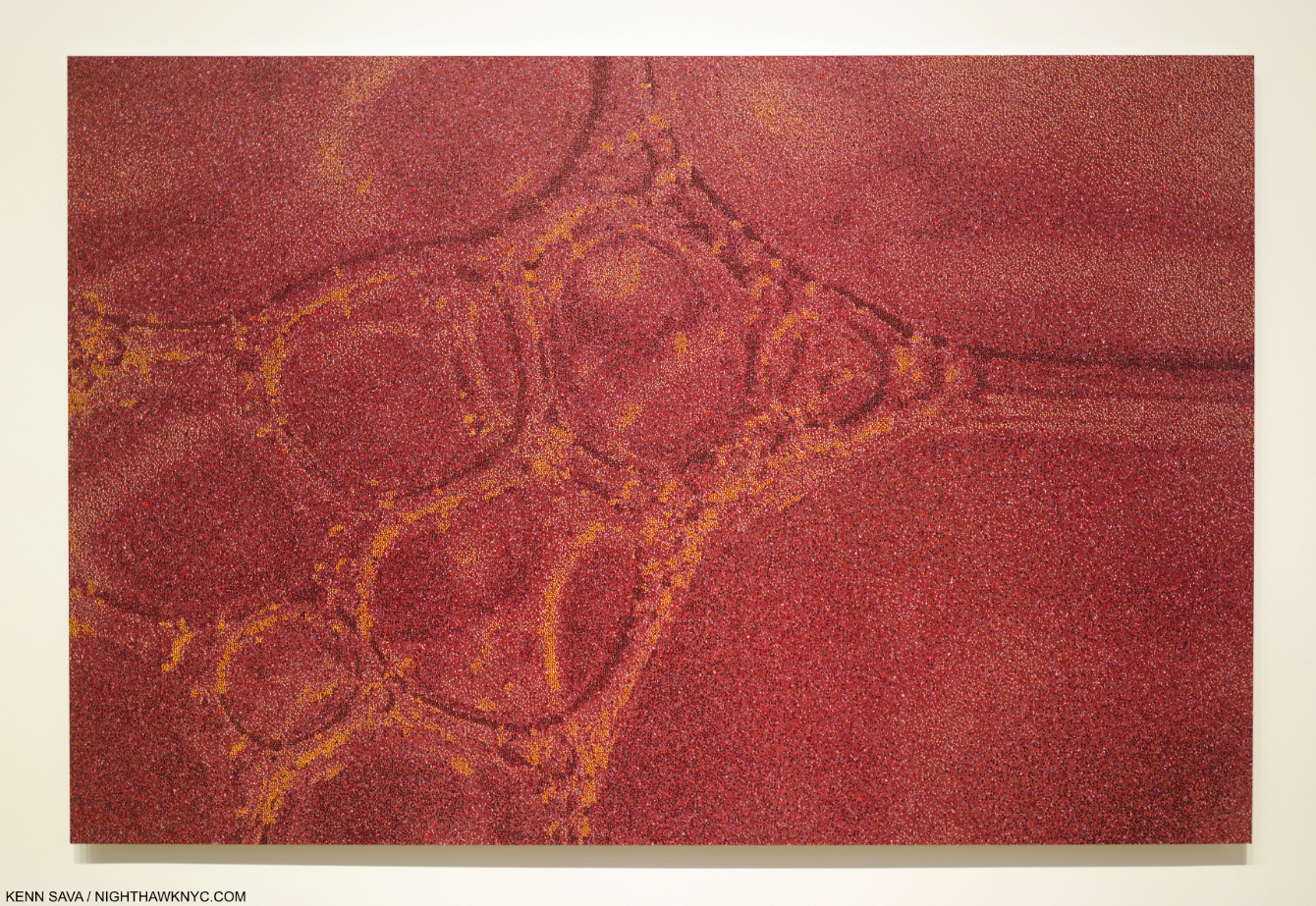
Gregory Halpern In NYC

This site is Free & Ad-Free! If you find this piece worthwhile, please donate via PayPal to support it & independent Art writing. You can also support it by buying Art & books! Details at the end. Thank you.

Written & Photographed by Kenn Sava

Shows seen- Impressions @ Fotografiska, July 20, 2023 and
Immersion: Gregory Halpern, Raymond Meeks and Vasantha Yogananthan @ ICP, through January 8, 2024
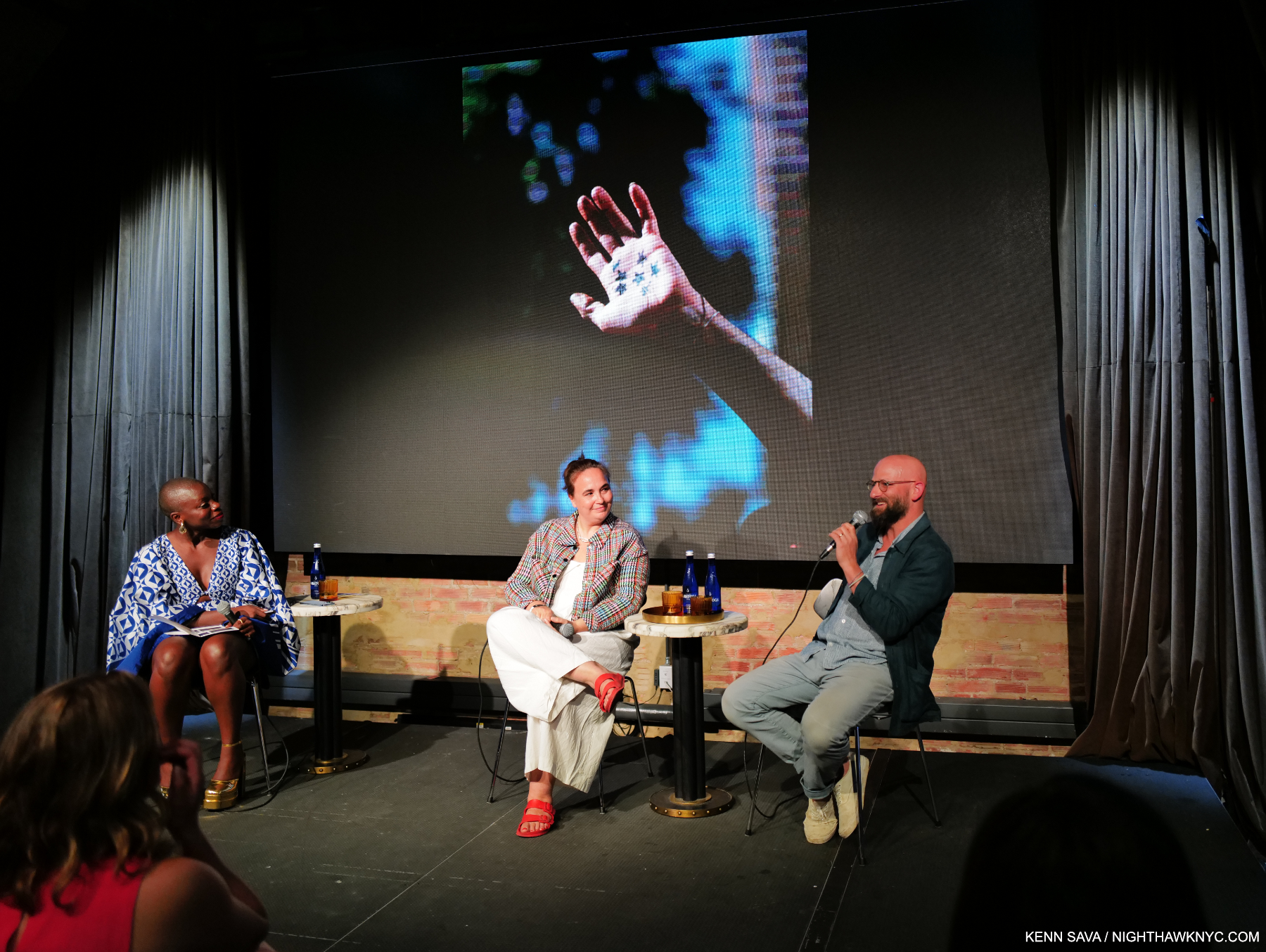
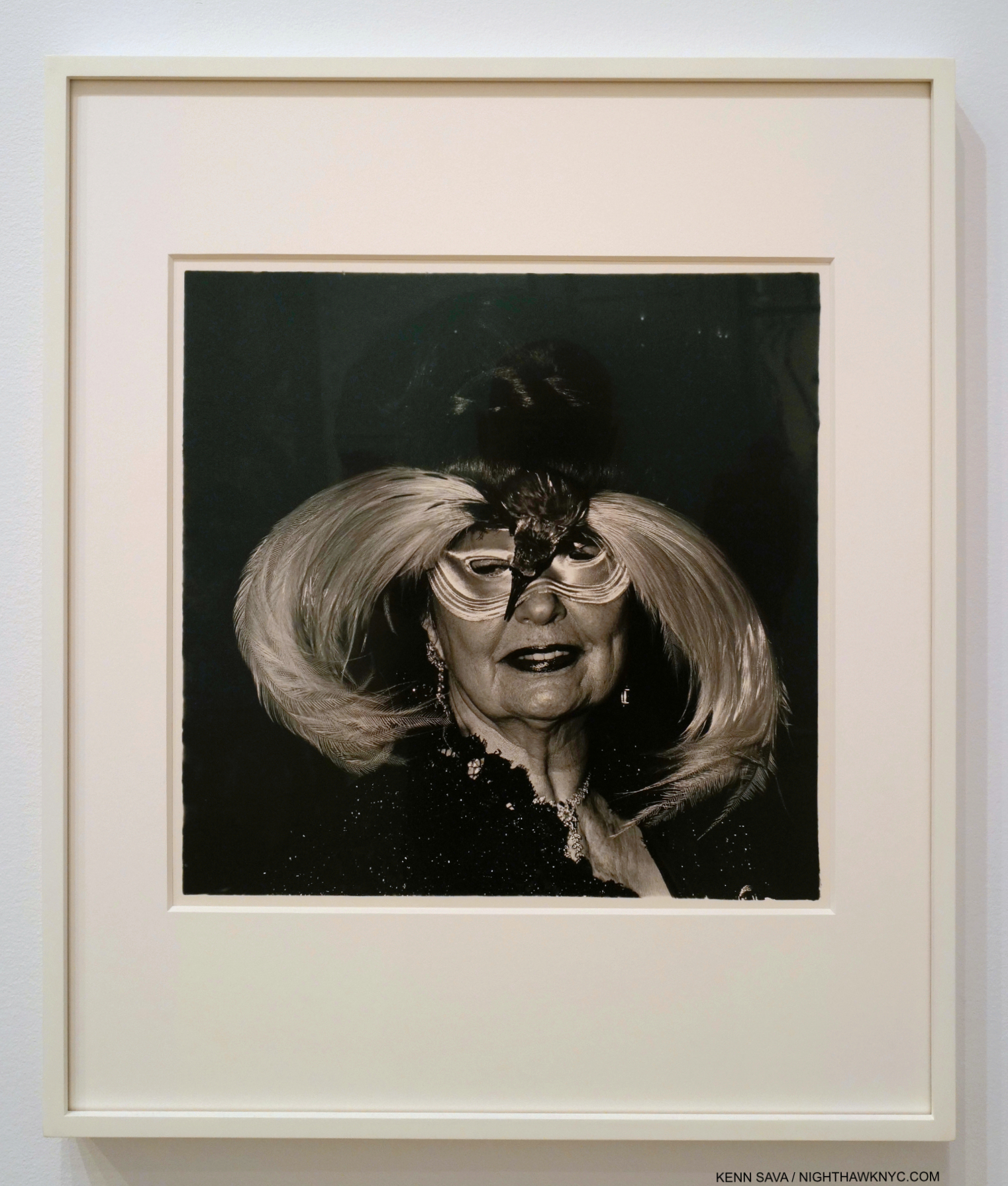
Gregory Halpern, right, giving a brief overview of his career to date as an introduction to his work including this well-known image from his PhotoBook,  ZZYZX, with Magnum Photos President, Photographer, and fellow exhibitor, Cristina de Middel, center, and narrator Jessica Nabongo at Impressions @ Fotografiska, July 20, 2023. Click any image for full size.

Two shows featuring the work of Gregory Halpern provided all-too-rare opportunities to see his work here in what were the NYC debuts of both his newest work, and his most recently published work. While familiar to most from his remarkable series of PhotoBooks this past decade as a “book Artist,” the shows provided the chance to see him as a “wall Artist.” Though neither was a Gregory Halpern solo show, they proved revelatory1.
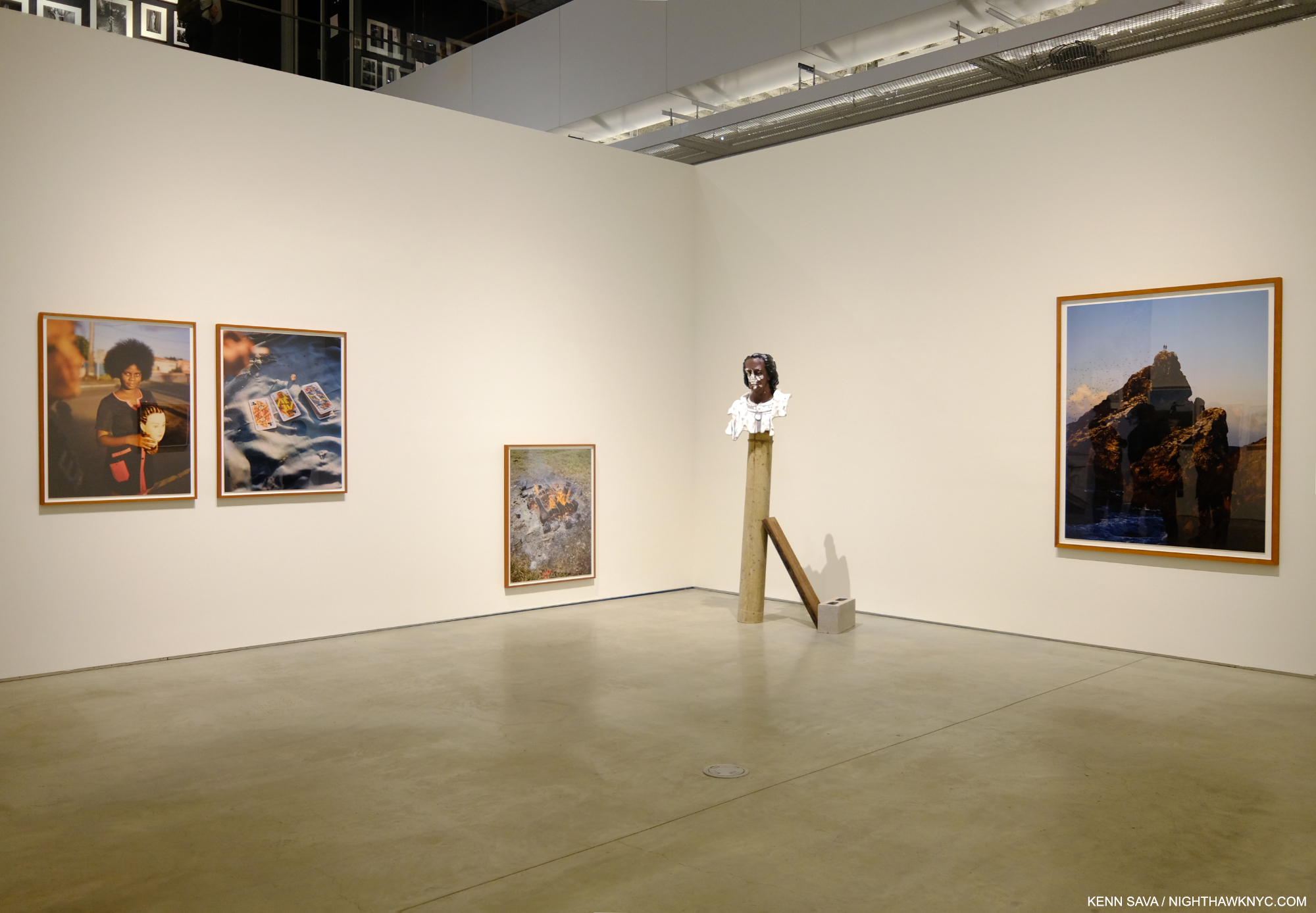
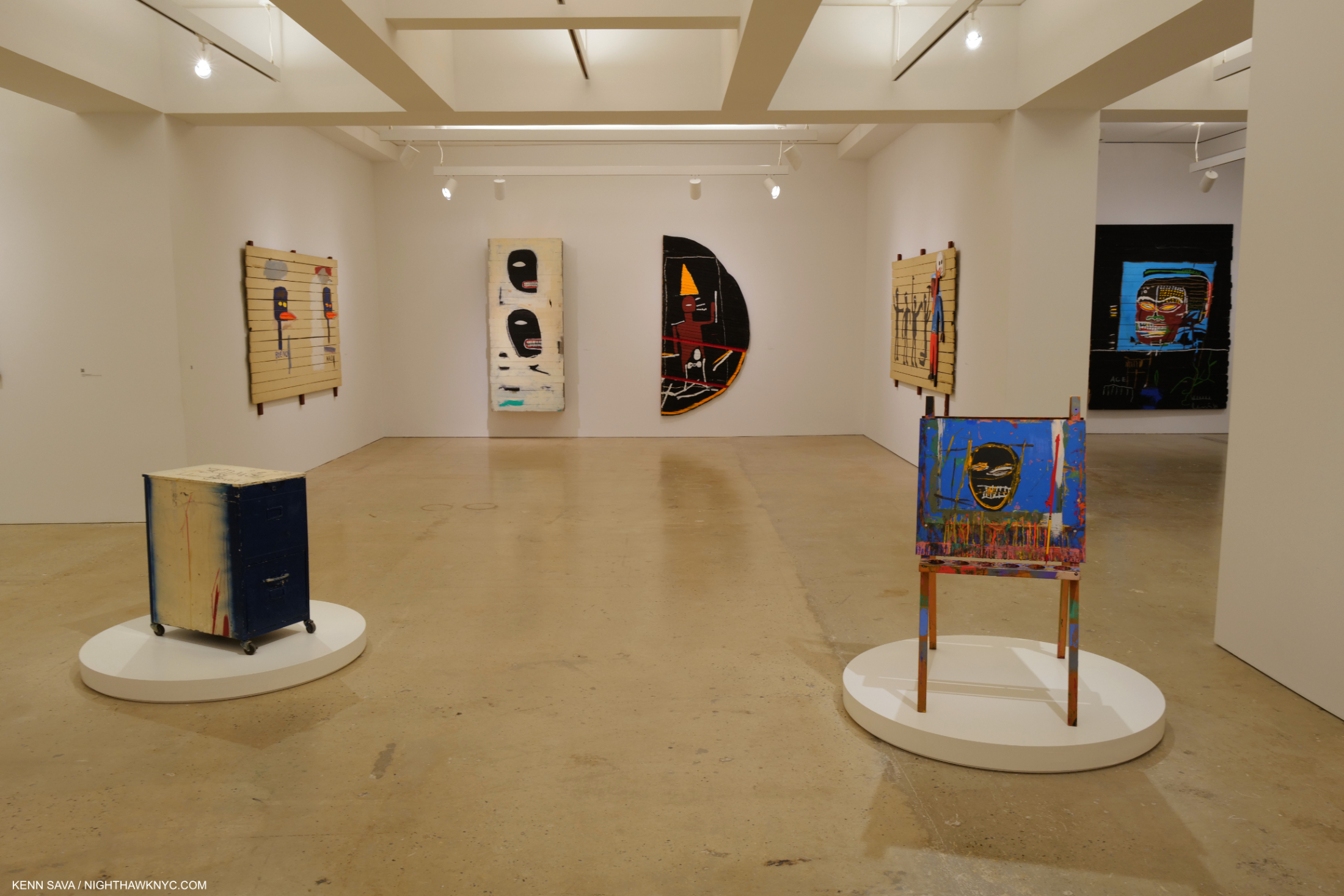
 Immersions installation view

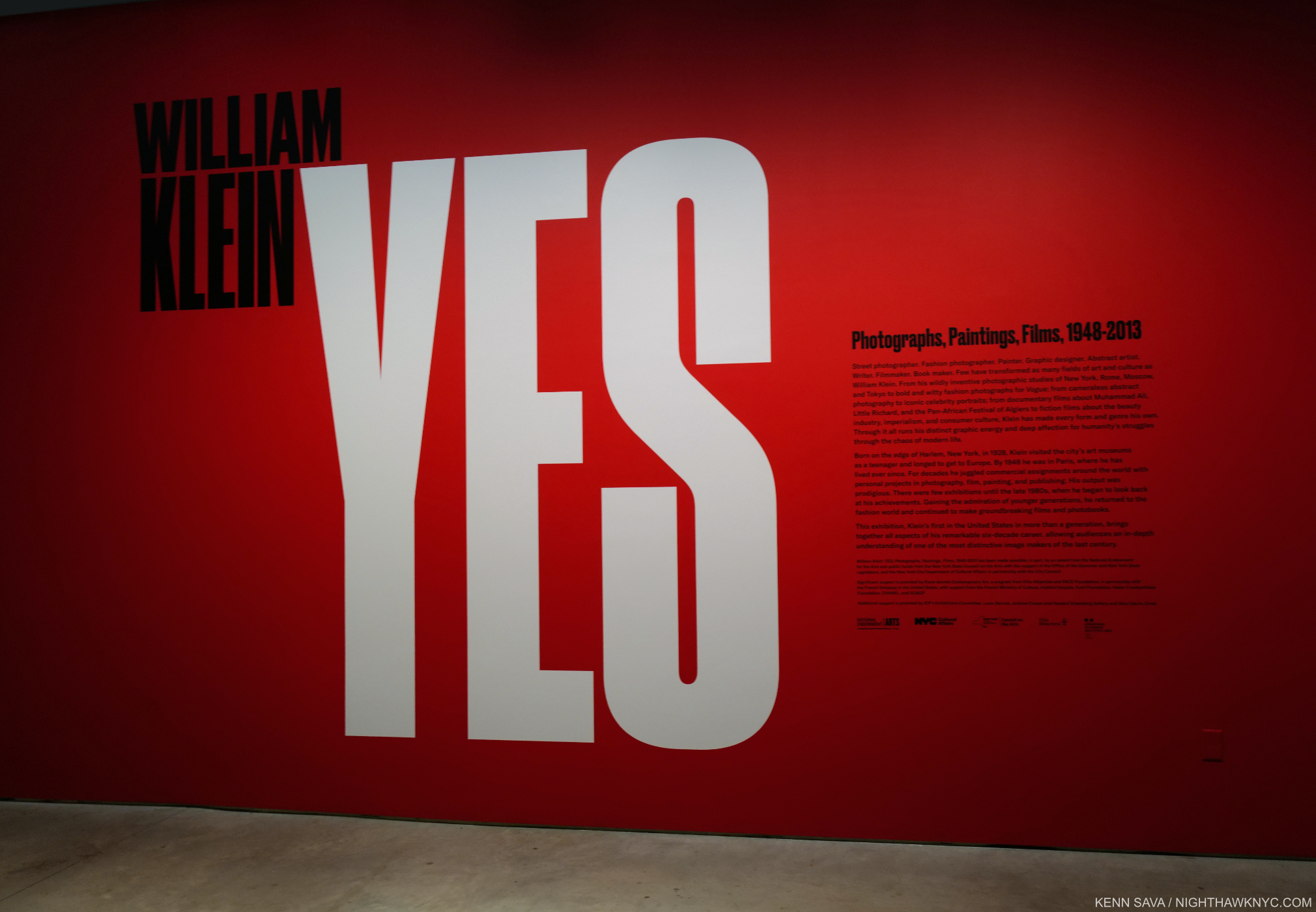
On September 26th, Immersion opened at ICP, where I was last for William Klein: YES. Immersion is the name of a commission program involving an amalgamation of French and American organizations awarding selected Photographers, called laureates, a sponsorship to create a body of work either in France or the US. Gregory Halpern was a laureate in 2018. Raymond Meeks and Vasantha Yogananthan are the other two laureates included in the show. For his part, Mr. Halpern decided to go to Guadeloupe, a former French colony, a daring and somewhat ground-breaking choice (Raymond Meeks chose two regions in France, and Vasantha Yogananthan chose New Orleans).

So, why Guadeloupe?
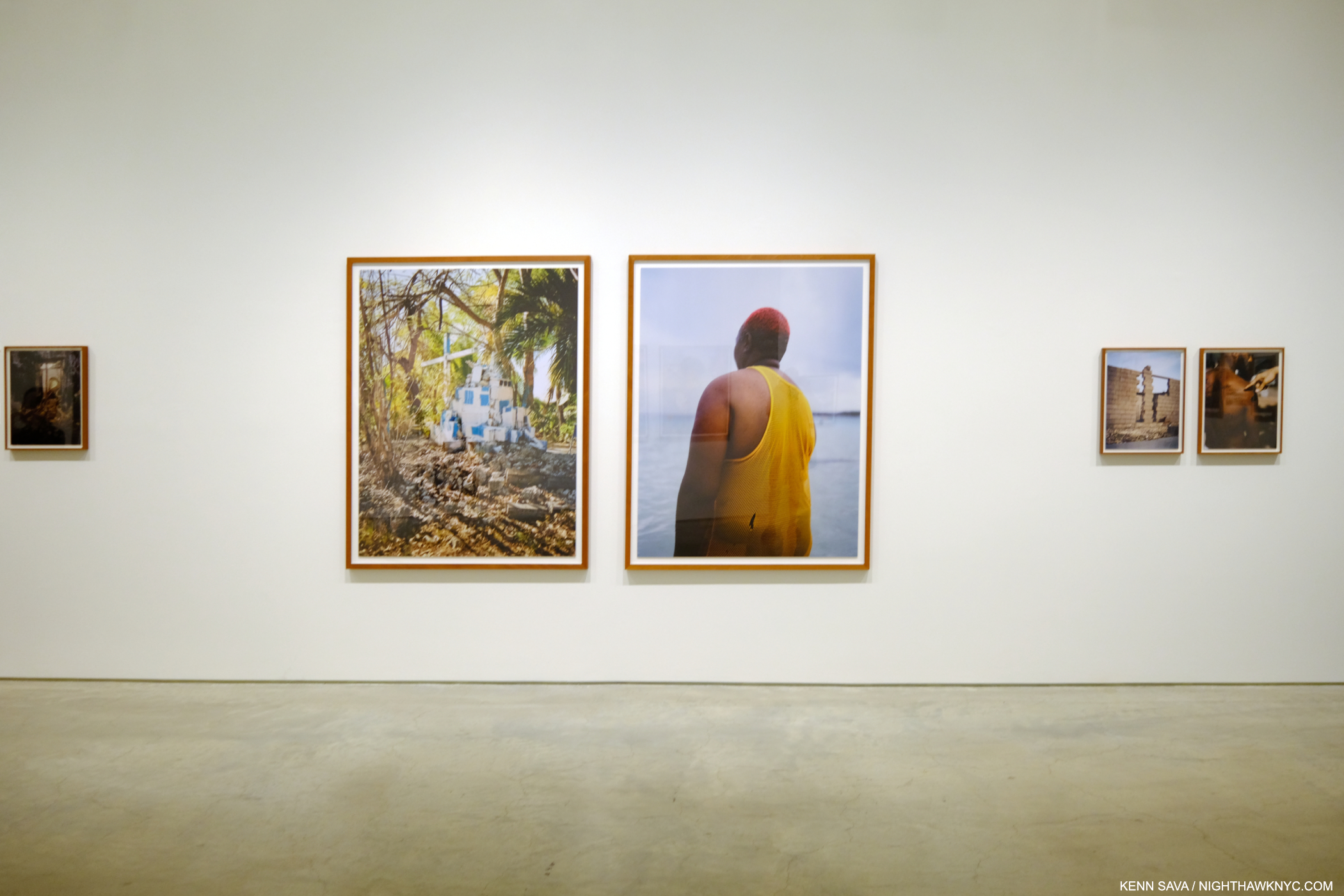
 Immersions installation view.

“I think I knew I would find a certain form of Surrealism there,” Mr. Halpern explained in an interview with Curator Clément Chéroux2.

The stage set, after research and a number of trips to Guadeloupe to take the Photographs, he undertook the rigorous selecting and arranging process he outlined during a talk when I saw him last at The Strand Bookstore in September, 2019. Aperture published the resulting body of work, indeed perhaps his most surreal, in Let the Sun Beheaded Be (a NighthawkNYC Noteworthy PhotoBook of 2020). In Immersion NYC finally gets to see the work as Photographs.
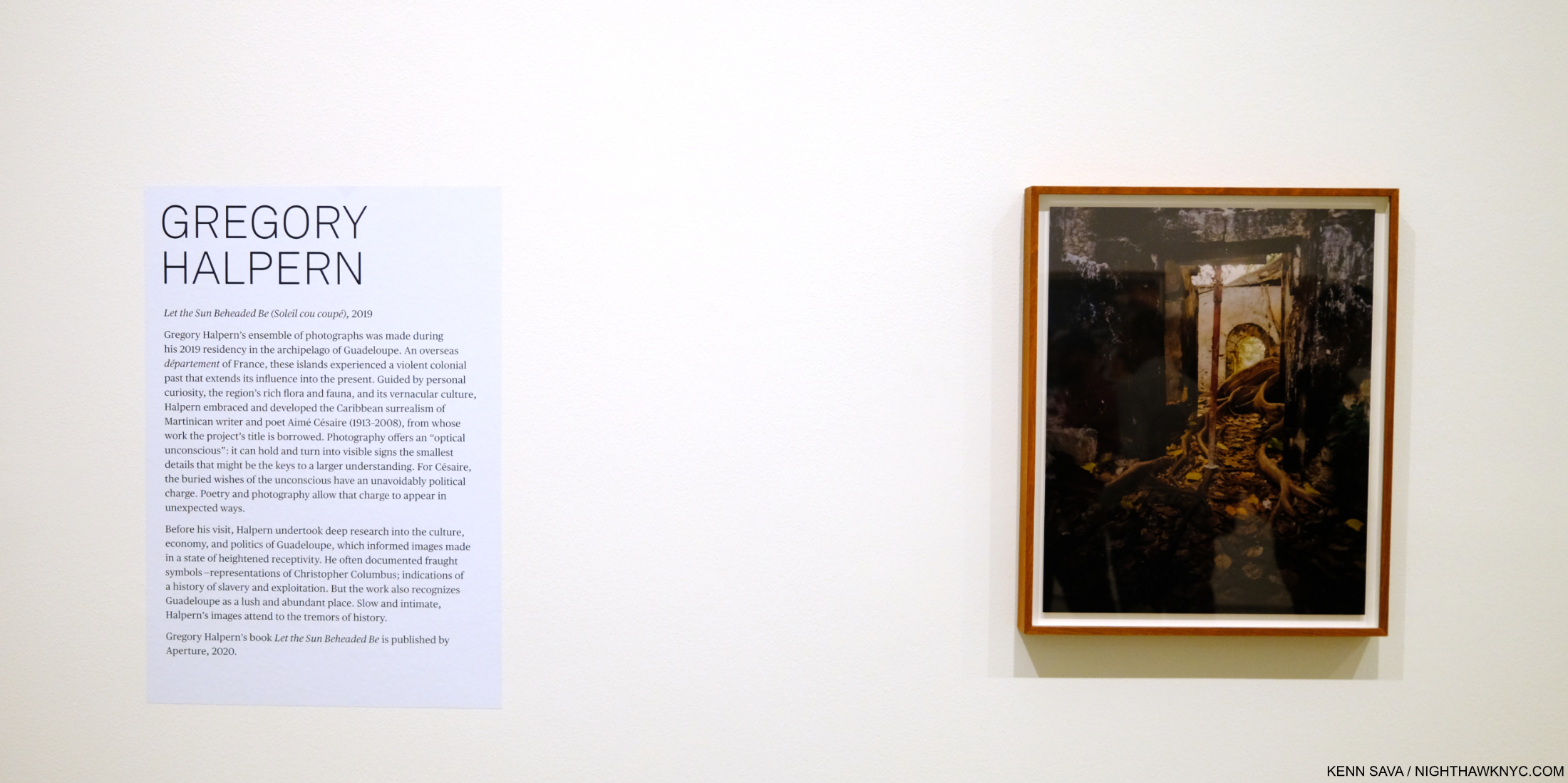
The show was concise, typically open-ended, and bookended by the Artist’s first foray into Video(!) and a stunning, leaning, Sculpture3. It opens with one of the most compelling images in the book.
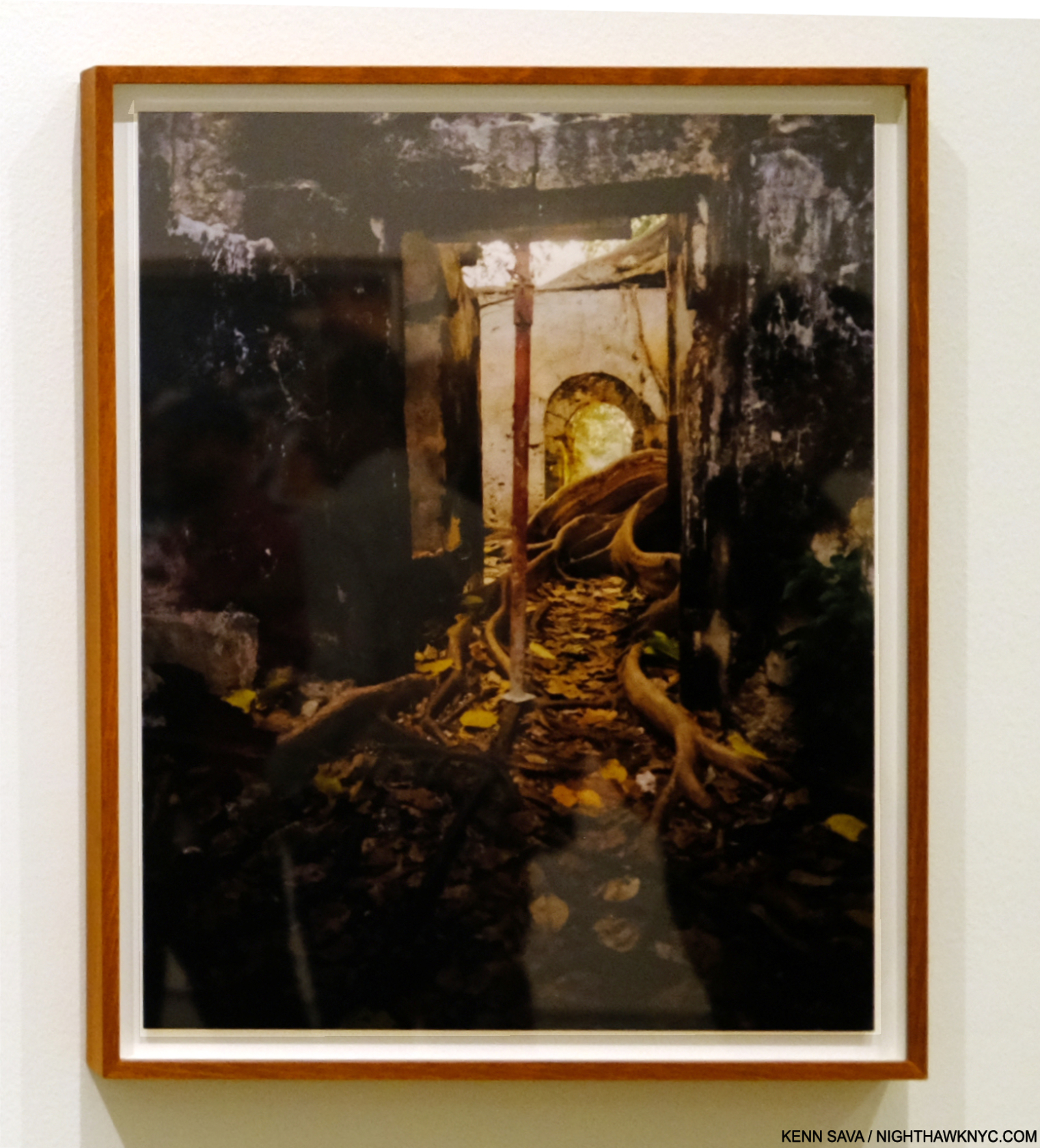
Untitled, as all the images are in the book, is described by Mr. Chéroux- “Shot in a former slave prison in the town of Petit-Canal, northwest of Grande-Terre, it shows the tentacular development, right inside the building, of a tree commonly known as a strangler fig because the strength of its wide roots destroys everything on which it grows4.”
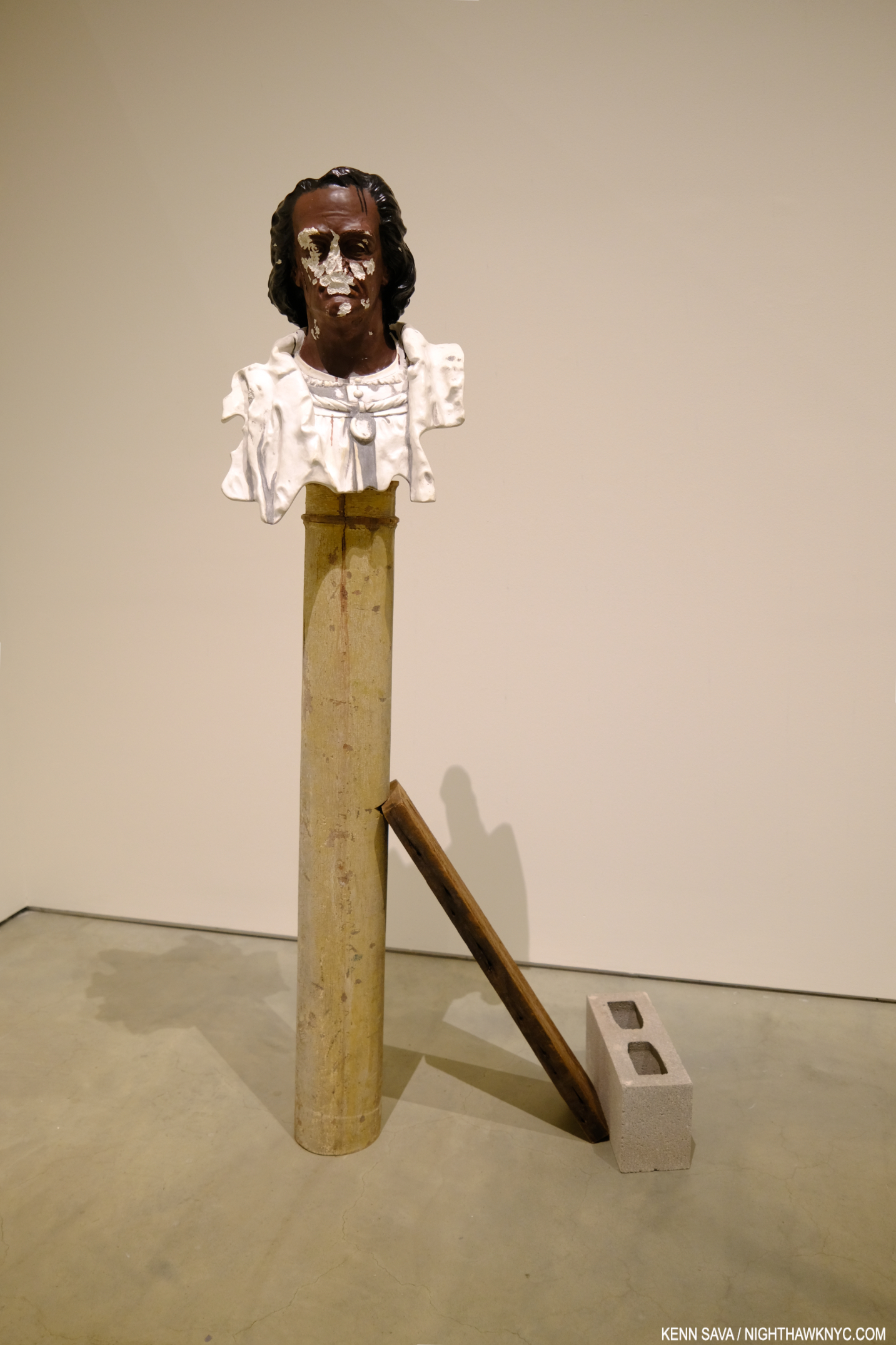
Christ Columb, 2023, Marble, cement, stainless steel, wood and cinderblock. An “exact replica of a bust of Christopher Columbus that currently stands in Guadeloupe,” per the wall card. “Exact” in that it even mirrors the vandalism to the real bust’s face.

It serves to define his terms. In these Photos, Mr. Halpen consciously avoided tourist trappings, saying in the book’s conversation with Stanley Wolukau-Wanambwa that after seeing how the tourists acted and treated the locals, he realized his burden as another white outsider with a camera would be even heavier, especially because he wasn’t fluent in either French or creole. He chose instead to focus on the stormy history, the place, the human, the animal, and the vernacular, in what are the five unofficial “chapters” of the book.
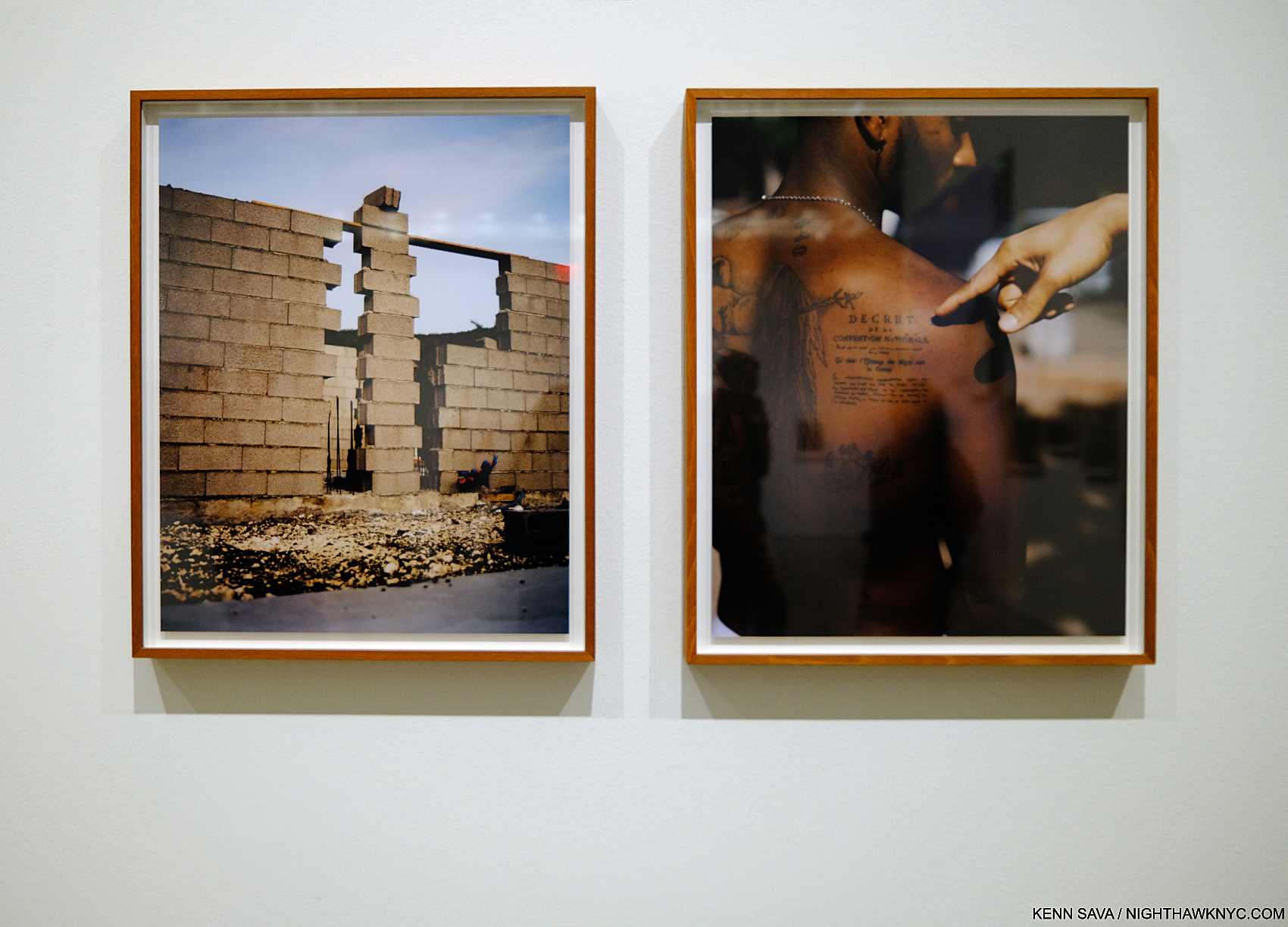
History/the place, the human…”The tattoo is a replica of the 1848 decree abolishing chattel slavery in Guadeloupe (the second, final abolition, after Napoleon reneged on his 1815 abolition,” from the wall card regarding the work on the right.

Surrealism runs throughout all of them, yet in Let the Sun it’s, perhaps, an overriding mood as much as it is actually on view. Possibly, this is due to the inherent surrealism Mr. Halpern said he was expecting to find, or perhaps it was also due to his reading material during his visits. The title “Let the Sun Beheaded be” comes from Soliel cou coupé (or Solar Throat Slashed) by Martinican poet Aimé Césaire, who was influenced by the concluding lines of “Zone,” the first poem in Guillaume Apolliinaire’s Alcools, 1913, “Adieu Adieu / Soliel cou coupé” (Farewell, farewell / Let the Sun beheaded be). Apolliinaire coined the term “surrealism” circa 1917. Césaire’s earlier work found its way into the hands of André Breton, one of the leading surrealist theorists, and the two became long-time friends. Speaking of Solar Throat Slashed curator Clément Chéroux points out in his essay the numerous connections between the guillotine, which was brought to Guadeloupe with the French after the French Revolution and put to extensive use in the colony, and Photography- down to the “guillotine shutter.” Thankfully, the guillotine shutter is the only use of the notorious device in the work, though death takes many forms.
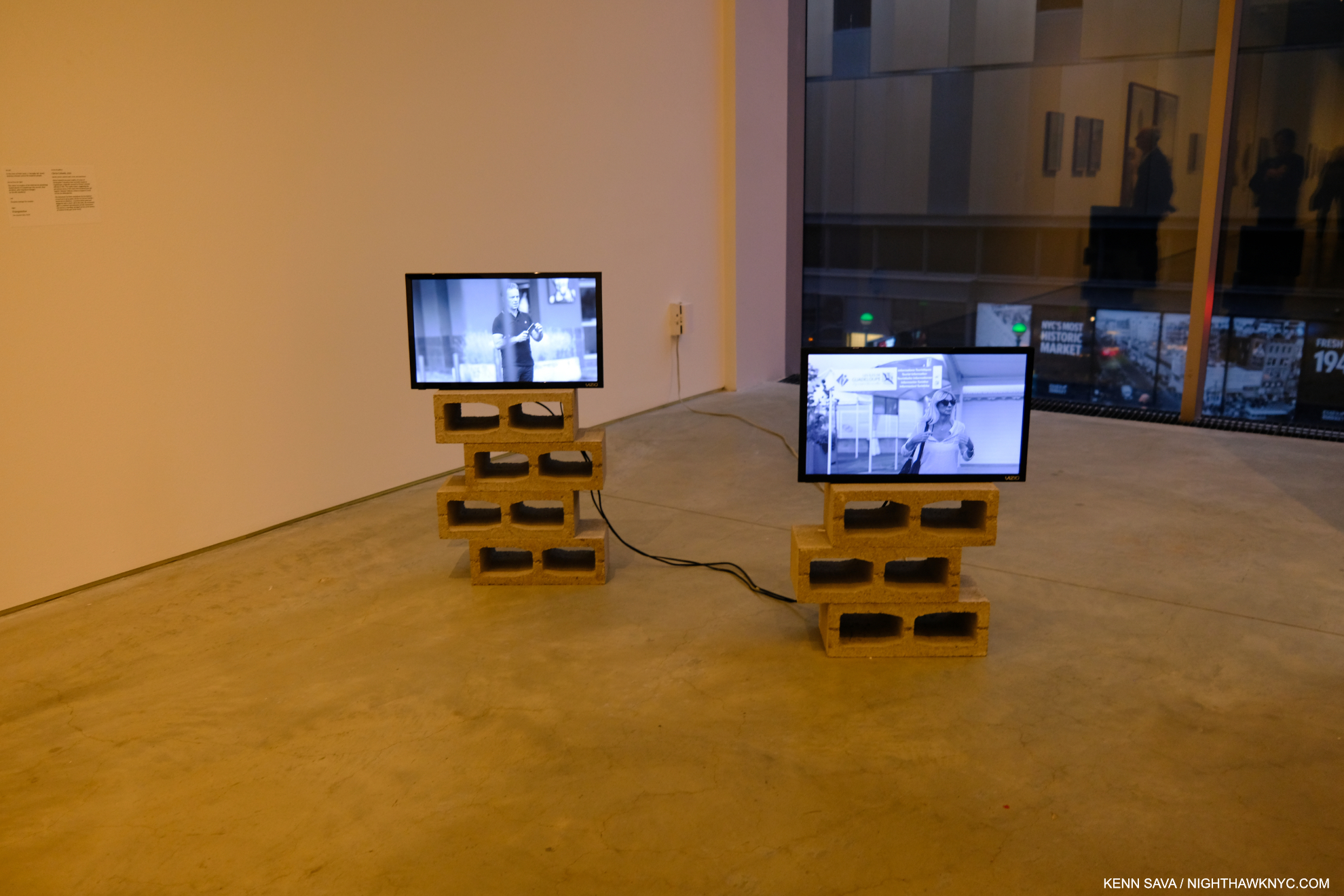
Stills from Triangulation, 2-channel video(!), duration 4:20.

Yet, after finishing his Photography, he subsequently returned to make a 2-channel Video titled Triangulation, which meditates on the coming and going of the cruise ships and their cargo. The Video, his first to be shown in public, startled me for having a different approach than his Photography does! Whereas he goes to great length to speak with his Photographic subjects, even collaborating with them to an extent in his Photo Portraits, in Triangulation, he’s an observer. Highlighting the risks of this, at one point, staged or not, a cruise ship employee with “Photographer” emblazoned on his shirt, ironically moves towards the camera making a “STOP” signal . The Video added a counterpoint to the show. At once showing that side of Guadeloupe most known to the outside world, but showing it not from the standpoint of the tourists, but almost from the viewpoint of the locals if and when they watch these foreigners arriving & disembarking on their island. 
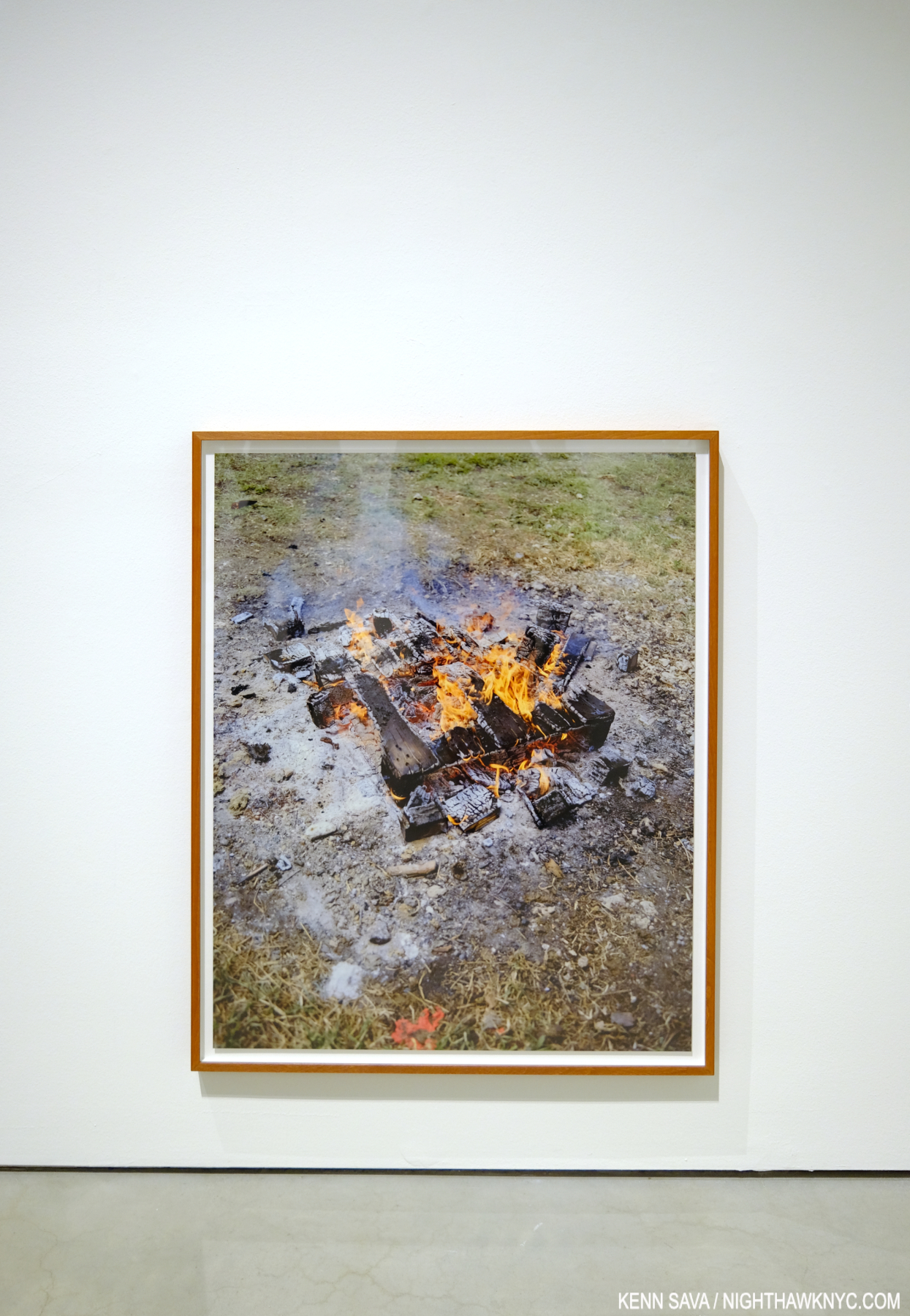
Appropriately hung near the floor. Seeing it this size created a completely different impression than the image in the book.

Another thing that struck me seeing this work was size. Images have a tendency to live in our minds in the size they appear in in a book. Unlike a Painting or Drawing, we may tend to forget Photographs can be printed larger or smaller. I heard from readers when I named Mr. Halpern’s Omaha Sketchbook a NoteWorthy PhotoBook of 2019 who disagreed, saying they were unhappy with the size of all the images in it- each a reproduction of a Photo cut from a medium format contact sheet, done to remain true to his original mockup- a “sketchbook.” Let the Sun returned to full page images to stunning effect (I happened to love the daring in the design of Omaha and the sizes of the Photos therein). At ICP, the Prints ranged from slightly larger than page size to very large, probably 40 inches or larger. The added real estate enabling the images to begin to attain a “life-size” presence. 

“In Guadeloupe, slavery memorials are everywhere, so the weight of that history is much more perceptible than in the United States.” Gregory Halpern in the Conversation.

In my 2019 overview of his work, “Gregory Halpern’s America,” I wrote about his work’s hold on me. I still can’t think of any other living Photographer whose work speaks to me as much as his continues to. Given that his instant classic book ZZYZX is now in its 4th printing, and his three subsequent books have sold out, I’m apparently far from the only one it speaks to. I went in to Immersions believing that Let the Sun is somewhat underappreciated compared to his U.S. based books (i.e. all of his previous books). I came out feeling I may have underestimated it. Let the Sun is a book that could inspire change on a number of levels- from opening the eyes of people who’ve never been to Guadeloupe (like myself), to increased possibilities for the Photographic Portrait, to publishers who have neglected the Caribbean (& it’s Artists) to this point in Art & PhotoBooks, to the shame that the history of slavery in this country has been so ignored. For those reasons, it’s something of a landmark book in my view.
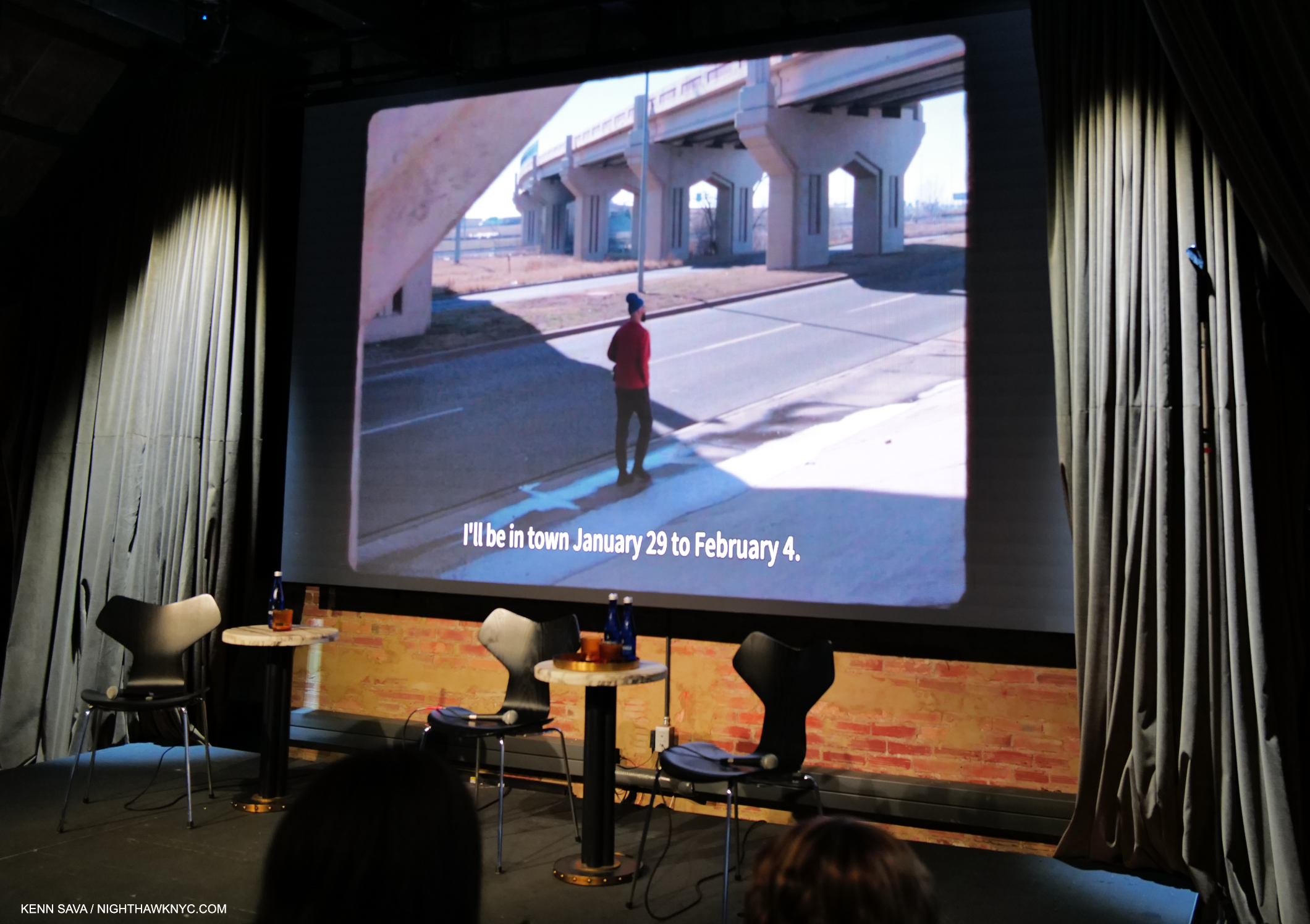
On the road, again. Gregory Halpern looking for subjects in Oklahoma City as he talks in the voice-over about his Instagram announcement seeking Portrait subjects. Still from a fascinating video short about his week in OKC at Fotografiska, July 20, 2023.

A few weeks earlier, at Fotografiska in the Flatiron on July 20th, Mr. Halpern was joined by 3 Magnum Photos Photographers, of which he is now also a full member, in a show sponsored by a hotel chain titled Impressions. The Photographers were ensconced in separate hotels around the world and asked to document what they experienced. Mr. Halpern went to Oklahoma City, and exhibited 4 Photos (as did each of the others- Cristina de Middel, Jonas Bendiksen, and Alessandra Sanguinetti) in what is the first new work I’ve seen of his since Let the Sun Beheaded Be, 2020.

Here is Mr. Halpern’s presentation-
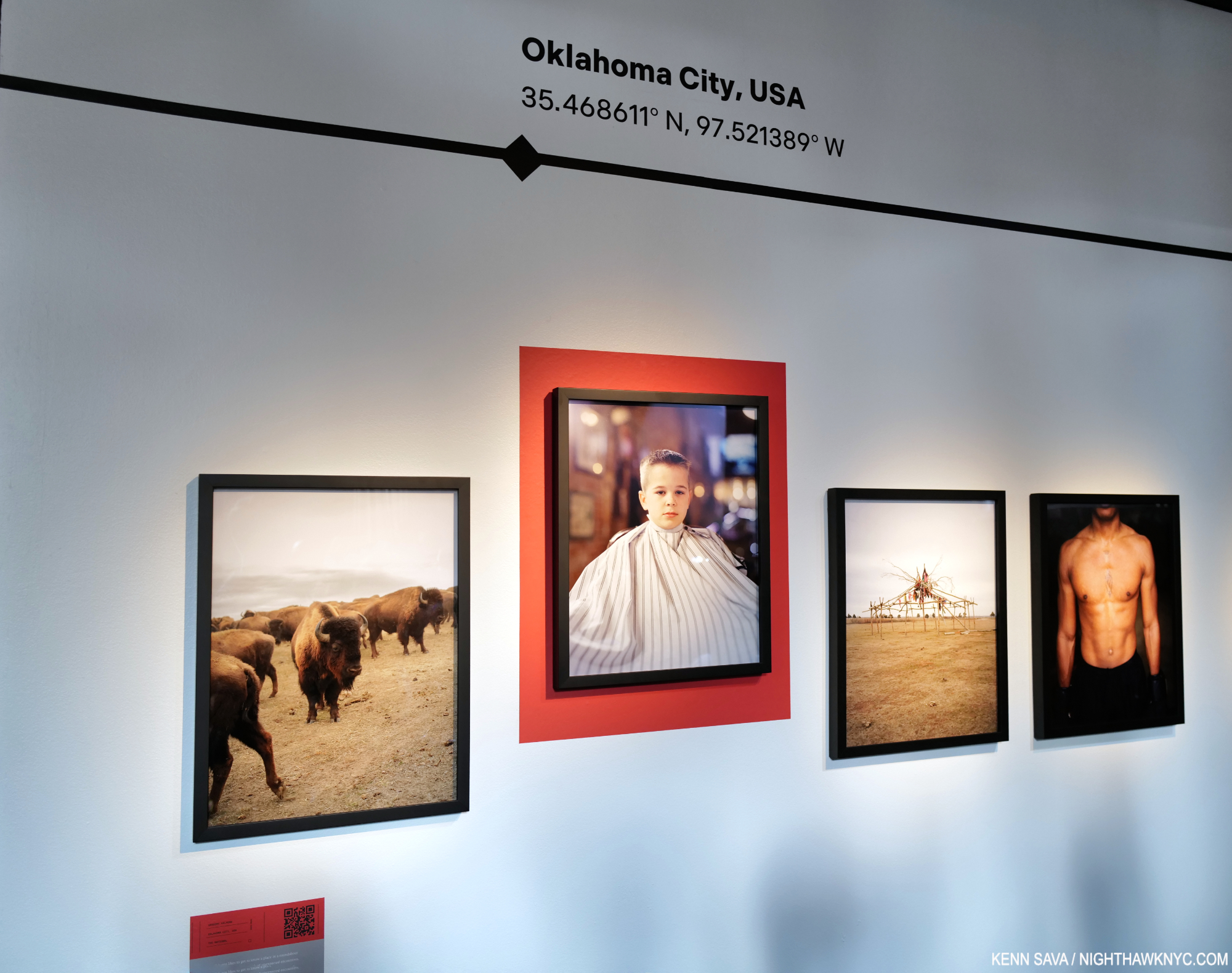
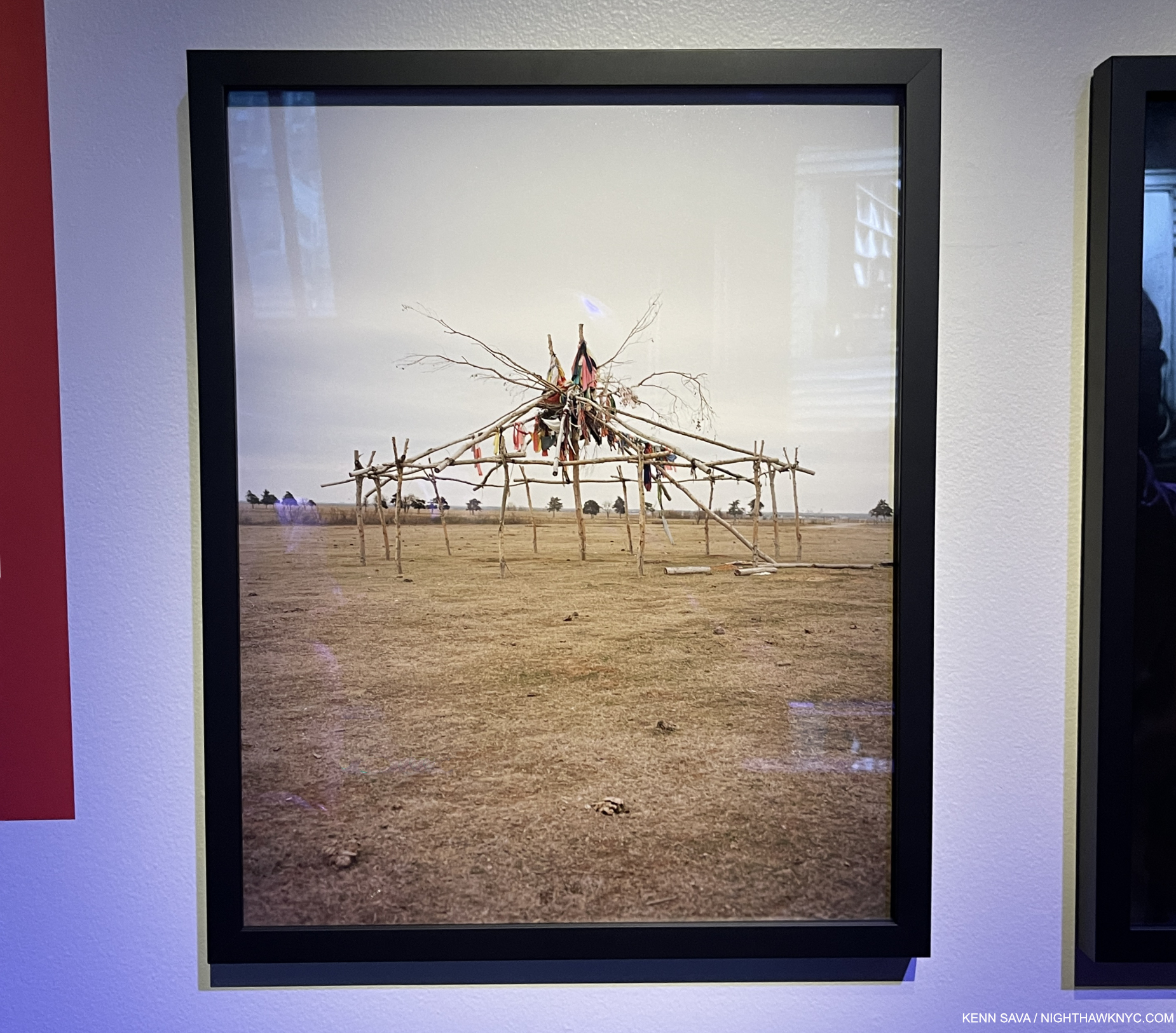
I find the arrangement particularly interesting. We see animals, a Portrait of a young man in a barber’s cloth, some sort of structure, and a torso bearing a tattoo. Looking at these, yes, Let the Sun came back to me. Each of the four images “represents” one of its unofficial themes- animals, a human, the evidence of the land/history, and another human. The surreal is also represented in all four (at least for me).
It would be easy to say they “harken back” to what we saw in Omaha Sketchbook. That book featured images of masculinity (along with images of animals, the land & history and other themes), like Douglas, Army Jurnior Reserve Officer Training Corps, Bellevue, 2005-18, to cite one example out of many; the young man getting a haircut harkens back to those societal expectations and traditions. Ostensibly, it’s a straight-ahead image of an event that parents are fond of documenting during childhood. Yet, there’s an air of mystery around it. The young man stares at the camera with a somewhat stoic look that gives away little. The barber cloth hiding anything the might tell us more about him. His haircut appears to be finished and he’s ready to face the world again. Yet, I’m reminded of Clément Chéroux’s essay in Let the Sun when he speaks about the guillotine, Guadeloupe, and the mechanics of Photography. He mentions Photographers refer to Portraits as “cutting heads.” Here we see just that twice- once with only the head (in a Print mounted on a red background), and once of a torso sans head. Notice how the Print of the young man is mounted higher than the others- at a height where the young man’s head just about “completes” the Portrait of the tattooed torso on the right.
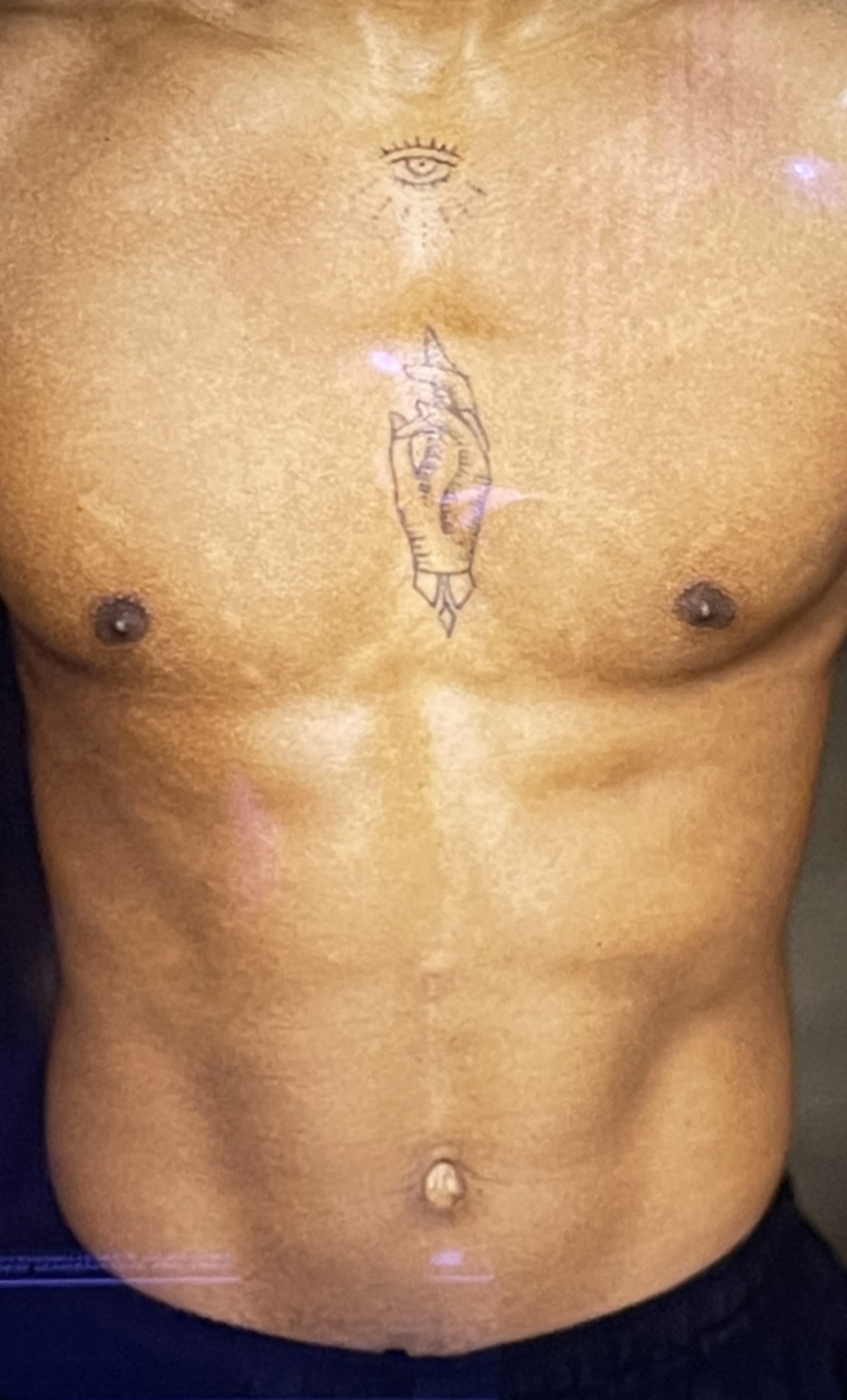
Detail of the far right Photo, showing the tattoo. Speaking of recurring themes, t’s interesting to contrast this with the very first image in this piece from ZZYZX.

It reminds me of some of the games the Surrealists used were fond of playing, like the one Kerry James Marshall based his recent show on.
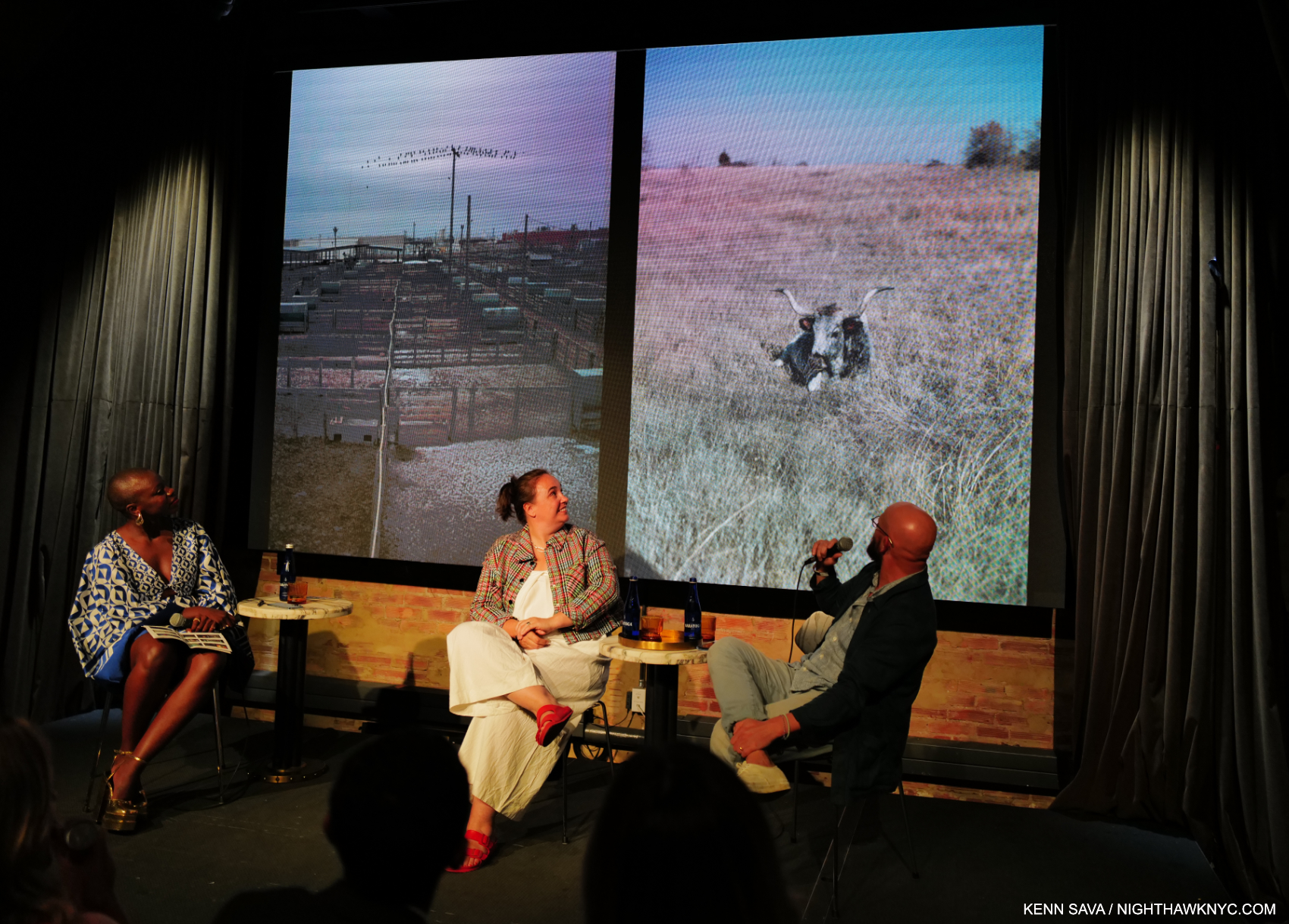
Mr. Halpern discussing two other images from his OKC series.

Of course, this is only my reading of it- your results may differ, as Mr. Halpern’s intentions may as well. In the end, I’m lucky I never have to leave NYC to find Surrealism. It finds its way here from all over the world.

*- Soundtrack for this piece is “Captains and Cruise Ships” by Owl City.

NighthawkNYC.com has been entirely self-funded & ad-free for over 8 years, during which 300 full-length pieces have been published! If you’ve found it worthwhile, PLEASE donate to allow me to continue below. Thank you, Kenn.

You can also support it by buying Art, Art & Photography books, and Music from my collection! Art & Books may be found here. Music here and here.

Written & photographed by Kenn Sava for nighthawknyc.com unless otherwise credited. To send comments, thoughts, feedback or propositions click here. Click the white box on the upper right for the archives or to search them. Subscribe to be notified of new Posts below. Your information will be used for no other purpose.

  1. As far as I know, there has not been a Gregory Halpern solo show in NYC since the auspicious Gregory Halpern: A at Clamp Gallery from January 5th to February 11th, 2012, as hard as that is to believe. If you know of one subsequently, please let me know.
  2. From 2019, per Clément Chéroux, “GH/971” in Let the Sun Beheaded Be.
  3. Which is not his first. He showed Sculpture for the first time earlier this year in Gregory Halpern: 19 Winters/7 Springs at Transformer Station, Cleveland.
  4. ibid

NoteWorthy PhotoBooks, 2023- Two Masterpieces

This site is Free & Ad-Free! If you find this piece worthwhile, please donate via PayPal to support it & independent Art writing. You can also support it by buying Art & books! Details at the end. Thank you.

Written & Photographed by Kenn Sava

PhotoBooks completely took over my life for over 6 years from 2016 through 2022, during which time I immersed myself in Modern & Contemporary Photography (which for me is the period after the publication of Robert Frank’s The Americans in 1958-9). After not publishing a NoteWorthy PhotoBooks list for 2022, two books stood out for me among the PhotoBooks I saw this year. Since I don’t believe the “best” exists in the Arts, I prefer to call them “NoteWorthy,” i.e. books I most highly recommend among all those I saw in 2023. Both are among the most powerful books I’ve seen in years. In my opinion, both books are masterpieces. Other recommended books follow them.

Both NoteWorthy PhotoBooks have two people in common. One, Kris Graves is no stranger to this list. His A Bleak Reality was a NoteWorthy PhotoBook of 2021. His publishing company Kris Graves Projects/Monolith Editions was the NoteWorthy PhotoBook Publisher of 2020 when they somehow managed to publish EIGHTEEN books during the pandemic! This year, Mr. Graves is the Photographer/Artist/Author of one of the two, and he and his Monolith Editions is the publisher of both books (co-publisher with Hatje Cantz of one). As a result, Kris Graves Projects/Monolith Editions are the NoteWorthy PhotoBook Publisher, again, for 2023.

NoteWorthy PhotoBooks, 2023

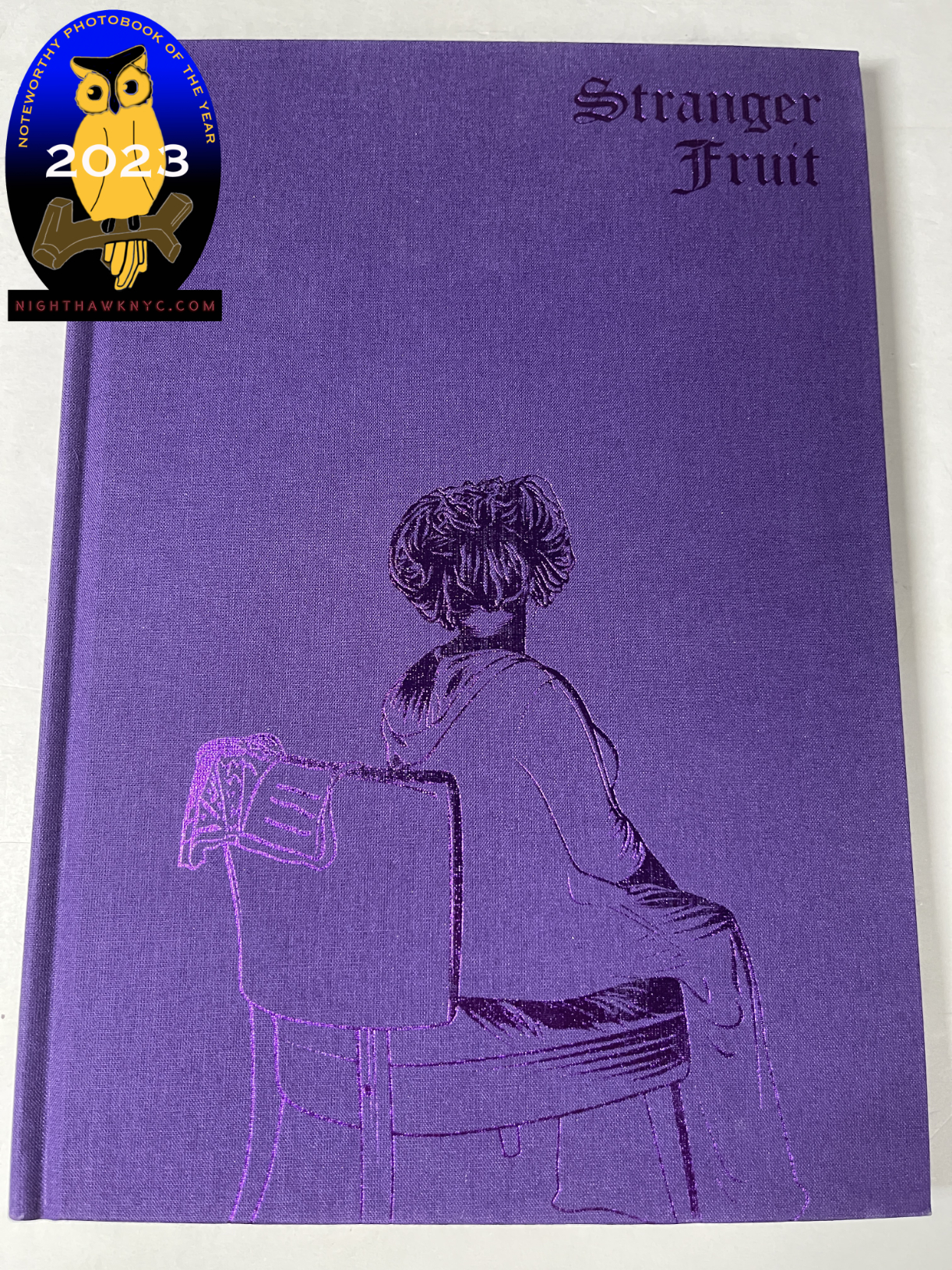
Jon Henry, Stranger Fruit, Monolith Editions

In a word: overwhelming.

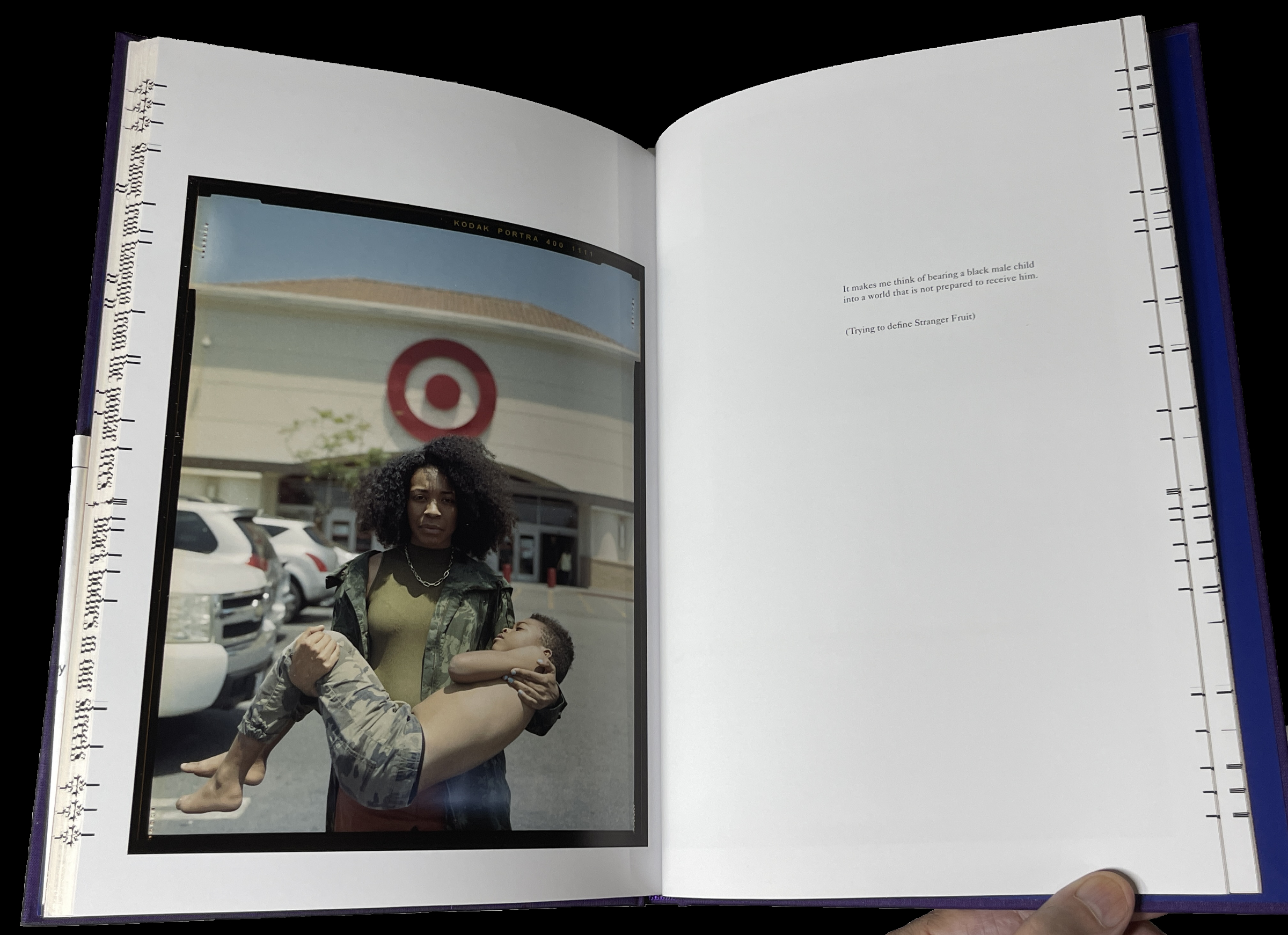
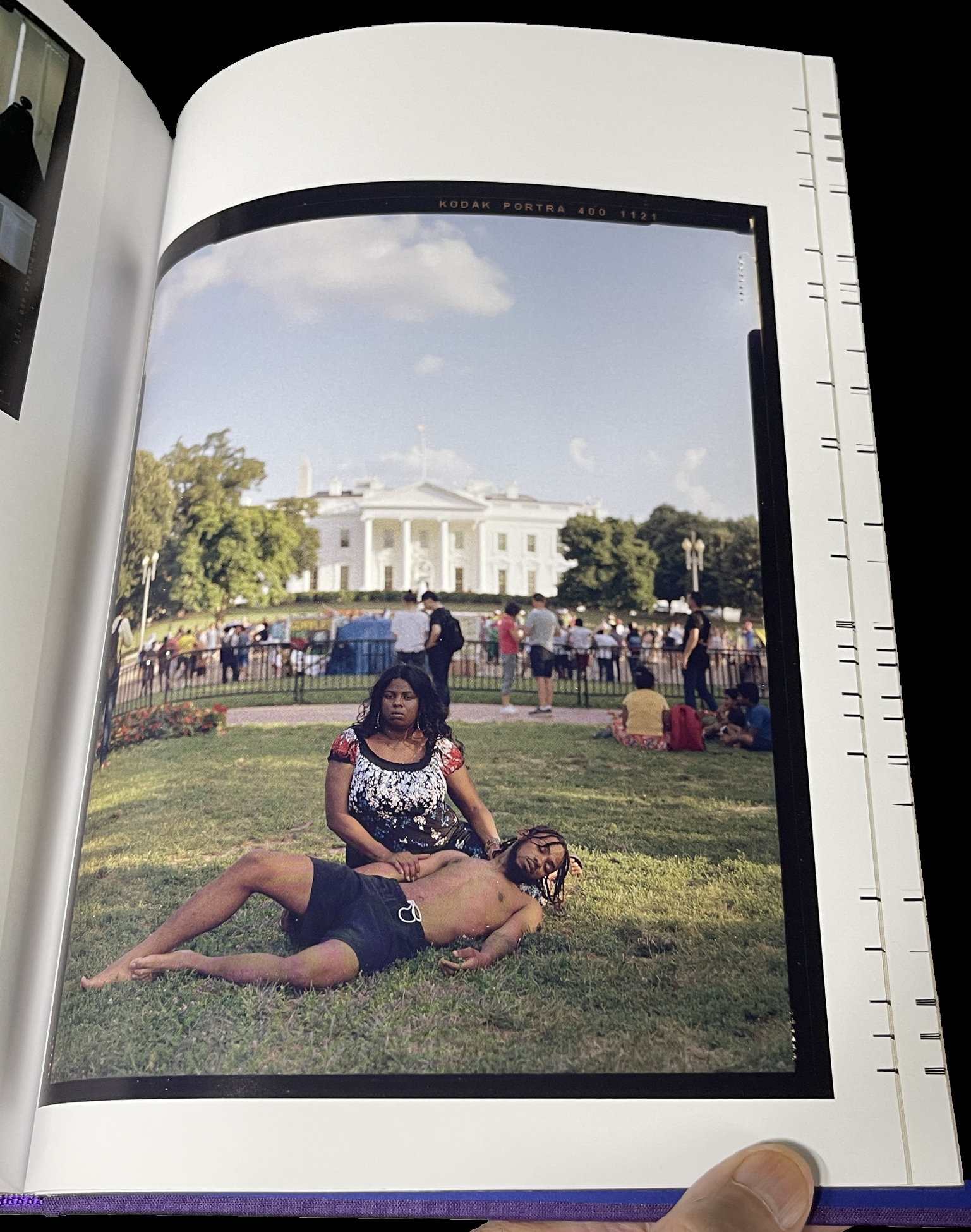
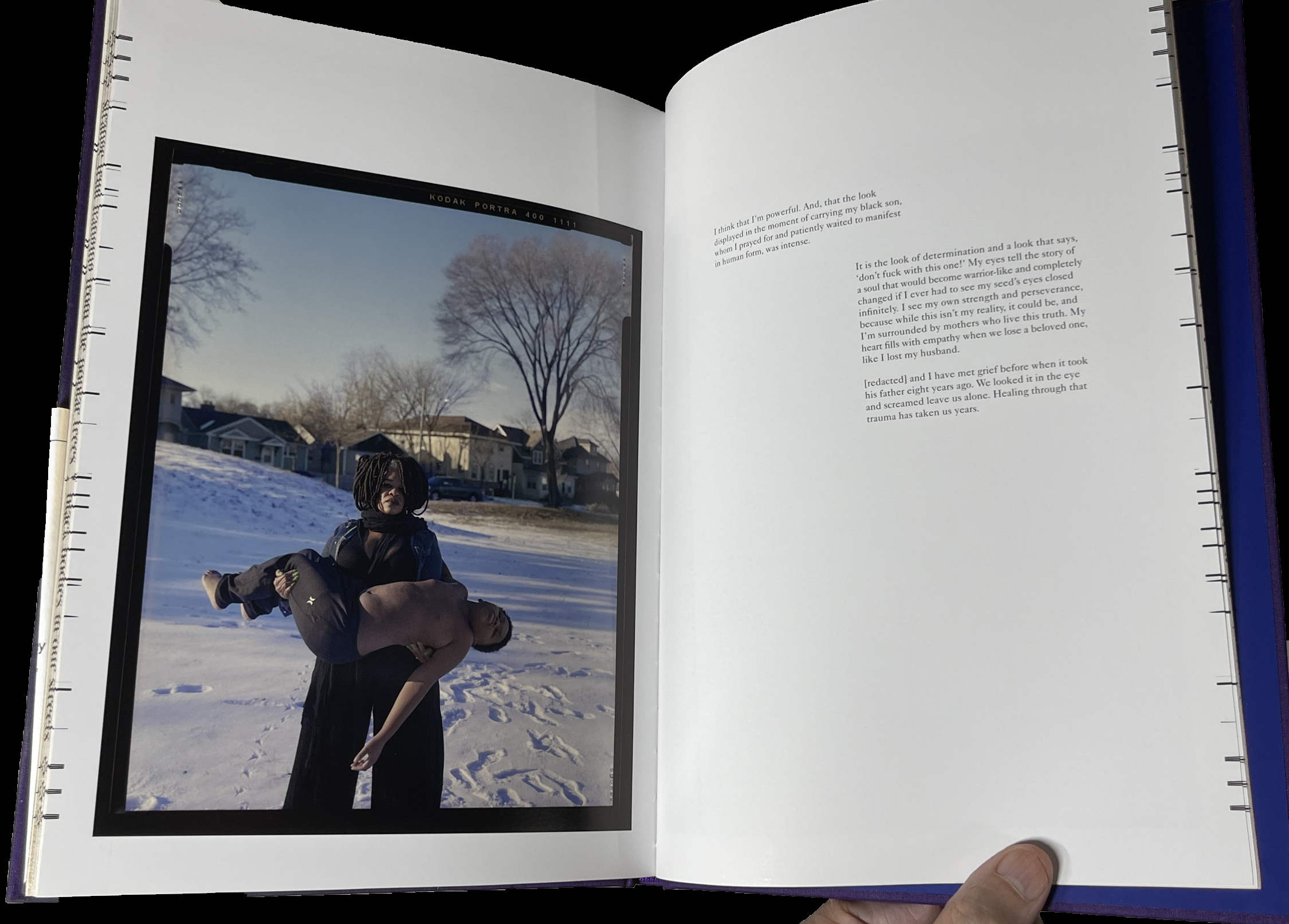
Stranger Fruit was created in response to the senseless murders of black men across the nation by police violence. Even with smart phones and dash cams recording the actions, more lives get cut short due to unnecessary and excessive violence. Who is next? Me? My brother? My friends?” Jon Henry

Mr Henry continues, “Lost in the furor of media coverage, lawsuits and protests is the plight of the mother. Who, regardless of the legal outcome, must carry on without her child. I set out to photograph mothers with their sons in their environment, reenacting what it must feel like to endure this pain. The mothers in the photographs have not lost their sons, but understand the reality, that this could happen to their family.”

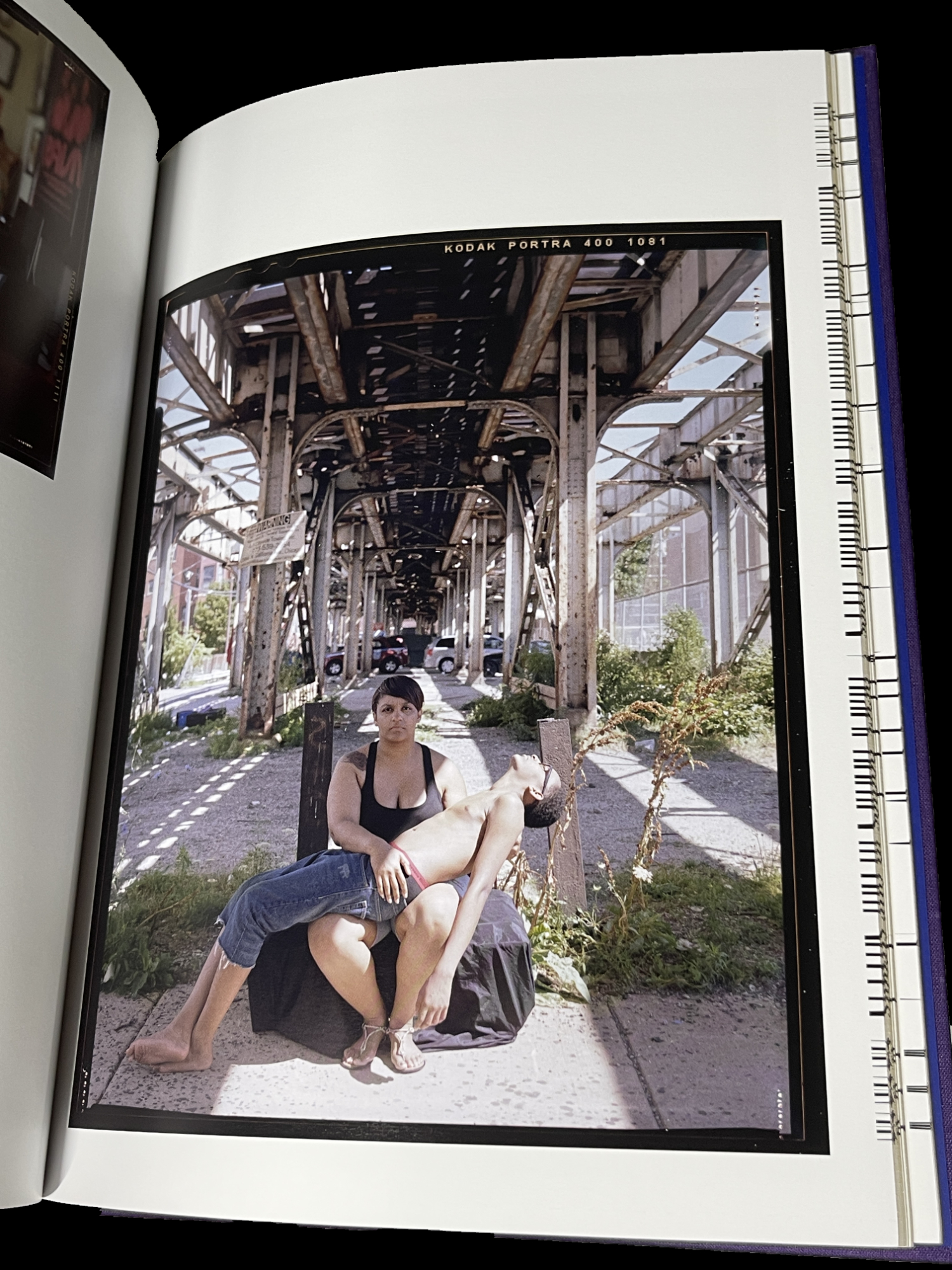
The way Mr. Henry has chosen to depict these mothers and sons is in the form known in Painting and Sculpture as the “Pieta” (or pity). Traditionally, Jesus’s mother, Mary, holds her dead son on her lap after the Crucifixion. The “Pieta” has long been among the most powerful and poignant compositions in Western Art. To this point, and for the past 800 years, it’s been the exclusive realm of Painters and Sculptors (most famously Michelangelo).

Along comes Jon Henry, who shows that they can be every bit as powerful in Photography- even without a directly religious reference. He has chosen it to depict the unspeakable pain mothers of murdered Black sons must have experienced in the unique way of depicting mothers holding their living sons. I asked Mr. Henry how he came to use it in Stranger Fruit

 “I grew up studying painting and religious iconography by way of stained glass windows in the church I worked in, so I was very familiar with the motif.  There were more contemporary uses of the pieta, such as Dr David Driskell and Renee Cox, that really made me believe I could use this as the vehicle behind this project.
But everything really revolved around the mother.  I know that my work is not the first to speak about police brutality in the african american community but I felt the mothers were left out of the conversation.  Focusing on them through this mother/son relationship was why the pieta made so much sense for me.”

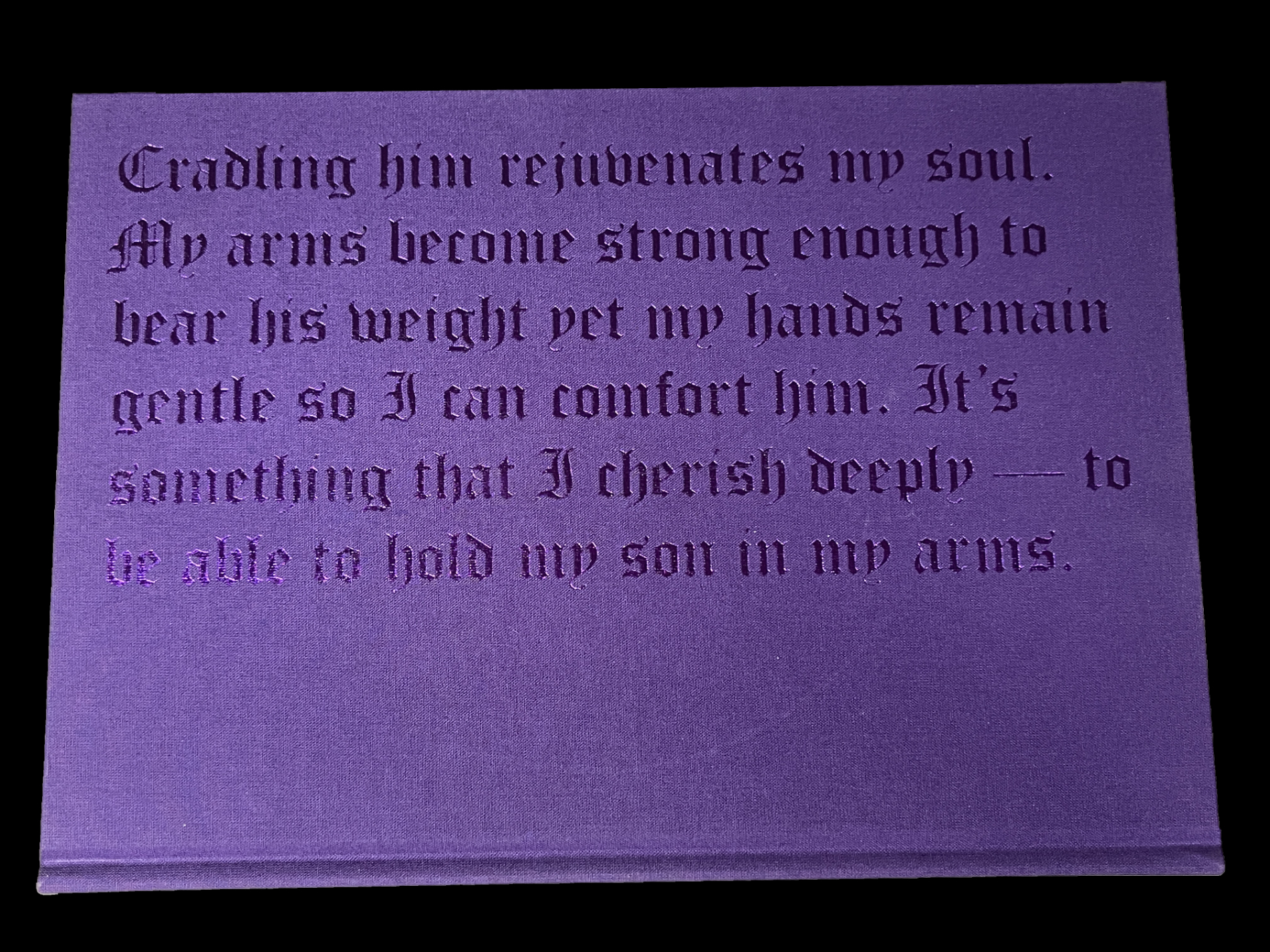
 In Stranger Fruit (which is named after the Abel Meeropol 1937 song, “Strange Fruit,” protesting the lynching of Black Americans, and immortalized by Billie Holiday) we also get to hear from them. Most of the images are accompanied by a text written by the mother.

I was stunned when I picked this book up for the first time. As far as I know, no one has done anything like this before. Yes, there are combat images from too many wars and conflicts already that are Pietas. Yet, I’ve never seen an entire book of them, and only them. I asked Kris Graves how he discovered Jon, this remarkable body of work, and came to publish Stranger Fruit. He said, “I met Jon some years before the pandemic and he was already hard at work on the project. I told him then that I’d love to publish the work when he felt it was complete. During covid, I founded Monolith and it was an even better fit for the ideals of Stranger Fruit. Soon after, we reconnected and started production.”

The 600 copies of the 1st printing of Stranger Fruit have sold out. I’m told the recently announced 2nd printing is selling quickly. I look forward to the time when it’s no longer vital as a document of immediate social import, to when it can just be appreciated as a work of Art.

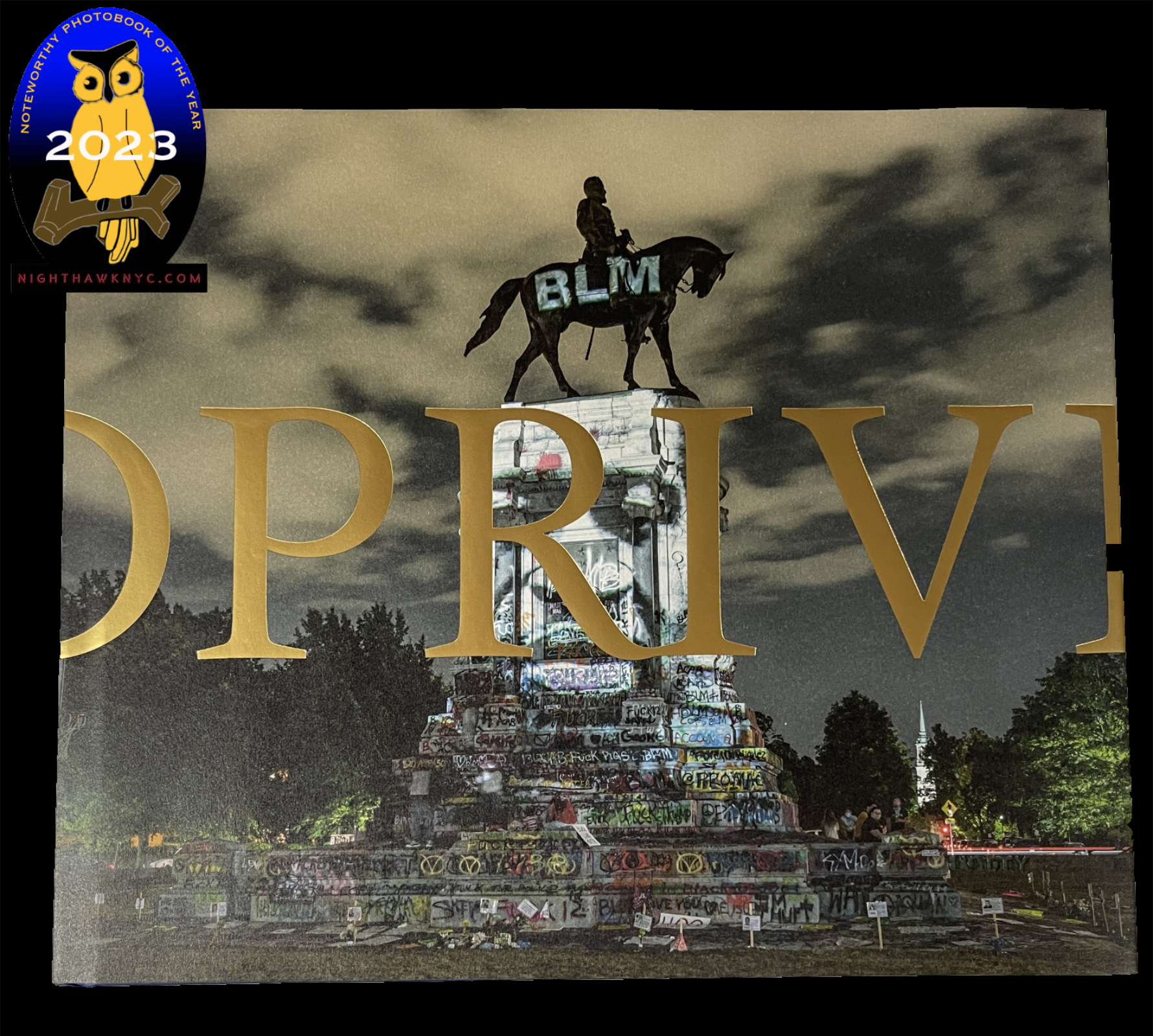
Kris Graves, Privileged Mediocrity, Monolith Editions/Hatje Cantz

One of the most important PhotoBooks released this century, Privileged Mediocrity is Kris Graves’s masterpiece among his fine books thus far, in my opinion.

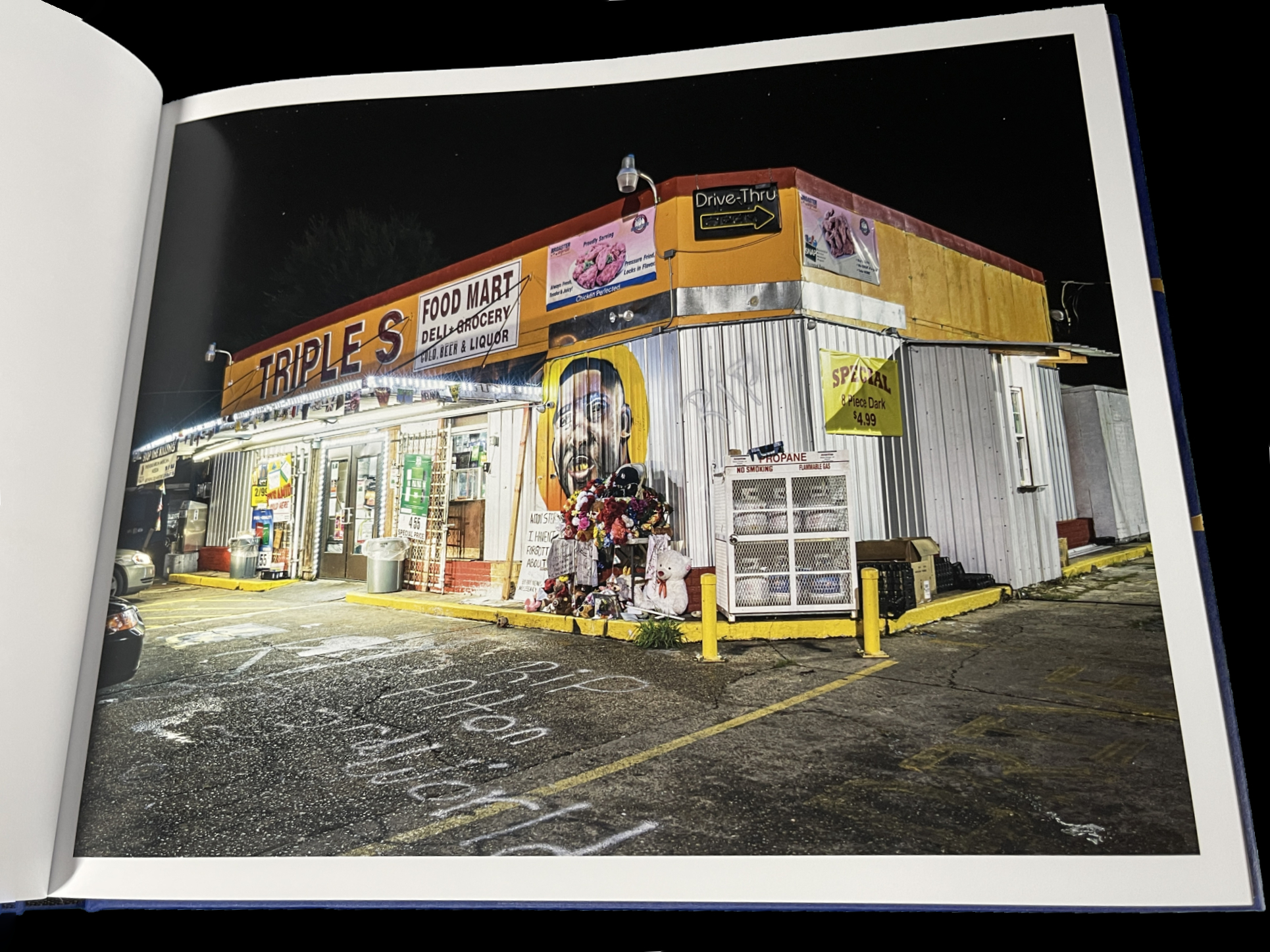
From Part I- The Murder of Alton Sterling, Baton Rouge

Years in the making, involving extensive stretches of travel during the height of the covid pandemic and the Black Lives Matter Protests, at what must have been considerable personal risk, in the days leading to the birth of his first child, it feels to me like this is the book his work has been building toward all along.

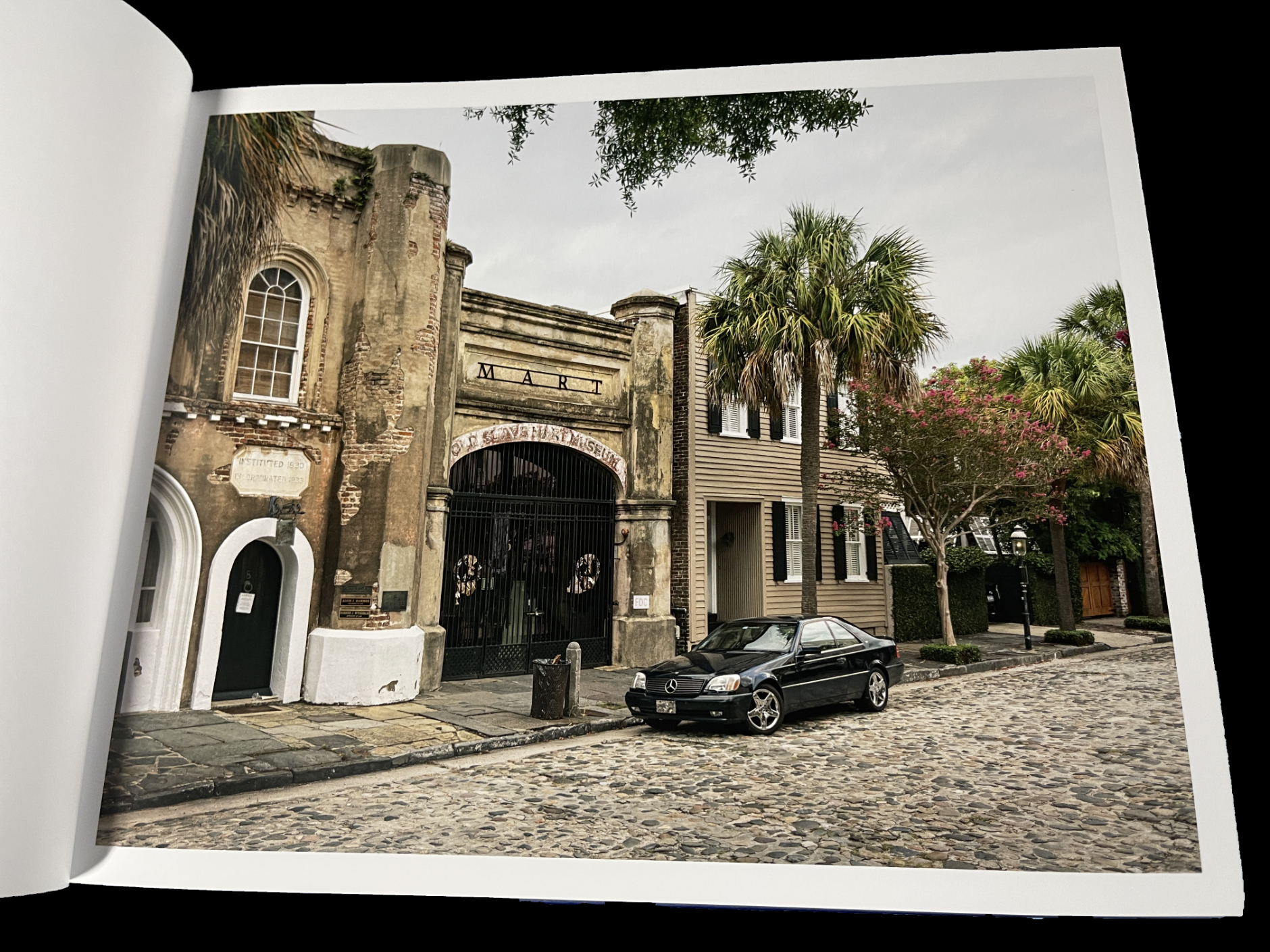
From Part I– Slave Market, Charleston

It’s divided into three sections: “Part I: Privileged Mediocrity & The Deceived Within,” “Part II: A Southern Horror, 2020,” and “Part III: A Latency, 2000-2022.” Though Part I sets the stage  with images from NYC, New York State and Boston as well as the South, the book is centered on the South in Parts II & III. Mr. Graves visited innumerable Confederate monuments throughout the South, and shows them before, during and after the protests.

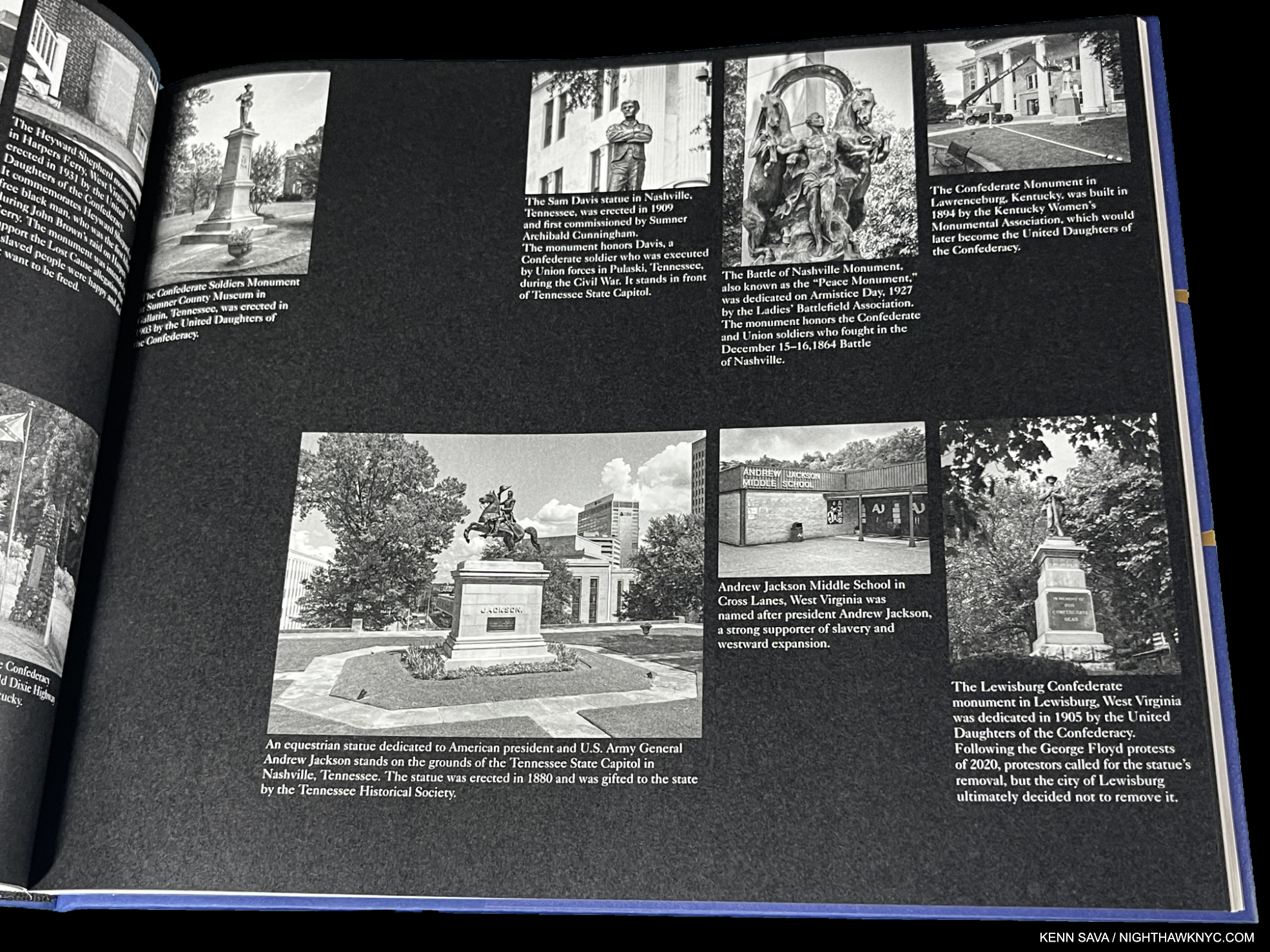
From Part II

“Part II: A Southern Horror, 2020,” is gravely presented with black & white Photos on black paper in which Mr. Graves inventories many of these problematic monuments by state and their connection to racism, which is downright chilling to see on page after page- 46 pages in all- many with up to 8 sites on a page! “Part III Latency 2000-22” shows many of these sites during and after the protests.

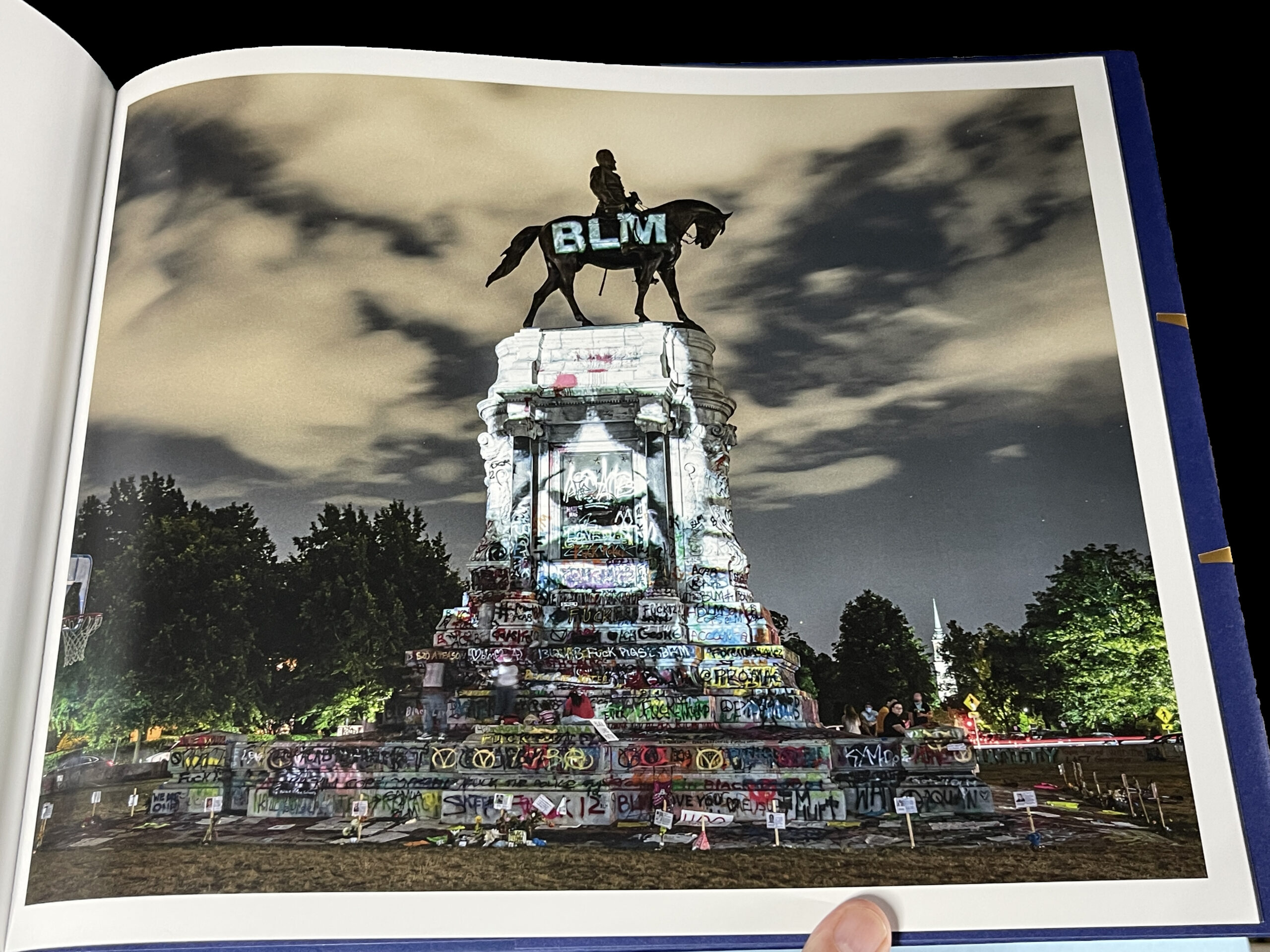
From Part III- George Floyd Projection, Richmond, Virginia. National Geographic Magazine put this image on the cover of its “Photos of the Year, 2020” issue. I asked Kris what he remembers about taking this classic and historic image. He said, “A few days into my Richmond trip, I was introduced to the projectionist, who was working at the protests. On a clear night, he set up at the Lee Monument and I headed out around midnight. It was lively out there, but peaceful. The projections of dozens that were killed by police were displayed for about one second at a time. I asked him to slow it down a bit then made pictures for a few hours. Got a good one.”

Progress has been too long in coming. Part 1 of Privileged Mediocrity speaks to that. When the damn of patience finally burst after yet more murders of unarmed Black men and women, Kris Graves documented a fleeting turning point in American history powerfully, and in his own way. He focuses on the evidence to be seen on the land: scenes of murders and monuments that are offensive to many and a real part of the ongoing problems. A number of them are seen feeling the brunt of the resulting frustration and anger.

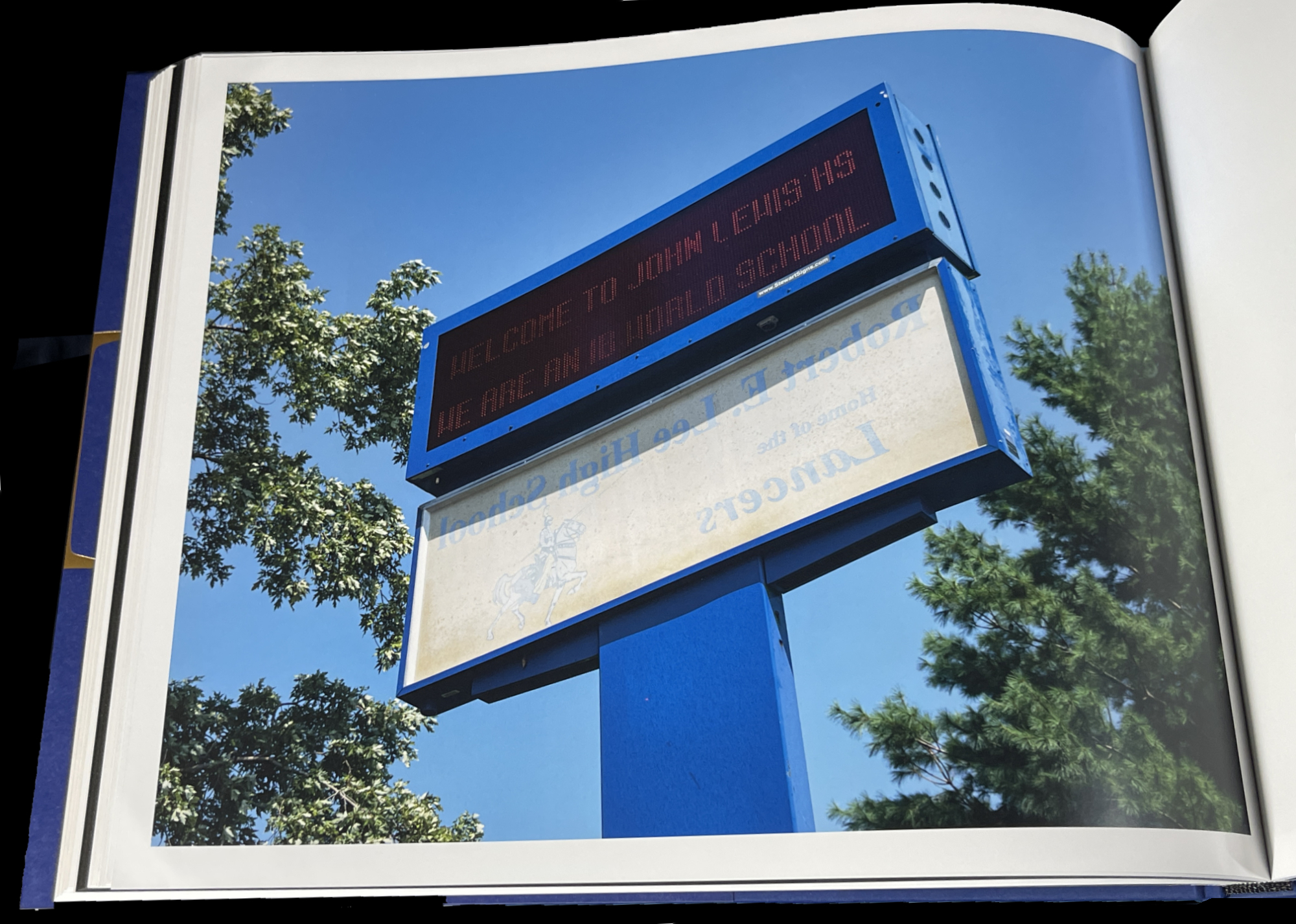
From Part III- John Lewis High School, Springfield, Virginia

After the protests, we see images of the raw beginnings of whatever it is we are in now. In John Lewis High School, Springfield, Virginia, the sign for the school’s former name, Robert E. Lee High School, has been flipped around under its new name. The question these image leave may be “Where to now?” For me, along with all the horror, they also represent moments of hope. The book is dedicated to his newborn son.

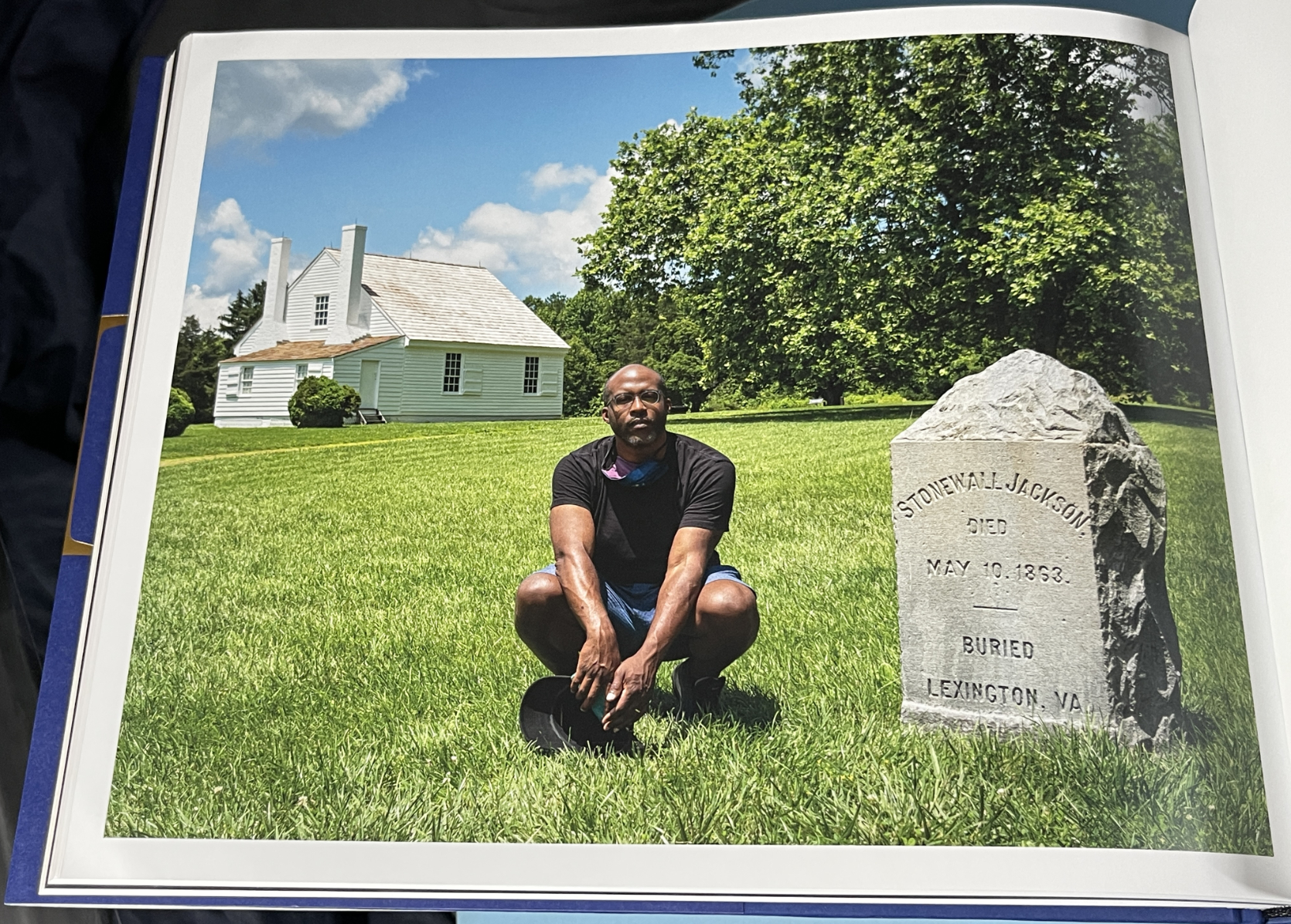
From Part III- Self-Portrait with Stonewall Jackson Shrine, Woodford, Virginia

The American edition of Privileged Mediocrity consists of just 300 copies. My piece on meeting Kris Graves in 2018 here.

I mentioned that both NoteWorthy PhotoBooks have two people in common. In addition to Kris Graves, they both feature the work of the same designer, the ever-creative Caleb Cain Marcus of Luminosity Labs. Mr. Marcus has outdone himself in both books, in my view. With the supreme taste & restraint he displays in Stranger Fruit, and in, what strikes me, as pulling out all the stops in Privileged Mediocrity, as he bends the style to match each section of the book, for which he even designed a font.

Also Recommended-

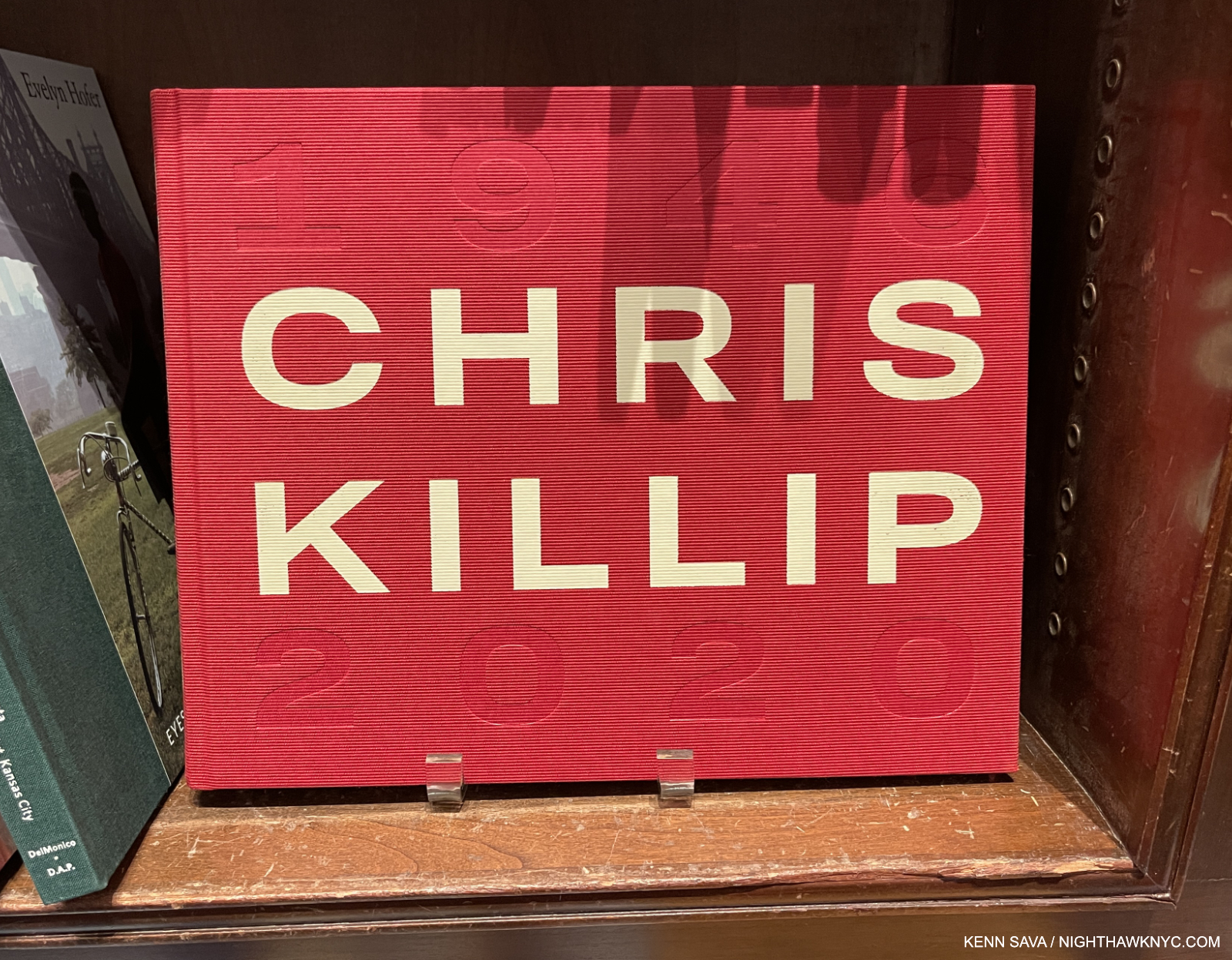
Chris Killip, Thames & Hudson

In 2018, Chris Killip’s former student, Gregory Halpern, turned me on to Mr. Killip’s work. Unfortunately, the book he most highly recommended, In Flagrante, from 1988, has long been out of print and expensive, so I only caught a glimpse of it when Mr. Halpern gave a tour of his book shelves. I managed to get In Flagrante Two, 2016. which is now also out of print.

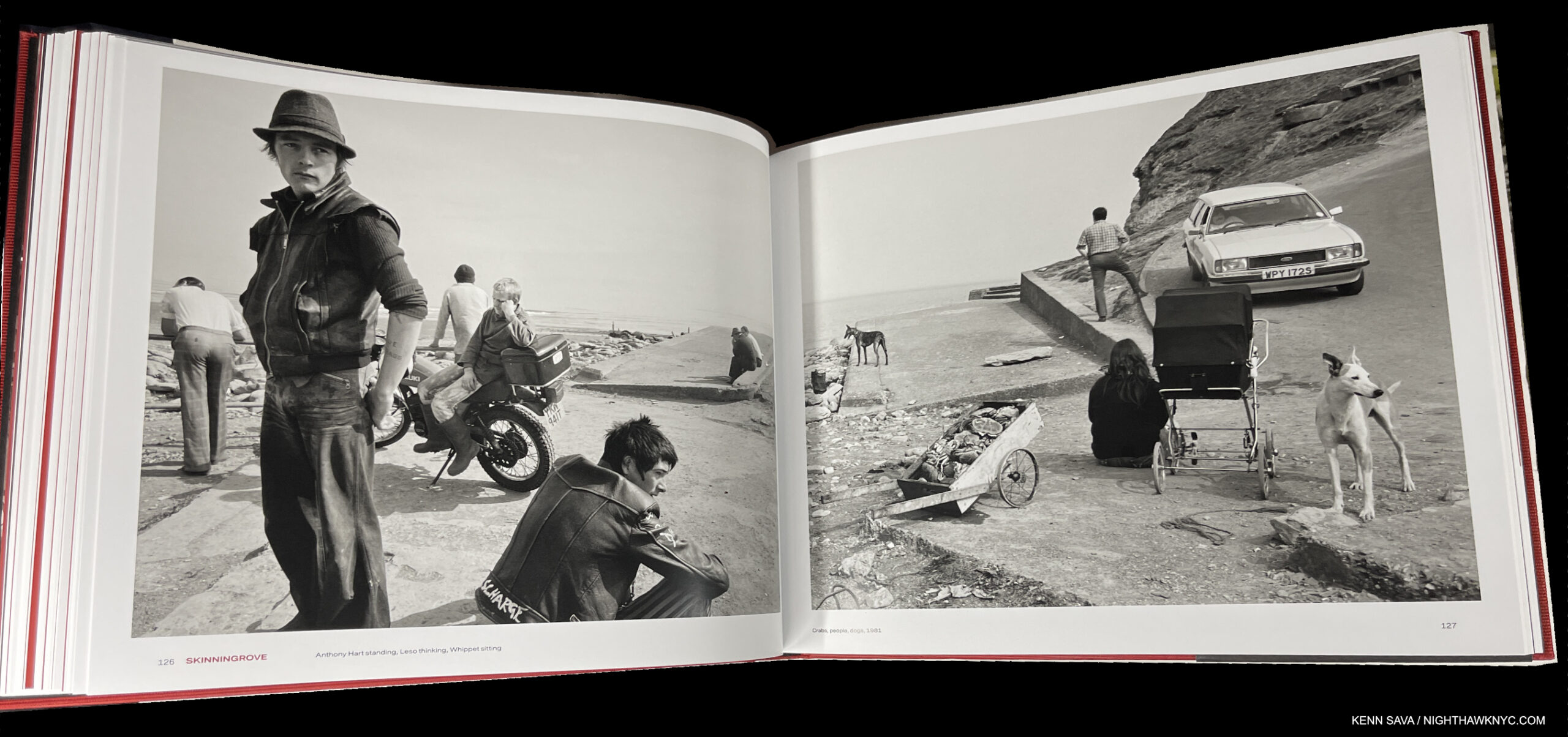
New in print is this wonderful retrospective that Mr. Killip (who died in October, 2020) did not live to see published, unfortunately. It’s beautifully done. I particularly appreciate its size and design. It’s almost 12 1/2 by 10, big without being oversized. The design is both tasteful and fresh, with the use of red being a great contrast to the mostly (but not all) black & white images. Looking at his work, Mr. Killip’s Portraits and Landscapes often have qualities I find in Rembrandt, one of the highest compliments I can pay any Artist, which are enhanced by his use of “unconventional” poses only found in life. A model Photography retrospective, it fittingly includes an essay by Mr. Halpern.

Trent Parke, Monument, Stanley/Barker

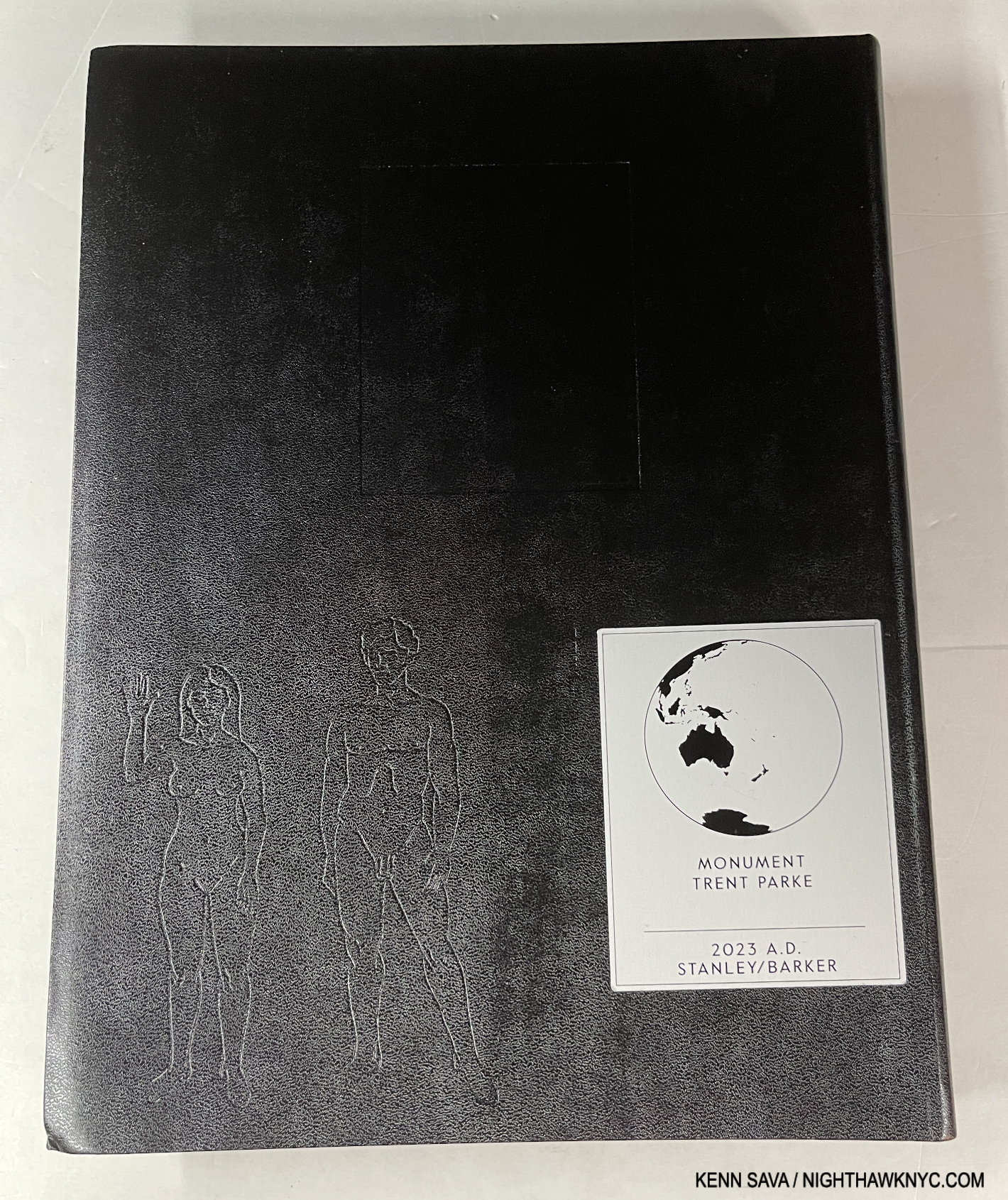
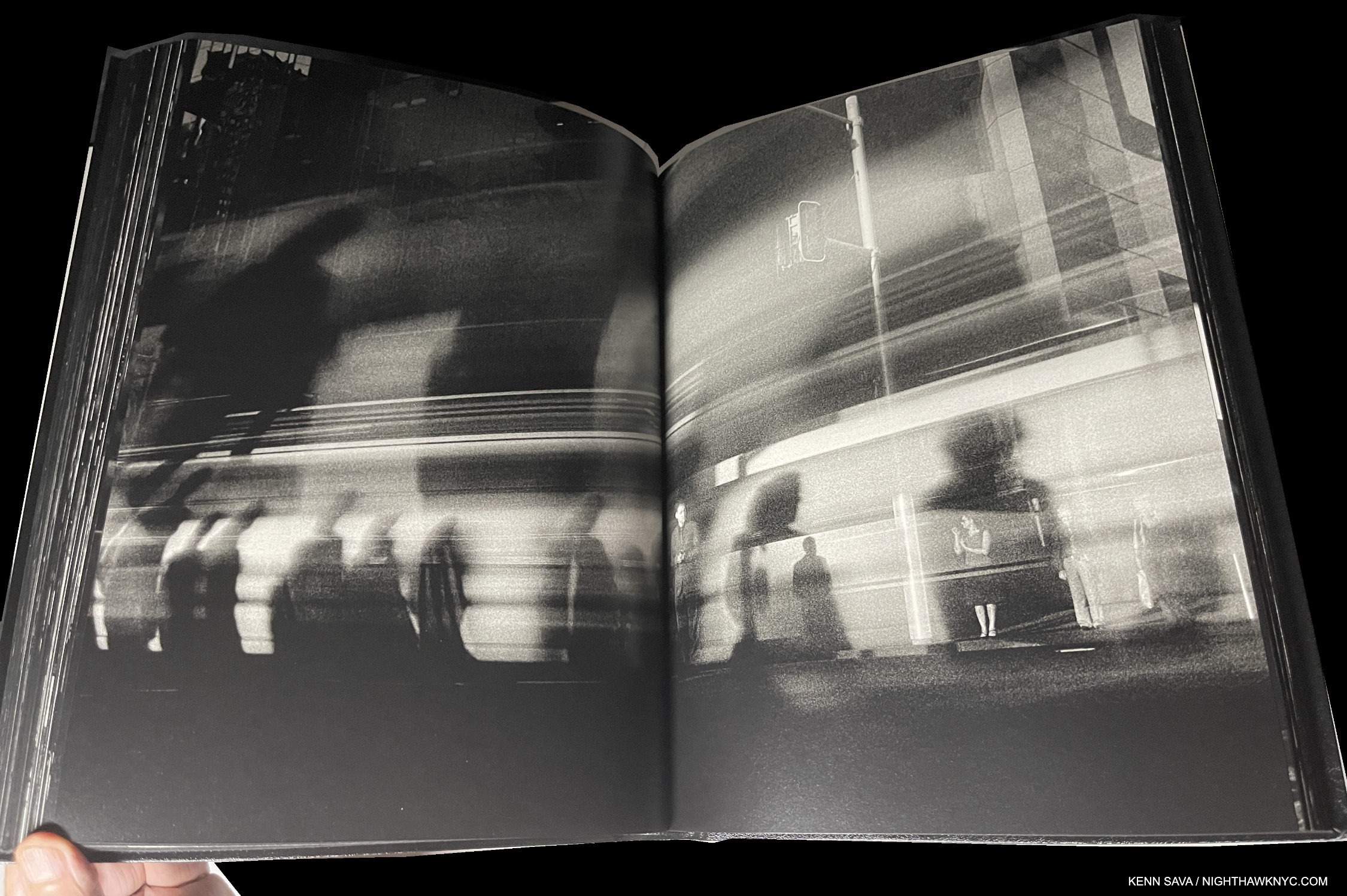
Being a city boy I have a real weakness for books depicting city life. But, I’ve seen too many that just leave me cold, and no, I’m not going to name which. Few and far between are those that really speak to me. Trent Parke’s Monument is one. Whereas most of the others are a string of Photos “connected” (if at all) by place, Monument is a look at the “alien world” Mr. Parke says he discovered when he moved to Sydney, Australia from a small country town. Mesmerized by the endless procession of workers to and fro day after day, he likened them to the countless moths that he saw at night, and includes, that were drawn by the bright lights of Sydney Harbour Bridge. Drawn to their death. Such is life in far too many places on Earth in 2023.

Entirely in black & white, with its minimal text only in Braille (which you’ll need to know to determine if your’s is a copy of the sold out 1st printing, or the upcoming 2nd printing), it’s a book that captures the fractured light of modern life going by in a blur as human moths go about chasing their own flame of a dream. Apparently, these Photos were taken before the pandemic as no one wears a mask. It’s beautifully designed & produced with Stanley/Barker in an embossed leather cover. Though it’s in black & white, Monument is one of the very few PhotoBooks I can think of that can bear up against Saul Leiter’s Early Color, perhaps the masterpiece of City photography of the books I’ve seen, which is one one of the most essential PhotoBooks of the 21st century in my view.

Jim Goldberg, Coming and Going, Mack Books

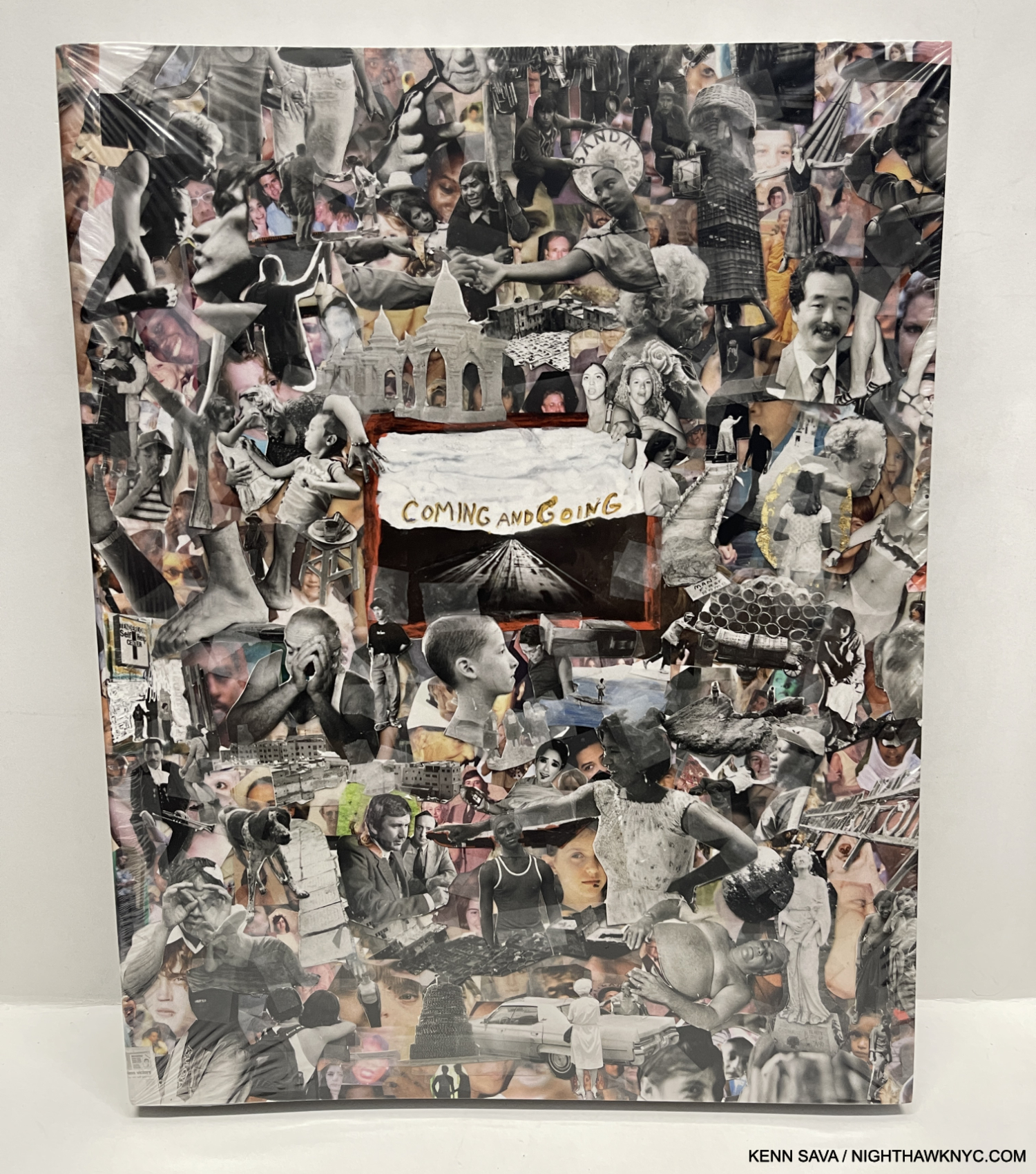
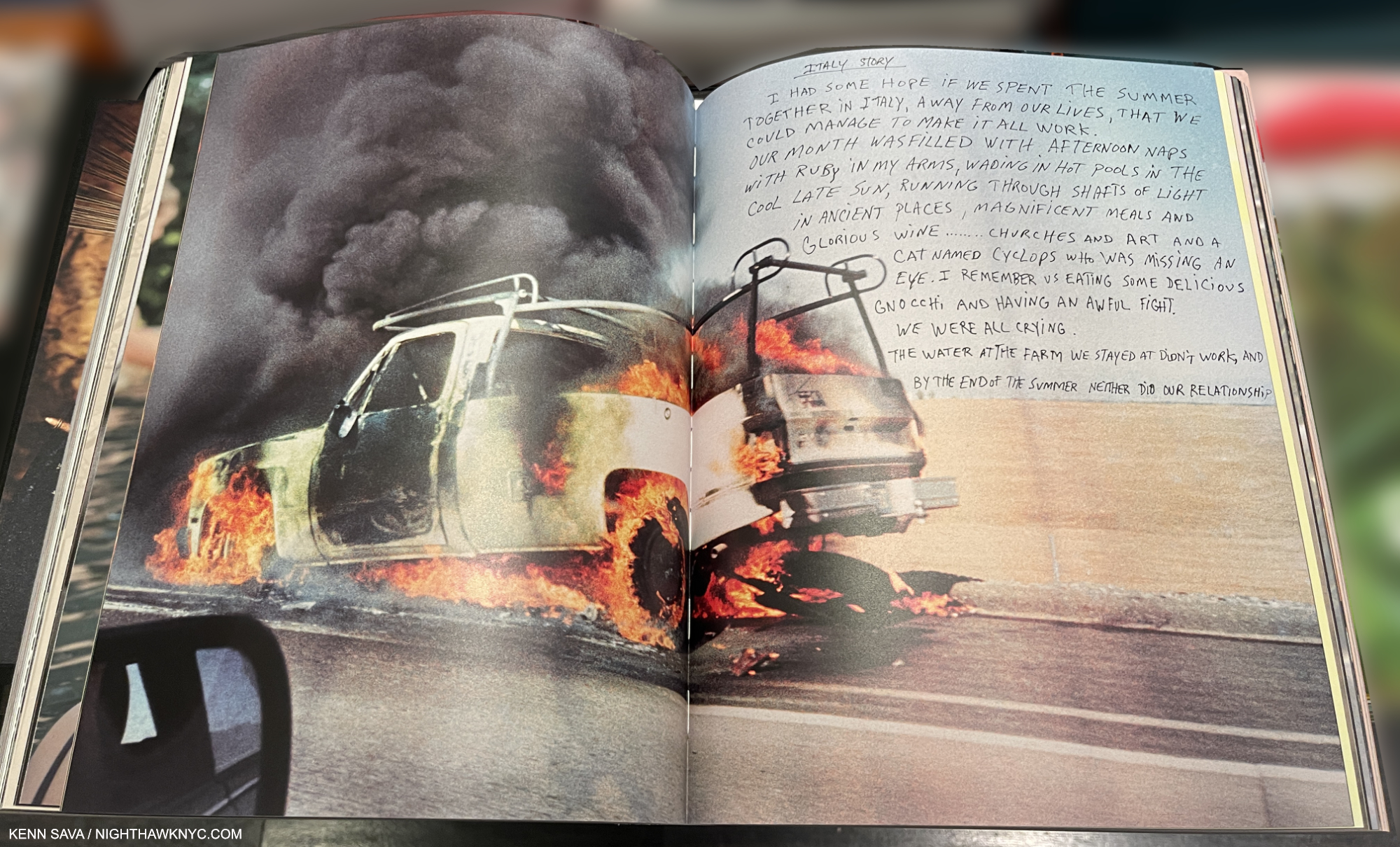
Jim Goldberg’s magnum opus (no pun intended) is a unique, visual autobiography, another tour de force of book design, as all of his books are. Coming and Going is autobiographical, though in classic Jim Goldberg style. Though there is no running text narrative, he feels free to write, draw or annotate on the images as he sees fit which helps guide the reader/viewer along. And who’s to argue with his choice? He’s forged a trademark style doing it that doesn’t age or look dated. Containing 360 13 by 11 inch pages, most of the material I have never seen before. There are stories, some featuring familiar characters from his prior books, though they are contained on 2-page spreads, which makes them look more like an Art work than a text. The story of his life moves forward on the power of his images, and that’s as it should be with such a one-of-a-kind Artist. A good number of them depict members of his family with love, understanding and poignancy, as they grow or age, even pass away.

Coming and Going is a LARGE book weighing in at 6 1/2 pounds, I wish it was a hardcover, instead of the stiff boards is covered with, because it’s a book that’s sure to see lots of handling and page-turning. Already at an $85. list, that probably would have added at least $5 to the cost. Then again, his classic Raised by Wolves was a softcover, too. Wolves remains THE classic Jim Goldberg book, but long-time fans will find much to get lost in in Coming and Going. 

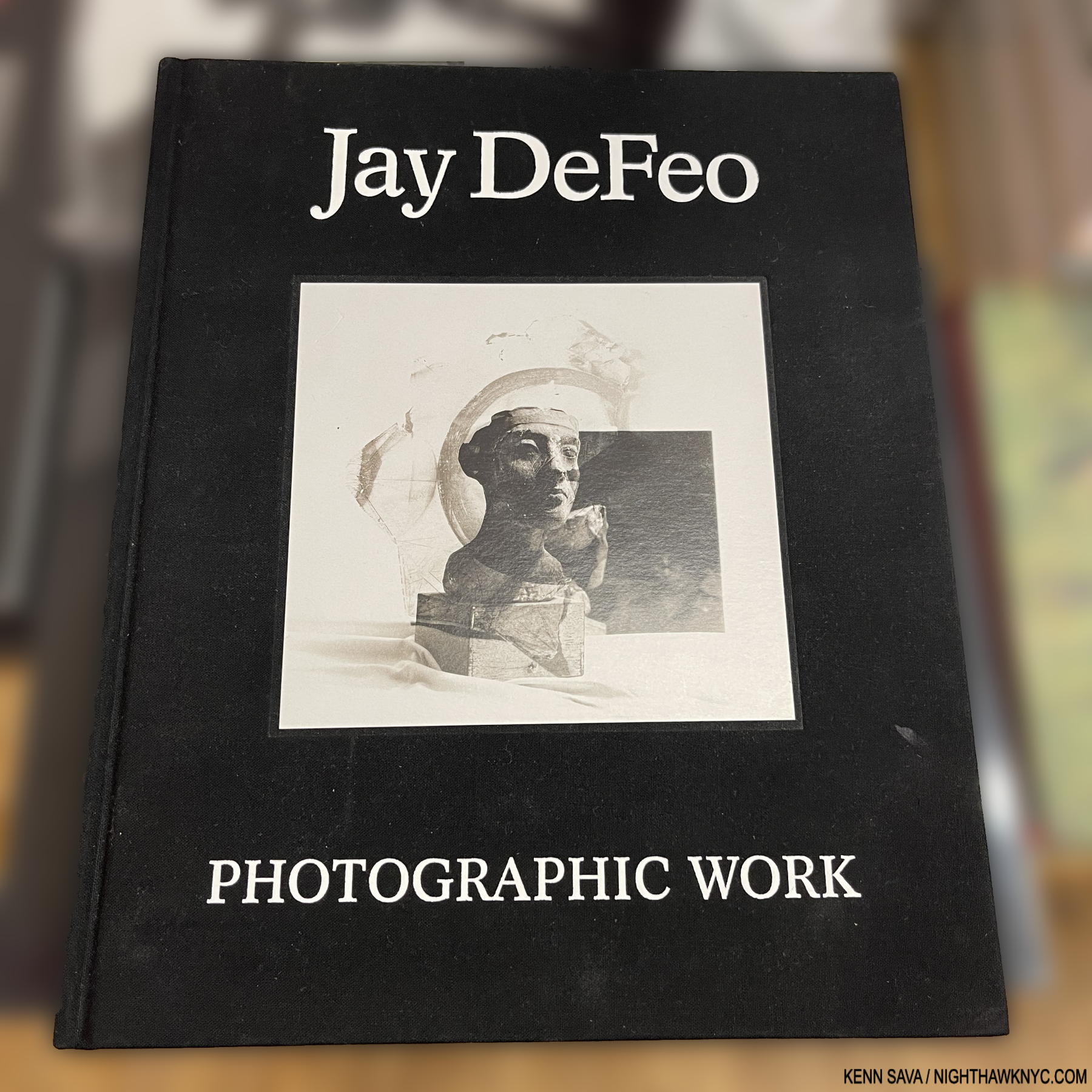
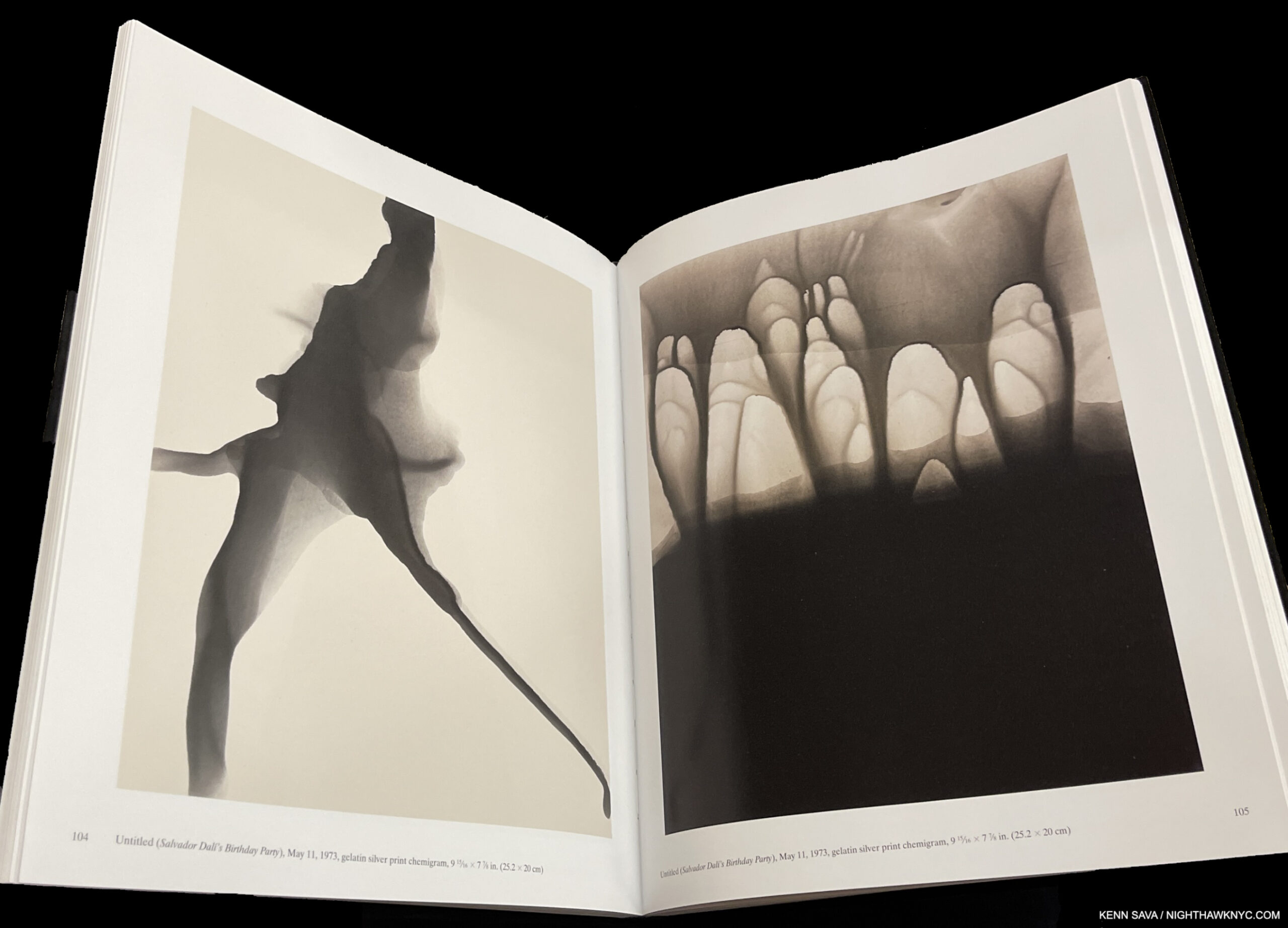
Jay DeFeo: Photographic Works, Jay DeFeo Foundation/ DelMonico

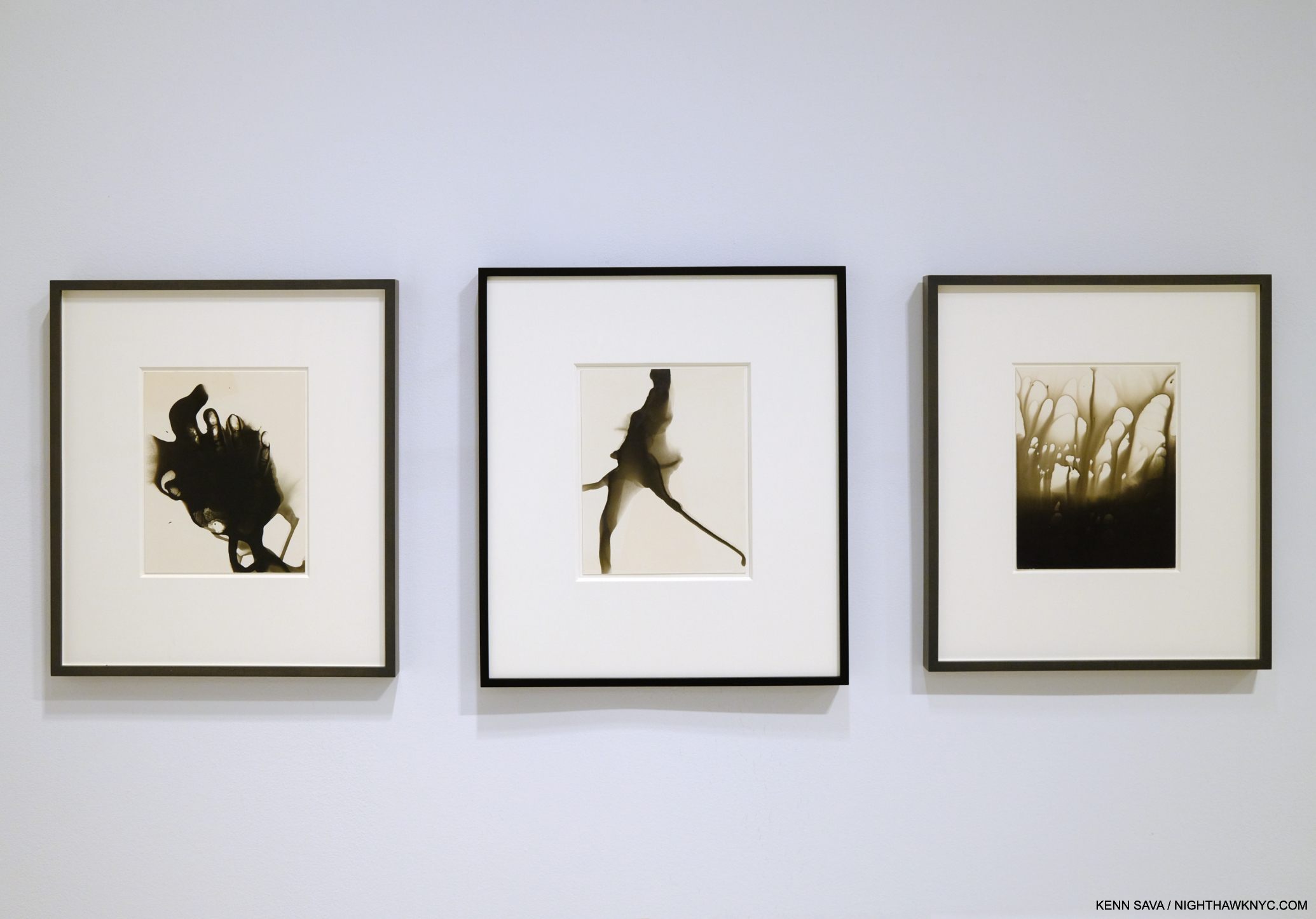
I could very well have listed this in NoteWorthy Art Books, 2023, but it’s here to make a point. Jay DeFeo (1929-89) is, perhaps, best known for her Painting, The Rose, 1969, and as a Painter. Though she passed at 60 from cancer in 1990, her star has continued to rise steadily since. Now comes the revelation that she was, also, a Photographic Artist, as this book, and the accompanying show at Paula Cooper Gallery, NYC, shows. Not only that, she was a formidable Photographic Artist.

The “point” I’m trying to make, yet again, is that Jay DeFeo is another on a list that gets longer all the time- a list of Painters who were also accomplished Photographers. To this point, they continue to remain overlooked by the larger Photography community, which continues to baffle me.

The two works shown above in the book as seen in the current show Inventing Objects: Jay DeFeo’s Photographic Work at Paula Cooper Gallery, September 22, 2023.

Right now at MoMA as I write, the great Ed Ruscha is the subject of a blockbuster retrospective, Now/Then. In 2016, Bruce Conner, Jay DeFeo’s close friend for many years, received one at MoMA, which I wrote about here. Yet, L.A. and San Francisco Artists who came to prominence in the 1960s and 1970s have been slow to receive the attention their East Coast counterparts have been enjoying for decades- particularly on the East Coast. Artists like Ed Kienholz quickly come to mind. Very near the top of the list, it’s way past time for the Jay DeFeo East Coast Retrospective.

Nan Goldin: This Will Not End Well, Steidl is my last Also Recommended NoteWorthy PhotoBook for 2023. I wrote about it here.

*- Soundtrack for this piece is “Strange Fruit,” by Billie Holiday.

Be sure to see the companion list to this one- NoteWorthy Art Books, 2023

My previous NoteWorthy PhotoBook lists-

NoteWorthy PhotoBooks, 2018

NoteWorthy PhotoBooks, 2019. And others

NoteWorthy PhotoBooks, 2020

NoteWorthy PhotoBooks, 2021


THERE ARE NO AFFILIATE LINKS IN THIS PIECE!

NighthawkNYC.com has been entirely self-funded & ad-free for over 8 years, during which 300 full-length pieces have been published! If you’ve found it worthwhile, PLEASE donate to allow me to continue below. Thank you, Kenn.

You can also support it by buying Art, Art & Photography books, and Music from my collection! Art & Books may be found here. Music here and here.

Written & photographed by Kenn Sava for nighthawknyc.com unless otherwise credited. To send comments, thoughts, feedback or propositions click here. Click the white box on the upper right for the archives or to search them. Subscribe to be notified of new Posts below. Your information will be used for no other purpose.

Nick Cave: Beauty Deeper Than Skin

This site is Free & Ad-Free! If you find this piece worthwhile, please donate via PayPal to support it & independent Art writing. You can also support it by buying Art & books! Details at the end. Thank you.

Written & Photographed by Kenn Sava

Show Seen- Nick Cave: Forothermore @ the Guggenheim Museum

No. Not THAT Nick Cave.

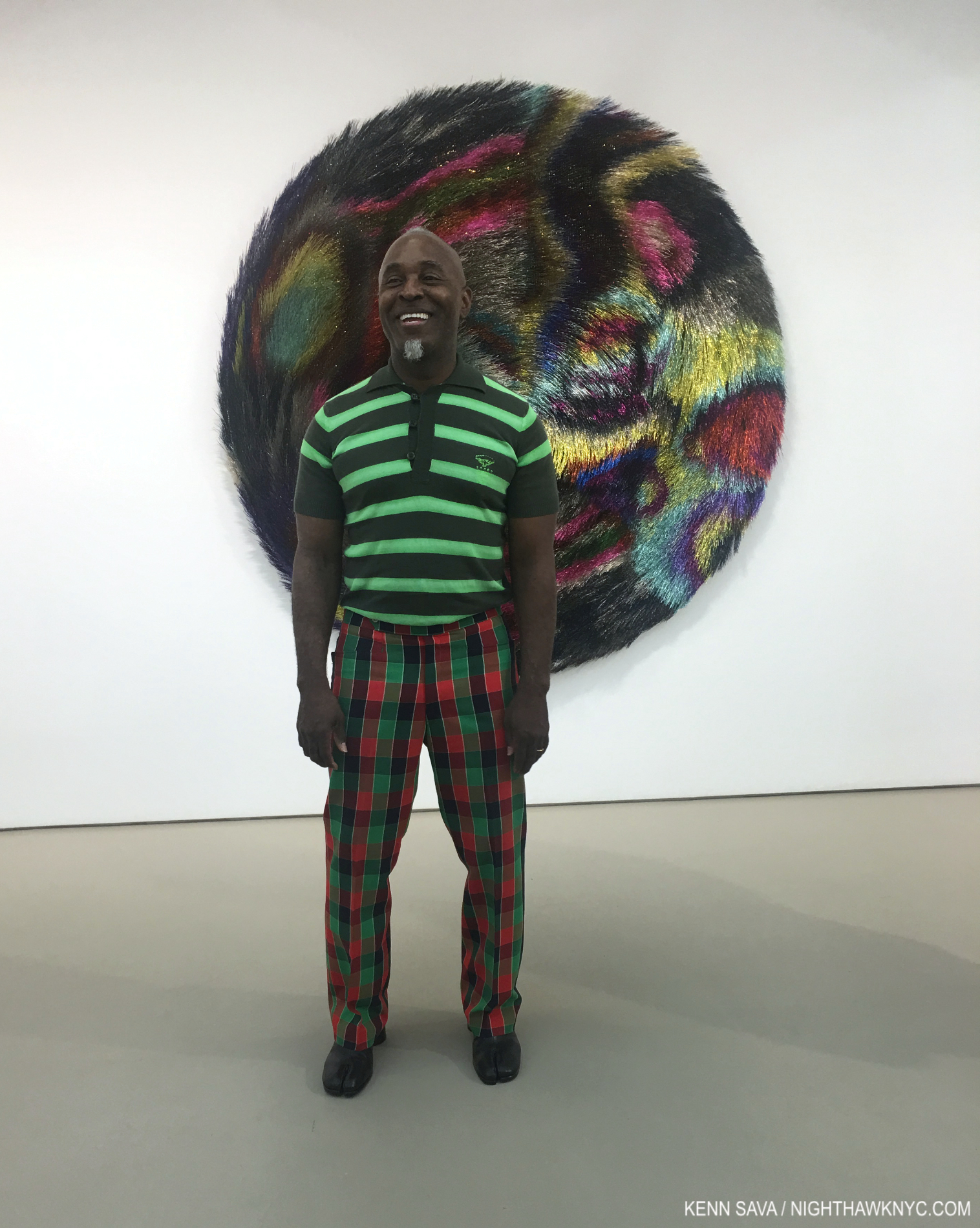
THIS Nick Cave. The Artist standing in front of Tondo, 2018, Mixed media including wire, bugle beads, sequined fabric and wood at the opening of Nick Cave: Weather or Not at Jack Shainman May 17, 2018 . Tondo was also on view in Fororthermore.

Nice Cave, the multi-dimensional Artist, that is, who deserves every bit as much notoriety as the other, rightly very well-known Nick Cave, whose work I also admire. This Nick was born in 1959 in Fulton, Missouri, and now lives & works in Chicago, where he has been creating beautiful heart-rending Art for over 30 years. Art, largely created as his response to the world around him marked by racism, profiling and the murders of unarmed Black men and women.

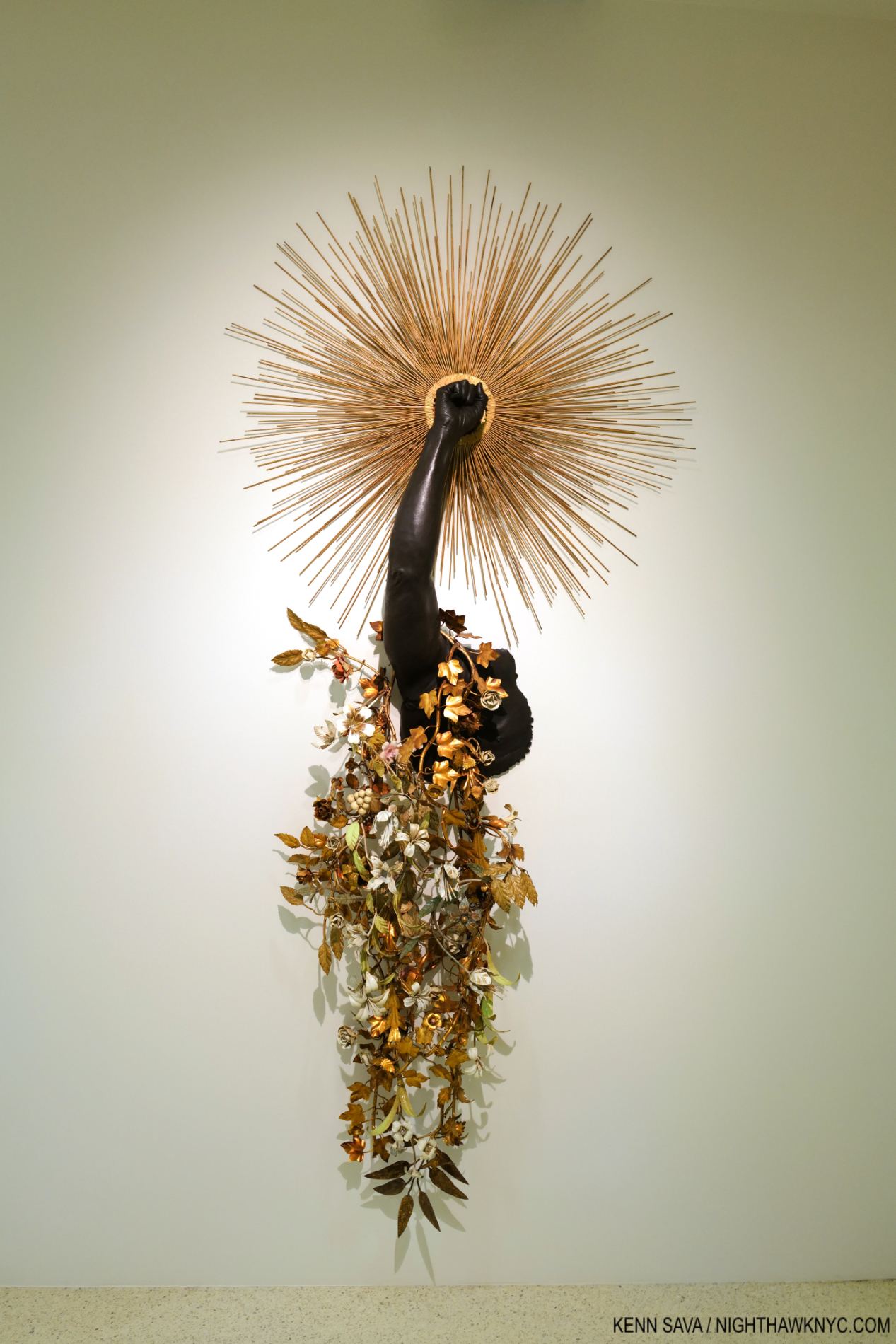
Arm Peace, 2018, Cast bronze, sunburst and vintage tole flowers 85 × 39 × 12 inches. (One of two pieces in the show named Arm Peace.) In my book, this deserves to be “iconic,” as do a number of other pieces in Forothermore.

Even though I had seen a number of his shows at Jack Shainman, his books, and I have been in his presence twice, I was completely unprepared for Nice Cave: Forothermore his mid-career Retrospective at the Guggenheim. I went in believing Mr. Cave is one of the more important Artists working today. I left speechless.

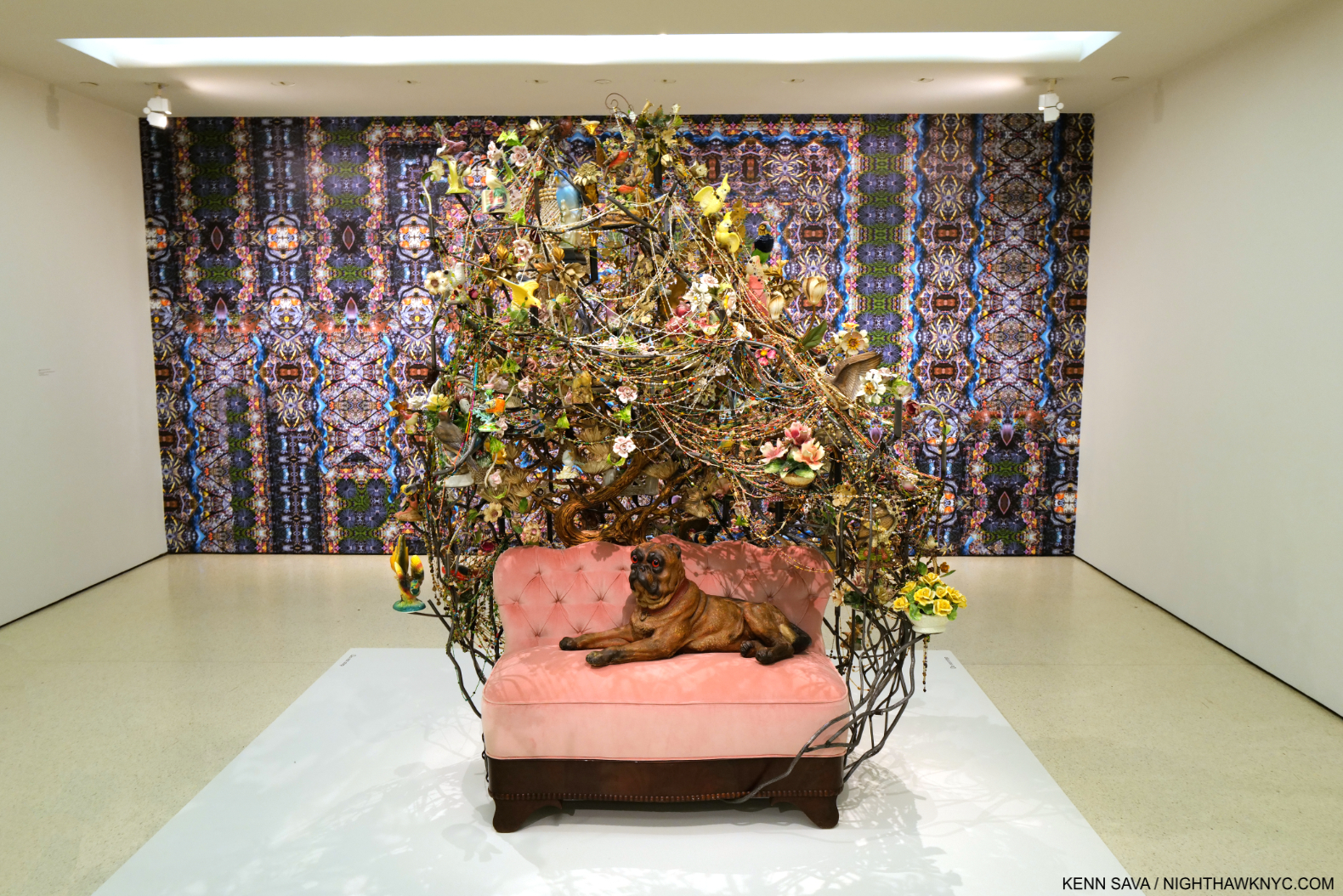
Rescue, 2013, Mixed media including ceramic birds, metal flowers, ceramic Pug, vintage settee, and light fixture 91 × 78 × 54 1/2 inches, front, Nick Cave in collaboration with Bob Faust Wallpaper Near Rescue Works (New Work), 2021, TBC, Dimensions variable, on the back wall.

As a result, I’ve decided to let Mr. Cave, who has a gift for expressing himself in words, to go with his extraordinary gifts for visual expression, do much of the talking in this piece. In Forothermore, a number of the pieces I’d seen over the years, and many others, came together as a startling whole of 49 pieces over three sections: What It Was, What It Is, and What It Shall Be, in 3 locations in the museum. I must admit that I am not a fan of the side galleries the Guggenheim added during their expansion of Frank Lloyd Wright’s masterpiece (which I fought at the time they announced them, and my argument was published in The New York Times, my first published writing). The newer galleries are oddly shaped, because Wright didn’t design these spaces to be galleries. In my view, they detract and distract from Wright’s original intention and design of Art in the Rotunda. That being said, Nick Cave: Forothermore was one of the more important shows in NYC so far this young decade, if not THE most important show I’ve seen. The Guggenheim deserves kudos for bringing it here.

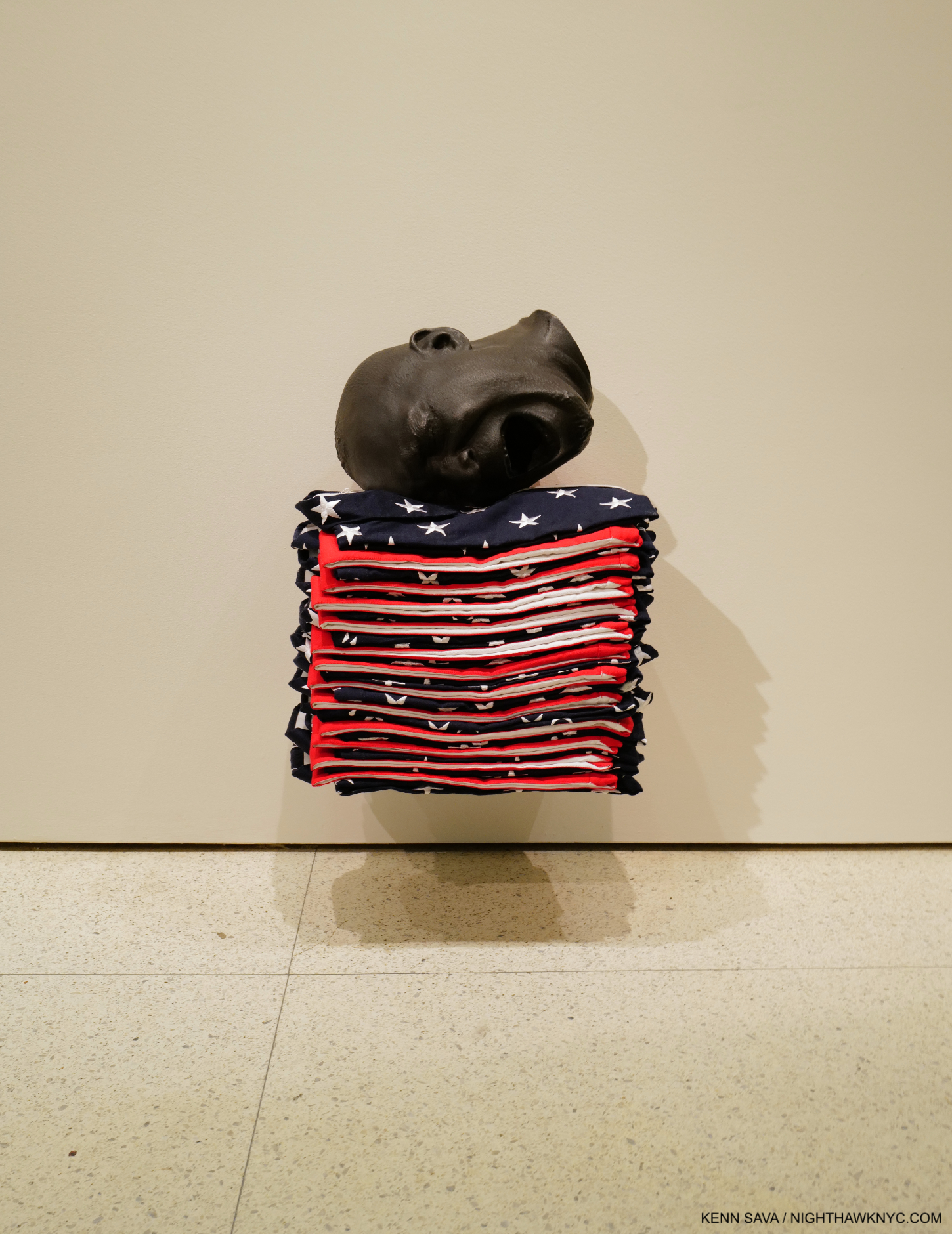
Untitled, 2018, Mixed media including a bronze head and 13 American flag shirts, 23 3/4 × 15 3/4 × 12 inches

At first glance, much of Nick Cave’s Art, particularly his famous Soundsuits, look otherworldly until a close look reveals virtually all of it consists of everyday or found items used in incredibly imaginative ways. Part Sculpture, part Music, part furniture, part Collage, part fashion, and partially created using textile production and jewelry-making techniques, there seems to be no limit to what Mr. Cave’s pieces are or fixed rules about how they’re made. Still, all of what we see now is part of his extraordinary response to the reality of his life and that of other Black men and women.

It started early…

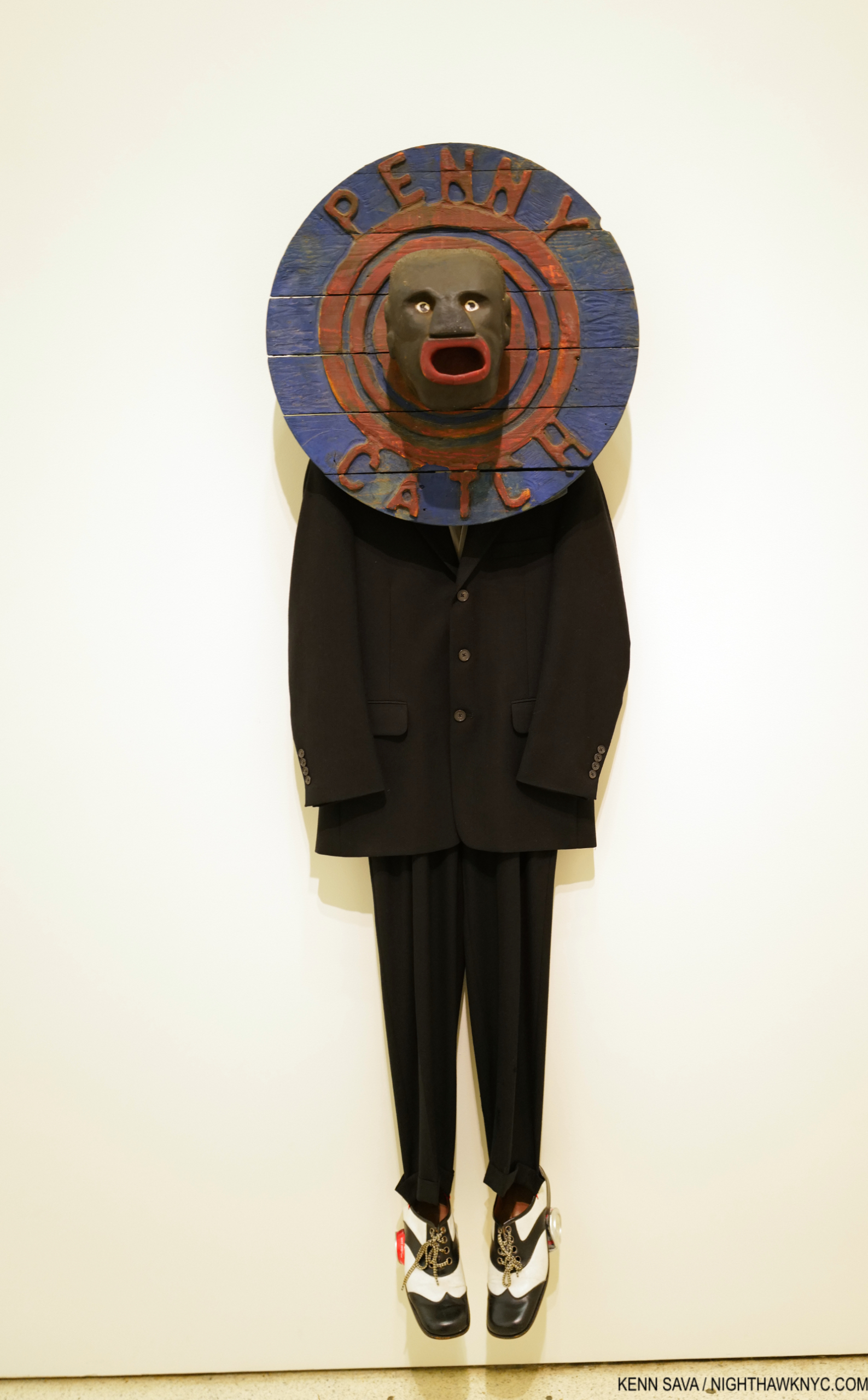
Penny Catcher, 2009, Mixed media including vintage coin toss, suit, and shoes 74 × 23 × 14 inches

“My mother told me when I was, like, eight years old, the complexity of what I would have to deal with. So knowing made me think, ‘I’ve got to build a thick skin. I’ve got to be able to operate in a world…that could work against me as opposed to for me. What do I do with that?'”1

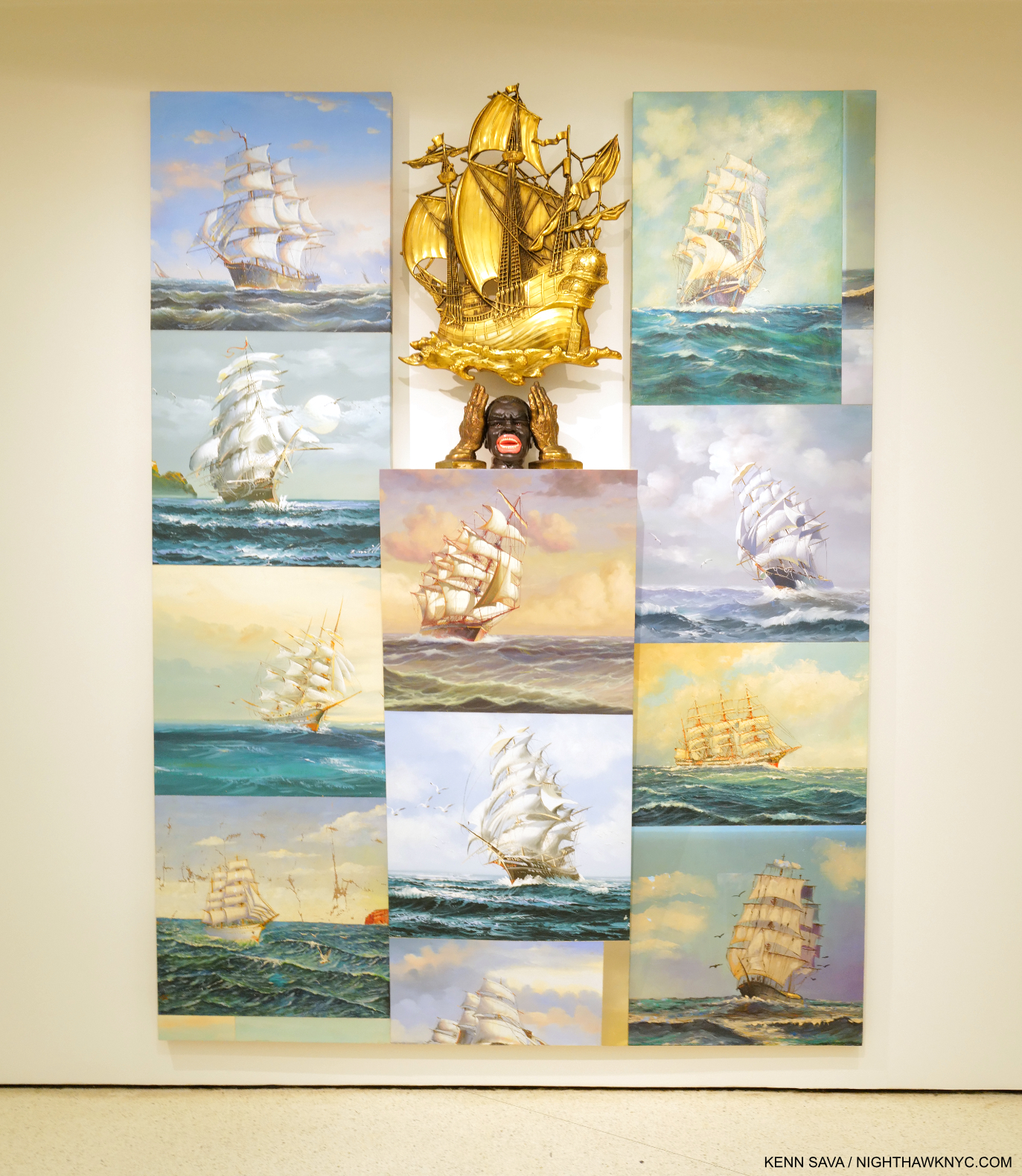
Sea Sick, 2014. Mixed media including oil paintings, ceramic container, cast hands, and plastic ship 96 × 72 × 10 1/2 inches. At 8 feet tall, with 11 Paintings of the kind of 17th century ships slavers used mounted salon-style, each shown in full sails, almost looking to be going back and forth, at angles to inspire sea sickness among those on board, with a striking head and hands in the center, as if screaming “ENOUGH!” The head was a tobacco holder that was later sold as a spittoon!

“I have been racially profiled. I’m walking home with my portfolio from teaching. I am pulled…surrounded by undercover cops saying, ‘Lie down on the floor’– because the convenience store was robbed down the street. That has been my reality. Get it together up here (points to his head). Psychologically, I have to really get it together. And I just have to get quiet–to put it in perspective and to not lash out into rage. And if I do, lashing out for me is creating this (a Soundsuit). All of that becomes the impulse to create.”2

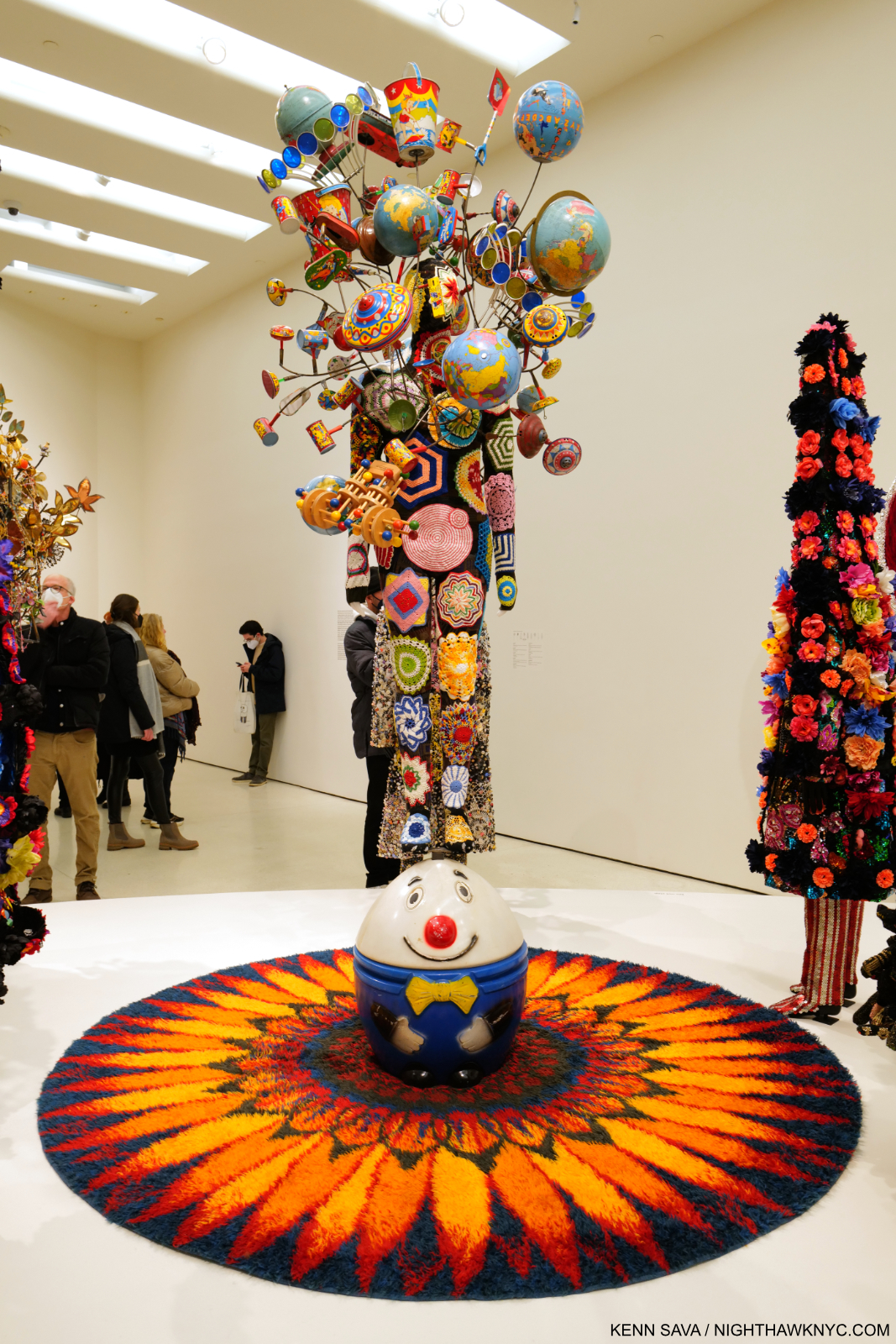
Soundsuit 2012 Mixed media including embroidery, fabric, vintage toys, rug, and mannequin Soundsuit: 127 × 98 × 93 inches

Best known to this point for his ongoing series of Soundsuits– works that combine all the processes listed earlier in an ultimate manifestation of that “thick skin” he referred to, that a performer then wears as one of many in  one of Mr. Cave’s joyous and bombastic performances. For display, the performer is replaced with a mannequin. The range of materials they have included over the years would fill a Sears Roebuck catalog. In spite of the long history of both fashion and theater, I have seen virtually nothing like them3. The Soundsuits brought him immediate fame. Their origin may be lesser known-

“The first Soundsuit was in ’92 in response to the Rodney King incident, the L.A. riots. I was sitting in the park one day  and just sort of thinking about, What does it feel like to be  discarded, dismissed, profiled?
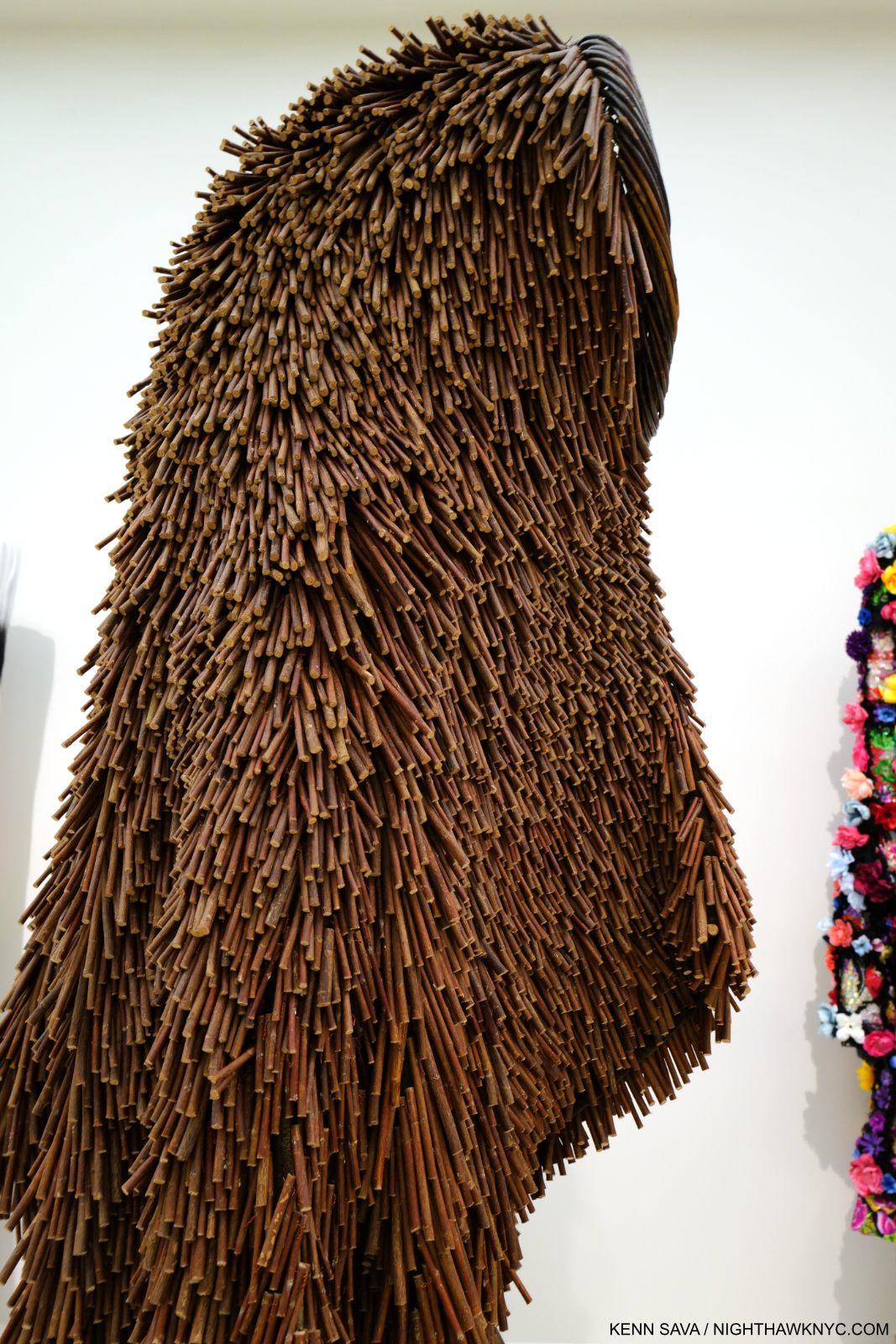
There was this twig on the ground. And I looked at that twig as something discarded. And then I proceeded to just start collecting the twigs in the park. And I brought them all back to the studio. And then I started to build this sculpture. I started to realize that the moment I started to move in it, it made sound. Then it just literally put everything in perspective. I was building this suit of armor, something that I could shield myself from the world and society. And so out of that came this sculpture-performative kind of work.”4

Detail of a Soundsuit made largely from twigs. Soundsuit, 2011, Twigs, wire, upholstery, basket, and metal armature, 83 × 27 × 40 inches. Seen in full from the side in the next picture.

That “discarded” and “forgotten” twig set a precedent for the materials he’s used in his Art since, a collection of objects and materials that seems encyclopedic, some of which speak to Mr. Cave of his childhood, when objects like figurines were cherished family possessions. This creates a duality whereby even though a number of the objects he incorporates are offensive, even disgusting (like the spittoon in Sea Sick), it’s very hard not to see “beauty” and “Art” in Nick Cave’s work, particularly in how masterfully he combines everything in ways that are reminiscent of Duchamp, Rauschenberg and Betye Saar, among others, though in entirely his own way. In so doing, he’s forged a style without having one style. Along with the beauty, there’s an undeniable joy in a good deal of his work, which reaches its zenith, perhaps, in his live performances with dancers performing in his Soundsuits in a communal celebration.

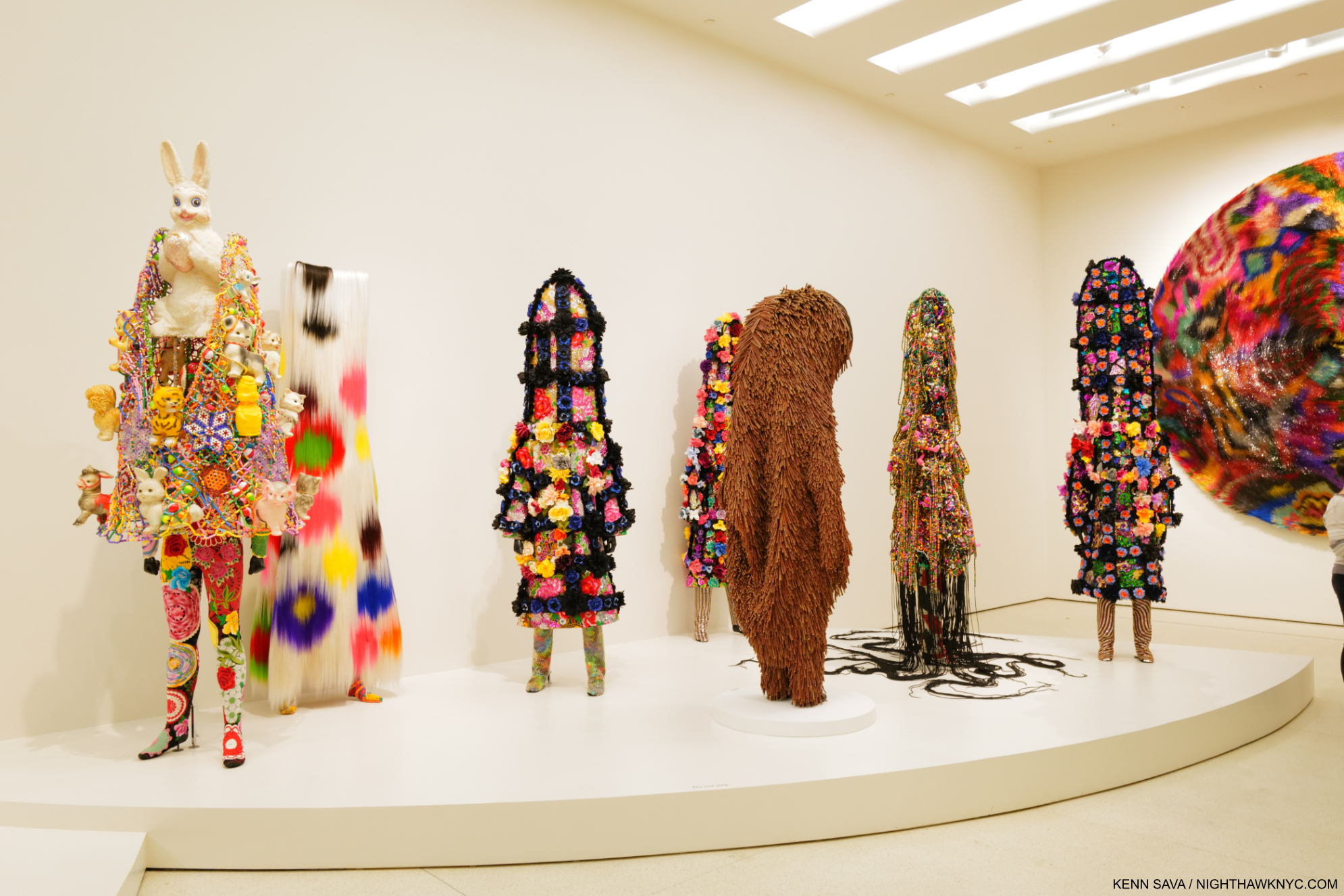
Soundsuits. From left, Soundsuit, 2022 with vintage bunny, Soundsuit, 2015 with synthetic hair, Soundsuit 9:29, 2021-2022, Soundsuit, 2011 shown in the prior picture, Nick Cave, Soundsuit 9:29, 2021, Soundsuit, 2019, and Soundsuit 8:46, 2021, far right.

Yet, in spite of their outward appearance, all is not joy with his Soundsuits. Mr. Cave reveals how he sees them-

“I don’t ever see the “Soundsuits” as fun. They really are coming from a very dark place. The “Soundsuits” hide gender, race, class. And they force you to look at the work without judgment. You know, we tend to want to categorize everything. We tend to want to find its place. How do we, sort of, be one on one with something that is unfamiliar?”5

“I think after the first Soundsuit, I had a different approach to art making. And I realized that I was an artist with a conscience. The moment I did was the moment that  my life literally turned upside-down. I think it’s just me kind of experimenting. It’s like, you know, a scientist  exploring alternative ideas.”6

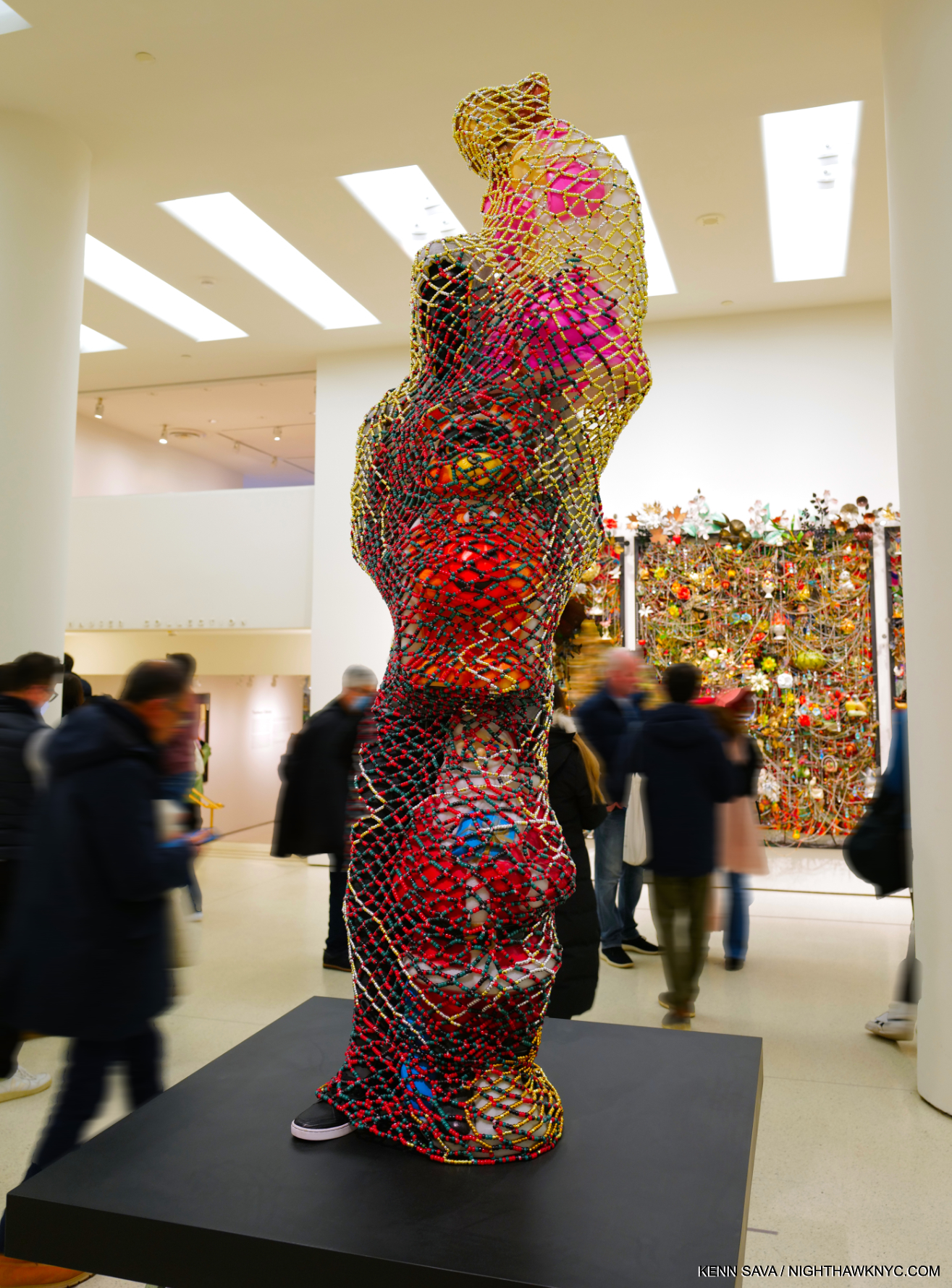
TM13, 2015. Mixed media including vintage blow molds, pony beads, pipe cleaners, mannequin, and garments, 89 × 48 × 49 inches. The Trayvon Martin Soundsuit.

Trayvon Martin is a new work  that was shown at Cranbrook. It’s made up of a Black mannequin dressed  in a hoodie and sneakers and jeans. And then surrounding its body  is these plastic blow molds. Which are, like sometimes at Halloween, there are these plastic forms  that are set out in yards. And so they are surrounding this  sort of figure almost as guardians. But then over top of the entire structure is  this web that’s constructed out of pony beads. So from a distance, it looks like this amazing sort of gold  sculptural form until you get up close and you realize that there  is someone trapped inside.” 7

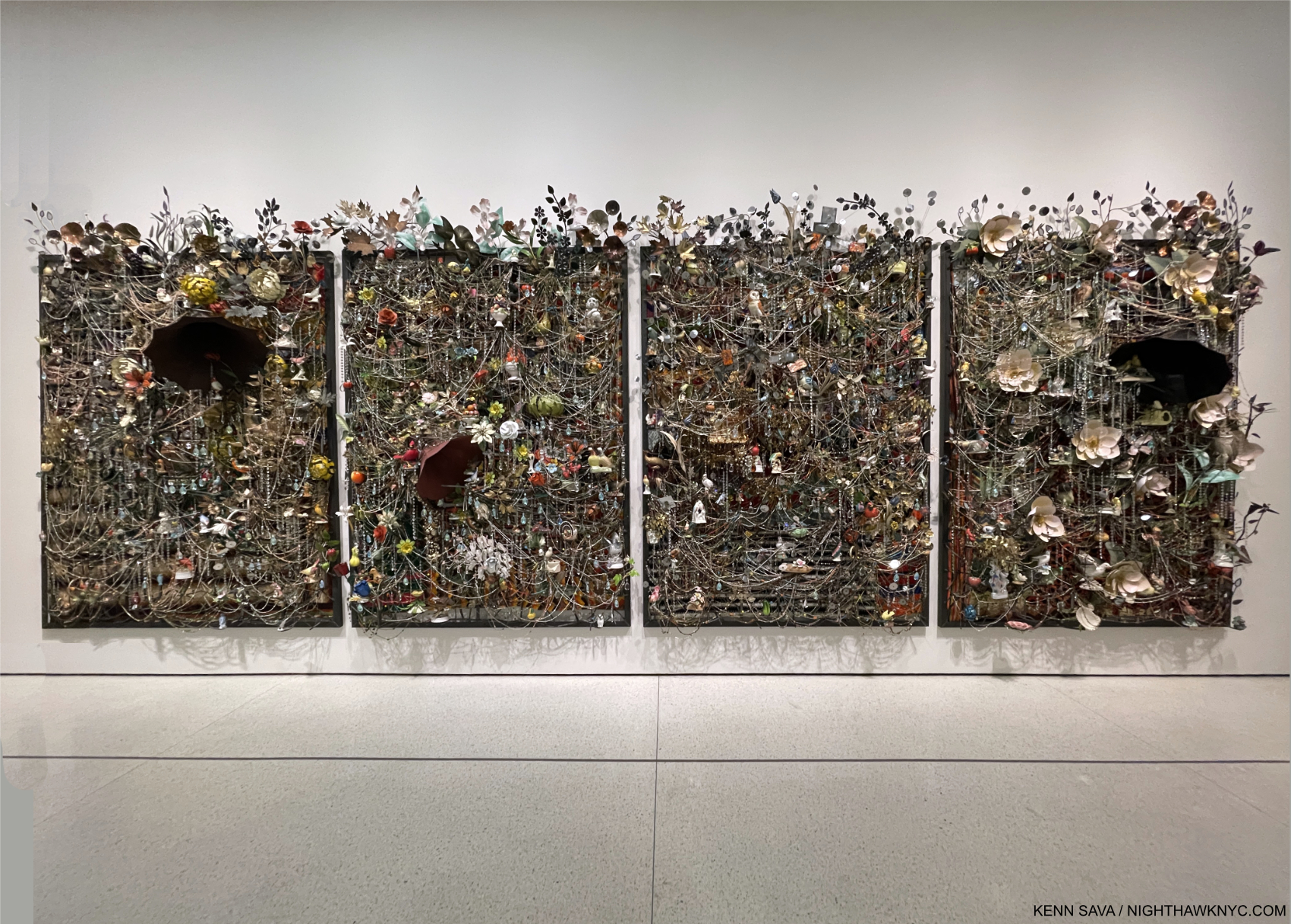
Wall Relief, 2013, Mixed media including ceramic birds, metal flowers, afghans, strung beads, crystals and antique gramophone
4 panels: 97 × 74 × 21 in., each. Perhaps the most complex work on view among many very complex pieces.

“The title (“Forothermore”) is a neologism, a new word that reflects the artist’s lifelong commitment to creating space for those who feel marginalized by dominant society and culture—especially working-class communities and queer people of color. The show both highlighted the development of Cave’s singular art practice and interrogated the promises, fulfilled or broken, that the late 20th and early 21st centuries offered to the ‘other,'” the Guggenheim said.

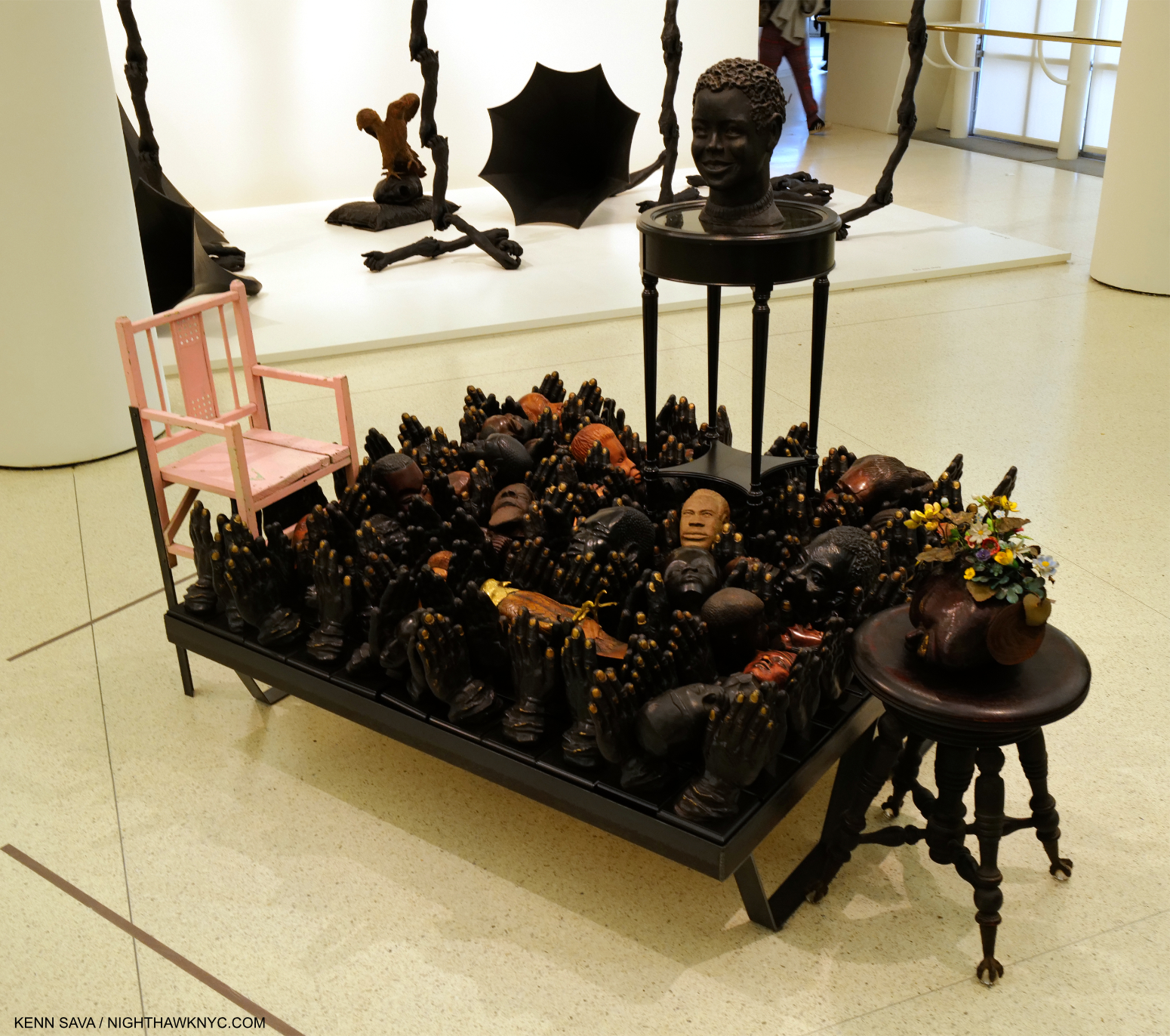
Untitled, 2018, Mixed media including round table, clay head, piano bench, carved head with vintage tole flowers, child pink chair, 19 carved heads, 1 carved eagle, cast polyurethane hands, 52 1/8 × 52 1/8 × 61 inches

“You know, I think at the end of the day,  it’s me giving back to the community  and being this sort of change agent. I want to change our way of  engaging with one another. I want to use art as a form of diplomacy. That’s why I’m in this state of urgency right now. And I don’t know. I just feel so unsettled. I’m doing what I’m doing, but I’m not sure if it’s happening fast enough.”8

Detail of Tondo, 2022, Metal mesh, hardware cloth, bugle beads, wire, sequin fabric and wood.

Nick Cave is rewriting the power of Art, to paraphrase Simon Schama. He’s doing it by channeling horror and pain- both experienced by others, and by himself, into “lashing out” by creating. And, he’s doing so in ways never before seen. I see a lot of Art, and I see a lot of shows. It’s not often that I am awestruck by an Artist’s creativity, but I am by Nick Cave’s. Still, it’s hard to really get a full sense of Mr. Cave’s extraordinary gifts. If Nick Cave can produce such beautiful and powerful work in a world like this, I can’t help but wonder what he’d create in a world without racism.

*- Soundtrack for this piece is “Peace,” by Gil Scott-Heron, a Bonus track from the 2014 reissue of his 1971 album Pieces of a Man.

Thank you, Maddie.

SPECIAL ADDENDUM- The NYC MTA recently completed the installation of Nick Cave’s monumental, 4,600 square feet, 3-part, permanent Public Art piece, Each One, Every One, Equal All, in the subway under Times Square, the latest in their absolutely stellar on-going series of Public Art projects for the NYC subway. It rivals Sarah Sze’s entire subway station installation (which I showed here) for the largest Art work in the NYC subway system. It took multiple trips to fully see the whole thing, and my look at it can be seen here.

NighthawkNYC.com has been entirely self-funded & ad-free for over 8 years, during which 300 full-length pieces have been published! If you’ve found it worthwhile, PLEASE donate to allow me to continue below. Thank you, Kenn.

You can also support it by buying Art, Art & Photography books, and Music from my collection! Art & Books may be found here. Music here and here.

Written & photographed by Kenn Sava for nighthawknyc.com unless otherwise credited. To send comments, thoughts, feedback or propositions click here. Click the white box on the upper right for the archives or to search them. Subscribe to be notified of new Posts below. Your information will be used for no other purpose.

Nick Cave Brings Joy & Beauty to the Subway

This site is Free & Ad-Free! If you find this piece worthwhile, please donate via PayPal to support it & independent Art writing. You can also support it by buying Art & books! Details at the end. Thank you.

Written & Photographed by Kenn Sava

This is an addendum to my look at Nick Cave: Forothermore @ the Guggenheim Museum, here

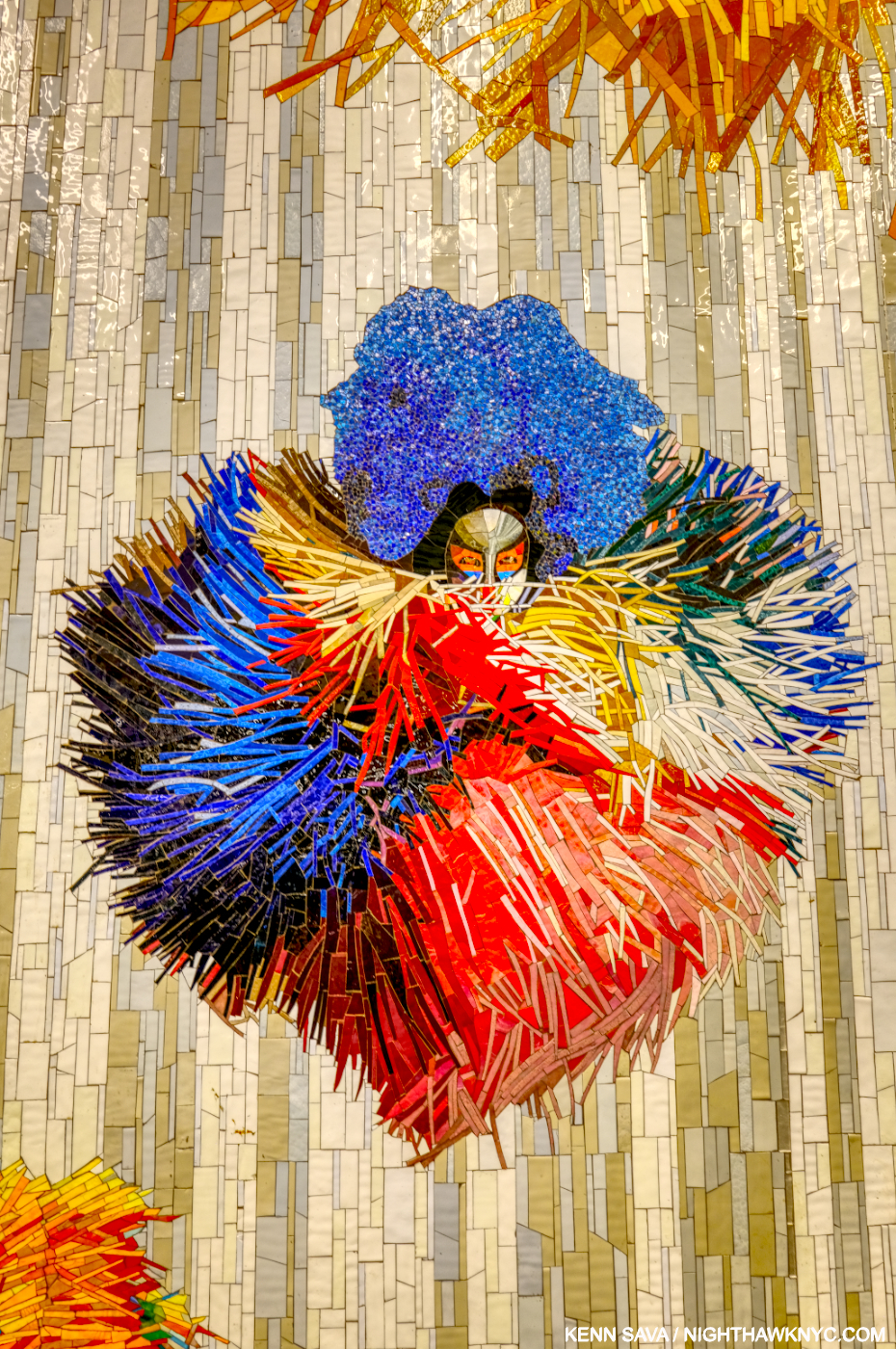
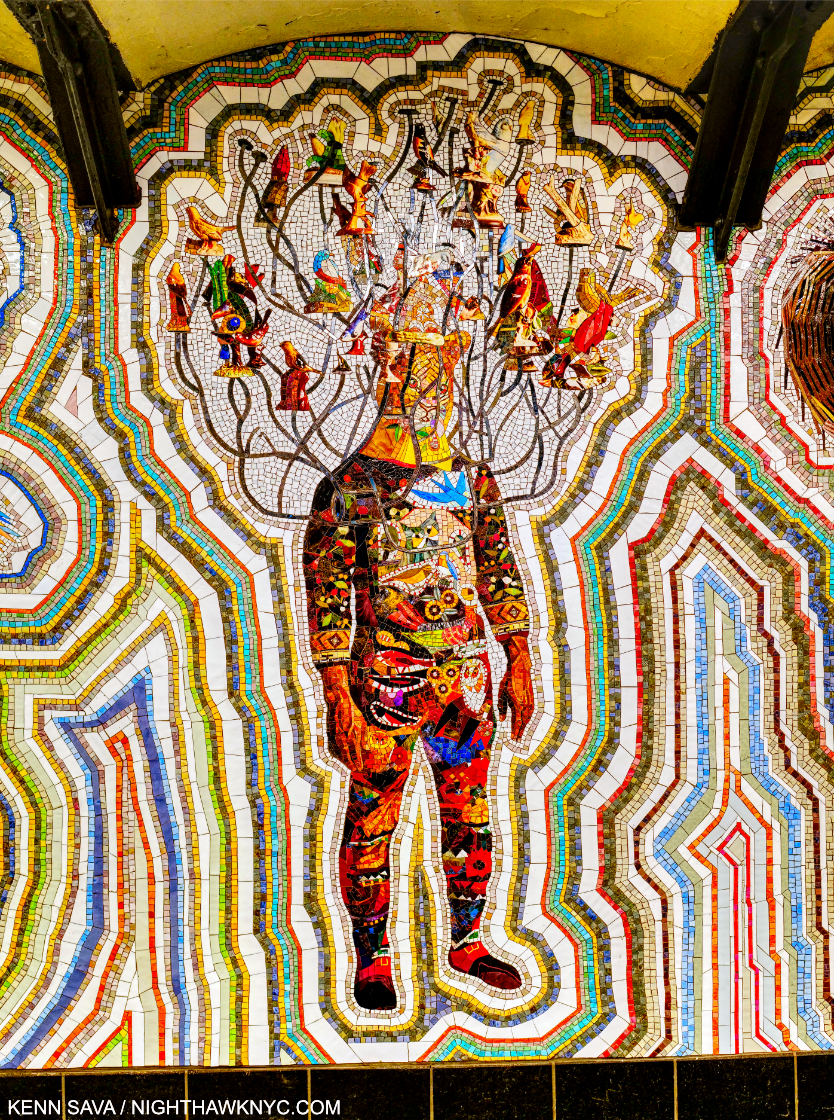
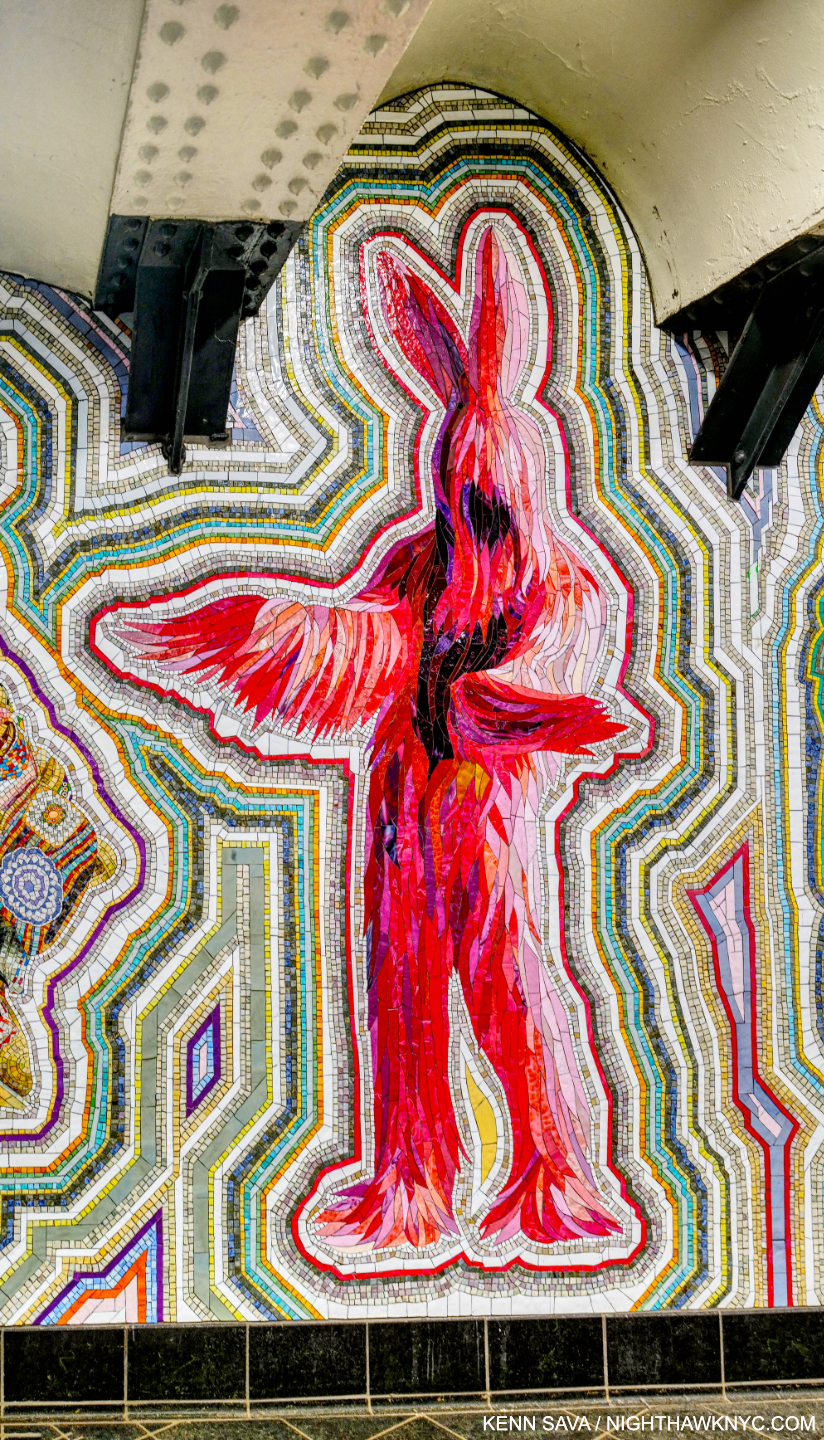
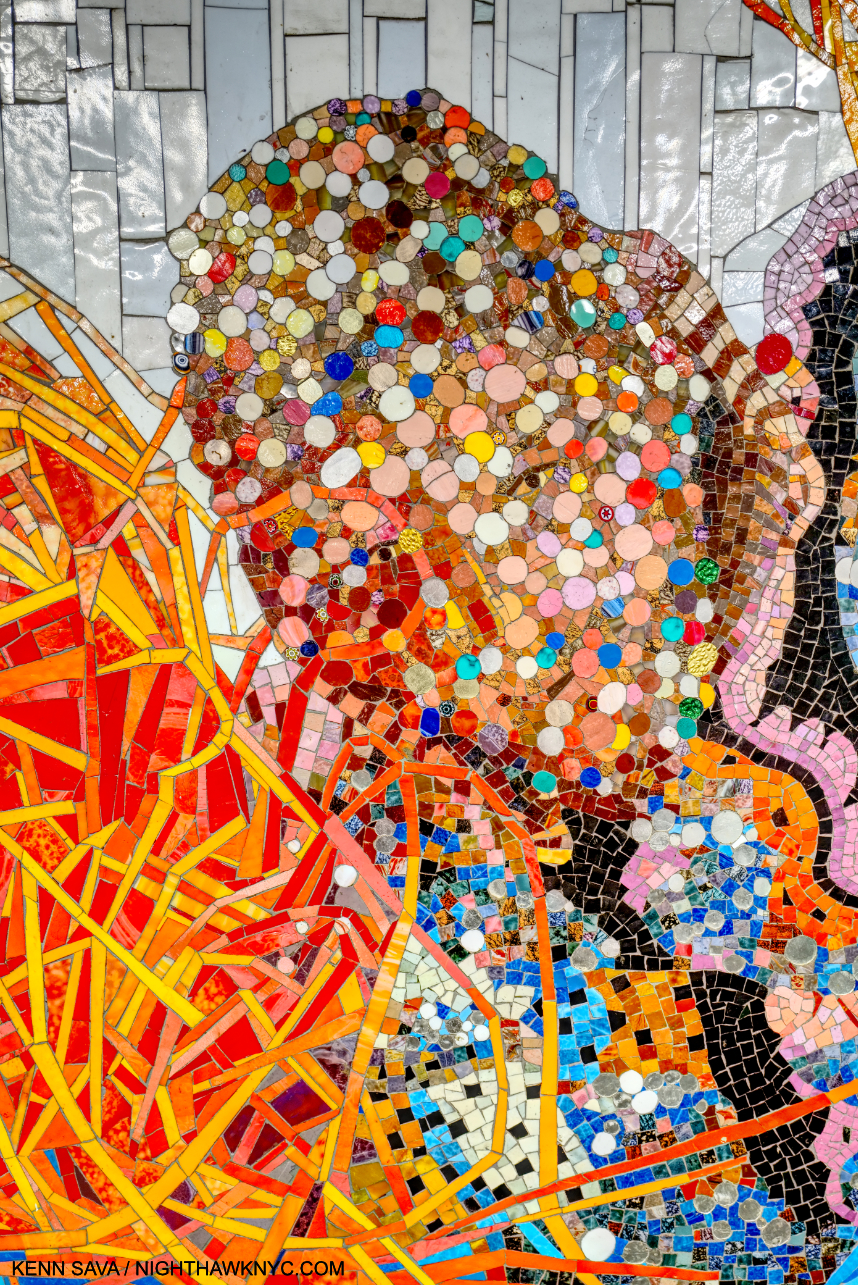
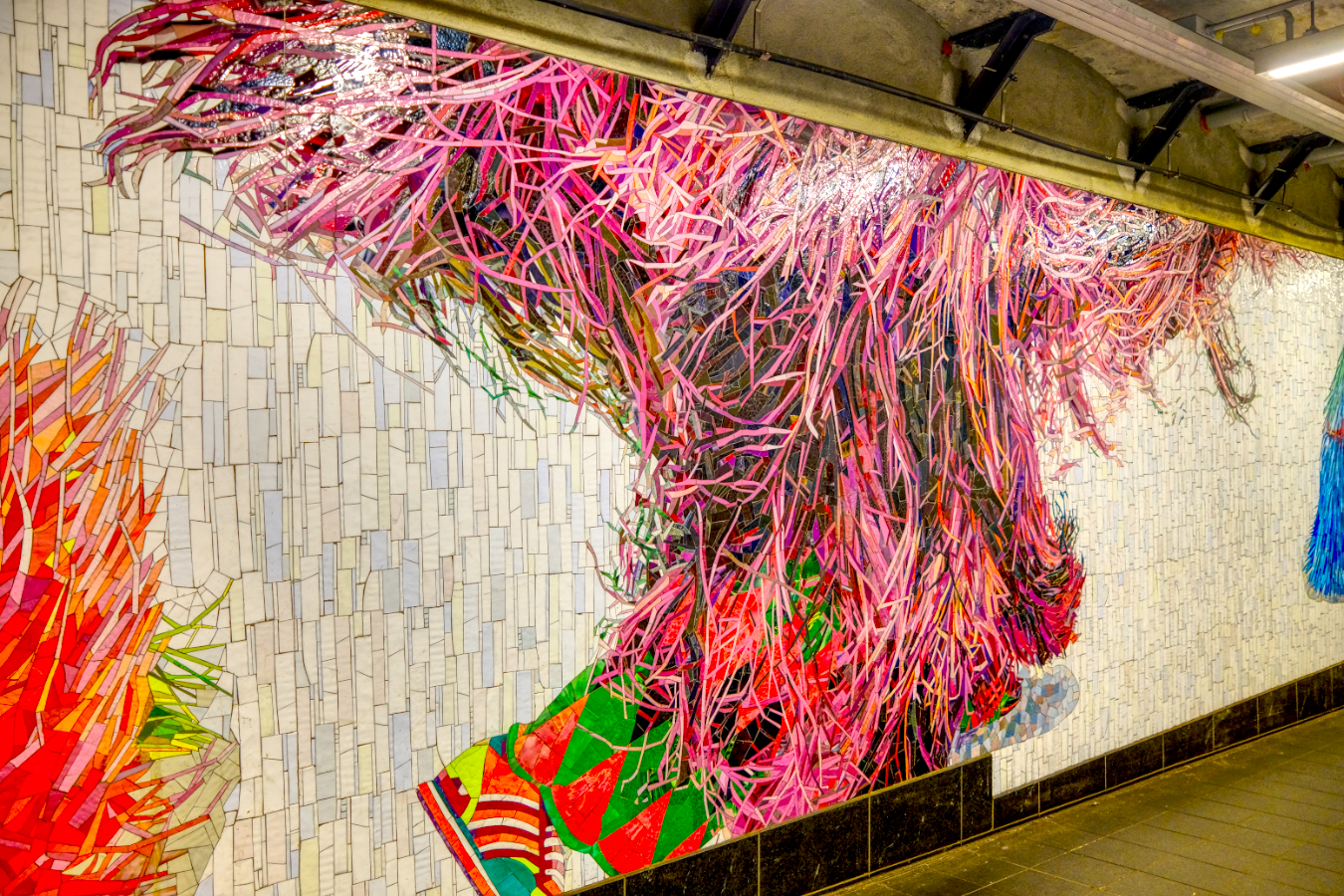
Who am I? Detail of one of the figures in the section titled Every One. All works shown are Glass mosaic tiles and dated 2022 unless stated. Click any photo for full size.

Some of the most spectacular Art in New York is free and available to see & experience 24 hours a day, 7 days a week, 365 days a year. All you need to do to see it is pay a subway fare. All around town, MTA Arts & Design has succeeded in bringing a world-class roster of Artists to the City’s subway riders that rivals that of any museum1. Created in 1985, MTA Arts & Design has been one of the most remarkable stories in NYC Public Art, if not Public Art anywhere.

Installation view of the entire first section, Each One, installed just outside the turnstiles at the One Times Square Entrance.

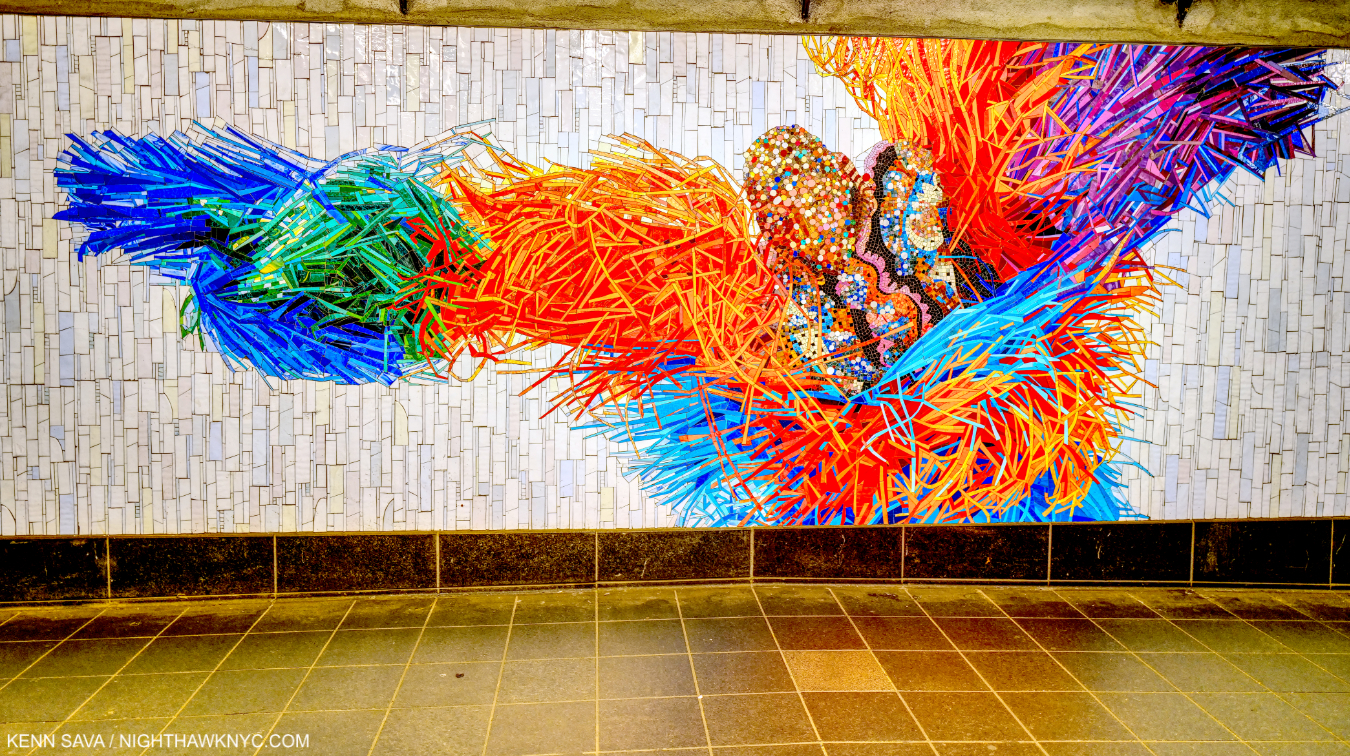
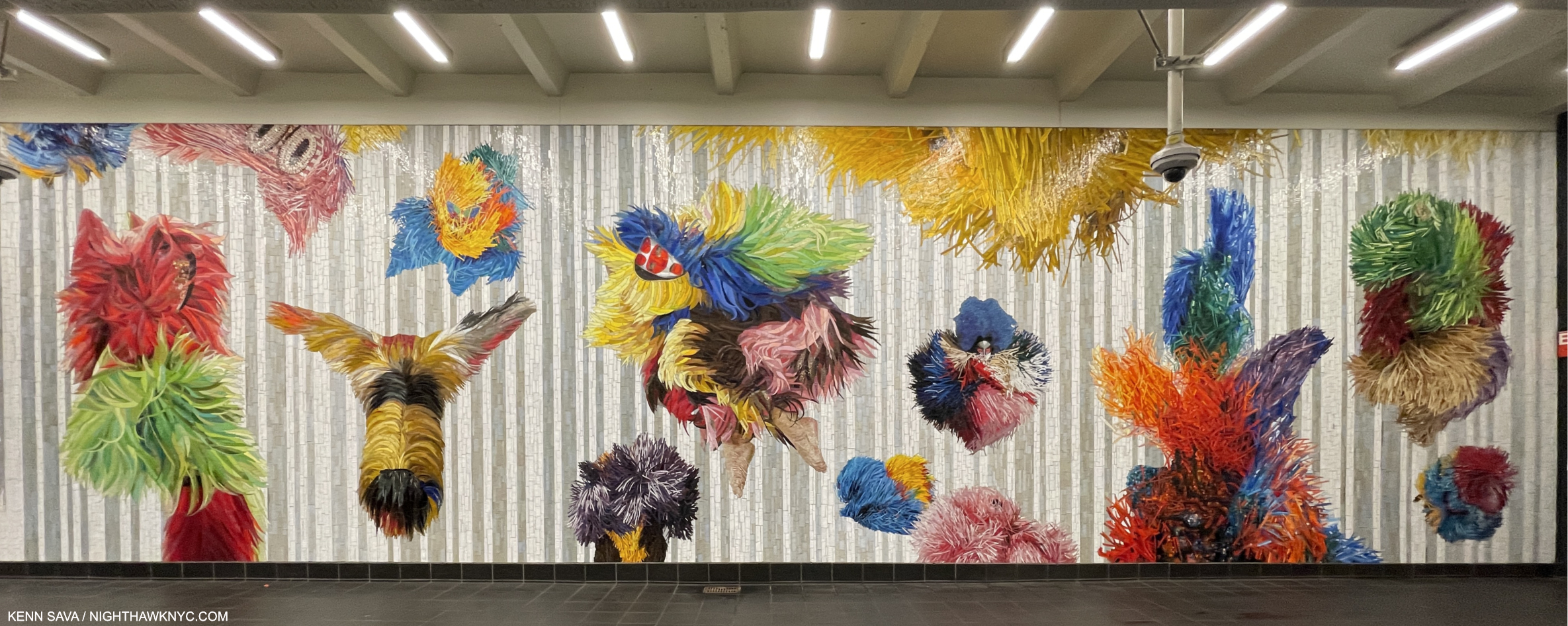
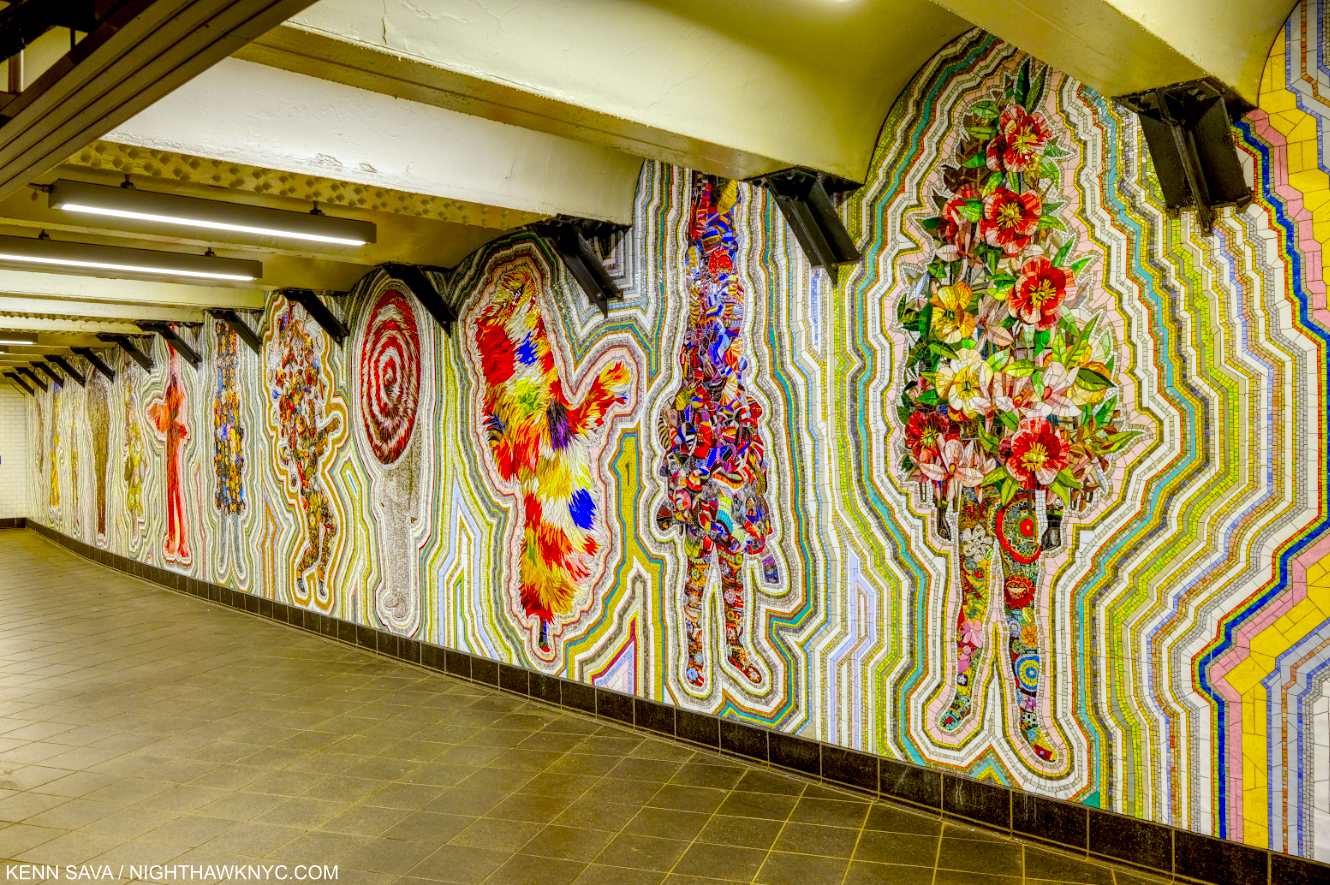
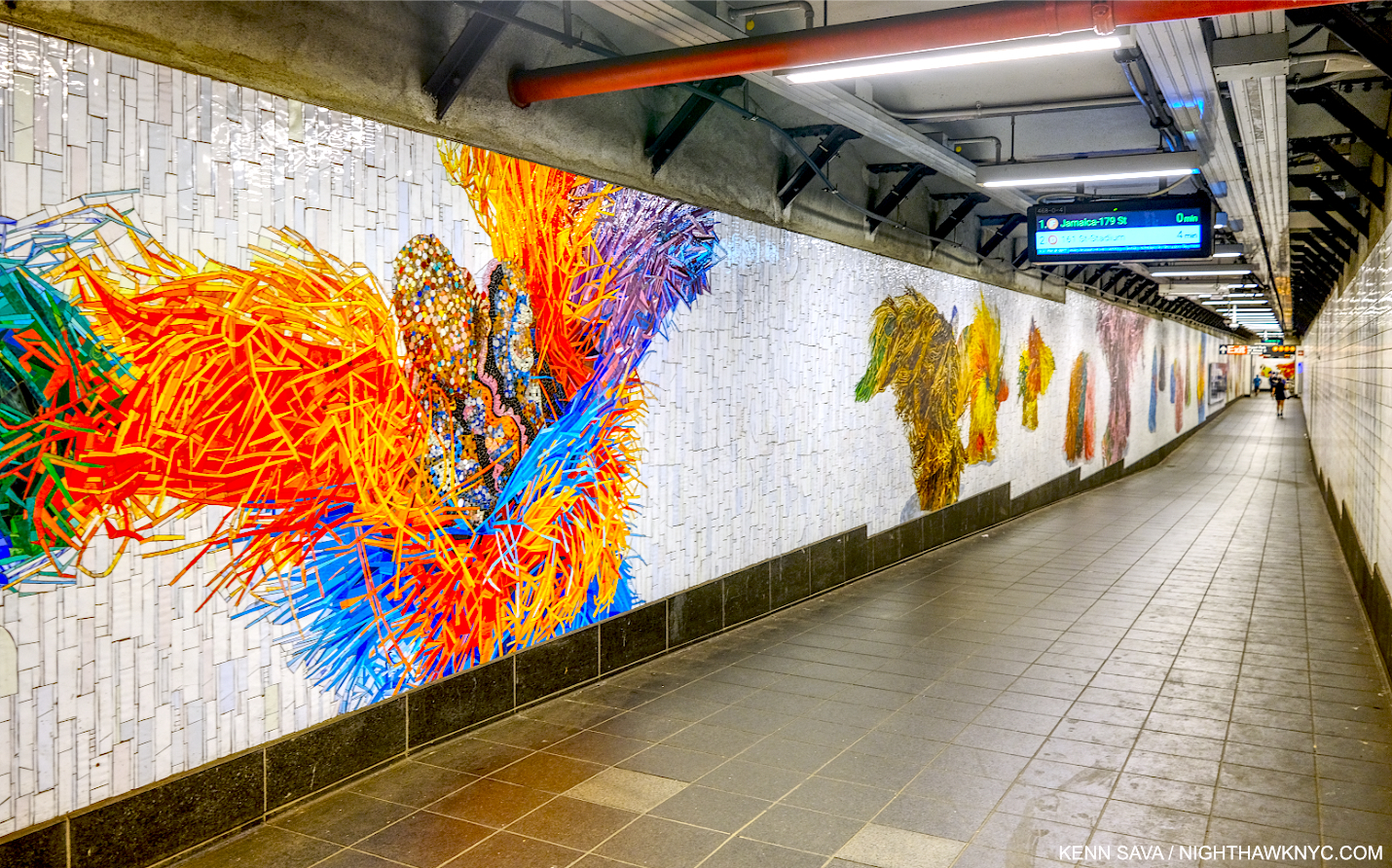
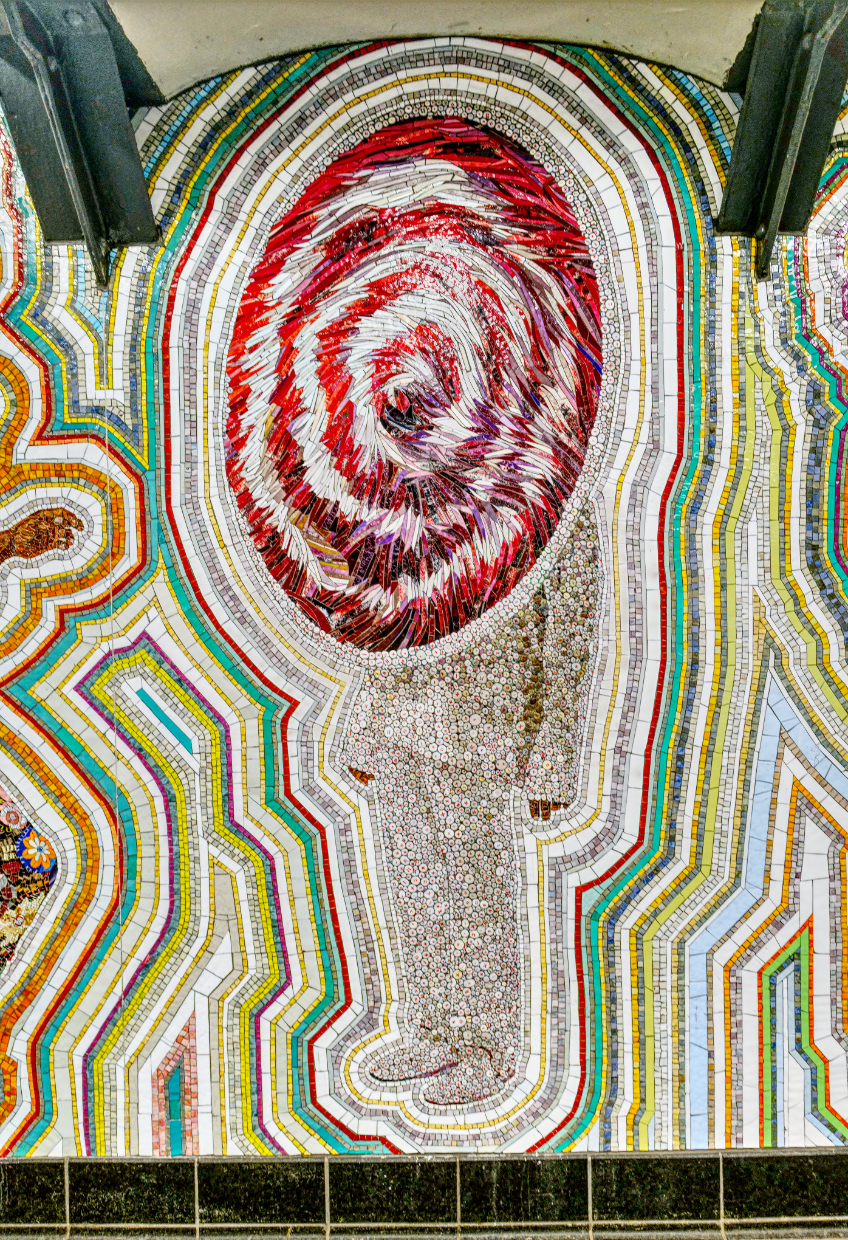
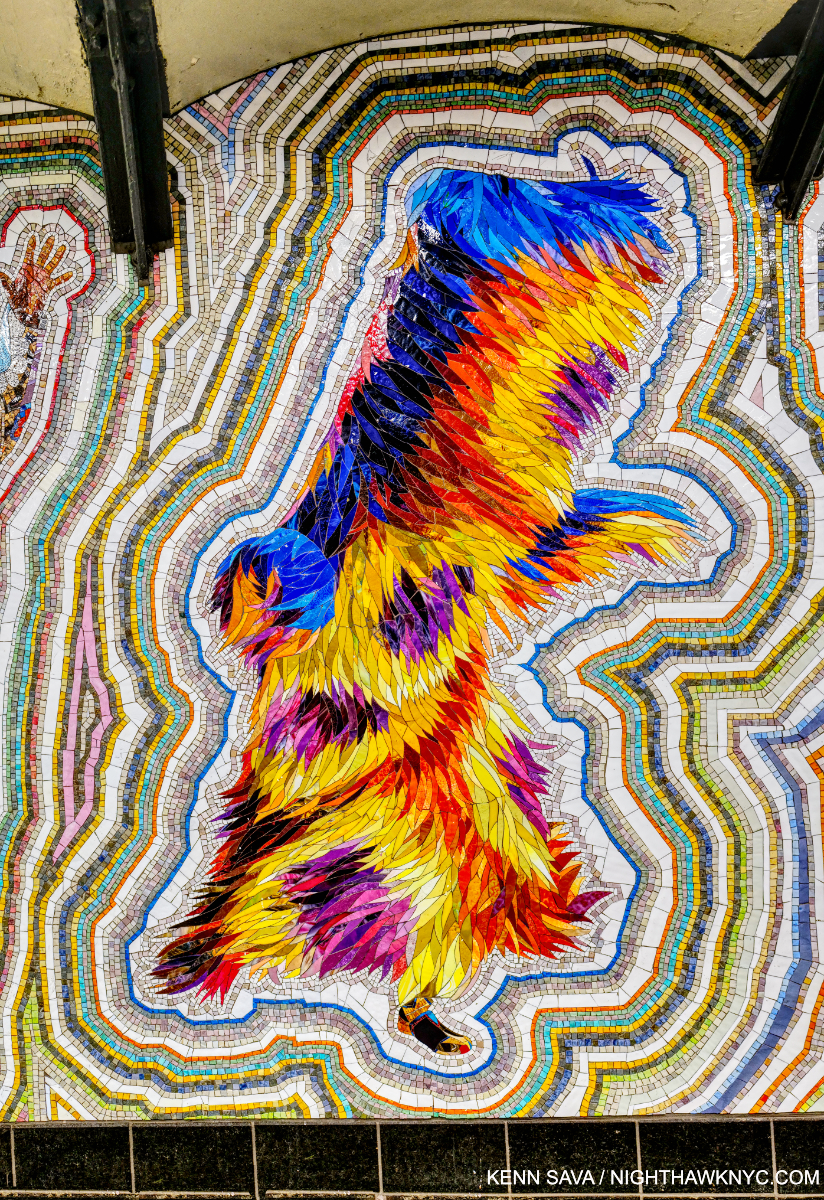
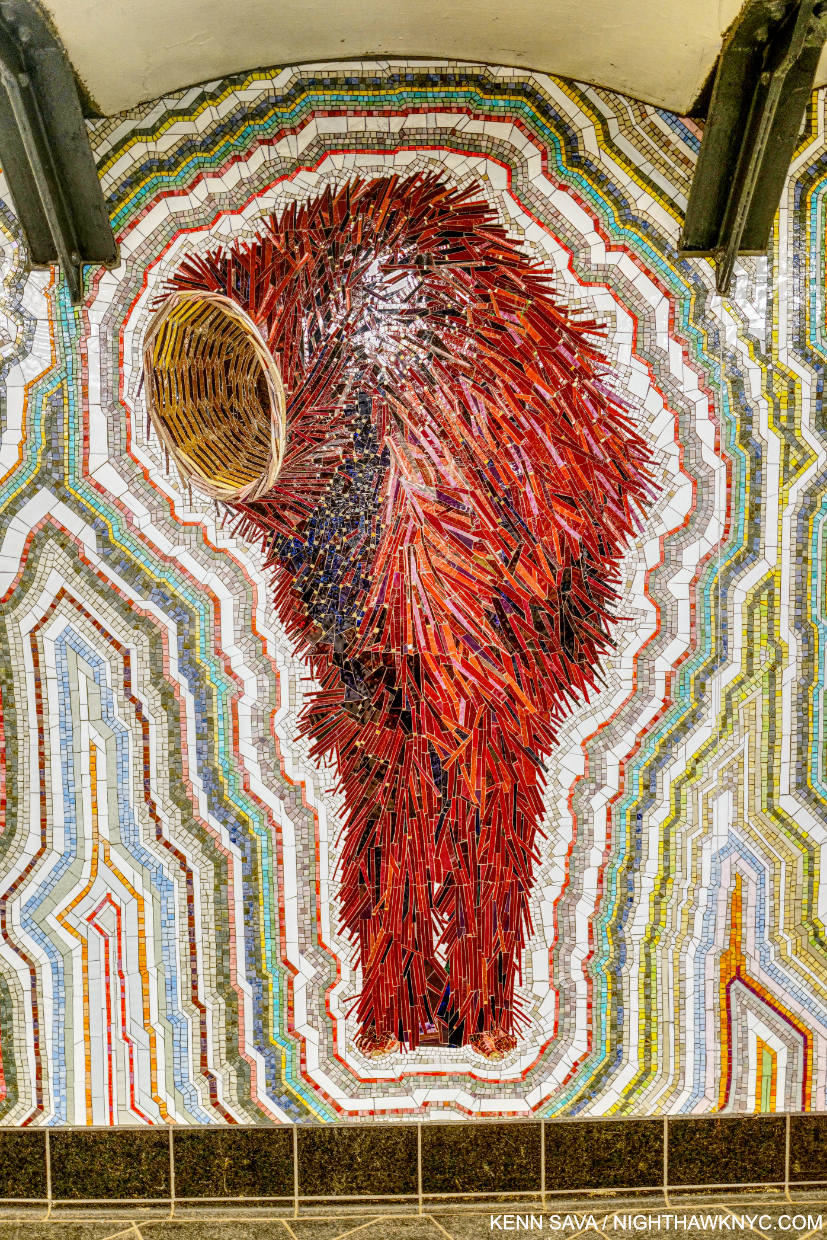
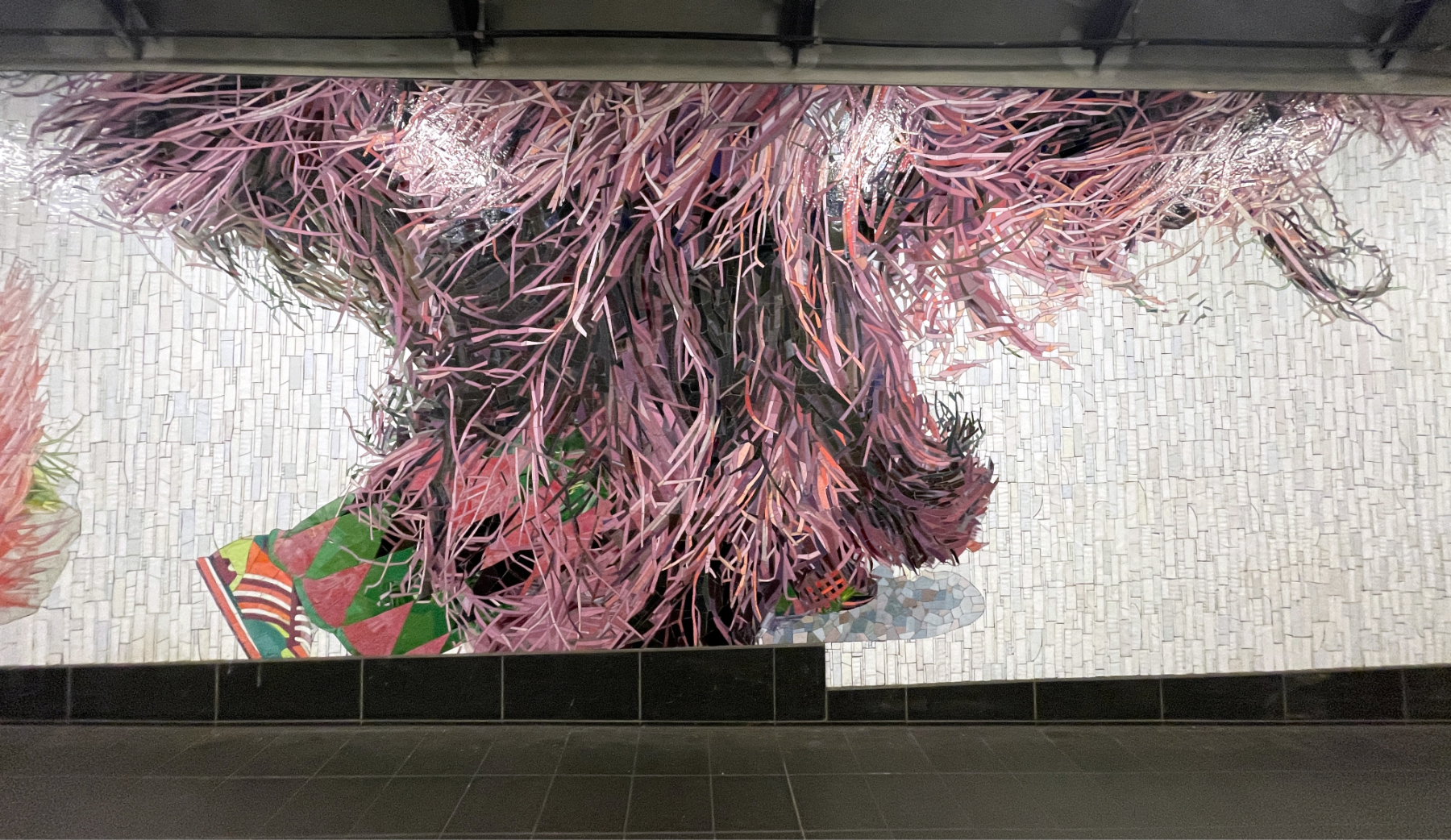
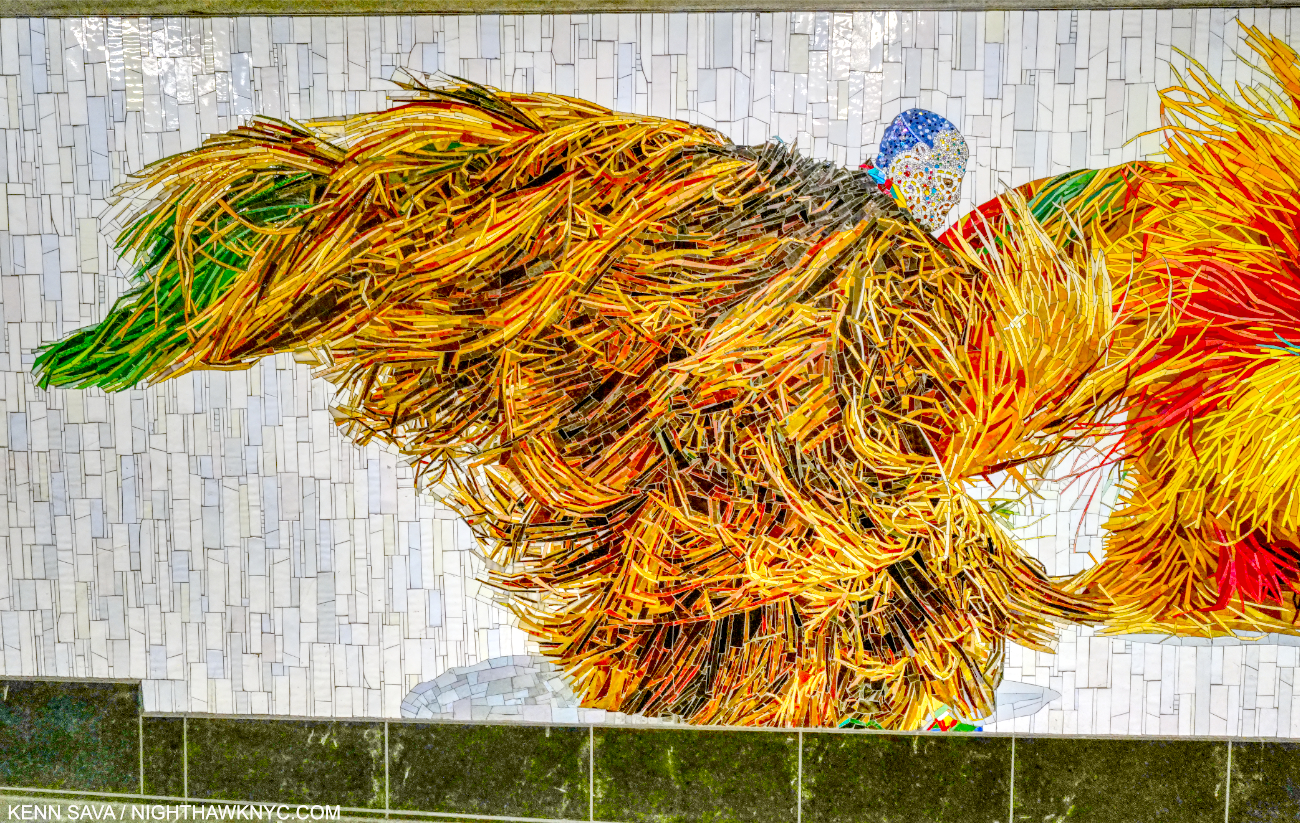
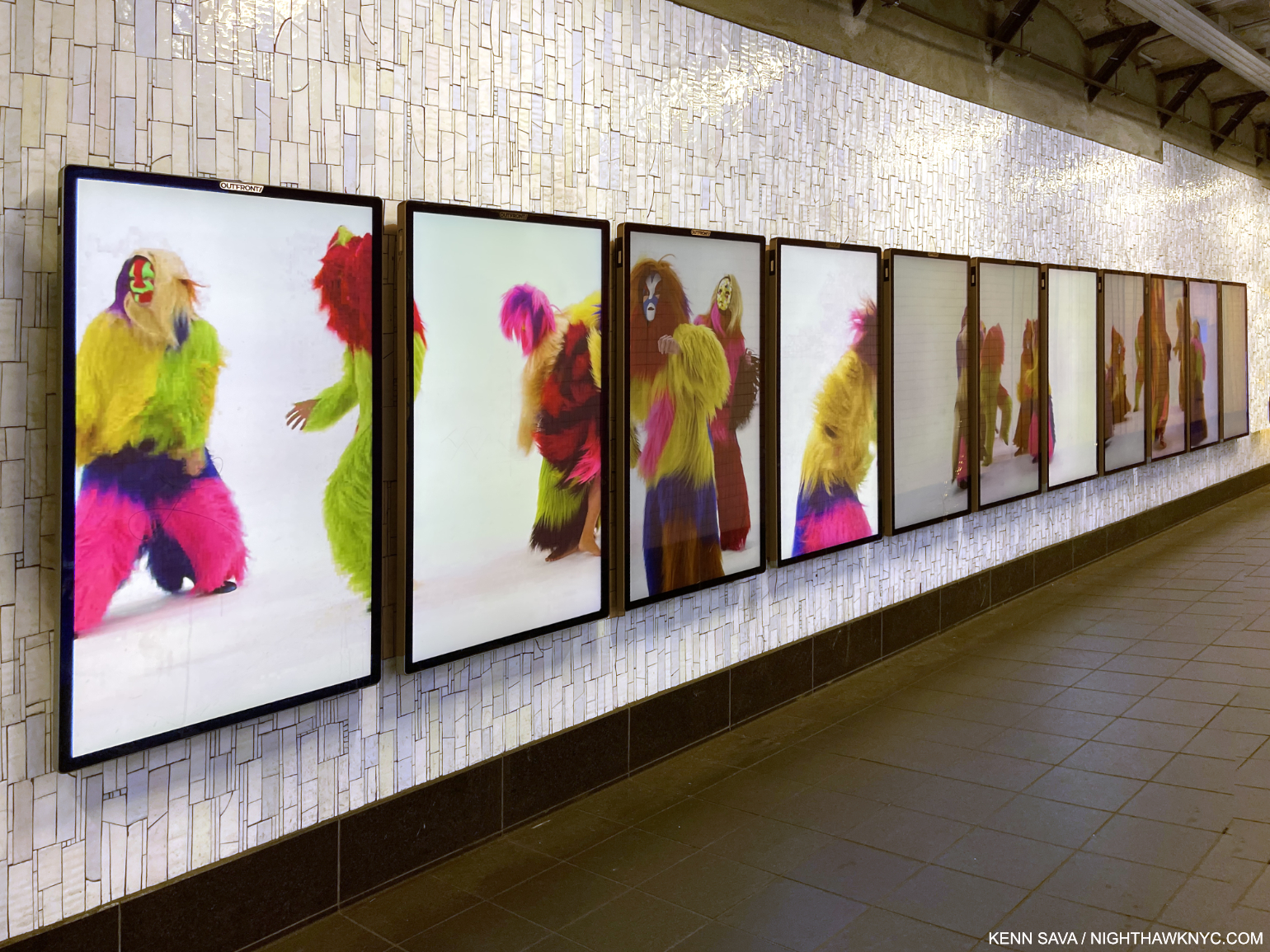
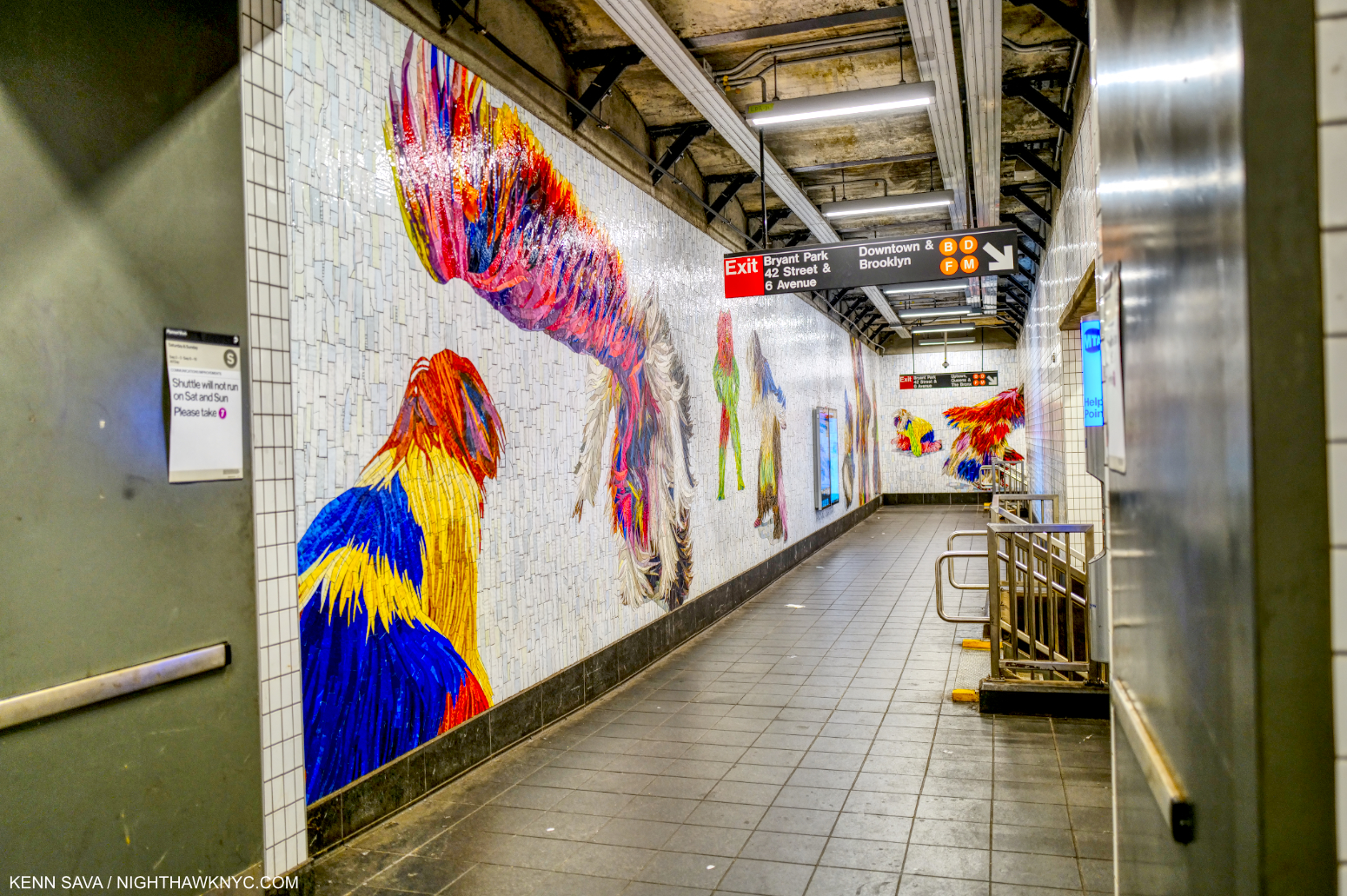
Recently, MTA Arts & Design completed the third and final section of Nick Cave’s monumental 3,200 square foot Permanent Public Art Work Under Times Square. Each One, Every One, Equal All, 2022 is installed in the 1,2,3,7,N,W & Shuttle station at 42nd Street & Times Square, perhaps the busiest station in the entire subway system. The project consists of a whopping FIFTY THREE figures2 wearing Mr. Cave’s famous Soundsuits, each made up of countless incredibly intricate and fabulously colored glass mosaic tiles. A number of the original Soundsuits they are based on were displayed in Nick Cave: Forothermore at the Guggenheim Museum last winter, and some appear in my look at the show. The mosaics were fabricated by world-renowned Mayer of Munich (aka Franz Mayer & Co., founded in 1870), and are augmented by a recorded performance displayed on 11 video monitors.

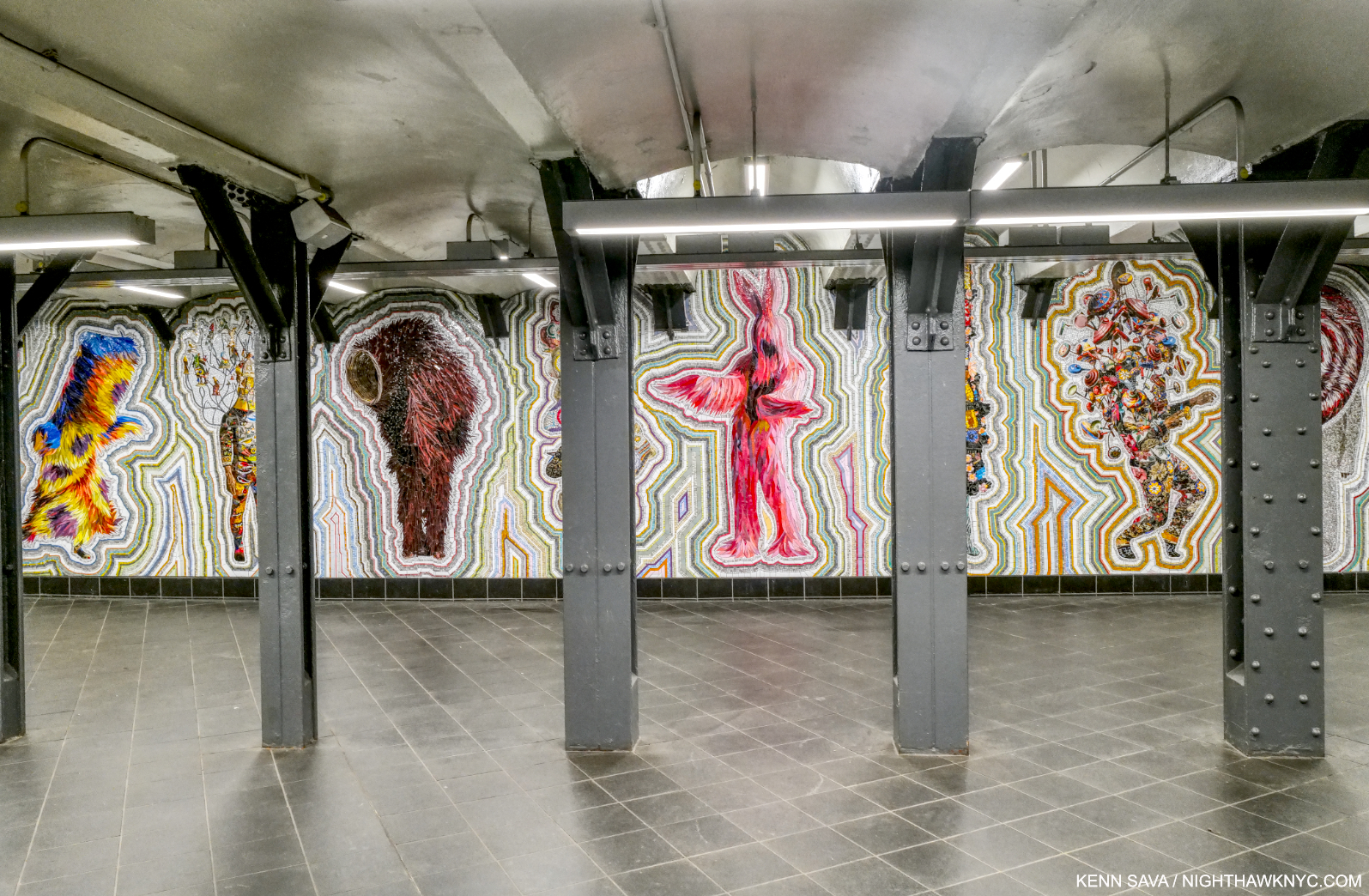
Equal All. Installation view of the entire second section installed at the 42nd Street Shuttle.

As stunningly beautiful as they are, beauty is not the beginning or the end of Nick Cave’s Soundsuits. “The first Soundsuit was in ’92 in response to the Rodney King incident, the L.A. riots,” Mr. Cave recalled. “I was sitting in the park one day  and just sort of thinking about, What does it feel like to be  discarded, dismissed, profiled? There was this twig on the ground. And I looked at that twig as something discarded. And then I proceeded to just start collecting the twigs in the park. And I brought them all back to the studio. And then I started to build this sculpture. I started to realize that the moment I started to move in it, it made sound. Then it just literally put everything in perspective. I was building this suit of armor, something that I could shield myself from the world and society. And so out of that came this sculpture-performative kind of work.”3

The Soundsuits “hide gender, race, class. And they force you to look at the work without judgment. You know, we tend to want to categorize everything,” the Artist said. “We tend to want to find its place. How do we, sort of, be one on one with something that is unfamiliar?”4

Every One. Installation view of most of the section installed in the 42nd Street Connector which continues all the way down the corridor then wraps around the far end of it.

Here are some highlights of each section beginning with Each One, shown in its entirety earlier, which is installed in the entrance before you reach the turnstiles-

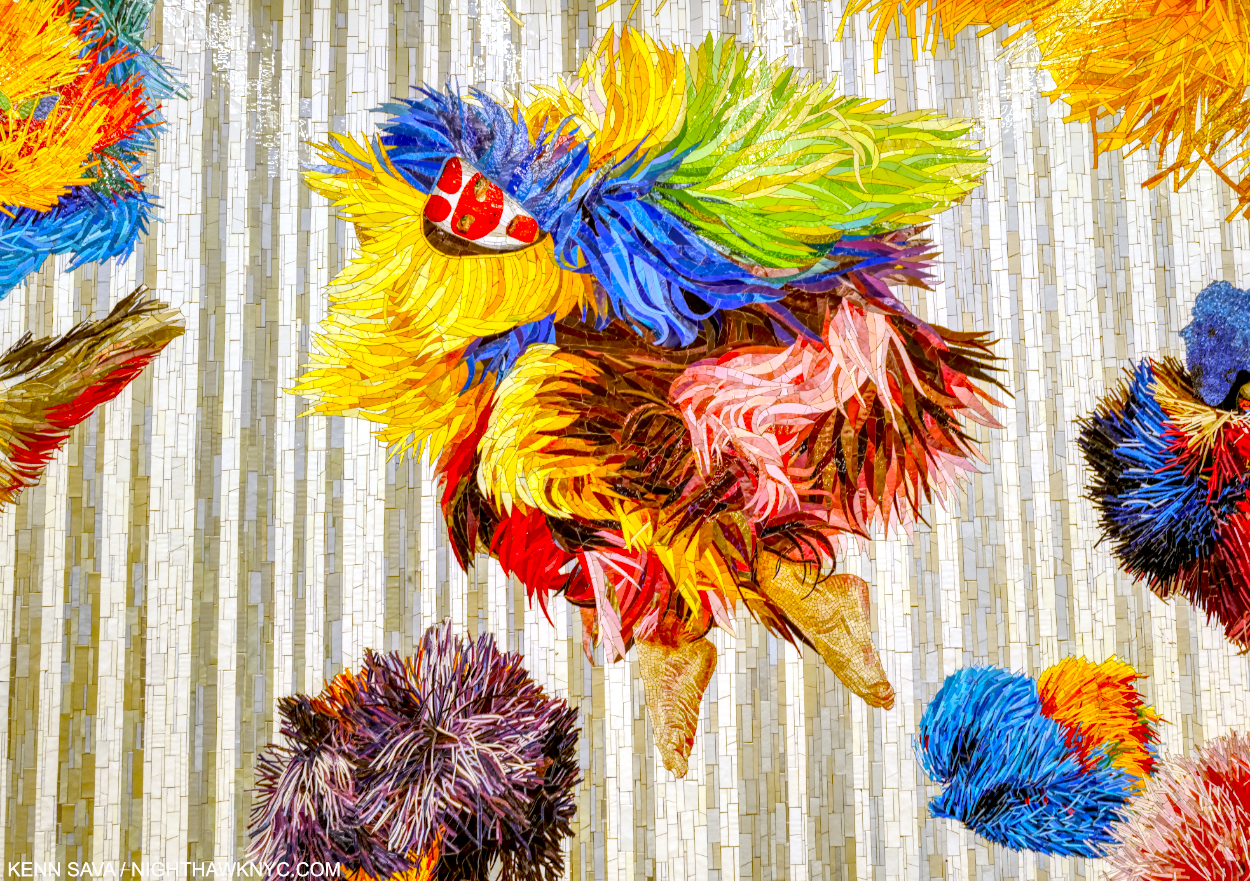
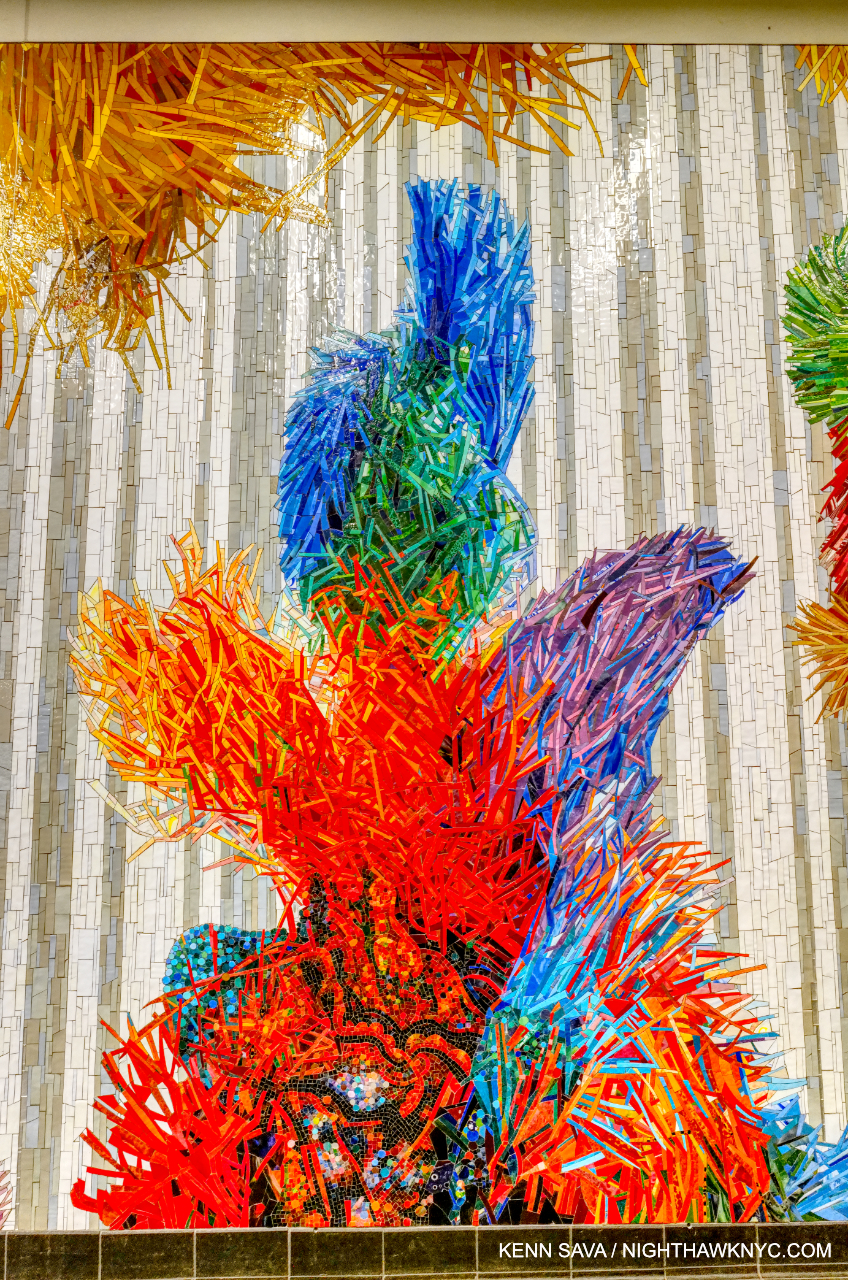
As amazing as the individual figures are, the backgrounds are endlessly varied, and different in each of the three sections.

After paying your fare, the second section is installed to the left, “framed” behind pillars as you approach it just before you reach the Shuttle further to the right-

The background is noticeably different than that of the other two sections, and characterized by having more color and more of a pattern.

I believe the actual Soundsuit this is mosaic depicts is made of twigs, and it may have been on view in Nick Cave: Forothermore at the Guggenheim. It appears in two pictures in my piece on the show.

Some highlights of the third, and longest, section, Every One in stalled in the 42nd Street Connector past the Shuttle

Close-up of the head of the figure shown in the very first Photo in this piece.

This section includes 11 video monitors.

Screenshot of the Every One video featuring dancers wearing Soundsuits in a 3-minute video that is shown every 15 minutes, but you can see it in full below. Due to the fact it’s on 11 video monitors, the MTA had to compress the size of the video a bit-

Mosaics are one of the (if not the) most durable materials Art is made of. If you doubt that, visit The Met where you will see mosaics dating back to the 1st century BCE that retain every bit of their luster and beauty. The universe willing, the mosaics in the subway will outlive us all.

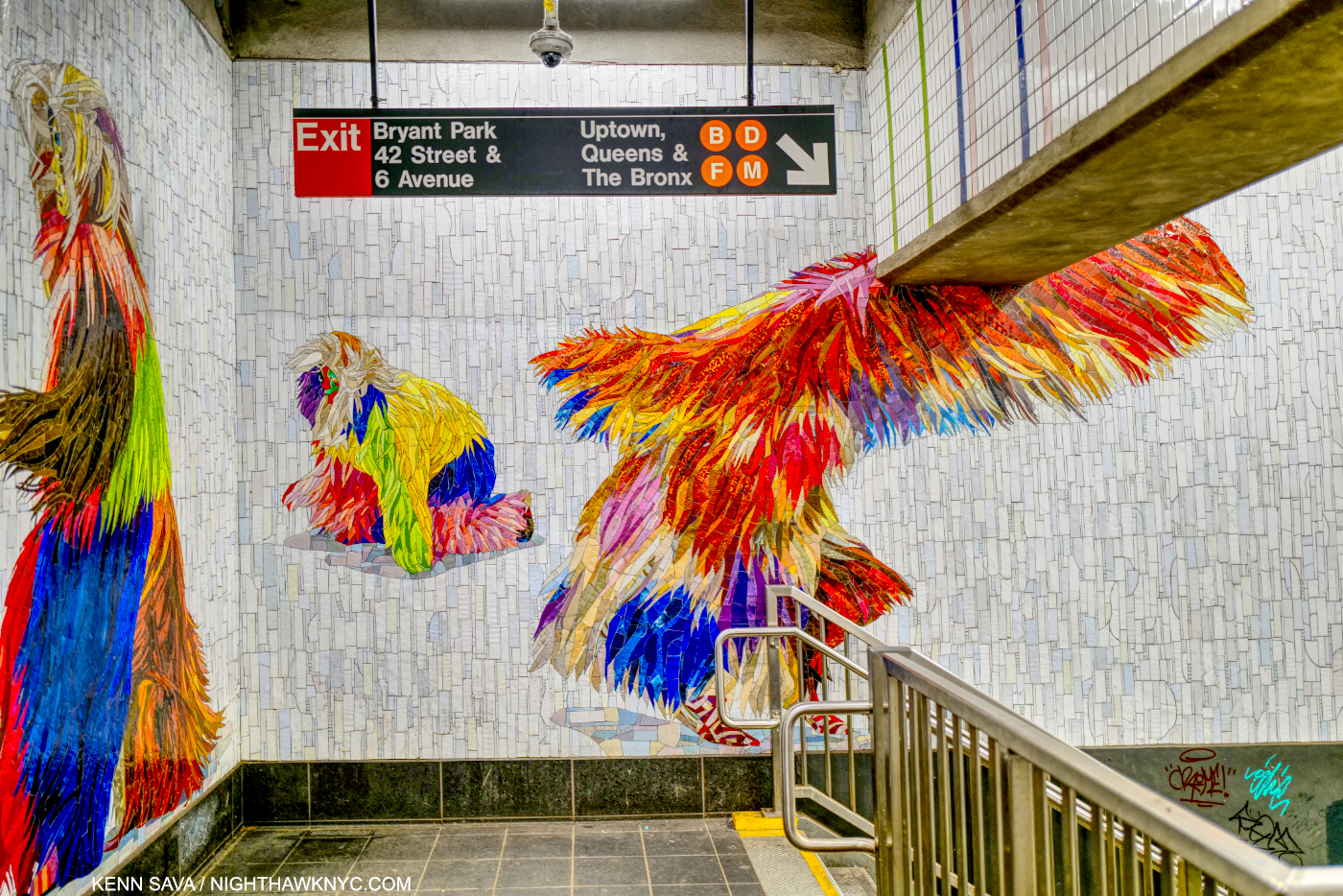
Installation view of the last section of Every One.

Displaying them in the subway, where the “melting pot” America is supposed to be all about, is on full display all the time- perhaps to a degree it is nowhere else in the country, is particularly poignant and powerful. It’s also very liberating to imagine oneself being one of these magical figures cavorting, dancing, leaping or flying all around us as we walk through them, anonymously.

The final figure of Every One, installed at the top of a staircase, looks like it’s about to take flight.

All of a sudden, a world where racism exists, doesn’t.

*-Soundtrack for this piece is “One Nation Under A Groove,” by George Clinton & Funkadelic from the 1978 album of the same name. Nick Cave has frequently mentioned George Clinton as an early influence.

NighthawkNYC.com has been entirely self-funded & ad-free for over 8 years, during which 300 full-length pieces have been published! If you’ve found it worthwhile, PLEASE donate to allow me to continue below. Thank you, Kenn.

You can also support it by buying Art, Art & Photography books, and Music from my collection! Art & Books may be found here. Music here and here.

Written & photographed by Kenn Sava for nighthawknyc.com unless otherwise credited. To send comments, thoughts, feedback or propositions click here. Click the white box on the upper right for the archives or to search them. Subscribe to be notified of new Posts below. Your information will be used for no other purpose.

  1. Think I’m kidding? Here’s a short list. Each of these Artists has created a PERMANENT installation. Listed by Artist’s name, with the subway line(s) @ which station-
    Chuck Close -Q@86th St
    Roy Lichtenstein -A,C,E,et al@42nd St & Times Sq
    Jacob Lawrence -1,2,3,7,N,R,W,S@42nd St & Times Sq
    Jane Dickson -1,2,3,7,N,R,W,S@42nd St & Times Sq
    Sol LeWitt -1,A,B,C,D@Columbus Circle
    Vik Muniz -Q@72nd St
    William Wegman -F,M@23rd St
    Yoko Ono -B,C@72nd St
    Elizabeth Murray -4.5.6,N,R,W@Lex & 59th St
    Faith Ringgold -2,3@125th St
    Alex Katz -F@57th St
    Leo Villareal -6,B.D,F,M@ Bleecker St./Broadway & Lafayette
    Jack Beal  -1,2,3,7,N,R,W,S@42nd St & Times Sq
    Al Held -E,M@Lex & 53rd St
    Eric Fischl -A,C.E@34th St & Penn Sta
    And, my personal favorite- Sarah Sze -Q@96th St. Sarah Sze’s Blueprint for a Landscape, 2017, was commissioned to design Art for the entire large subway station- 14,000 square feet! What makes this project even more unique is that, unlike most of the other stations in NYC, this was a station being built from scratch at the same time. I wrote about it here. As far as I know, it is the largest Public Art project in the subway. The MTA Arts & Design site lists them all, here.
  2. by my count
  3. “Nick Cave in Chicago,” Art21, 2016
  4. Nick Cave: Thick Skin” Art21

Rod Penner’s America: Small Town Nation

This site is Free & Ad-Free! If you find this piece worthwhile, please donate via PayPal to support it & independent Art writing. You can also support it by buying Art & books! Details at the end. Thank you.

Written & Photographed by Kenn Sava

Show Seen- Rod Penner: Small Town Meditations – Traveling exhibition seen in NYC @ Meisel Gallery

“America: A Nation of Small Towns”
Title of the 2020 United States Census Report.

Small towns in the big town. The opening, NYC, March 18. 2023.

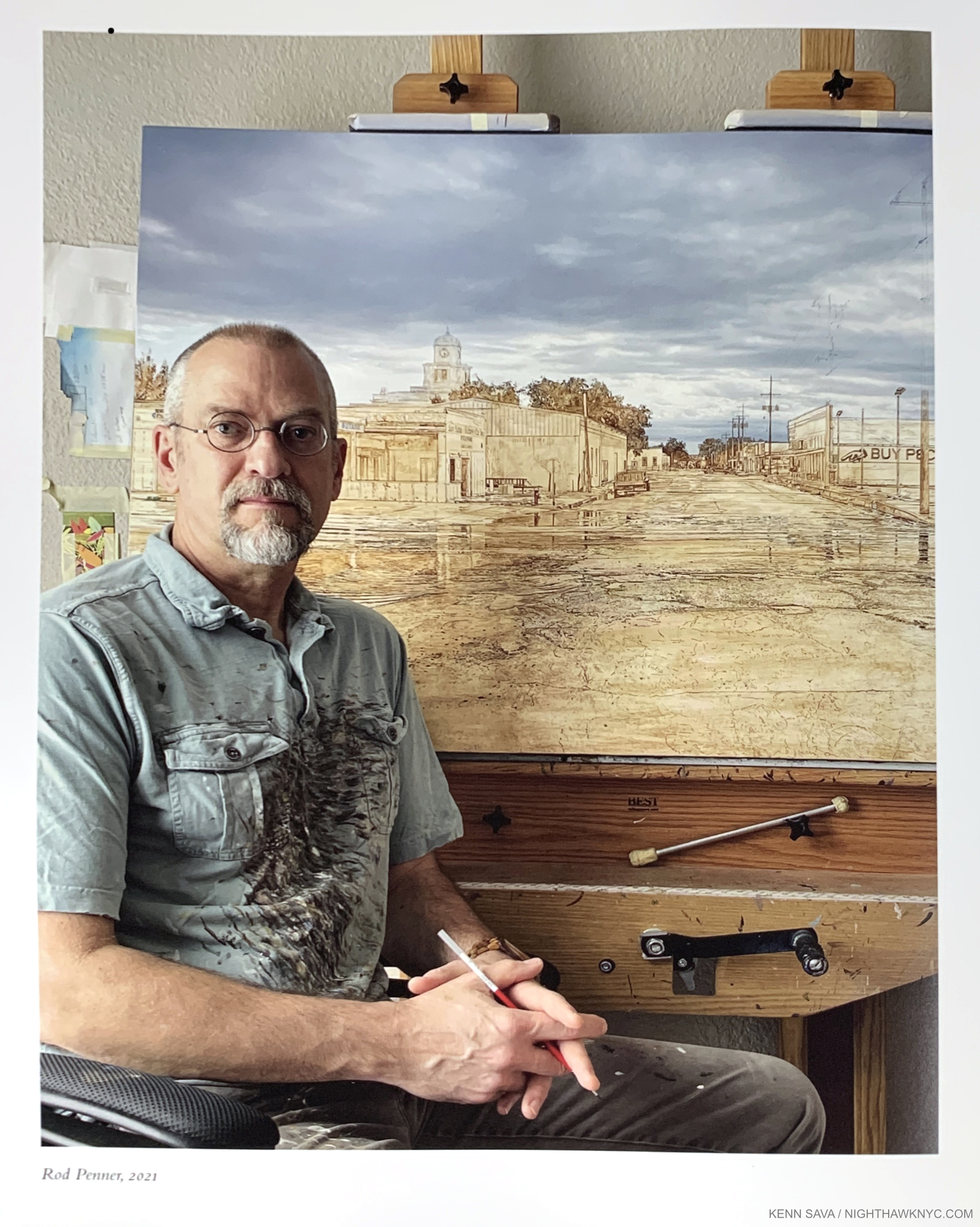
I’ve already written as much, and maybe more, than anyone else has about Rod Penner’s Art over the past six years. Most recently, I wrote my fifth Penner piece, an extensive look and the first anywhere, at the first full-length book on his work, Rod Penner: Paintings, 1987-2022. If Mr. Penner’s work speaks to you and you haven’t seen a copy, make a point to. It accomplishes the rare double feat of being equal parts long-awaited full-length Monograph and Catalogue Raisonne, containing everything he’s Painted through 2022, in one volume. All of this being said, my pieces on his Art were based on seeing one show of smaller Paintings in 2017 and two works in a prior group show. This spring, I finally had a chance to see a show with a more representative overview of his work going back to 1998. I came away feeling I saw much in his work I hadn’t seen before.

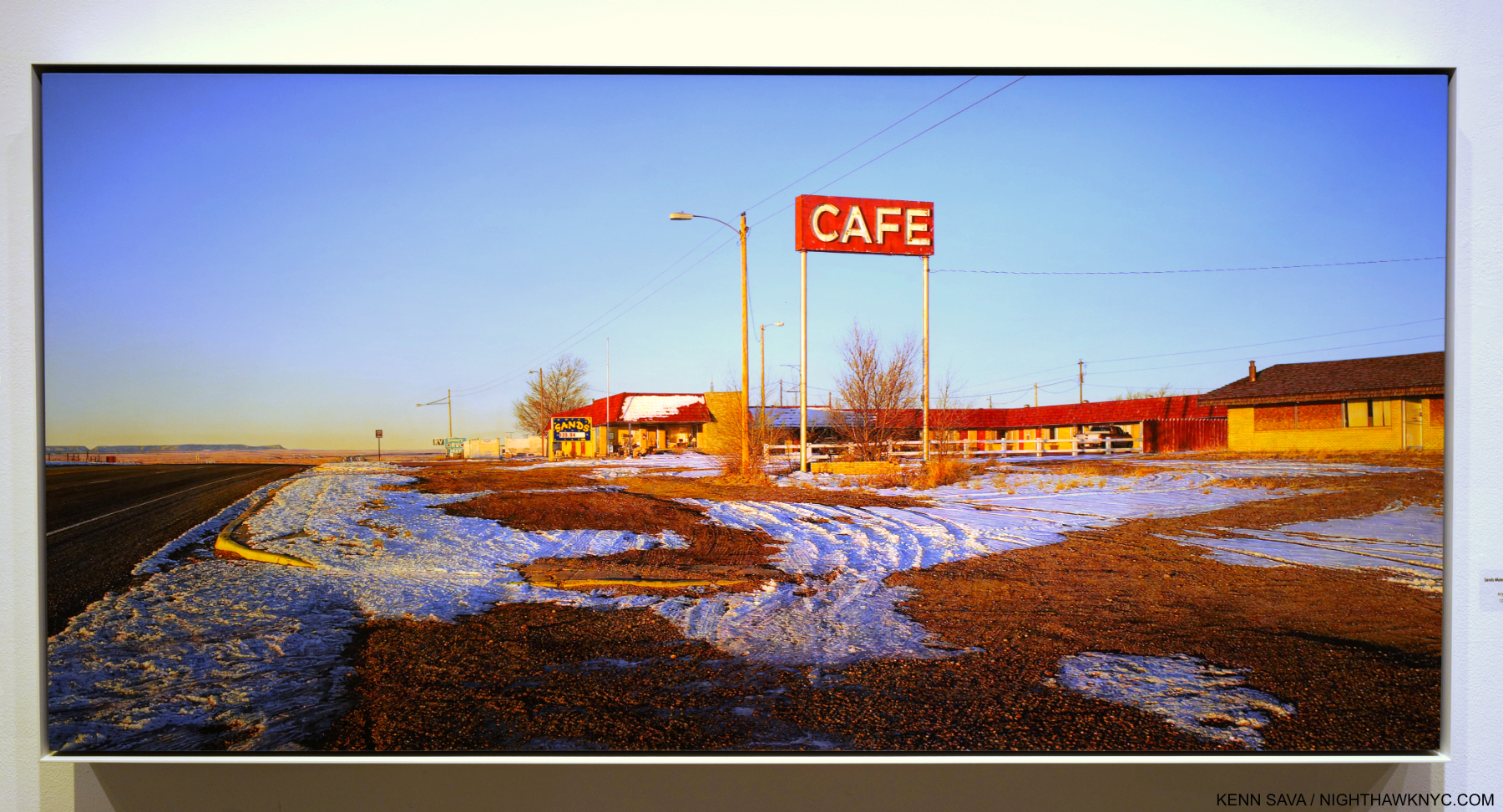
My only previous Rod Penner solo show, in 2017, consisted solely of 6 by 6 inch and 5 by 7 inch Paintings, each jam-packed with detail. Though Sands Hotel & Cafe/Vaughn, MN, 2019, Acrylic on canvas, is a huge 31 by 64 inches (almost 5 1/2 feet long!), the detail is every bit as stunning, representing a staggering amount of work. I continually get lost looking at the fore and mid-ground in what strikes me as a bit of an unusual composition. But, of course, there’s much more to it. Click for full size.

Rod Penner: Small Town Meditations consisted of a group of 17 Paintings that establish Mr. Penner as the foremost Painter of small town America working today, inheriting the mantle from John Salt, and Charles Sheeler & Edward Hopper before the late Mr. Salt (1937-2021).

John Salt, Red Mailbox #2, 2015, Casein on linen, 45 x 65 inches. Seen in 2018 in the same space occupied by Rod Penner: Small Town Meditations. Casein is a water soluble medium that derives from milk casein, and is used masterfully here to create such a rich, yet mysterious, atmosphere.

Rod Penner was born & raised in Canada before marrying his wife, Debbie, and relocating to Texas in 1988, where the majority of his work is set. In the Q&A I did with him in 2017, the Artist said this about the beginning of his Painting career-

“Shortly after arriving in the Lone-Star State, I rediscovered the work of John Salt and felt an instant connection. I couldn’t drive past a trailer home (and there are many in Texas) without thinking “Salt.” At this point, I wanted to spend more time in the studio and less time searching out subjects to paint, so I started driving around the town we lived in and took photos of these tract houses that were everywhere. I found them visually interesting. As with all the streets and buildings that I paint, these homes, under certain weather and lighting conditions, became transformed. I painted my first tract house in 1989 and it sparked a series of paintings that were later shown at O.K. Harris in NY.”

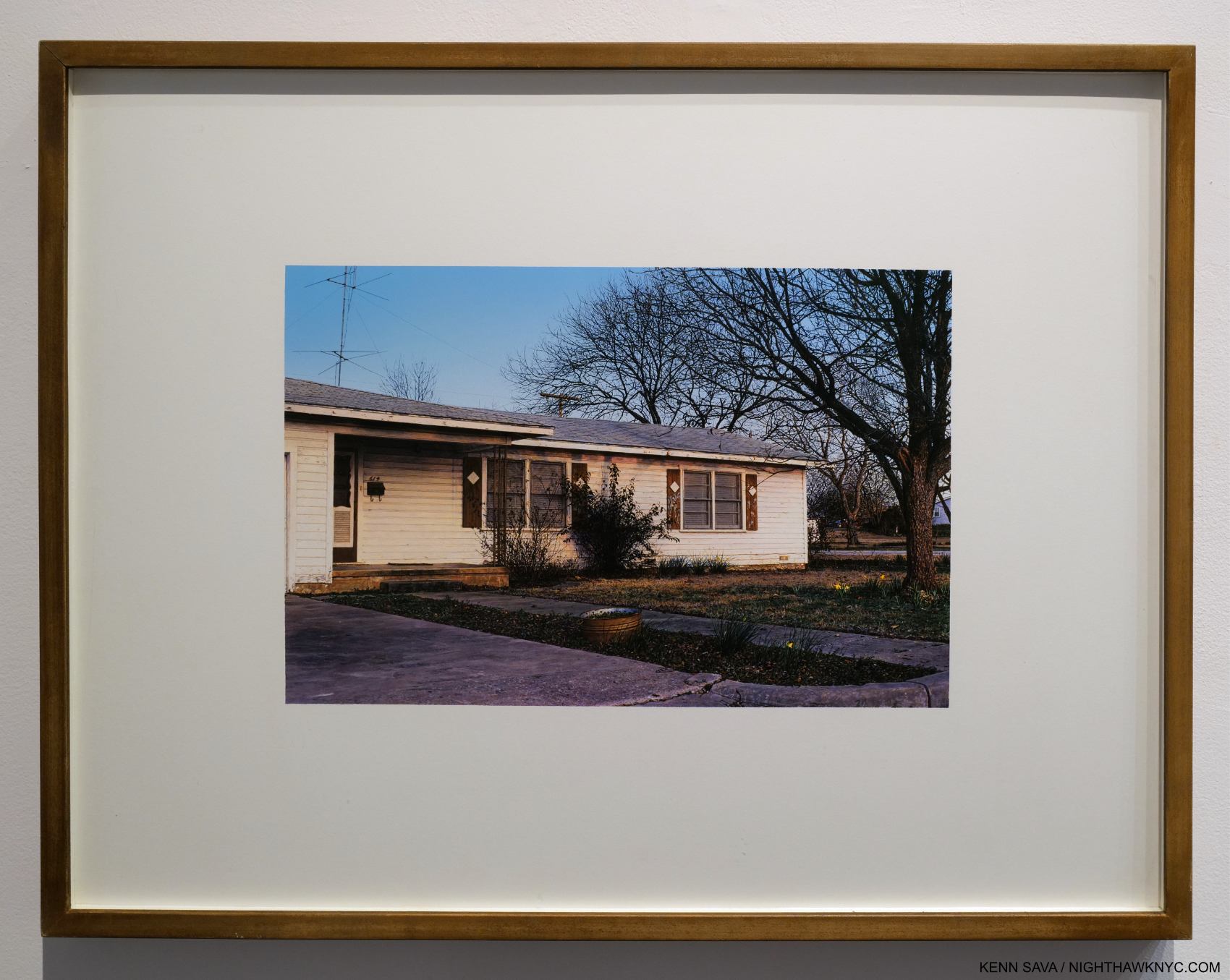
614/House with Daffodils, 1998, 10 1/4 x 15 inches, Acrylic on board.

While people appear in very few of his Paintings, right from the beginning, virtually every piece he’s created is rich with their presence. First, there’s what people have built on the land that signifies them. Then there’s the condition of these structures, which are steeped in individual modifications and adornment. Some are in need of attention; perhaps a new coat of paint or repairs. It seems that the occupants are too busy living in them to do them right now. In addition to the building, we often see the evidence of human habitation: toys, tools or lawn implements in the yard; though vehicles are not seen nearly as often as they are in John Salt’s homestead works where they are one of his trademarks. Combined with the lived-in condition of the house all of this makes for a de facto “Portrait” of its inhabitants, in my view. His work is rich in character, one thing that sets him apart. Character adds an incalculable amount of depth to his Paintings. In a larger sense, his work is a “Portrait” of how, and where, many Americans lived in the last half of the 20th and early parts of the 21st centuries.

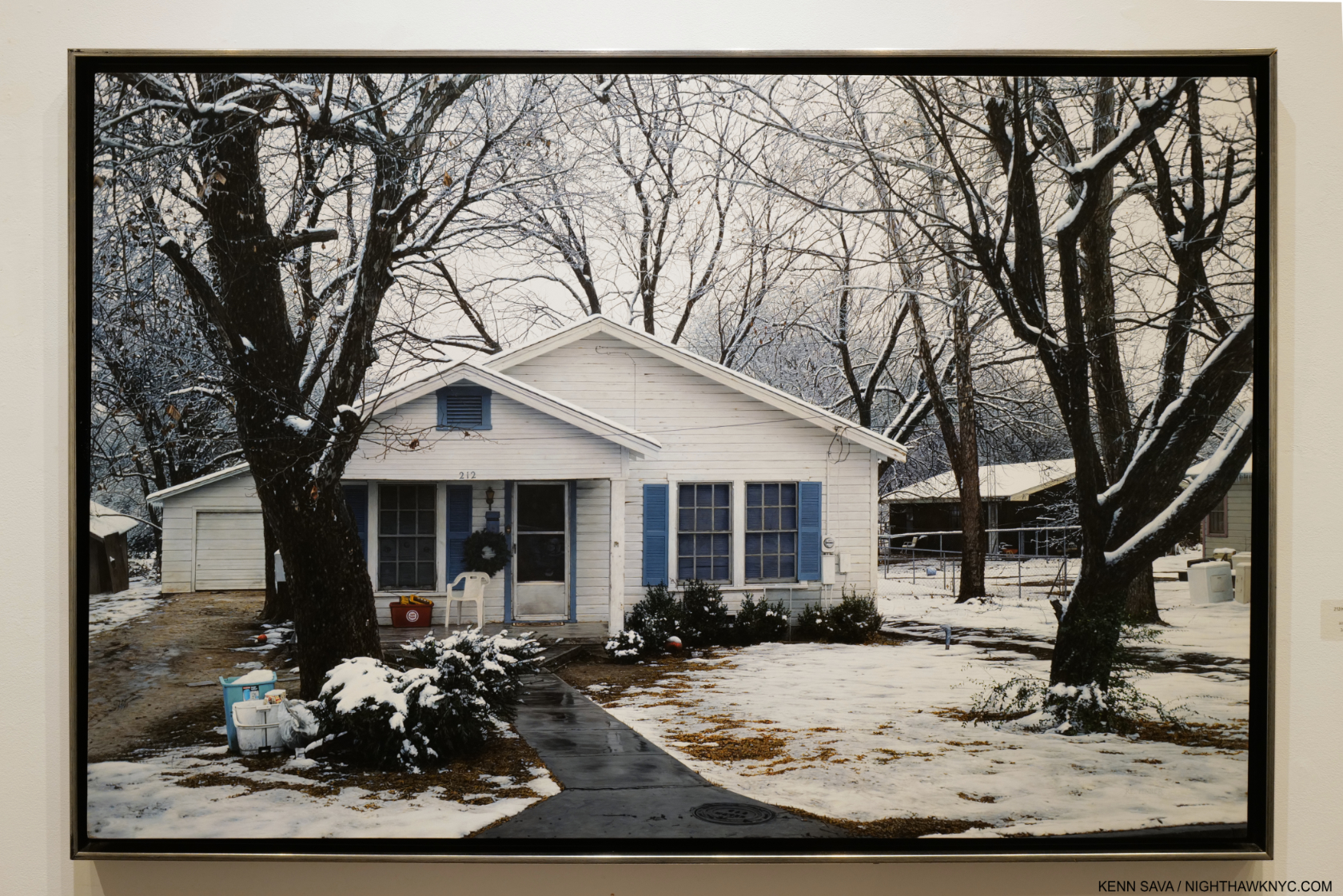
212/House with Snow, 1998, 36 by 54 inches, From here on, all works shown are Acrylic on canvas unless noted.

The idea of “home” looms large in Rod Penner’s oeuvre, striking me as one of his main themes, be it in actual houses or motels (temporary homes), like Sands Hotel & Cafe/Vaughn, MN, 2019, shown earlier. None of his homes are palatial. Rather, they are all well lived-in. The roofs and paint look weather-worn, as if they’ve survived countless storms or harsh winters. It’s easy to make this fit the “Portrait” analogy. A number of his Texas scenes include snow- something the rest of us may have trouble associating with one of America’s southern-most states, but the terrible storms they’ve had these past years are changing that. Snow makes these scenes look they could have been seen in many other places in the country. Yet, in spite of it all, they’re still standing, and much of the same can no doubt be said of whoever lives in them.

212/House with Snow, 1998, a masterpiece in my view, sums up so much about the broad and vague idea of “home.” For me, that doesn’t necessarily mean a place; A person could be “home” for someone, and much of what I see here, and the feelings it generates, would still apply. Like virtually all of Rod Penner’s Paintings 212 cries out to be seen up close.

How much you see in a Rod Penner Painting is only limited by how long you look at it.

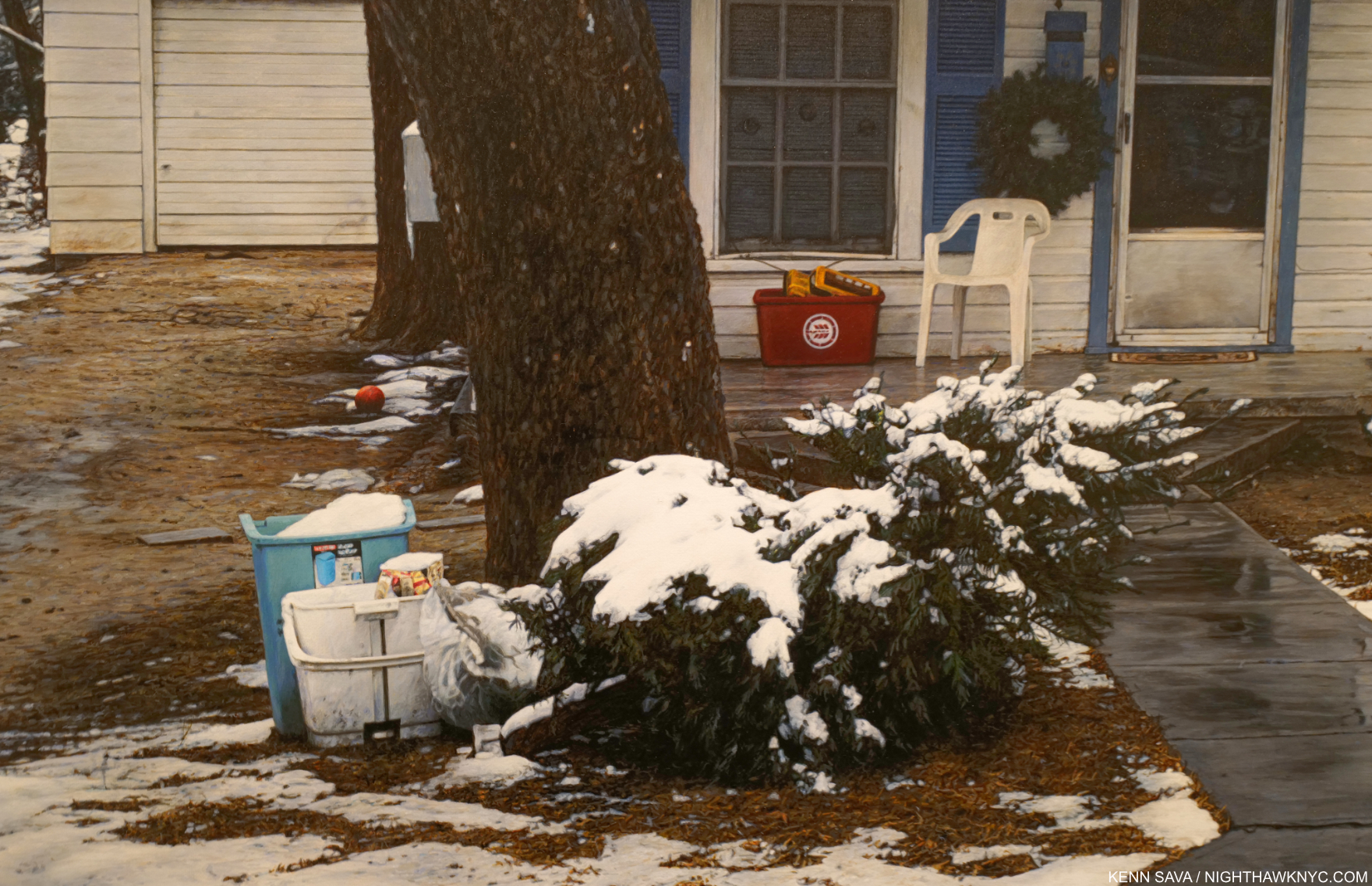
A number of his House Paintings are set during the Holidays. In this detail from 212/House with Snow, we see the Christmas tree lying diagonally in front ready to go out with the trash & recycling. A poignant image by itself. It’s been there a little while given it’s snowed since it was put there. A toy bus (maybe a Xmas present?) pokes out from a red box with an intricate logo on it- all in this stunning little section, which is typical of all of Rod Penner’s Paintings. Oh! That’s before you get around to admiring the incredible detail on the Christmas tree branches, the tree trunk behind it, or the condition of the paint on the house and garage! Then, there’s the ground…

Yet here, as in all Rod Penner’s work, in my opinion, he puts the detail at the service of Art. The detail is revelatory, like a well-turned sentence in a great novel, or like the floor in Jan van Eyck’s The Annunciation in Washington. It never preaches. It never gives too much away, leaving it all to the viewer. In fact, when I first met Mr. Penner, he was reluctant to speak about his Art. He told me he wanted his Art to speak for itself. Personally, I’m glad he has softened that stance a bit and has spoken about his work, especially in his Artist’s Statement in his book. I only wish the Art media respected what the Artist says about his/her own work more than what anyone else says about it.

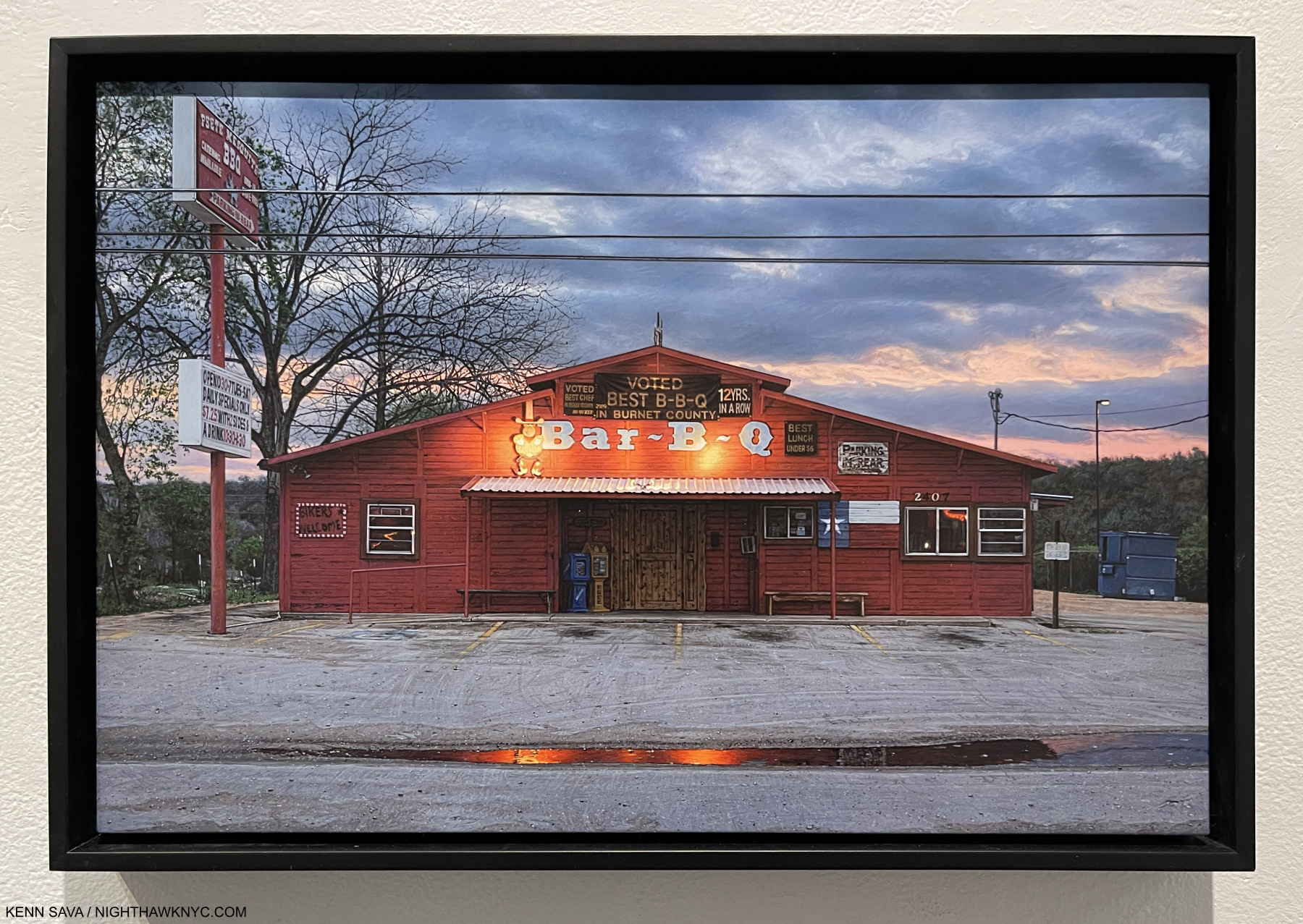
Bar-B-Q/Marble Falls, TX, 2022, 12 x 18 inches. The latest in a long and memorable series of roadside eateries and gas stations. Those foreshortened signs to the left must have been fun to Paint.

Another theme in his work is life on the move: gas stations and roadside eateries loom large here, in addition to motels.. This makes it apparent that the Artist gets around since every scene he renders he has visited in person. Sometimes, it’s hard to look at these and not smile. What may be Mr. Penner’s subtle sense of humor can be at once poignant, and again tack sharp. In person, the Artist is quick to smile, so it’s hard not to see that coming across in his work at times. At the March opening, two visitors were present who had traveled all the way from Marble Falls, TX for it. Well-familiar with the real-life Bar-B-Q back home, it must have been a strange, but welcoming, feeling to see its likeness hanging on the wall in a SoHo gallery thousands of miles from home.

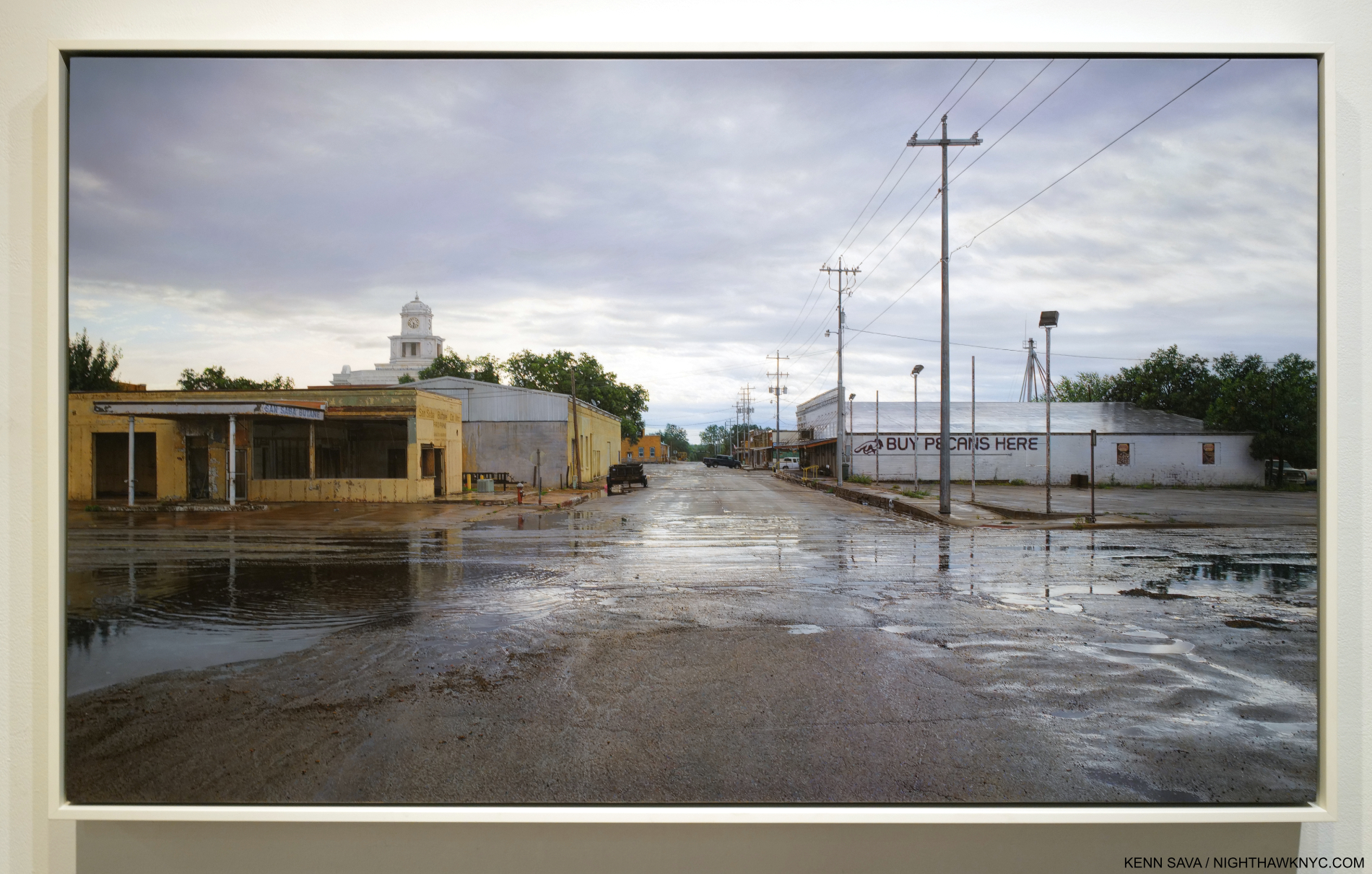
Buy Pecans Here/San Saba, Tx, 2021, 31 by 52 inches.

Buy Pecans Here/San Saba, Tx, 2021 marks Rod Penner’s return to large Painting after his series of small San Saba pieces I saw in his last NYC solo show. When I look at this, I see an early 21st century “History Painting.” The Old Masters famously rendered scenes from history, usually in suitably large scale. Here, Rod Penner shows a number of stages of San Saba’s history in one scene in the recent past (2021). In the back, San Saba County Courthouse, 1911, peaks out of the trees and rooftops, surrounded by what man has built in the area in the following 110 years, including telephone poles and power wires, which may now carry the internet, including NighthawkNYC. San Saba is known as the “Pecan Capital of the World,” so the appropriately sized Pecan store sits stolidly on the earth occupying much of the right side as if anchoring that reputation. Further down the block on that side is G&R Grocery, behind the white pickup. Across the street in the rear the red brick of “Station” peaks out- that’s the only word left on its sign. Mr. Penner featured both of these buildings in his San Saba Series of small Paintings in 2016-7, which I showed here. Buy Pecans Here also got its own Painting. In the front left is another one, the former San Saba Butane Co., which he immortalized in a show-stopping small Painting of the same name, looking a bit more the worse for wear than it does even here. Yet, it’s still standing, seemingly waiting for what’s coming next. The ground weather and the skies add incalculably to the mood. An unfathomable amount of work must have gone into this Painting.

Like San Saba Butane, a number of the places he Paints are out of business. I don’t have to tell anyone how prevalent that is, wherever you are, in the age of the pandemic, before and “after.” Yet, it’s something rarely seen in Painting. Businesses opening, being active, and going out of business are part of the business cycle. That is the “history” I see in Buy Pecans Here/San Saba, Tx.

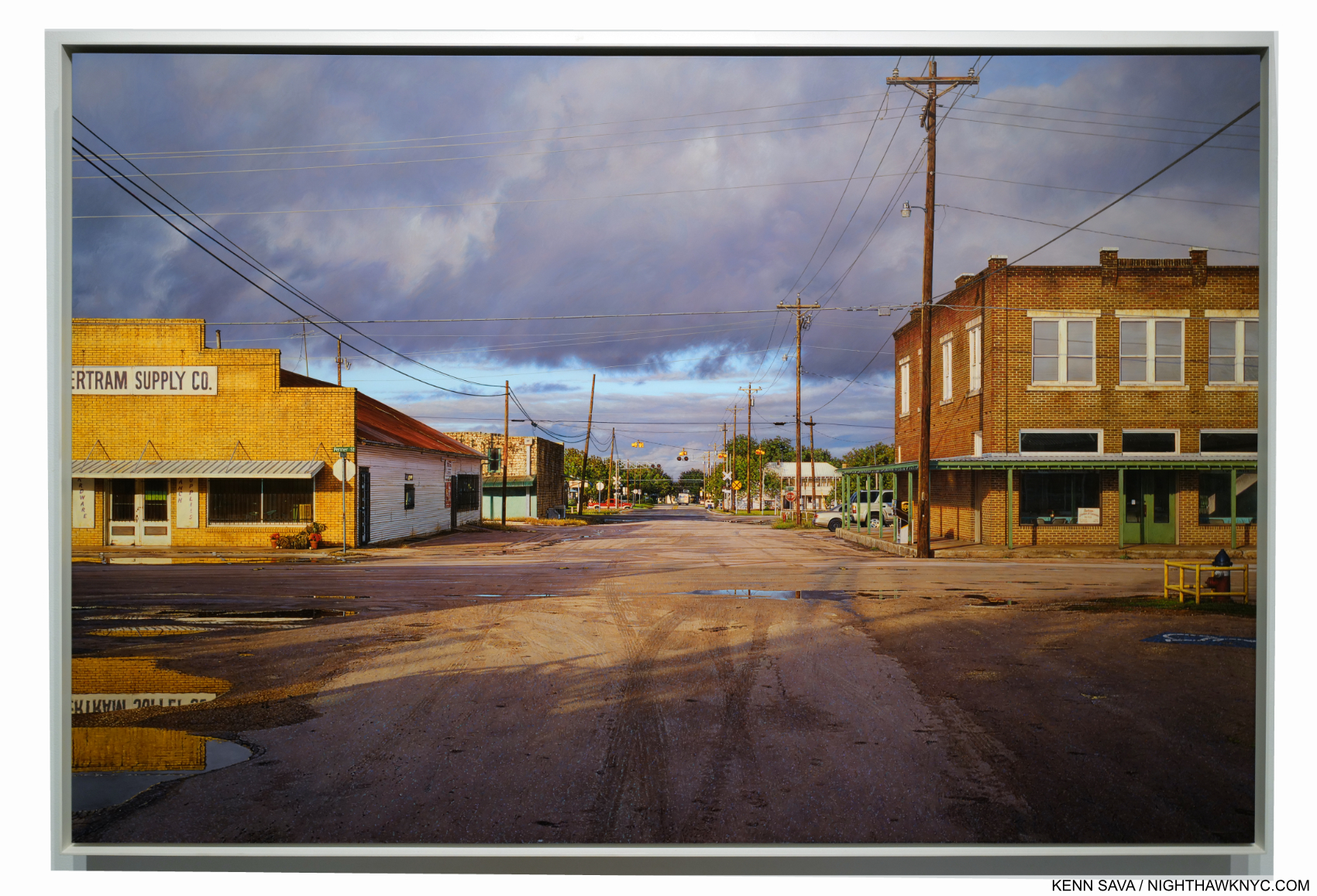
Bertram Supply Co., 2015-6, 31 by 52 inches.

Rod Penner Paints democratically. I’m not referring to politics. I’m using the word in its original meaning. That is that Rod Penner Paints everything he shows us with equal weight. Virtually everything, front to back, is in focus, like it is in many of Richard Estes’s Paintings. Everything is shown at the hyperlocal distance, as Photographers say1. Therefore, it’s up to each viewer to decide what’s important to the narrative they weave in their mind. It also allows for different scenarios at each viewing with different things standing out each time.

Compositionally, it seems to me that many, if not most, of Mr. Penner’s Paintings, and all those shown here, consist of three horizontal “bands” or areas. He presents the sky in a top band, the buildings/main subjects in the center band, and the ground weather in the lower/foreground band. One of the subtler joys of Rod Penner’s work is that he is a master of rendering the ground effects of weather (i.e. rain, snow, graupel, mud, or the baked naked earth), a bit like JMW Turner was a master or rendering skies (in a completely different way, of course). The ground weather is a unique, and often stunning, part of most of his Paintings, easy to overlook, but not to be missed. The detail they contain is astonishing and in addition to adding so much to the “narrative,” they also hint at how much time and thought went into every inch of his Paintings- regardless of size.

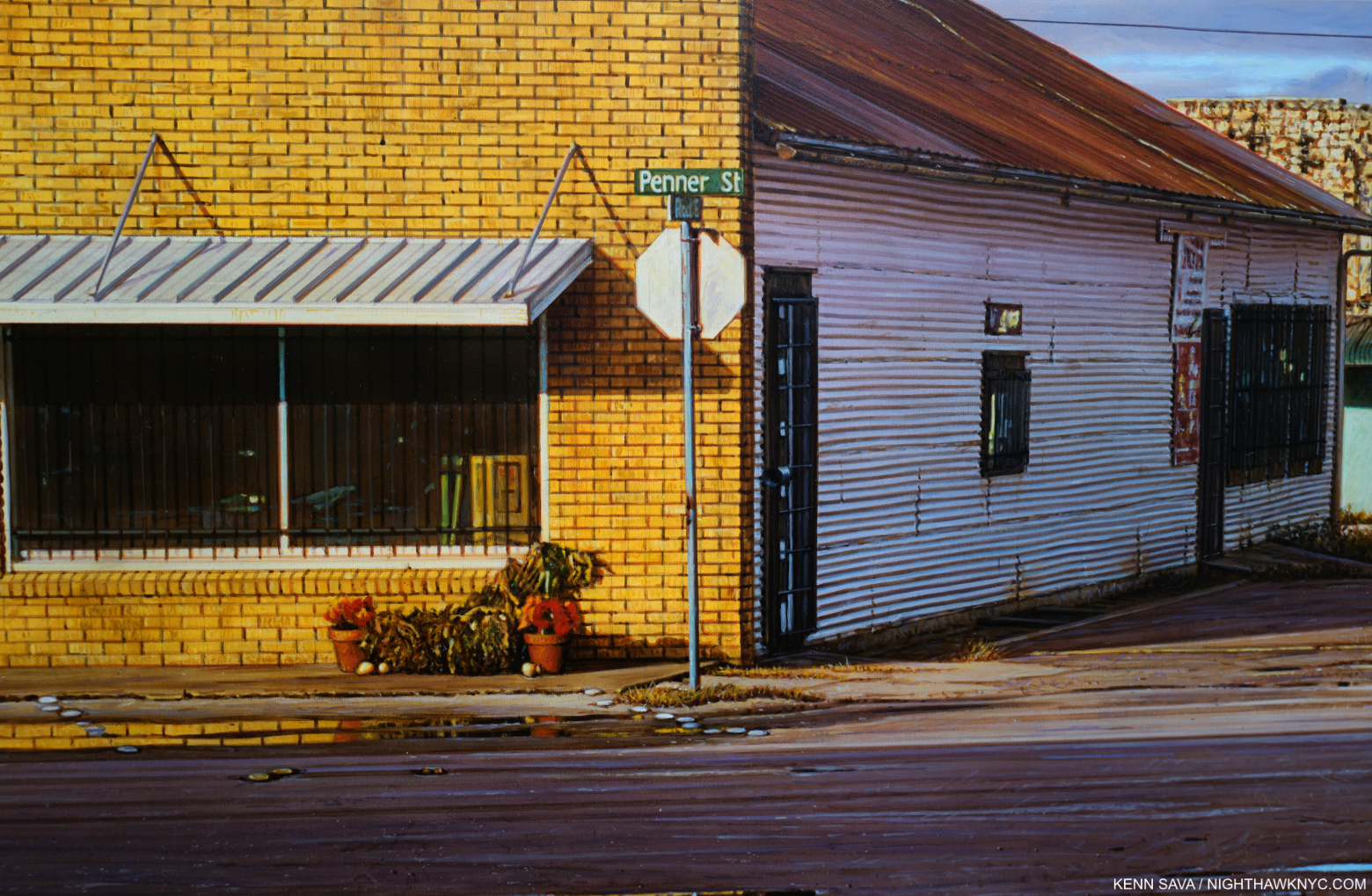
Welcome to PennerVille. A close look at Bertram Supply Co., reveals the Artist’s name on the street sign, with “Rod E.” foreshortened for the cross street sign under it, indicative that he’s put his name on this scene. It’s becoming his genre.

Rod Penner: Small-Town Meditations sums up in capsule form Rod Penner’s accomplishment. To me, that is nothing less than preserving the lives that countless Americans have lived these past 40 years in paint. Rod Penner is creating a body of work that defines and preserves what a good deal of America- small town America (which most of America consists of)- is and has been like these past 4 decades as much, if not more, than any other Artist has.

Having said that, I would also add that I’m not sure that that’s his point! It may be. Or, it may simply be what I’m seeing in his work. His Art is open-ended enough so that everyone is free to see in it what they will.

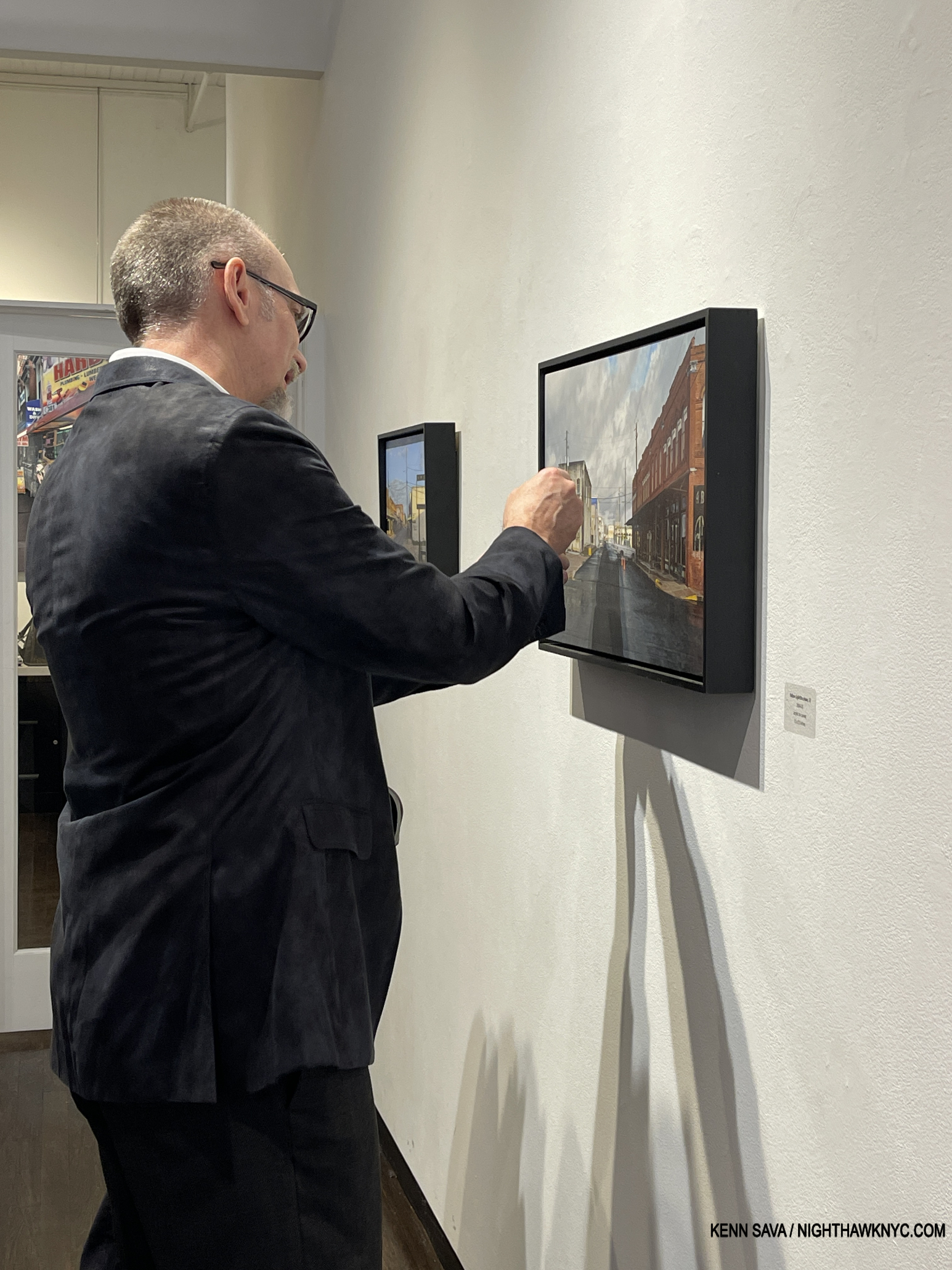
Rod Penner discussing how he created some of the detail in Yellow Light/Brenham, TX, 2004-5, 15 x 25 inches with a visitor behind him at the opening, March 18, 2023.

Saying all of this would seem to overlook the most obvious characteristic of Rod Penner’s Paintings: his world-class technique. His technical skill (readily seen in the details from Bertram Supply Co., or 212/House with Snow, above) approaches the level of the Old Masters. Yet, technique, by itself, does not make Art. In Rod Penner’s case, his technique is only the beginning of the story. Every time you look at his work, you get to write your own ending for it. 

*- Soundtrack for this piece is “Small Town” by John Mellencamp.

My prior pieces on Rod Penner are-

The Vermeer of Marble Falls, Texas,”April 28, 2017

“Rod Penner: Brilliance, Under Cloudy Skies,” June 10, 2017

Q&A With Master Painter Rod Penner,” June 14, 2017

Rod Penner’s Neighborhood,” August 3, 2017

and- “NoteWorthy Art Books- Rod Penner: Paintings, 1988-2022,” April 7, 2023.

NighthawkNYC.com has been entirely self-funded & ad-free for over 8 years, during which 300 full-length pieces have been published! If you’ve found it worthwhile, PLEASE donate to allow me to continue below. Thank you, Kenn.

You can also support it by buying Art, Art & Photography books, and Music from my collection! Art & Books may be found here. Music here and here.

Written & photographed by Kenn Sava for nighthawknyc.com unless otherwise credited. To send comments, thoughts, feedback or propositions click here. Click the white box on the upper right for the archives or to search them. Subscribe to be notified of new Posts below. Your information will be used for no other purpose.

  1. The focus distance at a given aperture on a lens where everything after that point is in focus, and somethings before are as well, depending on the settings and the lens.

Jaune Quick-to-See Smith’s Survival Map

This site is Free & Ad-Free! If you find this piece worthwhile, please donate via PayPal to support it & independent Art writing. You can also support it by buying Art & books! Details at the end. Thank you.

Written & Photographed by Kenn Sava

Show Seen: Jaune Quick-to-See Smith: Memory Map @ The Whitney Museum

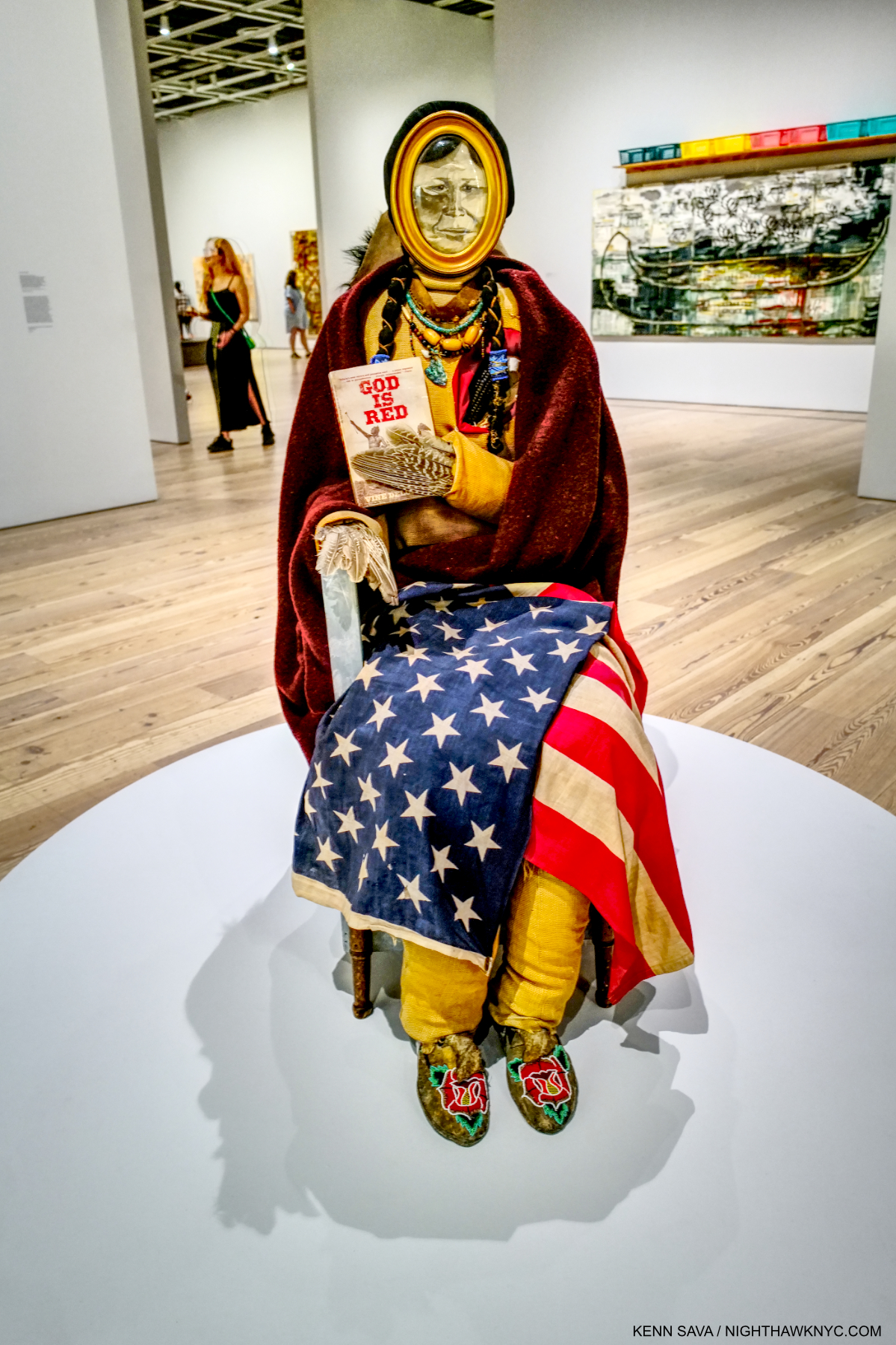
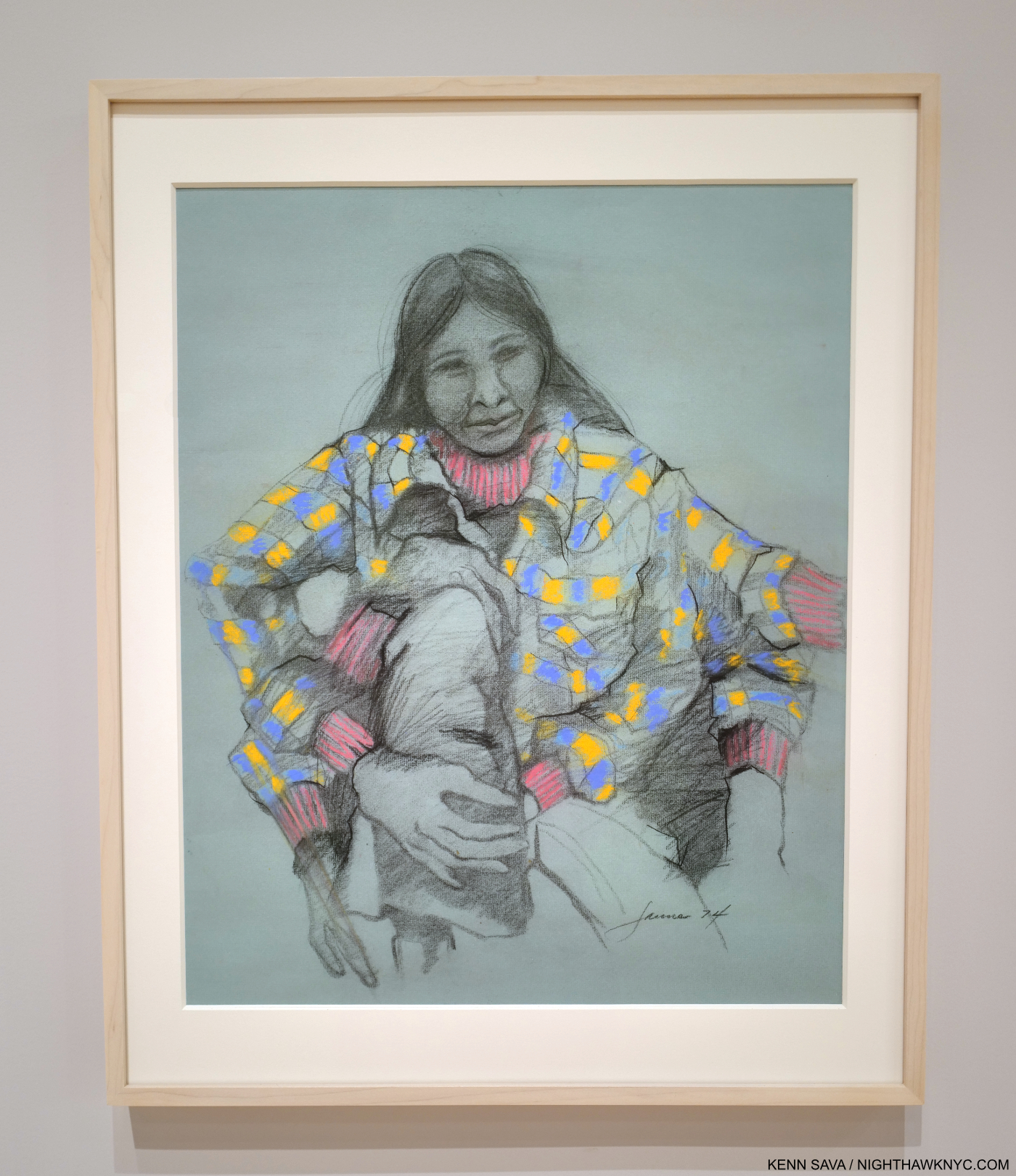
Indian Madonna Enthroned, 1974, Mixed-media.

It took 83 years for Jaune Quick-to-See Smith to get her first NYC retrospective. As if that’s not notable enough, Jaune Quick-to-See Smith: Memory Map is also the “largest and most comprehensive show of her work to date,” the Whitney says of its installation of 130 of her Paintings, Drawings, Prints, and Sculptures covering almost 5 decades of her career on its 5th floor, where it follows Edward Hopper’s New York, and 3rd floors.

Self-Portrait, 1974, Pastel, graphite pencil and charcoal on paper. The Artist showing herself with 6 arms.

Born in 1940, a citizen of the Confederated Salish and Kootenai Nation, the show reveals Jaune Quick-to-See Smith to be an Artist of her time, one that is fluent with contemporary Art styles and techniques. An Artist, and a person, passionate about the well-being of her people and the world in which they, and we all, live. Yet, she’s also been ahead of her time in bringing many issues her people face to the Art world, which has only recently begun to be more open to Indigenous Artists.

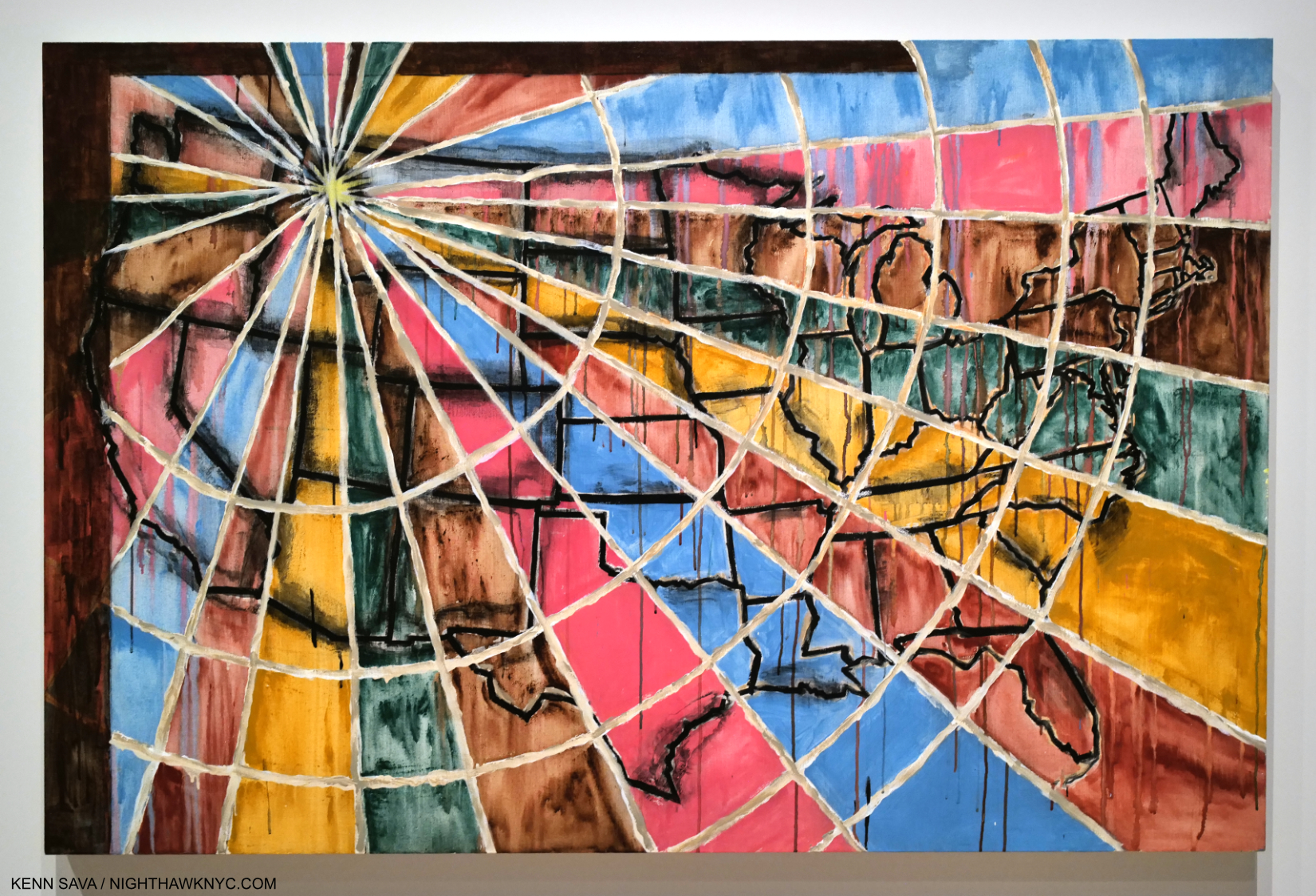
Homeland, 2017, Oil and acrylic on canvas, radiates from the Confederated Salish and Kootenai Nation’s Flathead Reservation in Montana.

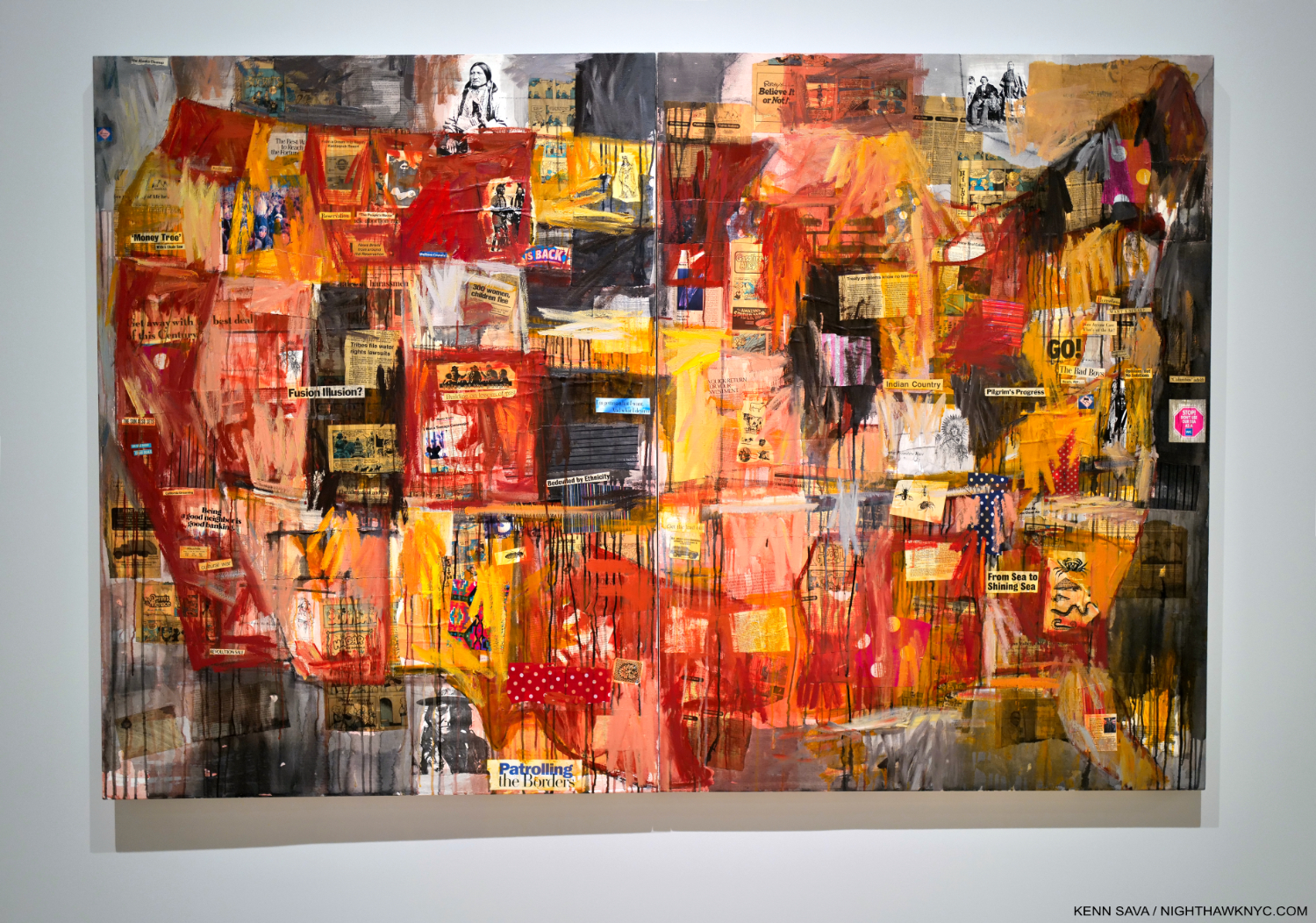
Indian Map, 1992, Oil, paper, newspaper and fabric on canvas.

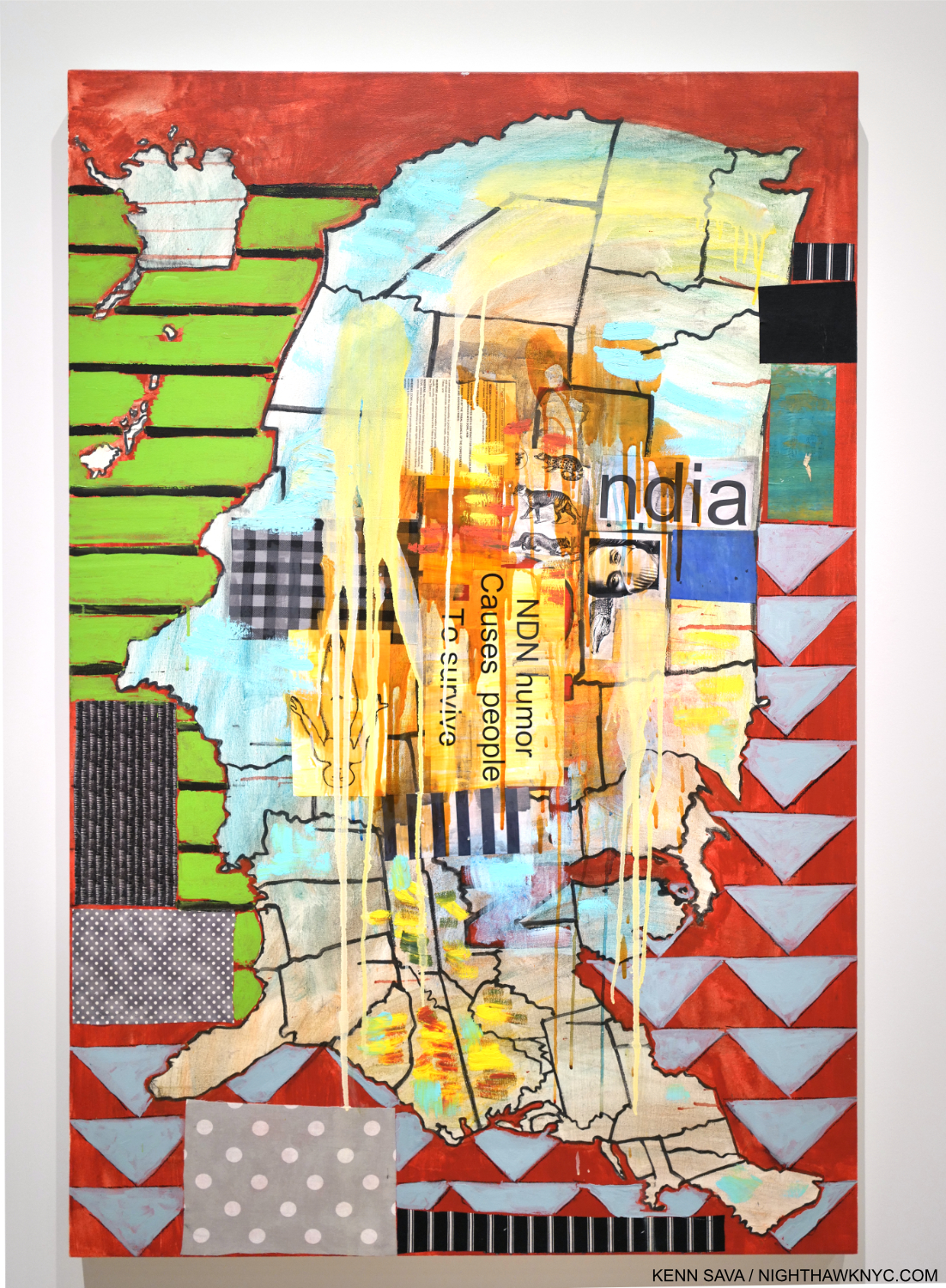
Survival Map, 2021, Acrylic, ink, charcoal, fabric, and paper on canvas

As a result, it seems to me that her work has been on the line between being of its time and ahead of its time throughout her career, both in terms of style and content. She proves herself fluent in moulding the language developed by her peers to her purposes over her career while also creating as many of her own innovations.

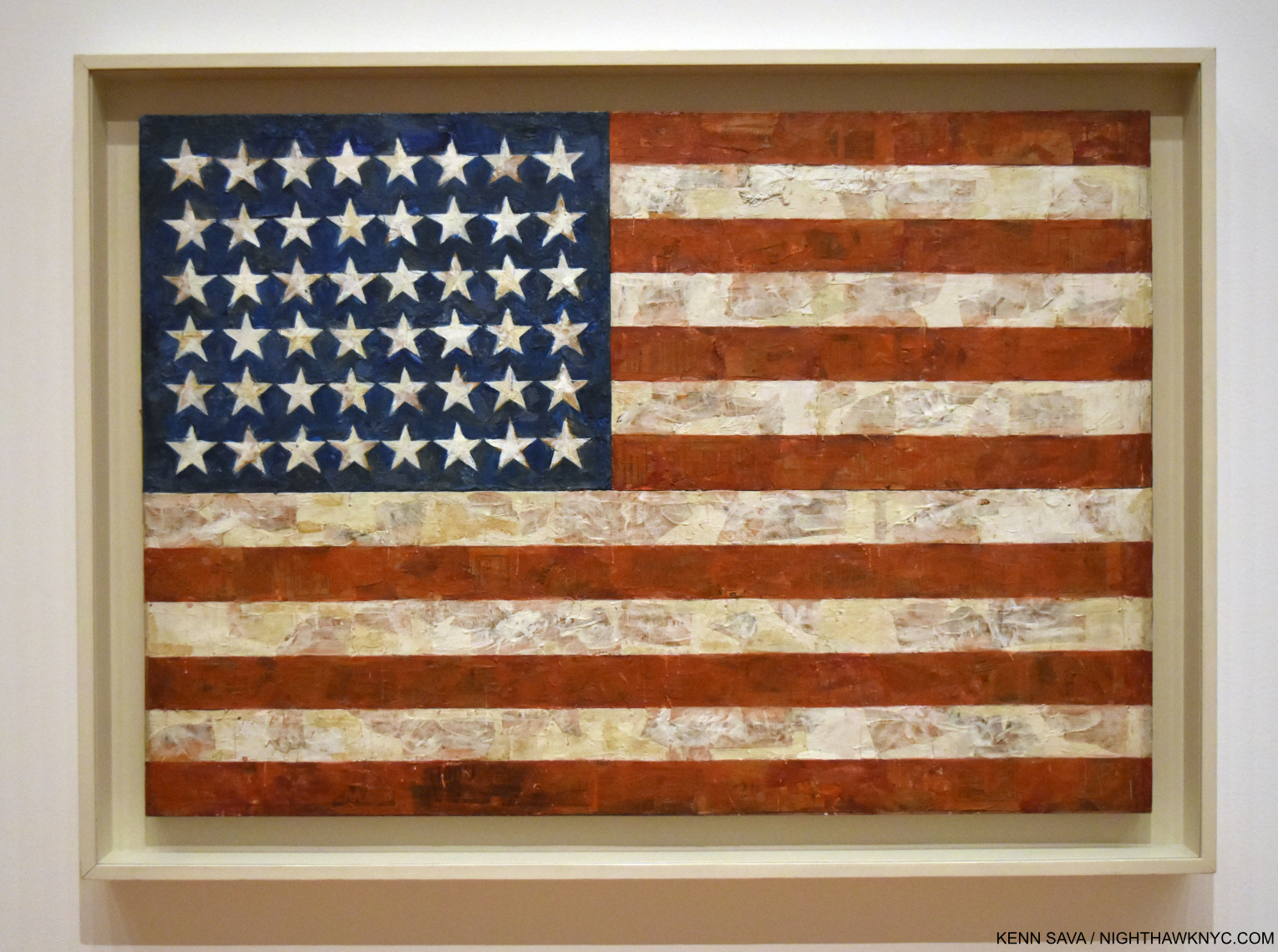
Jasper Johns, Flag, 1954-55, Encaustic, oil, and collage on fabric mounted on plywood, three panels, seen at MoMA, 2017.

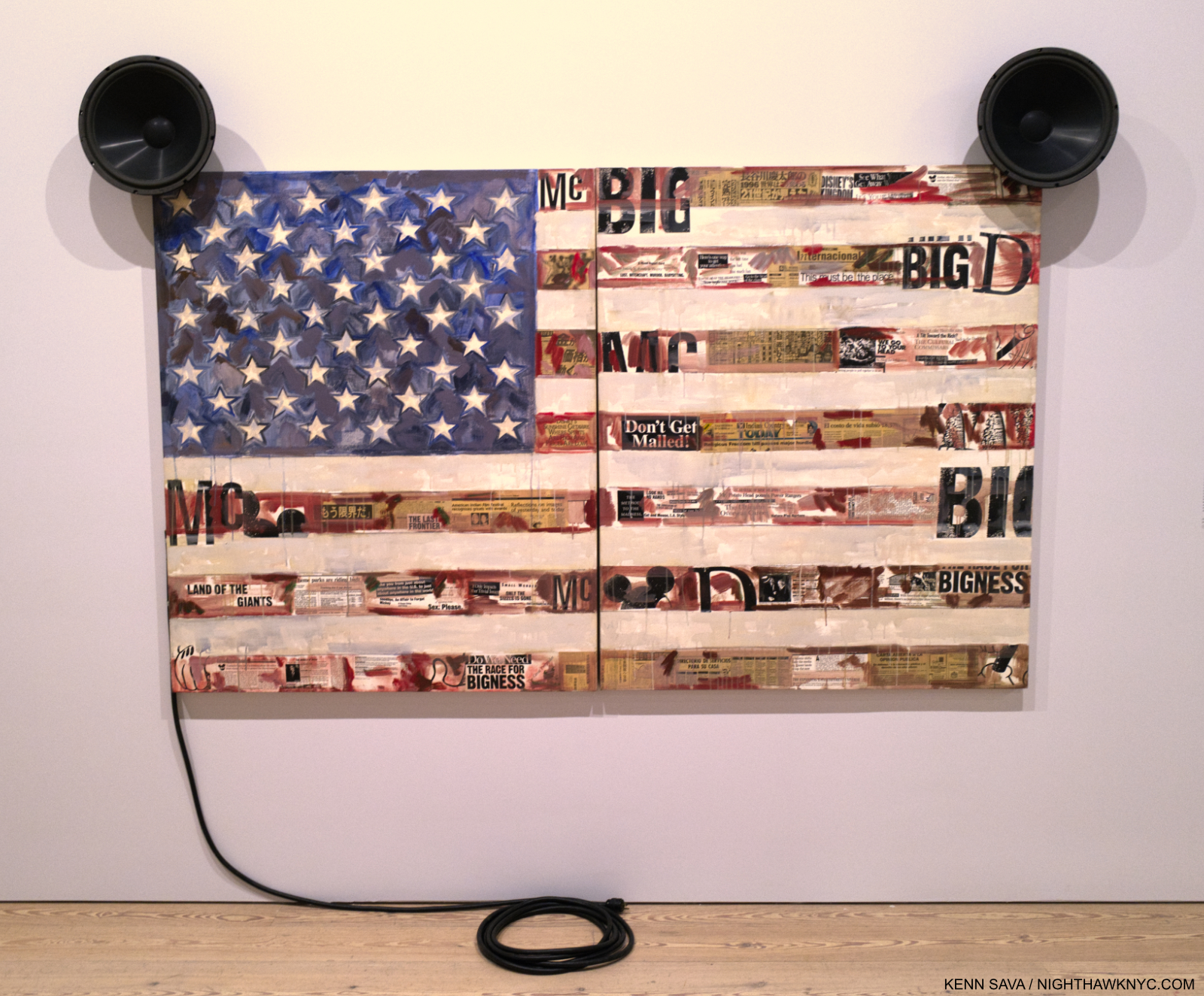
McFlag, 1996, Oil, paper and newspaper on canvas with speakers and electrical cord

Among the numerous Artists she references, including Magritte and Picasso, two names repeatedly came to mind, both at the forefront of the developments in American Contemporary Art of her time. Maps and Flags play a central role in the work on view, echoing Jasper Johns (B. May 15, 1930). Whereas Mr. Johns’s intentions for using the flag and maps remains, like most of his work, ambiguous, Ms. Quick-to-See Smith uses them to powerfully present the lives and issues faced by Indigenous People. 

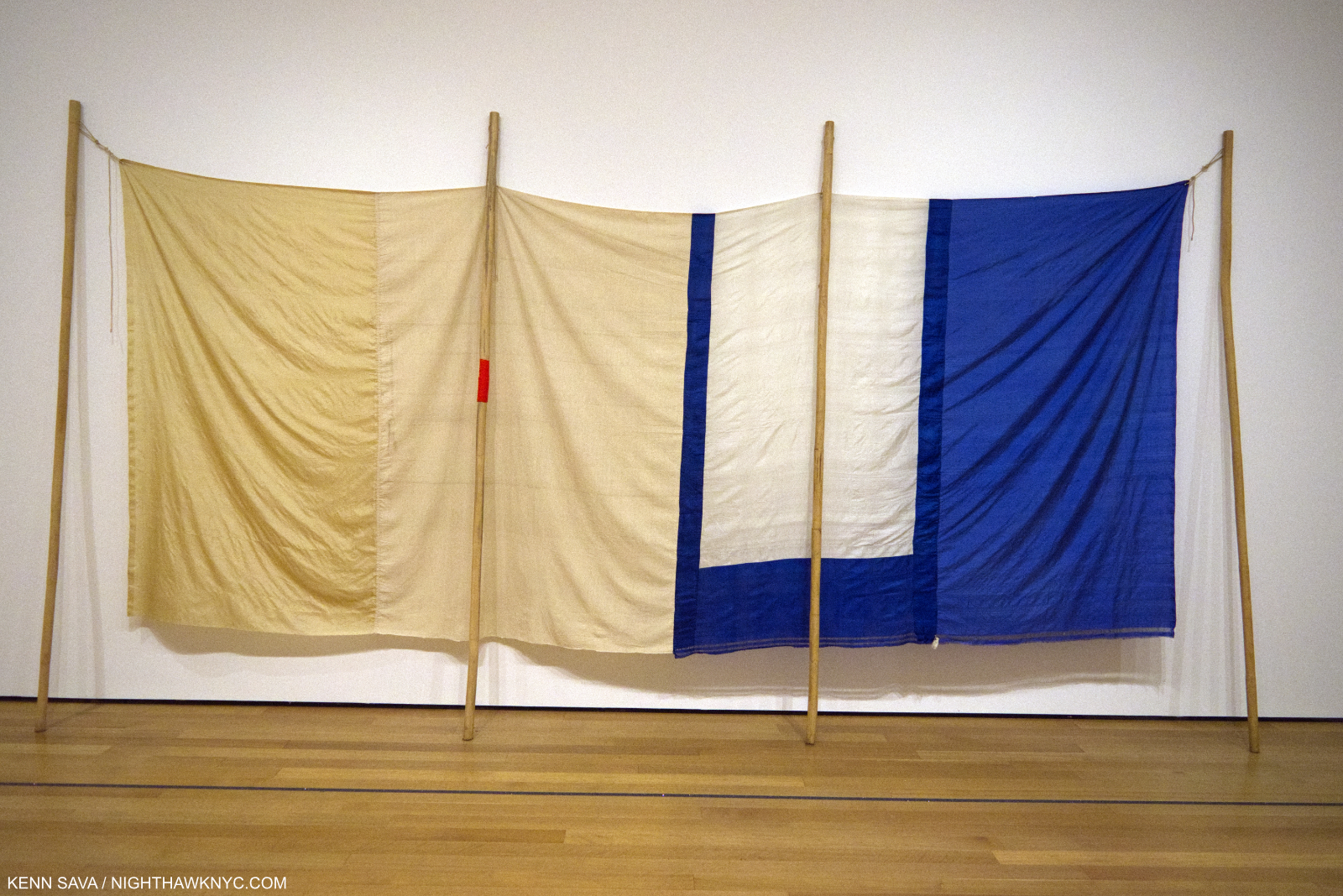
Robert Rauschenberg, Gull (Jammer), 1976, Sewn silk, rattan poles, and twine, 1976, seen at MoMA in 2017.

Other works echo Robert Rauschenberg (Oct 22, 1925- May 12, 2008).

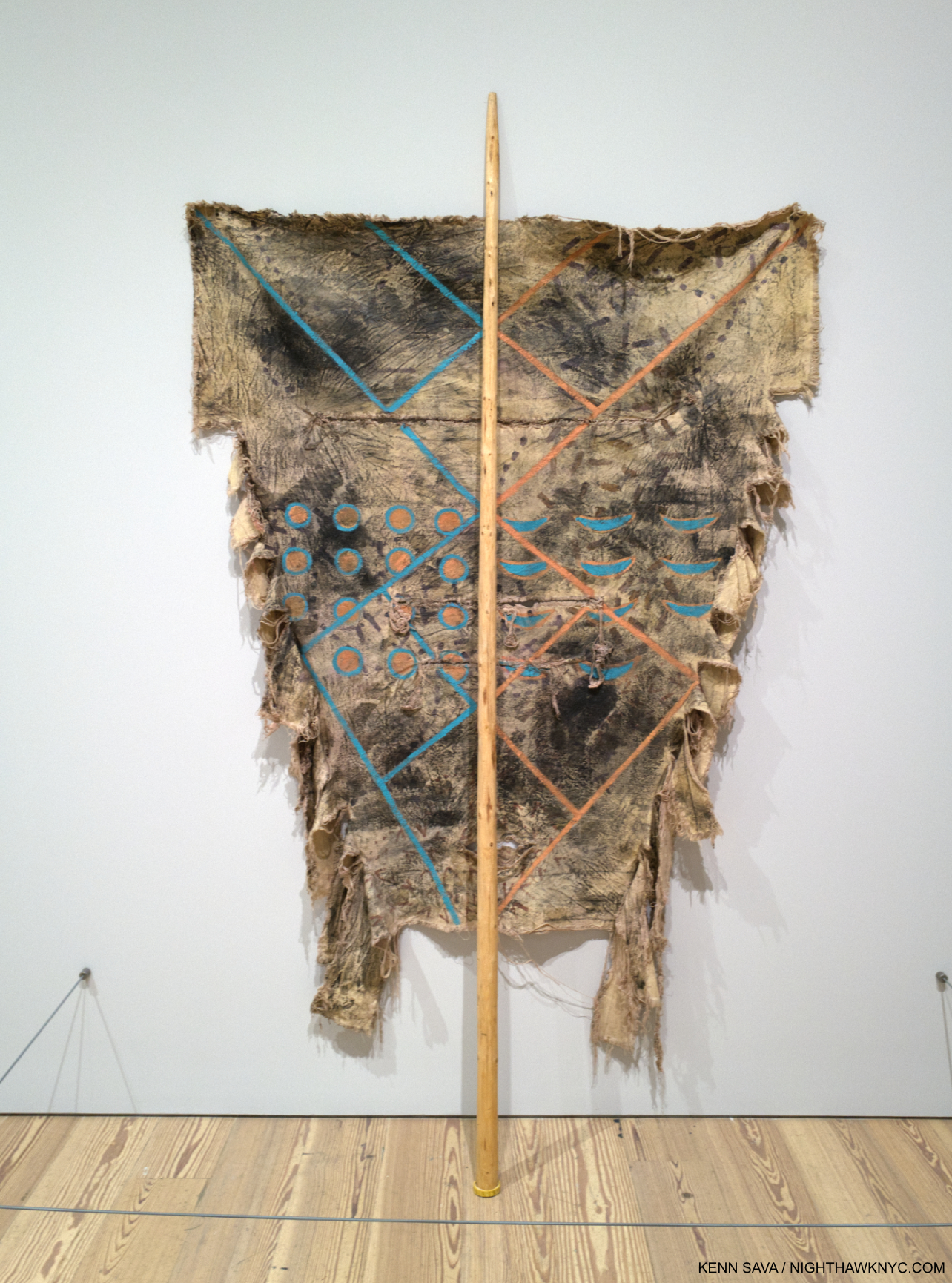
Ronan Robe #4, 1977, Oil, beeswax, charcoal and soot on canvas with lodgepole.

In 1985, the Artist got involved in efforts to save Petroglyph Park in New Mexico, creating what would become her Petroglyph Park Series, 1985-7, and marking the beginning of the appearance of current events in her Art.

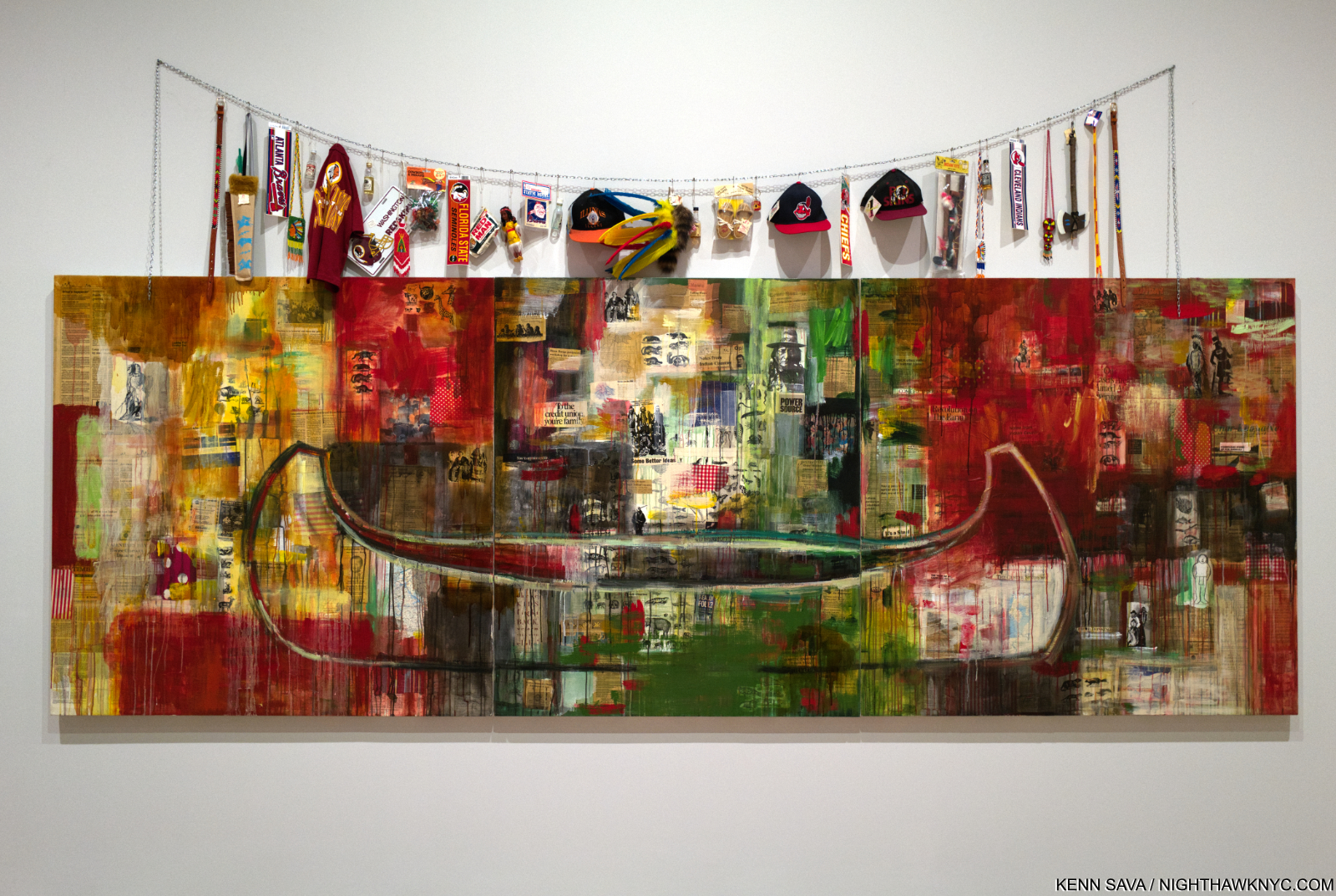
Trade (Gifts for Trading Land with White People), 1992, Oil, paper, newspaper, and fabric on canvas with found objects on a chain. Perhaps a history of exploitation with “trinkets” being exchanged for land. A number of the sports teams whose ephemera hangs above the Painting, have subsequently changed their names, some have not. Other items shown remain in production, including children’s toys which cheaply knock-off Native American culture.

Historic events don’t escape her attention, either.

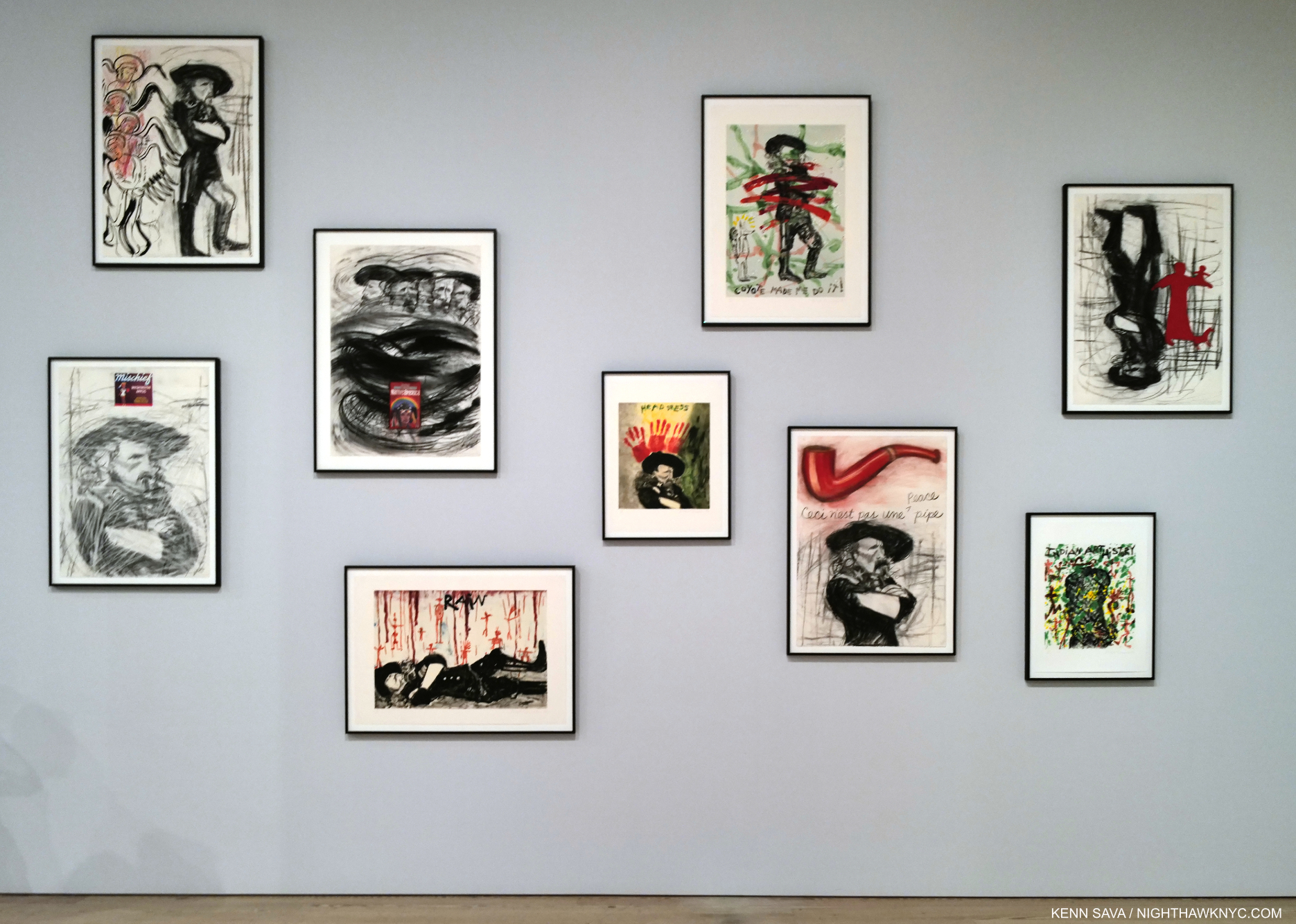
9 Monotypes from the Custer Series, 1993. The work next to the lower right is after Magritte. The text reads, “This is not a peace pipe.”

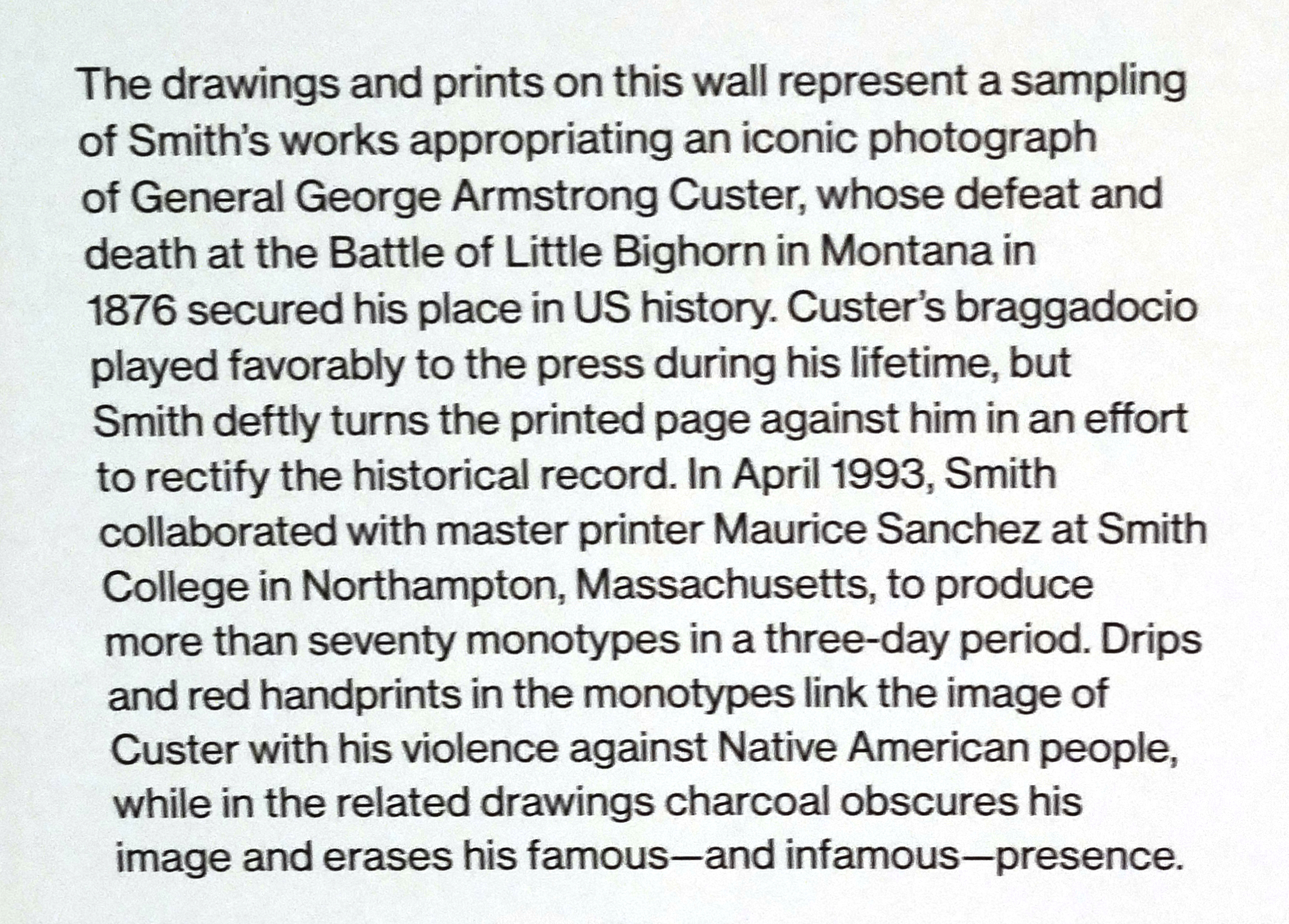
Wall card for the Custer Series.

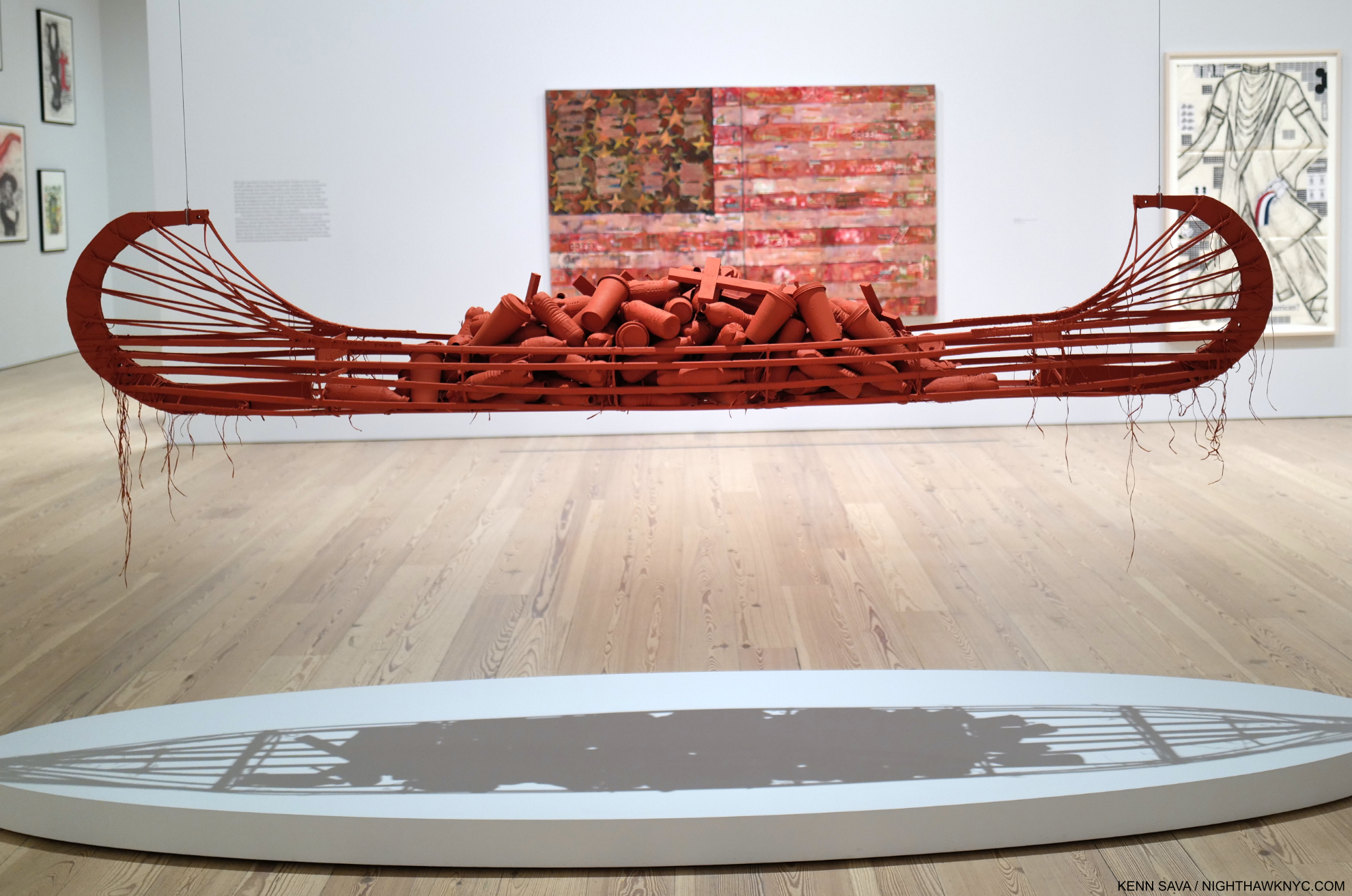
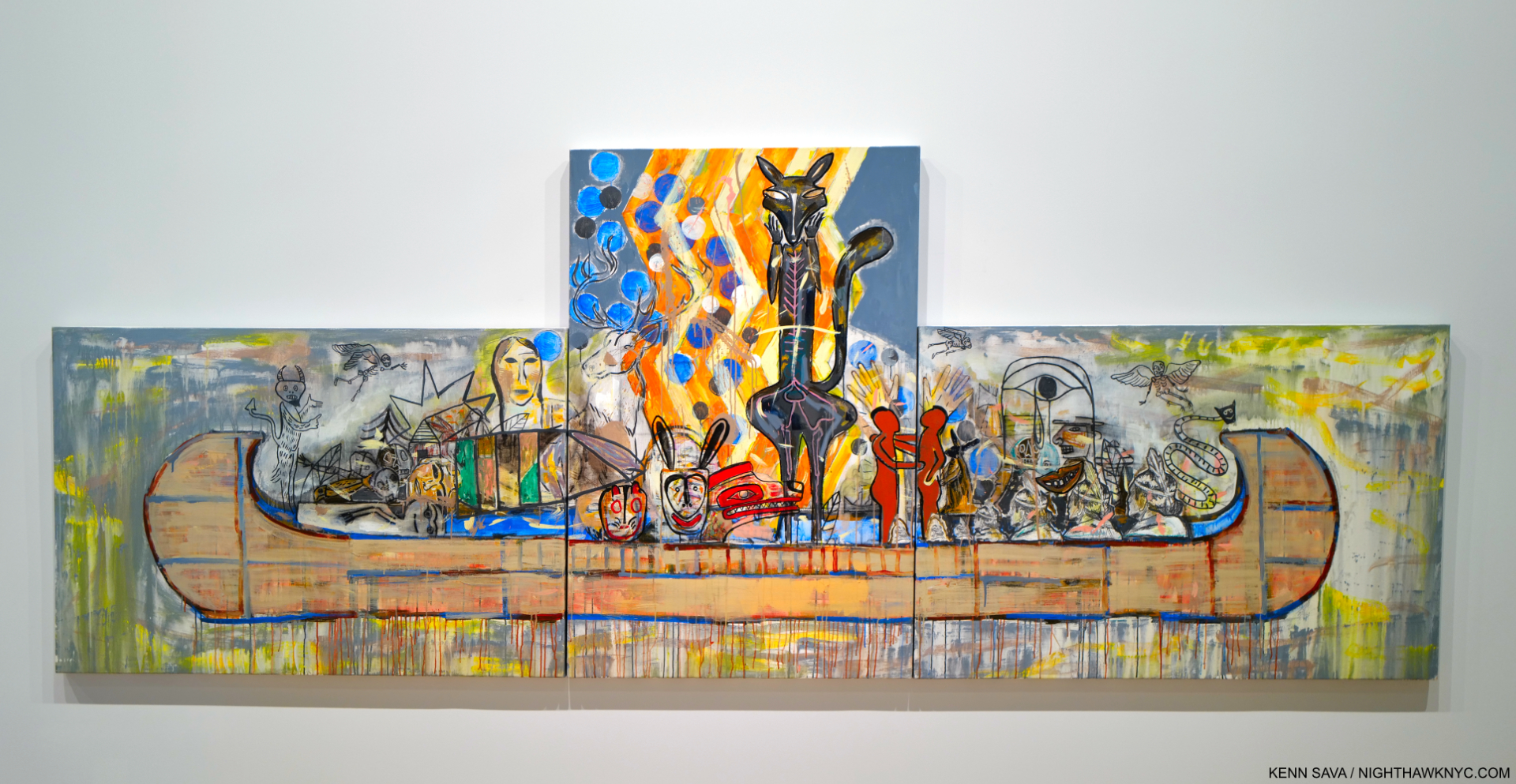
The Confederated Salish and Kootenai Nation’s Flathead Reservation is located in Montana, site of the Little Bighorn. Canoes, often labelled “Trade Canoes” (except for the one above), are a recurring theme, each one rendered strikingly differently.

Trade Canoe: Making Medicine, 2018, Mixed media, foreground, Green Flag, n.d., on the back wall.

Detail.

Trade Canoe: Forty Days and Forty Nights, 2015, Oil, acrylic, oil crayon, paper and charcoal on canvas, introduces the show, and is seen to the left in the picture of the show’s lobby, seen further below.

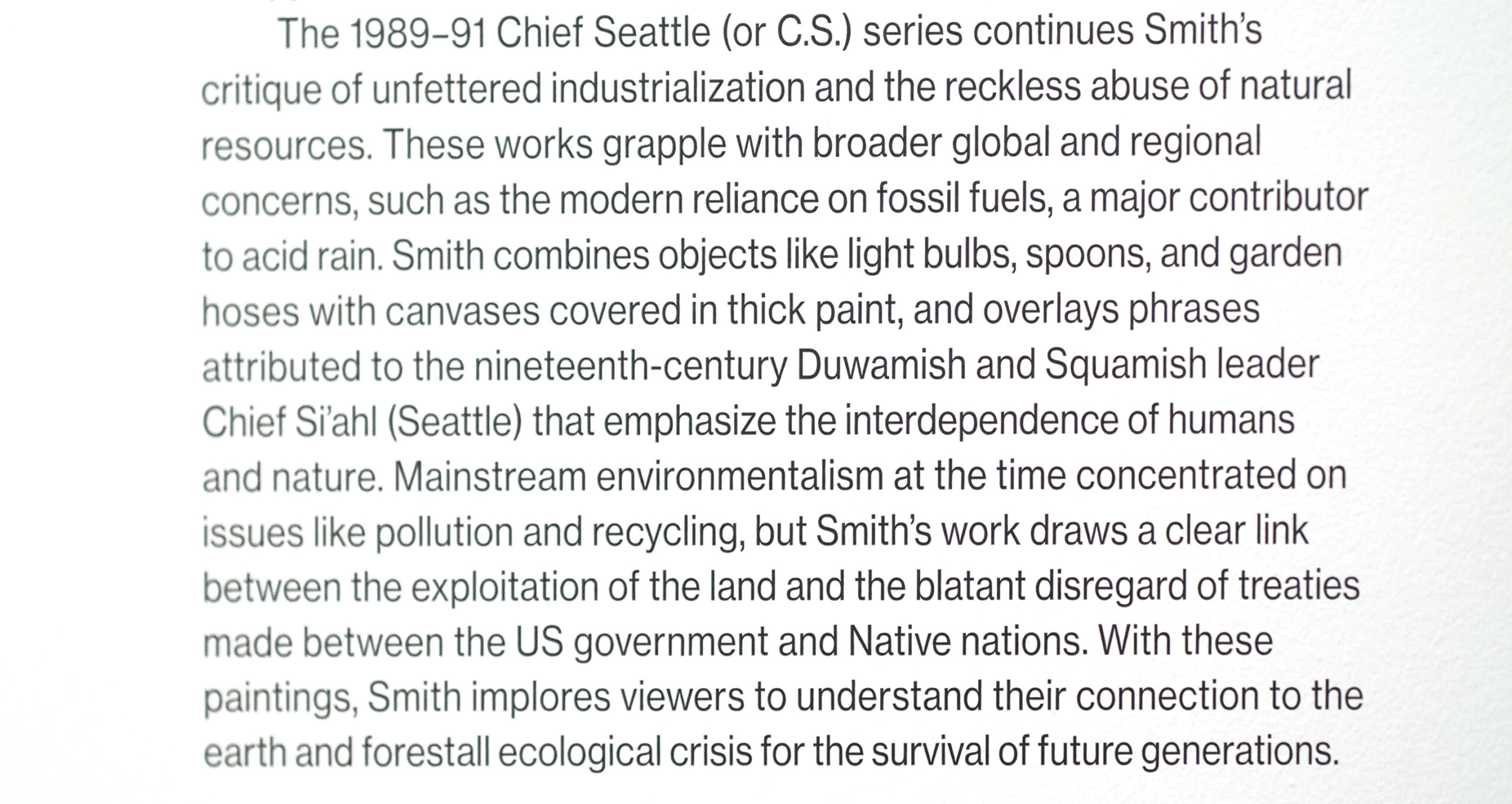
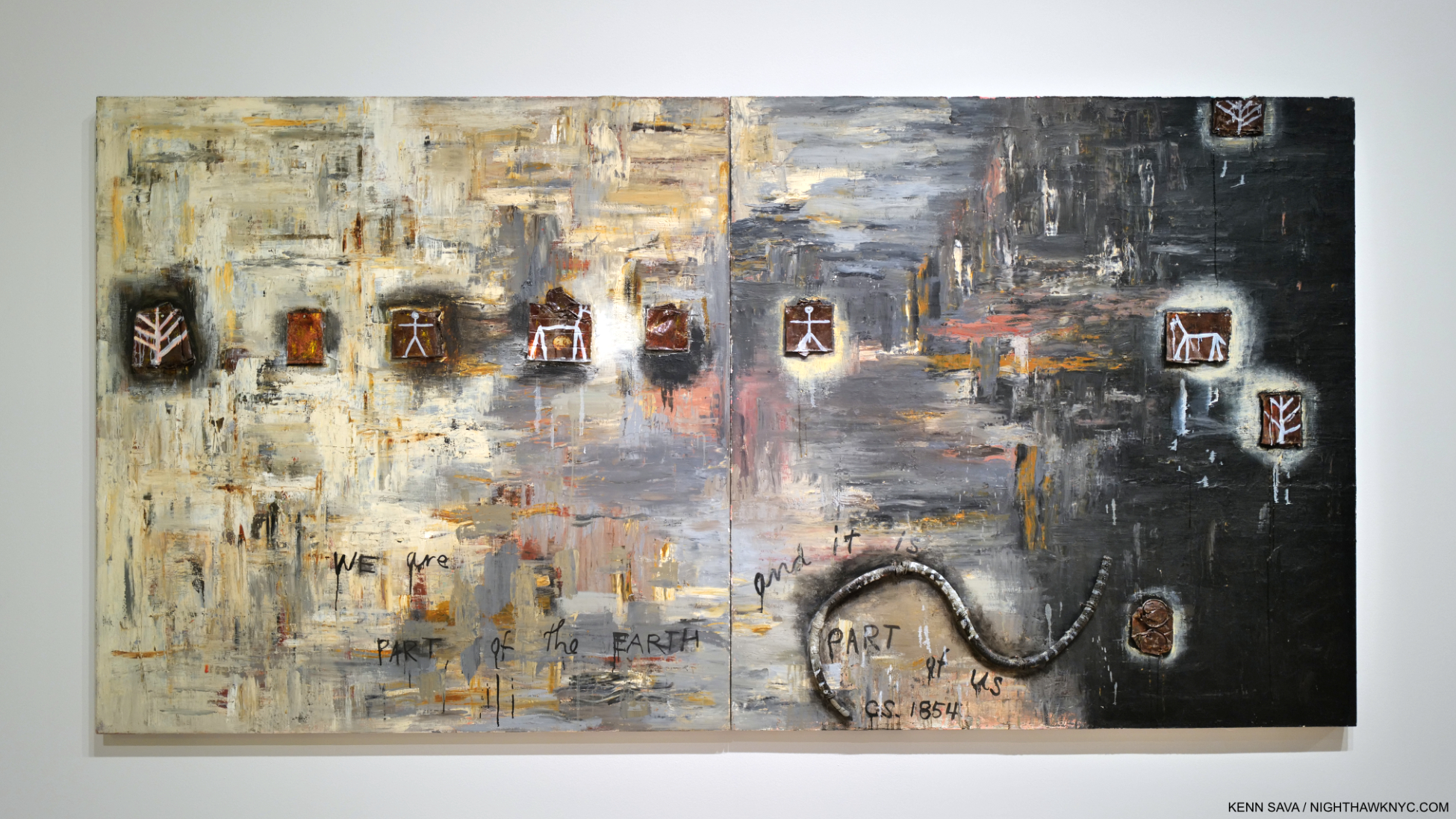
In addition to having her eye on what’s going on around her, her Art also has a wonderful way of looking back to the rich history of her culture. Messages of protest are side by side with sage wisdom. Her Chief Seattle Series (or C.S. Series), 1989-91, does this wonderfully and adds a timeless element to her work. The Wall Card says-

The Garden (C.S. 1854), 1989, Oil, rubber hose, crushed tin and aluminum cans, and nails on canvas. C.S. is Chief Seattle and The Garden is part of Chief Seattle Series from 1989-91. It reads, “WE are part of the EARTH and it is PART of US, C.S., 1854.”

Jaune Quick-to-See Smith has created an important, innovative and powerful body of work that somehow all manages to remain of the moment no matter when she created it. On the one hand, that’s a sign the country hasn’t evolved faster and how much remains to be done. 

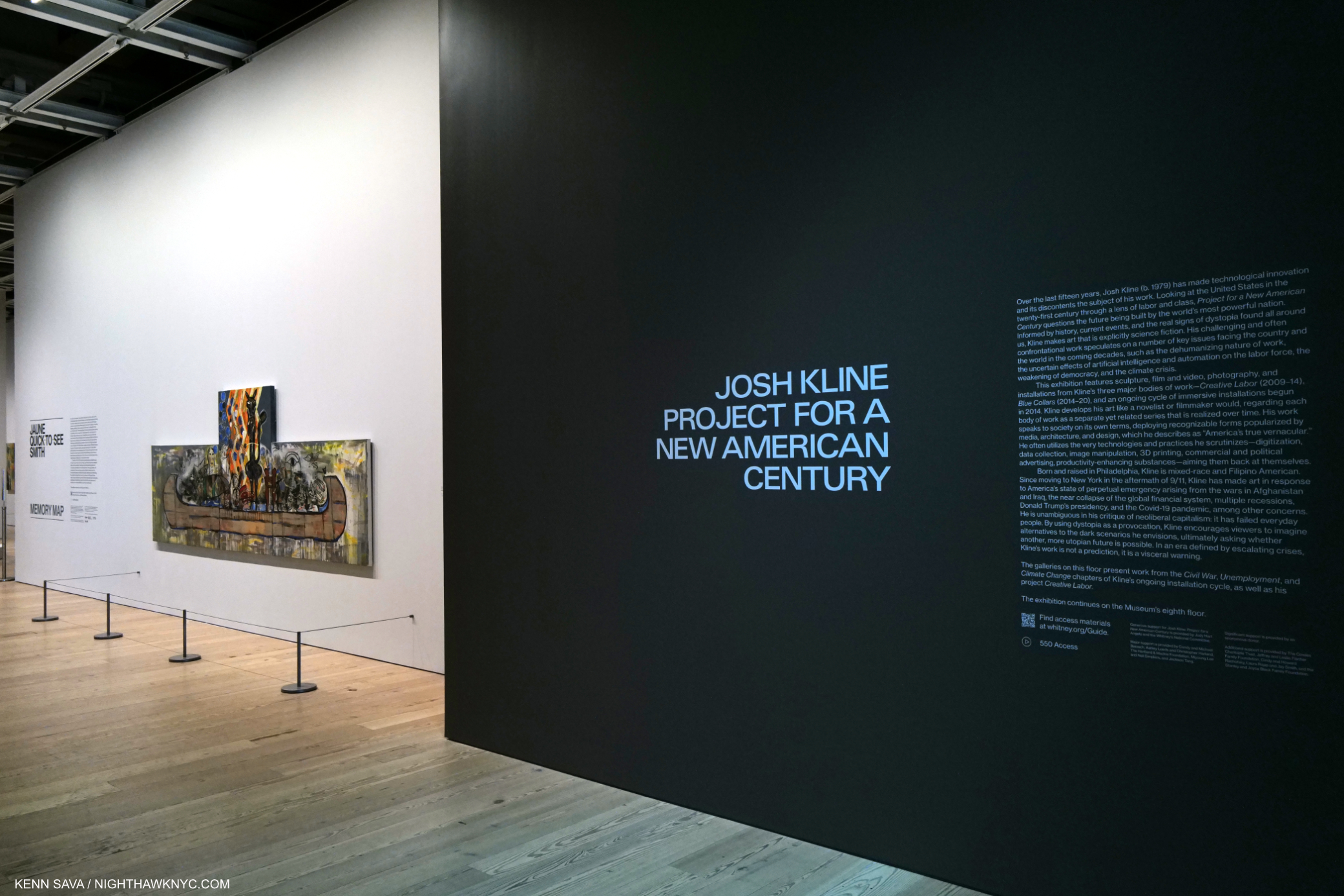
Memory Map shares the 5th floor with Josh Kline: Project for a New American Century, which is compelling in its own right. The shows overlap as both express concern over climate change and the impact of social, economic and technological change on the labor force.

On the other hand, it’s a testament to the Artist’s range, humanity, and perhaps above all, her perseverance. 

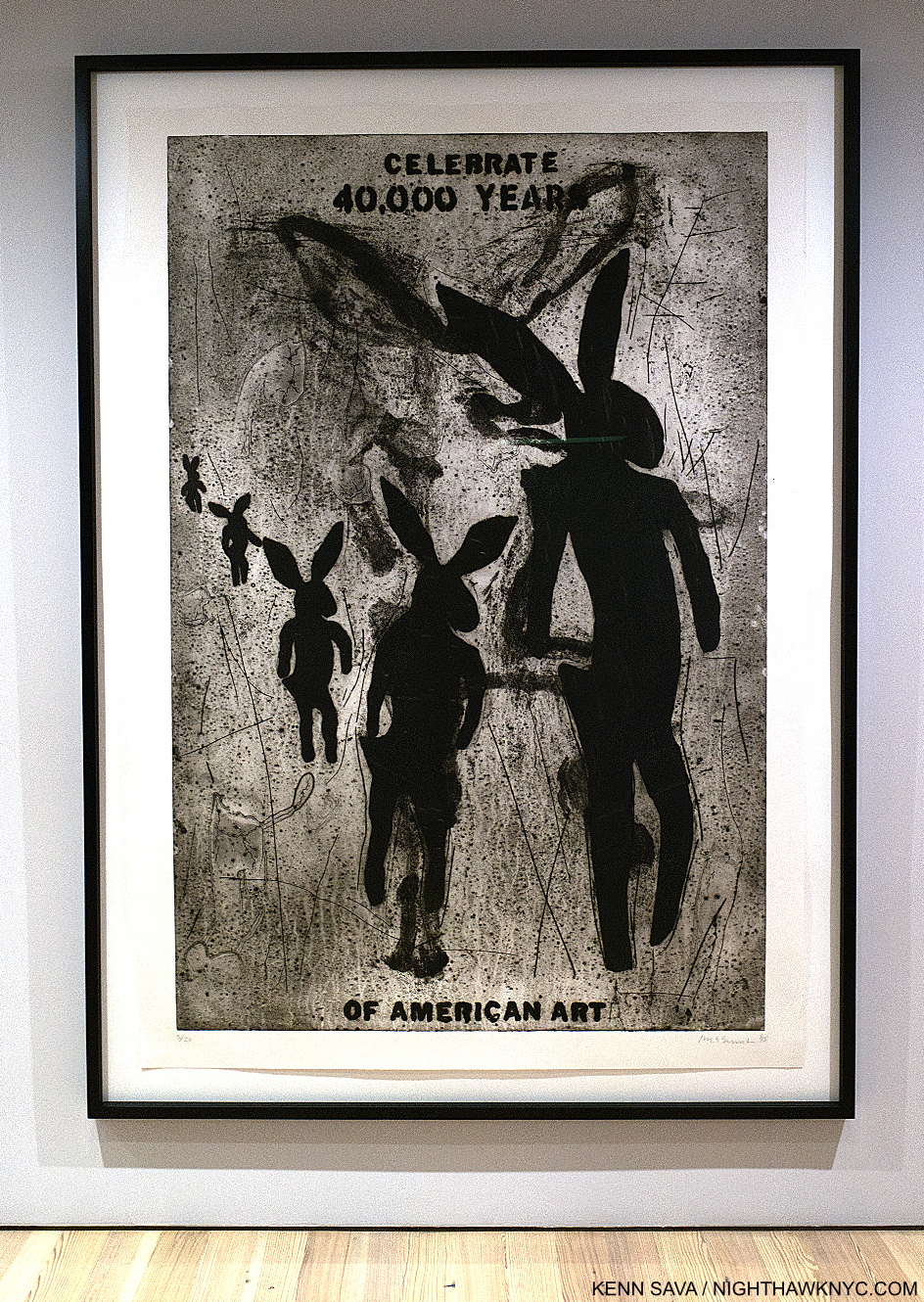
Celebrate 40,000 Years of American Art, 1995, Collagraph. A reminder that the ancient, original Art of our land has yet to be fully appreciated.

In some ways, the case of Jaune Quick-to-See Smith reminds me of Alice Neel, who didn’t see her first full-length monograph published until she was 83, the year before she died. Shows of, and books on, her work have increased ever since. I expect Ms. Quick-to-See Smith to also receive increasing attention as time goes on, and hopefully, she will still be around to see, and enjoy, it. Memory Map proves she deserves every bit of it. 

*- Soundtrack for this piece is “Now That the Buffalo’s Gone” by Buffy Sainte-Marie, who was born on the Piapot 75 Reserve in Saskatchewan, Canada. She announced her retirement from live performance earlier this month after 60 years of performing.

NighthawkNYC.com has been entirely self-funded & ad-free for over 8 years, during which 300 full-length pieces have been published! If you’ve found it worthwhile, PLEASE donate to allow me to continue below. Thank you, Kenn.

You can also support it by buying Art, Art & Photography books, and Music from my collection! Art & Books may be found here. Music here and here.

Written & photographed by Kenn Sava for nighthawknyc.com unless otherwise credited. To send comments, thoughts, feedback or propositions click here. Click the white box on the upper right for the archives or to search them. Subscribe to be notified of new Posts below. Your information will be used for no other purpose.

NoteWorthy Art Shows: Spring, 2023

This site is Free & Ad-Free! If you find this piece worthwhile, please donate via PayPal to support it & independent Art writing. You can also support it by buying Art & books! Details at the end. Thank you.

Written & Photographed by Kenn Sava.

As I celebrate the 8th Anniversary of NighthawkNYC.com on July 15th, my thoughts turn to some excellent shows I saw but didn’t get a chance to write about! I’ll take a brief look at a few I call NoteWorthy here…

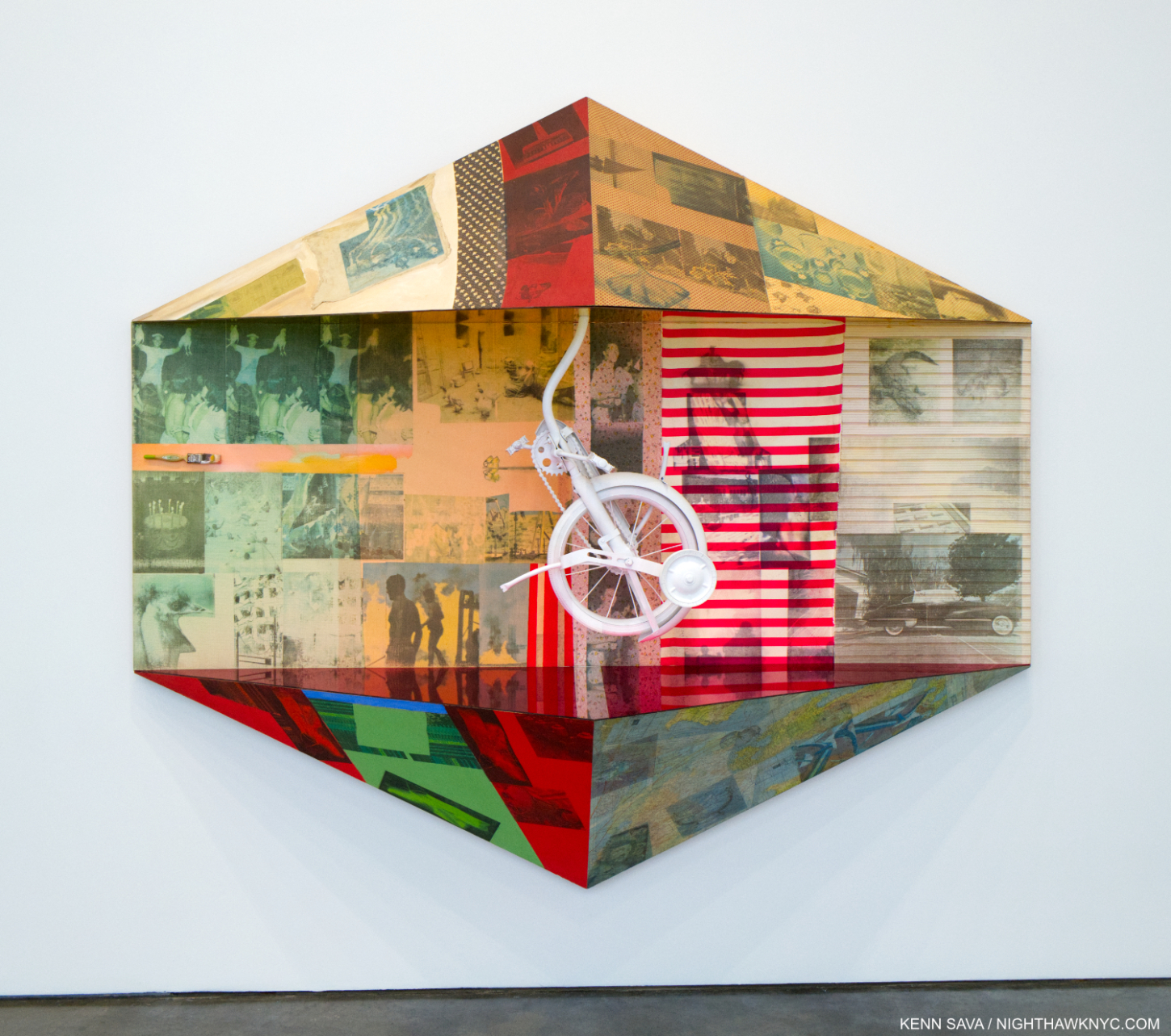
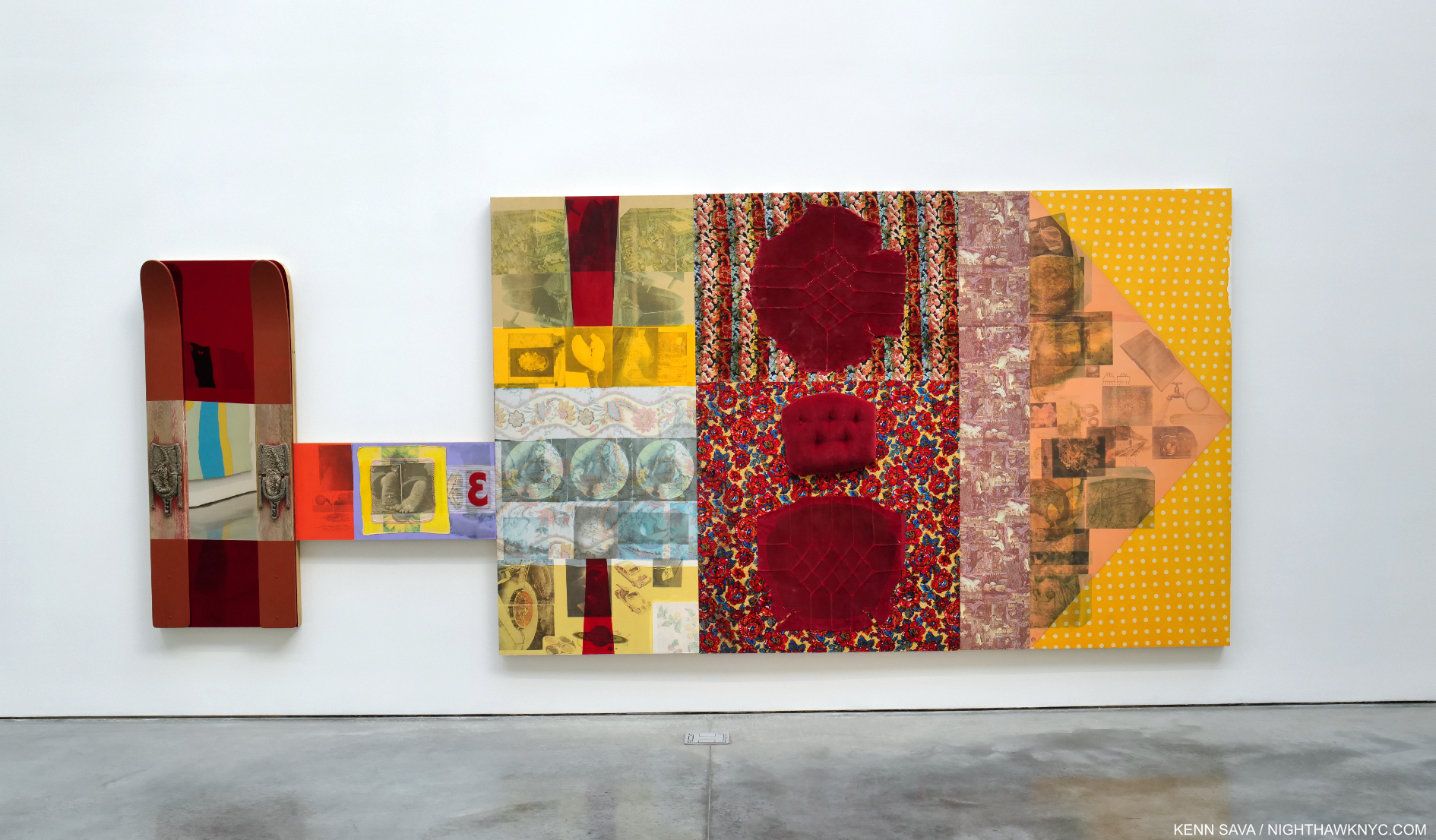
Robert Rauschenberg: Spreads and Scales @ Gladstone Gallery-

Robert Rauschenberg has been one of my favorite Artists since I discovered his work in the 1980s. In 2017, I wrote an extensive series on the plethora of shows going on around town then during what I termed “The Summer of Rauschenberg.” Spreads and Scales was a concise but very interesting show of work I’ve never seen before reinforcing my belief that no matter how much of his work you’ve seen, even 15 years after his passing in 2008, there’s work of his that you more than likely still haven’t seen.

William Christenberry & RaMell Ross: Desire Paths @ Pace-

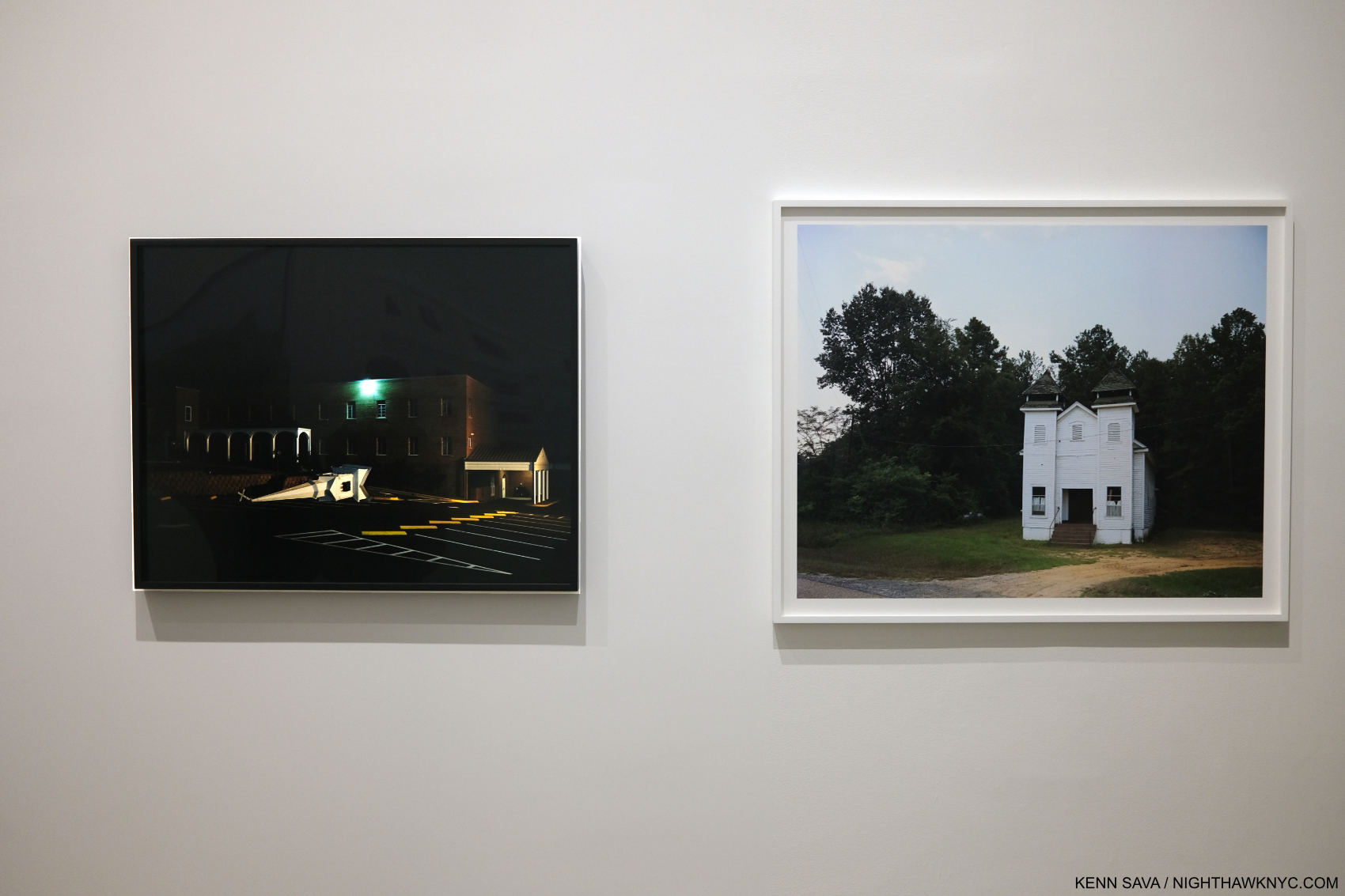
RaMell Ross, Sleepy Church, 2014, left,  and William Christenberry, Church, Sprott, Alabama, 1981, both Pigment print mounted on dibond.

An interesting, unexpected paring of the work of the late Photographer, William Christenberry, perhaps best known for his association with William Eggleston, and the Academy Award Nominated Filmmaker & Artist, RaMell Ross, who I last saw in a solo show at Aperture Foundation in June, 2018. Interesting became compelling in its final gallery.

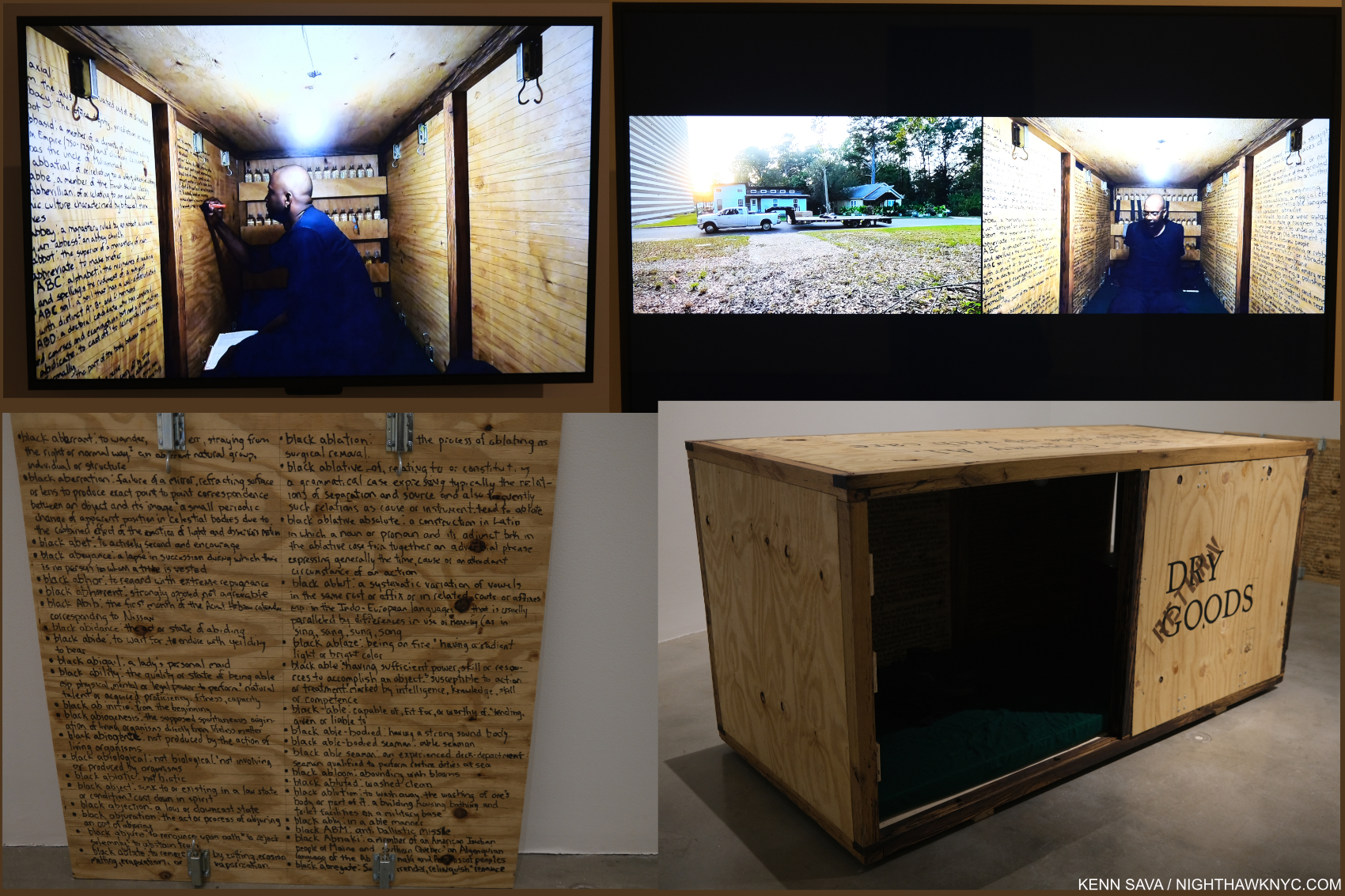
RaMell Ross, Return to Origin, 2021. From the upper left- the Artist working away while in transit, sealed in the box; two video stills- the truck after unloading the box, simultaneous shot of RaMell inside; one of the panels showing the Artist’s inscriptions during transit; the box labelled “DRY GOOD.”

There, sitting on the floor was a very large box cryptically labelled “DRY GOODS” in a large stencil on the exterior, I looked at it, noticed there was writing all around the inside and then when I was about to move on I saw the accompanying video. It turns out RaMell Ross created & used the box to reenact Henry Brown’s legendarily daring act of mailing himself out of slavery to freedom in 1849! Mr. Ross shipped himself, sealed in this box, from Rhode Island to Hale County, Alabama. The trip took 59 hours, all the while the contents were unknown to the contracted truck driver whose gooseneck rig was carrying the crate. The journey, captured on the video, was being shown on that nearby monitor. In addition to reminding today’s viewers of Mr. Brown’s incredible feat (in a smaller box), it also reminds me of the preciousness of freedom. Something not fully appreciated, until it’s gone.

Uta Barth @ Tanya Bonakdar-

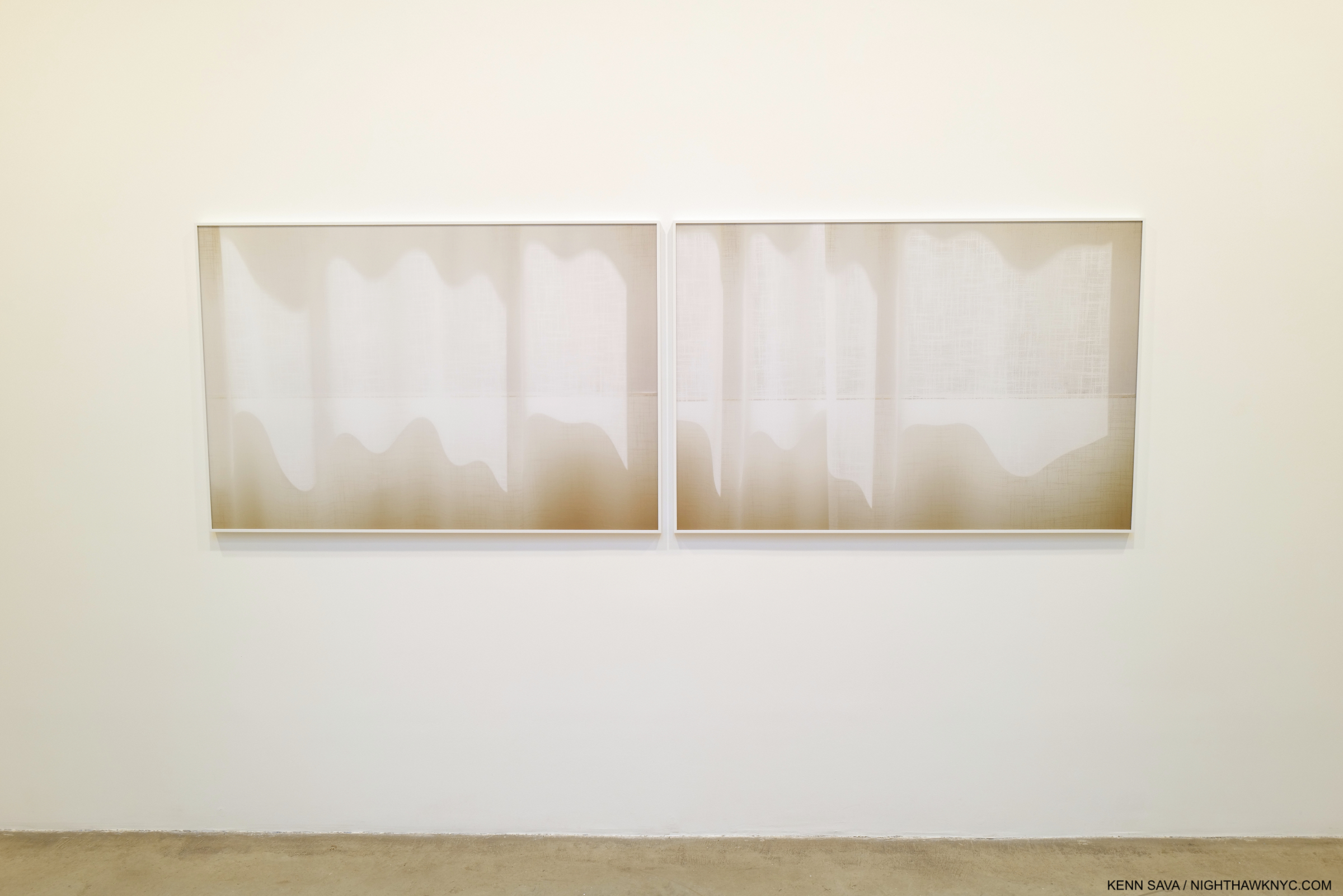
Frozen poetry. …and to draw a bright white line with light (Untitled 11.10), 2011, Inkjet Prints.

Compositions 5, 12 & 7, left to right, each Inkjet Prints from 2011, seen next to a street-facing picture window. Uta Barth’s work has had me deeply under its spell for the past three years.

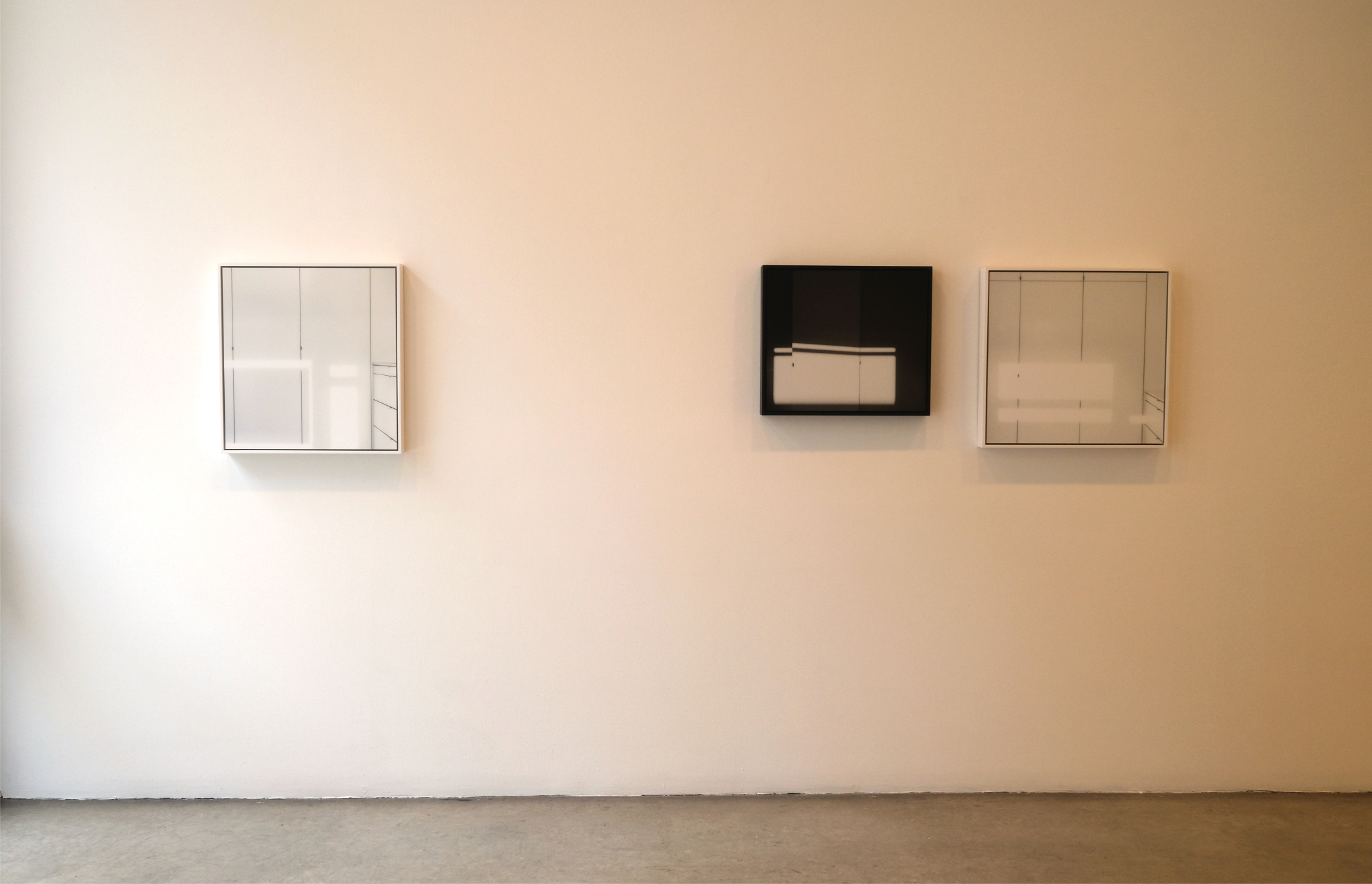
Sundial (07.6), 2007, Mounted color Photographs.

In my opinion, Uta Barth is one of the most under-appreciated Photographers working today. I came across a copy of her retrospective The Long Now a few days before the pandemic shutdown and its poetry captivated me. With empty streets and empty rooms everywhere for the following months on end, I saw “Uta Barths” everywhere. Her spell has continued ever since. Artists who change the way I see the world are few and far between.

Installationv view of one section of ...from dusk to dawn, 2022, Mounted color Photographs with single-channel video monitor, includes an embedded video on one of these pieces that changes frames so subtly you may not see it change.

Finally having a chance to see her work in person @ Tanya Bonakdar Gallery, Uta Barth presented one, large, new piece, …from dusk to dawn, 2022, in multiple sections that nearly wrapped around the entirety of the downstairs main gallery and a curated selection of “classic” Uta everywhere else in the gallery. The new piece showed one location of Richard Meier’s Getty Center, L.A., over the course of a year, as it changed with time. Being in California, we don’t see the variety of weather we might in some other place, but with Uta Barth it’s always about the light. 

Tauba Auerbach: Free Will @ Paula Cooper Gallery-

One of the rising stars of the Art world, Tauba Auerbach’s latest, her first NYC show since her acclaimed early mid-career retrospective S v Z @ SF MoMA, 2021, didn’t disappoint while offering the usual surprise.

Foam, 2023, Acrylic on dibond. One of a series of Paintings(!) of foam as seen through a microscope.

“The exhibition is an expression of curiosity about spontaneously emergent structure, tendency and habit, and their intersection with the notion of free will. The work brings together historical rendering techniques like pointillism and midtone drawing with microscopy, algorithmic image processing, off-loom weaving, spraying techniques and mathematical surface modeling,” per the Press Release.

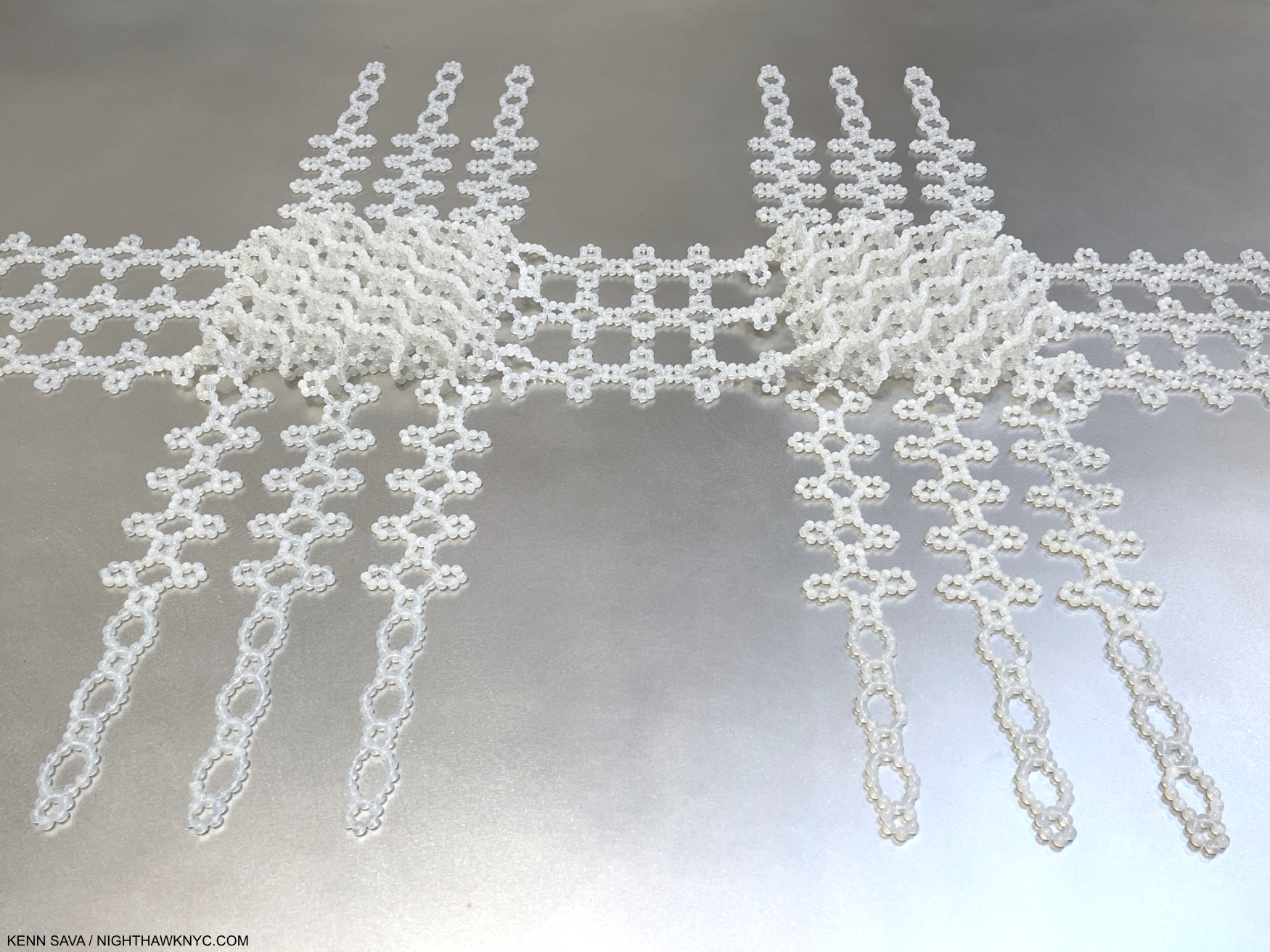
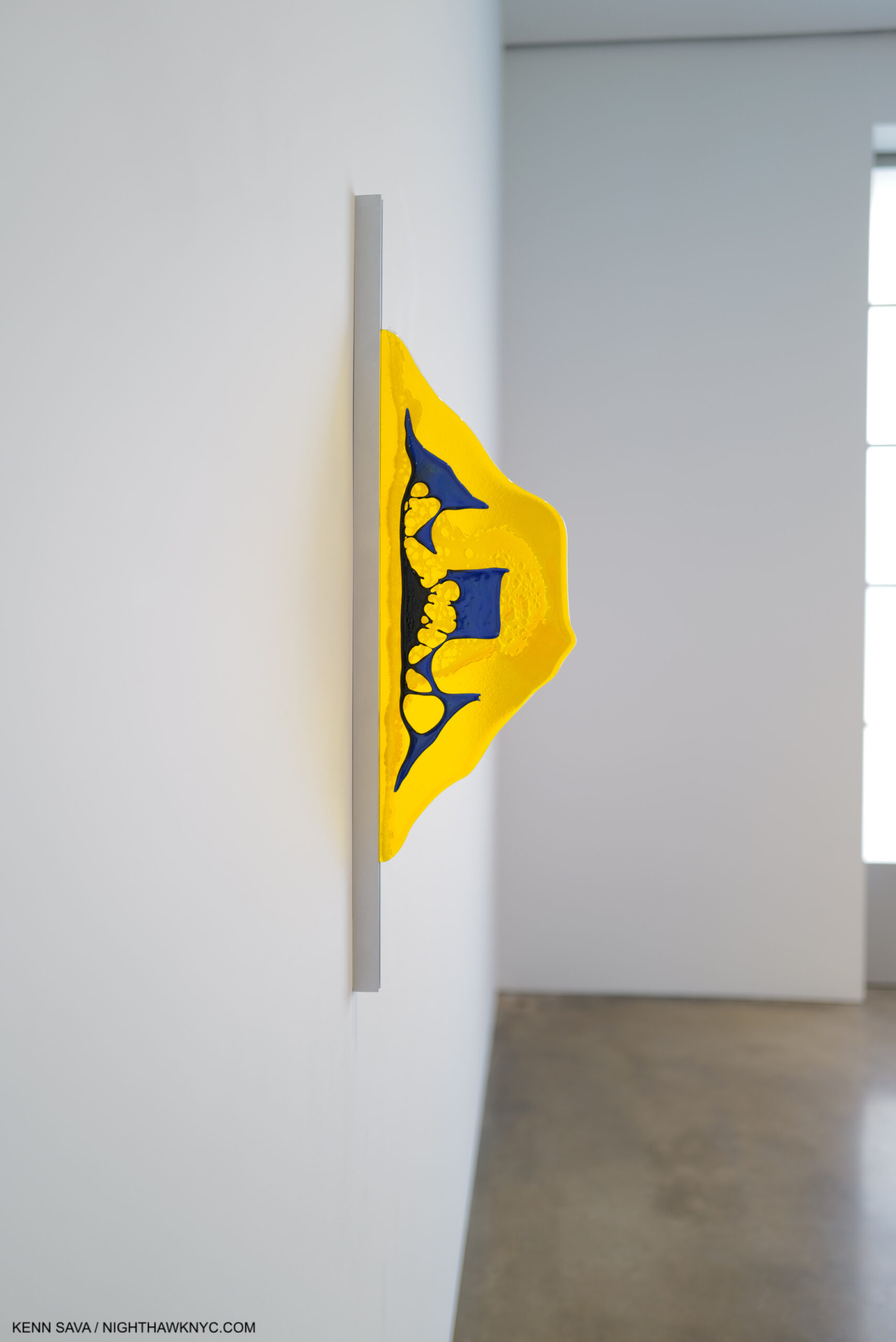
Org, 2023, Glass, nylon coated steel cord, 2 x 80 1/2 x 41 3/8 in.

New were incredibly detailed “pointillistic” (her term) Paintings accompanied by tables of intricate objects and a number of equally interesting sculptural works in the adjoining gallery. Both the objects in the main gallery and these “sculptures” reminded me that Tauba Auerbach has her own publishing company, Diagonal Press, which produces fascinating and intricate books and multiples.

Spontaneous Lace, 2023, Kiln-formed glass in aluminum

It might be premature for me to say this, but Tauba Auerbach reminds me a bit of Frank Lloyd Wright, to me one of the great Artistic geniuses of all time. Ms. Auerbach is not an Architect, as far as I know, but her work reminds me of the brilliance of Wright’s “ancillary” designs for his buildings: his fabric designs, dishwear, furniture and rugs. Frank Lloyd Wright continually pursued “building the way nature built,” i.e. “organically,” as he called it. Much of Tauba Auerbach’s work is inspired by nature and carries forward some of its techniques, as seen here in Free Will. Barely in her 4th decade, the high esteem attached to her name is well-deserved in my view, and she is definitely an Artist to keep a close eye on.

LaToya Ruby Frazier @ Gladstone Gallery-

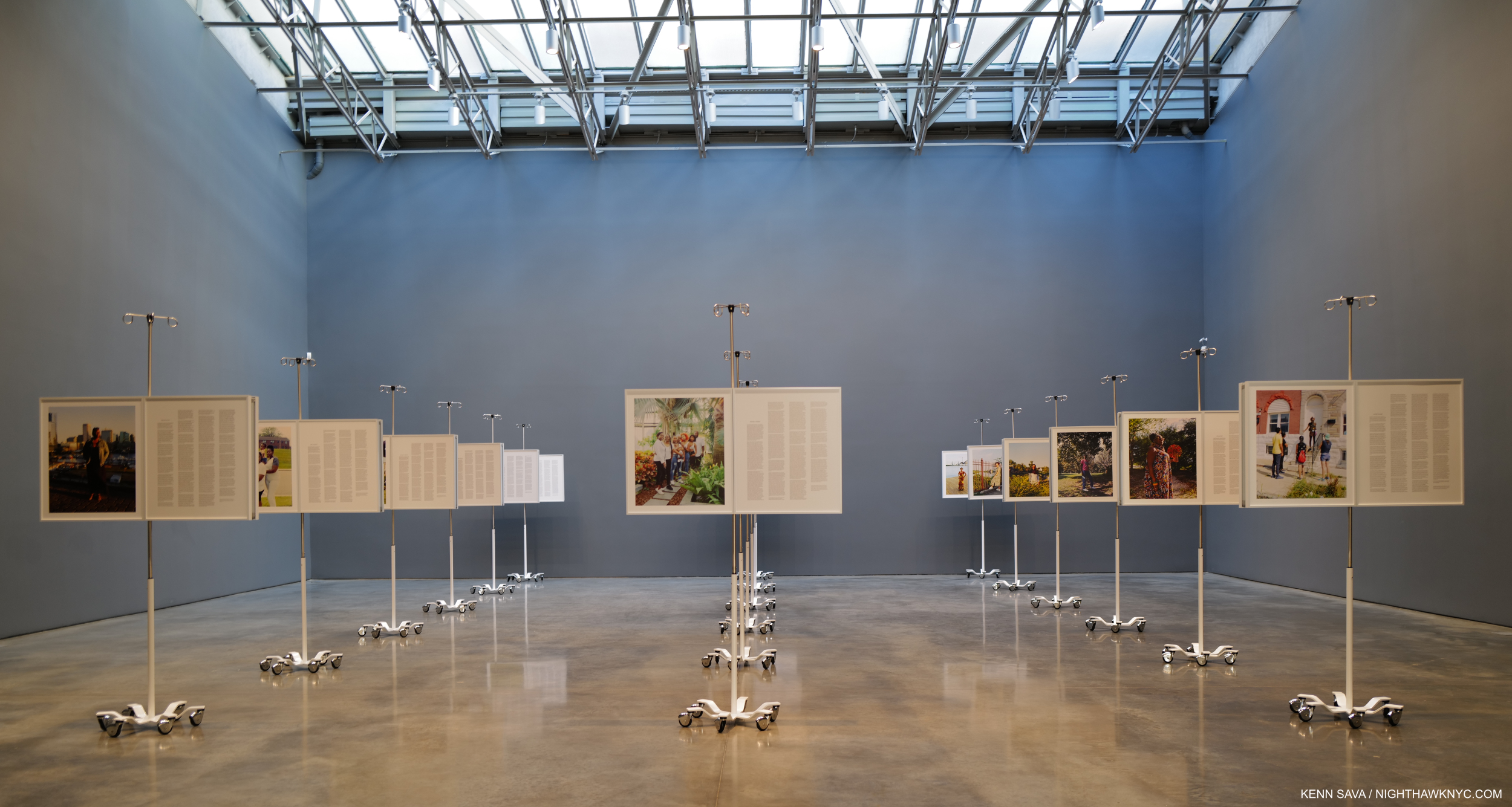
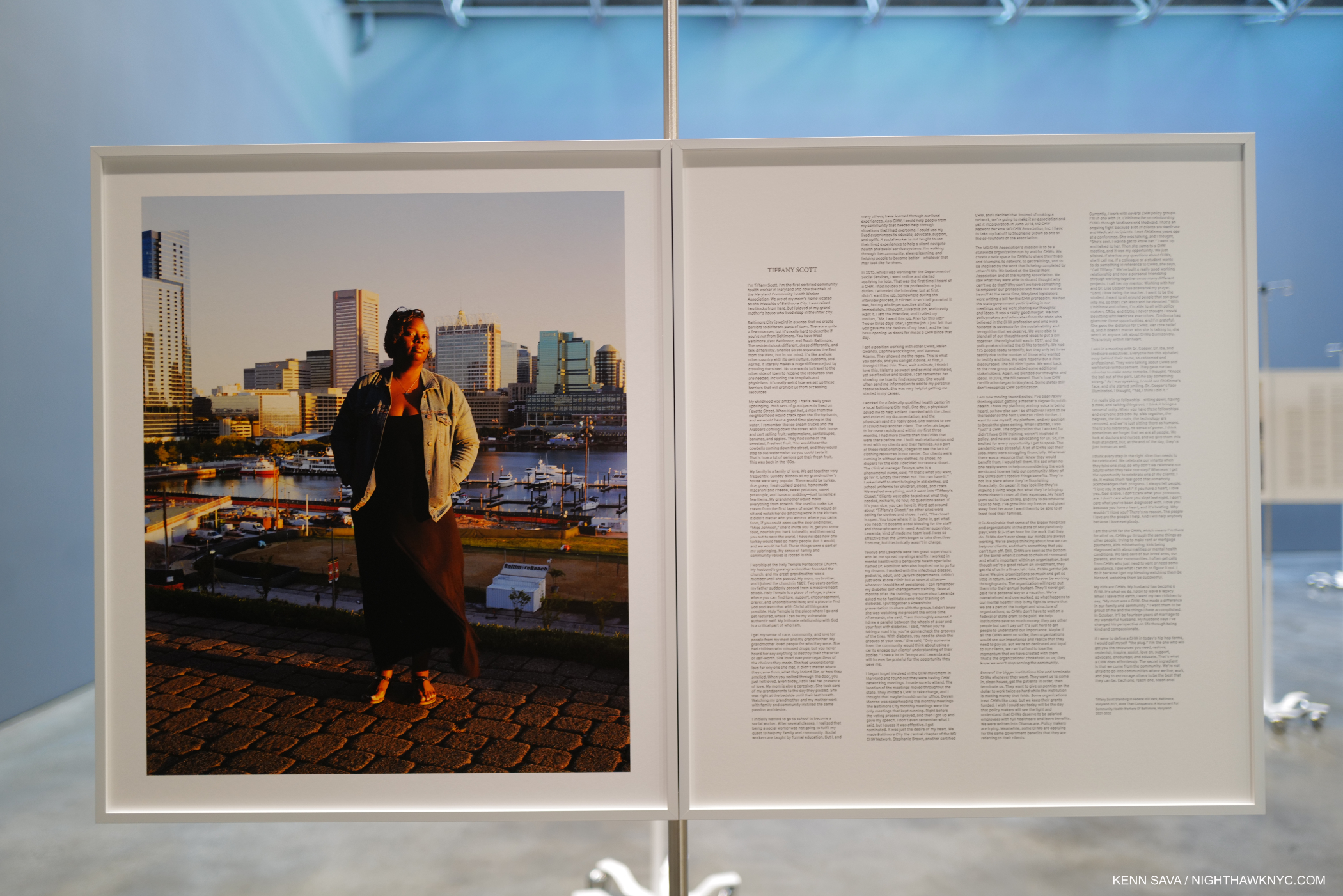
Steadily, LaToya Ruby Frazier has been building a remarkable oeuvre, equal parts documentary and Art, in her own, unique, way. Her latest show, LaToya Ruby Frazier at Gladstone consisted of one major work– More Than Conquerors: A Monument for Community Health Workers of Baltimore, Maryland 2021-22, 2022 made up of 66 archival inkjet prints mounted on 18 stainless steel I.V. poles, which amounted to stations.

At each stop her Photographs were accompanied by personal statements from the subject that were every bit as riveting as Ms. Frazier’s work- no small feat. The show was a wonderful table-setter for Ms. Frazier’s mid-career retrospective set to open shortly at MoMA. An Artist & Activist who has focused so much of her work on groups and communities deserving wider attention it’s my hope the show will do just that for her work and career.

Nicole Eisenman Prince @ Print Center New York-

Beer Garden, 2012-7, Etching, acquatint, and drypoint with chine colle, A stunning 44 3/8 by 51 3/4 inches!

A fascinating and insightful retrospective of yet another side of her work: her seldom-seen prints. A wonderful presentation of 40 works, including new and rare works. A plethora of unique styles and compositions kept the show fresh and exciting, and I imagine would prove new even to those who know her Painting and Sculpture, which were seen to terrific effect in her New Museum survey in 2016, for which this show offered a marvelous, if delayed, addendum.

Machine Learning Kiss, 2018 Collagraph, 19 3⁄4 × 20 inches. *-unknown Photographer.

NighthawkNYC.com has been entirely self-funded & ad-free for over 8 years, during which 300 full length pieces have been published! If you’ve found it worthwhile, PLEASE donate to allow me to continue below. Thank you, Kenn.

You can also support it by buying Art, Art & Photography books, and Music from my collection! Art & Books may be found here. Music here and here.

Written & photographed by Kenn Sava for nighthawknyc.com unless otherwise credited. To send comments, thoughts, feedback or propositions click here. Click the white box on the upper right for the archives or to search them. Subscribe to be notified of new Posts below. Your information will be used for no other purpose.

NighthawkNYC.com Is 8! A Look Back…

This site is Free & Ad-Free! If you find this piece worthwhile, please donate via PayPal to support it & independent Art writing. You can also support it by buying Art & books! Details at the end. Thank you.

Written & Photographed by Kenn Sava.

As the world continued to emerge from the horrors of the pandemic, it was business as usual for the galleries while the museums breathed a sigh of relief as they welcomed back the numbers they had seen pre-covid, though foreign tourists have not returned to NYC in their pre-pandemic numbers. That probably won’t last forever. There was a steady stream of very good and excellent shows throughout the year. In case you missed some, I’ll look at some of those that stood out for me and that I wrote about here, and everything else I covered, as I take a look back at Year #8 of NighthawkNYC.com: July 15, 2022- July 14. 2023…

Through the glass darkly to revisit Year 8…You’d need a telescope to see The Gulf Stream, center, from the show’s entrance, which announces it as the centerpiece for the entire exhibition. There were a lot of very good Paintings before, and after, you got to it.

Not Your Father’s Winslow Homer – Published on August 8, 2022. An expansive show big enough to show the American master’s broad accomplishment while delving into his themes- well-known and lesser-known, beginning with the Civil War and its aftermath. Incalculably influential during his life and after, Winslow Homer: Crosscurrents at The Met showed the relevance of his Art continues.

Louise Bourgeois’s Guarantee of Sanity – Published on August 25, 2022. One of the final shows mounted under Sheena Wagstaff as The Met’s Chair of Modern & Contemporary Art, Louise Bourgeois Paintings proved to be a worthy culmination to a very memorable tenure. For those, like me, only familiar with her Sculpture and Installations, her Paintings proved every bit as compelling. The question for me became how have they been so overlooked for so long?

William Klein: A Thousand Times YES – Published on September 21, 2022. One of the most influential Photographers of our time and one of the most endlessly curious, William Klein’s long career (1948-2013. 65 years!) as seen in ICP’s William Klein: YES was continually fascinating. In such a long career, landmarked with classic PhotoBooks, great and/or important Films1, and countless indelible images, what I love most is that he began as a Painter. His Paintings are rarely seen, so, in addition to EVERYTHING else he did that was on view, this was a wonderful chance to see some of them.

Hughie Lee-Smith, Self-Portrait, 1964, Oil on canvas, 24 x 20 inches.

Hughie Lee Smith: Leaving History Behind – Published on September 30,2022. The “history” of Art is written way too quickly in my view. It takes at least 100 years for the dust to settle and for those looking to really appreciate what’s been done. As seen at Karma’s Hughie Lee Smith, Hughie Lee Smith is a classic example of someone who was overlooked in the initial rush to judgment. As a result, I expect his name will heard more and more often as time goes on and more people see his work. As a result, his place in the 20th century Art history books will then be secured.

You’re a Painter. You’re 32. Your Yvonne and James II, 2021, Oil on canvas, was bought by, and is hanging in The Metropolitan Museum of Art, directly opposite Kerry James Marshall’s show-stopping Untitled (Studio), 2014 in their largest Modern & Contemporary Art Gallery, #915. If that’s not a “Wow,” what is?  June 18, 2022.- My caption as it appears in the piece.

Jordan Casteel: Surviving the Buzz – Published on October 20, 2022. It’s been a while since a new Contemporary Painter shot to the level of universal acclaim that Jordan Casteel has during the pandemic. Her New Museum show, Jordan Casteel: Within Reach took the Art world by storm. Heady times for any Artist, let alone one barely 30 at the time. Needless to say, the NYC Art world turned out in numbers to see what she would do next. I attended the opening of her first show since Within Reach, Jordan Casteel: In Bloom at Casey Kaplan, something I don’t often do, for a look-see myself.

Detail from Untitled (That’s the way we do it), 2011/2020 Digital print on vinyl wallpaper, seen at David Zwirner. Over the past 50 years Barbara Kruger’s style has become iconic to the point where now A LOT of people wish they could design like Barbara.

Barbara Kruger: Red & White and Read All Over – Published on November 1, 2022. Though her influence is, literally, everywhere you look these days, her Art is not shown all that often in NYC. After I got over the disappointment that the MoMA PS1 half of the show, a retrospective, had been canceled due to covid, I made do with the MoMA Atrium installation of a new site-specific work, and her concurrent David Zwirner show, spread over 3 of their galleries.

Diane Arbus At 99 – Published on November 10, 2022 – I’ve seen numerous Diane Arbus shows over the years going back to the incredible Diane Arbus: Revelations at The Met in 2005, one of the greatest shows I’ve ever seen (DON’T MISS the Revelations Exhibition catalog! Either in The Met’s original edition or the recent Aperture reprint), but I hadn’t written about Ms. Arbus because pictures were not allowed to be taken in any of her shows. Finally, for the recreation of the legendary 1972 MoMA Retrospective at David Zwirner, they were. Many years of looking, and thinking about her work, had been simmering leading up to it.

Jane Dickson at the opening for her show at James Fuentes, April 7, 2022, while her work was also starring in the Whitney Biennial.

Jane Dickson: The Artist Laureate of Times Square – Published on December 8, 2022. Jane Dickson is something of an urban legend. By that I mean that she & her Art have been known for many years but it’s been a well-kept secret. Her latest show opened at James Fuentes while her work was starring in the Whitney Biennial showing that the word is finally getting out.

Endless compositional variety. Installation view of Jean-Michel Basquiat: Art and Objecthood @ Nahmad Contemporary.

Jean-Michel Basquiat: Now You See It, Now You Can’t – Published on December 22, 2022. One of the most amazing things about the Art of Jean-Michel Basquiat’s enduring popularity in 2022, for me, is that you can’t actually see his Art in person! Very, very few museums have him in their collections- still(!), and shows are infrequent. Curious to see if the real thing lived up to the hype, I’ve taken every chance I’ve had to see his Art in person going back a decade, now. In fact, I’ve now written about Mr. Basquiat more on NighthawkNYC than I have any other Artist! In 2022, I saw 2 more big shows of his work, Jean-Michel Basquiat: King Pleasure and Jean-Michel Basquiat: Art and Objecthood, bringing my total to 9 shows seen. In this piece I ponder “where to” with the Art of Basquiat in 2022, and the future.

Jeanine Heveaux and Lisane Basquiat, Jean-Michel’s sisters, at the book release in NYC on April 12th.

Jean-Michel Basquiat, At 62 – Published on December 22, 2022. The biggest Basquiat show of the past decade, by the number of pieces on view, 200, Jean-Michel Basquiat: King Pleasure marked the first time his family, who inherited his estate, showed their collection. While it included a few major pieces, most of the work on view was not quite up to that level (in my opinion). That’s not all that surprising since the Artist sold so much of his work right after he created it. Still, it was an important show for anyone with an interest in Basquiat, and very well installed. In the lead up to the opening, I met both of Jean-Michel’s sisters.

Business, as usual. A local record store in action.

What’s Left Unsaid About Remixed Classic Albums – Published on January 19, 2022. Records labels have a license to print money when it comes to reissues. Bonus extra tracks and other goodies are added to the package to get buyers, including many who already own the record, to buy it (again)! But, what exactly are you getting? I think more attention needs to be paid to just WHO is doing the remixing of classic albums, and even why! The Artists signed off on the original versions, and as time goes on, fewer and fewer of them are left to sign off on remixes or reissues! And, there’s little they can do about it if they’ve signed the rights to the recording over to the record company. This is my look at all of this: our Musical cultural heritage is at stake!

Kerry James Marshall: Return of the Mastr – Published on February 9, 2023. Kerry James Marshall returned with his first solo show after the legendary Kerry James Marshall: Mastry, which I wrote about here, the Painting show of the decade among those I saw.

If you don’t think he’s an “Artist,” try imagining The Little Prince without Saint-Exupéry’s Art.

Antoine de Saint-Exupéry: Artist – Published on March 21, 2023. Two shows at the Morgan Library made me wonder why no one even mentions Saint-Exupéry’s Art when discussing his timeless classic, The Little Prince. In honor of the 80th Anniversary of its publication, I look at just that.

Remember The Light: On The Passing of Wayne Shorter – Published on April 7, 2023. Wayne Shorter has been one of my Musical Gods for most of my life. I was lucky enough to see him perform quite a few times, and each was indelible. My thoughts on the passing of one of the great Musical geniuses of our time.

Rod Penner at his easel at work in the early stages of what would become Buy Pecans Here/San Saba, TX, in 2021 as seen in the book.

NoteWorthy Art Books: Rod Penner: Paintings, 1987-2022 – Published on April 7, 2023. 35 years coming, Rod Penner FINALLY gets a full-length book worthy of his Art. Not just that, it includes EVERYTHING he’s Painted. I took the first in-depth look at it anywhere!

Room in New York, 1932. Remember that song, “Eyes without a Face?” Well, this is “faces without eyes!”

Edward Hopper’s Impressions of New York – Published on May 5, 2023. I visited the Painting show of Year 8, Edward Hopper’s New York. at the Whitney Museum, fourteen times. As a result, it took three pieces, written over 9 months, to cover. Part 1 focuses on my problems with Edward Hopper’s Art being termed “realism.” I don’t see it that way. If the faces in Room in New York, above, don’t have eyes, how “real” can they be?

Early Sunday Morning, 1930. A block in my neighborhood 93 years ago. I now see it as an ominous warning.

Edward Hopper: The Last Traditionalist Faces Change – Published on June 5, 2023. Part 2 focuses on what I see when I look at Hopper now after seeing Edward Hopper’s New York.

Night Shadows, 1921, Etching. One of the first pieces by Hopper to speak to me. Looking at it, I wonder- who is the lonelier? The man walking on the street, or the observer? A similar experience is to be had with Nighthawks.
I chose this piece because it seems to me there are shadows encroaching on the Art of Edward Hopper in 2022-23. Seen at Edward Hopper’s New York.

Edward Hopper At The Whitney: Troubling Choices – Published on June 8, 2023. My 3-part Edward Hopper series concludes with a look at some troubling decisions the Whitney has made regarding the Art of Edward Hopper and the Josephine Hopper Bequest, the most extraordinary gift an American Painter has yet made to an American museum.

Performing Scarlatti…in a motorcycle jacket on the harpsichord. And, performing his 555 Sonatas(!) extraordinarily, with HIV.

Scott Ross: The Modern Ancient – Published on June 7, 2023. My look at the late Scott Ross, a true renaissance man and individualist, who’s best known for his marvelous recordings of Baroque Music…on the harpsichord, no less.

Filled with a lifetime’s fruits of observations, insights, and revelations. No Art lover should be without it, in my humble opinion.

Kenn Sava’s Desert Island Art Books – Published on July 12, 2023. After Months of agonizing over the final cuts, here they are! The Art books that have held up for me, while continuing to inform & inspire, that I can’t live without.

Counting this piece, I wrote TWENTY-ONE full-length pieces in Year 8! My Thanks to everyone who has read one, or more, of them, and my special thanks to all those who have book Art, books and Music from my collection, which I am selling off to help keep this site going. Your support is VERY appreciated, and still needed!

NighthawkNYC.com has been entirely self-funded & ad-free for over 8 years, during which 300 full length pieces have been published! If you’ve found it worthwhile, PLEASE donate to allow me to continue below. Thank you, Kenn.

You can also support it by buying Art, Art & Photography books, and Music from my collection! Art & Books may be found here. Music here and here.

Written & photographed by Kenn Sava for nighthawknyc.com unless otherwise credited. To send comments, thoughts, feedback or propositions click here. Click the white box on the upper right for the archives or to search them. Subscribe to be notified of new Posts below. Your information will be used for no other purpose.

  1. imdb lists him as the Director of 24!

Edward Hopper At The Whitney: Troubling Choices

This site is Free & Ad-Free! If you find this piece worthwhile, please donate via PayPal to support it & independent Art writing. You can also support it by buying Art & books! Details at the end. Thank you.

This is the Postscript to my series on Edward Hopper’s New York at the Whitney Museum, which may be found here-

 Part 1: Edward Hopper’s Impressions of New York

Part 2: Edward Hopper: The Last Traditionalist Faces Change

The Postscript follows-

Written & Photographed by Kenn Sava (*-unless otherwise credited)

Postscript

“Train wheels running through the back of my memory
When I ran on the hilltop following a pack of wild geese
Someday, everything is going to be smooth like a rhapsody
When I paint my masterpiece.”*

After ALL I said in Parts 1 & 2 about Edward Hopper’s Art & Edward Hopper’s New York at the Whitney, all is not sunshine in the world of Edward Hopper’s Art in 2022-3 in spite of the show’s resounding popularity.

Edward Hopper, Night Shadows, 1921, Etching. One of the first pieces by Hopper to speak to me. Looking at it, I wonder- who is the lonelier? The man walking on the street, or the observer? A similar experience is to be had with Nighthawks. Seen at Edward Hopper’s New York. I chose this piece because it mimics the shadows I see surrounding the Art of Edward Hopper in 2022-23. Click any picture for full size.

While Edward Hopper might not have been a fan of some of the changes he saw going on around him, as I showed in Part 2, those who are admirers of his work may not approve of some of the choices being made involving his Art by the Whitney Museum, the  holders of the largest collection of Edward Hopper’s Art in the world. Their holdings, built up over the prior 40 years, ballooned to extraordinary size when they became the beneficiary of the Jo Hopper Bequest in 1970, which gifted them Edward & his wife Jo’s estates (including both of their Art; Jo was an Artist, too), an unprecedented gift from an American Painter to an American museum. Edward Hopper chose the Whitney as his beneficiary due to Gertrude Vanderbilt Whitney having been an early supporter of his Art. In 1920, Mrs. Whitney’s manager, Juliana Force, gave him his first one-man show at the Whitney Studio Club, the predecessor of the Whitney Museum. After he passed in 1967, Jo Hopper was too ill to change his wishes- which she may well have done had she been in better health1.

Going…going…SOLD! Cobb’s Barns, South Truro, 1930-3, Oil on canvas. I spent two days in Truro, MA, where the Hoppers spent their summers, back in the 1980s, drinking in the air, the light and the atmosphere Hopper loved for most of his life. *- Whitney Museum Photo. Not in the show.

In May, the Whitney sold (at least) one Edward Hopper Painting, Cobb’s Barns, South Truro, 1930-3 from the 1970 Bequest. I find that quite worrisome (Wait. No. There is no strike-through button in WordPress- make that “I’m sickened by this”) for any number of reasons. For one thing, from what I saw over 14 visits to Edward Hopper’s New York, it looks to me that Hopper’s popularity is, and has been, steadily increasing, world-wide to the point that he is now among the most popular American Artists world-wide, if he is not now the most popular. Is the Whitney “selling at the top” in parting with his work now? Or, is their selling short-sighted?

Of course, no one can foresee the future, and though the Art market has done nothing but go higher since the late 1980s, no bull market lasts forever. As a result, I would have chosen something else to sell while the market is high. With all due respect to the other Artists in their collection, something else not by Hopper. In spite of all that’s already been written about his work these past 100 years, it seems to me it’s still early in the assessment of Edward Hopper’s Art & accomplishment. His work with human subjects has received so much attention that his landscapes, for example, are still to be fully assessed & fully appreciated, I believe, as I said in Part 2. They have begun to receive more attention this past decade, but there is still much to learn from them. Therefore, the Whitney’s decision to sell one of his Landscapes (a man-altered landscape, as I characterized these in Part 2) comes with the risk of being premature. I believe they will be worth more as time goes on. Apparently, so does the buyer.

Unbeknownst to most visitors to Edward Hopper’s New York on the 5th Floor, upstairs on 7, the Whitney has been rotating Edward Hopper works in half a gallery. Seen in January, 2023, these three are from his trips to Paris, 1906-10, and so not appropriate for inclusion in the New York show. Like his Landscapes, they have been overlooked to this point.

Besides his Landscapes, his early work (to 1922) also remains under-appreciated and considered it seems to me.

“In every artist’s development the germ of the later work is always found in the earlier. The nucleus around which the artist’s intellect builds his work is himself; the central ego, personality, or whatever it may be called. and this changes little from birth to death. What he was once, he always is, with slight modification. Changing fashions in methods or subject matter alter him little or not at all.” Edward Hopper2

There has not as yet been a full assessment done of them. In light of the powerful work that came later it’s easy to pass these by, but in them I see the germs of much of what was to come. It may be that this early work and his landscapes turn out to not be as popular as his later work. That doesn’t mean they’re not important for other reasons.

Soir Bleu, 1914. A work that has puzzled viewers for almost 110 years also seen on the Whitney’s 7th floor Permanent Collection galleries in January, 2023, while Edward Hopper’s New York was up on the 5th.

One of the most notorious pieces of his early work, Soir Bleu, 1914, is a unique outlier in Edward Hopper’s oeuvre. A work depicting a scene ostensibly in Paris but Painted in NYC after he returned, it doesn’t quite fit with what came before, or after. Exactly what is going on here has mystified many. It’s another example of how far Hopper studies have to go.

Earlier this year I looked at the state of Jean-Michel Basquiat’s Art and concluded that there may not be enough in his family’s collection to open a museum. Jean-Michel sold much of his Art as he created it, so much of it had long been dispersed when he died in 1988. His estate went to his family who retain was was left (which formed the basis for the show Jean-Michel Basquiat: King Pleasure, which I wrote about here). The Whitney, on the other hand, currently shows over 3,000 pieces by Edward Hopper from their collection online. They just might have enough to open something of a substantial, permanent, rotating, Edward Hopper exhibition, if not an outright museum! (They have been running a small rotating selection of his work in part of a gallery on the 7th floor where they display work from the Permanent Collection for a while, part of which, seen in January, 2023, I show above.)

Can you imagine what a big deal an Edward Hopper Museum in NYC would be? No other Artist has one here…yet. I can only begin to imagine how much it would enhance the value of their collection. Should they? Obviously, the finances would need to be considered, and I have no idea how that would shake out. It’s just one possible avenue the Whitney can explore. Have they? No one knows.

The selling of Hopper’s Art at this point makes me wonder what the long-term plan is for their Hopper holdings. It’s a question I think more people should be asking. My opinion is that at this point (June, 2023), I would not only hold on to everything they have, I would be adding to it.

The Whitney’s history of managing the extraordinary 1970 Jo Hopper Bequest has already proved littered with questionable decisions, this sale being only the latest. They sold some of it early on until the public outcry caused them to stop. I can’t help but wonder how The Met would have handled the Hopper gift. They have received extraordinary gifts from the estates of Diane Arbus and Walker Evans (among others), both of which they have handled masterfully, in my view.

Unfortunately, there’s more…

Jo Painting, 1936, Oil on canvas. Jo Hopper doing what she loved doing most. Though he met her when they were both Art students of Robert Henri, Edward was not a fan, or supporter, of her Art. Seen in Edward Hopper’s New York.

You may have noticed that I said the Whitney  are “the  holders of the largest collection of Edward Hopper’s Art in the world,” though I mentioned the Jo Hopper Bequest gifted his and Jo’s Art to the museum. The reason I didn’t mention hers is that they no longer have it. The Whitney allegedly disposed of most of Jo Hopper’s work that was included in her 1970 gift with her husband’s work, as hard as that is to imagine.

Regarding the woman, herself. Gail Levin, the Whitney’s first Edward Hopper curator and author of the definitive Hopper biography, Edward Hopper: An Intimate Biography, based on decades of research into Edward, Jo, and their relationship, writes at length about his wife of 43 years, Josephine Nivison (“Jo”) Hopper. Based on her feelings as expressed in the unpublished Diaries she kept for about 30 years, and interviews, the resulting picture is not a pretty one for those who look at Edward with admiration. At her husband’s death, everything passed to Jo, who was ill, and then blind, the final year of her life. She was in no condition to change her husband’s intentions and gift their estates to another institution. After the Bequest went to the Whitney, they then hired Gail Levin to curate it. She recounts what she discovered when she looked for Jo’s Art-

“In going through the Hopper collection, I expected to see Jo’s art as well as Edward’s. I had read James Mellow’s article in the Times, describing canvases by Jo in the bequest as “generally pleasant, lightweight works: flowers, sweet-faced children, gaily colored scenic views.” But I found nothing. Dealing with the bequest, (Whitney Director John) Baur naturally looked for advice to (Lloyd) Goodrich, his immediate predecessor as director and Hopper’s recognized interpreter and friend. Together Baur and Goodrich rejected Jo’s work as unworthy of the museum. They arranged for some of her paintings to be given away; they simply discarded the rest. They saw no need to invest even in archival photographs. Ironically, the only paintings from this group that can now be traced are four that went to New York University, which had troubled the Hoppers for years with efforts to evict them from their home.

In all, only three works by Jo were added to the Whitney’s permanent collection. None was ever exhibited. All three had disappeared by the time I began work in 1976. None has ever turned up 3.”

Ms. Levin also states that “From what remains of Jo’s paintings, it is clear that she was not the major talent that her husband was4,” Still, her importance, as a witness, a model, a partner & wife, and for what she went through during their 43-year marriage is only going to grow as time goes on, I believe, especially if her Diaries are ever published. The importance of her work will also rise, as a result- above and beyond whatever judgement is placed on its quality. The result is that history has been forever denied everything her work would tell us. Another reason to be angry at the way the Bequest has been handled.

3 works by Jo Hopper seen in Edward Hopper’s New York. Left to right- 74 Stairs to Studio at Three Washington Square, 1932, Stove and Fireplace, Three Washington Square, 1932, Back of E. Hopper, 1930, Each Watercolor and graphite on paper.

Edward Hopper’s New York honored his wife and the Jo Hopper Bequest, which made up the vast majority of the work on view, by including 3 of her Watercolors. 2 were on loan.

Unfortunately, there’s still more…

Essential for researchers and anyone interested in Hopper’s Art, or the man and his wife, Edward Hopper: An Intimate Biography, by Gail Levin, out of print for a while has just been reprinted again. At 700+ pages, it’ll fill all your summer reading needs.

As if selling Edward Hopper’s work and discarding Jo’s is not enough to diminish the Whitney’s Hopper holdings, they may have been further diminished by theft of Hopper’s Art from his estate! Gail Levin has called out the man behind a donation recently made to the Whitney, part of which was included in Edward Hopper’s New York (none of which I showed- purposely), with a mysterious (to put it politely) provenance. According to her, this man (who I will not name here) may have stolen quite a bit of Art & ephemera from the Hopper estate while he had access to their properties when he was serving as a caretaker- all of which should have gone to the Whitney under the terms of Jo Hopper’s will, as Edward’s survivor. This person kept what he took, sold some of it, and has donated some to the Whitney. About 1,000 pieces may still be in the hands of his heirs. If ALL of it had gone to the Whitney, as the Hoppers intended, the world would be that much closer to gaining a full appreciation of the Hopper’s Art & accomplishment. And, the Whitney would be that much closer to a Hopper Museum.

Screenshot of the homepage of Gail Levin’s “Ethics & Visual Arts” site. I so admire her courage & dedication.

Ms. Levin brought the subject of this alleged theft to public light in 2012 around the time of the Whitney’s Hopper Drawing show. Earlier, after she discovered it, she brought it to the attention of the Whitney, who subsequently fired her as a result, she says. Wait. Weren’t they outraged when they heard about this? What did they do about it, besides fire Gail Levin? The controversy was rekindled when Edward Hopper’s New York opened in October including some of these questionable pieces. She has revealed the full story in a series she calls “Ethics and the Visual Arts.”  I feel it’s important that anyone who cares about Hopper’s Art read what she has to say about what happened, here. (She also did a video interview earlier this year about all of this which may be seen here.)

Robert Henri, Gertrude Vanderbilt Whitney, 1916. I wonder what Gertrude Vanderbilt Whitney, whose collection of American Art became the basis of the  Whitney Museum, would make of how the Jo Hopper Bequest has been handled. Mrs. Whitney was also an under-appreciated Sculptor. Seen on the 7th Floor while Edward Hopper’s New York hung on the 5th, January, 2023. Robert Henri taught both Edward & Jo Hopper a decade earlier, and Painted a Portrait of Jo.

It’s hard not to feel outraged and violated by all of this. So, I do!

It’s my hope a thorough investigation will take place into all of this- including the Whitney’s mysterious involvement in it, according to Ms. Levin, and if it is determined the pieces were gained illicitly by this man steps are taken to rectify it as soon as possible. As extremely concerning as this all is on Hopper’s Art, it seems to me it also serves as a warning to living Artists to learn from this and safeguard their own estates and intentions.

This extremely troubling episode Gail Levin has brought to the public’s attention cast a shadow on what was otherwise an excellent and important show. I hope it will be the last Hopper show it hangs over.

Cobb’s Barns, South Truro hanging in the Oval Office of the White House where President Obama is admiring it. February 7, 2014. *-Photo by Chuck Kennedy.

Between the Jo Hopper Bequest and the Hopper they have in their Permanent Collection, what amounts to the Edward Hopper Archives at the Whitney is very likely their most important holding at this point. They have a huge responsibility to the public, now and in the future, to protect and preserve it. It’s past time Art lovers speak up about what’s been going on with it and get some concrete answers.

“Everyone was there to greet me when I stepped inside
Newspapermen eating candy
Had to be held down by big police
Someday, everything is going to be different
When I paint my masterpiece”*

*- Soundtrack for this Post is “When I paint my masterpiece,” by Bob Dylan from Bob Dylan’s Greatest Hits Vol. II, 1971-

NighthawkNYC.com has been entirely self-funded & ad-free for over 8 years, during which 300 full length pieces have been published! If you’ve found it worthwhile, PLEASE donate to allow me to continue below. Thank you, Kenn.

You can also support it by buying Art, Art & Photography books, and Music from my collection! Art & Books may be found here. Music here and here.

Written & photographed by Kenn Sava for nighthawknyc.com unless otherwise credited. To send comments, thoughts, feedback or propositions click here. Click the white box on the upper right for the archives or to search them. Subscribe to be notified of new Posts below. Your information will be used for no other purpose.

  1. Source for all of this information is Gail Levin, Edward Hopper: An Intimate Biography, Expanded Edition, 2007, Introduction & P.128
  2. from a letter from Hopper dated 1935 quoted in Gail Levin, Edward Hopper As Illustrator, P.1.
  3. Gail Levin, Edward Hopper: An Intimate Biography, Expanded Edition, P. xvi
  4. Gail Levin, Edward Hopper: An Intimate Biography, Expanded Edition, P.723

Scott Ross (1951-1989): The Modern Ancient

This site is Free & Ad-Free! If you find this piece worthwhile, please donate via PayPal to support it & independent Art writing. You can also support it by buying Art & books! Details at the end. Thank you.

Written by Kenn Sava (Photographs from Discogs.com)

Today, as NYC Pride Parade goes on outside, the late Scott Ross has been on my mind. For those who may not know him, Mr. Ross was a harpsichordist who was one of the great interpreters of Baroque Music of our, or any, time. He almost single-handedly, using two hands, brought the harpsichord back into the conversation from decades of neglect in Classical Music.

Scott Ross died of HIV/AIDS-related causes in June, 1989, but it never defeated him.

Born in Pittsburgh in 1951, he moved to France with his mother after the death of his father in 1964, Living in France the rest of his life, he never became a citizen, and had stopped making U.S. Social Security payments, a combination that conspired to leave him not eligible for medical care. He was forced to look to his circle for support and to care for him at home until he died.

Scott Ross appeared on the Music scene at a perfect moment. Beginning in the 1960s, a group of dedicated Baroque Musicians and scholars had been making waves in the world of recording by performing the Music of the Baroque masters on instruments that existed at the time they wrote their Music. This upset the apple cart of tradition where the world had gotten used to hearing this Music played on modern instruments, including the piano (and the modern orchestra for that matter), which didn’t exist at the time of the earlier composers. They had written their Music for the “Klavier,” usually a harpsichord. As the piano was perfected over hundreds of years it assumed the central place in Music-making, leaving the harpsichord to museums, until the synthesizer came along to make the piano take a back seat. So, Scott Ross, at once, continued this “original instrument” movement in Baroque Music, and was, again, something entirely new. Most modern listeners had little, if any, experience with hearing the harpsichord. The surprise was furthered by his “natural” appearance at his concerts. He showed up dressed as he was, as you can see on his album covers shown in this piece.

Beyond all of this, however, Scott Ross always put the Music first. He was a brilliant interpreter of every composer he turned his talent to, whose recordings stand up against anyone else’s- before, during, or after his lifetime. Even those of Glenn Gould, who I love, and Mr. Ross had problems with.

“When all you do is play music from morning till night you end up unable to hear it properly. It is extremely important to think about other things, to have other interests, in order to bring a new vision to your work. Discovering new things gives meaning to my life and when I become interested in something there are no half-measures. For example, the interest I had as a child in pebbles goes back as far as my interest in music, and it has never left me,” Scott Ross quoted in the liner notes to The Art of Scott Ross, CBC Records.

In addition to his Musical gifts, Mr. Ross was a passionate grower of orchids who was fascinated with “strange ones,” not the type you’d see in a flower store. He created an early computerized database of those he cross-bred. He was also a Photographer with his own dark room, an authority on edible mushrooms; volcanoes and minerals, cooking and home renovation and carpentry, were among his many other interests as something of a true “renaissance man.” 

Today, and for much of his life, he was and is, perhaps, best known for his first-ever recording of the complete Sonatas of Domenico Scarlatti. After first showing symptoms of HIV in 1983 (just two years after the identification of the virus and in the infancy of treatment), he realized that he had a fatal illness. Yet, he kept working and producing remarkable results. Somehow he found the strength & fortitude to enable him to achieve something never before done. He undertook ninety-eight recording sessions, producing 8,000 takes, between June, 1984 and September, 1985 in Paris, Avignon and Château d’Assas recording the first-ever collection of Scarlatti’s compete keyboard sonatas which were released on THIRTY-FOUR CDs.

“An heroic achievement,” BBC Music Magazine. Seen here is the cover of the 2014 Erato reissue.

That’s just staggering to consider- for someone in perfect health. We’re talking about FIVE HUNDRED FIFTY-FIVE sonatas! Today, almost 40 years later, they are still widely considered “definitive” recordings. In the time since Mr. Ross recorded his cycle only one other complete cycle by one Musician is known to me. (One other cycle features different pianists on each disc.) Even more remarkably, he revealed in an interview- “When I suggested this marathon undertaking to Erato and Radio France, I simply did not know most of the 555 sonatas. I had to work like a madman. I was anxious to make the recordings quickly, not only because of the three-hundredth anniversary (of Scarlatti’s birth in 1685) and the broadcasting requirements of Radio France, but also in order to stay in the spirit of Scarlatti. It is very likely that al the sonatas were written quickly1.”

Mr. Ross was notorious for breaking boundaries and doing things his own way. His “natural appearance” at concerts was something never before seen in an austere classical concert hall: be it in a leather biker jacket, or wearing flannel, looking  a bit like John Lennon, or in a knit cap, as he is below in his final concert, the Soundtrack for this piece, performing Rameau’s “La Livri” in Rome on April 6, 1989, just 8 weeks before he died.

It’s absolutely amazing to me that his skill remained undiminished right to the end in spite of all he was going through, as you can see and hear below in one of his few video performances, which is also evidenced on every one of the recordings he made. A true testament to his strength and perseverance. Even AIDS couldn’t overcome his brilliance.


NighthawkNYC.com has been entirely self-funded & ad-free for over 8 years, during which 300 full length pieces have been published! If you’ve found it worthwhile, PLEASE donate to allow me to continue below. Thank you, Kenn.

You can also support it by buying Art, Art & Photography books, and Music from my collection! Art & Books may be found here. Music here and here.

Written & photographed by Kenn Sava for nighthawknyc.com unless otherwise credited. To send comments, thoughts, feedback or propositions click here. Click the white box on the upper right for the archives or to search them. Subscribe to be notified of new Posts below. Your information will be used for no other purpose.

  1. Interview in the booklet in the Scarlatti CD set