Shahrzad Darafsheh: Transcending Cancer With Photography

Written by Kenn Sava. Photographs by Shahrzad Darafsheh, and others as credited.
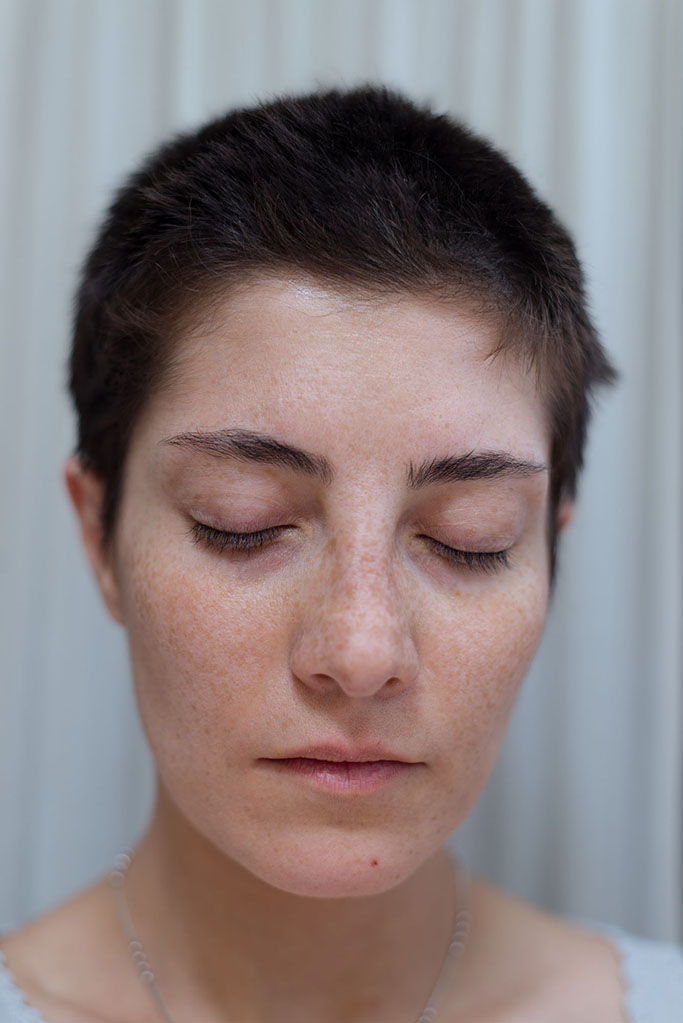
Shahrzad Darafsheh, From her new, first PhotoBook, Half-Light. Courtesy of the Artist and Gnomic Book. Click any Photo for full size.

Meet Shahrzad Darafsheh-

Shahrzad was 32 when she was diagnosed with endometriosis, which progressed to cancer and resulted in her having a radical hysterectomy followed by chemotherapy. An extremely hard course of treatment for anyone- of any age. For this young woman, who’s thoughts were on looking forward to having a family, to have to do an about face and channel all her energies into a fight for her life, is unimaginable for the rest of us. Having been through cancer, myself, one thing I learned was that every patient’s journey is unique. There are, however, some commonalities to cancer that everyone who goes through it experiences, unfortunately.

Among them, there is not one aspect of yourself, or your life, that it does not turn upside down, and forever change.
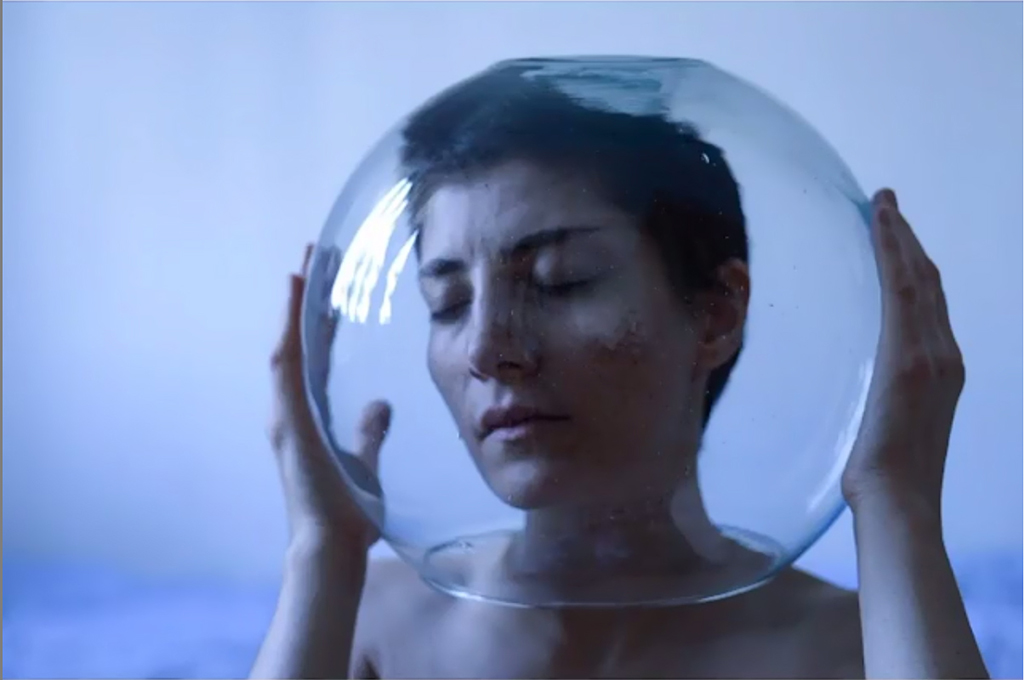
June 26, 2018, from @shindal_, Shahrzad’s Instagram page. She appropriately added the only hashtag that fits- #fuckcancer.

Yet, through this very rigorous course of treatment that lasted until just recently, she remained true to herself, a tribute to her remarkable inner fortitude and character. Shahrzad used her Photography to help ground her and express what she was feeling, experiencing and seeing. The quiet dignity and strength she exudes in the video (courtesy of the Artist and Gnomic Book) forms a peaceful core at the heart of her extraordinary new PhotoBook, Half-Light, her first PhotoBook, published this fall by Jason Koxvold’s Gnomic Book.

With thousands of new PhotoBooks being released this year, it’s hard for any one of them to stand out. Half-Light impressed me to the point that it was one of my NoteWorthy First PhotoBooks for 2018, in a ridiculously hard year to choose a few out of all the terrific first PhotoBooks I saw this year. Yes, as a testament to cancer survivorship, it’s a remarkable achievement. Then, I found its images didn’t go out of my mind once I put it down. Yes, some resonated with my own cancer experience, particularly how you see the entire world differently all of a sudden with “new eyes.” Some are abstract and some realistic, but what struck me most is they all have a poetry that’s purely her own. It’s, also, a book that doesn’t lend itself to any one reading. In fact, its that way by design. Half-Light is laid out so it can be read from left to right, as is traditional in the English speaking world, and/or from right to left as is traditional in the Farsi of her native Iran. And so, it’s a journey with multiple endings, fitting for a newly diagnosed cancer patient, but also characteristic of life in general. It’s a journey with only one page of text containing Quatrain XIV from The Rubaiyat, the quatrain about the impermanence of all things, except death, on a first page in English, and from the right, a first page in Farsi, and from there it takes place through the eyes and, as she says above, in the mind.

From Half-Light. Courtesy of Shahrzad Darafsheh and Gnomic Book.

After I saw that video and experienced how eloquent she is, I hoped to be able to give her a chance to express herself a bit more, and to learn more about her and how she was doing. I reached out to Shahrzad via email in Tehran, Iran, and found her to be extraordinarily warm, open and grounded. Barely through her treatment herself, she was already speaking passionately about helping other cancer patients- especially women, in Iran, and around the world. I was thrilled when she generously agreed to answer some questions even though English is not her first language, and I have the honor of sharing her words here-

Kenn Sava (KS)- How are you?

Shahrzad Darafsheh (SD)- Hi Kenn, thanks for doing this interview.

KS- If we can start by going back to your start, how did you first get interested in Photography, and how did you become a Photographer?

“Her” from @shindal_, Shahrzad Darafsheh’s Instagram page, September 25, 2017.

SD- I was born in a family with great interest in art. My father was a carpet designer and a photography enthusiast. His was engaged with colors in his work, in different shapes and forms which was my early understanding of color. As a teenager I spent my time looking at his old prints, and also spent time with my brother watching great movies of that time. My mother put me in summer art classes like drawing, pottery and sculpture. These were my major acquaintances with art, and I liked photography the most. Very soon the camera became my closest friend and looking through the viewfinder the best way to see the world. It got more serious when I started to study photography at the university and since then I never stopped taking photographs.

From The Saffron Tales, by Yasmin Khan, with Photographs by Shahrzad Darafsheh.

KS- I think most people are new to your work, and so am I. I did see a book that might have had your work in it- The Saffron Tales by Yasmin Khan? So, I’m wondering what else have you done prior to Half-Light?

From The Saffron Tales, by Yasmin Khan, with Photographs by Shahrzad Darafsheh.

SD- Yes. The Saffron Tales aims to show Iranian people and culture through their cuisine and I was commissioned to take photographs of people we met, the atmosphere, landscapes, etc., from north west to south of Iran. It was a two-year project and I learned a lot. Beside that, I had never published my photographs in a book before.

From The Saffron Tales, by Yasmin Khan, with Photography by Shahrzad Darafsheh.

KS- In the video, you speak of the home you and your have built a house in a suburb of Tehran that you love. Were you born and raised in Tehran?

From Half-Light. Courtesy of Shahrzad Darafsheh and Gnomic Book.

SD- Yes. We both were born and raised in Tehran. We always knew that we didn’t want to be living in the city because of all the pollution and craziness that the city offers and now we’re planning to go farther, out into nature. Since the economy is the main issue for better living and ours is so corrupted, our desire in moving lays under the layers of ambiguity.

KS- What’s it been like for you being a woman Photographer in Iran?

From Half-Light. Courtesy of Shahrzad Darafsheh and Gnomic Book.

SD- I think being a female artist in itself is not so easy, as we can see the art history books are full of male artists. Everywhere in the world people are trying to bring more attention to female artists. I was aware that this year Tate Britain will exhibit six decades of women artists and according to them “female artists should be a central part of recent art history. Galleries have made progress in better representing female artists. But, it has been slow for too long. We are happy that it is speeding up.” You know this kind of thinking, and movement, is very rare in my country, so I think it’s bit harder here. I didn’t want to bring up women’s rights, censorship, everyday pressures and so much anxiety of everyday life but living in Iran is tied to these. Even though you can see more female artists, there is a long path for us to do what we love and make our living independent from our parents. I hope we can talk about it more another time.

KS- As we both know, hearing a doctor tell you, “You have cancer” is devastating. One of the worst things anyone can hear. How did you deal with it?

SD- It was few weeks after my laproscropic surgery and I was with my mom. The family worried a lot and all I wished was to lessen that pressure so I smiled! In just one second I decided that is how it’s going to be for me. I did several tests afterwards till I found out I had to take my uterus and both ovaries out. It was devastating.
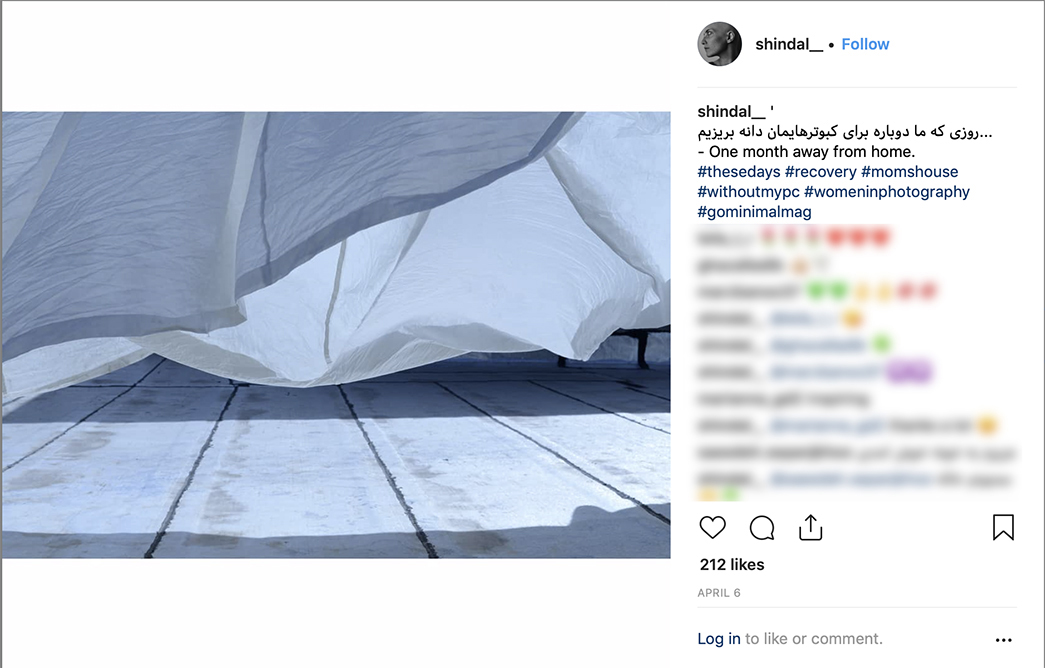
April 6, 2018. During chemotherapy, away from home, staying with her mom. A Photo that appears in Half-Light.

My husband and I were trying to have a child before my first operation, doctors were saying that giving birth may reduce the symptoms of endometriosis, a reproductive organ disorder. But it caused infertility itself and I was going to lose every possibility of giving birth to a child.
I experienced a version of loneliness different from what I’ve experienced before and it had something to do with that smile. I never shared my fears, worries and tears with anyone till the end of chemotherapy.

The symptoms of “Chemo Brain,” August 3rd, 2018, during her chemotherapy treatments.

KS- It sounds to me that the choice of treatment must have been excruciatingly hard for you. As I wrote, after all my efforts and research, I made a mistake in my choice of treatment the first time I chose. What was your road like that led to your decision to go the treatment route you did- radical surgery followed by chemo?

SD- I knew there were no other choices rather than radical hysterectomy. I had tried alternative medicine for the endometriosis and it didn’t work for me. Maybe and just maybe it was my mistake. Some friends asked me what if I had taken the cysts out sooner? Nobody, even my doctors, know the answer. So I decided to let go of this thought. Also, there was a two month delay between radical surgery and chemo which frightened us a lot. But it all went well. Now the cancer is gone.

KS- Were there other doctors you could get opinions from? Did you get a second opinion?

Chemo Brian [Veins], August 11, 2018.

SD- I had my pathology samples rechecked followed with so many blood tests and they all showed stage one both ovarian and uterus cancer. I was in good hands. All three doctors that treated me are proficient. Unfortunately this is because they have too many patients. One of my surgeons operated on 5 more people after me that one day! I think despite lacking in other areas, the medical profession is at a high level in the capital and other big cities of Iran. Although they are very expensive and health insurances don’t cover most of it.

KS- What was it like being a newly diagnosed cancer patient in Tehran? Were there support groups? Did you have a choice of doctors or hospitals to be treated at?

From Half-Light. Courtesy of Shahrzad Darafsheh and Gnomic Book.

SD- Cancer patients are trying to talk more about their experiences to bring awareness. But, there are no support groups.

The first thing that every patient does is to google their situation in order to find out the experiences or others and if the treatment recommended to them has been successful. I did the same. I found some other patients on social media and it was a huge relief, especially during chemotherapy. I have never talked to them, I just watched their daily lives and their routines helped me stop thinking that I’m sick. And yes. There are several well equipped hospitals and great doctors but as I said before they are also expensive. I did a post in order to collect money for my first operation on Instagram selling some of my prints. And it was unbelievable. Half of my hospital bills were provided by my friends and complete strangers.

You can see the need of having support groups. It must also be simple to find them.

From Half-Light. Courtesy of Shahrzad Darafsheh and Gnomic Book.

KS- Is there health insurance in Iran?

SD- Yes there are several kind of health insurance in Iran. But the plans that offer the best coverage are government run and only full-time employees can have them. People who call themselves independent workers can make a full payment for a month in order to use benefit of the insurance. But in a private hospital no insurance is accepted, and they are more equipped than the other hospitals. So, I had no choice but to pay a lot of money and use the insurance for chemo.

KS- You told me you want to help start a NGO (Non-Government Organization). Can you talk about why this is needed, and your vision for it? How can others help?

From Half-Light. Courtesy of Shahrzad Darafsheh and Gnomic Book.

SD- It’s a big thing starting and running a NGO. I don’t know even if they will let me!
But it’s a thing that kept my mind busy since chemo. I saw lots of men and women every three weeks, with needles in their veins, weak with a vague gaze trying to find someone to talk to. We Iranians are very supportive for each other most of the time. I rarely saw a patient alone. But there are some things that you can’t share with your loved ones. Even the cancer patient’s family can’t share their fears with the patient. We should have an actual place for patients and their families to find each other and talk. Not just some virtual spaces to type the feelings out. For that reason I need to have a bigger voice and that’s what I hope Half-Light will help me to reach. You are helping with this interview, Kenn, even before I start doing it.

KS- She didn’t say it, so I will- You can support Shahrzad by buying Half-Light, which was 200% funded on Kickstarter, while some of the 300 copies of this beautiful book remain. See BookMarks at the bottom for more information.

What would you tell other women diagnosed with endometriosis?

From Half-Light. Courtesy of Shahrzad Darafsheh and Gnomic Book.

SD- Some cliches matter a lot-
Listen to your body. Don’t be shy to be examined, do check ups. Eat healthy food. Exercise regularly. Avoid anxiety and stress. (I sound like Google!)
And if you want to have a child, be quick.

KS- What would you tell other women diagnosed with cancer?

SD- Don’t be afraid. It’s not just you. It doesn’t matter how you lived before but how you manage to live from now on. Cancer is not an enemy to fight, it’s a condition that needs to be understood. Because it brings you a whole new life even after you pass through it.
You will see the darkness and it’s important not to be the black-hole, let the light in.

From Half-Light. Courtesy of Shahrzad Darafsheh and Gnomic Book.

Breathe and live to the fullest.

KS- How long after you were diagnosed did you decide to start this body of work that became Half-Light? Besides cancer and your treatment, was there a triggering moment or event where this project began?

SD- It was a year after I was diagnosed with Endometriosis.
Funny that I had a strong fear of ovarian cancer at first but doctors told me it’s a benign cyst and rarely it turns to cancer, so dealing with its constant pain became my routine. I started to feel something growing in my body which was not a baby. It was my own tissues behaving offbeat. I wasn’t able to do most of my daily tasks half of every month for four years.

I think the pain was the triggering event. The weakness it caused and all my anxieties…

KS- But then, creating became therapeutic for you?

SD- Yes, it was. Looking for scenes to describe how I was engaging deeply with my body for the first time, gave me the ability to keep my distance with it so I could understand the situation better. It also kept my mind busy. Every progress in the state of my health came with the progress of my work.
I did scans with pleasure, it gave me very nice material to work with. I owe my sanity to photography.

KS- Where have you gotten all of your amazing strength from?

From Half-Light. Courtesy of Shahrzad Darafsheh and Gnomic Book.

SD- Thank you for saying that. Honestly, I consider myself a strong person when I confront my body and mind. I’ve always loved challenging situations. Although I never thought it would be fear of death someday.
The body is in constant change as are our thoughts. In my opinion, both are controllable, especially at hard moments.
And I have a deep connection with nature. It always teaches me that nothing stays the same, be ready for change and accept what comes and how things happen.

KS- How long did you spend shooting this body of work?

SD- Since 2015. I choose to close it now after the test results came. So I’ve worked on this project for about three years.

KS- How did you find Jason (Koxvold of Gnomic Book)?

SD- While surfing on the internet. I felt a deep connection with his photographs. We were following each other’s work for a year. He wanted to see some of my work once but it was the begining of my journey through surgeries and so it didn’t happen. Jason reached to me, again, six months after that, when the chemo started. It was magical. For me, for my family and friends.

Working on my first book, this was how I spend my time during chemo. I say Half-Light is my child with cancer and it needs good care to grow.

From Half-Light. Courtesy of Shahrzad Darafsheh and Gnomic Book.

KS- Jason Koxvold is a Photographer & Artist in his own right. In two short years, the publishing company he started, Gnomic Book, has already made a name for itself as a producer of important, beautifully made PhotoBooks. Shane Rocheleau’s 2018 Gnomic Book, YAMOTFABAATA was one of my Noteworthy PhotoBooks of 2018. Jason’s own PhotoBook, KNIVES, is a powerful look at our changing world through focusing on one small area of upstate New York as it struggles to deal with the loss of its 150 year old knife factory- its largest employer, to China. At this point in the conversation, I reached out to Jason to learn more about how Half-Light came to light.

KS- Jason, how did you come to discover Shahrzad and this body of her work?

Jason Koxvold (JK)- About a year ago I saw Shahrzad’s work on instagram. I forget how I came across it, but it immediately resonated with me. We live in a time where so much work looks the same; it begins with one artist developing a specific visual language, then other artists mimic it, and then it becomes available as a VSCO preset and suddenly everyone’s doing it it. This was entirely not the case with Shahrzad’s work. I could see that she was telling a story, but I didn’t know what it was.

Each page of Half-Light is interleaved with a sheet that acts as a screen, as seen here, which presents an image that’s seen through a haze, or a veil- in “half-light.”

When you turn the “screen” page, you see the image, fully.

She didn’t appear to have a web site, so I reached out to her to ask if it would be possible to see a more coherent body of work – it was then that she told me that she was battling cancer, and that it was hard to find the energy to put something together for me in the short term.

KS- What were the difficulties in trying to publish this book, given that the Artist is in Iran?

JK- The biggest questions for me were the unknowns. I didn’t know if the work would get her into any kind of trouble; we hear stories of women attracting the attention of the authorities by showing their hair on Instagram, for example. I didn’t know if we would be able to send her any of her own books, from a US legal perspective and from an Iranian censorship perspective (we’re still waiting to see if the books are censored on arrival).

But in terms of the practicalities of making the work, it was surprisingly easy. We were able to have lengthy video conversations on Skype, exchange high-resolution files over Dropbox and Wetransfer, and even footage for the short film we made together about the work.

KS- What was your role?

The Farsi front cover of Half-Light, once removed from its bag, which is the back cover for English readers.

JK- Shahrzad was very open to my ideas around the form and sequencing of the book. My idea was around translucency and opacity, both from the perspective of the human body and the body politic of Iran. The sequence would create a journey from lightness to dark, as a Western reader – and the opposite, when read in Farsi. Shane Rocheleau helped with the sequencing as well; I always appreciate his ability to see not only the overarching story of a piece, but also connect individual images in more ephemeral moments.

KS- Shahrzad, have you seen the physical book yet? Jason told me you had not as of the NYABF in late September. If you have seen it, what do you think of it?

Shahrzad Darafsheh (SD)- Yes, I received my copy two months after it was published.
It looks and feels great. Jason did a great job with choosing the paper and everything. Such understanding in spite of such a long distance between us is unforgettable.

KS- Is there a community of Photographers in Tehran?

SD- Yes, there is National Iranian Photographer’s Society.

KS- I read that another Iranian Photographer, Shirin Aliabad, recently passed away from cancer. Did you know her?

Shirin Aliabadi, Miss Hybrid, 2008. The bandage on the nose indicates a nose job, which are popular in Iran, as the western “upturned nose” is highly sought after. *Photo courtesy The Third Line, Dubai

SD- Unfortunately this is the fourth female artist I’ve heard pass away from cancer this year. I’m familiar with her “ Miss Hybrid” series.

KS- Shirin Aliabad’s series, “Miss Hybrid,” was about “showing a Tehran that the Western media doesn’t show,” her husband and collaborator said in the New York Times. The Photographs in Half-Light have a universal feel to them, something that also might surprise Western readers- Most of them could be taken almost anywhere, something that will allow them to speak to a very wide range of viewers, though it’s an extraordinarily personal, and beautiful, book. Was this part of your intention?

SD- I’m very glad that it can speak universally. I never intended to do that. I think that’s how I see my world, Not really different from yours.

KS- What have you learned from cancer?

SD- To be me. To be here and now. To stop worrying and never stop loving.

KS- So…What’s next?

SD- I’m planning to have an exhibition and show Half-Light to a wider audience in Tehran.
Also I’m working on my proposal for gathering cancer patients together with the hope of bringing more quality to our lives.

-Though that ends our interview, the best thing Shahrzad shared with me was still to come. On December 23rd, she told me that her follow up tests after the completion of her treatments came back clean, with no sign of cancer! She said she was “super excited” about it.

Now, she can get back to sharing her beautiful, “full-light,” with the world.


BookMarks-

Half-Light by Shahrzad Darafsheh, which I selected as one of my NoteWorthy First PhotoBooks of 2018, is published in a first edition/first printing of only 300 copies, and is available from the increasingly impressive Gnomic Book, here. Jason Koxvold’s KNIVES and Shane Rocheleau’s YAMOTFABAATA, both published by Gnomic, are also recommended, and both are still available there as well. (All three are on sale as I write this.)

*- Soundtrack for this Post is “Heaven Is In Your Mind” by Traffic, the first track on their first album, 1967’s classic Mr. Fantasy.

My thanks to Shahrzad Darafsheh and Jason Koxvold. 

NighthawkNYC.com has been entirely self-funded and ad-free for over 6 years, during which over 250 full length pieces have been published. If you’ve found it worthwhile, you can donate to keep it going & ad-free below. Thank you!

Written & photographed by Kenn Sava for nighthawknyc.com unless otherwise credited.
To send comments, thoughts, feedback or propositions click here.
Click the white box on the upper right for the archives or to search them.
For “short takes” and additional pictures, follow @nighthawk_nyc on Instagram.

Subscribe to be notified of new Posts below. Your information will be used for no other purpose.


Vincent van Gogh- Home, At Last

Written & Photographed by Kenn Sava

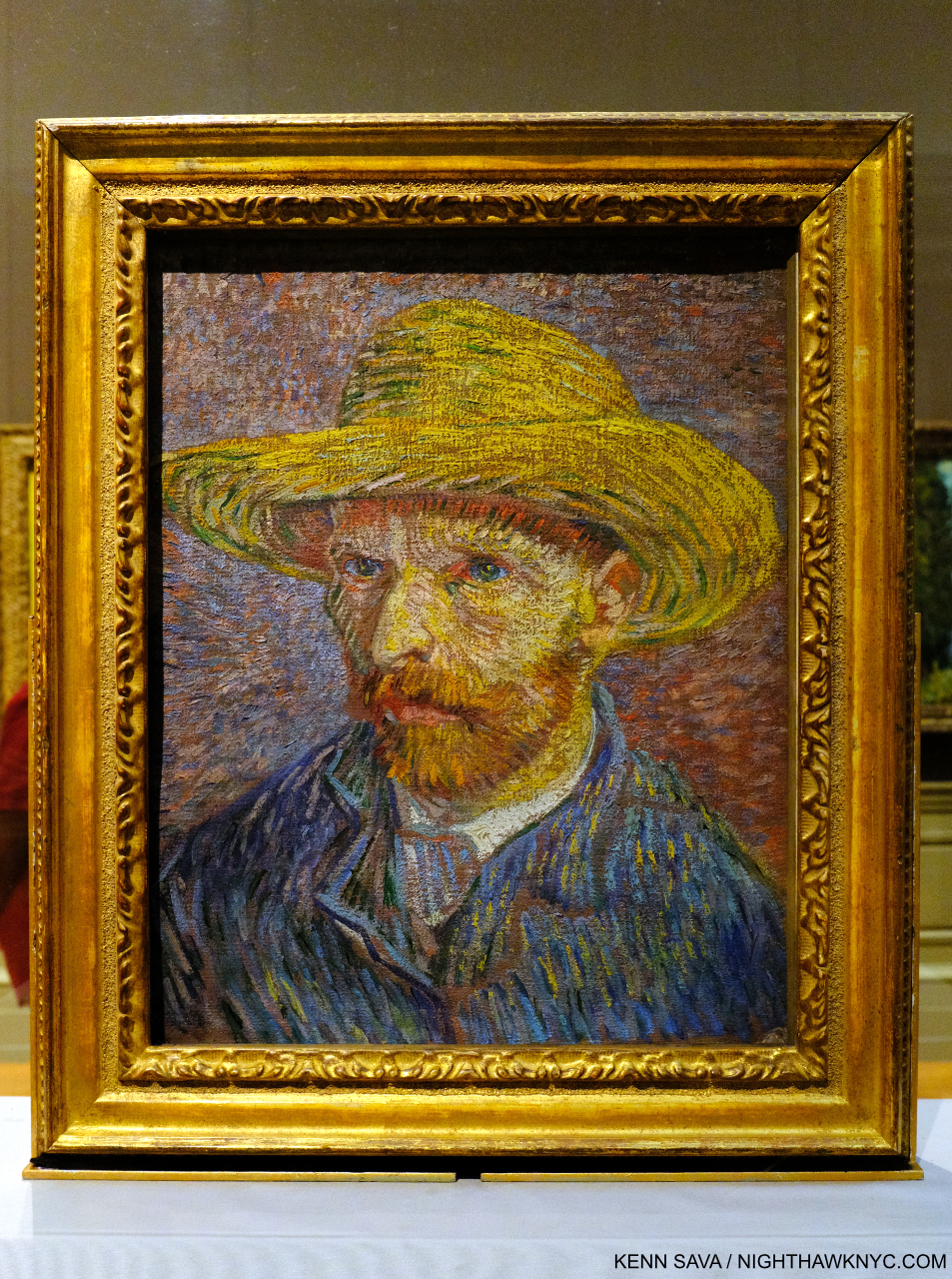
Vincent van Gogh spent his life looking…for things he never found. Detail of his  Self-Portrait with a Straw Hat, 1887. All works shown were seen at The Met and are oil on canvas. Click any Photo for full size.

While a reported 1,000,000 visitors have been busy seeing Heavenly Bodies: Fashion and the Catholic Imagination on The Met’s 1st floor, downstairs in the Costume Institute, and uptown at The Cloisters1, many visitors may have missed the fact that there is big news upstairs at 1000 Fifth Avenue. I’m not talking about the skylight renovation project, which is ongoing, and which has thrown the European Paintings galleries into a bit of temporary chaos. I’m talking about the fact that happy times have again returned to Gallery 825 near the southern wall of the Museum in the European Paintings galleries on the second floor, where The Met has reunited, what for me, has long been one of the glories of it’s collection, 10 of its Paintings by Vincent van Gogh, now that all of their Paintings by the beloved Artist have returned from loans.

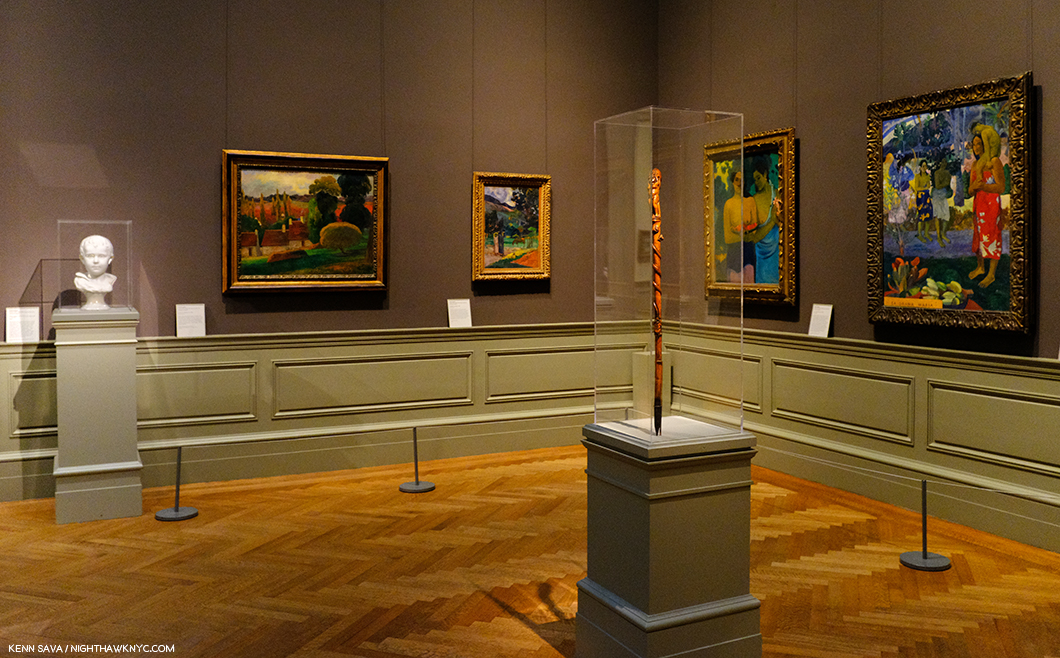
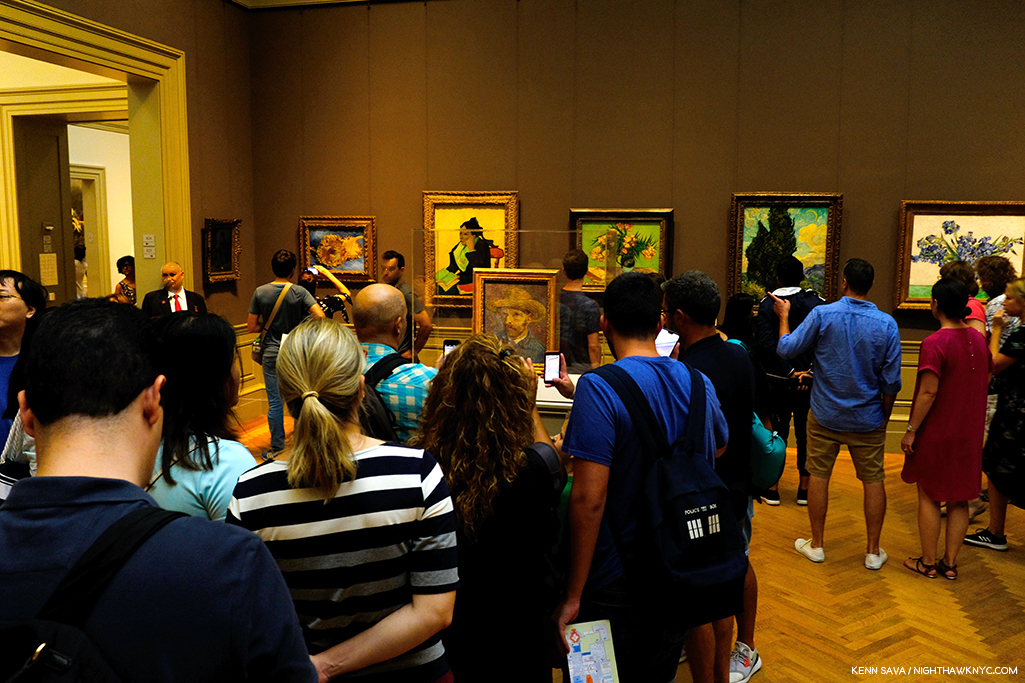
HOW great is it to be able to walk into a room and see THIS? For me, it’s one of the great joys of life in NYC. One part of the newly reinstalled Gallery 825 showing 9 of the 10 Van Goghs in this room. #10 is on the other side of the Self-Portrait with Straw Hat in the vitrine. This shot was available for literally one second over 3 visits and the 3 hours I spent here recently.

A further 6 are adjacent to them in Gallery 822, making 16 of the 18 oil on canvas Paintings they own by my count on view at the moment.

1,500+ visits in I rarely pay attention to gallery # signs. You really can’t go wrong in The Museum. I always just wander and enjoy being surprised. For those with limited time, yes, it might be best to have a plan. Or? Just wander.

Of the 6 or 7 million folks who visit The Museum from all over the world, I’m sure seeing these works is on the lists of many. I made a visit to see their reinstallation, which puzzles me is some regards, and I had a revelation that caused me to make 2 return trips solely to further study what I found.

Also in Gallery 825, opposite the Van Goghs seen above, is a beautiful selection of work by his friend, Paul Gauguin, with works by Pointillists, including George Seurat, and a Rousseau, filling out the room. Seeing the Gauguin, I was struck by the thought that they have, and will, spend much more time together in this room than he and Vincent did in real life, a bit of a poignant reminder of the temporary nature of all of Vincent’s relationships and friendships, besides that with his younger brother, Theo (which did have some lapses, due to disagreements).

Across from Vincent in Gallery 825, is a corner of Paintings, an amazing sculpture(!) and a wood carving(!) by his friend, Paul Gauguin.

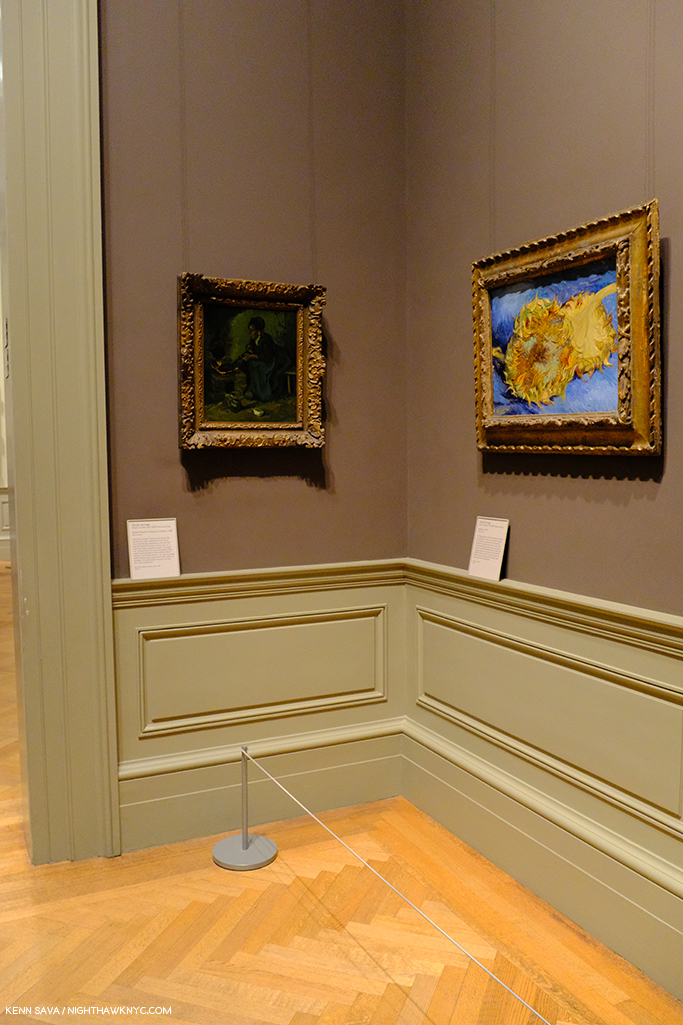
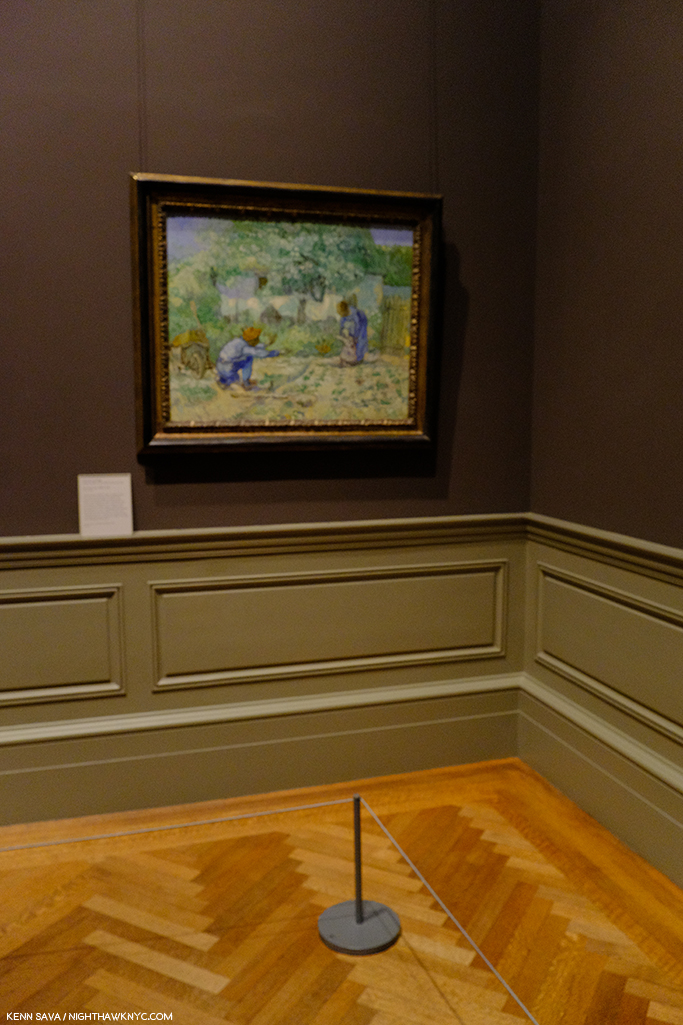
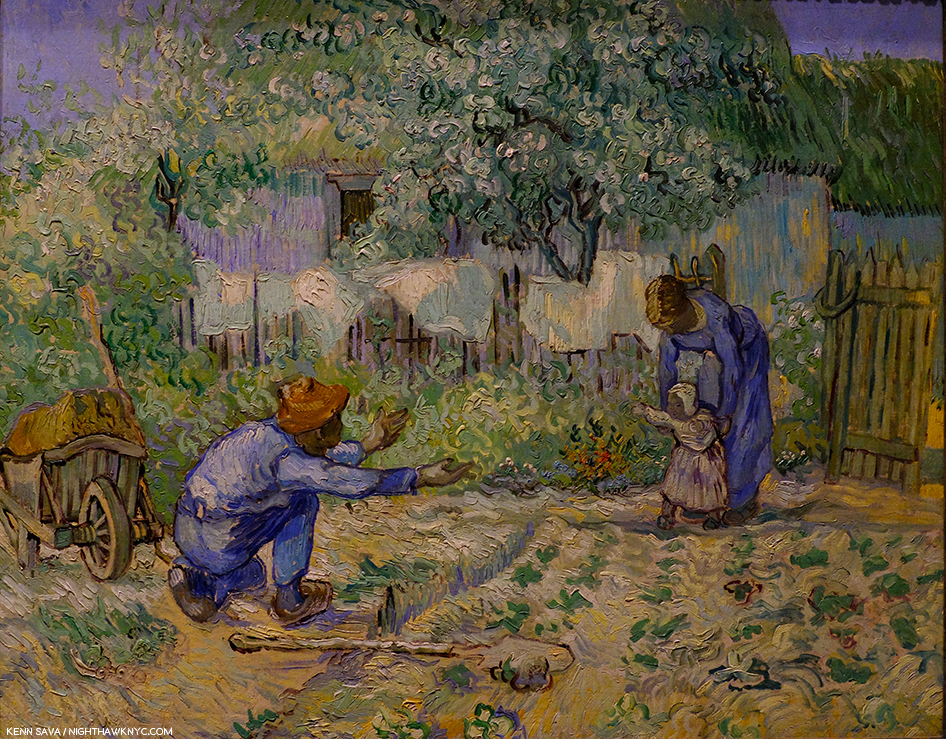
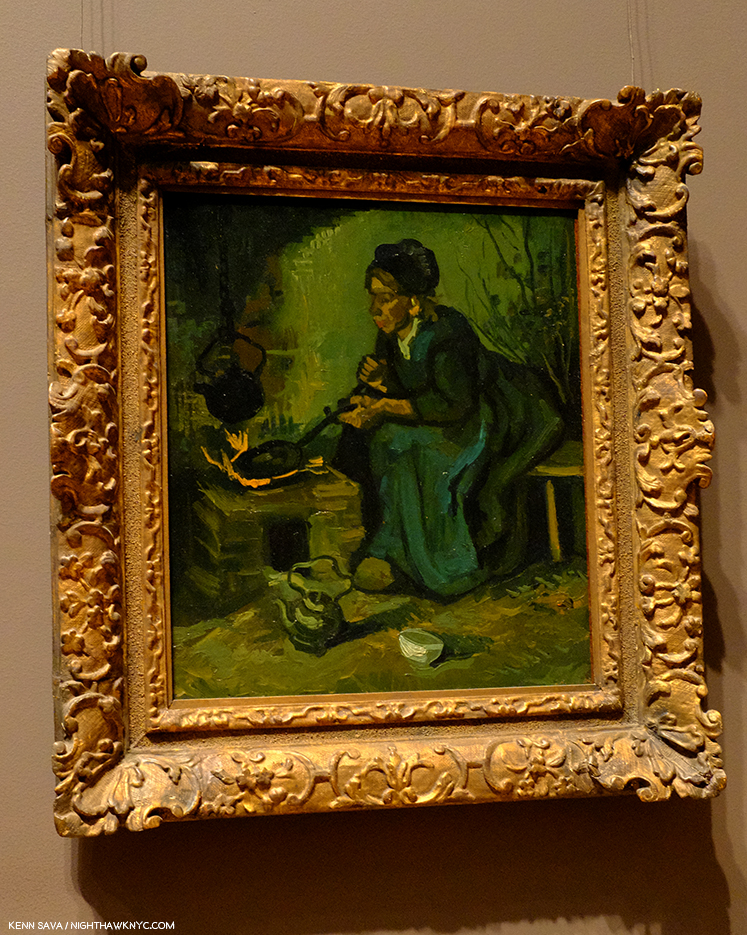
Regarding the installation of the Van Goghs in Gallery 825, two caveats. First, the works at each end of the wall are a bit difficult to see due to the placing of the guard rope. It’s worse for the smaller work on the left, Peasant Woman Cooking by a Fireplace, 1885, than it is for the larger work, First Steps, after Millet, 1890 at the other end.

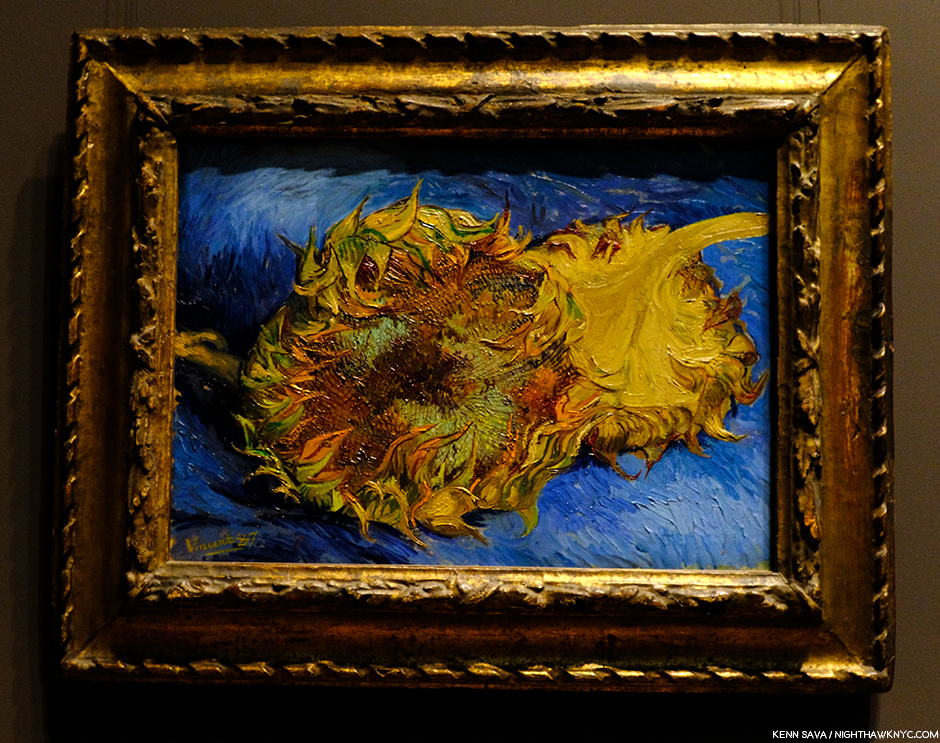
Peasant Woman Cooking by a Fireplace, 1885, left, Sunflowers, 1887, right.

Regardless? My rule of thumb is this- “If THIS was your ONLY Painting by Vincent van Gogh- Would you hang it like THIS?”

First Steps, after Millet, 1890, quite popular with visitors, is a bit hard to see. When you stand near that post, you’ll understand what I mean. Rousseau’s The Repast of the Lion, 1907, is hung on the wall, right. It may have been interesting for visitors if The Met hung one of the 6 oil Paintings they own by Van Gogh’s cousin Anton Mauve (1838-1888), his only teacher (for a short time), here. Rousseau is far more popular.

This may, or may not, be a function of the fact that gallery space in the European Paintings Galleries is a bit scarce right now due to the skylight renovations. It pains me to no end there are only THREE Rembrandts on view at the moment!, so it’s great timing that at least the Van Goghs have been reunited.

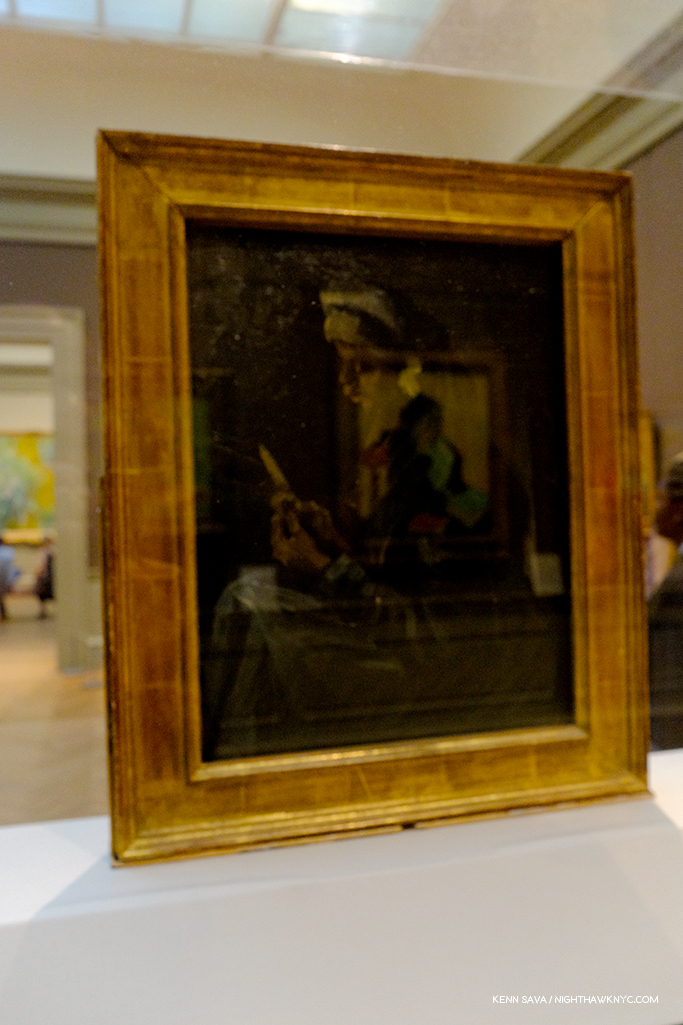
The other caveat is in seeing the work on the front of Self-Portrait with a Straw Hat, 1887, The Potato Peeler, 1885. It’s a work from his earlier, “dark,” period and due to the glare from the lights, is very hard to see due to the reflections on the vitrine they’re in. It probably needs a vitrine with self-contained lighting on each side, which may not be practical due to conservation issues. It’s so darkly Painted it makes me wonder how popular Vincent would be now if he had continued Painting with this palette for the rest of his career.

The Potato Peeler, 1885, with Self-Portrait with a Straw Hat, 1887, on it’s back. Yes, Vincent was so poor, he had to use the other, unprimed, raw side of his canvases, in this case to Paint the astonishing Self-Portrait. Admittedly, a very difficult piece to light, particularly in a vitrine. A better view is here.

Coincidentally to the return of the Van Goghs, I’ve been absolutely lost in Steven Naifeh and Gregory White Smith’s, 2011 Van Gogh: The Life, as riveting a 976 page biography as I’ve ever read. Messers Naifeh and Smith, coming off the Pulitzer Prize for their Jackson Pollock biography, spent ten years in painstaking international research, with the full cooperation of the Van Gogh Museum, Amsterdam, tapping into 100 years of Van Gogh research, a wealth of previously unmined sources (including hundreds of unpublished family correspondences), and of course, Vincent’s justly famous letters, themselves fresh off the completion of the 15 year Van Gogh Letters Project, which, with the Van Gogh Museum, revisited every existing letter written by or received by Vincent. The results were published in 2014 in a 6 volume profusely illustrated (Vincent’s letters contain many drawings and illustrations) and completely annotated hardcover set, Vincent van Gogh: The Complete Letters, that clocks in at 33 pounds (only a few left- hurry! See BookMarks at the end), or the entire corpus is now available for free online!! Van Gogh: The Life, is so big, Naifeh and Smith have created a website to contain the full versions of the book’s extensive footnotes, picture galleries and an extensive bibliography. Their book has been called, “The definitive biography for decades to come,” by Leo Jansen, curator, the Van Gogh Museum, and co-editor of Vincent van Gogh: The Complete Letters.

It’s about time! It’s hard to think of any other Artist born after 1850 who’s life (and death) is shrouded in myth, fantasy and fiction more than Vincent van Gogh’s has been.

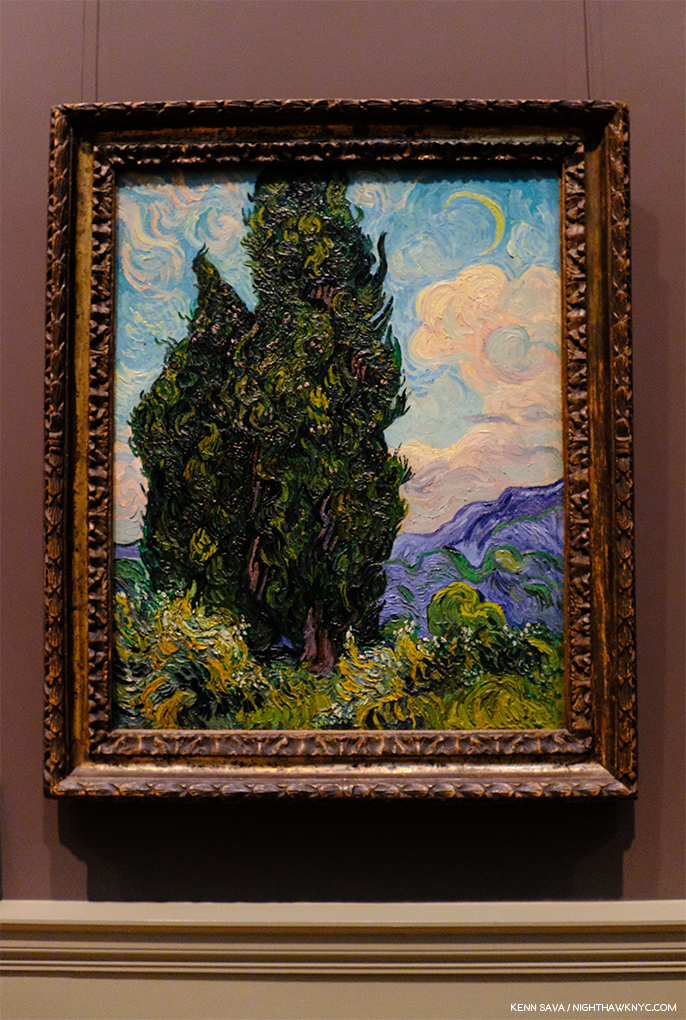
Cypresses, June, 1889

Vincent van Gogh was born on March 30, 1853, exactly a year after Vincent van Gogh died. His parents had a son, who they named Vincent, who was stillborn in 1852, and laid to rest under a marker inscribed “Vincent van Gogh.” His mother, Anna Carbentus, “never understood her eldest son…As time passed, she liked him less and less. Incomprehension gave way to impatience, impatience to shame, and shame to anger. By the time he was an adult, she had all but given up hope for him. She dismissed his religious and artistic ambitions as ‘futureless wanderings’ and compared his errant life to a death in the family. She accused him of intentionally inflicting ‘pain and misery’ on his parents. She systematically discarded any Paintings and Drawings that he left at home as if disposing of rubbish…She outlived Vincent by 17 years. Even after his death, when fame belatedly found him, she never regretted or amended her verdict that his art was ‘ridiculous2.'”

Yikes! WHAT can you possibly say to that? Still? As late as 1888, 2 years before he died, THIS is how he longed to see her- with an approving smile for him. Something he probably had to imagine. His father, Dorus, a Parson, was left to try and intermediate, but more often then not, having his own passionately held ideas and beliefs, that rarely seemed to coincide with his eldest son’s, met with little success.

Vincent van Gogh, First Steps, after Millet, Oil on canvas, 1890. It’s hard not to see Vincent’s yearning for family in this scene. Here, the subjects are, ironically and fittingly, frozen in time- forever apart. Painted after an original chalk and pastel Drawing by Jean-Francois Millet (1814-1875, one of Vincent’s biggest influences), because, he said, Millet “had no time to Paint them in oils3.” The compositional changes he made to the original are fascinating.

To say that Vincent wound up pining for the love of his family his entire life, that he never received to the extent it was “enough” for him, would be a huge understatement. At 11, they dropped him off on the steps of a boarding school 13 miles away from the home he longed to be in and said goodbye to him. It was an “abandonment,” his term, he never got over. At one point, he wrote about his parents, “(They) cannot feel for or sympathize with me.””(They) completely lack warm, live sympathy.” “They are creating a desert around themselves.””(They) have hardened their hearts.””(They) are harder than stone.””When I’m at home, I have a lonesome, empty feeling4.” For the rest of his life, which would largely be lived away from home, he valued nothing more than trying to win back their love, or, failing this, to find a surrogate family to fill this need, which he never did for long. Vincent’s two attempts at a relationship (the word “romantic” doesn’t seem appropriate), first to a widowed cousin, the second to a prostitute pregnant with someone else’s child, that he hoped would lead to marriage and thereby family stability, ended in humiliation. The closest he ever got to having a lasting friendship was, mostly at a distance, with his younger brother Theo.

While living this loveless, largely friendless life he went from one utter failed attempt at a job or career to another, until, finally, in August, 1880, he turned to becoming an Artist as a last resort. A month short of ten years later, in July, 1890, he would be dead. He was just 37 years old. In August, 1882, he wrote about having a feeling that he would not live long-

“I would like to leave some memento in the form of Drawings and Paintings…I have to accomplish in a few years something full of heart and love, and do it with a will. Should I live longer, so much better, but I put that out of my mind. Something must be accomplished in these few years5.”


Sunflowers, 1887. About as “alive” as still life gets. It positively bursts with so much energy you might think it was on fire if it wasn’t titled.

In his short Artistic career, he would leave about 2,100 Artworks, including an astonishing 860 oil Paintings, and those letters. His contemporary, Claude Monet, was born 13 years before him, in 1840, and died 36 years after him, in 1926, outliving him by almost 50 years to age 86. If Vincent had lived to be 86, he would have passed in 1939. IF he had been as productive for those 50 years as he was in his first 10? He would have left us 10,500 Artworks, including 4,300 oil Paintings! But, given how hard his life was to that point and the wear and tear it took on him, and that he had what were, possibly, both diagnosed and undiagnosed illnesses6, it was probably a very long shot, at best, he ever had a realistic chance of making it to 86.

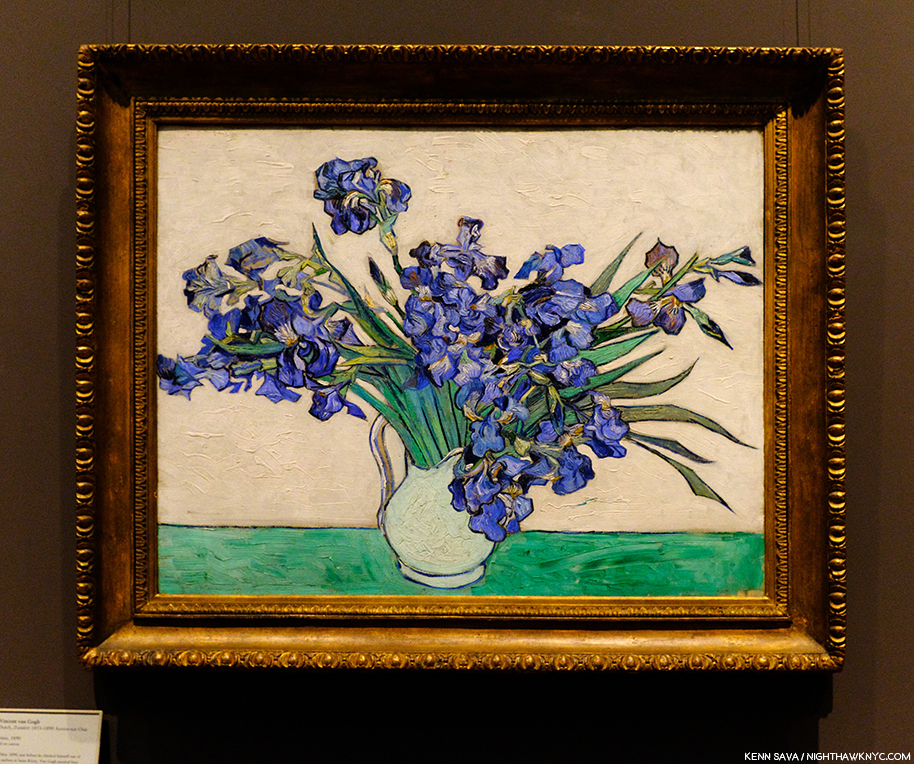
Irises, 1890, the last year of Vincent’s life. The “pale” background seems very unusual for Vincent, though it offsets the Irises wonderfully.

I was one of the millions who grew up with Irving Stone’s Lust for Life. Reading it as a teenager, I naively took it as fact, not realizing there was such a thing as a “fictionalized biography.” Irving Stone set out to make biography as exciting as dime store novels. He did this to Michelangelo, too, with The Agony and the Ecstasy. In both instances, Art lovers are left to dig on their own in the historical record for the facts. Often overlooked by those who think Lust is a “biography” is the section of “Notes” warning the reader that he had to concoct scenes. Writing 40 years after Vincent passed, he never knew him. Making matters worse, he seems to have relied on people who weren’t there for “information” on key scenes, like his death. The resulting Film of the same name brought all of this to countless millions more. After reading Lust, I was compelled to dig deeper, to get “closer” to Vincent. I was given a 3 volume older edition of his Complete Letters, which is way more compelling than any novel (even one, like Mr. Stone’s that draws on them), and now with Van Gogh: The Life, the background has been filled in with 100 years of verifiable research. There’s no longer any need for fiction-  The real story is a way better page turner! If you love his work, dig deeper into his life and you’ll be rewarded by getting closer to the Artist. Reading Vincent’s letters, and now The Life, what comes consistently across to me is his LOVE for Life. When I look at his Art, I see an Artist who loves what he sees and wants to preserve it with pen or paint. Even during his earlier period when he Painted very poor farmers and others in a very dark palette. He Paints them to honor their work and their lives.

Peasant Woman Cooking by a Fireplace, 1885. The Photo is distorted because, as I said, it must be seen at an angle.

At The Met, seeing these works together again, I was struck by how very different they are. Though they were Painted over less than 8 full years, they’re different one from the next. They’re different from virtually everything else of their time.

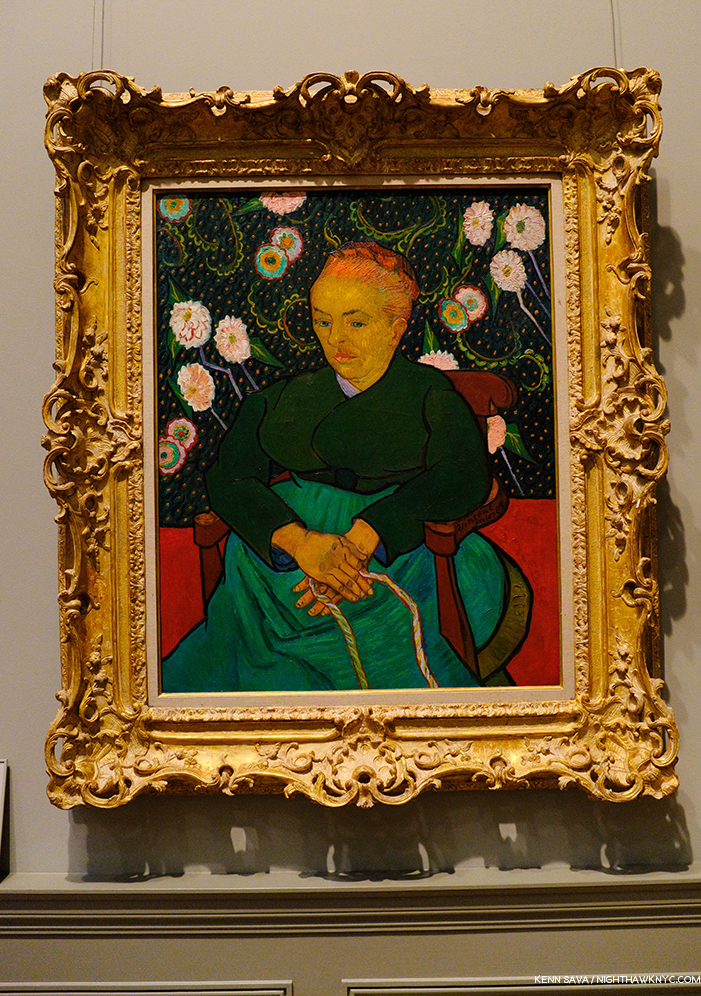
Vincent desperately wanted to be a portraitist. He (over)spent much of his limited budget on models, but, as in so many other things, he was his own worst enemy in that he began Painting from life before he finished his studies, according to his Cousin Mauve, and others. The results are often a bit “rough,” but just as often surprisingly poignant and unique, particularly in his Self-Portraits, which he did so many of when he lacked for other sitters. It’s hard for me to look at any of Vincent’s portraits and not think that he was really Painting himself, particularly when he Paints people he barely knows. Here, it’s hard not to see another instance of his longing for family and domesticity. La Berceuse (Woman Rocking A Cradle; Augustine-Alex Pellicot Roulin), 1889 (who he knew better than most), It’s an image of home and family he Painted to hang in the famous Yellow House he briefly shared with Gauguin. If that string she’s holding wasn’t tethered to the cradle, she might be floating away like the flowers in the background almost appear to be.

His portraits look like no one else’s. Ditto his landscapes7, his interiors and still lifes. The same can be said for his Drawings, which were unforgettably seen in The Met’s landmark Vincent van Gogh: The Drawings show in 2005. And, they’re different from what’s come since. His work set the stage for what is called Expressionism, though no one else seems to have directly pursued his stylistic innovations, like his use of wavy lines to depict nature.

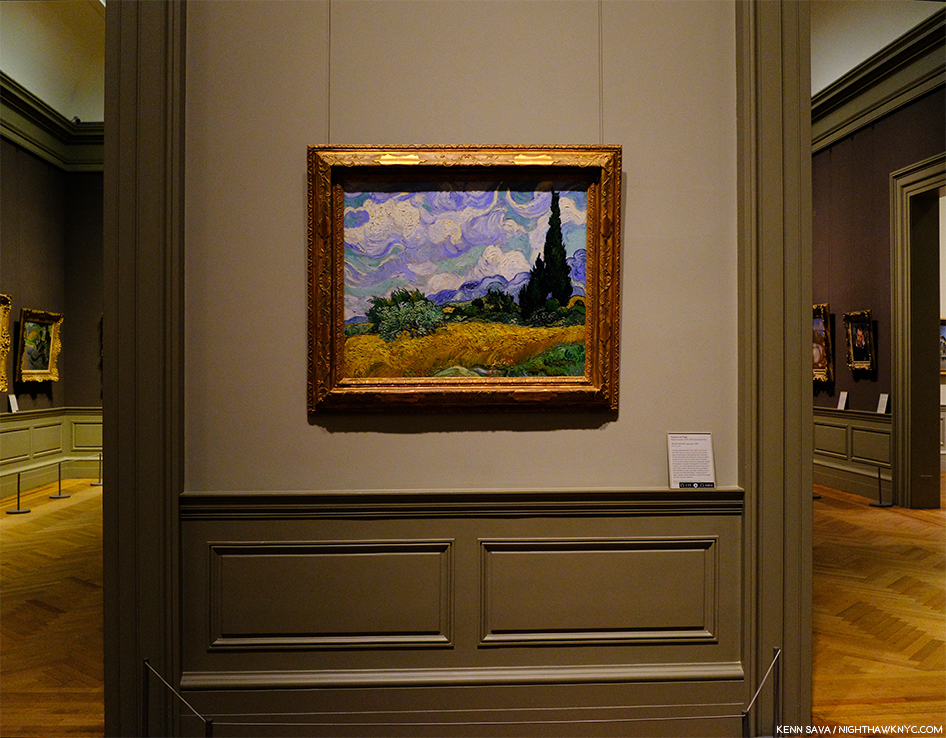
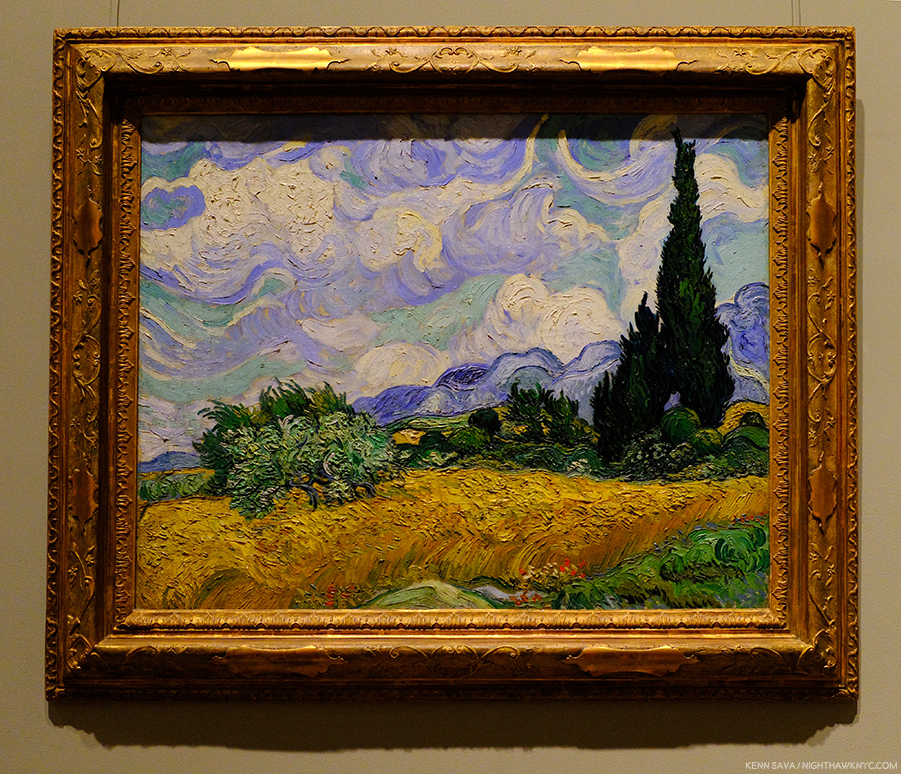
Meanwhile, Wheatfield with Cypresses, 1889, gets it’s own wall in Gallery 822.

Who else Paints like this?

This is all the more remarkable when you consider how little training in Drawing & Painting Vincent received, which, beyond his own studies of Charles Bargue’s legendary Drawing Course,and other texts, amounted to a month with his cousin, Painter Anton Mauve, and some classes, including a short-lived enrollment in Paris classes that were also attended by Henri Toulouse-Lautrec. Much of the rest can be attributed to talent, though part of the individuality in his Art can be attributed to isolation, I think. He worked most of his entire 10 year career by himself, with only occasional company or interaction with other Artists, though he voraciously and passionately looked at Art for most of his life, even long before he was an Artist. He assimilated all that he saw, felt it deeply and thought about it continually, yet he was able to create Art in his own style that, while partially based in Millet, he continually evolved. So much so that no two of these 16 works (in both galleries) are really in the same style, there are differences between each and every one of them. Most unique of all, to my eyes, is the Self-Portrait with a Straw Hat. Though at first glance it looks to be “classically pointillistic,” it’s not. Only Vincent achieves a somewhat similar effect with lines instead of dots. The results are something else entirely.

Self-Portrait with a Straw Hat, 1887, one of my personal favorite works in entirety of The Met, Painted on the raw, unprimed side of the canvas, (as you can see in the detail posted at the beginning), which adds to the unique texture of the work. Painting on this side can cause conservation problems, though it looks good for 131 years old. I’ve looked at it countless times over a few decades now and every time I see it, I marvel at it’s unique way of seeing the world.

Apparently, I’m not the only one who thinks so.

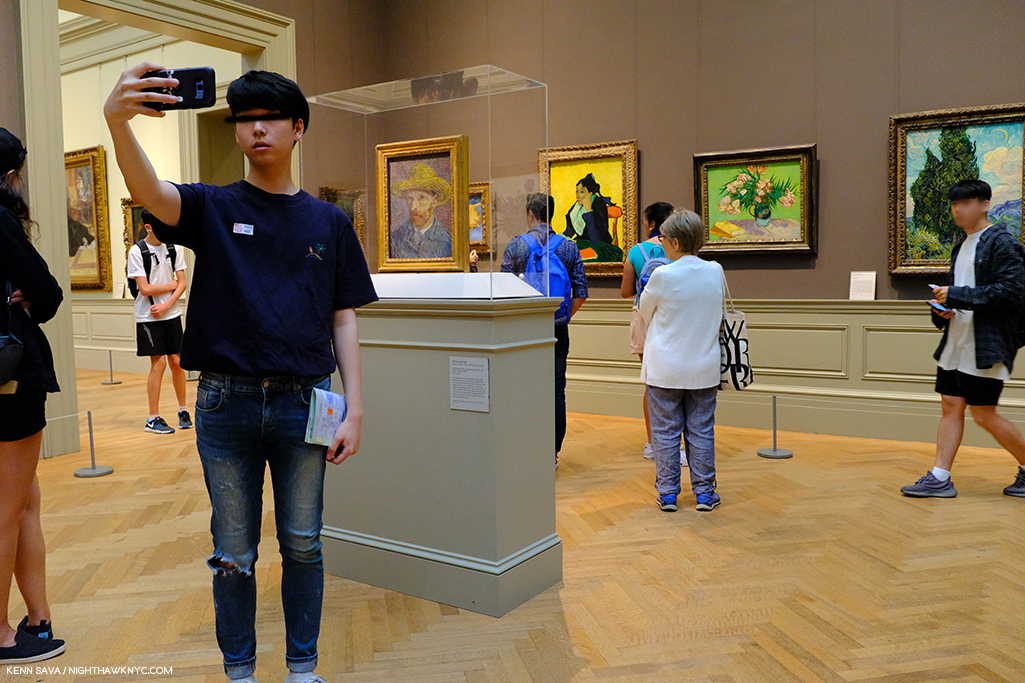
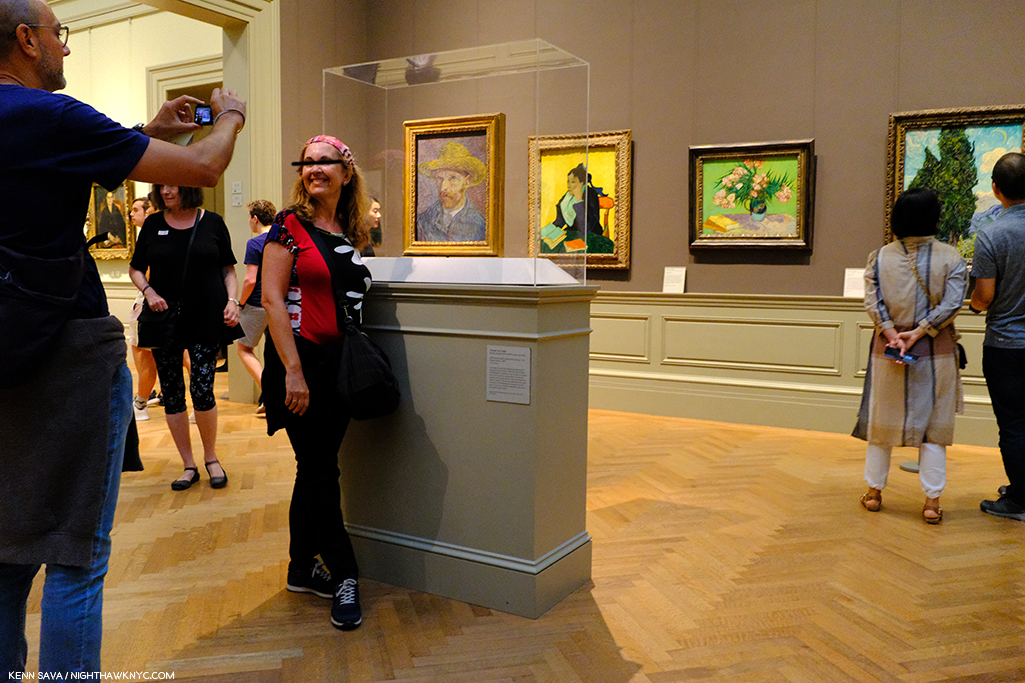
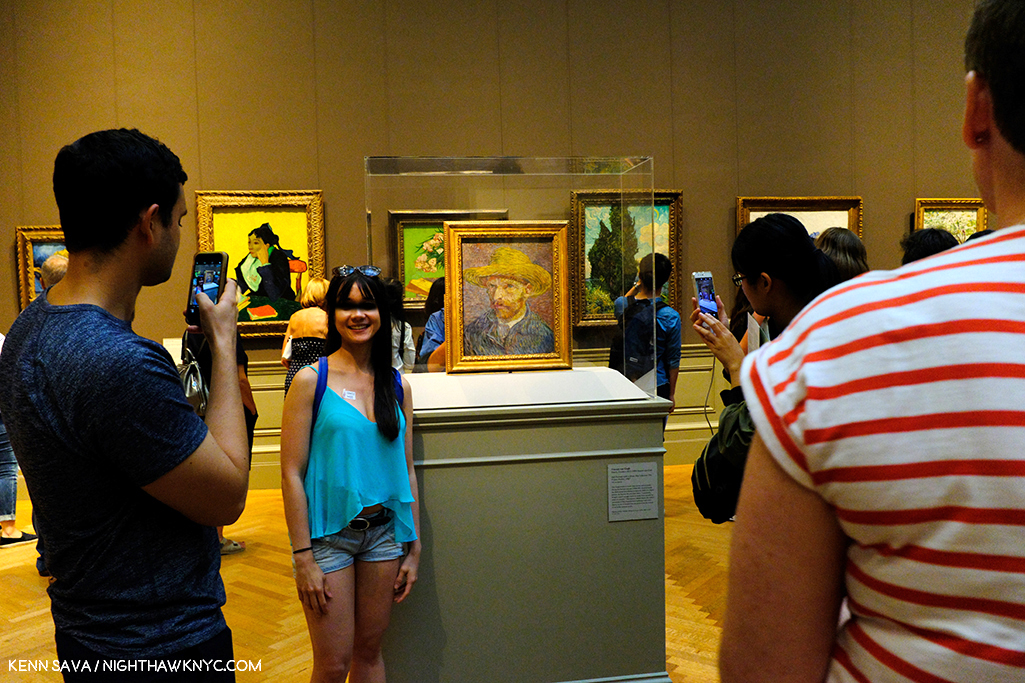
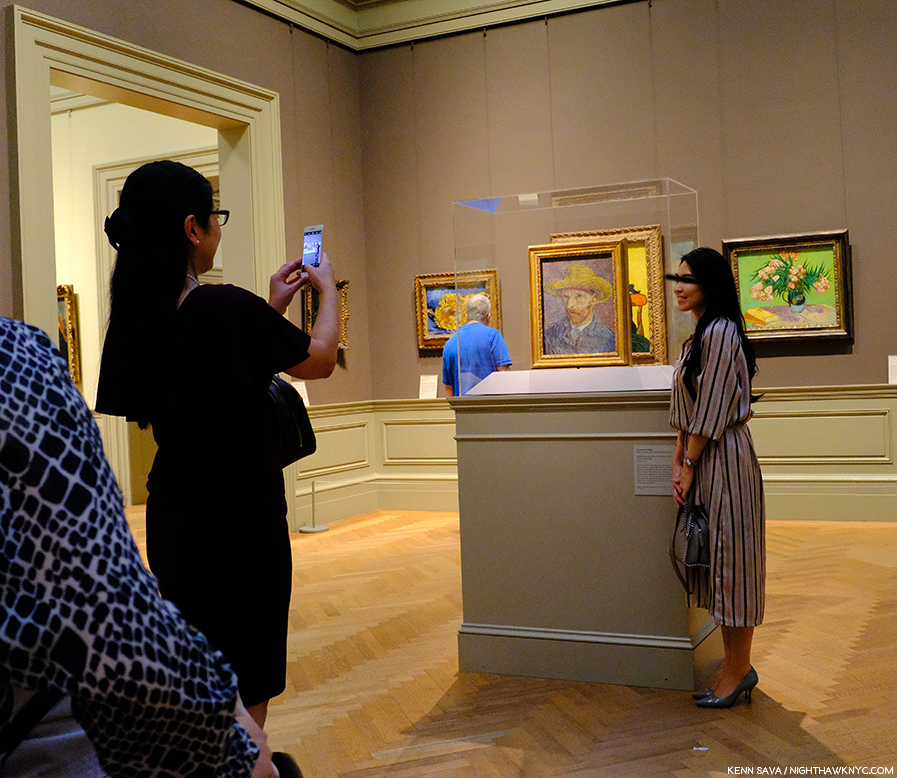
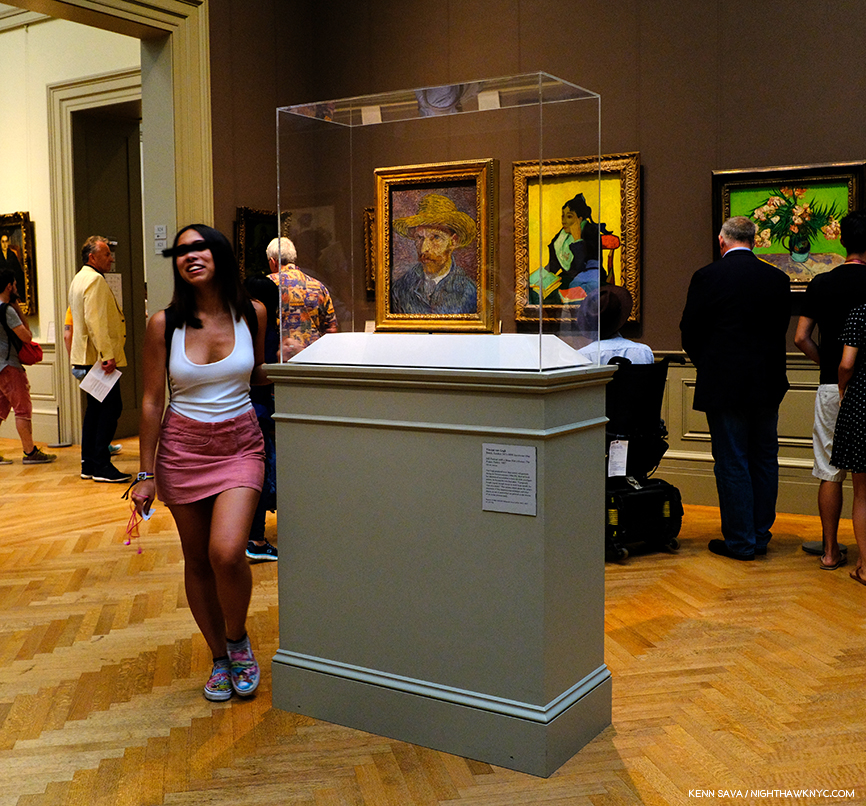
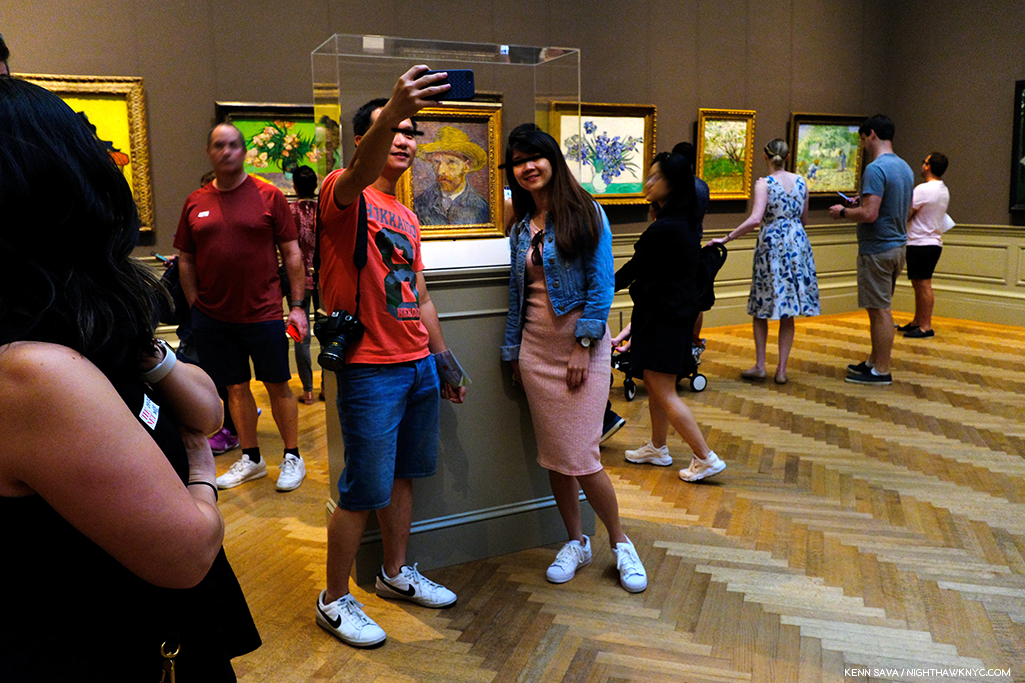
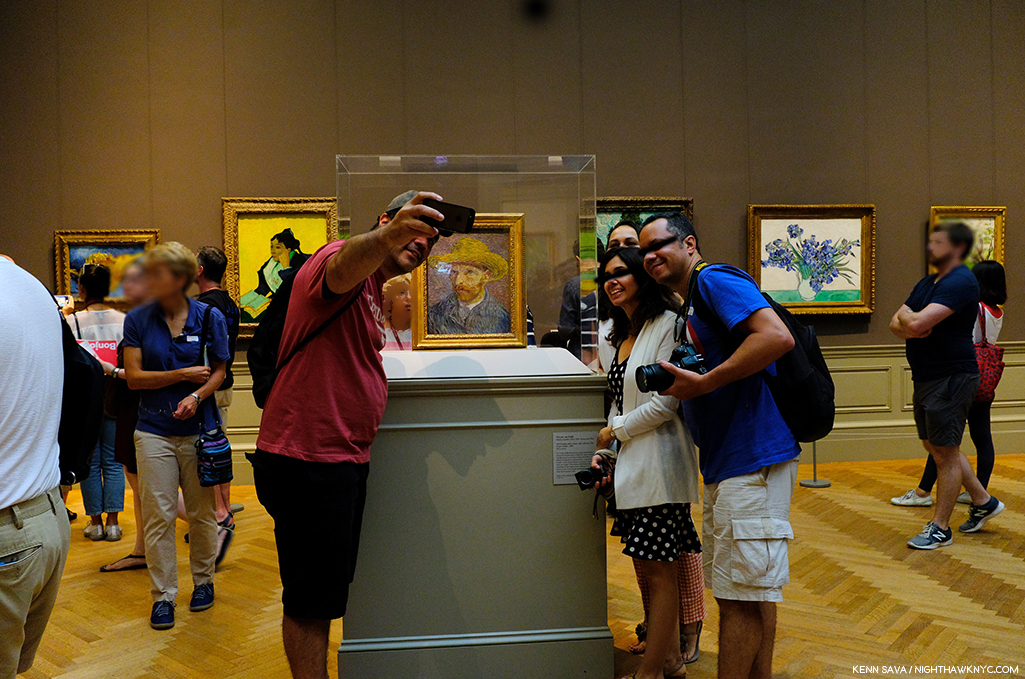
Midway through my visit, I stood away from the Van Goghs taking in the whole group. As I stood there, I noticed people posing for pictures with Vincent’s Self-Portrait with a Straw Hat.

People from who knows where.

That day, I was in the middle of the section of his biography where he desperately tries to see the object of his love, his widowed cousin, 35 year old mother of one, Kee Vos, who had adamantly rejected his proposal of marriage in August, 1881, with the infamous words, “Never, no, never!” (Vincent was 28). Not one to give up, EVER, he relentlessly pursued the matter, finally traveling to see her that November, only to find her absent. “At one point, he put his hand over a gas-lamp flame and demanded, ‘Let me see her for as long as I can keep my hand in this flame.’ Someone eventually blew out the lamp, but weeks later his burned flesh was visible from a distance8.” The longing and the emotional scars remianed for the rest of his life.

In the long, beautiful, letter he wrote to Theo after this event (Letter #193, December 23, 1881), showing every ounce of his talent as a writer, after a long summary of the event, he said, “I can’t live without love, without a woman. I wouldn’t care a fig for life if there wasn’t something infinite, something deep, something real. I will not, I may not live without love. I’m only human, and a human with passions at that, I need a woman or I’ll freeze or turn to stone, or anyway be overwhelmed.”

128 years after his death on July 29, 1890, I couldn’t help but notice that there were no shortage of women who wanted a picture with him. Many of them had, no doubt, traveled quite long distances, themselves, to get one.

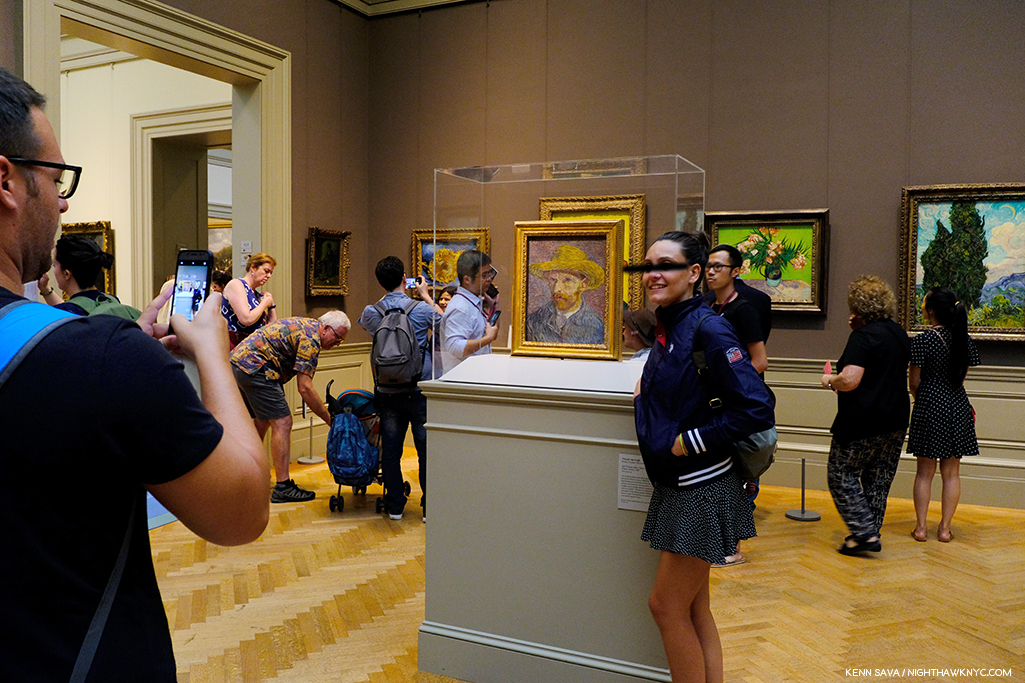
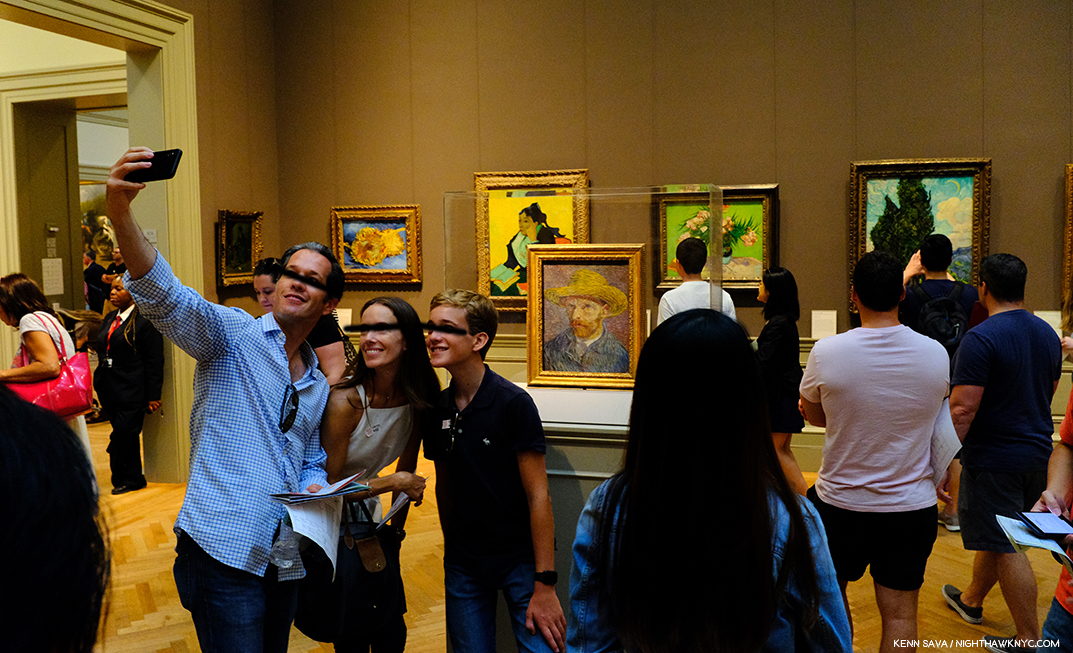
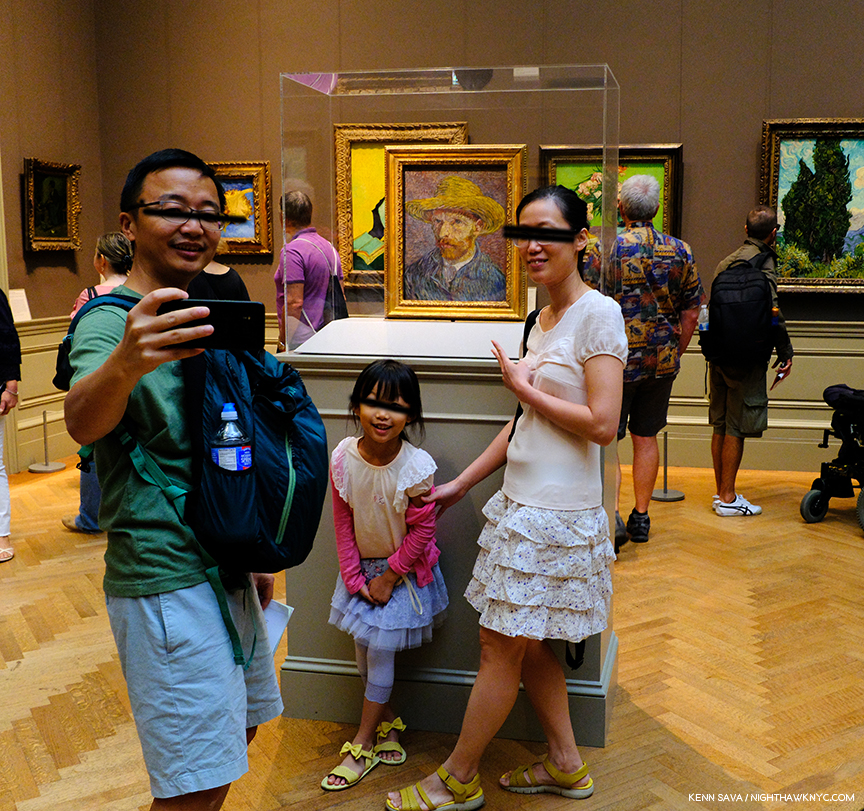
Then, I started to notice whole families posing with his Self-portrait.

Hmmm…

I did a quick mental scan of the building. I can’t think of another work in the entire Museum that families pose in front of for a group self-portrait (feel free to let me know if you can).

Vincent, calmly looking out at us for all time behind glass, while I wonder, “What would you be feeling right now?”

Maybe it doesn’t happen often? I decided to go back 2 more times to see. Each time, the same thing happened- more families from all over the world, convened in front of one of my very favorite Paintings in The Museum, Vincent’s Self-Portrait with a Straw Hat.

Why?

I didn’t ask, so I still don’t know.

Standing there during one visit the thought suddenly occurred to me- IF I was somehow permitted to be allowed to bring back any one person from the dead, that person would be Vincent van Gogh. (Hey, in your imagination, you’re free to do whatever you want, too.)

Why Vincent?

Smiling, while I had a tear in my eye.

Because for his entire life, Vincent wanted little else more than to be loved by his family. Failing to get that, he started looking for surrogate families that would accept him, but these situations didn’t last long. Here, 128 years after he passed away, all these families have come who knows how far, and in the midst of the The Met’s 4 NYC blocks full of the greatest Art created by man and womankind, they feel compelled to gather as a group for a picture, AND INCLUDE HIM. Realizing this, I came close to being overcome.

I would just love to be able to stand there next to him and watch his reaction.

As close as I’ll ever get to knowing what it felt like to sit next to Vincent van Gogh. Henri de Toulouse-Lautrec, Vincent van Gogh, Paris, 1887, Colored chalk on cardboard. Vincent and Toulouse-Lautrec were friends for a time while taking classes. They routinely ended their day in a bar. Here, in this marvelous, and incredibly rare side view of the Artist, no doubt Drawn from life, he shows Vincent with an absinthe glass in front of him. Van Gogh Museum, Amsterdam (Vincent van Gogh Foundation).

Today, Vincent van Gogh is, very probably, the world’s most beloved Artist. For this almost entirely self-taught Artist, who was a virtual beginner at 28 years old, to create what he did in 10 years, in almost total isolation and become what he is now, is possibly the most astounding story in Western Art. The fact that his life was lived with so much hardship, suffering, loneliness and lack of acceptance serves to add even more layers to a hard to believe story. So, I would love to travel the world with him as he sees how millions of people around the world react to his Art today.

Would he be completely overwhelmed by all of this if he were to see it now? More than likely, it would be too much for him to grasp all at once. It would be for anyone.

I’ll never know.

There’s another question this “revelation” raised. Why? As in “WHY does his work speak to so many people?”

I think it’s because Van Gogh, throughout his life, in each different path he tried, what he sought, along with trying to win the love of his family, was to be consoled. This word comes up so often in Van Gogh: The Life that I started noting each instance. It’s continual and central to things that were important to him. He sought it in his efforts to become a Preacher. In his attempts at love. But, throughout his life he made Drawings and he collected prints (at one time, his collection of prints numbered over 1,000) that he continually rotated on his walls- before and during his Art career. He went to see Art in museums and galleries. Though they found his Paintings “unsaleable,” his extended family were part owners of one of the biggest Art Galleries in Europe9, where he worked for a few years. Looking back, one can see that throughout his life, even before he became a Painter, he had a passion for Art. He found consolation in Art.

“In Vincent’s reality, images evoked emotions. Born into a family and an era awash in sentimentality, Vincent looked to images not just to be instructed and inspired, but, most of all, to be moved.
Art should be ‘personal and intimate,’ he said, and concern itself with ‘what touches us as human beings10.'”

I think it’s, perhaps, the main reason he became an Artist- because Art offered consolation, and as Naifeh and Smith say, “No one needed consolation more than Vincent did.”

128 years later, his Art has consoled countless millions of Art lovers and continues to every day.

Vincent has found a loving family. At long last.


BookMarks-

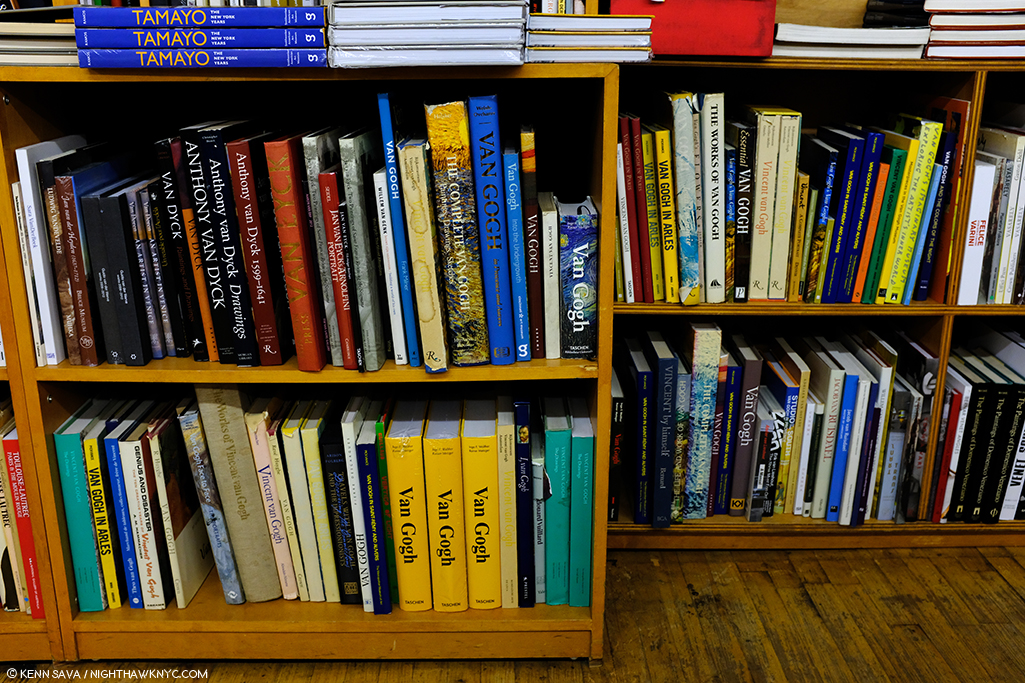
The Van Gogh monograph section at the legendary Strand Bookstore.

Steven Naifeh and Gregory White Smith’s, 2011 Van Gogh: The Life is compelling reading for anyone interested in Vincent van Gogh, or Art history. It’s written in a way that seems to have an Art audience in mind, with frequent digressions into matters like Art he was looking at, thinking about, hanging on his walls, what he was reading, as well as details about the materials he was using. The book is, perhaps, most widely known for it’s “Appendix A: A Note on Vincent’s Fatal Wounding,” separate from their main narrative, in which the authors make their case for believing that Vincent DID NOT commit suicide!, but rather was the victim of a homicide, accidental homicide, or an accident! As I said in the piece, the Appendix aside, the reason to read Van Gogh: The Life is that it’s built on extensive research bringing to bear the fruits of 100 years of Van Gogh scholarship that ends the need to rely on fictionalized accounts.

Vincent van Gogh: The Letters: The Complete Illustrated and Annotated Edition (Vol. 1-6), in 6 volumes that weighs 33 pounds is the current “definitive” edition. Published for the USA by Thames & Hudson, the hardcover box set currently lists at $650.00. As I mentioned in the piece, the entire corpus of Vincent’s Letter has been made available, for FREE, online. While the books look like they would be easier to use in some ways, the internet site is easier to use in others. For those wanting something a bit more shelf and wallet friendly, Ever Yours: The Essential Letters, by the same team and published by Yale University Press in 2014, contains 265 letters over 784 pages, a concise version that is far less expensive. Older editions of Vincent’s Letters are far cheaper in printed editions than the new, 6 volume edition, though not as complete, lacking the 4,300 illustrations, annotations, supplementary texts and newly discovered letters the new complete edition has.

Taschen’s Van Gogh: The Complete Paintings by Metzger & Walther has been released in a few sizes over the years, including a “small” version (5.5 x 8 by 2 inches and 2.8 pounds) that has sat on my night table for a good while. Generally, I prefer the largest size of Taschen’s Paintings books (because they give as close to a life size reproduction as possible, sometimes larger), but since they’ve never issued an XL size of this (probably because it would be XXL), I use this small one to explore his work, then look elsewhere for larger images of pieces I want to study closer. It’s very good for getting an overview and for seeing his progression during each period. At 19.95 list, with 774 pages and countless color illustrations, it’s one of the better deals in current Art books. Just remember- this current edition is small. It does exist in larger versions (including a few that are 2 volumes in a slip case) that are now out of print, but not expensive. With continued controversy about real and fake Van Goghs (akin to his countryman, Rembrandt), I hope the Van Gogh Museum will issue a definitive (for the moment) Catalogue Raisonne of his all of Paintings & Drawings, but nothing has been announced as far as I know11. So, in the meantime, the Taschen book remains the best place to start looking at Vincent’s work, in my view. The Van Gogh Museum has digitized much of it’s world leading collection of the works Vincent sent to Theo, who died a skance 6 months after Vincent, that were preserved by Theo’s wife, Johanna van Gogh-Bonger (who the world of Van Gogh lovers owe an incalculable debt to for saving and promoting his work, and for preserving, compiling and first publishing their letters, and to their son Vincent Willem van Gogh, who established the foundation which led to the creation of the Museum), so those works, including their 200 Paintings, may be seen and studied there.

Out of print, but not expensive, is Vincent Van Gogh: The Drawings (Metropolitan Museum of Art Series), the catalog for The Met’s 2005 show of the same name mounted in conjunction with the Van Gogh Museum. The Met has made it available as a pdf for free here. I recommend it for Artists and Art Students interested in Drawing. Largely a self-taught draftsman (he studied Charles Bargue’s legendary Drawing Course on his own), Van Gogh’s Drawings reveal the limitations of his education (as do his Paintings), but do not get enough credit for their uniqueness and daring, in my view. The Charles Bargue: Drawing Course is something anyone interested in studying a “traditional/classical” method of Drawing, largely from casts, should check out, particularly if you, like Vincent, lack a teacher. Naifeh and Smith recount that Vincent didn’t complete his studies of Bargue due to an impatience to begin Drawing from life, which others told him he was not ready for. They may have had a point, but it’s also another reason his work looks like no one else’s.

*- Soundtrack for this Post is “I’ve Been Waiting For You,” by another iconic individualist, Neil Young. It was memorably covered by yet another one- David Bowie, on Heathen in 2002. Yes, I resisted the obvious “Home At Last,” by Steely Dan.

NighthawkNYC.com has been entirely self-funded and ad-free for over 6 years, during which over 250 full length pieces have been published. If you’ve found it worthwhile, you can donate to keep it going & ad-free below. Thank you!

Written & photographed by Kenn Sava for nighthawknyc.com unless otherwise credited.
To send comments, thoughts, feedback or propositions click here.
Click the white box on the upper right for the archives or to search them.
For “short takes” and additional pictures, follow @nighthawk_nyc on Instagram.

Subscribe to be notified of new Posts below. Your information will be used for no other purpose.


  1. My friend, the fashion guru extraordinaire, Magda, wrote an excellent piece on the Cloisters part of the show, here.
  2. Van Gogh: The Life, P32. Page numbers refer to the eBook edition, which has 1574 pages.
  3. Van Gogh in Saint-Remy and Auvers, Met Museum, P.173
  4. Van Gogh: The Life, P.409 eBook edition
  5. Van Gogh: The Life, P.569 eBook edition
  6. //ajp.psychiatryonline.org/doi/10.1176/appi.ajp.159.4.519
  7. Personally, I don’t see Vincent in the work of Edvard Munch (1863-1944), even in The Scream, as some do.
  8.  Van Gogh: The Life, P.415 eBook Edition.
  9. His uncle Cor, one of the officers of the firm did commission 19 Drawings from him, in two purchases. By the way, Vincent did sell more than one Painting during his lifetime. The exact number he sold is not known.
  10. Van Gogh: The Life, P.475 eBook edition
  11. The Van Gogh Museum has been producing catalogs of the Paintings & Drawings in it’s collection. At the moment the complete Drawings have been published in 4 volumes and 2 of the 3 volumes of the complete Paintings in it’s collection have been published.

Three Years of NighthawkNYC!

Written & Photographed by Kenn Sava

July 15th, 2018 marks the third Anniversary of NighthawkNYC.com. Almost 200 pieces in (24 full length pieces thus far in 2018 alone!), I feel like a largely different person today- wholly as a result of this site. I’m not talking about the full time job it became early on, one that swallowed my “life” such as it was whole, in one gulp. I’m talking about all the learning that’s happened from assimilating all I’ve seen, read, and heard. It’s time to pause and reflect.

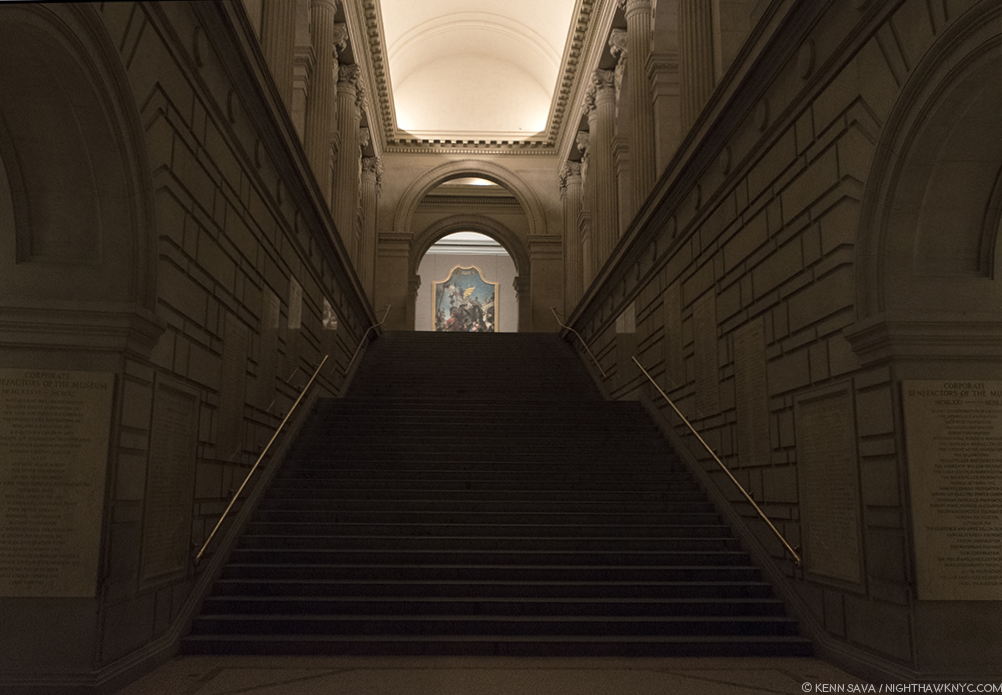
Art Heaven. “Hey, man. Question- How do you get all of those empty gallery shots?” The answer? Patience. That’s right. I pick my spot and wait until I get it. Just go when it’s not likely to be packed! This one of the Grand Staircase at The Met in February might be my favorite. It makes it feel like it’s open just for me.

First, and foremost, my thanks to all of you who take the time to read these pages. Over three years, I’ve heard from many of you, and I appreciate your taking the time to write, offer feedback, comments and support.

Two generations of Magnum Photos. The legendary Susan Meiselas, left, a former Magnum Photos President, and the creating-her-own-legend-as-we-speak, Bieke Depoorter, right, one of Magnum’s newer members, at Aperture, June 15, 2018.

Thanks to the Artists who have taken their valuable time to speak with me as I work on these pieces, and then after to give me their feedback. 

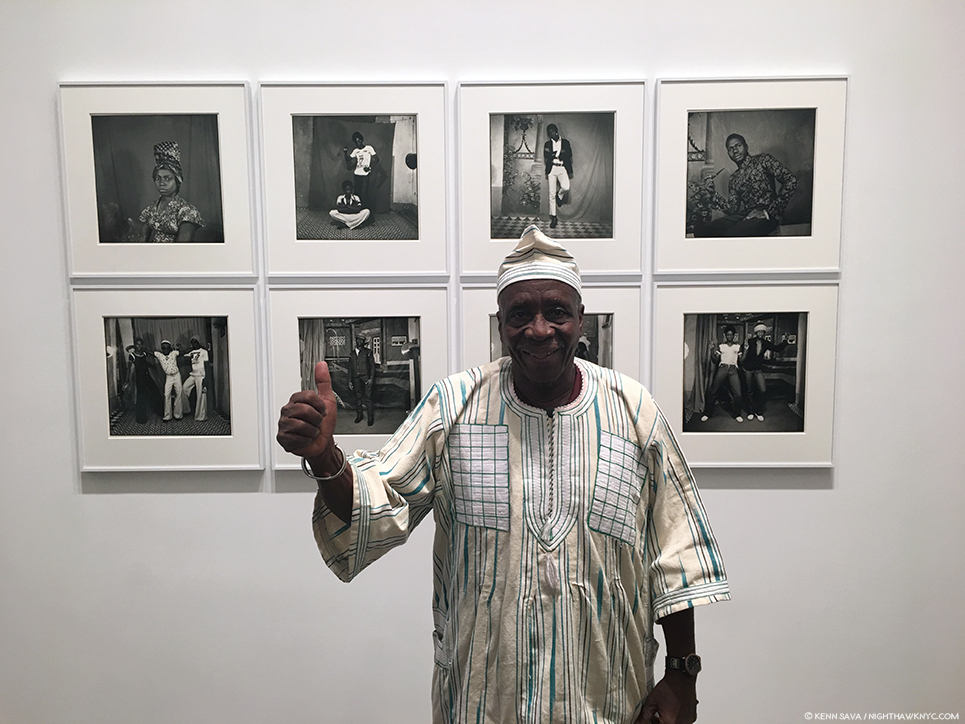
The great Sanle Sory, all the way from Burkina Faso, graciously poses for me at the opening of the terrific show of his studio portraits from the 1960s to the 80s at Yossi Milo Gallery on April 26. He’s every bit as nice as he is talented. And that’s saying something.

After long thought and discussions, I recently added a Paypal Donation button, accessible by clicking the white box at the upper right of the screen to help defray expenses and keep this site ad-free and independent. I want NighthawkNYC to be about Art, Music and Life, and having written for a national Music magazine for 4 years, I relish the independence I now have. Being independent means I get to write about shows that speak to me, and hopefully others, shows that I feel are important.

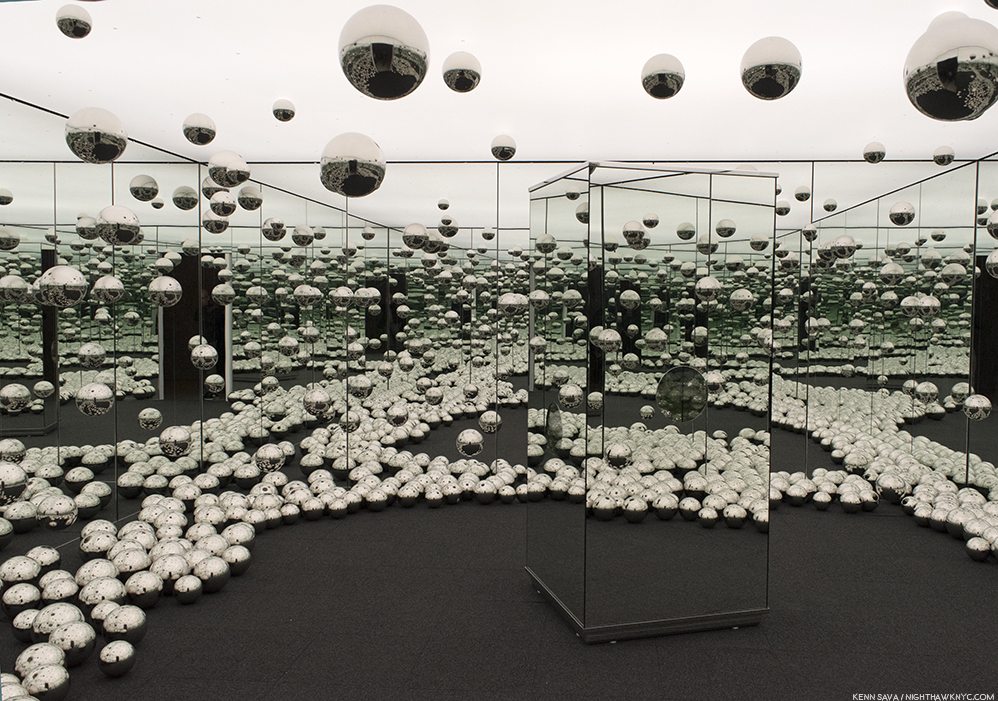
Yayoi Kusama, Infinity Mirror Room, at David Zwirner, December, 2017. I waited over 2 hours on a frigid day to spend the 60 seconds visitors were permitted in this space. Hmmm…

It also comes with responsibility. As you may have noticed, I don’t write about shows I don’t like, or that don’t speak to me. Why? I don’t believe in being negative. It’s very hard to survive as an Artist or Musician in 2018. I prefer to revisit things that don’t speak to me now in the future and reassess. I’ve discovered a lot of great Artists that way. Part of my goal with this site is to give those who don’t have a chance to see these shows a sense of what they were like. Of course, given the sheer volume of shows going on in Manhattan (let alone the rest of the City and now New Jersey), there’s just no way I can cover all of them. I have to be selective. While I have included Artists who are not “big names” yet but are doing great and/or important work that I feel deserve to be better known, I’d like to ramp this up going forward. I’m always looking for “candidates.”

Photography has taught me to open my eyes and look more carefully at the world around me.

Looking back over these 3 years, it’s obvious that the amount of coverage I’ve given to Painting has been on the decline, while Photography has, almost, taken over. Two years running, I have had the most extensive coverage of The Photography Show/AIPAD anywhere. (2017, here. 2018, here). What can I say? It’s a symptom of my seeing fewer and fewer Painting shows in the galleries that speak to me. Painting remains my favorite Artform, so this pains me very much. On the other hand, given that there are more cameras in the world than people, that people are living and working longer, that Photographic technology has been growing and evolving as never before in this century, it’s all combined to create an almost perfect storm, putting us, it seems to me, in a “golden age” of Photography. A big part of what’s created this moment is that Photography is (often) best seen in PhotoBooks and not on gallery or museum walls.

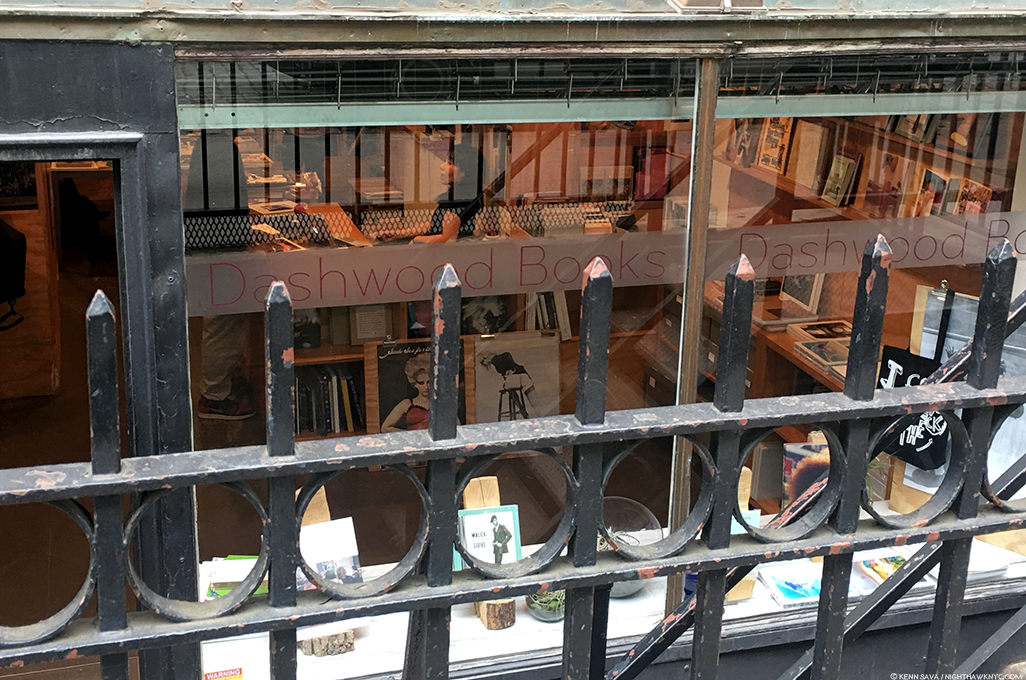
Dashwood Books in SoHo carries nothing but PhotoBooks.

This has led to an unprecedented explosion of PhotoBooks from famous and unknown Photographers and PhotoBook publishers big, small and D.I.Y. Somewhat remarkably, this is a movement that has almost entirely resisted electronic books (eBooks) in favor of good ole physical books. In fact, the publishers I spoke to at AIPAD this year UNANIMOUSLY told me they have NO intention of going to eBooks! This has brought an unprecedented number of Photographers into the consciousness of the world at large, whereas in the past, great Photographers (like Saul Leiter, Fred Herzog and many others) worked for much of their lives completely ignored. It is now possible to see more Photographs by more Photographers in a visit to a good bookstore than it is to ANY museum or gallery in the world. This is more than a publishing revolution. It’s an indication that the way Artists reach their public is changing, something that could have huge ramifications for the Art World as a whole. Buckle up! It’s going to be utterly fascinating to see how this plays out.

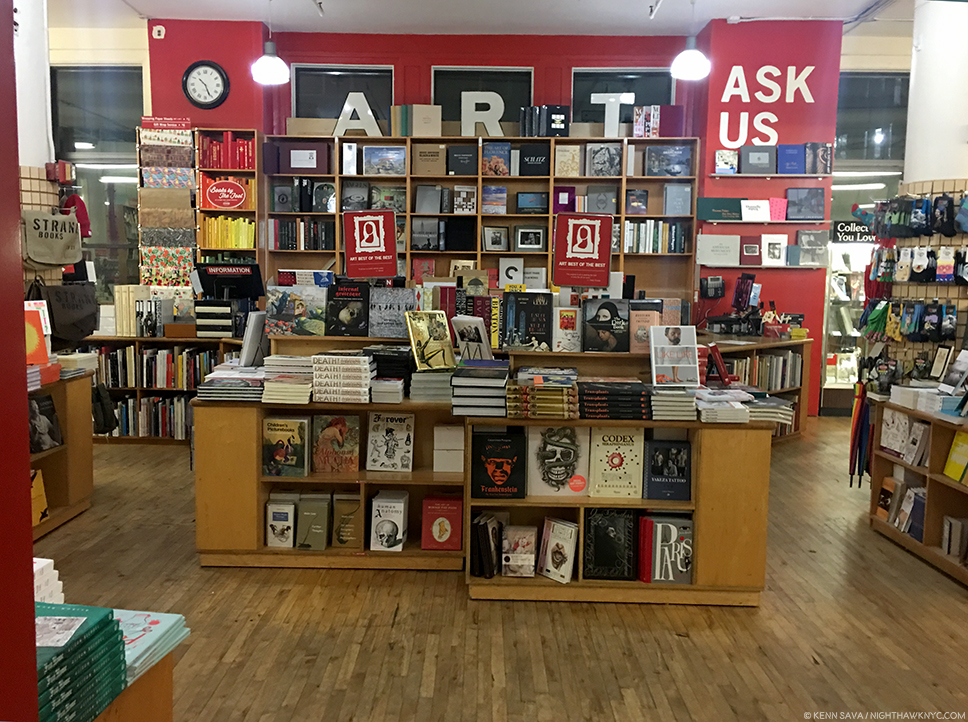
10:26pm at the world famous Strand Bookstore’s Art Book Department. 4 minutes before closing. The last one out, again. I’m here an average of 4 times a week. Some weeks more.

And so, as you may have also noticed, books have come more and more to the fore. I’ve always mentioned them. In response to requests I’ve gotten for recommendations of places to start delving into an Artist, I decided to devote a section at the end of the piece I call “BookMarks” to recommended books. Of course, many Artists have extensive bibliographies (and then there’s Picasso…or Daido Moriyama), so it’s often hard to decide where to start. I decided to share my thoughts since I generally look at as many books as I can find on an Artist I’m writing about, and I wind up living with a good many of them (cough). As far as I know, I was the first one to bring to public attention that Chris Ware’e superb book Monograph comes in a limited, signed, edition. Even the publisher, Rizzoli, made no mention of it. I heard from a number of you who were subsequently able to get a copy. Though “BookMarks” is new, I want to thank Monika Condrea and Steidl, the world’s premier PhotoBook publisher, for their support, and the Guggenheim Museum for their support of my Chinese Contemporary Art & Danh Vo pieces.

Amerika the Stoker, 1993-94, by my late friend, Tim Rollins & K.O.S. seen in American Landscape at Lehmann Maupin in May, 2018.

Three years later, in addition to being fortunate enough to have seen so many amazing shows, meeting so many Artists and speaking to so many art lovers, gallerists and scholars, as it was when I started NHNYC, the main joy for me remains learning- discovering someone new and great I didn’t previously know and/or discovering a new great work by, enlightening fact about, or gaining a new insight into an Artist I do know.

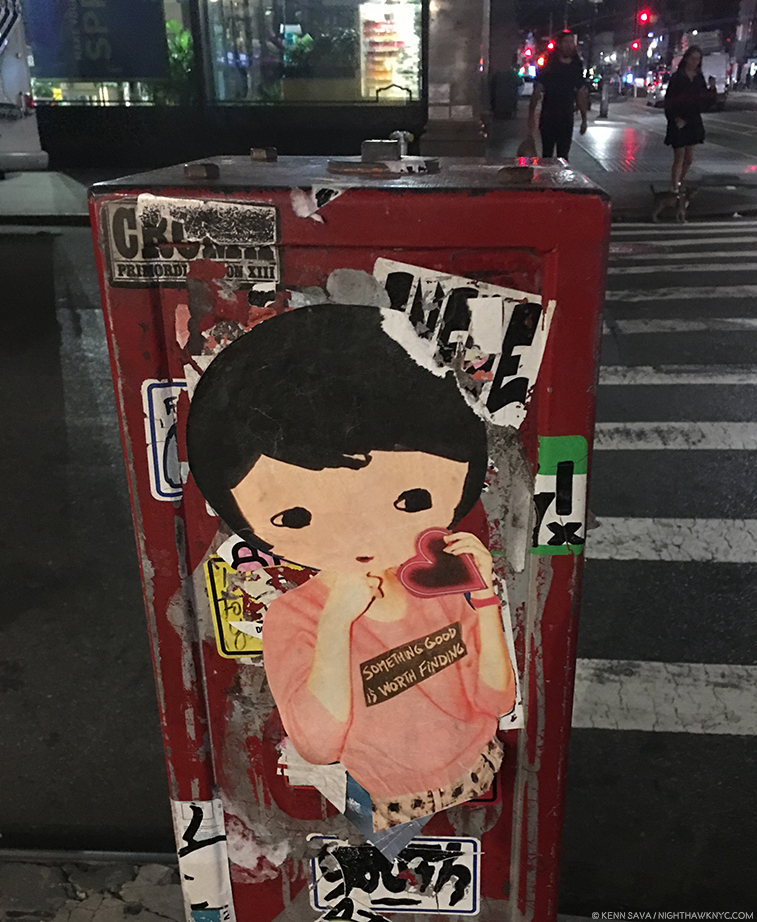
Her shirt reads “Something good is worth finding.” It could be my mantra.

In mulling it all over? If there’s one thing I have learned it’s that there’s A LOT to learn, see, explore and even enjoy. Three years in? As the song, “The Rhythm Changes” says, I’m still here, but I’ve only scratched the surface. 

“Are we there yet?”

*-Soundtrack for this Post is “The Rhythm Changes,” by Kamasi Washington & Patrice Quinn from The Epicgenius.com commenter, Crown_of_the_Barren-Synod said of this track, “While our opinions, beliefs, physical characteristics and even our personality can change with time there is still some being- our self- which transcends all of these characteristics and their transience.”

Special Thanks to Kitty for research assistance.
Special Thanks to Sv for pushing me to begin, and since, for her support.

NighthawkNYC.com has been entirely self-funded and ad-free for over 6 years, during which over 250 full length pieces have been published. If you’ve found it worthwhile, you can donate to keep it going & ad-free below. Thank you!

Written & photographed by Kenn Sava for nighthawknyc.com unless otherwise credited.
To send comments, thoughts, feedback or propositions click here.
Click the white box on the upper right for the archives or to search them.
For “short takes” and additional pictures, follow @nighthawk_nyc on Instagram.

Subscribe to be notified of new Posts below. Your information will be used for no other purpose.


Up All Night With Frank Lloyd Wright

“Architects may come
Architects may go
and never change your point of view.
When I run dry
I stop awhile
and think of you.”*

Once, back in the day, I came home from work on a Friday evening and put that Simon & Garfunkel song on. Then, I hit the repeat button. “So Long, Frank Lloyd Wright” played all weekend, non-stop, until I had to go to work on Monday. Even while I slept.

Such was my life under the spell of Frank Lloyd Wright.

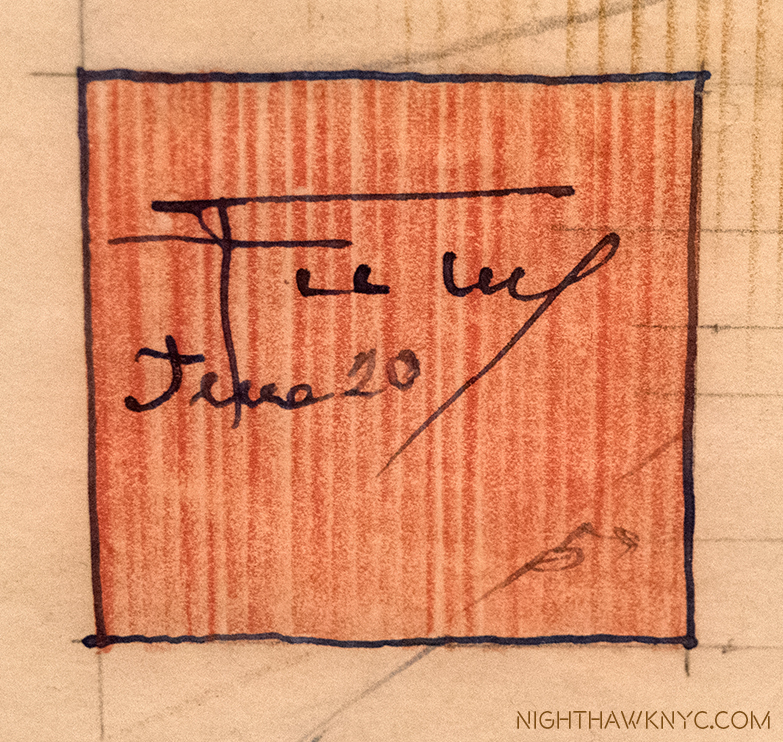
The mark of genius. Frank Lloyd Wright’s “symbol” (the red square) and his signature on the corner of one of his Drawings. “The color red is invincible. It is the color not only of blood-it is the color of creation. It is the only life-giving color in nature…1

I guess I hoped that playing this unique song from Bridge Over Troubled Water, with its unusual marriage of Brazilian rhythm and a string quartet under the ethereal vocals, would lend a different perspective on Wright and his work.

In the years after my father passed, Wright, became an all encompassing figure to me, something I didn’t realize until a German Architect I was dating pointed it out to me. She might have been (W)right. Looking back, though, I think it was the discovery of, and the falling in to, the seemingly bottomless pit of creativity that was Frank Lloyd Wright, and the enigma and charisma of the man, his ideas and his accomplishments (including the countless buildings he designed that were never built, or that were built and since lost). This passion took many forms in my life at the time. Along the way, I learned that the man was a great Artist in other ways beyond Architecture- as a Draughtsman and, in my opinion, as a writer. His writings often marry Art & Architecture and philosophy. He was, also, something of a “teacher,” or model, later in his life at his Taliesen Fellowship. His “teaching” seems to have greatly influenced some, and left others unhappy. Beyond all of this work, his personal life? Well…as I’ve said previously about others…is not for me to judge. My interest in is the Art, his creative ideas and the work.

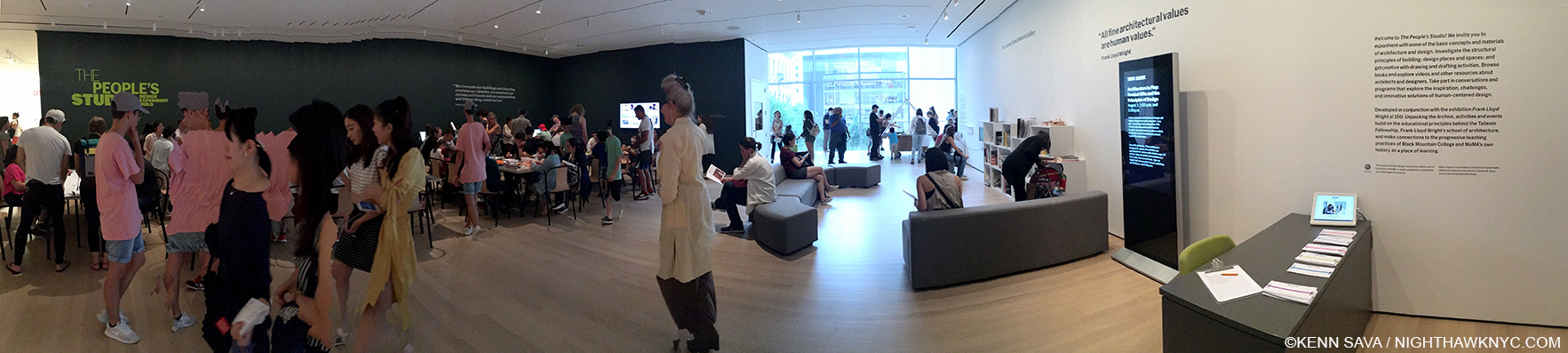
Speaking of teaching & learning…Just outside MoMA’s show, in “The People’s Study,” the public was invited to create and experiment with a range of materials, including blocks, which Wright, himself, created with as a child. Along the windows, they were invited to design their own “Broadacre City,” Wright’s concept for urban/suburban development.

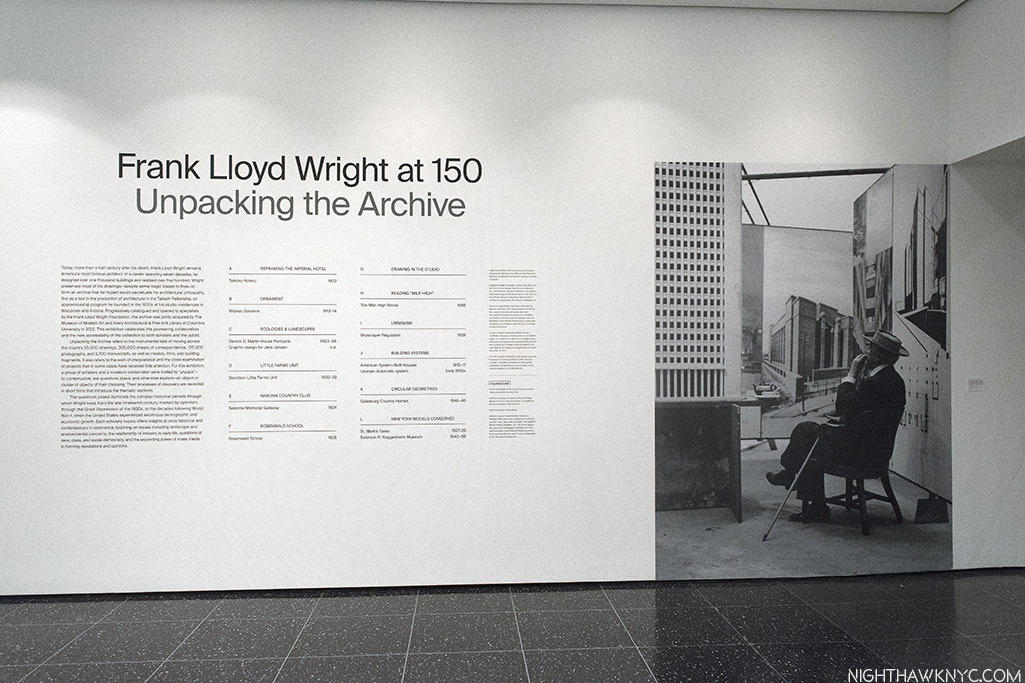
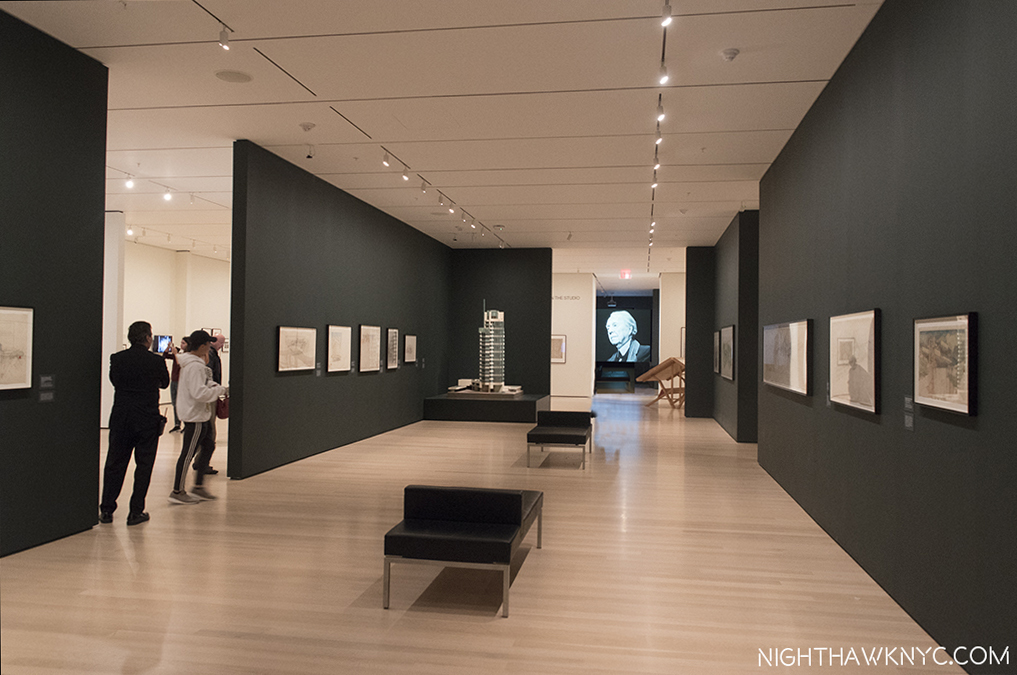
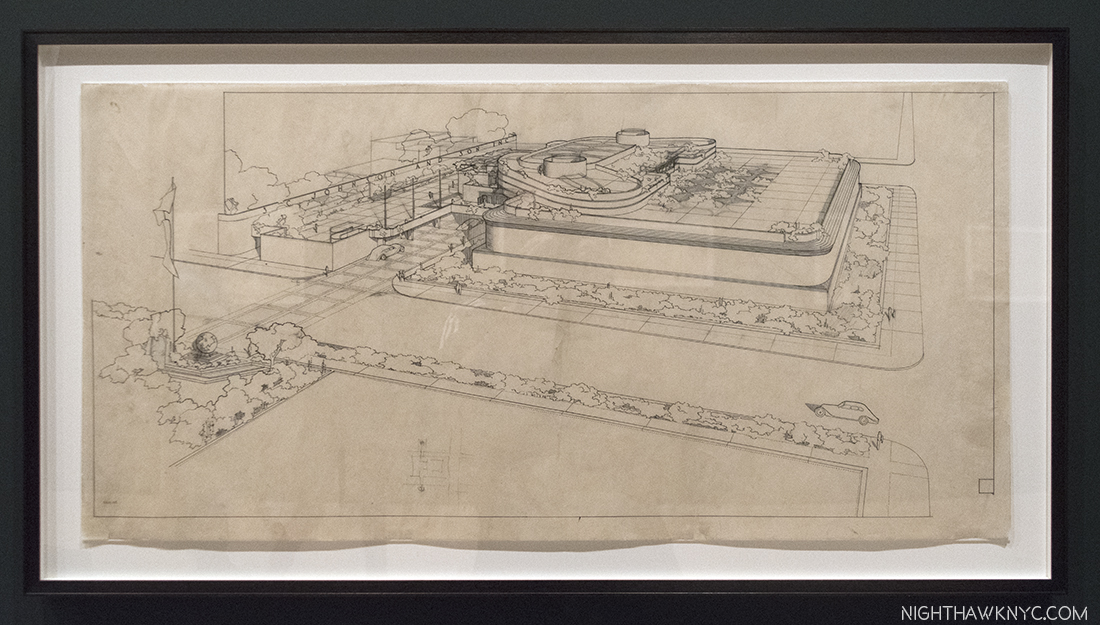
MoMA’s show, Frank Lloyd Wright at 150: Unpacking the Archive is a major event, honoring two major events.  First, it opened on June 12th, four days after Frank Lloyd Wright’s 150th Birthday. Second, it marks the joint acquisition by MoMA and the Avery Architectural & Fine Arts Library of Columbia University of Frank Lloyd Wright’s Archives. It’s a fascinating show, though, of course, it’s a mere sliver of the massive Archive that will keep scholars busy for decades Some of the early fruits of their labors were on view, particularly in short videos on display in each gallery where curators spoke of some of the highlights they’ve found so far. Parts of Wright’s Archives have been known to me through earlier shows at MoMA and the Guggenheim, and through books, most notably In His Renderings, the final volume of  the landmark 12 volume box set published by A.D.A Edita Tokyo in 1984, right in the middle of my Wright obsession2. The 200 Drawings In His Renderings included made the case for Wright’s Drawings being works of Art in themselves, and a good many of them are in MoMA’s show, which totals about 450 items. Indeed, they are right at home on the walls of the great museum.

The show is made up of galleries devoted to individual projects and galleries devoted to aspects of his work. Of course, given his career lasted over 60 years, only selected Wright projects are here and they range from key buildings, like the Imperial Hotel, 1923, to some much less well known, like his design for the Rosenwald School for Negro Children, 1928, as it was labelled, as well as galleries devoted to Wright’s Ornamentation (an almost completely lost art in today’s Architecture), Urban projects, the role of landscaping in his projects, and built, and (mostly) unbuilt projects for NYC. There is also a gallery showing 2 rare videos of Frank Lloyd Wright- one an infamous interview with Mike Wallace in 1957, the other an appearance on the game show, “What’s My Line.” The long central, first gallery includes a range of Drawings, many masterpieces- both as Architecture and as Artworks, from a wide range of periods of Wright’s career, including the Winslow House, 1893, Unity Temple, 1908, Fallingwater, 1935, and the Marin County Civic Center, which opened in 1962.

Frank Lloyd Wright seen at the end of the first gallery as he’s interviewed by Mike Wallace in 1957, at age 90. Still sharp as a tack.

When Wright burst on the scene, after leaving his employer & mentor, the great Louis Sullivan3, the “Father of the Skyscraper,” (who he held in such high esteem, he referred to him as “Lieber Meister,” German for “Dear Master”), and began his own practice, there was no such thing as a truly “American” style of Architecture.

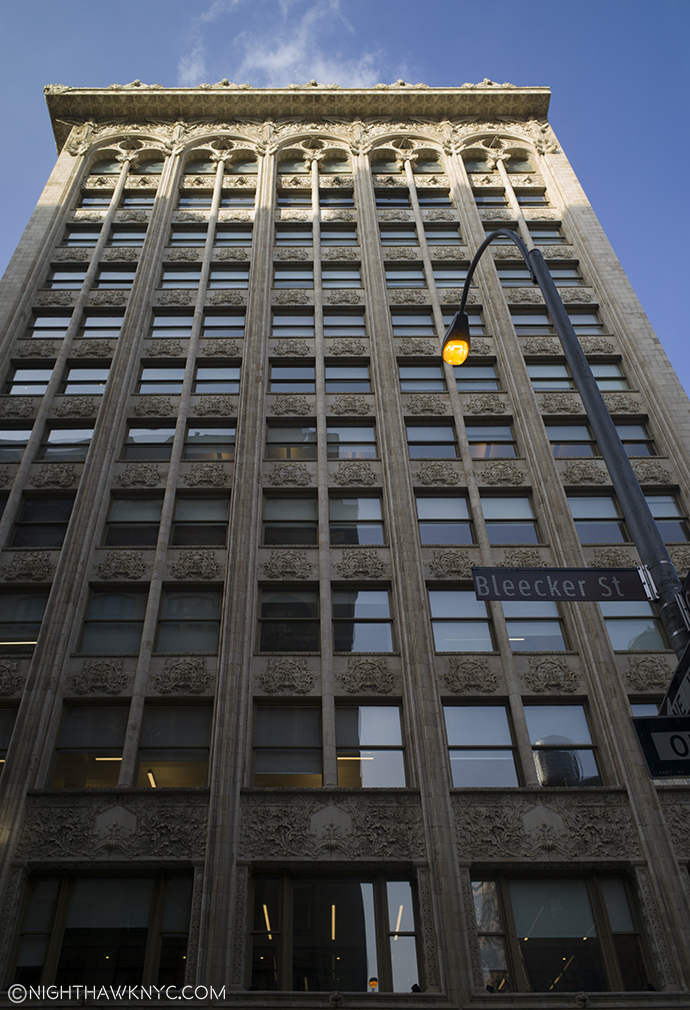
Louis Sullivan’s Bayard-Condict Building, 1898, on Bleecker & Crosby Streets, his only NYC building, was one of the first steel skeleton skyscrapers in NYC. As the columns between the windows rise, they lead to the parapet decorated with angels.

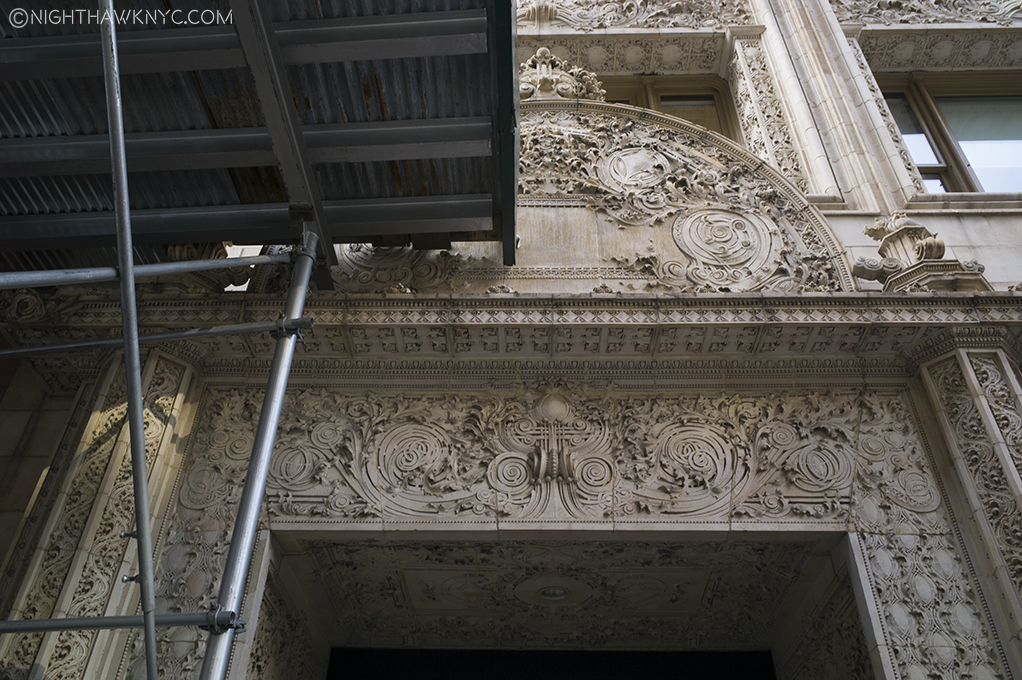
Even half-hidden by scaffolding the genius of Louis Sullivan’s ornament is impossible to miss, here on the entrance.

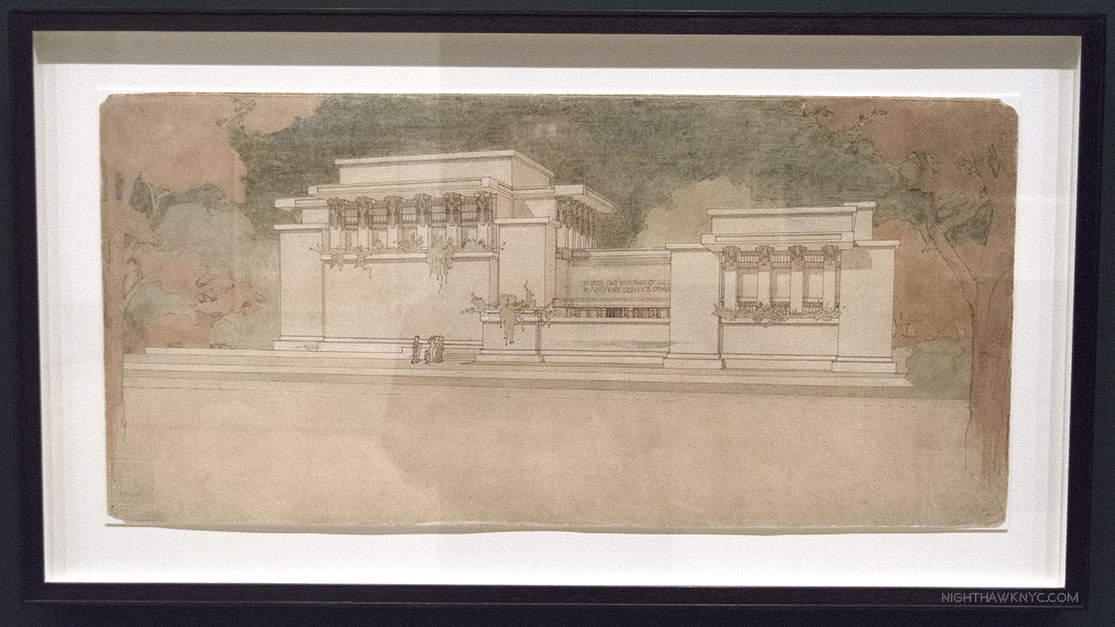
While Henry Hobson Richardson and Sullivan (both a bit under appreciated today), had taken steps towards creating an American style, Wright completed it with the introduction of his Prairie Style in the first decade of the 20th Century, like the “Unity Temple,” 1908, in Oak Park, IL, below.

Rendering of Unity Temple, Oak Park, IL, 1908, which still stands, an example of his “Prairie Style,” with its low, land-hugging profile. Wright, who’s church was “Nature,” went on to design churches for many religions.

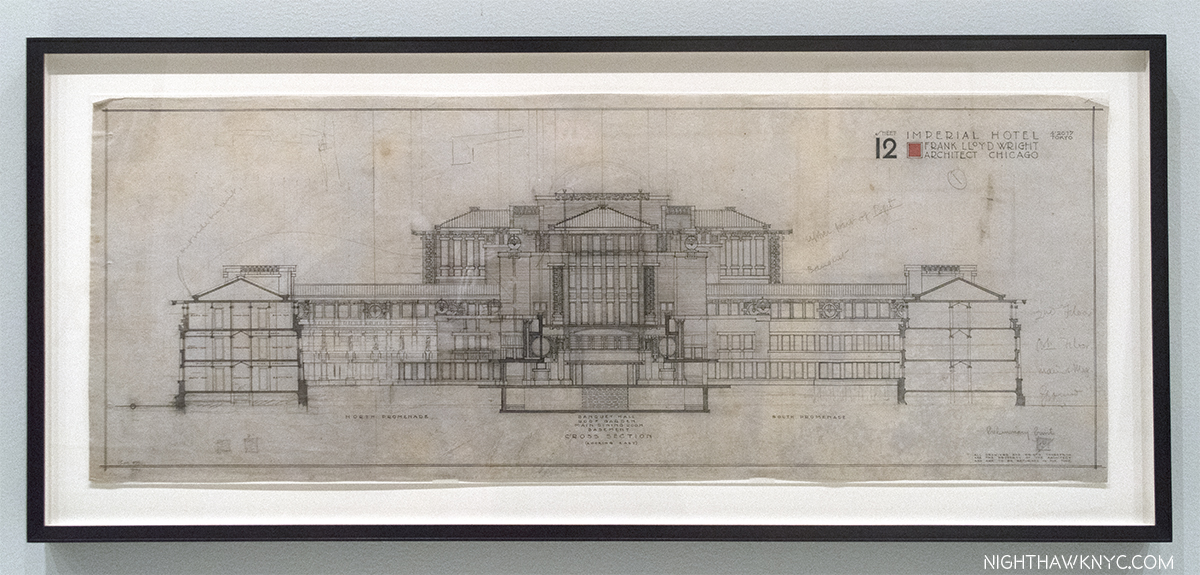
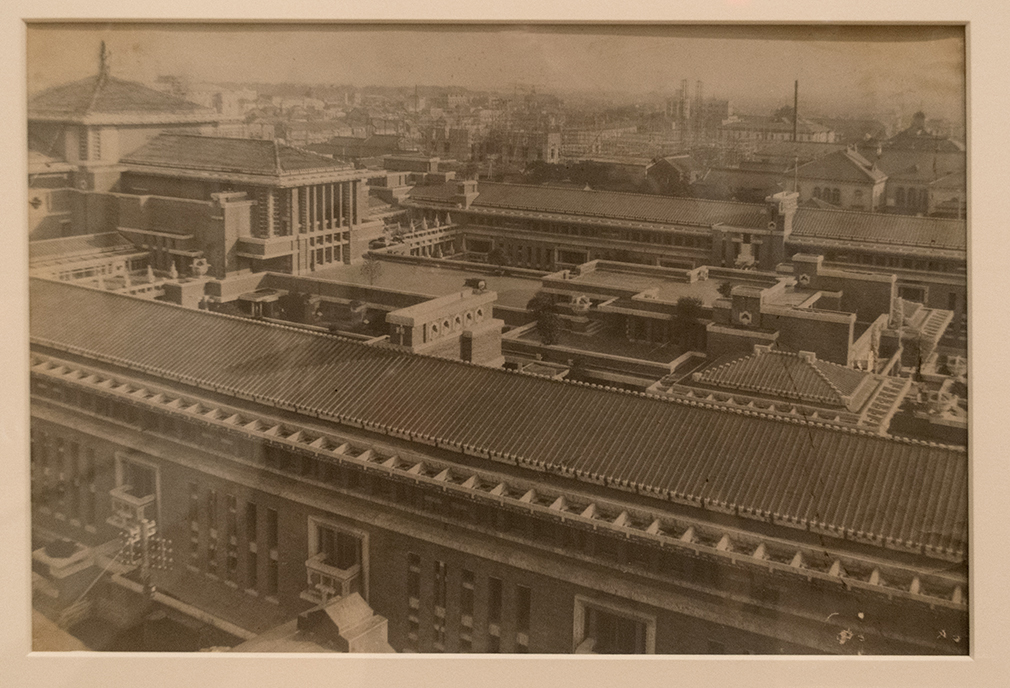
Off the central gallery, the first side gallery is devoted to Wright’s Imperial Hotel, Tokyo. Incredibly, it was dedicated on September 1, 1923, the very day of the devastating Great Kanto Earthquake that killed 100,000 people and leveled almost every other structure in Tokyo, except for Wright’s Masterpiece, which he had designed to withstand such an event. Instant world-wide fame followed. The genius in its floating concrete foundation below was also abundant in the superhuman amount of creativity above it.

Imperial Hotel, 1923, cross section.

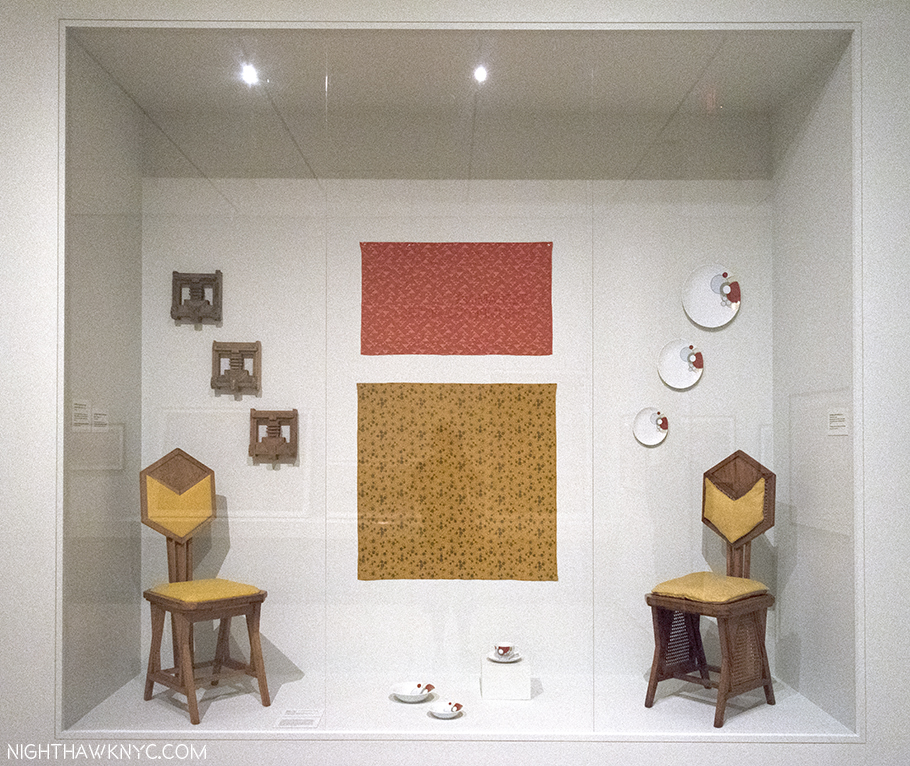
Wright designed the furniture, the windows, the lamps, the dishes- all of it. He created a massive building that was one unified composition from top to bottom, down to the smallest detail. I couldn’t get over it. Yet the Imperial Hotel was far from the only building he did this for. No other Wright structure has captured my fascination, and awe, more than the Imperial Hotel (which is saying something), perhaps because, though it was gigantic, so little of it remains- even in photographs, film or books (An amazing online collection of photos and relics of the “Imperial Hotel” I’ve seen is to be found here.). What is left teases the viewer to imagine the rest. I’ve tried to imagine walking around in it…what that must have looked like and felt like. It withstood what Nature (Wright capitalized it, since he said it was his “religion,” my inspiration for capitalizing “Art,” “Music,” “Painting,”etc., since Art is my religion) threw at it, and World War II, but it couldn’t withstand the rising value of Tokyo real estate leading to its tragic demolition in 1958 after standing for a mere 45 years! The facade was saved and reconstructed at Japan’s Meiji Mura Outdoor Architectural Museum, a few pieces of furniture are in The Met (which also has one of the Urns that was out in front of the entrance), and other items are in collections elsewhere.

Frank Lloyd Wright’s First Symphony. The Imperial Hotel, Tokyo. Imagine designing this, AND all the furniture, dishes, windows, lamps, and on an on. For my money, one of mankind’s supreme creative achievements. It’s so large it extends off the frame from across the street. Part of the entrance is barely visible to the right, center.

Fragments of the Imperial Hotel,  The two side chairs are on loan from The Met. The dishes are reproductions.

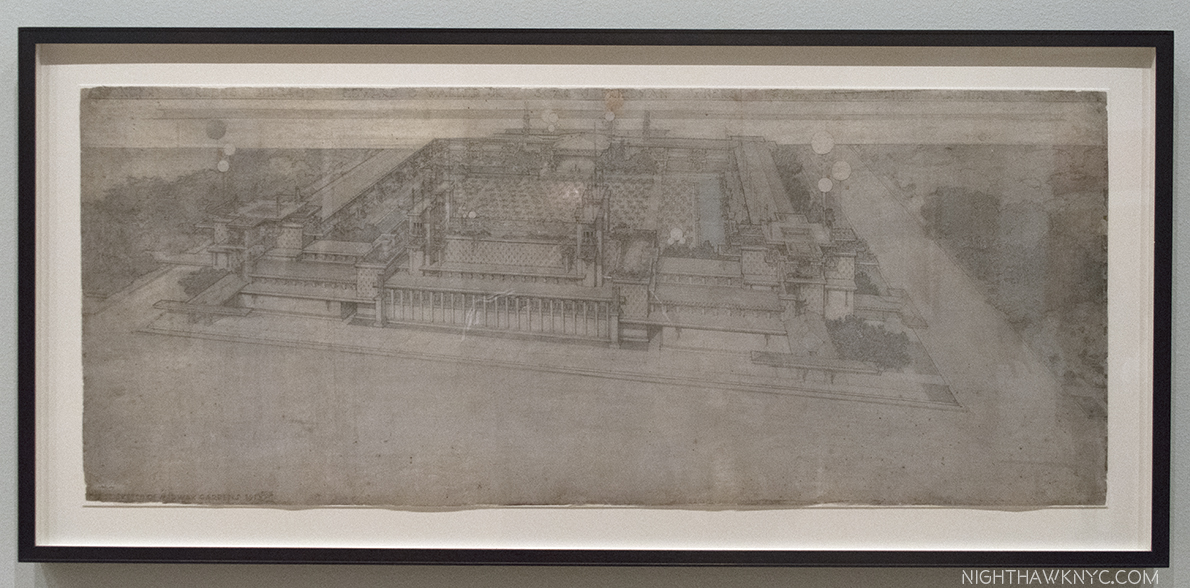
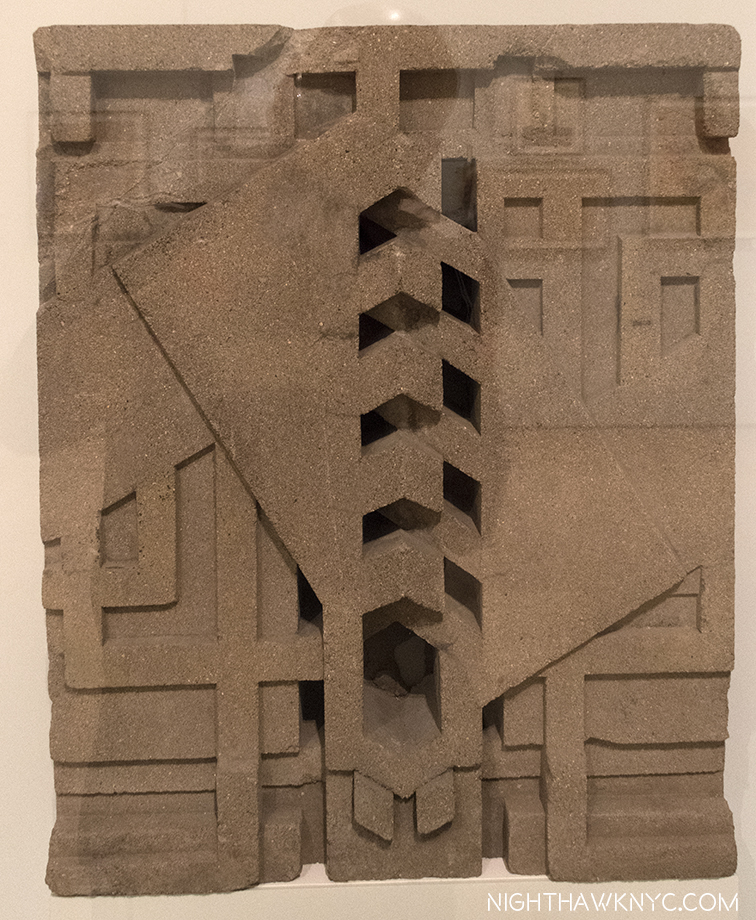
Wright’s other huge early masterpiece was Chicago’s Midway Gardens, 1914, an indoor/outdoor entertainment complex in the Hyde Park section. Again, Wright designed all of it, and once again, almost nothing remains. Either one of these two buildings would have been enough to secure his name, and his legend. Midway Gardens, stood for FIFTEEN years. The loss of both is a cultural tragedy that will echo on through centuries to come.

Like a vision of the past through a misty glass. Rendering of Midway Gardens, 1913, Chicago. Another early lost masterpiece.

Represented in MoMA’s show by this “Block for Midway Gardens,” 1914. Remnants of it are extremely rare. Photos of, and more about Midway Gardens, can be found here. (Scroll down.)

Gone forever was the chance for young Artists & Architects to experience and be directly influenced by them the way you only can from seeing Architecture, or Art, in person. Wright’s buildings require your presence in their space to fully appreciate them. He was fond of low corridors giving way to large open spaces, and this is just one of the experiences you can’t get from a book. Speaking of books, after one of my visits, I wandered into MoMA’s bookstore. A young couple next to me picked up a book on Wright and one said, “What did he build? Oh! He did the Guggenheim.” I thought everyone knew who Frank Lloyd Wright was. I don’t know if they went up to see the show or not, but I decided then and there to write this Post.

After these early masterpieces, Wright’s style evolved from the Prairie style, through the Mayan and Japanese influence seen in the Imperial Hotel and a number of houses he designed at the time, to his “Usonian”style of the mid-1930’s, to buildings beyond style, like the Johnson Wax Headquarters, Fallingwater, and eventually, The Guggenheim Museum. They would all fall under the umbrella of “Organic Architecture.” The “Usonian” houses began around 1936, and have a style which brings these houses even closer to the land than the “Prairie Style” houses, being almost universally a single storey, while featuring simpler materials, which, Wright believed, would make them more affordable. Though more “popularly priced”, he still designed all the furniture for them as well, and the chair I once owned came from a “Usonain” house. These “Usonian” houses, along with his “Broadacre City,” were part of his vision for urban and suburban landscape design, called “Usonia,” as in “U.S.-onia.”

Rendering of the Johnson Wax Headquarters, 1936. Its innovations are everywhere from the dendriform columns in the great workspace that rise from 9 inch bases to 15 foot “lily-pad” tops (see below), to the design of the furniture to expedite cleaning, to the use of glass tubes to block out the “urban blight” outside while creating a soft light inside. A sideshow of Photos of this incredibly beautiful building are here.

No one believed Wright’s slender columns for the Johnson Wax Headquarters could support enough weight to be practical. So, he staged this demonstration and piled 60 TONS on top of one! Photographer unknown. 81 years later? They’re still standing tall.

The later masterpieces while unique to themselves, still remain true to Wright’s core beliefs. Herbert F. Johnson, president of the S.C. Johnson Company hired Wright to build his company’s corporate headquarters in 1936 in Racine, Wisconsin. The resulting landmark, above, is a sheer wonder- a cathedral of capitalism. Though they encountered some problems, Mr. Johnson was so pleased with Wright that he contracted him to build a research tower on the property and then to design a large house for himself, known as Wingspread.

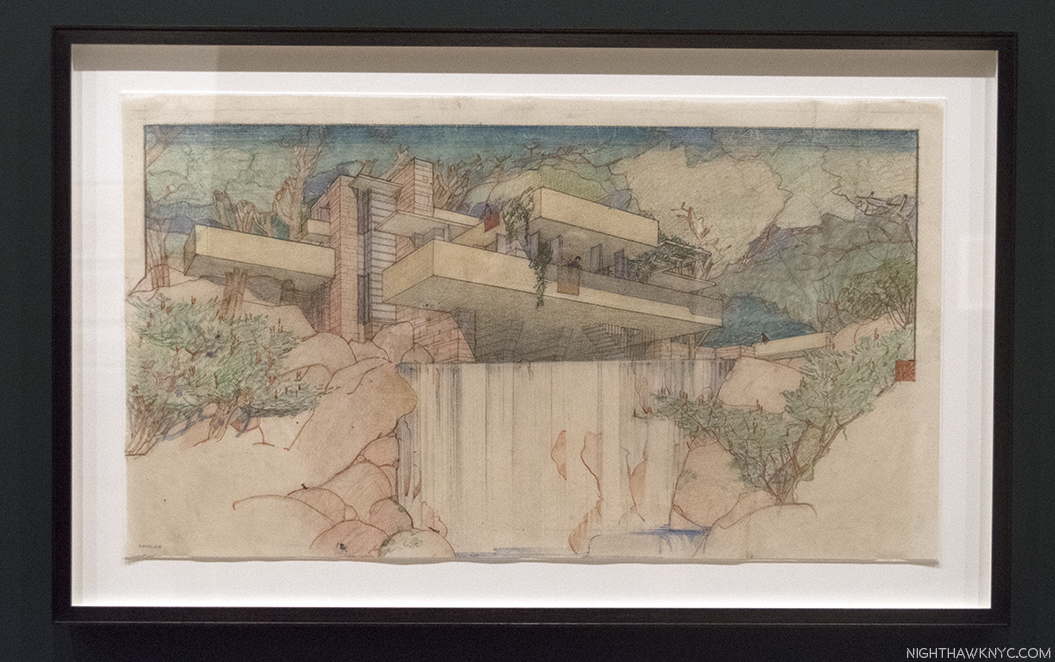
Within the year, he, also, created what may be the most famous private house ever built. Fallingwater, for Edgar J. Kaufmann, owner of Kaufmann’s department store.

Rendering of Fallingwater, 1935. Legend has it that Wright had put nothing on paper though his client, Edgar Kaufman, was on his way from the airport to see the design of his house. Wright had it all in his head and put it down on paper in time for Mr. Kaufman’s arrival. This is probably not that Drawing.

Perhaps nowhere in Art is there greater harmony of Art & Nature than there is in Fallingwater, which may make it Wright’s ultimate expression of his “Organic Architecture.” In it, the Artist strives to achieve the ultimate- create something worthy of a spectacular natural site, a work that seems to grow out of it, and be integral to it. Mr. Kaufmann was expecting the house to be sited across from the waterfall so he could enjoy looking at it. Instead, Wright put the house directly on top of it, centering the living room on a rock the family liked to picnic on.

As a result of all of this, it shouldn’t come as a surprise that later in his career he spoke defiantly about the Architects of the new “International Style,” with their bland, impersonal boxes of steel and glass, that are about as far from “Nature” as anything could be. Here in NYC, as in many other places, a casual look around reveals they’re already dated, and many (most? All?) are plain eyesores. One thing MoMA’s show reinforces is that Wright’s work has a way of not going out of fashion. Perhaps it’s because it’s so tightly integrated with its surroundings- with nature. It also helps that most of what he built and remains is out in nature, i.e. not in a City. Then again, perhaps it’s because his endless, unique, creativity serves to constantly inspire. Like the song says. For myself, my now long-standing passion for the work of Frank Lloyd Wright leaves me wondering if he is not the greatest Architect who ever lived. I’m lucky. I don’t believe in qualitatively comparing Art or Artists. But if I did? That’s one statement I might actually make. Now, I’m content wondering.

“The tree that escaped the forest.” Like a tree, it looks different from every angle. Originally designed for Astor Place in Manhattan, after it was rejected, it was redesigned and became the only “skyscraper” Wright built during his lifetime, the Price Tower in, you guessed it- Bartlesville, Oklahoma.

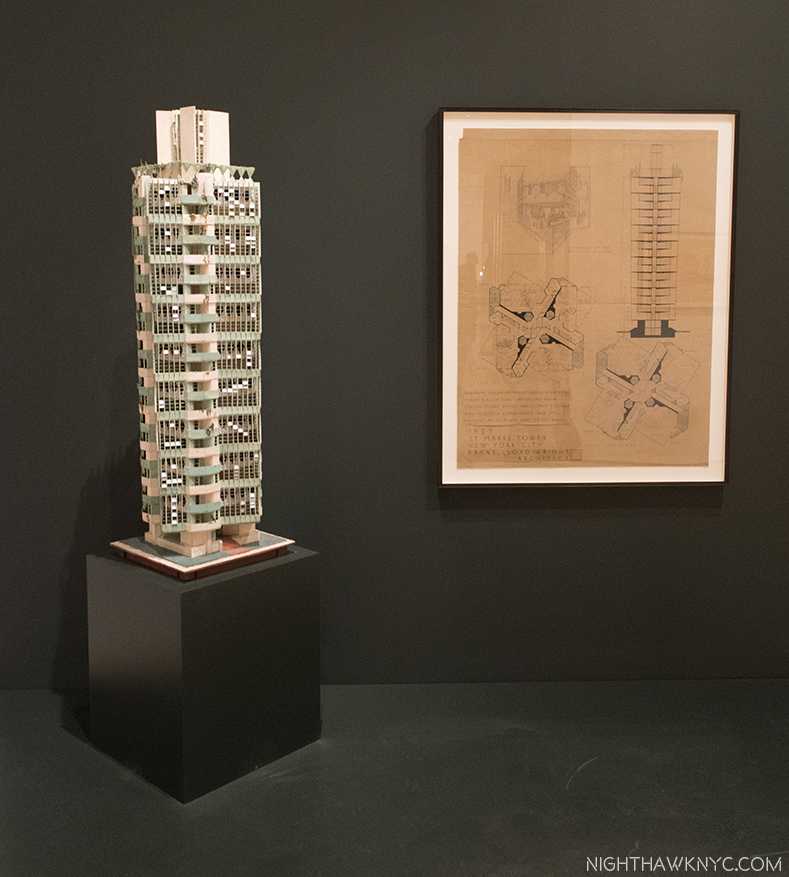
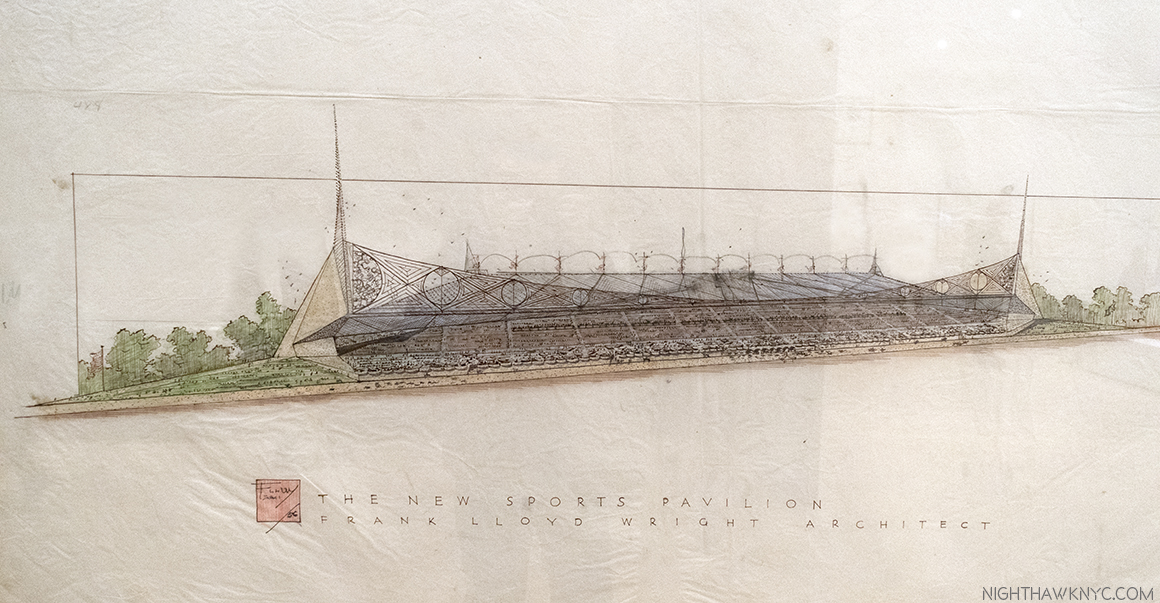
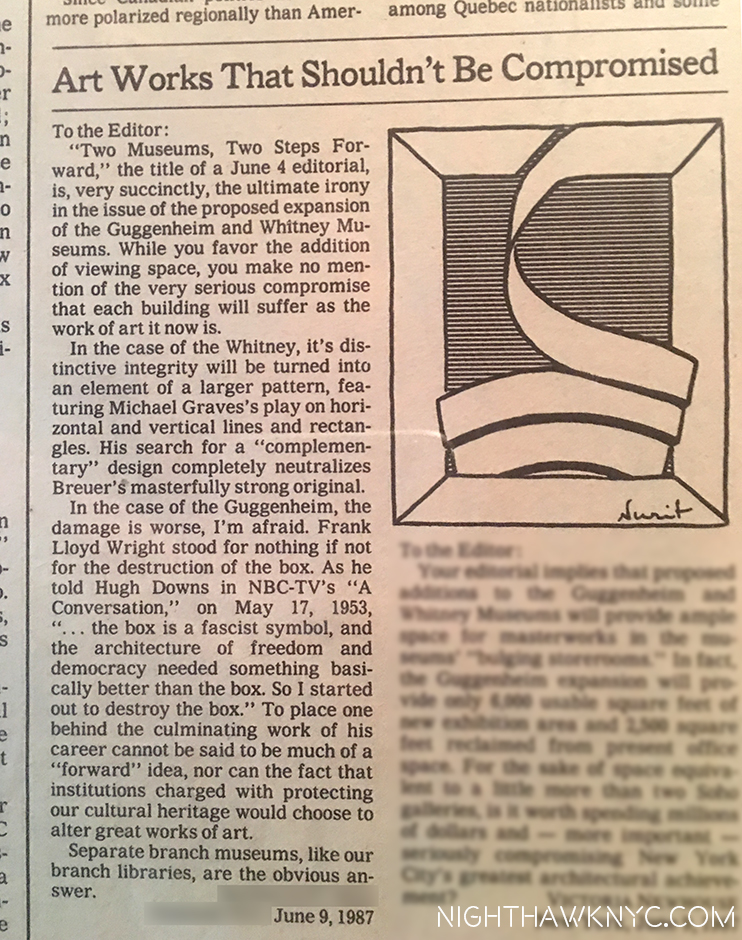
Speaking of “not being in the City,” though Wright has only one building in NYC, that’s not because he didn’t try. Though he loathed cities, particularly this one, he did. He designed many structures that he wanted to have built here but he was shot down by the powers that be every single time4! Only when he had a client powerful enough to push through his project did the Guggenheim get built. MoMA’s show serves as a reminder of this nightmare as it shows us some of the projects he envisioned for the City, along with an in-depth look at the Guggenheim’s coming to be. It, therefore, serves to remind us that the travails of that other brilliant Architect named “Frank,”…Gehry, has had getting projects built here are nothing new. To date. Mr. Gehry, who has tried to get countless plans built that would have transformed the City, to date has only two. Between Wright & Gehry? Ohhhh…the City we should have had.

Rendering of the New York Sports Pavilion, for Belmont Park, 1956 , another of the countless structures Wright designed for Manhattan that were never built.

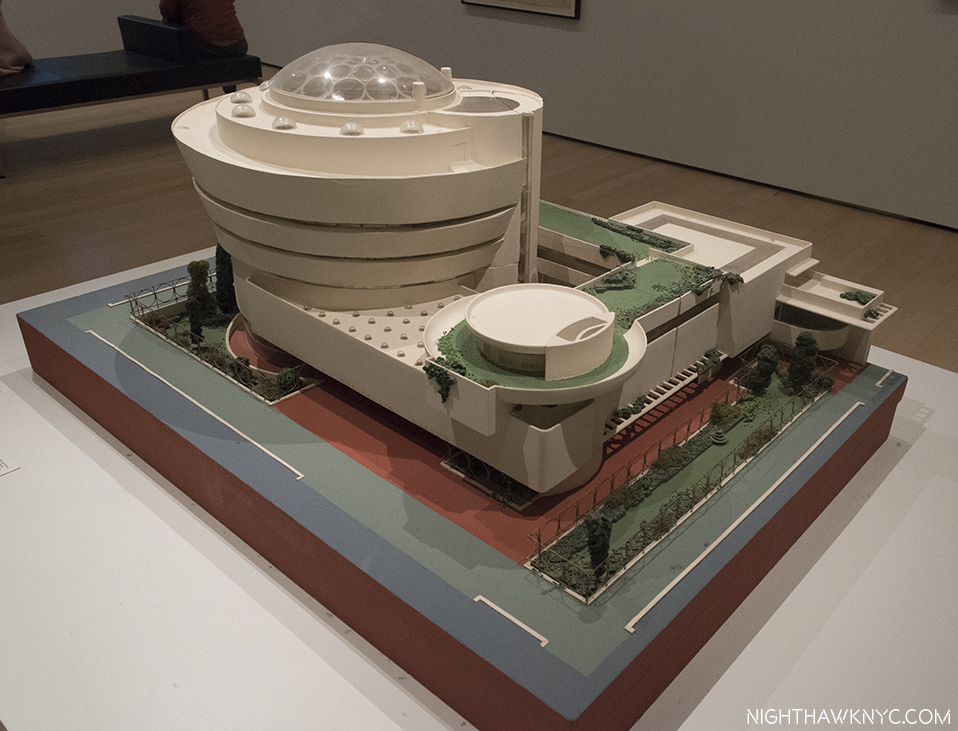
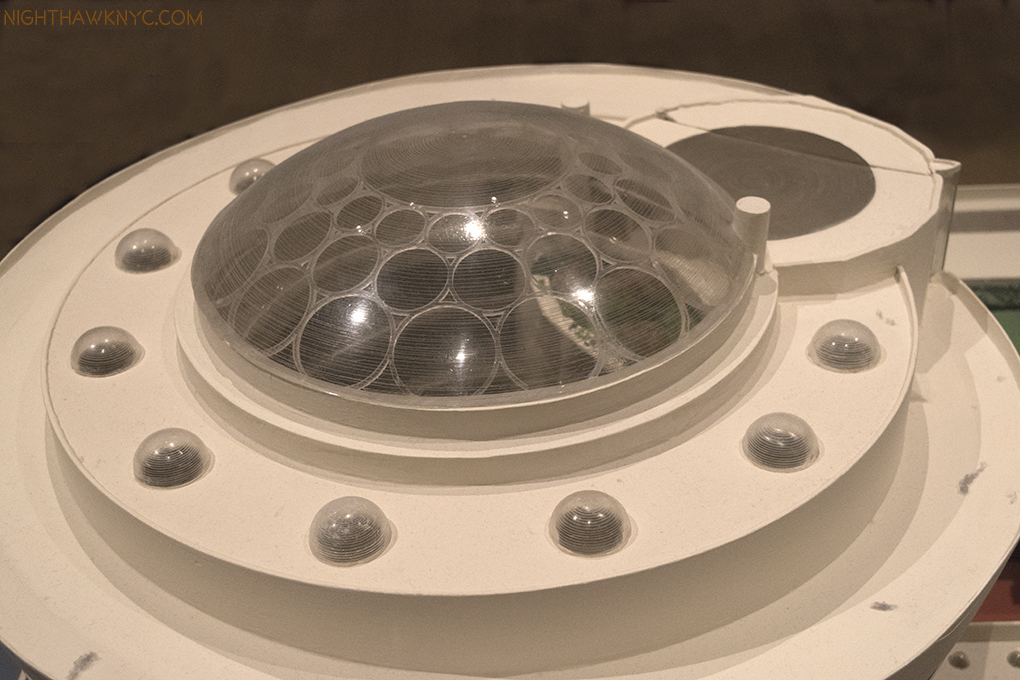
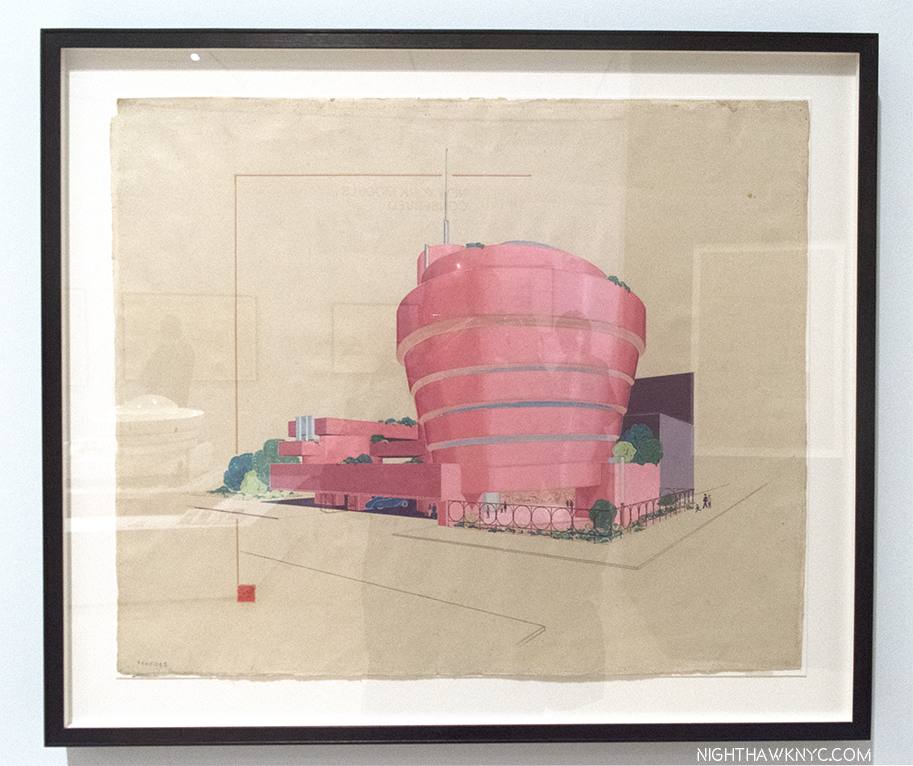
As his only NYC building, the Guggenheim Museum it is still able to inspire with its incredibly bold vision almost 60 years on. It echoes the trees across 5th Avenue in Central Park as a way of bringing a hint of Nature across the street into the City. But, lesser known is the building as we see it now went through quite a metamorphosis on the way. Take a look at this-

The Guggenheim Museum underwent extensive design modifications between this model and the finished building. Looking at it from the 5th Avenue side, very little is the same besides the ramp/rotunda (though here it’s located on the East 89th Street corner, instead of the East 88th Street corner, to the right, as it was built), and the lower overhanging floor. Everything else is different.

This detail fascinates me. It shows Wright’s rarely seen original design for the roof, most notably the skylight over the famous rotunda. The variously sized circles make much more sense to the overall composition than the grid that’s up there now, since so much of the composition involves circles (right down to circles being etched on the sidewalk out front). Of course, the Guggenheim chose to ignore all of this when they put a square building behind it. I wonder why this design was not used. Nor were the surrounding small domes.

The rotunda is now on the right in this rendering, done to demonstrate how it would look in pink. Yes…pink! Still, along with the final color, so much about the building remained to be finalized even here.

The Guggenheim didn’t follow through on all of Wright’s ideas when completing the building (which may, or may not explain the current skylight). So, perhaps, it shouldn’t be a surprise when the Guggenheim was altered in the early 1990’s, terribly in my opinion. I was actively involved in trying to prevent it, and the modification of the Breuer Whitney Museum (now, unmodified, it’s The Met Breuer). To that end, in June, 1987, my letter was published in the New York Times-

My letter in the NY Times Op-Ed page opposing the & Guggenheim & Whitney modifications, June, 1987. I love the very fitting Drawing they added.

“So long, Frank Lloyd Wright.
All of the nights we’d harmonize till dawn.
I never laughed so long.
So long.”*

Today, are there ANY Architects who are also designing the dishes, rugs, windows, lamps & furniture for their buildings on a regular basis? Having owned an original Frank Lloyd Wright chair I can attest to both the ingenuity of the design (though “impractical” most people who saw it said, its 3 legs required you to sit with both feet on the floor, or fall off. Wright teaching proper posture), and to the fact that it was in itself a miniature work of Architecture. When I thought of Wright, I thought of Brahms, Mahler or Anton Bruckner (all of whom were alive during Wright’s lifetime) or his beloved Bach & Beethoven. Wright was building symphonies in the physical world. The extraordinary attention to detail in his work- down to even designing the napkin rings at “Midway Gardens,” is something akin to the musical structure of any of those Composer’s compositions, where every note plays a role in the whole. Wright creates a unified physical structure that is hard to find in any other Architect’s work- before or after. Music was the only analogy I could think of for what he had done. At least for me. I think he may have agreed- music was always central to him, particularly chamber music, which he would have weekly performances of at his Taliesin homes. It was hard for me to understand my fascination & obsession with all things Frank Lloyd Wright until I realized what he was doing was creating buildings the way Bach, Mahler or Bruckner created “edifices in sound.” Wright loved music and the connection is something that needs closer study.

Like Picasso, or Miles Davis, he was not one to stay in the same place for long. They are the only two other 20th Century Masters who had multiple unique “periods.” Wright’s style continually evolved, but it were always true to his principles- using nature as the supreme guide, building in harmony with the site, and building “organically.”

Approaching age 90, Wright unveiled one of his most daring ideas yet- “The Illinois,” perhaps better known as the “Mile High Skyscraper,” because that’s what it was- a mile tall. A number of Drawings related to it were on view at MoMA, five about 8 feet high each.

8 foot tall rendering of The Illinois, 1956. Wright’s “Mile High Skyscraper.” Designed to be made of concrete, some doubt its feasibility. It would have been FOUR times the height of the Empire State Building!

Interestingly, in one Drawing, the “Mile High” shares the sheet with extensive text. The curator’s video in the gallery says this Drawing is his second “Autobiography,” to the book of that title. On it, Wright pays tribute to his influences, and proceeds to list some of his accomplishments. As a result, it’s perhaps the most fascinating Drawing in the show. Its something of a testament. It’s hard for me to look at the “Burj Khalifa” in Dubai and not think its Architect, Adrian Smith of S.O.M., owes a serious debt to The Illinois. It’s “only” 2,722 feet tall, though, half of the proposed height of The Illinois.

Wright’s “salutations,” list of accomplishments, and building stats on the top half of another 8 foot tall Drawing of the “Mile High.”

One striking thing about Frank Lloyd Wright is that at the time of his death on April 9, 1959, Frank Lloyd Wright was exactly half as old as his country. (He was 91, the country was 182 years old.) Remarkable. When Wright started in Architecture, working for Joseph Silsbee in 1872, he did so in a Chicago that was still digging out from the Great Fire the previous year. There were no skyscrapers until his “Lieber Meister” Sullivan began to create them 20 years later. When he passed away in 1959, one of his final masterpieces, the Guggenheim Museum was about to open. Much had changed in the 87 years between. But, given that he stayed true to his core belief in “Organic Architecture,” (“building as nature builds,” he said), I’m not sure that Wright changed all that much as much as he evolved. As a result, in the final analysis, he showed us that his idea was infinitely pliable, and that creativity and imagination had a central role in it, something that seemed to go out of Architecture, increasingly, during that same period. While some of his greatest works are gone, his Archives contain an enormous wealth of materials that can bear witness to them, and the thousand or so projects he undertook (about 400 or so still stand). It was a lot for one life- even one that lasted 91 years.

Frank Lloyd Wright during the “Mike Wallace Interview,” 1957, near the age of 90, two years before he passed away.

“So long, Frank Lloyd Wright.
I can’t believe your song is gone so soon
I barely learned the tune
So soon, so soon”*

As I left this show, filled with that same, familiar, head-shaking amazement, I was reminded of a quote of Wright’s- “The scientist has marched in and taken the place of the poet. But one day somebody will find the solution to the problems of the world and remember, it will be a poet, not a scientist5.” Whether the world will listen to the next poet is a question that remains to be answered. In the meantime, with regard to this poet, there is much still to learn.

“Frank Lloyd Wright at 150: Unpacking the Archive” is my NoteWorthy Show for September.

*- Soundtrack for this Post is “So Long, Frank Lloyd Wright,” by Paul Simon, which is, also, something of his farewell to Art Garfunkel as Garfunkel was about to leave to go to Mexico to shoot Catch 22, which marked the end of Simon & Garfunkel. Garfunkel majored in Architecture at Columbia, admired Wright, and suggested to Simon that he write a song about the Architect. Published by Universal Music Publishing Group.

On The Fence, #14,” the Stair way to Heaven Edition.

You can now follow @nighthawk_nyc on Instagram for news and additional Photos!

NighthawkNYC.com has been entirely self-funded & ad-free for over 7 years, during which over 275 full length pieces have been published! If you’ve found it worthwhile, PLEASE donate to allow me to continue below. Thank you, Kenn.

You can also support it by buying Art, Art & Photography books, and Music from my collection! Books may be found here. Music here and here.

Written & photographed by Kenn Sava for nighthawknyc.com unless otherwise credited. To send comments, thoughts, feedback or propositions click here. Click the white box on the upper right for the archives or to search them. Subscribe to be notified of new Posts below. Your information will be used for no other purpose.

  1. Kliment Timiriazev
  2. Eight of the other eleven volumes are monographs dedicated to period of Wright’s career, the remaining 3 volumes contain preliminary studies, which I assume are part of his Archives. These books were the only way most of us could see these pieces of the Archives, except for occasional shows, until now.
  3. Controversy still surrounds whether he left or was fired by Sullivan for taking freelance commissions on the side.
  4. To read this very sorry tale, in detail, I highly recommend the book “Man About Town,” by Herbert Muschamp, who details Wright’s plans for Manhattan and efforts to overcome the powers that be. i.e Robert Moses.
  5.  As quoted in “The Star,” 1959, and “Morrow’s International Dictionary of Contemporary Quotations,” 1982, by Jonathon Green.

About My Art Show Posts…

This site is Free & Ad-Free! If you find this piece worthwhile, please donate via PayPal to support it & independent Art writing. You can also support it by buying Art & books! Details at the end. Thank you.

Written & Photographed by Kenn Sava.

There are so many writers who write about shows immediately as they open, and that’s great. It gives people an idea if they want to see them or not. As you may have noticed by now- I’m not one of them. Many (most) of my Posts on Art shows appear after the show closes.

Why?

If a show is large, there’s too much to see in one visit for me to do it justice. I only scratch the surface of it the first time I see it. If it’s over 100 pieces, I’ll typically do a walkthrough to get “the lay of the land,” so I can strategize how to approach seeing it in full, based on how long it’ll be there. I prefer to see larger shows in sections.

Just keep moving towards the light. April Gornik @ Danese Corey

I find it takes me time to see Art. To see 100, 200, or 800 pieces? That takes me A LOT of time, and visits. In such cases, I’ll go and see it as many times as I can. While many shows have some works that may be familiar from books or photos, no matter how much Art you’ve seen, most of the work on display in any given show are pieces that are either not famous, rarely seen, unseen, or new. Also, great curators hang shows in unique ways and combinations that need to be appreciated and pondered on their own. Beyond all of this, really good Art rarely reveals all it’s secrets in one viewing. I find that Art I especially admire says something new, or something different, to me each time I see it. Given the high prices of Art these days, there is no other way to see these works, unless they are publicly displayed. Therefore, making multiple visits is as close to “living with the Art” as I’ll ever get. Often, while I start writing about a show while it’s up, the real work begins once I can no longer see it and I have time to let the dust settle, and see what remains.

Outside Alexi Torres‘ excellent show @ UNIX Gallery in 2016.

On the other hand? If I don’t like a show? You’re not going to read about it here. The same applies to music. This has always been my policy, even when I was writing for a national music magazine. There’s too many great things around to waste time and space writing about things I don’t like. Besides, I also believe that “Someone who loves something may know more about it than someone who doesn’t.” So? I prefer to revisit whatever it is I don’t like on another day. Maybe I’ll “get it” then. (But? Yes. There are things I can’t stand that I know I will never come around about!)

Outside “Jeff Elrod” @ Luhring Augustine. I walked through that door quite a few times while it was up.

It further seems to me that once a show is over, it’s gone. It only continues to live on in the show’s catalog (if there was one), and whatever was written about it or posted online. Therefore, my aim is to Post something as substantial as I can about the shows I write about, to that end. Most people don’t live in or near NYC, and so, will have missed much of what goes on here. Hopefully, these will provide a bit of a sense of what the show was like.

The Skylight @ Matthew Marks Gallery

This is the approach I’m taking in this Blog. So be warned- My Posts aren’t meant to be the “This just opened,” type.

A Skylight @ The Met. At night, when I’m usually there.

Sorry, Jeff!

The bottom line is that while some shows may still be up by the time I get my Post about them up. Increasingly? They are not. Even a long running show like “Unfinished,” which opened on March 8, 2016 (to members), and only closed on September 4, 2016 ended TEN DAYS before my Post was finished! I find that I’ve been spending months doing additional research about the shows, and Artists, I’m working on writing about, but I never read what anyone else has said about something I’m going to write about. I research the Artist, what they’ve said, or written about the work, and what was going on before and during the period they were creating the work being displayed. And this is taking more time than I expected it to. Even with Artists I have been looking at for a long time- like Robert Rauschenberg & Frank Lloyd Wright, who I’m currently working on.

February, 2015. It’s good to be Home. 1,500 visits to The Met later I’ve spent more time there than I have at all but 2 places I’ve ever lived in.

Most of what’s out there doesn’t speak to me. Much of it is decorative, which is fine, but it’s not for me.

“It has to go with my wallpaper.” Yes. I’ve actually heard prospective buyers say this in Art galleries.

With so much going on, I’m lucky if I can keep from missing something great, which, unfortunately still happens no matter how hard I try to keep it from happening.

The fliers for old and new things going on are probably inches thick on this wall. No one can see everything going on in NYC.

These Posts are more meant to be- “This was here, and here’s a bit of what it was like, and what remains with me.” So, buyer beware!

Until the next time I darken your gallery doorway, again.

Thanx for your understanding.

Have a great night,
Kenn.

On The Fence #10, Him, again, Edition “

*-Soundtrack for this Post is “I’ll Remember You,” by Bob Dylan.

NighthawkNYC.com has been entirely self-funded & ad-free for over 8 years, during which 300 full length pieces have been published! If you’ve found it worthwhile, PLEASE donate to allow me to continue below. Thank you, Kenn.

You can also support it by buying Art, Art & Photography books, and Music from my collection! Art & Books may be found here. Music here and here

Written & photographed by Kenn Sava for nighthawknyc.com unless otherwise credited. To send comments, thoughts, feedback or propositions click here. Click the white box on the upper right for the archives or to search them. Subscribe to be notified of new Posts below. Your information will be used for no other purpose.

Cancer Saved My Life

This site is Free & Ad-Free! If you find this piece worthwhile, please donate via PayPal to support it & independent Art writing. You can also support it by buying Art & books! Details at the end. Thank you.

Written & Photographed by Kenn Sava.

I grew up in a pre-determined life.

An empty lot? No, this is the box I grew up in. Click any image for full size.

I existed to follow in my father’s footsteps. The problem was that I had absolutely no inclination, or desire to do so.  Right through high school graduation there was never one iota of thought or discussion given to thinking “he might want his own life” by my family. After I escaped, by going on the road with a band, my family actively worked against my efforts trying to force me to come back to their plan. I disowned them in 2005. Lots of lonely holiday seasons have followed. By then, the die had been cast. I wound up knee deep in a career I never wanted to be in just to survive.

I know how he feels.

Finally, I dug myself out and got back to having a career in music, which went very well, until I got fed up with the record business (back when there was a record business), but that’s a story unto itself. Then, in 2007, I was diagnosed with cancer. I got the news, the results of my biopsy done the previous week, over the phone while I was sitting in my office.

“How was your weekend?,” the doctor asked quite casually. “Good,” I said. “That’s the good news. The bad news is that you have cancer,” were his exact words.

Time stopped. The clock read a little after noon as I recall.

I could see the blurred shapes of my coworkers walking in front of the glass walls of my office who’s door was closed, but, after those words, that room symbolized how I felt. It felt like I was in this box surrounded by immediate circumstances- this diagnosis and my job. It felt like a room I’d never been in before. The world was going on outside of it, beyond the glass walls. I could see out the window across the hallway and see sunlight coming down the narrow street, shining on the windows on the other side, a few hundred feet distant.

I was in a different world now.

No stranger to spending a lot of time alone, I was now in a  world inside myself, more fully than I had ever been before.

After giving me my diagnosis on the phone, he said you really should come in to talk. “Yeah. I guess so,” I remembered saying. I was barely listening at this point. Disbelief is the first thing that hits you.

A few days later I went to meet with him, he sat down, and said to me “I had to show your slides to my colleagues. We’ve never this before.”

Huh?

What could possibly be worse? To get a diagnosis with cancer, THEN the doctor tells you “we’ve never seen this before.”

!?

Apparently all 15 of my biopsy cores came back with cancer. I asked “Are you sure those are my slides?” He said yes, and I don’t remember anything of the meeting after that. It was like a window shade rolled down over my mind after that, like it had been glazed over. I walked out of the hospital, in a daze and crossed insanely busy Park Avenue (which runs both ways) a few hundred feet north of 14th Street in the middle of the day without even looking to see if traffic was coming! Somehow I made it across to Union Square. To this day I have no idea how I got there. I walked back to work at 2 PM. My boss, Rob, who would become a good friend, and the only one I had told at work, came in and sat in my office, he looked at me and asked me if I was OK. I don’t remember responding, just sitting there in that space deep inside of myself still in shock.

Cancer? And? It’s bad?

I’ve never really been sick a day in my life. I’ve never had surgery. I’ve never spent the night in a hospital. There was no cancer in my family. I broke a bone in my hand once, I messed up my knee a little bit, I destroyed the hearing in my left ear playing in the band, and I destroyed my feet wearing rock ‘n’ roll shoes onstage made by the guys who made Kiss’s famous boots. That’s been the extent of my health issues in my life. To be diagnosed with cancer, and have to work your way through the biology, the medicine, the treatment options, the incredibly incomprehensible technology, and try to figure out, alone, what is the best treatment for you, is the hardest thing I’ve ever had to do.

Shock was the first stage for me, and it was quite a while before I got over it. Looking back now, it was years before I got over the shock that yes, I have cancer. Growing up, cancer was a death sentence. One thing I learned that even then, in 2007, most people I eventually told, treated me like I was going to die.

I was alone as I’ve ever been. Why is there even a light on?

Given all my responsibility at work, I didn’t say a word to anyone else there about any of this. A few days later my boss, Rob, came in and announced he was leaving. ! What? Are you serious? He got a better offer. The owner of the company, who still didn’t know, wound up giving me his job. He was the CFO of the 3 corporations with offices in 3 states! He was making $150,000 more than I was making. I was the Controller, but I wasn’t a CPA, which he was. And? I didn’t get a raise.

I had to deal with researching treatment options, not to mention the strain of being newly diagnosed with cancer, while learning his job, at the end of the year with a financial closing period looming for three corporations. I don’t know how I got through all of that. I had two full-time jobs. Learning about cancer, looking for doctors, and researching treatment options, side effects and outcomes, was the other full time job.

Well? At least I didn’t have to worry about “celebrating” the holidays!

I did my due diligence, learned as much as I could, got four opinions, and then decided on the treatment. And then? Every cancer patient’s worst nightmare happened. I picked the WRONG treatment. I chose to have hormone therapy followed by two types of radiation treatment. That’s 3 treatments. Why? Because I just didn’t want to have surgery. People die during surgery.

So, at peace with my choice, that I had avoided surgery, I went back to the hospital to begin my treatment. The doctor who had diagnosed me and called to give me the news sat nearby holding the needle with the hormones in it about 2 inches from my left arm. He said, “You know you’re not going to have any libido for twice as long as you’re going to be on this, right?” The treatment was scheduled to take 2 years. So? That was four years. “Um, what? No. I didn’t know that.” I had asked the question during the original meeting, but didn’t ask the right follow up question. Uggh!

I stopped him. He, basically, saved my life right there.

I went home devastated. After all of this, all of these opinions, all of this research I had made a mistake!

The writing on the wall SCREAMING at me. These letter are about as big as the mistake I made.

This treatment plan was chosen for the WRONG reason- basically, for my comfort. Since it wasn’t surgery, it was in my comfort zone. Ok. So? Now what, Kenn? The cancer is still here.

I had no choice but to start over. Square one.

Going to back to the beginning, I had to face that the most basic fact was the one I wasn’t focused on COMPLETELY. And that is-

Cancer was trying to kill me. This was WAR.

I then asked myself a hard, fundamental and essential question- What do you want to accomplish through treatment? There was only one answer. Get ALL the cancer out of my body as quickly as possible, via the means with the longest track record of proven results. By that I mean long term survival rates free of cancer.

A woman reached out to me online to tell me about her husband’s story. He had been treated and it hadn’t gone well. He had bad side effects after, and both of their lives were now negatively impacted, every day, by them. Then, she said, “If I had to do it over again, I’d insist he go to Dr. Samadi.” Who? He’s a surgeon. Since my treatment choice had turned out to be WRONG, I decided to consider surgery even though, yes, “people die during surgery.”

Umm..? People die from cancer, too, Kenn! MANY more people.

You want your best chance of getting cancer out of your body and possibly beating this horrible disease? Surgery was my best choice. (Mine. Every diagnosis is different. I am not a doctor and I am certainly not giving medical advice here. What worked for me may not for someone else. There are side effects from any treatment, and they are just one factor that needs to be carefully considered.) I was still young enough that if surgery didn’t work I could have radiation treatment(s) after. In my case, I couldn’t do it the other way around. I posted on a cancer support website asking who other patients thought was the best surgeon in NYC. About 20 people responded in 24 hours. Dr. Samadi got 3 votes. No one else got more than 1. The next day Dr. Samadi, himself, contacted me through the website.

“Hello. With your diagnosis, I can treat you and your prognosis will be excellent.”

Huh? What “good” doctor is on the internet looking for patients?

I didn’t respond. My bias against using the internet for this returned. What was I thinking looking for a cancer doctor ONLINE? The road to help, and an answer, felt endless…cold, lonely. It was November, outside and the dead of winter in my soul.

Life lies dormant on The HighLine in February. The path stretches far out ahead into the cold night…

About this time my friend, Fluffy, told me to try Columbia Presbyterian. President Clinton had been treated there. So? Being as Dr. Samadi was there, and with these other recommendations, I decided to call his office.

No one returned my call. ?

I decided to finally write back to him and tell him I tried. He said, “I’m leaving on a trip tomorrow at 1:30pm. Just come to my office and I will get you in.” Without an appointment? Again, irregular. But? Ok. I did. He did. Opinion #5.

I was impressed with every thing about him. He told me he could give me a triple golden outcome (i.e. be free of cancer with neither of the two most serious side effects, i.e. incontinence, impotence). An expert in the (then) new robotic surgery, he also had had state of the art training, and experience, in the two other, time tested types of surgery. Should the robot somehow fail, he could switch to one of them without missing a beat and complete the operation. No other doctor I knew of in NYC could do that. He had treated many patients successfully (I would speak to some). He seemed to have every base covered. The robotic surgery seemed to promise minimal incisions leading to a quicker recovery. I left feeling I didn’t want anyone else to touch me. I realized later that that feeling of ultimate confidence is something you MUST have in a doctor you choose to treat you! I decided then and there to make an appointment to have Dr. Samadi operate on me. I had done a 360 on surgery. Let’s go! It was the third week of November. The earliest appointment was in March!

What? Let me get this straight-

He’s booked FOUR MONTHS in advance AND still took time to find me online and offer his help (to me)? Wow. Now? I was in awe. It felt like a hand had come out of the sky and plucked me out of the worst nightmare of my life. “Just get on the schedule and I will move you up,” he said, as my condition required quicker treatment.

He operated on me on February 7, 2007. 10 years ago today.

4 hours later, my eyes partially opened. The bottom half of my closed eyes revealed light. I slowly opened them more. There were trees, branches and sunlight. Where was I? It was early February. This wasn’t winter. This was spring. Around this narrow opening of light, it was all darkness. Just a narrow rectangle of light in the lower center.  It didn’t look like the famous “tunnel” near death experience survivors speak about. But, there was a center section of light surrounded by blackness.

Passing this doorway this week uncannily reminded me of “waking up” that day.

I laid there for over an hour and a half before anyone came over. I was in the recovery room. At least that’s where I was told I was. The light was from an open window about 100 feet across from me. I wasn’t sure I was alive.

To this day? Part of me feels like I died on that operating table on February 7, 2007.

In many ways, my life did end that day. As I realized that, I started thinking of my “new life” as having begun that day, too.

So, today? I’m 10 years old.

The part of my life that DID die from cancer? Ok…

I had no wife, no girlfriend, no family, no kids, no one I could see on a daily basis, there was almost no love in my life. Most of my friends took off after I got sick. The girl I had been seeing did me three days before my surgery, then I didn’t hear from her for four months. Until she sent me a card. A card? You live two blocks away from me. You’re the closest person I know in the whole world to where I live. I’m getting through my recovery alone, in a 4th floor walkup, with no one to help me. And, you send me a card?

She wasn’t the only one.

My “best friend” of seven years pulled up shop in New York and decided to move home to Indianapolis, Indiana. She went to see a friend of mine at a bar the night of my surgery when I was lying unconscious in the hospital. She told him she was leaving in the morning. He asked her, “Are you going to say goodbye to Kenn?” She said “Yes.” She never did. She left town and never even said goodbye to me. I was hoping and expecting she would help me over the next couple of weeks.

One of the first things cancer taught me was it made me realize that the two or three friends I had left were my real Friends (cap, mine, as I am wont to do in this Blog). Forget the online nonsense of what people call “friends.” How dare they use that word! I KNOW what a Friend is. I learned the hard way. When push comes to shove, When the stuff hits the fan, and all bets are off, like the soldiers talk about “in their foxholes,” you’re lucky if you have two or three people by your side. That was the first major lesson I learned.

The doctor who diagnosed me told me I had a 20% chance of making it through year 1 after treatment without needing additional treatment. Today, I celebrate TEN YEARS without addtional treatment!

But? Early on? I was sure I was a goner. That 20% quickly flipped in focus to 80% against.

I decided to sell everything I owned and make preparations for “the end.” I lived like I was going to die. My assistant at work forced me out of my job while I was laid up in bed, so I left my job of 10 years, and the career I never wanted, to focus on my recovery. After I did, I took stock of my life.

Almost everyone was gone. My career was gone. My former boss, now friend, Rob used to ask me, “What are you doing in this job? You’re a creative guy.” It hit me pretty hard. I didn’t have an answer for him, until life handed me the answer. My cancer was gone (at least until my next test). What am I going to do now?

I decided to take care of myself. Complete my recovery, and live being myself- 24/7. Crazy, right? Who does that? 10 years later, I haven’t looked back. (Yet.) It’s pretty scary, though. I can’t say I don’t worry about the future. Then again? Who doesn’t?

Yes, someone is sleeping in the doorway of this gallery.

So? Yes, a fair amount of the life I knew did die on February 7, 2007.

The second big thing cancer taught me was what REALLY MATTERS in life.

Are you ready?

I realized that ALL that matters in life is Loving and being Loved.

Read that again. I’ll wait.

That’s all. Period. End of sentence. Goodnight! Get home safely.

But, having no love in my life? Being a “get it done” kind of guy. I decided I could “get it done” and find love. I spent most of the next 5 years looking for love- E V E R Y W H E R E. What I re-learned was that “finding love” is impossible. Love isn’t something you can “find.” It just happens. Or? It just doesn’t happen. Finally? I decided to love myself. It was all I had left.

“The words of the prophet are written on the subway wall,” Paul Simon once sang. Or? A block away.

Besides? If you don’t love yourself, who will?

Of course I’ve been very lucky, and have so very much to be thankful for. I have been trying to practice mindful giving thanks from moment to moment. Having cancer, also, puts you in touch with the cancer community. I heard a lot of stories. Many terrible. Many inspiring. It’s miraculous, to me, that anyone survives cancer, given how it was when I was growing up. I’ve watched some dear people die from it. I’ve talked to quite a few people who didn’t have good outcomes- either from complications from their treatment, or from cancer returning and spreading. The cancer community is, also a wonder. Survivors like the author Musa Mayer, (who is “also” the great Philip Guston‘s daughter) have forged new paths in cancer advocacy and given hope and support to countless others in ways that didn’t exist when I was diagnosed.

I was privileged to be in the presence of Musa Mayer a few weeks ago as she spoke about her father’s, Philip Guston’s, work in the Nixon Drawings show @ Hauser & Wirth.

Beyond them, to say I’m grateful to the doctors who treated me and saved me 10 years ago is a huge understatement. Recently, I had the honor to meet another one who’s on the front lines right now, Dr. Melissa Pilewskie at Sloan Kettering Memorial Cancer Center. Listening to her, I couldn’t help but marvel at her inner strength, and those of my doctors. She told me that as a surgeon she has treated 2,000 patients in 5 years. That’s 400 a year. There’s only 365 days in a year! Ok, Dr. Pilewskie is obviously a world-class doctor, with an extraordinarily rare skill set. I couldn’t help but wonder…where does this young lady get the inner strength to deal with cancer patients all day every day? Let alone to deal with them so well. It was a humbling experience that reminded me of the debt I owe the doctors who treated me. On my 10 year anniversary, it was also an insight into how far cancer treatment has come in my lifetime, and continues to progress, and a reminder of how many very special people are in there fighting tooth and nail to treat, beat, and even cure cancer. This isn’t a “job” to them. It’s their mission.

THANK YOU! And, bless you all.

If you get diagnosed with cancer (PLEASE, no!), you now have a great chance of being treated, and then get to go on with your life. My advice to you is- Get the best doctor your insurance will cover and get treated. Go for your follow up tests, religiously. For everyone else who doesn’t have cancer? Catching cancer early really is your best chance to beat it. Don’t miss those checkups! That’s how mine was discovered, my life saved.

The big reveal from my experience with cancer is that cancer wound up forcing me to have the life I always wanted to have.

Finally.

No one lives forever. I was living my life like I was going to live to be 200, and everything I REALLY wanted to do, I would get to one day. Well? One day is N O W. That’s why I have this site. That’s why I spend my life going to see Art 6 days a week, taking photos and listening to music. I can’t wait for “one day” anymore. Damn the expense (which goes up every minute)! Damn the later impact on my life (he says now)!

If I don’t do this NOW? WHEN am I going to do it? I don’t know if any of this would’ve happened if I didn’t get cancer.

After I started to recover, I had some of those plastic bracelets made for my site before this one. I was writing about my daily experiences with cancer, in an effort to give others who were newly diagnosed some information through sharing my experiences, because at the time no one else was doing it. On them, I had three phrases engraved. One was

Get tested

The second was

Get treated

And finally-

LIVE YOUR LIFE!

They were there as a reminder to myself, a mantra, as much as what I’d learned.

Close, and seeing this this week was a coincidence, and a reminder.

Early on my friend and cancer survivor, Stephanie 2, told me that cancer “would change my life in ways I could not imagine.” She was right. My experience with cancer challenged me in more ways than any other. In the end? It challenged me to face myself. To love myself and to be myself, fully, no matter what.

I’m not grateful for cancer. I HATE cancer. It’s taken the lives of friends, acquaintances, and many I’ve admired from afar. It’s cost me parts of my body I really didn’t want to lose.

In the end, I’m more grateful for life (than what it cost me to have it). For the chance to change the course of my life, and finally live the life I always wanted to have.

Ok, so cancer didn’t really “save my life.” Doctor Chuey, Doctor Dinlenc and Doctor Samadi did. I used cancer as a wake up call to save myself after they did.

So?

Life, in February. The High Line, February, 2017.

I hope you’ll join me in celebrating my 10th Birthday.

If I’m actually still alive.

———-

With my undying thanks to those who saved me-

-Dr. David Samadi

-Dr. Caner Dinlenc

-Dr. John Chuey

-Helen Petrocelli, RN

-The staff of Columbia Presbyterian Hospital

To those who stood by me-

-Fluffy

-Rob

-Kevin- Thanks for the ride home

And, with my thanks, and admiration to fellow cancer survivors, patients, and a professional-

-Stephanie 2

-Dave (R.I.P)

-Kitty

-Mrs. Kitty

-Mrs. Fluffy

-Musa Mayer

-Sv

And,

-Dr. Melissa Pilewskie

I took all the photos appearing in this Post over the first six days of February, 2017, except the photo of Musa Mayer, on January 10, 2017.

*- The Soundtrack for this Post is “Accept Yourself,” by The Smiths (who you can watch perform it in 1983!, below), written by Morrissey & Johnny Marr. Morrissey was 23, or 24 when he wrote this. Astounding. Its lyrics just fit-

NighthawkNYC.com has been entirely self-funded & ad-free for over 8 years, during which 300 full length pieces have been published! If you’ve found it worthwhile, PLEASE donate to allow me to continue below. Thank you, Kenn.

You can also support it by buying Art, Art & Photography books, and Music from my collection! Art & Books may be found here. Music here and here

Written & photographed by Kenn Sava for nighthawknyc.com unless otherwise credited. To send comments, thoughts, feedback or propositions click here. Click the white box on the upper right for the archives or to search them. Subscribe to be notified of new Posts below. Your information will be used for no other purpose.

The Rothko Chapel, Chelsea

“I became a painter because I wanted to raise painting to the level of poignancy of music and poetry.” Mark Rothko.

I could sit there for a month. One of the infamous "Seagrams Murals," 1959. Rarely seen.

Seagrams Murals, Section 6, 1959. One of the infamous murals for the 4 Seasons Restaurant, but never installed there.

Lines to get in are nothing new in New York, or in Chelsea, home to some of the most “happening” nightclubs in the City. But a line to get in at 2 or 3pm in the afternoon is rare anywhere in NYC. Even rarer are lines to get into an Art Gallery at that hour- unless it’s late in the run of a “must-see” show. But, the line filled the lobby and extended out the door at the extraordinary Mark Rothko: Dark Palette show which only opened the day before at Pace on West 25th Street. Five years in the making, and focused on exploring one aspect of his work, don’t bother asking for the price list, it’s also unusual for a gallery show because none of the work is for sale. Darn! What will I do now with that spare 90 million dollars?? Maybe I’ll open some grocery supermarkets with reasonable prices most neighborhoods in Manhattan desperately need.

3pm November 5. The crowd in the lobby waits.

3pm November 5. The crowd waiting to get in fills the lobby. Buckle up! It’s only going to get more crowded.

When it comes to writing about the work of Mark Rothko, I have to say up front that it’s very hard for me to be unbiased. Mark Rothko’s Art changed my life. In 1999 I saw his Retrospective at the Old Whitney (now TMB) the final weekend it was there. It was one of the unforgettable experiences I’ve ever had at an Art show, and it was perfect timing, given the roadblock I had hit with record companies in trying to get my records released unaltered, I then decided to turn (back) to Art History, my first love. Thank you, Mark Rothko.

dsc_0040pnh

dsc_0113pnh

Let’s get lost. This is how I prefer to see Rothko. Each work can be seen on it’s own. Getting close to feel engulfed by the work is good, too.

There have been Rothko shows in NYC since 1. But, none of them have yet matched the feeling I got from the 1999 show- aided in no small part by the way the works were hung, the way the show moved through his career. I’ve longed for that feeling ever since. At long last, here it is. The “dark” works have a unique mystery among Rothko’s work, and are a terrific choice for a theme. While some see them as “depressing,” (including a lady mentioned in the show’s introduction card who rejected one that Rothko had painted for her for that reason), I find them to be among his most powerful, subtle, even, yes, poignant pieces. While it’s always great to encounter a Rothko in a Museum, they’re usually hung among the work of others, which I find a bit distracting, For me, Rothko needs to be seen and experienced in a “vacuum,” or with only Rothkos nearby. Few institutions have that many Rothkos, and given their popularity, it is very hard for them to part with them and disappoint their visitors, even for a couple of months.

Worshipping at the altar?

Worshipping at the altar?

Luckily, two of the very few people who do have some, the offspring of Mr. Rothko, Dr. Kate Rothko Prizel and Dr. Christopher Rothko, have gone above and beyond to support this show. A number of the works on view come from their collections- by my count, no less than 4 from Kate’s and 2 from Christopher’s, in addition to “Seagrams Mural, Section 6” which they jointly own. That’s 7 of the 21 works on view- one third. (Christopher Rothko, by the way, is the author of one of the very best books on his father there is- Mark Rothko: From the Inside Out.). To help facilitate the loans of 3 pieces from major Museums, the Rothko “kids” loaned the institutions works from their own collections so the institutions would still have Rothkos to show their visitors, and enable them to part with the works requested for this show. Remarkable. Dad would no doubt be proud. With 21 “dark” works, the majority of which are out and out masterpieces in my estimation, including some stunning works on paper mounted on canvas, the results are as close as there has been to a truly “must see” show in Chelsea in years.

Someone else...

Someone else…

That said, it was only a year and a half ago that another show in this same space left me transfixed and provided many hours spent in sheer meditative bliss- by Richard Pousette-Dart. This one is very similar in it’s effect, as we explore the history of Rothko’s use of dark colors in his “sectional” works. I can’t categorize what these works say to me because it’s different each time I see them. Sometimes it’s spiritual. Sometimes poetic. Sometimes I feel like I’m standing on a foreign landscape looking at distant horizons. But, it’s that experience they give, the pure joy of looking, seeing and letting them in that transfixes me.

"Black in Deep Red," 1957. The day will come where these works will be as famous as Monet's are now, in my opinion.

Black in Deep Red, 1957. The day will come when Rothko’s work will be as ubiquitous as Monet’s are now, in my opinion.

This has been a year full of big New York School Abstract Expressionist Shows. First, there was the biggest “name” in AbEx, Jackson Pollock, at MoMA, then concurrent shows of his wife, Lee Krasner, and long time friend, Philip Guston. A very nice smaller show of New York School Artists is going on at Allan Stone Projects that includes two marvelous Joseph Cornell Boxes (Ok, he’s not an AbEx Artist, but his work is wonderfully abstract, and he was a New Yorker), alongside works by Abstract Expressionists2 de Koonjng, Arshile Gorky and Clifford Still. There’s also a nice Joan Mitchell show that’s about the same size as the Rothko show going on very nearby it, AND there’s the Centennial show of Richard Pousette-Dart, for my money the most under appreciated of the lot, going on right now at Pace uptown!

"Untitled," 1955 the earliest work here has never been displayed in the country before.

Untitled, 1955, the earliest work here, has never been displayed in the country before.

Phew…

I didn't bring flowers, so this will suffice as my "bouquet."

I didn’t bring flowers, so this Post will have to suffice as my “bouquet.”

For me, though, this show will be the high point. Short of going to the “real” Rothko Chapel in Houston, Texas or the Seagrams Room at the Tate, London, this is the only, and best, chance you’ll get to get that feeling…until the next big Rothko show. Unlike most of my Art Show Posts, this show only opened this past Friday, November 4, so you have until January 7, 2017 to experience it.

"Untitled," 1968, one of a few acrylic on paper, mounted on panel pieces here, seen from an angle.

Untitled, 1968, one of a few wonderful acrylic on paper, mounted on panel pieces here, has fascinating sides.

dsc_0328p2nh

After that? You’re stuck being like me- Praying for the next one.

dsc_0358pnh

*-Soundtrack for this Post is “Rothko Chapel” by Morton Feldman.

NighthawkNYC.com has been Free & Ad-Free for over 7 years, during which over 275 pieces have been published! If you’ve found it useful, please support it so I can continue.
I’m pleased to announce you can now support it by buying Art, ArtBooks and PhotoBooks! I’ve curated a selection of 400 books & pieces of Art from my collection, offered through my partnership with eBay seller GallerieK. Featured items of particular interest to my readers may be seen here. The complete selection is here now!

Or, you can donate to help keep NighthawkNYC.com online & ad-free below. Thank you!

Written & photographed by Kenn Sava for nighthawknyc.com unless otherwise credited.
Comments, thoughts, feedback or propositions? Click here.
Click the white box on the upper right for the archives or to search them.
Subscribe to be notified of new Posts below. Your information will be used for no other purpose.

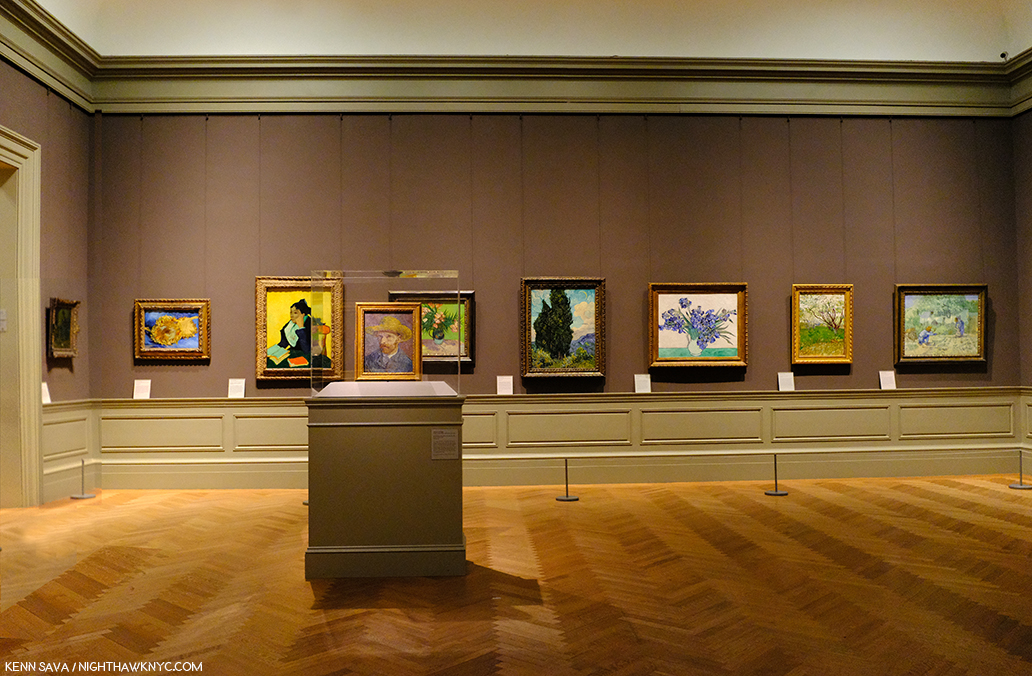
  1. Mark Rothko: The Watercolors in 2014, shining light on his seldom seen work in the medium, and Mark Rothko: A Painter’s Progress, The Year 1949 in 2004, focused and fascinating, both excellent, and both at Pace, East 57th Street.
  2. according to a list The Met has published

Clearing Up My Glaucoma…And, A Major Mystery In Art History

This site is Free & Ad-Free! If you find this piece worthwhile, please donate via PayPal to support it & independent Art writing. You can also support it by buying Art & books! Details at the end. Thank you.

Written & Photographed by Kenn Sava (*- unless otherwise credited)

1. The Treatment

“I’ve been through worse.”

That’s the Mantra. I learned that after surviving cancer, and cancer treatment, nine years ago. “If I can get through that? I can get through this.”

Whatever “this” is.

It works! At least? So far. After all, what could be worse than cancer? That’s what I tell myself.

Blindness is up there. I have anatomical glaucoma. In both eyes. So, the risk is I could become partially blind at any time in either, or both eyes. On my second opinion, I find a doctor who says with 2 laser treatments he can give me a 100% chance of fixing it permanently.

Those are my kind of odds.

Today is Round 1. I got up insanely early for the Nighthawk. 10:30am. Uggh. As hard as that was for me, my friend had a harder road. In fact, 3 hours of one, on the bus down from Upstate New York to come with me. She was more worried that I’d oversleep than anything else, she said. We walked over to a “leading New York Hospital” on a glorious September Monday to experience one of the great joys of modern medicine- the registration line ALL patients must wait in. No matter what, no matter I had been there twice in the past few weeks, and no matter neither my health insurance nor living address change that often. The line was half as long as last time, but twice as slow moving. A guard came over and asked for my info. ? Since when? He relented, but the ex-military guy behind me in line got a bit set off when he tried it on him, which led to him feeling one of the counter clerks didn’t want to serve him. He requested a supervisor, and the clerk’s name to file a complaint. Good luck with that. The supervisor listened to him complain that said counter woman “picked up and put down the same paper repeatedly so as not to serve him.” I found this a bit odd, since I was in front of him in the line, and I was still waiting.

I fnally got to see a clerk, who wound up giving me all the paperwork, including her copy. ? Ok…Onwards to treatment, glad to be done with this chaos.

Upstairs, in glaucoma, the woman behind the desk never even looks up from her phone call to acknowledge me. She was making her case to someone about something that had happened at work. I put my paper on the desktop and made sure my friend was seated. The woman looked up long enough to tell me to take my paperwork, calling me by name. ? How did she know who I was?

We settled into the empty waiting room. After a bit, she pulled out an Art History book, and we started looking through it, and discussing it. Unawares, little by little, the room filled up around us, and we became surrounded by a range of mostly older people of all races and languages. A number of them appeared to be suffering from various mental issues, some so incapacitated they had assistants to speak for them, in addition to whatever eyesight issues brought them to the glaucoma department. Yet, there we were, lost in making comments back and forth about Ingres, Michelangelo, Leonardo, Hopper (who’s “Nighthawks” was on the cover. Good choice! Wink), and her favorite Artist, Chagall.

About 45 minutes later, (45 minutes past my scheduled appointment), I was seen by a technician. He checked my vision, then I came back out and we continued looking at Art. An older gentleman came in with a walker, sat down and proceeded to sing in full voice. This elicited looks from the staff, but nothing more. No one said anything. I turned to my friend and said, “Welcome to New York.” Luckily, he was quickly called, and a semblance of silence resumed. A young man walked in with a large pizza and a soda. “He’s a doctor,” my friend said. Yup. He was. A man walked back and forth behind the counter, from time to time, saying nothing nothing to anyone, and accomplishing…? The woman behind the front desk put on a mask. Her boss came over and asked her “Why?” She muttered something then kept it on throughout. A woman sitting next to my friend began to snore. Somehow, she managed to hear the soft announcement calling her name.

We continued looking at Art. Kandinsky, Monet, more Ingres, more Leonardo- the Mona Lisa looking wayyyyy better than you’d ever see it in person, and a few contemporary Artists I don’t know, capped off with Mark Rothko (the Rothko Chapel, important, but not representative as his only work shown) and Bridget Riley. There was also the Laocoön & his sons, in a full page photo. All of a sudden I had one of those Sherlock Holmes-“Wait a minute!” moments. “Oh My God. LOOK AT THAT! It’s a Michelangelo!,” I thought to myself when I saw it.

"Laocoon" from "When Art Really Works," published by Barron's

The photo in question from “When Art Really Works,” published by Barron’s.

“Hello? Can we put the glaucoma treatment on hold? I may have discovered a Michelangelo, right here in the waiting room!,” I said in thought. We paused and I said (out loud) to my friend that the Laocoön was a huge sensation when it was discovered, instantly recognized as a lost supreme ancient masterpiece, and that there was a theory that Michelangelo had secretly created it.

Hmmmm…

At that moment, I was called to have drops put in before the procedure. 30 minutes later, at 2pm, I was called back for the treatment. 2 doctors surrounded a machine with arms, scopes and all kinds of things sticking every which way. I carefully wiggled onto the odd stool I was to sit on, which required a bit of contorting, hoping I could hold my head steady sitting on it. After all, I didn’t want them to miss with the laser! A nurse was present to make sure I was who they thought I was. She asked questions only I would know, I guess- “Why are your Posts so long?” “Why do you stay up so late?” Ummm….Doctor 1 drew a dark mark on my head over my left eye in the dark room. “Chin up. Lean forward. Look at the yellow light.” Inside the machine I was bombarded by bright flashing red and green lights, a slight squeezing sensation and then it was over. “Perfect,” Doctor 1 said when I asked him how it went.

Phew. Exhale. I have been through worse. Score another one for the Mantra!

Back out to wait to get a blood pressure reading. “Am I bleeding,” I asked my friend. “No,” she said. I was bloodshot, and a bit sore. Things were very fuzzy out of that eye, like I was looking through an extremely smudged eyeglass. I saw the Doc again, scheduled the right eye, and we left, arm in arm because while I could see, I didn’t know how well yet. I felt ok, but quickly found that you can’t keep one eye closed very long. I immediately put my shades on. Lord, it was bright outside. Don’t they do these at night?

Later, maybe in the throes of the steroids I’d be on for a week, or the rush from having gotten through it, I was struck by how amazing the experience was. Not medically. Interpersonally. I’ve never had someone who shared my love of Art like this in my life. That’s part of the reason I have this Blog. I need to share it with someone. Later, while she was back on the long road home, I told her it was very special to me that we were sitting there together reading about Art, no matter what was going on around us.

She said that the other people there probably thought WE were the crazy ones.

Art is in the beholding.

2. The Fog Lifts

I had a cloudiness, then a darkness in my left eye that lasted all afternoon and evening. All day I’d been haunted by the picture in her book of the Laocoön Sculpture. An iconic work of early Ancient Art, dated at about 20 BCE, that had disappeared until it was rediscovered in 1506, it looked amazing for 2 thousand odd years old. The ancient historian, Pliny the Elder, had written about it, in his Natural History in 79AD. He said

“Such is the case with the Laocoön, for example, in the palace of the Emperor Titus, a work that may be looked upon as preferable to any other production of the art of painting or of statuary. It is sculptured from a single block, both the main figure as well as the children, and the serpents with their marvelous folds. This group was made in concert by three most eminent artists, Agesander, Polydorus, and Athenodorus, natives of Rhodes.”

With such a buildup, it’s no wonder it’s discovery was a sensation- among the public and among Artists. It was immediately acquired by Pope Julius, and it holds a place of honor in the Vatican to this day. That much is known. But? What about this theory I’d heard about it? Finally, around midnight I could see enough to read my computer screen. The first thing I did was look up this-

“Michelangelo Laocoön”

I came across two pieces in the NY Times within days of each other in 2005 (here, and here). The pieces talked about a Columbia University Lecturer, Dr. Lynn Catterson, and her theory that Michelangelo had created the Laocoön. i.e. Michelangelo had created a forgery of the Laocoön in Pliny and hid it so it could be “re-discovered” at long last- “All too conveniently,” as Dr. Catterson put it.

2005? Hmmm…Eleven years ago. Nothing since. That’s strange. No mountain of outraged PhD’s spewing vitriol at her and her claims? Now, I was VERY interested. My gut radar went off as it rarely does this morning. But, let’s get real- this is one of the most sensational claims there could be in Art. If true, it would rewrite Art History for BOTH the Modern AND Ancient worlds! Not to mention Michelangelo’s.

Then again, as Michelangelo specialist, author and educator, Professor William Wallace says in one Times piece, works supposedly by Michelangelo have appeared often- seventeen from 1996-2005. Even I have seen these claims in the past, and frankly, after checking a few of them out, you become numb to them. In fact, right now, at The Met there is a small sculpture on display- of Cupid (which they now call “Young Archer” on their website), on extended loan, that no less than The Met’s experts, who I hold in highest esteem, say is by Michelangelo! Not “Attributed to.” Not “Michelangelo and assistant.” It says, “Michelangelo” on the card, below, and on the web page. IF it is an original Michelangelo? It is the ONLY Michelangelo sculpture in the Western Hemisphere. Pretty big deal. But? Other experts disagree about it. Is THIS the forgery of a Cupid Michelangelo is known to have made? Now that it’s called “Young Archer” on their website does that mean the well-known Cupid forgery is ANOTHER work? Also, nothing is mentioned about WHY they think it’s a Michelangelo. After spending a good deal of time looking at it from every angle. I remain to be convinced it is a Michelangelo. Then again? Part of a forger’s work is to adopt another identity.

img_2318pnh

img_2319pnh

Michelangelo, “Cupid” & it’s card at The Met. Their website calls it “Young Archer.”

Though I remain unconvinced by the Cupid at The Met, I was more convinced by their “Michelangelo’s First Painting” show, in 2009, of a restored painting titled “The Torment of St. Anthony,” which was based on a print by the great Martin Schongauer. I drank their cool-aid, and I bought what they were selling about it. Interestingly, The Met didn’t buy this work, themselves, when they had the chance to! I’d love to know why not. It was bought by the Kimbell Art Museum, Fort Worth, Texas, who The Met restored it for. Very peculiar. Michelangelo changed Schongauer’s original, adding his own touches and putting his own mark on the work, which he created in color(!), compared to the black and white original print, they hung next to the painting. While he didn’t create this work as a forgery (as far as I know), Michelangelo has a history of creating forgeries and was caught making at least one. The risks were great. Yet, according to Dr. Catterson, he continued making them, even creating the Laocoön right along side the immortal Pieta also now in the Vatican.

Reading her full piece, Dr. Catterson makes a strong case. I urge you to check it out. Here are some highlights-
-The found Laocoön wasn’t in one block as Pliny said, but 7 connected pieces of marble, making transporting it to the site feasible
-Michelangelo had the money, marble, space and time to create it before it was “found.”
-It’s miraculously superb condition(! ?)(Walk around The Met and check out the condition of sculpture from that period, BCE. Oh, and count how many still have a whole nose!)
-The “rediscovery” of the Laocoön was, seemingly, “made to order”. Consider-
-No less than Michelangelo, himself, was called to be there when it was discovered.
-Michelangelo had only recently arrived back in the area.
-Michelangelo also worked on it after it was discovered
-There is a drawing by Michelangelo that matches up uncannily well with the rear of the sculpture when superimposed on it’s photo
-Michelangelo destroyed an unknown number of his drawings before his death. Why, if they didn’t reveal what works he forged?
-Michelangelo wrote a letter in which he speaks of the Pope killing him if he discovered something. What? Aside from the construction of the Pope’s tomb, the only other interaction they had at the time was the Pope recently acquiring the Laocoön.

That’s the shortlist.

“Last night I dreamed about you
I dreamed that you were older
You were looking like Picasso
With a scar across your shoulder
You were kneeling by the river
You were digging up the bodies
Buried long ago
Michelangelo”*

My question is “WHY?” Actually it’s a 2 part question-

-Why did he make these fakes, and then keep making them? And,
-WHY didn’t he ever come clean and take credit for them, especially the Laocoön, which instantly became iconic? Here is an Artist who, according to Vasari, snuck into the Vatican overnight to carve his name on the sash of the Pieta so everyone would know who created it! (Though, he regretted doing that, and swore to never sign a work, again. He didn’t.) To create a work that is, along with the Pieta, one of the greatest sculptures we have, at about the same time, and NEVER take ANY credit for it at all, even on his death bed? On the flipside, making, then hiding, something like this would seem to be extremely hard to keep secret. Someone else must have known. And yet, there is not a peep of this anywhere, until Dr. Catterson’s theory. Michelangelo was the first Artist to have a biography written during his lifetime (actually, 2). Why didn’t anyone, especially his enemies and rivals, “out” him? This puzzles me.

I await hearing what someone/anyone else has to say to negate, or substantiate her claims. Professor William Wallace, countering the initial outrage Dr. Catterson’s theory received, said– “…the intriguing thing is that nobody who studies classical art in a way wants the ‘Laocoön.’ They find it kind of a Hellenistic embarrassment, maybe because it really doesn’t look like anything else comparable in the history of classical art.” Why? As Dr. Catterson points out, Michelangelo used contemporary models, including Filippino Lippi, not ancient ones, when he created this.

As much as I love sculpture, I’ve never really paid much attention to the Laocoön. Why? I hate snakes! So, this is a pretty nightmarish image for me. Funny thing? My friend said the same thing Monday when we saw it! I have been, however, reading quite a bit about Michelangelo these past 5 or 6 years. I’ve read the 2 volume set of his Letters, a number of biographies, including Condivi’s and I’m in the midst of Martin Gayford’s “Michelangelo: His Epic Life” Biography right now. (He doesn’t mention Dr. Catterson’s theory, though his book was published in 2013.) I have some superb books of photos of his sculptures, including the XL Taschen monograph. I look at them frequently. Michelangelo is in my mind, like Leonardo da Vinci was that day in London in 2012 when I saw the “Salvator Mundi/Savior of the World”in the once in a lifetime Leonardo show in London’s National Gallery, after it had recently been credited to Leonardo. Seeing 7 of his other paintings that have been credited to him for much longer, immediately before.1, I came away believing it is a da Vinci, unlike the Shroud of Turin. So, when I suddenly saw the Laocoön Monday afternoon in my friend’s book, I was stopped dead in my tracks…

Michelangelo. I believe Dr. Catterson is right.

“We’ll never have the certitude a scientist gets,” Professor Wallace said, “It can only be tested by the weight of scholarly opinion and time.” And, I humbly suggest- your eye, and your gut.

“That the Laocoön was carved by Michelangelo explains why then, and now, its effect is mesmerizing.” Dr. Catterson’s piece coincidentally ends.

In at least two ways on Monday, the mist cleared, and now I see.

ONward to Round 2!

(For Sv.)
*-Soundtrack for this Post is “Michelangelo,” by Emmylou Harris, published by Universal Music Publishing Group.

This site is Free & Ad-Free! If you find this piece worthwhile, please donate via PayPal to support it & independent Art writing. You can also support it by buying Art & books! Details at the end. Thank you.

Written & Photographed by Kenn Sava (*- unless otherwise credited)

  1. You can see it exactly where I saw it, described by curator Luke Syson, who’s now at The Met, here.

They Missed Me.

This site is Free & Ad-Free! If you find this piece worthwhile, please donate via PayPal to support it & independent Art writing. You can also support it by buying Art & books! Details at the end. Thank you.

Written & Photographed by Kenn Sava (*- unless otherwise credited)

It had been a typical weekend over here at NighthawkNYC.com. Friday night, I went back to see a show that is closing today that I plan on writing about. On the way home, I walked along West 23rd Street, west from 6th Avenue. I passed by what had been the home of Tekserve, our neighborhood Apple place the past 29 years, which has just gone out of business-

Immediately to the let of this shot, taken this week, of the former Tekserve, a bomb blew up last night.

Immediately to the left of this shot of the former Tekserve, a bomb went off at 8:30 last night.

Then, last night I was sitting here writing, when I was stopped by a very loud noise.

“What was THAT?”

I got up and went to the window. During those few steps, I knew something had just happened. I (instinctively) thought back to 9/11. when everything happened in 102 minutes. So, I noted the time- exactly 8:30pm.

This is a busy area. You get used to hearing a wide range of sounds. This one was DEFINITELY something way out of the norm. It sounded like a building had collapsed.

I looked out my south facing window. All I could see were my neighbors who had come out of their apartments pondering the same question looking back at me. I couldn’t see anything else.

“Well, they’ll stone you when you’re trying to be so good
They’ll stone you just like they said they would
They’ll stone you when you’re tryna go home
Then they’ll stone you when you’re there all alone”*

Shortly, there were a lot of sirens going off and that continued, off and on, all night.

Turning on the local news, it seems there was an explosion in or near a dumpster just to the side of Tekserve, between it and the Associated Blind (a home for the visually impaired.) Without being more specific, let’s just say, very close to home. There’s a fortress like Church immediately west of Tekserve, then there’s a small brownstone, and then there’s the Associated Blind, the facade of which has been under construction, and is covered in scaffolding. Right between the Associated Blind and the brownstone is where the blast happened.

Huh?

23rd Street is an historic place. Dylan Thomas, Bob Dylan, Arthur C. Clarke, Tom Waits, and on and on, all lived at the Hotel Chelsea, a half block away, between 7th and 8th Avenues.. Much of Patti Smith’s “Just Kids” takes place there. I’ve lived a LOT of my life on 23rd Street the past 25 years. It has been my extended home base, as those who know me know.

The Hotel Chelsea, this week. So much of my life these 25 years took place on this block, I feel it's part of my home.

1/2 a block west. The Hotel Chelsea, this week. So much of my life these 25 years took place on this block. Bob Dylan wrote Blonde on Blonde here .

About 2 hours after the blast, it was announced that they had located a second device, on West 27th Street, between 6th and 7th Avenues.

img_6430pnh

Huh?

What’s there? Not a heck of a lot besides businesses and apartment buildings. The Fashion Institute of Technology (F.I.T.) is across 7th Avenue between 7th and 8th.

At 12:37am the NYPD sent a cell phone blast around asking residents of 27th to stay away from their windows. A few hours later I heard, and saw on social media, that they had used a robot to remove the device. They didn’t officially announce that until 2:35am, prime time for the Nighthawk.

img_6432pnh

The mayor announced that there was “no terror connection.”

Huh?

Dude- If it’s determined that this wasn’t a force of nature, or some chemical reaction due to combustibles left at a construction site, and it was, therefore, “intentional,” as you also said…?

WHAT ELSE IS IT?

I’m sorry. Setting off an explosion in a residential district like Chelsea and 29 innocent people were hurt is an act of terrorism.

Period.

I was up late watching what was going on.

I could see that there were teams of folks in matching uniforms scouring the block- from end to end, even way at the other end from where the explosion was. They had light towers at both ends of the block, and this went on til after 6am when I went to bed. This morning, much of my neighborhood remains roped off.

Left-The bomb scene at 530am. Right- West 34th & 7th Avenue. Macy's is across the street to the upper left. Madison Square Garden is right behind to the lower right.

Left-The bomb scene at 530am. Right- West 34th & 7th Avenue. Macy’s is across the street to the upper left. Madison Square Garden is right behind to the lower right.

Somebody else sure thinks this is terrorism.

But? This is not my first rodeo.

I was right here on 9/11. I saw the North Tower on fire at 9:05am from the same window I looked through last night. The first plane, American Airlines Flight 11, flew down my block, which triggered unexpected nightmares for a few months after, where, somehow, my brain combined Flight 11 with Flight 93, and the passengers fought back, and caused Flight 11 to crash early- into my apartment. (Yes, I was very lucky that that’s all that happened. Later, I watched the North Tower collapse from 5th Avenue. Both of the people I knew who worked there at the time got out.) In 2004, there was a 2 day blackout. No big deal. Some years later, a nor’easter left me without water for 4 days. Then, in Halloween week 2012, Hurricane Sandy left me without power for 5 days, and brought the Hudson River within 2 blocks of my door. The subways here have never been right since 9/11.

During the last few of these events, much of the rest of the City was unaffected. I was especially reminded of this during the Sandy blackout. Going north of 30th Street was like going into a different world. There were lights on. Restaurants and delis were open(!) People were using their phones without constantly looking at their power levels. No one carried a candle or a flashlight. Very few of them seemed to know, or care, frankly.

I felt pretty alone.

So? This is part of the price I pay to live here and be able to experience all the great Art and culture NYC has- what makes NYC the greatest City in the world to my myopic eyes.

Still, right now? Now that everyone has been released from the hospital, and no one was killed, thank god, my main thought is-

WHY?

Why did whoever did this pick these two places?

The Associated Blind??? Given the damage from this powerful blast, it’s amazing, and amazingly fortunate, they didn’t have to evacuate it. And, a side street in a pretty quiet area at that time of night???

It seems to me that whoever did this was either paying back something personal, or were sending a message to the effect that “You’re never safe. Anywhere. Anytime.”

“They’ll stone you when you’re at the breakfast table
They’ll stone you when you are young and able
They’ll stone you when you’re tryna make a buck
They’ll stone you and then they’ll say, “Good luck””*

Whoever it is strikes me as being someone who’s not a real New Yorker. First, real New Yorkers respect each other.

Second- Living here, you take your life in your hands when you step outside your door. You could get hit by a car, bus, truck or bike, or whatever, at any moment. Yes, surviving as a pedestrian here, I’ve long believed, is an unacknowledged, and under-appreciated Art form.

So, if you’re trying to scare me, or my fellow New Yorkers?

Get real.

Better yet?

GET A LIFE!

dsc01820pnh

(For the aftermath, see my follow up Post, here.)

*-Soundtrack for this Post is “Rainy Day Women #12 & 35” by Bob Dylan, from 23rd Street’s own Blonde on Blonde and published by Dwarf Music.

NighthawkNYC.com has been entirely self-funded & ad-free for over 8 years, during which 300 full length pieces have been published! If you’ve found it worthwhile, PLEASE donate to allow me to continue below. Thank you, Kenn.

You can also support it by buying Art, Art & Photography books, and Music from my collection! Art & Books may be found here. Music here and here

Written & photographed by Kenn Sava for nighthawknyc.com unless otherwise credited. To send comments, thoughts, feedback or propositions click here. Click the white box on the upper right for the archives or to search them. Subscribe to be notified of new Posts below. Your information will be used for no other purpose.
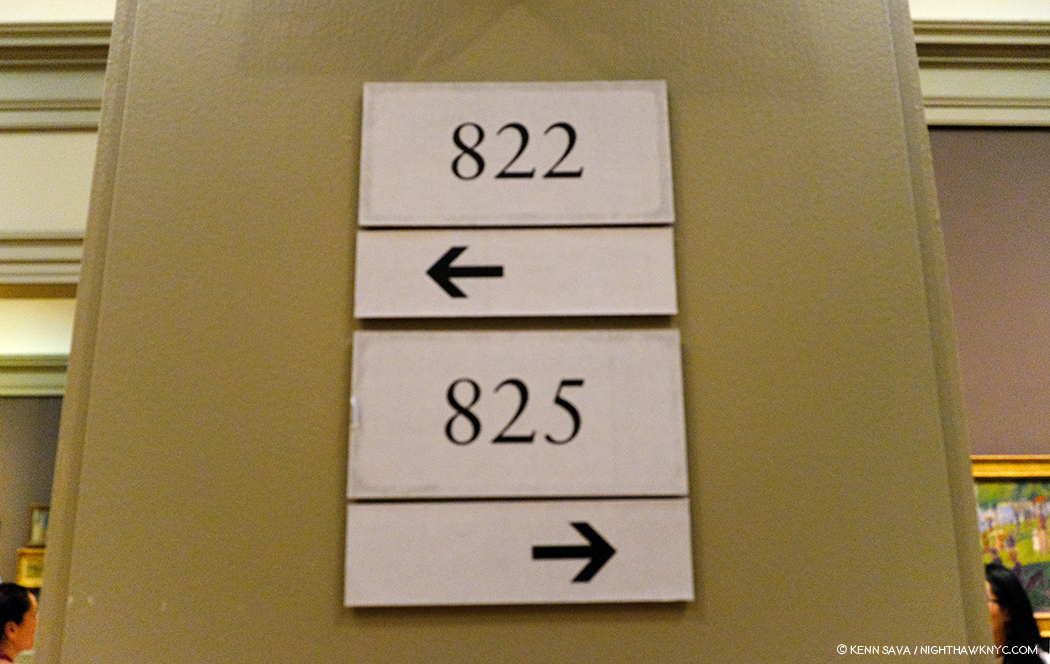
To- Whoever Owned This Book Before Me

This site is Free & Ad-Free! If you find this piece worthwhile, please donate via PayPal to support it & independent Art writing. You can also support it by buying Art & books! Details at the end. Thank you.
Written & Photographed by Kenn Sava (*- unless otherwise credited)

I don’t know who you are, but this Post is for you.

“This book” is an out of print exhibition catalog from the Stuart Davis show at The Metropolitan Museum in 1991. Another of the shows I missed and will forever be sorry I did. Thank goodness it lived on in this superb catalog. Show catalogs are an interesting thing. Widely available while the show is on, they soon go out of print and then become sought after by Artists, specialists and die-hard fans as time passes.  Though The Met said they were going to make all their older publications available as .pdf files online, some, like this one, have been skipped no doubt because it was co-published by a big commercial publishing house, who has a say in that, in this case Abrams.

12 years ago I bought a used paperback copy of it at the now defunct Academy Books and had worn it out. I’ve had my eye out for another copy, one in good condition at a reasonable price for a while. I need it now because I’m in the middle of a Post on the “Stuart Davis: In Full Swing” Show at the new Whitney Museum. My go-to (often) bookstore, The Strand, had one recently, but it wasn’t much better than the one I had, so I passed. A few days later, it was gone. So, I was driven to look online, and finally found this copy.

The Book. The catalog for The Met's 1991 Stuart Davis show, long out of print. Notice the cover Art.

The Book. The catalog for The Met’s 1991 Stuart Davis show, long out of print. Notice the cover Art.

I bought it online from a bookstore. When it arrived, unlike some of my recent experiences buying books online, I found it to be in better condition than I had hoped. People seem to want to upsell the condition of books, which is so shortsighted. Most buyers are going to notice an obvious flaw in something so why try and get over on someone and have it sent back to you and probably get some, deservedly, bad feedback in the process? To help keep it this way, I decided to put a book jacket on it. I’ve been looking through it, but I hadn’t looked inside the back cover. When I removed the dust jacket to wrap it, I did. I found Stuart Davis, himself, looking out at me from a 1912 Self Portrait he painted, apparently in New York, given the background, while he was living in Hoboken, NJ, at age 20. It was in an archival envelope. I opened it up to discover it was the first page of an article about Davis and the 1991 Met Show, carefully removed from an unknown magazine (circa 1991-2) and placed in this envelope to protect it, and so it wouldn’t discolor the book.

Stuart Davis, in his 1912 Self Portrait, looks out at us, 104 years later.

Haunting our City. Stuart Davis, age 20, in his 1912 Self Portrait (with NYC’s old Elevated Subway in the background) looks out at us, 104 years later, from inside the back cover. The original painting is here.

On the back of the last page of the article, someone had cut out and carefully taped the bibliography for the article. Impressive!

DSC00537PNH

This was something similar to what I’ve done for many years, myself. If you have eclectic taste and/or like Artists or Musicians that aren’t very popular it may be a long time before you find something in print about them. When I did? I’d read it over a few times, then cut it out and save it. I’d stick it inside a book about them (if there was one), inside a record jacket, or later, a CD jewel case.

I buy used books often, since many books I’m interested in are now out of print. Sometimes, the unpleasant aroma of old cigarette smoke hits you, making you wonder if that finally led to this book being here. They don’t make the cut. Sometimes, they come with a previous owner’s name written inside. I usually don’t like anything written in a book. But this one time? I wish the owner had written their name in it.

One day all too soon, physical Art Books will be a thing of the past, as soon as image quality in eBooks catches up with their printed counterpart in a reasonable file size. That might be a while yet. For me? It would be a mixed blessing. Mostly? I have too many large books, as I’m often reminded, so freeing up some space would make a big difference in my life. Beyond that, though, there is something beautiful about a physical Art Book, something that hooked me since I bought my first one, on Rembrandt by Bob Haak as a teenager, and still does. I suspect they will then trade among collectors, like Lp’s do now. No one will ever open an eBook and have this happen to them.

Finding this today? Here was a kindred spirit- someone like me. Someone I’ll never know who feels about Stuart Davis’ work the way I do. Though he didn’t write his name in it, it was personalized in a non-destructive way. Making it one’s own, but not like tattooing it with writing. There’s no need for that in this case- I get it.

That same afternoon, I went back to to see “Stuart Davis: In Full Swing” yet again, as my work continues. I had an errand to do first, so I wound up walking over to the Whitney a different way than I usually do. As I neared the corner of 7th Avenue on West 13th Street, I was stopped in my tracks, when I saw this on the wall.

DSC_7025P2NH

“…it was here that he painted many of his most important works including…”

What? Wow!

I have lived in and around NYC almost all of my life, and been in this neighborhood countless times. Yet, I’d never known he lived here! Around the corner is the Village Vanguard, for my money the world’s greatest Jazz Club, where it occupies the same basement it has since 1935. Being a lifelong Jazz lover, I bet he spent quite a few evenings there, as I have, as well. The original Whitney Museum was a short walk away on 8th Street, when he lived here (from 1934-54), as the new one is now in a different direction.

Reading the plaque, I could still feel Stuart Davis’s “Self Portrait” from inside the back cover of the book looking at me. Inside in the lobby hung a large, beautifully framed Stuart Davis Poster. Impressive considering he died 52 years ago, and it’s 62 since he lived here. Looking at the building, it looks like thousands of other buildings in New York, and, probably, the rest of the world. I stood outside pondering it. It wasn’t like the old Bowery that reeked of cheap booze and romantic Artist’s loft studio spaces, the long time homes of Allen Ginsberg, John Cage and othes from the same period, Keith Haring, Joey Ramone, among others, after. It was a nice, modern, kinda faceless apartment building. Nothing about it said that one of the greatest American Artists who has yet lived lived here, except it’s smack-dab in the middle of The Village location.

Then, I continued on, completing the short walk to the Whitney. Inside the show, I lingered in front of “Rapt At Rappaport’s,” from 1952, in it’s interesting frame.

Davis' "Rapt At Rappaport's," 1952, on view at The Whitney, now in the Smithsonian

Look familiar? Davis’ REAL “Rapt At Rappaport’s,” 1952, now on view at The Whitney, from the collection of the Smithsonian.

Davis painted it in the building I had just walked past, as the plaque confirms by name! I never knew that. I’ve seen it before, but now? I’m seeing it anew. It doesn’t depict the neighborhood (Greenwich Village) per se, in fact, it’s an “homage” to “Rappaport’s Toy Bazar,” a store his parents used to take him to as a child many years earlier. The store used polka-dotted paper to wrap gifts, hence, the polka-dots in the upper right, and the work’s title is also a pun on “wrapped.” But, on a different level, now everything about this says “Greenwich Village in the 1950’s.” The child became a man, and that man was an Artist. It drips of the Jazz he heard all around as The Village headed into it’s Jazz & Beat Glory Days. Even the title (using “Rapt” in place of “Wrapped,” for the wrapping paper) is a “Jazz-pun,” as in raptly listening. In addition to being a “souvenir” of his childhood, it’s also a little reminder, a little piece, of that more recent time, and place, The Village- from his then home there on 13th & 7th.

It also happens to be the painting chosen to be the cover Art for my new/old book.

Is this all a bunch of strange coincidences, neatly “Rapt” together with a bow on top? Covering (“wrapping”) the Davis book and being startled to see him looking out at me unexpectedly, as the prior owner had left him, lovingly curated…then accidentally discovering (uncovering?) the very place he painted it’s cover Art… and finally, seeing the original painting shown on the book’s cover. Hmmm…It feels like someone is sending me a message.

Now? Someone else lives in that apartment. Someone else owns this book.

Still? Parts of both live on from before. Very good parts.

Thank you.

*-Soundtrack for this Post is “You Can’t Judge A Book By It’s Cover,” written by Stevie Wonder, Sylvia Moy and Henry Cosby, and preformed by Bo Diddley.

NighthawkNYC.com has been entirely self-funded & ad-free for over 8 years, during which 300 full-length pieces have been published! If you’ve found it worthwhile, PLEASE donate to allow me to continue below. Thank you, Kenn.

You can also support it by buying Art, Art & Photography books, and Music from my collection! Art & Books may be found here. Music here and here.

Written & photographed by Kenn Sava for nighthawknyc.com unless otherwise credited. To send comments, thoughts, feedback or propositions click here. Click the white box on the upper right for the archives or to search them. Subscribe to be notified of new Posts below. Your information will be used for no other purpose.