Banner #3
My latest banner is an “homage” to an all too rare vestige of “nature” in NYC, the 24-hour Deli flower stand, as seen out the window late one night on 18th Street.
Banner #3
My latest banner is an “homage” to an all too rare vestige of “nature” in NYC, the 24-hour Deli flower stand, as seen out the window late one night on 18th Street.
As a counterpoint to my longer pieces on big shows, here’s something else- shorter looks at some especially Noteworthy Shows that I’m not going to have the time to do the full pieces on that they each deserve, but that I want to bring to your attention.
Post-Labor Day has seen things quiet down on the NYC Museum show scene, after an insanely busy summer. The action has turned to the galleries. Here are some shows I saw recently that I was especially impressed with, in no particular order-
“Ethan Murrow: Water Almanac” @Winston Wachter. A show of very large drawings(!) about the folly of man trying to control nature, many featuring water, shown in a space that was partially submerged almost 3 years ago after Hurricane Sandy, destroying some of Mr. Murrow’s work. When I pointed out the irony of it to him, he responded, “At least they weren’t people,” he said referring to his lost work. When I asked him why he draws instead of paints he spoke of the minimal amount of materials necessary. His work has wonderful elements of the Surrealism of Max Ernst and Bruce Conner that he makes seem everyday real world.
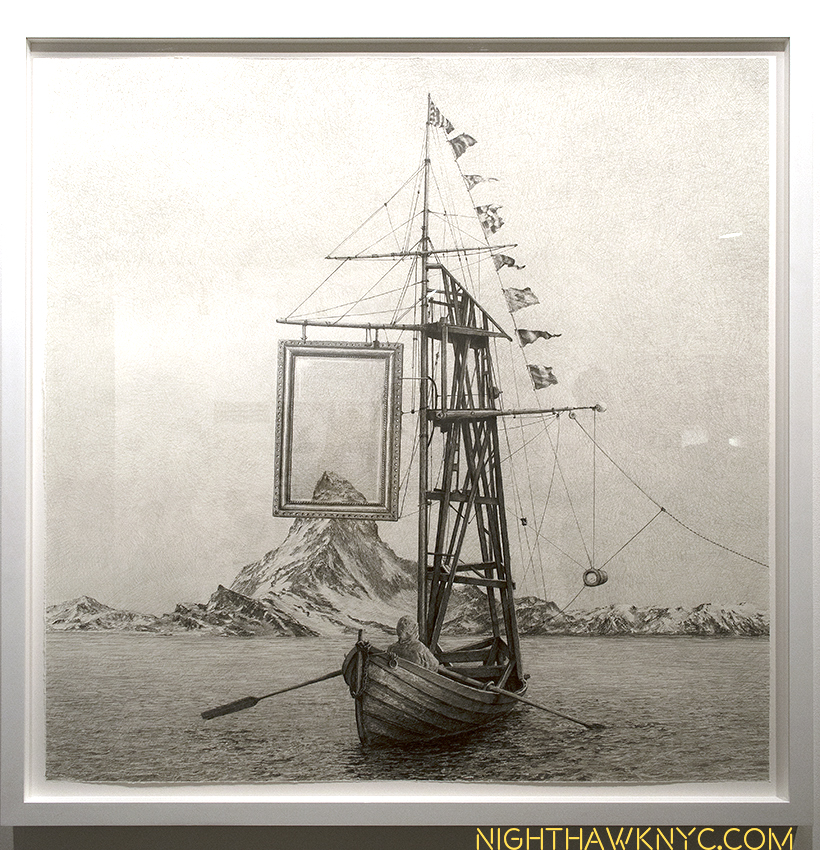
Ready for the next Sandy? Hmmm… “Deluge Estimator,” 2016, graphite on paper
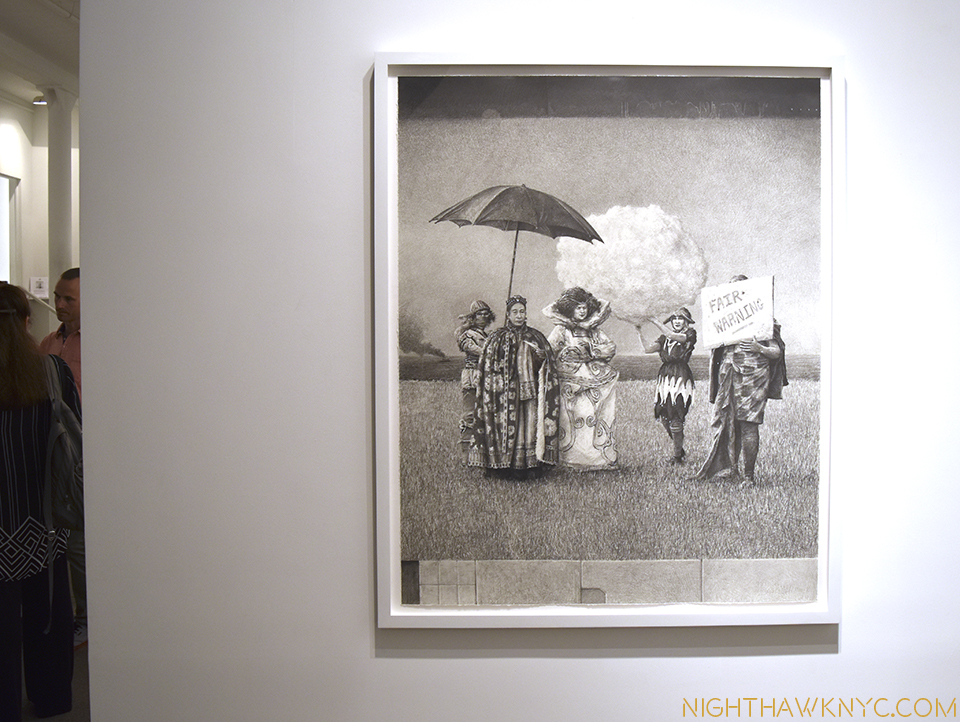
Ethan Murrow (just to the left in orange shirt) at his opening.”Hail Cannon Rainmaker,” 2016, graphite on paper, 60 x 48 inches, right.
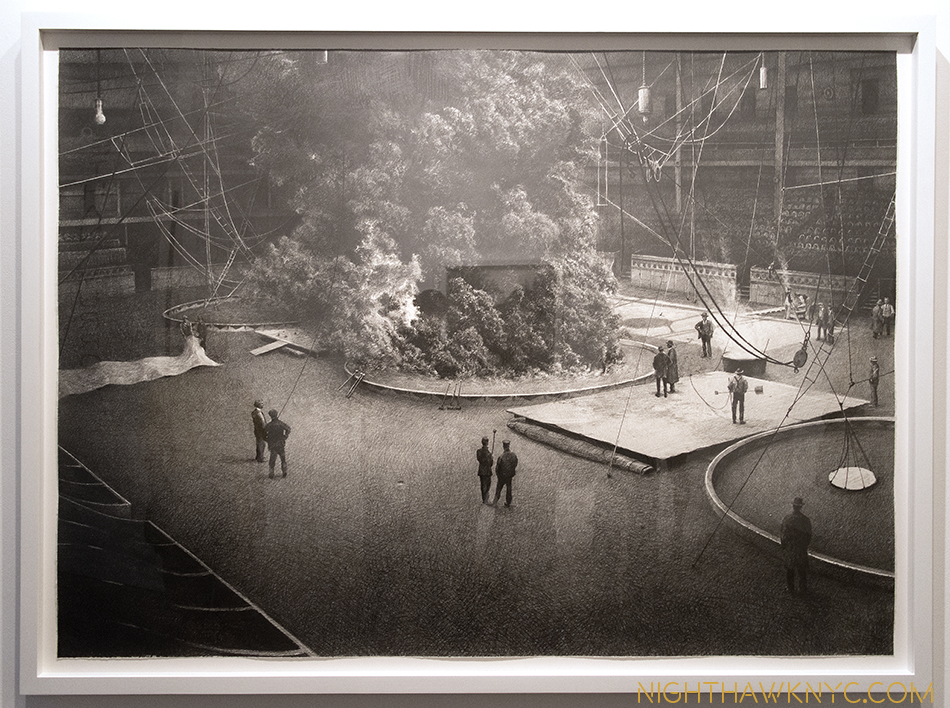
“To Redirect the Tempest,” 2016, graphite on paper, 52 x 72 inches
“Meleko Mokgosi: Democratic Intuition” @ Jack Shainman Gallery. I’d write something about this, if I could ever finish looking at it and thinking about it.

“Democratic Intuition- Comrades II,” a very large work
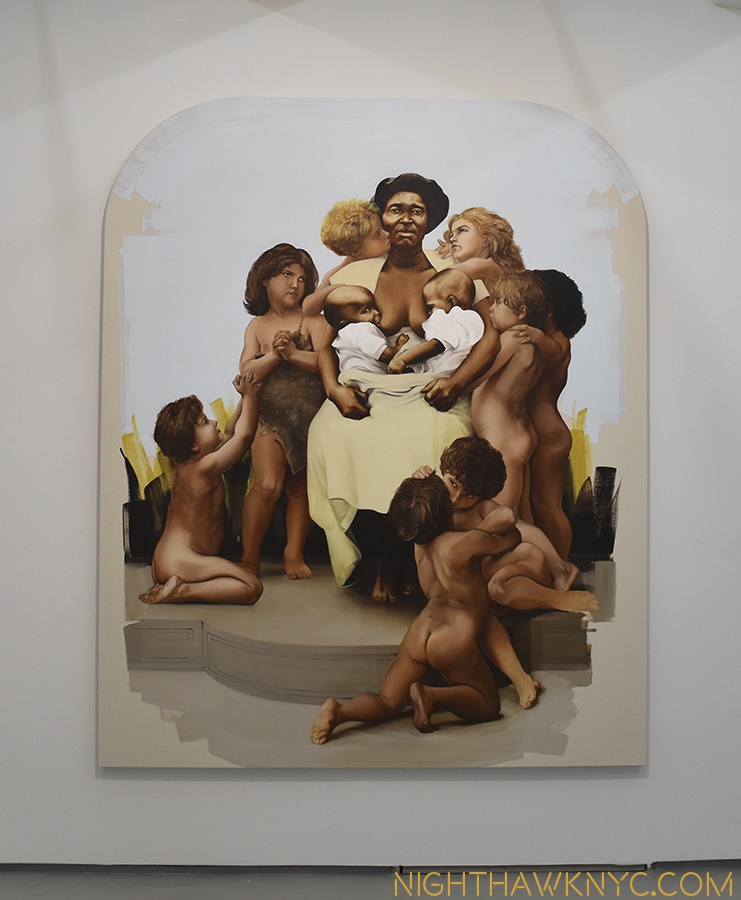
And as seen at the show’s 2nd location.
“Sol LeWitt” at 3 Paul Cooper Gallery Locations, Pace Prints, and The Met. Yes, no less than 5 simultaneous shows featuring Lewitt’s drawings, scultpture, photography, collages, prints and, suddenly ubiquitous wall drawings (not to mention the permanent one on view in the NYC Subway at 57th Street & Columbus Circle!).
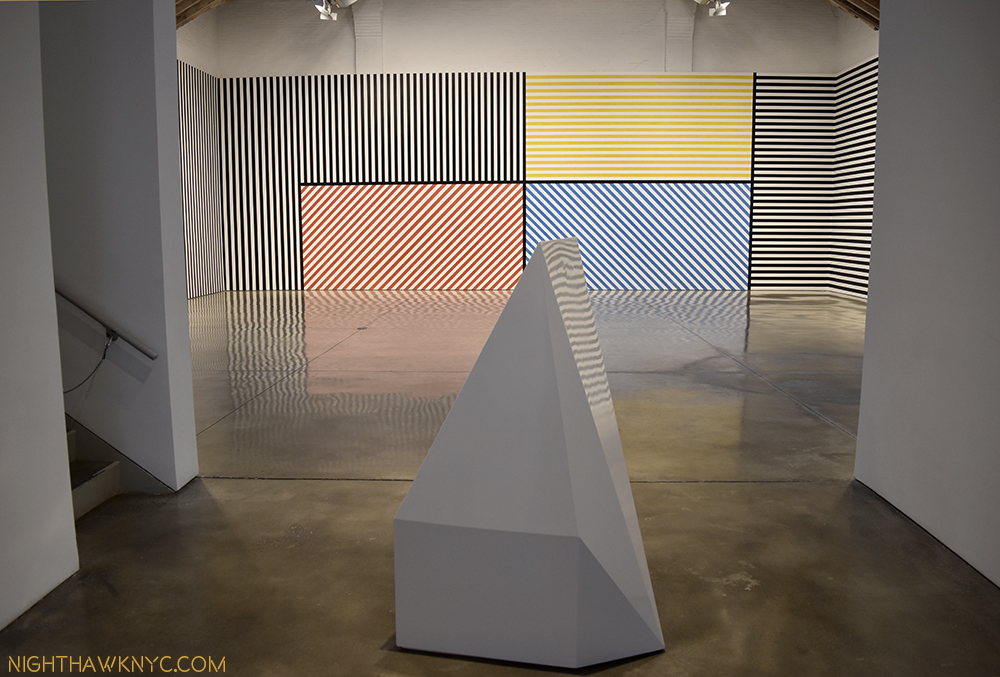
“Complex Form #65,” 1989, painted wood, 59 x 38 x 40 inches, in front of “Wall Drawing #368” @ Paula Cooper.

Detail
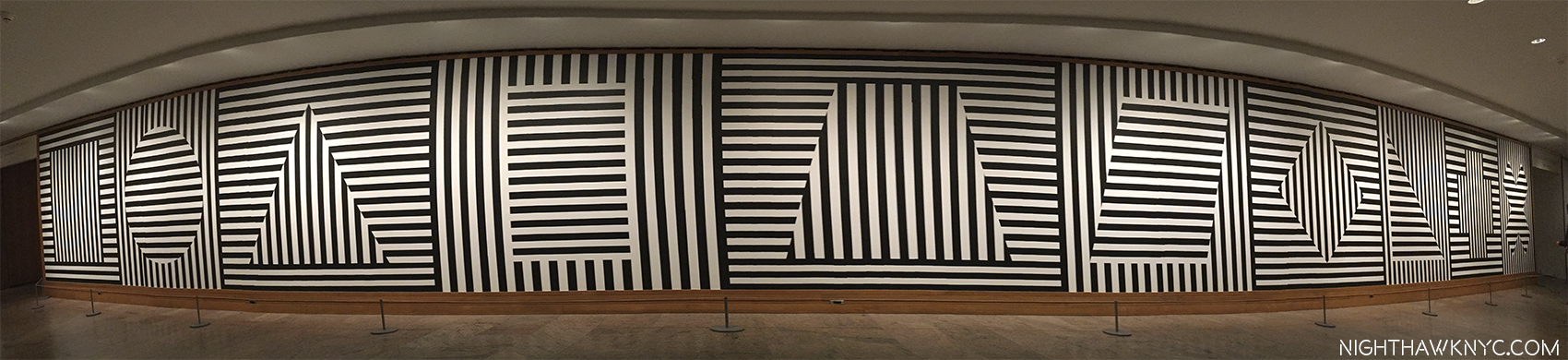
“Wall Drawing #370” as seen at The Met
“Alexi Torres: Sun Light” @ UNIX Gallery. No mere photo-realistic interpretations of source photos here. Visions- exquisitely executed.
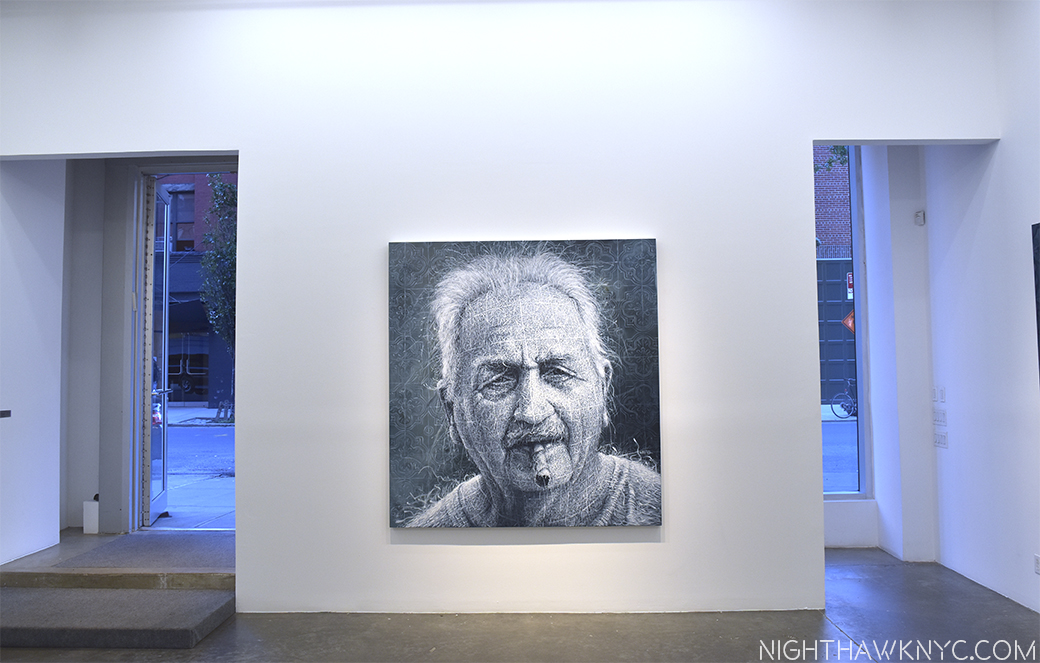
“Sun Light-Ernesto,” 2016, oil on canvas, 72 x 68 inches
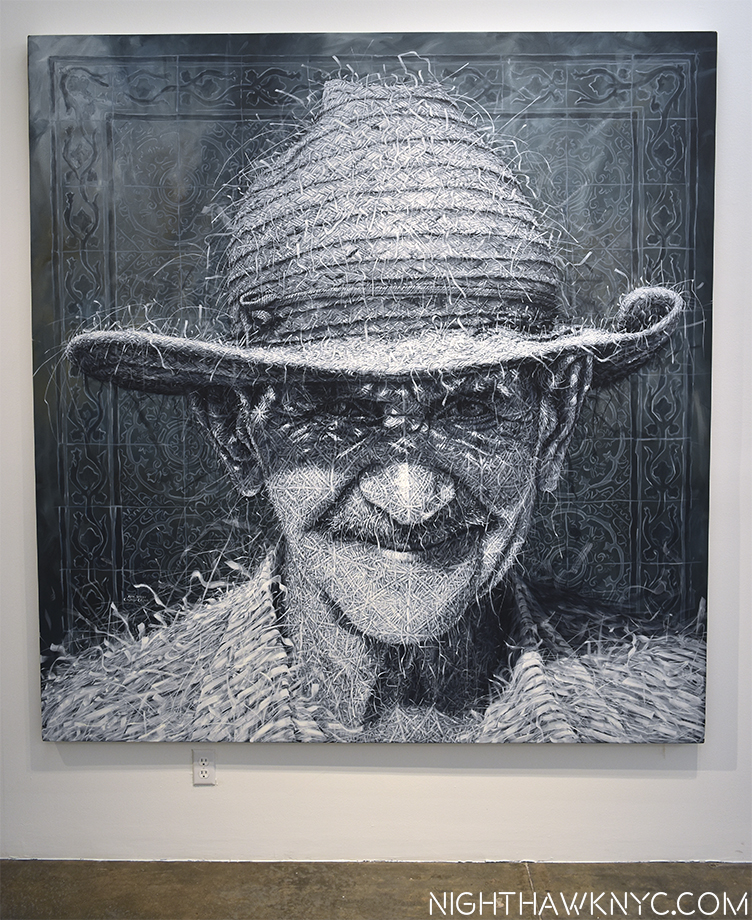
“Sun Light-Miguel,” 2016, , oil on canvas, 84 x 80 inches

Detail

Miguel- Source Photo
Robert Currie in “Mind Storm” @ Bryce Wolkowitz. A name new to me. As close as I can gather, Robert Currie applies paint to monofilament thread in rows, which can be seen from the side, or in their reflections, below the works. The image can only really be seen from directly in front. Somehow, they still manage to evoke the sense of the place as well as the sense of a bygone era.
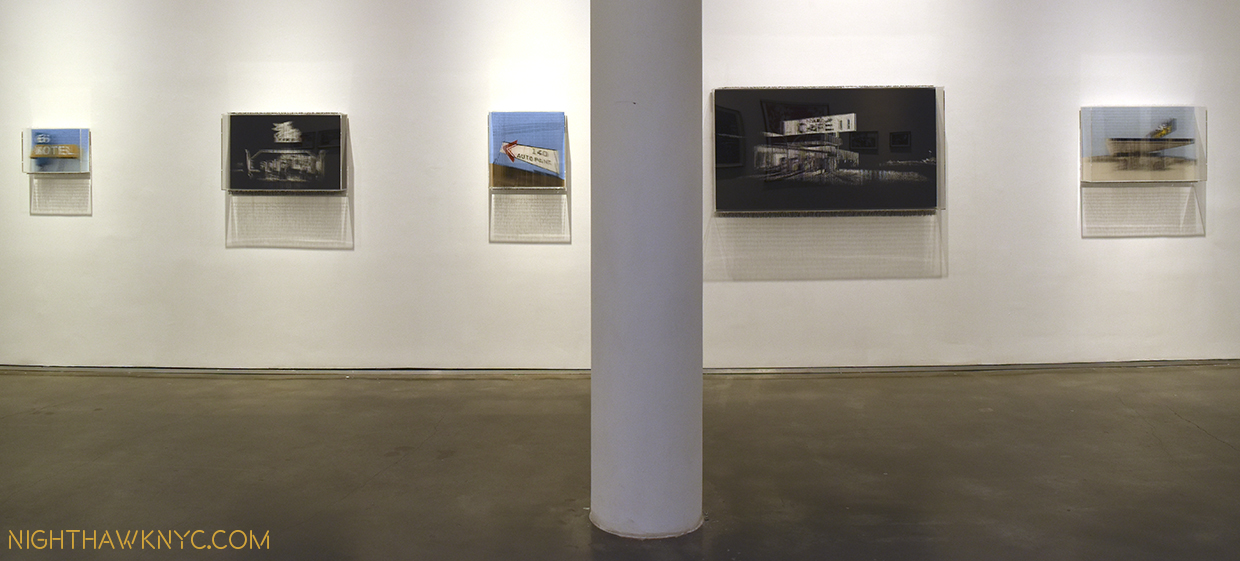
Installation View
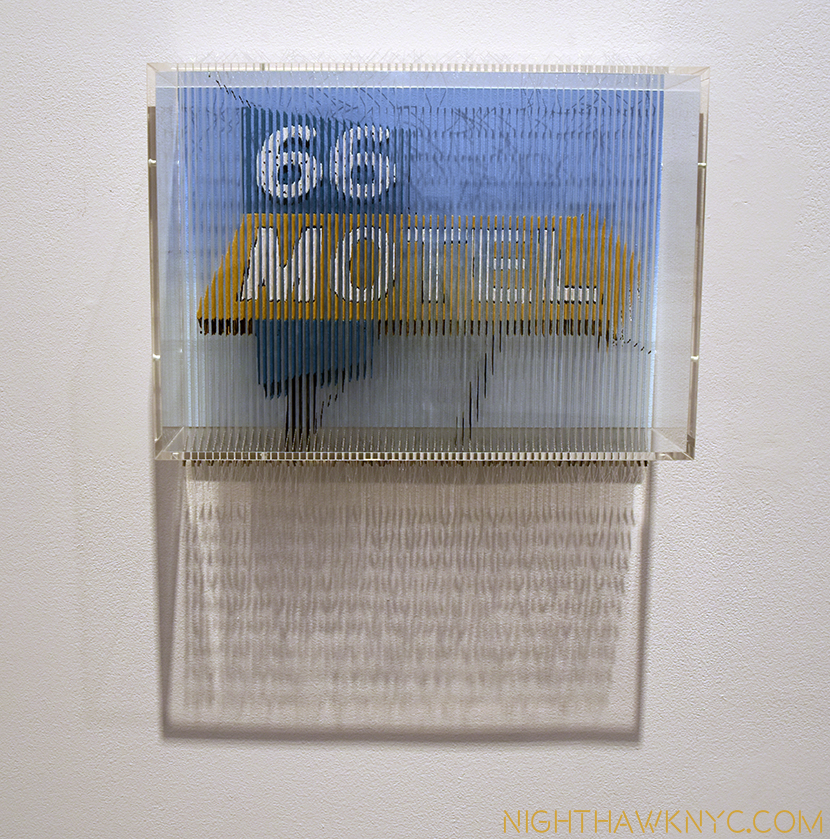
Entitled- “17,820cm of nylon monofilament and acrylic,” 2016. That’s 590 feet of it in a work that’s 12 x 16 x 5 inches.

Side view
“Fahamu Pecou: #BlackMatterLives” @Lyons Wier Gallery. Prolific and multi-talented, this could be a breakthrough show for him. Powerful. Gorgeous rawness. Present tense.
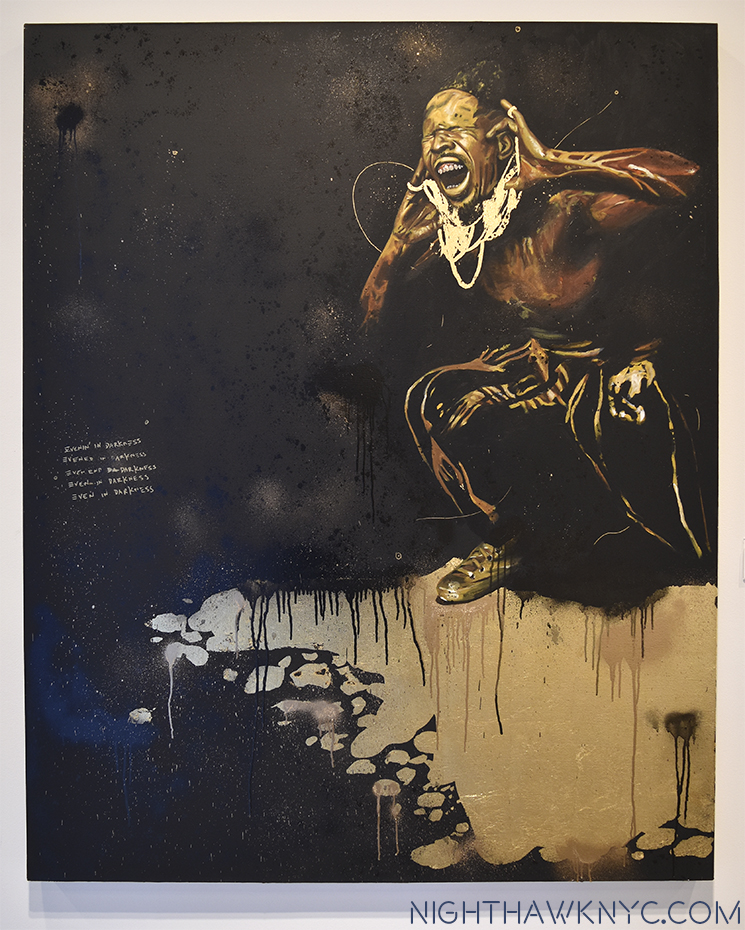
“Even In Darkness,” 2016, acrylic, spray paint, gold leaf on canvas, 60 x 48 inches
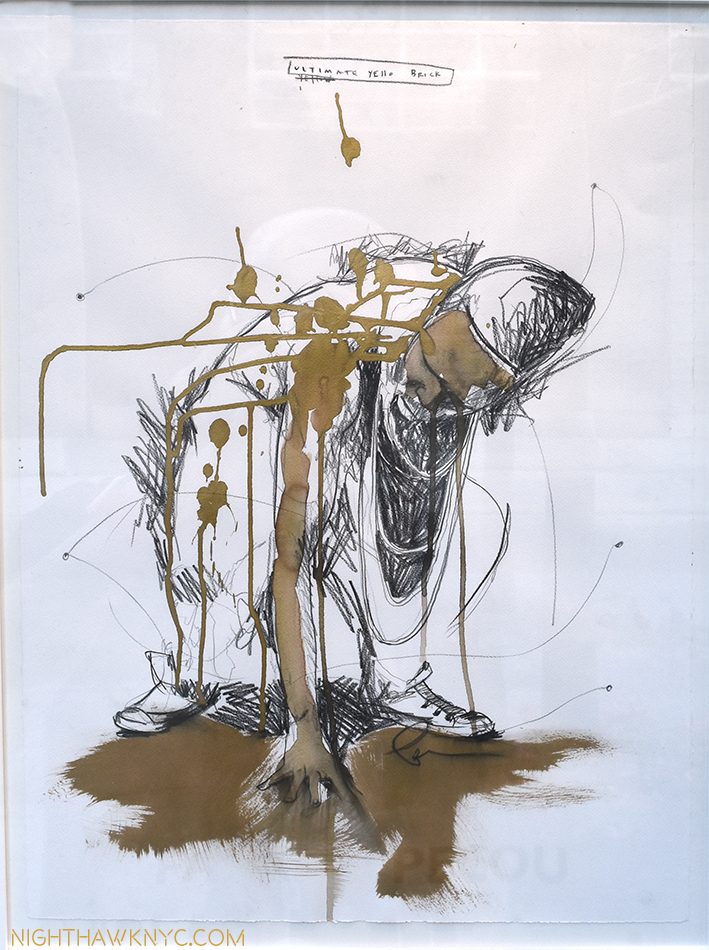
“Ultimate Yello Brick,” 2016, graphite and iridescent ink on paper
And- “diane arbus: in the beginning” @ The Met Breuer. Memorable as much for the show’s content as for it’s innovative display, Ms. Arbus’ beginnings show the Artist’s eye fully formed. Each of the 100 plus images on view is given it’s own wall- a side of a “mini-pillar” that allows the viewer to move through the show any which way they want to. Ingenious and ground-breaking, it’s more a case of The Met showing off it’s construction capabilities and resources more than “why didn’t anyone else think of this before?”
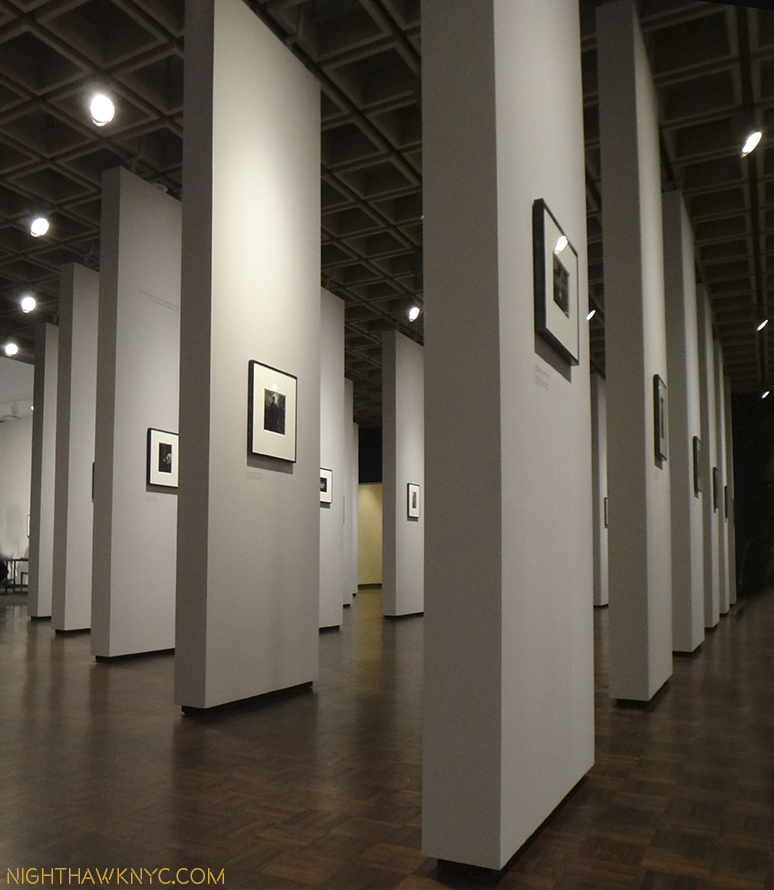
There is no “recommended” way to see this show.
Especially noteworthy for me was a photo of my late friend, the legendary Stormé DeLarverie,, titled Miss Stormé DeLarverie,The Lady Who Appears to be a Gentleman, NYC, 1961. I knew Storme during the final decade of her life, and she had told me that Diane Arbus had photographed her, though I had not previously seen it. I took it with a grain of salt, given to tall tales as she was on occasion (will we ever know if she really was the “cause of,” or started, the Stonewall Uprising, not “Riot”, which I heard her claim she was?). But, there she is, sitting elegantly on a park bench in 1961, immortalized for all time, in the permanent collection of the Metropolitan Museum of Art, and on view as part of this very good show at The Met Breuer. Diane Arbus had one of the greatest eyes in photography.

Stormé, in full effect in 1961. 45 years before I would meet her.
Some of these shows are still up, some have just closed. And somewhere the singer is saying…
“’cause no one knows about a good thing
Until a good thing is gone.”
R.I.P- Stormé DeLarverie,. Get home safe, my friend.
*- Soundtrack for this Post is “No One Knows About A Good Thing” by Curtis Mayfield and Daryl Simmons, from Mayfield’s album “New World Order,” and published by Warner- Tamerlane Publishing Corp.
NighthawkNYC.com has been entirely self-funded & ad-free for over 7 years, during which over 275 full length pieces have been published!
I can no longer fund it myself. More on why here.
If you’ve found it worthwhile, PLEASE donate to keep it online & ad-free below.
Thank you, Kenn.
Written & photographed by Kenn Sava for nighthawknyc.com unless otherwise credited.
To send comments, thoughts, feedback or propositions click here.
Click the white box on the upper right for the archives or to search them.
Subscribe to be notified of new Posts below. Your information will be used for no other purpose.
This site is Free & Ad-Free! If you find this piece worthwhile, please donate via PayPal to support it & independent Art writing. You can also support it by buying Art & books! Details at the end. Thank you.
Written & Photographed by Kenn Sava.
In 1986 the great Frank Zappa released an album who’s title asked “Does Humour Belong In Music?” The same year Wayne White was working as set designer, puppet creator & operator on the ground breaking, now classic, avant-garde TV show, “Pee-Wee’s Playhouse,” for which he won 3 Emmy Awards. Not content with that, 1986 also saw him win a Billboard Magazine award for best Art Direction for Peter Gabriel’s music video “Big Time.” He followed that up with an MTV Music Video Award for designing the Smashing Pumpkins video “Tonight, Tonight” in 1996-
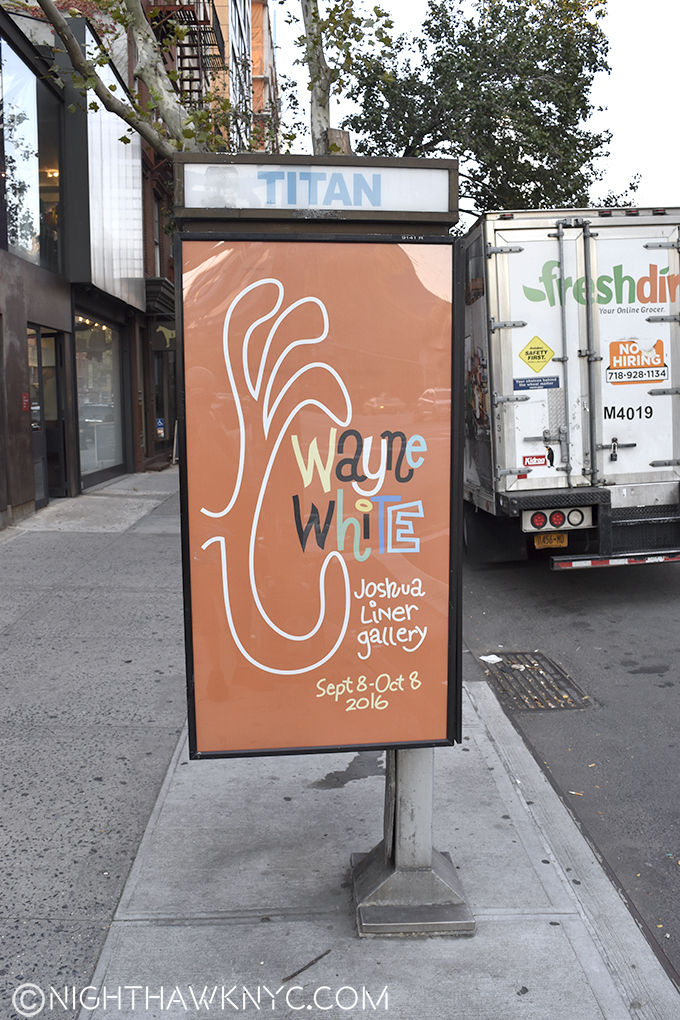
20 years later I caught up with what he’s doing now over at his show, “I”m Having A Dialogue With The Universe And You’re Just Sitting There,” at the Joshua Liner Gallery, in the shadow of the new Zaha Hadid Building still going up on West 28th street. (They’ve added her name in very large letters at the very top, looking not unlike one of Wayne White’s “Word Paintings,” though it’s temporary…I assume.) As for Wayne White, he’s moved on from Pee-Wee to this-
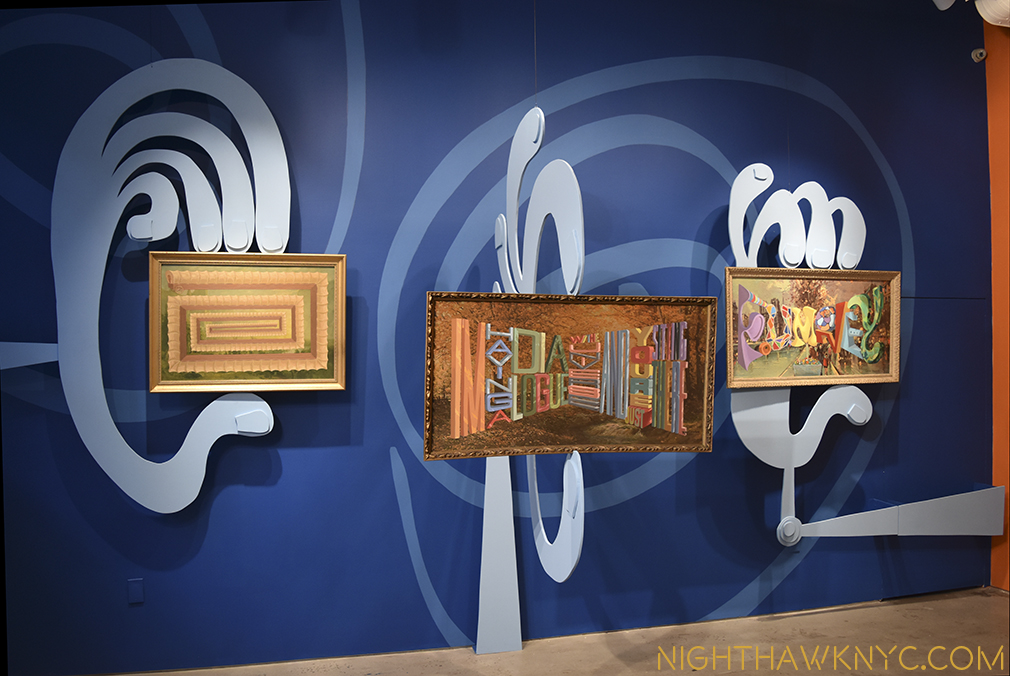
Wayne White’s “set-like” installation for 3 of his “Word Paintings.”
The endless sailboat is now the endless covered wagon above on the left, below, and is joined by a series of Wayne’s “Word Paintings,” which consists of words and phrases he paints on top of old lithographs he finds in thrift stores, and one sculpture.

“I’M HAVING A DIALOGUE WITH THE UNIVERSE AND YOU’RE JUST SITTING THERE,” 2016
It turns out that all the while (actually, most of his life) Wayne White has been drawing incessantly, as can be seen in the 400 page monograph edited by designer Todd Oldham entitled, “Wayne White: Maybe Now I’ll Get The Respect I So Richly Deserve.” But even this only covers some of his creative work. Yet, he is clear on what he wants to accomplish.
“My mission is to bring humor into fine Art. I’m not talking about coy art world funny. I’m talking about real world, Richard Pryor funny. Humor is our most sacred quality. Without it, we are dead,” he says.
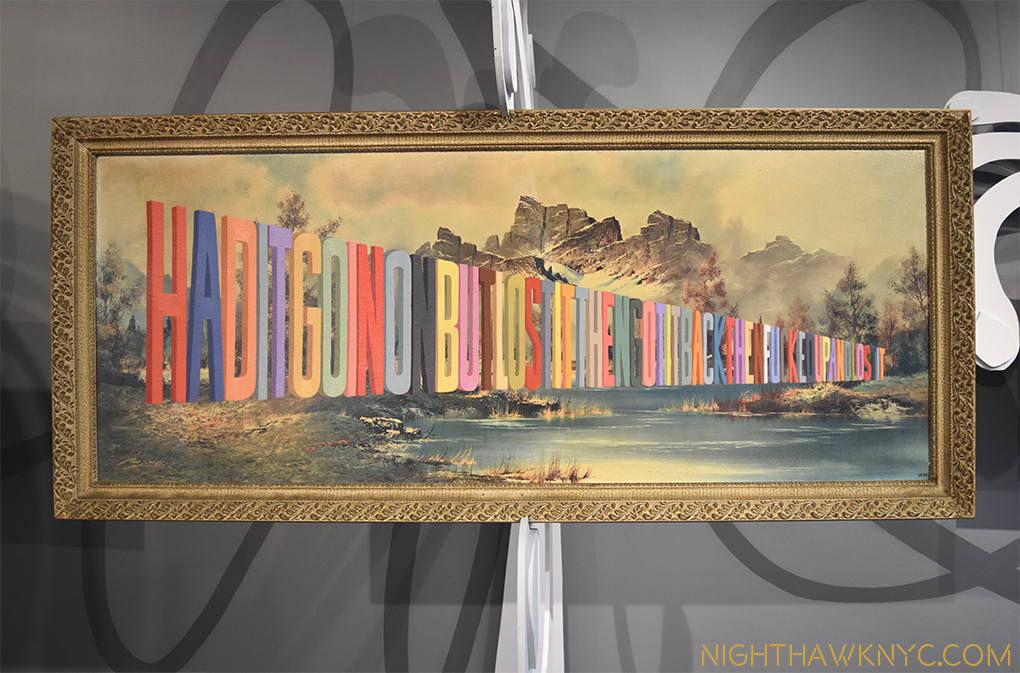
“HAD IT GOIN ON BUT LOST IT THEN GOT IT BACK THEN FUCKED UP AND LOST IT,” 2016
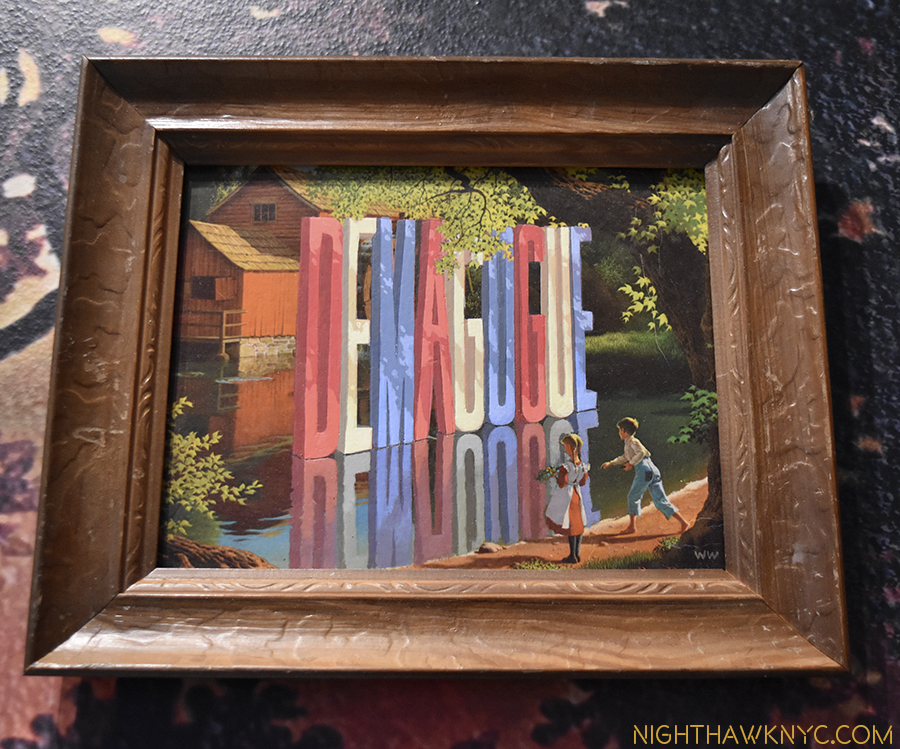
“DEMAGOGUE,” 2016
Is this Art? Hmmmm….Time will tell. There is a history of “word art” in museums, from Stuart Davis through Jasper Johns, Warhol, Ed Ruscha, Jenny Holzer and Barbara Kruger.
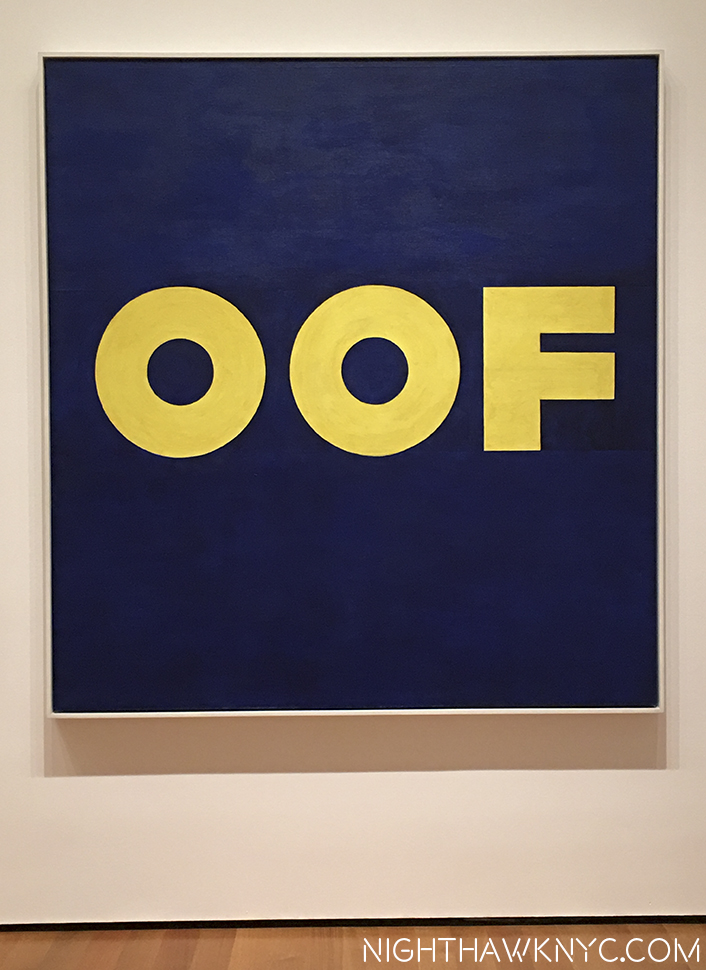
Ed Ruscha’s “OOF,” 1962, at Moma, a favorite here at the NighthawkNYC Offices.
There is the whole question about the ethics of taking someone else’s art and painting over it, though Mr. White only paints on lithographs, not paintings, so he’s not defacing a one of a kind, like Hans-Peter Feldman, who happened to have a show right around the corner, does. There is recent precedent for this in Ai Weiwei’s “Coca-Cola” painted on an antique Chinese Urn, among others, but I am not an intellectual property lawyer.
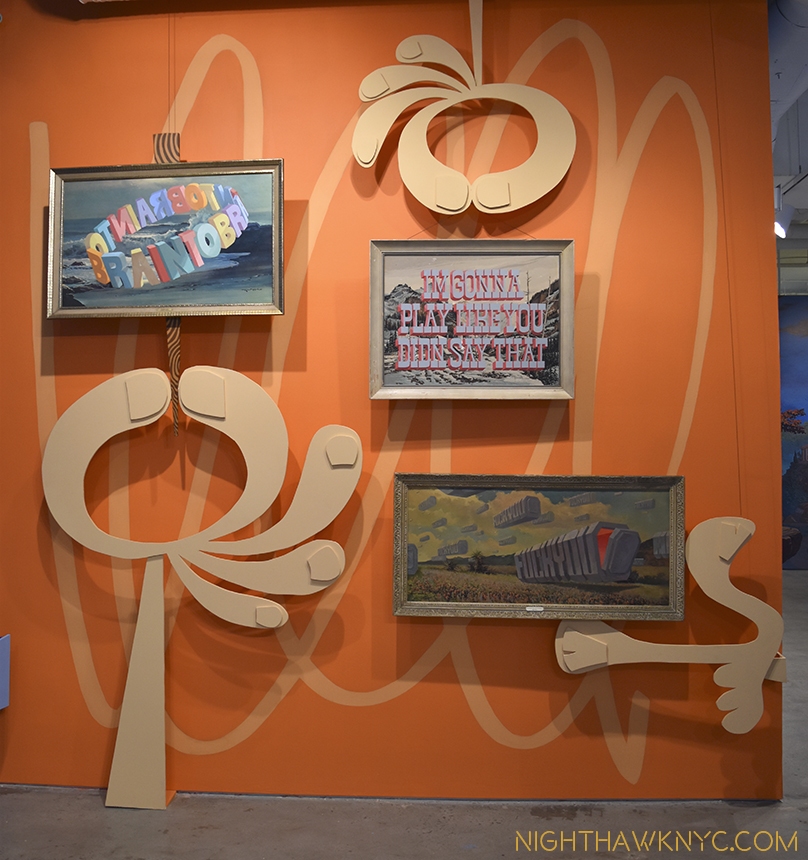
I find it ironic that he did the Art Direction for Gabriel’s Big Time…
whose lyrics now seem prophetic-
“The place where I come from is a small town
They think so small, they use small words
But not me, I’m smarter than that,
I worked it out
I’ll be stretching my mouth to let those big words come right out”*
Born and raised in Chattanooga, Tennessee, his life changed when he discovered the underground comics of Art Spiegelman and R. Crumb. He hunted down Spiegelman and took his cartooning class at the School of Visual Arts. After graduating, Pee-Wee, and the music videos, a studio accident led to his putting words on found art, and his “Word Paintings” were born. Over a decade later, they are becoming iconic- most of those on view are sold, some for as much as $25,000.00. But, they are only one side of the man’s talent. I yearn to see a more complete showing of his range- his more abstract Word Paintings, as well as his other paintings which are not based on found lithographs, his sculpture, his puppets, and on and on. The breath of his talent is both mind-bending and mind-opening.
Mr. White is, also, quite a self-promoter, which he accomplishes with both southern charm and his trusty banjo in hand. There is no better sample of, or introduction to him, than this-
And? If you want to see more of him, there’s a new documentary on him called “Beauty Is Embarrassing,” that was a hit at the festivals and is now out on DVD.
Also of note is the installation- a set design, itself. Along with the “art holders,” White has collaborated with a Brooklyn company to create his own “Waynetopia” wall paper, which in installed in the back half of the show. You can buy it for 11.00 the square foot.
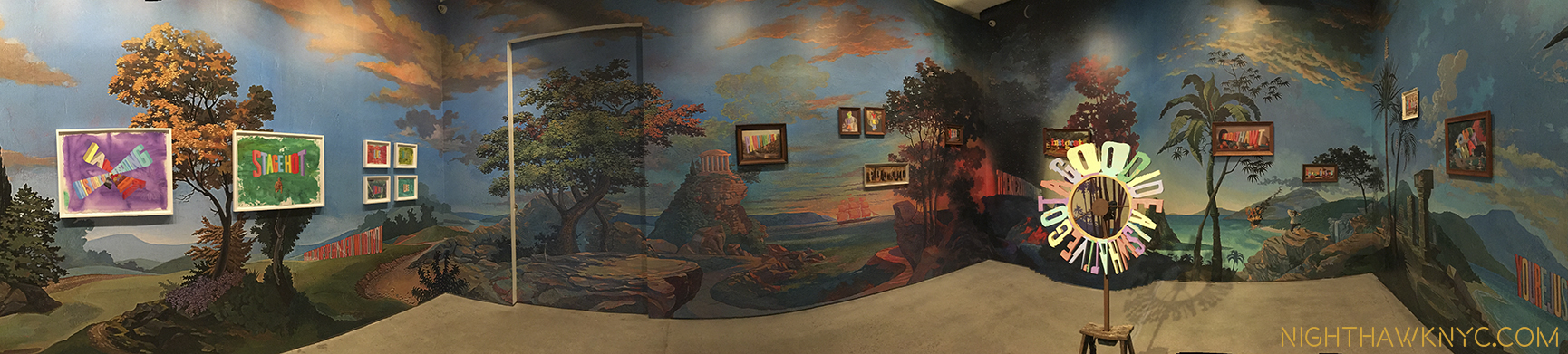
The rear half of the show features White’s “Waynetopia” wallpaper, available at $11. the sq foot, and a windmill word sculpture.
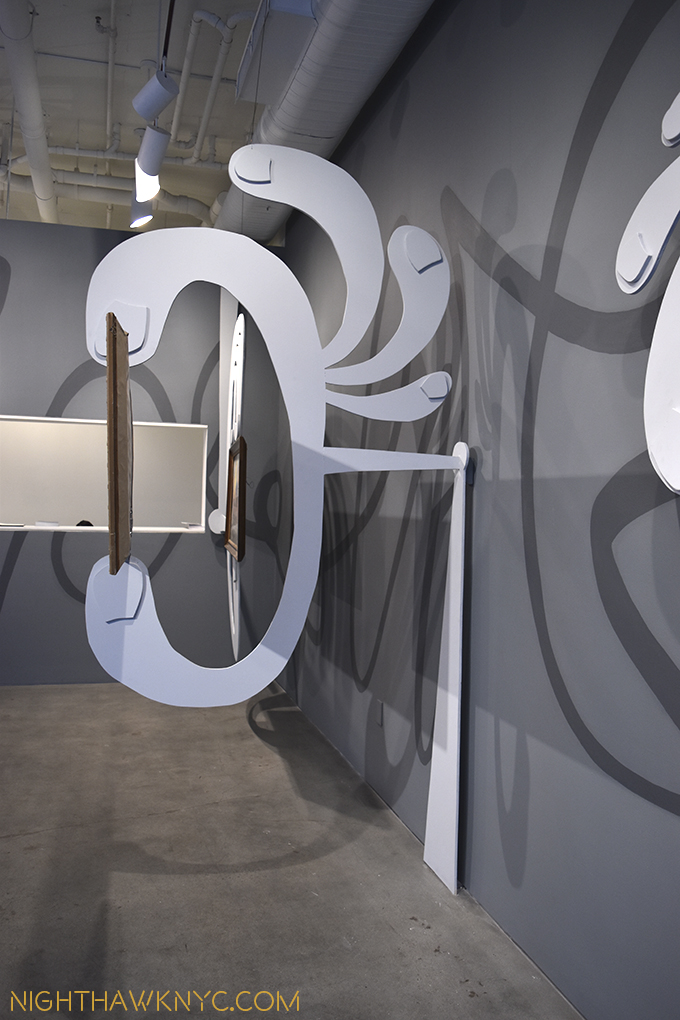
Side view of one of White’s Art Holders. LOVE the painted faux shadow lines on the wall..
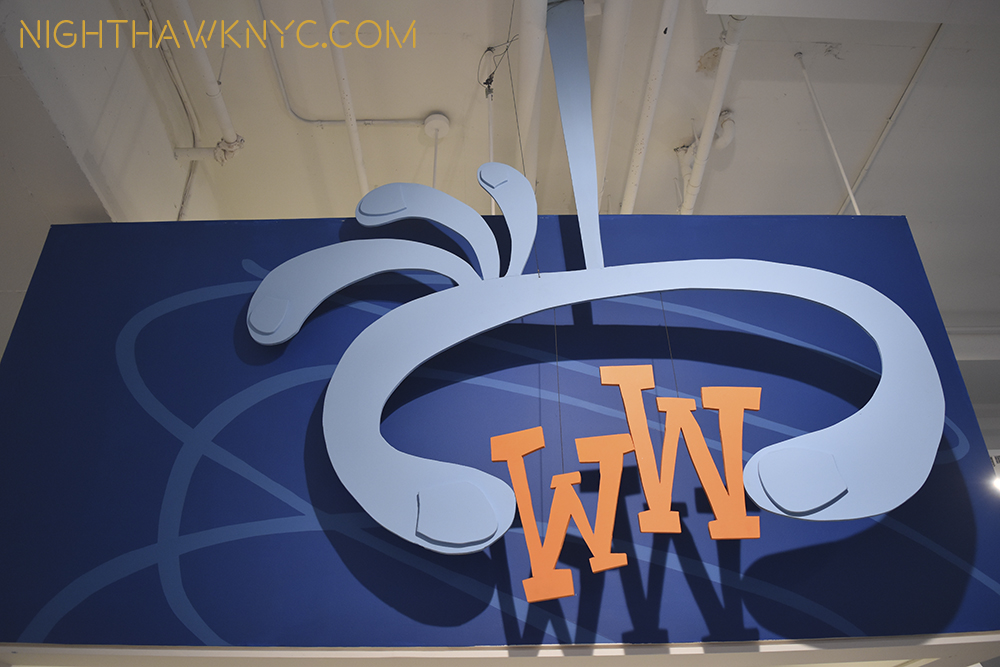
High above the show are his initials, as he signs his paintings.
Oh! And lest I forget- If you don’t have a spare $20,000. laying around for a painting, you can always head over to the wonderful Fishs Eddy who have collaborated with him on a collection of serving trays. Yes, serving trays. At popular prices. I guess with a couple of hooks you could hang one on your wall, and take a trip around the world with the savings. (I’ve got my eye on the “Luv Hurtz” tray myself, though “Beauty Is Embarassin’!” is a close second.)
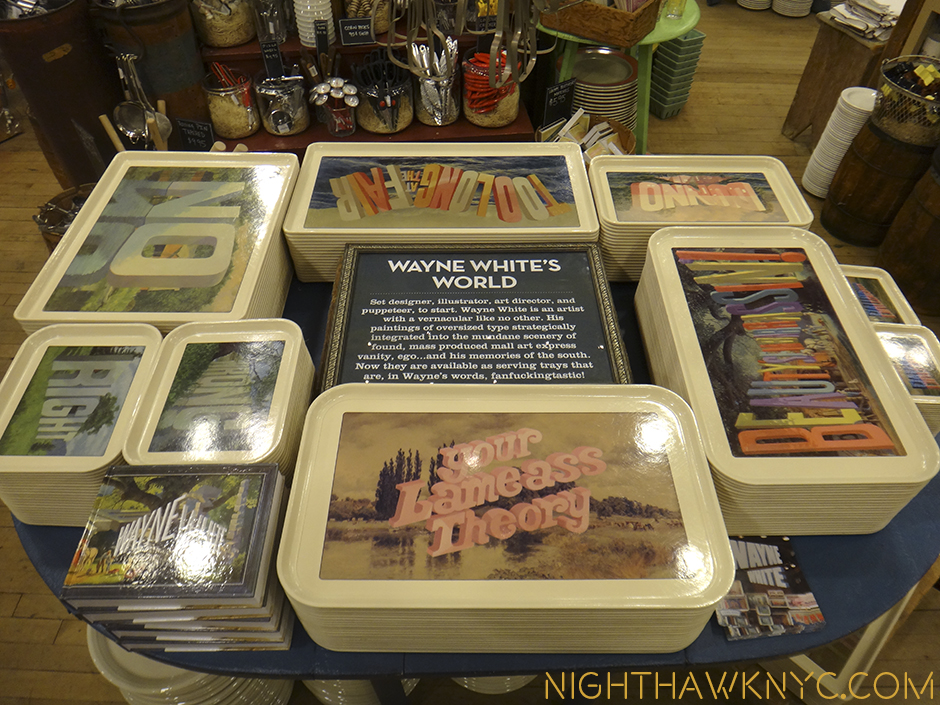
Wayne White Serving Trays in collaboration with Fishs Eddy, NYC, seen in their Broadway store.
While I prefer his edgier work (surprise, surprise), Wayne White is so prolific, he’s like the weather in Miami- If you don’t like it now, wait 15 minutes- it’ll change. Meaning, he’s almost certainly got something in his oeuvre to wow you. He has begun to get shows where he’s been able to bring all of his talents to bear, (like “BIG LICK BOOM,” an installation at the Taubman Museum,Roanoke,VA. in 2012). He is yet another of the generation of Artists who have come up influenced as much by R. Crumb’s “Zap” and Art Spiegelman’s “Raw” as by Raphael. Yet, I’ll give him this- Wayne White is, perhaps, funnier than Speigelman or Crumb (though both, assuredly, have many moments of their own, I don’t think humor is their primary goal.) Time will tell what Wayne White’s ultimate “goal” is. For now, he’s building a following and breaking barriers. It will be interesting to see where he takes things.
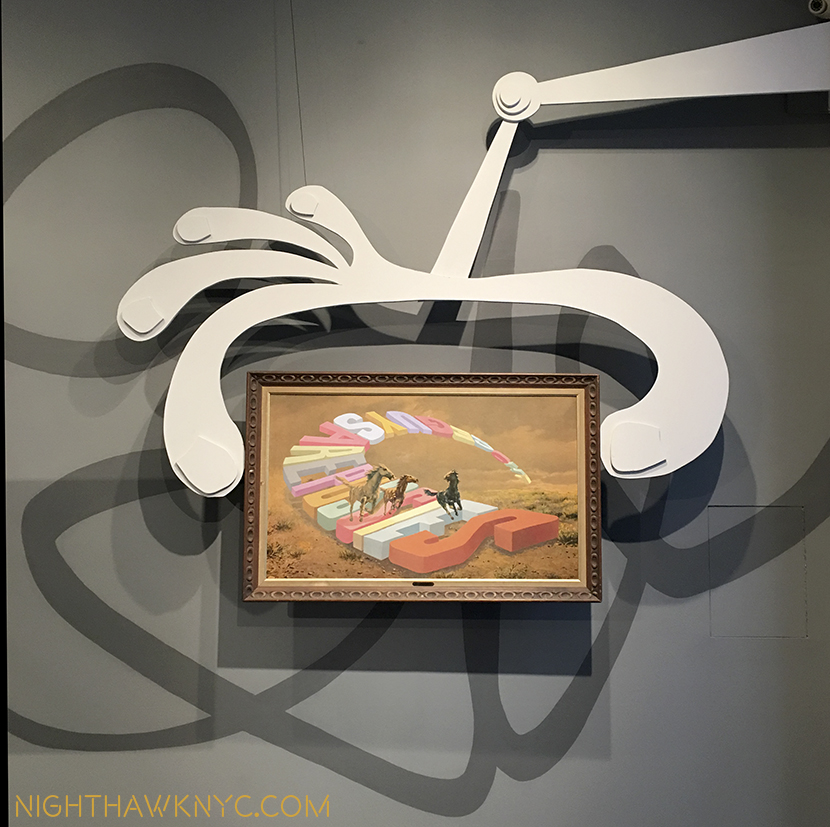
“THOSE GUYS ARE PUSSIES, 2016. I can see this hanging on some exec’s wall.
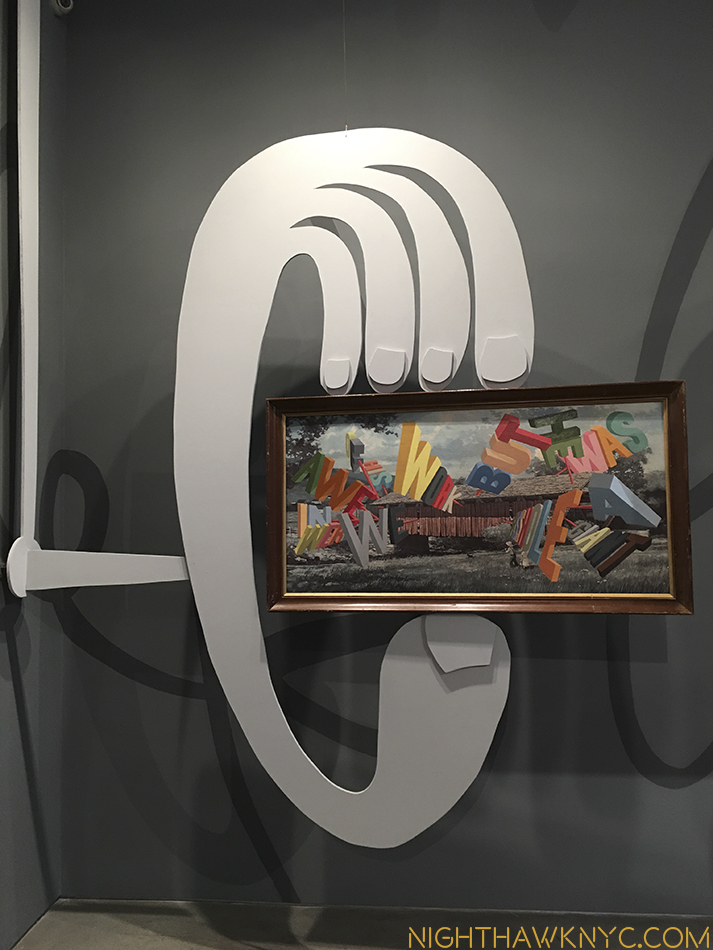
WE WERE IN AWE OF HIS WORK BUT HE WAS A GIANT ASSHOLE, 2016
As I left Joshua Liner, I came away thinking that it’s not often an Artist goes to such lengths to install a show, especially one that is only up for exactly one month. The work designing and creating this installation must have taken much much longer. As much as the work on display, I was impressed by what that says. It really was like walking around in a “Wayne White World.” It’s unique, wonderfully well thought out, and, ummmm, what’s that word I’m looking for? Oh yeah….FUN!
*-Soundtrack for this Post is “Big Time” by Peter Gabriel, from “So,” and published by Sony/ATV Music Publishing, LLC.
NighthawkNYC.com has been entirely self-funded & ad-free for over 8 years, during which 300 full length pieces have been published! If you’ve found it worthwhile, PLEASE donate to allow me to continue below. Thank you, Kenn.
You can also support it by buying Art, Art & Photography books, and Music from my collection! Art & Books may be found here. Music here and here.
Written & photographed by Kenn Sava for nighthawknyc.com unless otherwise credited. To send comments, thoughts, feedback or propositions click here. Click the white box on the upper right for the archives or to search them. Subscribe to be notified of new Posts below. Your information will be used for no other purpose.
This site is Free & Ad-Free! If you find this piece worthwhile, please donate via PayPal to support it & independent Art writing. You can also support it by buying Art & books! Details at the end. Thank you.
Written & Photographed by Kenn Sava (*- unless otherwise credited)
1. The Treatment
“I’ve been through worse.”
That’s the Mantra. I learned that after surviving cancer, and cancer treatment, nine years ago. “If I can get through that? I can get through this.”
Whatever “this” is.
It works! At least? So far. After all, what could be worse than cancer? That’s what I tell myself.
Blindness is up there. I have anatomical glaucoma. In both eyes. So, the risk is I could become partially blind at any time in either, or both eyes. On my second opinion, I find a doctor who says with 2 laser treatments he can give me a 100% chance of fixing it permanently.
Those are my kind of odds.
Today is Round 1. I got up insanely early for the Nighthawk. 10:30am. Uggh. As hard as that was for me, my friend had a harder road. In fact, 3 hours of one, on the bus down from Upstate New York to come with me. She was more worried that I’d oversleep than anything else, she said. We walked over to a “leading New York Hospital” on a glorious September Monday to experience one of the great joys of modern medicine- the registration line ALL patients must wait in. No matter what, no matter I had been there twice in the past few weeks, and no matter neither my health insurance nor living address change that often. The line was half as long as last time, but twice as slow moving. A guard came over and asked for my info. ? Since when? He relented, but the ex-military guy behind me in line got a bit set off when he tried it on him, which led to him feeling one of the counter clerks didn’t want to serve him. He requested a supervisor, and the clerk’s name to file a complaint. Good luck with that. The supervisor listened to him complain that said counter woman “picked up and put down the same paper repeatedly so as not to serve him.” I found this a bit odd, since I was in front of him in the line, and I was still waiting.
I fnally got to see a clerk, who wound up giving me all the paperwork, including her copy. ? Ok…Onwards to treatment, glad to be done with this chaos.
Upstairs, in glaucoma, the woman behind the desk never even looks up from her phone call to acknowledge me. She was making her case to someone about something that had happened at work. I put my paper on the desktop and made sure my friend was seated. The woman looked up long enough to tell me to take my paperwork, calling me by name. ? How did she know who I was?
We settled into the empty waiting room. After a bit, she pulled out an Art History book, and we started looking through it, and discussing it. Unawares, little by little, the room filled up around us, and we became surrounded by a range of mostly older people of all races and languages. A number of them appeared to be suffering from various mental issues, some so incapacitated they had assistants to speak for them, in addition to whatever eyesight issues brought them to the glaucoma department. Yet, there we were, lost in making comments back and forth about Ingres, Michelangelo, Leonardo, Hopper (who’s “Nighthawks” was on the cover. Good choice! Wink), and her favorite Artist, Chagall.
About 45 minutes later, (45 minutes past my scheduled appointment), I was seen by a technician. He checked my vision, then I came back out and we continued looking at Art. An older gentleman came in with a walker, sat down and proceeded to sing in full voice. This elicited looks from the staff, but nothing more. No one said anything. I turned to my friend and said, “Welcome to New York.” Luckily, he was quickly called, and a semblance of silence resumed. A young man walked in with a large pizza and a soda. “He’s a doctor,” my friend said. Yup. He was. A man walked back and forth behind the counter, from time to time, saying nothing nothing to anyone, and accomplishing…? The woman behind the front desk put on a mask. Her boss came over and asked her “Why?” She muttered something then kept it on throughout. A woman sitting next to my friend began to snore. Somehow, she managed to hear the soft announcement calling her name.
We continued looking at Art. Kandinsky, Monet, more Ingres, more Leonardo- the Mona Lisa looking wayyyyy better than you’d ever see it in person, and a few contemporary Artists I don’t know, capped off with Mark Rothko (the Rothko Chapel, important, but not representative as his only work shown) and Bridget Riley. There was also the Laocoön & his sons, in a full page photo. All of a sudden I had one of those Sherlock Holmes-“Wait a minute!” moments. “Oh My God. LOOK AT THAT! It’s a Michelangelo!,” I thought to myself when I saw it.
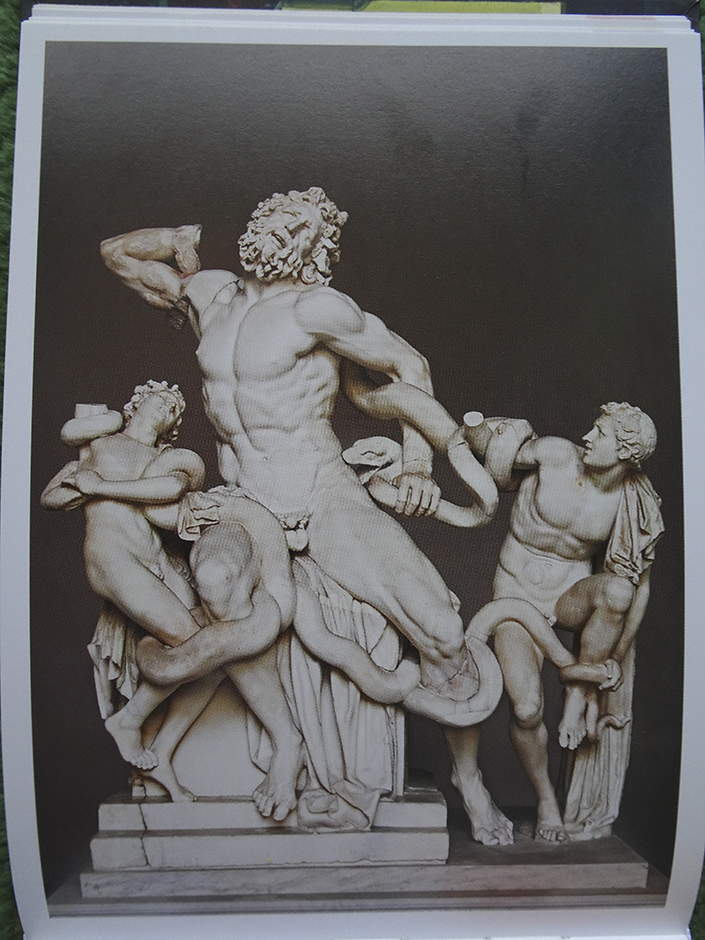
The photo in question from “When Art Really Works,” published by Barron’s.
“Hello? Can we put the glaucoma treatment on hold? I may have discovered a Michelangelo, right here in the waiting room!,” I said in thought. We paused and I said (out loud) to my friend that the Laocoön was a huge sensation when it was discovered, instantly recognized as a lost supreme ancient masterpiece, and that there was a theory that Michelangelo had secretly created it.
Hmmmm…
At that moment, I was called to have drops put in before the procedure. 30 minutes later, at 2pm, I was called back for the treatment. 2 doctors surrounded a machine with arms, scopes and all kinds of things sticking every which way. I carefully wiggled onto the odd stool I was to sit on, which required a bit of contorting, hoping I could hold my head steady sitting on it. After all, I didn’t want them to miss with the laser! A nurse was present to make sure I was who they thought I was. She asked questions only I would know, I guess- “Why are your Posts so long?” “Why do you stay up so late?” Ummm….Doctor 1 drew a dark mark on my head over my left eye in the dark room. “Chin up. Lean forward. Look at the yellow light.” Inside the machine I was bombarded by bright flashing red and green lights, a slight squeezing sensation and then it was over. “Perfect,” Doctor 1 said when I asked him how it went.
Phew. Exhale. I have been through worse. Score another one for the Mantra!
Back out to wait to get a blood pressure reading. “Am I bleeding,” I asked my friend. “No,” she said. I was bloodshot, and a bit sore. Things were very fuzzy out of that eye, like I was looking through an extremely smudged eyeglass. I saw the Doc again, scheduled the right eye, and we left, arm in arm because while I could see, I didn’t know how well yet. I felt ok, but quickly found that you can’t keep one eye closed very long. I immediately put my shades on. Lord, it was bright outside. Don’t they do these at night?
Later, maybe in the throes of the steroids I’d be on for a week, or the rush from having gotten through it, I was struck by how amazing the experience was. Not medically. Interpersonally. I’ve never had someone who shared my love of Art like this in my life. That’s part of the reason I have this Blog. I need to share it with someone. Later, while she was back on the long road home, I told her it was very special to me that we were sitting there together reading about Art, no matter what was going on around us.
She said that the other people there probably thought WE were the crazy ones.
Art is in the beholding.
2. The Fog Lifts
I had a cloudiness, then a darkness in my left eye that lasted all afternoon and evening. All day I’d been haunted by the picture in her book of the Laocoön Sculpture. An iconic work of early Ancient Art, dated at about 20 BCE, that had disappeared until it was rediscovered in 1506, it looked amazing for 2 thousand odd years old. The ancient historian, Pliny the Elder, had written about it, in his Natural History in 79AD. He said–
“Such is the case with the Laocoön, for example, in the palace of the Emperor Titus, a work that may be looked upon as preferable to any other production of the art of painting or of statuary. It is sculptured from a single block, both the main figure as well as the children, and the serpents with their marvelous folds. This group was made in concert by three most eminent artists, Agesander, Polydorus, and Athenodorus, natives of Rhodes.”
With such a buildup, it’s no wonder it’s discovery was a sensation- among the public and among Artists. It was immediately acquired by Pope Julius, and it holds a place of honor in the Vatican to this day. That much is known. But? What about this theory I’d heard about it? Finally, around midnight I could see enough to read my computer screen. The first thing I did was look up this-
“Michelangelo Laocoön”
I came across two pieces in the NY Times within days of each other in 2005 (here, and here). The pieces talked about a Columbia University Lecturer, Dr. Lynn Catterson, and her theory that Michelangelo had created the Laocoön. i.e. Michelangelo had created a forgery of the Laocoön in Pliny and hid it so it could be “re-discovered” at long last- “All too conveniently,” as Dr. Catterson put it.
2005? Hmmm…Eleven years ago. Nothing since. That’s strange. No mountain of outraged PhD’s spewing vitriol at her and her claims? Now, I was VERY interested. My gut radar went off as it rarely does this morning. But, let’s get real- this is one of the most sensational claims there could be in Art. If true, it would rewrite Art History for BOTH the Modern AND Ancient worlds! Not to mention Michelangelo’s.
Then again, as Michelangelo specialist, author and educator, Professor William Wallace says in one Times piece, works supposedly by Michelangelo have appeared often- seventeen from 1996-2005. Even I have seen these claims in the past, and frankly, after checking a few of them out, you become numb to them. In fact, right now, at The Met there is a small sculpture on display- of Cupid (which they now call “Young Archer” on their website), on extended loan, that no less than The Met’s experts, who I hold in highest esteem, say is by Michelangelo! Not “Attributed to.” Not “Michelangelo and assistant.” It says, “Michelangelo” on the card, below, and on the web page. IF it is an original Michelangelo? It is the ONLY Michelangelo sculpture in the Western Hemisphere. Pretty big deal. But? Other experts disagree about it. Is THIS the forgery of a Cupid Michelangelo is known to have made? Now that it’s called “Young Archer” on their website does that mean the well-known Cupid forgery is ANOTHER work? Also, nothing is mentioned about WHY they think it’s a Michelangelo. After spending a good deal of time looking at it from every angle. I remain to be convinced it is a Michelangelo. Then again? Part of a forger’s work is to adopt another identity.
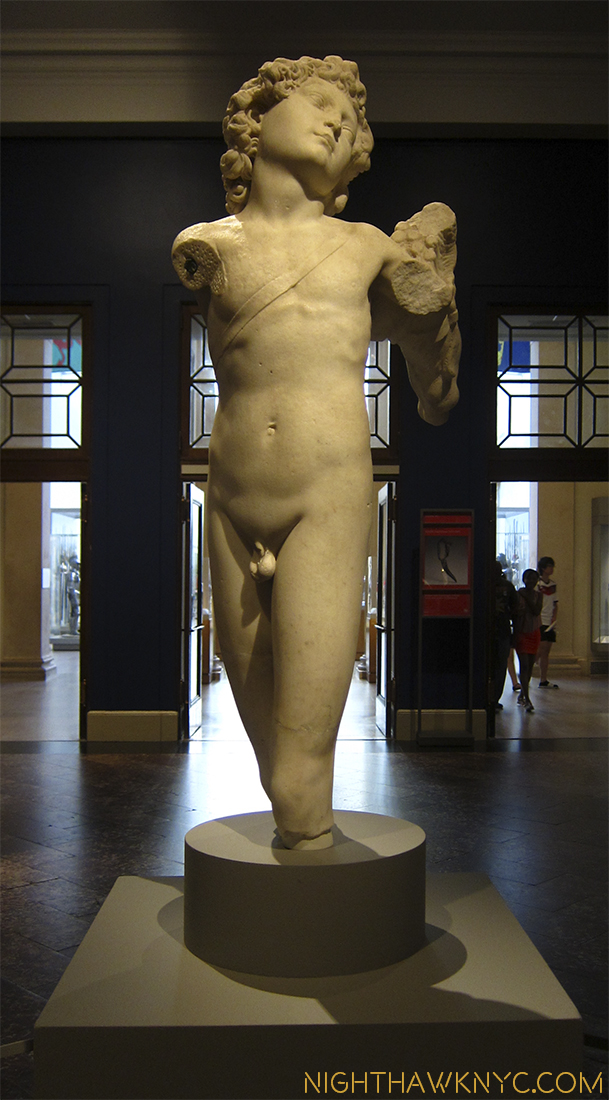
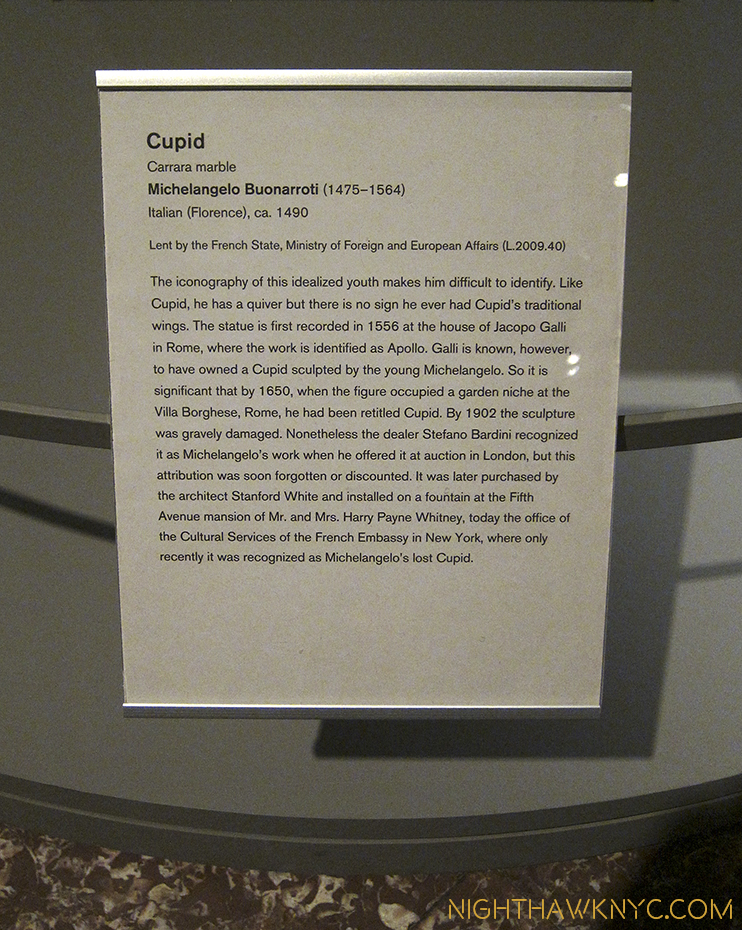
Michelangelo, “Cupid” & it’s card at The Met. Their website calls it “Young Archer.”
Though I remain unconvinced by the Cupid at The Met, I was more convinced by their “Michelangelo’s First Painting” show, in 2009, of a restored painting titled “The Torment of St. Anthony,” which was based on a print by the great Martin Schongauer. I drank their cool-aid, and I bought what they were selling about it. Interestingly, The Met didn’t buy this work, themselves, when they had the chance to! I’d love to know why not. It was bought by the Kimbell Art Museum, Fort Worth, Texas, who The Met restored it for. Very peculiar. Michelangelo changed Schongauer’s original, adding his own touches and putting his own mark on the work, which he created in color(!), compared to the black and white original print, they hung next to the painting. While he didn’t create this work as a forgery (as far as I know), Michelangelo has a history of creating forgeries and was caught making at least one. The risks were great. Yet, according to Dr. Catterson, he continued making them, even creating the Laocoön right along side the immortal Pieta also now in the Vatican.
Reading her full piece, Dr. Catterson makes a strong case. I urge you to check it out. Here are some highlights-
-The found Laocoön wasn’t in one block as Pliny said, but 7 connected pieces of marble, making transporting it to the site feasible
-Michelangelo had the money, marble, space and time to create it before it was “found.”
-It’s miraculously superb condition(! ?)(Walk around The Met and check out the condition of sculpture from that period, BCE. Oh, and count how many still have a whole nose!)
-The “rediscovery” of the Laocoön was, seemingly, “made to order”. Consider-
-No less than Michelangelo, himself, was called to be there when it was discovered.
-Michelangelo had only recently arrived back in the area.
-Michelangelo also worked on it after it was discovered
-There is a drawing by Michelangelo that matches up uncannily well with the rear of the sculpture when superimposed on it’s photo
-Michelangelo destroyed an unknown number of his drawings before his death. Why, if they didn’t reveal what works he forged?
-Michelangelo wrote a letter in which he speaks of the Pope killing him if he discovered something. What? Aside from the construction of the Pope’s tomb, the only other interaction they had at the time was the Pope recently acquiring the Laocoön.
That’s the shortlist.
“Last night I dreamed about you
I dreamed that you were older
You were looking like Picasso
With a scar across your shoulder
You were kneeling by the river
You were digging up the bodies
Buried long ago
Michelangelo”*
My question is “WHY?” Actually it’s a 2 part question-
-Why did he make these fakes, and then keep making them? And,
-WHY didn’t he ever come clean and take credit for them, especially the Laocoön, which instantly became iconic? Here is an Artist who, according to Vasari, snuck into the Vatican overnight to carve his name on the sash of the Pieta so everyone would know who created it! (Though, he regretted doing that, and swore to never sign a work, again. He didn’t.) To create a work that is, along with the Pieta, one of the greatest sculptures we have, at about the same time, and NEVER take ANY credit for it at all, even on his death bed? On the flipside, making, then hiding, something like this would seem to be extremely hard to keep secret. Someone else must have known. And yet, there is not a peep of this anywhere, until Dr. Catterson’s theory. Michelangelo was the first Artist to have a biography written during his lifetime (actually, 2). Why didn’t anyone, especially his enemies and rivals, “out” him? This puzzles me.
I await hearing what someone/anyone else has to say to negate, or substantiate her claims. Professor William Wallace, countering the initial outrage Dr. Catterson’s theory received, said– “…the intriguing thing is that nobody who studies classical art in a way wants the ‘Laocoön.’ They find it kind of a Hellenistic embarrassment, maybe because it really doesn’t look like anything else comparable in the history of classical art.” Why? As Dr. Catterson points out, Michelangelo used contemporary models, including Filippino Lippi, not ancient ones, when he created this.
As much as I love sculpture, I’ve never really paid much attention to the Laocoön. Why? I hate snakes! So, this is a pretty nightmarish image for me. Funny thing? My friend said the same thing Monday when we saw it! I have been, however, reading quite a bit about Michelangelo these past 5 or 6 years. I’ve read the 2 volume set of his Letters, a number of biographies, including Condivi’s and I’m in the midst of Martin Gayford’s “Michelangelo: His Epic Life” Biography right now. (He doesn’t mention Dr. Catterson’s theory, though his book was published in 2013.) I have some superb books of photos of his sculptures, including the XL Taschen monograph. I look at them frequently. Michelangelo is in my mind, like Leonardo da Vinci was that day in London in 2012 when I saw the “Salvator Mundi/Savior of the World”in the once in a lifetime Leonardo show in London’s National Gallery, after it had recently been credited to Leonardo. Seeing 7 of his other paintings that have been credited to him for much longer, immediately before.1, I came away believing it is a da Vinci, unlike the Shroud of Turin. So, when I suddenly saw the Laocoön Monday afternoon in my friend’s book, I was stopped dead in my tracks…
Michelangelo. I believe Dr. Catterson is right.
“We’ll never have the certitude a scientist gets,” Professor Wallace said, “It can only be tested by the weight of scholarly opinion and time.” And, I humbly suggest- your eye, and your gut.
“That the Laocoön was carved by Michelangelo explains why then, and now, its effect is mesmerizing.” Dr. Catterson’s piece coincidentally ends.
In at least two ways on Monday, the mist cleared, and now I see.
ONward to Round 2!
(For Sv.)
*-Soundtrack for this Post is “Michelangelo,” by Emmylou Harris, published by Universal Music Publishing Group.
This site is Free & Ad-Free! If you find this piece worthwhile, please donate via PayPal to support it & independent Art writing. You can also support it by buying Art & books! Details at the end. Thank you.
Written & Photographed by Kenn Sava (*- unless otherwise credited)
This site is Free & Ad-Free! If you find this piece worthwhile, please donate via PayPal to support it & independent Art writing. You can also support it by buying Art & books! Details at the end. Thank you.
Written & Photographed by Kenn Sava (*- unless otherwise credited)
I had mixed feelings when I heard about “Philip Guston Painter 1957-67,” on view from April 29 to July 29 at Hauser & Wirth’s temporary Gallery in the former Roxy Nightclub space. On the one hand, large Guston shows are a rarity, on the other hand, I have long struggled with his works of this period. So, it was with a desire to have it out with them in a battle to the death, over the very generous 3 months it was up, and either, finally, “get” them, or not that I climbed their candy-cane striped stairs to enter a space I had known in it’s previous incarnation.
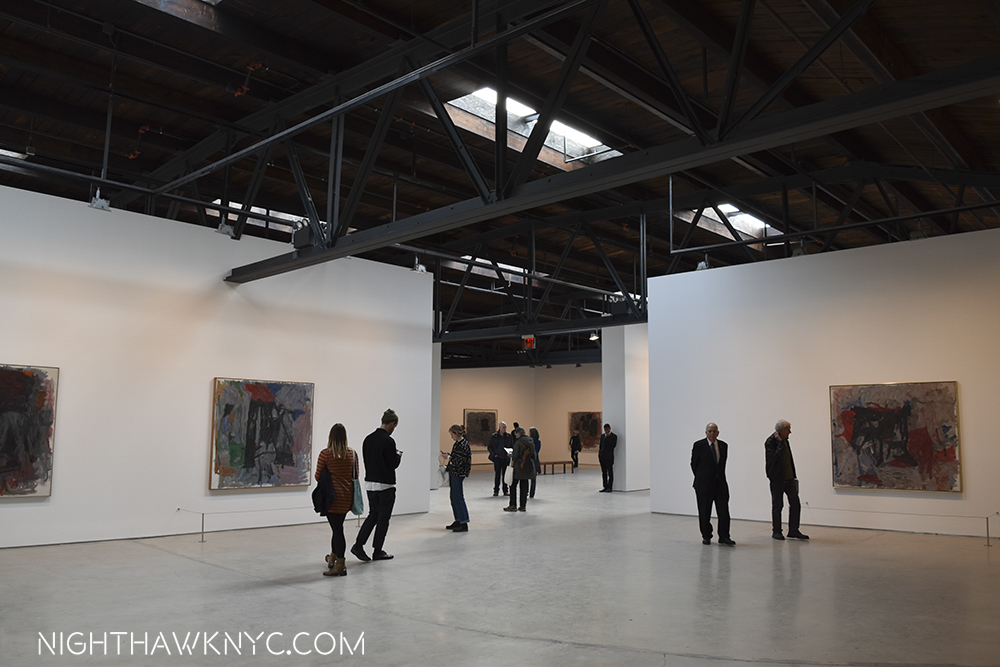
This space had a “colorful” past, in a different way. One that involved roller skates.
I am happy to report that July 30th dawned to find me still among the living.
The show is focused on paintings from 1957-1965, 8 of Guston’s most “abstract” years , and drawings dated from 1967-69, at the beginning of his return to “figurative” work. The 1957-65 period of Guston’s paintings is, perhaps, his least known, possibly least loved, (according to one owner- Guston’s daughter, Musa Mayer’s, experiences when guests have seen it) 1, and least seen works by this Artist, who Hauser & Wirth calls “the preeminent 20th century American Artist” in their press release.
Really? I am very interested in his work, and have a lot of respect for him, but “the preeminent?” Hmmm…Comparing Artists qualitatively is against my religion, though some other candidates are here2. Still, a group of 35 of these is unheard of, and seems unlikely to be repeated any time soon.
While his early abstractions from 1950-55 are seen regularly and much admired, the works of his next period are very different. Gone were the luminous colors and shimmering qualities of the earlier works replaced by a darkness that feels to be continually encroaching as these 8 years progress.
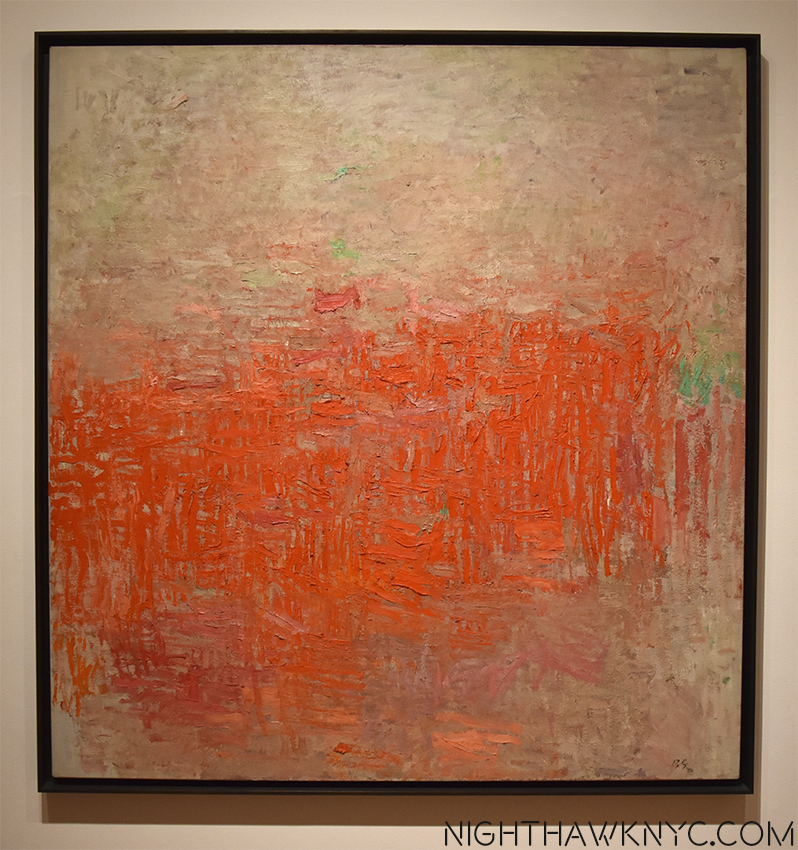
What came before… “Painting,” 1954, on view at Moma
“What shall I paint but the enigma?”
A revealing quote from Philip Guston in 19693? Possibly. Guston, apparently, mis-translates, or misquotes a translation of the inscription on a “Self Portrait,” from 1911, by Giorgio de Chirico, a major lifelong influence, who he was speaking about when he uttered it. It’s de Chirico’s motto. The original reads- “Et quid amabo nisi quod aenigma est?” Most of the translations I’ve seen of it are- ‘What shall I love if not the enigma?’ Maybe it’s Guston’s interpretation of it?
It would, also, seem to be a fitting motto for this show.
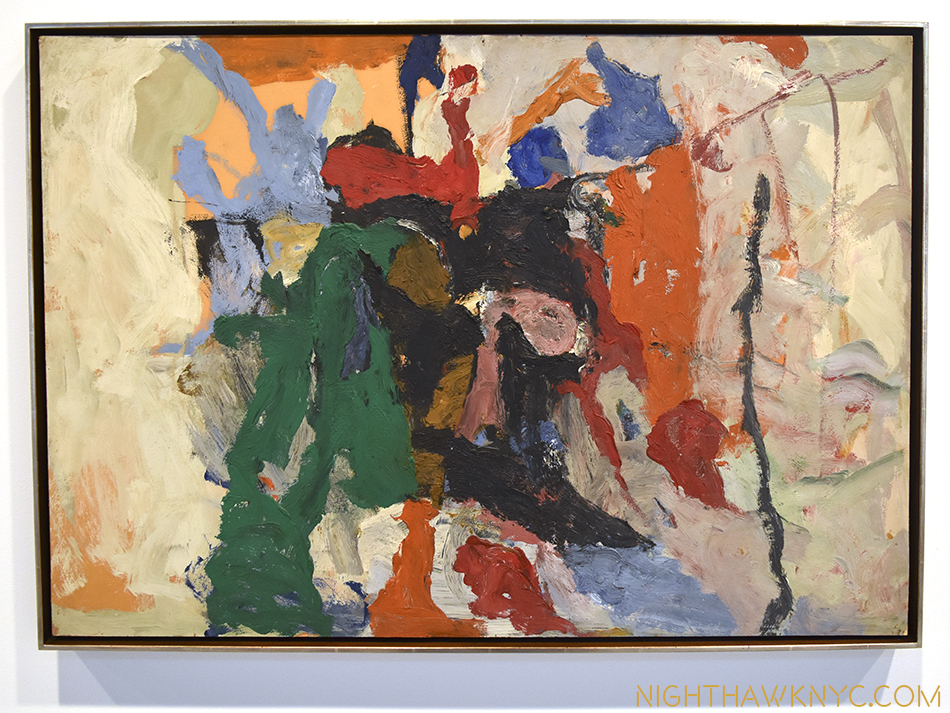
The show begins… “Fable II,” 1957,
Guston came to abstraction very gradually, the end result of a period of consternation over his direction during which his work was gradually leaving figuration behind. In late 1948 he took a break from painting and armed with a Prix de Rome and a grant from the American Academy of Art and Letters, made a trip to Italy to see the works of his early Reinassance heroes, Piero della Francesca and Masaccio. To that point, the dissolution of the figure in his work can be traced through “If This Be Not I,” 1945 (perhaps my favorite work of his), to “The Porch I & II,” 1947, and especially in “The Tormentors,” 1947-48, his last work his trip to Italy. Upon his return, his “Red Painting,”1950, and “White Painting,” 1951, begin his “non-figurative” periods, from which the works on view eventually followed. He said,“The 1950-55 paintings, (see “Painting,” 1954, above), in general, were very diffuse lyrical pictures. About 1956 I began to become very dissatisfied. I began to feel a need for a more solid painting. I began to look at my earliest work with a kind of renewed interest, the solidity of that. I found it a terrific challenging problem, in my own terms, to create forms.” 4
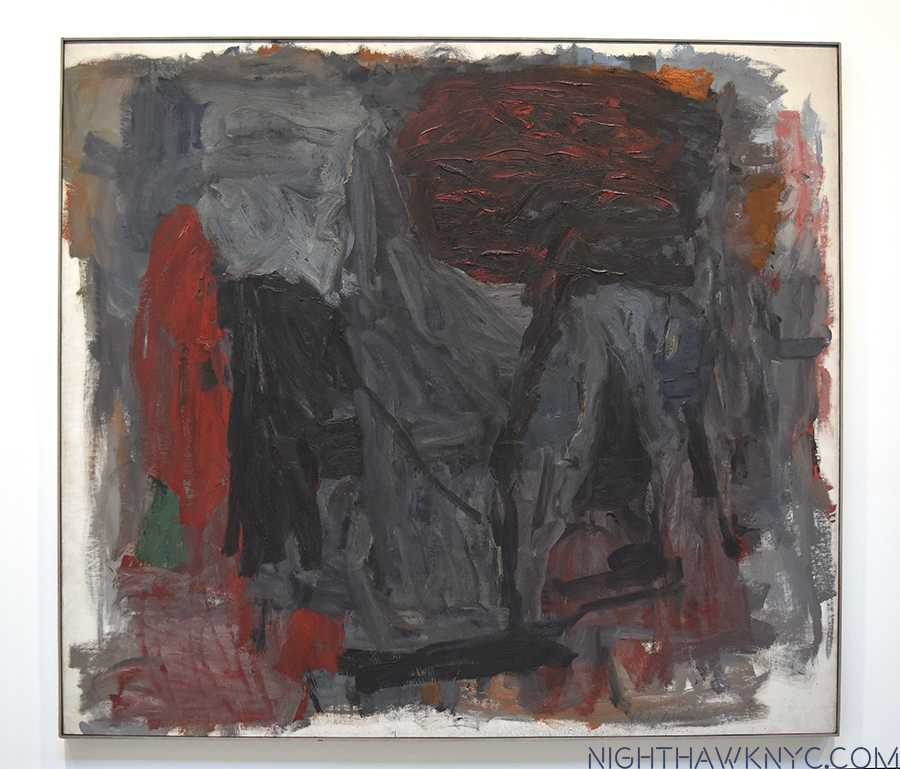
“Traveler III,” 1959-60
Then, in 1956, right on the cusp of the period in question, he told writer and friend, Dore Ashton, “I’m in love with painting.5” Looking around this show, that was the first thing that struck me- how painterly these paintings are. Guston’s brushwork has never been so nakedly at the forefront, even in the abstractions from 1950-55, as they are in every work here. It feels like it would be possible to follow each and every one in some of these works.
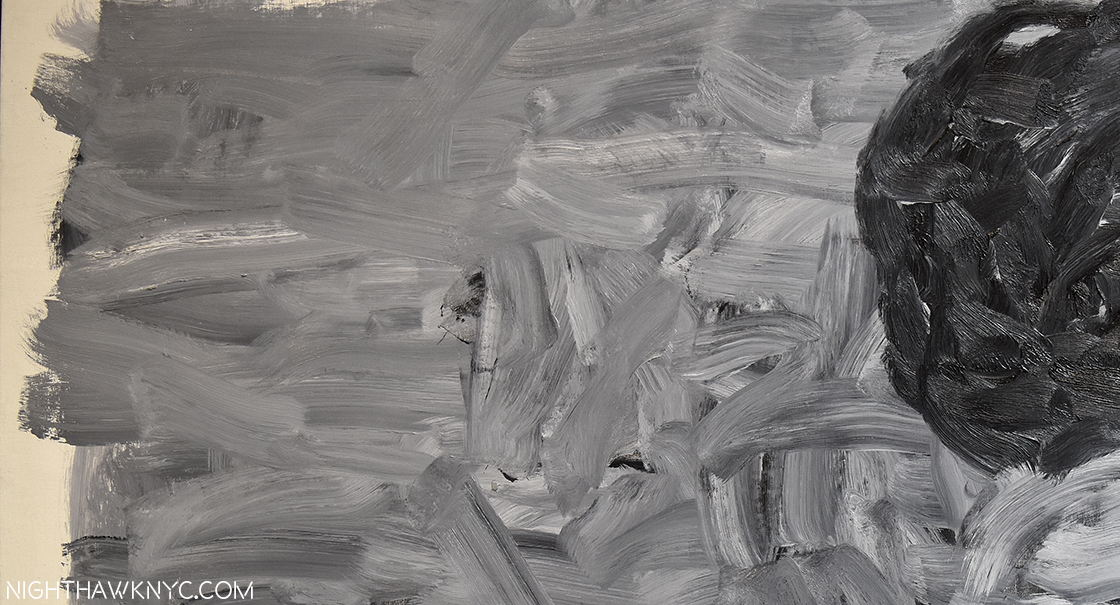
“Position 1,” 1965, Detail.
They have a freedom, a rawness, an energy that strikes me as being completely opposite from his earlier abstractions, someone dubbed “abstract impressionism,” a term he hated, works that are calm, subtle, delicate.These seem almost defiantly, perhaps reactionarily, different. They all contain shapes. At first, a mass of them, later individual shapes, and finally one shape, on a murky grey/blue with pink background. After all the depth of field has gone out, which began in his mid 1940’s work, completed from 1950, after the variety of color has gone out. The enigma remains.
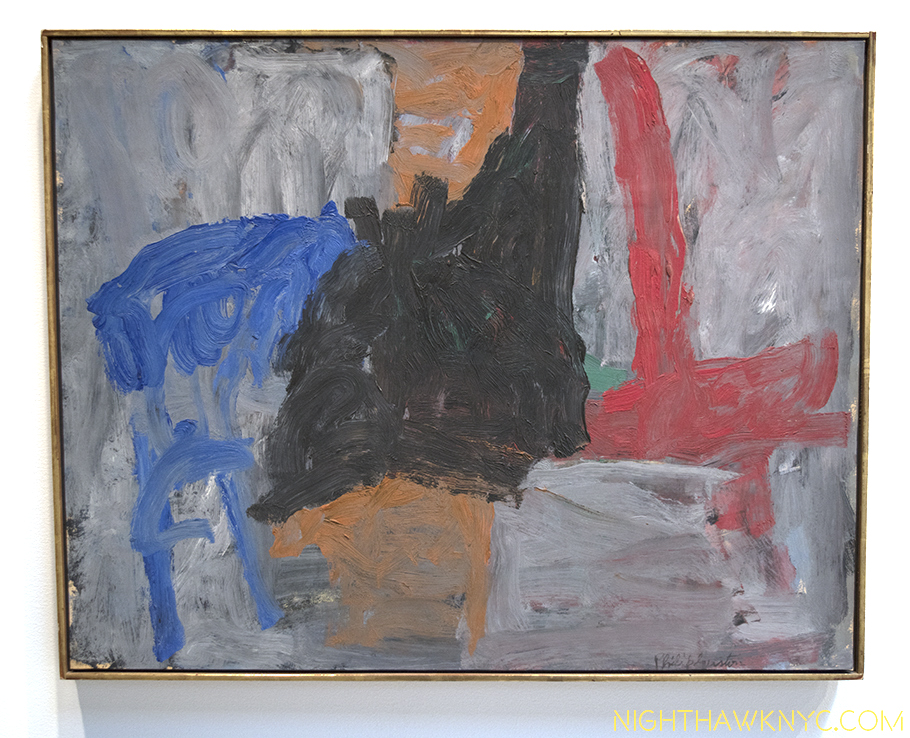
“Turn,” 1959
“There can be no adequate understanding of Guston’s life work unless we are prepared to go back over the whole road,” Dore Ashton wrote in 1990 6. In the earlier work, the enigma was different. It came with, and in the guise of persons, places and things. Guston’s work begins, as far as public collections go, in 1930. And? Talk about starting with a bang!
Guston was a lifelong creature of habit. Some of those, possibly, led to his early death at 66 in 1980. As a child, he retreated from the world to his closet, where he would read, and even paint, by the light of a single light bulb. He painted hooded KKK guys7, who he actually saw break up strikes. At age 13 he discovered his father, hanging, having committed suicide.(!) At age SEVENTEEN, he created this-
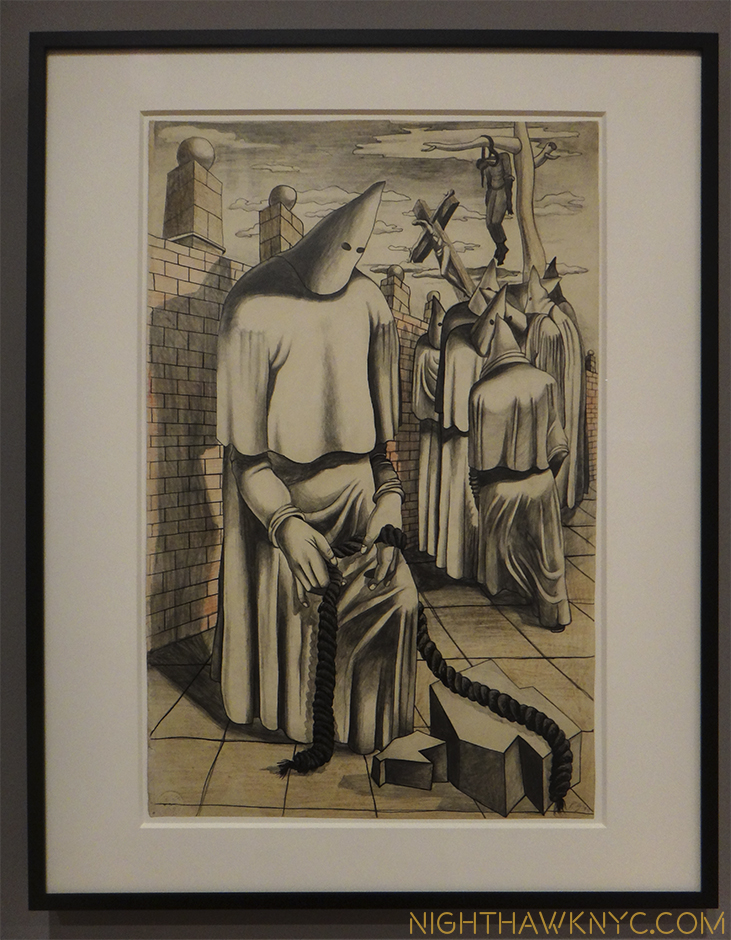
Drawing for “Conspirators,” 1930, at the Whitney Museum
There’s so much going on in this. First, note the figure hanging in the background. Then, the figure in the foreground handling rope. In the 1970’s when these hooded figures8 returned to his work, he said they were self-portraits9 Is this Guston pondering guilt over his father? Look at the abstraction of space- everything is enclosed in a very narrow area, which would reappear in the 1940’s, and again in the late work. The faceless head shapes, the narrow stage, and the brick wall are reminiscent of de Chirico. The angled cross from Piero della Francesca. Many of these elements, along with the single light bulb, his fascination with shoes, as well as many of the lessons he had picked up from his beloved early Renaissance Masters and, de Chirico, we see in the late work of the 1970’s. Also seen in the late work is Guston’s early love of comics. He reacted strongly when someone mentioned this to him, yet, I think it’s undeniable. As I wrote, I wonder what influence R. Crumb may have had on him. Though most of these are not readily apparent in the work in this show, they set me wondering how far away he ever got from them. After returning from Italy, his work shows an ever gradual reduction of elements, especially in his work from 1956-65, until he even stopped painting. Such was the effects of the admitted despair he was in, again, in 1966, as he was stuck before his next direction, which led to the outpouring of his final decade.
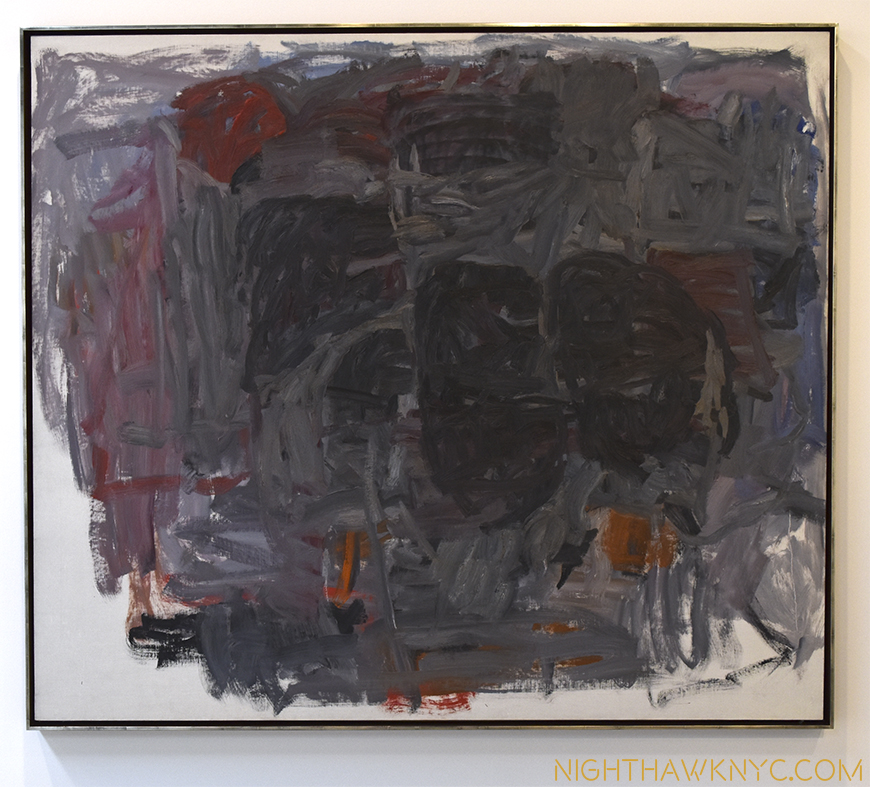
“Accord I,” 1962
Meanwhile, I was in the middle of my struggle with these works. It was on my 3rd visit, sitting in the nicely cavernous space that a key question hit me-
“Exactly HOW ‘abstract’ are these works?”
Look at the titles. “Painter,” “Actor,” “Alchemist,” “Vessel,” and “Portrait I,” among them. Guston commented that the titles were added after the piece had been completed. It’s rare for abstract works of the “New York School” Artists of this period to have such blatantly suggestive titles such as these. They make it impossible to give one’s imagination the completely free reign the usual “Untitled” does. In fact, they force one to attempt to “see” what the title “means” in the work. This brings you back to the way you experience figurative painting. Once this happened to me, I was never able to go back to seeing them as completely abstract again. I began to “suspect” the other works. More titles- “Rite,” “Traveler III,” “Turnabout,” “”The Room,” “Garden of M.” and “Inhabiter.” Without trying very hard, that’s 11 titles of the 36 paintings. Hmmm…
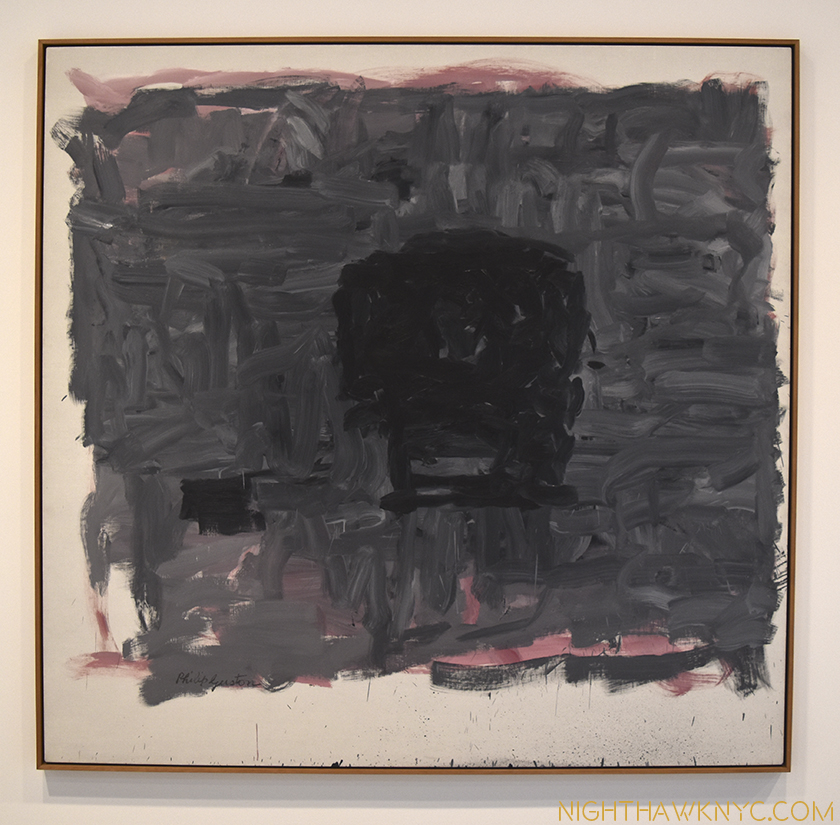
“Inhabiter,” 1965
“I think a painter has two choices: he paints the world or himself. And I think the best painting that’s done here is when he paints himself, and by himself I mean himself in this environment, in this total situation.’– Guston said in 1960.
The evolution during this period can be seen in this next photo. Note the differences between the works on the left, and those on the right. Color has largely gone out, forms have been reduced. The overall feeling becomes one of darkness and isolation.
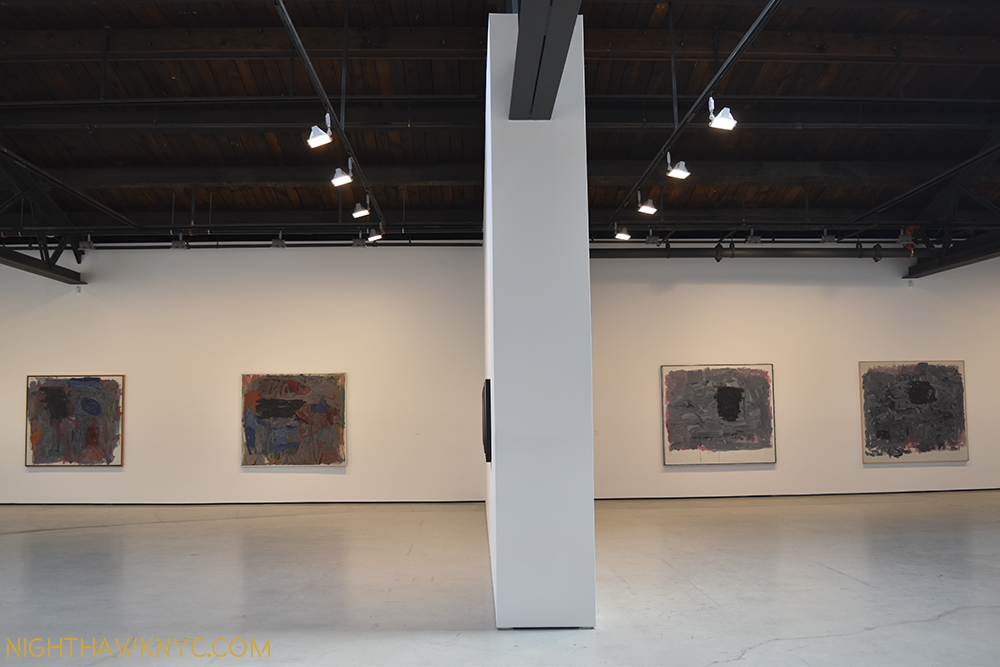
Left- 2 works from 1960. Right- two from 1965
This reduction would continue through 1965, until he was left with one dark form against a murky blue/grey over pink background, with (see “Portrait I,” 1965, below), now, the white of the naked canvas encroaches. After these, painting itself, went out. In 1967, he would start all over by drawing. But, he’d quickly come to see that this new direction offered insufficient room to grow. These zen-like drawings (see the 3 photos following “Cabal,” below) were their own end game. Shortly after, he would make yet another new start. Now, pieces of his past were everywhere to be plainly seen. This would see him create his long misunderstood, now quite popular and influential final works, like “Cabal,” below.
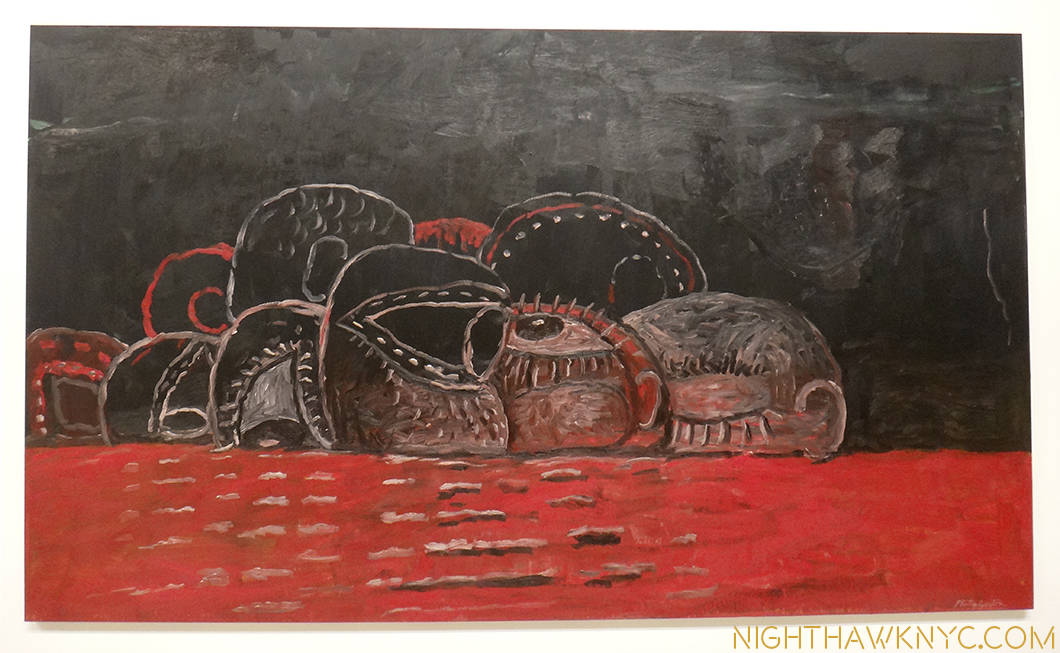
“Cabal,” 1977, at The Met
While the “figure” went out of his work from 1950-1965 in works that are called “abstract” (a term he loathed), there is much in his work before, and after that is, also, “abstract”- even in his late work, where people and objects return. After all, isn’t this late work, which is called “figurative,” really “abstract?”
When you look closer at this hooded head in the foreground of “Conspirators,” above, with it’s two black eye holes in the white bedsheet, which somehow manage to be quite expressive. I couldn’t help but think about that when I saw this, “Untitled” drawing among those on the final wall at Hauser & Wirth.
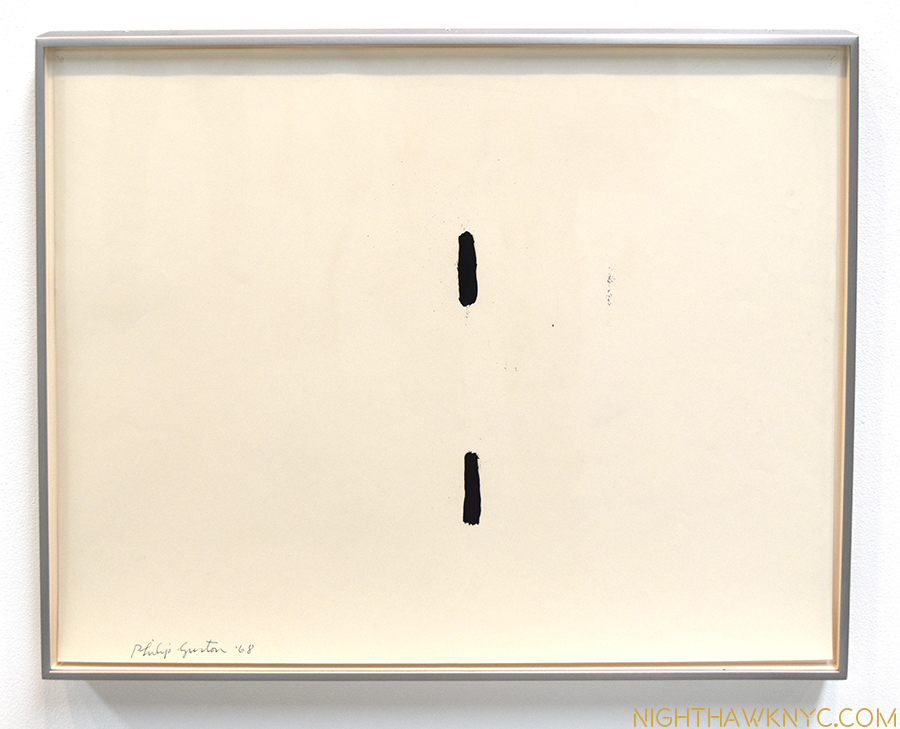
“Untitled,” 1968. Drawing.
Then, again? With an “Untitled” work, the mind is free to go where it may, right?
Revisiting his subsequent later work while looking at the show of the Small Oils Guston did from 1969-73, that was up at the McKee Gallery in 2009, and you can see here, in addition to the hoods, shoes, single light bulb and other elements from his past, cigarettes, books, the modern city, and his wife, Musa, from his present, I suddenly see other connections (hindsight being 20/20). The same murky grey over pink backgrounds appear in a number of his smaller oils (“Cabal” has a dark background, too.). Some of these also have strange forms alone against this background. All of a sudden they don’t look like they were created by an entirely different Artist than the one who created the works in this show. Well, Philip Guston was a different Artist than the one he was in 1957-65, but he’s still Philip Guston. Since there is much that is common between his early and his late works, it makes me wonder about all of his work. That was my initial question before seeing this show- Would what came before, and after be evident here? Using hindsight you can see connections. How he didn’t completely forget this period. Parts of it remained in his work until the end of his life.
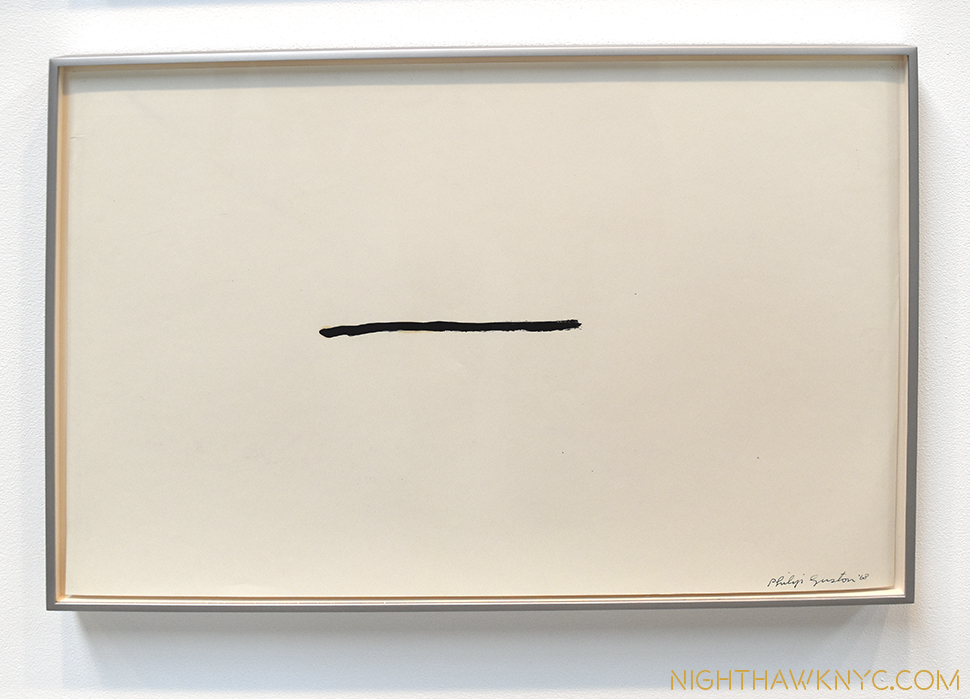
Starting over, again, from the beginning. Abstract or figurative? A pencil? A line? A tightly sealed mouth? “Untitled,” 1968 Drawing
Guston was not considered a founding member of the Abstract Expressionists, nor does he appear in the famous “Irascibles” photo which defined the movement’s members for many. The Met now lists him among the 14 Artists they group in the first group, along with Lee Krasner (the circle is now complete)! I think that part of the reason he wasn’t initially considered part of the group was that he was moving in that direction slowly from 1945 to 1950 which made him miss the first round of fanfare these works received, and which subsequently “grouped” them as “Abstract Expressionists,” a term Guston loathed10. Rothko, himself had called it “their enterprise 11.” Philip Guston, eternally, followed his own star. Though Jackson Pollock was his closest childhood acquaintance and the two were expelled from Manual Artis High School12 together for calling out the fact that more money was being spent on sports than on the “Arts,” and someone who remained in his life until his death in 1956, Guston was his own man, who’s Art owed more to the early Italian Renaissance and Giorgio de Chirico than it did to Pollock, or Rothko, who he was on friendly terms with.
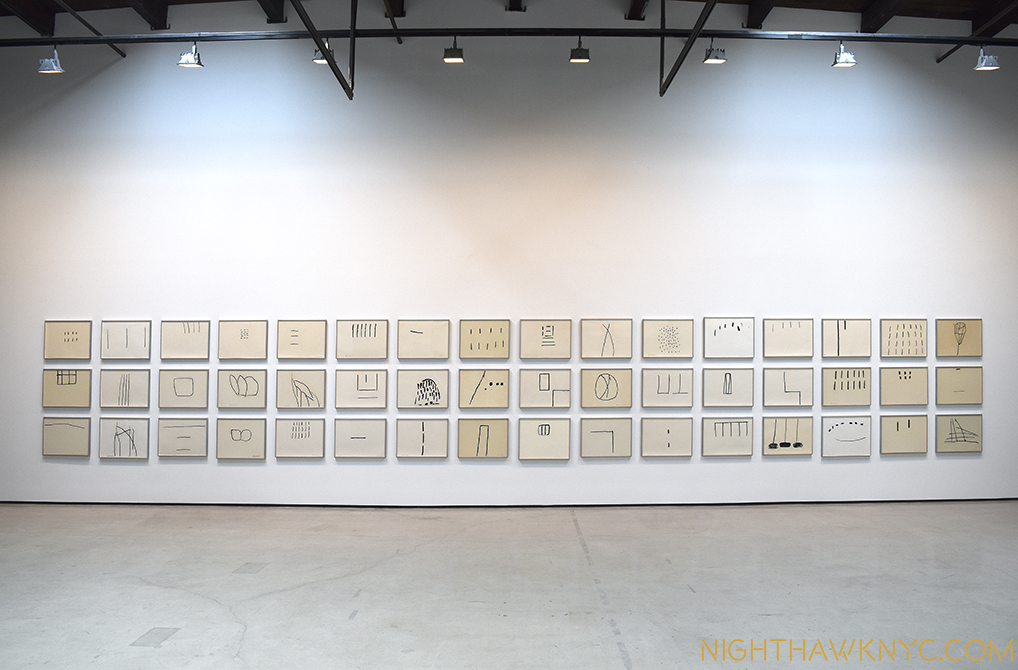
Zen Master. 48 “Untitled” Drawings, 1967-69.
Philip Guston was never a painter of “realism.” It now appears to me that though the end results look different as his style changed and evolved, he was continually bluring the lines between figuration and abstraction all through his career, in the service of painting images that expressed himself as he evolved in his times and in his environment. It’s obvious that he never forgot his past, or the past masters who’s work he loved. The more I look at his work, from all periods, the more I see the impact of, perhaps, his biggest influence, Piero della Francesca, in it. Piero’s figures have the most inscrutable, almost deadpan expressions. Their faces, often, reveal little to nothing of what they are feeling. They take that crutch of reading a whole image from the face away from us. That feeling stays in my mind when I approach a work of Guston’s now, no matter if there are “figures” or objects in the work or not. (Many, even most, of his figures are hooded, or masked, anyway). “Reading” a Guston is a little like to trying to “read” a Piero (or de Chirico). It’s not the expression on the face, it’s the whole thing- the figure in it’s environment, to paraphrase Guston’s quote, above (in Piero’s case, each one is placed with utmost mathematical precision as part of the whole). Guston’s masks are akin to Piero’s inscrutables. We can’t read the expressions or the feelings of these figures. This makes them “abstract,” in another sense, too. I wonder about them. Since they are hooded, or masked, or a black form in his “Portrait I,” 1965, we’ll never know what they are feeling- like in Piero.
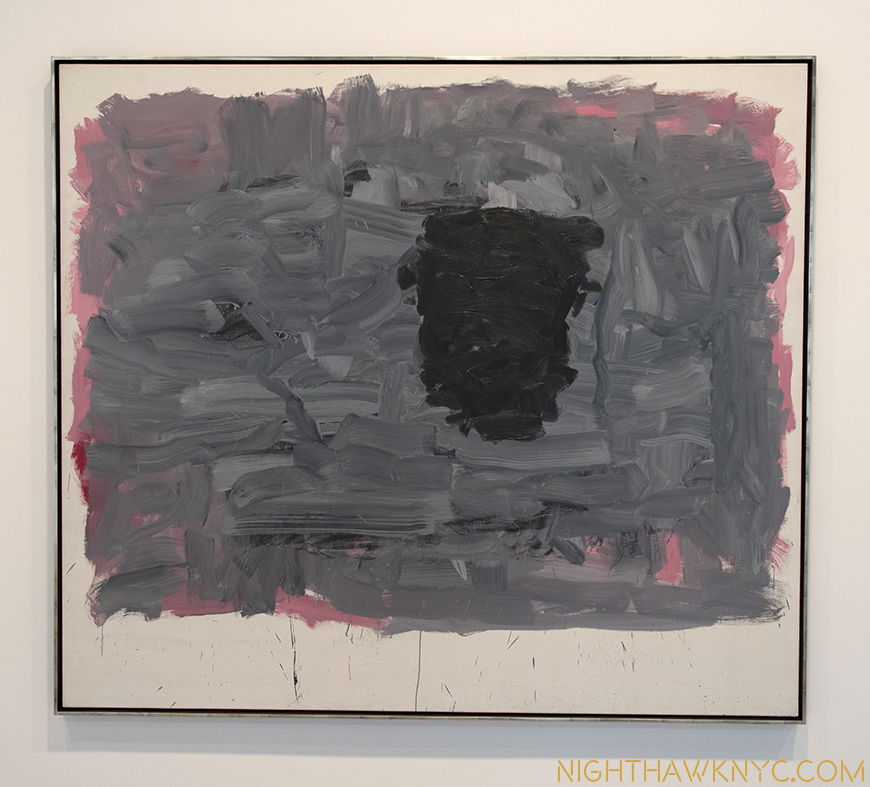
“Portrait I,” 1965. As if hooded(?), in his environment.
It’s not only his 1957-65 paintings that mystify us.
“You see, I look at my paintings, speculate about them. They baffle me, too. That’s all I’m painting for.” “Philip Guston Talking” 1978, two years before he passed away.
Yet, he has left clues, along with the enigma.
(This is the third, and final, installment in my cycle of Posts on the recent, concurrent shows of Jackson Pollock, Lee Kranser & Guston- three Artists who’s lives are eternally intertwined, personally, and Artistically.)
*-Soundtrack for this Post is “For Philip Guston,” by his close friend, the brilliant composer Morton Feldman. If you have 4 hours to spare, check this out.
NighthawkNYC.com has been entirely self-funded & ad-free for over 8 years, during which 300 full length pieces have been published! If you’ve found it worthwhile, PLEASE donate to allow me to continue below. Thank you, Kenn.
You can also support it by buying Art, Art & Photography books, and Music from my collection! Art & Books may be found here. Music here and here.
Written & photographed by Kenn Sava for nighthawknyc.com unless otherwise credited. To send comments, thoughts, feedback or propositions click here. Click the white box on the upper right for the archives or to search them. Subscribe to be notified of new Posts below. Your information will be used for no other purpose.
This site is Free & Ad-Free! If you find this piece worthwhile, please donate via PayPal to support it & independent Art writing. You can also support it by buying Art & books! Details at the end. Thank you.
Written & Photographed by Kenn Sava (*- unless otherwise credited)
With a suspect in custody, here’s what the site of the explosion looked like this evening.
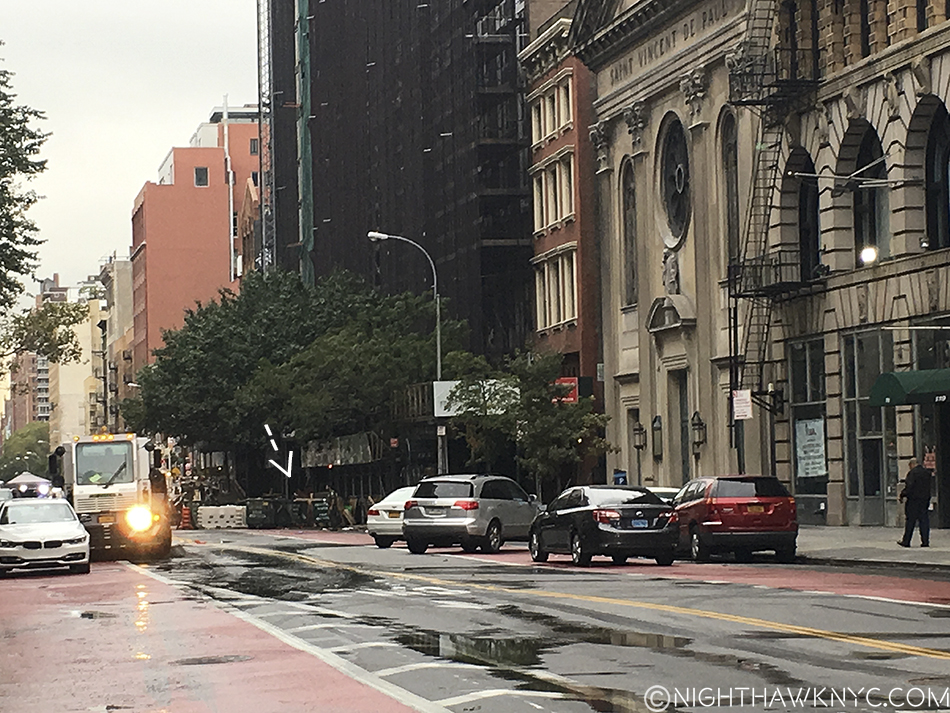
Seen from the corner of 6th Avenue, as close as anyone was allowed. My crude arrow points to the spot of the blast. As you can see, there are still other dumpsters there.
The former Tekserve, as seen in my previous Post, is the white building on the right. To the left is a church (the second white building), a brownstone and The Associated Blind, under the scaffolding. My crude arrow points to the approximate spot of the blast, which was in or near a dumpster. As you can see, there are still other dumpsters there, which is somewhat surprising. Yes, that’s a street cleaning machine, left with headlight on, but the water on the street is from rain.
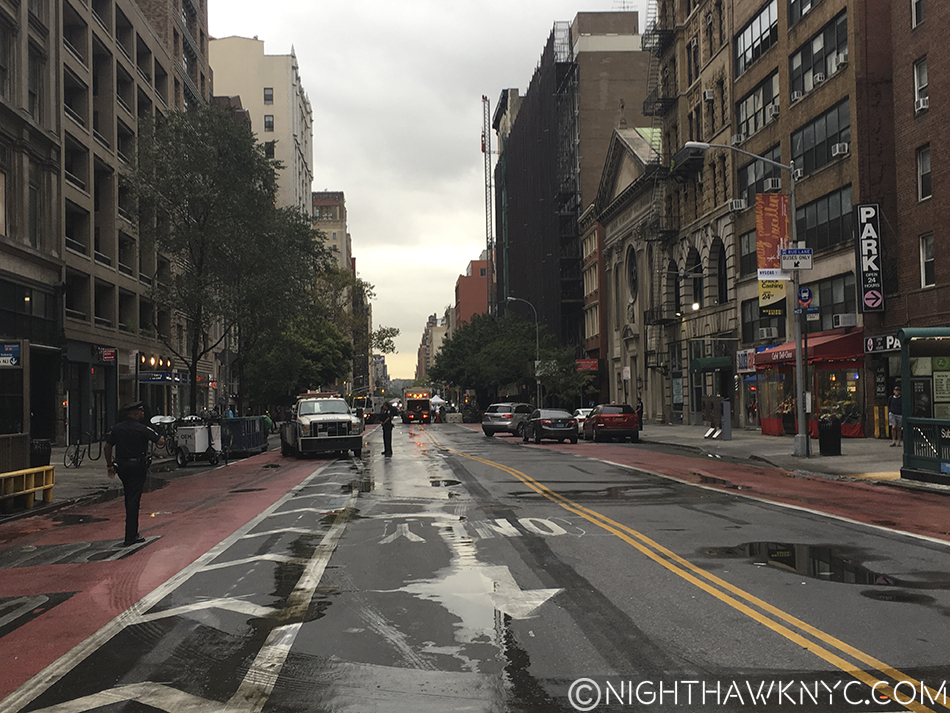
23rd Street between 6th and 7th Avenues is still closed. The cleanup is continuing. The police, and the media, were out in full force, with two live broadcasts going on.
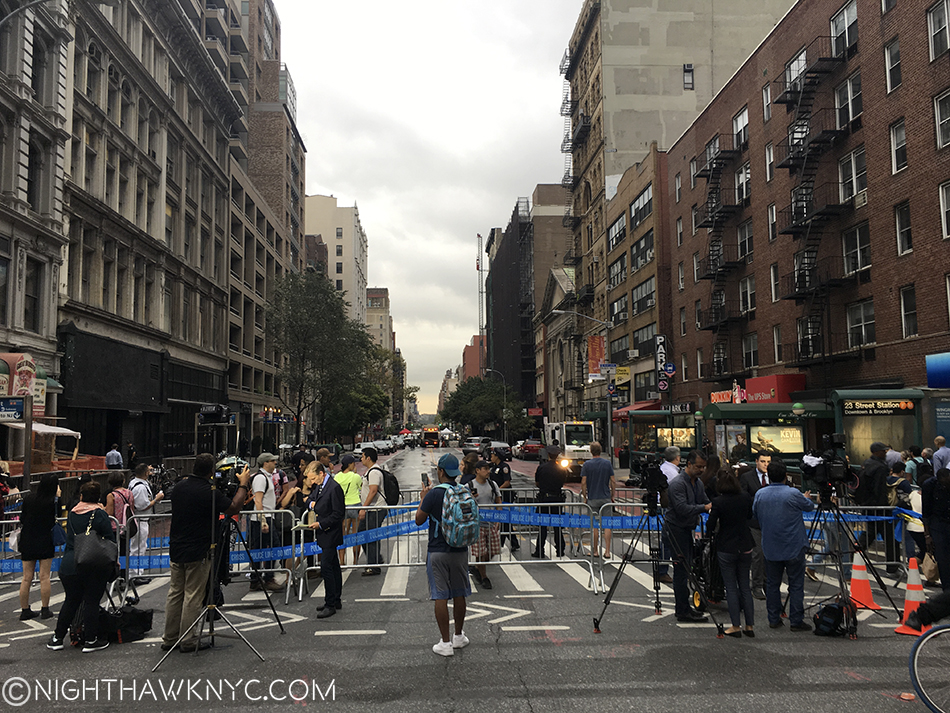
As you can see, it’s a pretty non-descript location for Manhattan, hence my question- Why (there)? As I predicted, I’m not surprised to hear the suspect arrested this morning in New Jersey, surprisingly quickly, is not a New Yorker.
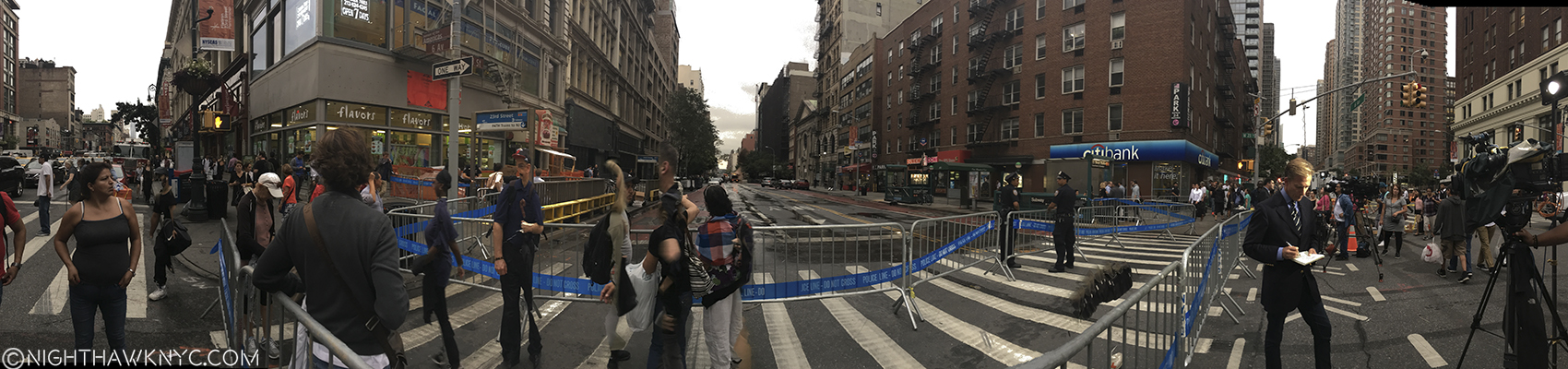
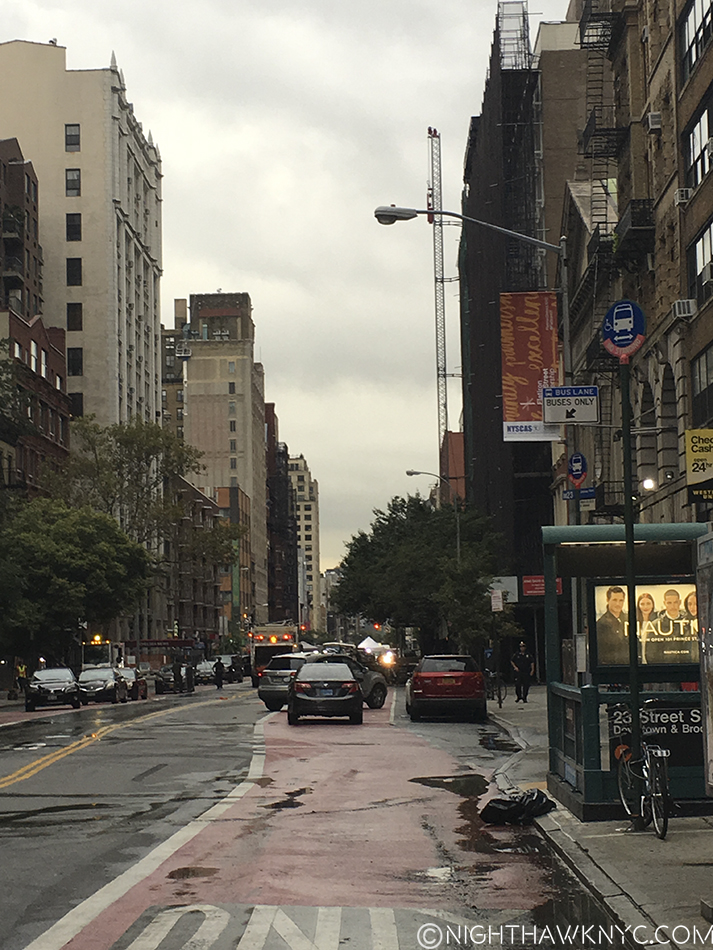
Subway & Path Train Station entrance to the right. The bomb exploded a few hundred feet down the block.
Interestingly, perhaps meaningfully, there is a PATH train station (an express train connecting NYC & NJ) right on the corner of this block.
Besides the street closing, everything else seemed to be back to normal today.
NighthawkNYC.com has been entirely self-funded & ad-free for over 8 years, during which 300 full length pieces have been published! If you’ve found it worthwhile, PLEASE donate to allow me to continue below. Thank you, Kenn.
You can also support it by buying Art, Art & Photography books, and Music from my collection! Art & Books may be found here. Music here and here.
Written & photographed by Kenn Sava for nighthawknyc.com unless otherwise credited. To send comments, thoughts, feedback or propositions click here. Click the white box on the upper right for the archives or to search them. Subscribe to be notified of new Posts below. Your information will be used for no other purpose.
This site is Free & Ad-Free! If you find this piece worthwhile, please donate via PayPal to support it & independent Art writing. You can also support it by buying Art & books! Details at the end. Thank you.
Written & Photographed by Kenn Sava (*- unless otherwise credited)
It had been a typical weekend over here at NighthawkNYC.com. Friday night, I went back to see a show that is closing today that I plan on writing about. On the way home, I walked along West 23rd Street, west from 6th Avenue. I passed by what had been the home of Tekserve, our neighborhood Apple place the past 29 years, which has just gone out of business-
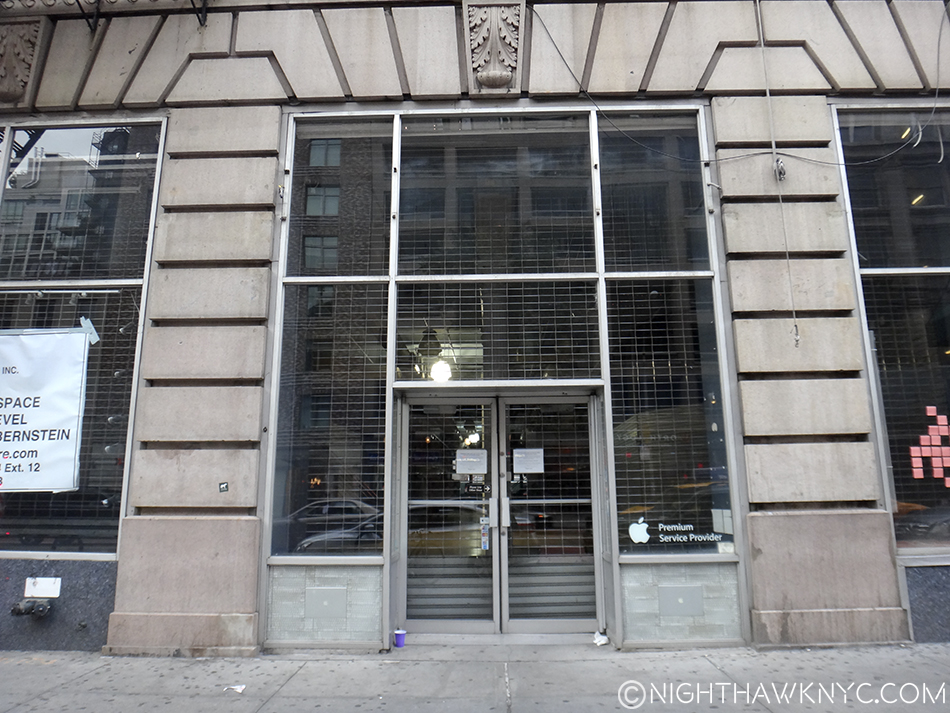
Immediately to the left of this shot of the former Tekserve, a bomb went off at 8:30 last night.
Then, last night I was sitting here writing, when I was stopped by a very loud noise.
“What was THAT?”
I got up and went to the window. During those few steps, I knew something had just happened. I (instinctively) thought back to 9/11. when everything happened in 102 minutes. So, I noted the time- exactly 8:30pm.
This is a busy area. You get used to hearing a wide range of sounds. This one was DEFINITELY something way out of the norm. It sounded like a building had collapsed.
I looked out my south facing window. All I could see were my neighbors who had come out of their apartments pondering the same question looking back at me. I couldn’t see anything else.
“Well, they’ll stone you when you’re trying to be so good
They’ll stone you just like they said they would
They’ll stone you when you’re tryna go home
Then they’ll stone you when you’re there all alone”*
Shortly, there were a lot of sirens going off and that continued, off and on, all night.
Turning on the local news, it seems there was an explosion in or near a dumpster just to the side of Tekserve, between it and the Associated Blind (a home for the visually impaired.) Without being more specific, let’s just say, very close to home. There’s a fortress like Church immediately west of Tekserve, then there’s a small brownstone, and then there’s the Associated Blind, the facade of which has been under construction, and is covered in scaffolding. Right between the Associated Blind and the brownstone is where the blast happened.
Huh?
23rd Street is an historic place. Dylan Thomas, Bob Dylan, Arthur C. Clarke, Tom Waits, and on and on, all lived at the Hotel Chelsea, a half block away, between 7th and 8th Avenues.. Much of Patti Smith’s “Just Kids” takes place there. I’ve lived a LOT of my life on 23rd Street the past 25 years. It has been my extended home base, as those who know me know.
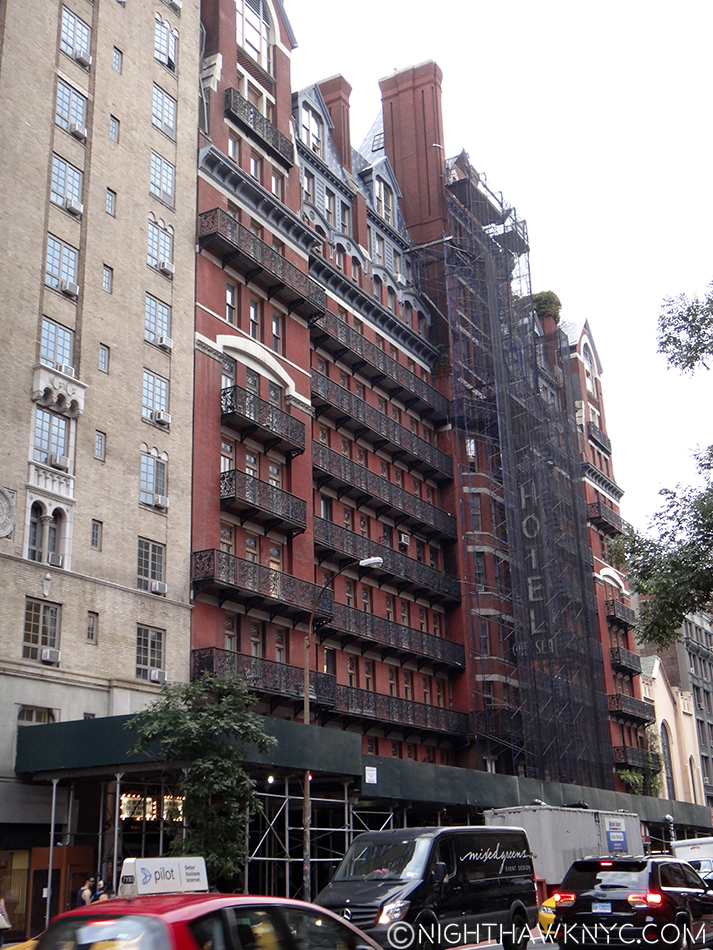
1/2 a block west. The Hotel Chelsea, this week. So much of my life these 25 years took place on this block. Bob Dylan wrote Blonde on Blonde here .
About 2 hours after the blast, it was announced that they had located a second device, on West 27th Street, between 6th and 7th Avenues.

Huh?
What’s there? Not a heck of a lot besides businesses and apartment buildings. The Fashion Institute of Technology (F.I.T.) is across 7th Avenue between 7th and 8th.
At 12:37am the NYPD sent a cell phone blast around asking residents of 27th to stay away from their windows. A few hours later I heard, and saw on social media, that they had used a robot to remove the device. They didn’t officially announce that until 2:35am, prime time for the Nighthawk.
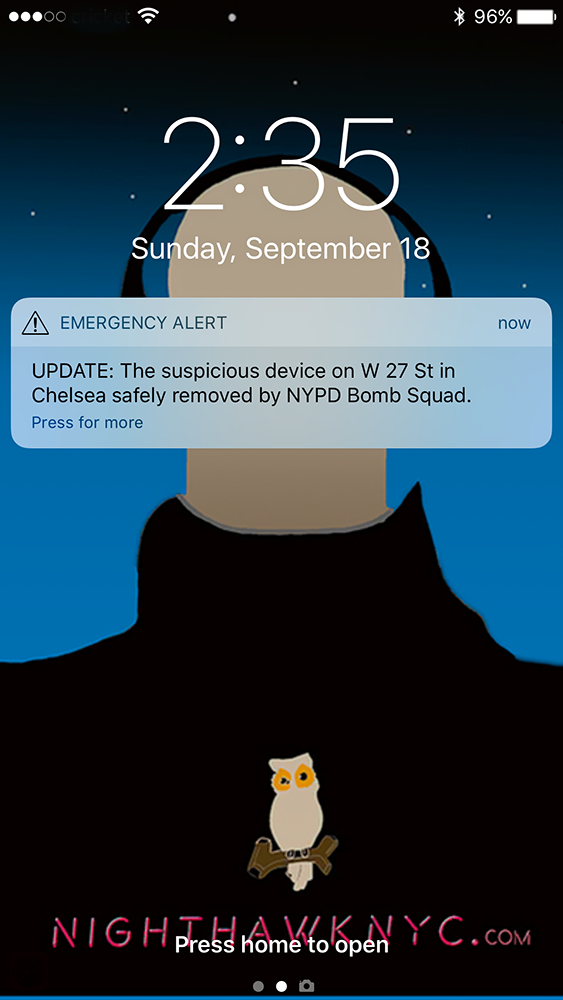
The mayor announced that there was “no terror connection.”
Huh?
Dude- If it’s determined that this wasn’t a force of nature, or some chemical reaction due to combustibles left at a construction site, and it was, therefore, “intentional,” as you also said…?
WHAT ELSE IS IT?
I’m sorry. Setting off an explosion in a residential district like Chelsea and 29 innocent people were hurt is an act of terrorism.
Period.
I was up late watching what was going on.
I could see that there were teams of folks in matching uniforms scouring the block- from end to end, even way at the other end from where the explosion was. They had light towers at both ends of the block, and this went on til after 6am when I went to bed. This morning, much of my neighborhood remains roped off.
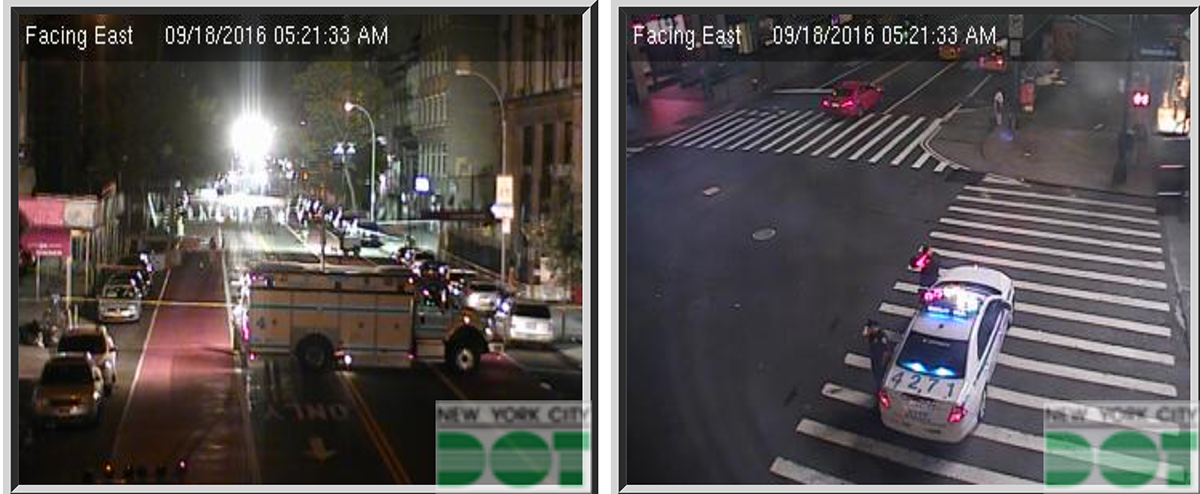
Left-The bomb scene at 530am. Right- West 34th & 7th Avenue. Macy’s is across the street to the upper left. Madison Square Garden is right behind to the lower right.
Somebody else sure thinks this is terrorism.
But? This is not my first rodeo.
I was right here on 9/11. I saw the North Tower on fire at 9:05am from the same window I looked through last night. The first plane, American Airlines Flight 11, flew down my block, which triggered unexpected nightmares for a few months after, where, somehow, my brain combined Flight 11 with Flight 93, and the passengers fought back, and caused Flight 11 to crash early- into my apartment. (Yes, I was very lucky that that’s all that happened. Later, I watched the North Tower collapse from 5th Avenue. Both of the people I knew who worked there at the time got out.) In 2004, there was a 2 day blackout. No big deal. Some years later, a nor’easter left me without water for 4 days. Then, in Halloween week 2012, Hurricane Sandy left me without power for 5 days, and brought the Hudson River within 2 blocks of my door. The subways here have never been right since 9/11.
During the last few of these events, much of the rest of the City was unaffected. I was especially reminded of this during the Sandy blackout. Going north of 30th Street was like going into a different world. There were lights on. Restaurants and delis were open(!) People were using their phones without constantly looking at their power levels. No one carried a candle or a flashlight. Very few of them seemed to know, or care, frankly.
I felt pretty alone.
So? This is part of the price I pay to live here and be able to experience all the great Art and culture NYC has- what makes NYC the greatest City in the world to my myopic eyes.
Still, right now? Now that everyone has been released from the hospital, and no one was killed, thank god, my main thought is-
WHY?
Why did whoever did this pick these two places?
The Associated Blind??? Given the damage from this powerful blast, it’s amazing, and amazingly fortunate, they didn’t have to evacuate it. And, a side street in a pretty quiet area at that time of night???
It seems to me that whoever did this was either paying back something personal, or were sending a message to the effect that “You’re never safe. Anywhere. Anytime.”
“They’ll stone you when you’re at the breakfast table
They’ll stone you when you are young and able
They’ll stone you when you’re tryna make a buck
They’ll stone you and then they’ll say, “Good luck””*
Whoever it is strikes me as being someone who’s not a real New Yorker. First, real New Yorkers respect each other.
Second- Living here, you take your life in your hands when you step outside your door. You could get hit by a car, bus, truck or bike, or whatever, at any moment. Yes, surviving as a pedestrian here, I’ve long believed, is an unacknowledged, and under-appreciated Art form.
So, if you’re trying to scare me, or my fellow New Yorkers?
Get real.
Better yet?
GET A LIFE!
(For the aftermath, see my follow up Post, here.)
*-Soundtrack for this Post is “Rainy Day Women #12 & 35” by Bob Dylan, from 23rd Street’s own Blonde on Blonde and published by Dwarf Music.
NighthawkNYC.com has been entirely self-funded & ad-free for over 8 years, during which 300 full length pieces have been published! If you’ve found it worthwhile, PLEASE donate to allow me to continue below. Thank you, Kenn.
You can also support it by buying Art, Art & Photography books, and Music from my collection! Art & Books may be found here. Music here and here.
Written & photographed by Kenn Sava for nighthawknyc.com unless otherwise credited. To send comments, thoughts, feedback or propositions click here. Click the white box on the upper right for the archives or to search them. Subscribe to be notified of new Posts below. Your information will be used for no other purpose.
This site is Free & Ad-Free! If you find this piece worthwhile, please donate via PayPal to support it & independent Art writing. You can also support it by buying Art & books! Details at the end. Thank you.
Written & Photographed by Kenn Sava (*- unless otherwise credited)
“If I had my life to live over
I’d do the same things again
I’d still want to roam
Near the place we called home
Where my happiness would never end”*
This, today, from MoMA-
“THE MUSEUM OF MODERN ART LAUNCHES A COMPREHENSIVE ONLINE EXHIBITION HISTORY BEGINNING WITH ITS FOUNDING IN 1929
Installation Photographs, Archival Documents, and Catalogues of Exhibitions Now Available to Students, Researchers, Artists, Curators, and the Public
NEW YORK, September 15, 2016—The Museum of Modern Art announces the release of an extensive digital archive accessible to historians, students, artists, and anyone concerned with modern and contemporary art: a comprehensive account of the Museum’s exhibitions from its founding, in 1929, to today. This new digital archive, which will continue to grow as materials become available, is now accessible on MoMA’s website, at moma.org/history.
Providing an unparalleled history of the Museum’s presentation of modern and contemporary art on a widely available platform, the project features over 3,500 exhibitions, illustrated by primary documents such as installation photographs, press releases, checklists, and catalogues, as well as lists of included artists. By making these unique resources available at no charge, the exhibition history digital archive directly aligns with the Museum’s mission of encouraging an ever-deeper understanding of modern and contemporary art and fostering scholarship.
“The Museum of Modern Art has played a crucial role in the development of an audience for modern and contemporary art for nearly 90 years,” said MoMA Director Glenn D. Lowry. “In making these materials freely available, we hope not only to foster and enable scholarship, but also to encourage a wider interest in this important chapter of art history that the Museum represents.”
The exhibition history project was initiated and overseen by Michelle Elligott, Chief of Archives, and Fiona Romeo, Director of Digital Content and Strategy, The Museum of Modern Art. Over the course of the last two-and-a-half years, three MoMA archivists integrated over 22,000 folders of exhibition records dating from 1929 to 1989 from its registrar and curatorial departments, performed preservation measures, vetted the contents, and created detailed descriptions of the records for each exhibition.
The digital archive can be freely searched, or browsed in a more structured way by time period or exhibition type. Each entry includes a list of all known artists featured in the exhibition. Artist pages likewise list all of the exhibitions that have included that artist, along with any of their works in MoMA’s collection online. The index of artists participating in Museum exhibitions now includes more than 20,000 unique names.”
I almost fell over when I saw this. Now? You can revisit every show in the history of MoMA. Unprecedented! I’ve lost my day looking through this site. It’s absolutely unbelievable! Having the chance to FINALLY “see” shows I missed and only heard about, and shows I saw (like the 1980 Picasso Retrospective, possibly the greatest Art show ever), again, is just a dream come true! Here’s a sample, from Moma’s very first show titled “Cezanne, Gaugin, Seurat, Van Gogh,” in 1929!
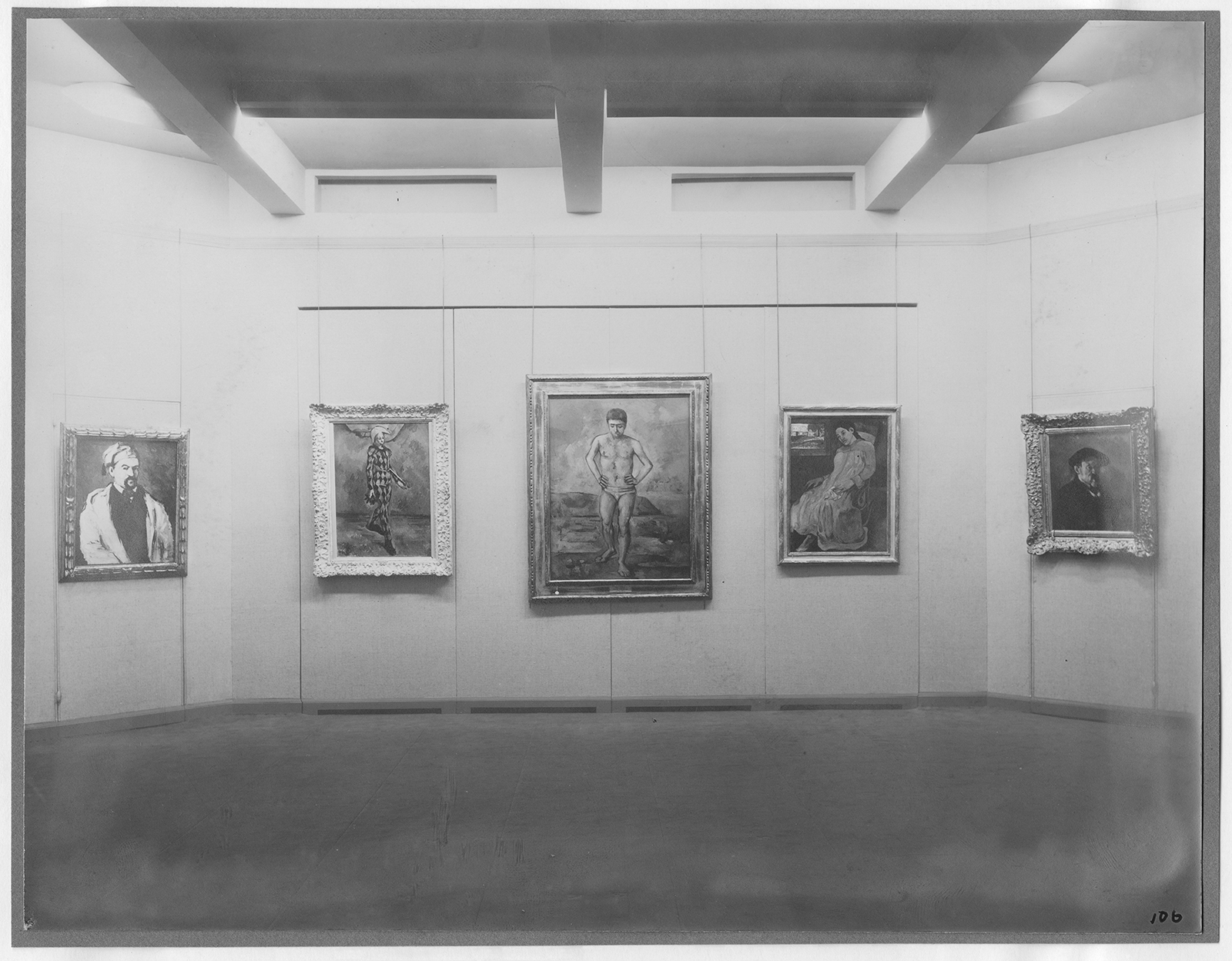
MoMA’s First Show! Installation view of the exhibition Cézanne, Gauguin, Seurat, Van Gogh, on view November 7, 1929 through December 7, 1929 at The Museum of Modern Art, New York. The Museum of Modern Art Archives, New York. *Photographer: Peter Juley
To this point, Art shows have only lived on, after their closing, through exhibition catalogs and what’s been written or posted about them.
No more!
Here’s a chance to see how the show was hung, what works were grouped together or hung next to each other. Just Wow!
And? You can download catalogs, too!
Now? Of course I’m hoping The Met shocks me with something similar, and every other Museum in the world follows Moma’s groundbreaking example!
Don’t wait. Do not pass “Go.” Go here, now!
*-Soundtrack for this Post is “If I Had My LIfe to Live Over,” by Larry Vincent, Moe Jaffe and Henry H. Tobias, and performed by Doris Day.
NighthawkNYC.com has been entirely self-funded & ad-free for over 8 years, during which 300 full length pieces have been published! If you’ve found it worthwhile, PLEASE donate to allow me to continue below. Thank you, Kenn.
You can also support it by buying Art, Art & Photography books, and Music from my collection! Art & Books may be found here. Music here and here.
Written & photographed by Kenn Sava for nighthawknyc.com unless otherwise credited. To send comments, thoughts, feedback or propositions click here. Click the white box on the upper right for the archives or to search them. Subscribe to be notified of new Posts below. Your information will be used for no other purpose.
Written & photographed by Kenn Sava
“Well, let me tell you ’bout the way she looked
The way she acts and the color of her hair
Her voice was soft and cool, her eyes were clear and bright
But, she’s not there.”*
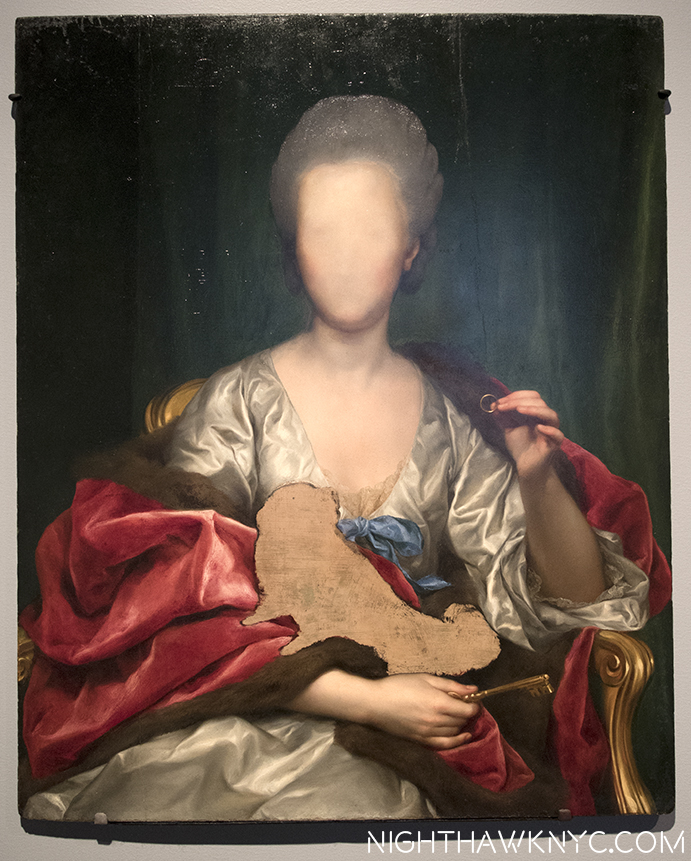
“Portrait of Mariana de Silva y Sarmiento,” 1794, by Mengs
Leonardo da Vinci, Michelangelo, Titian, Van Eyck, Durer, Rembrandt, Velazquez, Manet, Monet, Degas, Van Gogh, Cezanne, Picasso, Pollock, Warhol, Mondrian, Basquiat, Whistler, Alice Neel, Lucian Freud, Klimt, Munch, Whistler, Robert Smithson, Cy Twombly, Gerhard Richter, and on and on. “Unfinished” is a mimi-Museum unto itself that probably rivals quite a few entire Museums. “Unfinished,” along with the “Nasreen Mohamedi” Retrospective, were the inaugural exhibitions at The Met Breuer (TMB), the first shows of two new eras- The Met’s new 8 year Breuer Building Lease (at a reported $17 million a year 1), and Sheena Wagstaff’s tenure as Chairwoman of The Met’s Modern & Contemporary (M&C) Department. No pressure there. It’s a show that leaves you wondering “Why didn’t anyone think of this before,” before you’ve even gotten to it’s second floor.
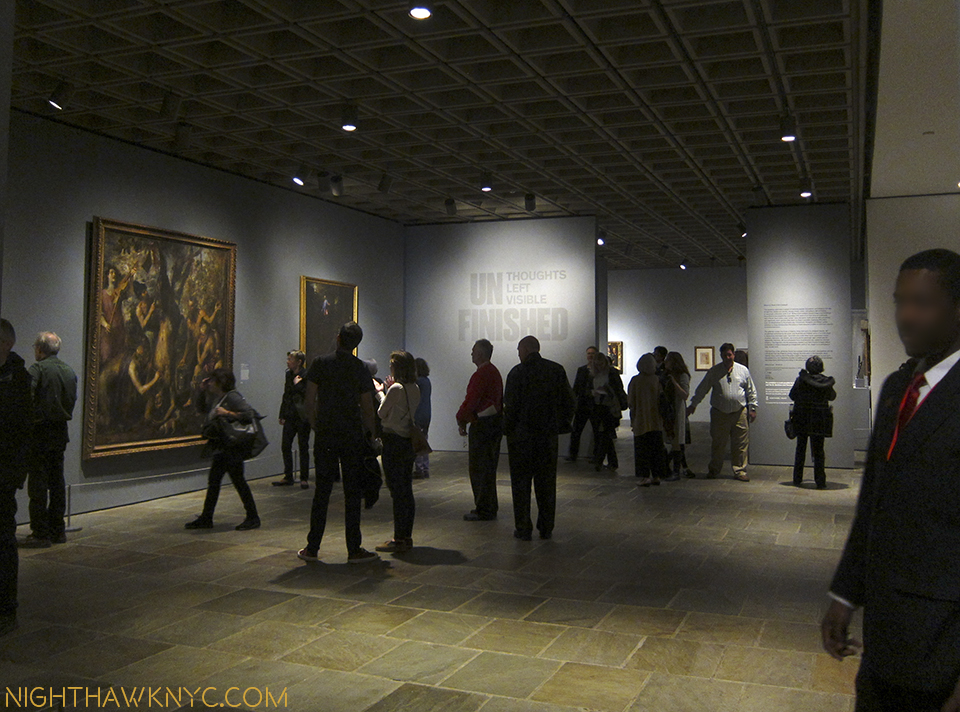
Welcome to the future! Opening Day of The Met Breuer. Member’s Preview, March 8, 2016
Well, for one thing, though many of the works here come from other sources, not a lot of places have the resources The Met has, so yes, a part of this is “showing off.” They’ve chosen to install this in a brand new branch that previously held the entirety of one of the other “Big Three” Manhattan Museums, before the Guggenheim made it the “Big Four.”
If that’s not showing off? I don’t know what is.
The rest is the pure joy of discovery, of seeing a curtain lifted and getting an all too rare chance to see some of what goes into making a masterpiece, a work of Art. And? The hits just keep on coming. The big names, that is, if not the most well-known work by any of those names. 197 works in all filling the 3rd & 4th Floors. While nothing here is “famous,” even in their, supposedly, incomplete state (either left unfinished on purpose, or not, in the case of Lucian Freud’s “Portrait of the Hound,” which was left as we see it on his easel when he died), these works hold up just as they are, making this a show jam packed with excellent, even important pieces. Yes, curating a show of “unfinished” work THIS well is also showing off The Met’s superb staff. Along with the pleasure of looking, they also provide fascinating, voyeuristic, even unique, insights into the Artist’s process- both working and thought. Some, as in Alice Neel’s “James Hunter Black Draftee’, 1965, are, perhaps, more evocative than it might have been had it been “finished.” Mr. Hunter never returned for additional sittings. We are left to wonder why not.
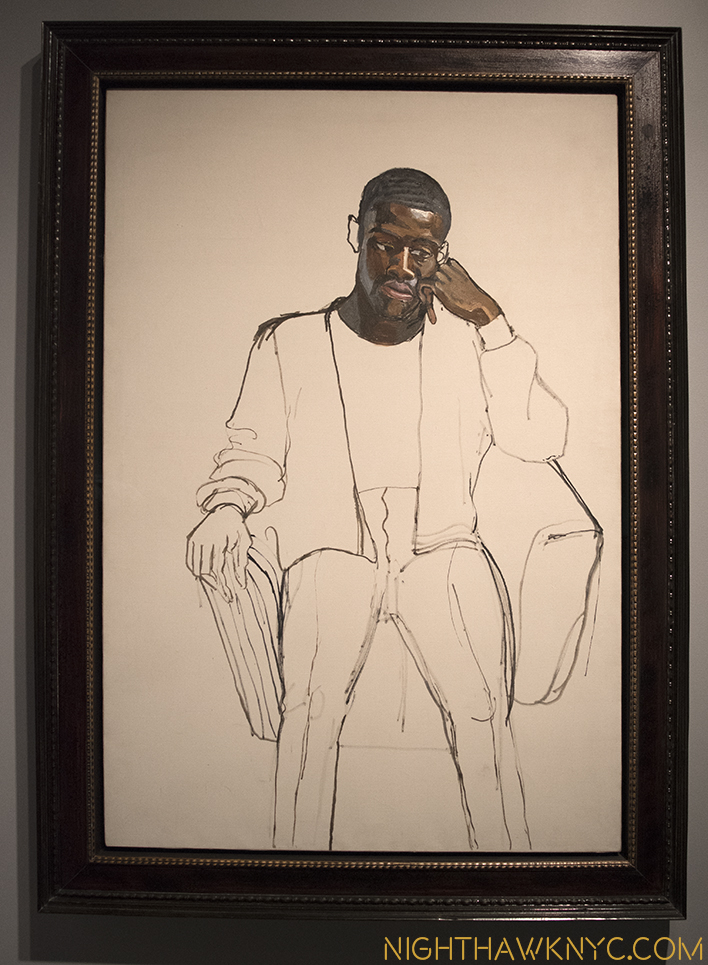
“James Hunter Black Draftee,” 1965, by Alice Neel
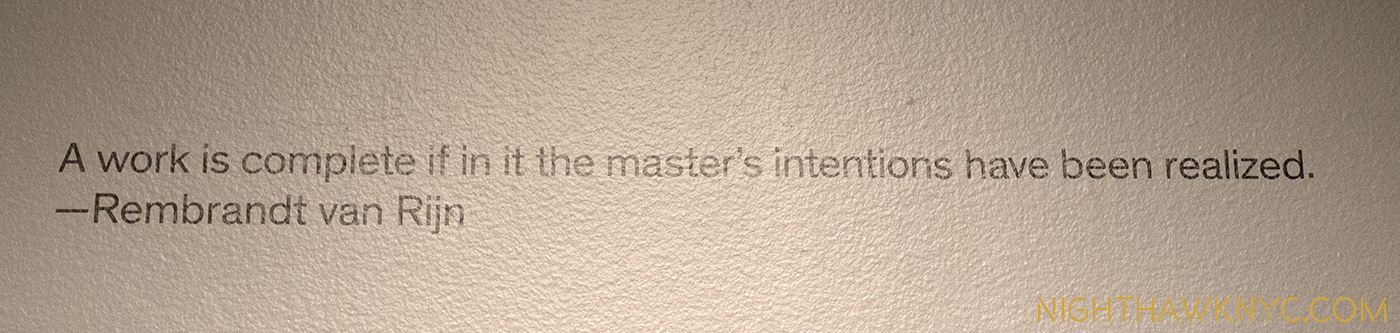
The whole question of “When is a work of Art, finished?” comes front and center here as well, and no less than Rembrandt chimes in on it.
Highlights? I’ll list those that come to mind quickly because there are so many. For me, Jan Van Eyck was the very first Artist who truly captivated me as a kid. Shortly after getting my driver’s license, I drove the almost 6 hours each way just to see his “Annunciation” in Washington’s National Gallery, then drove right back. Seeing his underdrawing for his unfinished St. Barbara was just breathtaking. It’s truly unbelievable to think that something like this lies underneath his finished masterpieces, like The Ghent Altarpiece! While he is legendary for the extraordinary and exquisite detail of his painting, which has held me in disbelief for all these decades, apparently, he could also draw every bit as well2
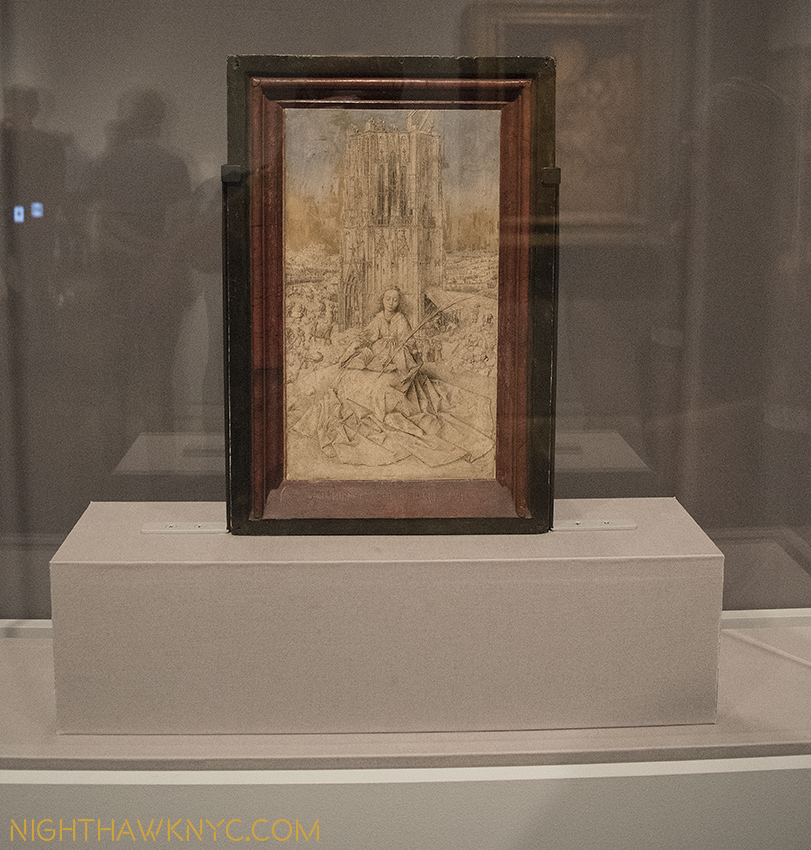
Small wonder. “Saint Barbara,” 1437, Jan Van Eyck. Barely 12 inches tall.
Just astounding. Oh, and sitting a few feet away was a da Vinci portrait profile that was positively otherworldly. When the show opened (along with the Met Breuer) in March, it was flanked by Leonardo’s “Sketches for the Virgin Adoring the Christ Child” and Michelangelo’s “Study for the Libyan Sibyl.” Since “Unfinished” was up for a very generous four and a half months, the later two were replaced after a while, no doubt due to their fragility. It seemed to me they may have been there in honor of TMB’s opening. Both works are in TM’s permanent collection. More showing off? (Slight smile)
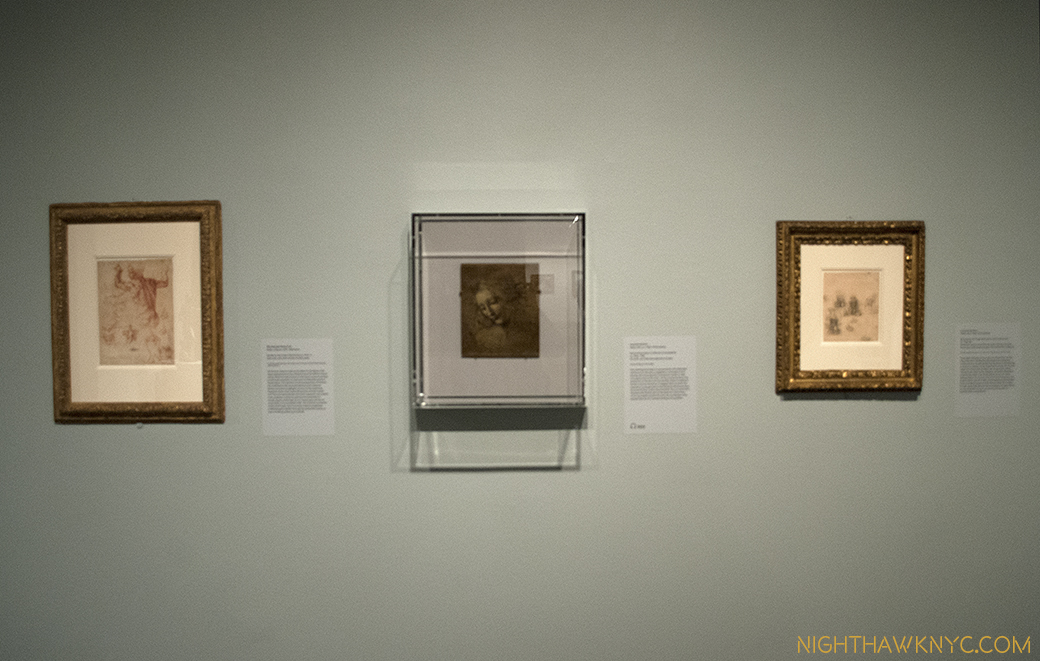
For a New York Minute, the two greatest figures in Western Art were on view together. Leonardo, center and right. Michelangelo, left. Has so much hunan genius ever been side by side than when work of these two are shown together? March 8, 2016.
Oh, all of this is in the 2nd room. In the first room, upon getting off the elevator on the 3rd Floor, at the show’s beginning, you’re immediately faced with 2 large, powerful Titians that are guaranteed to stop you for a good long while, and a Jacopo Bassano.
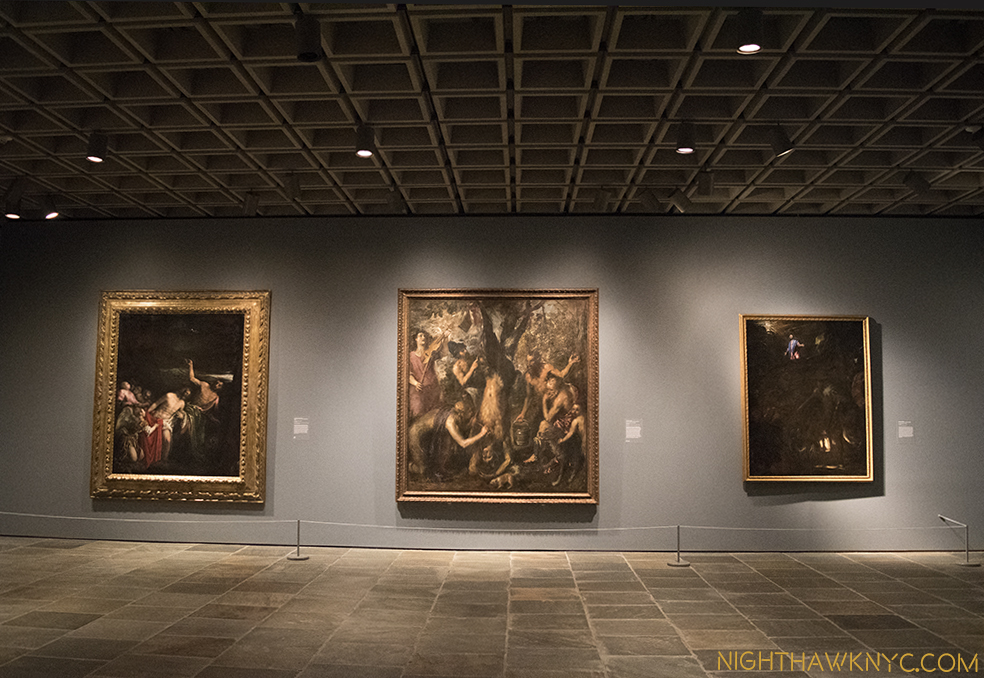
The opening salvo. This is the first thing many visitors to TMB saw after the elevator deposited them on 3. Bassano, left, with 2 Titians.
Rembrandt’s St. Bartholomew, a whole room of Turners, a beautifully selected print gallery, a very “different” Degas of a horse race, a Van Gogh who’s color filled the entire room, a stunning Munch self portrait…all on the 3rd floor, wowed me.
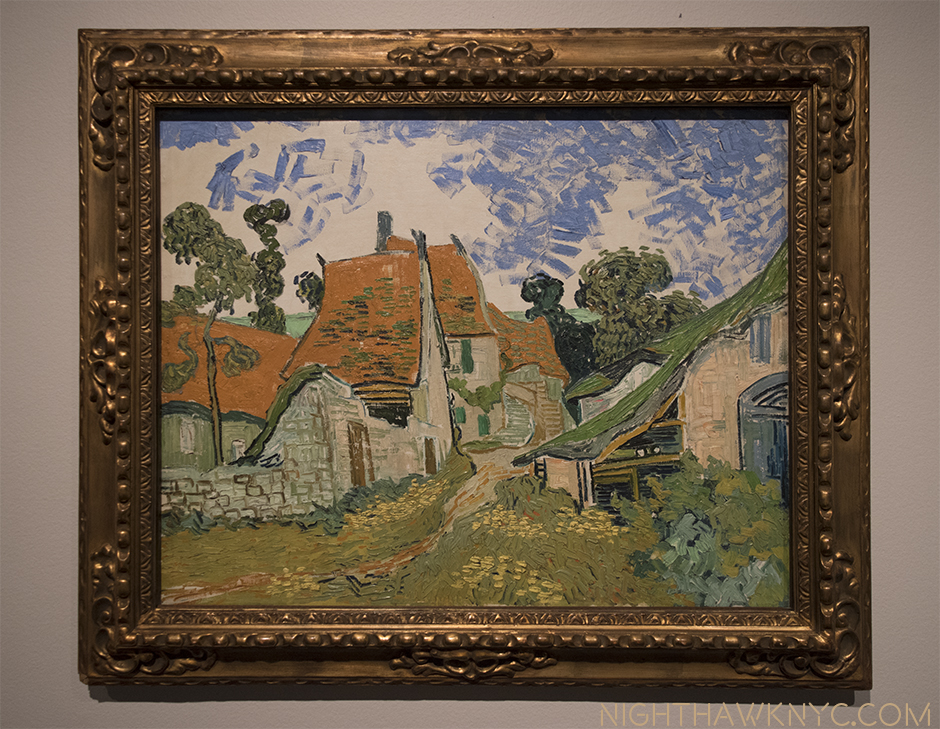
Life affirming. “Street in Auvers-sur-Oise,” 1890. The year he died, no dark clouds in this sky. I am among those who believe Van Gogh did not commit suicide.
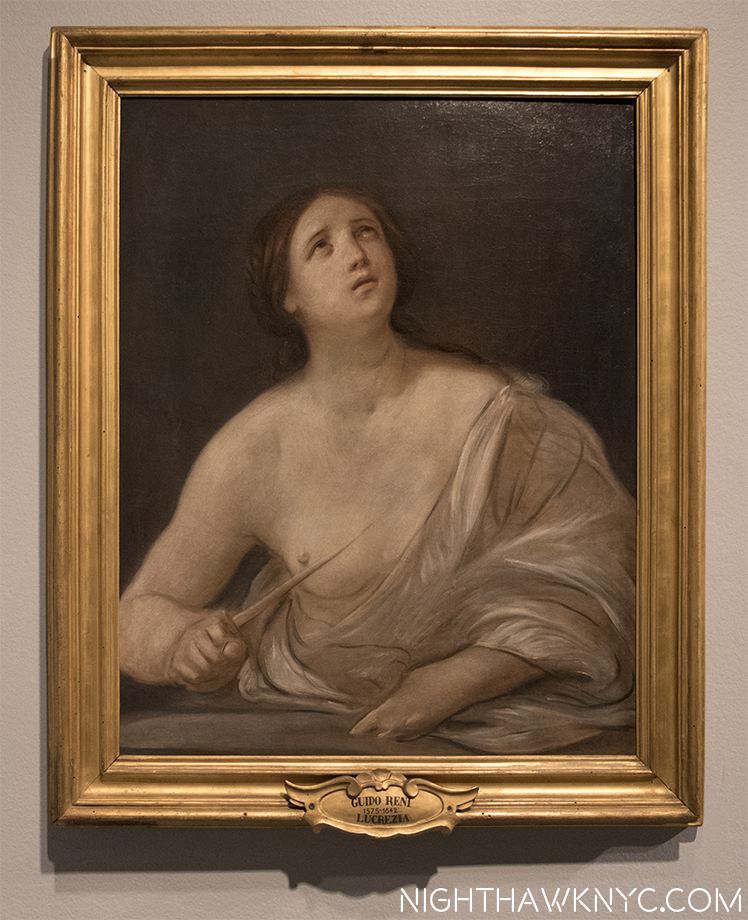
Finished, or Un? “Lucretia,” 1642, by Guido Reni. Magnificent.
On the 4th Floor, getting off the elevator was no less dramatic. No less than 4 amazing Picassos greet you, one of which is “the Charnel House,” the work which bookends (with “Guernica”) his WW2 years. While “Guernica,” rightfully, is seen as one of the landmarks of 20th Century Art (and one I’m eternally thankful I got to see in person at Moma’s Picasso Retrospective in 1980 before it was moved to Spain as Picasso’s will required), here is a work that I think deserves more attention. It’s surrounded by 3 other pieces, in 3 other styles (in addition to 2 others in the next gallery, and a few more on the 3rd floor), that show Picasso in the process of thinking through the problems inherent in each work- each one in a different style. After the 1921 “Portrait of Olga,” right, below, he was inventing each of these styles. It’s akin to inventing a new language. There was no one else to help him or guide him. Some artists, like Jackson Pollock, have done this once. Picasso? There’s three in this one gallery, and it doesn’t even include Cubism.
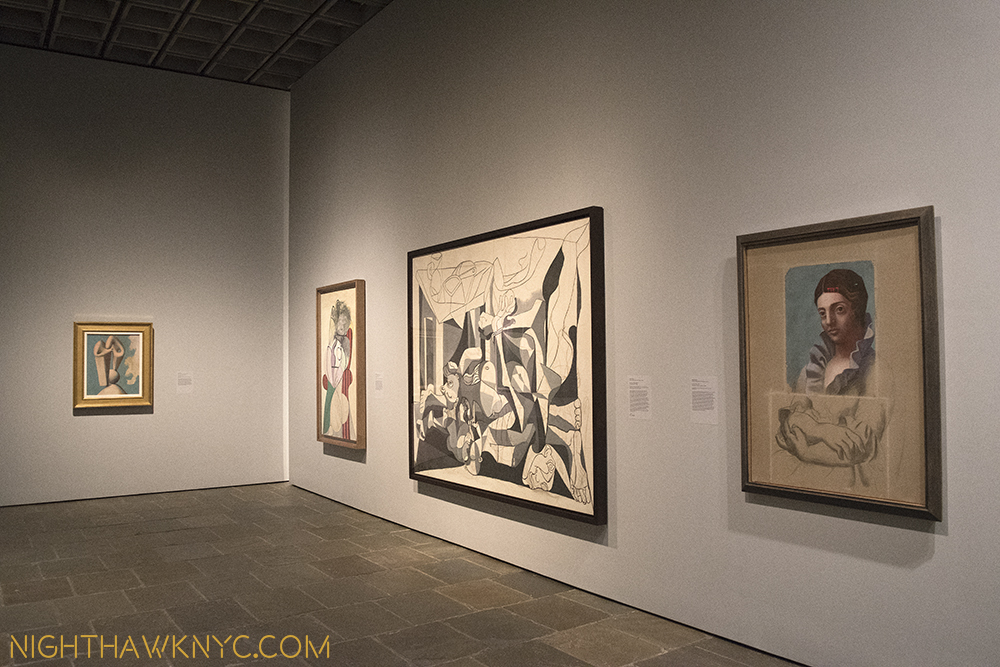
Pick a style-any style. 4th Floor Lobby/Galley 1. Picasso 1921, ’29, ’31, ’45.
There was quite a bit of fanfare paid to The Met’s announcement of The Met Breuer as a “Contemporary Outpost,” especially during the years when the 5th Avenue Modern & Contemporary Galleries were to be undergoing the reconstruction they had also announced. Yet, in this co-inaugural show, we get quite a bit of what The Met is famous for, along with about two thirds of the 4th floor of more recent works. The size of many of these newer works seems to cut down on the number of pieces, however, making the show feel skewed towards older Artists. Of the 197 works in the show, I counted 74 works by Artists born after 1900, 12 by Artists born after 1950. (The youngest Artist represented is Urs Fischer, who was born in 1973, and who’s mysterious cast bronze “2,” from 2014 is also the newest work here by my reckoning.)
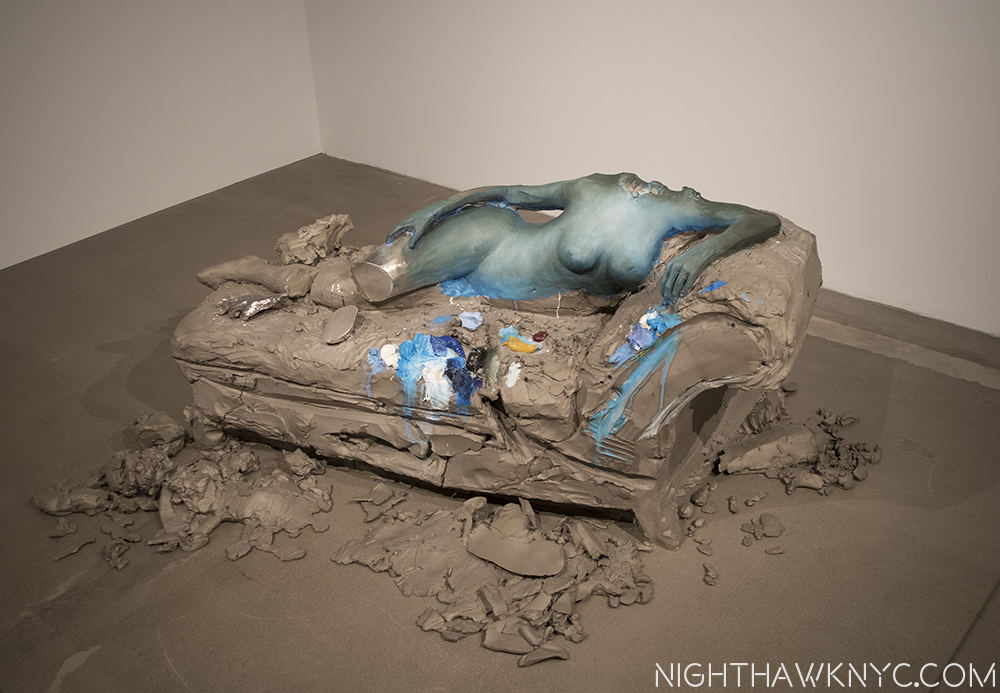
The day after at the NighthawkNYC offices? I’ll never tell. Actually, this is “2,” 2014, by Urs Fischer.
“But it’s too late to say you’re sorry
How would I know, why should I care?
Please don’t bother trying to find her
She’s not there”*
Yet, even among the M&C pieces here on the 4th floor, there are memorable pieces. In additon to Urs Fischer’s “2”, the unfinished Mondrian struck me as a revelation. Yayoi Kusama’s genre defying paintings of consecutive numbers gave pause for thought, as did Sol LeWitt’s amazing tour de force “Incomplete Open Cubes” nearby and, Kerry James Marshal’s “Untitled,” 2009, was a nice appetizer for his much anticipated “Mastry” show opening at TMB October 25. The show concludes with a wonderful selection of sculpture, including haunting works by Louise Bourgeois, “Untitled (No.2), 1996, and Alina Szapocznikow’s work about her own battle with breast cancer, “Turmors Personified,” 1971, in dialogue alongside 3 Rodins. The final gallery consisted of only one work- a series of 6 pieces by Cy Twombly, entitled “Untitled I-VI (Green Paintings), 1986, which provided a meditative, cleansing experience I found especially memorable.
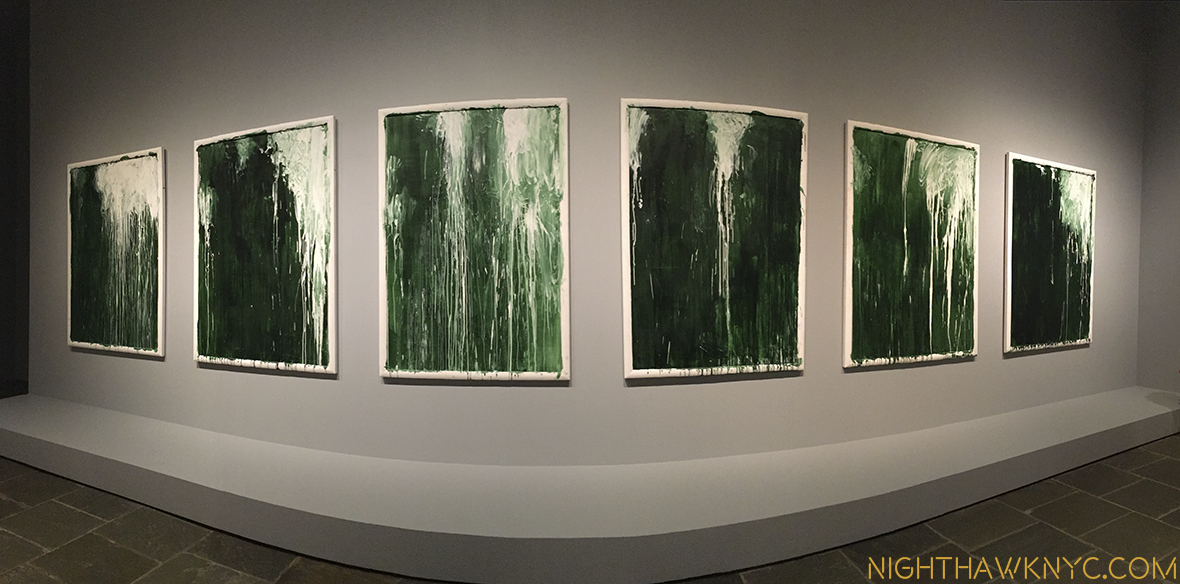
Water works? It’s hard not to feel a sense of water in movement in this gallery of 6 Cy Twomblys, which closes the show, seen in panorama.
Overall, what I took from this show as a whole was a possible template for what The Met plans to do going forward, the kinds of Artists they may include in their “new initiative.” It’s something I plan to watch closely as it unfurls. I should say that I have been in the minority regarding The Met and M&C Art. I liked that they were taking their time and allowing time to give some perspective on Contemporary Art before jumping in. It’s always been an honor to be in The Met- they have the best of the the best across all cultures and all times. Yet, given the unprecedented popularity of M&C Art today, they have opted to move more fully into it. Ms. Wagstaff, who I met in June, seems to have a great sense for all of this, and if anything, “Unfinished,” is a show that consists of work across at least a few Met Departments. Being able to work, apparently, so well with the other Met Departments augers well for the future. After all, The Met has 2,000,000 items in it’s collection. Showing M&C Art along side of selected objects in their collection is something I am all for.
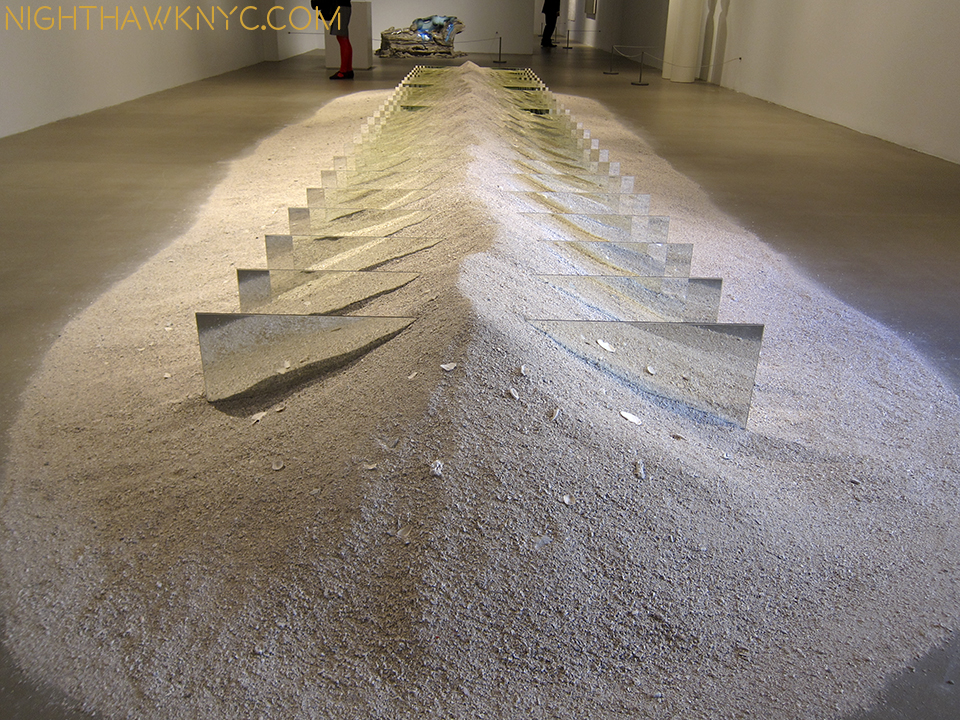
Floor beach. “Mirrors and Shelly Sand,” 1970, by Robert Smithson. As close as I got to a real beach this summer. I shot this wearing shades.
For me? That’s what this show says- Here are (unfinished) works by many of the greats. This is where we are starting from. Let’s see how other work that may, or may not, have been influenced by them, looks alongside these. The show may be seen as a number of conversations between Artists they are displayed alongside- Leonardo with Michelangelo. Van Eyck and Durer, Rembrandt with Velazquez(!). Degas and Manet. Van Gogh and Whistler(!). Picasso and Cezanne. Pollock and Kusama. Smithson and Fischer. Marshall and Warhol. Szapocznikow and Rodin. Rauschenberg and Mondrian. And, Picasso, also…with himself, among them. I say bring it on!
Still, there’s no denying that The Met Breuer is a HUGE gamble. Who knows how long Contemporary Art will stay as “hot” as it is? For that matter, who knows how much longer record number of viewers will go to see Art, as they have these past few years? The Met is locked into this for 8 years, and they have already announced a budget deficit that caused them to put off the previously announced reconstruction of the Modern & Contemporary Galleries, and, more sadly, even forced an unknown number of lay offs.
When they return to better times, IF they decide to move forward with those reconstruction plans, they will, most likely, need additional space for the temporary display of their Modern & Contemporary holdings, and Special Exhibitions. What will they do? Extending the lease on the Breuer will be VERY expensive. So far? I have yet to see it’s galleries very crowded. The “Diane Arbus; In The Beginning” Show, which recently opened on the 2nd floor, seems to be drawing pretty well, and “Unfinished” was fairly crowded during it’s last weeks. Yet? They’ve already closed the 5th Floor Cafe & Bookstore and remodeled it as additional Gallery space, which indicates that they want to have more going on there for visitors to see, and their basement restaurant is scheduled to open in about a month, which will be open during some hours The Museum is not. Obviously, this is all new, and still in flux. The Met seems to be reacting fairly quickly, which is a good sign. They did away with late Thursday nights, which I seemed to be among the very few that went to, and changed to late Friday & Saturday nights, like TM, 5th Avenue.
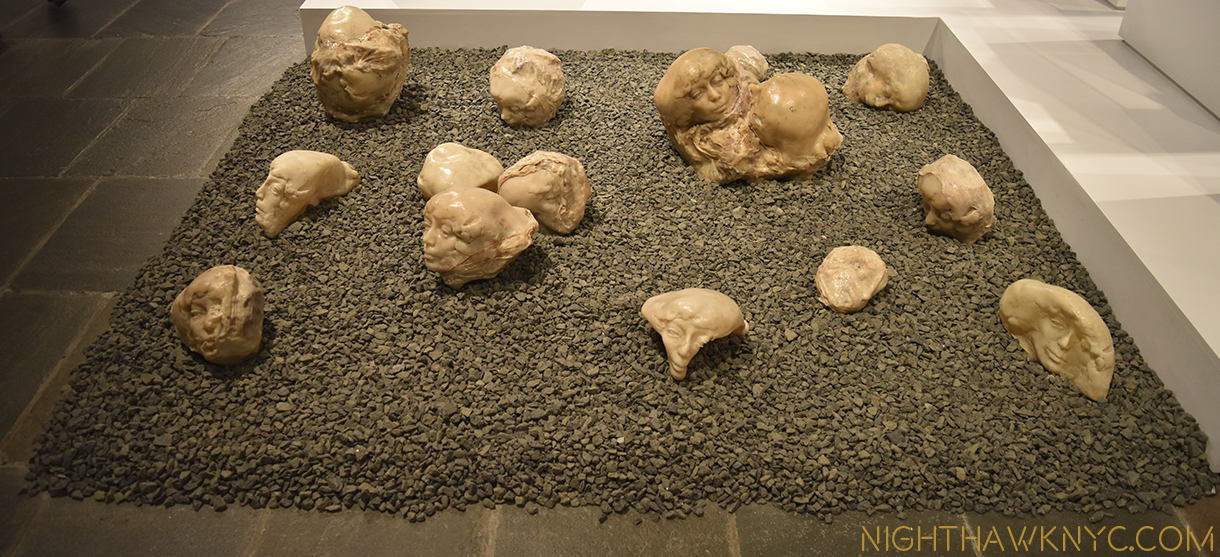
Survivor. “Tumors Personified,” 1971, by Alina Szapocznikow.
So far, on very little evidence, I like the direction TM is going at TMB, and with M&C Art. “Nasreen Mohamedi” was a revelation that struck me as the “perfect choice” to be the first M&C Show. “Unfinished” was an unexpected blockbuster the likes of which has never been seen before, which is somewhat startling given how long there have been painting shows. The Diane Arbus show is fascinating and features a ground breaking installation. Also, not to be lost is the reconfiguration of the M&C Galleries at TM on 5th Avenue- I love what they’ve done. The Art has been imaginatively rehung in fascinating new combinations, with some pieces given new prominence, like Edward Hopper’s majestic “The Lighthouse at Two Lights,”1929, and other pieces shown that have long been in storage. Along with this, Thomas Hart Benton’s “America Today” Mural appears to have now been permanently housed, at the center of supporting works and works that enter into interesting dialogue with it nearby. Other galleries are arranged by theme, instead of chronology.
So? There’s been a lot of action coming from new M&C Chairwoman Sheena Wagstaff and her Department. There’s a long way to go, but so far? It’s hard for me to give her less than an “A” for what she and they have accomplished.
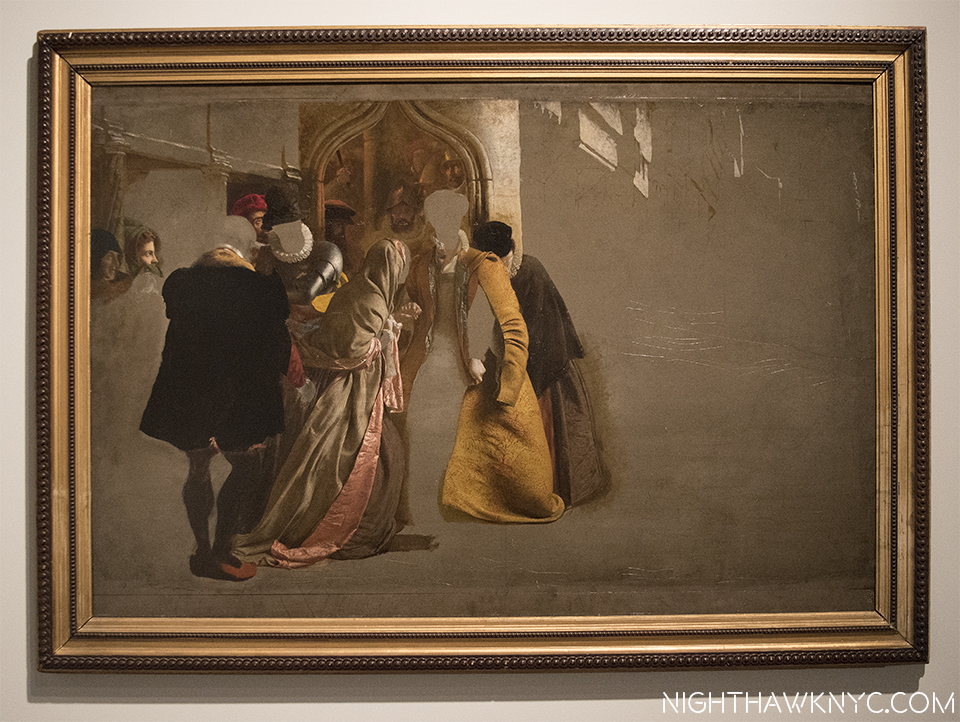
Haunting, and then some. “The Return of Mary Queen of Scots to Edniburgh,” 1870, James Drummond.
Most of the Artists in “Unfinished” won’t get the chance to finish what they started. The Met will.
Stay tuned.
*-Soundtrack for this post is “She’s Not There,” by Rod Argent, recorded by The Zombies, and published by Marquis Songs, USA.
NighthawkNYC.com has been entirely self-funded and ad-free for over 7 years, during which over 250 full length pieces have been published. As I face high expenses to keep it going, if you’ve found it worthwhile, please donate to keep it up & ad-free below. Thank you!
Written & photographed by Kenn Sava for nighthawknyc.com unless otherwise credited.
To send comments, thoughts, feedback or propositions click here.
Click the white box on the upper right for the archives or to search them.
For “short takes” and additional pictures, follow @nighthawk_nyc on Instagram.
Subscribe to be notified of new Posts below. Your information will be used for no other purpose.
This site is Free & Ad-Free! If you find this piece worthwhile, please donate via PayPal to support it & independent Art writing. You can also support it by buying Art & books! Details at the end. Thank you.
Written & Photographed by Kenn Sava.
From The Met today-
“(New York, September 6, 2016) – The Metropolitan Museum of Art announced today that Manus x Machina: Fashion in an Age of Technology, which closed yesterday, attracted 752,995 visitors during its run from May 5 to September 5, putting it in seventh place among the Museum’s most visited exhibitions, joining blockbusters such as Treasures of Tutankhamun (1978), Mona Lisa (1963), and Painters in Paris, 1895-1950 (2000). The show also becomes the second most visited Costume Institute exhibition, surpassing Alexander McQueen: Savage Beauty (2011), which had 661,509 visitors. China: Through the Looking Glass (2015) remains the department’s most popular show with 815,992 visitors and The Met’s fifth most visited. All three exhibitions were curated by Andrew Bolton, Curator in Charge of The Costume Institute.
“We are thrilled that so many people from around the world experienced this exploration of the artistry of fashion,” said Thomas P. Campbell, Director and CEO of The Met. “The exhibition required the transformation of the Robert Lehman Wing into a domed cathedral-like space that invited people to slow down and contemplate the process and craft of the objects.”
The exhibition, originally set to close on August 14, was extended by three weeks, and hours were added on September 2 and 3, when it stayed open until midnight, three hours past the usual 9:00 p.m. closing time on Friday and Saturday nights.
Manus x Machina explored how designers reconcile the handmade and the machine-made in the creation of haute couture and avant-garde ready-to-wear. It addressed the distinction between the hand (manus) and the machine (machina) as discordant tools in the creative process, and questioned the changing delineation between the haute couture and ready-to-wear.” (End.)
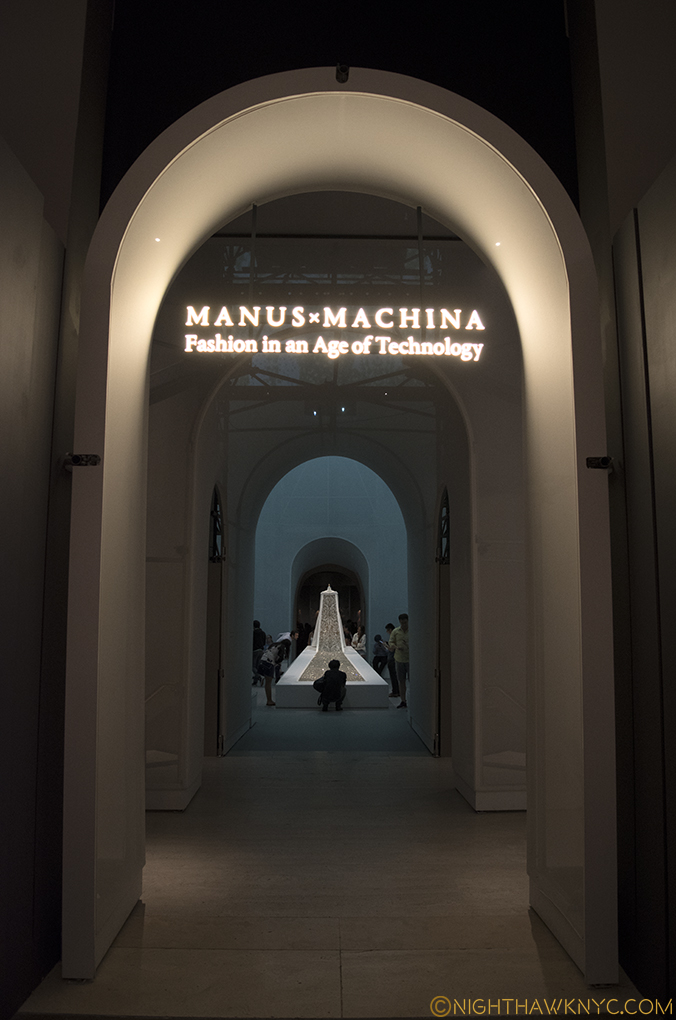
Worshipping at the Altar of Fashion. The entrance.
Ok, so I was 250,000 short on my ambitious guess of a million. I am surprised it topped the unforgettable McQueen Show, which felt more crowded during my 8 visits, but I haven’t checked to see how many days each show was open. I saw Manus about 10 times, and was blown away by the trnsfiguration of the Robert Lehman Wing into the “cathedral” Mr. Campbell describes in The Met’s press release, above. While, they’ve gone above and beyond every year with their fashion show installations, this was was over the top. If you’ve been to the Lehman Wing before this show, you have an idea of the scope of what they did. Here’s how it looked when I visited it in 2013-
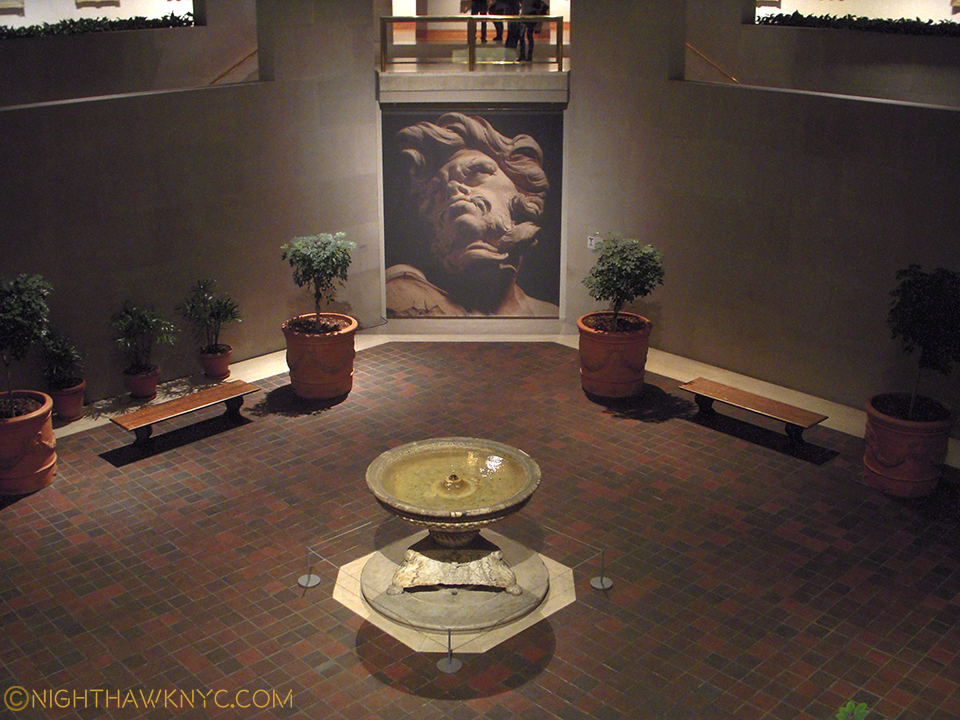
Robert Lehman Wing Courtyard, January, 2013, during “Bernini: Sculpting in Clay”
And during Manus x Machina-
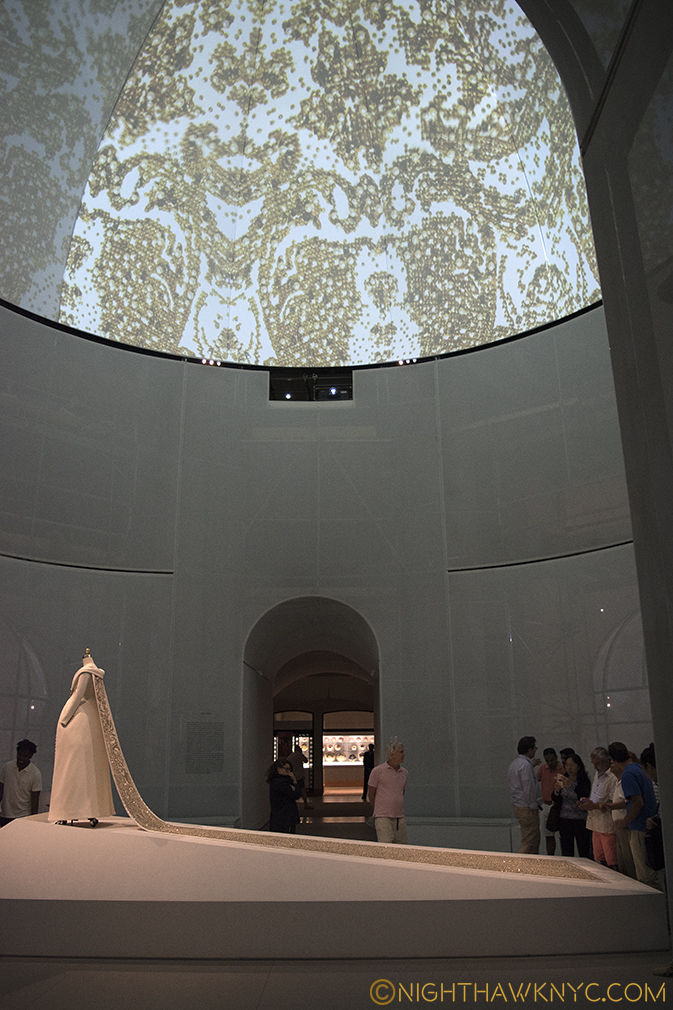
Yes, they built an entire floor over the courtyard seen above! The floor in this pic is at the same level as the top of the Bernini Bust in the pic, above. Side view- Chanel Wedding Ensemble by Karl Lagerfeld, Autumn/winter 2014/15, also seen in Pic 1.
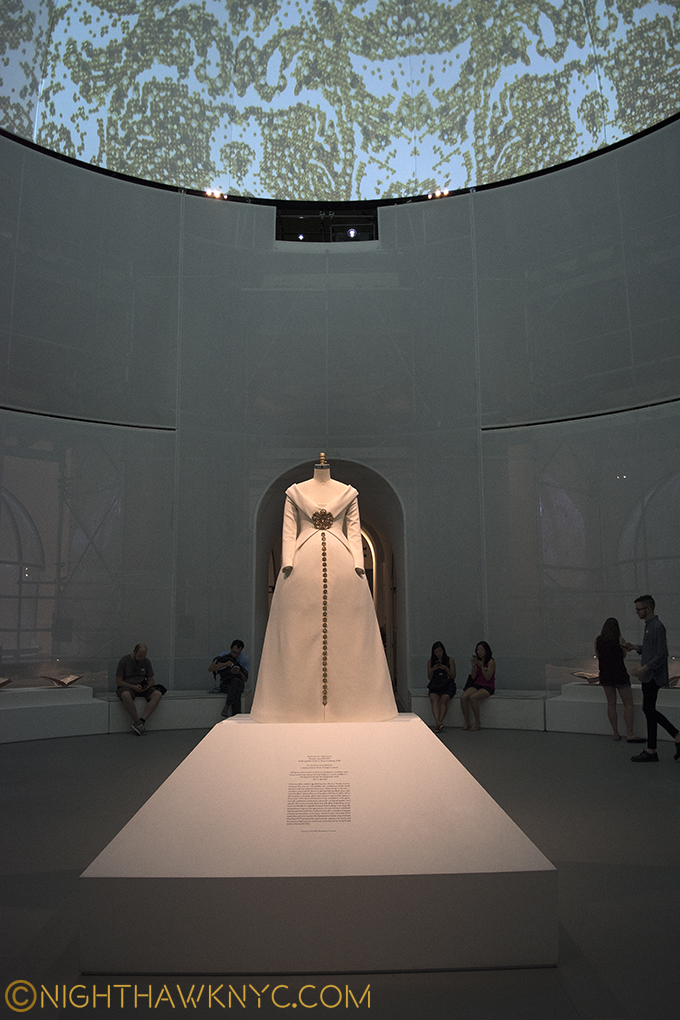
Front view. Chanel Wedding ensemble. Projected on the dome, above, is a blow up of the train, based on Lagerfeld’s drawing.
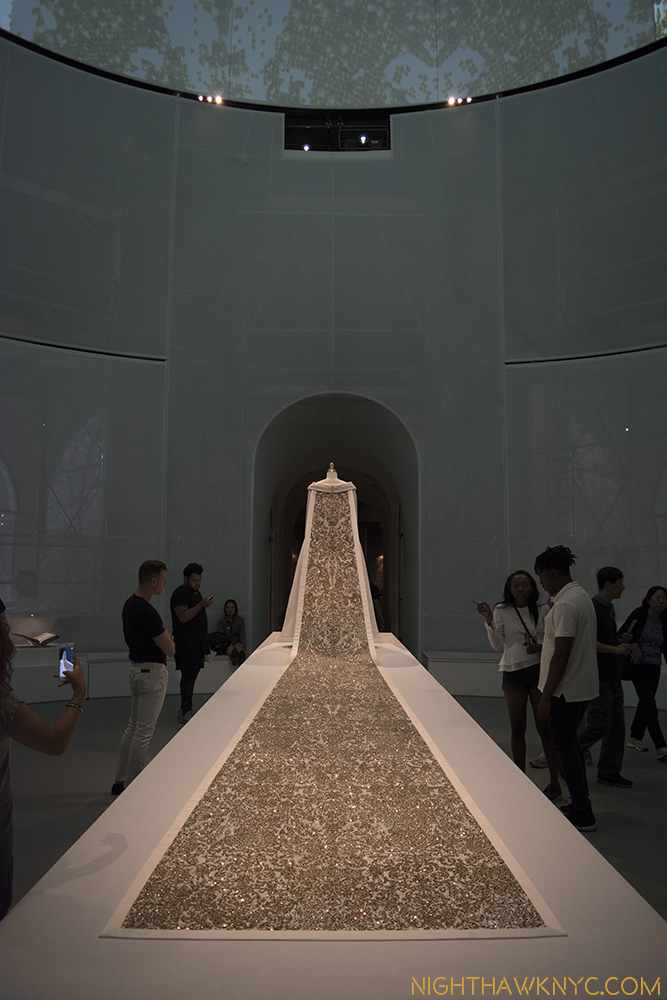
Back view. Probably the most popular vantage point.
The grey area in front begins the amazing temporary floor.If you didn’t know it was temporary, you’d never suspect it.
The show was focused on the craft of fashion, with each gallery turned into a section for various crafts like Embroidery, Artificial Flower Making, Leatherwork, Featherwork, Pleating, Lacework and Tailoring. Some of the more adventurous pieces follow-
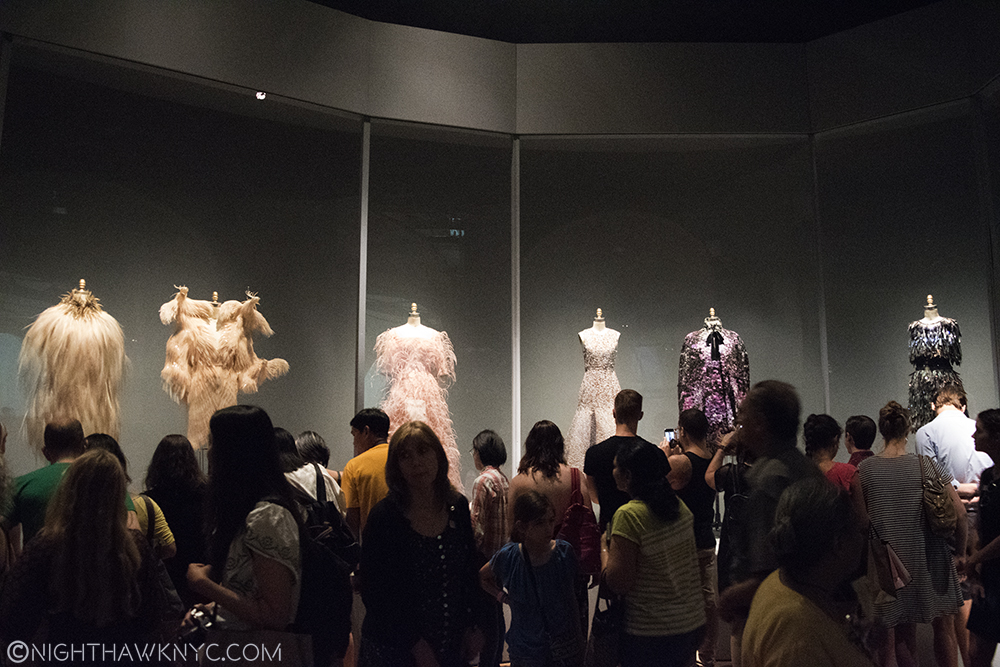
A Featherwork Gallery
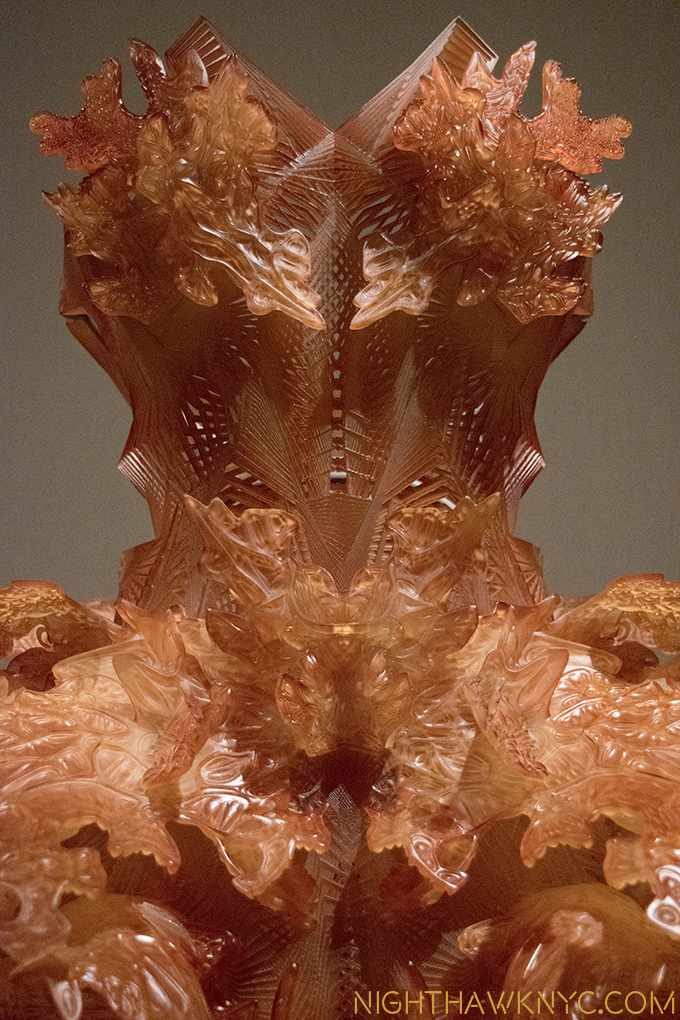
Lacework.? Iris van Herpen, Autumn 2012, 3D Printed dark orange epoxy.
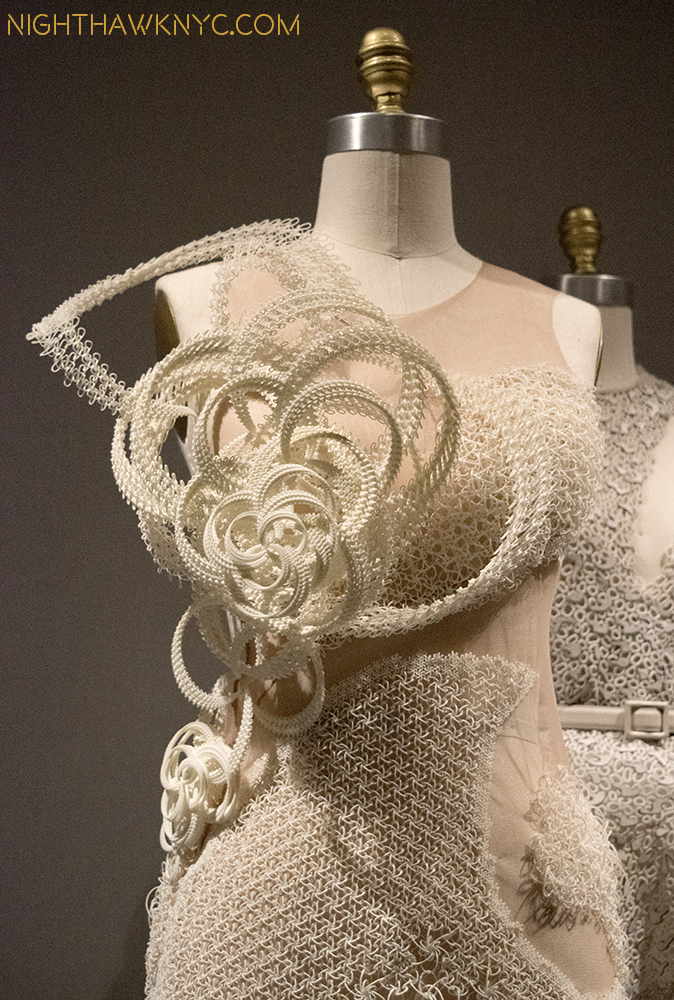
Threeasfour, “Interdimensional” Dress, 2016. Machine sewn white neoprene, hand-applique 3D ivory resin.
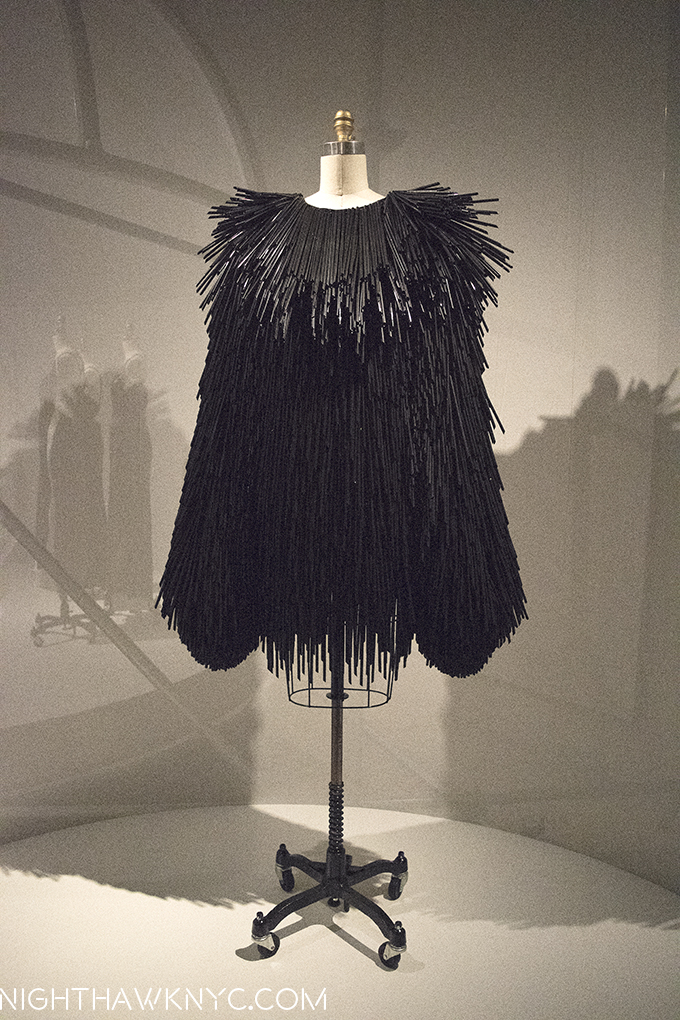
Gareth Pugh, Dress, 2015. Individually hand-cut drinking straws.
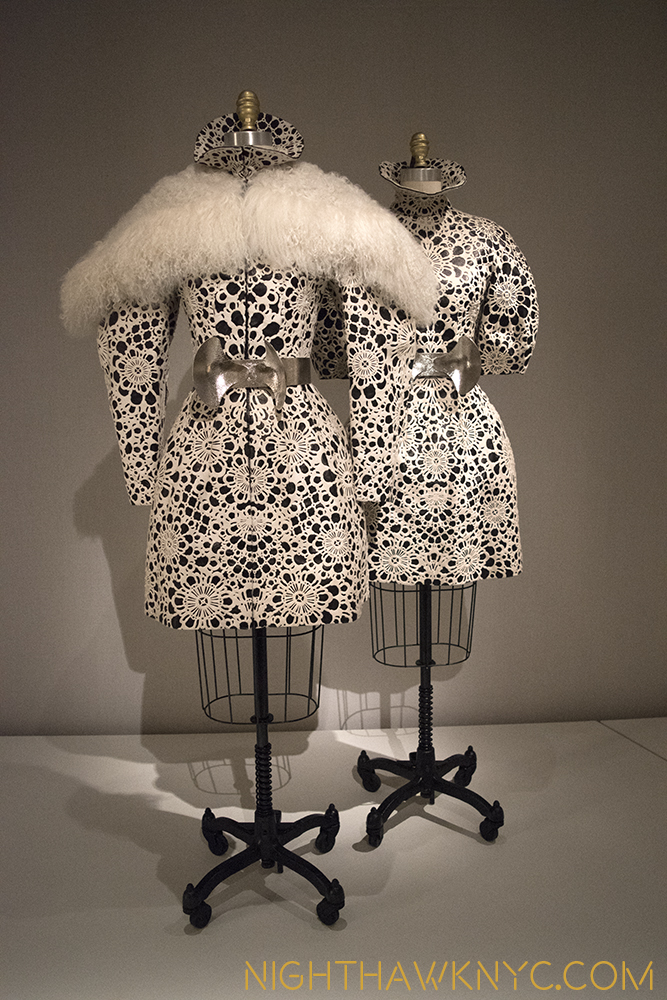
It wouldn’t be a Met fashion show without McQueen. Here, Sarah Burton’s 2012 White pony skin on black leather ensembles.
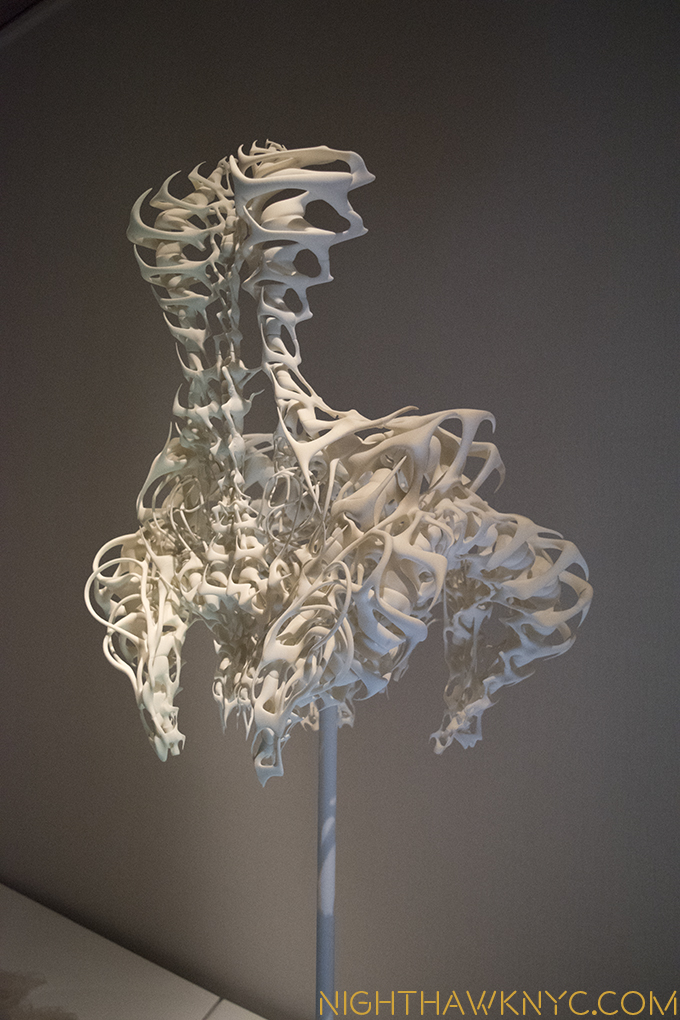
“My dear, your tailbone is showing.” Iris van Herpen, Dress, 2011-12, 3D printed white polyamide.
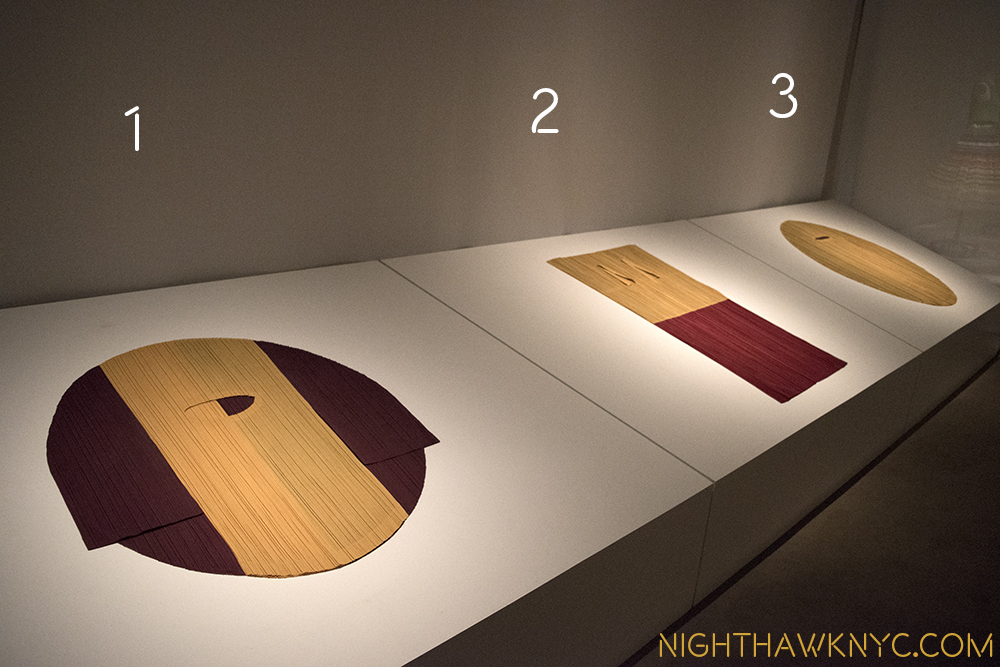
Shapeshifter. Issey Miyake, Master of the Pleat, the same designs, seen first as flats, here, and…
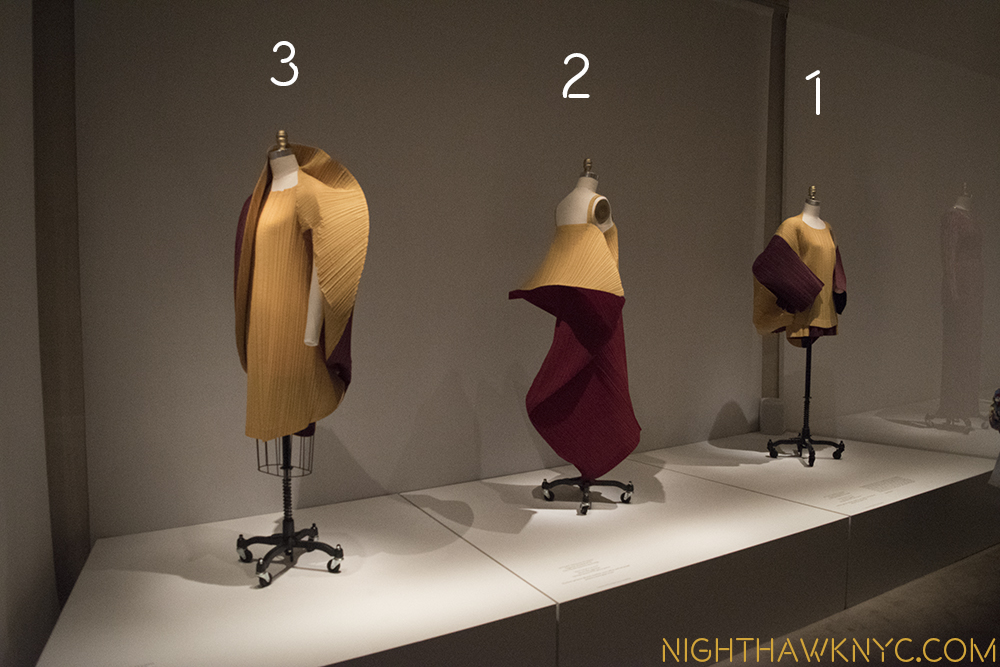
Opened, i.e. “Not flat,” with my numbers added. “1” flat becomes “1” opened…
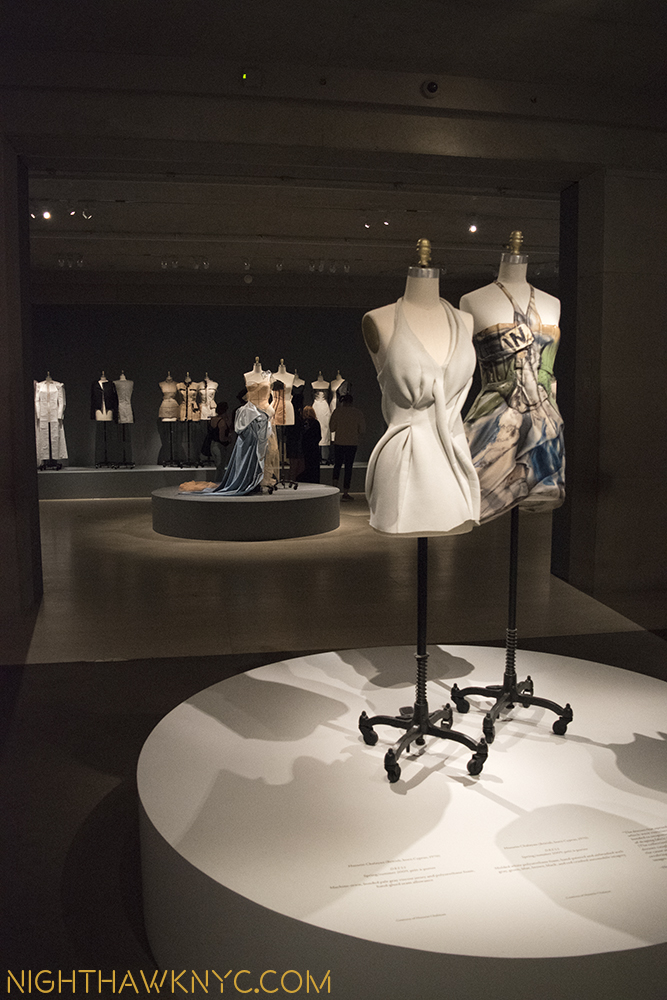
Tailoring & Dressmaking Gallery
To see more of the show, I highly recommend TM’s Manus x Machina website, where you can see Overviews of each gallery and additional images of displayed items.
“I work all day at the factory
I’m building a machine that’s not for me
There must be a reason that I can’t see
You’ve got to humanize yourself.”*
Some shots of the installation-
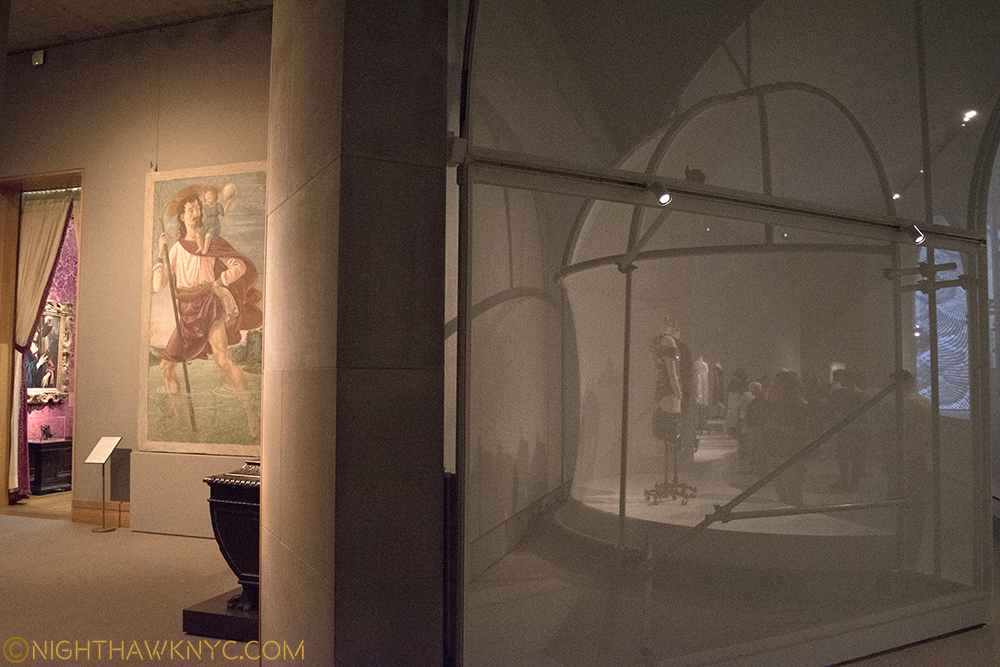
Meanwhile, in the part of the Lehman Wing still displaying Robert Lehman’s collection, left, St. John seems to be striking an auditon pose to get into MxM, right, where you can see some of the temporary structural work done to create the “cathedral,” seen through the outer mesh.
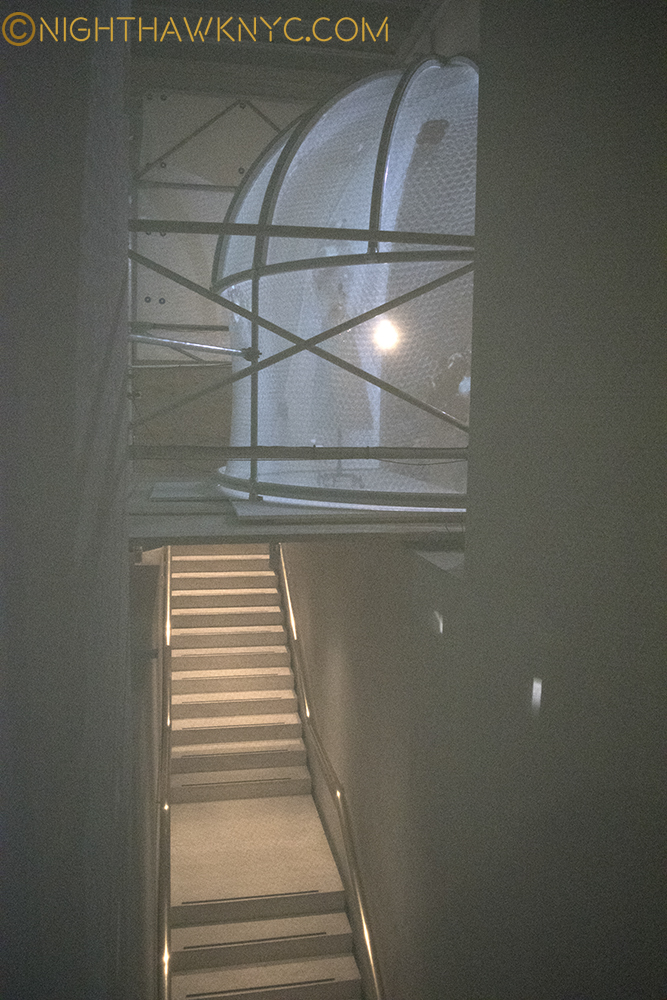
Even the stairwells to the lower floor of MxM were imaginatively used, again, seen through the mesh.
This show didn’t have a “hook” into the psyche of the moment as “Alexander McQueen: Savage Beauty” did with Lady Gaga wearing his amazing “Armadillo Shoes” on the cover of Rolling Stone, and with McQueen’s recent tragic passing still fresh in the mind, yet for those with an interest in the craft of fashion, it was an excellent overview. While a few designers, especially Iris van Herpen and Issey Miyake, received major attention in the form of (too?) many pieces, the show wasn’t too big and was beautifully laid out. As very, very good as the fashion was? I’ll never forget the unbelievable and incredibly creative job they did installing this show.
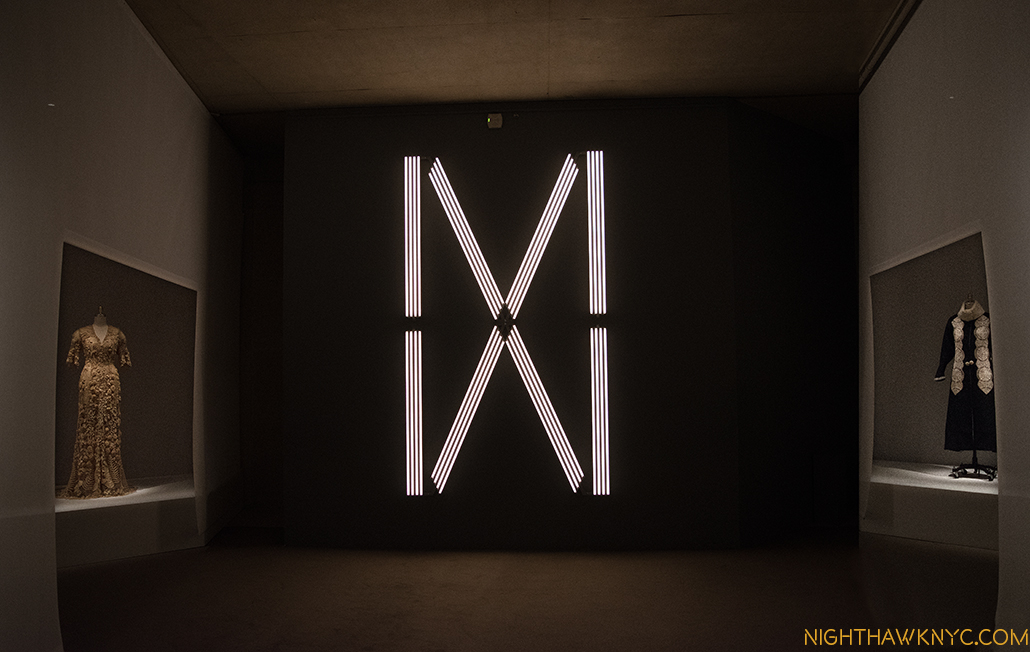
A very popular Irish Wedding dress circa 1870 on the left.
This show came during the news of TM’s budget shortfall, which put on hold the rebuilding of the Modern & Contemporary Galleries. After seeing the Lehman Wing transformed, I wonder if the Lehman Wing will be the next area of TM to be rebuilt, after the M&C Galleries are done…whenever that is.
*-Soundtrack for this Post is “Rehumanize Yourself,” by Sting & Stewart Copeland, from The Police’s album, “The Ghost In The Machine,” and Published by Sony/ATV Music Publishing, LLC.
NighthawkNYC.com has been entirely self-funded & ad-free for over 8 years, during which 300 full length pieces have been published! If you’ve found it worthwhile, PLEASE donate to allow me to continue below. Thank you, Kenn.
You can also support it by buying Art, Art & Photography books, and Music from my collection! Art & Books may be found here. Music here and here.
Written & photographed by Kenn Sava for nighthawknyc.com unless otherwise credited. To send comments, thoughts, feedback or propositions click here. Click the white box on the upper right for the archives or to search them. Subscribe to be notified of new Posts below. Your information will be used for no other purpose.