Art Is The New Rock n Roll

This site is Free & Ad-Free! If you find this piece worthwhile, please donate via PayPal to support it & independent Art writing. You can also support it by buying Art & books! Details at the end. Thank you.

Written & Photographed by Kenn Sava (*- unless otherwise credited)
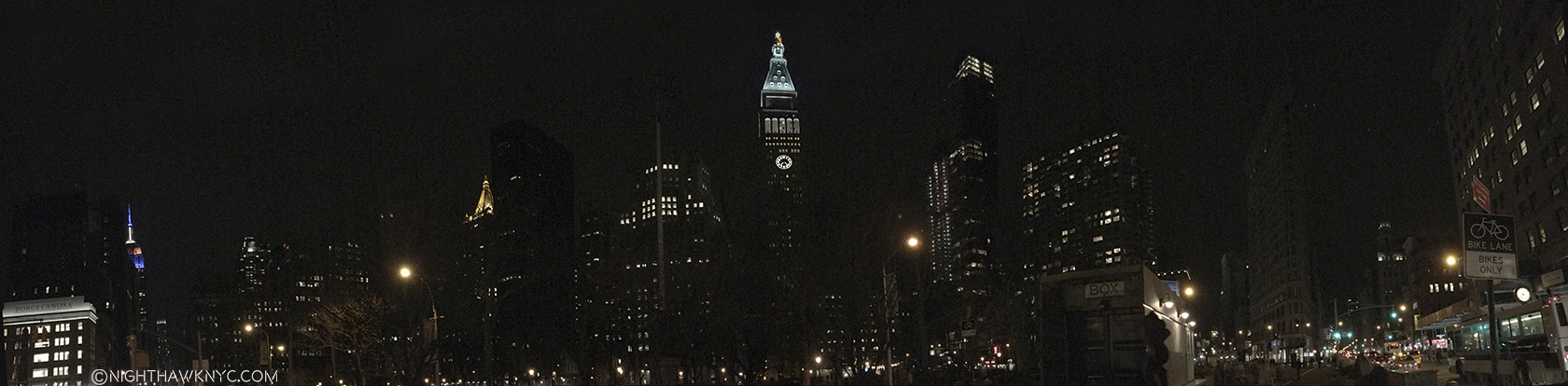
Manhattan, 2016. Click to enlarge.

Among the sites not seen above are-

C.B.G.B.
The Bottom Line
The Knitting Factory (Manhattan)
Fat Tuesday
Sweetl Basil
The Angry Squire
Lush LIfe
The Lone Star Cafe
Bonds International Casino
Max’s Kansas City
The Peppermint Lounge
Danceteria
The Gaslight Cafe
The Electric Circus
The Five Spot Cafe
The Half Note Club
The Lion’s Den
Minton’s Playhouse
The Mudd Club
The Cooler
Coney Island High
Great Gildersleeves
The Ritz
Gerde’s Folk City
The Palladium
The Savoy Ballroom
Sin-e
Slug’s
Cafe au Go Go
Smalls Paradise
Tonic
The Village Gate
Wetlands Preserve

and on and on…Going back further-

The Academy of Music
The Fillmore East

Those are just some of the live music venues we’ve lost in Manhattan. Spill a little of your drink on the pavement in their memory. In spite of the title to this Post, I include Live Music Clubs as a whole. The list includes Jazz and Folk Clubs, and clubs that had a variety of types of music, along with Rock Clubs. Some intrepid places have come along in their absence, though I don’t think anyone would say they’ve “replaced” them. There are some legendary places that still remain, including the Village Vanguard, for me, the greatest music club in the world. It’s nothing short of a cultural tragedy that so many clubs have UNWILLINGLY closed, which most of the above have, mostly due to rent increases that they couldn’t afford. When I walk past their former locations, which are “sacred” in their way (and so, some I consciously avoid), and see what’s there now, I continually shake my head and remember-

A little piece of New York City, and what makes this City great, special & unique, went away every single time each one of the Clubs closed.1

City government doesn’t care. They’ve done nothing to stop it. As the clubs have closed, it’s been interesting to me to note that there has been an increase in Art venues, a few Museums, but mostly galleries. Where some of those clubs were “cheap,” they were all at least “affordable,” to the average music lover, and they made going to see and hear music regularly possible. In the mid-1990s, I was going out every night, and hearing a crazily wild range of music, often in the clubs listed above that we’ve now lost. I wrote about many of the shows I saw as part of my Artist Management website. That led to my writing for a national music magazine for 4 years.

As prices, especially real estate, have risen steadily since the mid 1990’s the clubs have faced extremely challenging business environments, with no protection from government2, that has seen their business model largely change from a “club” to more of a “concert/show” environment. Clubs like “City Winery,” founded by Knitting Factory founder Michael Dorf, have become a model for franchises all over the country. Customers can sit, eat and drink, and hear music. I’ve never been to one. It’s not my scene.
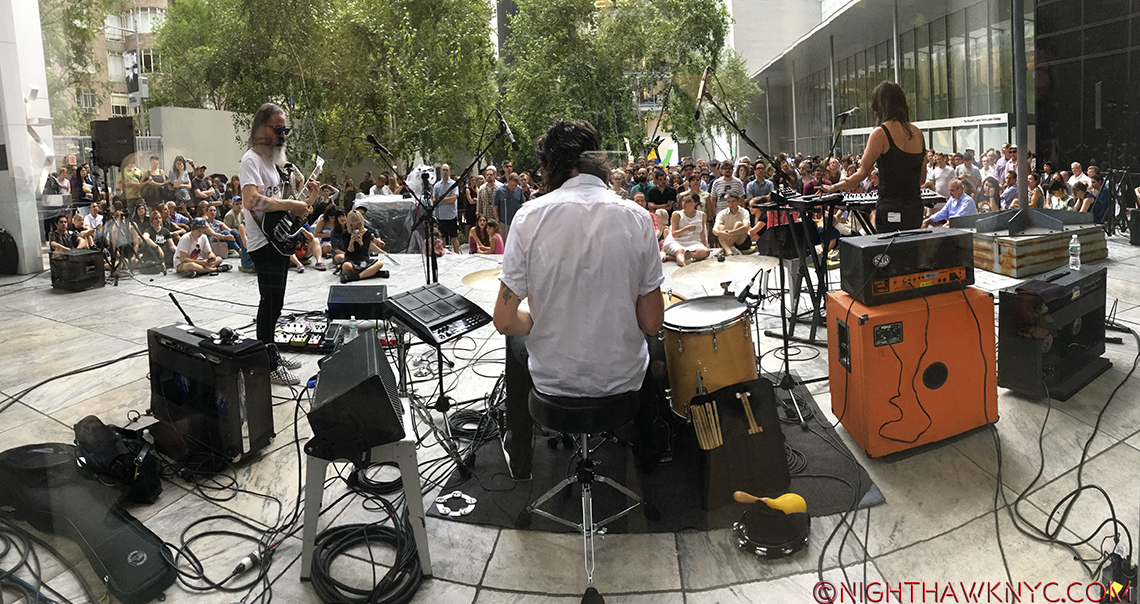
Live music in NYC is almost a museum piece “Moon Duo” outdoors, in MoMA’s Sculpture Garden, 2016

And so, this Post is my way of saying I realize that I only wrote about one live music event this year, a damn good one (Jacob Collier opening for Kamasi Washinton), and that I, unfortunately, expect this trend to continue.

As the music clubs closed, in another part of the City, Chelsea, hundreds of Art Galleries were starting up- unprecedented numbers. While most specialized in Contemporary Art, some showed the work of established Artists. Soon, it was possible to wander for endless hours and see as many Art shows as you wanted, or as your feet could take, without spending a dime, (unless you wanted to make a purchase.)

Little by little, completely unintentionally, Art began to usurp Music’s primacy in my life, even though I am someone who was a professional musician who spent 5 years on the road. This has continued to expand to the present minute, where as I sit here on New Year’s Eve, at the end of a terrible year in many ways, I sit back and realize that I’ve gone to see Art every day for the last 6 weeks, except Sunday and Mondays, when the galleries are closed, and the Museums have short hours. I’m now living the life I was living in the mid-1990’s as a live Music fan as an Art lover.

I still listen to, and love, Music. My iPhone is packed with Music to the point I have very little room left for Apps or photos, and it’s constantly being changed and updated. I am always listening to Music when I’m looking at Art. But, I so miss that spontaneous creativity of a a great live Jazz Band, or the energy of a great live Rock Band, even though my years of performing live have taken their toll on my hearing.

For me, anyways, there’s not a heck of a lot of difference between Art & Music, in many ways. If you look through the history of both, there are similar “movements” that happen in both at about the same times. You’ll find Baroque Art & Music, Romantic, Impressionistic periods in both, and 20th Centuries marked by similar explorations. Picasso and Miles Davis have been compared often, not without good reason (and I don’t mean qualitatively compared). A good number of Musicians (including Miles), are/were Artists, though very few Artists were also Musicians (as far as I know). The similarities don’t end there, but that’s the subject of another Post3.

I don’t expect the number of Art Galleries we have in Chelsea to last. When their leases are up, many will close, move, or go online only. A current list can be seen here. Their number is probably already down from the peak number, which was over 300, an astounding number for such a small area of Manhattan, and more than there has ever been in any neighborhood in the world. Back in the day, Soho experienced a “boom” in the number of Art galleries opening. Today, not many remain. It’s hard to know what the future is in Chelsea. Some galleries have moved to the Lower East Side, Brooklyn, even to Midtown (traditionally more expensive). This will, no doubt, continue. Given that I believe the Art Market has, or will very shortly, peak, a downturn in prices may well be followed by a downturn in interest/demand, which would further exacerbate things. Time will tell. The Art market has gone down, a lot, in the past and recovered. Right now, though, many of the people in the Art market today have never experienced a large downturn in prices, so who knows how they will react.

High tide. West 24th Street on Nov 6, 2012, a few days after Hurricane Sandy flooded these Chelsea Galleries. How many will now survive the tide of rising rents?

As 2017 dawns, however, I expect one of the biggest years in memory in the NYC Art World. Blockbuster shows loom in the Museums, and the galleries are going strong. Both auger well for new records being set in Art attendance. I think it’s a good thing. For me? This is the reason I continue to live in Manhattan.

Making the rounds of the galleries and Museums to see Art shows before they end now reminds me of the days when I’d make the rounds of bars and clubs to see bands while they were there. Yes, back in the day there were often so many bands playing at the same time it was hard to juggle, unless they were all playing at the same place, I’d find myself going from CBGB downtown on the Bowery far uptown to the original, classy, Iridium on the same blind date. Now, I find myself going to see a similar range of extremely wide ranging Art on the same day so often I expect it.

Having seen the rise, peak and fall of live Music in NYC, I well know that the Art gallery scene here is likely to follow the same trajectory. The unknown factor is- how much longer will it last? Somewhere, Carly is singing…

“We can never know about the days to come
But we think about them anyway”*

Enjoy it now, while you can, Art lover, because these are “the good old days.”*

*- Soundtrack for this Post is “Anticipation,” by Carly Simon. Published by BMG Rights Management US, LLC.

NighthawkNYC.com has been entirely self-funded & ad-free for over 8 years, during which 300 full length pieces have been published! If you’ve found it worthwhile, PLEASE donate to allow me to continue below. Thank you, Kenn.

You can also support it by buying Art, Art & Photography books, and Music from my collection! Art & Books may be found here. Music here and here

Written & photographed by Kenn Sava for nighthawknyc.com unless otherwise credited. To send comments, thoughts, feedback or propositions click here. Click the white box on the upper right for the archives or to search them. Subscribe to be notified of new Posts below. Your information will be used for no other purpose.
  1. Feel free to let me know if I’ve left one out. I know I have.
  2. like our supermarkets don’t receive now
  3. I touched on in in this one.

A Tribe Called Quest- From Linden Boulevard To…Forever

This site is Free & Ad-Free! If you find this piece worthwhile, please donate via PayPal to support it & independent Art writing. You can also support it by buying Art & books! Details at the end. Thank you.

Written by Kenn Sava.

When Q-Tip suddenly announced there would be a new, and final, album from A Tribe Called Quest coming out on November 11, you could have knocked me over with a cotton swab. Even after reading his hand written note a few times I still couldn’t believe it.

Did ANYONE see this coming? What would it be like? Afterall, one of it’s core members, Phife Dawg, passed away on March 22, as I mourned.

But, there I was November 15th, when I was finally able to get my hands on a download, and the experience was surreal. It reminded me of seeing Eyes Wide Shut, Stanley Kubrick’s unexpected last film, finished just before he died, on the day it opened, July 16, 1999. I was in the first row, and I’ll never forget the opening- on the huge black screen, big white letters appeared-

TOM CRUISE

then

NICOLE KIDMAN

and, finally

A Film By STANLEY KUBRICK

A chill ran up my spine. Oh My God…Another Stanley Kubrick movie, TWELVE YEARS after Full Metal Jacket in 1987! Forever my personal favorite director, I NEVER expected to see another film by him ever again, and here it was…

I’m not making any comparisons here between Stanley Kubrick and ATCQ other than to say they both occupy large places in my heart, and to say these unexpected final works had a similar shocking effect on me. What would they add to the canon they’ve already created? What new would we learn? For me, Tribe had more “Jazz” going on than any other group I’d heard that wasn’t an actual “Jazz Group,” even though Q-Tip, himself, played this down after people started calling them “Hip-Hop Jazz.” It’s in there. Yes, they had a lot of a lot of things going on, it was the way their lyrics flowed like a solo, with the same freedom, the same unexpected, thrilling turns, the interplay, and, Q-Tip’s voice has a “Jazz” edge to it. I hear bits of singers like Eddie Jefferson,  and even Billie Holiday in Q-Tip’s style. Beyond this, in terms of production, lyrical content and their approach, Tribe stood apart and alone, as far as I was concerned. While they addressed serious topics, like date rape, drug dealing on “Everything Is Fair,” and even the music biz tell-all, “Show Business,” on the sublime The Low End Theory, nothing interrupts their flow, and the music overcomes all. If there was an overriding “message” I took from A Tribe Called Quest? That was it.

From Low End Theory on, I followed each one up with seeing them live. I even drove to Asbury Park, NJ to see them in a small bar. There were so many people there, people were standing on the seats of the booths that ran along the wall. I was among the row of people standing on the narrow curved shoulder of those booths, with my head inches from the ceiling. I also saw them on New Year’s Eve at the Palladium, with Leaders of the New School and DeLa Soul. The amazing thing about that gig for me was that Tribe performed with a live band! I had always dreamed of hearing Tribe with a live band of improvisors.

“My pops used to say it reminded him of be-bop.”

Yeah. That’s it. That’s what I mean.

“I said, well daddy don’t you know that things go in cycles”1

Yeah.

Seeing their name on a new album, again? It’s on 5 previous albums that are seminal to quite a few people’s lives. Each one was an event, a cause for marathon listenings and discussions, about the lyrics, the style, the tracks, the cover…all of it.

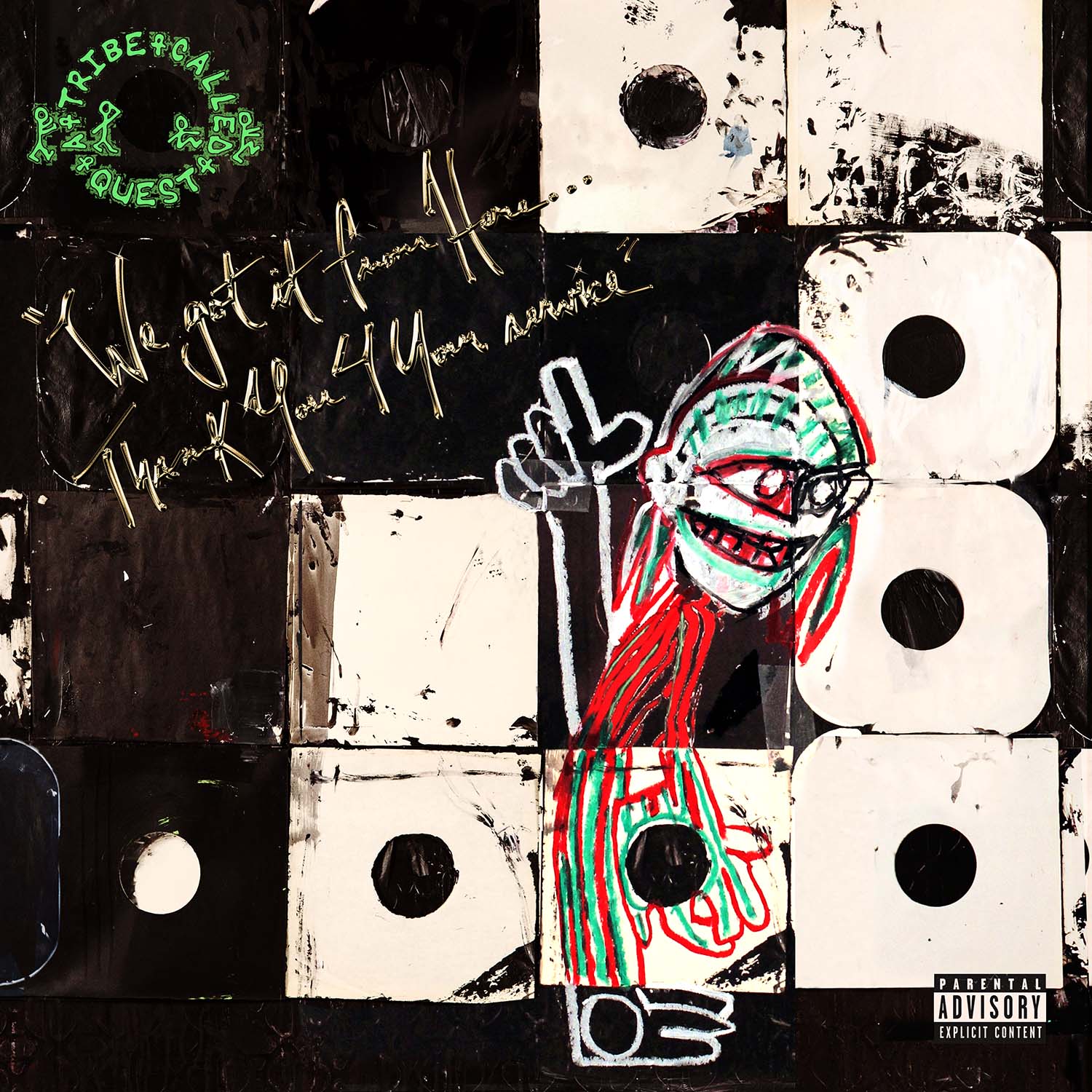
Here it is- We got it from Here…Thank You for Your service. Available direct.

And now, EIGHTEEN YEARS after The Love Movement came out in 1998 (which isn’t considered their best album in anyone’s estimation that I know of), that same Eyes Wide Shut feeling returned. I put it on, shut my wide eyes and listened….

First up? “The Space Program.” It starts with a sample from a pretty obscure “blaxploitation” film called “Willie Dynamite,” from 1974, that says-

“I’mma deal with a bigger insult,man
It’s comin’ down hard
We’ve got to get our sh*t together”

Hmmm….Auspiciously setting the stage right away. This sure isn’t The Love Movement. Then, Q-Tip AND Phife take over-

“It’s time to go left and not right
Gotta get it together forever
Gotta get it together for brother
Gotta get it together for sisters”*

I was in shock. I didn’t realize that Phife had lived to work on this. It was downright eerie hearing him, especially singing that verse, and then solo, with the line

“Gotta get it together for dead niggas…”*

Whoa…

Yeah. But now they’re talking about ‘forever.” As in “Gotta get it together forever.” Has anyone in any form of “popular music” said that since Bob Marley’s “Redemption Song“? That’s pretty serious. Between “The Space Program,” and especially on the following, “We The People,” I’ve never heard Q-Tip sound more serious. But wait. This is just getting started. After verses by Q-Tip & Jarobi, here’s the chorus, with Q-Tip rapping the lines not in parenthesis, which are sung by a chorus-

“(Move on to the stars)
There ain’t a space program for niggas
Yeah, you stuck here, nigga
(Move on to the stars)
There ain’t a space program for niggas
Yeah, you stuck here, nigga
(Move on to the stars)
There ain’t a space program for niggas
Yeah, you stuck here, nigga
(Move on to the stars)
There ain’t a space program for niggas
Yeah, you stuck, stuck, stuck
(Move on to the stars)”*

As I said, Tribe hasn’t been heard from since 1989, though Q-Tip has on his excellent solo albums (The Renaissance is especially highly recommended.), as has Phife on his (and word came down this week that his second solo album will be released posthumously!). But someone who has been heard from during their absence was the great Gil Scott-Heron, who died on May 28, 2011, and who some call a founding father of rap. He released the amazing I’m New Here in 2010, which was remixed by Jamie xx as We’re New Here and the posthumous Nothing New, in 2014. But, back in 1970, Gil Scott released a record called Small Talk at 125th and Lenox, that included the track, “Whitey On The Moon.” This was during the Apollo moon landings that began in July, 1969. Here are it’s lyrics-

“A rat done bit my sister Nell.
(with Whitey on the moon)
Her face and arms began to swell.
(and Whitey’s on the moon)
I can’t pay no doctor bill.
(but Whitey’s on the moon)
Ten years from now I’ll be payin’ still.
(with Whitey on the moon)
The man jus’ upped my rent las’ night.
(’cause Whitey’s on the moon)
No hot water, no toilets, no lights.
(but Whitey’s on the moon)
I wonder why he’s uppi’ me?
(’cause Whitey’s on the moon?)
I was already payin’ ‘im fifty a week.
(with Whitey on the moon)
Taxes takin’ my whole damn check,
Junkies makin’ me a nervous wreck,
The price of food is goin’ up,
An’ as if all that shit wasn’t enough”

Lyrics by Gil Scott-Heron and Published by Carlin America Inc.

It’s hard for me, anyway, not to think that Q-Tip and Tribe have heard it2, but they’ve taken the possible influence of Gil Scott’s classic into a galaxy far away. With all the talk by Elon Musk, and others, about going to Mars, Tribe have a point. A cynic would respond that those who don’t have the money to fund their trip to space will get there the same way those who didn’t in the past did- by taking the jobs those with the money don’t want to do. Still? It’s a song I can hear becoming an anthem years down the road. Along with “Whitey On The Moon,” it’s the second blues song of the space age (“Space Oddity,” “Rocket Man,” or “Subterranean Homesick Alien” notwithstanding.).

It’s also quite a “statement.” And? It isn’t the last one here. The song ends with another movie sample, this one from “Willy Wonka,” featuring the voice of the late Gene Wilder saying-

“A small step for mankind
But a giant step for us
Oompa, loompa, doopa dee doo
I’ve got another puzzle for you.”*

The “A small step…” line is of course the first line uttered by Neil Armstrong on the moon, and as for Oompa, loompa, Urban Dictionary’s #10 definition of this references Donald Trump, who has also been referred to by this name by Jimmy Kimmel, Stephen Colbert & SNL…This goes right into the second track, “We the people…,” which brings the emphasis back to earth, and right up to the moment.

“We don’t believe you ‘cause we the people
Are still here in the rear, ayo, we don’t need you.”*

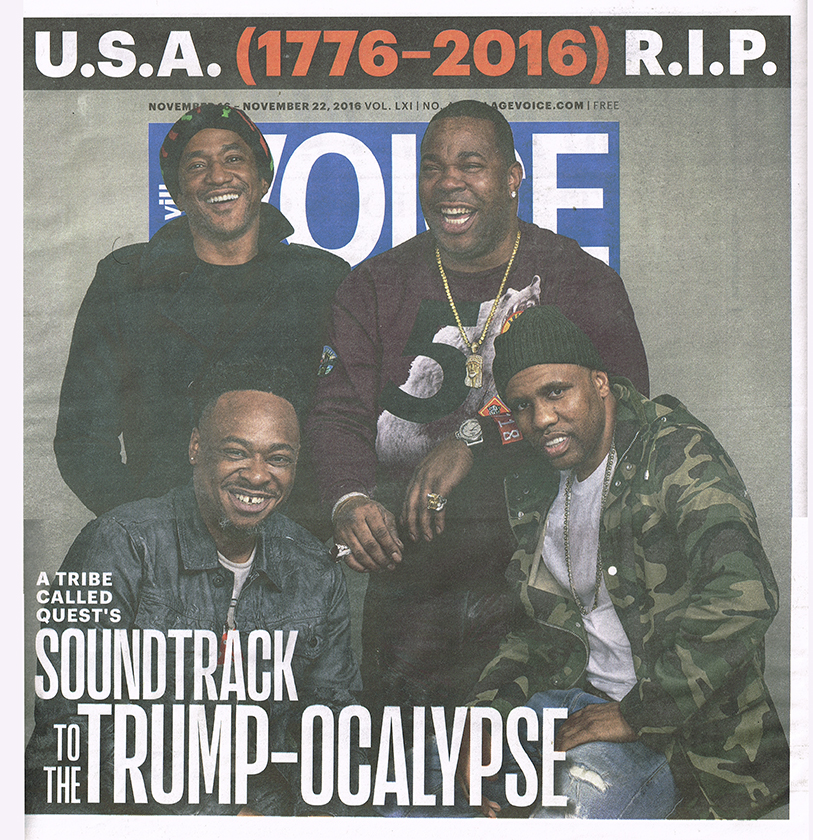
And it gets more intense from there, culminating in a chorus that led the Village Voice in their cover article on Tribe to call this the “Soundtrack for the Trump-ocalypse.”

Village Voice, November 22, 2016 cover. Q-Tip, Busta Rhymes, Consequence, and Jarobi clockwise from upper left

Damn.

Here’s their official music video for it, which is sitting right at 2 million views as I write this-

Along the way, right in the middle of it, don’t miss this instant classic verse from Phife, that contains respect for women that Hip Hop rarely gets credit of showing-

“”Dreaming of a world that’s equal for women with no division
Boy, I tell you that’s vision
Like Tony Romo when he hitting Witten
The Tribe be the best in they division
Shaheed Muhammad cut it with precision
Who can come back years later, still hit the shot?”*

 It’s obvious, at least to me, that Tribe weren’t happy with the way The Love Movement stood as their final work. Phife is quoted on wikipedia as saying, circa 2007, about a possible Tribe reumion-
“Man, we was only 18–19 when we first got started. [When] We broke up we were still like 28. Now we are 35–36. It’d be real different being in the studio. It would be real interesting to see where Q-Tip is. It would all be on a much higher level. But we are all into such different stuff from way back then.”

Different in almost every way it is. Whereas previously they left grand political and cultural statements to Public Enemy (“Fight The Power,” etc),  and others. Not here. They’re saying it all for the record, on a record that is going to stand alongside their other albums and show anyone who listens what they were really all about.

Forever.

Then again, there could be something else at work here. It could be “maturity,” that being 18 years older brings, as Phife said. It could be that it is, indeed, “comin’ down hard” now, perhaps as hard as it ever has. Or, it could be the influence of that other “D” word.

No. Not him.

Death.

The loss of, and respect for Phife is all over this record. On genius, Jarobi White was quoted as saying of him- “Doing this album killed him. And he was very happy to go out like that.”

What more could possibly be said?

“Lost Somebody” is one attempt to put some of it into words. Jarobi in Verse 2-

“Never thought that I would be ever writing this song.
Hold friends tight, never know when those people are gone.”*

Before the chorus comes in-

“Have you ever loved somebody?
Way befoe you got to dream?
No more crying, he’s in sunshine
He’s alright now, see his wings”*

Respect, and love, for Phife is constant and endlessly a part of this record, even when his voice isn’t heard. I’m not going to do a track by track of the whole album. We’d be here a very long time. Check it out for yourself. I will say that other highlights for me include guest spots by Andre 3000 on “Kids…,” a no pulled punches, straight up dispelling of the the imagined hip hop (or “star’s”) life, which includes the already famous line, “Kids, don’t you know how all this sh*t is fantasy?”*) is just amazing on a track that is already garnered significant buzz. Elton John, a sample of who’s “Benny & The Jets” forms the basis for “Solid Wall of Sound,” a unique, sonic marvel, which also includes Jack White’s guitar, before Elton winds it up with a new verse written for this record, and Abbey Smith on the addiction ode “Melatonin.” Like Tribe at it’s best, these tracks get under your skin and stay there.

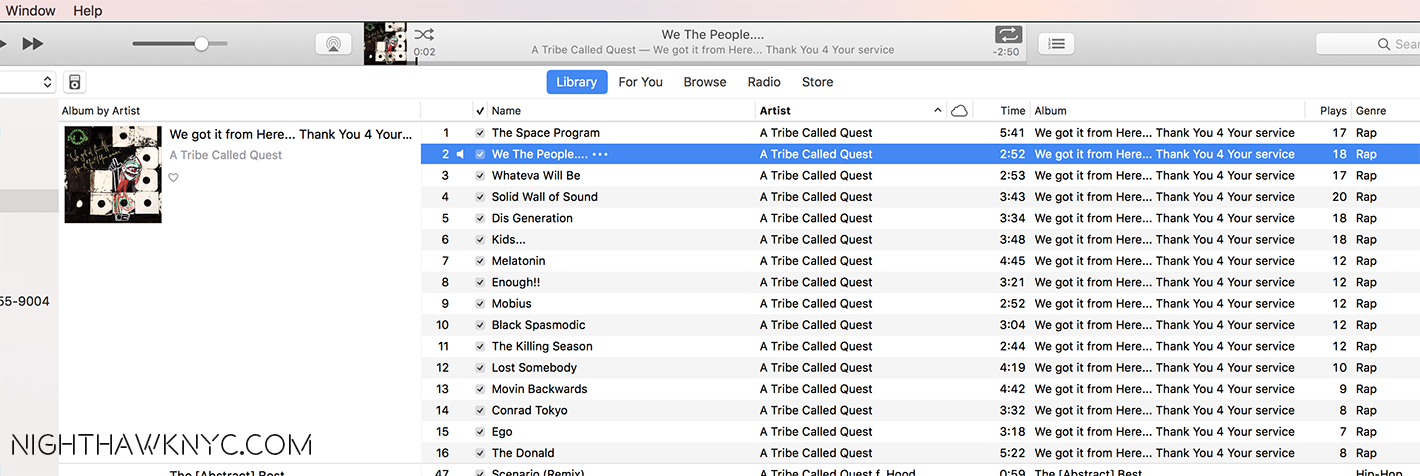
It’s under my skin. That play count, on the right, is mounting a month in.

There are riches galore. It’s always an unexpected joy to hear Phife here, especially when paired with Q-Tip, his childhood friend, as it is to hear Busta Rhymes, who Tribe made famous. Another surprise- Q-Tip’s playing (on keyboards, bass, and/or drums!)  and fresh production carry the day throughout, pushing the production envelope the way classic Tribe did, which, as Questlove once said, we expect from Tribe.

Finally, there’s the title. We got it from Here…Thank You 4 Your service, which Phife, apparently, came up with. The band says they don’t know what he meant by it. The best guess I’ve heard so far(*) is that it’s a dedication to President Obama. Then again? The album’s release date, November 11 is, also, Veteran’s Day! Then, again? That’s one of the things I’ve missed so much these past EIGHTEEN years. Discussing every detail of this record and hearing all the different interpretations there are about it.

PostScript- On Saturday, November 19th, Phife was honored with having the intersection of Linden Blvd and 192 Street in Queens, NY named in his honor, which you can watch here.. R.I.P., Phife. Linden Boulevard, which Tribe immortalized, may never be better represent, represent-ed.

Thank YOU, A Tribe Called Quest. For YOUR Service.

*-All Lyrics, and starred insights are from “We got it from Here…Thank You 4 Your service” by A Tribe Called Quest are quoted from genius.com, with nary a publishing credit anywhere to be found.

You can now follow @nighthawk_nyc on Instagram for news and additional Photos!

NighthawkNYC.com has been entirely self-funded and ad-free for over 6 years, during which over 250 full length pieces have been published. If you’ve found it worthwhile, you can donate to keep it going & ad-free below. Thank you!

NighthawkNYC.com has been entirely self-funded & ad-free for over 8 years, during which 300 full length pieces have been published! If you’ve found it worthwhile, PLEASE donate to allow me to continue below. Thank you, Kenn.

You can also support it by buying Art, Art & Photography books, and Music from my collection! Art & Books may be found here. Music here and here

Written & photographed by Kenn Sava for nighthawknyc.com unless otherwise credited. To send comments, thoughts, feedback or propositions click here. Click the white box on the upper right for the archives or to search them. Subscribe to be notified of new Posts below. Your information will be used for no other purpose.
  1. Both quotes from “Excursions” by Ali Shaheed Jones-Muhammad, Malik Izaak Taylor, Kamaal Ibn John Fareed of A Tribe Called Quest,  Lyrics Published by Universal Music Publishing Group.
  2. Check out Q-Tip’s excellent vinyl collection here. I’ll bet $1. Small Talk is in it.

NoteWorthy Shows- November, 2016

This site is Free & Ad-Free! If you find this piece worthwhile, please donate via PayPal to support it & independent Art writing. You can also support it by buying Art & books! Details at the end. Thank you.

Written & Photographed by Kenn Sava (*- unless otherwise credited)

Things are reaching a fever pitch in the Galleries as the year end approaches, with nary a Black Friday Gallery sale in sight, allowing me to sleep in this year. Still, there was plenty to see and be Thankful for, along with the usual smattering of turkeys, but let’s get right to dessert, shall we? As in October, here’s my list, in no particular order, of what I found NoteWorthy in November. Once again, each one of these deserves a longer, in depth piece that I’m not going to have time to do, but I would be remiss in not mentioning them at all. November, also, marked the end of the world as we know it, so…

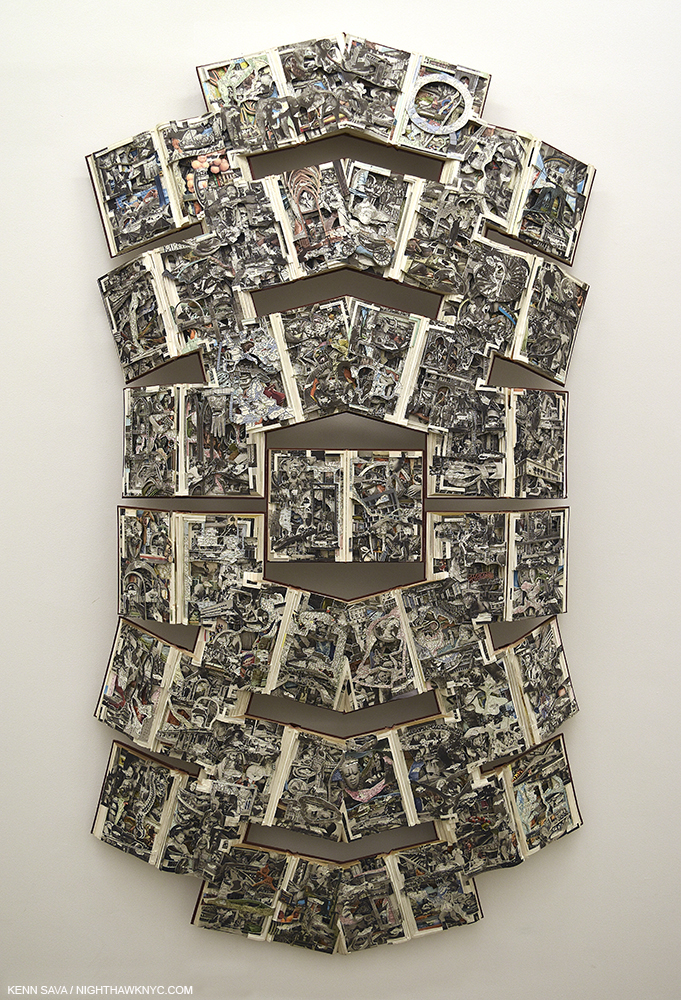
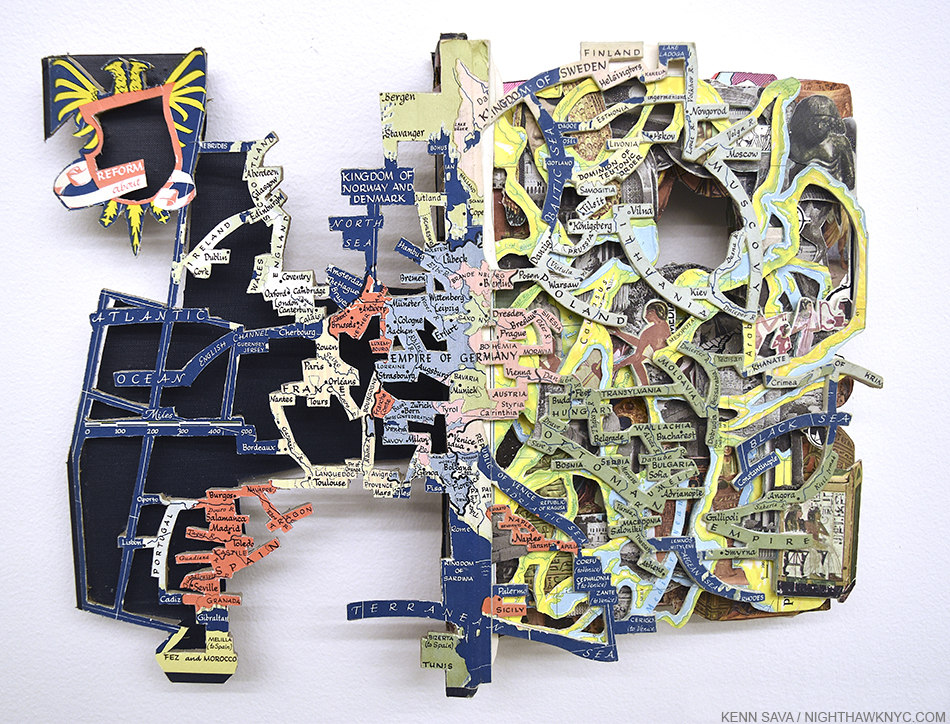
The world looks different…Brian Dettmer’s Western Civilizations 3, 2016. A “Book Sculpture.” More below.

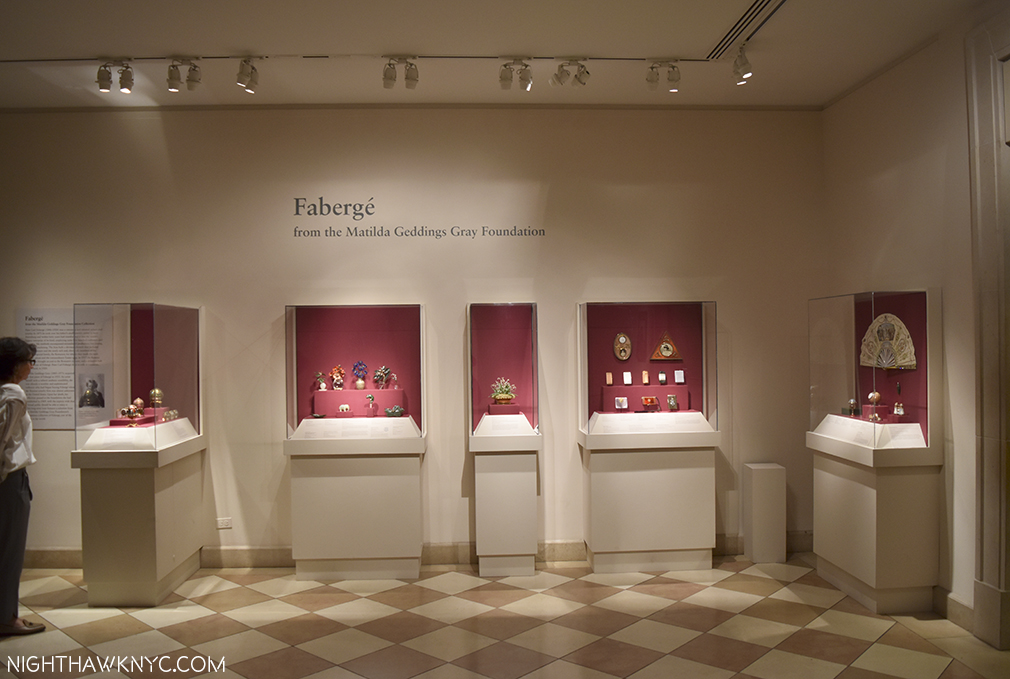
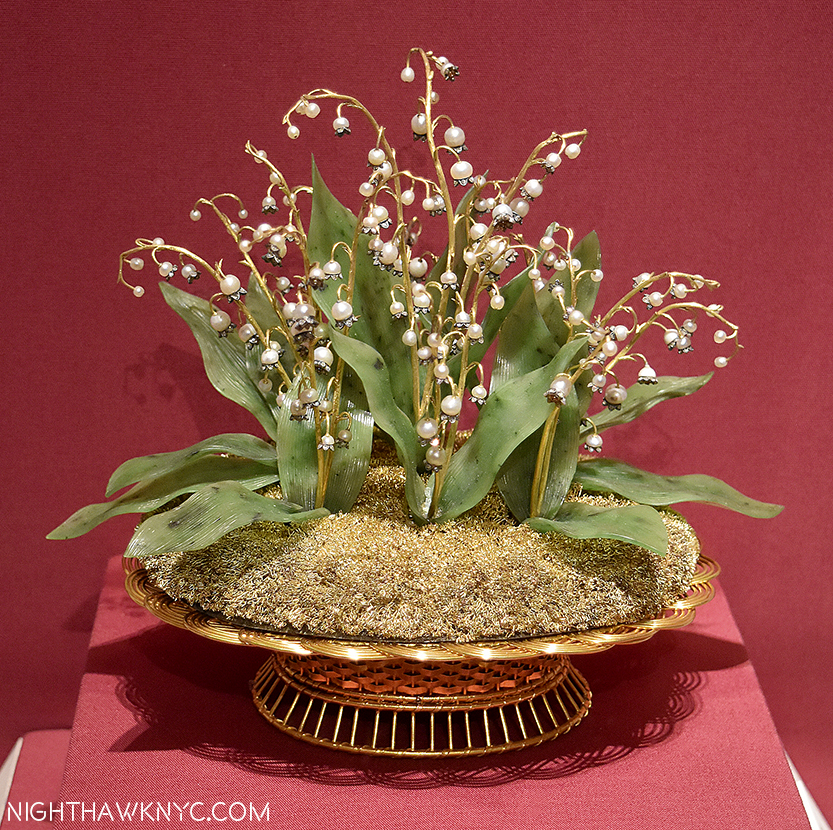
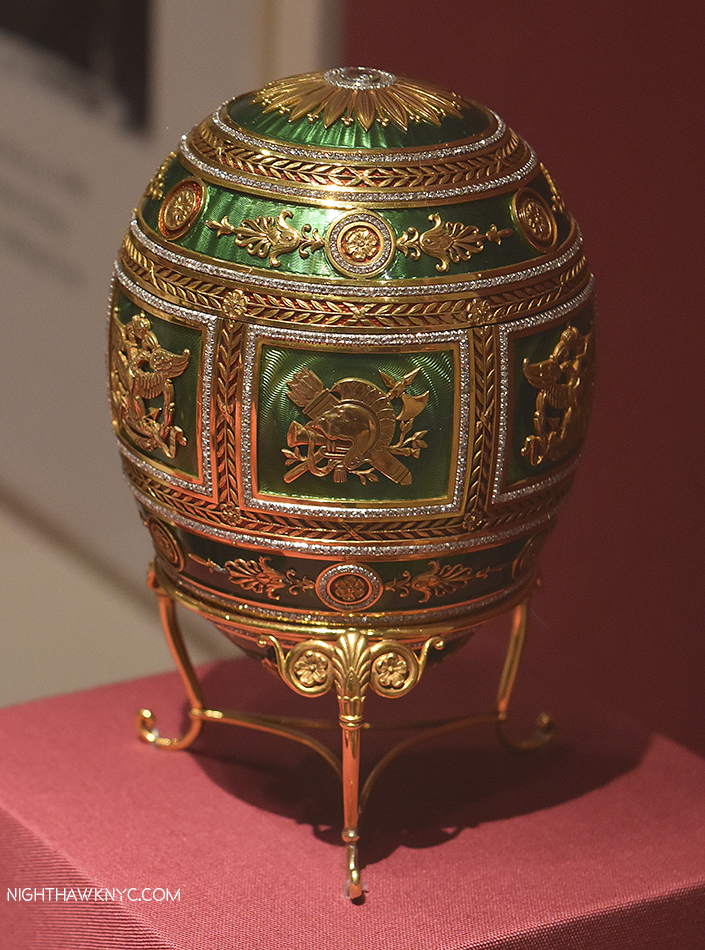
Faberge from the Matilda Geddings Gray Foundation Collection @ The Met- Will the artist in modern history who is a greater craftsman than Carl Faberge please stand up and make yourself known to me? Thank you. While I’m waiting on that, this is the first show of the work of Faberge in New York since 2004. As small as one of the details on his timeless (and priceless) masterpieces, this show in a hallway at The Met is easy to miss (countless thousands do just that as they wait in line for the elevator to the roof, right in front of this very show). Ms Gray began collecting Faberge in 1933, when prices for his work were cheaper than they will ever be again. Money aside, Faberge combines the equally rare gifts of ingenuity, vision, craftsmanship and delight in works that are a century old but have lost none of their grace, beauty or charm. Scheduled to end on November 27, this show has been extended until 2021, giving you plenty of time to see it.

Imperial Lillies of the Fields Basket, 1896, Yellow & green gold, silver, nephrite, pearl, rose-cut diamond. This is considered THE most important Faberge piece in the USA. It was presented to the wife of Czar Nicholas at her visit to the Pan-Russian Exposition in 1896. This is only 7 1/2  x 8 1/2 inches!

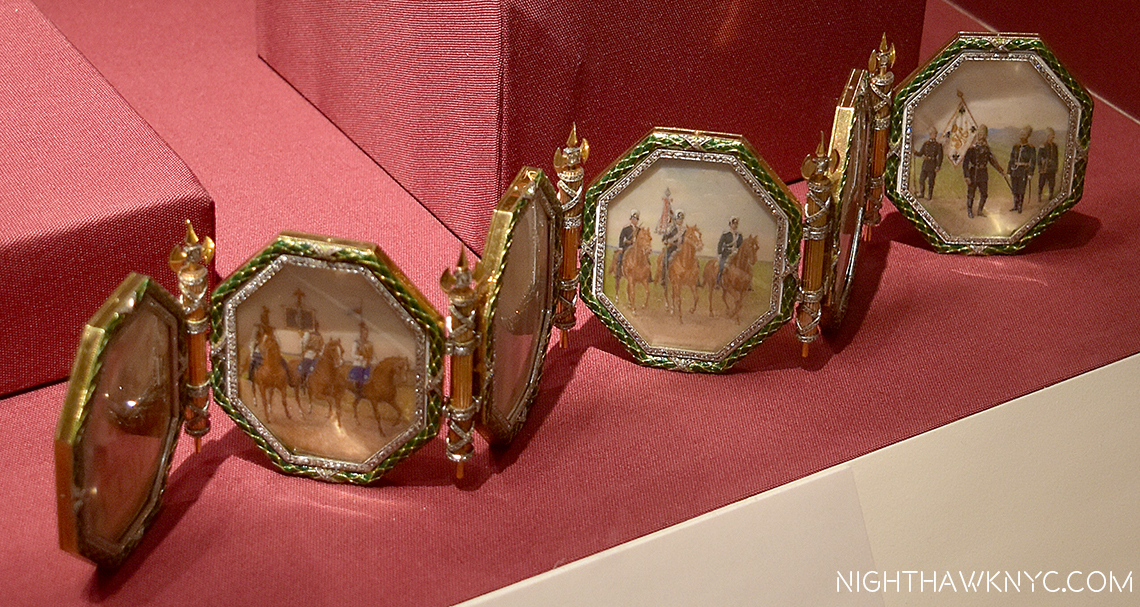
Imperial Napoleonic Egg, 1912, gold, enamel, rose-cut diamond, platinum, ivory, gouache, velvet, silk. One of the infamous “Faberge Eggs,” this was presented by the Czar to his wife for Easter, 1912. Designed to commemorate the 100th Anniv of victory over Napoleon. This is 4 5/8 inches tall! The inside is solid gold, and holds…

a six-panel screen depicting paintings of six regiments she was an honorary colonel in.

Description in next photo. Click any photo in this Blog to see it larger.

Imperial Caucasus Egg, for Easter, 1893. This is 3 1/2 inches high!

Easy to miss, this is the whole show!

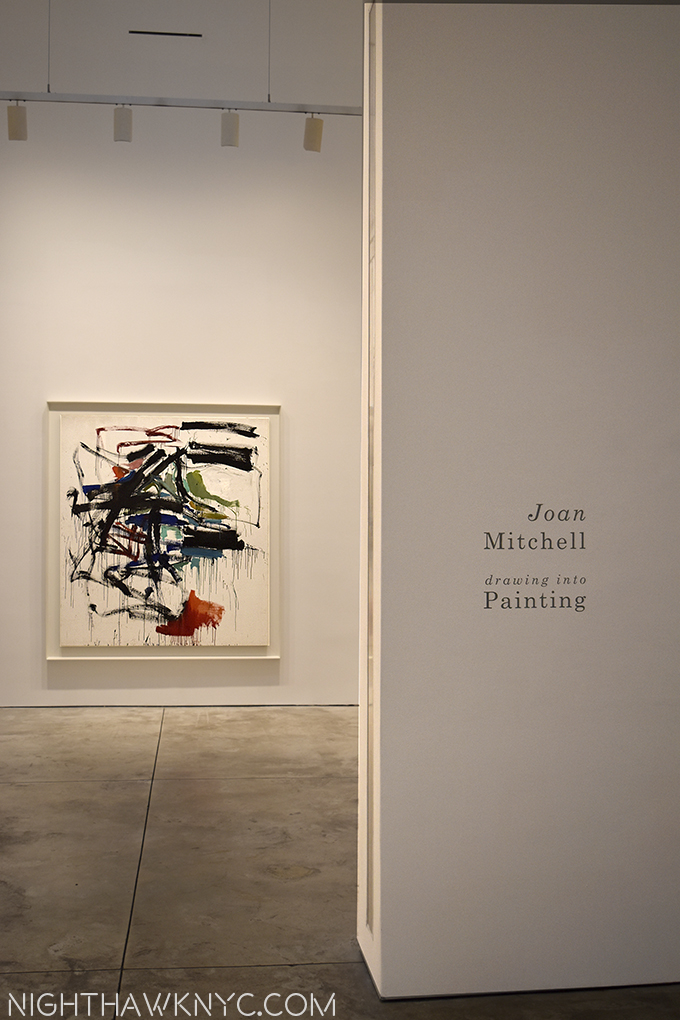
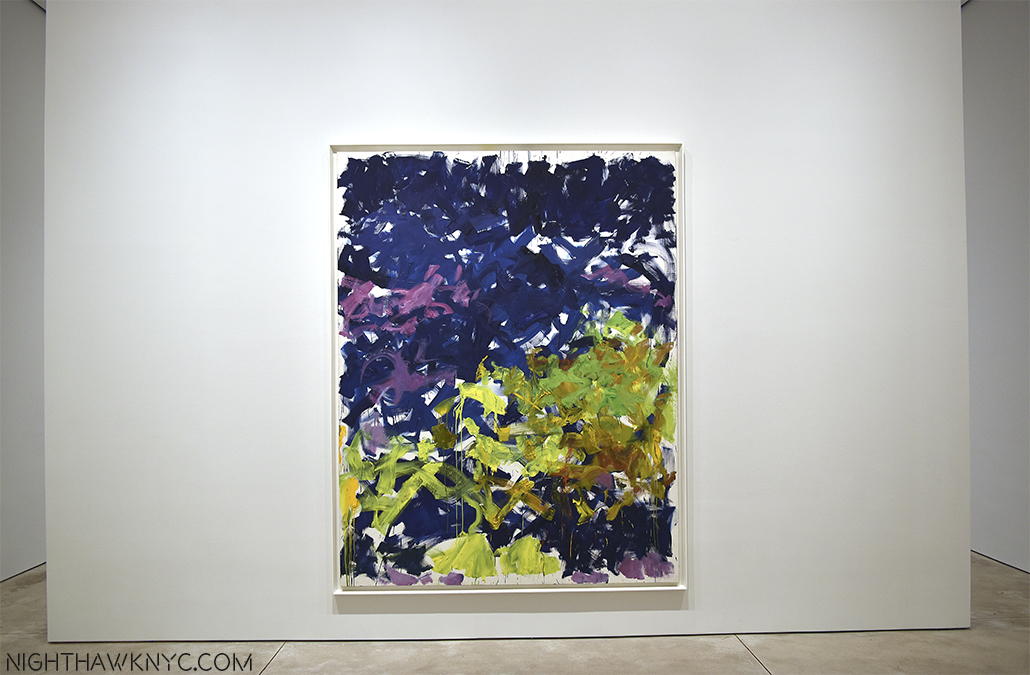
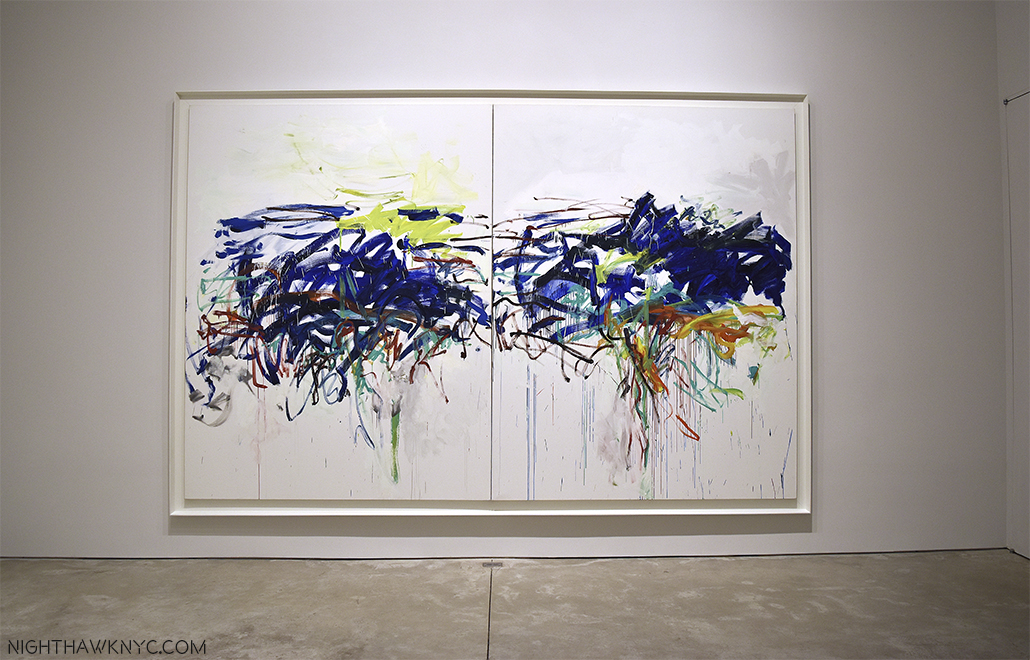
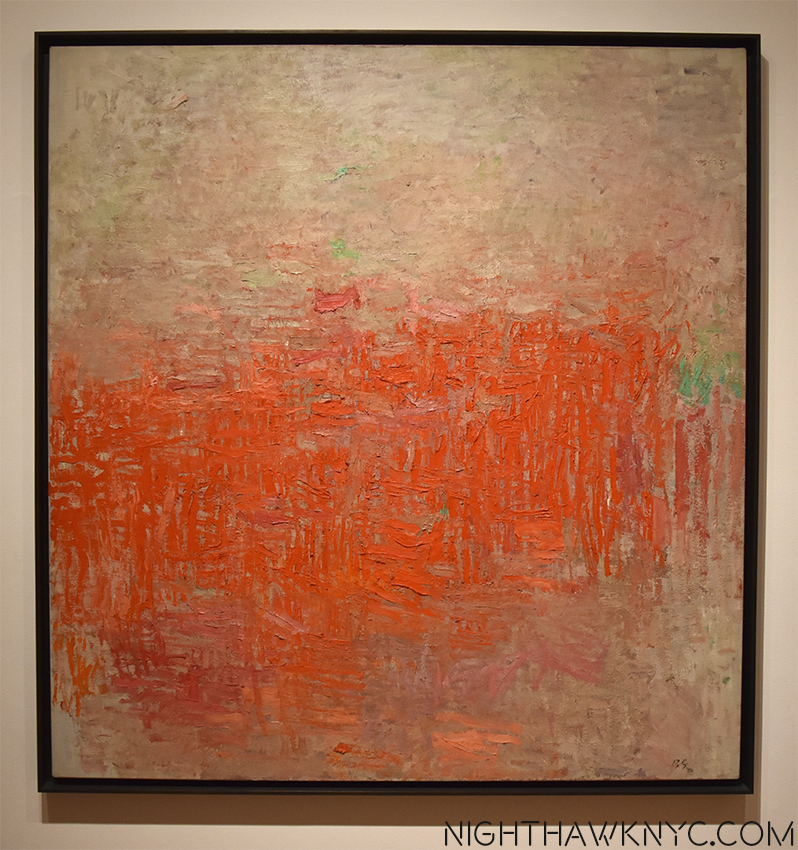
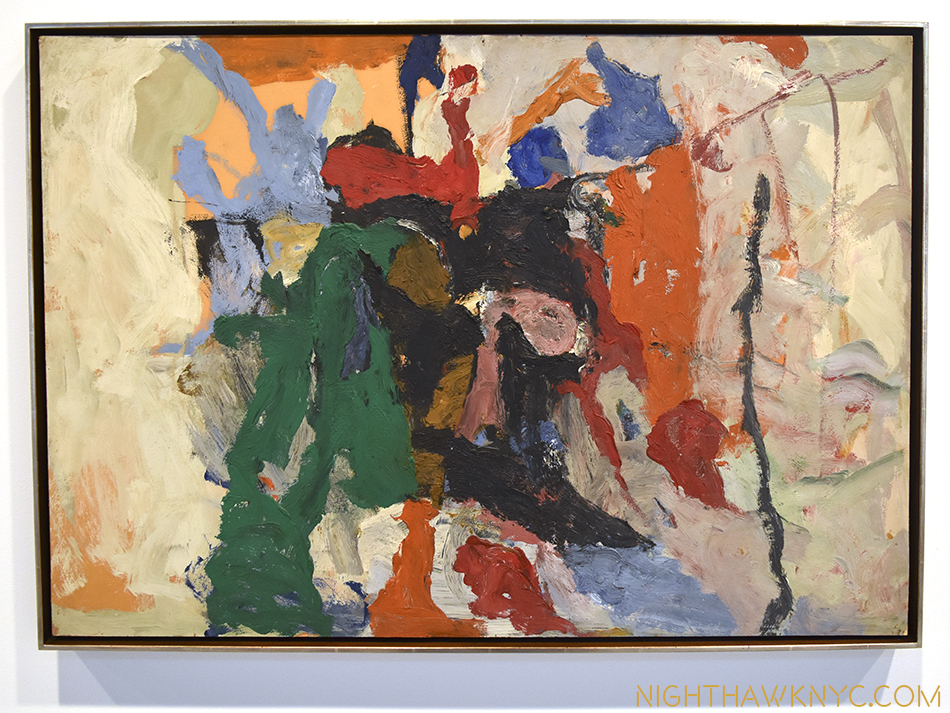
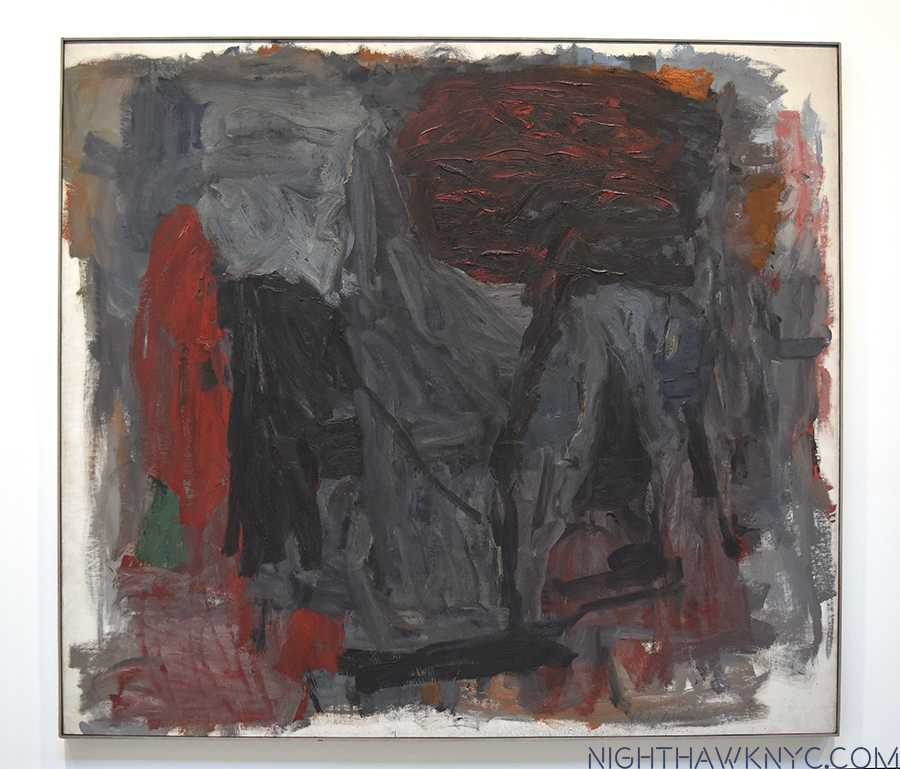
Joan Mitchell: Drawing Into Painting @ Cheim Read- Yet another good sized show of an Abstract Expressionist, “second generation” this time, and the most renowned female (Lee Krasner may be gaining on her) AbEx painter, right down the street from the blockbuster Mark Rothko: Dark Passage Show, it makes the perfect before or after bookend to it. I owned a Joan Mitchell print until a few years ago, so I lived with the energy and lyricism her work is known for. Looking around, her work is in most major museums, though it’s been 12 years since an American museum gave her a show. So, it’s been left to Cheim & Read to fill the gaps, and they’ve mounted Joan Mitchell shows every two years, or so, going back to the late 1990’s. This one does make for fascinating pairing with the Rothko show- they couldn’t be more different, while sharing what the scholars call Abstract Expressionism, I’ve heard some of the Artists, including Philip Guston, say they prefer the term “New York School.”

UNTITLED, 1958, oil on canvas

LA GRANDE VALLEE XVI POUR IVA, 1983, oil on canvas

UNTITLED, 1982. oil on canvas

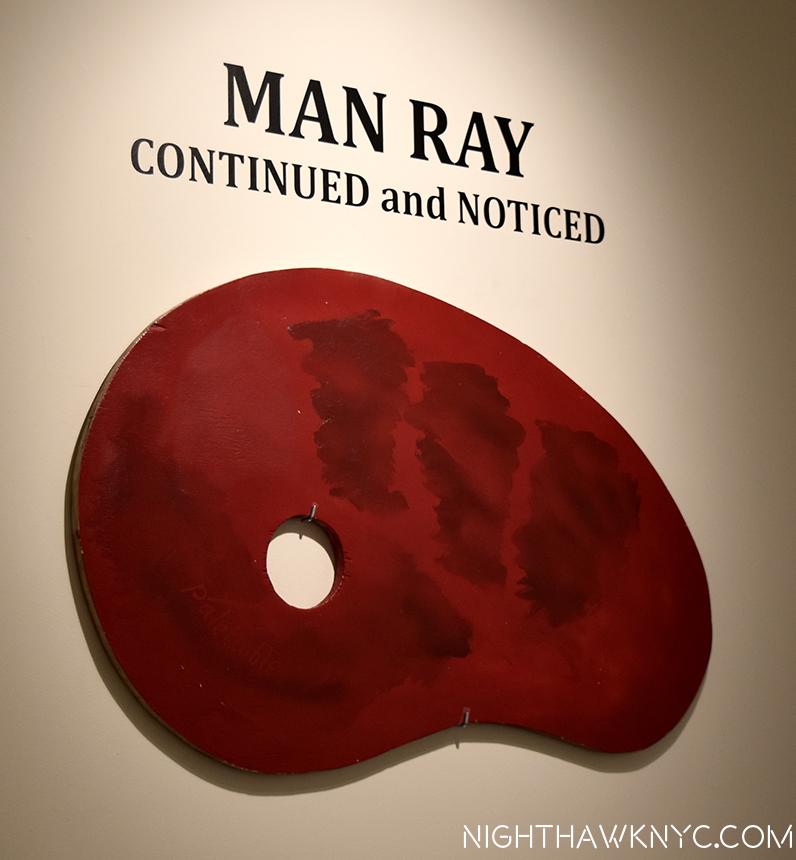
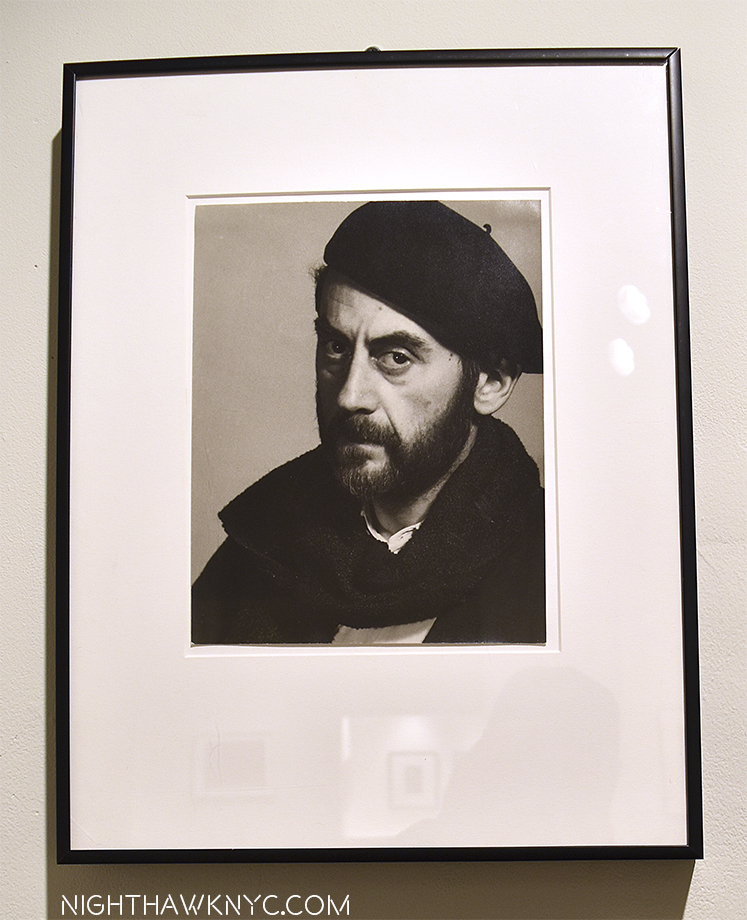
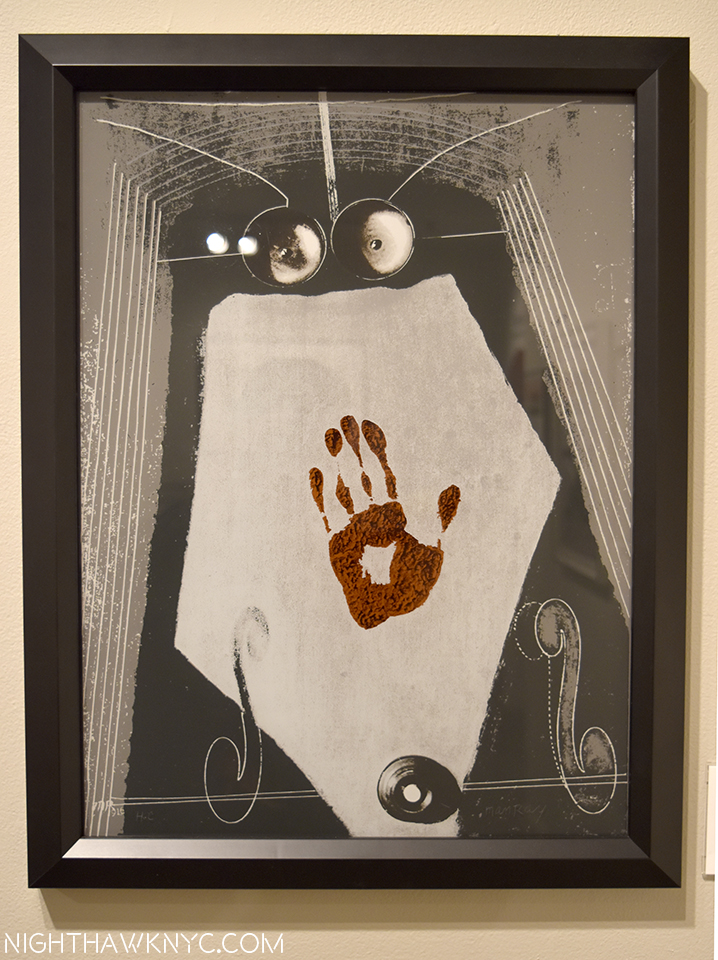
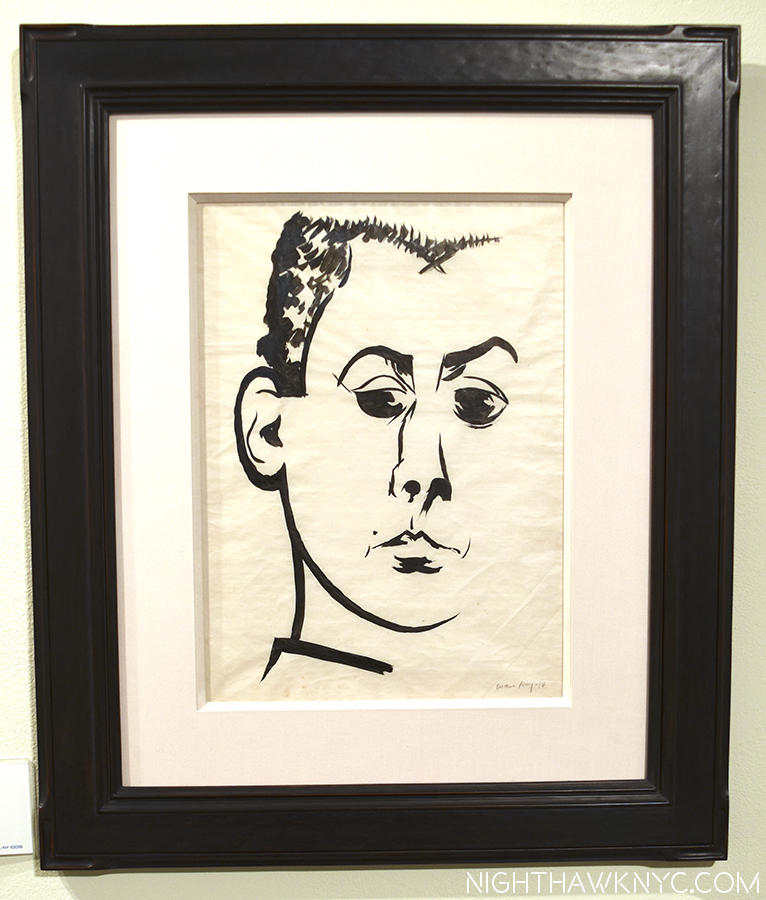
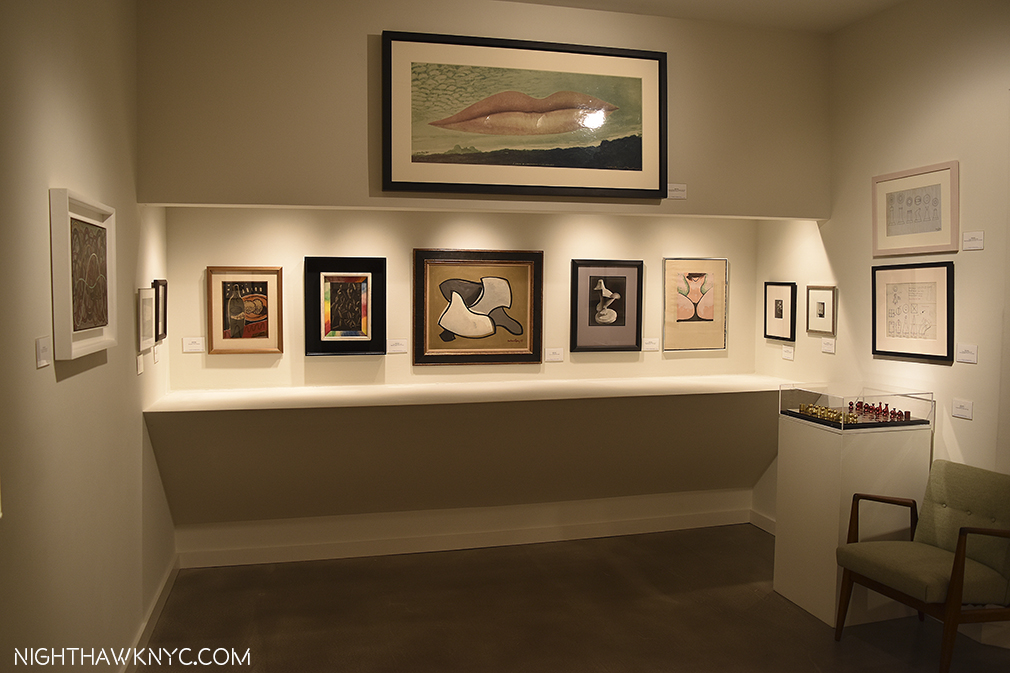
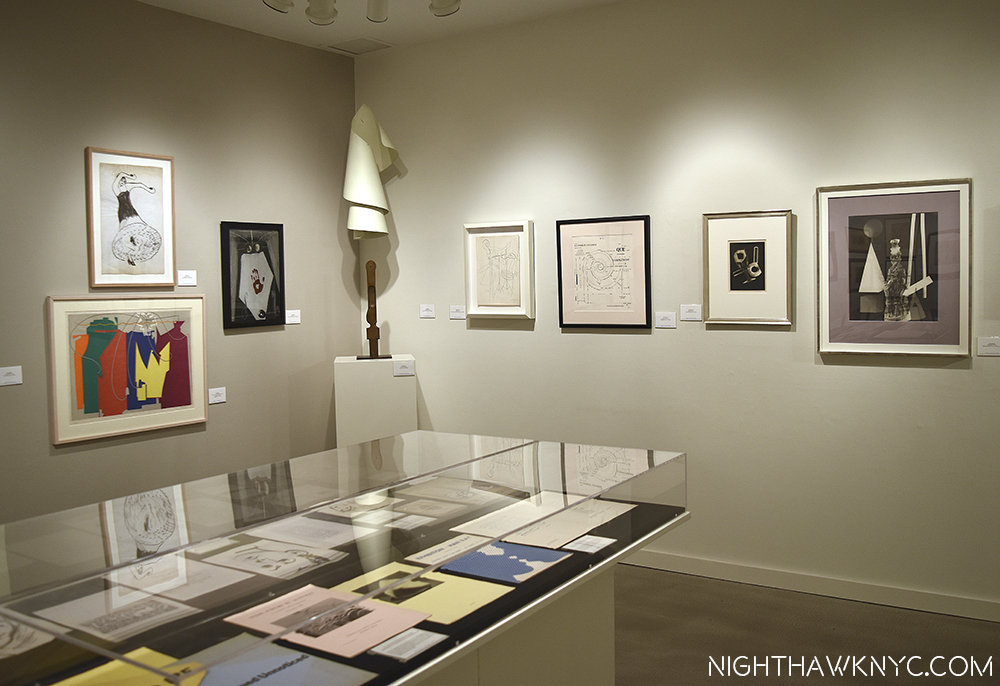
Man Ray: Continued and Noticed @ Francis Naumann- It’s been too long between Man Ray shows. Readers already know my fondness for Man Ray. Francis Naumann Gallery opened 15 years ago with a Man Ray show, so they revisited him for this anniversary show and they did it in style. Man Ray was so prolific, and so prolifically diverse he can be hard to “sum up” in a gallery show, but this one was an out and out winner, a must see, especially for anyone who thinks of Ray as “only” a ground breaking photographer. While featuring a wonderful selection of his photos, portraits and “Ray-o-grams,” it also included his drawing, painting, sculpture, writing, and even no less than 2 Ray designed chess sets.

Paletteable, 1969

The great Man (Ray). Self-Portrait, 1948. A card under speaks of his concerns in his early work- “1) a defiance of artistic convention replaced by steadfast commitment to absolute freedom in the arts.” That says it all.

…and seen again. Autoportrait, 1917/70, Screen print on plexiglass. Really? Hmmm…

…and again. Self Portrait, 1914

Yes, that’s one of the chess sets Man Ray designed to the left of the chair.

Lampshade, center, surrounded by an astounding range of creativity.

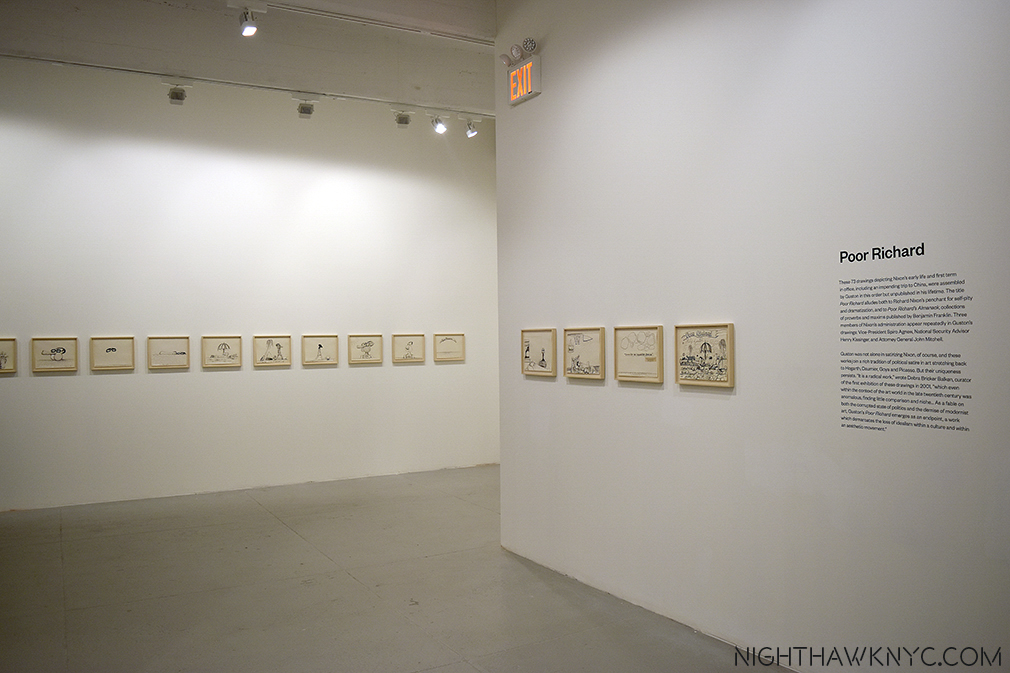
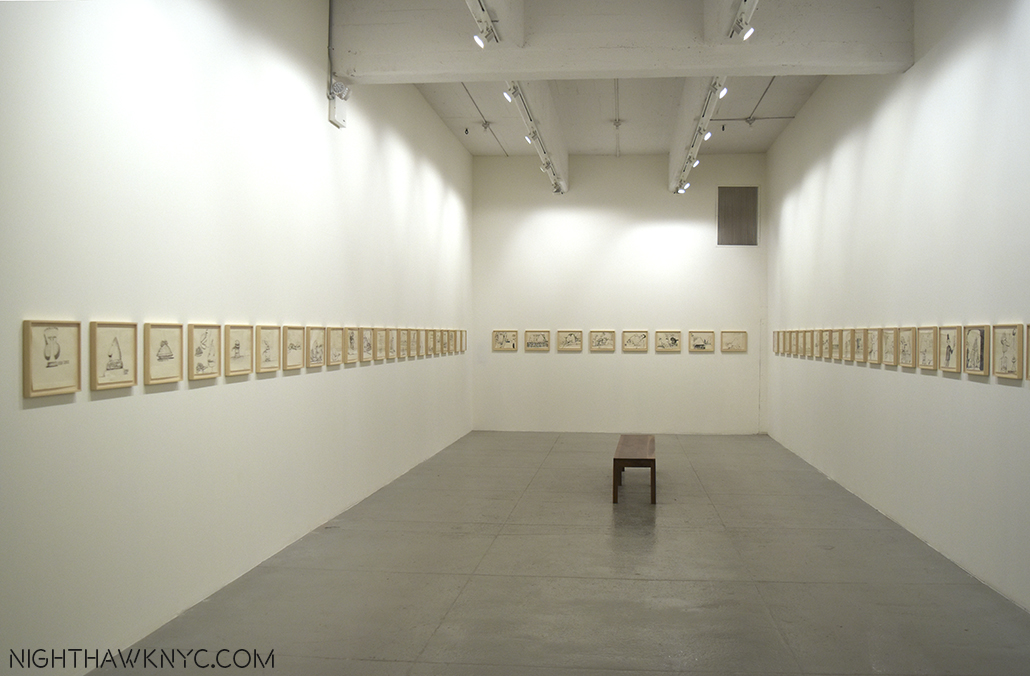
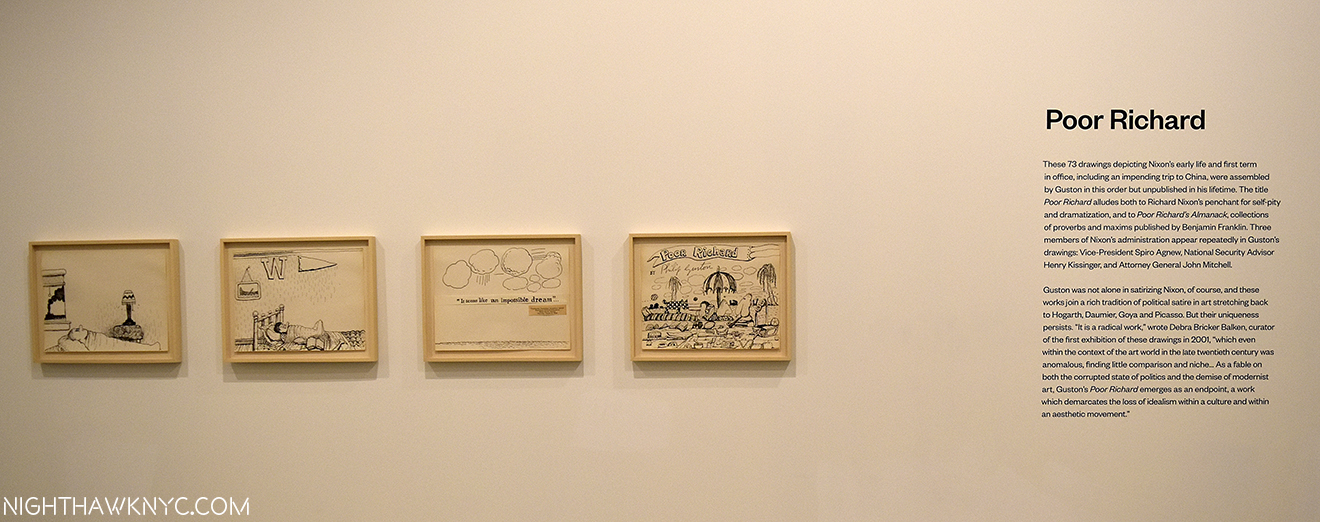
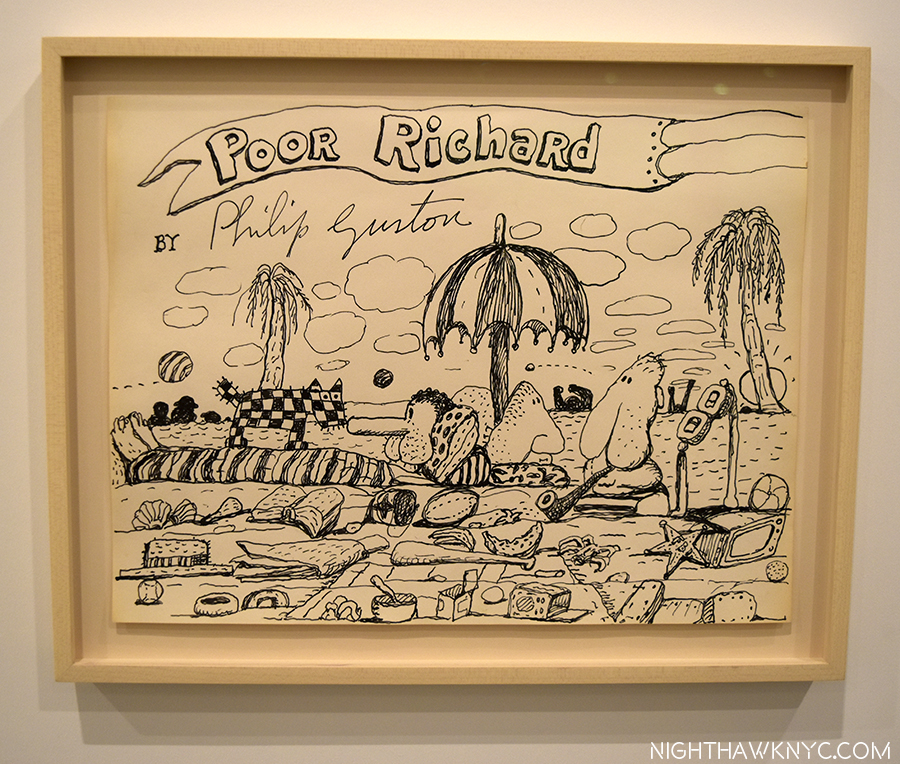
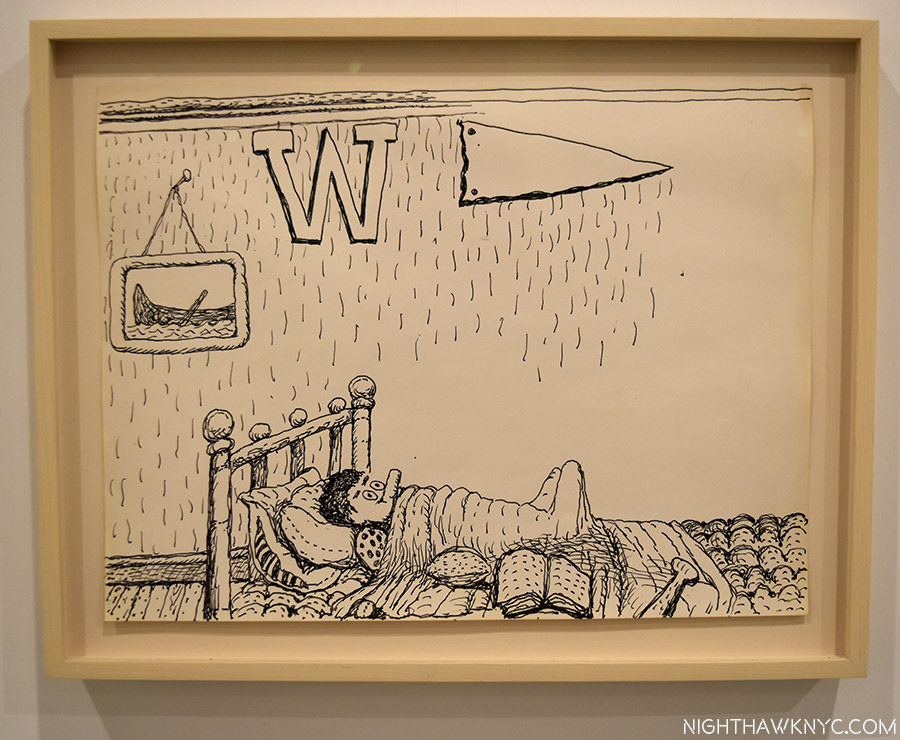
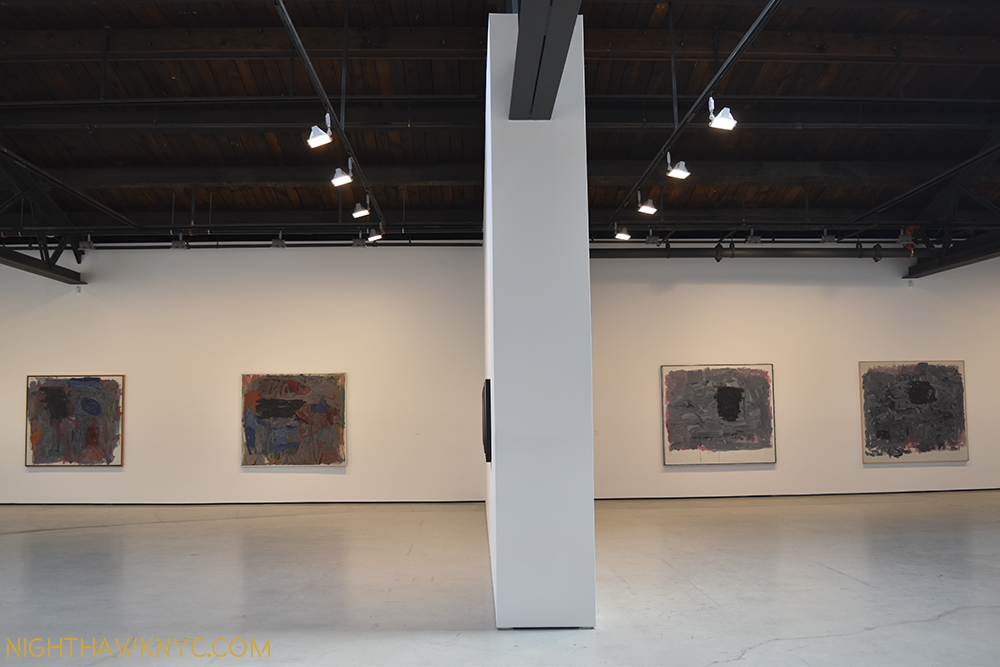
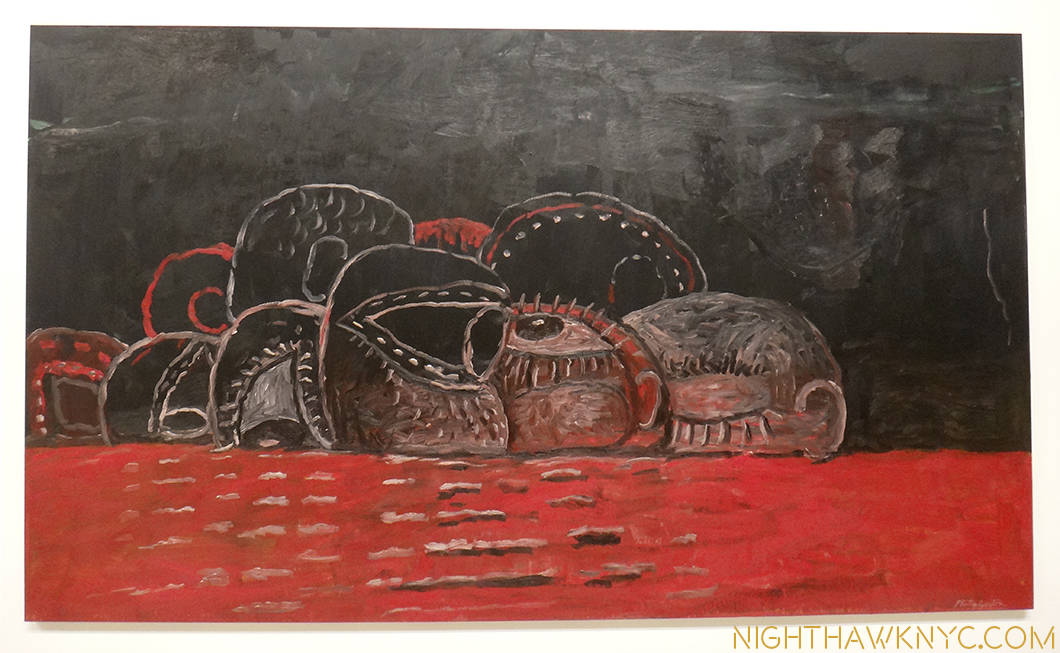
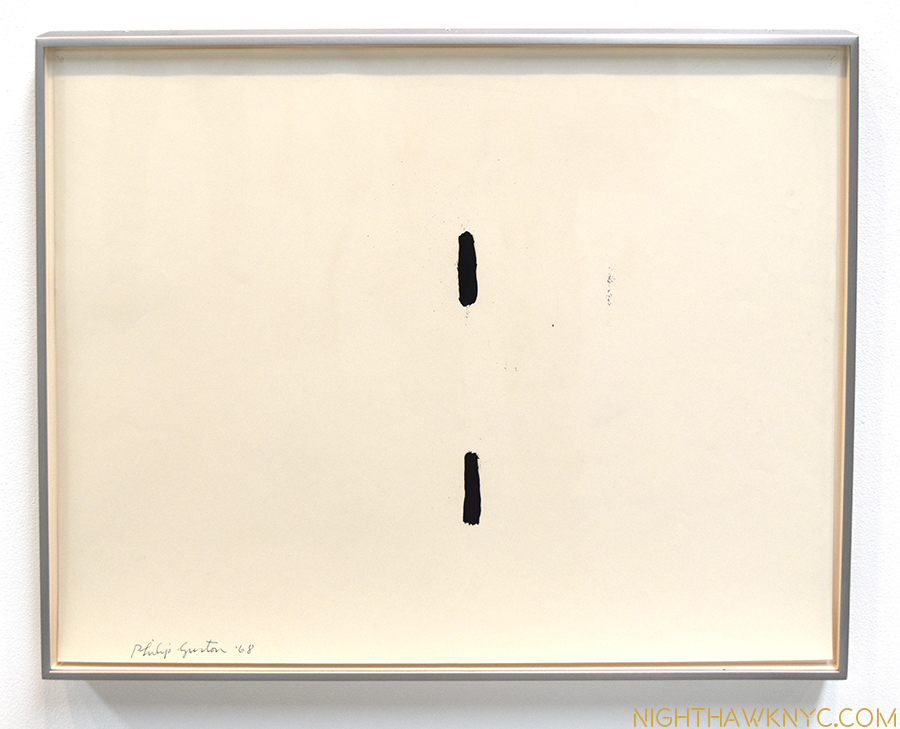
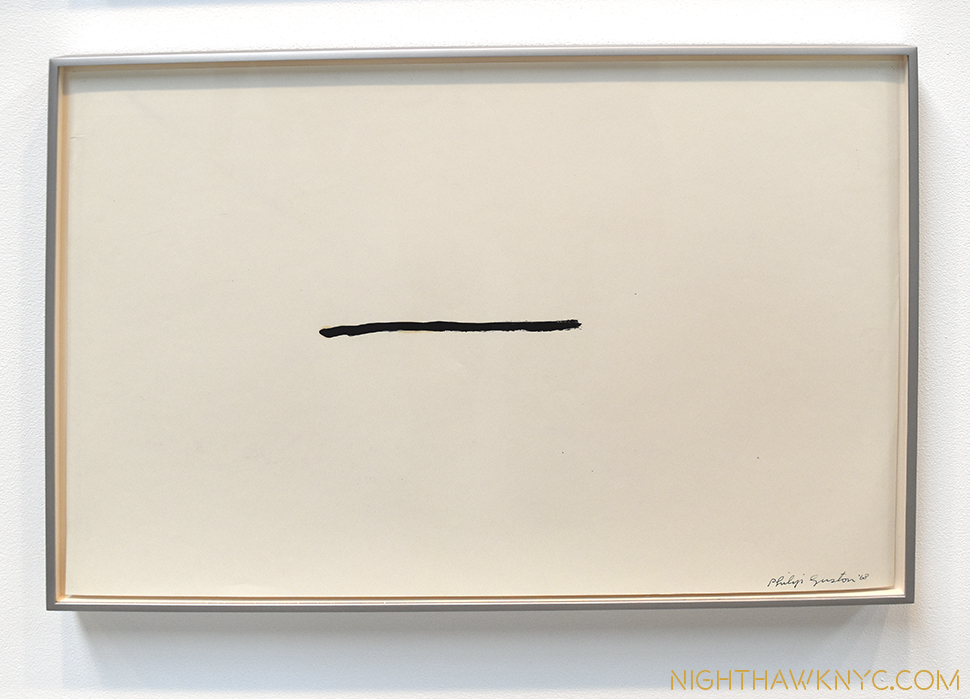
Philip Guston: Laughter in the Dark, Drawings from 1971  & 1975 @ Hauser & Wirth- There was no more auspiciously timed show than this one which not only brings us the 73 drawings Philip Guston selected for his Poor Richard series but 100 additional drawings that didn’t make the cut and 3 wonderful paintings that are related or have relevance to them. Opening exactly 4 months after Hauser’s last Guston show, it would be very very hard to find work more different than those in seen in Philip Guston Painter, 1957-67, which I wrote about here, perhaps the “darkest” of his career, in many ways. Though the show’s title refers to the presence of “laughter” here, make no mistake it is more than tinged with darkness, especially because viewing them now, we know how things turned out for Nixon. These were dark times for the country, and many of these drawings were Guston’s “at the moment” reaction to unfolding events. Even before Watergate, the Nixon Presidency was not without a sizable opposition, for more reasons than the seemingly endless war in Vietnam. Everything about Nixon rubbed many people the wrong way, and provided a brilliant Artist ample fodder for “political satire” of the highest order. Most interestingly, for me, these are works in which Guston turns his focus outwards for, perhaps, the only time in his post 1940’s career. Poor Richard was published in 2001 and is still in print. You can see it here.

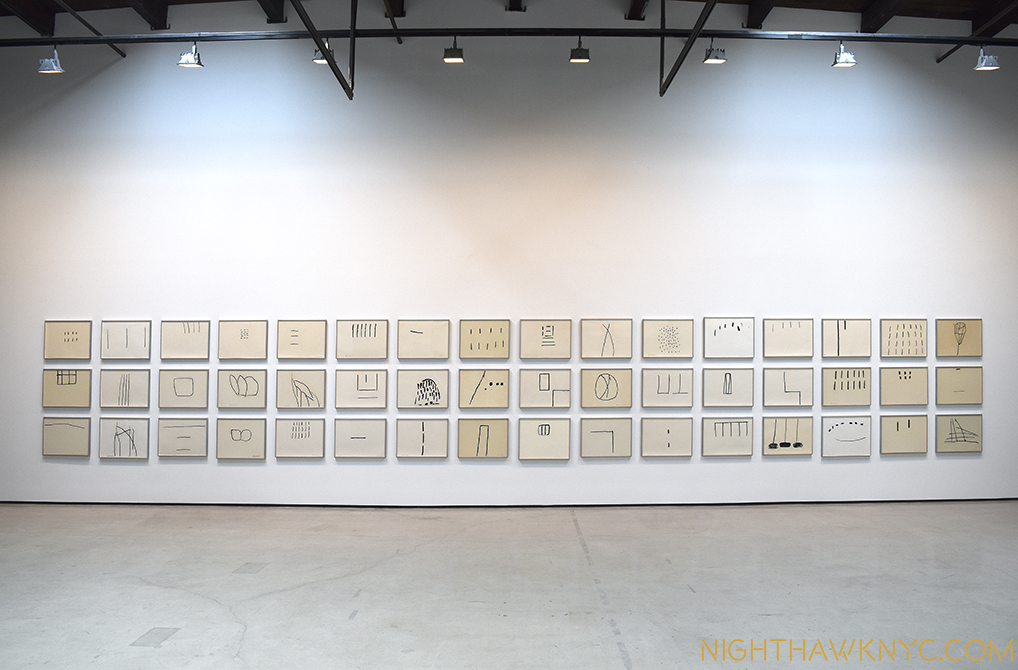
The 73 drawings that Guston selected for Poor Richard are shown, here (and below), together.

Title Page. Guston Depicts Nixon with VP Spiro Agnew (triangular skull), Attorney General John Mitchell (with his pipe) and Advisor Henry Kissenger (as glasses) as the cast of characters

Guston’s series begins with young Richard Nixon.

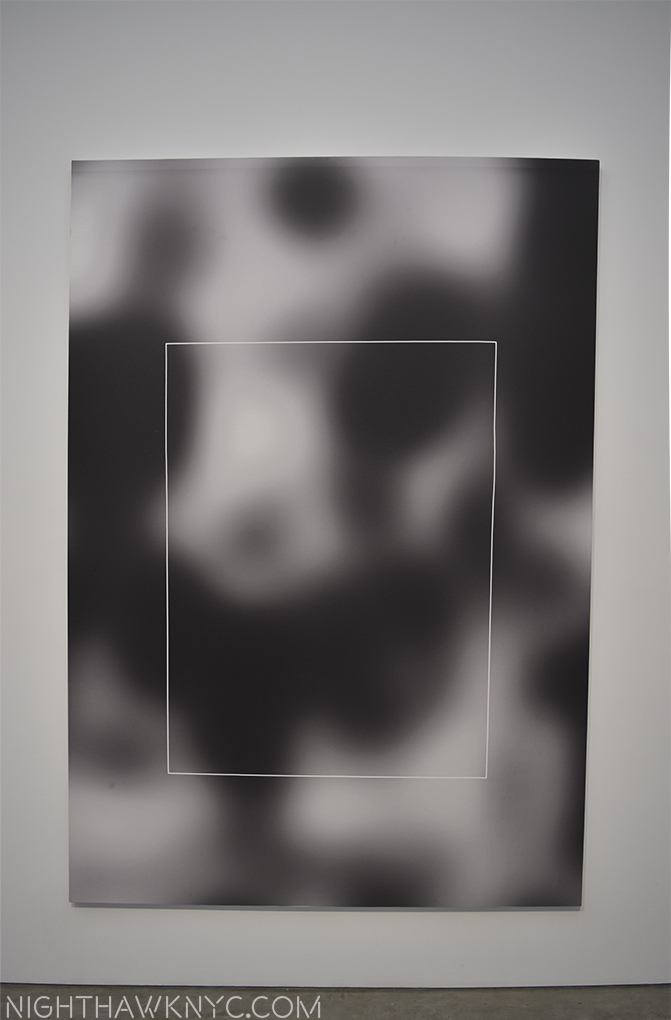
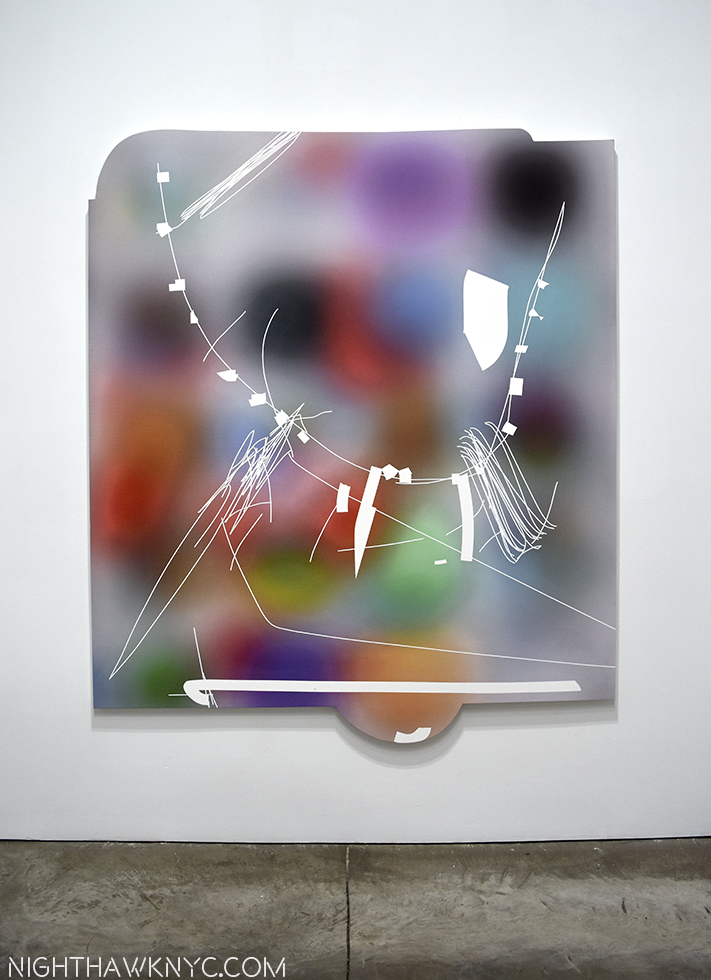
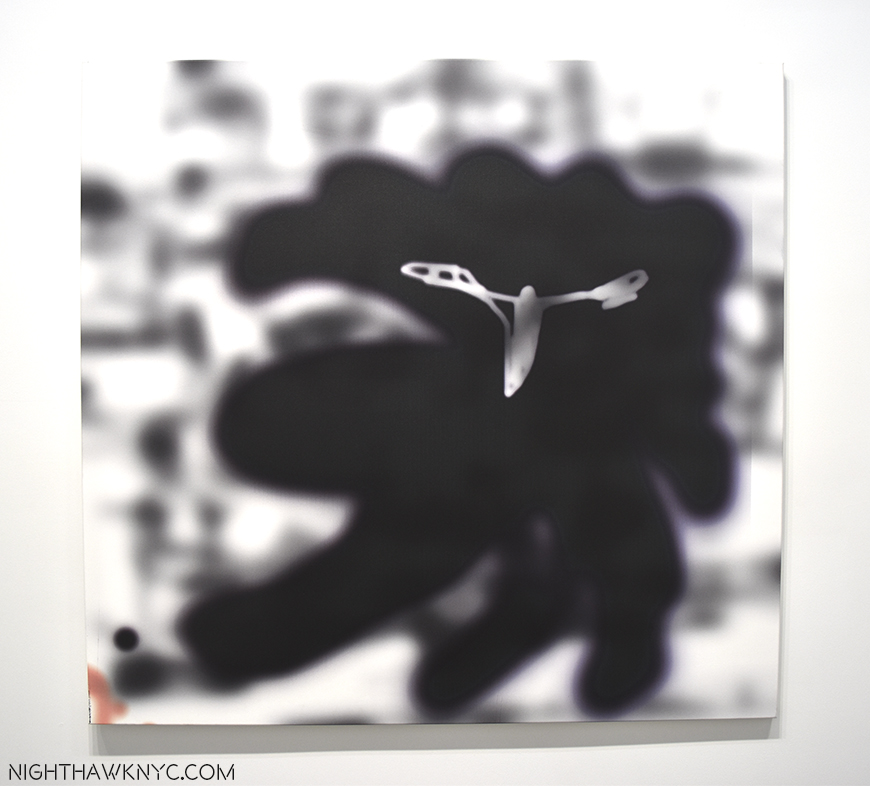
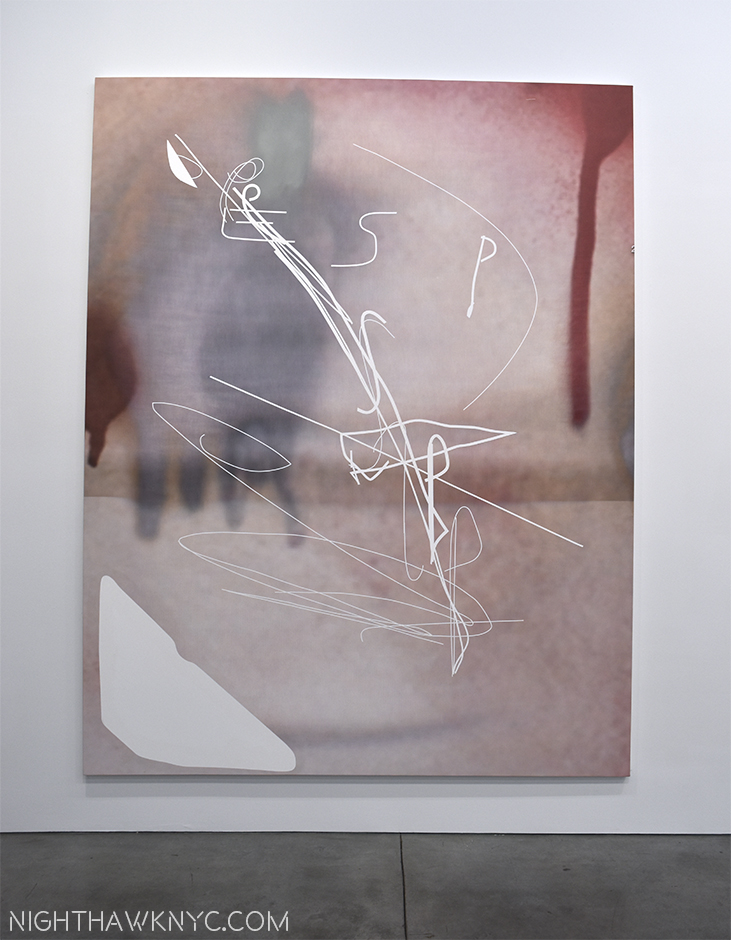
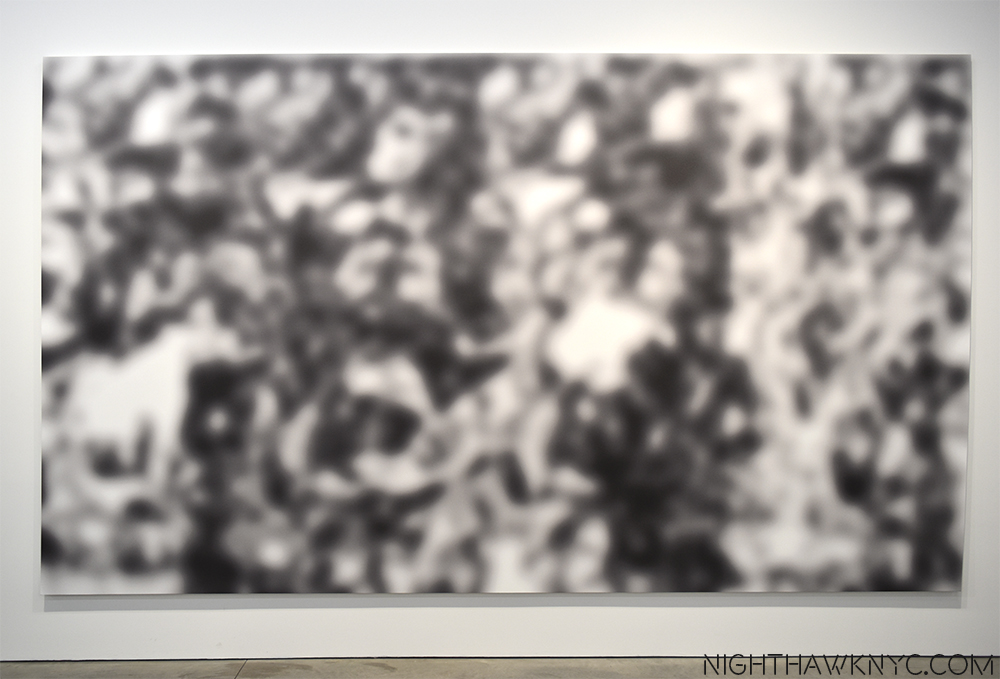
Jeff Elrod: This Brutal World @ Luhring Augustine- Chelsea & Brooklyn Galleries. It pains me not to write a longer piece on this. Jeff Elrod has been at the cusp of reinventing painting by combining digital drawing and computers with the end result of that stage outputted to canvas.where it may, or may not be combined with analog, old fashioned painting (at least those on display here). Dealing with blurriness from my recent eye treatment, my initial reaction was, “Hmmmm…If I close my right eye, my good eye, this is how the world looks to me these days.” But, I was drawn back repeatedly, even compelled to make the (unheard of for me) trip to Brooklyn to see the Bushwick segment of this show. In both locations, the effect was the same- I couldn’t get them out of my mind. They’re like something you see when you’re not really looking, or when you’re not fully awake after dreaming, or about to fall asleep…My initial reaction was “This looks easy to do on a computer. Take a photo, blur the heck out of part of it in Photoshop. Add a layer of a frenzied drawing and output to canvas. Then, I remember people say the same thing about Pollock and Rothko, yet no one else has done them. Some works remind me of passages of Monet, some of Yves Tanguay. But not really. They weren’t created like those were and so they don’t look like anything else. Mr. Elrod’s work commands some fancy prices. Ah well…They’re much too big for my place, anyways. If there’s a “cutting edge” in painting in 2016, Jeff Elrod’s work is the closest I’ve seen to being on it. I’m very much looking forward to seeing where this is going.

Auto-Focus, 2016 UV Ink on Canvas 9064 inches. Mystifyingly alluring.

Rubber-Miro, 2015 Acrylic and UV Ink on canvas. His uniquely shaped canvases give the work a different feel from most square/rectangular paintings.

Rake-Adaptable, 2016 UV Ink on FIscher canvas. The ghost of Robert Motherwell? “Haunting” is a word his work brings to my mind most often.

Under The Skin, 2016 UV Ink on canvas, 108 x 84 inches.

Plume, 2016 as seen in Bushwick, Brooklyn. 16 1/4 feet long by 9 1/2 feet tall.

After countless visits, I began to “see” “Jeff Elrods” everywhere I went. Like here-

Life Mirrors Art.

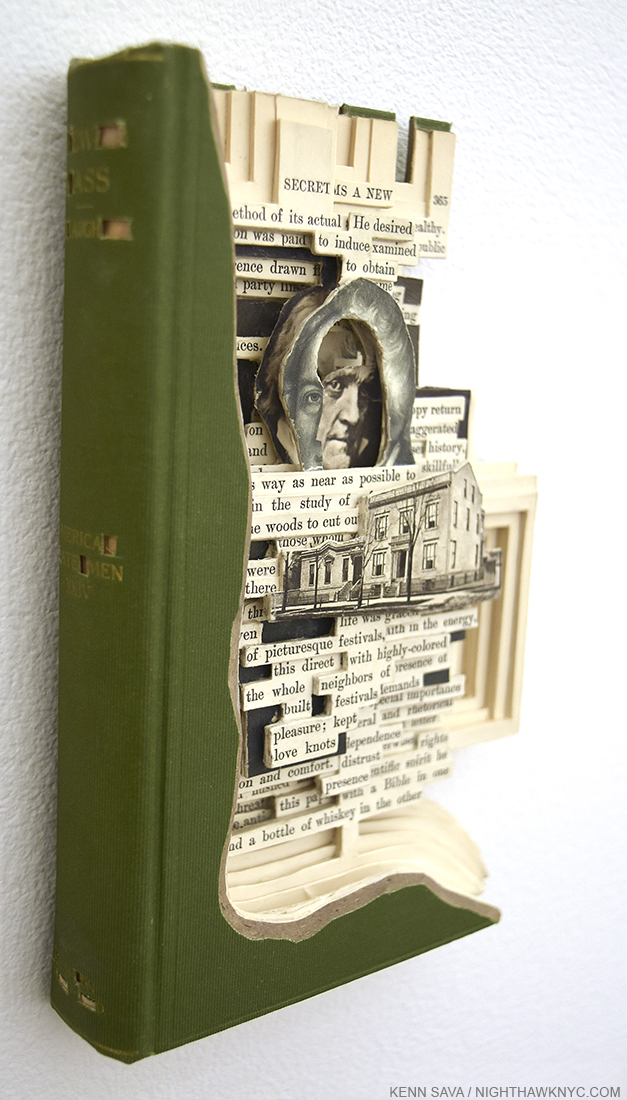
Brian Dettmer: Dodo Data Dada @ P.P.O.W. Mr. Dettmer creates “Book Sculptures,” something new to me. As far as I can tell, he takes a scalpel to a book, or books, and carves away all but what he wants to remain. I’ve never seen anything quite like it.

Funk and Wag, 2016. As in, the whole encyclopedia.

Ew Ass, 2016

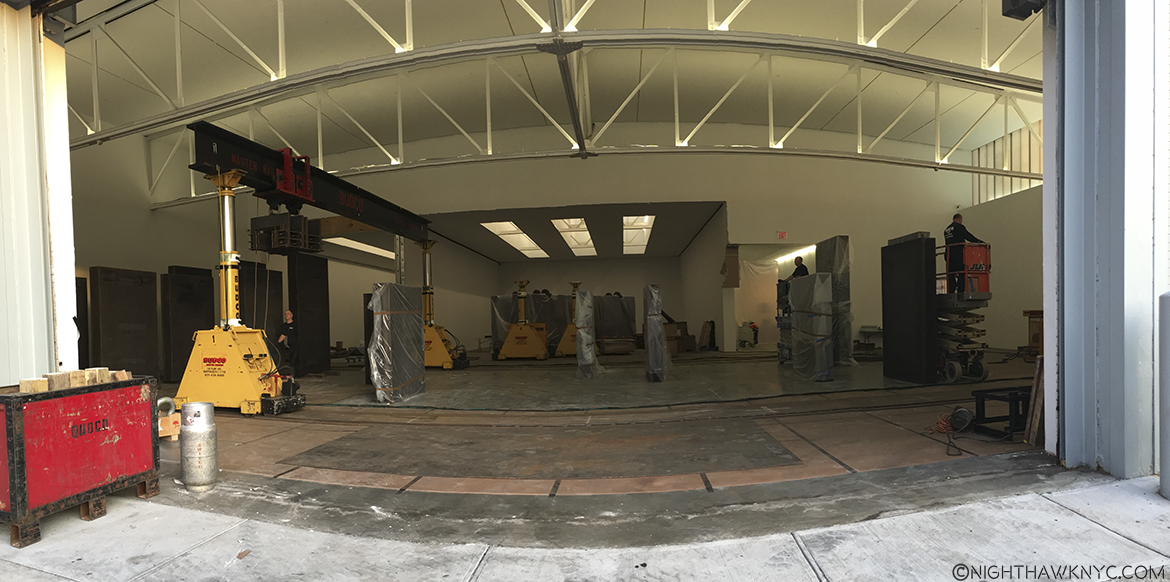
PostScript.- And meanwhile, over at Gagosian, Richard Serra’s MASSIVE Every Which Way, 2015, all 16 slabs of it was coming down, making way for the next show there…

Richard Serra, Every Which Way, 2015 @ Gagosian

*-Soundtrack for this Post is “It’s The End Of The World (As We Know It)” by Michael Stipe, Mike Mills, Peter Buck and Bill Berry of R.E.M. and published by Warner/Chappell Music, Inc and Universal Music Publishing Group, from their 1987 album “Document.”

NighthawkNYC.com has been entirely self-funded & ad-free for over 8 years, during which 300 full length pieces have been published! If you’ve found it worthwhile, PLEASE donate to allow me to continue below. Thank you, Kenn.

You can also support it by buying Art, Art & Photography books, and Music from my collection! Art & Books may be found here. Music here and here

Written & photographed by Kenn Sava for nighthawknyc.com unless otherwise credited. To send comments, thoughts, feedback or propositions click here. Click the white box on the upper right for the archives or to search them. Subscribe to be notified of new Posts below. Your information will be used for no other purpose.

Bruce Conner- “The Most Important Artist of the 20th Century”

This site is Free & Ad-Free! If you find this piece worthwhile, please donate via PayPal to support it & independent Art writing. You can also support it by buying Art & books! Details at the end. Thank you.

Written & Photographed by Kenn Sava (*- unless otherwise credited)

“In my opinion, Bruce Conner is the most important Artist of the 20th Century.”

And all this time I thought it might have been Picasso. Before you put fingers to keyboard to email me- I didn’t say that. Dennis Hopper did. Here-

In addition to being a fine Actor, Director and Photographer, Hopper was a major, and an astute, collector of Contemporary Art. Sharp enough to attend Andy Warhol’s first show and buy one of his “Soup Can” Paintings for 75.00. He was also a long time friend of Bruce Conner.

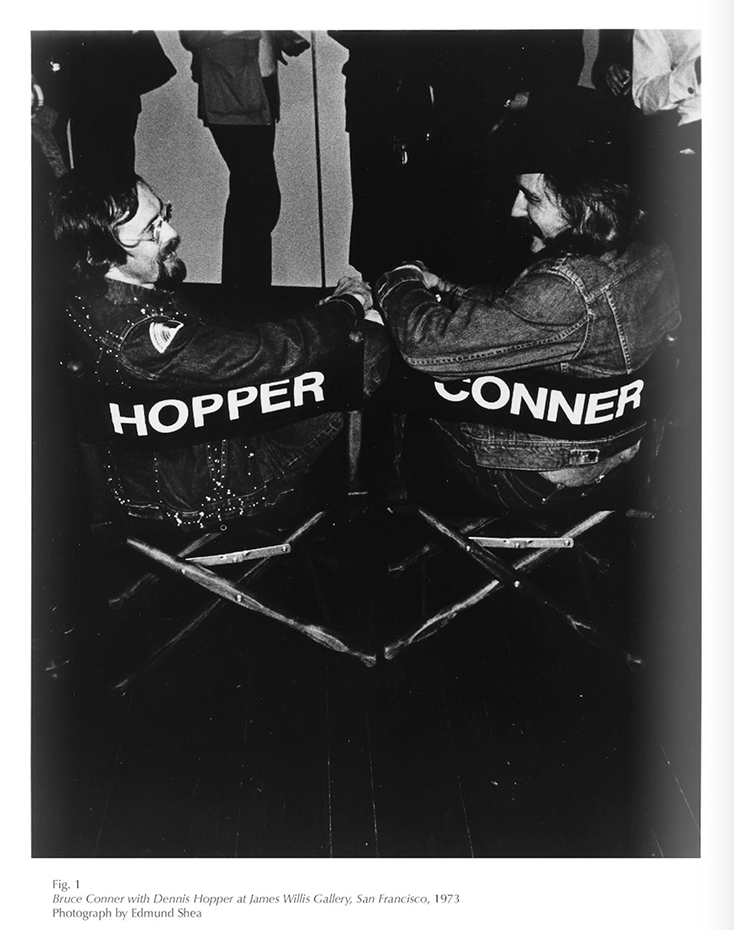
You've got to have friends. Bruce Conner, left, with Dennis Hopper.

You’ve got to have friends. Bruce Conner, left, in Hopper’s chair, with Dennis Hopper from the Senior & Shopmaker show catalog.

Still? That’s a pretty big statement, Mr. Hopper.

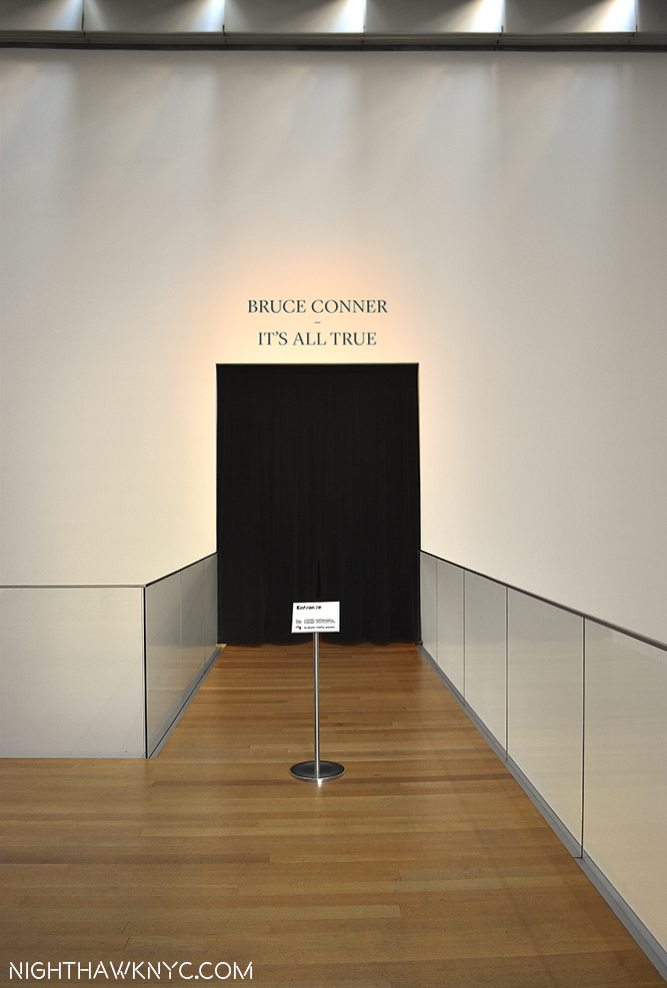
The Magic Curtain. Like a black hole to new universes within.

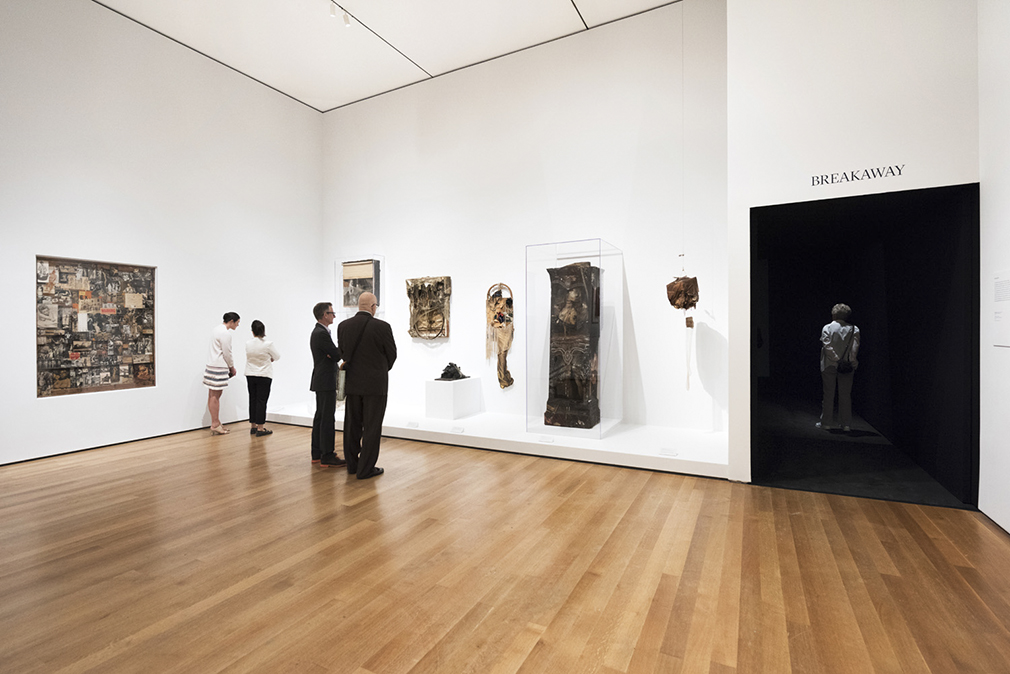
The entrance. Walk through this black curtain and it’s like entering a black hole to new universes within.

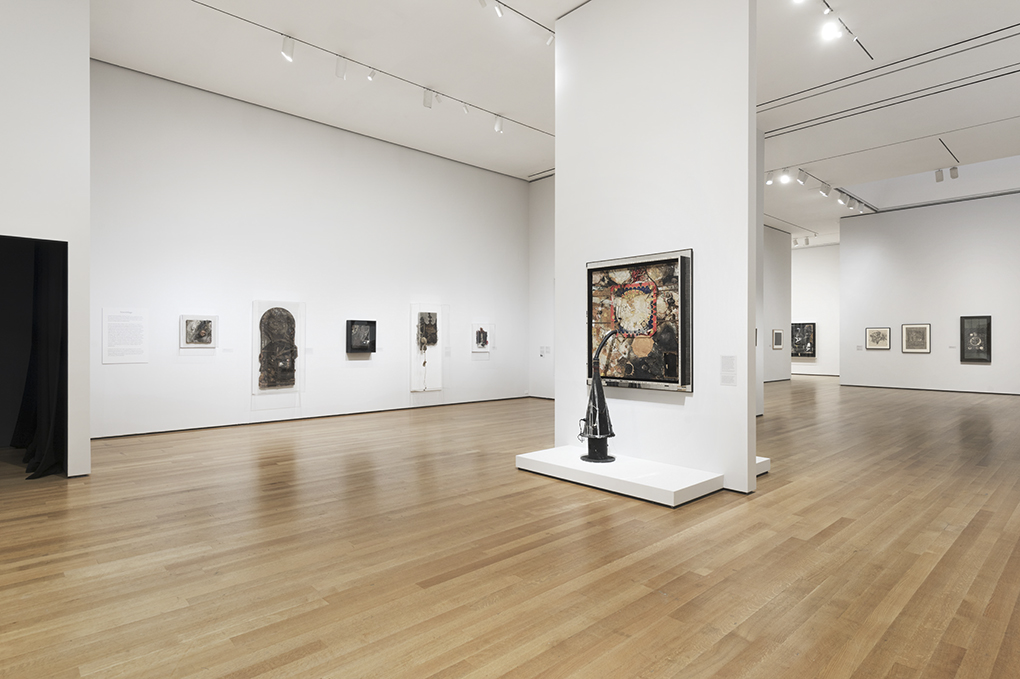
Though I don’t believe in qualitatively comparing Artists, there are, no doubt, many other differing opinions on the question of who was the most important 20th Century Artist. But, there was some quite compelling evidence in favor of Mr. Hopper’s opinion on view over 20 rooms at “Bruce Conner: It’s All True,” the first posthumous retrospective of the Artist, at MoMA from July 3 through October 2, and now at SFMOMA until January 22, 2017. (You can revisit MoMA’s Show  in amazing detail here.) In fact, it makes Hopper’s case about as well as it is possible to make it. With 250 pieces this show is one mind bend after another after another and after another that doesn’t stop until you’re back outside of it, in the lobby of MoMA’s 6th Floor. It’s like Groucho Marx’ joke delivery style- You don’t like that one? Here’s another. And another, and another, and another until he finally gets you. Having never even heard of Bruce Conner, he got my attention pretty quickly on my first visit.

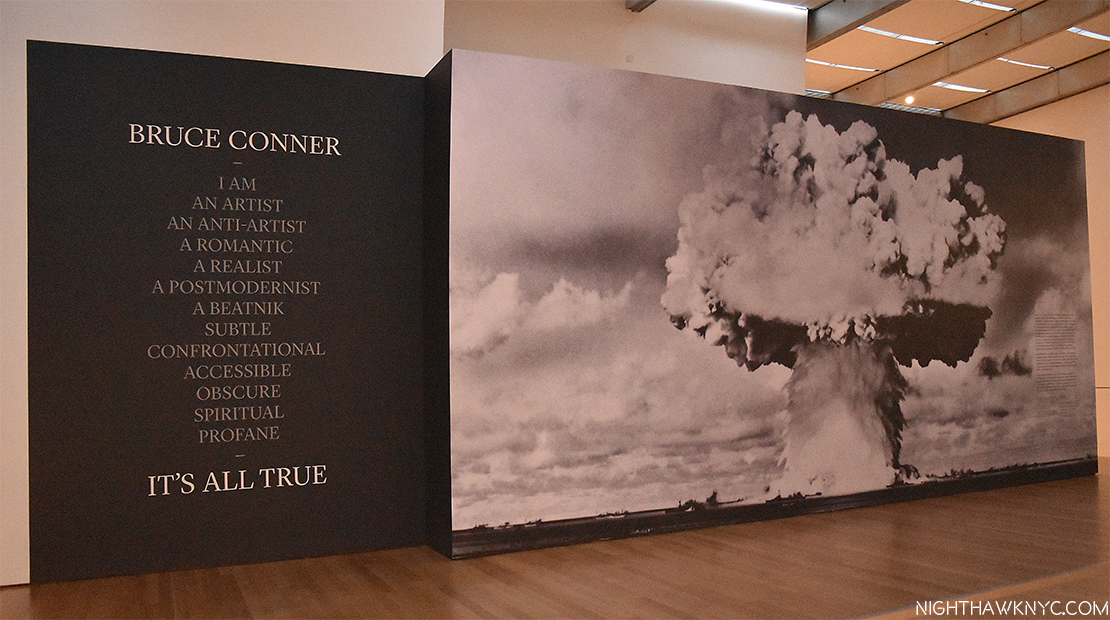
How my head felt after. Show's Lobby.

“It’s All True’s” Lobby. The show’s title comes from a letter Conner wrote in 2000, paraphrased on the left.

By my third visit, I was obsessed. For me, “Bruce Conner: It’s All True” sets a bench mark for Retrospectives of a Contemporary Artist. Pick a genre- drawing, painting, collage, photography, film, assemblage, Bruce Conner’s work in it can hang with anyone else’s. Here are some things I noticed that could be used to support Mr. Hopper’s claim-

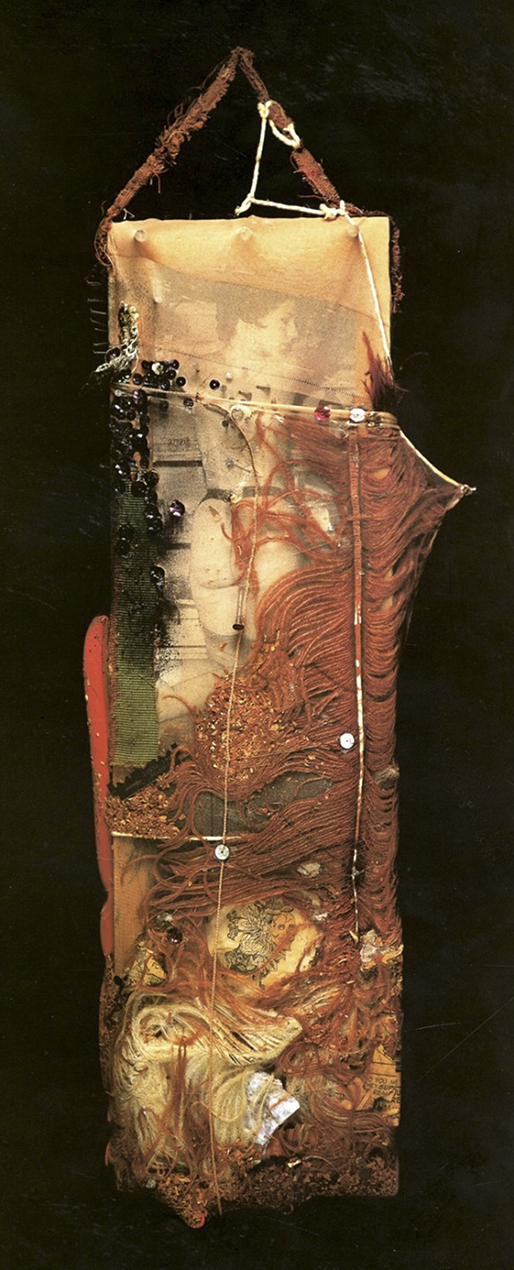
-He was an assemblage Artist every bit as inventive and creative as the great Robert Rauschenberg during the same period. In fact, one of Conner’s assemblages was selected for the 1961 Moma show, “the Art of Assemblage,” when he was 28, where it was shown alongside works by Malevich, Magritte, Miro, Man Ray, Picasso and Rauschenberg. Conner, himself, was denied entry to MoMA on opening night, but that’s a story unto itself.

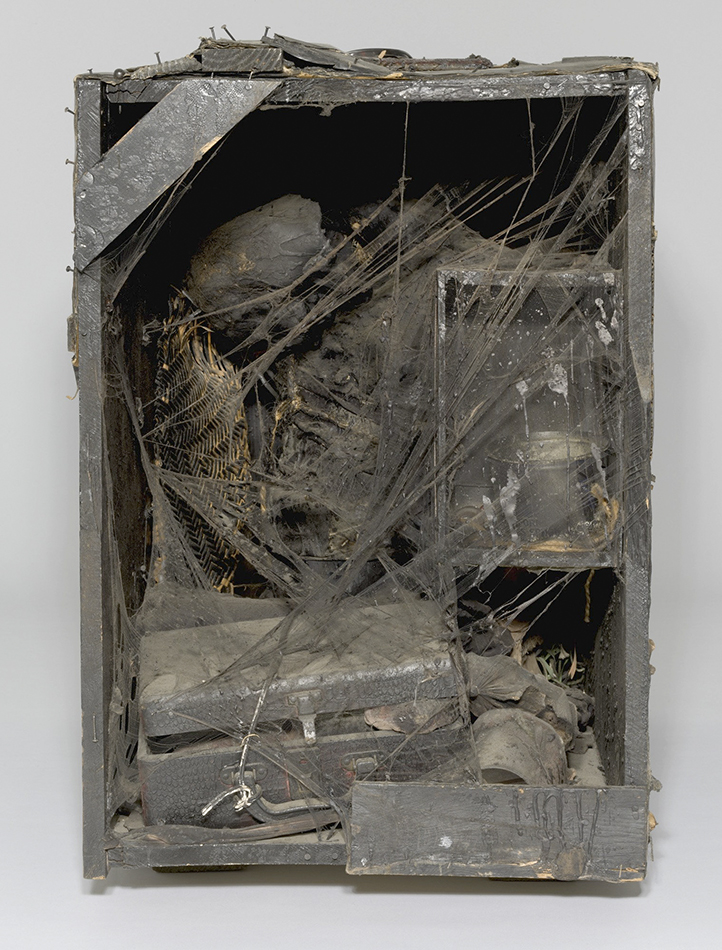
"THE BOX," 1960 Photo ©MoMA

“THE BOX,” 1960. Dennis Hopper actually preferred this work to Picasso’s “Guernica” as an anti-war statement because it is “not cloaked in pleasing forms.”1 Photo ©MoMA

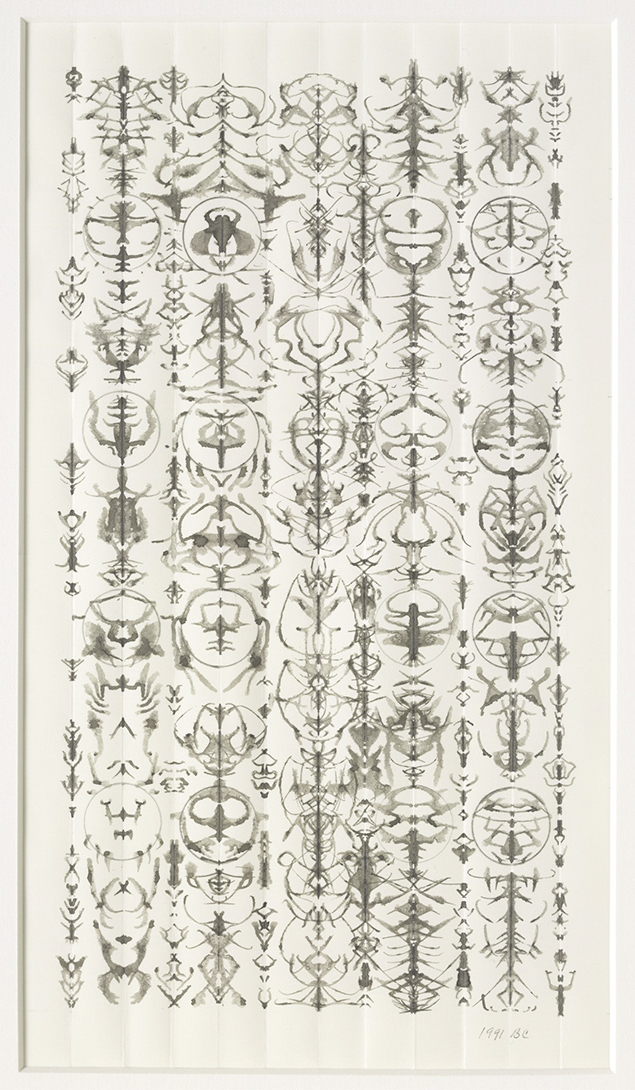
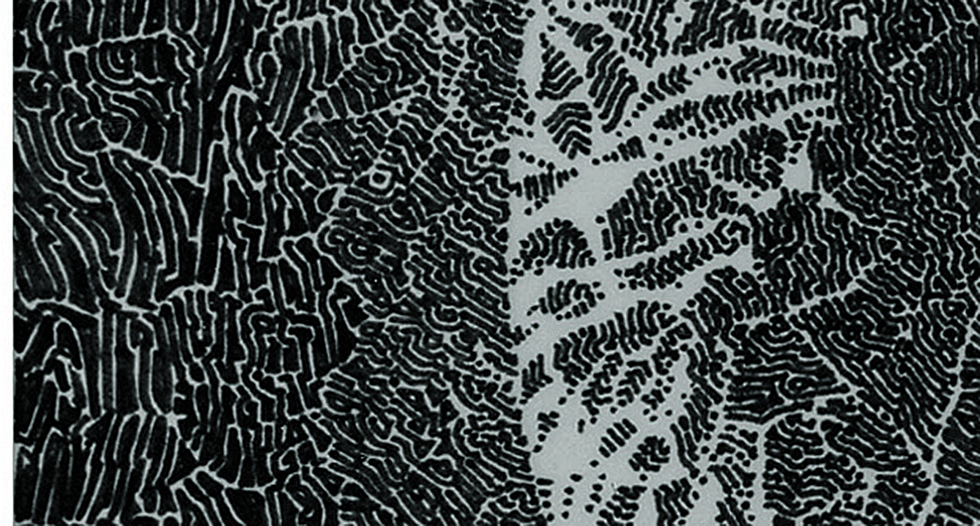
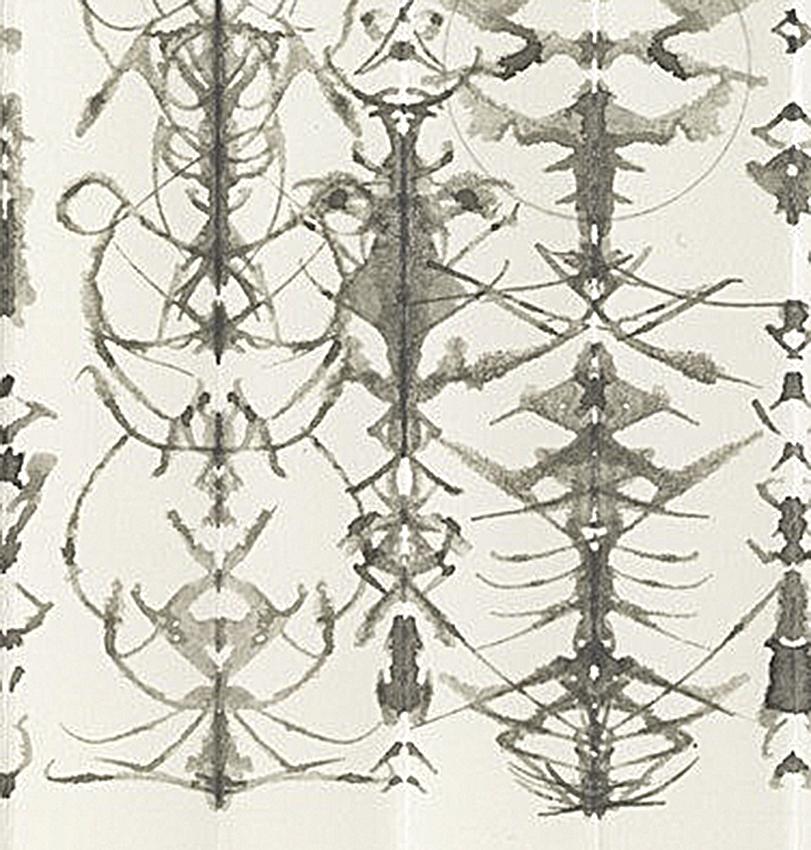
-While he drew for much of his career, with fascinating results, he created an entirely new and unprecedented type of drawing, made out of inkblots (yes, you read that right) that contain from 1 or 2  upto 494 inkblots in a single work that, I believe, people will spend years trying to figure out how he did them. Even once they do, they are going to have a very hard time achieving his level of mastery with their manipulation.

inkblot-drawing-8-17-1991p

HTF? “INKBLOT DRAWING,” August 17, 1991. See a Detail of this further down. Photo ©MoMA

-His groundbreaking first film, “A MOVIE.” was a work that was hugely influential, credited by the same Dennis Hopper with inspiring the acid scene in his own film “Easy Rider.”

Blowing Minds. "Crossroads," 1976 at Moma. Photo ©Moma

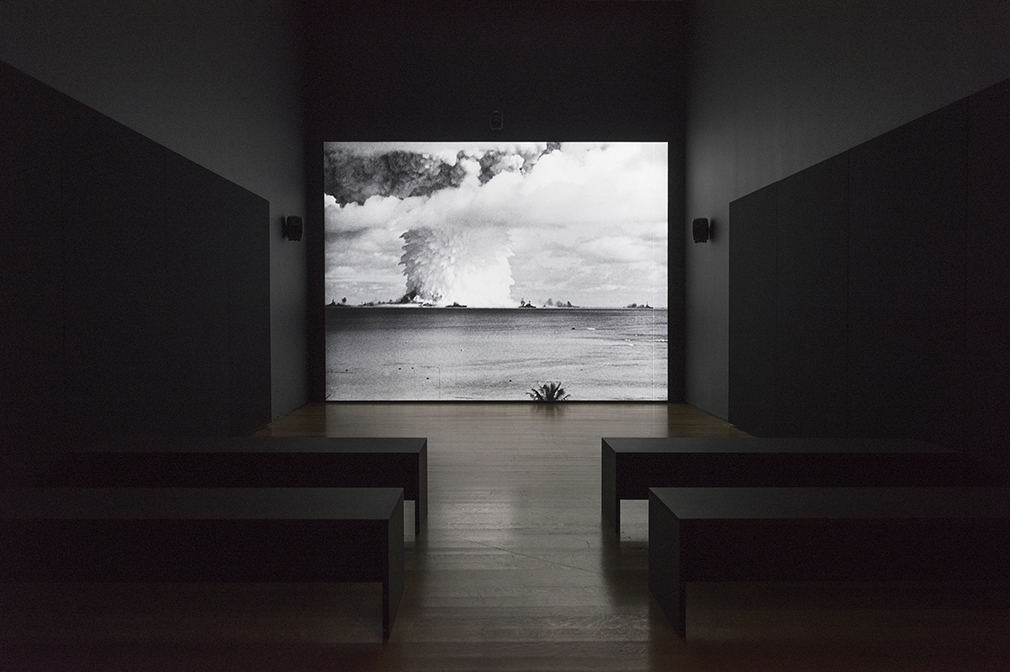
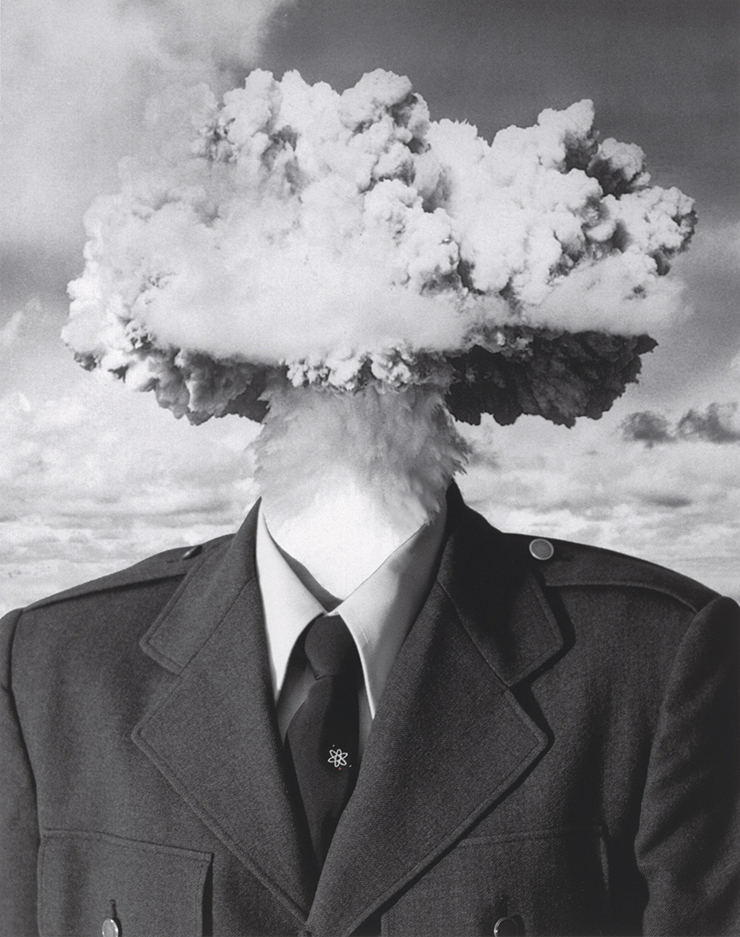
“CROSSROADS,” 1976. Mushrooms, of all kinds, even atomic clouds as here, are a running theme. Yes, all of his titles are in CAPS. *-Photo ©MoMA

“CROSSROADS,” 1976, a 36 minute film that struck me as being part horror film, part meditation on the power of the unseen forces in the universe, showing the unimaginable devastation an atomic explosion unleashes, while at the same time showing it as a force of nature to which it gradually melts into, as we watch the surrounding clouds become indistinguishable from the atomic cloud. The end result is summed up in what writer William C. Wees calls the “Nuclear Sublime2.” Showing multiple views of the atomic blast at Bikini Atoll on July 26, 1947, which Conner selected from the over 500 cameras that filmed the event (some at speeds of up to 8,000 frames per second), and juxtaposes the images with, first, actual sounds of the event, and then soundtracks created by synth master Patrick Gleeson and avant garde composer Terry Riley. Forty years later it’s hard to see this film becoming irrelevant any time soon. It’s a film that everyone involved in the military or government of any nation around the world, or those with the power to vote for or select them should see. Conner’s other films (totaling over 20) were no less creative or groundbreaking, and are increasingly being studied, and recognized.

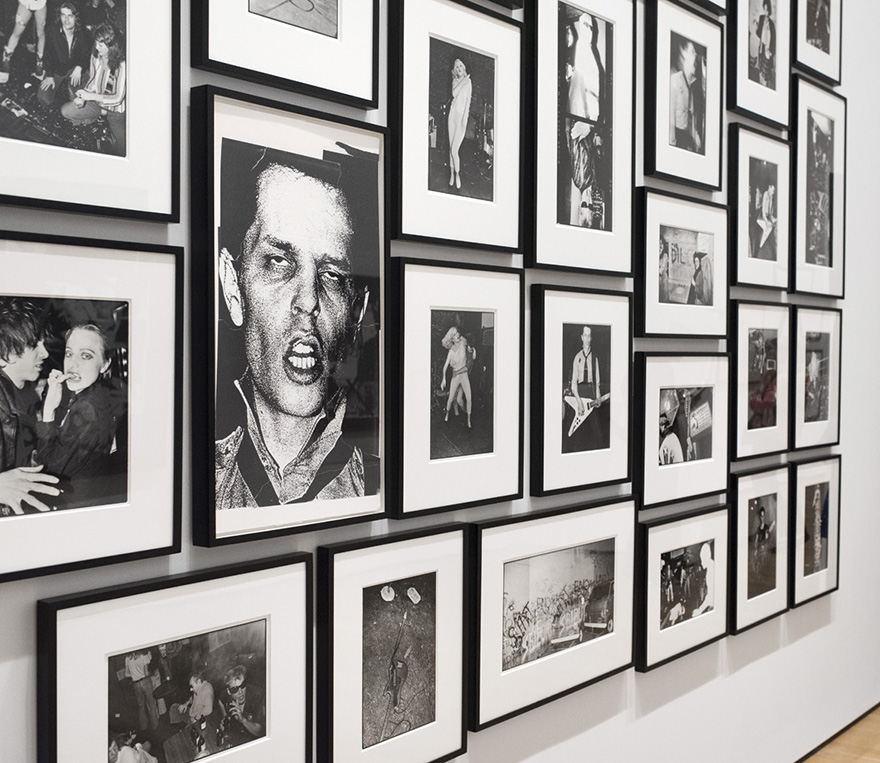
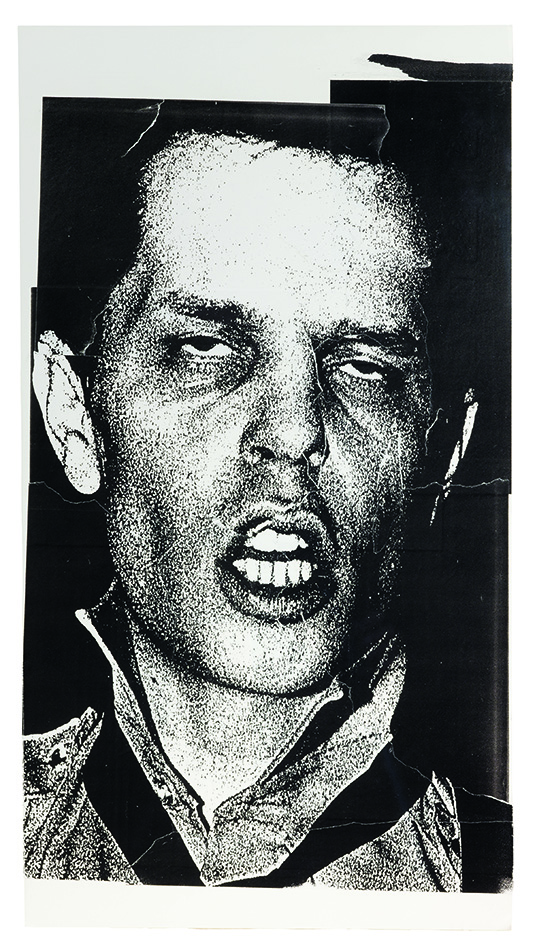
-He took some of the greatest photos of punk musicians and punk bands ever taken.

MoMA_Bruce Conner_June 2016

Up against the wall! A wall of his punk photos shot at the Mabuhay Gardens Club in L.A. *-Photo ©MoMA

Frankie Fix of "Crime," 1977. Photo ©Moma

FRANKIE FIX of the band “Crime,” 1977. *-Photo ©MoMA

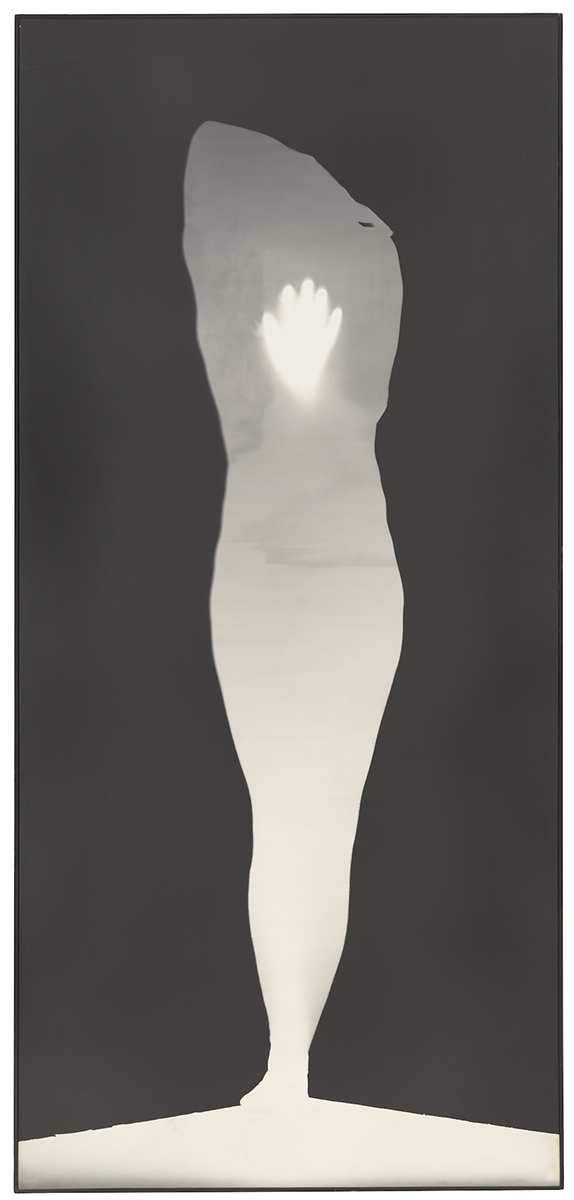
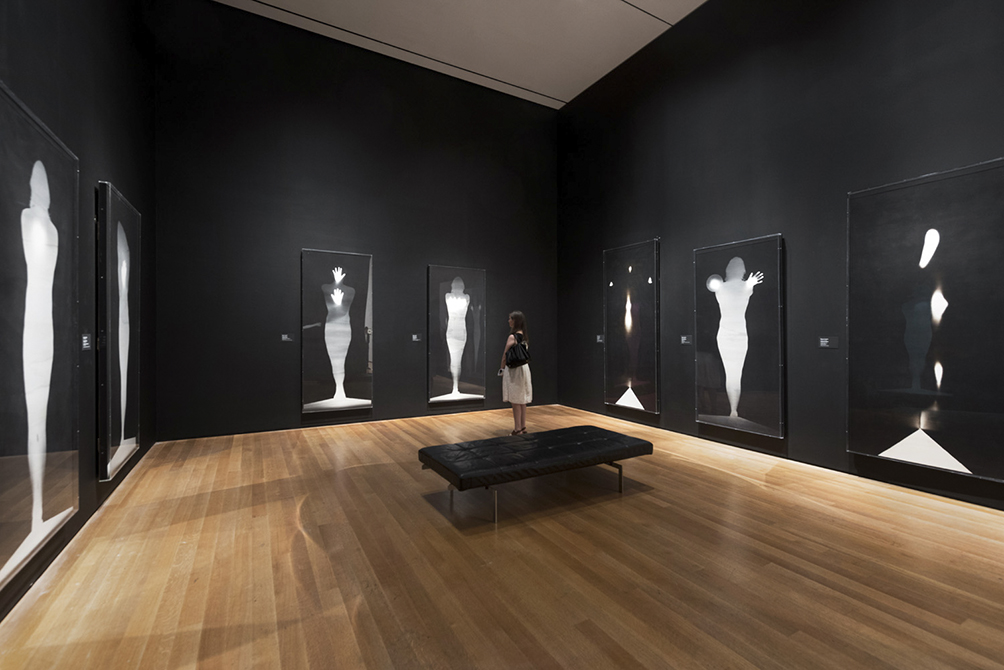
-He created unique portraits he called “photograms” using his own body that are unlike any “selfie” ever taken (actually, Edmund Shea photographed them) and are so ethereal he titled them “Angels.”

Spiritual Side "Sound of One Hand Angel," 1974, Photo ©MoMA

“SOUND OF ONE HAND ANGEL,” 1974, *-Photo ©MoMA

"Angels" by Bruce Conner. Photo courtesy of Moma.

A Room full of “ANGELS.” *-Photo ©MoMA

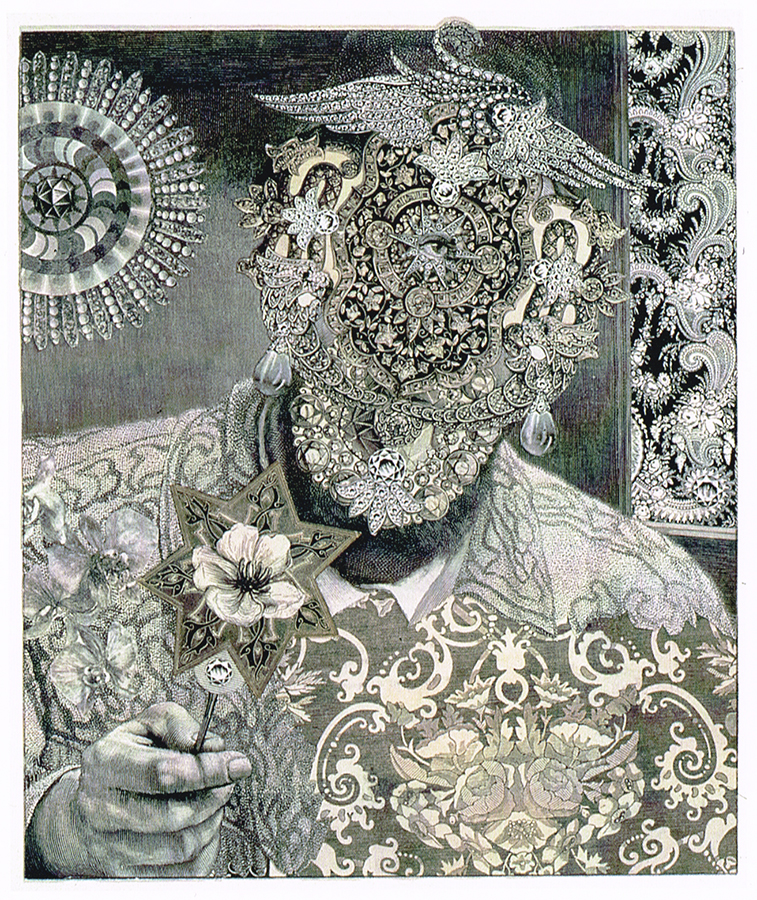
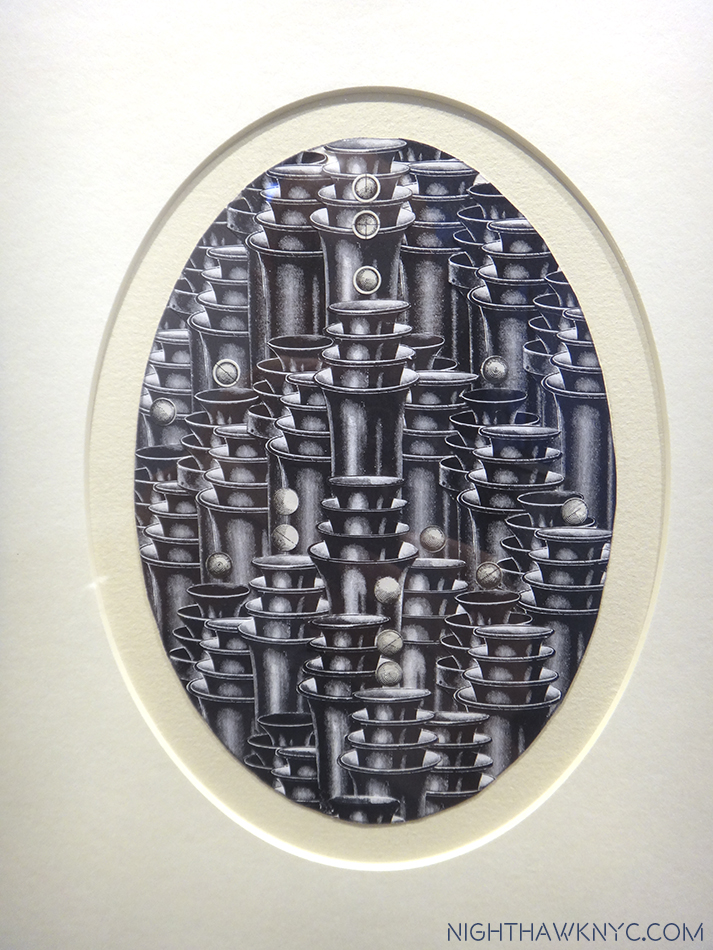
-His collages are every bit as surreal as any by Max Ernst, the Surrealist Master of the Collage.

"PSYCHEDELICATESSEN OWNER," 1990 collage from engravings. Photo ©MoMA

“PSYCHEDELICATESSEN OWNER,” 1990, collage from engravings. *-Photo ©MoMA

-Being as he was the first Artist to put film to contemporary music, he is considered to be the “Father of Music Video,” with his “COSMIC RAY,” in 1961, then “BREAKAWAY,” with Toni Basil (see above). His subsequent work with David Byrne and Brian Eno on videos for their 1981 album “My Life In The Bush of Ghosts” presaged and anticipated MTV’s “Music Videos.” Having his innovations and techniques aped without credit was not something he accepted well. I put this lower on the list because the music video seems to be fading in importance.

And, he ran for office (a seat on the Board of Supervisors in San Francisco), in 1967, actually garnering a few thousand votes.

So?

Why haven’t more people heard about Bruce Conner? Why isn’t he listed and discussed in 20th Century Art History Books?

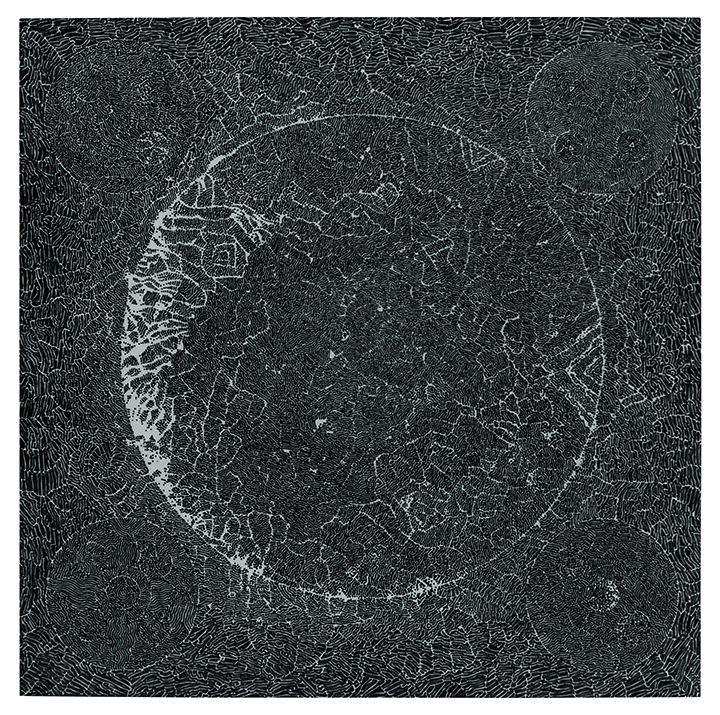
"Untitled" from Mandalla Series, 1965, felt tip pen on paper. 10x10 inches

“UNTITLED” from MANDALA SERIES, 1965, felt tip pen on paper. 10×10 inches. *-Photo ©MoMA

Detail of left side

Detail of left side

Bruce Conner was something of af an “anti-artist.”  He didn’t like the art establishment, and that came out in his dealings with galleries and museums, including a bizarre encounter with the Security staff at MoMA, at that opening in 1961, alluded to above. In this show he is quoted questioning the need for an Artist to put his name on a work, and near the end of his career works that are undeniable Bruce Conners began appearing with other names, like “Emily Feather,” or “Anonymouse” attached to them. It seems it was a conscious effort to avoid inclusion. He claimed he hired these Artists, but today, they are assumed to all be by him. He once said having work out in the public under his own name made him nervous.

Women's World. Form Left- Pinups on the back of "Untitled," 1954-61, "Spider Lady," & "Spider Lady Nest," 1959, Homage to Jean Harlow," 1963,

Women on his mind. Form Left- Pinups on the back of “UNTITLED,” 1954-61, “SPIDER LADY,” & “SPIDER LADY NEST,” 1959, “HOMAGE TO JEAN HARLOW,” 1963, “WEDNESDAY,” and “LADY BRAIN,” both 1960. Entrance to “BREAKAWAY,” right. *-Photo ©MoMA

Contemporary Art of any time is supposed to break all the rules that had been set in place before it. In Bruce Conner’s case, he broke the rules in every medium he created in, and he broke the rules for being an Artist in the “Art World,” which he loathed. It’s interesting to me that there is so much craft in his films- including dripping ink on them, punch holes seemingly randomly, that make them Art Pieces in themselves. This is part of a duality in his nature that sees him pay attention to the minutest of details like these films, his collages, or his ink drawings where countless minute lines are drawn in pen that somehow never intersect with each other, contrasted with the hugeness of “Crossroads,” horrible, yet strangely beautiful, and contrasted with the “spirituality” of works like the “Angels” and his final work, “Easter Morning.” Bruce Conner may have been many things, it’s all true (as he says in a letter that is the basis for the show’s title), but one thing he was not is easy to categorize. Unless that word is “Artist.”

The first gallery featuring Assemblages. Photo ©MoMA

After seeing “A MOVIE,” you exit the door at left and enter the first gallery featuring Assemblages. *-Photo ©MoMA

Walking around “It’s All True,” as well as no less than three very good satellite shows going on around town, of Conner’s trippier collages and tapestries at one Paula Cooper, unique works at the other, and prints and drawings at Senior & Shopmaker Gallery. I found that every time I look at one of his works, I’m left with the same question-

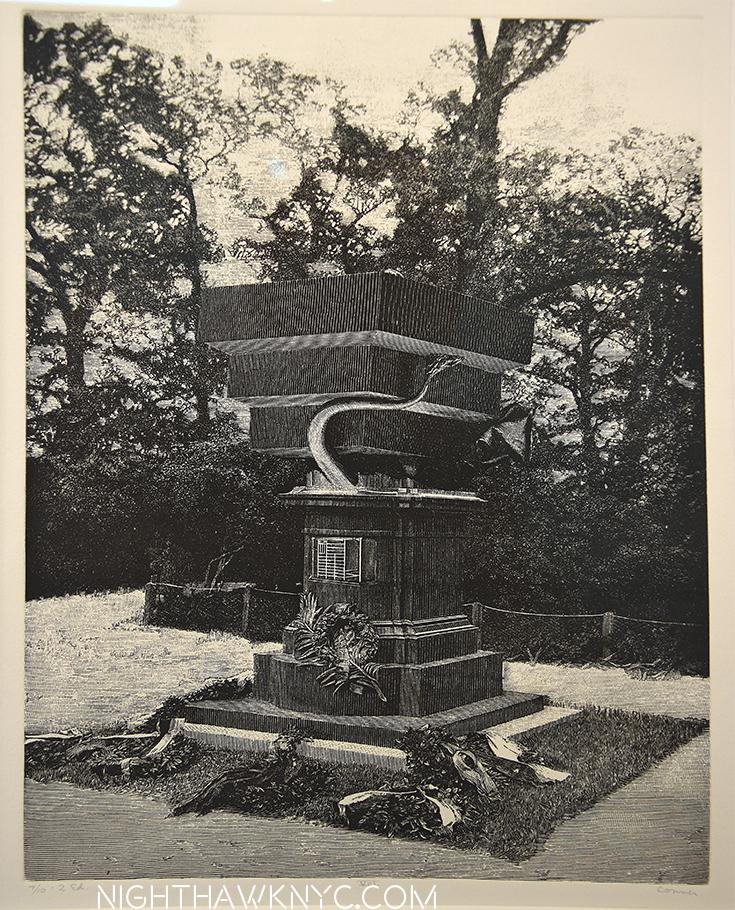
"Tocatta & Fugue," 1986, engraving collage

“TOCATTA & FUGUE,” 1986, engraving collage

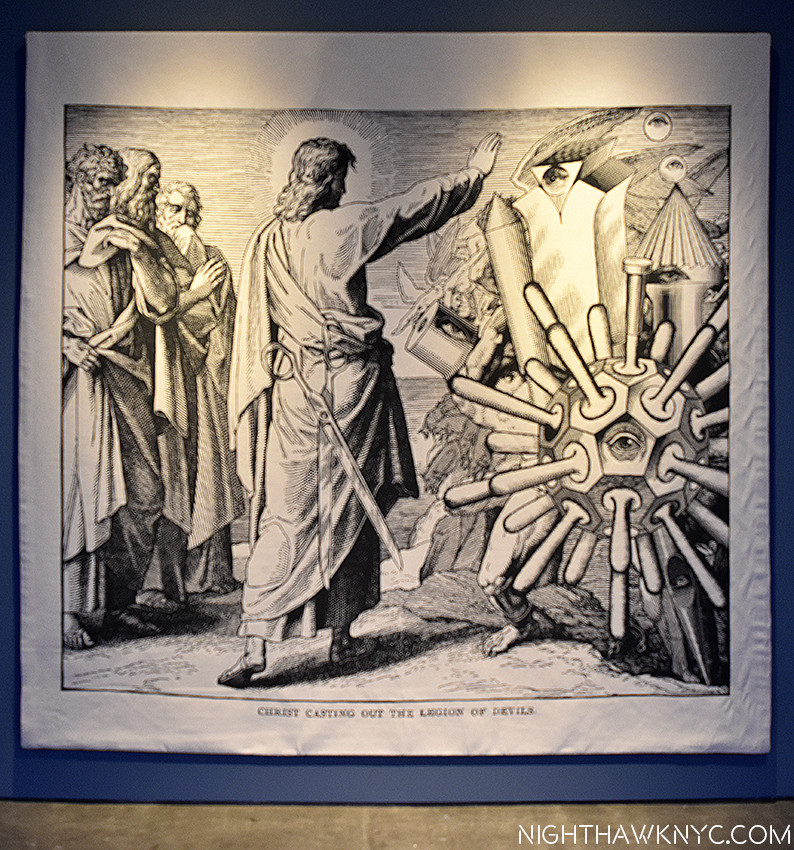
"Christ Casting Out The Legion Of Devils," Tapestry from engraving collage. Both seen at Paul Cooper Gallery

“CHRIST CASTING OUT THE LEGION OF DEVILS,” Tapestry from engraving collage. Both seen at Paula Cooper Gallery

“HTF?”

That’s “How” inserted instead of the W in WTF? As in- HOW did he do that?” No matter which genre of his work I’m considering, that question hits me. I stare at his drawings, for example, including one with hundreds of lines where no two intersect (like “UNTITLED,” above) and wonder “How did he do that?” I’m face to face with a pseudo Max Ernst collage, like the one above, and wonder “I can’t see anything cut out and applied on top of something else. It’s all seamless, and this was before scanning, photoshop and all the rest. How did he do that?” I look at his movies, “BREAKAWAY,” (above) and wonder the same thing. “How? The editing and the way it’s complied is beyond the technology of the time.” I’m not alone in saying this. In fact, no less than Harvard put on a film series of Bruce Conner’s films in 2008 that THEY called “Bruce Conner, the Last Magician of the 20th Century.” (Mr. Conner passed away in 2008). Then, there’s the “Inkblot” drawings, in which each inkblot is a perfect, unique, miracle of beauty, like a snowflake.

Detail of "INKBLOT DRAWING, August 17, 1991" seen above in full. Photo ©MoMA

Detail of “INKBLOT DRAWING, August 17, 1991” seen above in full. *-Photo ©MoMA

“How the…” Don’t ask.

As near as I can tell, Conner folds the paper (vertically in the image above) then applies the drop of ink. How he manipulates it after that to get these seemingly miraculous results is the mystery. Artist David Hockey wrote a fascinating book titled “Secret Knowledge,” about the lost techniques of the Great Masters of Painting going back to the mid 1400’s. He makes a downright riveting case, via reverse engineering, for some of the optical “tricks” and methods some of the greatest Painters ever used. I think someone is going to need to do a Volume 2 of “Secret Knowledge” and include Bruce Conner. MoMA’s curator, Laura Hoptman, said at the Press Opening, “For Bruce Conner there is always the acknowledgement of the viewer, especially in the drawings you can not only admire the steady hand and the attention to detail but it’s also on us to look so carefully and closely as possible to divine the meaning and also the intensity of the work.” While I agree that looking closely reveals wonders, I also wonder how much Conner really wanted us to see and understand3, how much of Bruce Conner, the Artist, was about making (some) works for himself, works that defy understanding by others because they aren’t meant to be. Unless his wife, Jean, also a very fine Artist, tells us, it looks like we’ll never know.

"Black Dahlia," 1960 Photo © Moma

“BLACK DAHLIA,” 1960. Inspired by an unsolved sex-murder case in L.A. His Assemblages require, and reward, very close looking. You’ll even see a nude, from the back. *-Photo ©MoMA

One of the themes of some bigger NYC Art Shows this year has been a revisiting of the Art History of the 20th Century. “It’s All True” does it again and makes such an emphatic case, as “Nasreen Mohamedi” did earlier this year inaugurating TMB, that I would be shocked if either Artist is omitted going forward.

From the "Dennis Hopper One Man Show," Print after engraving collage as seen at Senior & Shopmaker Galleri

From the “Dennis Hopper One Man Show,” at Senior & Shopmaker Gallery, a partial reconstruction of a Bruce Conner show honoring Dennis Hopper. Limited Edition print after engraving collage.

Beyond that, Dennis Hopper’s opinion will live on. I’m glad he expressed it before he passed of prostate cancer in 2010. Is Bruce Conner “The most important Artist of the 20th Century?” I don’t know if it matters. What matters is that his Art is being seen more and more, and so it will grow in appreciation and influence. Bruce Conner may have had reasons for being an “Anti-Artist,” and “Anti Art World” during his life, but one thing that is apparent- Now that he’s unfortunately no longer with us, his work is going to continue to speak for him, while it is seen far and wide in the 21st Century. Where he will continue to blow minds…like mine.

"BOMBHEAD," 2002

“BOMBHEAD,” 2002. Based on a Self Portrait. *-Photo ©MoMA.

*-Soundtrack for this Post is “In C” by Terry Riley, the soundtrack for Bruce Conner’s final film, the gorgeous masterpiece, “EASTER MORNING,” 2008, which struck me as a farewell to life, and is the final work in “It’s All True.”

NighthawkNYC.com has been entirely self-funded & ad-free for over 8 years, during which 300 full length pieces have been published! If you’ve found it worthwhile, PLEASE donate to allow me to continue below. Thank you, Kenn.

You can also support it by buying Art, Art & Photography books, and Music from my collection! Art & Books may be found here. Music here and here

Written & photographed by Kenn Sava for nighthawknyc.com unless otherwise credited. To send comments, thoughts, feedback or propositions click here. Click the white box on the upper right for the archives or to search them. Subscribe to be notified of new Posts below. Your information will be used for no other purpose.
  1. SFWeeky
  2. Wees’ excellent piece on “CROSSROADS,” in which he coins the term, is here.
  3. Very very few are going to get to examine the film strips of his movines to see the attention to detail he lavished on them.

Leonard Cohen, Chelsea Hotel #November 11, 2016

This site is Free & Ad-Free! If you find this piece worthwhile, please donate via PayPal to support it & independent Art writing. You can also support it by buying Art & books! Details at the end. Thank you.

Written & Photographed by Kenn Sava.

dsc_0406p2nh

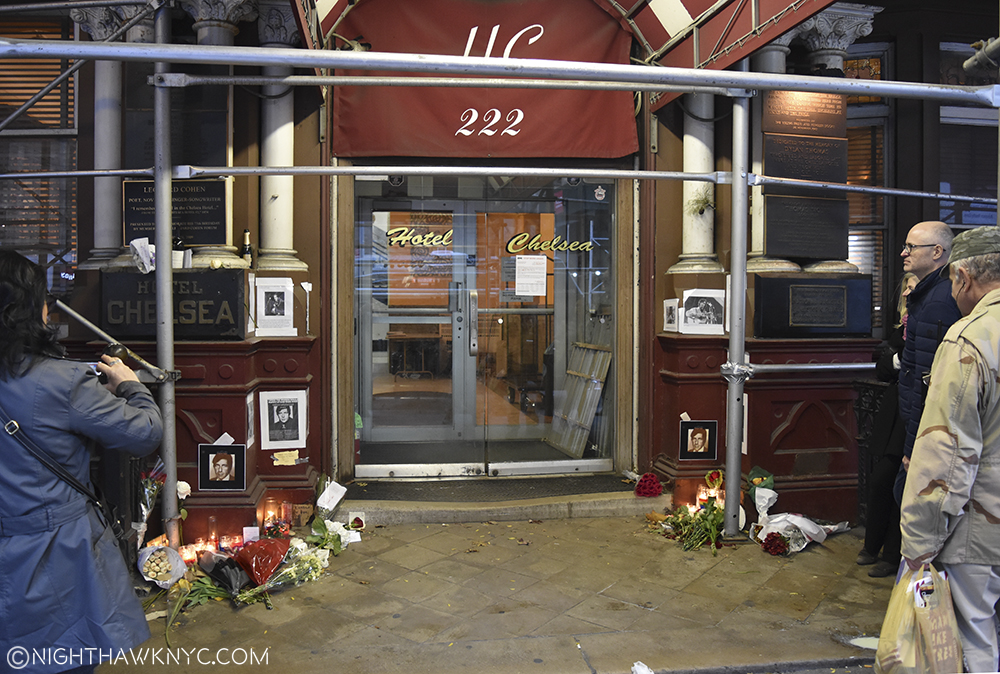
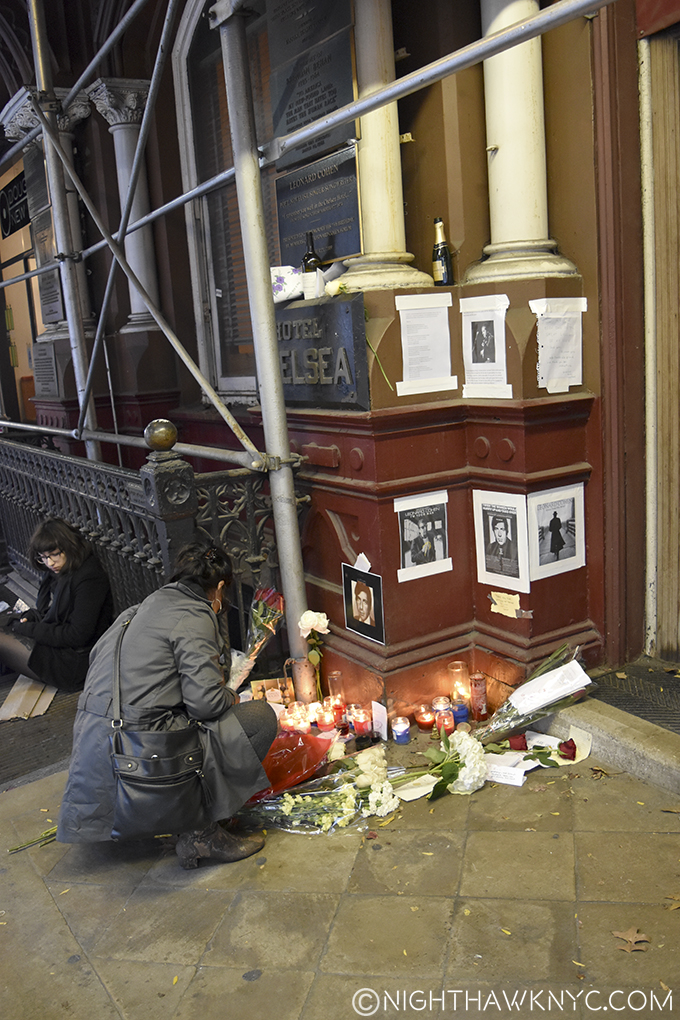
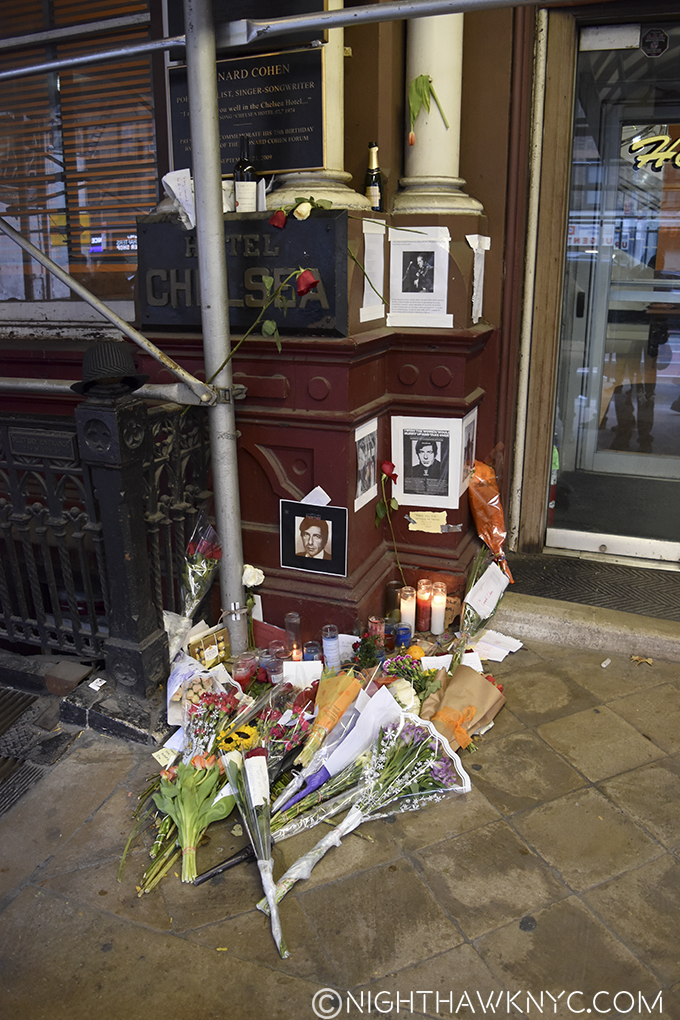
If those paving stones could talk…The scene in front the Hotel Chelsea, currently covered in scaffolding, this afternoon after the passing of Leonard Cohen yesterday.

Here’s an iPhone video I shot outside of 222 West 23rd Street, world famous as the Hotel Chelsea, which Leonard Cohen helped to immortalize in no small way, through his songwriting, and his presence in Suite #424-

Leonard’s “Bird On A Wire” performed live by a couple who were “just passing through,” something that adds even more to it being a fitting tribute to Mr. Cohen, and the spirit of the Hotel Chelsea he helped foster.

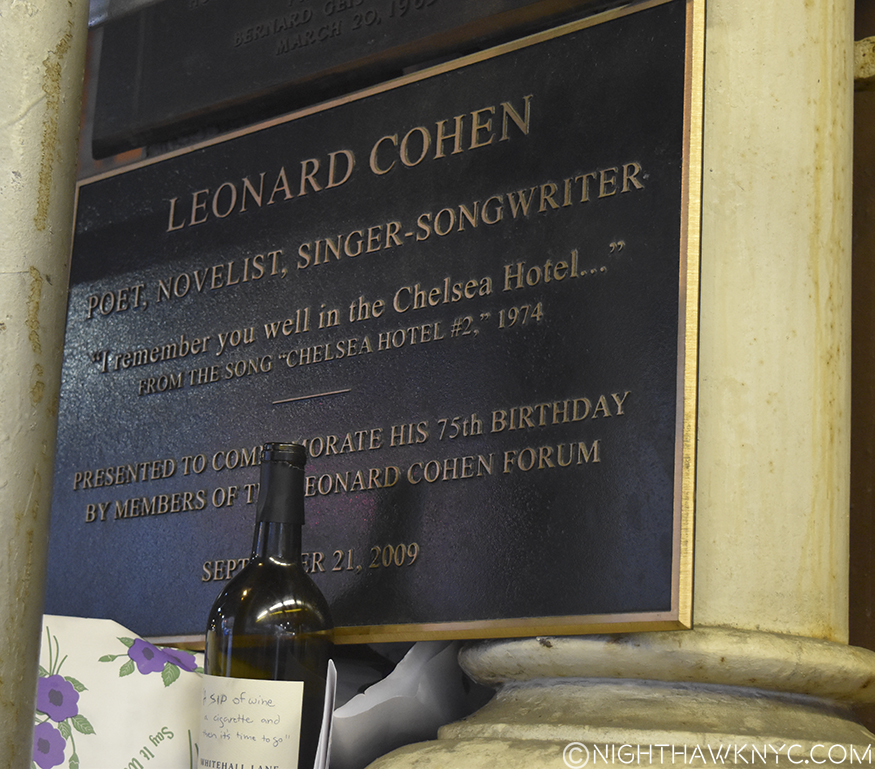
Leonard Cohen's wall plaque is now behind the scaffolding, making it very hard to get a shot of.

One for the road. Leonard Cohen’s wall plaque is now behind the scaffolding, making it very hard to get a shot of, though folks were able to leave tributes nearby.

dsc_0382p2nh


UPDATE- As seen on Saturday, November 12

UPDATE- As seen on Saturday, November 12

I’ve got a good deal of personal history there, myself, these past 25 years, though none that directly involves Mr. Cohen. The Chelsea is the figurative center of the Chelsea Neighborhood, and was immortalized most recently by Patti Smith in “Just Kids,” which also took place before my time in the area. None the less, I have a ton of respect for all that went on there, and the amazing group of people who occupied the place, including my late friend, Storme, who I recently wrote about. Certainly Mr. Cohen is right up there with any of the others in terms of bringing to the Chelsea the cachet that made the place, the area, and the City a mecca for countless thousands of people- then and now.

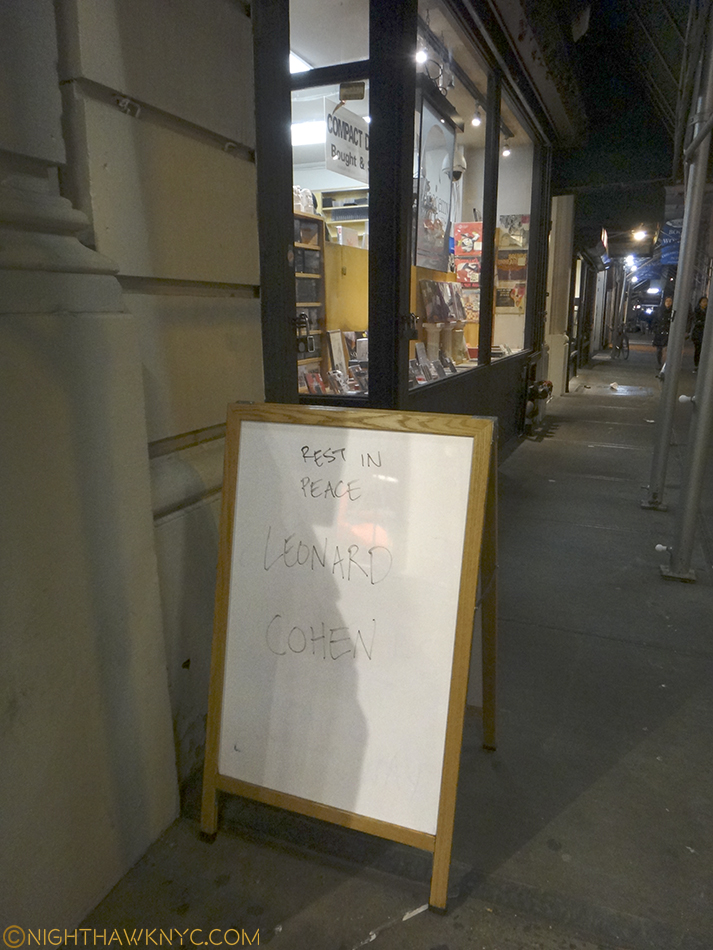
Outside Academy Records, one of Manhattan's top Record & CD Stores, tonite.

Outside Academy Records, one of Manhattan’s top remaining Record & CD Stores, tonite.

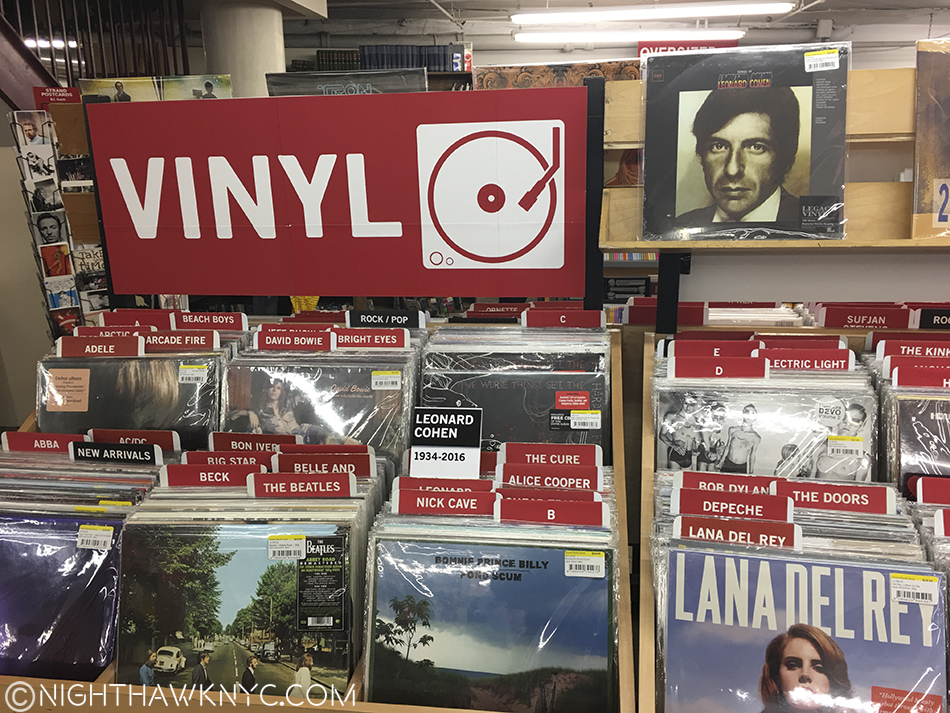
In the basement of The Strand Bookstore tonite. Yes, the basement where Patti Smith once worked.

In the basement of The Strand Bookstore tonite. Yes, the basement where Patti Smith once worked.

I don’t know what the place is going to become now. I doubt it will retain much of it’s former energy. It’s another sign of the times. An era is slowly ending right before our eyes. Another place that was once a focus point for seemingly boundless creativity, filled with people who inspired each other, the world around them, and beyond, that now must be found somewhere else in town. While there will never be another Leonard Cohen, I look forward to the next generation of Musicians, Writers, Artists and Poets who’ve been inspired by him and all the others.

Hallelujah. There are some big shoes to fill…

More on the legendary Leonard Cohen at the Hotel Chelsea (which sits one block west of the recent bomb blast) can be found here.

R.I.P. Leonard Cohen.

*Soundtrack for this Post is “Chelsea Hotel, #2,” by Leonard Cohen. Thanks to kitty for reconnaissance assistance.

NighthawkNYC.com has been entirely self-funded & ad-free for over 8 years, during which 300 full length pieces have been published! If you’ve found it worthwhile, PLEASE donate to allow me to continue below. Thank you, Kenn.

You can also support it by buying Art, Art & Photography books, and Music from my collection! Art & Books may be found here. Music here and here

Written & photographed by Kenn Sava for nighthawknyc.com unless otherwise credited. To send comments, thoughts, feedback or propositions click here. Click the white box on the upper right for the archives or to search them. Subscribe to be notified of new Posts below. Your information will be used for no other purpose.
The Rothko Chapel, Chelsea

“I became a painter because I wanted to raise painting to the level of poignancy of music and poetry.” Mark Rothko.

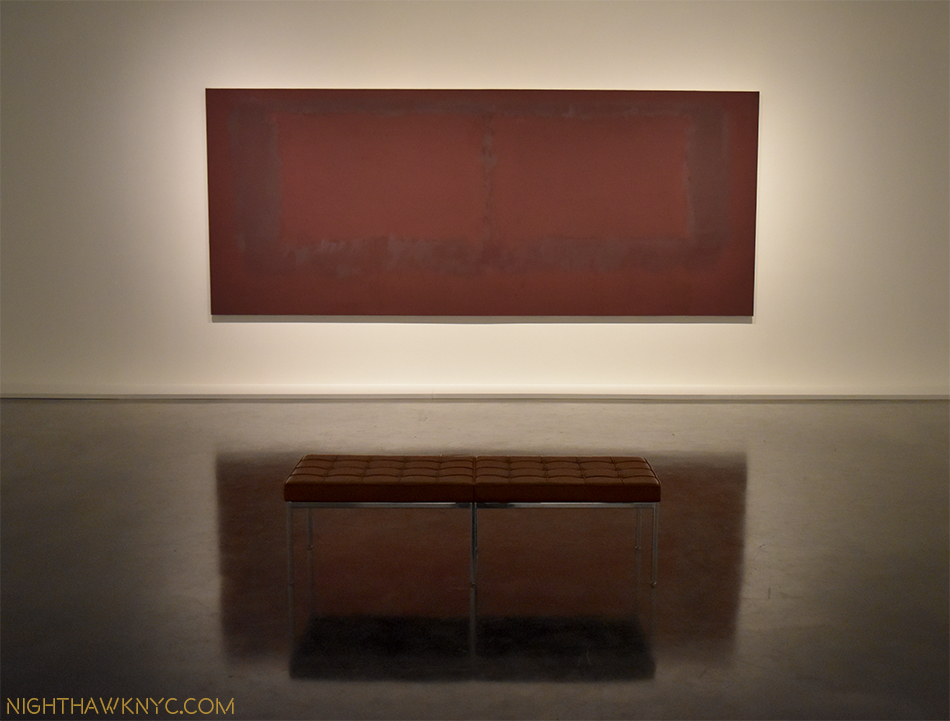
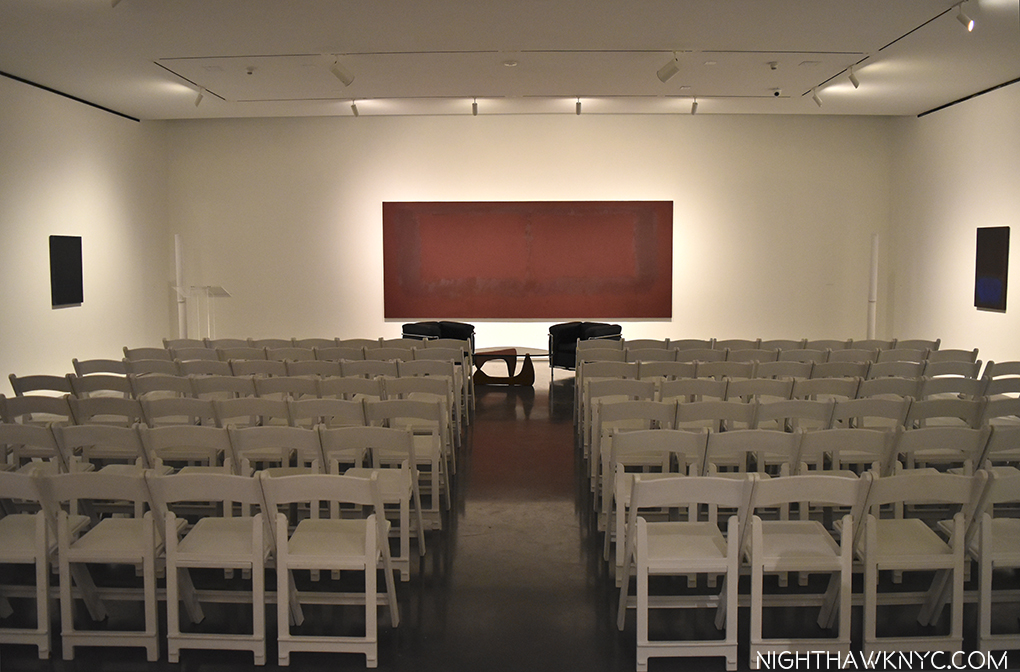
I could sit there for a month. One of the infamous "Seagrams Murals," 1959. Rarely seen.

Seagrams Murals, Section 6, 1959. One of the infamous murals for the 4 Seasons Restaurant, but never installed there.

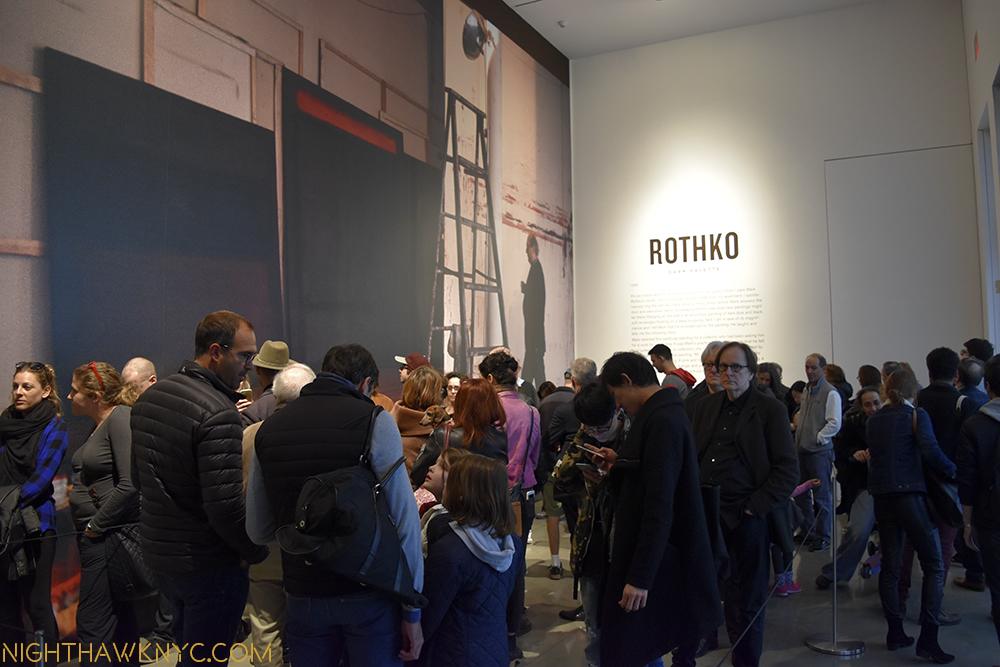
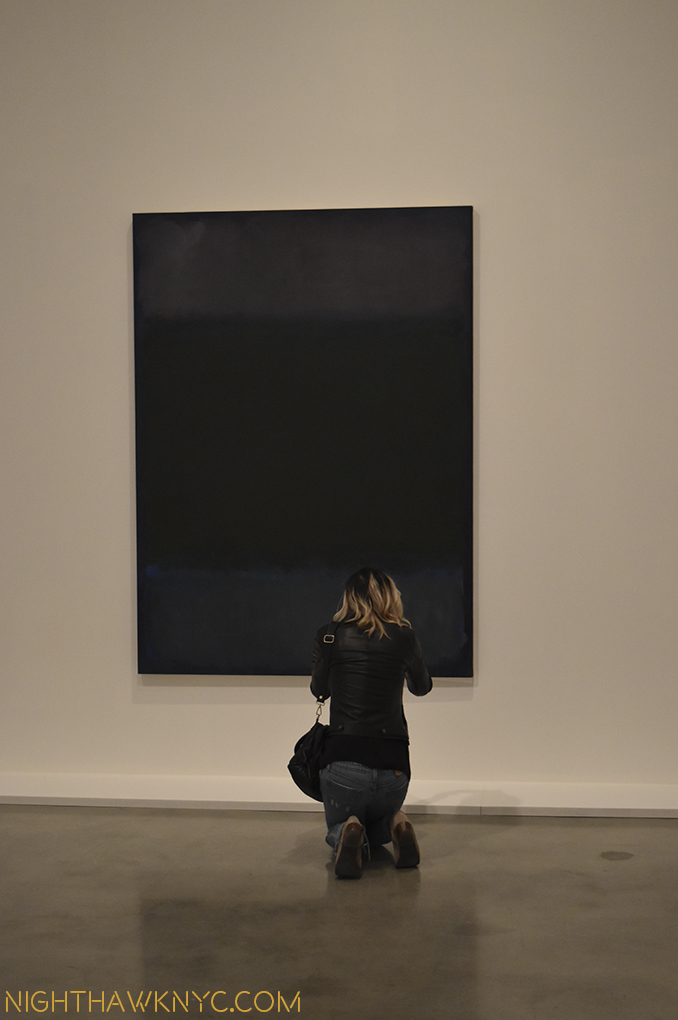
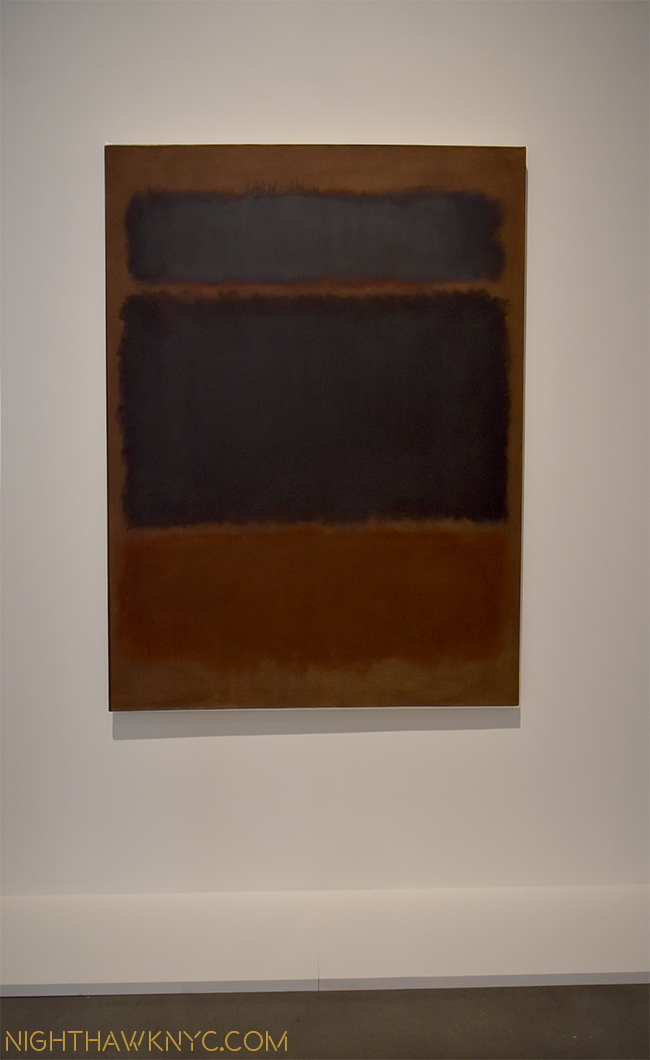
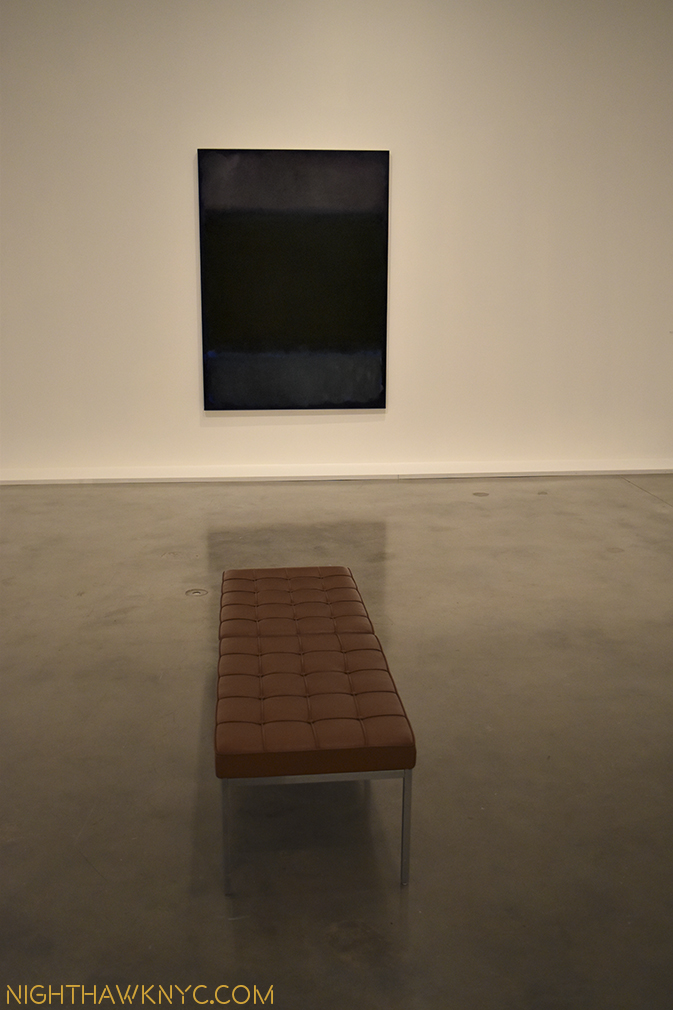
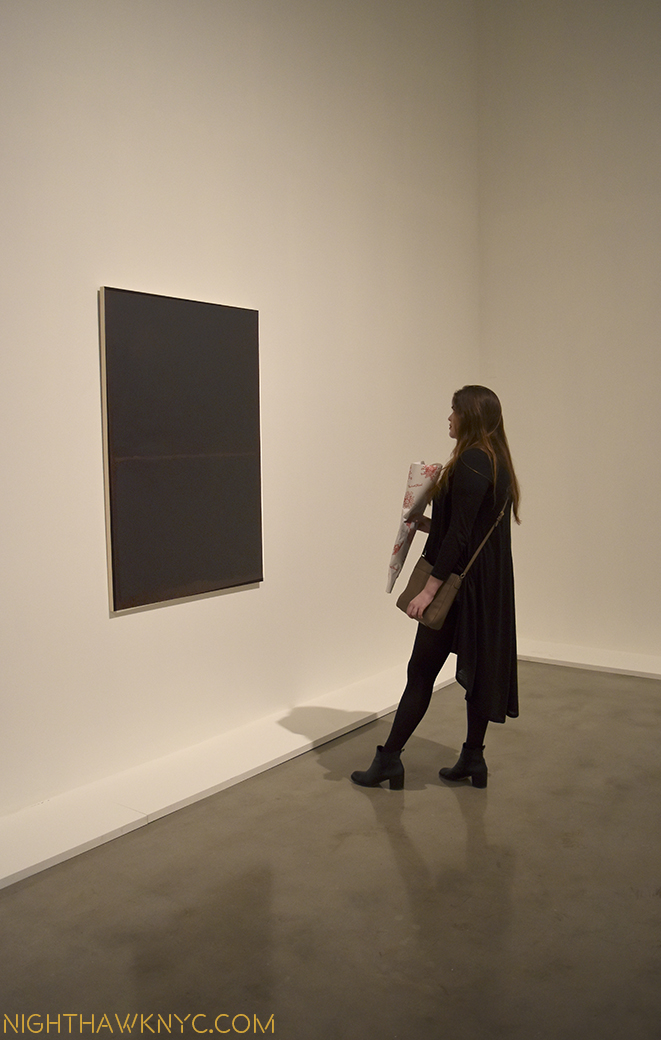
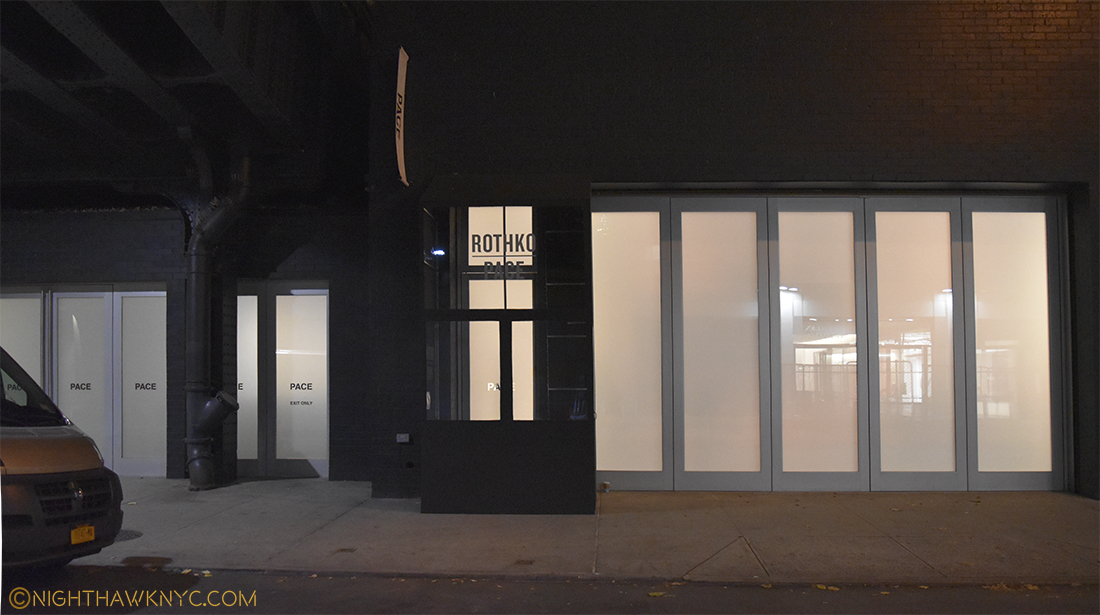
Lines to get in are nothing new in New York, or in Chelsea, home to some of the most “happening” nightclubs in the City. But a line to get in at 2 or 3pm in the afternoon is rare anywhere in NYC. Even rarer are lines to get into an Art Gallery at that hour- unless it’s late in the run of a “must-see” show. But, the line filled the lobby and extended out the door at the extraordinary Mark Rothko: Dark Palette show which only opened the day before at Pace on West 25th Street. Five years in the making, and focused on exploring one aspect of his work, don’t bother asking for the price list, it’s also unusual for a gallery show because none of the work is for sale. Darn! What will I do now with that spare 90 million dollars?? Maybe I’ll open some grocery supermarkets with reasonable prices most neighborhoods in Manhattan desperately need.

3pm November 5. The crowd in the lobby waits.

3pm November 5. The crowd waiting to get in fills the lobby. Buckle up! It’s only going to get more crowded.

When it comes to writing about the work of Mark Rothko, I have to say up front that it’s very hard for me to be unbiased. Mark Rothko’s Art changed my life. In 1999 I saw his Retrospective at the Old Whitney (now TMB) the final weekend it was there. It was one of the unforgettable experiences I’ve ever had at an Art show, and it was perfect timing, given the roadblock I had hit with record companies in trying to get my records released unaltered, I then decided to turn (back) to Art History, my first love. Thank you, Mark Rothko.

dsc_0040pnh

dsc_0113pnh

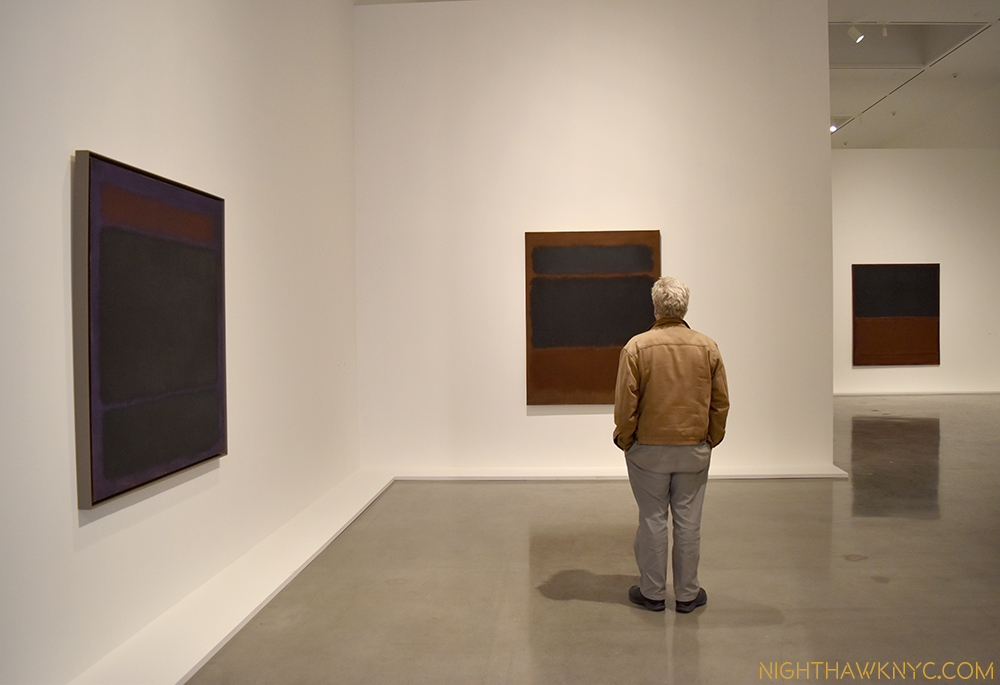
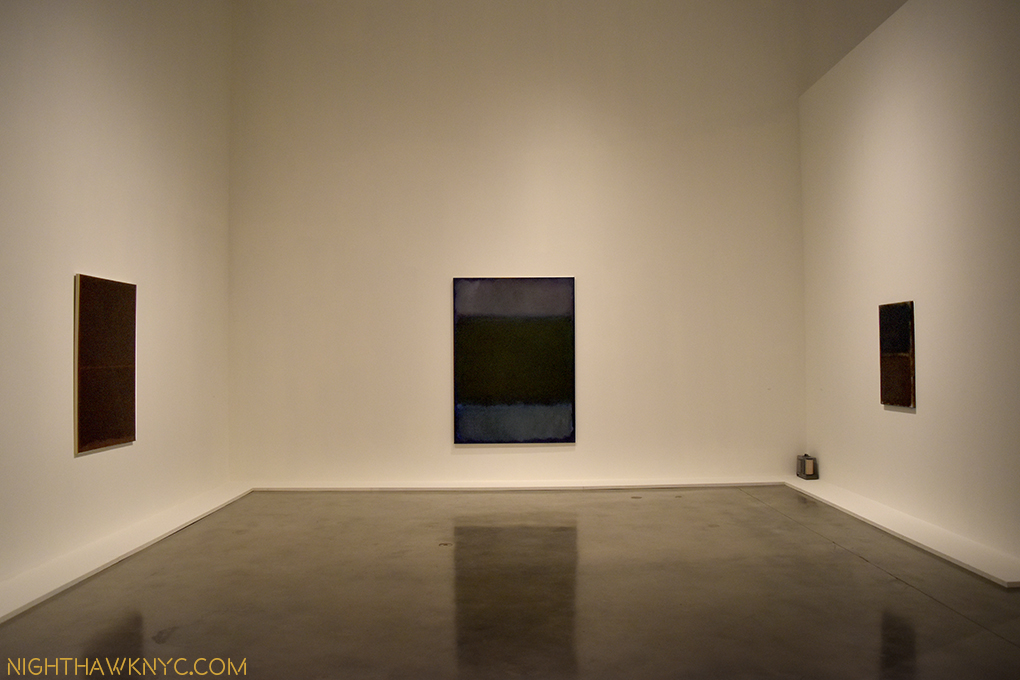
Let’s get lost. This is how I prefer to see Rothko. Each work can be seen on it’s own. Getting close to feel engulfed by the work is good, too.

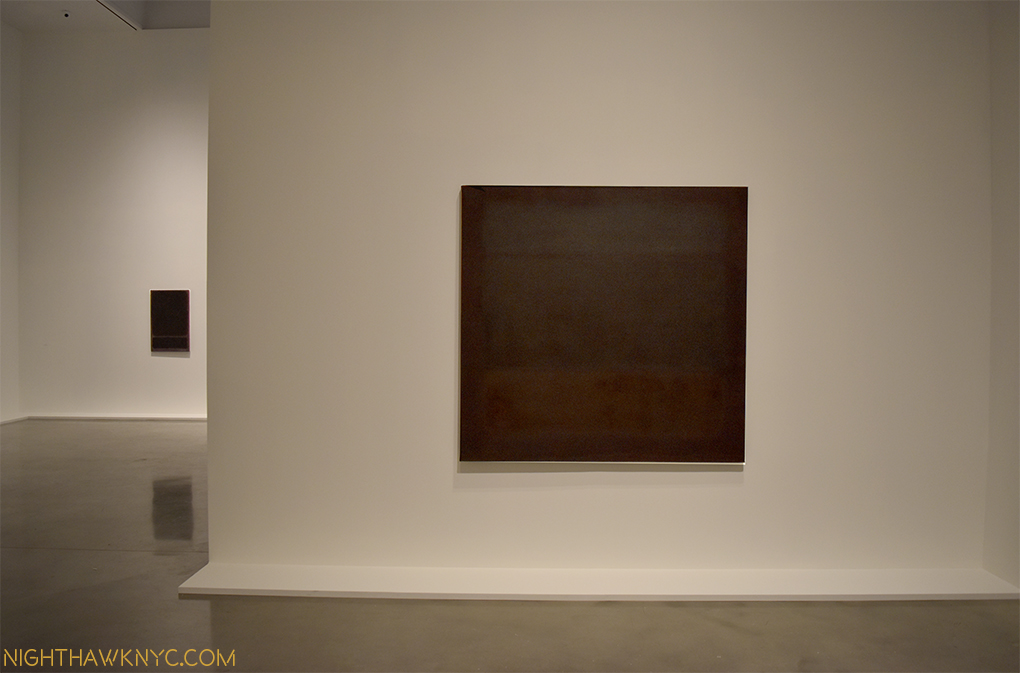
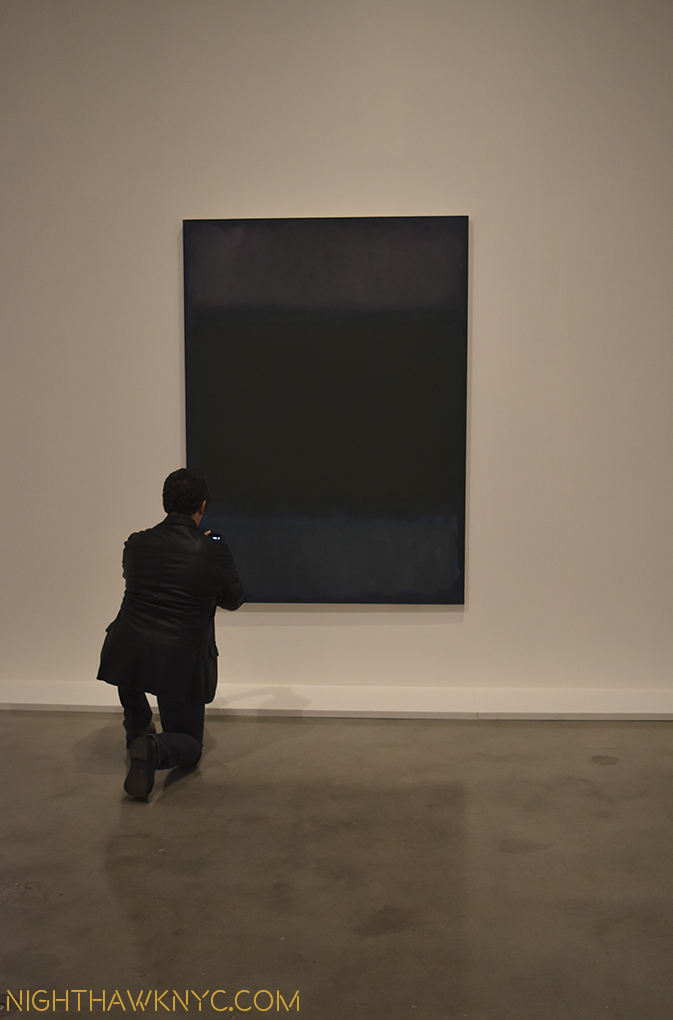
There have been Rothko shows in NYC since 1. But, none of them have yet matched the feeling I got from the 1999 show- aided in no small part by the way the works were hung, the way the show moved through his career. I’ve longed for that feeling ever since. At long last, here it is. The “dark” works have a unique mystery among Rothko’s work, and are a terrific choice for a theme. While some see them as “depressing,” (including a lady mentioned in the show’s introduction card who rejected one that Rothko had painted for her for that reason), I find them to be among his most powerful, subtle, even, yes, poignant pieces. While it’s always great to encounter a Rothko in a Museum, they’re usually hung among the work of others, which I find a bit distracting, For me, Rothko needs to be seen and experienced in a “vacuum,” or with only Rothkos nearby. Few institutions have that many Rothkos, and given their popularity, it is very hard for them to part with them and disappoint their visitors, even for a couple of months.

Worshipping at the altar?

Worshipping at the altar?

Luckily, two of the very few people who do have some, the offspring of Mr. Rothko, Dr. Kate Rothko Prizel and Dr. Christopher Rothko, have gone above and beyond to support this show. A number of the works on view come from their collections- by my count, no less than 4 from Kate’s and 2 from Christopher’s, in addition to “Seagrams Mural, Section 6” which they jointly own. That’s 7 of the 21 works on view- one third. (Christopher Rothko, by the way, is the author of one of the very best books on his father there is- Mark Rothko: From the Inside Out.). To help facilitate the loans of 3 pieces from major Museums, the Rothko “kids” loaned the institutions works from their own collections so the institutions would still have Rothkos to show their visitors, and enable them to part with the works requested for this show. Remarkable. Dad would no doubt be proud. With 21 “dark” works, the majority of which are out and out masterpieces in my estimation, including some stunning works on paper mounted on canvas, the results are as close as there has been to a truly “must see” show in Chelsea in years.

Someone else...

Someone else…

That said, it was only a year and a half ago that another show in this same space left me transfixed and provided many hours spent in sheer meditative bliss- by Richard Pousette-Dart. This one is very similar in it’s effect, as we explore the history of Rothko’s use of dark colors in his “sectional” works. I can’t categorize what these works say to me because it’s different each time I see them. Sometimes it’s spiritual. Sometimes poetic. Sometimes I feel like I’m standing on a foreign landscape looking at distant horizons. But, it’s that experience they give, the pure joy of looking, seeing and letting them in that transfixes me.

"Black in Deep Red," 1957. The day will come where these works will be as famous as Monet's are now, in my opinion.

Black in Deep Red, 1957. The day will come when Rothko’s work will be as ubiquitous as Monet’s are now, in my opinion.

This has been a year full of big New York School Abstract Expressionist Shows. First, there was the biggest “name” in AbEx, Jackson Pollock, at MoMA, then concurrent shows of his wife, Lee Krasner, and long time friend, Philip Guston. A very nice smaller show of New York School Artists is going on at Allan Stone Projects that includes two marvelous Joseph Cornell Boxes (Ok, he’s not an AbEx Artist, but his work is wonderfully abstract, and he was a New Yorker), alongside works by Abstract Expressionists2 de Koonjng, Arshile Gorky and Clifford Still. There’s also a nice Joan Mitchell show that’s about the same size as the Rothko show going on very nearby it, AND there’s the Centennial show of Richard Pousette-Dart, for my money the most under appreciated of the lot, going on right now at Pace uptown!

"Untitled," 1955 the earliest work here has never been displayed in the country before.

Untitled, 1955, the earliest work here, has never been displayed in the country before.

Phew…

I didn't bring flowers, so this will suffice as my "bouquet."

I didn’t bring flowers, so this Post will have to suffice as my “bouquet.”

For me, though, this show will be the high point. Short of going to the “real” Rothko Chapel in Houston, Texas or the Seagrams Room at the Tate, London, this is the only, and best, chance you’ll get to get that feeling…until the next big Rothko show. Unlike most of my Art Show Posts, this show only opened this past Friday, November 4, so you have until January 7, 2017 to experience it.

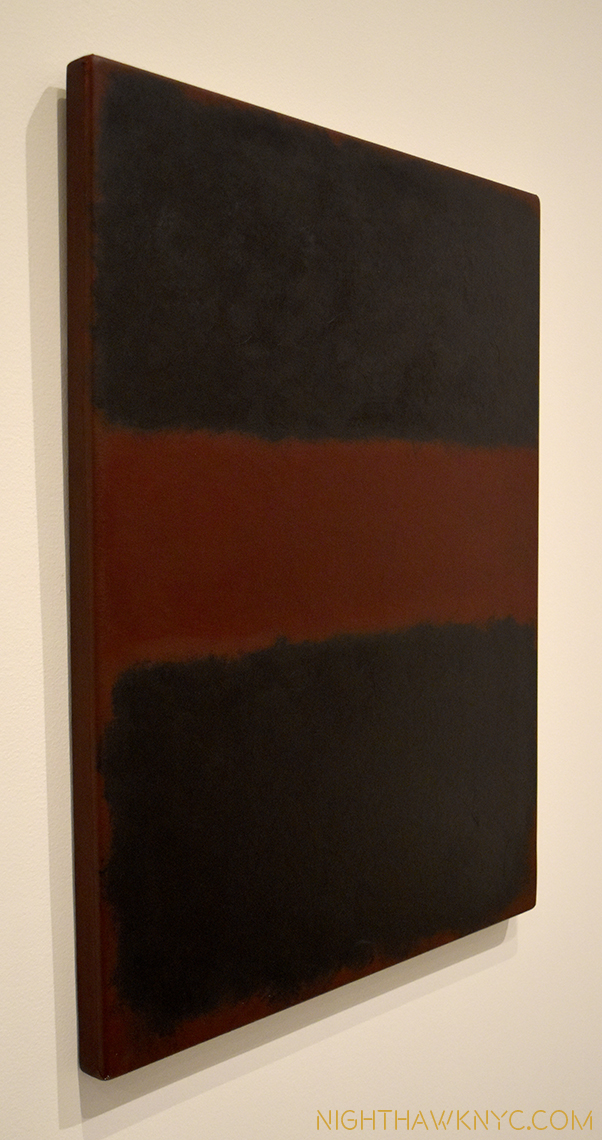
"Untitled," 1968, one of a few acrylic on paper, mounted on panel pieces here, seen from an angle.

Untitled, 1968, one of a few wonderful acrylic on paper, mounted on panel pieces here, has fascinating sides.

dsc_0328p2nh

After that? You’re stuck being like me- Praying for the next one.

dsc_0358pnh

*-Soundtrack for this Post is “Rothko Chapel” by Morton Feldman.

NighthawkNYC.com has been Free & Ad-Free for over 7 years, during which over 275 pieces have been published! If you’ve found it useful, please support it so I can continue.
I’m pleased to announce you can now support it by buying Art, ArtBooks and PhotoBooks! I’ve curated a selection of 400 books & pieces of Art from my collection, offered through my partnership with eBay seller GallerieK. Featured items of particular interest to my readers may be seen here. The complete selection is here now!

Or, you can donate to help keep NighthawkNYC.com online & ad-free below. Thank you!

Written & photographed by Kenn Sava for nighthawknyc.com unless otherwise credited.
Comments, thoughts, feedback or propositions? Click here.
Click the white box on the upper right for the archives or to search them.
Subscribe to be notified of new Posts below. Your information will be used for no other purpose.
  1. Mark Rothko: The Watercolors in 2014, shining light on his seldom seen work in the medium, and Mark Rothko: A Painter’s Progress, The Year 1949 in 2004, focused and fascinating, both excellent, and both at Pace, East 57th Street.
  2. according to a list The Met has published

Stuart Davis- The King of Swing

This site is Free & Ad-Free! If you find this piece worthwhile, please donate via PayPal to support it & independent Art writing. You can also support it by buying Art & books! Details at the end. Thank you.

Written & Photographed by Kenn Sava (*- unless otherwise credited)

Try it yourself.

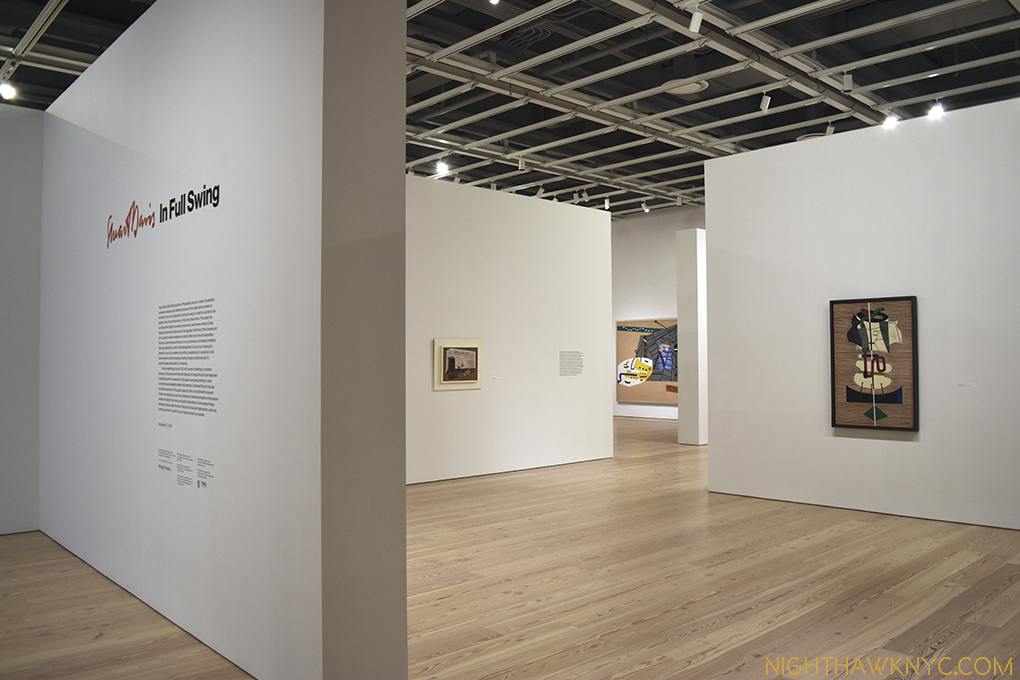
Walk into your local Art Museum and look for Stuart Davis. I bet they own at least one, and I also bet it’s on display. I’m making this wager based on my experience that every American Museum I’ve been to, including many smaller ones, owns at least one work by Stuart Davis, and that work seems to always be on view1. This is a testament to his wide, and ongoing, appeal. Stuart Davis’ Art still has a contemporary look and feel to it. Maybe that’s because so many Artists who have come after him, like much of “Pop Art,” have been influenced by him. Somehow, Davis is also an Artist who is rarely given a show. The last big one I know of was “Stuart Davis: American Painter” at The Met in 1991. It’s left me with years of longing to see more than one or two of his works at a time, so I was very excited when I heard about “Stuart Davis: In Full Swing,” June 10-September 25 at the Whitney.

dsc_6043pnh

It turns out to have been worth the wait. With 75 works ranging from 1923 until his final work left unfinished on his easel the night he died in 1964, we get to see much, if not all, of his accomplishment. The 1991 Met show featured 175 works, 31 before the earliest work in this show. While I’m a bit disappointed the show is missing the first decade of his work, (the title “Stuart Davis: In Full Swing” refers to his career being in full swing during the period of his work displayed), what’s included has been marvelously hung adding much insight into Davis’ process and development.

Davis' seminal 4 "Egg Beater" Paintings, 19__, rarely united

Davis’ seminal 4 “Egg Beater” Paintings, 1927-28, rarely united.

…I nailed an electric fan, a rubber glove and an eggbeater to a table and used it as my exclusive subject matter for a year.” Egg Beater No. 4," 1928

Breakthrough. “I nailed an electric fan, a rubber glove and an eggbeater to a table and used it as my exclusive subject matter for a year.2” Egg Beater No. 4,” 1928

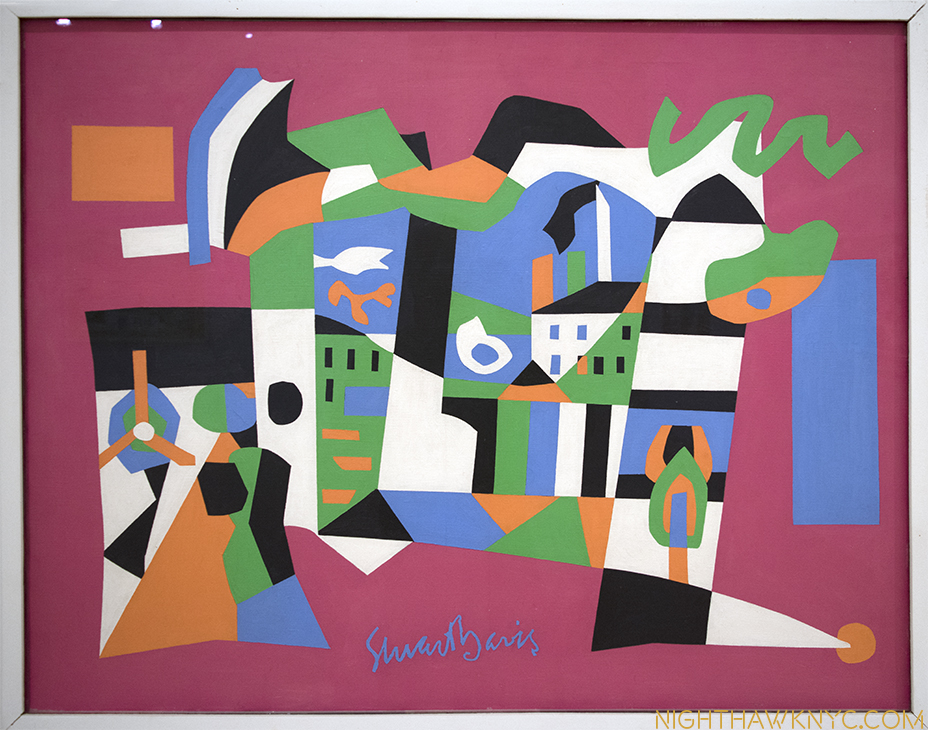
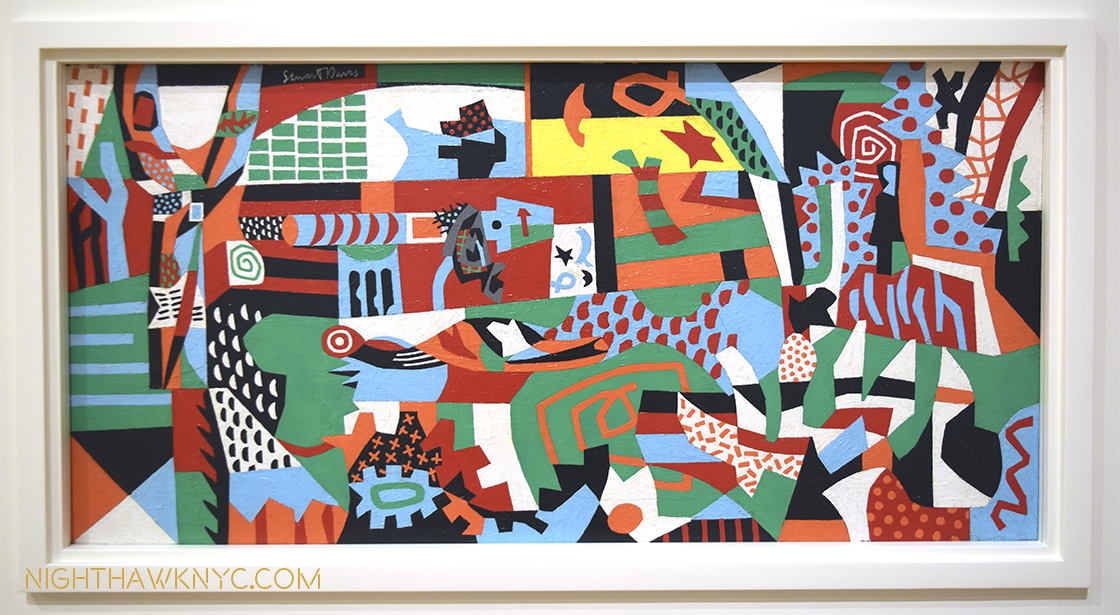
Beyond this, it’s simply gorgeous to behold. Davis, the colorist, is  something not often  spoken about, and for me, is under-appreciated. His work needs to be seen in person, where his color makes a vibrant, stunning, often shocking first impression- even in 2016. Looking closer, it becomes apparent that though he uses relatively few colors and repeats them from piece to piece he is a master of color schemes. Has any American Artist used Yellows or Oranges the way Davis has?

"Cliche," 1955

“Cliche,” 1955

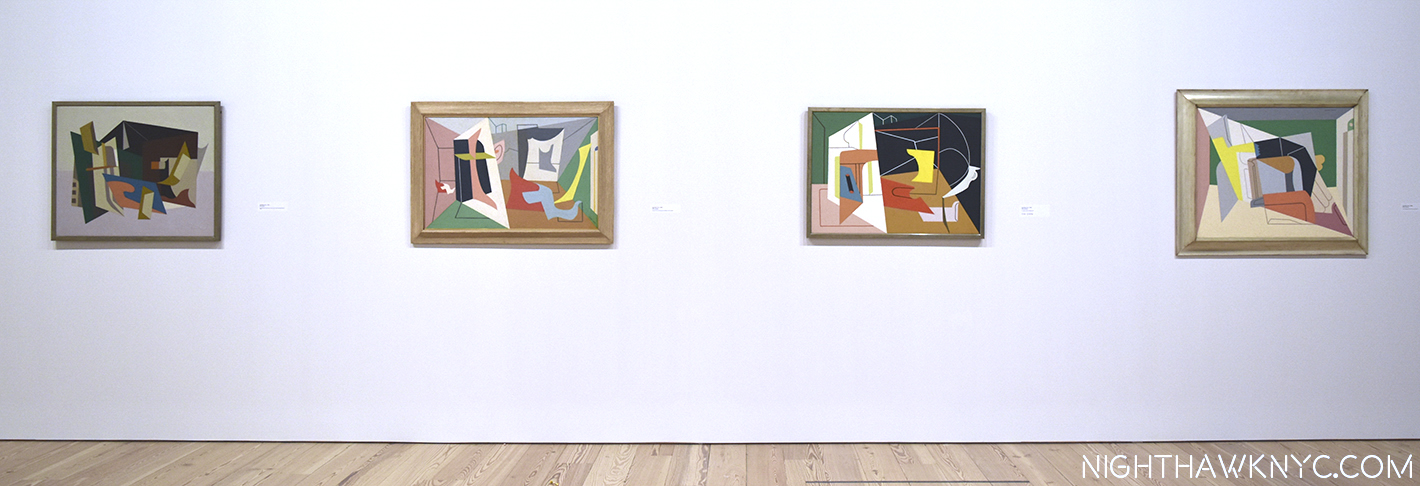
Having come out of the end of the era of  “Ashcan School,” Davis’s early work, often depicting street scenes of the greater New York area, shared their darker palette. Here and there he’d inject very bright passages of color, as in “Bleecker Street,” 1912. Soon, they would dominate as the influence of the Europeans, the Cubists 3, and Joan Miro took hold, his palette brightened. Matisse was also an early influence, and  even in the 1950s, Davis’ work features shapes that echo those found in Matisse’s late Cut-Outs.

dsc_2983nefpnh

“Midi,” 1954

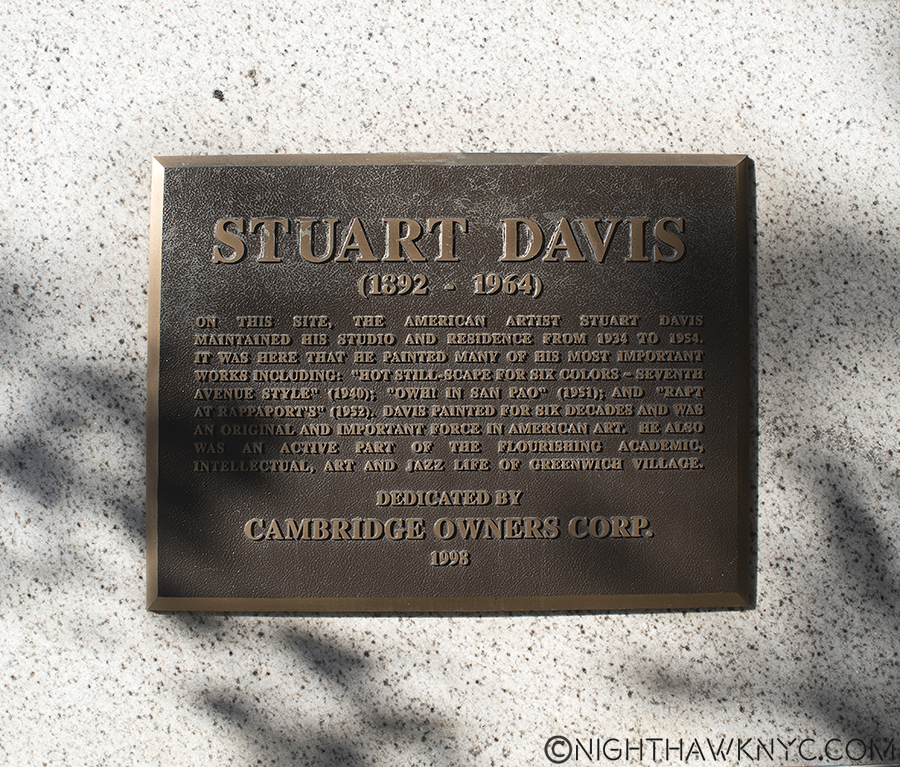
The title “Stuart Davis: In Full Swing” is a double entendre, also referring to his love of Jazz- “swing” being the most popular form of the music in the 1920’s and 1930’s. Stuart Davis loved Jazz. As I wrote not all that long ago upon accidentally discovering where he lived for 20 years in Greenwich Village, it was, coincidentally or not, around the corner from some of the greatest jazz clubs in the world4.

DSC_7025P2NH

The plaque outside Davis’ home of 20 years where he created works that have “come home” to the nearby Whitney.

Looking at his work, it’s clear that he “gets” what it’s like to play Jazz, what goes on in the mind of the musician or singer, and it comes out of his hands, like it does for musicians, too.

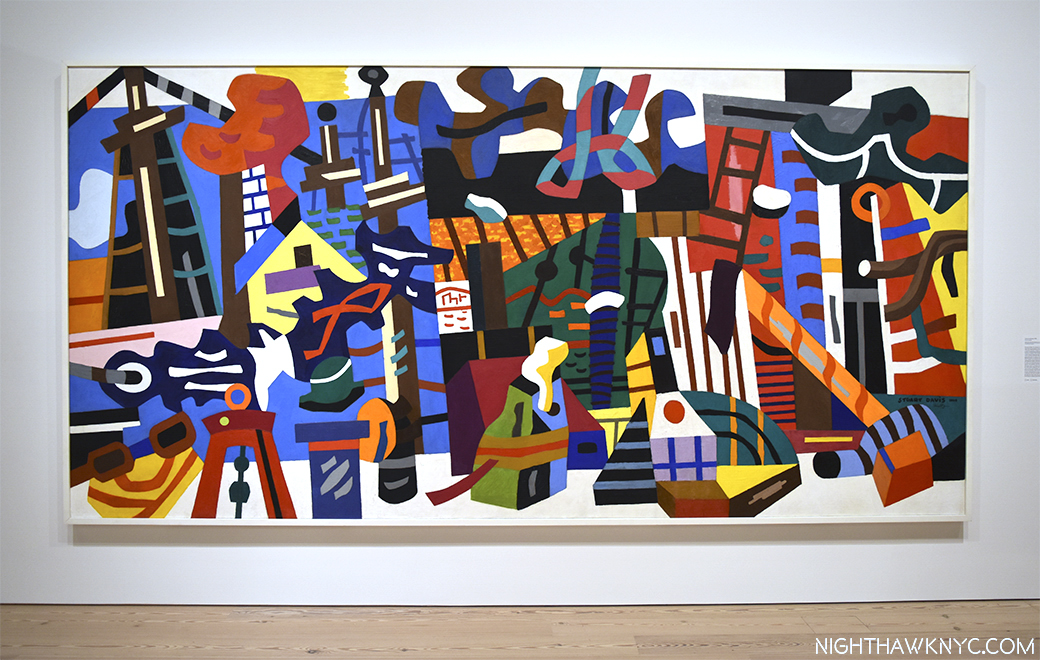
Davis In Full Swing. "Swing Landscape," 1937

In Full Swing. “Swing Landscape,” 1938, over 14 feet long, the largest work here, originally intended for a Brooklyn Apartment Building.

Walking around, I spent quite a bit of time trying to associate Davis’ work with specific Jazz Artists. While I found there were many who came to mind for specific works, I came to feel that Davis’ work was ahead of it’s time, musically, as well as visually/Artistically. His shapes seem to anticipate the angular developments of Musicians like Thelonious Monk and Andrew Hill. Standing in front of a work like “Swing Landscape,” 1938, an endlessly fascinating blend of nautical visual motifs in a riot of color, the feeling is like listening to a great Big Band. Take Duke Ellington’s or Count Basie’s classic Big Bands that were chock full of unique soloists. each one with a recognizable solo voice. When Lester Young soloed on Tenor Sax for Basie, there was no doubt who was playing. Same for Johnny Hodges, “Tricky” Sam Nanton, Ben Webster, or Bubber Miley with Duke, not to mention Duke and the Count, themselves. Looking at “Swing Landscape,” is like hearing a big band to me, a band comprised of unique voices (colors on shapes), each playing their own part, but still a part of the whole. There is an overriding feeling of joy, and life. But, there were other works that looked to me more like the music of non-swing Masters Art Blakey’s Jazz Messengers and even early Ornette Coleman. Though I mixed them in, and many others, I found myself repeatedly returning to Duke Ellington, one of the greatest composers of the century, in any style of music, who also continually pushed and evolved his style, taking the Big Band to many other places musically, like Davis did with Cubism, as the soundtrack for my visits.

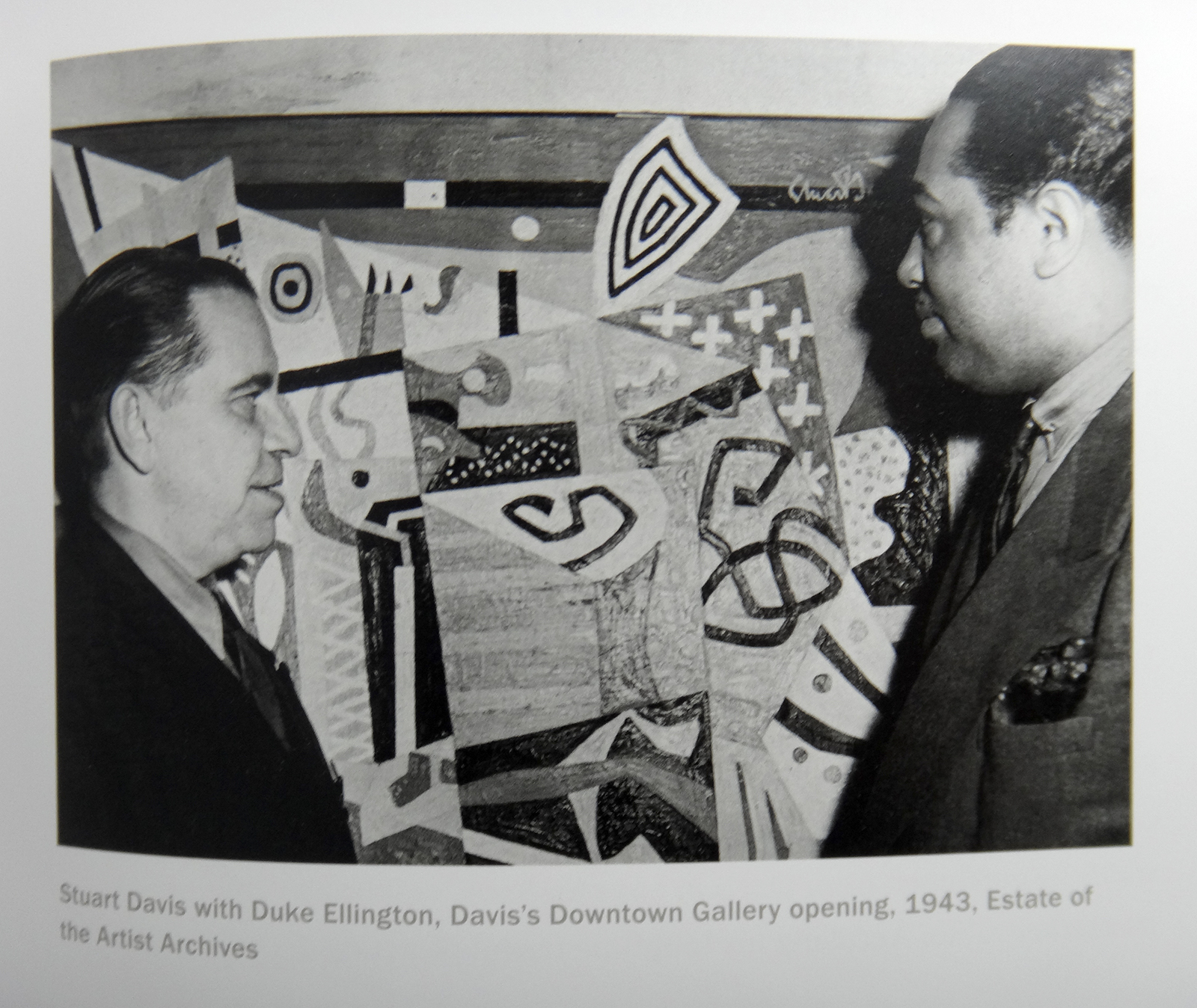
Stuart Davis with Duke Ellington, 1943, from the show's catalog.

Let’s talk about Jazz. Stuart Davis with Duke Ellington at a Davis show, 1943, from this show’s catalog.

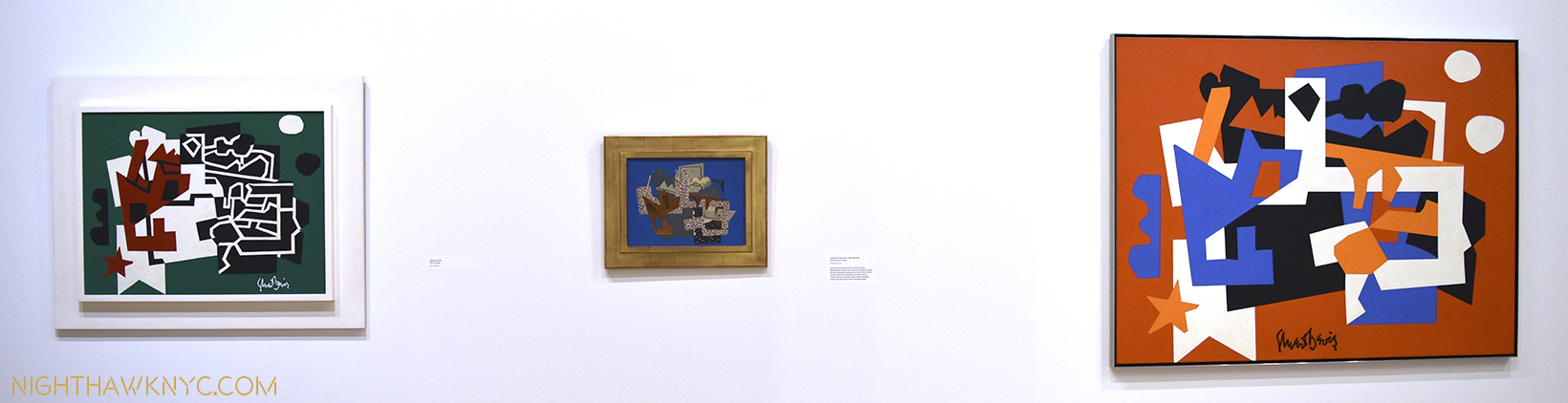
Also like a Jazz Artist, Davis returned again and again to earlier compositions and “riffed” on them, as Patricia Hills said 5. Davis re-interpreted his earlier compositions the way Jazz Artists reinterpret standards- using his original theme as a jumping off point to create something entirely new.

Progress in the Process. All 3 of these works are based on the center work from 192_. Left, 195_ and 19__, right

Riffin’ on a Theme. All 3 of these works are based on “Landscape, Goucester,” center, as follows.

dsc_3001pnh

“Landscape, Goucester,” 1922…

"Colonial Cubism," 1954

Became this- “Colonial Cubism,” 1954

dsc_2996pnh

And then, this- “Memo, #2,” 1956

In terms of Jazz in Art, I can’t think of another Artist who has a similar effect on me. Other Artists listened to Jazz, during the same time and later, but Stuart Davis’ work looks like Jazz to me. I get that feeling from isolated works by other Artists, especially that of Romare Bearden, who Davis told to visualize the relationships between jazz and art in 1940, though his works are primarily collages, not paintings, but Davis’s whole body of work, with rare exception, gives me that feeling6.

Blue Note. "The Woodshed," 1969, collage by Romare Bearden. The "Woodshed," or "Shed" is where musicians hone their craft.

Blue Note. “The Woodshed,” 1969, collage by Romare Bearden, at The Met Breuer.. The “Woodshed,” or “Shed” is where musicians hone their craft.

Yet, there’s more going on here than Jazz.

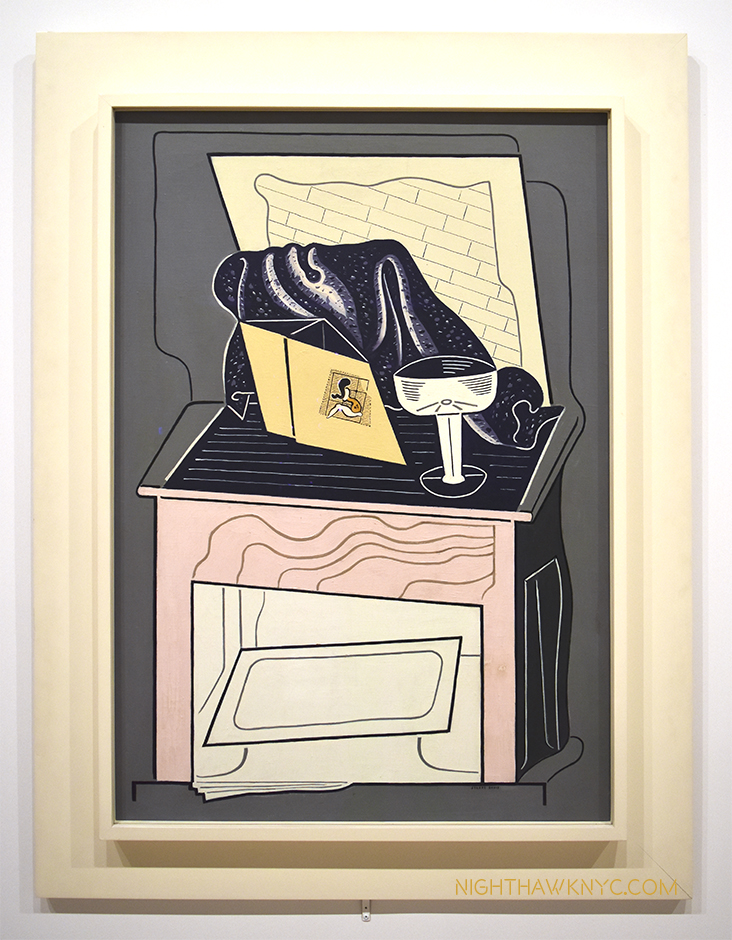
Revolutionizing the still life. “Super Table,” 1924. For me, the earliest masterpiece in this show.

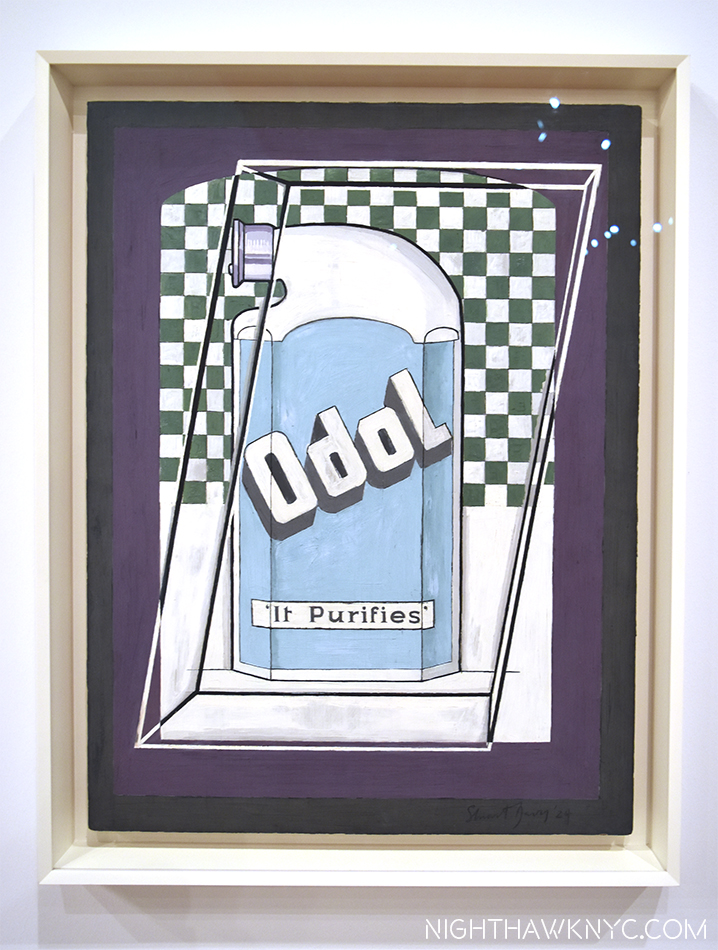
We watch Davis breaking through and coming into his own in works like “Super Table,” 1924, and the “Egg Beater” series of 1927-28, which were revolutionary takes on the Cubist “still life,” that proved to be the jumping off points for all his future work that would see him develop his own approach to Cubism, becoming one of the very few outside of the inventors of the style to do so. While he built upon the influences of others, he was very influenced by place and environment as well. His 1928 trip to Paris crops up again and again in his later work. His summers along the water in Gloucester, Mass supplied a life long reservoir of nautical imagery, as did, NYC, while Jazz provided inspiration. Products appear in Davis’ work, possibly evolving out of the still life works of the Cubists, but quickly becoming his own. He then takes words, first seen in ads and on products, and uses them in new ways, sometimes referencing the “hip” jargon of the time, sometimes cryptically, that only he really understands.

"Odol," 1924, a bottle of mouthwash, presaging Warhol by 35 years.

“Odol,” 1924, a bottle of mouthwash, presaging Warhol by 35 years.

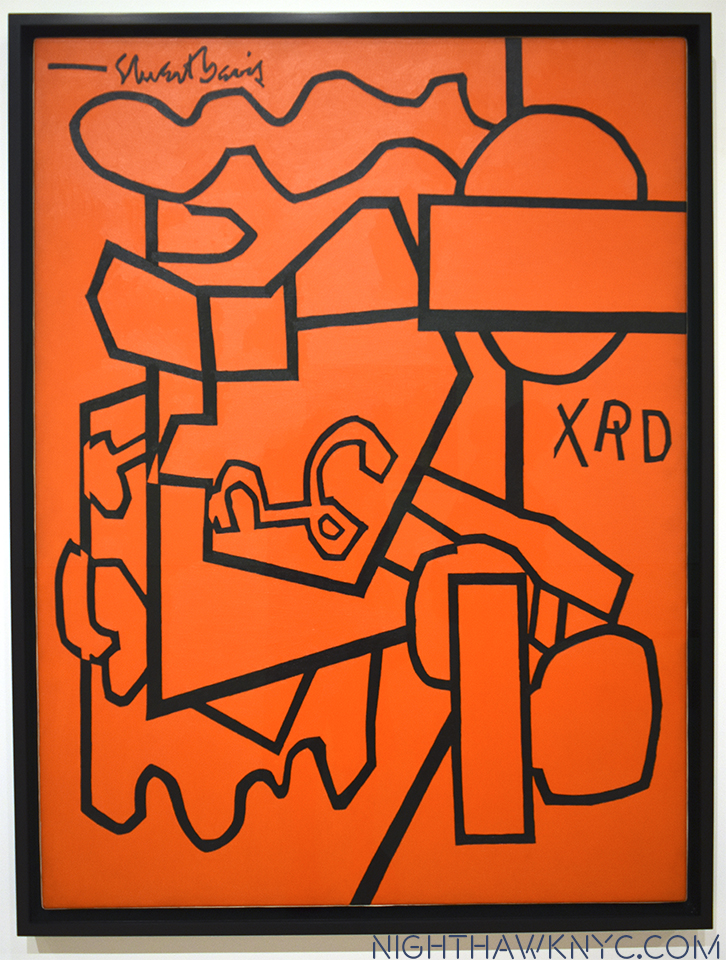
A walk through the show reveals that Pop Art, and a number of it’s leading lights were creating work that featured elements Stuart Davis began using way back in the 1920’s. In fact, after seeing it, you may never look at Andy Warhol, Roy Lichtenstein, Jasper Johns or James Rosenquist quite the same again. Beyond his use of products, his use of words is something that many Artists since Davis, right up to Ed Ruscha, Jenny Holzer and Wayne White, have continued, some basing their entire Artistic output on them. While his influence is huge, it’s also interesting to me how different his work is from the work of the other Abstract Artists of his time, especially the Abstract Expressionists, who were then working right around him every day in NYC and it’s suburbs. Philip Guston speaks of knowing him 7. What about Jackson Pollock, (who was born, lived and work, then died during the time Davis was alive)? Did Davis know him? It would seem to me they must have met, especially since they both worked for the WPA (Works Progress Administration). It’s hard to imagine two more different Abstract Artists.

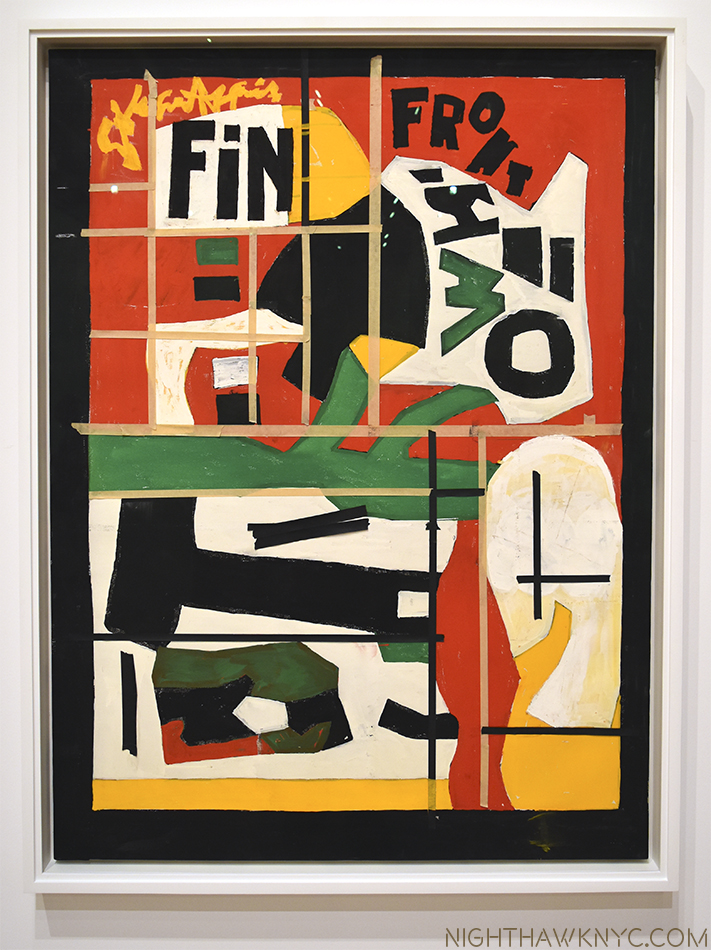
The end. "Fin," 1962-64, as it was left on his easel when he died.

The end. “Fin,” 1962-64, as it was left on his easel when he died. The yellow-ish lines are masking tape Davis used as guides.

dsc_2690pnh

“Arboretum by Flashbulb,” 1942

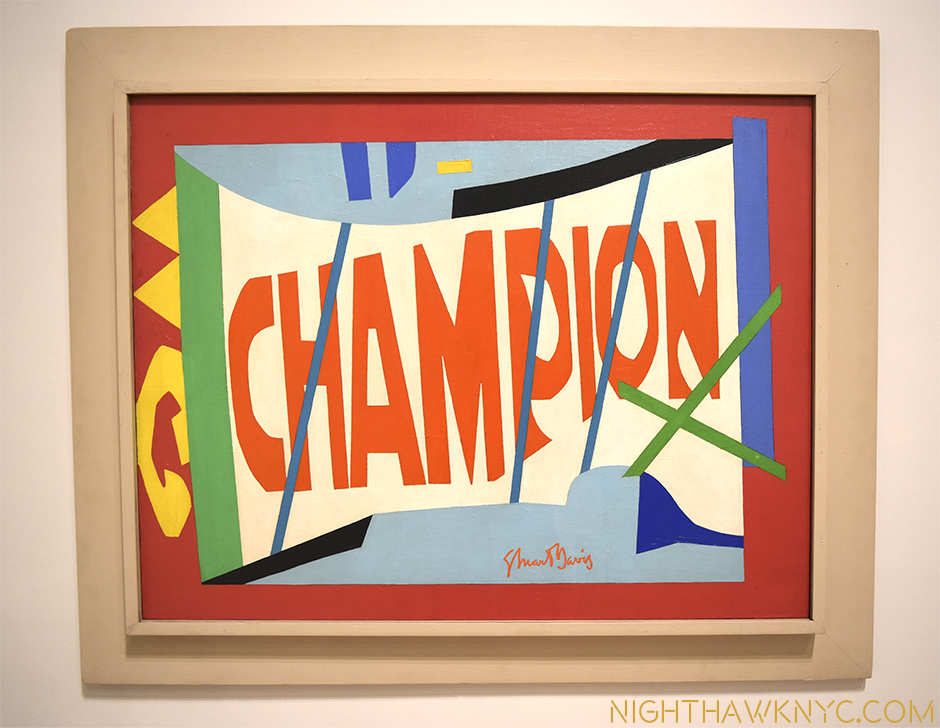
It must also be mentioned that Mrs. Gertrude V. Whitney was a substantial, and early, supporter of Davis, in a number of ways, both financially (buying his Art and advancing him funds) and through the Whitney Studio Club, the precursor of the Whitney Museum, where he got his “big break,” 8 with a 2 week retrospective exhibit in December, 1926. 90 years later, Davis returns to the latest incarnation of the Whitney Museum, a few minutes walk from where he once lived, something of a “champion” of American 20th Century Art, himself. His influence is ongoing. His achievement is still being considered. Yet? All in Stuart Davis’ Legacy is not painted in the bright colors he used so masterfully in his work.

"Little Giant Still Life," 1950, a box of "Champion" matches

“Little Giant Still Life,” 1950, a box of “Champion” matches.

While the joy, beauty and insights this show provides will stay with me for a very long time, it’s impossible not to also be reminded of the fact that 90 works by Stuart Davis were discovered to have been “looted” 9 from the Artist’s Estate by Laurence Salander of Salander-O’Reilly Gallery, the long time dealer for Stuart Davis’ Estate, in 2007. The court ruled that Salander owes Earl Davis and the Estate $114.9 million dollars, but being as Salander is behind bars on Riker’s Island no one knows if and when any of that money will be repaid. As bad as that is, perhaps even more tragically, to this day, I’m not sure that all of Davis’ works have been accounted for. The case led to the creation of new laws pertaining to Artist/Gallery dealings. That is the saddest part of what is otherwise the great and ongoing influence that is the legacy of Stuart Davis, one of America’s greatest, and most influential, Artists.

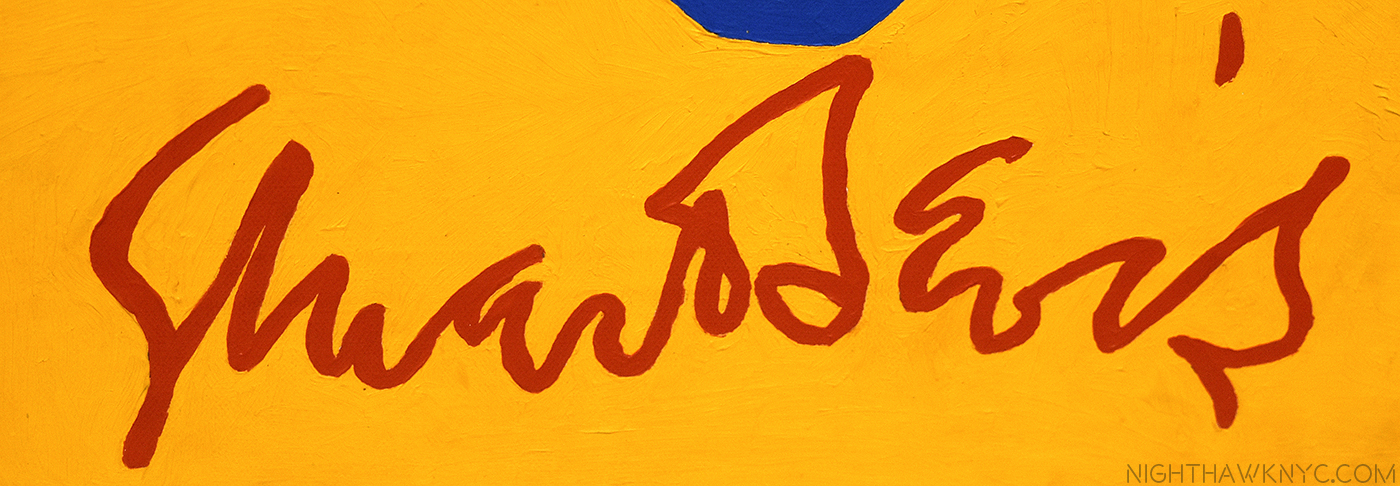
Even his beautiful signature, boldly featured in many of his works, has the peaks and valleys, the ebbs and flow, of a Jazz solo.

*-Soundtrack for this Post is “It Don’t Mean A Thing (If It Ain’t Got That Swing)” by Edward Kennedy “Duke” Ellington, the title of which appears on Davis’ painting “Tropes de Teens,” 1956.

NighthawkNYC.com has been entirely self-funded & ad-free for over 8 years, during which 300 full length pieces have been published! If you’ve found it worthwhile, PLEASE donate to allow me to continue below. Thank you, Kenn.

You can also support it by buying Art, Art & Photography books, and Music from my collection! Art & Books may be found here. Music here and here

Written & photographed by Kenn Sava for nighthawknyc.com unless otherwise credited. To send comments, thoughts, feedback or propositions click here. Click the white box on the upper right for the archives or to search them. Subscribe to be notified of new Posts below. Your information will be used for no other purpose.
  1. I’m not wagering “anything” on this, so if you find one that doesn’t have a Stuart Davis, write me and let me know and I’ll send this Post to them to hopefully influence their future purchases!
  2. Stuart Davis “Autobiography” in “Stuart Davis” edited by Diane Kelder, P.26
  3. Davis, 21, was the youngest artist to be included in the legendary Armory Show of 1913, the first modern art show in America, which marked the arrival of Cubism in New York.
  4. His parents had lived in the Hotel Chelsea, 11 blocks north.
  5. “Stuart Davis,” by Patricia Hills, P. 19
  6. I am only talking about Artists who were/are Painters first, so I am leaving out Musician/Artists like Miles Davis, Art Blakey, Tony Bennett, Muhal Richard Abrams, Anthony Braxton, Roscoe Mitchell, et al..
  7. Guston “Collected Writings” P.40
  8. according to Patricia Hills “Stuart Davis” P.73
  9. Artnews April 18, 2014

NoteWorthy Shows-October, 2016

As a counterpoint to my longer pieces on big shows, here’s something else-  shorter looks at some especially Noteworthy Shows that I’m not going to have the time to do the full pieces on that they each deserve, but that I want to bring to your attention.

Post-Labor Day has seen things quiet down on the NYC Museum show scene, after an insanely busy summer. The action has turned to the galleries. Here are some shows I saw recently that I was especially impressed with, in no particular order-

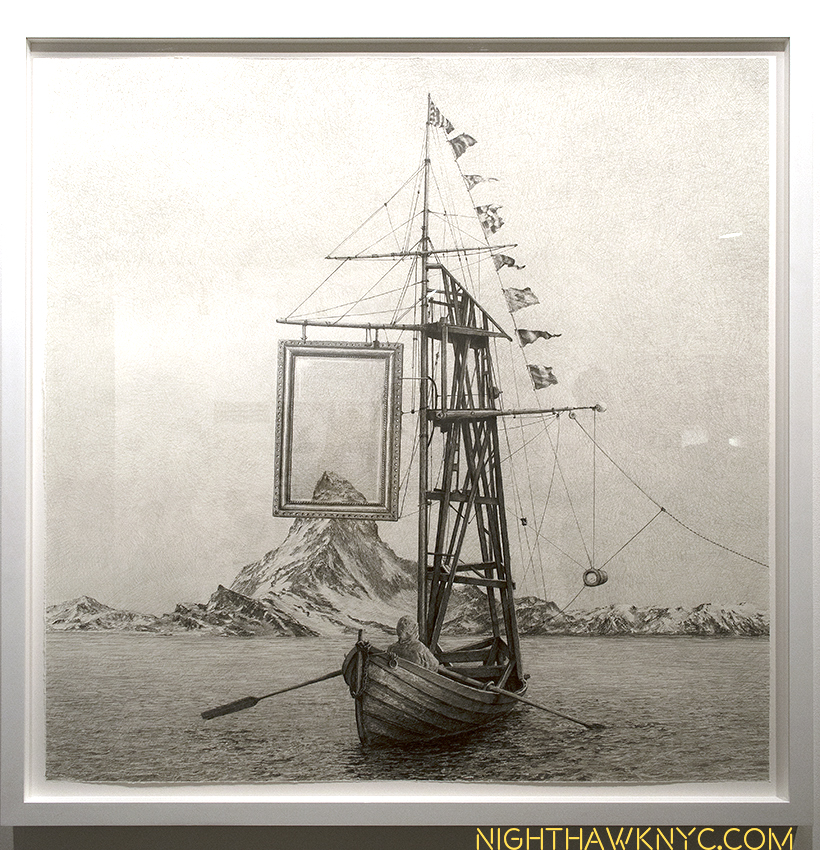
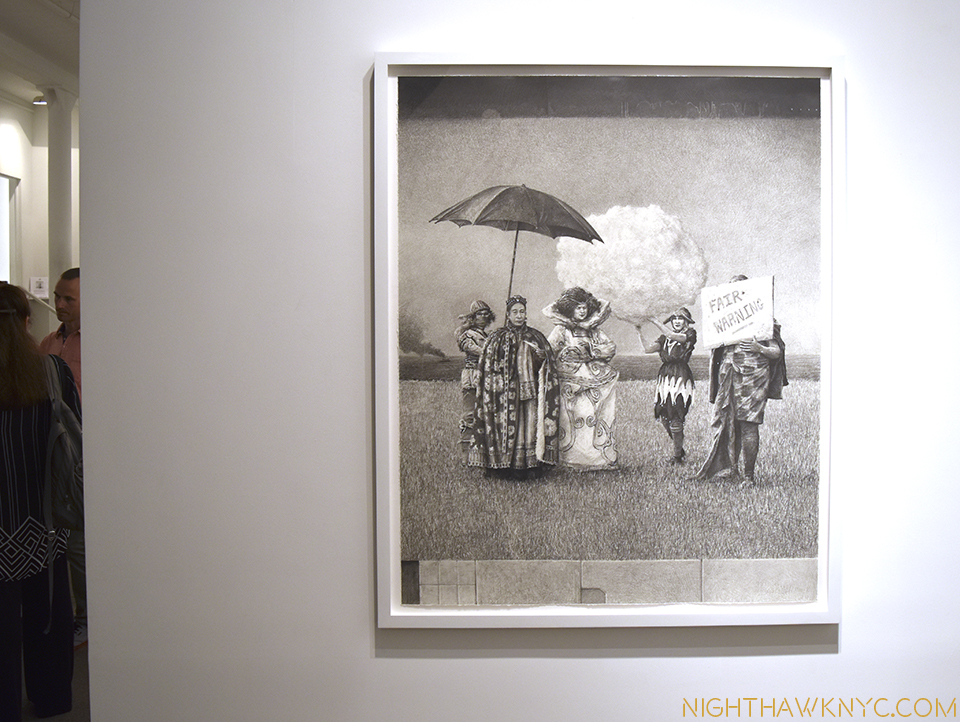
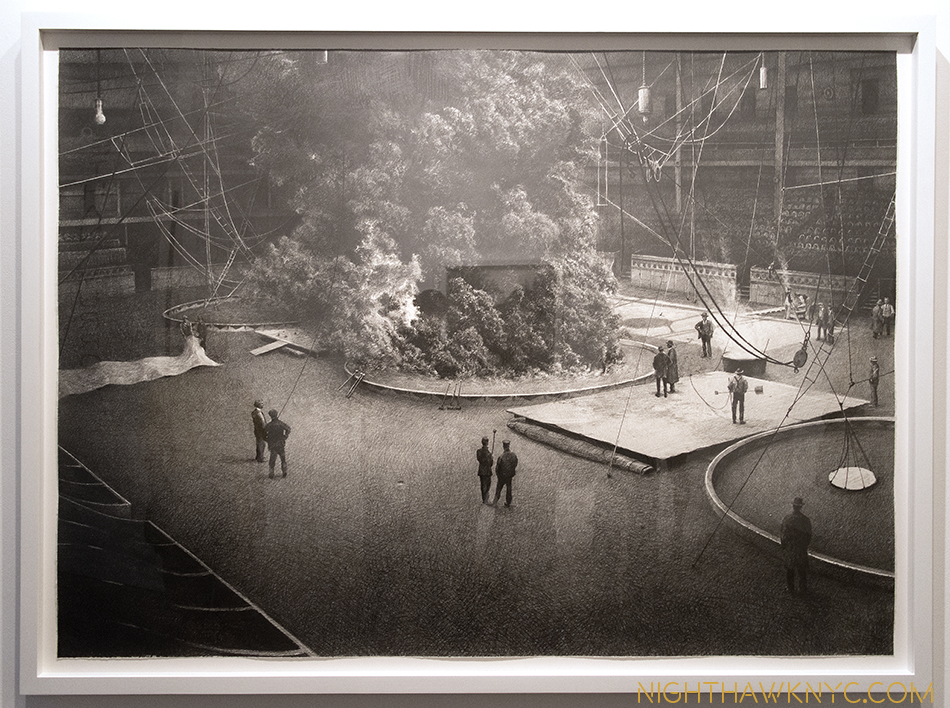
Ethan Murrow: Water Almanac” @Winston Wachter. A show of very large drawings(!) about the folly of man trying to control nature, many featuring water, shown in a space that was partially submerged almost 3 years ago after Hurricane Sandy, destroying some of Mr. Murrow’s work. When I pointed out the irony of it to him, he responded, “At least they weren’t people,” he said referring to his lost work. When I asked him why he draws instead of paints he spoke of the minimal amount of materials necessary. His work has wonderful elements of the Surrealism of Max Ernst and Bruce Conner that he makes seem everyday real world.

"Deluge Estimator," 2016, graphite on paper

Ready for the next Sandy? Hmmm… “Deluge Estimator,” 2016, graphite on paper

Ethan Murrow (in orange shirt) at his opening.

Ethan Murrow (just to the left in orange shirt) at his opening.”Hail Cannon Rainmaker,” 2016, graphite on paper, 60 x 48 inches, right.

"To Redirect the Tempest," 2016, graphite on paper

“To Redirect the Tempest,” 2016, graphite on paper, 52 x 72 inches

Meleko Mokgosi: Democratic Intuition” @ Jack Shainman Gallery. I’d write something about this, if I could ever finish looking at it and thinking about it.

img_6684pnh4

“Democratic Intuition- Comrades II,” a very large work

And seen at the show's 2nd location.

And as seen at the show’s 2nd location.

Sol LeWitt” at 3 Paul Cooper Gallery Locations, Pace Prints, and The Met. Yes, no less than 5 simultaneous shows featuring Lewitt’s drawings, scultpture, photography, collages, prints and, suddenly ubiquitous wall drawings (not to mention the permanent one on view in the NYC Subway at 57th Street & Columbus Circle!).

"Complex Form #65," 1989, painted wood, 59 x 38 x 40 inches, in front of "Wall Drawing #368" @ Paula Cooper.

“Complex Form #65,” 1989, painted wood, 59 x 38 x 40 inches, in front of “Wall Drawing #368” @ Paula Cooper.

Detail

Detail

"Wall Drawing #370" as seen at The Met

“Wall Drawing #370” as seen at The Met

“Alexi Torres: Sun Light” @ UNIX Gallery. No mere photo-realistic interpretations of source photos here. Visions- exquisitely executed.

"Sun Light-Ernesto," 2016, oil on canvas

“Sun Light-Ernesto,” 2016, oil on canvas, 72 x 68 inches

"Sun Light-Miguel," 2016, 84 x 80 inches, oil on canvas

“Sun Light-Miguel,” 2016, , oil on canvas, 84 x 80 inches

dsc_8734pnh

Detail

Miguel- Source Photo

Miguel- Source Photo

Robert Currie in “Mind Storm” @ Bryce Wolkowitz. A name new to me. As close as I can gather, Robert Currie applies paint to monofilament thread in rows, which can be seen from the side, or in their reflections, below the works. The image can only really be seen from directly in front. Somehow, they still manage to evoke the sense of the place as well as the sense of a bygone era.

Installation View

Installation View

"17,820cm of nylon monofilament and acrylic," 2016. That's 590 feet.

Entitled- “17,820cm of nylon monofilament and acrylic,” 2016. That’s 590 feet of it in a work that’s 12 x 16 x 5 inches.

dsc_8790pnh

Side view

Fahamu Pecou: #BlackMatterLives” @Lyons Wier Gallery. Prolific and multi-talented, this could be a breakthrough show for him. Powerful. Gorgeous rawness. Present tense.

dsc_9124pnh

“Even In Darkness,” 2016, acrylic, spray paint, gold leaf on canvas, 60 x 48 inches

"Ultimate Yello Brick," drawing

“Ultimate Yello Brick,” 2016, graphite and iridescent ink on paper

And- “diane arbus: in the beginning” @ The Met Breuer. Memorable as much for the show’s content as for it’s innovative display, Ms. Arbus’ beginnings show the Artist’s eye fully formed. Each of the 100 plus images on view is given it’s own wall- a side of a “mini-pillar” that allows the viewer to move through the show any which way they want to. Ingenious and ground-breaking, it’s more a case of The Met showing off it’s construction capabilities and resources more than “why didn’t anyone else think of this before?”

There is no "recommended" way to see this show.

There is no “recommended” way to see this show.

Especially noteworthy for me was a photo of my late friend, the legendary Stormé DeLarverie,, titled Miss Stormé DeLarverie,The Lady Who Appears to be a Gentleman, NYC, 1961. I knew Storme during the final decade of her life, and she had told me that Diane Arbus had photographed her, though I had not previously seen it. I took it with a grain of salt, given to tall tales as she was on occasion (will we ever know if she really was the “cause of,” or started, the Stonewall Uprising, not “Riot”, which I heard her claim she was?). But, there she is, sitting elegantly on a park bench in 1961, immortalized for all time, in the permanent collection of the Metropolitan Museum of Art, and on view as part of this very good show at The Met Breuer. Diane Arbus had one of the greatest eyes in photography.

Storme, in full effect in 1961. 45 years before I would meet her.

Stormé, in full effect in 1961. 45 years before I would meet her.

Some of these shows are still up, some have just closed. And somewhere the singer is saying…

“’cause no one knows about a good thing
Until a good thing is gone.”

R.I.P- Stormé DeLarverie,. Get home safe, my friend.
*- Soundtrack for this Post is “No One Knows About A Good Thing” by Curtis Mayfield and Daryl Simmons, from Mayfield’s album “New World Order,” and published by Warner- Tamerlane Publishing Corp.

NighthawkNYC.com has been entirely self-funded & ad-free for over 7 years, during which over 275 full length pieces have been published!
I can no longer fund it myself. More on why here.
If you’ve found it worthwhile, PLEASE donate to keep it online & ad-free below.
Thank you, Kenn.

Written & photographed by Kenn Sava for nighthawknyc.com unless otherwise credited.
To send comments, thoughts, feedback or propositions click here.
Click the white box on the upper right for the archives or to search them.
Subscribe to be notified of new Posts below. Your information will be used for no other purpose.
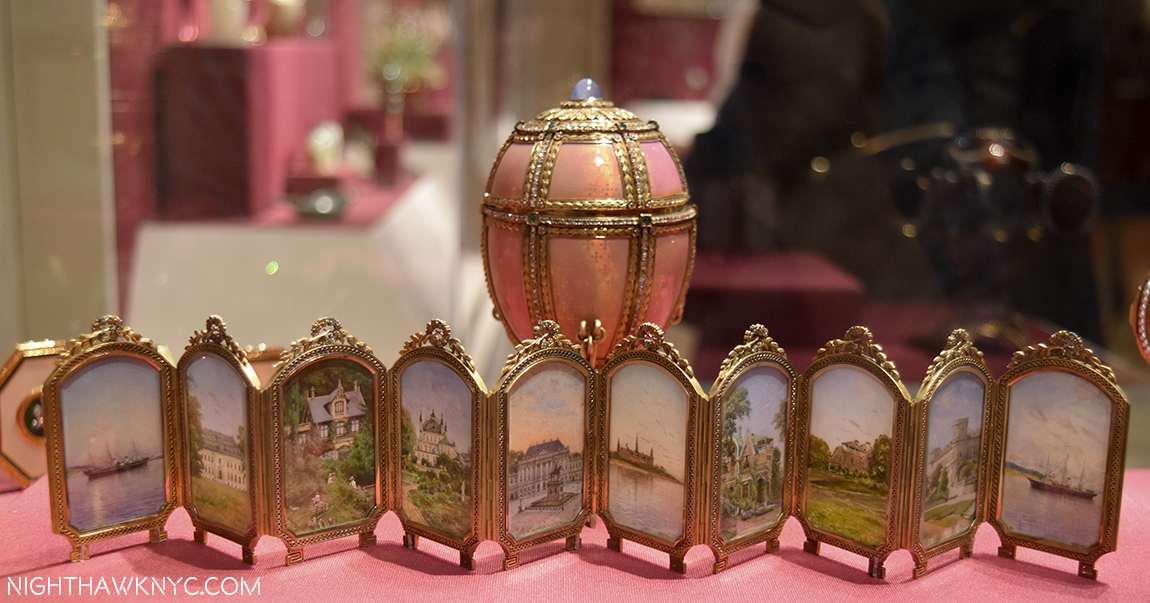
Does Humor Belong In Art? Ask Wayne Whiter

This site is Free & Ad-Free! If you find this piece worthwhile, please donate via PayPal to support it & independent Art writing. You can also support it by buying Art & books! Details at the end. Thank you.

Written & Photographed by Kenn Sava.

In 1986 the great Frank Zappa released an album who’s title asked “Does Humour Belong In Music?” The same year Wayne White was working as set designer, puppet creator & operator on the ground breaking, now classic, avant-garde TV show, “Pee-Wee’s Playhouse,” for which he won 3 Emmy Awards. Not content with that, 1986 also saw him win a Billboard Magazine award for best Art Direction for Peter Gabriel’s music video “Big Time.” He followed that up with an MTV Music Video Award for designing the Smashing Pumpkins video “Tonight, Tonight” in 1996-

20 years later I caught up with what he’s doing now over at his show, “I”m Having A Dialogue With The Universe And You’re Just Sitting There,” at the Joshua Liner Gallery, in the shadow of the new Zaha Hadid Building still going up on West 28th street. (They’ve added her name in very large letters at the very top, looking not unlike one of Wayne White’s “Word Paintings,” though it’s temporary…I assume.) As for Wayne White, he’s moved on from Pee-Wee to this-

3 Works in Wayne's custom hand holders.

Wayne White’s “set-like” installation for 3 of his “Word Paintings.”

The endless sailboat is now the endless covered wagon above on the left, below, and is joined by a series of Wayne’s “Word Paintings,” which consists of words and phrases he paints on top of old lithographs he finds in thrift stores, and one sculpture.

"I'm Having A Dialogue With the Universe And You're Just Sitting There," 2016

“I’M HAVING A DIALOGUE WITH THE UNIVERSE AND YOU’RE JUST SITTING THERE,” 2016

It turns out that all the while (actually, most of his life) Wayne White has been drawing incessantly, as can be seen in the 400 page monograph edited by designer Todd Oldham entitled, “Wayne White: Maybe Now I’ll Get The Respect I So Richly Deserve.” But even this only covers some of his creative work. Yet, he is clear on what he wants to accomplish.

“My mission is to bring humor into fine Art. I’m not talking about coy art world funny. I’m talking about real world, Richard Pryor funny. Humor is our most sacred quality. Without it, we are dead,” he says.

dsc_8839pnh

“HAD IT GOIN ON BUT LOST IT THEN GOT IT BACK THEN FUCKED UP AND LOST IT,” 2016

"DEMAGOGUE," 2016

“DEMAGOGUE,” 2016

Is this Art? Hmmmm….Time will tell. There is a history of “word art” in museums, from Stuart Davis through Jasper Johns, Warhol, Ed Ruscha, Jenny Holzer and Barbara Kruger.

Ed Ruscha's "OOF," 1962, at Moma, one of the most beloved works in Western Art at the NighthawkNYC Offices (It's an inside joke.)

Ed Ruscha’s “OOF,” 1962, at Moma, a favorite here at the NighthawkNYC Offices.

There is the whole question about the ethics of taking someone else’s art and painting over it, though Mr. White only paints on lithographs, not paintings, so he’s not defacing a one of a kind, like Hans-Peter Feldman, who happened to have a show right around the corner, does. There is recent precedent for this in Ai Weiwei’s “Coca-Cola” painted on an antique Chinese Urn, among others, but I am not an intellectual property lawyer.

dsc_8826pnh

I find it ironic that he did the Art Direction for Gabriel’s Big Time…

whose lyrics now seem prophetic-

“The place where I come from is a small town
They think so small, they use small words
But not me, I’m smarter than that,
I worked it out
I’ll be stretching my mouth to let those big words come right out”*

Born and raised in Chattanooga, Tennessee, his life changed when he discovered the underground comics of Art Spiegelman and R. Crumb. He hunted down Spiegelman and took his cartooning class at the School of Visual Arts. After graduating, Pee-Wee, and the music videos, a studio accident led to his putting words on found art, and his “Word Paintings” were born. Over a decade later, they are becoming iconic- most of those on view are sold, some for as much as $25,000.00. But, they are only one side of the man’s talent. I yearn to see a more complete showing of his range- his more abstract Word Paintings, as well as his other paintings which are not based on found lithographs, his sculpture, his puppets, and on and on. The breath of his talent is both mind-bending and mind-opening.

Mr. White is, also, quite a self-promoter, which he accomplishes with both southern charm and his trusty banjo in hand. There is no better sample of, or introduction to him, than this-

And? If you want to see more of him, there’s a new documentary on him called “Beauty Is Embarrassing,” that was a hit at the festivals and is now out on DVD.

Also of note is the installation- a set design, itself. Along with the “art holders,” White has collaborated with a Brooklyn company to create his own “Waynetopia” wall paper, which in installed in the back half of the show. You can buy it for 11.00 the square foot.

img_6659nh

The rear half of the show features White’s “Waynetopia” wallpaper, available at $11. the sq foot, and a windmill word sculpture.

Side view of one of White's Art Holders.

Side view of one of White’s Art Holders. LOVE the painted faux shadow lines on the wall..

High above the show are his initials, as he signs his patintgs.

High above the show are his initials, as he signs his paintings.

dsc_9251pnh

Oh! And lest I forget- If you don’t have a spare $20,000. laying around for a painting, you can always head over to the wonderful Fishs Eddy who have collaborated with him on a collection of serving trays. Yes, serving trays. At popular prices. I guess with a couple of hooks you could hang one on your wall, and take a trip around the world with the savings. (I’ve got my eye on the “Luv Hurtz” tray myself, though “Beauty Is Embarassin’!” is a close second.)

Wayne White Serving Trays in collaboration with Fishs Eddy, NYC

Wayne White Serving Trays in collaboration with Fishs Eddy, NYC, seen in their Broadway store.

While I prefer his edgier work (surprise, surprise), Wayne White is so prolific, he’s like the weather in Miami- If you don’t like it now, wait 15 minutes- it’ll change. Meaning, he’s almost certainly got something in his oeuvre to wow you. He has begun to get shows where he’s been able to bring all of his talents to bear, (like “BIG LICK BOOM,” an installation at the Taubman Museum,Roanoke,VA. in 2012). He is yet another of the generation of Artists who have come up influenced as much by  R. Crumb’s “Zap” and Art Spiegelman’s “Raw” as by Raphael. Yet, I’ll give him this- Wayne White is, perhaps, funnier than Speigelman or Crumb (though both, assuredly, have many moments of their own, I don’t think humor is their primary goal.) Time will tell what Wayne White’s ultimate “goal” is. For now, he’s building a following and breaking barriers. It will be interesting to see where he takes things.

"THOSE GUYS ARE PUSSIES, 2016. I can see this hanging on some exec's wall.

“THOSE GUYS ARE PUSSIES, 2016. I can see this hanging on some exec’s wall.

WE WERE IN AWE OF HIS WORK BUT HE WAS A GIANT ASSHOLE, 2016

WE WERE IN AWE OF HIS WORK BUT HE WAS A GIANT ASSHOLE, 2016

As I left Joshua Liner, I came away thinking that it’s not often an Artist goes to such lengths to install a show, especially one that is only up for exactly one month. The work designing and creating this installation must have taken much much longer. As much as the work on display, I was impressed by what that says. It really was like walking around in a “Wayne White World.” It’s unique, wonderfully well thought out, and, ummmm, what’s that word I’m looking for? Oh yeah….FUN!

*-Soundtrack for this Post is “Big Time” by Peter Gabriel, from “So,” and published by Sony/ATV Music Publishing, LLC.

NighthawkNYC.com has been entirely self-funded & ad-free for over 8 years, during which 300 full length pieces have been published! If you’ve found it worthwhile, PLEASE donate to allow me to continue below. Thank you, Kenn.

You can also support it by buying Art, Art & Photography books, and Music from my collection! Art & Books may be found here. Music here and here

Written & photographed by Kenn Sava for nighthawknyc.com unless otherwise credited. To send comments, thoughts, feedback or propositions click here. Click the white box on the upper right for the archives or to search them. Subscribe to be notified of new Posts below. Your information will be used for no other purpose.
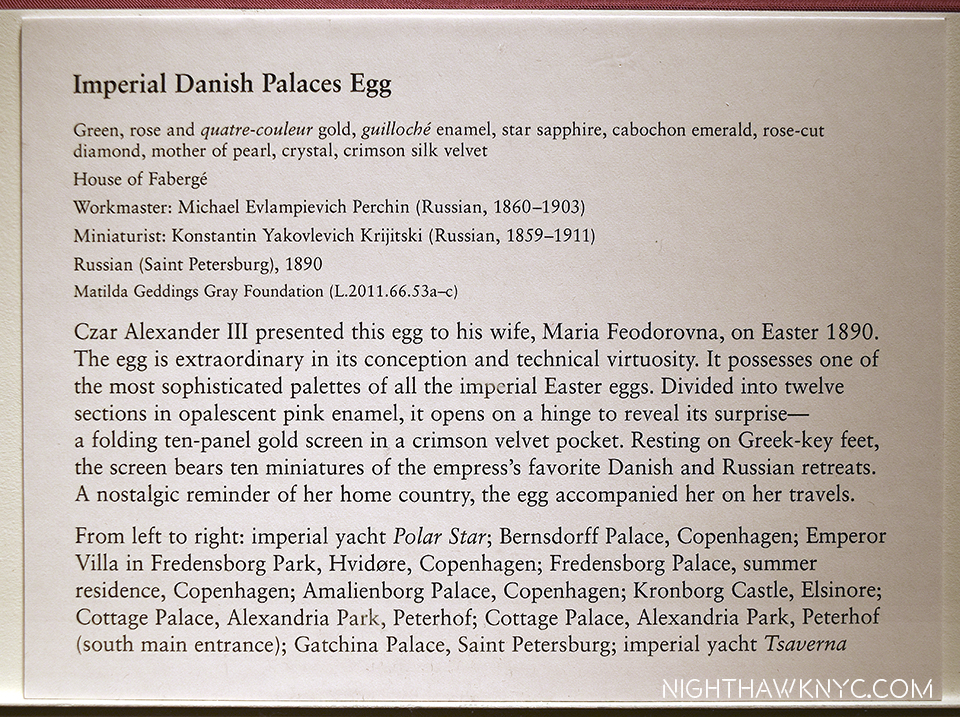
Having It Out With Philip Guston

This site is Free & Ad-Free! If you find this piece worthwhile, please donate via PayPal to support it & independent Art writing. You can also support it by buying Art & books! Details at the end. Thank you.

Written & Photographed by Kenn Sava (*- unless otherwise credited)

I had mixed feelings when I heard about “Philip Guston Painter 1957-67,” on view from April 29 to July 29 at Hauser & Wirth’s temporary Gallery in the former Roxy Nightclub space. On the one hand, large Guston shows are a rarity, on the other hand, I have long struggled with his works of this period. So, it was with a desire to have it out with them in a battle to the death, over the very generous 3 months it was up, and either, finally, “get” them, or not that I climbed their candy-cane striped stairs to enter a space I had known in it’s previous incarnation.

dsc_0434pnh

This space had a “colorful” past, in a different way. One that involved roller skates.

I am happy to report that July 30th dawned to find me still among the living.

The show is focused on paintings from 1957-1965, 8 of Guston’s most “abstract” years , and drawings dated from 1967-69, at the beginning of his return to “figurative” work.  The 1957-65 period of Guston’s paintings is, perhaps, his least known, possibly least loved, (according to one owner- Guston’s daughter, Musa Mayer’s, experiences when guests have seen it) 1, and least seen works by this Artist, who Hauser & Wirth calls “the preeminent 20th century American Artist” in their press release.

Really? I am very interested in his work, and have a lot of respect for him, but “the preeminent?” Hmmm…Comparing Artists qualitatively is against my religion, though some other candidates are here2. Still, a group of 35 of these is unheard of, and seems unlikely to be repeated any time soon.

While his early abstractions from 1950-55 are seen regularly and much admired, the works of his next period are very different. Gone were the luminous colors and shimmering qualities of the earlier works replaced by a darkness that feels to be continually encroaching as these 8 years progress.

What came before... "Painting," 1954, on view at Moma

What came before… “Painting,” 1954, on view at Moma

“What shall I paint but the enigma?”

A revealing quote from Philip Guston in 19693? Possibly. Guston, apparently, mis-translates, or misquotes a translation of the inscription on a “Self Portrait,” from 1911, by Giorgio de Chirico, a major lifelong influence, who he was speaking about when he uttered it. It’s de Chirico’s motto. The original reads- “Et quid amabo nisi quod aenigma est?” Most of the translations I’ve seen of it are- ‘What shall I love if not the enigma?’ Maybe it’s Guston’s interpretation of it?

It would, also, seem to be a fitting motto for this show.

This show begins. "Fable II," 1957,

The show begins… “Fable II,” 1957,

Guston came to abstraction very gradually, the end result of a period of consternation over his direction during which his work was gradually leaving figuration behind. In late 1948 he took a break from painting and armed with a Prix de Rome and a grant from the American Academy of Art and Letters, made a trip to Italy to see the works of his early Reinassance heroes, Piero della Francesca and Masaccio. To that point, the dissolution of the figure in his work can be traced through “If This Be Not I,” 1945 (perhaps my favorite work of his), to “The Porch I & II,” 1947, and especially in “The Tormentors,” 1947-48, his last work his trip to Italy. Upon his return, his “Red Painting,”1950, and “White Painting,” 1951, begin his “non-figurative” periods, from which the works on view eventually followed. He said,“The 1950-55 paintings, (see “Painting,” 1954, above), in general, were very diffuse lyrical pictures. About 1956 I began to become very dissatisfied. I began to feel a need for a more solid painting. I began to look at my earliest work with a kind of renewed interest, the solidity of that. I found it a terrific challenging problem, in my own terms, to create forms.” 4

"Traveler III," 1959-60

“Traveler III,” 1959-60

Then, in 1956, right on the cusp of the period in question, he told writer and friend, Dore Ashton, “I’m in love with painting.5” Looking around this show, that was the first thing that struck me- how painterly these paintings are. Guston’s brushwork has never been so nakedly at the forefront, even in the abstractions from 1950-55, as they are in every work here. It feels like it would be possible to follow each and every one in some of these works.

dsc_0432pnh

“Position 1,” 1965, Detail.

They have a freedom, a rawness, an energy that strikes me as being completely opposite from his earlier abstractions, someone dubbed “abstract impressionism,” a term he hated, works that are calm, subtle, delicate.These seem almost defiantly, perhaps reactionarily, different. They all contain shapes. At first, a mass of them, later individual shapes, and finally one shape, on a murky grey/blue with pink background. After all the depth of field has gone out, which began in his mid 1940’s work, completed from 1950, after the variety of color has gone out. The enigma remains.

"Turn," 1959

“Turn,” 1959

“There can be no adequate understanding of Guston’s life work unless we are prepared to go back over the whole road,” Dore Ashton wrote in 1990 6. In the earlier work, the enigma was different. It came with, and in the guise of persons, places and things. Guston’s work begins, as far as public collections go, in 1930. And? Talk about starting with a bang!

Guston was a lifelong creature of habit. Some of those, possibly, led to his early death at 66 in 1980. As a child, he retreated from the world to his closet, where he would read, and even paint, by the light of a single light bulb. He painted hooded KKK guys7, who he actually saw break up strikes. At age 13 he discovered his father, hanging, having committed suicide.(!) At age SEVENTEEN, he created this-

"Drawing for Conspirators," 1930, Whitney Museum

Drawing for “Conspirators,” 1930, at the Whitney Museum

There’s so much going on in this. First, note the figure hanging in the background. Then, the figure in the foreground handling rope. In the 1970’s when these hooded figures8 returned to his work, he said they were self-portraits9 Is this Guston pondering guilt over his father? Look at the abstraction of space- everything is enclosed in a very narrow area, which would reappear in the 1940’s, and again in the late work. The faceless head shapes, the narrow stage, and the brick wall are reminiscent of de Chirico. The angled cross from Piero della Francesca. Many of these elements, along with the single light bulb, his fascination with shoes, as well as many of the lessons he had picked up from his beloved early Renaissance Masters and, de Chirico, we see in the late work of the 1970’s. Also seen in the late work is Guston’s early love of comics. He reacted strongly when someone mentioned this to him, yet, I think it’s undeniable. As I wrote, I wonder what influence R. Crumb may have had on him. Though most of these are not readily apparent in the work in this show, they set me wondering how far away he ever got from them. After returning from Italy, his work shows an ever gradual reduction of elements, especially in his work from 1956-65, until he even stopped painting. Such was the effects of the admitted despair he was in, again, in 1966, as he was stuck before his next direction, which led to the outpouring of his final decade.

"Accord I," 1962

“Accord I,” 1962

Meanwhile, I was in the middle of my struggle with these works. It was on my 3rd visit, sitting in the nicely cavernous space that a key question hit me-

“Exactly HOW ‘abstract’ are these works?”

Look at the titles. “Painter,” “Actor,” “Alchemist,” “Vessel,” and “Portrait I,” among them. Guston commented that the titles were added after the piece had been completed. It’s rare for abstract works of the “New York School” Artists of this period to have such blatantly suggestive titles such as these. They make it impossible to give one’s imagination the completely free reign the usual “Untitled” does. In fact, they force one to attempt to “see” what the title “means” in the work. This brings you back to the way you experience figurative painting. Once this happened to me, I was never able to go back to seeing them as completely abstract again. I began to “suspect” the other works. More titles- “Rite,” “Traveler III,” “Turnabout,” “”The Room,” “Garden of M.” and “Inhabiter.” Without trying very hard, that’s 11 titles of the 36 paintings. Hmmm…


"Inhabiter," 1965

“Inhabiter,” 1965

“I think a painter has two choices: he paints the world or himself. And I think the best painting that’s done here is when he paints himself, and by himself I mean himself in this environment, in this total situation.’– Guston said in 1960.

The evolution during this period can be seen in this next photo. Note the differences between the works on the left, and those on the right. Color has largely gone out, forms have been reduced. The overall feeling becomes one of darkness and isolation.

Left- 2 works from 1960. Right- one from 1964, one from 1965

Left- 2 works from 1960. Right- two from 1965

This reduction would continue through 1965, until he was left with one dark form against a murky blue/grey over pink background, with (see “Portrait I,” 1965, below), now, the white of the naked canvas encroaches. After these, painting itself, went out. In 1967, he would start all over by drawing. But, he’d quickly come to see that this new direction offered insufficient room to grow. These zen-like drawings (see the 3 photos following “Cabal,” below) were their own end game. Shortly after, he would make yet another new start. Now, pieces of his past were everywhere to be plainly seen.  This would see him create his long misunderstood, now quite popular and influential final works, like “Cabal,” below.

"Cabal," 1977, The Met

“Cabal,” 1977, at The Met

While the “figure” went out of his work from 1950-1965 in works that are called “abstract” (a term he loathed), there is much in his work before, and after that is, also, “abstract”- even in his late work, where people and objects return. After all, isn’t this late work, which is called “figurative,” really “abstract?”

When you look closer at this hooded head in the foreground of “Conspirators,” above, with it’s two black eye holes in the white bedsheet, which somehow manage to be quite expressive. I couldn’t help but think about that when I saw this, “Untitled” drawing among those on the final wall at Hauser & Wirth.

"Untitled," 1968. Drawing.

“Untitled,” 1968. Drawing.

Then, again? With an “Untitled” work, the mind is free to go where it may, right?

Revisiting his subsequent later work while looking at the show of the Small Oils Guston did from 1969-73, that was up at the McKee Gallery in 2009, and you can see here, in addition to the hoods, shoes, single light bulb and other elements from his past, cigarettes, books, the modern city, and his wife, Musa, from his present, I suddenly see other connections (hindsight being 20/20). The same murky grey over pink backgrounds appear in a number of his smaller oils (“Cabal” has a dark background, too.). Some of these also have strange forms alone against this background. All of a sudden they don’t look like they were created by an entirely different Artist than the one who created the works in this show. Well, Philip Guston was a different Artist than the one he was in 1957-65, but he’s still Philip Guston. Since there is much that is common between his early and his late works, it makes me wonder about all of his work. That was my initial question before seeing this show- Would what came before, and after be evident here? Using hindsight you can see connections. How he didn’t completely forget this period. Parts of it remained in his work until the end of his life.

"Untitled," 1968 Drawing

Starting over, again, from the beginning. Abstract or figurative? A pencil? A line? A tightly sealed mouth? “Untitled,” 1968 Drawing

Guston was not considered a founding member of the Abstract Expressionists, nor does he appear in the famous “Irascibles” photo which defined the movement’s members for many. The Met now lists him among the 14 Artists they group in the first group, along with Lee Krasner (the circle is now complete)! I think that part of the reason he wasn’t initially considered part of the group was that he was moving in that direction slowly from 1945 to 1950 which made him miss the first round of fanfare these works received, and which subsequently “grouped” them as “Abstract Expressionists,” a term Guston loathed10. Rothko, himself had called it “their enterprise 11.” Philip Guston, eternally, followed his own star. Though Jackson Pollock was his closest childhood acquaintance and the two were expelled from Manual Artis High School12 together for calling out the fact that more money was being spent on sports than on the “Arts,” and someone who remained in his life until his death in 1956, Guston was his own man, who’s Art owed more to the early Italian Renaissance and Giorgio de Chirico than it did to Pollock, or Rothko, who he was on friendly terms with.

Zen Master. 48 "Untitled" Drawings, 1967-69.

Zen Master. 48 “Untitled” Drawings, 1967-69.

Philip Guston was never a painter of “realism.” It now appears to me that though the end results look different as his style changed and evolved, he was continually bluring the lines between figuration and abstraction all through his career, in the service of painting images that expressed himself as he evolved in his times and in his environment. It’s obvious that he never forgot his past, or the past masters who’s work he loved. The more I look at his work, from all periods, the more I see the impact of, perhaps, his biggest influence, Piero della Francesca, in it. Piero’s figures have the most inscrutable, almost deadpan expressions. Their faces, often, reveal little to nothing of what they are feeling. They take that crutch of reading a whole image from the face away from us. That feeling stays in my mind when I approach a work of Guston’s now, no matter if there are “figures” or objects in the work or not. (Many, even most, of his figures are hooded, or masked, anyway). “Reading” a Guston is a little like to trying to “read” a Piero (or de Chirico). It’s not the expression on the face, it’s the whole thing- the figure in it’s environment, to paraphrase Guston’s quote, above (in Piero’s case, each one is placed with utmost mathematical precision as part of the whole). Guston’s masks are akin to Piero’s inscrutables. We can’t read the expressions or the feelings of these figures. This makes them “abstract,” in another sense, too. I wonder about them. Since they are hooded, or masked, or a black form in his “Portrait I,” 1965, we’ll never know what they are feeling- like in Piero.

"Portrait I," 1965

“Portrait I,” 1965. As if hooded(?), in his environment.

It’s not only his 1957-65 paintings that mystify us.

“You see, I look at my paintings, speculate about them. They baffle me, too. That’s all I’m painting for.” “Philip Guston Talking” 1978, two years before he passed away.

Yet, he has left clues, along with the enigma.

(This is the third, and final, installment in my cycle of Posts on the recent, concurrent shows of Jackson Pollock, Lee Kranser & Guston- three Artists who’s lives are eternally intertwined, personally, and Artistically.)
*-Soundtrack for this Post is “For Philip Guston,” by his close friend, the brilliant composer Morton Feldman. If you have 4 hours to spare, check this out.

NighthawkNYC.com has been entirely self-funded & ad-free for over 8 years, during which 300 full length pieces have been published! If you’ve found it worthwhile, PLEASE donate to allow me to continue below. Thank you, Kenn.

You can also support it by buying Art, Art & Photography books, and Music from my collection! Art & Books may be found here. Music here and here

Written & photographed by Kenn Sava for nighthawknyc.com unless otherwise credited. To send comments, thoughts, feedback or propositions click here. Click the white box on the upper right for the archives or to search them. Subscribe to be notified of new Posts below. Your information will be used for no other purpose.
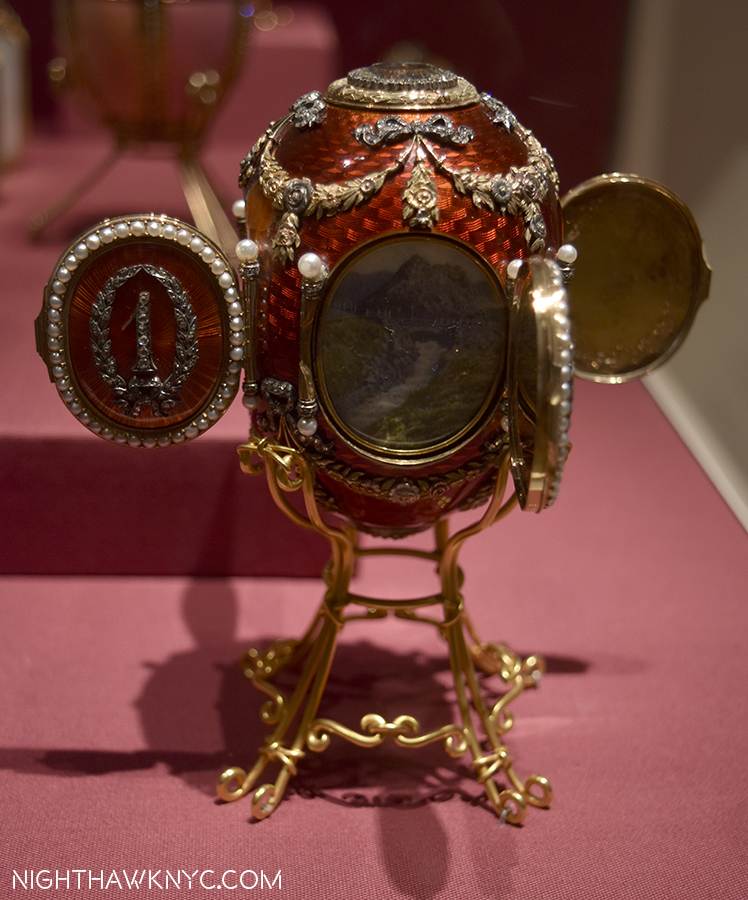
  1. Musa Mayer, “Night Studio,” Da Capo Press, P.102
  2. Hopper, Stuart Davis, Pollock, Rothko, William de Kooning, Georgia O’Keeffe, Charles Sheeler, Rauschenberg, Frank Stella, Chuck Close, Richard Estes, insert your own.
  3. Guston, “Collected Writings,” University of California Press, P.125
  4. Schimmel, Exhibition Catalog for this show, P.15
  5. Dore Ashton, “Philip Guston,” Grove Press, Inc.,1960 P.49
  6. Ashton, “A Critical Study of Philip Guston,” University of California Press, 1990,  P.9
  7. Ashton points out “At the time Guston was working on this painting it was estimated that there were more than 4.5 million members of the Klan in the United States, a great many of them residing right in Los Angeles, where they burned crosses and raised hell all during Guston’s childhood and youth.” Ashton, “A Critical Study,” P.7
  8. Ashton points out that hooded figures “not only recalling the Ku Kluxers of his early paintings but also the artists in the scriptoria of the medieval plague years who donned hooded gowns in the vain hope of avoiding the plague Ashton, A Critical Study, 1990, P.156
  9. Guston- “They are self-portraits. I perceive myself being behind a hood. In the new series of “hoods,” my intention is not really to illustrate, to do pictures of the KKK as I had done earlier. The idea of evil fascinated me… Guston, “Collected Writings,” P.282
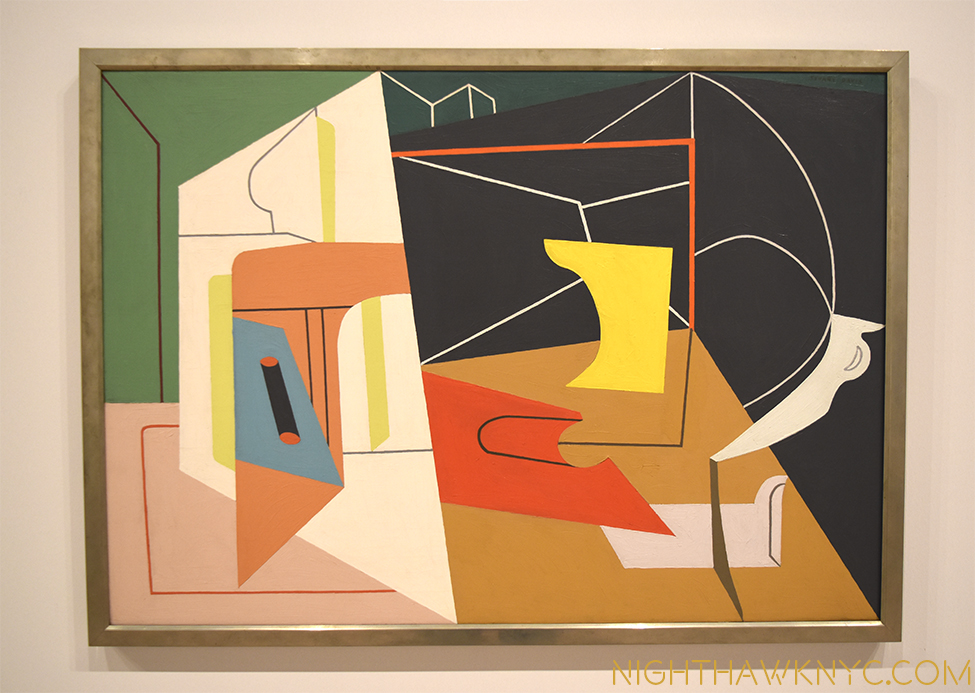
  10. Schimmel, Show catalog, P.9
  11. Ashton, “Critical Study,” P.79
  12. Mayer, “Night Studio,” P.13