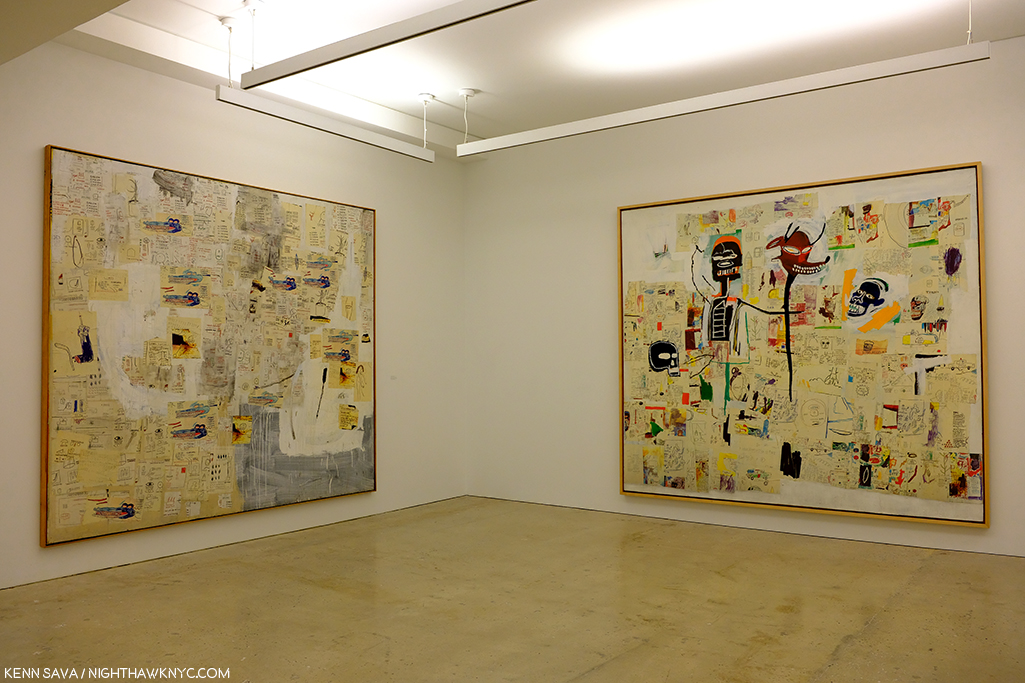
Jean-Michel Basquiat At The Brant Foundation

Written & Photographed by Kenn Sava

This is Part 2 of my series on the five Jean-Michel Basquiat related shows going on in NYC in 2019. Part 1 is below, or here.

Show seen: Jean-Michel Basquiat at the Brant Foundation, 2019
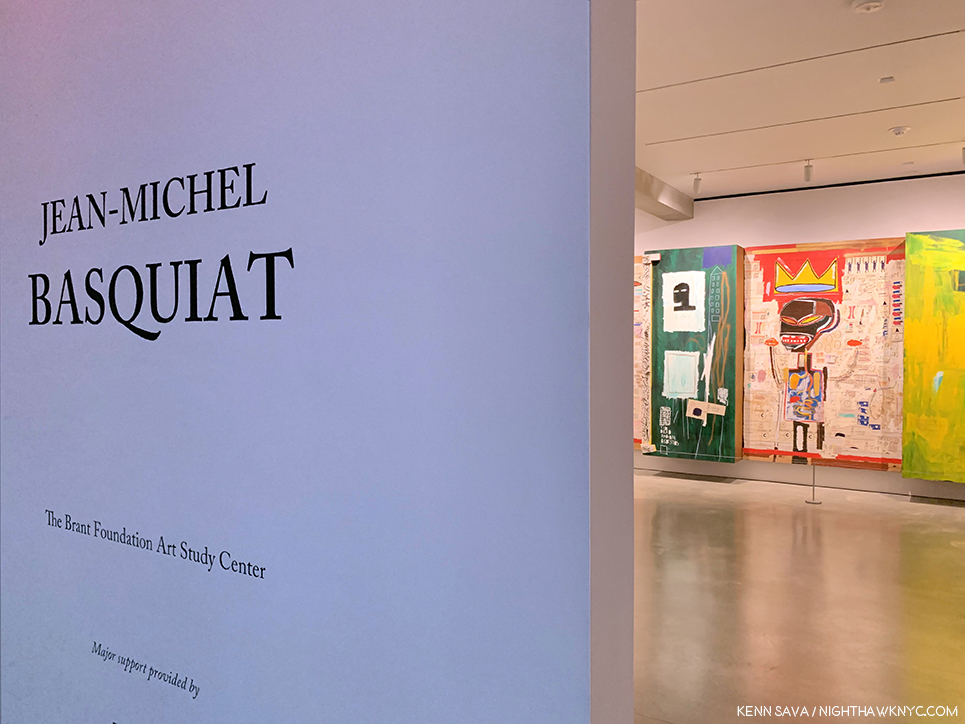
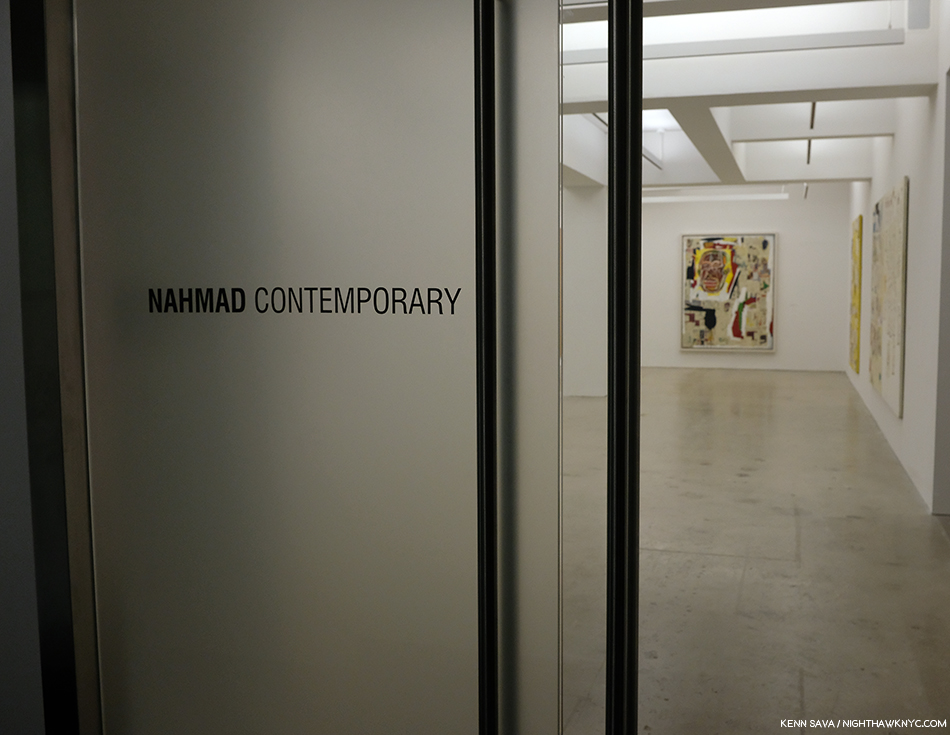
Outside looking in. The most important show in NYC known to me thus far this year was a show I would be extremely fortunate to see.

Jean-Michel Basquiat, the first exhibition at The Brant Foundation’s new East Village location is a NoteWorthy show because it is a major, museum-quality show mounted at a private institution of the work of a single major Artist with more Paintings on view than all the major NYC institutions, combined, could mount- multiplied twelve-fold. This led me to wonder- What other major Artist-Contemporary, Modern, or Old Master- has so much of their work, and so many of their major pieces in private hands?
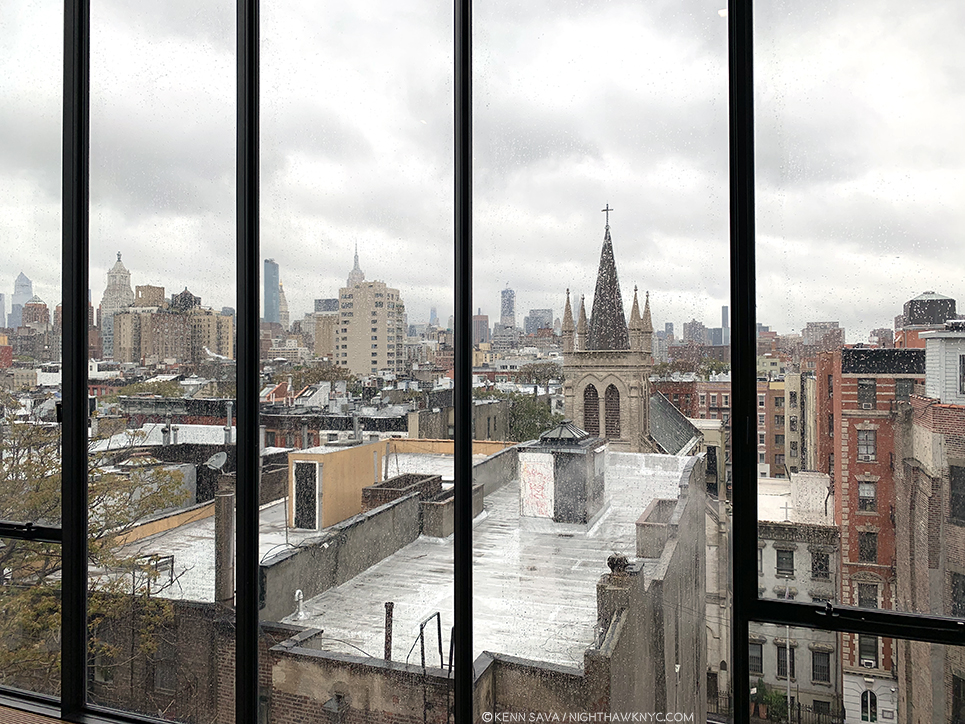
The East Village, NYC, May 13, 2019. Looking towards the Empire State Building (rear, left of center). Bad weather, no ticket for the show, no sleep, no umbrella. It was going to take more than that to keep me from seeing this show, AND something close to a miracle to allow me to do so.

It’s easy to have mixed feelings about this. I’ve read some complain that it’s another case of the 1% at its worst; that this show is a case of the very rich showing off. On the other hand, it seems to me that there is a stronger case to be made admiring the vision, and the guts, of the collectors who stepped up and bought much of the work of Jean-Michel Basquiat (J-MB henceforth) when he needed it most, not to mention go through the trouble of sharing it with the public, who, in the case of Jean-Michel Basquiat’s Art, are largely dependent on them doing so to be able to see it. Showing off? Yeah. I guess.

Almost every Artist in the early stages of their career needs the support of buyers and collectors to survive and to continue to create. Yet, it’s also easy to forget that most of these  collectors possibly also bought Art by Artists that have long since been forgotten, (which is one reason I strongly believe in only buying Art you love– if it becomes worth less- even substantially less- than you paid for it? You can always display it and enjoy it.) And? As I wrote in part 1 of this series, the NYC museums, except the Whitney, collectively passed on his work at the time- and continue to do so. The only way they’re likely to fix that now is by gift or donation. The affordability train has long ago left the station for anyone else besides that 1%. The Big 41 had their chance. In the case of some institutions- chanceS, as I outlined.
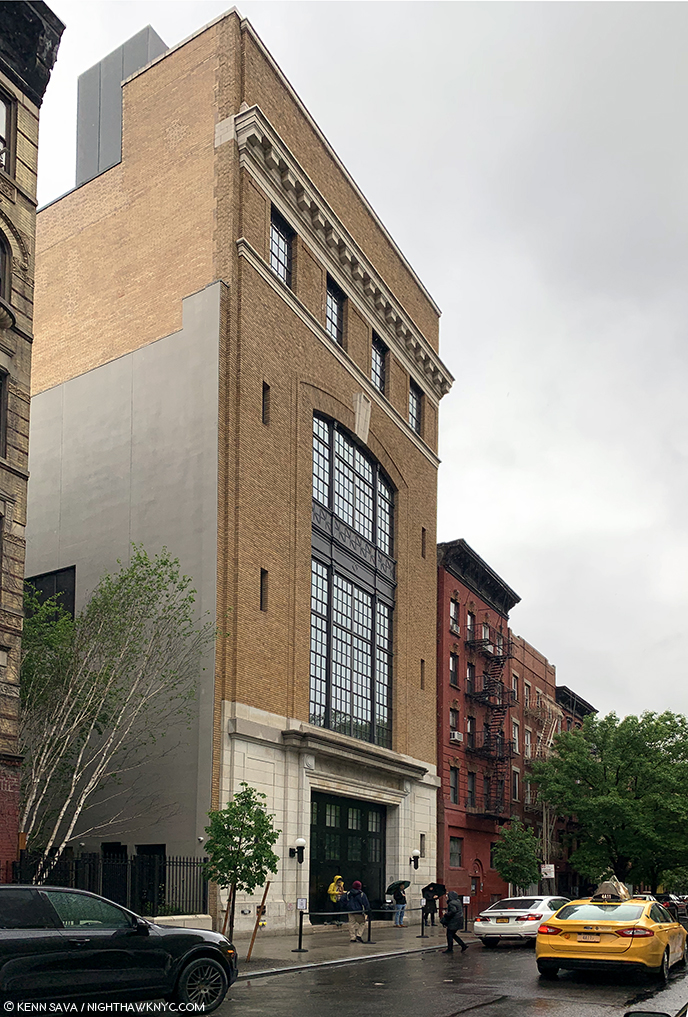
Unnamed on the exterior, in classic East Village cool, The Brant Foundation, 421 East 6th Street, 10am, Monday, May 13, 2019. If I’m up at 10am, and not STILL up, you know there’s a special reason why. That cab exiting stage right is leaving with my umbrella. See ya.

At The Brant Foundation, a show of 70 Paintings and 1 Sculpture was on view, making it the largest show of Basquiat’s Paintings in NYC since the Brooklyn Museum’s Basquiat Retrospective in 2005, which I saw. Combined with the Basquiat work in the other five 2019 shows, the total approximately equals how many were shown in Brooklyn in 2005. The Brant show largely includes work in the collections of Stephanie and Peter Brant, alongside pieces on loan from the Broad Museum, (a private museum of the collection of another early collector, Eli Broad, who own at least of 13 of J-MB’s Paintings), among other significant loans. Since so much of his work is in private hands who knows how long it will be before we see a bigger or similar number of J-MB’s work here again. So, the six Jean-Michel Basquiat related shows in NYC and vicinity this year (counting the Warhol x Basquiat show going on in Kinderhook, NY, which proved too far for me to get to) might be the best chance I’m going to get to reassess and reconsider his work that it’s barely been 40 years since he began creating it.

The first order of business was getting in to The Brant show and actually seeing it. After all my efforts to get a ticket failed, I resorted to drastic measures. I took the unprecedented step of getting up with 3 hours sleep at 9am and going down to The Brant on May 13th, the last day the show was open, or the day before it closed- I’m still not sure. As I got there at 10am, right as it opened and visitors for the the first timed slots were arriving, I quickly realized this was going to take an act of fate. Compounding things, it was raining and I’d left my umbrella in the cab. I decided to take a Zen approach and stand off to the side, where that tree is to the left, above, and see what happened.

About 30 minutes later, Jessie, the on-top of everything Brant staff person manning the entrance, who knew I was casting my lot to fate, called me over from the door. A lady had arrived and told him she had an extra ticket. Really? A real-life Angel of Providence had appeared when I SERIOUSLY needed one. I walked over and met Lisa, and yes, she had an extra ticket that she was willing to let me use. Miracles really do happen. The fact this piece exists is solely due to her generosity. Seeing it over the 3 and a half hours I spent in it allowed me to flesh out the portrait of Jean-Michel Basquiat’s accomplishment that began for me at Xerox, adding the best look at his most important work I’m likely to get. Any assessment of J-MB’s work and achievement begins with his Paintings. I’d seen 100 works in 2005 at the Brooklyn Retrospective, but I hadn’t prepared to see them. Now IS the time. Lisa’s generosity not only enabled me to create this piece, it also permits me to create the multi-part series on 5 of the 6 Basquiat-related shows I wanted to do, now that she made it possible for me to see the “centerpiece” show of the group. I’m also grateful to Jessie for thinking of me. Due to both of their kindness and consideration, I am thrilled to be able to share what I saw with you.
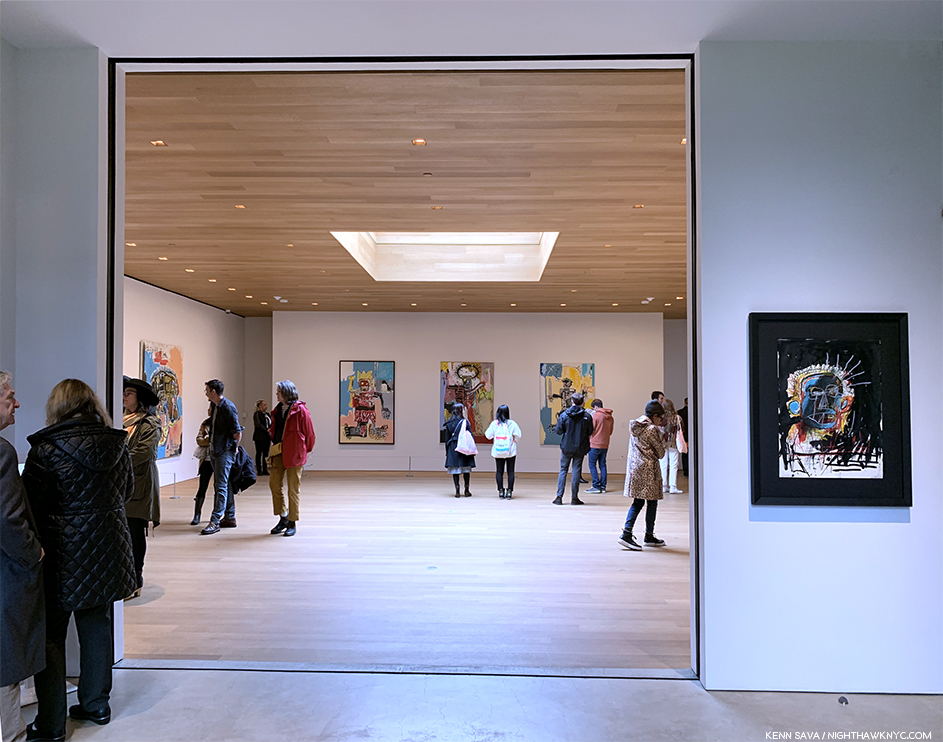
For a while, it looked like I wasn’t going to get to see this. Standing at the entrance to the show- the lobby of the 4th floor, just after exiting the elevator 90 degrees to the right.  You can see the variance in the lighting in the main gallery from here. Outside, to the right of center is Untitled (Self-Portrait), 1982.

The elevator took us to the 4th floor, where everyone starts and then walks down to the floors below, the show being installed on all 4 floors. It should be said that the group of new visitors getting off the elevator each time on 4 was surprisingly small. The galleries were pretty sparsely filled- incredibly so for a major show on either it’s last day or next to last day. Well, there was well over 1 billion dollars of Art on display, so they opted to keep the crowd manageable.
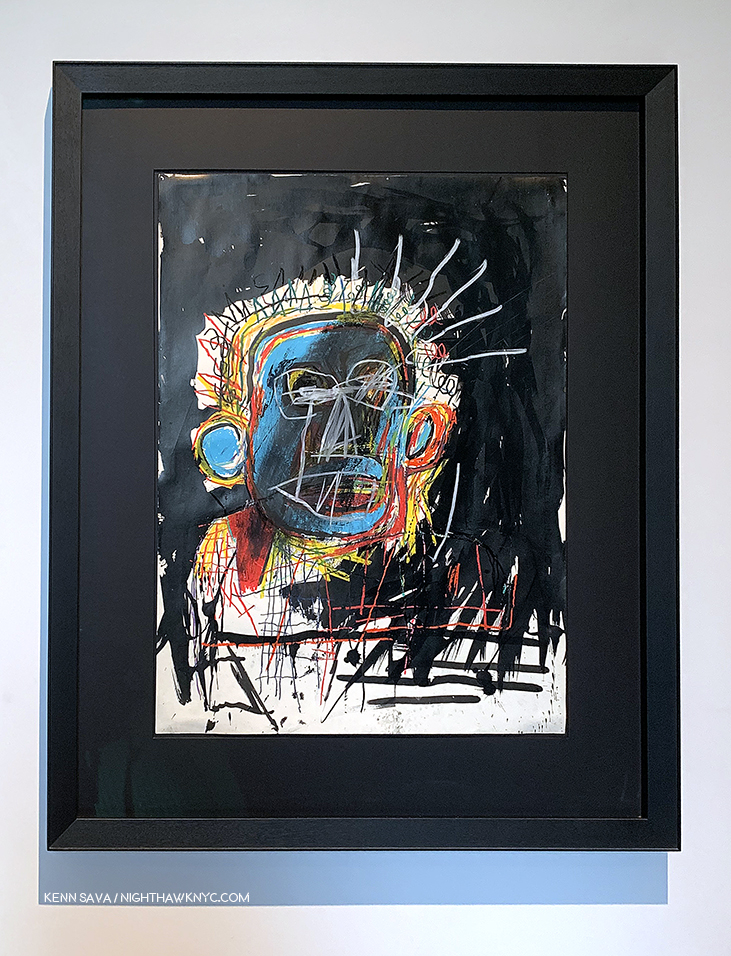
Untitled (Self-Portrait), 1982, Oilstick and ink on paper, 30 x 22 inches. The first work in the show.

Though the urge might have been to hurry into the large, main gallery shown above, I was stopped in my tracks by the work hanging to the right just outside. There was Untitled (Self-Portrait), 1982, one of the most unique Self Portraits I’ve ever seen. I wondered what Picasso would have thought of it. The colors, and then particularly the black background fascinates me as I ponder at what stage J-MB added it. And then I wondered what Clyfford Still would think of it. Like a number of J-MB’s “heads” from 1981-2, he flattens everything to the picture plane, something not seen all that often in Art. 4 floors of J-MB still to go. What an auspicious start!
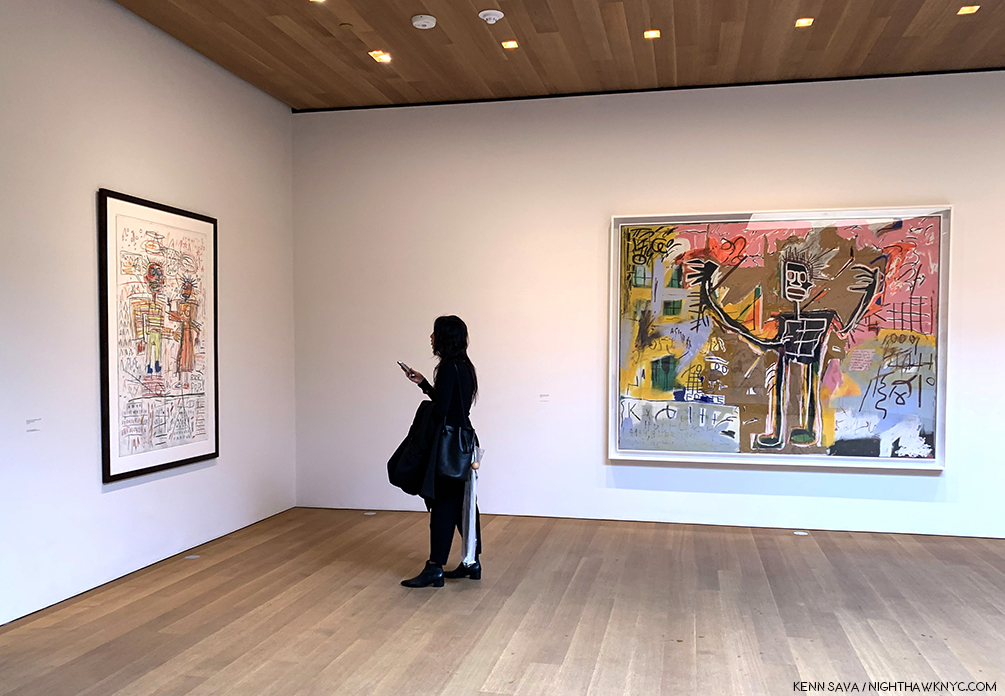
A real-life Angel of Providence. Lisa studying Self-Portrait with Suzanne, 1982, in the main gallery on 4.

It turns out that Lisa is a school teacher and an Art lover with superb, wide-ranging, taste that runs from Brancusi through Morton Feldman as I found out as we chatted while going in.
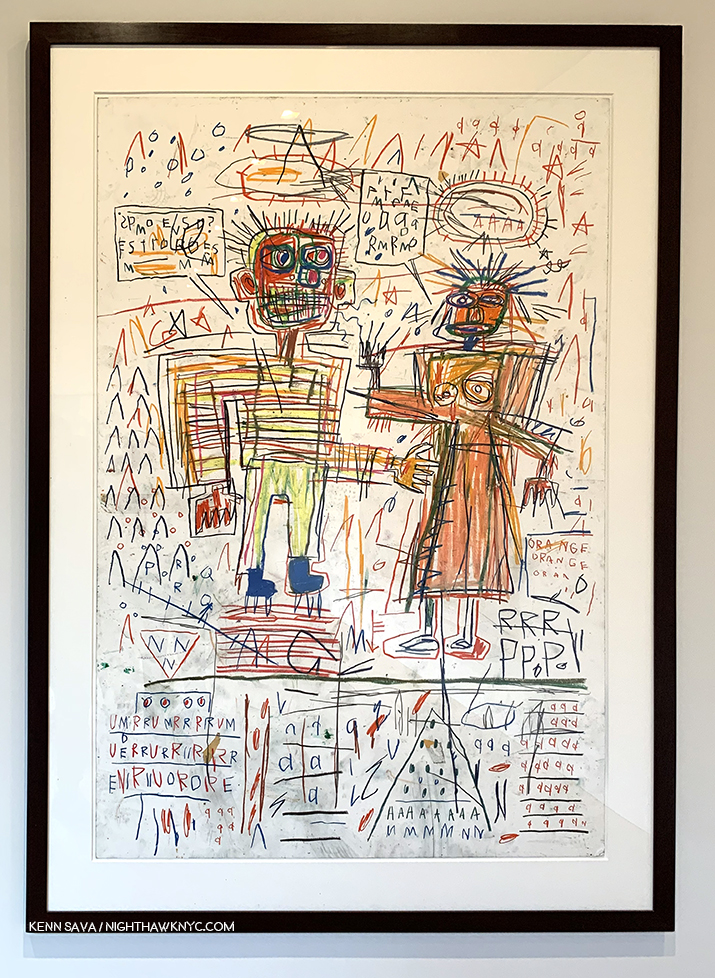
Self-Portrait with Suzanne, 1982. The compelling work Lisa studies above shows the artist with Suzanne Mallouk, the subject of Widow Basquiat, in 2010. It’s the only work known to me created by J-MB showing the Artist with one of his lovers. Beyond this, it’s fascinating to study the way he’s rendered himself here compared with the other “heads” and Self-Portraits from 1981-2.

Before I get too far into the show, I’ll say the building looked brand new, the restoration of the former Con Ed Substation being first class from top to bottom. I have mixed feeling about it’s suitability for the display of Art, but honestly, I get some of those feelings almost everywhere I see Art. In my experience, the #1 problem in seeing art is lighting, combined with the scarcity of truly non-glare glass or acrylic. As my friend, Corinne, co-owner of NYC’s legendary City Frame, tells me- currently, it’s expensive. Then again, not all Painting is glazed. Increasingly, Artists, including Raymond Pettibon and Kara Walker, and Photographers, including Gregory Halpern, have shown their work without frames, often just tacking it to the walls at the corners. Still, glazed or not, lighting- artificial or natural, is a problem that rears its head in almost every show I see. The same was the case at The Brant.
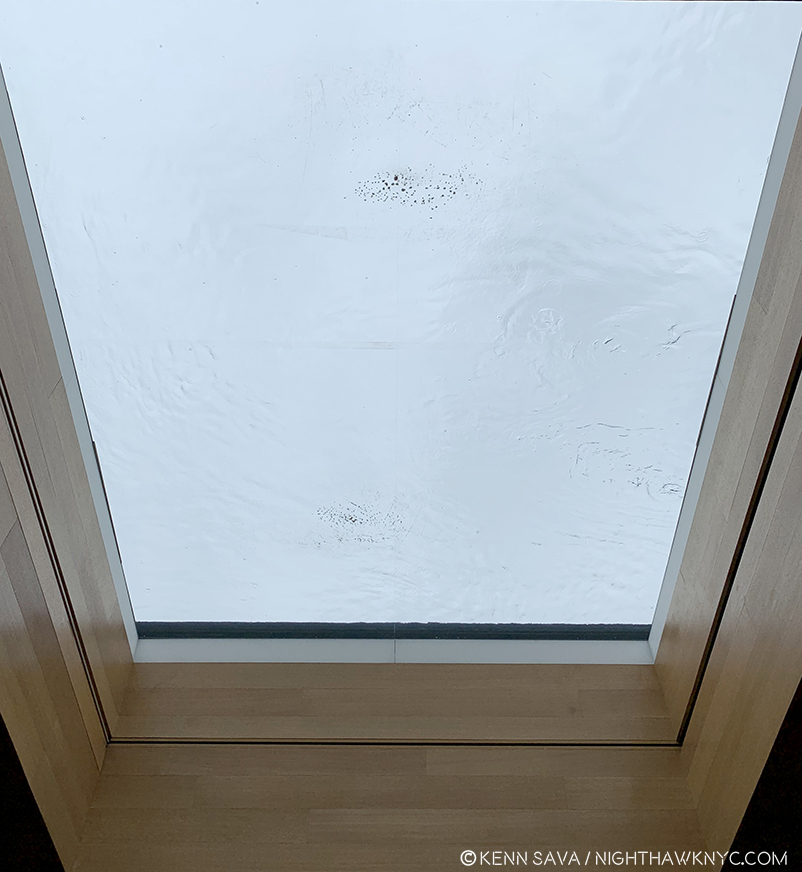
I don’t care how rich I was, I don’t think I’d install a pool over irreplaceable Art.

The fourth floor is the top floor and features a skylight, apparently, filled with water- unless this had collected from the rain? I don’t know. They must either have Lloyd’s of London insurance, 8 million tons of confidence in whoever installed it, or both, to hang a few hundred million dollars worth of one of a kind Art underneath it, including more than one of J-MB’s greatest works, in my opinion. But, beyond this, being a cloudy, rainy, day, the large skylight wasn’t letting in as much light as it might have at other times.
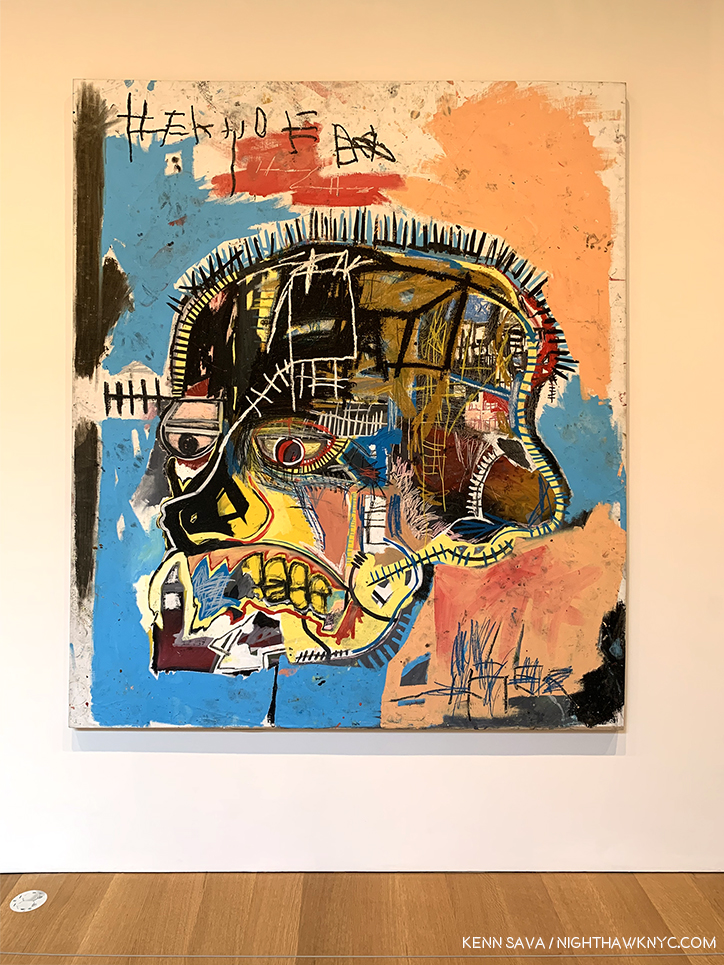
Hanging a few feet from the skylight/pool (as you can see in the installation view earlier) is Untitled, 1981, acrylic and oil stick on canvas, 81 x 69 1/4 inches, from The Broad, L.A., the upper half of which was in a shadow during my visit.

Typical of all the works on view in this room, the upper half of Untitled, 1981, on loan from The Broad in LA was in a shadow. Still, the power of seeing this work in person was staggering. I took all of it in from a distance when I first saw it, then walked over to see the other works in the room. Finally, I walked back over to look closely at it at length.
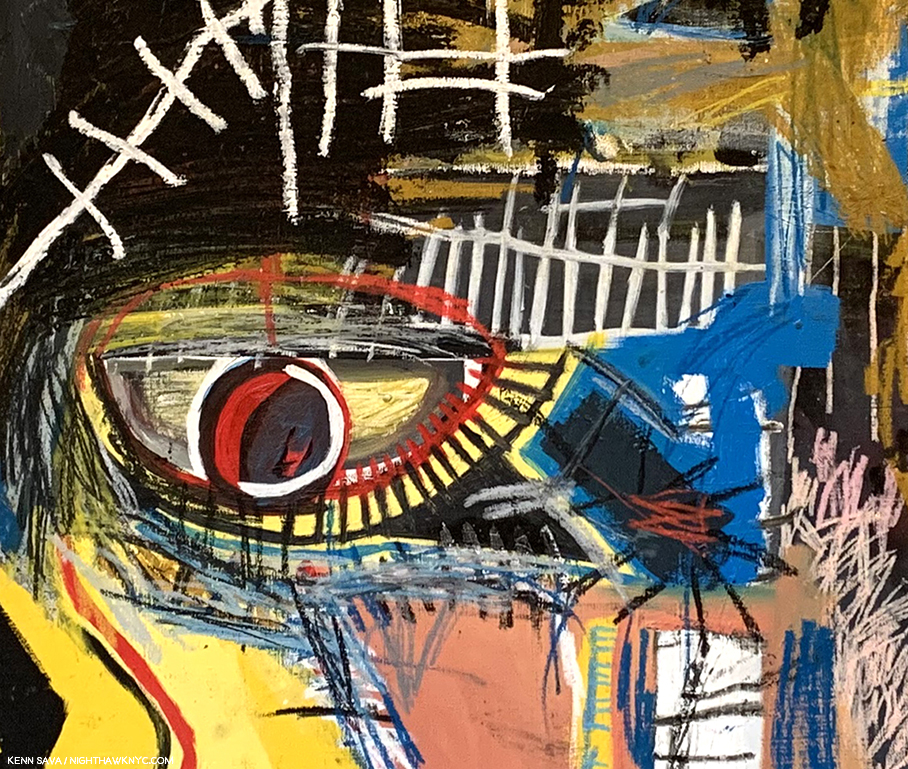
Detail of Untitled, 1981.

The difference in the experiences is remarkable, as you can see. But, no matter how closely I looked, minding the security rope you can see at the very bottom of the picture above, it was still drawing me closer. Like a Rembrandt, or Van Gogh, where I’d like to study each brushstroke for it’s content, here I was being drawn in to look at each detail. The feeling I got was that each small part of it was a world unto itself, yet irrevocably part of the whole. What, exactly, are we seeing? It’s not a skull because there are eyes and there is hair, at least part of a beard, and some teeth, though others are missing. And there are what appear to be stitches and possibly some letters over all of it- a cryptic message, like the figure, in a language no one had ever seen before. (Compare this to the work on view in Xerox that I looked at in the first Part! There, the details were, largely, words.) This is 1981- a year after the first show the work of J-MB appeared in. It’s a work from near the beginning of his post-SAMO© career as an Artist. And, it’s one of the most remarkable shots across the bow in Art history, possibly since Picasso’s Les Damoiselles or Duchamp’s Bride Stripped Bare. When I’ve seen it in books, I haven’t been able to stop looking at it. Seeing it in person it felt like I’d never really seen it. But, even saying that? There’s literally nothing like this in Western Art history to 1981. In his book, The Art of J-MB, Fred Hoffman makes a case for this being among J-MB’s “key” works. I don’t have a list, but I won’t argue with that. I just keep wondering if Francis Bacon, who outlived J-MB, passing away in 1992, saw it and what he thought, or would think, of it.
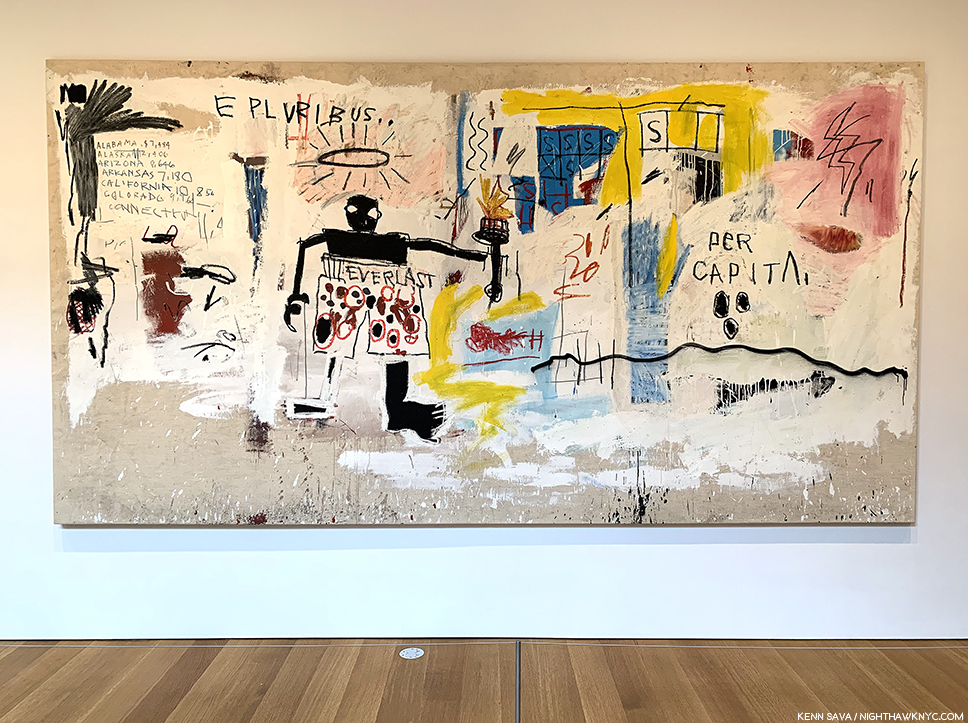
Per Capita, 1981

Across from Untitled was the incredible Per Capita, also from 1981, with it’s central figure in Everlast boxing trunks, a halo over his head and his outstretched left arm holding a torch that sure looks to me like that of the Statue of Liberty. Over the halo are the words, “E PLURIBUS…,” or, “out of many,” leaving out the equally famous, “UNUM,” or “one.” The title (which may or may not be the Artist’s title- I simply don’t know), “Per Capita,” means, “per unit of population; per person,” in one definition, per American Heritage Dictionary, and “equally to each individual,” in another. Along the left side appears to be the beginning of an alphabetical list of states with the per capita income of its citizen next to them. Even on a partial list, that manages to include states in 3 of the 4 corners of the country, the variance is striking. Fred Hoffman wrote at length about this piece in his essay in the catalog for the 2005 Brooklyn Museum Retrospective, where he also listed it among J-MB’s key works, where he says the central figure is Cassius Clay, as Muhammad Ali was known when he won the gold medal at the 1960 Olympics (The Art of J-MB, P.129.), which could also make that an Olympic torch.

As I looked at this fascinating work, I couldn’t help wonder if the “UNUM,” or “one” E PLURIBUS was seeking with its … was the solitary figure, as in “Out of many, THIS one.” J-MB’s love of boxers is well known and was to be seen in most of an entire gallery on the 2nd floor, as well as in his portrait (in which he wears Everlast boxing trunks) in the famous Warhol*Basquiat poster for their joint show a few years later in 1985 at Tony Shafrazi Gallery, which could also make this a Self-Portrait.

It’s hard to write about this show and not include every work in it- many are major, many others important for any one of a number of reasons, and they all deserve mention.
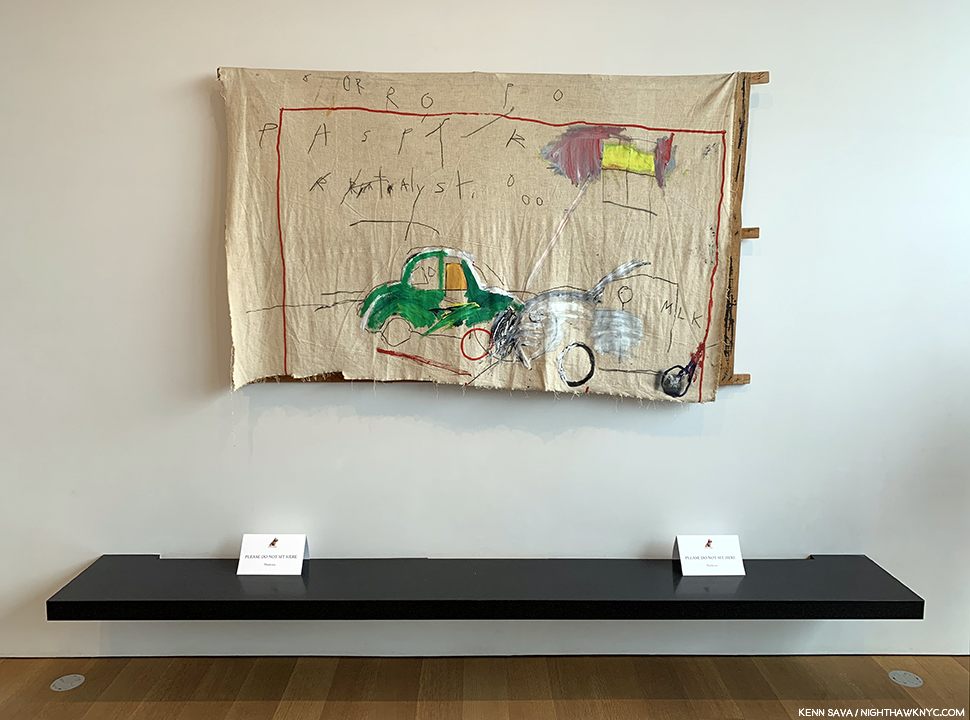
Untitled (Car Crash), 1980, Acrylic and lipstick on canvas with exposed wood supports. So much of J-MB’s story and his Painting begins in this work where he recreates the accident where he was hit by a car at age 6 that hospitalized him for a month and caused the loss of his spleen. Seen in the small rear gallery on 4.

On 4, there was also a small rear gallery along the rear of the building. Here, too, lighting was a question. The far wall was lined with a floor to ceiling window, which, you guessed it, let in a lot of light- even on this dreary day. I have no idea if they cover it/partially cover it in full sun.
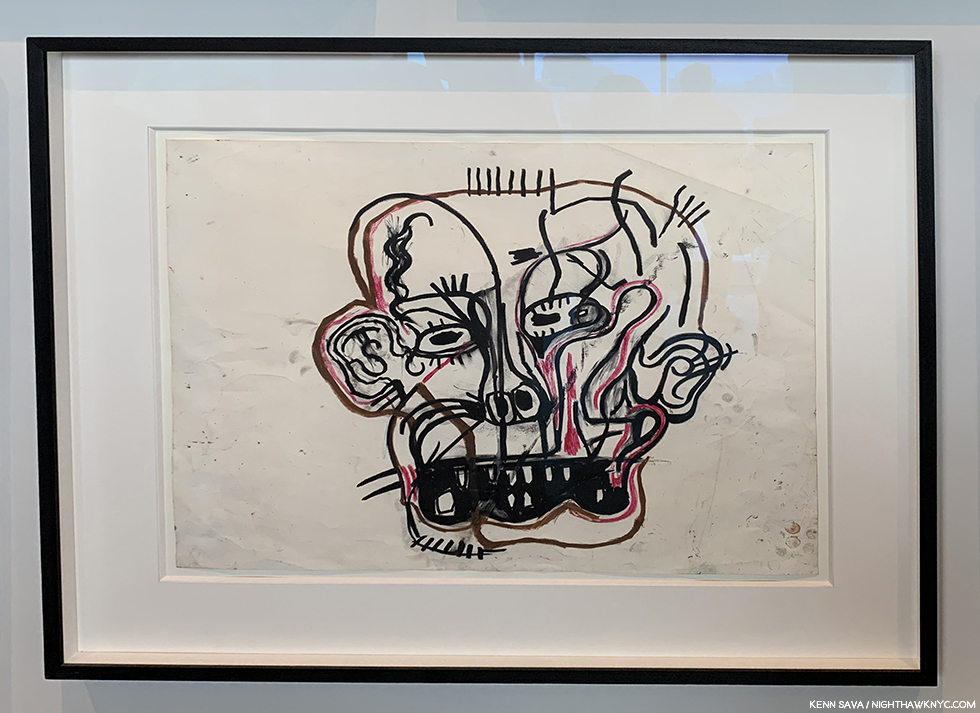
Untitled, 1981, Oilstick on paper. Seen in the small, gallery in the back of the 4th floor. There’s so much that’s revolutionary in this extraordinary work, and at the same time it gives us another take on the two Untitled (Head) Paintings in the show, this time the “head” is seen from the front and not from an angle and has been flattened, like the picture plane. The right side is almost Cubist.

Down on 3, the lighting was better.
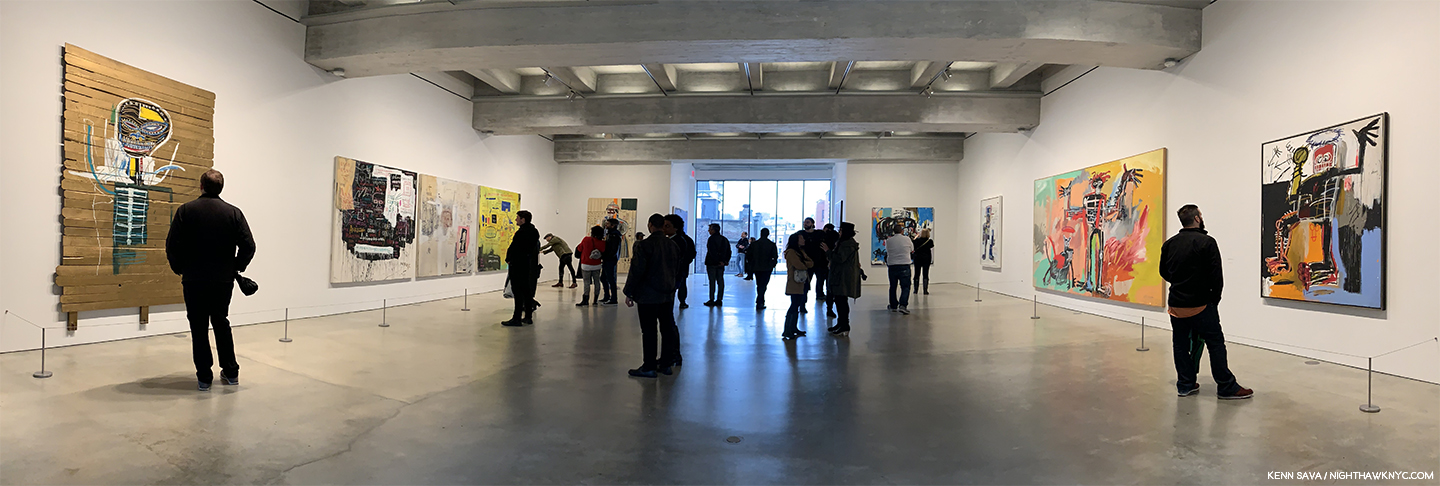
3rd floor. Installation view.

The main source of natural light being another picture window, but this time it was at the end of a large rectangular space and didn’t interfere with the most of the large works on view, including this one-
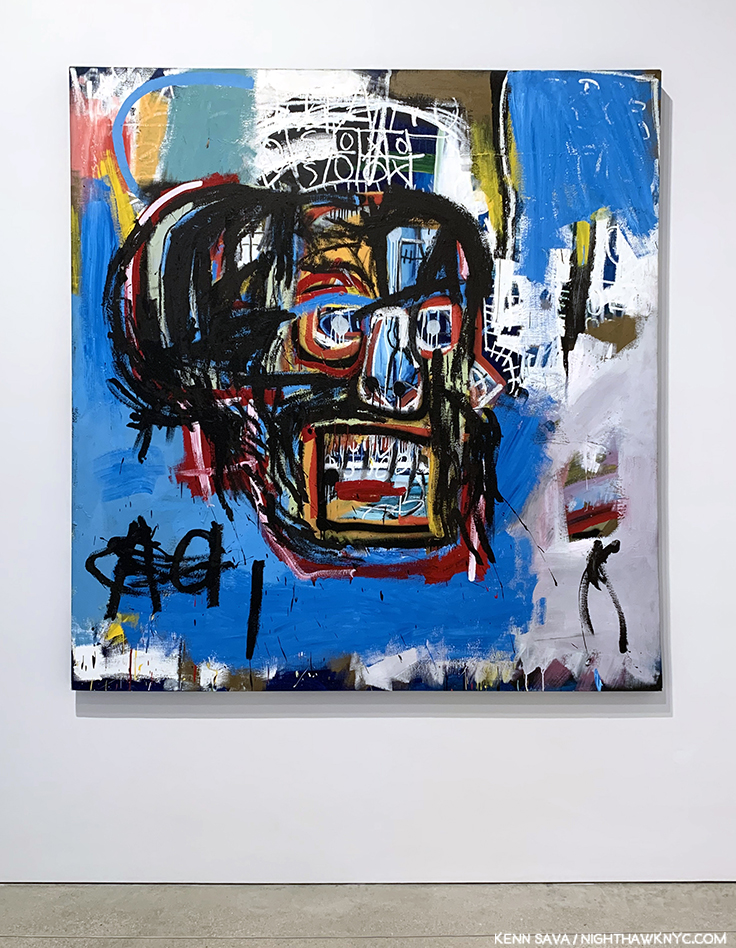
Untitled, 1982, now in the collection of Yusaku Maezawa, while on loan to the Jean-Michel Basquiat exhibition at The Brant Foundation, May 13, 2019.

In May, 2017, this Painting, Untitled, 1982, by Jean-Michel Basquiat sold at Sotheby’s for 110.5 million dollars. As someone who prefers to consider Art for what it is without the shadow of dollars, as much as possible, this fact gives even me pause for thought. Here it was, on a corner wall of the third floor, appearing as another work in the show as opposed to something “special.” I applaud this decision.

Do I think it’s “worth” 110.5 million dollars? Anything is worth only what someone is willing to pay for it (And, there were multiple bidders for it). Given that the question of whether something is, or isn’t “Art” won’t be settled during any of our lifetimes, only hundreds of years hence if the work continues to speak to people, the question of commerce- supply and demand, is what is rearing its head in Contemporary Art auctions, in my view. Jean-Michel Basquiat’s public career as an Artist only lasted a few months over 8 years, from June, 1980 to his death on August 12, 1988. Though he was extraordinarily prolific during that time, creating 1,000 Paintings and 2,000 Drawings2, included in it are only so many major works (a number that I personally feel is larger than some others seem to think), and Untitled, 1982, happens to be one, in my view. Looking at the lists of the highest prices paid at auction for Art reveals that many, if not most, of them are the best works available as most of the major work by established Artists of, say, Picasso’s time or earlier (considering he passed away in 1973), are in museums which are not likely to part with them. The works auctioned are certainly not the most important works by any of the Artists on the list, as I’m sure most would agree (perhaps not the purchasers), though it’s subjective. The $110.5 million for Basquiat’s Untitled, 1982, is for a major Basquiat, in my opinion.

But, the more astonishing thing for me to realize (Hey? It’s not my money) is that at the time of the auction, in May, 2017, Jean-Michel Basquiat would have been 56 years old! Untitled, 1982, is a work he Painted when he was 21 or 22 years old. People talk about this sale marking the highest price ever paid for a work by an African-American Artist. Others mention the highest price ever paid for a work by any American Artist.

They never mention that this sale makes Jean-Michel Basquiat the YOUNGEST Artist in HISTORY to have a work sell for over 100 million dollars- either by age at the time of the sale (56), or age when he created the work(21-22)!

At 56 in 2017, he would be considered to be in “mid-career” as the museums call it. At 58, right now(!), he should still be every bit the vibrant, revolutionary force in Art he was for the 8 short years of his career. That he already feels like such a part of history is indicative of it being already thirty-one years, this August 12th, since his passing.
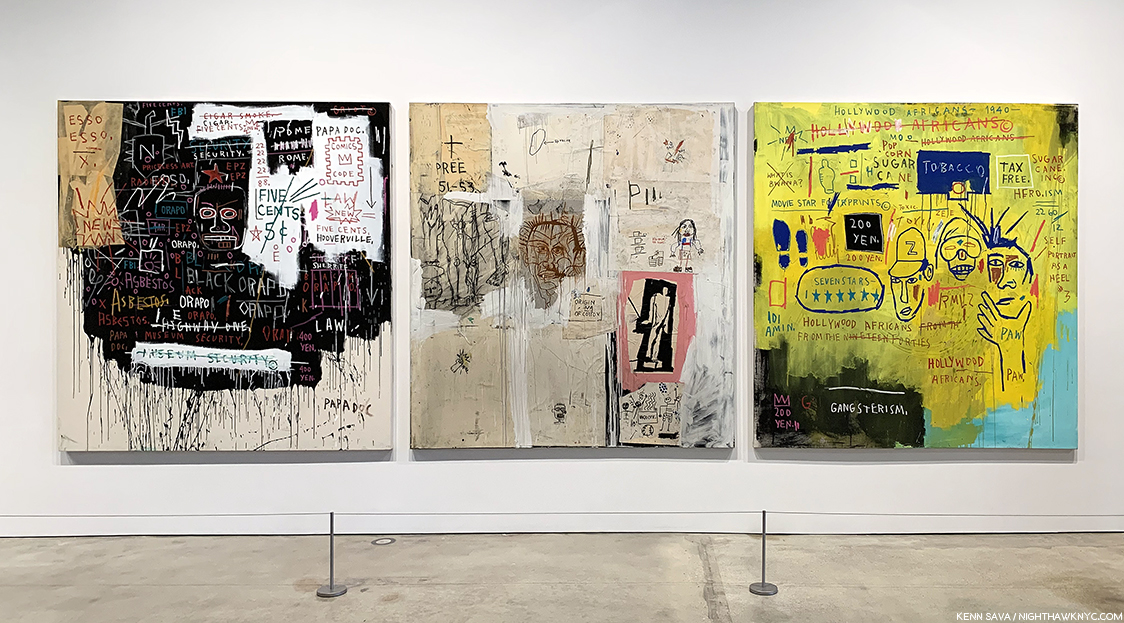
Museum Security (Broadway Meltdown), 1983, left, Big Shoes, 1983, Hollywood Africans, 1983, right, a work on loan from the Whitney Museum. The two to the left are in private collections. In 1983, after they were created, these three works hung on the same wall (with other works) at Larry Gagosian Gallery, LA, as is shown in the Whitney Retrospective catalog, P.251

Also on 3 was this striking group of three works, each from 1982, which included a work from an NYC museum!- Hollywood Africans, from the Whitney. These were fascinating contrasts to the collaged work on view at Xerox, Museum Security and Hollywood Africans both featuring words more than image, but were done exclusively in paint, as far as I could tell.
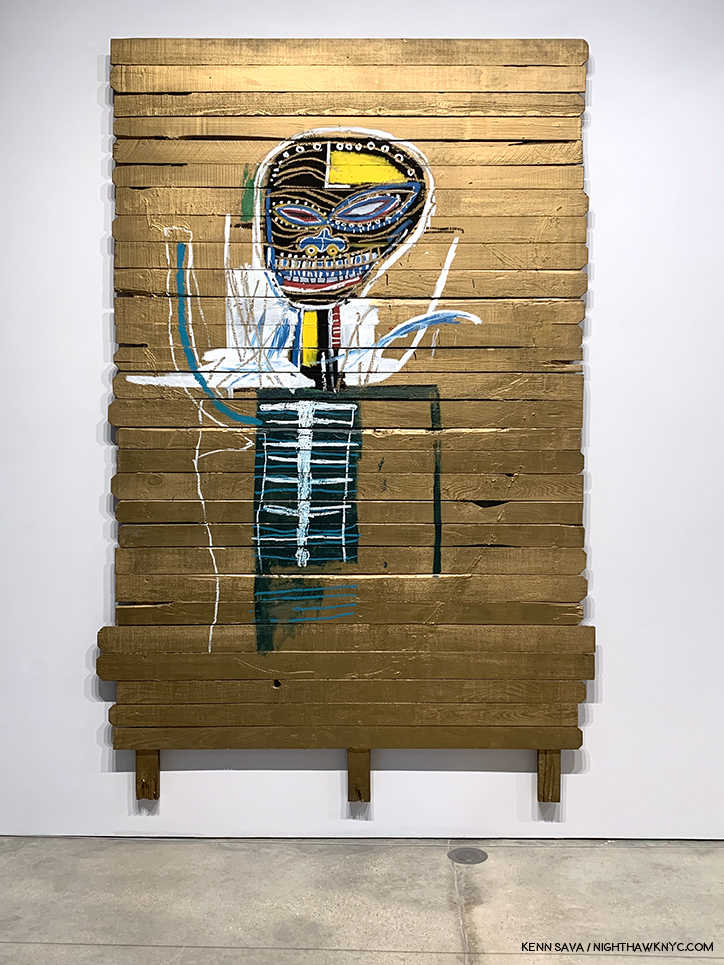
Gold Griot, 1984, Acrylic and oilstick on wood, 117 x 73 inches. You can get a sense of how big it is in the installation view, above.

The somewhat monumental Gold Griot is a very well known work and is memorably recalled in Fred Hoffman’s The Art of J-MB (P.63) as having originated from slat fencing (possibly that referred to in Phoebe Hoban’s book, P.140, that his assistant Matt Dike had acquired from a fence behind Larry Gagosian’s LA house). Mr. Hoffman’s book includes a picture of J-MB creating the work where we see the Painted head looks to be about 8 times larger than his own. Mr. Hoffman references Andy Warhol’s Gold Marilyn, 1962, in speaking of the work’s “pop” influence, with the figure isolated from the gold background, before saying, “The figure is as much a divine apparition as a living human being. With its ethereal gold background surface, the figure of Gold Griot pays homage to sculptural representations of the divine in various sub-Saharan African cultures.3.”
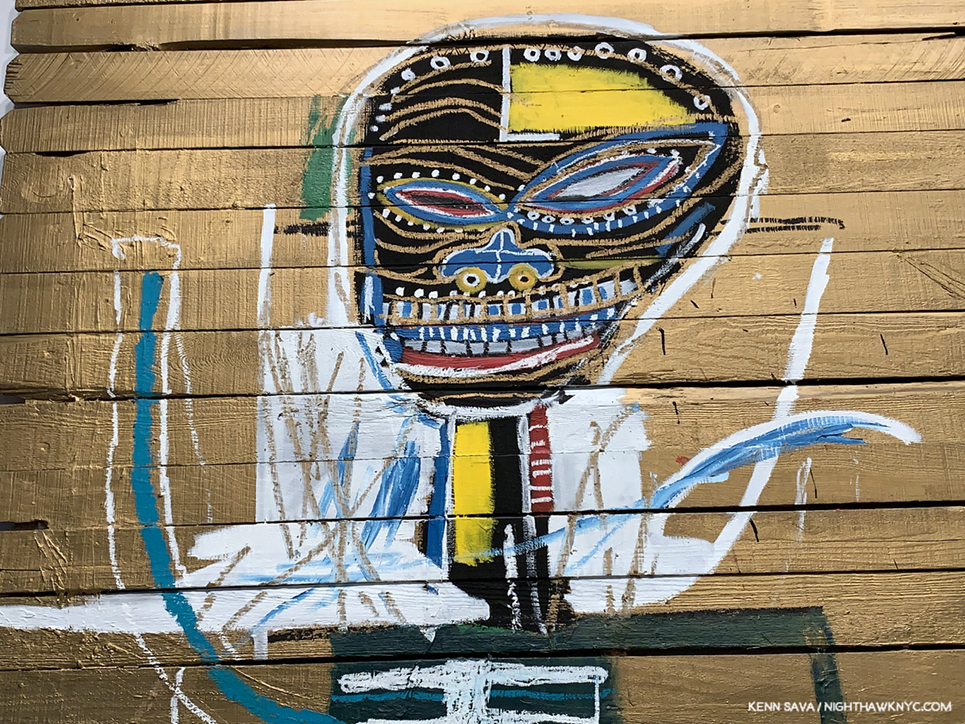
Detail of Gold Griot, 1984.

Looking closer, it’s fascinating to see how J-MB’s depiction of the head has evolved in 2 or 3 years. Gold Griot reminds me of the innovations of Robert Rauschenberg and Jasper Johns, when it comes to Painting surfaces, though it’s resolutely its own work.
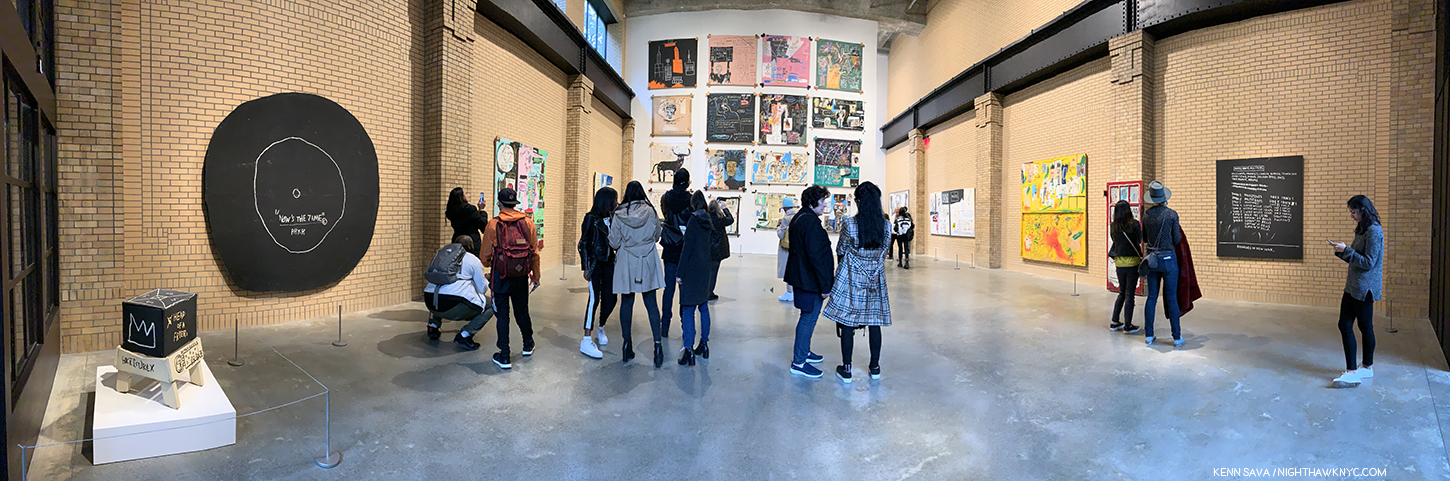
2nd floor. Installation view. The work on the immediate left is See Plate 3, 1982, Sculpture in two parts, Acrylic and oilstick on wood, canvas, mounted on wood, the only Sculpture displayed in the show.

The second floor is a bit of a strange space for displaying Paintings. A very tall space, which at first it seems more conducive to the work of monumental Sculptures, like Richard Serra’s, and lined with brick walls. The curators made it work, choosing to install the Paintings in a single row on the two side walls, then salon style on the third wall. While this made seeing the works in the top two rows challenging, it did allow for the maximum number of Paintings to be shown. As a result, I learned to live with it. In hindsight, I’d say they made the best use of the available space throughout the building, though I feel the building was less than ideal for this show because of the uneven lighting and the very high walls on the 2nd floor.
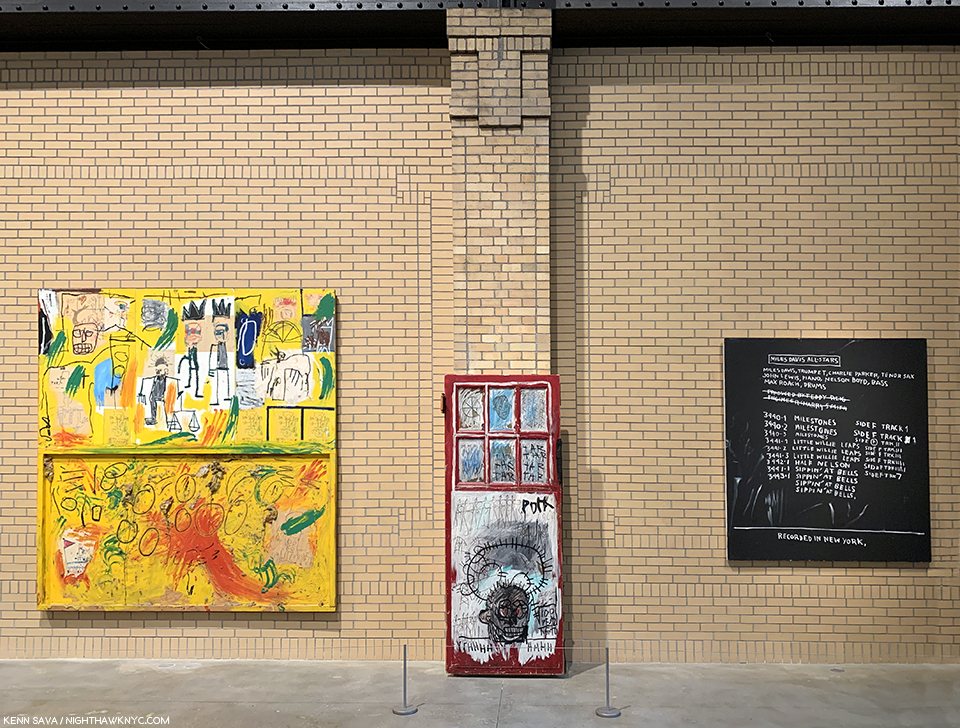
Untitled (Yellow Tar & Feathers), 1982, Pork, 1981, Discography II, 1983, left to right.

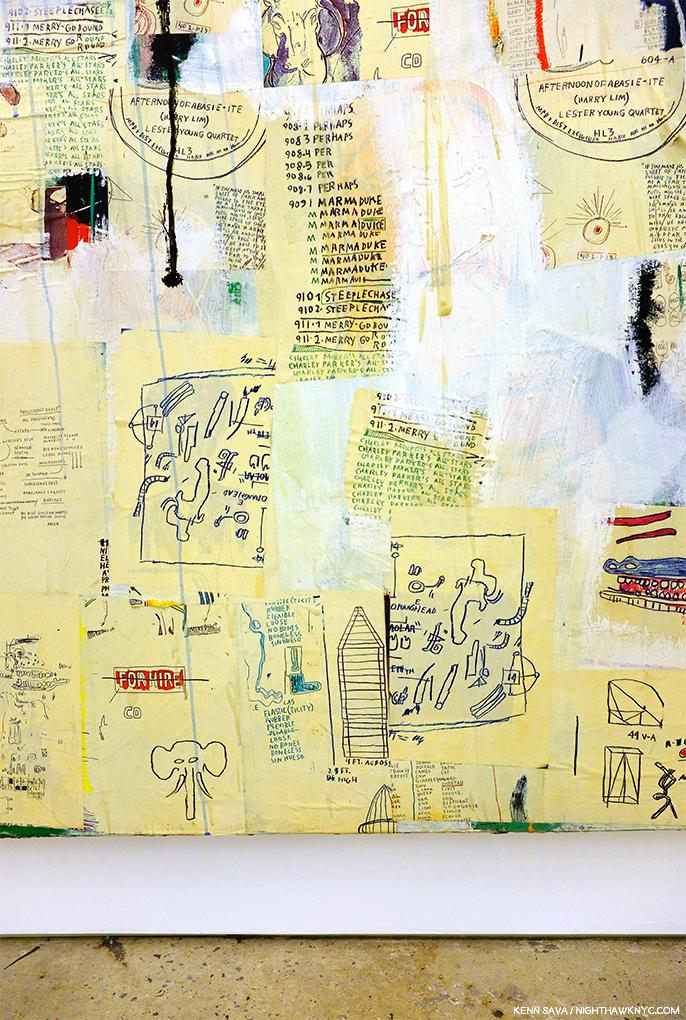
Along the sides, important works like Untitled (Yellow Tar & Feathers), 1982, were joined by others not as well known. Discography II contains a list of the details of a Miles Davis Allstars recording session which is historically noteworthy because Charlie Parker performed as a sideman for Miles for one of the only times in his career. To that point, Miles was exclusively a sideman for Bird.
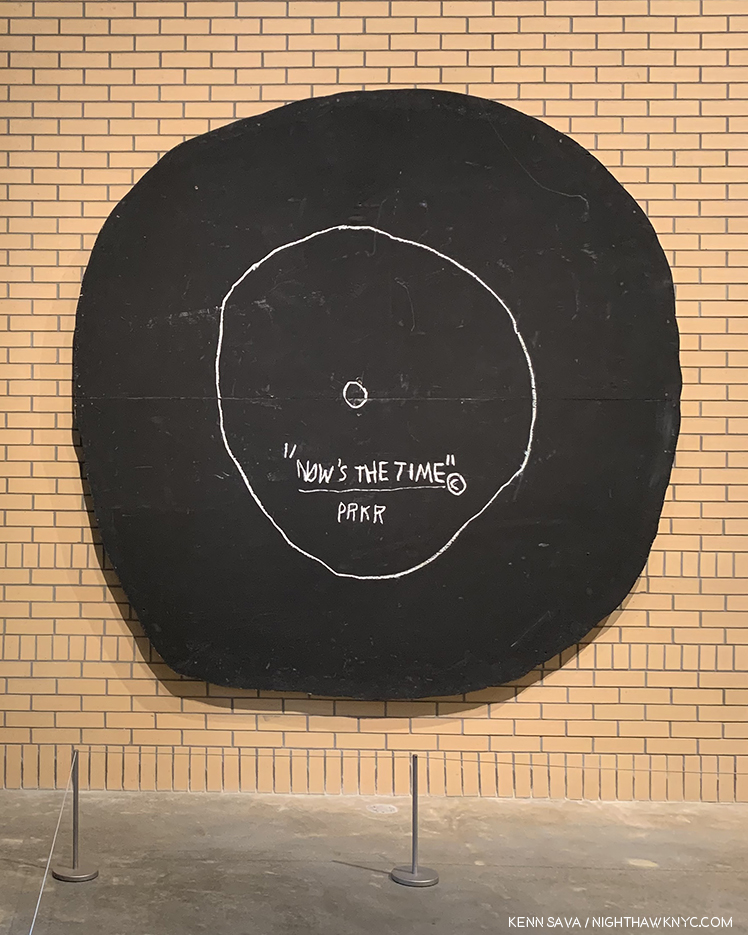
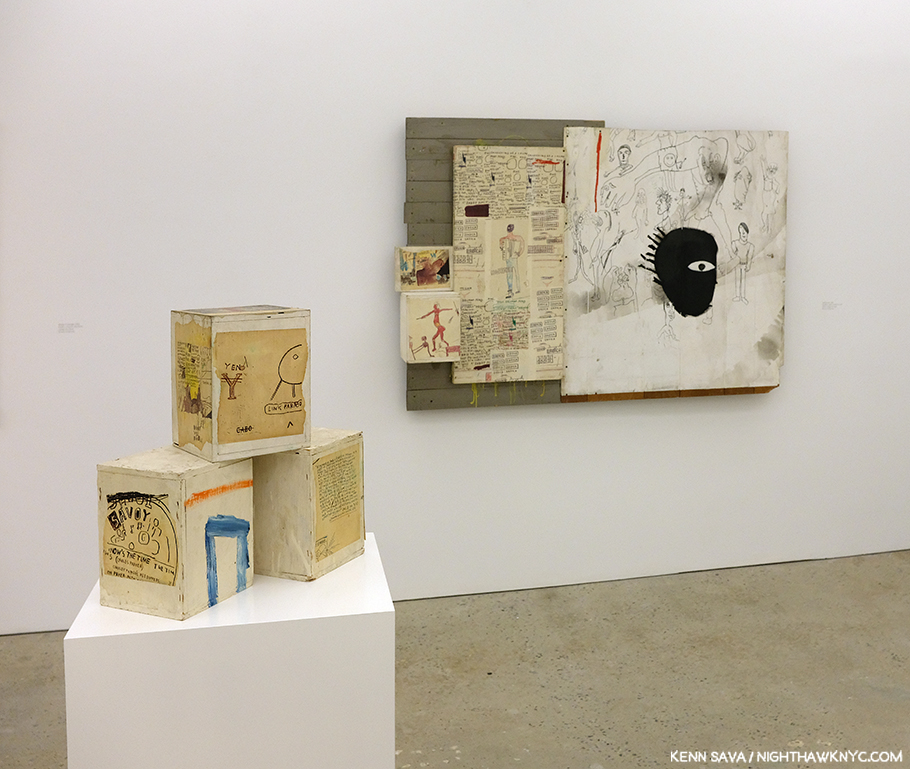
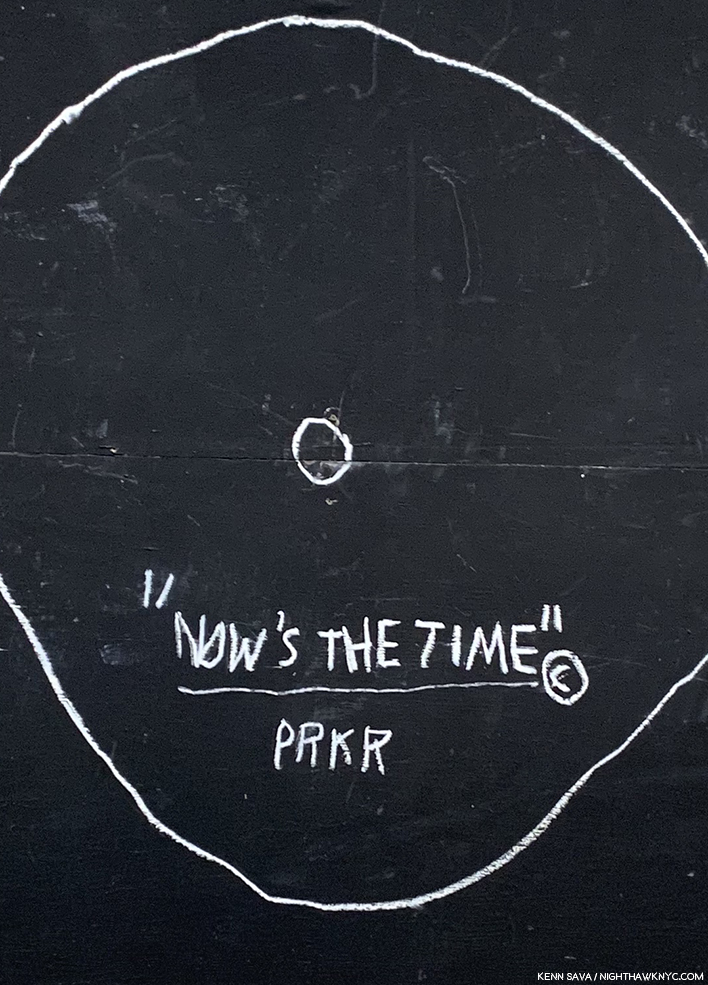
Now’s The Time, 1985, Oilstick and acrylic on plywood, 92 1/2 inches in diameter.

While on the opposite wall, the work referencing Jazz continued with the very cool Now’s The Time, 1985, an homage to the 1945 Charlie Parker record hangs. It also compliments the work on the large wall hung salon style, being they all have unique, experimental stretchers holding their canvases.
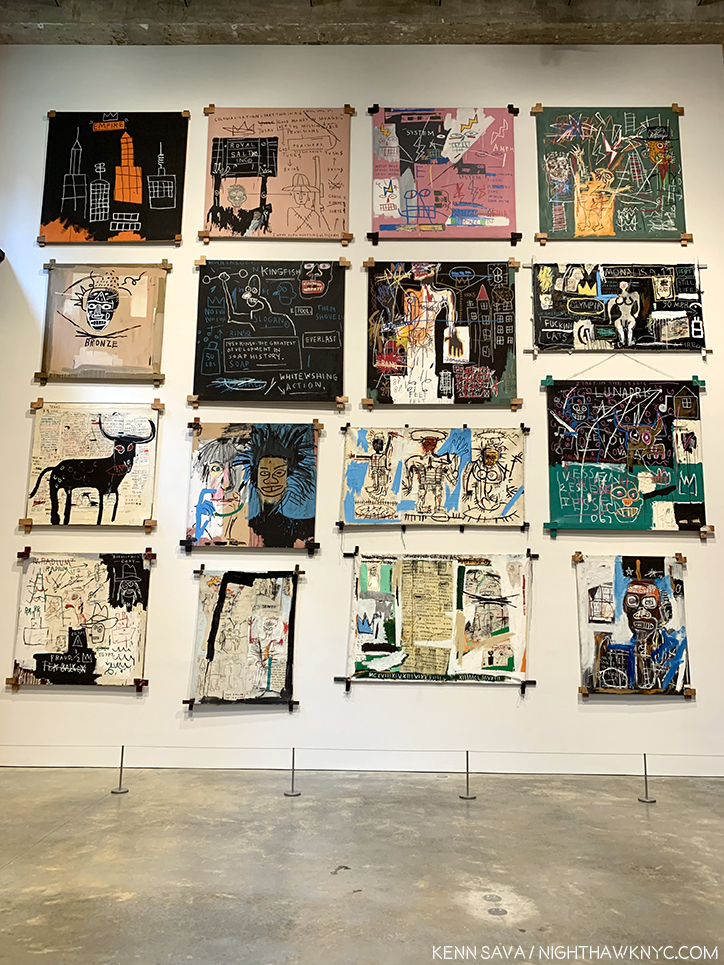
On the salon style wall, one thing each of its 16 works share are the unusual stretchers. One thing about J-MB’s Paintings that you don’t hear much about today are his unusual mounts. Constructed for J-MB by his assistants, including Stephen Torton and Matt Dike, there were other examples on the upper floors, and they are another thing that makes his work unique.
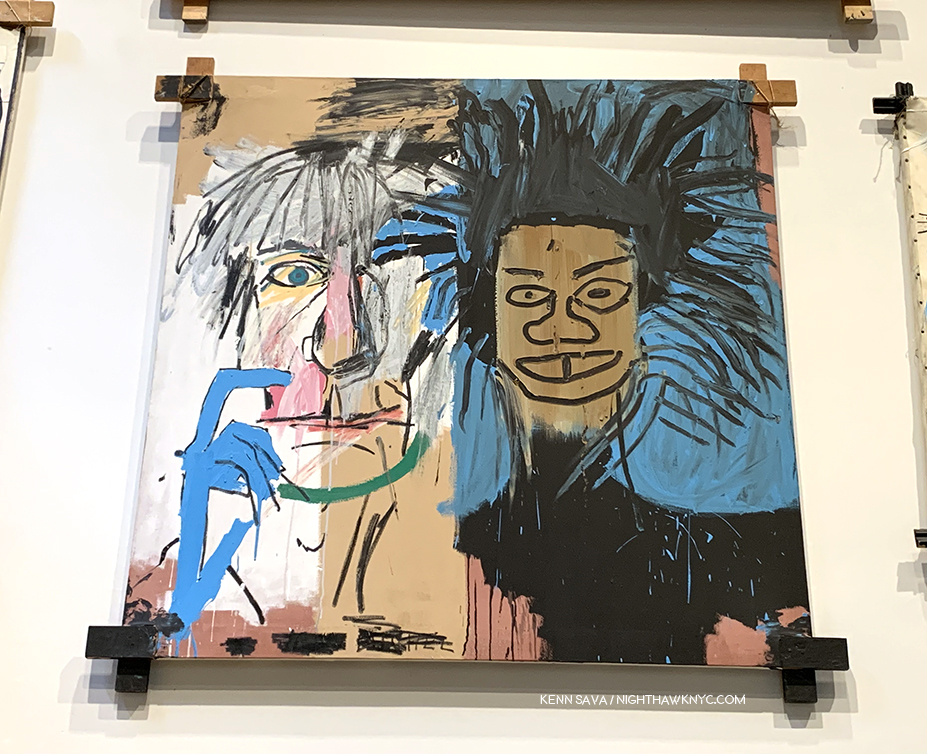
Jean-Michel Basquiat, Dos Cabezas, 1982, a portrait of Andy Warhol and a Self-Portrait that presaged the Warhol- Basquiat collaborations in 1985.

The 2nd floor also included a rear gallery, which featured 4 portraits of boxers and 3 other very power portraits.
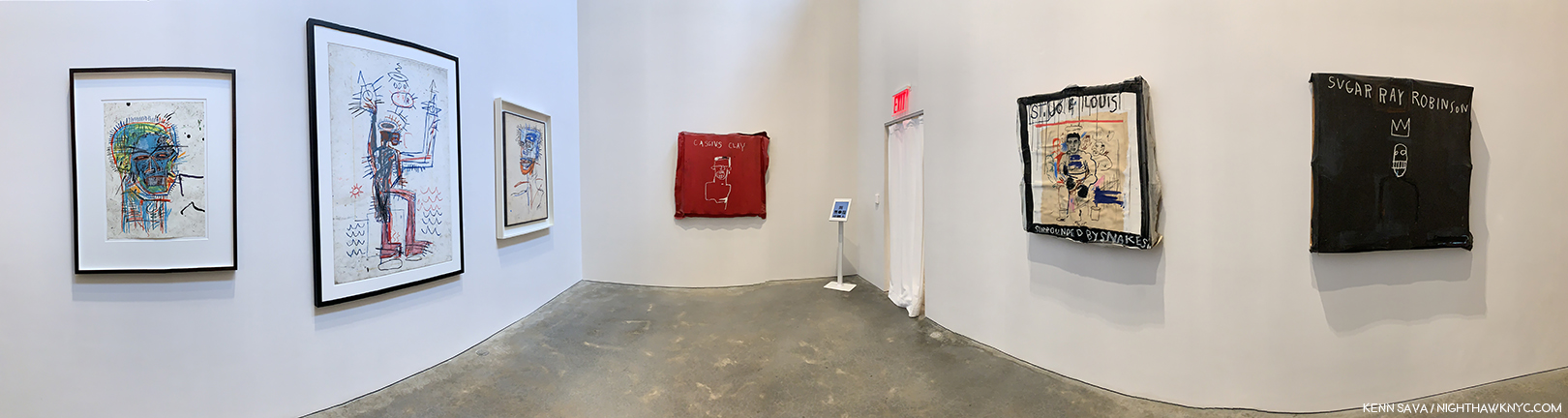
Rear gallery on the 2nd floor installation view.

J-MB had a deep fascination with boxers, and they appear both as Self-Portraits and as homages. Sometimes both. Sometimes it’s hard to tell which.
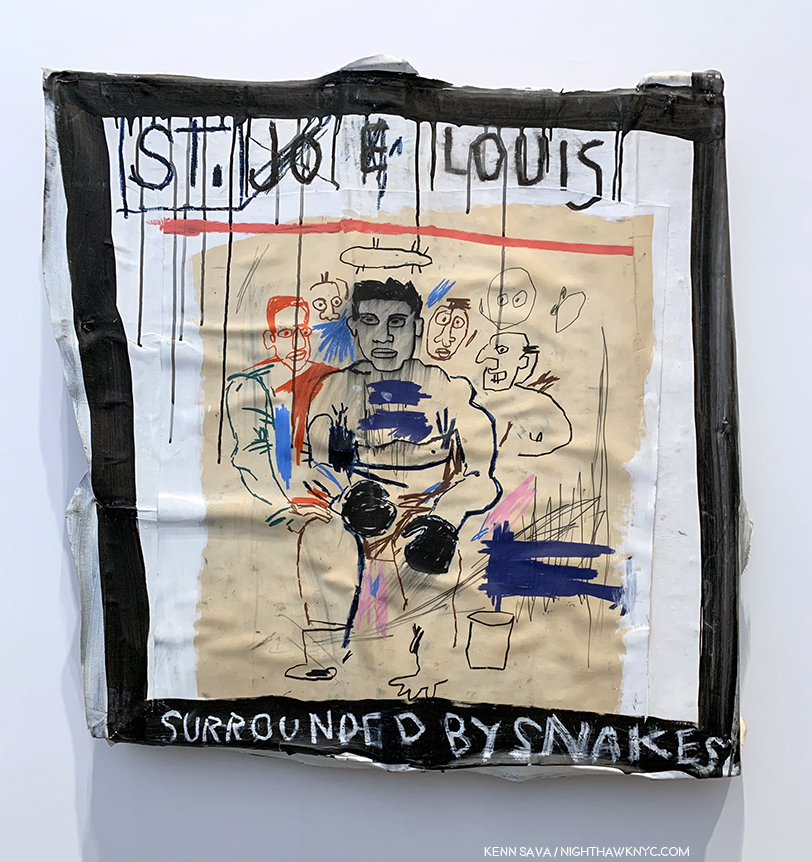
St. Joe Louis Surrounded by Snakes showed the boxer, one of Basquiat’s heroes, encircled by sharkish white managers. ‘That was Jean-Michel,’ said Suzanne Mallouk.” Phoebe Hoban. Basquiat, P.113. Early on, Paul Simon attempted to buy it for $8,000., but was thwarted by Rene Ricard. According to the iPad next to it, seen in the installation view, which served in lieu of wall cards, it now belongs to the Brants. (ibid, P.114).
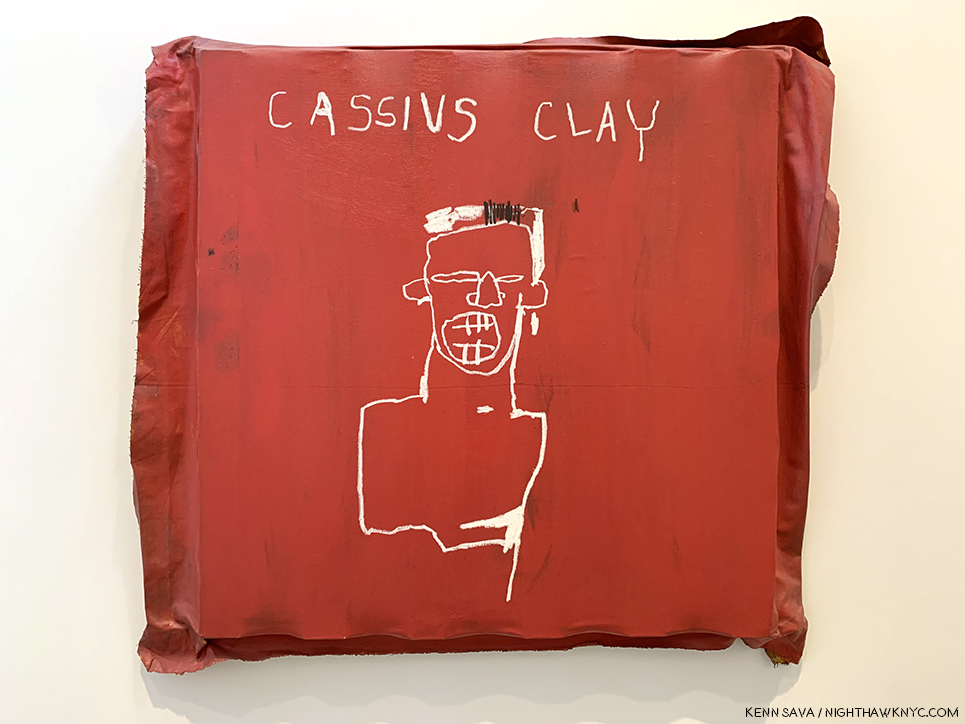
Muhammad Ali changed his name from Cassius Clay in 1964. As Cassius Clay, he won the gold medal at the 1960 Olympics, becoming a hero to many, including J-MB, who references it, here, by using his name at the time, in this work from 1982.
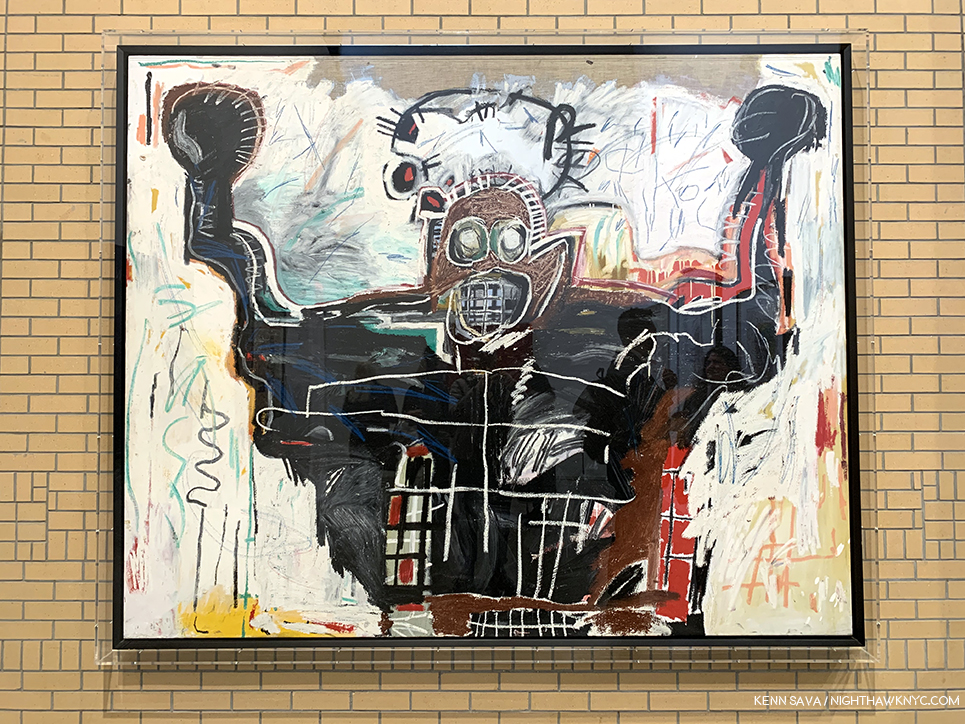
Untitled (Boxer), 1982, Acrylic and oilstick on canvas, 76 x 94 inches. Fred Hoffman calls this immensely powerful work, “… the expression of the black man’s physical and spiritual attributes.” (The Art of J-MB, P.133)

I almost missed the works installed on the first floor. Luckily, I spotted the small sign pointing to them right as I was beginning to look for the exit. Thank goodness I didn’t as it included some of his largest and at least one of his most important works.
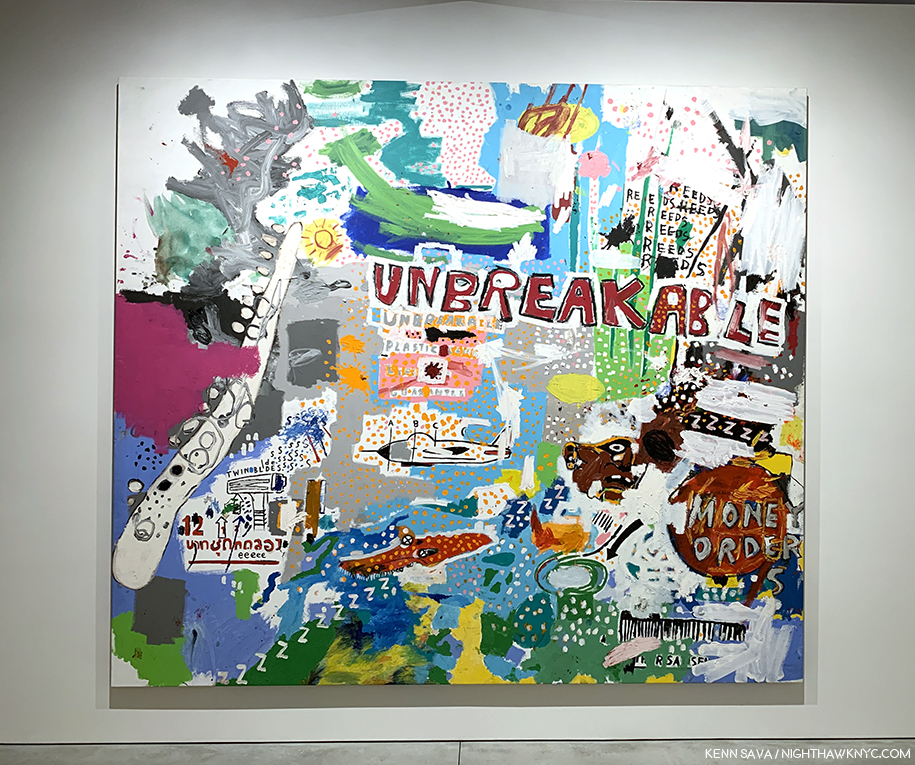
Unbreakable, 1987, Acrylic on canvas, 98 x 111 3/4 inches.

I’d never seen a J-MB work like Unbreakable prior to seeing it. Given it’s dated 1987, perhaps this is a glimpse into where his work was heading. In it, he synthesizes everything he’s been using- images, words, and color.
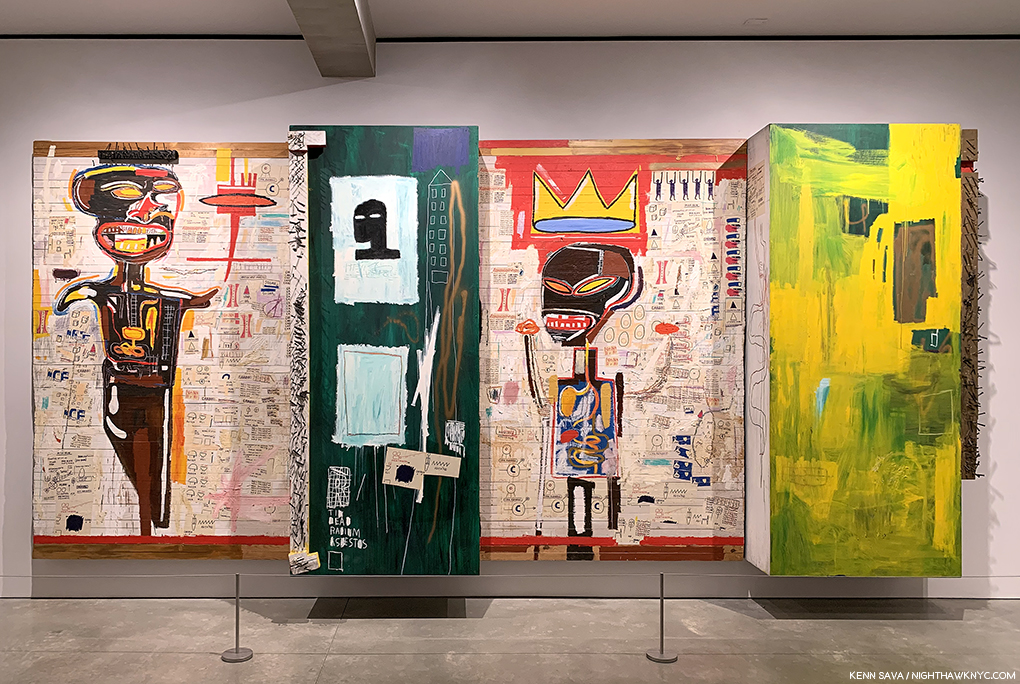
Grillo, 1984, Acrylic, oil, paper collage, oilstick and nails on wood, 96 x 211 1/2 inches- close to 20 feet by 8 feet!

What a powerful, stunning, incredible work Grillo is! It’s taken Robert Rauschenberg’s Combine Paintings in an entirely new direction. I love the juxtaposition of the two panels with figures (one left, one right of center) with the panels immediately to each of their right. I do wonder if this piece was meant to sit on the floor or be raised a foot as it is here.
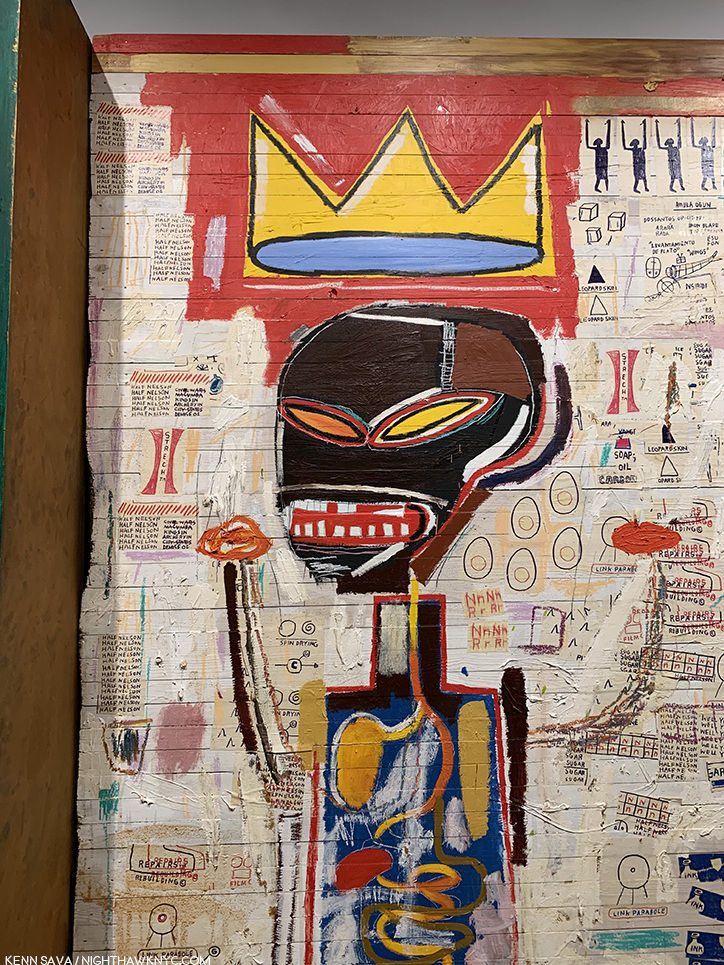
Detail of the right of center panel.

As I looked closer at Grillo, I noticed a good many color Xeroxes collaged on. Yet, the two figures hold the key to it, I think. On the left is a figure holding a torch. Over his head there’s a pice of wood with nails sticking out of it. That sure could be interpreted as a “crown of thorns.” Around him are various repeated words, including- “Soap,” “Oil,””Butter,” Carbon,” and “Stretch,” along with at least two Bebop song titles- “Well You Needn’t,” by Thelonious Monk and “Half-Nelson,” recorded by Bird. What this figure represents I don’t know, but there are elements of the martyr and the heroic included. The other figure, apparently a king, wears a large crown, accompanied by small attendants to its right, and has his hands raised, like the boxers seen upstairs. He appears to be looking towards the left side figure, and both figures have their internal organs shown, perhaps yet another reference to Gray’s Anatomy.
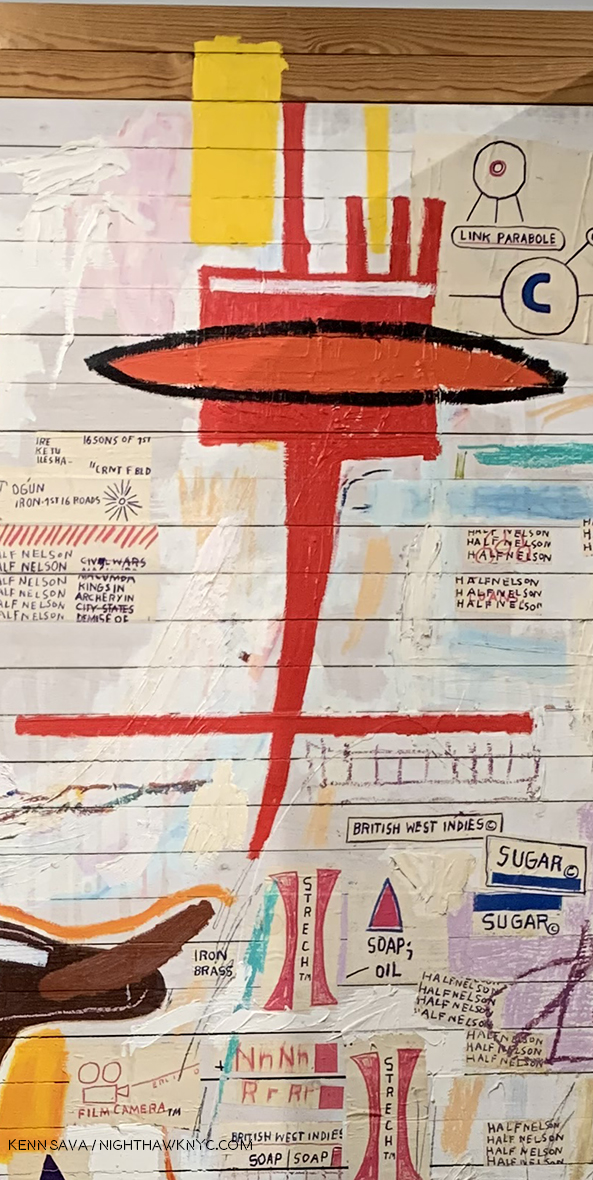
And, there’s this- The left hand figure, how has a board with nails over his/her head, possibly a crown of thorns?, holds a torch…

The work speaks volumes about how J-MB’s Art has evolved in 7 short years, and the unlimited potential the future held for it, and for him.
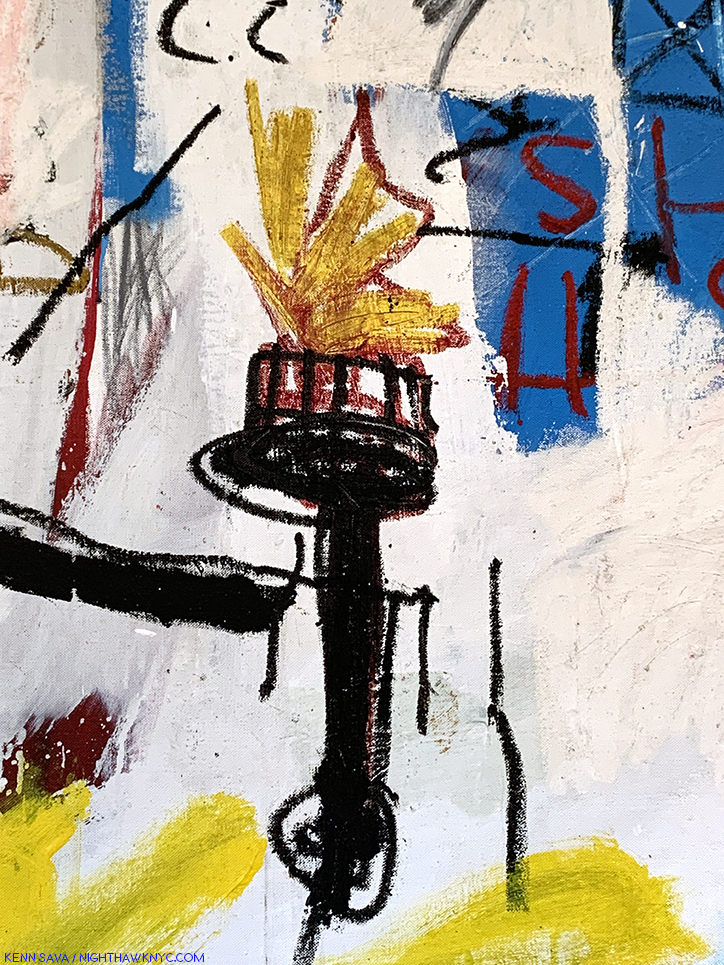
…which reminds me of the one seen 3 floors up in Per Capita, 1981.

A few days later, Lisa shared her thoughts on the show. “I thought the Basquiat show was quite spectacular. There were so many works that I had never seen before. In particular, I was struck by the great thick black oil slicks. There is something about this sheen, like shoe polish, that you can’t truly appreciate unless you see the paintings in person. They give the works a lot of dimension and texture. They also remind me of Franz Kline – totally dynamic and emotive in gesture. The oil slicks are bold and grimy, like New York. His compositions tend to mimic graffiti on the street – throw ups, wheatpaste posters, and tags on a wall/single canvas.”

There was a bit of the feel that the show was something of an afterthought to the just completed Louis Vuitton show. A “Hey, we’ve got all this work assembled, why don’t we just put it up in NYC?,” kind of thing. I quickly moved past it, the lighting and other questions with the space I’ve mentioned. Nothing dulled the effect of seeing so much work that STILL looks fresh, vital, and contemporary, in spite of countless imitators, commercial “appropriations” of his symbols and the passage of over 30 years since he left. What I saw at The Brant was the work that has defined the legacy of J-MB- in quite a few of his more well known Paintings, works characterized by his characters, in which his words take much more of a back seat than they did over at Xerox. Thinking about J-MB at The Brant four months later, the show has become more monumental in my eyes.

While Peter Brant may represent what many call “the 1%,” so does Jean-Michel Basquiat. For me, J-MB represents that extraordinary, and extraordinarily rare, group of people who are able to overcome unfathomable difficulties- racially, socially, financially, educationally and, apparently, familial, and some difficulties that appear on the outside to have been self-inflicted (though quite possibly resulting from the others- I’m not a doctor or a therapist), then somehow surmount ALL of that and go on to rewrite Art history in about a decade. How many people can this be said of?

How ever many you choose to include? I’m not sure it would even equal 1%.

This Post is dedicated to Lisa, with my undying thanks. My gratitude is due to Jessie for his consideration. Anyone reading this owes them their thanks as well.

*- Soundtrack for this Post is “Bold As Love,” by another brilliant Artist who died at just 27, Jimi Hendrix, which concludes the timeless Axis: Bold As Love.

“Anger he smiles towering in shiny metallic purple armor…
My red is so confident that he flashes
Trophies of war and ribbons of euphoria
Orange is young, full of daring
But very unsteady for the first go around
My yellow in this case is not so mellow
In fact I’m trying to say it’s frightened like me
And all these emotions of mine keep holding me from
Giving my life to a rainbow like you
[Chorus]
But they’re all bold as love
Yeah, they’re all bold as love”

In lieu of the immortal Hendrix original recording here’s a cover to inspire you to seek out the original-

This is Part 2 of my series on the five Jean-Michel Basquiat related shows going on in NYC in 2019. Part 1 is below, or here.
My prior pieces on Painting are here

NighthawkNYC.com has been entirely self-funded and ad-free for over 6 years, during which over 250 full length pieces have been published. If you’ve found it worthwhile, you can donate to keep it going & ad-free below. Thank you!

Written & photographed by Kenn Sava for nighthawknyc.com unless otherwise credited.
To send comments, thoughts, feedback or propositions click here.
Click the white box on the upper right for the archives or to search them.
For “short takes” and additional pictures, follow @nighthawk_nyc on Instagram.

Subscribe to be notified of new Posts below. Your information will be used for no other purpose.
 

  1. I’m speaking of Manhattan’s museums, only, here and leaving off The New Museum who have no permanent collection.
  2. according to the Brant Foundation.
  3. ibid P.65

Jean-Michel Basquiat: Now’s The Time

Written & Photographed by Kenn Sava (except *)

Part 1 of a series.

It’s hard to believe that not even 40 years have passed since Jean-Michel Basquiat burst upon the Art scene, (after his career as part of the legendary graffiti duo SAMO©), when the month long The Times Square Show opened 39 years ago on June 1, 1980 at 201 West 41st Street. Just eight years, one month and eleven days later, on August 12, 1988, he would be found dead from a heroin overdose at the infamous age of 27 at his home and studio at 57 Great Jones Street.

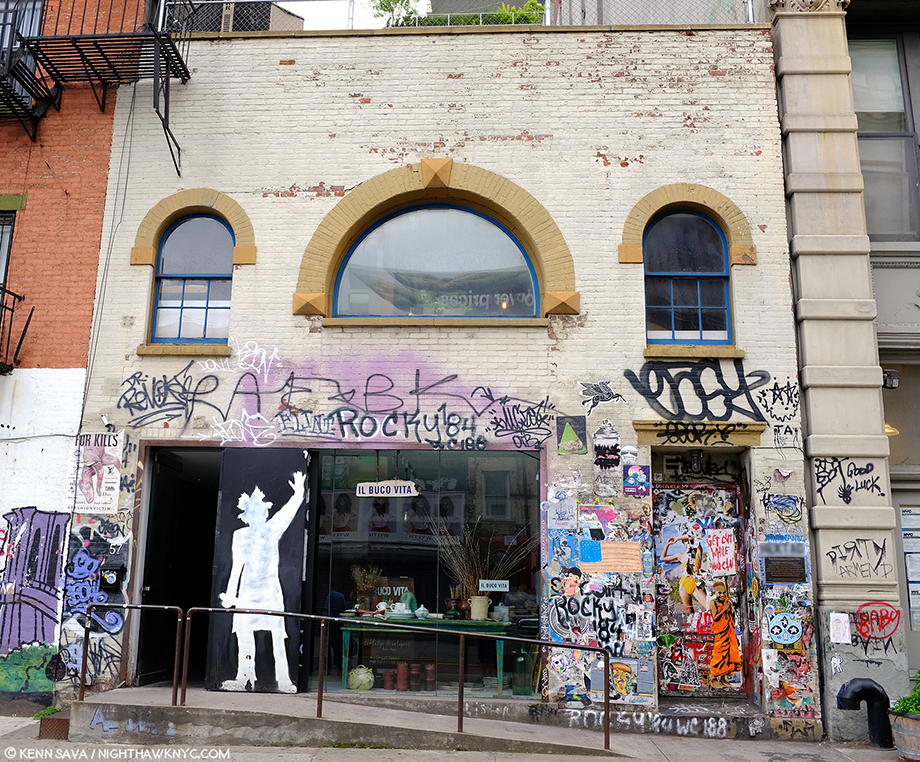
What appears to be an anonymously applied silhouette of the late Artist looms large here at the one time stable at 57 Great Jones Street, NYC, seen in May, 2019. Back in the day, it was owned by Andy Warhol who rented it to Jean-Michel Basquiat, who lived here from 1983 until he died here on August 12, 1988. His studio was on the ground floor, his living quarters upstairs. By the way? In an interview with Becky Johnston and Tamra Davis, Jean-Michel Basquiat said, “I don’t really consider myself to be a graffiti artist, you know?1” That might surprise those attempting to cover every square inch of the building now.

He didn’t live to see the Art market crash (unrelatedly) the following year, from which it has since recovered and grown many, many fold larger than it was during the bubble of his day, nor did he live to see the end of the controversy around him and his Art. It’s never subsided-

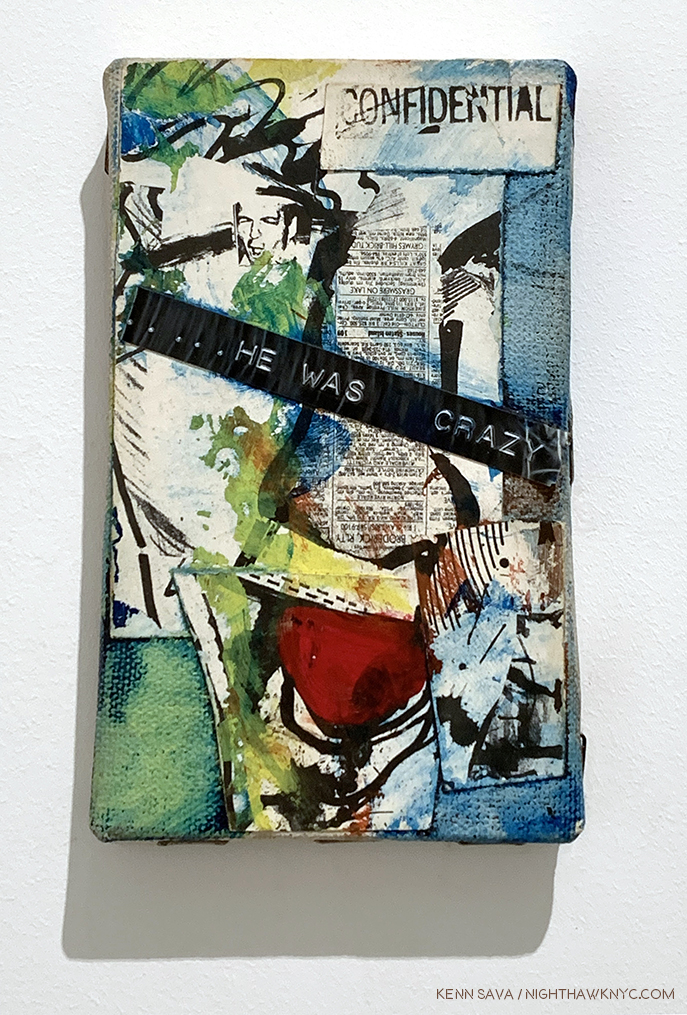
He Was Crazy, 1979, Mixed media on canvas, all of 5 x 3 inches, the earliest and smallest work on view at Jean-Michel Basquiat / Xerox.

-Robert Hughes titled his obituary “Requiem for a Featherweight.”

-“He was essentially a talentless hustler…,” according to Hilton Kramer in a piece titled,  “He had everything but talent” in 1997.

-“Come on…Basquiat? Really? Sort of an art hoax. Just the incoherent rantings of a tortured soul obsessed with drugs and a deluded quest for acknowledgment, which he did achieve. Doesn’t make it good.” A direct quote from the comments more recently here.

Yes, there are still plenty of haters hating on the work on Jean-Michel Basquiat.

The now infamous cover of The New York Times Magazine from February 10, 1985 by Lizzie Himmel shows the Artist in his studio. The article, by Cathleen McGuigan, included a look at the Artist that seems surprisingly balanced today given all the controversy surrounding him at the time.”The extent of Basquiat’s success would no doubt be impossible for an artist of lesser gifts,” she wrote.

On the other hand, there are the countless other members of the Art viewing public for who Jean-Michel Basquiat’s work has continued to speak since he started making it, and Painting that speaks to people over time is what comes to be accepted as “Art” a few centuries on it seems to me. Yet, the Art viewing public is not the only group divided on the work of Mr. Basquiat. On page 44 of the book, The Art of Jean-Michel Basquiat. Fred Hoffman, one of the curators of the 2005 Brooklyn Museum Basquiat Retrospective and a man who produced prints with Jean-Michel Basquiat (J-MB henceforth) for 2 years, writes, “Herbert and Leonore Schorr offered the Museum of Modern Art the opportunity to choose a painting from their collection as a gift. The museum replied that having a painting by Jean-Michel Basquiat was not even worth the cost of the storage.” On May 26, 2017, this quote appears in the New York Times, “‘It’s an artist who we missed,’ said Ann Temkin, the chief curator of paintings and sculpture at the Museum of Modern Art, which does not own a single Basquiat work2. ‘We didn’t bring his paintings into the collection during his life or thereafter3.’”

6 year old Jean-Michel Basquiat’s membership card to the Brooklyn Museum. It’s not well known that J-MB was an avid museum goer, attending the Brooklyn Museum and later, frequenting The Met with his friend Fab5Freddy. Credit 2015 The Estate of Jean-Michel Basquiat/ADAGP, Paris, via ARS, New York; Hiroko Masuike, via The New York Times.

In fact, as I write this? Of NYC’s “Big five” museums, only the Whitney owns a Basquiat Painting- they own 3, according to their online collection catalogue (none are currently on view as of my last visit, this past month. Also, I should note that among the 5 Manhattan museums The New Museum has no permanent collection. By the way, The Brooklyn Museum owns one print, seen below, and a Drawing.)

None of those feelings were mine though I wasn’t a “fan” of the work of Jean-Michel Basquiat. Then, as now, I was focused on Artists I felt were overlooked. My feeling in the 1980s was that too much money was being spent on, and too much attention given to, Contemporary Artists with no track record. Artists whose work hadn’t stood the test of time, hadn’t stood up to critical, and historical, assessment, whose work wasn’t in major museums, and on and on. By default, though not in particular, that included the work of J-MB. Still, I’ve always kept an open mind. There are very very few Artists or Musicians who’s work I will never, ever love- no matter what. But, there are some. Hitler was a painter- lowercase “p” for once- remember?

May 12, 2005. The only picture I was able to get (quickly) just outside the Basquiat Retrospective at the Brooklyn Museum, since pictures were not permitted inside. Back of the Neck, 1983, Screenprint, right, seen in the lobby and the show’s poster to the left. Glare was a problem in 2005, too. You can see the show in official shots, here.

So, on May 12, 2005, I went to that Brooklyn Museum Basquiat Retrospective that Mr. Hoffman was a curator of. When I got home, I wrote, “His work still doesn’t speak to me, beyond the fact that I so admire his freedom. The show was very well done.” I also came away struck by his love of Jazz. Anyone who loves classic Jazz is OK with me. I also remember being surprised at how prolific he was in such a short time, which reminded me of Van Gogh, who’s Painting career lasted only about a year or so longer. Looking back on it now? My head was elsewhere. I was drawing on a daily basis in a representational style, and so I was lost studying Ingres, Hopper, Richard Estes and Rembrandt, who I had recently gone to Chicago to see a show of. But? Having bought one at the show, I began wearing T-shirts with Jean-Michel Basquiat’s Art on them. His work just fits walking around NYC.

Untitled, 1980, the white on yellow original of which is in the Whitney Museum’s collection, is a work that was shown at New York/New Wave in 1981 at MoMA PS1, now appears on a Uniqlo SPRZ NY Women’s T, seen in June, 2019.

Slight digression- I’m not for giving a free ad here, but I must give props to Uniqlo for putting the Art and cover Art of so many great Artists and Musicians4 on their SPRZ NY line of T shirts. Some of the Art line is co-sponsored by MoMA. In turn, Uniqlo pays for the free Friday nights at the MoMA, which countless thousands attend each week. Uniqlo has continually featured J-MB’s work on their clothes, in spite of the problematic history of Basquiat and MoMA. Fred Hoffman in The Art of J-MB (P.175, footnote 2) relates this story about Untitled, 1983, a limited edition print of 10 copies he did with J-MB- “Untitled was given to the Museum of Modern Art in 1984. After it was in the catalogue for the MoMA 1984 exhibition An International Survey of Painting and Sculpture, the work was completely overlooked by the museum, and excluded when the museum first put its collection online. It was not exhibited in the galleries until 2015. Only with the collaboration between MoMA and Uniqlo beginning in 2014, when a cropped image of Untitled was used as the signature image for the marketing of the ‘SPRZ’ collection of iconic artist images applied to clothes, did the museum finally recognize the work as part of its collection.” 2015! To this day? I still wear Uniqlo J-MB T’s, even though I wasn’t a “fan.” End digression.

Jean-Michel Basquiat appears to be admiring  Nick’s Basquiat tattoo in one of Alexis Adler’s Photos of him at Bishop Gallery. Nick is an Art Teacher.

Ok. So, who’s “right?” The haters, the non-believers, and the NYC museums, who, unanimously, minus one, passed on acquiring his Paintings? Or, the incalculable number of members of the Art loving public to who the Art of J-MB speaks, perhaps, like that of few other Artists today, judging by how often I see others wearing his Art and icons, along with the innumerable Artists who’ve been influenced by his work, and those few collectors who bought up the bulk of his best work shortly after he created it?

All I can show you- pictures were not allowed in the show.

Fast forward. On May 7th, 2019, I went to see Picasso’s Women at Gagosian on Madison. It’s one of those shows that, though small, reminds you, as if you need to be, why Picasso was one of the towering creative geniuses of 20th Century Art, in my view. Each and every work is in a different style, and most were masterpieces. Yet, it’s a show that will only live on in the memory of those who saw it as no photos were permitted. I walked out through the building’s lobby, my head spinning. Just before I exited, next to the front door, I spotted this-

Minutes after I saw this poster my mind began to change.

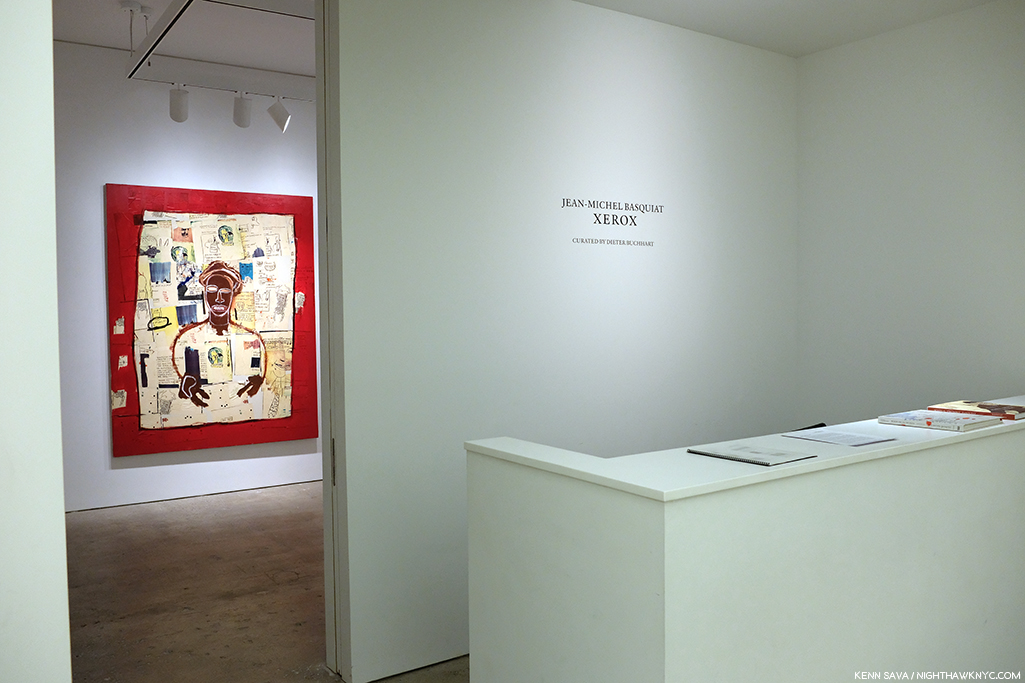
Jean-Michel Basquiat / Xerox. I asked the guard where it was. “On 3,” he replied. Still recovering from Picasso, I pondered if I could clear my head enough for about 5 seconds, then I went back in and went up to Nahmad Contemporary on 3.

3 hours later, I left, realizing I’d never really seen the work of Jean-Michel Basquiat before. I had missed it. In Xerox, the term “Painter,” all of a sudden feels too small, even for an Artist notorious for getting paint everywhere- including on his multi-thousand dollar Armani suits, as can be seen in the infamous cover of The New York Times Magazine shown earlier.

But, this is a show that features his under-known multimedia works that include photocopies- color Xeroxes being one of his favorite tools, one he loved so much, he bought his own color Xerox machine. (I’m sure there are many others, but right now? I can’t think of many Artists who made color Xeroxes as big a part of their work- particularly Painters.) As a result, here images recur- his own images, exclusively, which is down right refreshing in this age of copious “reappropriation.” Drawings or Paintings that the Artist has Xeroxed and pasted onto canvas which he then proceeded to add to and modify in any number of ways, including Paint on.

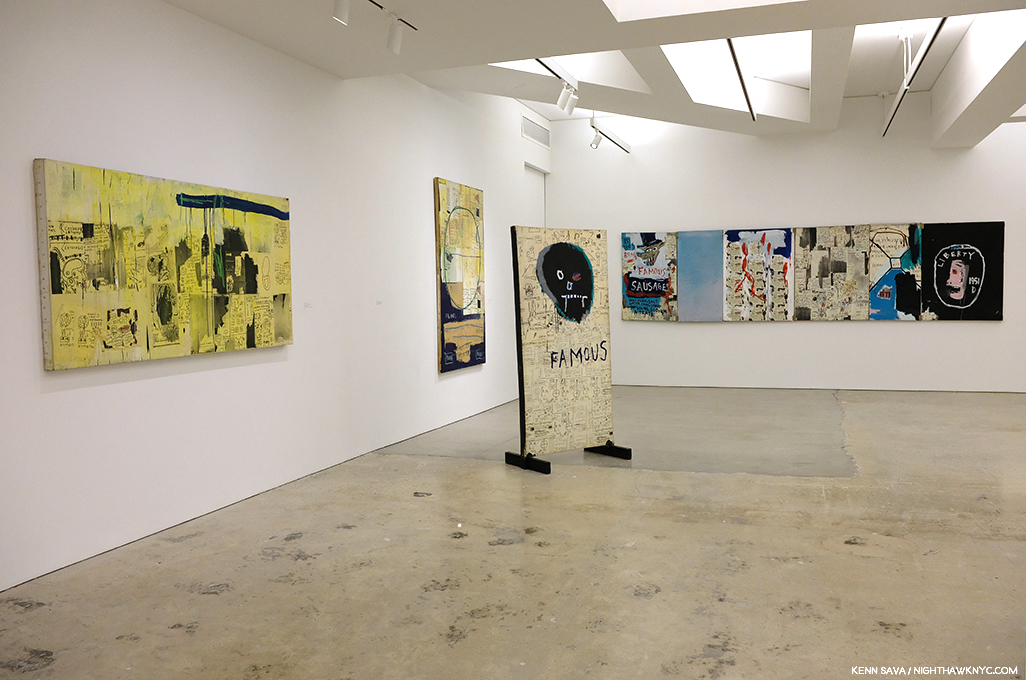
Installation view. I was completely unprepared for the depth and endless detail in this body of work I had previously not known.

As a result, in Jean-Michel Basquiat / Xerox, we see J-MB the collagist as much as we do the writer, or the Painter. Suddenly, his work looks different. The figures recede, words come to the fore. Many, many words.

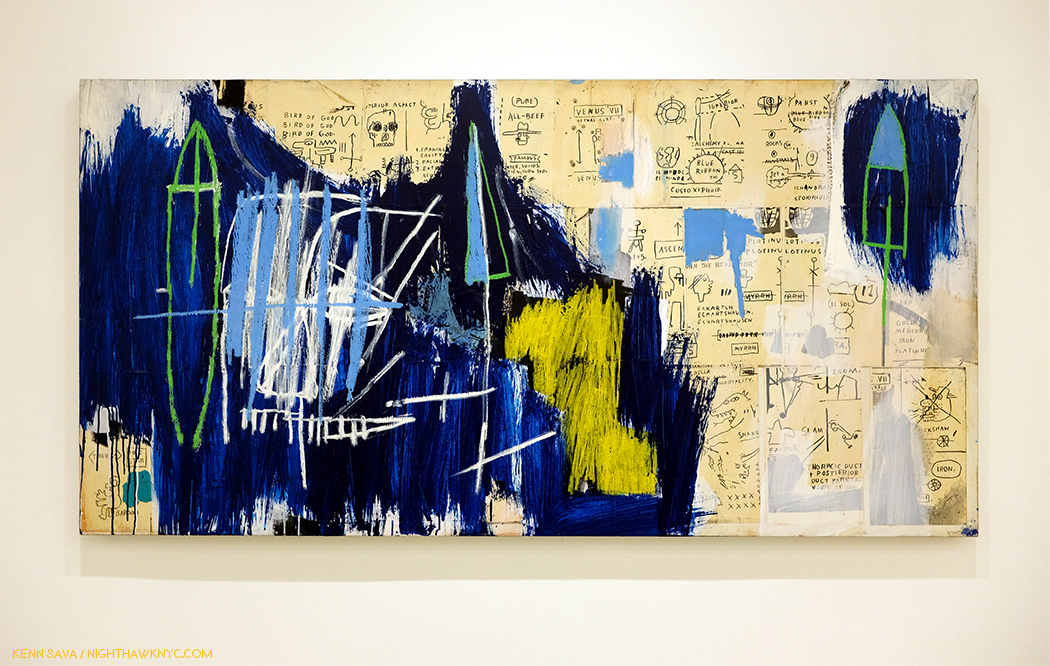
Odours of Punt, 1983, Acrylic, oilstick and Xerox collage on canvas, 40 x 83 inches

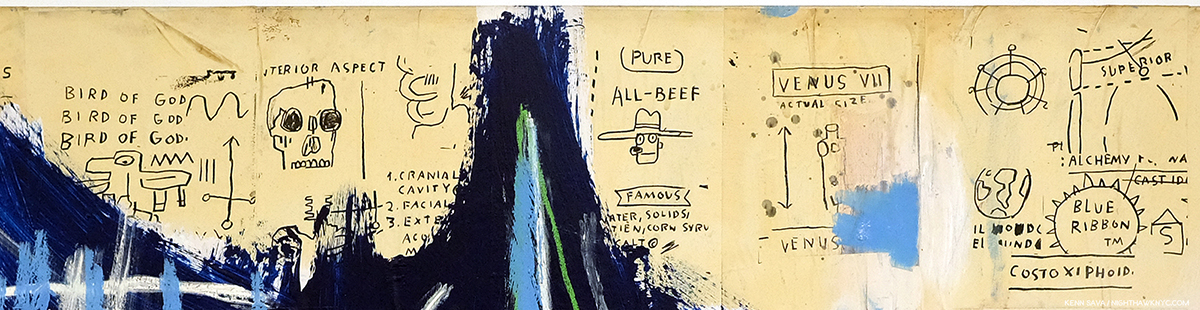
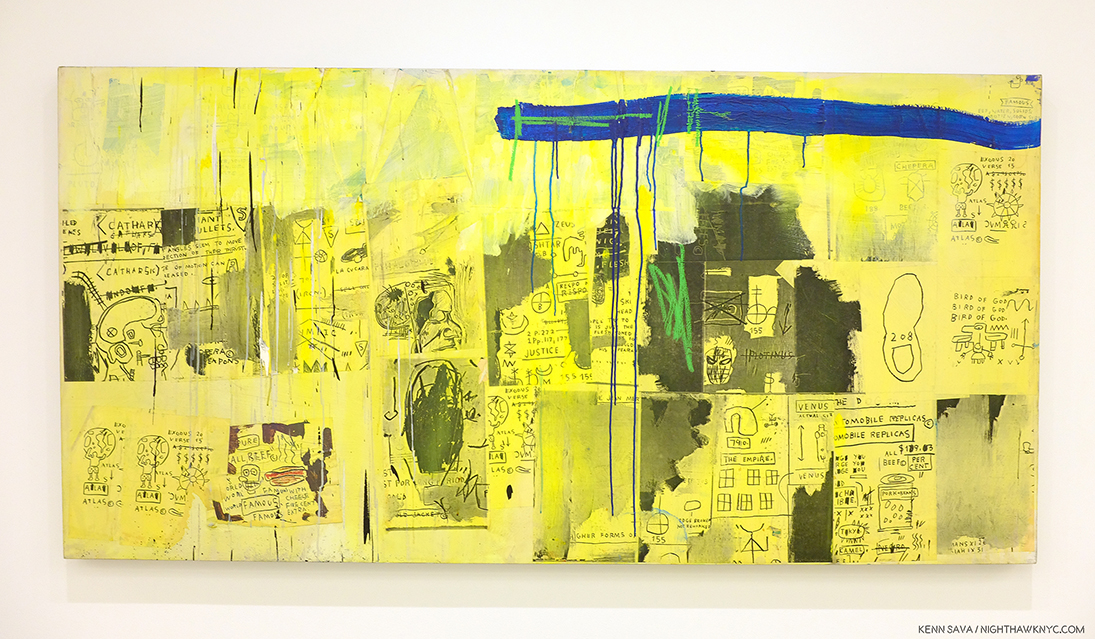
Odours of Punt, 1983, was one of the first works in Xerox and it was one of the first works to get to me. A “non-fan” up to that moment, something clicked in me when I saw this. In it, J-MB borrows Painting techniques from all over Art History on his way to making something…else. The history of Painting from 1947, on, was staring me in the face, to the left, while something entirely new and different was vying for my attention on the right. On the left, I felt Clyfford Still being channeled underneath Cy Twombly and Jean Dubuffet yet what he created is something distinctly his own- a remarkable thing in itself. And extremely abstract, at least to my eyes. While its right side felt like it was coming from another world, made up of fragmentary images. Neither side would seem to “go” with the other at first glance, yet, somehow, as my eye and brain moved between the two “worlds” of the work, they manage to hold together almost miraculously well. This is something I’ve felt in the presence of the greatest works of Abstraction, including those by, say, Kandinsky, Jackson Pollock from 1947 to 52, Mark Rothko, Jack Whitten, and Mark Bradford today. It’s incredibly hard to do, which is evidenced by the fact that almost none of them (who’s careers have completed), except for Kandinsky, (who was 77 when he passed away, and Painting abstractly for about 35 years), were seemingly able to do it indefinitely. Jackson Pollock seemed “to lose his fastball” in his last few years and his style began to change, and Mark Rothko lost…his life (I’m not saying that’s related to his Art). Perhaps these are only coincidences. J-MB didn’t make it to 30 years of age.

Detail of the upper center.

On the right, equally abstract to me was what seemed to be a new creative language. “BIRD OF GOD,” “VENUS VII,” “COSTOXIPHOID,””BLUE RIBBON,” and on and on, accompanied by innumerable drawings and diagrams. Man, there’s A LOT to see in this! Even now, almost 4 months later? I feel like I’ve only begun to look at it. For only one example- Costoxiphoid is a ligament that connects the ribs. At age 6, J-MB was injured in a car accident. While he was hospitalized (his spleen, i.e. his “filter,” was removed), his mother brought him a copy of Gray’s Anatomy. It would be a sourcebook for his Art for the rest of his life, and possibly here for “1. Cranial Cavity, 2. Facial,…” to the left of center. The title (assuming this is the Artist’s title- many of his works were “named” by others) is also an enigma. “Odours” referring to “any property detected by the olfactory system,” per Merriam-Webster, and “punt” have multiple meanings, including “an open flat bottom boat with squared ends.”

Untitled, left, and Peter and the Wolf, both Acrylic, lipstick and Xerox collage on canvas, both 1985, both 110 x 114 inches, seen from about 15 feet away, the figures in these pieces are almost entirely swallowed up by everything else.

Walking through Xerox, it was impossible not to begin to understand that J-MB‘s work is deep. Deeper than just about anyone has even written about so far. These works contain a staggering, almost obsessive, amount of detail, and details that swallow up the figures, one of the things the Artist is most famous for. Figuring out what’s going on in all of this detail is going to take 2 things- #1, an expert, most likely one who knew the Artist, or #2- A long time.

Not having known Jean-Michel Basquiat, I, like those born after August 12, 1988, can only look at his work and see what it says to me. In a short time, my looking thus far has given rise to some threads that I am going to continue to study.

First among them is Jazz. Being a former Musician, who produced Jazz records and wrote for a national Jazz magazine for 4 years, perhaps I am pre-disposed to spotting them. Fair enough. While many people talk about J-MB and Hip-hop, looking at the work in this show, I failed to see even one reference to it. This struck me, particularly because one thing that stood out to me at Xerox to the point that I couldn’t overlook it was the CONTINUAL, and extraordinary number of, references to Jazz- be it Jazz Musicians, records or song titles. In fact, they were so prevailing, you’d have to look hard to find even one work here without a Jazz reference somewhere in it (which I may, or may not, have).

Untitled, 1985, Xerox collage mounted on panels, 48 x 85 inches.

In Untitled, 1985, a collection of color Xeroxes mounted on panels, the Jazz references are almost overflowing.

Almost right in the middle of Untitled is this portrait of Miles Davis, playing, or holding, his horn.

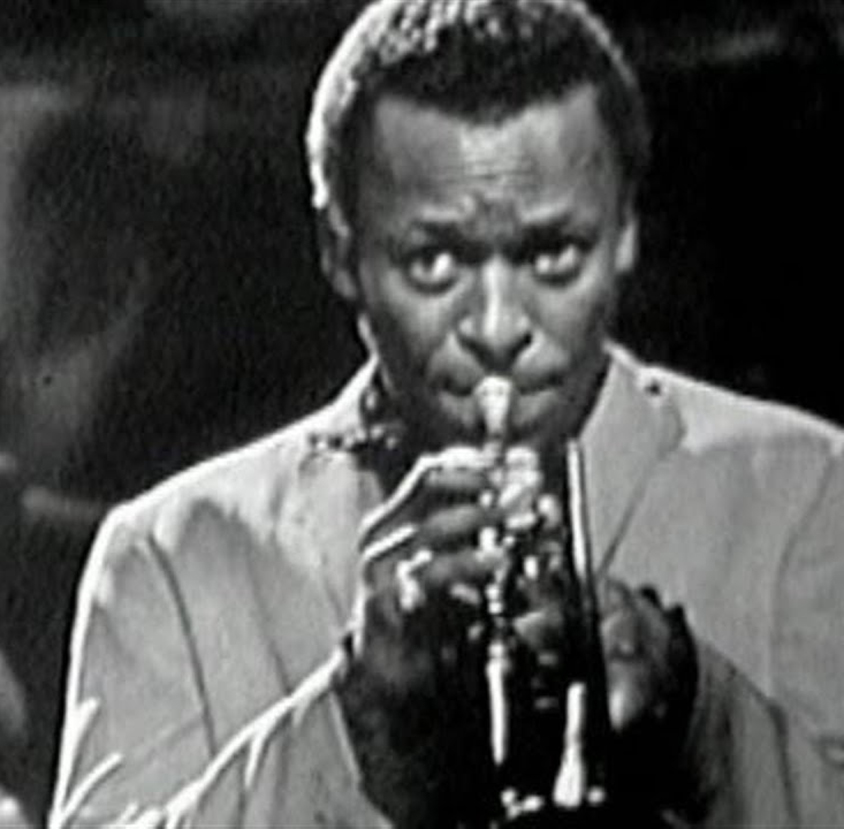
Fittingly, smack dab in the middle of it is this portrait of trumpeter and bandleader Miles Davis. Which reminds me of this still from a Miles Davis video from the late 1950s-

Miles Davis performing “So What” in a 1958 film called The Sound of Miles Davis in a group that also included the great John Coltrane.

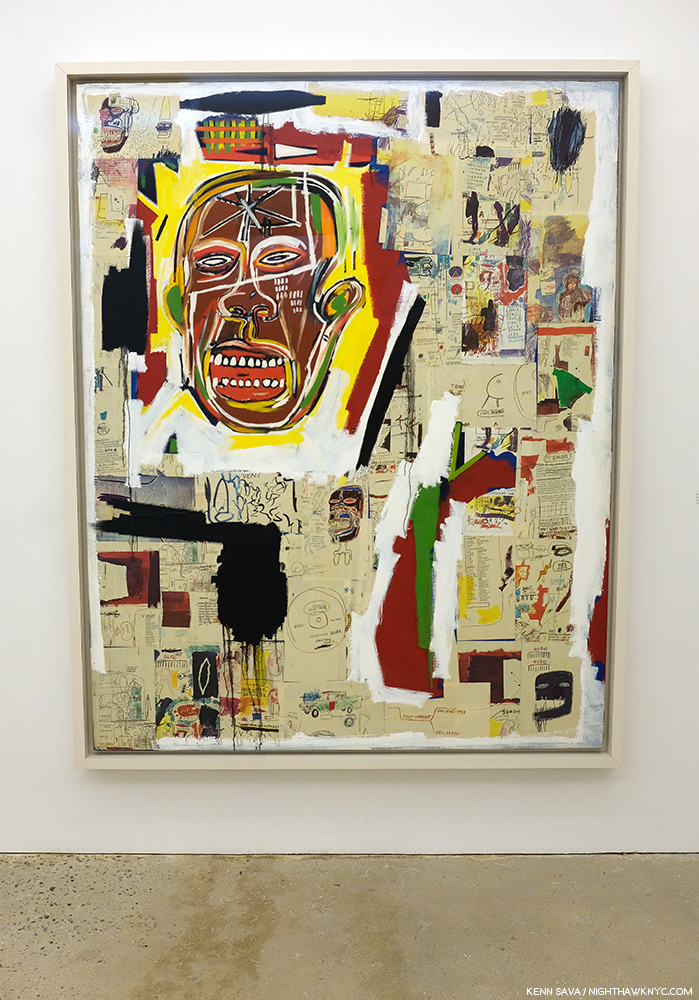
And then there’s the work shown in the Xerox poster, King of the Zulus, 1984-5. “King of the Zulus” is, also, the name of a Louis Armstrong and his Hot Five record from 1926.

The work from the poster seen in the flesh. King of the Zulus, 1984-5, Acrylic, oilstick and xerox collage on paper mounted on canvas, 86 x 68 inches.

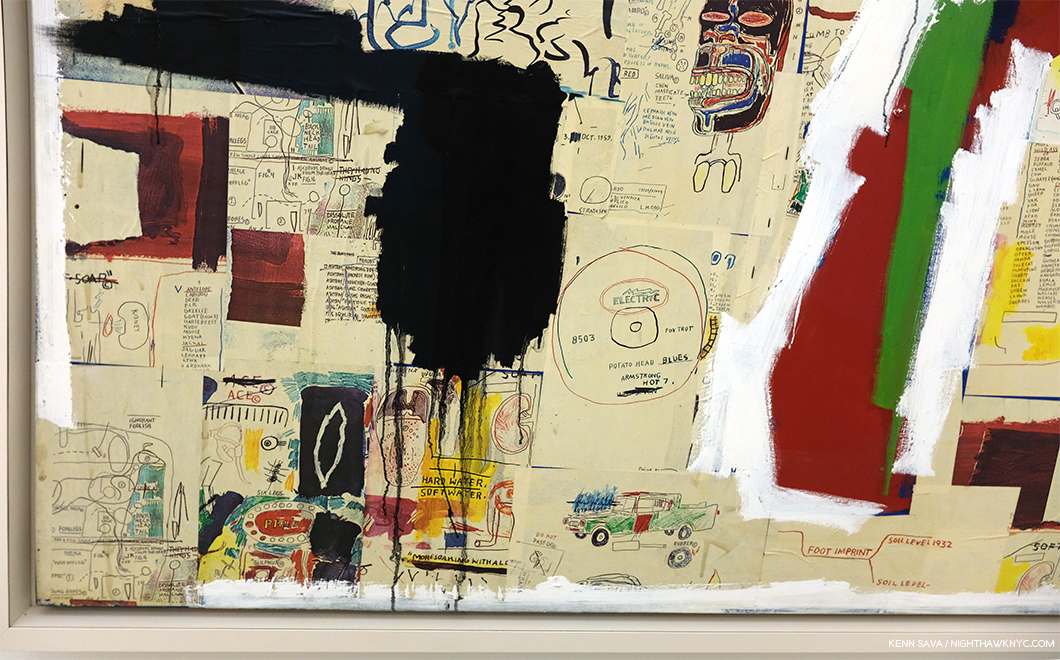
Detail of the lower left corner of King of the Zulus. This gives a little idea of the depth of what’s going on in this work.

The lower left corner of King of the Zulus includes a drawing of another Louis Armstrong record, “Potato Head Blues,” which some feel is at the top of the list of his finest recordings (those are some mighty brave folks. Miles Davis once said that Louis played everything you can possibly play on the trumpet. He would know. I’d never dare a guess at “greatest.” It doesn’t exist.). In his 1979 movie Manhattan, Woody Allen (who is also a Jazz Musician) has his character say that “Potato Head Blues” is “one of the reasons that life is worth living.”

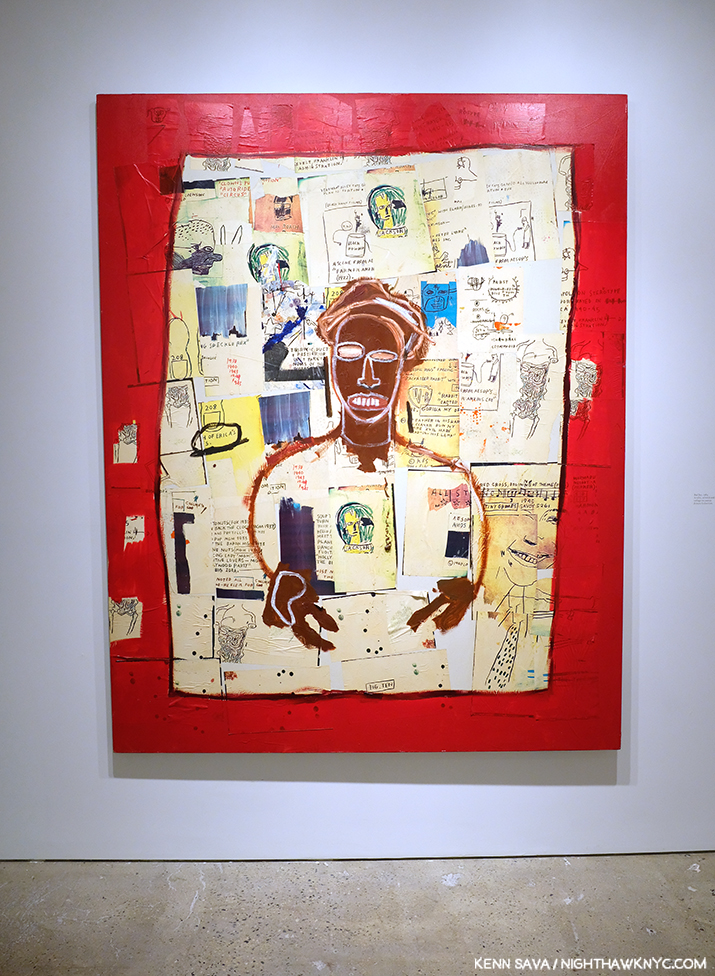
Red Joy, 1984, Oilstick and Xerox collage on canvas, 86 x 68 inches.

Later, I came across the transcription of an interview with J-MB by Becky Johnston and Tamra Davis in which Becky Johnston asks him-

“BJ: What music do you like?

J-MB: Bebop’s I guess my favourite music. But I don’t listen to it all the time; I listen to everything. But I have to say bebop’s my favourite.”

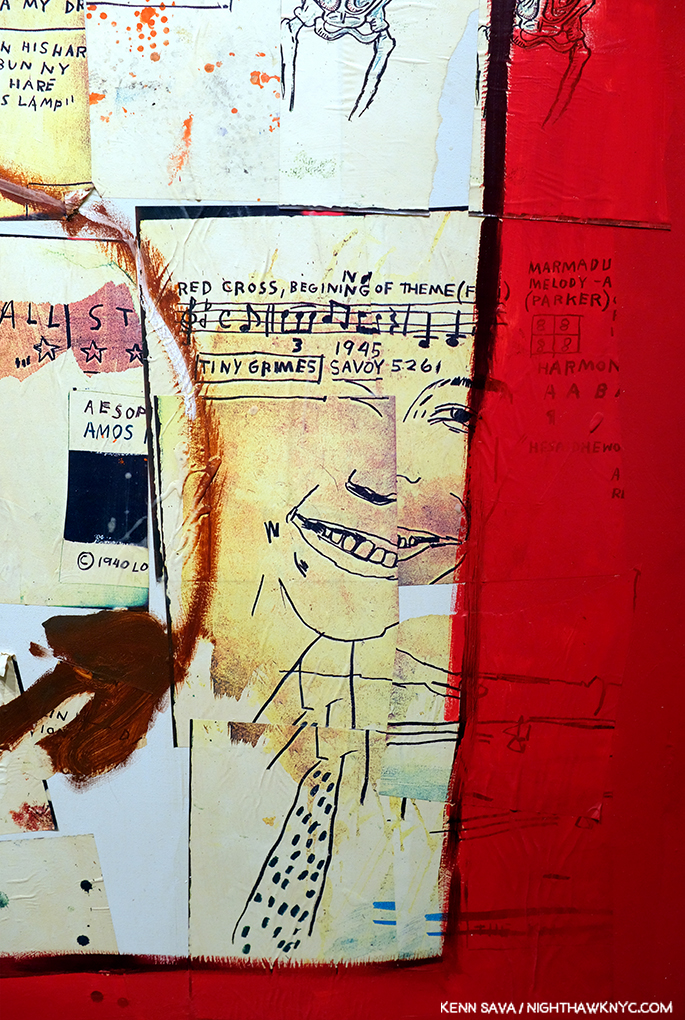
Detail of the lower right corner of Red Joy. That’s a portrait of the great saxophonist and composer Charlie “Bird” Parker, with a musical quote from his composition “Red Cross” on the top.

“Bebop” was a revolutionary, new, style of Jazz that Bird, Dizzy Gillespie, Thelonious Monk and Charlie Christian developed in the late 1930s and early 1940s. Louis Armstrong predated and outlived Bebop (which peaked in the 1940s), so it’s obvious that J-MB listened to Jazz from other periods as well as Bebop. Regarding the work that might omit a Jazz reference? Interestingly, look as I might, I didn’t find any Jazz references in Odours of Punt, seen earlier, rare among the works in Xerox. Unless the repeated “BIRD OF GOD,” near the upper left is a reference to Charlie “Bird” Parker. What else could it mean? My guess is that it is- until an expert comes forward. When he died, it’s reported in Pheobe Hoban’s biography that crates of Jazz records belonging to the Artist were thrown out, along with a carton of copies of Ross Russell’s 1973 Parker bio, Bird Lives!5.

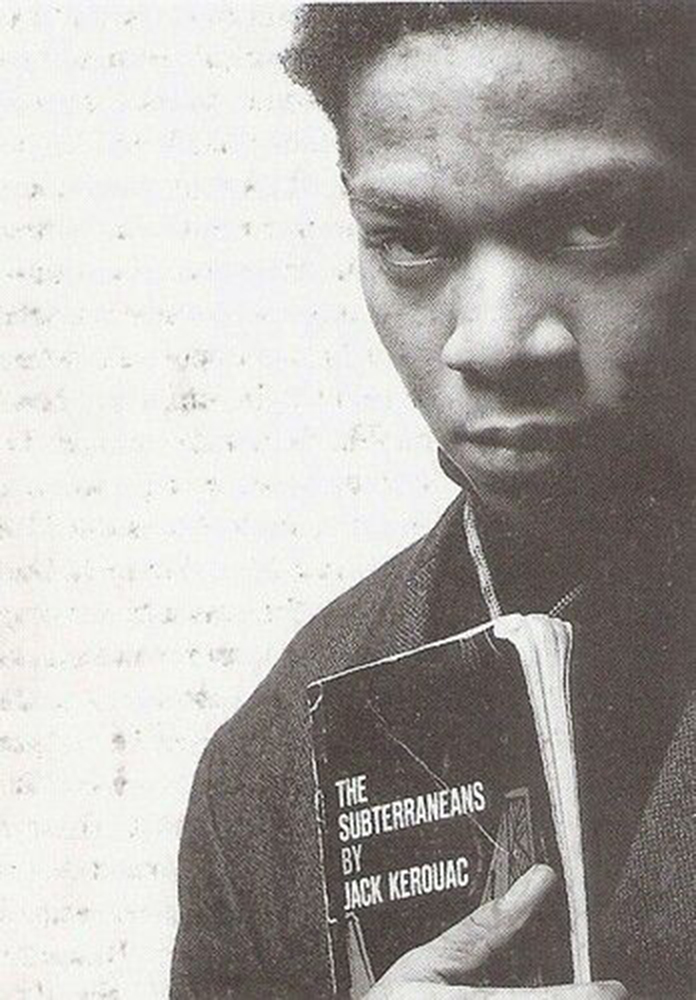
Jean-Michel Basquiat holding a copy of The Subterraneans by Jack Kerouac. He was reported seen carrying one around in Pheobe Hoban’s biography of the Artist. *Photographer unknown.

As for the second thread, the proliferation of words in the works included in Jean-Michel Basquiat / Xerox got me to look closer than I ever did before. Then, in my research, I discovered something interesting. Jean-Michel Basquiat had a love of the Beats. At various points he is reported to be continually reading William Burroughs Naked Lunch (a picture of him with a copy of it was taken by Alexis Adler was shown earlier- the picture with Nick’s tattoo, in which Naked Lunch is shown mounted on the wall behind J-MB) and Junky, as is reported in Pheobe Hoban’s Basquiat: A Quick Killing In Art, (eBook P.75). Later on, he is reported to be carrying around Jack Kerouac’s The Subterraneans, as is seen above. These struck me. Then, I discovered something more. J-MB knew both William Burroughs and Allen Ginsberg, and can be seen with both here! He was also Photographed by Allen Ginsberg, a terrific and still somewhat overlooked Photographer in his own right. While others make cases for J-MB being a member of this or that “group,” how crazy is it to make a case for J-MB as a descendant of the Beats? There’s more direct evidence for it than there is for some of the claims I’ve seen. Some have made the case for J-MB the Poet. From his SAMO© days to what we see in his Notebooks, he does have one of the most unique ways with the English language of any writer known to me.

Detail of the lower left section of Untitled, 1987, Acrylic, oil stick, and Xerox collage on canvas, 100 x 114 inches, reveals lists of song titles, under two semi-circular Drawings of record labels.

It’s become apparent to me that the cult of personality surrounding the Artist, and his fame (which, he longed for while he was homeless early on, and chased later, which makes him, at least partially responsible for) has, also, served to delay the serious critical assessment of his work. I’m not saying there isn’t any. There is. There are some very fine essays in the catalogues for the shows done so far, beginning with Richard Marshall’s excellent piece, “Repelling Ghosts,” in the catalogue for the very first J-MB Retrospective, at the Whitney Museum in 1992, and, as I said, Fred Hoffman has done a yeoman’s job of pointing the way to where Basquiat scholarship may be finally going, but the need for this is most urgent in my opinion, before the work is left to those who did not personally know the Artist. From what I’ve read thus far, Jean-Michel Basquiat’s Art was best “understood” by those who knew him. Some of them have already passed away, taking with them whatever they didn’t write down or share in interviews about the Artist and his work. Since the real critical assessment of his work has taken so long to get underway, there is, it seems to me, a real danger that if this continues to happen, J-MB‘s Art will remain an eternal mystery, like say, Vermeer’s, is to us today. Part of this is due to the fact that museums have been slow accepting J-MB‘s work, or even borrowing it to mount shows of it. Museum shows generally result in new scholarship published in the accompanying catalogs. The pace of museum shows has picked up over the past decade, both in the US and in Europe, but, in my opinion, when it comes to actually studying the work, the scholarship has been spotty so far. So? Anyone delving into the work of J-MB for the first time, as I am, is left with a lot of biography and a little Art criticism to fall back on- no matter how many books you see. As a result? I was largely left to make of it what I can- like viewers who weren’t alive in J-MB‘s time are.

Untitled, 1985-6, in front of Embittered, 1986, Graphite, paint and Xerox collage on wood.

Also apparent from some of the pieces written thus far that people fall all over themselves trying to “claim” J-MB for this school or that, from so-called “primitivism” to so-called “expressionism” to so-called “neo-expressionism,” to (more recently) so-called “conceptualism”- none of which J-MB, himself, used for his work, which is the only thing that matters, in my opinion, to hip-hop.

Jay Z, who did not know him, said this in his autobiography, Decoded, published in 2010, on page 95-“…People always wanted to stick B in some camp or another, to past on some label that would be stable and make it easy to treat him like a commodity. But he was elusive. His eye was always on a bigger picture, not on whatever corner people tried to frame him in. But mostly his was probably on himself, on using his art to get what he wanted, to say what he wanted, to communicate his truth. B shook any easy definition. He wasn’t afraid of wanting to succeed to get right, to be famous…”

The visual evidence in the work itself shows me, at least, something different from all the claims I mentioned before Jay Z. Jean-Michel Basquiat belongs in one “box,” and one “box” only- the “Jean-Michel Basquiat box.” Though he definitely belongs to the continuum of Art History, as Richard Marshall lays out in detail in his excellent essay in the Whitney Retrospective Catalogue, which probably surprises many, Jean-Michel Basquiat is unique unto himself. Period.

Kokosolo, 1983, Acrylic, oilstick, and Xerox on canvas, 43.3 x 82.6 inches.

Meanwhile, back at Xerox, I love the use of paint here. Jean-Michel Basquiat’s work is about layers and here it’s hard to know what’s on top and what’s on the bottom layer. J-MB spoke many times about his use of crowding out words and letters and said one of the reasons he did it was to make the viewer look closer. I can’t help wonder if he’s doing the same with the yellow here- making us look closer at what’s under the yellow. 

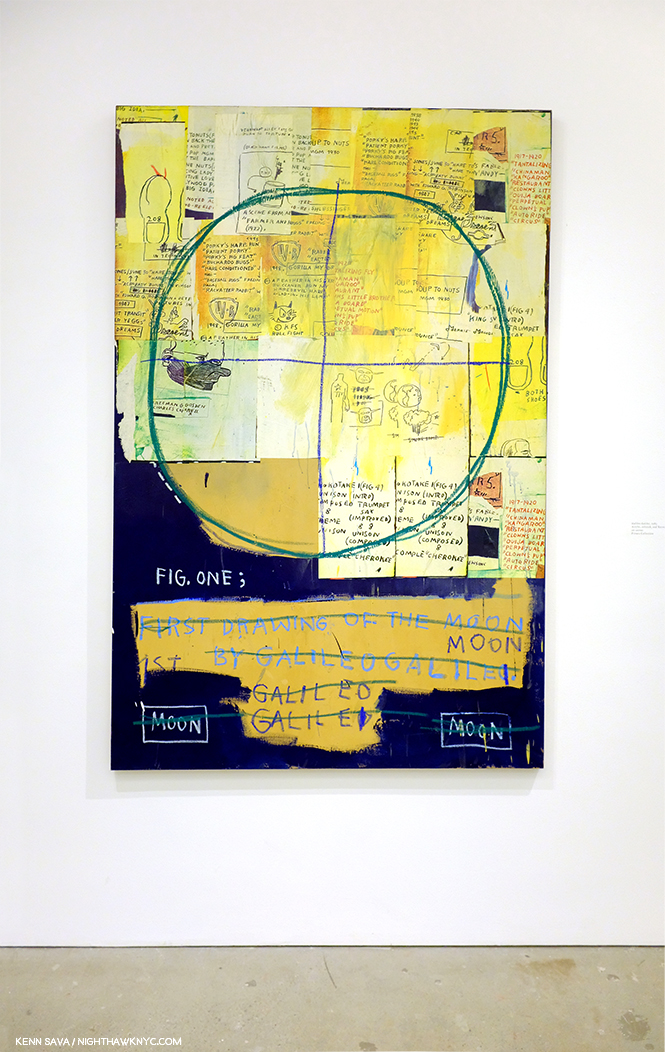
Galileo Galilei, 1983, Acrylic, oilstick, and Xerox on canvas, 78.75 x 51 inches.

In Galileo Galilei, 1983, I was struck by a number of things, first, from a distance, the circles, ostensibly the outline of the moon. But the circle is quartered, which is not like the moon. It’s something done in graphs and in Drawing. That reminded me- Drawing a circle is something that has a long and legendary history in Art. The great ancient Greek Painter, Apelles, and later the Renaissance master, Giotto, both used their ability to draw perfect circles freehand as calling cards.

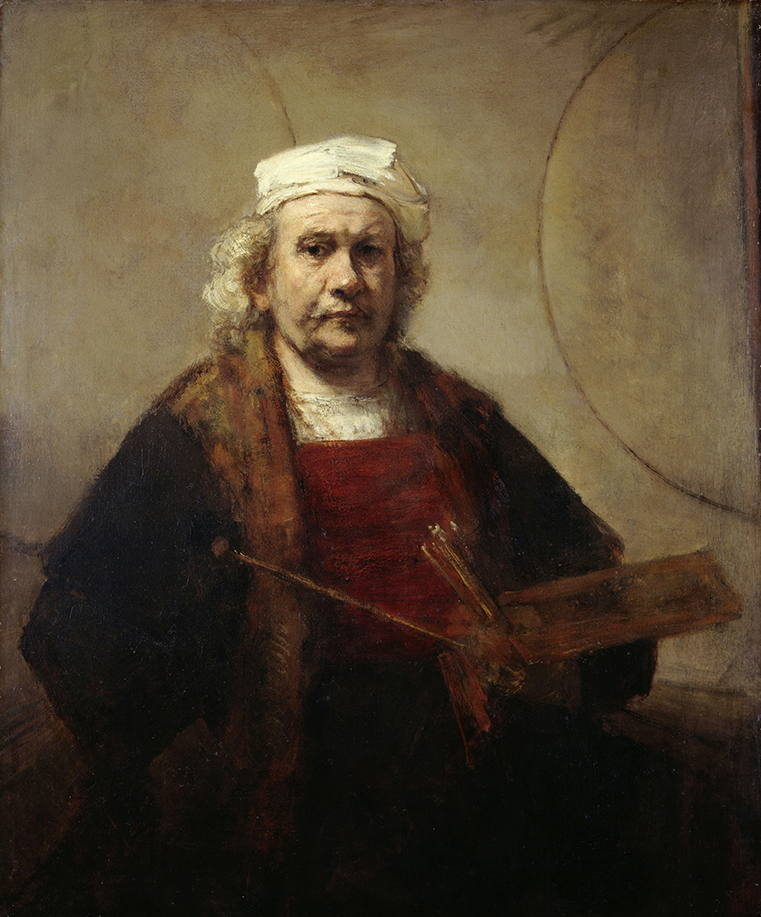
Rembrandt, Self Portrait with Two Circles, c.1665, *Kenwood House, London.

I am one of those who believes Rembrandt followed suit, leaving his own “calling card” as their heir in his Self-Portrait with Two Circles.

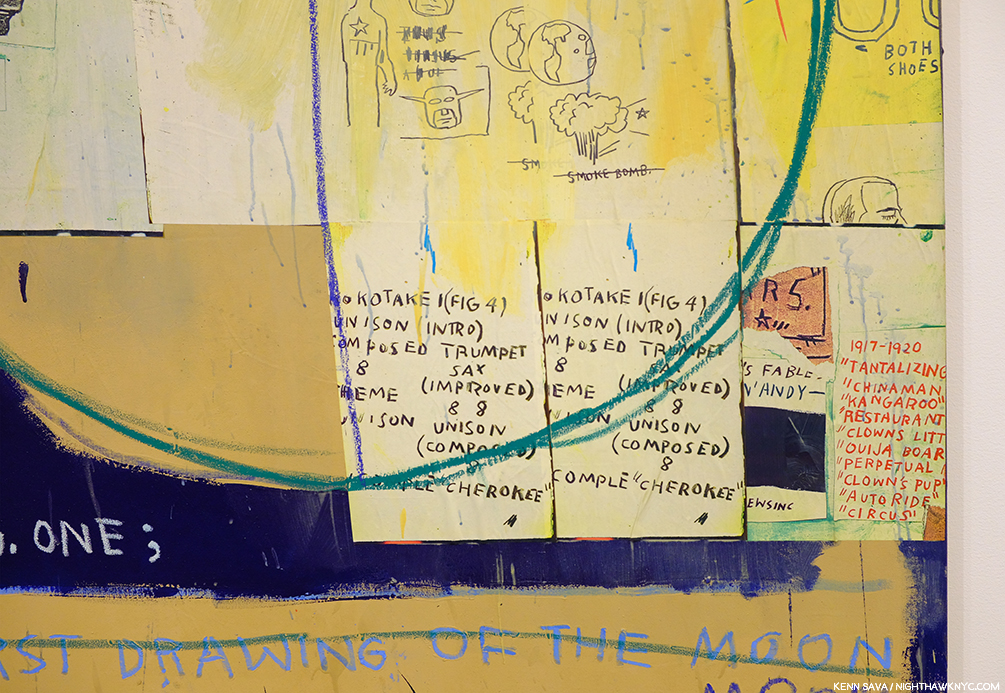
Detail, or rather, Details. Note the multiple lines that make up the circles and the repeated list. I recognize these part words as being a list of songs from Charlie Parker’s Savoy recordings because I have these records. “Koko Take 1,” and so on. As for everything else going on in this work? I’m hoping someone who knew J-MB will come forward and discuss it.

Here, we happen to have two, or parts of three, drawn circles. Was J-MB aware of the Apelles/Rembrandt circles? 

This body of work is an example of one of the last vestiges of reproduction in Art before the digital age took hold. Seeing this now does really make it feel like more than 35 years have passed, yet, they don’t look dated. Nor do the beginnings of this work, the “(Anti) Product Postcards” he created, many with Jennifer Stein, who speaks about them here.

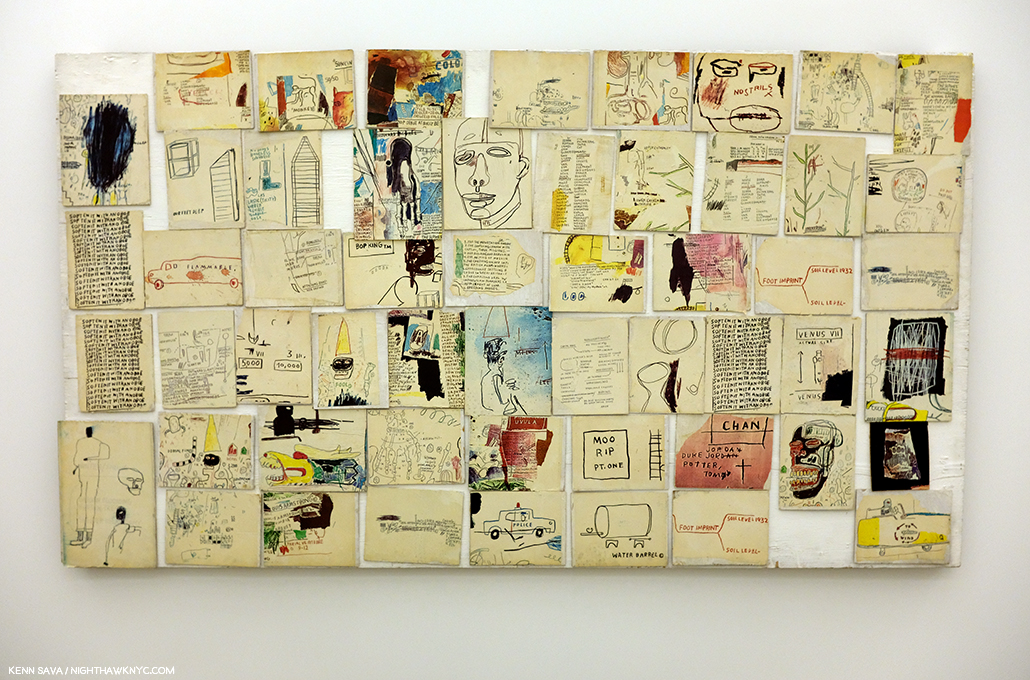
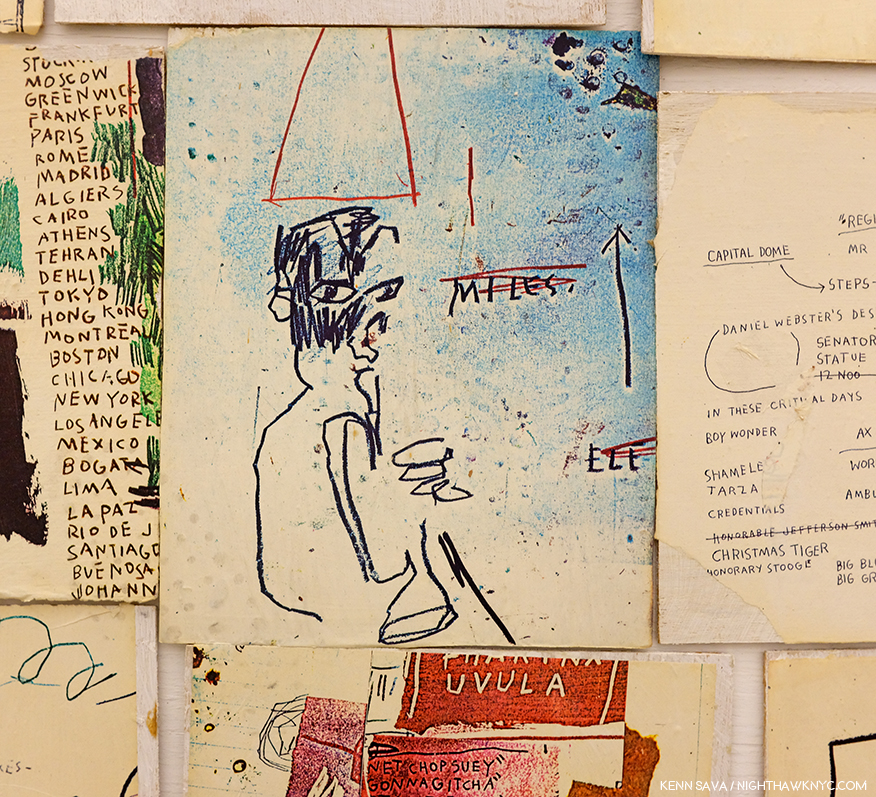
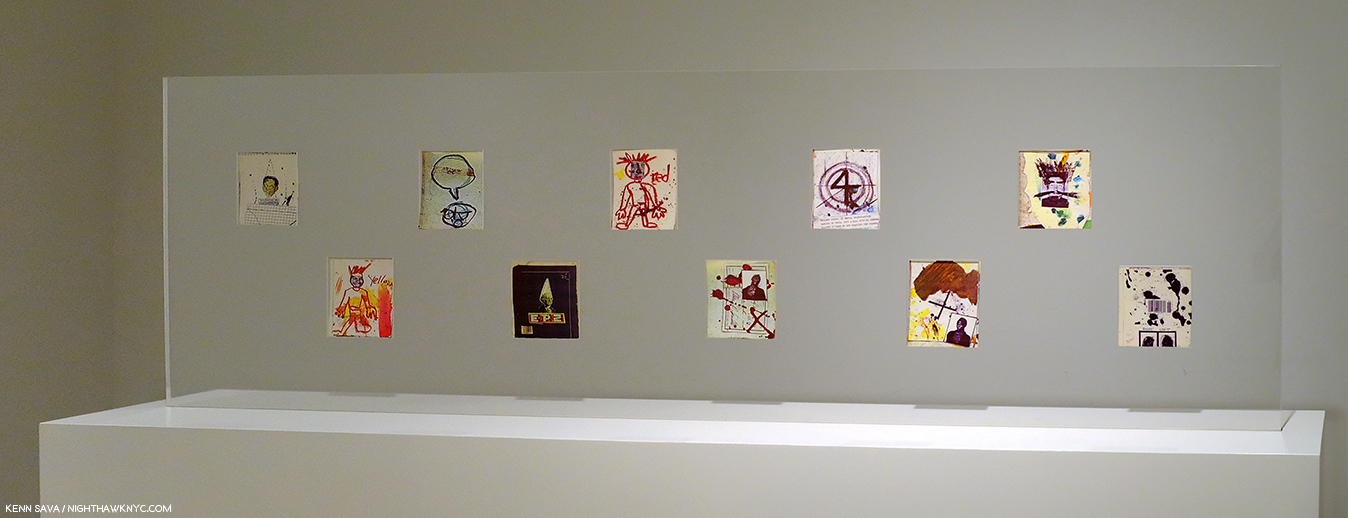
Early on, J-MB created Postcards, including these, many hand labelled “(Anti) Product” on the verso, which he sold for $1 each. Andy Warhol bought one when J-MB first met him while he was eating at a restaurant with Henry Geldzahler. They are among the earliest examples I’ve seen of J-MB’s collage. Some of these were collaborations with Jennifer Stein.

I returned to see Jean-Michel Basquiat / Xerox twice more since it proved to be a “personal rosetta stone” into the Art of J-MB. It was an extraordinary gallery show in many ways. The 33 works on view that ranged from He Was Crazy from 1979, shown earlier, through 1987, covering all but the final year of his Painting career and his life. Alas, even in three visits, I can only hope to scratch the surface layer of all that lies in these work by Jean-Michel Basquiat. But, there was something else. Alone with the security guard in the show for most of the 7 or 8 hours I spent there over 3 visits, I was struck by something else.

Silence.

A silence that was singing in a way that would bring a smile to John Cage’s face. If there’s been too much of any one thing around the work of Jean-Michel Basquiat to this point, it’s noise. A byproduct of his tragic death far too young is there are no more “Page 6” scandals, no more gossip, no more rumors. Only the work remains, hanging silently in these rooms. That silence said it’s time to let that Art speak for itself. And it’s time that those who knew and/or worked with the Artist to share what they know, and provide whatever insights they have before those, too, are lost forever.

Current and older books on Jean-Michel Basquiat and his work. Of these, the catalogs for the J-MB Retrospectives at the Brooklyn Museum (first, upper left) and the Whitney Museum, 2nd from left, front, were the two I referred to most often. The Unseen Notebooks (4th from the right, top) is also excellent. Fred Hoffman’s books are available for download from his website and are recommended. While it contains images of the most works available in print, I found the new Taschen XL, far right, problematic. A catalog for Alexis Adler’s traveling show, seen bottom left, of her collection is a revelation.

After I left Xerox for the last time, I, too felt the clock ticking. I immediately launched a deep dive into Basquiat monographs, in and out of print, and read everything I could get my hands on. As my research began, I quickly came upon a startling fact- Jean-Michel Basquiat: Xerox (which ran from March 12 through June 1st) is one of no less than SIX shows of Jean-Michel Basquiat’s work, or pertaining to the Artist, going on in the NYC vicinity in 2019!

The other five are-
Jean-Michel Basquiat at The Brant Foundation, March 6 – May 14th
The 12th Street Experiment: Photography of Jean-Michel Basquiat By Alexis Adler at Bishop on Bedford, Brooklyn, May 3 – June 13th
Lee Jaffe: Jean-Michel Basquiat at Eva Presenhuber, June 28th – July 28th
Basquiat x Warhol at The School/Jack Shainman Gallery, Kinderhook, NY, June 1 – September 7th
Basquiat’s Defacement: The Untold Story at the Guggenheim Museum, June 21st – November 6th
and…two Paintings from the collaboration of Jean-Michel Basquiat and Andy Warhol, along with ephemera from their collaboration, were on view in Andy Warhol at the Whitney Museum earlier this year, which I wrote about, here.

First? I wondered- Why six shows now?

Jean-Michel Basquiat was born on December 22, 1960 and died 31 years ago on August 12, 1988. 2020 will be a double anniversary for J-MB- 60 years since he was born, 40 years since The Times Square Show launched his career. 2019? No special significance, as far as I know, four months into my research. The Brant show shares the same curator (and many of the 120 works) with the Jean-Michel Basquiat show at the Foundation Louis Vuitton, Paris, which ended on January 14, 2019. The Brant’s opened on March 6th. So, beyond commemorating a “Basquiat anniversary,” the timing of that show may just have been fortuitous and practical, as in “we’ve got all these works together, why don’t we also show them in the new space in NYC?” As for the timing of the others? I have no idea.

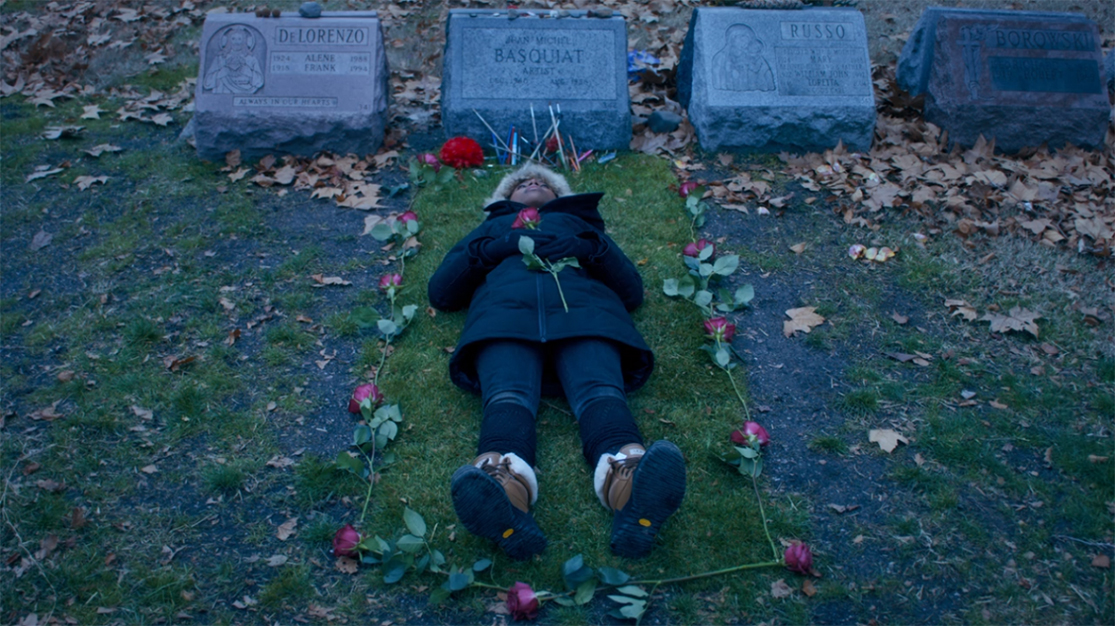
Nola Darling lying on Jean-Michel Basquiat’s grave in She’s Gotta Have It.*

Between these six shows, the total number of works by Basquiat (counting those in collaboration with Andy Warhol) should total slightly more than the 120 shown in that Foundation Louis Vuitton, Paris, show, in addition to Photographs of J-MB by early roommate, Alexis Adler, and Musician and friend, Lee Jaffe. As such, these shows present the opportunity to see the most works by the Artist since the 160 pages from his Notebooks along with other works and some Paintings were shown in the Jean-Michel Basquiat: Unknown Notebooks show at the Brooklyn Museum in 2015, and the most Paintings by the Artist in NYC since that 2005 Basquiat Brooklyn Museum Retrospective. Unlike the “Summer of Rauschenberg,” which I covered extensively in 2017, where the satellite shows “revolved” around MoMA’s Robert Rauschenberg: Among Friends Retrospective, this time, the only museum show in the bunch, Basquiat’s Defacement at the Guggenheim, is a satellite show to the blockbuster Brant Foundation’s (a private organization) first public exhibition- Jean-Michel Basquiat, which included a whopping 70 Paintings and 1 Sculpture, the main act. Given that the vast majority of J-MB‘s best work resides in private collections, this brings home the fact that going forward, unlike with most Artists, the public is going to depend on the generosity of collectors displaying their work to see them, and researchers are going to depend on them to study it.

As a result, I quickly realized after that it might be now or never if I wanted to see a large body of Basquiat’s work and reassess it, and see WHO is “right”- the haters or the believers. With 39 years elapsing since J-MB‘s debut at the Times Square Show, enough time has elapsed to get a bit of perspective. So?

Detail of Now’s The Time, a Painting that looks like the classic 1945 Charlie Parker record of the same name, with “PRKR,” J-MB’s “shorthand” for Bird’s last name.

Now…is INDEED the time. It’s the time for the real assessment of Jean-Michel Basquiat’s Art to take over from the sensational biography. For me? Who knows when I’ll have the opportunity to see this much of his work in NYC again. It might be now, or never. NOW is my time, too.

My thoughts immediately turned to the Brant Foundation’s inaugural show in their new East Village location, Jean-Michel Basquiat, which was up and running and the clock was ticking on its run. NHNYC researcher Kitty, a Basquiat fan since she saw him in person back in the day at the Mudd Clubb, had seen it and gave a glowing report. I began scrambling to get a ticket. No luck online. The show had been completely sold out (though tickets were free) since it opened. Hmmm…HOW to see the most publicized and talked about show in NYC in early 2019? Or, would my glimpse at Xerox of what I had missed remain a lingering tease?

To be continued…

This piece is dedicated to my former friend, grae, who knew J-MB, and to Kitty, who was in the same room with him in the clubs back in the day, and who has patiently accepted his work not speaking to me all these years. My thanks to Nick. 

This is Part 1 of my series on the five Jean-Michel Basquiat shows going on in NYC this year. Part 2 may be found under this one, or here. Part 3 is here

*-Soundtrack for this Post is what else? “Xerox” by Julian Casablancas + The Voidz. If  you’re a Strokes fan, check this out, if you haven’t. Also, it doesn’t sound all that distant from J-MB‘s own band, Grey. Maybe they were an influence.?

NighthawkNYC.com has been entirely self-funded and ad-free for over 6 years, during which over 250 full length pieces have been published. If you’ve found it worthwhile, you can donate to keep it going & ad-free below. Thank you!

Written & photographed by Kenn Sava for nighthawknyc.com unless otherwise credited.
To send comments, thoughts, feedback or propositions click here.
Click the white box on the upper right for the archives or to search them.
For “short takes” and additional pictures, follow @nighthawk_nyc on Instagram.

Subscribe to be notified of new Posts below. Your information will be used for no other purpose.
 

  1. Here. He repeated this elsewhere as well.
  2. By “work,” I believe they mean a Painting. According to its site, MoMA owns 12 prints and Drawings by Jean-Michel Basquiat. No Paintings.
  3. //www.nytimes.com/1985/02/10/magazine/new-art-new-money.html?searchResultPosition=1
  4. They were the only company in the world to acknowledge the 100th Anniversary of the 1st Jazz record in 2017, though the record in question is not what I call “Jazz,” and featured an astounding array of classic under-known Blue Note Record covers on T shirts.
  5. Both, Pheobe Hoban’s Basquiat: A Quick Killing In Art, eBook P.19

On Painting & Photography

Written & Photographed by Kenn Sava (except *)

Note- Robert Frank has been mentioned in many of my pieces over the past 3 years of my “deep-dive” into Modern & Contemporary Photography, a realm that he had a seminal role in creating with the publication of  The Americans. When the sad news came that he had passed away at 94 on September 9th, I was finishing yet another piece that he is a part of- one that summarizes some of my thoughts on Painting & Photography these past three years, and also marks the 60th anniversary of the American publication of The Americans. Too far along to change, I’ve left it as it was, and added this as my “R.I.P.”  That Robert Frank was, and remains, one of the most influential figures in Art of our time was already testified to within.

Subtitle- “On Rembrandt’s 350th, and Robert Frank’s 60th”

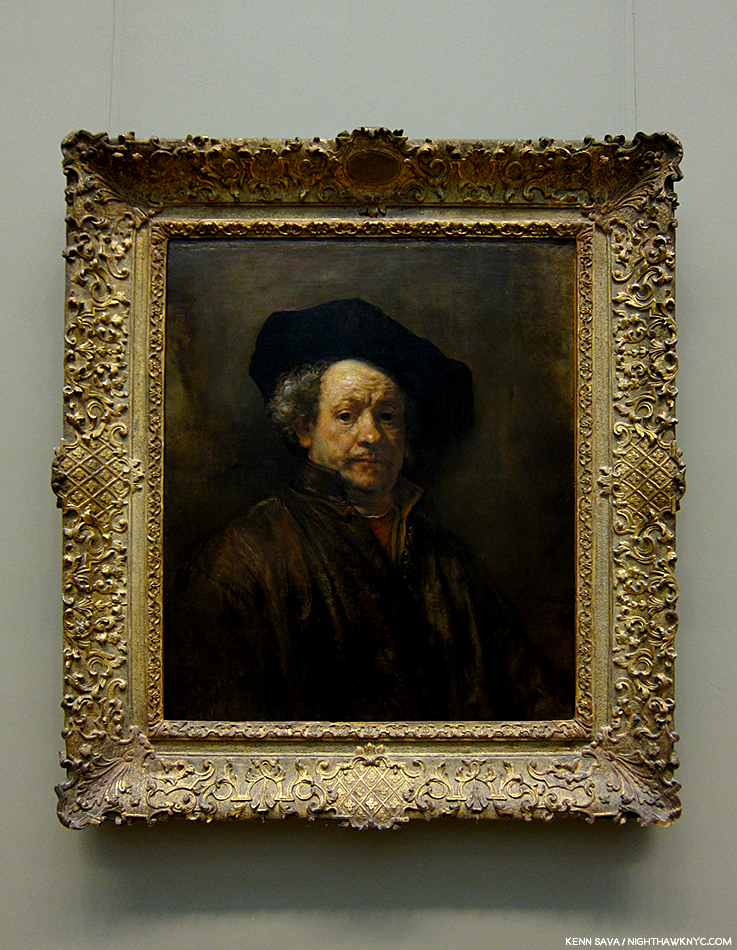
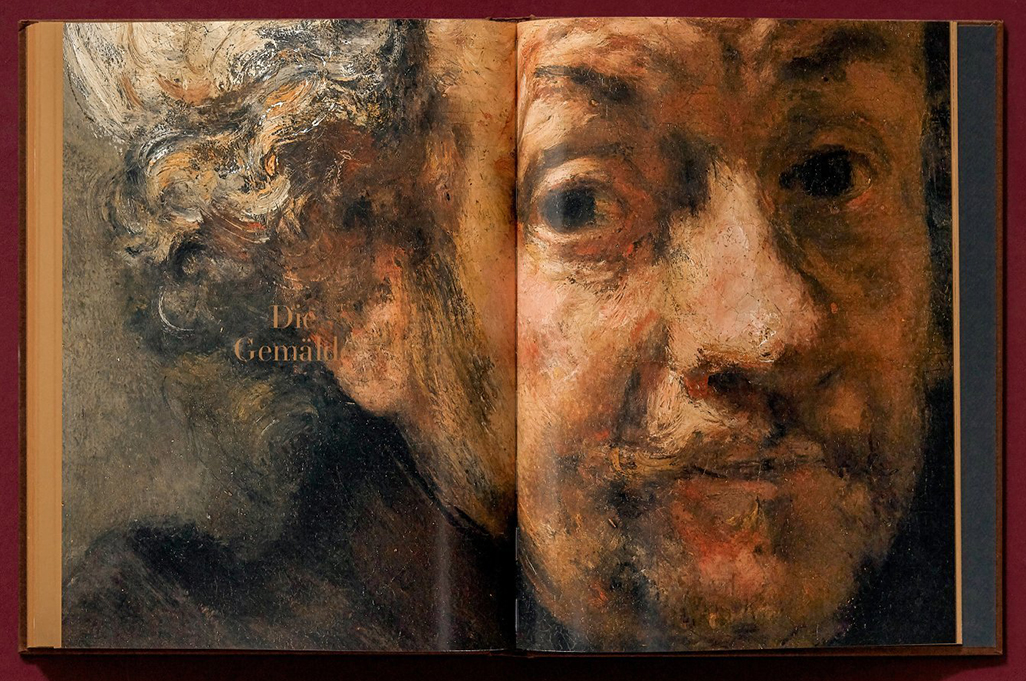
Rembrandt, Self-Portrait, 1660. The Artist is seen here in the last decade of his life. Seen on March 26, 2015 in The Met’s former European Paintings galleries.

When I look at Art, sooner or later, my thoughts involve Rembrandt for any one of a myriad of reasons. I do my best, however, to keep my thoughts about his death to a minimum, so this is going to be purposely short. Rembrandt was pretty poor the last decade of his life. His prior fame had deserted him as if he were a fad, or a “mania,” like tulips were in 1637 when he was 30, and combined with an extravagant lifestyle1 that he could no longer maintain, he lived in housing for the poor at the end2. When he died, at just 63, he was buried in an unmarked pauper’s grave. 20 years later, his bones were destroyed, as was the custom with the remains of such unfortunates. The church, where his unmarked grave was, finally got around to erecting a plaque, inside, in 1909. It redeemed itself some 30 years later when a young Jewish girl who was in hiding nearby from the Nazis took solace in the sound of the church’s bells. Today, there’s a statue of Anne Frank outside the church. His Art largely fell into eclipse, except for a few artists he influenced, for about 100 years, as hard as that is for us to imagine today. October 4, 2019, happens to be the 350th anniversary of his death.

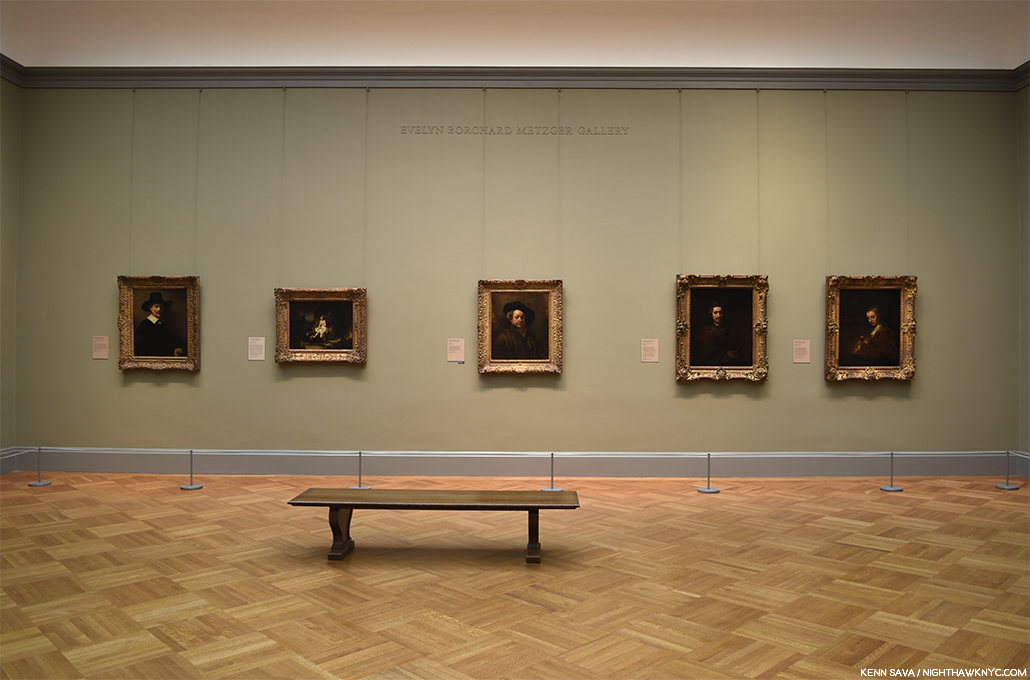
Seen in situ. One of the glories of New York. Five of The Met’s Rembrandts seen in the European Paintings Galleries on June 10, 2017, before the current skylight renovations caused their relocation to the Robert Lehman Collection galleries. When I think of “home,” this gallery comes to mind.

I’ve remained passionate about the work of Rembrandt van Rijn since I was in my early teens and he is one of very very few Artists I can say that about. Almost no where else have I found the humanity, and the depth and range of humanity, I find in Rembrandt. Because of this, I find his Self-Portraits particularly fascinating. In the end, they show me that the Artist, himself, was every bit as human as anyone he ever depicted.

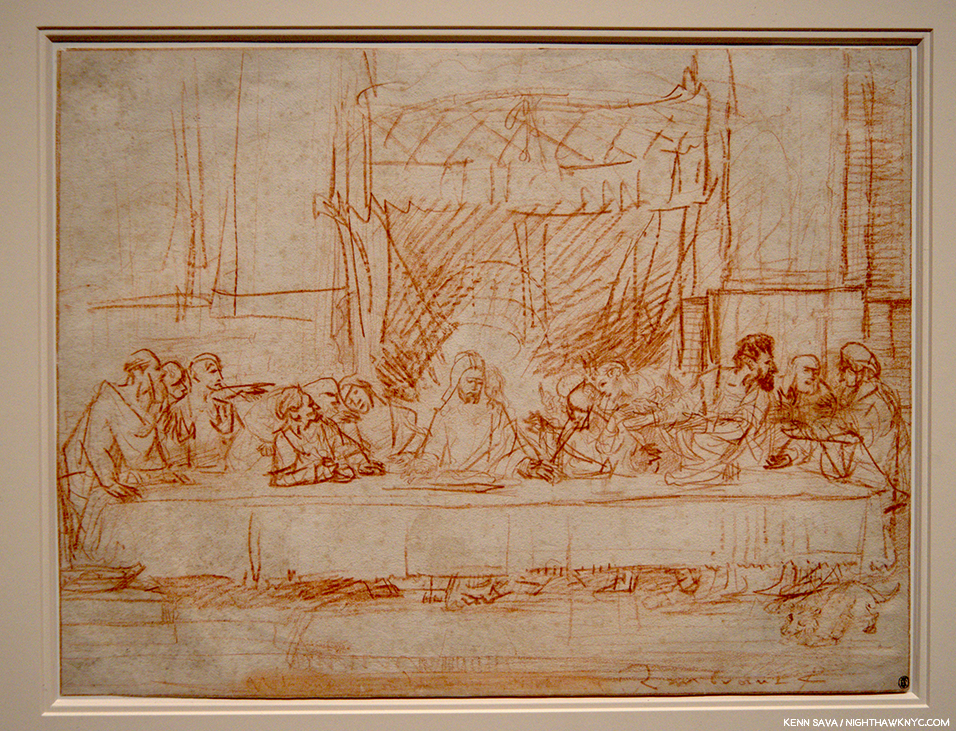
Rembrandt after Leonardo da Vinci, The Last Supper, ca.1634-5, Red chalk, 14 x 18 inches, From The Met’s Lehman Collection. Seen in 2016.

Few other Artists I’ve seen have the power to say as much with just a few strokes as can be seen time and time again in his Drawings- like this one, in which Rembrandt manages to capture the entirety of Leonardo’s masterpiece (and add some additional elements that may have come from a print of the Painting he saw- Rembrandt never left Holland) in so few strokes, you can almost count them.

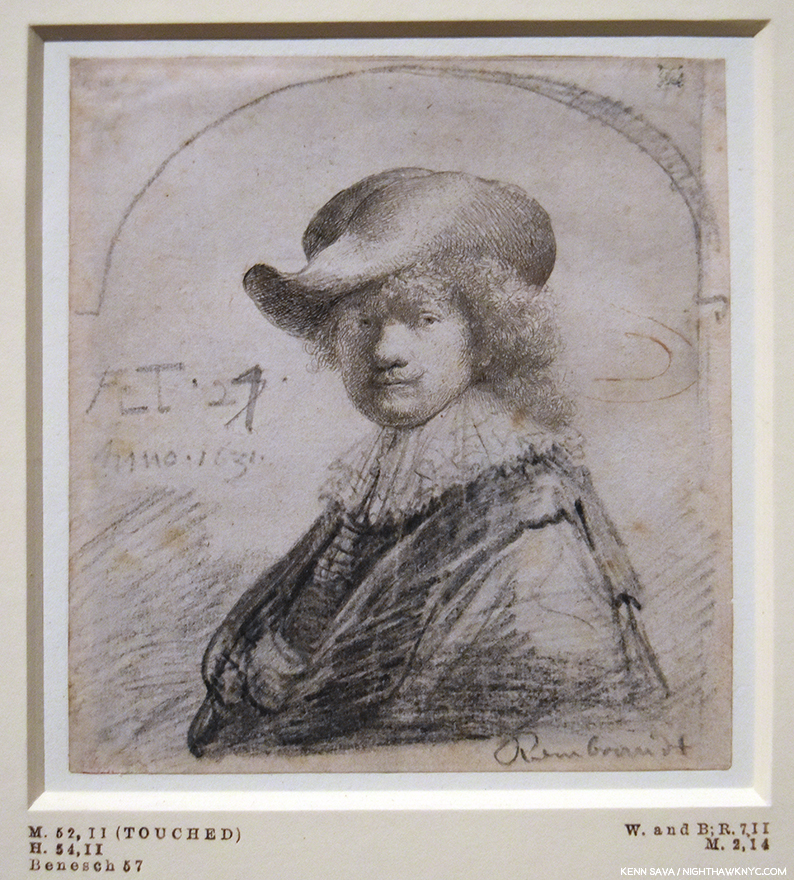
Self-Portrait in a Soft Hat, 1631, Etching completed with black chalk. The Artist was about 25 at this point at the beginning of his career. Seen at the Morgan Library in September, 2016.

Today, he’s honored as Holland’s favorite son. Public places have been renamed in his honor. (“Rembrandt Square,” etc., etc.). In 2015, the country paid a record price for 2 portraits by the Master, 180 million dollars, splitting the cost with France (for the Louvre and the Rijksmuseum), partially (largely?) because of their value to tourism, (i.e. so they can continue to cash in on him). Pretty ironic given how he was treated near and at the end of his life.

The most Rembrandt Self-Portraits in one place I’ve yet been in were these five etchings seen at Rembrandt’s First Masterpiece at the Morgan Library in September, 2016. I was shocked to see them when I walked in. I had no idea they were included.

So, to me, his end is one of the most unfortunate, and saddest, chapters in Art history. I’m not so sure it’s a cause for all that much celebrating. The world of Art seems to agree. There’s only one museum (as far as I know) anywhere in the world mounting a show of Rembrandt’s work that might be construed as honoring/memorializing it anytime close to that date, with that one actually opening on October 4th3.

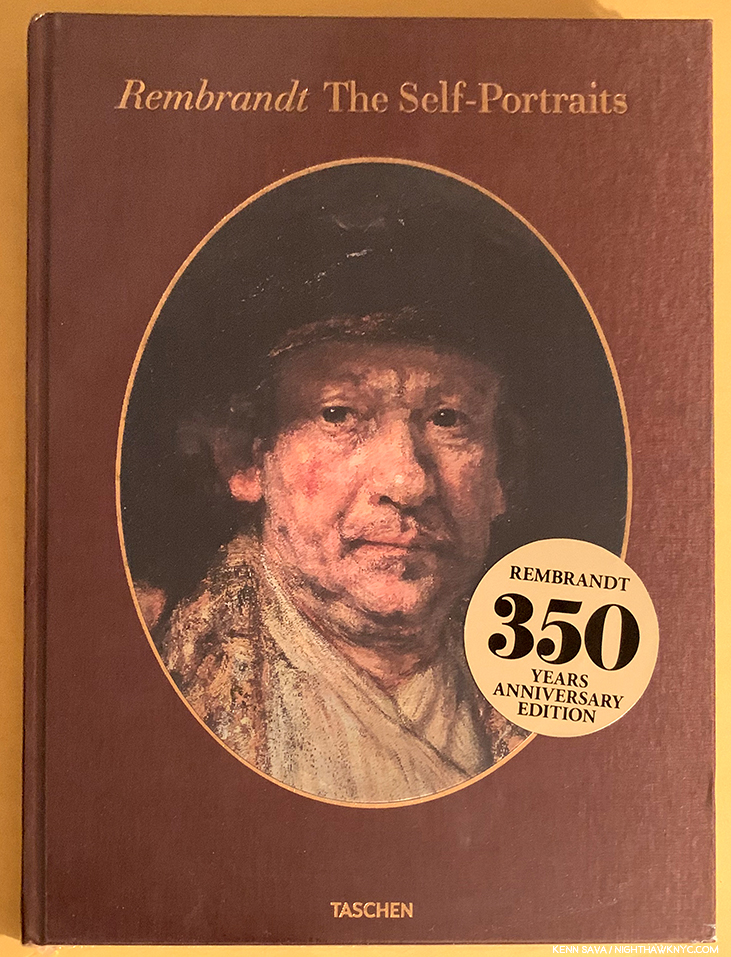
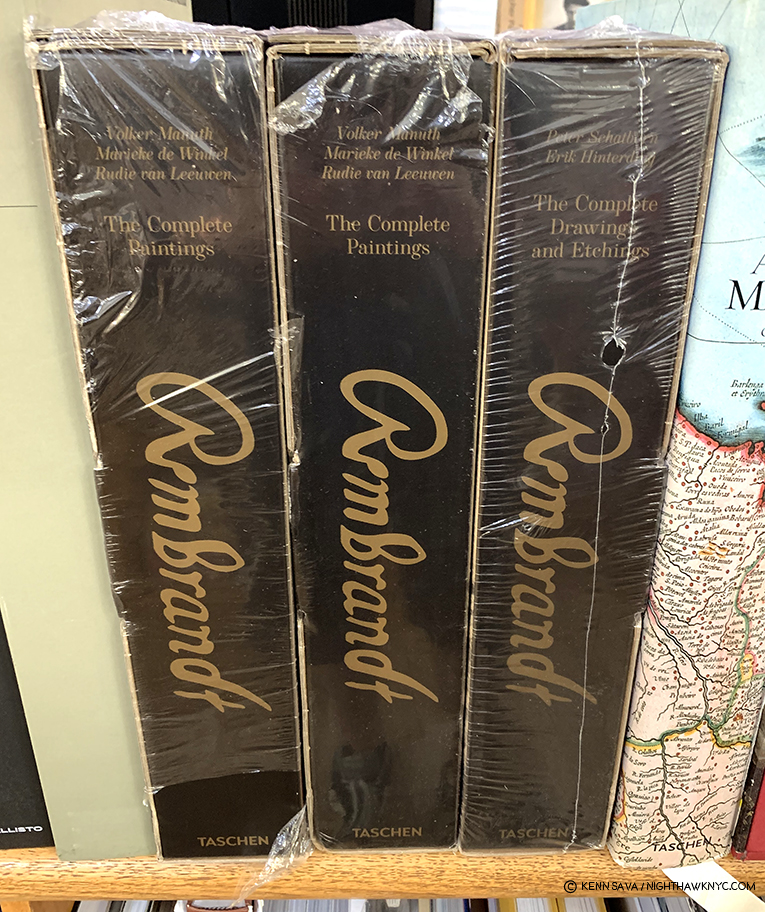
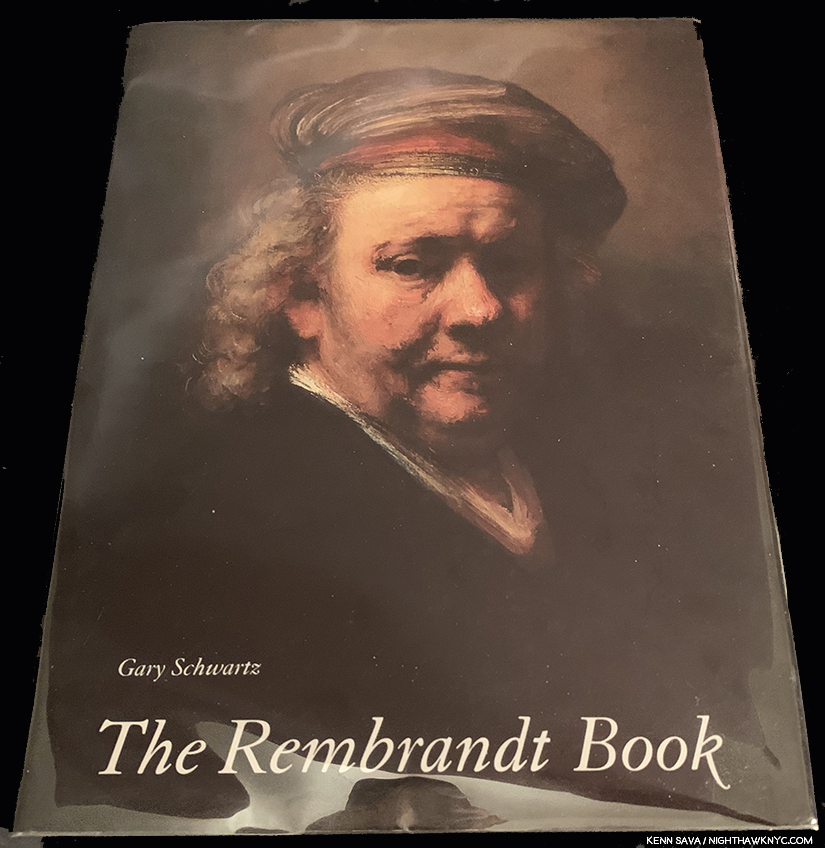
Nonetheless, the chance to put a big round number on the front of a marketing campaign seems to be all that’s required for Taschen to leap into the breach with three new volumes in their XL (aka “HUGE!”) series of books. Well? In 87 years, for the 400th anniversary of his birth in 2106, actual physical paper books may be a thing of the past4 Whether they arrive as physical books, ebooks, or whatever form books will take in 87 years, I won’t be here to see them. As I write this, the first of Taschen’s “trilogy,” Rembrandt: The Self-Portraits (R:TSPs, henceforth) is out and in wide distribution. It’s a handsome volume, with a nifty cover image that displays one of 6 different Rembrandt Self-Portraits depending on the angle you look at it. I picked it up in a store and passed, even though nothing Rembrandt did has held me more spellbound for so long as his Self-Portraits have. So, why did I pass on this complete collection of them?  I was extremely disappointed that the great Rembrandt scholar Gary Schwartz wasn’t involved in it, and from what I understand isn’t involved in the other two volumes either. That statement will serve as my protest since I subsequently bought R:TSPs. With all due respect to the scholars chosen, no one will replace Gary Schwartz for me when it comes to Rembrandt- or any other Artist he turns his unique skillset to (Dear Mr. Schwartz, If you happen to see this? Jan van Eyck, Please?). Suffice it to say that the renowned Professor, Simon Schama, host of the PBS series, The Power of Art, dedicated his own Rembrandt biography, Rembrandt’s eyes, to Gary Schwartz.

“I regard Rembrandt’s self-portraits less as assertions of a strong personal identity than as a means to help the artist, like Saint Paul, become more like other people. Behind them lies a man who depended on his art to offset imbalances in his life and his relations with others.” Gary Schwartz.

Focusing on what we do get, the book itself is large, oversized as they say in the trade, a full 10 x 13.5 inches and weighs about 4 1/2 pounds, very light for a true Taschen XL which generally weigh in around 20 pounds. Its 176 pages contain a succinct essay and the rest of the book is Rembrandt, in my view, at his best. The reproductions are very good5, with many being reproduced in actual size.

A publicity shot by Taschen. Rest assured the copies sold in the USA are in English.*

Rembrandt was the first Artist to create a body of Self-Portraits. Yes, the cheap headline is “Rembrandt Invented The Selfie,” which, without looking, I’m sure has already been used to death. That’s not true. He was not the first to do a Self-Portrait, just to create a body of them among Artists known to us today. And what a body of work they are! We don’t have his diary, but, though it’s dangerous to read too much into the SPs (unless you want to), they are not really “pure” autobiography beyond the fact that yes, they do indeed depict the Artist, and we get to see his famous visage evolve as the years and decades go by. Exactly what is going on in each of them has been the subject of much conjecture, and I suspect will continue to be for as long as people look at them. He created them in oil, in ink, and with an etching needle (in Paintings, Drawings and Etchings). Though I love everything the man did, for me, they have been THE supreme body of Art since I saw my first one, shown up top, at The Met way back when. If I had to live the rest of my days only being allowed to look at one work of Art (oh jeez), it would be a Rembrandt Self-Portrait. But, please don’t ask me which one. Right now, I would select his Self-Portrait with Two Circles in England, but that choice is often a factor of which one I’ve looked at last. I’d take any of them- Painted, Drawn or Etched. And in R:TSPs, we get to see every one of them (they say).

Two pre-release copies of Rembrandt: The Complete Paintings, left, flank a copy of Rembrandt: The Complete Drawings & Etching, which complete Taschen’s “trilogy.” As close as I’ve gotten- so far.

While I am very much looking forward to seeing Rembrandt: The Complete Paintings (TCP, henceforth), it should be mentioned that though The Rembrandt Research Project issued its latest volume of what it calls the “Corpus” of the Master’s Paintings in 2016, the controversy around what that body “should” consist of shows no signs of ending, and so? Buyer beware! What’s agreed upon as his complete Paintings will, very possibly, change in the near future. So, even 350 years after his sad demise, this will most likely not be the “final word” on the subject.

Still, there’s so much of what RvR has accomplished in his other work that can be seen in his Self-Portraits. You can trace a good deal of his development as an Artist in this work. And then? There is the incredible Painting! No matter how much Painting I’ve seen in the 40 year (next year6 I’ve been going to shows, my mind always comes back, for a variety of reasons, to “how Rembrandt Painted it.”

Ok. So, you’re wondering- What does all of this have to do with Robert Frank?

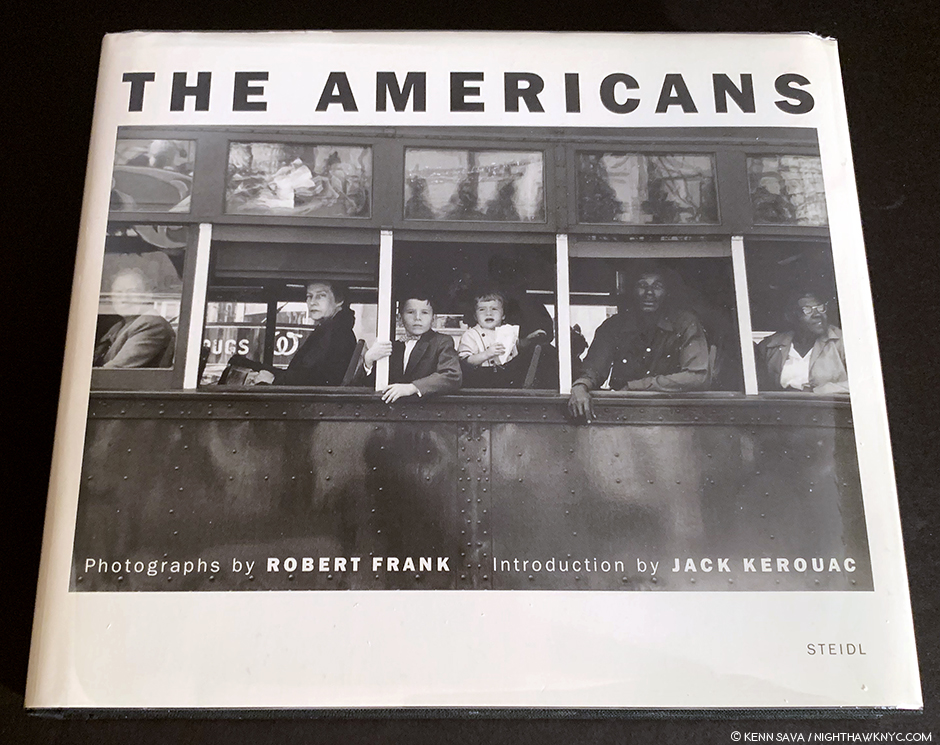
Robert Frank: The Americans, my copy of Steidl’s 50th Anniversary edition, 2008.

Questionable timing aside, for me, the real value of RvR:TSPs coming out now has been the bath of the icy cold water of “reality” it’s thrown on my deep dive into Modern & Contemporary Photography, by which I mean post-Robert Frank’s The Americans, the most seminal PhotoBook of our time. 2019 marks the 60th Anniversary of American publication of The Americans (and there’s been almost no fanfare about that- as far as I’ve seen thus far)7. This fall/winter marks 3 years of my “deep dive” into this realm of M&C Photography that I consider The Americans the first bookmark in, a beginning of, in a sense. I started from the place of believing that Photography had not, as yet, earned its place with Painting, Drawing and Sculpture. Looking at R:TSPs? I realized that after everything I’ve seen, I can’t say my mind has been changed all that much. For one thing, though, it’s still a very young medium- particularly when compared to thousands of years of Painting. After all, they’re marketing the 350th anniversary of Rembrandt’s passing, and he’s thousands of years after Artists started Painting. Jan van Eyck was one of the first to use oil paint in the early 1400’s. Photography (with chemicals) has been around since Sir John F.W. Herschel coined the word in his paper “On the Art of Photography; or the Application of the Chemical Rays of Light to the Purpose of Pictorial Presentation,” on March 14, 18398– 180 years. But, the more I look at both, there’s one thing that strikes me as a major difference between Painting and Photographs-

Time.

It takes time to create a Painting. Even if the Artist does one quickly. In most Paintings, it takes longer to apply one brushstroke than it does to create most Photographs.

I think I can see that. And, I think it’s telling.

I’m not the only one.

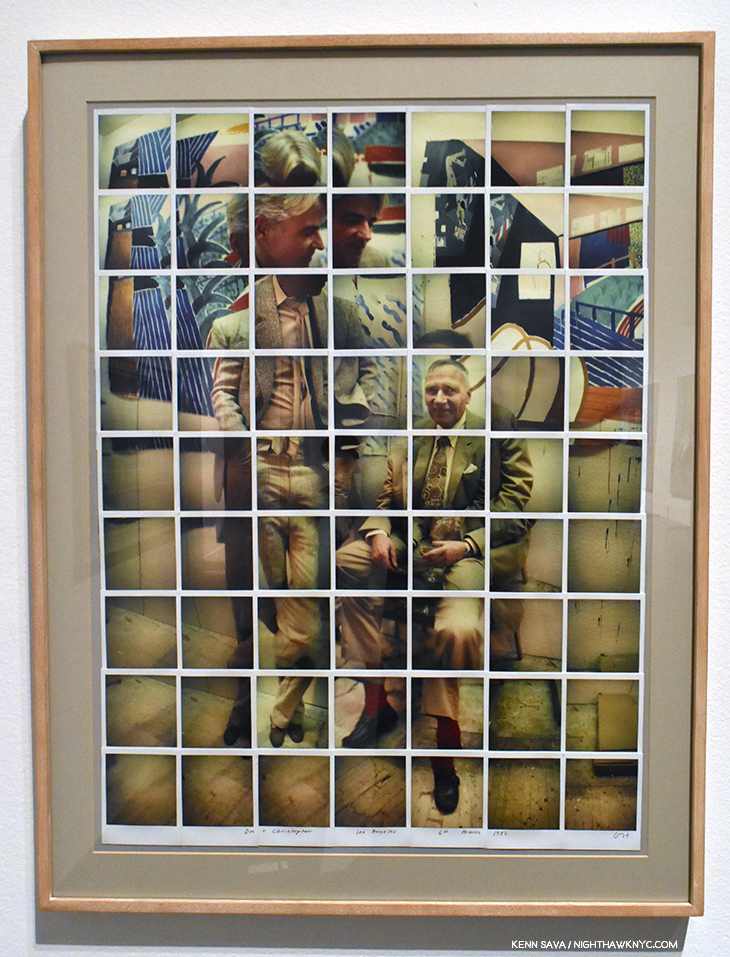
David Hockney, Don & Christopher, Los Angeles, 1982, Polaroid collage “Joiner.” Seen at David Hockney, The Met, January, 2018.

Earlier this year, while I was formulating my thoughts on this subject, before I saw R:TSPs, I came across 2 books by David Hockney, Cameraworks, 1984, and Hockney on ‘Art,’ conversations with Paul Joyce, published in 1999. In both of them, Mr. Hockney 9, a man who has created both Paintings and Photographs (since 196710), and innovated in both realms, put into words much of what I was thinking- uncannily. “During the last several months I’ve come to realize that it has something to do with the amount of time that’s been put into the image. I mean, Rembrandt spent days, weeks, painting a portrait. You can go to a museum and look at a Rembrandt for hours and you’re not going to spend as much time looking as he spent panitng- observing, layering his observations, layering the time.” “My main argument was that a photograph could not be looked at for a long time. Have you noticed that?,” David Hockney, Cameraworks, P.9. There. He just said it for me.

Recently, in these very pages, without any question from me or the knowledge that I was working on this piece, the Photographer Fred Cray said– “One of the concerns I’ve always had with photography is the way it holds up on the wall with paintings and other media. Photography often seems thin and quick compared to painting.”

Anytime I see a Photographic portrait, my mind (at times, unconsciously) always turns to Rembrandt’s Self-Portraits (though, much of what I’m saying here could also be said for almost all of his portraits, as Mr. Hockney inferred). Not as a way of qualitatively comparing them. As a means of gauging the impact. They are the benchmark for me. Most of the time, the impact of the Photography in question isn’t the same. I wondered why for most of the first two years of this dive. Early in 2019, it hit me. Time. Time is a key element in Painting. In so many ways. From the time each stroke takes to apply, to how long it takes to complete the work to the rendering of time, itself, in the work. These are not questions most Photographers have to face. They deal with questions of light and setting before the fact, then they’re finished- unless they modify it later in printing, or digitally.

Unknown Artist seen Painting on 7th Avenue, NYC, September, 2019. Yes, he got a parking ticket. Many Street Photographers would have been done long before this gentleman got set up.

Of course, Painters have ways of dealing with this question to ensure whatever level of consistency in the lighting they want. They can work in their studio, or they can work from a live subject, a still life, a Photograph, a Drawing, or what have you. Even au plain air, as the Artist above, is doing. Time is effecting the result in other ways. My feeling is it’s this passing of time, in this multiplicity of ways, that it takes the Artist to create the work that is manifesting itself in the work in subtle ways, maybe some of them are so subtle as to be subconscious, but that are nonetheless part of what the viewer experiences. With each brush stroke, time is passing, and in a real way, time is being layered on to the canvas. Time is absolute in a Photograph- it’s the same time at the top as it is at the bottom, unless you’re shooting with a time lapse, like Stephen Wilkes.

All of this also serves to remind me, again, of possibly why great Contemporary Painters, like Richard Estes, John Salt, Rod Penner, and David Hockney as well, among many others, use their own Photographs as part of their working process, but the reason they are Painters and not Photographers is because of what they find lacking in Photography- what it can’t present of their vision that Painting can. They’re not alone. The list of great Painters who also took Photographs at some point is long- ranging from Thomas Eakins, Edgar Degas and Edvard Munch, through Ralston Crawford and Robert Rauschenberg, and even Picasso. I find it telling that not a single one of them identified himself as a “Photographer.” Only Charles Sheeler was dually identified and that might be because his Photography earned him money to support his Painting.

Then, in the midst of all of these thoughts, a terrific new book was released by Steidl, Dave Heath: Dialogues With Solitude, the catalog for a show at LE BAL, Paris in 2018. It gave me pause for thought.

My copy of Dave Heath: Dialogues With Solitude, Steidl, 2019.

WHO is Dave Heath?

From Dave Heath: Dialogues With Solitude, Steidl, 2019. *Photo courtesy of Steidl.

It turns out that Mr. Heath was, not is, unfortunately, but his work struck me every bit as hard as any I’ve seen in this 3 year deep dive. Particularly, his portraits, and specifically his portraits of one subject not looking at the camera.

Dave Heath’s earliest body of work are Photographs he took while serving in Korea in 1953-4, including this one. From Dave Heath: Dialogues With Solitude, Steidl, 2019. *Photo courtesy of Steidl.

It turns out that he was not only a master with a camera- a master of the Portrait, he was, also, a master printer. To the point that no less than the aforementioned, esteemed, Robert Frank paid Mr. Heath to print his work for what I believe was his first solo show at no less than the Art Institute of Chicago in April, 1961, a byproduct of The Americans’ release here two years earlier. That says it all.

My copy of Dave Heath’s A Dialogue With Solitude in the 2000 Lumiere Press edition. The books is on the right. The print is in the sleeve to the left.

Captivated by what I’d seen in the Steidl book, which is very well printed, in my opinion, though, unfortunately, Mr. Heath, who passed away in June, 2016, was not involved in it, I learned that Dave Heath’s “masterpiece” is the PhotoBook, A Dialogue With Solitude, 1965, a subject I am quite familiar with. I hunted down a “reasonably” priced copy of the 2000 Lumiere Press limited edition reprint with a signed & numbered print. The reprinted edition includes a letter from Robert Frank. The print in my set is “Washington Square, New York City, 1958.”

Washington Square, New York City, 1958. A Photograph that leaves me speechless, and turns my thoughts to Rembrandt.

It’s one of the very greatest accomplishments in PhotoBooks I’ve yet seen. Given what I said about his printing, the inclusion of a signed & numbered print in the Lumiere Press edition is a key. When I saw it for the first time I had a feeling that was closest of any Photograph I can think of to that I get while looking at a Rembrandt Portrait. Of course, as always, your results may differ.

For some reason that I can’t fathom, the word is that “Mr. Heath’s work went out of style.” Well? Rembrandt, too, “went out of style,” for well over a century, as hard as that might seem to believe to us now. Now, with Steidl’s Dave Heath: Dialogues With Solitude, it seems to me that a show or a book that returns a great, overlooked or forgotten Artist to the world has done that world a great cultural service. I can’t think of a higher purpose for either.

David Hockney, Perspective Is Tunnel Vision, Outside It Opens Up, 2017, Acrylic on two canvases. David Hockney shows how the camera sees in “tunnel vision,” single point perspective,” versus how humans see with what he calls “reverse perspective,” with infinite vanishing points, born of driving through a 10 mile long tunnel in Europe then suddenly coming into the great outdoors in 198511.

Reading David Hockney further, which I highly recommend to anyone interested in Photography, he speaks time and again that cameras, while being great at reproducing two dimensional objects12, do not see the way humans do. He has devoted much of his subsequent Painting career (as seen in his fascinating recent shows) to challenging traditional perspective and exploring the innovations of both Renaissance masters and the masters of Cubism.

David Hockney, Grand Canyon I, 2017, Acrylic on canvas, 48 x 96″ hexagonal, seen in April, 2018. Outside, it, indeeds, “opens up.” The Artist has also begun cutting the corners off his canvases to reinforce his ideas.

In 1999, Mr. Hockney asked, “How many truly memorable pictures are there? Considering the millions of photographs taken, there are few memorable images in this medium, which should tell us something. There have been far more images made this way than the sum of all previous images put together.” (Paul Joyce, Hockney on ‘Art’, P.43.) One thing that’s changed since Mr. Hockney said those words is that there are now more cameras in the world then there are people. It seems to me that that’s going to be a factor in this. The sheer number of Photographers versus Painters is, and is likely to remain indefinitely, skewed incredibly. Incalculably. It makes the odds of a “great” Photograph out of the billions being taken incrementally greater. “Quality only comes with quantity,” legendary Photographer Daido Moriyama said explaining why he takes so many Photos, in How I Take Photographs, page 7313.

I’ve noticed that the rise of Photography has coincided with a relatively ”quiet period” in Painting, in some ways. While this has lasted a few decades, more recently, I don’t have to look any further than my own 200+ piece Archive. I’ve said a number of times that one of the reasons I decided to focus on Photography the past three years was the lack of Painting shows that spoke to me sufficiently to undertake the work these pieces require. I wonder how much longer this will last- Is this an anomaly, or is this the beginning of the way things are going to be? Will we see the number of painters going forward that we’ve seen for the past 500 years? Of course, sheer numbers, or the lack of them, don’t guarantee masterpieces or geniuses. Greater numbers only serve to increase the odds.

At the three year mark, I’m still not convinced that Photography will come to be seen as Art in hundreds of years when that question is decided, IF anyone still cares about Art then. But? If they do, my bets are that Rembrandt’s will still be among the work most highly appreciated.

A work like Dave Heath’s Washington Square, New York City, 1958, gives me hope that Photography may still get there. Is it, as Mr. Hockney said, an image in a billion? Or is it an indication of what might be possible in the medium? I will continue to look…

Meanwhile, on October 4th? I’ll just light a candle. To go with the one in memory of Robert Frank. While I continue my dialogue with Davids Hockney and Heath…

*-Soundtrack for this Post is “Grace,” written by Jeff Buckley and Gary Lucas from Jeff’s immortal album, Grace. I worked with Mr. Lucas, and I booked Music into the now legendary NYC Music Club/Cafe, Sin-E in 1993, shortly after Jeff had played and recorded there. And then? He was suddenly…gone. I never met him or heard him perform in person. One of the great regrets of my life.

BookMarks

My copy of The Rembrandt Book, (THE Rembrandt Book, or TRB, as I call it), by Gary Schwartz. In my opinion, it’s a model of everything a truly great Art monograph should be.

In addition to the books I referred to above, if someone were to ask me to pick one book on Rembrandt? I would choose The Rembrandt Book, by the aforementioned Gary Schwartz. It’s a book designed for readers both new to Rembrandt or expert on the Dutch Master, and so, it’s a book for a lifetime of enjoyment and research. Published in 2006 by Harry N. Abrams, it’s the SECOND full length monograph on Rembrandt by Gary Schwartz, and they couldn’t be more different (In a world where ANYone else would be thrilled to write one magnificent book on Rembrandt? HOW incredible is that?) or compliment each other better. TRB is oversized at 10 x 13 and weighs 6 pounds, but it is my bible on Rembrandt, and if I can’t find what I’m looking for there? I go to his prior monograph, the equally highly regarded, Rembrandt: His Life, His Paintings, 380 pages and 3.6 pounds, published by Viking in 1985 (and I believe this book has been reissued at least once). Both books can be found very reasonably (for less than they were originally published for) in very good condition. Along with my Sister Wendy books, they are the foundations of my Art library.

Another book that’s very relevant to this discussion, and has been essential for me- one I don’t see recommended nearly often enough, is Believing Is Seeing (Observations on the Mysteries of Photography) by the renowned Errol Morris. 

My prior pieces on PhotoBooks are here

NighthawkNYC.com has been entirely self-funded and ad-free for over 6 years, during which over 250 full length pieces have been published. If you’ve found it worthwhile, you can donate to keep it going & ad-free below. Thank you!

Written & photographed by Kenn Sava for nighthawknyc.com unless otherwise credited.
To send comments, thoughts, feedback or propositions click here.
Click the white box on the upper right for the archives or to search them.
For “short takes” and additional pictures, follow @nighthawk_nyc on Instagram.

Subscribe to be notified of new Posts below. Your information will be used for no other purpose.
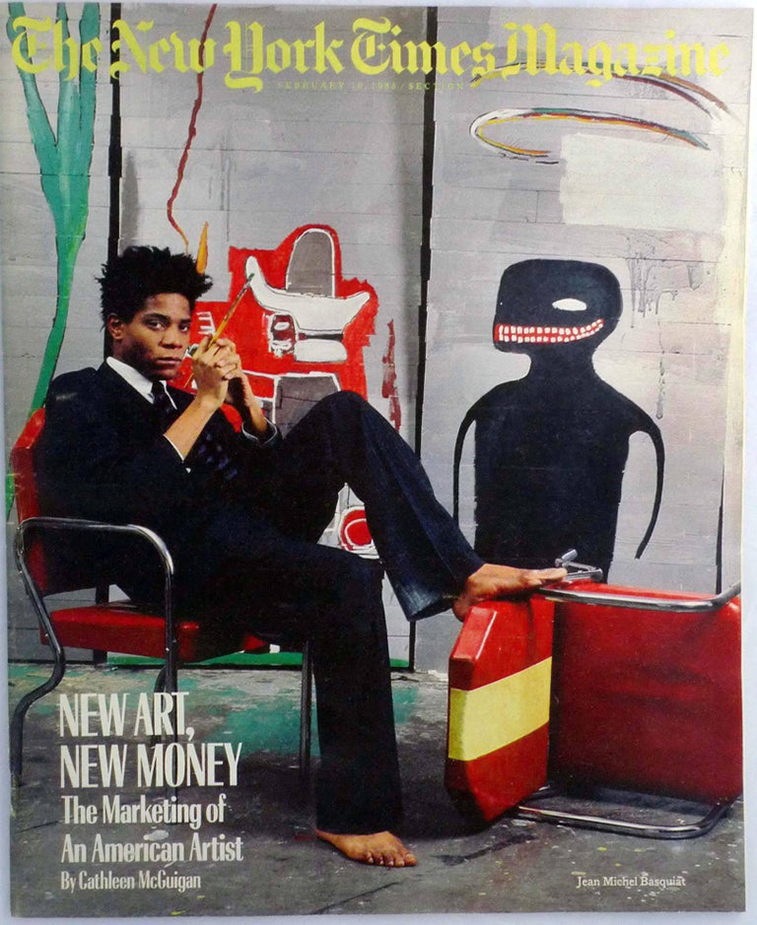
 

  1. You can still visit the beautiful, large, expensive house he bought at Jodenbreestraat 4, in Amsterdam.
  2. Excuse me for seeing a lesson for today’s Art world in this, but I do. If this could happen to one of the greatest Artists who ever lived? It can happen to anyone.
  3. The Wallfar-Richartz-Museum, Cologne, Germany is having a show of Rembrandt’s Graphic Work that opens on, yes, October 4, 2019. The Rijksmuseum, Amsterdam, is hosting a Rembrandt-Velazquez show that opens a week later.
  4. Gary Schwartz says there are some documents that raise the possibility that Rembrandt may have actually been born in 1605 or 1607  (Gary Schwartz, The Rembrandt Book, P.15). I don’t think a year on either side of 2106 is going to make a difference regarding my being around to see it.
  5. My one caveat being that they chose to reproduce only the detail of the early works in which RvR Painted himself as an onlooker in a crowd, denying the viewer the full context and setting.
  6. I consider the incomparable 1980 Picasso Retrospective at MoMA the real beginning of my “looking career” at shows. Looking at Art books predates that by about a decade.
  7. The Americans was first published in 1958 in France by Robert Delpire, and in 1959 by Grove Press in the USA.
  8. //iphf.org/inductees/sir-john-frederick-william-herschel/
  9. Who, in addition to being a world-famous Painter, has also authored two important books on Art & Art History- Secret Knowledge and A History of Pictures
  10. David Hockney, Something New Exhibition Catalog, 2018, P.6
  11. David Hockney, Something New Exhibition Catalog, 2018, P.5
  12. Afterall, what we have in Rembrandt: The Self-Portraits, and every other mass produced book of Paintings, are Photographs of Paintings.
  13. For much more on how Daido Moriyama feels about whether Photography is Art, see P.205-6 in the chapter titled “The Real Daido Moriyama,” in this same book, How I Take Photographs.

Forgotten Songs I Will Love Forever, #2- Steely Dan’s Deacon Blues

This site is Free & Ad-Free! If you find this piece worthwhile, please donate via PayPal to support it & independent Art writing. You can also support it by buying Art & books! Details at the end. Thank you.

Written & Photographed by Kenn Sava (*- unless otherwise credited)

Part 2 of an ongoing Series. Part 1 is here.

“Deacon Blues” by Steely Dan, written by Donald Fagen & the late Walter Becker, as recorded on their classic album, Aja, in 1977.

Hideki Fujii’s (1934-2010) classic Photo of the extraordinarily enigmatic model & actress Sayoko Yamaguchi (1947-2007). She did far more, including being a ground-breaking Artist, but even if she had only done this one Photograph, she’ll live forever.

Comment- As close to the unofficial/official Theme Song of NighthawkNYC.com as there is likely to be, and I said as much in my very first Post in July, 2015, and here in in 2024. For me, Steely Dan represents a kind of zenith in Pop & Rock- the moment where pure instrumental musicianship peaked before the machines, computers and automation began taking over. (There’s nothing inherently “wrong” in that. It’s just different.) “Libations. Sensations. That stagger the mind…”

Compared to the otherworldly beauty on the cover for Aja, it looks like the band didn’t have a lot of input into the single’s cover. Photographer unknown.

Lyrics-

This is the day of the expanding man
That shape is my shade
There where I used to stand
It seems like only yesterday
I gazed through the glass
At ramblers, wild gamblers
That’s all in the past

You call me a fool
You say it’s a crazy scheme
This one’s for real
I already bought the dream
So useless to ask me why
Throw a kiss and say goodbye
I’ll make it this time
I’m ready to cross that fine line

Learn to work the saxophone
I’ll play just what I feel
Drink Scotch whiskey all night long
And die behind the wheel
They got a name for the winners in the world
I want a name when I lose
They call Alabama the Crimson Tide
Call me Deacon Blues

My back to the wall
A victim of laughing chance
This is for me
The essence of true romance
Sharing the things we know and love
With those of my kind
Libations
Sensations
That stagger the mind

I crawl like a viper
Through these suburban streets
Make love to these women
Languid and bittersweet
I rise when the sun goes down
Cover every game in town
A world of my own
I’ll make it my home sweet home

Learn to work the saxophone
I’ll play just what I feel
Drink Scotch whiskey all night long
And die behind the wheel
They got a name for the winners in the world
I want a name when I lose
They call Alabama the Crimson Tide
Call me Deacon Blues

This is the night of the expanding man
I take one last drag
As I approach the stand
I cried when I wrote this song
Sue me if I play too long
This brother is free
I’ll be what I want to be

I learned to work the saxophone
I play just what I feel
Drink Scotch whiskey all night long
And die behind the wheel
They got a name for the winners in the world
I want a name when I lose
They call Alabama the Crimson Tide
Call me Deacon Blues

Tenor solos by Pete Christlieb.

Making a masterpiece. The making of “Deacon Blues”-

;

“We would work then past the perfection point (italics mine) until it became natural.”

I get chills watching this. When Aja came out, I, and every musician I knew, were just in awe of the incredible taste shown on every single note, and what wasn’t played. Then, there’s the lyrics…

Great Music will never die. Pay Steely Dan forward.

*-R.I.P. Walter Becker (1950-2017)

NighthawkNYC.com has been entirely self-funded & ad-free for over 8 1/2 years, during which 320 full-length pieces have been published! If you’ve found it worthwhile, PLEASE donate to allow me to continue below. Thank you, Kenn.

You can also support it by buying Art, Art & Photography books, and Music from my collection! Art & Books may be found here. Music here and here.

Written & photographed by Kenn Sava for nighthawknyc.com unless otherwise credited. To send comments, thoughts, feedback or propositions click here. Click the white box on the upper right for the archives or to search them. Subscribe to be notified of new Posts below. Your information will be used for no other purpose.
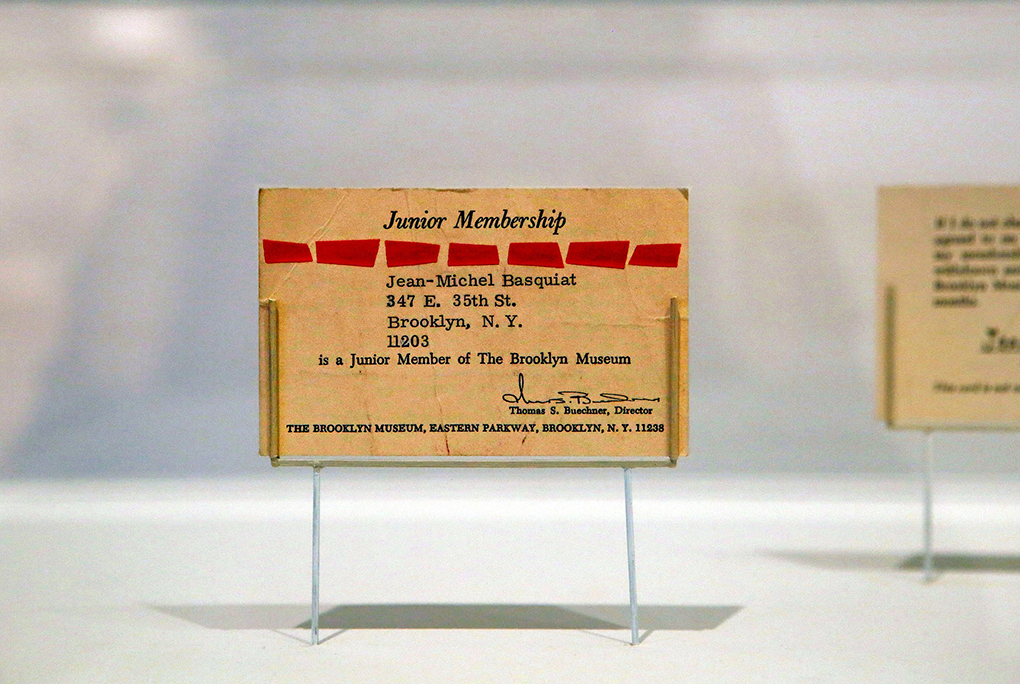
Louie Palu’s Tools of Remembrance

Written by Kenn Sava. Photos as credited.

“Another day in Kandahar
I must focus now
Think of the frame
Think of each side of the rectangle


Focus on the frame
Stay calm under fire
Focus your mind
Acknowledge the danger
And work
Everything happens so fast
I must control my mind
Relax
and get the shot”
Louie Palu in the opening voiceover in his documentary film, with a screenshot from, Kandahar Journals, 2015

US Marine Lance Corporal Damon Connell, age 20, one of the series of soldier portrait cards included in Front Towards Enemy, by Louie Palu

A few years ago I met Rickey Rogers, as he was about to relocate to London to begin his new role as Global Photo Editor for Reuters. As we spoke, I was struck by his passion for what he called “conflict Photographers.” Though I’ve long had an interest in the work of Matthew Brady, Roger Fenton, Robert Capa, Don McCullin, Larry Burrows and Susan Meiselas among others, after meeting Mr. Rogers, I began looking closer at the work of  the contemporary Photographers who are putting their lives on the line to show us what’s going on in the world- even when it’s very hard to look at what they show us. It’s crucial we do.

Louie Palu is part of that rare breed.

A Canadian soldier walks up a narrow path in what is known as “Route Nightmare” in a village in Kandahar, Afghanistan. The mud paths allow for easy planting of mines and road side bombs by insurgents. This image appears in the newsprint publication included in Front Towards Enemy.

Today, at a time when it’s possibly never been harder to do this job, which has never been “easy,” I’m often reminded of the fact that these Photographers have often turned their lenses to other subjects. Basically, they’ve turned them everywhere their lives took them, capturing a very broad range of the human experience in the process. Robert Capa also Photographed Picasso frolicking on the beach, Susan Meiselas captured Carnival Strippers and the secret world of an NYC S&M club, Mr. Palu’s fellow Canadian, Larry Towell, Photographed the Mennonites, and so on. Yet, because they were, also, present in war, and somehow managed to capture remarkable Photographs in the heat of those moments, their conflict images have become part of history- they are the ones these great Photographers have, largely, become best known for.

The caption reads, “An Afghan police officer who was wounded by gunfire sings to birds at an outpost in Pashmul, Zhari District, Kandahar Province,” from Front Towards Enemy. There is a timeless quality to this image that, save for the arm badge, could have been taken in any war.

Though Louie Palu spent five grueling years in Afghanistan covering the war from 2006-10, which resulted in the thousands of Photographs and the award winning documentary, Kandahar Journals, he’s also created important work on a number of subjects away from war. That might be why Mr. Palu refers to himself, simply, as a “photographer.”

Front Towards Enemy is published in an edition of 750 copies by Yoffy Press, it contains about 60 Photographs and an essay by Rebecca Senf.

Still, I was unfamiliar with Mr. Palu until PhotoBook guru Jackson Charles pulled my coat to the Yoffy Press table in the PhotoBook Publisher’s area at AIPAD in April telling me I “HAD to see” Louie Palu’s latest two books, which Yoffy had just published. As usual, he was right. I was immediately engrossed in his Front Towards Enemy and A Field Guide to Asbestos.

A Field Guide to Asbestos

The design of each may gain your immediate attention (the former, which comes in a slip case/wrap that when opened reveals a variety of elements inside to be explored in any order the reader chooses, (a bit like Chris Ware’s Building Stories).

Front Towards Enemy’s slipcase opened to reveal its four components- a packet of soldier portraits, top,, an accordion fold image set, next, staple-bound zine and a newsprint publication, under. The entire publication can also exist as a pop-up exhibition. This copy is signed on upper left of the inside flap.

And the latter who’s front and back covers suddenly reappear in the center of a book that tells the rending story of two Canadian brothers who each died from mesothelioma after years of working in asbestos mines), but it is the depth of the dedication to the stories each contain that makes them unique & powerful. The first printing of A Field Guide to Asbestos almost immediately sold out.

In addition to being an extremely moving account of the lives of its two subjects, it’s, unfortunately, one of the very rare books (let alone PhotoBooks) about the epic and continuing Asbestos crisis.

Mr Palu happened to be sitting a few feet away at Yoffy’s table, so my first impression of his work was still flooding my brain as I spoke with him. In the succeeding weeks, he graciously found time in a very busy schedule and full life to answer some questions for me. Given that not nearly enough has appeared in the media about Front Towards Enemy and A Field Guide to Asbestos– two of the more compelling and important PhotoBooks of the past year in my view, I’m happy to be able to bring my Q&A with Louie Palu to you here.

Louie Palu, standing left, at the Yoffy Press table in the PhotoBook Publishers section of AIPAD, April, 2019.

Though I always do my own research, here is one time I find it hard to top Wikipedia’s first line as a succinct introduction to Louie Palu- “Louie Palu, RCA, (born 1968) is a Canadian documentary photographer and filmmaker known for covering social-political issues, including war and human rights,” it reads. The RCA is Royal Canadian Academy of Arts, to which Mr. Palu was inducted in 2014. His work has appeared extensively in publications throughout North America and Europe including The Globe and Mail, Toronto (where he was on staff for 6 years) to The New Yorker, The Wall Street Journal, USA Today, The Washington Post, The New York Times, Newsweek and The Atlantic.

A screen shot of the “In Print” tab on Louie Paul’s site shows only a few of Mr. Palu’s images in print. As you scroll down the page, the powerful images just keep loading…

So, it’s highly likely his work is familiar to you even if his name is not. He’s been  exhibited by the Canadian War Museum and was included in the important show War/Photography: Images of Armed Conflict and Its Aftermath at the Museum of Fine Arts, Houston that travelled to Los Angeles, Washington and the Brooklyn Museum in 2012. He’s been honored with the Hasselblad Masters Award and Canadian Photojournalist of the Year Awards, both in 2008, a 2013 Pictures of the Year International Award and has received a Pulitzer Center for Crisis Reporting grant and a 2016 Guggenheim Foundation Fellowship.

The front cover of Cage Call by Louie Palu and Charlie Angus

His dedication and commitment to the issues he’s covered can be seen in the fact that a number of the projects he’s undertaken have lasted over a decade. To date, he’s focused on five- The Canadian Hard Rock Mining Belt, Guantanamo Bay, the Mexican Drug War, Kandahar, Afghanistan, and Asbestos. Counting the two new releases I mentioned, he has now released five PhotoBooks, with, first, Industrial Cathedrals of the North; second, Mirrors of Stone: Fragments from the Porcupine Frontier, and third, Cage Call: Life and Death in the Hard Rock Mining Belt (all three with Charlie Angus), preceding his two new books. In 2015, after a very successful kickstarter campaign, he released the documentary Kandahar Journals, in which he is featured, as well as co-directed and produced.

That’s not blood. The caption on this photo when it appeared in Front Towards Enemy reads, “An Afghan soldier warming his henna stained hands…” The poster for Kandahar Journals, 2015, featuring, co-directed by and produced by Louie Palu.

In Kandahar Journals, Louie spoke about what inspired him to cover war. “My reason for covering the war is related to my family history,” he said. “As a child my parents told me many stories about the war (in Italy in World War II) around the kitchen table. Their traumatic experiences have shaped who I am. One of the stories my father told me was watching his own father being taken away by soldiers at gunpoint. I needed to understand what he understood.” Louie went to Afghanistan, following US, Canadian and Afghan troops and American Medics (including going on 150 medevac missions with the 101st Airborne in 2010). He decided to take a different approach than those reporters who spent short periods there. Instead, he spent five years.

From Kandahar Journals.

Why did he chose this approach, and stay that long? He explained in an interview last year-

“I think there probably isn’t a single person in this room who wasn’t effected by 9/11 and I think that that was sort of the foundation of it, but it didn’t drive me to want to go there yet. When I got there I realized I couldn’t cover the war in the way I thought it should be covered (staying there for a short period)…I wanted to do a long term study. I wanted to keep looking at something over and over and over and over again because I think that things reveal themselves if you look at them over time.” He decided to leave his staff job, go out on his own, and return there. “I’m gonna stay here,” he continued. “When I figure out the story, then I’ll report it. I did sell stuff sort of on a per story basis. But over the years as the pictures started coming together, they started telling a new story, they started explaining things more than just the bombings and the bodies, they started explaining the culture, the place, its history, and I really think it became a unique story, a unique dialog about the place.”

From Kandahar Journals.

The pictures and the story did come together, in Kandahar Journals, and in the PhotoBook, Front Towards Enemy, released last fall, after many of his images from the war had appeared in numerous news outlets. Kandahar Journals is described as “the story of a photojournalist who reflects on the events behind his psychological transformation,” according to its site. It won the Dziga Vertov Award for Best Documentary Feature, 2017. When I saw it, I was struck by stylistic echoes of Apocalpyse Now. Mr. Palu’s voiceover, often reading from his journals, are reminiscent of Martin Sheen’s Captain Willard’s voice in the Francis Ford Coppola epic, but the whole effect of Mr. Palu’s documentary is also a journey into “the heart of darkness” not unlike that taken by Sheen’s Captain Willard, though here also we see him return from the war. Whereas Francis Ford Coppola was showing us a drama based on Joseph Conrad’s Heart of Darkness, Mr. Palu’s doesn’t have a fictional moment in it. The film wonderfully alternates Mr. Palu’s still Photographs, often seen in montage, with moving images, many taken in active combat situations. Known to this point for his still work, his and his team’s filmmaking show a flair for editing that is both taught and spontaneous. It deserves the kudos it’s received, and more viewers.

Seen at work in Kandahar Journals.

This fall, his work on the Arctic will appear in National Geographic, and his work has been selected to be included in the upcoming PhotoBook, On Death, by Jon Feinstein, Roula Seikaly in collaboration with the Humble Arts Foundation and published by Kris Graves Projects.

Kenn Sava (KS)- You’ve been involved in books about Canadian Mining and Miners, a book about the horrors of asbestos- a deadly product that just won’t go away, and, more recently, a film and book about your experiences in Afghanistan covering the war. What drives you? Where does it come from?

Louie Palu (LP)- All my drive comes from my emotional reaction to hearing my parents oral histories about the Second World War, poverty, workers and the experience of immigrants and refugees. My entire childhood neighborhood in the West side of Toronto is filled with a rich mix of migrant workers from the West Indies (mostly Jamaica), Italian, Bosnian, Crotian, Serbian, Indian, Irish and many more nationalities who came to Canada for a new start.

Louie Palu signs Front Towards Enemy, AIPAD, April, 2019.

KS- The public sees the books and the films- the end results of mountains of long, hard effort. The tip of the iceberg. What’s it like being you? Can you give us a bit of a sense of what goes in to being able to make these projects and then make them into a book or film?

LP- I don’t look at what I do as a job. There are conventional work and job-like tasks, but I take it on as a way of living, thinking and feeling about the world and the people around me. These projects are all very hard, no matter how long I have done this (28 years since college). When I start them it’s a real challenge, like the Cage Call project on the mines, that was like being out of breath non-stop because I was young and did not know what I was doing. I failed so many times, but that is how I got to where I am now, that helped me set the bar higher and higher. The difference from my first 20 years at this, and now, is I have the experience and confidence to clearly understand my process and not be afraid of failure now. I enjoy the process more. I was also lucky to have a few mentors come along and show me the way. I can’t say enough postive things about everyone finding a mentor.

On being me… I like being alone. Though work can be very consuming at times, I have found the places I fit in and exist in when I am not doing photography are usually places and events that have nothing to do with photography. Some of these actitvities involve extreme music like hard core punk and death metal. Additionally, alternative versions of theater, music and art are also therapeutic. I love cruising used book stores, actually I love books and places that sell vinyl, comic books and seeing art house films. I am also very active, I run bike, bike and fish. I like being in the woods alot alone and camping.

From Kandahar Journals.

KS- Was it hard to get the permissions you needed to be at the front documenting the war in Afghanistan for five years? Once you were there, was it hard to gain the acceptance of you and your cameras from the soldiers?

LP- It is hard to get access anywhere and always has been. My first project when I was 16-years old was on homelssness in the 1980’s in the East end of Toronto. I recall getting hit in the face by someone who did not want to be photographed on my first day on the street, I got some hard lessons early on. It can be hard to get access to politicians. Actually, that’s probably harder than getting access to a war zone. I have always figured out access and built relationships well with who I was photographing. Many of my indirect teachers for my values, after my parents, were the work of photographers like Peter Hujar, Mary Ellen Mark, Don McCullin, Susan Meiselas, Eugene Smith and many more.

Louie Palu on his way home. From Kandahar Journals.

KS- How did your years in Afghanistan change you? Did you suffer any of what many soldiers have coming back to Canada and United States in adjusting?

LP- Afghanistan was life changing. Everyday I wake up I am pretty positive. Afghanistan set a bar for me, which is if there are no suicide bombings, land mines to step on and I still have my legs I have nothing to complain about. I certainly struggled hard when I got home, but I rallied because I had good friends who made me go to therapy. Helping people can give you a sense of purpose, being a good person can help you help yourself.

KS- Front Towards Enemy is certainly a unique concept for a “photobook.” Why did you decide to make it this set of multiple parts, in different formats and on different papers, so the reader could put it together however they wished? 

LP- FTE is a deconstructed book, it can be taken apart and re-edited by the viewer. I think its good for readers of the news to understand process and editing. Photo editing is a key part of what we see and don’t see, thats what FTE is after, which is participation of the reader. FTE came out in the wake of and is part of a series of self published newspapers on the same concept. They are Mira Mexico (Mexican drug war) 2013, Guantanamo Operational Security Review 2014, Federal City (political identity in Washington DC) 2017. They can all be seen on the Photoeye website.

KS- With Kandahar Journals, released in 2015, you’ve added film to your photographs. Images from the film appear, also, in Front Towards Enemy. When did your film work begin? It seems like it must be hard to know in advance which camera to pick up since you can only guess what is about to happen, and the unexpected certainly happens all the time. Is this where your experience comes in, or do you prefer to stick with still photography for some things and film for others? 

Louie Palu at work on Capitol Hill, Washington, DC. From Kandahar Journals.

LP- I have always been interested in the moving image. I obssessed over several films as a child and felt that cinematography has an experiential quality that still photos do not, neither is better than the other. I think I watched Apocalypse Now fifty times (the original version is still the best), mostly because Vittorio Storaro and the soundtrack created this psychological space for Francis Ford Coppola’s directing that was rare in films. I never have a problem with which camera to use, I go by what I feel I should use. I have since made a short film on Ukraine and am now making a feature version of it among 3 films in development.

From A Field Guide to Asbestos.

KS- A Field Guide to Asbestos is one of the most grimly intense, and, unfortunately, still timely books I’ve seen recently. With reports this month in the NY Times and elsewhere about asbestos possibly making a comeback, it’s a book more people need to know about right now. How did it come about? What’s it going to take for the world to finally get rid of it, once and for all? 

LP- Sadly asbestos still exists and is used in homes and many other materials around the world. If you all only knew what I know, you would be horrified how this material is still very much everywhere. I think bans can be overturned, because they are usually writing. But photos of horrors are tools of remembrance. If we have books, photos and documents that are artifacts and evidence of what it does and people see them enough it will be hard to forget. This book came about because I began to hear the talk amongst some US policy makers that asbestos could be something that could be used again in construction.

The caption, which reads in part, “U.S.soldiers under rocket and small arms fire from insurgents…” neglects to mention that the Photographer, Louie Palu was, as well. From the newsprint publication in Front Towards Enemy.

KS- We live in a time where the truth is under attack, as the essay in Front Towards Enemy points out, and it’s, also, increasingly hard to do what you do- be a journalist/photojournalist/documentarian. What can readers do to help you and the others?

LS- Go to the website for the Commmittee to Protect Journalists and read the stories of journalists being jailed, murdered or attacked just for reporting the news. Help yourself understand and imagine what your mind would be like without a free press so that you could be informed on everyting from vaccinations to human rights or simply even a warning that some of the food you purchased has a serious health related issue or there is a rapist in your community. We would all be blind and worse off.

I met a person at a film festival recently who did not know what D-Day was, imagine if we start forgetting about the Bill of Rights and the Constitution? We would be a nation with no moral compass. The press is a key tool of oversight and a platform so that we don’t lose our way entirely, or at all.

Q&A Ends.

Can a PhotoBook change the world? It seems to me that Photographers like Louie Palu can make the pictures, get them published, and once in a while make PhotoBooks of them. It’s up to those who see them to take things from there.


BookMarks-

From Front Towards Enemy– the soldier portrait cards, the accordion fold image set and exhibition suggestion card, left to right. Photos by Yoffy Press.

Front Towards Enemy, was published by Yoffy Press in October, 2017 in an edition of  750 copies. Inside it’s cardboard slipcase are four components- a set of soldier portrait cards, an accordion fold image set, a newsprint publication, and a staple-bound zine. The entire publication can also exist as a pop-up exhibition, per the enclosed “exhibition suggestions.” It includes about 60 images and an essay by Rebecca Senf. It may be purchased here.

The first edition of A Field Guide to Asbestos sold out after its publication in April, 2019. A second edition is currently available. It’s a softcover of 72 pages, and is available here. You can get a $15 discount if you buy both, as I did, here.

Kandahar Journals is a first hand look at Louie Palu’s experiences in Afghanistan. What more need I say about it?

Lesser known (and not counted in the five books I mentioned earlier) are two additional newsprint publications self-published by Louie Palu, Mira Mexico, 2012, and Federal City, 2017, both 32 pages. The former consists of a group of his Photographs on the Mexican drug war, while Federal City, a haunting publication that looks at the “other Washington,” those who have no direct connection with the Federal government. Since they are not bound or stapled, both publications may be pulled apart and perused in any order the viewer chooses. Personally, I find both compelling and Federal City exceptional. As I write this, both are available through Photo-eye.

For further reading, Photojournalists on War: The Untold Stories from Iraq, by Michael Kamber, though about the war in Iraq, not Afghanistan, is an unprecedented collection of interviews with some of the other leading Photojournalists of our time, including two who were killed in conflicts after being interviewed. It’s a book I find impossible to put down after I pick it up, and its large size brings the words home with full size photographs reproduced throughout. An extraordinary, highly recommended book. I bought mine from Quinn and Tom of Housing Works Bookstore, who I thank.

*-Soundtrack for this Post is “I Believe In Miracles” by The Ramones from Brain Drain, 1989-


My thanks to Louie Palu and Jackson Charles.

My previous pieces on AIPAD 2019 are here, and on Photography are You can

NighthawkNYC.com has been entirely self-funded and ad-free for over 6 years, during which over 250 full length pieces have been published. If you’ve found it worthwhile, you can donate to keep it going & ad-free below. Thank you!

Written & photographed by Kenn Sava for nighthawknyc.com unless otherwise credited.
To send comments, thoughts, feedback or propositions click here.
Click the white box on the upper right for the archives or to search them.
For “short takes” and additional pictures, follow @nighthawk_nyc on Instagram.

Subscribe to be notified of new Posts below. Your information will be used for no other purpose.
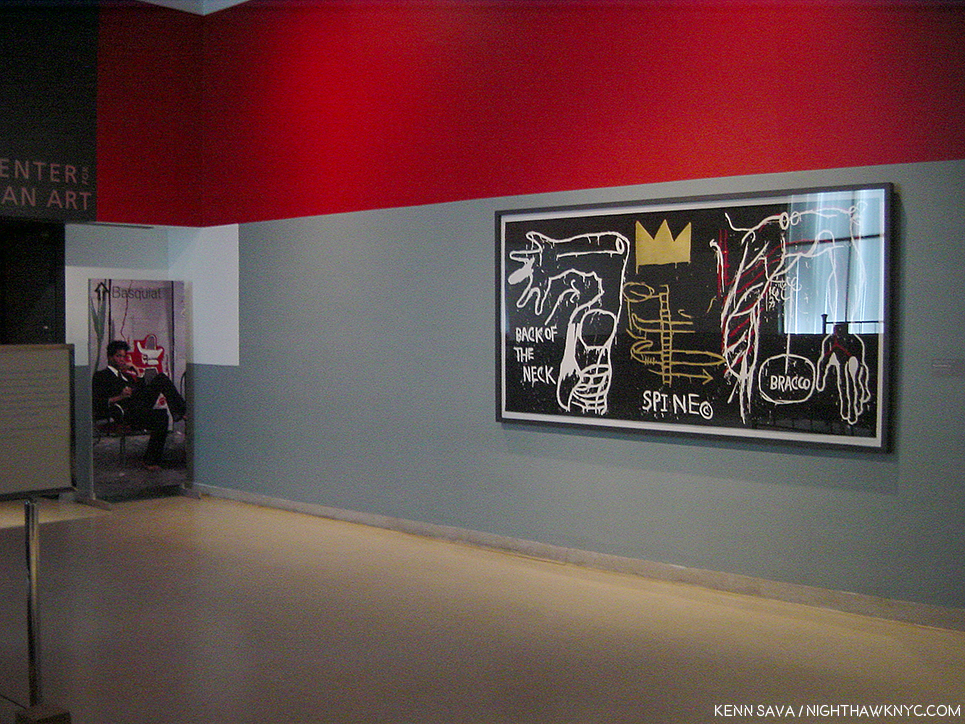
 

Jia Aili’s Transcendental Vision

Written & Photographed by Kenn Sava (*unless otherwise credited)

T-minus two months to 50 years ago human beings first set foot on the moon. I well remember following the trip on TV (though I have a friend who, though alive at the time, doesn’t believe it actually happened). With all the hoopla about to begin commemorating mankind’s greatest scientific achievement, I saw this relatively small Painting hanging on the wall at Gagosian, West 21st Street, and was suddenly struck by a different feeling. A feeling of what life, on earth, is like today.

Jia Aili, Astronaut, 2018. Oil on canvas, 23 1/2 x 19 11/16 inches.

Buckle up!

Watch your step!

Keep an eye on the sky and the other on where you’re about to put you next footstep.

And off you go into the great adventure called life in these increasingly challenging times. Heaven only knows where any of us will wind up. Back safely “home,” or…

But, this isn’t Neil Armstrong, Buzz Aldrin or John Glenn. The uniform is the wrong color. My associate, Lana Hattan, informs me it’s early Soviet space pioneer cosmonaut Yuri Gagarin, 1934-1968, the first human being to go into outer space, and so, ideology aside, a man who has earned his place among the bravest men who ever lived.

Yuri Gagarin in a possible source image. *Photographer unknown. 

Seeing this now, almost exactly 58 years after his flight (April, 1961), I was gripped by the metaphysical aspects of it- as a response to the twin questions of “What is there? What is it like?” Living in an age when technology is ever so gradually pushing us into “brave new worlds,” it takes courage on all of our parts to respond to what’s there and what it’s like, to take the leap of faith life today requires simply to survive. Oh, and make sure you have your pressure suit, gloves and helmet fully secured to survive the increased traffic of all kinds coming at you from all directions on the streets and even the sidewalks!

Untitled, 2012-14, 52 x 37 1/2 inches.

Protection suits…technology…nuclear explosions…lightning storms…apocalypse…desolation. All of these things loom as large in the Paintings of Chinese Contemporary Painter Jia Aili as seen in Jia Aili: Combustion at Gagosian, West 21st Street, as they do in the modern world- all over the world.

And? In the middle of all of this, there are a number of “humanoid” beings with their heads on fire.

Detail from Jia Aili’s Untitled, 2013, Oil on canvas, 47 1/2 x 81 inches.

A Painter at the peak of his or her talent can seem like someone with their head on fire. The wonderful canvases just seem to flow like a molten stream from their hand to the walls of galleries, museums or their collectors. That’s how I felt seeing this show spanning about a decade of Jia Aili’s Paintings. Completely enthralled, as I looked closer, there were so many passages in his Paintings that looked like they could be a work of their own. Combined, it seems to me, these passages create an entirely fresh style of composition. Take a look at this-

The gigantic Sonatine, 2019, 196 x 393 inches- 33 feet long!

Since there is so much to see in any one of these works, I’m going to focus on one in this piece. The huge, new, Sonatine, 2019, strikes me as the Artist’s most compelling work among the pieces I’ve seen on view here or in the monograph Jia Aili: Stardust Hermit, 2019. A sonatine  in Music, is a shorter sonata, both are musical compositions for one or two instruments in three, maybe four, movements, each in a different style, the whole may last about 40 minutes, more or less. Sonatine was also a 1993 Japanese gangster film. Which one of these is referred to here? Your guess is as good as mine, but I’m going with the musical composition definition, particularly because it has four panels and the mood seems to change between them.

“I almost never have a narrative in mind when I’m beginning a work, I start out from pure intuition. But quite a few viewers discover narratives, particularly in the larger-scaled pieces. That made me realize that narrative is about a way of reading-a visual narrative is produced by the order of vision,” Jia Aili1.

Sonatine begins, in my reading, in an unsettling, ominous, quiet in the far left of its four large panels, progressing to otherworldly utter chaos on the right. Along the way, there’s a fascinating mix of styles, references, shapes, images and partial images that take the mind in an any number of directions. First, regarding the huge scale, I’m reminded that Jia Aili studied billboard painting, like another great Painter who worked marvelously in huge scale, James Rosenquist, before changes in advertising in northeastern China brought the end of jobs for them. Yet, the motifs here have more to do with a kind of “personal language” than they do with anything that could be called “pop.”

Detail of Sonatine, its left hand panel.

Nothing I have read indicates Sonatine’s four panels should be considered individually. Yet, the more I looked at it, the more each took on a life of its own in my mind. Your results may differ. (Keep that in front of your mind throughout this.) In the left panel, I get the sense of being in a deserted or abandoned shopping center or commercial parking lot, but the odd triangular shape on the far left, almost seems to be sucking the atmosphere up and out of the Painting’s upper left corner. Looking very closely, I noticed that the line that extends down to the right, looking like a wall in perspective, faintly continues under the triangular shape. Well, whatever this white shape is, it reminds me of a wall. It leads the eye to a mysterious, distant horizon that contains a signpost or totem of sorts, under a threatening dark sky.

Sonatine, detail of the left hand panel.

Two figures appear, one shadowy about half way down the “wall” on the left, the other a dark shape, both possibly mounted on bikes, otherwise disconnected and at purposes unknown. The dark figure in the rear is being struck by lightning, a recurring meteorlogical motif in the skies of Jia Aili’s work. As I walked through the show, and noted more recurring motifs, I came to feel that these elements make up his dramatis personae. In Jia Aili’s case, the way he uses them almost seems like a sort of “code.”

From Jia Aili: Stardust Hermit

Back in the left center panel, another wall comes in diagonally from the right, serving to move the eye to the left panel’s background and then leading the viewer towards the center of the massive work, where things get extremely complicated. Still, i found myself repeatedly drawn back to the mysterious far left panel. I don’t know why,

*Curran Hatleberg, Waiting, 2012, Photograph.

The left hand panel eerily reminds me of this Photograph by Curran Hatleberg, who was selected to appear in the 2019 Whitney Biennial, taken in 2012, seven years before Jia Aili painted Sonatine.

Detail of Sonatine, its center left panel.

The sky suddenly clears at the top of the center left panel. Two figures, at least one who’s head is on fire, appear, shrouded in a triangular shape that almost entirely covers them. It almost looks like a black hole, possibly to another dimension. Is the second figure, which is grey and appears to be wrapping the flaming figure with a boney arm, a skeleton?

Sonatine, Detail of the far left and center left panels.

It’s hard to tell, yet in my reading of the work it is2. From looking at the works in this show featuring flaming figures, I came to regard them as living human beings- the flame represneting life, being alive, like that in a lit candle. From the direction of the flames, I believe the figure on fire is moving towards the center, though it’s main struggle appears to me to be with death, who’s desperately clinging to him, as again, a pair of shapes, this time jagged triangles, frame the two figures.

Sonatine, the center right panel.

In the center right panel things get sticky. It’s hard to tell exactly who is involved or what is going on. A white figure strains in the very center. Why and against what is nebulous at best- at least to me. Just behind him or her, is the figure of a woman holding a large bowl over her head, another recurring motif in the works on view here. Is the figure in white, who appears to be wearing a black helmet with, possibly, a horn protruding from the right top, a threat to her? Immediately to its left is the torso of another figure with a white hat or hood pointed in the same direction, towards the woman with the bowl. What is the woman carrying in the bowl? Life giving water, or food? There’s no way of knowing. She appears to be turned slightly to the left, though there’s no obvious way for her to move there. This makes me feel she’s not an actual “figure,” but a symbol- a piece of Jia Aili’s “code.” These three figures stand on another angled plane, this one seemingly beginning in mid air near the foreground and ending at a point in the mid background. All around them is a cacophony of shapes, colors and partial figures, at least one upside-down, which climaxes in the far right panel.

Sontaine, the right panel.

Dominating the far right panel is a large figure near the top with a naked torso and a mask. he’s sitting on a large white sphere with two horns at each side of the top. This sphere figure also recurs in quite a few places, in varying sizes, throughout the show. It looks to have two nostrils and a mouth with two large teeth extending down. They both appear to be watching what’s going on in the three left hand panels.

Sonatine, detail of the right panel reveals a quote from Edward Hopper’s Girlie Show, 1941.

Hiding near the center of the right panel is a small nude figure. On closer inspection, I realized it’s a quote from Edward Hopper’s Girlie Show, 1941. Why is it here in the midst of all of this chaos? There’s no way of knowing from the evidence before us. But, I wasn’t able to get it out of my mind for a number of reasons. It’s the most literal of any number of influences of other Western Painters that are hinted at in Jia Aili’s work.

Sonatine. Detail of upper center right panel.

The symphony of darkness and chaos reaches Sistine Chapel levels with ominous figures on the right looking down on the seemingly insignificant figures below. Except for one element. Taking flight in the middle of the center right panel, a lone balloon rises into the reappearing sunlight. The only person or thing that appears to be escaping, or having hope of doing so.

As I walked through the show, along with all the recurring motifs, I noticed the theme of “escape” recurring as well. It appears in a variety of means. There’s Astronaut, 2018, which Ms. Hattan believes is Yuri Gagarin. Then, there’s this-

The Engine, 2018. 118 x 157 1/2 inches. The means to escape, landlocked on a cart that needs some other means of moving. Seen from the show’s entrance.

And this angelic being leaving the scene of cataclizmic chaos to the left in Frozen Light, 2017-

Frozen Light, 2017, 125 1//4 by 100 3/4 inches.

Looking at Sonatine, or any work of Art is purely subjective and likely to change the very next time I look at it. See what it says to you.

What do you see? Producer and Art researcher, Lana Hattan, the person responsible for NighthawkNYC existing, pondering Hermit From The Planet, 2015-16, 157 1/2 by 236 1/4 inches on 3 panels, on March 15, 2019.

Part of the joy in looking at the work of Jia Aili is his sheer creativity and how much there is to see in each of his pieces.

Jia Aili, Blues, No. 49, 2018, Acrylic on canvas in 2 parts, 106 1/2 x 165 1/2 inches. The torso in red at the very center reminds me a bit of the anamorphic skull in Hans Holbein the Younger’s The Ambassadors, 1533.

In Sonatine and in Blues, No. 49, I’m continually drawn to thinking they’re autobiographical, “about” being an Artist working with the whole of Art History and dealing with the current condition of humanity. The light skies and bright colors, (which almost look like a Pantone chart in the right side of Blues, No. 49), alternate with dark, desolate landscapes populated sparsely.

This, and the following two stills below, are from the video produced for * Christie’s Shanghai 2015 Spring Auctions: The Art of Jia Aili.

Jia Aili grew up in Dandong, a city in the northeastern Chinese province of Liaoning, which directly borders, and faces, Sinuiju, North Korea(!) across the Yalu River.

Untitled, 2013, 63 x 47 inches. The entire, incredible, work, I showed a detail of early on.

The more I looked at it, I wondered if Untitled, 2013 was a pseudo- “Portrait of the Artist as a Young Man.” At least, that’s the image I have from reading about his upbringing. Frankly, it’s now hard for me not to think of it when I look at his work. But, it doesn’t end there, which is a good thing for someone who has never been to China. Jia Aili has gone to school on Art History as well and as thoroughly as almost any other Contemporary Artist I’ve come across recently. The more I looked at this show, which I returned to numerous times, drawn to its unearthly beauty, it’s universal imagery, and it’s subtle and not so subtle references to a whole plethora of Artists, it became hard not to feel that Jia Aili is “speaking” to, and possibly for, many, many human beings who are living in a nuclear world that’s becoming overwhelmed by technology that is just about beyond the ability of anyone to control. This is interesting because though many of the items he shows are familiar, their reality isn’t. Everything is slightly different, as in an alternate reality.

Of all the influences I saw and continue to see in Jia Aili’s work, perhaps none seems to be more present to me than that of the great Francis Bacon. How else to feel about this-

The earliest work in the show. Jia Aili was about 29 when he painted this. Untitled, 2008, Oil, acrylic, mirror, artist’s tape on canvas in 3 parts, 118 x 236 inches.

Jia Aili was new to me when I walked into Gagosian on March 5th. By the time I had finished the second room, and seen a total of 9 works, I was enthralled. I left kicking myself for having missed the Artist in town from Beijing at the opening the night before. Looking into him further, I discovered that Contemporary Chinese Art specialist, gallerist Eli Klein, of Eli Klein Gallery, was the first to show Jia Ailia in this country. I asked Mr. Klein how he discovered Jia Aili. He said, “I first heard about Jia Aili in speaking with a curator named Eli Zagury. I have a habit of picking the brains (and eyes) of those whom are working in contemporary Chinese art so I asked him which artists he was into. I can’t remember when and where this conversation took place, it must have been sometime in 2008. He may have mentioned a number of artists, but in my subsequent research Jia Aili was the only one who garnered my significant interest. I made it a point to set up a studio visit with Jia Aili the next time I was in Beijing. I met with him there for close to half a day, visiting two of his studios, including one airplane hanger-sized space containing a massive work he was painting which was acquired by the DSL Collection. The visit stuck with me and I kept a dialog open, finally inviting him to exhibit with my gallery in Miami the next December (2009).”

These early works, like Untitled, 2008, above, are particularly fascinating to me now, both to trace the evolution of Jia Aili’s work, to look for continuities, and to place it in his continuum. Much has changed, but not everything. Some of the motifs remain.

Jia Aili, who turns 40 this year, is now high on my list of Contemporary Painters anywhere in the world. I will be keeping an eye on where he and his Art goes from here. He’s already been receiving the attention of others. His Nameless Days 2 sold for 1.3 million dollars in 2015, though as I’ve said many times, auction results are meaningless to me when talking about Art- People buy Art for a lot of reasons. I will say, in his case, I think his work is going to be around. For a while. His work shows just what Painting can still achieve in the face of onslaughts from other Artforms and from technology.

Dust, 2016, 177 1/4 x 315 inches. Exactly what it looks like. From a destroyed world? Note the glass ball hanging near the upper left corner just in front of the canvas.

“What a painting expresses depends on more than its image alone. I don’t think my paintings are born out of the emotion or feeling of a certain moment; I hope their meaning emerges from a more complete level. For me, the action of painting involves facing specific, delicate matters. I rarely make overall cultural assumptions, I prefer to focus on the relativity and absoluteness of painting, on using color, shape, and structure to create transcendental vision.” Jia Aili3

Though Jia Aili comes from a place, and has grown up in an environment, so different from my experience that I can’t even begin to imagine them, his vision and talent is such that they enable the Artist, aided by his extensive knowledge of Western & Eastern Art History & techniques, to cut across space and place to speak to humanity- wherever it is. Jia Aili has achieved a universality that is rare in Contemporary Painting. While we live in a time when so much feels unsettled, contentious and downright terrifying. Jia Aili expresses all of this, while staying true to his roots, his influences and his experience.

It’s hard for me to think of a more exciting, more accomplished and more promising Painter aged 40 or under anywhere.

*- Soundtrack for this Post is “Bob Dylan’s Dream” by Bob Dylan from FreewheelinBob Dylan. When Jia Aili was in town for his show, he spoke to Gagosian Quarterly of being “in New York again, where Bob Dylan, F. Scott Fitzgerald and J.D. Salinger have all lived,” while telling a story of his life in 2007 when he moved to Beijing that reminded me of its lyrics-

[Verse 1]
While riding on a train going west
I fell asleep for to take my rest
I dreamed a dream that made me sad
Concerning myself and the first few friends I had
[Verse 2]
With half-damp eyes I stared to the room
Where my friends and I spent many an afternoon
Where we together weathered many a storm
Laughin and singin till the early hours of the morn
[Verse 3]
By the old wooden stove where our hats was hung
Our words was told, our songs was sung
Where we longed for nothing and were satisfied
Jokin and talkin about the world outside
[Verse 4]
With hungry hearts through the heat and cold
We never much thought we could get very old
We thought we could sit forever in fun
And our chances really was a million to one
[Verse 5]
As easy it was to tell black from white
It was all that easy to tell wrong from right
And our choices, they were few and the thought never hit
That the one road we traveled would ever shatter or split
[Verse 6]
How many a year has passed and gone
Many a gamble has been lost and won
And many a road taken by many a first friend
And each one I’ve never seen again
[Verse 7]
I wish, I wish, I wish in vain
That we could sit simply in that room again
Ten thousand dollars at the drop of a hat
I’d give it all gladly if our lives could be like that

*- My thanks to Lana Hattan, and to Phil Cai and Eli Klein of Eli Klein Gallery. 

NighthawkNYC.com has been entirely self-funded and ad-free for over 6 years, during which over 250 full length pieces have been published. If you’ve found it worthwhile, you can donate to keep it going & ad-free below. Thank you!

Written & photographed by Kenn Sava for nighthawknyc.com unless otherwise credited.
To send comments, thoughts, feedback or propositions click here.
Click the white box on the upper right for the archives or to search them.
For “short takes” and additional pictures, follow @nighthawk_nyc on Instagram.

Subscribe to be notified of new Posts below. Your information will be used for no other purpose.
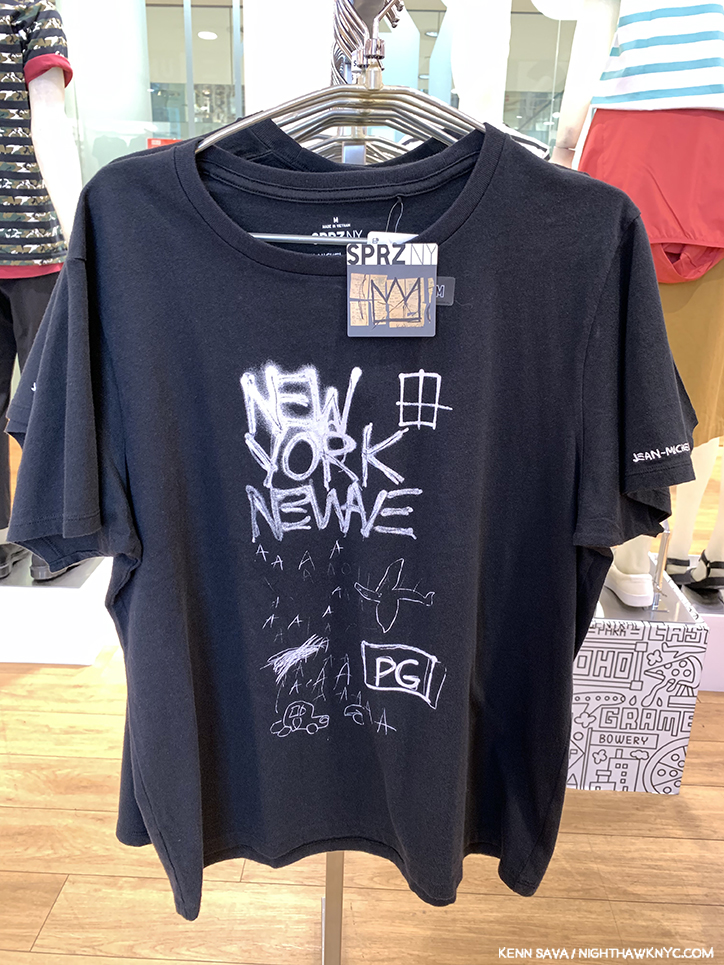
 

  1. Interview in Gagosian Quarterly, Spring, 2019, P.138.
  2. This couple is repeated in what may be a study for Sonatine (my conjecture) included in the show, titled Angry Practice, 2018.
  3. Gagosian Quarterly, Spring, 2019, P.138.

Todd Hido- Back To Black

Written & Photographed by Kenn Sava (*unless otherwise credited)

Maybe it was an Lp or CD that had this effect on you. I’ve been there too many times to count. More recently, it’s been PhotoBooks that I’ve related to. 

Todd Hido, House Hunting, 2001.17 by 14 inches. 56 pages containing 26 “carefully selected” Photographs. One of only 4,000 copies. I spent 3 months hunting one. *Nazraeli Photo. Click any picture for full size.

When I first saw House Hunting, it went right through me. It was akin to an album that spoke to you in a formative part of your life- you connect with it when you feel almost no one understands.

Todd Hido, Untitled #7910, 2003, seen at AIPAD, 2017.

I’ve spent most of my life being behind that lone light burning all night long.

But it’s more than that, of course. It’s a nocturnal portrait of suburban American life as (mostly) seen from the outside, with its partially crumbling picket fences, hanging laundry, it-seemed-like-a-good-idea-at-the-time discount clapboarding slapped on structures that don’t meet the floor of anyone’s definition of “architecture,” and aging vehicles. Home sweet home. Like the Artist, I grew up there, too. I’ve learned since that I am far from being alone in connecting with it. His “Houses at Night,” series, the work that first brought the Artist to prominence when it was released in his first PhotoBook, House Hunting, in 2001, saw its two printings of 2,000 copies each disappear into the hands of 3,999 others. It wound up being selected by PhotoBook aficionados Martin Parr & Gerry Badger for inclusion in the third installment of their multi-volume rundown of PhotoBooks they find particularly notable, The Photobook, Volume III. It’s interesting to me looking back on it now that this work is so popular while not dissimilar work of his illustrious predecessors Robert Adams (Summer Nights, an acknowledged influence of Todd Hido’s) and Henry Wessel (Night Walk) have found only niche followings. Perhaps it was Mr. Hido’s use of color that explains his series popularity? Or, maybe it’s his series has more of those lone lit windows.

Old friends. 12 works from his “Houses at Night” series, published as House Hunting and Outskirts, include the former’s famous cover image, top row, third from left, with the cover image for the excellent Aperture mid-career retrospective, Intimate Distance to its left. Seen at Bruce Silverstein Gallery.

Outskirts, a veritable House Hunting, Volume 2 followed a year later, but then, with the release of Roaming in 2004, a book that purposely “has no homes in it,” it became apparent that Todd Hido was “no one trick pony1.” There were some dissenting voices that preferred their desolation with a single light burning in it. Roaming, a book who’s grey mood is characterized by its clouds and not a night sky, was the first inkling of what was to come, its title almost serving as a one-word summation of his subsequent creative journey. Todd Hido has not been one to stay in one place, artistically, or rest on his, now substantial, laurels. His work, as seen in his books and gallery shows, has continued to evolve, always in fascinating ways. Interiors, desolate landscapes (sans lights, except for his car headlights on occasion, maybe a rising or waning sun), and even portraiture, introduced, gradually, along the way, are now all part of his repertoire. He’s now, also, no stranger to appearing in the fashion and editorial media. In fact, when I met him earlier this year, Todd Hido was in town to shoot a series of New York Times Magazine covers, and there was the recent dual show of his work up with the fashion Photographer, Miles Aldridge.

*Todd Hido, One of a series of 4 New York Times Magazine covers he shot for its April 14, 2019 issue.

Each new monograph and each new subject brought new realms, both visually and in terms of the inner vistas Mr. Hido’s work stirs up in viewers. After beginning to work with models in 2004, his work with his beautiful and extremely versatile muse, Khrystyna, taking on something of the quality of his own version of Cindy Sherman’s Untitled Film Stills, has been a bit controversial, but for me, as in all of his work, it’s primarily interesting for what it reveals of the Artist. Excerpts from Silver Meadows, 2013, his last monograph until 2018, is a case in point. Though the titular street ran through his childhood neighborhood, the images include those from other places and other times- “surrogates,” as he called them. And that’s how I view all his subjects or actors & models- as surrogates.

“For me, I keep finding and exploring the same place no matter where I go. I draw from within, from my own history, as the basis of my work. All of the memories and experiences from my past come together subconsciously and form a kind of fragmented narrative2.”

Still? NONE of his past work prepared me for what I saw when I walked into Bruce Silverstein Gallery on an appropriately cold winter day to see new work featured in a book that hadn’t yet been released titled Bright Black World in a show of the same name. The press materials say these works, “are the results of Hido’s exploration of the northern hemisphere in the impenetrable depths of winter. The realities of climate change lurk behind in these – the threat of an eternal darkness looming large….Not just a political statement, Bright Black World is infused with Nordic mythology, Ragnarok, and the idea of Fimbulwinter – a winter that never ends3.” And so, the show, and this work, marks more firsts in the work of Todd Hido- work addressing the state of the world, as well as being the first time he’s travelled to another country to create it.

#11389-3087, 2014, 30 x 45 inches from Bright Black World seen at Bruce Silverstein Gallery.

As I looked at the new work, the first thing that struck me was how gorgeous the prints were. Instantly, THE Todd Hido quote that has stayed with more than any other came rushing back to me…

“I photograph like a documentarian, but I print like a painter4.”

Here? Though I own four Todd Hido prints (including Untitled #7910, seen earlier, alas, none at the size of these), in my opinion, he’s taken it to another level. The larger scale of many of them serves to engulf the viewer, who promptly gets lost in the overall feeling and the details. They’re extraordinary, and simply have to be seen to be appreciated.

The second thing that immediately stood out for me was that the character of the light has changed. I’ve never seen darkness quite like this.

“It’s been said that Inuits have many words to describe white. As the polar snow caps melt faster than we ever imagined, I wonder how long it will be before we have as many words to describe darkness,” Todd Hido5.

#11798-4172, 2017, 30 x 45 inches, is also the cover image for his new PhotoBook, Bright Black World.

And? My old friend, the night, makes a return appearance.

The return of the lone light burning at night. #11797-3252, 2017. Courtesy of Todd Hido and Reflex Amsterdam, where a sister show was up concurrently.

In the midst of his incredibly busy life, I am grateful that Mr. Hido found time to answer a few questions for me, both long-standing, and some brought on by his new work. I’ll intersperse them from here on. First, since I live my life at night, and have long been fascinated by the few Artists & Photographers who work at night, I had to ask him- What is it about the night that inspires you?

Mr. Hido replied, “I am inspired by the night for many reasons, but mostly it is because everything slows down and gets quiet. I find that that is when I am able to focus my attention and see the best. Also, there is an atmosphere at night that lends itself to creating the mood that I am interested in.”

#11793-9406, 2017, 20 x 30 inches. It could be a production still from countless horror movies.

Coincidentally, as I walked through the show, a random song started playing on my headphones…

“The windows of the world are covered with rain
Where is the sunshine we once knew?”*

#11801-1971, in particular, held me spellbound for minutes on end.

#11801-1971, 2017, a massive 59 x 88 inches, looks SO cold, even hanging it over the radiator isn’t going to make it feel warmer.

The sign of human intervention in the landscape disappears as the road turns left, leaving the viewer…? Standing there, I felt the ghost of the great James McNeill Whistler in it, among others, but at almost 7 1/2 feet long, it engulfs you in a sense of cold, and a resulting terror, that was unforgettable.

Hence, my second question- I’ve long wondered- Are there any painters who have influenced you?

Mr. Hido said,- “I am definitely influenced by Edward Hopper and Andrew Wyeth and of course I love Gerhard Richter, but one of my favorites is Marlene Dumas.”

#11756-269. That house looks to be the size of a stone.

These images are, therefore, characterized either by light that is fading, distant, faint, or has completely gone (though in some images it’s hard to tell if the sun is setting or rising). Whereas the air was, in my view, unthreatening and calm in the “Houses at Night”/House Hunting works, uneasiness, at least, is in the air in almost every one of these Bight Black World Photographs.

Exact locations for most of these Photos are not known, but it is known that for the first time Todd Hido went overseas, to Northern Europe, to create some of this work. It turns out that my brother from another mother, NYC guitar legend, Dave Fields, was, coincidentally, on tour in Norway the same day I saw this show. Without explaining why I wanted it, I asked him if he would step out of his hotel one evening and snap a picture of the sky. Maybe the amazing skies of Bright Black World are everywhere to be seen there. ? Here’s what he sent me-

*Dave Fields, Lystgaard Skjerstad, Norway, November 18, 2018. A career as a Photographer possibly awaits the brilliant guitarist and singer/songwriter.

There’ve been subtle differences in each of his landscape projects, from House Hunting & Outskirts through those appearing in his subsequent books. Bright Black World continues that progression. Everything I’ve admired about his more recent landscapes- their atmosphere, their “spontaneous” feel that often looks like the shot was taken through a car window (many were), while the car was still in motion (Doubtful. He’s a dad.), the almost miraculous combination of elements, enhanced by their “painterly” feel, are all in full effect here. For me, at least, the results are as beautiful, if not more beautiful, than anything I’ve seen that Todd Hido has done.

#11755-2192. Photographs like this begin to make you understand what J.M.W. Turner might have been seeing that inspired his unequalled sky scapes.

His new book, Bright Black World, published, as each of Mr. Hido’s now seven monographs have been, by Nazraeli Press, saw its entire 3,000 copy first printing sell out almost immediately. On the one hand this is a testament to how popular Mr. Hido has become, as well as to how well done the book is. On the other hand, it’s a bit of a shame that the book is not more readily available for the rest of the world to see, as with so many great PhotoBooks that have gone out of print and become very hard to find or see. It’s a huge book- just about 17 inches long by about 12 inches high, and weighing over 3 1/2 pounds, with 108 pages, but, unlike other large PhotoBooks, it’s size is entirely necessary to convey the intended feeling seeing the full size prints imparts, as well as a sense of all that is in these images.

#11692-492, 2014.

“The windows of the world are covered with rain
What is the whole world coming to?”*

After Aperture’s 2016 mid-career Todd Hido retrospective, Intimate Distance (see BookMarks at the end), the Artist felt it was time to begin anew.

#11599-5811, Kent, OH

Kenn Sava (KS)- It’s been 5 years since Excerpts from Silver Meadows, with the retrospective Intimate Distance intervening. You spoke about “closing that chapter,” (per reflexamsterdam’s site), with Intimate Distance. In Bright Black World there are elements of things from your past series- rooms in decay, the beautiful denuded trees in inclement weather, a portrait of a woman, and even one or two Photos of buildings with a single light on. Yet the feeling, now, is completely different. It’s more ominous, expectant throughout, in my reading. I’m wondering why you chose to end both Intimate Distance and Bright Black World with the same image (#11599-5811, Kent, OH)?

Todd Hido (TH)- Well, to answer your  question it made perfect sense because Intimate Distance was a survey and the last part of that book was of things I had never used in a monograph. That image you are speaking of as dark as it is, I find kind of hopeful.

KS- As a dad, was it hard for you to release a (beautiful) book that’s this dark, one that references Fimbulwinter and the end of days?

TH- As a dad it was crushing to read Cormack McCarthy’s The Road, which I happened to delve into when my children were young. They have always called me “Papa” and that is exactly what the child in book called his father. Whenever I read that it always hit home harder. In terms of my own book, I would say that every book I make helps my children. No matter what my outlook may be.

#11804-3243, 2017, 30 x 41 inches.

“The windows of the world are covered with rain
When will those black skies turn to blue?”*

BookMarks-

Bright Black World, 2019, published as each of his prior 6 monographs have been, by Nazraeli Press, in a first printing of 3,000 copies that sold out almost immediately. It’s generous 17 by 12 inch size wonderfully compliments the expansive nature of the work, as do its two vertical gatefolds. It’s a book full of dark wonders and the most compelling new book of landscapes I’ve seen so far this year. Copies are currently trading for about 150.00, 2 times list, on the aftermarket around the world. Waiting to see if there will be a second printing might be wise at this point, as I don’t think aftermarket prices are going to immediately rise much higher for perhaps a year, or until it’s apparent there won’t be a 2nd printing. I will update this paragraph if I get news of a second printing.

Todd Hido: Intimate Distance: Twenty-Five Years of Photographs, A Chronological Album, Aperture, 2016, is the best place to get an overview of the Artist’s career and accomplishment up to 2016. Given his classic books, House Hunting and Outskirts are both out of print and each going for upwards of 400.00, Intimate Distance is also the place I recommend to start. It’s a very good overview, “roaming” (sorry) over all the series of his work to that point, and so gives a real sense of what he’s done, and achieved, in each realm he’s worked in (in his monographs), thus far.

Ok, yes, House Hunting is one of the great PhotoBooks of the first part of this century, in my view. Published by Nazraeli in a first printing of 2,000 copies in 2001, they vaporized within weeks. The 2007 second printing of 2,000 copies also quickly sold out. Currently, you’re looking at 300.00, and up for a second printing, first printings starting at 425.00, both in very good condition in very good dust jackets.

For Outskirts, 2002, his excellent second book, which has only seen one printing thus far, copies start at 400.00 (in vg/vg). If you are trying to choose between getting either House Hunting or Outskirts, my vote would be for House Hunting, which is much more in demand and more likely to stay that way. 

A sleeper pick, a book that at first glance may seem to be aimed particularly at Photographers, is Todd Hido on Landscapes, Interiors, and the Nude: The Photography Workshop Series, Aperture, 2014. Since it contains the most extensive writing Todd Hido has done on Photography to date, it’s continually insightful for lovers of his work as well. The introduction is by no less than Gregory Halpern, a one-time student of Mr. Hido’s, who imparts a classic tale of his experience as one.

*- Soundtrack for this Post is “The Windows of the World” by Burt Bacharach and Hal David, performed by Dionne Warwick.

My thanks to Alison Crosby, Stefanie Williams, Gregory Halpern, Dave Fields, and Todd Hido.

NighthawkNYC.com has been entirely self-funded & ad-free for 9 years, during which 320 full-length pieces have been published! If you’ve found it worthwhile, PLEASE donate by PayPal below to allow me to continue. Thank you, Kenn.

You can also support it by buying Art, Art & Photography books, and Music from my collection! Art & Books may be found here. Music here and here.

Written & photographed by Kenn Sava for nighthawknyc.com unless otherwise credited. To send comments, thoughts, feedback or propositions click here. Click the white box on the upper right for the archives or to search them. Subscribe to be notified of new Posts below. Your information will be used for no other purpose.
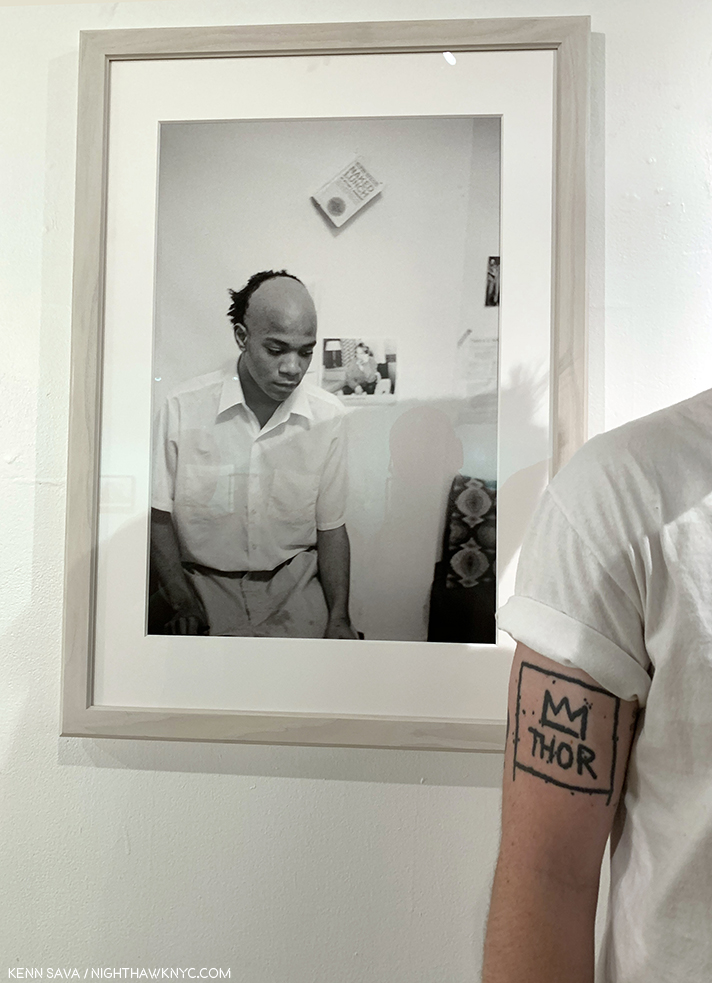
  1. Todd Hido: Intimate Distance, P.108
  2. Todd Hido on Landscape, Interiors, and the Nude, P.8
  3.  Here.
  4. Todd Hido on Landscape, Interiors, and the Nude, P.53
  5. Here.

At The Photography Show, 2019: The Galleries

Written & Photographed by Kenn Sava (*unless otherwise credited)

I love The Photography Show.

AIPAD, 2019, stretches as far as the eye can see- in all directions. There’s A LOT to see, and I’m here to see ALL of it. The view early Saturday afternoon, April 6, 2019. My thanks to DeShawn for his assistance with this shot. Click any picture for full size.

After all, the Association of International Photography Art Dealers, who present it, and I, have a core value in common- a passion for Fine Art Photography.

The Photography Show entrance at Pier 94 on the Hudson River, April 7, 2019.

More commonly referred to as AIPAD (as I will henceforth), the show is the only chance all year in NYC for a large segment of the Fine Art Photography world here, or able to get here, to get together. That alone makes it a must attend event for anyone involved in Photography, for anyone interested in seeing the widest range of Fine Art Photographs presented in one place at one time in town all year long, and for anyone looking for something to hang on their wall that they will want to keep looking at indefinitely.

And? AIPAD is so B I G, there really is something for every taste hanging inside Pier 94.

In 2019, the show was noticeably smaller, though, as you can see, it was still plenty large enough that it really required at least two visits to see all of it, and that’s not counting  the AIPAD Talks (which included Dawoud Bey, Sarah Greenough, Stephen Shore, and Harry Benson, separately, this year), Aperture’s Photobook Showcase, and various book signings and Photographer booth visits, which were ongoing over the weekend. If you wanted to take in some or all of those, too, attendance for the full five day run was the only way. Taking my own advice, over my five long days of attendance, I believe I saw all of it, though I was so busy with the gallery and PhotoBook areas I missed all the talks this year, much to my chagrin.

I love the smell of freshly hung Photographs in the morning.

For me, and I think for most other visitors, no matter how many Photographers you’re familiar with? You’re guaranteed to add a few new names to your list- and “new names” has nothing to do with their age.

The legendary Danny Lyon, subject of a solo retrospective at The Whitney Museum in 2017, takes a break during his book signing on Saturday, April 6th at Etherton Gallery’s booth in front of a collage he created between 2016 and 2018.

Most of all? I love getting to see and meet Photographers. Maybe even get a book signed. After all? If it wasn’t for the Photographers? There’d be no show. 

The closing day crowd at SoPhoto Gallery’s booth, who came all the way from Beijing, China, to show Yaqiang Chen.

In the gallery booths, the range and variety of work on view was the best thing about the show. As I was in 2017 and 2018, I was most impressed by the displays of Photographers not as well known in NYC, or in the USA for that matter, as they are elsewhere shown by galleries who traveled long distances to attend, like SoPhoto and PeterFetterman Galleries.

8 evocative Untitled works by Noell Oszvald, a Hungarian Photographer still in his 20’s, seen at Peter Fetterman Gallery, Santa Monica, CA.

Others paid homage to the host City with classic reminders of our Photographic past.

All the way from Munich, Germany, Galerie f5.6 brought beautiful and interesting work, as well as these two classic slices of vintage NYC from one of its favorite sons, Saul Leiter.

The NYC Galleries were also in the house, of course, and well represented by long standing big names like Laurence Miller Gallery-

Ray K. Metzker’s extraordinary Nude, 1966-74, one of his legendary Composites highlighted his long time dealer, Laurence Miller Gallery’s, presentation.

Howard Greenberg Gallery-

Dave Heath, a new discovery for me in 2019, who quickly became one of my favorites for his powerful, poingent portraits and his superb printing. Seen here at Howard Greenberg.

Edwynn Houk Gallery-

A gorgeous Sally Mann portrait, Virgina #42, 2004 flanked by The Trombone Player #6, 2018, by Paolo Ventura, left, and American Dream, Self-Portrait with Alex, 2018, by Erwin Olaf at NYC’s Edwynn Houk Gallery.

Yancey Richardson Gallery-

Zanele Muholi beautifully filled all of Yancey Richardson Gallery’s space.

Bruce Silverstein-

Rosalind Fox Solomon, Selected Photographs, 1975-2011, featuring a number of images from her recent MACK Book, Liberty Theater, which made my NoteWorthy PhotoBooks, 2018, list. Ms. Solomon and Dawoud Bey were announced as winners of the ICP 2019 Infinity Award in February. Seen at Bruce Silverstein.

and newer names, including Elizabeth Houston Gallery-

Nico Krijno at Elizabeth Houson Gallery.

who displayed a fascinating group of pieces by the talented and versatile Nico Krijno.

Dawoud Bey, Untitled #17 (Forest), from Night Coming Tenderly, Black, 2017, at, and *Photo courtesy of, Stephen Daiter Gallery

But, the consensus “hit” of the show, from all those I spoke with- Photographers, publishers, visitors and other gallerists, was undoubtedly the the work of Dawoud Bey shown by Stephen Daiter Gallery, Chicago. The group of new landscapes from his Night Coming Tenderly, Black, series based on an imagining of the flight of passage along the Underground Railroad, were singled out more than anything else on view by those I spoke with, and his group of four portraits dating from 1989-90 were almost as frequently mentioned. This continues the recent overdue attention given to this 40 year veteran Photographer’s work, along with the concurrent show at the Art Institute of Chicago of 25 works from Night Coming Tenderly, Black, and the February announcement of Mr. Bey as a recipient of the 2019 International Center of Photography Infinity Award.

Portraits by Dawoud Bey, from left to right, Young Man at a Tent Revival, 1989, A Woman at Fulton Street and Washington Avenue, 1989, Couple in Prospect Park, 1990, and A Girl With A Kinfe Nosepin, 1990at Stephen Daiter Gallery

As mentioned earlier, Etherton Gallery devoted their main space to a mini-retrospective of the work of Danny Lyon, titled Danny Lyon: For the Record. 

On view were works from all of his most well-known series, The Bikeriders and Conversations With the Dead, and The Destruction of Lower Manhattan.

Along side others not as well-known

Two works that hint at the range of Danny Lyon over what has been a long and acclaimed career.

Monroe Gallery, returned to us from Sante Fe, New Mexico, showing the work of Tony Vaccaro, graced by the presence of the Dean of all Photographers once again, looking as spry as ever at NINETY-SEVEN! (Tony, WHAT’S your secret??)

97 years young, Tony Vaccaro sits in front of a wall of his historic work at Monroe Gallery on April 6th. Off frame, to the left, he and I are surrounded by a crowd filling the space to see & hear the legend, who I had the honor of speaking with last year.

As joyful as it always is to see Mr. Vaccaro, the discovery for me at Monroe Gallery was the work of independent Photojournalist Ryan Vizzions.

Ryan Vizzions, Protestors face off with police and the National Guard on February 1, 2017, near Cannon Ball, North Dakota, 2017. *Courtesy Ryan Vizzions.

I happened to walk into Monroe Gallery’s booth when Mr. Vizzions was there signing his brand new PhotoBook, No Spiritual Surrender: A Dedication to the Standing Rock Movement and discussing both the work on view and his background, both of which held me rapt. Shortly after his father’s passing, he quit his job and armed with a Nikon D3300, he headed west to document the Standing Rock Protests, one of the largest in American History, taking place at Standing Rock Reservation in North Dakota from April, 2016 to March, 2017. After an initial 3 week visit to Oceti Sakowin camp, he was so taken with what he found that he went home, sold everything and headed back. He stayed from late October through the winter and came away with an amazing body of work that, in my opinion, follows right in the footstep of the finest tradition of PhotoJournalism.

Ryan Vizzions poses in front of a selection of his powerful work at Monroe Gallery’s booth at AIPAD on April 6, 2019.

I subsequently found that I’m far from the only one taken by this young man’s work. Ryan has already won multiple “Photo of the Year” Awards- in 2016 from People, Artsy.net, and Mic.com. In 2017, from the Guardian and ABC News. He’s also had his life threatened. Now, he’s represented by Monroe Gallery. More on Ryan and his story, here. Ryan’s book, No Spiritual Surrender: A Dedication to the Standing Rock Movement  is highly recommended.

Elsewhere around the show, here are some other highlights-

Mary McCartney, Tracey Emin as Frida Kahlo, London, 2000, seen at Staley Wise Gallery

A selection of classic Henri Cariter-Bresson prints seen at Augusta Edwards Fine Art, London, UK.

Brian Clamp, the tall gentleman, center, seen at his ClampArt booth, showing cutting edge work, as usual.

One of the leading Photography gallerists in the South, Atlanta’s Arnika Dawkins, left, of Arnika Dawkins Gallery Photographic Fine Art, presented one of her latest finds, Ervin A. Johnson’s mixed media portraits, and Jeanine Michna-Bales, who I featured in an AIPAD Discoveries piece last year.

Imogen Cunningham Agave Design 1, 1920. Seen at Edwynn Houk Gallery.

Installation view- A Room for Solace: An Exhibition of Domestic Interiors Curated by Alec Soth

A discussion of highlights has to include the exhibition curated by world renowned Magnum Photographer Alec Soth, fresh off the release of his newest book, I Know How Furiously Your Heart Is Beating, and the opening of his solo show of the same work at Sean Kelly Gallery.

This section consists of Wayne F. Miller, Rebecca Norris Webb (who’s married to Alex Webb) and Harry Callahan, left to right.

Mikael Levin, Onus, 2000, Sirkka Liisa Konttinen, Emma Dowds (Step by Step series), 1982, Unknown, Interior of an American Home, c.1900, Marie Cosindas, Sailors Key West, 1966, Bill Owens, We’re really happy, 1972, from Suburbia, Walker Evans Kitchen in Floyd Burrough’s Home, Hale County, Alabama, 1936

Osamu James Nakagawa, Curtain, Tokyo, Spring, 2003, From the series Kai

Mr. Soth selected a fascinating variety of Photographs around the theme, A Room for Solace: An Exhibition of Domestic Interiors. His selections  from the galleries attending the show was continually fresh and surprising, made all the more fascinating in his carefully considered hanging. Couches and tables in the space added a “homey” touch, but most of all, I was excited to see a Photographer have a chance to select and lay out at least one section of AIPAD, and Alec Soth did a terrific job, in my opinion.

Observations-

I really can’t say that over the five days in the gallery section, I heard any complaints. The only issue seemed to be with the carpeting in the booths, which was lumpy in places throughout the show, and seemed to be a bit tricky for those wearing certain types of shoes. I witnessed one stumble that could have been disastrous (for the visitor and the Art), except for a quick extended hand keeping a stumble from being a fall. Outside of that, the only question I heard more than once, and I heard it each day, was where “Where can I get coffee?” (The only spot I found was in the very back, behind the publishers.) Those minor issues aside, I think it’s safe to say that AIPAD was a well-run machine this year and that any issues from prior years were addressed for this year’s edition (this, the opinion of some returning booth holders I spoke with, and some I pointed out in the past). The staff was friendly, cordial yet focused, and professional throughout, regardless of the role they had. Security was exceedingly well handled, from a visitor’s perspective, both entering and leaving the show. I didn’t encounter anyone who had an issue with a staff member throughout the run of the show.

Of course, the biggest issue remains Pier 94, itself. It’s in one of the least convenient areas of mid-town Manhattan, barely serviced by mass transit, which makes it hard to get to, or leave, particularly in any kind of inclemency. Here’s one esteemed visitor’s experience getting there this year. My feeling is this must cut down on attendance dramatically. Perhaps 33 to 50%? Of course that needs to be weighed versus the added cost and size limitations of a different location, something I have no doubt has been considered long and hard. When I asked a variety of those I encountered about the location, all agreed about its inconvenience, but none were willing to sacrifice the size for convenience. I agree with them.

In conclusion-

Any piece such as this can only hope to show only a sample of the many thousands of Photographs on display. The work on view was only a portion of what the galleries actually brought to the show- a good number brought a fair amount of stock with them that wasn’t actually hanging on the walls as well. As I walked through the galleries each day, it seemed to me the attendance was steady and the galleries were busy. From the telling “red dots” I saw on name cards, and from the wrapped pieces I saw being carried out, my sense was that business was as good as it was last year. Prices seemed to have edged up, particularly for the “big names” in Modern & Contemporary Photography, but there was plenty of work I saw by Photographers who are well known today that were to be had at quite affordable prices, (and almost all of it was in signed & numbered editions this year, after seeing a number of open editions in prior years).

Alec Soth chose to end his show with Fred Herzog’s My Room, Harwood Street, 1958, a work that has special resonance for me. After seeing the display of his work at Equinox Gallery’s booth, I bought my Fred Herzog at AIPAD in 2017.

Considering the length of the history of Photography, the increasing international exposure for Photographers from all over the world by galleries, PhotoBooks, and the internet, the range and the quantity of Fine Art Photographs available for sale has never been greater. The Photography Show was a terrific opportunity to see a good deal of it in one place, to learn more about Photographers you’re interested in and discover new ones, to see how the work of different Photographers looks hanging side by side, to compare prices, and to walk away with something new to hang on your walls.

And I have.

For the third year in a row, I’m pleased to present extensive coverage of The Photography Show presented by AIPAD. As I did in 2017 and 2018, this will include a portfolio of pieces, each focused on a segment of the show. The next part looks at the PhotoBook Publishers, Book Dealers and Organizations area. Two subsequent pieces consist of an “AIPAD Focus” close up look at a leading light in Photography, and at least one (and I am hoping two) AIPAD Discovery piece(s), reprising a popular feature I inaugurated last year, that will focus on a particularly NoteWorthy Photographer previously not known to me. Hopefully, two. Stay tuned!

*- Soundtrack for this Post is “Take Me To The River” by Al Green.

My thanks to Margery Newman. 

NighthawkNYC.com has been entirely self-funded and ad-free for over 6 years, during which over 250 full length pieces have been published. If you’ve found it worthwhile, you can donate to keep it going & ad-free below. Thank you!

Written & photographed by Kenn Sava for nighthawknyc.com unless otherwise credited.
To send comments, thoughts, feedback or propositions click here.
Click the white box on the upper right for the archives or to search them.
For “short takes” and additional pictures, follow @nighthawk_nyc on Instagram.

Subscribe to be notified of new Posts below. Your information will be used for no other purpose.
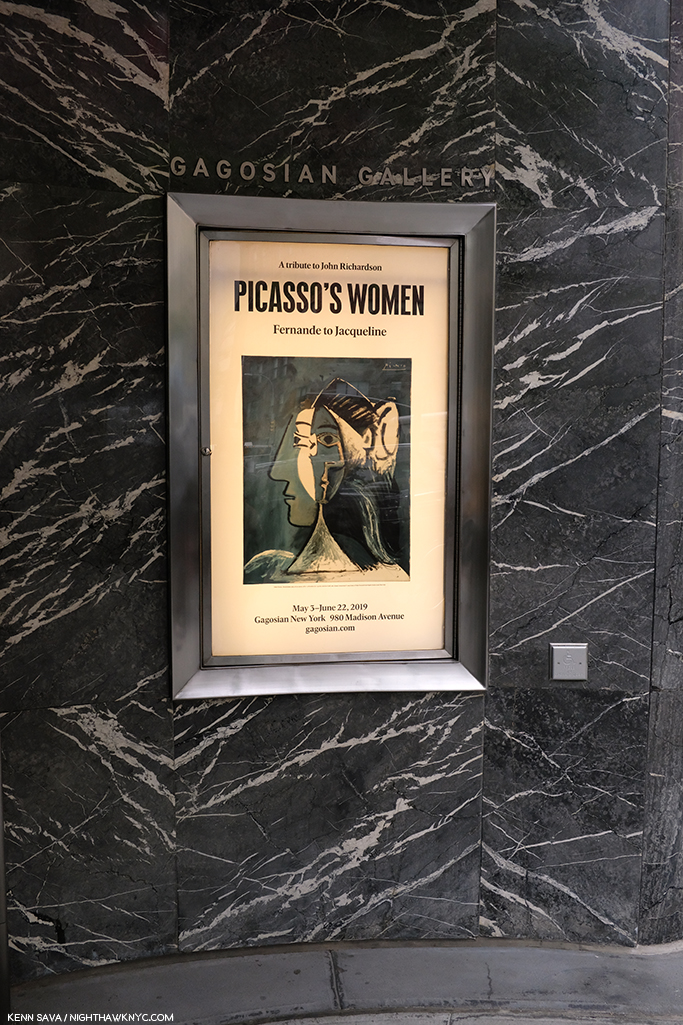
 

Andy Warhol: Business Artist

Written & Photographed by Kenn Sava (*unless otherwise credited)

“So you should always have a product that’s not just ‘you.’ An actress should count up her plays and movies and a model should count up her photographs and a writer should count up his words and an artist should count up his pictures so you always know exactly what you’re worth, and you don’t get stuck thinking your product is you and your fame, and your aura.” Andy Warhol1.

Andy shopping for products. *Bob Adelman, Andy Warhol at Gristede’s Market near 47th Street. New York City, 1965, near where he lived with his mother. Countless millions went shopping in American grocery stores in the 1960s. Very few made Art out of it before he did. Click any picture for full size. 

That being said, leaving the Whitney Museum’s Andy Warhol- From A to B and Back Again, the first Retrospective in NYC since MoMA’s in 1989, I was left believing Andy Warhol’s greatest creation was himself.

The use of gold here, and on the exhibition catalog’s cover, is interesting. It mimics Gold Marilyn, at MoMA, and also reminds of the background color of icons from the Eastern Orthodox and other churches. And? It’s a color often associated with money and “value,” so could it be a veiled reference to the high prices paid for his Art? Which of these is the intended meaning?

But, no matter how I feel about his Art, even I can’t deny that today, it can be said that we are living in his world to a greater extent than we realize. Look around you. His influence is everywhere. His innovations are now used by countless other Artists and businesses.

“A friend of mine named Ingrid from New Jersey came up with a new last name, just right for her new, loosely defined show-business career. She called herself ‘Ingrid Superstar.’ I’m positive Ingrid invented that word2.”

The everyday people he made into “superstars” presaged today’s television “reality stars.” His square portraits are now instantly recognizable as the Instagram standard. Andy Warhol came to define the Contemporary Artist working with a team of assistants at his Factory and his example is to be seen being followed by Artists all over the world today. How often do you see one of his color variated group of (4) portraits or flowers emulated by someone else? And on and on. These are only a few examples. Andy Warhol’s influence is incalculable. If it could be totaled, it might well rival that of Steve Jobs among THE most influential people of the past 75 years on our lives today.

Commodore Amiga computer equipment used by Andy Warhol in 1985-86. Andy’s interesting computer Art was extracted from this machine by a team led by the Andy Warhol Museum in 2014! *Photo by The Andy Warhol Museum.

But, it was Andy Warhol, not Steve, who said,  “A computer would be a very qualified boss3 decades before the time when many people’s lives seem to be run by their devices. A-hem. Sometimes I wonder if the internet is nothing but a cyber projection of Andy Warhol’s brain.

Artistically, I respect him as an Artist who was continually innovative in so many mediums during his surprisingly short career. Yes, short. It feels like he was around forever, but he was just 58 when he passed away on February 22, 1987. This insatiable creativity now strikes me as a function of his innate ability to see the world in his own way, which led him, continually, in different directions, to try new things, and explore new ways of doing old things.

It seems to me, however, that THIS may be the peak moment of Andy Warhol’s influence- the influence of Warhol, the Artist and his Art.

Warhol books, and ONLY Warhol books, seen in the Whitney Shop, March 27, 2019.

I wonder if the level of his fame may, in fact, work against its longevity from here. Virtually everything he did has been shown, written about, analyzed and assimilated. If you don’t think that’s true, take a look at this picture I took of part of the book shelves in the Whitney Museum’s Shop during the run on Andy Warhol- From A to B. I used a 28mm lens and even though I stood more than 20 feet away, backing into the middle of the admissions cue, I still wasn’t able to get ALL the Andy Warhol books on sale in the shot. There are books on his pre-Pop work, his newspaper-like work, his portraits, his posters, his prints, his record covers, his career as a publisher, his films, books on the Factory (including one of Photos taken by a teenaged Stephen Shore), a few about his Photography and polaroids, including a collection of Photos of him in drag, AND a multi-volume Catalogue Raisonne of his Paintings (on the far left of the bottom shelf). Oh, and Andy Warhol: Knives. ? This is not to mention all the books, by the Artist, and others, about his life, including the infamous, The Philosophy of Andy Warhol (From A to B and Back Again), published in 1977, which seems to have inspired the name of this show. My copy, bought from the display, is the 46th printing of the paperback. In all my many years of looking at Art books, I have to say the only other Artist who has as many books written about him and his Art is Picasso. 

Start here. In the first gallery, which contains early Pop work, like Dance Steps, 1961, and a wall of Campbell’s Soup Cans in the back.

As I headed to the 5th floor for the main part of the show, I wondered- What’s left for the future to learn about Andy Warhol’s Art? Given his popularity, I’m sure people will find things for yet more books.

Andy’s mother fixed him Campbell’s Soup everyday for lunch, including after he became famous, until she passed. The family was poor. Beyond the comfort of the warmth of soup, having a lot of food around represents something of an ideal, a dream, even cheap food, like this soup was at the time, at 15 cents a can. Originally, these Paintings sold for $100 a piece at his first show at Ferus Gallery in LA, where Dennis Hopper bought one.

As I looked at his Art, it also raised questions. Questions that the passage of time has only intensified.

Brillo Boxes, 1969 (version of the 1964 original). Yes, a copy of a copy. The interesting thing about this work for me is that this “Art is everywhere around us” work of so-called “Pop Art,” which helped to mark the end of Abstract Art’s hold on the Art world, is based on the Brillo Box design of James Harvey, a moonlighting Abstract Expressionist Painter! Beyond that, and wondering if  Sol LeWitt was influenced by it, it’s lost on me.

First, and most importantly, Andy Warhol’s Art is accessible. This has been the most important factor in his achieving success and fame and it may be the most important factor in the longevity of both. Popularity doesn’t necessarily equate with quality. Since the future is unwritten, as Joe Strummer reminded us, it’s impossible to know what posterity will value, if anything. To this point quality has definitely been a factor. I wonder- Where does that leave Andy Warhol’s Art?

Arising at a time (the late 1950s) when the Art world had been fed a steady diet of extreme abstraction by the Abstract Expressionists, Andy Warhol’s Art burst on the world with images featuring things, yes, things, that everyone living in the country recognized. Brillo boxes, Campbell’sl soup cans, dollar bills. His work was instantly accessible in an Art world dominated by Art that was becoming more and more obtuse and remote. I’m not saying Andy Warhol’s work was “understandable,” or even “more understandable” than that of the Abstractionists, only relatable. Even in today’s world where fewer and fewer living beings remember S&H Green Stamps, walking through this show, this seems to still be the case.

Marilyn & Elvis. Andy Warhol was always drawn to stars, and beautiful men. Personally, and in his Art.

But, the world has changed in the, now, 60 years since Andy Warhol’s career first took off. A lot of Artists have grown up with what he did and it’s become part of their work, even if it’s only unconsciously.

129 Dollar Bills, 1962, among the very first uses of silkscreening in Modern & Contemporary Art.

How many Artists have created with silkscreens since Andy Warhol introduced the possibilities of the ancient technique to the modern world in 1962? Even one of the other innovators and endlessly creative pillars of American Art in the late 1950s and 1960s (and after), Robert Rauschenberg, picked up the technique from Warhol. Since, silkscreening went from creating edgy Art to being used to create the large majority of the world’s T-Shirts, among countless other uses.

“I had by that time decided that ‘business’ was the best art. Business art is the step that comes after Art. I started as a commercial artist, and I want to finish as a business artist. After I did the thing called ‘art’ or whatever it’s called, I went into business art. I wanted to be an Art Businessman or a Business Artist. Being good in business is the most fascinating kind of art. During the hippie era people put down the idea of business—they’d say, ‘Money is bad,’ and ‘Working is bad,’ but making money is art and working is art and good business is the best art,” Andy Warhol. (Note- Not to be confused with my capitalization, caps and lowercase usage are Warhol’s own, reproduced exactly as the quote appears in TPoAW P.92.)

Ethel Scull 36 Times, 1963, jointly owned by The Whitney & The Met, was the first work commissioned from Andy Warhol. It’s a work that, in my view, has outlived its cachet as “Art,” and one that I don’t think posterity will look kindly upon.

Looking at the show, a takeaway for me was the distinct feeling I got was that there was his work, and then there is the work he did on commission (i.e. “Business Art,” a term he mentions in The Philosophy of, quoted above, but doesn’t define). After a while, I thought I could tell even before reading the card or researching the work, which was which- which were the work he did “for himself,” which were the works he did on commission, and I came away feeling there is a world of difference between the two. Wait! There’s a subject for a book I don’t think anyone’s written yet! For Andy Warhol, the business of Art was an Art in itself. Few before (maybe Rembrandt, Picasso and Dali in their ways) understood this and used it, but no one before him mastered it to the degree that Andy Warhol did. Its testament to how well he did it that a good many of his commissions, which detract from his other work when seen along side them as Ethel Scull 36 Times does in my opinion, hang in museums around the world, at least for now.

The American Man (Portrait of Watson Powell), 1964, a pseudo-companion piece to the Ethel Scull piece, above, and another commission, has aged better and still manages to speak to 2019 viewers.

To be fair, looking at some of his commissions now, we might well see in them a “commentary” by the Artist on matters beyond the mere representation of a given subject. The American Man, 1964, commissioned after seeing Warhol’s Ethel Scull piece, struck me that way. I’m still looking for that in a good many others, though.

After a couple visits, I was able to choose a few works in the great guessing game I like to play, and encourage everyone else to play- “Which works will be considered Art in the future- if any?” I came up with eight including the Campbell’s Soupcans and the 129 Dollar Bills already shown. 8 out of the 350 works the Museum says were on view. Personally, I don’t believe the passage of the centuries is going to be kind to most of Andy Warhol’s Art. Part of the reason for that is his pervasive influence. History doesn’t often look back favorably on who was first, particularly in Art. (Quick- Who “invented” oil painting? When I was growing up, I believed what Vasari wrote in The Lives of the Most Excellent Artists, 1550,  that it was the great van Eyck brothers, Jan and Hubert, who happened to be my first favorite Artists.) More recently there is no consensus and evidence of oil paint may have been found going back to 650AD.) Given the overheated state of his prices (still, in spite of a recent leveling off), his Art is definitely not where I’d put my money now. That ship has sailed. NOTHING goes up forever! Look elsewhere in 2019. (See my Post On Buying Art for additional considerations, all of which apply to the Art of Andy Warhol.)

Marilyn Diptych, 1962

Let’s look at numbers 3 to 7 on my list for the ages (in no particular order). Next, Marilyn Diptych, 1962 – The duality of this work painted shortly after Marilyn Monroe’s suicide is revolutionary. On the one hand, Warhol shows Marilyn the idealized, beautiful, glamorous movie star, repeated radiantly in a sea of gold not unlike that of the religious icons of the Eastern Orthodox and other churches. On the right hand, the work seems to reference the darker side of both Marilyn’s life and death. This work is striking when one also considers that Andy was someone who sought autographs of movie stars as a child. Here, all the illusions of the silver screen are gone.

Thirty Are Better Than One, 1963

Thirty Are Better Than One, 1963, The multiple Mona Lisa as a commentary on the original’s visit to the USA at the time present an interesting counterpoint to the da Vinci- even in black & white. This one barely made my list, but given the precedent of other Artist’s commenting on or reinterpreting the Mona Lisa, like Duchamp, I think it will be of interest indefinitely.

Nine Jackies, 1964

Nine Jackies, 1964. Something revolutionary in portraiture, the Artist captures the beauty of the Kennedy “Camelot,” and the horror and disbelief of what took place on November 22, 1963, as I remember it. A work that relies on the power of the Photograph, it’s one of the strongest uses of it in a medium outside of its own.

Mao, 1972

Mao, 1972- Created during the year of Nixon’s breakthrough visit to China, Andy Warhol’s image takes the portrait of Mao from the infamous Little Red Book of sayings and statements by the Chairman, which may have been the most reproduced image in the world at the time. Here, over 14 feet high, it symbolizes the Charman’s looming over all things in China, a different kind of manifestation of fame. Andy would make a brief trip, himself, to China in 1982, where he posed for a few pictures looking very stiff and uncomfortable.

Mustard Race Riot, 1963.

Mustard Race Riot, 1963- Without a doubt, the most powerful work in the show, in my opinion, it sold for only $15,127,500.00 in 2004. “Only,” when you consider the current record price for a Warhol is $100 million (Eight Elvises), and when you consider another Warhol Race Riot, one that had been owned by Sam Wagstaff and Robert Mapplethorpe, sold for almost $63 million in 2014. As Artist Hank Willis Thomas, and others, have pointed out, this work looks as prescient as almost anything else in the show. Standing in front of it (which means standing a ways distant since it’s  114 by 82 inches), pondering it over multiple visits, I came away feeling that it may be one of the most important works of the 1960s, and for 1963, certainly gave those putting Andy Warhol in the “Pop Art” box pause for thought,  pointing out yet again the pointlessness of such terms.

Then? Something occurred to me to sleep top me dead in my tracks. ALL FIVE of these works involve the use of appropriated Photographs taken by others. Did Andy Warhol pay the Photographers for using them?

Gene Kornman, Photograph (Marilyn Monroe ), 1953. *Publicity Photo of Marilyn Monroe for the Film, Niagara.

This subject was not brought up anywhere that I saw in the show. They did mention (and exhibit) the Gene Kornman Photo Andy Warhol used, perhaps more than any other, was originally a publicity shot of Marilyn from her classic 1953 Film, Niagara. Also exhibited were the source Photos he used in Nine Jackies, which I subsequently learned Andy Warhol was sued over his use of. Charles Moore’s 1963 Life Magazine Photos were the source for Warhol’s Race Riot works, including Mustard Race Riot. Frankly? For an Artist who was so endlessly creative? That he did this, and did it for so long and so often surprises me. It took lawsuits for Andy and Robert Rauschenberg, who was also doing it, to decide to exclusively use their own Photographs henceforth, which, I think, improved the results for both. Yes, at the time, this was new territory for Artists. Copyright infringement was not a term that was not as common in Art in the late 1950s and early 1960s, and he had made his name using copyrighted names and trademarks for Campbell’s Soup, Brillo, etc., without issue- the companies involved, no doubt, relished the free advertising and attention, so giving his restless creativity the benefit of the doubt might apply here, I think (easy for me to say, I’m not Gene Kornman, who’s Photo of Marilyn wound up in Art that’s, no doubt, worth hundreds of millions of dollars, if not more, today).

I still think these are powerful works, among the best Warhols I’ve seen, but this does tarnish them a bit. It’s hard to ignore today. But, let’s move on.

Self-Portrait, 1950s

I’m always interested to see any Artist’s Drawings, and I made a point of spending a considerable amount of time with the Drawings, mostly early, of Andy Warhol displayed here. It’s interesting that they reveal a wonderful sense of, and control of, line, which I’ve long thought to be the most technically difficult part of Drawing. So confident is the young Artist in his line that he dispenses with almost everything else- even parts of the composition! Shading is only hinted at once in a while. Throughout, it’s his line that carries the work. This style is reminiscent of one Picasso used in the early 1900s to create works like this. In addition, he shows an economy that makes it fascinating to consider what he’s left out, a uniqe way of using what Artists call “negative space.” This Drawing is markedly different from the “scratchy” drawings with halting lines seen in some of his commercial work of the period. He changed his style to fit the subject, and it always worked. He was a very successful illustrator and store window designer. But? Shoes and shoe design held a special place in his heart.

A wall of shoes. In each of the works in gold, Andy created a shoe as a caricature of a person.

It turns out that Andy Warhol had a shoe fetish. A real one, that surpasses the most shoe obsessed of my female friends, which John Giorno describes in graphic detail in the Documentary Andy Warhol: The Complete Picture! At 24:30, Mr. Giorno says, “There was Andy Warhol on his hands and knees kissing my shoes…”

Andy’s Truman Capote Shoe, with calligraphy by his mom, is seen over his The B.J. Shoe. Given his shoe obsession, it’s interesting that there are no works after this period that feature shoes, as far as I know. Also interesting is that Andy, himself, wore the same pair of paint splattered shoes for 25 years, which are also shown in The Complete Picture.

Even in the midst of his intensive period of Drawing for his commercial illustration clients, he was always looking for ways to create multiples of his Drawings. This led to his use of silkscreens. But yes, he Painted. This early Painting is the one work in included that would meet the definition of a Painting for most of Art History- prior to Warhol.

The charming Living Room, 1948.

From there, his Painting skills were used to modify and enhance works in other medium, like silkscreens, in works that were multi-media Paintings.

Self-Portrait, 1966, Acrylic, silkscreen ink, and graphite on linen.

It seemed to me walking through the show that Warhol’s Self-Portraits are stronger than just about any of his other portraits. Downstairs on the first floor, an entire gallery was devoted to his square portraits, which alternated between the famous and the already forgotten with a fascinating portrait of his mom almost hidden among them.

Julia Warhola, 1974, upper right, a year or so after she passed away in 1972. Interestingly, it’s in the collection of Roy Lichtenstein, and that’s Dorothy Lichtenstein, Roy’s wife, below her. To her left is Met Curator Henry Geldzhaler, who was also painted by David Hockney.

Along with fame, Andy Warhol’s other big theme was death. It’s a subject that makes an appearance early on in his Fine Art career, in works like 129 Die in Jet, 1962

129 Die in Jet, 1962

It carries on in his Electric Chair Paintings, and is an element in his Marilyn and Jackie pieces, both created shortly after deaths- Marilyn’s and JFK’s. The hold death has on visitors struck me on one visit while I was considering Mustard Race Riot. Given its large size, I had to stand a good distance away from it to take it all in.

I couldn’t help noticing a steady stream of visitors who entered the gallery and stood in front of me, facing to my left. They were looking at this-


Lavender Disaster, 1963.

I heard someone say, it takes away the power of the electric chair as an image of fear. I don’t get that. I, for one, don’t get the point of multiplying the electric chair. I prefer these, individually-

Both, Big Electric Chair, 1967-8, top, 1967, bottom.

And, of course, there were the car wrecks, also featuring repeated Photos, which led into the next gallery, where the equally death-soaked Nine Jackies awaited, facing a wall of Most Wanted Men, 1964, Andy Warhol’s works based on wanted posters that hung at the New York Pavillion at the 1964 World’s Fair, and works from Flash-November 22, 1963, also about the JFK Assassination. But, of all the works related to death in this show, the eighth and final work on my “Art” list is Self-Portrait with Skull, 1978, in which the Artist brings his obsession with death home.

Self-Portrait with Skull, 1978

On the left, the red is hard to miss as the color of blood, and therefore, of life, while the grey/black image on the right recalls those in the Marilyn Diptych, which speaks to her demise and death. This work is based on one of Warhol’s own Photographs.

Andy Warhol- From A to B and Back Again was a good, but not a landmark show, in my opinion. In NYC, MoMA’s Warhol: A Retrospective remains the benchmark Warhol show. Part of the reason it’s not better is possibly due to the popularity and value of his work making loans very hard to get. After the silkscreen gallery with Mustard Race Riot, I felt the rest of the show continually declined, with isolated examples of better work. In much of the rest of it, I felt lost, adrift in galleries of work that either hadn’t held up to the passage of time (if they ever did stand out) or that contained ideas manifested on a gigantic scale, like the “piss paintings,” that were probably either left in the studio or done on a smaller scale. At this late date in his life and career, to suddenly go fully abstract smacked of running out of ideas, which is something that seems impossible for Andy Warhol.

A camouflaged visitor scrutizies the left half of Camouflage Last Supper.

The culminating gallery with the also gigantic Camouflage Last Supper also struck me as a poor choice. Here, Warhol reprises the idea of the multiple Leonardo da Vinci’s, this time with 2 huge Last Supper reproductions side by side, which makes a point that escapes me, and then covers them with camouflage, perhaps to try and add some interest to his idea. Camouflage is, in keeping with Andy Warhol’s instantly recognizable images, a military artifact and symbol. What that has to do with the Last Supper is, also, lost on me.

Andy famously collaborated with Jean Michel Basquiat, as seen here in Third Eye, 1985.

And then there were two of his collaborations with Jean Michel Basquiat. Though extremely colorful, looking at them I have as yet to see them as more than each bringing what they do to the work. The feeling of a true collaboration bringing the work to someplace else escapes me…so far, but I know people who love them.

If these walls could talk. The site of Andy Warhol’s Factory when it was on Union Square, seen in Winter, 2018. Ironically, the scaffolding seems to be making an “A” for Andy.

Andy Warhol opened the doors to whole worlds of possibilities in the world of Art, and, indeed, the world. In doing so, he taught all of us how to see new possibilities in our work, and our lives. (And I am not speaking about his life or lifestyle in any of this.) There are very few Artists who even open one new door. For this, the world owes him a debt. A debt that might be best repaid by following his example of seeking new possibilities. He sought out, encouraged, and worked with, young, even beginning Artists, and so played a role in the creation of world renowned Artists including Stephen Shore, Robert Mapplethorpe, and  Jean Michel Basquiat, and treated them every bit the same as he did established Artists.

Regardless of what the world comes to think of his Art, these are the contributions of Andy Warhol I choose to remember and celebrate.


BookMarks-

As I showed earlier, a list of books written on and about Andy Warhol could fill a book itself. I have only seen a minuscule number of this vast library. Of those, a few stand out to me, particularly for those looking to keep from having a wall of Andy Warhol books that rivals that in the Whitney’s Shop!

The best overviews of his Art I’ve seen are these two-

Andy Warhol “Giant” Size: Gift Format has been issued in a few sizes over the years since it’s first release 10 years ago. Whatever size works for you, this “visual biography,”which includes over 2,000 images, remains the best one-volume survey of Andy Warhol’s Life & Work.

Andy Warhol: A Retrospective The catalog for MoMA’s 1989 Retrospective. Out of print, it’s reasonably priced in hard or softcover on the aftermarket. It remains the most comprehensive overview of his Art, and serves as the catalog for the most exhaustive show of his work yet mounted.

Factory: Andy Warhol by Stephen Shore is a fascinating book for Photography lovers. It preserves, both, the earliest body of work yet published by one of the most important American Photographers of his generation, and the most comprehensive look at Andy Warhol’s legendary Factory we have. Wasn’t it Andy who said, “It’s like an auto wreck you can’t take your eyes off of”? If not, he should have.

Finally, The Philosophy of Andy Warhol (From A to B and Back Again) is a must read, as much for its entertainment value as for its life experience advice, which is given on almost every page, though it’s light on Art and technique for Artists looking for a “how I did it.” Rumor has it a team “helped” Andy write it, but it’s hard to tell from the distant outside if that’s true or who did what. It’s something of a classic among pseudo-autobiographies, and plays a seminal role in the creation of Andy Warhol, as a work of Art in himself.

*- Soundtrack for this Post is, what else? “Andy Warhol” by David Bowie, who memorably played Andy in Julian Schnabel’s Film, Basquiat, looking for all the world like he was having a blast doing it.

Oh! PS- Andy? 4,627 words.

NighthawkNYC.com has been entirely self-funded and ad-free for over 6 years, during which over 250 full length pieces have been published. If you’ve found it worthwhile, you can donate to keep it going & ad-free below. Thank you!

Written & photographed by Kenn Sava for nighthawknyc.com unless otherwise credited.
To send comments, thoughts, feedback or propositions click here.
Click the white box on the upper right for the archives or to search them.
For “short takes” and additional pictures, follow @nighthawk_nyc on Instagram.

Subscribe to be notified of new Posts below. Your information will be used for no other purpose.
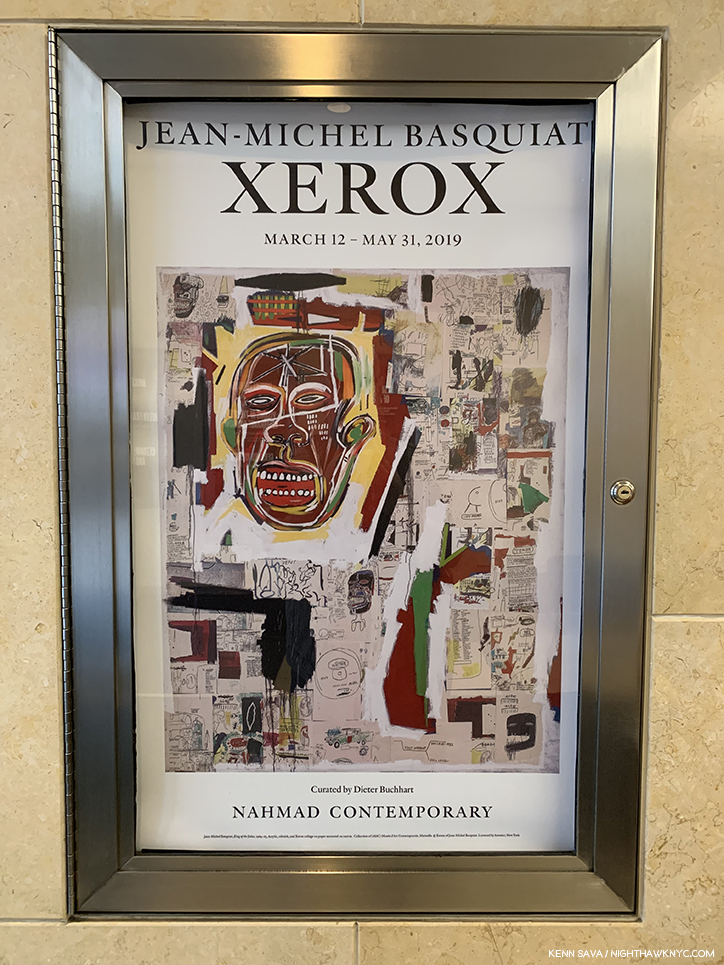
 

  1. The Philosophy of Andy Warhol, henceforth TPoAW, P.86
  2.  TPoAW, P.26
  3. TPoAW, P.96

Shy No More! Josh Kern Breaks Through

Written & Photographed by Kenn Sava (*with Photos and Video by Josh Kern)

Shyness is an affliction that affects millions- around 7% of the U.S. population. For those who’ve dealt with it, it can, at times, feel like you’re living in a glass box while life in the world goes on outside. But, shyness isn’t something that only Americans suffer with, of course. Josh Kern, a college student in Dortmund, Germany was locked inside of himself by his shyness, with his writing as a means of recording his feelings and thoughts. Like these on his phone a few years back-

“But there’s also this endlessly deep pain because I want to express all of this, but have no clue how.” All Photos in this Post by, and courtesy of, Josh Kern from Fuck me. This one appears in the introductory pages. Click any Photo for full size.

His words record his frustration and yearning to break free. They also record the moment he did. As he recalls in the opening pages of his new, first, PhotoBook, Fuck me, “But I discovered a way to do it…I became obsessed with documenting the world around me. My camera was with me everywhere and it somehow became a part of myself. It gave me permission to not be shy and the ability to show how intense and beautiful I perceive life. I found something where I can shamelessly express what I feel, my critical view of our generation and myself and my love for life in general.”

The very next page is the defacto title page, reading “Fuck me,” with “from the inside out” scratched out.

Having dealt with shyness myself, Josh’s way out of it was one that caught me by surprise. One I’ve never heard recommended.

He picked up his camera. 


From then on, it went with him everywhere.

When I think of breaking out of shyness, it looks like this…

And lo and behold, seemingly as soon as he stepped out his door he found himself in a fabulously rich world of sights and incredible fleeting moments in the company of his great group of friends.

And this.

Having taken the first steps of getting out there and creating a body of Photos, he then went further. Josh compiled his work and created a book dummy of it. Then, he started a kickstarter campaign to fund its publication. 31 days later, 556 backers contributed over $20,000. towards its publication.

Personally? I find all of this utterly remarkable. That he was able to break through his shyness and discover himself in the process is an amazing achievement on its own- an invaluable real-life accomplishment that you get no “grade” for.

And then? There’s his PhotoBook. 

Fuck me’s covers reproduce one of Josh’s well-worn notebooks that he carries everywhere he goes, and that live his life with him. See BookMarks at the end for info about getting one.

Josh’s Fuck me was published by Calin Kruse’s Dienacht. I asked Calin how he came across Josh and this body of his work. He told me, “Through his teacher, Christoph Bangert, a great photographer himself, and an amazing person. We’ve known each other for a while, and he knows what I publish and what I like. I had a booth with my books and magazines at the Photobookfestival in Kassel. Josh was there with his school and Christoph, who encouraged him to show me his book dummy. That’s the first time I came across his project. I liked it, and I suggested some changes, but we didn’t talk about publishing the book together. This was in June, 2018. Very soon after that, Josh started a super successful kickstarter campaign to fund the printing cost, and he asked me in the middle of the campaign if I could imagine publishing it. It was released in September, 2018, so everything went very fast.” 

Now, 6 months later, almost 1,200 people have just about bought out the first edition. Including me. What do I think of it? I find Josh has developed his own style, that while it reminds me of the work of Nan Goldin and Ryan McGinley is resolutely his own. Interestingly, Josh shares a skateboarding background with fellow Photographers Todd Hido, Ed Templeton and Jason Lee, among others, and we see that, and possibly some of the resulting physical damage in his book. Perhaps, it’s from the same well-spring of daring that the edge in some of this work emanates from. He has a sharp eye for the intimate moment at its most expressive, which is aided to no end by his personal knowledge of his subjects, which he’s able to communicate to the total strangers looking at his work, transmitting bits of insights into them as well. Fuck me is a book that works on a number of levels. There’s the “breaking through shyness” level- a potentially invaluable example for countless others. Then, there’s the “documenting our lives” level. More on this later. Third? There’s a level where it becomes apparent how much Josh has learned from his influences and his teachers, assimilated them, and then created his own book. For someone in his early 20s? That’s remarkable, too. Having carried it around with me for a few months, I find that it’s a book that holds together in a wonderful way, passing through peaks of adventure followed by moments of introspection and repose, a book that positively drips with compassion and love for its subjects.

Fuck me strikes me as something of a throwback- in its technology and its values. Its shot on film, and not one digital or cellular device is seen in any of its subjects hands! It opts for real life, face to face interactions, which in contrast to those that take place online, are photographable and actually worth remembering and seeing again. In the end, Fuck me is a book that is a beautiful testament to the joy and intimacy of REAL Friendship, at a time when the word “friend” has been usurped and trivialized to the point that countless millions wonder who their REAL friends are. It’s a book that creates its own world (most of the time we have no idea where the action is taking place- it simply doesn’t matter), while leaving our world with wonderful images of time and experiences shared growing and evolving, right before our eyes. that most of us only carry around in our memories.

And, ALL of this is even more remarkable when you realize that Josh Kern is STILL a college Photography student.

See for yourself. Here in this video, Josh Kern, the Filmmaker(!), introduces Josh Kern, the Photographer, and Fuck me

Better still, I’m very pleased to say that Josh agreed to answer some questions for me, taking time from his studies, creating new work and making more history with his friends to do so.

Kenn Sava (KS)- Josh, you’ve spoken about how “Photography gave me permission to not be shy and the ability to express myself which completely changed my life. If I can only inspire one person to do the same- I’m happy.” I’m curious how it happened. A number of the Photographers I’ve spoken with speak of it as a “solitary” craft, which would seem to reinforce shyness. Could you elaborate on how it gave you permission, how you were able to use it that led up to your breakthrough?

Josh Kern (JK)- My whole life, there have always been a few artists, who made me feel less alone. Whenever I felt like I don’t belong here, I turned to their work and biographies and although, most of them are dead, I immediately felt connected. It was like I had an anonymous club of misfits that only existed in my head. It made me believe that in this very moment there must be thousands of other people feeling the exact same things as I do.

When it came to creating my own art, I somehow tried to turn it around. I always felt everything so intensely and I had the desire to share it, but at the same time I was afraid what the people in my life would think about it. If someone would reject my work, that would mean that they would reject my true self, who I really am – and that would hurt a lot.

But I did it anyway and it was completely liberating because I felt like the people around me could finally see me and I don’t have to pretend anymore. It probably doesn’t seem like a big deal to you, but for me it was everything. I started to believe that connection is only possible through vulnerability.

KS- On your site, you list quite a few of your friends who are artists and creative people. Did they, or others, help you, or was it something you had to do yourself?

JK- I would never have had the courage to share my work to this extent without the support of my friends. It was like, even if everyone hates me tomorrow, I still have them by my side to love, create and express ourselves how we want to. I always decline the common idea of the “lonely artist“ and I believe that every great work comes out of a close group of people who support each other, give feedback and exchange ideas.

KS- Was there a moment when you went from being a causal photographer to taking it more seriously? (If it’s not related- When did the body of work that became Fuck me start?)

JK- No, actually not. I just started taking pictures and since then my love for it increases day by day.

Also, I’m very careful to take my work seriously. I’m not sure how to explain it but I just love when an artist calls themselves an “amateur“ because to me it means he or she sees themself as an enthusiast who creates out of pure love and joy for the act of creating and not for fame or career.

KS- It seems like it would be hard for a shy person to take the next step to turn this body of work into a book, to reach out to the world for funding, as you did. Yet, you sound confident when I read things from that time. It sounds like substantial growth had occurred by that point. Can you speak about how were you able to do it?

JK- It all started in a seminar in the university. I slowly started to show pictures and notebook scans and because of the lovely support of my fellow students and my professor, I found the confidence to show more and more. But I had never really overcome my shyness when it came to people reading my writing while I’m in the same room. So we somehow came up with the agreement that no one reads my words and just looks at the scans as a picture, for editing. I always had in mind that publishing it is something that I will deal with in the future and when the day comes I will just close my eyes and hope for the best.

That’s probably also the reason why I sound confident in my writing – although I’m not – because I always tell myself that right now I’m only writing for myself and no one’s ever going to see it. I somehow treat the thought about sharing it or not as something completely separate that I will deal with in the far future. I’m even doing this right now. It’s funny how we can trick our mind.

But don’t get me wrong, it was still one of the scariest things to do. It will forever be frightening to open myself up. But to be honest, I don’t even want it to be easy, only interesting and as an opportunity to grow. I guess that’s what all this is about for me.

“I really want to come to the point where I have nothing to fear anymore. I want to be free. I want to be the most vulnerable person in the room. I want to bleed. I want to puke blood. I want to suffer and I want to go through every single thing that could harm me.”

KS- In the book it appears you are shooting your Friends and people you know a bit. Are you able to shoot strangers, or would that be another step?

JK- I only tend to photograph very good friends. Probably because they are used being photographed all the time and because of that they act natural in my presence.

Also, most of the time I’m very, very nervous around people I don’t really know and because of that I have a hard time focusing on taking pictures.

Shooting strangers would be definitely something different, but I’m working on myself and would love to try out new things.

KS- It seems you have a remarkably open and camera friendly group of Friends. Did you get any push back, any “Don’t take a Photo of this!” from them?

JK- Yes, they are amazingly open and I feel very, very lucky because of that.

It’s really important to me that if someone doesn’t want a picture to be published, I simply don’t and keep it only for us. Probably because they know this fact, they trust me and don’t really care what I’m doing with my camera and I’m completely free to photograph whatever I want.

KS- What are you own rules for what not to shoot?

JK-This is an uncomfortable question because sometimes I feel like I’m an asshole when it comes to this point. But when someone gets hurt and/or needs my help, I put my camera down, although I have to admit that these situations are mostly the shots that I admire the most.

Also, I always have to remind myself to enjoy the time with my friends because it happens that I only see them through my camera, as a story, and it feels like I forget to really live my life and to be present with them.. which is tricky because I feel that I’m the most happy and fulfilled by living my life through my camera.

KS- What was the reaction of the Friends you photographed  when they saw the book?

JK- Since they already knew every photo in it and I asked most of them to help me editing and to look through a new dummy every few days, it wasn’t a surprise to them. But they were all really proud of how it came out, which made me very happy.

KS- We see your iPhone in the book. Can we see a photo of your camera now? I’m curious what it looks like after having been through all of these adventures.

Josh sent this great shot of his Minolta X-300 in response to my request. March, 2019. I’m so glad I asked for it.

JK- I’m really good at destroying my cameras and I always bought a used Minolta for like 20 Euros on eBay every few months again.

I recently got a Nikon FM because I wanted something that lasts a bit longer, but I miss my Minolta and I’m planning on getting one again.

KS- You’ve mentioned a very wide range of influences from Petra Collins to Ryan McGinley to Luc Delahaye and Jim Goldberg, among Photographers, as well as films, and books. Who’s been influencing you more lately (since Fuck me)?

JK- Somehow I cant get off the book Winterreise by Luc Delahaye, which also inspired Fuck Me very much.

From Winterreise by Luc Delahaye. I know that my many Russian readers and friends take issue with the way Mr. Delahaye and other Western Photographers show their country. I understand and respect they feel that way. I’ve never been there. Still? I agree with Josh about Winterrieise, and I find it to be one of the exceptional PhotoBooks of this young century. Though only published in 2003, I see its influnence in so many books being released today.

Also from Winterreise by Luc Delahaye. Along with the pathos, I find quite a bit of beauty in what Mr. Delahaye depicts, and of course, in his work.

I discovered it almost a year ago and still to this day, I take it with me on every trip and flip through it almost every day. The same goes for Hermann Hesse. My love and affection for him increases every time I reread his books and letters.

There’s something about these two artists that I cant put into words. It’s like they sacrifice themselves and their whole being only in order to create. They would die for their work – probably not, but thats what it feels like to me.

Josh Kern, Self-portrait, not included in Fuck me.

I’m really missing this mentality in a lot of people today. Somehow I feel like everyone is afraid to take themselves or their work seriously.

I don’t want to sound too negative, there are still so many great artists out there, but somehow I cant find anyone that keeps up with these two. At least for me right now.

KS- How about Painters? Are there any who’s work has spoken to you, earlier or now?

JK- Although I really admire the art of painting and some of my friends are painters, I never really got into it. But from what I have seen I really like the work of Malcolm T. Liepke.

KS- What do you listen to?

JK- Lately I’m a bit lost when it comes to music. But I will forever stick to Car Seat Headrest, The Strokes, The Cure,  The Modern Lovers, Velvet Underground, Wolf Alice and Sonic Youth.

Josh Kern, in his Raymond Pettibon designed Sonic Youth Goo cover T, doesn’t let brushing his teeth keep him from getting the shot. He wrote this about this Photo- “A Saturday night. We were beaten up by two or three guys and ended up at my place, where I took this photograph. It’s funny, but you’d never imagine that Naomi is the kind of girl who won’t let people get away with saying shit. She is though.”

KS- You’ve talked about going in a different direction with your second book. Very exciting! Can you give us any hints what it might be like, or how it’s “different?”

JK-Ah, yes, haha. Somehow I have a new idea about how I want it to be every day anew. At first, I wanted to dedicate the book to my younger self, with notes in it about what I wish I had known a few years back. Then, I wanted it to be more like a novel, with writing and a story.. and now, I’m back at the classic photobook, with no notes and writing at all. I have no idea what I will come up with next. I just take photographs and create journal like before, make a lot of dummies and try things out. And I’m in love with it. Making books is by far my favorite thing to do.

KS- How do you feel about school now? Has it been worth it for you, or do you feel you’ve learned mostly on your own by getting out there and creating?

JK- I’m so grateful for studying photography! Not really about the stuff we learn in classes, but more about the people I got to know. Theres no other place in the world where you meet so many people who are as passionate about photography as you are. Also, I had a teacher, Christoph Bangert, who inspired and motivated me like crazy and somehow gave me the courage to publish my book. It would have never happened without him and I would have never met him without the university.

KS- From where you are now, what would you say to someone who is where you were, struggling with their shyness?

JK- I can only speak for myself, but finding something that you love and then overcoming the fear of sharing your excitement is everything to me. It’s so important to be in love and to stand up for something you truly believe in, no matter what it is. Your problems probably won’t disappear because of that, but it will make all this suffering seem like it has its purpose. In the end, you just need something that’s worth being made fun of.
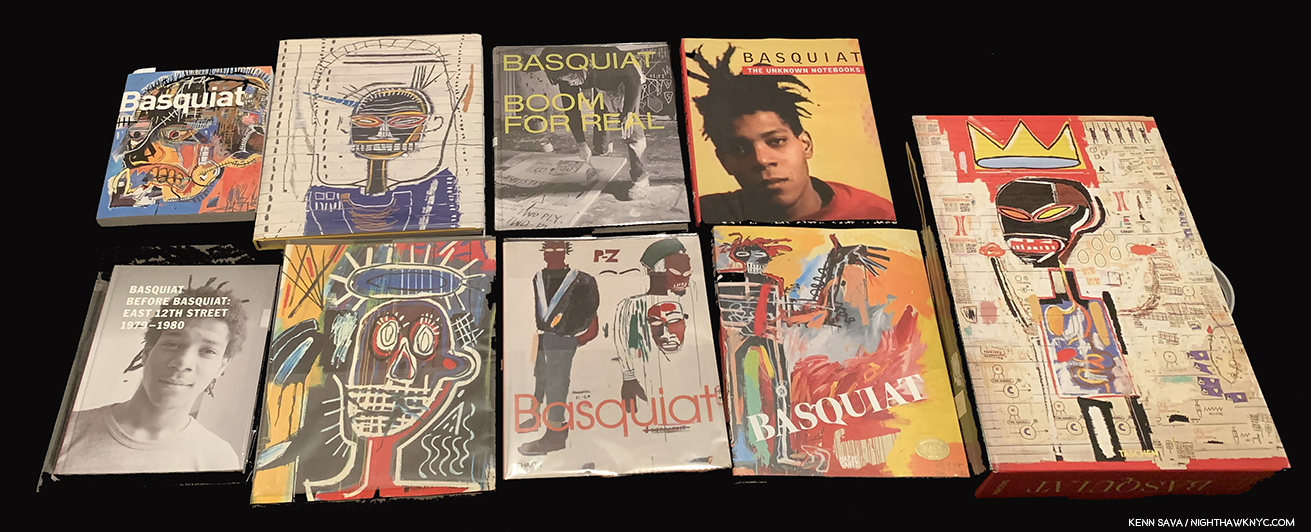
Q&A Ends———

I was talking to a photographer friend, one of my old drinking buddies, the other day about Josh’s book. I said to him-“Hey, why don’t we have photos of our old days hanging out making history? Ours took place in some of the same places Patti Smith hung out in in  Just Kids. We don’t have the photos, we don’t have the book.”

But Josh Kern does.

In 10 or 20 years, his friends are going to be very glad he took these pictures.

In the meantime, I share Josh’s hope that his work will inspire someone else to break out and break through.


BookMarks-

Update- July, 2019- Fuck me is now sold out and out of print at the publisher. As far as I know, these are the only new copies available for sale anywhere. They’re being offered while they last, subject unsold. 
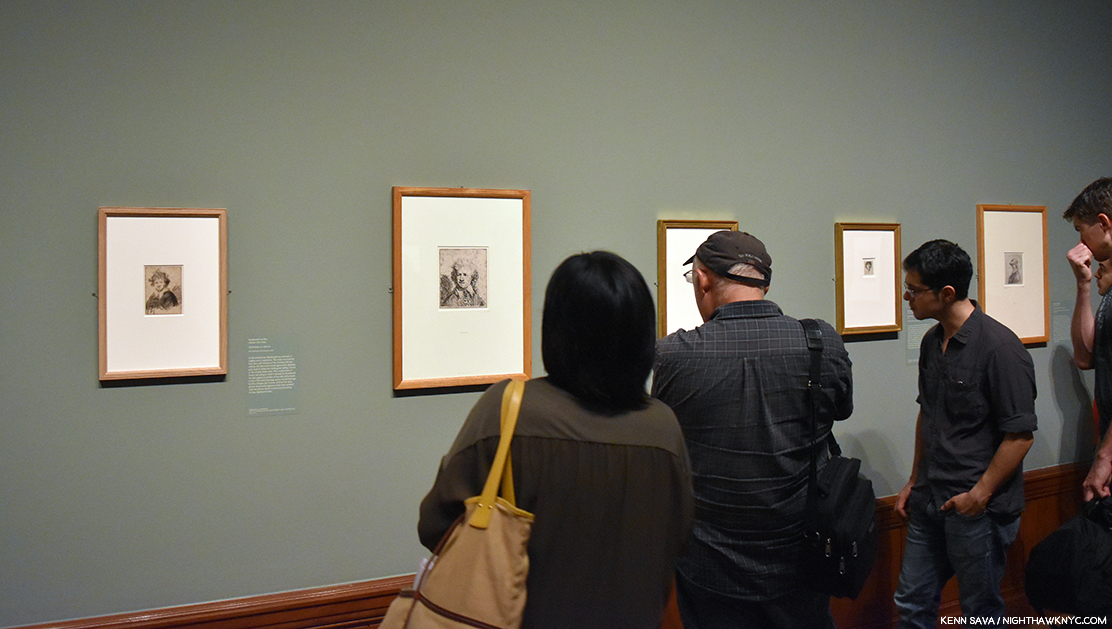
Because I know readers are going to ask, “Ok. Where can I get a copy?” The answer is that as I write this, Fuck me isn’t available anywhere in the USA (as far as I know). So, I went ahead and bought some extra copies and I am very excited to make them available to my readers- something I’ve never done in the 3 1/2 years of NHNYC.
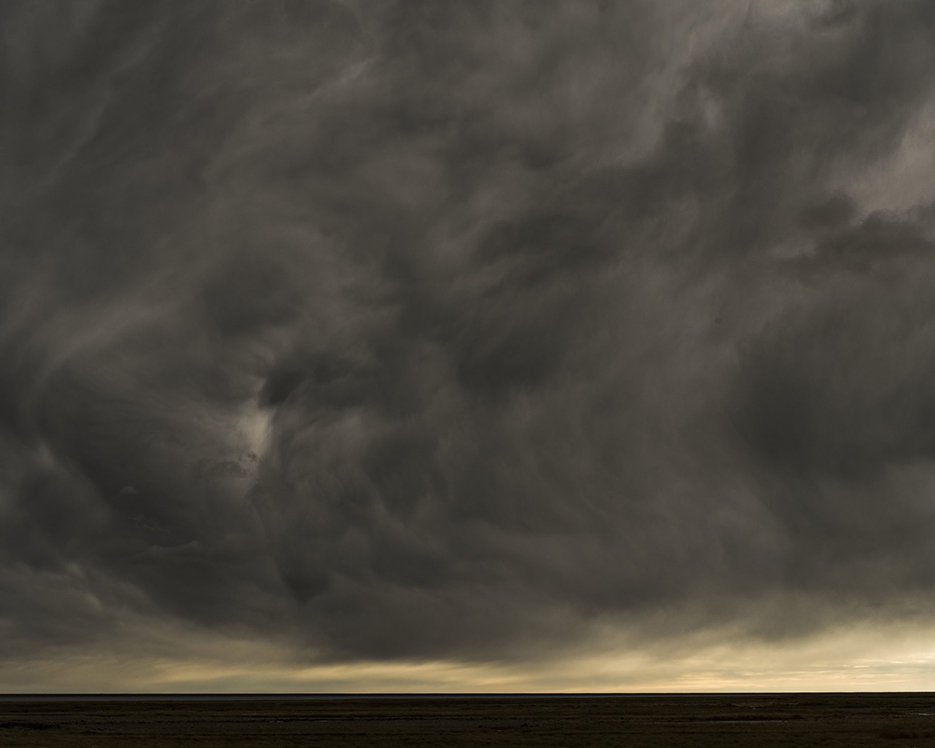
Here are the particulars-

Fuck me by Josh Kern
-196 pages
-4.13 x 6 inches (10.5 x 15 cm)
-Offset printing, in full color throughout.
-First edition/first printing, Published by Dienacht, 2018
-Softcover with open stitch binding.
-And no- There is no sex or nudity in it.

A few others- As Josh said, Luc Delahaye’s Winterreise is a book I, also, recommend. It’s out of print, but copies in very good condition still trade reasonably in hard or softcover. While it’s somewhat overlooked among recent PhotoBooks by the general public, it’s not by other Photographers, including Josh, and this one.

Dan Eldon was a multi-talented Artist/Photographer/Journalist/Humanitarian who was tragically killed in Somalia at the age of 22 while doing his job as a PhotoJournalist for Reuters. When I first saw Josh’s book, I immediately wondered what Dan Eldon might have thought of it. I asked Josh in a follow-up what he thought of Dan Eldon’s work and he said “Dan is definitely on my list.” Dan Eldon created Journals that combined his writing, Photography, ephemera and just about anything into amazingly unique works that have been published since his death. Dan’s The Journey Is the Destination, Revised Edition: The Journals of Dan Eldonis another classic, in my view, that gets far too little attention. He was an extraordinary man, who lived an extraordinary life that everyone else’s would be enriched by knowing about. As Josh eloquently put it above- Dan Eldon was killed creating his work. Far, far too early.
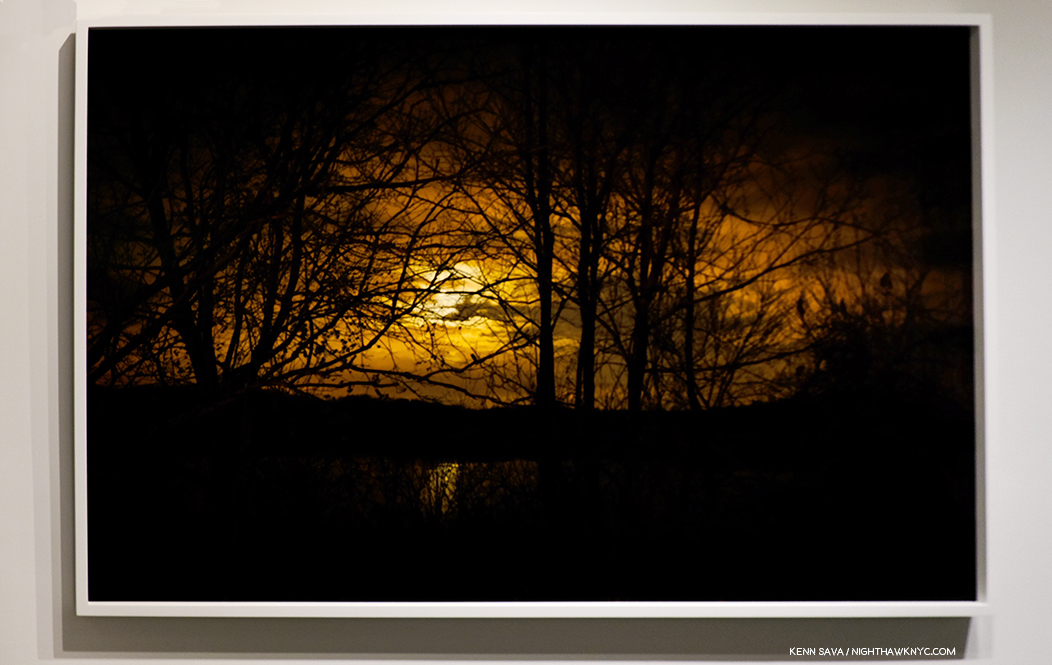
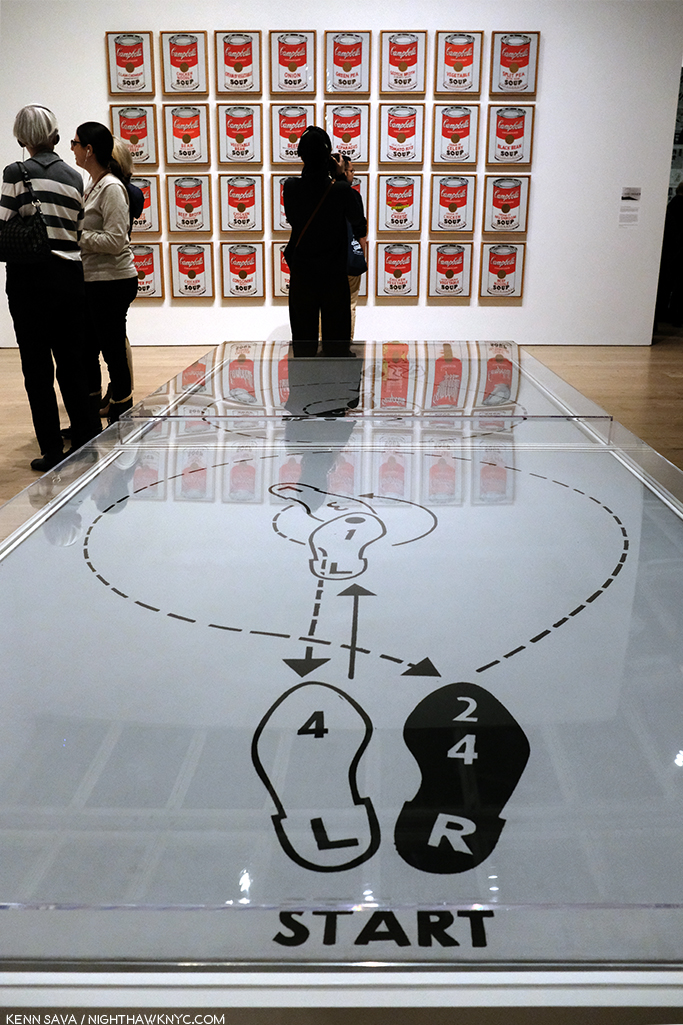
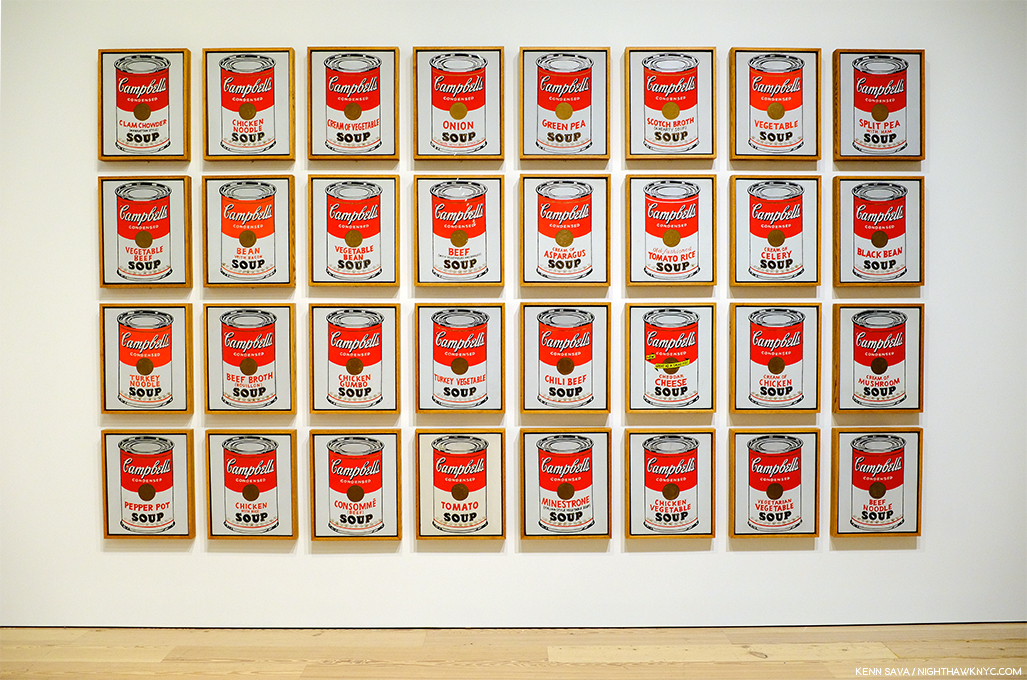
Regarding Josh’s fave bands, for lovers of NYC’s own The Strokes, check out Julian Casablancas & The Voidz’ album, Tyranny, if you haven’t heard it, which I think is just terrific. One of Mr. Casablancas’s big influences happens to be the band I picked for the Soundtrack for this Post…

*- Soundtrack for this Post is “Break On Through (To The Other Side),” by The Doors, the first single released from their first album in 1967, speaking of debuts…

My thanks to Calin Kruse and Josh Kern. 

NighthawkNYC.com has been entirely self-funded and ad-free for over 6 years, during which over 250 full length pieces have been published. If you’ve found it worthwhile, you can donate to keep it going & ad-free below. Thank you!

Written & photographed by Kenn Sava for nighthawknyc.com unless otherwise credited.
To send comments, thoughts, feedback or propositions click here.
Click the white box on the upper right for the archives or to search them.
For “short takes” and additional pictures, follow @nighthawk_nyc on Instagram.

Subscribe to be notified of new Posts below. Your information will be used for no other purpose.