Bruce Conner- “The Most Important Artist of the 20th Century”

This site is Free & Ad-Free! If you find this piece worthwhile, please donate via PayPal to support it & independent Art writing. You can also support it by buying Art & books! Details at the end. Thank you.

Written & Photographed by Kenn Sava (*- unless otherwise credited)
“In my opinion, Bruce Conner is the most important Artist of the 20th Century.”

And all this time I thought it might have been Picasso. Before you put fingers to keyboard to email me- I didn’t say that. Dennis Hopper did. Here-

In addition to being a fine Actor, Director and Photographer, Hopper was a major, and an astute, collector of Contemporary Art. Sharp enough to attend Andy Warhol’s first show and buy one of his “Soup Can” Paintings for 75.00. He was also a long time friend of Bruce Conner.

You've got to have friends. Bruce Conner, left, with Dennis Hopper.

You’ve got to have friends. Bruce Conner, left, in Hopper’s chair, with Dennis Hopper from the Senior & Shopmaker show catalog.

Still? That’s a pretty big statement, Mr. Hopper.

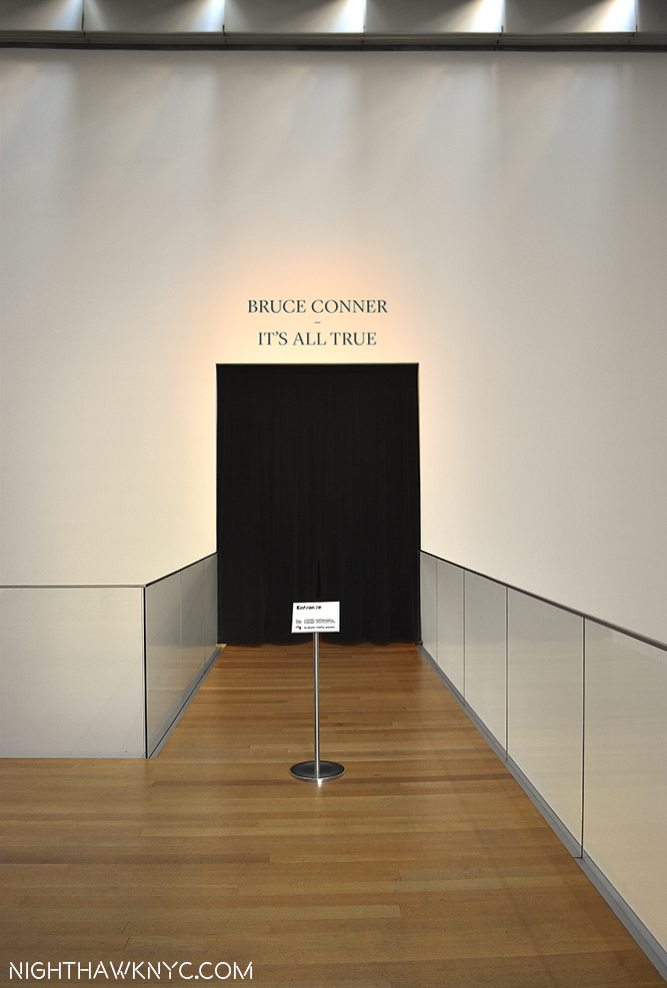
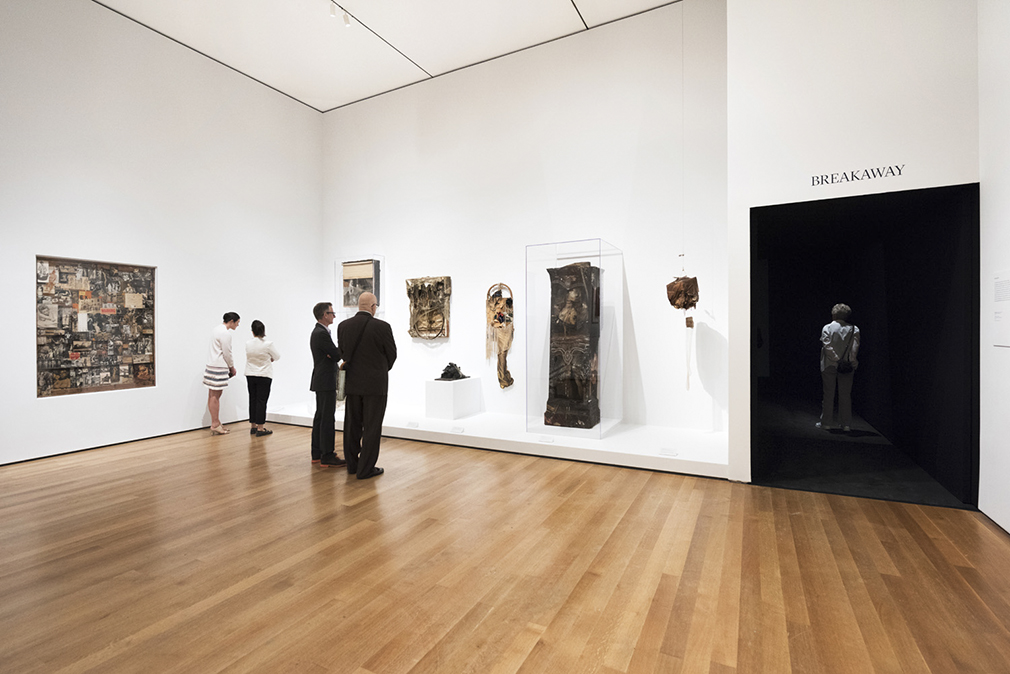
The Magic Curtain. Like a black hole to new universes within.

The entrance. Walk through this black curtain and it’s like entering a black hole to new universes within.

Though I don’t believe in qualitatively comparing Artists, there are, no doubt, many other differing opinions on the question of who was the most important 20th Century Artist. But, there was some quite compelling evidence in favor of Mr. Hopper’s opinion on view over 20 rooms at “Bruce Conner: It’s All True,” the first posthumous retrospective of the Artist, at MoMA from July 3 through October 2, and now at SFMOMA until January 22, 2017. (You can revisit MoMA’s Show  in amazing detail here.) In fact, it makes Hopper’s case about as well as it is possible to make it. With 250 pieces this show is one mind bend after another after another and after another that doesn’t stop until you’re back outside of it, in the lobby of MoMA’s 6th Floor. It’s like Groucho Marx’ joke delivery style- You don’t like that one? Here’s another. And another, and another, and another until he finally gets you. Having never even heard of Bruce Conner, he got my attention pretty quickly on my first visit.

How my head felt after. Show's Lobby.

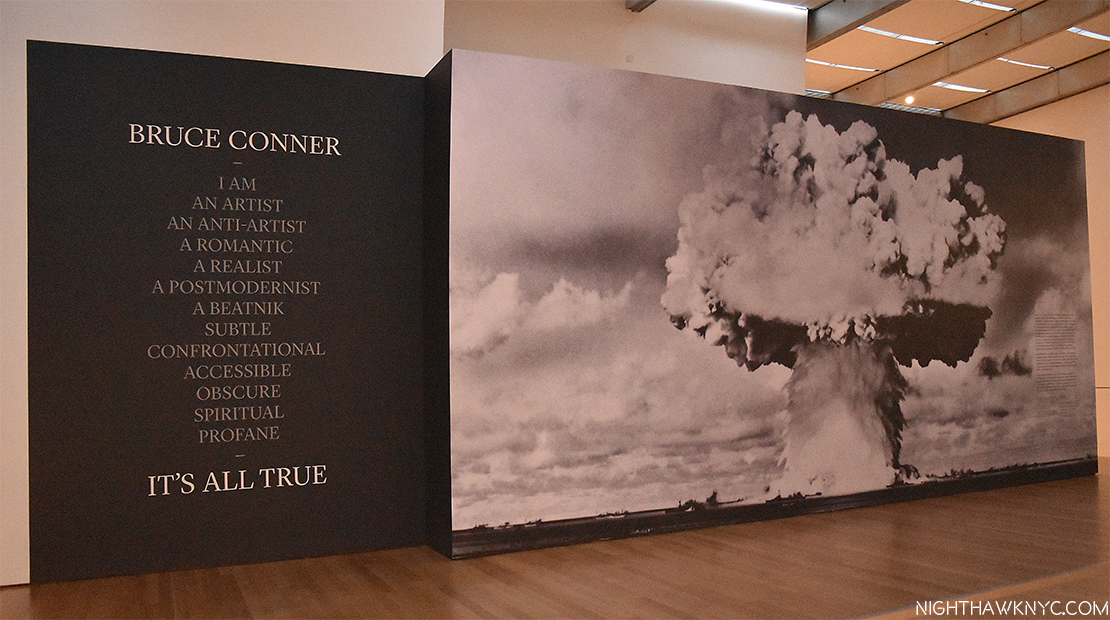
“It’s All True’s” Lobby. The show’s title comes from a letter Conner wrote in 2000, paraphrased on the left.

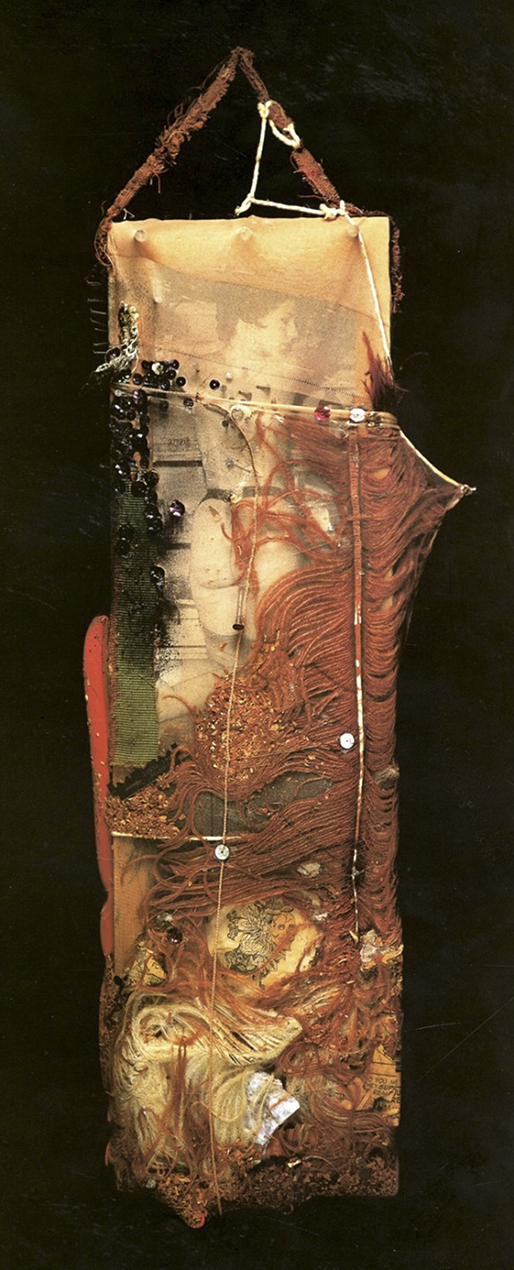
By my third visit, I was obsessed. For me, “Bruce Conner: It’s All True” sets a bench mark for Retrospectives of a Contemporary Artist. Pick a genre- drawing, painting, collage, photography, film, assemblage, Bruce Conner’s work in it can hang with anyone else’s. Here are some things I noticed that could be used to support Mr. Hopper’s claim-

-He was an assemblage Artist every bit as inventive and creative as the great Robert Rauschenberg during the same period. In fact, one of Conner’s assemblages was selected for the 1961 Moma show, “the Art of Assemblage,” when he was 28, where it was shown alongside works by Malevich, Magritte, Miro, Man Ray, Picasso and Rauschenberg. Conner, himself, was denied entry to MoMA on opening night, but that’s a story unto itself.

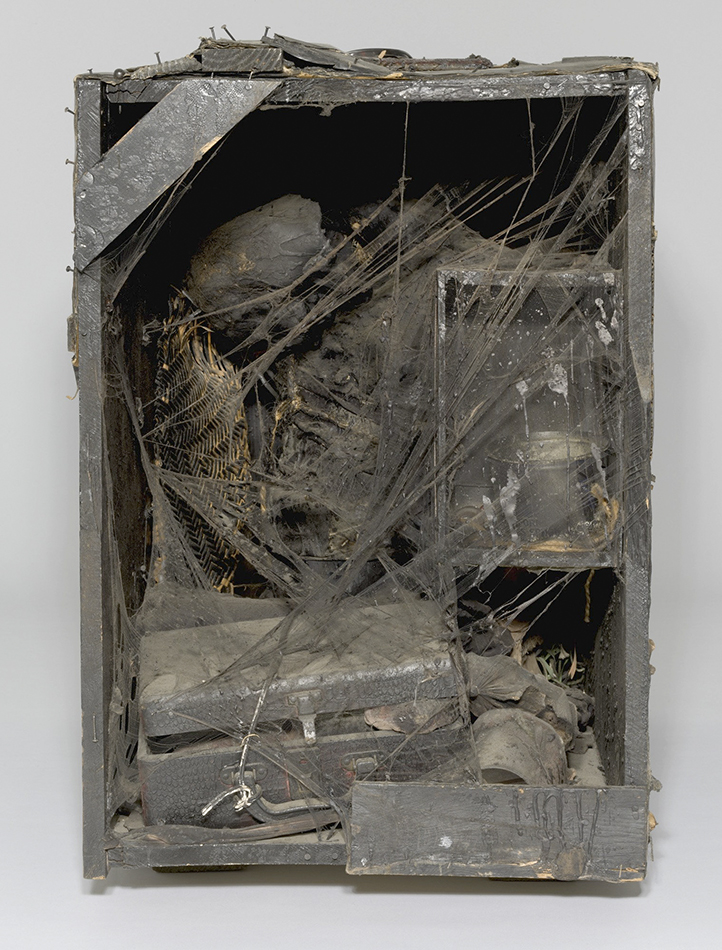
"THE BOX," 1960 Photo ©MoMA

“THE BOX,” 1960. Dennis Hopper actually preferred this work to Picasso’s “Guernica” as an anti-war statement because it is “not cloaked in pleasing forms.”1 Photo ©MoMA

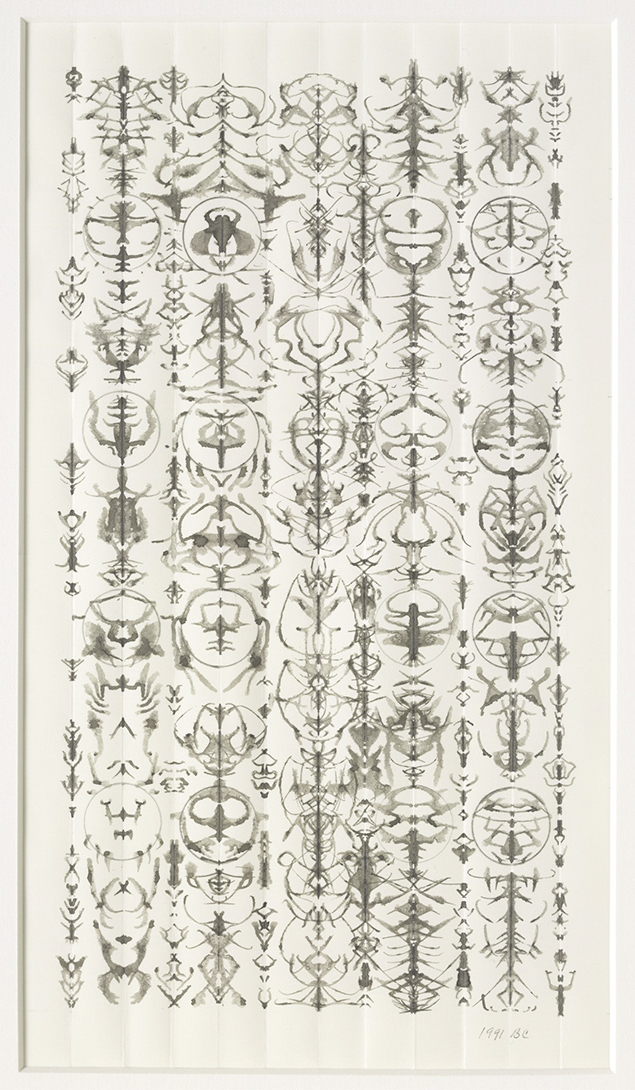
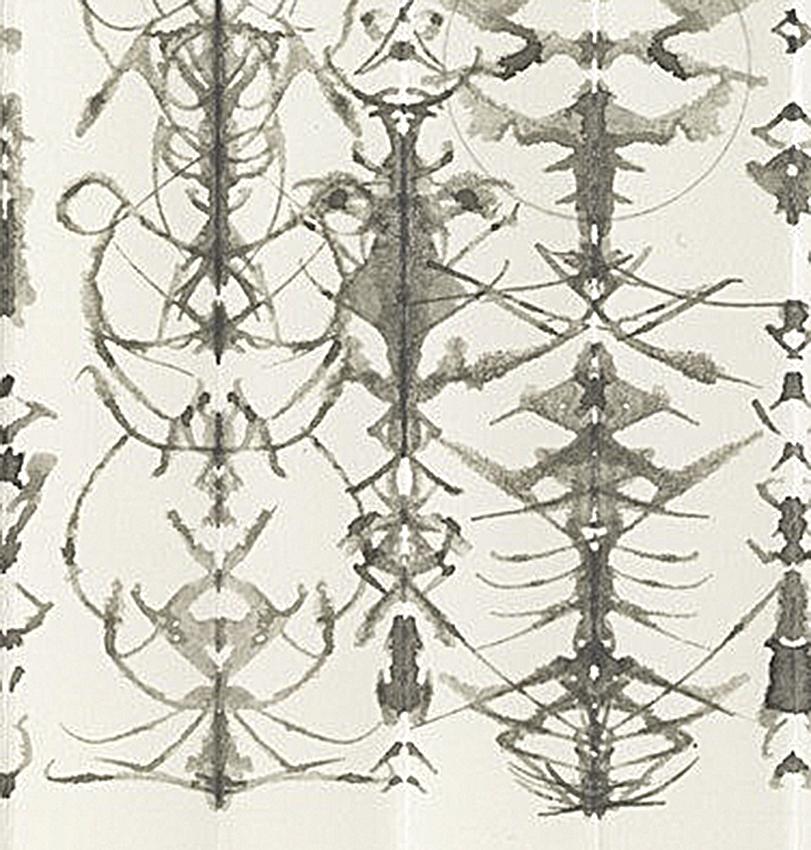
-While he drew for much of his career, with fascinating results, he created an entirely new and unprecedented type of drawing, made out of inkblots (yes, you read that right) that contain from 1 or 2  upto 494 inkblots in a single work that, I believe, people will spend years trying to figure out how he did them. Even once they do, they are going to have a very hard time achieving his level of mastery with their manipulation.

inkblot-drawing-8-17-1991p

HTF? “INKBLOT DRAWING,” August 17, 1991. See a Detail of this further down. Photo ©MoMA

-His groundbreaking first film, “A MOVIE.” was a work that was hugely influential, credited by the same Dennis Hopper with inspiring the acid scene in his own film “Easy Rider.”

Blowing Minds. "Crossroads," 1976 at Moma. Photo ©Moma

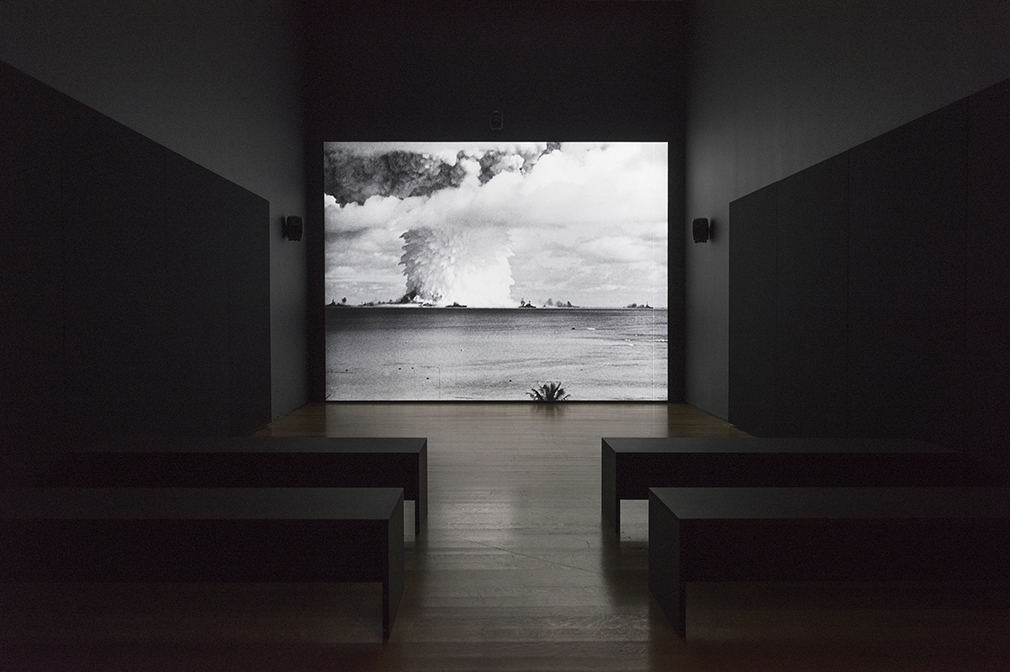
“CROSSROADS,” 1976. Mushrooms, of all kinds, even atomic clouds as here, are a running theme. Yes, all of his titles are in CAPS. *-Photo ©MoMA

“CROSSROADS,” 1976, a 36 minute film that struck me as being part horror film, part meditation on the power of the unseen forces in the universe, showing the unimaginable devastation an atomic explosion unleashes, while at the same time showing it as a force of nature to which it gradually melts into, as we watch the surrounding clouds become indistinguishable from the atomic cloud. The end result is summed up in what writer William C. Wees calls the “Nuclear Sublime2.” Showing multiple views of the atomic blast at Bikini Atoll on July 26, 1947, which Conner selected from the over 500 cameras that filmed the event (some at speeds of up to 8,000 frames per second), and juxtaposes the images with, first, actual sounds of the event, and then soundtracks created by synth master Patrick Gleeson and avant garde composer Terry Riley. Forty years later it’s hard to see this film becoming irrelevant any time soon. It’s a film that everyone involved in the military or government of any nation around the world, or those with the power to vote for or select them should see. Conner’s other films (totaling over 20) were no less creative or groundbreaking, and are increasingly being studied, and recognized.

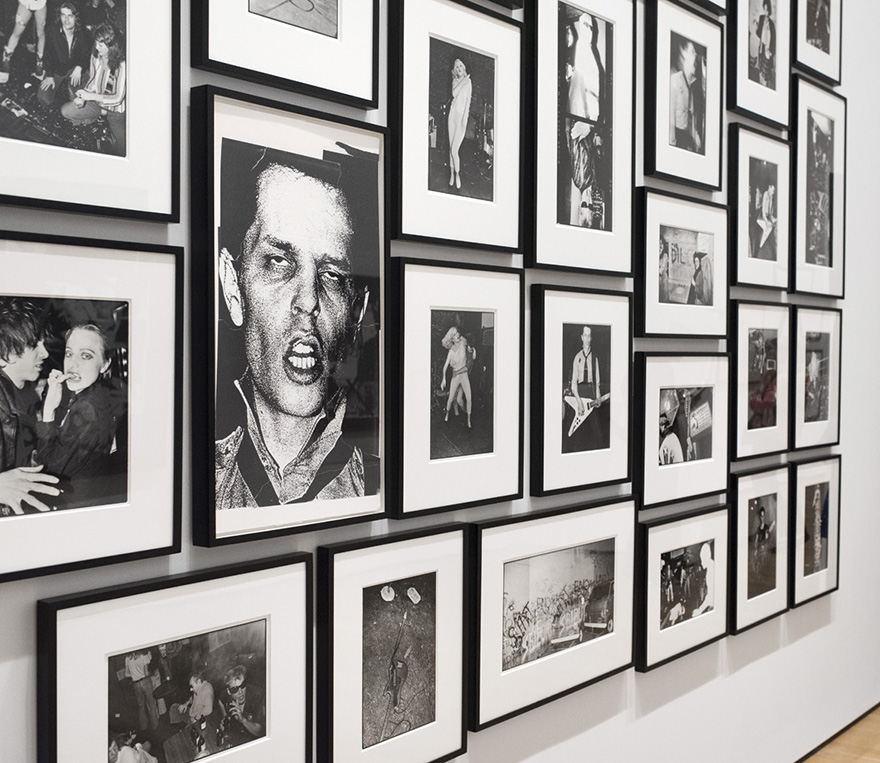
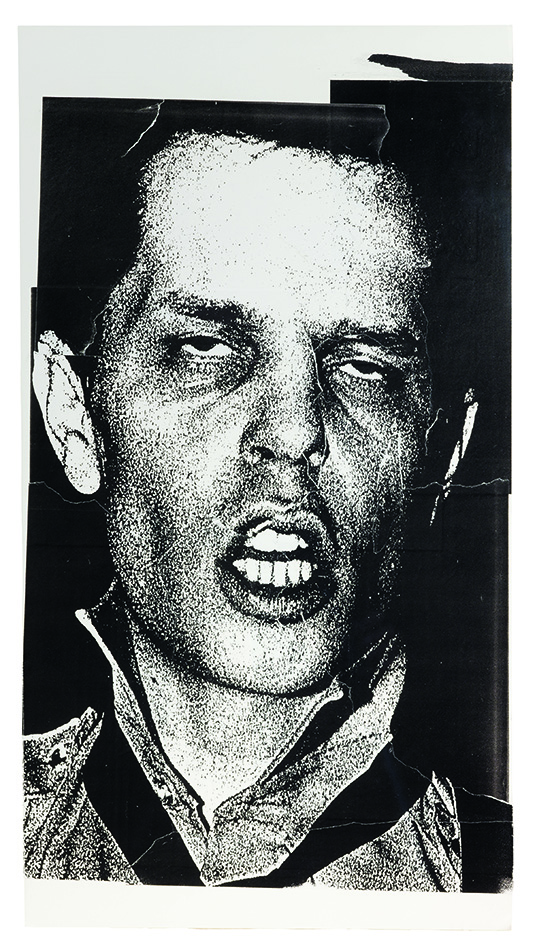
-He took some of the greatest photos of punk musicians and punk bands ever taken.

MoMA_Bruce Conner_June 2016

Up against the wall! A wall of his punk photos shot at the Mabuhay Gardens Club in L.A. *-Photo ©MoMA

Frankie Fix of "Crime," 1977. Photo ©Moma

FRANKIE FIX of the band “Crime,” 1977. *-Photo ©MoMA

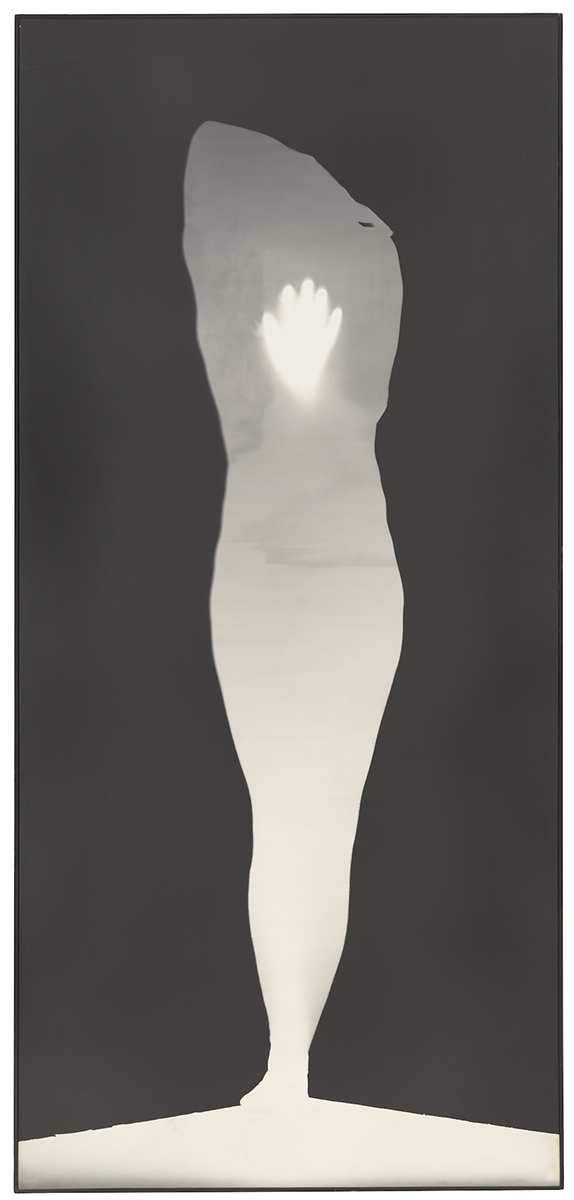
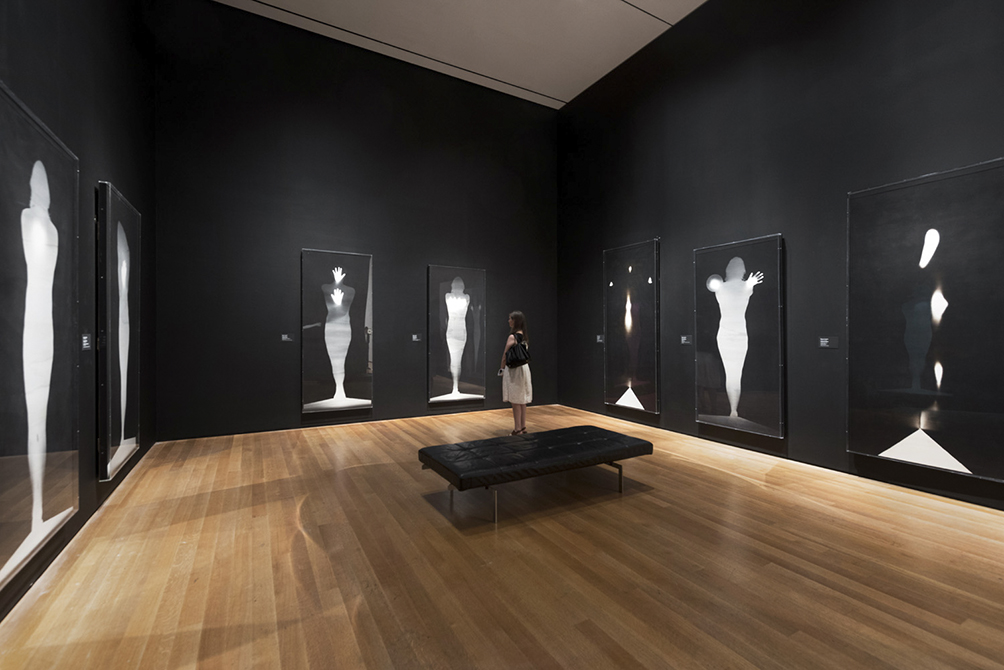
-He created unique portraits he called “photograms” using his own body that are unlike any “selfie” ever taken (actually, Edmund Shea photographed them) and are so ethereal he titled them “Angels.”

Spiritual Side "Sound of One Hand Angel," 1974, Photo ©MoMA

“SOUND OF ONE HAND ANGEL,” 1974, *-Photo ©MoMA

"Angels" by Bruce Conner. Photo courtesy of Moma.

A Room full of “ANGELS.” *-Photo ©MoMA

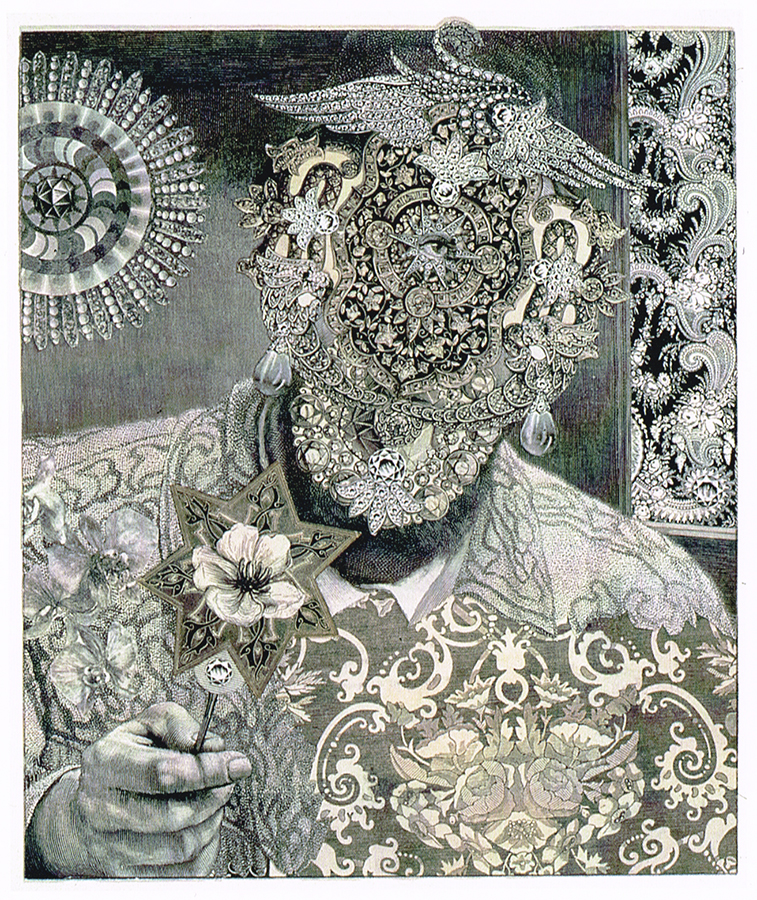
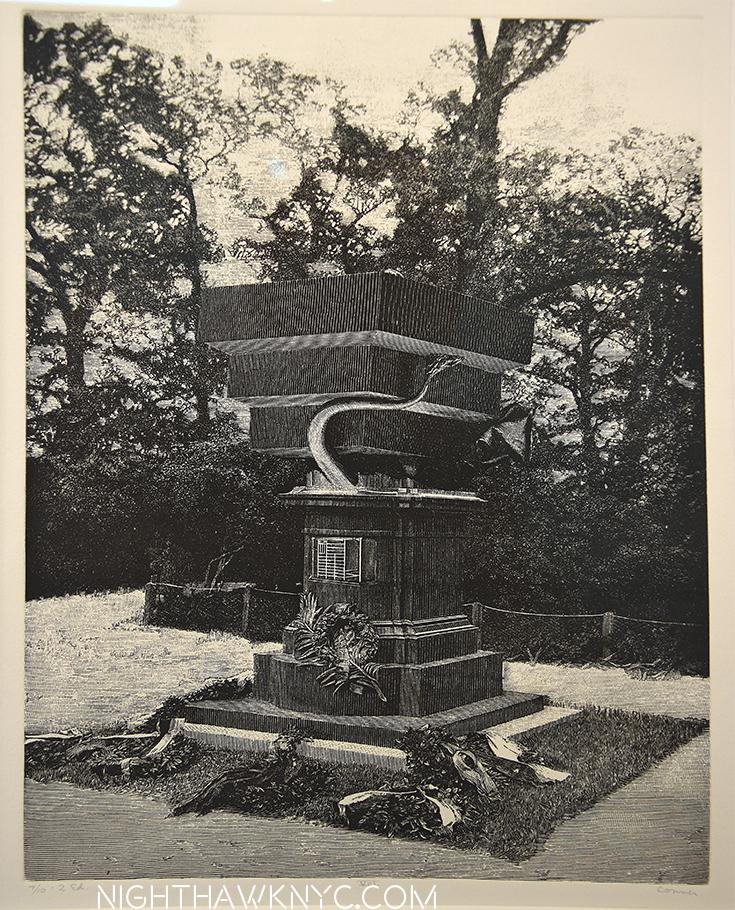
-His collages are every bit as surreal as any by Max Ernst, the Surrealist Master of the Collage.

"PSYCHEDELICATESSEN OWNER," 1990 collage from engravings. Photo ©MoMA

“PSYCHEDELICATESSEN OWNER,” 1990, collage from engravings. *-Photo ©MoMA

-Being as he was the first Artist to put film to contemporary music, he is considered to be the “Father of Music Video,” with his “COSMIC RAY,” in 1961, then “BREAKAWAY,” with Toni Basil (see above). His subsequent work with David Byrne and Brian Eno on videos for their 1981 album “My Life In The Bush of Ghosts” presaged and anticipated MTV’s “Music Videos.” Having his innovations and techniques aped without credit was not something he accepted well. I put this lower on the list because the music video seems to be fading in importance.

And, he ran for office (a seat on the Board of Supervisors in San Francisco), in 1967, actually garnering a few thousand votes.

So?

Why haven’t more people heard about Bruce Conner? Why isn’t he listed and discussed in 20th Century Art History Books?

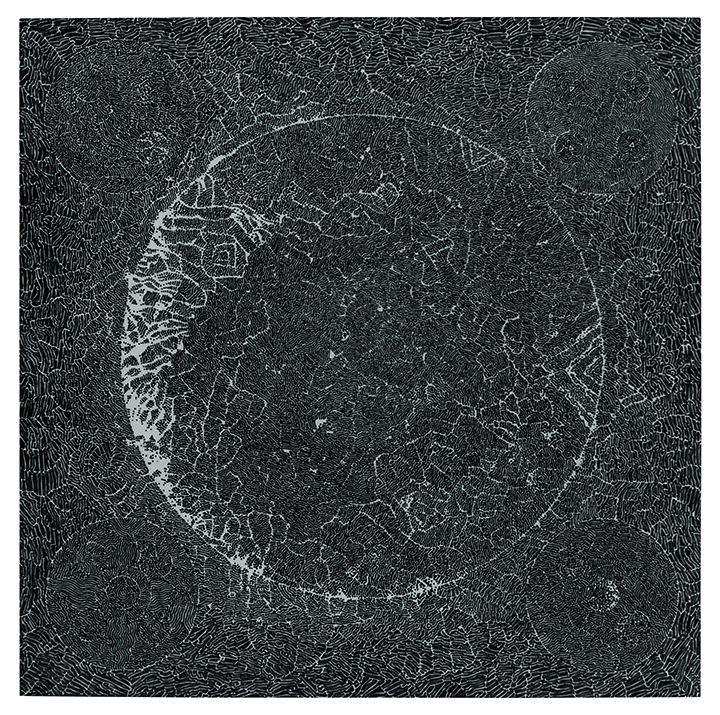
"Untitled" from Mandalla Series, 1965, felt tip pen on paper. 10x10 inches

“UNTITLED” from MANDALA SERIES, 1965, felt tip pen on paper. 10×10 inches. *-Photo ©MoMA

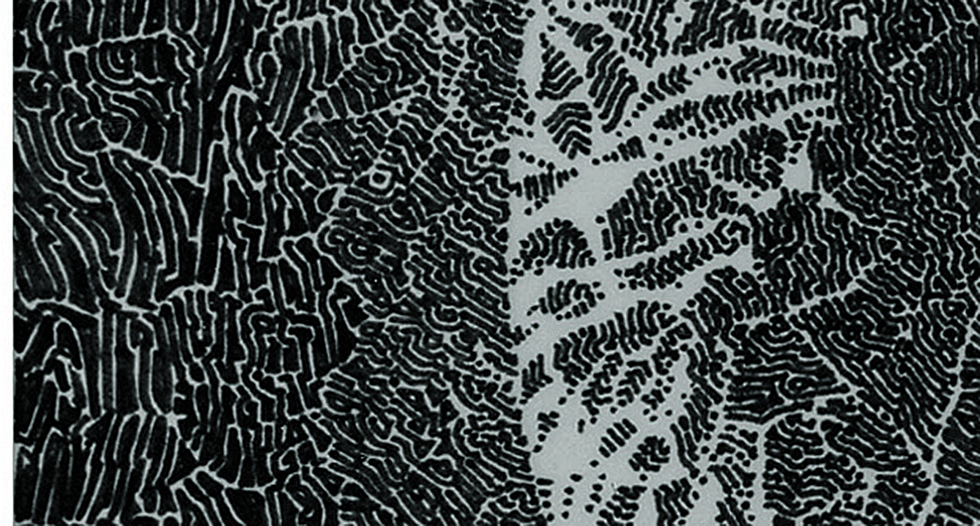
Detail of left side

Detail of left side

Bruce Conner was something of af an “anti-artist.”  He didn’t like the art establishment, and that came out in his dealings with galleries and museums, including a bizarre encounter with the Security staff at MoMA, at that opening in 1961, alluded to above. In this show he is quoted questioning the need for an Artist to put his name on a work, and near the end of his career works that are undeniable Bruce Conners began appearing with other names, like “Emily Feather,” or “Anonymouse” attached to them. It seems it was a conscious effort to avoid inclusion. He claimed he hired these Artists, but today, they are assumed to all be by him. He once said having work out in the public under his own name made him nervous.

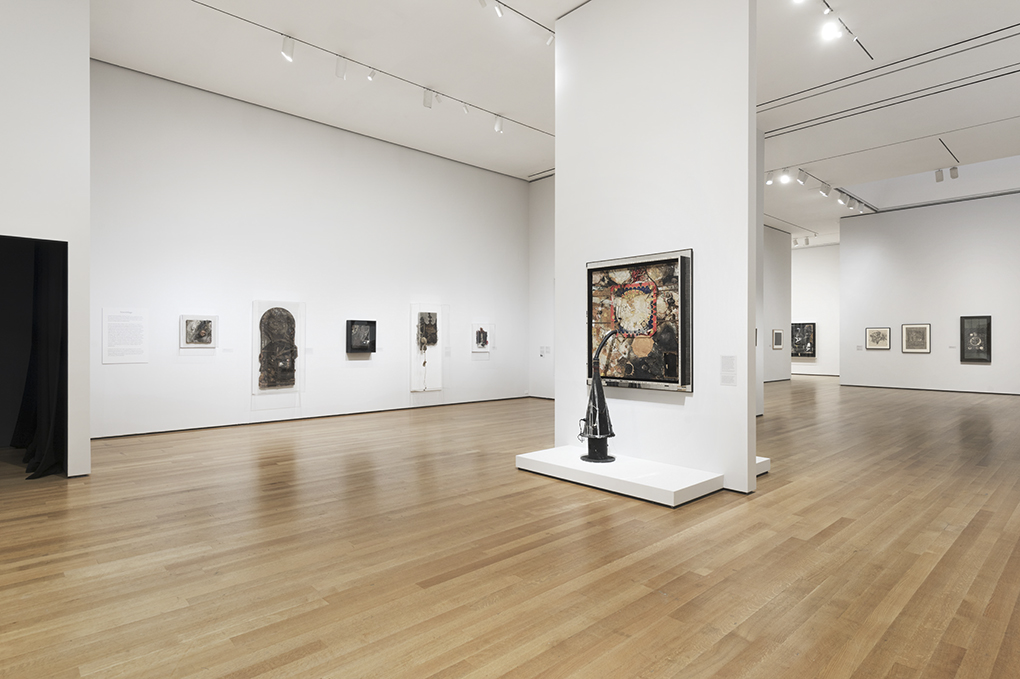
Women's World. Form Left- Pinups on the back of "Untitled," 1954-61, "Spider Lady," & "Spider Lady Nest," 1959, Homage to Jean Harlow," 1963,

Women on his mind. Form Left- Pinups on the back of “UNTITLED,” 1954-61, “SPIDER LADY,” & “SPIDER LADY NEST,” 1959, “HOMAGE TO JEAN HARLOW,” 1963, “WEDNESDAY,” and “LADY BRAIN,” both 1960. Entrance to “BREAKAWAY,” right. *-Photo ©MoMA

Contemporary Art of any time is supposed to break all the rules that had been set in place before it. In Bruce Conner’s case, he broke the rules in every medium he created in, and he broke the rules for being an Artist in the “Art World,” which he loathed. It’s interesting to me that there is so much craft in his films- including dripping ink on them, punch holes seemingly randomly, that make them Art Pieces in themselves. This is part of a duality in his nature that sees him pay attention to the minutest of details like these films, his collages, or his ink drawings where countless minute lines are drawn in pen that somehow never intersect with each other, contrasted with the hugeness of “Crossroads,” horrible, yet strangely beautiful, and contrasted with the “spirituality” of works like the “Angels” and his final work, “Easter Morning.” Bruce Conner may have been many things, it’s all true (as he says in a letter that is the basis for the show’s title), but one thing he was not is easy to categorize. Unless that word is “Artist.”

The first gallery featuring Assemblages. Photo ©MoMA

After seeing “A MOVIE,” you exit the door at left and enter the first gallery featuring Assemblages. *-Photo ©MoMA

Walking around “It’s All True,” as well as no less than three very good satellite shows going on around town, of Conner’s trippier collages and tapestries at one Paula Cooper, unique works at the other, and prints and drawings at Senior & Shopmaker Gallery. I found that every time I look at one of his works, I’m left with the same question-

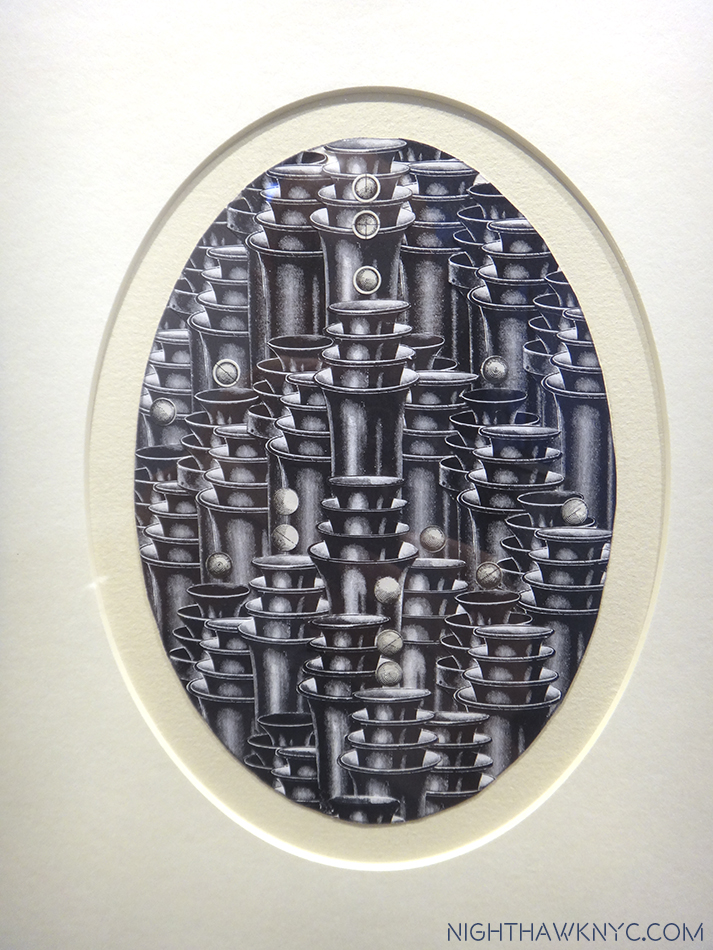
"Tocatta & Fugue," 1986, engraving collage

“TOCATTA & FUGUE,” 1986, engraving collage

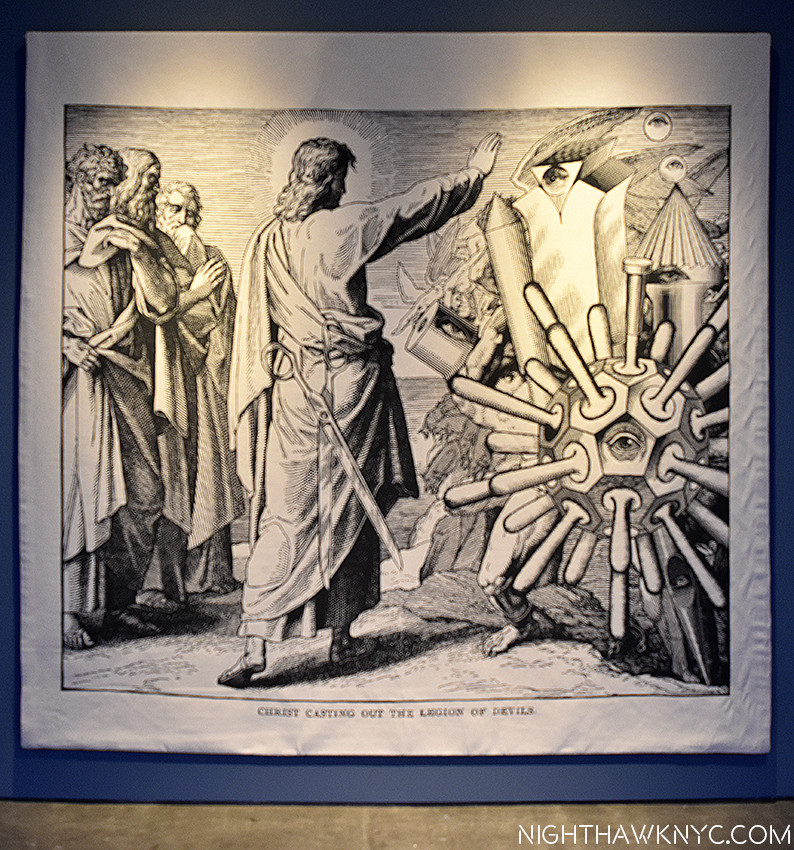
"Christ Casting Out The Legion Of Devils," Tapestry from engraving collage. Both seen at Paul Cooper Gallery

“CHRIST CASTING OUT THE LEGION OF DEVILS,” Tapestry from engraving collage. Both seen at Paula Cooper Gallery

“HTF?”

That’s “How” inserted instead of the W in WTF? As in- HOW did he do that?” No matter which genre of his work I’m considering, that question hits me. I stare at his drawings, for example, including one with hundreds of lines where no two intersect (like “UNTITLED,” above) and wonder “How did he do that?” I’m face to face with a pseudo Max Ernst collage, like the one above, and wonder “I can’t see anything cut out and applied on top of something else. It’s all seamless, and this was before scanning, photoshop and all the rest. How did he do that?” I look at his movies, “BREAKAWAY,” (above) and wonder the same thing. “How? The editing and the way it’s complied is beyond the technology of the time.” I’m not alone in saying this. In fact, no less than Harvard put on a film series of Bruce Conner’s films in 2008 that THEY called “Bruce Conner, the Last Magician of the 20th Century.” (Mr. Conner passed away in 2008). Then, there’s the “Inkblot” drawings, in which each inkblot is a perfect, unique, miracle of beauty, like a snowflake.

Detail of "INKBLOT DRAWING, August 17, 1991" seen above in full. Photo ©MoMA

Detail of “INKBLOT DRAWING, August 17, 1991” seen above in full. *-Photo ©MoMA

“How the…” Don’t ask.

As near as I can tell, Conner folds the paper (vertically in the image above) then applies the drop of ink. How he manipulates it after that to get these seemingly miraculous results is the mystery. Artist David Hockey wrote a fascinating book titled “Secret Knowledge,” about the lost techniques of the Great Masters of Painting going back to the mid 1400’s. He makes a downright riveting case, via reverse engineering, for some of the optical “tricks” and methods some of the greatest Painters ever used. I think someone is going to need to do a Volume 2 of “Secret Knowledge” and include Bruce Conner. MoMA’s curator, Laura Hoptman, said at the Press Opening, “For Bruce Conner there is always the acknowledgement of the viewer, especially in the drawings you can not only admire the steady hand and the attention to detail but it’s also on us to look so carefully and closely as possible to divine the meaning and also the intensity of the work.” While I agree that looking closely reveals wonders, I also wonder how much Conner really wanted us to see and understand3, how much of Bruce Conner, the Artist, was about making (some) works for himself, works that defy understanding by others because they aren’t meant to be. Unless his wife, Jean, also a very fine Artist, tells us, it looks like we’ll never know.

"Black Dahlia," 1960 Photo © Moma

“BLACK DAHLIA,” 1960. Inspired by an unsolved sex-murder case in L.A. His Assemblages require, and reward, very close looking. You’ll even see a nude, from the back. *-Photo ©MoMA

One of the themes of some bigger NYC Art Shows this year has been a revisiting of the Art History of the 20th Century. “It’s All True” does it again and makes such an emphatic case, as “Nasreen Mohamedi” did earlier this year inaugurating TMB, that I would be shocked if either Artist is omitted going forward.

From the "Dennis Hopper One Man Show," Print after engraving collage as seen at Senior & Shopmaker Galleri

From the “Dennis Hopper One Man Show,” at Senior & Shopmaker Gallery, a partial reconstruction of a Bruce Conner show honoring Dennis Hopper. Limited Edition print after engraving collage.

Beyond that, Dennis Hopper’s opinion will live on. I’m glad he expressed it before he passed of prostate cancer in 2010. Is Bruce Conner “The most important Artist of the 20th Century?” I don’t know if it matters. What matters is that his Art is being seen more and more, and so it will grow in appreciation and influence. Bruce Conner may have had reasons for being an “Anti-Artist,” and “Anti Art World” during his life, but one thing that is apparent- Now that he’s unfortunately no longer with us, his work is going to continue to speak for him, while it is seen far and wide in the 21st Century. Where he will continue to blow minds…like mine.

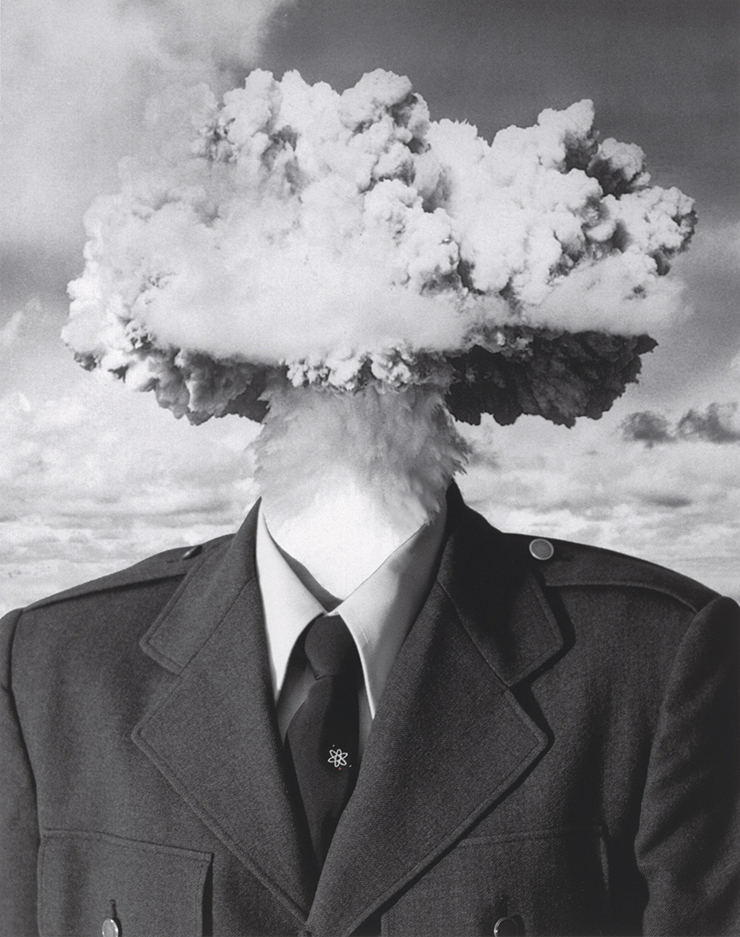
"BOMBHEAD," 2002

“BOMBHEAD,” 2002. Based on a Self Portrait. *-Photo ©MoMA.

*-Soundtrack for this Post is “In C” by Terry Riley, the soundtrack for Bruce Conner’s final film, the gorgeous masterpiece, “EASTER MORNING,” 2008, which struck me as a farewell to life, and is the final work in “It’s All True.”

NighthawkNYC.com has been entirely self-funded & ad-free for over 8 years, during which 300 full length pieces have been published! If you’ve found it worthwhile, PLEASE donate to allow me to continue below. Thank you, Kenn.

You can also support it by buying Art, Art & Photography books, and Music from my collection! Art & Books may be found here. Music here and here

Written & photographed by Kenn Sava for nighthawknyc.com unless otherwise credited. To send comments, thoughts, feedback or propositions click here. Click the white box on the upper right for the archives or to search them. Subscribe to be notified of new Posts below. Your information will be used for no other purpose.

  1. SFWeeky
  2. Wees’ excellent piece on “CROSSROADS,” in which he coins the term, is here.
  3. Very very few are going to get to examine the film strips of his movines to see the attention to detail he lavished on them.

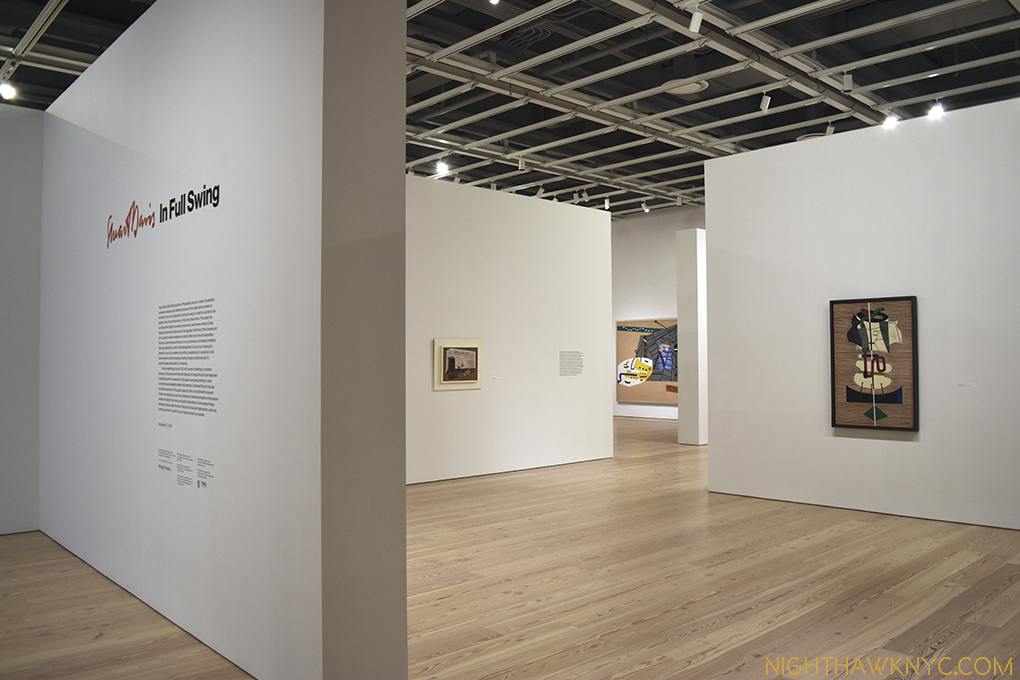
Stuart Davis- The King of Swing

This site is Free & Ad-Free! If you find this piece worthwhile, please donate via PayPal to support it & independent Art writing. You can also support it by buying Art & books! Details at the end. Thank you.

Written & Photographed by Kenn Sava (*- unless otherwise credited)

Try it yourself.

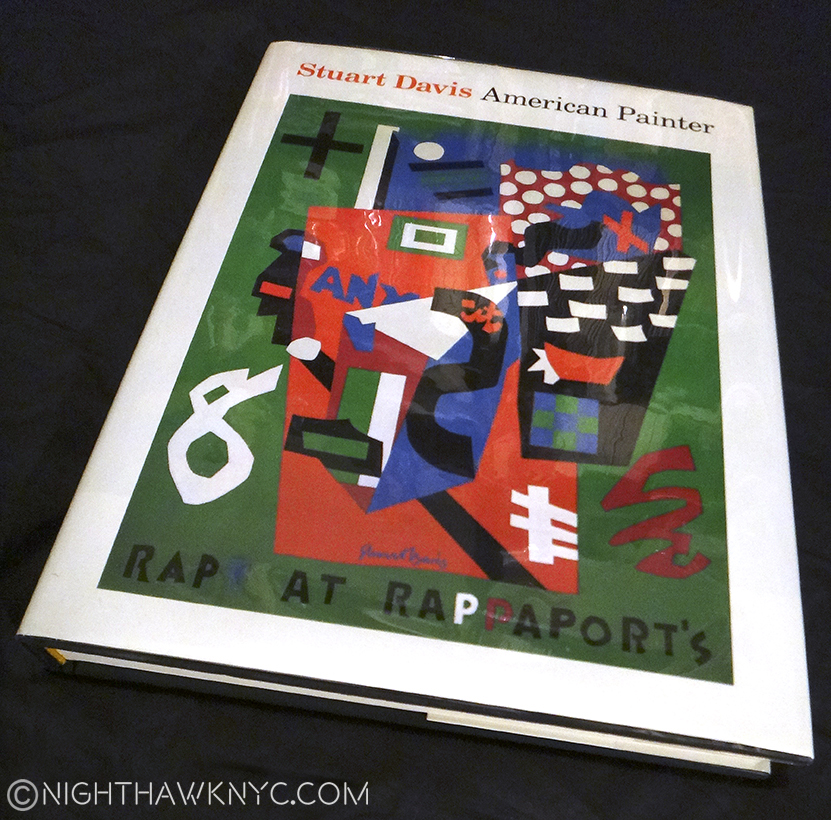
Walk into your local Art Museum and look for Stuart Davis. I bet they own at least one, and I also bet it’s on display. I’m making this wager based on my experience that every American Museum I’ve been to, including many smaller ones, owns at least one work by Stuart Davis, and that work seems to always be on view1. This is a testament to his wide, and ongoing, appeal. Stuart Davis’ Art still has a contemporary look and feel to it. Maybe that’s because so many Artists who have come after him, like much of “Pop Art,” have been influenced by him. Somehow, Davis is also an Artist who is rarely given a show. The last big one I know of was “Stuart Davis: American Painter” at The Met in 1991. It’s left me with years of longing to see more than one or two of his works at a time, so I was very excited when I heard about “Stuart Davis: In Full Swing,” June 10-September 25 at the Whitney.

dsc_6043pnh

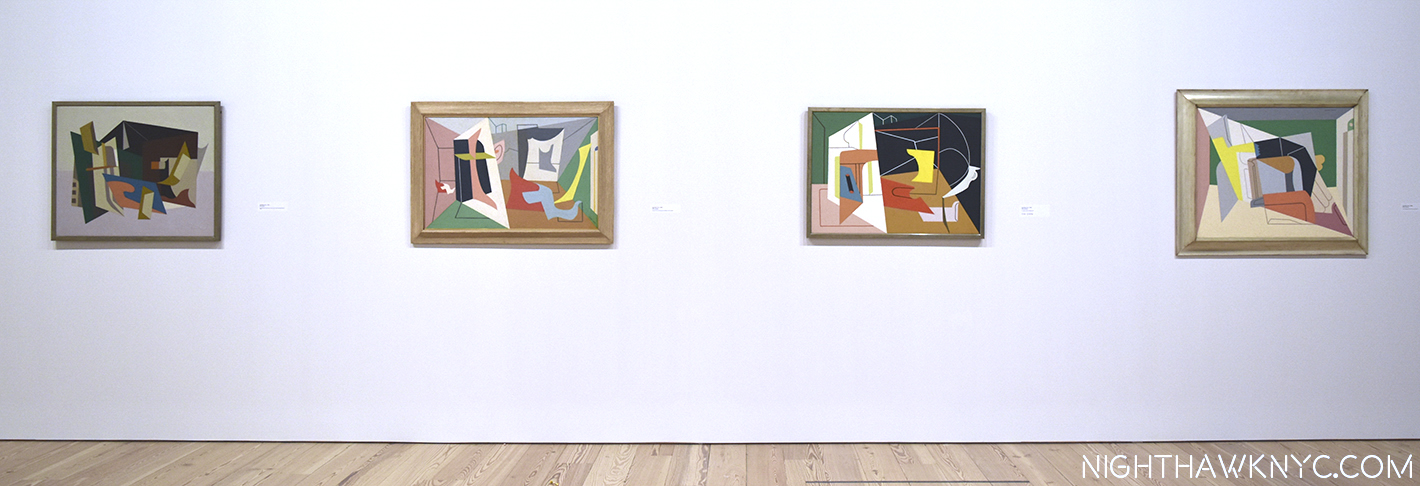
It turns out to have been worth the wait. With 75 works ranging from 1923 until his final work left unfinished on his easel the night he died in 1964, we get to see much, if not all, of his accomplishment. The 1991 Met show featured 175 works, 31 before the earliest work in this show. While I’m a bit disappointed the show is missing the first decade of his work, (the title “Stuart Davis: In Full Swing” refers to his career being in full swing during the period of his work displayed), what’s included has been marvelously hung adding much insight into Davis’ process and development.

Davis' seminal 4 "Egg Beater" Paintings, 19__, rarely united

Davis’ seminal 4 “Egg Beater” Paintings, 1927-28, rarely united.

…I nailed an electric fan, a rubber glove and an eggbeater to a table and used it as my exclusive subject matter for a year.” Egg Beater No. 4," 1928

Breakthrough. “I nailed an electric fan, a rubber glove and an eggbeater to a table and used it as my exclusive subject matter for a year.2” Egg Beater No. 4,” 1928

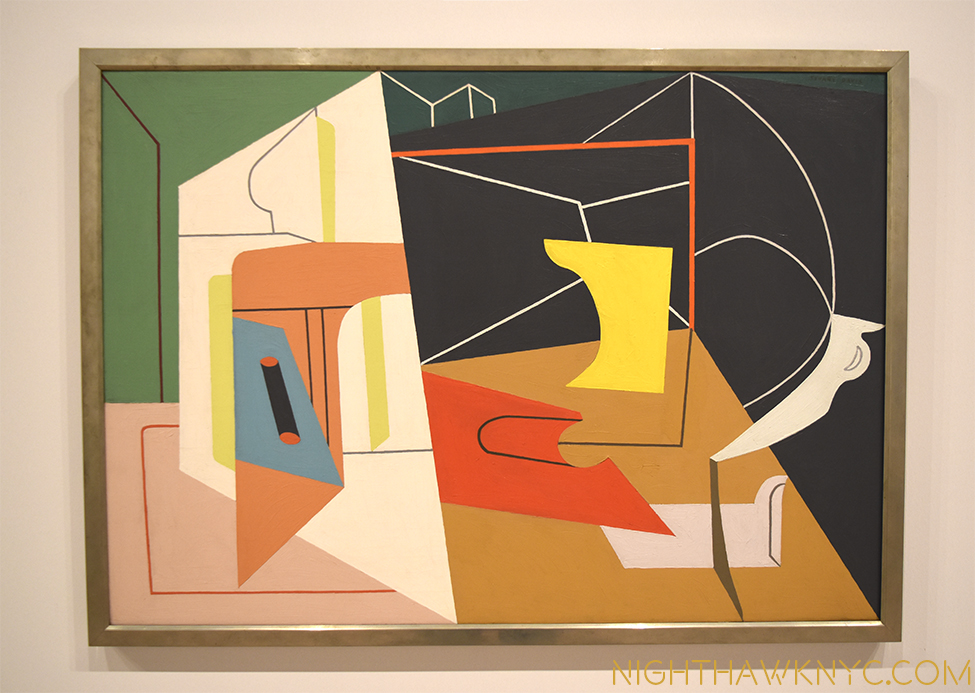
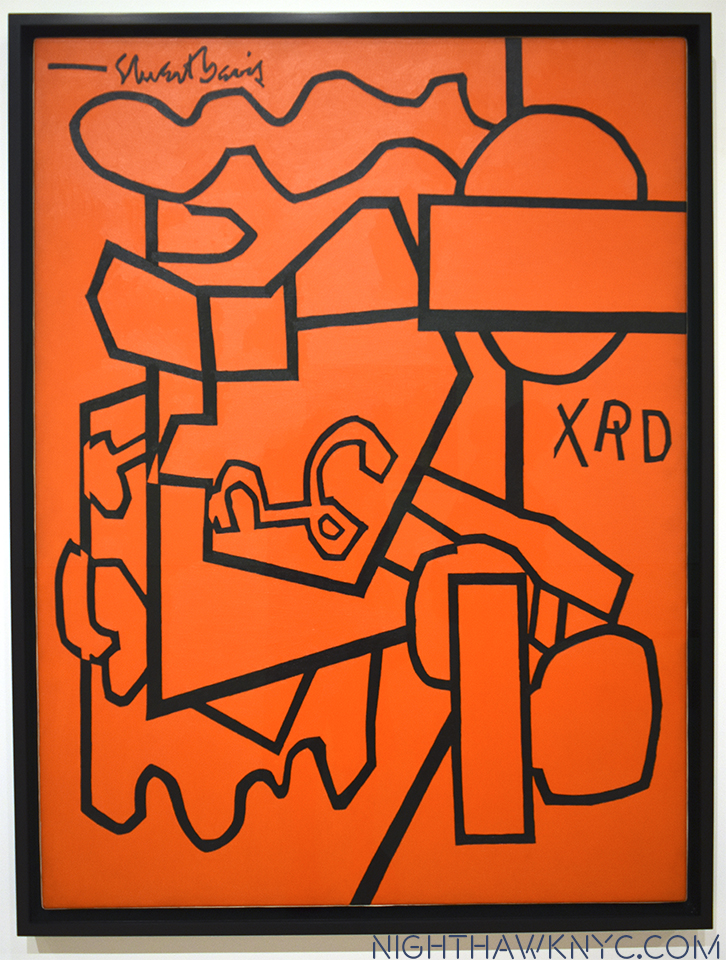
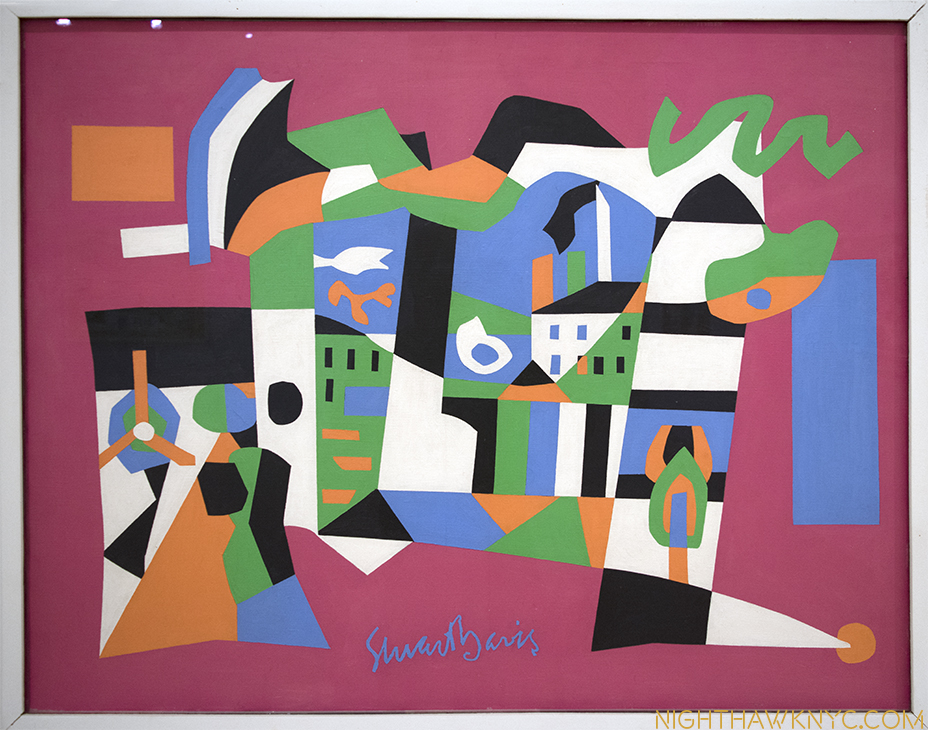
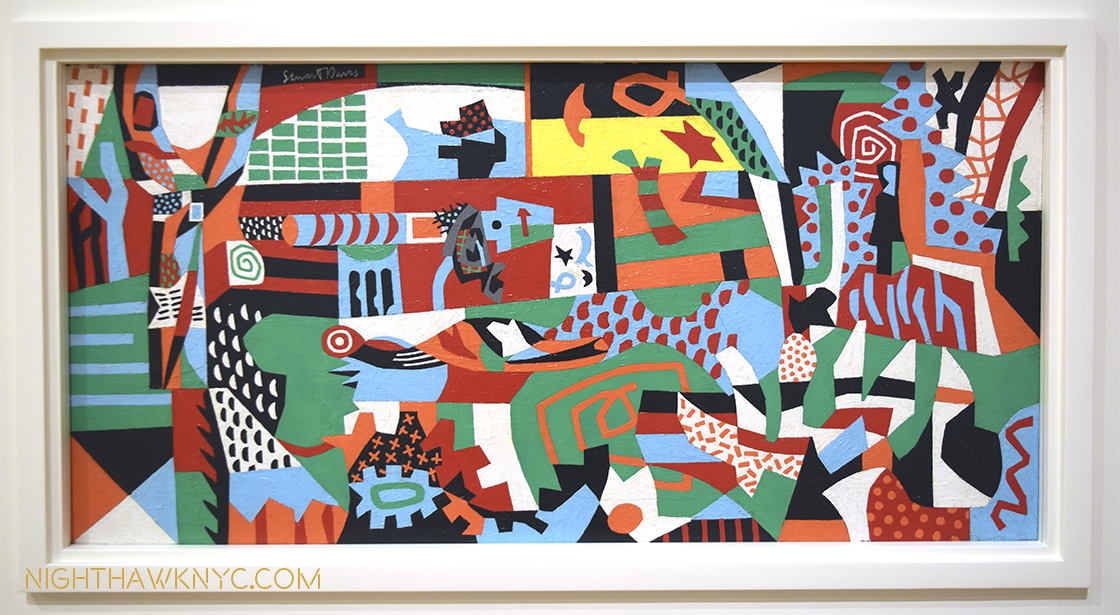
Beyond this, it’s simply gorgeous to behold. Davis, the colorist, is  something not often  spoken about, and for me, is under-appreciated. His work needs to be seen in person, where his color makes a vibrant, stunning, often shocking first impression- even in 2016. Looking closer, it becomes apparent that though he uses relatively few colors and repeats them from piece to piece he is a master of color schemes. Has any American Artist used Yellows or Oranges the way Davis has?

"Cliche," 1955

“Cliche,” 1955

Having come out of the end of the era of  “Ashcan School,” Davis’s early work, often depicting street scenes of the greater New York area, shared their darker palette. Here and there he’d inject very bright passages of color, as in “Bleecker Street,” 1912. Soon, they would dominate as the influence of the Europeans, the Cubists 3, and Joan Miro took hold, his palette brightened. Matisse was also an early influence, and  even in the 1950s, Davis’ work features shapes that echo those found in Matisse’s late Cut-Outs.

dsc_2983nefpnh

“Midi,” 1954

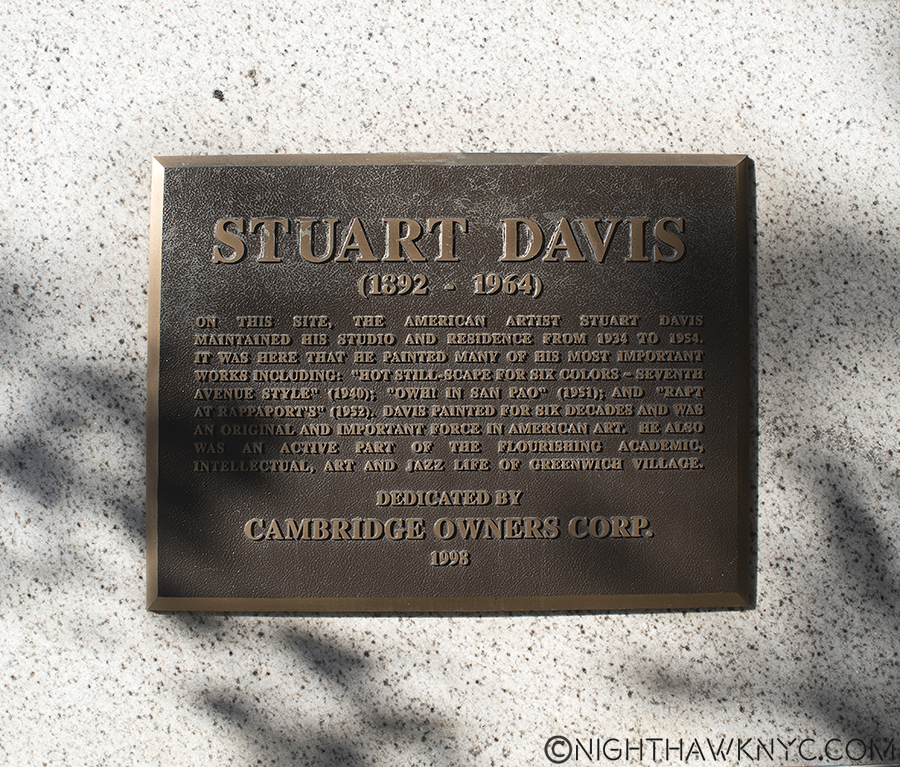
The title “Stuart Davis: In Full Swing” is a double entendre, also referring to his love of Jazz- “swing” being the most popular form of the music in the 1920’s and 1930’s. Stuart Davis loved Jazz. As I wrote not all that long ago upon accidentally discovering where he lived for 20 years in Greenwich Village, it was, coincidentally or not, around the corner from some of the greatest jazz clubs in the world4.

DSC_7025P2NH

The plaque outside Davis’ home of 20 years where he created works that have “come home” to the nearby Whitney.

Looking at his work, it’s clear that he “gets” what it’s like to play Jazz, what goes on in the mind of the musician or singer, and it comes out of his hands, like it does for musicians, too.

Davis In Full Swing. "Swing Landscape," 1937

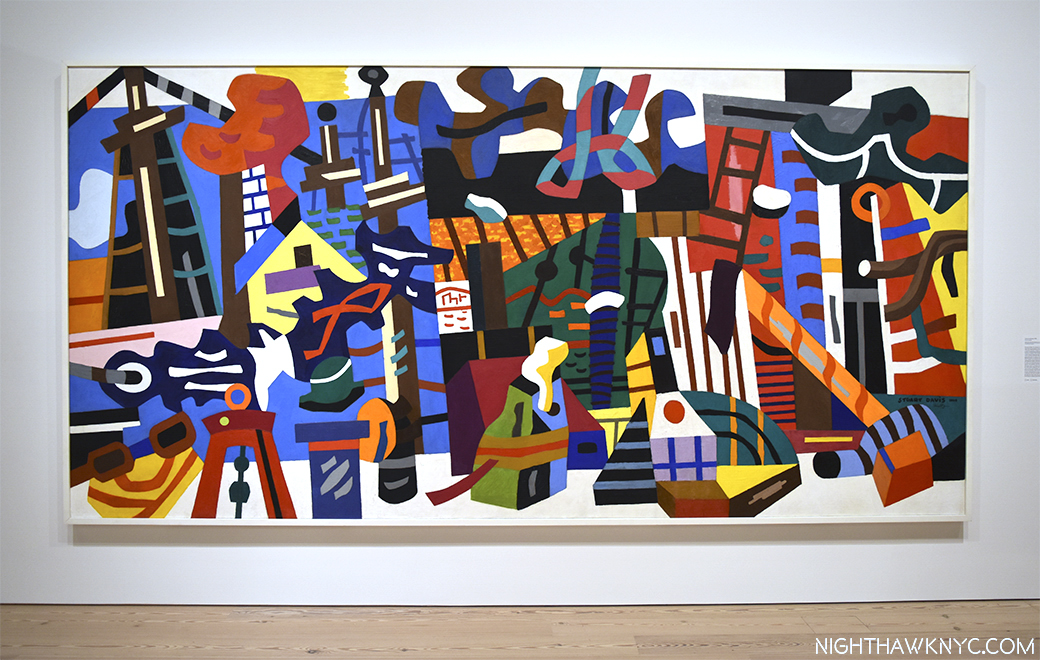
In Full Swing. “Swing Landscape,” 1938, over 14 feet long, the largest work here, originally intended for a Brooklyn Apartment Building.

Walking around, I spent quite a bit of time trying to associate Davis’ work with specific Jazz Artists. While I found there were many who came to mind for specific works, I came to feel that Davis’ work was ahead of it’s time, musically, as well as visually/Artistically. His shapes seem to anticipate the angular developments of Musicians like Thelonious Monk and Andrew Hill. Standing in front of a work like “Swing Landscape,” 1938, an endlessly fascinating blend of nautical visual motifs in a riot of color, the feeling is like listening to a great Big Band. Take Duke Ellington’s or Count Basie’s classic Big Bands that were chock full of unique soloists. each one with a recognizable solo voice. When Lester Young soloed on Tenor Sax for Basie, there was no doubt who was playing. Same for Johnny Hodges, “Tricky” Sam Nanton, Ben Webster, or Bubber Miley with Duke, not to mention Duke and the Count, themselves. Looking at “Swing Landscape,” is like hearing a big band to me, a band comprised of unique voices (colors on shapes), each playing their own part, but still a part of the whole. There is an overriding feeling of joy, and life. But, there were other works that looked to me more like the music of non-swing Masters Art Blakey’s Jazz Messengers and even early Ornette Coleman. Though I mixed them in, and many others, I found myself repeatedly returning to Duke Ellington, one of the greatest composers of the century, in any style of music, who also continually pushed and evolved his style, taking the Big Band to many other places musically, like Davis did with Cubism, as the soundtrack for my visits.

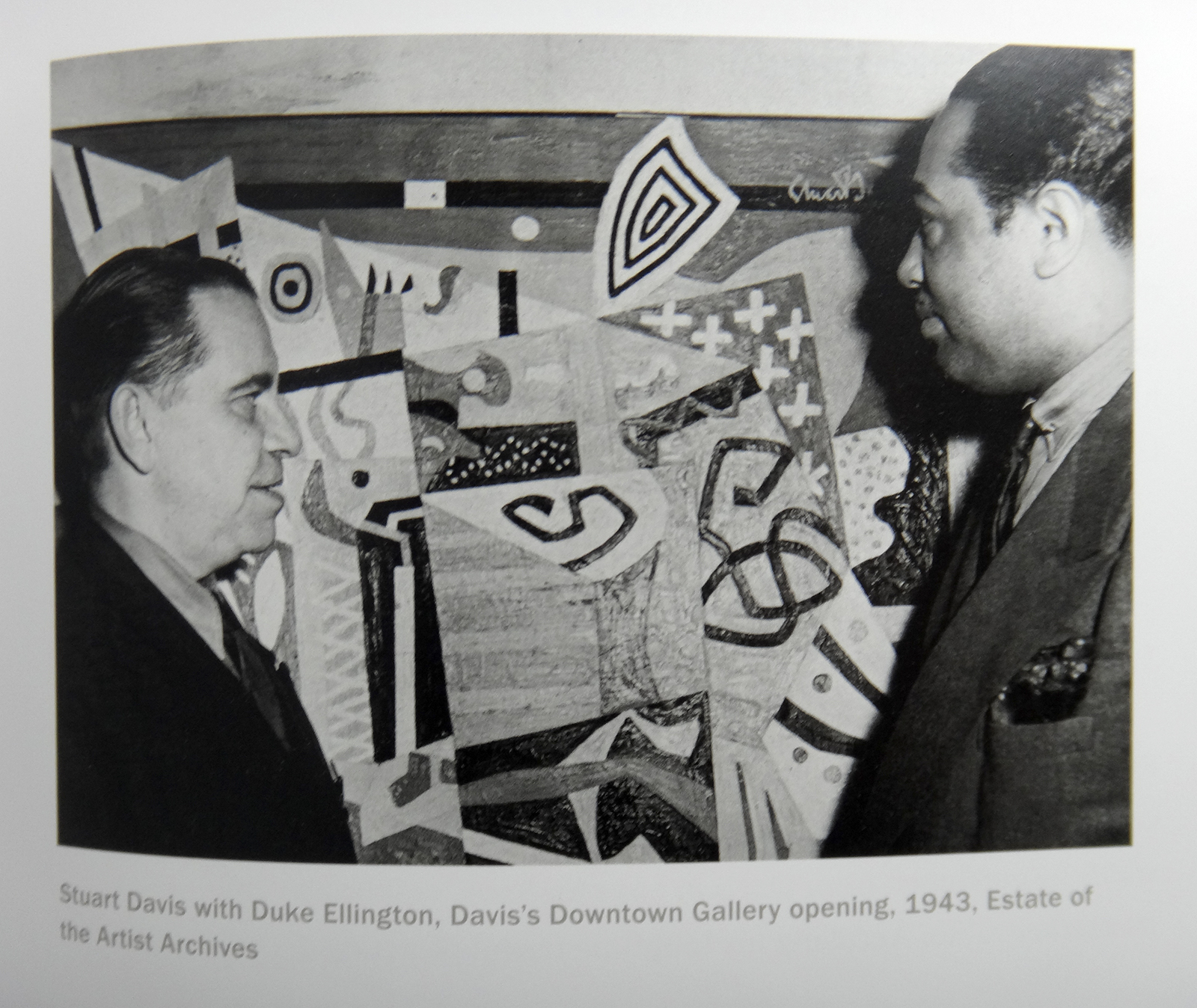
Stuart Davis with Duke Ellington, 1943, from the show's catalog.

Let’s talk about Jazz. Stuart Davis with Duke Ellington at a Davis show, 1943, from this show’s catalog.

Also like a Jazz Artist, Davis returned again and again to earlier compositions and “riffed” on them, as Patricia Hills said 5. Davis re-interpreted his earlier compositions the way Jazz Artists reinterpret standards- using his original theme as a jumping off point to create something entirely new.

Progress in the Process. All 3 of these works are based on the center work from 192_. Left, 195_ and 19__, right

Riffin’ on a Theme. All 3 of these works are based on “Landscape, Goucester,” center, as follows.

dsc_3001pnh

“Landscape, Goucester,” 1922…

"Colonial Cubism," 1954

Became this- “Colonial Cubism,” 1954

dsc_2996pnh

And then, this- “Memo, #2,” 1956

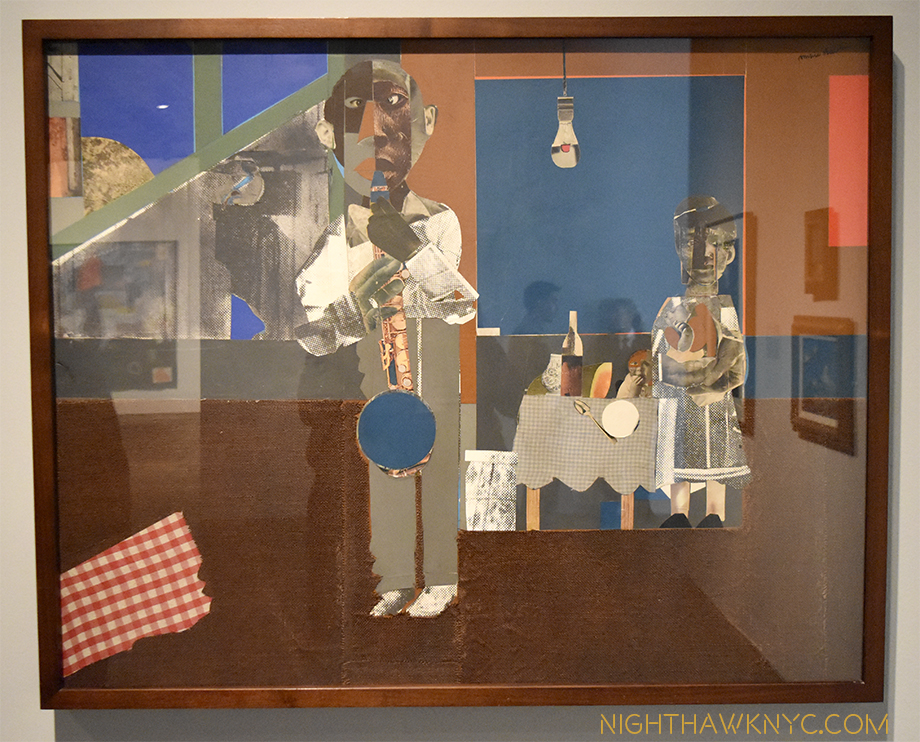
In terms of Jazz in Art, I can’t think of another Artist who has a similar effect on me. Other Artists listened to Jazz, during the same time and later, but Stuart Davis’ work looks like Jazz to me. I get that feeling from isolated works by other Artists, especially that of Romare Bearden, who Davis told to visualize the relationships between jazz and art in 1940, though his works are primarily collages, not paintings, but Davis’s whole body of work, with rare exception, gives me that feeling6.

Blue Note. "The Woodshed," 1969, collage by Romare Bearden. The "Woodshed," or "Shed" is where musicians hone their craft.

Blue Note. “The Woodshed,” 1969, collage by Romare Bearden, at The Met Breuer.. The “Woodshed,” or “Shed” is where musicians hone their craft.

Yet, there’s more going on here than Jazz.

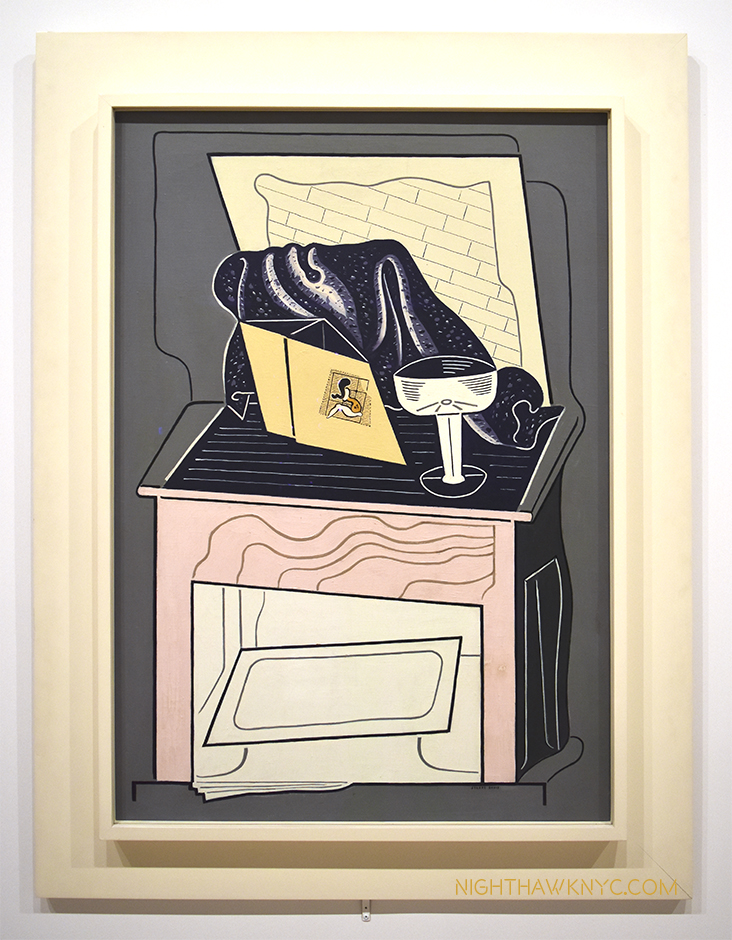
Revolutionizing the still life. “Super Table,” 1924. For me, the earliest masterpiece in this show.

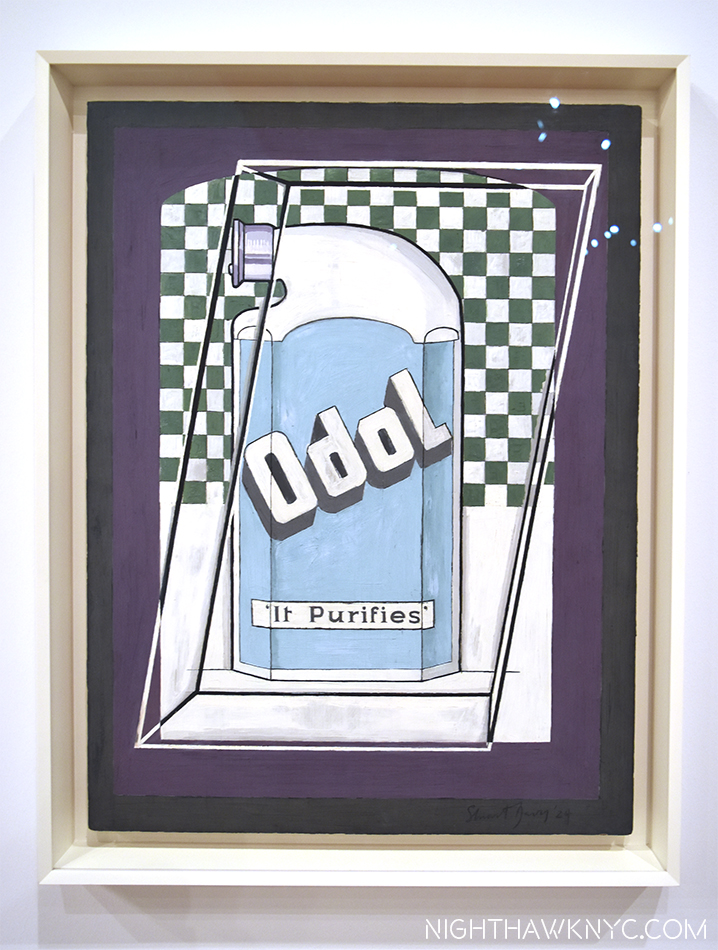
We watch Davis breaking through and coming into his own in works like “Super Table,” 1924, and the “Egg Beater” series of 1927-28, which were revolutionary takes on the Cubist “still life,” that proved to be the jumping off points for all his future work that would see him develop his own approach to Cubism, becoming one of the very few outside of the inventors of the style to do so. While he built upon the influences of others, he was very influenced by place and environment as well. His 1928 trip to Paris crops up again and again in his later work. His summers along the water in Gloucester, Mass supplied a life long reservoir of nautical imagery, as did, NYC, while Jazz provided inspiration. Products appear in Davis’ work, possibly evolving out of the still life works of the Cubists, but quickly becoming his own. He then takes words, first seen in ads and on products, and uses them in new ways, sometimes referencing the “hip” jargon of the time, sometimes cryptically, that only he really understands.

"Odol," 1924, a bottle of mouthwash, presaging Warhol by 35 years.

“Odol,” 1924, a bottle of mouthwash, presaging Warhol by 35 years.

A walk through the show reveals that Pop Art, and a number of it’s leading lights were creating work that featured elements Stuart Davis began using way back in the 1920’s. In fact, after seeing it, you may never look at Andy Warhol, Roy Lichtenstein, Jasper Johns or James Rosenquist quite the same again. Beyond his use of products, his use of words is something that many Artists since Davis, right up to Ed Ruscha, Jenny Holzer and Wayne White, have continued, some basing their entire Artistic output on them. While his influence is huge, it’s also interesting to me how different his work is from the work of the other Abstract Artists of his time, especially the Abstract Expressionists, who were then working right around him every day in NYC and it’s suburbs. Philip Guston speaks of knowing him 7. What about Jackson Pollock, (who was born, lived and work, then died during the time Davis was alive)? Did Davis know him? It would seem to me they must have met, especially since they both worked for the WPA (Works Progress Administration). It’s hard to imagine two more different Abstract Artists.

The end. "Fin," 1962-64, as it was left on his easel when he died.

The end. “Fin,” 1962-64, as it was left on his easel when he died. The yellow-ish lines are masking tape Davis used as guides.

dsc_2690pnh

“Arboretum by Flashbulb,” 1942

It must also be mentioned that Mrs. Gertrude V. Whitney was a substantial, and early, supporter of Davis, in a number of ways, both financially (buying his Art and advancing him funds) and through the Whitney Studio Club, the precursor of the Whitney Museum, where he got his “big break,” 8 with a 2 week retrospective exhibit in December, 1926. 90 years later, Davis returns to the latest incarnation of the Whitney Museum, a few minutes walk from where he once lived, something of a “champion” of American 20th Century Art, himself. His influence is ongoing. His achievement is still being considered. Yet? All in Stuart Davis’ Legacy is not painted in the bright colors he used so masterfully in his work.

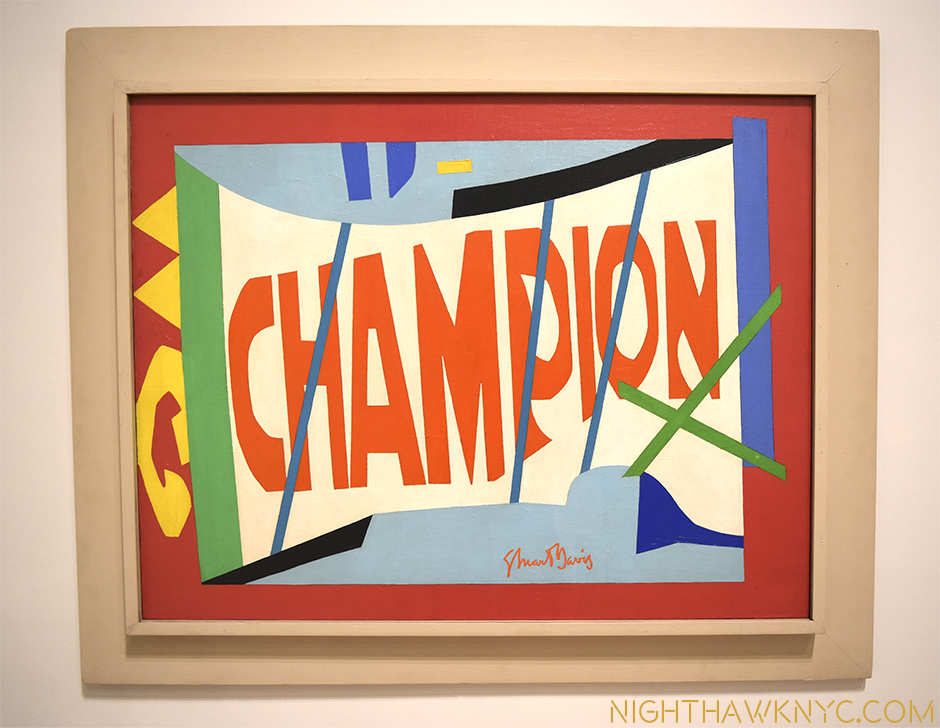
"Little Giant Still Life," 1950, a box of "Champion" matches

“Little Giant Still Life,” 1950, a box of “Champion” matches.

While the joy, beauty and insights this show provides will stay with me for a very long time, it’s impossible not to also be reminded of the fact that 90 works by Stuart Davis were discovered to have been “looted” 9 from the Artist’s Estate by Laurence Salander of Salander-O’Reilly Gallery, the long time dealer for Stuart Davis’ Estate, in 2007. The court ruled that Salander owes Earl Davis and the Estate $114.9 million dollars, but being as Salander is behind bars on Riker’s Island no one knows if and when any of that money will be repaid. As bad as that is, perhaps even more tragically, to this day, I’m not sure that all of Davis’ works have been accounted for. The case led to the creation of new laws pertaining to Artist/Gallery dealings. That is the saddest part of what is otherwise the great and ongoing influence that is the legacy of Stuart Davis, one of America’s greatest, and most influential, Artists.

Even his beautiful signature, boldly featured in many of his works, has the peaks and valleys, the ebbs and flow, of a Jazz solo.

*-Soundtrack for this Post is “It Don’t Mean A Thing (If It Ain’t Got That Swing)” by Edward Kennedy “Duke” Ellington, the title of which appears on Davis’ painting “Tropes de Teens,” 1956.

NighthawkNYC.com has been entirely self-funded & ad-free for over 8 years, during which 300 full length pieces have been published! If you’ve found it worthwhile, PLEASE donate to allow me to continue below. Thank you, Kenn.

You can also support it by buying Art, Art & Photography books, and Music from my collection! Art & Books may be found here. Music here and here

Written & photographed by Kenn Sava for nighthawknyc.com unless otherwise credited. To send comments, thoughts, feedback or propositions click here. Click the white box on the upper right for the archives or to search them. Subscribe to be notified of new Posts below. Your information will be used for no other purpose.

  1. I’m not wagering “anything” on this, so if you find one that doesn’t have a Stuart Davis, write me and let me know and I’ll send this Post to them to hopefully influence their future purchases!
  2. Stuart Davis “Autobiography” in “Stuart Davis” edited by Diane Kelder, P.26
  3. Davis, 21, was the youngest artist to be included in the legendary Armory Show of 1913, the first modern art show in America, which marked the arrival of Cubism in New York.
  4. His parents had lived in the Hotel Chelsea, 11 blocks north.
  5. “Stuart Davis,” by Patricia Hills, P. 19
  6. I am only talking about Artists who were/are Painters first, so I am leaving out Musician/Artists like Miles Davis, Art Blakey, Tony Bennett, Muhal Richard Abrams, Anthony Braxton, Roscoe Mitchell, et al..
  7. Guston “Collected Writings” P.40
  8. according to Patricia Hills “Stuart Davis” P.73
  9. Artnews April 18, 2014

NoteWorthy Shows-October, 2016

As a counterpoint to my longer pieces on big shows, here’s something else-  shorter looks at some especially Noteworthy Shows that I’m not going to have the time to do the full pieces on that they each deserve, but that I want to bring to your attention.

Post-Labor Day has seen things quiet down on the NYC Museum show scene, after an insanely busy summer. The action has turned to the galleries. Here are some shows I saw recently that I was especially impressed with, in no particular order-

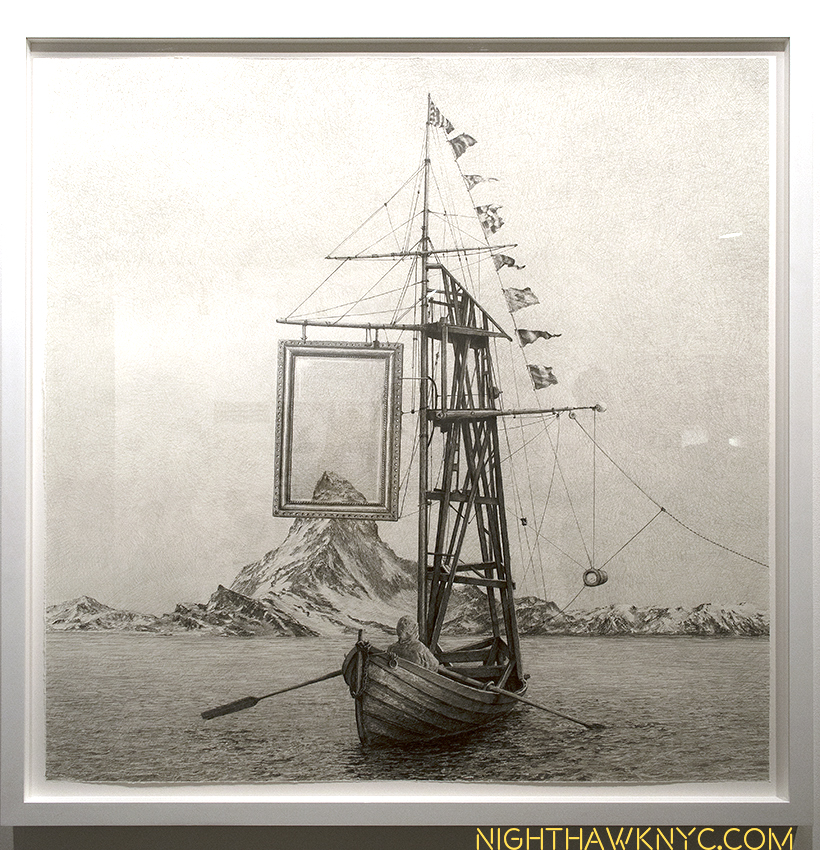
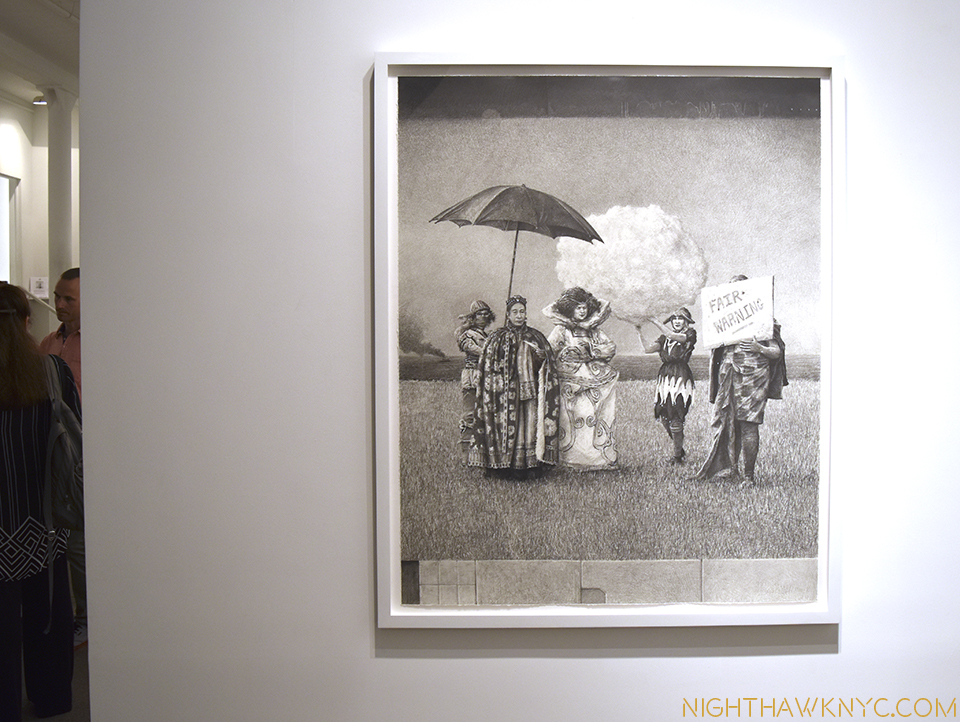
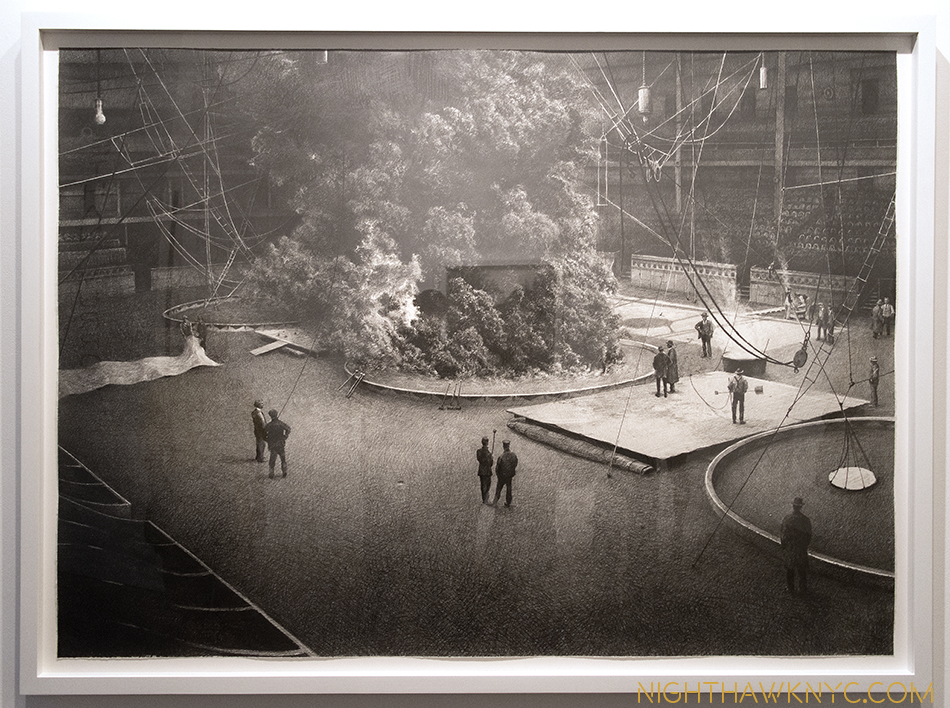
Ethan Murrow: Water Almanac” @Winston Wachter. A show of very large drawings(!) about the folly of man trying to control nature, many featuring water, shown in a space that was partially submerged almost 3 years ago after Hurricane Sandy, destroying some of Mr. Murrow’s work. When I pointed out the irony of it to him, he responded, “At least they weren’t people,” he said referring to his lost work. When I asked him why he draws instead of paints he spoke of the minimal amount of materials necessary. His work has wonderful elements of the Surrealism of Max Ernst and Bruce Conner that he makes seem everyday real world.

"Deluge Estimator," 2016, graphite on paper

Ready for the next Sandy? Hmmm… “Deluge Estimator,” 2016, graphite on paper

Ethan Murrow (in orange shirt) at his opening.

Ethan Murrow (just to the left in orange shirt) at his opening.”Hail Cannon Rainmaker,” 2016, graphite on paper, 60 x 48 inches, right.

"To Redirect the Tempest," 2016, graphite on paper

“To Redirect the Tempest,” 2016, graphite on paper, 52 x 72 inches

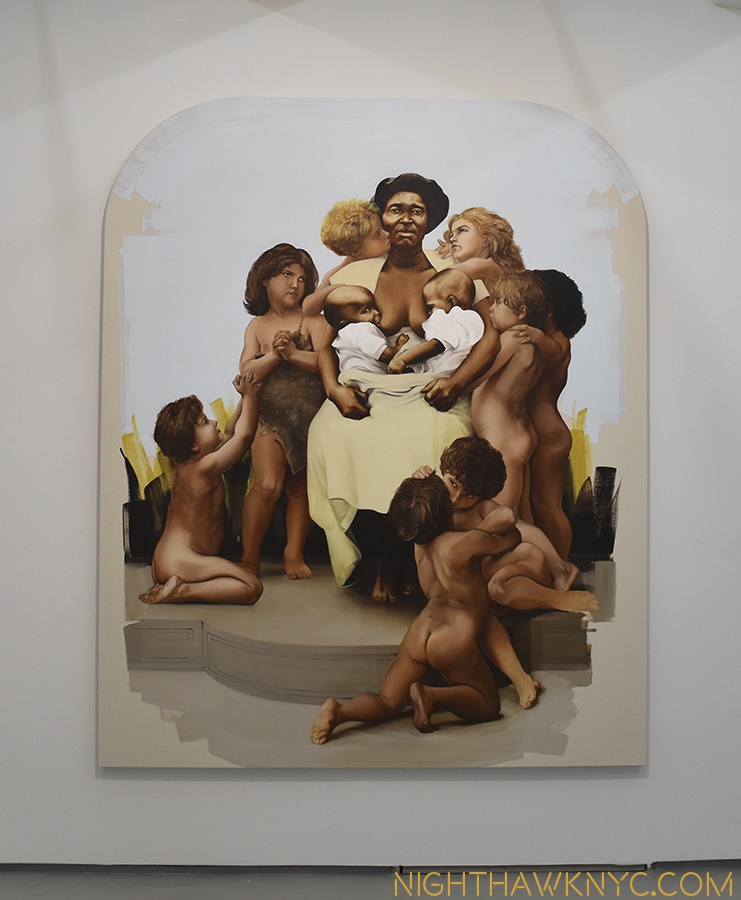
Meleko Mokgosi: Democratic Intuition” @ Jack Shainman Gallery. I’d write something about this, if I could ever finish looking at it and thinking about it.

img_6684pnh4

“Democratic Intuition- Comrades II,” a very large work

And seen at the show's 2nd location.

And as seen at the show’s 2nd location.

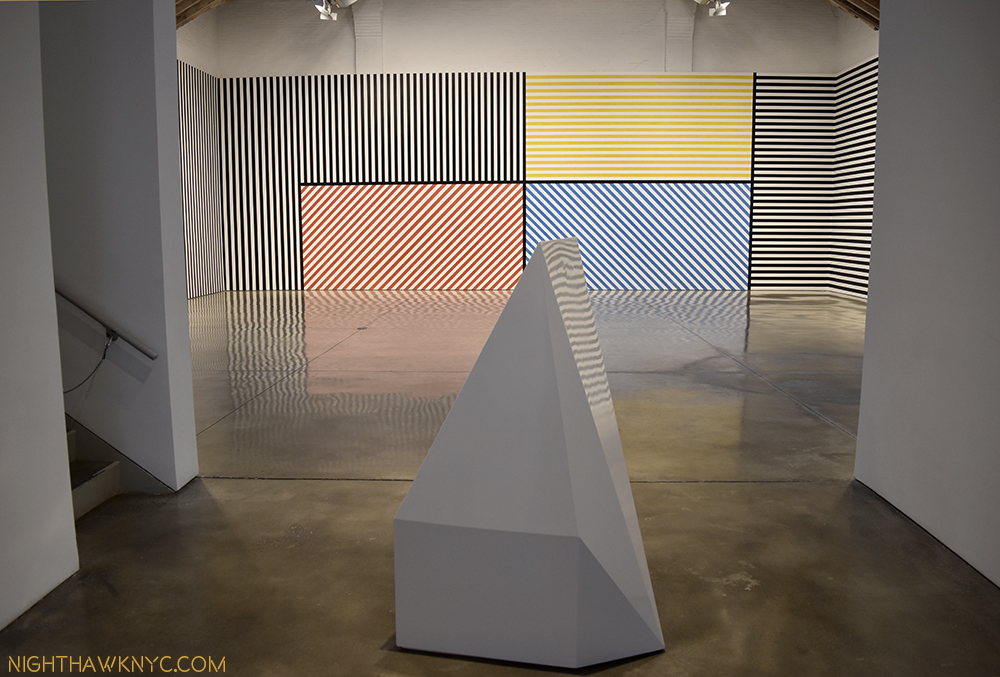
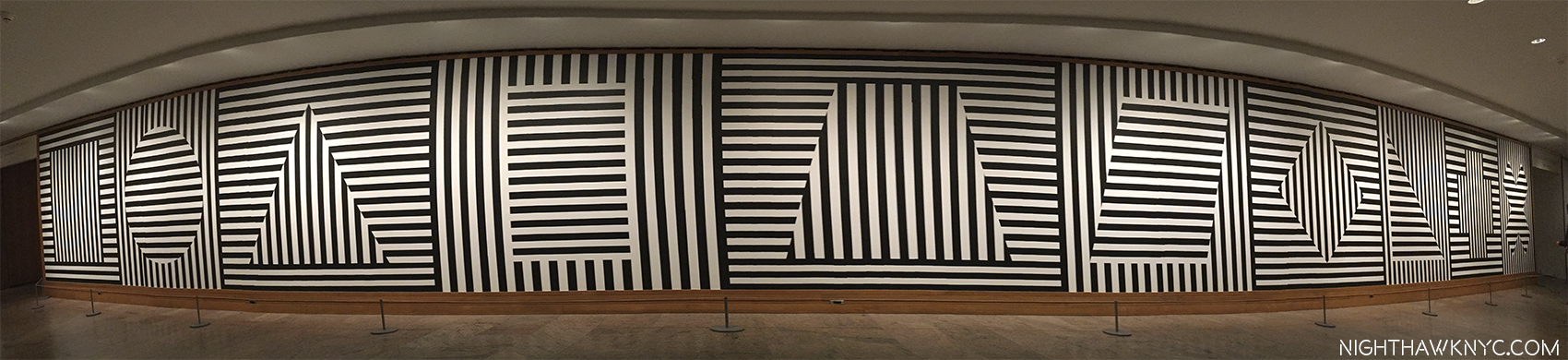
Sol LeWitt” at 3 Paul Cooper Gallery Locations, Pace Prints, and The Met. Yes, no less than 5 simultaneous shows featuring Lewitt’s drawings, scultpture, photography, collages, prints and, suddenly ubiquitous wall drawings (not to mention the permanent one on view in the NYC Subway at 57th Street & Columbus Circle!).

"Complex Form #65," 1989, painted wood, 59 x 38 x 40 inches, in front of "Wall Drawing #368" @ Paula Cooper.

“Complex Form #65,” 1989, painted wood, 59 x 38 x 40 inches, in front of “Wall Drawing #368” @ Paula Cooper.

Detail

Detail

"Wall Drawing #370" as seen at The Met

“Wall Drawing #370” as seen at The Met

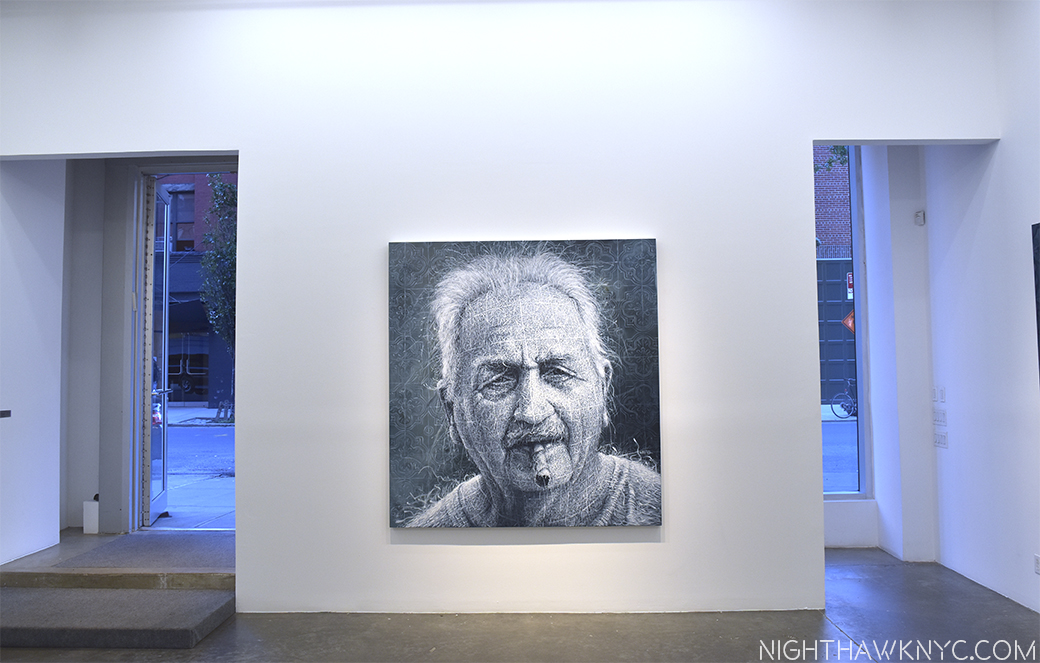
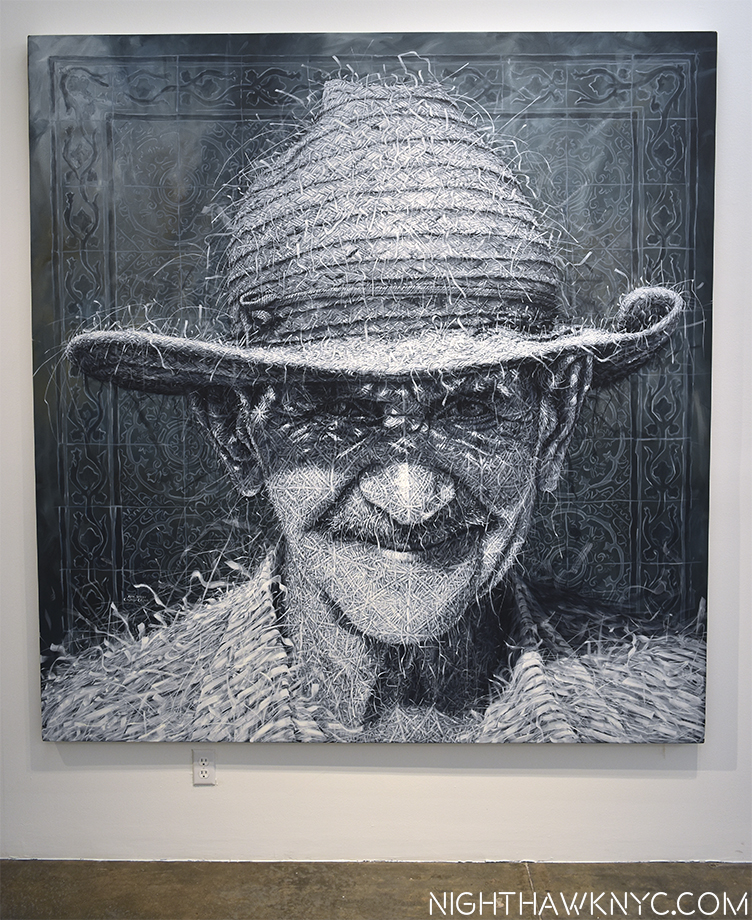
“Alexi Torres: Sun Light” @ UNIX Gallery. No mere photo-realistic interpretations of source photos here. Visions- exquisitely executed.

"Sun Light-Ernesto," 2016, oil on canvas

“Sun Light-Ernesto,” 2016, oil on canvas, 72 x 68 inches

"Sun Light-Miguel," 2016, 84 x 80 inches, oil on canvas

“Sun Light-Miguel,” 2016, , oil on canvas, 84 x 80 inches

dsc_8734pnh

Detail

Miguel- Source Photo

Miguel- Source Photo

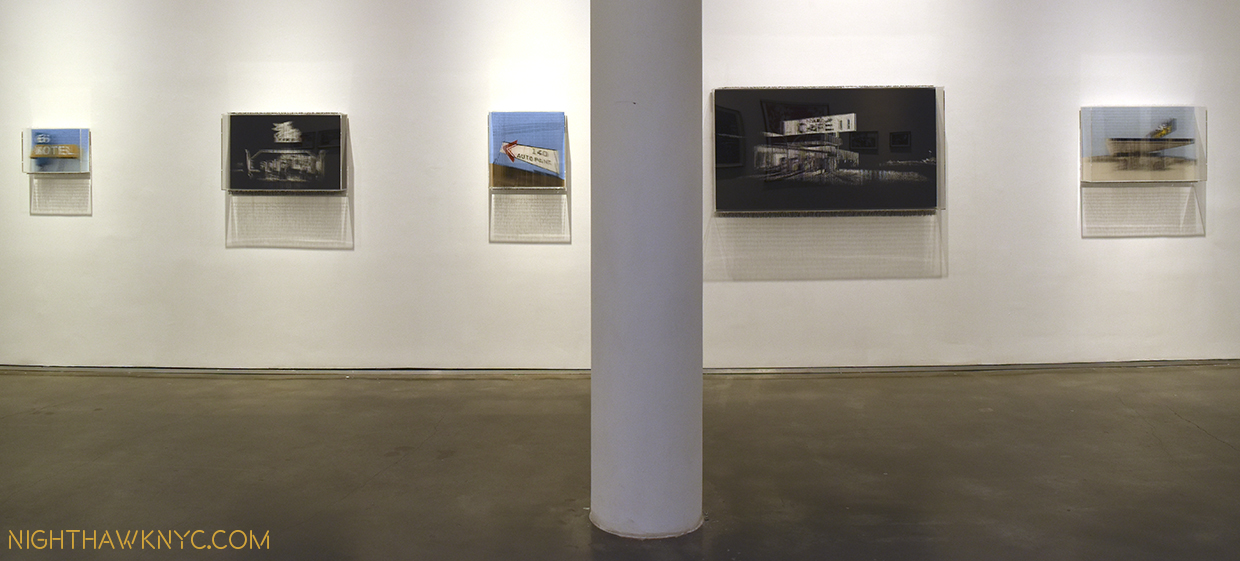
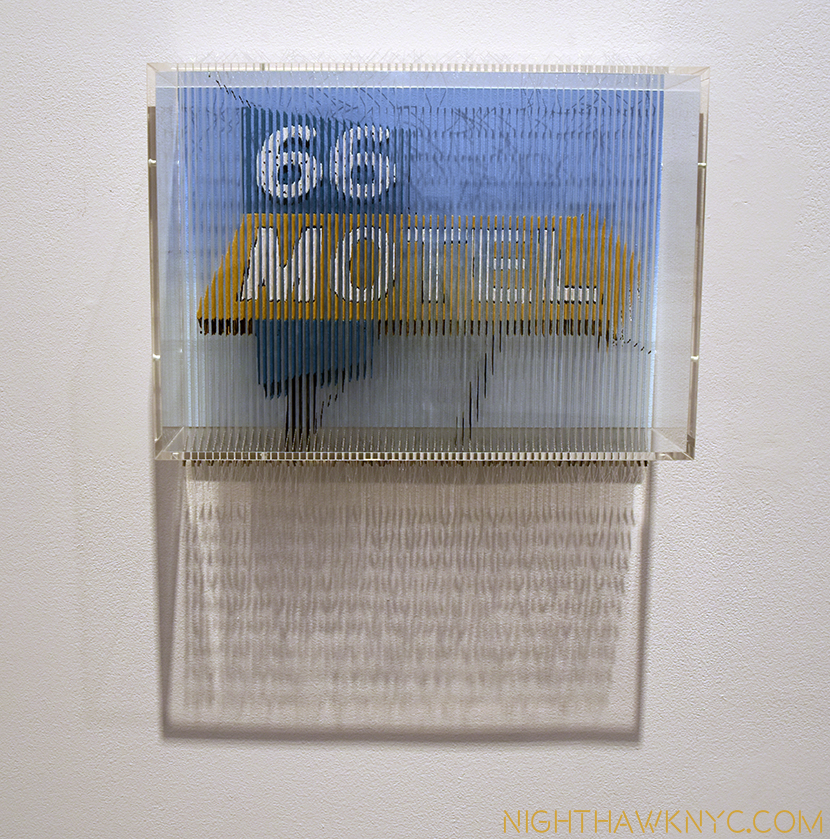
Robert Currie in “Mind Storm” @ Bryce Wolkowitz. A name new to me. As close as I can gather, Robert Currie applies paint to monofilament thread in rows, which can be seen from the side, or in their reflections, below the works. The image can only really be seen from directly in front. Somehow, they still manage to evoke the sense of the place as well as the sense of a bygone era.

Installation View

Installation View

"17,820cm of nylon monofilament and acrylic," 2016. That's 590 feet.

Entitled- “17,820cm of nylon monofilament and acrylic,” 2016. That’s 590 feet of it in a work that’s 12 x 16 x 5 inches.

dsc_8790pnh

Side view

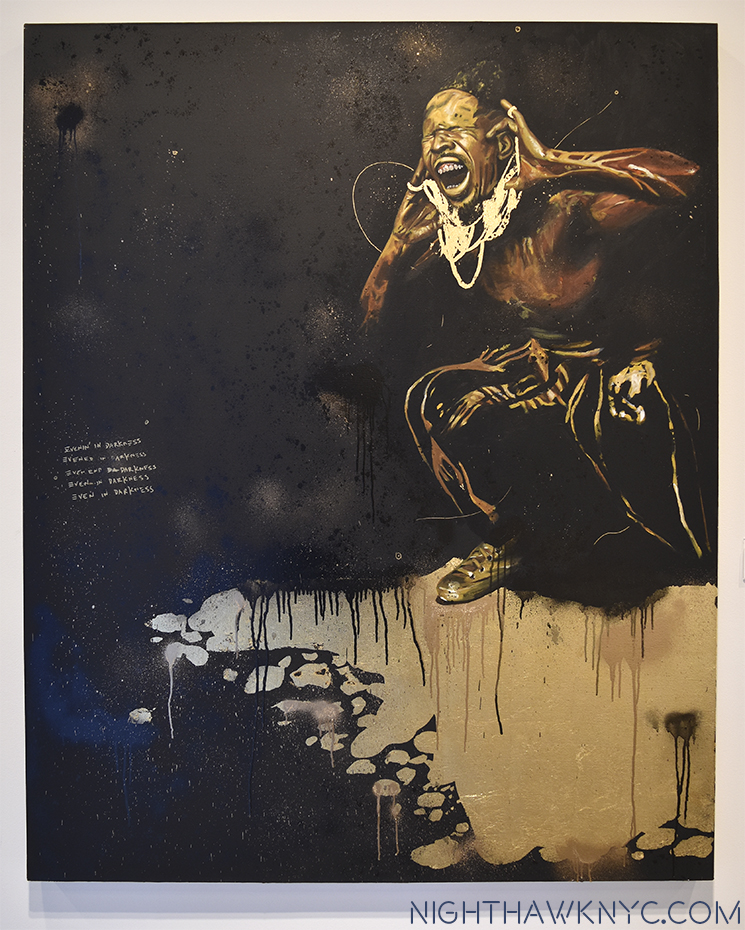
Fahamu Pecou: #BlackMatterLives” @Lyons Wier Gallery. Prolific and multi-talented, this could be a breakthrough show for him. Powerful. Gorgeous rawness. Present tense.

dsc_9124pnh

“Even In Darkness,” 2016, acrylic, spray paint, gold leaf on canvas, 60 x 48 inches

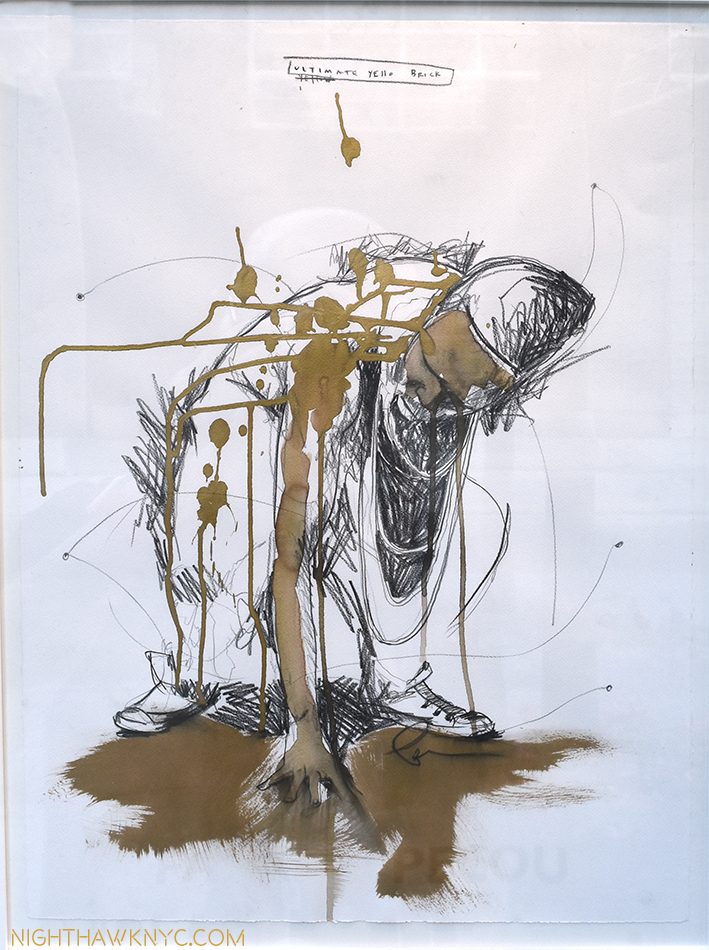
"Ultimate Yello Brick," drawing

“Ultimate Yello Brick,” 2016, graphite and iridescent ink on paper

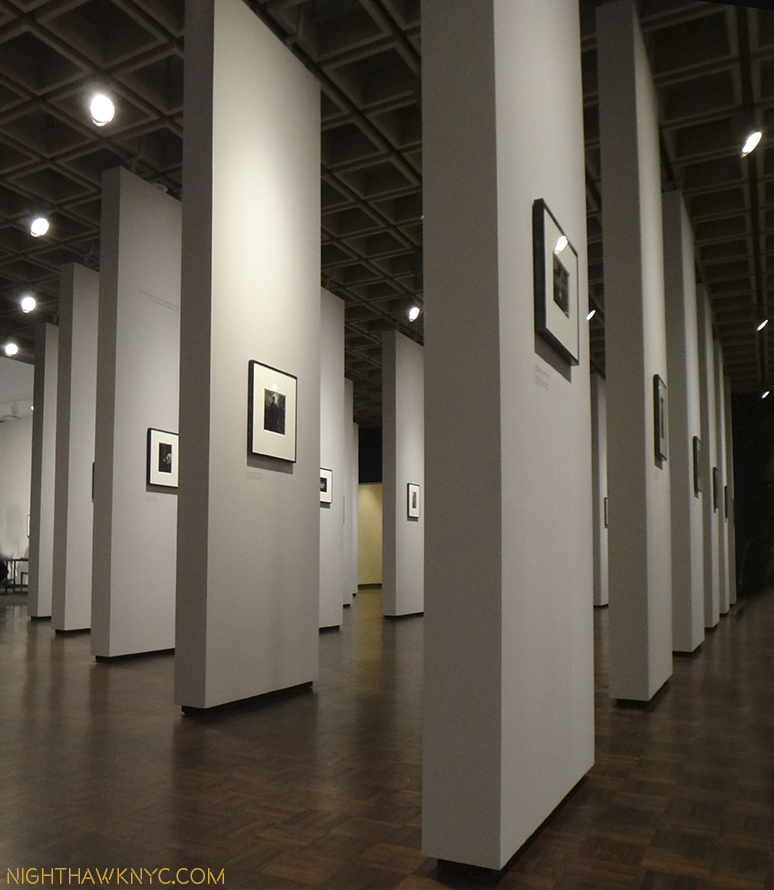
And- “diane arbus: in the beginning” @ The Met Breuer. Memorable as much for the show’s content as for it’s innovative display, Ms. Arbus’ beginnings show the Artist’s eye fully formed. Each of the 100 plus images on view is given it’s own wall- a side of a “mini-pillar” that allows the viewer to move through the show any which way they want to. Ingenious and ground-breaking, it’s more a case of The Met showing off it’s construction capabilities and resources more than “why didn’t anyone else think of this before?”

There is no "recommended" way to see this show.

There is no “recommended” way to see this show.

Especially noteworthy for me was a photo of my late friend, the legendary Stormé DeLarverie,, titled Miss Stormé DeLarverie,The Lady Who Appears to be a Gentleman, NYC, 1961. I knew Storme during the final decade of her life, and she had told me that Diane Arbus had photographed her, though I had not previously seen it. I took it with a grain of salt, given to tall tales as she was on occasion (will we ever know if she really was the “cause of,” or started, the Stonewall Uprising, not “Riot”, which I heard her claim she was?). But, there she is, sitting elegantly on a park bench in 1961, immortalized for all time, in the permanent collection of the Metropolitan Museum of Art, and on view as part of this very good show at The Met Breuer. Diane Arbus had one of the greatest eyes in photography.

Storme, in full effect in 1961. 45 years before I would meet her.

Stormé, in full effect in 1961. 45 years before I would meet her.

Some of these shows are still up, some have just closed. And somewhere the singer is saying…

“’cause no one knows about a good thing
Until a good thing is gone.”

R.I.P- Stormé DeLarverie,. Get home safe, my friend.
*- Soundtrack for this Post is “No One Knows About A Good Thing” by Curtis Mayfield and Daryl Simmons, from Mayfield’s album “New World Order,” and published by Warner- Tamerlane Publishing Corp.

NighthawkNYC.com has been entirely self-funded & ad-free for over 7 years, during which over 275 full length pieces have been published!
I can no longer fund it myself. More on why here.
If you’ve found it worthwhile, PLEASE donate to keep it online & ad-free below.
Thank you, Kenn.

Written & photographed by Kenn Sava for nighthawknyc.com unless otherwise credited.
To send comments, thoughts, feedback or propositions click here.
Click the white box on the upper right for the archives or to search them.
Subscribe to be notified of new Posts below. Your information will be used for no other purpose.

Clearing Up My Glaucoma…And, A Major Mystery In Art History

This site is Free & Ad-Free! If you find this piece worthwhile, please donate via PayPal to support it & independent Art writing. You can also support it by buying Art & books! Details at the end. Thank you.

Written & Photographed by Kenn Sava (*- unless otherwise credited)

1. The Treatment

“I’ve been through worse.”

That’s the Mantra. I learned that after surviving cancer, and cancer treatment, nine years ago. “If I can get through that? I can get through this.”

Whatever “this” is.

It works! At least? So far. After all, what could be worse than cancer? That’s what I tell myself.

Blindness is up there. I have anatomical glaucoma. In both eyes. So, the risk is I could become partially blind at any time in either, or both eyes. On my second opinion, I find a doctor who says with 2 laser treatments he can give me a 100% chance of fixing it permanently.

Those are my kind of odds.

Today is Round 1. I got up insanely early for the Nighthawk. 10:30am. Uggh. As hard as that was for me, my friend had a harder road. In fact, 3 hours of one, on the bus down from Upstate New York to come with me. She was more worried that I’d oversleep than anything else, she said. We walked over to a “leading New York Hospital” on a glorious September Monday to experience one of the great joys of modern medicine- the registration line ALL patients must wait in. No matter what, no matter I had been there twice in the past few weeks, and no matter neither my health insurance nor living address change that often. The line was half as long as last time, but twice as slow moving. A guard came over and asked for my info. ? Since when? He relented, but the ex-military guy behind me in line got a bit set off when he tried it on him, which led to him feeling one of the counter clerks didn’t want to serve him. He requested a supervisor, and the clerk’s name to file a complaint. Good luck with that. The supervisor listened to him complain that said counter woman “picked up and put down the same paper repeatedly so as not to serve him.” I found this a bit odd, since I was in front of him in the line, and I was still waiting.

I fnally got to see a clerk, who wound up giving me all the paperwork, including her copy. ? Ok…Onwards to treatment, glad to be done with this chaos.

Upstairs, in glaucoma, the woman behind the desk never even looks up from her phone call to acknowledge me. She was making her case to someone about something that had happened at work. I put my paper on the desktop and made sure my friend was seated. The woman looked up long enough to tell me to take my paperwork, calling me by name. ? How did she know who I was?

We settled into the empty waiting room. After a bit, she pulled out an Art History book, and we started looking through it, and discussing it. Unawares, little by little, the room filled up around us, and we became surrounded by a range of mostly older people of all races and languages. A number of them appeared to be suffering from various mental issues, some so incapacitated they had assistants to speak for them, in addition to whatever eyesight issues brought them to the glaucoma department. Yet, there we were, lost in making comments back and forth about Ingres, Michelangelo, Leonardo, Hopper (who’s “Nighthawks” was on the cover. Good choice! Wink), and her favorite Artist, Chagall.

About 45 minutes later, (45 minutes past my scheduled appointment), I was seen by a technician. He checked my vision, then I came back out and we continued looking at Art. An older gentleman came in with a walker, sat down and proceeded to sing in full voice. This elicited looks from the staff, but nothing more. No one said anything. I turned to my friend and said, “Welcome to New York.” Luckily, he was quickly called, and a semblance of silence resumed. A young man walked in with a large pizza and a soda. “He’s a doctor,” my friend said. Yup. He was. A man walked back and forth behind the counter, from time to time, saying nothing nothing to anyone, and accomplishing…? The woman behind the front desk put on a mask. Her boss came over and asked her “Why?” She muttered something then kept it on throughout. A woman sitting next to my friend began to snore. Somehow, she managed to hear the soft announcement calling her name.

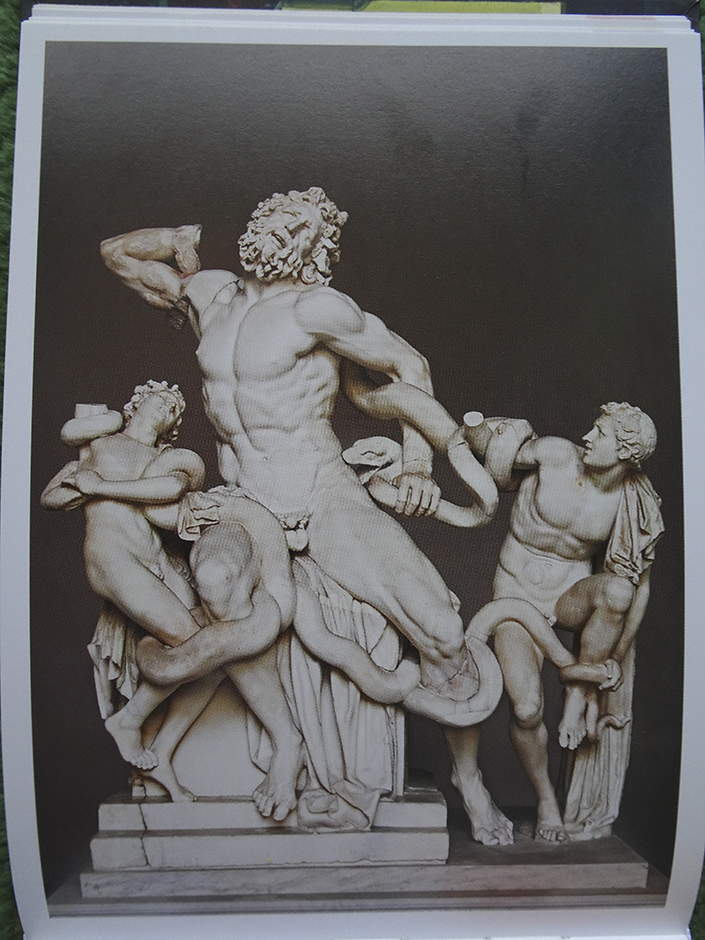
We continued looking at Art. Kandinsky, Monet, more Ingres, more Leonardo- the Mona Lisa looking wayyyyy better than you’d ever see it in person, and a few contemporary Artists I don’t know, capped off with Mark Rothko (the Rothko Chapel, important, but not representative as his only work shown) and Bridget Riley. There was also the Laocoön & his sons, in a full page photo. All of a sudden I had one of those Sherlock Holmes-“Wait a minute!” moments. “Oh My God. LOOK AT THAT! It’s a Michelangelo!,” I thought to myself when I saw it.

"Laocoon" from "When Art Really Works," published by Barron's

The photo in question from “When Art Really Works,” published by Barron’s.

“Hello? Can we put the glaucoma treatment on hold? I may have discovered a Michelangelo, right here in the waiting room!,” I said in thought. We paused and I said (out loud) to my friend that the Laocoön was a huge sensation when it was discovered, instantly recognized as a lost supreme ancient masterpiece, and that there was a theory that Michelangelo had secretly created it.

Hmmmm…

At that moment, I was called to have drops put in before the procedure. 30 minutes later, at 2pm, I was called back for the treatment. 2 doctors surrounded a machine with arms, scopes and all kinds of things sticking every which way. I carefully wiggled onto the odd stool I was to sit on, which required a bit of contorting, hoping I could hold my head steady sitting on it. After all, I didn’t want them to miss with the laser! A nurse was present to make sure I was who they thought I was. She asked questions only I would know, I guess- “Why are your Posts so long?” “Why do you stay up so late?” Ummm….Doctor 1 drew a dark mark on my head over my left eye in the dark room. “Chin up. Lean forward. Look at the yellow light.” Inside the machine I was bombarded by bright flashing red and green lights, a slight squeezing sensation and then it was over. “Perfect,” Doctor 1 said when I asked him how it went.

Phew. Exhale. I have been through worse. Score another one for the Mantra!

Back out to wait to get a blood pressure reading. “Am I bleeding,” I asked my friend. “No,” she said. I was bloodshot, and a bit sore. Things were very fuzzy out of that eye, like I was looking through an extremely smudged eyeglass. I saw the Doc again, scheduled the right eye, and we left, arm in arm because while I could see, I didn’t know how well yet. I felt ok, but quickly found that you can’t keep one eye closed very long. I immediately put my shades on. Lord, it was bright outside. Don’t they do these at night?

Later, maybe in the throes of the steroids I’d be on for a week, or the rush from having gotten through it, I was struck by how amazing the experience was. Not medically. Interpersonally. I’ve never had someone who shared my love of Art like this in my life. That’s part of the reason I have this Blog. I need to share it with someone. Later, while she was back on the long road home, I told her it was very special to me that we were sitting there together reading about Art, no matter what was going on around us.

She said that the other people there probably thought WE were the crazy ones.

Art is in the beholding.

2. The Fog Lifts

I had a cloudiness, then a darkness in my left eye that lasted all afternoon and evening. All day I’d been haunted by the picture in her book of the Laocoön Sculpture. An iconic work of early Ancient Art, dated at about 20 BCE, that had disappeared until it was rediscovered in 1506, it looked amazing for 2 thousand odd years old. The ancient historian, Pliny the Elder, had written about it, in his Natural History in 79AD. He said

“Such is the case with the Laocoön, for example, in the palace of the Emperor Titus, a work that may be looked upon as preferable to any other production of the art of painting or of statuary. It is sculptured from a single block, both the main figure as well as the children, and the serpents with their marvelous folds. This group was made in concert by three most eminent artists, Agesander, Polydorus, and Athenodorus, natives of Rhodes.”

With such a buildup, it’s no wonder it’s discovery was a sensation- among the public and among Artists. It was immediately acquired by Pope Julius, and it holds a place of honor in the Vatican to this day. That much is known. But? What about this theory I’d heard about it? Finally, around midnight I could see enough to read my computer screen. The first thing I did was look up this-

“Michelangelo Laocoön”

I came across two pieces in the NY Times within days of each other in 2005 (here, and here). The pieces talked about a Columbia University Lecturer, Dr. Lynn Catterson, and her theory that Michelangelo had created the Laocoön. i.e. Michelangelo had created a forgery of the Laocoön in Pliny and hid it so it could be “re-discovered” at long last- “All too conveniently,” as Dr. Catterson put it.

2005? Hmmm…Eleven years ago. Nothing since. That’s strange. No mountain of outraged PhD’s spewing vitriol at her and her claims? Now, I was VERY interested. My gut radar went off as it rarely does this morning. But, let’s get real- this is one of the most sensational claims there could be in Art. If true, it would rewrite Art History for BOTH the Modern AND Ancient worlds! Not to mention Michelangelo’s.

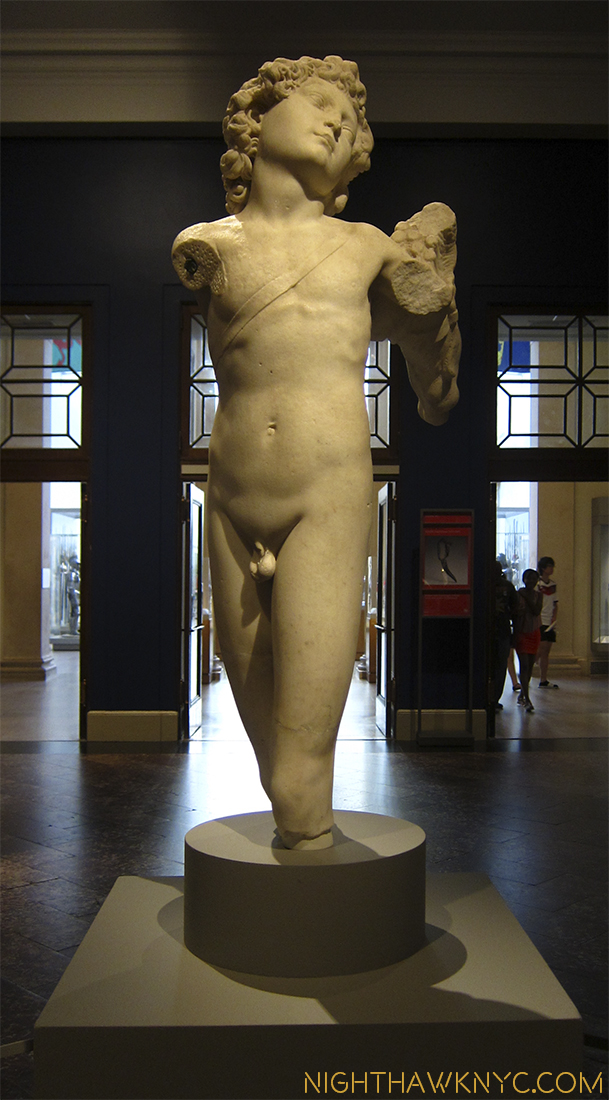
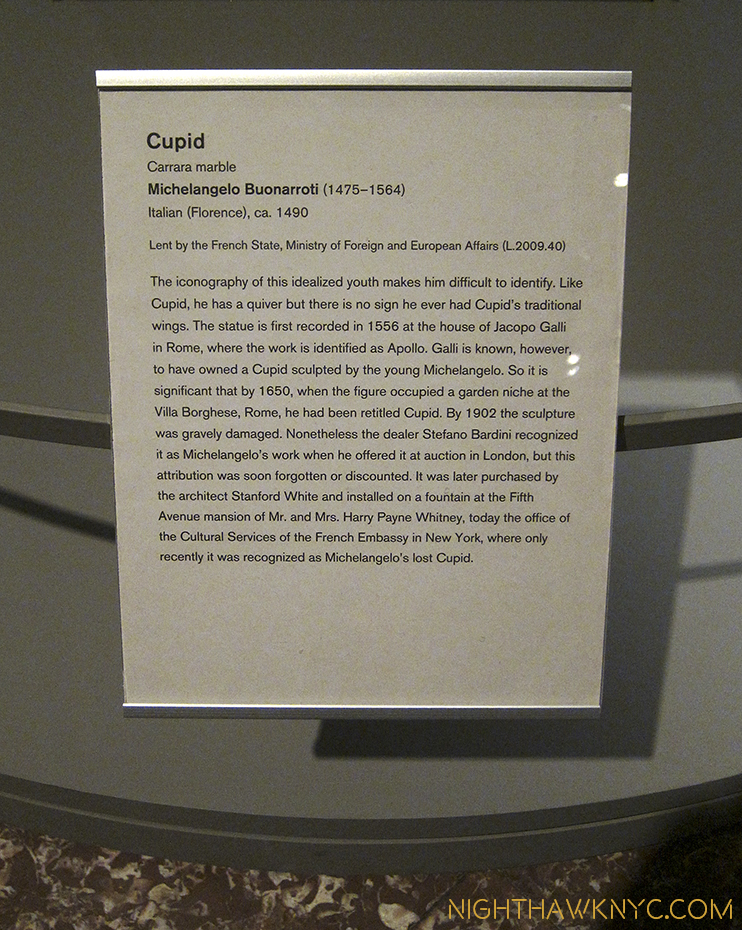
Then again, as Michelangelo specialist, author and educator, Professor William Wallace says in one Times piece, works supposedly by Michelangelo have appeared often- seventeen from 1996-2005. Even I have seen these claims in the past, and frankly, after checking a few of them out, you become numb to them. In fact, right now, at The Met there is a small sculpture on display- of Cupid (which they now call “Young Archer” on their website), on extended loan, that no less than The Met’s experts, who I hold in highest esteem, say is by Michelangelo! Not “Attributed to.” Not “Michelangelo and assistant.” It says, “Michelangelo” on the card, below, and on the web page. IF it is an original Michelangelo? It is the ONLY Michelangelo sculpture in the Western Hemisphere. Pretty big deal. But? Other experts disagree about it. Is THIS the forgery of a Cupid Michelangelo is known to have made? Now that it’s called “Young Archer” on their website does that mean the well-known Cupid forgery is ANOTHER work? Also, nothing is mentioned about WHY they think it’s a Michelangelo. After spending a good deal of time looking at it from every angle. I remain to be convinced it is a Michelangelo. Then again? Part of a forger’s work is to adopt another identity.

img_2318pnh

img_2319pnh

Michelangelo, “Cupid” & it’s card at The Met. Their website calls it “Young Archer.”

Though I remain unconvinced by the Cupid at The Met, I was more convinced by their “Michelangelo’s First Painting” show, in 2009, of a restored painting titled “The Torment of St. Anthony,” which was based on a print by the great Martin Schongauer. I drank their cool-aid, and I bought what they were selling about it. Interestingly, The Met didn’t buy this work, themselves, when they had the chance to! I’d love to know why not. It was bought by the Kimbell Art Museum, Fort Worth, Texas, who The Met restored it for. Very peculiar. Michelangelo changed Schongauer’s original, adding his own touches and putting his own mark on the work, which he created in color(!), compared to the black and white original print, they hung next to the painting. While he didn’t create this work as a forgery (as far as I know), Michelangelo has a history of creating forgeries and was caught making at least one. The risks were great. Yet, according to Dr. Catterson, he continued making them, even creating the Laocoön right along side the immortal Pieta also now in the Vatican.

Reading her full piece, Dr. Catterson makes a strong case. I urge you to check it out. Here are some highlights-
-The found Laocoön wasn’t in one block as Pliny said, but 7 connected pieces of marble, making transporting it to the site feasible
-Michelangelo had the money, marble, space and time to create it before it was “found.”
-It’s miraculously superb condition(! ?)(Walk around The Met and check out the condition of sculpture from that period, BCE. Oh, and count how many still have a whole nose!)
-The “rediscovery” of the Laocoön was, seemingly, “made to order”. Consider-
-No less than Michelangelo, himself, was called to be there when it was discovered.
-Michelangelo had only recently arrived back in the area.
-Michelangelo also worked on it after it was discovered
-There is a drawing by Michelangelo that matches up uncannily well with the rear of the sculpture when superimposed on it’s photo
-Michelangelo destroyed an unknown number of his drawings before his death. Why, if they didn’t reveal what works he forged?
-Michelangelo wrote a letter in which he speaks of the Pope killing him if he discovered something. What? Aside from the construction of the Pope’s tomb, the only other interaction they had at the time was the Pope recently acquiring the Laocoön.

That’s the shortlist.

“Last night I dreamed about you
I dreamed that you were older
You were looking like Picasso
With a scar across your shoulder
You were kneeling by the river
You were digging up the bodies
Buried long ago
Michelangelo”*

My question is “WHY?” Actually it’s a 2 part question-

-Why did he make these fakes, and then keep making them? And,
-WHY didn’t he ever come clean and take credit for them, especially the Laocoön, which instantly became iconic? Here is an Artist who, according to Vasari, snuck into the Vatican overnight to carve his name on the sash of the Pieta so everyone would know who created it! (Though, he regretted doing that, and swore to never sign a work, again. He didn’t.) To create a work that is, along with the Pieta, one of the greatest sculptures we have, at about the same time, and NEVER take ANY credit for it at all, even on his death bed? On the flipside, making, then hiding, something like this would seem to be extremely hard to keep secret. Someone else must have known. And yet, there is not a peep of this anywhere, until Dr. Catterson’s theory. Michelangelo was the first Artist to have a biography written during his lifetime (actually, 2). Why didn’t anyone, especially his enemies and rivals, “out” him? This puzzles me.

I await hearing what someone/anyone else has to say to negate, or substantiate her claims. Professor William Wallace, countering the initial outrage Dr. Catterson’s theory received, said– “…the intriguing thing is that nobody who studies classical art in a way wants the ‘Laocoön.’ They find it kind of a Hellenistic embarrassment, maybe because it really doesn’t look like anything else comparable in the history of classical art.” Why? As Dr. Catterson points out, Michelangelo used contemporary models, including Filippino Lippi, not ancient ones, when he created this.

As much as I love sculpture, I’ve never really paid much attention to the Laocoön. Why? I hate snakes! So, this is a pretty nightmarish image for me. Funny thing? My friend said the same thing Monday when we saw it! I have been, however, reading quite a bit about Michelangelo these past 5 or 6 years. I’ve read the 2 volume set of his Letters, a number of biographies, including Condivi’s and I’m in the midst of Martin Gayford’s “Michelangelo: His Epic Life” Biography right now. (He doesn’t mention Dr. Catterson’s theory, though his book was published in 2013.) I have some superb books of photos of his sculptures, including the XL Taschen monograph. I look at them frequently. Michelangelo is in my mind, like Leonardo da Vinci was that day in London in 2012 when I saw the “Salvator Mundi/Savior of the World”in the once in a lifetime Leonardo show in London’s National Gallery, after it had recently been credited to Leonardo. Seeing 7 of his other paintings that have been credited to him for much longer, immediately before.1, I came away believing it is a da Vinci, unlike the Shroud of Turin. So, when I suddenly saw the Laocoön Monday afternoon in my friend’s book, I was stopped dead in my tracks…

Michelangelo. I believe Dr. Catterson is right.

“We’ll never have the certitude a scientist gets,” Professor Wallace said, “It can only be tested by the weight of scholarly opinion and time.” And, I humbly suggest- your eye, and your gut.

“That the Laocoön was carved by Michelangelo explains why then, and now, its effect is mesmerizing.” Dr. Catterson’s piece coincidentally ends.

In at least two ways on Monday, the mist cleared, and now I see.

ONward to Round 2!

(For Sv.)
*-Soundtrack for this Post is “Michelangelo,” by Emmylou Harris, published by Universal Music Publishing Group.

This site is Free & Ad-Free! If you find this piece worthwhile, please donate via PayPal to support it & independent Art writing. You can also support it by buying Art & books! Details at the end. Thank you.

Written & Photographed by Kenn Sava (*- unless otherwise credited)

  1. You can see it exactly where I saw it, described by curator Luke Syson, who’s now at The Met, here.

If You Ever Missed A Show At Moma? You’ve Just Been Reborn!

This site is Free & Ad-Free! If you find this piece worthwhile, please donate via PayPal to support it & independent Art writing. You can also support it by buying Art & books! Details at the end. Thank you.

Written & Photographed by Kenn Sava (*- unless otherwise credited)

dsc_6336nefpnh

“If I had my life to live over
I’d do the same things again
I’d still want to roam
Near the place we called home
Where my happiness would never end”*

This, today, from MoMA-

“THE MUSEUM OF MODERN ART LAUNCHES A COMPREHENSIVE ONLINE EXHIBITION HISTORY BEGINNING WITH ITS FOUNDING IN 1929

Installation Photographs, Archival Documents, and Catalogues of Exhibitions Now Available to Students, Researchers, Artists, Curators, and the Public

NEW YORK, September 15, 2016—The Museum of Modern Art announces the release of an extensive digital archive accessible to historians, students, artists, and anyone concerned with modern and contemporary art: a comprehensive account of the Museum’s exhibitions from its founding, in 1929, to today. This new digital archive, which will continue to grow as materials become available, is now accessible on MoMA’s website, at moma.org/history.

Providing an unparalleled history of the Museum’s presentation of modern and contemporary art on a widely available platform, the project features over 3,500 exhibitions, illustrated by primary documents such as installation photographs, press releases, checklists, and catalogues, as well as lists of included artists. By making these unique resources available at no charge, the exhibition history digital archive directly aligns with the Museum’s mission of encouraging an ever-deeper understanding of modern and contemporary art and fostering scholarship.

“The Museum of Modern Art has played a crucial role in the development of an audience for modern and contemporary art for nearly 90 years,” said MoMA Director Glenn D. Lowry. “In making these materials freely available, we hope not only to foster and enable scholarship, but also to encourage a wider interest in this important chapter of art history that the Museum represents.”

The exhibition history project was initiated and overseen by Michelle Elligott, Chief of Archives, and Fiona Romeo, Director of Digital Content and Strategy, The Museum of Modern Art. Over the course of the last two-and-a-half years, three MoMA archivists integrated over 22,000 folders of exhibition records dating from 1929 to 1989 from its registrar and curatorial departments, performed preservation measures, vetted the contents, and created detailed descriptions of the records for each exhibition.

The digital archive can be freely searched, or browsed in a more structured way by time period or exhibition type. Each entry includes a list of all known artists featured in the exhibition. Artist pages likewise list all of the exhibitions that have included that artist, along with any of their works in MoMA’s collection online. The index of artists participating in Museum exhibitions now includes more than 20,000 unique names.”


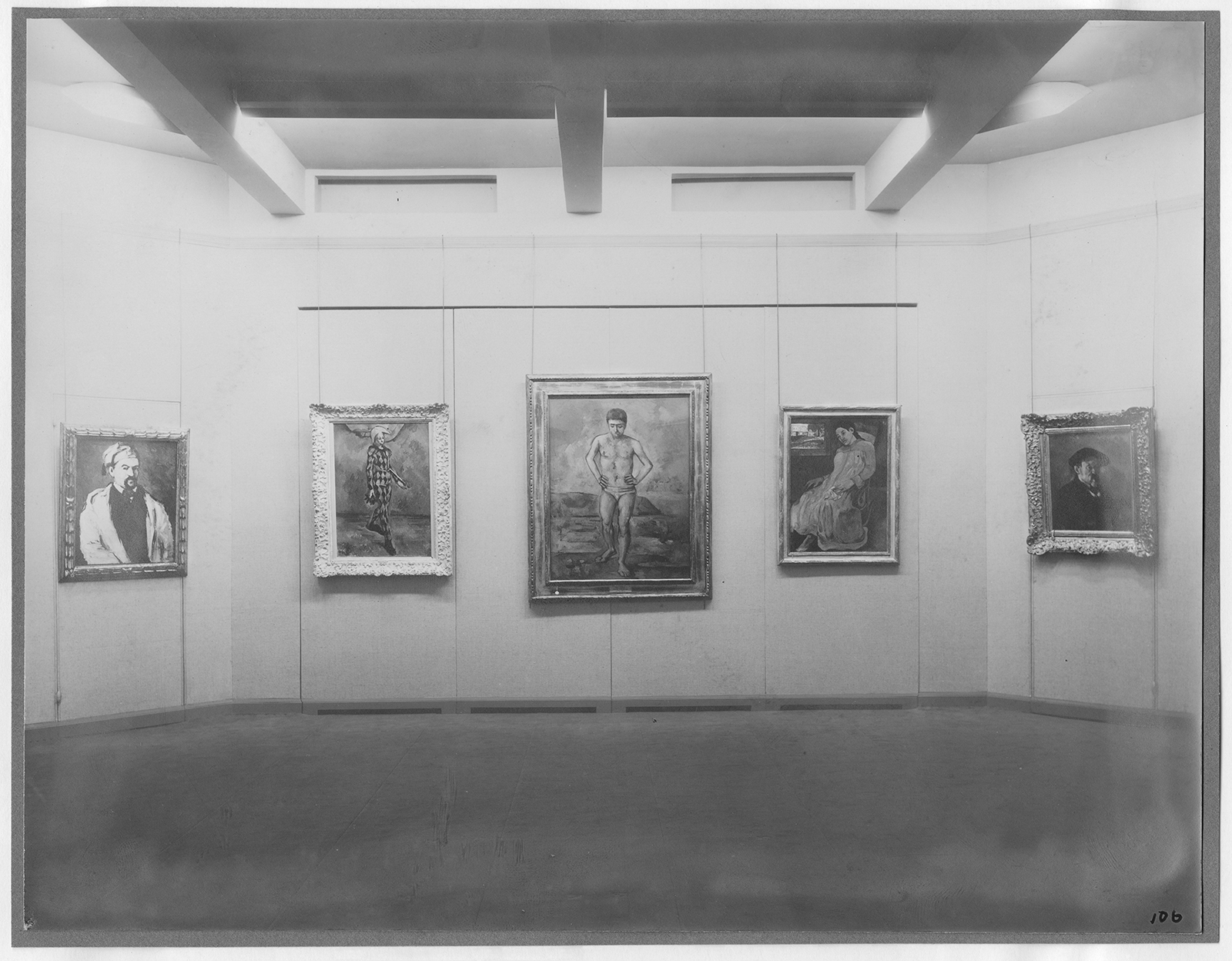
I almost fell over when I saw this. Now? You can revisit every show in the history of MoMA. Unprecedented! I’ve lost my day looking through this site. It’s absolutely unbelievable! Having the chance to FINALLY “see” shows I missed and only heard about, and shows I saw (like the 1980 Picasso Retrospective, possibly the greatest Art show ever), again, is just a dream come true! Here’s a sample, from Moma’s very first show titled “Cezanne, Gaugin, Seurat, Van Gogh,” in 1929!

Mom'a First Show! Installation view of the exhibition Cézanne, Gauguin, Seurat, Van Gogh, on view November 7, 1929 through December 7, 1929 at The Museum of Modern Art, New York. The Museum of Modern Art Archives, New York. Photographer: Peter Juley

MoMA’s First Show! Installation view of the exhibition Cézanne, Gauguin, Seurat, Van Gogh, on view November 7, 1929 through December 7, 1929 at The Museum of Modern Art, New York. The Museum of Modern Art Archives, New York. *Photographer: Peter Juley

To this point, Art shows have only lived on, after their closing, through exhibition catalogs and what’s been written or posted about them.

No more!

Here’s a chance to see how the show was hung, what works were grouped together or hung next to each other. Just Wow!

And? You can download catalogs, too!

Now? Of course I’m hoping The Met shocks me with something similar, and every other Museum in the world follows Moma’s groundbreaking example!

Don’t wait. Do not pass “Go.” Go here, now!

*-Soundtrack for this Post is “If I Had My LIfe to Live Over,” by Larry Vincent, Moe Jaffe and Henry H. Tobias, and performed by Doris Day.

NighthawkNYC.com has been entirely self-funded & ad-free for over 8 years, during which 300 full length pieces have been published! If you’ve found it worthwhile, PLEASE donate to allow me to continue below. Thank you, Kenn.

You can also support it by buying Art, Art & Photography books, and Music from my collection! Art & Books may be found here. Music here and here

Written & photographed by Kenn Sava for nighthawknyc.com unless otherwise credited. To send comments, thoughts, feedback or propositions click here. Click the white box on the upper right for the archives or to search them. Subscribe to be notified of new Posts below. Your information will be used for no other purpose.

Unfinished. Auspicious.

Written & photographed by Kenn Sava

“Well, let me tell you ’bout the way she looked
The way she acts and the color of her hair
Her voice was soft and cool, her eyes were clear and bright
But, she’s not there.”*

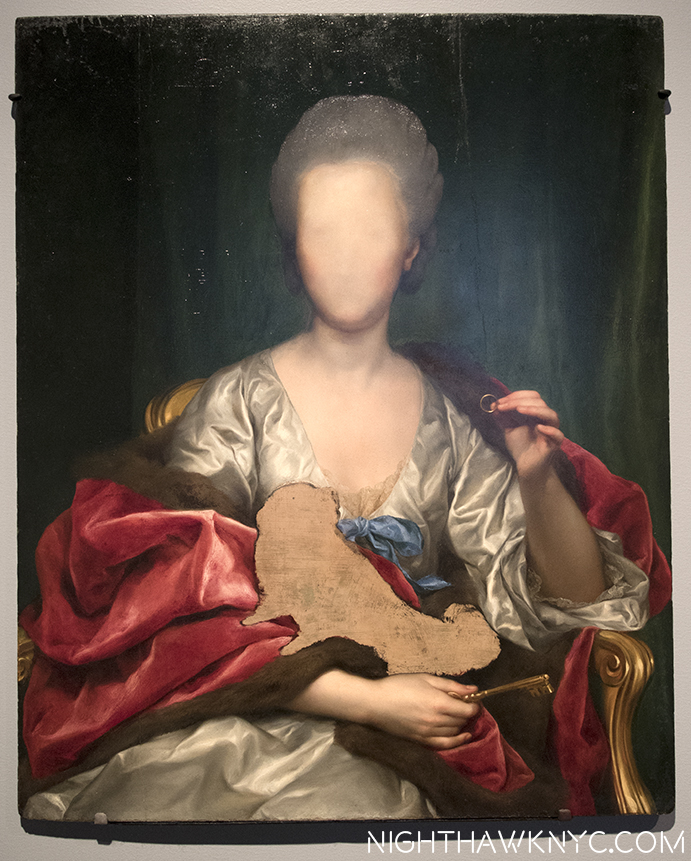
"Portrait of Mariana de Silva y Sarmiento," 1794, by Mengs

“Portrait of Mariana de Silva y Sarmiento,” 1794, by Mengs

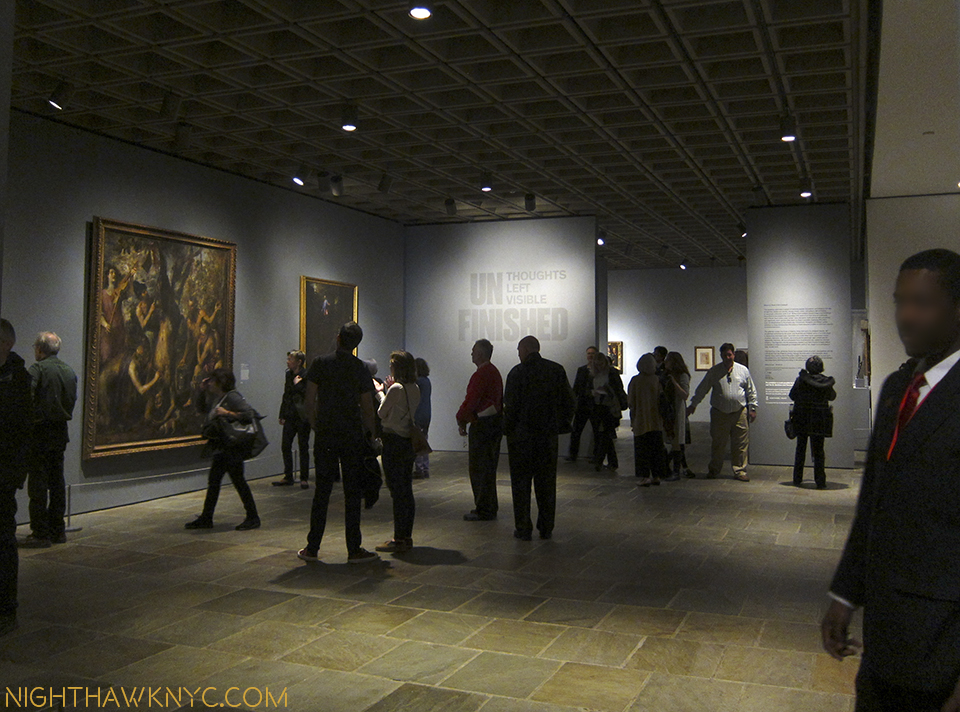
Leonardo da Vinci, Michelangelo, Titian, Van Eyck, Durer, Rembrandt, Velazquez, Manet, Monet, Degas, Van Gogh, Cezanne, Picasso, Pollock, Warhol, Mondrian, Basquiat, Whistler, Alice Neel, Lucian Freud, Klimt, Munch, Whistler, Robert Smithson, Cy Twombly, Gerhard Richter, and on and on. “Unfinished” is a mimi-Museum unto itself that probably rivals quite a few entire Museums. “Unfinished,” along with the “Nasreen Mohamedi” Retrospective, were the inaugural exhibitions at The Met Breuer (TMB), the first shows of two new eras- The Met’s new 8 year Breuer Building Lease (at a reported $17 million a year 1), and Sheena Wagstaff’s tenure as Chairwoman of The Met’s Modern & Contemporary (M&C) Department. No pressure there. It’s a show that leaves you wondering “Why didn’t anyone think of this before,” before you’ve even gotten to it’s second floor.

Opening Day of The Met Breuer. Member's Preview, March 8, 2016

Welcome to the future! Opening Day of The Met Breuer. Member’s Preview, March 8, 2016

Well, for one thing, though many of the works here come from other sources, not a lot of places have the resources The Met has, so yes, a part of this is “showing off.” They’ve chosen to install this in a brand new branch that previously held the entirety of one of the other “Big Three” Manhattan Museums, before the Guggenheim made it the “Big Four.”

If that’s not showing off? I don’t know what is.

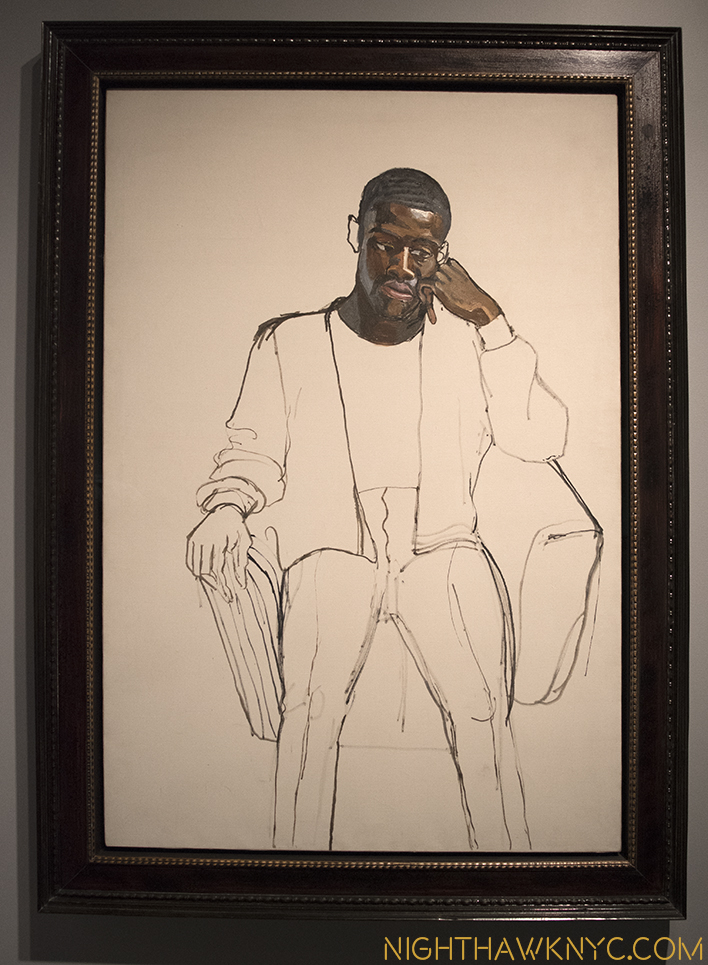
The rest is the pure joy of discovery, of seeing a curtain lifted and getting an all too rare chance to see some of what goes into making a masterpiece, a work of Art. And? The hits just keep on coming. The big names, that is, if not the most well-known work by any of those names. 197 works in all filling the 3rd & 4th Floors. While nothing here is “famous,” even in their, supposedly, incomplete state (either left unfinished on purpose, or not, in the case of Lucian Freud’s “Portrait of the Hound,” which was left as we see it on his easel when he died), these works hold up just as they are, making this a show jam packed with excellent, even important pieces. Yes, curating a show of “unfinished” work THIS well is also showing off The Met’s superb staff. Along with the pleasure of looking, they also provide fascinating, voyeuristic, even unique, insights into the Artist’s process- both working and thought. Some, as in Alice Neel’s “James Hunter Black Draftee’, 1965, are, perhaps, more evocative than it might have been had it been “finished.” Mr. Hunter never returned for additional sittings. We are left to wonder why not.

"James Hunter Black Draftee," 1965, by Alice Neel

“James Hunter Black Draftee,” 1965, by Alice Neel

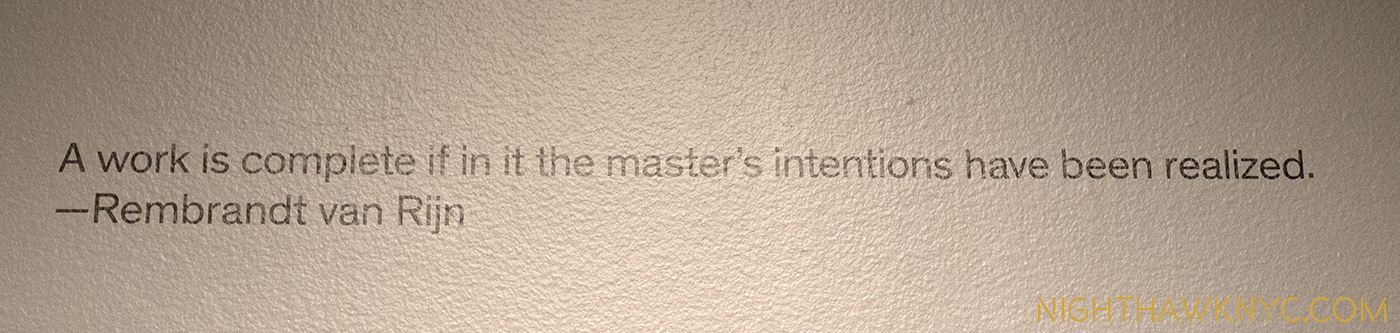
The whole question of “When is a work of Art, finished?” comes front and center here as well, and no less than Rembrandt chimes in on it.

dsc_7639pnh

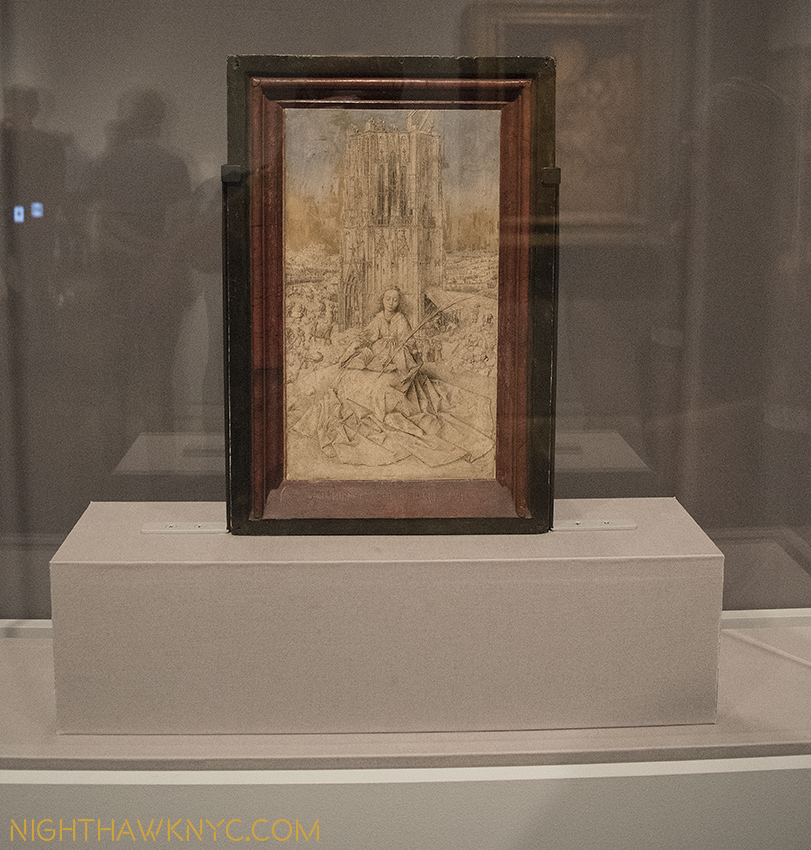
Highlights? I’ll list those that come to mind quickly because there are so many. For me, Jan Van Eyck was the very first Artist who truly captivated me as a kid. Shortly after getting my driver’s license, I drove the almost 6 hours each way just to see his “Annunciation” in Washington’s National Gallery, then drove right back. Seeing his underdrawing for his unfinished St. Barbara was just breathtaking. It’s truly unbelievable to think that something like this lies underneath his finished masterpieces, like The Ghent Altarpiece! While he is legendary for the extraordinary and exquisite detail of his painting, which has held me in disbelief for all these decades, apparently, he could also draw every bit as well2

Small wonder. "Saint Barbara," 1437, Jan Van Eyck. Barely 12 inches tall.

Small wonder. “Saint Barbara,” 1437, Jan Van Eyck. Barely 12 inches tall.

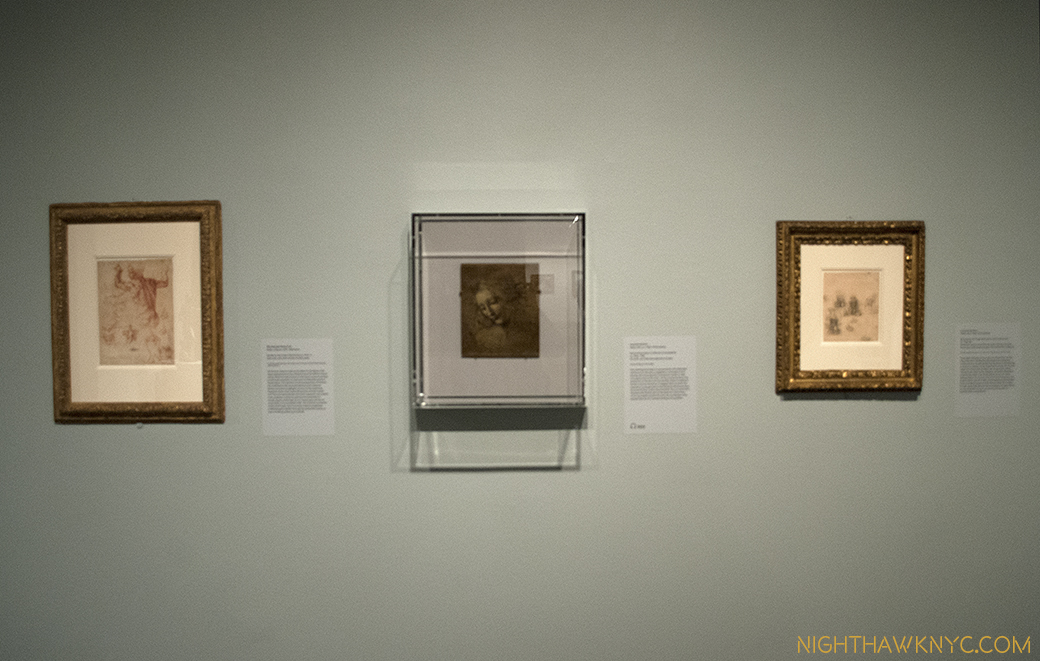
Just astounding. Oh, and sitting a few feet away was a da Vinci portrait profile that was positively otherworldly. When the show opened (along with the Met Breuer) in March, it was flanked by Leonardo’s “Sketches for the Virgin Adoring the Christ Child” and Michelangelo’s “Study for the Libyan Sibyl.” Since “Unfinished” was up for a very generous four and a half months, the later two were replaced after a while, no doubt due to their fragility. It seemed to me they may have been there in honor of TMB’s opening. Both works are in TM’s permanent collection. More showing off? (Slight smile)

Blink, and you missed it. Briefly on view, Leonardo, center and left, Michelangelo, right.

For a New York Minute, the two greatest figures in Western Art were on view together. Leonardo, center and right. Michelangelo, left. Has so much hunan genius ever been side by side than when work of these two are shown together? March 8, 2016.

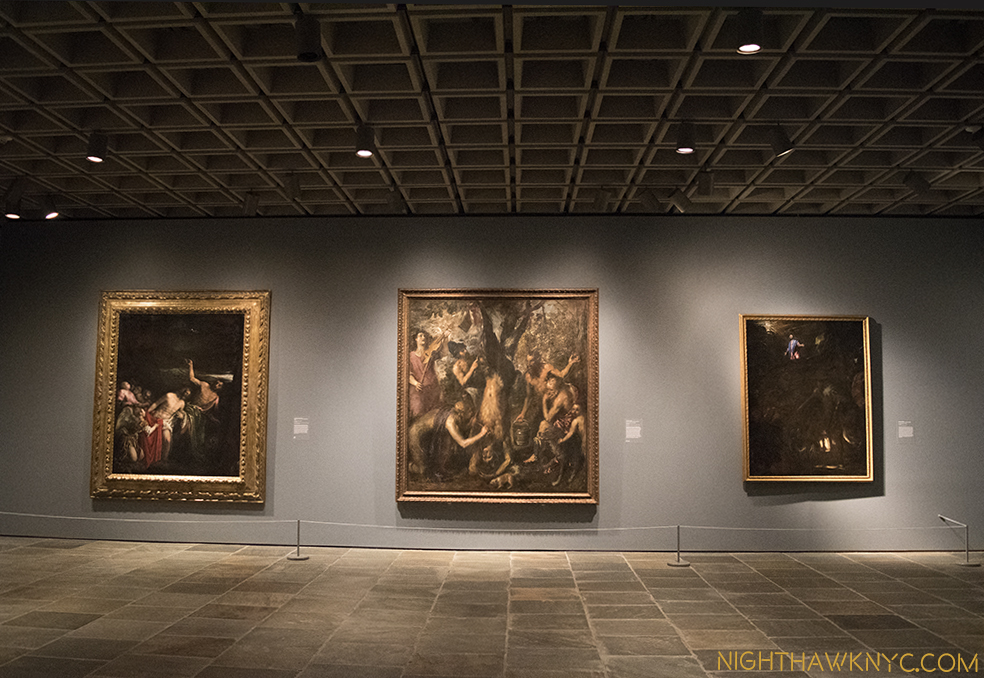
Oh, all of this is in the 2nd room. In the first room, upon getting off the elevator on the 3rd Floor, at the show’s beginning, you’re immediately faced with 2 large, powerful Titians that are guaranteed to stop you for a good long while, and a Jacopo Bassano.

This view once the elevator doors opened on 3 is one I'll long remember.

The opening salvo. This is the first thing many visitors to TMB saw after the elevator deposited them on 3. Bassano, left, with 2 Titians.

Rembrandt’s St. Bartholomew, a whole room of Turners, a beautifully selected print gallery, a very “different” Degas of a horse race, a Van Gogh who’s color filled the entire room, a stunning Munch self portrait…all on the 3rd floor, wowed me.

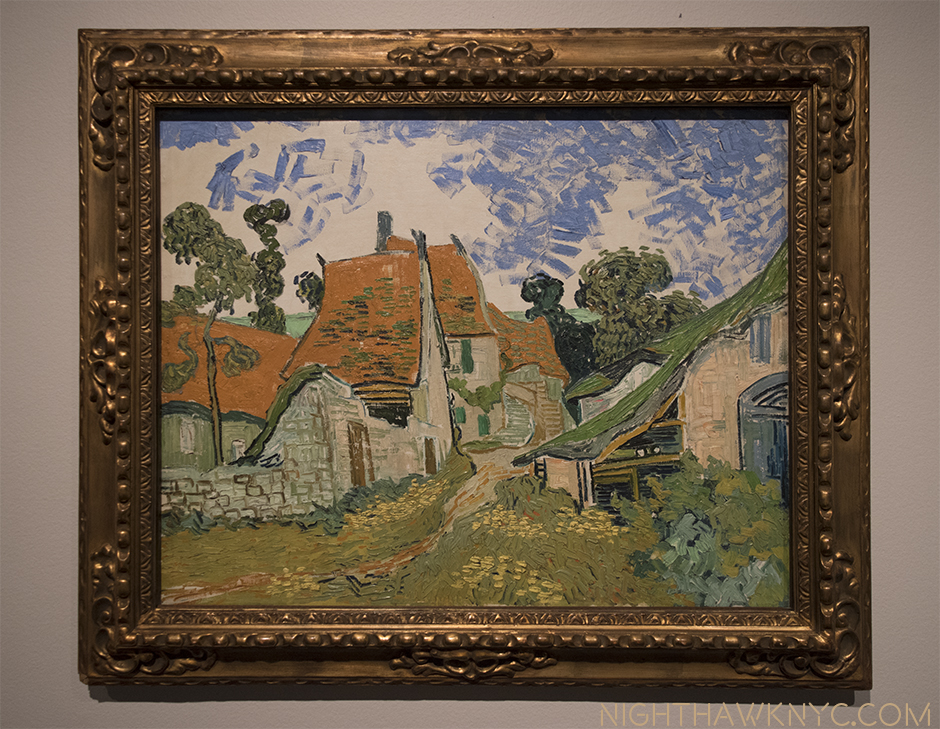
"Street in Auvers-sur-Oise," 1890. In the year he died, no dark clouds in this sky.

Life affirming. “Street in Auvers-sur-Oise,” 1890. The year he died, no dark clouds in this sky. I am among those who believe Van Gogh did not commit suicide.

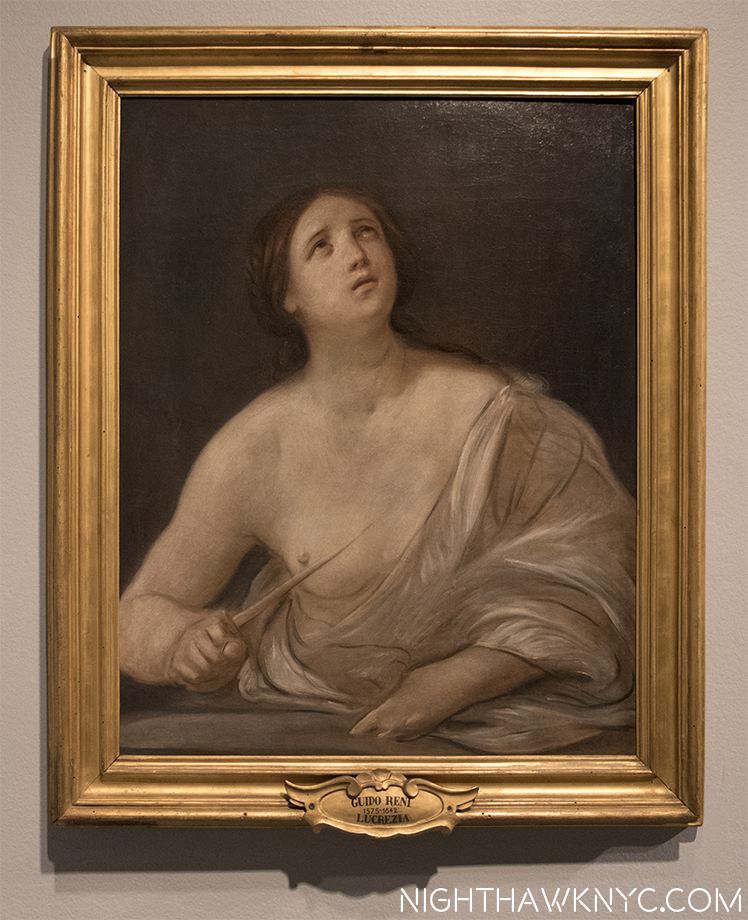
Finished, or Un? "Lucretia," 1642, by Guido Reni. Magnificent.

Finished, or Un? “Lucretia,” 1642, by Guido Reni. Magnificent.

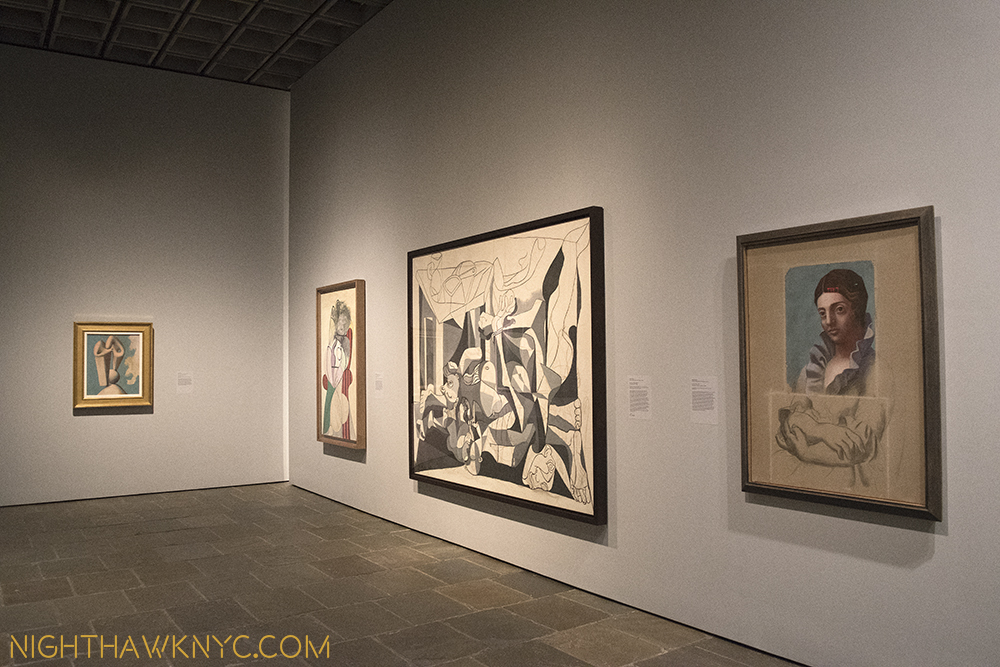
On the 4th Floor, getting off the elevator was no less dramatic. No less than 4 amazing Picassos greet you, one of which is “the Charnel House,” the work which bookends (with “Guernica”) his WW2 years. While “Guernica,” rightfully, is seen as one of the landmarks of 20th Century Art (and one I’m eternally thankful I got to see in person at Moma’s Picasso Retrospective in 1980 before it was moved to Spain as Picasso’s will required), here is a work that I think deserves more attention. It’s surrounded by 3 other pieces, in 3 other styles (in addition to 2 others in the next gallery, and a few more on the 3rd floor), that show Picasso in the process of thinking through the problems inherent in each work- each one in a different style. After the 1921 “Portrait of Olga,” right, below, he was inventing each of these styles. It’s akin to inventing a new language. There was no one else to help him or guide him. Some artists, like Jackson Pollock, have done this once. Picasso? There’s three in this one gallery, and it doesn’t even include Cubism.

Pick a style-any style. 4th Floor Lobby/Galley 1. Picasso 1921, '29, '31, '45.

Pick a style-any style. 4th Floor Lobby/Galley 1. Picasso 1921, ’29, ’31, ’45.

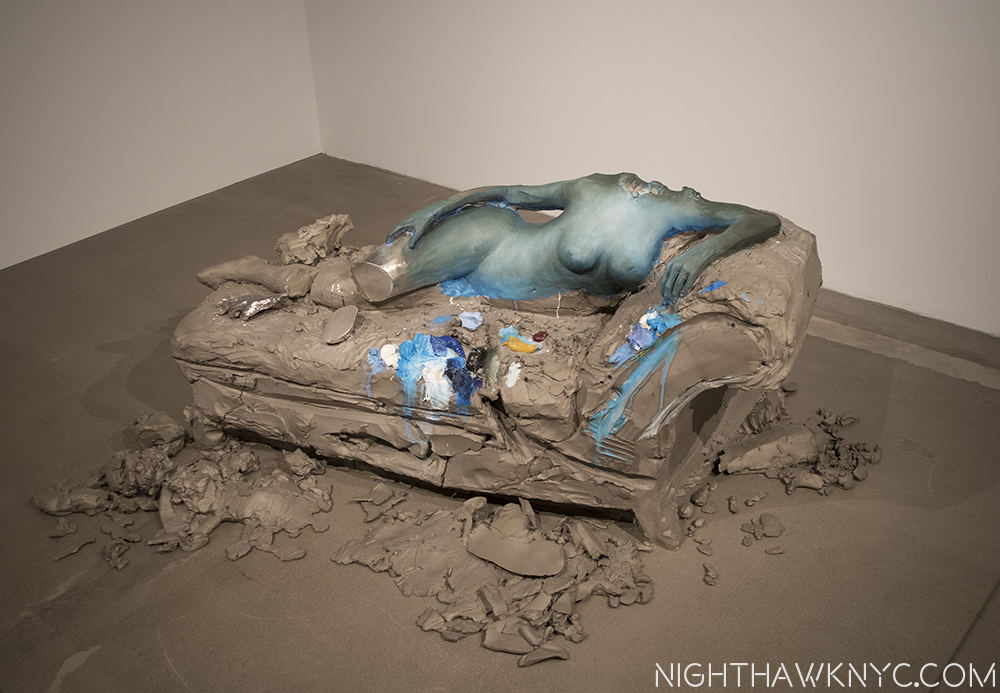
There was quite a bit of fanfare paid to The Met’s announcement of The Met Breuer as a “Contemporary Outpost,” especially during the years when the 5th Avenue Modern & Contemporary Galleries were to be undergoing the reconstruction they had also announced. Yet, in this co-inaugural show, we get quite a bit of what The Met is famous for, along with about two thirds of the 4th floor of more recent works. The size of many of these newer works seems to cut down on the number of pieces, however, making the show feel skewed towards older Artists. Of the 197 works in the show, I counted 74 works by Artists born after 1900, 12 by Artists born after 1950. (The youngest Artist represented is Urs Fischer, who was born in 1973, and who’s mysterious cast bronze “2,” from 2014 is also the newest work here by my reckoning.)

The day after at the NighhawkNYC offices? No. "2," 2014, by Urs Fischer.

The day after at the NighthawkNYC offices? I’ll never tell. Actually, this is “2,” 2014, by Urs Fischer.

“But it’s too late to say you’re sorry
How would I know, why should I care?
Please don’t bother trying to find her
She’s not there”*

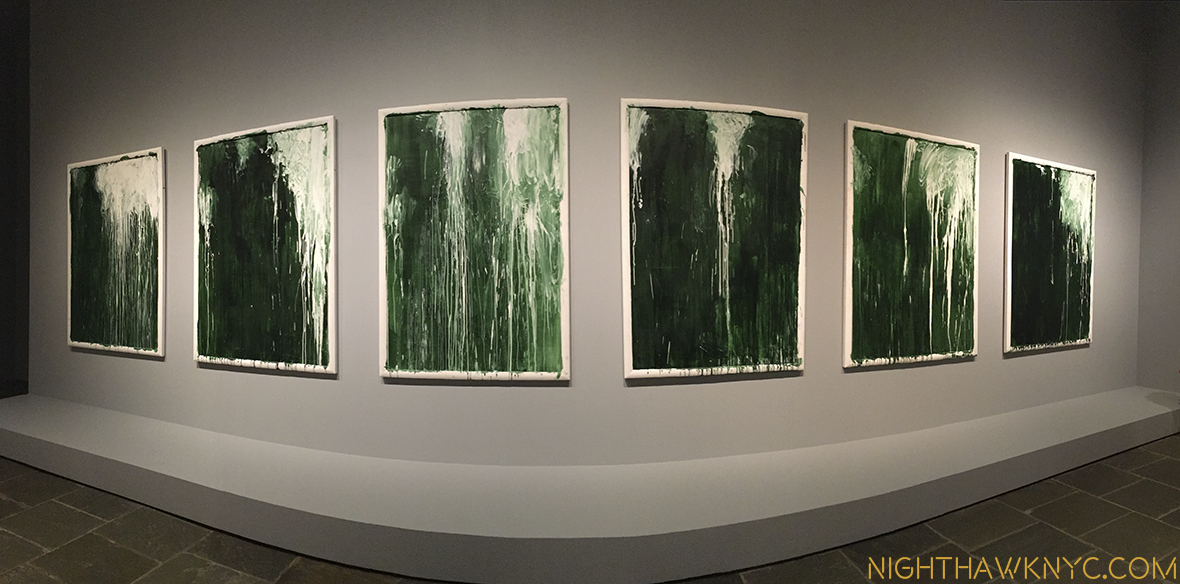
Yet, even among the M&C pieces here on the 4th floor, there are memorable pieces. In additon to Urs Fischer’s “2”, the unfinished Mondrian struck me as a revelation. Yayoi Kusama’s genre defying paintings of consecutive numbers gave pause for thought, as did Sol LeWitt’s amazing tour de force  “Incomplete Open Cubes” nearby  and, Kerry James Marshal’s “Untitled,” 2009, was a nice appetizer for his much anticipated “Mastry” show opening at TMB October 25. The show concludes with a wonderful selection of sculpture, including haunting works by Louise Bourgeois, “Untitled (No.2), 1996, and Alina Szapocznikow’s work about her own battle with breast cancer, “Turmors Personified,” 1971, in dialogue alongside 3 Rodins. The final gallery consisted of only one work- a series of 6 pieces by Cy Twombly, entitled “Untitled I-VI (Green Paintings), 1986, which provided a meditative, cleansing experience I found especially memorable.

The Cy Twombly Gallery closes the show seen in panorama.

Water works? It’s hard not to feel a sense of water in movement in this gallery of 6 Cy Twomblys, which closes the show, seen in panorama.

Overall, what I took from this show as a whole was a possible template for what The Met plans to do going forward, the kinds of Artists they may include in their “new initiative.” It’s something I plan to watch closely as it unfurls. I should say that I have been in the minority regarding The Met and M&C Art. I liked that they were taking their time and allowing time to give some perspective on Contemporary Art before jumping in. It’s always been an honor to be in The Met- they have the best of the the best across all cultures and all times. Yet, given the unprecedented popularity of M&C Art today, they have opted to move more fully into it. Ms. Wagstaff, who I met in June, seems to have a great sense for all of this, and if anything, “Unfinished,” is a show that consists of work across at least a few Met Departments. Being able to work, apparently, so well with the other Met Departments augers well for the future. After all, The Met has 2,000,000 items in it’s collection. Showing M&C Art along side of selected objects in their collection is something I am all for.

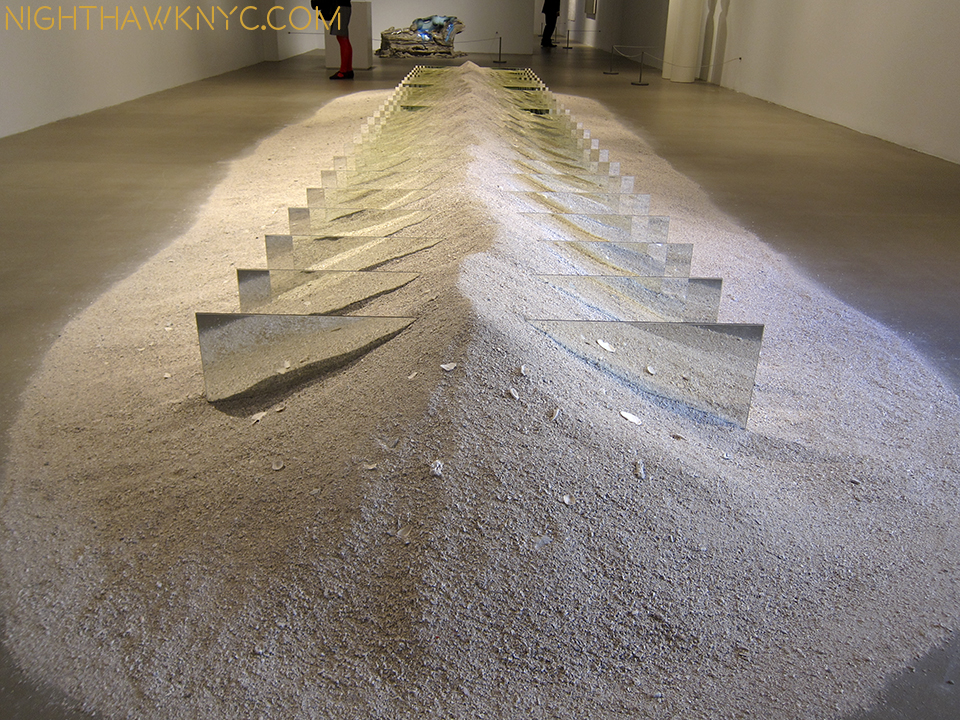
Floor beach. As close as I got to a real beach this summer.

Floor beach. “Mirrors and Shelly Sand,” 1970, by Robert Smithson. As close as I got to a real beach this summer. I shot this wearing shades.

For me? That’s what this show says- Here are (unfinished) works by many of the greats. This is where we are starting from. Let’s see how other work that may, or may not, have been influenced by them, looks alongside these. The show may be seen as a number of conversations between Artists they are displayed alongside- Leonardo with Michelangelo. Van Eyck and Durer, Rembrandt with Velazquez(!). Degas and Manet. Van Gogh and Whistler(!). Picasso and Cezanne. Pollock and Kusama. Smithson and Fischer. Marshall and Warhol. Szapocznikow and Rodin. Rauschenberg and Mondrian. And, Picasso, also…with himself, among them. I say bring it on!

Still, there’s no denying that The Met Breuer is a HUGE gamble. Who knows how long Contemporary Art will stay as “hot” as it is? For that matter, who knows how much longer record number of viewers will go to see Art, as they have these past few years? The Met is locked into this for 8 years, and they have already announced a budget deficit that caused them to put off the previously announced reconstruction of the Modern & Contemporary Galleries, and, more sadly, even forced an unknown number of lay offs.

When they return to better times, IF they decide to move forward with those reconstruction plans, they will, most likely, need additional space for the temporary display of their Modern & Contemporary holdings, and Special Exhibitions. What will they do? Extending the lease on the Breuer will be VERY expensive. So far? I have yet to see it’s galleries very crowded. The “Diane Arbus; In The Beginning” Show, which recently opened on the 2nd floor, seems to be drawing pretty well, and “Unfinished” was fairly crowded during it’s last weeks. Yet? They’ve already closed the 5th Floor Cafe & Bookstore and remodeled it as additional Gallery space, which indicates that they want to have more going on there for visitors to see, and their basement restaurant is scheduled to open in about a month, which will be open during some hours The Museum is not. Obviously, this is all new, and still in flux. The Met seems to be reacting fairly quickly, which is a good sign. They did away with late Thursday nights, which I seemed to be among the very few that went to, and changed to late Friday & Saturday nights, like TM, 5th Avenue.

"Tumors Personified," 1971, by ALina Szapocznikow.

Survivor. “Tumors Personified,” 1971, by Alina Szapocznikow.

So far, on very little evidence, I like the direction TM is going at TMB, and with M&C Art. “Nasreen Mohamedi” was a revelation that struck me as the “perfect choice” to be the first M&C Show. “Unfinished” was an unexpected blockbuster the likes of which has never been seen before, which is somewhat startling given how long there have been painting shows. The Diane Arbus show is fascinating and features a ground breaking installation. Also, not to be lost is the reconfiguration of the M&C Galleries at TM on 5th Avenue- I love what they’ve done. The Art has been imaginatively rehung in fascinating new combinations, with some pieces given new prominence, like Edward Hopper’s majestic “The Lighthouse at Two Lights,”1929, and other pieces shown that have long been in storage. Along with this, Thomas Hart Benton’s “America Today” Mural appears to have now been permanently housed, at the center of supporting works and works that enter into interesting dialogue with it nearby. Other galleries are arranged by theme, instead of chronology.

So? There’s been a lot of action coming from new M&C Chairwoman Sheena Wagstaff and her Department. There’s a long way to go, but so far? It’s hard for me to give her less than an “A” for what she and they have accomplished.

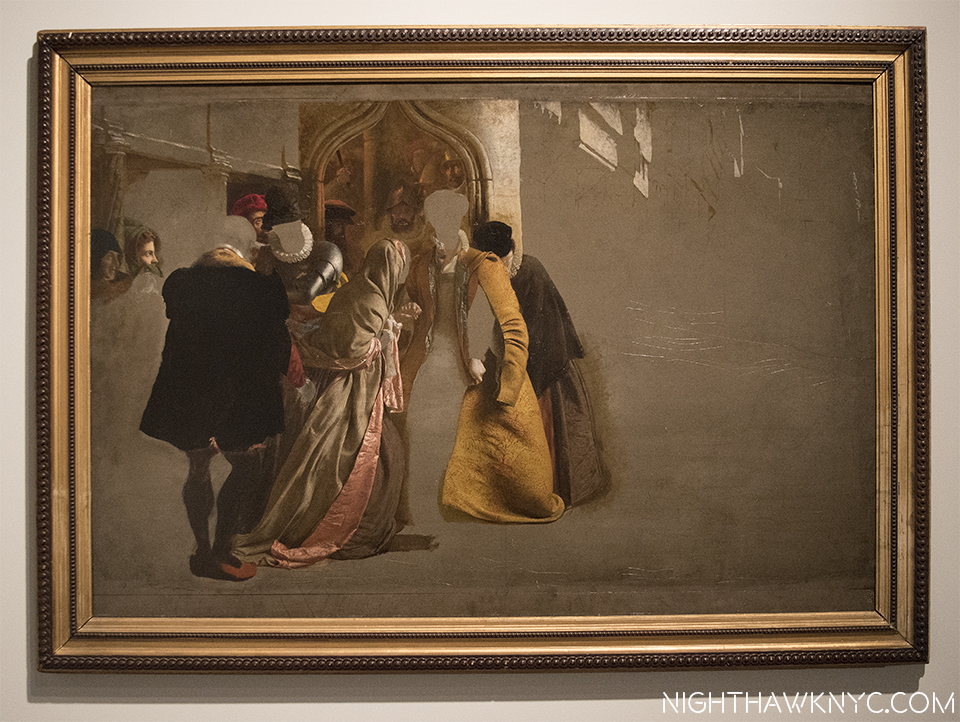
Haunting, and then some.

Haunting, and then some. “The Return of Mary Queen of Scots to Edniburgh,” 1870, James Drummond.

Most of the Artists in “Unfinished” won’t get the chance to finish what they started. The Met will.

Stay tuned.

*-Soundtrack for this post is “She’s Not There,” by Rod Argent, recorded by The Zombies, and published by Marquis Songs, USA.

NighthawkNYC.com has been entirely self-funded and ad-free for over 7 years, during which over 250 full length pieces have been published. As I face high expenses to keep it going, if you’ve found it worthwhile, please donate to keep it up & ad-free below. Thank you!

Written & photographed by Kenn Sava for nighthawknyc.com unless otherwise credited.
To send comments, thoughts, feedback or propositions click here.
Click the white box on the upper right for the archives or to search them.
For “short takes” and additional pictures, follow @nighthawk_nyc on Instagram.

Subscribe to be notified of new Posts below. Your information will be used for no other purpose.

  1. http://www.nytimes.com/2016/03/05/arts/design/breuer-building-expands-the-imagination-and-the-budget-of-the-met.html?_r=1
  2. Yes, I saw “A New Look at a Van Eyck Masterpiece” at TM proper, which featured a drawing of the Crucifixion from Rotterdam that may, or may not be, by Van Eyck. I came away VERY impressed by it to be sure, but remaining to be entirely convinced.

752,995 Attend The Met’s Manus x Machina

This site is Free & Ad-Free! If you find this piece worthwhile, please donate via PayPal to support it & independent Art writing. You can also support it by buying Art & books! Details at the end. Thank you.

Written & Photographed by Kenn Sava.

From The Met today-

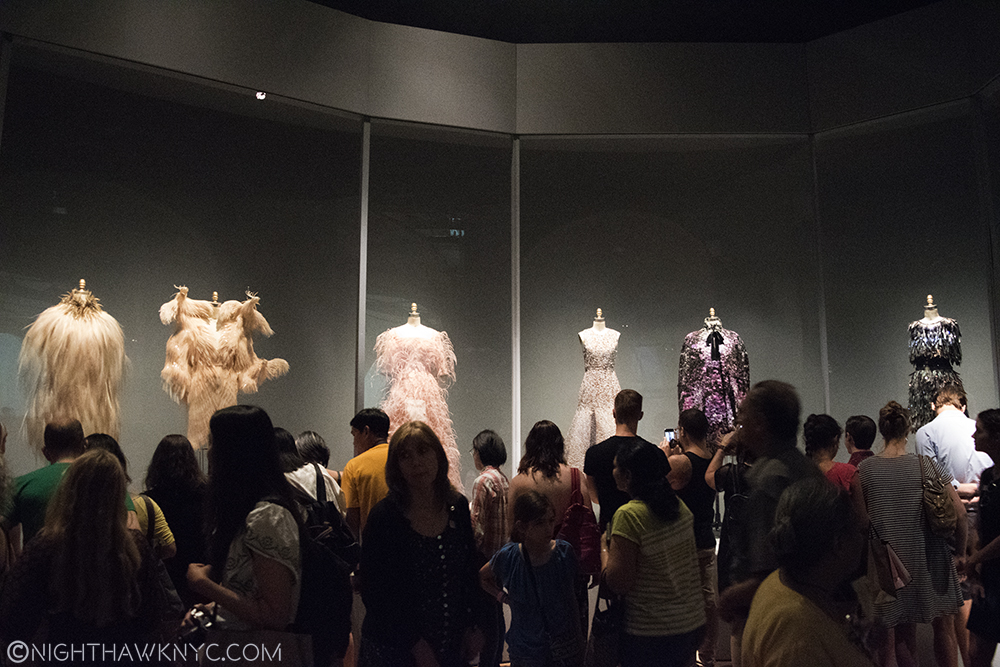
“(New York, September 6, 2016) – The Metropolitan Museum of Art announced today that Manus x Machina: Fashion in an Age of Technology, which closed yesterday, attracted 752,995 visitors during its run from May 5 to September 5, putting it in seventh place among the Museum’s most visited exhibitions, joining blockbusters such as Treasures of Tutankhamun (1978), Mona Lisa (1963), and Painters in Paris, 1895-1950 (2000).  The show also becomes the second most visited Costume Institute exhibition, surpassing Alexander McQueen: Savage Beauty (2011), which had 661,509 visitors.  China: Through the Looking Glass (2015) remains the department’s most popular show with 815,992 visitors and The Met’s fifth most visited.   All three exhibitions were curated by Andrew Bolton, Curator in Charge of The Costume Institute.

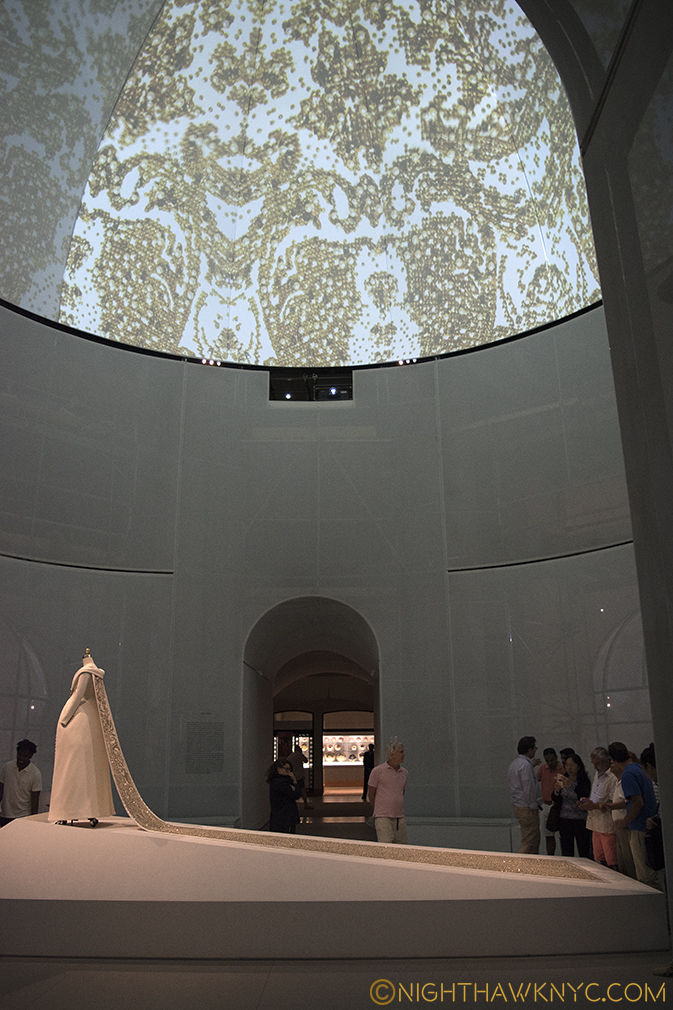
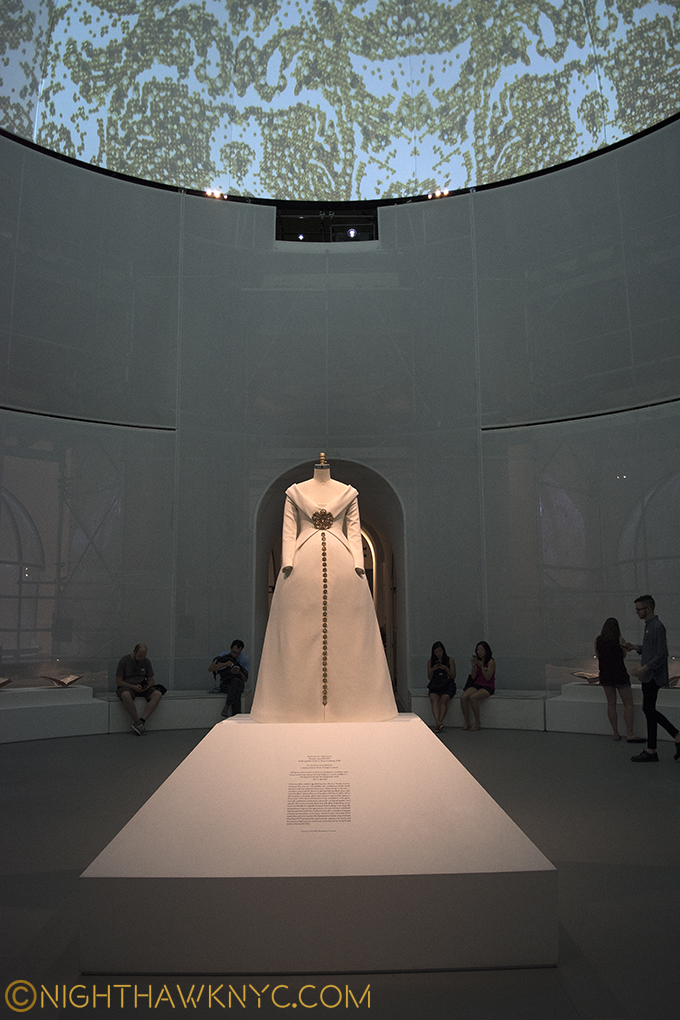
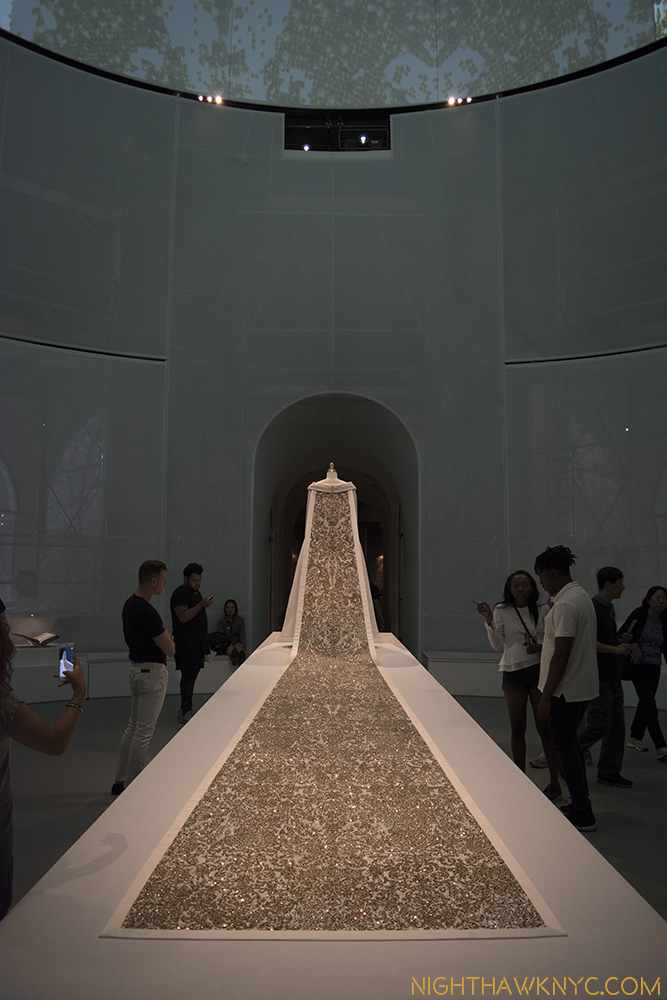
“We are thrilled that so many people from around the world experienced this exploration of the artistry of fashion,” said Thomas P. Campbell, Director and CEO of The Met.  “The exhibition required the transformation of the Robert Lehman Wing into a domed cathedral-like space that invited people to slow down and contemplate the process and craft of the objects.”

The exhibition, originally set to close on August 14, was extended by three weeks, and hours were added on September 2 and 3, when it stayed open until midnight, three hours past the usual 9:00 p.m. closing time on Friday and Saturday nights.

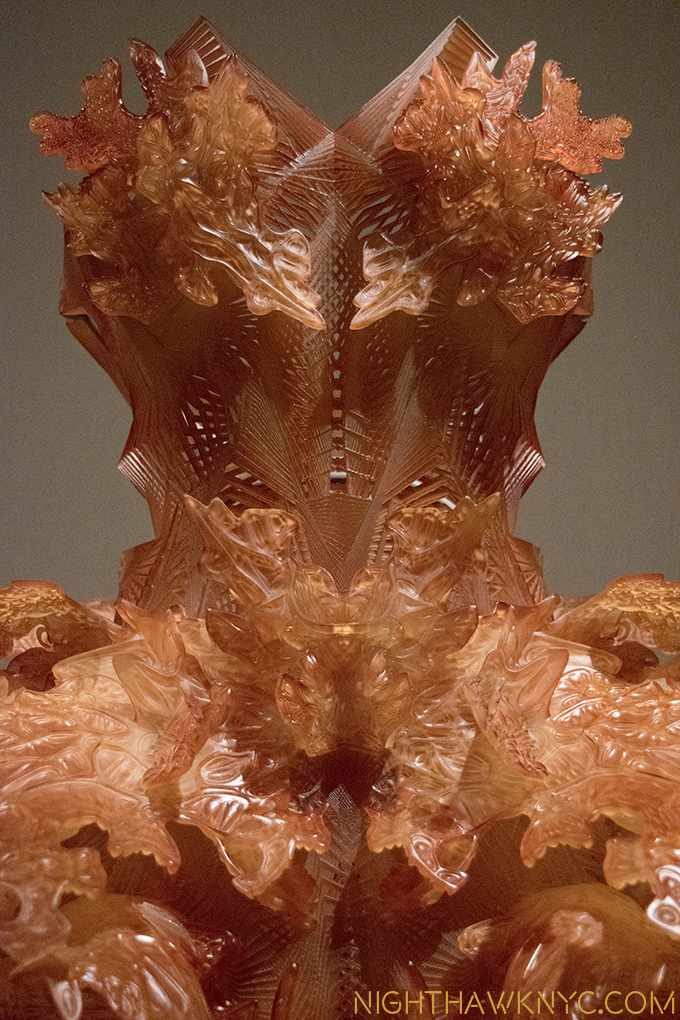
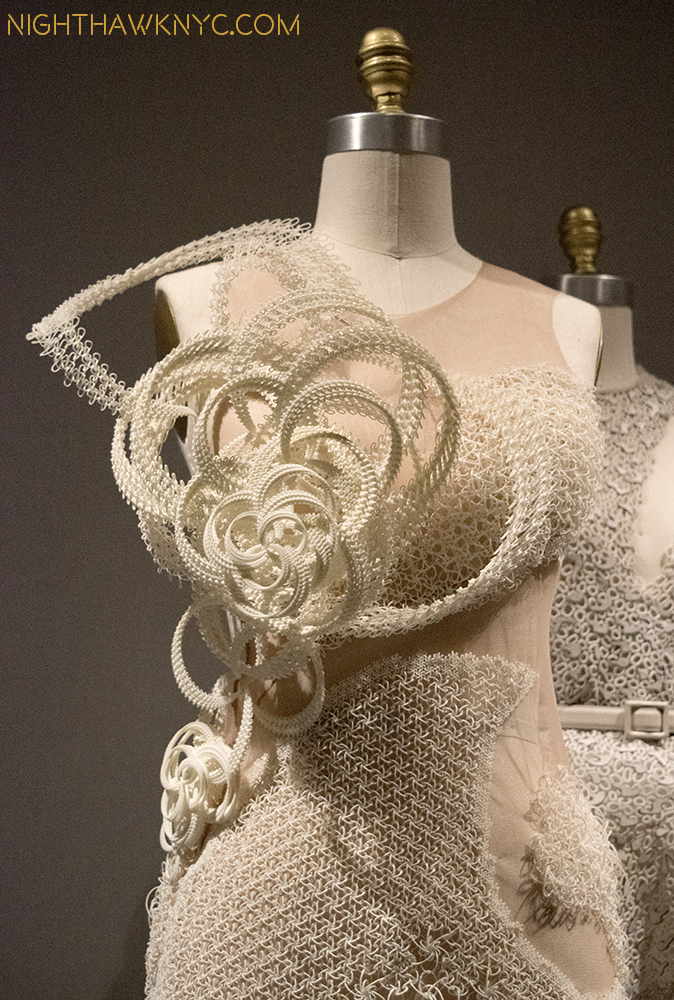
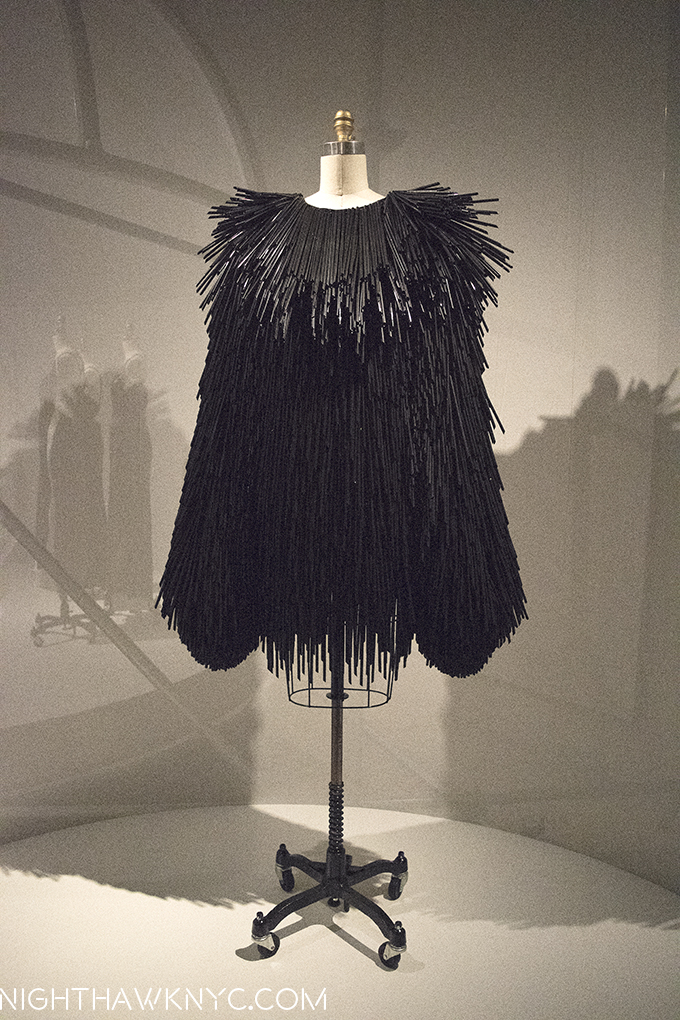
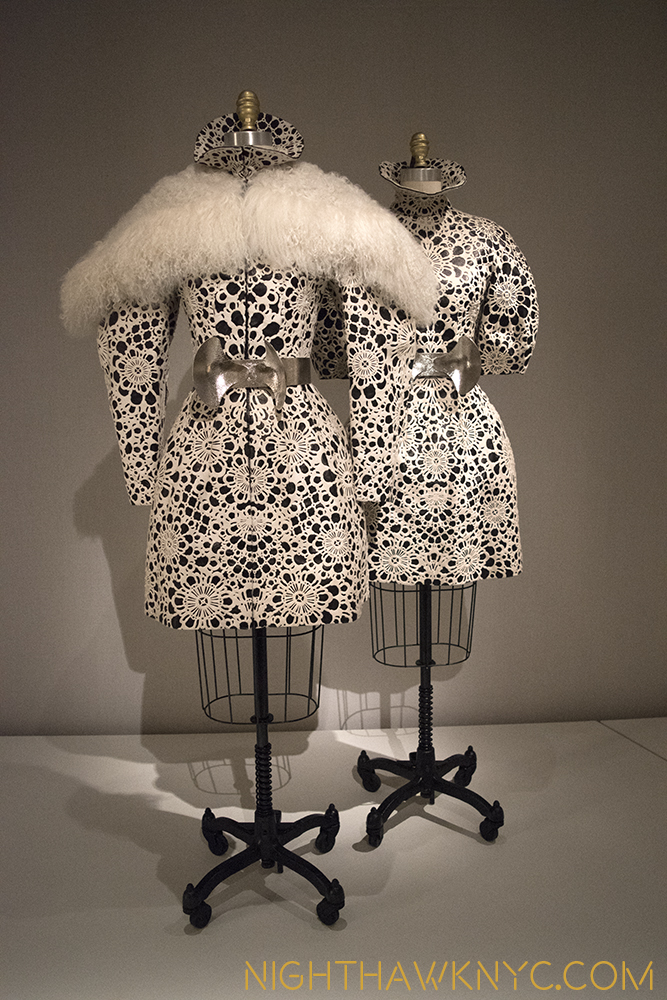
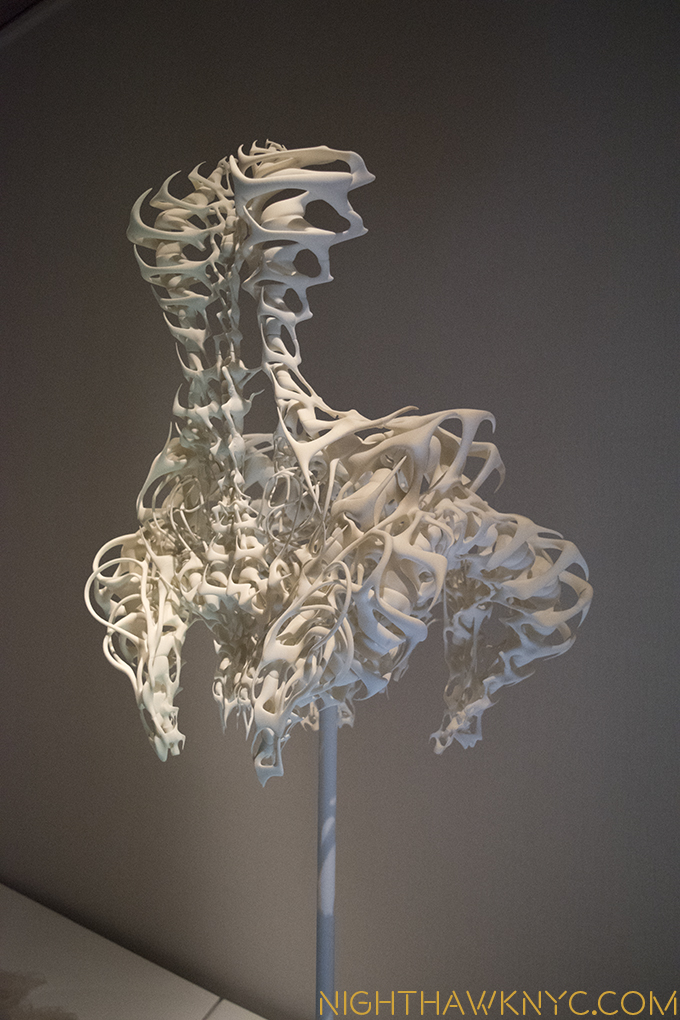
Manus x Machina explored how designers reconcile the handmade and the machine-made in the creation of haute couture and avant-garde ready-to-wear. It addressed the distinction between the hand (manus) and the machine (machina) as discordant tools in the creative process, and questioned the changing delineation between the haute couture and ready-to-wear.” (End.)

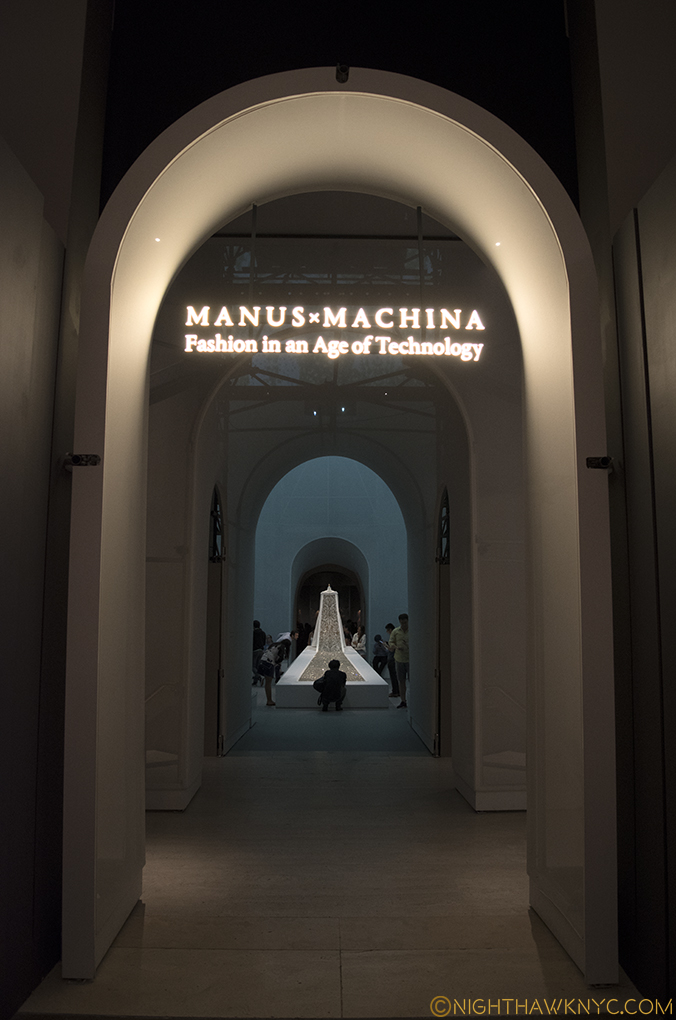
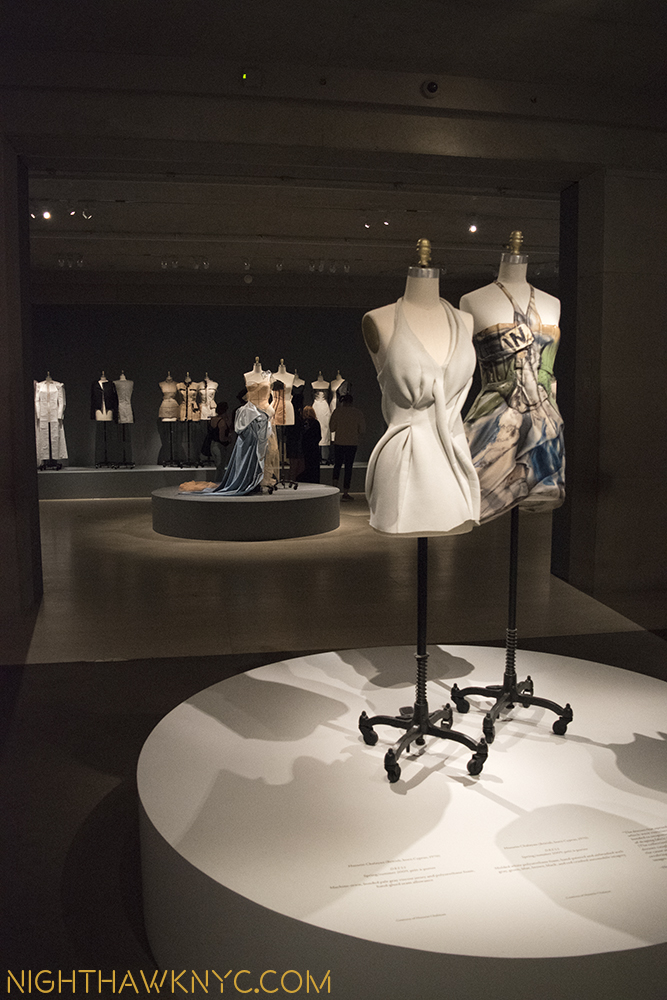
Worshipping at the Altar of Fashion. The entrance.

Worshipping at the Altar of Fashion. The entrance.

Ok, so I was 250,000 short on my ambitious guess of a million. I am surprised it topped the unforgettable McQueen Show, which felt more crowded during my 8 visits, but I haven’t checked to see how many days each show was open. I saw Manus about 10 times, and was blown away by the trnsfiguration of the Robert Lehman Wing into the “cathedral” Mr. Campbell describes in The Met’s press release, above. While, they’ve gone above and beyond every year with their fashion show installations, this was was over the top. If you’ve been to the Lehman Wing before this show,  you have an idea of the scope of what they did. Here’s how it looked when I visited it in 2013-

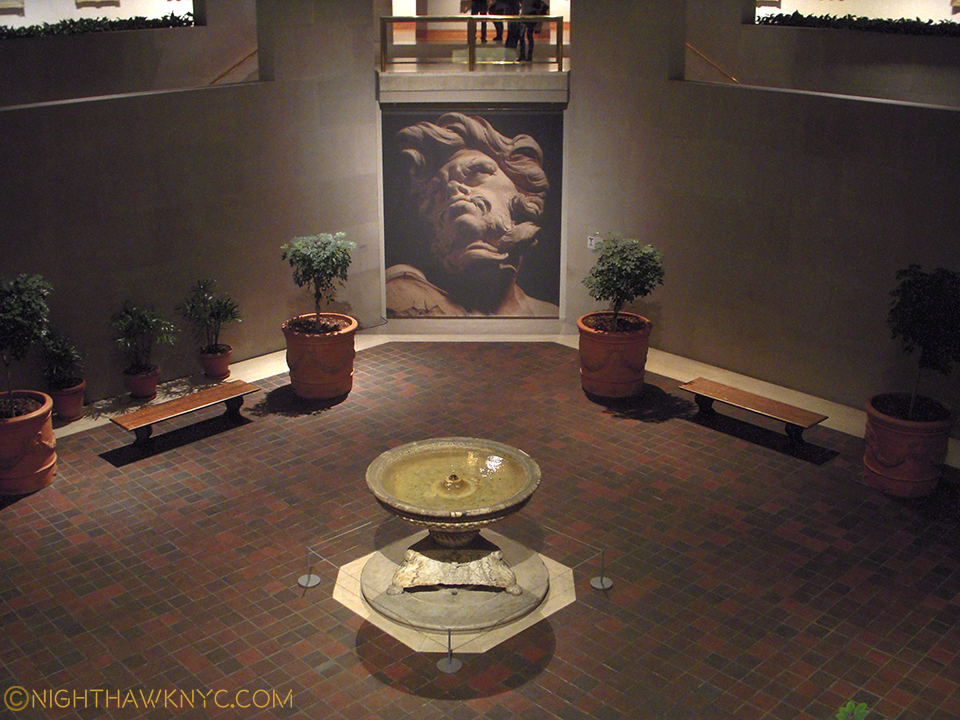
Robert Lehman Wing Courtyard, January, 2013, during "Bernini: Sculpting in Clay"

Robert Lehman Wing Courtyard, January, 2013, during “Bernini: Sculpting in Clay”

And during Manus x Machina-

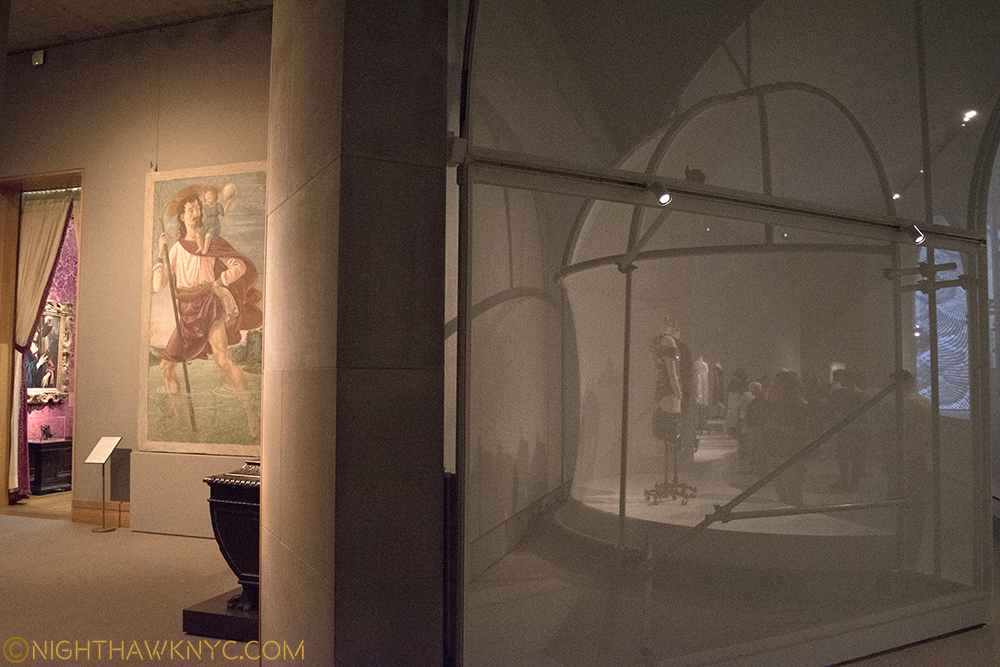
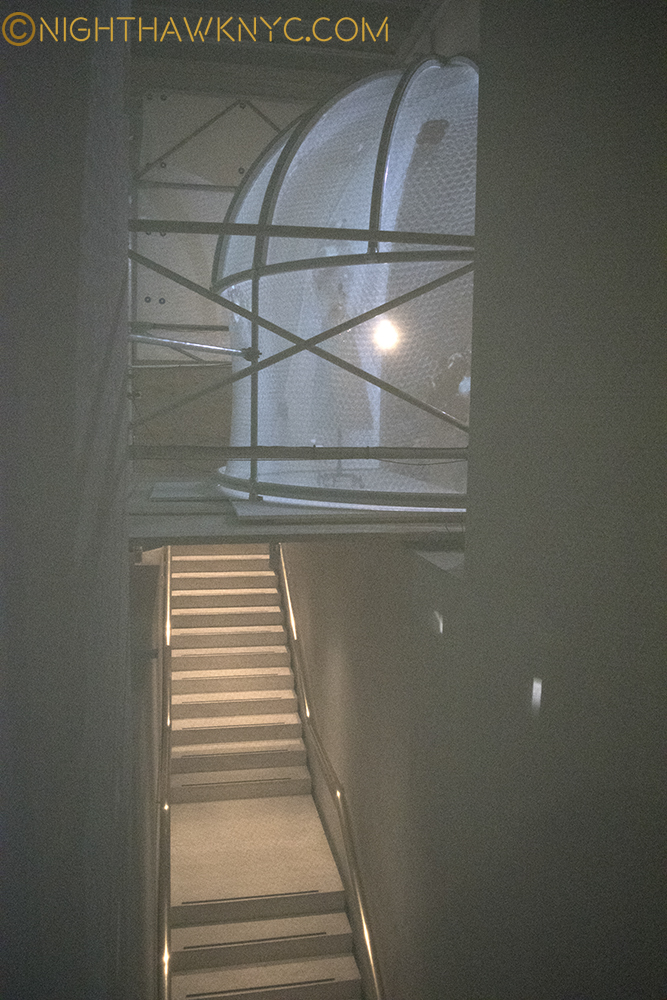
Yes, they built an entire floor over above the courtyard! Ground in this pic is at the same level as the top of the Bernini Bust in the pic, above.

Yes, they built an entire floor over the courtyard seen above! The floor in this pic is at the same level as the top of the Bernini Bust in the pic, above. Side view- Chanel Wedding Ensemble by Karl Lagerfeld, Autumn/winter 2014/15, also seen in Pic 1.

Back view. Chanel Wedding ensemble, Autumn/winter 2014/15

Front view. Chanel Wedding ensemble. Projected on the dome, above, is a blow up of the train, based on Lagerfeld’s drawing.

Back view. Probably the most popular view.

Back view. Probably the most popular vantage point.

The grey area in front is the amazing temporary floor.

The grey area in front begins the amazing temporary floor.If you didn’t know it was temporary, you’d never suspect it.

The show was focused on the craft of fashion, with each gallery turned into a section for various crafts like Embroidery, Artificial Flower Making, Leatherwork, Featherwork, Pleating, Lacework and Tailoring. Some of the more adventurous pieces follow-

A Featherwork Gallery

A Featherwork Gallery

Lacework.? Iris van Herpen, Autumn 2012, 3D Printed dark orange epoxy.

Lacework.? Iris van Herpen, Autumn 2012, 3D Printed dark orange epoxy.

Threeasfour, "Interdimensional" Dress, 2016. Machine sewn white neoprene, hand-applique 3D ivory resin.

Threeasfour, “Interdimensional” Dress, 2016. Machine sewn white neoprene, hand-applique 3D ivory resin.

Gareth Pugh, Dress, 2015. Individually hand-cut drinking straws.

Gareth Pugh, Dress, 2015. Individually hand-cut drinking straws.

It wouldn't be a Met fashion show without McQueen. Here, Sarah Burton's 2012 White pony skin on black leather ensembles.

It wouldn’t be a Met fashion show without McQueen. Here, Sarah Burton’s 2012 White pony skin on black leather ensembles.

"My dear, your tailbone is showing." Iris van Herpen, Dress, 2011-12, 3D printed white polyamide.

“My dear, your tailbone is showing.” Iris van Herpen, Dress, 2011-12, 3D printed white polyamide.

Shapeshifter. Issey Miyake, Master of the Pleat, the same designs, seen first as flats, here, and...

Shapeshifter. Issey Miyake, Master of the Pleat, the same designs, seen first as flats, here, and…

Opened. Ii.e. "Not flat"

Opened, i.e. “Not flat,” with my numbers added. “1” flat becomes “1” opened…

Tailoring & Dressmaking Gallery

Tailoring & Dressmaking Gallery

To see more of the show, I highly recommend TM’s Manus x Machina website, where you can see Overviews of each gallery and additional images of displayed items.

“I work all day at the factory
I’m building a machine that’s not for me
There must be a reason that I can’t see
You’ve got to humanize yourself.”*

Some shots of the installation-

DSC_7248PNH

Meanwhile, in the part of the Lehman Wing still displaying Robert Lehman’s collection, left, St. John seems to be striking an auditon pose to get into MxM, right, where you can see some of the temporary structural work done to create the “cathedral,” seen through the outer mesh.

Even the stairwells to the lower floor of MxM were imaginatively used, again, seen through the mesh.

Even the stairwells to the lower floor of MxM were imaginatively used, again, seen through the mesh.

This show didn’t have a “hook” into the psyche of the moment as “Alexander McQueen: Savage Beauty” did with Lady Gaga wearing his amazing “Armadillo Shoes” on the cover of Rolling Stone, and with McQueen’s recent tragic passing still fresh in the mind, yet for those with an interest in the craft of fashion, it was an excellent overview. While a few designers, especially Iris van Herpen and Issey Miyake, received major attention in the form of (too?) many pieces, the show wasn’t too big and was beautifully laid out. As very, very good as the fashion was? I’ll never forget the unbelievable and incredibly creative job they did installing this show.


A very popular Irish Wedding dress circa 1870 on the left.

A very popular Irish Wedding dress circa 1870 on the left.

This show came during the news of TM’s budget shortfall, which put on hold the rebuilding of the Modern & Contemporary Galleries. After seeing the Lehman Wing transformed, I wonder if the Lehman Wing will be the next area of TM to be rebuilt, after the M&C Galleries are done…whenever that is.

*-Soundtrack for this Post is “Rehumanize Yourself,” by Sting & Stewart Copeland, from The Police’s album, “The Ghost In The Machine,” and Published by Sony/ATV Music Publishing, LLC.

NighthawkNYC.com has been entirely self-funded & ad-free for over 8 years, during which 300 full length pieces have been published! If you’ve found it worthwhile, PLEASE donate to allow me to continue below. Thank you, Kenn.

You can also support it by buying Art, Art & Photography books, and Music from my collection! Art & Books may be found here. Music here and here

Written & photographed by Kenn Sava for nighthawknyc.com unless otherwise credited. To send comments, thoughts, feedback or propositions click here. Click the white box on the upper right for the archives or to search them. Subscribe to be notified of new Posts below. Your information will be used for no other purpose.

To- Whoever Owned This Book Before Me

This site is Free & Ad-Free! If you find this piece worthwhile, please donate via PayPal to support it & independent Art writing. You can also support it by buying Art & books! Details at the end. Thank you.

Written & Photographed by Kenn Sava (*- unless otherwise credited)

I don’t know who you are, but this Post is for you.

“This book” is an out of print exhibition catalog from the Stuart Davis show at The Metropolitan Museum in 1991. Another of the shows I missed and will forever be sorry I did. Thank goodness it lived on in this superb catalog. Show catalogs are an interesting thing. Widely available while the show is on, they soon go out of print and then become sought after by Artists, specialists and die-hard fans as time passes.  Though The Met said they were going to make all their older publications available as .pdf files online, some, like this one, have been skipped no doubt because it was co-published by a big commercial publishing house, who has a say in that, in this case Abrams.

12 years ago I bought a used paperback copy of it at the now defunct Academy Books and had worn it out. I’ve had my eye out for another copy, one in good condition at a reasonable price for a while. I need it now because I’m in the middle of a Post on the “Stuart Davis: In Full Swing” Show at the new Whitney Museum. My go-to (often) bookstore, The Strand, had one recently, but it wasn’t much better than the one I had, so I passed. A few days later, it was gone. So, I was driven to look online, and finally found this copy.

The Book. The catalog for The Met's 1991 Stuart Davis show, long out of print. Notice the cover Art.

The Book. The catalog for The Met’s 1991 Stuart Davis show, long out of print. Notice the cover Art.

I bought it online from a bookstore. When it arrived, unlike some of my recent experiences buying books online, I found it to be in better condition than I had hoped. People seem to want to upsell the condition of books, which is so shortsighted. Most buyers are going to notice an obvious flaw in something so why try and get over on someone and have it sent back to you and probably get some, deservedly, bad feedback in the process? To help keep it this way, I decided to put a book jacket on it. I’ve been looking through it, but I hadn’t looked inside the back cover. When I removed the dust jacket to wrap it, I did. I found Stuart Davis, himself, looking out at me from a 1912 Self Portrait he painted, apparently in New York, given the background, while he was living in Hoboken, NJ, at age 20. It was in an archival envelope. I opened it up to discover it was the first page of an article about Davis and the 1991 Met Show, carefully removed from an unknown magazine (circa 1991-2) and placed in this envelope to protect it, and so it wouldn’t discolor the book.

Stuart Davis, in his 1912 Self Portrait, looks out at us, 104 years later.

Haunting our City. Stuart Davis, age 20, in his 1912 Self Portrait (with NYC’s old Elevated Subway in the background) looks out at us, 104 years later, from inside the back cover. The original painting is here.

On the back of the last page of the article, someone had cut out and carefully taped the bibliography for the article. Impressive!

DSC00537PNH

This was something similar to what I’ve done for many years, myself. If you have eclectic taste and/or like Artists or Musicians that aren’t very popular it may be a long time before you find something in print about them. When I did? I’d read it over a few times, then cut it out and save it. I’d stick it inside a book about them (if there was one), inside a record jacket, or later, a CD jewel case.

I buy used books often, since many books I’m interested in are now out of print. Sometimes, the unpleasant aroma of old cigarette smoke hits you, making you wonder if that finally led to this book being here. They don’t make the cut. Sometimes, they come with a previous owner’s name written inside. I usually don’t like anything written in a book. But this one time? I wish the owner had written their name in it.

One day all too soon, physical Art Books will be a thing of the past, as soon as image quality in eBooks catches up with their printed counterpart in a reasonable file size. That might be a while yet. For me? It would be a mixed blessing. Mostly? I have too many large books, as I’m often reminded, so freeing up some space would make a big difference in my life. Beyond that, though, there is something beautiful about a physical Art Book, something that hooked me since I bought my first one, on Rembrandt by Bob Haak as a teenager, and still does. I suspect they will then trade among collectors, like Lp’s do now. No one will ever open an eBook and have this happen to them.

Finding this today? Here was a kindred spirit- someone like me. Someone I’ll never know who feels about Stuart Davis’ work the way I do. Though he didn’t write his name in it, it was personalized in a non-destructive way. Making it one’s own, but not like tattooing it with writing. There’s no need for that in this case- I get it.

That same afternoon, I went back to to see “Stuart Davis: In Full Swing” yet again, as my work continues. I had an errand to do first, so I wound up walking over to the Whitney a different way than I usually do. As I neared the corner of 7th Avenue on West 13th Street, I was stopped in my tracks, when I saw this on the wall.

DSC_7025P2NH

“…it was here that he painted many of his most important works including…”

What? Wow!

I have lived in and around NYC almost all of my life, and been in this neighborhood countless times. Yet, I’d never known he lived here! Around the corner is the Village Vanguard, for my money the world’s greatest Jazz Club, where it occupies the same basement it has since 1935. Being a lifelong Jazz lover, I bet he spent quite a few evenings there, as I have, as well. The original Whitney Museum was a short walk away on 8th Street, when he lived here (from 1934-54), as the new one is now in a different direction.

Reading the plaque, I could still feel Stuart Davis’s “Self Portrait” from inside the back cover of the book looking at me. Inside in the lobby hung a large, beautifully framed Stuart Davis Poster. Impressive considering he died 52 years ago, and it’s 62 since he lived here. Looking at the building, it looks like thousands of other buildings in New York, and, probably, the rest of the world. I stood outside pondering it. It wasn’t like the old Bowery that reeked of cheap booze and romantic Artist’s loft studio spaces, the long time homes of Allen Ginsberg, John Cage and othes from the same period, Keith Haring, Joey Ramone, among others, after. It was a nice, modern, kinda faceless apartment building. Nothing about it said that one of the greatest American Artists who has yet lived lived here, except it’s smack-dab in the middle of The Village location.

Then, I continued on, completing the short walk to the Whitney. Inside the show, I lingered in front of “Rapt At Rappaport’s,” from 1952, in it’s interesting frame.

Davis' "Rapt At Rappaport's," 1952, on view at The Whitney, now in the Smithsonian

Look familiar? Davis’ REAL “Rapt At Rappaport’s,” 1952, now on view at The Whitney, from the collection of the Smithsonian.

Davis painted it in the building I had just walked past, as the plaque confirms by name! I never knew that. I’ve seen it before, but now? I’m seeing it anew. It doesn’t depict the neighborhood (Greenwich Village) per se, in fact, it’s an “homage” to “Rappaport’s Toy Bazar,” a store his parents used to take him to as a child many years earlier. The store used polka-dotted paper to wrap gifts, hence, the polka-dots in the upper right, and the work’s title is also a pun on “wrapped.” But, on a different level, now everything about this says “Greenwich Village in the 1950’s.” The child became a man, and that man was an Artist. It drips of the Jazz he heard all around as The Village headed into it’s Jazz & Beat Glory Days. Even the title (using “Rapt” in place of “Wrapped,” for the wrapping paper) is a “Jazz-pun,” as in raptly listening. In addition to being a “souvenir” of his childhood, it’s also a little reminder, a little piece, of that more recent time, and place, The Village- from his then home there on 13th & 7th.

It also happens to be the painting chosen to be the cover Art for my new/old book.

Is this all a bunch of strange coincidences, neatly “Rapt” together with a bow on top? Covering (“wrapping”) the Davis book and being startled to see him looking out at me unexpectedly, as the prior owner had left him, lovingly curated…then accidentally discovering (uncovering?) the very place he painted it’s cover Art… and finally, seeing the original painting shown on the book’s cover. Hmmm…It feels like someone is sending me a message.

Now? Someone else lives in that apartment. Someone else owns this book.

Still? Parts of both live on from before. Very good parts.

Thank you.

*-Soundtrack for this Post is “You Can’t Judge A Book By It’s Cover,” written by Stevie Wonder, Sylvia Moy and Henry Cosby, and preformed by Bo Diddley.

NighthawkNYC.com has been entirely self-funded & ad-free for over 8 years, during which 300 full-length pieces have been published! If you’ve found it worthwhile, PLEASE donate to allow me to continue below. Thank you, Kenn.

You can also support it by buying Art, Art & Photography books, and Music from my collection! Art & Books may be found here. Music here and here.

Written & photographed by Kenn Sava for nighthawknyc.com unless otherwise credited. To send comments, thoughts, feedback or propositions click here. Click the white box on the upper right for the archives or to search them. Subscribe to be notified of new Posts below. Your information will be used for no other purpose.

Hallejulah! Calatrava’s Cathedral Opens (UPDATED)

This site is Free & Ad-Free! If you find this piece worthwhile, please donate via PayPal to support it & independent Art writing. You can also support it by buying Art & books! Details at the end. Thank you.

Written & Photographed by Kenn Sava

Santiago Calatrava’s new World Trade Center Transit Hub, which officially opened today, August 16, is an unabashed glory of Architecture, a breathtaking masterpiece. What I wasn’t expecting is that it’s, also, a true monument to Freedom.

As far as I’m concerned it has more to do with Freedom than that other building with that term applied to it that stands close by. You know, the one that looks like a giant hypodermic needle. Having avoided the whole Ground Zero area (even though I grew up there), the way all New Yorkers avoid Times Square, mostly out of disgust with what has been erected there thus far, I of course knew about the WTC Transit Hub, but I was afraid something would happen at the last minute and it would have been quashed or horribly altered. As a result, I hadn’t seen this building in progress. When I turned the corner onto Dey Street this afternoon, and saw it before me, a shiver ran down my spine. I was struck by the unforgettable memory of seeing that still smoldering pile of the remains of the World Trade Center right where the Hub now stands. It’s almost 15 years ago, and I can see it like it was yesterday.

I shot this on 9/11 from 5th Avenue and 17th Street.

Yesterday…The World Trade Center on 9/11. I shot this from 5th Avenue and 17th Street.

I wiped my eyes.

“‘Twas in another lifetime, one of toil and blood
When blackness was a virtue the road was full of mud
I came in from the wilderness, a creature void of form
Come in, she said
I’ll give ya shelter from the storm”*

But no. Now? It looked like a big white bird was sitting there.

I had to wipe my eyes when I saw this to wipe away the memory of what I saw on this very spot 15 years ago.

It looked like a Phoenix rising from those very ashes.

Calatrava’s new masterpiece looks like a glorious white bird (a Phoenix, or…ok, an Eagle, not that I’ve ever seen either in person) with GIGANTIC wings large enough to actually offer you a feeling of comfort, even protection (though they won’t even stop the rain), as you stand under them outside. That’s exactly how I felt when I did. The building is Angelic, and not only because it’s white all over- it has an air of something sacred that I can’t describe about it- inside and out. It’s downright Glorious. And? THOSE WINGS! Oh my god…

DSC_6807NEFPNH

A place of peace- unexpected and profound. Angels have wings, I hear.

“Not a word was spoke between us, there was little risk involved
Everything up to that point had been left unresolved
Try imagining a place where it’s always safe and warm
Come in, she said
I’ll give ya shelter from the storm”*

Nothing has had a healing effect on me thus far after that fateful day as seeing this. I don’t know what Santiago Calatrava’s intentions are with this work. I haven’t read anything he, or anyone else has said about it. All I know is that it speaks to me.

Think it's small? Look for the man walking along side about half way for scale.

Think it’s small? Look for the man walking along side to the right side for a sense of scale.

Outside, especially from the front, it looks small. Don’t be deceived. Only the dome is above ground. Inside? It’s HUGE.

DSC_6612PNH

“Set a course for…you know…out there….” Captain Kirk, Star Trek.

DSC_6525PNH

Below the Cathedral’s Dome, two levels of stores, food, etc, with more on wings extending off the sides.

IMG_5734PNH

John Legend had just performed in the center of the floor.

After you walk in, you are immediately presented with a vast football shaped interior. “Cathedral-like” was my first impression. The longer I looked, something struck me- While there are stores all along both levels that stretch out in front of you, you can’t really see them from the viewing platforms on each end! This serves to lessen the “cathedral of shopping” effect that pure shopping malls have, and puts the focus back on the building and it’s architect’s intended impact. (I’m not sure how the merchants feel about this, because it serves to make their shops less identifiable from a distance.) I spent three and a half hours walking in and around it tonite from all sides (yes, including visiting the brand new Apple Store, prominently located and having it’s grand opening today as well. It happens to be one of the 3 Apple Stores with their new store design. Some other stores were open but the complex stretches out in all directions, and I didn’t have a chance to explore all of it today). It may be comparable in size (or bigger?) to the underground mall that was under the World Trade Center and destroyed, as well, on 9/11.

Opening Day for Apple's WTC Store- on both floors, it's 3rd with their new store design.

9pm. Closing time on Opening Day for Apple’s WTC Store- on both floors, it’s 3rd with their new store design. Like the rest of the stores, it’s a bit “hidden” by the building.

Everywhere, inside and out, this Cathedral is clad in pristine white, with copious amounts of white marble included. Just stunning. It’s pristine white glistens even in the dark (my preferred viewing time, of course. UPDATE- August 17- Scroll down to see daylight pics I took today.). The ribs of it’s twin wings soar majestically, impossibly high, providing the eye with a glorious thrill, while straining the neck to unnatural angles, as it traces their course, up, up and away. Wow. Careful! Look too much straight up and you may tip over. Unlike Calatrava’s vision, my feet need to remain on the ground.

img_5720p2nh

I bent over backward to get this shot. Imagine what it was like to install EVERY ONE of those MASSIVE ribs! Wow. (PS-Don’t call me when they need cleaning.)

Still? That THRILL is an important part of the feeling I want from architecture, Mr. Renzo Piano (who’s new Whitney Museum, which I recently wrote about)! Here is engineering, like the countless, huge ribs (as visible as Mr. Piano’s engineering is at the Whitney), that is both functional and endlessly beautiful to behold.

Even though it is far from completed, right now I’d say this is the greatest new public space in Manhattan since, perhaps, the old Penn Station in 1910. It seems to cast a respectful glance back to Grand Central Terminal (which also lets light in so magically along it’s ceiling and that glorious glass wall). Once completed, Calatrava may have given us a “Grand Central Terminal” for the 21st Century.

Path Train Station. Notice the 2 people looking up at the great hall before them!

Welcome To New York. The Path Train Station. Notice the expression of the 2 people looking up at the great hall before them!

I saw more people taking pictures of it in ten minutes than I have in 15 months take pictures of the new Whitney. Even the guard was proudly posing! Inside, everyone I spoke to from the security guards, to the construction workers taking down the stage from John Legend’s performance had a glow about them. There was actual pride in the voice of one guard I spoke to off in the corner by a staircase. “I don’t know anything about art,” he told me, “but someone came by and said I don’t understand what all the hoopla is about. I told him you have to have an artistic eye.” I shook his hand. Pride from someone who hasn’t even been on the job for 12 hours yet. Inside and out, people from all over the world were not only taking pictures of every angle of the place, they were posing in front of it, next to it, all over it for selfies and groups shots. They felt it, too.

A Security Guard, back to us, poses.

Take a bow! A Security Guard, back to us, poses. Working in a work of Art is it’s own perk.

For me? It’s a new masterpiece this City SORELY needs, ESPECIALLY in a public building. It makes arriving in Manhattan the special thing it is, again. Walking around today, it’s already a hit, less than one day in. I grew up downtown. My father had an office 2 blocks from the World Trade Center. I remember it being built, and I saw it destroyed. Looking around today, after a while of being away, I was just sickened at what’s gone up, like I am in most other areas of the City. While I’m glad the 9/11 Museum seems to be a big hit, I’ll never “get” the building they put it in, which I saw for the first time, and which is right next to Calatrava’s Hub. The Hub directly faces the Memorial Pools, where the Twin Towers stood. Being there today, I was struck by just how big the area is. When I was at the World Trade Center, as gigantic as they were, the surrounding area somehow felt small. Now, it feels big, and it feels like it’s a mishmash of ugly buildings, except this one, that don’t have anything to do with each other. Yeah, like the rest of New York, and that’s a shame. I say this with ultimate respect for all those we lost, and with pain that things haven’t turned out better down there. They deserve better, and so do we. At least we have one great building there, and one, that for me, also speaks to what happened there, as well as to our future.

DSC_6520PNH

Seen from the front, the ribs are short on one side, long on the other. Walk to the back, the short side is now long, the long side, short.

Along with everything else it says to me, it says that YES! It IS possible something great can be built in New York City in the 21st Century!

Quibbles? Well, it’s far from finished, so I’ll hold off getting very critical about it until it’s done, but I will say I don’t like the front doors, on either of the two entrances. Frankly? They look terrible. They feel to me like they weren’t Calatrava’s choice.

But? Given how hard (read that “impossible”) it is for great architects to get ANYTHING built in Manhattan, let alone something as monumental as this is, I’m absolutely thrilled! Best of all, it’s open 24 hours, so I can wander over there any time of day or night to enjoy it’s beauty, and let it continue to speak to me. It’s a dialogue I look forward to continuing. Maybe even in daylight. Well, let’s not get crazy.

I couldn’t help thinking the more it sunk in how great this is that it certainly sets the bar VERY high for the next Penn Station and Port Authority Bus Terminal! GOOD LUCK with that!

“Well, I’m livin’ in a foreign country but I’m bound to cross the line
Beauty walks a razor’s edge, someday I’ll make it mine
If I could only turn back the clock to when God and her were born
Come in, she said
I’ll give ya shelter from the storm”*

UPDATE- August 17- Due to a request I got, I went back to shoot it in the daylight-

DSC_6969PNH

To the left in the background is St. Paul’s Chapel, which somehow survived 9/11, and the top of Frank Gehry’s Apartment Tower in the far distant left.

IMG_5795PNH

DSC_6903PNH

IMG_5815PNH

dsc_6998p2nh

Looking up from the dead center of the floor.

All the paraphernalia that was on the floor last night was removed leaving a large, open glorious space. I hope it stays that way.

All the paraphernalia that was on the floor last night was removed leaving a large, open glorious space. I hope it stays that way.

 *-Soundtrack for this Post is “Shelter From The Storm” by Bob Dylan, published by Bob Dylan Music Co., from “Blood On The Tracks.”

NighthawkNYC.com has been entirely self-funded & ad-free for over 8 years, during which 300 full-length pieces have been published! If you’ve found it worthwhile, PLEASE donate to allow me to continue below. Thank you, Kenn.

You can also support it by buying Art, Art & Photography books, and Music from my collection! Art & Books may be found here. Music here and here.

Written & photographed by Kenn Sava for nighthawknyc.com unless otherwise credited. To send comments, thoughts, feedback or propositions click here. Click the white box on the upper right for the archives or to search them. Subscribe to be notified of new Posts below. Your information will be used for no other purpose.

The New Whitney Museum- The Roofdeck of American Art

This site is Free & Ad-Free! If you find this piece worthwhile, please donate via PayPal to support it & independent Art writing. You can also support it by buying Art & books! Details at the end. Thank you.

Written & Photographed by Kenn Sava (*- unless otherwise credited)

DSC_3074PNH

“American Tune”
“We come on the ship they call the Mayflower
We come on the ship that sailed the moon
We come in the age’s most uncertain hour
and sing an American tune”*
Looking west on the 6th Floor Roof deck, Spring, 2016.

Looking west on the 6th Floor Roof deck, Spring, 2016.

Part 1- The New Whitney Museum…And I

We actually go way back…

All the way back to June, 1987 when I had a letter published in the New York Times in opposition to the proposed expansion plans of the Guggenheim & Whitney Museums, after it was announced that both Museums wanted to modify & expand their existing buildings. I was outraged. How could you change these two singular masterworks without ruining them? I closed saying that “branch museums were the obvious answer” to modifying these Artworks of Architecture, in the Guggenheim’s case, Frank Lloyd Wright’s masterpiece was, perhaps, the greatest work of Art it owns. I went to the Community Board Meetings, but wasn’t directly involved beyond this letter. Mine was apparently chosen over the head of the opposition committee’s letter, much to his displeasure, I heard.
My letter in the NY Times Op-Ed page opposing the & Guggenheim & Whitney modifications, June, 1987. I love the very fitting drawing they added.

Almost 30 years later (wow…really?), how did “we” do?

Well, BOTH Museums took my “advice” and opened branch museums. The Whitney had a few around town, one across from Grand Central, another in Soho, while the Guggenheim opened what is, perhaps, the greatest Museum building since Wright’s enduring 5th Avenue masterpiece…by Frank Gehry in Bilbao, Spain of all places. It’s a “place” now, a true destination for culture vultures. They showed a model of another Gehry masterpiece they wanted to build downtown in the East River at the Guggenheim Gehry Retrospective in 2000. I bought a poster of it but, after 9/11, it was never mentioned again. ? They went ahead and remodeled Wright’s masterpiece, anyway, which I will never accept, AND continue to open branch Museums around the world as we speak. The Whitney, on the other hand, did not renovate Breuer’s unique original. Instead, we got something I never saw coming- They moved out and built an entirely new Museum.

Wow!

So? On my scorecard? I am one and a half out of 2.

The New Whitney opened in May, 2015 in the Meatpacking District, right at the southern end of the High Line. I’ve made frequent trips there so far studying the building from every angle I could, at night, and yes, even in day light. (Oh, the sacrifices I will make in the pursuit of Art.) The inaugural, and as I’ve said very good, show, in the new Renzo Piano building, “American Is Hard To See,” came and went. I also wrote about both the Frank Stella Retrospective and a show by filmmaker Laura Poitras that came and went, too, along with quite a few smaller shows. So, a few months after the 1 year Anniversary, I think I’ve finally had enough time and experience with the new place, over 45 visits, to have some thoughts coalesce. As always, I have not read any reviews of either the building or the shows mentioned.

Part 2- Renzo Piano’s Whitney Museum Building

U.S.S. Indianapolis. US Navy Photo

The U.S.S. Indianapolis, Why is this picture here? Stay tuned. (U.S. Navy Photo.)

It’s only a year or so old, but I don’t think many will fall in love with the exterior of the building. I must say that in all my trips there so far, I have yet to see anyone else take a picture of it. Maybe (more) time will tell. In this City where location isn’t everything, it’s the ONLY thing, the new Whitney sits on a rather unique lot. How many places in Manhattan can you think of that have BOTH a River view AND a Park view? Situated directly across the West Side Highway from the Hudson River, to the west, and the southern end of the High Line to the immediate east, the Museum hit on a very rare Daily Double. Unfortunately for long time Whitney architect Piano, who came on board during the Museum’s “expansion” days, this lot has 4 sides. To the north, the rest of the block is occupied by one of the few remaining Meat Packing businesses that actually pack meat in what really was The Meatpacking District.1 Yes, trucks of raw meat park within inches of the Museum’s north wall every weekday.
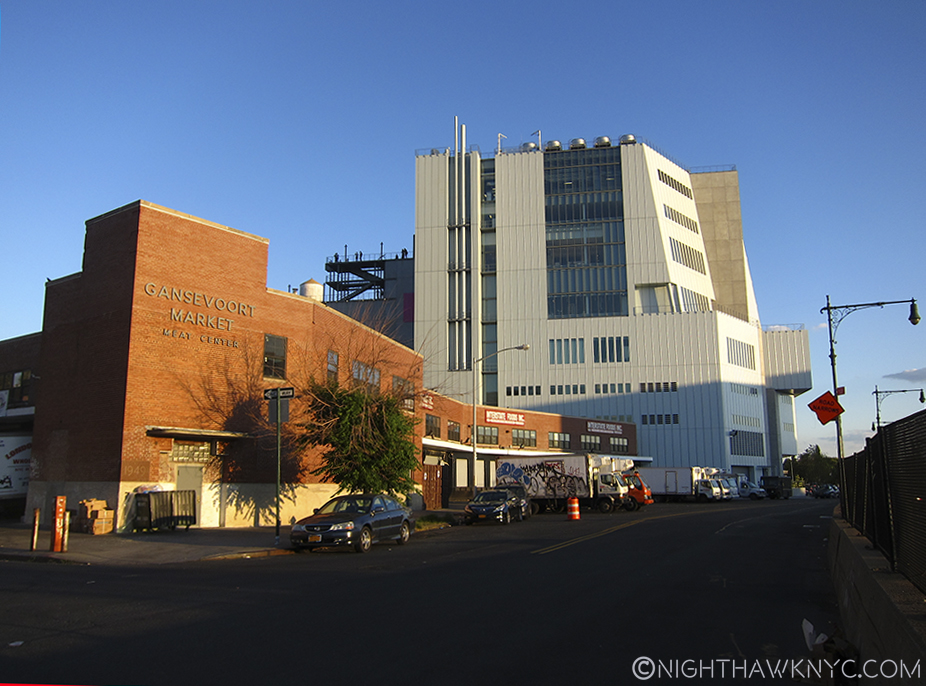
Yes, meat is still packed in the "Meatpacking District." Whitney's north side seen from West Street.

Yes, meat is still packed in the “Meatpacking District.” Whitney’s north side seen from West Street.
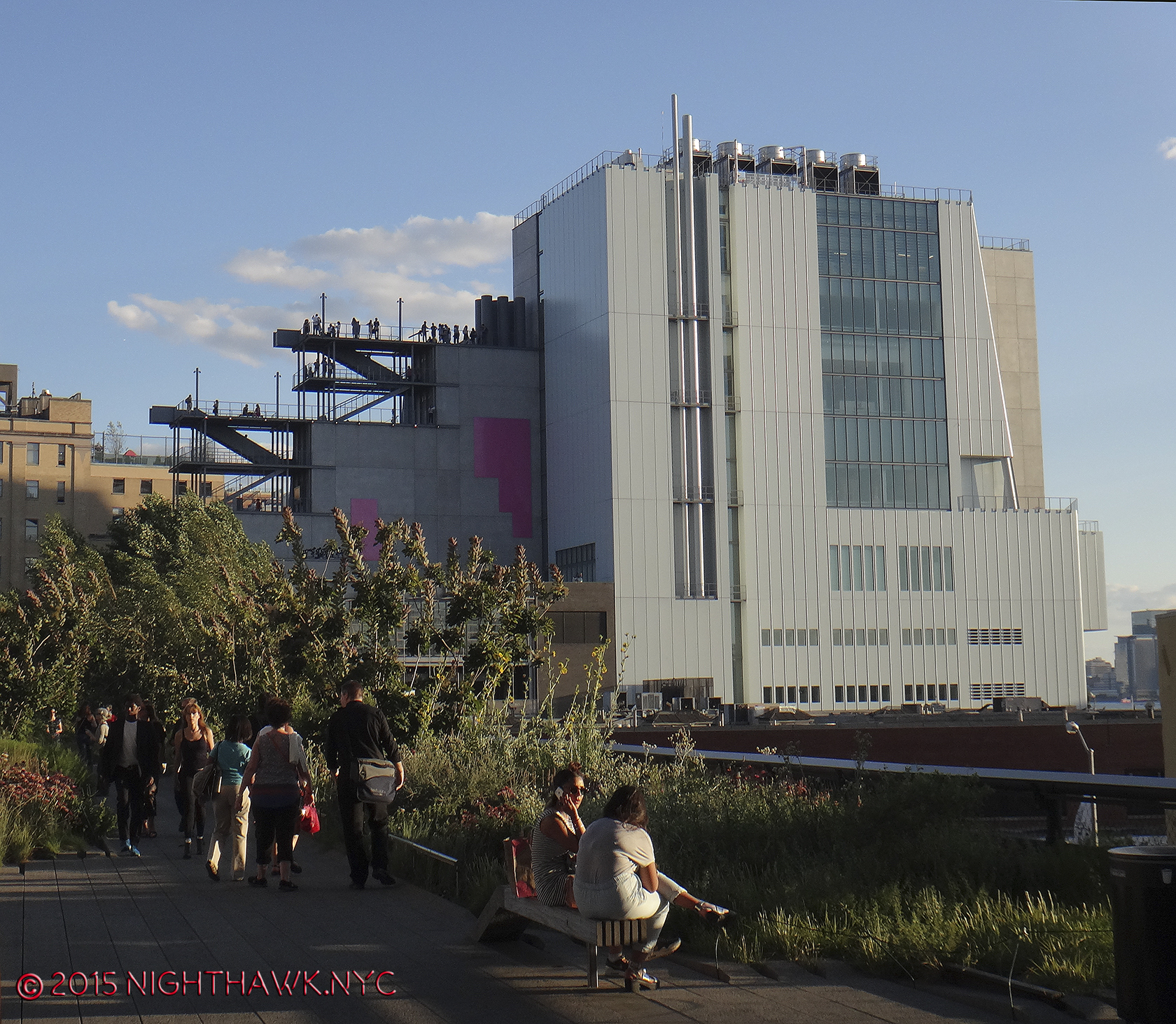
And, seen from the High Line.

And, seen from the High Line.

The two story meat complex provides a nearly unobstructed view of most of the north face of the Museum, from West Street or the High Line. I wonder what people who don’t know it’s the Museum think it is. I wonder how many of them will look at it and say, “Ah. A Museum.” My guess is not many. Maybe it’s an office building with not enough windows and a couple of long smoke stacks? A prison? It’s pretty non-descrip, making the stair cases that protrude from the rear of the building seem, well, odd. For myself, and probably countless others approaching the New Whit from the north, this is the first view they’ll get of it. The one defining feature of this side of the building is the exterior staircases. A cascade of them.
DSC_2948P2NH

Outdoor stairs as seen on the 7th Floor

To the south, across Gansevoort Street is a large, renovated apartment building, that also has Hudson River views on it’s western side. To put it mildly, this is a classic “high rent” district. Facing Gansevoort Street, the Museum presents visitors with an almost unbroken face of grey steel. Upon closer inspection, it also includes the Museum’s almost hidden entrance, which, until a sign was added recently, was only marked “Whitney Museum” on a glass window. Still, I can’t help wonder how the residents of that building across Gansevoort feel about paying those very high rents to look out their windows and see-
This, is their view.

This, is their view.

In fact, seen from the south, the building is so large that none of my cameras were able to get the whole thing in a shot from Gansevoort, including using an iPhone in Panorama mode. I had to go out into West Street to get one, which I don’t advise doing due to traffic coming randomly from 3 directions, not to mention my back being literally on the flimsy chain link fence bordering the West Side Highway with cars & trucks zipping around the bend at 60mph. Not a smart place to be standing with a camera. But this points out something interesting- there is no place where one can easily stand to get a good shot of the Museum- except, possibly, from a substantial distance. In fact, most of the shots of the building on the Whitney www site were taken from the rooftops of adjacent buildings. Maybe this is why no one takes pictures of it. Or? Maybe they don’t like it. ?
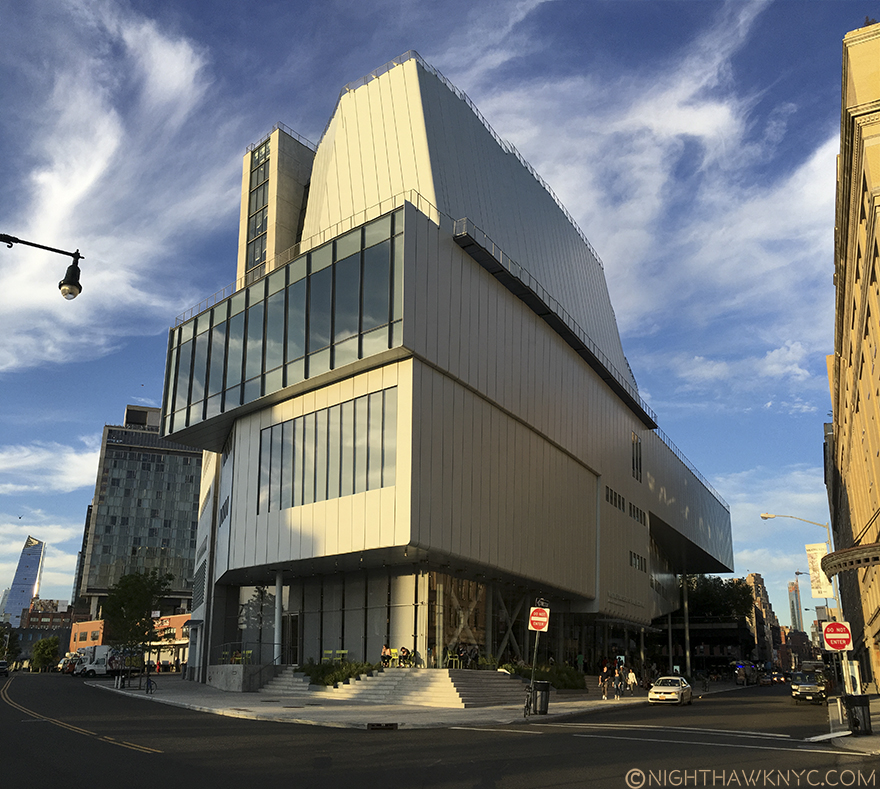
The closest I've come do death this year. The West Side Highway is inches behind me.

NOT to die for. I risked my life getting this shot. Southwest corner.

As we move to the western facade, with the large windows seen above (which reminds me of Zaha Hadid’s Library in Vienna), the upper one juts out at an angle seen from the north that vaguely reminds of the Breuer building’s Madison Avenue upper window.
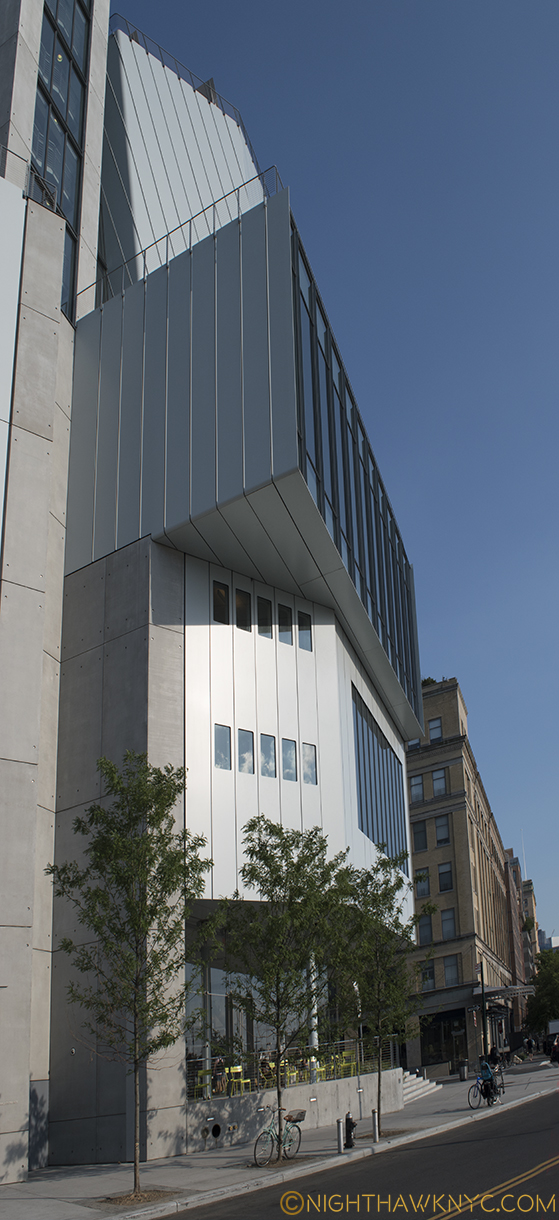
DSC_5300PNH

But more problematically, is a large Department of Sanitation complex smack dab right in front of it! “Holy Refuse Pile, Artman!” Garbage trucks coming and going all day and evening are not exactly what gives a “Riv View” it’s cache. (Feel free to insert your own wry joke about contemporary art here. I’ll wait…)
View of the Department of Sanitation from the 7th Floor stairs, 2015.

Riv View. Looking out at the Department of Sanitation from the 7th Floor stairs, 2015.

Mr. Piano has done his best to “minimize” the damage from the “offending” Department of Sanitation, and eternally busy West Side Highway, by opting to minimize the exposure of the western facade leaving a very narrow patio where, typically, only a few chairs usually are to be seen. It sits a few scant feet from the West Side Highway, after all, so it’s hard to imagine many people wanting to sit there for long. 3 trees have been planted along the curb in hope that one day they will provide some camouflage.
View from in front of the western facade, July, 2015, Being a tree in NYC is one helluva hard job.

View from in front of the western facade, July, 2016, Being a tree in NYC is one helluva hard job.

Regardless of the difficulties in seeing the building close up, it can be seen, for many blocks, both, to the north and south along the West Side Highway, and from across the Hudson River in New Jersey. Thanks(?) to the High Line there has been a boon in building in the area, with some very big name Starchitects (including, as I’ve written, the late Zaha Hadid’s only NYC Building going up at 520 West 28th Street, among many others) having new or recent projects in the area- some successful, some eyesores already. No less than Frank Gehry, the greatest architect of his time, in my book, himself, has a fairly new building about 6 blocks to the north of the New Whitney along the Highway, the gorgeous IAC Headquarters at 18th Street.
Like a sailboat on the Hudson, Frank Gehry's IAC Building is a gorgeous vision.

Like a sailboat on the Hudson it faces, Frank Gehry’s IAC Building is a shining example of the visionary architecture NYC needs more of, IMHO.

But, say what you want about this new Museum (don’t worry…I will), one thing that must be said is that the building isn’t obsessed with competing with it’s spectacular neighbor. Well? Not that spectacular neighbor, anyway. If anything, it sure feels to me like it’s competing with it’s OTHER “spectacular neighbor”- the High Line.
Southern terminus of the High Line, circa 2009. The new Whitney now occupies the space directly behind the left side.

Southern terminus of the High Line, circa 2010, early in the construction of the new Whitney directly behind on the left side. And today, and tonite…
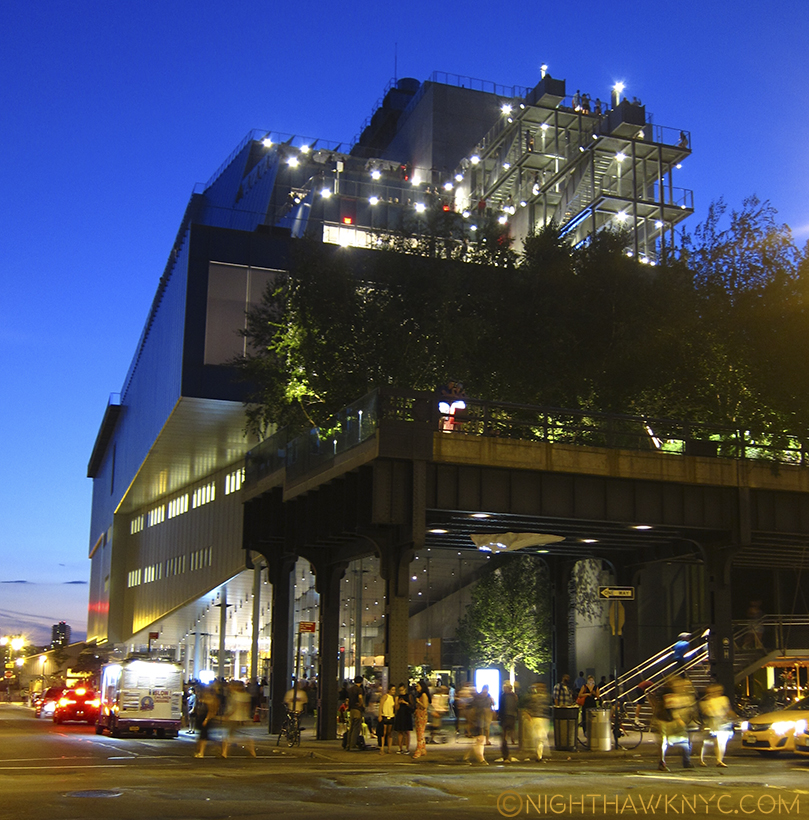
DSC_6042PNH


IMG_1130P2NH

That brings us to the east side of the building, the side that abuts the High Line. Renzo Piano also designed the High Line Maintenance & Operations Building,
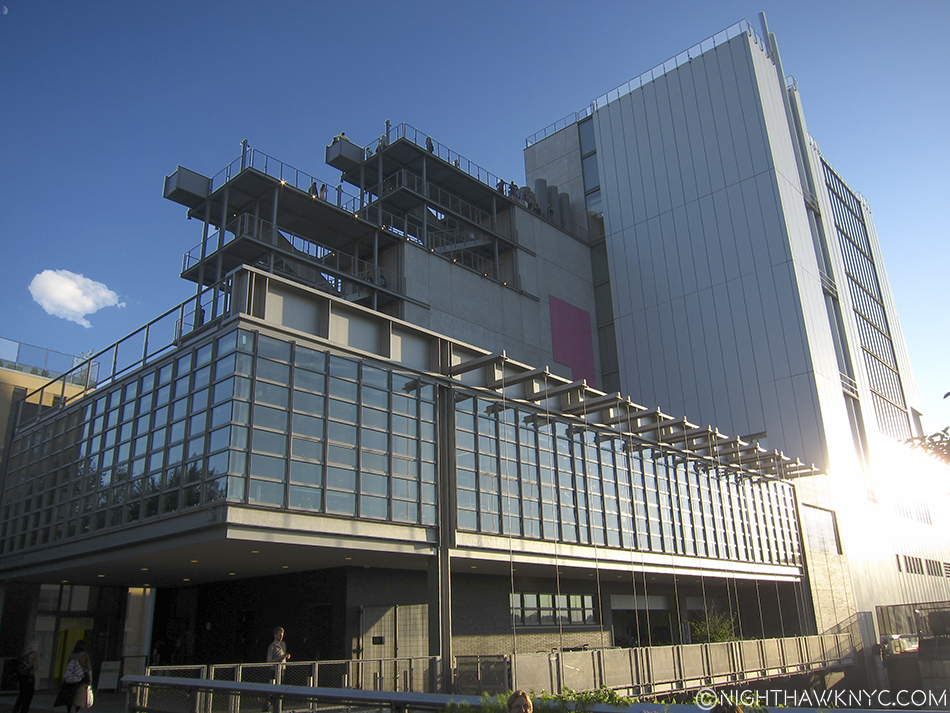
IMG_0782PNH

High Line Maintenance & Operations Building on the lot’s northeast corner.

which looks like it’s part of the Whitney, occupying the north eastern corner of the lot. Next to that are a rectangular bank of windows of the 5th Floor Galleries. The lowest rectangle is cleverly cantilevered over the lower floors in a way that vaguely reminds of Wright’s Fallingwater. Above it are more rectangular rows of windows on the other gallery floors, which are accompanied by roof decks and outdoor stairs between floors.
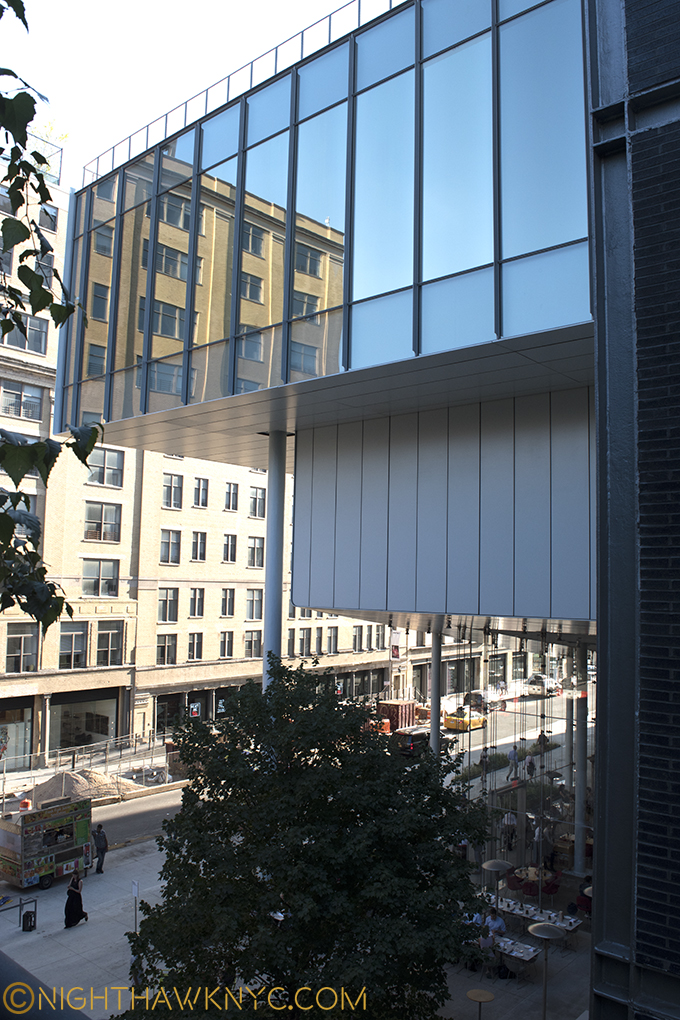
Eastern face with 1st floor restaurant seen from the High Line.

Cantilevered lower eastern face with 1st floor restaurant seen from the High Line.

And, these are what raise my suspicion about purpose. So much outdoor space, and outdoor stairs in a place with the climate of Manhattan could be seen as highly questionable design. They are going to be unusable a good part of the year, so why do them? Aesthetically, to my eyes, the stairs look uncannily similar to the High Line’s access stairs. I wondered- Is this a case of “art snobbery” by an expensive to build, expensive to enter Museum trying to “upstage” a free & public park- a poorly thought out game of oneupmanship? An attempt to “blend in” with the High Line? Or?
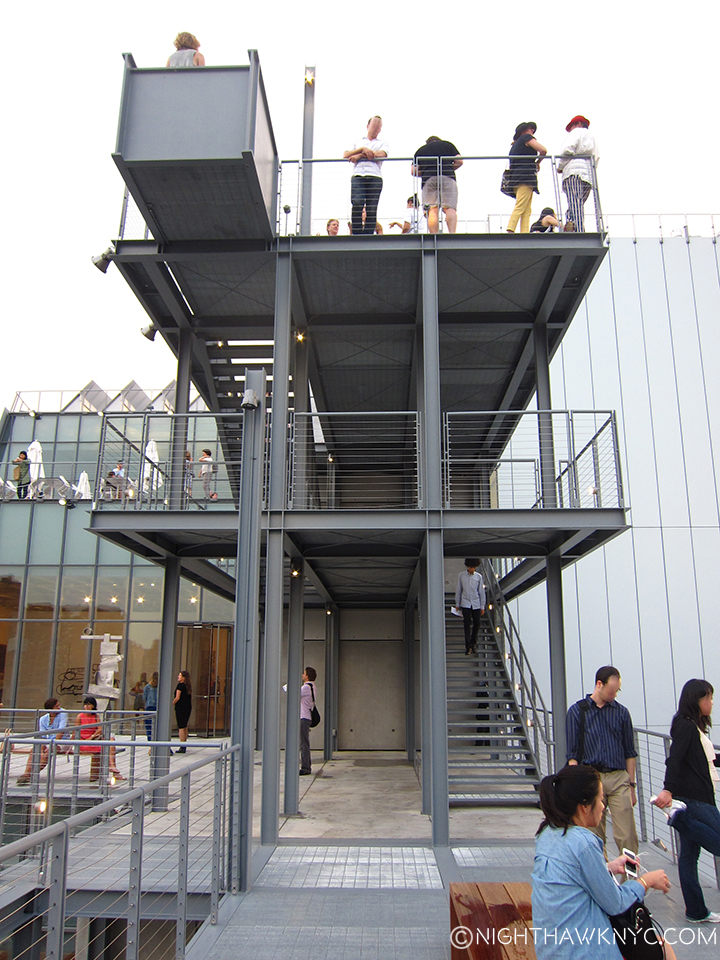
Whitney Museum Eastern Facade Exterior Stairs close up
High Line Stairs at West 20th Street

High Line Stairs at West 20th Street

Other questions festered. Back along the south face. I spent a long time trying to think of what the shape of this building reminded me of. Hmmmm…Then one day, it hit me- From the south it looks like one of the US Navy’s newest ships- the USS Independence. From this side, it looks like it’s ready to go out to sea, well, out to the Hudson River. This feeling is hard to shake when you are looking at the few windows that look a bit like portholes, the “military—like” grey coloring, and the slightly sloping (i.e. “stealthy”) look of the upper floors. Add the rear decks and stairs to the Independence and the effect is so similar, it’s down right eerie.
Ok, flip the cantilever to the rear, and...? Eerily uncanny, no?

U.S.S. Indianapolis, again, with my highlighting. Ok, flip the cantilever to the rear, and…? Eerily uncanny, no?
Photo from Renzo Piano Building Workshop website.

Photo from Renzo Piano Building Workshop website. Note that all of the “neighbors” have been removed, except for the High Line.

Part 3- The Roofdeck of American Art
Bring sunscreen.

Want a tan with your art? 6th Floor deck, Spring, 2016.

Yes, that is what I’m calling the New Whitney- “The Roofdeck of American Art.” I think the decks are what people will remember most about the building. I only hope it’s not what they remember most about their visit. That will be up to the Museum’s curators and staff. But? As I will get to, I think other forces are at work, too.

With 4 roof decks, I bet some will come only to enjoy the view and get some sun. The Museum turns the face the vast majority of visitors will experience most to it’s “rear,” to it’s east side facing the High Line. Doing so gives Mr. Piano a very convenient out of his Sanitation Department dilemma, “Riv View” notwithstanding, and allows a wonderful panorama of Manhattan, from Chelsea Piers to the north, the Empire State in the center and the Statue of Liberty, distantly, to the south. The decks allow space for dining (8th floor), sculpture (5th floor and the others), seating, and that 21st Century phenomenon- selfie sticks.
IMG_4907PNH

8th Floor Deck.

It’s very nice. You’ll like it. Bring sunscreen.
IMG_4848PNH

I promise that top ramp won’t be bent when you visit the 7th Floor Deck.

Part 4- Inside. “Hey look! They have art here…too!”

Inside, the first floor is the lobby, the most unsuccessful part of the entire interior- it’s an open space. The message here is “keep moving.” It’s about as unwelcoming a space as Moma’s lobby. (Actually, ALL of Moma, which for me stands for what it feels like- the “Mall of Modern Art,” feels unwelcoming!)
Welcome? No one will ever mistake the lobby for the Great Hall at The Met. Front door is opposite, where the black mat is.

Welcome? No one will ever mistake the lobby for the Great Hall at The Met. Front door is to the right of the nearest exposed column. Engineering made visible abounds. The free 1st floor gallery is to the immediate right, outside of the rope fence, which denotes you are in the Museum.

Once inside, here’s the routine I’ve settled upon, which probably sounds confusing- After entering as quickly as possible to minimize the time spent in the “lobby,” a short trip downstairs (don’t take the elevators- the wait is too long) brings you to the coatroom and the rest rooms (there are others restrooms on 3, 5, 7 and 8). The feeling here is 180 degrees from the lobby. This is completely designed. It makes you wonder what the hell happened upstairs. Take the stairs back to 1 and walk out past the rope line (keep your admission ticket handy) and visit the first floor gallery, which is free all the time. (Or, yes, you could visit the 1st floor gallery before paying to get in. I prefer to get my admission ticket first, which means I have to show it twice.) After that, show your ticket and get back in the Museum proper then take an elevator to the whatever floor you wish to see first- 3 (where the theater is for concerts, dance performances, etc), 5,6,7 or 8 (where the galleries are). Bear in mind there is no 2nd or 4th floor- they didn’t pay enough money to get those. No, at 422 million dollars, they did, but those floors are reserved for Museum staff and functions, so they’ve disappeared from the public elevator buttons.
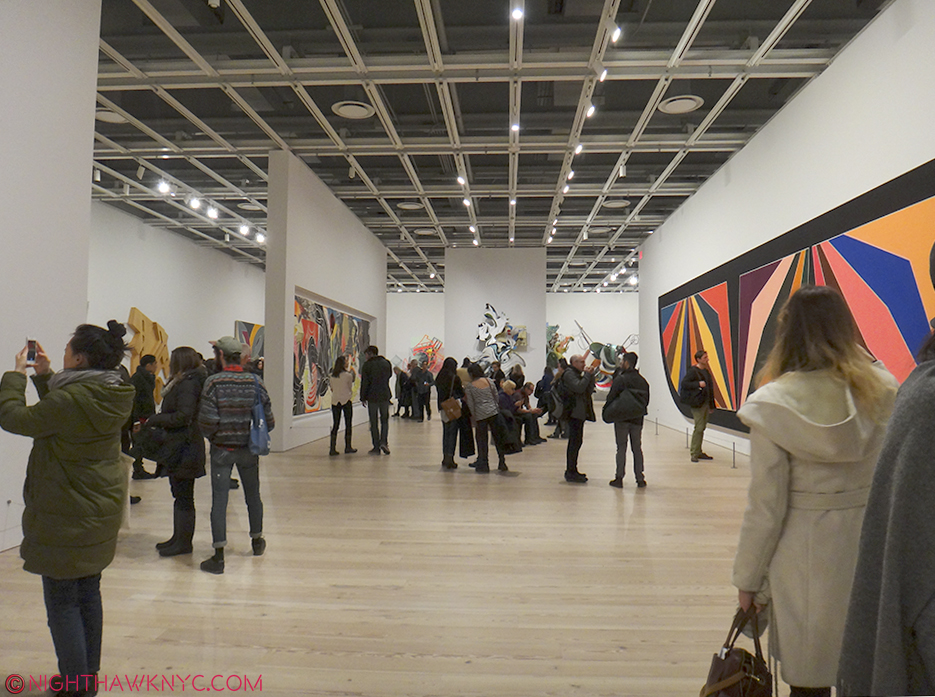
5th Floor seen during the Frank Stella Retrospective, Feb, 2016. The smaller walls can be moved to provide countless configuration possibilities.

5th Floor seen during the Frank Stella Retrospective, Feb, 2016. The smaller walls can be moved to provide countless configuration possibilities.

Inside, the building is very sharp, clean and neat with natural wood floors and new, white walls all around. As the rectangular shape belies, form mostly follows function, and 4 of the floors are given over to large, rectangular galleries. The open space allows for movable walls can be easily repositioned to allow an extremely wide range of configurations. Each floor is very well lit, (something that is continually a problem at The Met). With 3 sets of stair cases, there are plenty of stairs . None go all the way from 1-8, however. On the western wall, as seen below, stairs go from the 3rd floor to the 8th. To the east of the elevators, stairs run from 5 to the 1st floor. And, there are the exterior stairs on 6,7 and 8. The stairs are good to familiarize yourself with, since there is almost always a wait, the elevators are best used for going from 1 to 8 or from 5 to 1. The entire building, inside and out, is wheelchair accessible.
Western stairs, Spring, 2016. They seem to be dismantling the Sanitation complex. The Whit might be hoping a tower doesn’t go up in it’s stead.

Renzo Piano strikes me as a Master Engineer more than as a brilliant Architect. I got that feeling when I first saw the Pompidou Centre in Paris, with it’s engineering on the outside, and again with his New York Times Building (which he inherited from Gehry). Yes, he has done some beautiful buildings, but I repeatedly get the feeling of Piano, the Engineer, when I look at his work, and that shouldn’t be the primary feeling I’m left with. There is quite a bit of engineering being shown off, here too, much of it on the first floor, some in the exposed gallery ceilings, and some on the roof decks.
The 8th floor gallery lets in ambient sky light.

The 8th floor gallery lets in ambient sky light.

Now for the “nitty gritty.”

Given the luxury of having over a year to assess it, I’ve begun to wonder about the adequacy of the 50,000 square feet of indoor exhibition space, as nice as it is. “America Is Hard To See,” fit the whole Museum well, and showed it off to fine effect. Then, while the Frank Stella Retrospective was excellent, it only included 5 of his prints, and only 1 of his “Moby Dick” works. Was this because of hard decisions due to a prolific, 50+ year career, or due to a lack of space on the 5th floor? Currently, the otherwise excellent “Stuart Davis: In Full Swing” show feels unmistakably truncated. It shares the 5th floor with the “Danny Lyon: Message To The Future” show, (which may be overambitious). By comparison, The Met’s Stuart Davis show in 1991-92 had almost twice as many works, including over 30 that dated before the earliest work in the Whit’s show, like some from his “Van Gogh” period. While these have been going on indoors, I’ve been underwhelmed by what’s been installed thus far on the outdoor 5th Floor exhibition space. As time goes on, I’m starting to feel the 5th Floor may turn out to be a design mistake. Part of it is cut off to allow an entrance and exit corridor for the outdoor space, which is generally in shadow, and results in leaving a small indoor gallery on the other side of the outdoor gallery access corridor, which feels lost, and most importantly cuts down the size of the congruent 5th floor space. The other floors with outdoor decks run right up to the door leading outside with no corridor, etc.
The 5th Floor is cut to allow this exit corridor to the Roof Deck Gallery, leaving a small gallery to the left that feels lost.

The eastern end of the 5th Floor gallery is cut to allow this exit corridor to the Roof Deck, which leaves the small gallery to the left that feels lost.

The Whitney says there is 13,000 square feet of outdoor space, over 25% of the amount of indoor space. I’m left to ask the age old question…”Did they create enough INDOOR space to display Art?,” the prime purpose of a Museum. Time will tell, BUT? If they didn’t? This will be a disaster reminiscent of Moma’s inexcusably horrible current/new building, where they somehow managed to create a massive multistory hole right in the middle of some of THE most expensive real estate on Earth, then claim they “need more space,” 10 years later!

You can’t make this stuff up!!!
5th Floor Deck.

5th Floor Deck with installation. Yes, the colored seats are the Art work.

If the Whit needs more indoor space, well, the roof decks seem easy to enclose, and voila, 13,000 square feet more gallery space.

Or? PLEASE don’t tell me they’d have to expand this new building north, or up. I’m done writing letters. Besides, as much as I admire and respect Mrs. Gertrude V. Whitney and the collection built on hers, I have no attachment to this building.

And that brings me to this- Through it all, one thought stayed on my mind more than any other. I wonder what she would have thought of the place…

Part 5 – Gertrude Vanderbilt Whitney

“And I dreamed I was flying
And high up above my eyes could clearly see
The Statue of Liberty
Sailing away to sea
And I dreamed I was flying”*
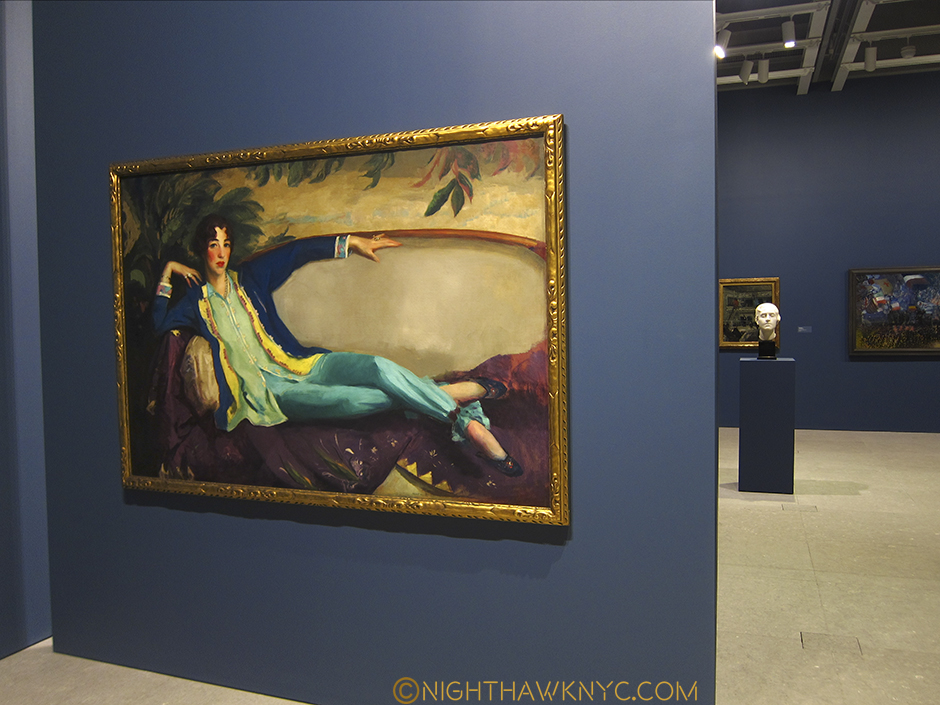
Portrait of Gertrude V. Whitney, 1917 by Robert Henri. Study for a Head for the Titanic Memorial by Mrs. Gertrude V. Whitney, in the background from "America Is Hard To See," 2015

Portrait of Gertrude V. Whitney, 1917 by Robert Henri. Study for a Head for the Titanic Memorial by Mrs. Gertrude V. Whitney, in the right background from “America Is Hard To See,” 2015

The founder of the Whitney Museum, as was beautifully demonstrated, remembered and honored in the first floor free to enter at all times gallery, where “America Is Hard To See” began was, also, a very accomplished sculptor2, in addition to being the greatest champion of American Art, perhaps ever. Immediately upon entering the first floor gallery, the first thing you saw was, fittingly, the wonderful portrait of her by Robert Henri that was perfectly placed facing the door, which also enabled it to be seen from outside the building, the only artwork that was. I wish it had been left right there. It wasn’t. As I write this, it’s upstairs as part of the “Human Interest: Portraits from the Whitney’s Collection” show. One of my pet peeves in Museum re-designs is how often they fail to answer this, seemingly basic, question- “Where are we going to put such and such major masterpiece?” Moma failed this miserably- How many times have they moved Monet’s “Waterlillies”, or Van Gogh’s “Starry Night”, in a vain attempt to find the right spot for each? This is unforgivable. While the Whitney has found a great spot for Calder’s Circus,
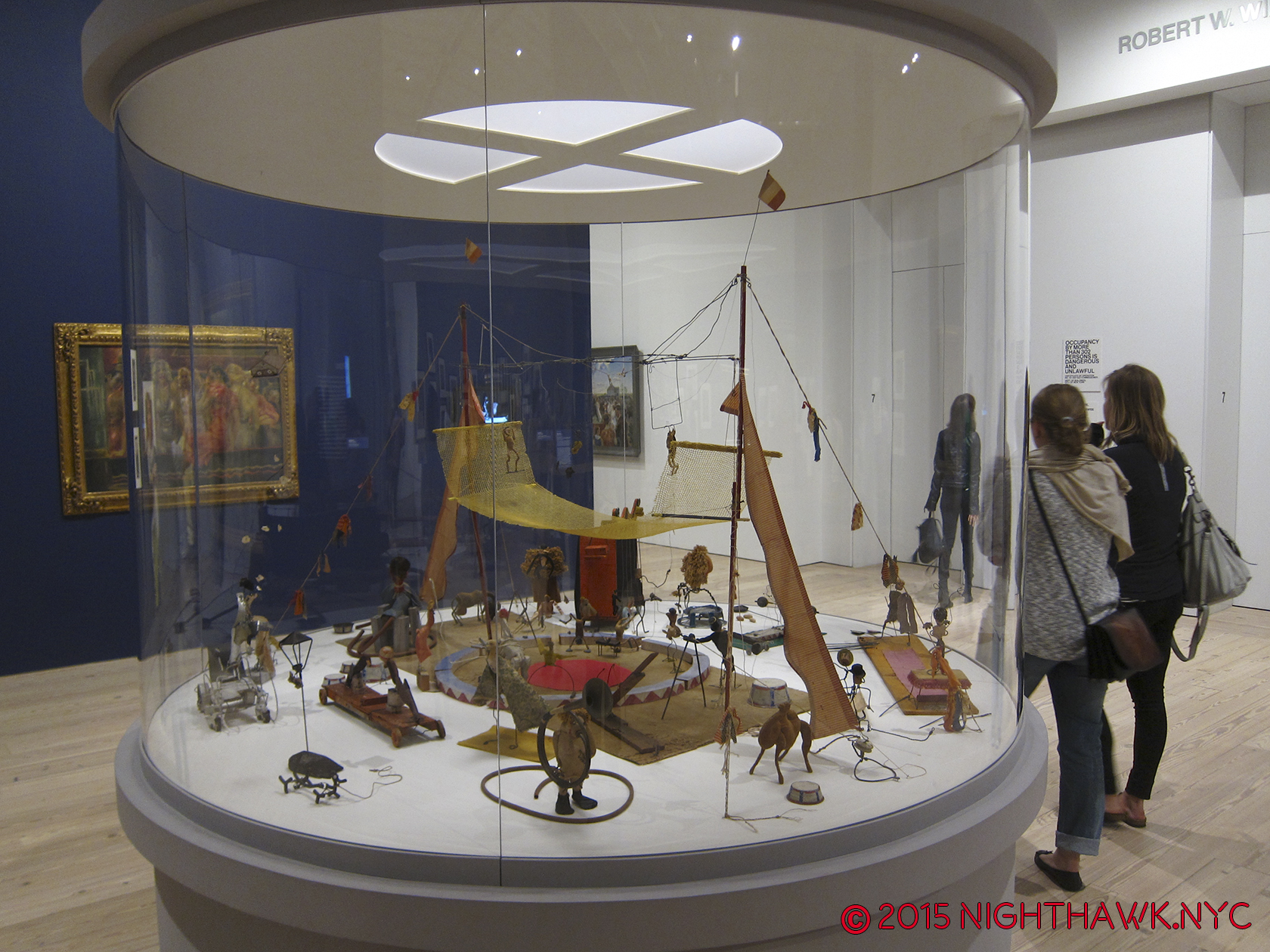
Calder's ingenious "Circus." When you go, be sure to see the accompanying video!

Home… at last. Calder’s ingenious “Circus.” When you go, be sure to see the accompanying video.

which was lost in the Breuer Building’s mezzanine, I’m left to wonder about Mrs. Whitney’s Portrait. Will it become their Waterlillies?
One of the very greatest figures in American Art History looks out on her domain, Portrait by Robert Henri, 1917. 1st Floor Gallery, seen from outside the building during "America is Hard to See," 2015. After? They should have left it right there.

One of the greatest figures in American Art History looks out on her domain. 1st Floor Gallery, during “America is Hard to See,” 2015. After? They should have left it right there.

Beyond her portrait’s place in the Museum, I wonder what she’d think of it. It’s still “her” Museum. They even, recently, put the name “Whitney Museum of American Art” on the southern facade. The new place is located a stone’s throw from the site of the first Whitney Museum that she opened in 1931 at 8 West 8th Street, and equally close to where Edward Hopper lived and worked on Washington Square. Edward & Josephine Hopper left their artistic estate to the Whitney, in honor of their long relationship with Mrs. Whitney. When the new Museum opened, there was a selection of Edward Hopper drawings from 1925 that he did at the Whitney Studio Club, which preceded the founding of the Museum, in the first floor gallery, adjacent to Henri’s Portrait of Mrs. Whitney, seen above. As time goes on, I think this gift will be seen as one of the greatest Art gifts of the 20th Century, even though it didn’t consist of many of Edward’s paintings. That’s when I try and forget the fact that the Whitney, tragically and unforgivably, discarded almost all of Josephine Hopper’s work that was included with it!

While we’ll never know what Mrs. Whitney would think of the new home of her collection, I know what I think.
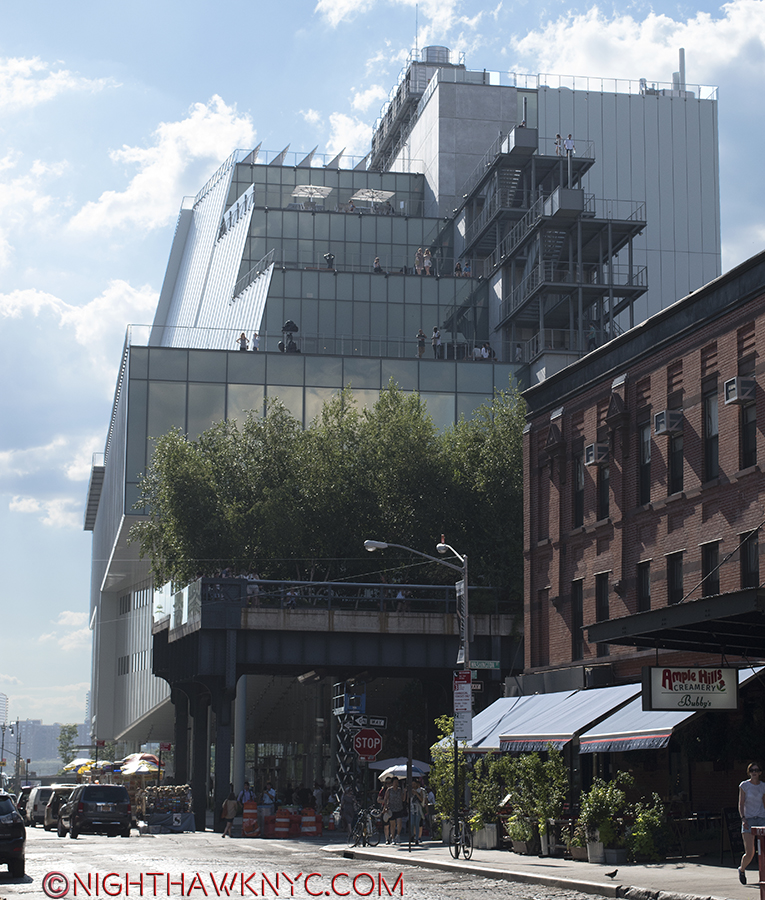
DSC_5259P2NH

Oneupsmanship? “Hey you down there on the High Line- You think you’re high up? Ha!”
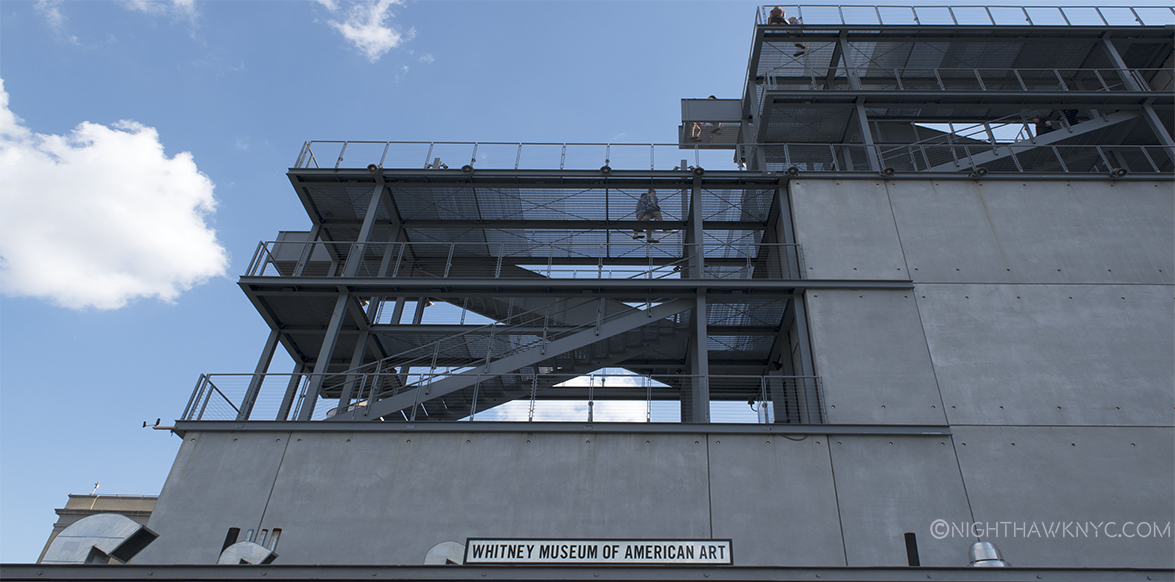
DSC_3674PNH

I’ve spent a year wondering- Why put 13,000 square feet of outdoor space in a building in a place with a climate like NYC?
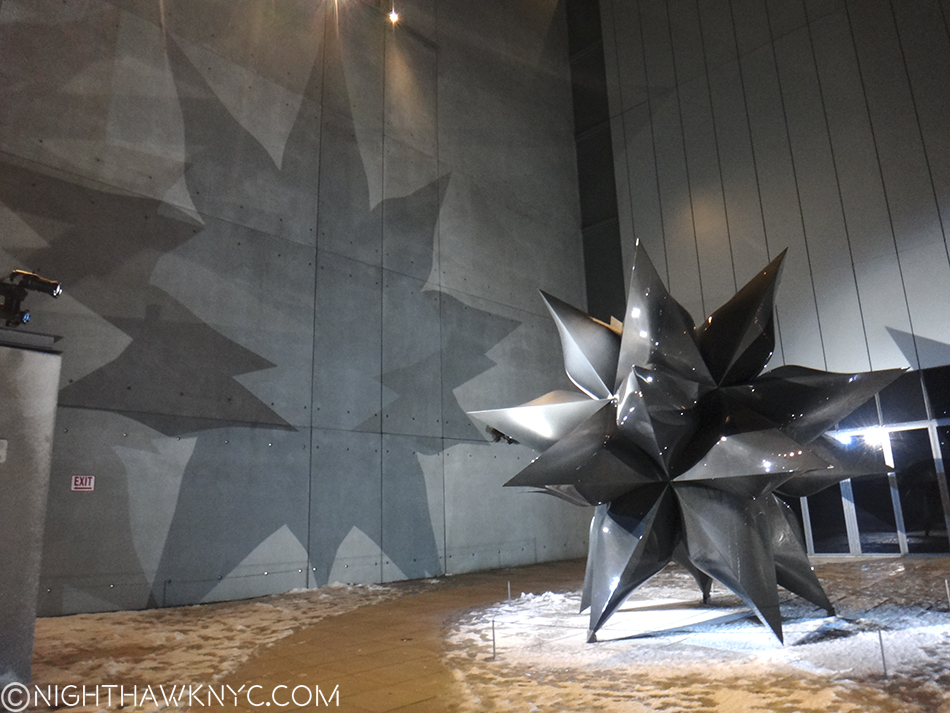
5th Floor roof deck with a Frank Stella Sculpture & reflection, Feb, 2016

5th Floor roof deck with a Frank Stella Sculpture & reflection, in the snow, Feb, 2016

Part 6- 5,000,000 Reasons

As I said, real estate in NYC is all about location. That applies to the Art world, too. The Met & The Guggenheim are in, or near, Central Park, and there is now talk of The Met creating a Central Park entrance as part of their Contemporary Art Galleries reconstruction3. Moma has the heart of midtown, and now the Whitney has the High Line. In my opinion, the location was selected, and the New Whitney is designed, to be a destination for High Line visitors- It’s roof decks are meant to beckon High Liners with an even better view since they are higher. That’s one explanation for the stair designs looking similar- imitation that’s designed to make High Liners feel the Museum is part of the High Line. And so? Location also pays off by providing a potential mass audience delivered right to your door. How much is that worth to a Museum? Given that the High Line currently draws over 5,000,000 visitors a year, it’s hard not to see this as a conscious decision designed to attract visitors for an even better view, and oh yeah, some Art. Once inside? I’ve already come to feel that the gallery size is limiting. As the collection grows (do Museum collections ever shrink?), I am left to wonder how quickly they’re going to wish they had some of that 13,000 square feet that’s sitting outside, inside.

But? If I’m correct about their motivation, the outdoors stairs & decks exist to beckon people from the High Line, which, is open year round, come rain, snow, or shine.
DSC09546PNH

“We come on the ship they call the Mayflower
We come on the ship that sailed the moon
We come in the age’s most uncertain hour
and sing an American tune
But it’s all right, it’s all right
You can’t be forever blessed”*

Overall? I’m displeased by the outward appearance of the new Whitney. Over a  year of trying to warm to it, of giving it yet another chance to speak to me later, I still find it downright strange. As an Art Museum, the inside is nice, with the above caveats. As far as the Art is concerned? I’m glad to have the Whitney’s pre-eminient collection of American Art back, and “America Is Hard To See” was a wonderful “Welcome Back” celebration of it’s return after the move Downtown. The Whitney is, also, to be congratulated for the guts they’e displayed in the choices of their early shows- giving Laura Poitras her first Museum show, featuring the great Cecil Taylor for a week, and having the retrospectives of modern master Frank Stella and the vastly underrated Stuart Davis (who Mrs. Whitney, herself, believed in and financially supported early on), among others, all have made the first year of the New Whitney Museum’s exhibitions quite memorable, and yes, very Artistically successful.

Yet? How long will the waters stay calm for the U.S.S. New Whitney Museum? The big question of long term success and long term viability remain to be answered.

Epilogue – The Whitney’s 422 Million Dollar Gamble
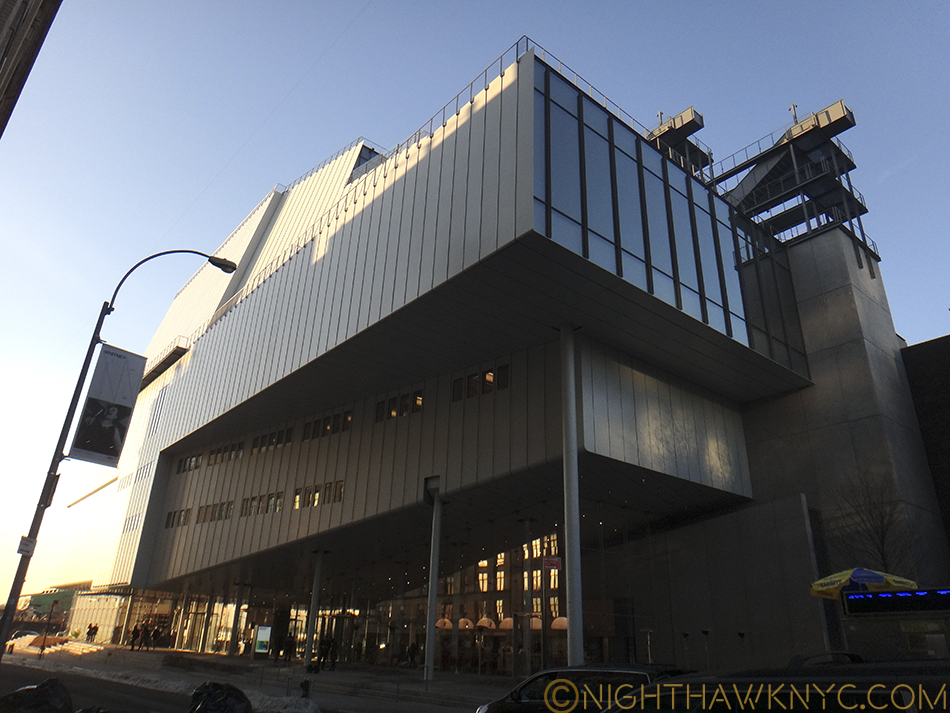
DSC09557PNH

The Whitney’s move downtown isn’t about moving nearer the “New” Art neighborhood of Chelsea or the “Older” Art neighborhood of Soho. It strikes me as being a a case of seeing an opportunity and taking it. They found a lot at one of the 2 ends of the High Line and saw their opportunity to move to a potential audience- the 5,000,000 current visitors to the High Line, and they took it. I believe that’s why their stairs look like the High Line’s, as I said.

For the Whitney, this is a $430,000,000.00 (the cost of the new building) gamble that the High Line is not a flash in the pan and it’s popularity is here to stay. If the High Line fails? Well? The City was about to tear it down anyway before it was turned into a Park.

But, if the High Line does fail (which seems unlikely at the moment), or visitors come in substantially lower numbers (much more likely), the Whitney may find themselves stranded, with an out of the way Museum that is not easily accessible by either bus or subway in a neighborhood that has a history of being “the wild west,” home to meat packing, prostitution, cutting edge music, and sex clubs (Madonna’s notorious book “Sex” was photographed almost 25 years ago at one 3 blocks away) not all that long ago, that has been remade with extra glitz and top of the market rents. And what about that neighborhood? What if the new glitz doesn’t stick? What if it all turns out to be wishful thinking on the part of landlords looking to make a killing after years of squalor? Walking around the past few months, the area seems to be having a bit of trouble supporting many of it’s ritzy new tenants at these prices. And? This is over a year after the Whitney added even more oomph to the now completed High Line being here.
Empty storefronts on Gansevoort, one block east of the Whitney, August, 2016

Empty storefronts on Gansevoort fill 3/4 of the block, one block east of the Whitney, August, 2016

Is the “Meatpacking District” a fad destination that is about to fade? If so, what effect will this have on the new Whitney? Can it survive in a “not so fab” neighborhood?
La Perla joins Alexander McQueen & Stella McCartney as former tenants of the Meatpacking District

Is the buzz over? La Perla joins Alexander McQueen & Stella McCartney as former tenants of the Meatpacking District who have moved elsewhere.

While collectors and investors throw unheard of sums at Contemporary Art these days (which strike me as “bets” given the largely unproven nature of the Art itself), here is a case of one of NYC’s “Big 4 Museums” placing an even bigger bet on a Park, that while it certainly is Contemporary Urban Art, hasn’t even been fully opened for TWO YEARS yet,. The Whitney placed their bet when the High Line was in it’s first of 3 phases. Phase 3, the final part, of the now completed High Line opened on September 20, 2014. This is not to mention that they bought in at the top of the market in a real estate market that (like the Art market) hasn’t seen a correction in over 25 years. Both will see corrections one of these days.

But when? This, is the 422 million dollar question.

“Still, tomorrow’s going to be another working day
And I’m trying to get some rest
That’s all I’m trying to get some rest”*
Around the corner on Washington Street, 4 now empty storefronts, one of which was the famous Hogs & Heifers Saloon (corner). August, 2016

In the Whitney’s shadow. Around the corner on Washington Street, 4 now empty storefronts in a row, one of which was the notorious Hogs & Heifers Saloon (where the white sign hangs). August, 2016

Well? If all of this goes south? They still stand a very good chance of being able to move back uptown in 8 years when The Met’s lease of the Breuer, their former home, is up. Given The Met’s own problems, it seems highly unlikely they’ll be extending that lease.

If the Whitney then wants to renovate it? It’ll be someone else’s problem.

*-Soundtrack for this Post is “American Tune” by Paul Simon. Published by Universal Music Publishing Group.

NighthawkNYC.com has been entirely self-funded & ad-free for over 8 years, during which 300 full-length pieces have been published! If you’ve found it worthwhile, PLEASE donate to allow me to continue below. Thank you, Kenn.

You can also support it by buying Art, Art & Photography books, and Music from my collection! Art & Books may be found here. Music here and here.

Written & photographed by Kenn Sava for nighthawknyc.com unless otherwise credited. To send comments, thoughts, feedback or propositions click here. Click the white box on the upper right for the archives or to search them. Subscribe to be notified of new Posts below. Your information will be used for no other purpose.
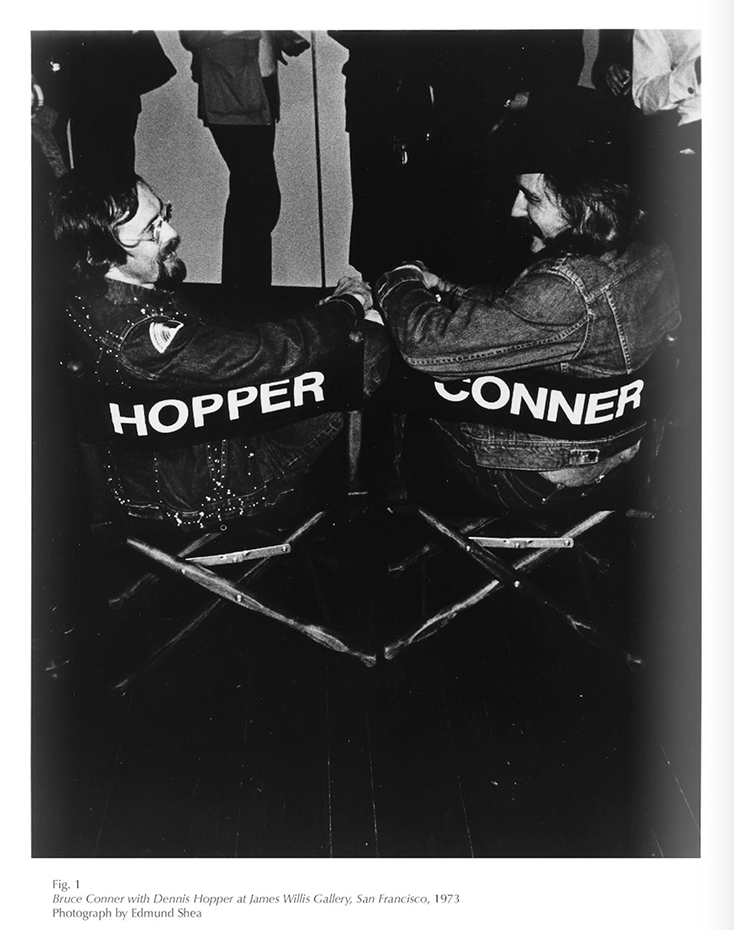
  1. In fact, the new Whit, itself, sits where one was.
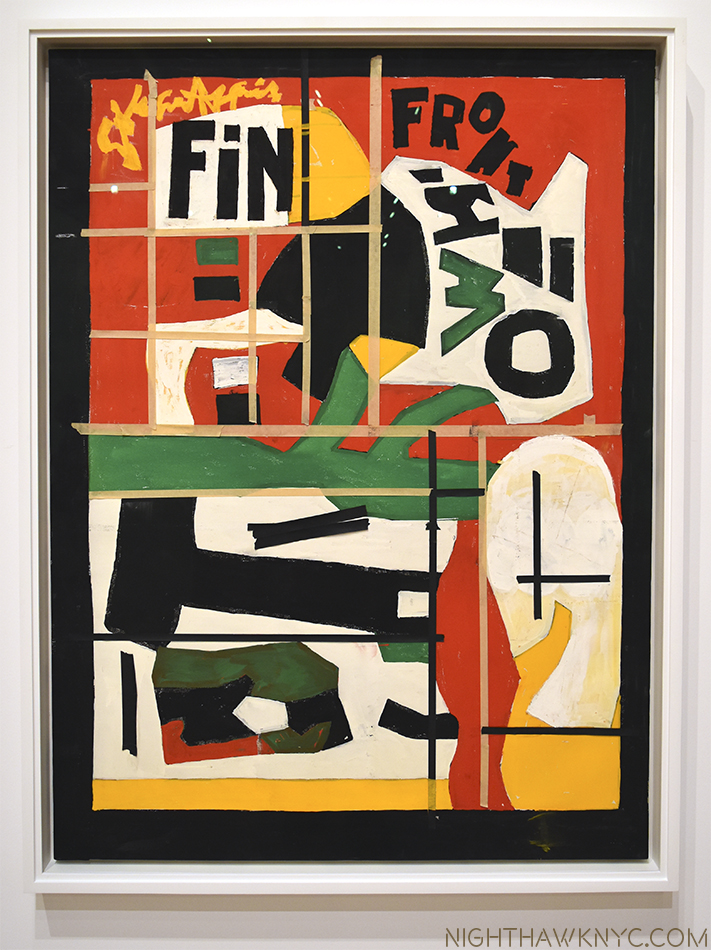
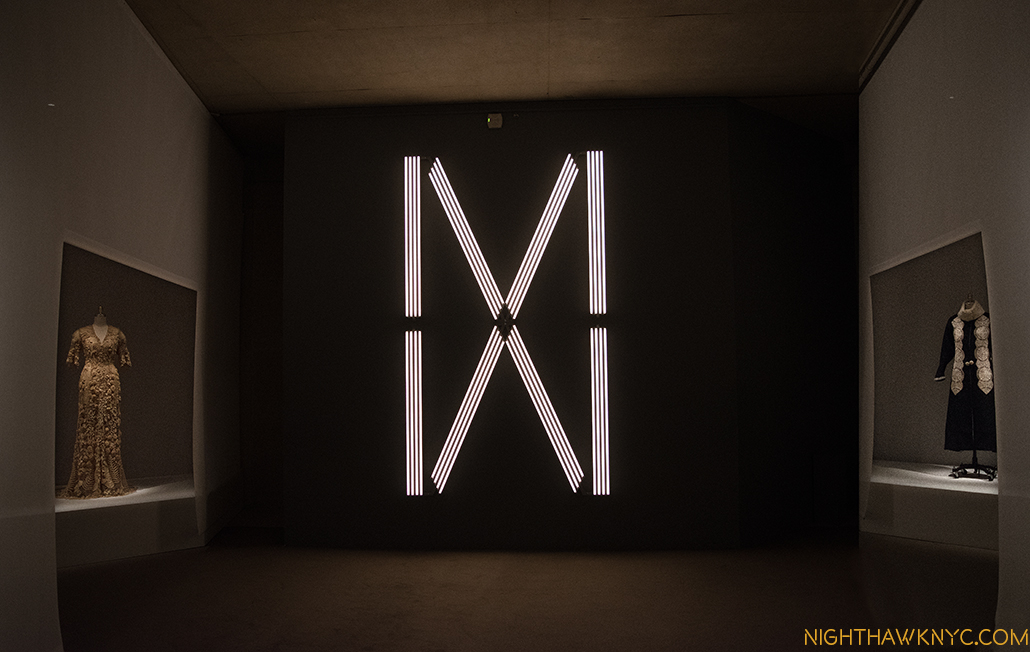
  2. When will they have a show of HER work?
  3. Speaking of his vision in January, Met Director Thomas Campbell told the LA Times that “We are looking at an entrance, at terraces, at the roof garden.” Sounds like he’s visited the New Whitney.