Hallejulah! Calatrava’s Cathedral Opens (UPDATED)

This site is Free & Ad-Free! If you find this piece worthwhile, please donate via PayPal to support it & independent Art writing. You can also support it by buying Art & books! Details at the end. Thank you.

Written & Photographed by Kenn Sava

Santiago Calatrava’s new World Trade Center Transit Hub, which officially opened today, August 16, is an unabashed glory of Architecture, a breathtaking masterpiece. What I wasn’t expecting is that it’s, also, a true monument to Freedom.

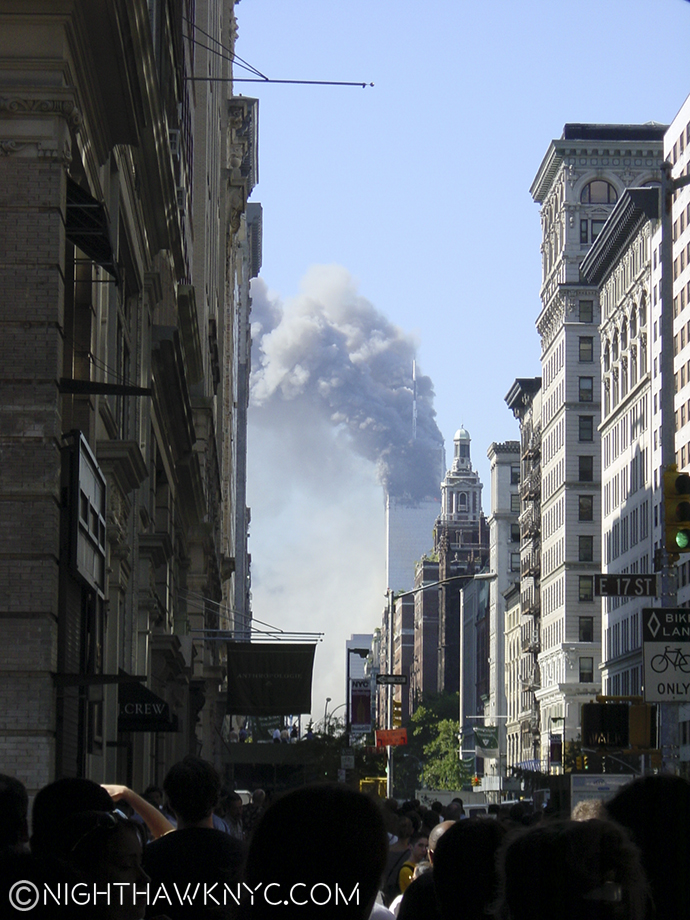
As far as I’m concerned it has more to do with Freedom than that other building with that term applied to it that stands close by. You know, the one that looks like a giant hypodermic needle. Having avoided the whole Ground Zero area (even though I grew up there), the way all New Yorkers avoid Times Square, mostly out of disgust with what has been erected there thus far, I of course knew about the WTC Transit Hub, but I was afraid something would happen at the last minute and it would have been quashed or horribly altered. As a result, I hadn’t seen this building in progress. When I turned the corner onto Dey Street this afternoon, and saw it before me, a shiver ran down my spine. I was struck by the unforgettable memory of seeing that still smoldering pile of the remains of the World Trade Center right where the Hub now stands. It’s almost 15 years ago, and I can see it like it was yesterday.

I shot this on 9/11 from 5th Avenue and 17th Street.

Yesterday…The World Trade Center on 9/11. I shot this from 5th Avenue and 17th Street.

I wiped my eyes.

“‘Twas in another lifetime, one of toil and blood
When blackness was a virtue the road was full of mud
I came in from the wilderness, a creature void of form
Come in, she said
I’ll give ya shelter from the storm”*

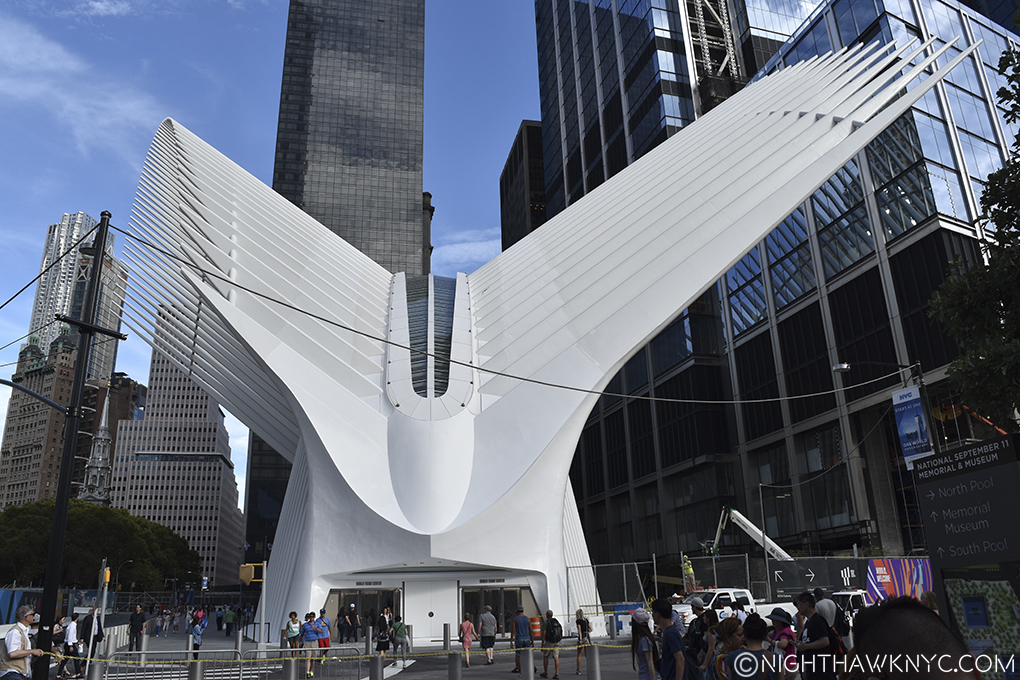
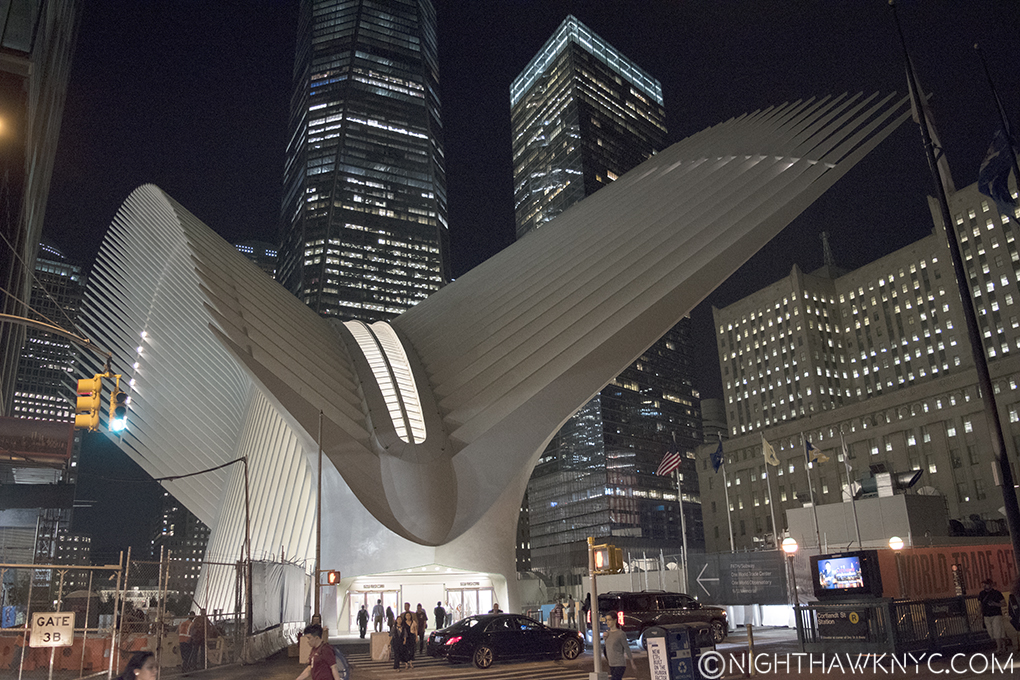
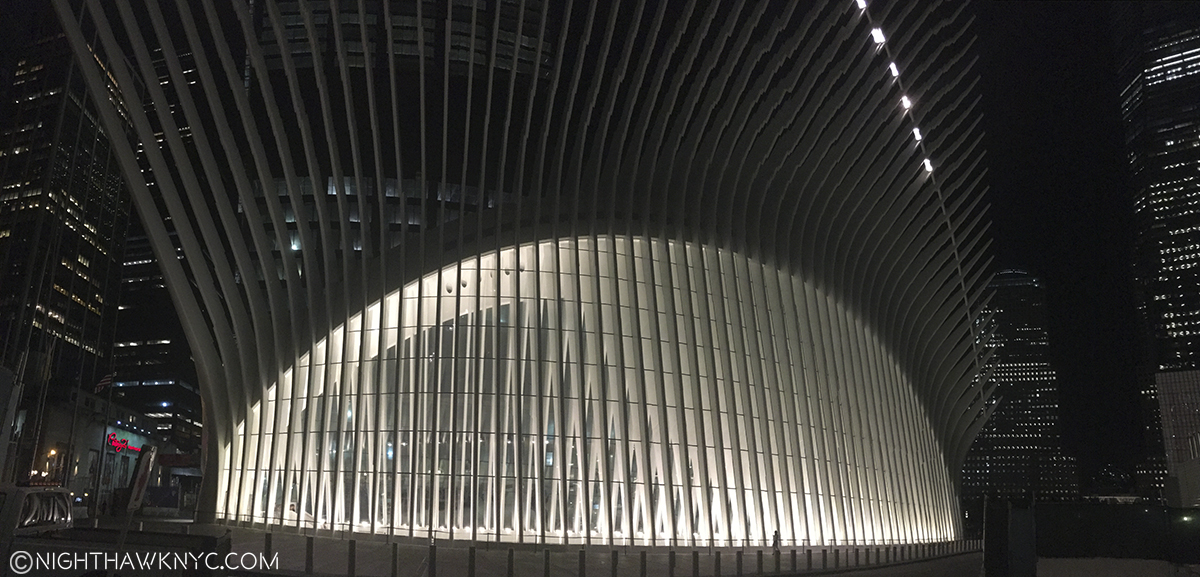
But no. Now? It looked like a big white bird was sitting there.

I had to wipe my eyes when I saw this to wipe away the memory of what I saw on this very spot 15 years ago.

It looked like a Phoenix rising from those very ashes.

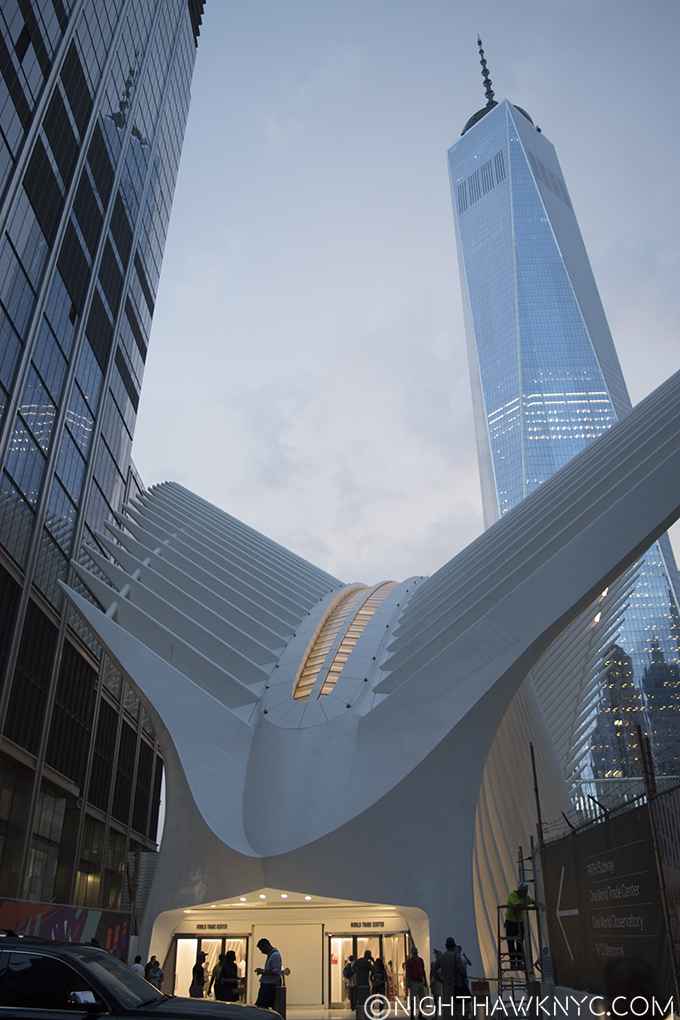
Calatrava’s new masterpiece looks like a glorious white bird (a Phoenix, or…ok, an Eagle, not that I’ve ever seen either in person) with GIGANTIC wings large enough to actually offer you a feeling of comfort, even protection (though they won’t even stop the rain), as you stand under them outside. That’s exactly how I felt when I did. The building is Angelic, and not only because it’s white all over- it has an air of something sacred that I can’t describe about it- inside and out. It’s downright Glorious. And? THOSE WINGS! Oh my god…

DSC_6807NEFPNH

A place of peace- unexpected and profound. Angels have wings, I hear.

“Not a word was spoke between us, there was little risk involved
Everything up to that point had been left unresolved
Try imagining a place where it’s always safe and warm
Come in, she said
I’ll give ya shelter from the storm”*

Nothing has had a healing effect on me thus far after that fateful day as seeing this. I don’t know what Santiago Calatrava’s intentions are with this work. I haven’t read anything he, or anyone else has said about it. All I know is that it speaks to me.

Think it's small? Look for the man walking along side about half way for scale.

Think it’s small? Look for the man walking along side to the right side for a sense of scale.

Outside, especially from the front, it looks small. Don’t be deceived. Only the dome is above ground. Inside? It’s HUGE.

DSC_6612PNH

“Set a course for…you know…out there….” Captain Kirk, Star Trek.

DSC_6525PNH

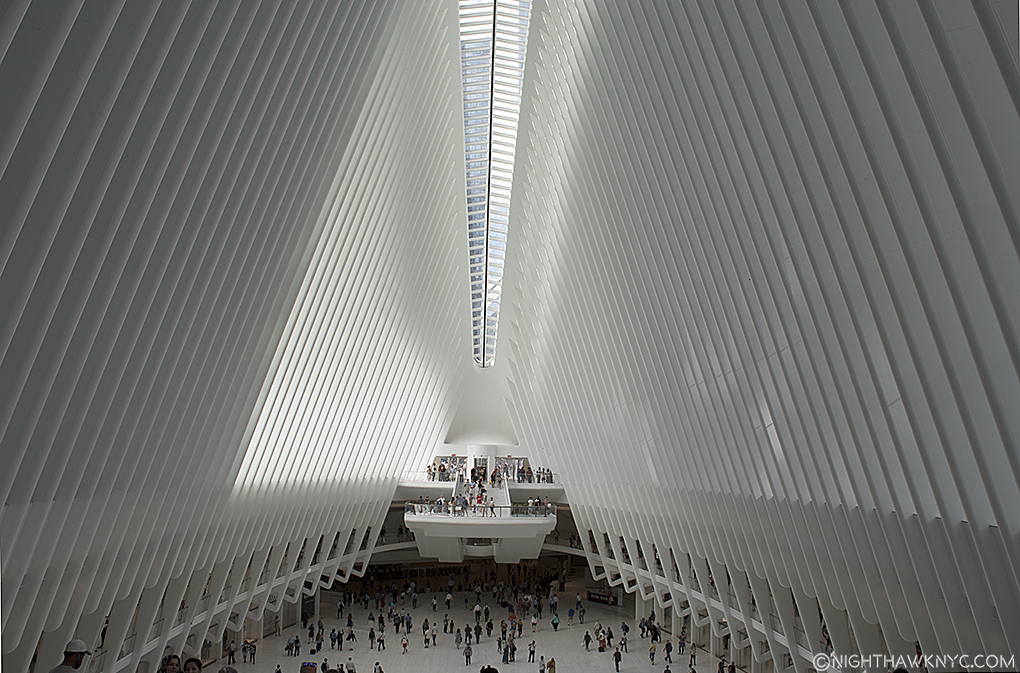
Below the Cathedral’s Dome, two levels of stores, food, etc, with more on wings extending off the sides.

IMG_5734PNH

John Legend had just performed in the center of the floor.

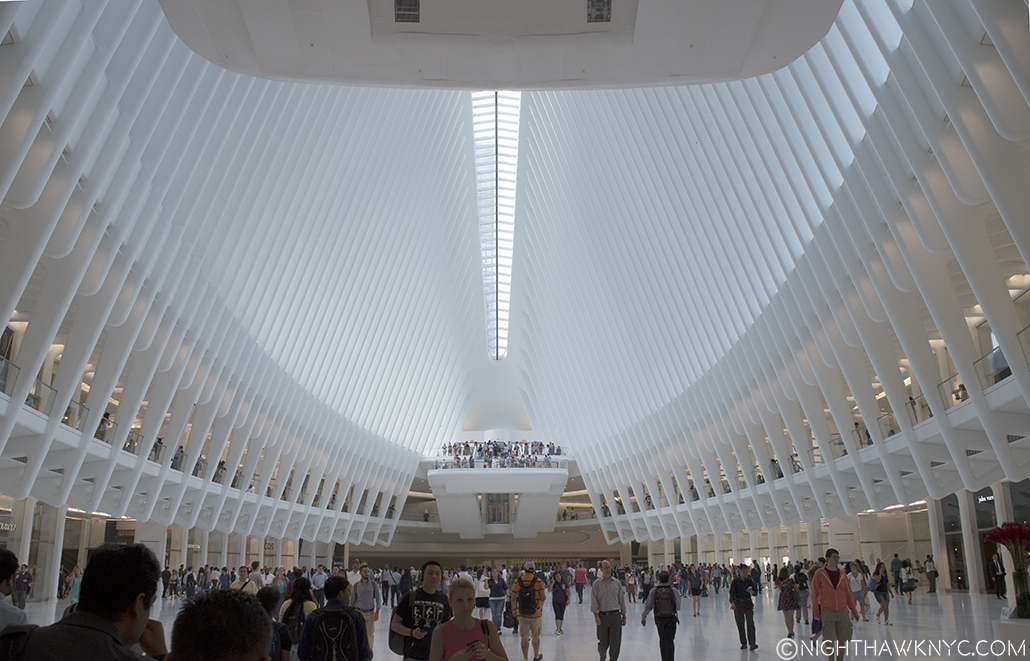
After you walk in, you are immediately presented with a vast football shaped interior. “Cathedral-like” was my first impression. The longer I looked, something struck me- While there are stores all along both levels that stretch out in front of you, you can’t really see them from the viewing platforms on each end! This serves to lessen the “cathedral of shopping” effect that pure shopping malls have, and puts the focus back on the building and it’s architect’s intended impact. (I’m not sure how the merchants feel about this, because it serves to make their shops less identifiable from a distance.) I spent three and a half hours walking in and around it tonite from all sides (yes, including visiting the brand new Apple Store, prominently located and having it’s grand opening today as well. It happens to be one of the 3 Apple Stores with their new store design. Some other stores were open but the complex stretches out in all directions, and I didn’t have a chance to explore all of it today). It may be comparable in size (or bigger?) to the underground mall that was under the World Trade Center and destroyed, as well, on 9/11.

Opening Day for Apple's WTC Store- on both floors, it's 3rd with their new store design.

9pm. Closing time on Opening Day for Apple’s WTC Store- on both floors, it’s 3rd with their new store design. Like the rest of the stores, it’s a bit “hidden” by the building.

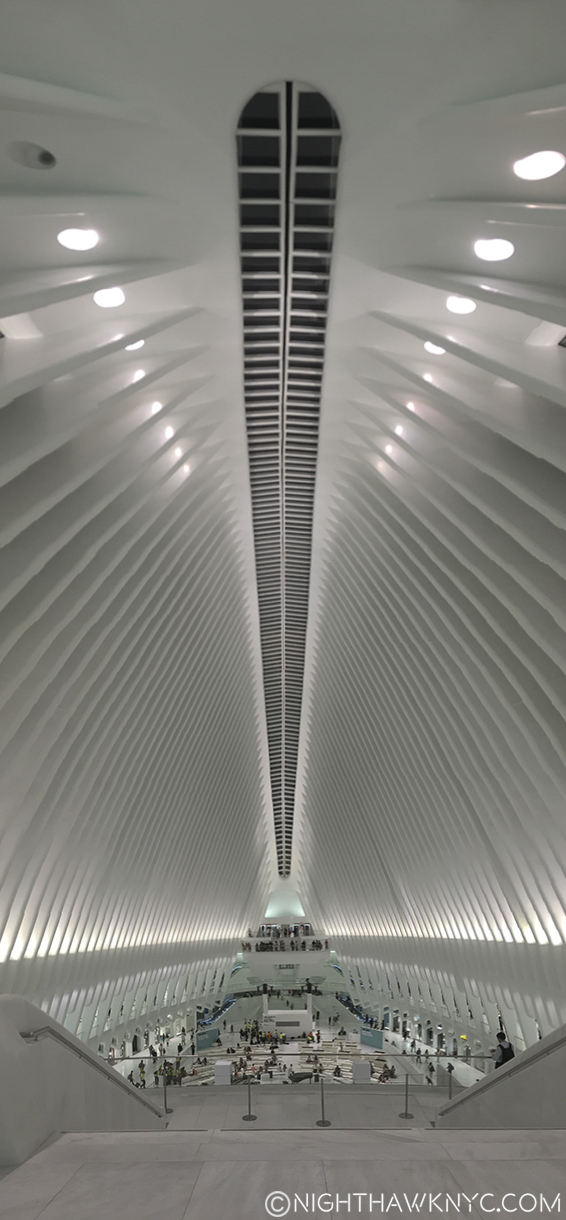
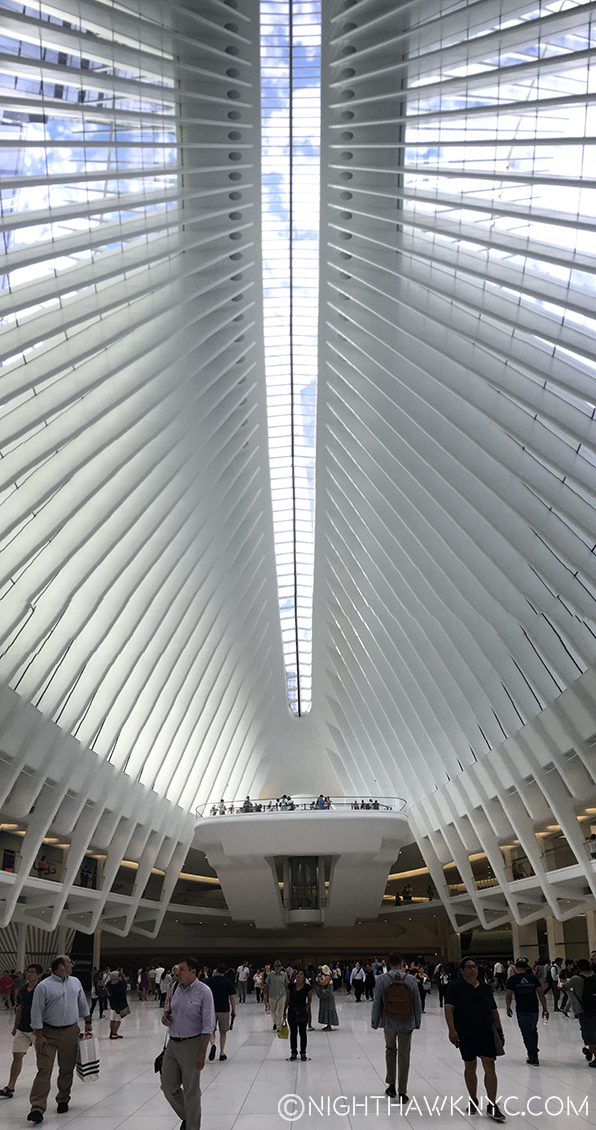
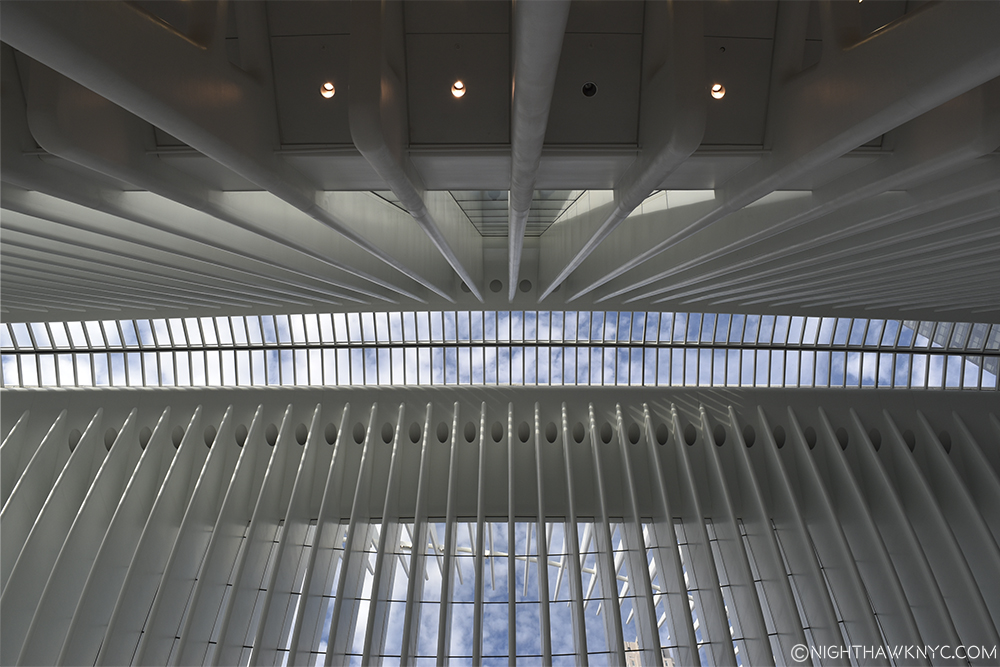
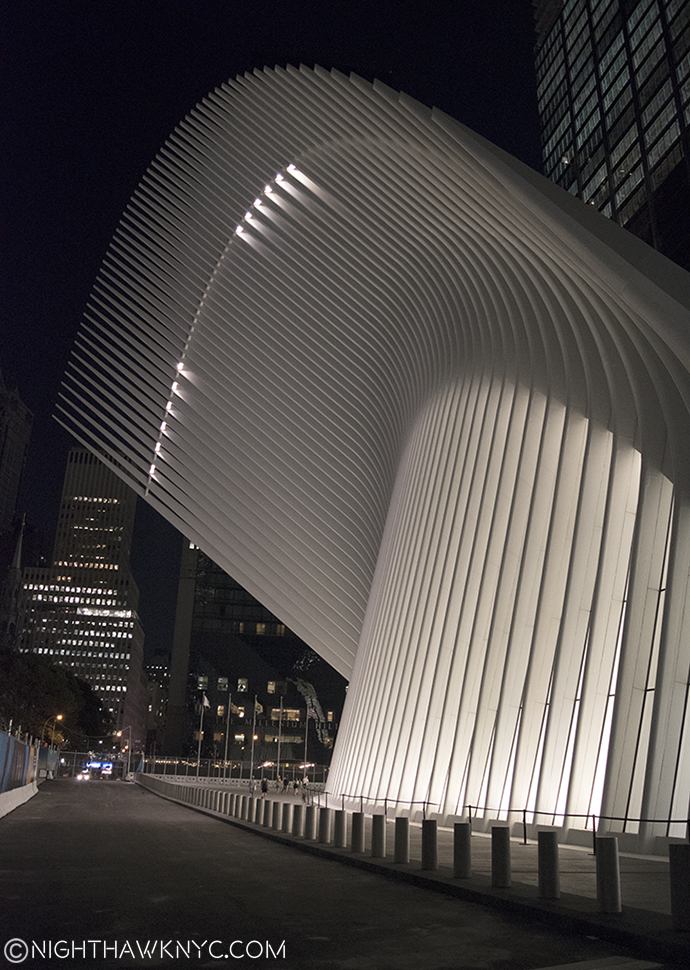
Everywhere, inside and out, this Cathedral is clad in pristine white, with copious amounts of white marble included. Just stunning. It’s pristine white glistens even in the dark (my preferred viewing time, of course. UPDATE- August 17- Scroll down to see daylight pics I took today.). The ribs of it’s twin wings soar majestically, impossibly high, providing the eye with a glorious thrill, while straining the neck to unnatural angles, as it traces their course, up, up and away. Wow. Careful! Look too much straight up and you may tip over. Unlike Calatrava’s vision, my feet need to remain on the ground.

img_5720p2nh

I bent over backward to get this shot. Imagine what it was like to install EVERY ONE of those MASSIVE ribs! Wow. (PS-Don’t call me when they need cleaning.)

Still? That THRILL is an important part of the feeling I want from architecture, Mr. Renzo Piano (who’s new Whitney Museum, which I recently wrote about)! Here is engineering, like the countless, huge ribs (as visible as Mr. Piano’s engineering is at the Whitney), that is both functional and endlessly beautiful to behold.

Even though it is far from completed, right now I’d say this is the greatest new public space in Manhattan since, perhaps, the old Penn Station in 1910. It seems to cast a respectful glance back to Grand Central Terminal (which also lets light in so magically along it’s ceiling and that glorious glass wall). Once completed, Calatrava may have given us a “Grand Central Terminal” for the 21st Century.

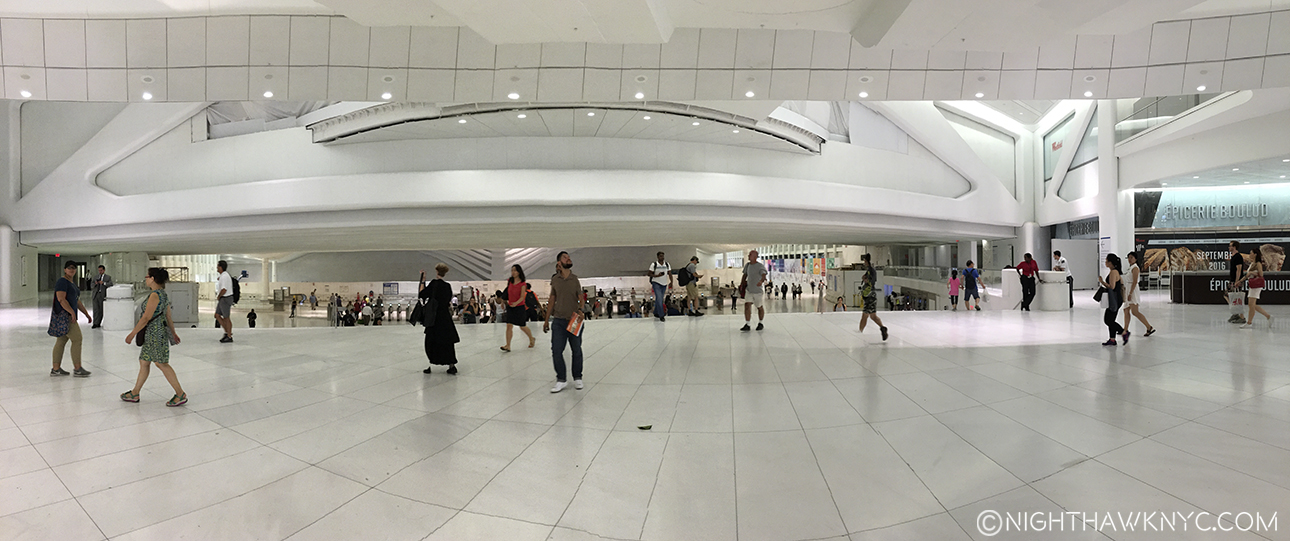
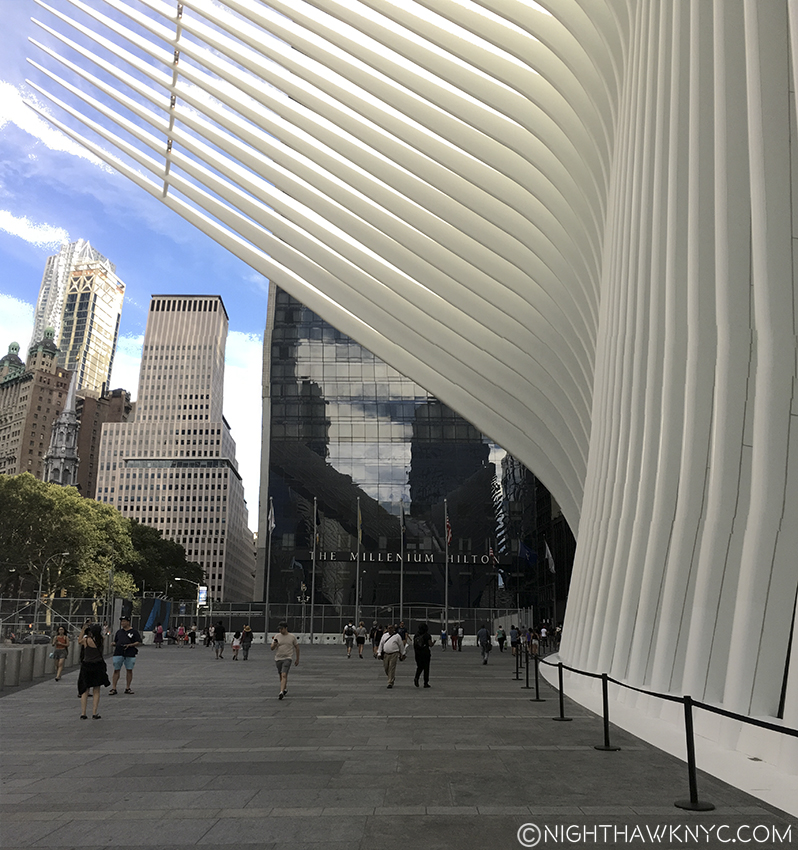
Path Train Station. Notice the 2 people looking up at the great hall before them!

Welcome To New York. The Path Train Station. Notice the expression of the 2 people looking up at the great hall before them!

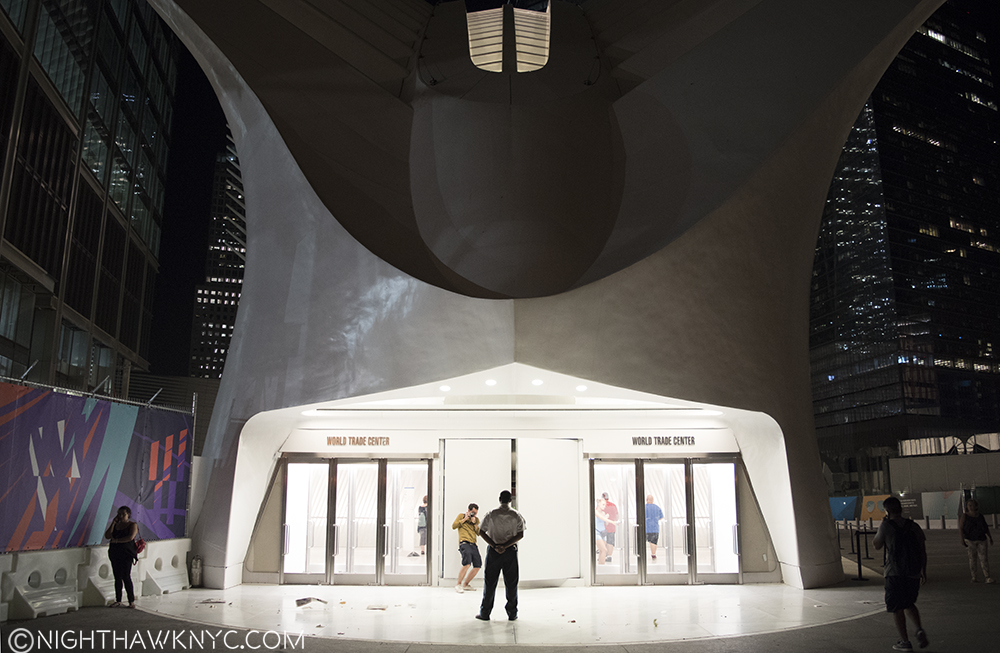
I saw more people taking pictures of it in ten minutes than I have in 15 months take pictures of the new Whitney. Even the guard was proudly posing! Inside, everyone I spoke to from the security guards, to the construction workers taking down the stage from John Legend’s performance had a glow about them. There was actual pride in the voice of one guard I spoke to off in the corner by a staircase. “I don’t know anything about art,” he told me, “but someone came by and said I don’t understand what all the hoopla is about. I told him you have to have an artistic eye.” I shook his hand. Pride from someone who hasn’t even been on the job for 12 hours yet. Inside and out, people from all over the world were not only taking pictures of every angle of the place, they were posing in front of it, next to it, all over it for selfies and groups shots. They felt it, too.

A Security Guard, back to us, poses.

Take a bow! A Security Guard, back to us, poses. Working in a work of Art is it’s own perk.

For me? It’s a new masterpiece this City SORELY needs, ESPECIALLY in a public building. It makes arriving in Manhattan the special thing it is, again. Walking around today, it’s already a hit, less than one day in. I grew up downtown. My father had an office 2 blocks from the World Trade Center. I remember it being built, and I saw it destroyed. Looking around today, after a while of being away, I was just sickened at what’s gone up, like I am in most other areas of the City. While I’m glad the 9/11 Museum seems to be a big hit, I’ll never “get” the building they put it in, which I saw for the first time, and which is right next to Calatrava’s Hub. The Hub directly faces the Memorial Pools, where the Twin Towers stood. Being there today, I was struck by just how big the area is. When I was at the World Trade Center, as gigantic as they were, the surrounding area somehow felt small. Now, it feels big, and it feels like it’s a mishmash of ugly buildings, except this one, that don’t have anything to do with each other. Yeah, like the rest of New York, and that’s a shame. I say this with ultimate respect for all those we lost, and with pain that things haven’t turned out better down there. They deserve better, and so do we. At least we have one great building there, and one, that for me, also speaks to what happened there, as well as to our future.

DSC_6520PNH

Seen from the front, the ribs are short on one side, long on the other. Walk to the back, the short side is now long, the long side, short.

Along with everything else it says to me, it says that YES! It IS possible something great can be built in New York City in the 21st Century!

Quibbles? Well, it’s far from finished, so I’ll hold off getting very critical about it until it’s done, but I will say I don’t like the front doors, on either of the two entrances. Frankly? They look terrible. They feel to me like they weren’t Calatrava’s choice.

But? Given how hard (read that “impossible”) it is for great architects to get ANYTHING built in Manhattan, let alone something as monumental as this is, I’m absolutely thrilled! Best of all, it’s open 24 hours, so I can wander over there any time of day or night to enjoy it’s beauty, and let it continue to speak to me. It’s a dialogue I look forward to continuing. Maybe even in daylight. Well, let’s not get crazy.

I couldn’t help thinking the more it sunk in how great this is that it certainly sets the bar VERY high for the next Penn Station and Port Authority Bus Terminal! GOOD LUCK with that!

“Well, I’m livin’ in a foreign country but I’m bound to cross the line
Beauty walks a razor’s edge, someday I’ll make it mine
If I could only turn back the clock to when God and her were born
Come in, she said
I’ll give ya shelter from the storm”*

UPDATE- August 17- Due to a request I got, I went back to shoot it in the daylight-

DSC_6969PNH

To the left in the background is St. Paul’s Chapel, which somehow survived 9/11, and the top of Frank Gehry’s Apartment Tower in the far distant left.

IMG_5795PNH

DSC_6903PNH

IMG_5815PNH

dsc_6998p2nh

Looking up from the dead center of the floor.

All the paraphernalia that was on the floor last night was removed leaving a large, open glorious space. I hope it stays that way.

All the paraphernalia that was on the floor last night was removed leaving a large, open glorious space. I hope it stays that way.

 *-Soundtrack for this Post is “Shelter From The Storm” by Bob Dylan, published by Bob Dylan Music Co., from “Blood On The Tracks.”

NighthawkNYC.com has been entirely self-funded & ad-free for over 8 years, during which 300 full-length pieces have been published! If you’ve found it worthwhile, PLEASE donate to allow me to continue below. Thank you, Kenn.

You can also support it by buying Art, Art & Photography books, and Music from my collection! Art & Books may be found here. Music here and here.

Written & photographed by Kenn Sava for nighthawknyc.com unless otherwise credited. To send comments, thoughts, feedback or propositions click here. Click the white box on the upper right for the archives or to search them. Subscribe to be notified of new Posts below. Your information will be used for no other purpose.

Move Over Harry- Gary Schwartz Released A New Book!

This site is Free & Ad-Free! If you find this piece worthwhile, please donate via PayPal to support it & independent Art writing. You can also support it by buying Art & books! Details at the end. Thank you.

Written & Photographed by Kenn Sava

“Where your treasure is,
There will your heart be also.”*

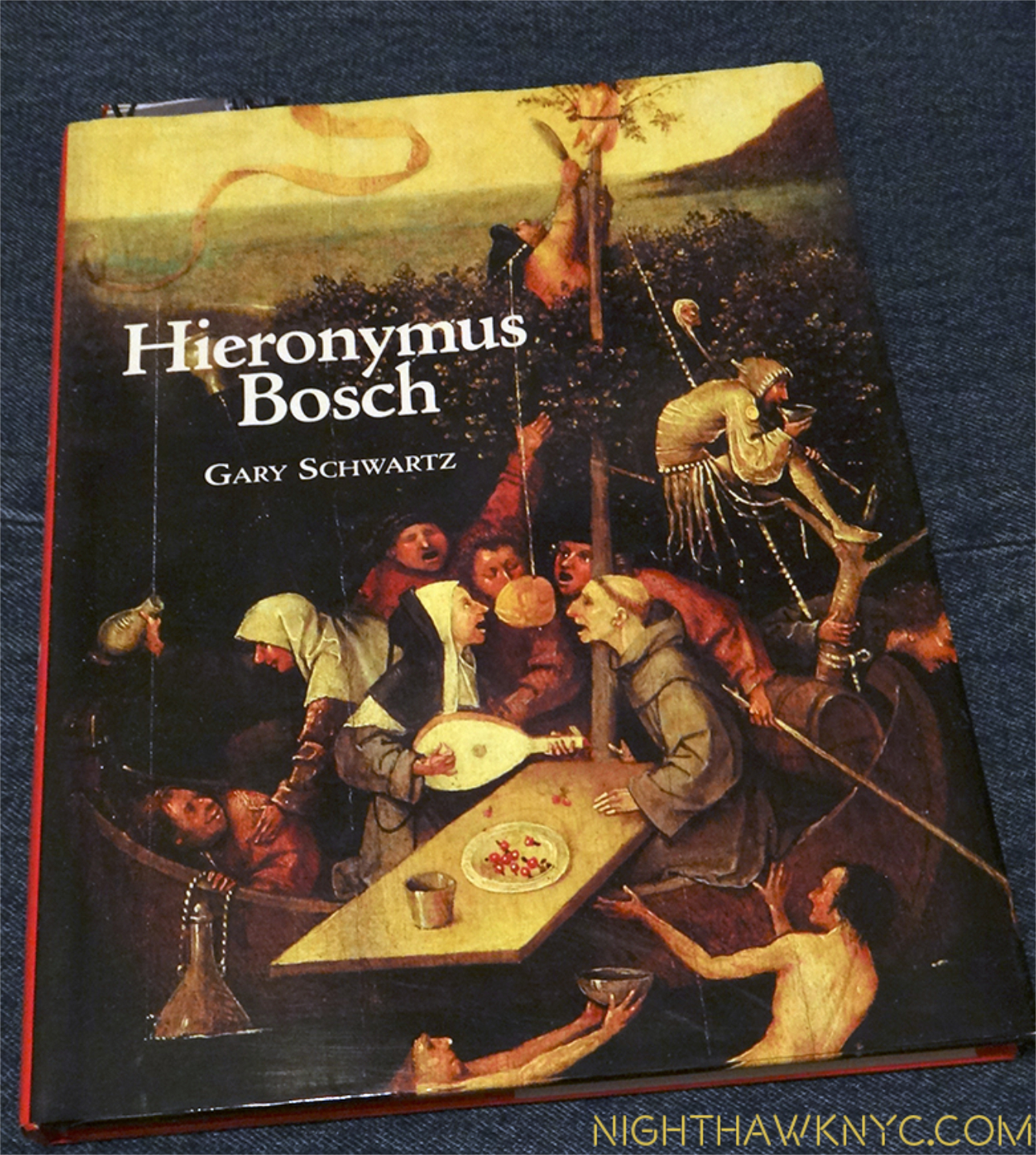
As if I don’t have enough books, or enough books by Gary Schwartz (4, now 5), the release of his newest book is a cause for celebration around here. It’s as big a deal for me as the release of a new Harry Potter book is for the rest of the world. Mr. Schwartz’ new book is filled with more magic, sorcery, lost knowledge, and mystery than all the Potter books combined! Not to mention some of the greatest Art in the Western World.

The waiting line will be a lot shorter for this one.

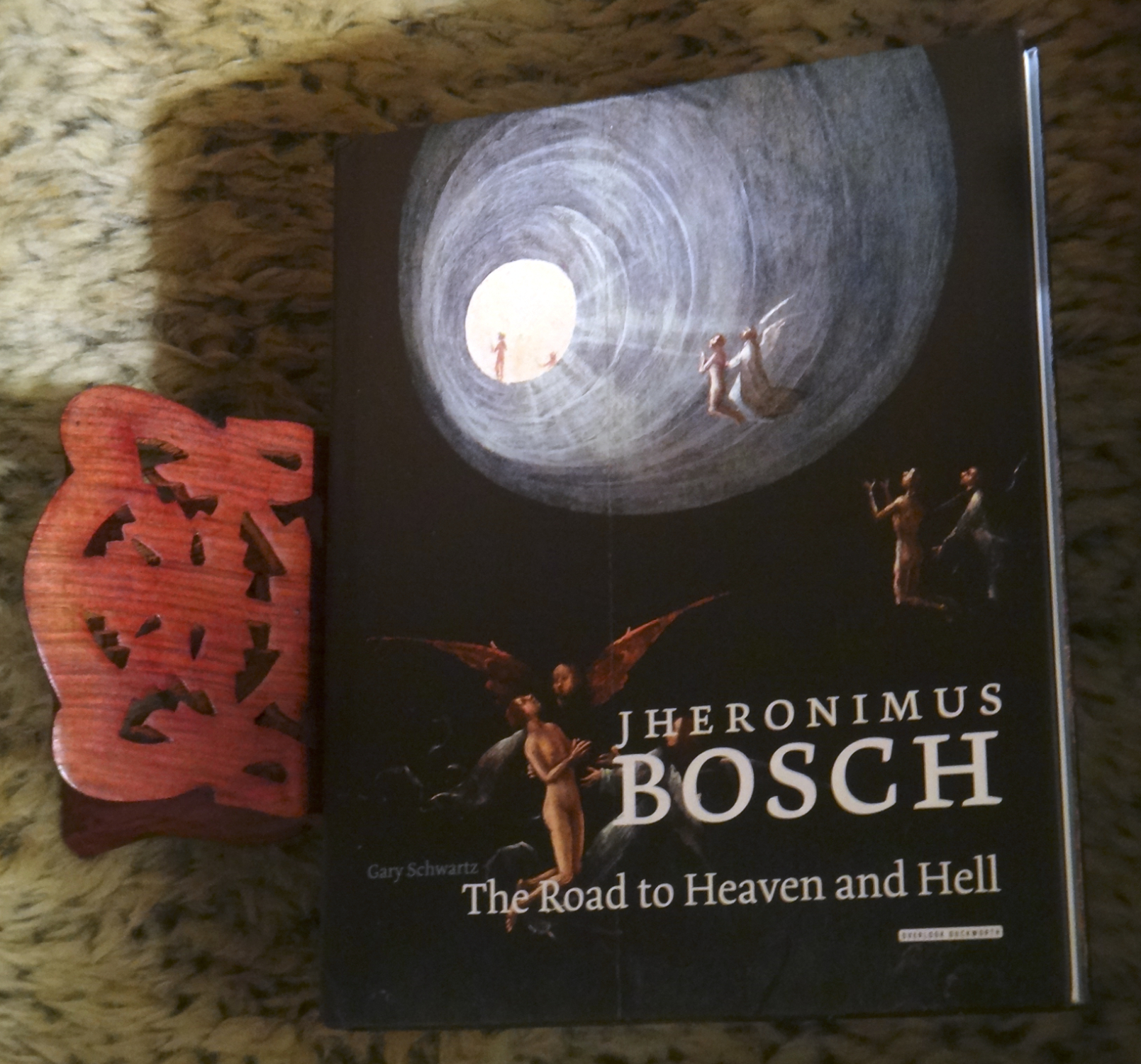
It’s subject is no less than Jheronimus Bosch, the birth name of the Artist better known as Hieronymus Bosch, one of the most mystical, unique and elusive Artists in Western Art. If anyone can track him down, my money is on Gary Schwartz. Track him down he does, going into extraordinary detail on his life, works and times, discussing each and every work in his inimitable way that almost no other Art Historian has- he gives you the technical details along with the humanity like he’s talking to “regular people,” and not a doctoral class in Art History. I marvel at his ability to do so. THIS is how Art should be taught, explained and passed on, IMHO.

I’ll sum up this book in 3 words- “Bravo, and Hallejulah!” Bravo for (another) classic & essential Art monograph, and Hallejulah we got another one by Gary Schwartz!

Given that this past week (August 9) marked the 500th Anniversary of his death, it’s already been a big year for Bosch. A show that I’m sorry I missed commemorated the anniversary in his former home town, Hertogenbosch in The Netherlands, then there was the release of the Bosch Catalogue Raisonne (and related Technical Studies) by the Bosch Research & Conservation Project (BRCP), 5+ years in the making, geared to establishing once and for all, which works the Master actually did create, and which he didn’t. Given all this hoopla, the timing of Mr. Schwartz’ newest book, “Jheronimus Bosch: The Road to Heaven and Hell,” couldn’t be more auspicious. It’s release seemingly makes it go head to head with the BRCP’s 2 books.

But, showing the true colors of his collegial spirit, Mr. Schwartz wrote the very first review posted on Amazon of the Bosch Catalog Raisonne, giving it 5 stars, saying both BRCP books were “Raising the bar.” Check it out. It may be the best review I’ve ever read on Amazon.

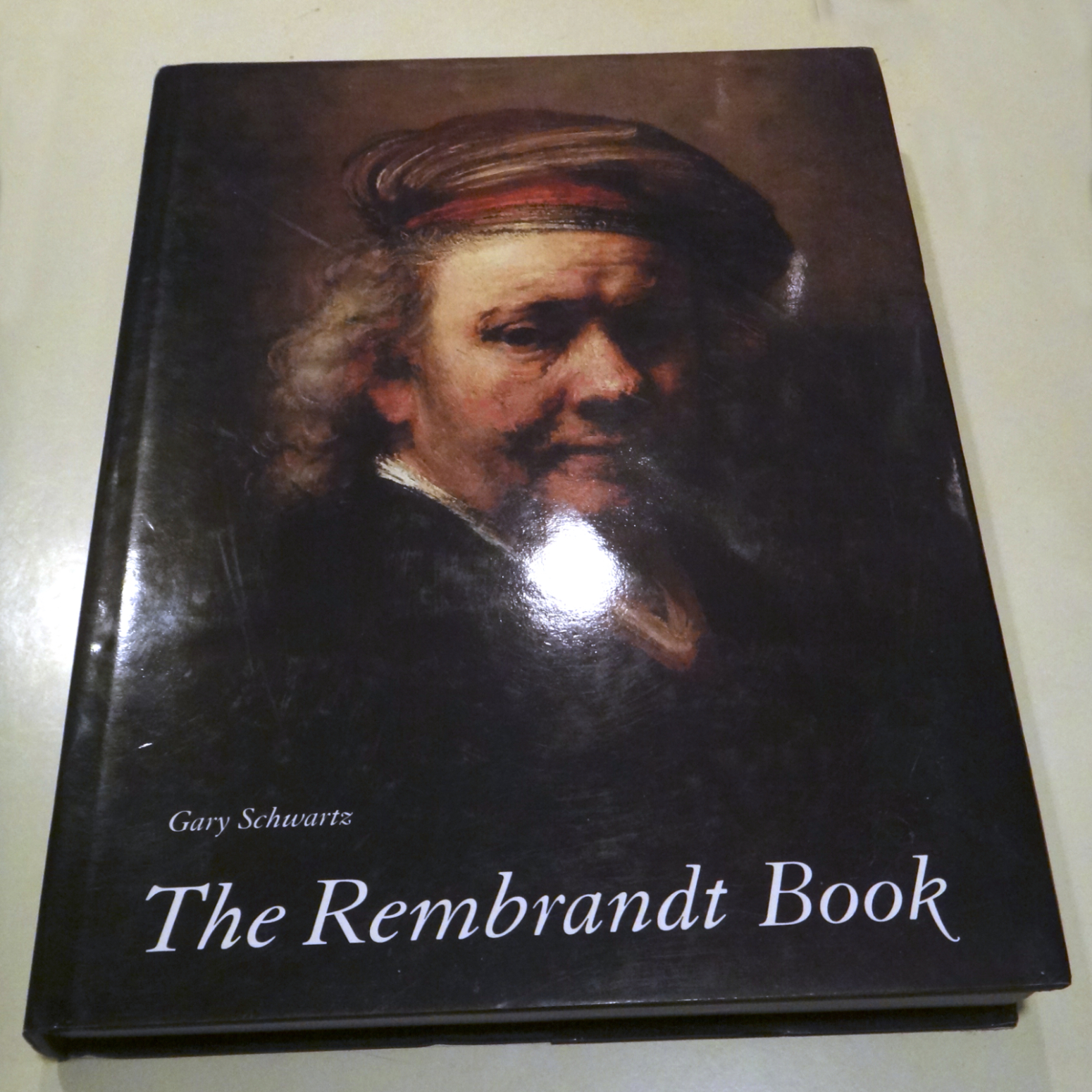
Gary Schwartz is the same man who had the audacity to write a book called “The Rembrandt Book” in 2006. There are, possibly, as many books devoted to Rembrandt as any other Artist in history. Was he saying, “Forget all of them, this is THE Rembrandt Book?” I wondered. Now? If I had to choose one Rembrandt book to take with me? That would it. And, I now actually call it “THE Rembrandt Book,” even though it was no less than his second full length monograph on the Dutch Master, following “Rembrandt – His Life, His Paintings,” from 1985. When I first looked them over side by side, my jaw hit the floor of The Strand. What most amazed me is that they were written 20 years apart, and they are completely different! Whoa. How much does he know about Rembrandt? I consider them both essential for Rembrandt lovers.

Essential, and sadly out of print. The Strand is asking 95.00 for a copy like mine, above. If you look hard, you can find a decent one for 30. online.

Now? He’s done it again. 19 years after releasing a 92 page book, called “First Impressions: Hieronymus Bosch” (1997), which as it’s title hints, is a fine introduction to Bosch,

Released in 1997, now out of print. A great introduction to Bosch. I got mine for 9. at The Strand late last year.

Jheronimus Bosch: The Road to Heaven and Helll” is a “The Rembrandt Book”-style monograph on Bosch. To my way of thinking it’s as close to “definitive” as we may be likely to see for some time, with all due respect to the BRCP’s Catalog Raisonne (which is for specialists, and while focused on the works in unprecedented depth using ground breaking techniques, doesn’t tie the work in with the biographical depth Mr. Schwartz does. Translation- I’m not a Bosch specialist.). Mr. Schwartz has an almost magical way of unearthing details about Artists that lived all these hundreds of years ago, and sifting through the existing documentation with knowing eyes that you just don’t get in other books. (He does include some of the BRCP’s findings, though it appears their work wasn’t completed while he was writing his.) Besides, there are so few works by Bosch, whoever’s word you take for it, that I know I’m not going to miss any either way.

I’ve come to trust Gary Schwartz when it comes to the “last word” on an artist. Mr. Schwartz has earned my trust, the hard way-with Rembrandt. But you don’t have to take my word for it- Simon Schama, of the superb Art Documentaries “Simon Schama’s Power of Art,” Art Historian & Professor of Art History at Columbia University, co-dedicated his excellent Rembrandt Biography, “Rembrandt’s Eyes,” to Gary Schwartz. After reading Mr. Schwartz’ Rembrandt books, which, coincidentally, came about during the work of another Research organization, the Rembrandt Research Project (RRP), who were also endeavoring to compile a verified canon of authentic works, and reading his assessment of their findings, I found myself in agreement with Mr. Schwartz on contested works like the Frick Collection’s “Polish Rider,” and others. I now trust his judgement about what’s what- no small thing when the world’s supreme experts are so vociferously at odds over things like what’s a real Bosch, or Rembrandt, and which isn’t. Hundreds of millions of dollars ride on the outcome of those arguments, not to mention the pride of the Museums home to these works. But? It’s not my money. (Phew.) I only care about learning about the Artist, trying to get a feel for his style and work and see if I can spot it in all these discussions, and how the work fits in with his life story. My guess is that Mr Schwartz appears to share similar motivations- he wants the truth. He’s not bashful about (respectfully) going against other experts if his research bears it out. He trusts himself- his own mind, and of course, a lifetime of research, experience and incomparable expertise.

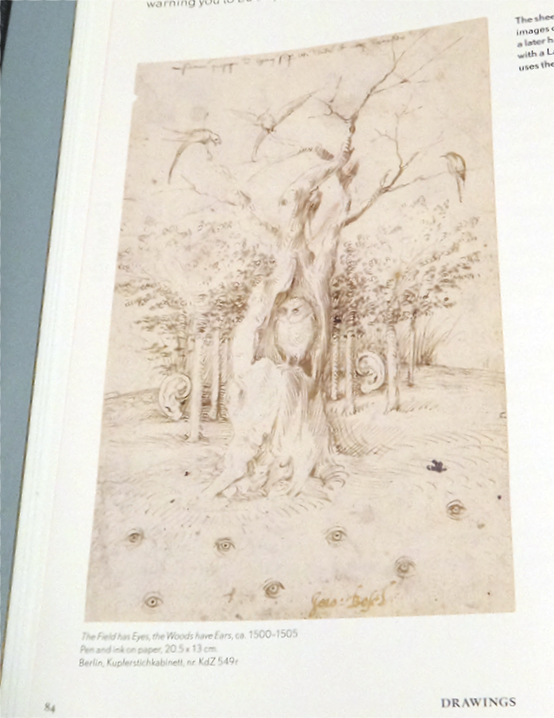
Owls appear all over Bosch’s work, so how can I not love him? Here’s one of my faves. Note the eyes and ears. It strikes me as a statement about the world right now.

While  you can read more of his writing on his website, and it’s all fascinating, unique and worth every bit of your while, getting a book like this is a rare gift, one that must have taken him years of very hard work to put together.

“You’ll stay with me?
Until the very end,’ said James.”*

So, the next time you’re in your better brick & mortar Bookstore, see if they have “Jheronimus Bosch: The Road to Heaven and Hell” by Gary Schwartz and published by The Overlook Press. Pick it up and thumb through it. I guarantee it will cast a spell on you, too.

PS- I only hope his next book is on Jan (or Jan & Hubert) Van Eyck…

*- Quotations from “Harry Potter and the Deathly Hallows” by J.K. Rowling, published by Arthur A. Levine Books, 2009. The first quote also appears in Matthew 6:19-24.

NighthawkNYC.com has been entirely self-funded & ad-free for over 8 years, during which 300 full-length pieces have been published! If you’ve found it worthwhile, PLEASE donate to allow me to continue below. Thank you, Kenn.

You can also support it by buying Art, Art & Photography books, and Music from my collection! Art & Books may be found here. Music here and here.

Written & photographed by Kenn Sava for nighthawknyc.com unless otherwise credited. To send comments, thoughts, feedback or propositions click here. Click the white box on the upper right for the archives or to search them. Subscribe to be notified of new Posts below. Your information will be used for no other purpose.

The New Whitney Museum- The Roofdeck of American Art

This site is Free & Ad-Free! If you find this piece worthwhile, please donate via PayPal to support it & independent Art writing. You can also support it by buying Art & books! Details at the end. Thank you.

Written & Photographed by Kenn Sava (*- unless otherwise credited)
DSC_3074PNH

“American Tune”
“We come on the ship they call the Mayflower
We come on the ship that sailed the moon
We come in the age’s most uncertain hour
and sing an American tune”*
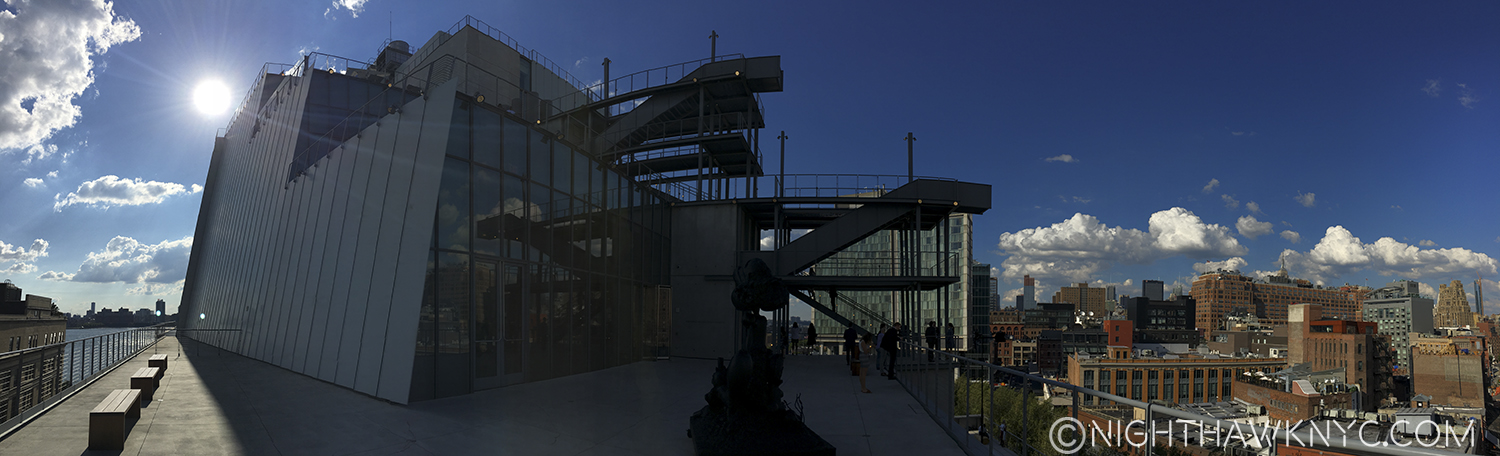
Looking west on the 6th Floor Roof deck, Spring, 2016.

Looking west on the 6th Floor Roof deck, Spring, 2016.

Part 1- The New Whitney Museum…And I

We actually go way back…

All the way back to June, 1987 when I had a letter published in the New York Times in opposition to the proposed expansion plans of the Guggenheim & Whitney Museums, after it was announced that both Museums wanted to modify & expand their existing buildings. I was outraged. How could you change these two singular masterworks without ruining them? I closed saying that “branch museums were the obvious answer” to modifying these Artworks of Architecture, in the Guggenheim’s case, Frank Lloyd Wright’s masterpiece was, perhaps, the greatest work of Art it owns. I went to the Community Board Meetings, but wasn’t directly involved beyond this letter. Mine was apparently chosen over the head of the opposition committee’s letter, much to his displeasure, I heard.
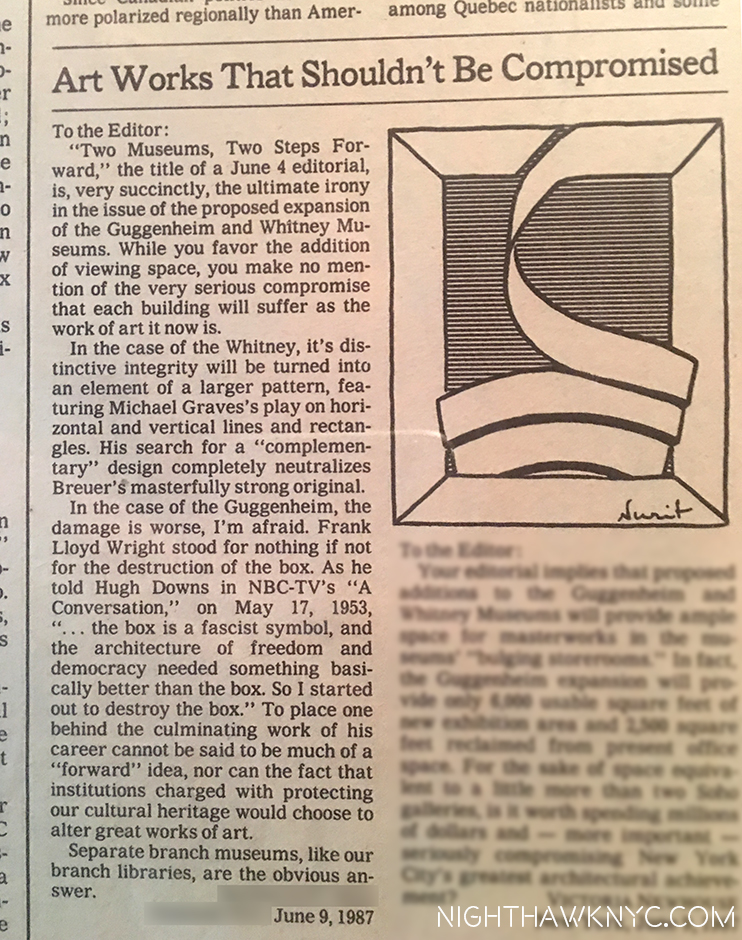
My letter in the NY Times Op-Ed page opposing the & Guggenheim & Whitney modifications, June, 1987. I love the very fitting drawing they added.

Almost 30 years later (wow…really?), how did “we” do?

Well, BOTH Museums took my “advice” and opened branch museums. The Whitney had a few around town, one across from Grand Central, another in Soho, while the Guggenheim opened what is, perhaps, the greatest Museum building since Wright’s enduring 5th Avenue masterpiece…by Frank Gehry in Bilbao, Spain of all places. It’s a “place” now, a true destination for culture vultures. They showed a model of another Gehry masterpiece they wanted to build downtown in the East River at the Guggenheim Gehry Retrospective in 2000. I bought a poster of it but, after 9/11, it was never mentioned again. ? They went ahead and remodeled Wright’s masterpiece, anyway, which I will never accept, AND continue to open branch Museums around the world as we speak. The Whitney, on the other hand, did not renovate Breuer’s unique original. Instead, we got something I never saw coming- They moved out and built an entirely new Museum.

Wow!

So? On my scorecard? I am one and a half out of 2.

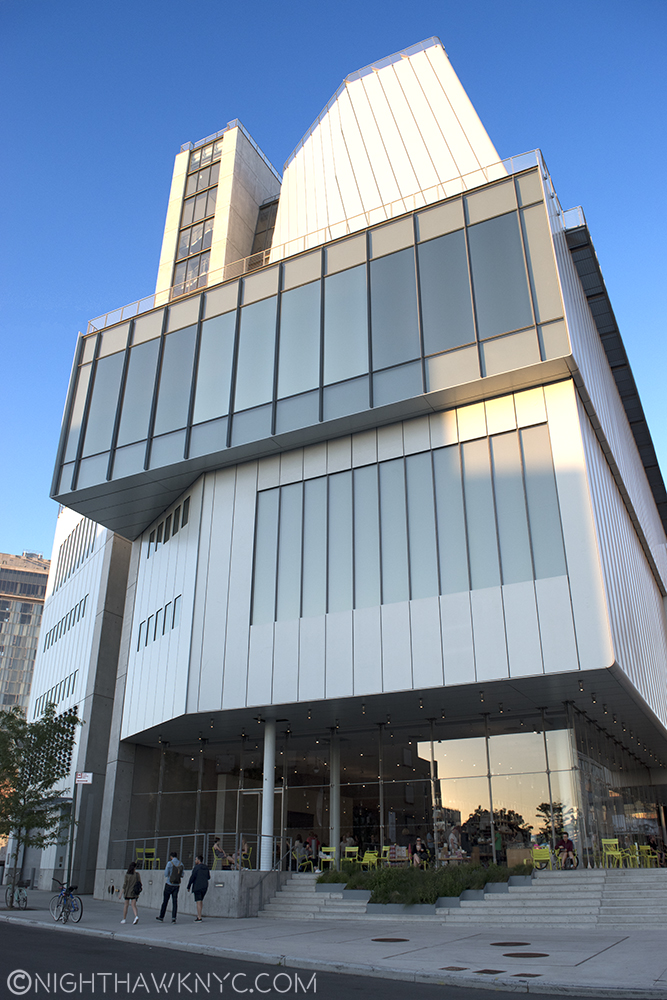
The New Whitney opened in May, 2015 in the Meatpacking District, right at the southern end of the High Line. I’ve made frequent trips there so far studying the building from every angle I could, at night, and yes, even in day light. (Oh, the sacrifices I will make in the pursuit of Art.) The inaugural, and as I’ve said very good, show, in the new Renzo Piano building, “American Is Hard To See,” came and went. I also wrote about both the Frank Stella Retrospective and a show by filmmaker Laura Poitras that came and went, too, along with quite a few smaller shows. So, a few months after the 1 year Anniversary, I think I’ve finally had enough time and experience with the new place, over 45 visits, to have some thoughts coalesce. As always, I have not read any reviews of either the building or the shows mentioned.

Part 2- Renzo Piano’s Whitney Museum Building

U.S.S. Indianapolis. US Navy Photo

The U.S.S. Indianapolis, Why is this picture here? Stay tuned. (U.S. Navy Photo.)

It’s only a year or so old, but I don’t think many will fall in love with the exterior of the building. I must say that in all my trips there so far, I have yet to see anyone else take a picture of it. Maybe (more) time will tell. In this City where location isn’t everything, it’s the ONLY thing, the new Whitney sits on a rather unique lot. How many places in Manhattan can you think of that have BOTH a River view AND a Park view? Situated directly across the West Side Highway from the Hudson River, to the west, and the southern end of the High Line to the immediate east, the Museum hit on a very rare Daily Double. Unfortunately for long time Whitney architect Piano, who came on board during the Museum’s “expansion” days, this lot has 4 sides. To the north, the rest of the block is occupied by one of the few remaining Meat Packing businesses that actually pack meat in what really was The Meatpacking District.1 Yes, trucks of raw meat park within inches of the Museum’s north wall every weekday.
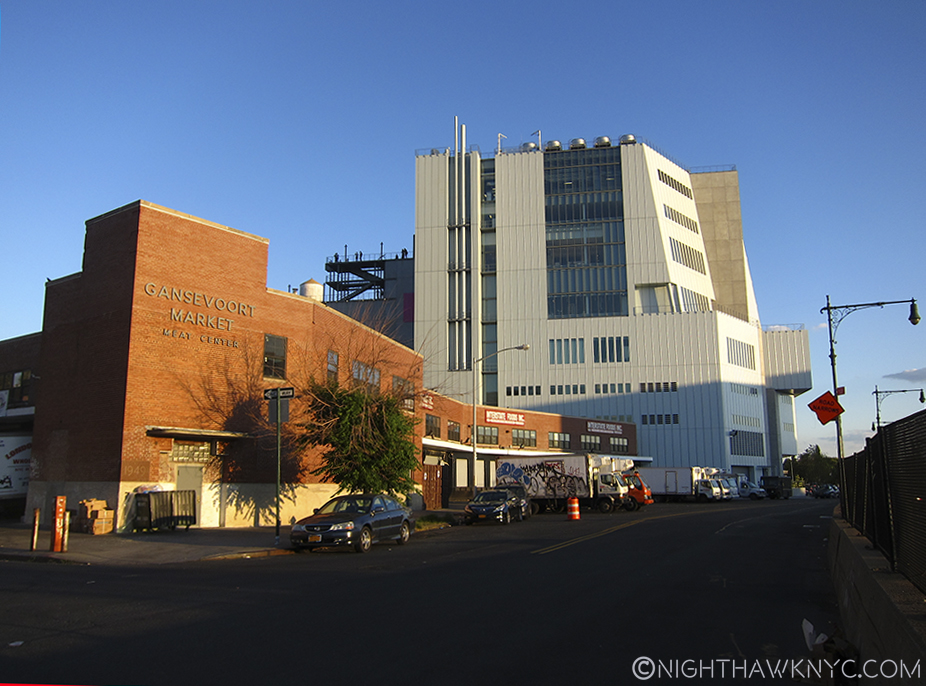
Yes, meat is still packed in the "Meatpacking District." Whitney's north side seen from West Street.

Yes, meat is still packed in the “Meatpacking District.” Whitney’s north side seen from West Street.
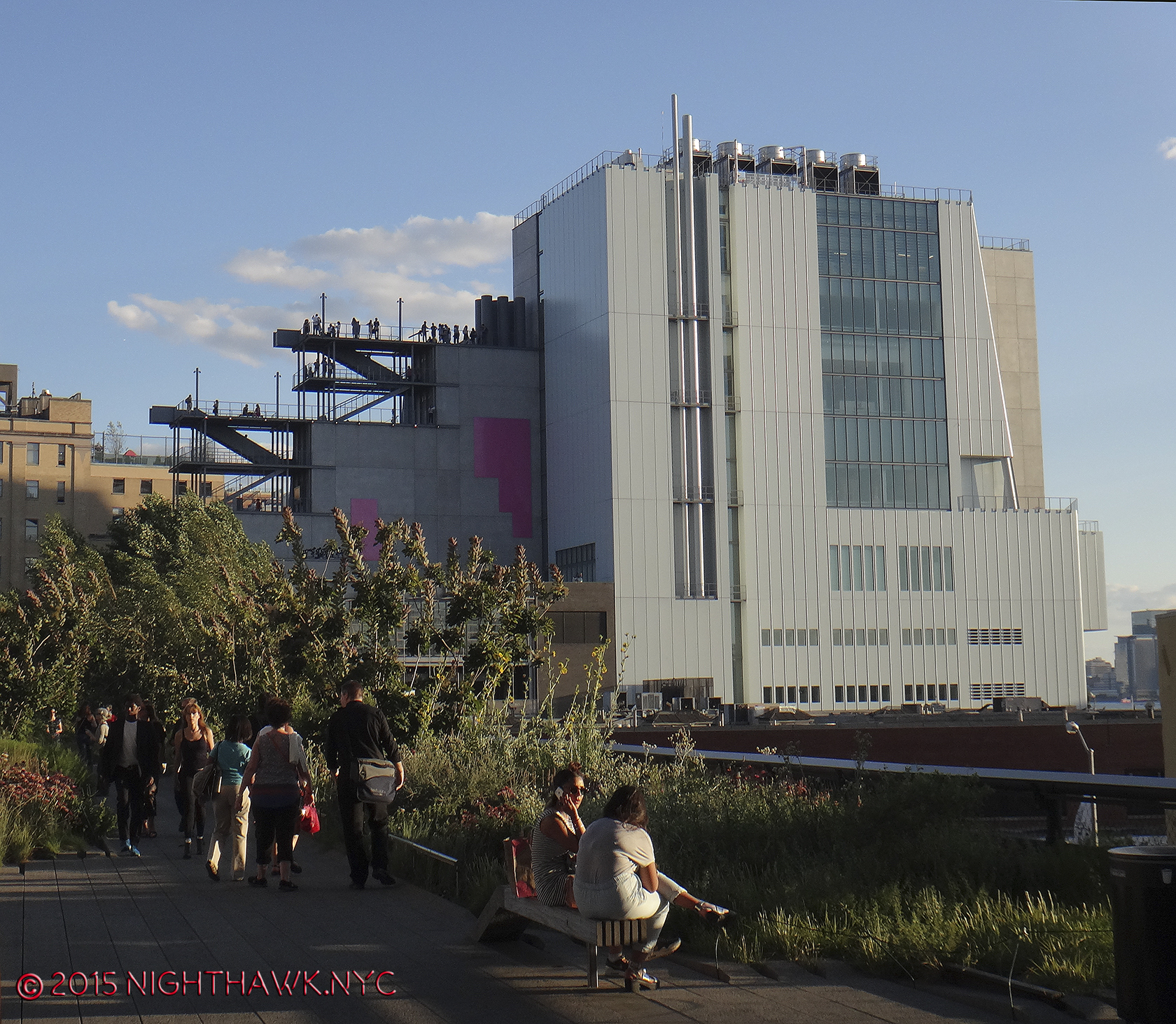
And, seen from the High Line.

And, seen from the High Line.

The two story meat complex provides a nearly unobstructed view of most of the north face of the Museum, from West Street or the High Line. I wonder what people who don’t know it’s the Museum think it is. I wonder how many of them will look at it and say, “Ah. A Museum.” My guess is not many. Maybe it’s an office building with not enough windows and a couple of long smoke stacks? A prison? It’s pretty non-descrip, making the stair cases that protrude from the rear of the building seem, well, odd. For myself, and probably countless others approaching the New Whit from the north, this is the first view they’ll get of it. The one defining feature of this side of the building is the exterior staircases. A cascade of them.
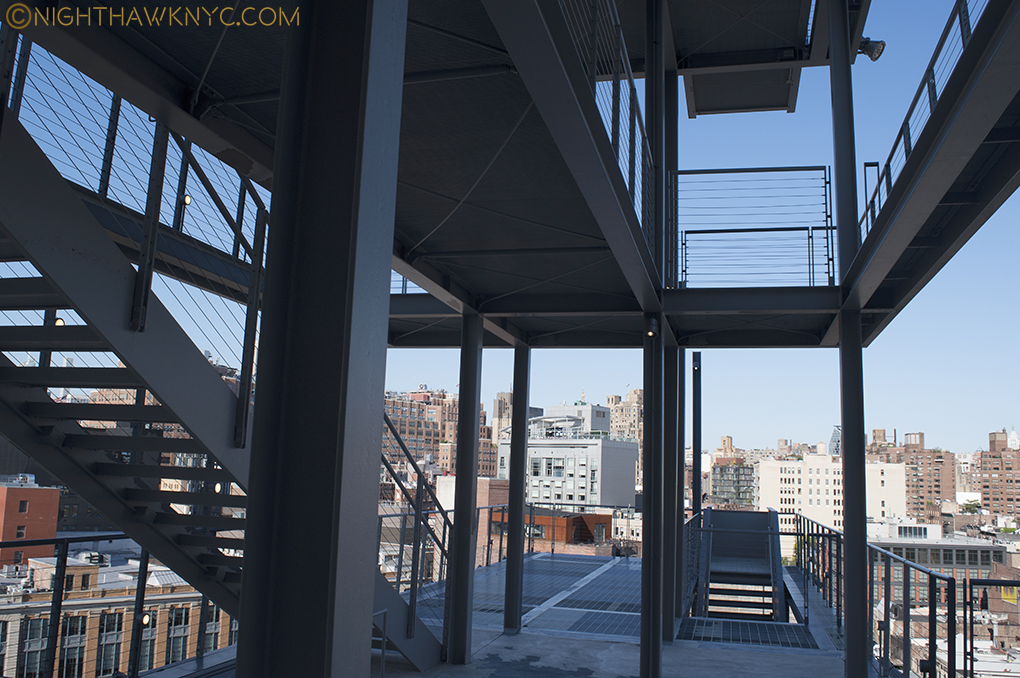
DSC_2948P2NH

Outdoor stairs as seen on the 7th Floor

To the south, across Gansevoort Street is a large, renovated apartment building, that also has Hudson River views on it’s western side. To put it mildly, this is a classic “high rent” district. Facing Gansevoort Street, the Museum presents visitors with an almost unbroken face of grey steel. Upon closer inspection, it also includes the Museum’s almost hidden entrance, which, until a sign was added recently, was only marked “Whitney Museum” on a glass window. Still, I can’t help wonder how the residents of that building across Gansevoort feel about paying those very high rents to look out their windows and see-
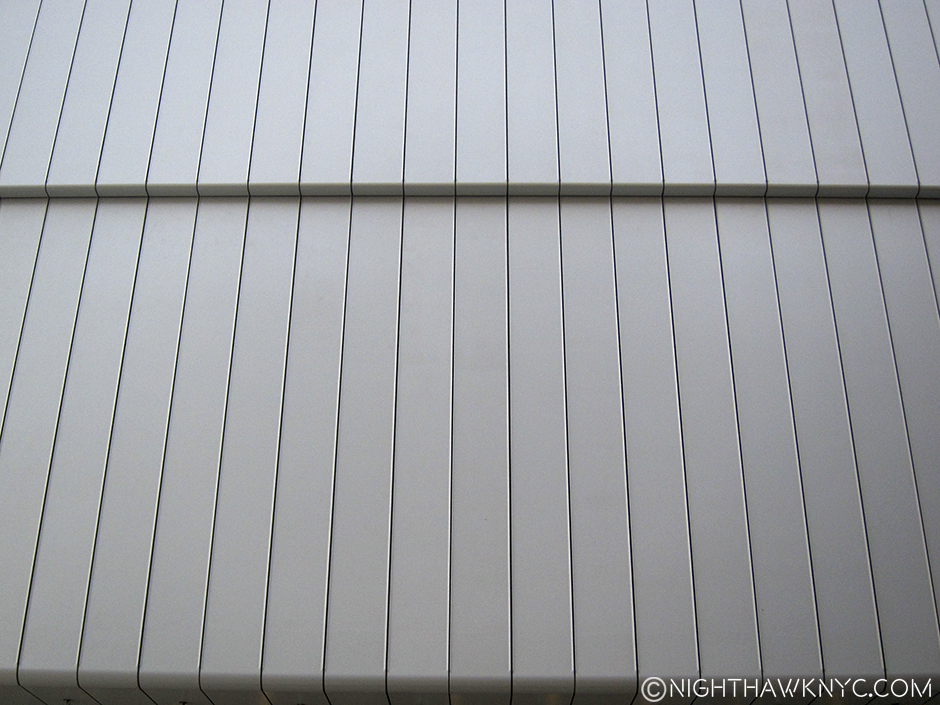
This, is their view.

This, is their view.

In fact, seen from the south, the building is so large that none of my cameras were able to get the whole thing in a shot from Gansevoort, including using an iPhone in Panorama mode. I had to go out into West Street to get one, which I don’t advise doing due to traffic coming randomly from 3 directions, not to mention my back being literally on the flimsy chain link fence bordering the West Side Highway with cars & trucks zipping around the bend at 60mph. Not a smart place to be standing with a camera. But this points out something interesting- there is no place where one can easily stand to get a good shot of the Museum- except, possibly, from a substantial distance. In fact, most of the shots of the building on the Whitney www site were taken from the rooftops of adjacent buildings. Maybe this is why no one takes pictures of it. Or? Maybe they don’t like it. ?
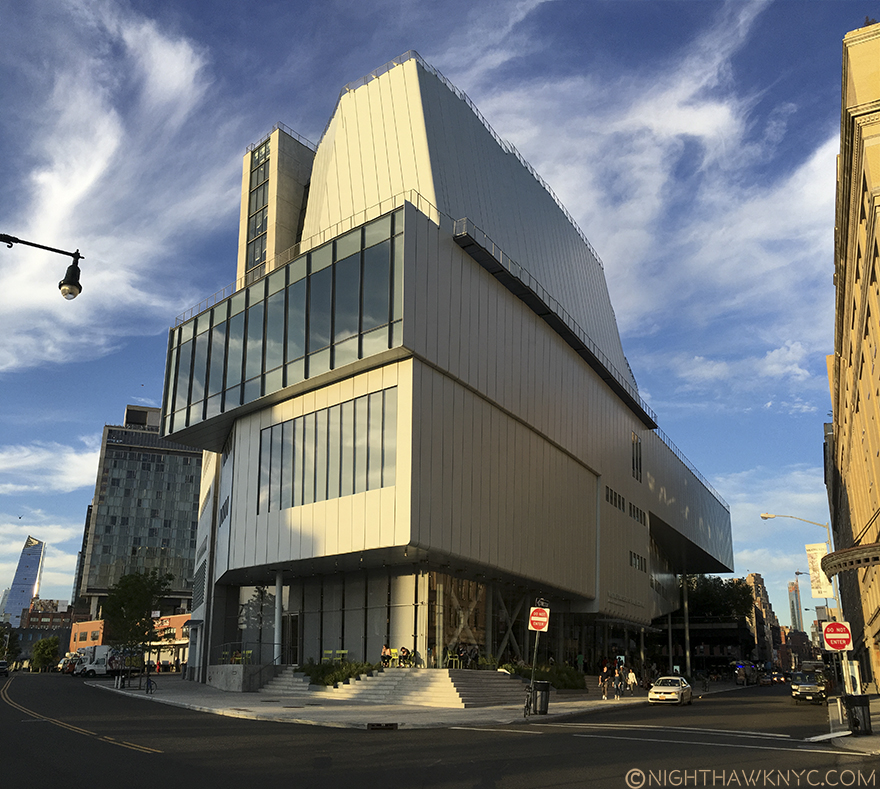
The closest I've come do death this year. The West Side Highway is inches behind me.

NOT to die for. I risked my life getting this shot. Southwest corner.

As we move to the western facade, with the large windows seen above (which reminds me of Zaha Hadid’s Library in Vienna), the upper one juts out at an angle seen from the north that vaguely reminds of the Breuer building’s Madison Avenue upper window.
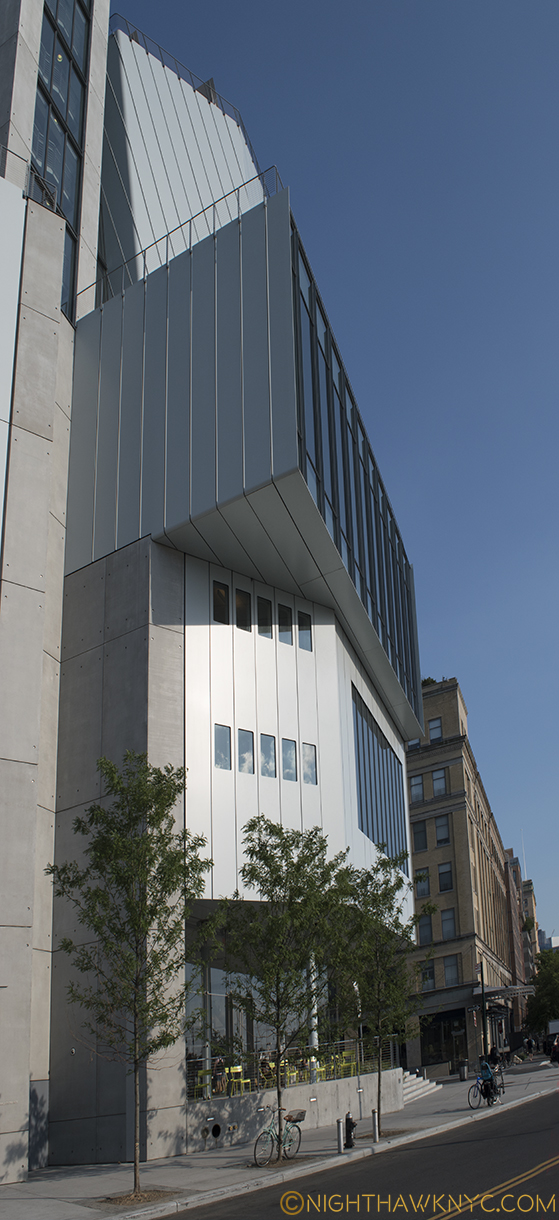
DSC_5300PNH

But more problematically, is a large Department of Sanitation complex smack dab right in front of it! “Holy Refuse Pile, Artman!” Garbage trucks coming and going all day and evening are not exactly what gives a “Riv View” it’s cache. (Feel free to insert your own wry joke about contemporary art here. I’ll wait…)
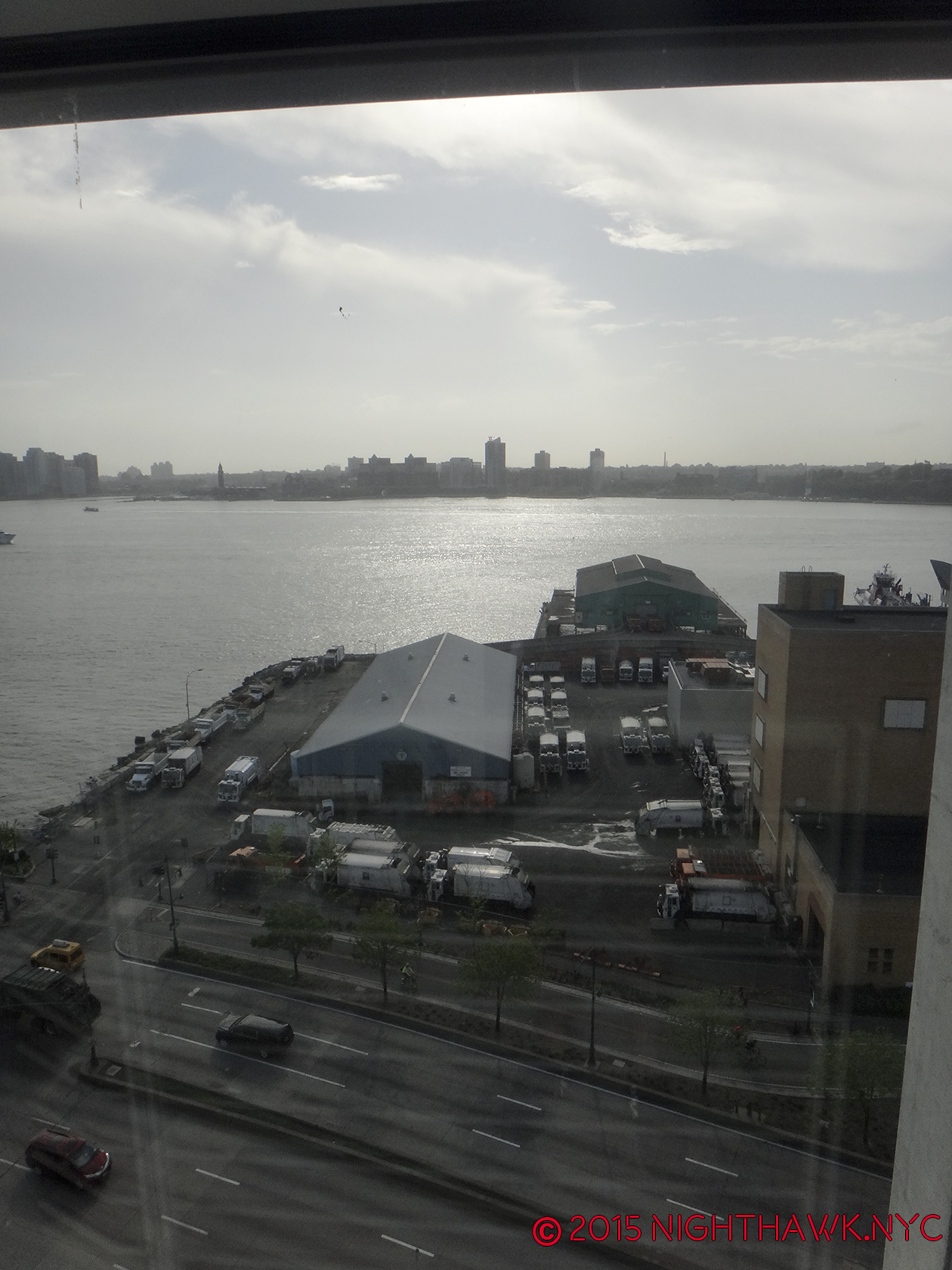
View of the Department of Sanitation from the 7th Floor stairs, 2015.

Riv View. Looking out at the Department of Sanitation from the 7th Floor stairs, 2015.

Mr. Piano has done his best to “minimize” the damage from the “offending” Department of Sanitation, and eternally busy West Side Highway, by opting to minimize the exposure of the western facade leaving a very narrow patio where, typically, only a few chairs usually are to be seen. It sits a few scant feet from the West Side Highway, after all, so it’s hard to imagine many people wanting to sit there for long. 3 trees have been planted along the curb in hope that one day they will provide some camouflage.
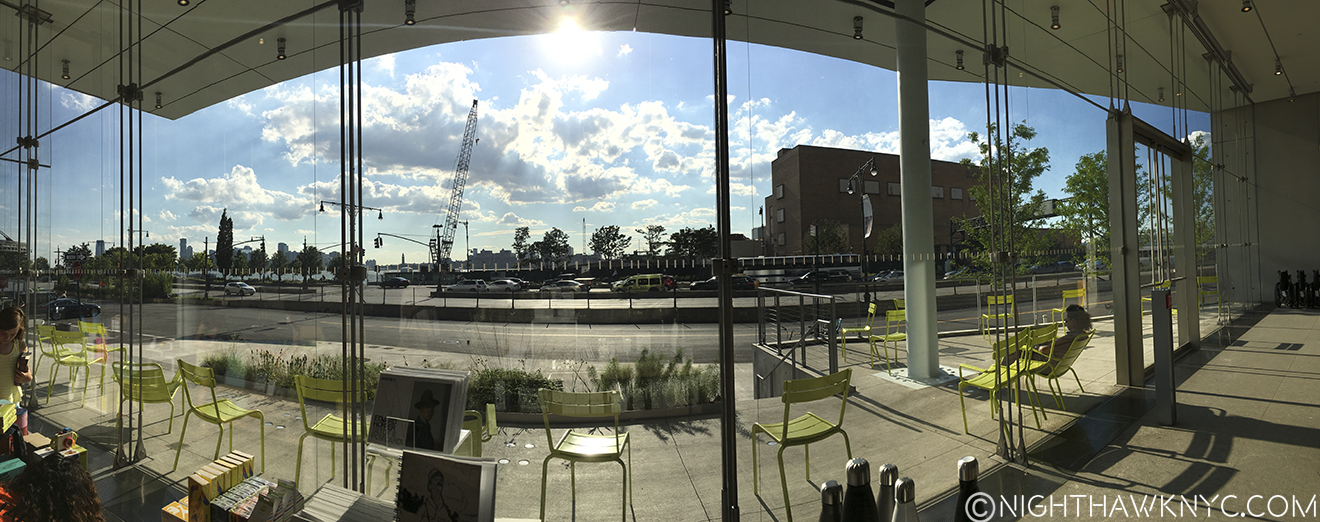
View from in front of the western facade, July, 2015, Being a tree in NYC is one helluva hard job.

View from in front of the western facade, July, 2016, Being a tree in NYC is one helluva hard job.

Regardless of the difficulties in seeing the building close up, it can be seen, for many blocks, both, to the north and south along the West Side Highway, and from across the Hudson River in New Jersey. Thanks(?) to the High Line there has been a boon in building in the area, with some very big name Starchitects (including, as I’ve written, the late Zaha Hadid’s only NYC Building going up at 520 West 28th Street, among many others) having new or recent projects in the area- some successful, some eyesores already. No less than Frank Gehry, the greatest architect of his time, in my book, himself, has a fairly new building about 6 blocks to the north of the New Whitney along the Highway, the gorgeous IAC Headquarters at 18th Street.
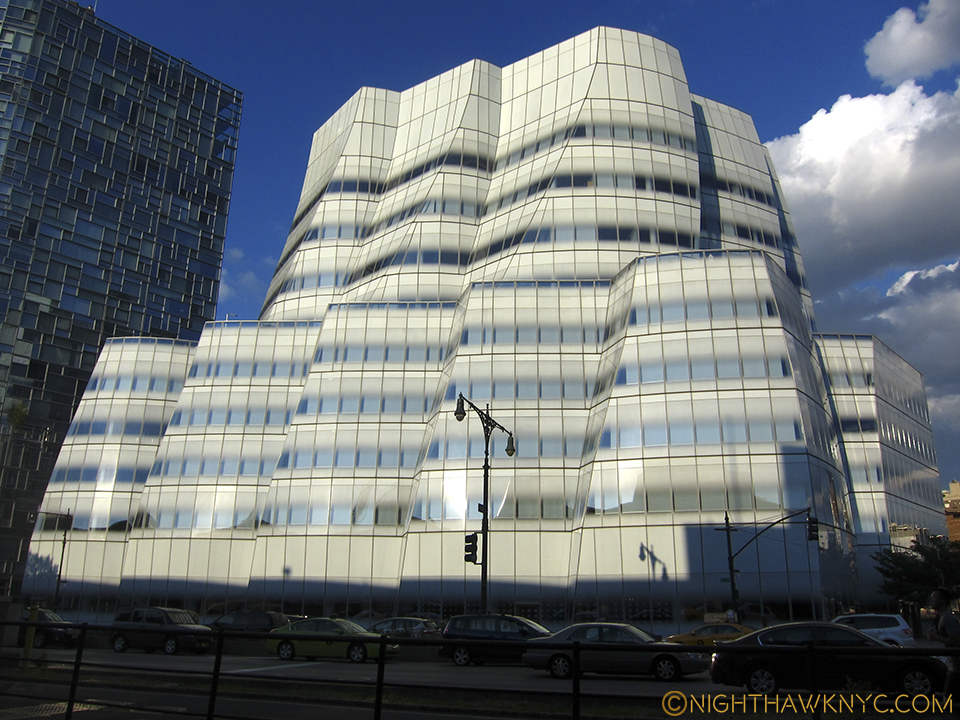
Like a sailboat on the Hudson, Frank Gehry's IAC Building is a gorgeous vision.

Like a sailboat on the Hudson it faces, Frank Gehry’s IAC Building is a shining example of the visionary architecture NYC needs more of, IMHO.

But, say what you want about this new Museum (don’t worry…I will), one thing that must be said is that the building isn’t obsessed with competing with it’s spectacular neighbor. Well? Not that spectacular neighbor, anyway. If anything, it sure feels to me like it’s competing with it’s OTHER “spectacular neighbor”- the High Line.
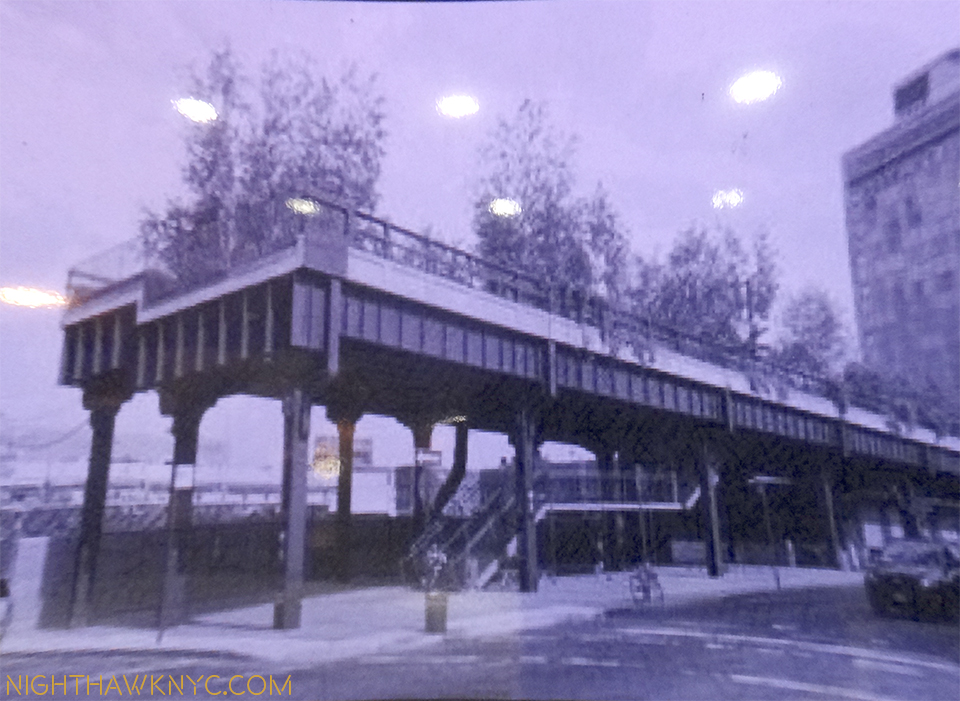
Southern terminus of the High Line, circa 2009. The new Whitney now occupies the space directly behind the left side.

Southern terminus of the High Line, circa 2010, early in the construction of the new Whitney directly behind on the left side. And today, and tonite…
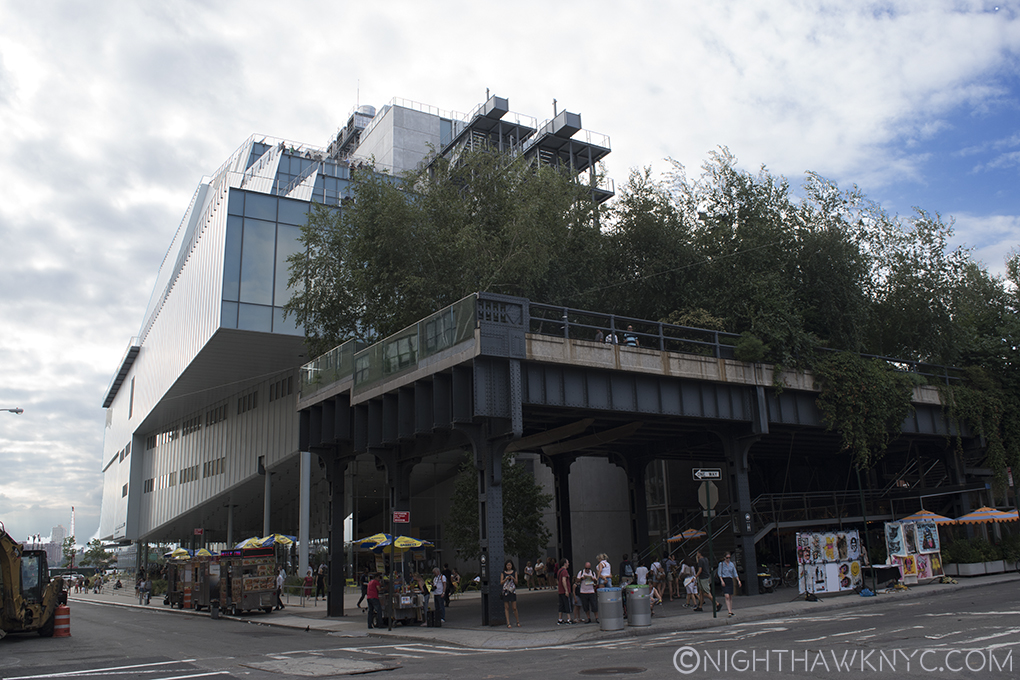
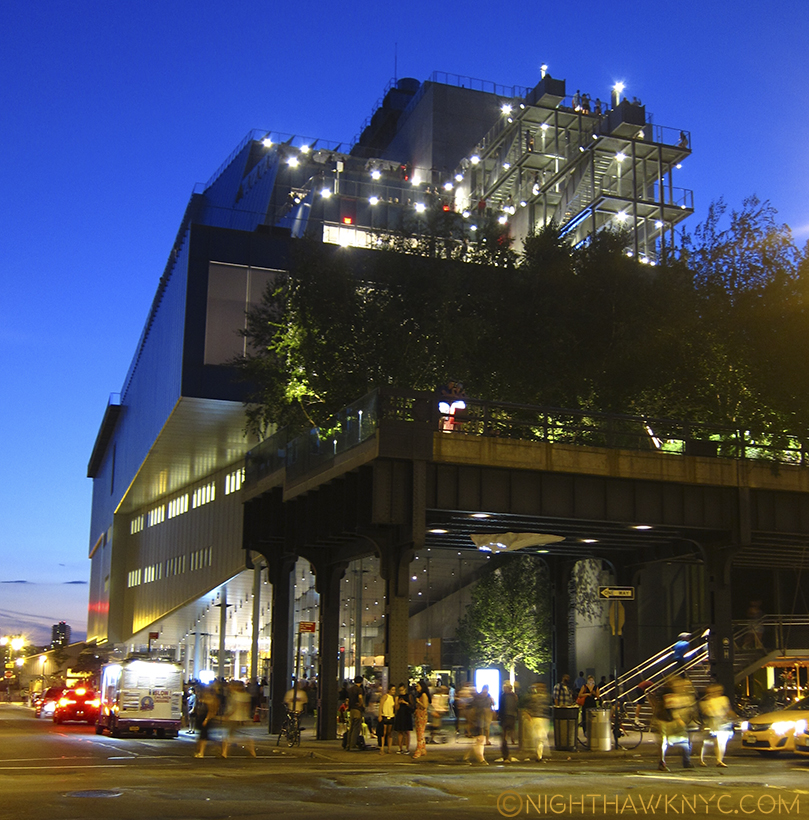
DSC_6042PNH


IMG_1130P2NH

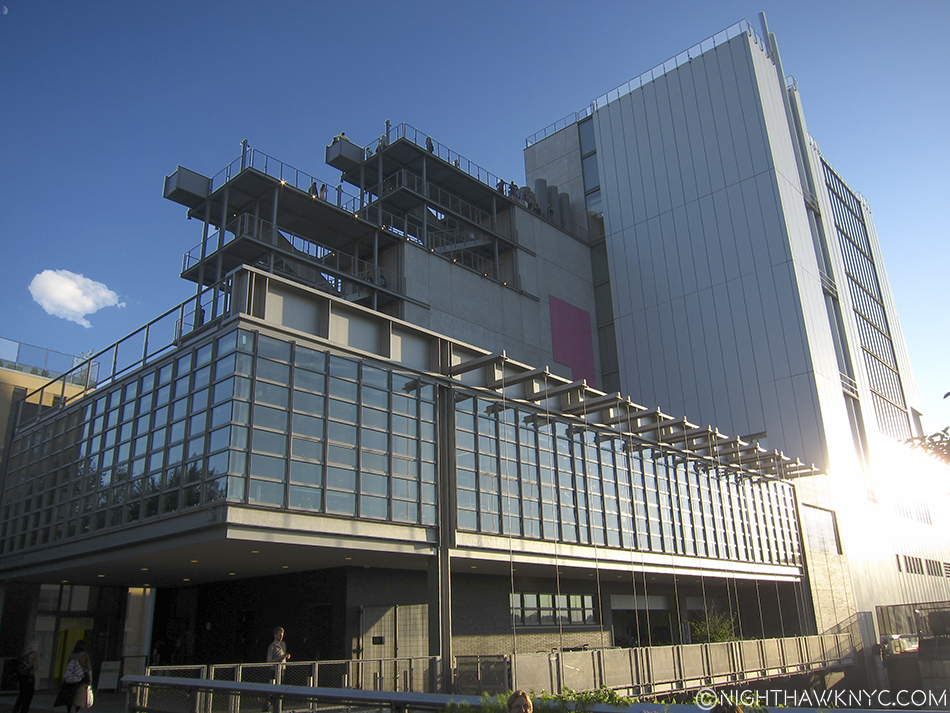
That brings us to the east side of the building, the side that abuts the High Line. Renzo Piano also designed the High Line Maintenance & Operations Building,
IMG_0782PNH

High Line Maintenance & Operations Building on the lot’s northeast corner.

which looks like it’s part of the Whitney, occupying the north eastern corner of the lot. Next to that are a rectangular bank of windows of the 5th Floor Galleries. The lowest rectangle is cleverly cantilevered over the lower floors in a way that vaguely reminds of Wright’s Fallingwater. Above it are more rectangular rows of windows on the other gallery floors, which are accompanied by roof decks and outdoor stairs between floors.
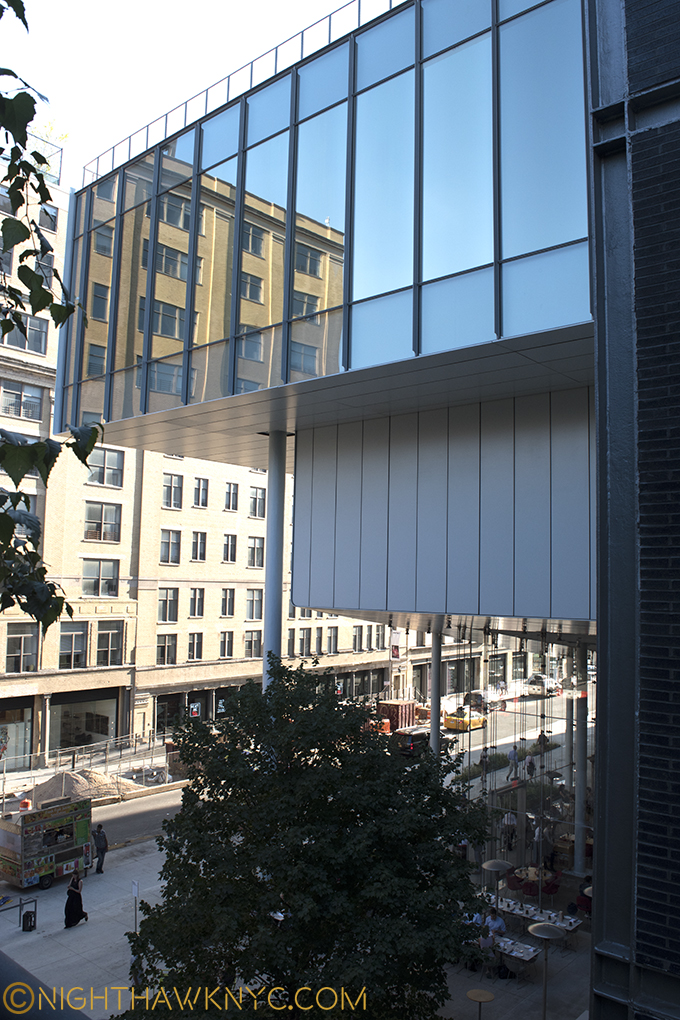
Eastern face with 1st floor restaurant seen from the High Line.

Cantilevered lower eastern face with 1st floor restaurant seen from the High Line.

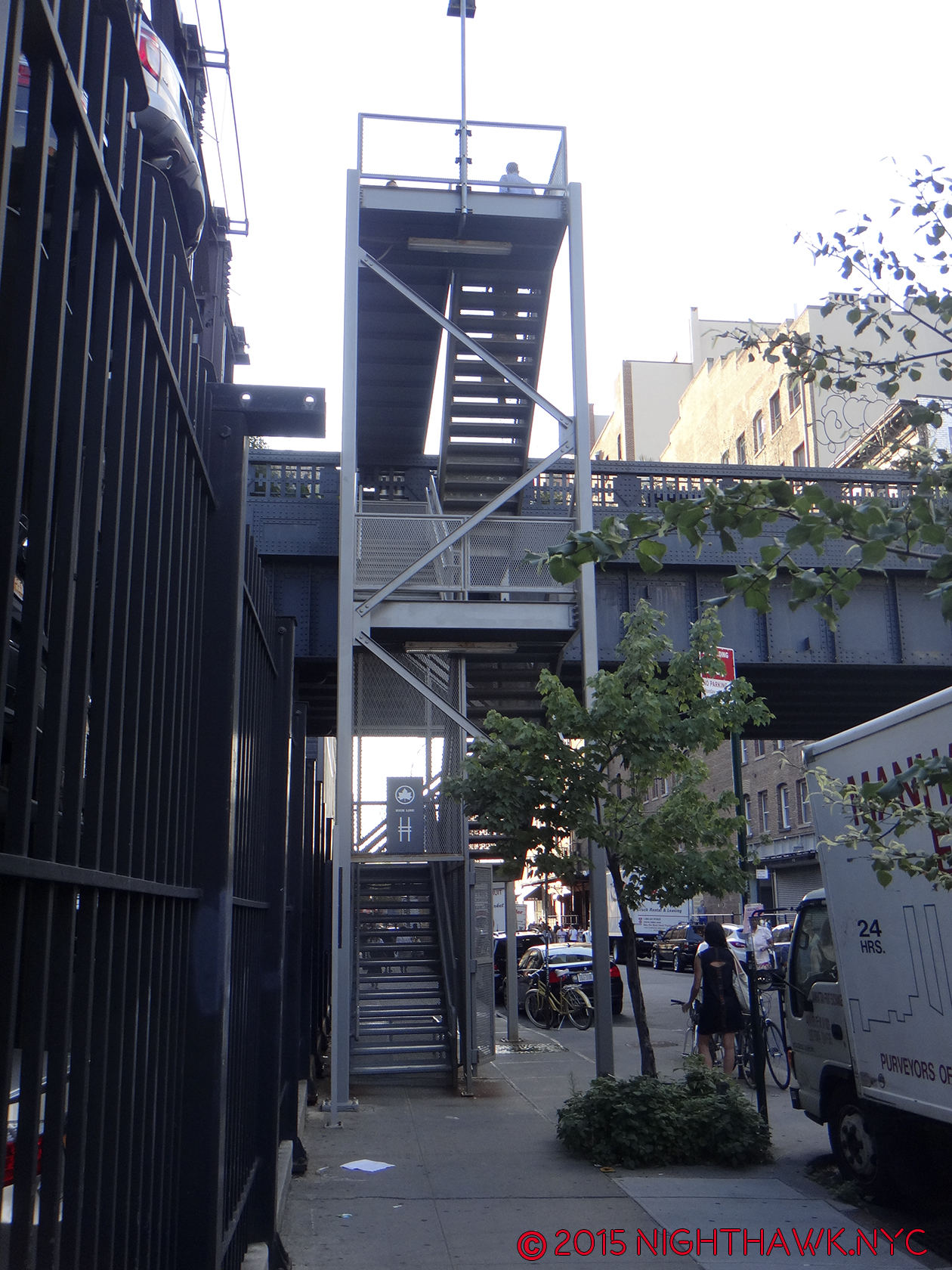
And, these are what raise my suspicion about purpose. So much outdoor space, and outdoor stairs in a place with the climate of Manhattan could be seen as highly questionable design. They are going to be unusable a good part of the year, so why do them? Aesthetically, to my eyes, the stairs look uncannily similar to the High Line’s access stairs. I wondered- Is this a case of “art snobbery” by an expensive to build, expensive to enter Museum trying to “upstage” a free & public park- a poorly thought out game of oneupmanship? An attempt to “blend in” with the High Line? Or?
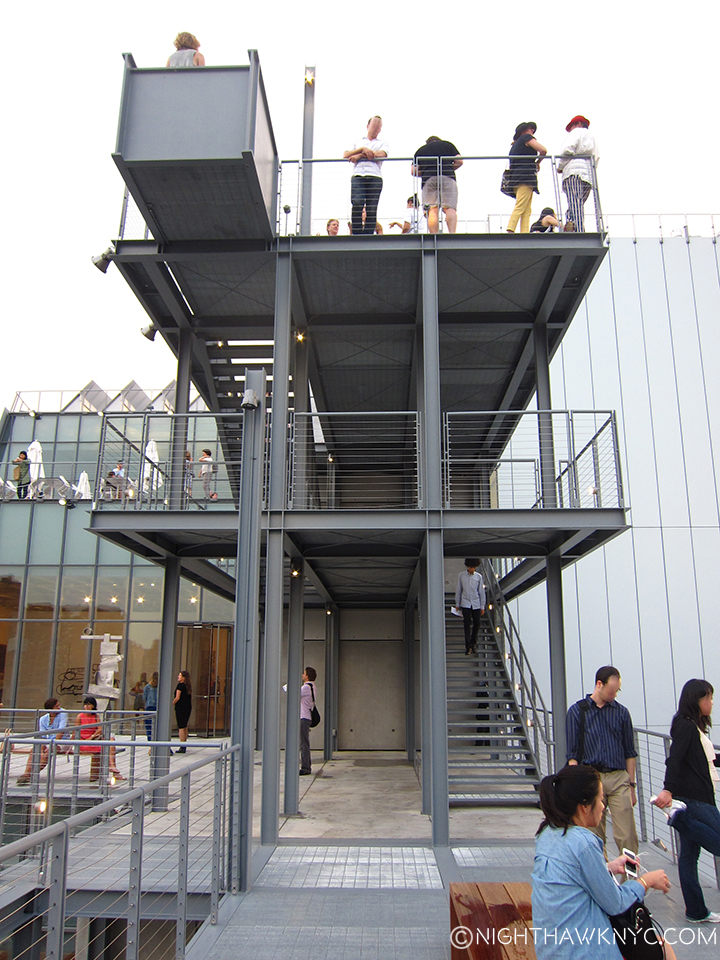
Whitney Museum Eastern Facade Exterior Stairs close up
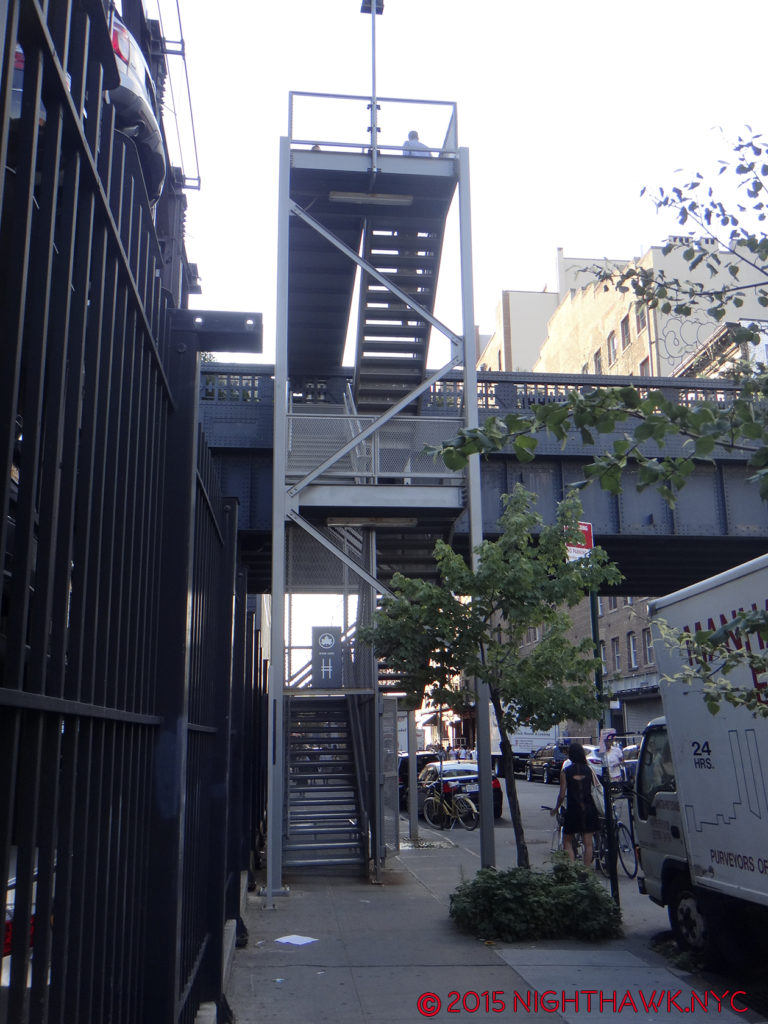
High Line Stairs at West 20th Street

High Line Stairs at West 20th Street

Other questions festered. Back along the south face. I spent a long time trying to think of what the shape of this building reminded me of. Hmmmm…Then one day, it hit me- From the south it looks like one of the US Navy’s newest ships- the USS Independence. From this side, it looks like it’s ready to go out to sea, well, out to the Hudson River. This feeling is hard to shake when you are looking at the few windows that look a bit like portholes, the “military—like” grey coloring, and the slightly sloping (i.e. “stealthy”) look of the upper floors. Add the rear decks and stairs to the Independence and the effect is so similar, it’s down right eerie.

Ok, flip the cantilever to the rear, and...? Eerily uncanny, no?

U.S.S. Indianapolis, again, with my highlighting. Ok, flip the cantilever to the rear, and…? Eerily uncanny, no?
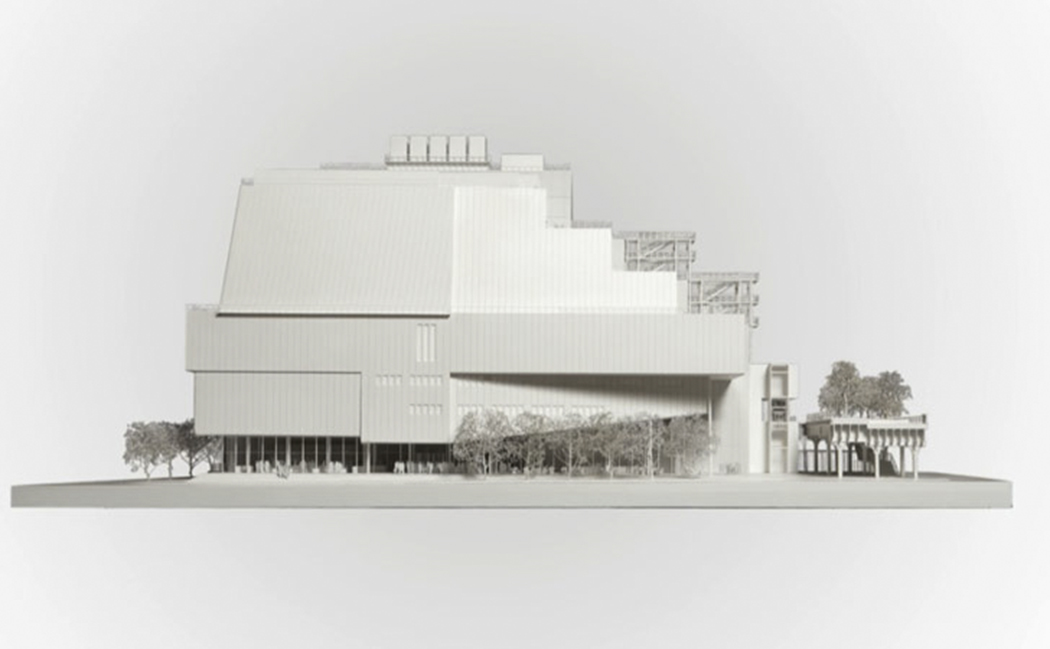
Photo from Renzo Piano Building Workshop website.

Photo from Renzo Piano Building Workshop website. Note that all of the “neighbors” have been removed, except for the High Line.

Part 3- The Roofdeck of American Art
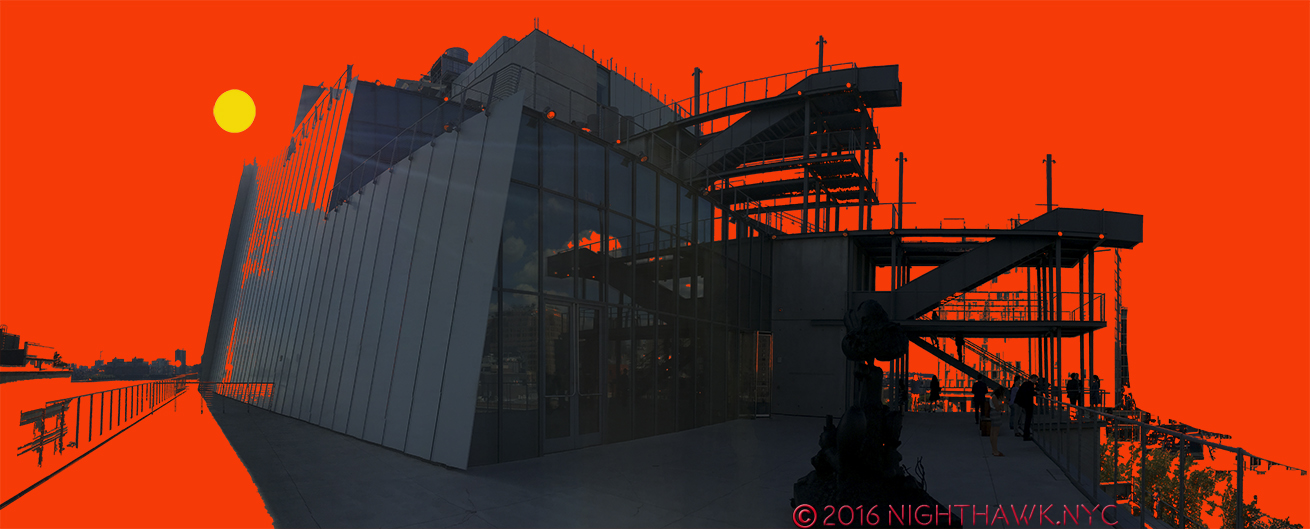
Bring sunscreen.

Want a tan with your art? 6th Floor deck, Spring, 2016.

Yes, that is what I’m calling the New Whitney- “The Roofdeck of American Art.” I think the decks are what people will remember most about the building. I only hope it’s not what they remember most about their visit. That will be up to the Museum’s curators and staff. But? As I will get to, I think other forces are at work, too.

With 4 roof decks, I bet some will come only to enjoy the view and get some sun. The Museum turns the face the vast majority of visitors will experience most to it’s “rear,” to it’s east side facing the High Line. Doing so gives Mr. Piano a very convenient out of his Sanitation Department dilemma, “Riv View” notwithstanding, and allows a wonderful panorama of Manhattan, from Chelsea Piers to the north, the Empire State in the center and the Statue of Liberty, distantly, to the south. The decks allow space for dining (8th floor), sculpture (5th floor and the others), seating, and that 21st Century phenomenon- selfie sticks.
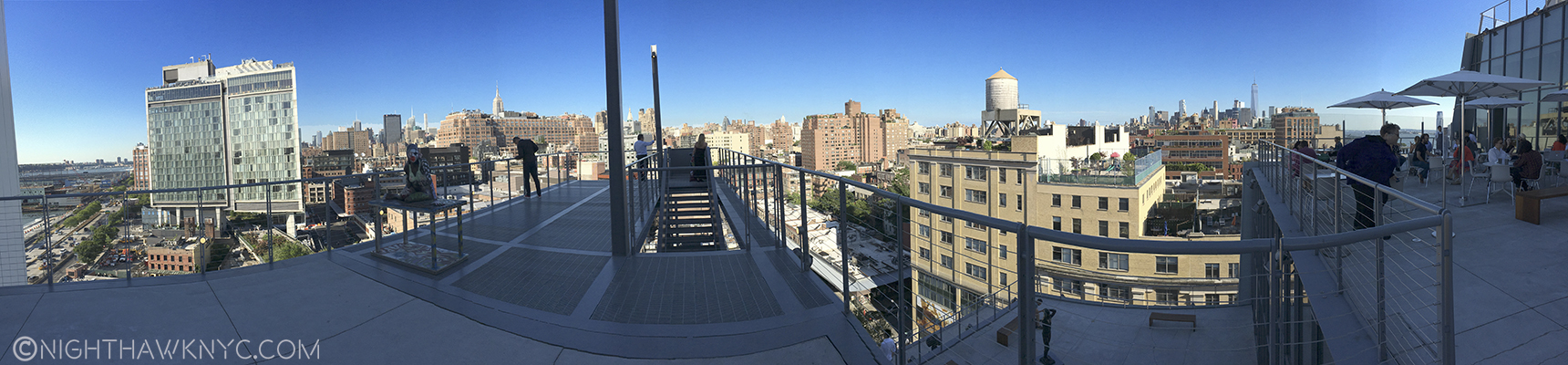
IMG_4907PNH

8th Floor Deck.

It’s very nice. You’ll like it. Bring sunscreen.
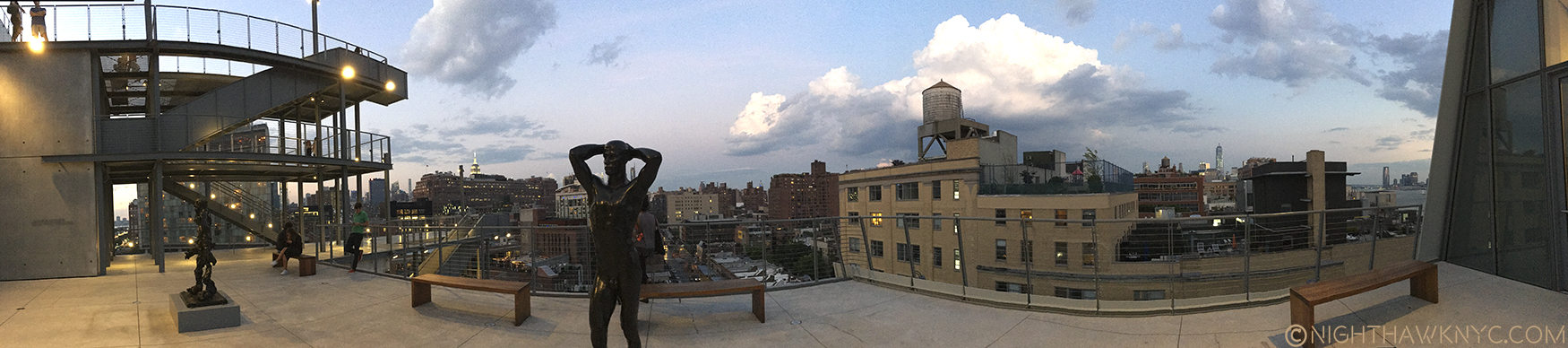
IMG_4848PNH

I promise that top ramp won’t be bent when you visit the 7th Floor Deck.

Part 4- Inside. “Hey look! They have art here…too!”

Inside, the first floor is the lobby, the most unsuccessful part of the entire interior- it’s an open space. The message here is “keep moving.” It’s about as unwelcoming a space as Moma’s lobby. (Actually, ALL of Moma, which for me stands for what it feels like- the “Mall of Modern Art,” feels unwelcoming!)
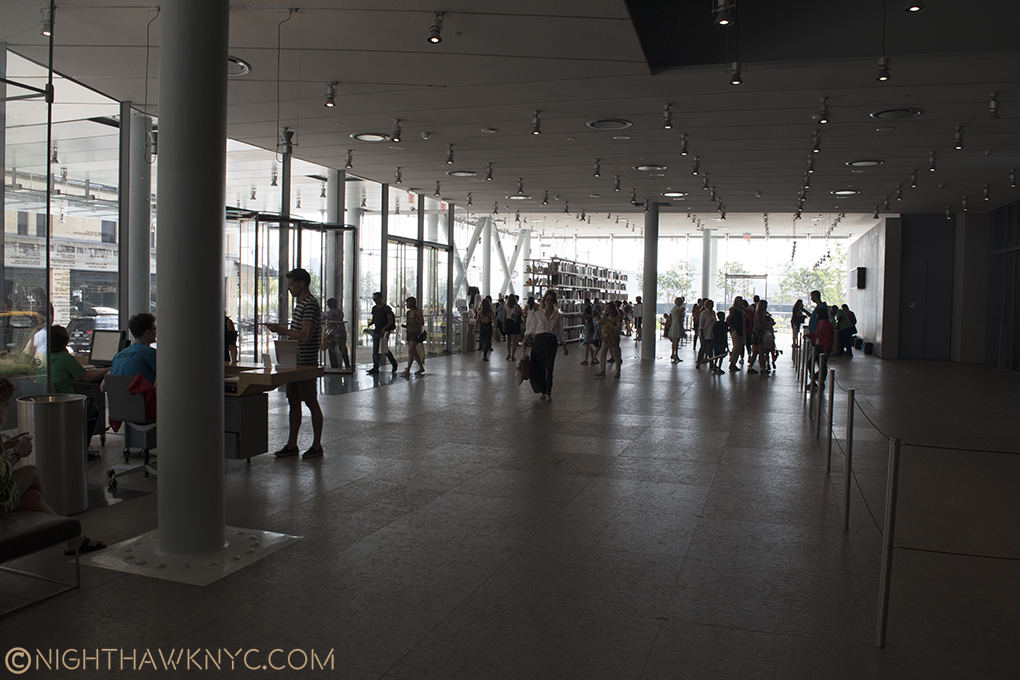
Welcome? No one will ever mistake the lobby for the Great Hall at The Met. Front door is opposite, where the black mat is.

Welcome? No one will ever mistake the lobby for the Great Hall at The Met. Front door is to the right of the nearest exposed column. Engineering made visible abounds. The free 1st floor gallery is to the immediate right, outside of the rope fence, which denotes you are in the Museum.

Once inside, here’s the routine I’ve settled upon, which probably sounds confusing- After entering as quickly as possible to minimize the time spent in the “lobby,” a short trip downstairs (don’t take the elevators- the wait is too long) brings you to the coatroom and the rest rooms (there are others restrooms on 3, 5, 7 and 8). The feeling here is 180 degrees from the lobby. This is completely designed. It makes you wonder what the hell happened upstairs. Take the stairs back to 1 and walk out past the rope line (keep your admission ticket handy) and visit the first floor gallery, which is free all the time. (Or, yes, you could visit the 1st floor gallery before paying to get in. I prefer to get my admission ticket first, which means I have to show it twice.) After that, show your ticket and get back in the Museum proper then take an elevator to the whatever floor you wish to see first- 3 (where the theater is for concerts, dance performances, etc), 5,6,7 or 8 (where the galleries are). Bear in mind there is no 2nd or 4th floor- they didn’t pay enough money to get those. No, at 422 million dollars, they did, but those floors are reserved for Museum staff and functions, so they’ve disappeared from the public elevator buttons.
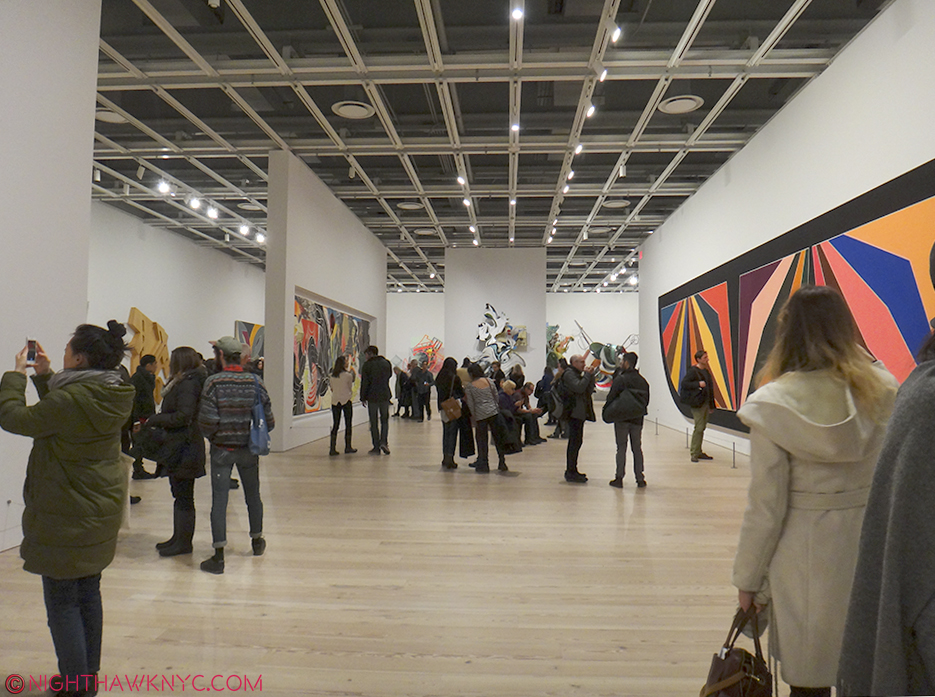
5th Floor seen during the Frank Stella Retrospective, Feb, 2016. The smaller walls can be moved to provide countless configuration possibilities.

5th Floor seen during the Frank Stella Retrospective, Feb, 2016. The smaller walls can be moved to provide countless configuration possibilities.

Inside, the building is very sharp, clean and neat with natural wood floors and new, white walls all around. As the rectangular shape belies, form mostly follows function, and 4 of the floors are given over to large, rectangular galleries. The open space allows for movable walls can be easily repositioned to allow an extremely wide range of configurations. Each floor is very well lit, (something that is continually a problem at The Met). With 3 sets of stair cases, there are plenty of stairs . None go all the way from 1-8, however. On the western wall, as seen below, stairs go from the 3rd floor to the 8th. To the east of the elevators, stairs run from 5 to the 1st floor. And, there are the exterior stairs on 6,7 and 8. The stairs are good to familiarize yourself with, since there is almost always a wait, the elevators are best used for going from 1 to 8 or from 5 to 1. The entire building, inside and out, is wheelchair accessible.
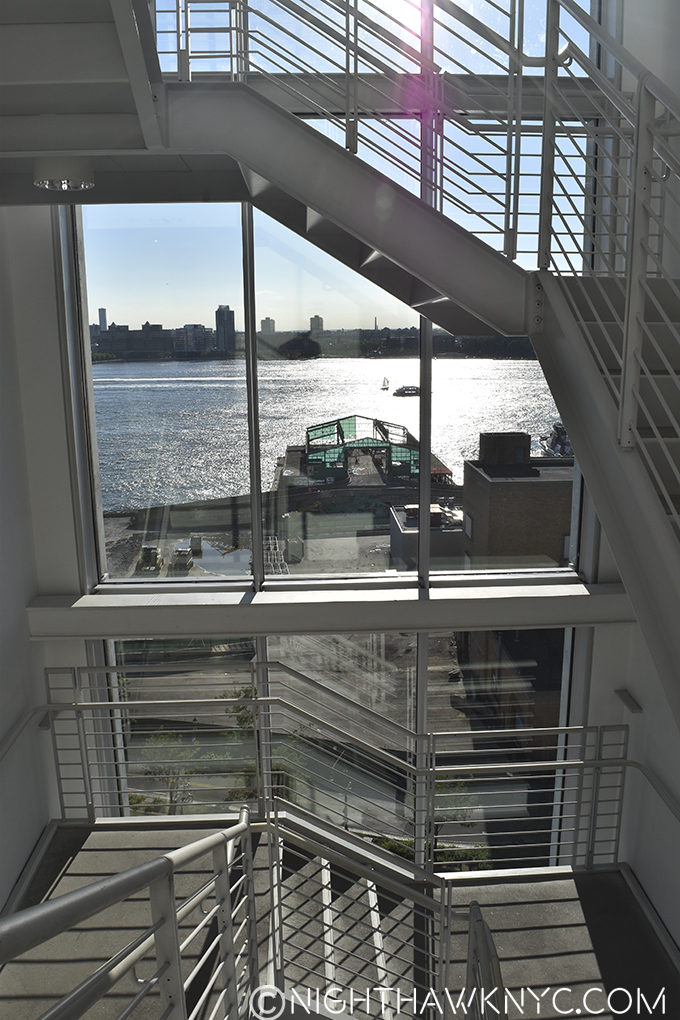
Western stairs, Spring, 2016. They seem to be dismantling the Sanitation complex. The Whit might be hoping a tower doesn’t go up in it’s stead.

Renzo Piano strikes me as a Master Engineer more than as a brilliant Architect. I got that feeling when I first saw the Pompidou Centre in Paris, with it’s engineering on the outside, and again with his New York Times Building (which he inherited from Gehry). Yes, he has done some beautiful buildings, but I repeatedly get the feeling of Piano, the Engineer, when I look at his work, and that shouldn’t be the primary feeling I’m left with. There is quite a bit of engineering being shown off, here too, much of it on the first floor, some in the exposed gallery ceilings, and some on the roof decks.
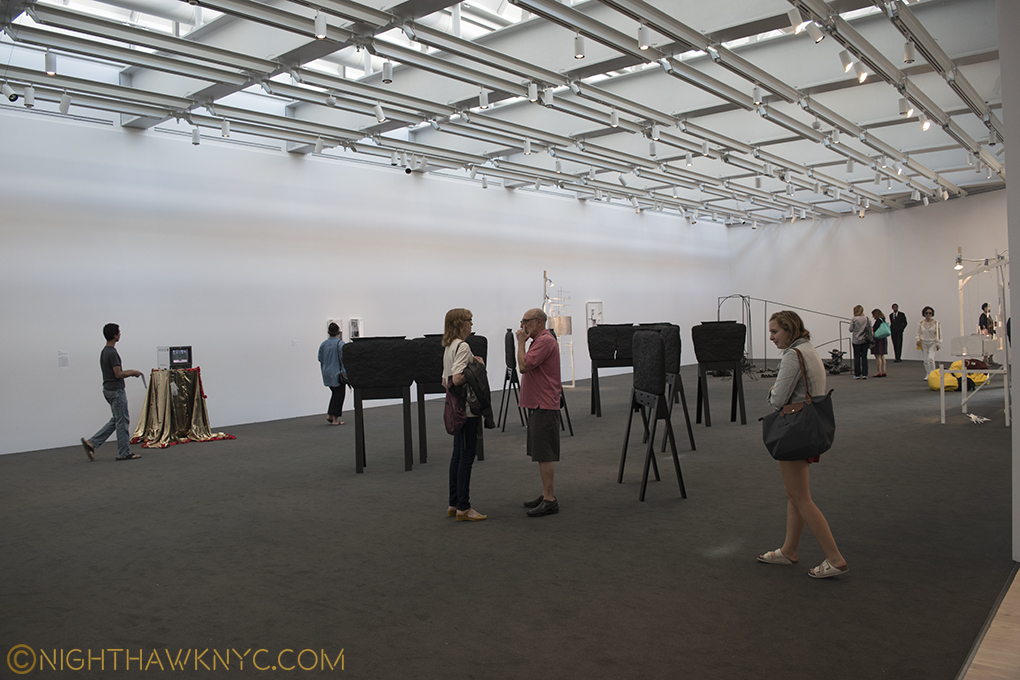
The 8th floor gallery lets in ambient sky light.

The 8th floor gallery lets in ambient sky light.

Now for the “nitty gritty.”

Given the luxury of having over a year to assess it, I’ve begun to wonder about the adequacy of the 50,000 square feet of indoor exhibition space, as nice as it is. “America Is Hard To See,” fit the whole Museum well, and showed it off to fine effect. Then, while the Frank Stella Retrospective was excellent, it only included 5 of his prints, and only 1 of his “Moby Dick” works. Was this because of hard decisions due to a prolific, 50+ year career, or due to a lack of space on the 5th floor? Currently, the otherwise excellent “Stuart Davis: In Full Swing” show feels unmistakably truncated. It shares the 5th floor with the “Danny Lyon: Message To The Future” show, (which may be overambitious). By comparison, The Met’s Stuart Davis show in 1991-92 had almost twice as many works, including over 30 that dated before the earliest work in the Whit’s show, like some from his “Van Gogh” period. While these have been going on indoors, I’ve been underwhelmed by what’s been installed thus far on the outdoor 5th Floor exhibition space. As time goes on, I’m starting to feel the 5th Floor may turn out to be a design mistake. Part of it is cut off to allow an entrance and exit corridor for the outdoor space, which is generally in shadow, and results in leaving a small indoor gallery on the other side of the outdoor gallery access corridor, which feels lost, and most importantly cuts down the size of the congruent 5th floor space. The other floors with outdoor decks run right up to the door leading outside with no corridor, etc.
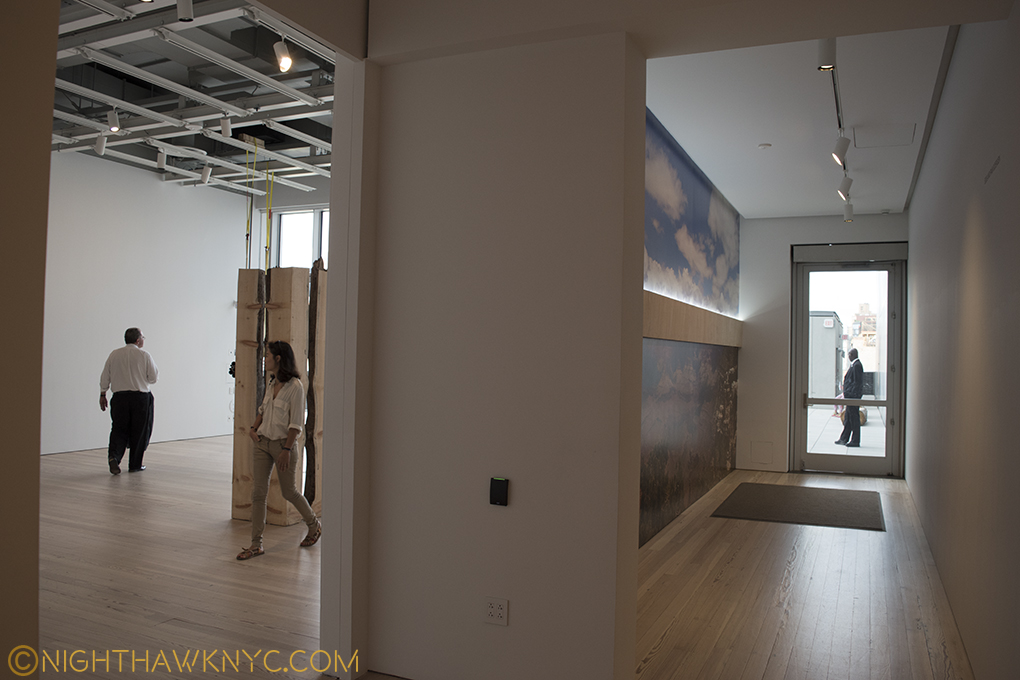
The 5th Floor is cut to allow this exit corridor to the Roof Deck Gallery, leaving a small gallery to the left that feels lost.

The eastern end of the 5th Floor gallery is cut to allow this exit corridor to the Roof Deck, which leaves the small gallery to the left that feels lost.

The Whitney says there is 13,000 square feet of outdoor space, over 25% of the amount of indoor space. I’m left to ask the age old question…”Did they create enough INDOOR space to display Art?,” the prime purpose of a Museum. Time will tell, BUT? If they didn’t? This will be a disaster reminiscent of Moma’s inexcusably horrible current/new building, where they somehow managed to create a massive multistory hole right in the middle of some of THE most expensive real estate on Earth, then claim they “need more space,” 10 years later!

You can’t make this stuff up!!!
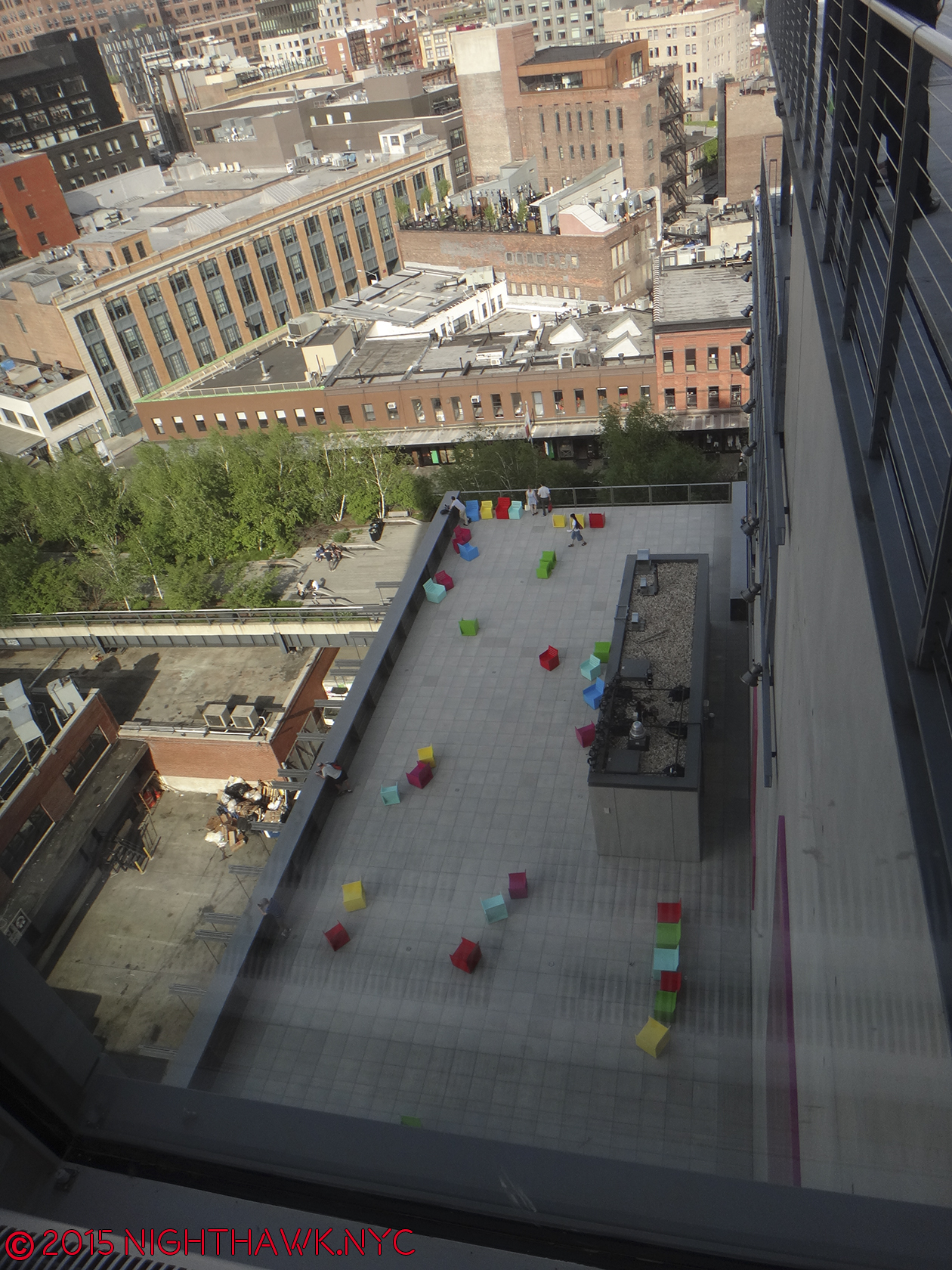
5th Floor Deck.

5th Floor Deck with installation. Yes, the colored seats are the Art work.

If the Whit needs more indoor space, well, the roof decks seem easy to enclose, and voila, 13,000 square feet more gallery space.

Or? PLEASE don’t tell me they’d have to expand this new building north, or up. I’m done writing letters. Besides, as much as I admire and respect Mrs. Gertrude V. Whitney and the collection built on hers, I have no attachment to this building.

And that brings me to this- Through it all, one thought stayed on my mind more than any other. I wonder what she would have thought of the place…

Part 5 – Gertrude Vanderbilt Whitney

“And I dreamed I was flying
And high up above my eyes could clearly see
The Statue of Liberty
Sailing away to sea
And I dreamed I was flying”*
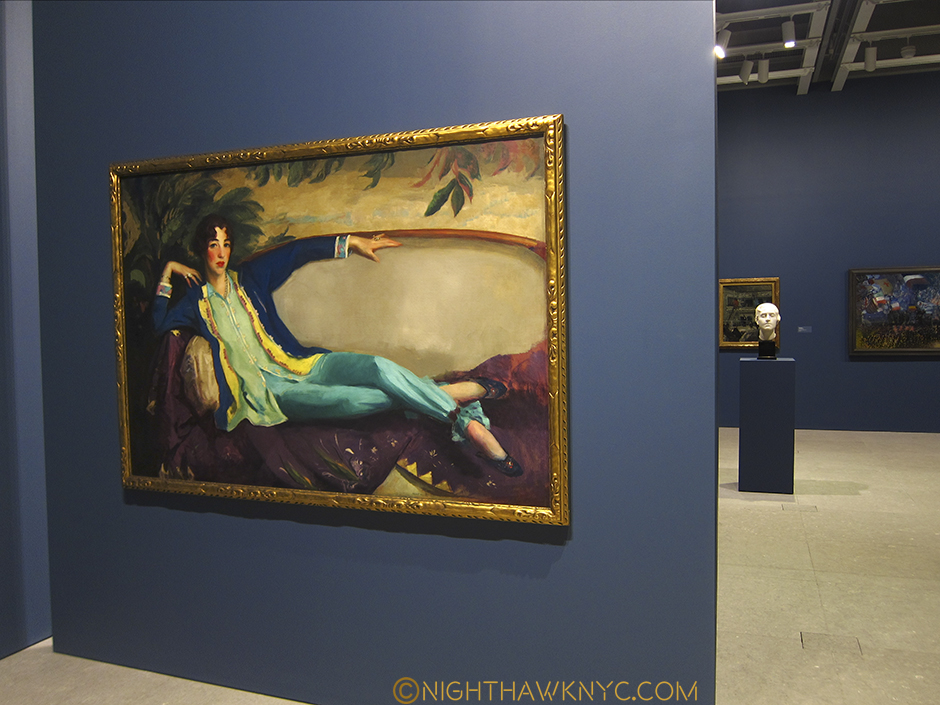
Portrait of Gertrude V. Whitney, 1917 by Robert Henri. Study for a Head for the Titanic Memorial by Mrs. Gertrude V. Whitney, in the background from "America Is Hard To See," 2015

Portrait of Gertrude V. Whitney, 1917 by Robert Henri. Study for a Head for the Titanic Memorial by Mrs. Gertrude V. Whitney, in the right background from “America Is Hard To See,” 2015

The founder of the Whitney Museum, as was beautifully demonstrated, remembered and honored in the first floor free to enter at all times gallery, where “America Is Hard To See” began was, also, a very accomplished sculptor2, in addition to being the greatest champion of American Art, perhaps ever. Immediately upon entering the first floor gallery, the first thing you saw was, fittingly, the wonderful portrait of her by Robert Henri that was perfectly placed facing the door, which also enabled it to be seen from outside the building, the only artwork that was. I wish it had been left right there. It wasn’t. As I write this, it’s upstairs as part of the “Human Interest: Portraits from the Whitney’s Collection” show. One of my pet peeves in Museum re-designs is how often they fail to answer this, seemingly basic, question- “Where are we going to put such and such major masterpiece?” Moma failed this miserably- How many times have they moved Monet’s “Waterlillies”, or Van Gogh’s “Starry Night”, in a vain attempt to find the right spot for each? This is unforgivable. While the Whitney has found a great spot for Calder’s Circus,
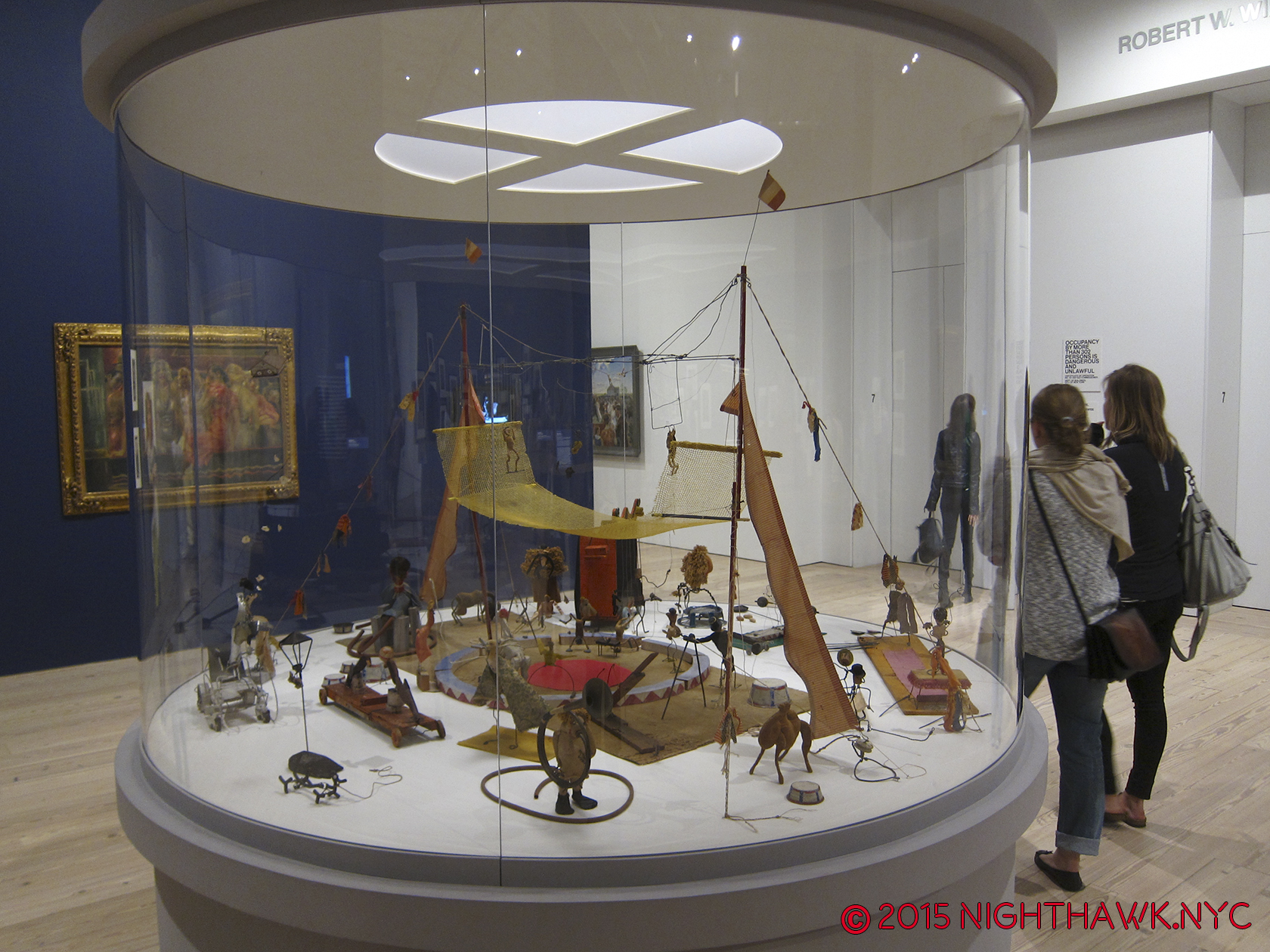
Calder's ingenious "Circus." When you go, be sure to see the accompanying video!

Home… at last. Calder’s ingenious “Circus.” When you go, be sure to see the accompanying video.

which was lost in the Breuer Building’s mezzanine, I’m left to wonder about Mrs. Whitney’s Portrait. Will it become their Waterlillies?
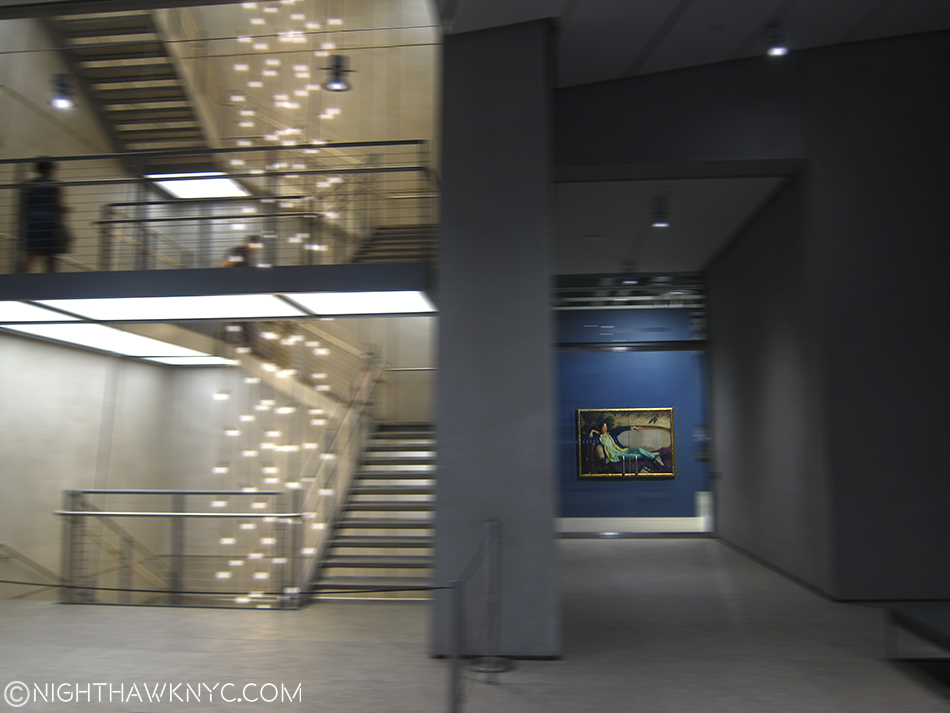
One of the very greatest figures in American Art History looks out on her domain, Portrait by Robert Henri, 1917. 1st Floor Gallery, seen from outside the building during "America is Hard to See," 2015. After? They should have left it right there.

One of the greatest figures in American Art History looks out on her domain. 1st Floor Gallery, during “America is Hard to See,” 2015. After? They should have left it right there.

Beyond her portrait’s place in the Museum, I wonder what she’d think of it. It’s still “her” Museum. They even, recently, put the name “Whitney Museum of American Art” on the southern facade. The new place is located a stone’s throw from the site of the first Whitney Museum that she opened in 1931 at 8 West 8th Street, and equally close to where Edward Hopper lived and worked on Washington Square. Edward & Josephine Hopper left their artistic estate to the Whitney, in honor of their long relationship with Mrs. Whitney. When the new Museum opened, there was a selection of Edward Hopper drawings from 1925 that he did at the Whitney Studio Club, which preceded the founding of the Museum, in the first floor gallery, adjacent to Henri’s Portrait of Mrs. Whitney, seen above. As time goes on, I think this gift will be seen as one of the greatest Art gifts of the 20th Century, even though it didn’t consist of many of Edward’s paintings. That’s when I try and forget the fact that the Whitney, tragically and unforgivably, discarded almost all of Josephine Hopper’s work that was included with it!

While we’ll never know what Mrs. Whitney would think of the new home of her collection, I know what I think.
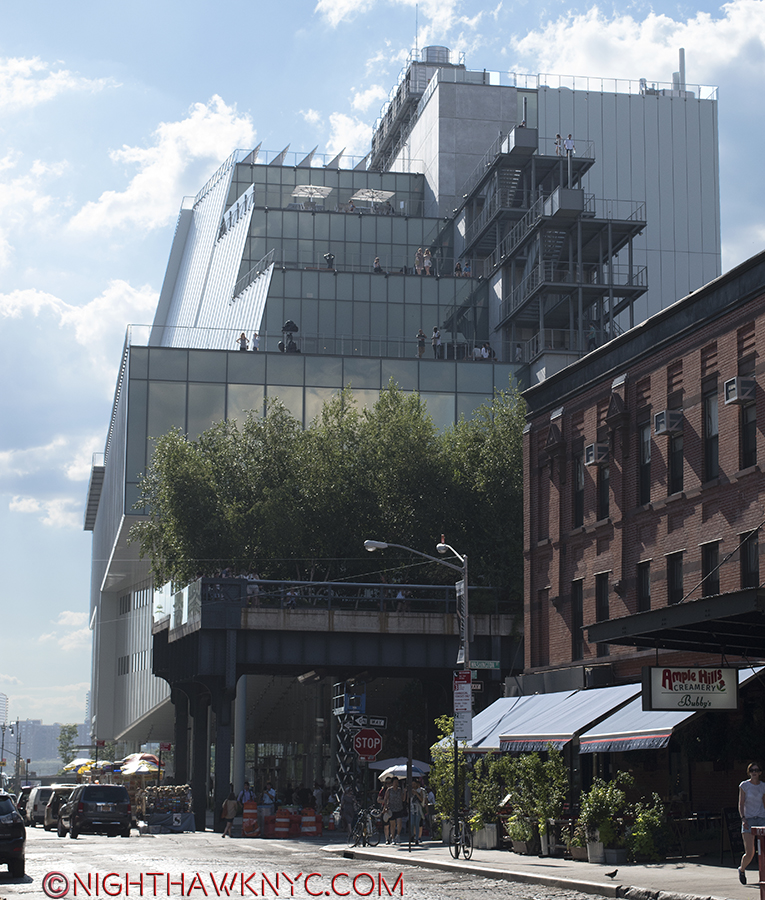
DSC_5259P2NH

Oneupsmanship? “Hey you down there on the High Line- You think you’re high up? Ha!”
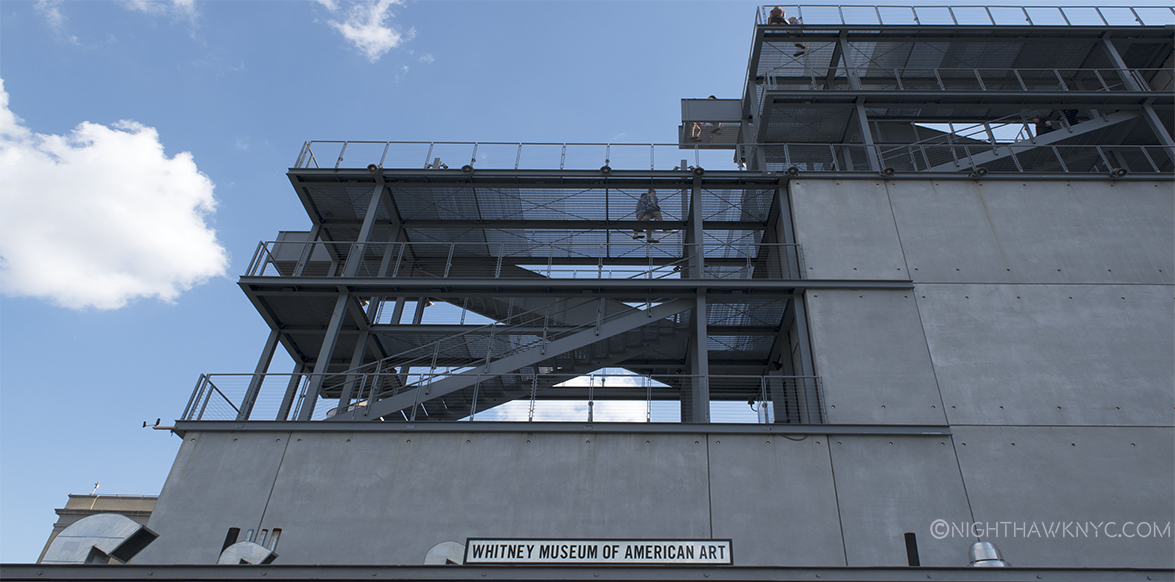
DSC_3674PNH

I’ve spent a year wondering- Why put 13,000 square feet of outdoor space in a building in a place with a climate like NYC?
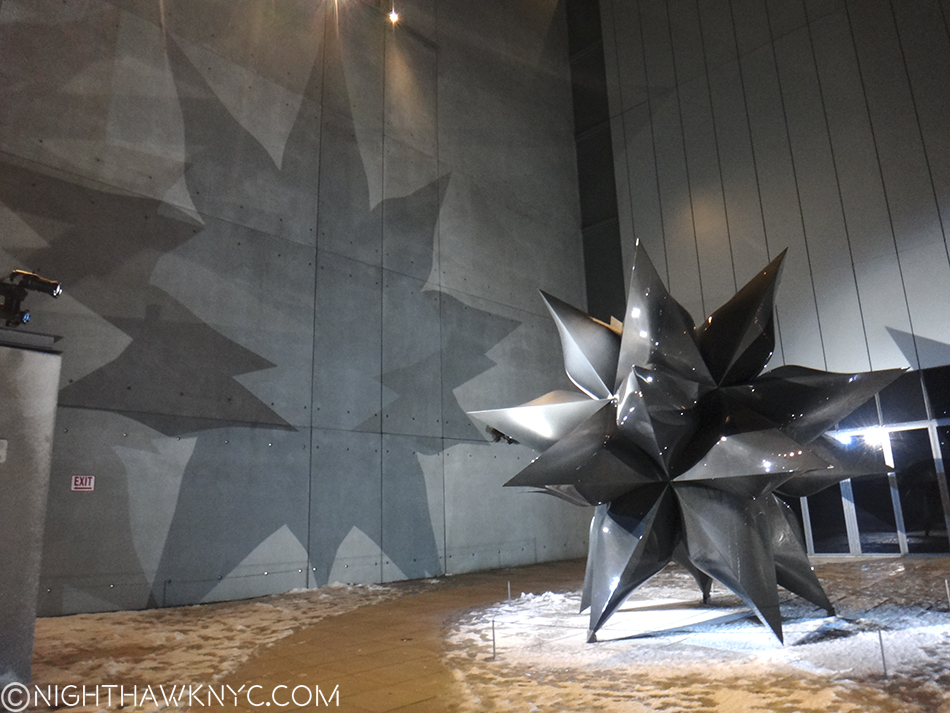
5th Floor roof deck with a Frank Stella Sculpture & reflection, Feb, 2016

5th Floor roof deck with a Frank Stella Sculpture & reflection, in the snow, Feb, 2016

Part 6- 5,000,000 Reasons

As I said, real estate in NYC is all about location. That applies to the Art world, too. The Met & The Guggenheim are in, or near, Central Park, and there is now talk of The Met creating a Central Park entrance as part of their Contemporary Art Galleries reconstruction3. Moma has the heart of midtown, and now the Whitney has the High Line. In my opinion, the location was selected, and the New Whitney is designed, to be a destination for High Line visitors- It’s roof decks are meant to beckon High Liners with an even better view since they are higher. That’s one explanation for the stair designs looking similar- imitation that’s designed to make High Liners feel the Museum is part of the High Line. And so? Location also pays off by providing a potential mass audience delivered right to your door. How much is that worth to a Museum? Given that the High Line currently draws over 5,000,000 visitors a year, it’s hard not to see this as a conscious decision designed to attract visitors for an even better view, and oh yeah, some Art. Once inside? I’ve already come to feel that the gallery size is limiting. As the collection grows (do Museum collections ever shrink?), I am left to wonder how quickly they’re going to wish they had some of that 13,000 square feet that’s sitting outside, inside.

But? If I’m correct about their motivation, the outdoors stairs & decks exist to beckon people from the High Line, which, is open year round, come rain, snow, or shine.
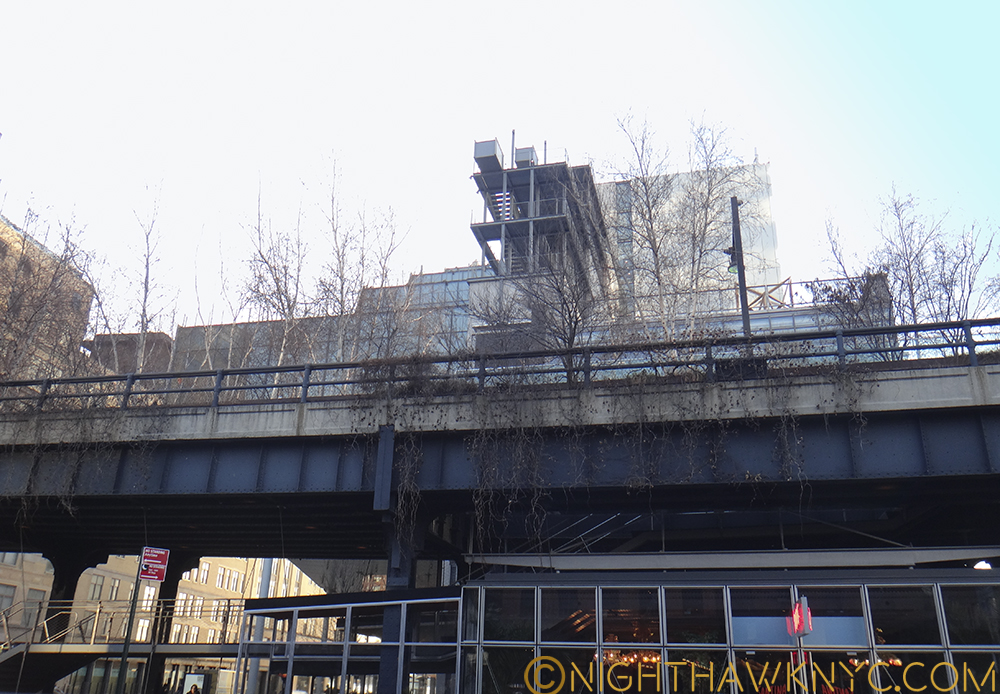
DSC09546PNH

“We come on the ship they call the Mayflower
We come on the ship that sailed the moon
We come in the age’s most uncertain hour
and sing an American tune
But it’s all right, it’s all right
You can’t be forever blessed”*

Overall? I’m displeased by the outward appearance of the new Whitney. Over a  year of trying to warm to it, of giving it yet another chance to speak to me later, I still find it downright strange. As an Art Museum, the inside is nice, with the above caveats. As far as the Art is concerned? I’m glad to have the Whitney’s pre-eminient collection of American Art back, and “America Is Hard To See” was a wonderful “Welcome Back” celebration of it’s return after the move Downtown. The Whitney is, also, to be congratulated for the guts they’e displayed in the choices of their early shows- giving Laura Poitras her first Museum show, featuring the great Cecil Taylor for a week, and having the retrospectives of modern master Frank Stella and the vastly underrated Stuart Davis (who Mrs. Whitney, herself, believed in and financially supported early on), among others, all have made the first year of the New Whitney Museum’s exhibitions quite memorable, and yes, very Artistically successful.

Yet? How long will the waters stay calm for the U.S.S. New Whitney Museum? The big question of long term success and long term viability remain to be answered.

Epilogue – The Whitney’s 422 Million Dollar Gamble
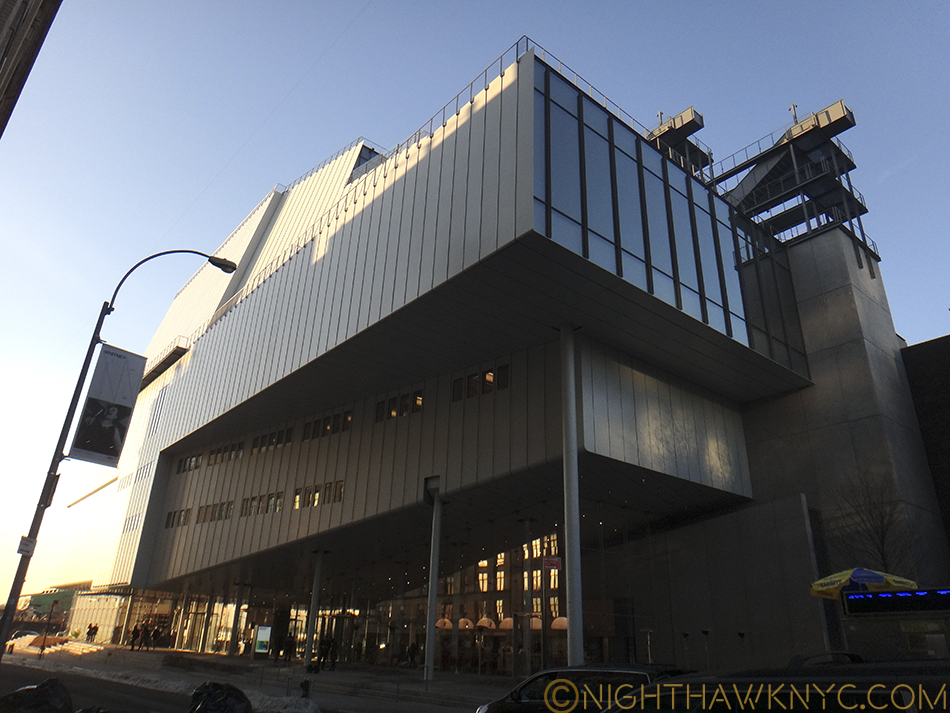
DSC09557PNH

The Whitney’s move downtown isn’t about moving nearer the “New” Art neighborhood of Chelsea or the “Older” Art neighborhood of Soho. It strikes me as being a a case of seeing an opportunity and taking it. They found a lot at one of the 2 ends of the High Line and saw their opportunity to move to a potential audience- the 5,000,000 current visitors to the High Line, and they took it. I believe that’s why their stairs look like the High Line’s, as I said.

For the Whitney, this is a $430,000,000.00 (the cost of the new building) gamble that the High Line is not a flash in the pan and it’s popularity is here to stay. If the High Line fails? Well? The City was about to tear it down anyway before it was turned into a Park.

But, if the High Line does fail (which seems unlikely at the moment), or visitors come in substantially lower numbers (much more likely), the Whitney may find themselves stranded, with an out of the way Museum that is not easily accessible by either bus or subway in a neighborhood that has a history of being “the wild west,” home to meat packing, prostitution, cutting edge music, and sex clubs (Madonna’s notorious book “Sex” was photographed almost 25 years ago at one 3 blocks away) not all that long ago, that has been remade with extra glitz and top of the market rents. And what about that neighborhood? What if the new glitz doesn’t stick? What if it all turns out to be wishful thinking on the part of landlords looking to make a killing after years of squalor? Walking around the past few months, the area seems to be having a bit of trouble supporting many of it’s ritzy new tenants at these prices. And? This is over a year after the Whitney added even more oomph to the now completed High Line being here.
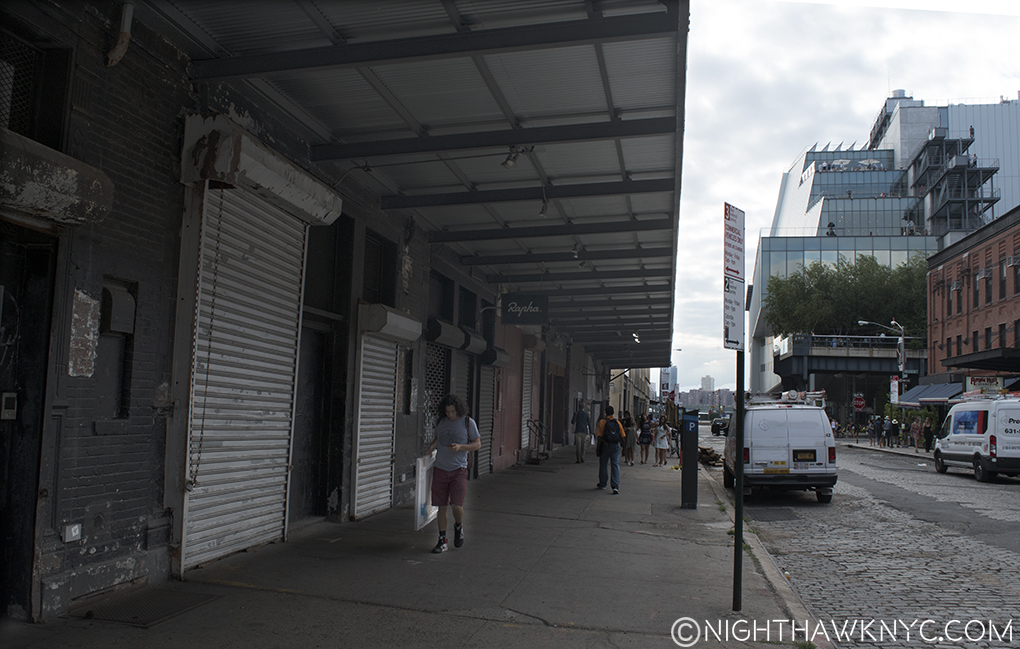
Empty storefronts on Gansevoort, one block east of the Whitney, August, 2016

Empty storefronts on Gansevoort fill 3/4 of the block, one block east of the Whitney, August, 2016

Is the “Meatpacking District” a fad destination that is about to fade? If so, what effect will this have on the new Whitney? Can it survive in a “not so fab” neighborhood?
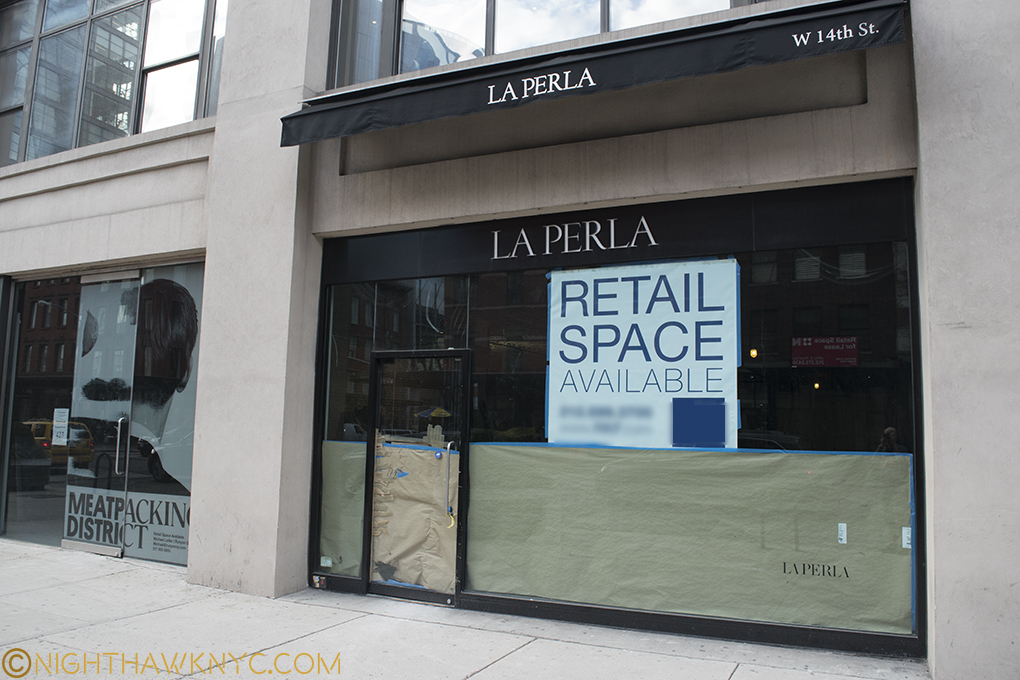
La Perla joins Alexander McQueen & Stella McCartney as former tenants of the Meatpacking District

Is the buzz over? La Perla joins Alexander McQueen & Stella McCartney as former tenants of the Meatpacking District who have moved elsewhere.

While collectors and investors throw unheard of sums at Contemporary Art these days (which strike me as “bets” given the largely unproven nature of the Art itself), here is a case of one of NYC’s “Big 4 Museums” placing an even bigger bet on a Park, that while it certainly is Contemporary Urban Art, hasn’t even been fully opened for TWO YEARS yet,. The Whitney placed their bet when the High Line was in it’s first of 3 phases. Phase 3, the final part, of the now completed High Line opened on September 20, 2014. This is not to mention that they bought in at the top of the market in a real estate market that (like the Art market) hasn’t seen a correction in over 25 years. Both will see corrections one of these days.

But when? This, is the 422 million dollar question.

“Still, tomorrow’s going to be another working day
And I’m trying to get some rest
That’s all I’m trying to get some rest”*
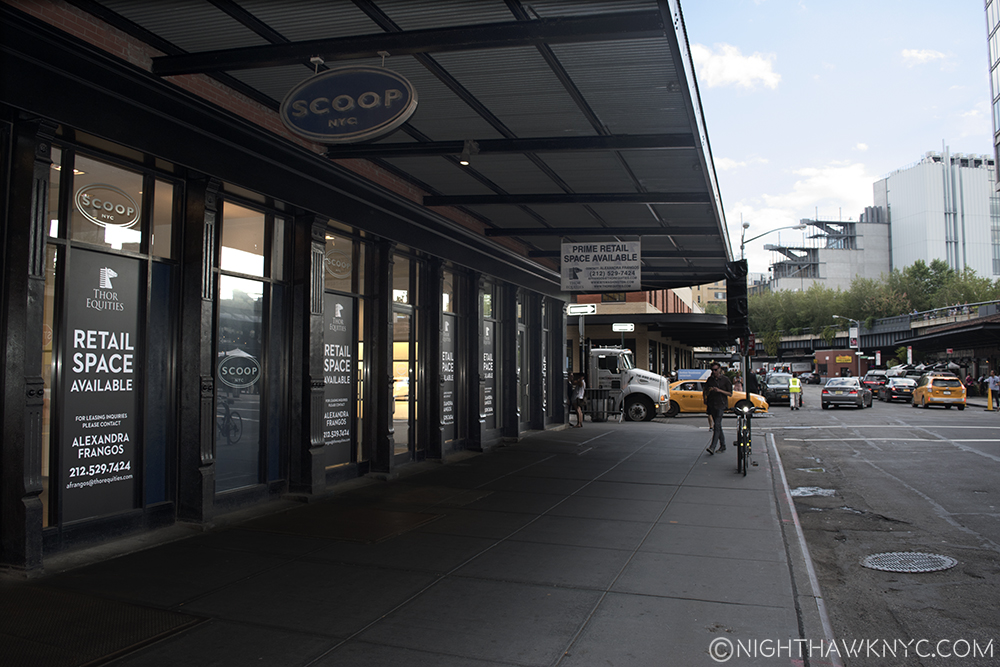
Around the corner on Washington Street, 4 now empty storefronts, one of which was the famous Hogs & Heifers Saloon (corner). August, 2016

In the Whitney’s shadow. Around the corner on Washington Street, 4 now empty storefronts in a row, one of which was the notorious Hogs & Heifers Saloon (where the white sign hangs). August, 2016

Well? If all of this goes south? They still stand a very good chance of being able to move back uptown in 8 years when The Met’s lease of the Breuer, their former home, is up. Given The Met’s own problems, it seems highly unlikely they’ll be extending that lease.

If the Whitney then wants to renovate it? It’ll be someone else’s problem.

*-Soundtrack for this Post is “American Tune” by Paul Simon. Published by Universal Music Publishing Group.

NighthawkNYC.com has been entirely self-funded & ad-free for over 8 years, during which 300 full-length pieces have been published! If you’ve found it worthwhile, PLEASE donate to allow me to continue below. Thank you, Kenn.

You can also support it by buying Art, Art & Photography books, and Music from my collection! Art & Books may be found here. Music here and here.

Written & photographed by Kenn Sava for nighthawknyc.com unless otherwise credited. To send comments, thoughts, feedback or propositions click here. Click the white box on the upper right for the archives or to search them. Subscribe to be notified of new Posts below. Your information will be used for no other purpose.
  1. In fact, the new Whit, itself, sits where one was.
  2. When will they have a show of HER work?
  3. Speaking of his vision in January, Met Director Thomas Campbell told the LA Times that “We are looking at an entrance, at terraces, at the roof garden.” Sounds like he’s visited the New Whitney.

Words To Live By From Man Ray #2

This site is Free & Ad-Free! If you find this piece worthwhile, please donate via PayPal to support it & independent Art writing. You can also support it by buying Art & books! Details at the end. Thank you.

Written & Photographed by Kenn Sava

“Originality is not sought after but imposed on a clear thinking mind by the exigencies  of the message to be conveyed. When that message is startling and different, the means to convey it become original and daring for others, although he who conceived, is not necessarily conscious of any kind of iconoclasm, but feels as if he is performing quite a normal act.”

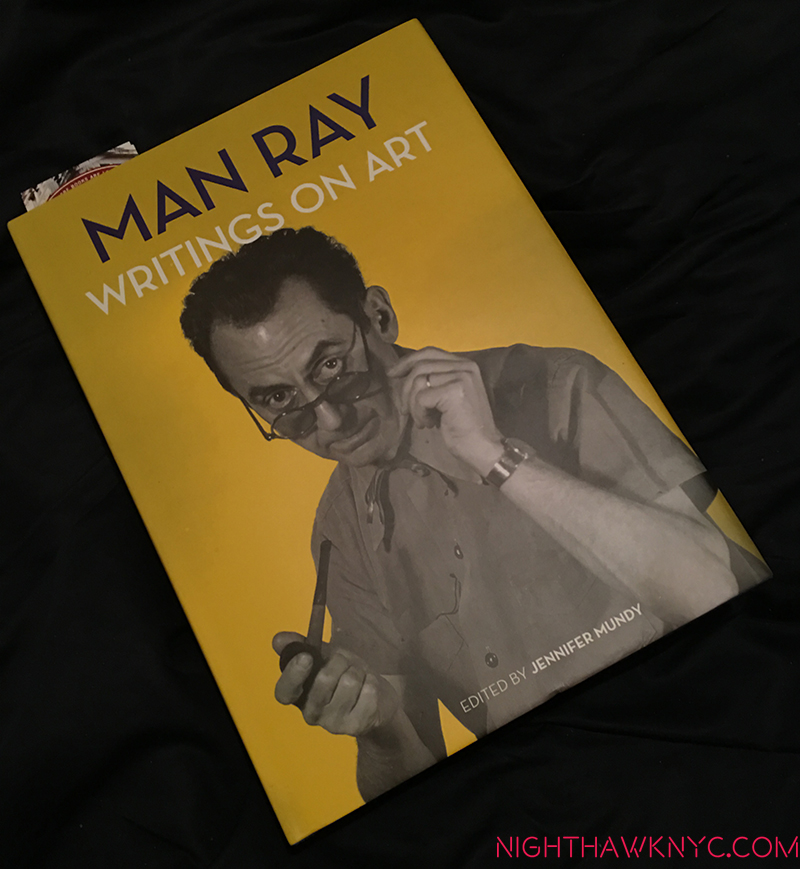
Man Ray, “No. 72. Class (In Time) from “Writings On Art”, P.177. Published by Getty Research Institute


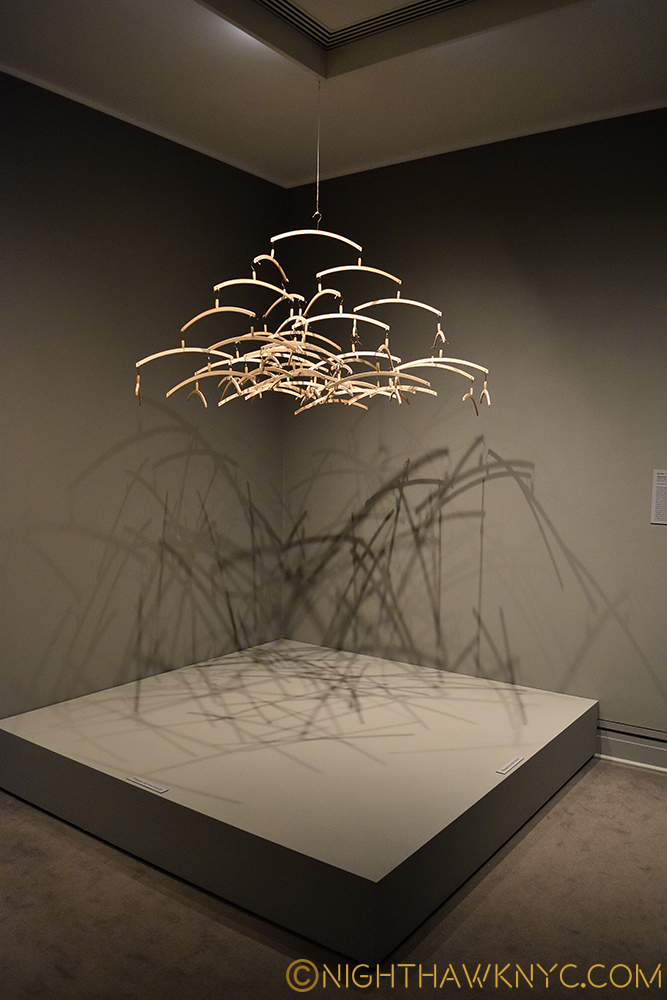
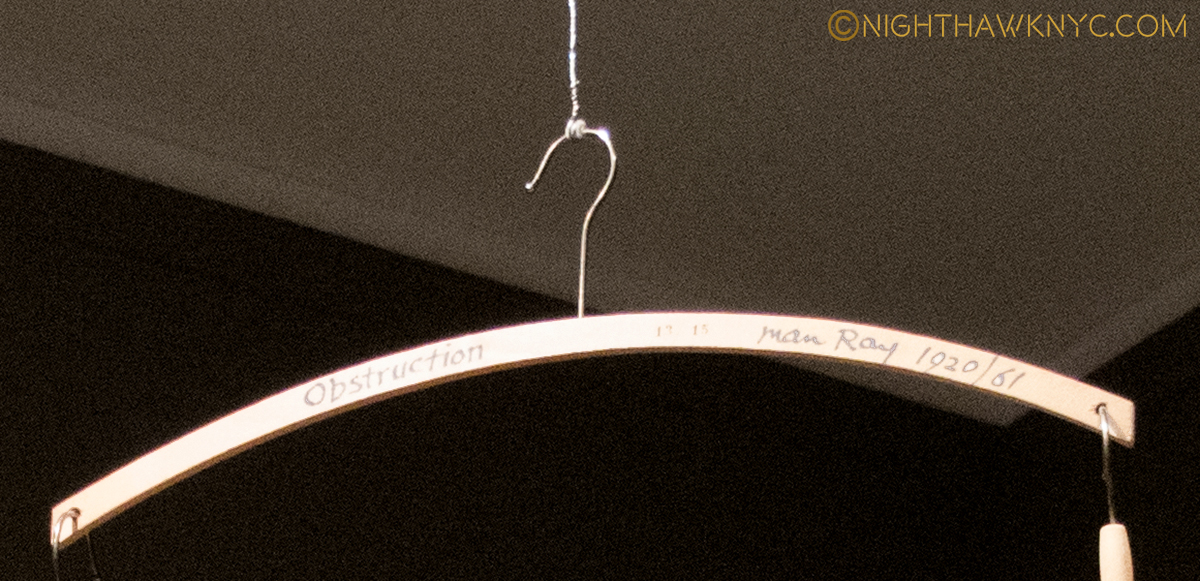
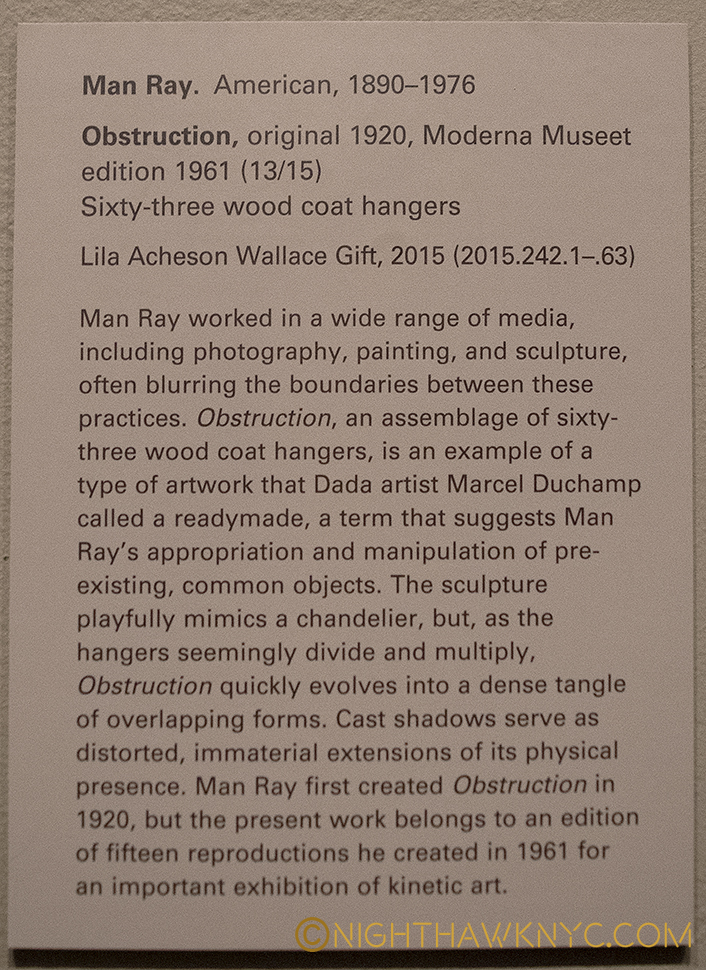
Man Ray, “Obstruction,” 1920/1961, Metropolitan Museum of Art-

DSC_5644PNH

DSC_5651NEFPNH

Close up on the top hangar.

DSC_5647PNH

One of the most unique Artists in history, Man Ray is one of those people who seems to continually appear…as one of the most revolutionary photographers ever, a painter (his first love), a sculptor, a graphic artist, and on and on…and also as a writer. He’s in all the major museums, but rarely gets a show of his own. I’ve always admired his work, and continually been surprised by it, and his accomplishment (as in “That’s a Man Ray, too?”) Having published a fascinating autobiography, perfectly titled “Self Portrait,” which drips with both insight and intrigue, now comes a collection of his writings about art. It’s a book that even rewards random reading- almost every page has a fascinating example of his one of a kind mind.

I think they make wonderful meditations…The first entry in this series appears here.

Soundtrack for this post is, what else? “Man Ray,” by the Futureheads from their 2004 self-titled album.

NighthawkNYC.com has been entirely self-funded & ad-free for over 8 years, during which 300 full-length pieces have been published! If you’ve found it worthwhile, PLEASE donate to allow me to continue below. Thank you, Kenn.

You can also support it by buying Art, Art & Photography books, and Music from my collection! Art & Books may be found here. Music here and here.

Written & photographed by Kenn Sava for nighthawknyc.com unless otherwise credited. To send comments, thoughts, feedback or propositions click here. Click the white box on the upper right for the archives or to search them. Subscribe to be notified of new Posts below. Your information will be used for no other purpose.
Edgar Degas: Beauty & Anarchy

“I saw you standing there
I saw your long, saw your long hair
Opened up my eyes, baby
You made me realize all I want to do now
Is look at you”*

Edgar Degas (1834-1917) didn’t see the world as you or I do. Many of us can’t see beyond the phones in our face to really see most of what is right in front of us (watch out for that bike), and remember even less of it. Not Degas.

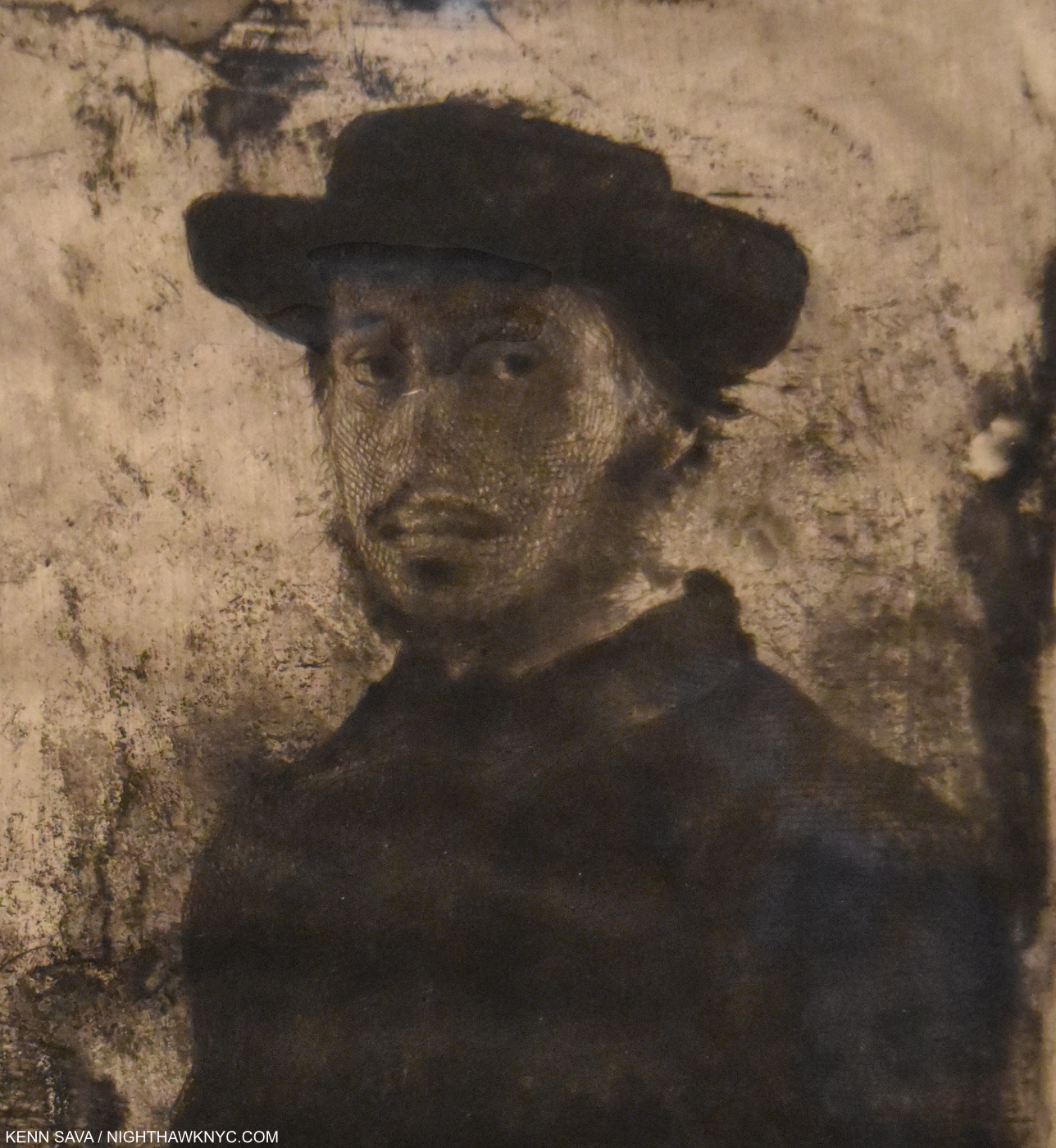
I see you. Self Portrait, Etching and drypoint, 1857, aged 23.

Edgar Degas, seemingly, saw everything. Especially when it came to women. He even saw things that I’m not sure were intended to be seen let alone depicted. For that reason, I’ve considered him the “king of the hidden moment.” Some of those moments he chose to remember, and immortalize, were scandalous when he first exhibited them. 125 year later, they may still give us pause. He was a voyeur in the original sense of the word. meaning “one who looks,” but I am sometimes left to wonder if he was in the contemporary sense, as well- a “peeping tom.” Yet, he does it in ways that we can’t take our own eyes off of, “blinding us with science”- his talent and genius.

I see you, too.

I see you, too. Perhaps, only Degas would think of immortalizing this awkward moment. But, why? (Pastels applied to a Monotype, the core medium of MoMA’s show.)

He, thereby, makes us complicit after the fact in his voyeurism. Before the fact, the question is there to be asked- Why this moment? While I choose to respect the privacy he long sought and stay away from looking into the reasons he felt “the artist must live alone” (which he was his whole life) for insights to his work, I have come to blame it on that eye that never closes, and that sees all. While we admire his work, rightly among the greats, there are times when I wonder if having that switch in his brain that said, “Um? No.” might have been a good thing- once in a while.

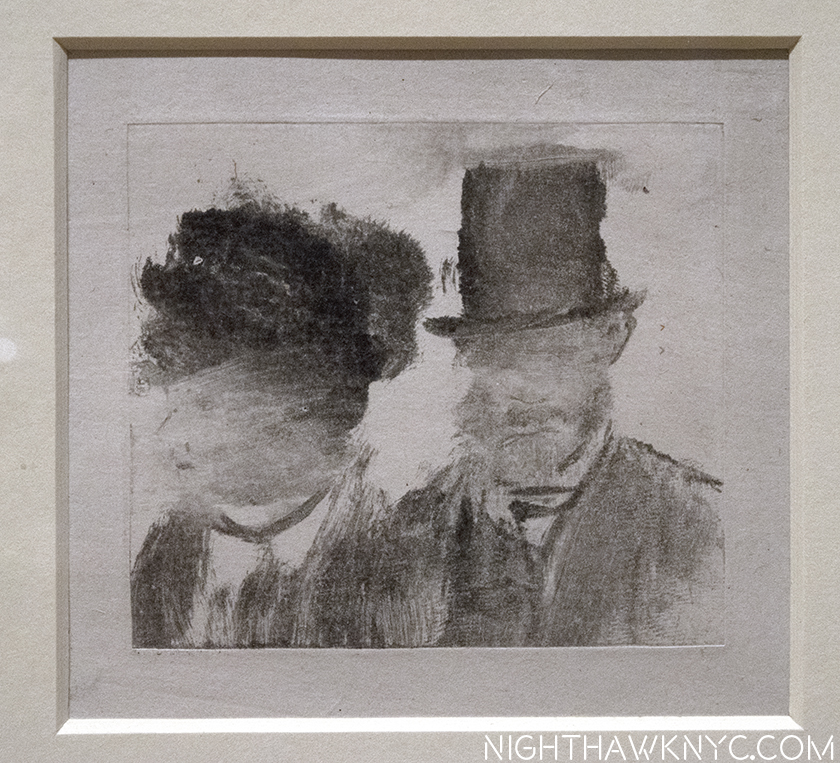
It’s too late now. No one who owns one of those “questionable subjects” Degas depicted is relegating it to the trash bin. Most of them are in museums, or most likely will be one day. At the moment, 120 of Degas’s works are on view in Degas: A Different Beauty, the summer blockbuster at MoMA though July 24, a show centered around his rarely seen Monotypes, which are usually tucked away because many are too light sensitive for permanent display. Still they are Degas, and the more Degas I see, regardless of the medium he’s using, the more I’m struck by the moments he chooses. Of course, beyond “why?” there’s the “what does the work mean” question.

But, let’s back up. First…what’s a Monotype?

It’s a medium that combines drawing and printmaking that results in a one-of-a-kind work, hence “mono.” It’s created either by adding ink to a copper plate with a brush, or almost anything else, which is called the “Light Field” kind of Monotype, or selectively removing ink from the plate covered with it, again using a brush, etc., which is called the “Dark Field” kind of Monotype. The plate is sandwiched with a sheet a paper and then run through a press resulting in a print. Degas, of course, did both kinds, but as the show wonderfully shows us, he didn’t stop there.

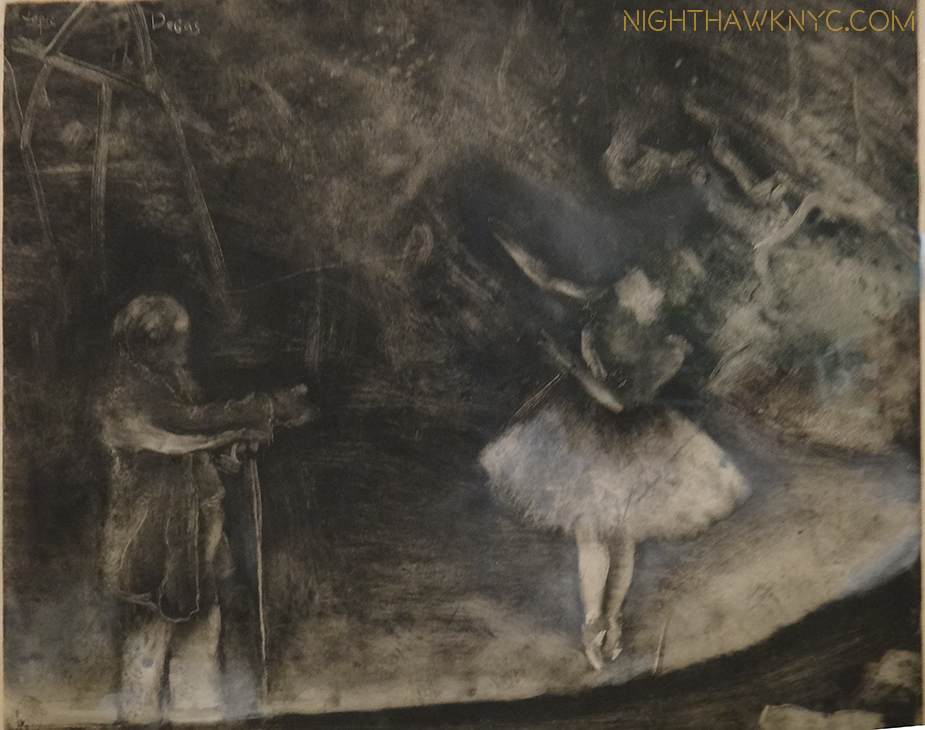
One of Degas' first Monotypes- Dark Field.

One of Degass’s first Monotypes- The Ballet Master, Dark Field Monotype, 1876.

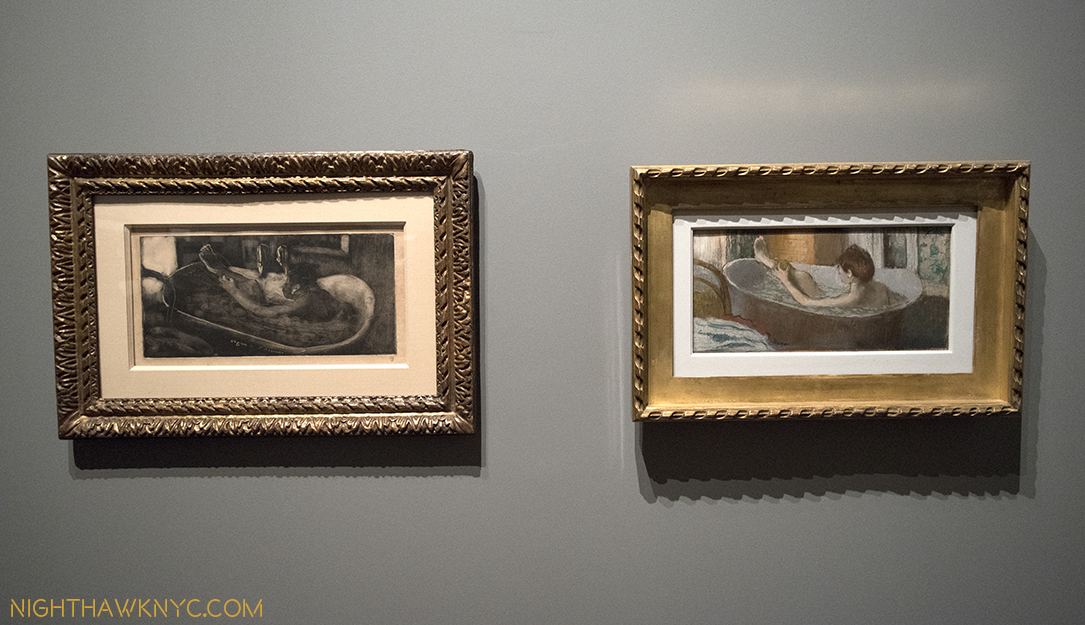
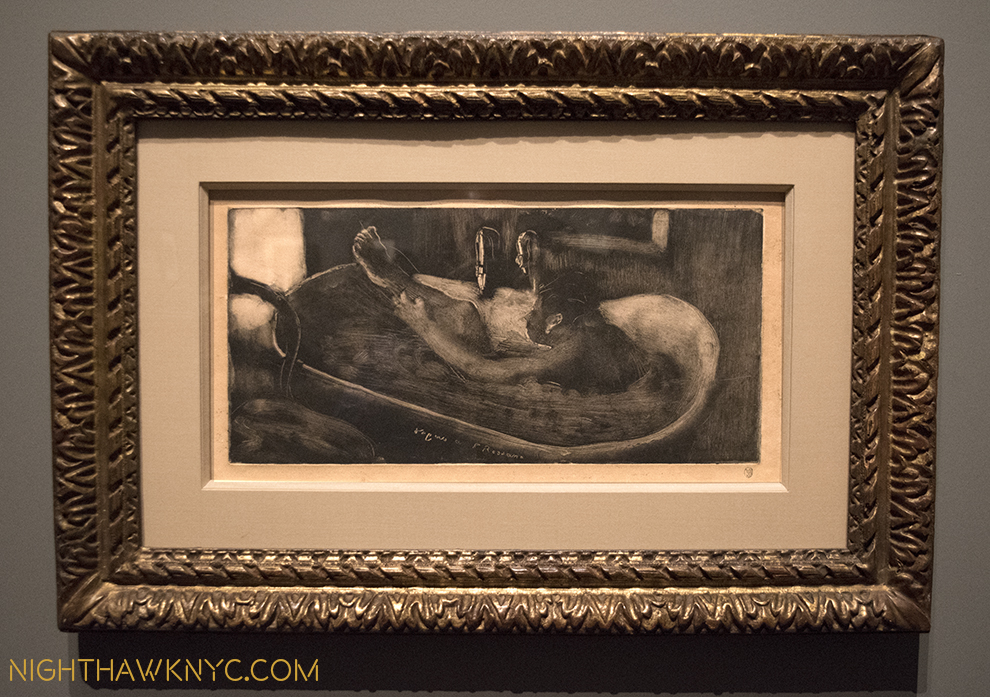
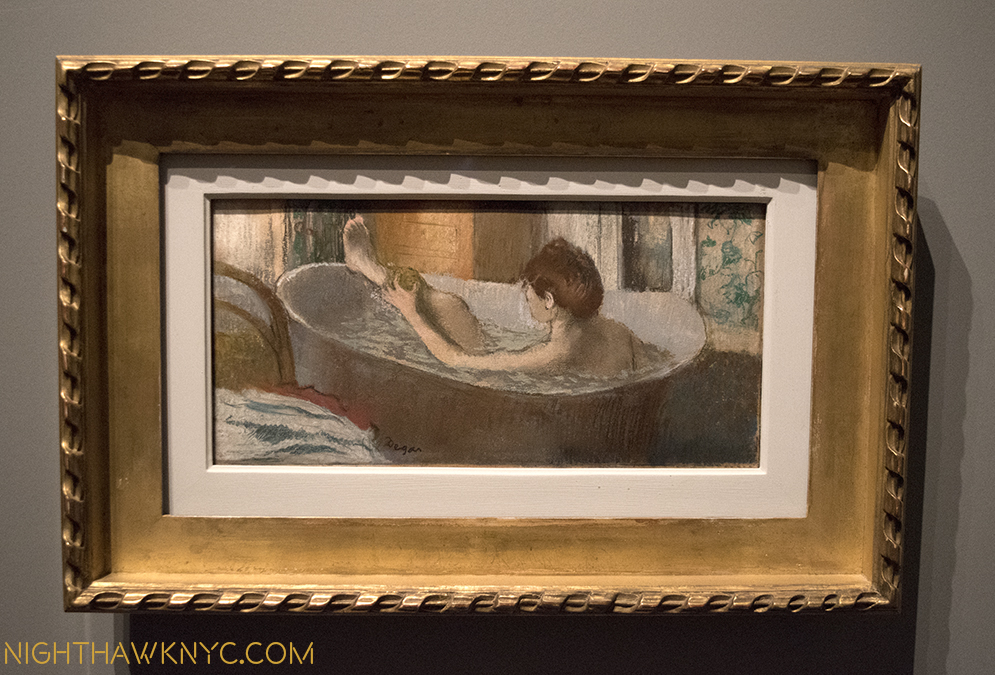
In addition to this  never closing eye, Degas had an incessantly exploratory nature and they combined in an eternally restless Artist, one who was, also, constantly searching for new outlets for his creativity. That led him to the Monotype, an infrequently seen medium in Art, at the suggestion of his friend, the Artist and Monotypist Ludovic Napoleon Lepic in the mid 1870’s. Later, it would lead him to Photography (1895). Degas threw himself into the Monotype with typical intensity. He learned the basics, and then pushed them. Soon, he was doing things like making a second print from the plate, which would naturally be faded as the image degrades after most of the ink had been spent on that first impression, to which he’d add Pastels on top of the black and white image creating shockingly “different” works from the two tone original. Some of these colored images are beautifully displayed side by side with the black & white first image, the pair are called “Cognates.”

Cognates

Cognates. “Woman in a Bathtub Sponging Her Leg” 1880-85. Monotype, and with pastels (right).

But, be warned- this isn’t “Degas 101,” or “Degas’s Greatest Hits.” It’s not even “Degas’s B-Sides”. It’s borderline “The Unknown Degas” (for the casual Degas lover), but that certainly doesn’t mean it’s “bottom of the barrel” Degas (whatever that is. If it exists, I’ll take it!). It means there is so much great Degas that little known works like his Monotypes can hold their own front and center in a big show, even without support from the inclusion of some much more famous paintings 1 But let’s not let the medium be the message here. For me, at least, it’s “still” Degas. What one sees in his paintings, pastels, sculptures and etchings, is also to be seen in his Monotypes. All his “big themes” are here, showing they never were far from his mind, regardless of medium, and giving the casual Degas fan plenty to enjoy, while they see something new. They include-

Beauty. In ANY sense of the word.

Beauty. In ANY sense of the word. Pastel over Monotype.

Ballet Dancers

Bathers

Portraits, and even a Self Portrait or two

Family life

Night Life and City Scenes

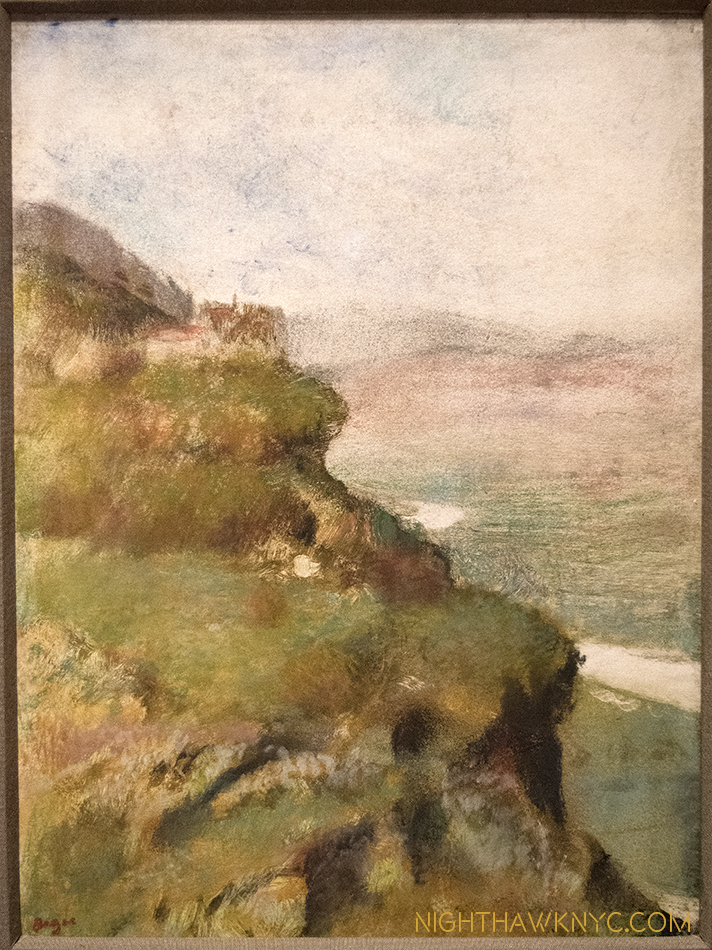
Yes. This is a Landscape by Degas, Pastel over Monotype in Oil, 1890

Yes. This is a Landscape by Degas. Pastel over Monotype in Oil, 1890

And? There are also landscapes, something that most Degasians may not be as familiar with2. A whole room of them that Degas called “imaginary landscapes,” inspired by a trip through Burgundy in 1890. They are shockingly different for Degas, who, much like me, preferred the City and found no end of inspiration therein, anticipating the edgy, quasi-abstract late work of Monet (i.e. the Waterlilies, etc) some 20 years later, and the Abstractionists over the rest of the 20th Century.

Oh.

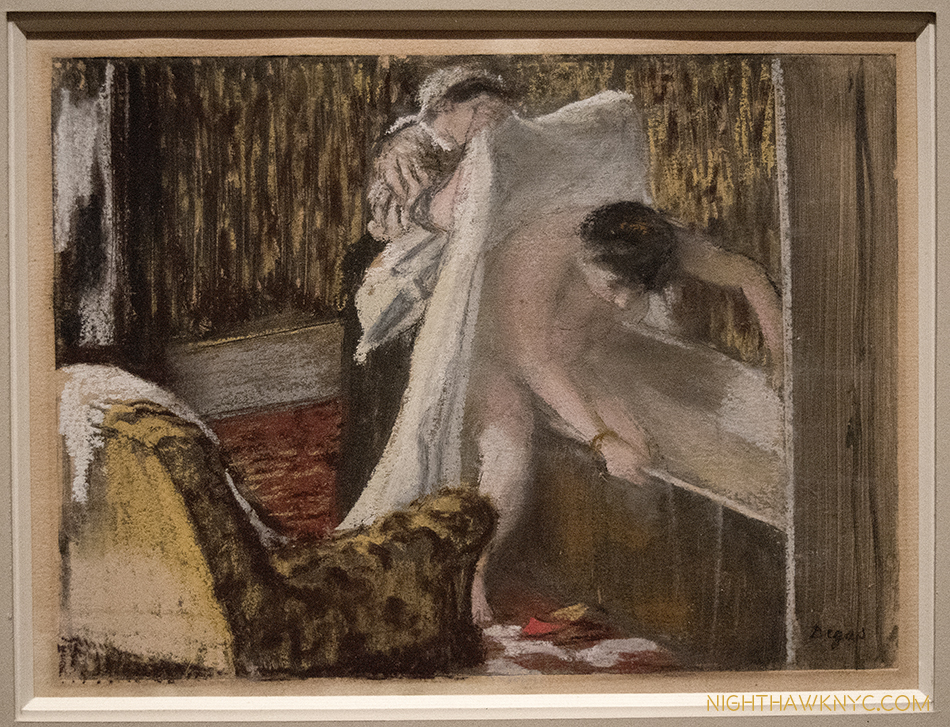
I left out the Brothel Scenes. Well? That’s what the section card says they are. They sure don’t look like scenes from any brothel I’ve ever heard about. (Sorry. I cant’ say I’ve actually been in one, so I’m speaking third-hand.) Of all of these, the Brothel Scenes strike me as being the most intimate, especially because the Bathers are almost uniformly very dark works, where much is hidden in shadow or under water. The Bather rising from her tub, above, is in the Brothel section, and is typical of how well lit these scenes are. Which is good because it also serves to highlight some of the questionable scenes in this section, like the image of a woman either about to use a bidet or rising from one. ?

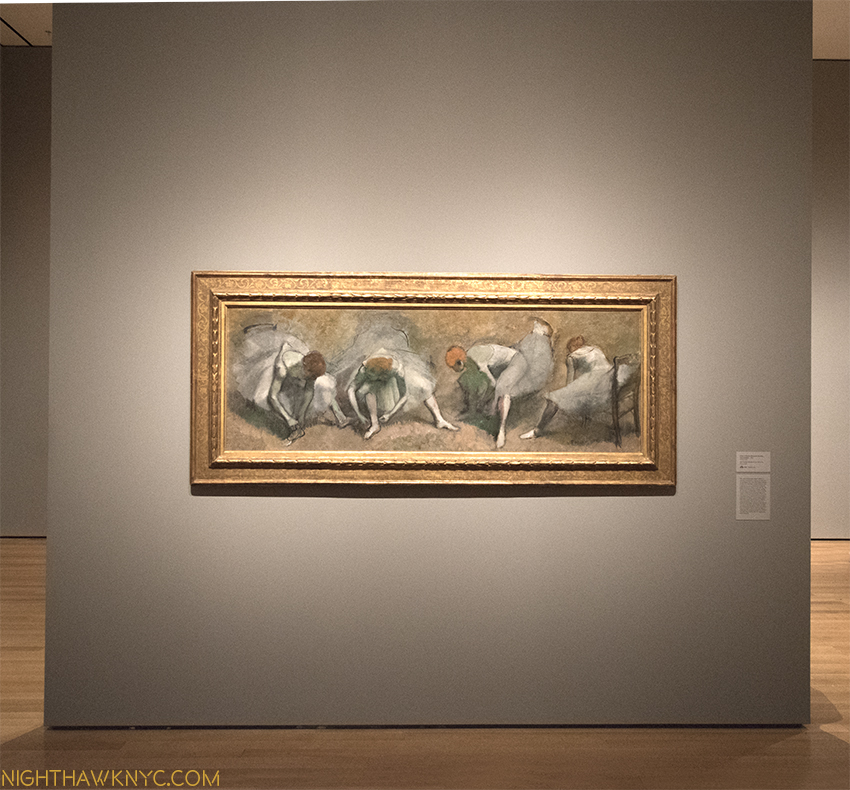
Then again, it also means there are those priceless moments of ballet dancers and ballet students caught unawares in beautiful, unique poses. Families doing the most mundane of things line one wall, while “everyday scenes” of a different nature abut them in an adjoining wall of brothel scenes. The bathers get the privacy of a room to themselves, as do the landscapes, and the dancers are pretty much everywhere else. Along the way, we see two Self Portraits (one, above), a series of Rembrandtian etching “states” and a somewhat odd scene of smoke stacks, looking somewhat lost, on a wall by itself, heightening it’s “out of place here” feeling.

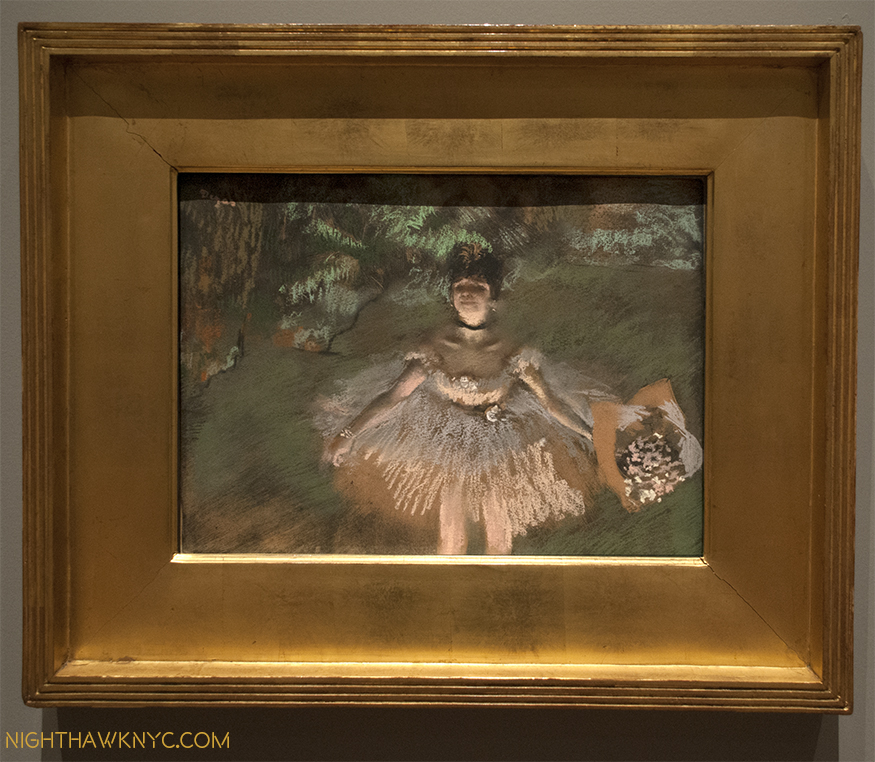
The “Greatest Hits” collection of Degas themes notwithstanding, there is much to see here, and much that requires close scrutiny. The gorgeous strokes of pastels that seem to have been applied at once both spontaneously and effortlessly, all the while, sublimely, particularly struck me. It’s also fascinating to see how he’ll take a black and white monotype and colorize it. Having the very rare opportunity to see both, side by side is, for me, one of the highlights of this show- The effect is not like seeing a colorized black and white movie. Degas makes it something completely else. As a result, I was quite surprised to see him quoted on a sign to the effect that if it were up to him, he’d work only in black and white, but the public wants color. I, for one, am thankful we have both. While I would never dare to argue his preferences, I also have to say- What a loss to the world it would have been had he never worked in color! I came away with a new appreciation of Degas, the colorist, both in how he applies color to a given composition, (which can be quite bold, like a lightning bolt, as in the dancer, above, but also for his palette. If you get to see this show, or the very good catalog for it, be sure to look for these instances where you can see the Cognates, so you can make up your own mind. Here is one-

Bather. Monotype. First impression.

Bather. Monotype. First impression. A closer view of the Cognates, above.

Bather. Pastel over Monotype. (Second impression)

Bather. Pastel over Monotype. (Second impression)

Then there’s the question of meaning…

“…what is fermenting in that head is frightening.” Rene Degas (his brother), in a letter, April, 1864.3

Degas does not surrender his secrets easily. Anyone who has seen his early masterpiece, Interior, 1868-9, can attest to the mystery his works hold. Some see a rape in it, others see the depiction of a scene in Zola’s then recently published Madeleine Ferat. Personally? Having seen it in Philadelphia first hand, I see different things in it each time I see it, even now in pictures. Beyond its “meaning,” more importantly, right now, I see it as a precursor of Edward Hopper. It’s a classic example of what Jean Sutherland Boggs, in the catalog for a much earlier show at The Met, succinctly says- “The longer one reflects on the work of Edgar Degas, the more elusive it seems.” She continues, however, throwing us a lifeline of insight “…some key to the work, if not necessarily to the man, may be found in his fascination with equilibrium[ 4. Degas 1834-1917, Metropolitan Museum, 1988,  p. 23].” And, yes, beyond the voyeurism, which may take some time to see past, we do see that in the bathing piece above. Though it’s not to be seen in the physical sense in all his work (though it may be on the psychologoclgical sense) it becomes fascinating to look for- The dancers on one foot or bent over, or at the barre, and on and on. Degas is fascinated by man’s relationship to the ground, the earth, and with equilibrium.

DSC_2564PNH

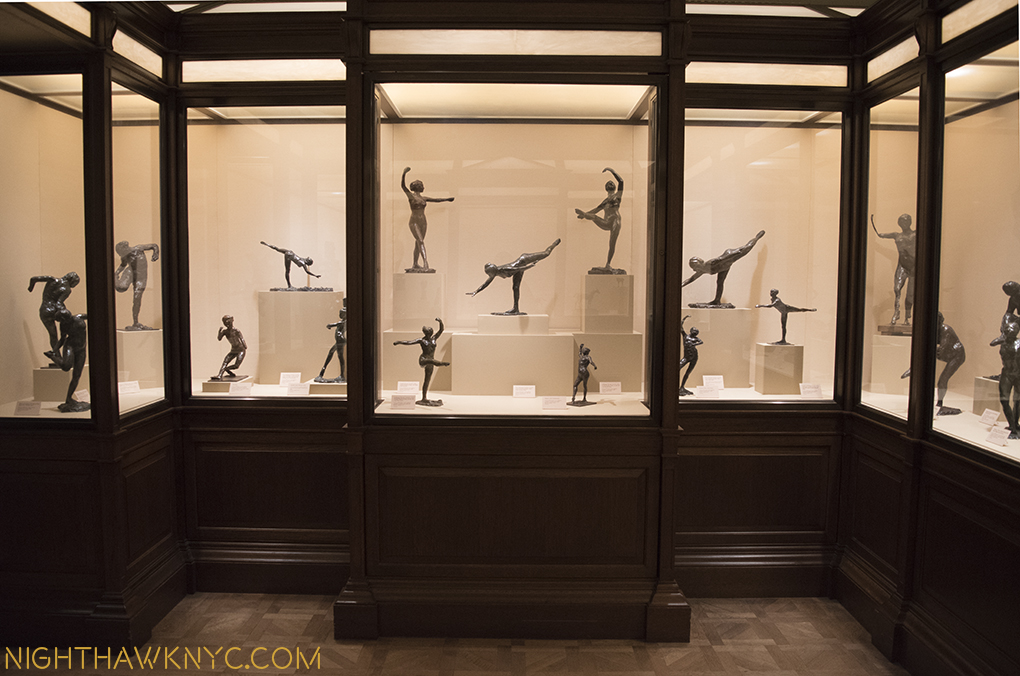
The Met's Degas Sculpture Room. Notice that every single work depicts balance & equilibrium.

To research this further, I went to The Met’s Degas Sculpture Room. Notice how every single work depicts balance & equilibrium.

“Degas is an anarchist. But, in Art.” Camille Pissarro (Artist/Anarchist/Friend of Degas), in a letter.

This show is risky. Degas was exploring in his monotypes. The “beauty” on hand is sometimes “different,” in the sense that it’s, at times, not the beauty Degas is most revered for and that the masses of Art lovers, myself included, associate him with.

One of the most puzzling and "different" Degas I've yet seen. Monotype.

One of the most haunting, and “different,” Degas I’ve yet seen. Monotype.

It seems to me that when “looking for meaning” or trying to reconcile all of this, it pays to look back at Degas’s past. Degas didn’t start out a revolutionary. His early work showed “the classical beginnings, without any gesture of revolt4”  It was in the 1860’s that this would change. His anarchy lies in subverting the past/his past while he reinvents it, and seeks to add to or change his own working processes. Degas spent long hours copying in the Louvre and then in Italy for 3 years. Among the works he copied were an etching after a Michelangelo original of a man scrambling over a riverbank, i.e. climbing out of the water. Once you look for it, this image of a nude entering, or leaving, the water is one that reappears in his work- there’s a gorgeous pastel of one at The Met, here. Therefore, I think the image of the Bather Exiting the Bathtub, way up above, is, partially, another example of that interest, partially due to his interest in “equilibrium,” and partly sensual/erotic. It’s taking the classical idea of Michelangelo and turning it on its head, as an anarchist would be expected to do.

Anarchist Degas then shocked society in 1888 when he showed his nude drawings in an exhibition arranged by no less than Theo van Gogh, Vincent van Gogh’s brother. Vincent van Gogh was quite taken with Degas and was one of the few Artists around capable of understanding, and admiring, his isolation and celibacy. His comments on Degas & women in his Art are fascinating. Up until Degas, the nude was something drawn from models, who were aware of what was taking place and were party to it, even if they were depicted at their “toilette”, which goes back to the 1500’s in Art. With Degas you often have the feeling that neither of these “norms” were true, leaving us with that sense of looking through a door that has been cracked open. I haven’t been able to find out what the subjects thought of these works. Voyeur? Rule breaking visual anarchist? Though he, apparently, lived a sexless life, Degas created his fantasies in his Art (for what purpose I know not), and a number of them are on view here. He created them for himself, only showing the 9 he allowed Theo to exhibit in 1888 during his lifetime, and he kept them until he died. Why? I don’t know and I don’t think it matters. They subsequently came into Museums and private collections when his estate was sold after his death in 1918.

It speaks volume that he was so willing to continue to explore when he had discovered things, like the paintings of dancers, he could have continued to do forever and receive endless acclaim for. It takes a little bit of that same faith to follow him on his exploratory path to get to the gems that are not often seen due to their fragility. They are here, though the show includes works that are not. Some may be characterized as experiments, while others are byproducts of Degas’s refining his process. They are all Degas, though, and as such are precious, edifying and definitely worth seeing. MoMA is to be congratulated for taking the chance of going against the grain of what people know and expect from a Degas show, and for doing it without the “crutch” of including a number of their own very familiar paintings. Here we have Degas the artist who was restlessly exploring new mediums and new techniques, while adding his own steps to the processes he had been taught by others. In that sense, Degas: A Different Beauty is a fascinating insight into the mind of one of the greatest Artists of the past 150 years.

“When it happened
Something snapped inside
Made me want to hide
All alone on my own
All alone on my own”*

For me, this makes Degas a prototypical “Modern Artist” in every sense of the term, as much as anyone working today. Degas would be right at home in our time, with the expanded capabilities Artists have, pushing the possibilities of Photoshop, the iPad, video, or you name it, as he would have been at home, most likely, at ANY time in history. In that sense, like his great influence and forbearer, Rembrandt, and a great Artist he influenced, Picasso, Edgar Degas was an eternally “Modern Artist.”

*- Soundtrack for this Post is “Looking At You” by the MC5, written by Tom Robinson from their Lp Back In the USA. Published by Sony/ATV Music Publishing and Warner Chappell Music Inc. Degas’s brother lived “back in the USA” and Degas actually spent fruitful time in New Orleans in 1872.

NighthawkNYC.com has been entirely self-funded & ad-free for over 8 years, during which 300 full-length pieces have been published! If you’ve found it worthwhile, PLEASE donate to allow me to continue below. Thank you, Kenn.

You can also support it by buying Art, Art & Photography books, and Music from my collection! Art & Books may be found here. Music here and here.

Written & photographed by Kenn Sava for nighthawknyc.com unless otherwise credited. To send comments, thoughts, feedback or propositions click here. Click the white box on the upper right for the archives or to search them. Subscribe to be notified of new Posts below. Your information will be used for no other purpose.
  1. There are 7 Oil on canvas Paintings and 1 Oil on paper mounted on canvas, mostly in the show’s final room, but none are among his famous works.
  2. The Met had a show of Degas’s Landscapes in 1993.
  3. “Degas 1834-1917,” Metropolitan Museum, 1988, p.41
  4. Degas 1834-1917, Metropolitan Museum, 1988, p. 34

Artist Megumi Igarashi Asks “What Is Obscenity?”

This site is Free & Ad-Free! If you find this piece worthwhile, please donate via PayPal to support it & independent Art writing. You can also support it by buying Art & books! Details at the end. Thank you.

Written by Kenn Sava

In Japan, creating and distributing plans to print a 3-D vagina apparently is.

CoverNH

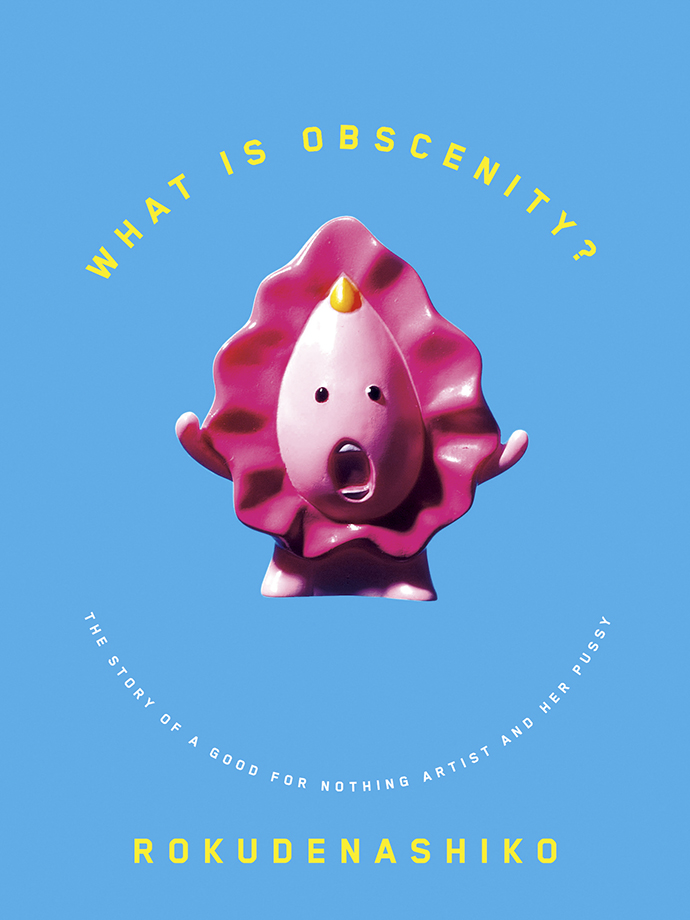
Given the millennia long history of nudity in Art,and the very conservative(?), somewhat hypocritical, laws in Japan about exposure of “certain parts” of the body, it was only a matter of time until this happened. Well? She has. Megumi Igarashi (aka Rokudenashiko or “good for nothing girl”), self styled “Manko (Vagina) Artist,” has been in the thick of it since her latest arrest in 2014. Early in May she was found guilty of “obscenity electromagnetic recording medium distribution” and fined 400,000 yen, about 4 grand.

“When she’s young we kill her will to be free
While telling her not to be so smart we put her down for being so dumb”*

I’ve been watching her trials (figuratively- “Japan’s view of pussy is really weird,” she says, and unfortunately, literally) with both fascination and shock. Now that her book “What Is Obscenity?,” has been released (as seen above from Koyama Press) it’s obvious that whatever obscenity is? Her work isn’t it. Just released, copies are scarce. Her “Free Manka”  T-Shirts  are sold out as well. A movement is beginning here- “Manko positivity.” Needless to say, I support her in her quest for Artistic Freedom.

But wait. A “Vagina Artist?” Yes, that’s right. She makes molds of hers and casts them into sculptures, toys and even, a kayak, which she sailed on a river in Tokyo. Tsk tsk, young lady. Depiction of human genetalia is illegal in Japan- used Artistically, or not. I’ve long been fascinated by Japan, for a lot of reasons, a trip there a while back only served to increase, but this is one that makes me wonder- “Why did this take so long to happen?”

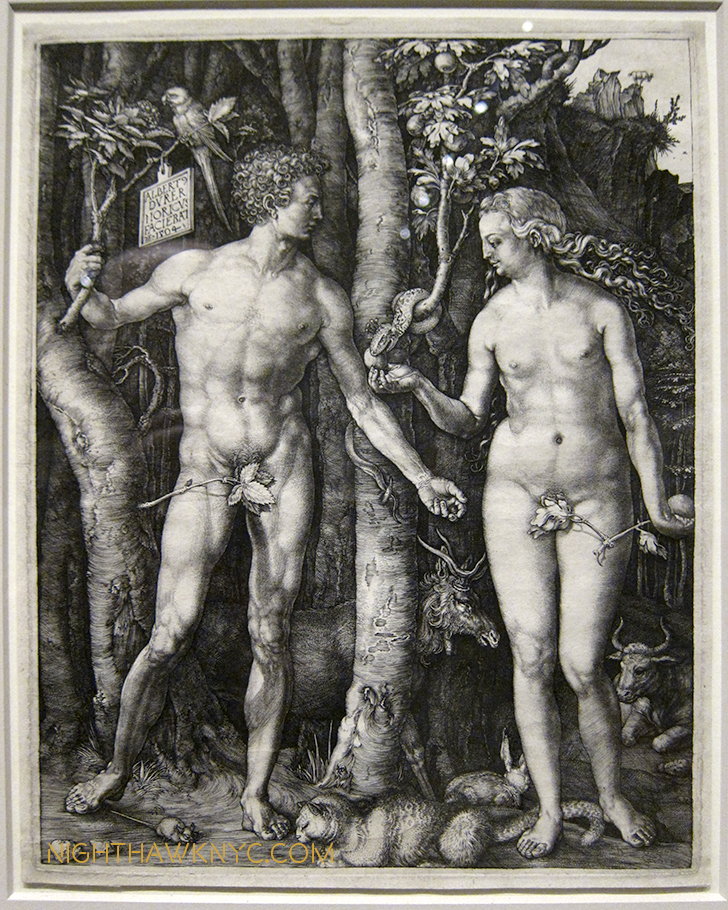
"Better cover up, my dear, or we could be in jail in Japan." Durer c.1504 The Met

“Better cover up, my dear, or we could be in jail in Japan.” Durer c.1504 The Met

From what I’ve seen of her new memoir, which is done in graphic novel (manga) style, she answers a lot of questions, though not that one, and raises many more. It looks to be well done. Not “resting on her laurels,” she is also trying to turn her cartoon character “Manko-chan” (i.e. “Miss Pussy”), seen here on her blog, into a pop culture icon. I wouldn’t bet against it.

Oh! About that hypocrisy? As Jon Stewart and others have pointed out, Japan has an annual festival each April devoted to the penis called the “Kanamara Matsuri” (“Festival of the Steel Phallus”), where penises abound on the streets in the forms of sculptures, veggie carvings and even lollipops. Here, you can see Ms. Igarashi actually posing with one. That picture speaks 400,000 words. It says it all. So far, for her endeavors depicting vaginas, Ms. Igarashi has been in jail twice.

Personally? The only “obscenity” I see here is in the double standard.

*-Soundtrack for this post is “Woman Is The Nigger Of The World” by John Lennon and Yoko Ono from “Some Time In New York City.” Published by Universal Music Publishing Group and Downtown Music Publishing and Sony/ATV Music Publishing.

NighthawkNYC.com has been entirely self-funded & ad-free for over 8 years, during which 300 full-length pieces have been published! If you’ve found it worthwhile, PLEASE donate to allow me to continue below. Thank you, Kenn.

You can also support it by buying Art, Art & Photography books, and Music from my collection! Art & Books may be found here. Music here and here.

Written & photographed by Kenn Sava for nighthawknyc.com unless otherwise credited. To send comments, thoughts, feedback or propositions click here. Click the white box on the upper right for the archives or to search them. Subscribe to be notified of new Posts below. Your information will be used for no other purpose.
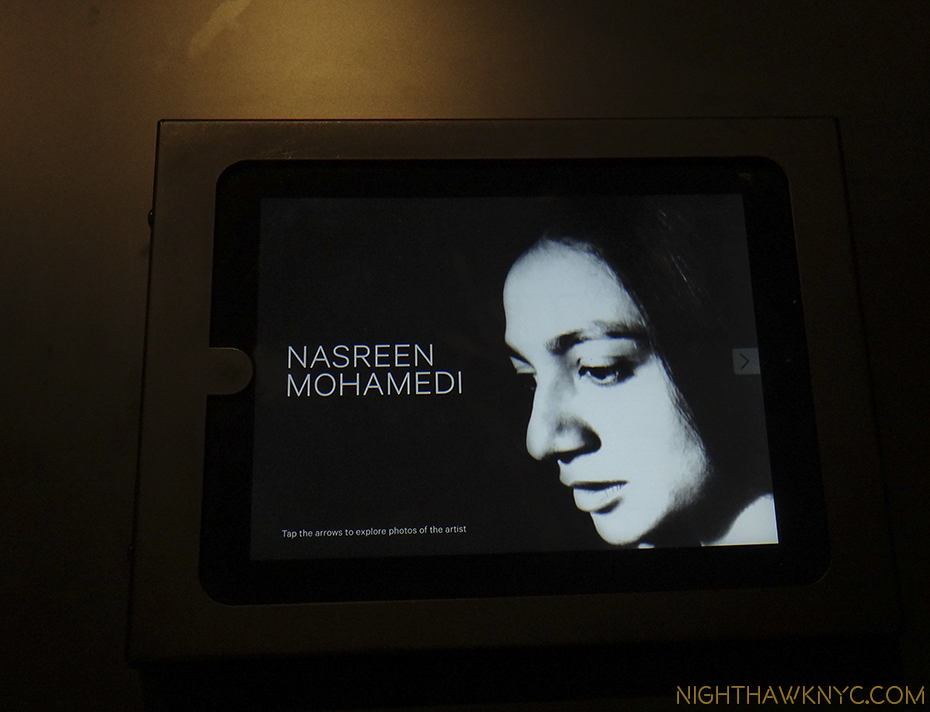
“The Goddess of Line” (For Nasreen Mohamedi)

The Line is True

Perfect

Without Beginning

Without End

It sings the song of Essence

It Frees the Mind

To go where it might

Without Boundaries

Or constraint.

Whether One

Or Many

They Journey

Through their lives

Freed from Time

Freed from Place

Perusuing the Purity of Your Intention

They are all that remain.

The Brush has been set down

The Color has been sent away.

The Pen paints Black

Lines

On White.

The basic form

That doesn’t exist in Nature

Like yours Do,

Oh, Goddess of Line.

Bold

Subtle

Sure

Ordered

Singular

Or In Concert

They Flowed

From your Mind’s Eye

Through Your Hand

From Your Pen

To the Infinite

To That Place where…

We live without form

Or Any constraints.

The Truth Lives without time

or confinement

Free…To Be

What it is.

© April 28, 2016.

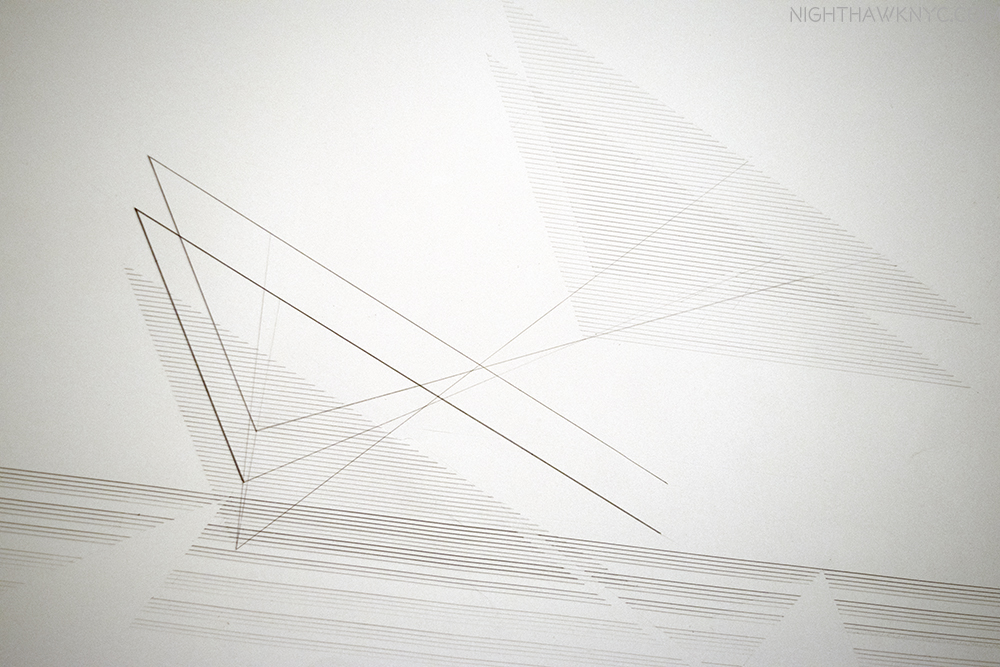
Detail from "Untitled" ca. 1980 by Nasreen Mohamedi (Graphite on Paper)

A Detail from “Untitled” ca. 1980 by Nasreen Mohamedi (Graphite on Paper)

This is Part Two of my Post on Nasreen Mohamedi. Part One is here.

NighthawkNYC.com has been entirely self-funded and ad-free for over 6 years, during which over 250 full length pieces have been published. As I face high expenses to keep it going, if you’ve found it worthwhile, please donate to keep it up & ad-free below. Thank you!

Written & photographed by Kenn Sava for nighthawknyc.com unless otherwise credited.
To send comments, thoughts, feedback or propositions click here.
Click the white box on the upper right for the archives or to search them.
For “short takes” and additional pictures, follow @nighthawk_nyc on Instagram.

Subscribe to be notified of new Posts below. Your information will be used for no other purpose.
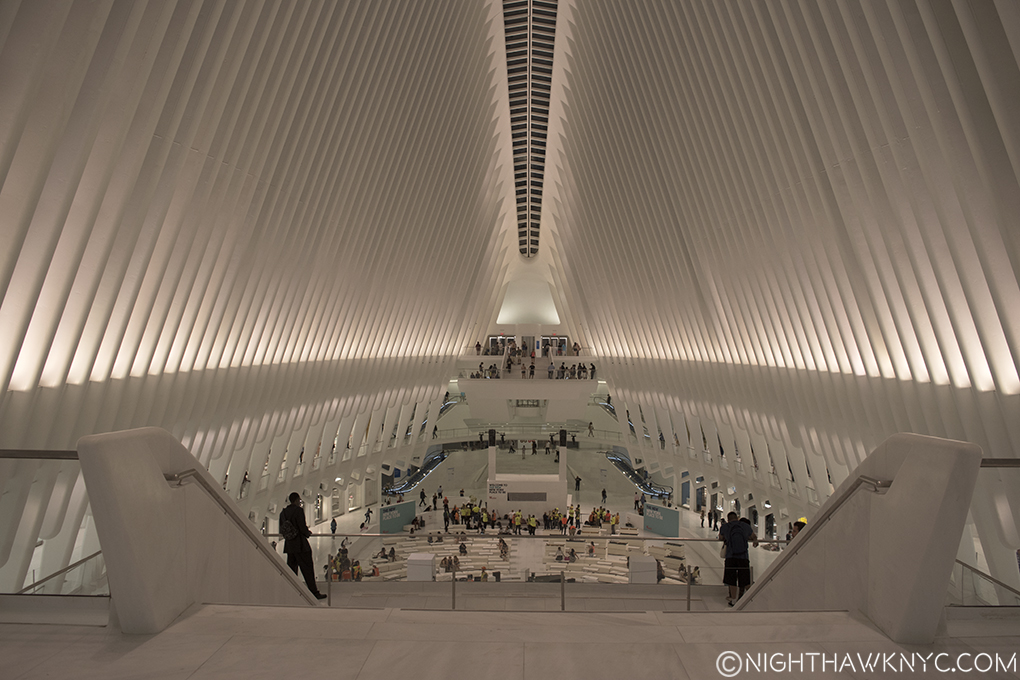
Nasreen Mohamedi’s “Simple” Perfection

Stop the Presses.

If you are an Author, or Publisher, of a book on the History of Art in the 20th Century? I’m sorry to say- you left out a unique, important, and great Artist.

Her name was Nasreen Mohamedi.

It’s ok. Until this past month, I, too, would have asked- “Who?”

She’s an Indian Artist who died in 1990 at the age of 53, without having sold a work, and who has had only 4 shows in New York (3 at the Talwar Gallery, the other at the Drawing Center).

Until now.

The Naked Face of Immortality?

Out of the shadows. Her Time Has Come.

It’s rare to spot a moment in time and say, “that was the moment when things changed.” Like a light coming on and what was hidden in the dark is made visible. What’s once seen may be very hard to forget. In the case of the Art of Nasreen Mohamedi that moment for those of us her work had remained unseen by happened on March 18 when when the lights came on and the doors opened on the 2nd floor of the new Met Breuer (TMB) for her Retrospective. It’s the “other” big show going on there (“Unfinished: Thoughts Left Visible” is on the 3rd & 4th Floor), together inaugurating the Met’s new outpost, 9 minutes away as the feet fly from their 1000 Fifth Avenue Mothership. While she is recognized, and her work eagerly sought after in Europe and Asia, (for up to $250,000., a piece), here, she has remained virtually completely unknown1. The “light” came on for me shortly after I walked through the doors to TMB’s 2nd floor on the eve of April 14.

Unbeknownst to me, at that very moment, Prince was giving what would, tragically, turn out to be his final performance in Atlanta.

By the time I was half way through the 8 galleries (containing about 130 works) that evening, I was completely & unalterably under her spell. After, I couldn’t get it out of my mind. I wanted to see more, and nothing else. Who was she? Where did this come from? 7 subsequent visits later, and counting, I am now borderline obsessed (there is a Part Two to this Post, the first time I’ve done it- link at the bottom). If I were about to have a daughter? I’d want to name her “Nasreen.” Such has been the impact of discovering the person, and her Art.

Mark my words. Well, mark one word, actually. “Nasreen.” I see her work only gaining in importance and influence as she becomes a world figure in Art. Her name will become part of the Art vocabulary. Luckily, it’s a beautiful name, of someone, who by all accounts, was an equally beautiful person. And, a name that’s as easy to remember as her Art is. Now, that word will be spread here, like it already is elsewhere, as more people experience it.

Experience what, exactly?

Her’s is very hard Art to write about, or talk about. The effect it has is, also, hard to describe. I’ve decided not to post pictures of it at the moment because it really needs to be seen in person. So, go and see it for yourself, if you can, and have that experience I love of seeing something new for the first time with fresh eyes, and I hope it is as rewarding for you as it has been for me. My feelings about it center on finding it beautiful- miraculously composed & gorgeously executed, spiritual in the sense that her works are meditation objects, not unlike a tree or a scholar’s rock. They reach for the inexpressible, yet somehow, inside, they resonate as being “true.” There’s a feeling to them of a foreign world that is somehow, strangely, not “alien.” Perhaps that is because there is no chaos in Nasreen’s work, only the most perfect order. There are no crooked lines, no jagged edges, no line out of place, in spite of the fact that she suffered from Huntington’s Disease from her 20’s on, which progressively robbed her of her motor skills, and then, took her life, as it had her siblings before her. Is it any wonder, then, that her work, and her efforts to pursue and develop it, are so intensely focused?

In that sense her Art is like Bach, perhaps, the ultimate genius of order and man-made perfection. In the “Fugue” of Nasreen’s work, the theme continues from piece to piece. As in a fugue, this time the dialogue between voices are only with her own. I found myself settling on Bach’s “Sonatas & Partitas for Solo Violin,” as performed by Nathan Milstein, as the Soundtrack to my visits. (I should also note that TM commissioned pianist/composer Vijay Iyer to compose a piece for this show, which ECM Records has released on the album, “A Cosmic Rhythm With Each Stroke,” which is the title of the piece dedicated to Nasreen. It features one of her drawings on the cover.) These are conversations she’s having with herself, as we see in her riveting, endlessly fascinating Diaries- works of Art unto themselves, which are generously stationed throughout the brilliantly designed show, that continue on in her paintings, and then in her photography, and finally in her drawings.

These are intensely private, personal works, but in a completely different sense than the work on view upstairs in “Unfinished.” (This show could have been titled “An Unfinished Life.”) Maybe they were therapeutic, physically and psychically for Nasreen. Maybe they were meant to prove to herself how “in tact” she still was as time, and illness, progressed. In any event, that they have come to speak to people in so many countries around the world, and for her to be given the high honor of not only a large show, that occupies an entire floor, by The Metropolitan Museum, but to be selected to be the FIRST Artist given a show, and a Retrospective at that, as part of their new Modern & Contemporary Art initiative at TMB says louder than just about anything else that she has arrived.

She certainly doesn’t seem to have been expecting “Art immortality.” In fact, she’s hasn’t made it all that easy on posterity, and that makes me wonder about how she viewed her own work. Curators don’t even know which way the works should be hung (only 4 works in the show are signed, one tell tale way of knowing which way to hang a work)…

DSC_0756PNEFP

they don’t know the names of the work (every single piece here has the same title- “Untitled.”)…they can only approximate when a work was created (you’ll see “circa” on all but three pieces that she signed and dated)…there is also some mystery to how she achieved some of the incredible effects she got in her work. She seems to have largely kept her work to herself, showing it to guests, but only publicly a couple of times before she passed. Instead of selling it, she gave some of her work as gifts to friends. What A Gift! 2

Nasreen’s (I Love saying her name) work seems basic. In fact, it’s hard to think of any Art that is more basic in concept than her work from 1970 on. She seems to have spent a good deal of her Artistic career continually simplifying, seeking the essence, the heart, the core of her vision. Whereas many Artists begin by drawing, then move to painting, Nasreen did the opposite. Having begun with painting, and collage, in color, most of her post 1970 work is pen with black ink and graphite on white paper. 3

I bet that 75% of all human beings have, at one point of their lives, put pencil or ink to paper and drawn something.

And? Most of hers is lines. Just lines. Or later, lines with circles or semi-circles- the most basic elements there are.

The rest of it is space (or “negative space” as Artists call it). Blank, white paper.

Been there. Seen it.

Ho hum.

Yawn.


Guess

Again.


Be prepared. Her work is among the most subtle you’ll ever see. “God Is In The Details,” van der Rohe famously said. If God is truly in the details, than Nasreen Mohamedi is the “Goddess of Line,” in my opinion (which I will expound on in the next part). In her hands, the “simple” line approaches the sacred. It transcends. It becomes “more,” “something else.” Look closer. Follow it’s course. Look a lot closer, spend some time with it. Live in the layers, the intersections, the distances- near and further. Come back and see it again.

It’s not going anywhere. I promise.

You’ll see something else.

I’ve spent much of the past few weeks looking for it but I have yet to find anyone who’s done what she did. I see a piece here or there that is kinda close (a Paul Klee, a Mondrian, a Ralston Crawford, a Malevich, and another, and yet another Malevich, an admitted influence, among them), but it’s isolated. Different.

Here is a consistent body of work4 that creates entirely new worlds that all speak the same language.

It’s the language of Zen.

of Poetry.

of Music.

of Structures hanging in space. (Don’t stars hang in space?)

It’s the channeling of superhuman perseverance into creating gorgeous works of visionary draughtsmanship in the face of terminal loss of motor skills, untold discomfort and pain.

it’s the language of essence, of purity, of unique beauty seen through the eyes of one uniquely beautiful person.

It’s the language of Art.

Even Timeless Art.

Whatever that is- I think this is it.

But, you can only see it at the new Met Breuer until June 5, then time’s up.

Given the scattered distribution of Nasreen’s approximately 200 surviving works- (as I said, she never sold a work, she gave some to friends), and the high prices being paid for one of her drawings, it may make it very hard for any museum to acquire a collection of them. In fact, in my past 14 years of Met attendance, I can’t recall one show where there wasn’t a single work that was not from The Met’s collection, before this one! It may, therefore, be unlikely a show of this size & comprehensiveness is seen here for a very long time. And that will make this a show that will be spoken about in legendary terms. You’ve been warned.

A tip of the hat, then, is very much in order to Chairwoman of The Met’s Modern & Contemporary Department, Sheena Wagstaff 5, her associate, Brinda Kumar & the powers that be at The Met for making THE perfect choice to begin their highly anticipated new Modern & Contemporary Art initiative at The Met Breuer. I’m in awe. I can’t begin to imagine how hard a choice this must have been- “Who to show first?” Can you say AUDACIOUS? AUSPICIOUS? I should be used to this, after all it’s The Met we’re talking about, but I’m not. And, oh? By the way? As I’ve said, the show upstairs ain’t bad either.

This is Part One of my Post on Nasreen. Part Two is here. I promise to take a deep breath soon.

*-The Soundtrack for this Post is J.S. Bach’s Sonatas & Partitas for Unaccompanied Violin as performed by Nathan Milstein on Deutsche Grammophon. (I look forward to hearing Vijay Iyer’s  “A Cosmic Rhythm With Each Stroke,” with Wadada Leo Smith soon.)

NighthawkNYC.com has been entirely self-funded and ad-free for over 6 years, during which over 250 full length pieces have been published. As I face high expenses to keep it going, if you’ve found it worthwhile, please donate to keep it up & ad-free below. Thank you!

Written & photographed by Kenn Sava for nighthawknyc.com unless otherwise credited.
To send comments, thoughts, feedback or propositions click here.
Click the white box on the upper right for the archives or to search them.
For “short takes” and additional pictures, follow @nighthawk_nyc on Instagram.

Subscribe to be notified of new Posts below. Your information will be used for no other purpose.
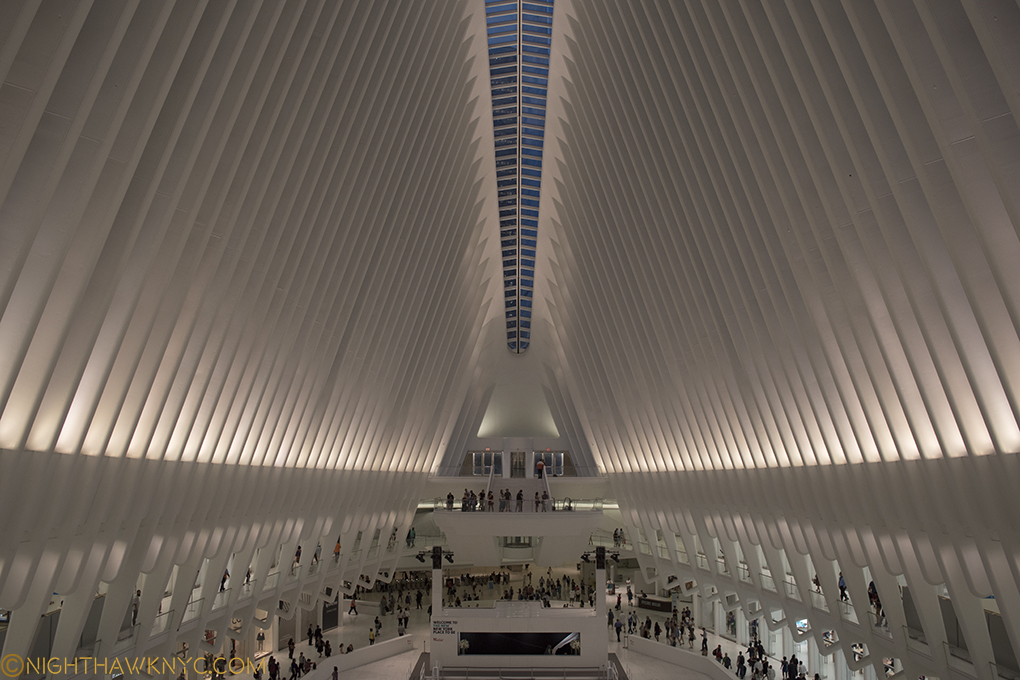
  1. At the moment, there is only one monograph on Nasreen Mohamedi in print- the superb catalog for this show, which was co-organized by the Museo Nacional Centro de Arte Reina Sofia, Spain in collaboration with the Kiran Nadar Museum of Art, New Delhi.
  2.  That night, 746 miles south, Prince was singing- “If I gave you diamonds and pearls, Would you be a happy boy or a girl, If I could I would give you the world, All I can do is just offer you my love” From “Diamonds & Pearls”, from the album of the same name, and published by Universal Music Publishing Group.
  3. Her photographs were black and white as well.
  4. I’m referring to the drawings, which are dated here from “circa 1970” until her death in 1990
  5. If you look at the app on the iPad pictured above in the show’s reading room, it includes a picture of Nasreen Mohamedi’s unmarked grave, 18 miles south of Mumbai, taken by Ms. Wagstaff. A sign of the level of her personal dedication to this Artist.

How Jackson Became “POLLOCK” 

This site is Free & Ad-Free! If you find this piece worthwhile, please donate via PayPal to support it & independent Art writing. You can also support it by buying Art & books! Details at the end. Thank you.

Written & Photographed by Kenn Sava (*- unless otherwise credited)

Jackson Pollock’s most famous works are so well known that many people think he painted using what’s (inaccurately) known as his “drip technique” his whole career. It seems there is always one of these radical, unprecedented works he created between 1947 through 1952 on display in about every large American Museum, works that garner as strong a reaction today as they did in the 1950’s. More recently, many probably came to him from the 2000 film, “POLLOCK”(all CAPS in red) with Ed Harris and Marcia Gay Harden, a personal labor of love for Mr. Harris that is quite well done, though it won’t give you a real sense of the road Jackson Pollock’s work traversed on the way to becoming “POLLOCK,” the one-name Icon the film takes for granted you know going in is JACKSON Pollock. The film’s poster (an homage to Hans Nemuth’s and Martha Holmes’ classic photos of the real Jackson Pollock at work in those later years) so memorably depicts the Artist hard at work, revolutionarily, on the floor and not at an easel, possibly in the act of creating one of those famous later works, that I often hear referred to as “Pollocks.” If you think that “Pollock” was “Jack The Dripper,” as Life Magazine called him, like most labels applied to Artists, it doesn’t tell the whole story about even those works, let alone what came before, and after.

A Postcard from the film’s release shows it’s poster. From my collection.

To see beyond the Icon, at MoMA’s Jackson Pollock: A Collection Survey, 1934-54, up through May 1, one is able to follow the outline, if not the detail, of his development in the space of only 3 galleries1, and see illuminating works before he achieved worldwide fame when Life Magazine famously asked- “Jackson Pollock: Is he the greatest living painter in the United States?” on August 8, 1949.

He began out west, hanging around with and taking classes with another late 20th Century American Master, Philip Guston2. After Pollock’s brother, Charles, also an aspiring Artist (and later an accomplished Artist in his own right), came to NYC and was studying at the New York Art Student’s League, still on West 57th Street, with no less than Thomas Hart Benton, he told Jackson about it which led to his moving here and joining him with Benton3 at the ripe age of 18.

Untitled (Western Scene), 1930-33. It almost could be by Benton.


Breaking out. Untitled, 1938-41. Still don’t think he could draw?

Benton went from being a fairly well known artist during his life to being eclipsed for most of the past 40 years or so (as was realism in Art in the age of Abstraction and Pop, thanks, in part, to his former student). Recently, Benton seems to be enjoying increased attention, helped by the return to view of his New School Murals after their donation to The Met, where they are now beautifully on display.

Yes, It’s 18 year old Jackson Pollock posing for his teacher, Thomas Hart Benton’s mural, America Today, now at The Met.

Benton was a resolutely figurative painter (I have seen one or two “abstractions” he did that may have been studies, and there are definitely elements of his “stretching” forms the way El Greco did that border on the fantastic if not the abstract. Some of these elements can be seen in the early Pollocks on display here). Pollock became, perhaps, the furthest thing from a Realist, Abstraction being the polar opposite of Realism4. Yet, early on, you can see fascinating traces of Benton’s influence in the developing student as he experiments with both mainstream and  “fantastic” elements of Benton’s work. The two share an interest in the West (JP was born in Cody, Wyoming) and Midwest, themes which occupy many of the early work seen here in the first room. Contrary, also, to the “Pollock myth,” Jackson Pollock was not always a New York City Proto-Beat (if he ever was one) dreamer/visionary. Gradually, the “known world” disintegrates and the figure soon follows. By the time of The She Wolf, from 1943, the last piece in the first room, “representational” Art is on the run to point that very close looking is required to see her.

The She Wolf, 1943.

What’s apparent to me, even early on, is that Pollock had the most amazing, even with Picasso notwithstanding, unprecedented freedom in his approach, and this skill(?), vision(?) became the center of all his future developments. As he broke free from the influence of Benton, he learned to trust his gut more and more, and this extended to virtually reinventing the technique of painting, sometimes from work to work, as he needed to, culminating in the sublime works from 1947-52, where he dripped paint from the can along with a wide range of other techniques- whatever it took to get his desired end.

“Oh I am a lonely painter
I live in a box of paints
I’m frightened by the devil
And I’m drawn to those ones that ain’t afraid”*

Having made so many trips to the New Whitney Museum, I’ve been face to face with the incalculably large debt Art lovers owe to, at least, two women there- founder (and overlooked Sculptor) Mrs. Gertrude V. Whitney, of course, and to Josephine Hopper, Edward’s spouse and widow, who facilitated her husband’s wish that his archives go to the Whitney (she also included hers of her own work). Here, at Moma, I’m struck, again, by a similar feeling- look closely at the tags and you’ll see that many of the works here are “The Gift of,” or from the “Bequest of” another woman, spouse and widow- Lee Krasner.

Thank you, Lee Krasner. Your day better be coming.

All 3 women were artists in their own right. Jo Hopper and to a large extent, Lee Krasner put their own creative lives on hold for their husband’s. Oddly, a wonderful Krasner is on view UPSTAIRS on 5. It’s from 1949, right in the time period of  many of these works.

Lee Krasner, Untitled, 1949. NOT in this show! It’s on view on the 5th Floor. I’m putting it where it belongs.

So? Why isn’t it in this show? Possibly because of space, but they might have mentioned it being on view. At least it hasn’t suffered the fate of (possibly) all of Josephine Hopper’s work that she gave to the Whitney, with Edward’s estate- It was discarded BY THE WHITNEY as being subpar!5 A search for her on the Whitney’s website turns up none of her Art. That’s an incalculably stupid move! Gone is the chance to gain the insights into their relationship they may hold, let alone any ongoing appreciation of her own accomplishment! That’s gratitude for you. Coincidentally, there is a biography of Krasner by Hopper’s biographer, Gail Levin.

I bring this all up because I feel that Lee Krasner is the hidden star of the show. In addition to all the work that’s here largely because of her, it’s tempting to see the effect of Jackson Pollock’s having met her (in 1942) in his work. Turning the corner into Room 2 of the show you see something surprising, even shocking, yet apparent, at least to me- joy, light, happiness, even, even though Pollock’s work has become fully abstract. It’s Pollock’s Shimmering Substance from 1946-

“I met a woman
She had a mouth like yours
She knew your life
She knew your devils and your deeds
And she said
“Go to him, stay with him if you can
But be prepared to bleed”*

After they married in 1945 the two moved to Springs, near East Hampton, Long Island, to get away from the City. Having visited Pollock’s house and studio (an indelible experience) while walking the grounds, I was taken by something I’ve never heard mentioned regarding 1947-1952 Pollock, the so-called “drip” years. When you walk down along the water there and look at the sand, you’ll see the seaweed that’s been washed up on the shore form these black lines. Against the yellow/golden sand, they look uncannily like the “black poles” you see in many of these pieces. And when you walk through the tall grasses in the area, all sorts of seeds, bugs, dust, and who knows what gets disturbed and becomes airborne. To this day, I can’t look at these classic Pollocks and not see something very similar- all those dots and spots in the works so remind me of that experience and what it really looked like.

Being in that studio, about 50 year later, was an experience I can only characterize as spiritual. Oh! And there’s a Lee Krasner sighting! (At the show’s entrance)

What does this remind you of? It’s Pollock’s Studio Floor, as it appeared when I was there in 1999. They provided these plastic booties, but there was no way I was going to walk on it- it’s a work of Art unto itself. Even in this picture (from a postcard I bought there), I think you can feel the aura of the place.

Jackson Pollock, looking Iconic, in his Studio by Arnold Newman, 1949. From a Postcard I got at the big Pollock Retrospective at Moma in 1998, the excellent website for  which is still up..

“I remember that time you told me you said
“Love is touching souls”
Surely you touched mine
‘Cause part of you pours out of me
In these lines from time to time
Oh, you’re in my blood like holy wine
You taste so bitter and so sweet

Oh I could drink a case of you darling
And I would still be on my feet
I would still be on my feet”*

So, for me at least, these Jackson Pollock classics have more of a sense of “realism” than they may for some.

One: Number 31, 1950

“Just before our love got lost you said
“I am as constant as a northern star”
And I said “Constantly in the darkness
Where’s that at?
If you want me I’ll be in the bar”*

Unfortunately, the happiness and tranquility of their new life together wasn’t destined to last. Whatever the demons were (and they will probably be argued about for as long as Van Gogh’s have been), they manifested in his life, and in his work. Selden Rodman is quoted in the Pollock Anthology, Such Desperate Joy, talking about this period and the Artist’s struggles- “He had been trying to freshen up or diversify his style by reintroducing figures, or at least figurative patterns, in the maze of paint.6.” Though represented here with only a few pieces, it seems to me that Pollock “lost his fastball” after 1952. While the most common reaction to his classic period was famously “My 5 year old can do that,” (Really? Try it. It’s not THAT easy), after 1952, even Jackson Pollock seemed not to be able to do them any more. Or? He wanted to move on…but to what?

Easter And The Totem, 1953. Yes, this is also by Jackson Pollock.

Yes, his life ended tragically and far too early. I’m not interested in a tell-all about his demons, or scandals or the nights drinking at the Cedar Tavern, where I’ve spent a few myself. I’m interested in that incredible freedom you can see in almost all of his work. How was he able to make a composition hold together while continually creating new styles and using new techniques? Where did that come from?

“Oh but you are in my blood
You’re my holy wine
You’re so bitter, bitter and so sweet

Oh, I could drink a case of you darling
Still I’d be on my feet
I would still be on my feet”*

In the end, Jackson Pollock strikes me as one of the “most” American of painters in the 20th Century, if not ever. I’m not speaking of patriotism or anything nationalistic. I’m speaking about organically American. His work was born in the freedom of the wide open spaces of the west and midwest, but most importantly speaks to the freedom each of us has…


if we choose not to repress it, but to acknowledge it, nurture it, develop it and use it.

Interesting timing for such a show.

*-Soundtrack for this Post is “Case of You,” by Joni Mitchell, (who is also a Painter- FOR 69 YEARS, according to her website!), from her timeless album, Blue, 1971. Published by Sony/ATV Music Publishing.

NighthawkNYC.com has been entirely self-funded & ad-free for over 8 years, during which 300 full-length pieces have been published! If you’ve found it worthwhile, PLEASE donate to allow me to continue below. Thank you, Kenn.

You can also support it by buying Art, Art & Photography books, and Music from my collection! Art & Books may be found here. Music here and here.

Written & photographed by Kenn Sava for nighthawknyc.com unless otherwise credited. To send comments, thoughts, feedback or propositions click here. Click the white box on the upper right for the archives or to search them. Subscribe to be notified of new Posts below. Your information will be used for no other purpose.
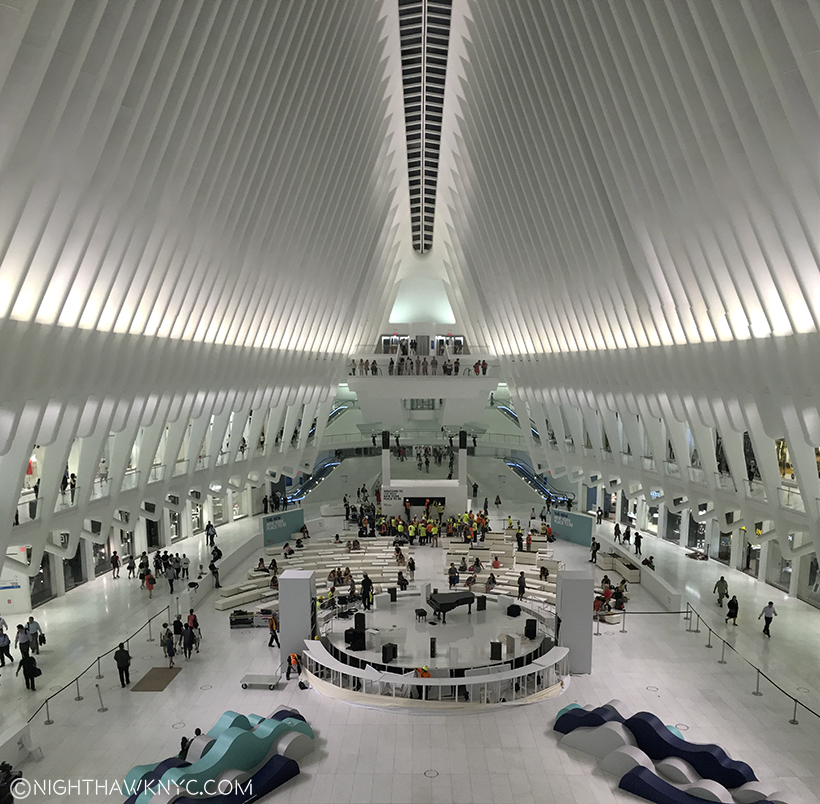
  1. MoMA owns many more Pollocks not on view here.
  2. Their adventures are chronicled in Guston’s daughter’s, the Breast Cancer Activist, Musa Meyer’s book, Night Studio.
  3. For more on Charles & Jackson’s relationship and to see some of Charles’ work, check out American Letters: 1927-47, a collections of letters among the Pollock family. It’s a revealing document of trying to survive as an Artist in the Depression and on.
  4. Which reminds me that I heard Richard Estes say at MAD that “in abstract art there are no mistakes”
  5. “They arranged for some of her paintings to be given away; they simply discarded the rest.” Edward Hopper; An Intimate Biography by Gail Levin p. xvi
  6. p. 49

The Greatest German Reality Show Star, circa 1700

This site is Free & Ad-Free! If you find this piece worthwhile, please donate via PayPal to support it & independent Art writing. You can also support it by buying Art & books! Details at the end. Thank you.

Written & Photographed by Kenn Sava (*- unless otherwise credited)

“My mama told me when I was young
We are all born superstars”*

Portrait of Matthias Buchinger, 1705

However you were born, the odds are you were more naturally capable right out of the box than Matthias Buchinger, who’s birth left him without hands or feet, and who stood a total of 29 inches (74cm) high. Yet, none of that stopped him from rising to the level of being called “The Greatest Living German” in 1726. Pretty darn lofty, for anyone. A Special Exhibition, Wordplay: Matthias Buchinger’s Drawings from the Collection of Ricky Jay, currently at The Met shows that, astoundingly, he nonetheless proves the equal of just about any other Artist in the entire Metropolitan Museum when it comes to technical proficiency. It will, also, give you pause for thought the next time you feel “incapable.”

When you do? Consider this- Many of the works he created, which are now rare, but astutely collected by Master Magician, Ricky Jay over the past 30 years, are tiny to begin with. Add to this that Matthias Buchinger (MB) was so adept at holding his pen between his “stumps” he was able to write forwards, backwards, upside down or in the most minute sizes possible to the extent that he created drawings out of minuscule words, an Art called Micrography. A close up look at one small portrait of him reveals that his hair is made up of nothing but very tiny words- a couple Psalms and the Lord’s Prayer.  The entire show probably takes up 400 square feet- not even big for a gallery show. Yet rarely will you find so much packed into each square inch.

An index-finger sized rendering of The 10 Commandments by Mr. Buchinger is so small I couldn’t read it with the magnifier.

While his Art is being honored in this show, as amazing as it is, it barely scratches the surface of what MB was capable of.

Buchinger surrounded by depictions of some of his skills.

He made his living touring Europe demonstrating the full range of his talents to the high & mighty as well as the common folk, in magic, calligraphy, making miniatures in bottles(!), threading a needle, loading a gun, shaving himself, playing music (he created some of his own instruments), playing games, among other things. Oh, and he was married 4 times and fathered 11 to 14 children!1

The second floor Drawings gallery, where the show is installed, is one of the must-see spaces in The Met. Shows change every 6-8 weeks here giving The Museum a chance to show off its extraordinary collection. Still, out of all the wonders I’ve seen in this space the past 14 years, I haven’t seen anything more consistently amazing than Wordplay.

I know what you’re thinking- today’s so-called “reailty” show stars wouldn’t even be good enough to apprentice on MB’s show!

Coat of Arms, 1738, Pen and ink on vellum, the last known work by Matthias Buchinger includes a self-portrait and autobiographical paragraph in the lower margin. Bear in mind this entire work is about letter size.

“I’m beautiful in my way,
‘Cause God makes no mistakes
I’m on the right track, baby
I was born this way”*

Was he the greatest disabled Artist of all time? I have no idea. I’ve been blown away by the work of Chuck Close (brilliant before his brain aneurysm, continually evolving in ever new ways since), and Hendrik Goltzius, a Graphic Artist possibly on par with Durer despite having a severely deformed drawing hand, among others, and they are all beacons of what the human spirit is capable of, in the Arts as in so many other aspects of life. Yet, I can’t say I’ve seen anything quite like that of the Art of the “Little Man of Nuremberg,”

R-E-S-P-E-C-T. The Greatest German Living, a poem to Buchinger, 1726

“Don’t hide yourself in regret
Just love yourself and you’re set
I’m on the right track, baby
I was born this way, born this way”*

MB was, however, forced to turn to being a carnival side show act to gain appreciation for his abilities as an Artist as well as his many other skills, and to survive. The show includes a few works by other Artists of the same era who were also born without hands or feet, who made their living in the same manner. A “broadside” poster announcing the appearance of one is on view. MB would demonstrate his writing talents for show attendees for a fee and some of these souvenirs are on view here. (The Portrait of him surrounded by depictions of his skills bears his hand written inscriptions on the bottom margin.) Invariably, he always proceeds his signature with “Born without hands or feet…”

A portrait of Thomas Inglefield, also born without hands or feet, shows how Mr. Buchinger may have worked his magic.

Seeing all of this, and a smidgen of what life may have been like for these Artists in the 18th Century, it’s hard not think about the bigger picture.

Anonymous, Portrait of Johanna Sophia Liebschern, ca.1780-90 the so-called “Fusskunstlerin,” or foot artist, as the piece is inscribed. It goes on to say, “she has no arms but is able to use knife, fork, and spoon with her left foot and feed herself, (and) is able to prettily write, sew, draw, cut a quill pen, load and shoot a pistol.” Like MB, Ms. Liebschern enjoyed considerable fame in her time, both voyeuristic and scientific.

“There’s nothin’ wrong with lovin’ who you are
She said, ’cause He made you perfect, babe
So hold your head up,
girl and you’ll go far”*

Thankfully, for the disabled, to my mind THE most overlooked group in our society, things seem to have gotten a little better. But, what do I know. I asked Magdalena Truchan, Fashion Guru, Designer, Artist and Blogger Extraordinaire over at her must read Blog, prettycripple.com, that very question- “Have things gotten better for disabled Artists?” She told me-

“I think lots of things have gotten better for disabled artists. They can make a living online as well and the world gets to see what they offer. There are so many groups out there that I come across who help disabled people. I read these things and smile. They have a better networking system today and while discrimination still exists people in the US don’t treat disabled people as lepers. Same in Europe. Life must have been hell for disabled people until the 70s in this country. Also, because of the the “bullying” problem for all people, now people are standing up to them and outing them on social media. So now it is un-PC to bully people. We have a long way to go but at least people have another avenue to voice themselves. You also see more disabled models and actors now. Although some disabled people on TV are not legit cripples. They are able bodied and stuck in chairs which sucks, but at least they are portraying disabled people.”

While it’s good to hear that, so much remains to be done for the disabled. I can’t help but wonder if part of the root of the cause of this slow progress might be that able-bodied people are secretly terrified of becoming disabled.? Even in this very show, the work is hung too high for wheelchair visitors to see, and though magnifying glasses are thankfully on hand, unless you are a bit over 6 feet tall, the higher works will still remain unavailable for close study, as you can see below. It must be a very frustrating experience for the disabled to come to this show. On the one hand they’ll be as impressed as anyone else by the work, but (unnecessarily) frustrated by the experience. What kind of message does this send?

The show is hung for the average size, or taller, standing adult.

That being said, this show is, also, a fascinating insight into the wondrous collection of Ricky Jay, renowned as the greatest living Sleight-of-Hand Artist and historian of its related arts, and who says that MB is “my flat-out favorite. I’ve been collecting materials on him for 30 years.2” Mr. Jay is someone who has spent his entire life mastering his craft, that way a great Painter or Musician does, all the while thoroughly exploring its history, researching its forgotten Masters, collecting rare books, artifacts and works of Art they created. This show is, therefore, is something of a byproduct of how he became who he is today. From what is on view here, the man has superb taste and a most discerning eye.

Be careful, Mr. Bond, or Ricky will turn your gun into a rabbit! Yes, that's the inimitable Ricky Jay in "Tomorrow Never Dies."

Be careful, Mr. Bond, or Ricky will turn your gun into a rabbit! Yes, that’s the inimitable Ricky Jay in the James Bond film Tomorrow Never Dies.

It leaves me eager to see more of his collection, so I hope it marks the beginning of a relationship between TM and the inimitable Mr. Jay. For more on him, check out the two excellent documentaries, Deceptive Practice: The Mysteries and Mentors of Ricky Jay, which airs as part of PBS’ American Masters series, and, Hustlers, Hoaxters, Pranksters And Ricky Jay, here on youtube.

Isle of View. Untitled by Rachel Harrison from her Perth Amboy Show at MoMA. Does Art Have to be this hard to see?

While “Wordplay” is a shining example of attention being paid to an extraordinary and overlooked Artist- disabled, or not, in a show that will inspire all, it’s one thing to honor this Artist, it’s another to make it largely inaccessible to disabled visitors. I’m not sure that helps inspire other disabled Artists, or disabled people, and that’s a shame. (Luckily, however, the excellent catalog for the show, by Mr. Jay, features beautiful, clear and full size reproductions of many of the works on display, along with Mr. Jay’s one-0f-a-kind insights. I found I could see the works better in the book than by actually looking at the real thing). It says to me that The Met’s interest here lies in the Art itself, and while I understand that, I think they missed a chance to include more of the Art going public, namely the group that includes these wonderful Artists, themselves.

*-Soundtrack for this Post is”Born This Way,” by Lady Gaga, written by NYC’s own Stefani Germanotta, Jeppe Laursen, Fernando Garibay and Paul Blair, from the album of the same title and published by Sony ATV Music Publishing, Warner Chappell Music Inc. and Universal Music Publishing.

NighthawkNYC.com has been entirely self-funded & ad-free for over 8 years, during which 300 full-length pieces have been published! If you’ve found it worthwhile, PLEASE donate to allow me to continue below. Thank you, Kenn.

You can also support it by buying Art, Art & Photography books, and Music from my collection! Art & Books may be found here. Music here and here.

Written & photographed by Kenn Sava for nighthawknyc.com unless otherwise credited. To send comments, thoughts, feedback or propositions click here. Click the white box on the upper right for the archives or to search them. Subscribe to be notified of new Posts below. Your information will be used for no other purpose.
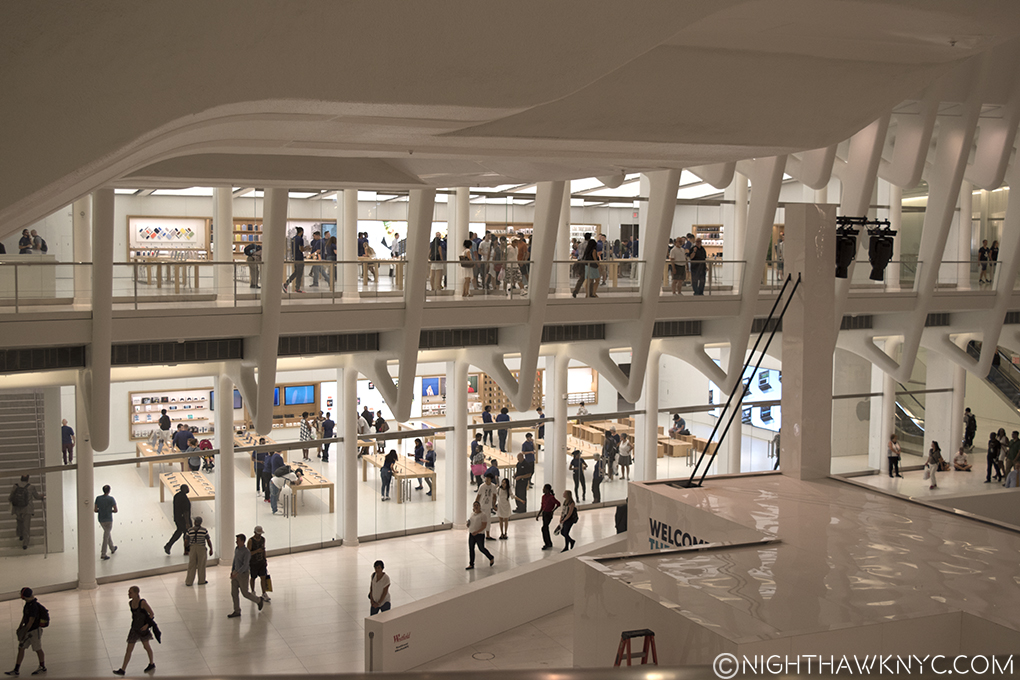
  1. Ok..ok…I’ll insert the famous Groucho Marx joke- “I like my cigar, too, but I take it out once in a while.” Sorry.
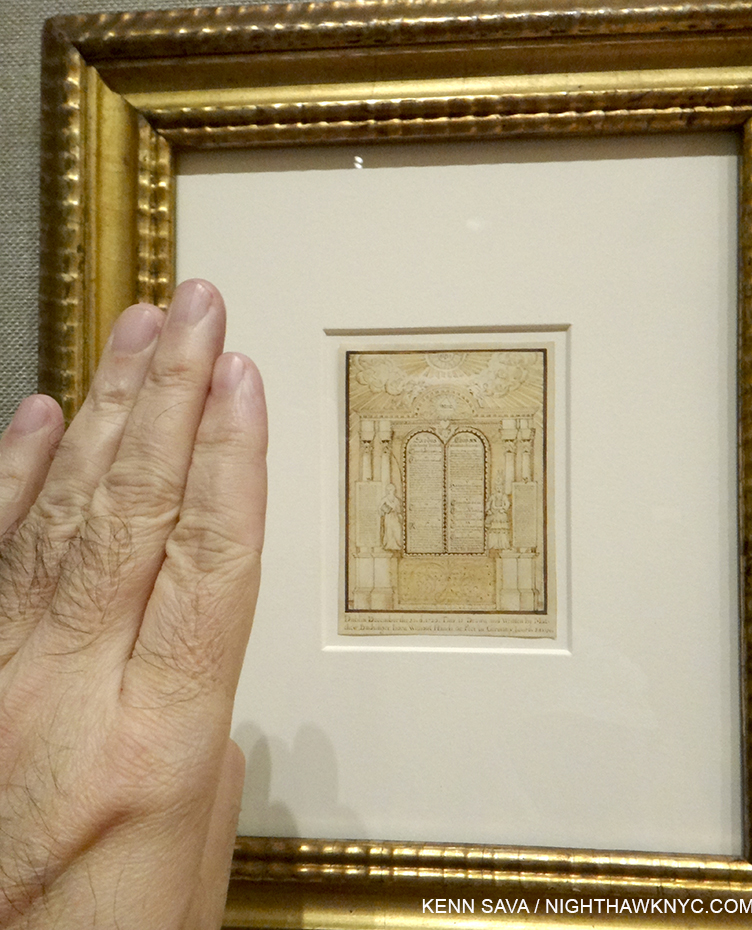
  2. http://www.pbs.org/wnet/americanmasters/ricky-jay-collection/3649/