Charles White & Leonardo da Vinci…at MoMA!

“I am a traveler of both time and space
To be where I have been
And sit with elders of the gentle race
This world has seldom seen
Who talk of days for which they sit and wait
When all will be revealed”*

In all the years I’ve been going to MoMA, which pre-dates the 1980 Picasso Retrospective, this is one of the most unusual shows I’ve seen there. Charles White-Leonardo da Vinci. Curated by David Hammons consisted of two works. Well? Four works if you count the two Vedic astrological charts included. Two works of Art…both masterpieces, separated by more than four and a half centuries.
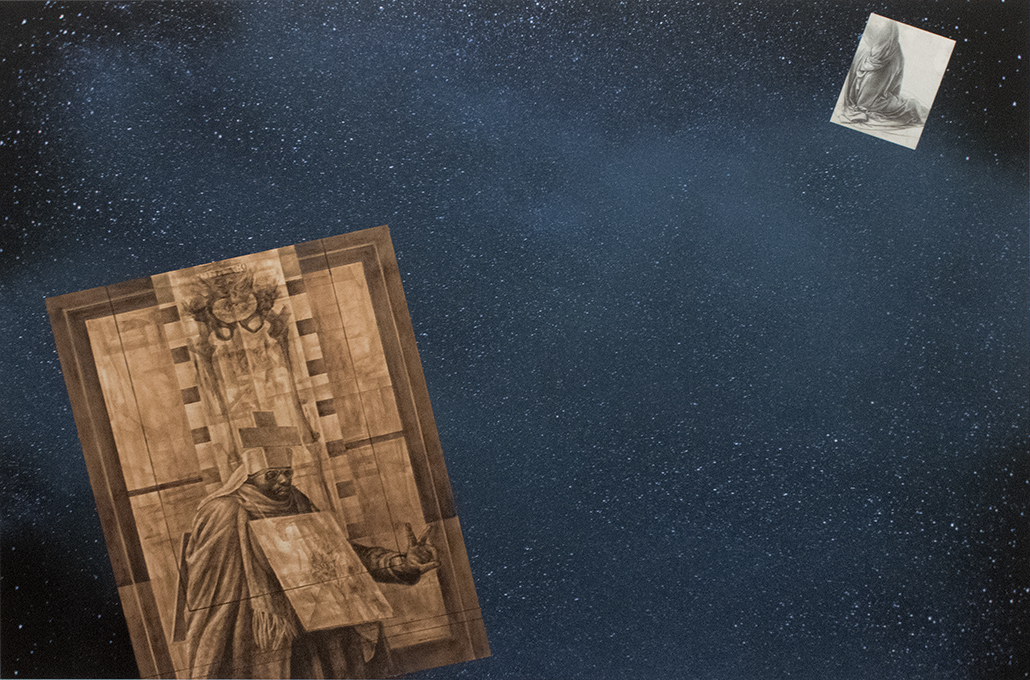
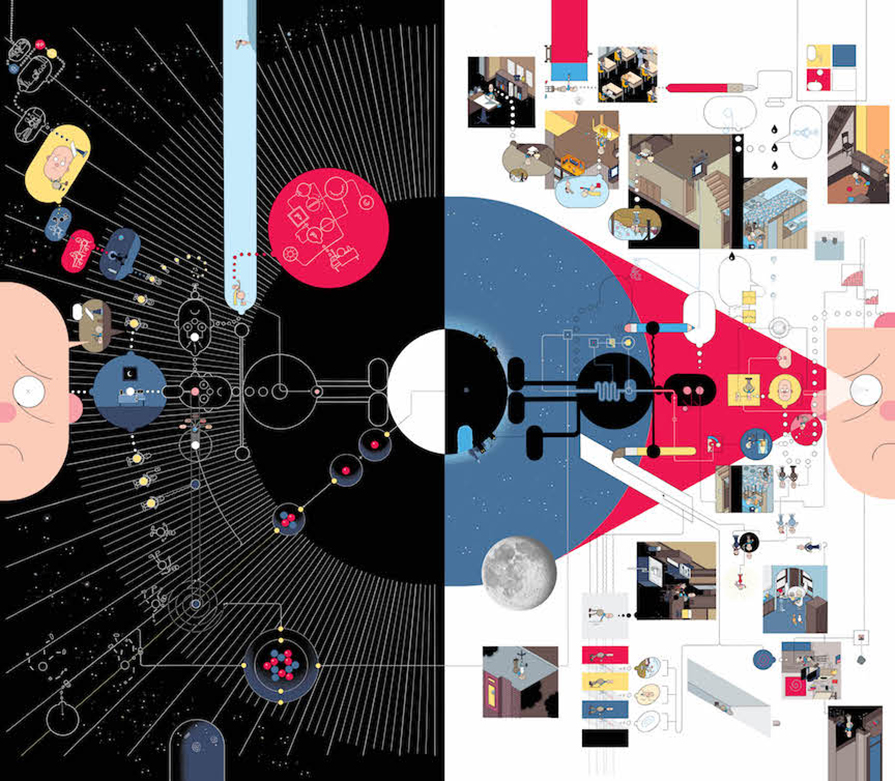
The Exhibition Brochure folds out into this cosmic poster. Click any Photo for full size.

Here each was separated by only tens of feet, installed facing each other across the gallery.
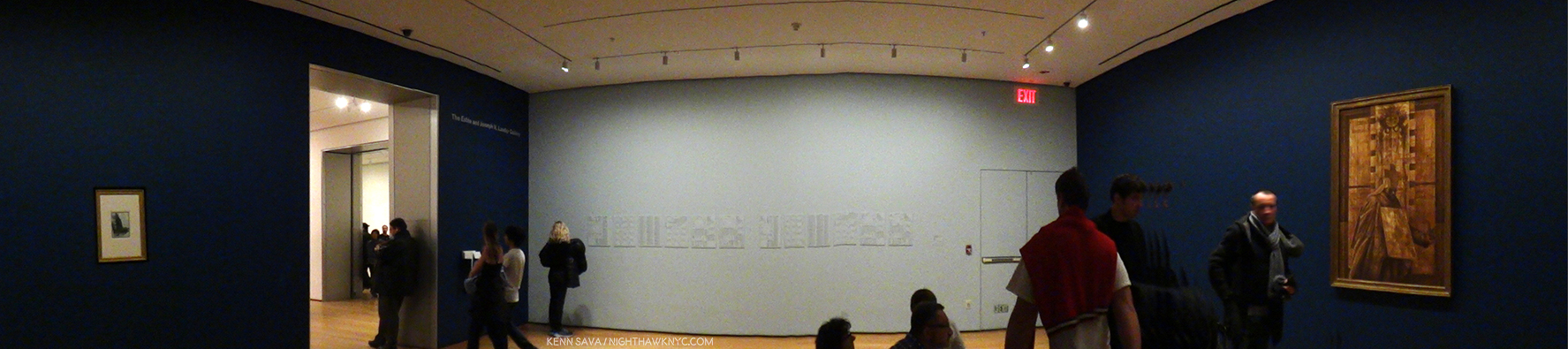
Installation view…of the whole show. Leonardo da Vinci, Drapery of a kneeling figure, c.1491-4, Brush and black ink with white heightening on pale blue prepared paper, left, Charles White’s Black Pope (Sandwich Board Man), 1973, right. Vedic astrological charts for both Artists center.

They were brought together by one man- the curator of this show, Artist David Hammons, who also commissioned Vedic astrological charts for both Artists, seeking connections that extend beyond what’s on the walls. What’s on the walls are Charles White’s lack Pope (Sandwich Board Man), 1973, Oil wash on board, from MoMA’s Permanent Collection, right, and Leonardo da Vinci’s Drapery of a kneeling figure, c.1491-4, Brush and black ink with white heightening on pale blue prepared paper, here on loan from Queen Elizabeth’s collection. It’s a study for the kneeling angel in his The Virgin of the Rocks, in the National Gallery, London, that I had a once-in-a-lifetime experience with in February, 2012.
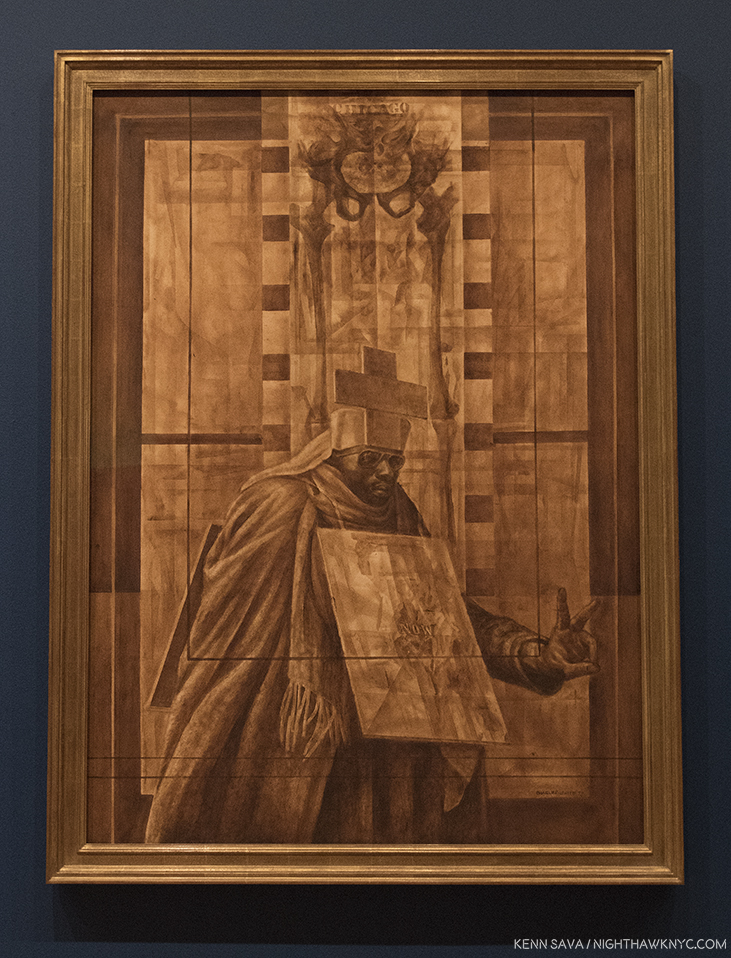
Charles White, Black Pope (Sandwich Board Man), 1973, Oil wash on board.

Wait. Leonardo da Vinci in The Museum of Modern Art? That, alone, made this something to see. It’s only the 3rd time a da Vinci has been shown at MoMA.
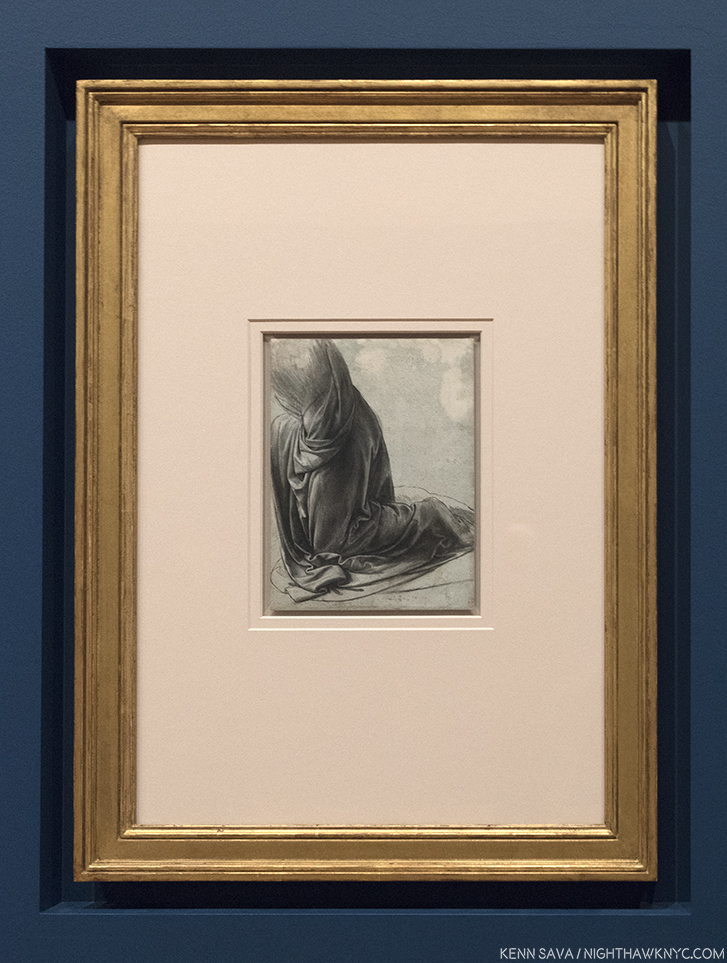
Leonardo da Vinci, Drapery of a kneeling figure, c.1491-4, Brush and black ink with white heightening on pale blue prepared paper
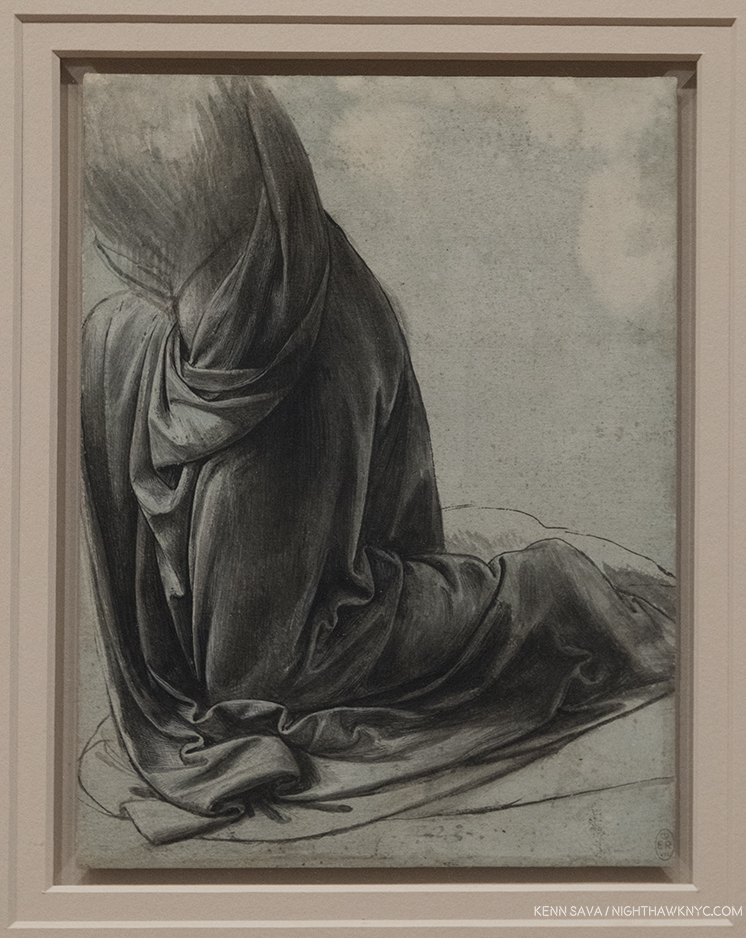
Closer. Who was the genius that decided to mark THIS with the “E R” tag on the lower right corner? Seriously? Isn’t the notation on the accompanying card that it’s in Queen Elizabeth’s collection sufficient?

But, don’t sleep on Charles White. His is a name that’s increasingly being brought up by Artists, acknowledging his influence, and/or his direct instruction. I have a feeling that as time goes on, his Art, too, will be increasingly part of the conversation. Black Pope, 1973 is considered one of his masterpieces. It’s haunting presence and mysterious message- his left hand giving the “Peace Sign,” the sandwich board reads, simply, “NOW,” as the figure moves under the word “Chicago,” emblazoned on the lower half of a skeleton, wonderfully executed, is a work that immediately impresses as “important.” The first thought turns to the war in Vietnam, which would not end for another 2 years, in 1975. Somehow, I don’t think it’s that simple. As it continues to haunt me, it also serves to make me want to see much more of his work.

The mercurial and elusive David Hammons was one of Charles White’s students. Though he chose a different stylistic path from his teacher’s realism (like, infamously, selling snowballs one winter’s day), he retained the latter’s activist stance, and has steadfastly held on to his “outsider” position. As a result, it’s somewhat surprising to see his name as the curator for this museum show. Another reason this was a must see show. Mr. Hammons has come up with a fascinating idea. In trying to understand his concept and intentions, I looked at MoMA’s recently published book on Charles White’s Black Pope, written by Esther Adler, Assistant Curator of Drawings and Prints at MoMA. In it, David Hammons, who sought Charles White out in 1968 as a teacher, is only quoted once. He says that “He (Charles White) is the only Artist I really related to1.”

Then, there’s this, in the exhibition’s brochure-
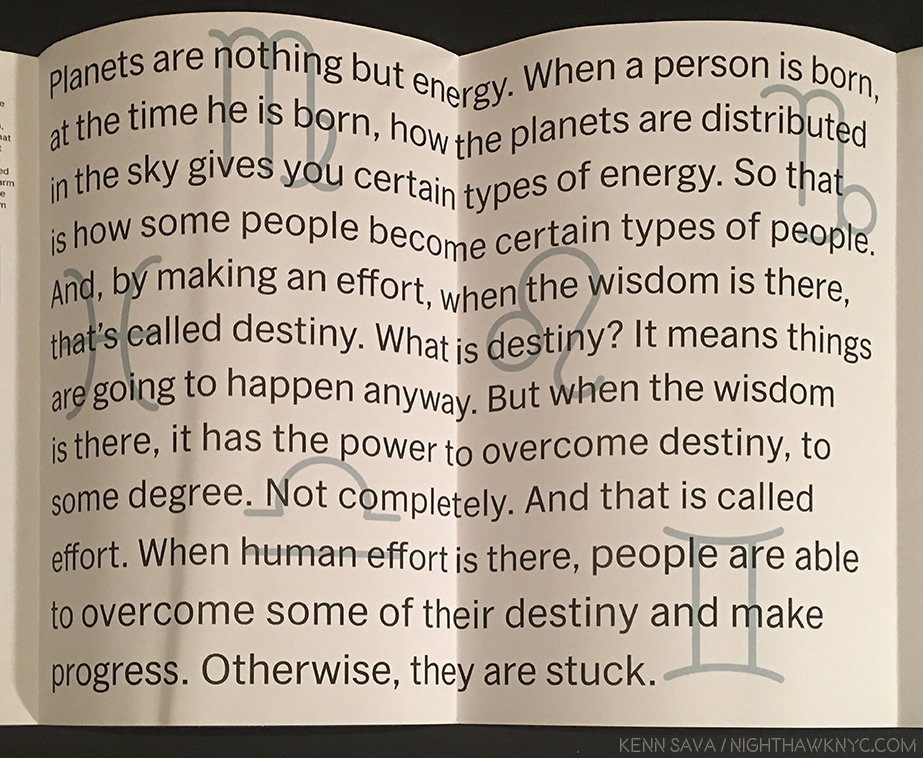
Inside of the exhibition brochure. Written by David Hammons..? No one is credited.

Beyond that, the wall tag reads, in part, “Hammons…asks us to consider commonalities between these two artists.” Ok. Let’s see…

On the surface the two Artists couldn’t seem to be more different.

Born 460, or so, years apart. Half a world apart. Leonardo was illegitimate (“a social disadvantage that was nearly impossible to overcome…2”  at the time). Charles White was a black man, born the son of a steel worker who was a Creek Indian- not exactly “favored” social standing. One fantasized about manned flight and his Drawings of it are still studied today. The other, born in 1918, grew up in the early days of real manned flight, and died in 1979, 10 years after man first set foot on the moon. One spoke Italian and wrote backwards, the other’s major concern was “to be accepted as a spokesman for my people3.” But, there are similarities that become more apparent as you look, and, yes, even more.

The first thing that becomes obvious, at least to me, is that they are both Masters. Fear not, Charles White holds his own, a remarkable achievement for any Artist.  The second is that they are not at all at odds with each other, nor do they look jarring alongside each other, at least to my eyes. Obviously, they both valued the craft and Art of Drawing. Going further, they were both born in the first half of April. Leonardo on April 15, 1452, Charles White on April 2, 1918. Hence the idea of commissioning Vedic Astrologer Chakrapani Ullal to create charts for each.
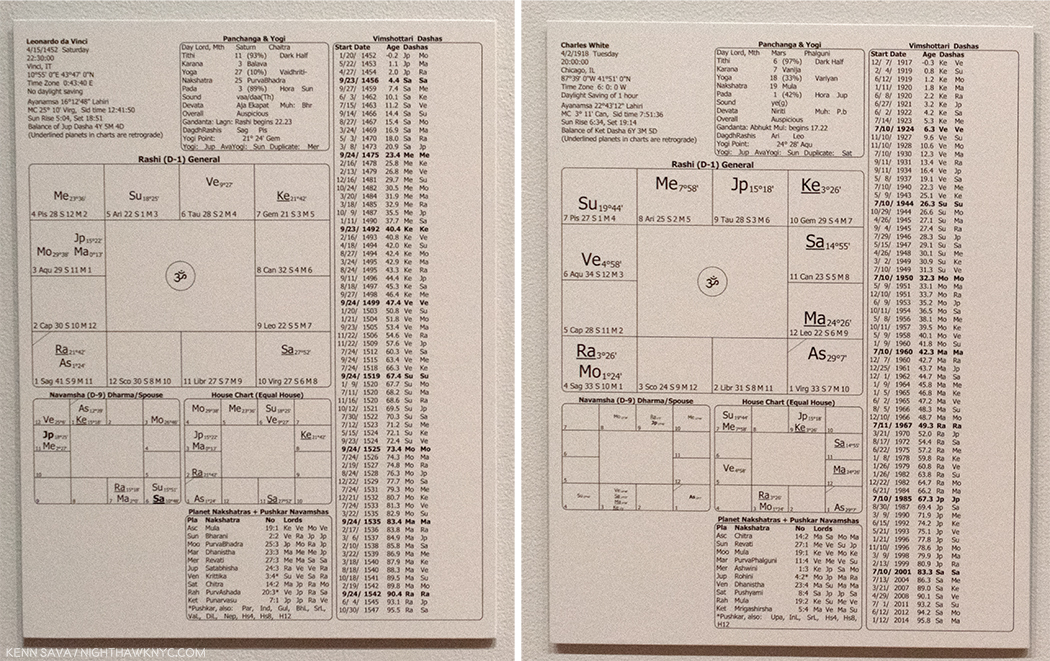
Ahhh…It was all written in the stars. The first page of da Vinci’s Vedic astrology chart, left, and Charles White’s right. If only I could read them. I do note that “Ke” is in the upper right quadrant of both.

“Talk and song from tongues of lilting grace
Whose sounds caress my ear
But not a word I heard could I relate
The story was quite clear”*

Both Artists “taught” Drawing- Leonardo’s dedication to the technique of Art has been exceeded by few, if any Artists before or after him. He “taught” drawing, directly, to his apprentices and ever since his death, his voluminous Notebooks have been excerpted into a number of texts on technique, that, along with his few Paintings and many Drawings have served to inform and inspire countless Artists down through the centuries. As Leonardo is a “tree” from which countless Artists have become branches, Charles White now has his own tree. He taught directly, in person, with numerous students over the years, at Dillard University, then most notably later in his life at Otis Art Institute, from 1965-79. It was while he was at Otis Art Institute , that David Hammons sought him out to study with in 1968. Kerry James Marshall closely studied Charles White’s work from a distance during his formative years, finally deciding in 7th grade that he would take his class and study under him. “In high school, Marshall sneaked into Otis and sat at the back of Charles White’s evening art class, hoping to remain unnoticed. “I didn’t have any business being in there in the first place, and then there was a naked person in there, so that was even more of a factor, you know,’ Marshall recalls, laughing. White noticed the youngster and approached him, saying, ‘You can’t see nothing from back here.’ He moved Marshall to the front and taught him how to draw a head in profile. He could come back anytime, White said4.” Marshall, fresh off his monumental, traveling retrospective is, at the moment, the most prominent member of Charles White’s influence tree, and he has continually spoken of his debt to Charles White.

Looking further, both Artist’s work is “representational,” though Charles White does touch on realms considered abstract. Still, standing in front of the Leonardo, and looking towards the very next gallery, filled with Surrealism, I wondered what he would think of this, which was in it’s direct sightline-
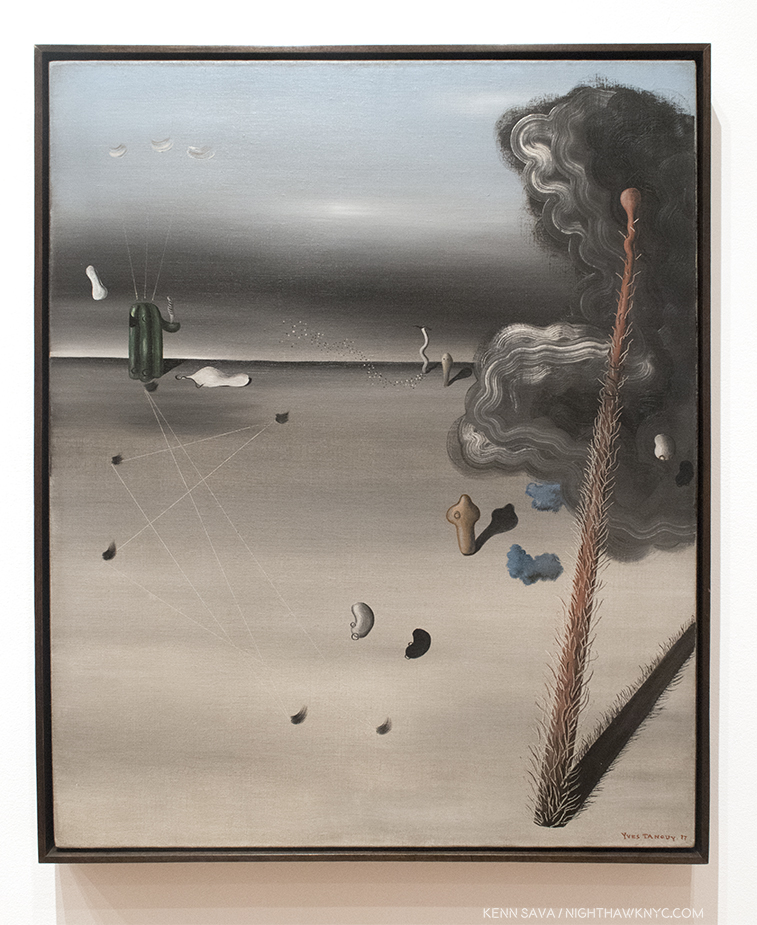
Yves Tanguy, “Mama, Papa Is Wounded!,” 1927, Oil on canvas

Interestingly, in Charles White’s “Black Pope (Sandwich Board Man),” 1973, we see the figure from, apparently, right above his knees (though the skeleton of a lower body looms above him5). In Leonardo’s Drawing, we see the figure’s lower body. Between the two works of Art, we’d have one whole human body (half female, half male). Looking at it another way, it’s as if Leonardo’s is providing the foundation-figuratively and literally. Both have a fair amount of beautiful drawn “drapery,” or clothing, the folds and nuances of shading is something that Artists have long prided themselves on mastering- Leonardo, a supreme Master of it, gives us a classic example of one such exercise here.

Leonardo’s work is a study for the Virgin of the Rocks, a work that seems to focus on Saint John the Baptist, a prophet. Charles White’s Black Pope, also appears to be something of a prophet, but “saying,” or “foretelling” exactly what, is not clear. Both works are surrounded in mystery as to exactly what is happening.

“Oh, father of the four winds, fill my sails
Across the sea of years
With no provision but an open face
Along the straits of fear.”*

Perhaps, Mr. Hammons has some personal insight from Charles White about Leonardo and his influence on him, but that is not shared here. Leonardo is one of the most respected and revered Artists in Western Art History. Is Mr. Hammons putting him, alone, in the same room with Charles White his way of saying that Charles White, “the only Artist he related to,” is comparable for him to how Leonardo is held by the larger, and largely white, Art world?

I think Kerry James Marshall may have summed it up best- “When I looked at his (Charles White’s) work it seemed as good as something anyone else ever made, and better than a lot of things other people made, but how come he’s invisible to Art history?” 6

Getting back to Black Pope, the Artwork, MoMA’s new book on the piece does an excellent job of tracking down some of Charles White’s possible visual references. Though they located newsphotos that appear to be closer to Charles White’s composition, I was, also, struck that among them is the fold out cover for Isaac Hayes album Black Moses, released by Stax Enterprise Records, 1971.
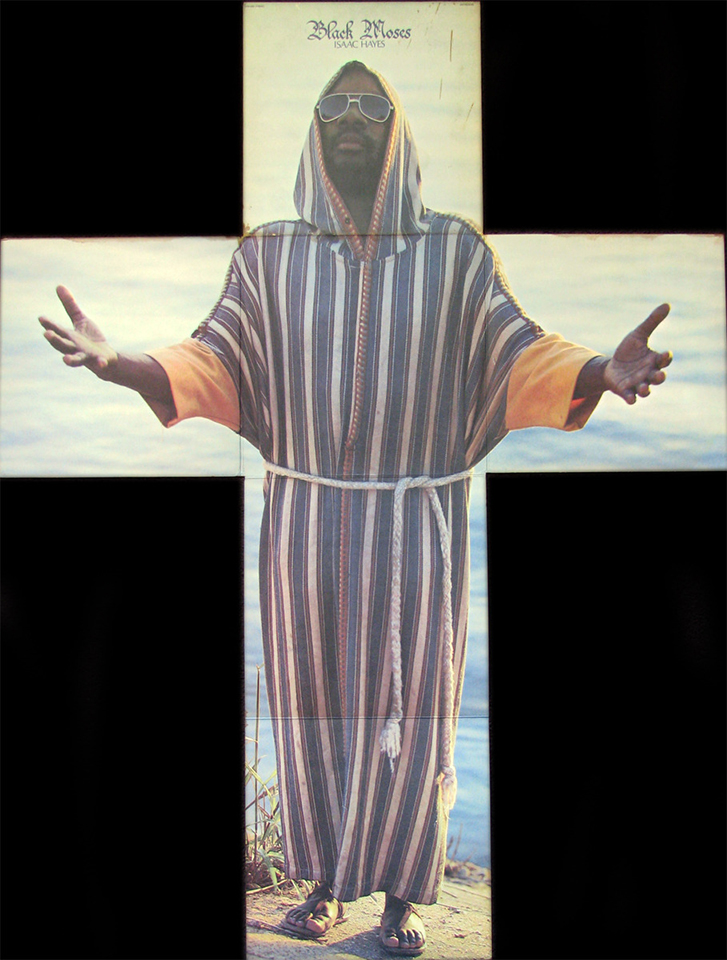
Isaac Hayes, Black Moses, Foldout Lp Cover, Stax Enterprise Records, 1971.

Charles White’s influence is already well-established through his illustrious and important students. Art history may, also, be slowly beginning to catch up. It turns out that this show is something of  an “appetizer” for MoMA’s Charles White: A Retrospective which opens next year (Update, January, 2019- which I’ve written about, here). It’s an overdue show that could go a long ways in finally solidifying Charles White’s place as an important Artist.

*- Soundtrack for this Post is “Kashmir” by John Bonham, Jimmy Page & Robert Plant of Led Zeppelin, and which was recorded on Physical Graffiti, 1975, 2 years after Charles White created Black Pope. A great performance of it is here.

NighthawkNYC.com has been entirely self-funded & ad-free for over 7 years, during which over 275 full length pieces have been published! If you’ve found it worthwhile, PLEASE donate to allow me to continue below. Thank you, Kenn.

You can also support it by buying Art, Art & Photography books, and Music from my collection! Books may be found here. Music here and here.

Written & photographed by Kenn Sava for nighthawknyc.com unless otherwise credited. To send comments, thoughts, feedback or propositions click here. Click the white box on the upper right for the archives or to search them. Subscribe to be notified of new Posts below. Your information will be used for no other purpose.

  1. This Charles White-Leonardo show, upcoming at the time, is mentioned in a footnote.
  2. https://www.press.umich.edu/17155/illegitimacy_in_renaissance_florence
  3. charles white-imagesofdignity.org
  4. Sam Worley, Chicago Mag, 3/29.2016
  5. Remarkably reminiscent of Robert Rauschenberg’s X Ray in his 196 7work, Booster, created at Gemini G.E.L., where Charles White was also working at the time.
  6. https://www.independent.co.uk/news/people/kerry-james-marshall-interview-putting-black-artists-into-the-textbooks-9801055.html

About Banner #8

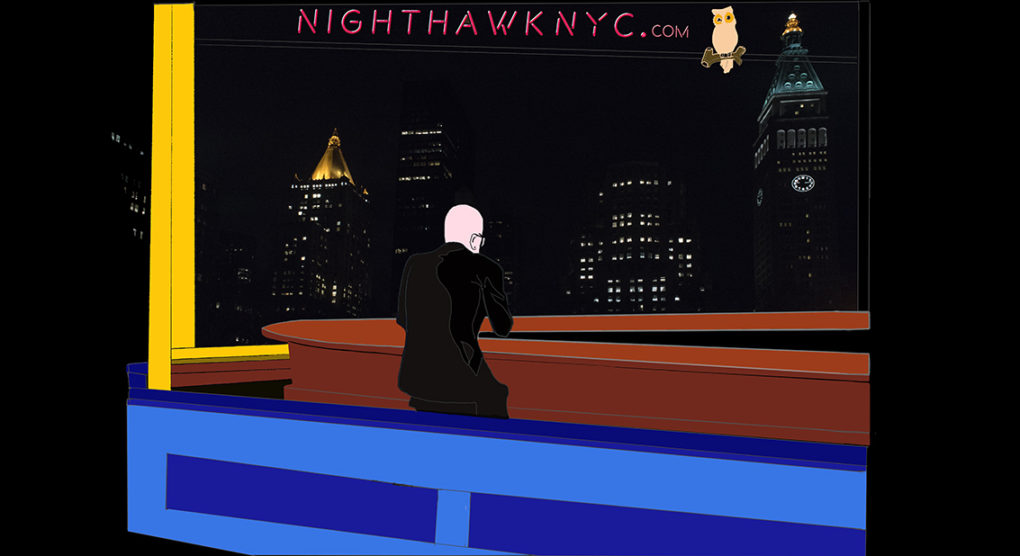
Banner 8. Looking east across Madison Square Park from West 24th Street & 5th Avenue. Click any Photo for full size.

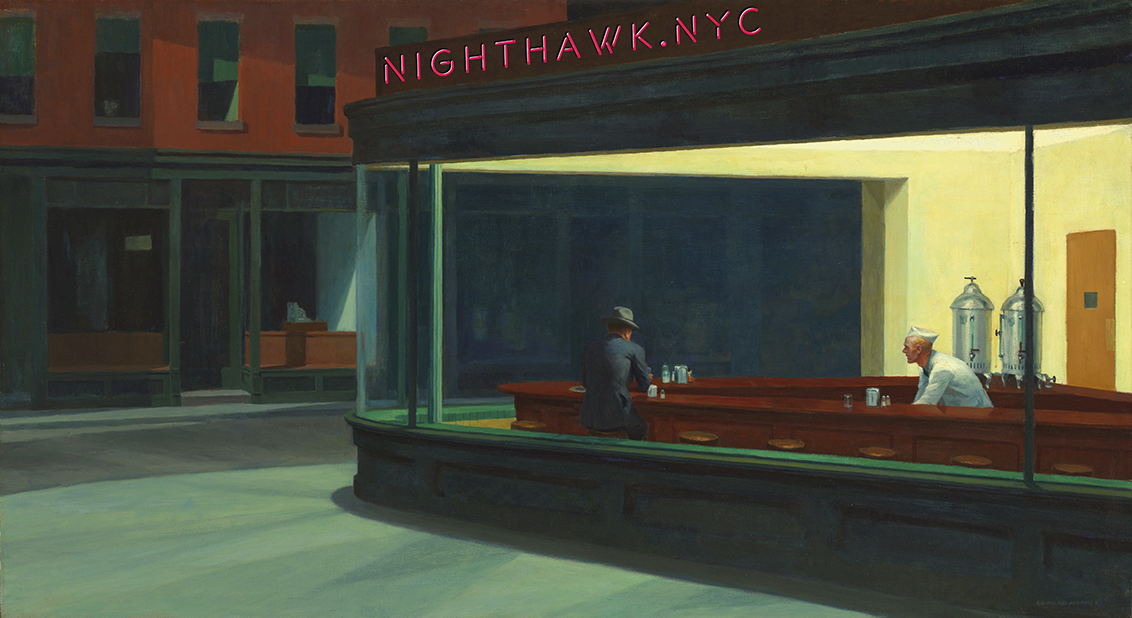
“WHERE was Edward Hopper’s “Nighthawks” set?”

Edward Hopper, “Nighthawk,” 1942, Oil on canvas

For many years, that question has been lingering somewhere in the back of my mind. Every day, as I walk around the City, any time I see a triangular corner, I wonder, “Could THIS be it?” The excellent website, Jeremiah’s Vanishing New York did a 4 part series analyzing each and every possible location they could find, which is, still, the most thorough search I know of. Part one is here.

It could well be a place Hopper imagined. It could be based on a few different locations. Or, it could be a place that is now long gone. But? Many other Hoppers were painted in places well known, even all these years later. Some years ago, I spent the night in a small hotel in Cape Cod solely because Hopper had Painted it in a work called “Rooms for Tourists.” Being one, and looking for a place to stay, I immediately recognized it- it still looked exactly like the Painting. Gail Levin’s book, “Hopper’s Places,” revisits many of these places, and so, makes me feel that the locale of “Nighthawks” MUST exist.

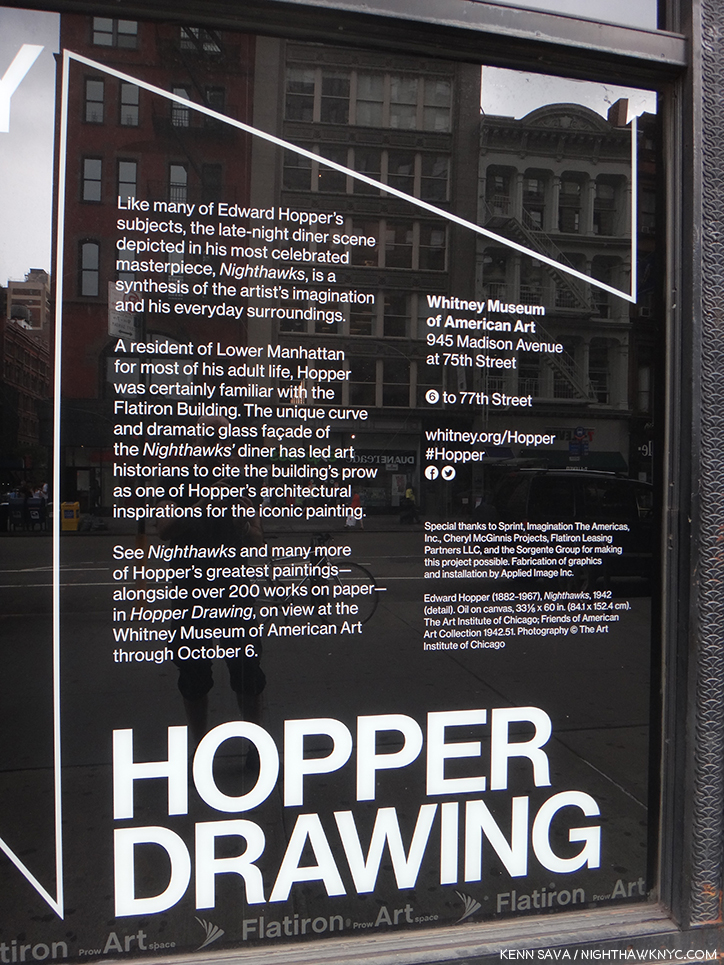
In 2013, at the time of  their excellent “Hopper Drawing” show, (which included the original “Nighthawks”) the Whitney Museum said the following on a wall card-

“A resident of Lower Manhattan for most of his adult life, Hopper was certainly familiar with the Flatiron Building. The unique curve and dramatic glass facade of the “Nighthawks” diner has led art historians to cite the building’s prow as one of Hopper’s architectural inspirations for the iconic building.”

“Well I don’t really care
If it’s wrong or if it’s right
But until my ship comes in
I’ll live night by night.”*

So, for Banner #8, I chose this scene because it’s one block north of the “Prow” of the Flatiron Building (speaking of “ships”), at the corners of 23rd Street and Broadway and 5th Avenue. I’ve opted to move “Eddie’s Cafe,” to just off of Madison Square Park, looking east across it from 5th Avenue at West 24th Street. You can see the New York Life Building, at 51 Madison Avenue, with it’s famous gold pyramid, left, the Metropolitan Life North Building, a very cool 30 story Art Deco geometric abstraction at 11 Madison Avenue, center, and the Met Life Tower, right, the world’s tallest building from 1909 to 1913.

If they’re right about the Flatiron, this scene would have been just out of the frame of the Painting to the left. I picked it because all of these buildings were standing when Hopper painted “Nighthawks” in 1941-2 (except that rectangular, mostly dark, building immediately behind my head to the left.) The buildings behind the cafe in the Painting are long gone and what’s there now appears to have been moved further back from where they are in the Painting.

So? It’s as close as I could get to setting “Nighthawks,” now, with buildings that were standing when Edward Hopper Painted “Nighthawks,” a block away…IF he was using the Flatiron’s Prow as the scene. It becomes a window back to that time.

Personally, I remain to be convinced about the Flatiron. The “Prow” is too small to have housed an actual cafe, so that means it would have been one of his inspirations. So, I remain hopeful that an actual place will be discovered at long last, though I’m not expectant. Until that ship comes in, I’ll do what I always do- live night by night…

*- Soundtrack for this Post is “Night By Night,” by Donald Fagen and the late Walter Becker (R.I.P. September 3, 2017) of Steely Dan and recorded on “Pretzel Logic,” 1974.

NighthawkNYC.com has been entirely self-funded & ad-free for over 7 years, during which over 275 full length pieces have been published! If you’ve found it worthwhile, PLEASE donate to allow me to continue below. Thank you, Kenn.

You can also support it by buying Art, Art & Photography books, and Music from my collection! Books may be found here. Music here and here.

Written & photographed by Kenn Sava for nighthawknyc.com unless otherwise credited. To send comments, thoughts, feedback or propositions click here. Click the white box on the upper right for the archives or to search them. Subscribe to be notified of new Posts below. Your information will be used for no other purpose.

Cai Dongdong: Guns & Shutters

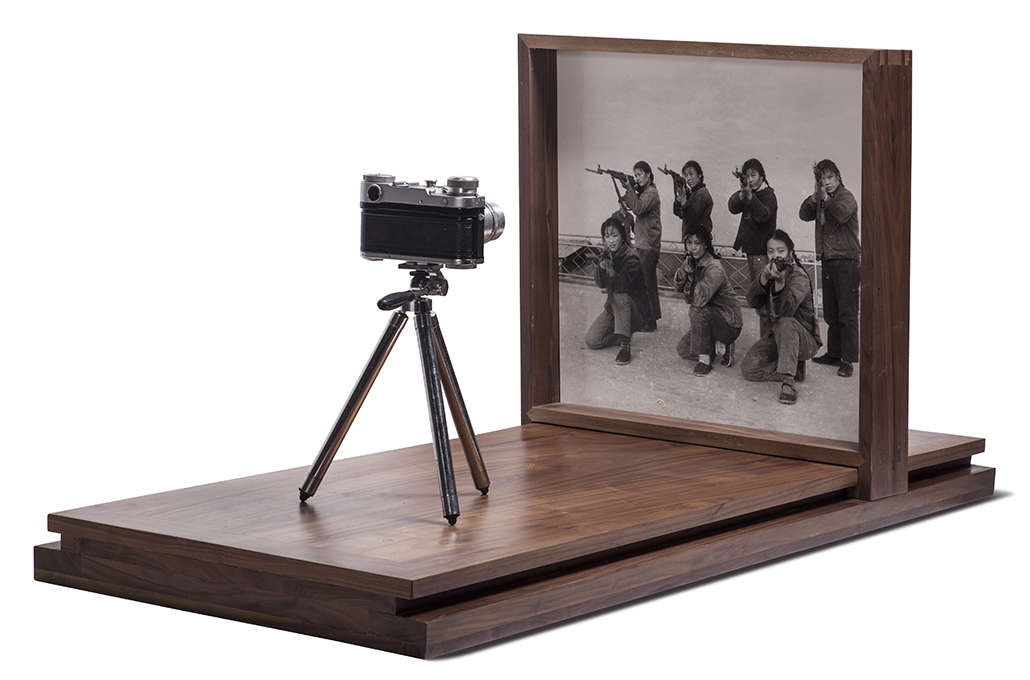
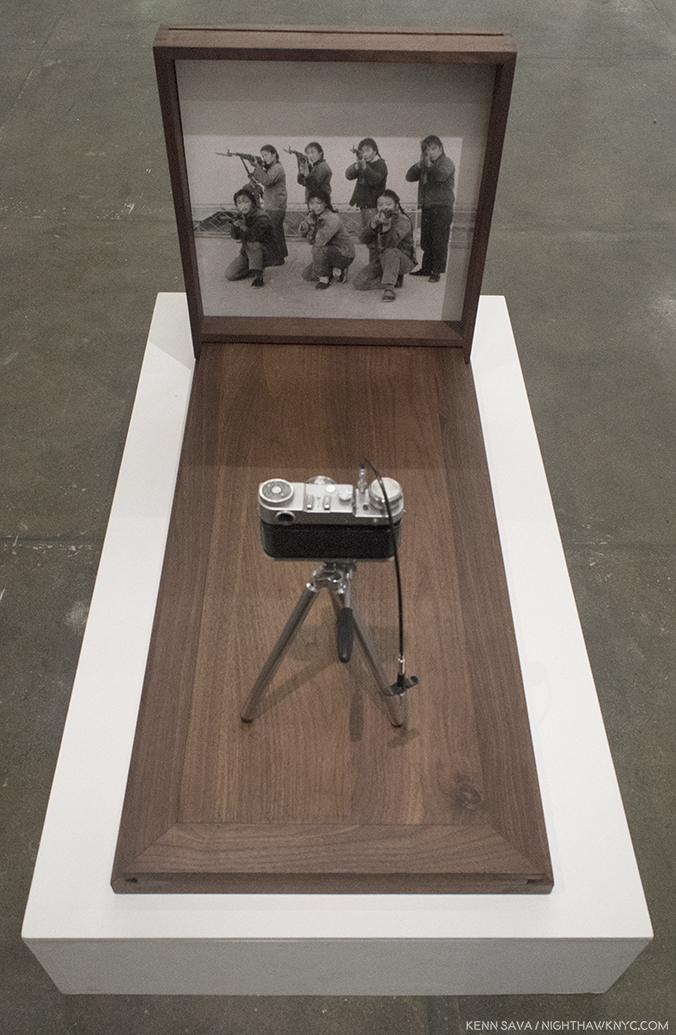
Cai Dongdong “Aiming at the Camera,” 2017, Gelatin silver print, Russian camera(!), wood. Photo courtesy Cai Dongdong and Klein Sun Gallery. Click any Photo for full size.

On October 6th the NYC Art world was permanently changed with the opening of the monumental “Art and China after 1989: Theater of the World” at the Guggenheim. Filling all 6 floors of Frank Lloyd Wright’s Rotunda and spilling over into two of the side galleries, it was as close to encyclopedic as any show of it’s kind could ever hope to be. Having closed on January 7, I’m still processing my thoughts about it. (Update- My piece on it is here.)This much I can say- In it’s wake, the training wheels are now off. The flood gate of what’s been going on in Contemporary Art in China has opened and we’re officially in the deep water.

And it’s about time.

The 71 “key Artists and groups” as the show’s site calls them were remarkably well chosen, in my opinion, divided between historically important Artists and works, and those of the moment. Still? In a country of 1.4 Billion people, it’s impossible to include everyone. Many deserving Artists were missed, especially with only 9 women represented. (My Post on it is here.) While big on video & installations, almost completely missing was Photography, Ai Weiwei’s famous “Dropping a Han Dynasty Urn,” 1995, being one of the few works included.

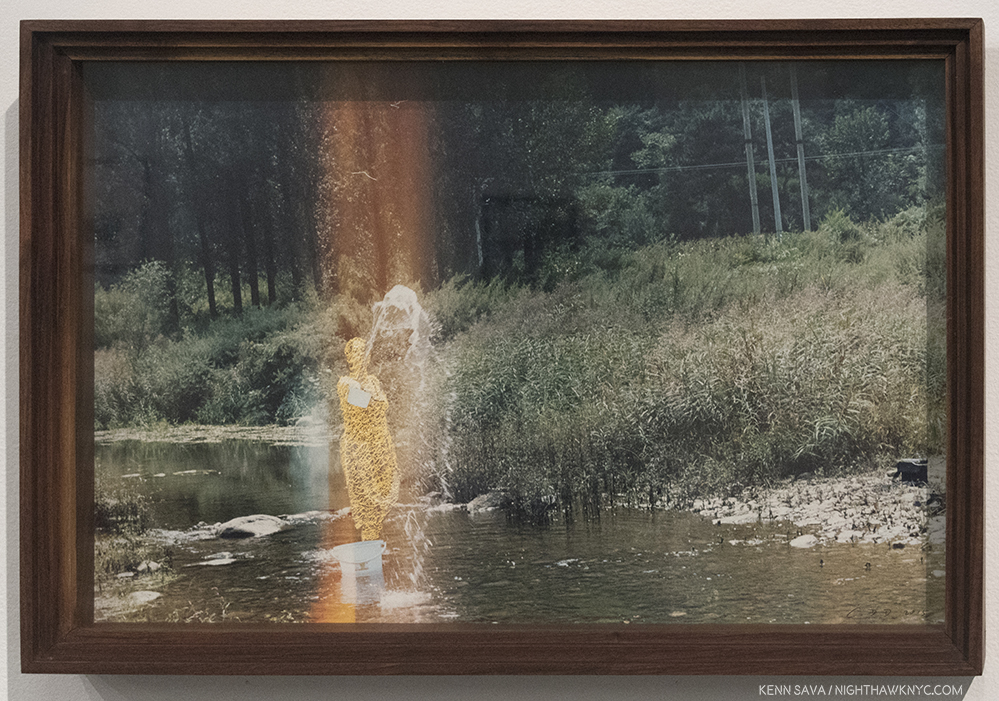
Cai Dongdong, “Splashing Woman,” 2016, Handmade color photo, knitting, in Artist’s frame. I can’t say I’ve ever seen anything quite like this.

If you are among those left wanting to see more, see what other Contemporary Chinese Artists are doing, or see what Contemporary Chinese Photography Artists are doing, I strongly encourage you to check out some of the fine and daring galleries around town that specialize in Contemporary Chinese Art. With a 10 year history of representing and showing Chinese Artists who are, largely, in the process of becoming better known in the USA, Klein Sun Gallery on West 22nd Street is among the leading galleries in the field. Gallerist Eli Klein speaks with both passion and experience about the Artists he, and his gallery, represent, but, also about “the difficult concepts and social commentary portrayed by some of our artists,” as he told me.

The latter is exactly what makes Klein Sun a must visit gallery on my rounds. Mr. Klein comes by his passion naturally. He is the son the late, extraordinary, women’s champion, Janet Benshoof, who passed away on December 18th.

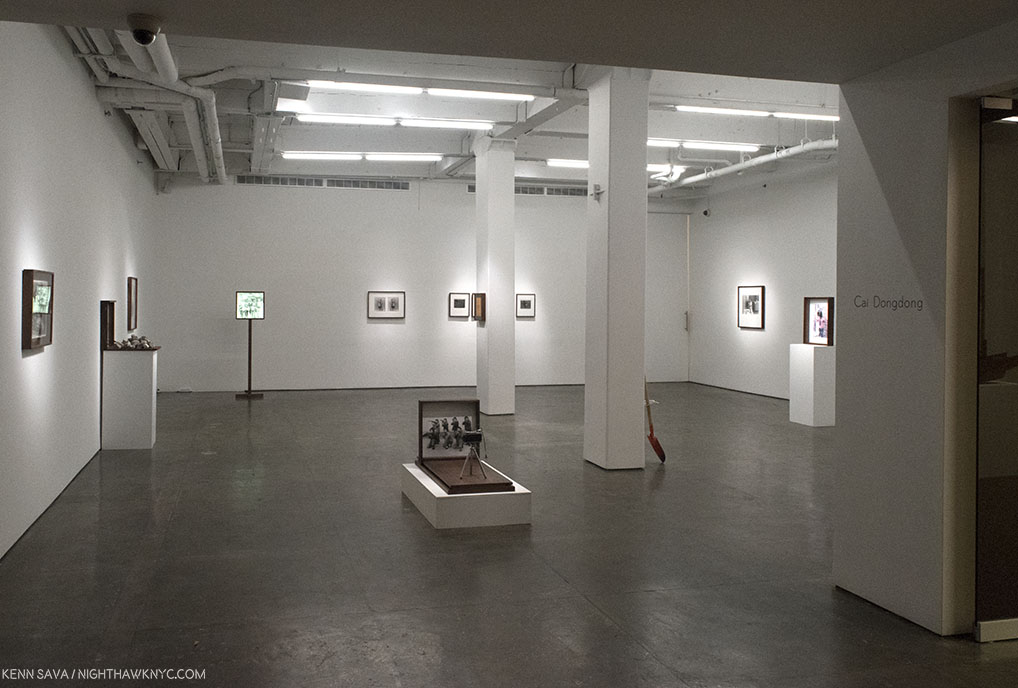
Installation view of the first gallery.

In all the years that I’ve been going to Klein Sun, this is a particularly good time to go. Their current show, “Cai Dongdong: Photography Autocracy,” through January 18, is an eye-opener, full of pushing-the-envelope creativity, in works that will linger with you after they upend your preconceptions. Mr. Dongdong’s work, which is centered on Photography, is rife with commentary, divided between themes including the military, the act of seeing and being seen, and Henri Cartier-Bresson’s famous “Decisive Moment.” But it’s the universality and humanity of his work as a whole that impresses me the most. Though the faces are Chinese, they could be anyone. For western eyes, there are echoes of Man Ray, Max Ernst, Marcel Duchamp and Joseph Cornell in works that are “Photo-Sculptures,”as he calls them, but decidedly different from Robert Rauschenberg’s “Combines.” Unique among all the Photographers I spent last year seeing, Cai Dongdong, also, constructs the beautiful stands and frames he uses himself, ala Joseph Cornell or Holly Lane, creating an all in one experience in which the Photograph plays one part. The Artist, who turns 40 this year, has a bit of a unique background. He joined the People’s Liberation Army- as a portrait Photographer, a post he remained in for about a decade. This served to have a lasting influence on him, as one might suspect, as one side of his subsequent Art incorporates these Photos, while another side uses found images, (selected from an archive that Phil Cai, Mr. Klein’s Associate at Klein Sun, told me numbers over 600,000 images), but in all his work, he combines Photographs in ways that defy the “Autocracy” of the image to force it to say “something else,” always unexpected.

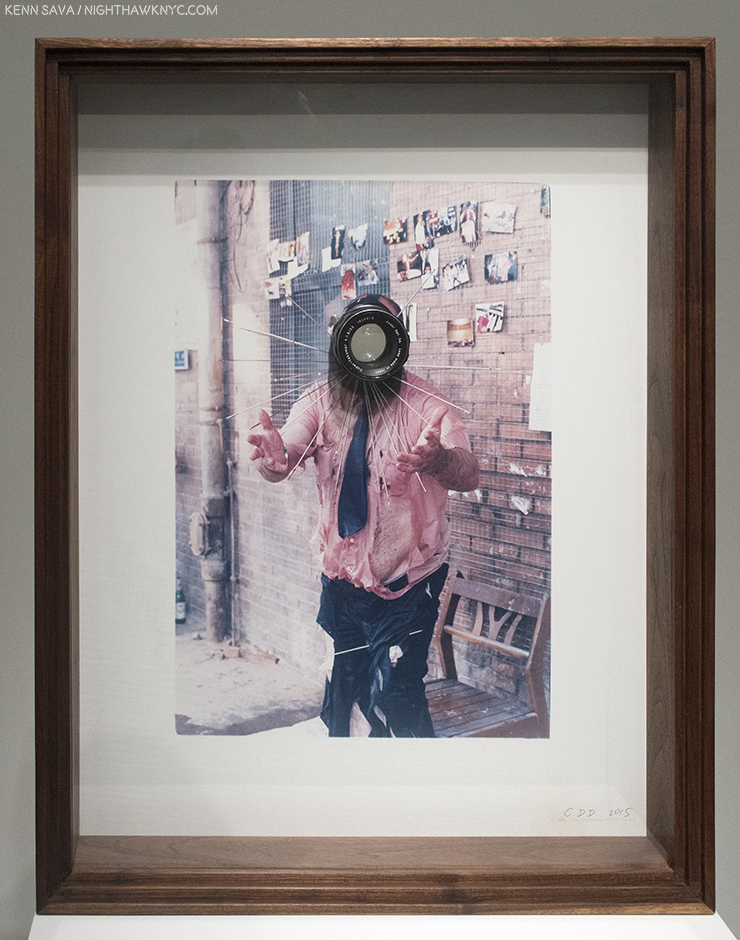
Cai Dongdong, “The Photographer II,” 2015, Handmade color photo, photographic lens in Artist’s frame. The lens goes right through the work.

Going beyond Photographs with his passion for Photography, a number of these works contain camera lenses inserted right into the piece, making the viewer the subject. Many others contain mirrors or reflective surfaces, and one, seen at the beginning, and below, puts you at the place of the Photographer- if you dare.

Cai Dongdong “Aiming at the Camera,” 2017,

Through mirrors and lenses, he also puts the viewer in the work, reminding us of our complicity by looking and seeing, most poignantly they’re included in a number of nudes on view, including one that replaces the model’s head with a round mirror, all ready for your face.

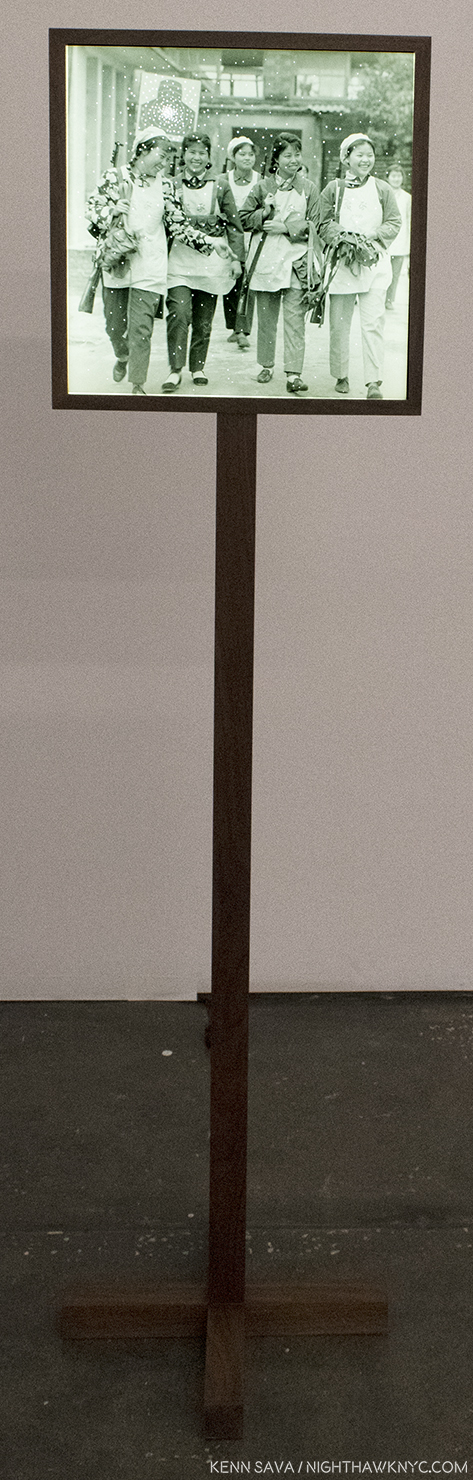
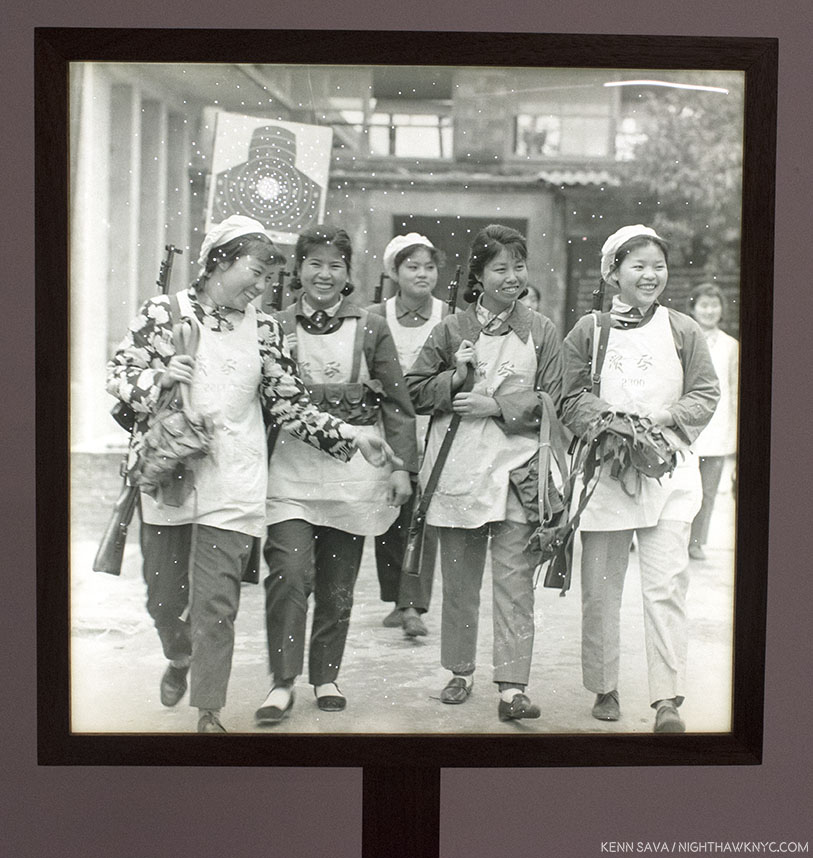
Cai Dongdong, “Back from Target Practice,” 2017, Gelatin silver print, LCD Light box. These harmless looking smiling armed ladies are returning from target practice. Or? Are they coming for us? Interestingly, the piece is mounted about head high for many viewers, making it personal.

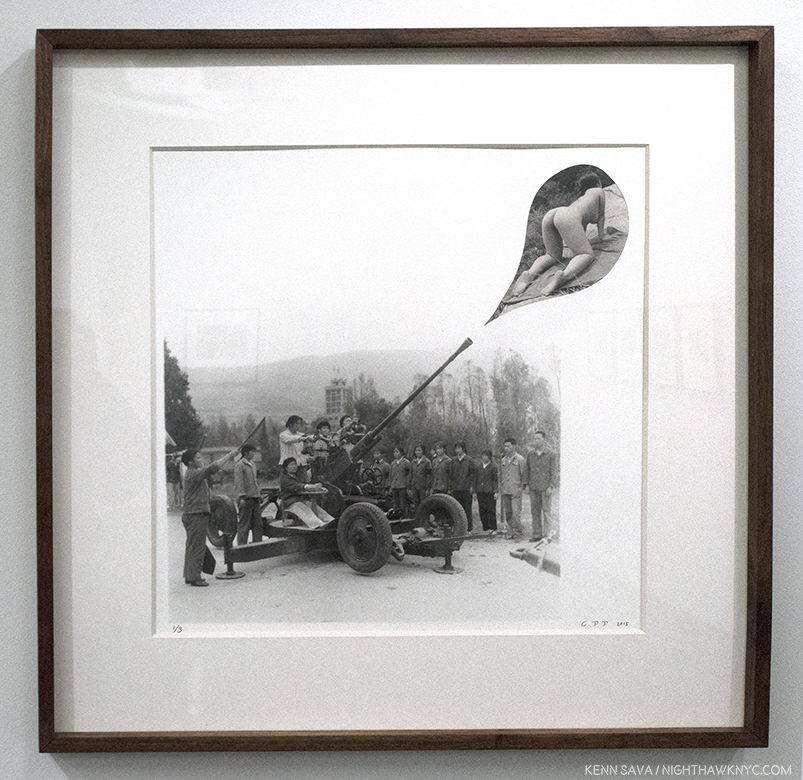
The central element, for me, in his work is the humanity that runs through it. In “Aiming at the Camera,” 2017, the Artist, literally, puts you in his shoes when he took this Photo. In “The Association of the Cannon,” 2016, a cannon goes off expelling a harmless and lovely nude. Right next to it, in “Back from Target Practice,” 2017, a group of armed young women walk towards the viewer, making you feel that even women, the givers of life, when armed, can pose a real danger to you-particularly when they’re coming your way. These Photos have a “journalistic” feel that’s turned into something else in the whole, something the Photo may, or may not have originally intended. Hence, the Photo’s “Autocracy” in the show’s title is subject to Artist’s intervention. The Artist is the one with the unlimited power to control what it says.

Detail.

The role of guns (rifles and cannons) is a recurrant theme in the Artist’s work that was also a memorable part of his last Klein Sun show, “Fountain,” 2015. Here, guns alternate between being a threat and being “defused.” The two shows mirror each other beautifully, down to their success, with “Fountain” selling out, and “Photography Autocracy” getting very close to it. (A word to book collectors-  The Artist created an extraordinary book for “Fountain,” in a limited edition of 500 signed & numbered copies, the stack of available copies at the gallery dwindled each time I visited, partially my fault. For someone who has been buried, literally up to his neck in Art & PhotoBooks, as anyone who has seen my apartment this year could swear to in court, I was shocked to see the intricate details that have been painstakingly included in this book. It’s gorgeous. Another example of the extreme care and craftsmanship that goes into Cai Dongdong’s Art.)

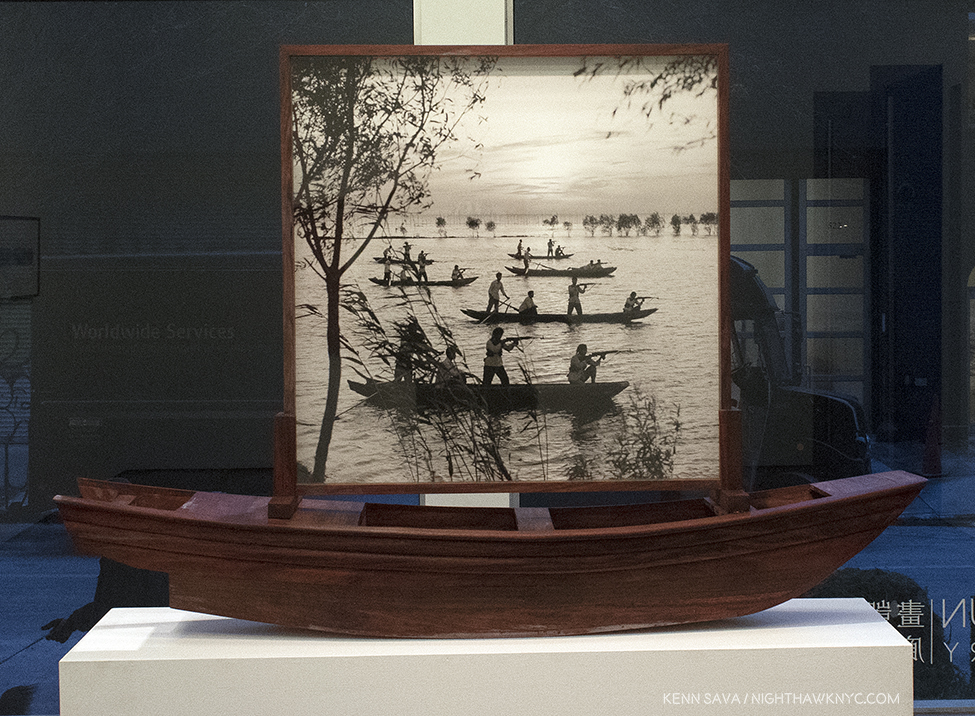
Cai Dongdong, “The Guerrilla on Hunghu Lake,” 2017, Gelatin silver print, wood. This is just an extraordinarily beautiful Photograph, in addition to being a powerful image. The background is ravishing, which serves to bring another level of meaning to the “action” of the approaching guerrillas in front of it. The idea of setting this in a hand made boat is just brilliant, in my opinion.

It’s fascinating to look for evidence of his experiences in the Army in these works, but it’s unknown (to me) which Photo Mr. Dongdong took and which he found. In the end, it matters not. Some of the end results, however, have a “day dream” effect, where I picture the Artist in his Army job, armed with his camera, fantasizing about whatever scene is going on in front of him. “Wouldn’t it be great if a beautiful lady came out of this cannon right now instead of a shell?”

Cai Dongdong, “The Association of the Cannon,” 2016, Gelatin silver print in Artist’s frame. Right out of Max Ernst, a work I might have expected from John & Yoko, seems to sum up this show.

I think it’s exactly that that makes this show so successful and so popular- it’s very easy to relate to the humanity in the work, regardless of your culture or background.

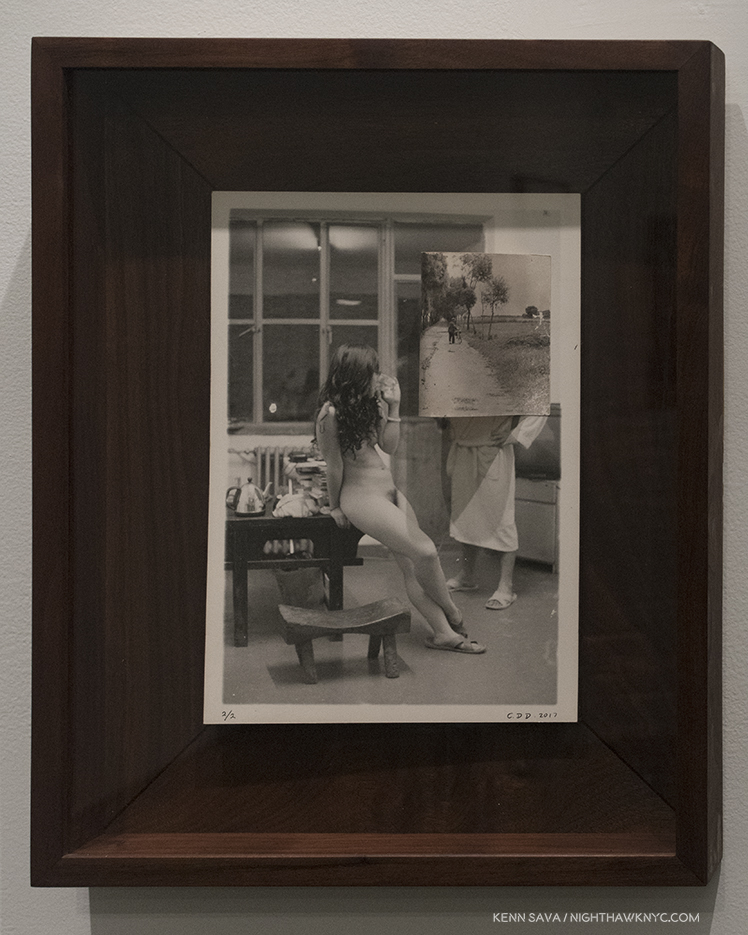
“Road,” 2016, Gelatin silver print in Artist’s frame. The Photo of the “road” in the upper right is collaged on and extends out from the surface, curved on the side nearest the lady.

Regarding his background, I asked the Artist a few questions, through the gallery since he lives and works in Beijing-

Frist- What inspired you to become an Artist?

Cai replied, “A rain when I was born.”

And- Who influenced your Art?

Cai- “My kids.”

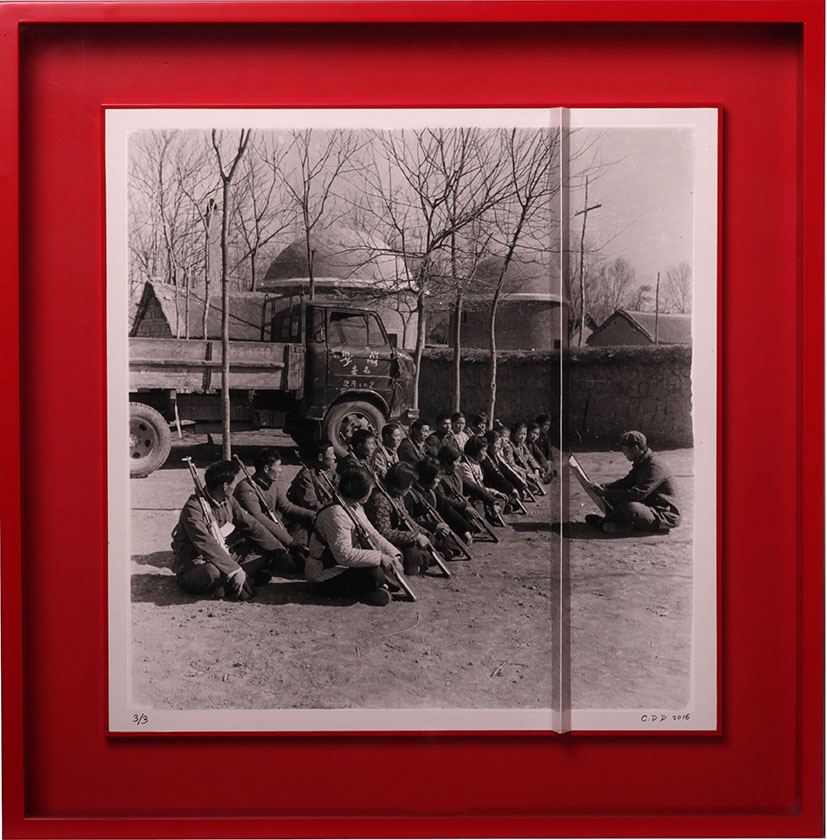
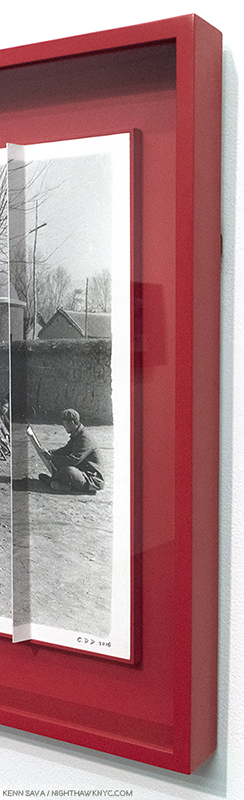
Cai Dongdong, “Obstacle,” Gelatin silver print in Artist’s frame. Notice the ridge where the print is folded about 2/3 to the right. Photo courtesy of Cai Dongdong and Klein Sun Gallery.

As Phil Cai pointed out to me, looking at it from the right, the lecturer is cut off by the ridge made by the folded print…as the solders are cut off from him on the lefl.

I also asked Mr. Klein how he discovered Cai Dongdong. He said, “I first saw his work on a chance Studio visit in Beijing. His studio was close to one of another artist I was visiting and was told I shouldn’t miss it. Quite frankly I was blown away. It was such pure art, no bullshit, no trying too hard, not showing off. It was just Real. Cameras and parts all over the place, wood that he was using to make his own frames. A unique mix of installation, old and new photography, mixed media, collage, sculpture and compelling cultural commentary. I had to pursue representing him and knew that very quickly. His demeaner and dedication were also very clearly defined which is indicative of a better potential for a long and successful career.”

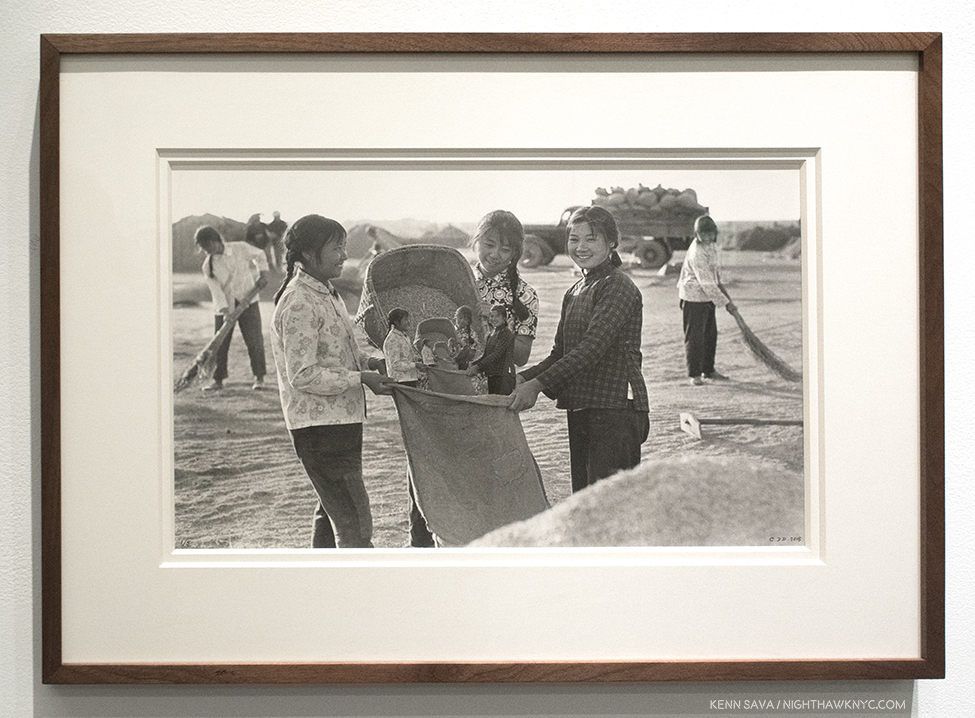
Cai Dongdong, “Big Harvest,” 2017, Silver gelatin print in Artist’s frame. Phil Cai spoke to me of the influence of China’s “Collectivsim,” in this work, that they are “gathering themselves.” When I see it, I see the succeeding smaller figures representing future generations.

Mr. Dongdong’s work speaks to the larger “cultural commentary” than to one that’s specifically Chinese, in my opinion.  These are works that end up expressing the universal experience of being human- even in a “collective.” People can be “trained” to move and operate together, but it’s harder to control their thoughts, imaginations, fantasies, and Artistic impulses. Yes, guns can be dangerous. Yes, nations are continually preparing for war. But, these nations are made up of human beings who are living their daily lives, too. Here are works about the experience of being human- from basic events like being seen naked, being seen at work, being seen serving your country, that every human being experiences. In Cai Dongdong’s Art, the world becomes a little smaller, and that’s one of the best things Art can accomplish. It also looks like he has fun creating it, and that comes through, too.

Time will tell if Cai Dongdong achieves the stature of Gu Dexin, Alec Soth or Ai Weiwei, but in the meantime he’s creating beautifully made objects with their own point of view, a decidedly unique way of seeing the world, each one overflowing with humanity. That’s certainly a recipe that’s stood the test of time, for a long time.

*-Soundtrack for this Post is “Happiness is a Warm Gun,” by John Lennon & Paul McCartney, and recorded by The Beatles on “The White Album.” (No, It’s not a drug song, as you can hear John say, here.) In lieu of their version, Gavin DeGraw does it here-

This Post is dedicated to the memory of Janet Benshoof. 

NighthawkNYC.com has been entirely self-funded & ad-free for over 7 years, during which over 275 full length pieces have been published! If you’ve found it worthwhile, PLEASE donate to allow me to continue below. Thank you, Kenn.

You can also support it by buying Art, Art & Photography books, and Music from my collection! Books may be found here. Music here and here.

Written & photographed by Kenn Sava for nighthawknyc.com unless otherwise credited. To send comments, thoughts, feedback or propositions click here. Click the white box on the upper right for the archives or to search them. Subscribe to be notified of new Posts below. Your information will be used for no other purpose.

R.I.P. Tim Rollins- A Remembrance

Tim was a miraculous being.

“I’m Blessed,” he always replied when I asked him how he was. Indeed, he was. Certainly, now, too.

Rarely in Art History, if ever, has there been an Artist who gave of himself so completely to his students that he put their names on the work they created and considered them collaborators. Right now, at The Met, you will look long and very hard at the work of Ghirlandaio for signs of the hand of his young apprentice, Michelangelo, in their blockbuster show of the latter’s work. Elsewhere, it’s the same with Verrocchio’s work for signs of the young Leonardo da Vinci. Would they put their apprentices names on their work? Never!1 Ditto for the apprentices and assistants of almost ANY Artist in Art history, right up through today.

Not Tim.

Each and every work he created is signed “Tim Rollins & K.O.S.,” for “Kids of Survival,” as his group of young students named themselves early on. While most Artists who collaborate do it for a short period, he did it for 35 years- his entire career! A career that has ended, now, way too soon with his passing on December 26th.

Beginning in 1981 at I.S. 52, an NYC junior high school, he took students from beginners and taught them about Art, Literature, discipline, technique, about what it took to succeed at anything, including Art, and, most importantly, about life. But, these were no ordinary students. These were “at risk” youths in the South Bronx during one of the worst times in recent New York City’s history! Tim’s was no after school babysitting Art class. His was the real deal. “Today we’re going to make Art, but we are also going to make history,” he famously told them.

And? They did.

He took classics of Literature, from Shakespeare through Malcolm X, and had the students read and study them. They then distilled the book down to an essence, which they each created images based on their own interpretation & experiences. These were then collaged over actual pages of the book.

Talk about making history? This one’s in MoMA’s Permanent Collection

“Tim Rollins, K.O.S. (Kids of Survival) with Angel Abreu, Jose Burges, Robert Delgado, George Garces, Richard Lulo, Nelson Montes, José Parissi, Carlos Rivera, Annette Rosado, Nelson Ricardo Savinon ‘Amerika VIII,’ 1986-87, Watercolor, charcoal, synthetic polymer paint, and pencil on bookpages on linen, 70 x 14”. That’s how the wall card read when I saw this work at MoMA’s “What is Painting? Contemporary Art from the Collection” in 2007. This work is based on Kafka’s “Amerika,” a key work for the group. MoMA Photo.

Imagine how it made the students feel to see this? Regardless of the commercial success they subsequently achieved, the notoriety and all the trappings of “Art fame,” that they got grief about, you can’t put a price on that kind of support for young people. In my opinion, what really matters is that quite a few of them have gone on to college and to Art careers themselves. Tim left his teaching post in 1987 and established a Studio with the group in Chelsea as the area was becoming a center of Art in NYC.

I met Tim some years later and had the privilege of speaking to him at length numerous times. He was very encouraging. “Recognize the creative glimmer in others,” was one of his mantras that he lived. He saw and encouraged mine. We talked about a huge range of things, from the Old Masters to current shows and developments. Contrary to many Artists who are focused on their current project at hand, Tim was aware of seemingly everything going on in the Art world. Was The Met’s determination that  Velazquez’ “Portrait of a Man,” was really a Self- Portrait correct? We both felt it most likely was. What about the small Michelangelo “Young Archer” that’s now in the center spotlight at their Michelangelo show- What it REALLY his? When it first arrived at The Met, where it has been virtually ignored for most of the past decade by most visitors, sure enough, Tim had seen it and we discussed it at length. He introduced me to the work of Joseph Beuys. I was endlessly impressed by his awareness, the breadth of his taste and the depth of his knowledge. He was a true student of Art History as well as of Literary History. The last two times I saw Tim, we spoke about the Rauschenberg show at MoMA. He had gone to see it on May 28th, and I ran into him on his way back. I could tell his mind was full of thoughts, and reactions to it, and he asked if I was going. Busy finsihing up other pieces, I went for the first of 18 times 3 days later. Then, he said quietly- “I knew him.” Instantly, I asked him if I could get a quote from him about Rauschenberg for my piece that I knew I was going to write, and he agreed.

I ran into Tim, for the last time, on July 31st, and again, we spoke about Rauschenberg, this time comparing notes on the show I was devouring room by room. I showed him my new at the time Raymond Pettibon Posts, and we spoke about him and his work. I told him I had blocked out the entire summer to research and write what turned out to be 3 Posts on the MoMA Rauschenberg show and the 4 satellite shows going on around town.

I have no excuse, but I never got around to writing him for a quote for those pieces. I was scrambling doing so much reading and researching I plum didn’t get around to it. But, I did hope he’d read them and we’d have a talk about them and how I did. Now, I dedicate all three pieces to his memory.

Tim on his Birthday in 2011, with three of his “Kids,” including Artist & Photographer Rick Savignon, to Tim’s left.

Over the years, I also became friendly with Rick Savinon, a wonderfully talented Artist & Photographer, who is one of the first Kids of Survival. After having known them both for a few years, I discovered the excellent Documentary, “Kids of Survival: The Art and Life of Tim Rollins & K.O.S.” WOW! Tim as a young(er) man! Rick as a VERY young man! It was like watching private family films, except this “extended family” was living a “quasi-public” life as their work was being shown in major gallery and museum shows, AND being filmed for a documentary! Award winning, it’s still the best introduction to Tim and the “Kids,” though I prayed for years it would be updated. I still hope it will be. I was also present after Tim received the draft of the retrospective monograph, “Tim Rollins and K.O.S.: A History,” which he was proofreading, and  which was published by MIT Press in 2009. It was the size of a MASSIVE phone book. I remember thinking that I had no idea how prolific he had been in his career (which would have another 8 years to go). A traveling Retrospective followed it’s release, which appeared at the Institute of Contemporary Art at the University of Pennsylvania and at the Frye Art Museum, Seattle. Ostensibly marking 25 years of work, there seemed to be so much vitality around Tim, and so much more still to do.

Tim Rollins had an extraordinarily kind and giving spirit- In many ways that I experienced first hand. When I ran into him, I could never tell if he’d had a bad day- he was extremely even tempered, and he always lived in the moment.

The Chelsea District of Manhattan is now known for it’s Art galleries and Artist’s studios. Tim Rollins is one of the people who made it what it is today. More importantly, his spirit, congeniality, supportiveness, creativity, and his firm guiding hand made many friends, and most of all, he taught at risk “kids” that Art could be a way to learn about life, and in the case of a number of them, a way to college, to a career, and a better life. I’m not surprised one bit that any number of the K.O.S. become longtime, even lifelong friends of Tim’s.

Also an Art Practice faculty member at the School of Visual Arts, Tim left a legacy that I hope countless teachers study, learn from and incorporate. And? I hope that NYC names a School of the Arts after Tim Rollins.

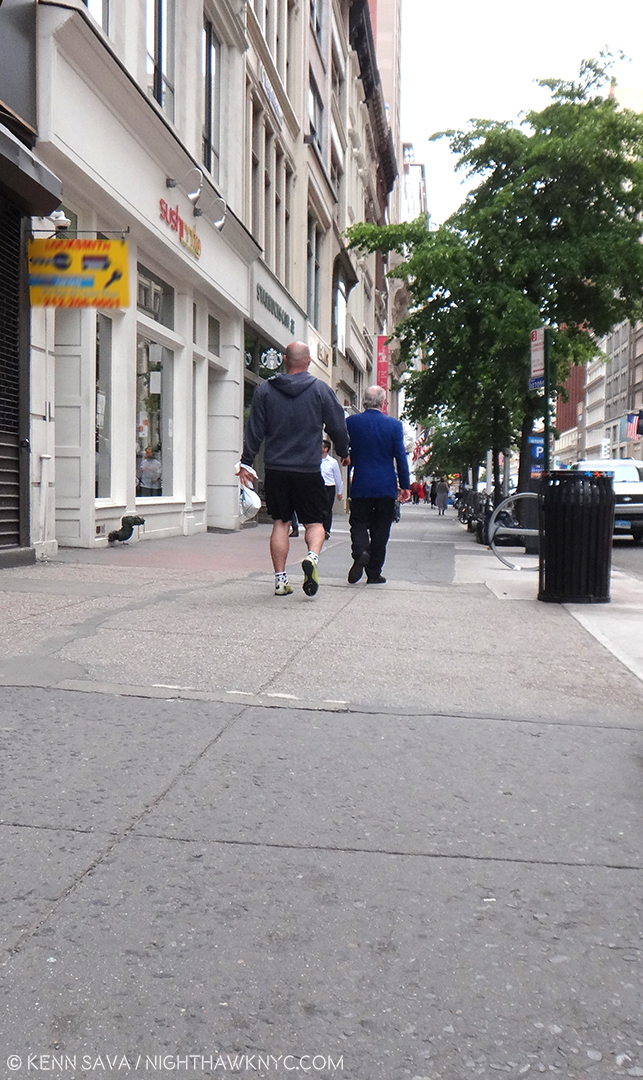
I prefer to think of Tim’s passing this way. Here, he (in the sharp Blue jacket) walks away, leaving me pondering our Rauschenberg conversation on May 28th, after he had seen the MoMA Rauschenberg Retrospective. I don’t know why I took this Photo. Something just told me to. I prefer to think he’s gone to his next meeting and we’ll talk again.

Tim taught me a lot, and in doing so gave me a tiny bit of the feeling of what “his kids” got from him. I’ll never forget his kindness and his supportive & encouraging words.

“Ask me how I’m doing
I’m blessed, yes
Living every moment, no regrets
Smile up on my face, I’m like, oh yes
I’m blessed, yes
I’m blessed, yes”*

“I’m Blessed,” too, Tim. I was Blessed to know you.

*-Soundtrack for this Post is “I’m Blessed,” by Charlie Wilson.

NighthawkNYC.com has been entirely self-funded & ad-free for over 7 years, during which over 275 full length pieces have been published! If you’ve found it worthwhile, PLEASE donate to allow me to continue below. Thank you, Kenn.

You can also support it by buying Art, Art & Photography books, and Music from my collection! Books may be found here. Music here and here.

Written & photographed by Kenn Sava for nighthawknyc.com unless otherwise credited. To send comments, thoughts, feedback or propositions click here. Click the white box on the upper right for the archives or to search them. Subscribe to be notified of new Posts below. Your information will be used for no other purpose.

  1. In fact, at the time, the apprentices paid for the priviledge of learning form the master, though they were often put to work helping him earn money.

Art In Manhattan, 2017- And Then There Were Five

It was a year of discovery. A year where I discovered some great Artists I previously hadn’t known, finally caught up with some I knew about but hadn’t gotten to see much of their work, and got lost exploring some remarkable Retrospectives- for Raymond Pettibon and Robert Rauschenberg, both accompanied by memorable satellite shows. Most of these are represented in my monthly NoteWorthy Show selections throughout the year. But? There was more! So, I’m going to take this moment to pause and look back at the revelations of 2017, look at some memorable shows I didn’t write about at the time, and finally, highlight a pair of men who, I feel, had an exceptional 2017 in Manhattan Art.

No doubt about it- the biggest discovery this year was a long overdue deep dive into the world of Contemporary Photography. From seeing well over 100 Photography shows, to spending five long days at “AIPAD: The Photography Show” (with well over 120 galleries from all over the world showing work), to going through hundreds of PhotoBooks, and meeting many Photographers, legendary, famous, or not quite yet, along with the staffs of two of the world’s leading Photography organizations- Aperture and Magnum, both celebrating major anniversaries this year. Rarely did a week pass when Photography wasn’t in the the picture. Of course, in a world were there are now more cameras than people it’s impossible to get to see everyone who’s doing great work. As happens each year, NO matter WHAT I do to prevent it, this year too, there were shows I didn’t find out about until they closed. UGGGH!!!! Along the way, there were quite a few revelations, and a good many other things solidified…at least for the moment.

First, the revelations. In Photography, particularly among those younger than 50 (I say 50 only because I seem to know/have heard of many of those over) and unknown to me, Gregory Halpern was the biggest revelation I had this year. His book “Zzyzx” won the prestigious Aperture Best Book Award for 2016, but I didn’t know that when I discovered his work at Aperture’s booth at AIPAD. I had never heard of him.

Gregory Halpern, “Untitled,” 2016, from his “Buffalo” series. Click any Photo for full size.

The work, “Untitled,” was a Photograph Aperture had run in the Spring, 2017 issues of it’s excellent quarterly magazine, in a pictorial by Mr. Halpern, titled “Buffalo.” I didn’t know that then, either. I simply saw the work, and then couldn’t get it out of my mind. It now hangs a few feet away. Out of everything I saw at AIPAD, particularly by those younger than 50 and unknown to me, this work grabbed me and didn’t let go. I went home that night with one thought on my mind- “WHO is Gregory Halpern?” After researching him most of the night, (including finding his incredibly honest and insightful answer to one very important question), serendipitously, I got to meet him the next day, and spoke to him about his book. It turned out to be a classic case where some things are better left unexamined. Gregory was so forthcoming in his answers about specific images I came too close for comfort to losing some of their mystery.

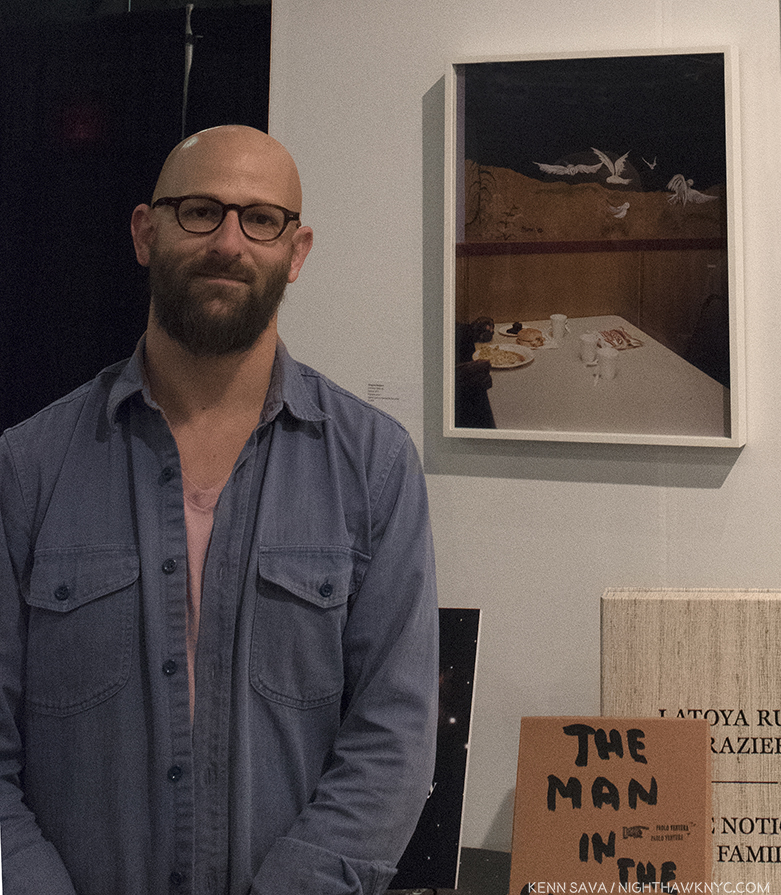
Gregory Halpern standing next “Untitled,” at Aperture’s Booth at AIPAD, March 31st.

In addition to being, in my eyes, one of the most talented Photographers of his generation, he is, also, one of it’s best writers. He’s the co-author of one of the most popular and respected Photography Manuals of 2017, “The Photographer’s Playbook,” and his occasionally published articles always enlighten and leave me wanting more. A Harvard grad, he’s now a professor in the College of Imaging Arts and Sciences at Rochester Institute of Technology for some very lucky students. As if all of that isn’t enough, his wife, Ahndraya Parlato is, also, one of the revelations of the year as a Photographer. Her Photographs “glow”- in one way or another. Her most recent book, “A Spectacle and Nothing Strange,” is ethereal…mesmerizing…magical.

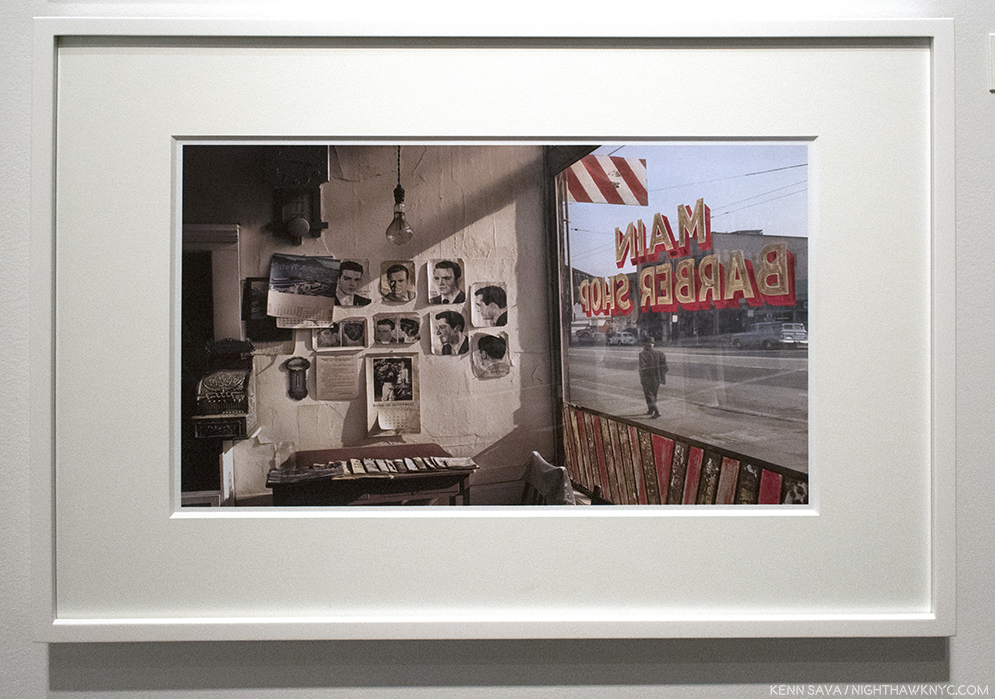
Leaving aside age or era, the work of Fred Herzog was, also, unknown to me. Early pioneers of color Photography have taken decades coming to the attention they deserve, such was the disdain color held among the Photographic cognoscenti for color Photography. With the publication of “Fred Herzog: Modern Color,” in February, 2017, an Artist who was fairly well-known, and appreciated, in his native Canada finally began becoming wider known in the USA. His work was memorably shown by Equinox Gallery of Vancouver at AIPAD this spring, where, I felt, it stood out.

Fred Herzog, “Main Barber,” 1968, seen at Equinox Gallery’s AIPAD booth.

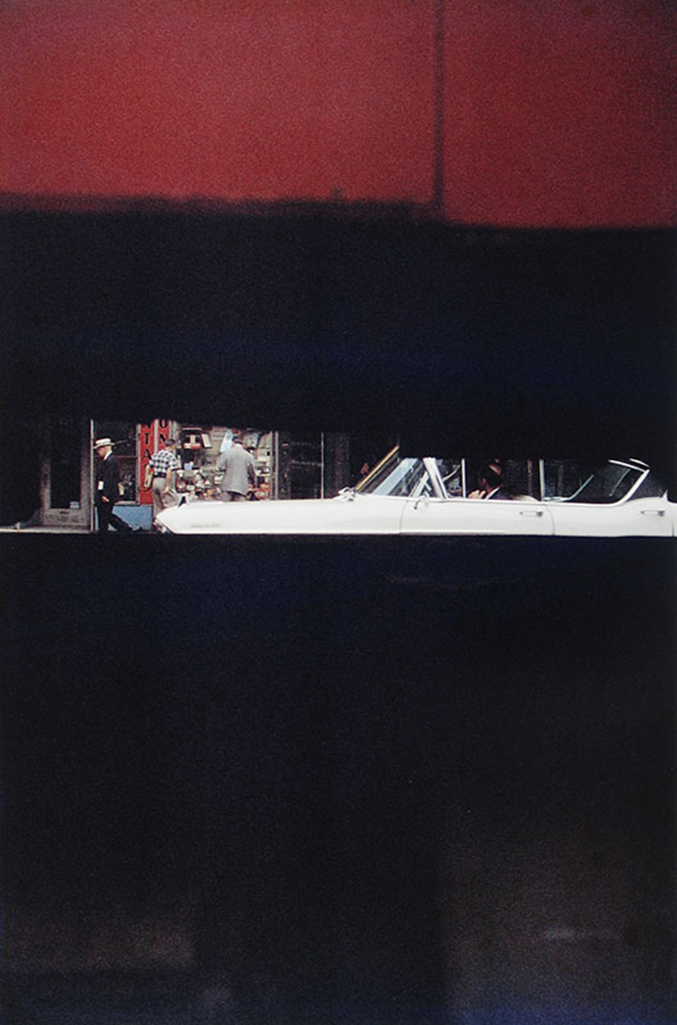
Fred Herzog considers Saul Leiter THE master of early color Photography, and even with a giant like William Eggleston to consider (who’s 1976 MoMA show, “Photographs by William Eggleston,” which can be “visited” here, is widely credited with making color Photography “acceptable” in the world of “Fine Art”), it’s hard to argue with him. No Photographer new to me, regardless of age or period, had a bigger impact on me this year than Saul Leiter.

Saul Leiter, “Through Boards,” Circa 1957. This image appears (cropped) on the cover of the now classic book, “Saul Leiter: Early Color,” 2006, which launched the “Saul Leiter Renaissance.” It’s, perhaps, my very favorite Photobook. Sadly, now out of print, it would take real diligence to find a very good copy for less than $100. But, there are many worse uses of time. Photo by the Saul Leiter Foundation.

It took until 2006 for Saul Leiter to be recognized- FIFTY EIGHT years after he started taking color photographs. As with William Eggleston, Mr. Leiter was, also, a devoted Painter. I can see it in both of their work, and I believe it’s part of the reason their work speaks to me, perhaps, more than the work of any other Photographer of any period. It was his friend, no less than the great Artist Richard Pousette-Dart (who’s also an under appreciated Photographer), to encouraged him to pursue Photography.

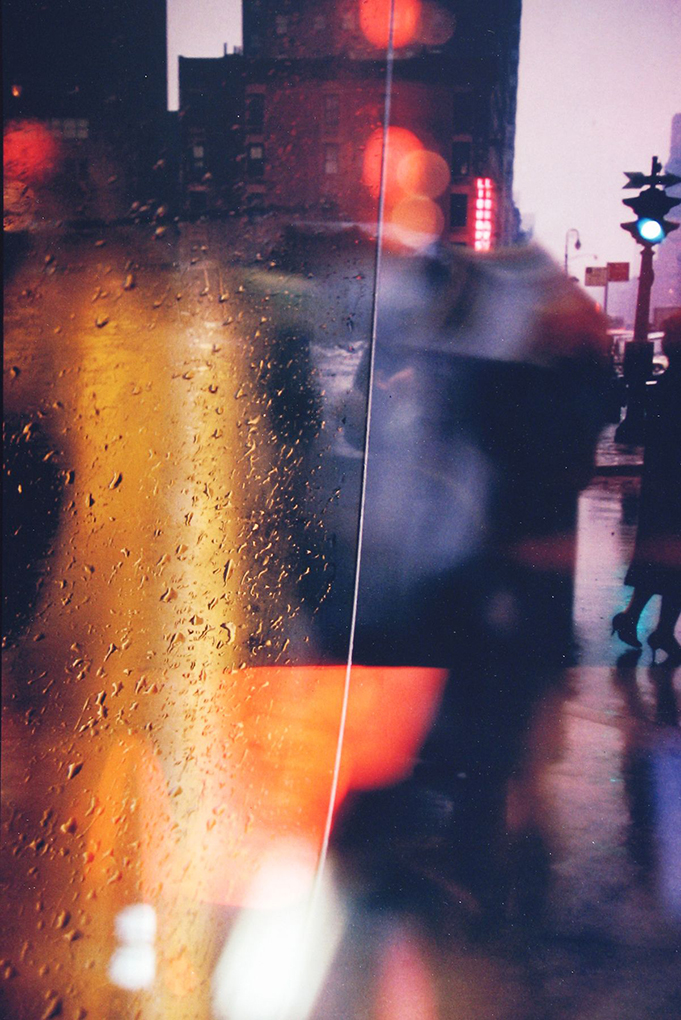
“Walk with Soames,” 1958, This was 20 YEARS before William Eggleston’s ground breaking MoMA show “legitimized” color Photography in the Art world! Photo by Howard Greenberg Gallery.

Mr. Leiter saw and used color in his Photography in ways no one else has, achieving effects that today’s finest digital manipulators can only dream of. Saul Leiter didn’t need Photoshop to get his results. As very good as his Black & White work is, like Turner or Van Gogh, Saul Leiter was a true Poet of color, perhaps the greatest Master of Color in Photography, though it’s, of course, impossible and pointless to qualitatively compare.

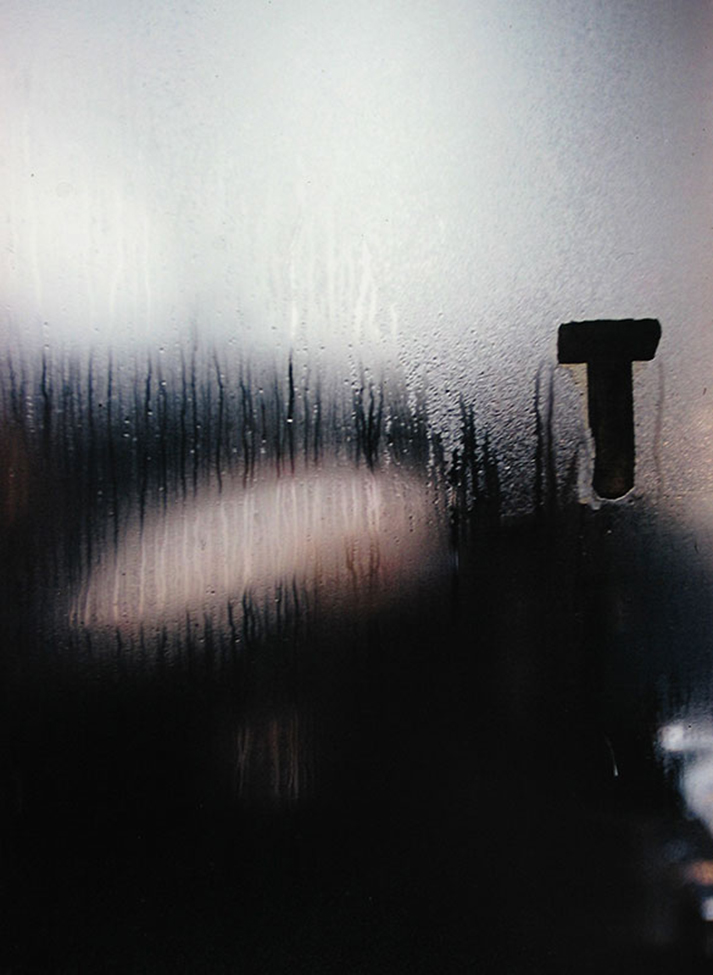
“T,” Circa 1950(!).Photo by the Saul Leiter Foundation. Daring. Gorgeous.

A number of established Photographers had terrific shows in NYC in 2017 that I didn’t get to write about here. Among them are Mark Steinmetz, Mike Mandel, Raghubir Singh (though marked by controversy), Richard Avedon, Herman Leonard, Michael Kenna, and Edward Burtynsky. But, I’m going to address one I simply can’t let pass, because I continue to think about it.

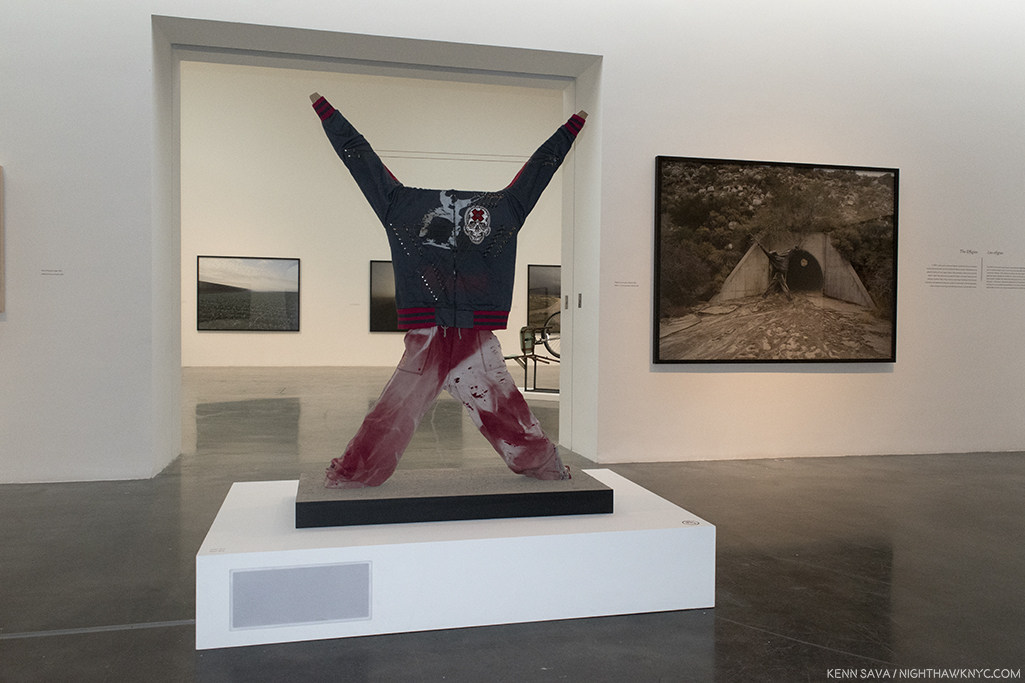
Richard Misrach’s Photo, “Effigy #3, near Jacumba, California,” 2009, Pigment print mounted to Dibond, right rear, with Guillermo Galindo’s Musical Instrumet/Sculpure “Effigy,” 2014, center2014. Barely visible are two strings between the forearms. The grey rectangle on the lower left side of the pedestal is where a speaker is mounted.

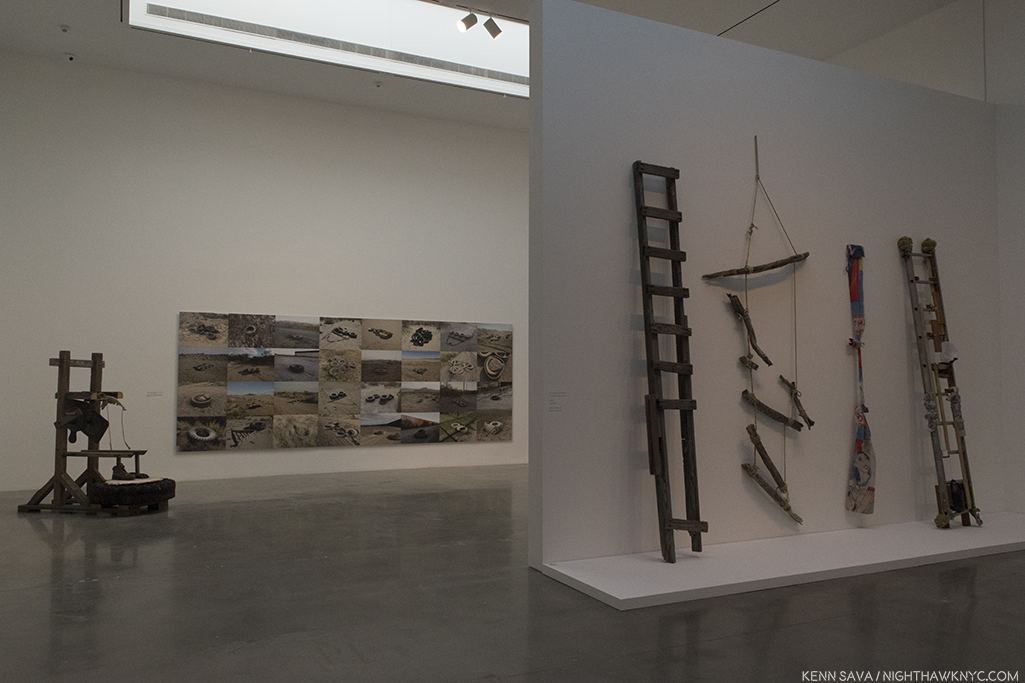
“Richard Misrach: Border Cantos,” (at Pace, 510 West 25th Street), was an utterly remarkable and serendipitous collaboration between renowned Photographer Richard Misrach & Composer/Sculptor Guillermo Galindo on the subject of our southern border, those protecting it, and those trying to cross it. To accompany Mr. Misrach’s large, atmospheric Photographs, Mr. Galindo created a whole orchestra of Musical Instruments out of objects found along the border, and proceeded to compose and record a 4 hour score that was looped in the show’s back room to meditative effect, ingeniously installed so that the music being played was coming from speakers mounted inside the display of the specific instruments that were playing at any given moment. (The Artists have an excellent website for this show where you can, also, hear these remarkable instruments.)

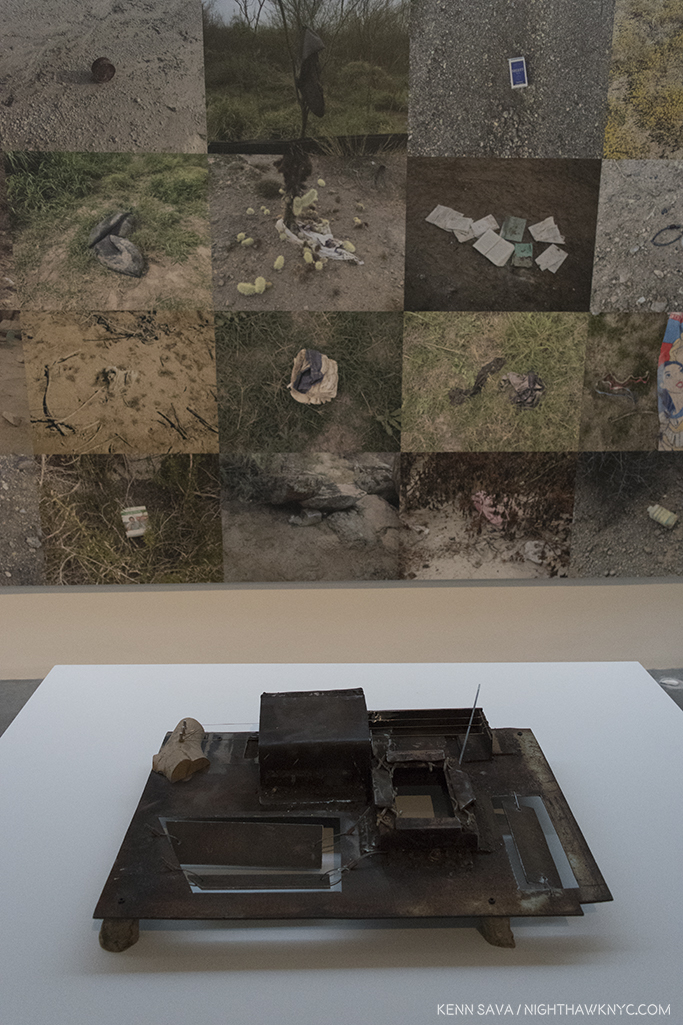
Instruments, like this. Guillermo Galindo, “Tortillafono/Wall Vibraphone,” 2014, Metal. The discarded metal cap of an electrical box from the failed SBInet (Secure Border Initiative) surveillance program was turned into a mallet and string instrument sits in front of Richard Misrach’s “Artifacts fround from California to Texas between 2013 and 2015,” 2013-5, 86 x 57 inches, Pigment prints mounted to Dibond. Photos of items found along the border.

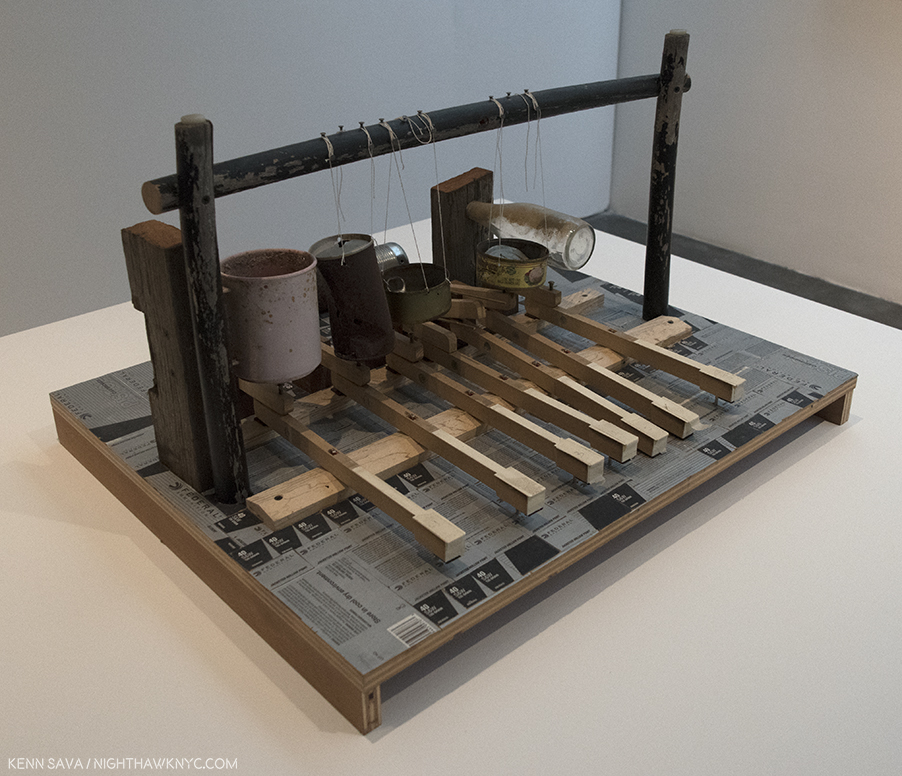
And this- Guillermo Galindo, “Teclata,” His description- “On this keyboard, empty cans, bottles, and a plastic cup act as piano strings. The surface of the instrument is decorated with Border Patrol ammunition boxes.”

The surround sound effect was like sitting in the middle of a small chamber music group. The instruments, themselves, were beautiful as sculpture, and the music, which sounded to me like a cross between Harry Partch (who, also, made his own instruments) and John Cage, on instruments that looked like Rauschenbergs, had me asking if it had been released on CD. Why not?

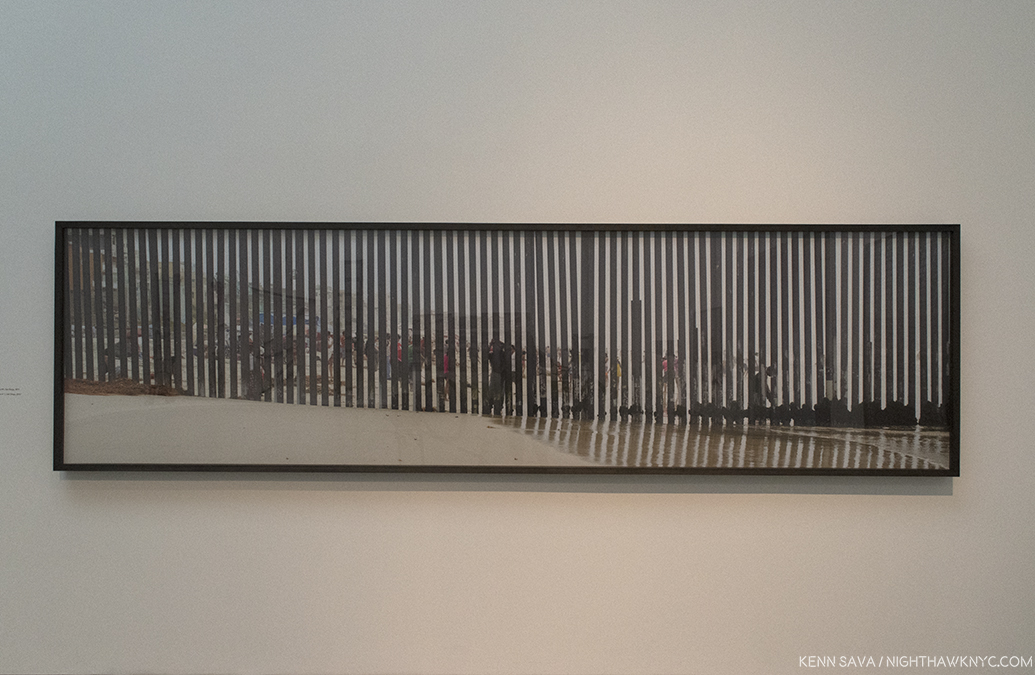
Richard Misrach, “Playas de Tijuana #1, San Diego,” 2013, Pigment print mounted to Dibond, 42 x 160 inches.

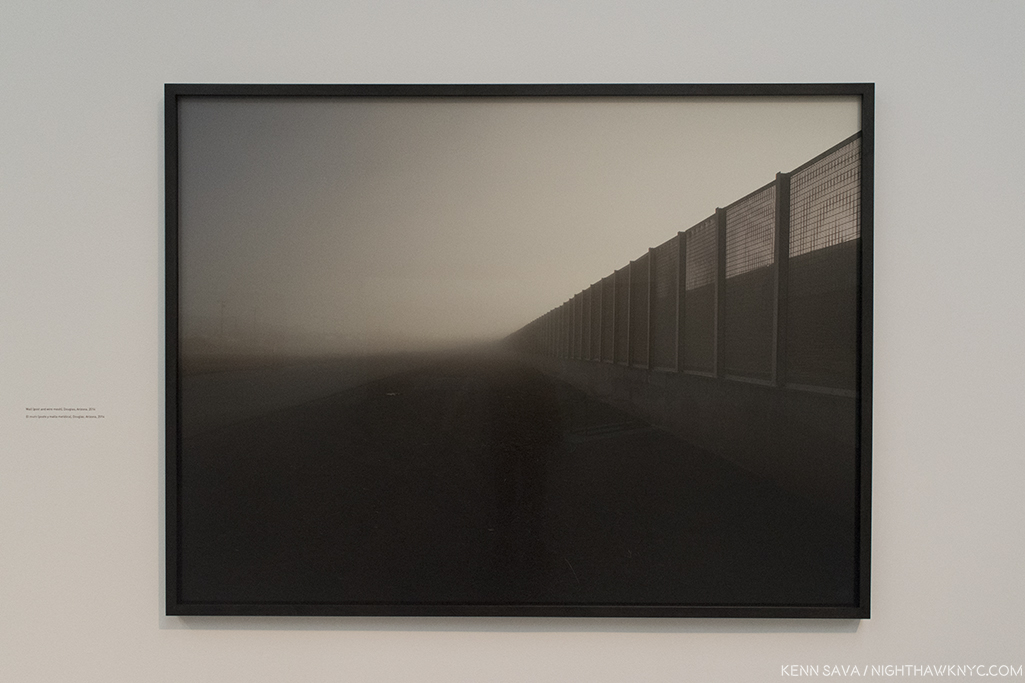
Mr. Misrach, who has spent forty years working in the American Desert on his renown “Desert Cantos” project, showed a remarkable selection of images taken since 2004, but more intensely since 2009 (the collaboration with Mr. Galindo dates back to 2012), that told the story in slices. The effect of the music, the images and the sculptures (musical and non) was hypnotic, and ultimately meditative on the situation, the people protecting the border, and the refugees, while at the same time, even for those directly untouched by this story, the show spoke to a larger sense of walls, borders and refugees, and resilience. The Artists found, or created, beauty in this situation, reflecting the very perseverance that is at the essence of survival.

Richard Misrach, “Wall, east of Nogales, Arizona,” 2014, 68 x 84 inches, Pigment print mounted to Dibond

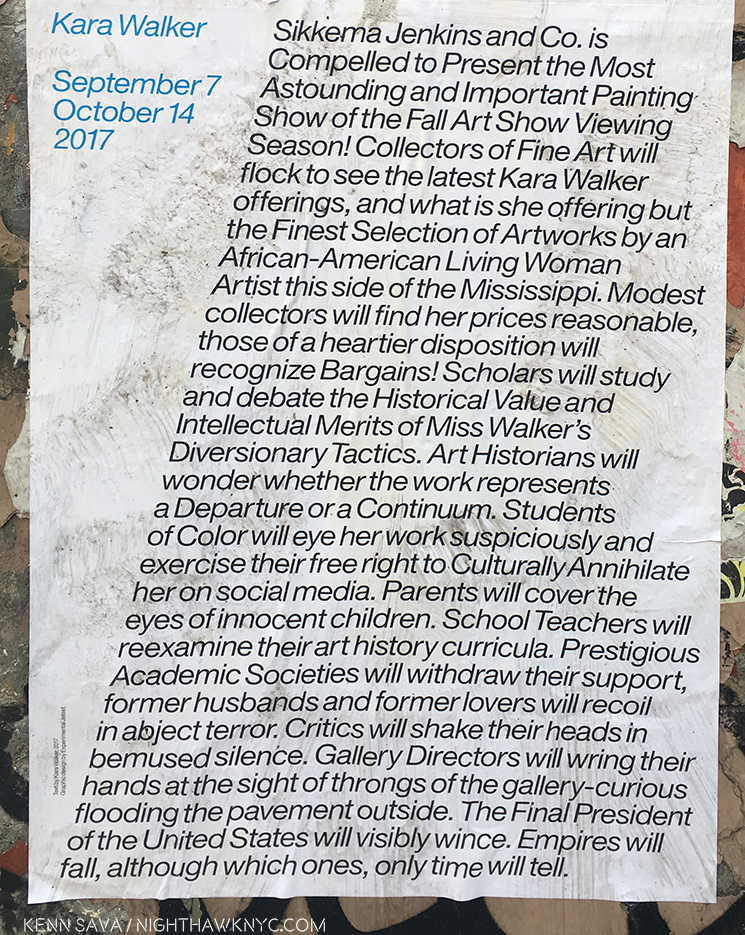
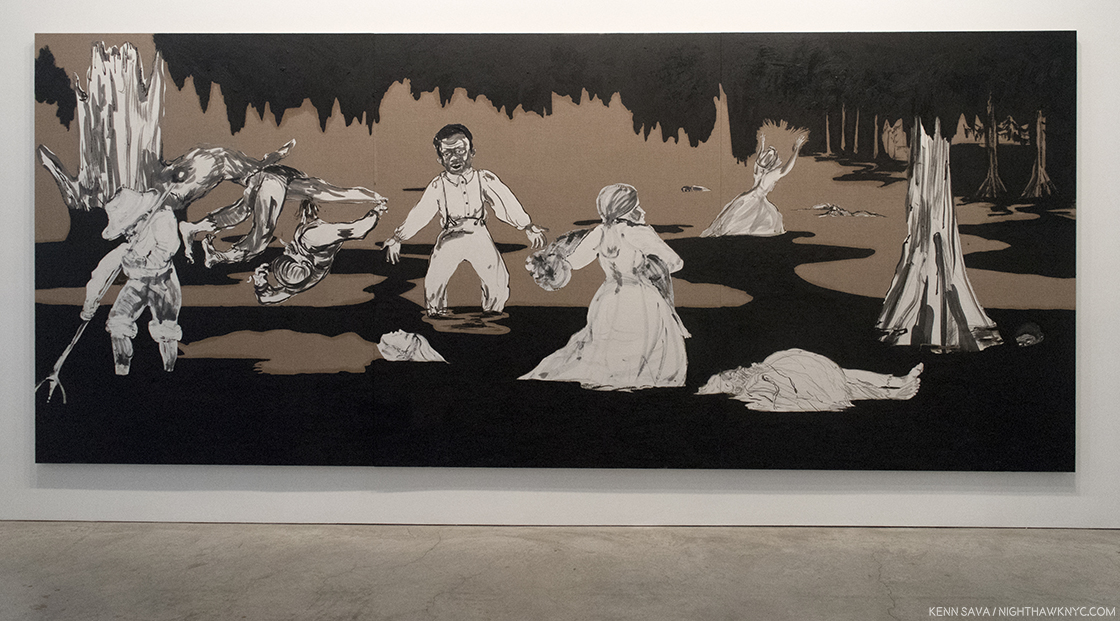
On the Painting & Drawing front, the most important Painting/Drawing gallery show I haven’t addressed was Kara Walker (at Sikkema Jenkins and Co.). Before it opened the buildup was downright intense. First, these posters began appearing, which certainly raised eyebrows until you notice (along the lower left side) that the text was written by the Artist. The show was also featured in a cover article in one of the last print issues of the Village Voice. I can’t remember the last time an Art show made the Voice’s cover, but this was the last time one did.

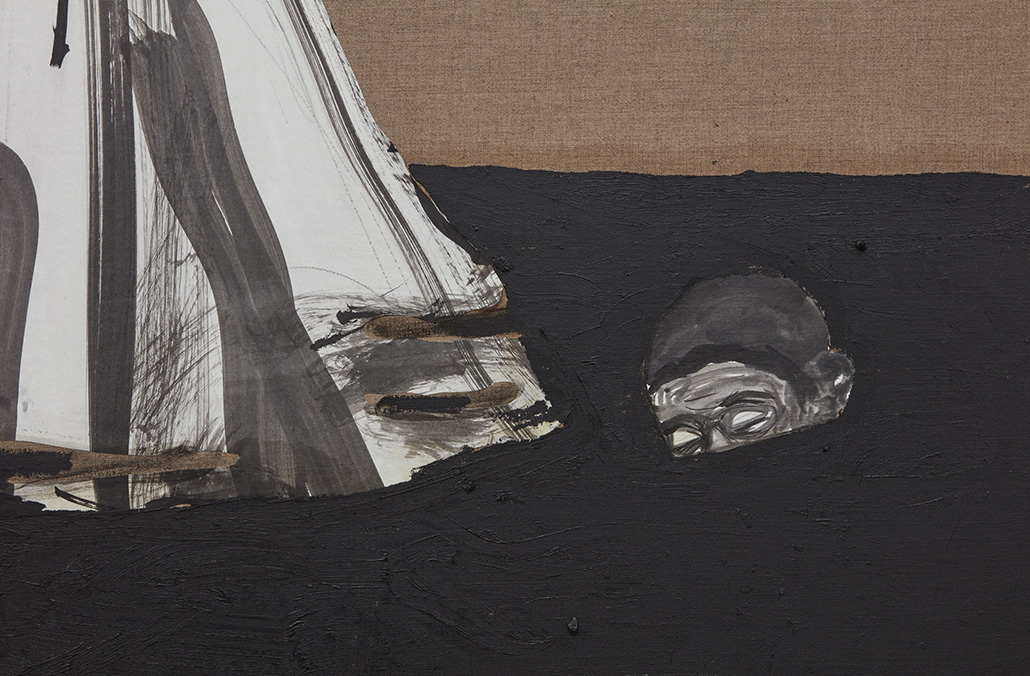
 Kara Walker sounds a bit weary in the poster, and particularly in the “Artist’s Statement” that appears on the show’s page on the Sikkema website.

“Dredging the Quagmire (Bottomless Pit),” 2017 Oil stick and Sumi ink on paper collaged on linen, 18 feet long, seen in the show’s first room. A “bottomless quagmire” is what the history of and current state of race and gender relations does feel like at this moment in time.

In the lower right side, this almost submerged head seemed to echo Ms. Walker’s weariness in her Artist’s Statement. “But frankly I am tired, tired of standing up, being counted, tired of ‘having a voice’ or worse ‘being a role model.'”

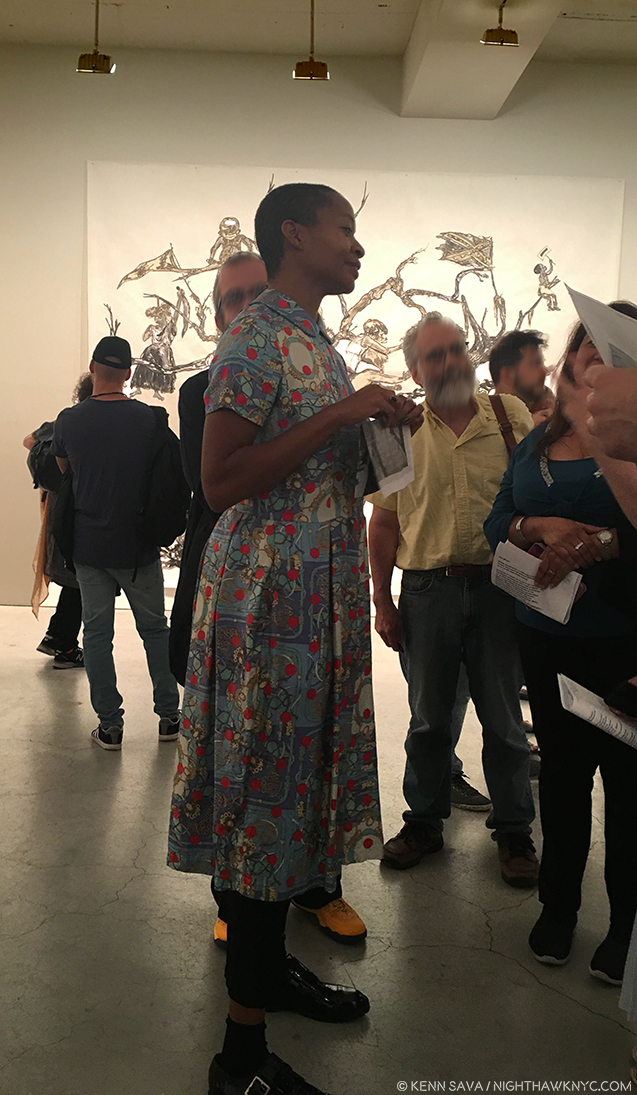
After all the anticipation and buildup, at the packed opening, Ms. Walker, herself, was only to be seen for a little while, at least while I was there.

Kara Walker at the opening, September 7, 2017, with part of  “U.S.A. Idioms,” 2017, Sumi ink and collage on paper, almost 15 by 12 feet, in the background.

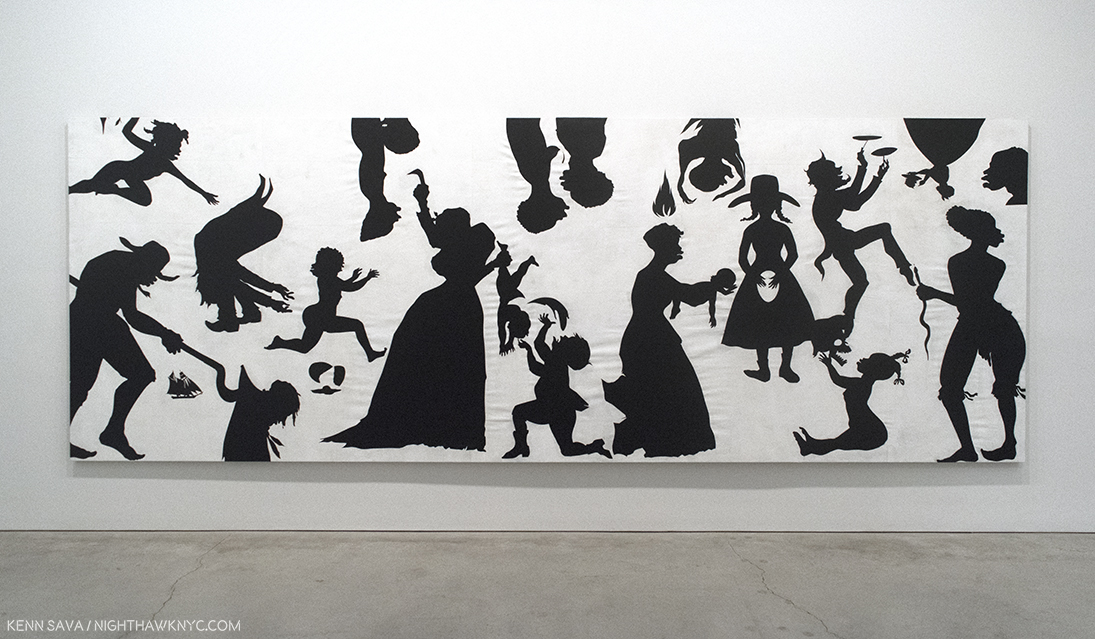
While she continues to create her signature Silhouettes, showing a gorgeous 2017 work titled “Slaughter of the Innocents (They Might be Guilty of Something),” that’s almost 18 1/2 feet long, the bulk of the show consists on her ink and collage works, that have increasingly come to the forefront of her shows as time has gone on, most recently in her Cleveland Museum show, “The Ecstasy of St. Kara,” 2016, and at MoMA’s “Unfinished Conversations: New Work from the Collection,” which closed on July 30, 2017, where her “40 Acres of Mules,” a Charcoal Drawing on 3 sheets totaling almost 18 feet long that was acquired by the Museum the year before, was on view in what was something of a one-work preview for her Sikkema show.

“Slaughter of the Innocents (They Might be Guilty of Something),” 2017, Cut paper on canvas. For me, one thing Ms. Walker’s Silhouettes all seem to ask is “Why do you see, what you see?”

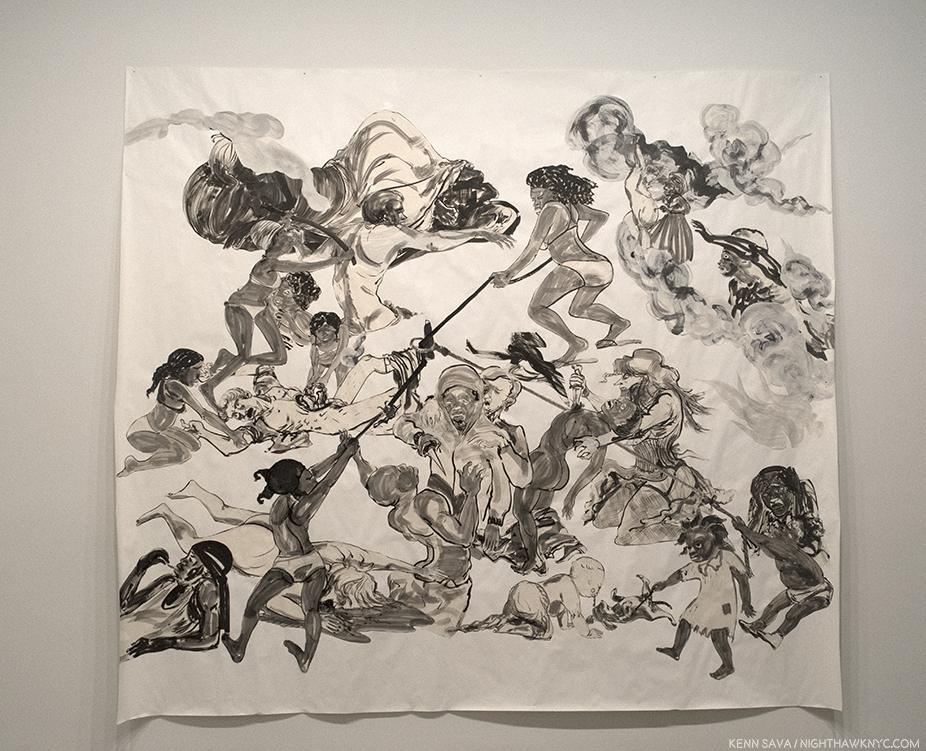
Whereas it’s hard for me to imagine the care, patience and deliberation it must take for Ms. Walker to create one of her silhouettes, her Drawing & Collages look like they are done in bursts of raw energy and passion. At times the images approach the quality of a caricature of an event. No matter the differences in creation, when you see her Silhouettes and Drawings side by side they’re unmistakably by the same Artist.

While the Silhouettes, mostly, seem to leave quite a bit to the imagination, including the race of each character, her Drawings & Collages do not, especially when it comes to violence. Nothing is held back, hinted at or hidden. In the Drawings and collages, she has taken away the curtain inherent in Silhouettes in depicting racism and gender crimes. We see the faces, skin color, eyes, and what each one is involved in doing.  You can choose to look away, but otherwise, it’s pretty hard to “miss” what’s going on. The results are shocking, though they have precedent going back to Goya’s “Los Caprichos,” and “The Disasters of War,” and Daumier through Warhol, as well as in the work of Photojournalists and “Conflict Photographers” from all over the world. In Kara Walker’s work, though, the time is centered between 1788, when slavery was legalized in the US, through post Civil War “Reconstruction.”  Where the Silhouettes present a shadow of the figure, and the actions, the Drawings shine direct light. In fact, there are almost no shadows in her drawings- there’s no where for the perpetrators to hide.

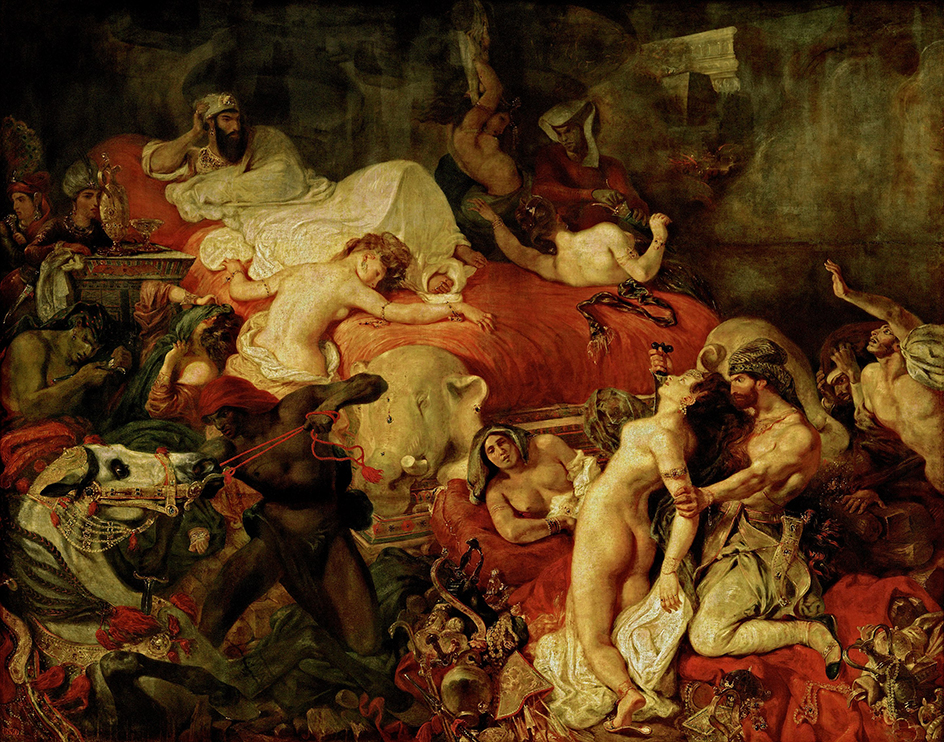
“The Pool Party of Sardanapalus (after Delacroix, Kienholz,” 2017, Sumi ink and collage on paper, Almost 12 feet long.

Eugene Delacroix, “The Death of Sardanapalus,” 1844, Oil on canvas, Louvre, Paris. Kara Walker is, also, an astute student of Art History. In her work, Sardanapalus lies horizontally near the upper left corner, apparently, taking no interest in the orgy of death going on, as he does, lying arm on elbow on a huge red bed in Delacroix’. Her Ed Kienholz reference is a bit harder to track down, but it might be this one.

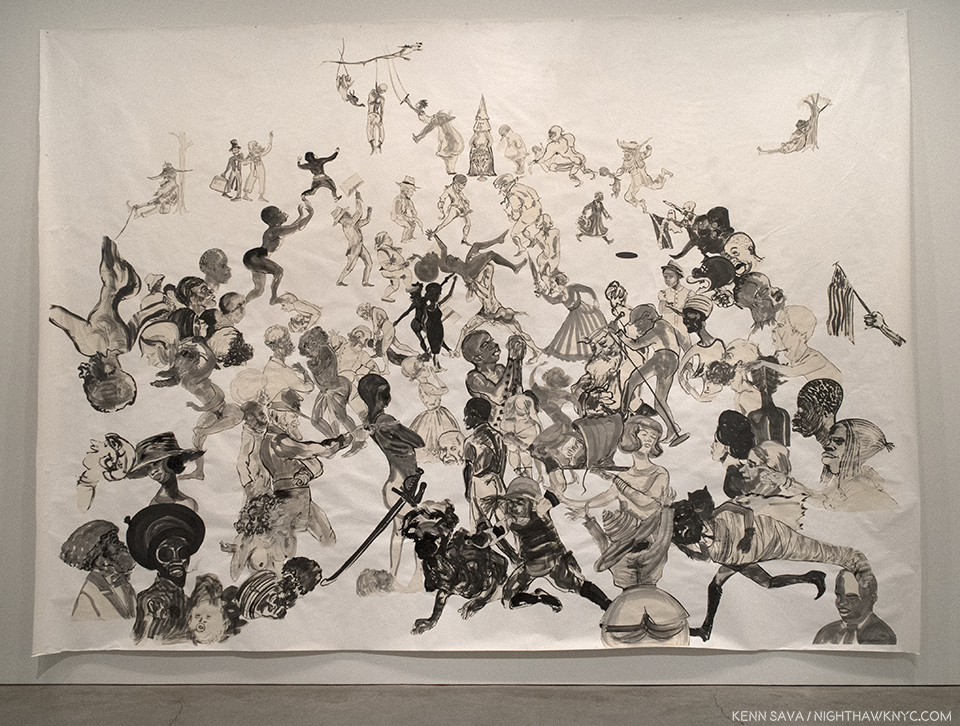
In “Christ’s Entry into Journalism,” 2017, the ground is, also, gone. The figures hang in the space of the paper, though some sense of perspective remains- as you get closer to the top of the sheet, they get smaller.

“Christ’s Entry into Journalism,” 2017, Sumi ink and collage on paper, 140 x 196 inches.

In this work, Ms. Walker’s figures cut across time, with some appearing to be contemporary. To the right of center, a figure “rocks the mic.” In the lower center is a figure that appears to be a modern riot trooper, in a helmet with face shield and body armor. He appears to have clubs in each hand. Right next to his left hand is what appears to be a black head, in a hoodie, on a platter, being carried by a woman, who looks away, while others nearby watch, some with shock on their face, some pointing to the scene. Just behind them, an extended arm holds and American flag, while above them a figure gives a Nazi salute with one hand while holding a Rebel flag with the other. Up top, a lynched figure hangs from a tree branch while women on either side of him perform acrobatics, with Klansmen standing next to them. In front of that naked black women are attacked by a group of men, while, again, others see what is going on. In the center of the work, the decapitated hoodied head looks straight across at a Civil War soldier pointing a gun at him, across time. Is this 1863? Or 2016?

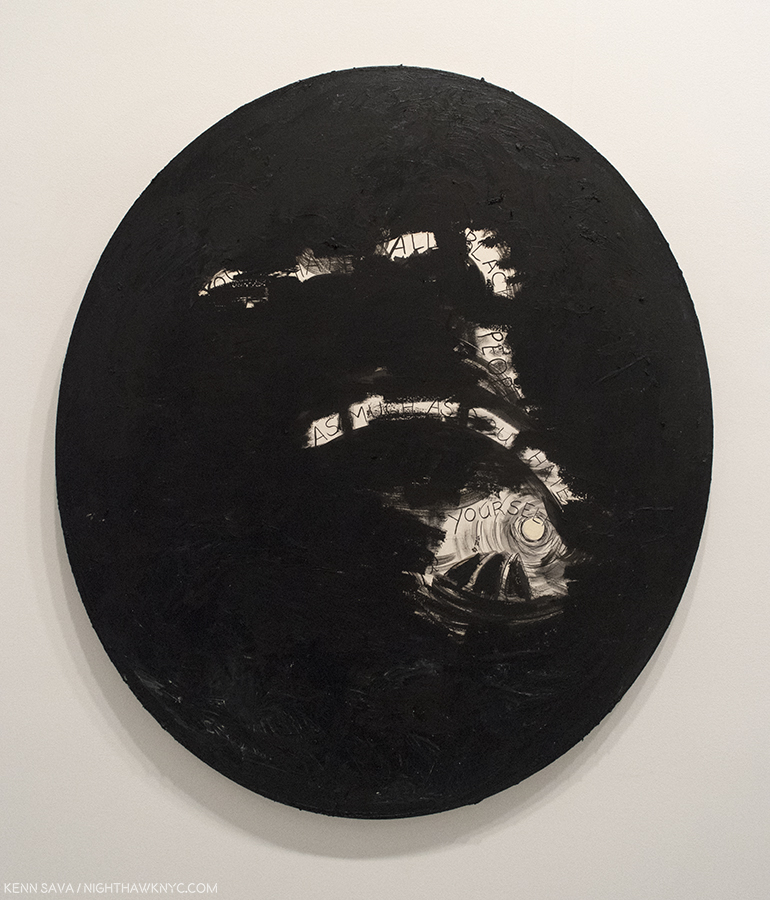
“Storm Ryder (You Must Hate Black People as Much as You Hate Yourself),” 2017, Oil stick and Sumi ink on paper collaged on linen.

The primacy of Drawing in her work was reinforced with the recent release of one of Ms Walker’s Sketchbooks from 1999, when the Artist was 29, as a book appropriately titled, “MCMXCIX.” It contains Drawings that, in style and subject, visitors to the Sikkema show will immediatley recognize. Interestingly, as Raymond Pettibon does in his shows (the latest concluding on June 24th, shortly before Ms. Walker’s opened), she prefers her larger works be tacked to the walls.

“Future Looks Bright,” 2017, Oil stick and Sumi ink on paper collaged on linen.

Kara Walker may be growing tired of being a “role model,” of being “a featured member of my racial group and/or my gender niche,” (as she says in her Artist’s Statement referenced above). Of course, I can’t imagine being Kara Walker, but I can understand that it gets to be “too much.” I’m not sure, however, what her other choice is. I mean, I’m sure she COULD do something else if she REALLY wanted to. After seeing all the work and passion she put into this show? I guess I’m just not convinced that she really DOES want to do something else. Yet.

Finally…Looking back on 2017… Last year I wrote that I felt Sheena Wagstaff had the best year in NYC Art. She’s had a very good 2017, too. But, this year, I think that The New Museum’s Massimiliano Gioni & Gary Carrion-Murayari. had special years, highlighted by the truly exemplary, and revolutionary, “Raymond Pettibon: A Pen of All Work” retrospective, which they then remounted simultaneously in Maastricht and Moscow. I feel it was “revolutionary” because totaling an unheard of 800 works, including brand new works created by the Artist for this show (some on the very walls of the New Museum), they gave an exhaustive look at Pettibon’s career, yet the show never slowed, never failed to keep and even raise interest. It even included work Pettibon did as a small child that he has now ammended in his own, unique style. Word has recently come that Gary Carrion-Murayari, who kindly answered my questions on the Pettibon Moscow show he co-curated, has also been named as a co-curator for the New Museum’s 2018 Triennial, so he could be ready to have another “big” year. Stay tuned!

The end result is that Massimiliano Gioni, Gary Carrion-Murayari, and the New Museum have served to put the “Big Four”1 Manhattan Museums on notice that, on their 40th anniversary, we are going to have to get used to saying the “Big Five.”

———————————–
A Special “Thank You!” to all the Artists who gave me their time and shared their thoughts with me in 2017, and to David White & Gina Guy of the Robert Rauschenberg Foundation and Gary Carrion-Murayari and Paul Jackson of the New Museum.
“Thank you!” to the Hattan Group and Kitty for research assistance, and to The Strand Bookstore for being open until 10:30pm seven nights a week. R.I.P. Owner, Fred Bass this week.

*- Soundtrack for this Post is “Heroic Elegy, Op. 36,” (1918), by Ernest Farrar, in honor of the 100th Anniversary of WW1, which was featured in another memorable show, “World War 1 & The Visual Arts” at The Met this year, as a way of honoring it, and all the Artists, and Musicians, lost during it. Shortly after “Heroic Elegy’s” premiere, Second Lieutenant Farrar was ordered to the Western Front. Two days after he arrived there, he was killed at the Battle of Epehy. He was 33. I first heard it while I was driving in Florida on September 11, 2002. The classical station there played it in honor of the first anniversary of 9/11. So taken with it was I that I pulled over and listened to it with my eyes closed, then immediately set about researching it’s composer. Though he wrote other fine works, “Heroic Elegy,” is special. It’s lightning in an 8 minute bottle. As beautiful as it is, there’s a quality, a confidence, in it that seems to promise so much more to come that he, tragically, never got the chance to give us, like the other Artists & Musicians lost far too early in this most senseless of wars.

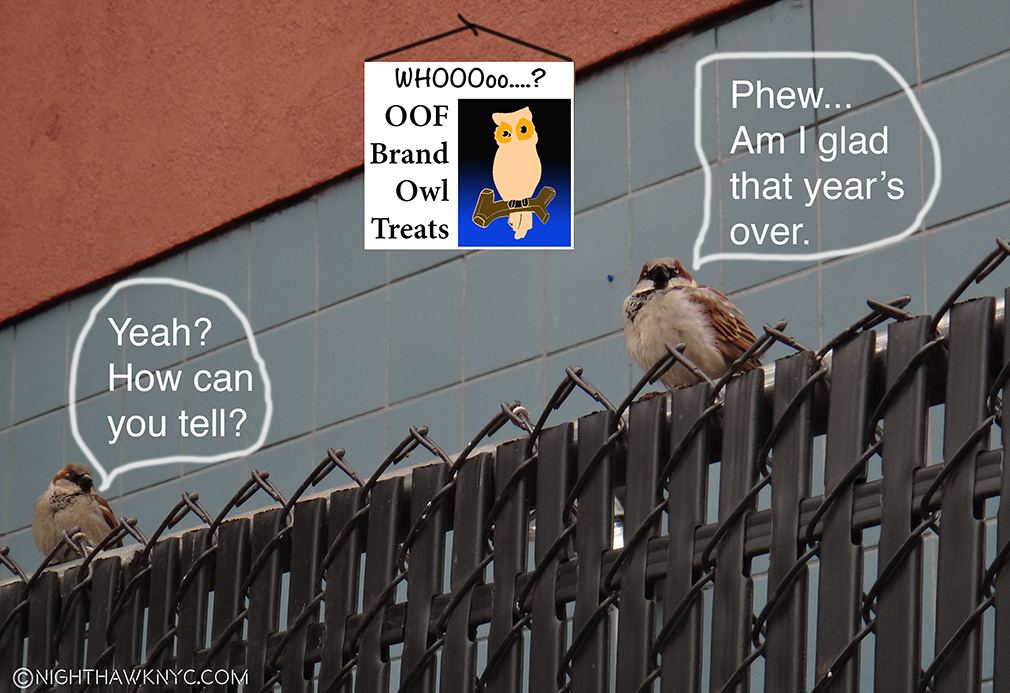
On The Fence, #17, The Good Riddance” Edition.

NighthawkNYC.com has been entirely self-funded & ad-free for over 7 years, during which over 275 full length pieces have been published! If you’ve found it worthwhile, PLEASE donate to allow me to continue below. Thank you, Kenn.

You can also support it by buying Art, Art & Photography books, and Music from my collection! Books may be found here. Music here and here.

Written & photographed by Kenn Sava for nighthawknyc.com unless otherwise credited. To send comments, thoughts, feedback or propositions click here. Click the white box on the upper right for the archives or to search them. Subscribe to be notified of new Posts below. Your information will be used for no other purpose.

  1. With all due respect to The Frick Collection, who the powers that be that came up with “the Big Four” left out.

Ellen Harvey’s Global Beautification Project

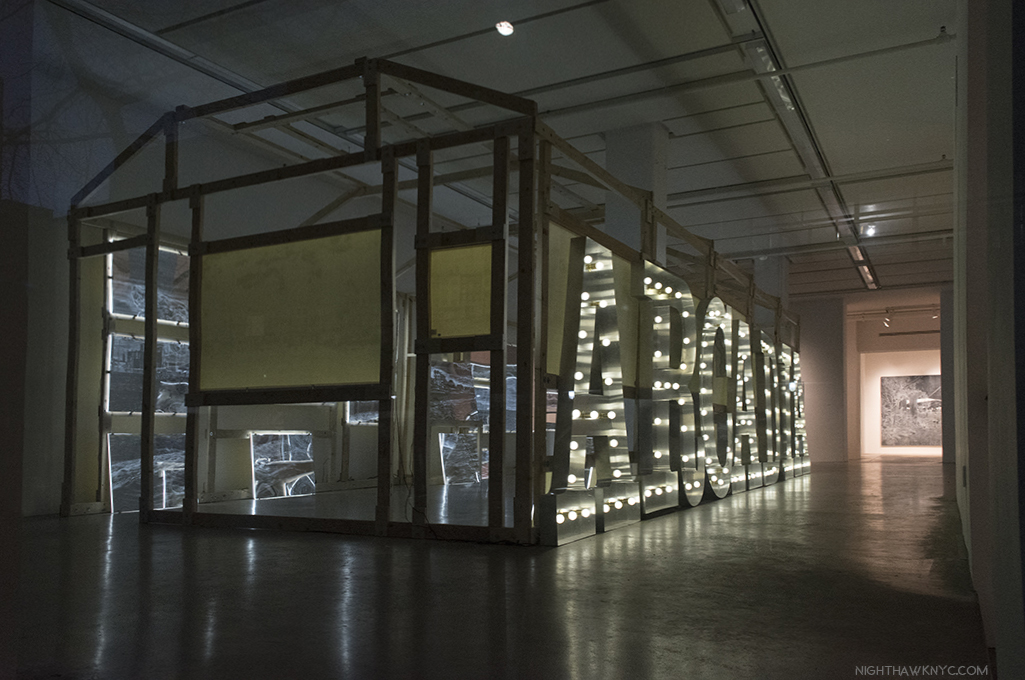
A few weeks back, I walked across West 22nd Street after visiting Gary Hume’s show, “Mum” at Matthew Marks, lost in the whirlwind of emotions, past and present, it elicited, barely cognizant of the traffic, weather, or time. Luckily, Thanksgiving week in NYC tends to be on the quiet side. As I crossed the street, bright lights, like those seen in a carnival, beckoned from inside the front window of Danese/Corey Gallery. Reaching the sidewalk, I could see the lights made a sign that was attached to the frame of a wooden shack. They read “ARCADIA.”

The view from the sidewalk outside Danese/Corey. Click any Photo for full size.

Hmmm…”Arcadia.” A word that evokes simple pleasures. In need of some cheer, I stepped inside. While I can’t say I found “cheer,” I found Art.

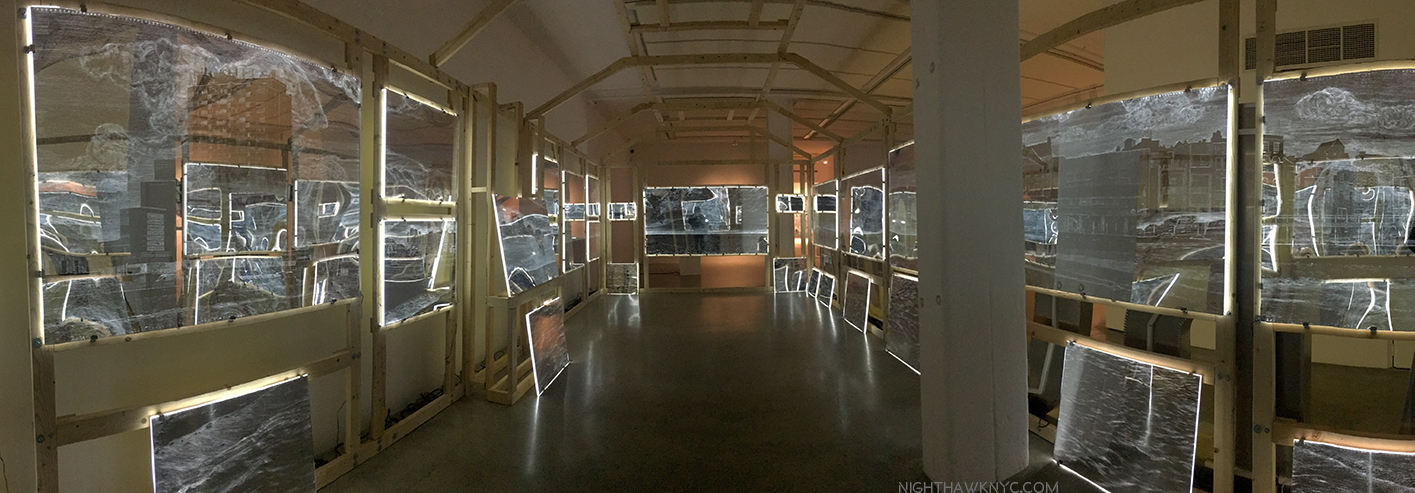
Installation view from inside the “shack.” An extraordinarily imaginative vision, stunningly well realized.

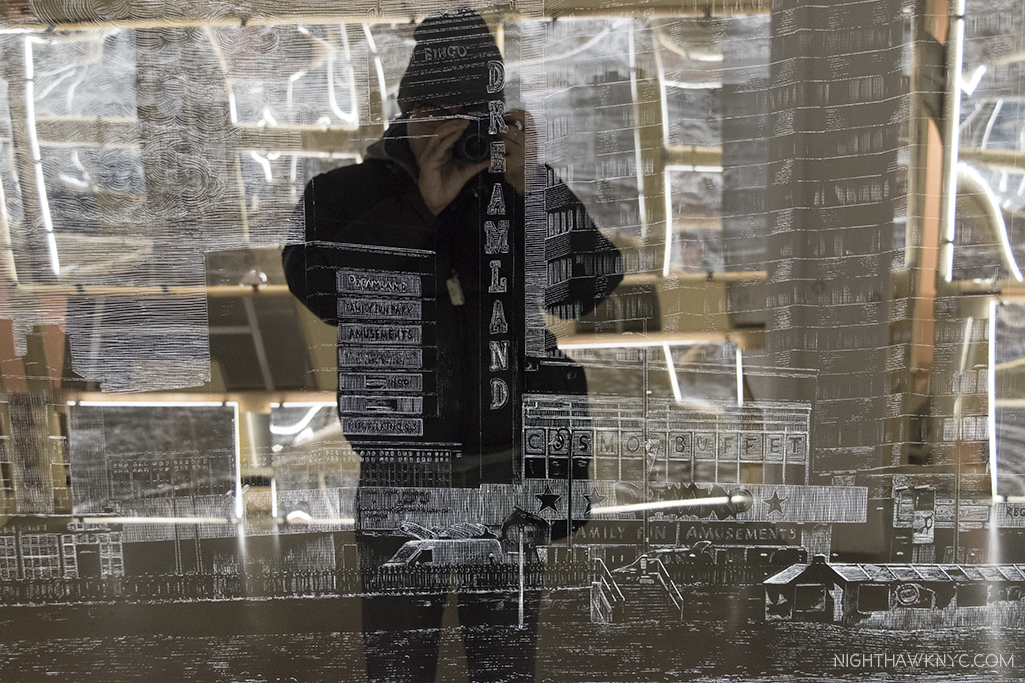
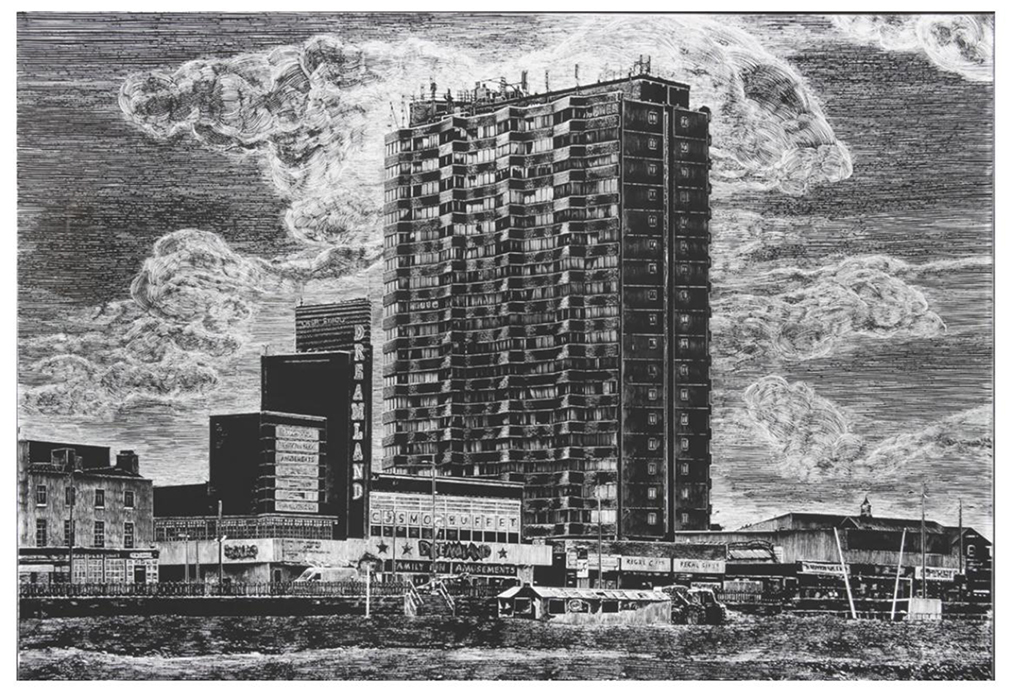
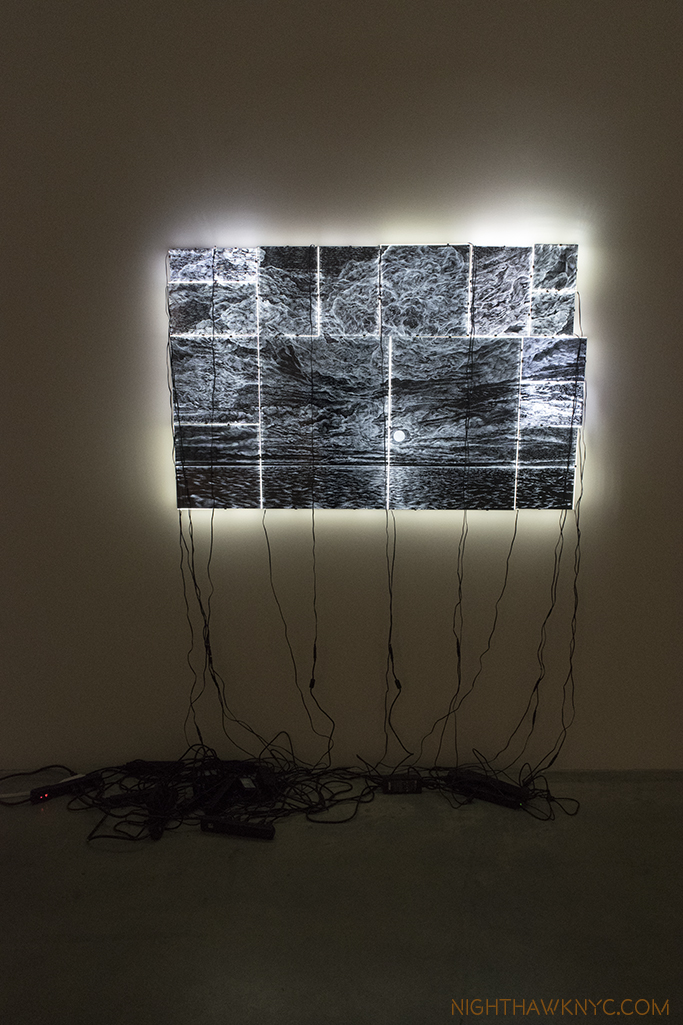
The show was “Ellen Harvey: Nostalgia.” Inside the wooden framed shack, the carnival-like atmosphere of the sign outside quickly faded into darkness, pierced with lines of white light. Looking closer, the lines turned out to be etched on mirrors lit from the back. The light they emitted was reflected back by more back lit mirrors on the opposite side of the shack, as was the viewer, which made the design they held frustratingly hard to see. It was like “seeing” through a haze, a bit like walking around Times Square (I hear). Taken by the beauty I knew was there, I wandered around the space, enthralled and puzzled. Scenes of buildings, waves, and sky lined both sides culminating in a large panel showing the moon over the sea. Making my way to the gallery’s desk, I found that the work, titled “Arcade/Arcadia,” 2011, contains 34 hand engraved mirrors mounted on light boxes to form a 360 degree panorama of the town of Margate, England as seen from the beach. Hmmm…

Intentionally hard to see the amazing engraving on the mirrors.

Then same mirror, without anything in front of it. From the show’s catalog.

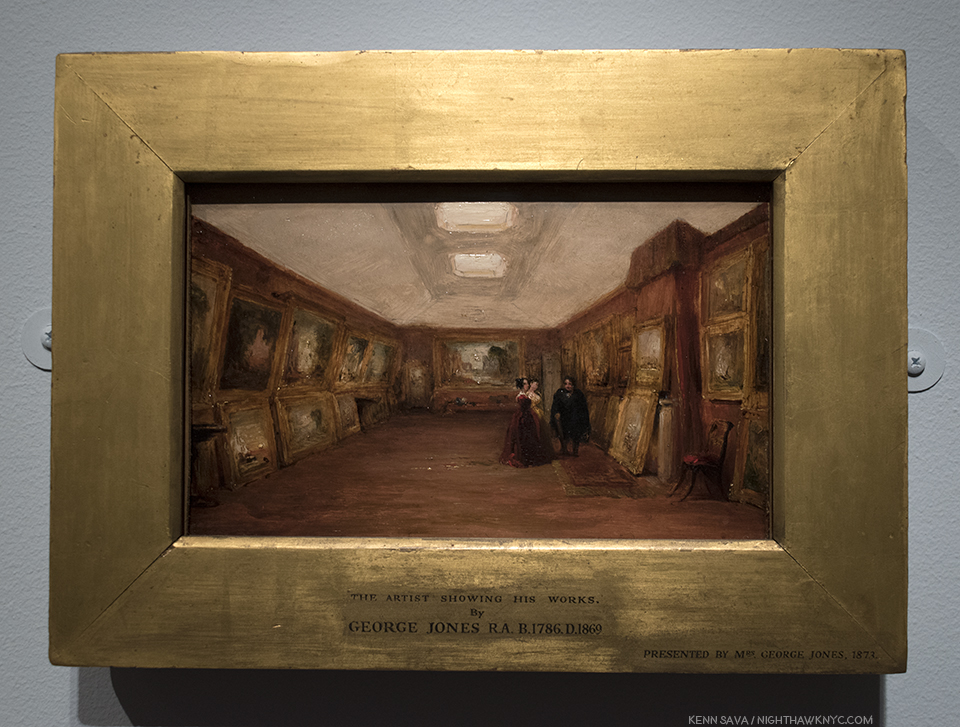
Unable to get the work out of my mind while I was looking at other shows, I went back to Danese/Corey later and bought the monograph, “ Ellen Harvey: The Museum of Failure1,” which has the backstory and images of the mirrors without reflections, (which, while defeating the point of the installation, allows appreciation of her amazing technique). I learned that the project was commissioned by the Turner Contemporary Gallery in Margate, England for it’s opening in 2011. The shed is a remimagining of JMW Turner’s London gallery (in 3/4 size) and the mirrors are arranged in the way Turner displayed his work- “salon” style, as seen in George Jones  “Interior of Turner’s Gallery: the Artist showing his Works,” 1852. Along with another Painting George Jones did of it after Turner died, they are the only records we have of what JMW Turner’s gallery looked like.

George Jones “Interior of Turner’s Gallery: the Artist showing his works,” 1952, Oil on canvas, Ashmolean Museum.

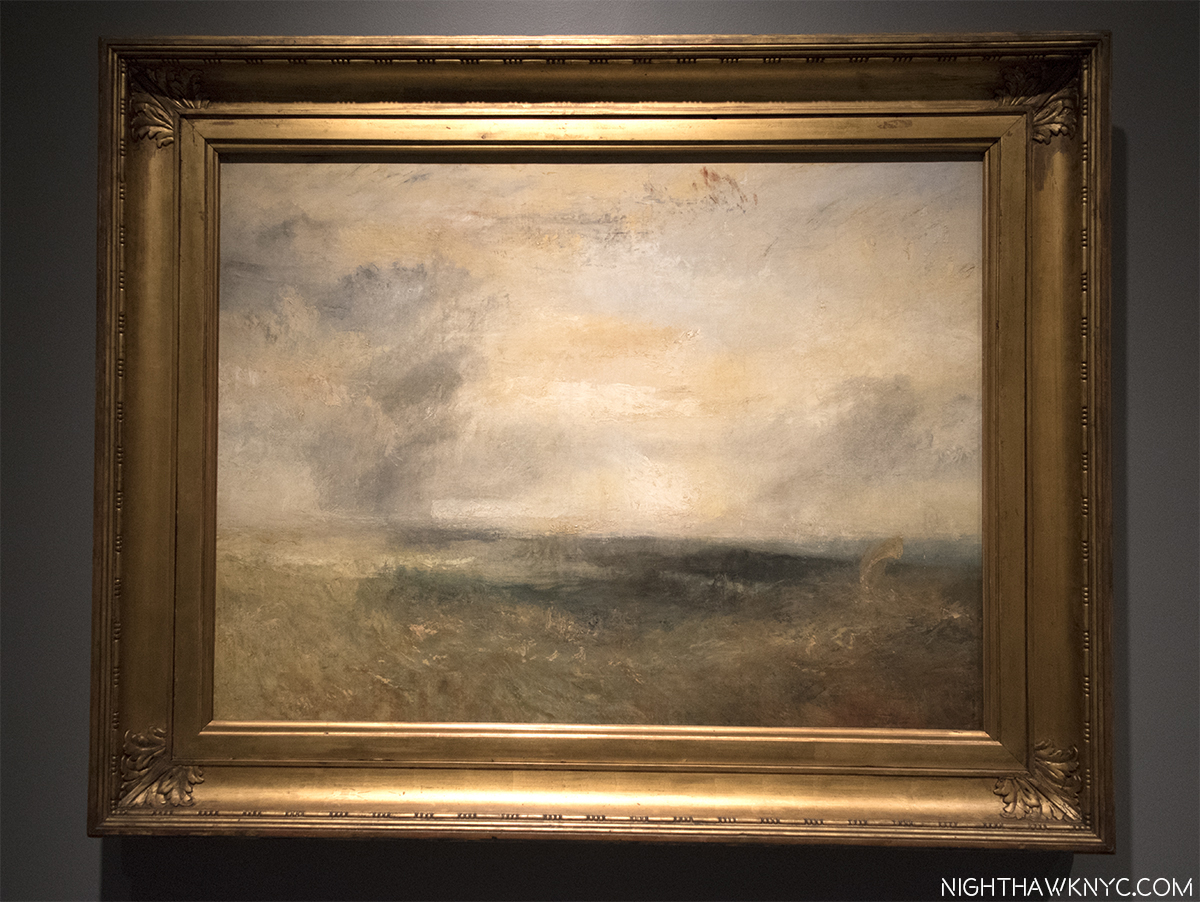
Turner loved Margate and lauded it’s natural beauty. So inspired, he is believed to have created around 100 Paintings of it, possibly including this one, given that he began using Margate as a second home around 1830.

JMW Turner, “Margate(?), Seen From the Sea,” c.1835-40, on loan from the National Gallery, London and seen in The Met Breuer’s “Unfinished” show in 2016, which I wrote about, here. Possibly one, of hundreds, of works he did depicting Margate.

In addition to finding inspiration, he, infamously, “shacked up” with his landlady there. The town eventually became a tourist mecca which led to it’s (over?) commercialization. When it fell on hard times, the amusement park, called “Dreamland,” (who’s sign Ms. Harvey pays homage to in her “Arcadia” sign, using the same font), closed and became a blight on the natural beauty which led so many to want to come there in the first place. In the piece, Ellen Harvey depicts a more recent view of Margate as seen from the beach, in apparent complete desolation.

The work is like an onion in it’s many layers. There’s the Turner layer, the Margate/nature layer, the Dreamland/commercialization layer, the mirror layer (with it’s funhouse effect, seen earlier), and the layer of light being distorted, which could be a reference to the light that Turner loved, and what’s become of it, with the addition of so many electric lights and buildings blocking sunlight. There’s, also, the layer of the styles of the two Artists, Ellen Harvey and JMW Turner, in dialogue. With the large shadow of no less than Turner looming, this is, certainly, a daring undertaking. Ms. Harvey’s mirrors contain many passages of sky and sea, crescendoing in the large center rear panel, that can’t help but remind today’s viewer of the English Master, though in decidedly her own style. Though “Dreamland” has recently reopened, the metaphor, and the warning, in the work is powerful, and both specific and universal. Experiencing it was a highlight among all the Art I’ve seen in 2017.

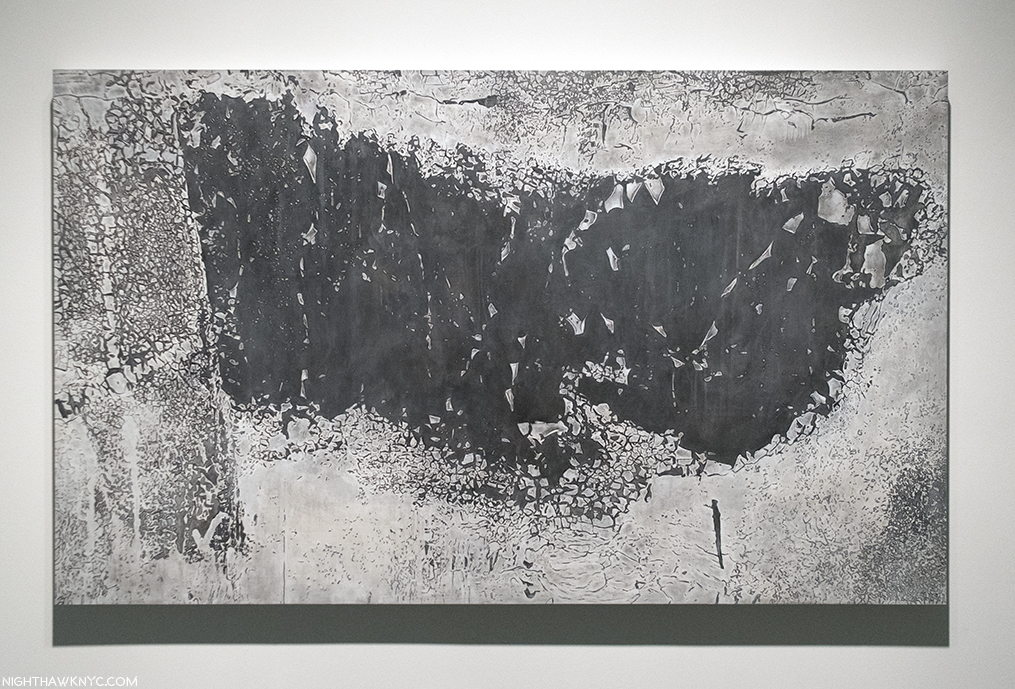
The rest of the show impressed me just as much. Adjacent to “Arcade/Arcadia,” was a Painting that depicted what looked to be a rough surface that seemed like it should be in relief, but was, in fact, flat. Hmmm…Is this the same Artist who just gave us all those meticulously engraved lines on those 34 mirrors2? It was closer in style to the Photographs of Aaron Siskind than the style I’d just seen. When I saw the title, I got it. “Crack/Craquelure.” Craquelure is a term referring to the cracking patterns seen in many old Paintings. “Nostalgia,” in another sense.

‘Crack/Craquelure,” 2017, Oil on wood panel.

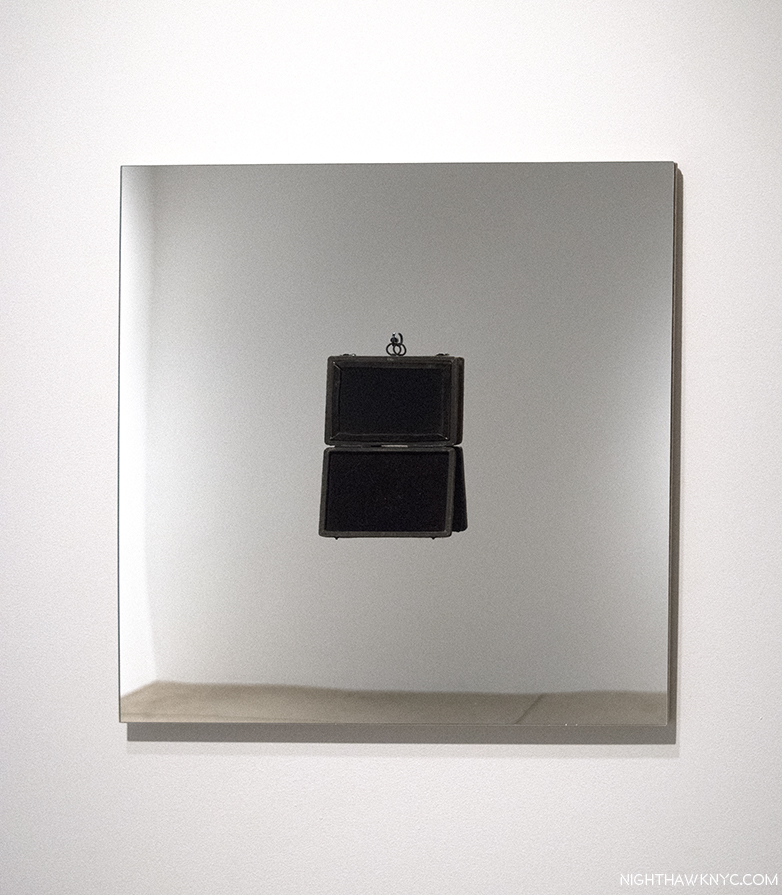
There are other instances of “nostalgia” for the craft of Art in the show, like “Picture(esque),” 2017, Antique “Claude Glass,” float glass mirror, hook and plywood. A “Claude Glass,” (or “Black Mirror”) is an 18th & 19th century device, which Ms. Harvey is fond of.

“Picture(sque),” 2017. The “Black Mirror” was, also used for magic, particularly for seeing the future. Ellen Harvey’s work often contains images of ruins & destruction…images of a dark future.

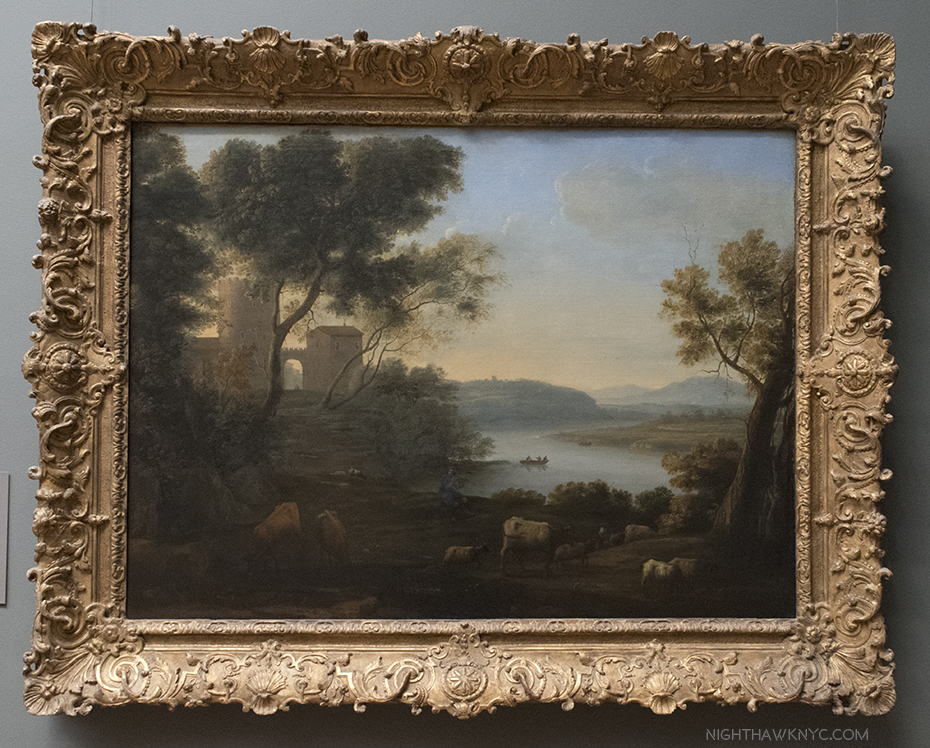
They have been used by landscape Artists aiming for that special quality achieved by the great landscape Painter, Claude Lorrain (c.1604-1682), who it’s named after.

Claude Lorrain, “Pastoral Landscape: The Roman Campagna,” 1639, seen at The Met. A classic example of the much admired, and copied, “dark” landscape, which inspired the “Claude Glass.”

Beyond the other themes present in this diverse show, there is the theme of mirrors. Since Robert Rauschenberg, I can’t think of another Artist who uses mirrors as frequently to such wonderful effect. Hand-engraved, without engraving, or with “Black Glass,” above. I asked the Artist about her use of mirrors, and specifically when it started. She replied, “I’ve always loved mirrors — but the first mirror piece I really made was in 2005 for the Pennsylvania Academy — aptly titled “Mirror” because I wanted to show the space and comment on their collection of paintings…and then I got hooked. Before that, I was all about Polaroids.” She’s referring to her monumental installation where she reinvisioned the entrance hall of the landmarked Furness and Hewitt Pennsylvania Academy of Fine Art Building, Philadelphia, as a ruin, using video and four 9 by 12 foot hand-engraved mirrors. Ruins are part of the “dark future” Ellen Harvey believes we are destined for. Rogier van der Weyden’s “The Last Judgement” was the first painting she fell in love with. “That red-hot sword is coming for us all,” she said3, referring to what looms above Christ’s left hand. If it’s coming, I hope it gets here before I have to file my “new” taxes.

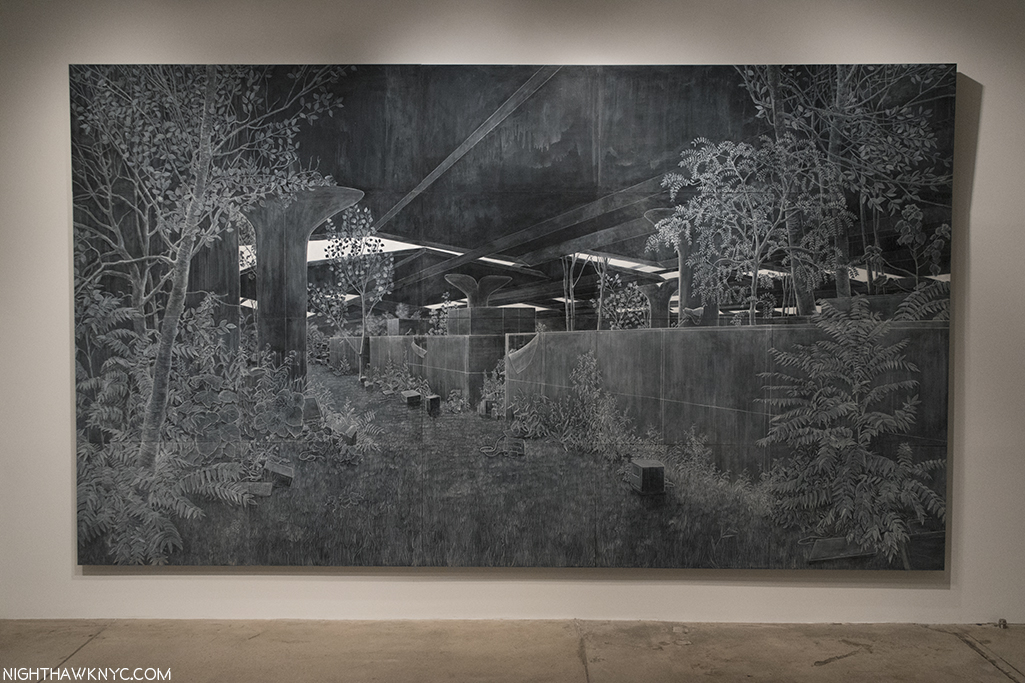
Further on, “Nostalgia” takes on more of a traditional meaning in “Ghost of Penn Station,” 2017, Oil on wood panel, where we see the tragically lost Architectural masterpiece, rendered in oil, as if seen through a haze or in a dream. Whereas Ms. Harvey has created a number of works showing existing buildings (even creating an “Alien’s Guide to the (future) Ruins of Washington DC“) in ruins, this is a rare case where a building that was ruined is shown before, in all it’s glory. In the rear gallery, “New Forest (The I.R.S. Office Reforested),” 2013, Gesso, oil, acrylic, and varnish on wood,  about 13 1/2 feet long, shows a part of the I.R.S. offices (speaking of taxes) in a deserted state with the area in the process of being reclaimed by nature. Interestingly, the I.R.S. bought a sister work on the same subject, titled “Reforestation,” that, also, depicts their new offices in ruins, being reclaimed by nature, rendered in mirrors which, now installed, reflect those very offices! Fact is stranger than Art. When I asked Ms. Harvey about this, she replied to the effect that they have a, surprisingly, good sense of humor.

“New Forest (The I.R.S. Office Reforested),” 2013, Black gesso, oil, acrylic, varnish on 20 wooden panels. Overall- 13 1/3 feet long by 7 3/4 feet high. There is a social/political/economic conscience, or awareness that runs through Ellen Harvey’s work that I find most tastefully handled.

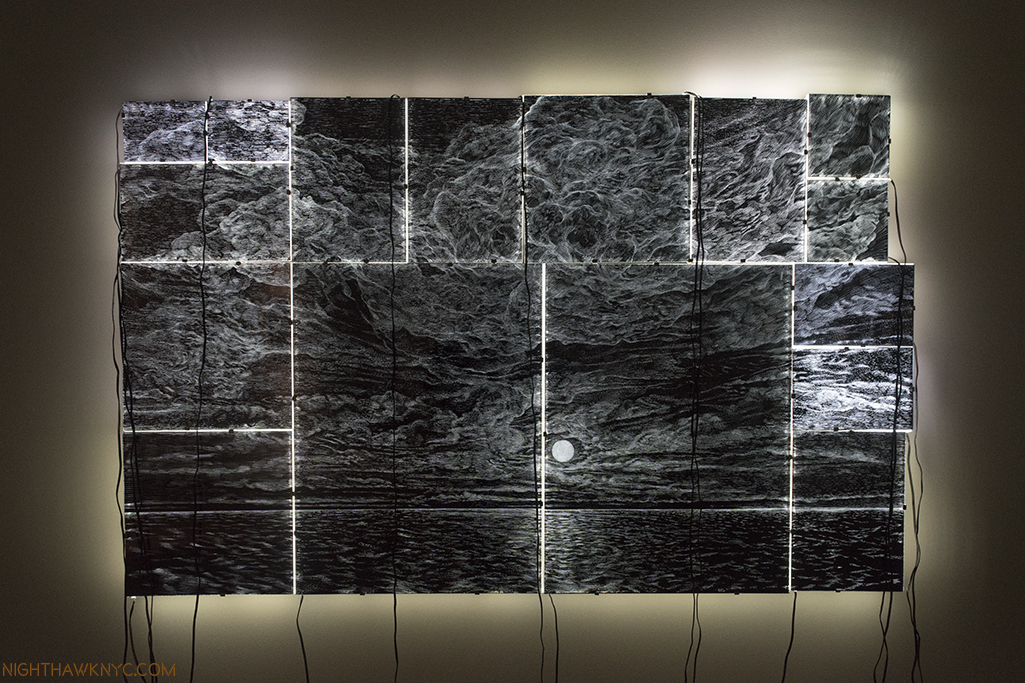
Finally, there is another, spectacular, engraved mirror work, the fascinating “On the Impossibility of Capturing a Sunset,” 2017, 16 Hand-engraved plexiglass mirrors, 16 Lumisheets, plywood. Ms. Harvey lets the wires for the light boxes dangle down in front…Yes. In front of the work,  another way of adding an obstacle to the “pure” appreciation of her image. They fall to a jumble of power strips on the floor, where they look as intricate as the engraving above them. Perhaps they’re a metaphor for the huge effort it took to get this close to the “impossible” task she refers to. (In earlier engraved mirror works (like “Destroyed Landscape (Cloudy Moon),” 2012, she scratched over the finished engraving, graffiti-like, making it almost impossible to see the underlying composition.)

“On the Impossibility of Capturing a Sunset,” 2017, 16 Hand-engraved plexiglass mirrors, 16 Lumisheets, plywood.

Close-up.

As I considered “Nostalgia,” over multiple visits, this work became something of a touchstone for me as I learned (and still learn) about her work. In it, her gorgeous technical achievement becomes subservient (in a way) to her “larger point.” Across her career, it seems to me that that “larger point” is her vision. About this, she said-

“What is it that all these viewers might want in this situation? That’s really where all of this work comes from. It comes from my desire to take particular situations, either physical or social, and say, ‘What is it that people want from Art in this situation?  What can Art do here?’ And of course the answers are often completely ridiculous. When you think about it what people dream of, it’s like falling in love with someone, it’s all projection. It’s a sort of mad fantasy that’s very hard to understand.” 4

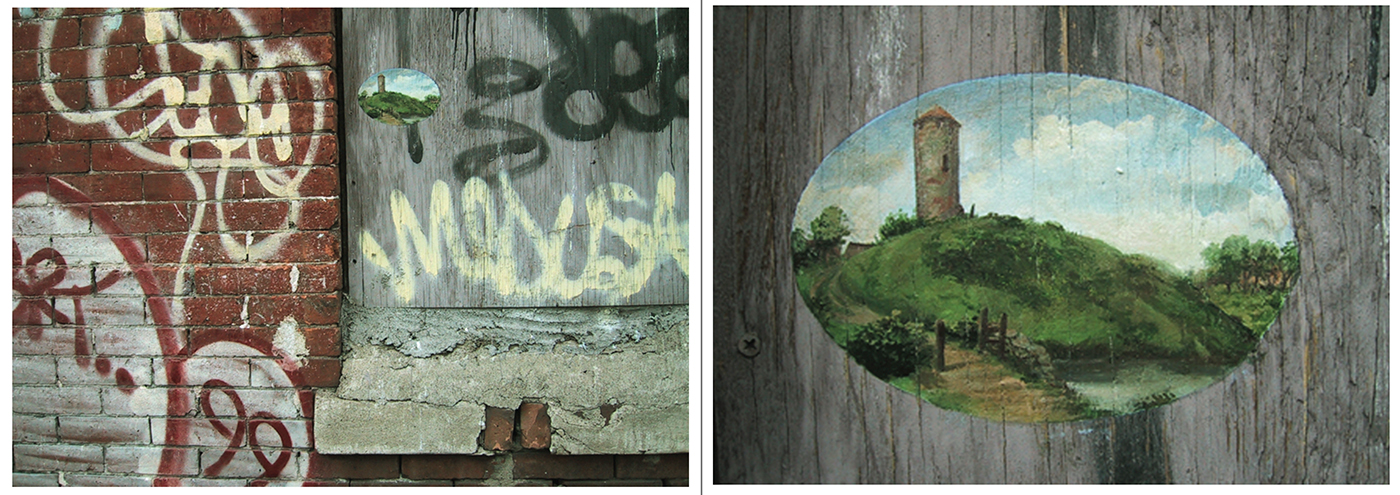
“495 West 37th Street at Ninth Avenue, Hell’s Kitchen, Manhattan, From The New York Beautification Project,” February, 2001, Oil on Wood(?) Wall. Close-up, right. Photos from ellenharvey.info, which has it’s backstory.

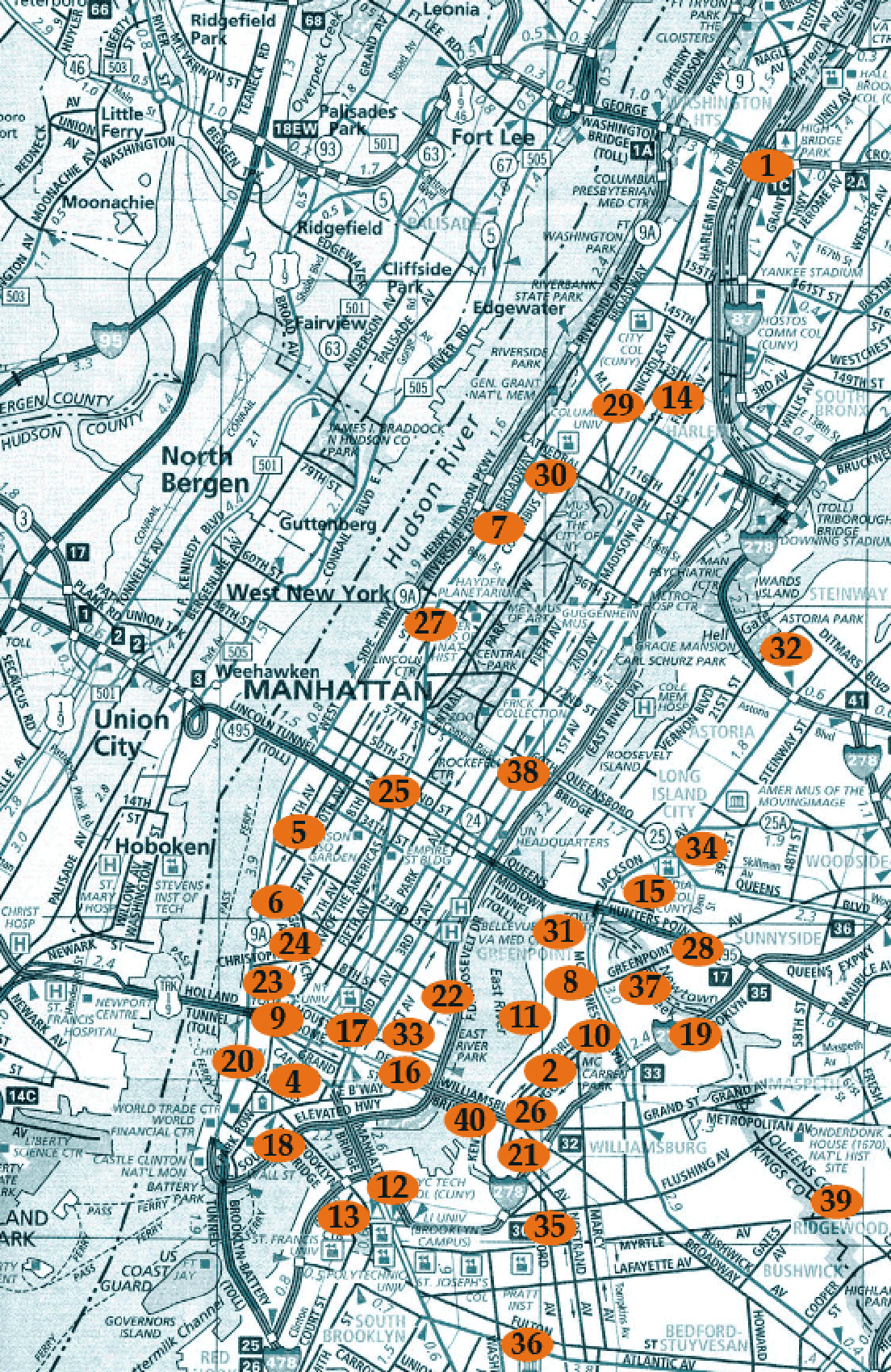
This “What can Art do here?” approach can be seen all the way back in 1999, in her remarkable “New York Beautification Project.” In it, the Artist hand painted 40 five by seven inch oval oil paintings on top of existing graffiti, over the course of 2 years! During the project, she was mugged once, and had encounters with the NYPD. While her remarkable Paintings were influenced by classic (and classical) landscape Paintings (WHAT could be MORE out of place in the world of NYC graffiti?), what floors me is the map of the locations she created them.

Map of locations of the Paintings in Ellen Harvey’s “New York Beautificalion Project,” 1999-2001. From ellenharvey.info

She almost circled the entire City! Ok, she did this without permission, or renumeration, as the works were affixed to non-movable locations, to the displeasure of gallerists, which might make you wonder…”WHY???” I chalk it up as an early sign of the scale of, the dedication to, and persistence of her vision. It was a taste of things to come.

Her “What is it that people want from Art in this situation?” reached, perhaps, it’s ultimate expression when only a short time later she got a chance to do public art “for real.” Actually? Two chances. The NYC MTA commissioned her to create the Art for TWO NYC Subway stations. She is one of the very few (perhaps, the only one?) to have been commissioned to do more than one. In 2005, she created “Look Up, Not Down,” in 2,000 square feet of the Queens Plaza Subway Station. This MTA video provides a look at it, and the backstory, and also includes rare glimpses of the NY Beautification Project’s Paintings, which are now long lost.

Then, in 2009, she was commissioned to do the Art for the (new) Yankee Stadium Metro North Station. Typically, she took a Yankees ad logo, “The Home of the Stars,” and flipped it in a way everyone could relate to- Yankee fan, or not.

Someone once said that mosaics are the most durable medium. There are gorgeous examples in The Met from 200 AD. So, it seems fairly likely that her work in the subway (at least) will last for at least the next 100, if not 1,000 years. I’ve lauded the MTA on their choices of Artists to create Art for the Subway before. Here is another case where I think they made an excellent choice. Both of these works are related to the sky and stars theme that continues in “Nostalgia.” Well? I’m not sure even Ellen Harvey is going to find a bigger stage than the stars.

Regarding her statement about giving the viewers what they want, I remain to be convinced that many, if anyone else, sees the world as Ellen Harvey does. It seems to me that she takes spaces (or materials) and reimagines them in ways visitors might enjoy, but, perhaps, don’t quite expect, and I doubt anticipated. Her work seems to cut across and through periods, schools, styles- abstract or realistic, to speak to people, and so, it “gives the people what they want.” That’s a pretty rare gift. Christo & Jeanne Claude come to mind as Artists who are/were capable of similar things. Her projects often require her to bring an extremely wide range of talents to bear, in an equally wide range of mediums and scale, to create her visions, though like Rauschenberg, she has said she considers herself a Painter. A Painter, who loves Painting dearly, though she has real doubts about it’s ongoing relevance given many of it’s original functions having been replaced by other mediums. For my part, it seems Painting was in trouble in the 90’s, but I’ve seen any number of very good (and relevant) Painting shows recently, especially this past year. Since Painting is, still, my favorite medium, I remain hopeful.

Looking through the 300 plus pages of “Museum of Failure” it’s very hard not to be amazed at the daring of her work, it’s diversity, as well as the consistent quality of it. In two instances she has taken on Painting reproductions of the bulk of the collections of two museums(!)- the Whitney and the nudes in the Bass Museum, Miami, and rendered them exceedingly well- regardless of the style or period. Yet Painting is just one of the many mediums she works, and excels, in.

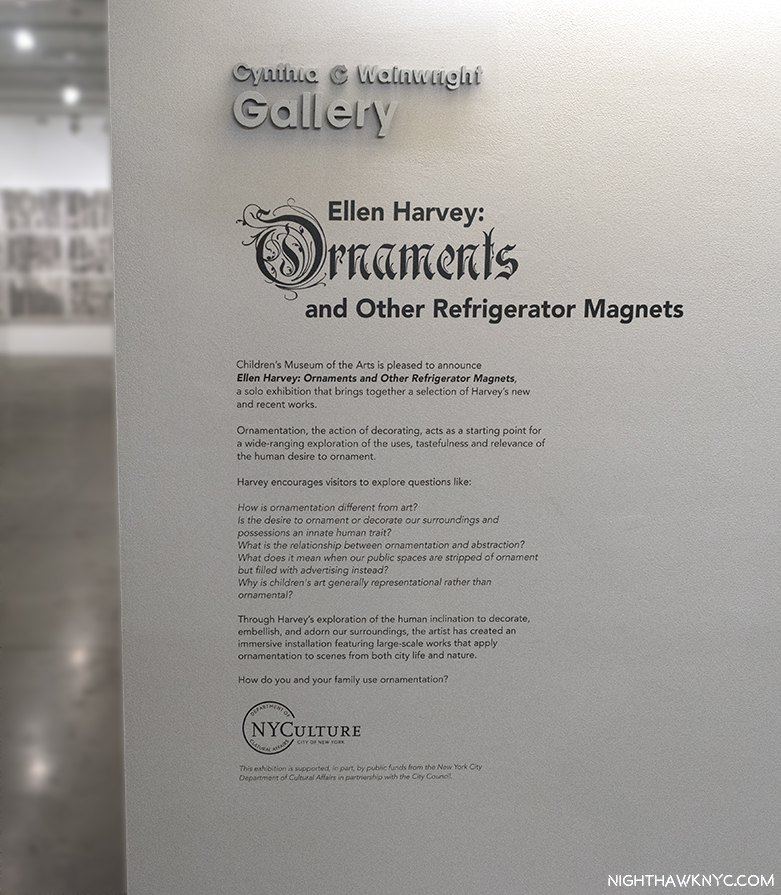
With “Nostalgia,” one of the best shows of the fall season, you might think that Ellen Harvey would be satisfied. But, no. On December 13, ANOTHER show, including new work, “Ellen Harvey: Ornaments and Other Refrigerator Magnets,” opened at the Children’s Museum of Art downtown.

The CMA show continues her exploration of ornamentation (a subject near and dear to my heart), which, gets it’s own section on her website, showing work going back to at least 2002. It’s a show that, hopefully, will inspire and instill a love of ornament in a young audience that will grow up to bring it back to a world that sorely needs it. In it, another of her themes, seen in her 2014 installation, “The Unloved,” at the Groeninge Museum, Bruges, Belgium, comes to the fore- the forgotten/overlooked/yes, unloved, in Art. These days? Not much is more unloved than ornamentation in Architecture.

“Those days are recalled on the gallery wall
And she’s waiting for passion or humour to strike

[Chorus]
What shall we do, what shall we do with all this useless beauty?
All this useless beauty”*

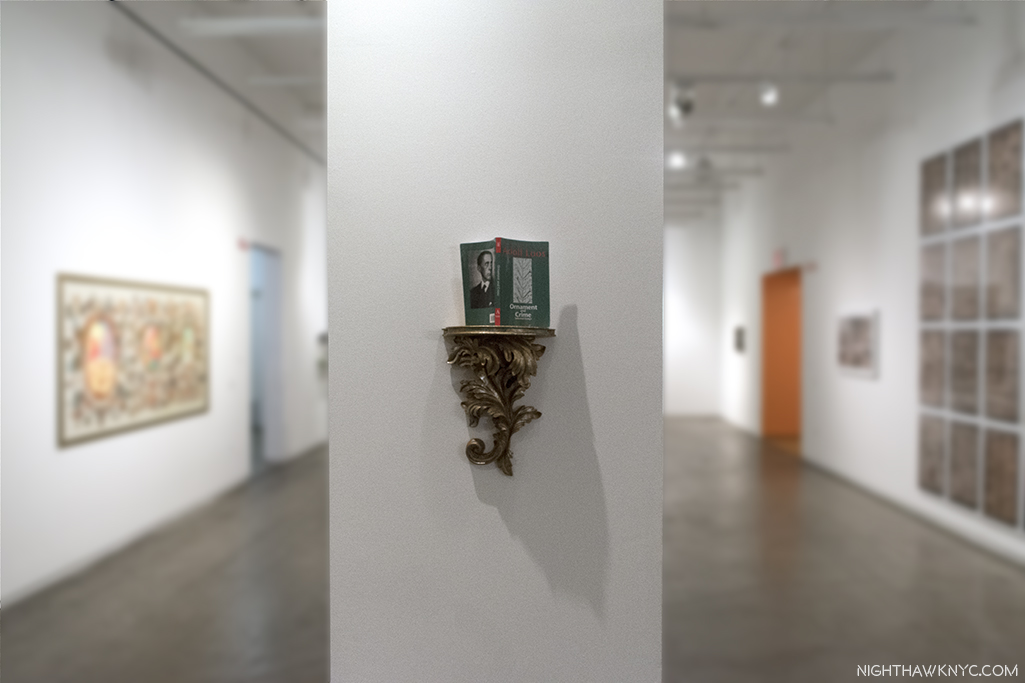
Appropriately, and prominently, placed around the show were various editions of Austrian Architect Adolf Loos’ essay collection, “Ornament & Crime,” as if saying “Ornament is NOT a crime!”

Adolf Loos’ “Ornament and Crime,”a collection of essays, including the title piece, a lecture given in 1908, appropriately displayed on a lovely, ornate pedestal.

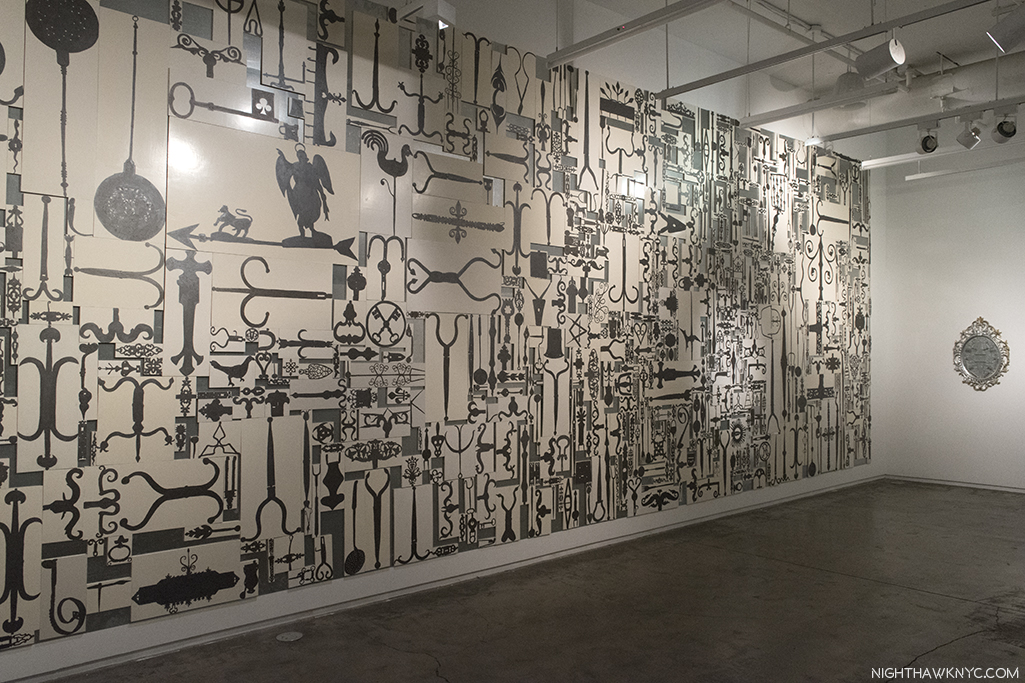
Featured is her 2015 “Metal Paintings for Dr. Barnes,” in which she painted every piece of metal work installed at the Barnes Foundation, Philadelphia, on 826 wood panels with magnets inset then mounted on steel panels so they could be endlessly rearranged, unlike those in the Barnes.

“Metal Paintings for Dr. Barnes,” 2005, Oil on 826 wood panels with inset magnets, steel panels, overall, 25 by 15 feet, left, and “Mass Produced,” 2017, Metal hardware, screws, plywood, and plastic frame.

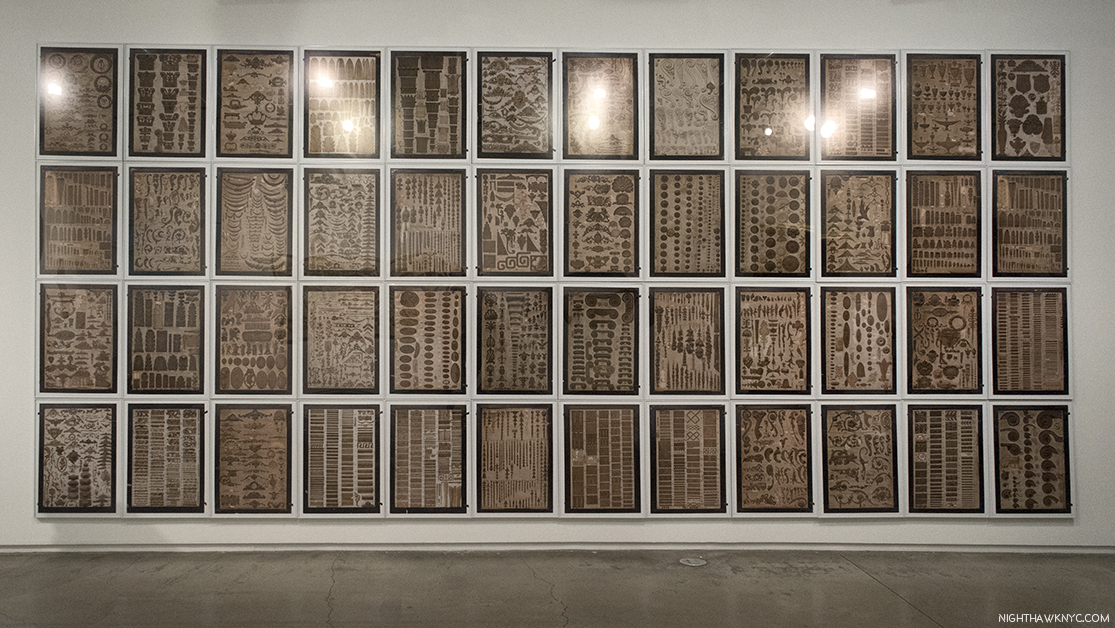
More recently, much of her work with ornaments has been inspired by her visits to the  American Wood Column Company, in Brooklyn, founded in 1916, and their collection of over 6,000 antique molds. On view was a 48 part visual catalog of samples of their work, which Ms. Harvey had photographed by accomplished Photographer Etienne Frossard, who has been working with her since 2012, in a new work titled “Mr. Lupo’s Collection,” in honor (in a sense) of this man and his company’s devotion to currently unloved work that may be on the verge of being lost.

“Mr. Lupo’s Collection,” 2017, 48 Framed Photographs, individually photographed by Etienne Frossard. (Apologies for the glare in my photo of them.)

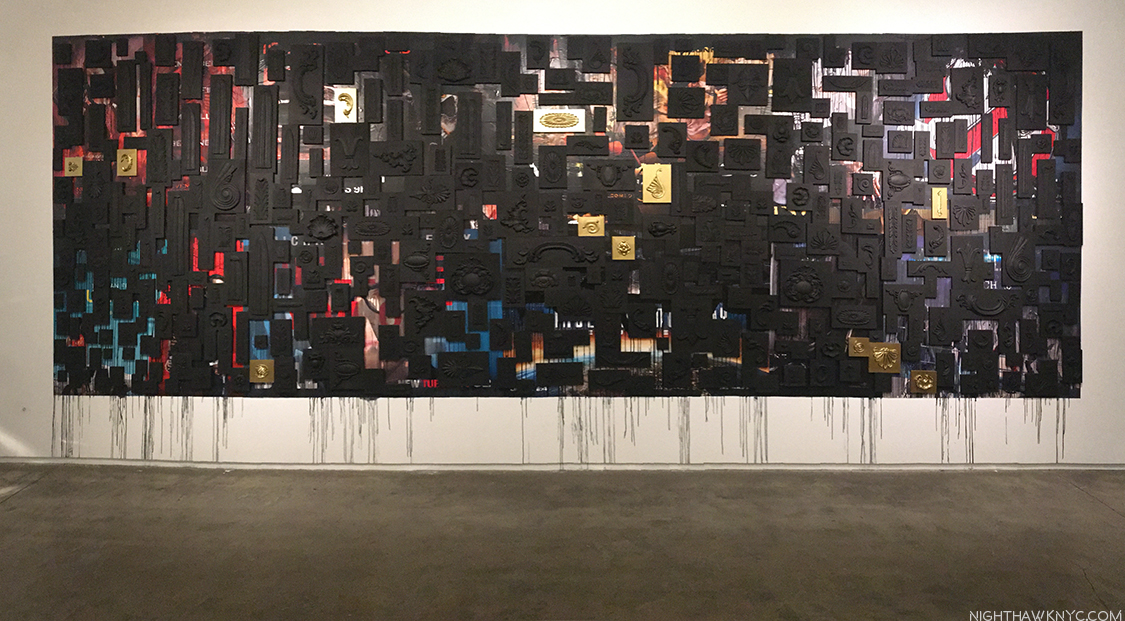
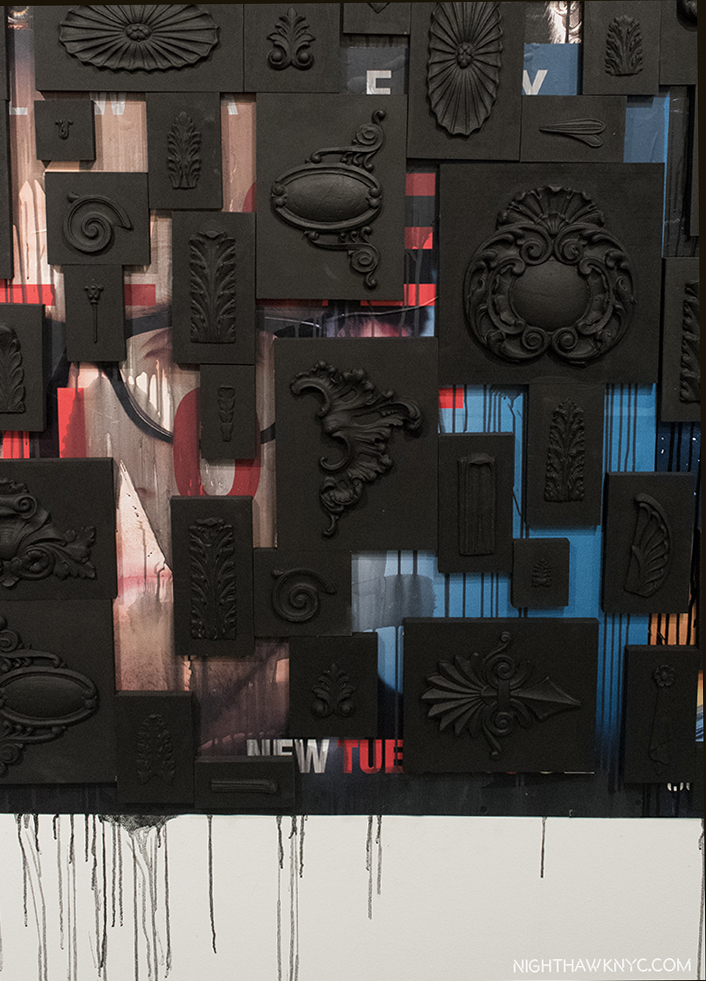
Ornaments made by American Wood Column Company were featured in a large, new work that brings them right into the 21st Century. Not being satisfied with creating Art in two Subway stations, here, “Ornaments for the Subway,” 2017, goes further. It attempts to beautify that universal blight of all Subway stations- the ads. The card says, “It used to be that public spaces were covered with architectural ornaments rather than advertising….Here the Artist imagines taking back the public space from which they have been removed.” Bravo.

“Ornaments for the Subway,” 2017, Pressed glue ornaments made by the American Wood Column Co., plywood panels with inset magnets, subway posters and 20 steel panels.

Detail.

I spoke with Ellen Harvey at the opening, and she turned out to be exceedingly gracious, generously walking this complete stranger around her new show, pointing out all kinds of subtle detail that would take me many visits to discover. Here again, some of the themes I’ve seen in her other works are on display- a critique of Art, museums, and the rich, her passion for giving the viewers what they want, more use of mirrors (as mirrors this time!) and yes, “nostalgia,” is a theme, here, too. This work with mirrors includes people I know I’ve seen somewhere before.

“All That Glitters,” 2017. Card and detail below.

Detail of the lower right corner of the right side shows Mr. Putin, right, and Mr. Trump, above to the left of center, who’s wife appears elsewhere.

I titled this piece “Ellen Harvey’s Global Beautification Project,” because looking through her projects to date, they’ve taken place around the world, from California, to Miami to Philadelphia to Ghent, Bruges, Margate, Vienna, Warsaw, and of course, NYC, including the 2008 Whitney Biennial and the two Subway Stations. Together, they make part of a map of the world that will soon start to look like a global version of the map of her New York Beautification Project.

Before I left CMA, I came across “Walk In,” 2005, Oil on plywood and gilded frame, a booth to allow visitors to pose in glamorous surroundings, as if walking into a painting.

“Walk In,” 2005, 005, a work designed to be a background and frame in one for a do it yourself portrait.

Inspired by her work, and her approach, it was at that point that I decided to be a visionary, myself. “Hmmm….What does this picture need? What would the people like to see here?,” I asked myself.

The very gracious Artist graciously poses for yours truly in her “Walk In,” 2005.

And so, “My Portrait of Ellen Harvey” ends…with one.

“Ellen Harvey: Nostalgia” is my NoteWorthy show for November. 

*- Soundtrack for this Post is “All This Useless Beauty,” by Elvis Costello from the 1996 album of the same title, publisher not known to me. It’s rendered here.

NighthawkNYC.com has been entirely self-funded & ad-free for over 7 years, during which over 275 full length pieces have been published! If you’ve found it worthwhile, PLEASE donate to allow me to continue below. Thank you, Kenn.

You can also support it by buying Art, Art & Photography books, and Music from my collection! Books may be found here. Music here and here.

Written & photographed by Kenn Sava for nighthawknyc.com unless otherwise credited. To send comments, thoughts, feedback or propositions click here. Click the white box on the upper right for the archives or to search them. Subscribe to be notified of new Posts below. Your information will be used for no other purpose.

  1. A new edition, which features “Arcade/Arcadia” on it’s cover, is the most complete book on her work and is recommended. Ellen Harvey’s website, ellenharvey.info is, also, a goto resource.
  2. The first question I asked Ellen Harvey was about engraving those mirrors- “What happens when you make a mistake?” “It happens often. I press on,” she said!
  3. “Ellen Harvey: Museum of Failure,” P. 299.
  4.  https://youtu.be/juIqarKNAGY

Chris Ware-“The World’s Smartest Cartoonist”

Chris Ware stands in front of the original Art for the covers of his new book, Monograph, at the opening for the show of the same title at Adam Baumgold Gallery on November 10, 2017. Click any Photo for full size.

Chris Ware has been universally respected among his fellow Cartoonists & Graphic Novelists for quite some time. At this point, it’s becoming relevant to consider his place among ALL his peers, including the all-time legends. Now, he has made that a much easier thing to assess with the release of his new book, Monograph, a gorgeous, and, (typically) meticulously well-done, Rizzoli mid-career autobiography and retrospective in one. But before anyone else can begin to assess his accomplishment through it, no less than Art Speigelman, one of those enduring masters of Cartons & Graphic Novels in that pantheon of legends, calls him “the World’s Smartest Cartoonist,” in his Introduction to it. After he, his wife, Francoise Mouly, the Art Editor of the New Yorker & an Independent Publisher, and Ira Glass have their say up top, the rest of it is so well done, I don’t think there’s a better case to be made for his accomplishment. Take that, future biographers/monographers! For the rest of us, no matter how closely you’ve followed Chris Ware, you’ll find known favorites alongside much that is previously unknown, including a surprising amount of detail about Mr. Ware’s life along the way.

“Good cartoon drawing is good design.” Charles M. Schulz, the creator of “Peanuts,” said in 1997. The published covers from the Drawings, above, for  Monograph, 2017. Front cover, right side, and back cover, left. Their “meaning?” Perhaps, that there’s a lot going on in that head…Inside (between the covers).

Speaking of what might be going on in that head, along the way, Monograph’s 280 pages also provides the best evidence that Chris Ware is a bit of a throw-back in his tastes in Art, Cartooning, Music & Architecture, a side that co-exists with, and informs, the visionary that is given to flights of fantasy, usually involving the past or the future, often without notice. They all coalesce in Art that, at times, could be mistaken at a distance for an Architect’s plans, as seen above.

An echo? Speaking of Architects, Frank Lloyd Wright, “Madison Civic Center (Monona Terrace)” Night View, 1955, Ink on paper presentation drawing. When I first saw Monograph, this drawing by Wright, recently on view at MoMA, came to mind. Chris Ware lives near the early Frank Lloyd Wright houses in the Chicago suburbs.

By now, none of this is news to anyone who has seen his work over what is already 30…Can it be? Yes, it is…30 years! What’s lesser known is that, personally, he’s also an enigma. I’m only 15 years in myself, yet, what I still have trouble getting used to is that along with all the things Chris Ware is, he is, on top of it all, endlessly self-effacing.

I don’t think it’s an act.

Take a look at his expressions and body language during his first national television appearance, November 13th, on one of the last episodes of Charlie Rose, which is, also, a good introduction to him. Note the 5:07 mark, for instance-

For the past 15 years he’s been telling me off and on that his original Art, which now sells for upwards of many thousands of dollars per in galleries, “is easily disposable.” First, he said it in 2002, after Jimmy Corrigan: The Smartest Kid on Earth came out. Just this past week, he said it again. Standing in the middle of the opening of his newest show at Adam Baumgold’s East 66th Street gallery. I had commented on the fact that he is his best and most astute collector, and asked if he was planning to open a museum. He replied by talking about disposing of it.

From left to right- Art for “Hold Still,” an iconic 2005 New Yorker cover, Art for the Acme Novelty Lunchbox, a page of Rusty Brown, subject of his next book, a very early “Jimmy Corrigan” page from Acme #1, two Self-Portraits, and a page that appeared in the New York Times Book Review in October, 2015, far right. Mr. Ware’s Original is titled “Why I O Comics.” I heard he wasn’t pleased that the Times published this with the heading “Why I Love Comics.” All of this Art is, or was, part of the collection of Chris Ware.

All I could do was shake my head and nervously smile when he said it, again, because he can’t be serious. CAN HE? Taking no chances, I did the only responsible thing I could. I told him to call me first. Then, I looked for “answers” in the show, and in Monograph, itself.

The museums will, also, come calling one of these days. I have no doubt of that. In my opinion, they should have, already. I’m referring to his work being in the permanent collection of MoMA, The Met and The Whitney, and the other big museums around the world. To be fair, the Whitney Museum did include Chris Ware in their 2002 Biennial, when he was the first cartoonist ever invited, and was given an entire gallery where about 48 works, by my count, were on view. They even commissioned him to create the poster for the show. He has, also, been included in important shows at other museums, at NYC’s Jewish Museum, and the Museum of Contemporary Art, Chicago, both in 2006, and elsewhere.

During this latest encounter, we stood in the midst of the opening for his newest show with Mr. Baumgold, for Monograph. The rooms were filled with original Drawings by Mr. Ware going back to the late 1980’s, when he was 20 or 21 years old, works that even his most avid readers have not seen, or probably even knew about.

“The Sunville Daily,” 1987, Ink and red pencil on paper. By Chris Ware at about age 20. Looking very closely, you’ll find elements of his later work, but, overall, this is shockingly different from everything that came after.

The fact that he’s kept a good number of his earliest work that those long time readers have never seen, proves that he attaches at least some value to them, himself, and I have a hard time believing it’s only sentimental. Chris Ware has a professor’s level knowledge of the history of cartooning (as seen here), as well as an acute awareness of its current state, witness the expert (yes, expert) contributions he’s made to books on George Herriman and Daniel Clowes, as well as the astute quotes bearing his name that appear on many new and notable graphic novels, including being front and center on the front cover of, perhaps, the most auspicious debut of 2017, Emil Ferris’ “My Favorite Thing Is Monsters,” which I wrote about here. Of course that eye is applied first, foremost, and probably, most critically, to his own work.

Athletically challenged. “Gym Class,” 1987, Ink and red pencil on paper, depicts some of the dread, and possibly, the bullying, he dealt with in school. One of the earliest works in “Monograph,” elements of his now “classic” graphic style appear, and are already confidently rendered. A key point in Chris Ware finding his direction. (That’s a reflection from across the gallery above the center character’s head. Sorry.)

Mr. Ware came to fame with the release of his first full length book, the graphic novel, Jimmy Corrigan: The Smartest Kid Alive, in 2000. It won the Guardian First Book Award in 2001, an award that considers not only graphic novels, but ALL books released during the year. The glowing reviews served to highlight the fact that there had, literally, been nothing like it to that point. The graphic novel had seen its first big breakthrough in underground and non-superhero comics, perhaps, since Art Spiegleman’s Maus, the Pulizer Prize winner in 1992. Seven years in the making, it’s possible to watch his style solidify over its 380 unnumbered pages. Almost as soon as it was released, Chris Ware’s name had been made. When I first saw it, I knew from the one of a kind dust jacket that opened out into an amazingly intricate double sided poster that here was a truly unique book. 16 years later? A well worn copy is still near to hand. It’s a book that doesn’t reveal all its secrets in one reading. Every time I pick it up I still find new things, new threads, I’d previously missed. I’m not alone. “Jimmy Corrigan” has given rise to a continuing stream of critical examination, theorizing, analysis and speculation.

The original cover Drawing for the front of the remarkable folded book jacket/double sided poster for Jimmy Corrigan as seen in Monograph.

“Reading him, I always have the feeling that the pages aren’t big enough for everything he’s trying to squeeze into those orderly rectangular panels.” Ira Glass, Monograph Preface.

A flat of the whole, double sided cover, in color. The Drawing reproduced above is the left half of this image. Little discussed (perhaps because it’s the back of the cover/poster), the right half contains the story of Jimmy’s ancestors, including his African-American ancestors (one seen being sold as a slave), which were unknown to him. Some see commentary on the “imperialistic” nature of American colonization and the idealism of the “American dream” in the story of Jimmy’s ancestors as well.

Jimmy Corrigan turned out to be semi-autobiographical. In it, Jimmy gets a letter and phone call out of the blue from the father he’s never met suggesting they meet over Thanksgiving. Before going, he tries to imagine him and what impact knowing him would have on his life. When he finally meets him, he discovers he’s nothing like he imagined him to be. He also meets his dad’s adopted African-American daugther, Amy, who Jimmy had no knowledge of.

Some time after it was published we learned that Chris Ware, himself, never knew his father growing up, until finally meeting him, once, mid-way through writing Jimmy Corrigan. Sadly, the elder Mr. Ware passed away shortly before the book was finished, without ever having seen his son’s close-to- home masterpiece. Later, Chris Ware said that “I didn’t spend that much time with him. I added it all up once…I knew my father for just about five hours1.” That’s about as long as it takes to read it, something that is on my mind when I re-read it now, which I prefer to do in a single sitting to really feel that length of time pass. Through the mastery of his creativity, and the unique ways the characters are depicted, the work becomes more than a story, “more,” even, than Art. It’s also a record of the moment to moment thoughts, hopes and dreams of 4 generations of the Corrigans, and their reactions to events as their lives unfold before our eyes, across time. Reactions that most often include little, even no, inter-action. Almost every character in it is, mostly, cut off from every one else. In that sense, it’s also a classic of isolation, a meditation on its eternal nature (across generations)- Every character in Jimmy Corrigan suffers from extreme isolation and loneliness. Unlike the hard-core lonely, who have given up on the human race, every character longs for it to end. At least in Chris Ware’s work, life always happens in spectacular rendering, in color that speaks its own language, and with gorgeous, ever-surprising design.

Back at the show, increasingly sought after, only one Jimmy Corrigan original page, (from the Acme Novelty Library #1, which predates the book), was on display, but it was a good one, that succinctly sums up what I said about the book, itself.

“Jimmy Corrigan, Calling Mom,” Acme #1, 1993, Ink and blue pencil on paper. This page, from the first year he drew Jimmy  didn’t make it into the final “Jimmy Corrigan” book, though it captures much of the poignancy of it.

While Chris Ware is well-known as an admirer of the great George Herriman and his “Krazy Kat” strip, having done the cover art for the 13 volume reissue of what many, including he, consider the greatest comic strip of all time, his influence lives on in Mr. Ware’s own ground-breaking graphic design, which builds on “Krazy Kat’s” Sunday full pages, that Mr. Herriman treated freely, like a blank canvas, when it came to laying out his stories. Over the past 30 years, it’s been taken to the point that it has become one of his trademarks. Along with George Herriman, Charles Schulz and his “Peanuts” cartoon strip that ran for 50 years are another major influence on Chris Ware. “Charles Schulz is the only writer I’ve continually read through childhood and into college2.” Charlie Brown, who Mr. Ware calls “the first sympathetic cartoon character3,” is the predecessor of Jimmy Corrigan. Interestingly, the final Peanuts strip ran on February 13, 2000. After serializing the story in the early 1990’s, the first edition of the completed and collected Jimmy Corrigan: The Smartest Kid on Earth was published on September 12, 2000.

Learning at the elbow of the master. Chris Ware included this self-portrait in his “Tribute” to Peanuts after their final strip in 2000,  ending by paraphrasing Mr. Schulz final panel- “How could I ever forget them?” The complete strip is reproduced in Monograph.

In the years before and after Jimmy Corrigan, Mr. Ware developed a whole slew of characters, that appear sporadically, only some of them “human.” They range from “Quimby the Mouse,” and “Branford the Bee” to “Rusty Brown,” and “Rocket Sam.” But, in the end? It seems to me whatever lifeforms they are doesn’t matter a bit. It only serves to make them seem “uncannily human” to the reader.

“Quimbies the Mouse,” 1990, Ink and red pencil on paper. Later, he would lose the “siamese” aspect and it would just be “Quimby the Mouse.”

These appeared in the (shorter) installments of the Acme Novelty Library, released sporadically over the years. Mr. Ware’s full length books take him so long to create we’re lucky to get one per decade. There must be something in the water in the Chicago burbs because Monograph is second for this decade. And? At the show, he was speaking about ANOTHER book, to be released in 2018, “Rusty Brown, Part 1.” And though Zadie Smith commented “There’s no writer alive I love more than Chris. Ware. The only problem is it takes him ten years to draw these things and then I read them in a day and have to wait another ten years for the next one4.” it may take even Mr. Ware’s most devoted reader more than a day to work their way through Monograph 280 pages that are jam-packed with almost as many details as this image of the Milky Way.

Monograph’s surprises include this six page story including the red pencil underdrawing on paper he was using at the time. “I Guess, (from RAW Volume 2, No. 3, 1991),” 1990, Ink on mylar, red pencil on paper.

Over the years, Mr Ware has created books that range in size from miniatures to the gigantic, even one with a multitude of sizes (14) in one (the award winning Building Stories, 2012). Now? He has outdone himself. Weighing in at over 9 pounds and measuring 18 by 13 inches, it’s fitting that this mid-career Autobiographical Retrospective is large enough to mirror his achievement. In this case, Monograph needs to be this big. Trying to read the detail in something like the folded book jacket for Jimmy Corrigan, above, would be neigh impossible in a smaller size.

Speaking of gigantic. “Sparky’s Sparky Is Best Comics and Stories (I Am a Sickness That Infects my Friends.),” 1991, Ink, red pencil on paper, 50 inches tall(!) by 30 wide.

As for what else Monograph contains, Mr. Ware’s work has appeared on 23 New Yorker Magazine covers, almost every one of which eschews his “intricate” graphic design (the most recent one, in September, 2017, I wrote about, here), while also holding the distinction of being the very first “cartoonist” to have his work serialized in the New York Times.

The devil is in the details. Chris Ware is, also, endlessly fascinated with stand alone characters, especially hand-made mechanical examples. “Quimby the Mouse,” was incarnated as a wooden toy a while back. Unfortunately, the manufacturer painted every one of his eyes wrong. So? Mr. Ware grabbed the 14 of them in the vitrine and correctly hand painted each eye. Shown with the original Art for their box cover.

After Jimmy he continued to release regular installments of his “Acme Novelty Library,” along with smaller books, including “Lint,” two volumes of excerpts from his sketchbooks, a “Quimby the Mouse” collection, forays into mechanical figures, products and toys, book covers for others and the Ragtime Ephemeralist, an “infrequently appearing” volume devoted to you guessed it- ephemera, and scholarly articles, related to Ragtime, edited, designed and published by Chris Ware. The latest issue, from 1995, totals 256 pages! In 2011, he even broke out of the medium of print, for the first time, digitally publishing “Touch Sensitive” an interactive story from Building Stories that is still available for free download on iOS, here. In 2015, he debuted an actual internet-only work, serializing “The Last Saturday” online, here, on The Guardian’s website. Though he wasn’t a fan of technology early on, as the digital forays “Touch Sensitive” and  “The Last Saturday” show, Chris Ware is a man with one foot in the past who is, surprisingly, open to selectively dipping a toe in the future, though he is an avowed lover of the print medium.

3 Views of a Secret. A rare Chris Ware Painting, bottom, the Drawing for its appearance on an Acme cover, and a version of the same piece, as a New Yorker cover mock up, all featuring Jimmy Corrigan- with, and without, Super-man.

The next milestone was Building Stories, which had been partially serialized in the New York Times, released in 2012 in a large box containing 14 publications of varying size and bindings. The order which the reader read it was up to them, thereby creating countless ways its tales could be told. Five years later, almost to the month, now comes Monograph. Its huge size is, no doubt, daunting to many. After seeing his original Art, I realized that Monograph mirrors the size of the illustration board Mr. Ware favors to draw his Art on. So, the book will provide an experience as close as is possible to seeing the actual original Art in person. As the ultimate Chris Ware (Auto)biography, it’s chocked full of historical Photos of Mr. Ware, his family, friends and associates, while its running commentary sheds new light on the path he and his Art has taken, an invaluable resource to those studying his Artistic development.

As we chatted this time, he drew two small self portraits in my copies of the Acme Novelty Datebook (his Sketchbooks), Vol 1 & 2. He seemed pleased to see them when I produced them for his signature, sketchbooks being near and dear to my heart (I made my own for many years). He mentioned that there would be a Volume 3! Later, I looked at the Drawings he did. Wow.

Sketch by Chris Ware in my copy of the Acme Novelty Date Book, Volume 1.

A bit reminiscent of this, which was on view in a corner across the room- Acme #4 (Sparky’s Best Comics and Stories) Cover, 1994, Ink and blue pencil on paper. What was I saying about all his characters acting “human?”

“The accolades he got he felt weren’t his, for some reason. He didn’t feel they were…deserved. And I think he didn’t feel particularly connected to the world.
He was appreciative and very, very loving about all of the good things that came his way but I think he was always mildly surprised.” Whoopi Goldberg on Charles Schulz 5

As with Charles Schulz, the creator of the most famous comic strip in history, I don’t know what lies at the heart of Mr. Ware’s self-effacement, but  I hope it won’t take another 30 years for him to accept the compliments his work receives. If he continues producing the kind of work he has over the past 30 years, then, he might not have any choice but to get used to people saying nice things about his work.

Back from the show, with this question on my mind, I began to re-read Jimmy Corrigan for the umpteenth time, this time in its paperback incarnation (which has a few significant differences from the hardcover), I happened upon this beauty on the lower right back cover.

A-ha! Chris Ware dumpster diving to SAVE copies of his work that have been discarded! Jimmy Corrigan, Paperback edition, back cover detail.

I get it! I FINALLY found the answer to his self-affacement. He WANTS me to throw out his work so he can save it and re-sell it!

They’re right. He IS smart! ; )

**********************************************************************
Collector’s Note- This is something I’ve yet to see anyone point out. While I suspect that many/most of Chris Ware’s fans already have Monograph, for those that don’t, I’ve discovered something that you might want to keep in mind.

There are TWO editions of Monograph.

When I discovered it, I called the publisher, Rizzoli, and even they didn’t know what the differences were! So, I took it on myself to find out. The “regular edition,” ISBN 978-0847860883, is the one most commonly available. However, there’s also the “Bookplate Edition,” ISBN 978-0847858125, which I’ve almost always seen selling for the same list price ($60.00) as the “regular” edition. However, it contains 2 major differences. First, it comes with a small double-sided “errata” sheet that is SIGNED by Chris Ware. Second, the “errata” sheet comes tucked inside of a folded reproduction of the original Drawing for his quite rare 2002 Whitney Biennial Poster, “The Whitney Prevaricator.”

Top of the inside of the inserted Reproduction of the Drawing for the Whitney Biennial Poster. If you collect Chris Ware, I recommend you get the “Bookplate Edition,” which is signed TWICE by Mr. Ware, and includes this.

On the top of the verso of this sheet is text noting that this is the “Fine Art Edition,(referred to as the “Bookplate Edition” in the trade) of Monograph, which Chris Ware has ALSO signed, and numbered out of an edition of 550. Buyer? Be Ware. (Sorry.)

*-Soundtrack for this Post is “In The Future When All’s Well,” by Morrissey from Ringleaders of the Tormentors. Another Artist who’s work is deemed “depressing” by some.

On the Fence, #16, The Smartest Birdies…on this Fence…on April 1st…at 3pm” Edition.

You can now follow @nighthawk_nyc on Instagram for news and additional Photos!

NighthawkNYC.com has been entirely self-funded & ad-free for over 7 years, during which over 275 full length pieces have been published! If you’ve found it worthwhile, PLEASE donate to allow me to continue below. Thank you, Kenn.

You can also support it by buying Art, Art & Photography books, and Music from my collection! Books may be found here. Music here and here.

Written & photographed by Kenn Sava for nighthawknyc.com unless otherwise credited. To send comments, thoughts, feedback or propositions click here. Click the white box on the upper right for the archives or to search them. Subscribe to be notified of new Posts below. Your information will be used for no other purpose.

  1. http://edition.cnn.com/2000/books/news/10/03/chris.ware.qanda/index.html
  2. https://www.theparisreview.org/interviews/6329/chris-ware-the-art-of-comics-no-2-chris-ware
  3. http://classic.tcj.com/alternative/interview-with-chris-ware-part-1-of-2/
  4. Quoted on a sticker on the shrink-wrap for Monograph.
  5. in “The Complete Peanuts, Volume 5 1959-1960, p.xi.

Now Is A Good Time To Join The Met- UPDATED 1/4/18

This is an update to my recent Post “Now Is A Good Time To Join The Met,” published on December 10, 2017.

Incomparable. That’s one way to describe Michelangelo. The buzz for “Michelangelo: Divine Draftsman & Designer ” is that it’s “once in a life-time.” I’ve been anticipating it all year. With 133 of his Drawings(!). 3 Sculptures(!). His earliest Painting (The Met’s experts say it’s his. I’ve saw it in 2009 and it’s hard to argue with them)…That sounds about right. Here’s the sign at the entrance, fronting part of the scaffolding TM built to mimic Michelangelo’s own for the section on the Sistine Chapel. Click any Photo for full size.

Well? Anytime is a good time to join the country’s greatest Art museum. They can use the support. I’ve been a member of The Met since 2002, during which time I’ve gone over 1,400 times. It still truly feels like Home to me. Today, I renewed and a perusal of the shows up right now made me feel that it may be the most amazing lineup I can recall at one time.

Here’s what’s there right now

The Met’s Current Exhibition page on December 8, 2017.

“He’s making a list
He’s checking it twice…*”

Let’s see…

Michelangelo: Divine Draftsman & Designer 

-the David Hockney Retrospective

Rodin At The Met

World War I and the Visual Arts

Leonardo to Matisse: Drawings from the Robert Lehman Collection

EACH one is a big show at 1000 Fifth Avenue. Depending on your stamina, seeing all of any one of those would make for a good visit to The Museum in itself. And? These smaller shows are also there-

Frederick Remington at The Met

Talking Pictures: Camera-Phone Conversations Between Artists

Cosmic Buddhas in the Himalayas

Company School Painting in India (ca. 1770-1850)

Japanese Bamboo Art: The Abbey Collection

And? Since too much is never enough in NYC-

Edvard Munch: Between the Clock and the Bed

Modernism on the Ganges: Raghubir Singh Photographs

Delirious: Art at the Limits of Reason, 1950-1980

Are up at The Met Breuer.

Yes. Santa came early for NYC Art lovers. Suffice it to say that I, also, bought a new pair of shoes cause I expect to be wearing my current pair out soon.

And then there was this…

All I wanted for Christmas. My name up in lights on a wall in The Met! Actually, before I feel special, they do this for all new and renewing members. Pay attention. Your “immortality” lasts for 3 seconds.

Ahhhh…It’s good to be Home for the Holidays…

UPDATE– January 4, 2018. The world’s greatest Museum announced an “updated” admissions plan this morning. The gist of it is-

  • The “pay as you wish” policy will continue for all New York State residents.
  • This will be expanded to cover students from New Jersey & Connecticut.
  • Mandatory $25.(general)/$17. (seniors)/$12 (students) admission fee will be required henceforth for all of those from elsewhere/non-students from NJ & Ct.
  • All full-priced tickets will be honored for three consecutive days.
  • The “updated” policy will be implemented on March 1, 2018

This morning, Daniel Weiss, President of The Met, said-

“…The Met is a profoundly different place from that envisioned by its founders. Decades ago The Met made a decision to expand its operations and outreach and to become the Museum that we know today: a cherished institution that is both the top tourist destination in New York City and a world-renowned center of scholarship and learning.

Maintaining this level of excellence, and continuing to serve the New York region at the same high level, requires that The Met take stock and decide, once again, what kind of Museum we want to be for future generations. The world has changed dramatically in the almost 50 years since our admissions policy was last reviewed, and the way we budget and plan for the future needs to change as well.

What is clear is that our current pay-as-you-wish policy is no longer sufficient to meet the Museum’s daily operational demands. Paid admissions represent only 14 percent of our overall revenue, one of the lowest percentages among our New York City peers. Moreover, in the past 13 years the number of visitors who pay the full suggested admission has declined by 73 percent. We are now the only major museum in the world that relies exclusively on a pure pay-as-you-wish system or that does not receive the majority of its funding from the government.”

His full statement on the matter is here.

Personally? I’m for this. TM has an estimated 10 million dollar deficit. It’s the fifth consecutive year they’ve been in the red, with an 8.2 million shortfall in 2015-16. This at a time where they are the #1 most attended Art museum in the world.

The Met’s Grand Hall, December 28th. I can’t recall ever seeing TM as crowded as it was this weekend. There were waiting lines to see Michelangelo & David Hockney.

What happens when the Art boom fades, or slows? Yes, it’s easy for me to say I support this since I could get in paying what I wish. I could have for the past few years. I’ve been a Met Member since 2002, and I will continue to be a member. Why? I believe, for any number of reasons I’ve outlined on NighthawkNYC over the past two years, like here, they are the best Museum in the world. And? They need my support. And your’s, too. Remember that if you are one of those effected by the new policy.

Or? You could just join. As I said, this is as good a moment as any.

*-Soundtrack for this Post is “Santa Claus is Coming to Town,” writer & publisher unknown to me. Ok. I’ve been naughty. Coal for me. I’m used to it…

NighthawkNYC.com has been entirely self-funded & ad-free for over 7 years, during which over 275 full length pieces have been published! If you’ve found it worthwhile, PLEASE donate to allow me to continue below. Thank you, Kenn.

You can also support it by buying Art, Art & Photography books, and Music from my collection! Books may be found here. Music here and here.

Written & photographed by Kenn Sava for nighthawknyc.com unless otherwise credited. To send comments, thoughts, feedback or propositions click here. Click the white box on the upper right for the archives or to search them. Subscribe to be notified of new Posts below. Your information will be used for no other purpose.

Gary Hume and The Long Goodbye

“Is it all in that pretty little head of yours?
What goes on in that place in the dark?
Well I used to know a girl and I would have
sworn that her name was Veronica”*

Too many people can relate to this.

Like cancer, almost everyone knows someone who’s suffering, or has suffered, from dementia or alzheimer’s disease. Gary Hume does. So do I. I mention it because that might make me, perhaps, not the most impartial viewer of Mr. Hume’s new show, Mum, at Matthew Marks Gallery. Mr. Hume’s Mum, Jill Henshaw, has dementia. The 14 works on view relate to his Mum, as seen by the Artist as a child, and as an adult. Mr. Hume said in a New York Times interview, “I just wanted to paint a picture of my mum, and I wanted to do it to honor her.”

Knowing the subject before I walked in, the show still blindsided me with its understated power. Though there is only 1 portrait of his Mum on display, the other works leaving it to the viewer to connect them with her, the real strength of the show comes in its sum effect.

It had me close to tears.

Three Leaves, 2016-17, Enamel paint on paper. Falling as part of the cycle of their life. Falling like tears. Or, they could be floating away on a river of rippled paper…Click any photo for full size.

Mr. Hume is part of the “Young British Artists” group that sprang out of the Freeze Sensation show in 1988, though he’s not as flamboyant as some of its other members who were his classmates, studying for their B.A.’s in Fine Art, at Goldsmiths College, London, at the time. Now 55, his choice of subject has led to Mr. Hume’s work taking something of a radical turn, resulting in his most personal show yet. While Artist’s mothers are certainly not an unusual subject in Art, dementia is, in my experience. In Art, perhaps it’s most been discussed by those wondering if they can “see” Willem de Kooning’s dementia in his work.

“Georgie,”(Mr. Hume’s wife), left, and “Mum on the Couch,” right, both 2017, Enamel paint on aluminum, and a perfect place for a bench.

An initial visit to the show gives the impression that Mr. Hume’s Paintings share the quiet dignity of Ellsworth Kelly’s final Paintings that recently hung on these same walls. They also possibly share a similar technique with Mr. Kelly’s Plant Drawings that hung next door at the same time, both Artists being fond of rendering a plant in outline. (I wrote about both Ellsworth Kelly shows here.) But their apparently simple compositions and minimal palette are deceiving.

Mr. Hume has developed new techniques that he has mastered to the point that he can use them with wonderful subtlety. Raised lines of paint lie on the flat surface, and act like the lines in a Drawing, delineating and detailing shapes. Elsewhere these lines are smudged, possibly with a finger, into the shape of a mouth, or an eye. They are executed in the same color as the shape they appear on, making details hard to see clearly, requiring the viewer to stand close to the work to see them. This remarkable effect adds to the “there/not thereness” of the image. Paintings on paper became crinkled and wavy as the enamel house paint Mr. Hume uses (in colors pre-mixed in a hardware store) dries creating marvelous textures and effects. Other works on aluminum have very flat background surfaces, and reflect light making it even harder to see the detail. Using these techniques, and others, Mr. Hume does a remarkable job of making us feel both presence and absence in the same image. They are, also, a meditation on the nature of memories.

Even standing in front of the bench, the detail is hard to see.

Close-up of “Georgie,” reveals one of the “drawing” techniques Mr. Hume uses to add still nebulous “details” to these works.

The middle room of the show features Paintings of his Mum, and his wife, Georgie, surrounded by Paintings of plants, flowers and gardens, including this one.

Abstraction of another sort. “Grandma Looks at the Garden,” 2017, Enamel paint on aluminum

“Well she used to have a carefree mind of her
own and a delicate look in her eye
These days I’m afraid she’s not even sure if her
name is Veronica”*

The third and final room seemed to be focused on life continuing. It includes a painting of yellow rain against an orange background that struck me as, possibily, a sunshower.

“Rain,” 2017, Enamel paint on paper. A seemingly “simple” idea that in the context of this show takes it entirely elsewhere.

Contrastingly, next to it, is possibly a garden seen at night, where only the outlines of the plants are visible. Together, they emphasize loss, and memory, being something felt day and night, triggered by almost anything, and manifesting themselves in every situation and time.

“No Light,” 2016, Enamel paint on aluminum. Difficult to see clearly, like many memories are…

On an adjacent wall, a bird looks skyward, its beak closed, without a song.

“The Diver,” 2016-17, Enamel paint on paper.

And, finally in this room, one of two Paintings of berries, “Ripe,” below, bursting with life. (Whiter to, from here?)

“Ripe,” 2015, Enamel paint on paper. Bursting with so much life, the paper can barely contain it.

Meanwhile, the flowers in the show are mostly muted. After all, flowers are, often, symbols of beauty, and loss. Seen at both weddings and funerals.

“Mourning,” 2016, Enamel paint on aluminum

In her article about these works in the New York Times, Barbara Pollack said that Mr. Hume “recoils at any interpretation that reduces the work to merely being a response to his visits with his mother. He prefers to think about the relationship to subject matter as a process of ‘permissions.’…” The thing about Paintings, or Art, is that once it’s been created and put on public display, every person who sees it will have their own “interpretation” of it. I doubt these (especially my own) line up with the Artist’s very often.

Perhaps nowhere here is this better summed up than in “Blind,” a 2016 Painting in the first room. Pale flowers are shown against a white background. A nut seems to be falling towards the lower right corner. Every time I see it, it speaks of something else, but it, also, speaks to loss/impending loss of a mother, with the seed, the harbinger of new life, symbolizing the offspring…himself.

“Blind,” 2016, Enamel paint on aluminum, seen in the show’s first room.

These “ridges” appear in a number of works (like the other flower Paintings above), and are interesting to contrast with the more often than the “softer technique he uses in “Georgie,””Mum on the Couch,” and “Rain.” I haven’t found out as yet how he creates them, but they are stunning and add much to the mystery, and beauty, of these works. The Artist has been trying to replicate them in his prints.

As I said, I may well not be impartial when looking at these works. Ironically, my Mom’s dementia first became apparent one Thanksgiving day. Ironically, this show happens to be up from November 4 to December 22. I was drawn back to it 3 times Thanksgiving week. Now, stepping back from myself, and thinking about the beauty and the power of “Mum,” and seeing other works that Mr. Hume has created recently in the show’s catalog, it seems to me that Gary Hume has made a breakthrough both stylistically, and in portraiture.

“Mum in Bed,” 2017, Enamel paint on aluminum, not on view in the show, from the show’s catalog.

“Do you suppose, that waiting hands on eyes,
Veronica has gone to hide?”*

Mr. Hume’s work has greatly evolved in the almost 30 years since the “Sensation” show brought him and the YBA’s to wide attention. For years known as the “quiet one” in that group, it’s hard for me not to feel he’s only now hitting his stride. Though I doubt that many will agree with me at the moment, Gary Hume may yet turn out to be the Artist the YBA’s are remembered for. While each work on view is uniquely beautiful on its own, its as a group where each plays a part in telling a larger story, a story of life, love and impending loss (“the long goodbye,” as it’s called), ironically, in slivers that are almost there…like memories.

Human memories may have a finite lifespan, even under the healthiest of conditions. It’s in translating them to other forms where they have their back chance to live on…indefinitely.

Gary Hume, “Mum,” is my NoteWorthy show for November. 
*- Soundtrack for this Post is “Veronica,” by D.P.A. MacManus (aka Elvis Costello) and Paul McCartney,  from “Spike,” published by Universal Music Publishing Group.

NighthawkNYC.com has been entirely self-funded & ad-free for over 7 years, during which over 275 full length pieces have been published! If you’ve found it worthwhile, PLEASE donate to allow me to continue below. Thank you, Kenn.

You can also support it by buying Art, Art & Photography books, and Music from my collection! Books may be found here. Music here and here.

Written & photographed by Kenn Sava for nighthawknyc.com unless otherwise credited. To send comments, thoughts, feedback or propositions click here. Click the white box on the upper right for the archives or to search them. Subscribe to be notified of new Posts below. Your information will be used for no other purpose.

Exclusive! A Visit to Raymond Pettibon’s Moscow Show

A retrospective of 400 works by controversial American Artist Raymond Pettibon in Moscow, Russia, of all places, in this tempestuous year of 2017?

This I gotta see.

But, since the MTA doesn’t go to Russia, I missed it. Still, the idea of this Artist in this place at this time, what this show could include, and the reaction of local viewers left me scrambling to find out as much as I could. I even ran ads on craigslist in Moscow seeking reactions from show goers. To this point, I’ve found almost nothing about it in the media, save for this one article in the Russian press, in which writer Igor Gulin says, according to translation, that Pettibon is an Artist “who for a long time left the punk aesthetics of his youth, but did not lose a drop of rage.” Finally, my International Art Researcher friends over at the Hattan Group agreed to go and cover the show for me. So, thanks to their kindness, and efforts, I am able to present an exclusive look at what shaped up to be one of the most intriguing shows of the year, through their eyes and Photos.

A ticket for the show. Let’s go in! All Photos courtesy of the Hattan Group. Click any for full size.

Midway through the run of the most recent NYC Pettibon show, “Th’ Explosiyv Shoyrt T” at David Zwirner, which I wrote about here, came word that a retrospective in Moscow called “The Cloud of Misreading” (on the website), or “The Cloyd o’ Misreadyng,” on Pettibon’s hand-painted mural, below, was due to open on June 7 in Moscow’s Garage Museum of Contemporary Art, and would include 400 pieces. Founded in 2008, by Dasha Zhukova and Roman Abramovich, Moscow’s Garage Museum is a fairly new, and rising, star on the global Modern Art scene. That it’s gotten off to a fast start can be seen in NYC, where as I write the show, “Proof: Francisco Goya, Sergei Eisenstein, Robert Longo,” that originated at the Garage in Fall, 2016, is now at the Brooklyn Museum. And, as if Moscow wasn’t enough Raymond Pettibon, the New Museum’s blockbuster retrospective, “A Pen of All Work,”  which I wrote about here, traveled to the Bonnefantenmuseum, in the Netherlands, where it opened on June 1, with 700 pieces. Phew…Raymond Pettibon and the curators are clocking some serious frequent flier miles. We’ll hear from one of them later.

The show’s entrance features one of Raymond Pettibon’s famous hand-painted murals. I hope the Russians are up on their “Pettibon English.”

Given all that’s gone on in the past year the timing of this show is most auspicious. Especially since Raymond Pettibon has never been an Artist to mince words, pull punches, or look at the USA (or anything or anyone else for that matter) through rose colored glasses.

Pettibon’s large, hand-painted mural, seen here and in the following three details, features that most alien of sports to Russia- Surfing.

Pettibon’s murals are painted over at the end of the show they were created for. This one lasted until August 13.

Before it opened, I wondered if some of his “stronger” works, or topics, would be omitted. Certain of Pettibon’s long standing subjects, say, Surfing or Charles Manson (Note- I wrote this piece before word came down today, November 20th, that Manson died earlier today. I also note that Pettibon has been unusually silent on his Twitter page for the past week, so, he’s had no comment on it as yet.), would seem to have little resonance in Russia to this outsider. After the show opened, I was able to “visit” it online through the exhibition brochure, which includes color photos of all 400 works on view, and which can be downloaded here.

The center vitrine contains Pettibon’s early Zines, Record Covers and excerpts from his archives. On the wall to the right are works pertaining to drugs, death/murder, and the hippie sub-culture.

Pettibon’s world famous 4 Bar “Black Flag” logo, seen in the vitrine, speaks a universal language. Of it Igor Gulin says, “In 1977, he painted a logo for his older brother Greg’s Black Flag group. Four black bricks are a constructivist version of an anarchic flag, in which the rage of protest does not flare up, but crumbles. There is no integrity, vigorous unity, but there is a strained friction of the elements, frightening the rhythm between them.  In this seemingly elementary thing, one can see the prototype of Pettibon’s future work.”

The show was curated by Gary Carrion-Murayari, of the New Museum, NYC, & Massimiliano Gioni, Artistic Director of the New Museum, NYC, the team that curated the New Museum’s unforgettable 800 work “Raymond Pettibon: A Pen of All Work,” here, earlier this year. They are rapidly becoming major players in the larger Art World, in addition to raising the standing of the New Museum here in town.

This room features works highlighting abstraction in nature. A wall of Pettibon’s classic Wave works, right, joins other works depicting marble, crystal, rocks. Notice that most of the works on these 3 walls, including the huge Wave piece, right (which may be worth upwards of a million dollars), are not framed, but simply tacked the walls. In the back room, straight ahead, are works pertaining to recent “US foreign policy.” As for Surfing in Russia? Here’s where the surf’s up.

Gumby and Vavoom, two of Pettibon’s alter egos are featured on the wall to the right. To the left are works depicting trains and locomotives.

Works pertaining to Christianity, left, with the other half of the train and locomotives wall, right.

On the back wall are works that include images of fighting, on the right works that include nudes. One visitor commented that the show contained “a lot of sex.”

Mr. Carrion-Murayari introduces Pettibon and the show this way– After becoming an underground legend, beginning with his work in early days of the L.A. Punk scene, he says, “The stark imagery and darkly humorous captions of these works made Pettibon an underground legend long before he came to the attention of the larger art world. By the early 1990s, Pettibon’s vision gradually expanded to encompass the breadth and complexity of American history and culture. The tenor of his work shifted from strident to poetic, with a gradual softening of his graphic style and expansion of his subject matter. In the past thirty years, he has created iconic series of drawings on subjects as varied as surfing, baseball, cartoons, natural history, love, war, and his own artistic aspirations and failings. The title of this exhibition evokes the creative use of language that has evolved in Pettibon’s work over the course of his career.”

“No Title (Nobody Reads Dostoyevsky…),” 1986, Pen and ink on paper. Stalin also appeared in Pettibon’s David Zwirner show, where it looked like it had been used for target practice due to the paint splatters left on the wall from when Pettibon had worked in the gallery space.

Looking at the selection of works, I became fascinated by just which works were chosen and what they might reveal about any “message” in the show. I went through the show’s brochure and created a list of subjects and which works fell into them.What did this exercise tell me? Pettibon in Moscow is full-force Pettibon. No topic was “taboo.” All of the Artist’s, by now, well-known subjects are represented in depth.

Even more fascinated, I asked Mr. Carrion-Murayari what went into selecting the works for this show. He replied-

“In terms of the selection of the works, it was of course impossible to represent more than a small percentage of Raymond’s total oeuvre and even impossible to show all the variety of series or recurring images that he has produced over the years. We focused on three general areas of thought within his work: work on politics, work on the dark side of America and American culture; and work on creativity and the artistic or writerly temperament. We tried to represent some of his most iconic series and also demonstrate the way certain ideas and images pop up again and evolve over the duration of his career. We looked at thousands of drawings just to get to the final 800 or so that we included in the show, but even so, there were a number of early drawings that had appeared in books or zines that we searched for over the course of many months and were never able to track down. It’s entirely possible to imagine a dozen alternative Pettibon shows that would be equally as rich and surprising.”

“No Title (Will you give…),” 2007. Pen and ink on paper.

I then asked him what role Raymond Pettibon played in the selection of works for this show, if any. Mr. Carrion-Murayari said-

“Raymond wasn’t so involved in the selection of the specific works for the show. He pretty much left it to us, as he has done for many of the museum shows he’s done over the years. For the show at the New Museum, he was most focused on creating a number of new drawings specially for the exhibition and then of course on making the fantastic site-specific wall drawings at the New Museum, the Bonnefantenmuseum, and the Garage.”

“No Title (This one reminded…),” 2008, Pen, ink and gouache on paper.

Not to mention that, as I noted in my piece on the Zwirner show, Pettibon was, also, holed up in David Zwirner’s 519 West 19th Street space for the first part of this year creating the works for “Th’ Explosiyv Shoyrt T,” which opened barely 2 weeks after the New Museum show closed. So far in 2017, Raymond Pettibon has had THREE museum shows, that featured 1,900 works, AND a gallery show of a further 100 NEW works, making an even 2 grand. Phew. And on the 7th day…

Here are some of the other works on view at the Garage-

“No Title (I’d rather starve…),” 1987, Pen and ink on paper.

“No Title (We can’t start…),” 2012, Pen and ink on paper.

“No Title (I wanted moreover…),” 1999, left, and “No Title,” 2004, Both pen and ink on paper. Believe it or not, baseball appears to be gaining popularity in Russia.

“No Title (Duly facing myself…),” 2000, Pen and ink on paper

“No Title (It taught, it…),” 2003, Pen and ink on paper.

A closer look at a wall with works pertaining to US “foreign policy,” includes some of the following-

“No Title (The U.S. has…),” 2015, Ink and acrylic on paper.

“No Title (Till the map…),” 2008, Pen, ink and gouache on paper.

“No Title (CCCP, Sputnik, Cosmos…),” 1990, Acrylic on canvas. A rare Pettibon Painting.

“No Title (Advances in medical…),” 2007, Collage, pen and ink on paper.

“No Title (It is normal…).” 2001, Pen and ink on paper.

No Title (To Jill St. John…),” 1985, Pen and ink on paper.

This has been a year that would be extraordinary for any Artist. For the first 10 months of 2017 it was possible to see one, or three, major Raymond Pettibon shows somewhere in the world at any given moment. Since these shows are planned long in advance that they are happening (coincidentally ) at a time of such tumult in the country and in the world makes for one of the most auspicious run of shows in memory.

No matter the location, a highlight in each of these shows for many viewers are Raymond Pettibon’s Wave and Surfer works, which seem to lie at the center of his output these past 40 years. 4 of the 5 highest auction prices (1 million dollars, plus) for a Pettibon work depict one or both, for whatever that’s worth. Yet, they are a very small part of his huge output (numbering over 20,000 works as of earlier this year).

“No Title (Is some one…),” 2013, Pen and ink on paper…and tacked to the wall. Is doing so a remnant of “punk” attitude and street beginnings?

He could sit back and do them indefinitely and, no doubt, sell every single one he does. But, he doesn’t. In the last show of his new work, at David Zwirner, there was only 1 large Wave Drawing out of 100 works. In fact, the biggest one he’s done recently was the one for the wall painting for the Garage’s show, up top, which was painted over when the show came down. It’s far bigger than any of the 4 that sold for a million dollars or so at auction, yet it was done to only be on view for a short time.

It’s now gone…like the waves it depicts- a phenomena of nature, beautiful while it lasted. Like the mural (or the show), you had to be there to see it, and get it’s full effect. If you weren’t? You missed it.

*-Soundtrack for this Post is “Surfin’ USA” by Chuck Berry & Brian Wilson, and recorded by the Beach Boys.

My thanks to Gary Carrion-Murayari and Paul Jackson of the New Museum.
My thanks and gratitude to the Hattan Group for getting to the Garage show and allowing me to publish their photos.

On The Fence, #15 , The Cloyd Woyd.”

NighthawkNYC.com has been entirely self-funded & ad-free for over 7 years, during which over 275 full length pieces have been published! If you’ve found it worthwhile, PLEASE donate to allow me to continue below. Thank you, Kenn.

You can also support it by buying Art, Art & Photography books, and Music from my collection! Books may be found here. Music here and here.

Written & photographed by Kenn Sava for nighthawknyc.com unless otherwise credited. To send comments, thoughts, feedback or propositions click here. Click the white box on the upper right for the archives or to search them. Subscribe to be notified of new Posts below. Your information will be used for no other purpose.