Amy Sherald’s Second Chance

This site is Free & Ad-Free! If you find this piece worthwhile, please donate via PayPal to support it & independent Art writing!
You can also support it by buying Art & books. Details at the end. Thank you!
 

Written & Photographed by Kenn Sava.

Preface-
In honor of those who saved my life 19 years ago on February 7th, 2007, as one way of giving Thanks, this piece honors another survivor (of a different ailment): the Painter Amy Sherald. Amy’s remarkable story is told here better than I could tell it. My look at her Art follows.

Shows seen:
Amy Sherald: the heart of the matter…, Hauser & Wirth, October, 2019, and
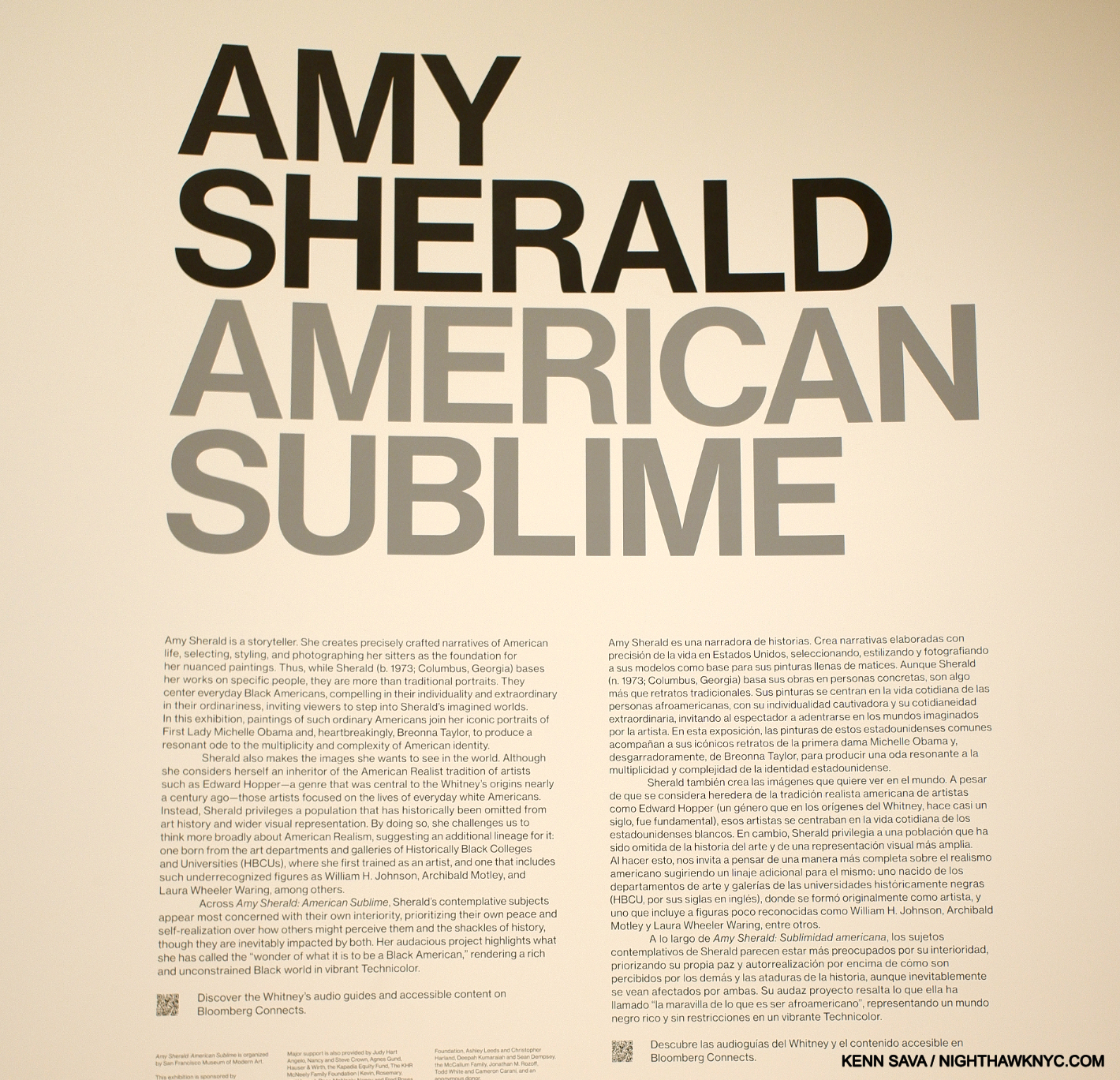
Amy Sherald: American Sublime, Whitney Museum, Summer, 2025

The Whitney & MoMA went toe-to-toe with dueling summer blockbusters in 2025, with each institution mounting two. I began this series with a look at Hilma af Klint: What Stands Behind the Flowers at MoMA, where Jack Whitten: The Messenger was installed on 6. All the while, 40 blocks south, Amy Sherald: American Sublime was up at the same time as Christine Sun Kim’s landmark All Day All Night, comprising the Whitney share of the four must-see Summer shows.

Hauser & Wirth, October 15, 2019.

I first saw Amy Sherald’s work at her NYC debut show, “the heart of the matter…,”  at Hauser & Wirth in October, 2019, a show that contained 8 Paintings.

The select content allowed for more space around each that worked extremely well in my view. Handsome, 2019, Oil on canvas, 54 x 43 inches, was also shown in American Sublime. Seen at Hauser & Wirth, October 15, 2019.

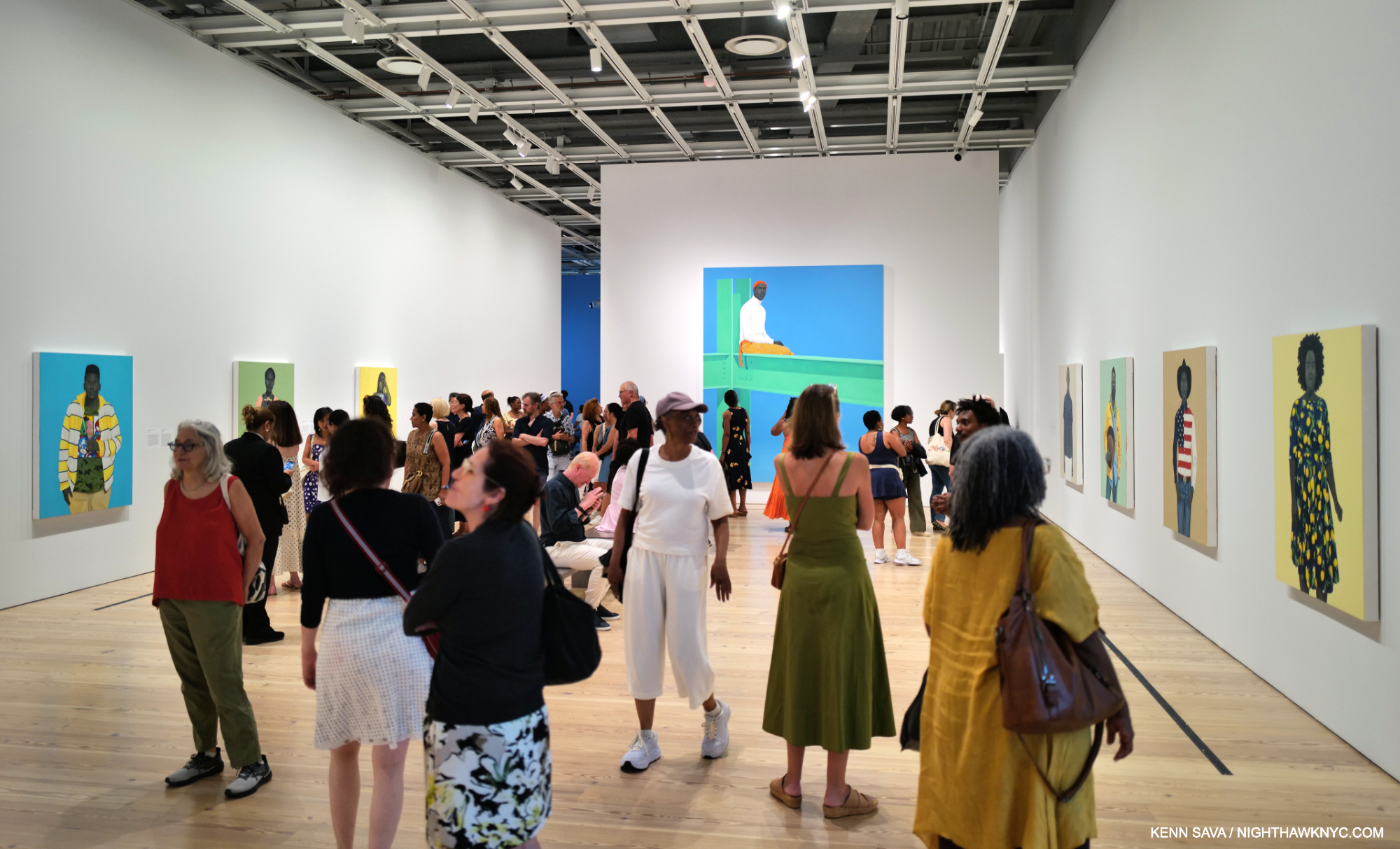
Fast forward to April 9, 2025, American Sublime contains 44 Paintings, the earliest dating from 2007- just 18 years prior! In those last two sentences hides the remarkable fact that Ms. Sherald (B. 1973) went from NYC debut show to an NYC early mid-career major museum Retrospective in a little more than five years! There aren’t a lot of Artists I can say that about.

Whitney Museum, July 25, 2025

Installation view. July 25, 2025.

What’s more remarkable is that just seven years before her Hauser show, on December 18, 2012, Amy Sherald underwent a heart transplant at age 39! That concluded a harrowing 10 years she spent after being diagnosed with congestive heart failure at age 30, and a two-month wait in the hospital for a donated heart (as is recounted in the piece I linked up top). Today, Amy Sherald is yet another fine Painter who burst on the scene this past decade and has wasted no time solidifying a place in museums around the world.

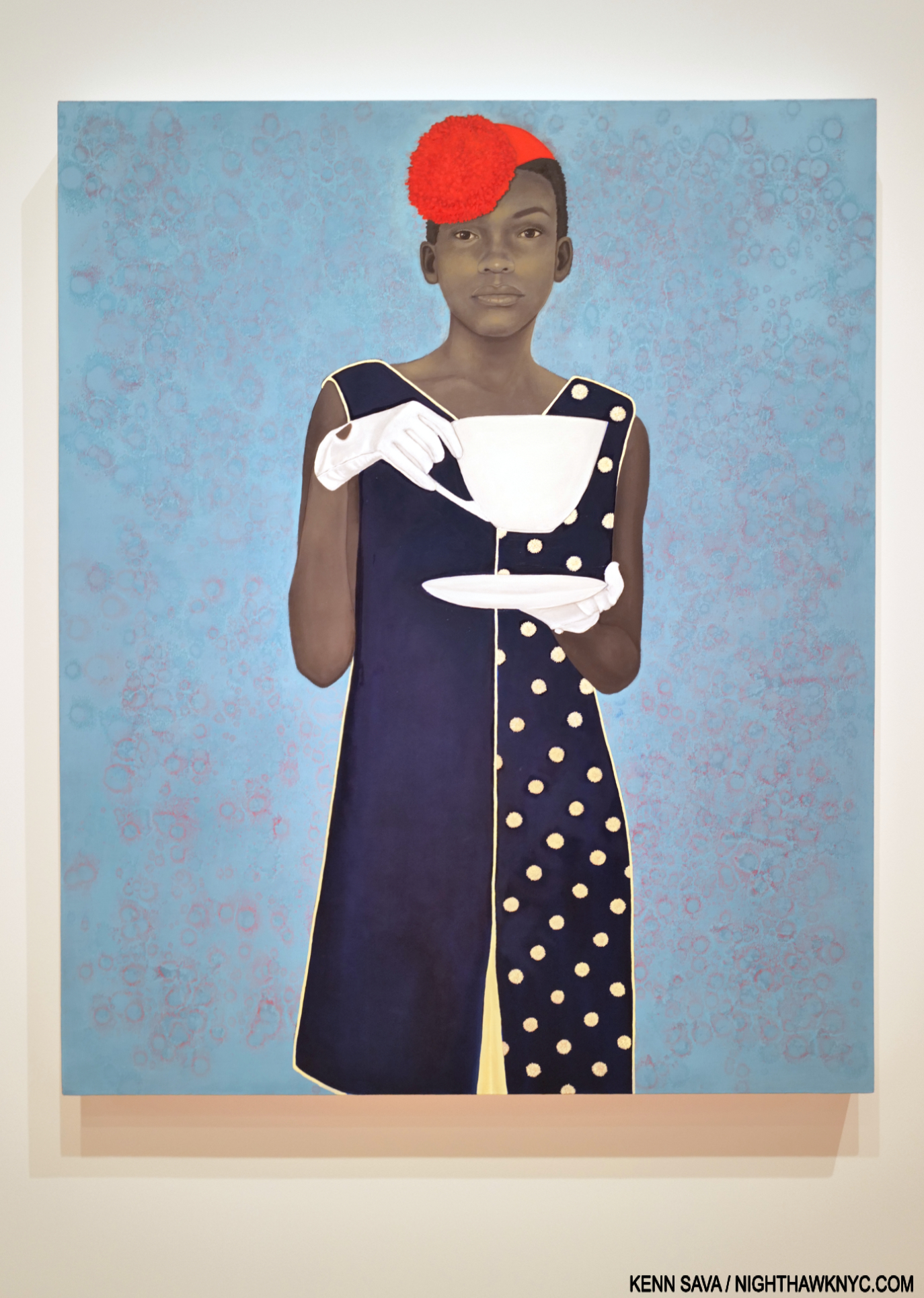
Miss Everything (Unsuppressed Deliverance), 2014. Oil on canvas. The Painting that brought Amy Sherald to national attention was inspired by Alice in Wonderland.

And, “burst on the scene…” she did as her 2019  NYC debut show came just three years after Amy won the 2016 National Portrait Gallery’s Outwin Boochever Portrait Competition with Miss Everything (Unsuppressed Deliverance), becoming both the first woman and the first African-American woman to win it.

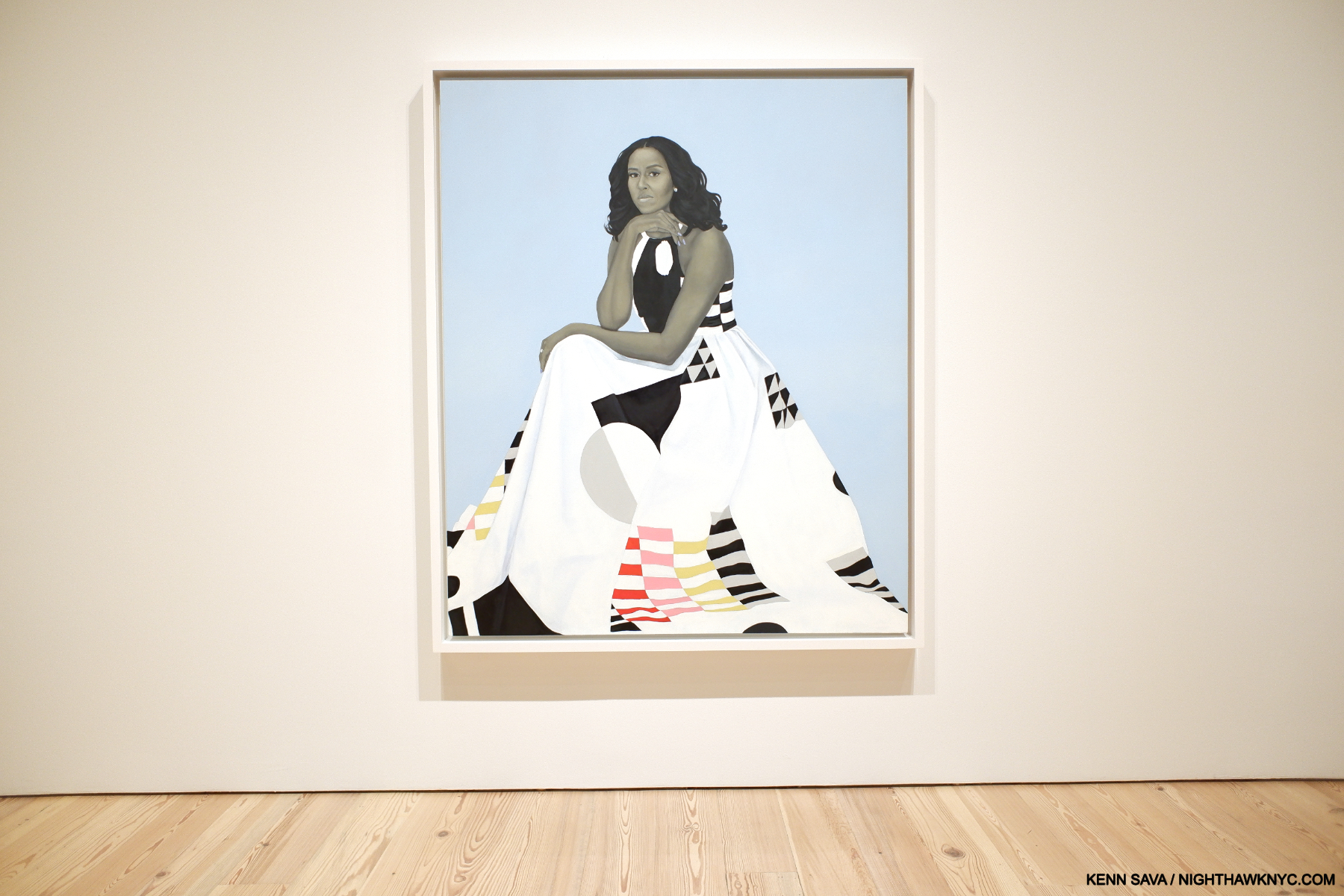
Michelle LaVaughn Robinson Obama aka First Lady Michelle Obama, 2018, Oil on linen. (The first title was on the wall card.) After being personally selected by Mrs. Obama to Paint her official Portrait, a prescient choice at the time. Amy Sherald’s stature has only continued to grow. The former First Lady selected the Michelle Smith Milly label dress she is wearing that channels Piet Mondrian through Gee’s Bends Quilt Making, blending the modern with the historic. Gee’s Bend is a remote Black Alabama community of the descendants of former slaves.

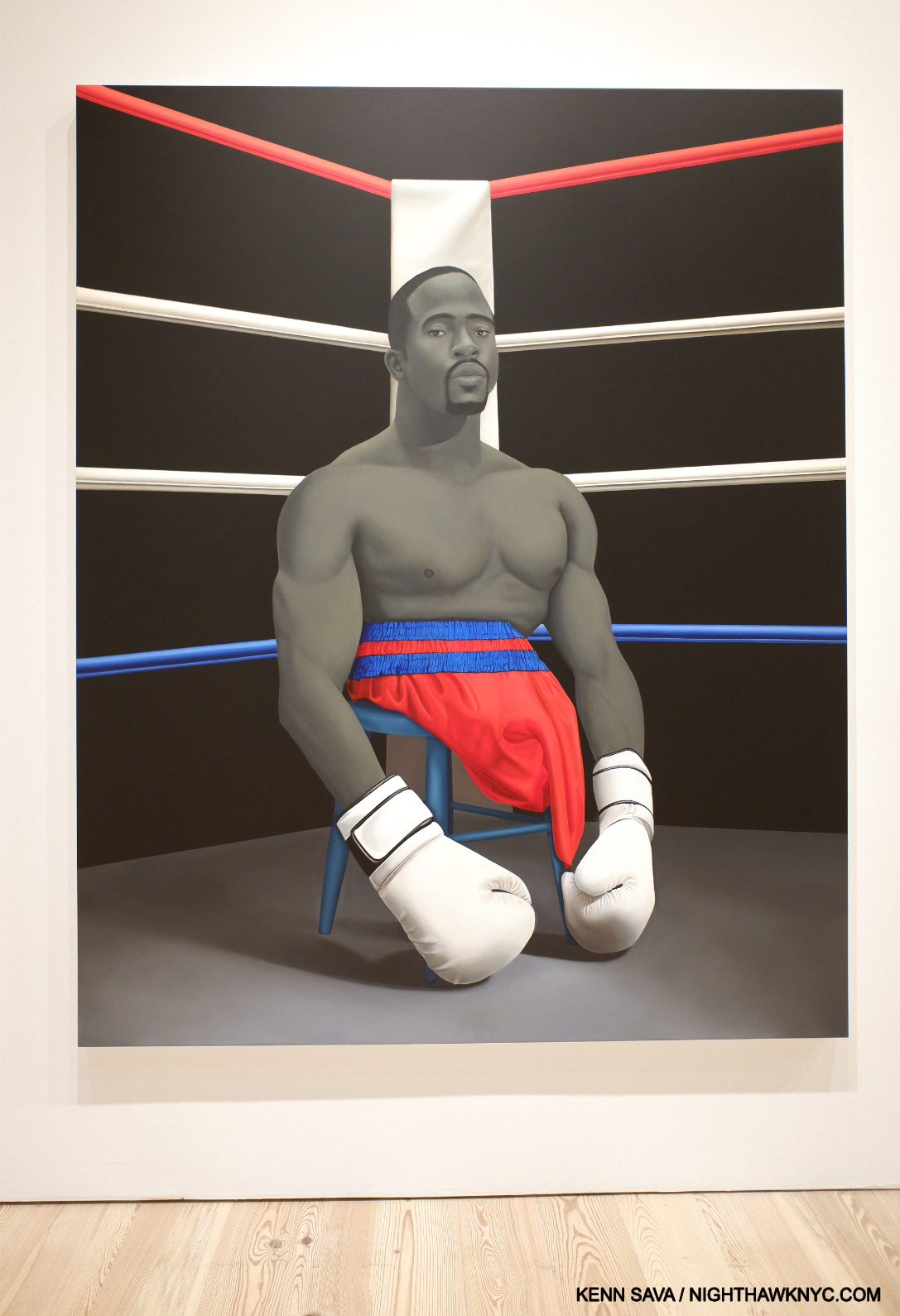
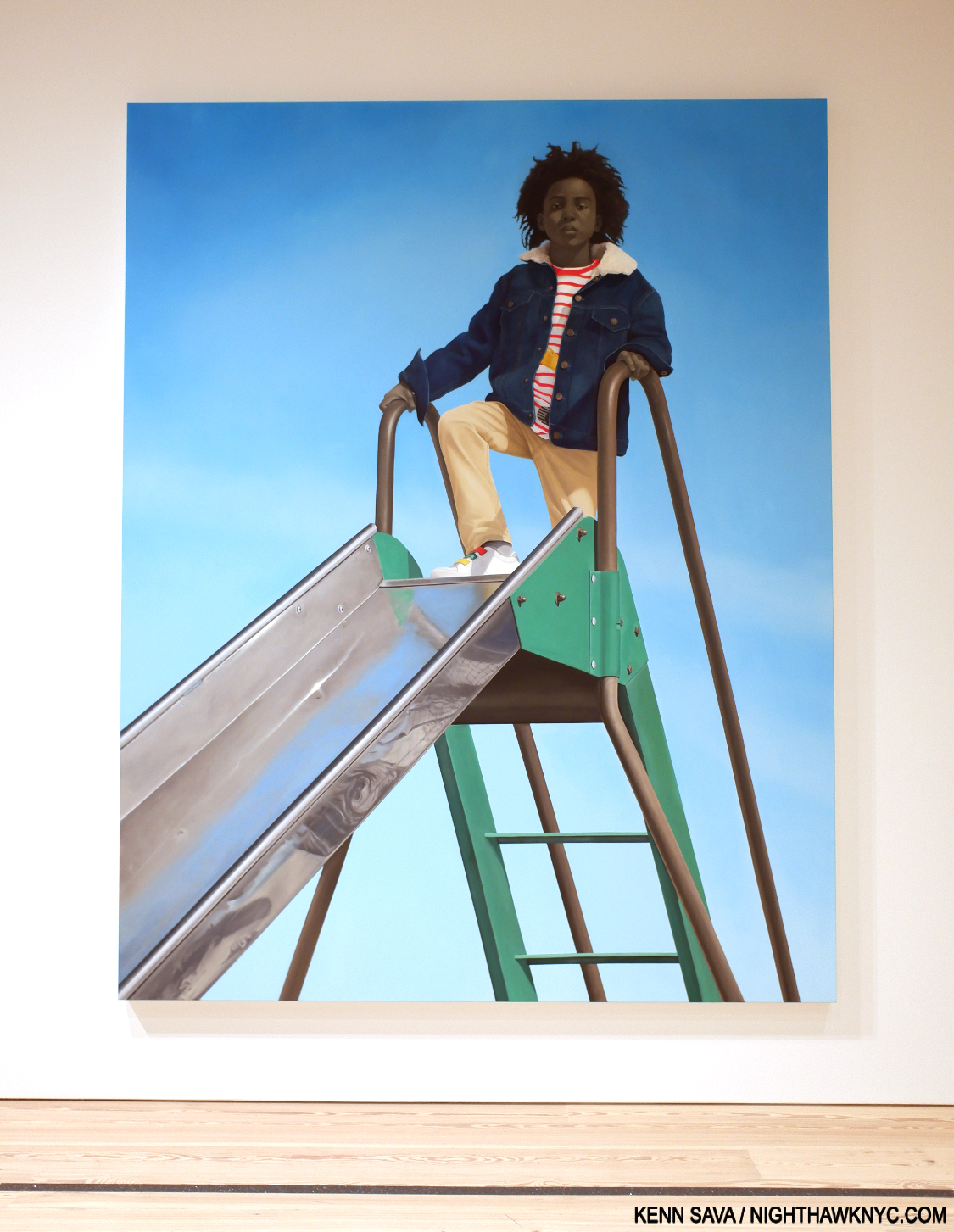
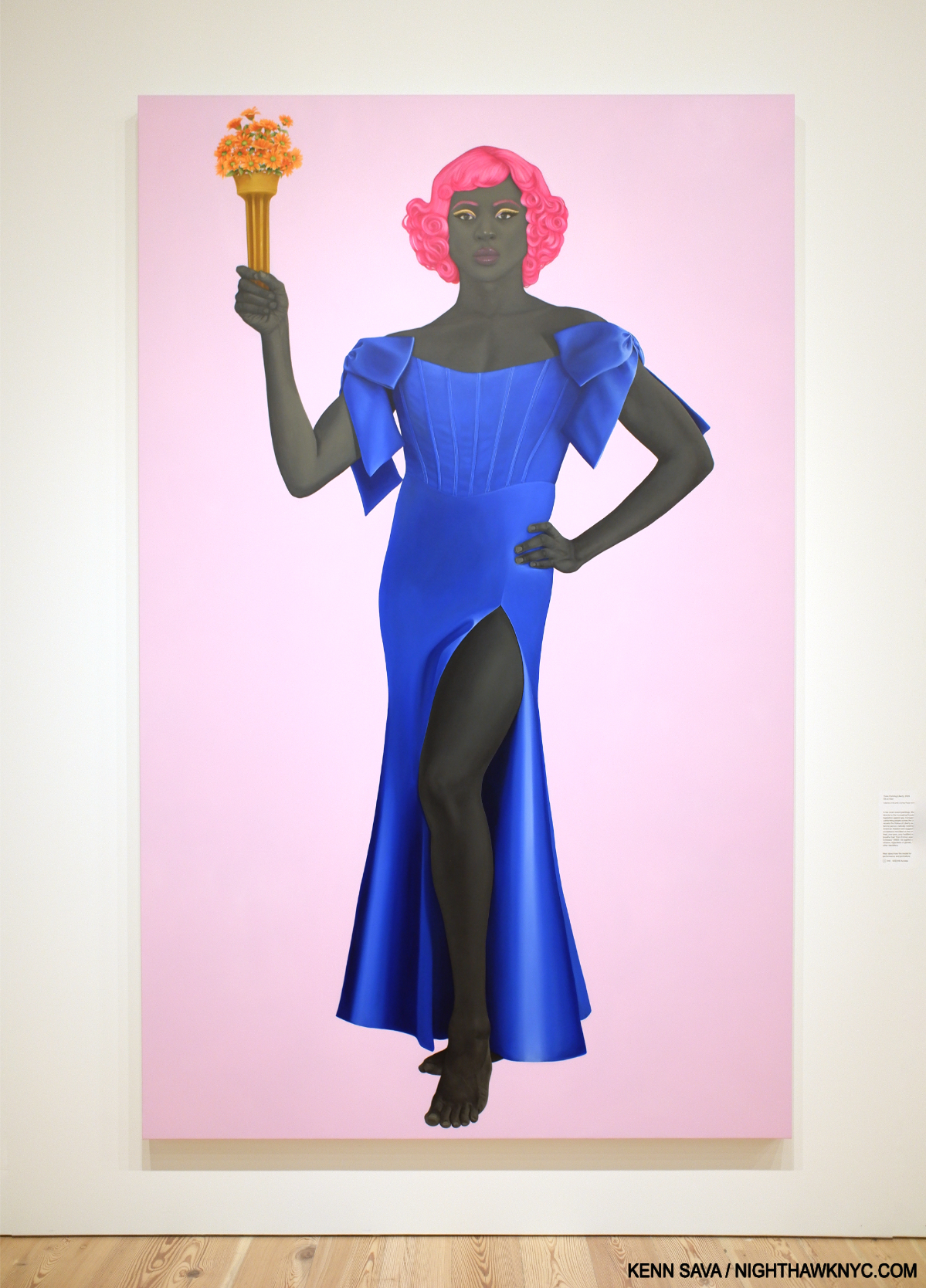
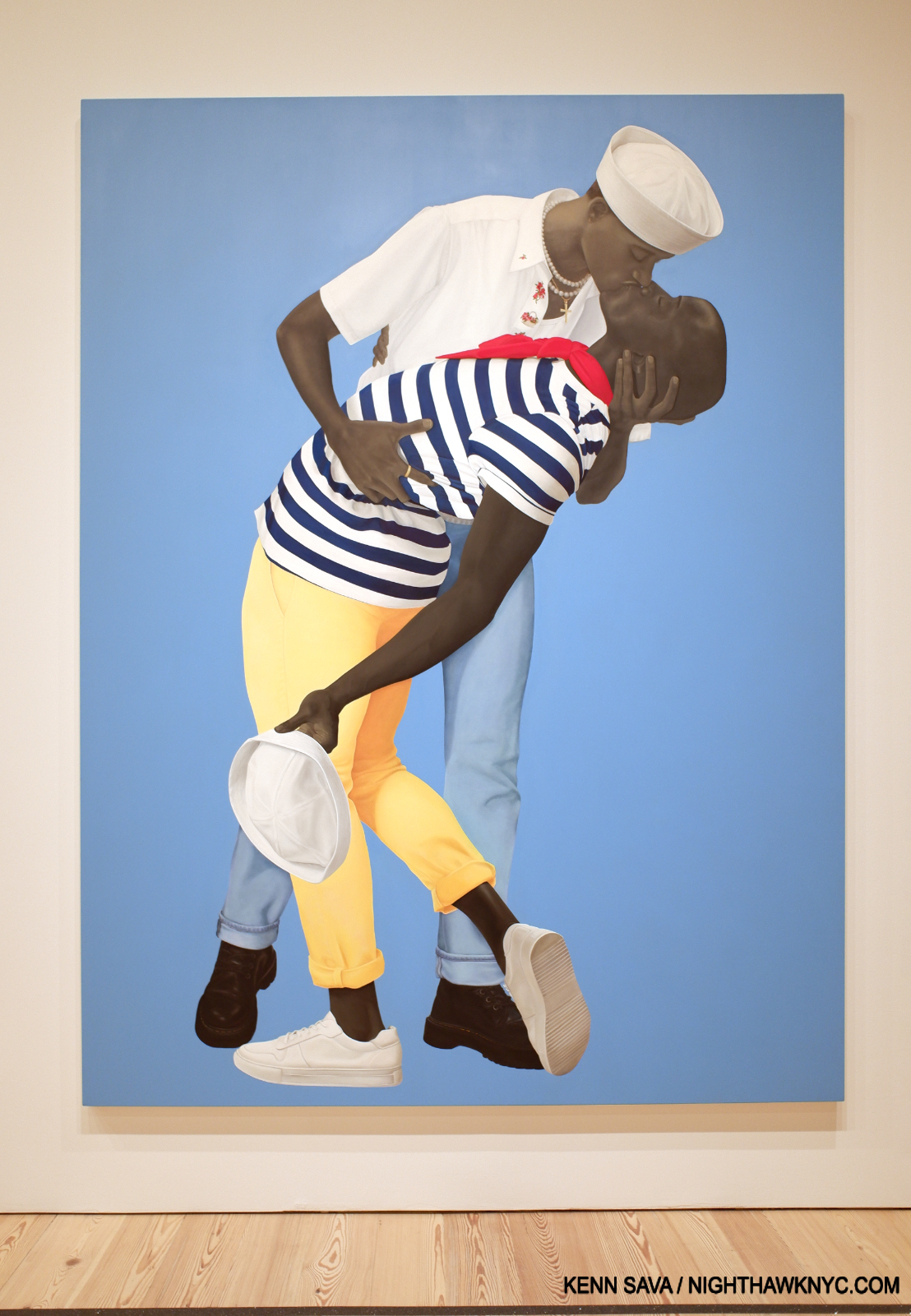
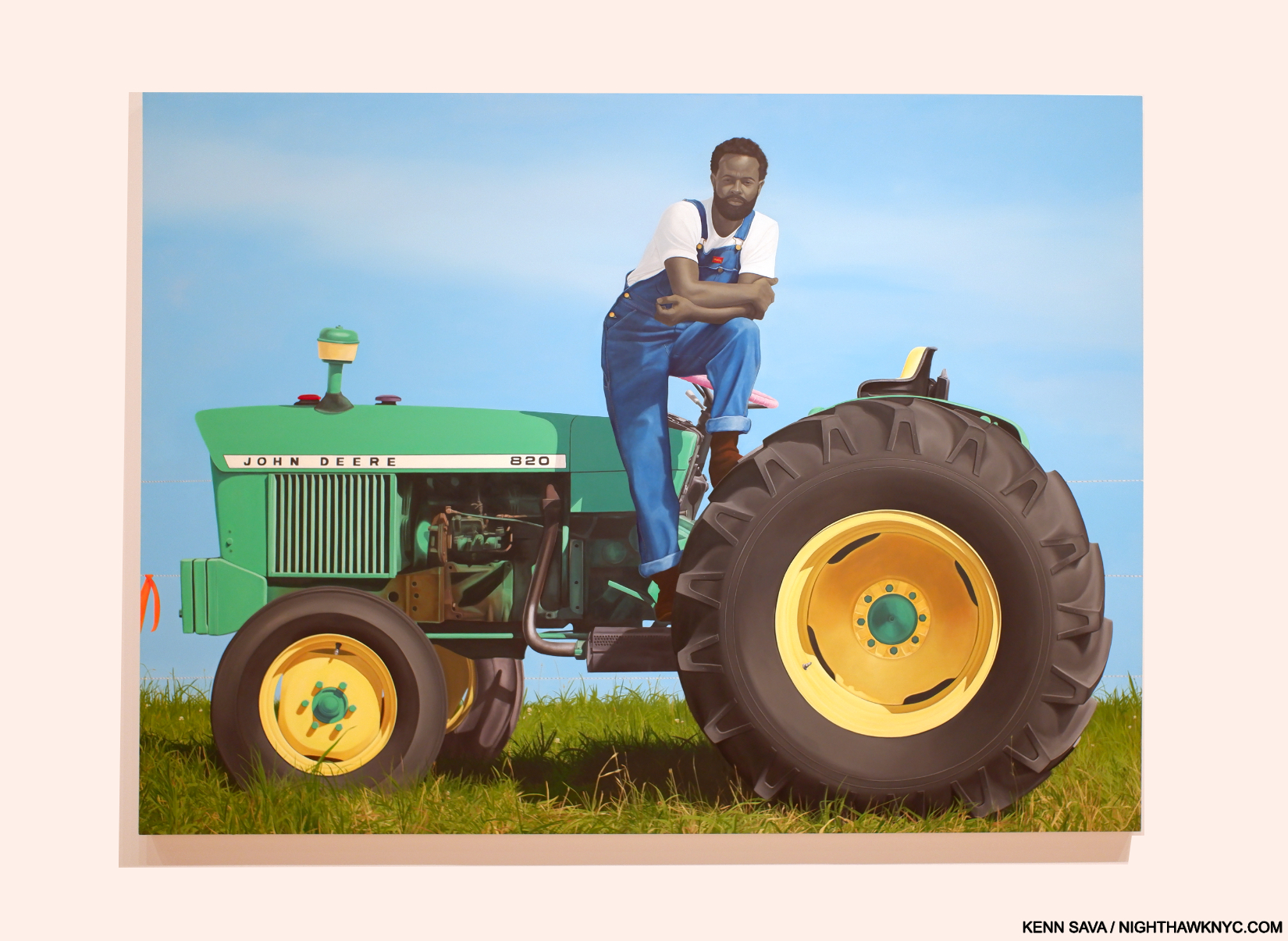
Most well-known today, perhaps, for her Portraits of Michelle Obama and Breonna Taylor, Amy Sherald: American Sublime revealed the depth of her accomplishment (already) in works that are almost always forthright, with subjects usually facing the viewer head-on, while steeped in a subtlety that rewards extended and repeated looking. Adding a unique twist is that the faces, hands, arms, legs of each of her subjects are gorgeously rendered in grisaille(!), something I’ve never seen done in a color Painting before, and something that has become her trademark. She uses grisaille as a way of “challenging the concept of color as race1.”

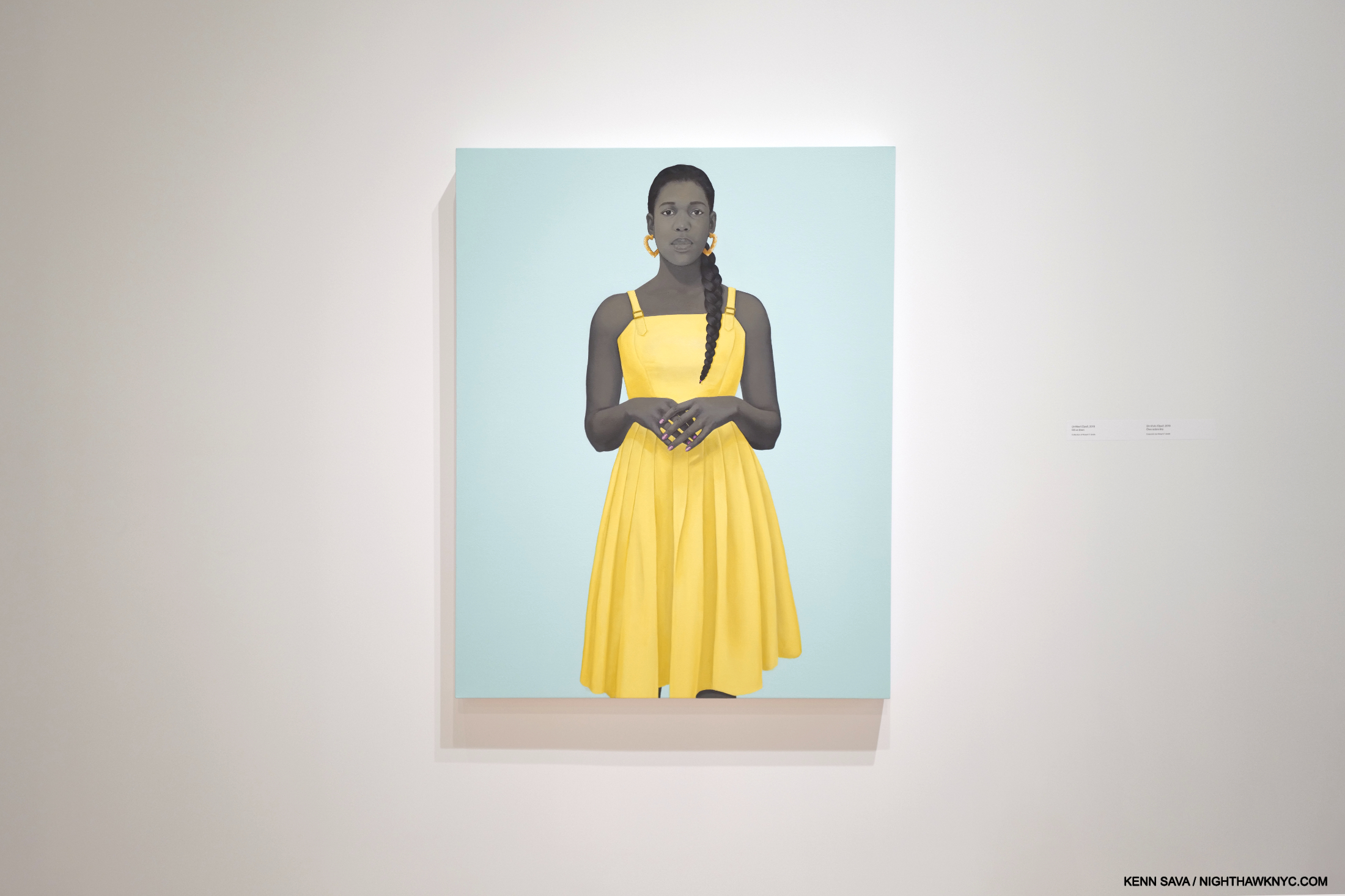
Untitled (Opal), 2019, Oil on linen. Standing in front of Opal, I found myself wondering why I’d never seen a Painting like this before. It seems so incredibly straight-forward, yet only Amy Sherald could have Painted it and made it as unique as it is. From the grisaille, to the position of her hands & fingers, to her expression and the choice of colors, which Wes Anderson might admire, it’s a remarkable blend of a Portrait of Opal through the eyes of an Artist with a vision.

In the late 1990s and early 2000s I spent much time wondering what new developments would come to Portraiture after the work of great 20th Century Artists, like Francis Bacon, Lucian Freud, Frank Auerbach, Alice Neel, Marlene Dumas, Picasso, and others. 25+ years in, the genre is continually being reinvented, yet again, by a number of Artists who have come to prominence this decade- including Amy Sherald, Nathaniel Mary Quinn, and Frank Auerbach (who passed away in 2024).

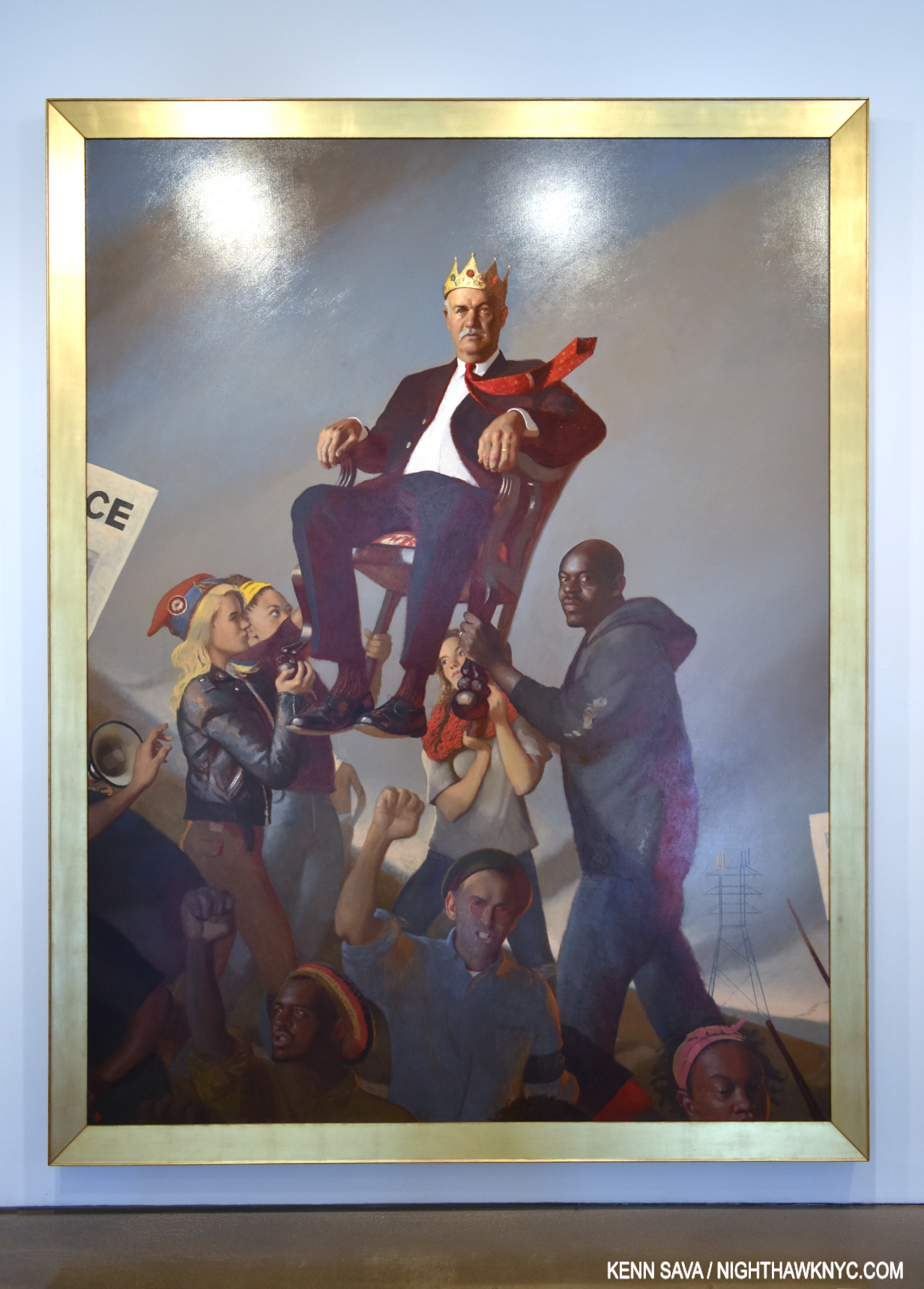
Bo Bartlett, Oligarchy, 2016, Oil on linen. See at Ameringer McEnery Yohe, August 12, 2016.

Interestingly, Amy credits the Painter Bo Bartlett with showing her the possibilities. Others have posited that Ms. Sherald’s use of grisaille goes back to old black & white Photos of Black subjects, and not Painting or Painted Portraiture. However, on 19th Century Photographs Ms. Sherald said-

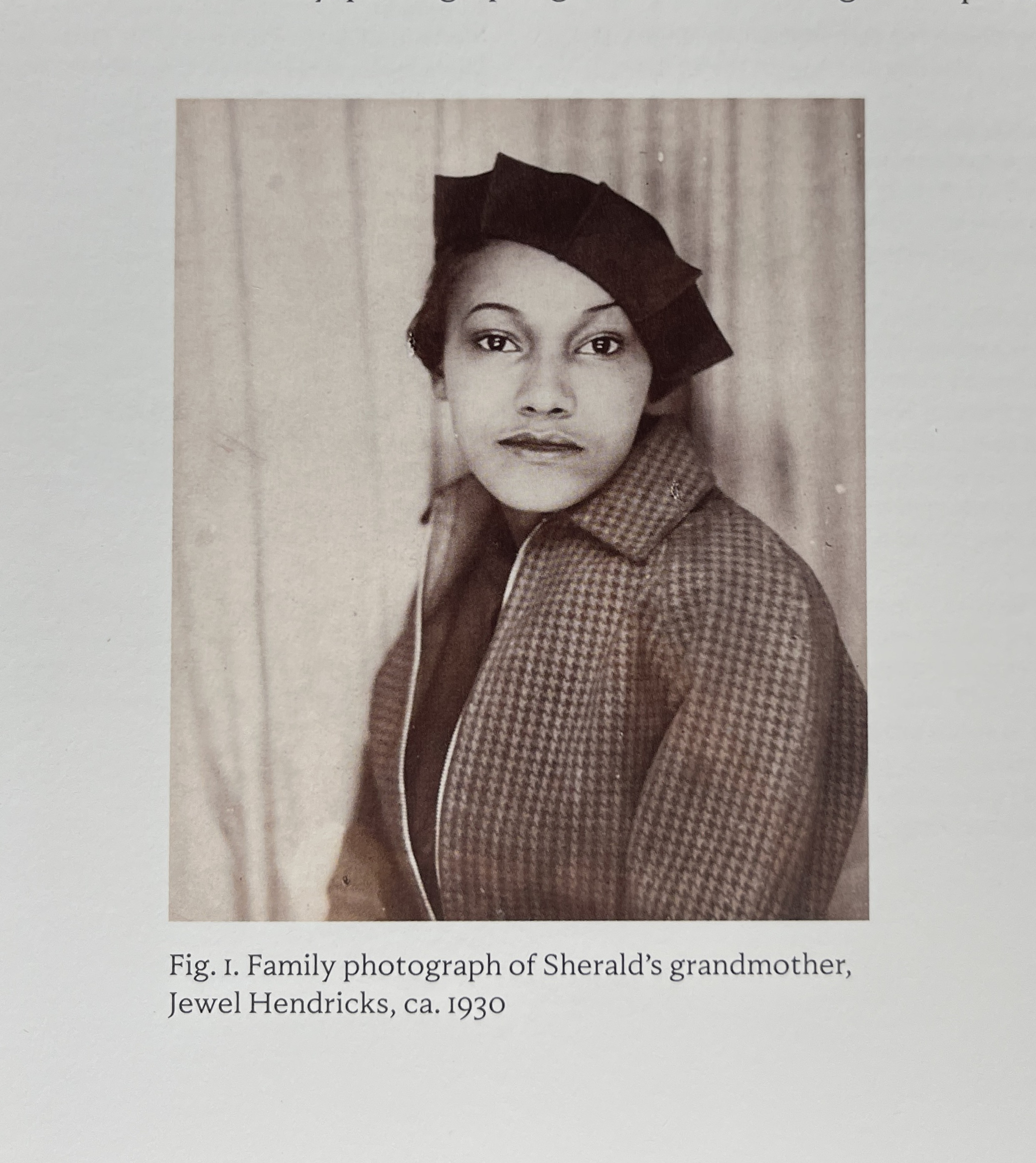
“It wasn’t what inspired my work, but it’s what affirmed my journey with it, and it’s where I was finally able to find these representations of black Americans that spoke to me in the same way that I wanted my work to speak to the world. They were family photographs, similar to the image of my grandmother that I oftentimes mention, where she had her picture taken.”

The Artist’s grandmother, Jewel Hendricks, as seen on page 28 of the excellent American Sublime catalog.

“Looking at how they represented themselves— they’re quiet, regal, graceful. It was an outward action that had inward meaning. They don’t smile, but there’s something there-this is what I look for in people— the feeling that you get when you look at those old photographs. When you look into their eyes, you are being told a story. It’s almost as if they’re standing in front of you, and they have a living and breathing kind of energy. There is something so captivating about that. And it’s not frivolous. It’s a very serious, deliberate kind of thing, having your picture taken, especially then2.”

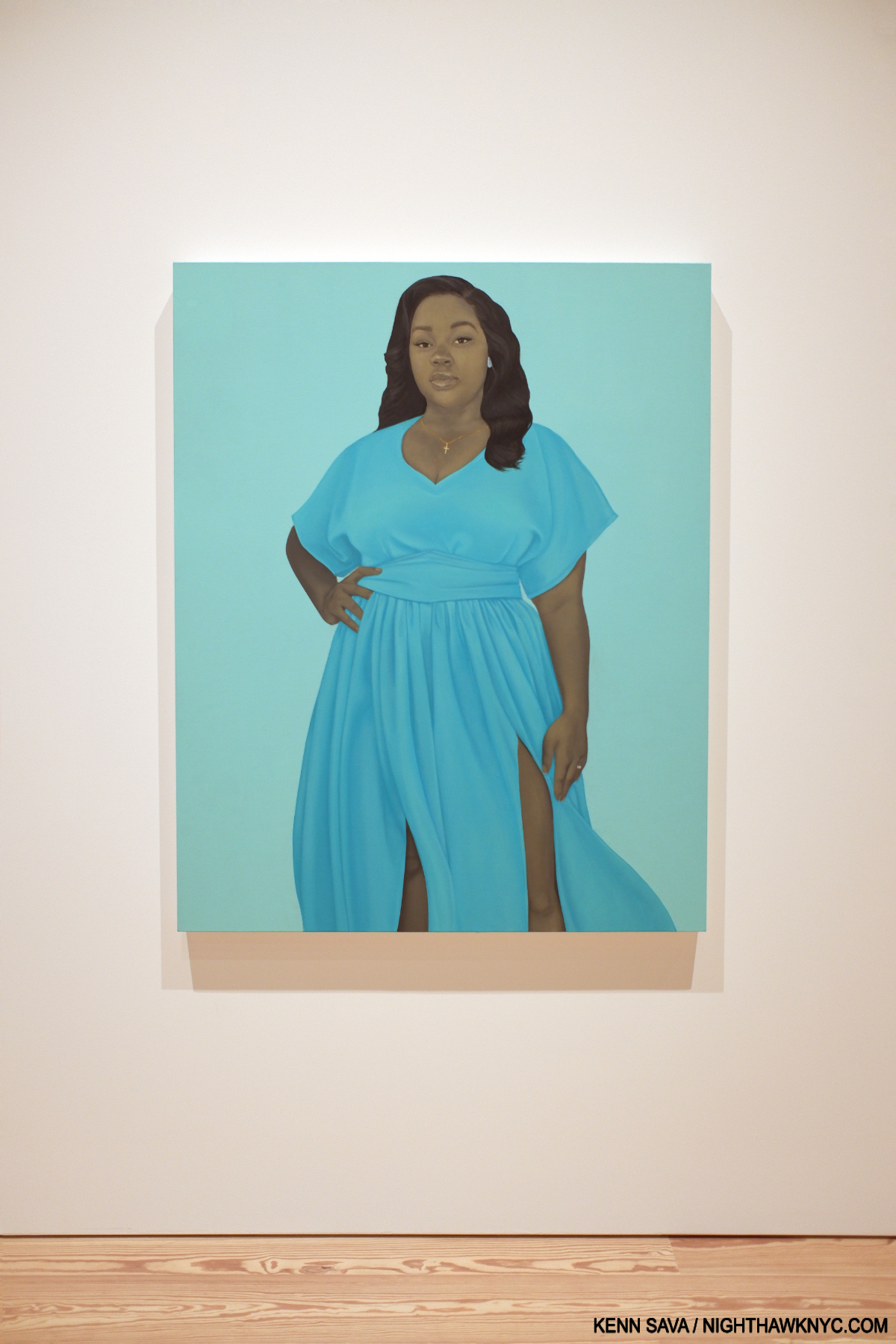
Breonna Taylor, 2020 Oil on linen.

In work after work, American Sublime reveals that Amy Sherald is a master of Portrait story telling. Her Portrait of Michelle Obama, Michelle LaVaughn Robinson Obama, is a classic case in point that manages to subtly weave multiple threads. Crossing cultural boundaries by dialoguing Mondrian-like elements and Gee’s Bends Quilt Making is artistically ground-breaking, topped off with a natural and wonderfully relaxed pose, enhanced by the background pale blue, that is just stunning.  This is just what Amy Sherald does. Commissioned to Paint the late Breonna Taylor, her first posthumous Portrait, Ms. Sherald visited her family and spent time with her mother, Tamika Palmer, who spoke of Breonna’s interest in fashion. Amy commissioned a dress for the Portrait, and also added an engagement ring on her finger “to represent the love between Taylor and her partner, Kenneth Walker… Sherald incorporated the ring to give him solace and to suggest a brighter future3.” Of the finished Painting she said, “I don’t think I thought much about the viewer so much as I thought about her family when I was making this portrait….but when you’re speaking about violence against women and police brutality, she’s become the face for that movement,” she said4.

The intro for the Audio Guide for her 2019 Painting, The Girl Next Door says, “The artist discusses how she transforms the historical function of portraiture.” That’s a lot to have accomplished in 18 years already. Along the way, she renders a wide range of subjects that encompass an equally wide range of Black Americans, including more than a few who are new to museum walls showing the scope of her vision.

American Grit, 2024 Oil on linen.

As soon as she was able to, she sought out the family of the woman, Kristen, whose heart she now has. Amy was 39 when she received Kristin’s heart. Kristin died at 38. Amy calls it “a perfect match.”

Kingdom, 2022 Oil on linen

“What kind of person was she? What kind of things did she like. Who did she love? I romantically believe in muscle memory, heart memory. It means a lot for me to be able to just kind of get to know her family a little bit. When I met her father he made me feel her heart beat. … I still call it Kristen’s heart.”

Trans Forming Liberty, 2024 Oil on canvas

“I live without fear. I work without fear. I wake up and produce these ideas without thinking so much about painting something stupid or people not liking it. I’m living this moment: I wake up every day, and I have to make sure that my work continues to speak to generations. I need to make things that are going to resonate in that way.” 

For Love, and for Country, 2022 Oil on linen.

She continues, “But I also truly believe in who I am as a human. I believe in my power. I believe in timing. I believe that this is my “now,” and that nothing can go wrong now. I understand that as a fact. I’ve been through the worst of the worst, and it was still okay. I wake up, and I keep it moving every day for Kristin and my brother Michael. You don’t waste second chances5.”

A God Blessed Land (Empire of Dirt), 2022 Oil on linen.

*- Soundtrack for this piece is “I Can See Clearly Now,” written & performed by Johnny Nash from the 1972 album of the same name, which he performs the following year-

For those who kept me here, and for Lisa, who gave this total stranger her extra ticket to the sold-out Basquiat show at the Brant Foundation in Spring, 2019, enabling me to see it and share it with the world. As she was leaving she told me she was looking forward to seeing Amy Sherald: the heart of the matter….

NighthawkNYC.com has been entirely self-funded & ad-free for 10 1/2 years, during which over 340 full-length pieces have been published! If you’ve found it worthwhile, PLEASE donate securely by PayPal below to allow me to continue. Thank you, Kenn.

You can also support it by buying Art, Art & Photography books, and Music from my collection! Art & Books may be found here. Music here and here.

Written & photographed by Kenn Sava for nighthawknyc.com unless otherwise credited. To send comments, thoughts, feedback or propositions click here. Click the white box on the upper right for the archives or to search them. Subscribe to be notified of new Posts below. Your information will be used for no other purpose.

  1. https://nmwa.org/art/artists/amy-sherald/
  2. “Amy Sherald in Conversation with Ta-Nehisi Coates” in Amy Sherald: The World We Make, P.184
  3. https://nmaahc.si.edu/object/nmaahc_2021.117
  4. ibid.
  5. ibid. P.186

CJ Hendry: Colored Pencil Mastery to Art SuperStar

THIS SITE IS FREE & AD-FREE!
If you find this piece worthwhile, please donate securely via PayPal so I & NighthawkNYC can continue. More ways you can support it at the end. Thank you.

Written & Photographed by Kenn Sava (*- unless otherwise credited)

Show seen- CJ Hendry, Flower Market 2.0, Rockefeller Center, September 19-21, 2025

Having just written about Hilma af Klint’s Flower Paintings (with guest star Georgia O’Keeffe), there is another Artist who garnered quite a bit of attention with Flower Art in NYC in 2025: the Artist known as CJ Hendry. Learning about her and experiencing her work in 2025 turned out to be an adventure, the likes of which I’ve never experienced in the NYC Art world.

What do I mean, “quite a bit of attention…”, and “The likes of which I’ve never experienced…”? Check out the 5 city-block long line of people (on the far side of the barricade) waiting to get into her show, sped-up 400%-

I sped it up 400%(!) so you wouldn’t have to spend the 10 minutes I spent walking to the end of what was the longest line I’ve ever stood in in NYC, let alone for an Art event. What’s it all about? Why are so many people interested in CJ Hendry?

Ms. Hendry first came to my attention this past Spring while I was researching the current State-of-the-Art in Colored Pencil Drawing, and discovered this-

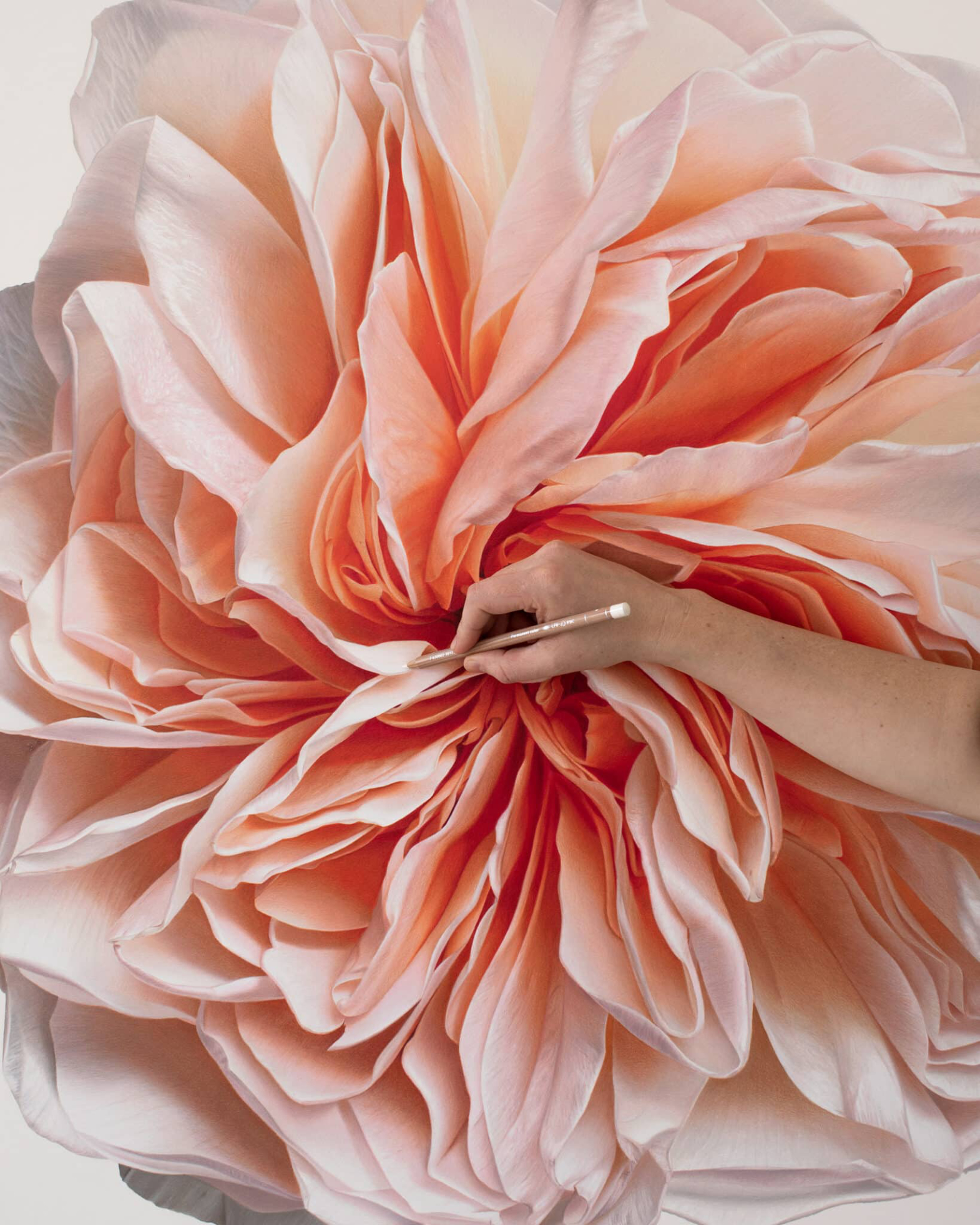
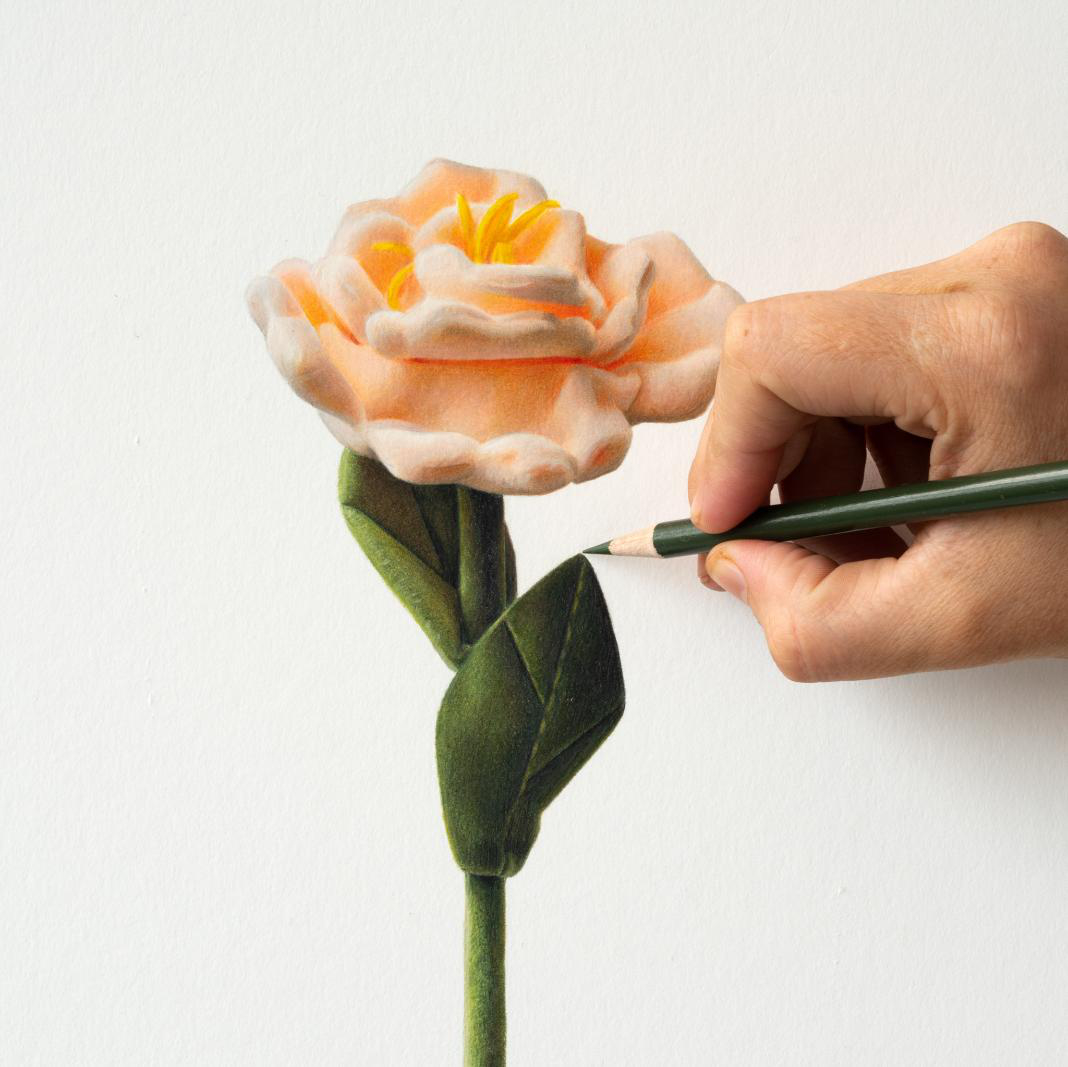
Detail of Light Peach Rose, the whole 41 x 41 inches shown next, Colored Pencil, on paper or board (not specified), Date unknown. The Artist works on a detail with a Caran D’ache Luminance Color Pencil. *- CJ Hendry Studio Photo.

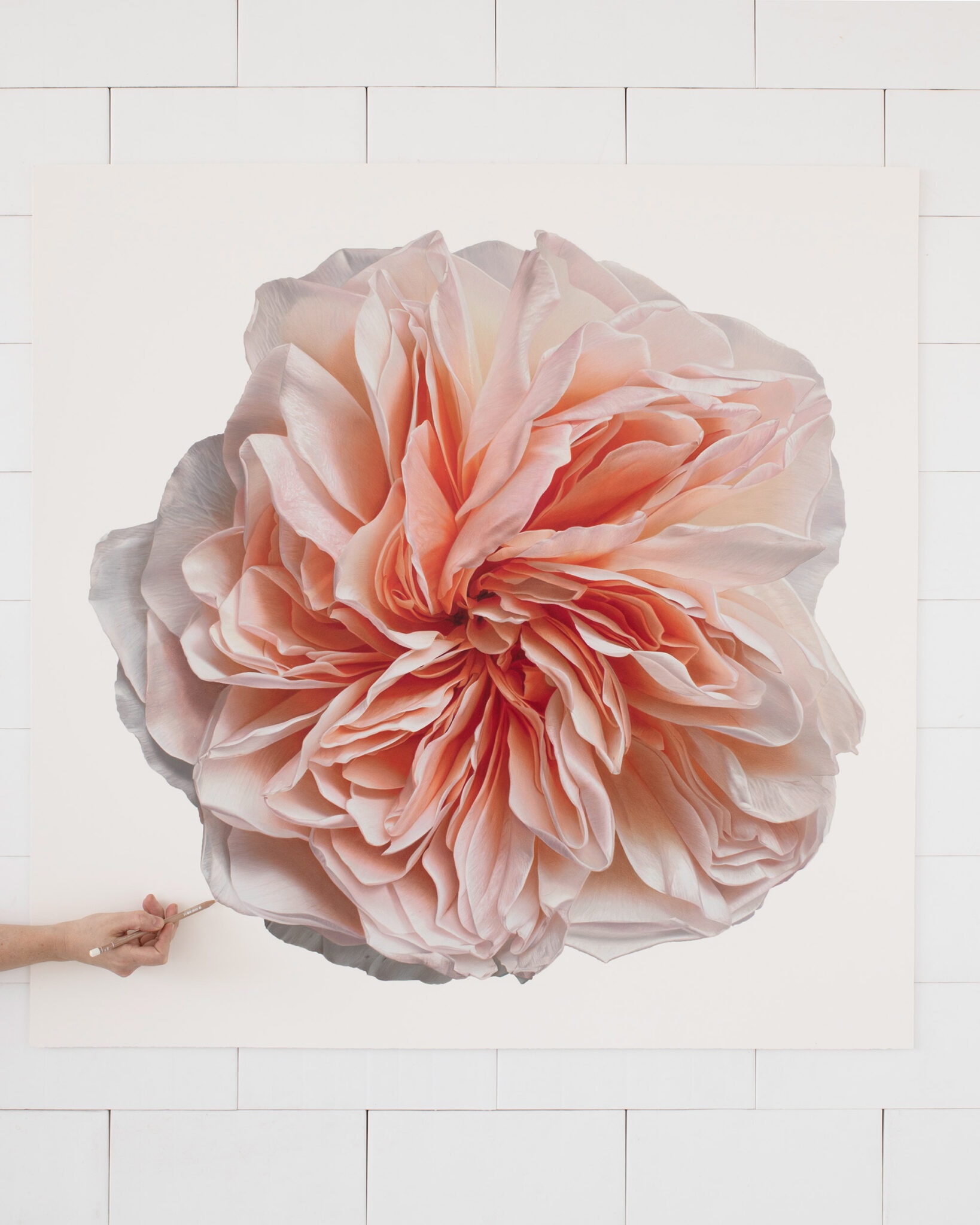
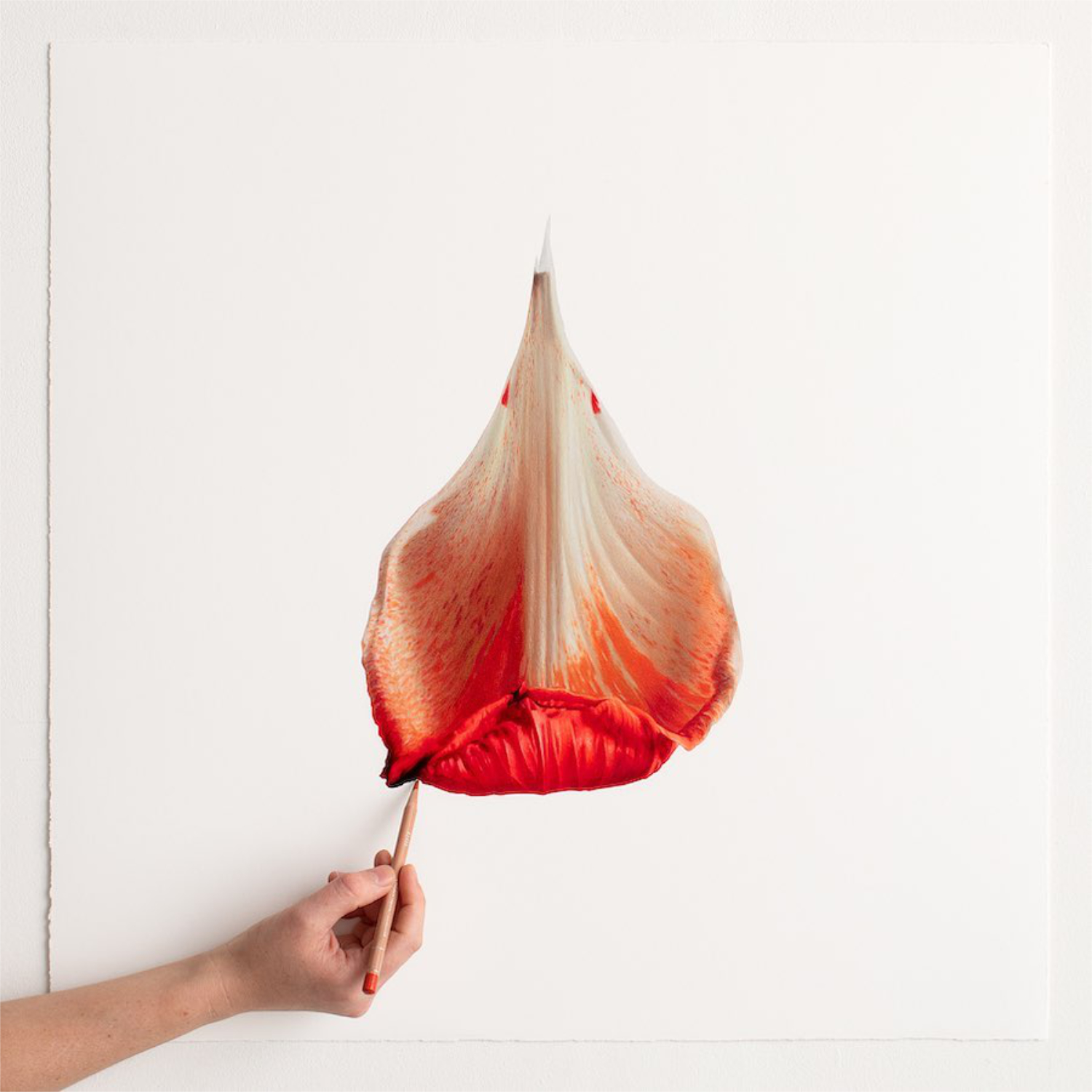
The full work, Light Peach Rose, 41 x 41 inches, mounted on a wall, as the Artist adds a detail, or holds the pencil there ostensibly so we know it’s not a Photograph. *- CJ Hendry Studio Photo.

Astounded by her work, as numerous others have been, I searched deeper, looking for answers about how she gets such spectacular results.

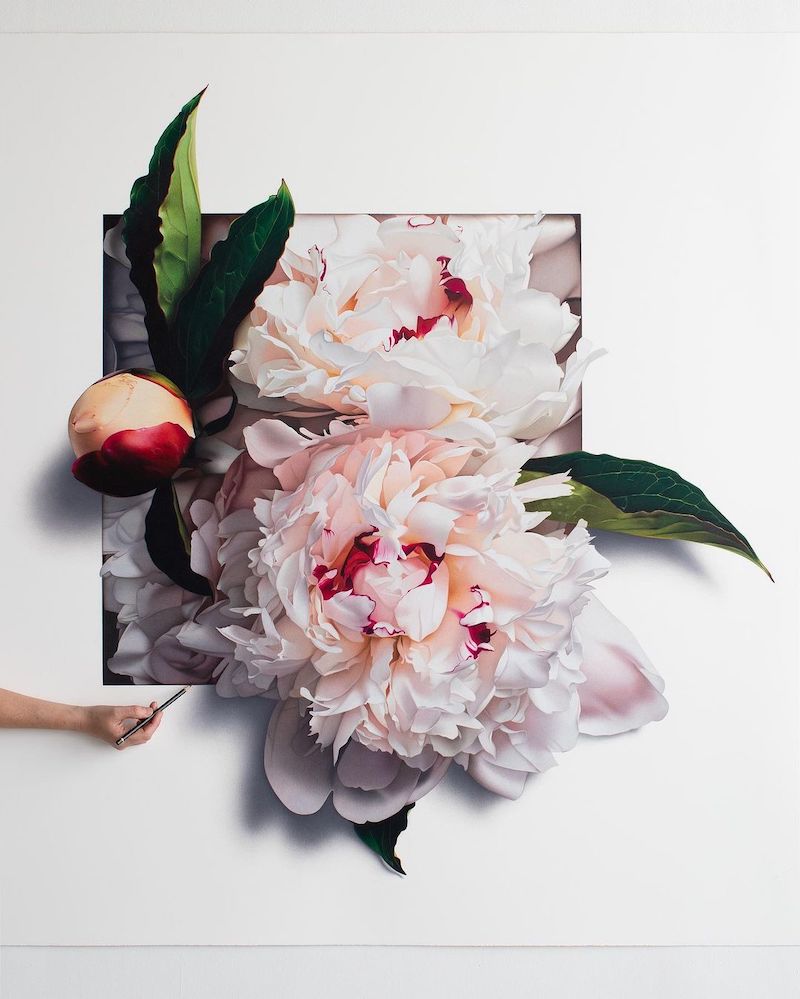
One of her most remarkable Flower Drawings. Title, size, date, materials besides Colored Pencils, unknown. Ms. Hendry loves to play with the picture plane and the picture “frame,” here, with a large part of the composition seeming to extend out of the frame and appear to be 3-D. In some of her pieces she even Draws an intricate gilded frame. *- CJ Hendry Studio Photo.

Details are few and far between. It’s not that she’s overly secretive, I think she’s just busy. The closest I’ve come are a few yt videos she’s posted where you can actually watch her Draw. One lasts SIX HOURS! Yes, I’ve watched all of it, and parts of it more than once. It’s not a lesson per se, it’s the Artist at work, and there’s no sound (Ms Hendry usually listens to audiobooks or shows during her marathon Drawing sessions), but it’s revealing nonetheless.

My most recent piece on Hilma af Klint focused on her Nature Series Portfolio consisting of 42 Watercolor Paintings containing renderings of 100 varieties of flowers that was on view at MoMA this Spring and Summer. The piece focused on Art depicting individual flowers, which is exactly what CJ Hendry is doing here. As the year went on, I found myself pondering the similarities, and differences, between CJ Hendry, Hilma af Klint and Georgia O’Keeffe on a regular basis. I’ll get to that.

Flower, Colored Pencil on Paper or board, Date unknown. One of her source Drawings for her Plush Flowers, seen further below. *- CJ Hendry Studio Photo.

Having spent 2025 looking at Flower Art almost exclusively, I was immediately struck by another series of Flowers she’s drawn, that includes this one. I’ve seen twelve of these Drawings, though there are likely more given she & her team proceeded to make them into a series of about 27 different Plush Flowers that were given away and sold in the two Flower Markets she’s set up on Roosevelt Island in 2024, and in Rockefeller Center in September, 2025- the show all those folks in the video were waiting to get in to see51. Looking at these reminded me of Georgia O’Keeffe’s famous quote about “realism”-

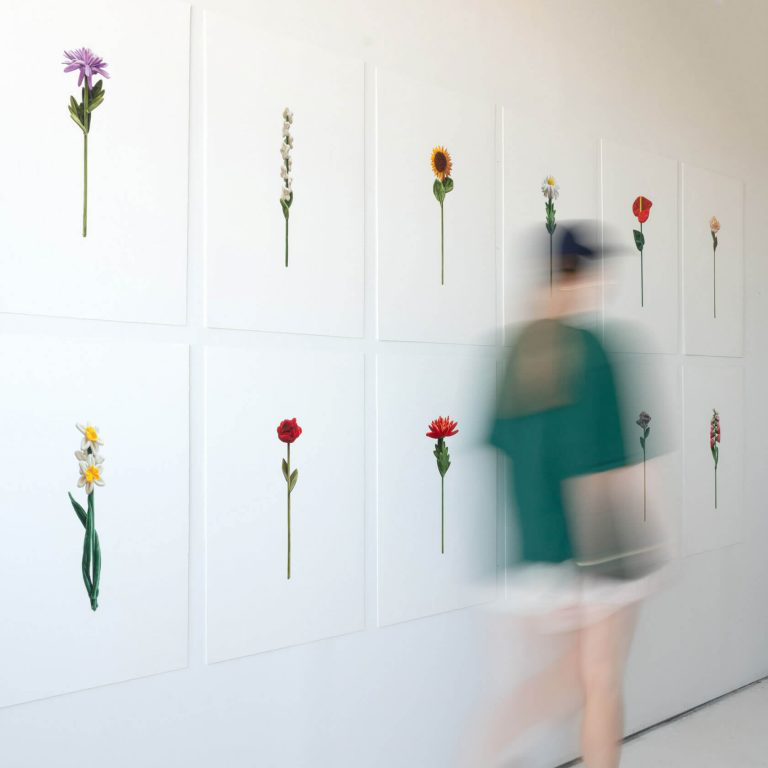
Busy lady. The Artist moves past a wall of 12 of her Flower Drawings. *- CJ Hendry Studio Photo.

“Nothing is less real than realism. Details are confusing. It is only by selection, by elimination, by emphasis, that we get at the real meaning of things,” Georgia O’Keeffe.

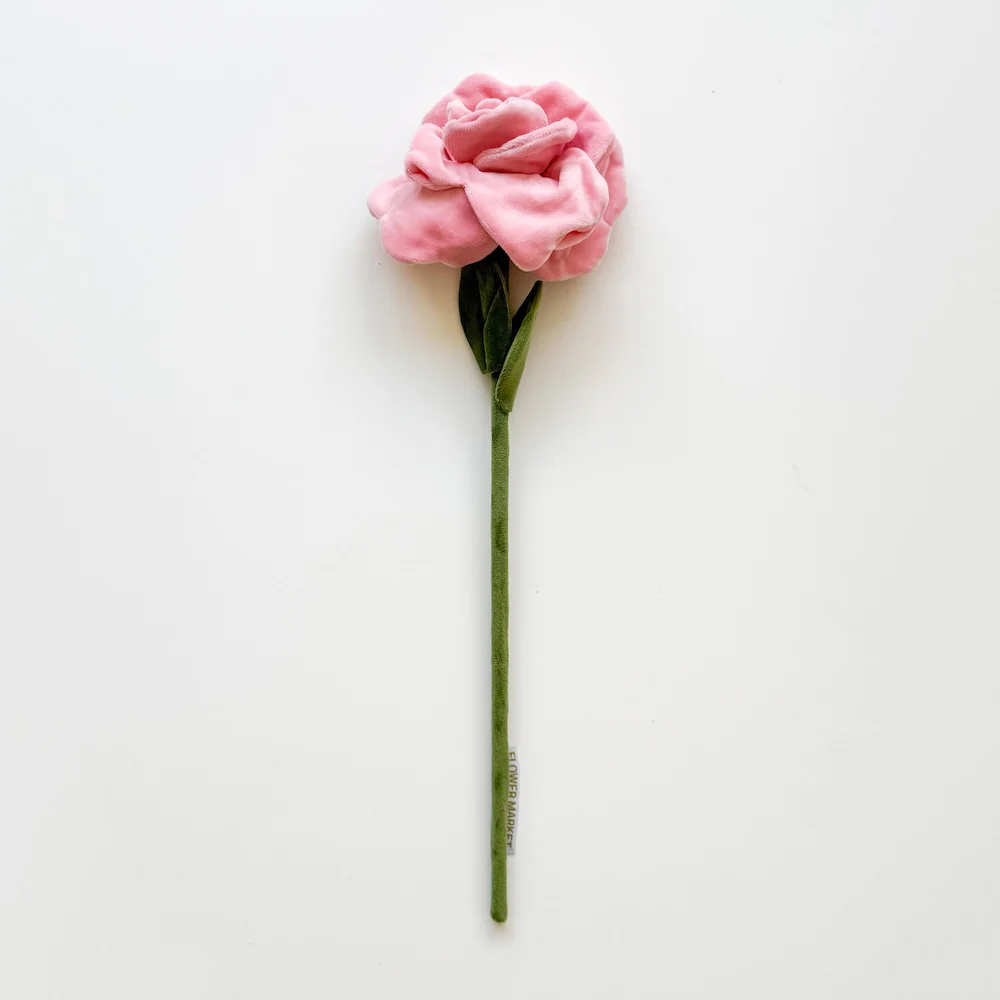
Plush Flower, 2024-5. Each 20 inches tall. Each meticulously crafted, with a double-sided tag. *- CJ Hendry Studio Photo.

I don’t know if Ms. Hendry knows that quote, or has been influenced by it, yet looking at her Plush Flowers and the Drawings they’re based on, I’m struck by how sensitively she’s “edited” nature’s creations while still retaining species recognition. Frankly, it’s darn remarkable.

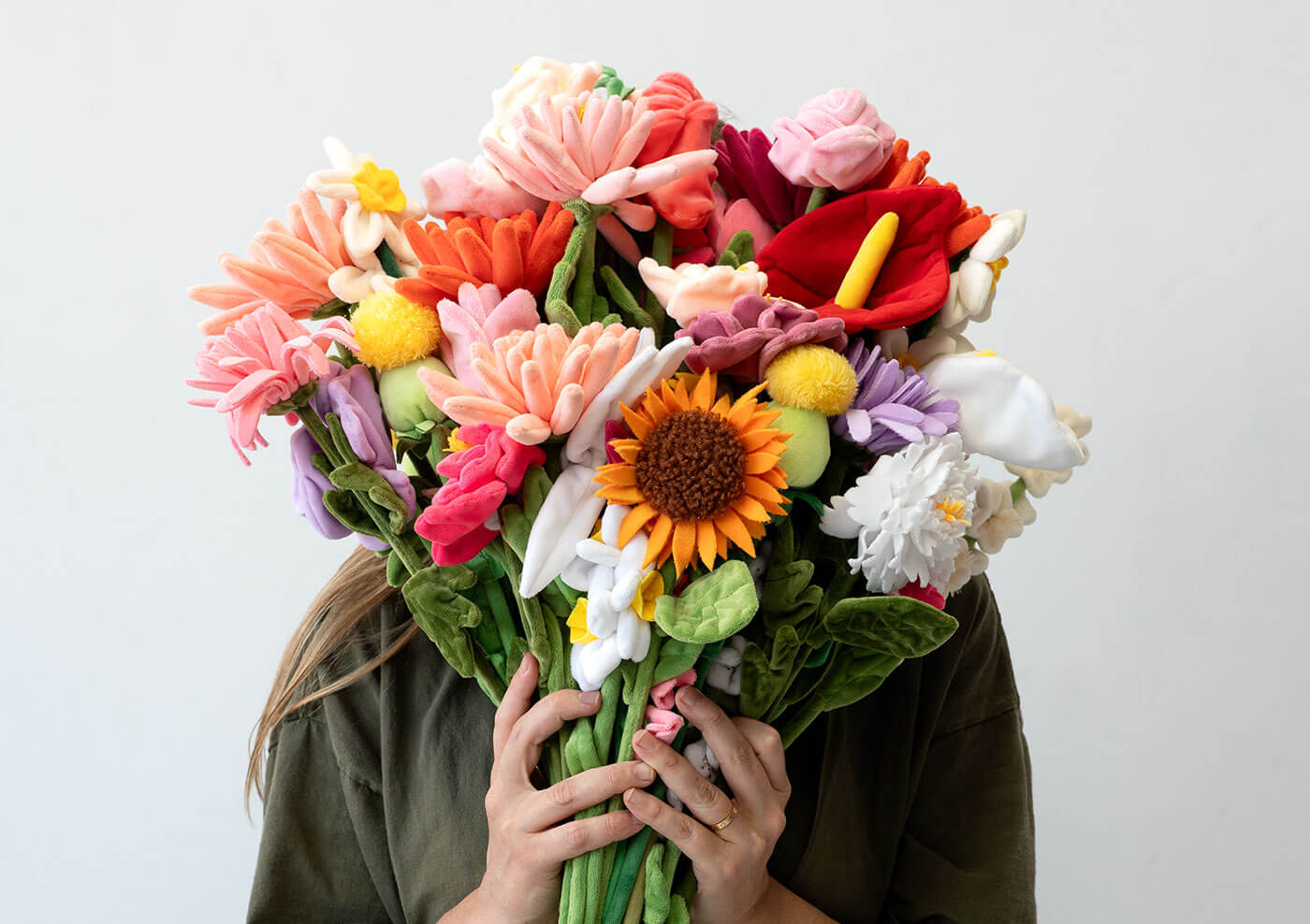
The Artist with a full Bouquet of her Plush Flowers. *- CJ Hendry Studio Photo.

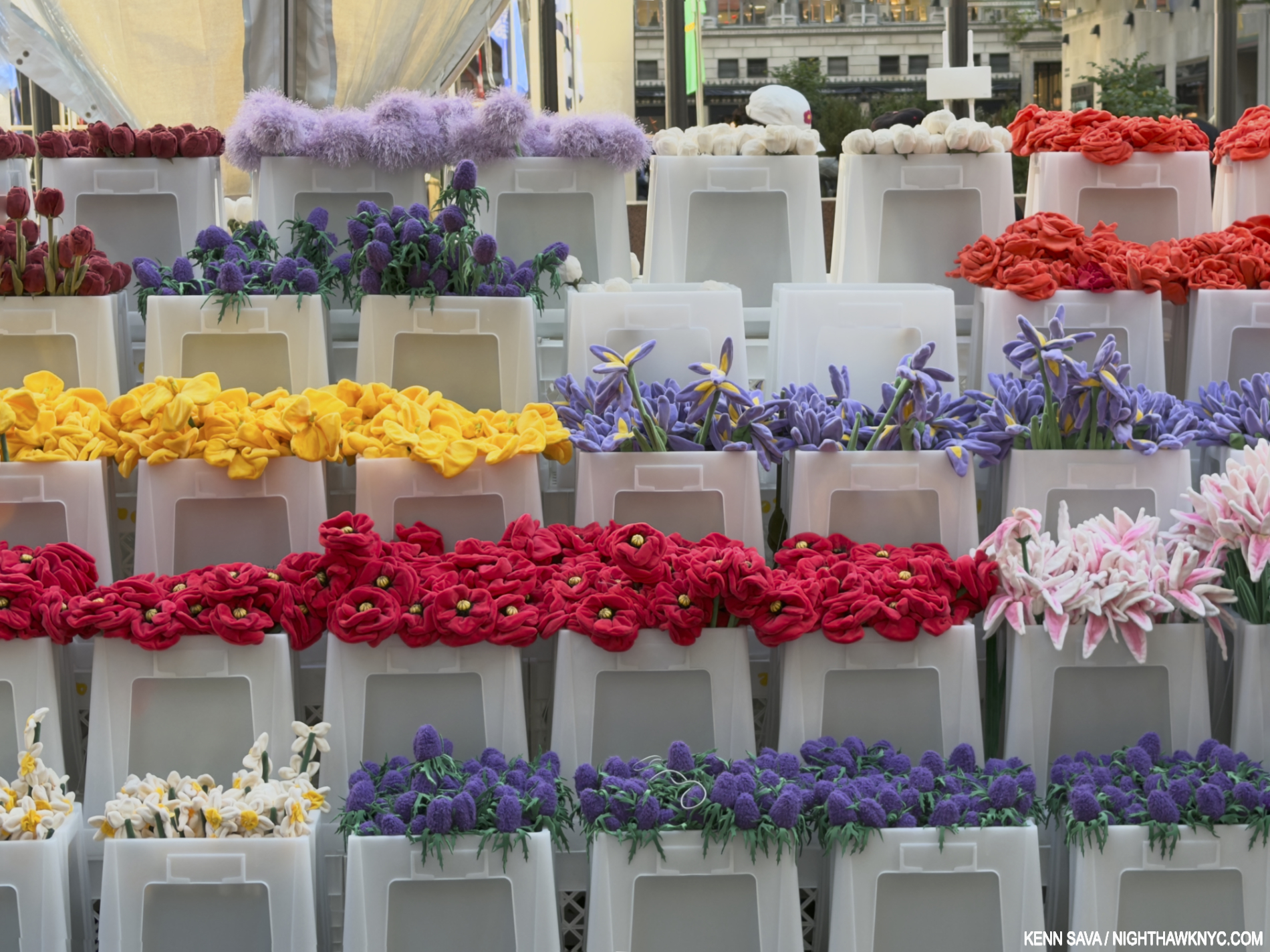
As we’ve seen up top, she’s as capable as any human being currently alive/known to me this side of Robert Longo and Andrew Holmes at being able to Draw hyper-realistic (her term for her work) flowers. That she hasn’t here I find very interesting. She opted to create her own take on these Flowers that look like Roses, Sunflowers, et al, riffing on their essence. Were these Drawn/designed to make mass-manufacturing of them more affordable? I tend to doubt it because the attention to detail on each Plush Flower, as the end result result is known as,  is there. When I say “mass-manufacturing,” CJ Hendry deals in hundreds of thousands of them! In her own way, it seems to me that has done something not all that different from what Hilma af Kint did in her Nature Studies Portfolio on view at MoMA as I said in my piece on it: her Plush Flowers and the Drawings they’re base on speak to the essence of each species, as she sees it.

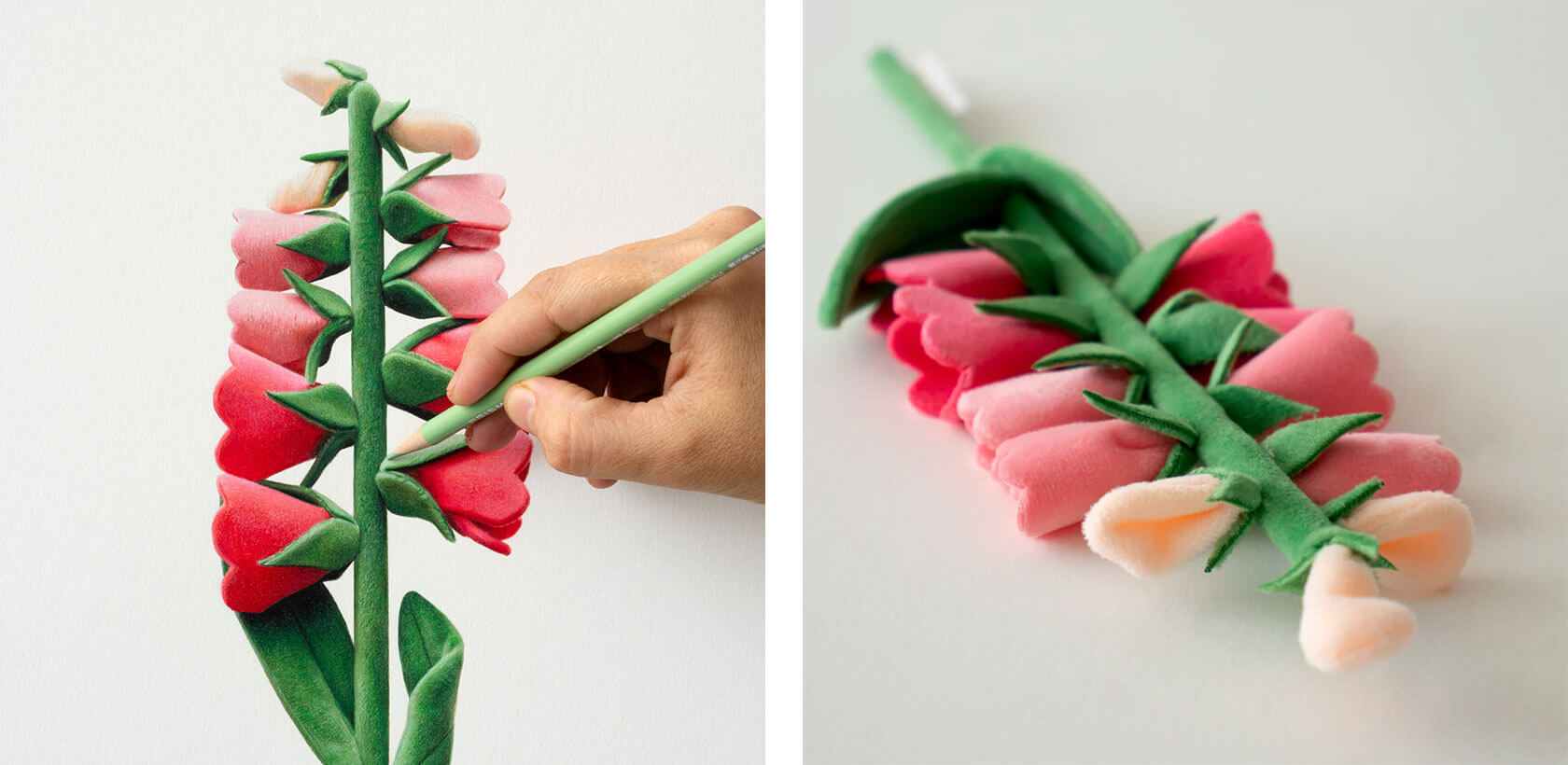
Original Drawing, left, resulting Plush Flower as sold at her Flower Market, right. *-  CJ Hendry Studio Photo.

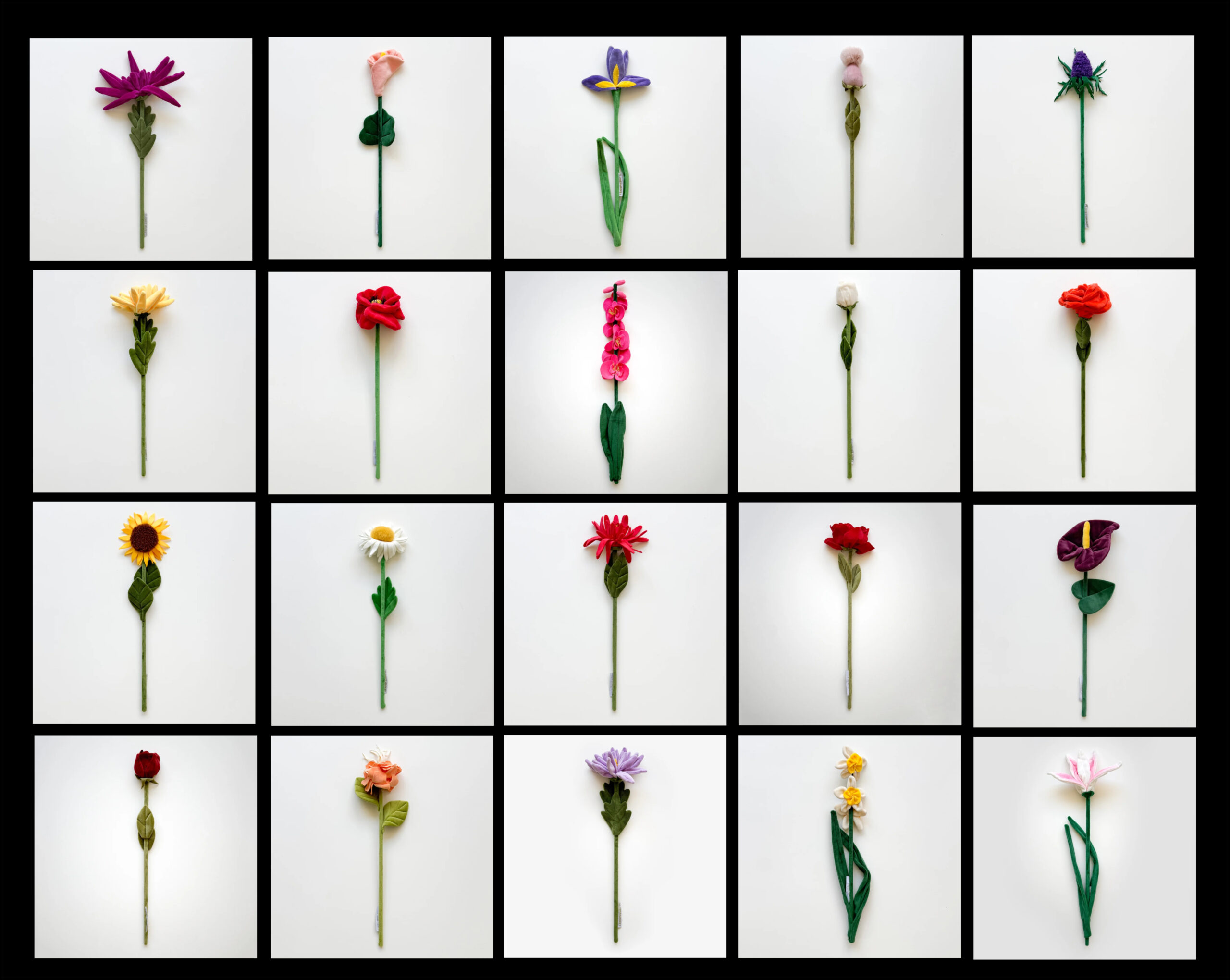
A grid I put together of 25 of the 27 CJ Hendry 2025 Plush Flowers based on her Drawings available at her 2025 NYC Flower Market. *-Photos by CJ Hendry Studio.

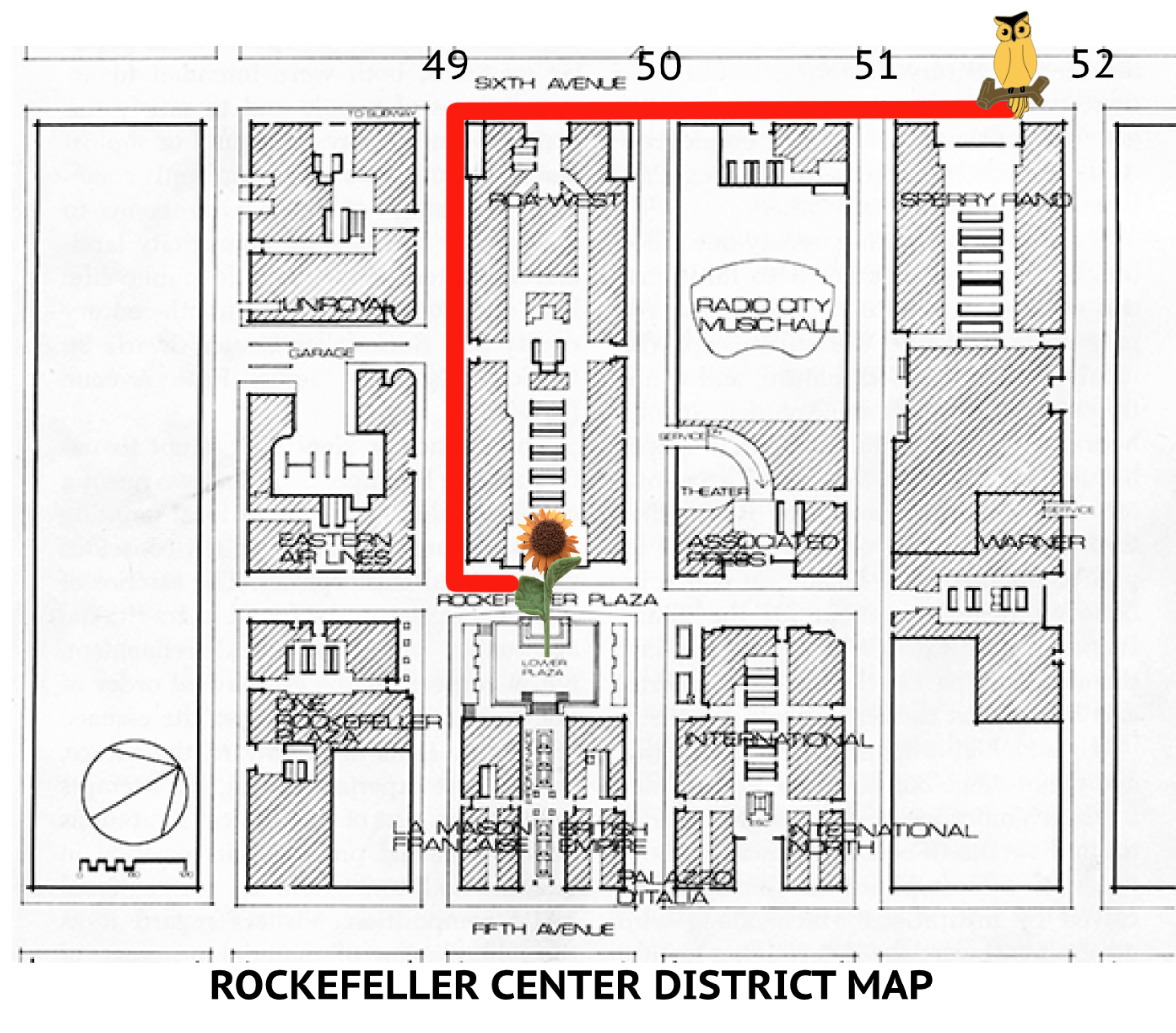
Beyond her Flowers speaking to the essence of the flowers they replicate, they also speak to A LOT of people, as you saw in the video I posted up top, taken on Saturday, September 2o, 2025. That 5 city-block long line for a flower show (CJ Hendry’s Flower Market 2.0 at Rockefeller Plaza), or an Art show, must be a record. Here’s a map of the route I took in the video-

The map of the line, September 20, 2025.
Map Key-
Sunflower (one of CJ Hendry’s Plush Flowers)- Location of CJ Hendry’s Flower Market.
Red Line- My path to the end of the line of those waiting to get in.
Oof- Kenn Sava’s position at the end of the line.
Note- The distance from Rockefeller Plaza to 6th Avenue is about 2 City blocks.

In it we’re walking west on West 49th Street, before turning right onto Sixth Avenue, past Radio City Music Hall, and up to just short of the corner of West 52nd Street! The gent in the blue suit at the end of the line is selling tickets for Top of the Rock (i.e. the roof deck of 30 Rockefeller Plaza), directly behind the location of Flower Market, which offered an exclusive 28th Plush Flower to those who went.

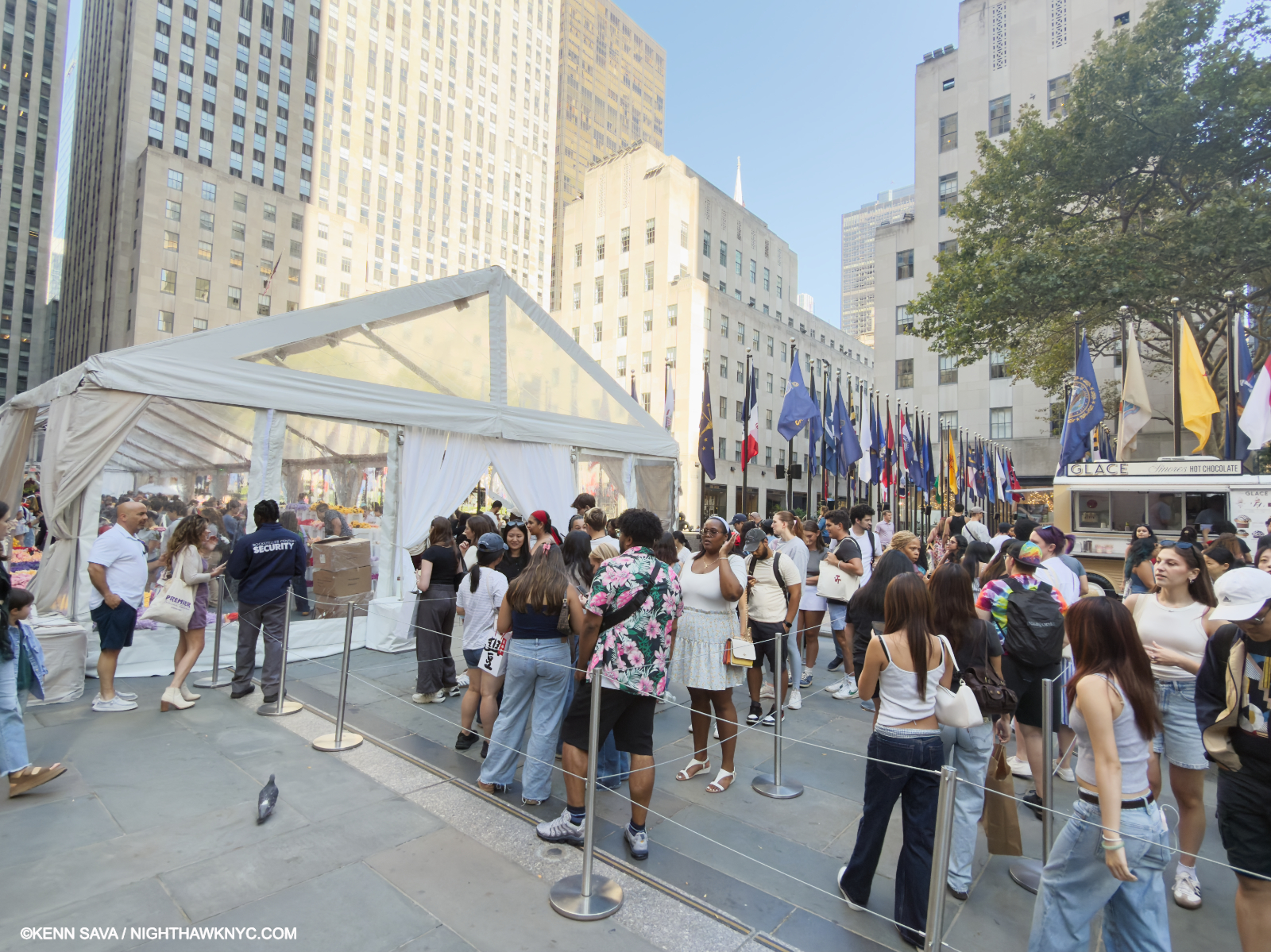
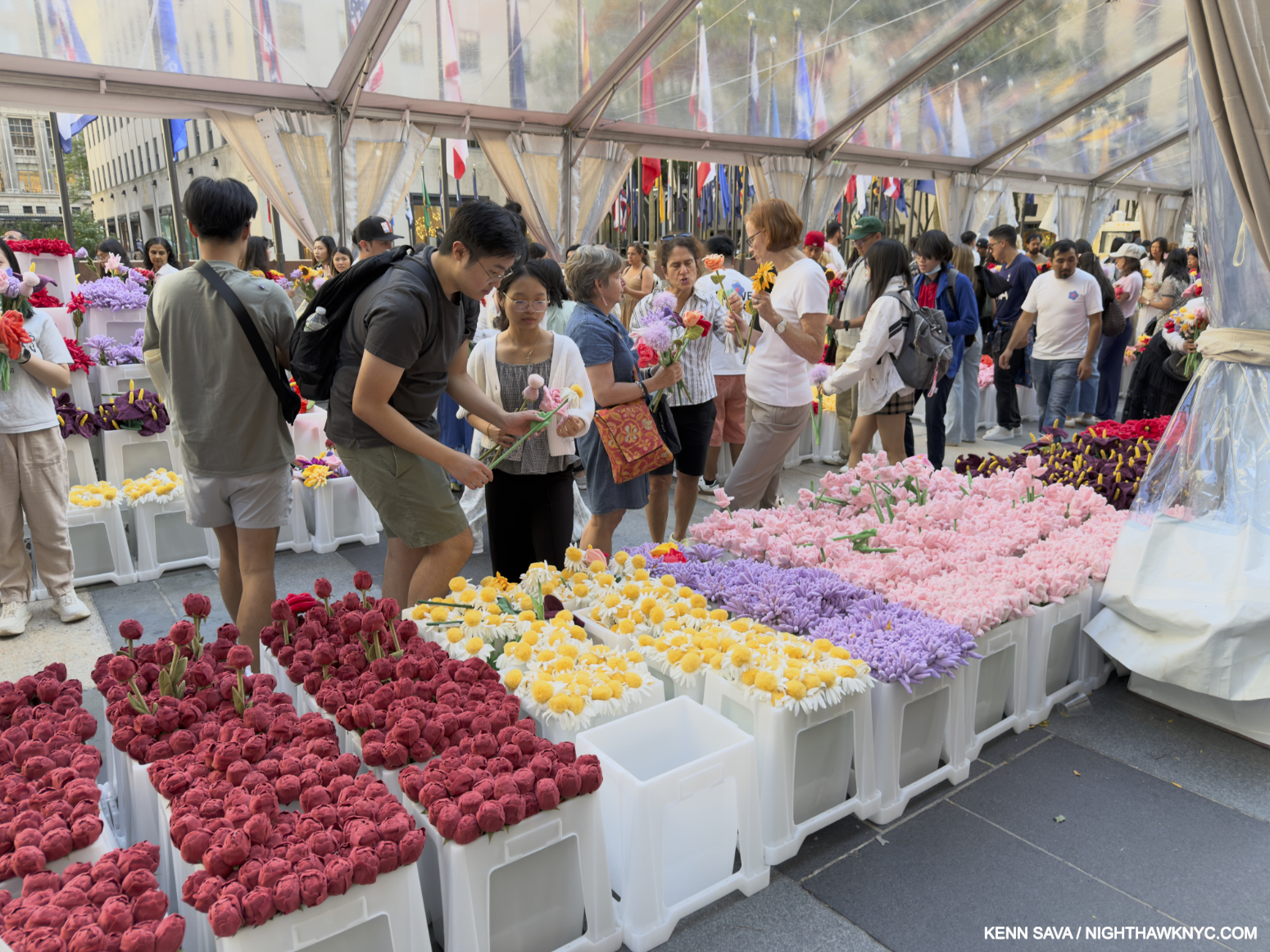
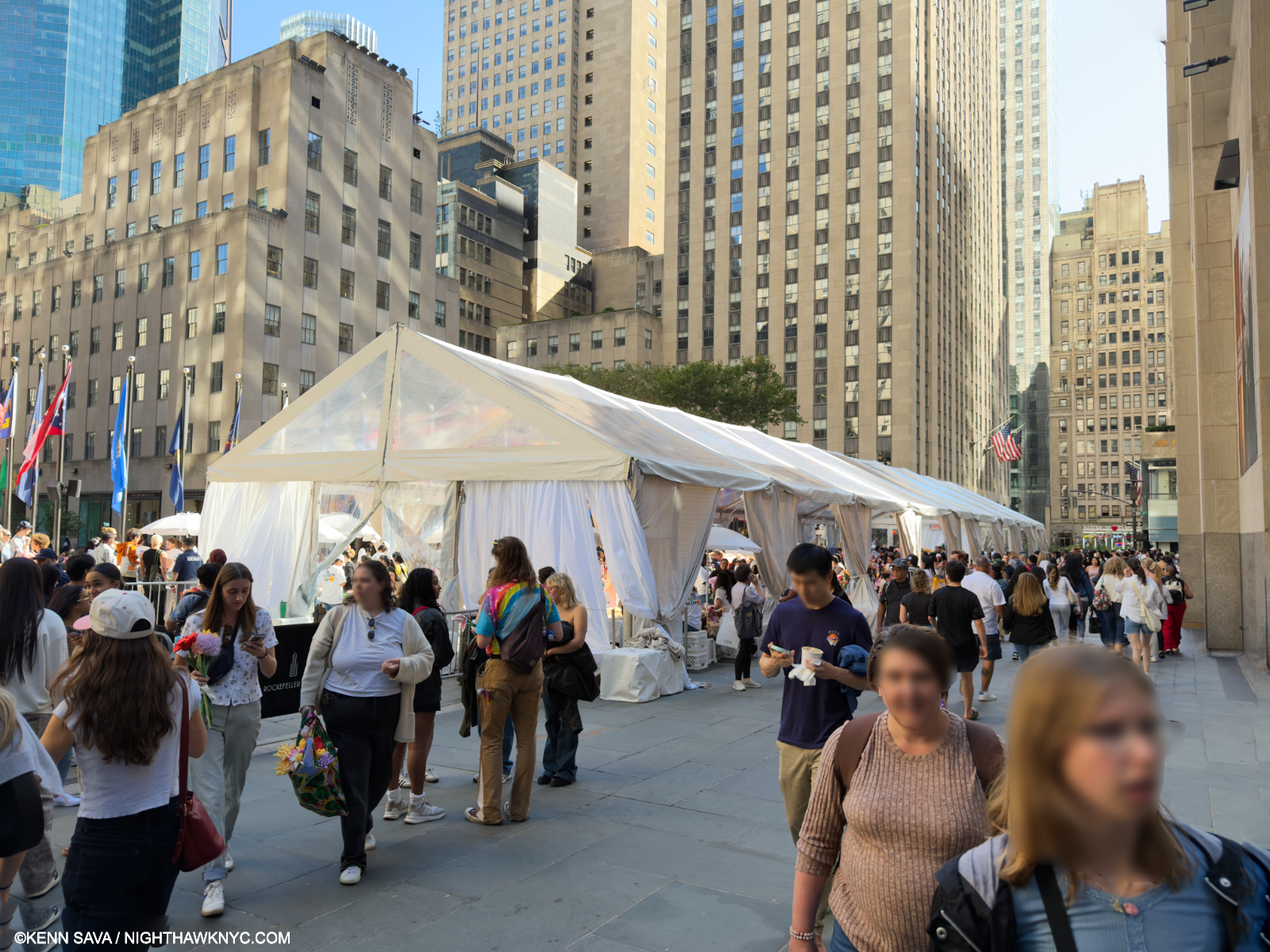
At the other end of the line, the wait for these visitors near the entrance of Flower Market (the white tent)  is just about over.

The wait to get in was TWO HOURS! When I finally reached the end of the line to begin my wait I found myself standing so far from the show’s entrance I was within feet of the corner of West 52nd Street on 6th Avenue. It dawned on me that I was now a block away from MoMA where at that very moment Hilma af Klint: What Stands Behind the Flowers was beginning its final week! Flowers, flowers everywhere…When Flower Market opened on September 19th, I heard that over 100,000 Pluh Flowers were available. After the show ended, those remaining were sold on her site in bouquets of the all 27 Flowers. They sold out within days.

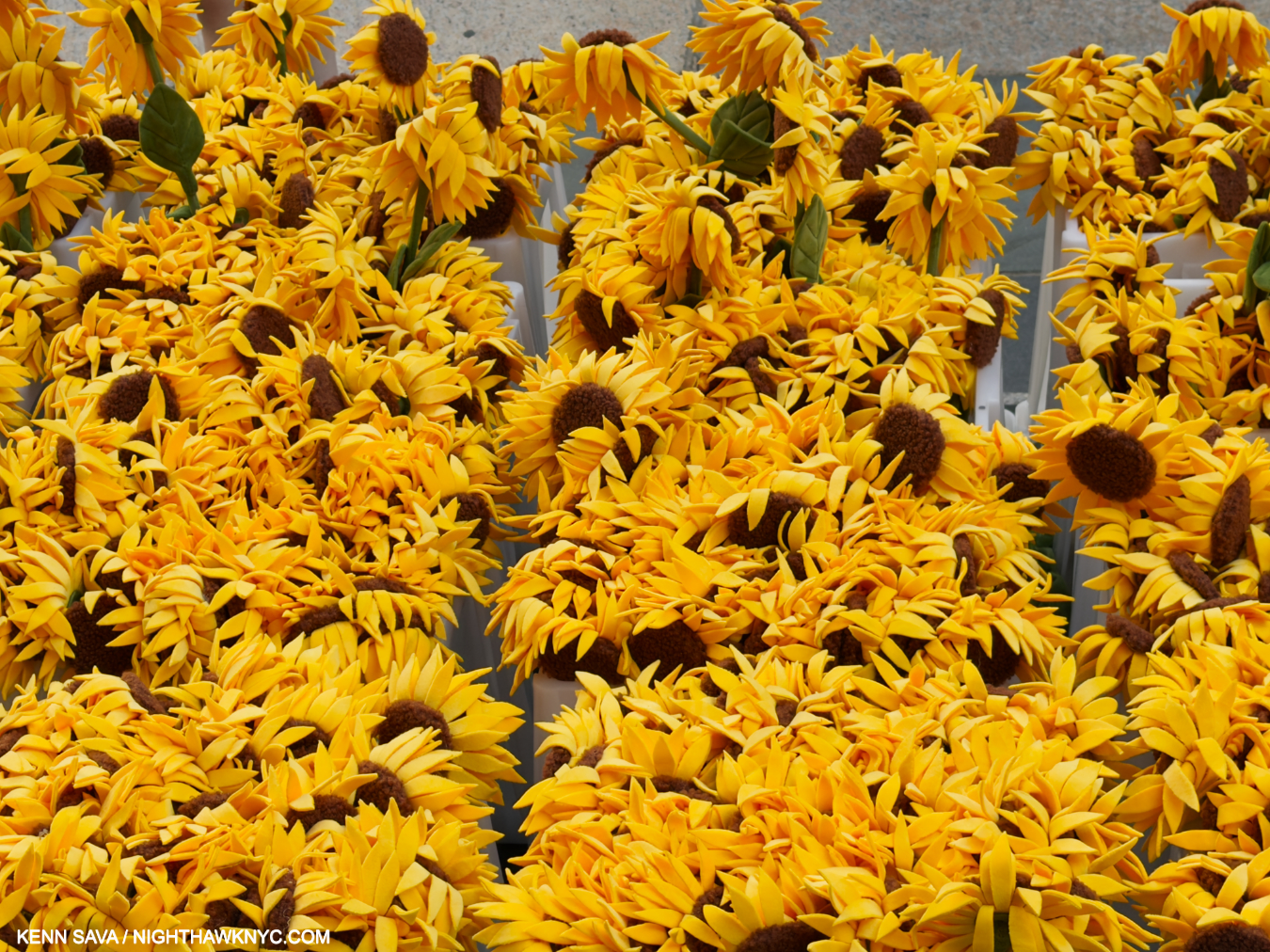
Bouquet up! Inside Flower Market 2.0, Visitors can have one of any one of the 27 designs for free. Each additional Flower is $5.00. I happened to notice that Crate & Barrel sells their decorative flowers for $19.95 to about $50 EACH, and they’re not designed by a known Artist (as far as I know). September 20, 2025.

After possibly being the first to put Georgia O’Keeffe and Hilma af Klint together last time, I now might well be the first to put Hilma af Klint & CJ Hendry together, but for that weekend, anyway, they weren’t all that far apart. CJ Hendry’s Flower Market was up (from September 19-22, 2025) 3 blocks directly south and parallel of MoMA smack dab in the heart of Rockefeller Plaza, as the map earlier shows, behind the famous skating rink, steps away from Fifth Avenue, St. Patrick’s Cathedral, Radio City Music, Hall, etc., etc., and smack dab in front of the iconic Art Deco RCA Building at 30 Rock. Yes, the big time. Real Estate in NYC doesn’t come any more expensive than this.

Just HOW popular is CJ Hendry? In an interview last year Ms. Hendry stated that she grossed $20 million in a prior year. Putting that in perspective, that’s $20 million…

-WITHOUT a dealer or gallery representation- ever. (Her Colored Pencil Drawings currently go for $85,000 to $500,000. depending on size. But before you reach for your wallet, there’s another line to get on, this one “for years,” for the chance to buy one, only through her website.)
-WITHOUT a traditional white-wall “show.”
-WITHOUT a book out. In fact, there are surprisingly few articles written on her work.

So, HOW did this. happen?  CJ Hendry (she’s gone by her initials for as far back in her youth as I could go) is a mid-30-something transplanted Aussie Artist born in Durban, South Africa before growing up in Brisbane. She now lives & works in Brooklyn. She spent seven years in college studying Architecture and finance but left without a degree(!). In fact, she quit “days before I was kicked out for failing grades2.” While she was in school she worked as an $18./hour waitress, spending all her money on high-end luxury fashion & accessories. After quitting college, she decided to sell her wardrobe on eBay and with the proceeds take 365 days and devote herself to something she knew she had always been good at: Drawing, to see if she could make any headway with it.  Now, I don’t think I need to tell anyone that making a living Drawing is something that has really only been accomplished (after YEARS of struggle) by comic book Artists & graphic novelists, like R. Crumb and Chris Ware. In Art, Drawing is seen as a means to an end (in another medium), and almost never the end itself. She put in 16-hour days Drawing born of the discipline she learned becoming a professional swimmer who failed twice to make Australia’s Olympic Team. She decided not to put in another four years to try a third time. Still, “I owe everything to that (discipline)3,” she says now. It enabled her to create a portfolio she took around to Brisbane galleries. There was no interest.

“I didn’t take the traditional route because no one wanted to sign me. Fuck, I guess I’m on my own….I just did it on my own.”

She decided to post her work on Instagram. It took a while until she received a DM expressing interest in buying her work. The sender came out to her parent’s house, where she was still living, saw the work in her bedroom and paid CJ the amount she asked (“in the thousands,” she says) for the piece. With the proceeds she bought herself a Chanel Surf Board, which I believe still hangs in her studio, and she took things from there.

“Everything I draw would sell, and I’m so grateful for that. I went to a university for finance. I get business. I love business. I think I’m better at business than I am art. I’m a hopeless artist. I’m an ok artist, but I’m really good at strategy & business. and I love that. I think art is the byproduct of strategy and business. I think there are a lot of artists who are very good artists but don’t maybe have that business side4.”

As a result of her Flower Market and her Plush Flowers,  I realized that Colored Pencil Drawing is far from all she does. She’s mounted events/shows that have garnered notoriety for their unique concepts and installations to the point that they draw crowds, then live on in legend after (clicking on each entry in that link will show you what I mean). As part of these events, she created pieces (original Drawing-inspired objects in a you-name-it wide range of materials) that seem to me, and no doubt others, to bring her very close to the realm of something akin to 21st Century “Pop.” (For the sake of keeping this piece from getting VERY long, and since she has released so many other items, I’ll keep the focus here to her Flowers.) She now Draws with a few assistants, part of the “small team” she’s enlisted to facilitate and realize her many projects, shows, multi-media pieces, etc. So, CJ Hendry has become her own factory, now headquartered in a 22,000 square foot studio in Greenpoint, BKLYN. As I pealed her onion, discovering more and more about her, the name Andy Warhol repeatedly came to my mind.

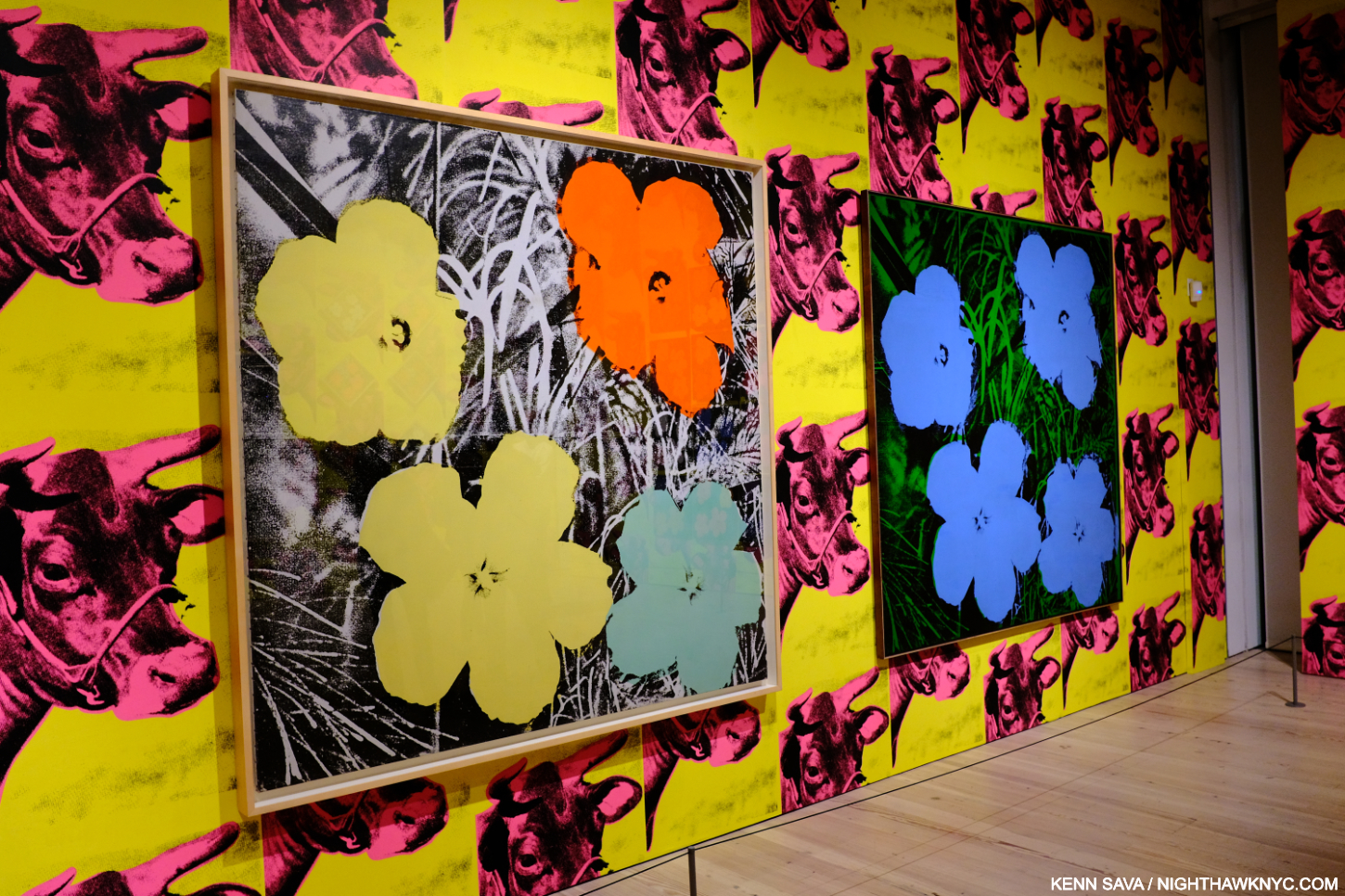
Andy Warhol, Flowers, Screenprints, 1964-65 seen at Andy Warhol: From A to B And Back Again, Whitney Museum, December 21, 2018

I began to wonder- Is she Andy Warhol 2.0,? Seriously.

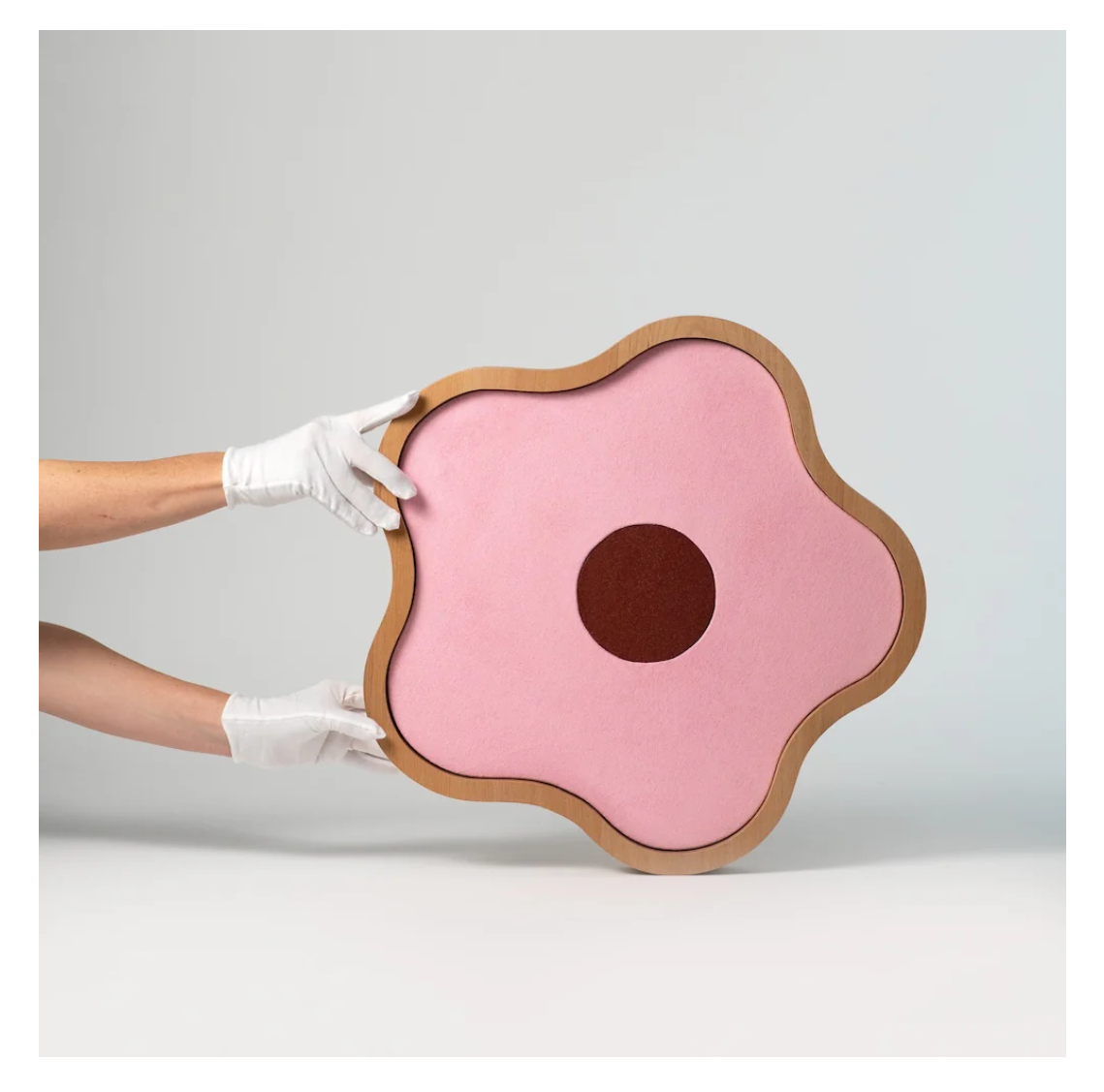
CJ Hendry, Blomma, 2025, Painted canvas Flower and Beech wood frame. This design has become her de facto symbol. *- CJ Hendry Studio Photo.

From an Art & business perspective, I think thee is a very strong case to be made that she is at least one of those that could be said about, while remaining resolutely CJ Hendry. Unlike the vivacious, omni-present Mr. Warhol, however, CJ appears to have no “social life.” She was quoted on August 9th on Instagram saying her life is “work and kids…not much else, ” which is a change from the 24/7 she said she worked since she started making Art. She is never seen at parties, or out on the town, or with media stars. The only “CJ Hendry Superstars” are her products, which have always sold out to this point. Yet, in an interview she recommended “not investing” in her5, but rather buy the work of up-and-coming Artists who need the support. Her Art is also noteworthy for the lack of human subjects in it to date. I’ve only seen one CJ Hendry Portrait- a commission from 4 years ago. Like Andy, CJ began her Drawing career rendering luxury products, including shoes, boots, and fashion accessories. From them she’s moved on to “things that are always around us,” like well-worn sneakers, cigarette butts and flowers. On Drawing the latter she said-

Who says a Drawing isn’ t Art? Unknown title, date, Caran d’Ache Luminance colored pencil (in her hand) on paper or board. *-  CJ Hendry Studio Photo

“Ever since I started mucking around with being an artist, flower imagery kind of frustrated me…It always seemed like the obvious and basic direction to go. I held off for many years because I just couldn’t figure them out. So somehow petals make sense, the flower being broken down, not full of life. Each petal looks so different like its own mini sculpture…”

I can’t say I’ve seen an Artist take this approach to them. Who else has Drawn or Painted a flower petal as their finished piece? In Art classes, students are taught to study anatomy in order to render the figure. Ms. Hendry is taking the same approach to flowers. It can only help her when she comes to depicting the whole.

Right now, it looks like flowers may be a anomaly in her work. Looking back, Ms. Hendry turned her focus to a subject, produced a series of Drawings of it, perhaps released some related items, and moved on. Though she recently Drew a character named “Juju,” and released a batch of (now sold-out) related items, her Flowers will continue to be a part of her work. She has announced Flower Markets will be mounted in Abu Dhabi and Hong Kong early this year.

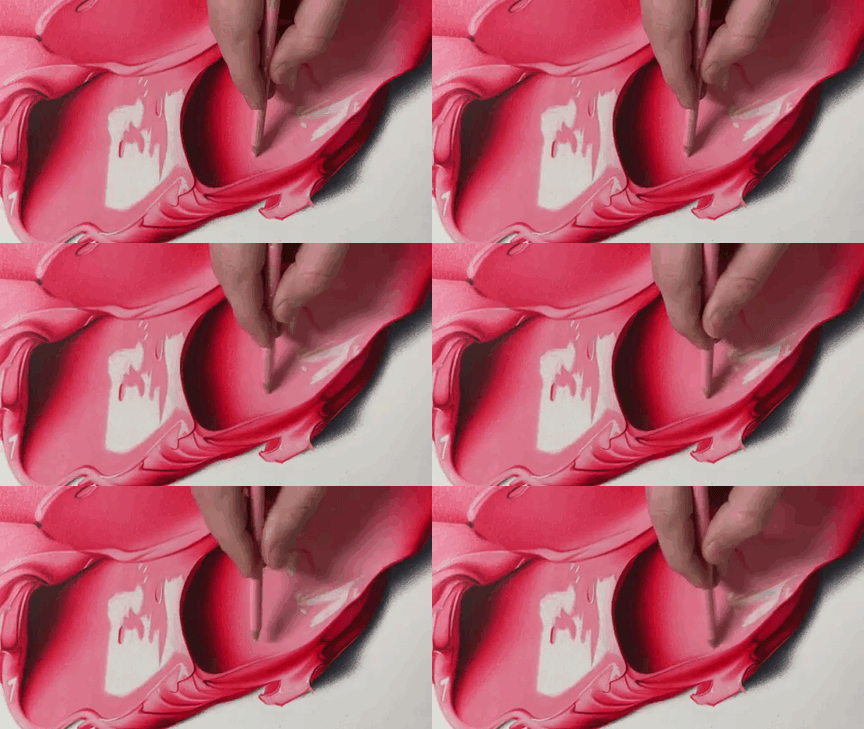
The Artist works on one of her Complementary Colors series of Drawings circa 2018. Notice the pencil point. It looks to me like a right out-of-the-box Prismacolor Premier! In fact, in the videos I’ve seen, she uses very basic accessories. Electric sharpener (an Xacto seen in one), spray fixative, painter’s tape to hold down copy paper shielding white areas while she works flat on a very large wood table. I haven’t seen her erase (in what I’ve seen), use a mahlstick, a pencil extender or an easel. (She puts a sheet of something unknown, possibly, glassine, under her drawing hand as she works over finished areas.) Oh, and there’s an entire shelving unit of boxes holding thousands of colored pencils arranged by color. Drawings in progress, or finished, are kept in suitably sized clear archival sleeves. *- CJ Hendry Studio gif

Among the numerous striking pieces in her career to date is a stunning 2018 series called Complementary Colors. Like all of her work, it speaks for itself

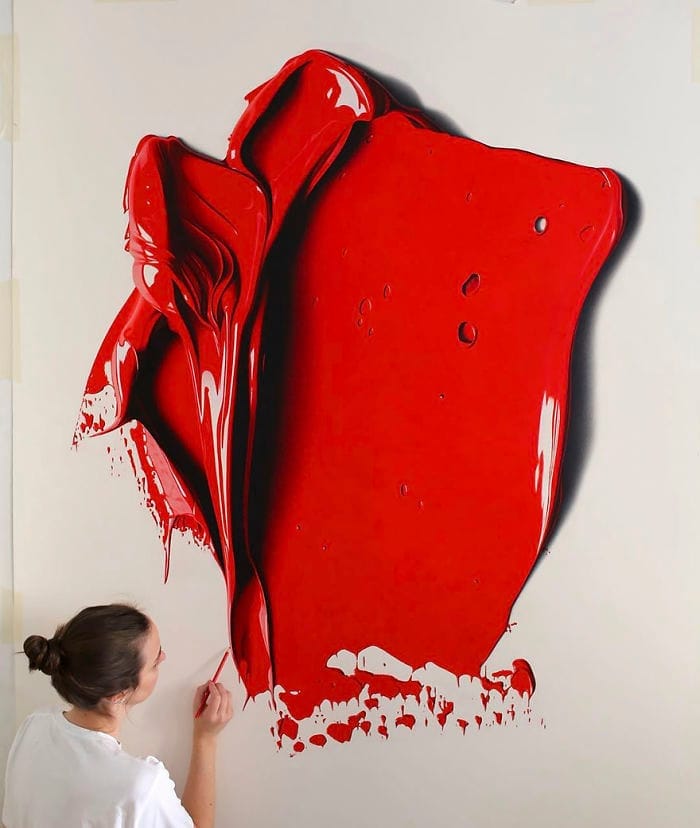
Possibly the paint blob she was just seen working on. Colored pencil(!) on ? Title, size, date unknown from her Complimentary Colors series. c.2018. *-  CJ Hendry Studio Photo.

“I’ve peaked! It is downhill from here for me.” CJ Hendry, TedTalk, 2018.

She couldn’t have been more wrong when she said those words in 2018 at about the time she created the paint blob above. Her career has gone straight up, like an arrow into the weightlessness of space since, hitting that $20M she mentioned a year or two ago! Still, the market and the public are fickle. The CJ Hendry buzz may subside one of these days, but with Drawing talent like she has I doubt she’s entirely going away.

While the future is unwritten, we can take stock of the recent past. In addition to the facts that she’s brought more attention to Drawing as a medium & an Art form, which sorely needs it, and colored pencil Drawing (DITTO!), the thing I admire most about Ms. Hendry is that she’s succeeded entirely by her own devices. She’s proven it can be done, but, IT’S NOT THAT EASY!

“If you try to follow in someone’s footsteps exactly it won’t work for you. You’ve got to find your own thing. I haven’t had anyone to follow. There’s no one who’s done it this way. I’m a huge anomaly in the art world2.”

When repeatedly asked about how she did it, she stresses the HARD work she put in to get here- those 16-hour drawing sessions, 24/7. All the sacrifices she made (i.e. a social life, college, etc.) AND the fact that she has a background in finance. Hilma af Klint and Georgia O’Keeffe had to work to succeed in a male-dominated world. Georgia had a champion in Alfred Stieglitz who helped her navigate it early on. Hilma wasn’t so lucky. She never found her champion and decided her work was for the future. Whether that future is now, or not…the jury is out in my view.

I wonder how many visitors chose a Sunflower and thought about Van Gogh. I did.

That brings me to the similarities and differences between Hilma and CJ Hendry. As I wrote in my recent piece on her, Hilma didn’t live to realize the Temple she envisioned to house her Art, partly because she was seeking to have her work installed by existing spiritual organizations. As I said, I believe her work has been left in a quandary as a result.

Flower Market 2.0, Rockefeller Center, NYC, September 20, 2025.

CJ Hendry built her own “temple.” Actually, she’s already built a whole series of them. She uses temporary spaces for her shows/events, including some that have involved complete renovations of buildings, to realize her visions. Ironically, at the moment I took this picture, Flower Market 2.0, was pointed directly & poignently at MoMA & Hilma af Klint: What Stands Behind the Flowers three blocks north (to the left). What stands behind these Flowers is a woman who’s a force of nature. “Carpe diem” could well be CJ Hendry’s motto. While Hima af Klint’s work’s place is, it seems, still undecided, and appears stuck between today’s Art machine & the Artist’s intentions, as I said last time, CJ Hendry stands at the opposite end of that spectrum, as someone who relishes and uses the Art machine’s focus on “materialism” while skating rings around the usual dictates of today’s Art establishment, remarkably achieving success without its help or involvement, on her own terms.

She’s right, no one can follow in someone else’s footsteps and expect the same results. Still, there is much to be learned from her example. Perhaps, most importantly, that it CAN be done.

I don’t think CJ Hendry will be the last Artist to “make it” on their own terms.

*- Soundtrack for this piece is “God Bless the Child,” by Billie Holiday and Arthur Herzog, Jr, 1939, seen here in this incredibly rare live recording by the immortal Lady Day with the equally immortal Count Basie, who I had the honor of meeting-

NighthawkNYC.com has been entirely self-funded & ad-free for over 10 years, during which over 350 full-length pieces have been published! If you’ve found it worthwhile, PLEASE donate securely by PayPal below to allow me to continue. Thank you, Kenn.

You can also support it by buying Art, Art & Photography books, and Music from my collection! Art & Books may be found here. Music here and here.

Written & photographed by Kenn Sava for nighthawknyc.com unless otherwise credited. To send comments, thoughts, feedback or propositions click here. Click the white box on the upper right for the archives or to search them. Subscribe to be notified of new Posts below. Your information will be used for no other purpose.

  1. With Flower Markets being announced for 2026 in Hong Kong and Abu Dhabi.
  2. Short Story Long podcast #162, CJ Hendry.
  3. ibid.
  4. Both quotes ibid.
  5. ibid
  6. Short Story Long podcast #162, CJ Hendry.

Hilma af Klint in the 21st Century: The Spirit vs. The Machine

THIS SITE IS FREE & AD-FREE!
If you find this piece worthwhile, please donate securely via PayPal so I & NighthawkNYC can continue. More ways you can support it at the end. Thank you.

Written & Photographed by Kenn Sava (*- Additional Photographs by Lana Hattan, and others as credited)

Shows seen: Hilma af Klint: Paintings for the Future, Guggenheim Museum, 2018-19.
Georgia O’Keeffe: To See Takes Time, MoMA, 2023, and
Hilma af Klint: What Stands Behind the Flowers, MoMA, 2025
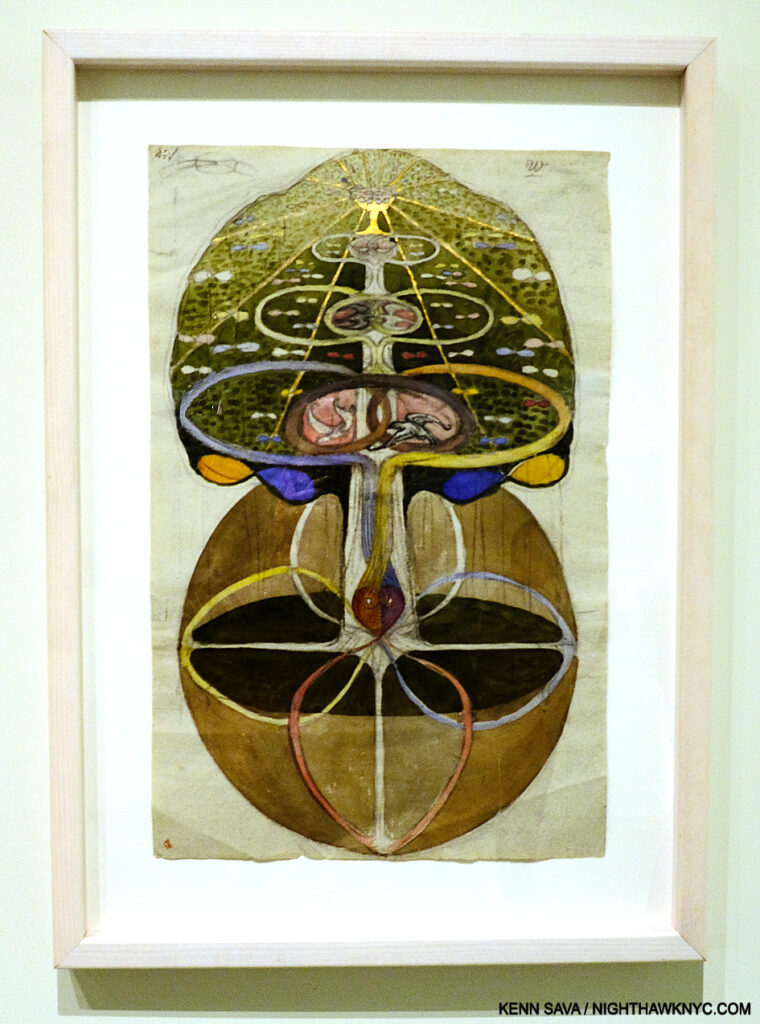
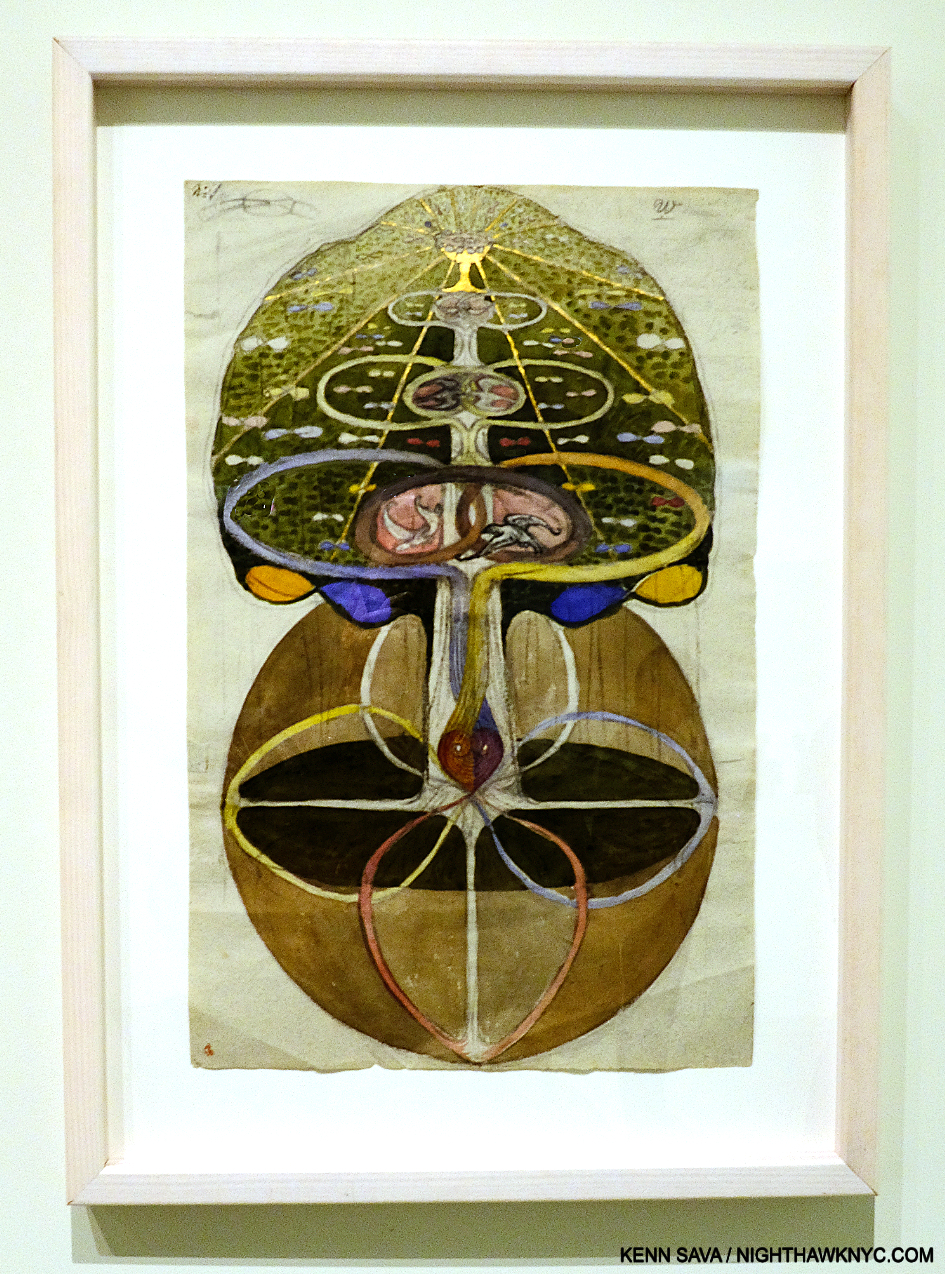
Hilma af Klint, Tree of Knowledge, No. 1,  from The W Series, 1913, Watercolor, gouache, graphite, metallic paint, and ink on paper, Guggenheim Museum, December 31, 2018..

Succinctly put, Hilma af Klint is one of the most remarkable and unique Artists I’ve encountered.
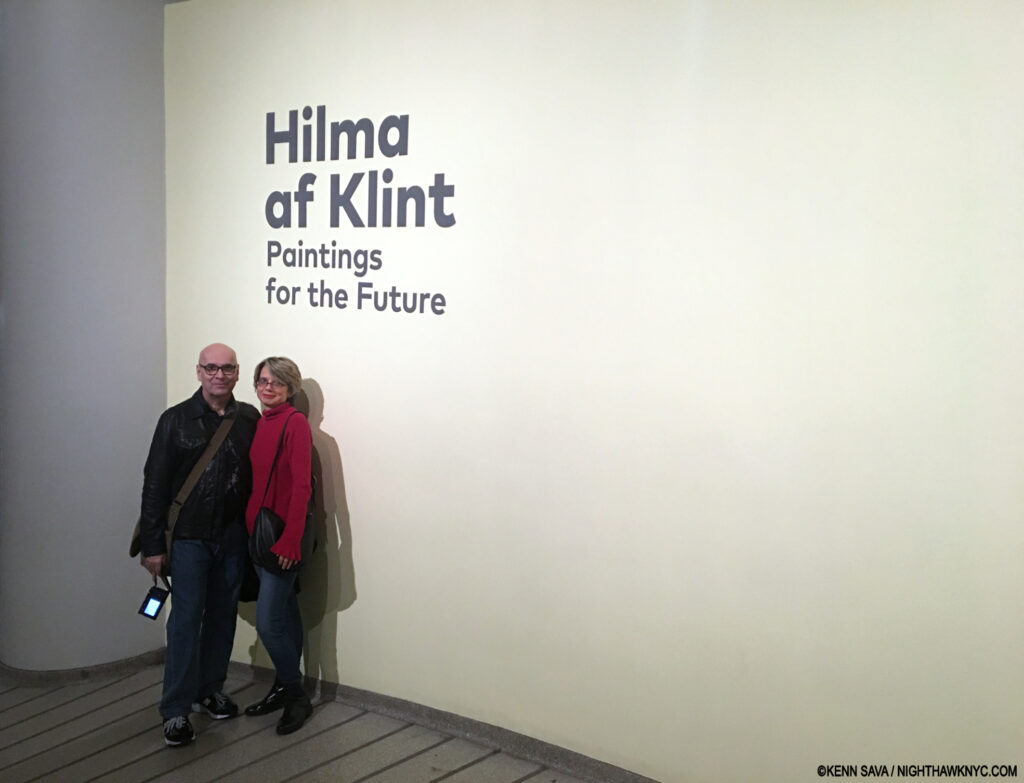
Of the thousands of Art shows I’ve seen in my life, I consider about 10 to be truly monumental. Hilma af Klint: Paintings for the Future is one of them. I’m so grateful I got to experience it with Lana Hattan1, and her Photos are included in this piece. Guggenheim Museum, New Year’s Eve, December 31, 2018. Enduring Thanks to the woman who took this.

Having seen two shows of her work, and most of the books published on it, Hilma’s work continually surprises me. Much of her oeuvre features that rarest of all qualities in Art: it’s unprecedented. I saw Paintings for the Future exactly seven years ago as I write this yet I haven’t written about it to this point for two reasons- 1) I’m still thinking about it and researching Hilma (as my featured entry on Hilma books in my “NoteWorthy Art Books of the 21st Century” piece earlier this year attests). 2) I’ve come to see that boxing Hilma as an “abstract Artist,” as the Art machine has labelled her, does her an immense disservice. I find it at odds with the very nature of her work.
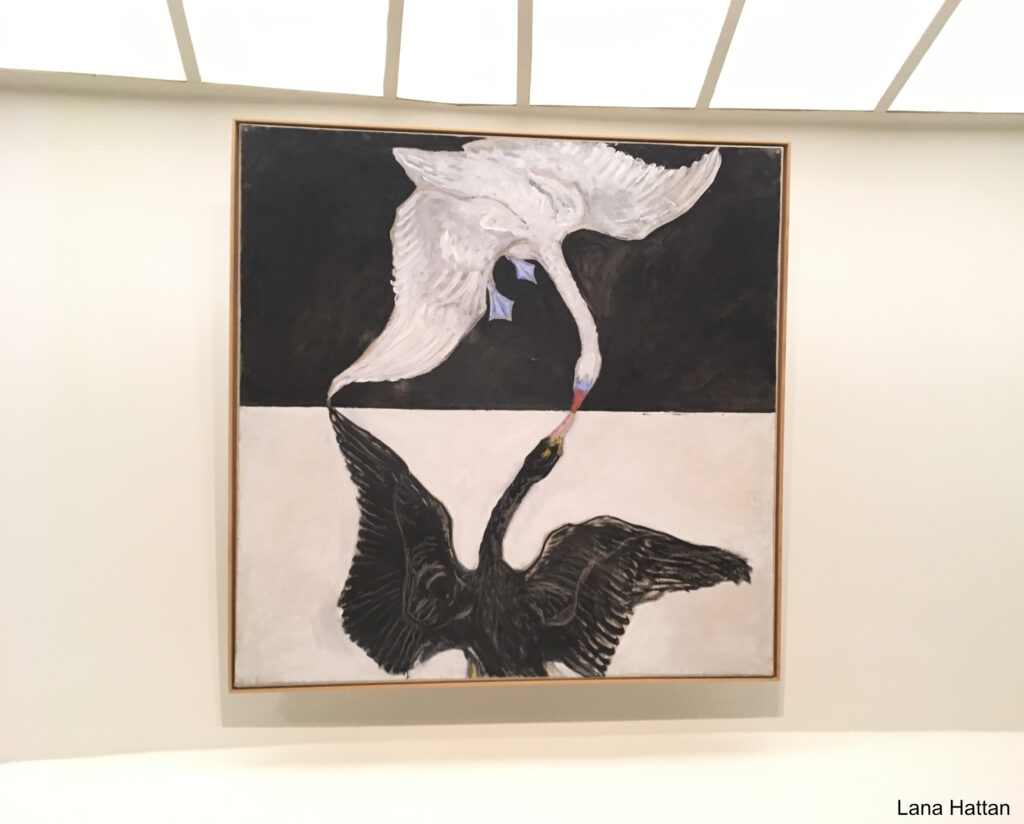
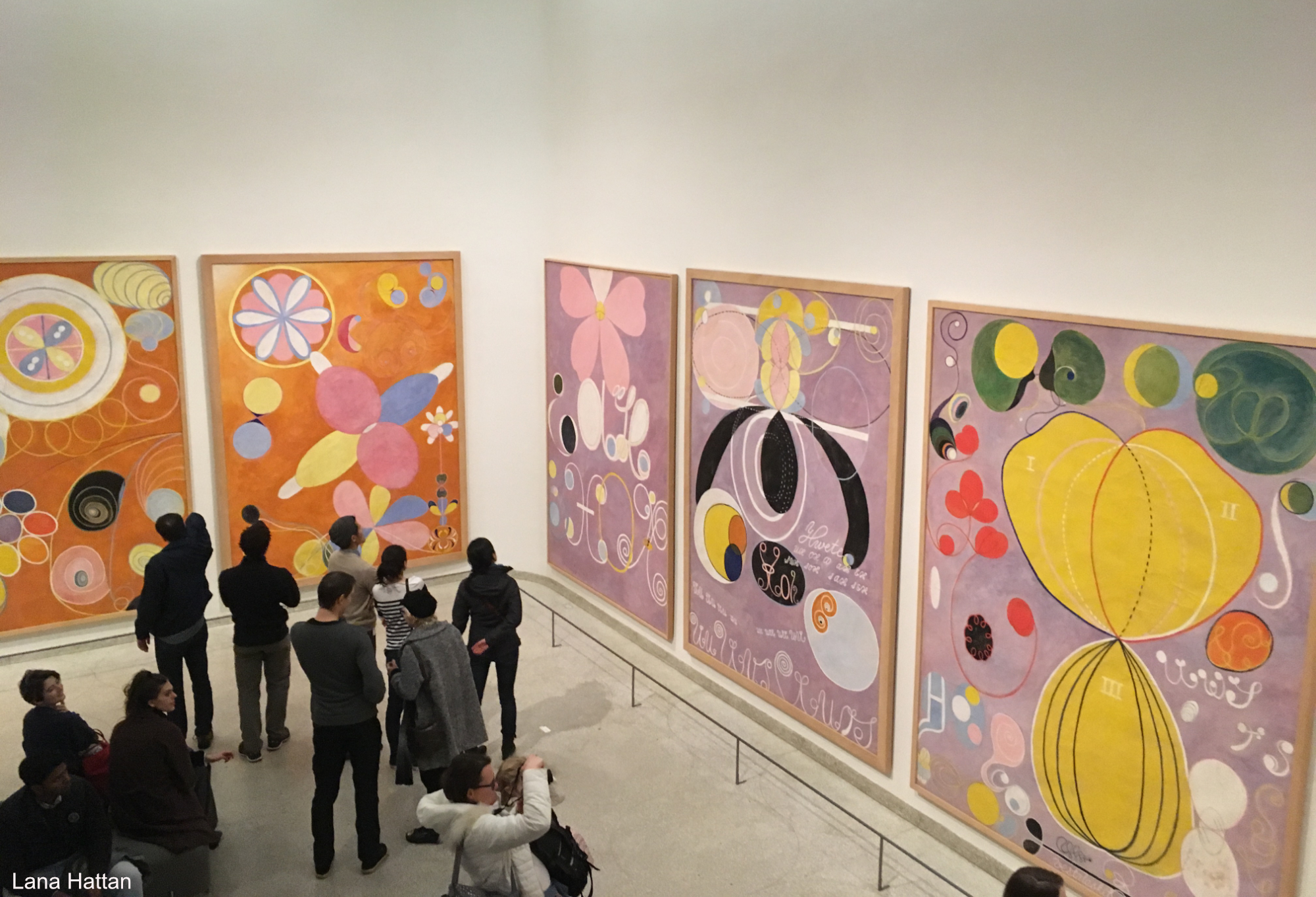
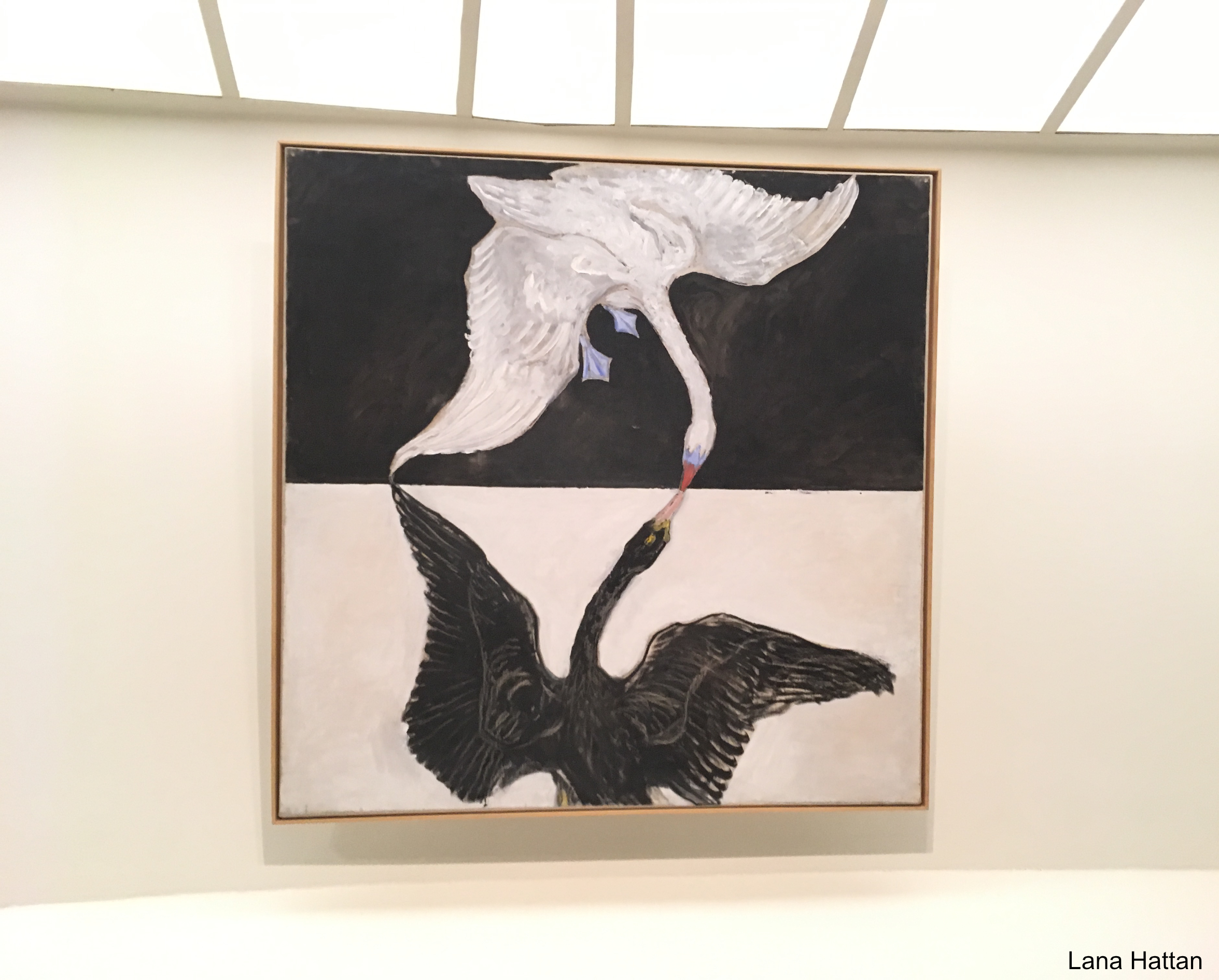
Group IX/SUW, The Swan, No. 1 from The SUW/UW Series, 1915, Oil on canvas. Reaching for the light. Of all the Painting shows I’ve seen at the Guggenheim Museum, the installation of Hilma af Klint: Paintings for the Future was transcendent. More on this later. *- Photo by Lana Hattan, Guggenheim Museum, December 31, 2018. I’m pleased to be able to present this show through her eyes, too.

Beyond all of that, recent developments may make her work “Basquiat hard” (my term for an Artist’s work that is mostly out of pubic view) to see going forward.
That’s a lot to cover. I’ll try to in what follows.

It begins with the flower…

“If your heart is in them flowers, bring ’em on,” Tanya Tucker-*
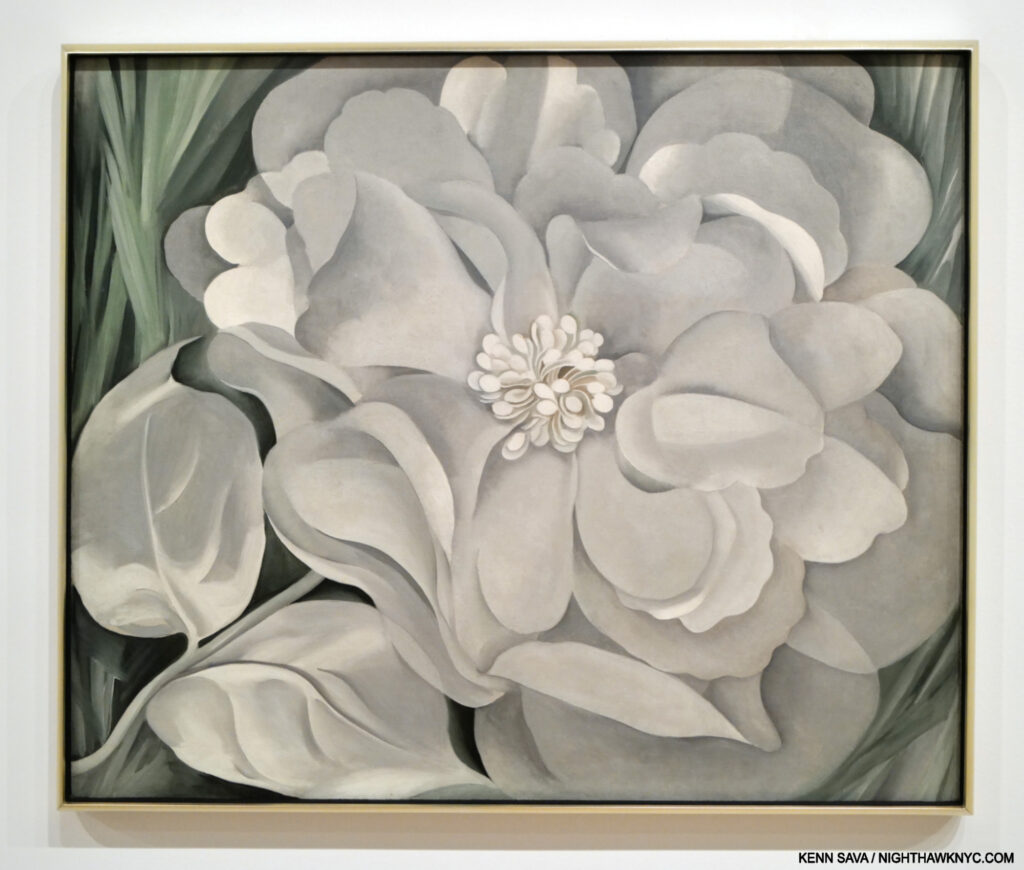
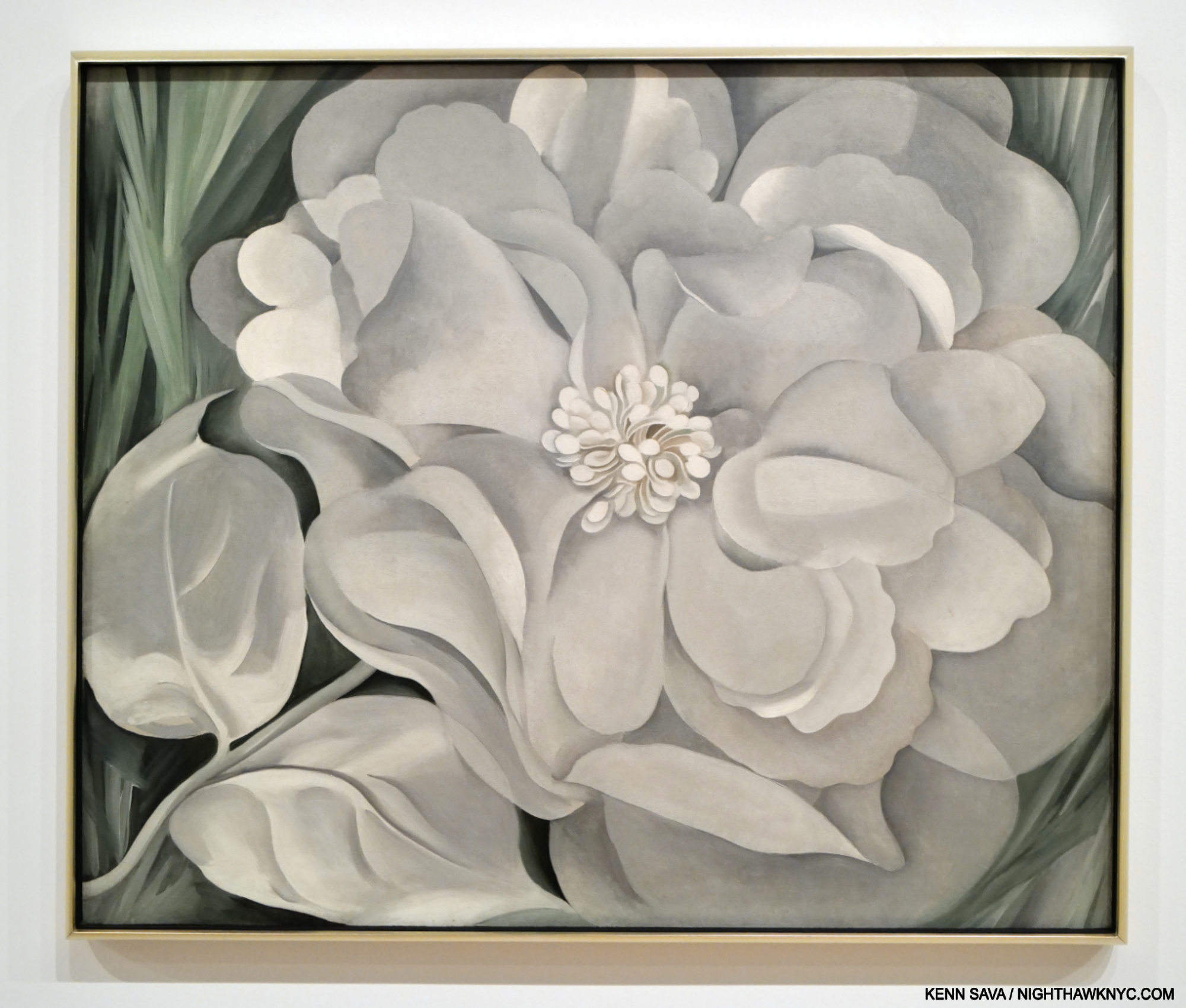
Georgia O’Keeffe, The White Calico Flower, 1931, Oil on canvas, as seen at the Whitney Museum, June 30, 2023

Flower Art was a niche thing, largely reserved for Illustration, until Artists like Georgia O’Keeffe (1887-1986) made viewers sit up and take notice of them. Of course, Vincent van Gogh, and the 17-century Dutch Masters a century before him, among countless others, had Painted wonderful Still-Life bouquets for many years prior, but individual flowers had not received much attention. Earlier last century, that began to change.
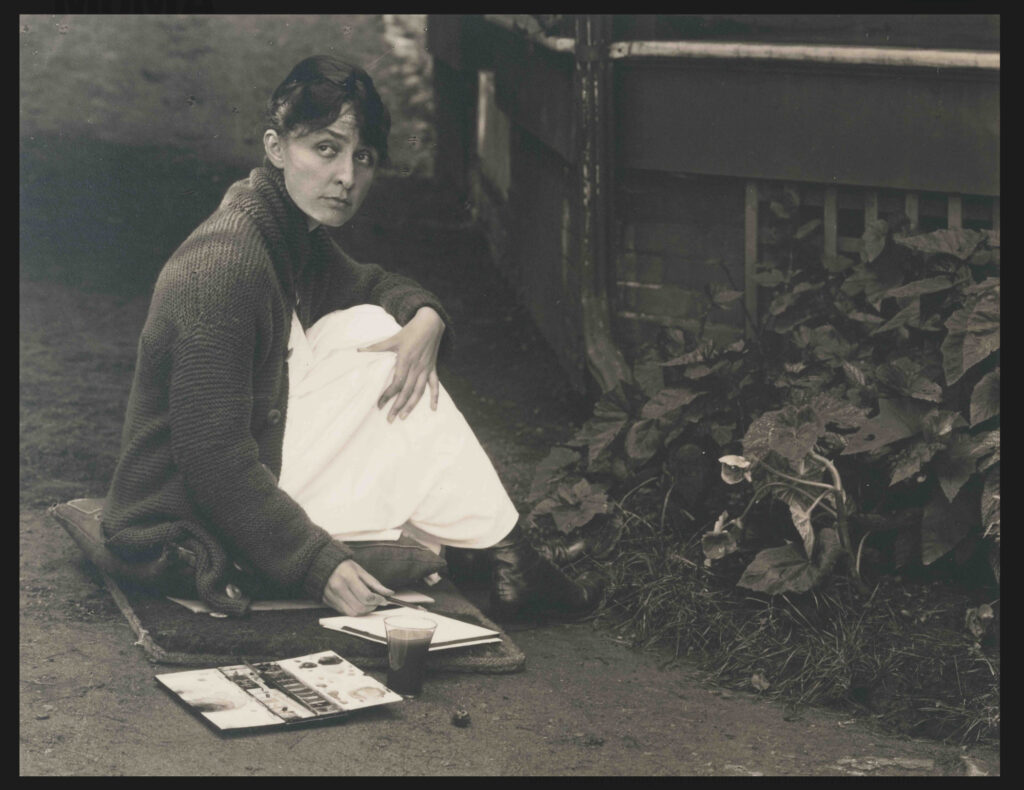
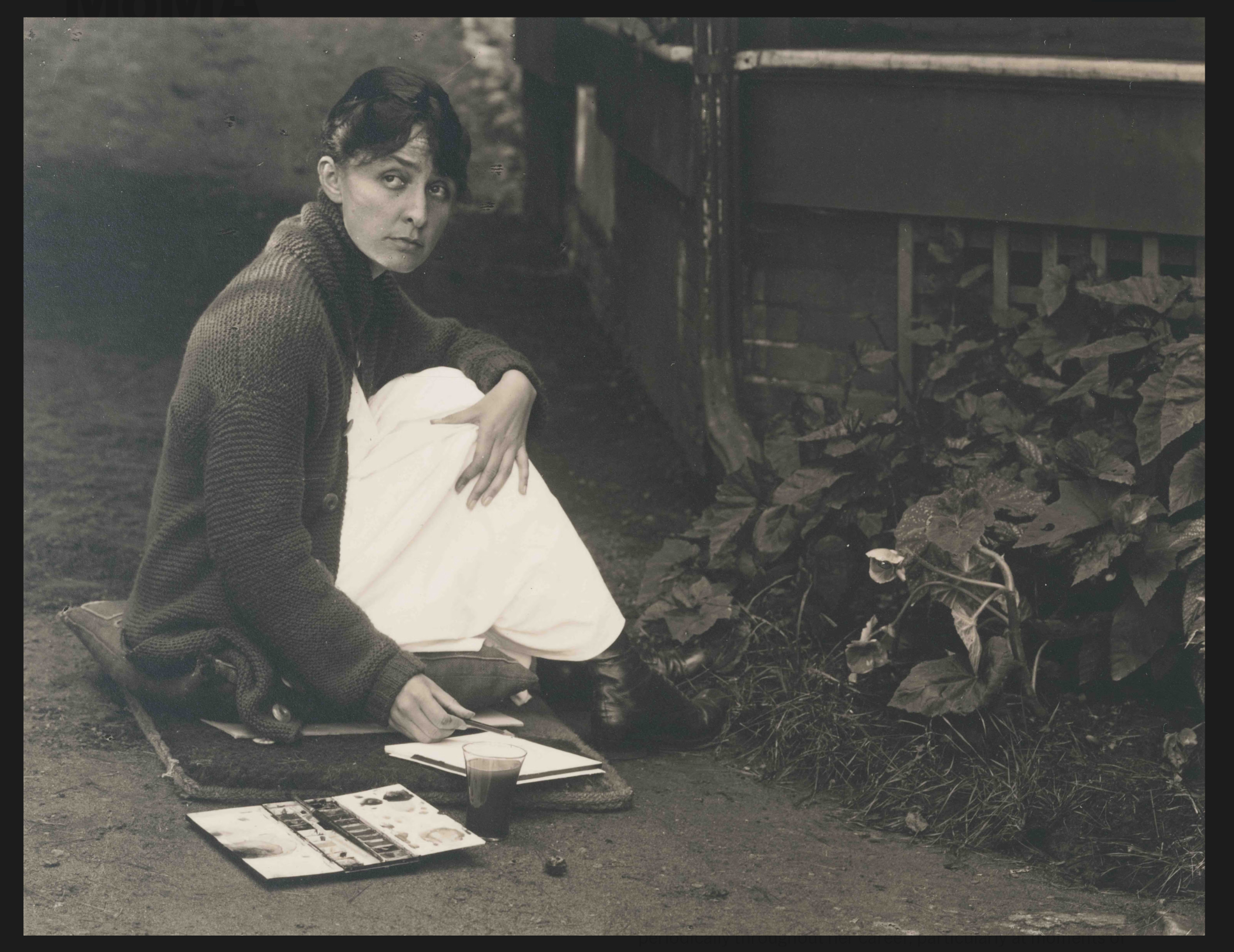
Alfred Stieglitz, Georgia O’Keeffe, 1918. Gelatin silver print. It’s hard to believe Georgia could Draw & Paint flowers like this, and it looks like Mr. Stieglitz found it remarkable, too. Note the year this was taken. *- Georgia O’Keeffe Museum Photo.

“Nobody sees a flower really; it is so small. We haven’t time, and to see takes time- like to have a friend takes time,” Georgia O’Keeffe, paraphrased by MoMA for the title of their 2023 show, Georgia O’Keeffe: To See Takes Time.
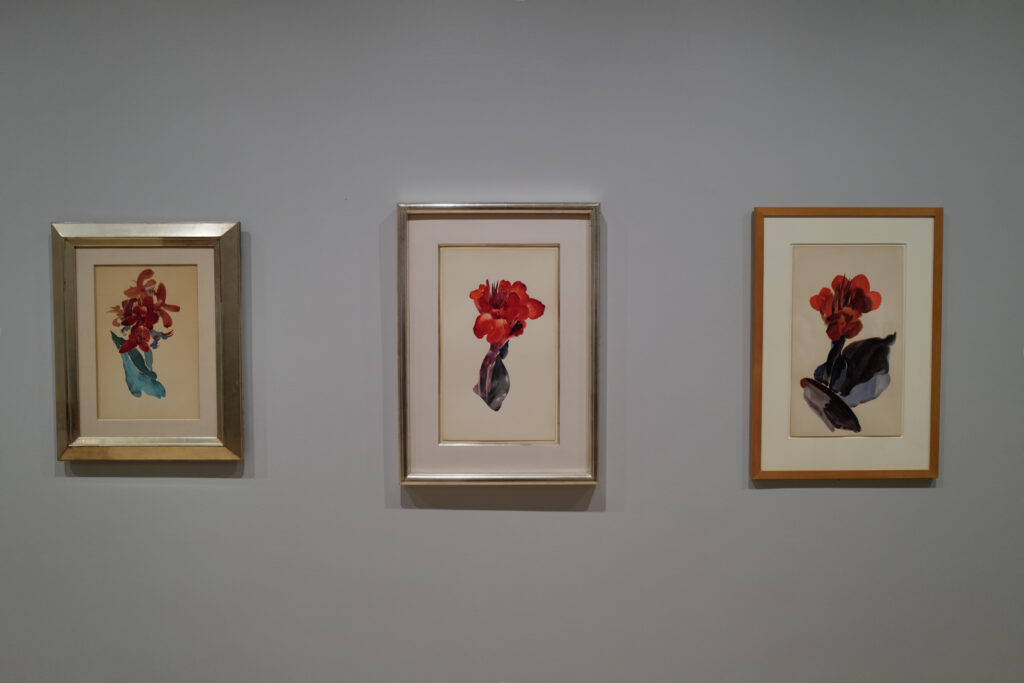
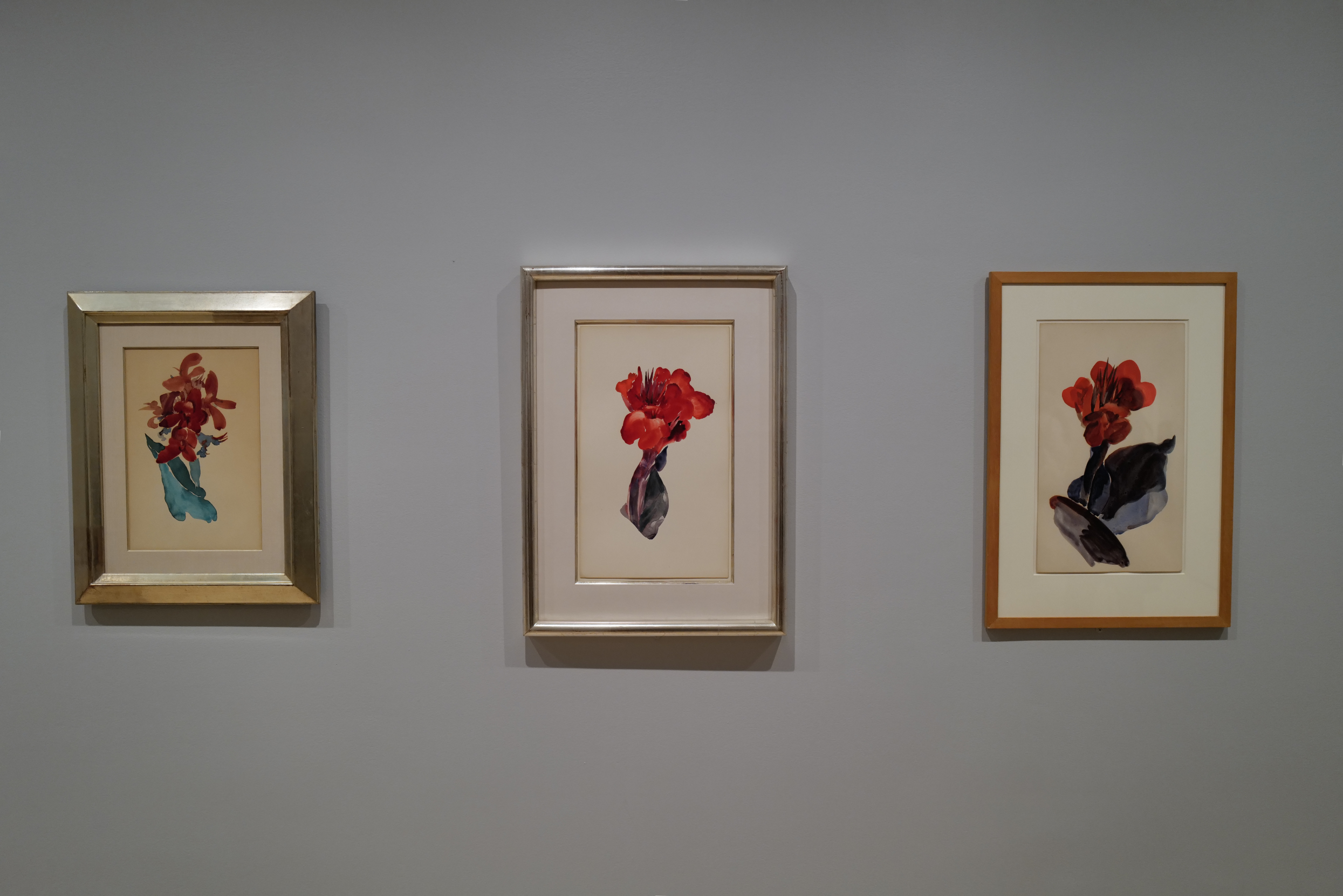
Georgia O’Keeffe, Canna Lily, 1918-20 Watercolor on paper, seen at Georgia O’Keeffe: To See Takes Time., MoMA, July 4 2023. Exactly 2 years later these same gallery walls would display Flower Watercolors by Hilma af Klint Painted at about the same time. (Lights lowered to protect the Art.) MoMA, June 9, 2023.

She continued: “So I said to myself- I’ll paint what I see- what the flower is to me but I’ll paint it big and they will be surprised into taking the time to look at it- I will make even busy New Yorkers take time to see what I see of flowers.” She would eventually give us 200 Paintings of them, a number of which are now iconic. So, it was fitting that MoMA’s Georgia O’Keeffe: To See Takes Time  contained some of her Flowers, including three early Calla Lilies watercolors from 1918-20, right as she was transitioning from Painting in watercolors to oils2.

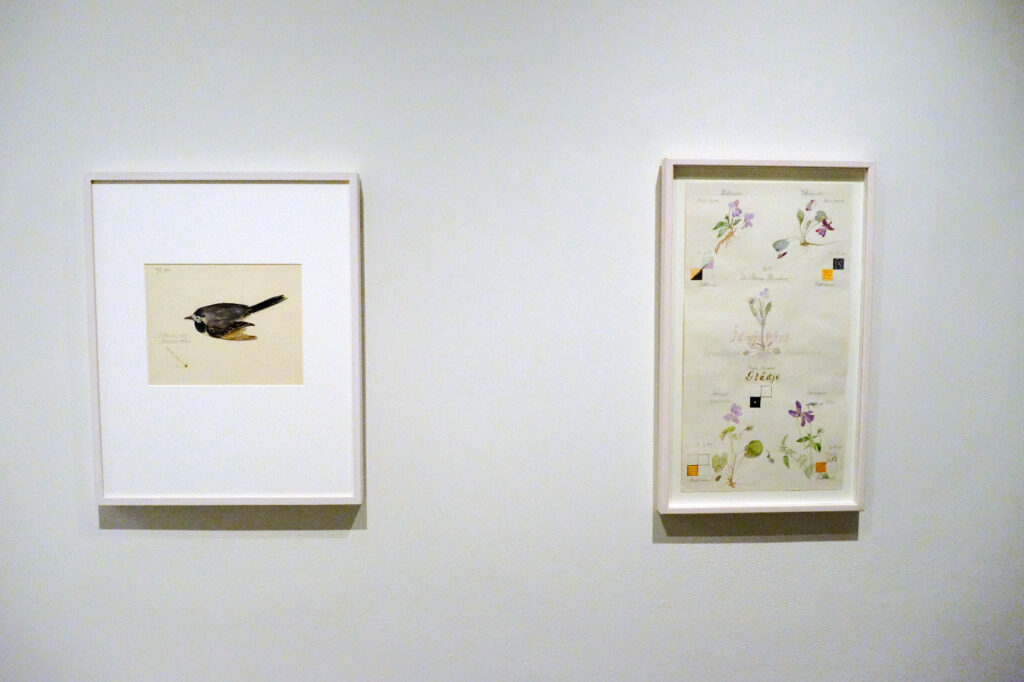
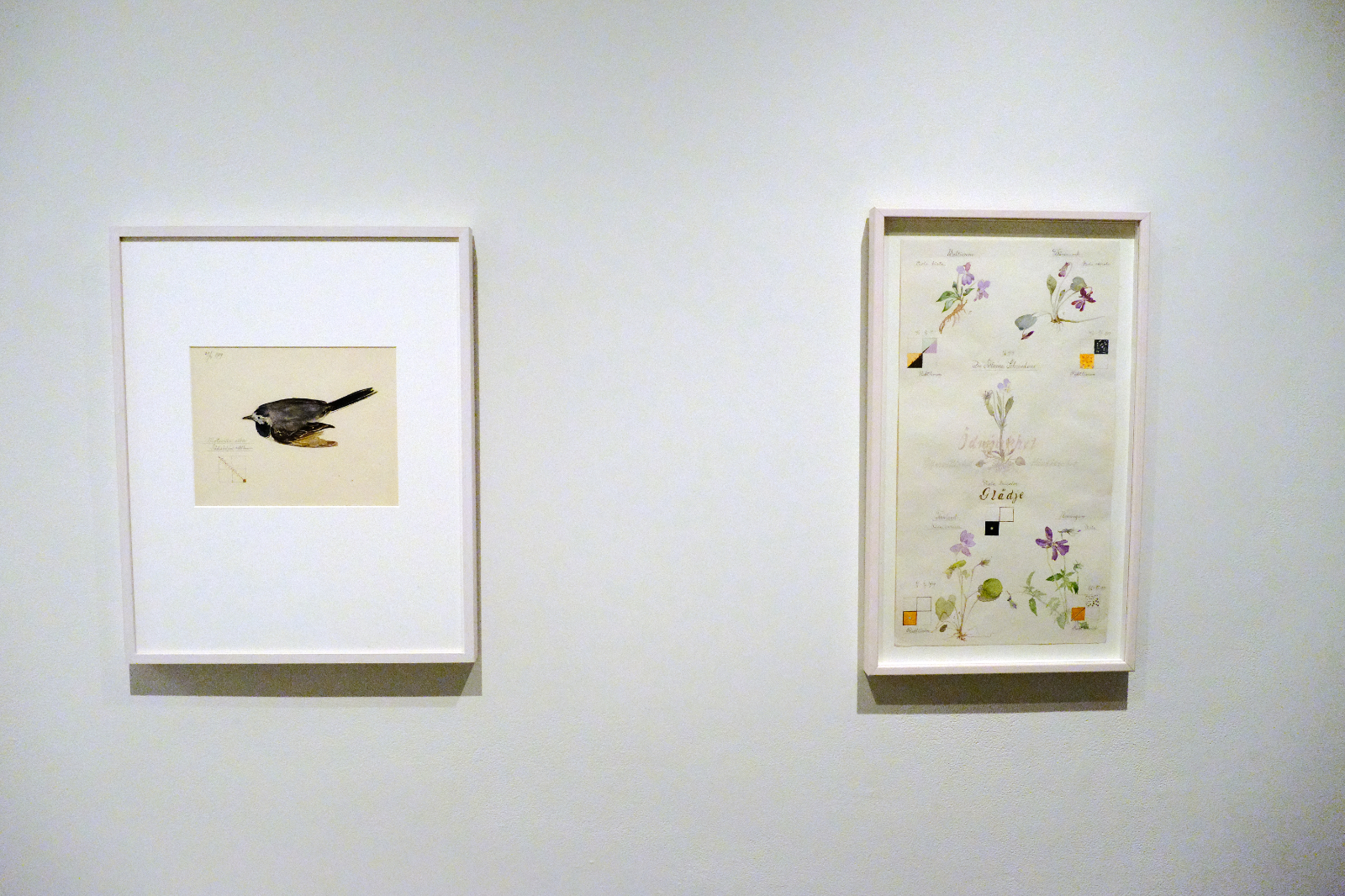
Hilma af Klint, Motacilla Alba: Wagtail with Guidelines, left, Violet Blossoms with Guidelines, both from Series I, 1919, Watercolor, graphite, and metallic paint on paper, right. Tucked away in Paintings for the Future this Flower Watercolor, right, looks like a page from Hilma af Klint’s Nature Studies Portfolio that would become the focus of the next major NYC Museum show of her work seven years later. An interesting realistic(!) harbinger, it’s not part of that Portfolio. Seen at the Guggenheim Museum, December 31, 2018, this sheet was also included in MoMA’s What Stands Behind the Flowers in 2025. MoMA’s wallcard for it speculates that Hilma may have removed it from Nature Studies.

Meanwhile at the same time Georgia was creating her Calla Lilies, across the ocean in Sweden, an almost completely unknown Artist named Hilma af Klint (i.e. HaK, born 25 years before Georgia in 1862) began rendering over 100 Flowers in Watercolors in a Portfolio she titled Nature Studies, 1919. As far as I know, they didn’t know each other (though I wonder if Art astute Hilma came to know of Georgia as the American rose to fame). As far as I can tell, the set remained hidden from public display until May 11, 2025, when MoMA opened Hilma af Klint: What Stands Behind the Flowers, coincidentally in the same galleries that had held Georgia O’Keeffe: To See Takes Time two year before

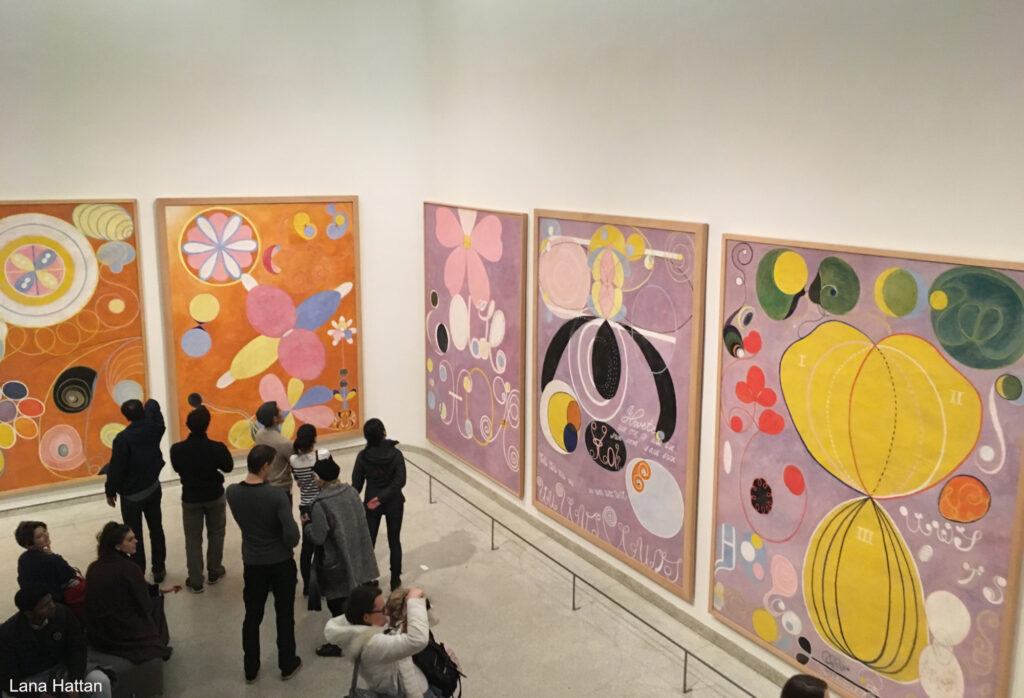
Five of Hilma af Klint’s The Ten Largest, a series devoted to the human lifespan, part of her now-famous Paintings for the Temple series. Note the shapes that seem organic or “flower-like.” Guggenheim Museum, December 31, 2018. *- Photo by Lana Hattan, Guggenheim Museum, December 31, 2018.

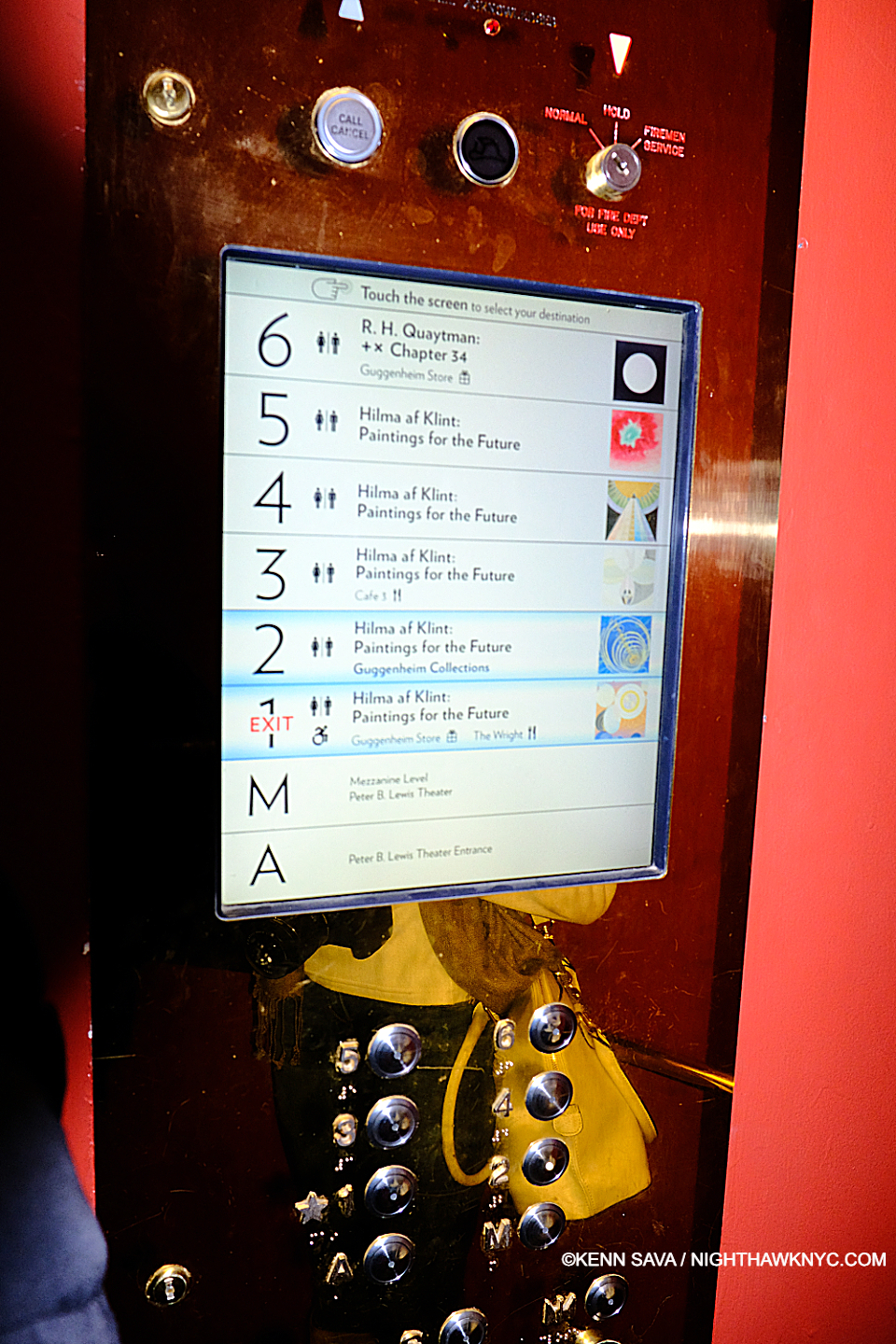
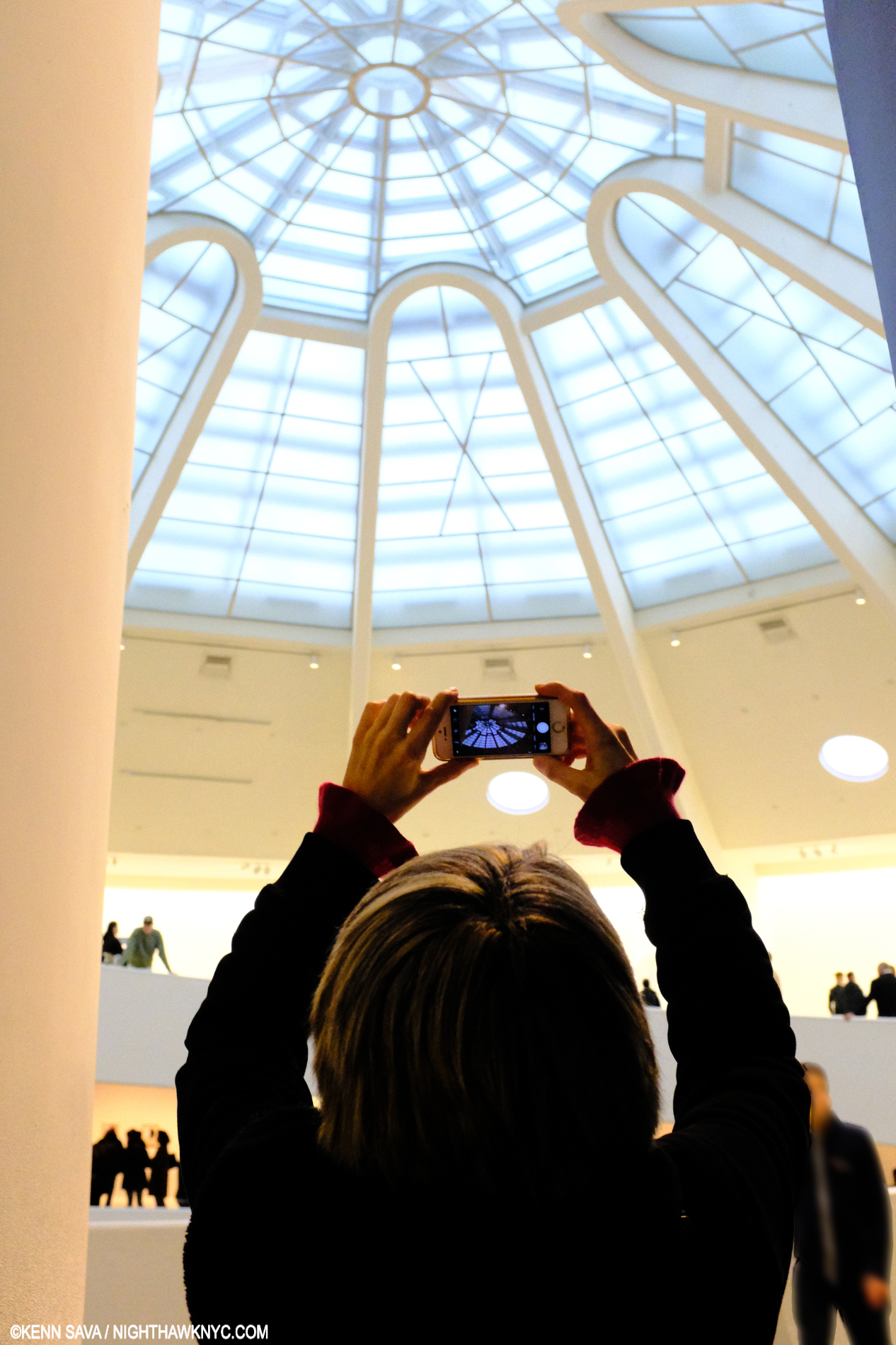
When her Art was last seen in an NYC museum in 2018-19, Hilma af Klint: Paintings for the Future drew a Guggenheim Museum all-time record 600,000 other viewers to Frank Lloyd Wright’s Museum Rotunda. I always walk down the ramp after taking the unique semi-circular elevator to the top of the Guggenheim as Frank Lloyd Wright wanted visitors to do which means I saw Paintings for the Future in reverse chronological order. Preceding it, R.H. Quaytman: +x, Chapter 34, occupied the 6th, or top Ramp. While this might seem incongruous to some, a deep dive into Hilma af Klint’s sparse NYC history reveals that R.H. Quaytman has a long history of championing Hilma af Klint that includes curating the first HaK show in an NYC museum, The Secret Pictures by Hilma af Klint at MoMA PS1 in early 19893. +x, Chapter 34 worked seamlessly with Paintings for the Future in my view.
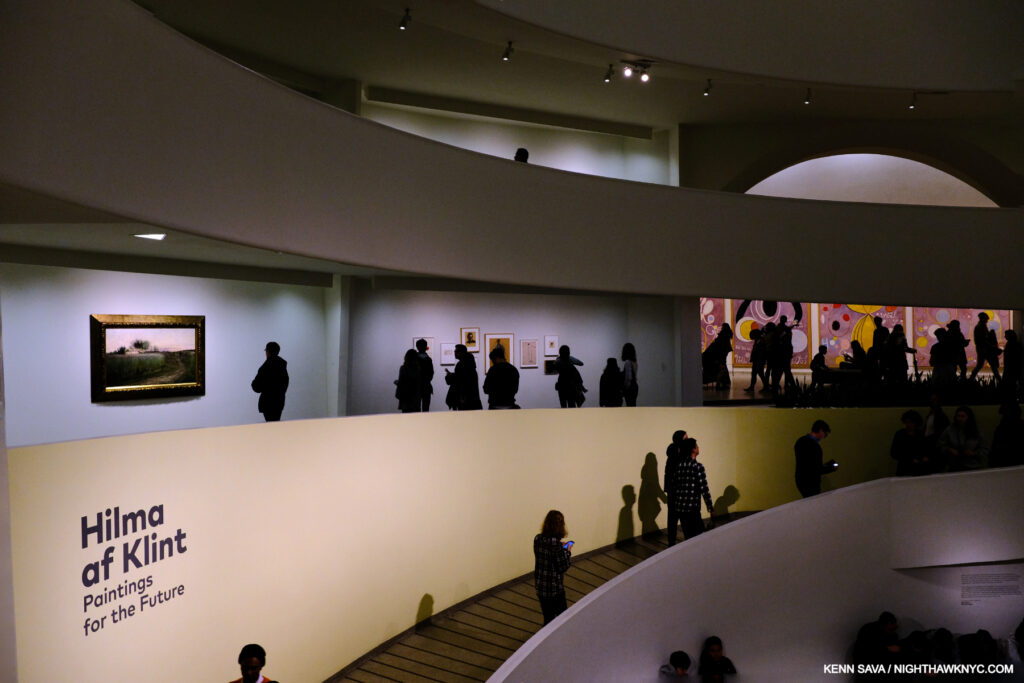
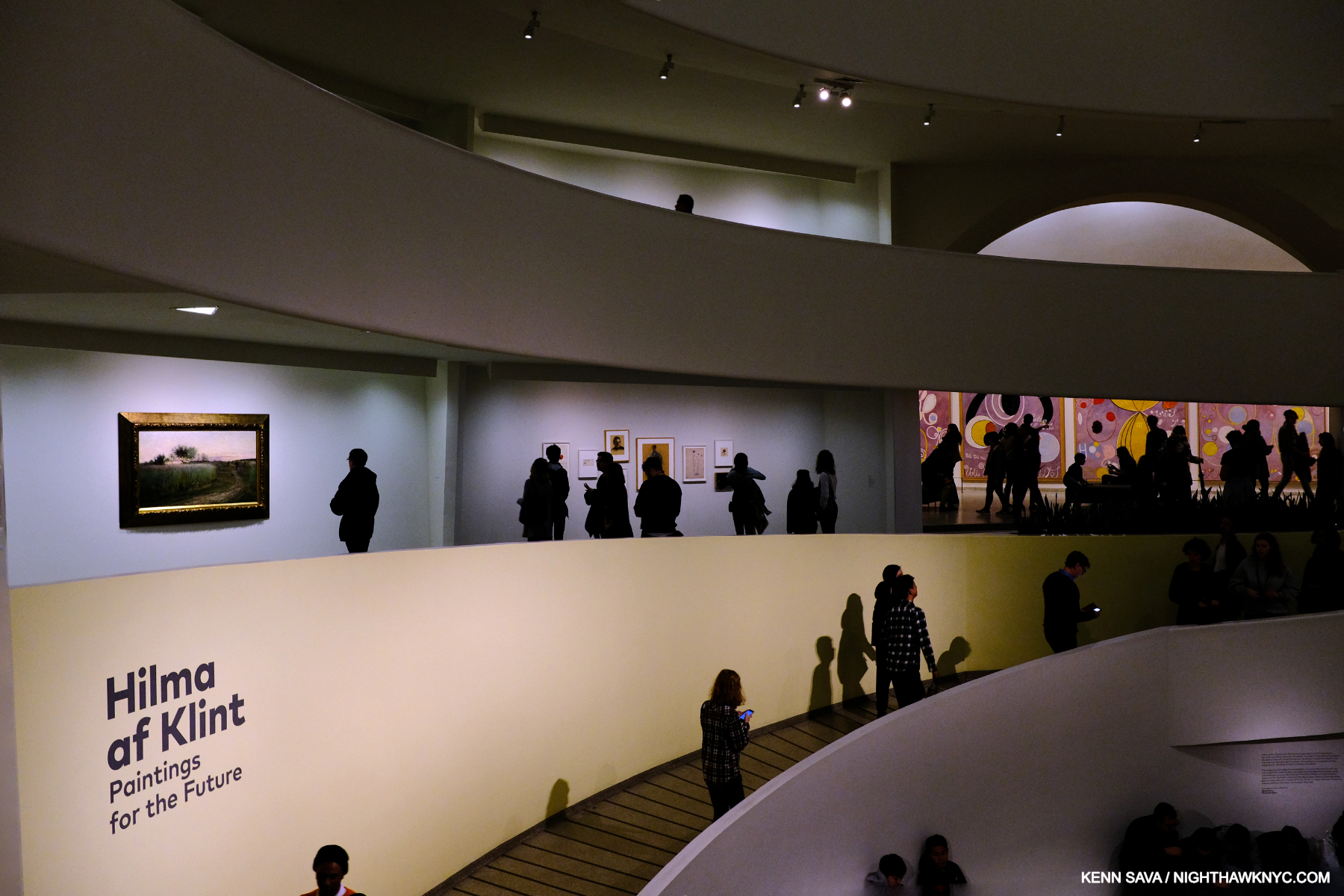
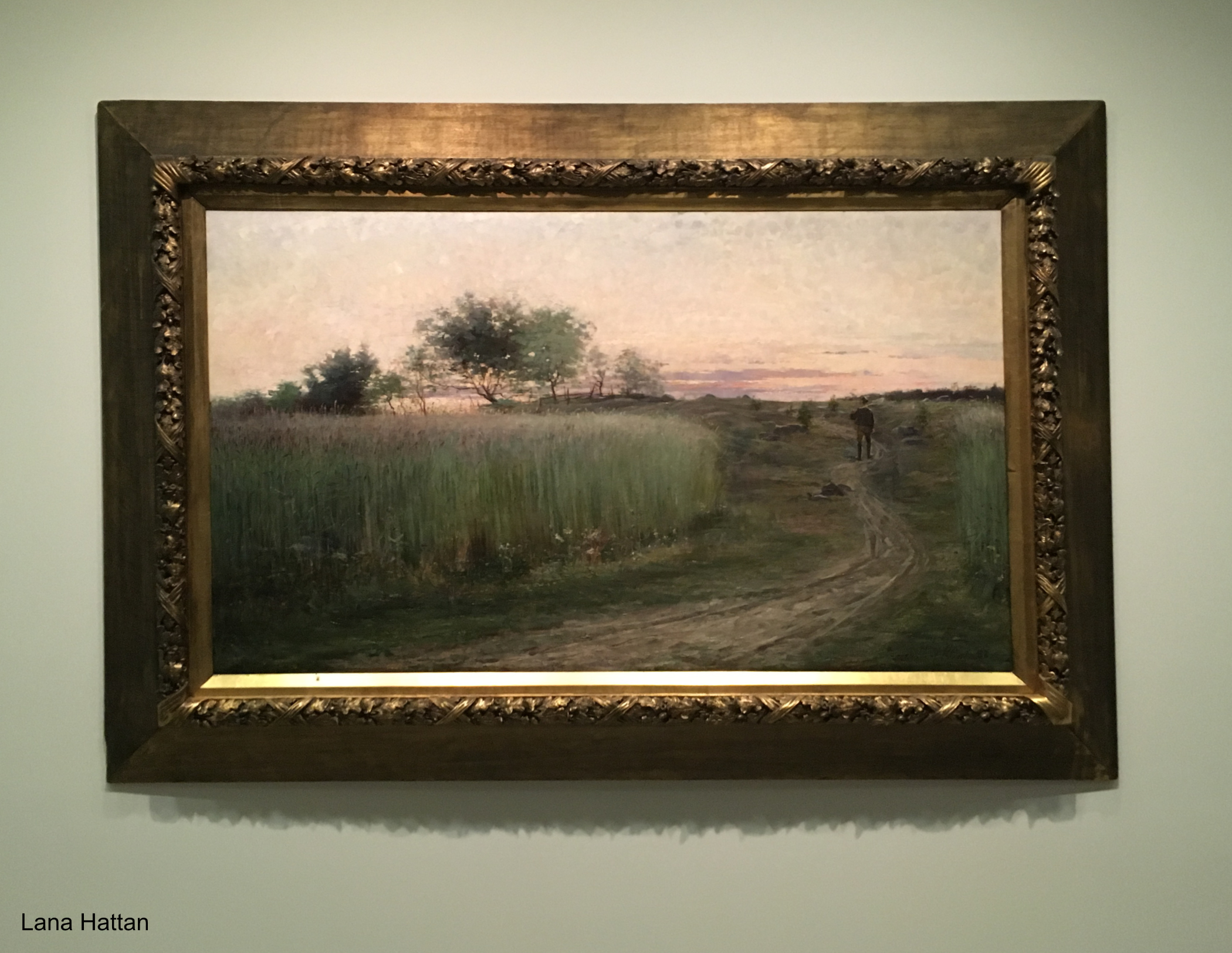
Herein lies a problem (among others) with branding HaK an “abstract Artist.”  To the left, above the sign, on Ramp 1 is Summer Landscape, 1888, Oil on canvas, juxtaposed by parts of three of The Ten Largest, all 10 from 1907, far right, from her landmark Paintings for the Temple series, partially shown in the prior picture, in a completely different style. December 31, 2018.

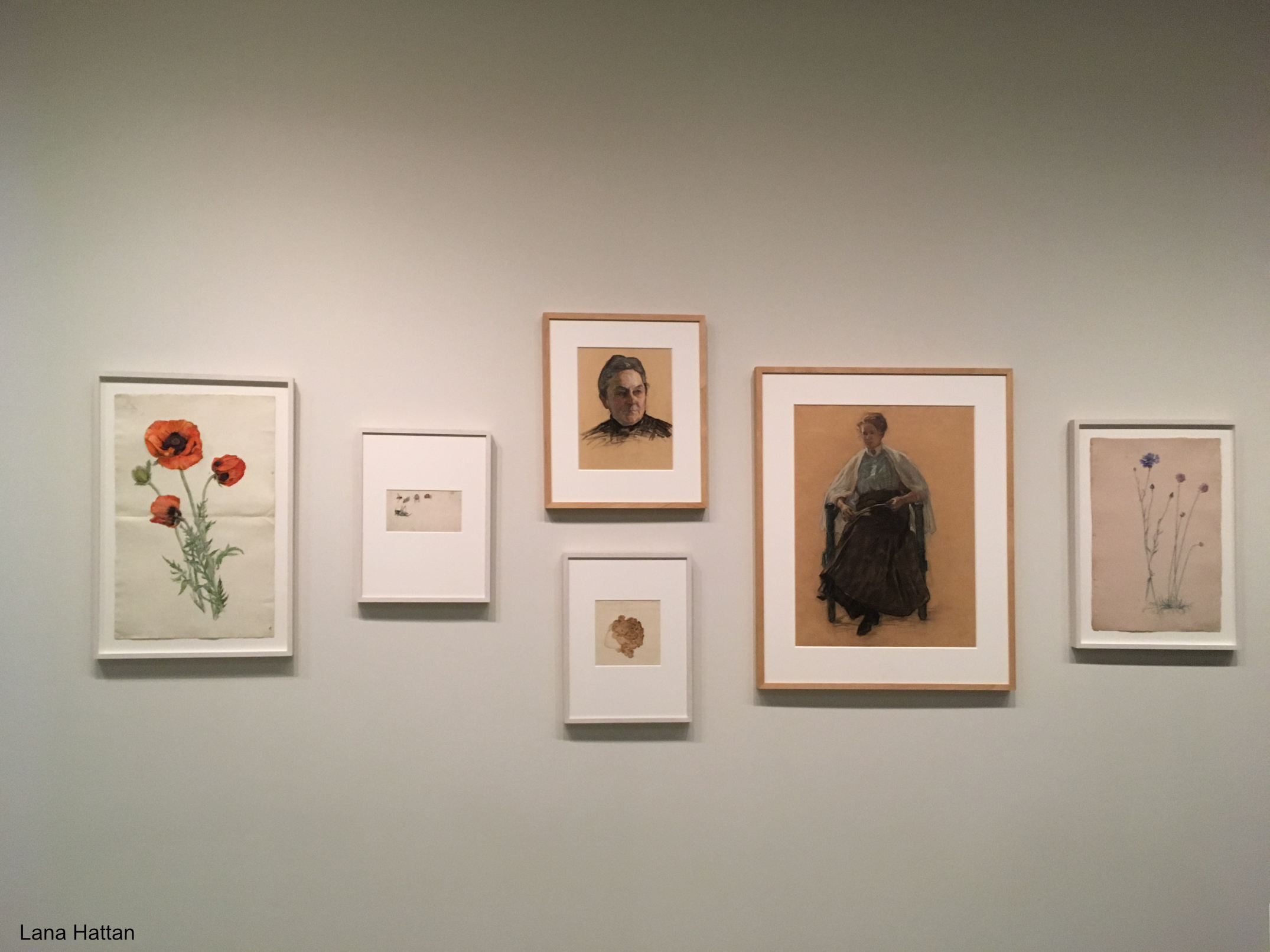
As we got to Ramp 1 (the lowest ramp), there were two bays containing work that looked pretty representational to me that featured Summer Landscape, 1888, above, left, and 2 Flower Watercolors from the 1890s, center, between the  visitors above, all shown closer below-
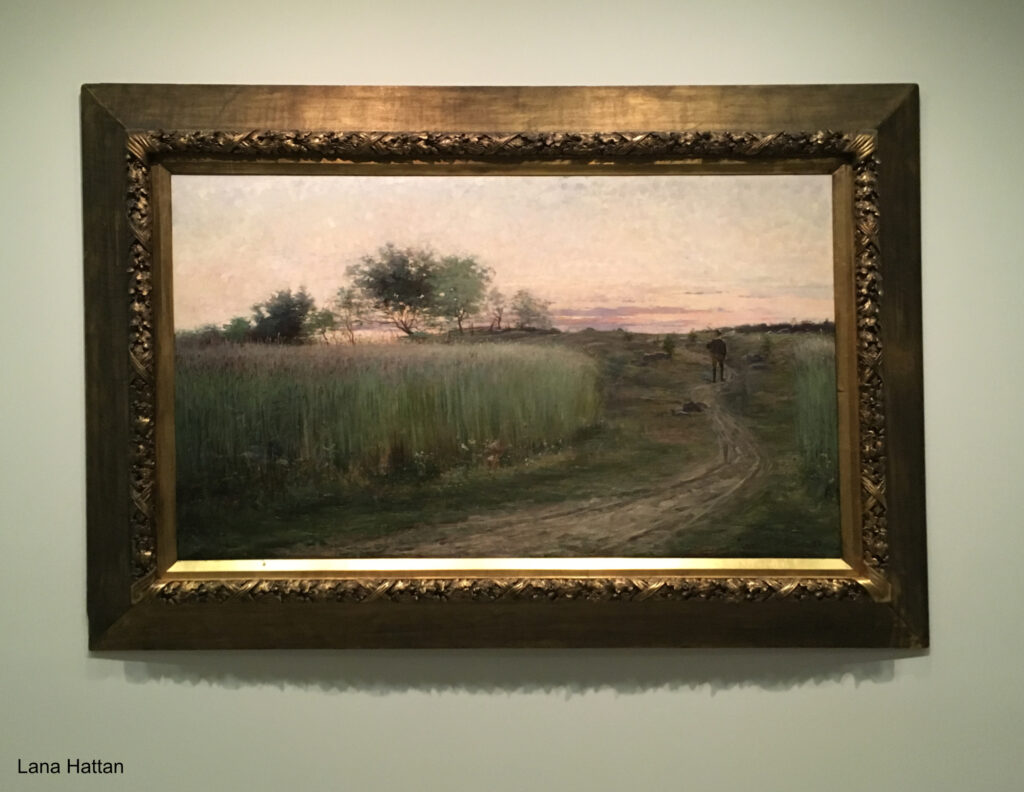
Summer Landscape, 1888, Oil on canvas. Hilma was about 26 when she Painted this in the year she graduated from the Royal Academy of Fine Arts.*- Photo by Lana Hattan, Guggenheim Museum, December 31, 2018.
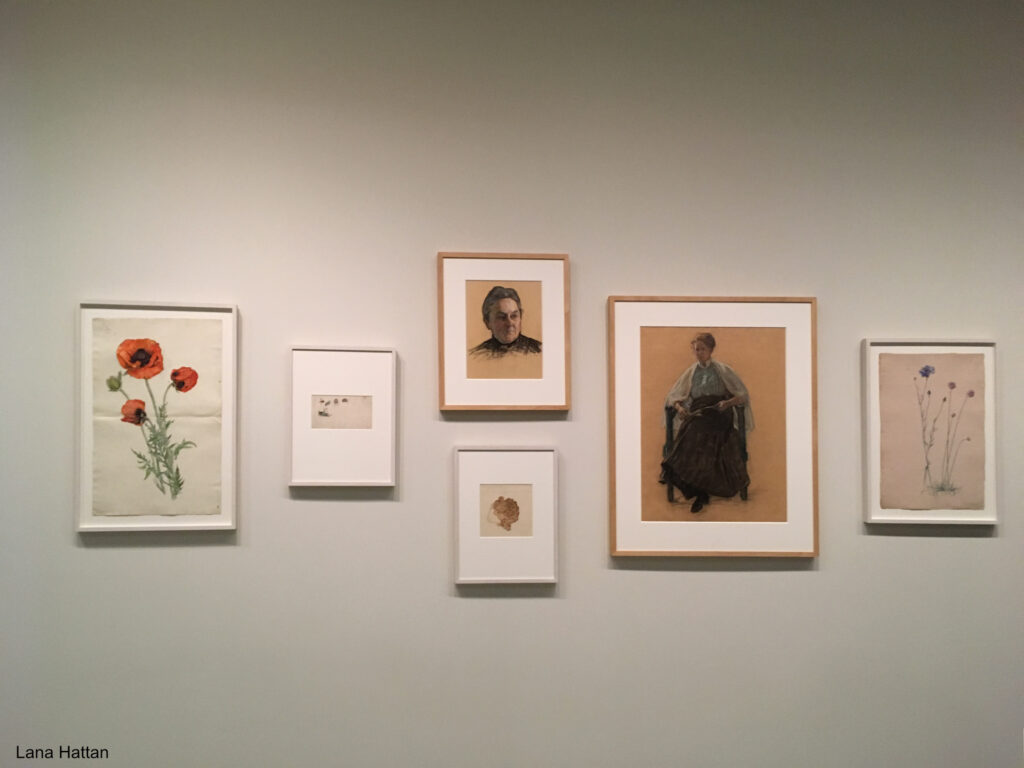
Poppy, 1890s, Watercolor, ink, and graphite on paper, left, Portrait study of the head of a woman, center, and Portrait study of a sitting woman to its right,  both Charcoal, crayon and graphite on paper, both c.1918. Distortion of the frames due to the curved wall. *-Photo by Lana Hattan, Guggenheim Museum, December 31, 2018.

Though early in her career, before the more well-known Paintings they call “abstract,” these revealed an accomplished technique in both oils and watercolors, honed over 6 years at the Royal Academy of Fine Arts in Stockholm (1882-88), where Hilma was one of its first female students. At that moment, I realized there was much more to Hilma af Klint than the Art machine’s limiting marketing hype would have us believe.
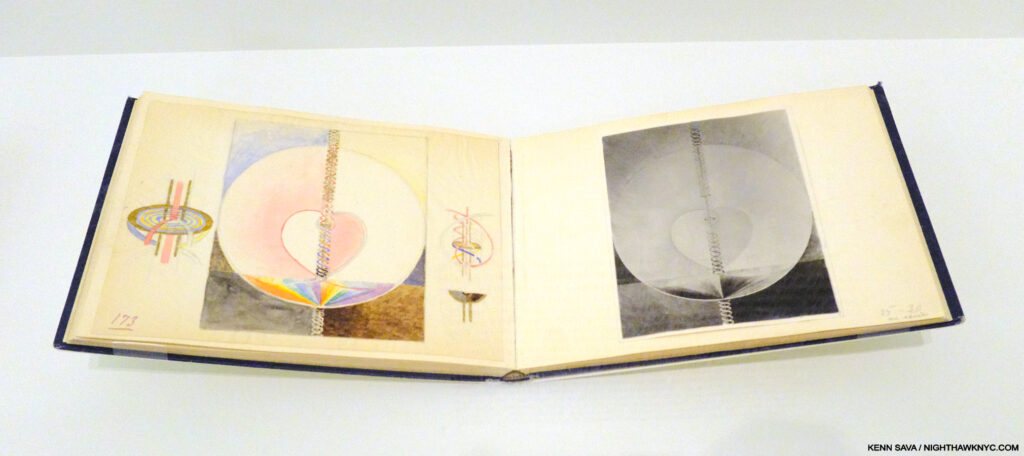
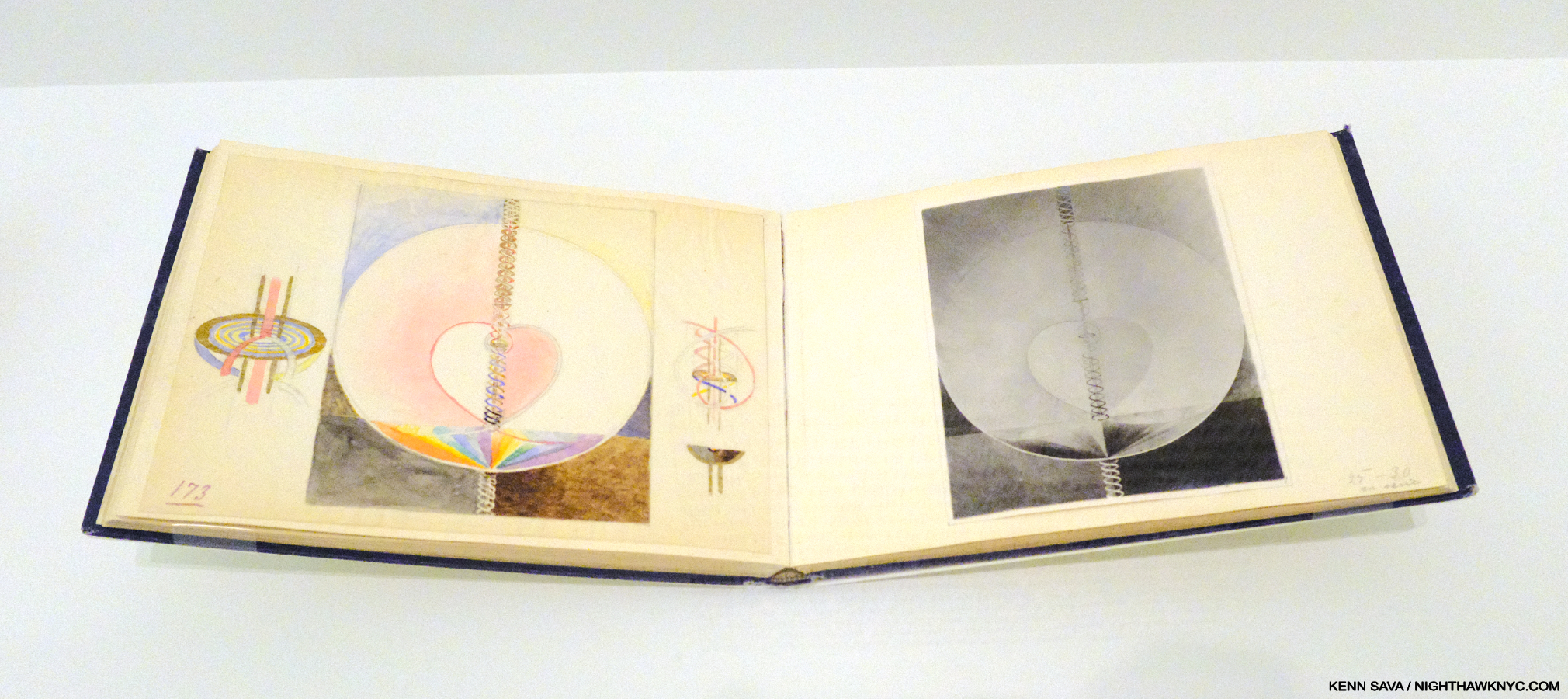
“Blue Book” Vol. 10. Hilma painstakingly recreated every one of her Paintings for the Temple (Painted, again, by hand) in a series of blue books on the left-hand page accompanied by a black & white Photo of the piece on the right-hand page, probably because color photography wasn’t yet practical. Guggenheim Museum, December 31, 2018.

Hilma, a devoted, life-long spiritualist,t who attended seances (and believed her “most important work” was the 192-canvas series The Paintings for the Temple, 1906-15, partially shown earlier, which were guided by other beings), came to feel that her time wasn’t THE time for her Art to be seen. Since the entire Temple series is so numerous, and includes 10 very large Paintings, Hilma fastidiously recreated the entire series in 10 remarkable smaller “Blue books,” as they are known, a “portable museum,” which she carried with her to show Rudolf Steiner (in 1920), and others, in hopes of having the originals shown in a spiritual context. That’s how important it was to her.

This makes me wonder- How many “abstract” Artists would be able to exactly recreate 192 of their Paintings? An impressive technical achievement, that she could do it tells me that her compositions were no accident, something I think is important to bear in mind.
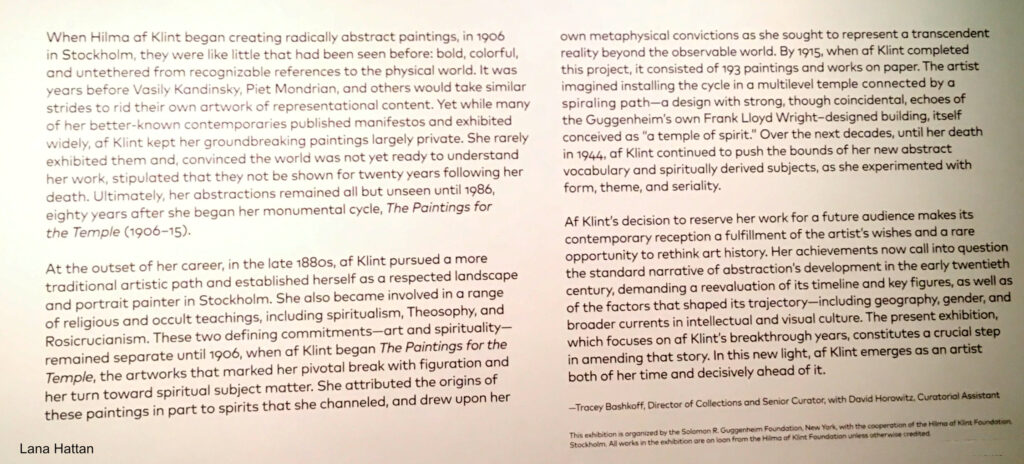
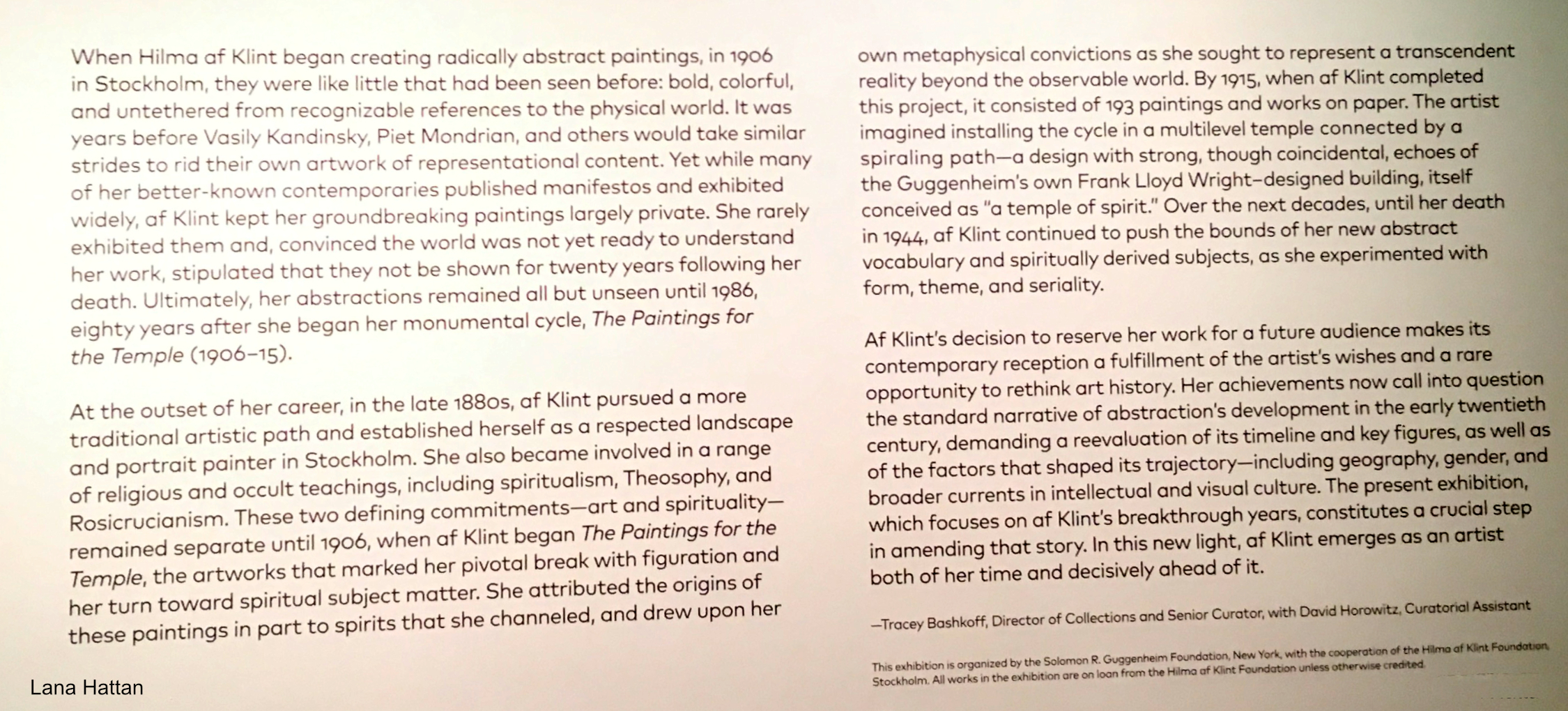
Is THIS the time Hilma envisioned for her work? The introductory wall card for Paintings for the Future on the Guggenheim’s curved wall outlines how the curators saw Hilma’s Art in 2018. I disagree with parts of this. For example, they mention HaK being “a respected landscape and portrait painter,” acknowledging she Painted in other styles, yet they ignore the fact that she returned to Painting representationally in 1919 with Nature Studies, as I show further on. They state her work was “untethered from recognizable references to the physical world.” What about the flowers and other natural elements that appear frequently, as shown in The Ten Largest picture earlier, and in Group VII (further on) and other pieces later on? *- Photo by Lana Hattan, Guggenheim Museum, December 31, 2018. Click for full size.

Failing to achieve this, in 1932, she decreed that none of her Paintings or Drawings should be shown until twenty years after her death in hopes of finding a more accepting time. Her work wound up being out of sight for 45 years. After she was tragically struck by a street car in 1944 and died from her injuries, her will left her entire creative estate to her nephew, Erik. Her work was stored in an attic for two decades before Erik had the Paintings unrolled and Photographed. Those 1,300 Paintings and 26,000 pages of text forms the basis of what is now the Hilma af Klint Foundation, which was created in 19724. The Foundation made a major effort to organize the work and prepare it for public display. Eleven of her Paintings were finally shown in The Spiritual in Art: Abstract Painting 1890-1985 in Los Angeles in 1986, but it wasn’t until 2013 that she finally received a full retrospective (in Europe), in a show titled Hilma af Klint: Pioneer of Abstraction (the catalog for which is also on my list).
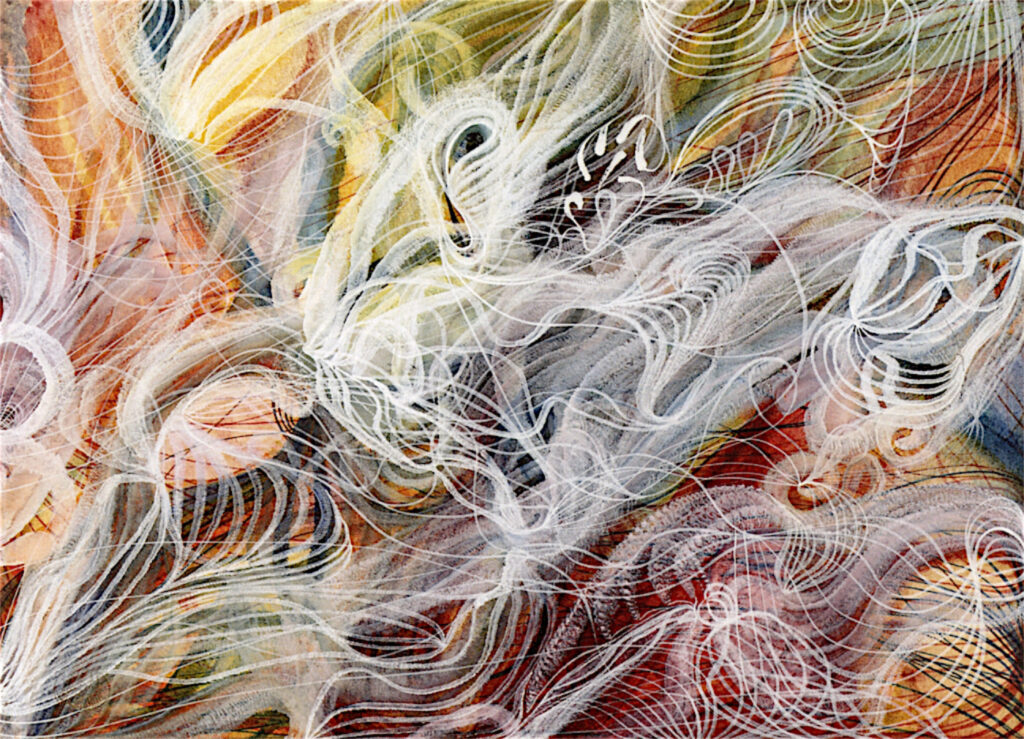
Georgiana Houghon, The Love of God, August 3, 1864, Watercolor and gouache on paper, 23.7 x 32.6 cm, An Automatic Painting, Hilma af Klint was about 2 when Georgiana Painted it. *-Victorian Spiritualists’ Union, Melbourne Photo.

That show rode on the hype about Hillma being “the first abstract Artist,” (says the Tate, no less) before Kandinsky, Mondrian, et al., and a woman. The truth is Hilma was not even the first woman in her spiritualist circle to create what they call abstract work- Georgiana Houghton (1814-1884), 48 years Hilma’s senior, who proceeded her in creating Automatic Paintings & Drawings, may be a better candidate for that title. But, boxing HaK as such helped the powers that be draw huge crowds to the 2013 show of a complete unknown. Paintings for the Future (one of the two most important NYC Painting shows I saw in the prior decade, along with this one) took things to an entirely different level. Six years later comes MoMA’s Hilma af Klint: What Stands Behind the Flowers, her first NYC museum show since the Guggenheim blockbuster. Hilma’s work doesn’t need any hype to “sell” it now. The world knows who she is. All the “abstraction” talk has kept people from looking at her work, in my view. It’s time to look at the Art for what it is.
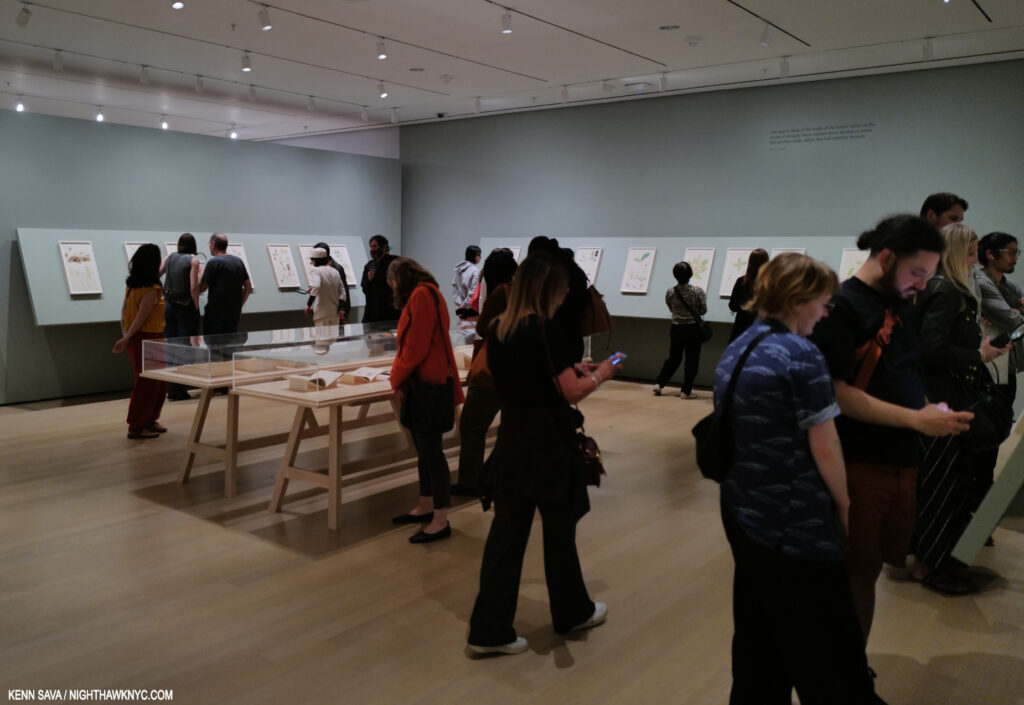
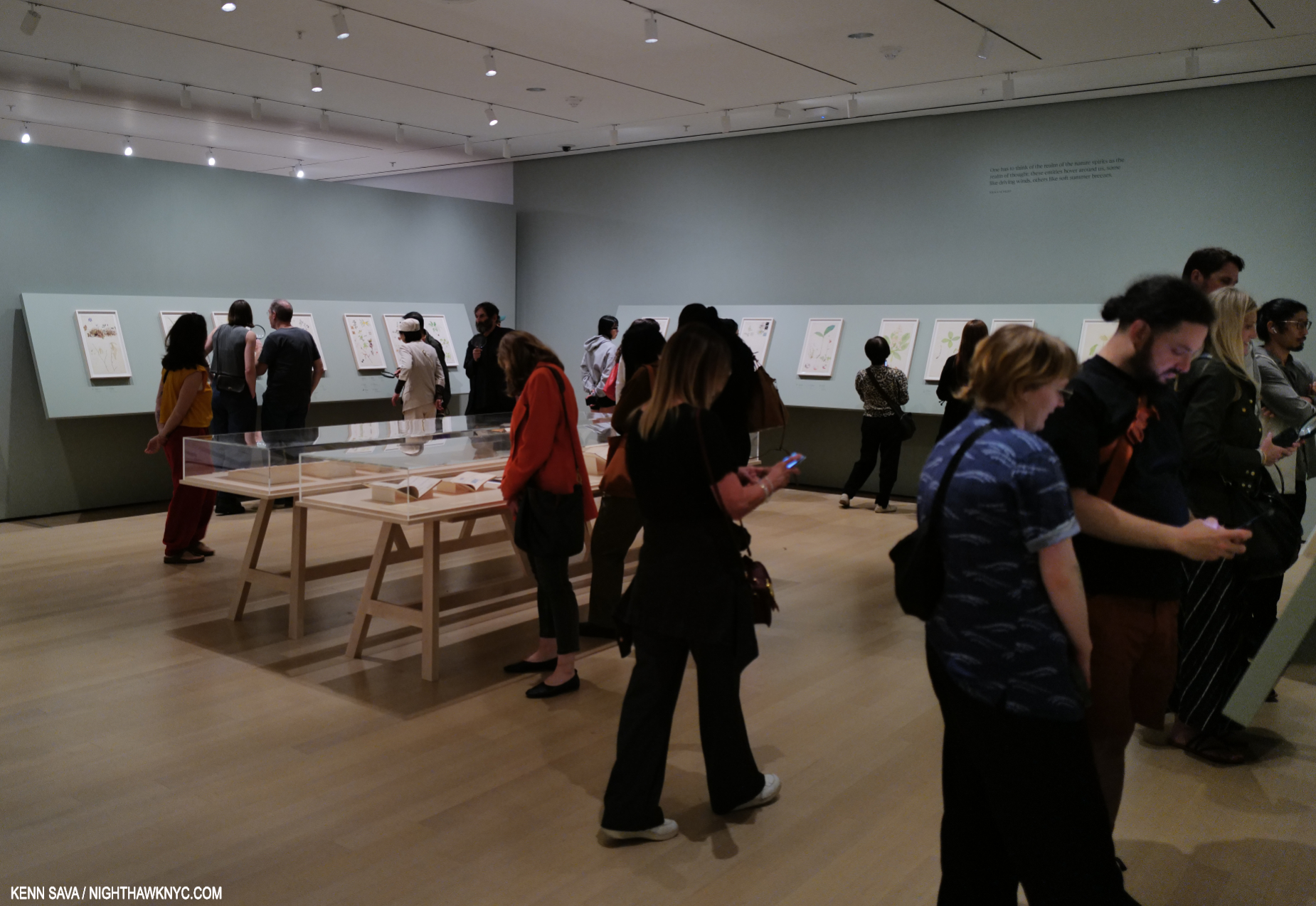
Installation view of the 2nd gallery of Hilma af Klint: What Stands Behind the Flowers at MoMA, which contained the first part of Nature Studies on the walls and a selection of her writings, and books by others on flower studies, in the center vitrine. Opening week, May 18, 2025.

What Stands Behind reveals that AFTER she completed the Paintings for the Temple in 1915, Hilma went back to working “representationally!” I guess no one bothered to tell her she was supposed to be an “abstract” Artist in the future. The more likely case is that HaK was a very talented and creative woman, an Artist more than capable of creating in whatever style she needed to work in for what she was trying to accomplish. It seems to me that THAT is a MORE impressive thing than sticking her in any one limiting box!

“One has to think of the realm of the nature spirits as the realm of thought; these entities hover around us, some like driving winds, others like soft summer breezes,” Hilma af Klint, MoMA wall card.
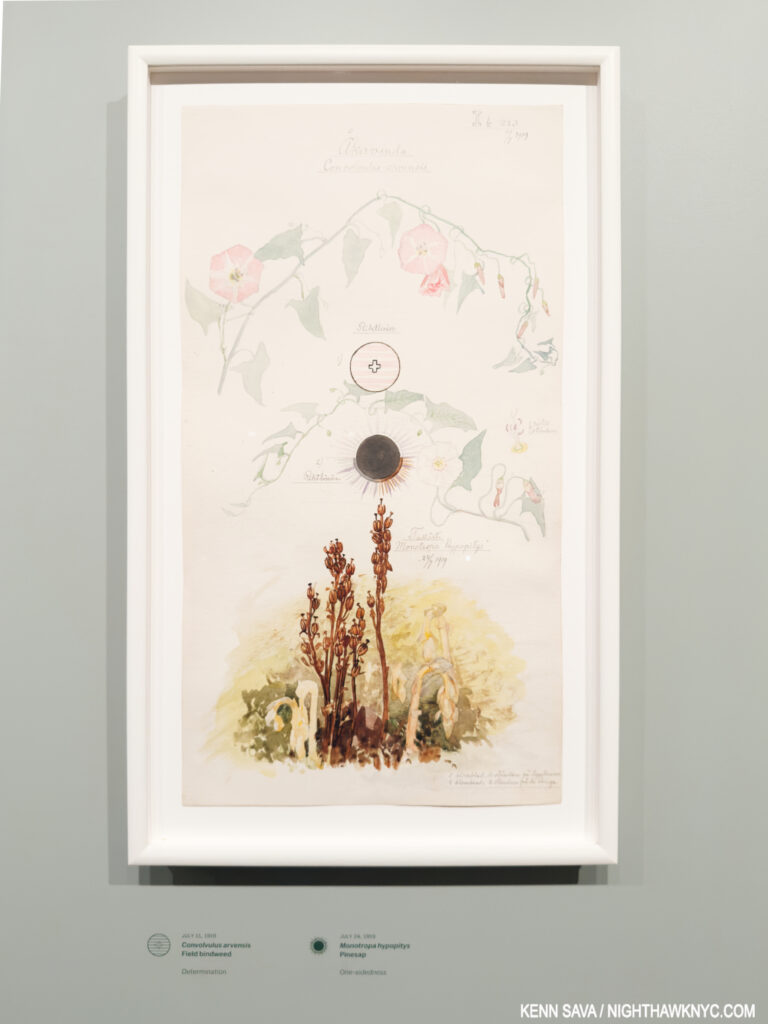
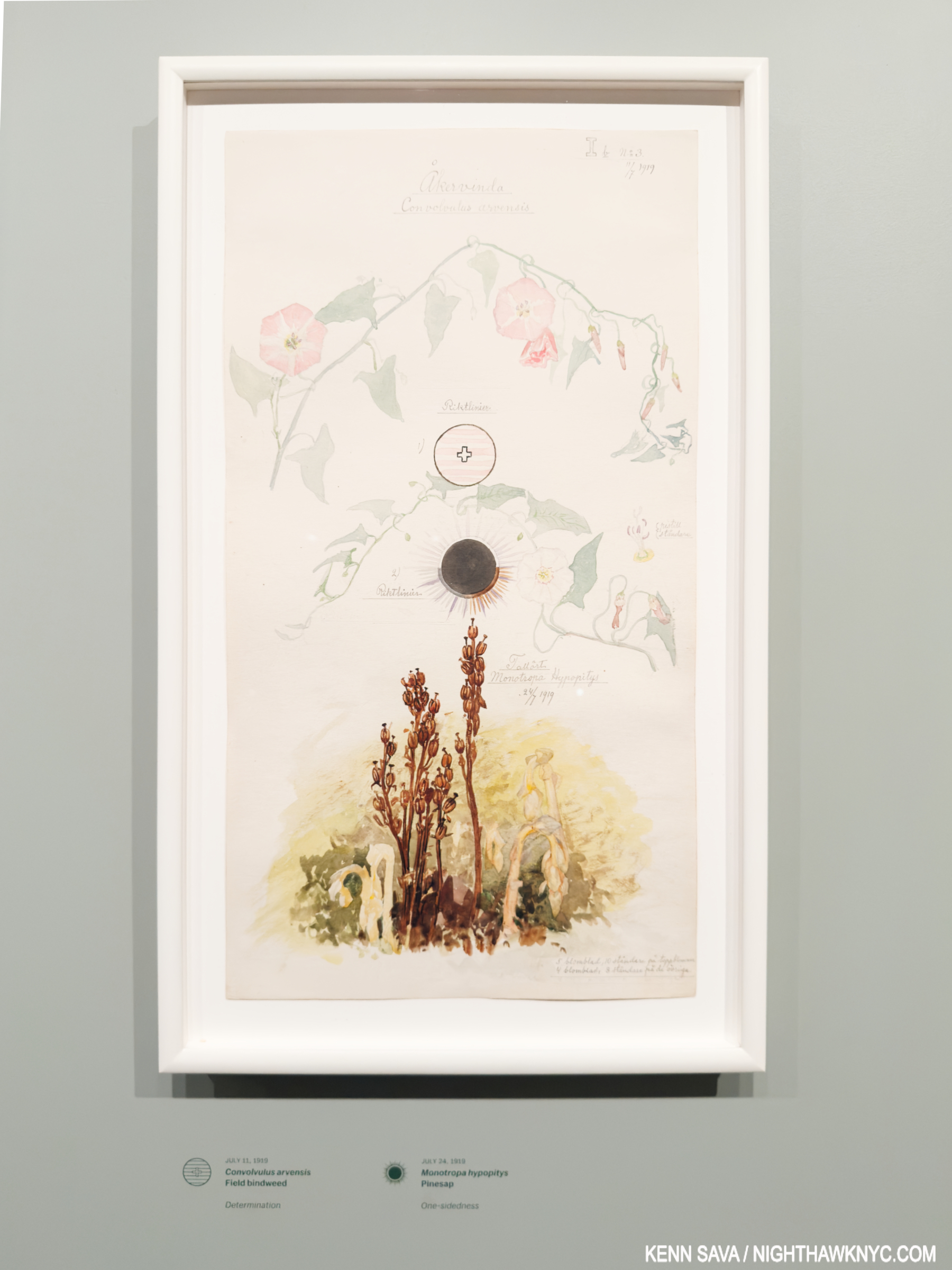
Convolvulus arvensis (Field Bindweed), Monotropa hypopitys (Pinesap). Sheet 20 from the portfolio Nature Studies July 11–24, 1919, Watercolor, pencil, ink, and metallic paint on paper. One of the 46 sheets in watercolor, pencil, ink, gouache and metallic paint on paper included in Nature Studies. Being 19 11/16 by 10 5/8 inches, these sheets would seem too large for Hilma to work on in situ. But that’s purely my conjecture. Unlike Georgia O’Keeffe, HaK didn’t confine herself to one specimen per sheet. Over 100 are included on the Nature Studies! Underneath, the curators translate HaK’s notations of the species name and its character as perceived by the Artist: “Determination” for the Field Blindweed, top, and “One-sidedness” for the Pinesap, bottom. MoMA, September 26, 2025.

She also continued to work on creating a “language” (see Group 2, further below) that included letters, words and diagrams. These are seen in almost all of the series she created in her life (including Nature Studies).
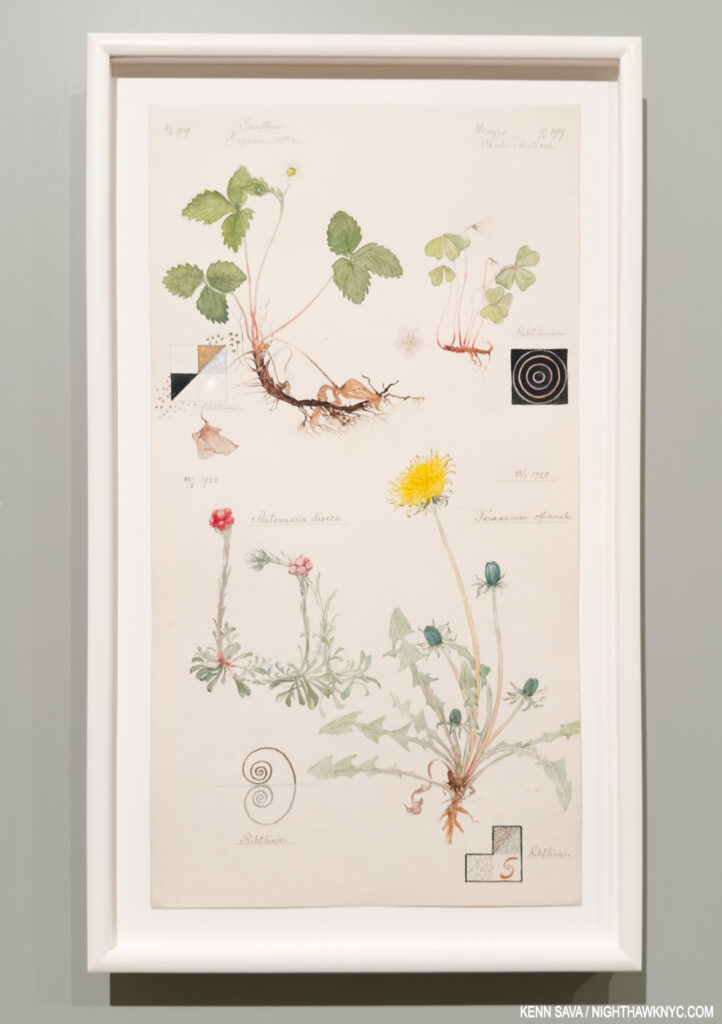
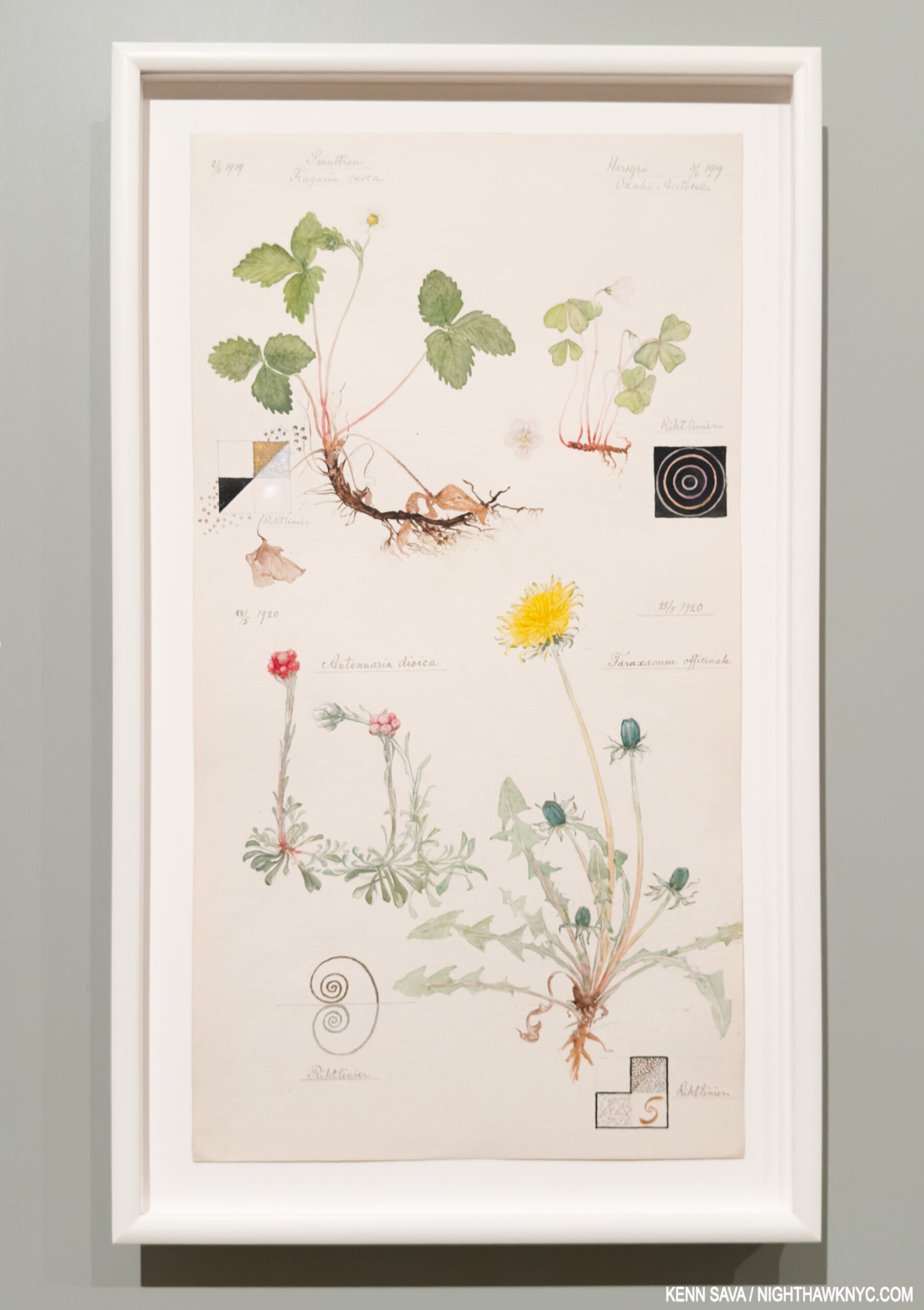
Woodland Strawberry, Hilma’s notation- “Liberator. Longing to produce balance within the blood syntem by expelling either white or red biood cells.” European wood sorrel- “Fragility-submissiveness shyness-humility fear -respect self-loathing-obedience.” Catsfoot– “Peace and harmony.” and Dandelion- “Beginning.”
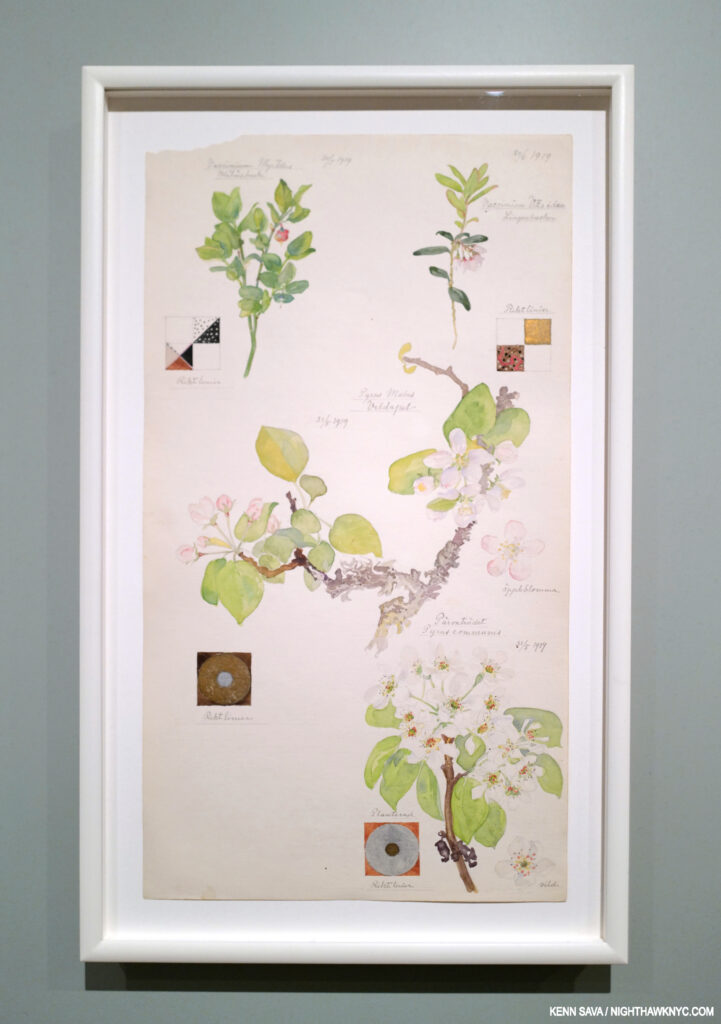
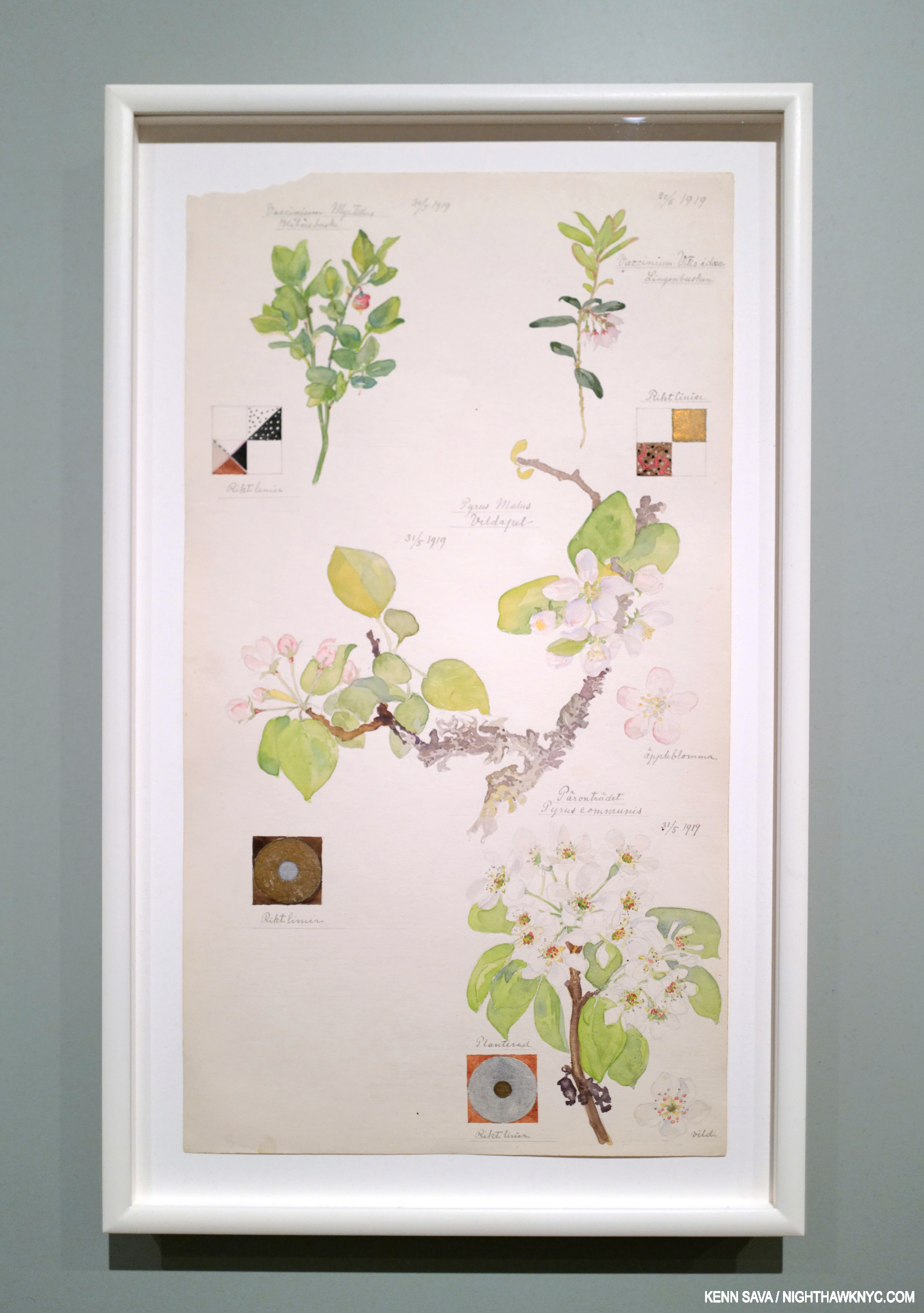
Bilberry, Apple, Common Pear, Lingonberry

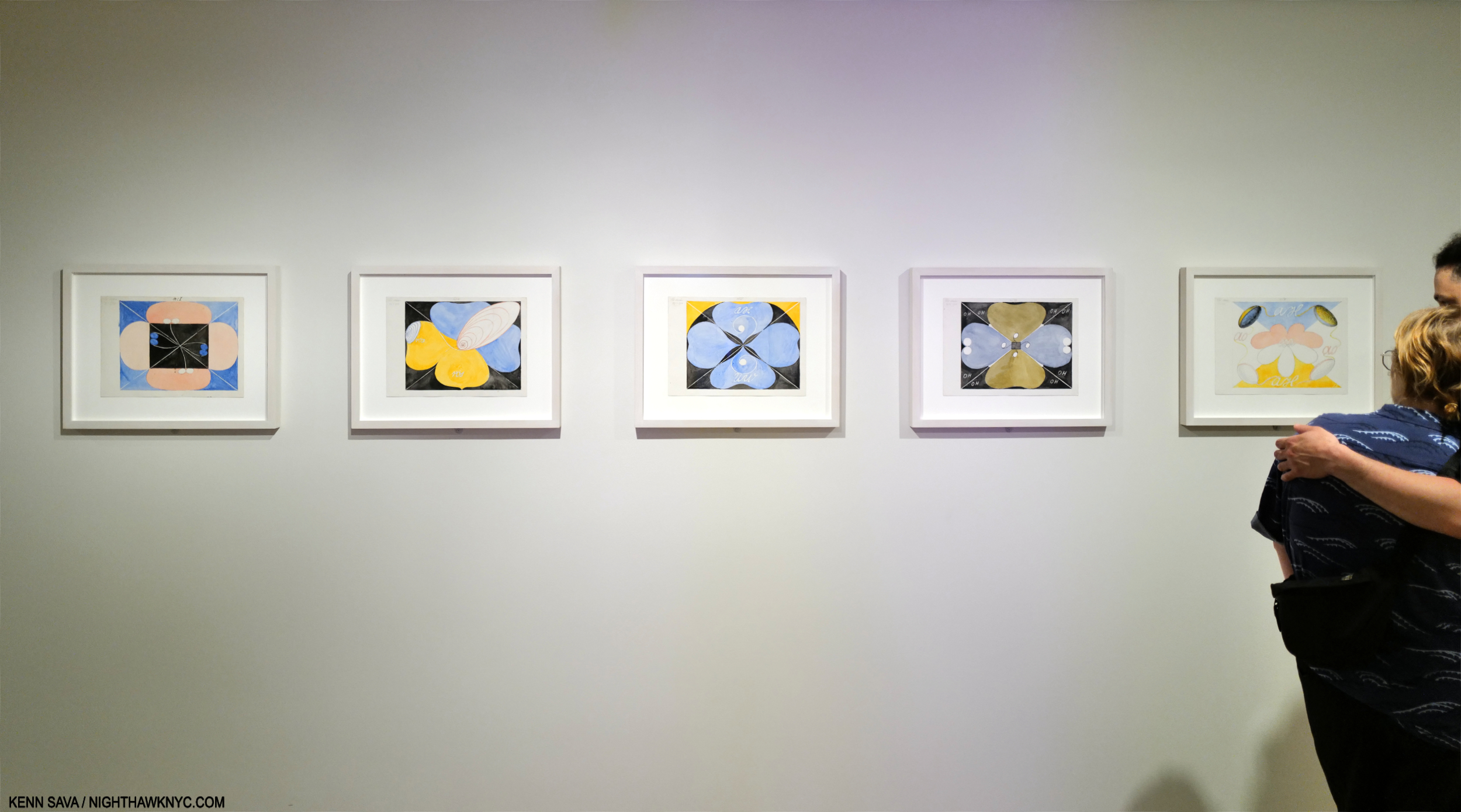
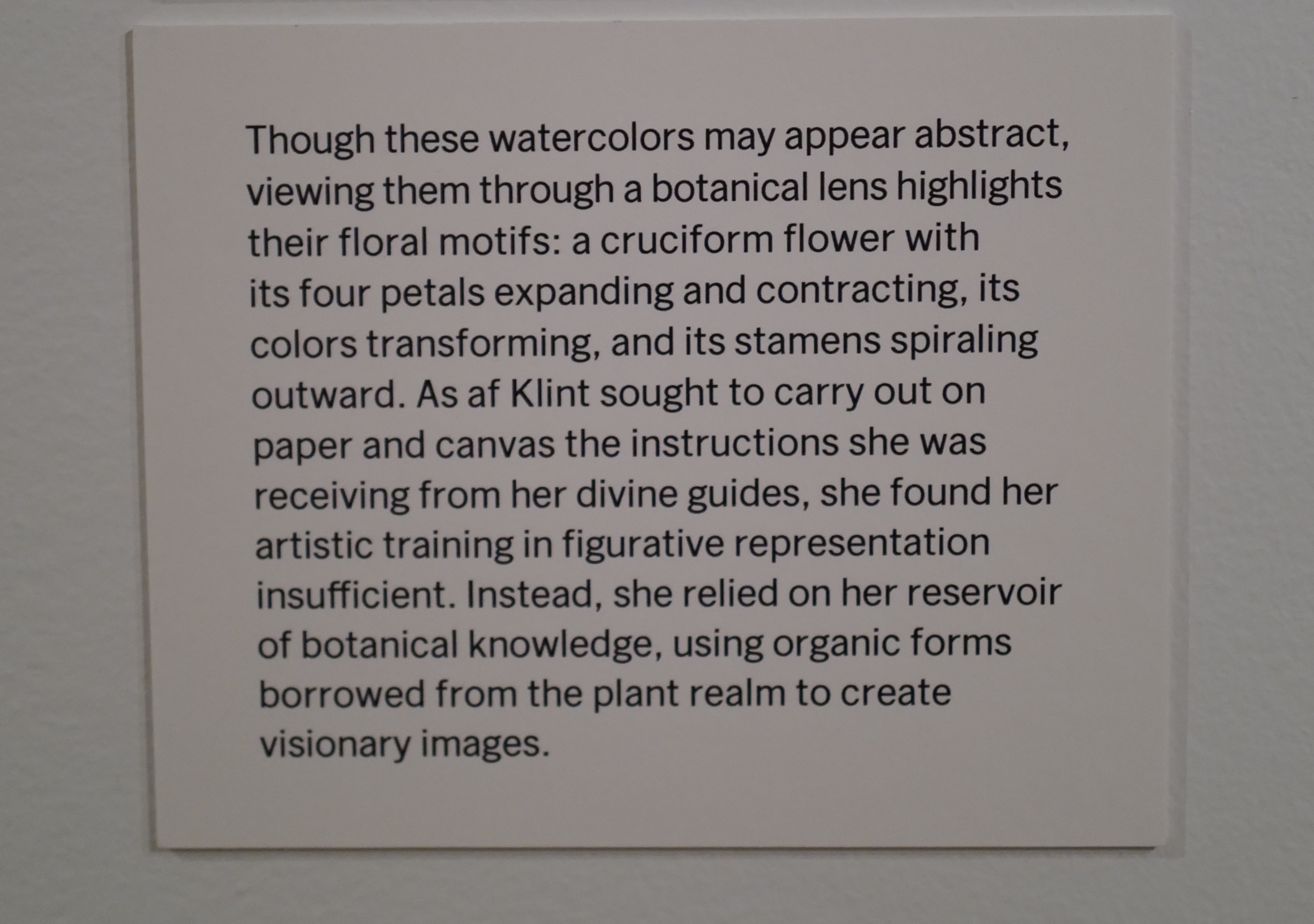
Looking at Hilma’s Art is different than looking at the Art of any other Artist I know of. Quite a few of her Paintings for the Temple (as seen in the picture earlier) and other “abstract” works included at MoMA (below) have elements that look organic, including flower shapes. In some of her Temple series, lines of dots connect figures, reminiscent of the af Klint family’s heritage as noted cartographers & mapmakers. Then, any number of her pieces, including almost all her Nature Studies, include diagrams that contain basic geometric shapes- circles, squares, cones, etc. The viewer needs to decide what to make of them, or look to the Hilma’s Notebooks for insights. Finally, there’s the “language” the Artist developed, abetted by her use of letter “codes,” as Julia Voss outlines in her Biography. As a result, it seems to me there is still a long way to go in coming to fully understand Hilma af Klint’s work. Lumping it all into ANY one-word catchphrase box only takes us further away from that point of truly understanding it-if that’s possible.
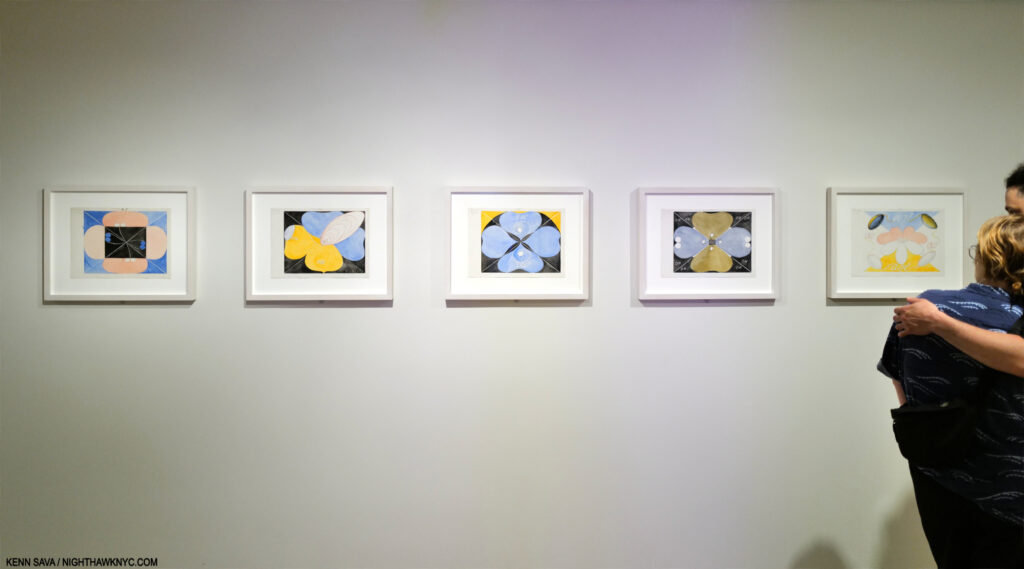
Group VII, No 1-5, from the US Series, 1908, Watercolor and pencil on paper. 11 years. before the Nature Studies portfolio, what seems to be flower-like shapes abound. Seen at the beginning of  MoMA’s show.
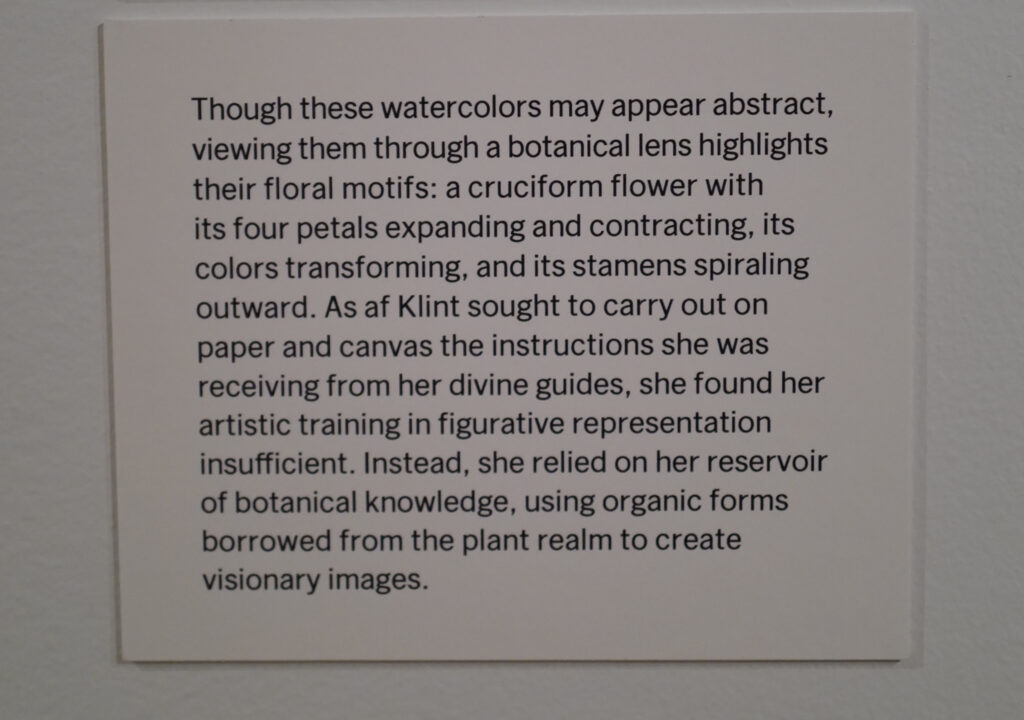
The wall card for Group VII. Installed at the show’s entrance, is a relatively rare instance of the Art world looking beyond Hilma the “abstract Artist” thus far, or hedging their bets on their use of that box. Here, the organic shapes are accompanied by letters that are parts of the “code” Hilma used. See next.
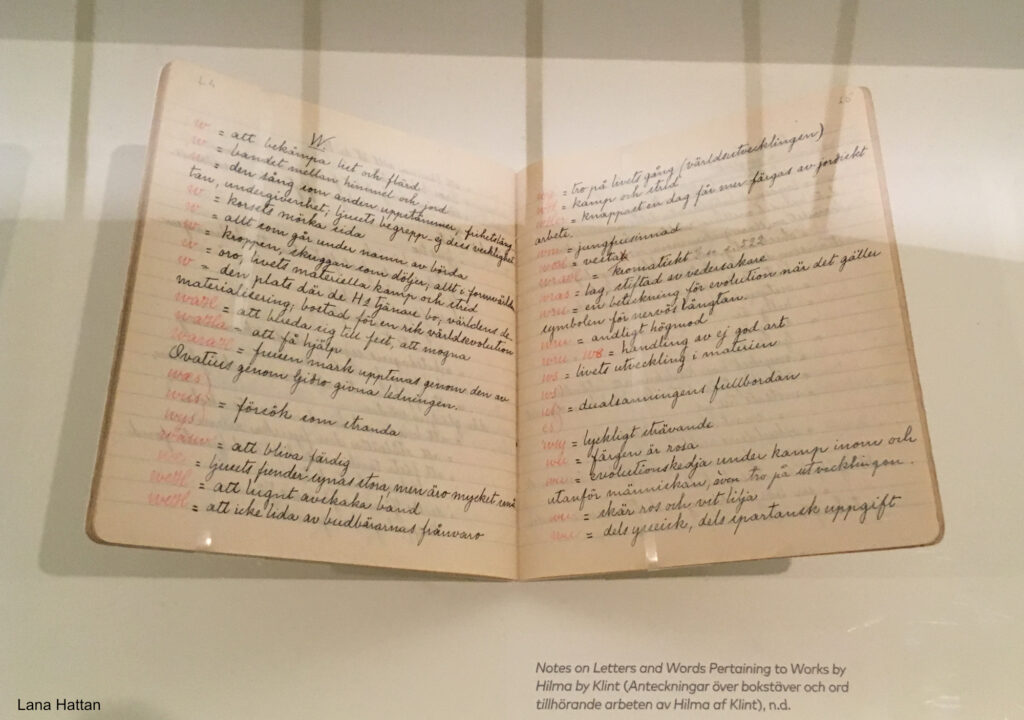
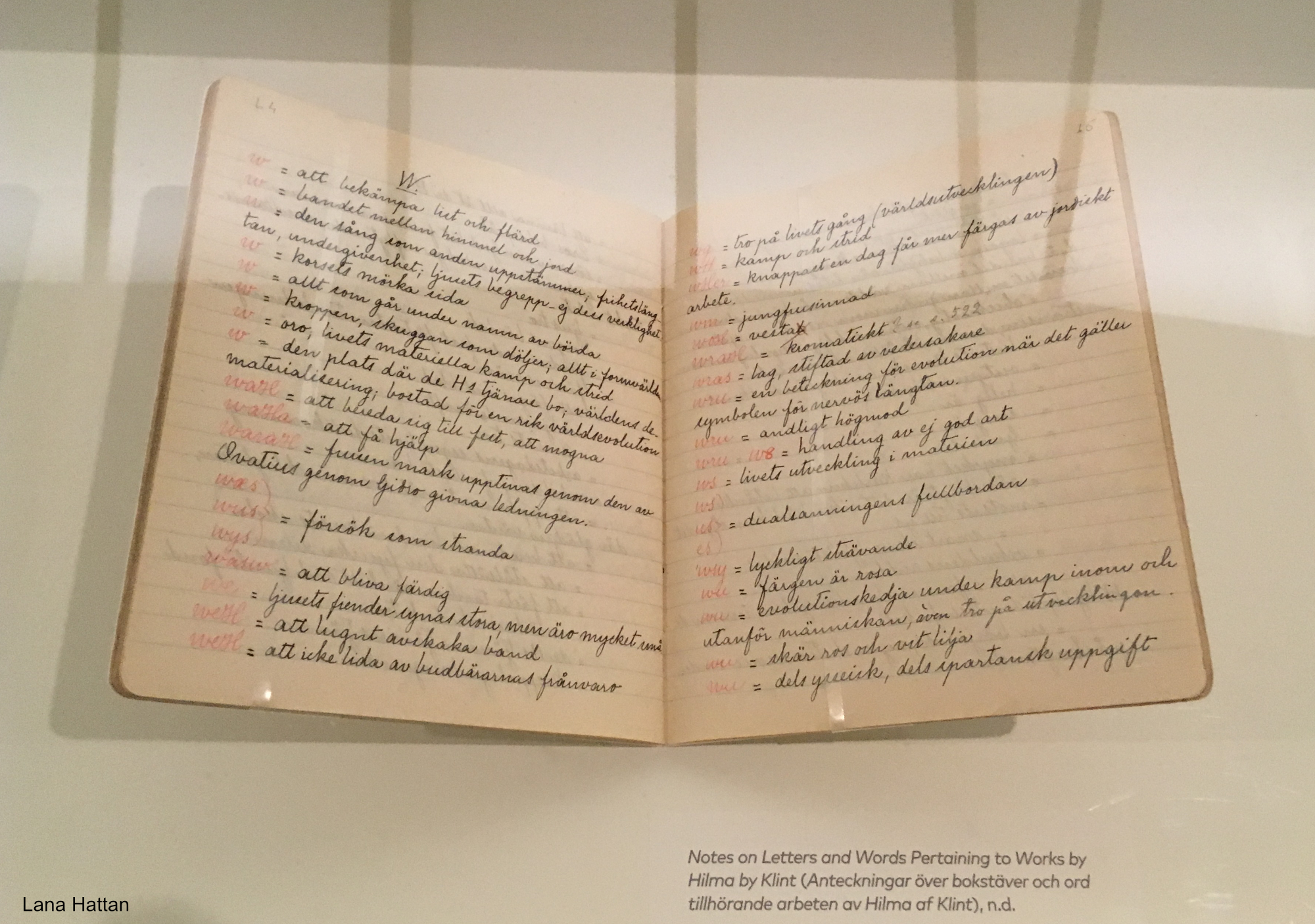
Another piece of the puzzle. Hilma’s original Notebook containing her Key to the mysterious words and omnipresent letter “codes” she used throughout her oeuvre. It’s an essential part of “decyphering” her work. Hilma’s code is detailed in English in the book Hilma af Klint: Notes and Methods. *- Photo by Lana Hattan, Guggenheim Museum, December 31, 2018.

ALL this talk about Hilma’s style misses the point! Hilma was not out to win any “style wars.” All of her work was about something entirely different, and that difference was substance over style.
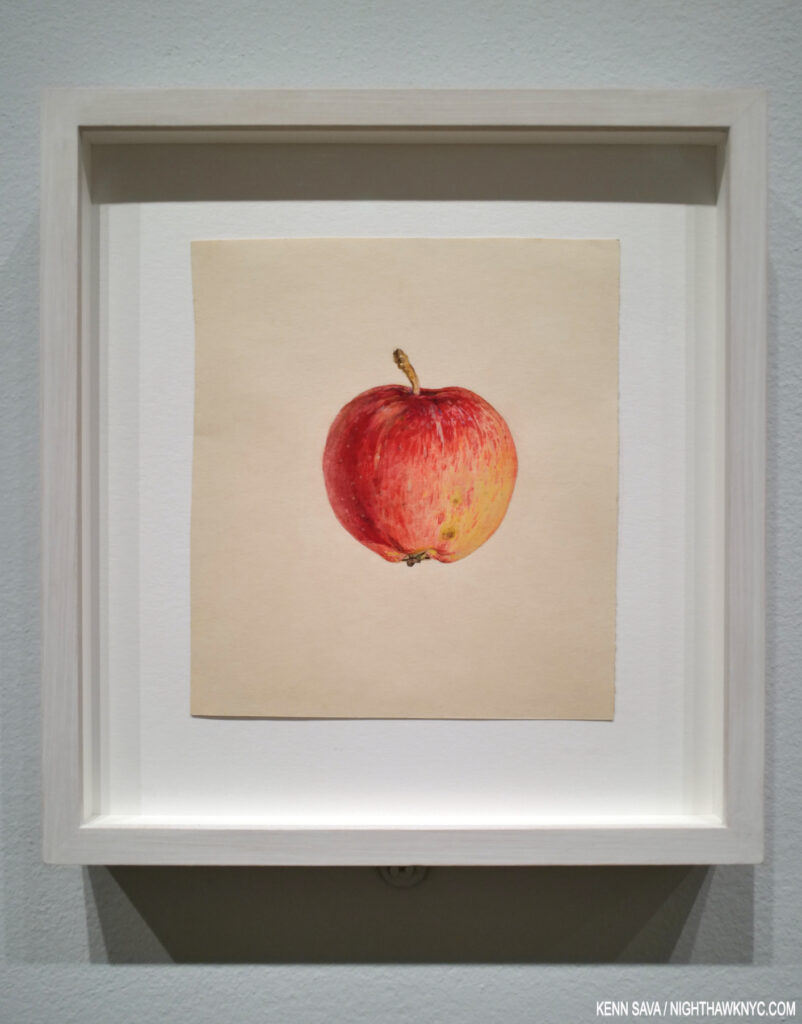
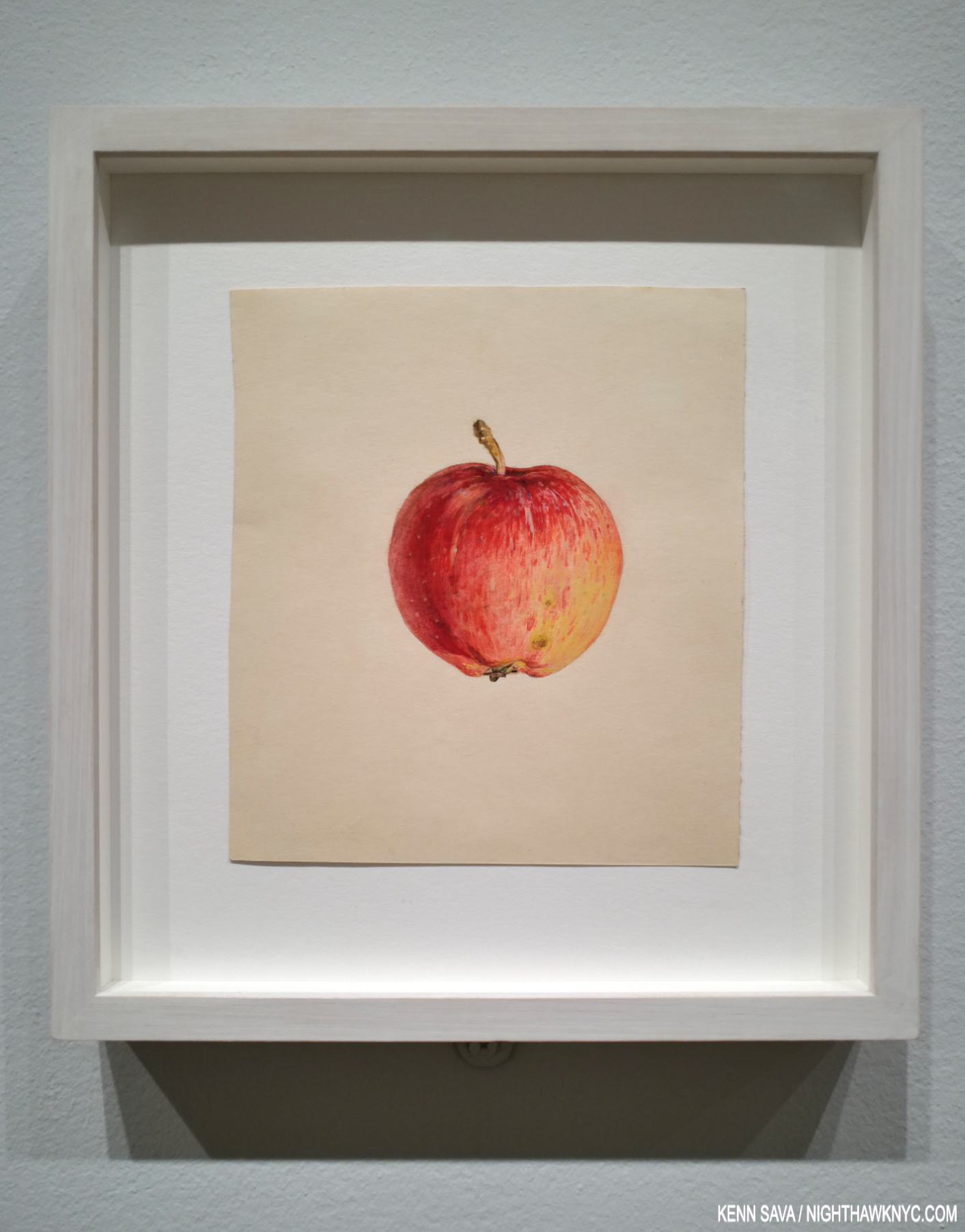
Apple, no date, Watercolor on paper. Virtually every Art or Drawing class begins with rendering, coloring & shading basic shapes, like the sphere (often an apple, orange or lemon). Here HaK takes it to an entirely different level, and we get to marvel at her powers of observation, especially in the incredibly subtle variance of the local color. It’s also fascinating to me how minimal the shadows are, something you never see taught in how-to books which glory in the different kinds of shadows. In most of her Nature Studies, except the previous one, Hilma leaves out the ground, as she does here, too. In this case, doing so gives her the chance to show more of the bottom detail, again something I can’t say I’ve seen done often.

On the opposite end of that spectrum from the 21st century hype around it, there is something else at the beating heart of her work, something her “abstract” Paintings for the Temple and her representational Nature Studies have in common, and something that is at the core of the recent debate regarding continuing to publicly display her work. Hilma af Klint’s work is centered on the spirit. She created her work for fellow spiritual seekers. The Paintings for the Temple are devoted to the human spirit (with the aid of spirits who have moved on to another level). After completing them in 1915, never one to think small, the Artist turned her attention to an even bigger subject- the spirit of the natural world, commencing with the atom, in works that filled three quarters of the first gallery at MoMA, before moving on to the spirit in nature, beginning with flowers (in Nature Studies), which filled most of the succeeding two large galleries. These were supplemented by her late Flower Watercolors, which reminded me of some of Georgia OKeeffe’s Watercolors that were shown in these galleries at MoMA in 2023. The bottom line is that Spiritual Art is still outré to the Art machine, whatever type it is. They can’t sell it, and Art without monetization does not keep the Art machine going.
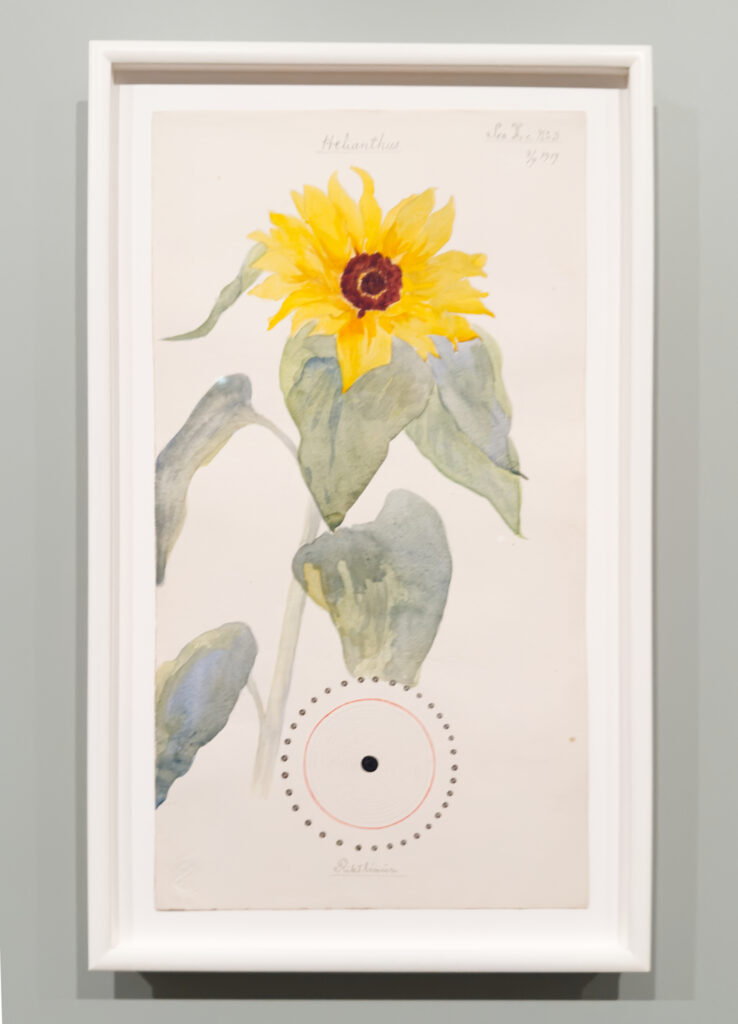
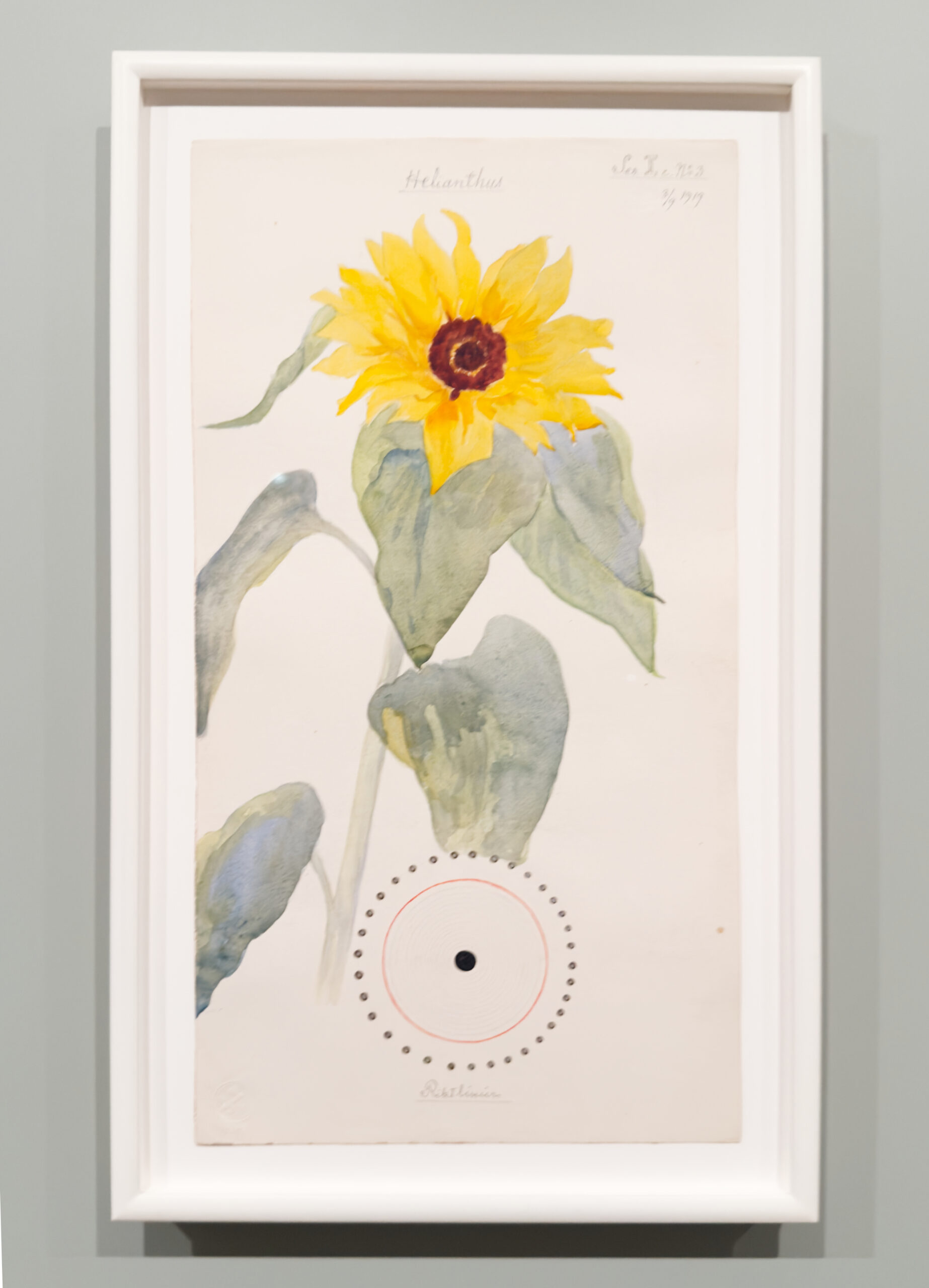
Common Sunflower. To Hilma- “Love is the greatest of all.”

Meanwhile, throughout What Lies Behind, part of the sheer joy in looking at her work, her marvelous technique shines in piece after piece. It’s surprising to me that Hilma has gotten so little credit for it. She came upon it the hard way, through continual hard work and 6 years at the Royal Academy of Fine Arts. This was followed by work as an Illustrator, including illustrating a book on horse surgery by the director of the Veterinary Institute, Stockholm, who kept Hilma’s Drawings for the rest of his life.
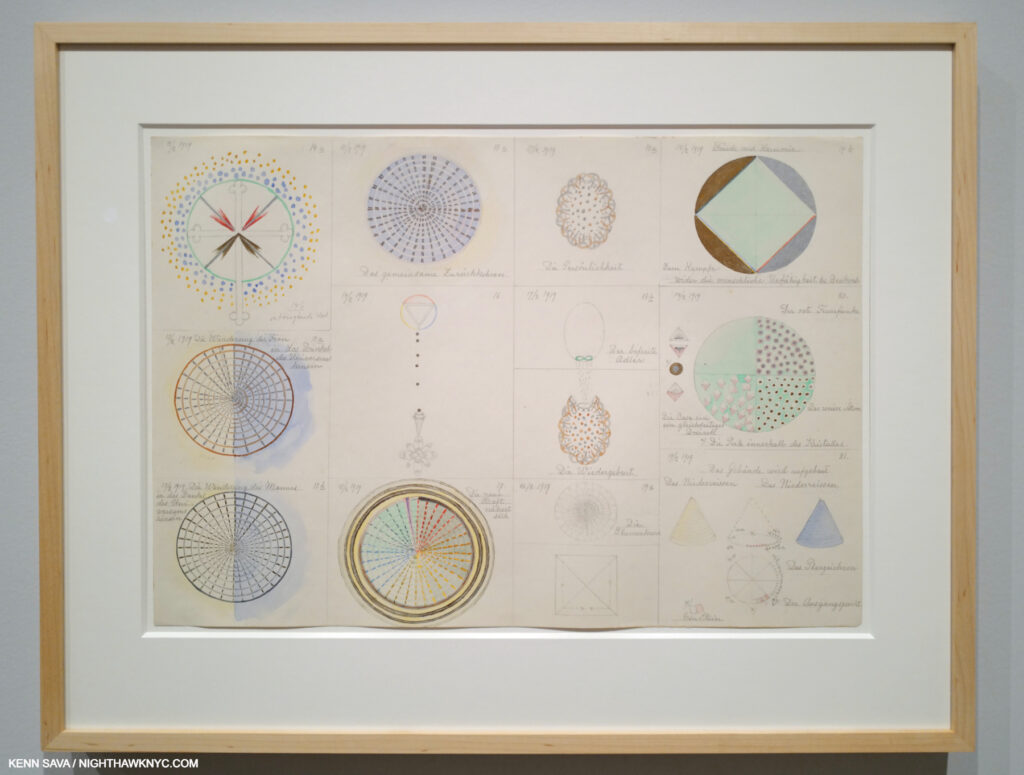
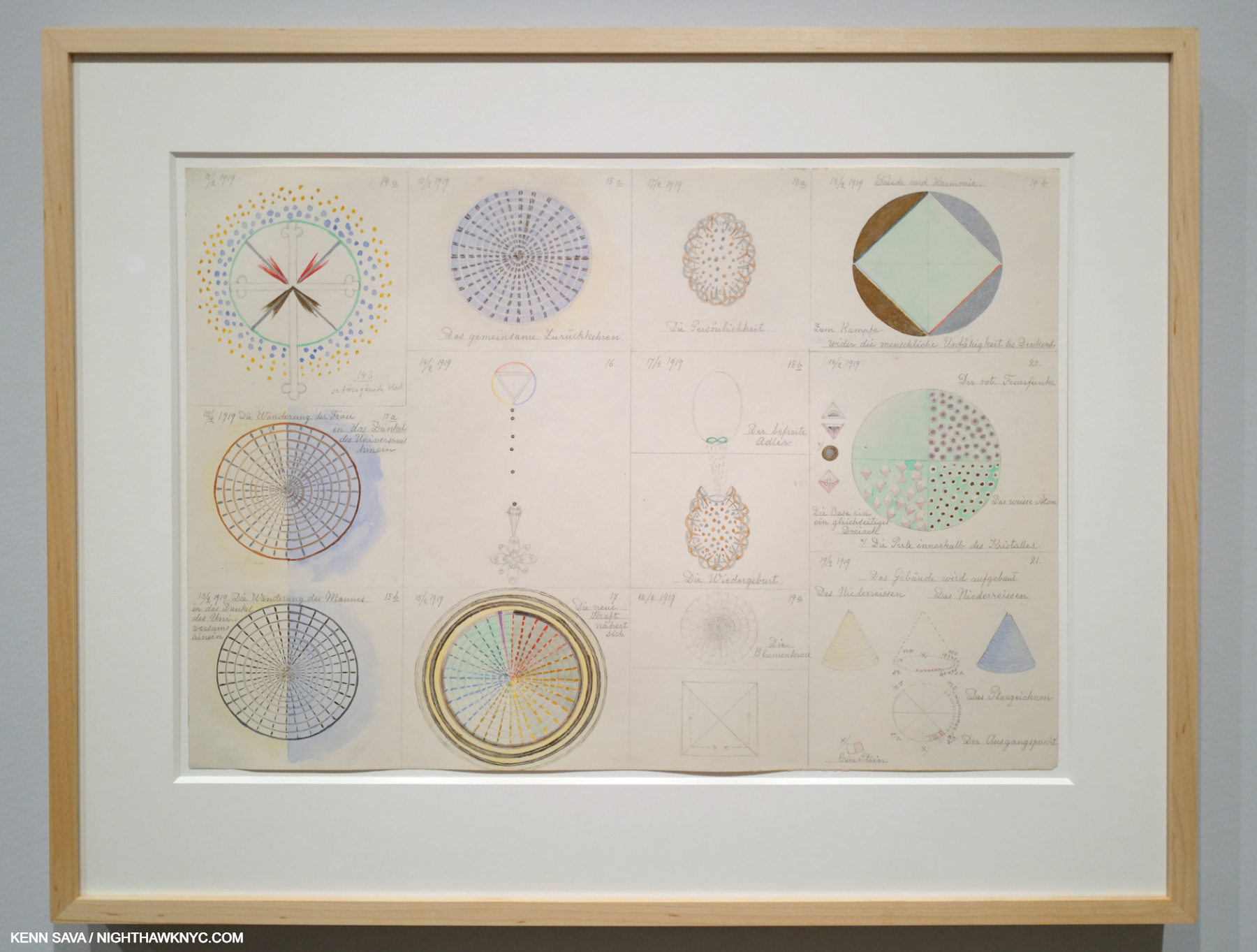
From Group 2 February 12-19, 1919 Watercolor, pencil, and metallic paint on paper. This was one of numerous examples of her technique I could site. Here, we see the Artist working on ideas for herself in a series of sheets titled Group 1, Group 2, Group 3. No matter for public display or her own purposes, Hilma was always meticulous in her execution. Of the Groups, MoMA says- “Together, the drawings form narratives that allude to pollination, reproduction, and evolution. By April 19, 1919, after more than three months of progress, af Klint had established a vast and diverse diagrammatic language. The very next day, she began her Nature Studies portfolio.”
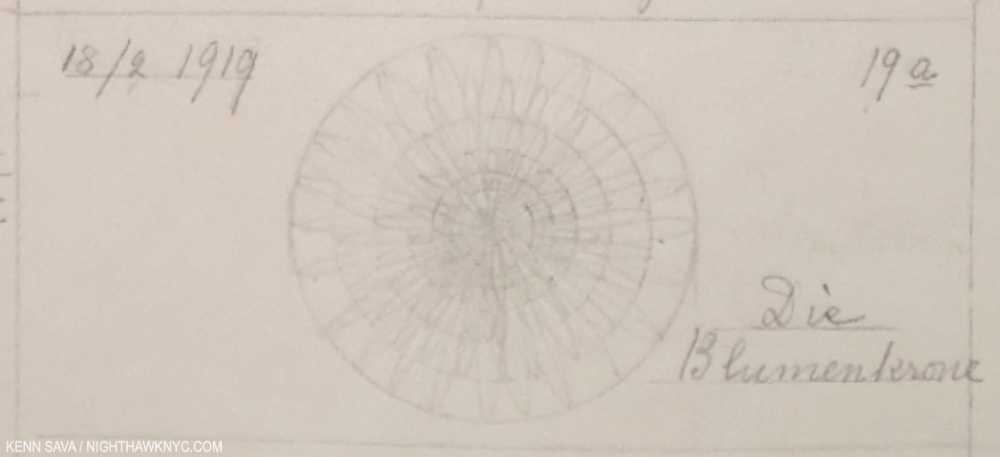
This enlarged detail of the lower center of the previous image perhaps measures 3 or 4 inches wide by an inch and change high (the bounding rectangle). Easy to miss because it’s in pencil and the actual Drawing part seems to have faded,  it’s noteworthy for two reasons. First, its meticulousness, and second for the title- Die Blumenkrone means “The Flower Crown.” Even in the dead of wnter (i.e February 18th as the date reads), Hilma had flowers on her mind.

What Stands Behind also makes the case in spades or her accomplishment as a Watercolorist- both in her Flowers and in the later Flower work (not part of the Nature Studies series) shown in the final gallery, in a different style again, as seen below.
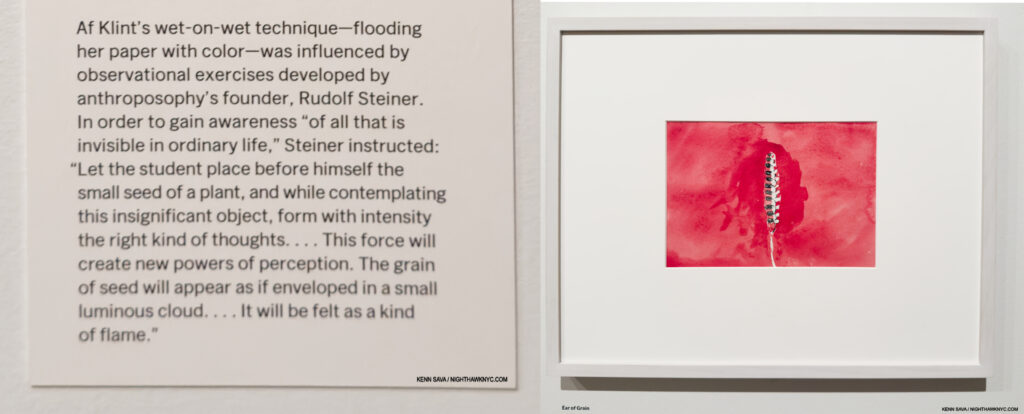
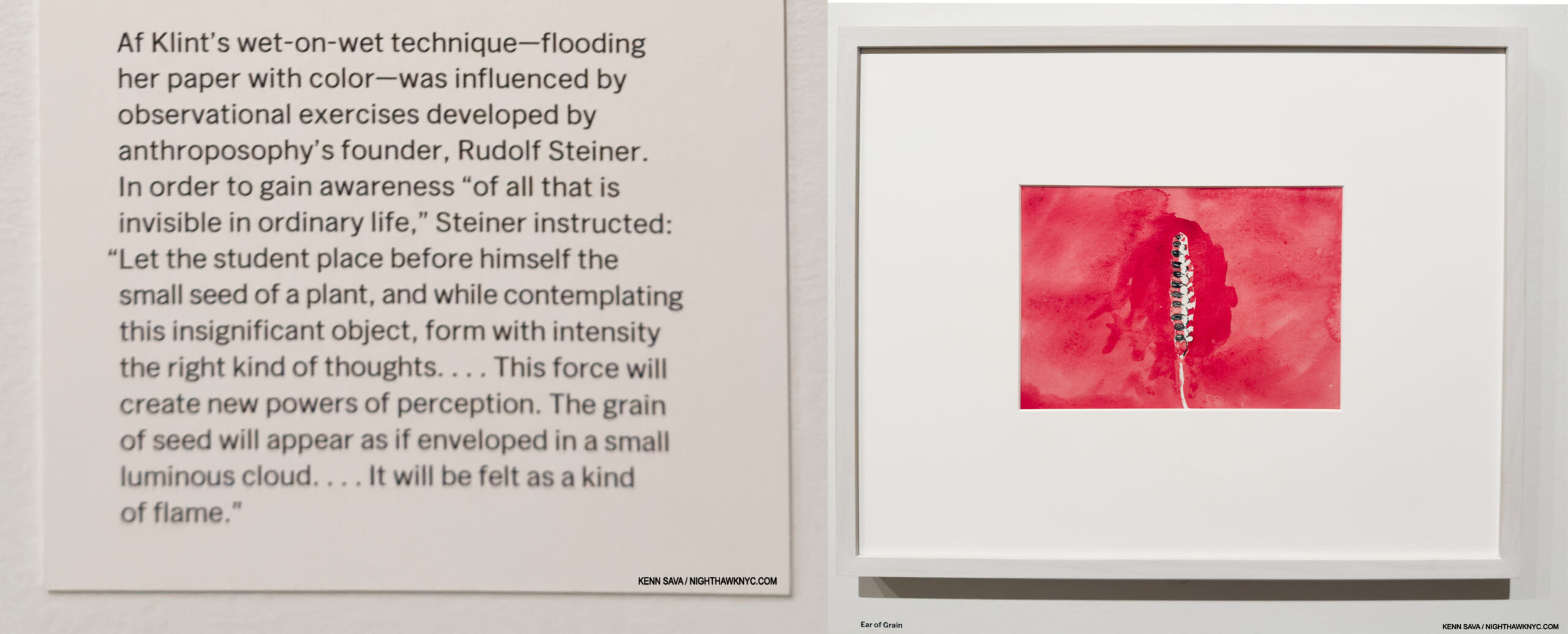
Ear of Grain, 1922, Watercolor on paper, from the series, On the Viewing of Flowers, with a apparetnly relevant section of the wall card, left. MoMA, September 26, 2025.
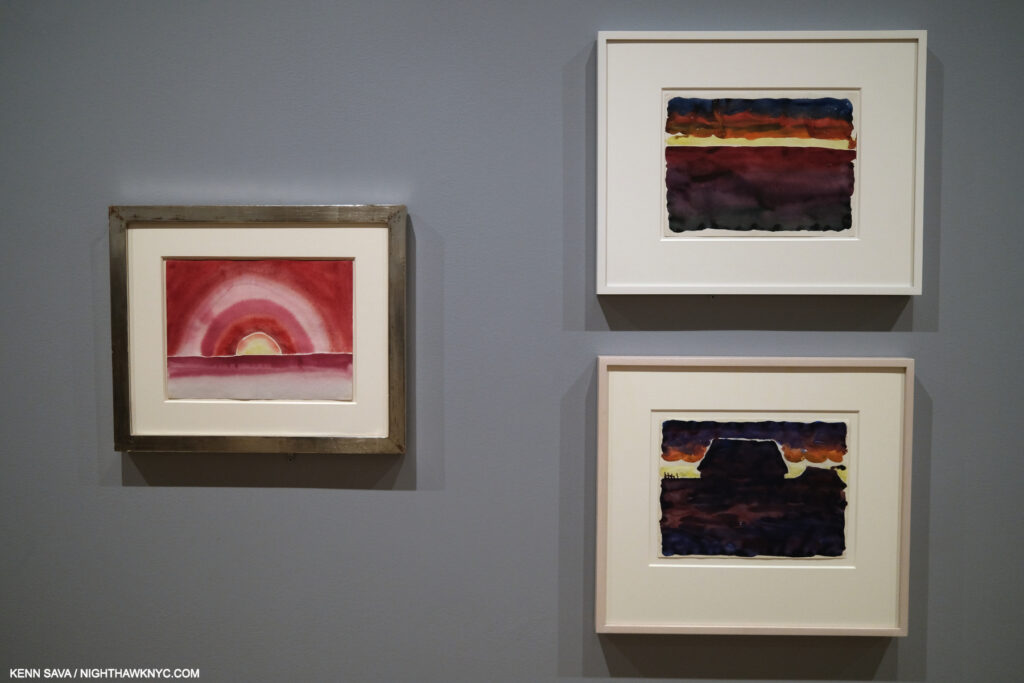
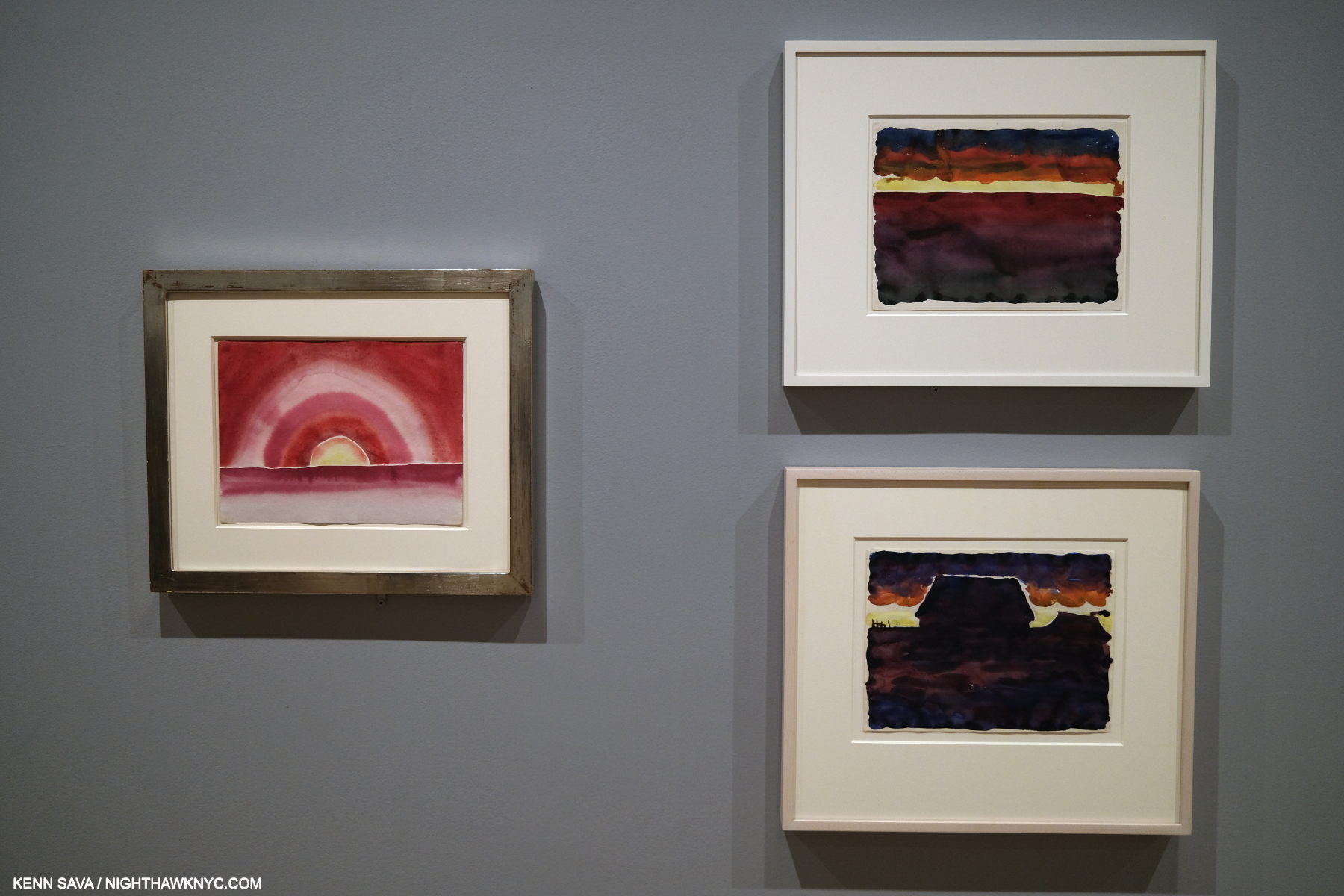
Georgia O’Keeffe, Morning Sky, left, and Morning Sky, and Morning Sky with Houses, right, 1916, Watercolors on paper. MoMA, September 9, 2023.

I might be the only one to draw parallels between Georgia O’Keeffe & Hilma af Klint, but when I saw the wall of 1922 Watercolors by Hilma in the last gallery, including Ear of Grain, above, I couldn’t help but recall Georgia’s Watercolors that had been hung in these galleries two years previously. It’s fascinating to think about their commonalities, as extraordinary, ground-breaking Artists, and as extraordinary women, at much the same time, on almost opposite sides of the globe. What Stands Behind The Flowers begins some of the heavy lifting on the road to assessing Hilma af Klint’s full accomplishment. In spite of that, I’m not sure THIS is the ideal time Hilma envisioned for her Art to be shown.
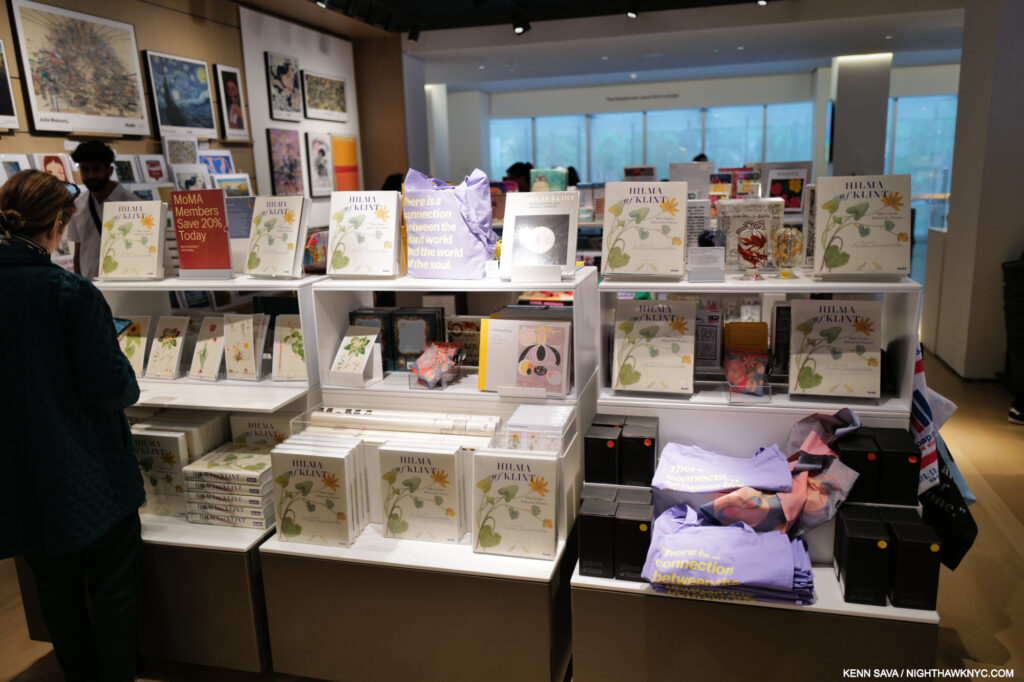
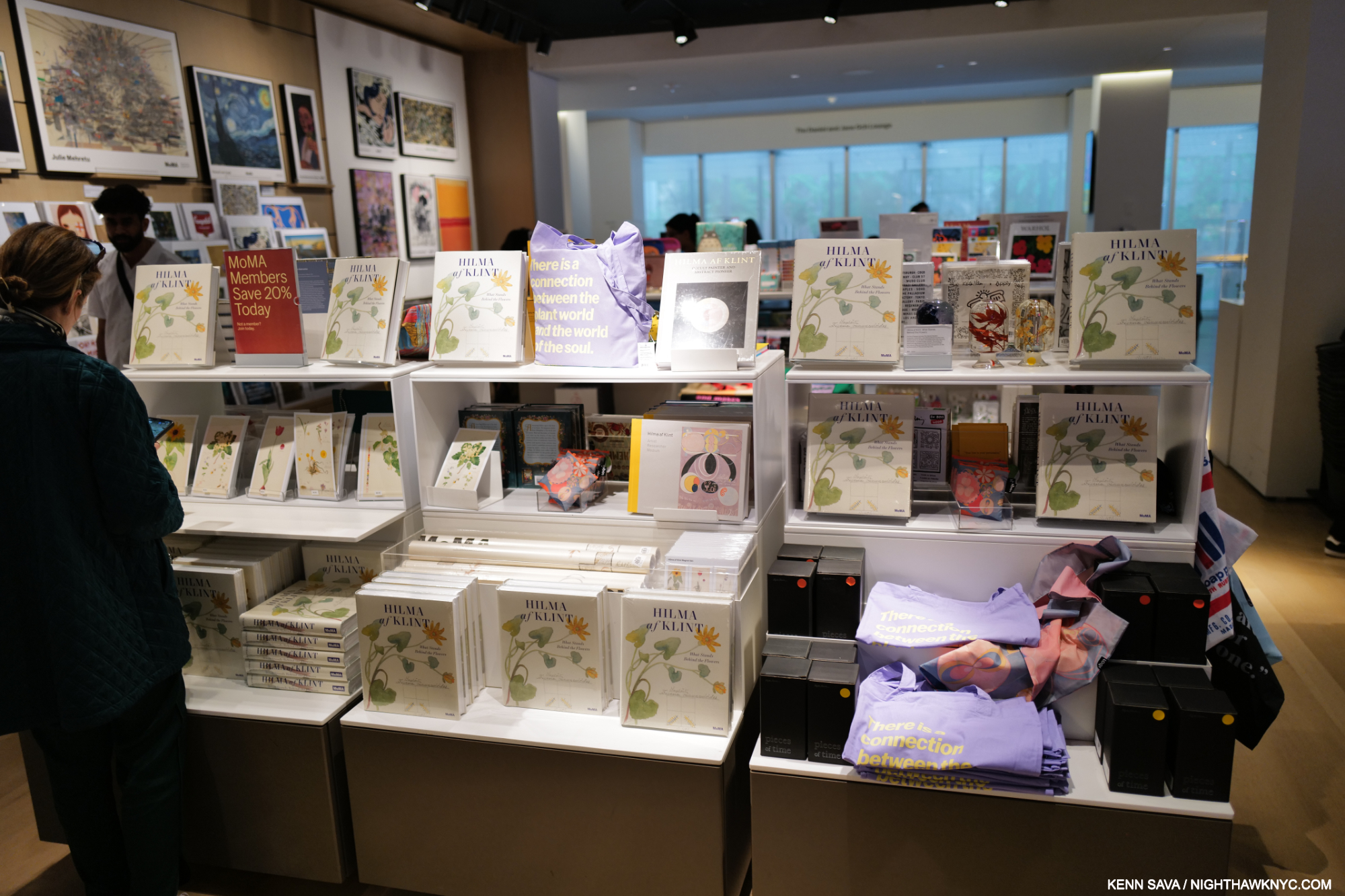
MoMA Gift Shop display for the show. More items behind me and to the left. While I’ll reserve comment on the other items, MoMA’s Exhibition Catalogue for the show is highly recommended. May 18, 2025.

In too many (most?) cases today a work of Art is mentioned followed by its price as if that’s the most important thing about it! Then, the rush is on to plaster it on everything from umbrellas to baby onesies. Hilma’s spiritualist Art stands directly at odds with that. She opposed materialism in Art. To this point, it’s largely escaped it (though MoMA, who has come to own Nature Studies, produced a $500.00 Limited Edition of it, as far as I can tell, the first Hilma af Klint Limited Edition, in addition to putting the series on refrigerator magnets, postcards and a poster)5.

Rebel. With a cause.

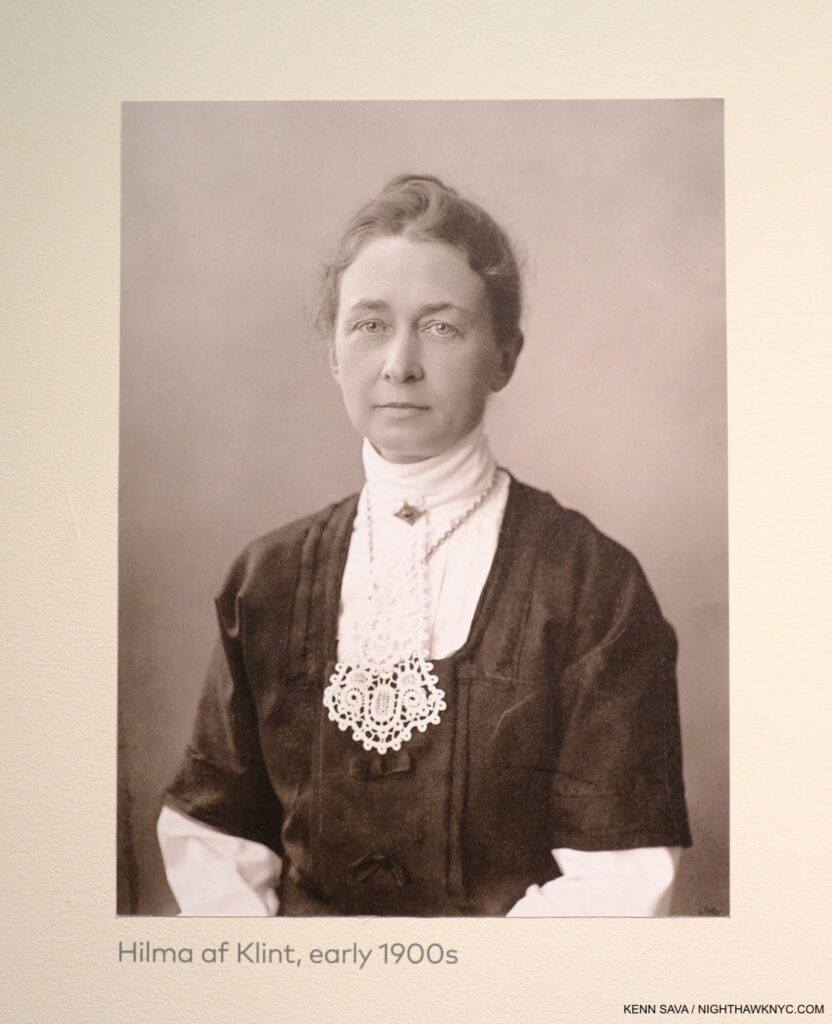
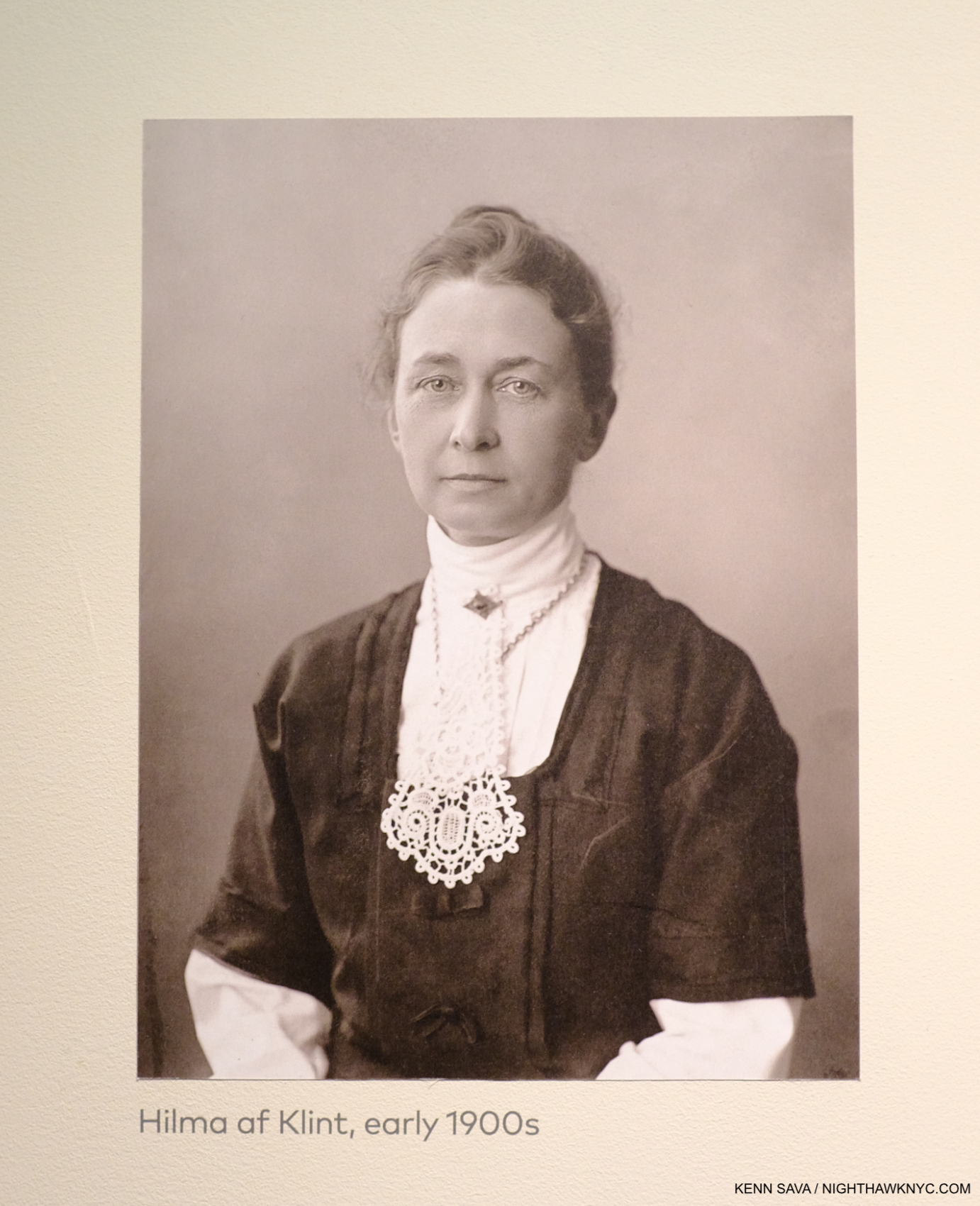
Trapped in the future. But, is this THE future she envisioned for her Art? One of the few Photographs of Hilma af Klint. This one was affixed to a wall at the Guggenheims’s landmark Paintings for the Future in 2018.

Perhaps this experience sounded a warning bell. Earlier this year a struggle broke out inside the Hilma af Klint Foundation about whether or not her work should continue to be exhibited. The Foundation’s chairman of the board, af Klint’s great-grandnephew, who, like his great-grandfather, is also named Erik af Klint, is against it feeling that Hilma wanted her work to be seen in a spiritual context by fellow seekers, i.e. to “keep the work available to those who seek spiritual knowledge or who can contribute to fulfilling the mission that Hilma af Klint’s spiritual principles intended.”
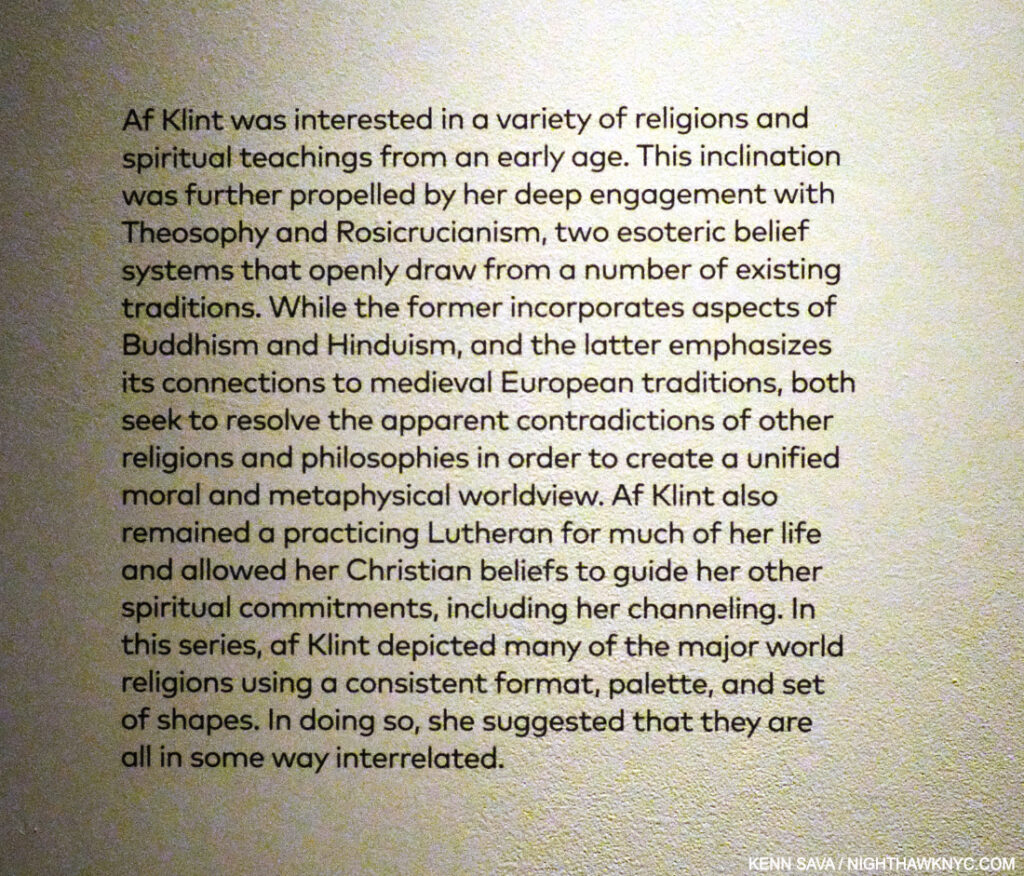
On Hilma’s spiritualism. Guggenheim Museum, December 31, 2018..

Therefore, I think there is a strong case to be made for ending public displays of her work at this point. Perhaps a future time will be more ready to accept, and see her work as she intended it to be seen, and provide the Artist’s full accomplishment with the respect it deserves..
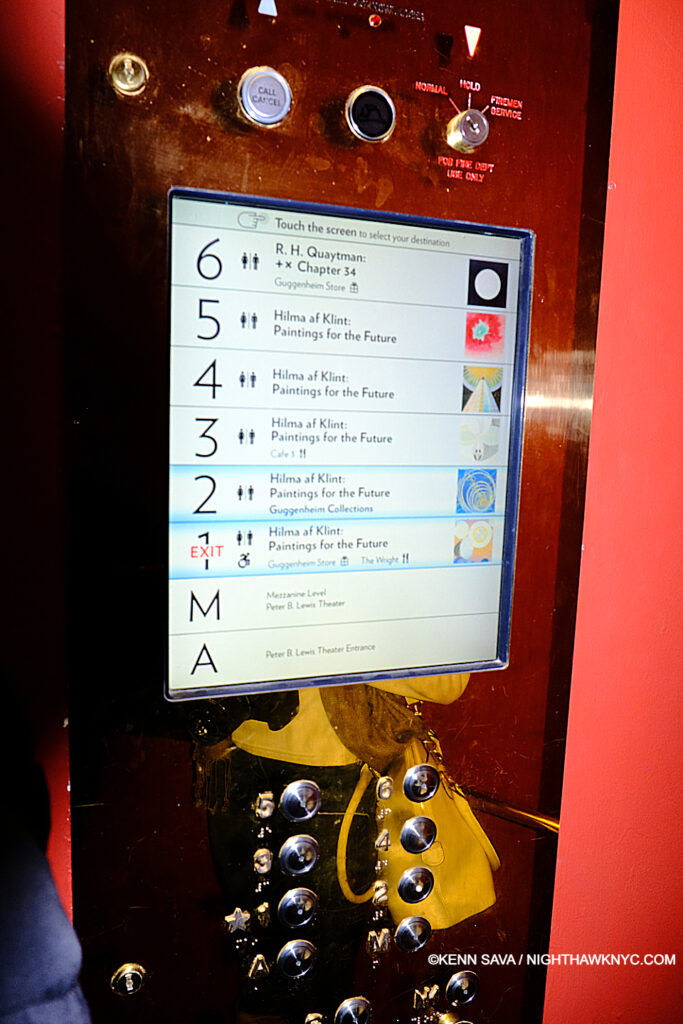
“Beam me up, Frank!” The control panel on Frank Lloyd Wright’s semi-circular Elevator at the Guggenheim. December 31, 2018.

Experiencing Paintings for the Future at Frank Lloyd Wright’s Guggenheim brought home another problematic aspect of experiencing Hilma af Klint’s work today.
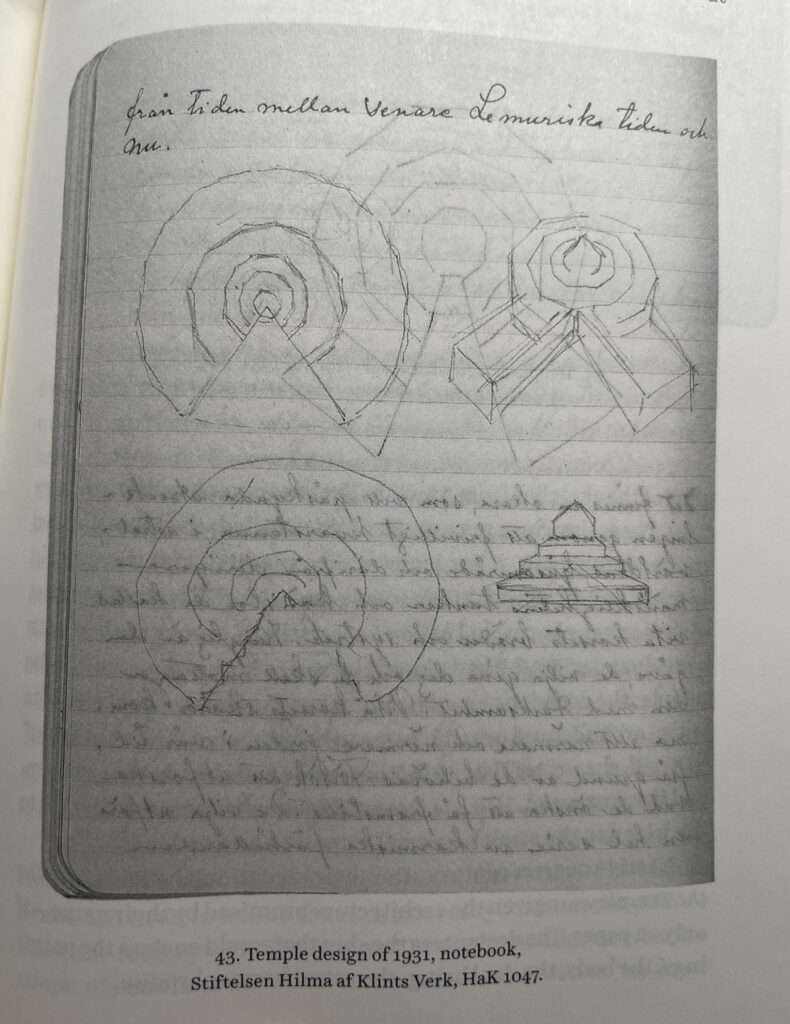
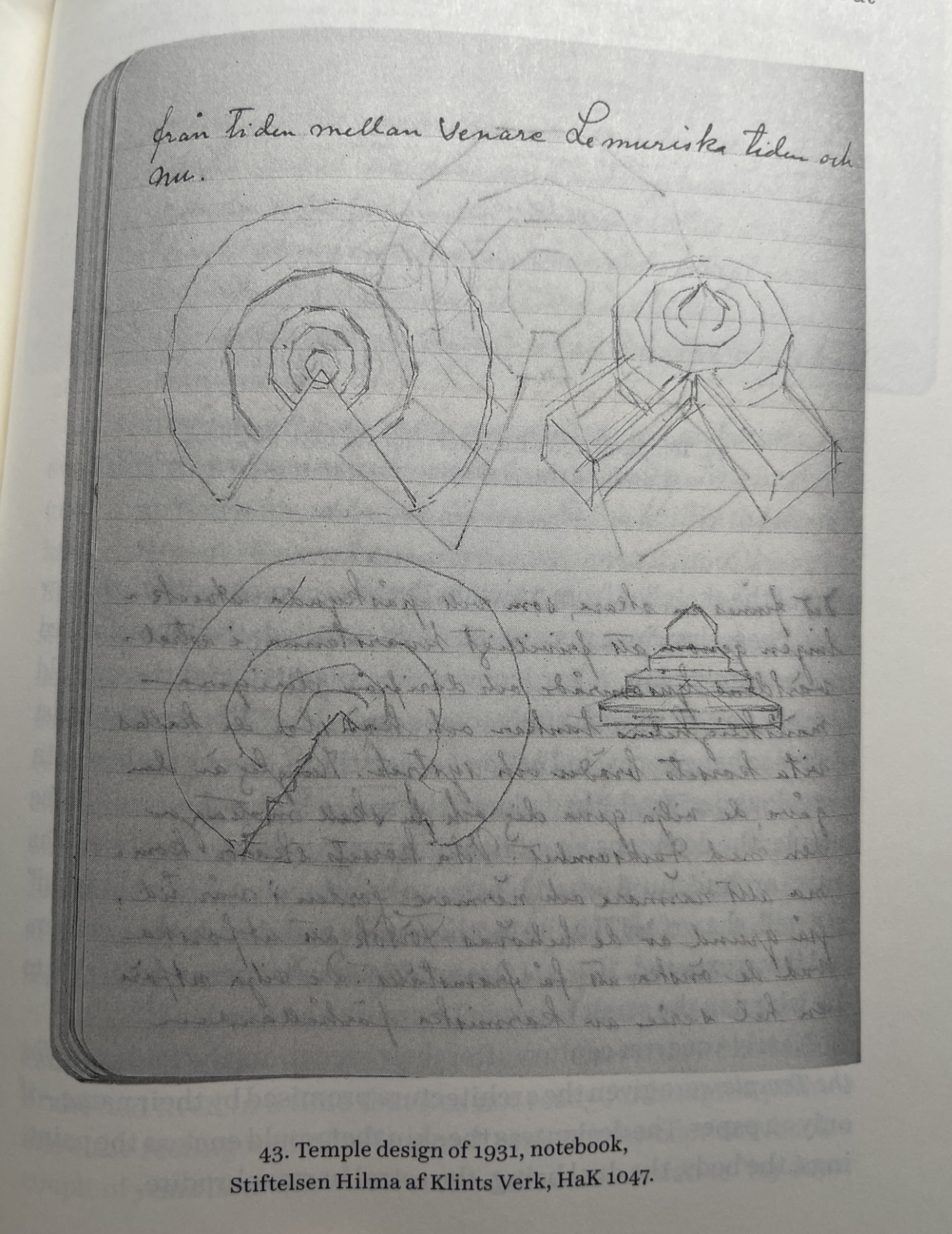
Temple Design, 1931, Notebook in the Hilma af Klint Foundation Collection (*) as seen in Julia Voss, Hilma af Klint.

It turns out that Hilma had not only envisioned that “ideal space” for the display of her work, i.e. a “Temple” as she called it (as in her Paintings for the Temple series), she put some of her ideas for it down on paper.
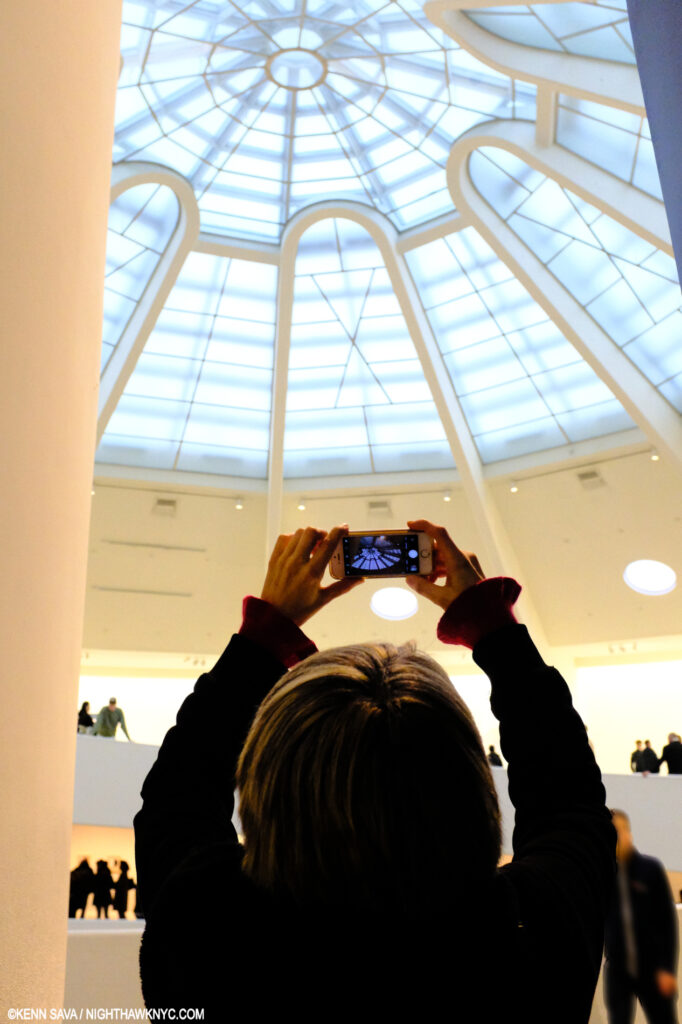
Lana Hattan immediately upon exiting the elevator on the 6th Floor, in both of our favorite buildings, in one of my favorite pictures of her. I thank her for her generosity in allowing me to publish some of the Photos she took that day. December 31, 2018.

Her sketches for it have quite a bit in common with Wright’s masterpiece on 5th Avenue. Both feature circular floors or ramps that rise to a top that opens up to the sky. Also coincidentally, Hilla Rebay, director of the Museum Non-Objective Painting which  preceded the Guggenheim Museum, said she envisioned “people communing with the work in Solomon R. Guggenheim’s collection in a a ‘temple of spirit.6,'” in commissioning Wright to design it.
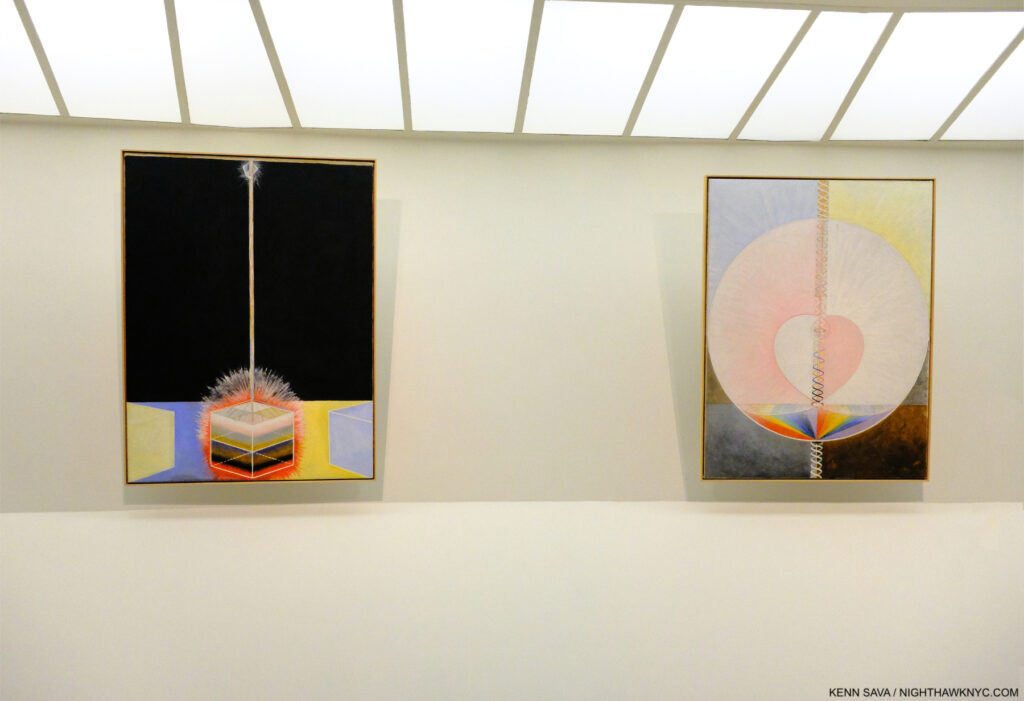
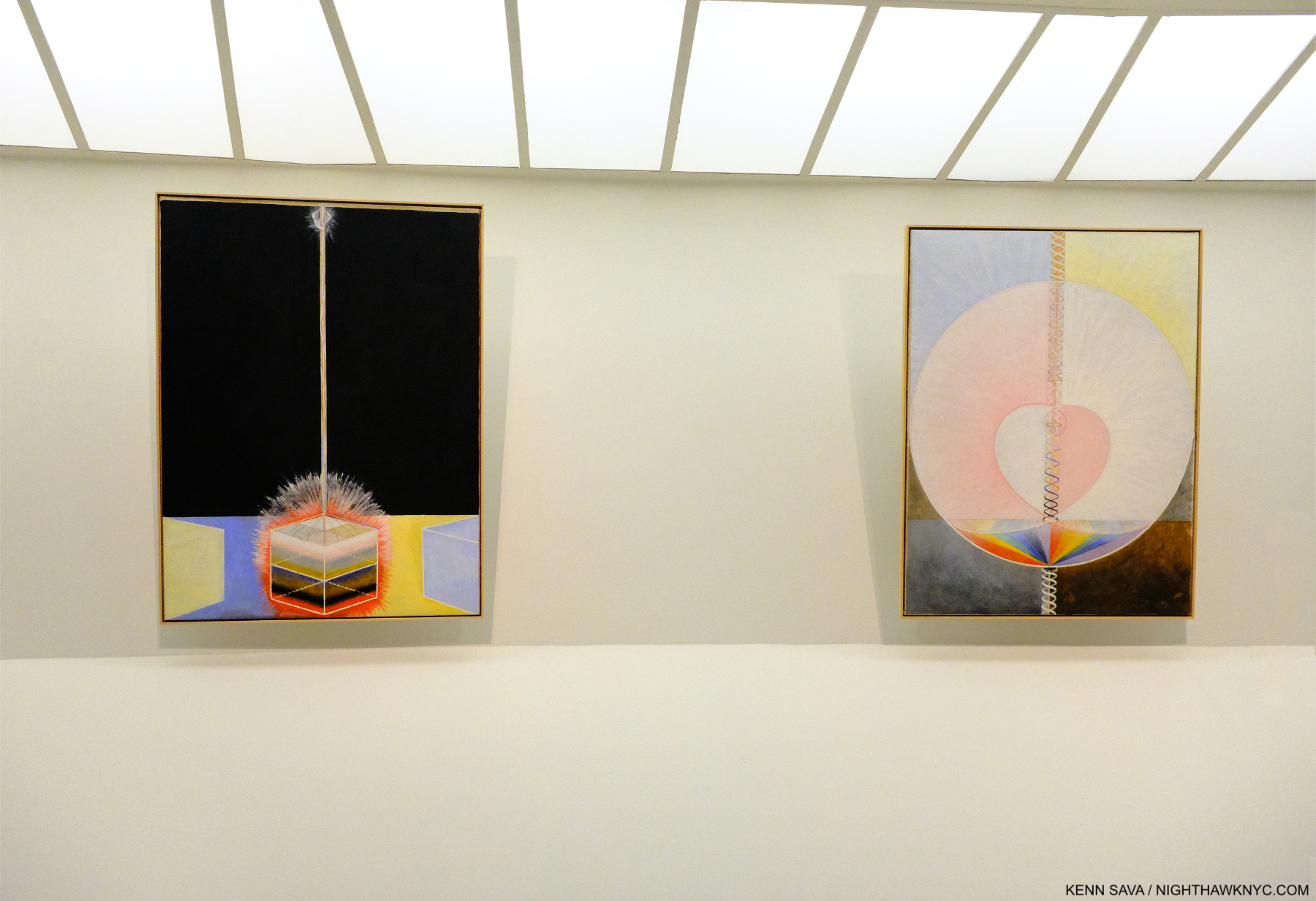
Group IX/UW, The Dove, No. 3, left, Group IX/UW, The Dove, No. 1, right, both from The SUW/UW Series, 1915, Oil on canvas.The work on the right is the original of the work she reproduced by hand in the Blue Book picture shown earlier. Guggenheim Museum, December 31, 2018..

I didn’t know about her Temple, or her Drawings for it, when I saw the Guggenheim show, yet I came away feeling the Architecture added exponentially to the experience of it. At this point, it leaves me feeling her dream should be realized, though that’s not part of the current discussion (as far as I know). Failing to realize the Temple she had envisioned to hold at least part of her work, it remains in a sort of limbo without it.

Of course, today’s Art machine is adamantly opposed to Hilma shows ending, seeing a potentially huge marketing opportunity vanish. Her art being for spiritual seekers, is diametrically different than how the Art world sees it now. Spiritual seeking vs dollar signs- I’ll be interested in seeing which way this one turns out, but I’ll be hoping Mr. af Klint succeeds. (Digression for full disclosure- In case anything I write here makes you wonder, I’m not a religious person. I’ll leave it at that and end the digression.) I’ve always believed the Artist’s intentions for her (or his) work should be respected above all else. As for all those who will bemoan not being able to see her work, consider that for most of the past 30 years Jean-Michel Basquiat has been THE most popular Contemporary Artist in the world, and almost none of his work is in the hands of museums or public collections resulting in a paucity of shows, as I discussed here7. Somehow his popularity has continued to increase without direct access to his work.
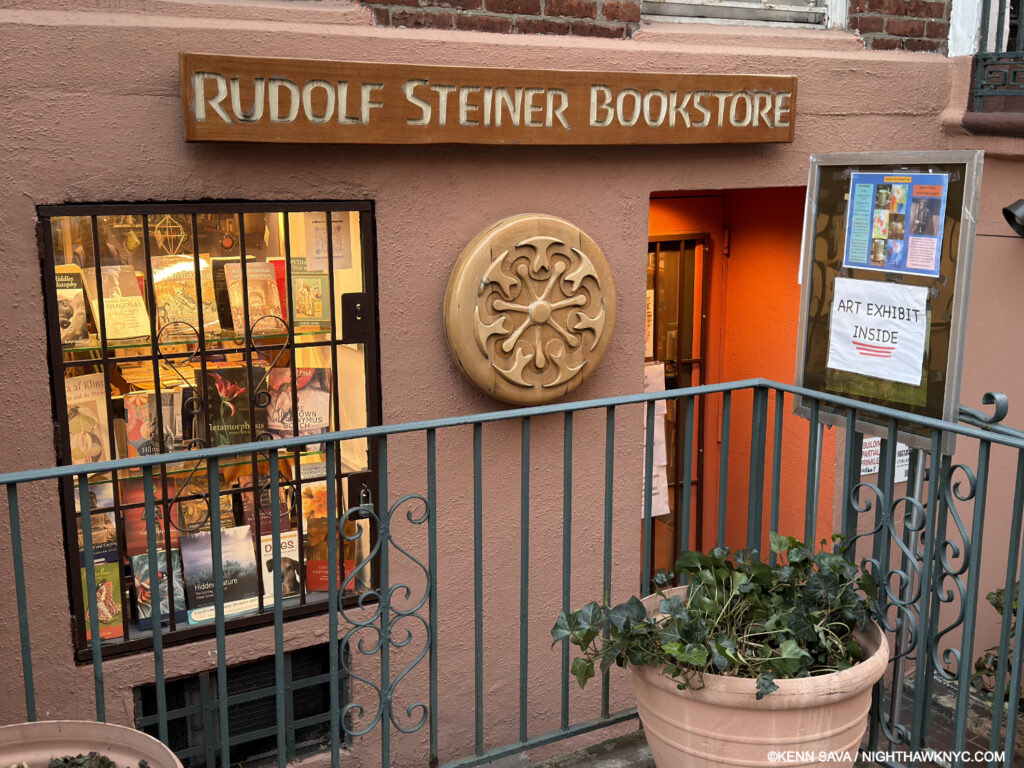
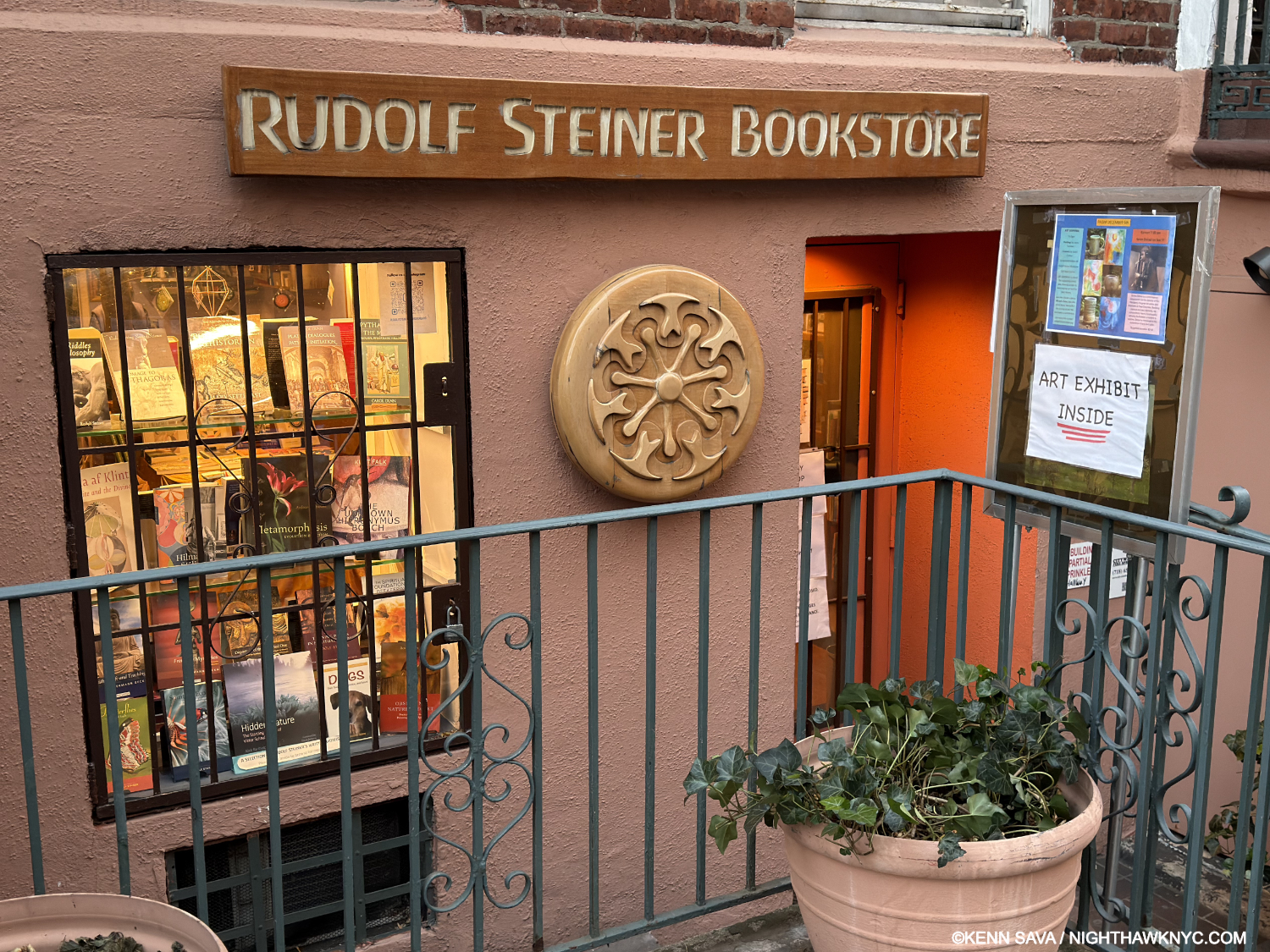
Hilma af Klint books for sale in the window at the Rudolf Steiner Bookstore in Manhattan. A long-time admirer of Mr. Steiner, I think she’d be ok with this. December 11, 2025.

Hilma’s work can be seen by everyone in the excellent seven-volume Catalogue Raisonne her Foundation has published (which I collectively named a NoteWorthy Art Book of the 21st Century), and a number of other books. For those who want to know more about Hilma, Julia Voss’s excellent Hilma af Klint Biography is the current go-to source and a must-read. It reveals an extremely private woman who was solely focused on her spiritual development and her Art to the extent that she wrote virtually NOTHING about herself and her private life in those 26,000 pages she left! But, she did make crystal clear what she was about and what she wanted for her Art.

If Hilma were alive today would she be enamored with the Art world and its machine, an Art world that seems to have no clue how to handle “spiritual Art?” I have my doubts. That future she envisioned in the 1930s still feels like a dream. So, it just might be a good thing if Hilma af Klint shows stop. Some further point in the future may be a better time for her work to be seen & fully appreciated- one without  an Art world in such a hurry to judge it, box it, and associate it solely by the dollar signs it hangs on it.

Wake me up when we get there.

*- Soundtrack for this piece is “Bring My Flowers Now,” by Tanya Tucker, the de facto title track from her 2019 album, While I’m Livin’, which she performs here-

“I know we’re gonna ride again someday…”

NighthawkNYC.com has been entirely self-funded & ad-free for over 10 years, during which over 350 full-length pieces have been published! If you’ve found it worthwhile, PLEASE donate securely by PayPal below to allow me to continue. Thank you, Kenn.

You can also support it by buying Art, Art & Photography books, and Music from my collection! Art & Books may be found here. Music here and here.

Written & photographed by Kenn Sava for nighthawknyc.com unless otherwise credited. To send comments, thoughts, feedback or propositions click here. Click the white box on the upper right for the archives or to search them. Subscribe to be notified of new Posts below. Your information will be used for no other purpose.
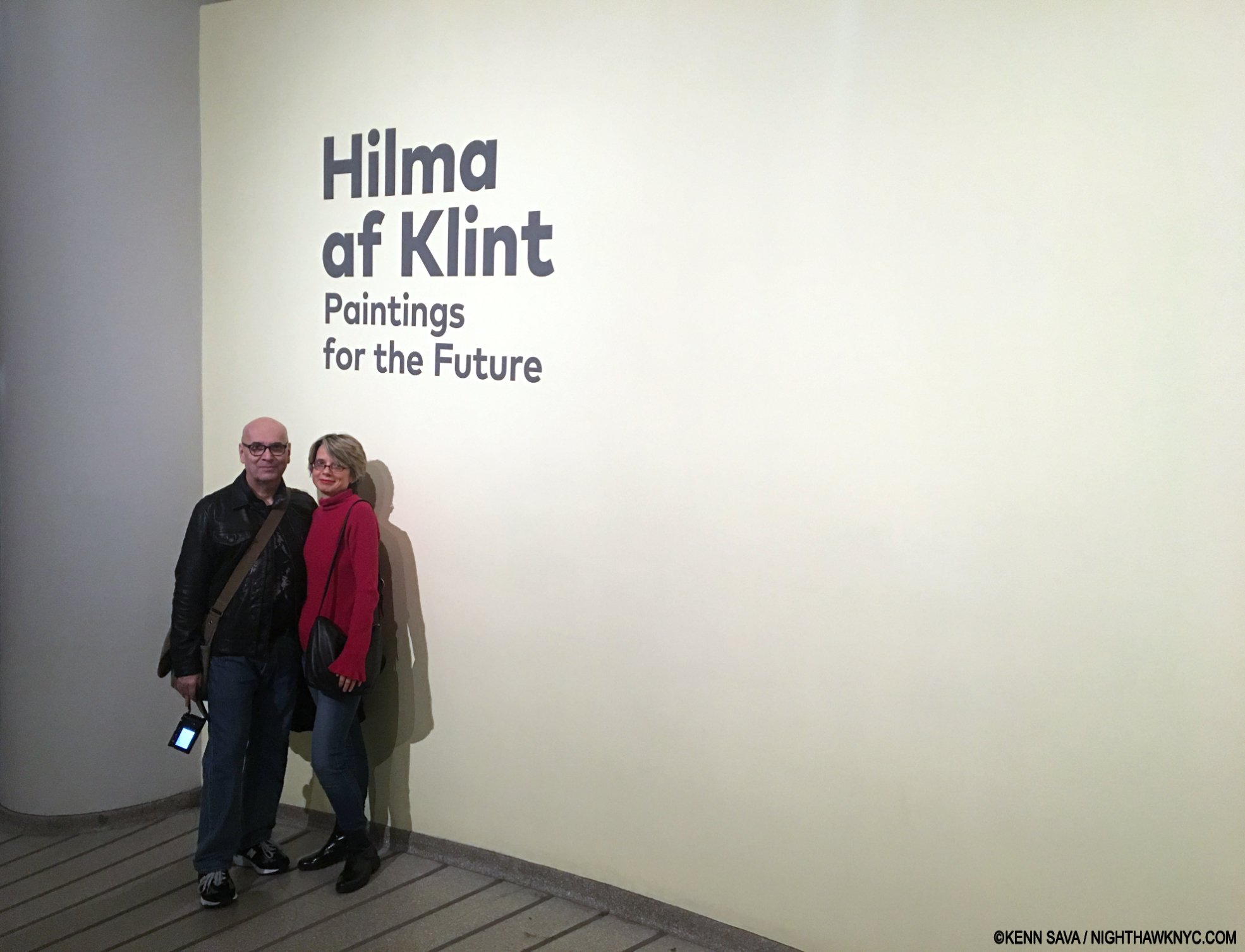
  1. The last show we’ve been able to see together.
  2. She would begin Painting flowers in earnest in the mid-1920s.
  3. Ms. Quaytman’s book Spine and her new book, Book, 2025, are on my list of NoteWorthy Art Books of this century.
  4. Julia Voss, Hilma af Klint: A Biography, PP..1,2 & 4. After mentioning I was in the middle of reading it at the time I published my NoteWorthy Art Books of the Century piece, I’ve added A Biography to the list. A marvelous accomplishment with a terrific translation from the original German, it’s essential reading for anyone interested in HaK.
  5. I’m still a bit puzzled by Nature Studies’ Provenance. MoMA’s site says they bought it, but from whom and how that owner came to own it is unspecified. How it didn’t wind up in, or being acquired by, her Foundation puzzles me. I tried to find out, but received no answers.
  6. Here.
  7. By the way, I have managed to cover almost every single NYC Basquiat show these past 10 years, so you can see a good deal of his work here.