Todd Hido- Back To Black

Written & Photographed by Kenn Sava (*unless otherwise credited)

Maybe it was an Lp or CD that had this effect on you. I’ve been there too many times to count. More recently, it’s been PhotoBooks that I’ve related to. 
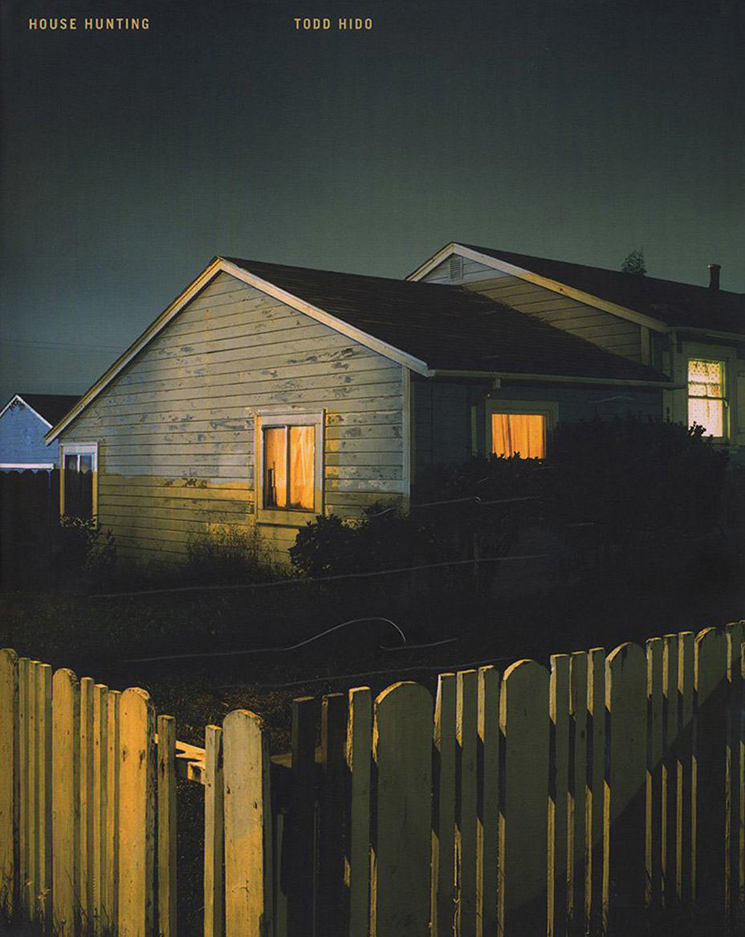
Todd Hido, House Hunting, 2001.17 by 14 inches. 56 pages containing 26 “carefully selected” Photographs. One of only 4,000 copies. I spent 3 months hunting one. *Nazraeli Photo. Click any picture for full size.

When I first saw House Hunting, it went right through me. It was akin to an album that spoke to you in a formative part of your life- you connect with it when you feel almost no one understands.
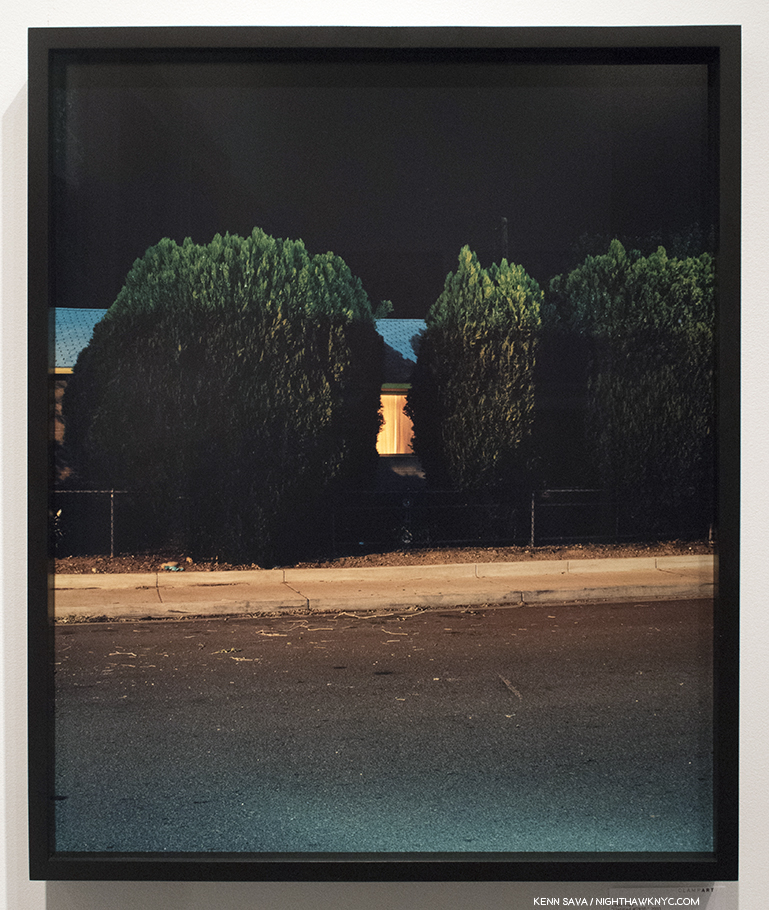
Todd Hido, Untitled #7910, 2003, seen at AIPAD, 2017.

I’ve spent most of my life being behind that lone light burning all night long.

But it’s more than that, of course. It’s a nocturnal portrait of suburban American life as (mostly) seen from the outside, with its partially crumbling picket fences, hanging laundry, it-seemed-like-a-good-idea-at-the-time discount clapboarding slapped on structures that don’t meet the floor of anyone’s definition of “architecture,” and aging vehicles. Home sweet home. Like the Artist, I grew up there, too. I’ve learned since that I am far from being alone in connecting with it. His “Houses at Night,” series, the work that first brought the Artist to prominence when it was released in his first PhotoBook, House Hunting, in 2001, saw its two printings of 2,000 copies each disappear into the hands of 3,999 others. It wound up being selected by PhotoBook aficionados Martin Parr & Gerry Badger for inclusion in the third installment of their multi-volume rundown of PhotoBooks they find particularly notable, The Photobook, Volume III. It’s interesting to me looking back on it now that this work is so popular while not dissimilar work of his illustrious predecessors Robert Adams (Summer Nights, an acknowledged influence of Todd Hido’s) and Henry Wessel (Night Walk) have found only niche followings. Perhaps it was Mr. Hido’s use of color that explains his series popularity? Or, maybe it’s his series has more of those lone lit windows.
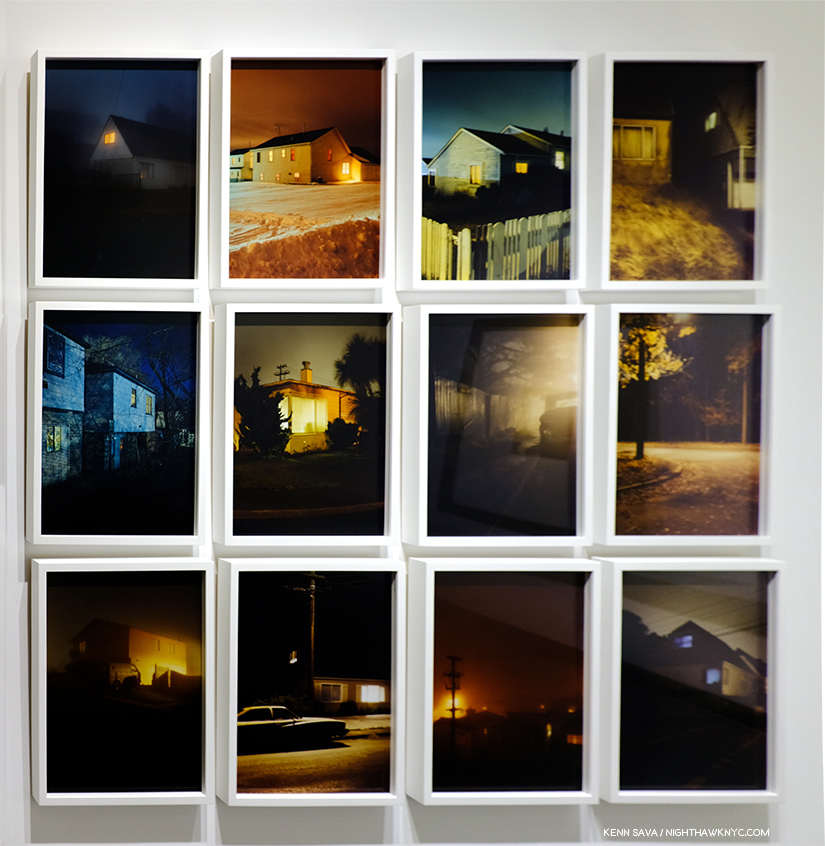
Old friends. 12 works from his “Houses at Night” series, published as House Hunting and Outskirts, include the former’s famous cover image, top row, third from left, with the cover image for the excellent Aperture mid-career retrospective, Intimate Distance to its left. Seen at Bruce Silverstein Gallery.

Outskirts, a veritable House Hunting, Volume 2 followed a year later, but then, with the release of Roaming in 2004, a book that purposely “has no homes in it,” it became apparent that Todd Hido was “no one trick pony1.” There were some dissenting voices that preferred their desolation with a single light burning in it. Roaming, a book who’s grey mood is characterized by its clouds and not a night sky, was the first inkling of what was to come, its title almost serving as a one-word summation of his subsequent creative journey. Todd Hido has not been one to stay in one place, artistically, or rest on his, now substantial, laurels. His work, as seen in his books and gallery shows, has continued to evolve, always in fascinating ways. Interiors, desolate landscapes (sans lights, except for his car headlights on occasion, maybe a rising or waning sun), and even portraiture, introduced, gradually, along the way, are now all part of his repertoire. He’s now, also, no stranger to appearing in the fashion and editorial media. In fact, when I met him earlier this year, Todd Hido was in town to shoot a series of New York Times Magazine covers, and there was the recent dual show of his work up with the fashion Photographer, Miles Aldridge.
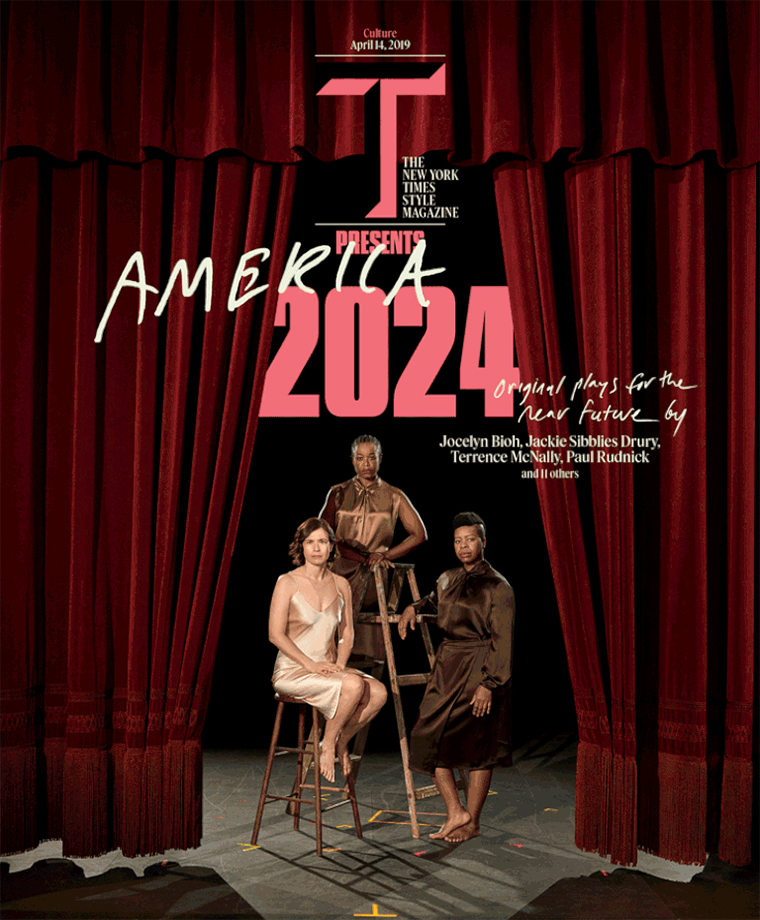
*Todd Hido, One of a series of 4 New York Times Magazine covers he shot for its April 14, 2019 issue.

Each new monograph and each new subject brought new realms, both visually and in terms of the inner vistas Mr. Hido’s work stirs up in viewers. After beginning to work with models in 2004, his work with his beautiful and extremely versatile muse, Khrystyna, taking on something of the quality of his own version of Cindy Sherman’s Untitled Film Stills, has been a bit controversial, but for me, as in all of his work, it’s primarily interesting for what it reveals of the Artist. Excerpts from Silver Meadows, 2013, his last monograph until 2018, is a case in point. Though the titular street ran through his childhood neighborhood, the images include those from other places and other times- “surrogates,” as he called them. And that’s how I view all his subjects or actors & models- as surrogates.

“For me, I keep finding and exploring the same place no matter where I go. I draw from within, from my own history, as the basis of my work. All of the memories and experiences from my past come together subconsciously and form a kind of fragmented narrative2.”

Still? NONE of his past work prepared me for what I saw when I walked into Bruce Silverstein Gallery on an appropriately cold winter day to see new work featured in a book that hadn’t yet been released titled Bright Black World in a show of the same name. The press materials say these works, “are the results of Hido’s exploration of the northern hemisphere in the impenetrable depths of winter. The realities of climate change lurk behind in these – the threat of an eternal darkness looming large….Not just a political statement, Bright Black World is infused with Nordic mythology, Ragnarok, and the idea of Fimbulwinter – a winter that never ends3.” And so, the show, and this work, marks more firsts in the work of Todd Hido- work addressing the state of the world, as well as being the first time he’s travelled to another country to create it.
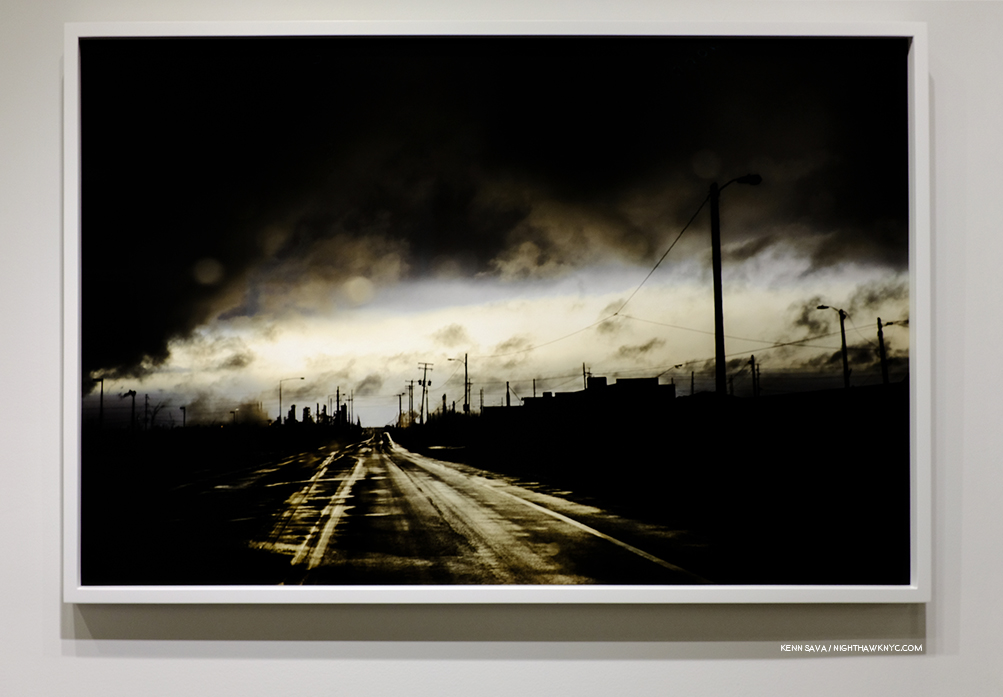
#11389-3087, 2014, 30 x 45 inches from Bright Black World seen at Bruce Silverstein Gallery.

As I looked at the new work, the first thing that struck me was how gorgeous the prints were. Instantly, THE Todd Hido quote that has stayed with more than any other came rushing back to me…

“I photograph like a documentarian, but I print like a painter4.”

Here? Though I own four Todd Hido prints (including Untitled #7910, seen earlier, alas, none at the size of these), in my opinion, he’s taken it to another level. The larger scale of many of them serves to engulf the viewer, who promptly gets lost in the overall feeling and the details. They’re extraordinary, and simply have to be seen to be appreciated.

The second thing that immediately stood out for me was that the character of the light has changed. I’ve never seen darkness quite like this.

“It’s been said that Inuits have many words to describe white. As the polar snow caps melt faster than we ever imagined, I wonder how long it will be before we have as many words to describe darkness,” Todd Hido5.
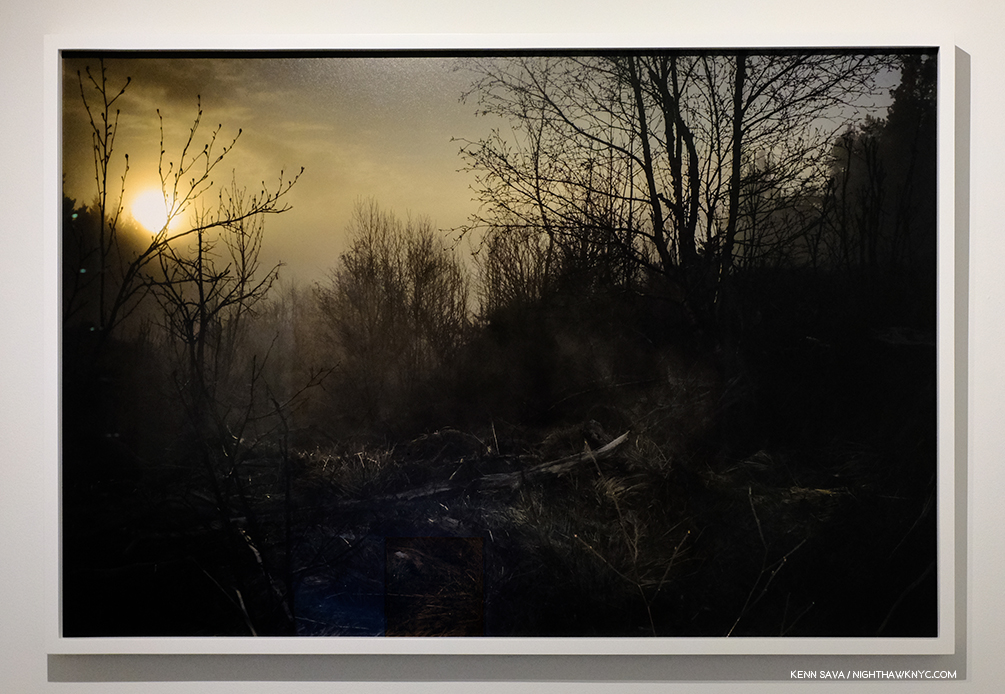
#11798-4172, 2017, 30 x 45 inches, is also the cover image for his new PhotoBook, Bright Black World.

And? My old friend, the night, makes a return appearance.
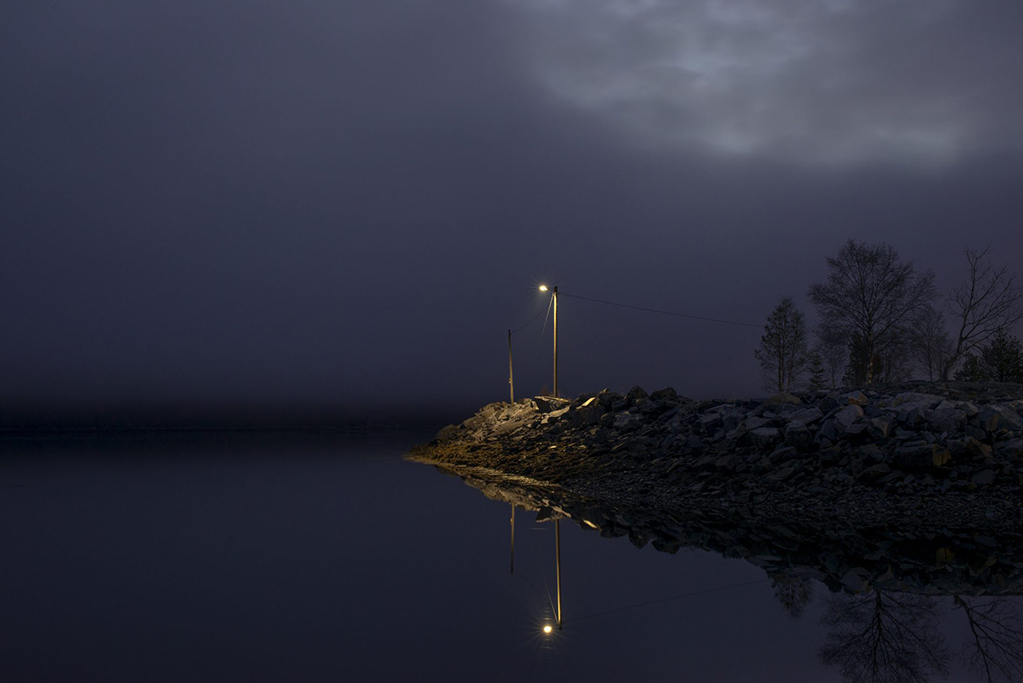
The return of the lone light burning at night. #11797-3252, 2017. Courtesy of Todd Hido and Reflex Amsterdam, where a sister show was up concurrently.

In the midst of his incredibly busy life, I am grateful that Mr. Hido found time to answer a few questions for me, both long-standing, and some brought on by his new work. I’ll intersperse them from here on. First, since I live my life at night, and have long been fascinated by the few Artists & Photographers who work at night, I had to ask him- What is it about the night that inspires you?

Mr. Hido replied, “I am inspired by the night for many reasons, but mostly it is because everything slows down and gets quiet. I find that that is when I am able to focus my attention and see the best. Also, there is an atmosphere at night that lends itself to creating the mood that I am interested in.”
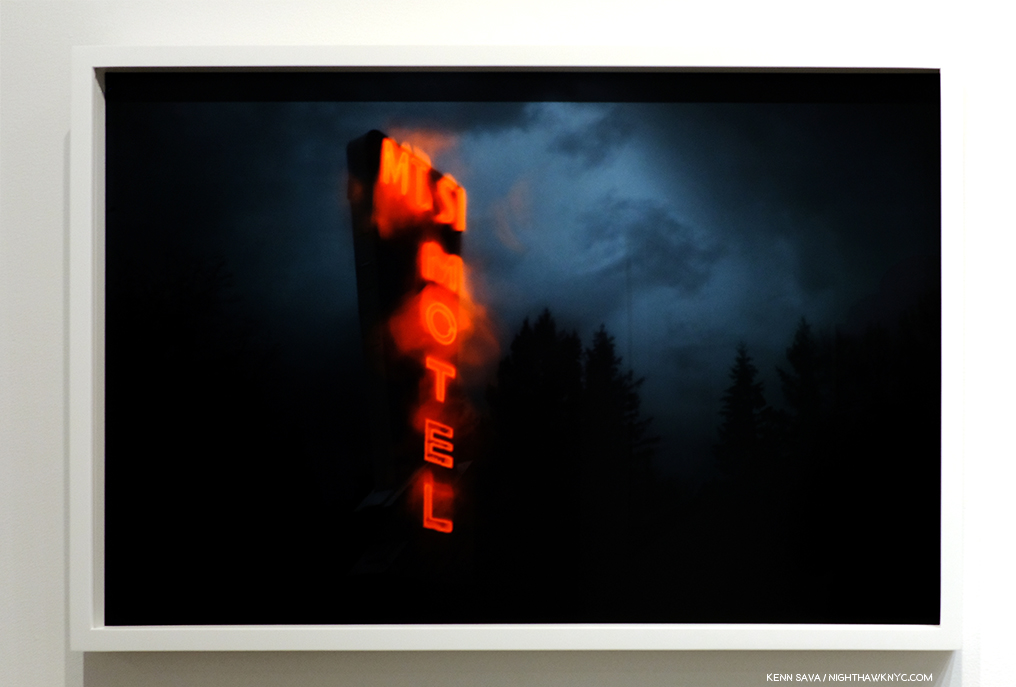
#11793-9406, 2017, 20 x 30 inches. It could be a production still from countless horror movies.

Coincidentally, as I walked through the show, a random song started playing on my headphones…

“The windows of the world are covered with rain
Where is the sunshine we once knew?”*

#11801-1971, in particular, held me spellbound for minutes on end.
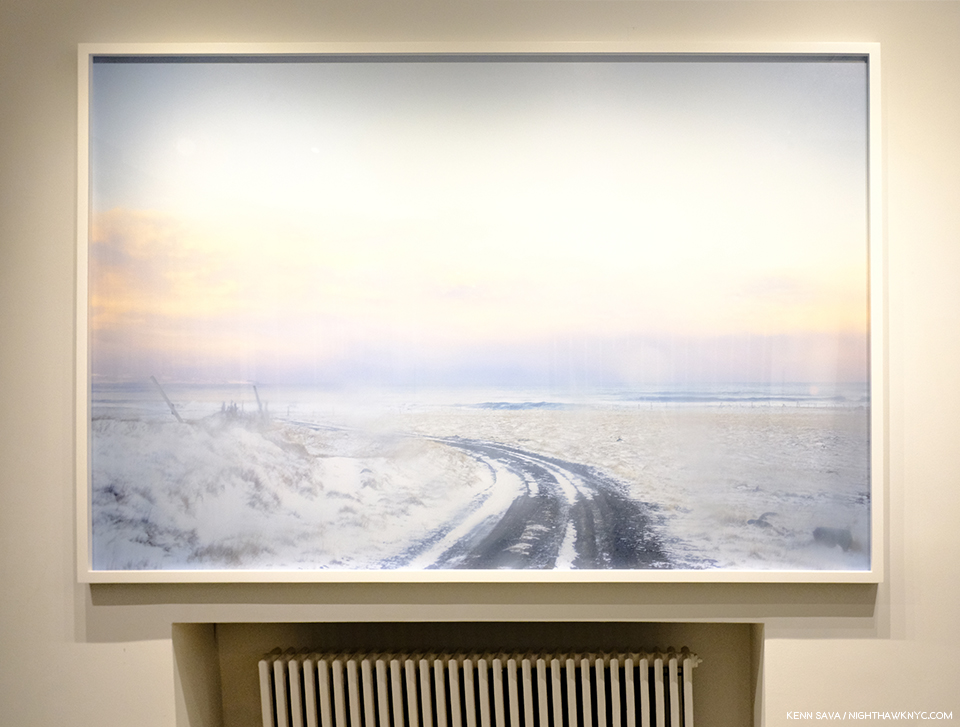
#11801-1971, 2017, a massive 59 x 88 inches, looks SO cold, even hanging it over the radiator isn’t going to make it feel warmer.

The sign of human intervention in the landscape disappears as the road turns left, leaving the viewer…? Standing there, I felt the ghost of the great James McNeill Whistler in it, among others, but at almost 7 1/2 feet long, it engulfs you in a sense of cold, and a resulting terror, that was unforgettable.

Hence, my second question- I’ve long wondered- Are there any painters who have influenced you?

Mr. Hido said,- “I am definitely influenced by Edward Hopper and Andrew Wyeth and of course I love Gerhard Richter, but one of my favorites is Marlene Dumas.”
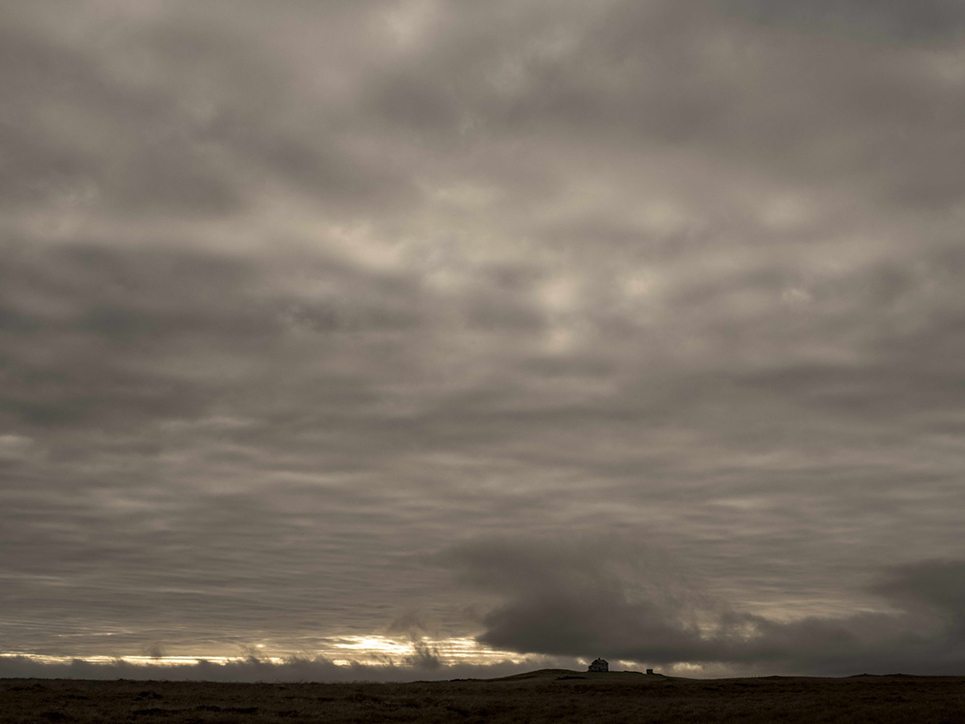
#11756-269. That house looks to be the size of a stone.

These images are, therefore, characterized either by light that is fading, distant, faint, or has completely gone (though in some images it’s hard to tell if the sun is setting or rising). Whereas the air was, in my view, unthreatening and calm in the “Houses at Night”/House Hunting works, uneasiness, at least, is in the air in almost every one of these Bight Black World Photographs.

Exact locations for most of these Photos are not known, but it is known that for the first time Todd Hido went overseas, to Northern Europe, to create some of this work. It turns out that my brother from another mother, NYC guitar legend, Dave Fields, was, coincidentally, on tour in Norway the same day I saw this show. Without explaining why I wanted it, I asked him if he would step out of his hotel one evening and snap a picture of the sky. Maybe the amazing skies of Bright Black World are everywhere to be seen there. ? Here’s what he sent me-
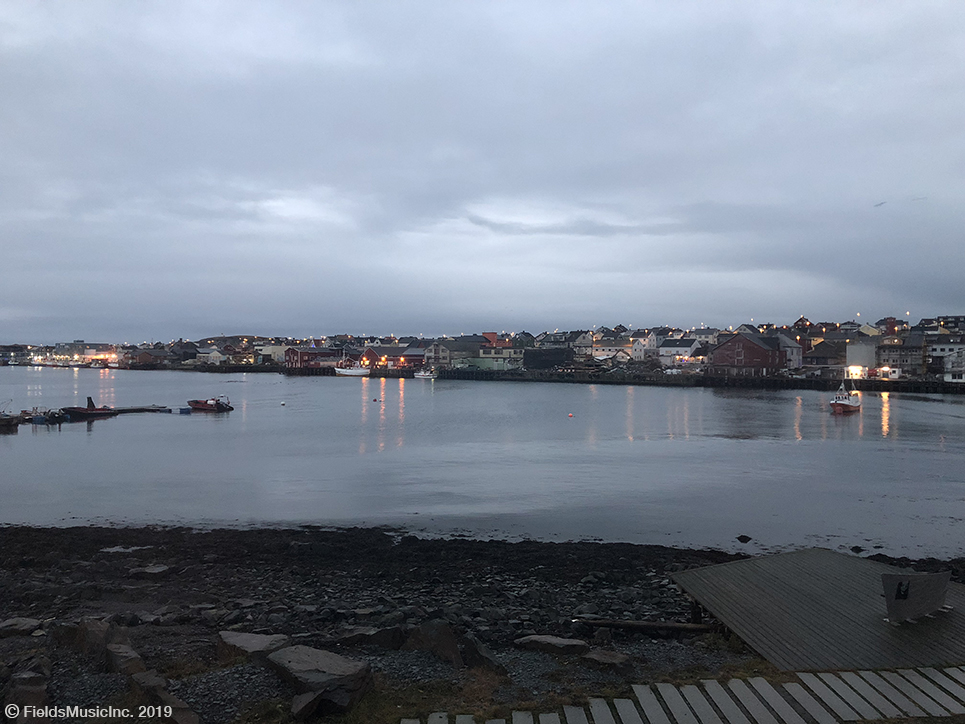
*Dave Fields, Lystgaard Skjerstad, Norway, November 18, 2018. A career as a Photographer possibly awaits the brilliant guitarist and singer/songwriter.

There’ve been subtle differences in each of his landscape projects, from House Hunting & Outskirts through those appearing in his subsequent books. Bright Black World continues that progression. Everything I’ve admired about his more recent landscapes- their atmosphere, their “spontaneous” feel that often looks like the shot was taken through a car window (many were), while the car was still in motion (Doubtful. He’s a dad.), the almost miraculous combination of elements, enhanced by their “painterly” feel, are all in full effect here. For me, at least, the results are as beautiful, if not more beautiful, than anything I’ve seen that Todd Hido has done.
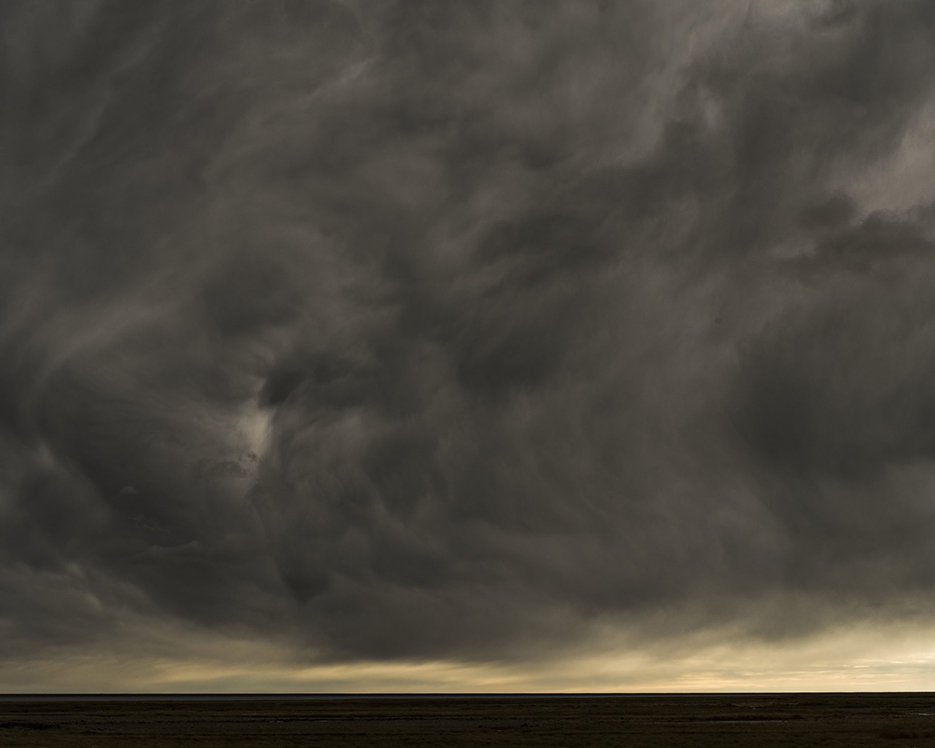
#11755-2192. Photographs like this begin to make you understand what J.M.W. Turner might have been seeing that inspired his unequalled sky scapes.

His new book, Bright Black World, published, as each of Mr. Hido’s now seven monographs have been, by Nazraeli Press, saw its entire 3,000 copy first printing sell out almost immediately. On the one hand this is a testament to how popular Mr. Hido has become, as well as to how well done the book is. On the other hand, it’s a bit of a shame that the book is not more readily available for the rest of the world to see, as with so many great PhotoBooks that have gone out of print and become very hard to find or see. It’s a huge book- just about 17 inches long by about 12 inches high, and weighing over 3 1/2 pounds, with 108 pages, but, unlike other large PhotoBooks, it’s size is entirely necessary to convey the intended feeling seeing the full size prints imparts, as well as a sense of all that is in these images.

#11692-492, 2014.

“The windows of the world are covered with rain
What is the whole world coming to?”*

After Aperture’s 2016 mid-career Todd Hido retrospective, Intimate Distance (see BookMarks at the end), the Artist felt it was time to begin anew.
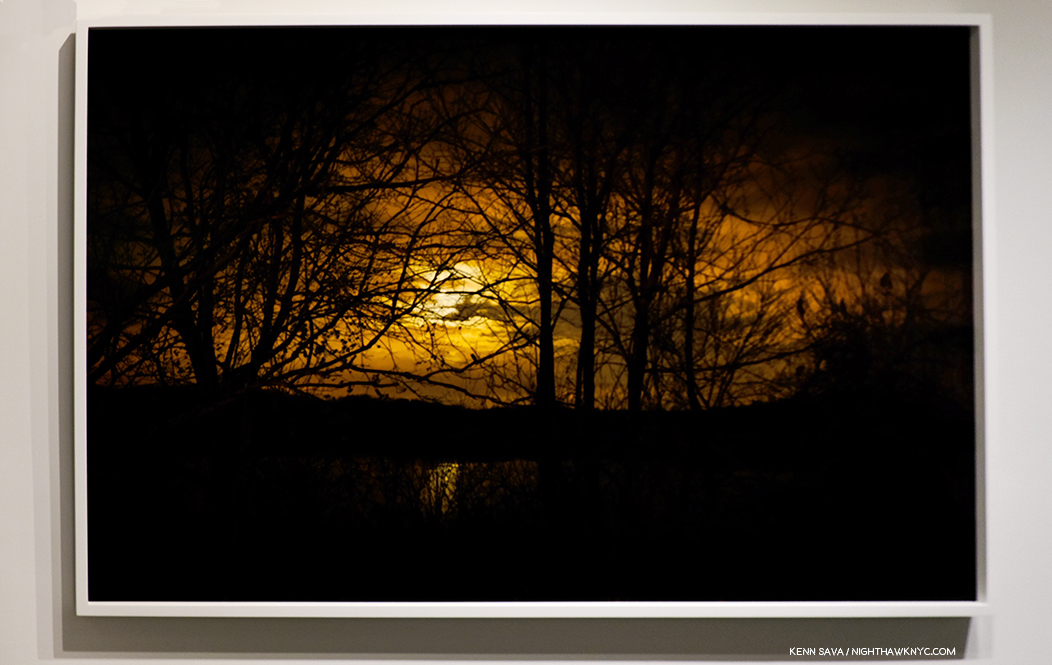
#11599-5811, Kent, OH

Kenn Sava (KS)- It’s been 5 years since Excerpts from Silver Meadows, with the retrospective Intimate Distance intervening. You spoke about “closing that chapter,” (per reflexamsterdam’s site), with Intimate Distance. In Bright Black World there are elements of things from your past series- rooms in decay, the beautiful denuded trees in inclement weather, a portrait of a woman, and even one or two Photos of buildings with a single light on. Yet the feeling, now, is completely different. It’s more ominous, expectant throughout, in my reading. I’m wondering why you chose to end both Intimate Distance and Bright Black World with the same image (#11599-5811, Kent, OH)?

Todd Hido (TH)- Well, to answer your  question it made perfect sense because Intimate Distance was a survey and the last part of that book was of things I had never used in a monograph. That image you are speaking of as dark as it is, I find kind of hopeful.

KS- As a dad, was it hard for you to release a (beautiful) book that’s this dark, one that references Fimbulwinter and the end of days?

TH- As a dad it was crushing to read Cormack McCarthy’s The Road, which I happened to delve into when my children were young. They have always called me “Papa” and that is exactly what the child in book called his father. Whenever I read that it always hit home harder. In terms of my own book, I would say that every book I make helps my children. No matter what my outlook may be.
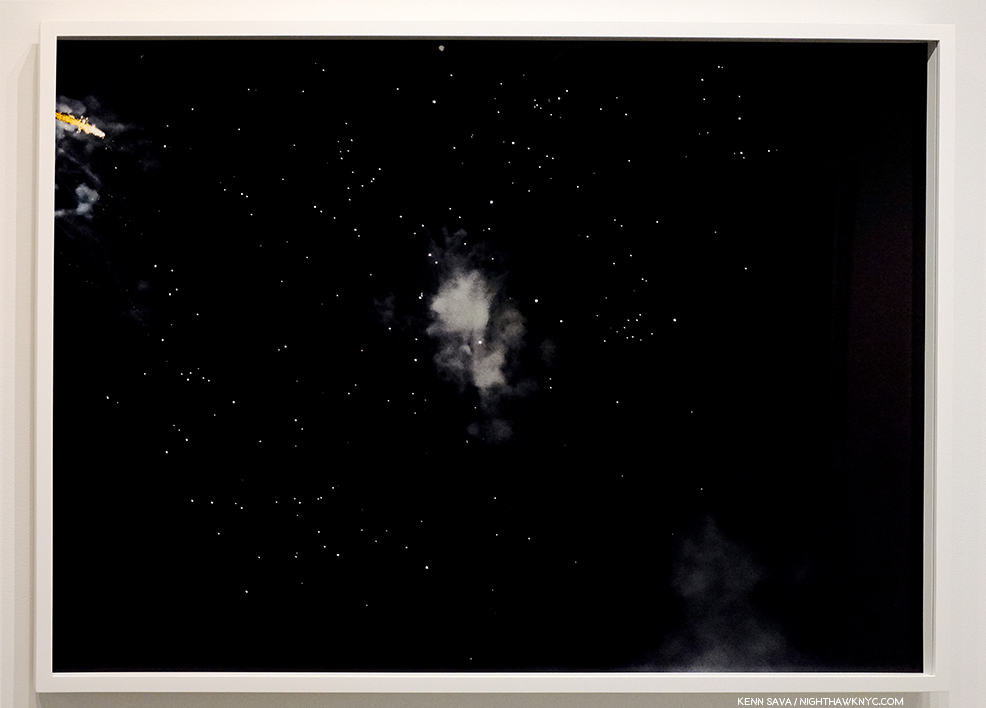
#11804-3243, 2017, 30 x 41 inches.

“The windows of the world are covered with rain
When will those black skies turn to blue?”*

BookMarks-
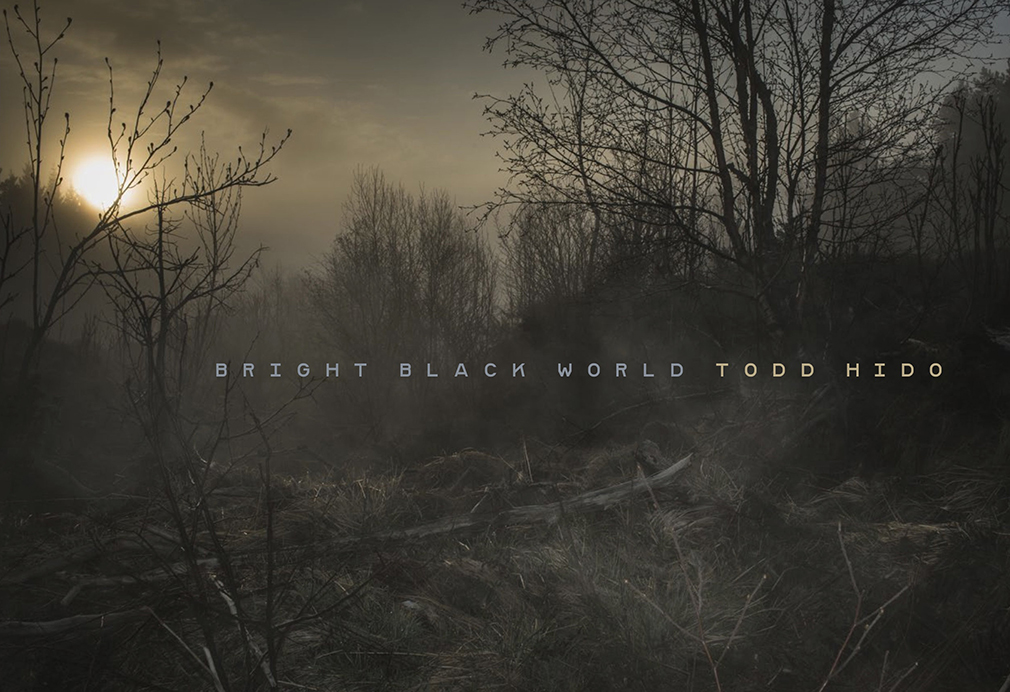
Bright Black World, 2019, published as each of his prior 6 monographs have been, by Nazraeli Press, in a first printing of 3,000 copies that sold out almost immediately. It’s generous 17 by 12 inch size wonderfully compliments the expansive nature of the work, as do its two vertical gatefolds. It’s a book full of dark wonders and the most compelling new book of landscapes I’ve seen so far this year. Copies are currently trading for about 150.00, 2 times list, on the aftermarket around the world. Waiting to see if there will be a second printing might be wise at this point, as I don’t think aftermarket prices are going to immediately rise much higher for perhaps a year, or until it’s apparent there won’t be a 2nd printing. I will update this paragraph if I get news of a second printing.

Todd Hido: Intimate Distance: Twenty-Five Years of Photographs, A Chronological Album, Aperture, 2016, is the best place to get an overview of the Artist’s career and accomplishment up to 2016. Given his classic books, House Hunting and Outskirts are both out of print and each going for upwards of 400.00, Intimate Distance is also the place I recommend to start. It’s a very good overview, “roaming” (sorry) over all the series of his work to that point, and so gives a real sense of what he’s done, and achieved, in each realm he’s worked in (in his monographs), thus far.

Ok, yes, House Hunting is one of the great PhotoBooks of the first part of this century, in my view. Published by Nazraeli in a first printing of 2,000 copies in 2001, they vaporized within weeks. The 2007 second printing of 2,000 copies also quickly sold out. Currently, you’re looking at 300.00, and up for a second printing, first printings starting at 425.00, both in very good condition in very good dust jackets.

For Outskirts, 2002, his excellent second book, which has only seen one printing thus far, copies start at 400.00 (in vg/vg). If you are trying to choose between getting either House Hunting or Outskirts, my vote would be for House Hunting, which is much more in demand and more likely to stay that way. 

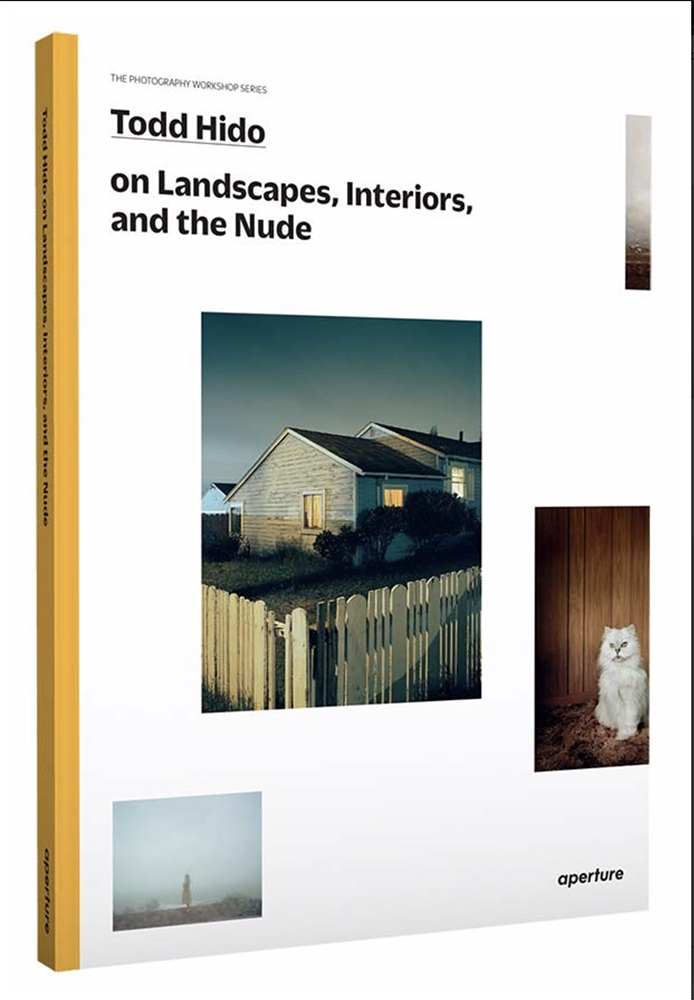
A sleeper pick, a book that at first glance may seem to be aimed particularly at Photographers, is Todd Hido on Landscapes, Interiors, and the Nude: The Photography Workshop Series, Aperture, 2014. Since it contains the most extensive writing Todd Hido has done on Photography to date, it’s continually insightful for lovers of his work as well. The introduction is by no less than Gregory Halpern, a one-time student of Mr. Hido’s, who imparts a classic tale of his experience as one.

*- Soundtrack for this Post is “The Windows of the World” by Burt Bacharach and Hal David, performed by Dionne Warwick.

My thanks to Alison Crosby, Stefanie Williams, Gregory Halpern, Dave Fields, and Todd Hido.

NighthawkNYC.com has been entirely self-funded & ad-free for 9 years, during which 320 full-length pieces have been published! If you’ve found it worthwhile, PLEASE donate by PayPal below to allow me to continue. Thank you, Kenn.

You can also support it by buying Art, Art & Photography books, and Music from my collection! Art & Books may be found here. Music here and here.

Written & photographed by Kenn Sava for nighthawknyc.com unless otherwise credited. To send comments, thoughts, feedback or propositions click here. Click the white box on the upper right for the archives or to search them. Subscribe to be notified of new Posts below. Your information will be used for no other purpose.
  1. Todd Hido: Intimate Distance, P.108
  2. Todd Hido on Landscape, Interiors, and the Nude, P.8
  3.  Here.
  4. Todd Hido on Landscape, Interiors, and the Nude, P.53
  5. Here.

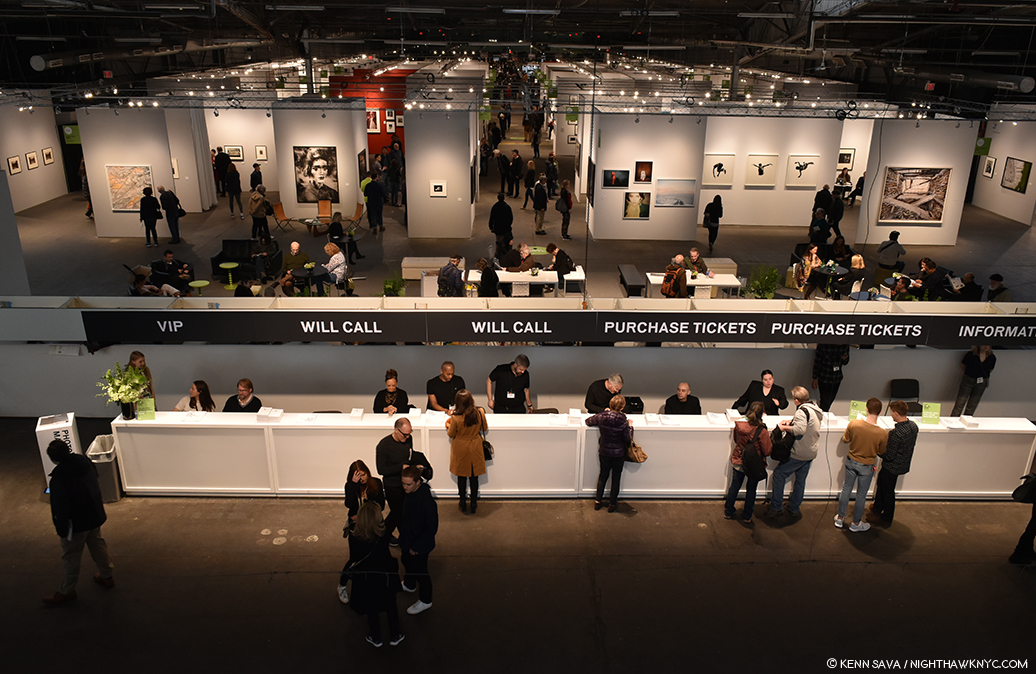
The Photography Show/AIPAD, 2019- Coverage Page

Written & Photographed by Kenn Sava

The Photography Show, Early afternoon, Saturday, April 6, 2019. My thanks to DeShawn for his assistance.

For the third year in a row, I’m proud to bring you the most extensive coverage of The Photography Show, 2019, aka AIPAD, anywhere! This page summarizes my coverage for easy reference. Please see the links below for the pieces I’ve written on the show- so far-

The Photography Show, 2019- The Galleries

The Photography Show, 2019- The PhotoBook Publishers

AIPAD Focus: Michelle Dunn Marsh

Louie Palu’s Tools of Remembrance

As I write this, I am planning on additional pieces. Stay tuned! This page will be updated as I add them.

My coverage of The Photography Show, 2018 may be found here.

My coverage of The Photography Show, 2017 may be found here.

NighthawkNYC.com has been entirely self-funded and ad-free for over 6 years, during which over 250 full length pieces have been published. If you’ve found it worthwhile, you can donate to keep it going & ad-free below. Thank you!

Written & photographed by Kenn Sava for nighthawknyc.com unless otherwise credited.
To send comments, thoughts, feedback or propositions click here.
Click the white box on the upper right for the archives or to search them.
For “short takes” and additional pictures, follow @nighthawk_nyc on Instagram.

Subscribe to be notified of new Posts below. Your information will be used for no other purpose.
 

Andy Warhol: Business Artist

Written & Photographed by Kenn Sava (*unless otherwise credited)

“So you should always have a product that’s not just ‘you.’ An actress should count up her plays and movies and a model should count up her photographs and a writer should count up his words and an artist should count up his pictures so you always know exactly what you’re worth, and you don’t get stuck thinking your product is you and your fame, and your aura.” Andy Warhol1.

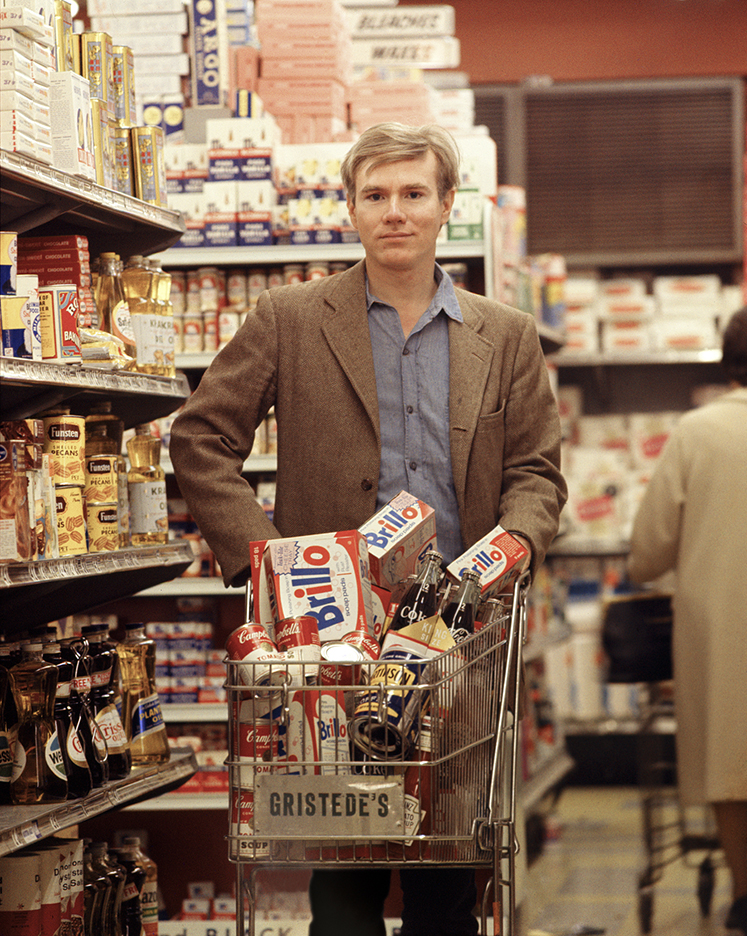
Andy shopping for products. *Bob Adelman, Andy Warhol at Gristede’s Market near 47th Street. New York City, 1965, near where he lived with his mother. Countless millions went shopping in American grocery stores in the 1960s. Very few made Art out of it before he did. Click any picture for full size. 

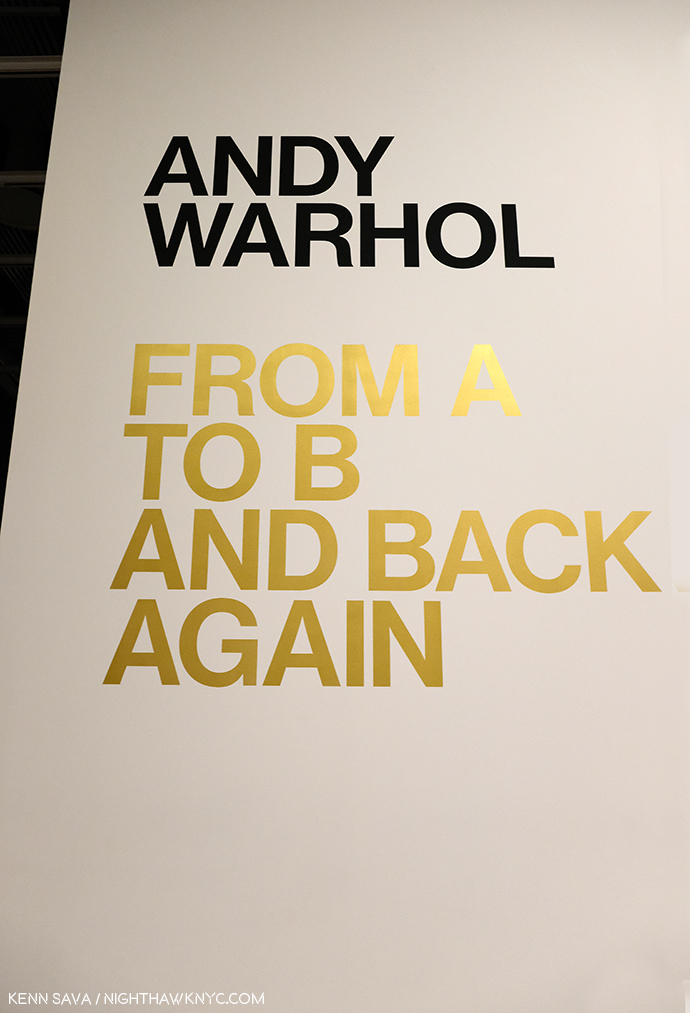
That being said, leaving the Whitney Museum’s Andy Warhol- From A to B and Back Again, the first Retrospective in NYC since MoMA’s in 1989, I was left believing Andy Warhol’s greatest creation was himself.

The use of gold here, and on the exhibition catalog’s cover, is interesting. It mimics Gold Marilyn, at MoMA, and also reminds of the background color of icons from the Eastern Orthodox and other churches. And? It’s a color often associated with money and “value,” so could it be a veiled reference to the high prices paid for his Art? Which of these is the intended meaning?

But, no matter how I feel about his Art, even I can’t deny that today, it can be said that we are living in his world to a greater extent than we realize. Look around you. His influence is everywhere. His innovations are now used by countless other Artists and businesses.

“A friend of mine named Ingrid from New Jersey came up with a new last name, just right for her new, loosely defined show-business career. She called herself ‘Ingrid Superstar.’ I’m positive Ingrid invented that word2.”

The everyday people he made into “superstars” presaged today’s television “reality stars.” His square portraits are now instantly recognizable as the Instagram standard. Andy Warhol came to define the Contemporary Artist working with a team of assistants at his Factory and his example is to be seen being followed by Artists all over the world today. How often do you see one of his color variated group of (4) portraits or flowers emulated by someone else? And on and on. These are only a few examples. Andy Warhol’s influence is incalculable. If it could be totaled, it might well rival that of Steve Jobs among THE most influential people of the past 75 years on our lives today.

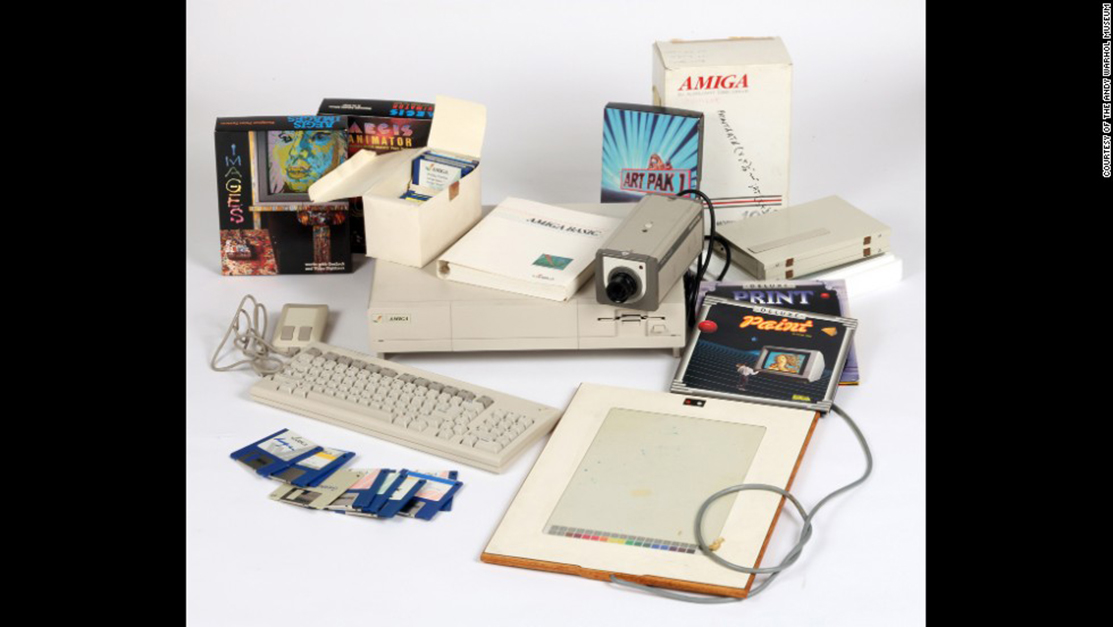
Commodore Amiga computer equipment used by Andy Warhol in 1985-86. Andy’s interesting computer Art was extracted from this machine by a team led by the Andy Warhol Museum in 2014! *Photo by The Andy Warhol Museum.

But, it was Andy Warhol, not Steve, who said,  “A computer would be a very qualified boss3 decades before the time when many people’s lives seem to be run by their devices. A-hem. Sometimes I wonder if the internet is nothing but a cyber projection of Andy Warhol’s brain.

Artistically, I respect him as an Artist who was continually innovative in so many mediums during his surprisingly short career. Yes, short. It feels like he was around forever, but he was just 58 when he passed away on February 22, 1987. This insatiable creativity now strikes me as a function of his innate ability to see the world in his own way, which led him, continually, in different directions, to try new things, and explore new ways of doing old things.

It seems to me, however, that THIS may be the peak moment of Andy Warhol’s influence- the influence of Warhol, the Artist and his Art.

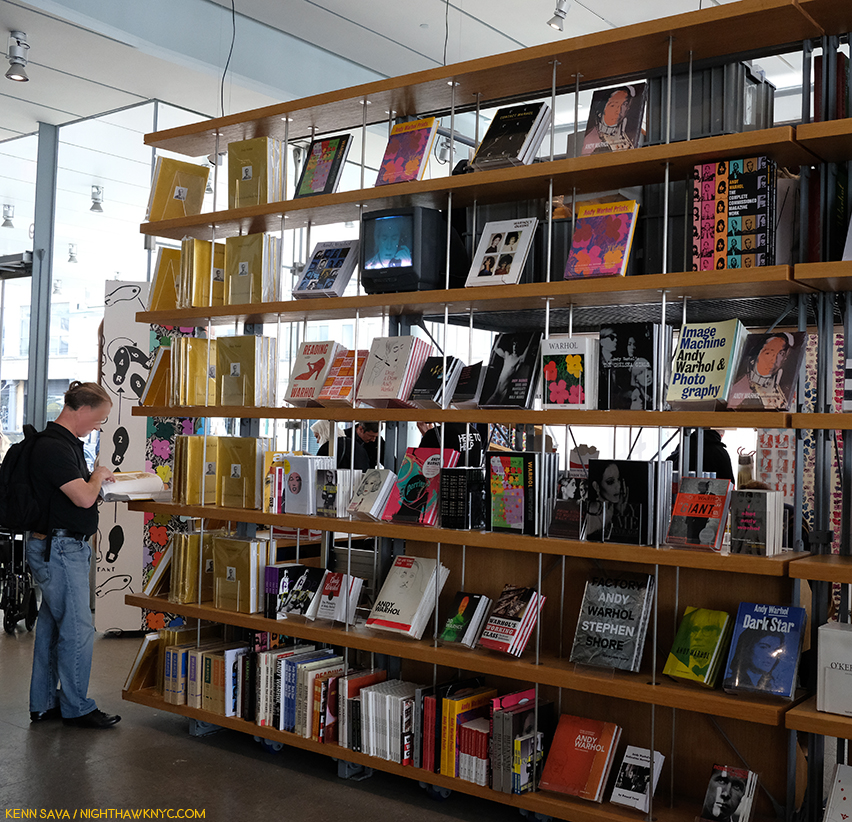
Warhol books, and ONLY Warhol books, seen in the Whitney Shop, March 27, 2019.

I wonder if the level of his fame may, in fact, work against its longevity from here. Virtually everything he did has been shown, written about, analyzed and assimilated. If you don’t think that’s true, take a look at this picture I took of part of the book shelves in the Whitney Museum’s Shop during the run on Andy Warhol- From A to B. I used a 28mm lens and even though I stood more than 20 feet away, backing into the middle of the admissions cue, I still wasn’t able to get ALL the Andy Warhol books on sale in the shot. There are books on his pre-Pop work, his newspaper-like work, his portraits, his posters, his prints, his record covers, his career as a publisher, his films, books on the Factory (including one of Photos taken by a teenaged Stephen Shore), a few about his Photography and polaroids, including a collection of Photos of him in drag, AND a multi-volume Catalogue Raisonne of his Paintings (on the far left of the bottom shelf). Oh, and Andy Warhol: Knives. ? This is not to mention all the books, by the Artist, and others, about his life, including the infamous, The Philosophy of Andy Warhol (From A to B and Back Again), published in 1977, which seems to have inspired the name of this show. My copy, bought from the display, is the 46th printing of the paperback. In all my many years of looking at Art books, I have to say the only other Artist who has as many books written about him and his Art is Picasso. 

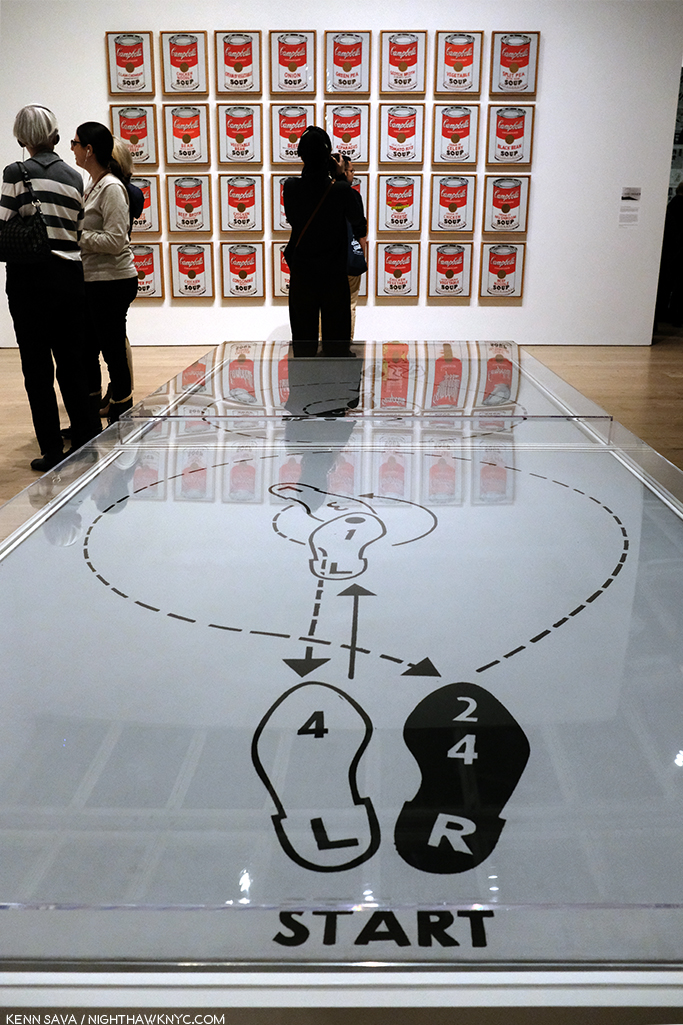
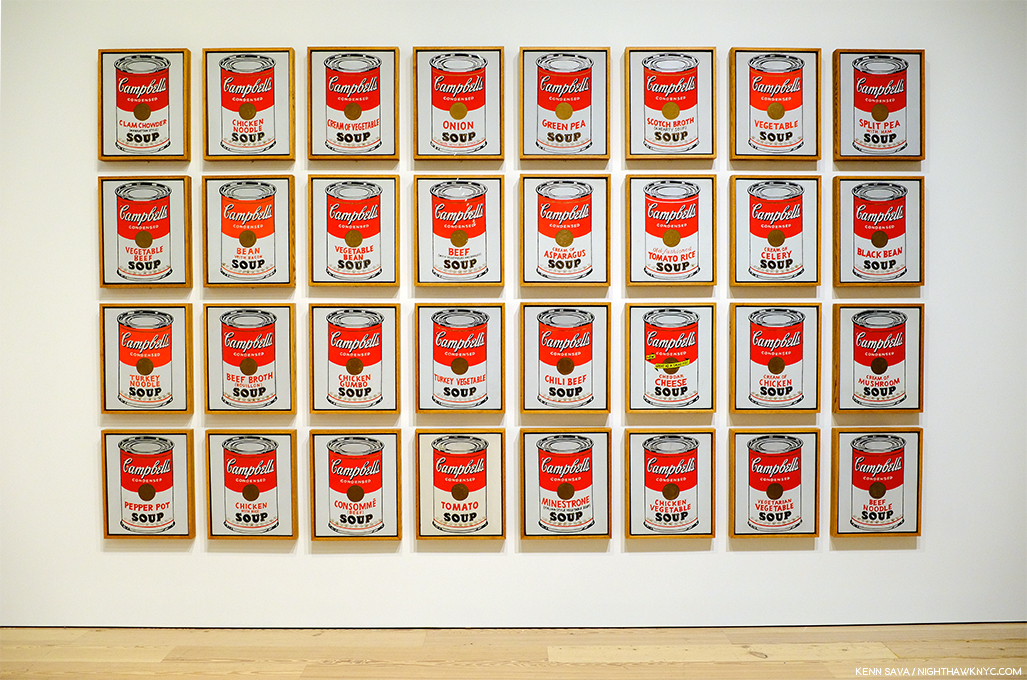
Start here. In the first gallery, which contains early Pop work, like Dance Steps, 1961, and a wall of Campbell’s Soup Cans in the back.

As I headed to the 5th floor for the main part of the show, I wondered- What’s left for the future to learn about Andy Warhol’s Art? Given his popularity, I’m sure people will find things for yet more books.

Andy’s mother fixed him Campbell’s Soup everyday for lunch, including after he became famous, until she passed. The family was poor. Beyond the comfort of the warmth of soup, having a lot of food around represents something of an ideal, a dream, even cheap food, like this soup was at the time, at 15 cents a can. Originally, these Paintings sold for $100 a piece at his first show at Ferus Gallery in LA, where Dennis Hopper bought one.

As I looked at his Art, it also raised questions. Questions that the passage of time has only intensified.

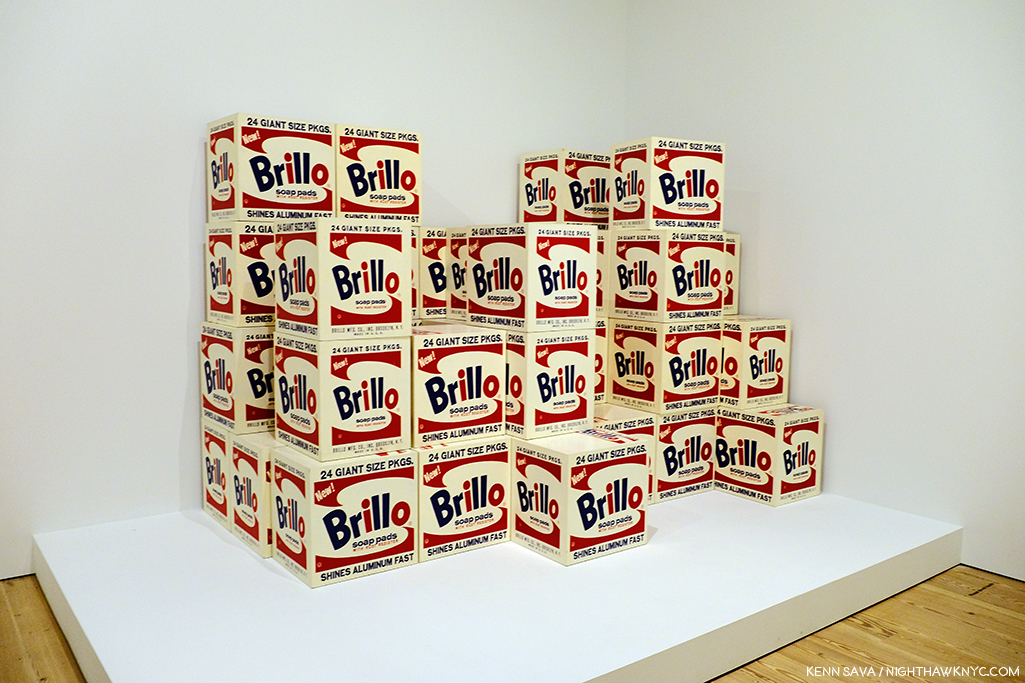
Brillo Boxes, 1969 (version of the 1964 original). Yes, a copy of a copy. The interesting thing about this work for me is that this “Art is everywhere around us” work of so-called “Pop Art,” which helped to mark the end of Abstract Art’s hold on the Art world, is based on the Brillo Box design of James Harvey, a moonlighting Abstract Expressionist Painter! Beyond that, and wondering if  Sol LeWitt was influenced by it, it’s lost on me.

First, and most importantly, Andy Warhol’s Art is accessible. This has been the most important factor in his achieving success and fame and it may be the most important factor in the longevity of both. Popularity doesn’t necessarily equate with quality. Since the future is unwritten, as Joe Strummer reminded us, it’s impossible to know what posterity will value, if anything. To this point quality has definitely been a factor. I wonder- Where does that leave Andy Warhol’s Art?

Arising at a time (the late 1950s) when the Art world had been fed a steady diet of extreme abstraction by the Abstract Expressionists, Andy Warhol’s Art burst on the world with images featuring things, yes, things, that everyone living in the country recognized. Brillo boxes, Campbell’sl soup cans, dollar bills. His work was instantly accessible in an Art world dominated by Art that was becoming more and more obtuse and remote. I’m not saying Andy Warhol’s work was “understandable,” or even “more understandable” than that of the Abstractionists, only relatable. Even in today’s world where fewer and fewer living beings remember S&H Green Stamps, walking through this show, this seems to still be the case.

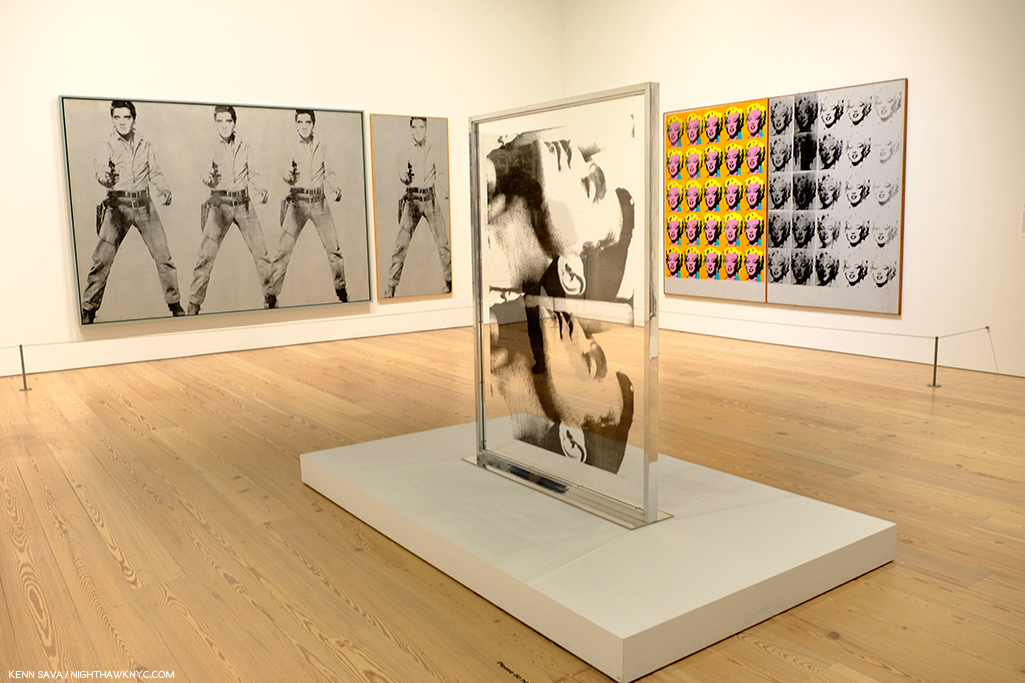
Marilyn & Elvis. Andy Warhol was always drawn to stars, and beautiful men. Personally, and in his Art.

But, the world has changed in the, now, 60 years since Andy Warhol’s career first took off. A lot of Artists have grown up with what he did and it’s become part of their work, even if it’s only unconsciously.

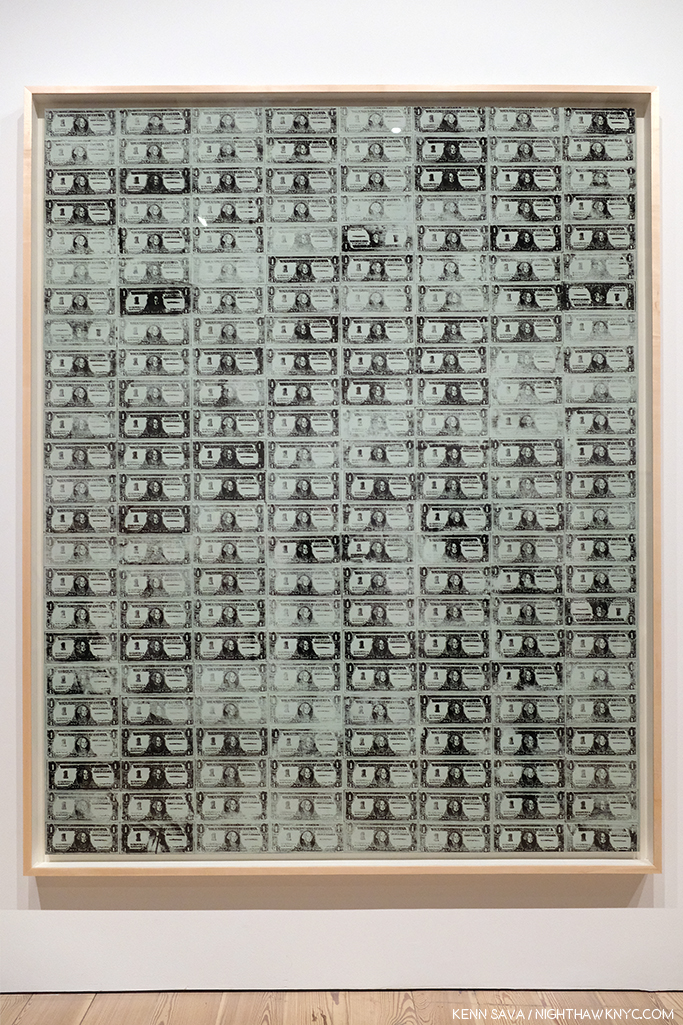
129 Dollar Bills, 1962, among the very first uses of silkscreening in Modern & Contemporary Art.

How many Artists have created with silkscreens since Andy Warhol introduced the possibilities of the ancient technique to the modern world in 1962? Even one of the other innovators and endlessly creative pillars of American Art in the late 1950s and 1960s (and after), Robert Rauschenberg, picked up the technique from Warhol. Since, silkscreening went from creating edgy Art to being used to create the large majority of the world’s T-Shirts, among countless other uses.

“I had by that time decided that ‘business’ was the best art. Business art is the step that comes after Art. I started as a commercial artist, and I want to finish as a business artist. After I did the thing called ‘art’ or whatever it’s called, I went into business art. I wanted to be an Art Businessman or a Business Artist. Being good in business is the most fascinating kind of art. During the hippie era people put down the idea of business—they’d say, ‘Money is bad,’ and ‘Working is bad,’ but making money is art and working is art and good business is the best art,” Andy Warhol. (Note- Not to be confused with my capitalization, caps and lowercase usage are Warhol’s own, reproduced exactly as the quote appears in TPoAW P.92.)

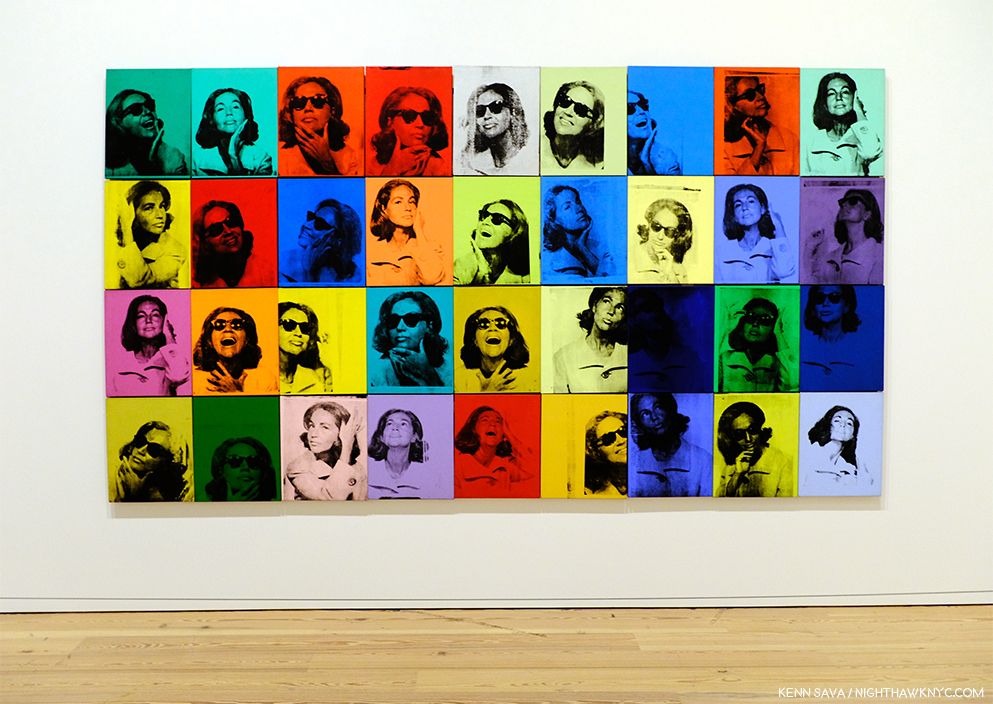
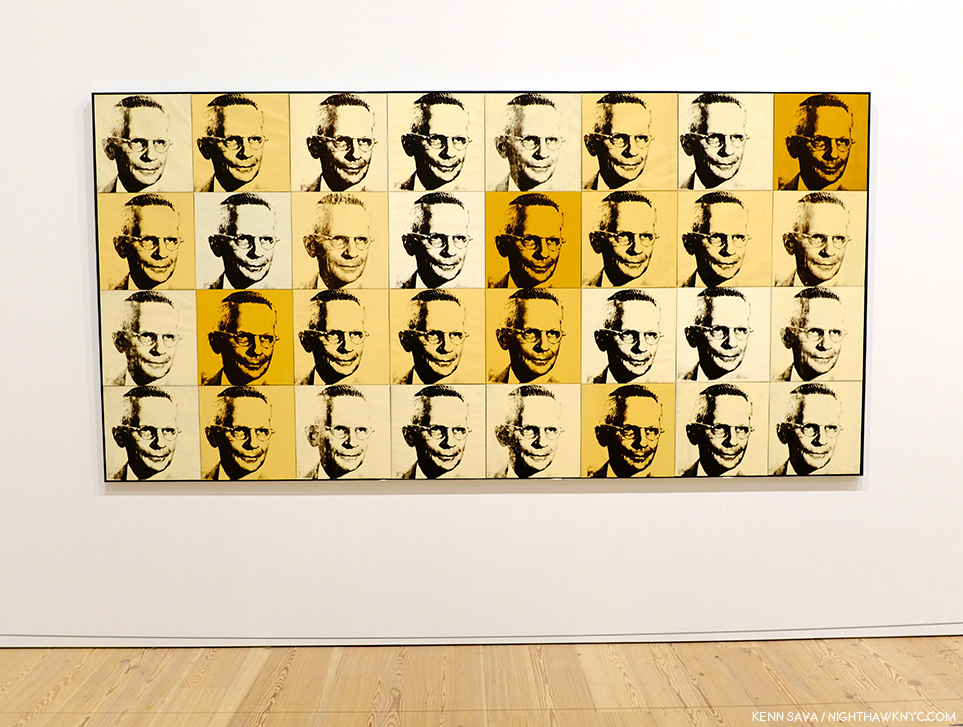
Ethel Scull 36 Times, 1963, jointly owned by The Whitney & The Met, was the first work commissioned from Andy Warhol. It’s a work that, in my view, has outlived its cachet as “Art,” and one that I don’t think posterity will look kindly upon.

Looking at the show, a takeaway for me was the distinct feeling I got was that there was his work, and then there is the work he did on commission (i.e. “Business Art,” a term he mentions in The Philosophy of, quoted above, but doesn’t define). After a while, I thought I could tell even before reading the card or researching the work, which was which- which were the work he did “for himself,” which were the works he did on commission, and I came away feeling there is a world of difference between the two. Wait! There’s a subject for a book I don’t think anyone’s written yet! For Andy Warhol, the business of Art was an Art in itself. Few before (maybe Rembrandt, Picasso and Dali in their ways) understood this and used it, but no one before him mastered it to the degree that Andy Warhol did. Its testament to how well he did it that a good many of his commissions, which detract from his other work when seen along side them as Ethel Scull 36 Times does in my opinion, hang in museums around the world, at least for now.

The American Man (Portrait of Watson Powell), 1964, a pseudo-companion piece to the Ethel Scull piece, above, and another commission, has aged better and still manages to speak to 2019 viewers.

To be fair, looking at some of his commissions now, we might well see in them a “commentary” by the Artist on matters beyond the mere representation of a given subject. The American Man, 1964, commissioned after seeing Warhol’s Ethel Scull piece, struck me that way. I’m still looking for that in a good many others, though.

After a couple visits, I was able to choose a few works in the great guessing game I like to play, and encourage everyone else to play- “Which works will be considered Art in the future- if any?” I came up with eight including the Campbell’s Soupcans and the 129 Dollar Bills already shown. 8 out of the 350 works the Museum says were on view. Personally, I don’t believe the passage of the centuries is going to be kind to most of Andy Warhol’s Art. Part of the reason for that is his pervasive influence. History doesn’t often look back favorably on who was first, particularly in Art. (Quick- Who “invented” oil painting? When I was growing up, I believed what Vasari wrote in The Lives of the Most Excellent Artists, 1550,  that it was the great van Eyck brothers, Jan and Hubert, who happened to be my first favorite Artists.) More recently there is no consensus and evidence of oil paint may have been found going back to 650AD.) Given the overheated state of his prices (still, in spite of a recent leveling off), his Art is definitely not where I’d put my money now. That ship has sailed. NOTHING goes up forever! Look elsewhere in 2019. (See my Post On Buying Art for additional considerations, all of which apply to the Art of Andy Warhol.)

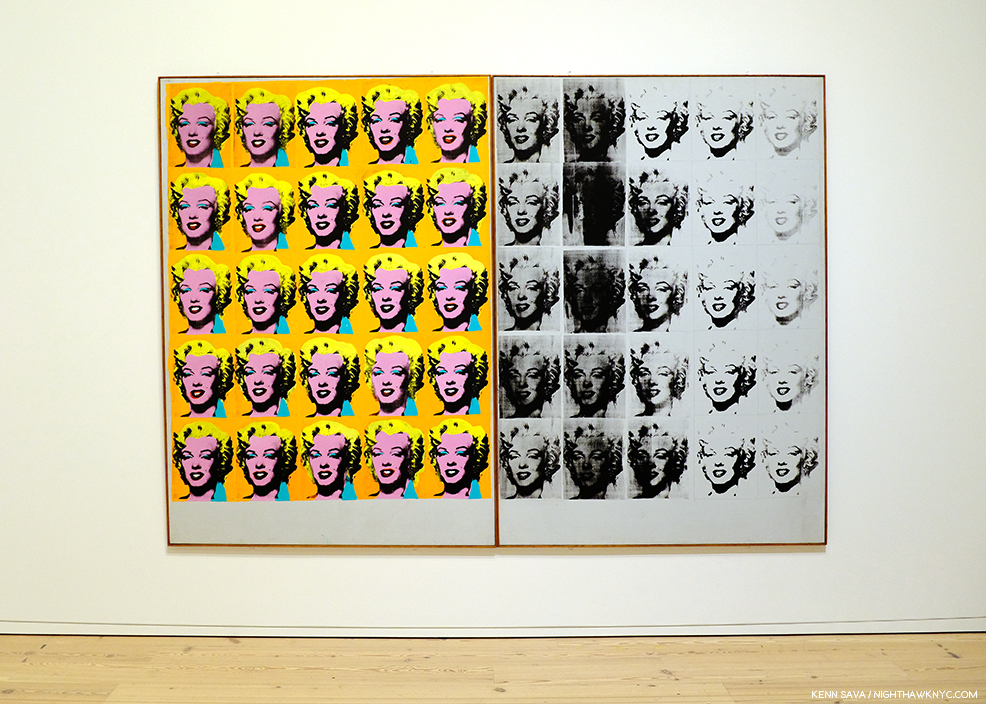
Marilyn Diptych, 1962

Let’s look at numbers 3 to 7 on my list for the ages (in no particular order). Next, Marilyn Diptych, 1962 – The duality of this work painted shortly after Marilyn Monroe’s suicide is revolutionary. On the one hand, Warhol shows Marilyn the idealized, beautiful, glamorous movie star, repeated radiantly in a sea of gold not unlike that of the religious icons of the Eastern Orthodox and other churches. On the right hand, the work seems to reference the darker side of both Marilyn’s life and death. This work is striking when one also considers that Andy was someone who sought autographs of movie stars as a child. Here, all the illusions of the silver screen are gone.

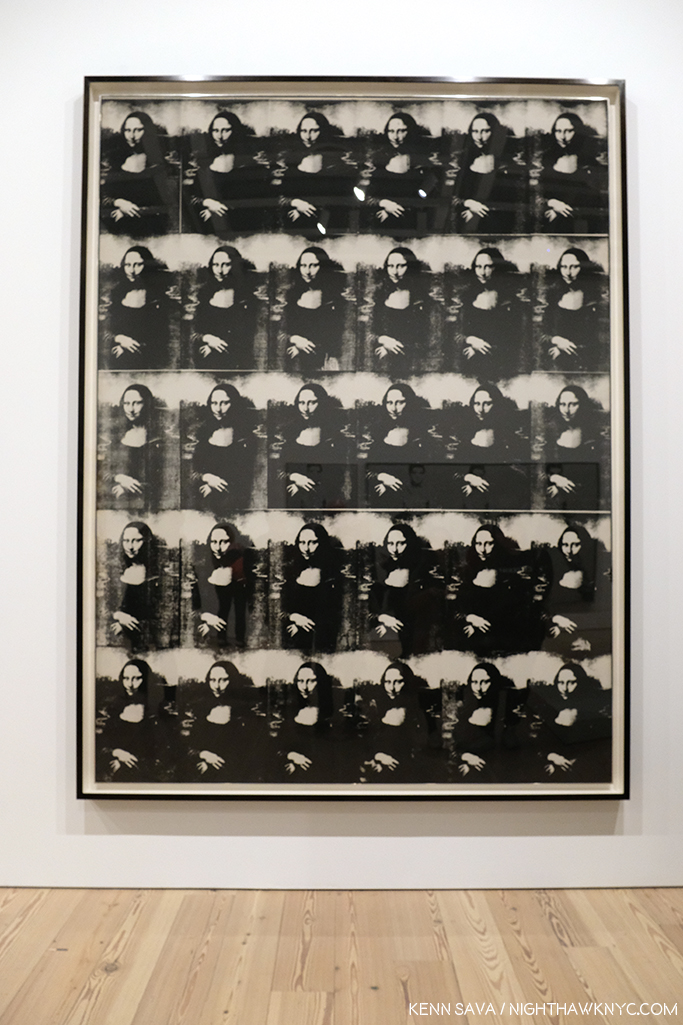
Thirty Are Better Than One, 1963

Thirty Are Better Than One, 1963, The multiple Mona Lisa as a commentary on the original’s visit to the USA at the time present an interesting counterpoint to the da Vinci- even in black & white. This one barely made my list, but given the precedent of other Artist’s commenting on or reinterpreting the Mona Lisa, like Duchamp, I think it will be of interest indefinitely.

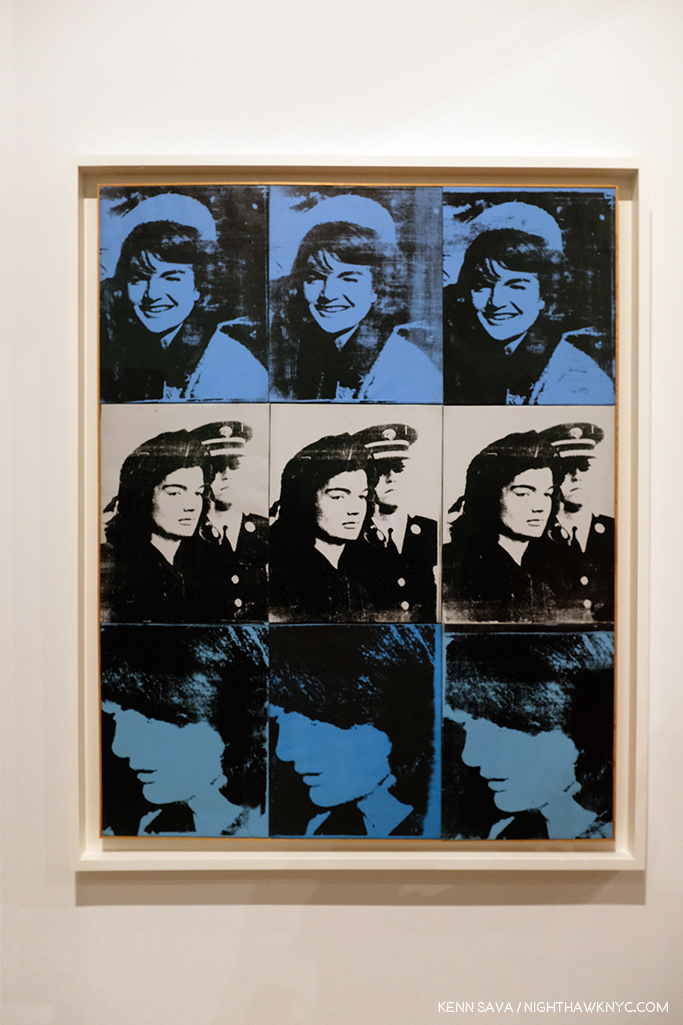
Nine Jackies, 1964

Nine Jackies, 1964. Something revolutionary in portraiture, the Artist captures the beauty of the Kennedy “Camelot,” and the horror and disbelief of what took place on November 22, 1963, as I remember it. A work that relies on the power of the Photograph, it’s one of the strongest uses of it in a medium outside of its own.

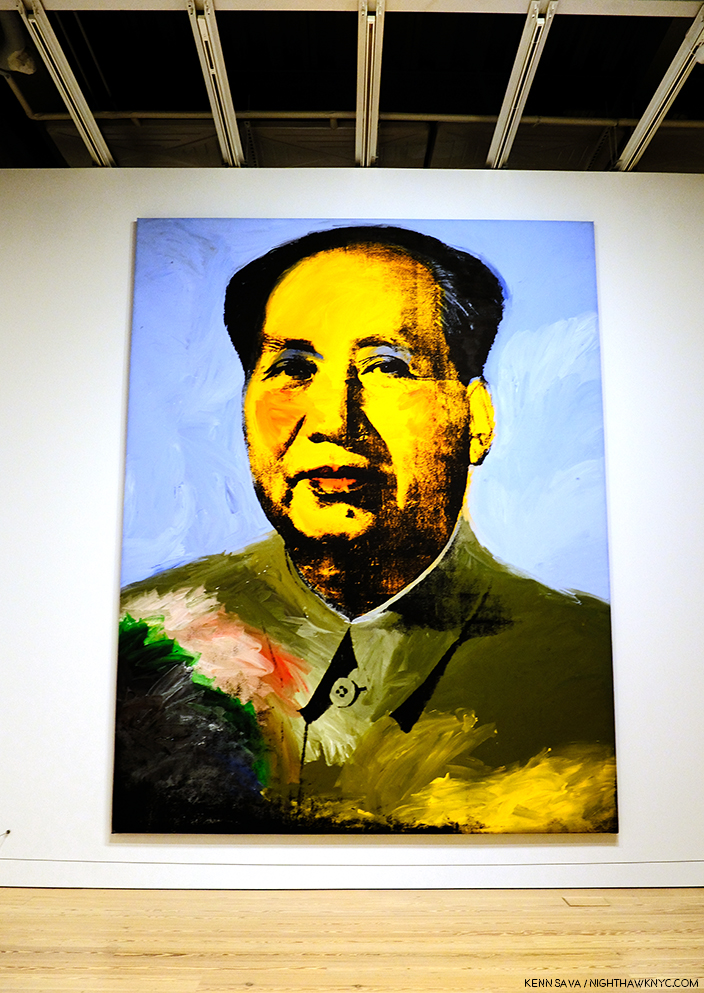
Mao, 1972

Mao, 1972- Created during the year of Nixon’s breakthrough visit to China, Andy Warhol’s image takes the portrait of Mao from the infamous Little Red Book of sayings and statements by the Chairman, which may have been the most reproduced image in the world at the time. Here, over 14 feet high, it symbolizes the Charman’s looming over all things in China, a different kind of manifestation of fame. Andy would make a brief trip, himself, to China in 1982, where he posed for a few pictures looking very stiff and uncomfortable.

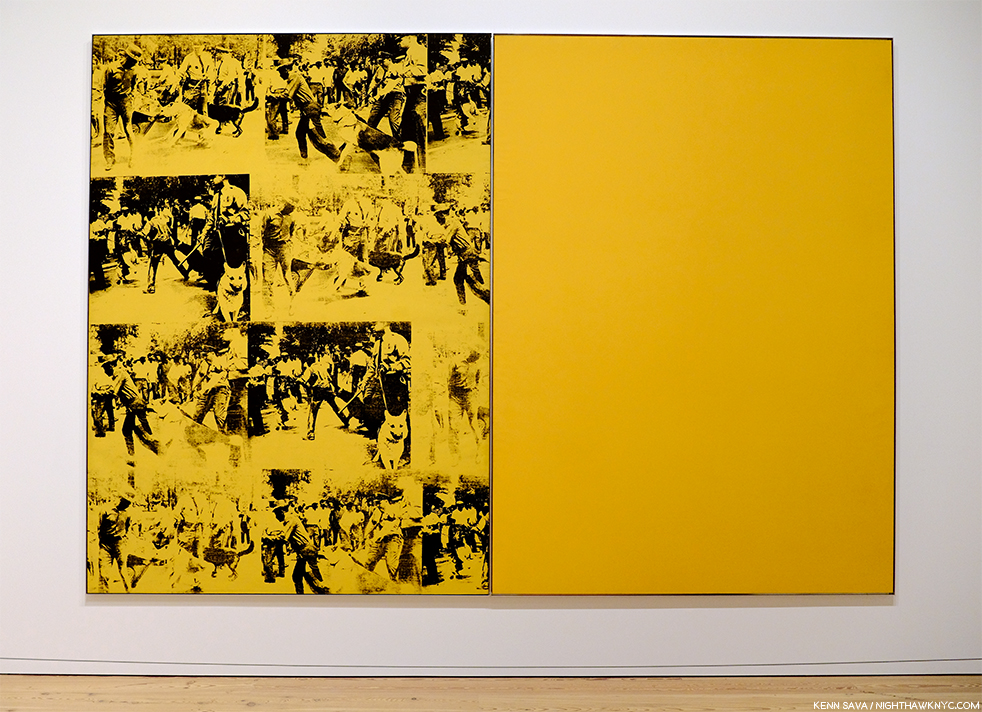
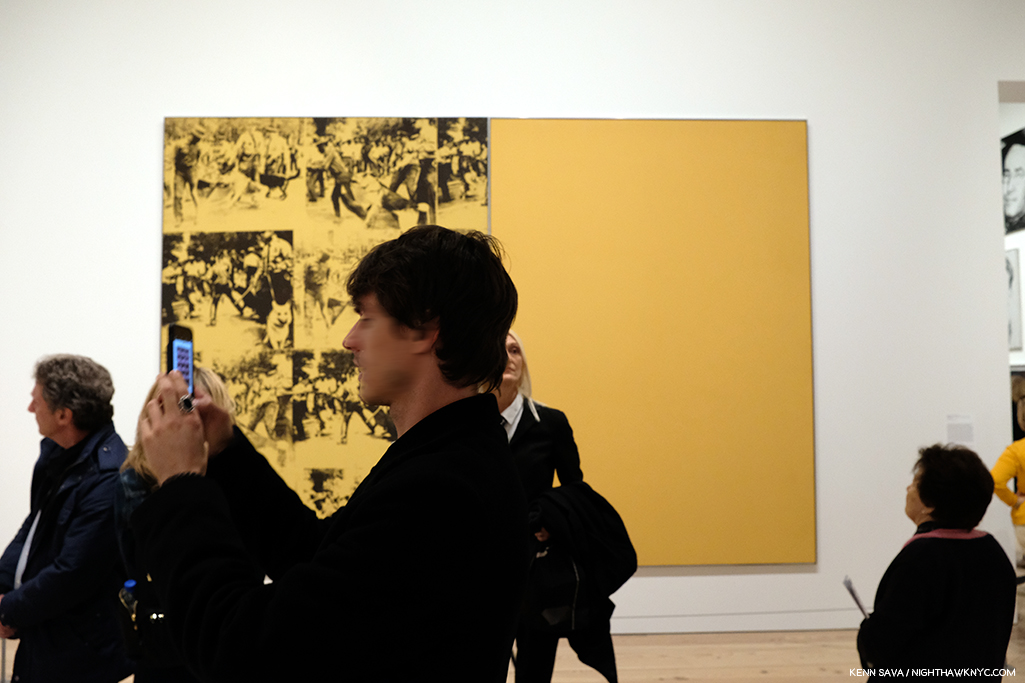
Mustard Race Riot, 1963.

Mustard Race Riot, 1963- Without a doubt, the most powerful work in the show, in my opinion, it sold for only $15,127,500.00 in 2004. “Only,” when you consider the current record price for a Warhol is $100 million (Eight Elvises), and when you consider another Warhol Race Riot, one that had been owned by Sam Wagstaff and Robert Mapplethorpe, sold for almost $63 million in 2014. As Artist Hank Willis Thomas, and others, have pointed out, this work looks as prescient as almost anything else in the show. Standing in front of it (which means standing a ways distant since it’s  114 by 82 inches), pondering it over multiple visits, I came away feeling that it may be one of the most important works of the 1960s, and for 1963, certainly gave those putting Andy Warhol in the “Pop Art” box pause for thought,  pointing out yet again the pointlessness of such terms.

Then? Something occurred to me to sleep top me dead in my tracks. ALL FIVE of these works involve the use of appropriated Photographs taken by others. Did Andy Warhol pay the Photographers for using them?

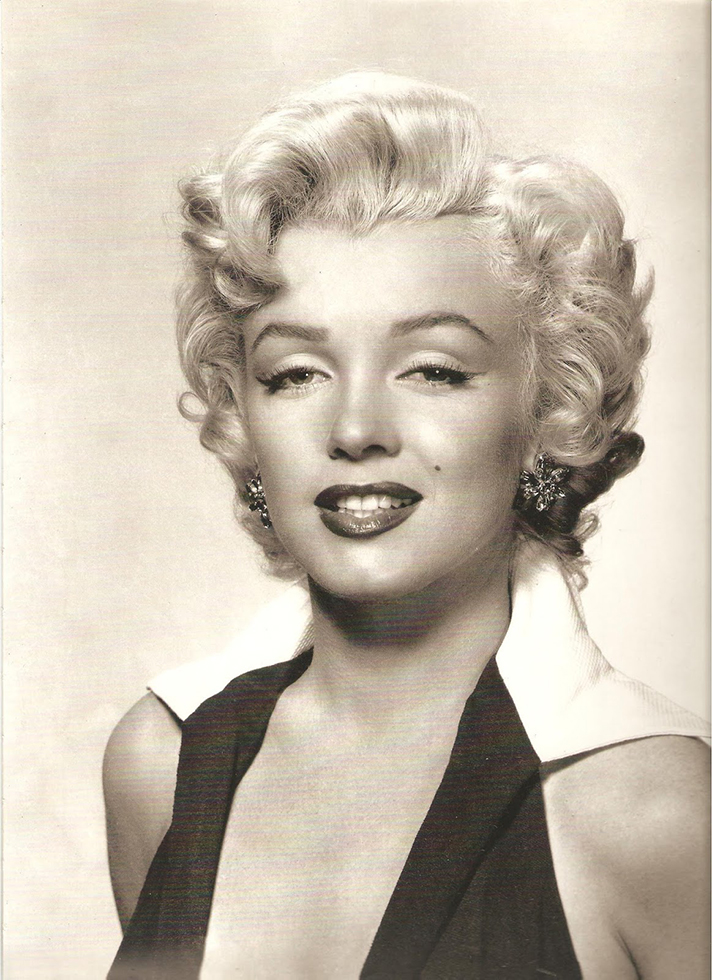
Gene Kornman, Photograph (Marilyn Monroe ), 1953. *Publicity Photo of Marilyn Monroe for the Film, Niagara.

This subject was not brought up anywhere that I saw in the show. They did mention (and exhibit) the Gene Kornman Photo Andy Warhol used, perhaps more than any other, was originally a publicity shot of Marilyn from her classic 1953 Film, Niagara. Also exhibited were the source Photos he used in Nine Jackies, which I subsequently learned Andy Warhol was sued over his use of. Charles Moore’s 1963 Life Magazine Photos were the source for Warhol’s Race Riot works, including Mustard Race Riot. Frankly? For an Artist who was so endlessly creative? That he did this, and did it for so long and so often surprises me. It took lawsuits for Andy and Robert Rauschenberg, who was also doing it, to decide to exclusively use their own Photographs henceforth, which, I think, improved the results for both. Yes, at the time, this was new territory for Artists. Copyright infringement was not a term that was not as common in Art in the late 1950s and early 1960s, and he had made his name using copyrighted names and trademarks for Campbell’s Soup, Brillo, etc., without issue- the companies involved, no doubt, relished the free advertising and attention, so giving his restless creativity the benefit of the doubt might apply here, I think (easy for me to say, I’m not Gene Kornman, who’s Photo of Marilyn wound up in Art that’s, no doubt, worth hundreds of millions of dollars, if not more, today).

I still think these are powerful works, among the best Warhols I’ve seen, but this does tarnish them a bit. It’s hard to ignore today. But, let’s move on.

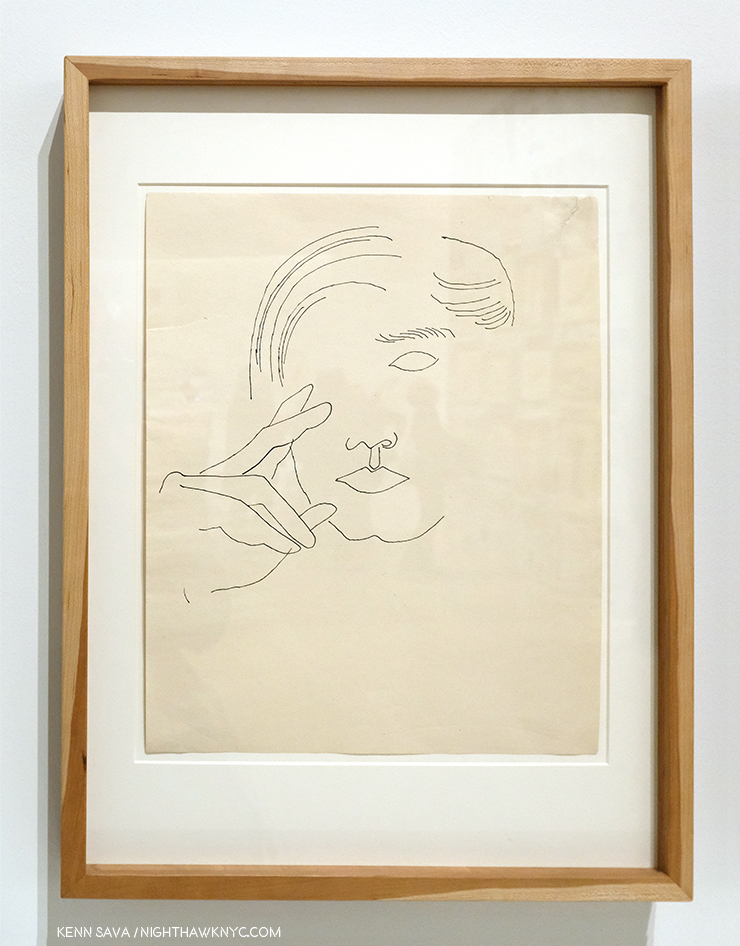
Self-Portrait, 1950s

I’m always interested to see any Artist’s Drawings, and I made a point of spending a considerable amount of time with the Drawings, mostly early, of Andy Warhol displayed here. It’s interesting that they reveal a wonderful sense of, and control of, line, which I’ve long thought to be the most technically difficult part of Drawing. So confident is the young Artist in his line that he dispenses with almost everything else- even parts of the composition! Shading is only hinted at once in a while. Throughout, it’s his line that carries the work. This style is reminiscent of one Picasso used in the early 1900s to create works like this. In addition, he shows an economy that makes it fascinating to consider what he’s left out, a uniqe way of using what Artists call “negative space.” This Drawing is markedly different from the “scratchy” drawings with halting lines seen in some of his commercial work of the period. He changed his style to fit the subject, and it always worked. He was a very successful illustrator and store window designer. But? Shoes and shoe design held a special place in his heart.

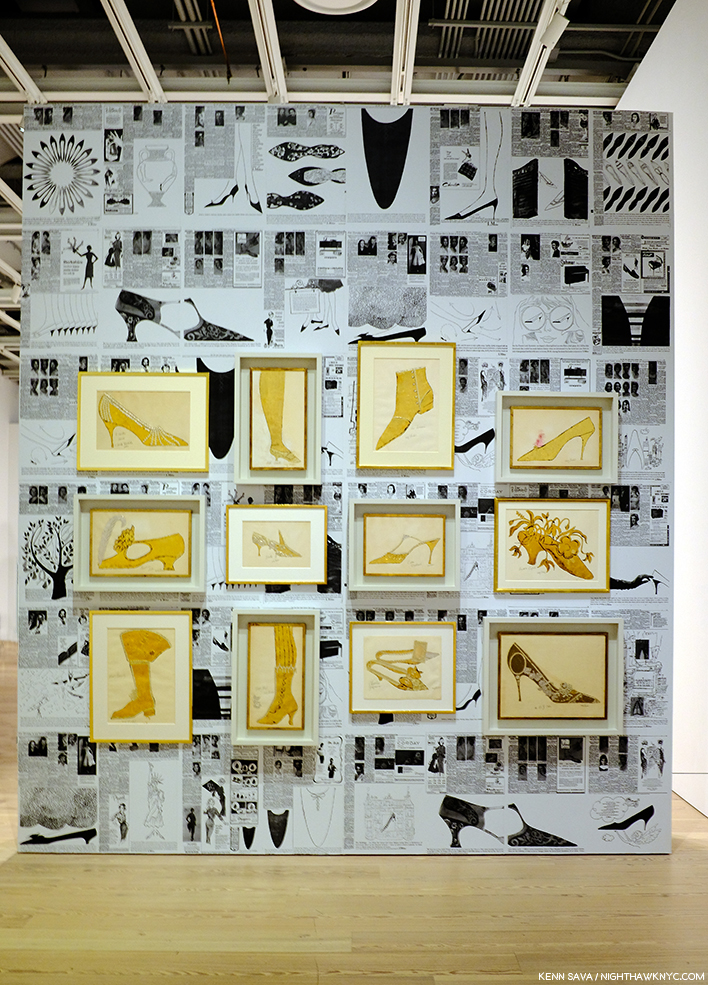
A wall of shoes. In each of the works in gold, Andy created a shoe as a caricature of a person.

It turns out that Andy Warhol had a shoe fetish. A real one, that surpasses the most shoe obsessed of my female friends, which John Giorno describes in graphic detail in the Documentary Andy Warhol: The Complete Picture! At 24:30, Mr. Giorno says, “There was Andy Warhol on his hands and knees kissing my shoes…”

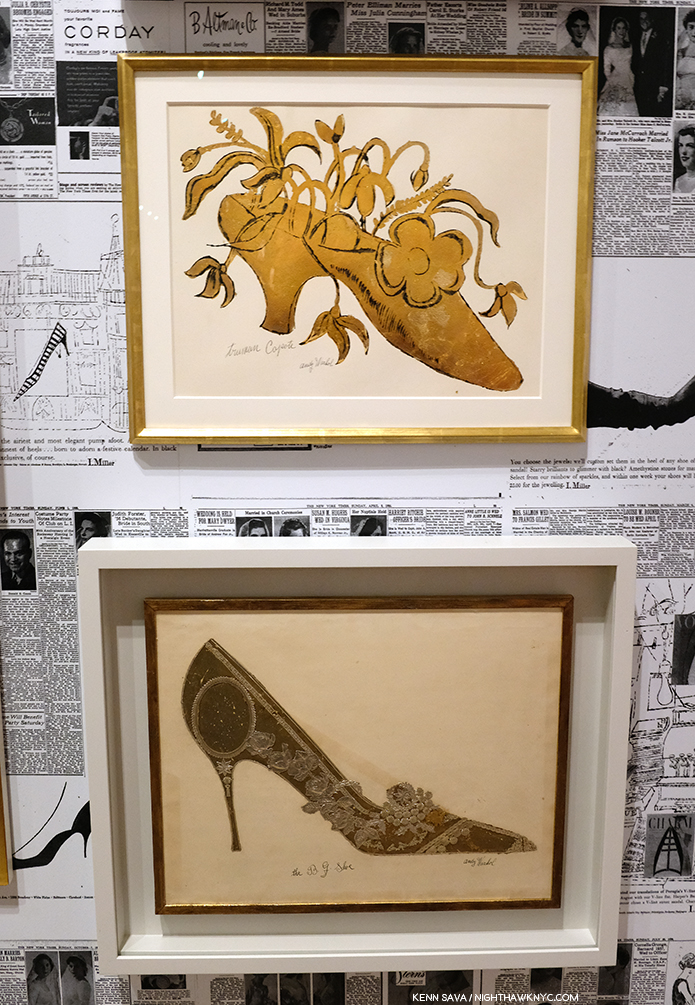
Andy’s Truman Capote Shoe, with calligraphy by his mom, is seen over his The B.J. Shoe. Given his shoe obsession, it’s interesting that there are no works after this period that feature shoes, as far as I know. Also interesting is that Andy, himself, wore the same pair of paint splattered shoes for 25 years, which are also shown in The Complete Picture.

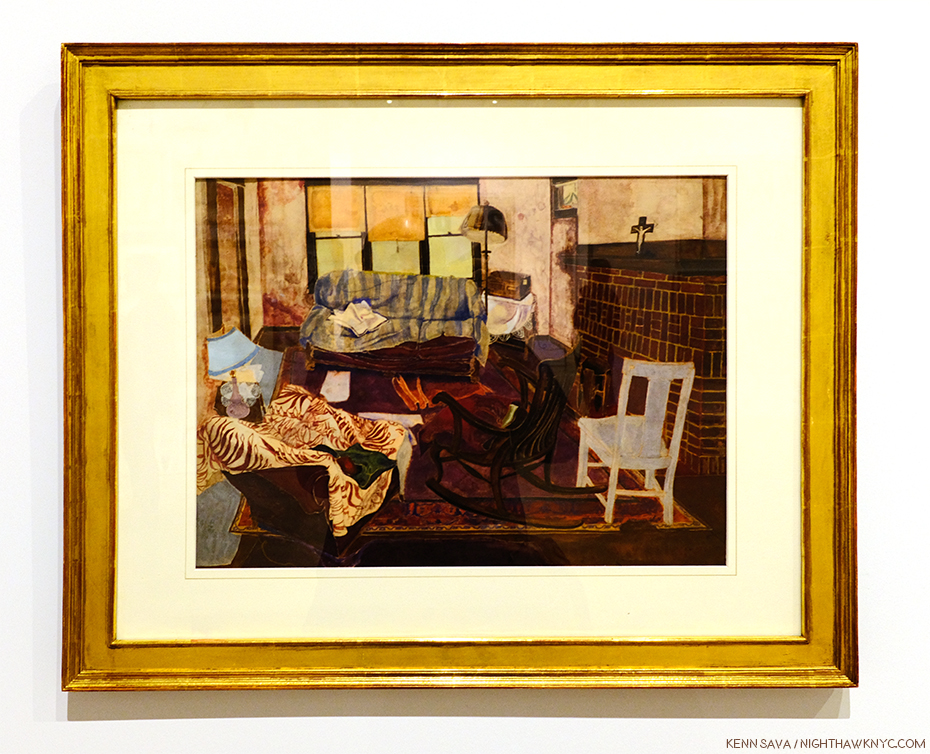
Even in the midst of his intensive period of Drawing for his commercial illustration clients, he was always looking for ways to create multiples of his Drawings. This led to his use of silkscreens. But yes, he Painted. This early Painting is the one work in included that would meet the definition of a Painting for most of Art History- prior to Warhol.

The charming Living Room, 1948.

From there, his Painting skills were used to modify and enhance works in other medium, like silkscreens, in works that were multi-media Paintings.

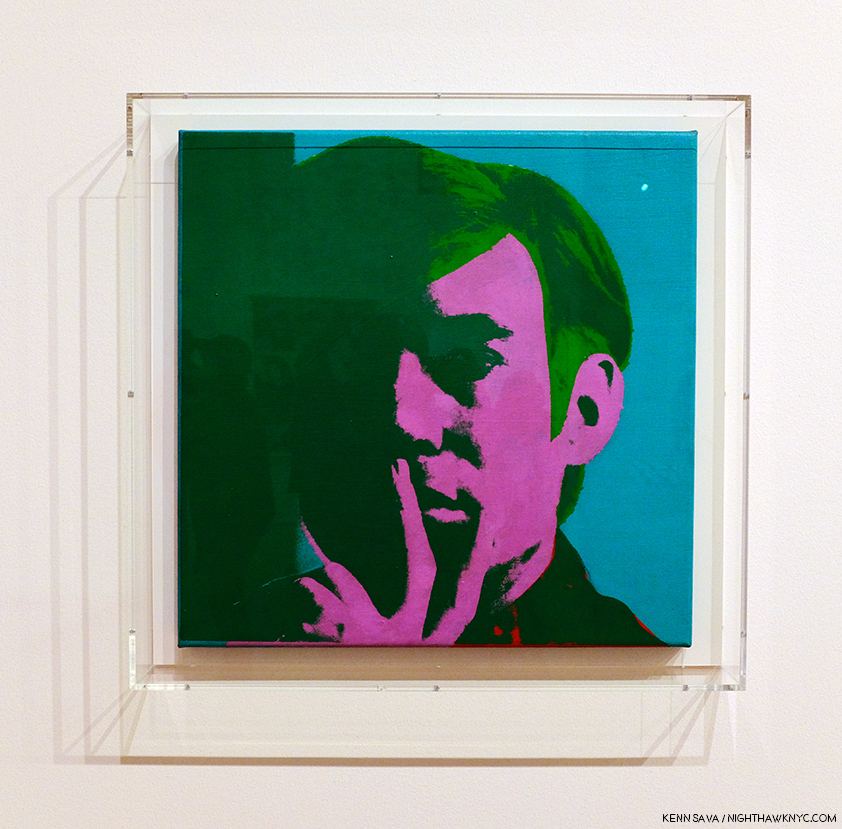
Self-Portrait, 1966, Acrylic, silkscreen ink, and graphite on linen.

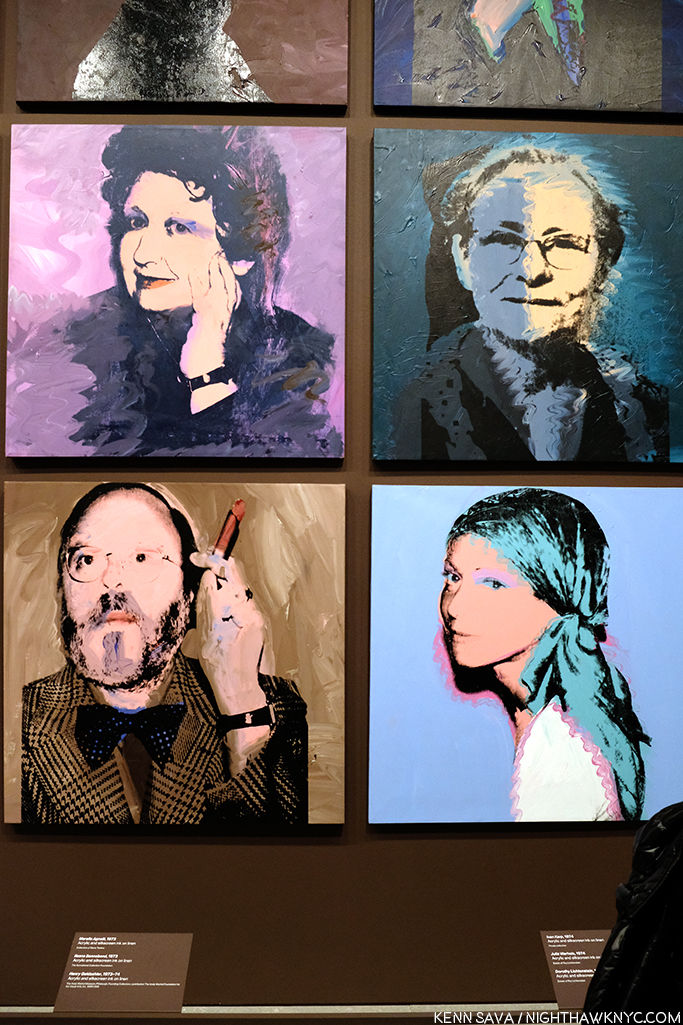
It seemed to me walking through the show that Warhol’s Self-Portraits are stronger than just about any of his other portraits. Downstairs on the first floor, an entire gallery was devoted to his square portraits, which alternated between the famous and the already forgotten with a fascinating portrait of his mom almost hidden among them.

Julia Warhola, 1974, upper right, a year or so after she passed away in 1972. Interestingly, it’s in the collection of Roy Lichtenstein, and that’s Dorothy Lichtenstein, Roy’s wife, below her. To her left is Met Curator Henry Geldzhaler, who was also painted by David Hockney.

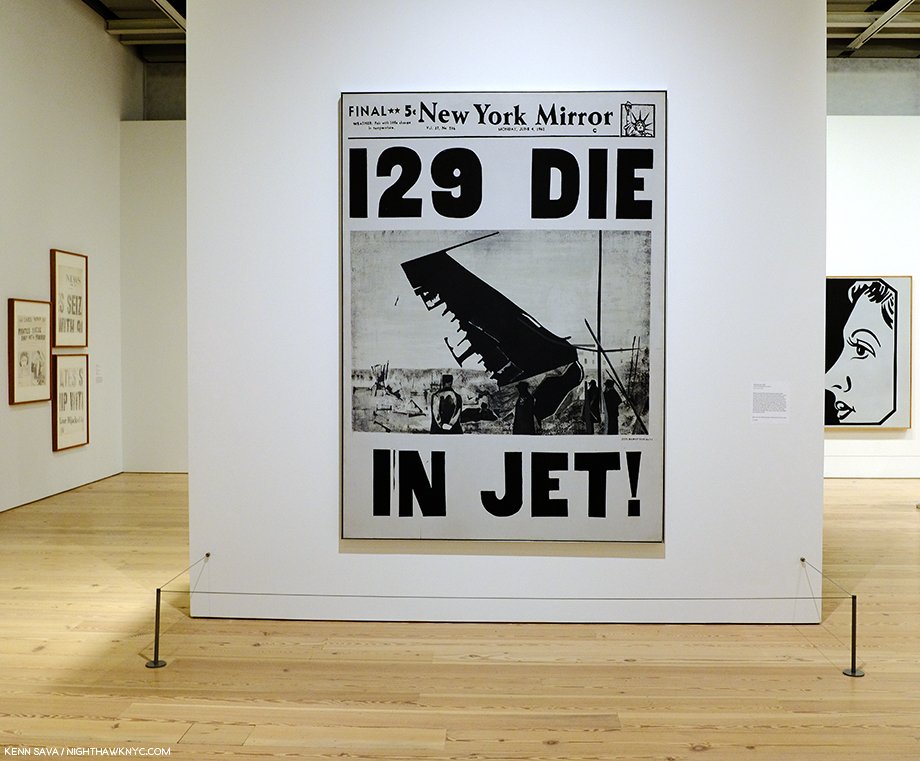
Along with fame, Andy Warhol’s other big theme was death. It’s a subject that makes an appearance early on in his Fine Art career, in works like 129 Die in Jet, 1962

129 Die in Jet, 1962

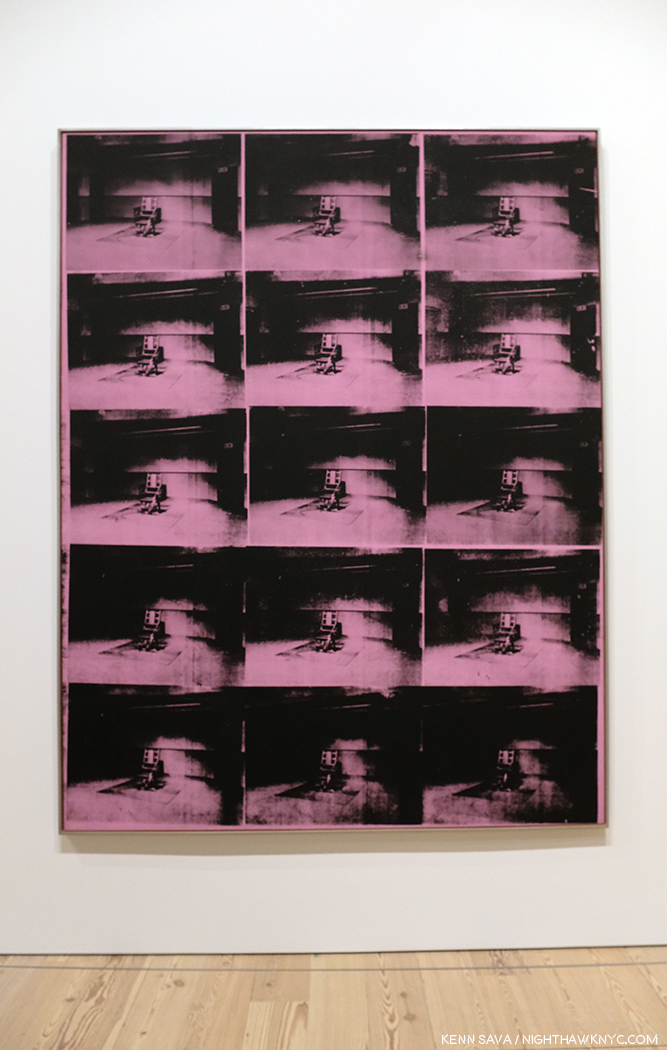
It carries on in his Electric Chair Paintings, and is an element in his Marilyn and Jackie pieces, both created shortly after deaths- Marilyn’s and JFK’s. The hold death has on visitors struck me on one visit while I was considering Mustard Race Riot. Given its large size, I had to stand a good distance away from it to take it all in.

I couldn’t help noticing a steady stream of visitors who entered the gallery and stood in front of me, facing to my left. They were looking at this-


Lavender Disaster, 1963.

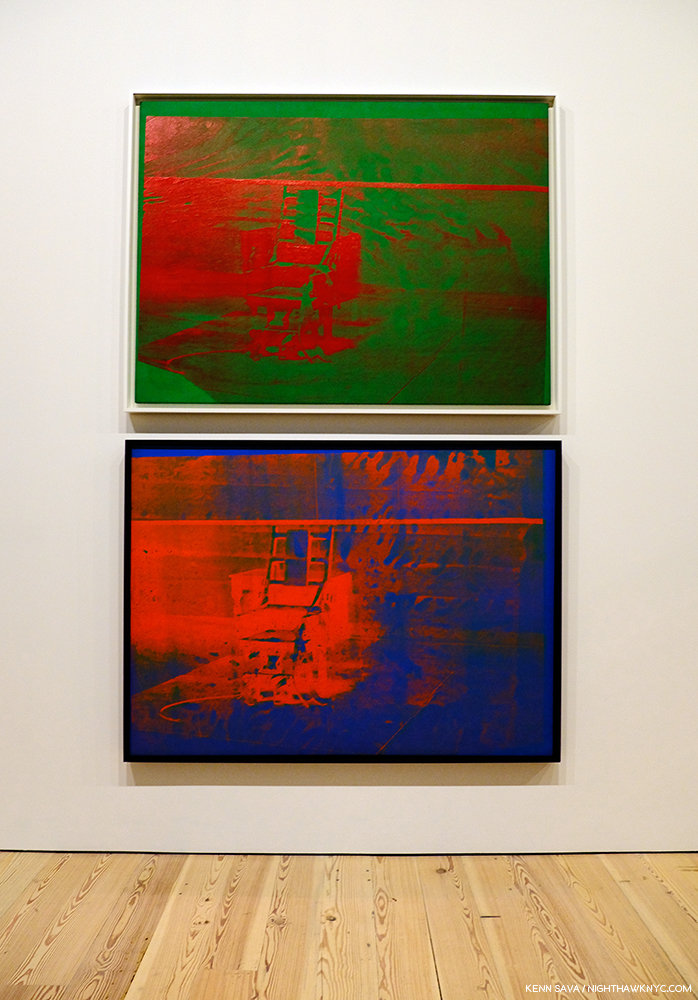
I heard someone say, it takes away the power of the electric chair as an image of fear. I don’t get that. I, for one, don’t get the point of multiplying the electric chair. I prefer these, individually-

Both, Big Electric Chair, 1967-8, top, 1967, bottom.

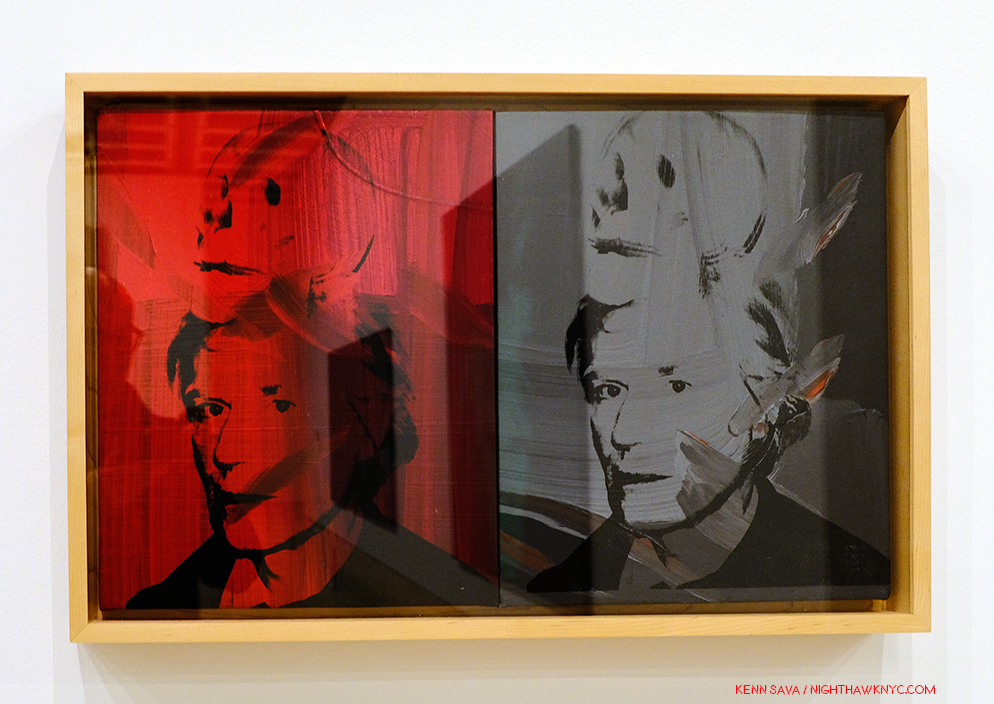
And, of course, there were the car wrecks, also featuring repeated Photos, which led into the next gallery, where the equally death-soaked Nine Jackies awaited, facing a wall of Most Wanted Men, 1964, Andy Warhol’s works based on wanted posters that hung at the New York Pavillion at the 1964 World’s Fair, and works from Flash-November 22, 1963, also about the JFK Assassination. But, of all the works related to death in this show, the eighth and final work on my “Art” list is Self-Portrait with Skull, 1978, in which the Artist brings his obsession with death home.

Self-Portrait with Skull, 1978

On the left, the red is hard to miss as the color of blood, and therefore, of life, while the grey/black image on the right recalls those in the Marilyn Diptych, which speaks to her demise and death. This work is based on one of Warhol’s own Photographs.

Andy Warhol- From A to B and Back Again was a good, but not a landmark show, in my opinion. In NYC, MoMA’s Warhol: A Retrospective remains the benchmark Warhol show. Part of the reason it’s not better is possibly due to the popularity and value of his work making loans very hard to get. After the silkscreen gallery with Mustard Race Riot, I felt the rest of the show continually declined, with isolated examples of better work. In much of the rest of it, I felt lost, adrift in galleries of work that either hadn’t held up to the passage of time (if they ever did stand out) or that contained ideas manifested on a gigantic scale, like the “piss paintings,” that were probably either left in the studio or done on a smaller scale. At this late date in his life and career, to suddenly go fully abstract smacked of running out of ideas, which is something that seems impossible for Andy Warhol.

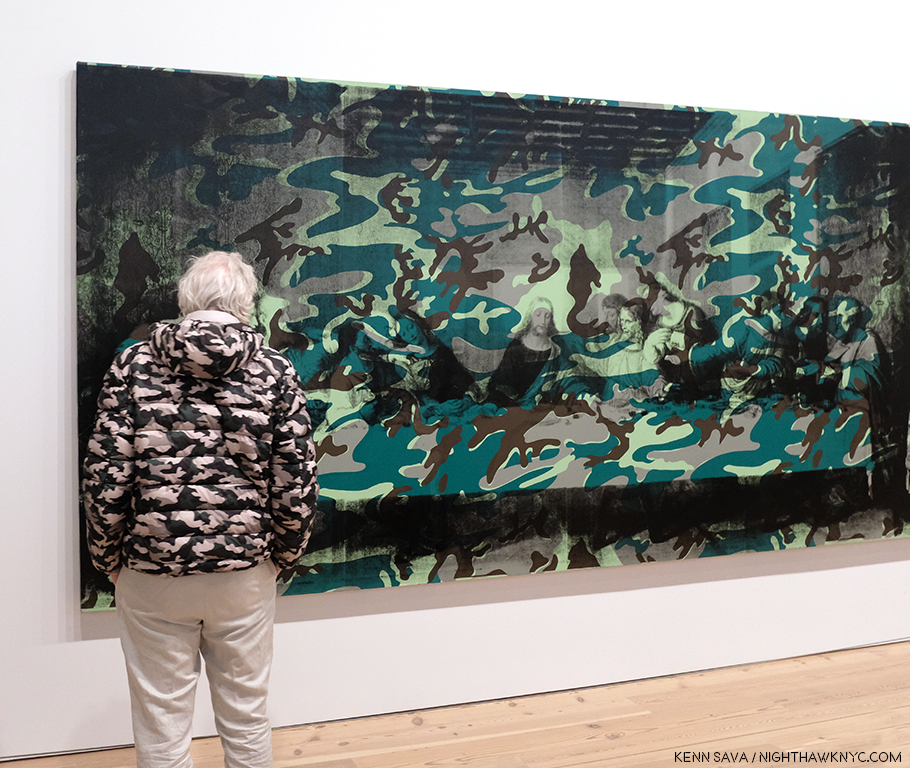
A camouflaged visitor scrutizies the left half of Camouflage Last Supper.

The culminating gallery with the also gigantic Camouflage Last Supper also struck me as a poor choice. Here, Warhol reprises the idea of the multiple Leonardo da Vinci’s, this time with 2 huge Last Supper reproductions side by side, which makes a point that escapes me, and then covers them with camouflage, perhaps to try and add some interest to his idea. Camouflage is, in keeping with Andy Warhol’s instantly recognizable images, a military artifact and symbol. What that has to do with the Last Supper is, also, lost on me.

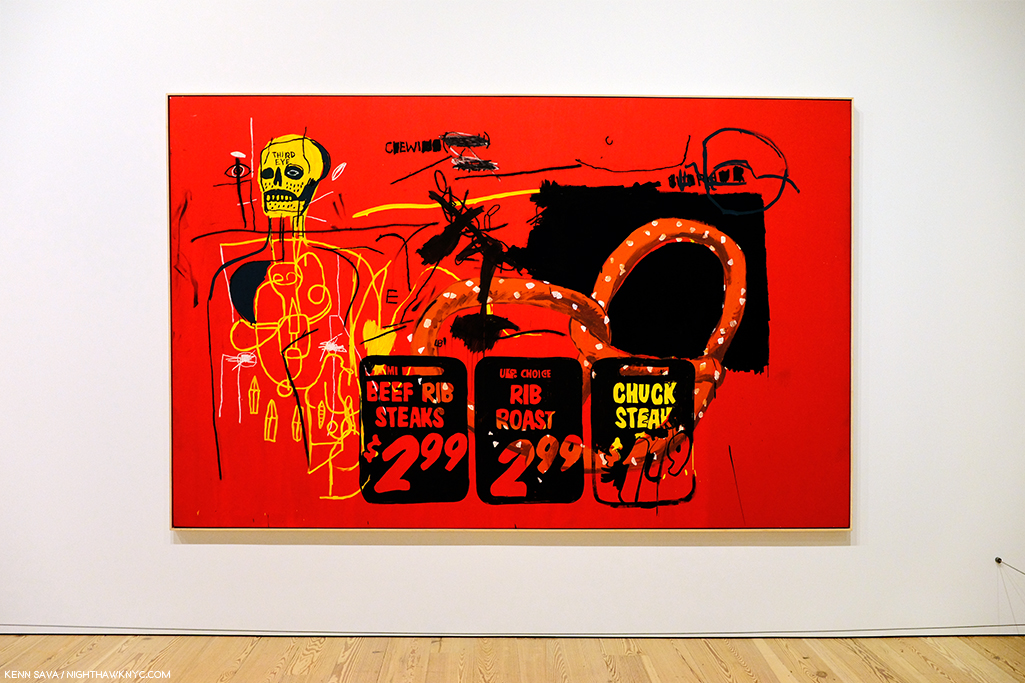
Andy famously collaborated with Jean Michel Basquiat, as seen here in Third Eye, 1985.

And then there were two of his collaborations with Jean Michel Basquiat. Though extremely colorful, looking at them I have as yet to see them as more than each bringing what they do to the work. The feeling of a true collaboration bringing the work to someplace else escapes me…so far, but I know people who love them.

If these walls could talk. The site of Andy Warhol’s Factory when it was on Union Square, seen in Winter, 2018. Ironically, the scaffolding seems to be making an “A” for Andy.

Andy Warhol opened the doors to whole worlds of possibilities in the world of Art, and, indeed, the world. In doing so, he taught all of us how to see new possibilities in our work, and our lives. (And I am not speaking about his life or lifestyle in any of this.) There are very few Artists who even open one new door. For this, the world owes him a debt. A debt that might be best repaid by following his example of seeking new possibilities. He sought out, encouraged, and worked with, young, even beginning Artists, and so played a role in the creation of world renowned Artists including Stephen Shore, Robert Mapplethorpe, and  Jean Michel Basquiat, and treated them every bit the same as he did established Artists.

Regardless of what the world comes to think of his Art, these are the contributions of Andy Warhol I choose to remember and celebrate.


BookMarks-

As I showed earlier, a list of books written on and about Andy Warhol could fill a book itself. I have only seen a minuscule number of this vast library. Of those, a few stand out to me, particularly for those looking to keep from having a wall of Andy Warhol books that rivals that in the Whitney’s Shop!

The best overviews of his Art I’ve seen are these two-

Andy Warhol “Giant” Size: Gift Format has been issued in a few sizes over the years since it’s first release 10 years ago. Whatever size works for you, this “visual biography,”which includes over 2,000 images, remains the best one-volume survey of Andy Warhol’s Life & Work.

Andy Warhol: A Retrospective The catalog for MoMA’s 1989 Retrospective. Out of print, it’s reasonably priced in hard or softcover on the aftermarket. It remains the most comprehensive overview of his Art, and serves as the catalog for the most exhaustive show of his work yet mounted.

Factory: Andy Warhol by Stephen Shore is a fascinating book for Photography lovers. It preserves, both, the earliest body of work yet published by one of the most important American Photographers of his generation, and the most comprehensive look at Andy Warhol’s legendary Factory we have. Wasn’t it Andy who said, “It’s like an auto wreck you can’t take your eyes off of”? If not, he should have.

Finally, The Philosophy of Andy Warhol (From A to B and Back Again) is a must read, as much for its entertainment value as for its life experience advice, which is given on almost every page, though it’s light on Art and technique for Artists looking for a “how I did it.” Rumor has it a team “helped” Andy write it, but it’s hard to tell from the distant outside if that’s true or who did what. It’s something of a classic among pseudo-autobiographies, and plays a seminal role in the creation of Andy Warhol, as a work of Art in himself.

*- Soundtrack for this Post is, what else? “Andy Warhol” by David Bowie, who memorably played Andy in Julian Schnabel’s Film, Basquiat, looking for all the world like he was having a blast doing it.

Oh! PS- Andy? 4,627 words.

NighthawkNYC.com has been entirely self-funded and ad-free for over 6 years, during which over 250 full length pieces have been published. If you’ve found it worthwhile, you can donate to keep it going & ad-free below. Thank you!

Written & photographed by Kenn Sava for nighthawknyc.com unless otherwise credited.
To send comments, thoughts, feedback or propositions click here.
Click the white box on the upper right for the archives or to search them.
For “short takes” and additional pictures, follow @nighthawk_nyc on Instagram.

Subscribe to be notified of new Posts below. Your information will be used for no other purpose.
 

  1. The Philosophy of Andy Warhol, henceforth TPoAW, P.86
  2.  TPoAW, P.26
  3. TPoAW, P.96