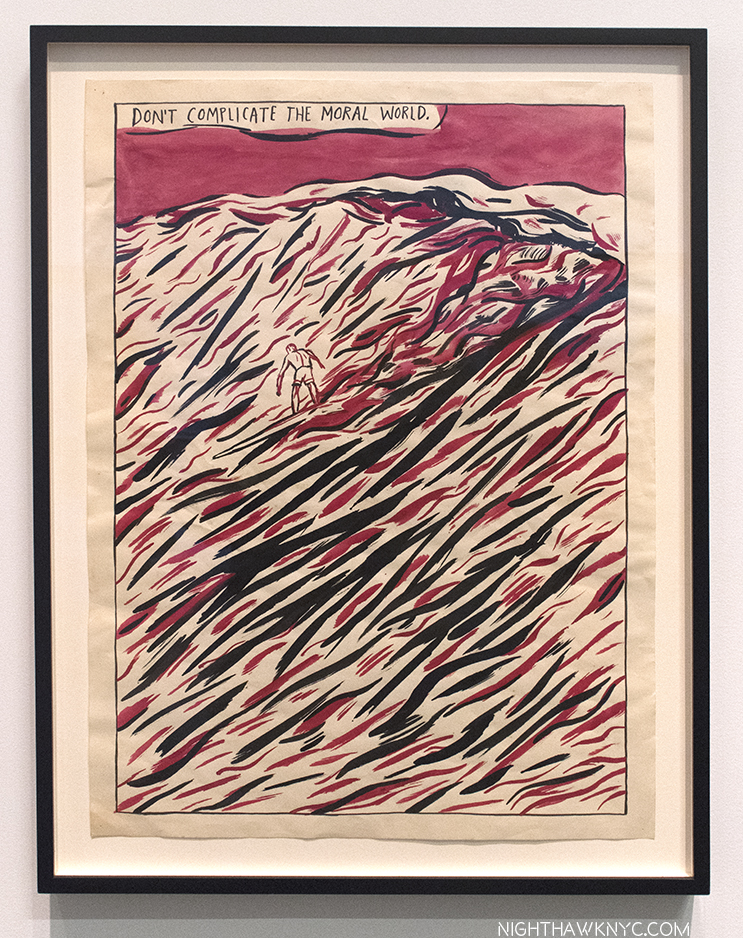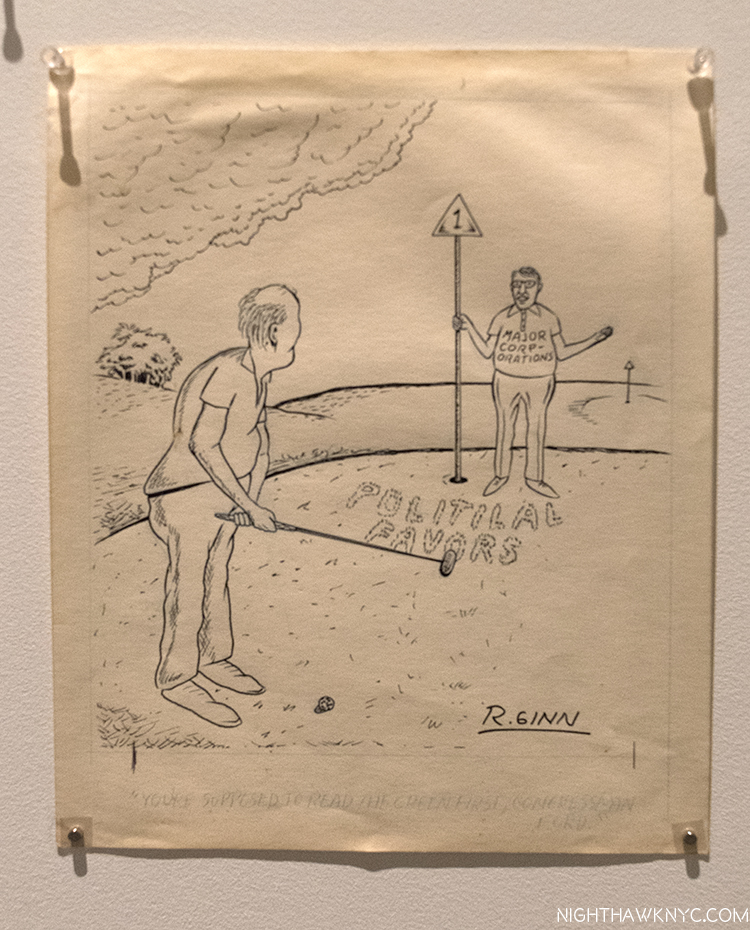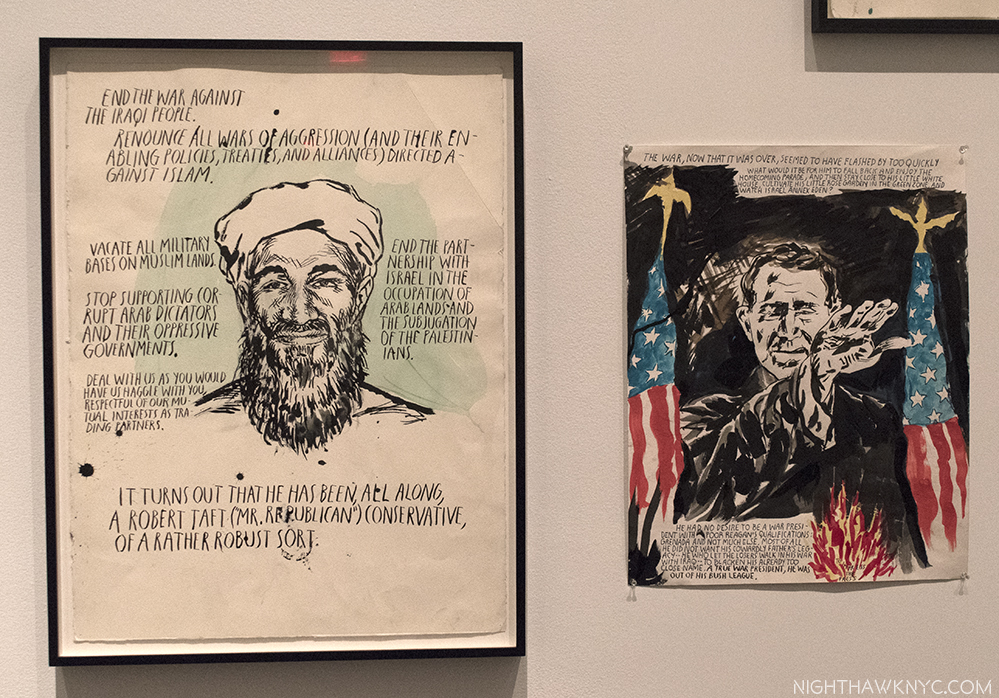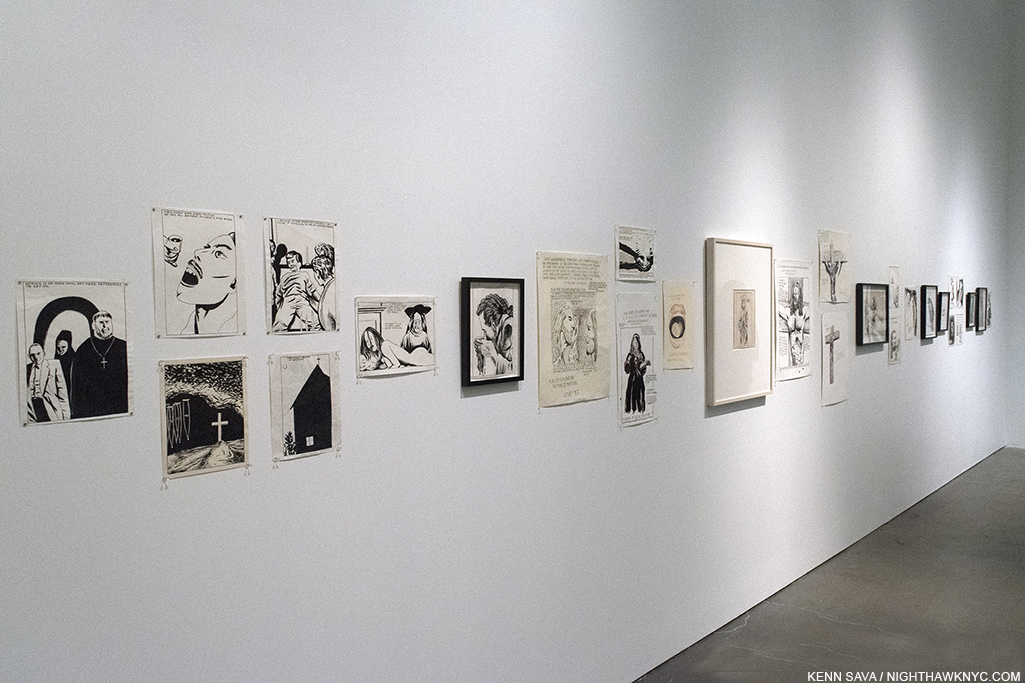
Raymond Pettibon: Artist Americanus

Gumby had magical powers.
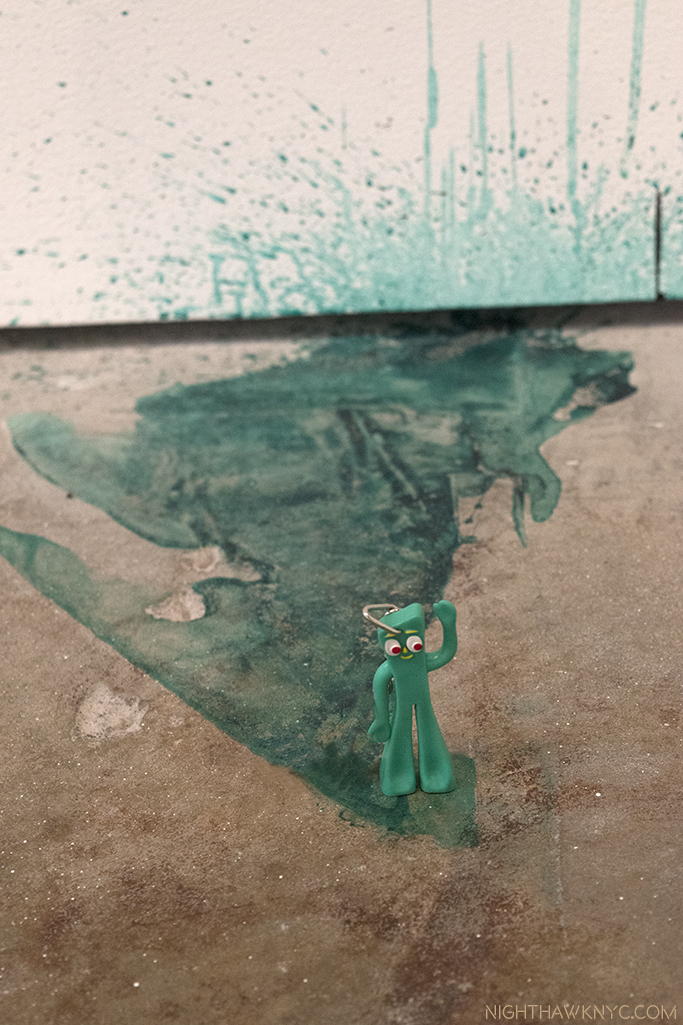
Gumby! You made quiet a mess on the floor of David Zwirner Gallery! Click any image for full size.

Using them, he was able to walk into books and become part of the story inside, usually solving whatever the problem was.
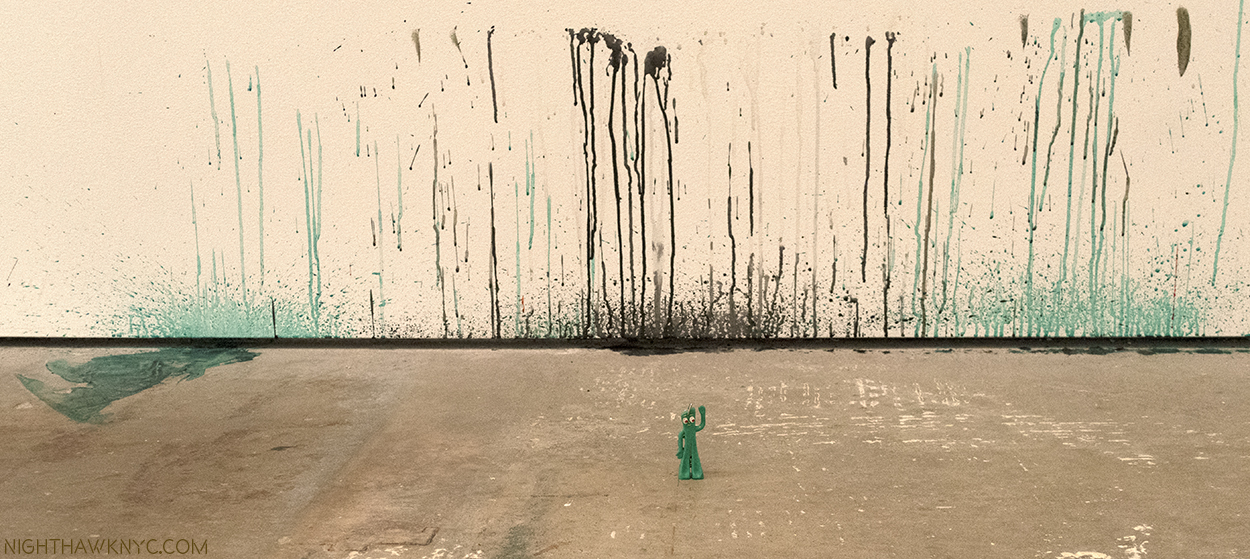
And, the walls, too! What? Raymond Pettibon did this? Oh. O.K.

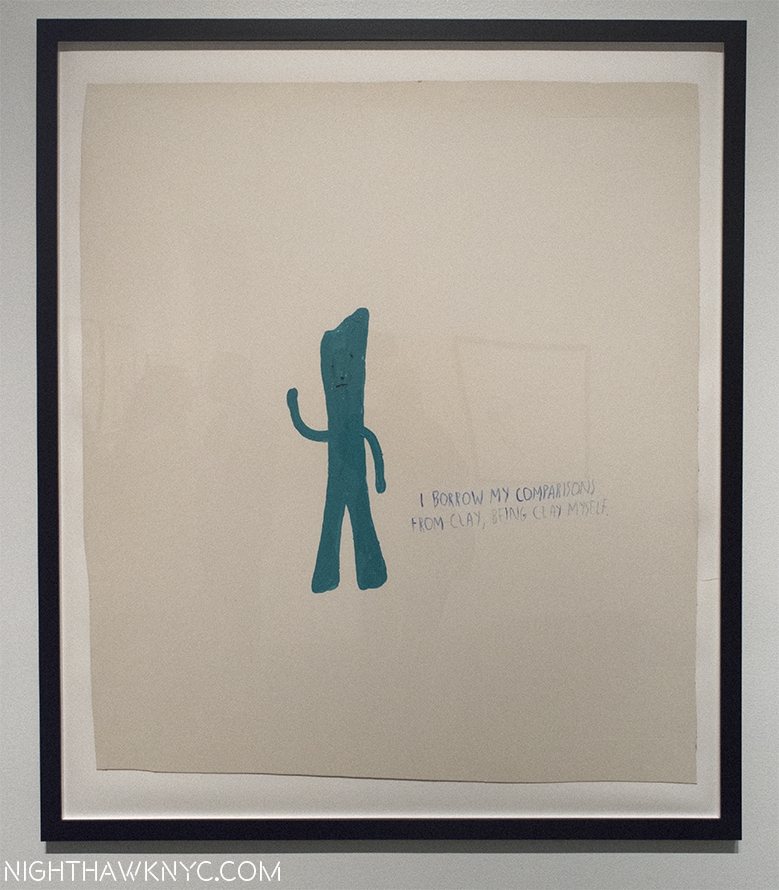
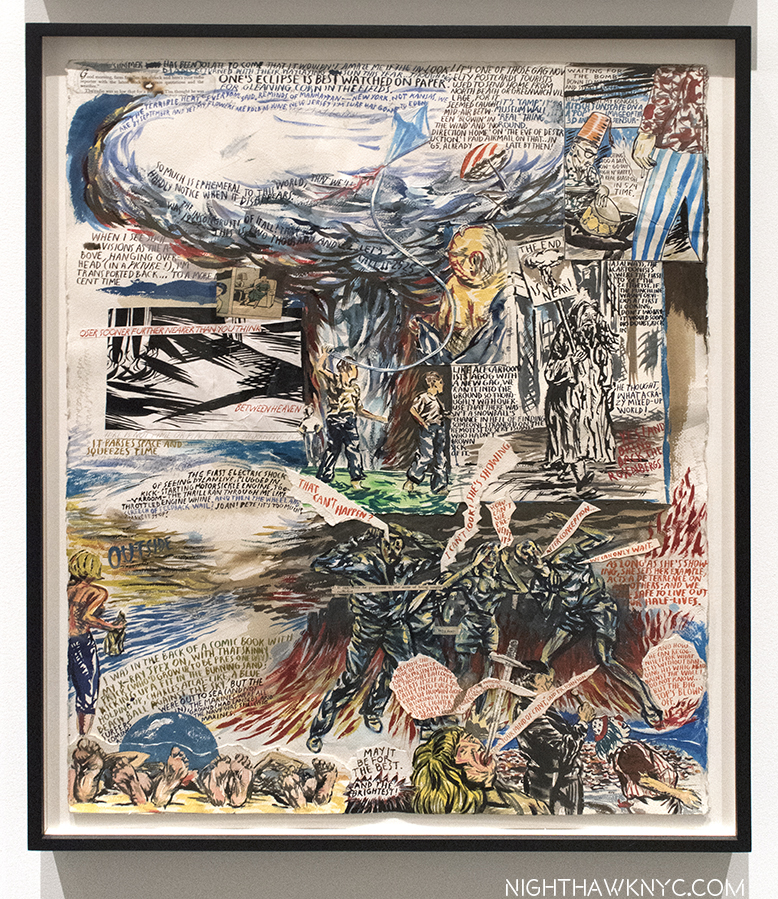
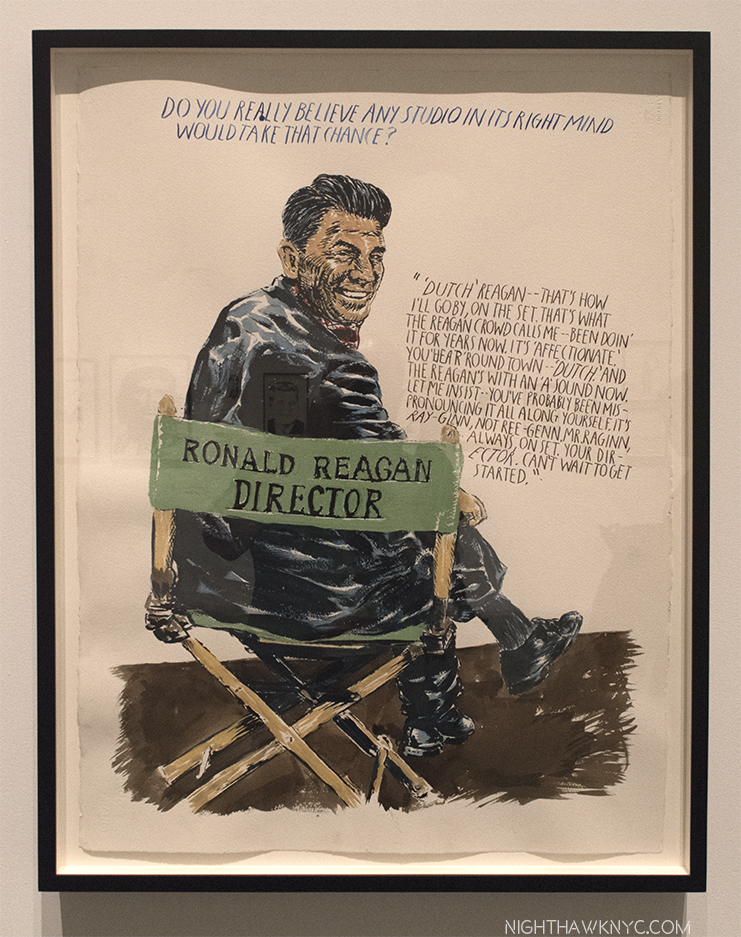
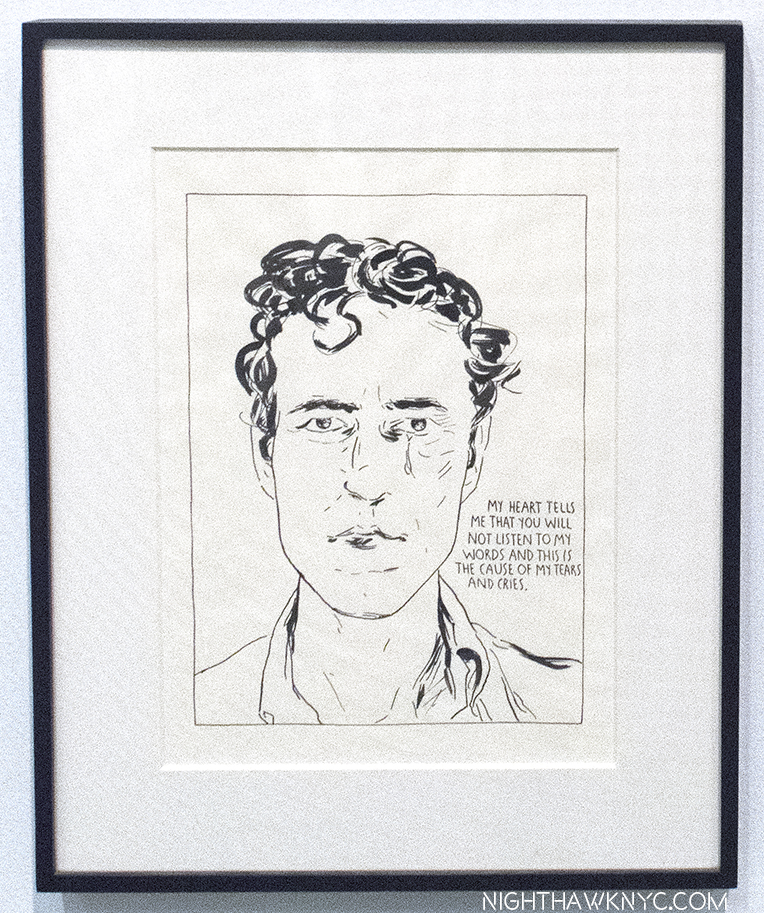
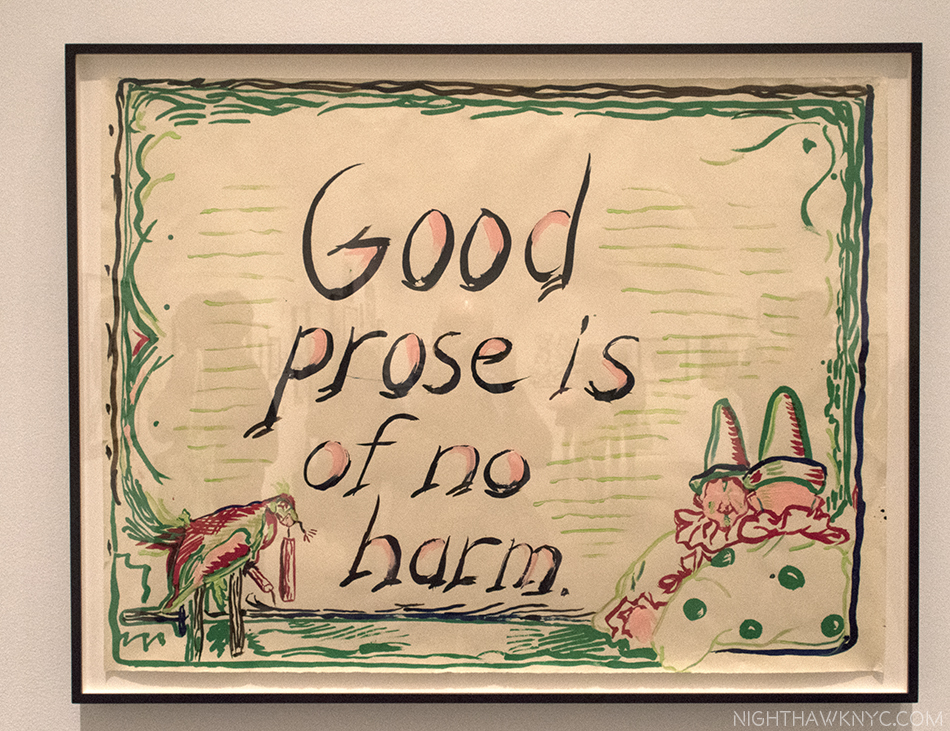
Well, his “super human” powers really shouldn’t surprise anyone. He wasn’t human! He was 100% clay. Most people who remember Gumby remember him as a character in a kid’s TV show from the 1950’s that was reincarnated a few times over the succeeding decades. Most recently, he’s also had a reincarnation as the alter ego of Artist Raymond Pettibon1. In this “life,” he doesn’t have to walk through the walls David Zwirner to be inside the story, he’s been welcomed in as part of Pettibon’s latest show, “TH’ EXPLOSIYV SHOYRT T,”  as we shall see. Ok…ok…that’s my Gumby, above, that’s been a sidekick of mine going back to the 1990’s. But, Gumby, I mean Raymond Pettibon, really did create those paint splatters while he was creating many of the works in the show. Renown for the hand drawn & painted elements he creates for each show ranging from texts to wall drawings to murals, these splatters and drops provide mute testament to his creative process that recently occurred in this very space, possibly including this-
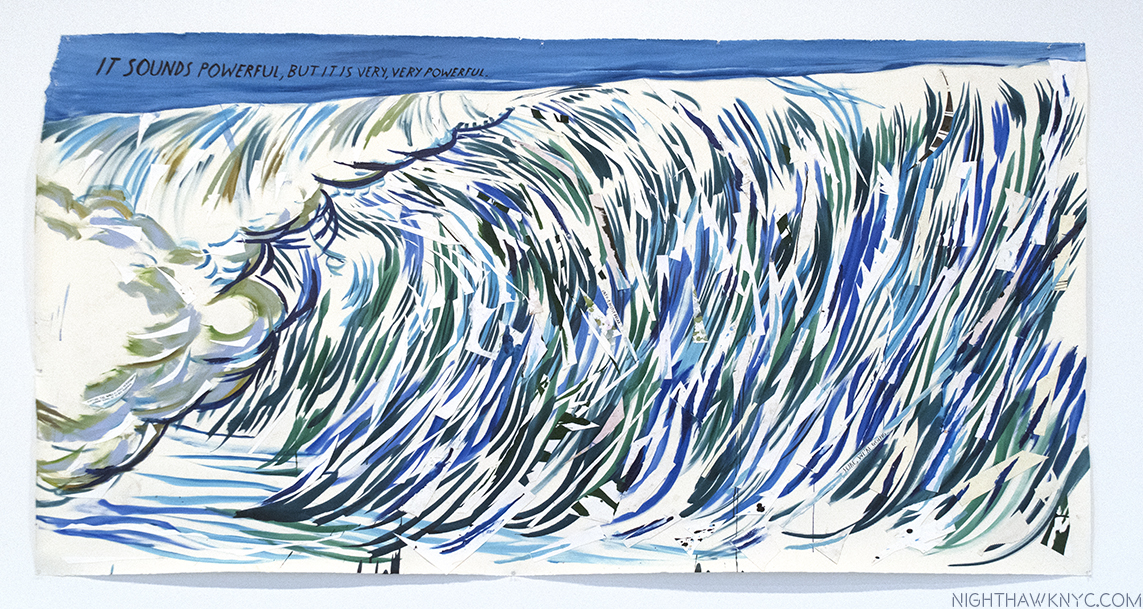
“No Title (It sounds powerful…)” 60.5 x 101 inches, 2017, Ink, acrylic, and collage on paper.

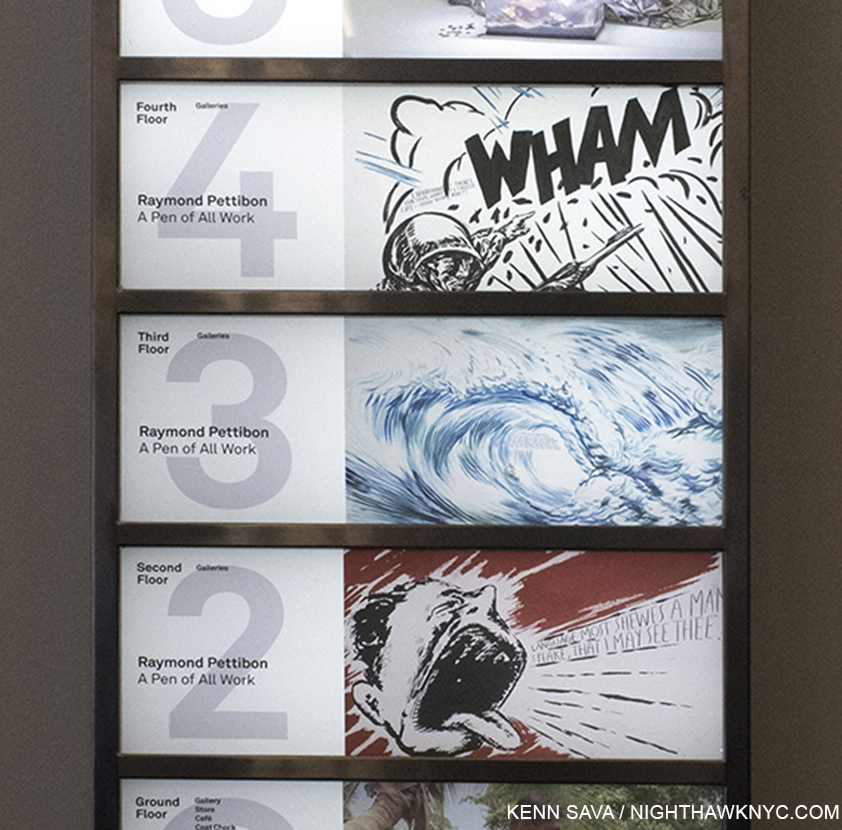
Fresh off the unabashed success of his blockbuster retrospective at the New Museum, “Raymond Pettibon: A Pen of All Work” (which I wrote about here), his first show at a major NYC Museum, some 40 years in the making, with EIGHT HUNDRED works dating back to the 1960’s filling three full floors, barely had my thoughts about it had time to begin to congeal, when along came word of a show of new works by Pettibon at David Zwirner, 519 West 19th Street, where the Artist had been holed up since January, I was told, creating many of them.
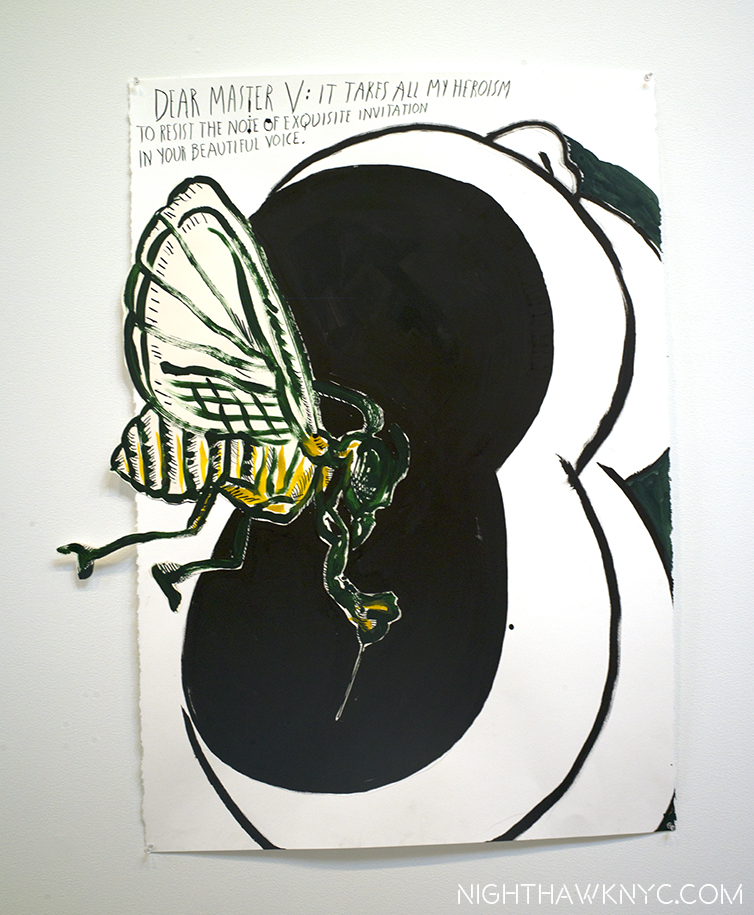
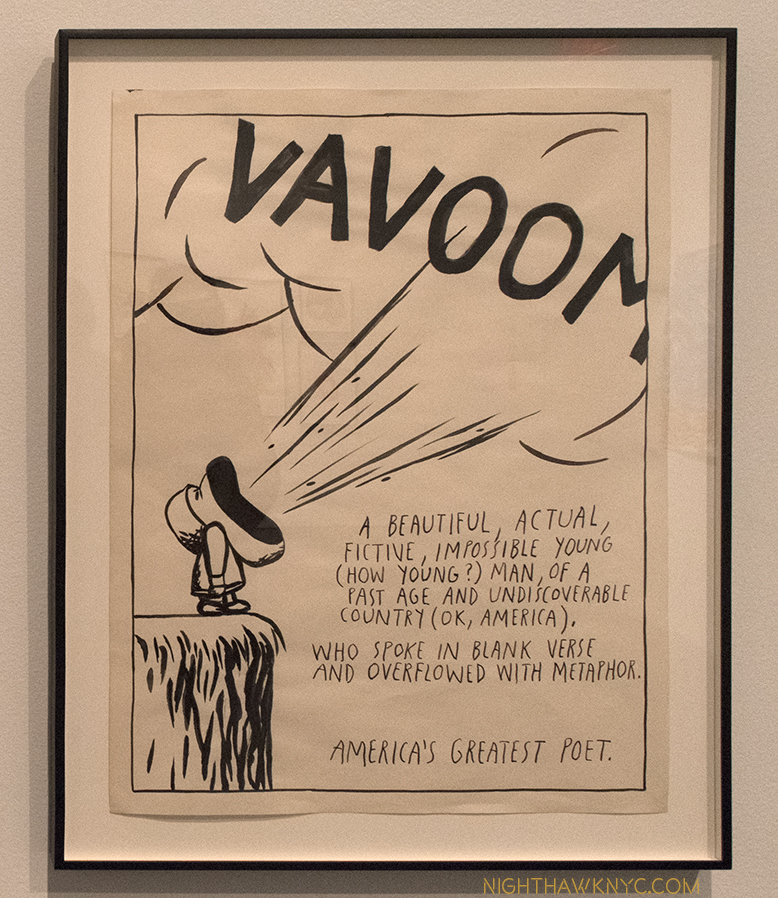
Down the rabbit hole I go, again. “No Title (Dear Master V…), 2017, “V” for Vavoom, the old cartoon sidekick, capable of only screaming his own name, is the other Pettibon alter-ego, along with my friend, Gumby. Pencil, ink, watercolor, goucache, acrylic and collage on paper.

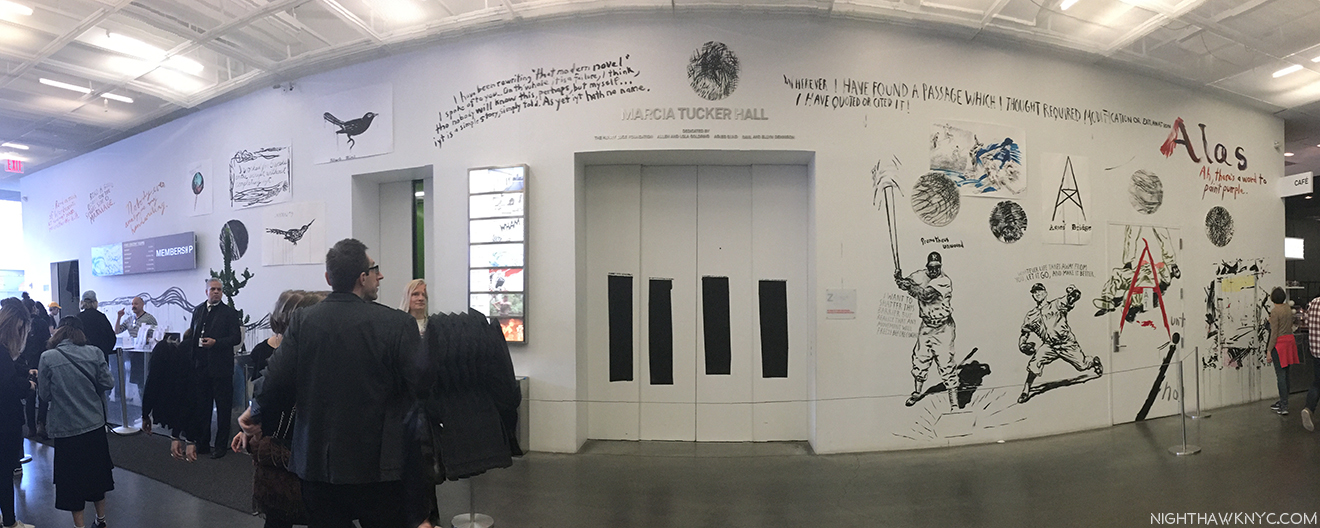
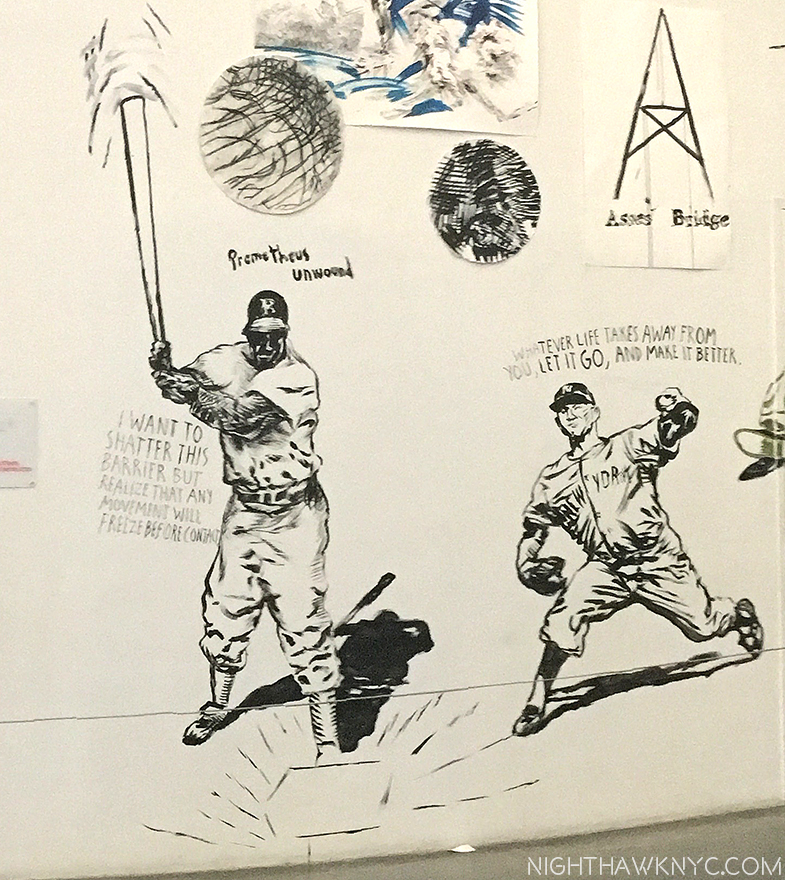
Lo and behold, when the doors opened on Saturday evening, April 29, there they were, 99 new works, only 2 of which I saw at “A Pen…,” where they were tacked up as part of the lobby Mural, as if giving us a taste of what was to come. Talk about prolific. What’s another 100 after having just seen 800? It, also, provides an all too rare opportunity to get the “rest of the story,” from his beginnings as seen in “A Pen…” right up to the present moment.
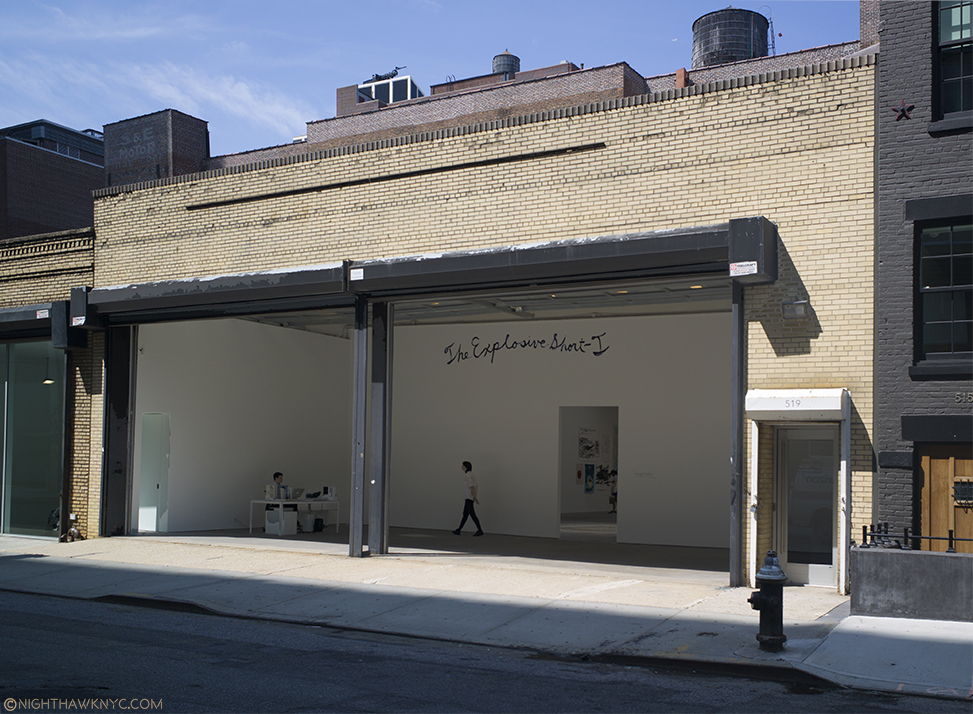
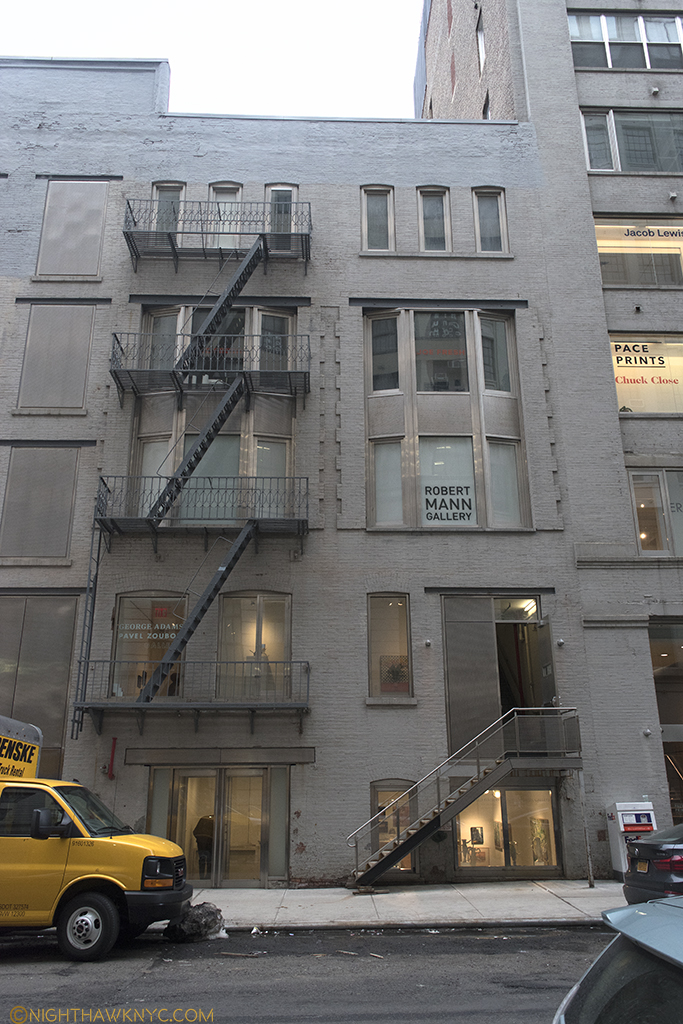
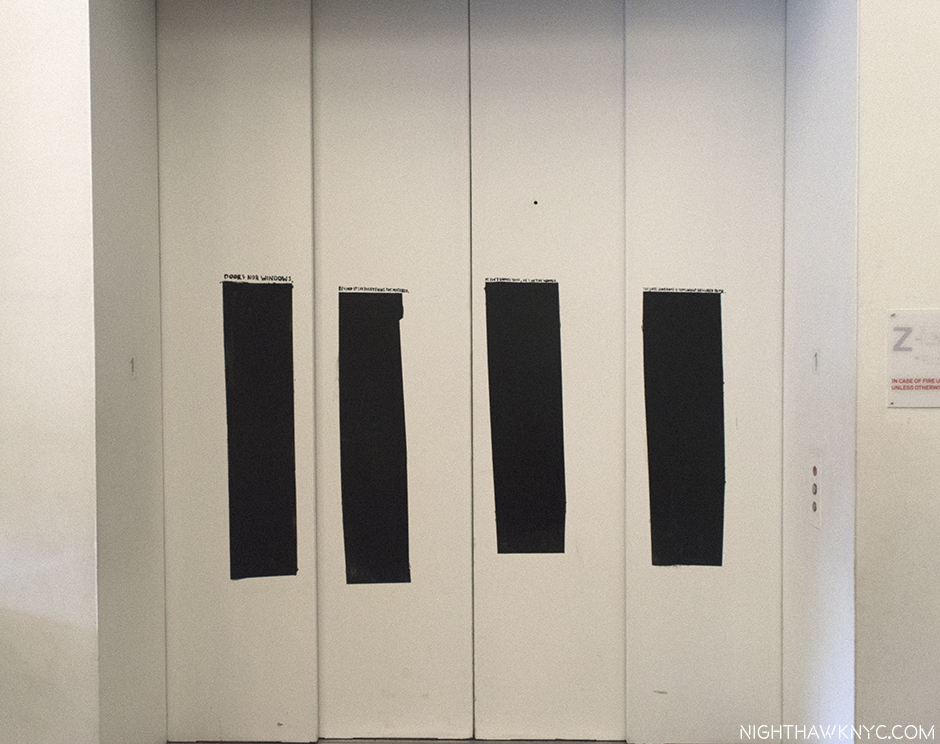
David Zwirner Gallery, 519 West 19th Street. In it’s case, the doors roll up.

Meanwhile, “A Pen of All Work,” has now opened at the Bonnefantenmuseum, Masstricht, The Netherlands, where it will remain open until October 29, complete with it’s own brand new, hand painted, circular wall mural, in 4 parts, which may be glimpsed here. Look now while you can. Like his other murals, it will be history when the show is. But, here & now, in West Chelsea, the paint was barely dry on the walls, and the floor, too, of 519.

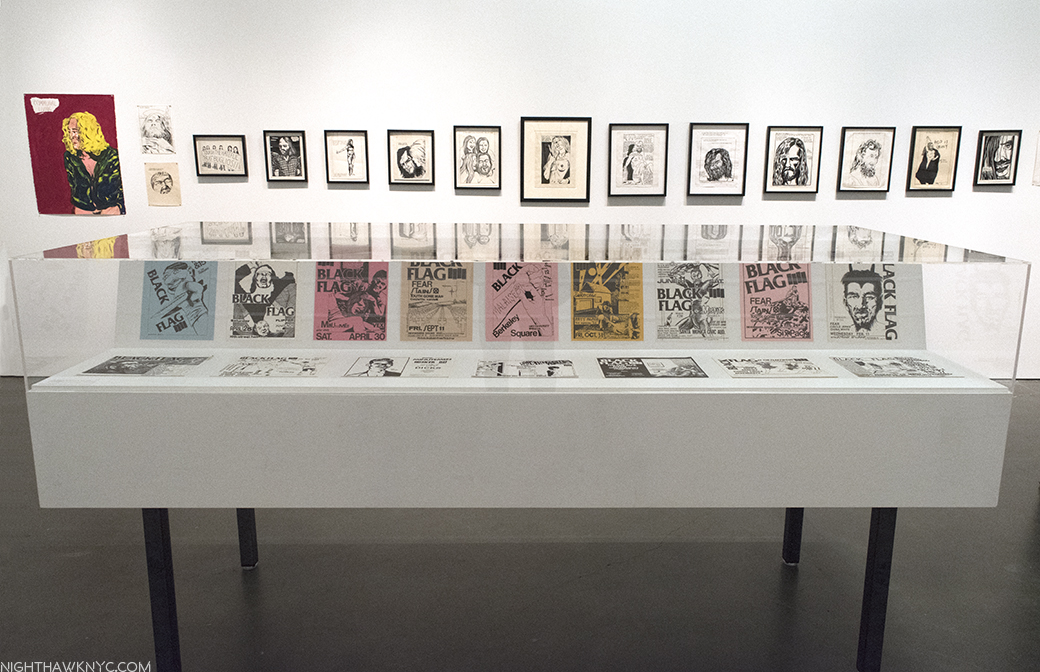
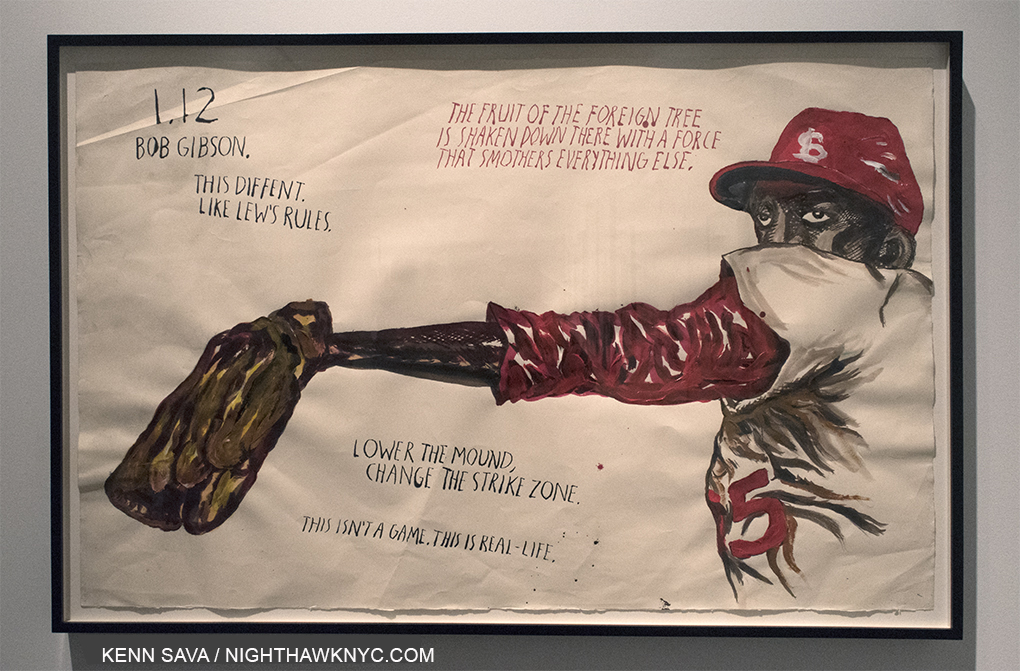
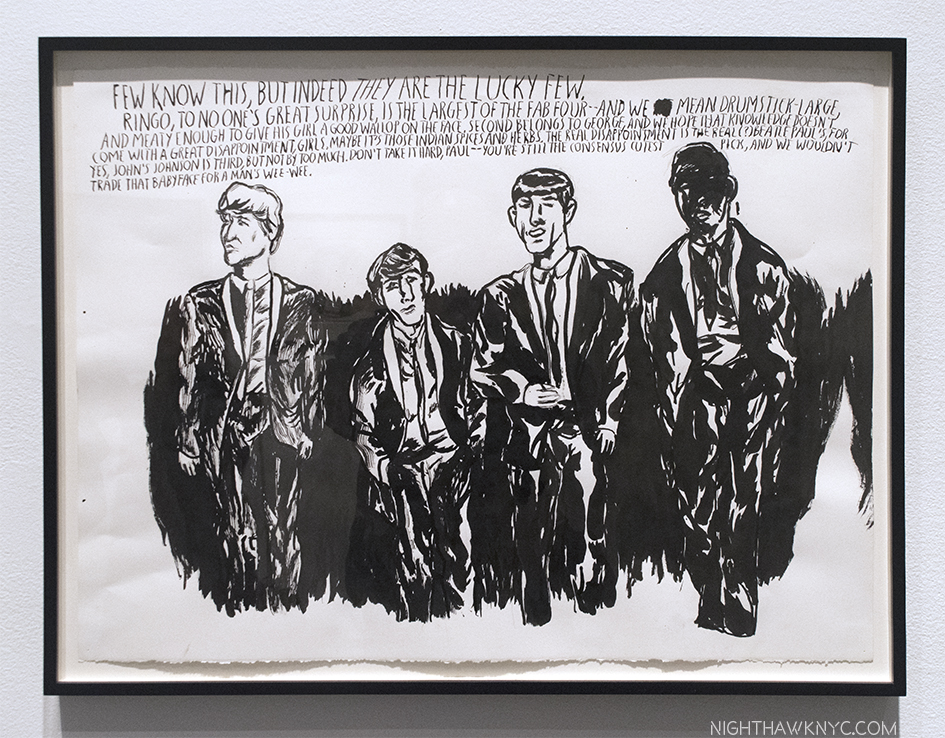
What was to come, as far as the new work goes, was a continuation of what we saw in “Raymond Pettibon: A Pen of All Work”- in almost every way, most importantly including quality. Also continuing are most of the themes Pettibon is known for. Well? There was only one work related to Music, perhaps surprising to those who still think of Pettibon as a “punk” Artist, even though that period was 35 years ago. On the other hand, of all things, wrestling appears to be on the ascent among his themes.
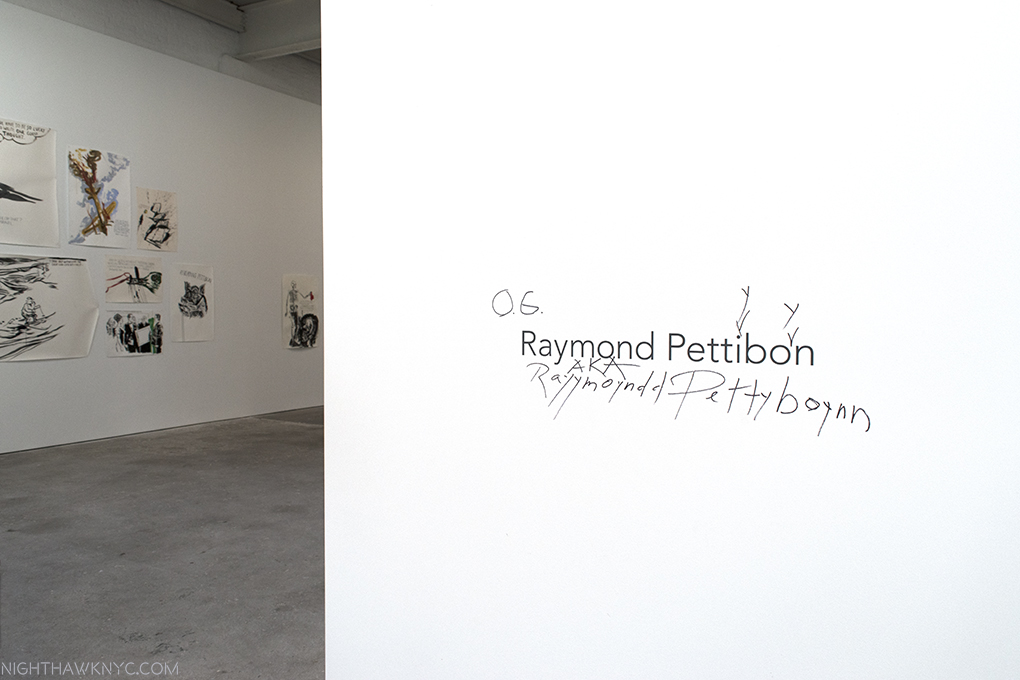
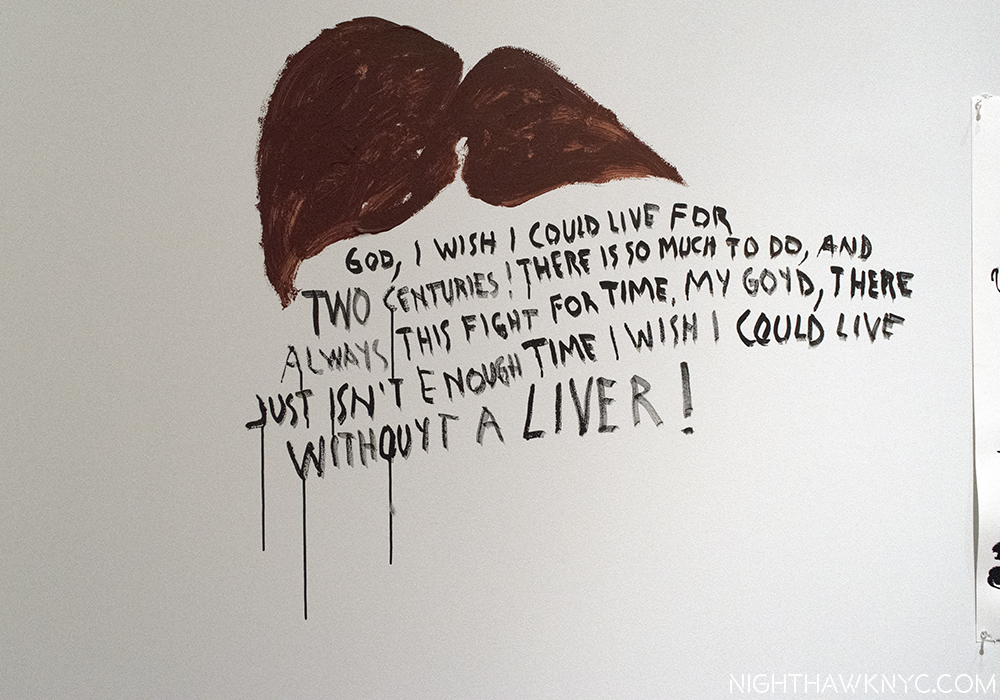
A week before the end of the show, “O.G.” Pettibon returned to graffiti his own sign.

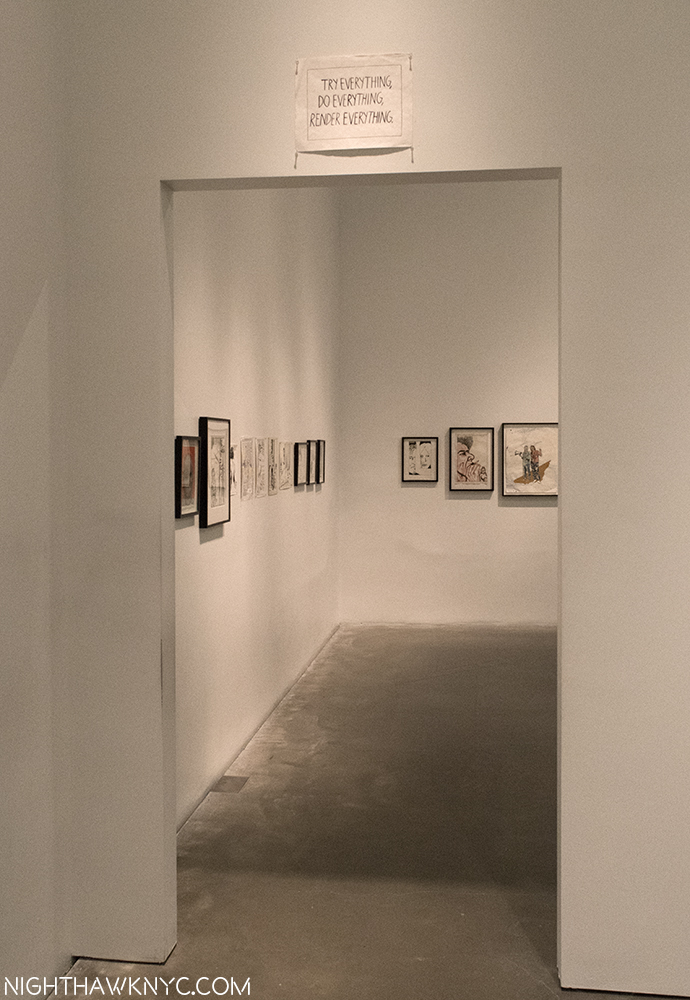
But, before we get too far into it, let’s start outside. Above the door, in lieu of one of his usual wall drawings or murals Raymond Pettibon has simply written the show’s title. Keyword: “simply”-
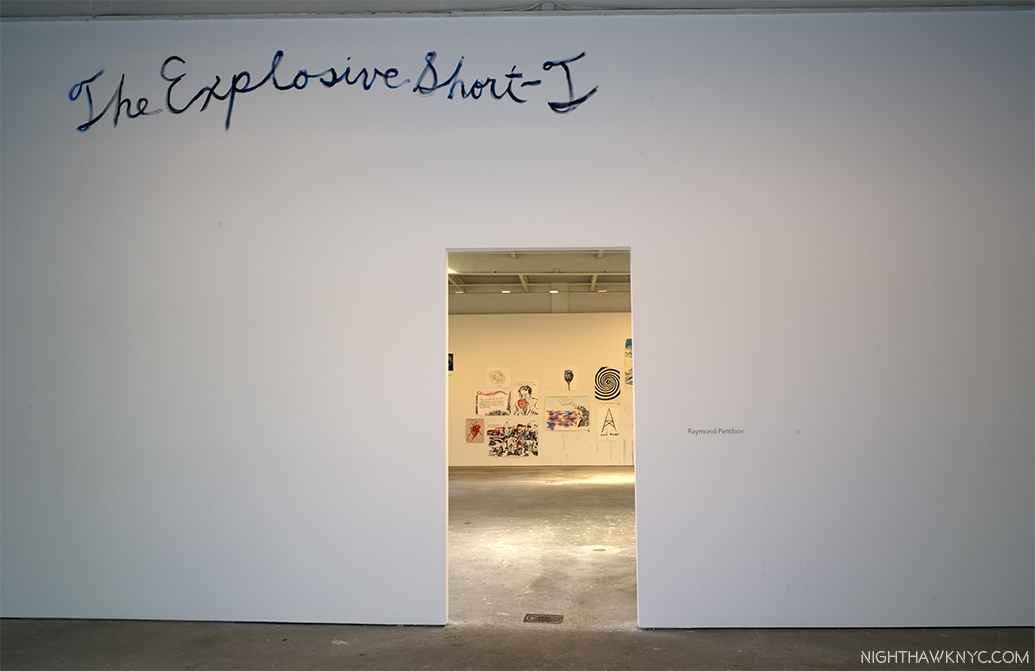
Wow. He wrote this, and even I can read iyt!

Well? “The Explosive Short-T” is one version of the show’s title. On the David Zwirner website, the show is referred to as “TH’ EXPLOSIYV SHOYRT T.” That’s easy for Raymond Pettibon to say, in his unique “way with words,” something I am quite fond of doing, myself. Two titles? What gives? I was told the latter is the “official title.” Fair enough. But? What does it meayn? My research led me to the 1963 Football coaching guide by Homer Rice, a coach at the University of Oklahoma, called “The Explosive Short-T.” It’s back cover bills it as “A complete guide to building a winning football offense with the newest and most powerful variation of the T-formation.” And, compared to the massive “A Pen…” it is short-er.
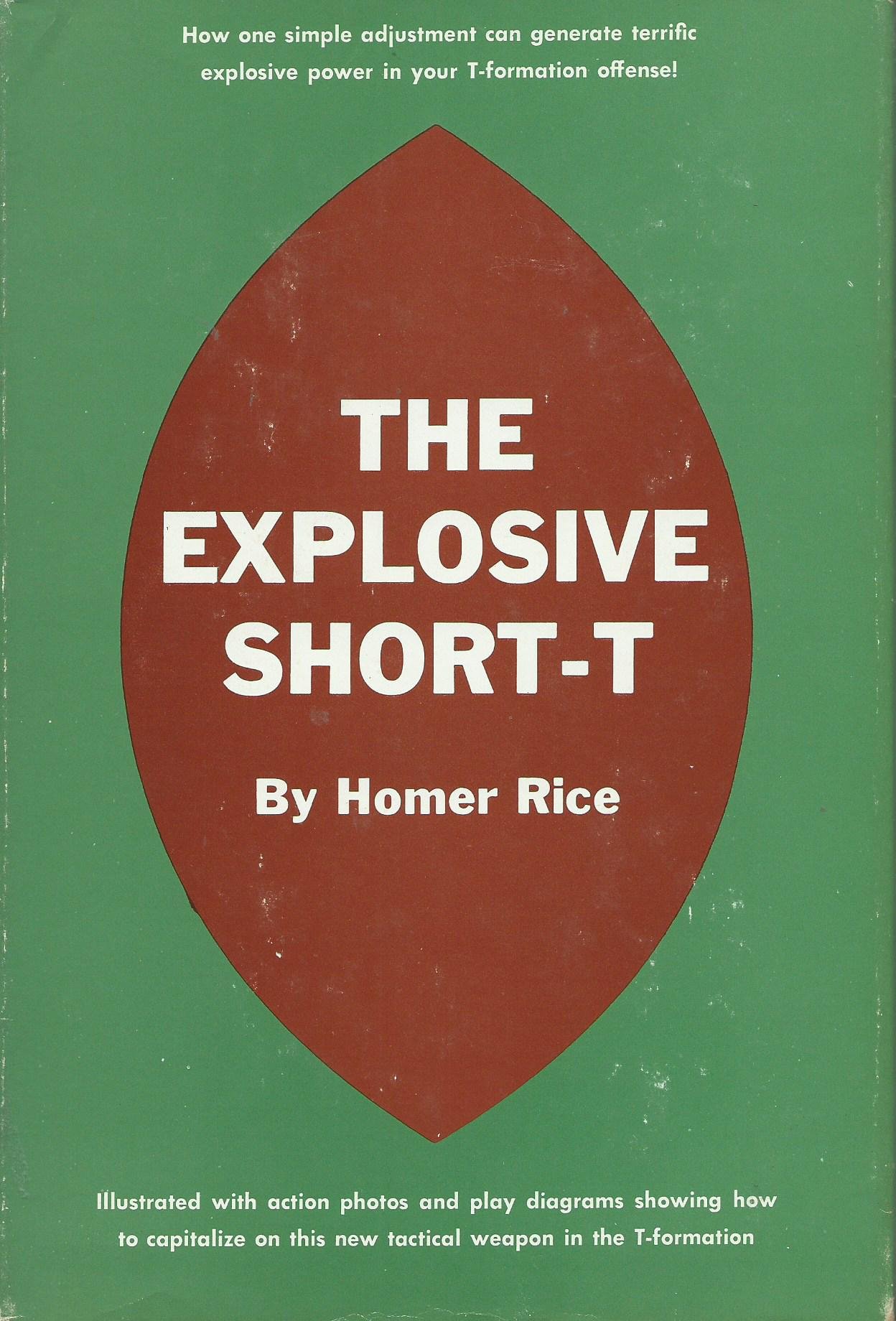
The cover of Home Rice’s rare 1963 book. I don’t think he suspected his title would also be that of an NYC Art show 54 years later!

I know what you’re thinking- “Of course!” Further adding to the intrigue of the title, among the works inside pinned, (yes, Art, some of which was priced at $150,000.00 per, was all pinned to the walls), Raymond Pettibon, sports aficionado, has depicted the following sports (and in parenthesis how many times each in this show). For those of you keeping score at home, my count by sport is-

-Baseball (4)

-Wrestling (3. One could be boxing, but I think it’s wresting.)

-Surfing & Waves (2. 1 of waves, 1 of surfers changing their clothes)

-Football (None)
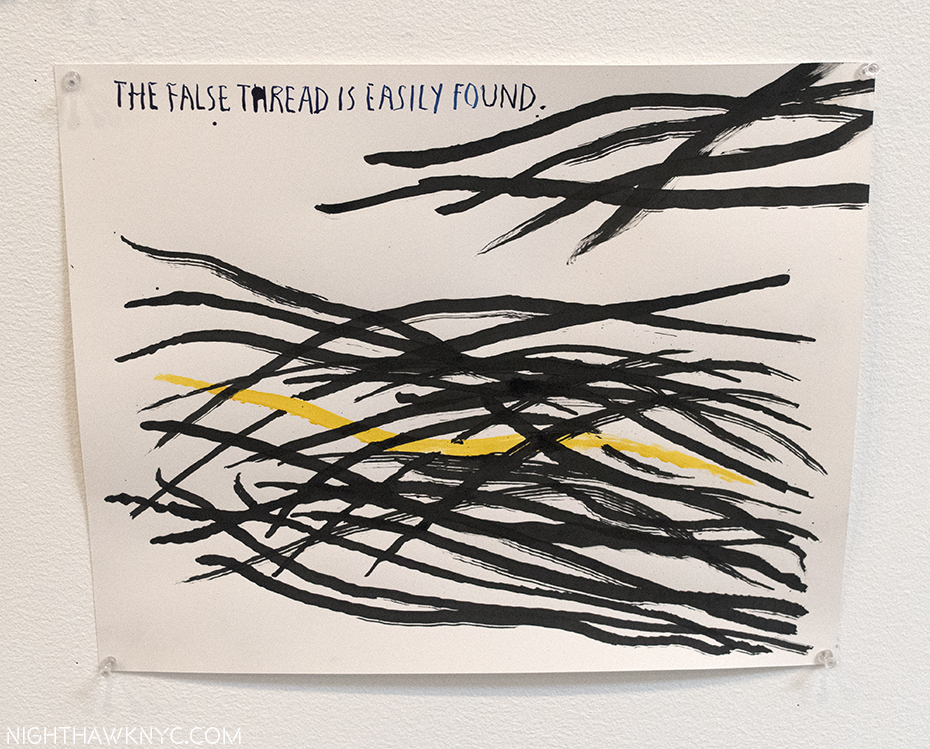
“No title (The false thread…,)”,…is easily found,” it concludes. All works are by 2017, Ink and acrylic on paper, unless noted.

Ok, so if the show’s title is a Football reference and there’s no football to be seen, what does it have to do with the 99 Art works on display? Unless it’s a “false thread?” I don’t claim to have any “answers” when it comes to the work of Raymond Pettibon. I just enjoy pondering what his work says to me each time I look. Not willing to give up on this “thread” so quickly, I chose to take the “formation” part literally, and see what the groups (the formations) the work is arranged in might offer.
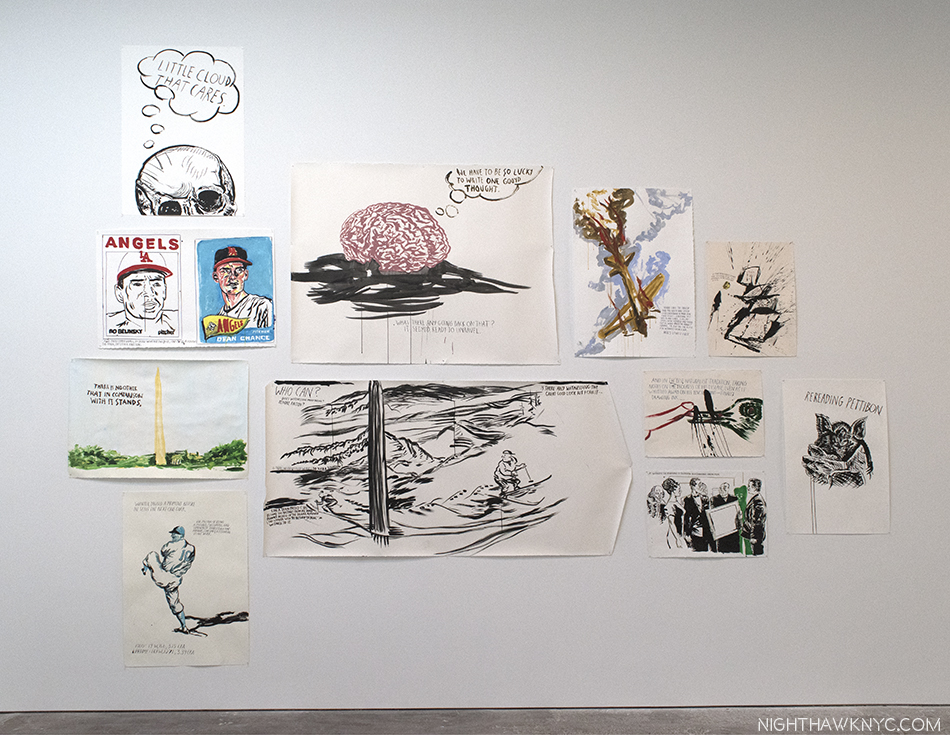
I decided to focus on this group of 11 works.

The first thing that struck me about the curating of this show was a major difference with the New Museum Retrospective, which was arranged by themes throughout it’s 3 floors. This show is not, as far as I can tell. I asked who was responsible for the arrangement and the answer I got from the staff was Pettibon and David Zwirner. I’ll go with that. It’s hard for me to imagine the Artist didn’t have a hand in it. Afterall, he had been in this space working, and he did paint the title over the door, and? The grouping is as interesting to consider as the individual works they consist of. But, I must bear in mind what Pettibon said in 1999-

“When I hang a show, for the most part, it’s usually just as well to put up the drawings randomly, because that’s the nature of the work. There are dissociations and attachments and the mind will fill in the blanks. Beyond that, it becomes overly fussy and contrived. So just about any way the work is hung, really, it’ll work.”

Yes, my mind couldn’t help but to “fill in the blanks,” helping to see the combinations as “explosive.” Take the group, above, for example. Right smack dab in the upper middle is a work, who’s upper thought bubble says-
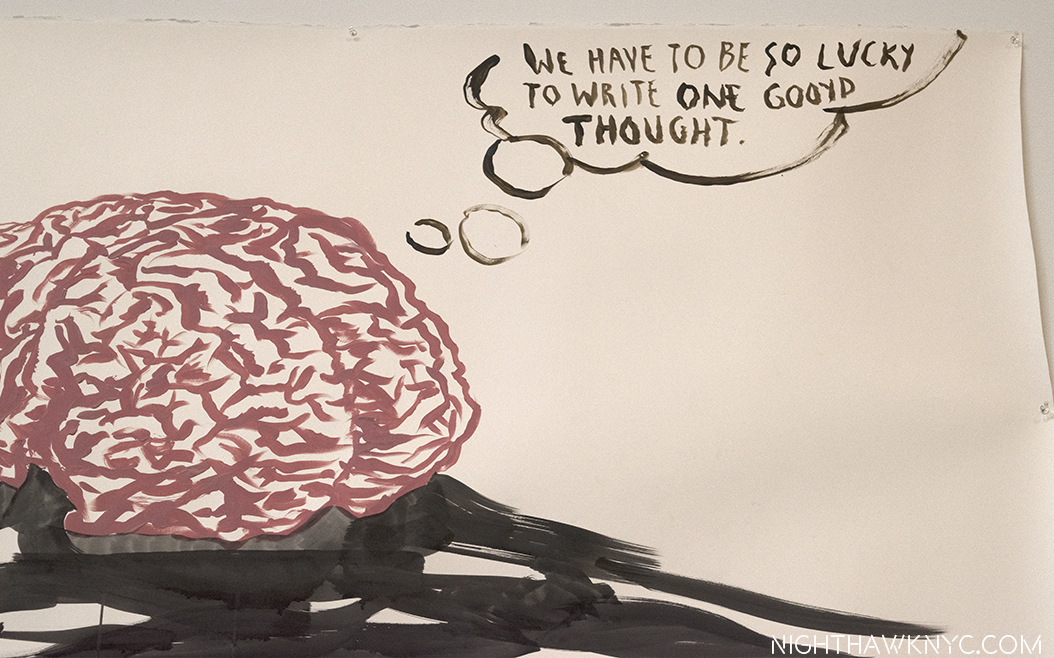
Detail of “No Title (Was there any…),” Ink and acrylic on paper. It could be my mantra.

But then, the “kicker.” Under a pile of black lines, the words “Was there any going back on that? It seem’d ready to unravel.” What do they refer to? Slightly higher, on the left, is a skull, with a thought bubble that reads “Little Cloud That Cares.” Two brains, one in a skull, connoting a “dead” brain, and one, of an apparently “live” brain, without a skull, both with thought bubbles. On the left side, directly under the “Cloud That Cares” is a drawing of 2 Baseball players. Bo Billinsky and Dean Chance. During the opening, on April 29, Raymond Pettibon told me that his son, Bo, who was in attendance, was named after Bo Belinsky. Bo Belinsky, was a 6′ 2 left-handed starting pitcher for the L.A. Angels, from 1962-64, when his record was 21 wins and 28 loses. An interesting choice, to say the least.
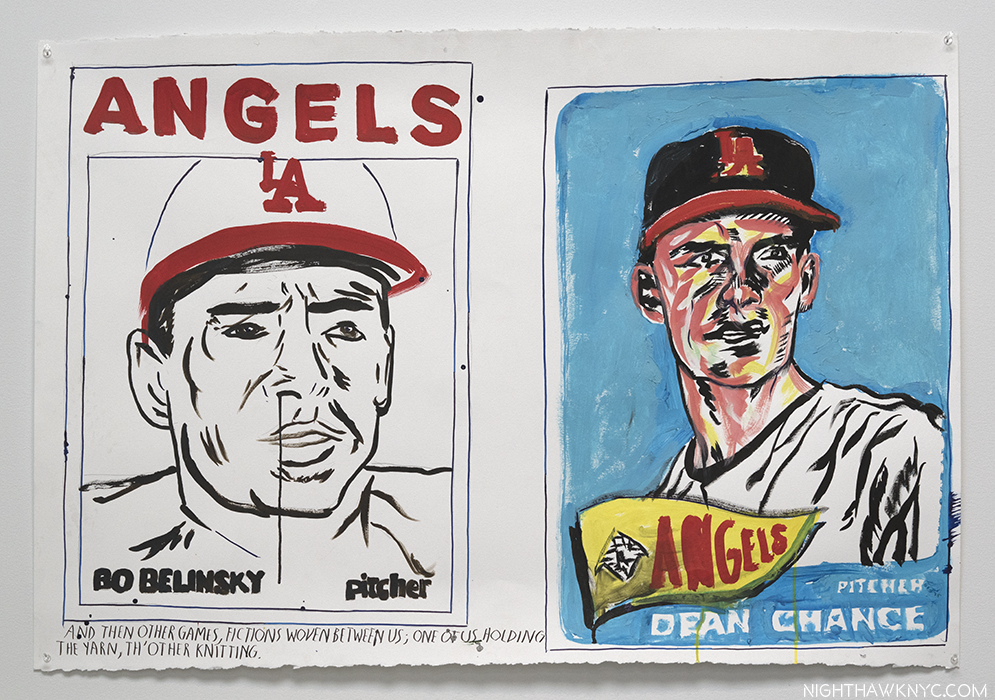
Pettibon’s son’s namesake, alongside his own favorite player. “No Title (And then other…),” Pencil, ink, watercolor, gouache and acrylic on paper.

He also told me that Dean Chance was his favorite player, so (my interpretation) their dual portrait is a way of putting himself and his son into a work. (The Artist also has a dog named Boo.) Bo Pettibon announced to all who would listen that he wanted to become an Artist. In an interview with Dan Redding, Raymond Pettibon said that he looked forward to collaborating with Bo. So? This piece may also be a harbinger of Raymond Pettibon’s future work. It appears to me, though, this this is a rare work that may have some personal relevance to Raymond Pettibon. It’s fascinating to me how very few of his works that I’ve seen seem do. It seems to me his work is more about “self,” not about “him self.”
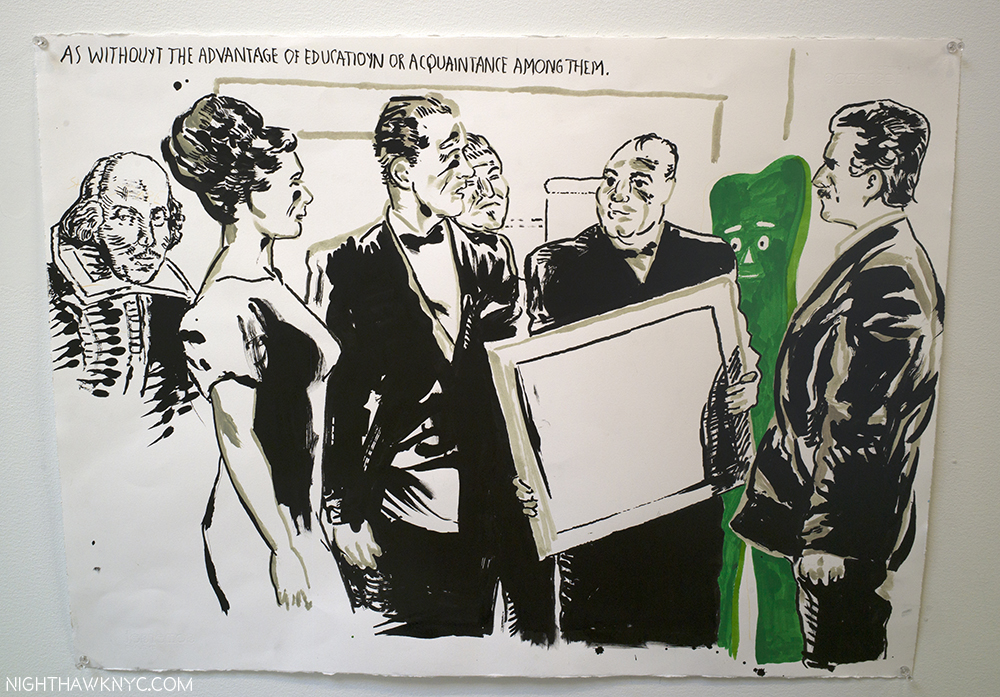
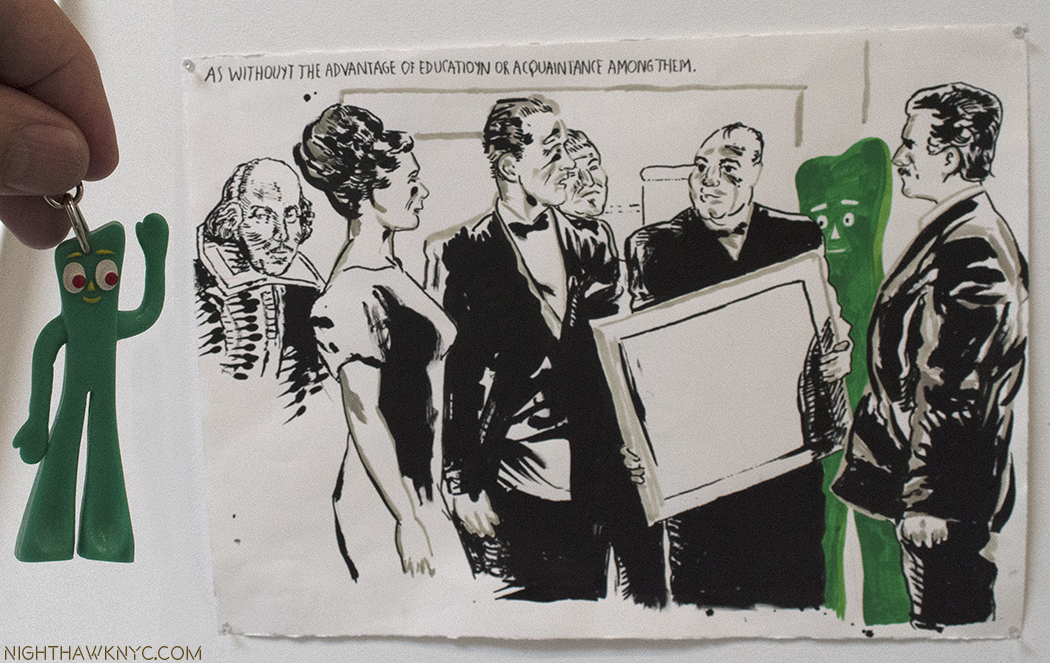
Surrounding these 3 works are pieces that speak of luck- good (below, center, a skier apparently narrowly misses a tree), bad (upper right- a bomber on fire, seemingly about to crash), faith (a bible, or bibles, seemingly falling),  fate (a naturalist monitors the progress of his disease in a piece that seems to equate the progression of a disease to a pen that finally produces ink). Beneath it is a most interesting image. Gumby/Pettibon and Shakespeare are joined by a quintet of 4 men and a woman. The man in the center holds what appears to be a frame. The text reads, “As withouyt the advantage of educatioyn or acquaintance among them.” The man holding the frames looks like he could be Churchill, a passionate painter throughout his life, to me. The man to his left (the far right) could be Stalin. The man “Churchill” shows what’s in the frame to (F.D.R.?) appears to be startled by it, as does the man looking over his shoulder at it. Gumby, “represents me as an alter ego,” he said on PBS’ Art21. Yet, both he, and Shakespeare have blank expressions, appearing as witnesses, and either the piece in the frame is blank, if it’s facing us, or hidden, if it’s not. Either way? No matter how long we look at it, it will never become clear.
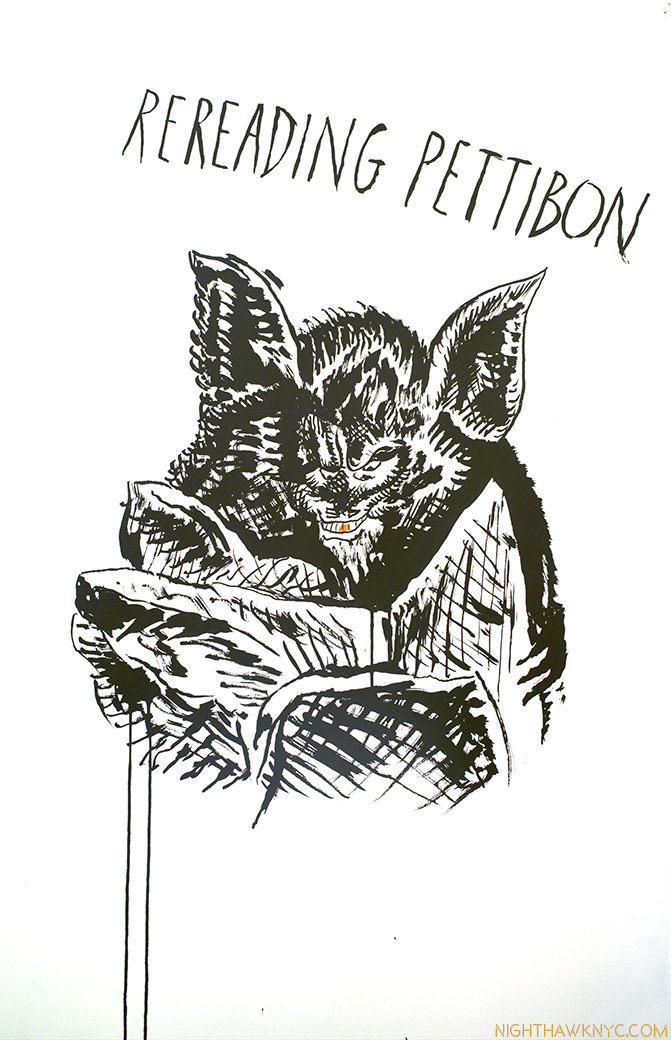
“No Title (Rereading Pettibon)”

Fascinatingly, to it’s immediate right is an image of what might be a demon, with a red tooth, who is busy “Rereading Pettibon,” something many viewers to his New Museum Retrospective had just been busy doing, revisiting his work going back decades.
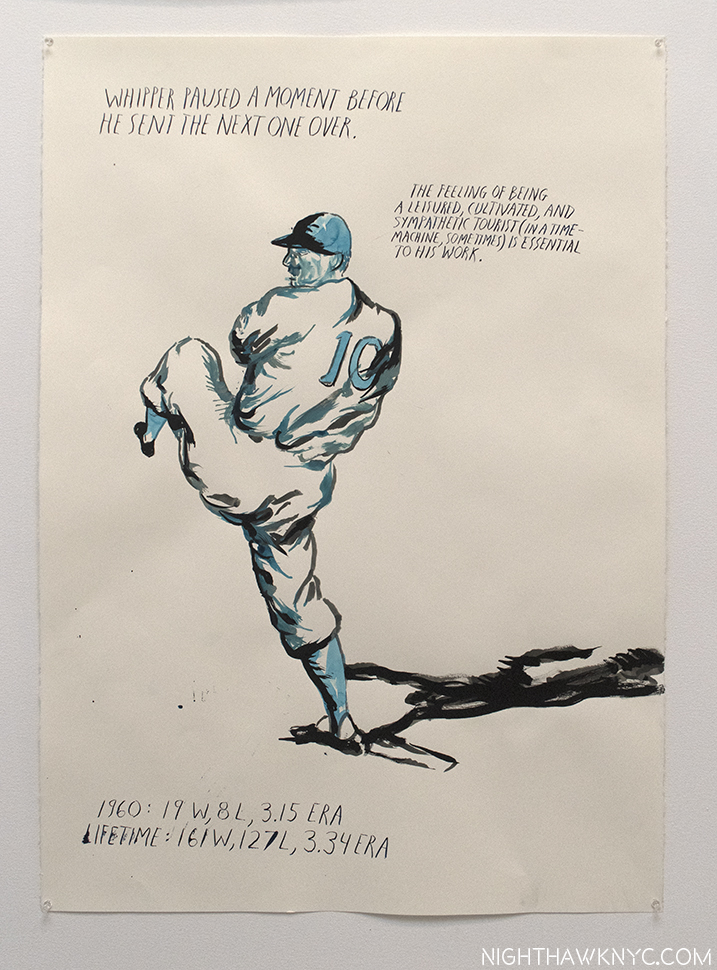
“No Title (Whipper paused a…)” Ink, watercolor and acrylic on paper.

The final piece in this section’s bottom left features a pitcher nicknamed “Whipper,” who, it says, won 19 games in 1960. The only major leaguer to win 19 games in 1960 was Lew Burdette, but he lost 13 games, not 8 as it says on the drawing, and his lifetime record was 203 wins and 144 loses (not 161-127). So? Whipper may be fictional, or a non-major leaguer. Still, I find it, another, compelling Baseball work. While so much ink is devoted to Raymond Pettibon- “punk Artist,” very little is devoted to Raymond Pettibon- extraordinary “Baseball Artist.” Which leads me to ponder- Who is the OTHER great Baseball Artist?

So, the right half of this wall is dark with war, death, disease, demons, and trying to maintain your sense of self during this. In the middle might be luck- at writing one good thought or narrowly escaping serious injury/death. On the left side is an image of the Washington Monument with text reading “There is no other that in comparison with it stands,” but it mirrors the narrowly missed tree to it’s immediate right, and above everything else on this wall is a skull, a symbol of death, that somehow manages to produce a thought bubble “Little cloud that cares.” Clouds care? The dead have thoughts? I’m deeply inside the rabbit hole now. I make no claim to “understand” any of them. But? I just can’t stop looking at them, and thinking about them.

This is only one section of the show- 11 works. It leaves 88 others to consider! Don’t worry. Every now and then I remind myself that this is a Blog, not a Book, so I’m not going to go through all the rest. But, I will show a few others.
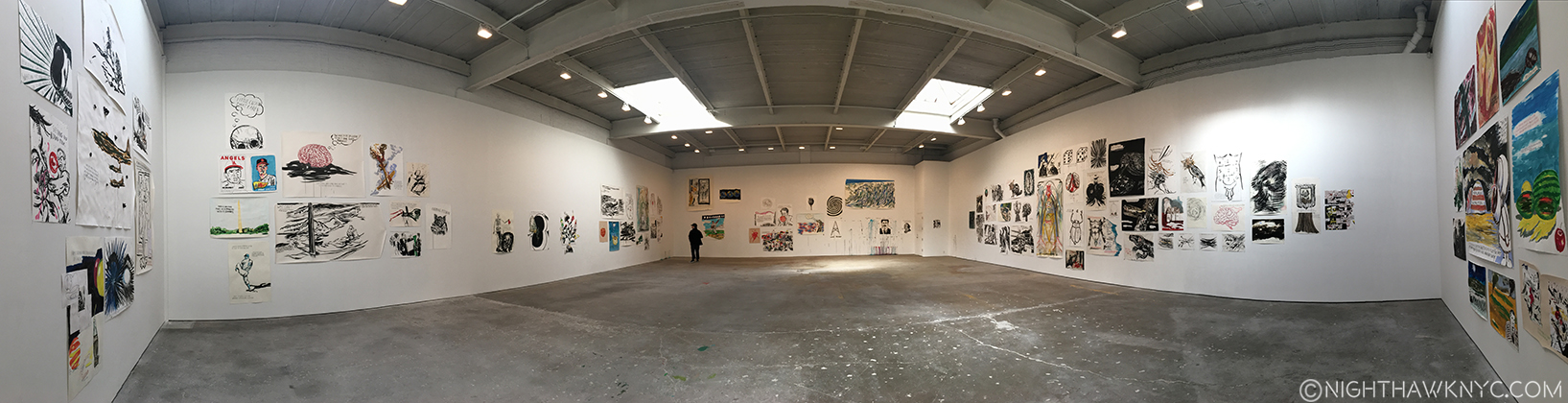
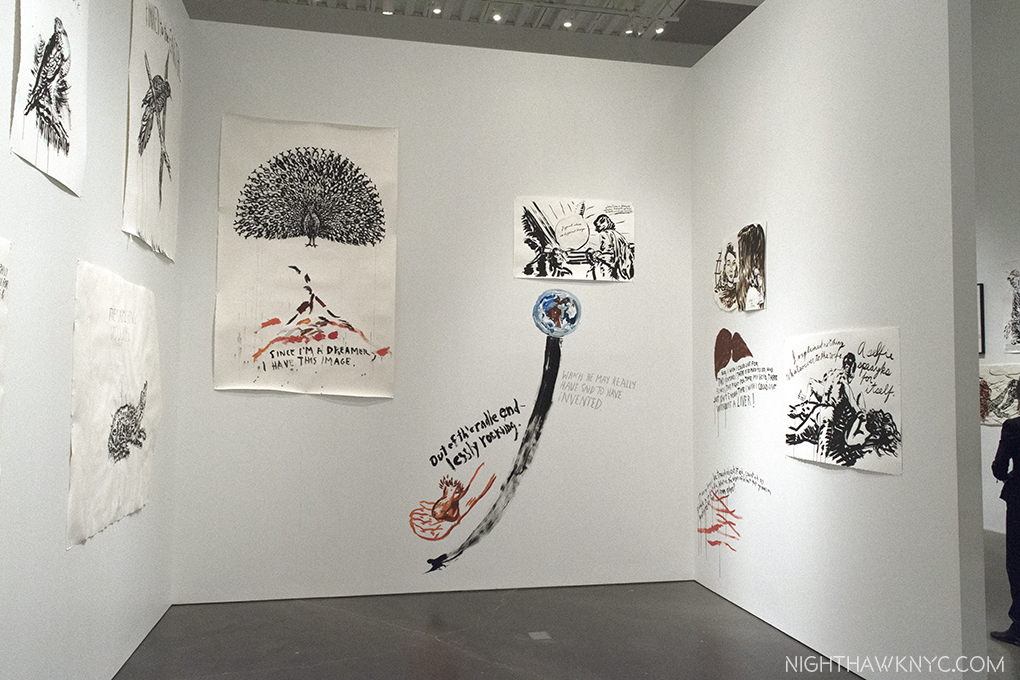
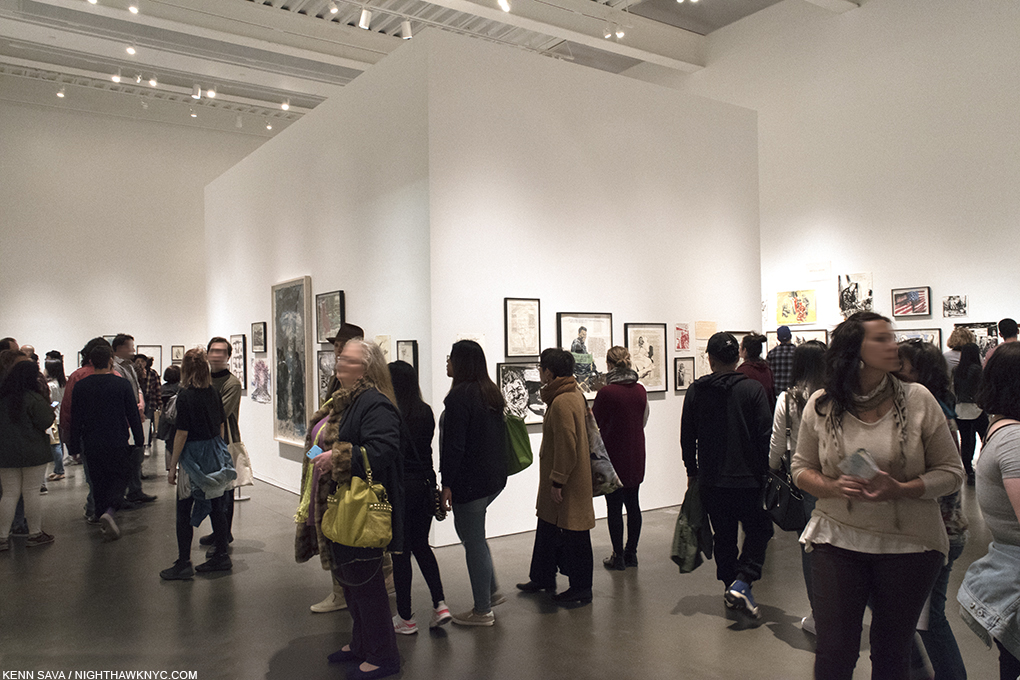
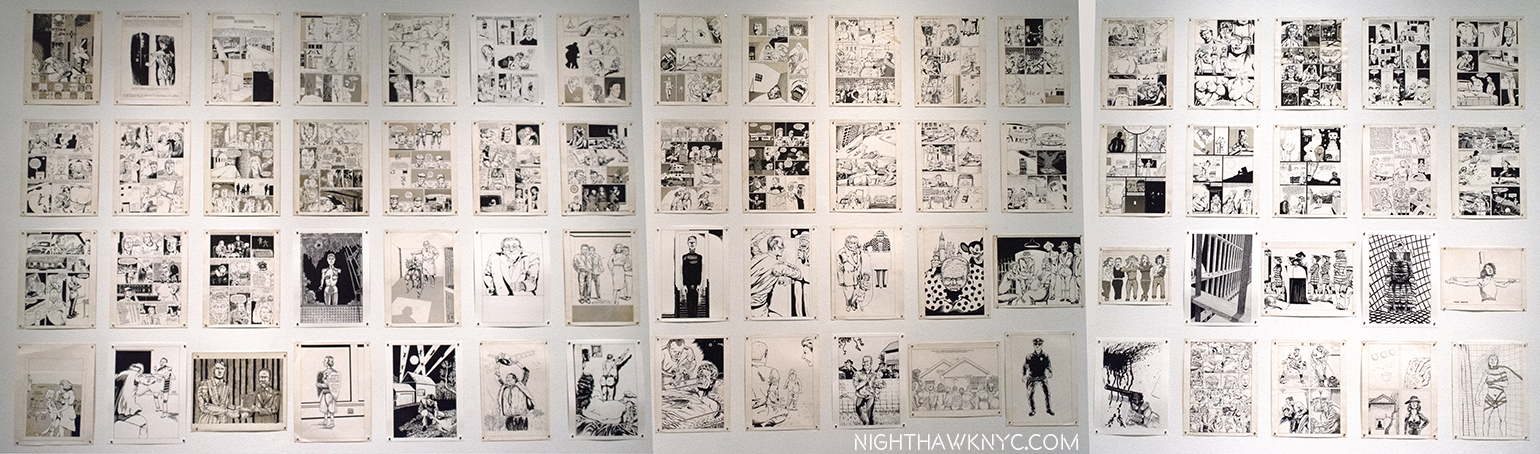
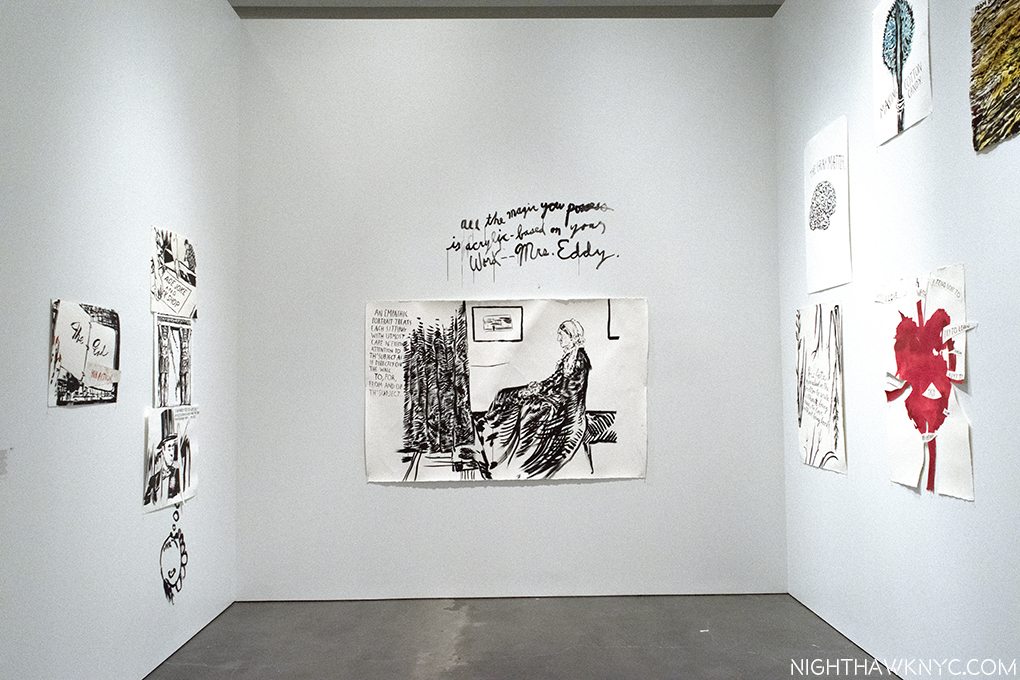
Installation view of ALL of “Raymond Pettibon: TH’ EXPLOSIYV SHOYRT T” at David Zwirner. The wall I was speaking about is just to the right of the left corner.

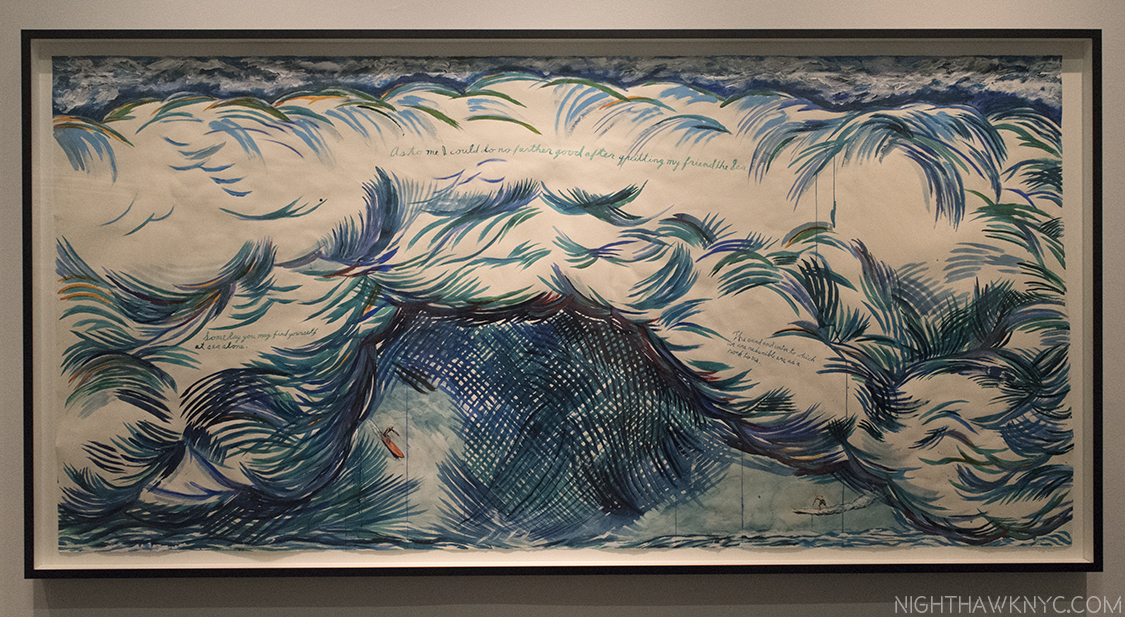
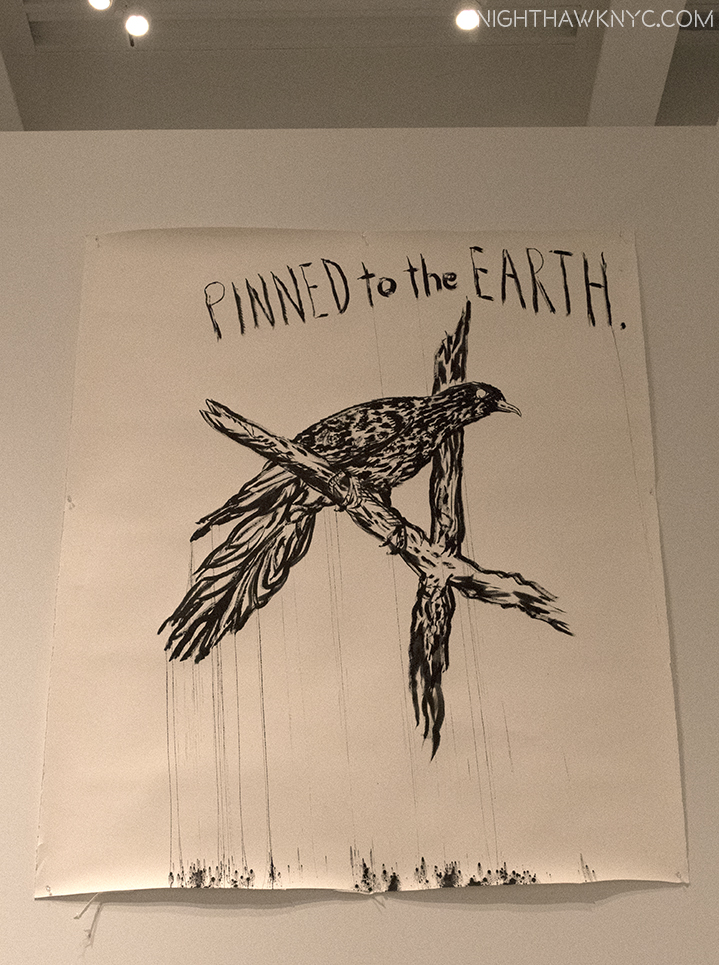
Of the other noteworthy works here is, of course, the huge Wave piece shown earlier, which, though 4 of his 5 highest selling works at auction to date have been large Surfer/Wave pieces (one sold for 1.5 million dollars), this one is mounted all the way in the back corner, high on the wall. So high, it’s very hard read the small text fragments among the collaged waves. Of course, it was sold early in the show’s run (if not before it opened), and most likely was the most expensive piece in the show. Well? It’s safer high up. It also does give the effect of looking up at a huge wave.
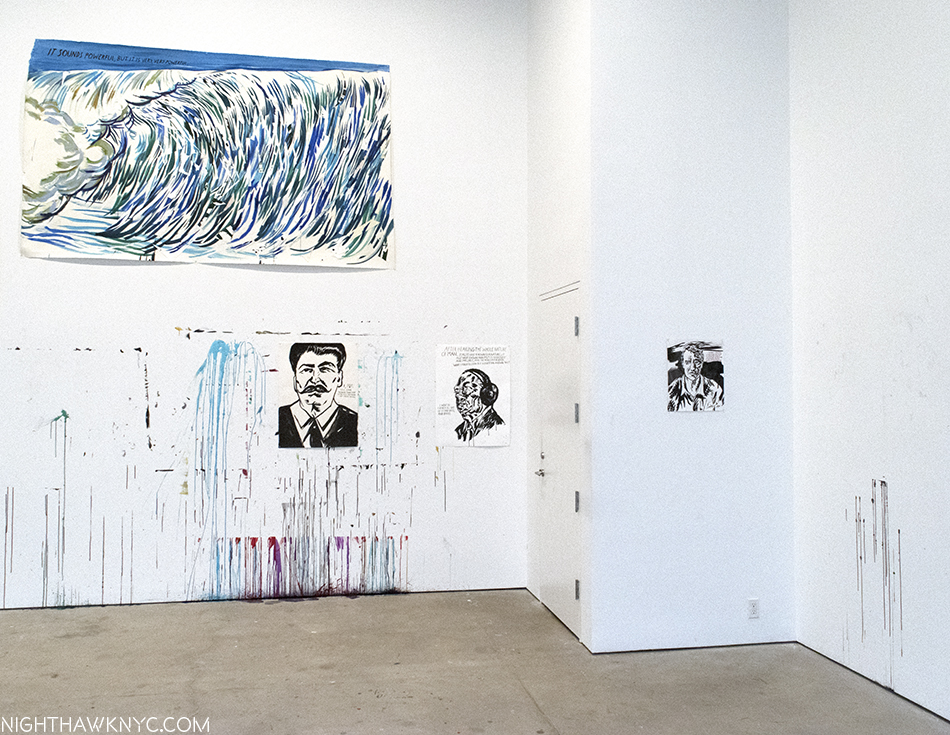
The intriguing rear wall and right corner of the show. A show of power- natural, and man made.

In his oeuvre, Pettibon’s surf pieces are like the “golden section” in a piece of Music-they live at the center of his universe. He’s said he enjoys Drawing waves more than anything else. It shows. This one is displayed above leftover paint splatters, and the portraits of two tyrants- Stalin, looking like he was the target of a paint gun war, and to his right, J. Edgar Hoover, cornered. For a change. Around the corner, on a wall by himself, hangs the only Self Portrait of the Artist, looking “cautiously” out on all he has wrought. Well, he not only can’t see Stalin or J. Edgar from there- he has his “back” to them.
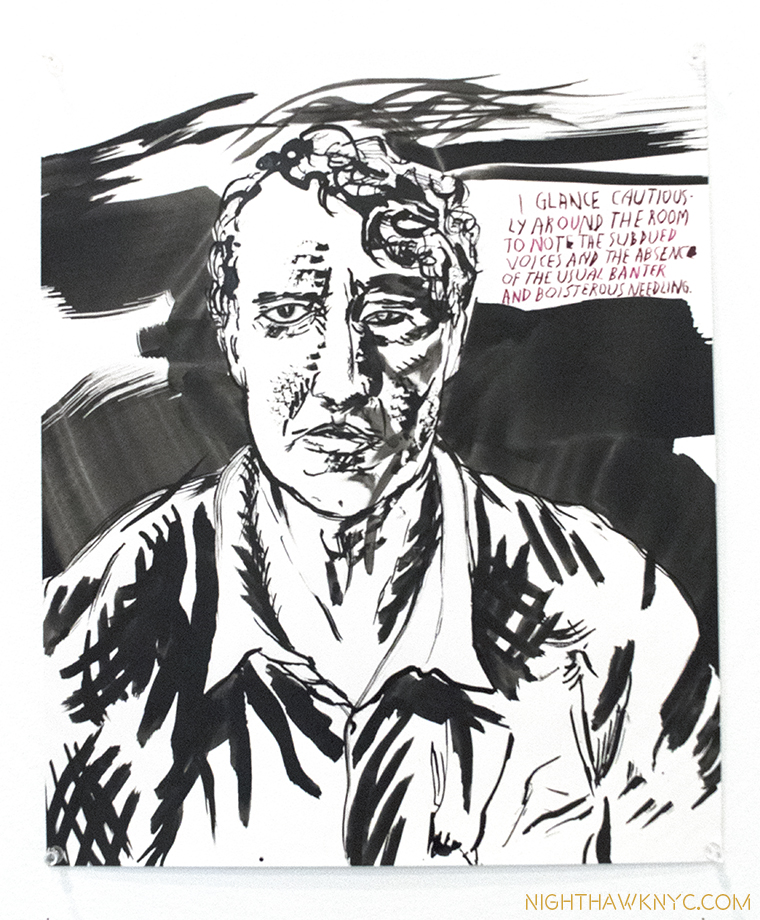
“No title (I glance cautiously around the room…)” And…
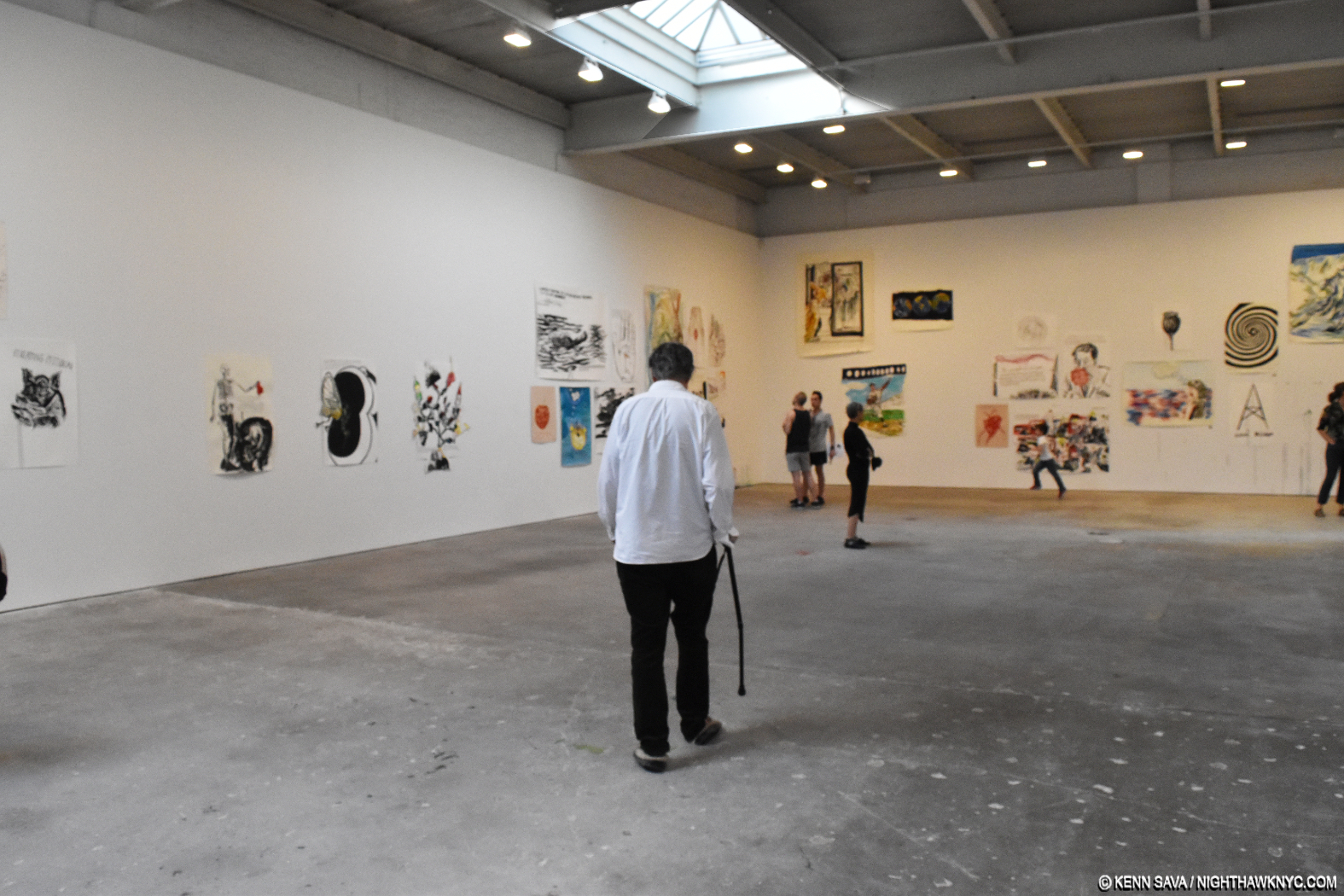
oving cautiously around it, too. Raymond Pettibon enters his show at the opening, April 29, with a cane. That small figure running in the distance is his son, Bo.

Hobbled by what he said was a bout of gout, the Artist, himself, nonetheless persevered and arrived to surprise visitors to the opening, including yours truly, with his presence, and I had the privilege to meet him and speak with him.
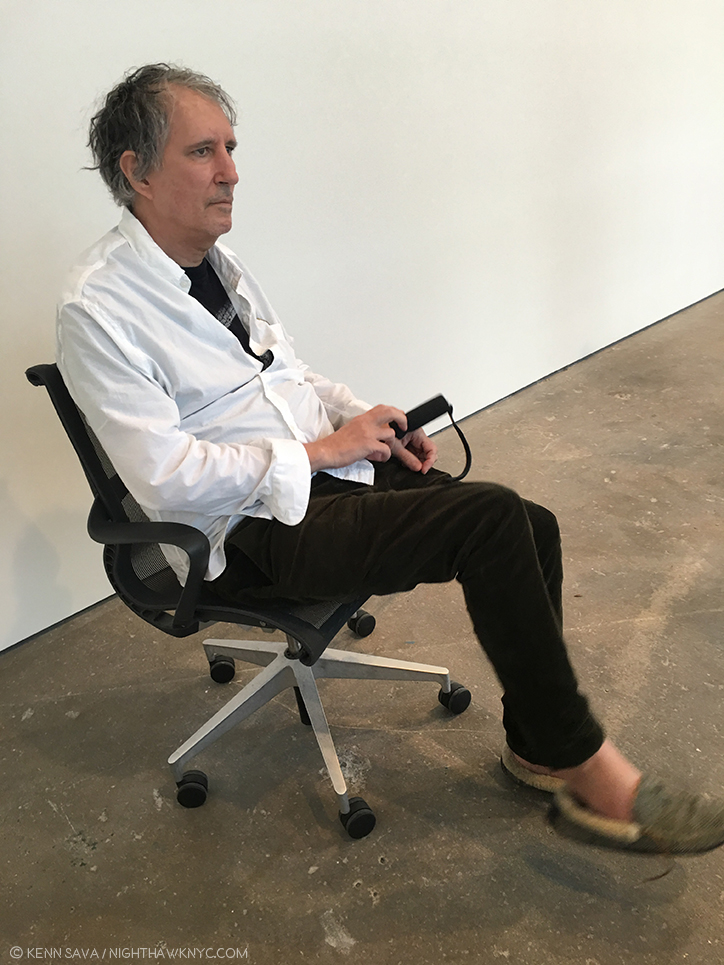
We spoke about a range of things after I remarked that since he is associated with many things California, I was still getting used to him being a New Yorker, which he has been for six years already. We then touched on the Biennial, Owls (which appear fairly often in his work. He then proceeded to sketch this one-),
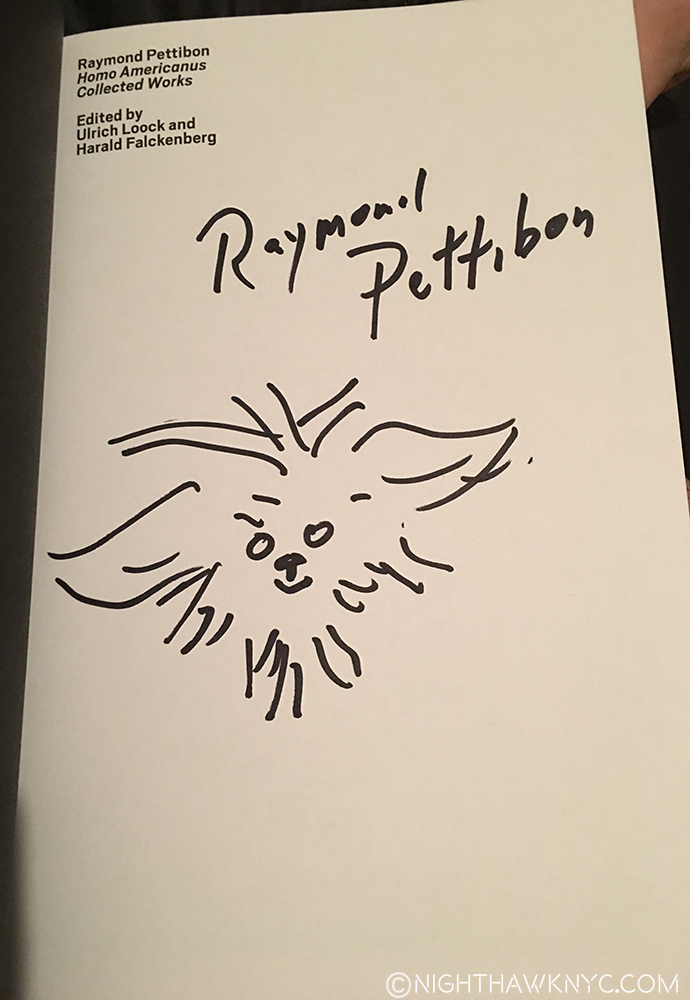
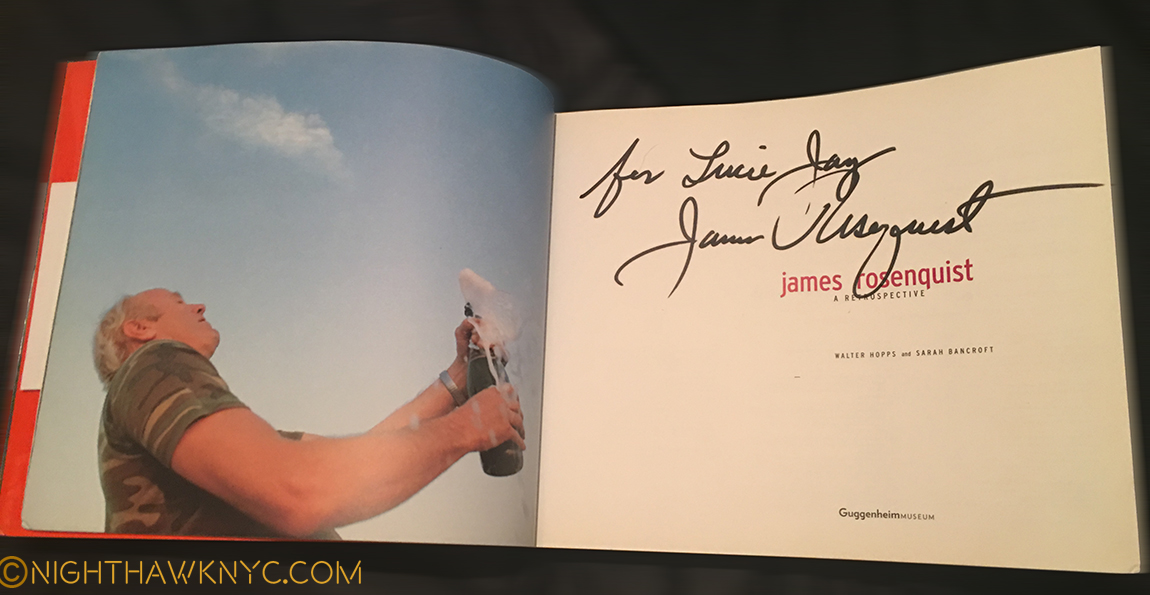
Baseball (as I mentioned, above), and some of the books about his work. His son, Bo, came by and drew in a fan’s book his father was signing, and announced to all present his intention to become an Artist. Pettibon has spoken about looking forward to collaborating with Bo, so Craig? Hang on to that drawing! Bare chested, Bo then proceeded to run out to the sidewalk and take startled passersby by the arm to try and get them to come and “see Daddy’s show.” As I commented to the staff, you can’t buy that kind of marketing!
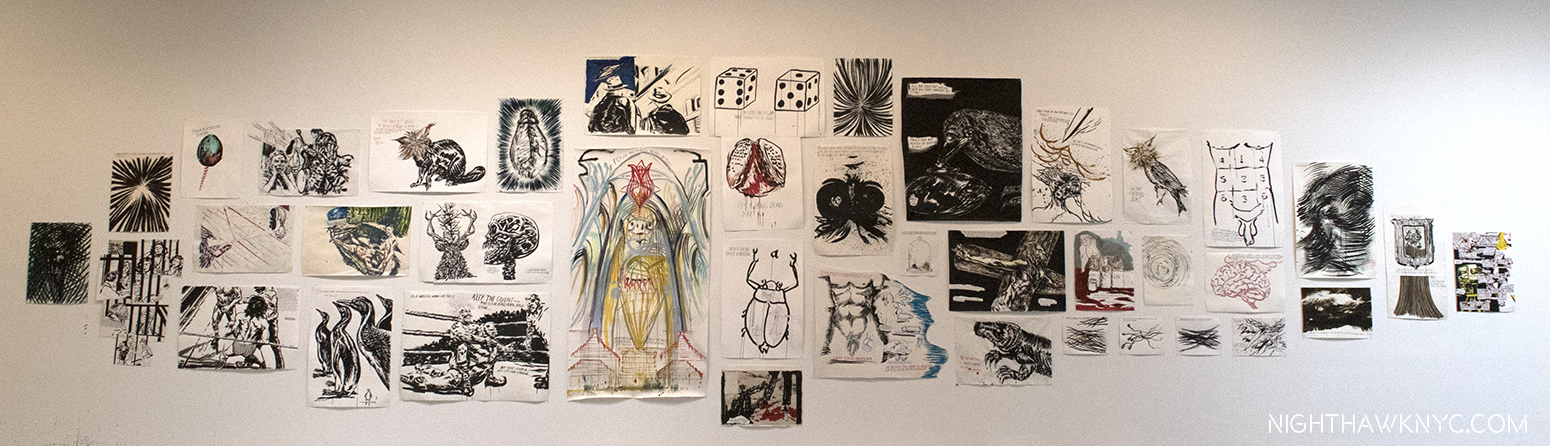
If you thought the first group of 11 was “complex,” 42 works line the very long eastern wall in one group. At the far left is a work about the beginning of life (shown below), at the far right, one about death (JFK’s). Smack in the middle is a large cathedral piece, with a UFO work over it, and one, perhaps, about suicide, and the luck of dice to their right.
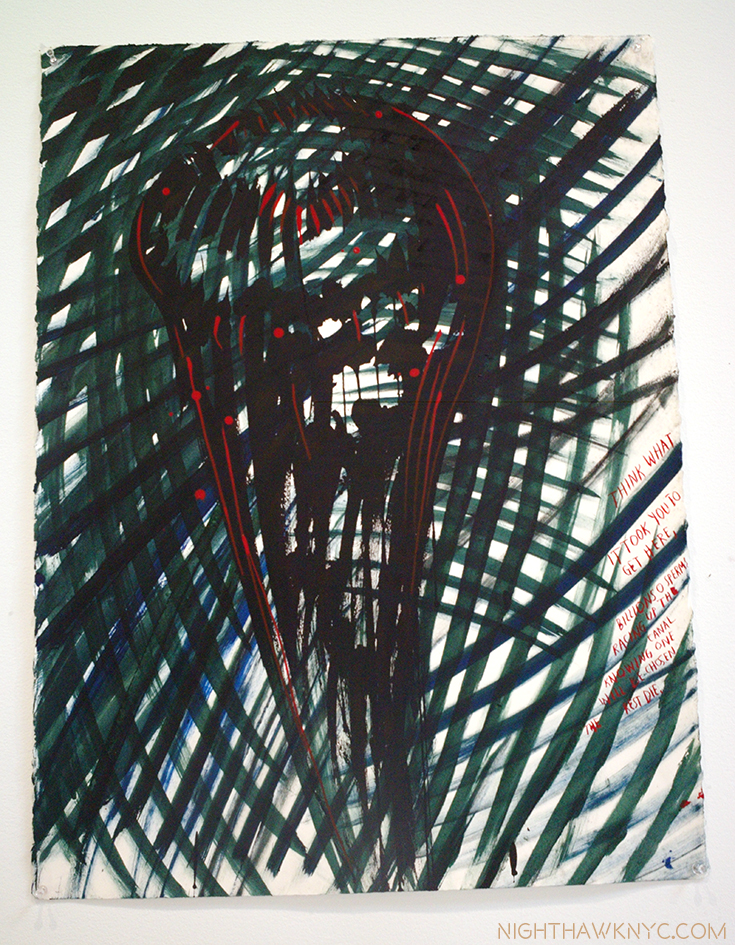
The piece on the far left side, above. “No Title (Think What It Took…) Ink and acrylic on paper.
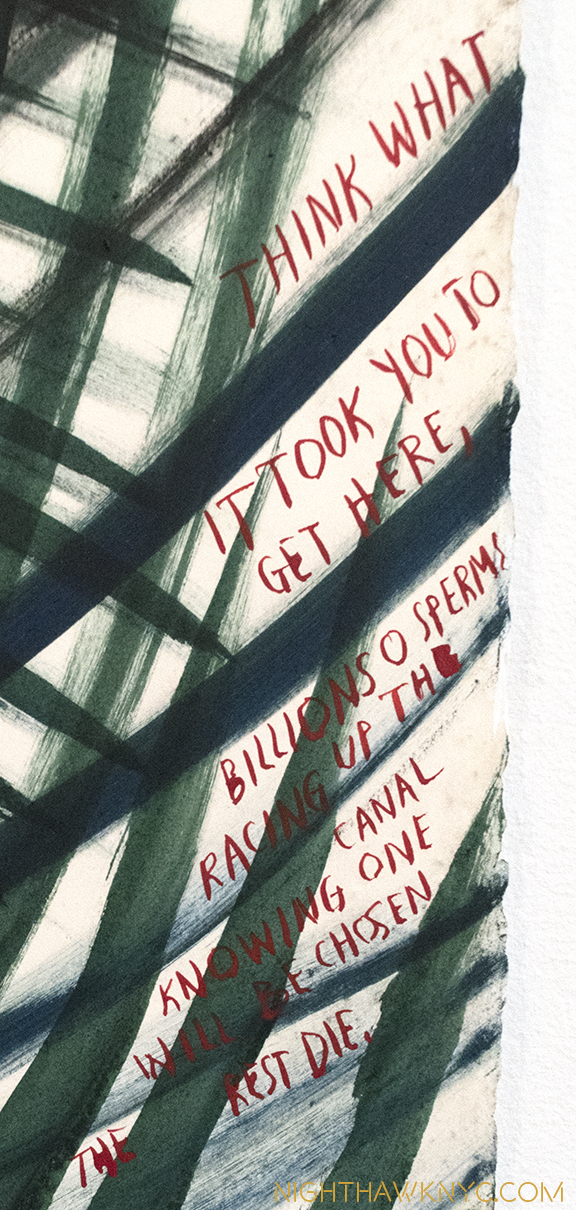
Detail of the text. If I had the money, I might buy this one.

It’s too early to calculate Raymond Pettibon’s influence because it’s still in the process of spreading, something which no doubt surprises many who only know him as a “punk Artist.” His has become a world-wide presence, with shows going on in Moscow, and “A Pen of All Work” reinstalled in the Netherlands as I write this. Over the past 40 years, he’s gone from being a shadowy background figure, creating fliers, record covers, zines and Artist’s Books, to being an established Artist in the world of “Fine Art,” who’s work is now being shown, more and more, in Museums. Around the world, in press releases, he’s invariably referred to as an “American Artist.” “Artist Americanus” is my play on “Homo Americanus,” the title of a large traveling European show of his work last year (which I take to mean “American Male”). When I think of that term in a “classic” sense, it means thinking for yourself, making up your own mind, and expressing yourself in your Art.

Regardless of whatever “meaning” you take from one of his works, Pettibon is an Artist who has maintained a remarkably consistent creative path since, at least, the mid- 1970’s. He’s said in interviews that he’s worked like this (putting words to drawn images) since he was a small child. Right now, 40 years on, Pettibon’s influence can already be seen even beyond his work, itself. The “alternative means” he used to get (fliers, zines, record covers, Artist’s Books, et al) his work seen2 is being followed by countless others, as can be seen at New York’s “Printed Matter.”
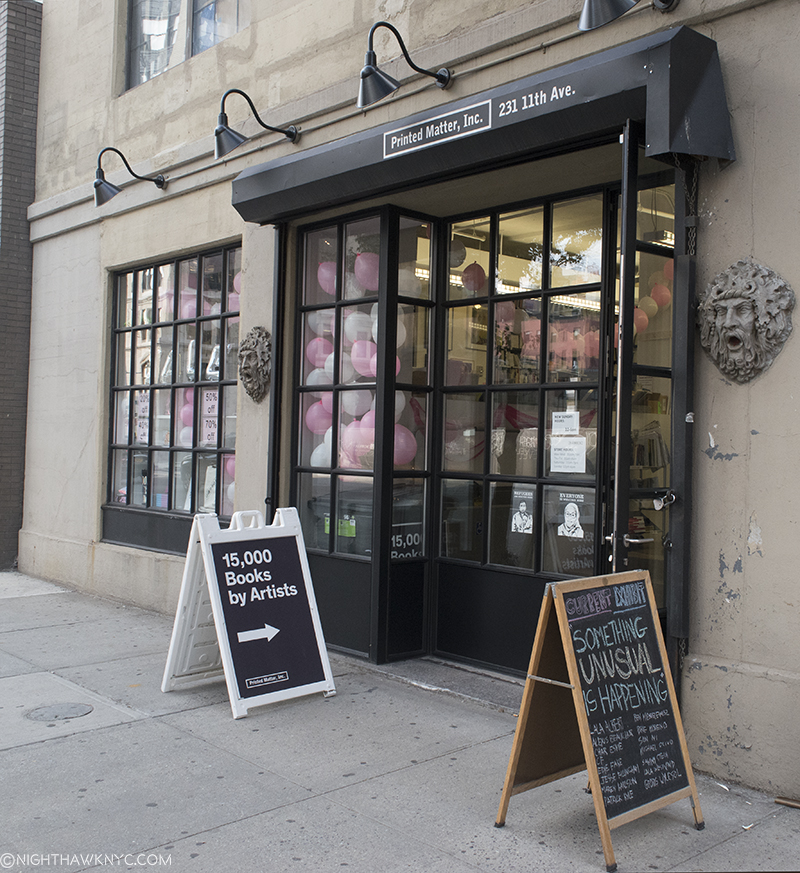
New York’s renowned “Printed Matter,” where the work of some Artists following in Pettibon’s footsteps is available, has over 15,000 titles in stock.

I, too, have been inspired by his example with this site, and I thanked Pettibon for the “inspiration,” when we parted. I’m not sure he knew what I meant. Beyond this, his other great influence is helping Drawing to be reborn in Modern & Contemporary Art. Artist (and Pettibon collaborator), Marcel Dzama credits Pettibon for being the Artist who put Drawing on the map in Contemporary Art3, and getting it taken “as seriously” as “finished works of Art,” and not as preliminary works for a Painting. That, too, seems like it’s already ancient history.
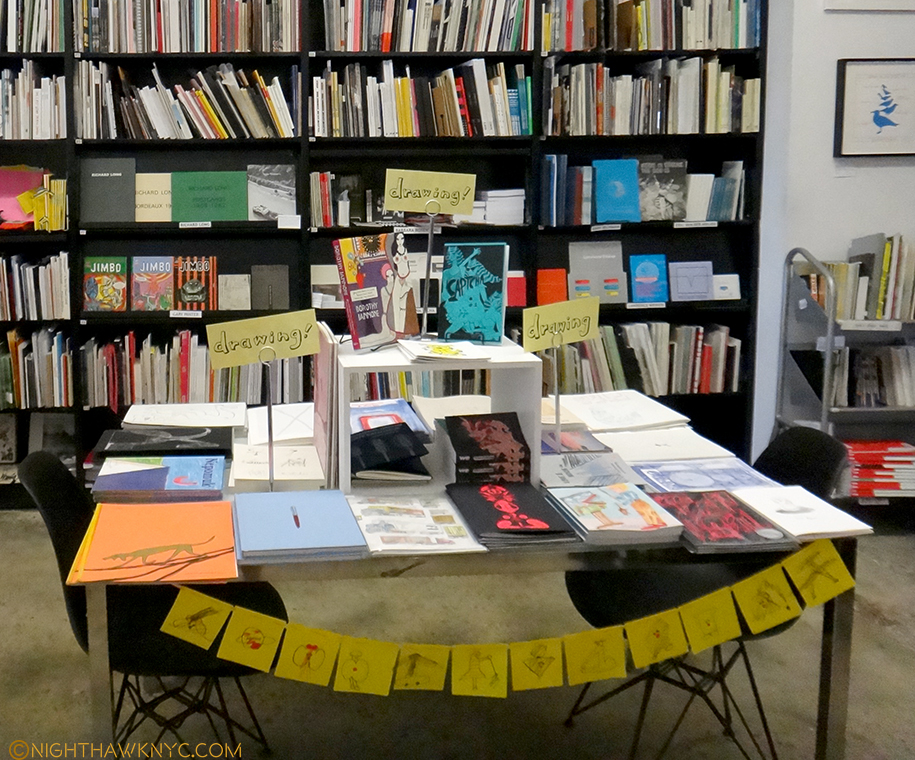
Inside “Printed Matter,” a table features recent Drawing books. A few years back, you’d look long and hard to see books of Contemporary Drawing.
 Some 900 works in to exploring his work and career Raymond Pettibon remains a fascinating mystery for me as he probably is for almost anyone else interested in his work. Much of his Art seemingly defies (easy) “understanding.” Regarding the “crypticness” of his work, in an interview, he said, “I think if I brought you through the work you’d see what I was trying to get at. You can say it’s open-minded, whatever, but it’s never a random association between the language and the image. There’s always a reason.” I keep looking for it, and more importantly, thinking about it, and whatever the topic(s) he’s addressing. That a good many of his topics relate to either current events, American History (previously drawn from a distance of time, because history tends to repeat, as he has said, and more recently including almost current events), or social & cultural history, give them an ongoing relevance, and importance that is rare in Art seen in Museums these days.  It’s taken him almost 40 years to get there. Fittingly, Raymond Pettibon turned 60 today, June 17, as I write this. Happy Birthday!

Sorry. Gumby insisted on a selfie.

When “A Pen…” opened at the New Museum, it was February 8th. 900 works later, when the Zwirner show ended, it was June 24! Most of 5 straight months of Raymond Pettibon! Still? I was already thinking- When’s the next show? It turns out I didn’t have to wait long. On June 27th, David Zwirner opened the “Thread Benefit Exhibition,” featuring 26 works donated by gallery Artists, a few doors west at 533 West 19th Street.  It includes this piece by Raymond Pettibon,
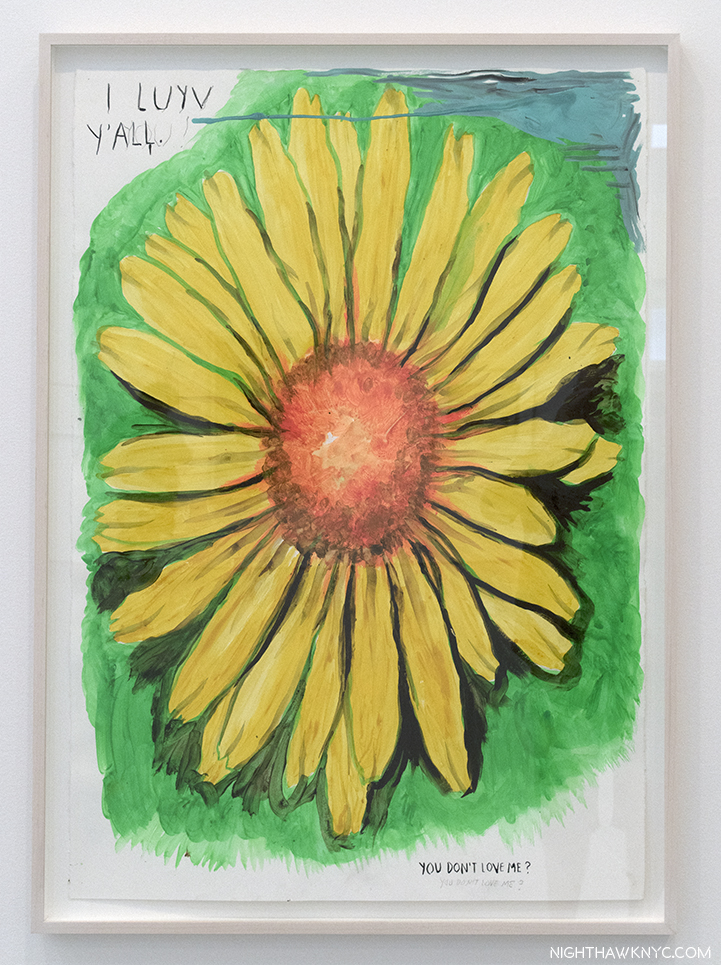
“No title (I luyv y’all…), 2014, “You Don’t Love me?” Ink, graphite, and acrylic on paper. Seen at the June 27th opening of “Thread.”

which speaks for itself. Or? Does it. I’ve been “trained” to look twice. Thus far, it strikes me as a terrific culmination to this remarkable “half year of Pettibon, NYC.”

The Artist didn’t appear, at least while I was there, that night. Leaving, I passed by 519, where “TH’ EXPLOSIV…” had ended 3 days before. I looked in and saw the wall he hand painted had already been painted over in preparation for whatever is going in there next. I turned the corner onto 10th Avenue, and a few hundred feet down, I saw this, propped up against the wall…
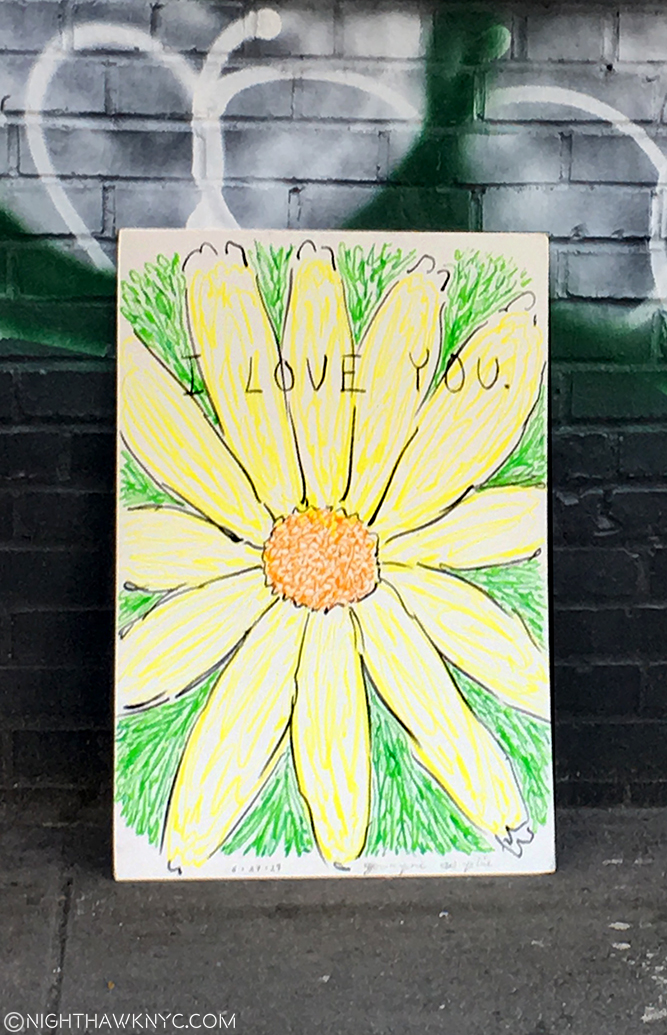
Unknown Artist, “I Love You.” Dated June 27, 2017 along the bottom, Unknown medium, seen on 10th Avenue, June 27, 2017,

What? The show had been open all of one hour, and already someone had copied Pettibon and had it up for sale on the street! WHOA. I was reminded of this quote of his- “I’ve never really thought of it in this way, but it is kind of cool to be the Gucci of my kind of work. I mean that in the way that Gucci and all those type of trademarks can be cheaply copied and reproduced like my comic books or flyers. I don’t get any royalties from that. I haven’t got a cent from SST ever, and I don’t get any royalties from the tattoo trade. The tattoos are when it becomes an even more substantial brand because it’s stuck on someone permanently. And if someone wants it off, then the mother has to go through even more pain to have it taken off than he did to put it on,” he said here.

I’m not the only one who owes Raymond Pettibon a “Thank you,” at least, for the inspiration.

“Raymond Pettibon: TH’ EXPLOSIYV SHOYRT T” is my NoteWorthy Show for June, 2017.
My thanks to Craig, Anisa & Caslon of David Zwirner for their assistance, and forbearance, during my dozen or so visits. 

*-Soundtrack for this Post is “Don’t Believe The Hype,” by Public Enemy, for all those who hear that Pettibon is a “punk Artist.” And, because Pettibon loves hip-hop, some East Coast.

NighthawkNYC.com has been entirely self-funded & ad-free for over 7 years, during which over 275 full length pieces have been published! If you’ve found it worthwhile, PLEASE donate to allow me to continue below. Thank you, Kenn.

You can also support it by buying Art, Art & Photography books, and Music from my collection! Books may be found here. Music here and here.

Written & photographed by Kenn Sava for nighthawknyc.com unless otherwise credited. To send comments, thoughts, feedback or propositions click here. Click the white box on the upper right for the archives or to search them. Subscribe to be notified of new Posts below. Your information will be used for no other purpose.

  1. “Gumby represents an alter ego for my work as an artist. He represents me as an alter ego. There’s actually a lot more to that figure than just ninety-eight ounces of clay or whatever. Art Clokey was into Zen Buddhism and into a lot of pretty deep stuff for Saturday morning cartoons. Clokey was a pretty hip figure in Los Angeles and in the counterculture of the ’60s and the ’50s—the beatniks and the hippies. I have a lot of respect and affection for him, and for Pokey as well, and Goo, Prickle, and even the Blockheads. One other thing that I’ve never thought of—that Gumby does for me in some of his cartoons—is he goes into a biography or historical book and he interacts with real figures from the past: George Washington or whatever. And I tend to do that in my work and in my videos, as well.” From Art21.
  2. Not always successfully. He’s said repeatedly he wound up giving away or destroying most of the copies of his self published early books, making them very rare today.
  3. Along with William Kentridge, R. Crumb, Robert Longo, and a few others.

On Buying Art

This site is Free & Ad-Free! If you find this piece worthwhile, please donate via PayPal to support it & independent Art writing. You can also support it by buying Art & books! Details at the end. Thank you.

Written & Photographed by Kenn Sava (*- unless otherwise credited)

For NighthawkNYC’s 2nd Anniversary, I decided to share some thoughts based on my experiences buying Art over 3+ decades. I hope they’re useful. My thank yous for year 2 appear at the end.

Everyone should have something that speaks to them on their walls or in their space.

It could be something personal, something from your past, or, it could be a piece of Art. If you find both lacking in your space(s), I hope you’ll think about changing that and seeing what it adds to your life. If you choose something personal? You’re on your own. If you would like to try a piece of Art? I’d like to share my experiences and thoughts about it with you, for whatever they’re worth.

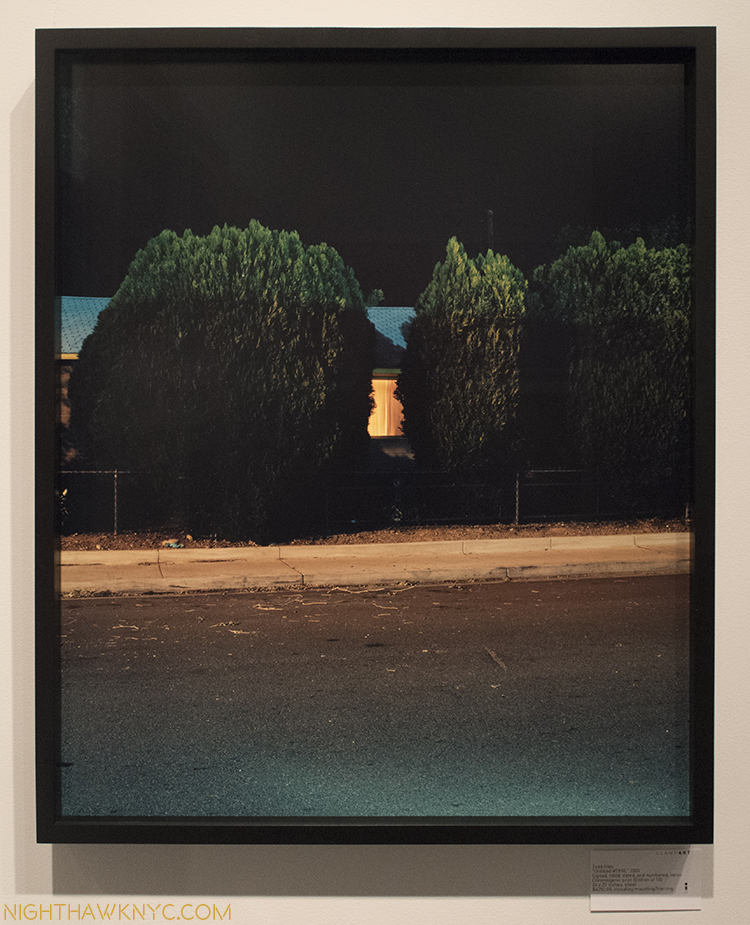
Todd Hido Untitled #7910, from House Hunting, 2012, seen at AIPAD, as I mentioned, here. It only took me 2 trips to see it to buy it. It’s me, right? Click to enlarge.

Of course, you could make something yourself. Most people take photos, so it might be worthwhile to get them all together and go through them and see if you have one you’d like to print and display. Or, you could create something from scratch- a Drawing, a Painting, a Sculpture, or…? While almost no one is a brilliant Artist right away, if you’re determined to create something that speaks to you and you feel proud enough of to display? With a bit of work, you might surprise yourself with the results. But, if you decide to buy something, there are some things to consider. Since I don’t know how much readers might be looking to spend on Art, I’m going to take the big picture view of it, to include as many cases as possible. If you haven’t bought Art before, it’s probably something you don’t want to rush right in to. While there could be a virtually endless amount to learn if you want to do this on a “serious” level, there are some essential things to keep in mind when you’re starting out that I think also apply to those with experience buying Art.

Of course, setting an amount you’re comfortable spending of your budget is essential. It’s too easy to spend over your means on Art and that might well mean having to sell it quickly, usually at a loss. I’ll call this budgeted amount “$X” since it varies by person. Once that amount has been determined, over many years, there’s one thing I’ve learned that, as far as I’m concerned, comes closest to being THE #1 “Rule” for buying Art-

ONLY BUY WHAT YOU LOVE.

Buying only what you love establishes your philosophical approach to buying Art. There’s a number of reasons I recommend this approach, most importantly the long term satisfaction with your purchase. If you love something, you’re going to enjoy it more than something you don’t, right?

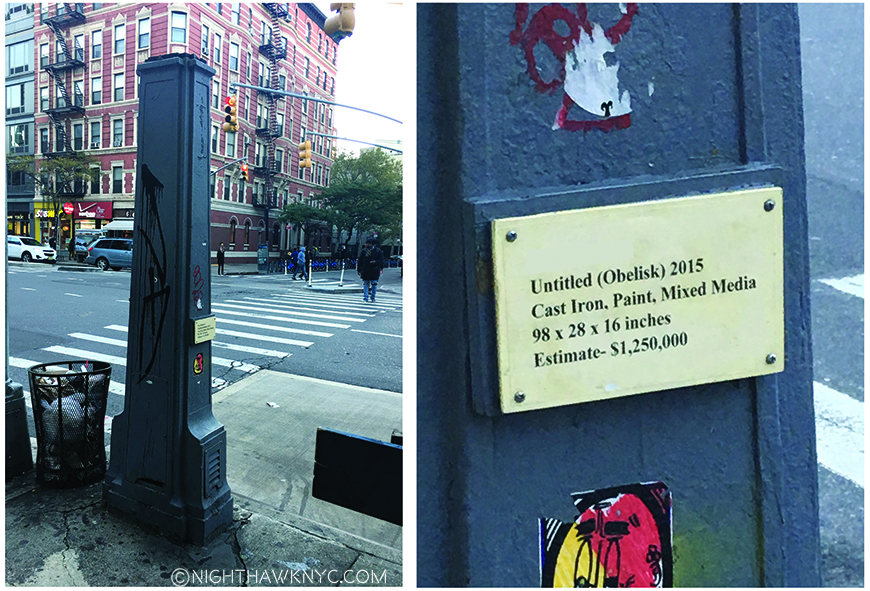
Should I buy it? Umm…What is it? Is it Art? I think it’s actually an air vent for the 8th Ave Subway under it until some clever fellow decided to try to sell it for a cool 1.2 million. Maybe he was kidding? Well? I’ve been known to laugh at asking prices, too.

Of course, any time you spend more than a few hundred dollars on something, the investment aspect of it comes into play. Before you buy, look at comparable examples of the Artist’s work and see what they have sold for and when. After you buy the work, you should continue to do this- how often is up to you. But, in terms of buying Art purely because of what its value may be in the future? That’s an unknown. NO ONE knows what’s going to happen to Art prices in 5 years, or 50 years, or 200 years. Therefore, this can’t be your main reason for buying Art. Plain and simply, buying Art primarily for investment purposes is nothing but a crap shoot. The Art market has gone up and down during my lifetime, something that those who have only been in it for the past decade of rising prices can’t imagine. IF, heavens forbid, the Art market tanks, again…No. Not “IF.” WHEN the Art market tanks, again, and the piece you own becomes worth less than you paid for it, you can still get real value from it by enjoying it, IF you love it.

“Cos I don’t care too much for money
Money can’t buy me love.”*

They’re a bit more “bullish” on the “Art market” than I am.

I say “When the Art market tanks, again,” because the historical data shows that it’s VERY likely to happen. Sooner, rather than later. NOTHING goes up for ever- not even NYC real estate. Across the board, Art prices are as high right now as they’ve ever been. I look long, hard and generally fruitlessly to find any Artist who is “undervalued” today, and that includes many Artists who are not even in major museum collections yet. Is this sustainable? Very possibly not. Will prices go higher? Maybe. Will they go A LOT higher? I’m not convinced. I’ll put it this way- Right now, in my opinion, in general, there is far more risk that prices will go down than there is the chance they will go a lot higher (an increase of 40%, or more).

As strange as this might sound to say, I also believe that the Art market going through a substantial downturn might not be a bad thing all the way around. Yes, there will be a ton of pain. Many Art galleries and some institutions will no longer be with us, and many jobs will be lost. Many Artists will turn to other fields of endeavors. I may not have anything left to write about. None of these things are good, and I don’t want any of them to happen. Yet, it might also return some semblance of sanity to the Art market. If the investors are out of Art, only Art lovers will be left.

Ok. So now that I’ve gotten the negativity out of the way (i.e. the risk), let’s get back to why you want to buy Art- because you love Art. In the end? I think that people will always love Art. Some/many/most of them will want to have some in their spaces. Those are the people I’m talking to here. If you buy Art you love? Your risk is less than someone who buys it as an investment. As an Art lover, the good news is that even now you don’t have to spend a fortune to buy Art. There is Art for sale at every price imaginable. Set a budget and you’re good to go.

Whether you should, or shouldn’t buy something will rarely be this easy to know.

If you’re buying Art today, or in the future, here are a few things to keep in mind-

First, educate yourself as much as you can about the Artist, the piece, the medium it’s created in (Is it a Painting? A Drawing? A Limited Edition Print? Or…what?). Does it appear in any book on the Artist? If so, what does the author say about it (description, dimensions, year created, size, etc.). Does all of this match the piece you’re considering? If so, this is good, but it may not completely close the question of authenticity, forgery, or being “right” I’ll get to in a moment. The second part is to educate yourself on the Artist’s “market”- what is their work selling for. Selling for. Not what people are asking for it. What are people actually paying for it. People are free to ask whatever they want for it (like our friend with the air vent, above). But? ANYthing is ONLY worth what someone is willing to pay for it. How do you find all of this, and more, out? You have to dig.

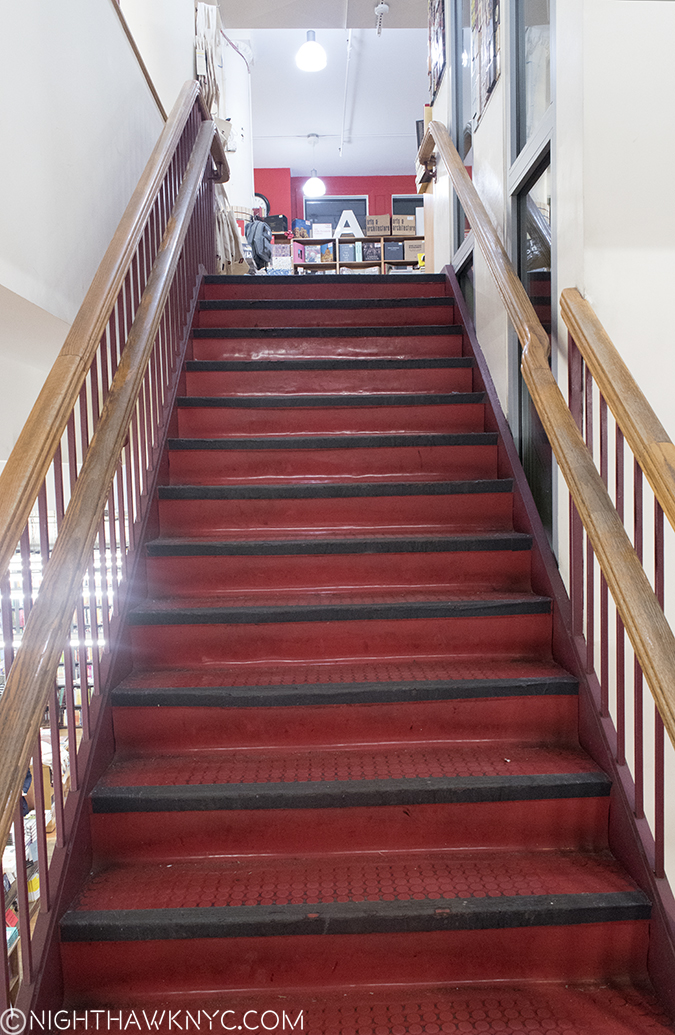
Going up to dig. Once a week I climb these stairs to The Strand’s Art Book Dept on the 2nd floor. More often if I’m really stumped.

Second, is it genuine? This is a very sticky question that, unfortunately, rears its head in almost every Art transaction- or, it should. I will say that it seems to me that forgers seem to focus on Artists who have a certain status, and a well-paying market, but you never know. Pieces that are “not right” in some meaningful way (they’re damaged, repaired, mis-identified, stolen, “sketchy” is some other way, etc.) are more common in my experience, but it varies by Artist. You want to know you’re getting what you paid for. What does the Artist’s genuine signature look like? What are the telltale signs of his or her style, and on and on. Is it an original (one of a kind) piece, or is it a limited edition? If it’s a one of a kind- is it signed, dated or titled? Does it appear in the Artist’s Catalogue Raisonne, or other authoritative guide? If so, does it match the work in the picture of it? If it’s a Limited Edition- How many copies are in the edition, how many “Artist’s Proofs” are there, and what was the Artist’s involvement in making the print, are some of what I’d need to know. You may never get to be expert enough to replace the opinion of a real expert but it’s your money and you should know as much as you can about what you’re buying. I stay away from pieces that are not signed by the Artist. Why? Though they are, generally, (much) cheaper, I want to have that connection, and it means less chance of a forgery or an unauthorized edition. I also stay away from prints that are “open editions,” because, in theory, additional prints can be created indefinitely, and the larger number there is of anything out there, the less valuable it generally is1.

I KNOW this Raymond Pettibon Owl sketch & signature are genuine because he drew them right in front of me. “Obtained directly from the Artist,” is, also, the best provenance there is, though the hardest to get.

Third- What condition is it in? You may need an expert’s opinion on this, and you should get one if the work is over 50 years old or you’re spending substantial money on it, but you should look it, and whatever supporting documentation the seller has for it, over carefully yourself. If he doesn’t have it? That’s likely a deal breaker. I think you want to get in the habit of getting complete documentation for the Art you buy which may include a receipt, the provenance, a letter of authenticity from an expert or someone personally involved with the Artist, a condition report, and an appraisal for insurance purposes. Learning the terms of, and some of the ins and outs of the various mediums (Oil Painting, Acrylic Painting, Watercolor Painting, Drawing, etc) will help you and help you understand what the experts tell you. Old paintings may have been subject to restoration, cleaning, or even additional painting added to it by others, and these are very sticky waters for any Art buyer- even museums2. If you’re buying a piece that is already framed, it is possible the frame is hiding damage that could materially effect the value. At some price level, it becomes imperative the work be examined unframed, and the seller may, or may not, be willing to do this.

Pettibon, again. Very rare among Artists, his work is pretty easy to examine unframed at his shows, but any buyer of it should immediately take it to a framer. A view of part of the final room of A Pen of All Works, at the New Museum, includes work he created right on the wall itself!

Fourth- Who am I buying this from? What is their background and area of specialty & expertise, and is this Artist in that area? What is their connection to this piece, and to the Artist? Do they represent the Artist, or their estate? What is the provenance of the piece? I will not buy a piece without a known provenance, and ask it be spelled out in writing by the seller. Why? Whoever buys this piece from you will ask you for it, and it helps assure me the work is not stolen, and lessens the chance it’s a forgery (even knowledgable and reputable dealers, as well as museums, have been duped by forgers). How knowledgable is the seller about this specific work, and its condition? Anyone who knowingly withholds information about damage or something “not right” with a piece is not ethical, and shouldn’t be in business. But? They’re out there. It’s happened to me. They’ll claim they “missed it,” so? Buyer beware. What’s the return policy if something turns out to not be “right?” Ideally. you want to buy from someone who stands behind what they’re selling and what they’re saying about it. There are an unlimited number of people and places selling Art these days. I’m not going to recommend any one. (Oh, and for the record, no one sponsors me). However, I will say that I think if you’re buying Art for the first time, go and look at it in person. Buying Art online that you’ve never seen in person is hard for an experienced Art buyer, very hard for an inexperienced one, and something I highly recommend you avoid. For one thing you can’t get the full effect of the piece, in my opinion, from a photo, and you can’t assess things like condition and damage anywhere near properly enough from one. Terms vary by seller. Look over them closely before you commit to buying anything from anyone. Learn to develop your own terms- what you require and what you won’t accept regarding payment, paperwork, returns & refunds, authenticity, condition, etc. If you see something that doesn’t sound reasonable, or is against your terms, walk away. Keep in mind that where limited edition prints are concerned there’s a chance you can find the same item being sold by someone else, especially if it’s less than 10-15 years old.

Almost every window in this Photo is of an Art gallery on West 26th Street, which is full of them from 10th to 11th Avenues, as are many of the adjoining Chelsea streets.

It’s vital to get out there and look. Books and the internet can provide information, but there’s still no substitute for seeing Art in person, as I said, especially when you are forming your tates. Even if nothing is being offered for sale (as in a museum show), you’ll learn something every time you look. See what’s being shown and how your feel about it. Gradually, your tastes will come into focus. Wait until you get “that feeling.” You know- like when you fell in love. If you don’t? Keep looking, enjoy what you see, and learn about it. Another thing that’s become apparent to me is that I like Art that says something different to me every time I look at it (as I’ve mentioned in prior Posts). This has become an essential element I need to have in anything I actually buy because I’m going to be looking at it a lot for, hopefully, a long time. While I have never bought a piece I didn’t love, as in other types of “love,” I find it’s the piece you can’t live without that may be the piece to buy. Keyword- may be. Obviously, many other things are more important to life than Art- Shelter, food, health, and those things effecting survival come way before one gets to the point of considering buying Art. Art adds to and enhances life. But, no one ever died from not having Art, as far as I know. (Though, some people who live without Art may not be living!) So? Wait until you find a work that gets inside of you and won’t let go.

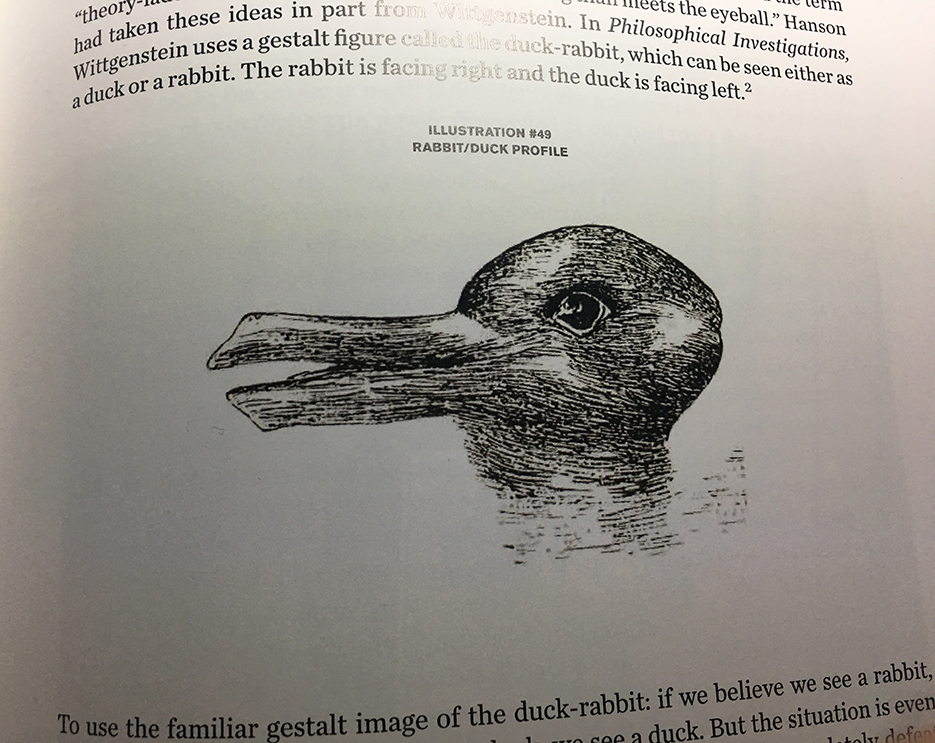
Looking is hard work. Quick- What do you see? A rabbit facing right, or a duck facing left? From Wittgenstein’s “Philosophical Investigations,” as reprinted in Errol Morris‘ superb Believing Is Seeing, which I recommend to everyone who looks at Art.

Fifth- What other expenses am I going to incur buying this piece? Tax, shipping, framing and insurance are the most usual ones. Packing and appraisal (which you may need for insurance if the value rises above what you paid) may be others.

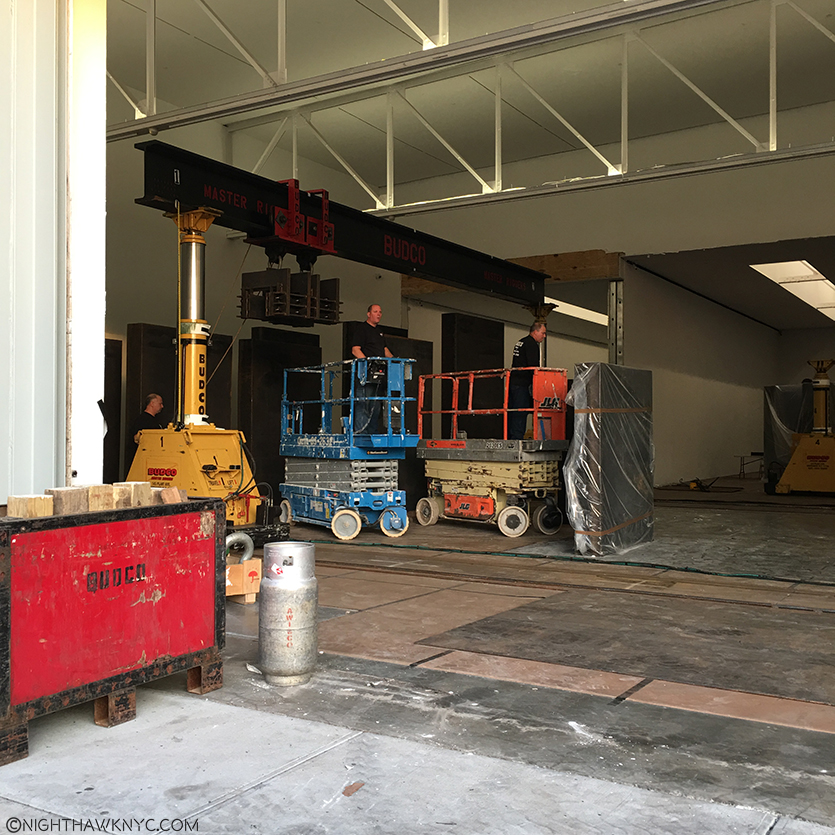
Professional Art handlers and movers may be needed to handle large, heavy, delicate or unusually sized pieces, like these seen here during an installation earlier this year at Metro Pictures. Doing it yourself may risk damaging it. Damage= lower value.

Deinstalling Richard Serra’s For John Cage series at Gagosian last year. Hopefully your needs won’t be this involved.

Also, once you buy a work, you are then responsible for “curating” it- keeping it in as good condition as you bought it to maintain its value. If you are considering having a work framed? Go to an established pro who regularly does work for museum and gallery shows. I only use City Frame, in NYC. I have used many other framers and since I don’t believe in being negative here, I’ll simply say, call Corinne Takasaki at City Frame if you want something framed. They’re the best I’ve found. No. I don’t get a cut from them for saying that. If you’re buying a work on paper that is from before the days of acid-free paper be aware that you’re going to have yellowing to deal with over time going forward. Consult an expert about what this might entail before buying it.

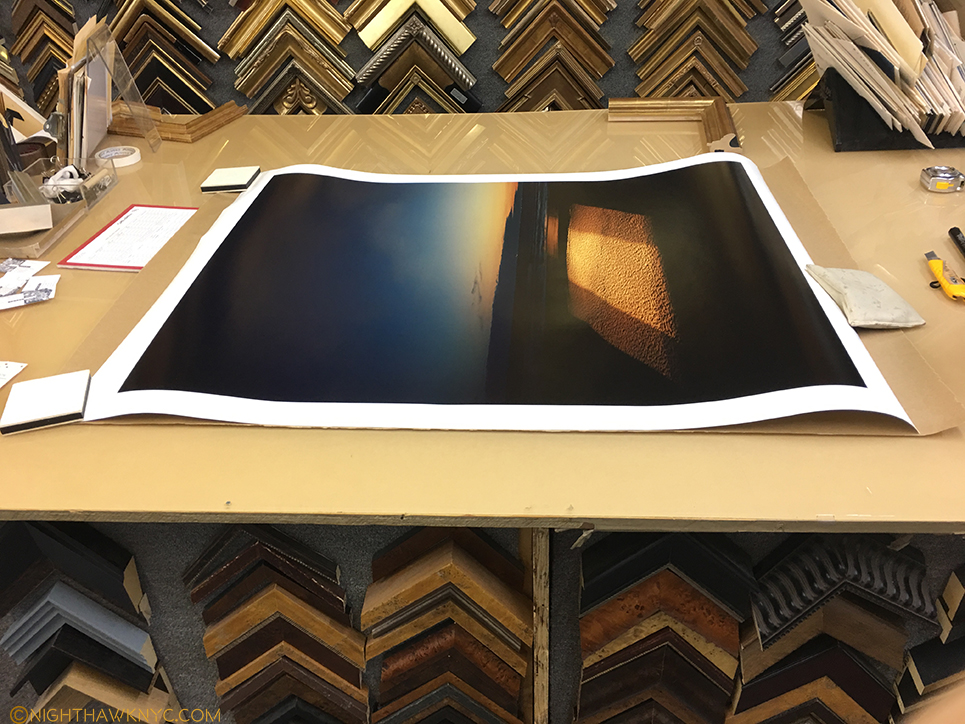
The first stage of framing at City Frame. A photo about to be measured.

Sixth- So, if you’ve bought what you love? Hang it and enjoy looking at it each time it comes into your view. If, after time has passed, you’ve decided to part with it? Selling is a subject for a whole other Post (or 10). I will say this, though- In general, it takes time to sell Art for what it’s worth. I mention it now because it’s something to keep in mind. BEFORE you buy something. You should ask yourself- IF, and when I decide to sell this, what are my options? One thing many people fail to realize is that new & largely unknown Artists have one market- the dealer who represents them. Most likely, you are buying their work from them. When it’s time to sell it? They may well be your only option. They know the Artist’s market and his/her existing collectors. They’re going to take a piece of the sale price to do so. How much varies by dealer, but it’s something to keep in mind. Auction houses may not accept the work of Artists who don’t have a proven track record of sales. You can search for this online and it’s something you should do before you buy a work that costs more than $X (unless you’re prepared to lose this money). I applaud people who buy the work of “under-known” Artists because they love their work. You are helping that Artist survive, and make more Art. I’ve been able to actually buy Art directly from the Artist, which you might be able to do before they sign with a gallery to represent them and handle their sales. It adds a personal element that’s hard to forget, and hard to equal.

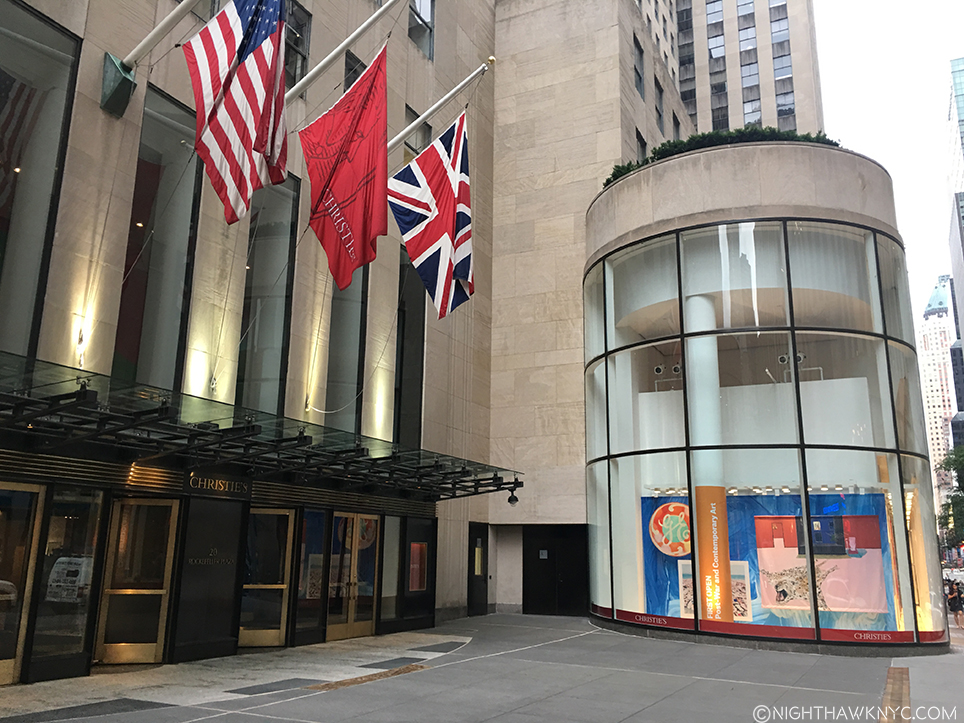
Christie’s, Rockefeller Center. The big auction houses rarely sell the work of Artists who aren’t “established.” On the other hand, living Artists don’t get a percentage of re-sales of their work at auction (though most auction houses get paid by both the buyer and the seller). Look! They have their own flag (center)!

ALL of this being said, you don’t need to spend a fortune on a piece of Art! Art is available at almost any price you can mention. Just remember everything I’ve said above still applies, and that buying even relatively inexpensive Art may require some of the additional expenses I mentioned earlier, or others I didn’t. Everything I’ve said is based on my own experiences over the past 30 some years. I make no “warranty.” This is by no means meant to be “advice” or a “complete guide.” In my opinion, there is no such thing.

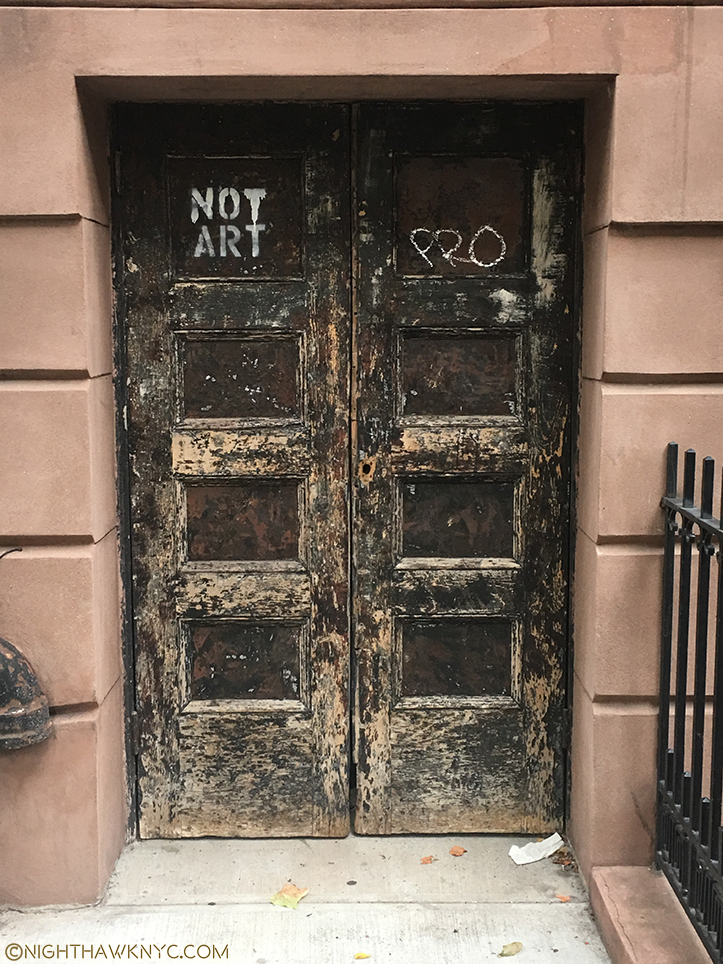
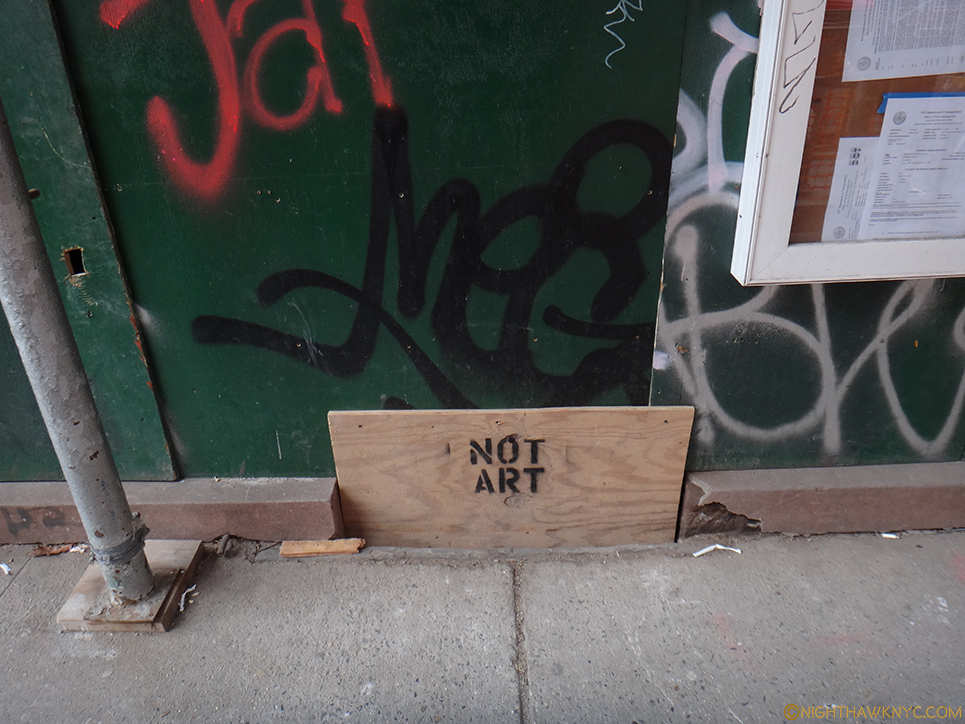
It’s a good thing I don’t have one of those stencils.

Another thing I’ve learned from looking at a lot of Art is that I will never own 99.99% of all the Art out there in the world. I’ve come to terms with that. Sure, I want to take Hopper’s “Nighthawks” home and hang it here, though that’s incredibly selfish. Yes, I see things every time I look that I think about buying (with varying degrees of seriousness). But? That’s ok. I’ve learned to use shows as another room in my home. It’s like if I go to a show often it’s a bit like living with the work on display, which is kind of fun-and? It’s as close as I’ll ever get to really doing that.

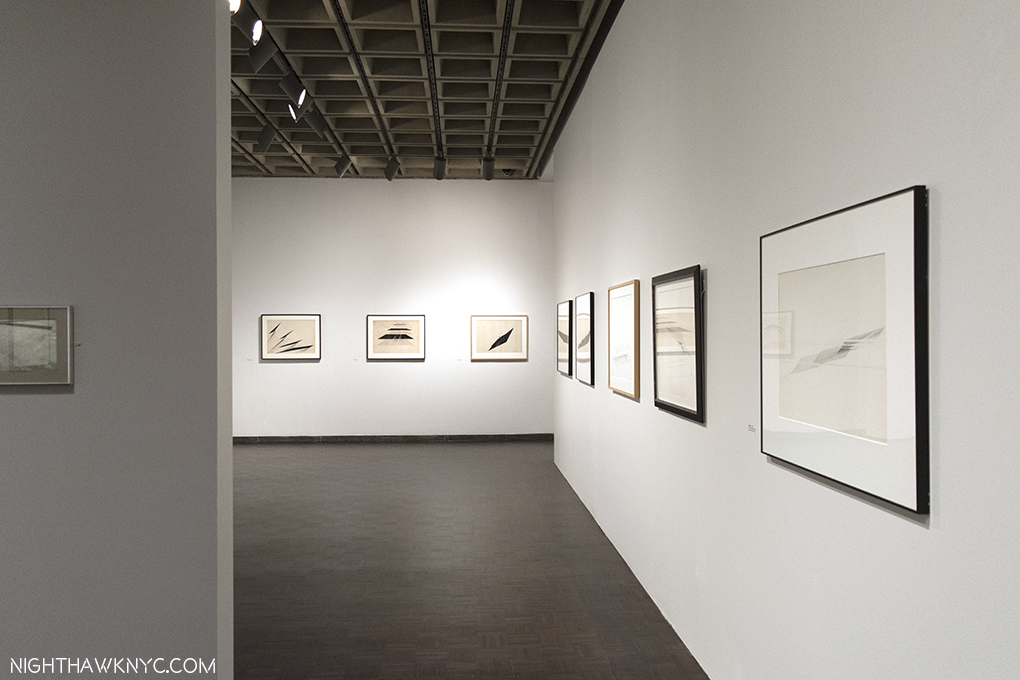
I still walk around this show in my mind. Nasreen Mohamedi at The Met Breuer, 2016

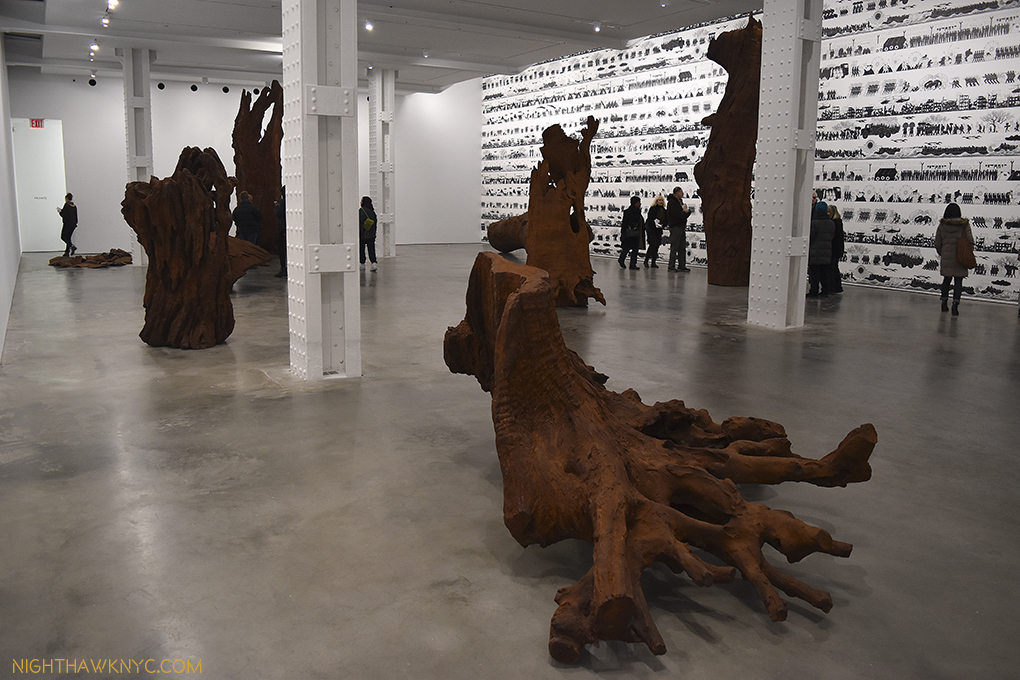
25 visits was easier than getting one of these home. Ai Weiwei at Lisson Gallery, 2016

Another important consideration in buying Art that you love is timing. As I’ve mentioned, I believe the Art Market is (at, or) near a peak in value. As a result it becomes extremely hard to find Art that is “undervalued.” Far more Art is “overvalued,” in my opinion. Of course, there is no way for anyone to really know what Art is going to speak to, and be valued by, future generations. We can only make assumptions. One of those is- “If it’s spoken to people for x hundred years, why won’t it continue to do so?” Another is, “They’re not making any more Vermeer’s.” So, yes, supply and demand is always the key element. And that brings me to a final point. While “Contemporary Art” has a certain “sex appeal” that comes with being new, as I touched on earlier, most new Artists don’t have an established market. This is very, very risky, in my opinion for anyone buying their work for more than $X, which, apparently, many people are doing. It seems to me that most people, especially those new to buying Art, would be better off buying the work of Artists with (long) track records, which also allow a wider ranger of selling avenues, if/when the need arrises.

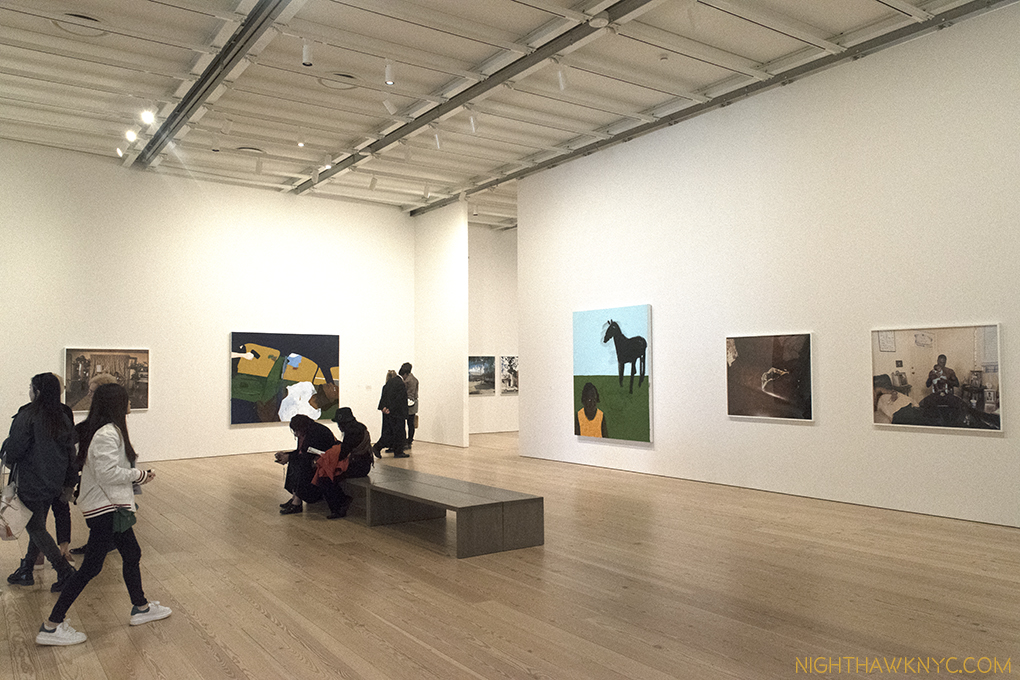
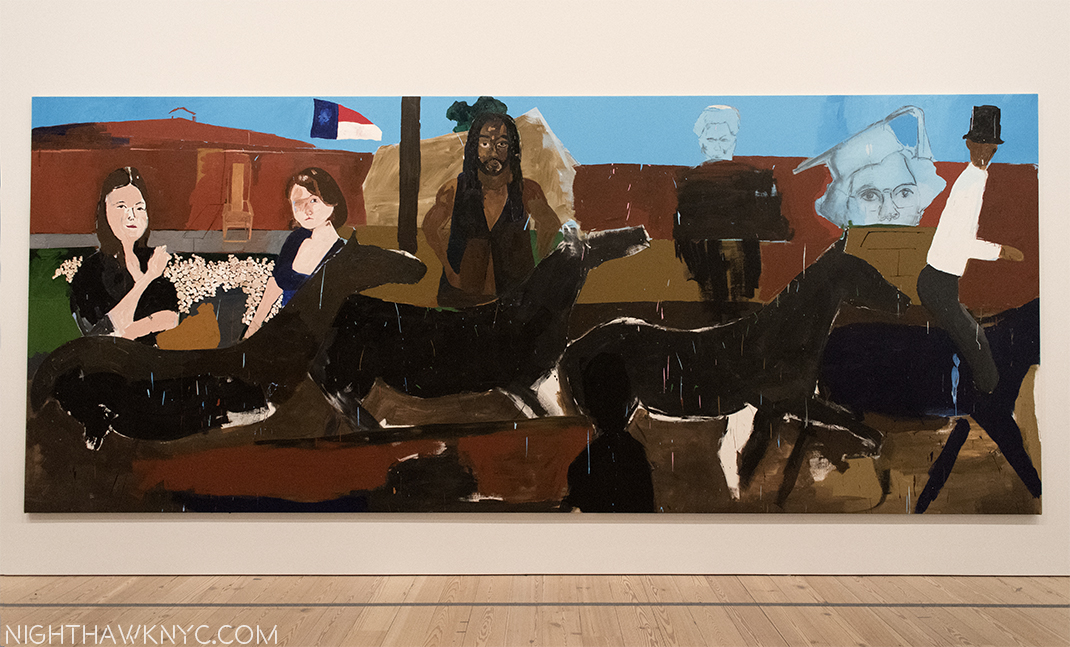
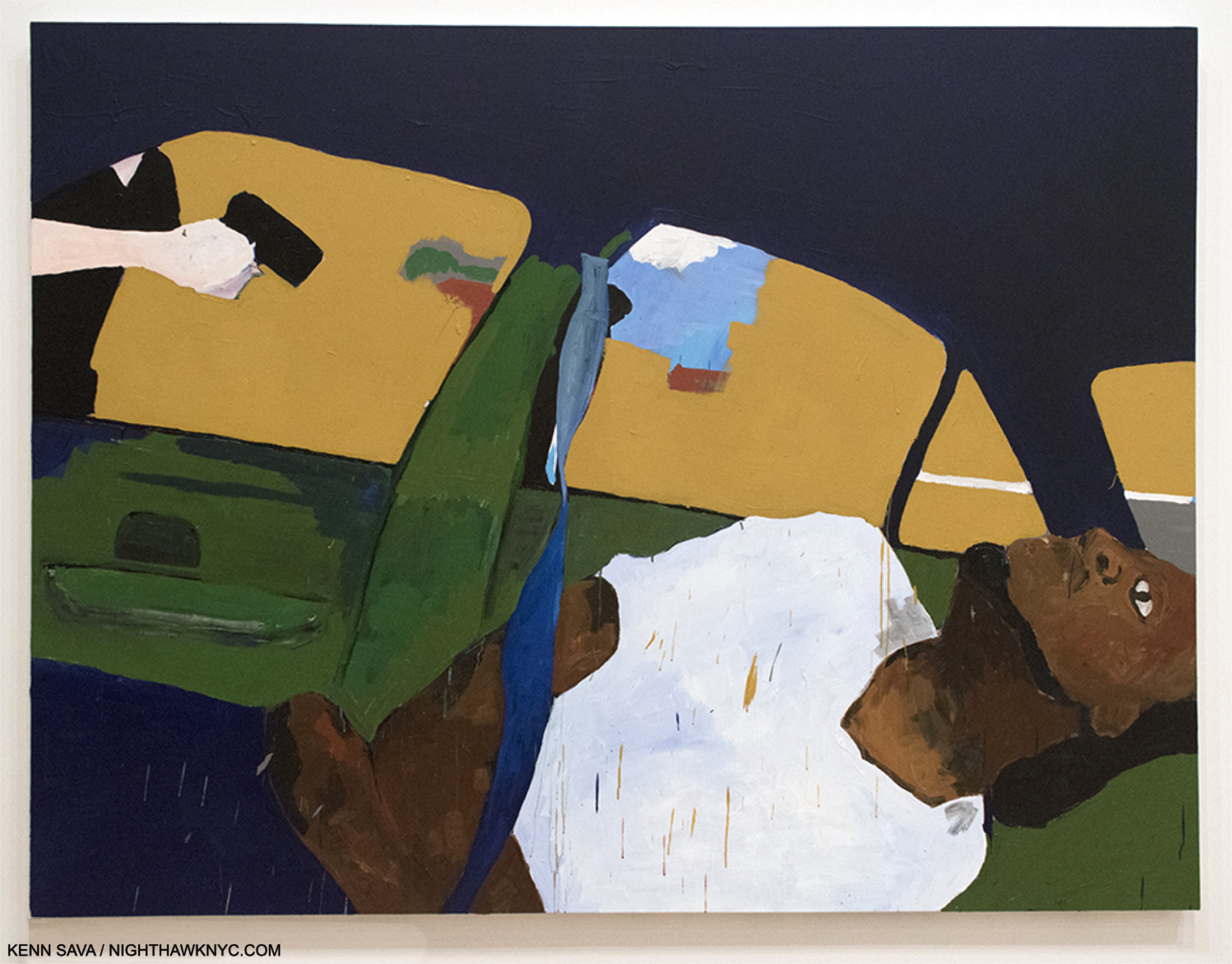
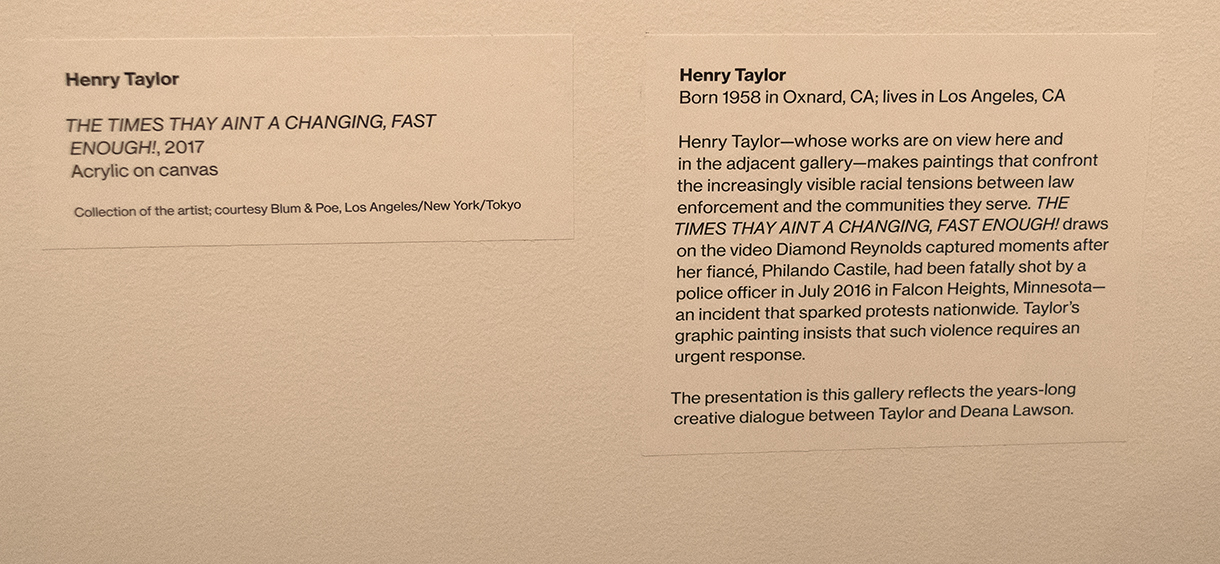
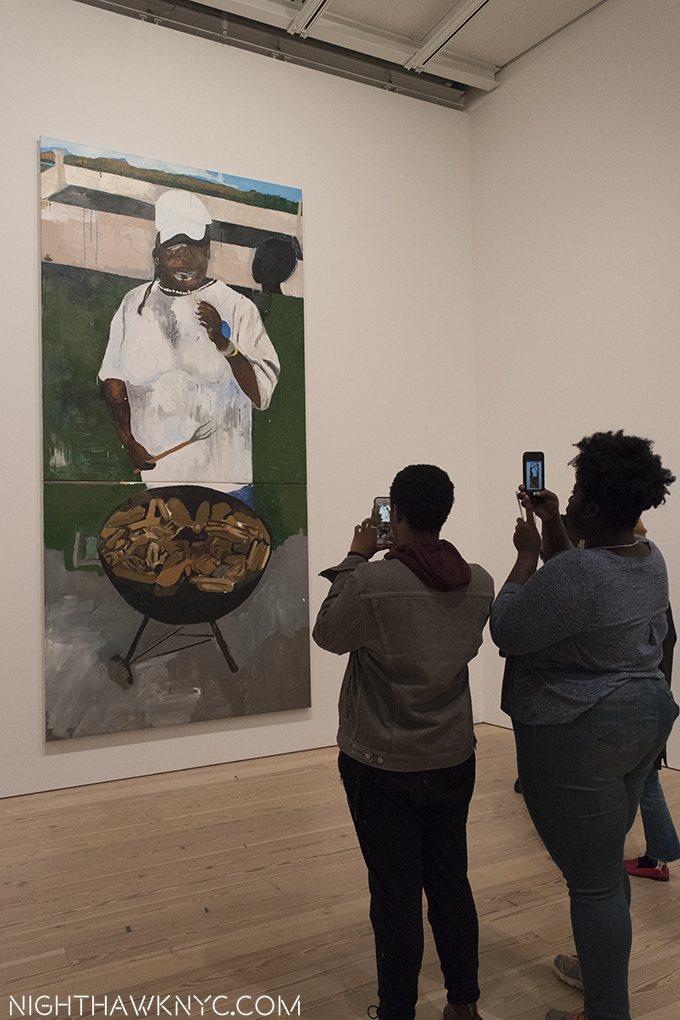
Henry Taylor & Deana Lawson shown together at this year’s Whitney Biennial, where they were among the “stars.” Being included, means it’s too late now to “get in at the bottom,” on either, but it’s still no guarantee either will “make it,” and their prices will rise substantially the next 20 years, since both are still in “mid-career.” Therein lies the rub, and the risk, in buying the work of good Artists who are beginning to “make it.” Are you now paying for the quality of their work, or its future price potential? At least the Artists get paid.

Going back to the Master of Delft, it’s hard for us to realize that Vermeer lived in obscurity after his death for many, many decades (like Van Gogh lived during his entire life).

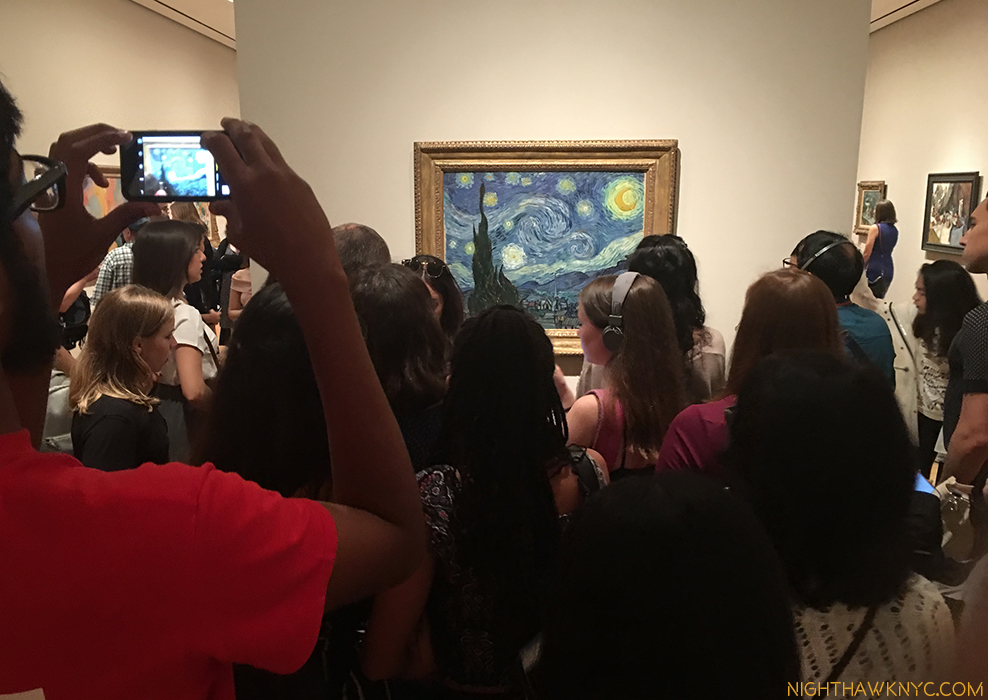
Yes, that really is Van Gogh’s The Starry Night at MoMA, or as close as I could get to it. I often wonder what Vincent would have made of his incredible popularity now.

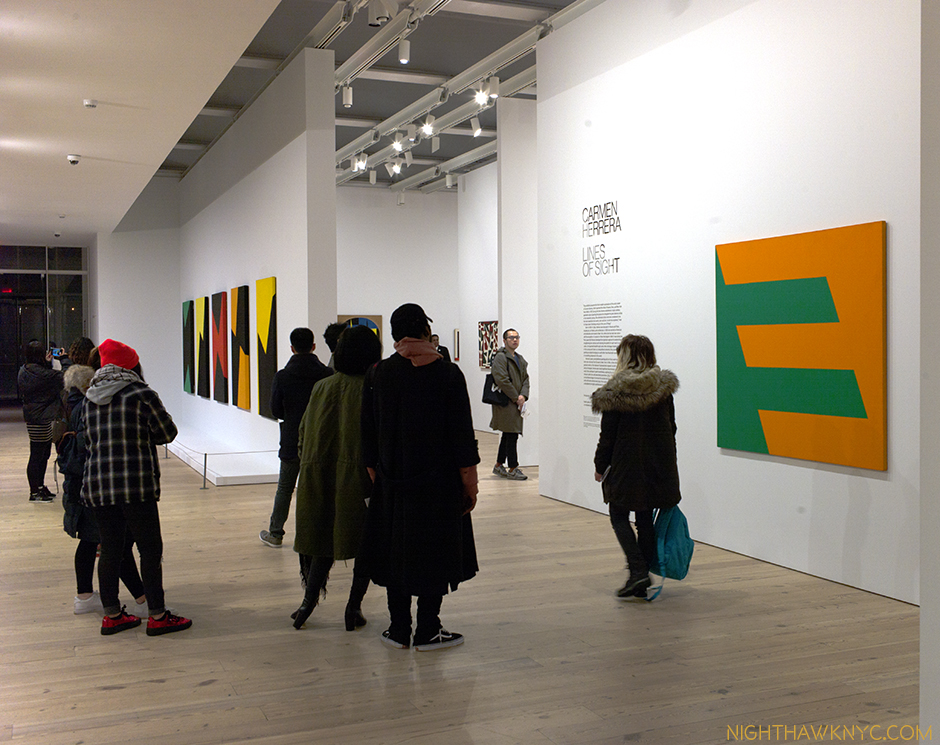
It’s quite possible “another Vermeer” is out there waiting to be discovered right now. Carmen Herrera, who’s now 102 years young(!), had only one major show (in 1984) before being given a solo show at the Whitney Museum LAST YEAR (2016)!

Carmen Herrera: Lines of Sight at the Whitney Museum, January, 2016.

With all the Art that’s been created in just the past, say, 300 years, I think it’s a virtual certainty that someone major has gone over looked. So? If you get good at this, you go to see enough Art, know what to look for, and you have your eyes open? Who knows what you might find!

But? Don’t buy it if you don’t love it.

*- Soundtrack for this Post is “Can’t Buy Me Love,” by John Lennon & Paul McCartney, of The Beatles, published by Sony/ATV Music Publishing LLC.

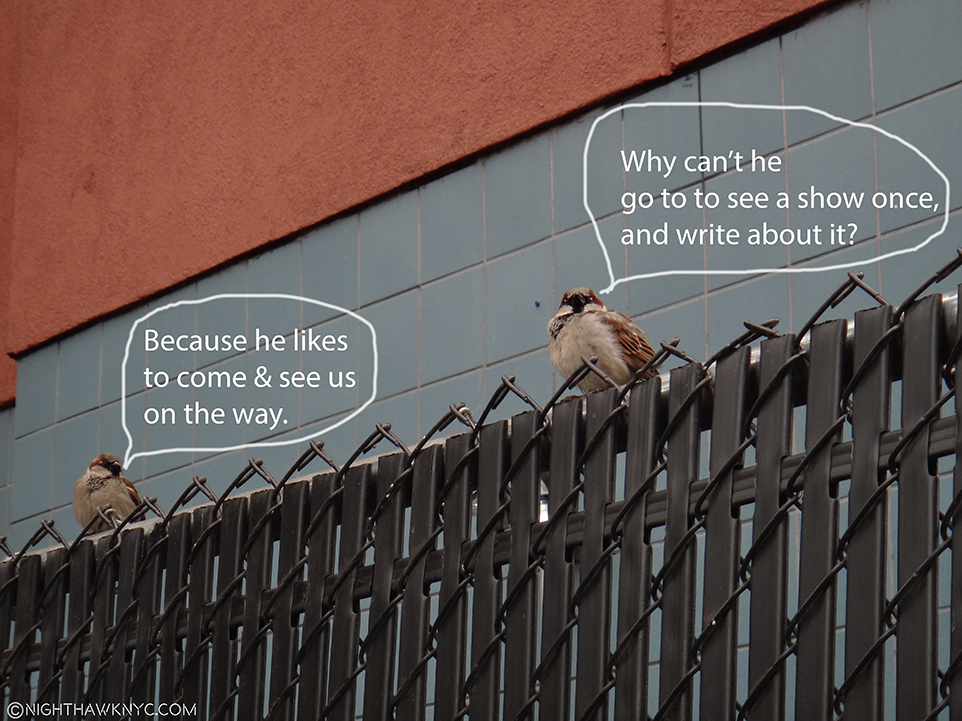
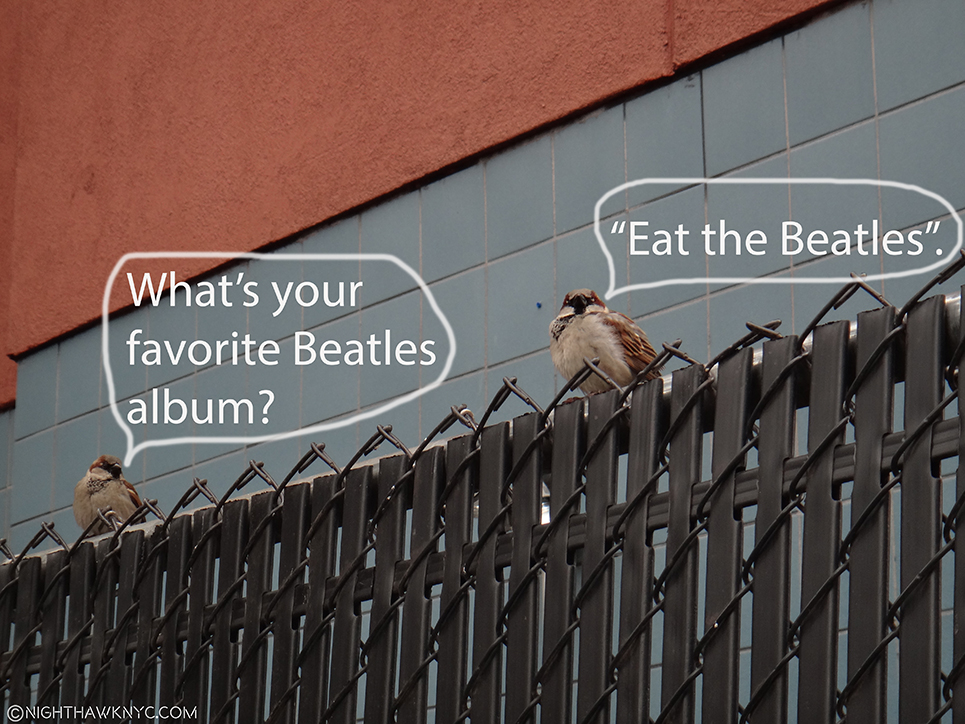
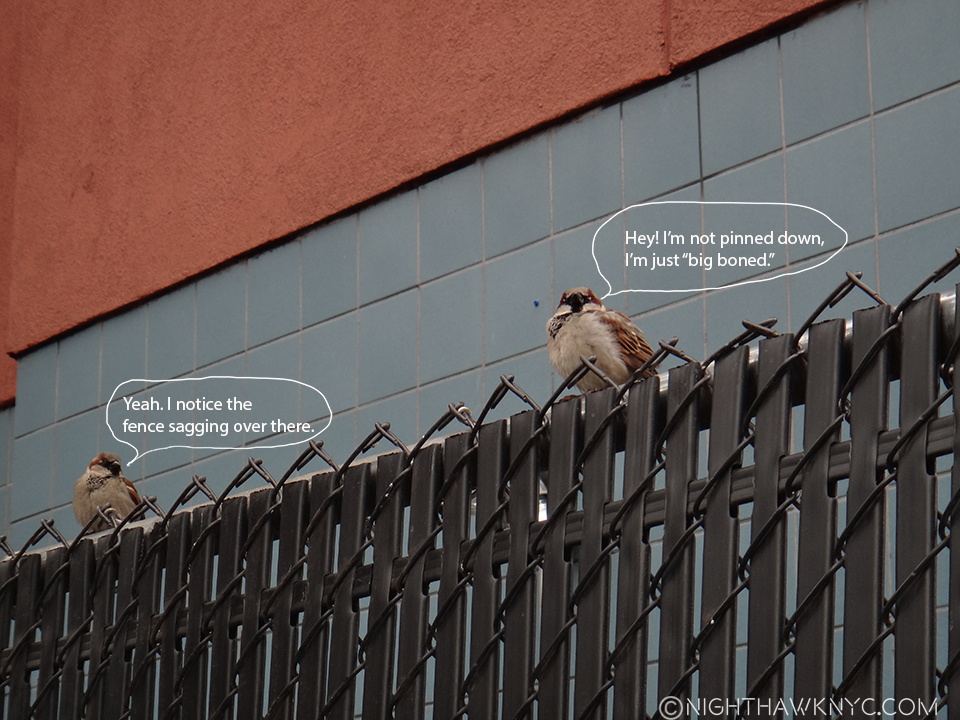
Two Years! This Post marks the Second Anniversary of NighthawkNYC.com. I can’t let it pass without saying “Thanks!,” first to Sv for pushing me to start it, to Kitty for research assistance above and beyond the beyond this past year, to all the fine people I’ve met who work in the galleries and museums I haunt who have answered questions, shared insights, helped, and especially for putting up with “him, again,” to all the Artists who have spoken with me this year, and everyone who has taken the time to check out the 150 Posts I’ve done so far. Thank you! Oh! And I almost forgot- to my two fine feathered friends, aka “The Birdies” of “On The Fence.” For those who have wondered “What the heck?”  They represent the random voices I hear commenting at shows, though, unfortunately, only I am to blame for what comes out of their mouths. Don’t worry- No actual Birdies were harmed in the making of that series. But? Their Photo has sure taken a beating!

NighthawkNYC.com has been entirely self-funded & ad-free for over 8 years, during which 300 full-length pieces have been published! If you’ve found it worthwhile, PLEASE donate to allow me to continue below. Thank you, Kenn.

You can also support it by buying Art, Art & Photography books, and Music from my collection! Art & Books may be found here. Music here and here.

Written & photographed by Kenn Sava for nighthawknyc.com unless otherwise credited. To send comments, thoughts, feedback or propositions click here. Click the white box on the upper right for the archives or to search them. Subscribe to be notified of new Posts below. Your information will be used for no other purpose.

  1. I’m not speaking further about buying Photographs in this Post. From what I’ve seen, and learned, this year, that is a whole other topic.
  2. If you want to get an idea of HOW sticky it can get, or you want to see how world-class experts work, check out the Rembrandt Research Project’s controversial findings on all of the Master’s Paintings, here. Well, the ones they accept as being by the Master, himself.

About My Art Show Posts…

This site is Free & Ad-Free! If you find this piece worthwhile, please donate via PayPal to support it & independent Art writing. You can also support it by buying Art & books! Details at the end. Thank you.

Written & Photographed by Kenn Sava.

There are so many writers who write about shows immediately as they open, and that’s great. It gives people an idea if they want to see them or not. As you may have noticed by now- I’m not one of them. Many (most) of my Posts on Art shows appear after the show closes.

Why?

If a show is large, there’s too much to see in one visit for me to do it justice. I only scratch the surface of it the first time I see it. If it’s over 100 pieces, I’ll typically do a walkthrough to get “the lay of the land,” so I can strategize how to approach seeing it in full, based on how long it’ll be there. I prefer to see larger shows in sections.

Just keep moving towards the light. April Gornik @ Danese Corey

I find it takes me time to see Art. To see 100, 200, or 800 pieces? That takes me A LOT of time, and visits. In such cases, I’ll go and see it as many times as I can. While many shows have some works that may be familiar from books or photos, no matter how much Art you’ve seen, most of the work on display in any given show are pieces that are either not famous, rarely seen, unseen, or new. Also, great curators hang shows in unique ways and combinations that need to be appreciated and pondered on their own. Beyond all of this, really good Art rarely reveals all it’s secrets in one viewing. I find that Art I especially admire says something new, or something different, to me each time I see it. Given the high prices of Art these days, there is no other way to see these works, unless they are publicly displayed. Therefore, making multiple visits is as close to “living with the Art” as I’ll ever get. Often, while I start writing about a show while it’s up, the real work begins once I can no longer see it and I have time to let the dust settle, and see what remains.

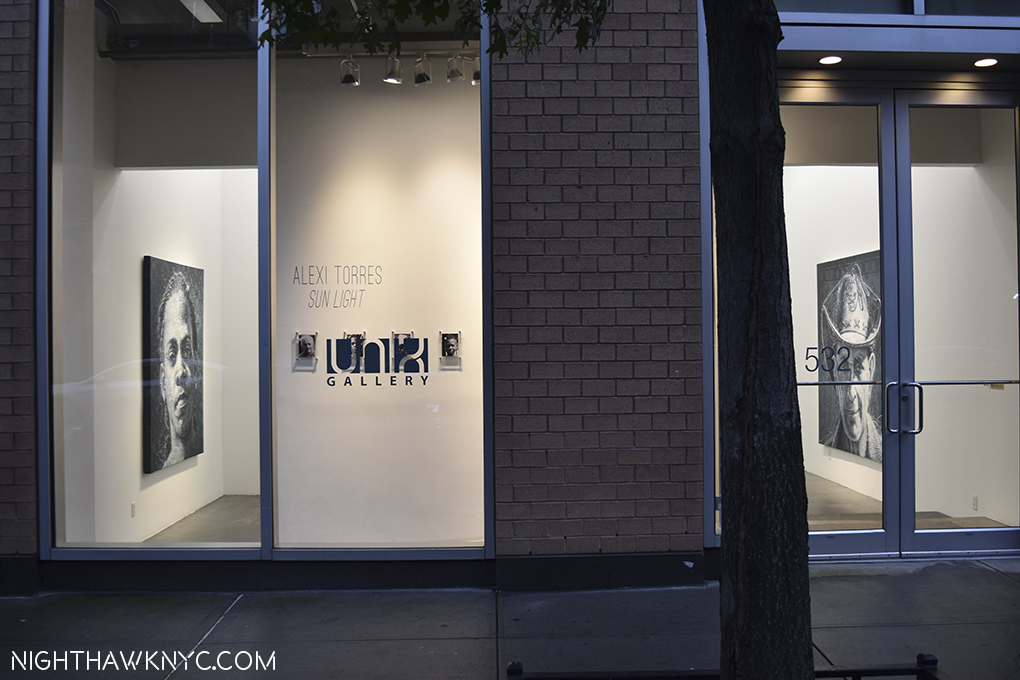
Outside Alexi Torres‘ excellent show @ UNIX Gallery in 2016.

On the other hand? If I don’t like a show? You’re not going to read about it here. The same applies to music. This has always been my policy, even when I was writing for a national music magazine. There’s too many great things around to waste time and space writing about things I don’t like. Besides, I also believe that “Someone who loves something may know more about it than someone who doesn’t.” So? I prefer to revisit whatever it is I don’t like on another day. Maybe I’ll “get it” then. (But? Yes. There are things I can’t stand that I know I will never come around about!)

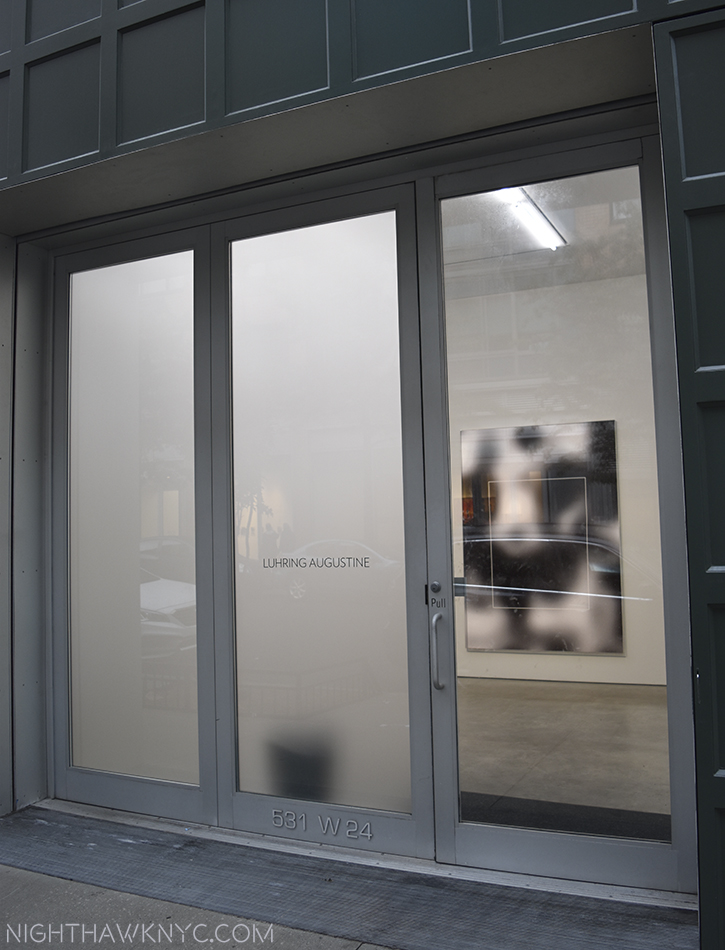
Outside “Jeff Elrod” @ Luhring Augustine. I walked through that door quite a few times while it was up.

It further seems to me that once a show is over, it’s gone. It only continues to live on in the show’s catalog (if there was one), and whatever was written about it or posted online. Therefore, my aim is to Post something as substantial as I can about the shows I write about, to that end. Most people don’t live in or near NYC, and so, will have missed much of what goes on here. Hopefully, these will provide a bit of a sense of what the show was like.

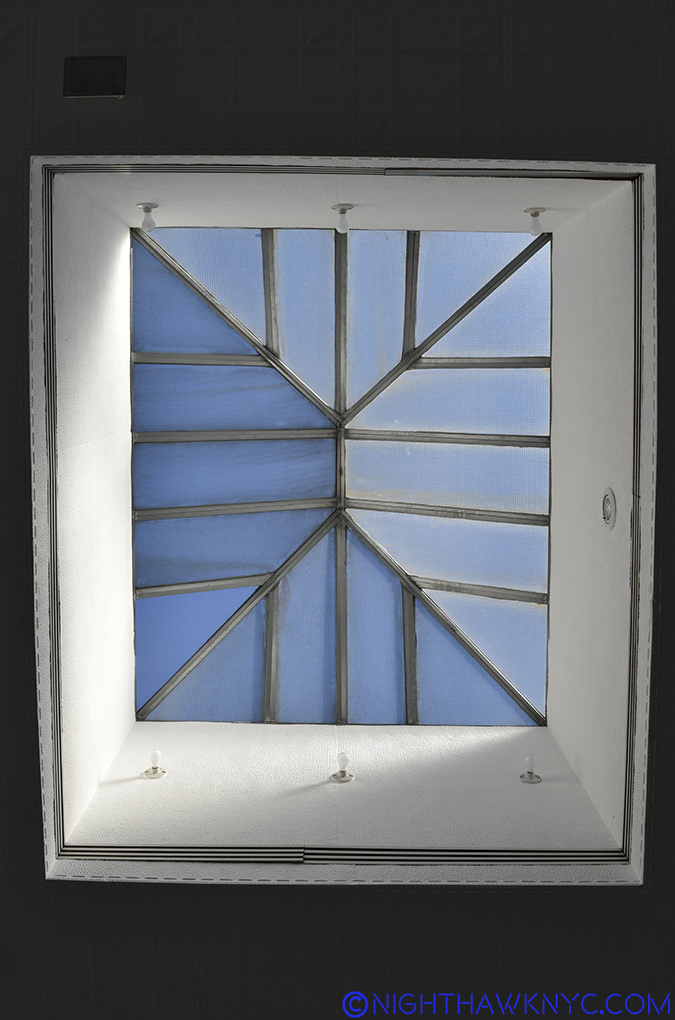
The Skylight @ Matthew Marks Gallery

This is the approach I’m taking in this Blog. So be warned- My Posts aren’t meant to be the “This just opened,” type.

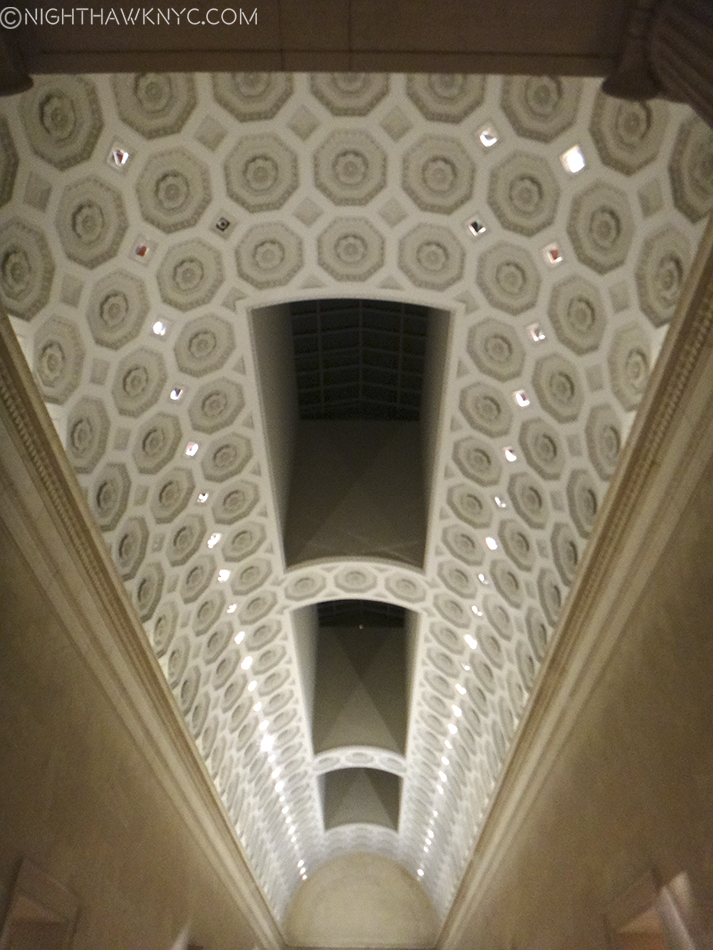
A Skylight @ The Met. At night, when I’m usually there.

Sorry, Jeff!

The bottom line is that while some shows may still be up by the time I get my Post about them up. Increasingly? They are not. Even a long running show like “Unfinished,” which opened on March 8, 2016 (to members), and only closed on September 4, 2016 ended TEN DAYS before my Post was finished! I find that I’ve been spending months doing additional research about the shows, and Artists, I’m working on writing about, but I never read what anyone else has said about something I’m going to write about. I research the Artist, what they’ve said, or written about the work, and what was going on before and during the period they were creating the work being displayed. And this is taking more time than I expected it to. Even with Artists I have been looking at for a long time- like Robert Rauschenberg & Frank Lloyd Wright, who I’m currently working on.

February, 2015. It’s good to be Home. 1,500 visits to The Met later I’ve spent more time there than I have at all but 2 places I’ve ever lived in.

Most of what’s out there doesn’t speak to me. Much of it is decorative, which is fine, but it’s not for me.

“It has to go with my wallpaper.” Yes. I’ve actually heard prospective buyers say this in Art galleries.

With so much going on, I’m lucky if I can keep from missing something great, which, unfortunately still happens no matter how hard I try to keep it from happening.

The fliers for old and new things going on are probably inches thick on this wall. No one can see everything going on in NYC.

These Posts are more meant to be- “This was here, and here’s a bit of what it was like, and what remains with me.” So, buyer beware!

Until the next time I darken your gallery doorway, again.

Thanx for your understanding.

Have a great night,
Kenn.

On The Fence #10, Him, again, Edition “

*-Soundtrack for this Post is “I’ll Remember You,” by Bob Dylan.

NighthawkNYC.com has been entirely self-funded & ad-free for over 8 years, during which 300 full length pieces have been published! If you’ve found it worthwhile, PLEASE donate to allow me to continue below. Thank you, Kenn.

You can also support it by buying Art, Art & Photography books, and Music from my collection! Art & Books may be found here. Music here and here

Written & photographed by Kenn Sava for nighthawknyc.com unless otherwise credited. To send comments, thoughts, feedback or propositions click here. Click the white box on the upper right for the archives or to search them. Subscribe to be notified of new Posts below. Your information will be used for no other purpose.

On The Beatles…and Sgt. Pepper’s 50th

This site is Free & Ad-Free! If you find this piece worthwhile, please donate via PayPal to support it & independent Art writing. You can also support it by buying Art & books! Details at the end. Thank you.

Written & Photographed by Kenn Sava.

Today, June 18th, is Sir Paul McCartney’s 75th Birthday. Happy Birthday, Sir Paul, and many more!

When it came out 50 years ago, on June 1, 1967, “Sgt. Pepper’s Lonely Hearts Club Band” was nothing less than the biggest tsunami in popular Music since, well…”Meet The Beatles.” A defining moment in modern music, splitting musical time into before, and after, it’s aftershocks have been so all-encompassing, it’s hard to listen to most of what’s come after and not hear some of it’s influence.

Though Traffic, the Beach Boys, The Who and the Jimi Hendrix Experience (who’s seismic “Are You Experienced?,” the first album I ever bought, was released on May 12, some 19 days before “Sgt. Pepper’s”) were doing wonderously creative things with expanding the boundaries of rock, nothing else sounded anything like it, really. It cut across genres and audiences. No matter what they had listened to before, everyone listened to it when it came out1. When you think about that, it’s downright amazing given how experimental, even avant garde, quite a bit of it was. “Avant garde” and “experimental” is almost always a ticket to popular failure. Producer Sir George Martin was behind some of it- both technically (managing the recording, and facilitating the Beatles’ ideas ), and musically (doing the string and brass arrangements). Drugs, the expansive cultural, spiritual and musical explorations of The Beatles, themselves, were the rest of it. Still, in spite of all the changes going on, personally, and in the music, the whole thing hung together perfectly- from the opening background noises to the final backward voices, ending the unprecedented, all too real/all too surreal “A Day In The Life.”

It was a product of the moment, becoming the soundtrack for the “Summer of Love,” one that, also, took music a big step forward, and showed us the future.

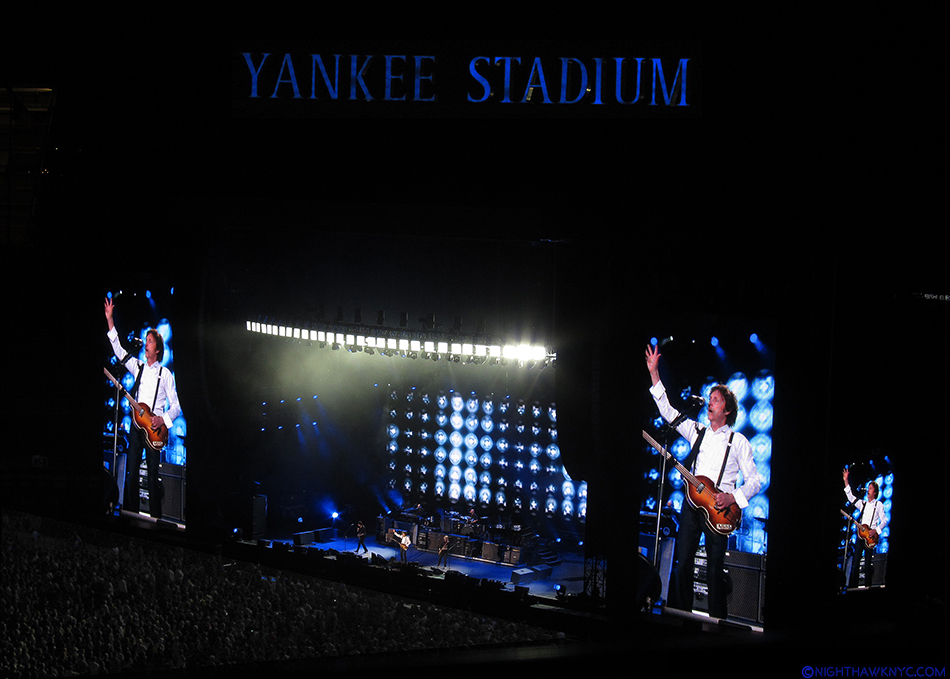
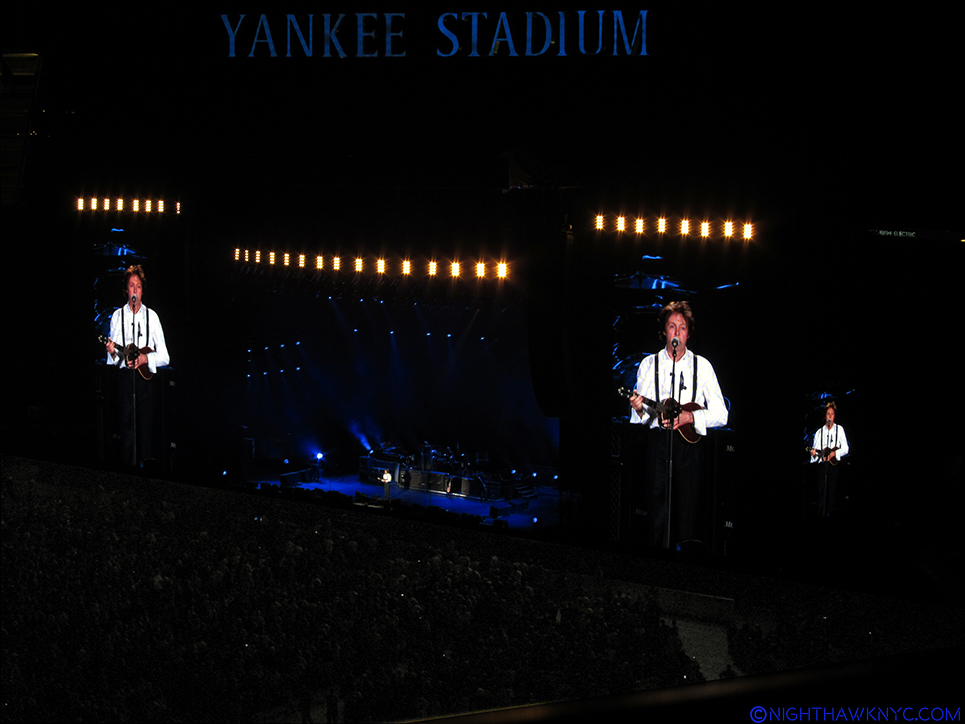
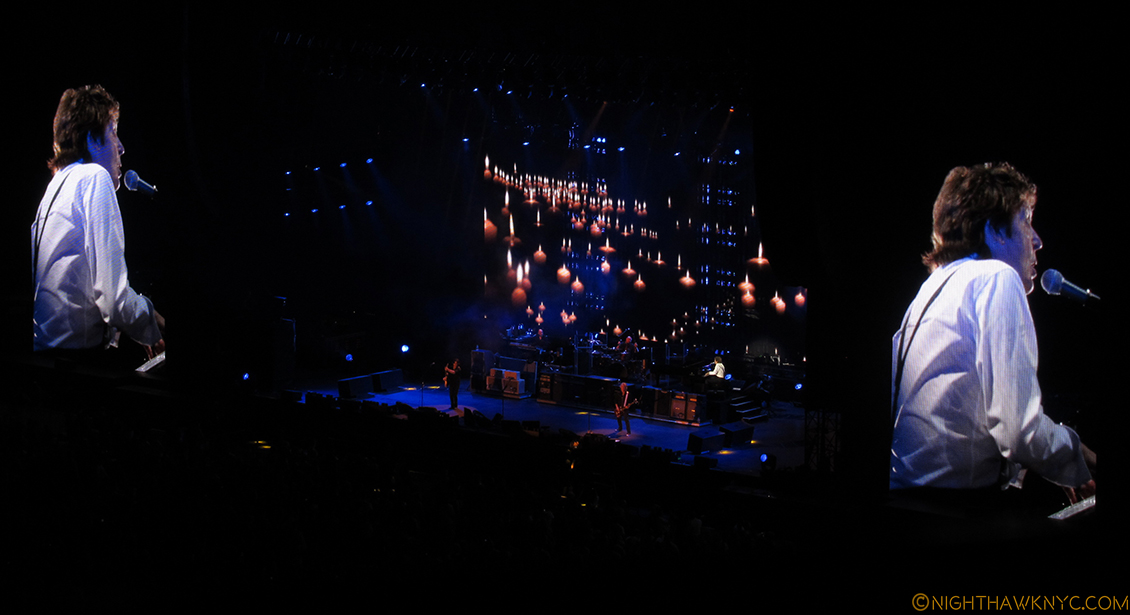
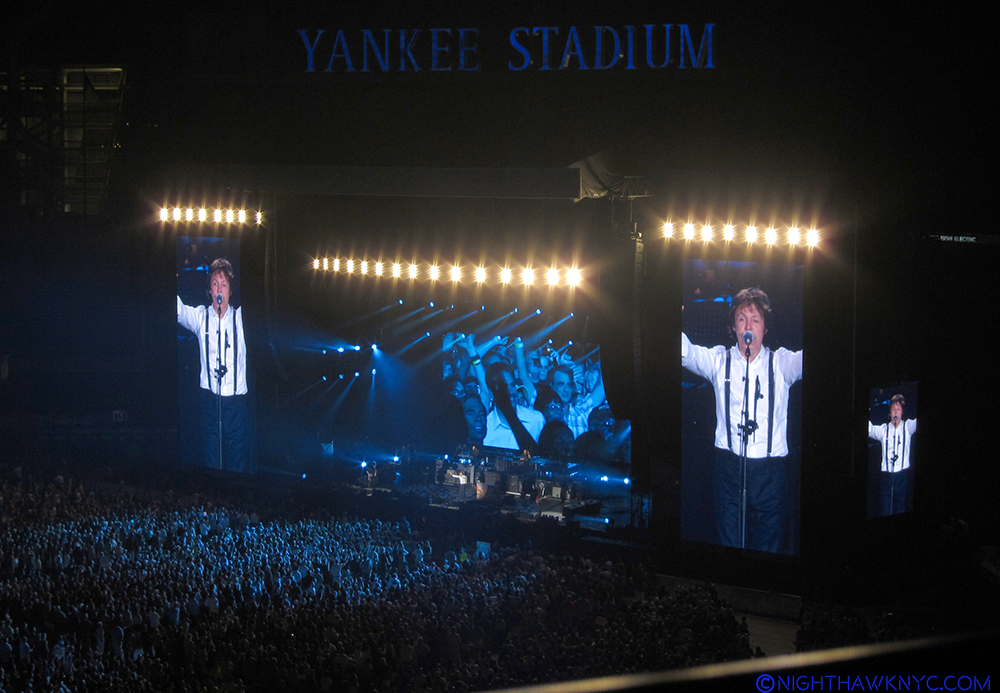
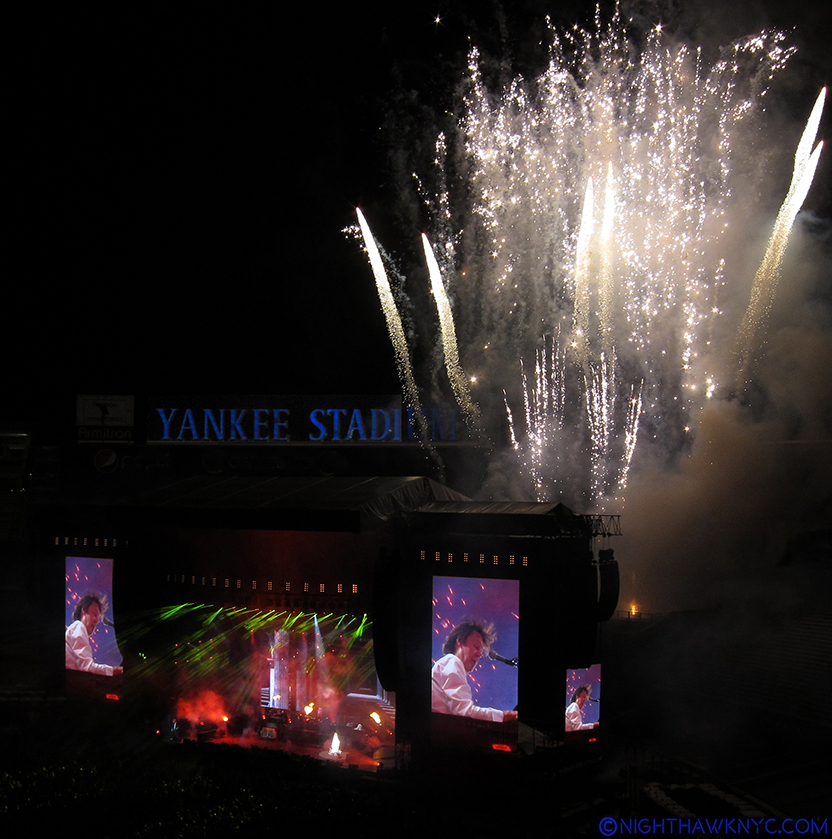
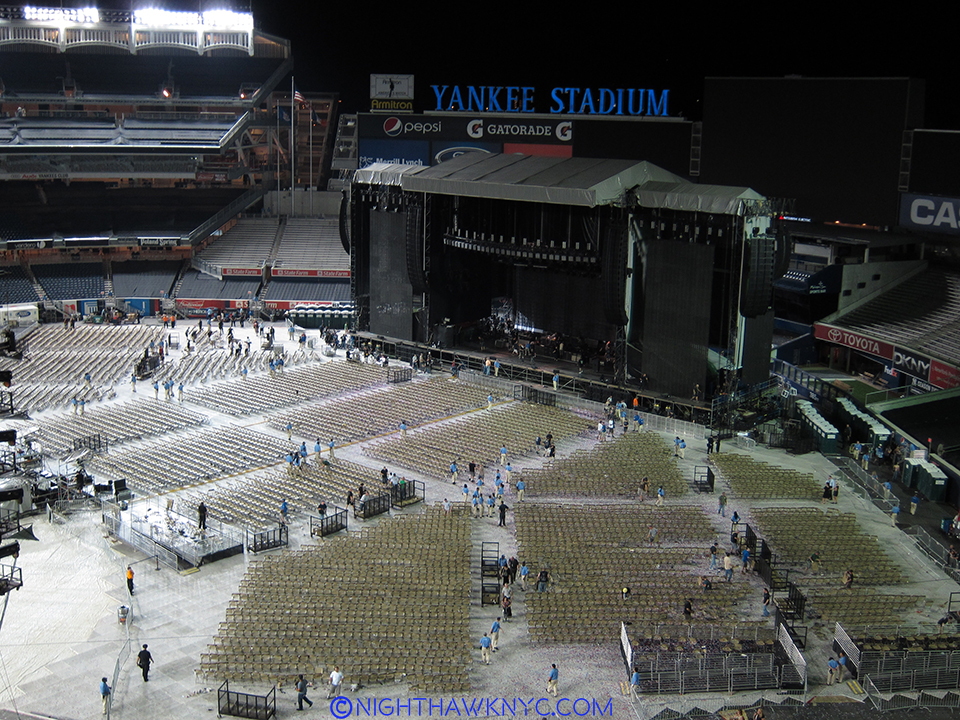
Sir Paul McCartney performing at Yankee Stadium, July 2011, on his original Hofner “Beatle Bass,” one of the most historic musical instruments in the world. He actually remains under-appreciated as a musician, as are some of his projects, like “The Fireman.” Click any image to see it full sized.

The “concept album” had truly arrived (with all due respect to “In the Wee Small Hours,” by Frank Sinatra, 1955, a staple over here at the NHNYC.com offices, “Pet Sounds” by the Beach Boys, released May, 1966, and a few others). As a result, to this day, when you put it on, I think it should be listened to it all the way through.

Now, with the release of the new 50th Anniversary “Deluxe Edition” Box Set, things are getting complicated. So, I need to specify what I mean by “it”- Listen to the 13 songs on the original album all the way through. Which brings me to what I feel is a little bit of a problem. The new “Deluxe Edition” is NOT (I feel) the best way to experience Sgt. Pepper’s for the first time. With all due respect to Giles Martin, who has (partially) remixed Sgt. Pepper’s for the Deluxe Edition, mixing his version from the original 4 track tapes. See footnote 2 for more details on this2 After a listen to the new mix, I prefer to stick with the original mix.

Giles’ Dad, Sir George Martin, was one of the greatest Producers in the history of recorded Music. You could make a very strong case and say he’s The Greatest, but I don’t believe comparing creativity, or creative people. In any event, his mix ain’t broke. Don’t “fix” it. I don’t think the “sonic upgrade” of the new stereo mix is that big to sacrifice something that was an integral part of the finished album, like this part of George Martin’s contribution was3. It was something he created WITH The Beatles. You’re dealing with master tapes that were recorded in 1967. There’s only so much that can be done to “improve them” sonically, and those come with tradeoffs-

Questionably “better” sound quality vs. losing some of the original experience, and, most importantly, the Artist’s intentions.

Sir Paul performs “Something,” on a Ukulele given to him by George Harrison.

Frankly, for those reasons, I prefer to stick with original mixes of just about every album ever made, and as reissues pile up, they get harder to find- you have to know what you’re looking for4. As a producer? I wouldn’t want anyone else messing around with my mix, and I was no Sir George Martin. “Technological advances” are a mixed blessing, bringing good and bad. Just ask anyone who prefers Lp’s to CD’s. (I’m not saying I do.)

Finally, the Deluxe Edition comes with a lot of extras. There are a seemingly infinite number of Beatles’ outtakes that have circulated among fans and traders over the years, and while many of them are fascinating, if you haven’t heard the original album, wait until you have it memorized before listening to them. The “Making of” Doc, included with the Deluxe Edition, sounds fascinating. I’m sure the book is good, too. All in all? It sounds like a supplement to having the original recording. NOT a replacement for it.

“Hey, Sir Paul! What do you think of the new Sgt. Pepper’s Mix?”

In all of this, I have not seen any mention of the involvement of Sir Paul and Ringo (who were directly involved with the original, of course, with due respect to Yoko and the Harrisons) in it. And, I haven’t been able to find out what Sir Paul thinks about the new mix. His website has him only commenting on the passage of time re: “Sgt. Pepper’s” 50th, but I found this comment critical-

“It’s crazy to think that 50 years later we are looking back on this project with such fondness and a little bit of amazement at how four guys, a great producer and his engineers could make such a lasting piece of art.”

I think that tells you all you need to know. He includes Sir George Martin and engineer Geoff Emerick, as part of the creative team5.

“I’m fixing a hole where the rain gets in,
And stops my mind from wandering
Where it will go.”*

I believe the integrity of all of their work should be respected, and preserved.

But? With the passing of time, there’s no way I’m going to win that fight. There’s too much money aligned on the other side in reissuing records- just beware of anyone who tells you it’s “new & improved.” This, unfortunately, goes on in Art, too. After Artists pass away, increasingly their estates are continuing to issue/reissue their work. I have very mixed feelings about this. I’ll go to Photo shows and see “recent prints” that just aren’t up to the level of the quality of prints made by the Artist during their lifetime. This hurts the Artist’s reputation, in my opinion. In music, we now stand at the precipice of whatever will be done regarding Prince’s unreleased Mt. Everest of material. If you don’t think that’s going to materially impact his legacy, think again. Quick- How many albums did Jimi Hendrix release during his lifetime6? I feel for any new listener to his music faced with the dauntless task of looking through the list of COUNTLESS albums with his name on them, which are STILL being released 47 years after his death, and trying to find them.

The message in all of this? Buyer beware. Luckily? After 50 years? Most people already have “Sgt. Pepper’s.” So? On the 50th Anniversary (month) of it’s release put it on and give it a listen. All the way through. It’s an Album. Remember them?

Many since have tried. There’s still nothing like it.

Finally? When all else has been said…Think about this for one minute…

How HARD is it to connect with even one person who becomes special in your life? I still marvel that The Beatles FOUND each other!

Never in the whole history of Western Music (1200 a.d. to 1900) have two musical Geniuses collaborated before (as far as I know).

J.S. Bach was too busy raising 10 sons (each of whom became a noted, or great, composer), writing, rehearsing AND performing a new cantata each week, performing his regular church duties, and writing the rest of his incomparable music to collaborate with Handel. Mozart and Beethoven? Never happened. Brahms and Schumann? Nope. Brahms and MRS. Clara Schumann…? Romance doesn’t count. This is a 20th Century phenomenon. George & Ira Gershwin…Bernstein & Sondheim…Miles Davis & John Coltrane…Miles & Wayne Shorter…My list may be different than your’s. Here you have John Lennon & Paul McCartney, two of the very greatest songwriters in the history of Music. Alongside them? George Harrison, no slouch (and continually under-rated) himself. Heck…Who WOULDN’T be “under-rated” next to those two? I often wonder what George must have felt (from time to time? often?). On the one hand he had people wanting a “better lead guitarist,” his friend, Eric Clapton, perhaps, to replace him in The Beatles. On the other hand, he was lucky to get 1 or 2 songs on each Beatles album, NO MATTER how good his songs were! (Witness the then unheard of THREE Lp set he released soon after The Beatles split, “All Things Must Pass.” Talk about being “pent up!” “Within You, Without You,” was his song on “Sgt. Pepper’s.”) But? He was the “perfect” guitarist for The Beatles, as Ringo was the “perfect” drummer for them. That the four of them found each other?

It’s miraculous, in my book.

If you don’t think so? Point out to me the LAST time this happened in any of the Arts.

The Beatles were a gift from the Universe.

*- Soundtrack for this is “Fixing A Hole,” by Lennon & McCartney, from “Sgt. Pepper’s Lonely Hearts Club Band,” and published by Sony/ATV Music Publishing LLC.

On The Fence,#8, The Birds & The Bees-tles” Edition.

NighthawkNYC.com has been entirely self-funded & ad-free for over 8 years, during which 300 full length pieces have been published! If you’ve found it worthwhile, PLEASE donate to allow me to continue below. Thank you, Kenn.

You can also support it by buying Art, Art & Photography books, and Music from my collection! Art & Books may be found here. Music here and here

Written & photographed by Kenn Sava for nighthawknyc.com unless otherwise credited. To send comments, thoughts, feedback or propositions click here. Click the white box on the upper right for the archives or to search them. Subscribe to be notified of new Posts below. Your information will be used for no other purpose.

  1. Myself included, and I wasn’t into The Beatles until “Strawberry Fields Forever” was released, on February 13, 1967, as a single, presaging “Sgt. Pepper’s”
  2. Sgt. Pepper’s was recorded on 4 tracks, which is astounding when you think about that today. In 1995, my version of “Strawberry Fields Forever” was recorded on 48 tracks. The Beatles would fill up 3 of the 4 tracks, then mix those down to the open 4th track. Then they’d repeat the process until they had filled all four tracks (I’m simplifying. There was more “bouncing” of tracks to open up other tracks involved.), the resulting tape was then mixed down to a final, stereo two track Master, which is what the records were made from- both in Stereo, and yes, in Mono. Both of those have been reissued, in the “Complete” Stereo and Mono Boxsets, and I prefer them, at the moment, among the recent incarnations of The Beatles albums.
  3. Giles Martin also did a 5.1 mix. You’re on you’re own there, since his dad didn’t do one, as far as I know. I have not heard it as yet.
  4. For example- Try finding the original mixes of Miles Davis’ Columbia albums, some of the greatest and most important music of the century, on CD. It’s hard. Early, now rare, Japanese import CD’s had them. Most likely you have to go back to the Lp’s for them, but make sure they’re vintage.
  5.  They did a Q&A with him about Sgt. Pepper’s BEFORE the Deluxe Edition was announced, here. Also, Pepper’s recording engineer Geoff Emerick said he “hadn’t heard it”, the new mix, in an interview
  6. The answer is 3 studio Lp’s- “Are You Experienced?,””Axis:Bold as Love”, and “Electric Ladyland,” and 3 live albums- the other 2 of which, besides “Band of Gypsys,” I’m not sure how much he had to do with.

Rod Penner: Brilliance, Under Cloudy Skies

“Rod Penner” at Ameringer McEnery Yohe is my NoteWorthy Show for May.

“Little darling, it seems like years since it’s been clear”*

It turns out to have been more than worth the wait. The chance discovery of Rod Penner’s rarely seen work in April, 2016, left me eager to see more of it for the past year. Finally, that chance came. Yes, I wrote about this show’s opening, and my first impressions of it, a while back, when I was also lucky to meet Mr. Penner. Having returned to see the 9 remarkable Paintings that made up “Rod Penner” at Ameringer McEnery Yohe through May 26 (his first NYC show since 2013) a number of times after the April 27 opening, I realized I needed to also revisit it here because these are works that do not reveal all their secrets at first glance, and also because so little has been written about the work of Rod Penner, basically, three pieces by John Seed. Given the amazing & consistently high quality of his work, and the fact that he’s been a successful Painter for over 25 years, who’s shows routinely sell out (8 of these 9 were sold before the show opened), that’s hard to believe. This show is a great chance to get a closer look, as it represents most of the work he’s created in the past year, and because the works are related, they form a “series.” When I asked the Artist about this, he told me-

“This show is a first for me in the sense that it is a series of paintings based on photos taken on a single morning of a single town. Most of the locations are in and around the town square of San Saba, TX, and when viewed together they form a more comprehensive “portrait”, both of the town itself, and my personal experiences in this place. That being said, each painting is also meant to stand on its own.”

San Saba is about an hour north of Austin, almost smack dab in the middle of Texas. The resulting works are at once intricate and sublte, so deep, so brilliantly conceived and almost miraculously executed, I now have a feeling they will be revealing their “secrets” indefinitely.

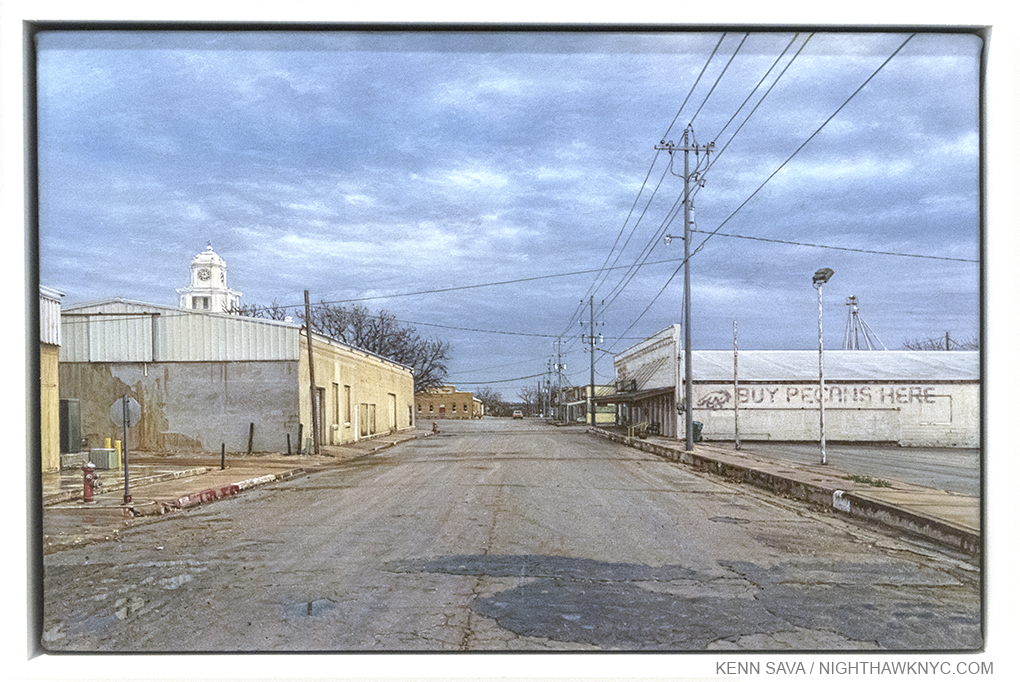
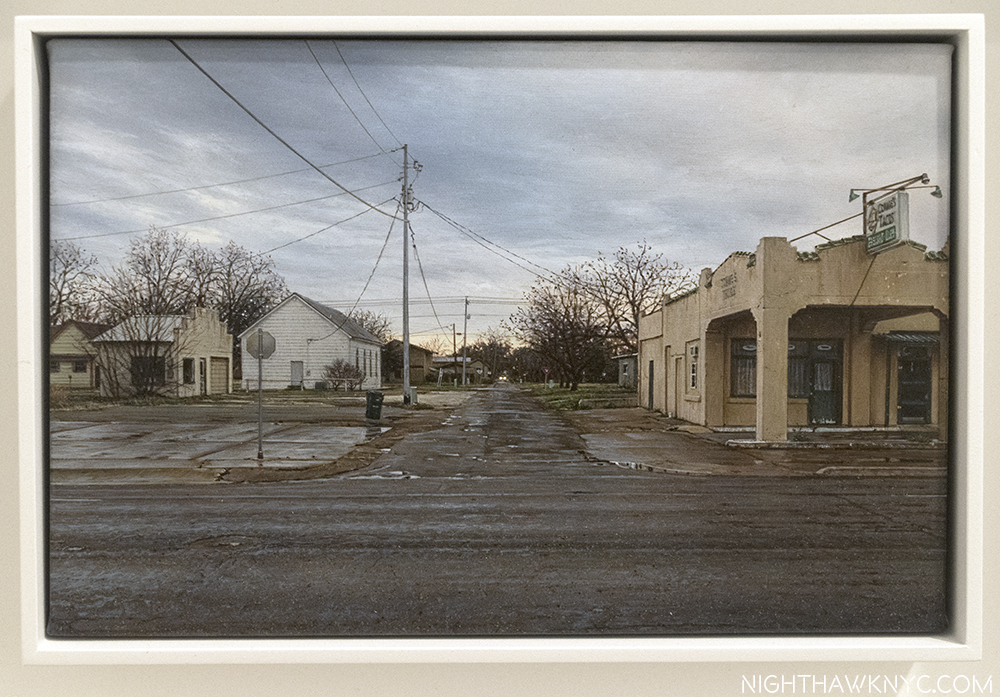
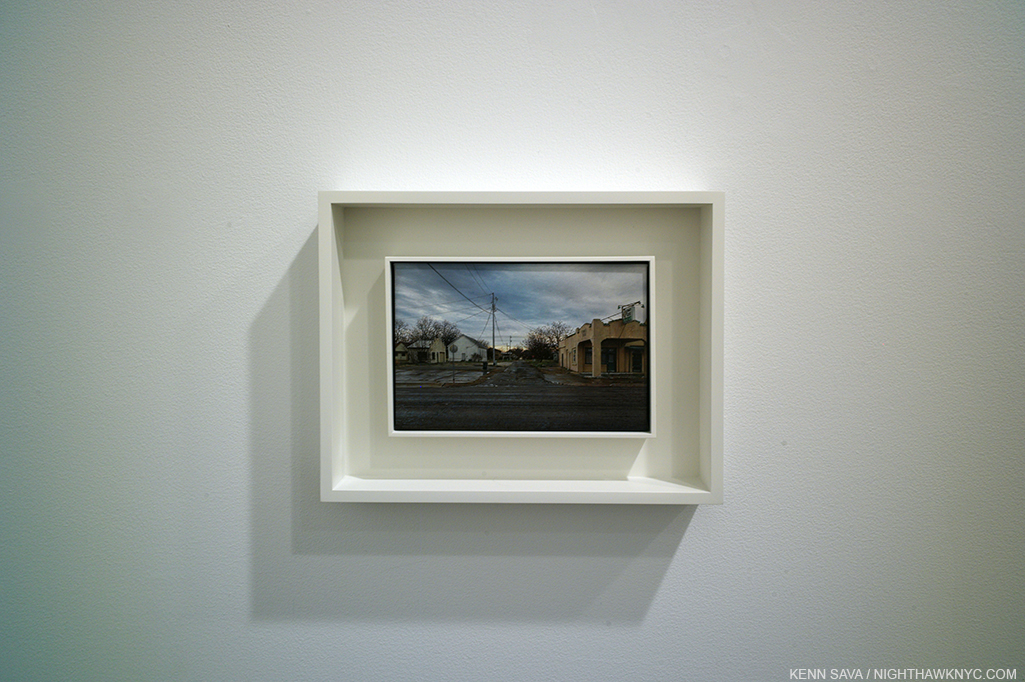
View of San Saba, also 5 x 7 1/2 INCHES. The “center” of Rod Penner’s painted “neighborhood.”All works by Rod Penner, 2017, Acrylic on canvas, unless specified, seen at Rod Penner at Ameringer McEnery Yohe.

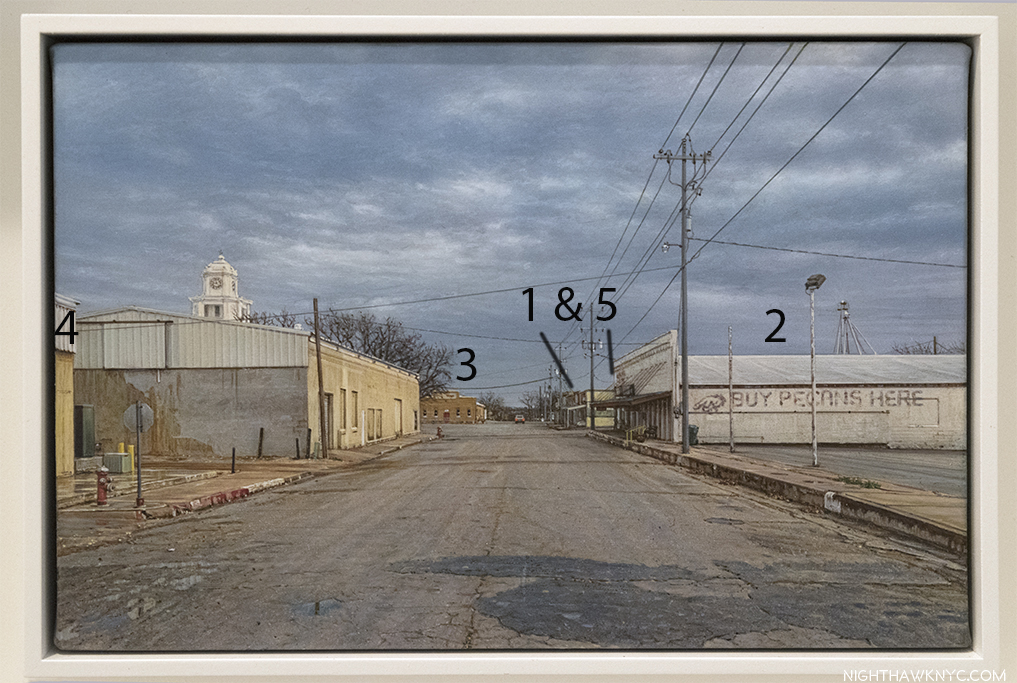
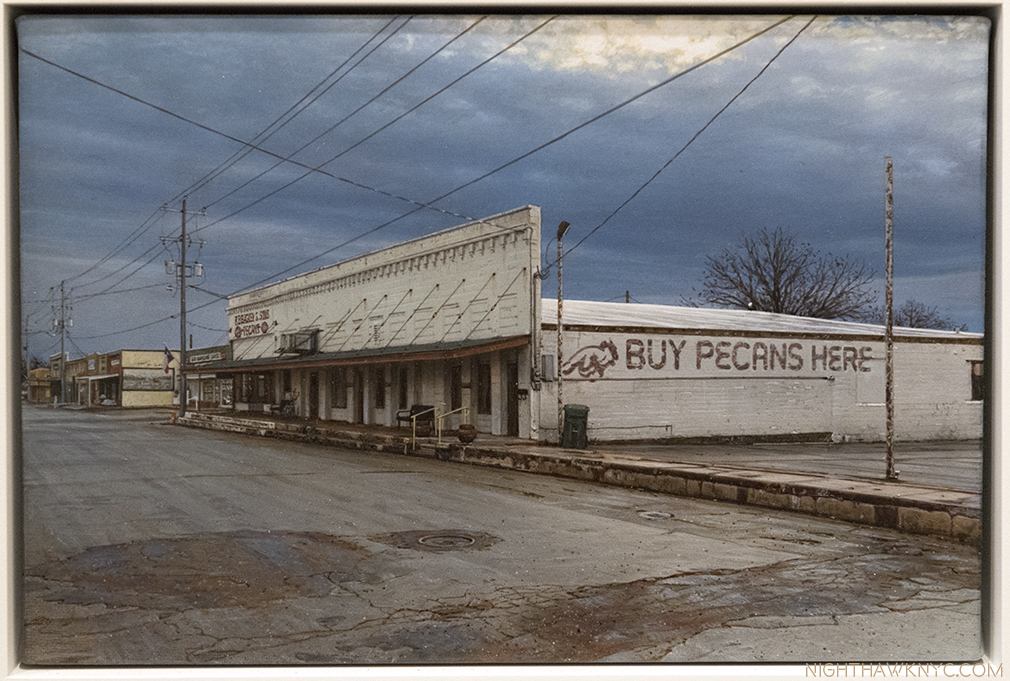
When I met Mr. Penner, he spoke about the newest work in the show, View of San Saba. So new, it wasn’t completed in time to appear in the show’s catalog, the first book ever published on Rod Penner (and available from Ameringer McEnery Yohe, as I write this). It’s a work that a quick glance fails. I wondered about the empty spaces in the foreground, left and right. Why is there so much of it in a work that’s supposed to be a “view” of a town? It scrunches the actual town into a narrow band that accounts for maybe one third of the Painting. These empty spaces along the sides give us a sense of perspective, a sense of space that is, after all, a trade mark of Texas, I hear, which would be missing if Rod Penner had cropped the view closer to the “BUY PECANS HERE” sign, and which would also give the sign an importance he, apparently, didn’t want it to have. The feeling would be completely different. Also, doing this “sets a stage” for the rest of the composition, something Mr. Penner seems fond of doing.

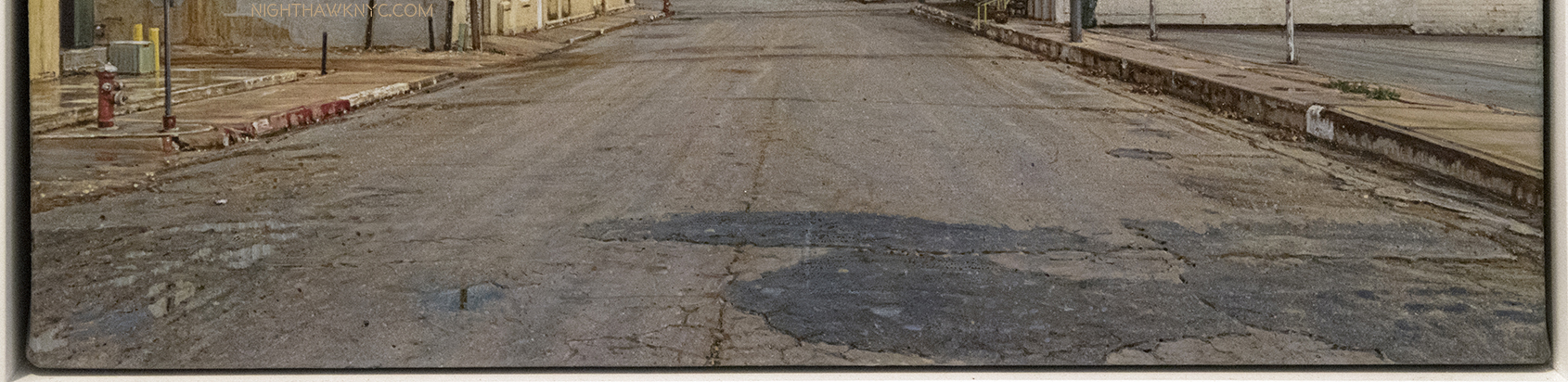
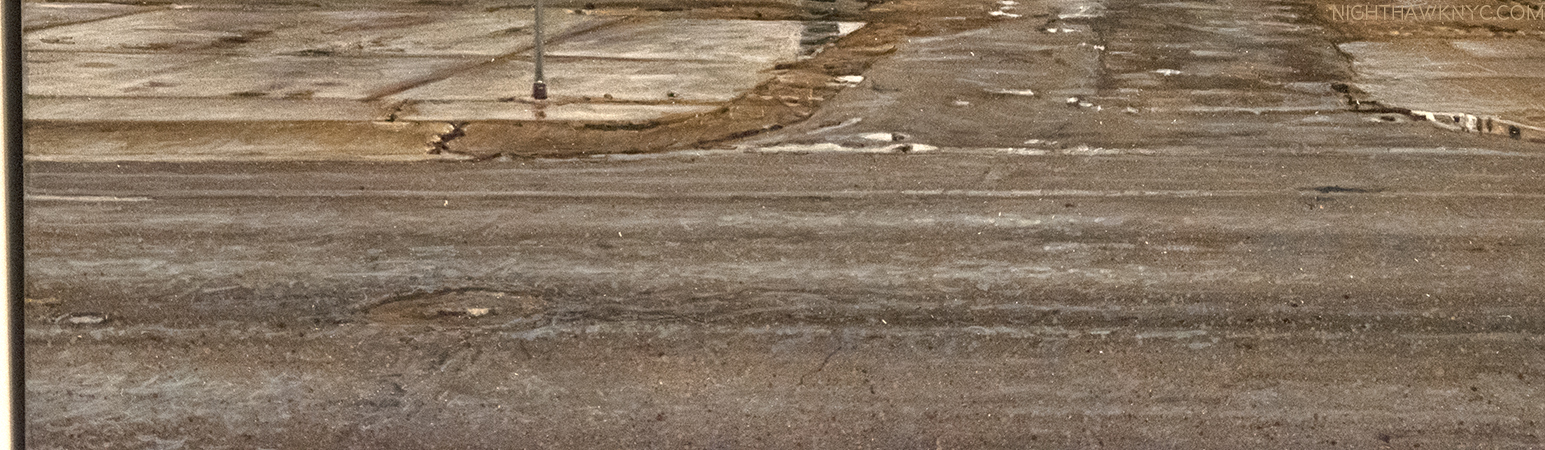
And? It turns out the foreground is an extraordinarily interesting part of the work. Ok, that’s coming from a die hard Manhattanite, a true connoisseur of pavement, street, curbs, and sidewalks, someone who never sees grass. Mr. Penner told me that as the work neared completion, he became unhappy with the pavement to the front left, so he redid it. Take that, everyone who thinks he’s a so-called “photorealist,” or “hyper-realist,” someone who paints exactly and only what’s in a reference photo. First, there’s a very unusual (in real life) crack that runs directly down the very middle of the street, which serves to draw us further and further into the painting.

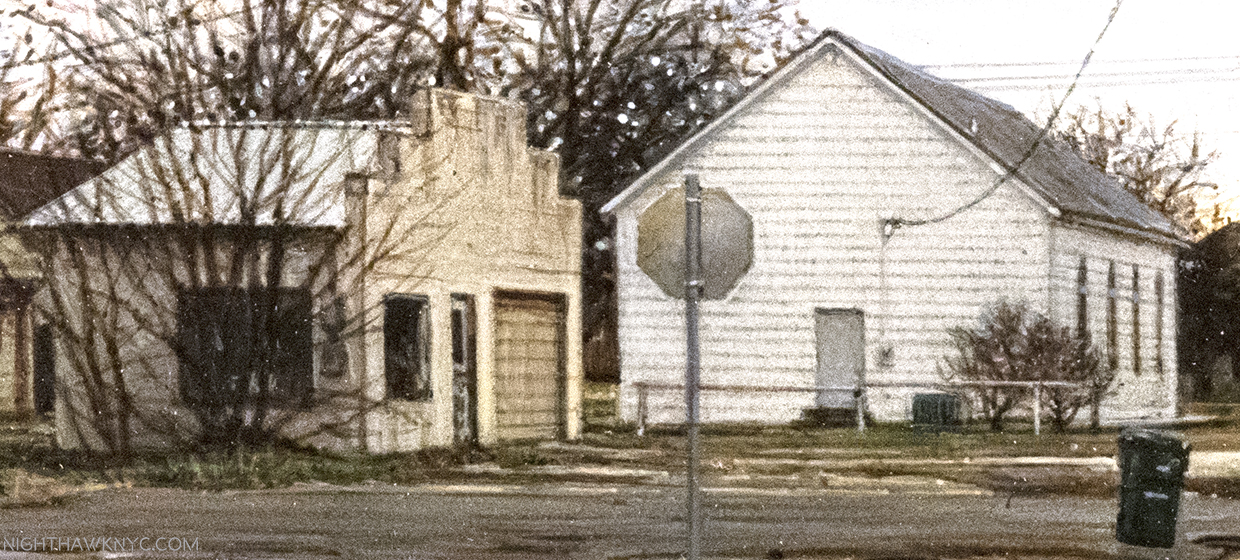
Detail of the pavement in the foreground, larger than actual size, reveals almost endless details, down to the reflection of the back of the Stop sign in the puddle. Interestingly, every Stop sign in these works is seen from the back. Even in reflection.

It’s an old street. The curbs are worn, where they are still there. The pavement has been patched. Well, some of it has. Water pools in holes that still need to be. Yet, for the most part, the concrete is holding together. After all these years. After all these cars, trucks, people, and whatever else travels on the roads of San Saba, Texas have passed over them. Yes. You can still get there from here.

Beyond the technical tour de force of skill on view in this, and in everything in this show, more importantly, every centimeter of it drips with character.

The skies always seem to be ominous. Sometimes a small patch of sun is fighting to make its way through. Maybe it will. Maybe rain is on the way. (I call theses skies “Penneresque” now when I see one). Just as long as it’s not a tornado, right? The old County Court is still standing. You can see its tower to the left, in the first Photo up top. Interestingly, it’s not quite as tall as the phone pole1

When I look at the finished work, the feeling of isolation, life lived, the present time, and time past (as in the patched pavement to the right in the front), and the feeling of being an outsider is reminiscent of that in works by Edward Hopper or Charles Sheeler, but not specific works. Though he has a foot in Art History, Rod Penner is an original.

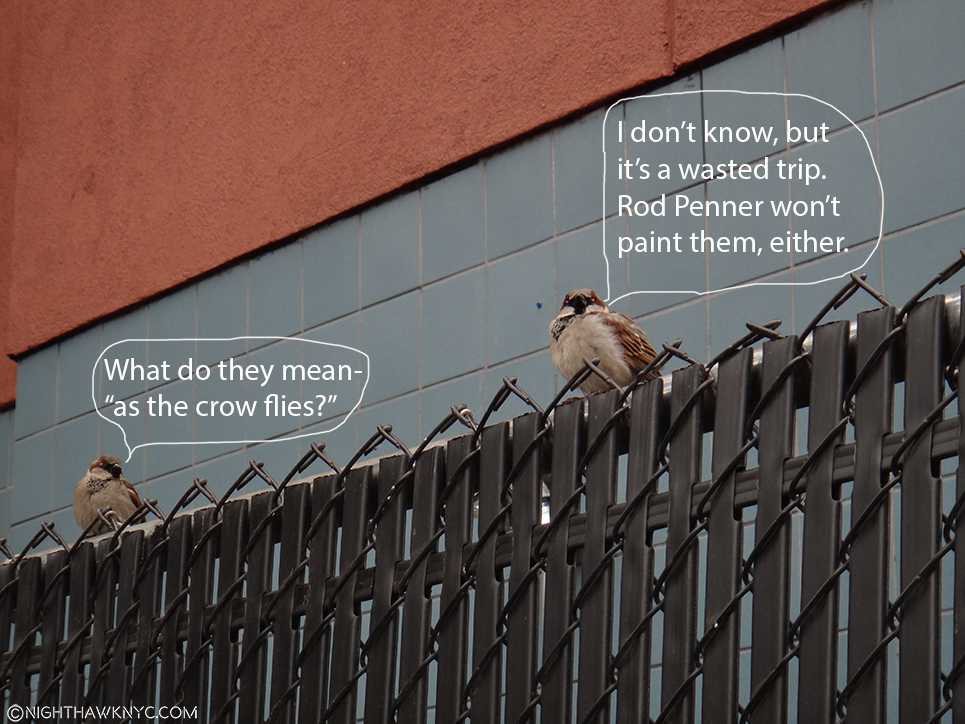
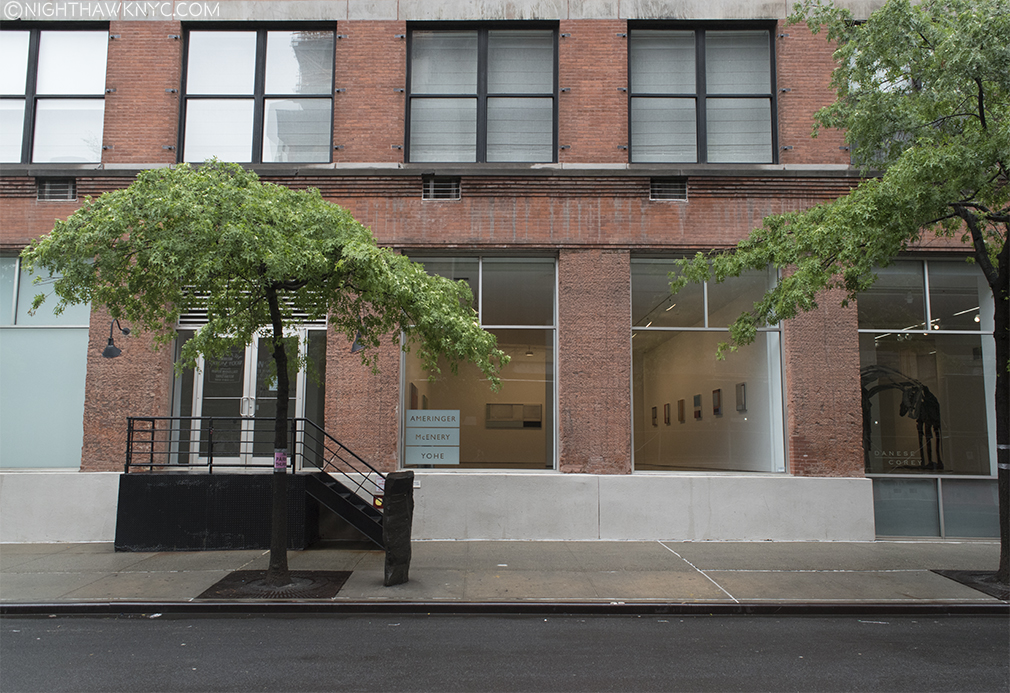
But we aren’t in San Saba. We aren’t in Texas. We’re 1,744 miles away by car or 1,513 miles as the crow flies at Ameringer McEnery Yohe Gallery on West 22nd Street in Manhattan, NYC. An entirely different world, right? We’re not even looking at Photographs, which seems to be a reaction of some who only see these works online in, yes, Photographs, and have trouble believing someone can really paint THIS well. We’re looking at Paintings. VERY small Paintings that are either 5 by 7 1/2 inches, or 6 by 6 inches each! Acrylics on canvas. In creating these works at paperback book size, I don’t believe the purpose was to show off his extraordinary skill (which happens as a byproduct). The size brings an intimacy that makes the viewer look closely to see, and once you start looking, you’ll see more and more, which can turn the experience into something of a meditation.

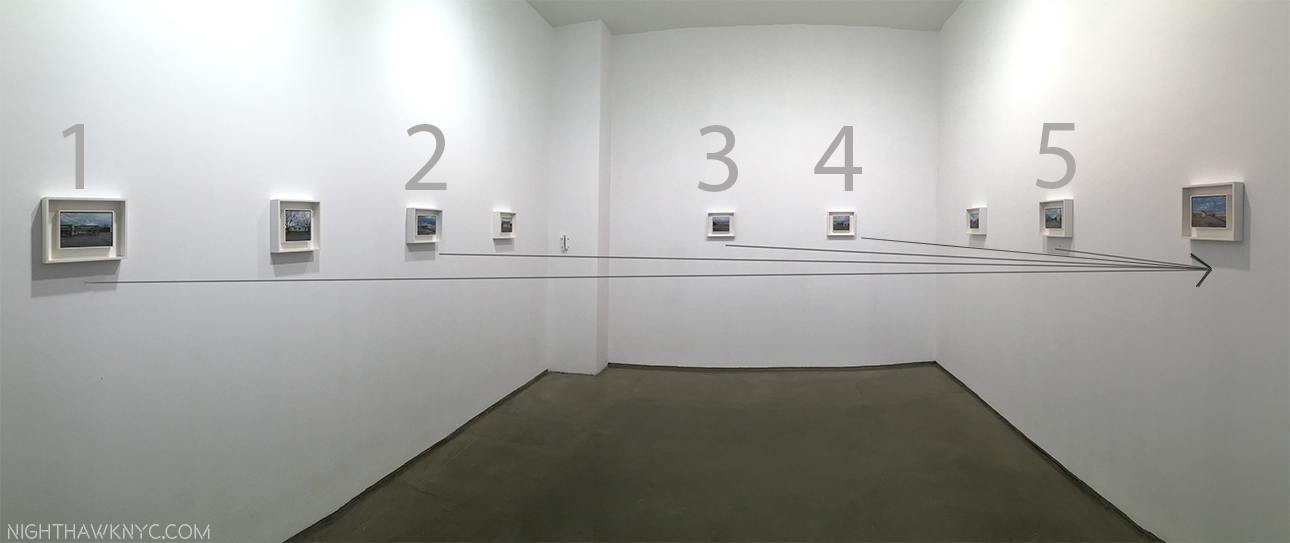
View of San Saba is installed on one of 3 walls where the paintings look out, and on to each other. Therein lies an additional element that becomes apparent when seen together. As Mr. Penner said, each work stands alone. Yet being at this show one can’t help noticing that there’s, also, a “little world” in these 9 Paintings that comes together in View of San Saba. Taken as a whole, this gives a feeling of walking around a small neighborhood (typically New York comment, right?), and based on View of San Saba, it is walkable. No less than 5 of the buildings featured in the 8 other works here reappear in it, making it something of a centerpiece of this “series” for me.  I constructed these maps to show what I mean,

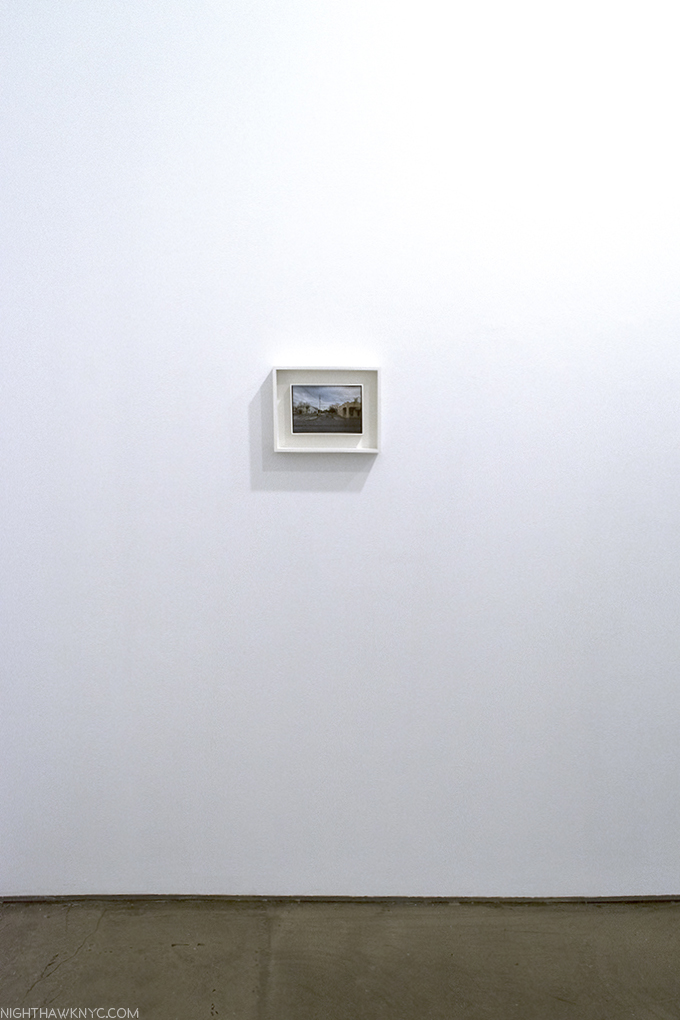
Installation View of Rod Penner at Ameringer, McEnery & Yohe shows it’s a small neighborhood. The lines connect 5 individual works with View of San Saba, far right, where the same buildings are seen, again.

“Map” of View of San Saba showing the location of the 5 Buildings also shown in their own Paintings, which follows. The numbers are from the order they appear in the show, as seen in the prior Photo.

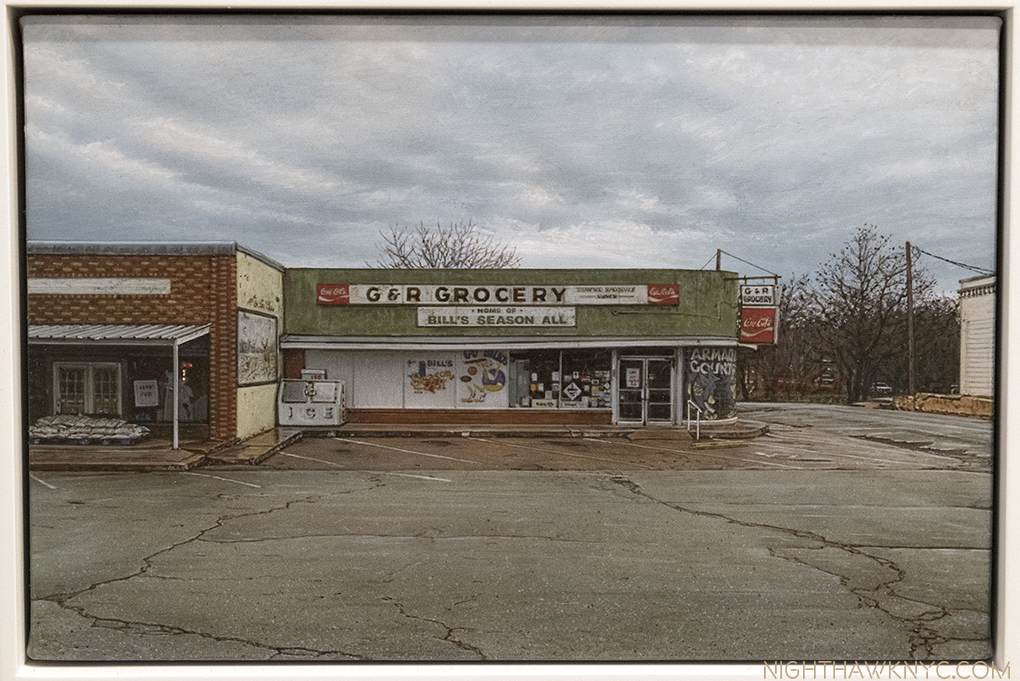
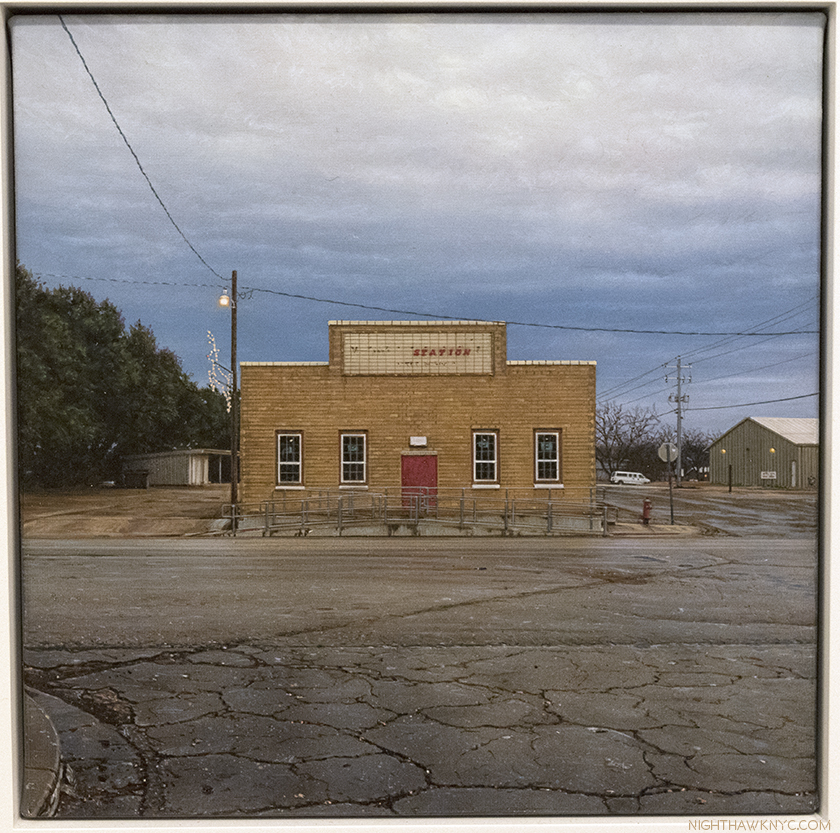
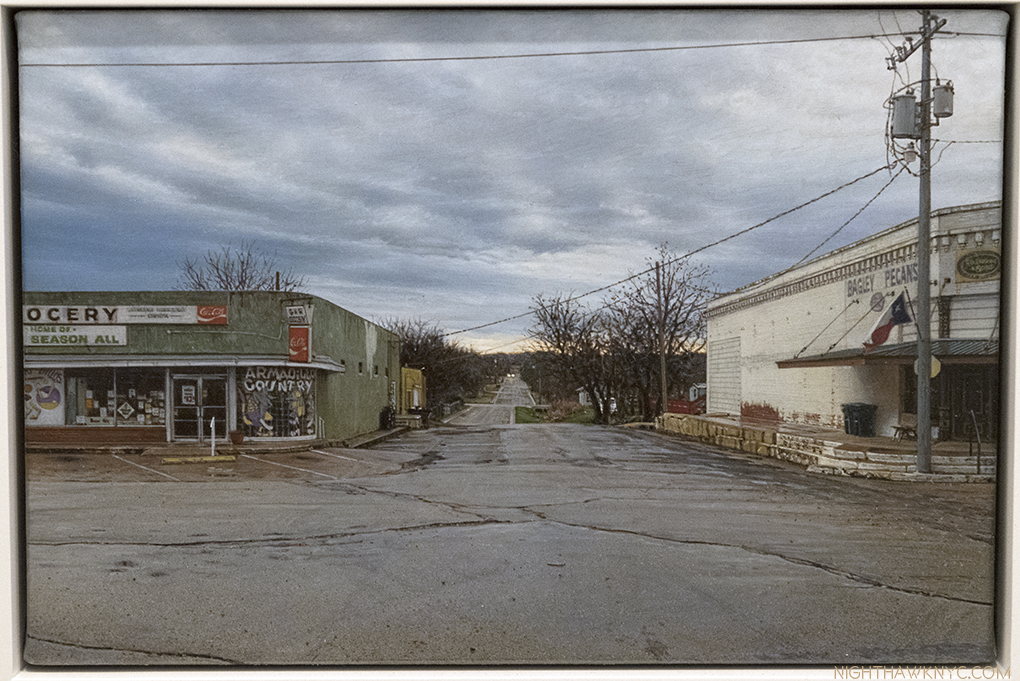
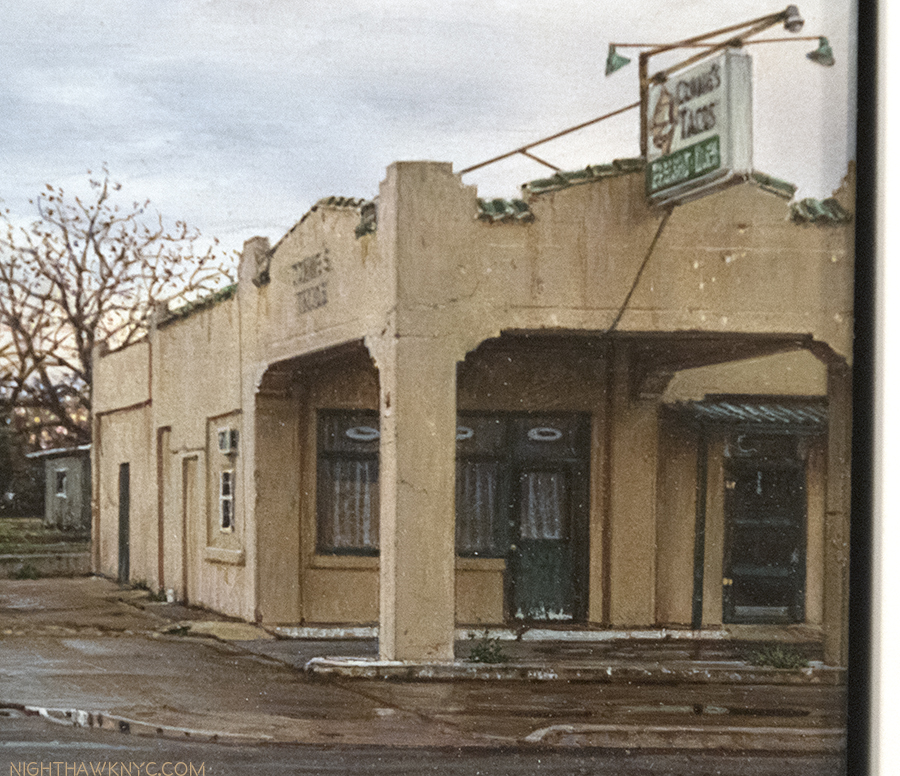
So, yes, as I said, “you can still get there from here,” if you walk straight down the street, following that center crack. Along the right, first, Buy Pecans Here, is the subject (and title) of a closer view of the same structure, below. Then, on its corner, and across the street on the right is G&R Grocery, which is seen in no less than two other works here- G & R Grocery, and Armadillo Country. And finally, a few blocks almost dead ahead (slightly left) is the building in The Station. Here are the five Paintings in question. There could be much to be said about each.

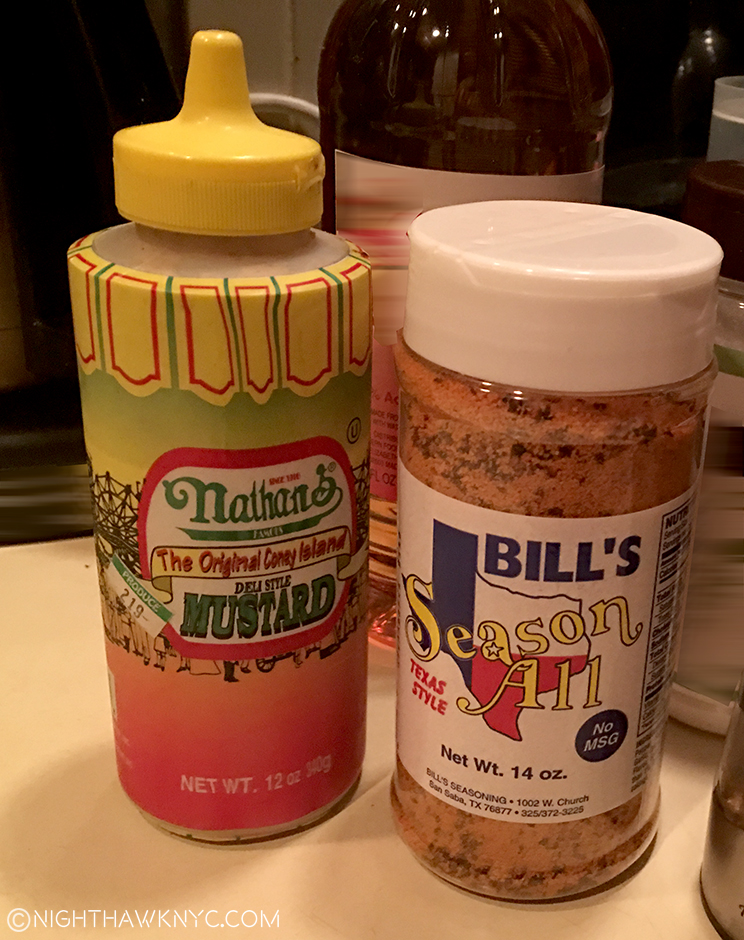
#1 in the “Map” above, G & R Grocery, 2016, 5 x 7 1/2 inches. That reminds me. G&R is also the home of Texas’ famous “Bill’s Season All,” as the sign says. I have to remember that when I need to reorder it.

NYC’s & Texas’ finest in the NighthawkNYC kitchen.

#2- Buy Pecans Here, 5 x 7 1/2 inches

#3 The Station, 6 x 6 inches. The foreground pavement endlessly enthralls me.

#5 Armadillo Country, 5 x 7 1/2 inches

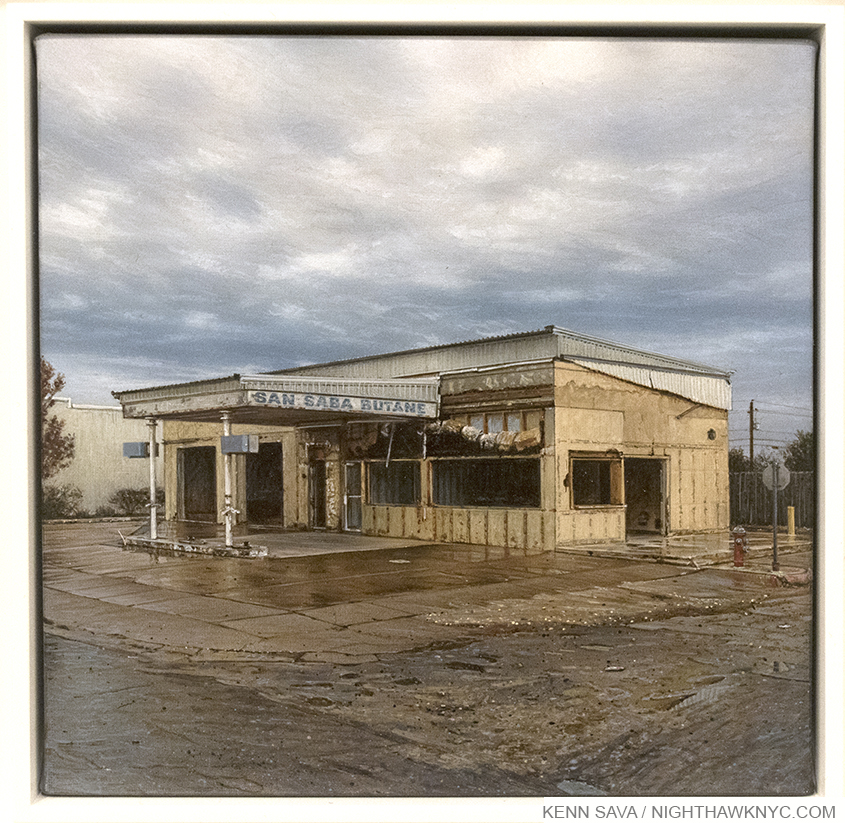
#4 does get a section to itself. My personal favorite among all of these works (not an easy call) is one I find endlessly fascinating, on a number of levels- “San Saba Butane.” All 6 by 6 inches of it. The right rear side of it is, also, #4 in the Map, above.

#4- San Saba Butane, 6 x 6 inches. Depending on the device you’re using, this photo may be close to the actual size of the Painting.

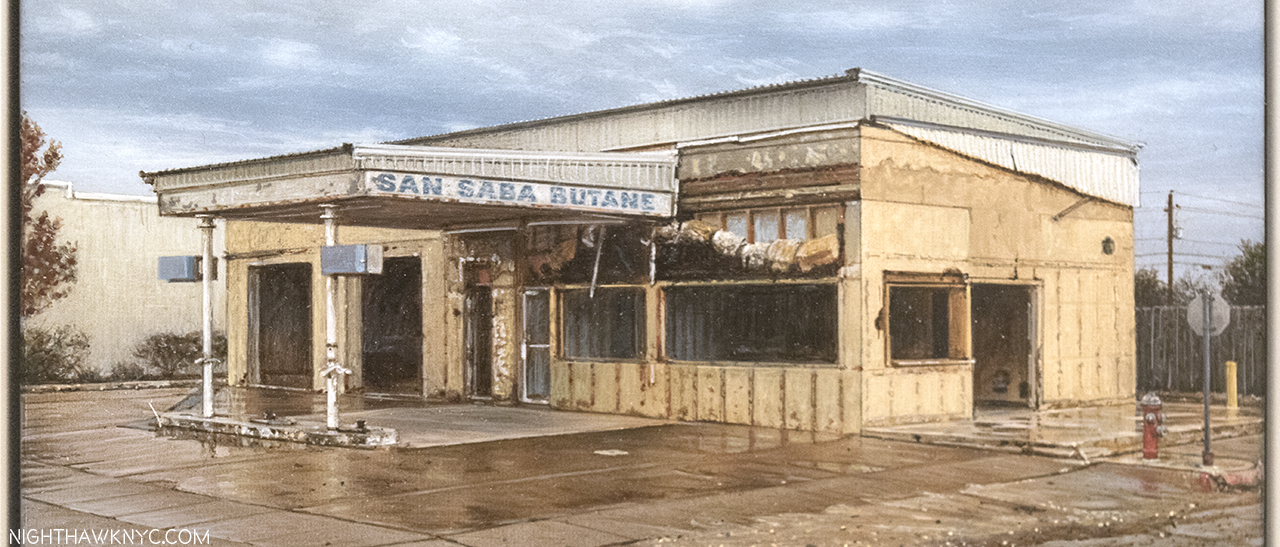
On one level, you could look at it and think about hard times, about a business that stood for a long time, carrying the hopes and dreams of its owner, until it finally moved elsewhere, or went under. There’s no indication of which here. What there is, it seems to me, is a masterpiece of realism in which abstract and realistic elements are weaved together so seamlessly, they achieve an almost perfect balance, each supporting the other. After all, when we see the world, our eyes see things that are abstract as well as “real” (be they reflections in windows or water, and on and on- they are everywhere once you look for them). It’a all based on a rectangular box seen at an angle that provides the basis of everything else that Mr Penner hangs on it or adds to it, and around it. One time I looked at this and thought “It’s a Robert Rauschenberg meets Anselm Kiefer structure under a “Penneresque” sky, as I named them last time, maybe with a hint of John Zurier in it, and with Lucian Freud pavement. Another time, I fancied that the historic “Battle of San Saba Butane” had been fought here, leaving Texas another monument, akin to the Alamo. But, alas, history records no such battle (as far as I know). There is, instead, a completely peaceful stillness to the building, though it’s surrounded by turbulent skies and pavement that appears almost liquified in places. To get to its door, you have to cross the rough, wet road in the foreground before arriving on the slightly surer footing of the (wet) pavement, and then to the “safety” of the awning, only to find the building it’s attached to is just an empty shell, and not a real “destination.” This “having to cross questionable or unstable ground in the foreground to get to the heart of the work” is present in many of Rod Penner’s works. It takes the eye on a journey, and makes it work to get to the core of the composition.

This section is about 3 inches tall by 6 inches wide in the Painting, shown here larger than actual size. Even the wear and tear on the sign’s lettering is brilliantly rendered.

Whatever struggle took place here, even the struggle of day to day business survival is over, and all is quiet in the building. In all its brilliantly rendered dilapidated glory, it’s still standing. Though it says “San Saba” on it, if you took the lettering off (but please don’t) this is another scene that can be seen in any state in the USA. Part of the lifecycle of a business- the part where one has ended and a new one may begin. In that sense, it could also stand for life & death, a tombstone for the business that was once here, and all the memories and history that went with it. Now, it’s a space where something new can begin. It’s real and surreal, intimate and repelling, liquid, solid and air, a place that it wouldn’t seem could possibly exist, somehow, except for that sign- “San Saba Butane” anchors the scene to earthen reality. I wondered about that sign at first, in my first Post, then thought- “No. It’s probably a real name. No one could make that up, right?”

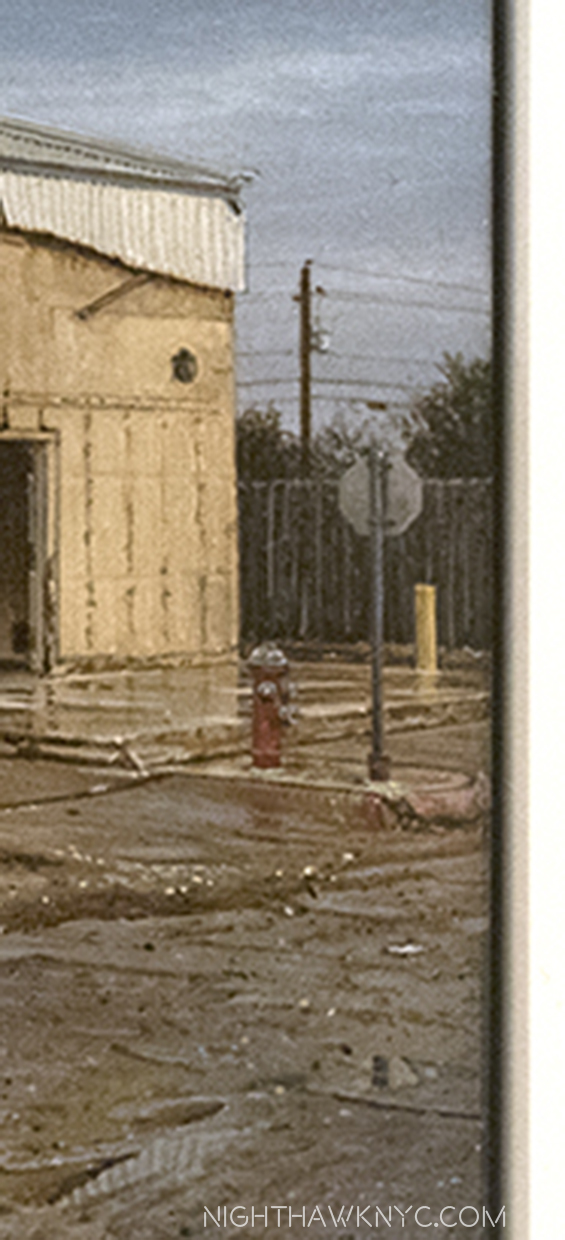
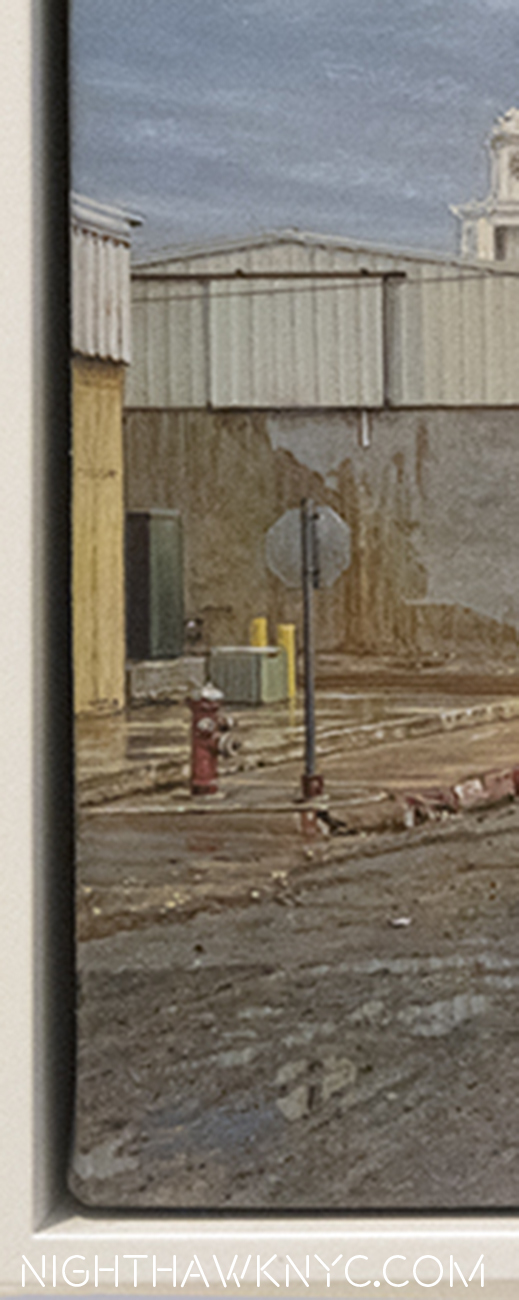
One look at San Saba Butane in comparison to how it appears on the extreme left of “View of San Saba” and you realize that there’s no building behind it now! The Artist, himself, pointed this out to me. The whole right side of San Saba Butane shows a different view than what’s behind it in View of San Saba.

Detail of the right side of San Saba Butane.

Detail of the left side of View of San Saba.

Mr. Penner said, “In San Saba Butane, I removed the building you see in View of San Saba. The area right of the station needed to be opened up some… too claustrophobic… in order to allow the eye more room to wander. The stop sign and hydrant are the same ones you see in “View of San Saba.” That sound you heard was a hammer putting the final nail in the coffin of “photorealism” in regards to the work of Rod Penner.

Well? If this is a real place? I don’t care one bit what it “really” looks like. I don’t want to know. Well, I do know this- As much as I dislike qualitatively comparing creative work. I can’t put it any other way- I can’t think of a better Painting I’ve seen in the past year than San Saba Butane.

The next one is right up there, too.

Commie’s Tacos, 5 x 7 1/2 inches.

“Why did we stop here?,” I can hear someone in the backseat saying.

After all, we’re stopped in the middle of the road. “The light’s red up ahead,” might be one reply. “Not much to see here,” might be the new complaint. Hmmm…..The longer I look at this, the more I disagree.

First, there’s the skill involved in depicting this in all of 5 by 7 1/2 inches of canvas.

The same Painting, Commie’s Taco’s, seen from only 6 feet away.

When I looked closely at this one, I marveled at the detail on the two buildings to the left of center. The more I looked at this, the more I see. Every last clapboard is perfectly rendered, but all of it has character. Check out the bands on the back of the Stop sign, and on and on…

Detail of about 2 and 1/2 inches of the left side seen with a zoom lens.

To the right is a tan building, with a Spanish Tile roof, which would be fitting for a business with the name of Commie’s Tacos, the work’s name-sake, which is painted at an angle, and cut off making me wonder if Commie would ever want to buy this work and display it in his/her’s fine establishment, since it’s not even showing the whole restaurant. In fact, we wouldn’t know what the name of it was if it wasn’t the work’s title!

Commie’s, itself, in about 2 inches, with incredibly detailed concrete.

Then, I stared straight ahead, down that beckoning road you see in the first photo, which is what the composition seems to want. The looming street seems a bit more uneven, a bit rougher, than the fairly level ground we’re on now, judging from the masterfully rendered pavement.

Detail of about 4 inches of the foreground. Mr. Penner frequently puts pavement right in the front of his work, which is both daring and serves to set the stage. It’s a stage so well executed it looks real, and used. Notice the wide variety of surfaces.

We’ll pass trash cans, Yield signs and the ever present telephone poles. Further on, past the white house, it’s hard to say what we’ll encounter, well, before that vehicle with its headlights on. If we were standing on either of those corners, maybe we’d think that vehicle was coming for us. But, in the middle of the intersection? All bets are off. It’s hard to tell if Commie’s is even open for business. As in every work here, no one else is around.

As a result? There are none of the distractions people in a painting bring. None of the drama. Uh oh. Speaking of drama…

On the Fence, #6- Crow-No-Lisa

Same with Commie’s. It’s painted at an angle and chopped off which serves to reduce its power and importance. The import, seems to me, to be in the feeling of place- of being here, now. Imagine for a moment what it must feel like to be a new resident to this street, seeing it for the first time, (as most viewers of this work are), and seeing the place you’ll now call home? What would living here be like? The residents are already connected to each other by wires, but you’re not. Would you be welcome? There’s rain on the ground, as there is in a number of these works, but the skies seem to be clearing. Keywords- seem to be. It looks to be a very typical street in a small town in Texas, in or near San Saba, but it could be almost anywhere. This scene could be in just about any one of the 49 states not named Hawaii.

Robert Frost talked about taking the road less traveled, “and that made all the difference.” What would he make of this road? Would he take it? Situated here, as we are, the answer isn’t clear, but if we are going down that side street, we’re in the wrong lane of traffic. Unless, we’re across the street at the other corner, waiting at a Stop sign there. Or, maybe it’s a scene seen in passing, or while stuck at a light to the left or right. One of those things we see for a minute, just long enough to wonder what’s down there? What it like down that street?

Seen from a normal distance, Commie’s Tacos, in its double frame.

Or? You could consider it a mediation on what once was on the corner, perhaps a house you grew up, that’s now gone. The level of detail enhances the “realism” of the work, and so, enhances the viewer’s ability to “experience” whatever he or she thinks and feels when they see it. Beyond the date the painting was done, we don’t know when this scene takes place (as we don’t in any of the works on view). It could be today, last year or 30 years ago. As such, it, and all the works here, are “portraits” of a place that’s beyond time and place. A place frozen in time that portrays an equally frozen moment that, the closer you look at it, you see “more” in. It raises more and more questions, or maybe even reminds you of a place and time, and brings back its feelings. Seeing this on the wall at Ameringer, in its interesting double frame, it’s a portal into a distant place that somehow doesn’t feel all that far away. A place somehow “known.”

Ameringer McEnery Yohe, 525 West 22nd Street, NYC, seen during the run of the show, appropriately, from the middle of the street, with wet pavement, under “Penneresque” skies, that I hear came all the way from Texas.

I don’t know how the 2,783 residents of San Saba (in 2014) feel about these paintings, if they’ve seen them. More than likely, they prefer Mr. Penner paint other locations in their fine community. As someone who’s never been to Texas, when I look at them, as I’ve said, except for a sign here or there, I see places that could exist elsewhere. So, while they’re based on actual places in and around San Saba, as Mr. Penner said, they strike me as much as depicting America- places and things that could be seen anywhere in the country. I’m sure San Saba is a very different place than NYC is in a lot of ways. When I look at these Paintings? Not entirely different.

(My subsequent Q&A with Rod Penner is hereMy experience at this show’s opening and my initial impressions of it are here.)

*- Soundtrack for this Post is “Here Comes The Sun,” by George Harrison from Abbey Road by The Beatles.

NighthawkNYC.com has been entirely self-funded and ad-free for over 6 years, during which over 250 full length pieces have been published. As I face high expenses to keep it going, if you’ve found it worthwhile, please donate to keep it up & ad-free below. Thank you!

Written & photographed by Kenn Sava for nighthawknyc.com unless otherwise credited.
To send comments, thoughts, feedback or propositions click here.
Click the white box on the upper right for the archives or to search them.
For “short takes” and additional pictures, follow @nighthawk_nyc on Instagram.

Subscribe to be notified of new Posts below. Your information will be used for no other purpose.


  1.  Old Mother Pecan, one of the most unique trees in the world (I love trees), is still standing, too (thought not seen), not all that far away, 200 years later! Important for a place that calls itself the “Pecan capital of the world.”

Raymond Pettibon’s Burning Bush

This site is Free & Ad-Free! If you find this piece worthwhile, please donate via PayPal to support it & independent Art writing. You can also support it by buying Art & books! Details at the end. Thank you.

Written & Photographed by Kenn Sava.

Raymond Pettibon: A Pen of All Work, at The New Museum featured a multi-faceted lobby Mural by the Artist that touched on long time themes, and added a few messages.

High above, to the left of center, the Artist painted these words…

“I have been rewriting ‘that modern novel’
I spoke of to you…On th’ whole it is a failure, I think,
tho nobody will know this, perhaps, but myself…iyt is a simple story, simply told. And yet iyt hath no name.”

This show fills THREE FLOORS of a quite prestigious Manhattan Museum. Please define “failure,” Raymond. Unless, you’re pulling our leyg…again?

Raymond Pettibon: A Pen of All Work, a Retrospective that also marked his first major NYC Museum show, closed at the New Museum on April 16. I was there almost to last call, drynking in as much as I could, though I was past being intoxxxicated on the 800 Drawings, fliers, album covers, ’zines, Artist’s Books and his films the museum displayed over those 3 full floors1, plus the fascinating, multifaceted mural he did in the lobby, seen above, and below.

“Beyond it lays everything tht mattered.” That tells you right off how the Artist feels about this, the logo he designed for the legendary band HE named Black Flag, that featured his brother, Greg (who also founded SST Records, who sell Pettibon’s work to this day, without ever mentioning his name). The period it represents really is such a small part of his, now, 40 years of work. It’s (also) the #1 tattoo in the land, here painted on the Museum’s elevator doors. Still on the outs with his brother, he says he rarely draws it any more, so this time, he added very small text above each bar, which reads-“Doors nor windows.””Beyond it lays everything tht mattered.””He isn’t under there, he’s in the woods.” and “The last sentence is somewhat obscured to me.” from left bar to right.

Homage to classic NYC Baseball. Another part of the mural (all since painted over) showed Brooklyn Dodger Jackie Robinson, waving a huge bat, and the Yankee star, Whitey Ford, right, in individual Drawings, not in action against each other.

It might be a while before you see this in a Museum, again. That elevator goes to THREE floors filled with Pettibon. Some “failure.”

Installation View of the 4th floor on its closing day, April 16. In the center is a room with work the Artist created for this show inside.

Barely, had I had time for this buzzz to peak when lo and behold…Here comes A-NOTHER Raymond Pettibon show, “TH’ EXPLOSIYV SHORT T,” at David Zwirner, 19th Street, with NINETY-NINE more, recent works, only a couple of which were in “A Pen…”(they were part of the lobby mural, tacked to the wall)! And? These 99 works were being shown in the very space where Raymond Pettibon had created them. Whoa! So, unless I completely overdose on Pettibon first, you might, as I’ve opted to do three pieces- because I think his work is that important and timely- one on each show, and a third piece that looks at the place Raymond Pettibon’s Art is now. Since the David Zwirner show, where I met Raymond Petitibon on April 29, still has some time to run before it closes on June 24, I’ll start with A Pen of All Work, my “NoteWorthy” show for April, before the trail grows cold on it, though for you lucky folks near Maastricht (correctly spelled), the Netherlands, it just reopened at Maastricht’s Bonnefantenmuseum, on June 2, with 700 works, where it will run through October 29. 2

Try everything, Do everything, Render everything, Ink on paper, date unknown. And? He proceeds to do just that…

Mr. Pettibon is somewhat unique in the Art world because of the way he got here, achieving legendary status through his work for bands before he got a Gallery to represent him. So? The Art world is not as familiar with the early work, while his early fans may not be as familiar with what he’s done lately (though, of course, he has many fans who have been with him the whole way, too). I’ll try to show a mix of work here, while trying to give a sense of what this remarkable show was like.

I have to think back to the Picasso Retrospective which filled ALL of the old MoMA in 1980 to recall a show of comparable size. Still, if there was a common theme to be found it was that “his entire body of work is very much a confrontation against ideologies,” to quote Massimiliano Gioni, the New Museum’s Artistic Director, on the excellent audio guide. Whatever you’ve got? Pettibon will confront it, and given how much confronting he’s done, everyone involved did a superb job of installing it, organizing all of these works by themes.

Timeless. Unfortunately. No Title (Fight for freedom!), 1981(!), Pen and ink on paper

The 2nd floor mostly focused on Pettibon, himself, looking at his early work with an eye on how he created his own “alternate media” in the form fliers, zines, record covers, Artist’s books, films & videos, et al, and how he goes about his craft, including samples from the archive he uses as source material, and to draw inspiration from on a daily basis.

A bit of Pettibon’s never before seen archive of source material includes Iwo Jima, Giuliani, and 9/11.

Also on 2, along with a good part of his past, part of Pettibon’s current legacy was on view in full effect, as seen below. He forged his own way of getting his work seen, first on fliers, then on record covers, zines, Artist’s Books, and then added film and video, all before finding acceptance in the Art world, something he says was delayed by 10 years due to his association with punk. A visit to stores like New York’s Printed Matter feels like visiting the work of many of the “children” of Raymond Pettibon, as his example has been, and is being, followed by countless Artists, Photographers, Musicians and Writers right now. Including thiys one. Though, perhaps not the first Artist to work in any of those media, his methods, and his path, remain most influential.

I had to cross the Framers Union picket line to see this show, who were on strike because Pettibon prefers to tack his work to the walls with straight pins. With 800 works in this show? That’s a LOT of lost work for framers. Ok…I’m kidding. I’m pulling your leyg now. Looking at this photo, you can see how very far Pettibon’s work has come. In the glass case are GORGEOUS copies of his (now rare) early gig fliers that were posted with no thought of posterity in the late 1970s. Behind them, on the wall are 2 tacked up drawings, and one painting(!), left, next to 13 framed drawings of no less than the Manson family. Out of the 20,000 Drawings Pettibon has done, only a small percent have been framed. With the prices being paid for his work? I’d bet that just about every piece that is tacked to the wall here is being seen that way for the last time. Framers? Get ready.

Also on the 2nd floor is the American premier of the virtually complete original art for his first book, Captive Chains, 1978, an homage to comic books/Texas Chainsaw Massacre/ Betty Page that is laced with S&M imagery as well as first rate drawings, different in style than what most of his fans may be familiar with. Pettibon has been quick to downplay/under-play/denigrayte his self-taught Drawing skills- including these! Captive Chains begs to differ. Sorry! No faylure here. These are both terrific, and now classic. Perhaps most interesting, a number of its pages are full page drawings with no text, something almost never seen in Pettibon’s work since. In fact, it seems to me his career has followed the trajectory of his work being more about image primacy early on to now when text and language have come more and more to the forefront. One indication of this is that many drawings lie unfinished in his studio at any given time while they await the inspiration of texts to complete them. Sometimes for years.

The complete original art for Captive Chains, 1978. 68, ink on paper Drawings seen in the USA for the first time, and yes, they’re tacked to the wall.

One page. Ugh…I’m sorry. Putting a tack in this is like putting one in my hand.

Pettibon is fond of recycling old characters from the comics and television, including Batman, Superman, Gumby and the obscure side-kick character, Vavoom. While Batman and Superman are famous, Gumby, a long time personal favorite, is in eclipse. A claymation character created by Art Clokey3, he was able to walk into books and live in them, as well as visit other times in history. Vavoom was a side kick on the Felix the Cat cartoon show, a character, who’s only vocalization was, literally, an earth shattering shout out of his own name. Both Gumby and Vavoom are alter egos of Pettibon, and stand-ins for the Artist. Very interesting choices, to say the least.

The old cartoon side-kick, Vavoom (seen here in No Title (A beautiful, actual…), 1987 ink on paper, only able to say his own name is an interesting alter ego for an Artist who is so intensely literate.

…so is Gumby. No Title (I borrow My…), 1990, Acrylic on board.

In a long, rear gallery on the 2nd floor, was an amazing selection of Pettibon’s superb Baseball Drawings.  Along with surfing, the Artist’s passion for Baseball is lifelong. As with his other work, unless you’re a Baseball Stat expert, like he may well be, it takes some digging to begin to understand why Pettibon is choosing to depict a certain player at a certain point in his career. (More on this in my Post on the Zwirner show.) While his early punk work continues to gets so much attention, other areas of his work live in neglect. If there’a another Baseball Artist in Pettibon’s league? I don’t know of him/her.

Against the world. No Title (1.12 Bob Gibson), 2015, Pen, ink, pencil, acrylic on paper. “1.12” was Bob Gibson’s E.R.A. in 1968, when he won 22 games and lost 9. His St. Louis Cardinals lost in Game 7 of that year’s World Series. Could anything better capture his intimidating presence than this?

The 3rd floor sees Pettibon looking at the various “tribes,” and subcultures in recent American history- surfers, hippies, punks, the Manson family, and musicians.

Even The Beatles “get Pettibon-ed,” to coin a phrase, about who is the “largest” member. No Title (Few know this…), 2015, Ink on paper. Pettibon continually revisits history (usually, American), often years later, as here. In the 2000’s, he began addressing events closer to “real time,” like the War in Iraq. One thing I haven’t figured out yet? His work’s “penis obsession.”

His Surfer and Wave works strike me as living at the center of his work, the heart of it. Beyond punk, Manson, religion, politics, war- all the rest of it. Here’s a world Pettibon knows intimately having grown up near the water in Malibu, where he indeed surfed, though, as he told Dennis Cooper in Raymond Pettibon, (Phaidon), “I don’t surf much any more, but I grew up with it. I was never a card-carrying surfer.” Usually, he depicts a solitary man in the middle of a gigantic wave, testing himself against nature, symbolically against the world, against the nature of things, against chance, and against himself. As his 2005 work, ”Man stands as in the center of Nature, his fraction of time encircled by eternity…”, which wasn’t in this show, sums up perfectly. At moments like those, the “truths” that present themselves (or rather, that Pettibon presents) are often zen-like koans- they’re ineffable. They can’t be distilled further. All but the tiny place where board meets water is out of his control. How long will the ride last? Will he survive? Be maimed? What goes through the mind while it does, and at times like those? It’s not just a man’s game, either. He shows us girls and women surfing, sometimes topless.

Monumental. No Title (As to me…), 2015, Pen ink, watercolor, acrylic on paper 55″ x 113″. Another of his large Surfer Drawings sold for 1.5 million dollars in 2013, “failing” to reach four times the high estimate.

No Title (Don’t complicate…), 1987, Ink and gouache on paper, 24″ x 18″, MoMA. If I could choose one work of his? This might be it…at the moment. You styll have 300 other Pettibons, MoMA.

The 4th floor sees Pettibon’s extensive, long-running, devastating and ever-timely political and war works, along with works relating to the power of media. Brace yourself- Pettibon doesn’t play favorites. Democrats and republicans come in for just about equal poundings- from JFK through Obama. It culminates, and the show concludes, with an inner gallery of work Pettibon created for A Pen of All Work.

Twas ever thus. No Title (You’re supposed to read the green first, Congressman Ford), 1976, Red, blue pencil on paper.  An early work about Gerald Ford by “R. Ginn.” The name “Pettibon” comes from his dad.

The layout of the 4th floor is interesting in the choice of having the most timely, most controversial and most “explosive” work including pieces regarding Ronald Reagan, Gerald Ford, Donald Trump (one from the 1980’s, and one from the 2016 campaign) and atomic explosions….

No Title (“End the war…), 2007, Pen, ink, gouache on paper, 30″ x 22,” left, seen with No Title ( The war, now…), 2008, Pen, ink, gouache,  acrylic on paper. Don’t worry. There was a whole wall about JFK, and yes, Obama got “Pettibon-ed,” as well.

A wall of work on religion, another ongoing theme.

surrounding an inner space, where the feeling is, surprisingly, both personal and intimate, it felt to me. Inside, the Artist pays homage to his mom, talks about his craft, and, apparently, nature, life, some of his wishes at this stage of his life (he turns 60 on June 16), all in works created for this room, and some on its walls.

The show includes some treasures. His mother, 95 as of last December, saved some of his childhood drawings from the 1960’s and 19 of them were on view that Pettibon has now added texts to! Pettibon pays homage to his Mom in a wonderful, Artful, way in this final gallery, which brings the show full circle.

Inside the final room on 4, containing works Pettibon did especially for iyt includes this version of Whistler’s Composition in Black and Grey, the Artist’s Mother, an homage to his own Mother, now 95, who he has says has always been his biggest fan, at times his only fan. The feeling this room gave felt like walking around in his head at the moment. He added the writing above it because, he thought, Whistler’s Mother looks like Mary Baker Eddy.

So…Moms? Hold on to your kids drawings!

A view of another part of the final room.

No Title (Pinned to the Earth), 2017, Ink on paper. In the final room, birds are featured since their feathers are used for quills- drawing instruments. Uh-oh. Someone else wants to chime in on this one…

“On The Fence, #5, Picking-A-Petite-Bone”

Painted on the wall of the final room.

PHEW. Some “failure!” It sounds HUGE, and it was, but it was a mere pittance (4%!) of the over 20,000 Drawings Mr. Gioni says Pettibon has created to date. And counting. He’s already added at least the 99 drawings in the David Zwirner show to the total. And? The one he did for me there.

No Title (When I see…), 2006. Pen, ink, collage on paper. Pettibon has been doing collages since around this time, and says one may include up to 70 drawings. As if his work wasn’t cryptic enough!

Beyond that, in a show that contains work that goes back to the 1970’s, it’s fascinating that nothing here feels “dated,” and virtually all of it holds up. Over 800 of any works is a pretty good indication of quality, even out of a body of 20,000. I’m still looking for a “bad” Pettibon.

No Title …(Do you really believe…), 2006, Pen and ink on paper.

After spending some weeks with these works, and Pettibon’s work in general, I find Mr. Gioni sums up the mystery of “understanding” Pettibon’s work the best I’ve found so far when he says on the audio guide, speaking of his political works, but I think it’s valuable to keep in mind, regardless of subject- “Pettibon plays with a variety of voices, in this case a cacophony of voices. The texts that are inscribed in the works of Pettibon are rarely a direct confessional expression of the Artist’s opinion, and they are instead a collection of what could be defined as the collective unconscious…” Proof of this is that we learn very little about the Artist, himself, from his work. Unless he comes out and tells us, directly, in interviews, and even then? Watch out for his “tall tales!” The point of the work is not personal (about the Artist, himself). It’s more about self, than “himself.”

My Heart Tells Me (Self Portrait), 1990, Ink on paper.

Personally? I felt like I was seeing the work of 800 Mensa members.  If you want to know why he is a major, and in my opinion, crucially important, Artist of our time, the “Pen,” and a pretty nice one, called the New Museum held your your answer. A wall card says the show’s title comes from a poem by Lord Byron. Ok. Another way to look at it is that the New Museums truly was A “Pen” (as in an enclosure) of All (well, A LOT) of his Work “that matters,” as he painted in the lobby.

No Title …(Good prose is…), 2013, has been turned into a styling Tote Bag by MZ Wallace, proceeds go, appropriately, to the New York Public Library.

I must also say that I feel that this show was a huge coup for the New Museum. As far as I’m concerned, this is the show that takes the New Museum to the next level. “Big 4” Museums? That sound you hear is someone breathing down your necks in contemporary Art. As for Mr. Pettibon, himself? I wonder. This show could have been held at MoMA (who, according to their site own over 300 of his works, on say, the whole 6th floor) or  it could have filled The Met Breuer (The Met lists 3 of his works online). Either would have, most likely, given him quite a bit more exposure, which might be critical given the timely nature of his work. I would love to know if either was ever an option, and why they passed if they were. Raymond Pettibon’s time is (still) now. Maybe MORE now than ever. Still, all of that having been said, I’m glad that it happened at all! I mean no disrespect to the New Museum. On the contrary, I heartily applaud them on doing such a superb job, on all accounts. Bravo! While I won’t compare qualitatively, “A Pen of All Work” will be one very hard show to top in NYC in 2017. Meanwhile, his Art continues to find favor elsewhere around the world. If you are anywhere near Maastricht, the Netherlands before October 29, don’t miss iyt! Raymond Pettibon also has a show about to open at the excellent Garage in Moscow, Russia. But? Sadly, this one is over.

“And the only sound that’s left
After the ambulances go
Is Cinderella sweeping up
On Desolation Row.”*

When I left A Pen of All Work as the show closed that last time, I walked out on to the Bowery, the erstwhile “Skid Row,” or “Desolation Row,”(hence, this Post’s Soundtrack), where C.B.G.B. used to stand a few hundred feet away, back in the day before gentrifucation. Yes, punk is long gone, but Raymond Pettibon’s “failed modern novel” gets more and more attention than ever, now worldwide. Pondering all of this, I felt that Pettibon seemed to be akin to a modern day biblical, or zen, prophet- complete with his own burning bush, wandering in the desert, speaking in tongues.

800 works in, I’m listening harder than ever.

*- Soundtrack for this Post is “Desolation Row” by Bob Dylan, from the classic Highway 61 Revisited, and published by Bob Dylan Music Co.

Special thanks to Kitty, who’s research assistance made thiys Post possible.

NighthawkNYC.com has been entirely self-funded & ad-free for over 8 years, during which 300 full length pieces have been published! If you’ve found it worthwhile, PLEASE donate to allow me to continue below. Thank you, Kenn.

You can also support it by buying Art, Art & Photography books, and Music from my collection! Art & Books may be found here. Music here and here

Written & photographed by Kenn Sava for nighthawknyc.com unless otherwise credited. To send comments, thoughts, feedback or propositions click here. Click the white box on the upper right for the archives or to search them. Subscribe to be notified of new Posts below. Your information will be used for no other purpose.

  1. 800 pieces, per the show’s audio guide, which you can still access, as I write this, here.
  2. Update- July 20- You can read my Post on “TH’ EXPLOSIYV SHORT T” here.
  3. (who passed in 2010. I wonder what he thought of these…

The “Other” Russian Revolution

This site is Free & Ad-Free! If you find this piece worthwhile, please donate via PayPal to support it & independent Art writing. You can also support it by buying Art & books! Details at the end. Thank you.

Written & Photographed by Kenn Sava (*- unless otherwise credited)

“I’m back in the USSR
You don’t know how lucky you are, boy
Back in the USSR”*

There was that “big” one…you know…the one that was in all the papers over here one hundred years ago, in 1917 – The “October Revolution,” or the “Russian Revolution.” Whatever you call it, 9 million people died in 5 years, and it resulted in the loss of freedom for countless more millions over the next 74 years, I’m no historian or political writer, but I hear it’s been fading in importance for quite a while now. While that one caused a big stir, meanwhile, off in what was then a quiet, small town (a city of 350,000 today) in the eastern U.S.S.R. (Belarus today), the seeds of another revolution were beginning to sprout. No one was killed in that one, as far as I know. The instigator of a good deal of it is a world famous Artist now, who, though a pioneer of modernism, is not often thought of as a revolutionary.

Today, he’s famous for flying lovers.

Marc Chagall is the most famous native son of that small town- Vitebsk, Belarus. In the early days after the “October Revolution” he accepted the Post of “Commissar of Visual Arts” for Vitebsk. He then founded the Vitebsk Arts College, and in 1919 invited a number of Artists to be its teachers. Among them were Kazimir Malevich, El Lissitzky and Yehuda Pen. Kazimir Malevich would soon become the fountainhead of a movement that crystalized in a group named “UNOVIS” ( or “Exponents of the New Art”), who, in the spirit of the larger revolution, shared credit for the works they created. At the core of this movement was Malevich’s “Suprematism,” a style of work that focused on basic geometric forms and colors, in the service of “pure artistic feeling.” This put him (stylistically) directly at odds with Chagall, who was, at heart, a classicist…

“On The Fence, #2: El We-sit-ski.” Click any image to enlarge, if you dare..

and when Lissitzky, who was on the fence between both camps (sorry!), sided with Malevich, Chagall soon left the school to continue his career elsewhere. 100 years later, Suprematism and the Russian Avant-Garde is still growing in importance and appreciation, as was plain to see in MoMA’s recent exhibition, “A Revolutionary Impulse: The Rise of the Russian Avant-Garde,” 1915-1932,  which featured, and grew out of, Malevich’s “Suprematism” movement. MoMA’s show, consisting exclusively of works from its own collection, is NOT to be confused with a show of a very similar title, “Revolution: Russian Art 1917-1932,” running concurrently at the Royal Academy, London, which included quite a few loans from Russia. While the show, and the movement, includes filmmakers, poets and other visual Artists, I’m focusing on the Painters, Photographers and Graphic Artists included. Many are, surprisingly, multi-threats (i.e. multi-talented). To quote MoMA about these Artists, they were “a group who was fed up with form, the way the “other” revolutionaries were fed up with 300 years of Czarist rule and decided to throw it all out, so to speak, and start over from the basics, giving a new hierarchy to basic forms, and basic (or non) colors, like black and white. (i.e. Suprematism. )1” Stalin’s 1933 decree led to the banishment of the Avant-Garde, in favor of “socialist realism,” which has already been forgotten, as we approach the 100th anniversary of the “Russian Revolution.”

While Chagall, himself, was not included in MoMA’s show (though he was in the Royal Academy’s), the headline highlight was an extremely rare opportunity to see so many works from MoMA’s incomparable (in the West) collection of Kazimir Malevich, the brilliant visionary who died only a few years after the period this show covers ends, 1932, passing in 1935 at 57. That New Yorkers are lucky enough to enjoy this superb collection is due to the foresight of another legend, Alfred H. Barr, Jr, MoMA’s first Director, who in 1929 had the prescience to secure many of Malevich’s works.

Shots across the bow of painting. An entire wall of rarely seen works by Kazimir Malevich, that are at the crux of the Revolution, featuring  “Suprematist Composition: White on White,” 1918, considered his masterpiece, center.

Close-up with Malevich’s “Suprematist Composition: White on White,” 1918.

At 26, in 1927-28, Mr. Barr went to Moscow, where he wrote in his diary, “Apparently, there is is no place where talent of artistic or literary sort is so carefully nurtured as in Moscow. Would rather be here than any place on earth.” This trip stayed with Barr when a year later he became the founding director of MoMA, as part of his vision of MoMA as a lab of critical inquiry analysis and communication1. MoMA went on to compile one of the most outstanding collections of Russian Modern Art outside of Russia under his stewardship, which lasted until 1969, part of which is on view in the 8+ galleries of this surprisingly large, and excellent, show. While I am showing selected highlights, you can see Installation Views and get a different idea of the experience towards the bottom of MoMA’s page for the show, here. To get an idea of the ongoing importance of Mr. Barr’s choices, while I was standing in front of what many consider Malevich’s Masterpiece, “White on White,“ 1918, complete strangers to each other had a moment after each posed for pictures in what they both announced was their “very favorite painting,” 99 years after its creation.

Two total strangers explain to each other why this Malevich is their “very favorite painting of all time.”

A case of early books by Malevich, including “Suprematism: 34 Drawings,” 1920, published by UNOVIS, Vitebsk, left.

Remarkable insights to genius. 4 charts Malevich made as visual aids for his European “Introductions to Suprematism” Lectures.

This blows my mind, so I’m showing a closer view of it. In this chart, we get an incredibly rare insight into how a founder of an Artistic movement (how many of them are there?) sees Art. We get to look over his shoulder as he recaps the development of Modern Art through Cubism and Futurism to Suprematism.

As impressive as Malevich’s works are, which is equalled by the ongoing importance of his ideas, for me the show’s biggest revelation came in two words- El Lissitzky. A student of Yehuda Pen’s at age 13, he then studied to become an Architect, before Chagall’s call summoned him to Vitebsk. There, he became convinced by Malevich (who he had known previously), and this led him to create “Suprematist” works that remain both fresh and incredibly inventive today.

Visionary, and then some. In 1920, UNOVIS staged a utopian opera in Vitebsk titled “Victory Over the Sun.” El Lissiztky created these designs for abstract, electromechanical dolls for it, which were never realized. Seen are 5 Lithographs from a set of 11 he did titled “Figurines: 3 Dimensional Design of the Electro-Mechanical Show ‘Victory Over the Sun,'” 1921.

MoMA owns the only complete copy known of what may be Lissitzky’s masterpiece, “Proun,” from 1920, a Portfolio of 11 lithographs, published in Vitebsk. MoMA’s curator called it a “project for the affirmation of the new.1” The exact definition of “Proun” is not known, or lost to us, but the work itself explores the creative possibilities of Malevich’s theories in startling, and beautiful, (yes, beautiful) ways.

3 photos above- El Lissiztky, “Proun,” 1920, a Portfolio of 11 lithographs, who’s title is untranslatable now. A masterpiece of invention & design, seen in the only complete set that includes the covers (top), detail of 4 prints, center, and the translation of its manifesto, bottom.

While his work is, strangely & unfortunately, absent from MoMA’s fine and surprisingly large show, behind the scenes looms the over-looked Artist, Yehuda Pen. Teacher of both Marc Chagall and El Lissitzky, his work is brilliant in its own right, to my eyes, though different from that of either of his students. Pen went on to teach at Chagall’s School, alongside Malevich, and Lissitzky.

The great Artist & Teacher Yehuda Pen, center, with friends in 1922.

Yehuda Pen’s studio in 1917, a few years after he taught El Lissitzky.

“Portrait of Marc Chagall,” circa 1915, by Yehuda Pen. More of his work is here.

Along with El Lissitzky, Aleksandr Rodchenko, impresses, on a number of fronts, including his attitude- ”I reduced painting to its logical conclusion,” he said, speaking of his three monochrome paintings- “Pure Red Color, Pure Yellow Color, and Pure Blue Color” in 1921, “I affirmed: it’s all over. Basic Colors. Every plane is a plane and there is to be no more representation4.”

Oh yeah? Rodchenko “Non-Objective Painting no. 80 (Black on Black),” 1918, his “answer” to Malevich’s square “White on White.”

Wow. Luckily, 96 years later, painting, itself can quote Mark Twain: “The rumors of my death have been greatly exaggerated,” thank goodness! I’m left to wonder what was in Rodchenko’s Borscht. Having buried his paintbrush, he got into Photography after buying a camera in Paris in 1925, four years after declaring the death of painting. He turned out to be a naturally gifted Photographer, a medium he never formally “studied.” His photography has, also, remained influential ever since.

Avant-Realism? Rodchenko “Pro eto. Ei i men (About This. To Her and to Me),” 1923, showing off his unique approach to photography, and graphic design.

There was a lot to see over 8+ galleries, in spite of the fact there was only one work by Kandinsky on view. It would have been most welcome to see more, but I never missed them, thanks to the many works by Rodchenko, and Lissitzky, who’s Photography was also shown, proving that he was, like Rodchenko, a very gifted (and underrated) Artist in that medium, too.

Remember my name (well, it’s there over the “XYZ”). El Lissiztky was, also, a naturally gifted Photographer. This amazing “Self Portrait,” 1924, Gelatin silver print, was made using SIX exposures.

Other Artists impressed, too (Lyubov Popova, Vladimir Tatlin and Olga Rozanova among them), yet regardless of how impressive this show was, more importantly, the names of many of the Artists on view have been increasingly coming from the lips of today’s important Artists, including Nasreen Mohamedi, hereWilliam Kentridge, and the late, great Architect, Zaha Hadid, who speaks about Malevich, here. Also, amazingly, the legacy lives on in Vitebsk, Belarus, something that astounds me given that the biggest battle of World War II, and possibly EVER fought, was fought in Belarus, with monumental horrific fighting in Vitebsk. Chagall’s former School, after somehow miraculously surviving, has been renovated and is to reopen as the Museum of the History of the Vitebsk People’s Art School later this year. Below is a photo of the restored building, courtesy of myrecentdiscoveries.com, the International Marc Chagall researchers, who visited the building, and wrote about its new life, here. A photo of its new lobby, which appears to pays homage to Malevich, can be seen here.

The Revolution Happened Here. Miraculously, Chagall’s School in Vitebsk, Belarus, survived the biggest battle ever fought, while everything around it was destroyed. Malevich, Lissitzky, Pen & Chagall taught here. UNOVIS was founded here. its being remodeled and reopened as the Museum of the History of the Vitebsk People’s Art School! Photo by, and courtesy of myrecentdiscoveries.com

They were kind enough to also put me in contact with the Director of the Vitebsk Modern Art Center, Andrey Duhovnikov, which includes the new Museum, above, and who is also an Artist in his own right. I asked Mr. Duhovnikov about whether UNOVIS will be represented in the new Museum of the History of the Vitebsk People’s Art School. He told me, “There will be 12 thematic sections, two of which will be dedicated to UNOVIS, where archival documents will be presented.” I’m not surprised by this. Chagall and Malevich’s influence & memory live on in Vitebsk, a city that continues to hold celebrations to mark anniversaries of milestone events, like the 100th Anniversary of Chagall’s wedding in 2015. In response to my question about whether Yehuda Pen is being forgotten, Mr. Duhovnikov explained that Yehuda Pens’ work is too fragile to travel, which prevents it from being better known outside of Belarus, however over 180 works by Pen can be seen today at the Vitebsk Art Museum, and a Museum dedicated to Pen is being discussed. Good news, indeed.

The process whereby Art goes from “Contemporary,” or “Modern,” to “Art” is endlessly fascinating to me as I look at what Artists are creating now, and wonder- “What, if ANY of this, will be considered Art one day?” Certainly influencing major Artists who come after (like Nasreen Mohamedi, William Kentridge, and Zaha Hadid) plays a part in that, so do visionaries, like Alfred Barr, who had the foresight to hand pick 21 works from Malevich’s 1927 Retrospective for MoMA, thereby giving countless future generations, including mine, the chance to see these works in shows like this one, (which is MoMA “showing off,” a bit, like The Met did with “Unfinished“). But, also, in there quietly working away are others, like Mr. Duhovnikov, and his associates, who feel and recognize the value & importance of the work, and are dedicated to sharing it, and making sure this legacy endures to influence more generations.

That’s how “Revolution” becomes evolution, and “Art History.”

My thanks to myrecentdiscoveries.com and Andrey Duhovnikov for their assistance.

*-Soundtrack for this Post is “Back in the USSR,” by John Lennon & Paul McCartney, published by Sony/ATV Music Publishing.

NighthawkNYC.com has been entirely self-funded & ad-free for over 8 years, during which 300 full length pieces have been published! If you’ve found it worthwhile, PLEASE donate to allow me to continue below. Thank you, Kenn.

You can also support it by buying Art, Art & Photography books, and Music from my collection! Art & Books may be found here. Music here and here

Written & photographed by Kenn Sava for nighthawknyc.com unless otherwise credited. To send comments, thoughts, feedback or propositions click here. Click the white box on the upper right for the archives or to search them. Subscribe to be notified of new Posts below. Your information will be used for no other purpose.

  1. From the MoMA LIVE Video- “The Russian Avant-Garde: Scholars Respond”, which can be seen here.
  2. From the MoMA LIVE Video- “The Russian Avant-Garde: Scholars Respond”, which can be seen here.
  3. From the MoMA LIVE Video- “The Russian Avant-Garde: Scholars Respond”, which can be seen here.
  4. //www.moma.org/interactives/exhibitions/1998/rodchenko/texts/death_of_painting.html

Henry Taylor Is Having A New York Moment

This site is Free & Ad-Free! If you find this piece worthwhile, please donate via PayPal to support it & independent Art writing. You can also support it by buying Art & books! Details at the end. Thank you.

Written & Photographed by Kenn Sava (*- unless otherwise credited)

Either the Artist has a great representative, the Force is strong with him, or the powers that be in the Art World have magically combined as they rarely seem to, and at the same moment, to give us something unusual here- Multiple high-profile venues simultaneously featuring the work of the same (deserving) Artist. Or? Maybe it’s a coincidence. Or? Maybe they just agree- his time is now.

Wish you were here. Henry Taylor, wearing shades underwater, in his The Floaters, 2017 the  latest High Line Mural Commission just after it’s completion in mid-March. Click to enlarge.

Whichever one it is, “his time” came on March 17, when on the same day, Henry Taylor’sThe Floaters, was unveiled as the latest High Line Mural Commission, at West 22nd Street, AND multiple paintings by Mr. Taylor were debuting as the Whitney Biennial opened, the largest, right out in front of the 6th Floor elevator, where it leads to an entire gallery of his work, in dialogue with the wonderful photographer, Deana Lawson, both of whom shine in this Biennial, to my eyes.

Almost ready for his close-up. The Floaters seen with rigging used to paint it as it nears completion last month.

Mr. Taylor’s piece strikes me as, possibly, “one upping” the High Line by showing himself doing something none of the the High Line’s 5 million visitors can do- submerging themselves in a swimming pool. Very L.A. Well? L.A. is where he lives. Touche. His summery The Floaters, the first sign of the coming of spring in Manhattan, couldn’t be more in contrast to Barbara Kruger’s Untitled (Blind Idealism…), 2016, which occupied the same wall for the past year.

Barbara Kruger’sUntitled (Blind Idealism…), 2016,” seen in March, where it followed no less than Kerry James Marshall’s Mural (which you can watch actually being painted, here).

If you walk down the High Line to it’s southern terminus, you’ve arrived at the Whitney Museum, where Mr. Taylor’s Ancestors of Ghenghis Khan with Black Man on Horse, 2015-17, greets you as you step off the elevator on 6.

The elevator doors open on the 6th Floor at the Whitney Biennial. Seen in full below.

“Welcome to the 2017 Whitney Biennial,” indeed.

Ancestors of Ghenghis Khan with Black Man on Horse, 2015-17, at the 2017 Whitney Biennial.

Originally, the Whitney Biennial was a painting show, so I’m glad to see exciting, recent work by Henry Taylor, Dana Schutz, Kaya, Aliza Nisenbaum,  Celeste Dupuy-Spencer, Frances Stark, and Jo Baer included among a plethora of video and only a handful of Photographers. Painting has a long history of expressing the inexpressible, as well as capturing the moment, and there’s been a lot going on in these recent moments, to be sure. Following in the footsteps of Goya’s The Third of May 1808, on down, Mr. Taylor’s THE TIMES THEY AIN’T A CHANGING, FAST ENOUGH!, 2017 is one of the most powerful paintings (seen here with it’s accompanying card) I’ve seen at this Biennial, along with Open Casket, by Ms. Schutz and Censorship Now, by Ms. Stark.


THE TIMES THEY AIN’T is based on a video, and is an image we are, perhaps, more used to seeing from PhotoJournalists, than in a painting, yet, it’s precedent is right there in Art History, in Goya, and countless others. Though there are similarities between the two Paintings, Mr. Taylor’s work is uniquely his own, especially as he depicts an inner space (a recurring theme, in this case, the back seat of a car), being intruded upon and violated, fatally. Portraiture is what he seems to be most known for, and he brings this extensive knowledge of Art History (as Kerry James Marshall does) to his portraits as well, sometimes playfully, sometimes as a jumping off point, as in his 2007 portrait of Eldridge Clever, which takes Whistler’s Mother, of all things, as it’s basis.

Mr. Taylor is an Artist who’s work has a range (from the humor of The Floaters, to the life & death of THE TIMES THEY AIN’T, to scenes from home life, below), which prevent him from being slotted as being any one thing beyond “Artist.” His work, even his portraits, often seems to have a landscape feel to it- there’s an element of space- inside, outside (or both, in The Floaters,), or personal space, in many of his works, and, of course, race is an overriding theme. His is, also, a shining example of the relevance of Painting in Contemporary Art (as is the work of the Painters I mentioned above, among others), a medium that some question the value of every so often. As Kerry James Marshall has, Henry Taylor is another Artist who is putting black faces onto Museum walls, and possibly, bringing new audiences to them to see their work.

The 4th, 2012-17, by Henry Taylor. It’s interesting to compare this with Kerry James Marshall’s painting of the same subject seen a few months ago.

While his “15 Minutes of Fame,” will come to an end when the Biennial closes on June 11 and The Floaters gives way to the next High Line Commission in March, 2018, his work isn’t going anywhere. As in- anywhere away from public view, any time soon. Even here, in “tar beach.”

*- Soundtrack for this Post is “I Love L.A.,” by Randy Newman.

NighthawkNYC.com has been entirely self-funded & ad-free for over 8 years, during which 300 full length pieces have been published! If you’ve found it worthwhile, PLEASE donate to allow me to continue below. Thank you, Kenn.

You can also support it by buying Art, Art & Photography books, and Music from my collection! Art & Books may be found here. Music here and here

Written & photographed by Kenn Sava for nighthawknyc.com unless otherwise credited. To send comments, thoughts, feedback or propositions click here. Click the white box on the upper right for the archives or to search them. Subscribe to be notified of new Posts below. Your information will be used for no other purpose.

R.I.P. James Rosenquist- American Master

This site is Free & Ad-Free! If you find this piece worthwhile, please donate via PayPal to support it & independent Art writing. You can also support it by buying Art & books! Details at the end. Thank you.

Written & Photographed by Kenn Sava (*- unless otherwise credited)

I was saddened to learn of the passing of the great James Rosenquist today at age 83. One of the greatest American Painters of the Post World War II era, he began as an outdoor Billboard painter (from 1957-1960). Ever since I first learned that, I’ve paid attention to the few that are still hand painted. I always stop and take a photo of them when a new ad is in progress, partly out of fascination at the death defying skill involved, and because they are wonderfully abstract before they’re finished. I actually took this photo on West 34th Street earlier this afternoon, before I learned of his passing, of one of the few outdoor billboards that are still hand-painted. Fittingly, it was unfinished. I post it in homage.

I shot this unfinished, hand painted Billboard at West 34th & 8th Avenue this afternoon, before I heard James Rosenquist, who began as a billboard painter, had passed. Fittingly abstract. Click any image to enlarge.

Mr. Rosenquist’s Retrosective at the Guggenheim in 2004 was a spectacle that overwhelmed the eyes and the senses. I lived with this on a smaller scale, (though too large for my small space), after I bought a set of 7 prints by Mr. Rosenquist, another example of which was in the Guggenheim extravaganza. The title of the series, “High Technology and Mysticism: A Meeting Point,” proved tantalizing and inspired endless speculation. Typicaly, they  were so large, (each 34 x 33 inches) that I could only hang one at a time.

“The” by James Rosenquist, 1981, limited edition print (set of 7) based on his photography.

Each print is titled by hand with a one word title. Together the 7 titles form the “poem,” or haiku,- “Somewhere Above The Sky Silverbirds Fly Somewhere.” In the Rosenquist Print Catalog by Glenn, Mr. Rosenquist says of them- “It was the first thing I had ever done that was solely photographic. I went to unusual lengths to take photographs. I was specifically trying to sandwich negatives together to bring about a certain look, a certain thing that I wanted through this photo process…I went to study where technology was illustrated, in libraries and other places. I went to hospitals to see how it all related to the human being. I went all over the place to see the sources of imagery from technology and find out what it had to do with so-called art. So, I came up with these strange shapes, DNA symbols, electrical circuits.”

“Fly,” From the same series, 1981.

When you look at these works, bear in mind that Adobe Photoshop was first released in 1990- nine years after Mr. Rosenquist created these remarkable images. Yes, he created these works that reference “high technology,” without actually USING high technology. How fitting to Post, and revisit, these now when they serve as, both, my personal remembrance of this great Artist, and because my head has been buried in Contemporary Photography.

And “Somewhere,” ditto. Where have you seen anything similar? Even Mr. Rosenquist never worked in this style again.

James Rosenquist hasn’t received as much attention (it seems to me) as his contemporaries Andy Warhol, Roy Lichtenstein or Robert Rauschenberg (who’s Retrospective is set to open at MoMA next month and sure to be a blockbuster). He was an Artist who never stopped growing, and neither did the size of his work. I loved that about it, almost as much as I marveled at his powers of invention. Originally dubbed a “pop artist,” by those who need some sort of crutch (bear that in mind when you read his Obituaries that try to put him in that box), Mr. Rosenquist’s work quickly grew beyond categories. And stayed there. One only had to see the final huge gallery of his most recent work at the Guggenheim show to feel overwhelmed at the size and scale of his vision, and marvel at them. It’s something very, very few Artists, especially Painters have matched.

That scale, and the daring of his vision are what I will miss most. “Sail on, Silverbird…”*

I think I’ll remember James Rosenquist as he is seen in the front of the Guggenheim Retrospective Catalog, in my signed copy.

*-Soundtrack for this Post is “Bridge Over Troubled Water,” by Paul Simon, published by Universal Music Publishing Group.

NighthawkNYC.com has been entirely self-funded & ad-free for over 8 years, during which 300 full length pieces have been published! If you’ve found it worthwhile, PLEASE donate to allow me to continue below. Thank you, Kenn.

You can also support it by buying Art, Art & Photography books, and Music from my collection! Art & Books may be found here. Music here and here

Written & photographed by Kenn Sava for nighthawknyc.com unless otherwise credited. To send comments, thoughts, feedback or propositions click here. Click the white box on the upper right for the archives or to search them. Subscribe to be notified of new Posts below. Your information will be used for no other purpose.

AIPAD SnapShots: The Photographers- Jim Jocoy

This site is Free & Ad-Free! If you find this piece worthwhile, please donate via PayPal to support it & independent Art writing. You can also support it by buying Art & books! Details at the end. Thank you.

Written & Photographed by Kenn Sava (*- unless otherwise credited)

This is the second of my Series of 4 Posts on “The Photography Show, 2017,” aka “AIPAD.”  This part is a close up of one of the Photographers I encountered at the show, Jim Jocoy. More soon…

“…no hard chords on the car radio we set the trash on fire and watch
outside the door men come up the pavement under the marquee
there’s laughing outside we’re locked outside the public eye…”*

If you love Rock n Roll, and/or great Photography, Jim Jocoy is a name you should know. That’s easy for me to say now. Up until Thursday at 3pm, I had never heard of him.

Then, aiding me in my recent efforts to get up to speed on the world of Contemporary Photography, Paul Schiek, Owner of TBW Books, one of the most respected imprints in the PhotoBook world, handed me a copy of “Order of Appearance,” TBW’s just released collection of his 1977-1980 punk rock photos. It’s only Mr. Jocoy’s second book after the initial collection of his work from this period, 2002’s “We’re Desperate,” which included an interview with the Photographer by Thurston Moore of Sonic Youth, and a preface by Designer Marc Jacobs. It’s now a collector’s item going for $300.00 and up online.

One look through “Order of Appearance” and I was mezmerized.

Having been a musician in a band on the road at the same time Mr. Jocoy has immortalized, though on the East Coast, while was he busy on the West Coast, I’d lived through this, too, but only seen photos that captured both the essence of what it was like as well as the moments that defined the scene in the extraordinary shots taken by the late, great Bruce Conner, some on view at MoMA this past year, as I mentioned, here.

Until now.

Speaking with him a few hours later, Mr. Jocoy told me actually saw Bruce Conner in the clubs quite often, and came to know him, but, he said that he never once saw Bruce Conner with a camera! In fact, he initially thought he was just an odd guy who danced funny.

Jim Jocoy’s “Order of Appearance,” a brand-new release from TBW Books, features a cover design by Paul Schiek that lifted the black lines of a design on a shirt worn in the book and placed it on top of one of a statue in true punk fashion. Click any image to enlarge.

As I looked through “Order of Appearance,” I was struck by the thought that here, Mr. Jocoy has gone even Bruce Conner one better. He captures more of what it was like, taking you, on, but also off stage, and back stage, and only he knows where else, continually providing the feeling that you are right there- seeing things that only happen late at night when there’s an excess of excess, except that you also happen to be a terrific photographer, so indescribable moments that no one who wasn’t there would ever believe happened, are magically frozen in time for you, at the “peak of their freshness” as they say. The resulting body of work, hidden away in Mr. Jocoy’s archives for these past almost 40 years (or, “locked outside the public eye,” as X sings in “The Unheard Music,” on their album “Los Angeles,” I quoted up top) is many things- a work that captures a musical and social movement in time, and, as I was to find out a short while later when the Photographer, himself, gave me a guided walk-through of the book, a very personal remembrance for him, as a number of those pictured are no longer with us. Yet, Mr. Jocoy turned this precious body of work over to Paul Schiek and Lester Rosso of TBW who then created this book out of it. Mr Schiek, in addition to being the Owner/Publisher of TBW Books is also a Photographer of renown in his own right, and so was a serendipitous collaborator for this project, bringing the sensitivity only a fellow Artist could bring to the project, and the results are stunning, often down right uncanny.

I was so much older then. Jim Jocoy poses with a 1980 Portrait of his 37 years younger self!

Right from the first image in the book.

Muriel Cervenka with bruised knees. Photo by Jim Jocoy, the first image in “Order of Appearance.”

Mr. Jocoy explained to me that this lady, sitting next to a road case that once belonged to dancer Twyla Tharp, and who’s knees are bruised in this photo (as a dancer’s might be), and who’s feet look like they are “on pointe” in her red shoes, no less, is Muriel Cervenka, the sister of Exene of the band “X.” Muriel was killed in a hit and run just days after this photo was taken, and on the night of X’s debut for their first album, “Los Angeles.” What a unique photo it is- I’ve never seen a “portrait” like it- in Paint or in a Photo. Exene actually went on just after getting the news, he told me. While that adds incaclulable levels of poignancy to seeing it, the fact that it was placed first by Messers Schiek & Rosso, where it sets a tone for the rest of the book’s three sections astonished me.

Already, I knew this was a special book.

As he continued, reminiscing with such immediacy that I felt like these things had happened this past week, the passing images were equally remarkable, whether they were of members of bands I’d heard of, or not, or people who just happened to be there, including Allen Ginsberg. I felt that many of the portraits in this book were “ideal” portraits- THE image someone would want to be remembered by. They encapsulated them so well, you got a sense of who they were, though they’re total strangers to me, and probably most of us. Mr. Jocoy seems to have been everywhere at once, but no matter where he is, his personal connection to everything in this book takes it light years beyond being a party book, or even an amazing document of the time and a moment in music and culture, to make it a beautiful & moving personal testament, and all of that is what makes it special1. And, did I mention that Jim Jocoy is, also, one of the nicest guys you will ever have the pleasure to meet?

“Woman reclining on car,” 1977. Something similar happened to me, and only lives in my memory. Luckily, Jim Jocoy beautifully captured his for the ages.

Then we spoke about that passage of time. I asked him about these slides sitting in his archives for so long. He mentioned looking at them a little while after he took them and feeling they were good, and they “would still be good,” after even more time passed. Well now, almost FORTY YEARS have passed, and these images are not just “good.” They’re very, very good, and as lovingly presented as they are in “Order of Appearance?”

“D.N.A. and Sharon,” a miraculous double exposure that every other bass player on earth, starting with me, is jealous of. Sharon was lying on the street, which you can barely make out. Sorry for the poor pic- I didn’t want to open my book too far.

“Guy passed out,” 1978. If this doesn’t sum the whole thing up, perfectly, I don’t know what does. My photo is poor, so pick up a copy and see it in all it’s glory.

“Friends in a Gold Car,” 1978, by Jim Jocoy.

With only 1,000 copies printed, I think it’s destined to be as sought after as “We’re Desperate” is now.

Book Artists. Paul Schiek, Owner of TBW Books, left, with Lester Rosso, Program Director, designers of “Order of Appearance,” with the finished book, the poster for it, and some of Jim’s work at AIPAD.

Don’t take my word for Mr. Jocoy’s talent. No less than that huge fan of rock n roll, Shepard Fairey, used one of Jim Jocoy’s other images, his classic shot of Sid Vicious, in an Obey Giant print in 2004 called “Sid Jocoy.”

Jim Jocoy’s now iconic Polaroid of Sid Vicious in January, 1978, after the Sex Pistols last performance together. Photo by Jim Jocoy. (Not in his new book)

Then, Mr. Jocoy spoke about releasing these photos now, partly, out of a “responsibility” to those he photographed who have passed. While “Order of Appearance” is a beautiful tribute to his departed friends, who will continue to live on through his work, it also cements Jim Jocoy’s legacy among both the great music photographers, and portraitists, of our time.

Jim Jocoy holding TBW’s poster for his new book. As it says, THIS is the real deal.

*-Soundtrack for this Post is “The Unheard Music,” written by Exene Cervenka and John Doe, from “Los Angeles,” by X, published by The Bicycle Music Company.

This is Part 3 of the most extensive coverage of AIPAD, 2017, available anywhere! The rest of this 4-part series is here.

NighthawkNYC.com has been entirely self-funded & ad-free for over 8 years, during which 300 full length pieces have been published! If you’ve found it worthwhile, PLEASE donate to allow me to continue below. Thank you, Kenn.

You can also support it by buying Art, Art & Photography books, and Music from my collection! Art & Books may be found here. Music here and here

Written & photographed by Kenn Sava for nighthawknyc.com unless otherwise credited. To send comments, thoughts, feedback or propositions click here. Click the white box on the upper right for the archives or to search them. Subscribe to be notified of new Posts below. Your information will be used for no other purpose.

  1. Mr. Jocoy includes a page of captions, most including names, near the end of the book.